
Science Laboratory Technology National Diploma (ND)
|
|
|
- Madeleine Morrison
- 9 years ago
- Views:
Transcription
1 ED/STV/2004/PI/15 Science Laboratory Technology National Diploma (ND) Curriculum and Course Specifications NATIONAL BOARD FOR TECHNICAL EDUCATION Federal Republic of Nigeria UNESCO Nigeria Project 2004

2 Science Laboratory Technology - National Diploma (ND) Curriculum and Course Specifications November 2004 NATIONAL BOARD FOR TECHNICAL EDUCATION Produced by the National Board for Technical Education (NBTE) Plot B, Bida Road, P.M.B. 2239, Kaduna Nigeria.

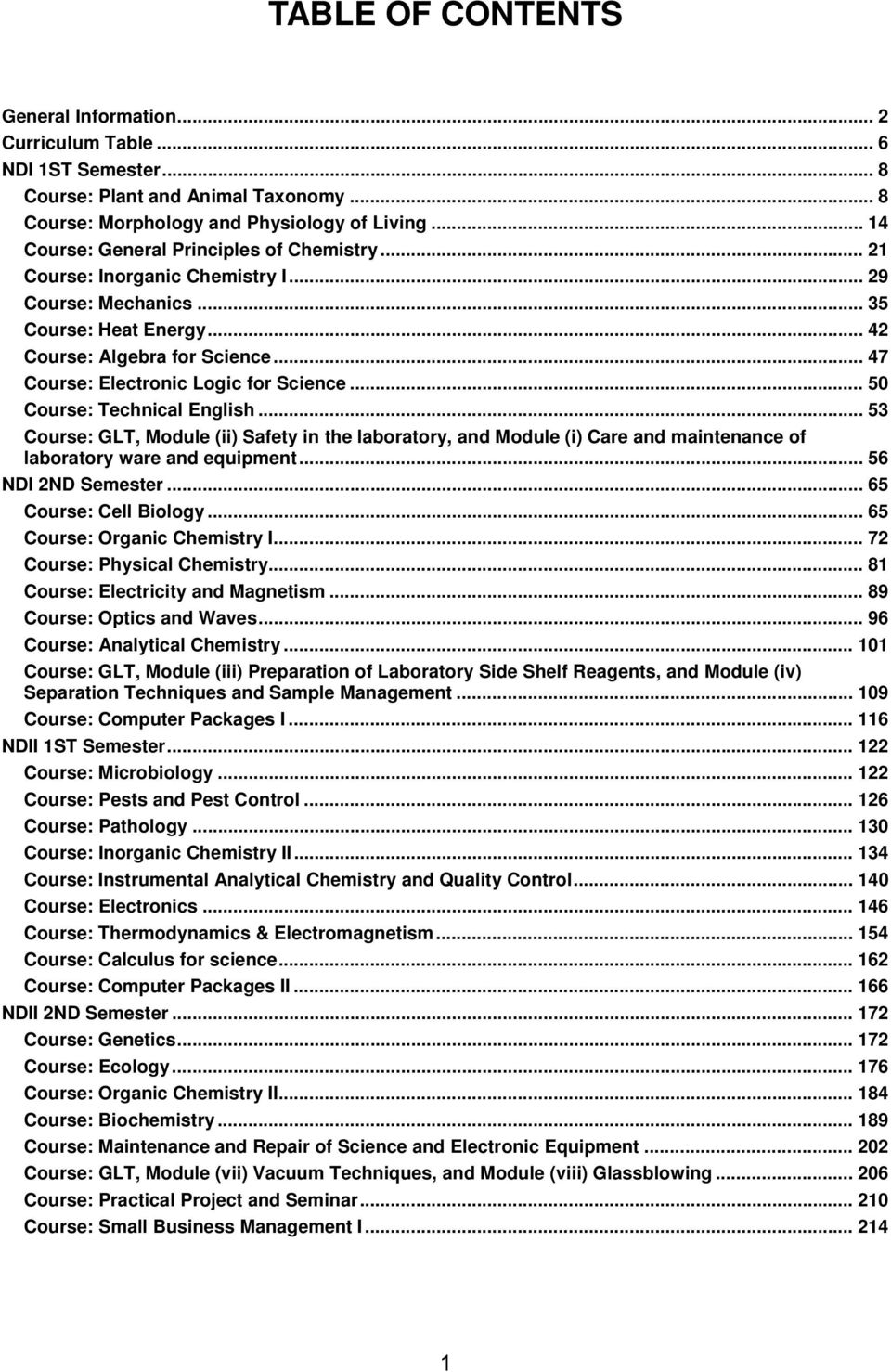
3 TABLE OF CONTENTS General Information... 2 Curriculum Table... 6 NDI 1ST Semester... 8 Course: Plant and Animal Taxonomy... 8 Course: Morphology and Physiology of Living Course: General Principles of Chemistry Course: Inorganic Chemistry I Course: Mechanics Course: Heat Energy Course: Algebra for Science Course: Electronic Logic for Science Course: Technical English Course: GLT, Module (ii) Safety in the laboratory, and Module (i) Care and maintenance of laboratory ware and equipment NDI 2ND Semester Course: Cell Biology Course: Organic Chemistry I Course: Physical Chemistry Course: Electricity and Magnetism Course: Optics and Waves Course: Analytical Chemistry Course: GLT, Module (iii) Preparation of Laboratory Side Shelf Reagents, and Module (iv) Separation Techniques and Sample Management Course: Computer Packages I NDII 1ST Semester Course: Microbiology Course: Pests and Pest Control Course: Pathology Course: Inorganic Chemistry II Course: Instrumental Analytical Chemistry and Quality Control Course: Electronics Course: Thermodynamics & Electromagnetism Course: Calculus for science Course: Computer Packages II NDII 2ND Semester Course: Genetics Course: Ecology Course: Organic Chemistry II Course: Biochemistry Course: Maintenance and Repair of Science and Electronic Equipment Course: GLT, Module (vii) Vacuum Techniques, and Module (viii) Glassblowing Course: Practical Project and Seminar Course: Small Business Management I
4 General Information 1.0 CERTIFICATION AND TITLE OF THE PROGRAMME: The certificate to be awarded and the programme title shall read: "NATIONAL DIPLOMA IN SCIENCE LABORATORY TECHNOLOGY" A transcript showing all the courses taken and grades obtained shall be issued on demand. 2.0 GOALS AND OBJECTIVES The National Diploma Programme in Science and Laboratory Technology is designed to produce technicians capable of carrying out various laboratory analysis and practical works under the supervision of a technologist. Specifically 1. Assist in chemical analysis and quality control in: industry (oil, food, brewing, detergent, textiles, etc.), hospitals, schools, colleges and research institutions. 2. Assist in physics and electronic laboratories with physical analyses and the maintenance of instrumentation 3. Assist in biological and biochemical analysis and experiments in hospitals, schools, colleges and research institutes 4. Prepare students for employment in related work such as sales, marketing, administration and management in the industries in 1 above and, also, for self employment. 3.0 ENTRY REQUIREMENTS: National Diploma The minimum entry requirement into the National Diploma in Science and Laboratory Technology programme is four Credit level passes in Senior Certificate Examination (SSCE) or National Examination Council (NECO) in not more than two sittings. The subjects must include the following: Mathematics and any two of the following: Biology or Agricultural Science, Chemistry and Physics. Entrants must posses at least credit grades in Biology, Chemistry, Physics and English Language. Candidates who have successfully completed the Board's recognized Pre-National Diploma (Science and Technology) course may be admitted into the programme. 4.0 CURRICULUM 4.1 The Curriculum of the ND programme consists of four main components. These are: a) General Studies/Education b) Foundation Courses c) Professional Courses d) Supervised Industrial Works Experience Scheme (SIWES) 2

5 4.2 The General Education component shall include courses in: Art Humanities - English Language, and Communication. These are compulsory. Social Studies - Citizenship (the Nigerian Constitution), Entrepreneurship are compulsory. 4.3 The General Education component shall account for not more than 10% of total contact hours for the programme. 4.4 Foundation Courses include: courses in Economics, Mathematics, Pure Science, Computer Applications, Technical Drawing, Descriptive Geometry, Statistics, etc. The number of hours will vary with the programme and may account for about 10-15% of the total contact hours Professional Courses: are courses which give the student the theory and practical skills he needs to practice his field of calling at the technician/technologist level. These may account for between 60-70% of the contact hours depending on programme Supervised Industrial Work Experience Scheme (SIWES) shall be taken during the long vacation following the end of the second semester of the first year. See details of SIWES at Paragraph CURRICULUM STRUCTURE 5.1 ND Programme: The structure of the ND programme consists of four semesters of classroom, laboratory and workshop in the college and a semester (3-4 months) of Supervised Industrial Work Experience Scheme (SIWES). Each semester shall be of 17 weeks duration made up as follows: 15 contact weeks of teaching, i.e. lecture recitation and practical exercises, etc and 2 weeks for tests, quizzes, examinations and registration. SIWES shall take place at the end of the second semester of the first year. 6.0 ACCREDITATION The programme offered shall be accredited by the NBTE before the diplomats shall be awarded the diploma certificate. Details about the process of accrediting a programme for the award of the ND or HND are available from the Executive Secretary Programmes Department, National Board for Technical Education, Plot 'B' Bida Road, P.M.B 2239, Kaduna, Nigeria. 7.0 CONDITION FOR THE AWARD OF THE ND Institution offering accredited programmes will award the National Diploma to candidates who successfully complete the programme after passing prescribed course work, examinations, diploma project and the supervised industrial work experience. Such candidates should have completed a minimum of between semester 90 and 100% credit units depending on the programme. Diploma Certificate shall be awarded based on the following classifications: - 90 and 100. Distinction CGPA Upper Credit CGPA Lower Credit CGPA Pass CGPA

6 8.0 GUIDANCE NOTES FOR TEACHERS TEACHING THE PROGRAMME The new curriculum is drawn in unit courses. This is in keeping the provisions of the provisions of the National Policy on Education which stress the need to introduce the semester credit units which enable a student who to transfer the already completed in an institution of similar standard from which he is transferring. 8.1 In designing the units, the principle of the modular system has been adopted; thus making each of the professional modules, when completed self-sufficient and providing the student with technical operative skills, which can be used for employment purposes. 8.2 As the success of the credit units system depends on the articulation of programmes between the institutions and industry, the curriculum content has been written in terms of behavioural objectives, so that it is clear to all, the expected performance of the students who successfully completed some of the courses or the diplomats of the programme is clearly defined. There is a slight departure in the presentation of the performance based curriculum which requires the conditions under which the performance are expected to be carried out and the criteria for the acceptable levels of performance. It is a deliberate attempt to further involve the staff of the department teaching the programme to write their own curriculum stating the conditions existing in their institution under which the performance can take place and to follow that with the criteria for determining an acceptable level of performance. Departmental submission on the final curriculum may be vetted by the Academic Board of the institution. Our aim is to continue to see to it that a solid internal evaluation system exits in each institution for ensuring minimum standard and quality of education in the programmes offered thought the polytechnic system. 8.3 The teaching of the theory and practical work should, as possible, be integrated. Practical exercise, especially those in professional courses and laboratory work should not be taught in isolation from the theory. For each course, there should be a balance of theory to practice depending on the course objectives and content. 9.0 GUIDELINES ON SIWES PROGRAMME For the smooth operation of the SIWES the following guidelines shall apply: 9.1 Responsibility for Placement of Students (i) Institutions offering the ND Programme shall arrange to place the students in industry. By April 30 th of each year, six copies of the master list showing where each student has been placed shall be submitted to the Executive Secretary NBTE which shall, in turn, authenticate the list and forward it to be the Industrial Training Fund. (ii) The Placement Officer should discuss and agree with industry on the following: (a) a task inventory of what the students should be expected to experience during the period of attachment. It may be wise to adopt the one already approved for each field. (b) the industry-based supervisor of the students during the period, likewise the institutionbased supervisor. (c) The evaluation of the student during the period. It should be noted that the final grading of the student during the period of attachment should be weighted more on the evaluation by his industry-based supervisor. 9.2 Evaluation of Students During the SIWES In the evaluation of the student, cognizance should be taken of the following items: i) Punctuality ii) Attention 4
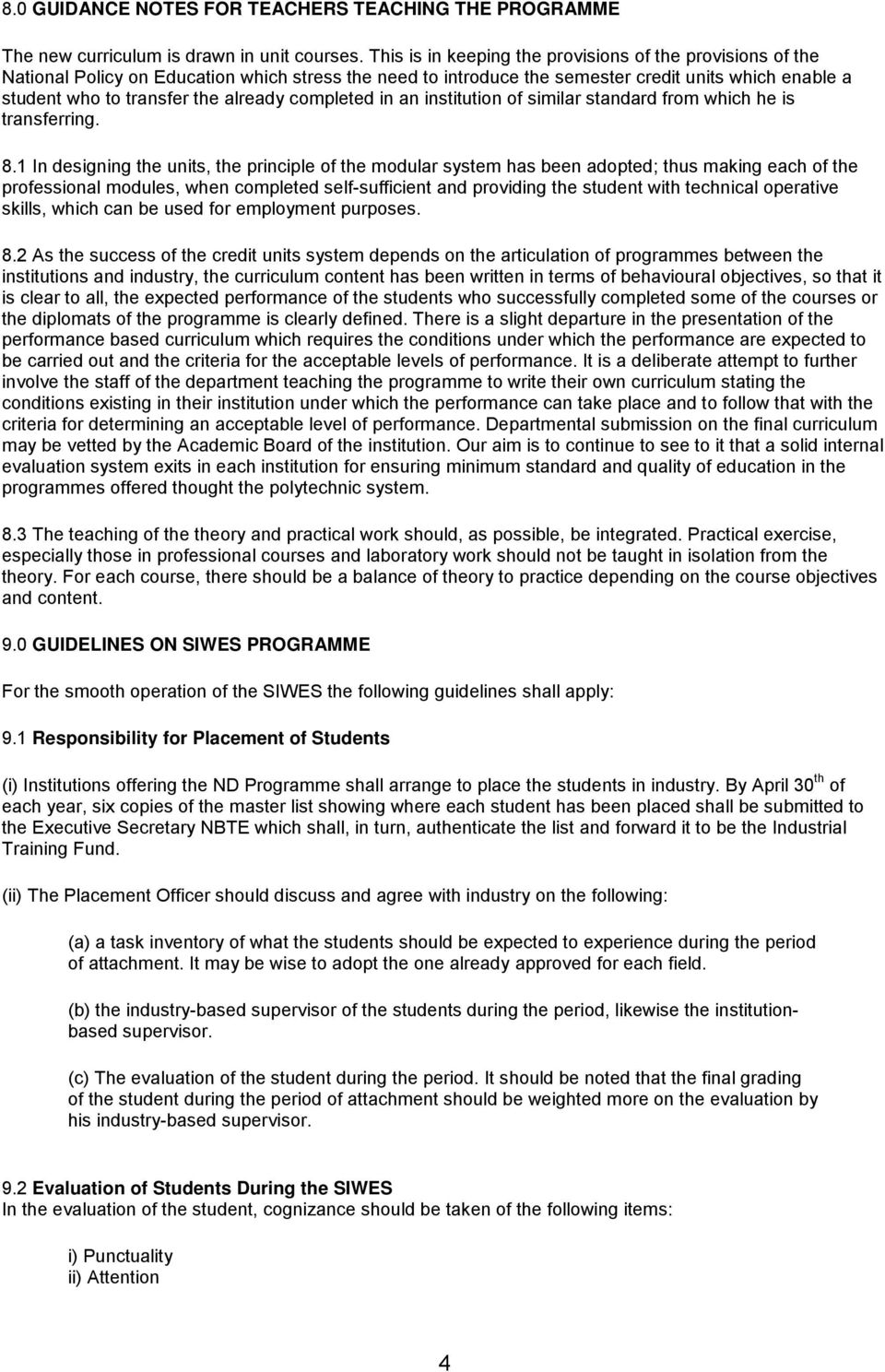
7 General Attitude to Work Respect for Authority Interest in the field/technical area Technical competence as a potential technician in his field. 9.3 Grading of SIWES To ensure uniformity of grading scales, the institution shall ensure that the uniform grading of student's work which has been agreed to by all polytechnics is adopted. 9.4 The Institution Based Supervisor The institution-based supervisor should sign the log book during each visit. This enable him to check and determine to what extent the objectives of the scheme are being met and to assist students having any problems regarding the specific assignments given to them by their industry-based supervisor. 9.5 Frequency of Visit Institution should ensure that students placed on attachment are visited within one month of their placement. Other visits shall be arranged so that: i) there is another visit six weeks after the first visit; and ii) a final visit in the last month of the attachment. 9.6 Stipend for Students on SIWES The rate of stipend payable shall be determined from time to time by the Federal Government after due consultation with the Federal Ministry of Education, the Industrial Training fund and the NBTE. 9.7 SIWES as a Component of the Curriculum The completion of SIWES is important in the final determination of whether the student is successful in the programme or not. Failure in the SIWES is an indication that the student has not shown sufficient interest in the field or has no potential to become a skilled technician in his field. The SIWES should be graded on a fail or pass basis. Where a student has satisfied all other requirements but failed SIWES, he may only be allowed to repeat another four months SIWES at his own expense. 5

8 Curriculum Table NDI 1 ST SEMESTER S/No Course Code Course Title Contact Hours L P CH Units week CU STB 111 Plant and Animal Taxonomy STB 112 Morphology and Physiology of Living Things STC 111 General Principles of Chemistry STC 112 Inorganic Chemistry I STP 111 Mechanics STP 112 Heat Energy STP 113 Algebra for Science STP 114 Electronic Logic for Science STC 113 Technical English GLT111 General Laboratory Techniques (ii) Safety in the laboratory, and (i) Care and maintenance of laboratory ware and equip. Total Prerequisite NDI 2 ND SEMESTER S/No Course Code Course Title Contact Hours L P CH Units week CU STB 121 Cell Biology STC 121 Organic Chemistry I STC 122 Physical Chemistry STP 121 Electricity and Magnestism STP 122 Optics and Waves STC 123 Analytical Chemistry GLT 121 General Laboratory Techniques (iii) Preparation of Laboratory Side Shelf Reagents, and (iv) Separation Techniques and Sample Management COM 123 Computer Packages I Total Prerequisite 6

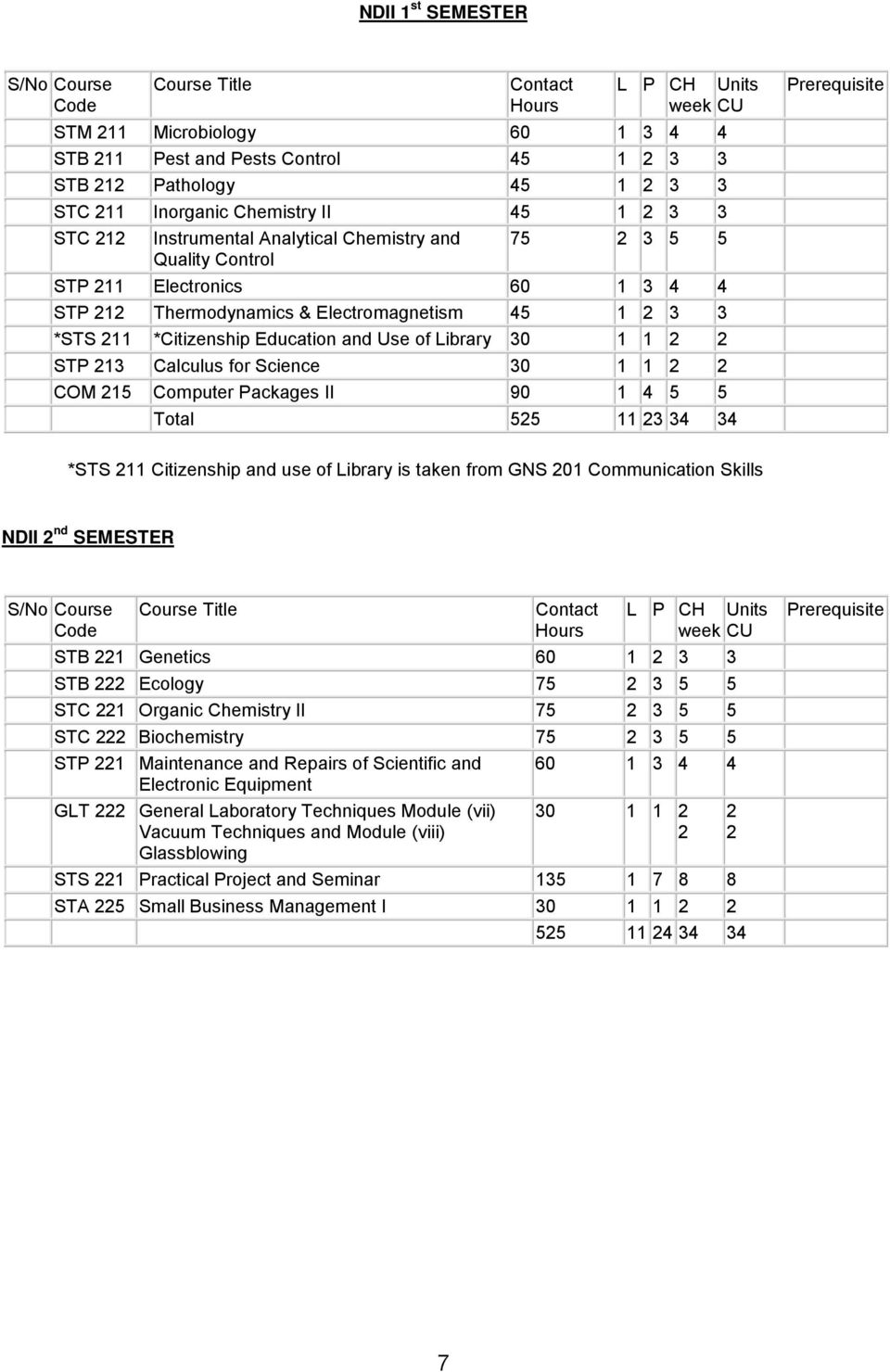
9 NDII 1 st SEMESTER S/No Course Code Course Title Contact Hours L P CH Units week CU STM 211 Microbiology STB 211 Pest and Pests Control STB 212 Pathology STC 211 Inorganic Chemistry II STC 212 Instrumental Analytical Chemistry and Quality Control STP 211 Electronics STP 212 Thermodynamics & Electromagnetism *STS 211 *Citizenship Education and Use of Library STP 213 Calculus for Science COM 215 Computer Packages II Total Prerequisite *STS 211 Citizenship and use of Library is taken from GNS 201 Communication Skills NDII 2 nd SEMESTER S/No Course Code Course Title Contact Hours L P CH Units week CU STB 221 Genetics STB 222 Ecology STC 221 Organic Chemistry II STC 222 Biochemistry STP 221 Maintenance and Repairs of Scientific and Electronic Equipment GLT 222 General Laboratory Techniques Module (vii) Vacuum Techniques and Module (viii) Glassblowing STS 221 Practical Project and Seminar STA 225 Small Business Management I Prerequisite 7
10 NDI 1ST Semester Course: Plant and Animal Taxonomy Department/Programme: National Diploma Course: Plant and Animal Taxonomy Course Code: STB 111 Credit Hours: Year: Semester: Pre-requisite: Theoretical: Practical: General Objectives hours/week 2 hours /week 3 1. Know the general classification of the plant kingdom 2. Know the diagnostic features of the thallophytes (algae and fungi) 3. Know the distinguishing characteristics of the embryophyta (bryophytes, pterielophytes, spermatophytes) 4. Know the classification, identification and preservation of common flowering plants 5. Know the general classification of the animal kingdom 6. Know the diagnostic features of the following phyla: protozoa, plahelminthes coelenterata, nematoda, annelids, arthropoda 7. Know the distinguished characteristics and identify the major classes of vertebrates (pisces, amphibia, reptila, mammalia) 8. Know the preservation methods of common vertebrates and invertebrates 8

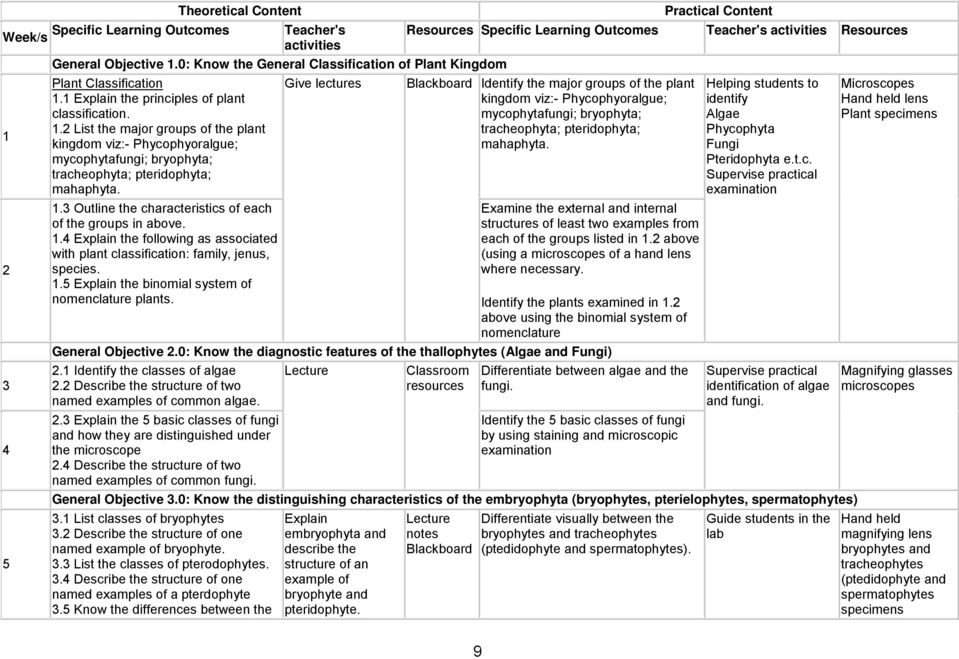
11 Specific Learning Week/s Teacher's Theoretical Content General Objective 1.0: Know the General Classification of Plant Kingdom Plant Classification 1.1 Explain the principles of plant classification. 1.2 List the major groups of the plant kingdom viz:- Phycophyoralgue; mycophytafungi; bryophyta; tracheophyta; pteridophyta; mahaphyta. 1.3 Outline the characteristics of each of the groups in above. 1.4 Explain the following as associated with plant classification: family, jenus, species. 1.5 Explain the binomial system of nomenclature plants. Give lectures Specific Learning Teacher's Blackboard Identify the major groups of the plant kingdom viz:- Phycophyoralgue; mycophytafungi; bryophyta; tracheophyta; pteridophyta; mahaphyta. Examine the external and internal structures of least two examples from each of the groups listed in 1.2 above (using a microscopes of a hand lens where necessary. Identify the plants examined in 1.2 above using the binomial system of nomenclature General Objective 2.0: Know the diagnostic features of the thallophytes (Algae and Fungi) 2.1 Identify the classes of algae 2.2 Describe the structure of two named examples of common algae. 2.3 Explain the 5 basic classes of fungi and how they are distinguished under the microscope 2.4 Describe the structure of two named examples of common fungi. Lecture resources Differentiate between algae and the fungi. Identify the 5 basic classes of fungi by using staining and microscopic examination Helping students to identify Algae Phycophyta Fungi Pteridophyta e.t.c. Supervise practical examination Supervise practical identification of algae and fungi. General Objective 3.0: Know the distinguishing characteristics of the embryophyta (bryophytes, pterielophytes, spermatophytes) 3.1 List classes of bryophytes 3.2 Describe the structure of one named example of bryophyte. 3.3 List the classes of pterodophytes. 3.4 Describe the structure of one named examples of a pterdophyte 3.5 Know the differences between the Explain embryophyta and describe the structure of an example of bryophyte and pteridophyte. Lecture notes Blackboard Differentiate visually between the bryophytes and tracheophytes (ptedidophyte and spermatophytes). Guide students in the lab Microscopes Hand held lens Plant specimens Magnifying glasses microscopes Hand held magnifying lens bryophytes and tracheophytes (ptedidophyte and spermatophytes specimens 9
12 Specific Learning Week/s Teacher's 6 7 Theoretical Content two subdivisions of the spermatophyta viz: gymnosperms and angiosperms. 3.6 List the classes of the Gymnosperms and the Angiosperms. 3.7 Describe the structure of one example each of a gymnosperm and an angiosperm. Lecture on spermatophyta and explain the structure of one example of gymnosperm and angiosperm. Specific Learning Teacher's General Objective 4.0: Know the classification, Identification and Preservation of common flowering plant 4.1 Outline the characteristics of common flowering plant families viz: monocotyledonous plants:- 1. Graminease e.g. Grass, Bamboo 2. Palmae e.g. Palms 3. Liliaceae e.g. onions, Dicotyledenous plants:- 4. Leguminosae e.g. Crotolaria, cassia 5. Combretaceae e.g. combretum 6. Sterculiaceae e.g. cola 7. Malvaceae e.g. Hibiscus 8. Bombacaceae e.g Bombax 9. Rutaceae e.g. citrus 10. Anacardiaceae e.g. mango; cashew nuts 11. Maliaceae e.g mahogamy 12. Compositae e.g. Tridax Introduction of basic Herbarium Technique Display monocotyledonous and dicotyledenous plants. Identify and distinguish between the common families of flowering plants viz: monocotyledonous plants by making the specimens available to students: 1. Graminease e.g. Grass, Bamboo 2. Palmae e.g. Palms 3. Liliaceae e.g. onions, Dicotyledenous plants:- 4. Leguminosae e.g. Crotolaria, cassia 5. Combretaceae e.g combretum 6. Sterculiaceae e.g. cola Identify the plants with students. Botanical Garden with the required specimens Plant, presses. Cardboard, secateurs herbarium poisons. Magnifying glass Weed album and key for identification 10

13 Specific Learning Week/s Teacher's Theoretical Content Specific Learning Teacher's 7. Malvaceae e.g. Hibiscus 8. Bombacaceae e.g. Bombax 9. Rutaceae e.g. citrus 10. Anacardiaceae e.g. mango; cashew nuts 11.Maliaceae e.g. mahogamy 12. Compositae e.g. Tridax Describe the technique for collecting and preserving common flora Identify the important species of each of the families listed above by using the binomial nomenclature (students should be encouraged to know local names of the species whenever possible) Collect common flora by applying the appropriate technique and Classify appropriately the flora collected General Objective 5.0: Know the General classification of the animal kingdom 5.1 Outline the characteristics and identify the following phyla invertebrates: Coelenterata (coelenterates) Platylminths (wematodes) Annelida (annelids) Arthropoda (arthropods) Molusca (mollusca) lecture resources Identify the two major groups of animal kingdom (Vertebrates and Invertebrates) and describe their characteristics Show animals that fall into these two groups. Practical identification Grade drawing Laboratory or museum Preserved specimens Preserved specimen 11
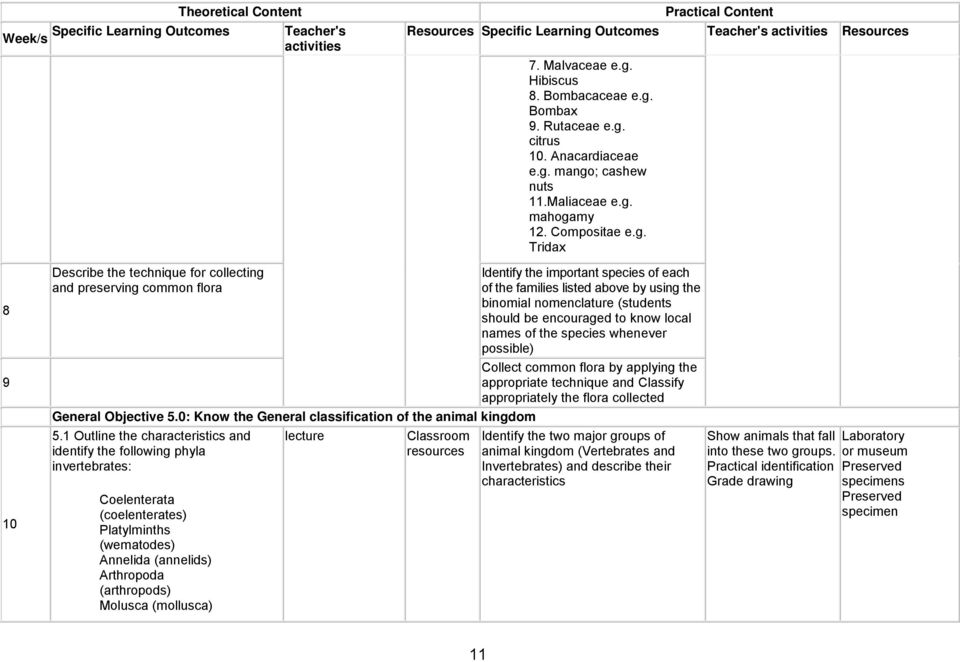
14 Specific Learning Week/s Teacher's 11 Theoretical Content 5.2 Explain the characteristics of the phylum chordata 5.3 Outline the characteristics of the following major classes of vertebrates: Pisces (fish) Amphibia (Amphibians) Raptila (Reptiles) Aves (Birds) Mammalian (Mammals) Specific Learning Teacher's Identify the following major classes of vertebrates: Pisces (fish) Amphibia (Amphibians) Raptila (Reptiles) Aves (Birds) Mammalian (Mammals) General Objective 6.0: Know the diagnostic features of the following phyla: Protozoa, Plahelminthes Coelenterata, nematoda, annelids, arthropoda. Invertebrate diagnostic features 6.1 Classify the invertebrates 6.2 List the distinguishing characteristics of the following phyla: Protozoa Coelenterata Phytyhelminthes Nematodes Annelida Arthropoda Mollusca Lecture on invertebrates and list out their characteristics resources 6.3 Identify examples from each phylum in 6.2. above 6.4 Describe the external structure of some common examples from each phylum in 6.2 above. 6.5 Identify, draw and label examples from 6.4 above. Practical: Illustrate identification of collected specimen. General Objective 7.0 Know the distinguishing characteristics and identify the major classes of vertebrates (Pisces, amphibia, reptila, mammalia) 7.1 Describe the external features of some common examples from each of the phylum Pisces, amphibia, reptila, mammalia 7.2 Explain the protochorodates as a link between invertebrates and vertebrates. Lectures resources Identify, draw and label examples from 7.1 above. Identify the protochorodates as a link between invertebrates and vertebrates Display these preserved vertebrates for practical analysis. Draw and label examples of vertebrates Show students the Magnifying glasses Preserved specimen Preserved specimen and tools for collection. 12
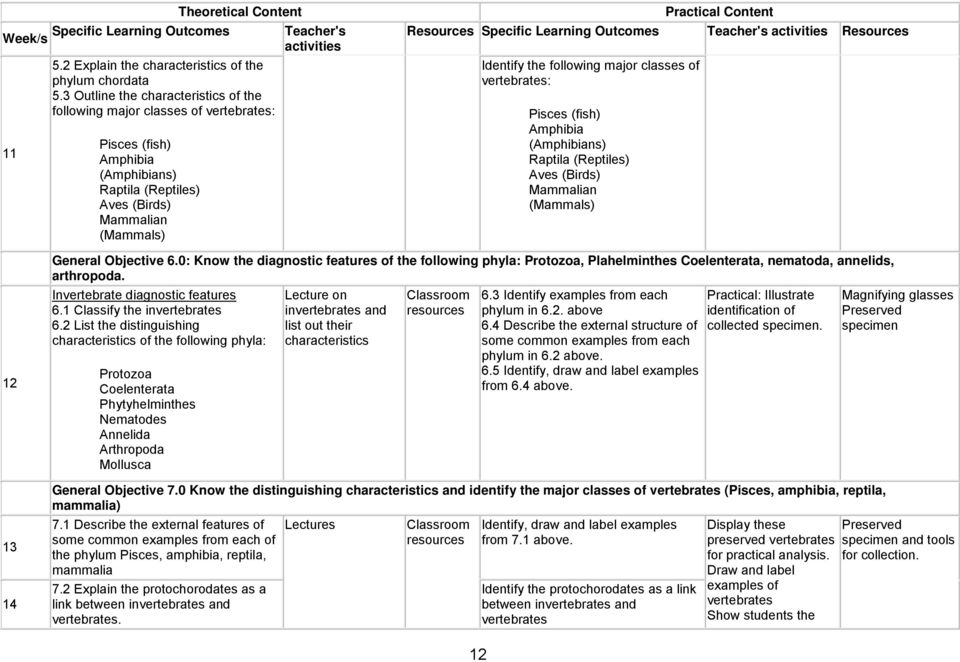
15 Specific Learning Week/s Teacher's 15 Theoretical Content General Objective 8.0: Know the Preservation methods of common vertebrates and invertebrates 8.1 Explain Preservation 8.2 List the common preservation for the vertebrates 8.3 List the common preservative methods for the invertebrates. 8.4 Enumerate the importance of preservation. lectures Specific Learning Teacher's resources protochorodates and point out the features that form a link between invertebrates and vertebrates Collect, identify and preserve Conduct field trips common examples of vertebrates and Demonstrate the invertebrates. preparation of fixates. Fieldwork and laboratory Specimen Bottles and containers, components of various fixates Assessment: Coursework/Assignments 10%; Practical 40%; Examination 50 % Recommended Textbooks & References: Biology: A Functional Approach, by Michael Roberts, Nelson Thornes (Publishers) Ltd 13

16 Course: Morphology and Physiology of Living Department/ Programme: Science Lab. Technology ND Course: Morphology and Physiology of Living Course Code: STB 112 Credit Hours: Year: Semester: Pre-requisite: Theoretical: Practical: General Objectives 1 hours/week 3 hours /week 1. Know the morphology, life cycles and economic importance of selected examples of the following divisions (1) Thallopyta including lichens (2) Bryophta (3) Pteridophyta (4) Spermatophyte (5) Gymnosperms (6) Angiosperms. 2. Know the morphology, life cycles and economic importance of selected examples of the following examples of the following Phyta (1), Protozoa (2) Coelenterate (3) Pahtyhelminthes (4) Nernatodes (5) Annelida (6) Anthropoda (7) Mollusca. 3. Know the morphology evolutionary relationship and economic importance of selected examples of phylum Chorda Protochordata and Euchordata (a) Protecttorate (b) Euchordata (1) Pisces (Fishes) (2) Amphibian (3) Reptile (4) Aves Mammalian. 4. Know the morphology and physiology of valves organs and systems in the animal kingdom. 14

17 Week/s Theoretical Content Specific Learning Teacher's Specific Learning Teacher's General Objective 1.0: Know the morphology, life cycles and economic importance of selected examples of the following divisions (1) Thallopyta including lichens (2) Bryophta (3) Pteridophyta (4) spermataphyta (Gymnosporms, Augiosporms. 1.1 Describe the general characteristics, and classification of the algae. 1.2 Describe the morphology of diatoms, euglena, spirogyra, ferns. 1.3 Describe the life cycles of the examples diatoms, euglena, spiragyra, ferns. 1.4 List and explain the economic importance of algae. 1.5 Describe the general characteristics and classification of fungi. 1.6 Describe the structure and life cycle of a saprophytic fungus e.g. mucor and a parasitic fungus pythium. 1.7 List and explain the economic importance of fungi 1.8 Describe the structure and classification of lichens. 1.9 Explain the importance of lichens Explain the general characteristics and classification of bryophyta Describe the morphology and life cycles of a liverwort e.g. marchantia and moss e.g. funaria Explain the concept of alternation of generation in Bryophyta. Lecture resources Collect samples of each group in 1.1. to 1.22 above for classification and preservation and conduct practical grades drawing Continue to collect samples of each group in 1.1. to 1.22 above for classification and preservation and conduct practical grades drawing Continue to collect samples of each group in 1.1. to 1.22 above for classification and preservation and conduct practical grades drawing Conduct field trips and guide students in collection and preservation of collected samples. Tools for Herbarium collection and camera for snapping rear specimens. Magnifying glasses 15
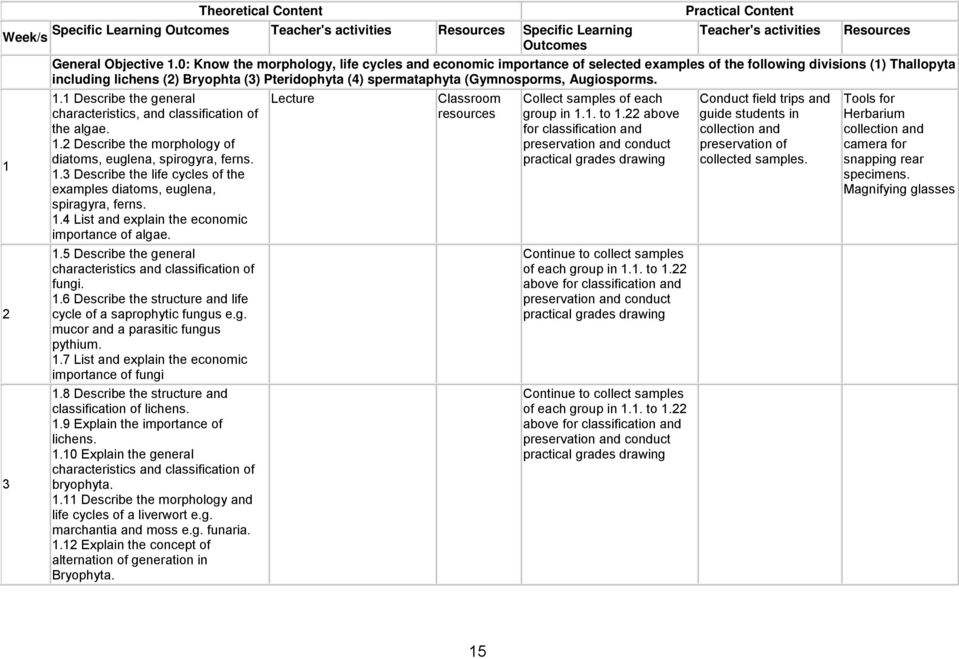
18 Week/s 4 5 Theoretical Content Specific Learning Teacher's Specific Learning 1.13 Explain the general characteristics, and classification of pteridophytes 1.14 Describe the morphology and life of a club moss e.g. selaginella and a fern 1.15 Explain alternation of generation in pteridophyta compare it with that of the bryophyta Explain the concept of heterospory as illustrated by selaginella Explain the adaptive features of pteriodphytes to plant and its evolutionary significance 1.18 Describe the general characteristics and classification of gymnosperms Describe external features and life cycle of cycis Explain the economic importance of gymnosperm Describe the general characteristics and classification of angiosperms List and describe the range of types of angiosperms- trees, herbs and shrubs Explain the adaptations and economic importance of the angiosperms Outline the evolutionary relationship between the division in 1.1 to 1.22 above. Continue to collect samples of each group in 1.1. to 1.22 above for classification and preservation and conduct practical grades drawing Compare and contrast the characteristics of mosses. Lecture. Continue to collect samples of each group in 1.1. to 1.22 above for classification and preservation and conduct practical grades drawing Identify the morphological differences between monocotyledons and dicotyledoms Teacher's Conduct field trips Conduct practical grades drawing Chart and Visual aids. Microscope Plants Preservation materials. Magnifying glasses 16
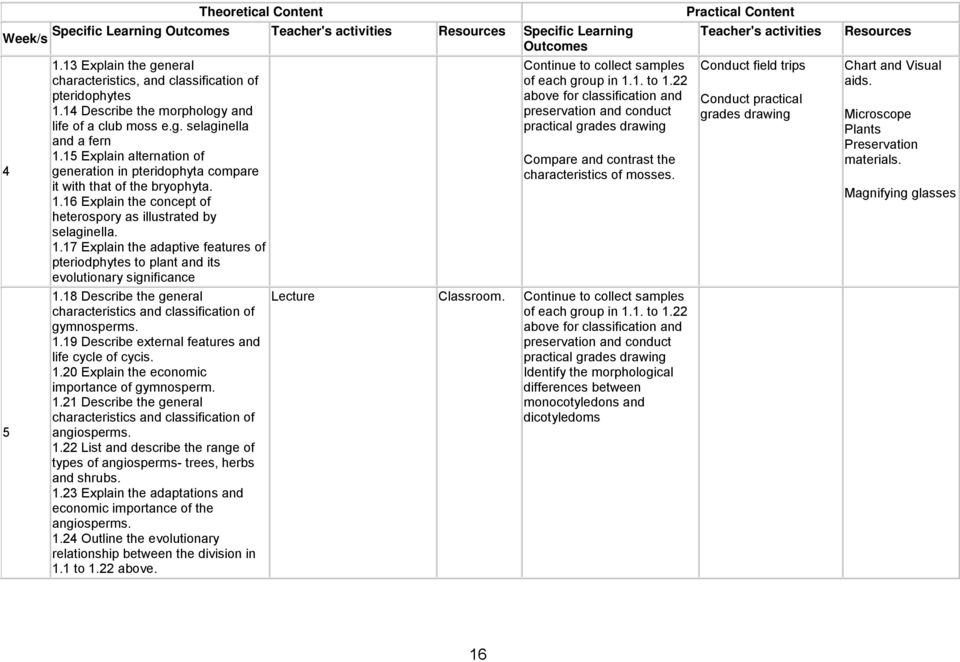
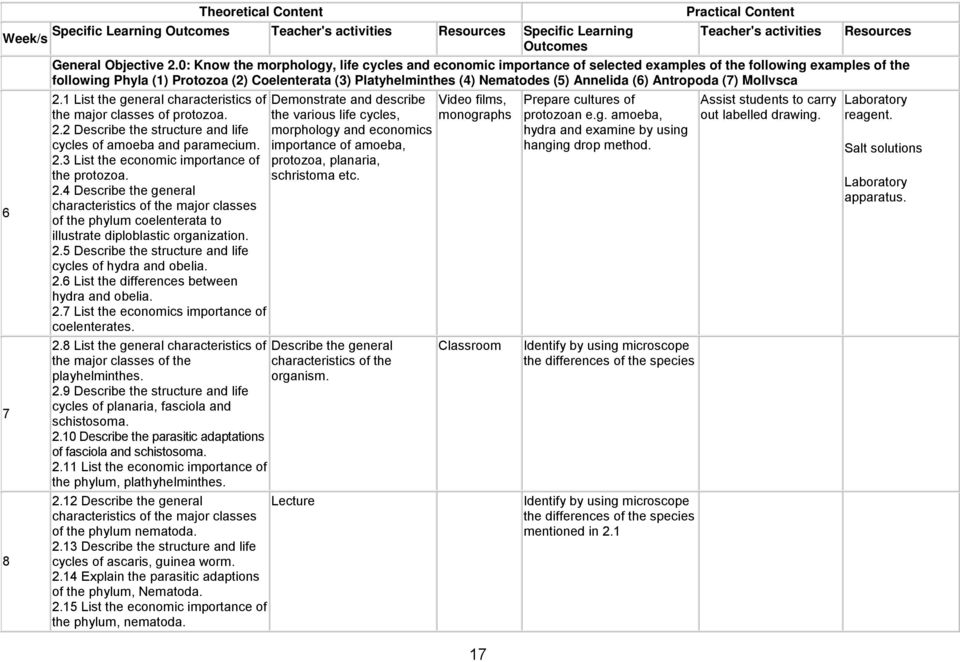
19 Week/s Theoretical Content Specific Learning Teacher's Specific Learning 17 Teacher's General Objective 2.0: Know the morphology, life cycles and economic importance of selected examples of the following examples of the following Phyla (1) Protozoa (2) Coelenterata (3) Platyhelminthes (4) Nematodes (5) Annelida (6) Antropoda (7) Mollvsca 2.1 List the general characteristics of the major classes of protozoa. 2.2 Describe the structure and life cycles of amoeba and paramecium. 2.3 List the economic importance of the protozoa. 2.4 Describe the general characteristics of the major classes of the phylum coelenterata to illustrate diploblastic organization. 2.5 Describe the structure and life cycles of hydra and obelia. 2.6 List the differences between hydra and obelia. 2.7 List the economics importance of coelenterates. Demonstrate and describe the various life cycles, morphology and economics importance of amoeba, protozoa, planaria, schristoma etc. 2.8 List the general characteristics of Describe the general the major classes of the characteristics of the playhelminthes. organism. 2.9 Describe the structure and life cycles of planaria, fasciola and schistosoma Describe the parasitic adaptations of fasciola and schistosoma List the economic importance of the phylum, plathyhelminthes Describe the general characteristics of the major classes of the phylum nematoda Describe the structure and life cycles of ascaris, guinea worm Explain the parasitic adaptions of the phylum, Nematoda List the economic importance of the phylum, nematoda. Video films, monographs Prepare cultures of protozoan e.g. amoeba, hydra and examine by using hanging drop method. Identify by using microscope the differences of the species Lecture Identify by using microscope the differences of the species mentioned in 2.1 Assist students to carry out labelled drawing. Laboratory reagent. Salt solutions Laboratory apparatus.
20 Week/s Theoretical Content Specific Learning Teacher's Specific Learning 2.16 describe the general characteristics of the major classes of the plylum annelida Explain the significance of the coelom Describe the structure and life cycles of lumbricus, nereis and hirodo Explain the importance of the species in 2.18 above to agriculture Describe the characteristics of the major classes of the phylum mollusca Describe the structure and life cycles of gastropods and bivalves List the economics importance of mollusca generally Describe the characteristics of the major classes of the phylum, arthropoda List the classes of the phylum Arthropoda List the common orders of the phylum Arthropda and give examples e.g. diptera orthoptera, coleoptera, hemipters, leidoptera hymenoptera, odonata, isoptera, dictyoptera and nenroptera List and explain the economic importance of insects of the phylum arthropoda List the characteristics and classify the phylumic chinodermata into its major classes with some examples 2.28 Describe the structure and life cycle of the examples in 2.27 above. Identify by using microscope the differences of the species Collect samples of each group 2.1 to 2.28 for identification and classification Conduct field trips and collect samples to identify, classify and preserve. Draw label sketches. Teacher's Magnifying glass, Microscope Preservative materials. Slow moving stream, dropping pipettes petral dishes. 18

21 Week/s Theoretical Content Specific Learning Teacher's Specific Learning Teacher's 2.29 Describe the economic importance of echinoderms Outline the evolutionary relationship between the phyla and within each phylum from 2.1 to 2.28 General Objective 3.0: Know the morphology evolutionary relationship and economic importance of selected examples of phylum chorda Protochordata and euchordata (a) Protectorate (b) Euchordata (1) Pisces (Fishes) (2) Amphibian (3) Reptile (4) Aves Mammalian. 3.1 Compare the morphological features of representatives of (a) protochordates and (b) euchordates, of the phylum chordata. 3.2 Relate the features of these organisms to their modes of life. 3.3 Outline the evolutionary relationship between (a) protochordates and euchordates and (b) within the classes of euchordates. 3.4 List animals of economic importance in the group protochordate. Examine protochordate e.g. amphioxus and identify different features of evolutionary interest. Demonstrations and drawings. Practical examination General Objective 4.0: Know the morphology and Physiology of Valves organs and systems in the animal kingdom 4.1 Distinguish between morphology Lectures and physiology 4.2 Describe the morphology of the following mammalian organs and systems; nervous system, circulatory system, digestive system, excretory system, regulatory system, reproductive system. 4.3 Explain the physiological processes of the organs and systems in 4.2 above. 4.4 Compare and contrast the physiological processes as seen in the different phyla of the animal kingdom. Lecture notes chalkboard Draw and label the various organs and systems mentioned in 4.2 above. Magnifying glass. Models of the specimens as available in the museum. 19
22 Week/s 15 Theoretical Content Specific Learning Teacher's Specific Learning 4.5 Relate the structures of the Practical dissection grade various organs in 4.2 above to their drawing functions. 4.6 Relate the structures of the various organs in 4.2 above to evolutionary trends in the animal kingdom. 4.7 Describe the effects of environmental factors like oxygen concentration, temperature, osmoregulation and pollutions on the physiology of animals. Dissecting kits. Noards. Dissect and identify the internal organs of (i) bony fish (ii) toad/frog, a small mammal. Draw and label the dissections in 4.9 above. Teacher's Observe under microscope and draw. Dissention guides on the various specimens available and dissenting kit.. Assessment: Coursework/Assignments 10 %; Practical 40%; Examination 50 % Recommended Textbooks & References: Biology: A Functional Approach, by Michael Roberts, Nelson Thornes (Publishers) Ltd 20
23 Department/Programme: National Diploma Course: General Principles of Chemistry Course: General Principles of Chemistry Course Code: STC 111 Credit Hours: Year: Semester: Pre-requisite: Theoretical: Practical: General Objectives 1. Understand atoms molecules, composition and structure hours/week 2 hours/week 3 2. Understand the arrangement of elements in the periodic table 3. Understand chemical thermodynamics 4. Understand the properties and reactions of acids, bases and salts 5. Understand the fundamental concept of oxidation and reduction reactions 6. Understand surface phenomena and colloidal systems 7. Understand chemical equilibrium 21
24 Theoretical Content Specific Learning Week/s Teacher's 1 2 Specific Learning Teacher's General Objective 1: Understand atoms molecules, composition and structure On completion of this course, the student should be able to: 1.1 Explain the experimental basis of atomic theory using the Bohr's theory of hydrogen atom and many electron atoms. 1.2 Describe atomic spectra particularly the H atom emission spectrum 1.3 Discuss, qualitatively, the Energy States of the hydrogen atom in the Bohr model 1.4 Relate these Energy States to the observed emission spectra 1.5 Explain the limitations of the Bohr model 1.6 Describe the wave-particle duality of electrons and energy 1.7 State the different main energy levels of an atom, namely K, L, M 1.8 Correlate the energies of the electron in the K, L, M, N, shells with the values of the principal quantum no n= 1,2,3,4, 1.9 Relate the lines of the hydrogen emission spectrum to electronic energy level State Hund's rule, Heisenberg uncertainty principle Pauli exclusion principle Explain 1.10 above in relation to the concept of orbitals including subsidiary energy levels (s,p,d,f orbitals). Lectures Lectures Blackboard Chalk Molecular models resources View the visible emission spectra of several metals in some of their compounds Interpret the mass spectrum of representative elements such as Oxygen, Carbon, Chlorine etc. 22 Guide and supervise lab technicians, technologists and students direct vision spectroscope Bunsen burner, nichrome wire fixed to a cork handle, conchcl, solid chlorides of : barium, calcium, potassium, sodium and strontium beakers and watch glasses
25 Theoretical Content Specific Learning Week/s Teacher's Explain the significance e of the four quantum numbers 2.1 Describe the shapes of s and p orbitals Sketch the s and p orbitals Describe the determination of relative atomic and molecular masses Explain isotopes and their use Describe the use of mass spectrometer as a means of proving the existence of isotopes Define the following:: (i) Atomic number, (ii) Mass number, (iii) Atomic mass, Based on 12C 1.17 Explain valency and chemical bonding Explain the octet and duplet rules 1.19 Distinguish between the following types of bonds: ionic: covalent; metallic, co-ordination bond Understand energy considerations in ionic bonding and lattice energy 1.21 Understand the formation of covalent bonds, bond length and bond energy, electronegativity and bond polarity, 1.22 Explain Van der Waal's forces Lecture Specific Learning Teacher's classroom resources Separate a mixture of sand and salt and relate the results to the different types of bonding in each Prepare iron sulphide from iron and sulphur Provide spectra and guide students through their interpretation Guide students Workshop resources and representative mass spectra iron, Sulphur, Bunsen burner, glassware, magnets 23
26 Theoretical Content Specific Learning Week/s Teacher's Specific Learning Teacher's General Objectives: 2. 0 Understand the arrangement of elements in the periodic table 2.1 Discuss the development of the periodic table 2.2 Describe building up periods I and II 2.3 Describe building up period III 2.4 Describe electron configurations within groups 2.5 Describe the first d-orbital transition series; building up period IV 2.6 Discuss the non-metallic elements 2.7 Discuss the Noble Gases 2.8 Write down electronic configuration for the first twenty elements of the periodic table. 2.9 Relate electron configuration to the position in the periodic table. Lecture classroom resources 2.10 Describe trends in the Periodic Table such as atomic size, ionisation energy, electron affinity, reactivity Describe diagonal relationships General Objective 3: Understand chemical Thermodynamics 3.1 Describe thermodynamic systems e.g. open system, closed system, isolated system. 3.2 Explain thermodynamic functions enthalpy, entropy, free energy. 3.3 Explain the first and second laws of thermodynamics and their significance. Lecture classroom resources Investigate the reactivity of group 2 metals (i) Mg. Ca, Sr, and Ba with water (ii) Mg and Ca with dilute HCl Reactivity of transition metals - The Copper Envelope Measure heat of reaction by simple experiments e.g. heat of neutralization NaOH, HCl of a acid and strong base. Guide students Teacher supervises and guides students in the laboratory Mg, Ca, Sr, Ba, water, dilute hydrochloric acid test tubes etc Copper foil, tongs, Bunsen Chemicals calorimeter Glassware etc. 24
27 Theoretical Content Specific Learning Week/s Teacher's 8 9 Specific Learning Teacher's 3.4 Explain thermo chemistry as heat effects that accompany chemical reactions General Objective 4: Understand the properties and reactions of acid, bases and salts. 4.1 Define an acid and a base according to Arrhenius, Bronsted - Lowry and Lewis concepts. 4.2 Identify acids and bases in chemistry equations. 4.3 Explain the meaning of the terms conjugates acid and conjugate base 4.4 Distinguish between a strong and weak acid or base. 4.5 Write the expression for the dissociation constant for an acid HA (aq) 4.6 Give the equation for the degree of dissociation and concentration, M. (mole dm 3 ) for a dilute solution of a weak acid. 4.7 Explain Ostwald's Dilution law and dissociation constant, K. 4.8 Calculate the degree of dissociation of a weak acid given the molarity and dissociation constant. 4.9 State the value of the ionic product of water Explain the concept of hydrogen on concentration and ph 4.11 Calculate the ph value of an acid or base given the hydrogen ion concentration 4.15 Identify various types of indicators and the use in the measurement of ph. Define acid, bases and salts and teach to identify them in equations Explain dissociation constant and derive expression for it Work out simple calculations on degree of dissociation of weak acid Carry out acid base titration by using conductance meter Identify indicators and use indicators in acid base titration Measure the ph of solutions by using colour charts, indicators and ph meter Determine experimentally the strengths of acids and bases in relation to structure e.g. in the series CH3COOH, HCL, NH4, OH, NaOH Guide students Chemicals Conductance meters ph meters colour charts indicators burettes glassware 25
28 Theoretical Content Specific Learning Week/s Teacher's Define the terms, pka and pkb 4.17 State the Henderson Hasslebach equation 4.18 Use the Henderson Hassleback equation 4.19 Understand that, for a weak acid in a solution where the ph = of the acid, the acid is 50% ionised Define the terms, buffer solution and buffer capacity 4.21 Explain the effectiveness of a buffer solution Describe buffers in Biochemistry and Medicine (e.g. blood, and biochemical experiments) 4.23 Explain the hydrolysis of salts 4.12 Explain common ion effect. 4,14 Explain the solubility product and its application in quantitative and volumetric analysis Calculate the value of the solubility product given the solubility of sparingly soluble salt. Specific Learning Teacher's Lectures Measure pka of a weak acid via titration Titrate a weak acid by using a strong base. Plot the results and observe the region of buffering and the end point. Calculate the solubility product of silver acetate in water and solutions of varying concentrations of sodium nitrate. General Objectives: 5.0 Understand the fundamental concept of oxidation and reduction reactions. 5.1 Explain: (a) Oxidation reaction (b) Reduction reaction Explain redox reactions and interims of electron transfer State half ionic equation in oxidation and Teacher supervises students Guide students Carry out redox titration's by Supervise students using potassium permanganate in the laboratory test tubes chemicals and burette for back titrations Titration apparatus and chemicals 26
29 Theoretical Content Specific Learning Week/s Teacher's Explain the oxidation and reduction reactions in terms of electron transfer 5.3 List some oxidizing and reducing agents. 5.4 State the periodicity of oxidation state of the elements. 5.5 State half ionic equation involving in oxidation reaction. 5.6 State half ionic equation to illustrate reduction. 5.7 Balance simple redox equation's reduction reactions Conduct practical titration General Objective 6: Understand surface phenomena and colloidal systems 6.1 Surface Phenomena and Colloidal Systems. 6.2 Explain the following surface phenomena (a) colloidal gels (b) surface tension (c) absorption, (d) emulsion (e) gels (f) flotation (g) chromatography 6.3 Differentiate between adsorption and absorption Lecture Specific Learning Teacher's classroom resources 6.4 Define Ion-Exchange 6.3 Distinguish between cation and anion exchange processes. 6.4 Describe the applications of ion-exchange. General Objective 7.0 Understand chemical equilibrium 7.1 Explain chemical equilibrium 7.2 State the factors affecting chemical equilibrium 7.3 Explain reversible reaction in relation to chemical equilibrium 7.4 Explain Le Chatellier's Chromatography of leaves Guide students finely cut leaves, chromatography paper, propanone, beaker, lid, glass rod or pencil Purify hard water using ionexchange chromatography Lecture Investigation of the effect of concentration changes on chemical equilibria Guide students in the laboratory Guide students Ion-exchange chromatography test tubes, gloves, potassium chromate, sulphuric acid, NaOH, potassium or ammonium thiocyanate, iron III chloride ammonium chloride, glass rod, teat pipettes 27
30 Theoretical Content Specific Learning Week/s Teacher's principle 7.5 Define equilibrium constant 7.6 Explain the law of mass action 7.7 Calculate concentrations present in equilibrium mixture at given temperature starting from any given amounts of reactants and products. Specific Learning Teacher's Assessment: Coursework/ Assignments 10%; Practical 40 %; Examination 50% Recommended Textbooks & References: Classic Chemistry Experiments published by The Royal Society of Chemistry (UK) and free on the internet at Salters Advanced Chemistry Activities and Assessment Pack published by Heinemann Chemistry by M.J. Sienko and R.A. Plane (Mc Graw Hill) 28
31 Department/Programme: National Diploma Course: Inorganic Chemistry I Course: Inorganic Chemistry I Course Code: STC 112 Credit Hours: 4 Year: Semester: Pre-requisite: Theoretical: Practical: General Objectives 1 hours/week 3 hours /week 1. Understand and be able to use stoichiometry in chemical reactions: Mole-mass-number relationships 2. Understand the shapes of molecules of The Main Group Elements (VSEPR) 3. Understand basic concepts in UV/Visible Spectroscopy 4. Understand some transition metal chemistry 5. Understand the chemistry of group VII elements 6. Understand the extraction and reactivity of the main group elements (Na, Zn, Ca) 29
32 Specific Learning Week/s Teacher's Theoretical Content Specific Learning Teacher's General Objective 1: Understand and be able to use stoichiometry in chemical reactions: Mole-mass-number relationships 1.1 Be able to define the Mole 1.2 Describe molar mass 1.3 Interconversion of Moles, mass, and number of species 1.4 calculation of mass percent from the chemical formula 1.5 Understand empirical formulas 1.6 Understand molecular formulas 1.7 Understand combustion analysis 1.8 Understand chemical formulas and the structures of molecules 1.9 Be able to determine the formula of an unknown compound 1.10 Be able to write balanced chemical equations and to balance chemical equations Be able to calculate amounts of reactant and product from the stoichiometrically balanced reaction equation Lecture resources Determine the formula of a compound from experimental data Be able to prepare a standardised solution of dilute NaOH or HCl or similar Be able to calculate amounts of reactant and product when the reaction has a limiting reagent 1.13 Be able to calculate: Theoretical, Actual and Percentage Yields Be able to express concentration in terms of Molarity 1.15 Be able to perform interconversions of Mole-mass-number for species in solution 1.16 Be able to use stoichiometry of chemical reactions in solution General Objective 2: Understand the shapes of molecules of The Main Group Elements (VSEPR) 2.1 Be able to depict molecules and ions by using Lewis Dot structures 2.2 Use the octet rule to write Lewis structures Build models of Main group compounds by using VSEPR rules Guide students Guide students copper strip (15 x 1 cm) emery paper filter paper balance iodine xtals (0.3 g) boiling tube Bunsen burner Solid NaOH Water volumetric glassware burettes reference solutions Molecular models (or modelling materials such as clay and wooden rods) 30
33 Specific Learning Week/s Teacher's 6 7 Theoretical Content 2.3 Understand Resonance and delocalised electron-pair bonding. 2.4 Understand and apply Valence Bond Electron Pair Repulsion Theory (VSEPR) to molecular shape (a) two electron groups - Linear, (b) three electron groups - Trigonal Planar, (c) four electron groups - tetrahedral, (d) five electron groups - Trigonal Bipyramidal, (e) six elecrton groups - Octahedral 2.5 Understand bond polarity, bond angle and dipole moment 2.6 Understand the effect of molecular polarity on behaviour 2.7 Relate molecular shape and polarity to biological and drug receptors including the sense of smell General Objective 3: Understand basic concepts in UV/Visible Spectroscopy 3.1 Know where the UV region occurs in the electromegnetic spectrum 3.2 Know where the visible region occurs in the electromagnetic spectrum 3.3 Know that UV and Visible radiation may be absorbed by molecules and promote electronic transitions. 3.4 Explain electronic transitions by using Energy diagrams 3.5 Know the different types of elecrnonic transitions n-pi*, pi-pi* charge transfer, etc 3.6 Know and use the equation relating energy to wavelength 3.7 be able to draw a block diagram of a UV/Vis spectrophotometer 3.8 Know and be able to use the Beer Lambert equation Specific Learning Teacher's Fit tetrahedral models to a simulated receptor (2D but with size and polarity regions mapped out) Obtain a UV spectrum of a colourless conjugated organic molecule and determine the wavelength of maximum absorbance and the extinction coefficient. Ensure that UV spectrometer students are chemicals. working within the Chart paper or limitations of the computer printer beer Lambert Law and Guide them in the Lab 31
34 Specific Learning Week/s Teacher's 8 Theoretical Content General Objective 4: Understand some transition metal chemistry 4.1 Explain the meaning of a transition metal. 4.2 Write the electronic configuration of transition metal of a given atomic number. 4.3 Explain the characteristic properties of the transition metals viz: (a) metallic character (physical and chemical) (b) variable valency (c) formation of co-ordination complex (d) formation of coloured ions (e) paramagnetism Lecture Teaching Explain transition board metals Periodic Relate their table properties to electronic configuration, ionization energies, bond energies etc Specific Learning Teacher's Obtain a UV spectrum of a range of coloured conjugated transition metal complexes and determine the wavelength of maximum absorbance and extinction coefficient for each Relate the characteristic properties of the transition elements in 5.3 above to: (a) electronic configuration. (b) Atomic and ionic radio (c) Ionization energies (d) Lattice energies and bond energies (e) Availability of vacant orbital for complex formation Add CoCl2 to water and obtain UV spectrum note wavelength of absorbance and calculate extinction coefficient. Note colour and relate colour to absorption. Acidify with conc HC and repeat. Explain the change in terms of molecular shape. 4.5 Relate the shapes of transition metal complexes to d-orbital symmetry rather than VSEPR Describe the properties of the following transition elements: Ti, V, Cr, Mn, Fe and their compounds. 4.7 Explain the formation of alloys of steel. 4.8 List the different types of alloys 4.9 List the uses of different types of alloys Lecture materials Determination of the amount of manganese in a steel paper clip. Guide students accurate balance nitric, sulphuric and phosphoric acid potassium periodate Bunsen burner UV / vis 32
35 Specific Learning Week/s Teacher's Theoretical Content 4.10 Describe the different types of steel 4.11 Describe the special properties of steel such as great hardness, resistance to corrosion etc Describe the specific uses of steel derived from its special properties. General Objective 5: Understand the chemistry of group VII elements 5.1 List the halogens Lecture 5.2 Describe the occurrence of halogens in nature. Lecture 5.3 Write the electronic configuration of the halogens 5.4 Describe the elemental forms of group VII elements 5.5 Describe the physical and chemical properties of fluorine, Chlorine, Bromine and iodine. 5.6 Compare the acid strengths of the four elements above. 5.7 Describe the preparation and properties of oxy compounds of halogens, oxyacids of chlorine Specific Learning Teacher's materials Prepare chlorine in the laboratory Identify fluoride, and iodide ions in the laboratory. General Objectives: 6.0 Understand the extraction and reactivity of the main group elements (Na, Zn, Ca) 6.1 Describe the occurrence and extraction of Lecture the following main group metals, Na, Sn, Ca. 6.2 Describe the reactivity of Na, Ca, Sn 6.3 Describe the occurrence and extraction of the following main group metals Al and Zn. 6.4 Describe the reaction of Al and Zn materials Investigate the reactivity of Al and Zn Guide students spectrophotometer potassium manganate VII gloves safety glasses Al and Zn H2O and dilute HCl alkyl halides etc 33
36 Assessment: Coursework/Assignments 10 %; Practical 40%; Examination 50 % Recommended Textbooks & References: Classic Chemistry Experiments published by The Royal Society of Chemistry (UK) and free on the internet at Salters Advanced Chemistry Activities and Assessment Pack published by Heinemann Chemistry by M.J. Sienko and R.A. Plane (Mc Graw Hill) Chemistry (The Molecular Nature of Matter and Change) by M.S. Silberberg published by Mc Graw Hill 34
37 Course: Mechanics Department/Programme: Science Laboratory Technology (National Diploma) Course: Mechanics Course Code: STP 111 Credit Hours: Year: 1 Semester: 1 Pre-requisite: General Objectives Theoretical: Practical: 1. Understand rotational motion of rigid bodies. 2. Understand the phenomenon of surface tension. 3. Understand periodic motion. 4. Understand the behaviour of fluids in motion. 2 hours/week 3 hours /week 35
38 Specific Learning Week/s Teacher's 1-3 Theoretical Content General Objective 1.0: Understand rotational motion of rigid bodies. Rotational Motion 1.1 Explain the concept of the moment of inertia about an axis 1.2 State and Explain the expression for moment of inertia of the following: i) a rod ii) rectangular plate iii) ring iv) circular disc v) solid and hollow cylinders vi) a sphere 1.3 Explain radius of gyration 1.4 Calculate the radius of gyration for each of the bodies 1.5 Define Torque of a body about an axis. 1.6 Define angular momentum of a body about an axis. 1.7 Establish the relationship between torque τ and angular momentum (L) i.e. t = dl dt Solve numerical problems using the expressions stated in 1.2. Lecture and apply the expression in the calculation of kinetic energy and acceleration of rolling and sliding rigid bodies e.g. cylinder sphere, disc, ring etc. Solve some numerical problems and give assignment. Lecture notes Rods, rectangular plate, ring, circular disc, solid cylinder, hollow cylinder, sphere. Lecture notes Reference texts Inclined plane Cylinder, sphere, disc Ring, uniform rod rectangular plate. Specific Learning Determine experimentally the moment of inertia of a flywheel. Determine the moment of inertia of a uniform rod using bifilar suspension. Teacher's Perform experiment to determine the moment of inertia of a flywheel. Perform an experiment to determine the moment of inertia of a uniform rod using bifilar suspension. Flywheel of standard pattern with wall support. Mass attached to a length of cord. Vernier calliper Stop clock/watch Metre rule. Two heavy stands and clamps, two threaded corks, metre rule, brass rod, stop clock/watch. where t is time. 1.8 State the law of conservation of angular momentum. 1.9 Explain the reduction in speed of a rotating body when struck by a 36
39 Theoretical Content Teacher's Specific Learning Week/s Teacher's Specific Learning small mass applying the law of conservation of angular momentum Write and explain the expression for the kinetic energy of rotation of a rigid body Calculate moments of inertia about some axes of interest of the following, using the appropriate formulae e.g. - Uniform rod - Ring - Circular disc - Solid cylinder - Hollow cylinder - Sphere - Rectangular plate. 4-6 General Objective 2.0: Understand the phenomenon of surface tension 2.1 Explain the phenomenon of surface tension 2.2 Explain the origin of surface tension using the molecular theory. 2.3 Define the coefficient of surface tension (stating its units). 2.4 Explain adhesive and cohesive forces. 2.5 Define angle of contact 2.6 Explain capillary action giving examples of everyday situation. 2.7 Explain the variation of surface tension with temperature. 2.8 Explain surface tension in terms of surface energy. Lecture Use examples e.g. water and mercury etc to illustrate adhesive and cohesive forces. Lecture Solve numerical problems and give assignment. Water, mercury etc., Glass dish, chalk and board. Demonstrate the existence of surface tension Determine experimentally the surface tension of a liquid by capillary rise method using travelling microscope. Determine experimentally the surface tension of a liquid using a torsion balance. Demonstrate the variation of surface tension with temperature using Jaeger's method. 37 Use examples such as water from tap, floating of needle on surface of water etc to demonstrate the existence of surface tension. Explain the use of travelling microscope and torsion balance before allowing the students to carry out experiments on surface tension. Needle Tissue paper Beaker Water Water Tap Lecture Note Laboratory travelling Microscope set of glass capillary, beaker dilute nitric acid caustic soda solution distilledwater stand with clamp
40 Specific Learning Week/s Teacher's 7-9 Theoretical Content 2.9 Relate surface tension to specific latent heat Calculate the surface tension of soap solution and soap bubble using the appropriate equations. General Objective 3.0: Understand periodic motion. Periodic Motion Lecture 3.1 Explain the following:- (i) periodic motion (ii) simple Harmonic motion 3.2 List examples of systems performing simple Harmonic motion 3.3 Define the parameters associated with simple Harmonic motion (amplitude ; period T; angular velocity w etc) 3.4 State and explain the expression for the period of oscillation of the following :- Apply the formula for the period of oscillation in 3.4 to solve some simple numerical problems. Specific Learning Determine 'g' (acceleration due to gravity) experimentally using: i) compound pendulum ii)loaded spiral spring iii)loaded cantilever Teacher's Students should determine experimentally the surface tension of a liquid by capillary rise method using travelling microscope. Demonstrate the variation of surface tension with temperature using Jaeger's method. Demonstrate and allow the students to carry out the practicals on how to determine g using compound pendulum, loaded spiral spring and loaded cantilever. Torsion balance. Beaker containing a liquid, large bottle filled with dropping funnel, on outlet tube bent twice at right angles/ To the end of the tube is forced a length of tubing which is immersed to given depth in the liquid. A manometer filled with xylol, a travelling microscope. For 4.6 (i) Knitting needle, metre rule with holes drilled at equal interval Stop clock/watch. For 4.6 (ii) Spiral spring slotted weights stop clock/watch. Retort stand. For 4.6 (iii) Loaded metre rule, G- clamp stop clock/watch. i) a simple pendulum ii) compound pendulum 38
41 Specific Learning Week/s Teacher's iii) loaded elastic spring etc Theoretical Content Specific Learning Teacher's Draw and explain the graphs of Potential Energy, Kinetic Energy and Total Energy against distance from equilibrium position. 3.6 Calculate velocities of bodies in periodic and simple harmonic motion when other parameters are known. General Objective 4.0: Understand the behaviour of fluids in motion. Fluids in Motion 4.1 Explain viscosity applying molecular theory 4.2 Define velocity gradient in a fluid 4.3 Distinguish between streamline and turbulent flow. 4.4 State and explain Newton's formula for viscosity:- F = δ A x velocity gradient where F = frictional force in a liquid S = coefficient of viscosity A = the area of liquid surface 4.5 Define coefficient of viscosity S stating the units. 4.6 State the expression for the steady flow of liquid through a pipe i.e. Poiseulle's formula: Lecture. Determine experimentally the coefficient of viscosity of a low density liquid using porseuille's formula. Determine experimentally the terminal velocity of small ball bearings. Demonstrate experimentally the variation of viscosity with temperature. Determine experimentally the value of the coefficient of viscosity of a liquid based on the equation. πpa 4 V = 8ν where ν is coefficient of Students should be allowed to determine experimentally the coefficient of viscosity of a low density liquid using porseuille's formula. Students should be made to perform the experiment to determine the terminal velocity of small ball bearings. Students should be made to perform the experiment to investigate the variation of viscosity with temperature. Measuring cylinder with marks for distance, stop clock/watch. Steel sphere of different diameters, micrometer screw gauge, etc.. Set of long tubes of different diameters, short inlet tubes, outer jackets for tubes, number of small steel ball bearings of different diameters, stop watch/clock. Set of long tubes of different diameters, short inlet tubes, outer jackets for tube and stir, thermometer, number of small still ball bearings of different diameters, vernier callipers, 39
42 Specific Learning Week/s Teacher's πpa 4 Vol per sec = where 8νL Theoretical Content π = a constant (3.14) P = pressure difference A= radius of tube L = length of tube ν = coefficient of viscosity 4.7 Describe and explain the motion of a small spherical body falling through a viscous fluid. 4.8 Explain terminal velocity 4.9 State and explain stoke's law - F=6πν a v where F is frictional force in liquid v. is terminal velocity; a = radius of spherical ball Write the expression for the terminal velocity of a small spherical ball i.e. falling through a liquid column: 2ga 2 P 6 Vo = where 6 is density 9ν of 9ν liquid P is the density of the bearing's material; a is radius of the bearing and g acceleration due to gravitation Explain the importance of viscosity in lubrication Explain the effect of temperature on the viscosity of a liquid Derive Bernoulli's equation. Specific Learning viscosity, V is velocity, a is radius of the tube, t stands for time and P is Pressure difference. Use stoke's theorem to measure the viscosity of a liquid of high density. 40 Teacher's Students should perform the experiment to determine the value of coefficient of viscosity a liquid based on the equation. πpa 4 V = 8ν where ν is coefficient of viscosity, V is velocity, a is radius of the tube, t stands for time and P is Pressure difference. Student should perform an experiment to determine the viscosity of a high density liquid. stop clock/watch. Cylindrical cylinder marked at different intervals, ball bearing, stop clock/watch, micrometer screw gauge.
43 Theoretical Content Specific Learning Week/s Teacher's Specific Learning Teacher's 4.15 List some applications of Bernouli's principles e.g. action of filter pumps and carburettors etc State the dimensions of coefficient of viscosity Calculate the terminal velocity of steel balls or other bodies falling under gravity in liquids. Assessment: Give details of assignments to be used: Coursework/Assignments 10 %; Course test 20%; Practical 30 %; Examination 40 % Recommended Textbooks & References: (1) Advanced Level Physics by Nelkon and Parker (2) Laboratory Manual of Physics by Tyler 41
44 Course: Heat Energy Department/Programme: National Diploma Course: Heat Energy Course Code: STP 112 Credit Hours: Year: 1 Semester: 1 Pre-requisite: Theoretical: Practical: General Objectives: 1 hours/week 3 hours /week On completion of this course, students should be able to: 1. Construct and use different types of thermometers. 2. Understand different methods of determining specific heat capacity and apply Newton's cooling correction. 3. Understand the behaviour of gases in terms of atomic and molecular motions 4. Understand the application of different modes of heat transfer. 42
45 Theoretical Content Specific Learning Week/s Teacher's Specific Learning General Objective 1.0: Construct and use different types thermometers. Temperature Lecture 1.1 Define temperature using concept of with thermal equilibrium. examples 1.2 Define temperature in terms of thermometric properties, length of liquid column, pressure of a gas under constant pressure, resistance of a wire, e.m.f. of thermocouple, radiation from a hot body. 1.3 Define temperature scale Celsius scale, Kelvin scale, ideal gas scale). 1.4 Convert Celsius to Kelvin scale. 1.5 Compare the ideal gas scales and other scales. 1.6 List the basic fixed points on the international temperature scales. 1.7 Describe the appropriate uses of thermometers in 14.7 above. resources. Identify the different types of thermometers:- Liquid in glass thermometers (choice of appropriate liquid). Resistance thermometer. Thermocouple Pyrometers Gas thermometer Clinical thermometers Minimum and maximum thermometers Construct and calibrate a liquid in glass thermometer resistance thermometer, Thermocouple and Gas Thermometers. Conduct experiment to ascertain the sensitivity of thermometers constructed by comparing with standard ones. Teacher's Provide different types of thermometers and first allow students to identify them using their previous knowledge of thermometry. Divide students into project groups for the work Divide students into groups for the work Liquid in glass thermometers (choice of appropriate liquid). Resistance thermometer. Thermocouple Pyrometers Gas thermometer Clinical thermometers Minimum and maximum thermometers.glass blowing laboratory.mercury, Capillary tube, mercury, copper and platinum wire. Hot and cold sources. 43
46 Theoretical Content Specific Learning Week/s Teacher's 7-9 Specific Learning Teacher's General Objective 2.0: Understand different methods of determining specific heat capacity and apply Newton's cooling correction. 2.1 State Newton's laws of cooling dq dt = Ks(Q Qr) where Q is the body's temperature S is the area of the body's surface Qr is temperature of its surrounding Q denotes heat lost from the body 2.2 Explain cooling corrections in measurements of quantity of heat. Lecture resources.. Determine specific heat capacity of solid and liquid using electrical methods. Determine specific capacity of liquid by continuous flow method. Verify Newton's law of cooling experimentally Students should determine specific heat capacity of solid and liquid using electrical methods. Student should determine specific capacity of liquid by continuous flow method. Students should verify Newton's law of cooling experimentally Apply cooling corrections in heat experiment. - Calorimeter - Heater - Thermometer - Stop Clock/Watch -Ammeter -Voltmeter - Source of EMF Calendar and Barnes apparatus. Stop Clock/Watch. Source of EMF. - Ammeter - Voltmeter - Resistance Thermometer. Thermometer Stirrer made of copper wire. 10 Note: (i) Supervise the practicals. (ii) Group the students for the purpose of the practicals. (iii) Demonstrate the experiment for the students before allowing them to work in groups Stop watch/clock Paraffin Beaker. Cooper calorimeter provided with a lit and supported on corks inside a double walled vessel containing cold water between the walls. 44
47 Theoretical Content Specific Learning Week/s Teacher's Specific Learning General Objective 3.0: Understand the behaviour of gases in terms of atomic and molecular motions Kinetic Theory of Gas 3.1 Define atom, molecule, Avogadro constant, relative molecular mass, mole, molar mass, molar volume and S.T.P 3.2 Differentiate between: (i) Number of moles; number of molecules and Avogadro's constant. (ii) Number of moles, mass of the gas and molar volume 3.3 State the assumptions of the kinetic theory of gases. 3.4 Explain Brownian motion 3.5 Explain Maxwellian distribution of velocities (quantitatively) 3.6 Explain the terms most probable speed, the mean speed and the mean square speed. 3.7 Derive the expression for the pressure exerted by an ideal gas. 2 As P = 1/ 3ρC = density = mean square velocity 3.8 Relate the kinetic energy of a gas to its temperature. 3.9 Derive the equation of state of an ideal gas using the kinetic theory State Boyles and Charles laws Distinguish between real and ideal gas. Lecture resources. Demonstrate Brownian Motion. Verify the gas laws experimentally. Teacher's Demonstrate Brownian motion by asking the students to watch the movement of dust or smoke particles. Demonstrate the use of Boyles and Charles laws apparatus before asking students to verify the laws using the apparatus. Boyles and Charles laws apparatus 45
48 Theoretical Content Specific Learning Week/s Teacher's Specific Learning General Objective 4.0: To understand the application of different modes of Heat transfer. 4.1 Explain heat current. 4.2 Explain Thermal conductivity of a material. 4.3 State and explain Stefan's law of radiation. 4.4 Explain green house effect and its every day applications. 4.5 Explain black body radiation. Lecture Determine Thermal conductivity of copper using Searle's method. Determine Thermal conductivity of ebonite by Lees' Disc method. Teacher's The students should determine Thermal conductivity of copper using Searle's method. Supervise conduction of the practical. Students should determine Thermal conductivity of ebonite by Lees' Disc method. Supervise conduction of the practical. Standard form of Searle's apparatus with steam heater. Beaker, stop clock/watch callipers. Standard laboratory form of Lees' Disc apparatus, stop clock/watch and screw gauge. Assessment: Coursework/Assignments 10 %; Course test 20 %; Practical 30 %; Examination 40 % Recommended Textbooks & References: (1) Advanced Level Physics by Nelkon and Parker (2) Laboratory Manual of Physics by Tyler 46
49 Course: Algebra for Science Department/ Programme: National Diploma Science Laboratory Technology Course: Algebra for science Course Code: STP 113 Credit Hours: Year: 1 st Semester: 1 st Pre-requisite: Theoretical: Practical: General Objectives hours/week 1 hours hours /week 1 hours 1. Be able to use the laws of indices in simplifying algebraic expressions 2. Be able to use the theory of logarithm and surds in the manipulation of scientific expression. 3. Be able to solve simultaneous and quadratic equations in scientific situations 4. Understand the algebraic operations of matrices and determinates as well as solve simultaneous linear equations by the methods of matrices 5. Be able to use Binomial theorem in the expansion of scientific expressions and in approximations. 47
50 Theoretical Content Week/s Specific Learning Teacher's Specific Learning Teacher's General Objective 1: Be able to use the laws of indices in simplifying algebraic expression General revision on the laws of indices Apply the laws in simplifying algebraic expression Solves simple problems using the laws the laws of indices Use indices in solving scientific problems. Give assignments resources Use indices in solving scientific problems General Objective 2: Be able to use the theory of logarithm in the manipulation of scientific expressions General revision on logarithm and the laws of logarithm Applying logarithms in solving non linear equations Lecture resources Read the logarithmic tables for given numbers. Simplify numerical expressions using log table Lecture and give assignment Read the logarithm table for given numbers. Apply logarithms in solving non linear equations General Objective 3: Be able to apply quadratic equations in scientific situations Briefly revise topics on quadratic and simultaneously equations Apply algebraic and graphical methods in solving two simultaneous quadratic equations Apply algebraic an graphical method in solving two simultaneous equation Solve quadratic equation suing different methods. Completing the square, factorisation and formula resources Recall the use of different methods of solving quadratic equation. Lecture give assignment Apply the method in solving some scientific problems Lecture and give assignment Apply the method in solving some scientific problem Workshop Workshop Workshop Workshop Workshop Workshop Over head projectors, slides. Etc Blackboard chalk textbooks four figure tables Blackboard chalk textbooks four figure tables, Scientific calculators Board chalk standard texts and projector and slides Graph sheet pencil, projector, slides and calculators Graph sheet pencil, projector, slides and calculators General Objective 4: Understand the algebraic operations of matrices and determinants as well as solve simultaneous linear equation by the method of matrices Explanation of matrix and definition of some special matrices 1. State the laws of addition and multiplication of matrices 2. explain the method of evaluating determinants Give Lectures Give examples of each of the special matrices-zero, identity, square, triangular symmetric matrix etc Applying determinants of order 2 and 3 in solving simultaneous linear equations resources Be able to identity special matrices Apply determinants of order 2 and 3 in solving simultaneous linear equations Workshop. Workshop 48
51 Theoretical Content Week/s Specific Learning Teacher's Specific Learning Teacher's State and explain some theorems in the matrix State five examples each of the theorems stated. Should be able to understand Workshop the theorems stated and apply it to some physical problems General Objective 5: Be able to use binomial theorem in the expansion of scientific expressions and in approximations 1. State binomial theorem for a positive integral index Lecture apply the binomial theorem in the expansion of expression such as (X + Y) 2, (X 2-1/X 2 ) etc. 1. Expand expression in the form (1 + x) -1, (1-x) ½, (1 - x)- ½ Lecture apply the binomial theorem in the expansion of some scientific expression Expand and approximate expressions of the type (1.001)n, (0.998)n, (1+x) ½, (1-x) 1/3 to a state degree of accrued resources resources Apply binomial theorem in the expansion of some scientific expressions Workshop Lecture Apply to scientific situations Workshop Projector, calculator, chalk board, slides Assessment: Coursework 40%; Attendance 10%; Examination 50% Recommended Textbooks & References: Engineering Mathematics by Stroud 49
52 Department/Programme: National Diploma Course: Electronic Logic for Science Course Code: STP 114 Credit Hours: Year: 1 st Semester: 1 st Pre-requisite: Theoretical: Practical: General Objective Course: Electronic Logic for Science 1. Understand binary, hexadecimal arithmetic and the coding scheme 2. Know the fundamentals of Boolean algebra 3. Know the basic logic gates and understand their operation and applications hours/week 1 hours hours /week 1 hours 50
53 Theoretical Content Week/s Specific Learning Teacher's Specific Learning General Objective 1: Understand binary, octal, hexadecimal arithmetic and coding scheme Conversion of binary to decimal and decimal to binary Explain the conversion from binary to decimal and decimal to binary numbers. Solve many examples and give assignments Explain coding scheme Explain binary bits, bytes, nibbles, word, Binary coded decimal (BCD) General Objective 2: Know the fundamentals of Boolean algebra State and explain the basic Boolean postulates Define truth table. Construct truth table for up to four (4) variables. Define karnaugh map (Kmap). Construct a k-map for 2,3,4 variable. State an explain the commutative law, associative law, distributive law, identity law negative law, De Morgen's theorem etc. Define truth table and construct truth table for up to four variables. Give assignment Explain K-map and construct K- map for 2,3,4 variable. Give assignments resources resources Minimise a logic expression Minimize logic expression using using a K-map Objective 3: Understand the operation of basic logic gates and understand their applications List the basic logic function and explain with the aid of symbols and truth tables the functions of the logic gates Describe the construction of the AND and OR gates using diodes. List the basic logic functions OR, AND, NOT, NOR, NAND, EX-OR etc and explain with the aid of symbols and truth tables the functions of the gates Explain with the aid of circuit diagrams how the AND and OR how the AND and OR gates can be constructed using diodes resources Construct circuits using electrical switches to illustrate OR and AND gates Demonstrate how diodes can be used implement the functions Y=AB, Y=A+B Teacher's Guide students on how to construct circuit using electrical switches to illustrate how the OR and AND gates operate Guide students on how to use AND, OR making use of diodes to implement the functions Y=AB, Y=A+B Electrical switches, source of e.m.f, wire connectors, electric bulbs Diodes, resistors, sources of e.m.f 51
54 Week/s Specific Learning Conversion of a Boolean expression to logic diagram Conversion of truth table to Boolean expression Conversion of a logic diagram to a truth table. Theoretical Content Teacher's Specific Learning Explain the conversion of Boolean expressions to logic diagrams. Explain the conversion of a truth table to a Boolean expression Explain conversion of a logic diagram to a truth table. Demonstrate the conversion of Boolean expression to logic diagram Demonstrate the conversion of a truth table to a Boolean expression. Demonstrate the conversion of a logic diagram to a truth table Teacher's Use the logic modules to illustrate the conversion. Demonstrate using logic modules Demonstrate using logic modules Logic modules Logic modules Logic modules Assessment: Give details of assignments to be used: Coursework/Assignments 10 %; Course test 20 %; Practical 30 %; Examination 40 % Recommended Textbooks & References: Principles of Electronics by T. Duncan 52
55 Course: Technical English Department/Programme: National Diploma Course: Technical English Course Code: STC 113 Credit Hours: Year: 1 Semester: 1 Pre-requisite: Theoretical: Practical: General Objectives 1 hours/week 1 hours /week At the end of this course students should be able to: 1. Write lab reports in scientific subjects by using good English and appropriate layouts (formats) 2. Engage in professional correspondence 3. Write a full report on a scientific investigation in an accepted format 4. Construct a poster on a scientific topic 5. Deliver a short lecture on a scientific topic 53
56 Week/s Theoretical Content Specific Learning Teacher's Specific Learning Teacher's General Objective 1: Write lab reports in scientific subjects by using good English and appropriate layouts (formats) 1.1 Students understand how to write in good English 1.2 Students know and are able to use: full stops, capital letters, commas and apostrophes. 1.3 Students understand that lab reports conform to specific formats 1.4 Students know how to vary the formats for the different subjects and experiments Give examples of good and bad English. Give examples of good reports for chemistry (organic and physical), physics and biology laboratory practicals General Objective 2: Engage in professional correspondence 2.1 Students understand how Explain rules of letter writing to write to scientists to request and professional letter writing information and Give examples 2.2 Students know the rules and etiquette for engaging in a short exchange of letters with another scientist discussing a scientific topic resources resources Students write a 2 page article on a scientific topic in the style of a newspaper article for a general audience. Students write three good lab reports for: chemistry, physics, and biology labs Students are able to write to scientists to request information and to engage in scientific correspondence General Objective 3: Write a full report on a scientific investigation in an accepted format 3.1 Students understand the rules for writing a full scientific report. Explains accepted format(s) for scientific reports. Explain free standing abstract, introduction, methods, results, discussion, and references General Objective 4: Construct a poster on a scientific topic 4.1 Understand how to construct a poster Explain rules and Give examples resources resources and posters Students can write a full report on a scientific topic Students construct a poster on a scientific topic Provide suitable laboratory data and set assignment Provide suitable assignments and pair up students for correspondence Provides data and sets individual assignments Help students choose topics and supervise construction Workshop resources (writing and library resources) Workshop resources (writing and library resources) Workshop resources Stationary for posters and workshop resources 54
57 Week/s Theoretical Content Specific Learning Teacher's Specific Learning General Objective 5: Deliver a short lecture on a scientific topic 5.1 Understand how to Provides advice prepare a lecture and speak in public resources 5.2 Students give a two minute lecture on a scientific topic 5.3 Students give a fifteen minute lecture on a scientific topic Teacher's Help students select topics and prepare and give lectures Workshop resources, preferably using overhead projector and/or PowerPoint Assessment: Coursework/Assignments 70 %, Examination 30% Recommended Textbooks & References: Communicating Chemistry published by The Royal Society of Chemistry (UK) The Complete Plain Words by Sir Ernest Gowers published by HMSO (UK) 55
58 Course: GLT, Module (ii) Safety in the laboratory, and Module (i) Care and maintenance of laboratory ware and equipment Department/Programme: ND Science Course: GLT, Module (ii) Safety in the laboratory, and Module (i) Care and maintenance of laboratory ware and equipment Course Code: GLT 111 Credit Hours: Year: Semester: Pre-requisite: Theoretical: Practical: General Objectives 1 hours/week 1 hours /week 1. Know the common laboratory hazards 2. Understand the basic safety rules in the laboratory 3. Understand Radiation 4. Know the use of laboratory ware and simple lab. equipment 5. Understand the calibration of glass ware 6. Know the various uses of glass ware in the laboratory 7. Know the maintenance of laboratory balances 8. Understand the principles application and maintenance of microscope 9. Know the maintenance of heating apparatus in the laboratory 10. Know the maintenance of cooling equipment in the laboratory 11. Know the maintenance of temperature measurement equipment 12. Understand microtomy and the maintenance of microtomy tools 13. Know basic electrical appliances 14. Understand the care and maintenance of audio-visual equipment 56
59 Week/s 1 2 Theoretical Content Specific Learning Teacher's Specific Learning General Objective 1: Know the common laboratory hazards 1.1 List different types of laboratory hazards: Electrical, chemical, fire, biological, mechanical etc. 1.2 Describe the nature and causes of the hazards in 1.1 above. 1.3 List examples of each of the types of hazards in 1.1 above. Use question and answer techniques. Illustrate with examples. Use question and answer techniques. General Objective 2: Understand the basic safety rules in the laboratory 2.1 List basic laboratory safety rules. 2.2 Display charts showing safety symbols and rules. 2.3 Interpret the symbols in 2.2 above. 2.4 Know the procedure for treating acid burns in the laboratory. 2.5 Examine the procedure of treating cases of inhalation or swallowing of toxic gases and liquids in the laboratory. 2.6 Classify fires. 2.7 Extinguish various types of fires using extinguishers. 2.8 Practice the procedure of treating burns from naked fire in the laboratory. 2.9 List possible sources of microbial contamination of laboratory workers Describe procedures to be adopted in the prevention of microbial contamination in the laboratory Describe first aid measures to be taken in case of microbial contamination in the laboratory. Demonstrate application Fix permanently in the laboratories. Use practical illustrations. Demonstrate how to flush water on the area affected. To illustrate how to use first aid in severe cases. Use colour coding on fire extinguishers to show different areas of application. Demonstrate how to extinguish different types of fires. Use the facilities in first aid box to demonstrate treatment. Use question and answer. Illustrate by use of hand gloves. Lecture with examples of actions to be taken. Class room resources Laboratory safety wears and gears. Fire extinguishers. Tap water. First Aid Box Fire extinguisher Fire blanket Extinguishers sources of fire controlled. First Aid Box. Hand gloves specimen preparation kit. See Column 2 Teacher's This material is best presented as a workshop i.e. a mixture of lecture and laboratory demonstration. laboratory containing blackboard and other resources for lecturing. Other materials are given in column 3. 57
60 Week/s 3 4 Theoretical Content Specific Learning Teacher's Specific Learning General Objective 2: Understand the basic safety rules in the laboratory 2.12 Describe the procedure for treating electric shock in the laboratory Describe the precaution against electric shock in the laboratory List the content of the first aid box in the laboratory Describe and practice how to treat cuts and other minor injuries in the laboratory Describe and apply various methods of artificial respiration for the injured in the laboratory e.g. mouth to mouths cardiac compression General Objective 3: Understand Radiation 3.1 Define Radiation 3.2 List and describe types of radiation e.g. x-ray, gamma ray etc. 3.3 Enumerate various types of radioactive sources e.g. uranium, thorium. 3.4 Explain and identify sealed and unsealed radioactive sources. 3.5 Define basic radiation terms such as radiation absorbed dose maximum permissible level etc. Illustrate use of an insulator to remove victim from the electric source and use of first aid. Refer to safety regulation first aid. Use question and answer format. Use the facilities in the first aid box to demonstrate the treatment of injuries. Use students to demonstrate among themselves. Use examples Use question and answer Show some practical examples. Illustrate with examples. Pieces of dry wood or plastic first aid box. Sealed Radioactive source Unsealed radioactive sources. See Column 2 See Column 2 Teacher's See comments under teacher for objective 2 See comments under teacher for objective 2 See comments under for objective 2 See comments under for objective 2 58
61 Week/s 5 6 Theoretical Content Specific Learning Teacher's Specific Learning General Objective 4: Know the use of laboratory wares and simple lab. equipment 4.1 Identify the different types of laboratory glass wares e.g. beakers test tube, funnels, flask etc. 4.2 State the uses of different laboratory wares in Identify different types of fittings in the laboratory e.g. water, gas, light etc. 4.4 Identify the different types of grease and their application on joints. 4.5 Prepare cleaning reagents for laboratory wares. 4.6 Clean laboratory wares using cleansing agents. 4.7 Explain the uses of parcel on sintered glass, nickel and platinum. 4.8 Store laboratory wares. 4.9 Maintain laboratory wares. Involve students in practical identification. Lecture Practical identification and sketch/illustration in the laboratory Laboratory identification Gets students involved in the preparation and use of cleansing agents. Teacher to demonstrate cleaning of sintered glass ware using chromic water and organic advents. Lecture Teacher and students to make a study talk of the departmental store, students to write an outline of their observation for teacher to assess. General Objective 5: Understand the calibration of glass wares 5.1 Define calibration 5.2 Distinguish between calibration and graduation. 5.3 Explain the effect of heat on calibration of laboratory glass wares. 5.4 Record fluid levels of calibrated glass wares e.g. water level, mercury level. 5.5 Graduate simple laboratory glass wares using standards volumes. Lecture Practical; calibration of burettes, pipette and standard flask Teacher clamps two burette upright fills one with water another with mercury ask each student to read levels and record. Lecture Demonstration Show students how to graduate simple laboratory glass ware e.g. using the test tube. Beakers, burette, pipette, test tube etc. Water fittings, gas fittings, light fittings Grease, kipps apparatus condensers Containers, H 2 SO 4, alcohol etc. Used or dirty sintered glass wares; cleansing agents, running tap water, washing bowls and detergents. Sensitive balance, chromic acid still water weighing containers, thermometers etc. Water and mercury returned steels, burettes. Test tubes, clamps making pencils water etc. See Column 2 See Column 2 Teacher's See comments under teacher for objective 2 See comments under teacher for objective 2 See comments under for objective 2 See comments under for objective 2 59
62 Week/s 7 8 Theoretical Content Specific Learning Teacher's Specific Learning General Objective 6: Know the various uses of glass ware in the laboratory 6.1 Identify types of glass wares suitable for storage in the laboratory 6.2 Describe and identify types of glass wares suitable as containers e.g. for storage of photo-sensitive reagents and some acids. 6.3 Identify other laboratory storage containers e.g. plastics and ceramics. 6.4 State the precautions necessary in the storage of chemicals e.g. Hydrofluoric acid in plastic containers, sodium metal in paraffin and silver nitrate in amber containers Lecture Lecture Involve students in practical identification Lecture General Objective 7: Know the maintenance of laboratory balances 7.1 Explain the working principles of the laboratory balance. 7.2 Identify the various types of balance in use in the laboratory. 7.3 Distinguish between accuracy and prevision of a balance. 7.4 Determine the sensitivity of a balance. 7.5 Differentiate between analytical and top loading balances. 7.6 Learn how to use operation manuals of balances. 7.7 Describe the effect of shock, temperature, chemicals on the operation of balances. 7.8 Re-calibration of balance using (i) Luternal weight (ii) Recalibration weight 7.9 Identify substances using Lecture Get students involved in practical identification of balances. Make students use different balance to take weight of different objects. Lecture and illustration. Lecture Involve students in the calibration of balances. Demonstrate cleaning of balances. Allow students to participate under strict supervision. Reagent bottle, amber, glass containers, plastics, ceramics. Balances Analytical balance Top loading balance, operation manuals. Top loading balance, Analytical balance, Standard masses See Column 2 See Column 2 Teacher's See comments under teacher for objective 2 See comments under teacher for objective 2 See comments under for objective 2 See comments under for objective 2 60
63 Week/s 9 10 Theoretical Content Specific Learning Teacher's Specific Learning various balances Check balances to know when they require servicing e.g. using standard masses Install and test-run a balance Carry out minor adjustment, repairs or replacement of parts on a balance. General Objective 8: Understand the principles application and maintenance of microscope 8.1 Identify a simple microscope and its parts. 8.2 List the various types of microscope in use in the laboratory. 8.3 Describe the use of various microscope in 8.2 above. 8.4 State the ranges of magnification of microscope. 8.5 Outline the principles of operation of various types of microscope. 8.6 Describe and apply the various procedure in the routine maintenance and minor of microscope. Draw and label the compound light microscope on the lower table functions of parts for students. Assemble various types of microscope e.g. Daylight, light, stereo, projector, phase contrast etc. Student to draw label and indicate function. Lecture Clean optical parts lens time Use Xy lens sparingly where necessary Clean body with chamois cloth Lubricate moving parts. Simple microscope compound microscopes Dark-field microscope etc. Different types of microscope. Dirty microscope lens tissue Chamois leather Xy lens Lubricating oil. General Objective 9: Know the maintenance of heating apparatus in the laboratory 9.1 Identify the various heating apparatus like burners, hot plates, autoclave etc. 9.2 Describe the application of each type in 9.1 above. 9.3 Heat water and other liquids, powder etc. using Bunsen burner, hot plates etc. 9.4 Sterilize various objects using Practical Display burners, heating mantles, water oil and sand baths heating oils. Explain principle and use Demonstrate use with any 2 above. Lecture and demonstration as above. Burners, hot plate, autoclave, oven etc. Water bath heating mantle gas supply etc. Portable autoclave oven. See Column 2 See Column 2 Teacher's See comments under teacher for objective 2 See comments under teacher for objective 2 See comments under for objective 2 See comments under for objective 2 61
64 Week/s Theoretical Content Specific Learning Teacher's Specific Learning autoclave. Use portable autoclave and oven 9.5 Heat and dry various objects to sterilize some wasted glan using oven. wares. 9.6 Describe and apply the various Student to note and submit a procedures in the routine description of the demonstration maintenance and minor repairs of exercise. autoclave, oven and other laboratory Calibrate an autoclave. heating apparatus. General Objective 10: Know the maintenance of cooling equipment in the laboratory 10.1 Identify apparatus for cooling e.g. refrigerator, freeze drier, water circulators, ice making machine etc Explain the principle of freezing Explain the different application of cooling system in 10.1 above 10.4 Identify the various parts of the apparatus in 10.1 above Describe and apply the procedure for the routine maintenance and minor repair of the apparatus in 10.1 above. Laboratory identification of apparatus. Lecture Lecture Ensure that each student get access to the apparatus lighted in 10.1 above. Refrigerator Freeze drier ice making machine etc. General Objective 11: Know the maintenance of temperature measurement equipment 11.1 Identify apparatus for temperature measurement e.g. thermometer, pyrometers, thermocouples Explain the operating principles of temperature measuring devices listed in 11.1 above Distinguish between the various temperature scales e.g. Fahrenheit, Kelvin, Celsius etc Measure temperature stating result in various units listed in 11.3 Get students involved for practical identification of measuring equipment on display. Lecture Ask students to convert from one scale to another. Take temperature of some liquids/solid substances using the different types of temperature measuring equipment and compare readings. Thermometer Thermocouples pyrometers etc. Water basin burner thermometer etc. See Column 2 See Column 2 Teacher's See comments under teacher for objective 2 See comments under teacher for objective 2 See comments under for objective 2 See comments under for objective 2 62
65 Week/s Theoretical Content Specific Learning Teacher's Specific Learning above Describe and apply the procedure for the routine maintenance and minor repair of the apparatus identified in 11.1 above. General Objective 12: Understand microtomy and the maintenance of microtomy tools 12.1 Identify different types of microsomes Identify the different parts of microsomes and explain their functions Explain the working principles of microsomes Identify types of knives used in microsomy Sharpen microtone knives Describe wax embedded tissue Cut sections 12.8 Identify faults in section cutting and remedy the faults Explain the care of microtomes and knives. Lecture Practical - Display and explain different in crotons e.g. rocking, Rotatory sledge, sliding etc. Draw and label at least one. Lecture and illustration Sharpen microtome knife Lecture Practical - prepare an embedment of plant or animal tissue. Section the embedded tissue using one of the microtomes above. Lecture Practical - sharpen and smoothen blunt microtome knife. General Objective 13: Know basic electrical appliances 13.1 Explain the following terms. Alternative correct and direct current supplies. Low tension and high tension List one example of the sources or supply listed in 13.1 above Identify various types of distribution and connection Identify the standard colour code. Lecture Display Dry cells etc. Lecture and demonstration Lecture & practical show colour coded wires and resistors to students. Read resistor values for students. Assignment. Lecture and illustrate Construct with students on boards Rocking, microtome See Column Rotatory sledge, microtome 2 etc. Microtome knives. Sharpening some wax tissue. Honing and stropping tools. Dry cell Generating set NEPA Colour code Charts Fuses Relays Cut out etc. S.P.D.T. and D.P.S.T. switches relays etc. See Column 2 Teacher's See comments under teacher for objective 2 See comments under teacher for objective 2 See comments under for objective 2 See comments under for objective 2 63
66 Week/s 15 Theoretical Content Specific Learning Teacher's Specific Learning 13.5 Explain the result of wrong wiring Identify the different types of wiring Explain the methods and importance of proper earning Identify different types of switches single pull double throw (SPDT), Double pull single throw (DPST) control gear, relays, cut outs etc Identify current types of protective devices e.g. relays cut outs fuses etc Draw symbols of electrical component Apply such symbols in above for circuit diagram. S.P.D.T., D.P.S.T. wirings. Test (i) with fuse on (ii) without fuse. Display charts of electrical components. Students to transfer in to their notices. Switches, relays, wires, bulbs, sockets etc. Symbols chart. General Objective 14: Understand the care and maintenance of audio-visual equipment 14.1 Describe the methods of routine maintenance of (i) overhead projectors (ii) lenses, recording and playback heads of tape recorders and compact disc Undertake proper care and routine maintenance of the items listed in 14.1 above Mend tapes and films. Cleaning of lens Screen, body etc. Oiling of moving parts Demonstrate use. Lecture Tape recorders compact disc camera films etc. See Column 2 Teacher's See comments under teacher for objective 2 See comments under for objective 2 Assessment: Coursework/Assignments 10 %; Practical 40 %; Examination 50 % Recommended Textbooks & References: 64
67 NDI 2ND Semester Course: Cell Biology Department/Programme: National Diploma Course: Cell Biology Course Code: STB 121 Credit Hours: Year: Semester: Pre-requisite: Theoretical: Practical: General Objectives 2 hours/week 3 hours /week 1. Understand the cell of as the basic unit of life 2. Know the composition of the nucleus and cytoplasm of the cell 3. Know the different types of cell division and their significance 4. Understand Chemical reactions in a cell 5. Know the different types of specialized cells and their functions 6. Understand the process of photosynthesis 7. Understand the process of respiration 65
68 Week/s Theoretical Content Specific Learning Teacher's Specific Learning Teacher's General Objective 1 Understand the cell of as the basic unit of life 1.1 Explain the cell as a unit of Life. 1.2 Describe cell inclusions and organelles. 1.3 Explain the functions of cell organelles in 1.2 above. 1.4 Differentiate between prokaryotic and eucaryotic cells. 1.5 Differentiate between animal and plant cells. 1.6 Describe experimentally the effects of hypertonic, hypotonic and isotonic solutions on the cell plasma Lecture with assignments involving interpretation questions. Video films, monographs Salt solutions Examine and draw single celled animal and plants under the microscope; Amoeba, paramecium, plasmodium, chlamydomonas, chlorella, spyrohyra. Laboratory examination of different cells and cell inclusions Observation of effect of hypertonic isotonic and hypertonic solution on cell plasma General Objectives 2 Know the composition of the nucleus and cytoplasm of the cell 2.1 Describe the structure and functions of the components of cell nucleus. 2.2 Draw the cytoplasm and its components as revealed by an electron micrograph. 2.3 Describe the structure and functions of DNA and RNA. 2.4 Explain the building blocks of nucleic acid (nucleotides), sugar, phosphoric acid. 2.5 Describe the biochemical components of the cytoplasm and the nucleus. 2.6 Describe the replication of the DNA molecules and significance of the replication. 2.7 Explain the role of the RNA in protein synthesis. Lecture with demonstration. Description of component of cell nucleus, structures of DNA, RNA. Explanation of building blocks of sugar and protein Electron, Micrograph Observe and draw samples of plant and animal cells from appropriate sources, under the microscope viz, cheek cells, blood cells, epidermis of Allium virginiana leaf. Supervised microscopic examination Microscopes 66
69 Week/s Theoretical Content Specific Learning Teacher's Specific Learning Teacher's General Objective 3: Know the different types of cell division and their significance 3.1 Explain cell division 3.2 Identify various types of cell divisions 3.3 Define mitosis 3.4 Describe the stages of mitotic divisions. Use questions and answer techniques. Give assignments Explanation of significance of mitotic and meiotic divisions Motion pictures charts 3.5 Define meiosis 3.6 Describe the stages of meiotic divisions 3.7 Compare and contrast mitotic and meiotic divisions Explain the significance of mitotic and meiotc divisions to plant and animals General Objective 4: Understand Chemical reactions in a Cell 4.1 Explain the importance of Lectures hydrogen ions concentration (ph), buffers, crystalloids, colloids Give assignments suspension to cell. 4.2 Explain the importance of water Explaining the role of to normal life functioning the various 4.3 List the chemical substances components (organics and inorganic in the cell e.g. enzymes of biological importance. 4.4 Explain the role of the following components in the cell: (a) carbohydrates (b) lipids (c) Proteins (d) Ribonucleic acid. 4.5 Describe the chemical structure of carbohydrates: simple sugar, monosaccharides, disaccharides, polysaccharides. 4.6 Describe the basic unit of proteins its structures and function. Charts and standard texts. Observe and draw different stages of Demonstration mitotic shown by root apart and root top of and lectures onion Allium cepa under the microscope. Observe and draw different stages of meiosis under the microscopes Investigate effects of different ph values on solubility of proteins Measure enzyme activity at different ph values Supervise microscopic examinations Microscopes Microscopes 67
70 Week/s Theoretical Content Specific Learning Teacher's Specific Learning Teacher's 4.7 Explain glycerides and fatty acid, groups as the two major building blocks of FND 4.8 Explain phospholipids. 4.9 Explain ribonucleic acid (RNA) and deoxyribonucleic acid (DNA) 4.10 Explain differences and significance of DNA and RNA in protein synthesis Explain the memory of phospholipids, RNA and DNA and their differences General Objective 5: Know the different types of specialized cells and their functions 5.1 List various types of cells e.g. meristematic cells, parenchymations, schlerenchymations, collenchyma, bone marrows, blood and bone cells, etc. 5.2 Define a tissue. 5.3 Describe the structure and composition of the following tissue:- brain, bone, blood, etc and vascular bundles in plants. 5.4 List the functions of the various tissues describes above. General Objective 6: Understand the process of photosynthesis Explain with relevant equations, the process of photosynthesis 6.2 Describe the structure of the chloroplast. 6.3 Explain the importance of the stoma and gramma in chloroplast. 6.4 Describe the light and dark stages of photosynthesis. 6.5 List the products of photosynthesis. 6.6 List and explain the factors Extract DNA from split peas or any other plant or animal source Prepare and examine slides of plants and animals tissue under the microscope Identify the location of the above cells in the body. Separate pigments using chromatographic methods Show that plans will grow in an atmosphere that has been depleted of oxygen Alcohol, peas, meat tenderiser, blender propanone cut leaves chromatography paper Bell jar plants, lights candle 68
71 Week/s Theoretical Content Specific Learning Teacher's Specific Learning Teacher's affecting photosynthesis. 6.7 Describe starch formation during photosynthesis. 6.8 Explain the importance of carbon dioxide in photosynthesis. 6.9 Describe the structure and role of chlorophyll in photosynthesis Explain the role of oxygen and light photosynthesis General Objectives: 7 Understand the process of Respiration 7.1 Explain the process of respiration with relevant equation. 7.2 List the differences between aerobic and anaerobic respiration. 7.3 Describe the process of Glycolysis. 7.4 Explain the net ATP produced during glycolysis. 7.5 Explain the process of Krebs citric acid cycle 7.6 List the net ATP produced during Krebs CYCLE 7.7 Compare the ATP produced in Glycolysis with the produced in Kreb's cycle. 7.8 Explain the role of the mitochondrion in respiration. 7.9 Compare tissue respiration with fermentation List and explain the factors affecting respiration Lectures General Objectives 8 Understand the process of Transpiration 8.1 Define transpiration in plants. 8.2 List the different types of transpiration in plants. 8.3 Differentiate between Show experimentally that germinating seeds producing heat. Show experimentally that carbon dioxide is produced by green plants during respiration Measure rate of transpiration in plants by using a photometer Lime water respirometer seeds and green plants Photometer green plants 69
72 Week/s Theoretical Content Specific Learning Teacher's Specific Learning Teacher's transpiration and guttation 8.4 Explain the mechanism of stomatal movement in plants 8.5 Explain the importance of transpiration to plants. List and explain the factors affecting transpiration in plants General Objectives 9 Understand the process of translocation in plants 9.1 Explain the process of translocation in plants. 9.2 List evidences to support translocation through the phloem. 9.3 Draw the structure of the phloem in relation to translocation. 9.4 Explain the mechanism of translocation in relation to the cytoplasmic streaming, pressure mass flow theory and active transport. List and explain the factors affecting translocation. General Objectives 10 Know the process of ion absorption in plants 10.1 List the ions that are important to plant Explain the mechanism of ion absorption in plants 10.3 List and explain the factors affecting ion absorption plants. General Objectives 11 Know the process of water absorption in plants 11.1 Explain diagrammatically the path of water movement from the root hairs to the endodermis. Explain various theories to support water movement up to the leaf e.g. root pressure and transpirational pull Investigate translocation by using dyes Grow plants in the presence and absence of essential ions Collect classify and preserve selected examples of Algae(e.g. Spirogyra), Fungi (Mucor & Pythium), Mosses (e.g. Funaria) & Ferns (e.g. Pteris spp, Dryopteris etc Food, farmland, Culture, Botanical garden etc microscope 70
73 Week/s Theoretical Content Specific Learning Teacher's Specific Learning Teacher's General Objectives 12 Understand the process of growth 12.1 Define growth Explain the growth regions and phases of growth 12.3 List the parameters used to assess growth e.g. dry weight, fresh weight, leaf area etc. List and explain the factors affecting growth. General Objectives 13 Understand movement in plants 13.1 Define movement List the two main types of movements in plants, locomotion and that of curvature Explain the various kinds of movements e.g. Tropism, Taxism etc List and explain the conditions necessary for movements in plants Explain experimentally, phototropism, geotropism, hydrotropism, chemo tropism, and thermo tropism in plants Explain auxins and the role in plant movement. Continue above activity Food, farmland, Culture, Botanical garden etc microscope Collect, classify and Preserve selected samples of Crymnosperms (e.g. Cylas revolute), monocotyledoras (e.g. Guinea grass, maize, palms etc) and Dicotyledons (e.g. Hibiscus, crotolaria, citrus, triad, mangoes, cashews etc). Assessment: Coursework/Assignments 10%; Practical 40 %; Examination 50% Recommended Textbooks & References: Biology: A Functional Approach, by Michael Roberts, Nelson Thornes (Publishers) Ltd 71
74 Course: Organic Chemistry I Department/Programme: National Diploma Course: Organic Chemistry I Course Code: STC 121 Credit Hours: Year: Semester: Pre-requisite: Theoretical: Practical: General Objectives 2 hours/week 3 hours /week 1. Understand the classification of organic compounds 2. Understand bonding: reactions and application of aliphatic hydrocarbons 3. Know the: chemical properties, preparations and uses of monosubstituted aliphatic hydrocarbons 4. Understand the general methods of petroleum refining 72
75 Theoretical Content Specific Learning Week/s Teacher's 1 General Objective 1: Understand the classification organic compounds 1.1 List the major classification of organic compounds by functional groups. 1.2 Define homologous series as consisting of compounds with each successive member differing with - CH State the members of a homologous series and their physical properties. 1.4 Define the functional group. 1.5 Identify functional groups in alkanols, alkanals, alkanones, armines, alkanoic, acids, phenols, nitriles ethers, esters, amides etc. 1.6 Draw structures for the functional groups in 1.5 above. 1.7 Understand that Infra Red spectroscopy is used to identify functional groups in an organic compound. To which end: 1.1. Explain the properties of light, including frequency, wavelength and energy 1.2. Discuss the electromagnetic spectrum 1.3. Relate the energy associated with the IR region of the electromagnetic spectrum to molecular streching, vibrations and rotation Relate the energy of absorption to the different functional groups Give the students tables of characteristic streching frequencies. Lectures Specific Learning Teacher's resources Determine qualitatively the elements present in an organic compound. Identify functional groups in organic compounds via qualitative chemical tests (reactions) Guide and supervise students Chemicals test tubes 73
76 Theoretical Content Specific Learning Week/s Teacher's 2 3 Specific Learning Teacher's General Objective 2: Understand Bonding: Reactions and Application of Aliphatic Hydrocarbons 2.1 Explain the bonding in carbon atom as Sp 3 hybridized in alkane. 2.2 State the general formula, CnH2n+2 to represent alkanes 2.3 Name alkanes by using the IUPAC nomenclature 2.4 List the industrial uses of alkanes. 2.5 List natural sources of alkanes 2.6 State the general formula, CnH2n to represent alkenes 2.7 Explain the bonding in carbon atom as Sp 2 hybridized in alkene 2.8 Explain the existence of cistrans isomerism in alkenes. 2.9 Draw cis-trans isomeric structures as in butene Use IUPAC nomenclature to name alkenes 2.11 Represent the addition reactions of simple alkenes by means of chemical equation e.g. with Br 2 HBr and H Undrestand the use of curly arrows to represent reaction mechanisms 2.13 Use curly arrows to show the mechanism of the above addition reactions of alkenes 2.14 Explain the use of alkenes in the production of polymers e.g. PVC, polyethene polystyrene etc Lectures Lectures Lectures resources Blackboard Chalk duster Blackboard Chalk duster Use IR specroscopy to identify functional groups in unknown organic compounds and to identify organic compounds from a list of possibilities. prepare polystyrene from stryrene in the laboratory Teacher guides and supervises students in the laboratory Teacher guides and supervises students in the laboratory Glassware Chemicals (bromine or bromine water, cyclohexene, or similar Solvents styrene dodecanoyl peroide toluene, balance, source of hot water 74
77 Theoretical Content Specific Learning Week/s Teacher's Explain that the carbon in alkynes is Sp hybridized Represent the addition reaction of alkynes by means of simple equation e.g. reaction with H 2. Br 2 and HBr Describe chemical tests for the unsaturation in alkenes and alkynes Describe the industrial uses of alkynes e.g. production of oxyacetylene flame, production of vinyl chloride in the production of polymers. Specific Learning Teacher's Purify an organic compound by recrystallisation General Objective 3: Know the chemical properties preparations and uses of monosubstituted aliphatic 3.1 State the functional group of alkanol as - OH 3.2 State the general formula of alkanols as ROH. 3.3 Apply the IUPAC system in naming monohydric alkanols. 3.4 Illustrate isomerism (including enantiomers) in monohydric alkanols. 3.5 Outline the methods of preparation of monohydric alkanols. 3.6 Describe the physical properties of alkanols 3.7 Describe each of the following reactions of monohydric alkanol: esterification; dehydration; oxidation; and alkoxide formation Lectures Blackboard Chalk duster Either :Carry out the experimental dehydration of cyclohexanol (or similar) by using concentrated sulphuric acid and heat. Or: Carry out hydration of cyclohexene or similar by using dilute sulphuric acid Supervise, guide students and explain reactions Acetanilide may be made impur by adding small amounts of Bismark brown and it recrystallises well from water. Cyclohexanol, or alcohol, sulphuric acid, source of heating, Cyclohexanol, or alcohol, sulphuric acid, source of heating, 75
78 Theoretical Content Specific Learning Week/s Teacher's Use curly arrows to show the mechanism of dehydration and reaction of an alcohol with an acyl chloride. 3.9 Specify the conditions for the reactions in 3.7 above Explain that alkanol could be mono or polyhydric Classify alkanols as 1 o, 2 o and 3 o alkanols State the general formular for the 1 o, 2 o and 3 o alkanols with examples 3.13 Differentiate between the product of oxidation of 1 o, 2 o and 3 o alkanols Describe the manufacture/industrial preparation of some common alkanols e.g methanol, ethanol Describe the industrial uses of alkanols Relate Haloalkanes to alkanes structurally Classify given haloalkanes as mono or polysubstituted Name haloalkanes IUPAC Outline methods of preparation of haloalkanes State the physical properties of haloalkanes Describe the reactions of haloalkanes with aqueous alkali, alcoholic KCN, alcoholic ammonia and magnesium metal Use curly arrows to show the mechanisms of the SN2 reaction Lectures Specific Learning Teacher's Blackboard Chalk duster Purify isopropanol by distillation (use a heating mantle) and identify the product by its boiling point Lectrure Prepare n-octane from 1- bromooctane via the Grignard reaction. Purify the product (octane) by distillation (use a heating mantle) and identify the product by its boiling point 76
79 Theoretical Content Specific Learning Week/s Teacher's 8 9 between a haloalkane and hydroxide ion State equations for the reactions in 3.21 above List examples of the uses of haloalkanes in the synthesis of organometallics such as Grignard reagent and Reformatski reagent Aldehydes 3.25 State the functional group in aldehyde as - CHO State the general formula of aldehydes as RCHO Write the structures for simple aldehyde such as methanal, ethanal, propanal 3.28 Describe the preparation of aldehyde by oxidation of alkanols Describe the following reactions of aldehyde - Nucleophilic addition, oxidation, reduction 3.30 Write the mechanism of Nucleophilic addition reactions in aldehyde Write equation for each of the other reactions specified in 3.29 above Describe the uses of some common aldehyde Ketones Write structural formula of Ketones e.g. propanone butanone etc Outline the methods of preparation of Ketones e.g. oxidation of 2 o alcohols Describe the following Lectures Lectures Specific Learning Teacher's Blackboard Chalk duster Blackboard Chalk duster Identify two unknown aldehydes by synthesising dinitrophenylhydrazone derivatives, purify by recrystallisation and obtaining melting point Distinguish between aldehydes and ketones by using chemical reactions and identify the ketone via formation of the hydrazone as above 77
80 Theoretical Content Specific Learning Week/s Teacher's reactions of alkanones: Condensation, oxidation and nucleophilic addition Describe the industrial uses of alkanones e.g. as solvents. Carboxylic Acids Lectures 3.37 Write the functional group of carboxylic acids as- COOH Write the general formula for saturated alkanoic acids as CnH2nCOOH or RCOOH and give examples Describe structures for carboxyl functional groups Compare the acidity of carboxylic acids with other acids Describe methods of preparation of alkanoic acids Select suitable reagents and conditions for the oxidation of an alkanol to alkanoic acid from a list of possible alternatives Describe the industrial preparation of ethanoic acid by the catalytic air oxidation of acetaldehyde (ethanal) Write equations for the conversion of alkanoic acid to ester State conditions for the reactions in 3.47 above Describe other reactions of alkanoic acid such as neutralization, reduction, halogenation, amide formation Write equation for each of the reactions in 3.49 above Use curly arrows to show the Specific Learning Teacher's Blackboard Chalk duster Separate an organic acid from a mixture of an orgaic acid and a neutral organic compound. Extract the acid into alkali, acidify and extract into organic solvent. Recrystallise and identify the acid by its melting point. Carry out an acid base reaction between an organic acid and an organic base (in solvennt) to give an ammonium carboxylate salt. 78
81 Theoretical Content Specific Learning Week/s Teacher's acid-base reaction Describe important industrial uses of some alkanoic acids. Esters 3.46 write the functional group of esters as COOR Write the general formula of esters as RCOOR and give examples Name esters using the IUPAC system Describe the preparation of ester by the reaction of alkanols with alkanoic acids. and with alkanoyl chlorides 3.50 Describe with equations the effect of each of the following reagents on esters; mineral acids, caustic alkali, ammonia, L 1 ALH Write the equation for saponification reaction 3.52 Use curly arrow notation to show the mechanism of the saponification of esters 3.53 Describe the important uses of esters 3.54 Explain that oils, fat, waxes and some lipids are esters. Lectures Specific Learning Teacher's Blackboard Chalk duster General Objective: 4 Understand general methods of petroleum refining Petroleum Refining Lectures 4.1 Outline the origin of petroleum 4.2 State the types of crude oil in terms of specific gravity or nature of hydrocarbon present. 4.3 Outline the constituents of crude oil. 4.4 Describe following refining resources Preparation of salicylaic acid from oil of wintergreen measure the specific gravity of a range of alkanes, alcohols, and oil products such as motor oil, diesel and petrol and relate results to structures. 79 Guide stiudents Guide and supervise students. methyl salicylate sodium hydroxide water bath, bunsen etc
82 Theoretical Content Specific Learning Week/s Teacher's processes:- a) Separation processes: (i) Fractional distillation (ii) Vacuum distillation (iii) Solvent extraction (iv) Absorption b) Conversion processes: (i) hydrotreating (ii) catalytic refining (iii) catalytic cracking Lectures Specific Learning Teacher's Blackboard Chalk duster Cracking Alkanes Supervise and guide students in the laboratory and explain safety requirements and what is happening in the experiment Catalyst (Al2O3, or broken unglazed porcelain or pumice or zeolite) higher alkanes (Vaseline etc) test tubes, rubber bungs, Bunsen burner 4.5 List the products obtained from primary distillation of crude oil. Gas fraction, naphtha fraction, kerosene fraction, light gas, oil heavy gas oil residue. Assessment: Coursework/Assignments 10 %; Practical 40% Examination 50% Recommended Textbooks & References: Organic Chemistry by McMurray. 6th edition. Thompson/Brooks-Cole. Classic Chemistry Experiments published by The Royal Society of Chemistry (UK) and free on the internet at Salters Advanced Chemistry Activities and Assessment Pack published by Heinemann Chemistry by M.J. Sienko and R.A. Plane (Mc Graw Hill) Chemistry (The Molecular Nature of Matter and Change) by M.S. Silberberg published by Mc Graw Hill Small scale synthesis by M.Zanger and J.R.McKee published by Wm.C.Brown 80
83 Course: Physical Chemistry Department/ Programme: National Diploma Subject/Course: Physical Chemistry Course Code: STC 122 Credit Hours: Year: ND I Semester: 2 Pre-requisite: Theoretical: Practical: General Objectives 2 hours/week 3 hours /week 1. Understand the relationship between energy distribution within a reacting system and the factors which affect rate of reaction 2. Understand basic concepts in electrochemistry. 3. Understand the effect of solutes on the properties of solvents. 4. Understand colligative properties of solutions 81
84 Theoretical Content Specific Learning Week/s Teacher's Specific Learning Teacher's General Objective 1: Understand the relationship between energy distribution within a reacting system and the factors which affect rate of reaction 1. Define reaction rate Lectures 2. Average, Instantaneous, and Initial Rate 3. Explain the effect of the following factors on the rate of reaction: (a) temperature, (b) concentration (or pressure of gas), (d) catalysis 4. Express rate in terms of reactant and product concentrations 5. Explain order of reaction viz: first order reactions; 6. second order reactions 7. Explain why the order of reaction is commonly a whole number such as 0,1 or Explain the rate law and its components 9. Give the rate law for zero, first and second order reactions 10. Be able to use the zero, first and second order rate equations 11. Interpret rate data to obtain order with respect to one of the reactants. 12. Interpret rate data to obtain rate constants for reactions 13. Interpret rate data to obtain half life for first order reactions. 14. Explain integrated rate law 15. Discuss reaction mechanisms and molecularity 16. Discuss the rate determining step of a reaction mechanism 17. Correlate reaction mechanisms with the rate law 18. Explain energy of activation resources measure and plot the effect of temperature on the reaction between sodium thiosulphate and dilute hydrochloric acid. measure and plot the effect of concentration on the reaction between sodium thiosulphate and dilute hydrochloric acid Use the iodine clock method to find the order of a reaction. 82 Guide and supervise students (rate is measured by placing an x on paper beneath the reaction) flasks stop-clock thermometer Bunsen measuring cylinders chemicals As above but use different concentrations of sodium thiosulphate potassium peroxodisulphate VI, sodium thiosulphate potassium iodide, test tubes, burettes, thermometers etc
85 Theoretical Content Specific Learning Week/s Teacher's Describe transition states and the molecular nature of the activated state 20. Explain the characteristics of a catalyst 21. Explain the theories of heterogeneous catalyst and that of continuous formation and decomposition of unstable intermediate compounds. General Objective 2: Understand basic concepts in electrochemistry. 1. Explain Faraday's laws of electrolysis. 2. Explain Arrhenius theory of electrolytic dissociation. 3. Distinguish between electrolytic and metallic conduction. 4. Explain specific and molar conductivity. 5. Describe the measurement of specific conductance and equivalent conductance. 6. Explain conductance. 7. Distinguish between electrolysis and electrophoresis 8. Describe electrodes and electrosystem with special reference to standard hydrogen electrode. 9. Discuss two and three electrode systems 10. Define electrode potential as the driving force with which metals lose electrons from solution containing their ions. 11. Explain Redox potential 12. Explain Nernst Equation: Lectures Specific Learning Teacher's resources Use UV/Vis spectrophotometer to measure initial rates for the hydrolysis of a range of concentrations of nitrophenyl acetate at ph 8 and determine pseudo first order rate constant and true rate constant. Investigate a catalysed reaction (enzyme catalyst) and determine the effect of enzyme and substrate concentrations on the rate of the reaction. Part 1 = varying enzyme concentration Guide and supervise students Guide and supervise students (rate is measured by using an inverted burette to measure the volume of oxygen produced. Nitrophenyl acetate, buffer solutions, UV spectrometer glassware etc Catalase (yeast suspension made from 2g dried yeast in 160 ml water aerated for several hours) Burette test tubes etc 83
86 Theoretical Content Specific Learning Week/s Teacher's E = E o + log k N Where E=Cell Emf, E o = Standard Emf, N = number of electrons transferred, K = equilibrium constant 14. Discuss galvanic systems - theory and applications 15. Discuss modes of mass transport - diffusion, migration, convection 16. Discuss the electrical double layer and its limitations 17. Discuss half-cell reactions 18. Discuss redox reactions 19. Explain the difference between chemical and electrochemical reversibility Specific Learning Teacher's Part 2 = varying substrate concentration to obtain the saturation kinetics curve General Objective 3: Understand the effect of solutes on the Properties of solvents. 1. Define vapour pressure of liquids. Lecture and 2. Explain the relative lowering of give vapour pressure of the solvent by the assignment. present of a non-volatile solute. 3. State Raoult's law with the appropriate equation. 4. Express Raoult's law with the appropriate equation. 5. Relate the relative lowering of vapour pressure of dilute solution to the molecular concentration of the solute. 6. Determine from Raoult's law the molecular weight of solute given the pressures of the solvent and solution. 7. Define an ideal solution as one that obeys Raoult's law over the whole range of concentration.. Construction of an Guide and supervise electrochemical cells, students. measurement of resulting emf and arrangement of metals in order of reactivity. voltmeter crocodile clips sodium chloride solution strips of: zinc, copper, lead, iron, magnesium, 84
87 Theoretical Content Specific Learning Week/s Teacher's Define boiling point of a liquid as the temperature at which its vapour pressure equals the atmospheric pressure. 9. Draw the diagram of vapour pressure against temperature for pure solvent and solution. 10. Define the ebulliioscopic constant, K, as the boiling point elevation produced if one gram molecule of any solute were dissolved in 1,000 grams of solvent. 11. Write an equation relating K to boiling point elevation ΔT and the molarity of solution. 12. ΔT = KW where ΔT = boiling point elevation W = mass of solute in 1,000g of solvent and M = molecular mass of solute 13. Explain the problems involved in the measurement of boiling point elevation, viz super heating, dependence of boiling point on pressure. 14. Describe the following methods of Lectures measuring elevation of boiling point. 15. Landsbergers 16. Cottrell's and 17.Beckmann's 18. Explain depression of freezing point. 19. Define the cryoscopic constant K as the freezing point depression produced if one grammes - molecule of any solute dissolved in 1,000 grams of solvent. Specific Learning Teacher's resources Quantitative Electrolysis: relating the amount of metal removed from an electrode to electric current and time. Construction of copper/copper sulphate half cell, zinc/zinc sulphate half cell and iron/iron sulphate half cell. Connect via salt bridge and measure emf Power supply, ammeter beaker copper cathode copper anode copperii sulphate high resistance voltmeter metals and solutions, beakers filter papers soaked in potassium nitrate V solution 85
88 Theoretical Content Specific Learning Week/s Teacher's Use the formula ΔT = KW where ΔT = depression of freezing point K = Cryoscopic constant W = Mass of solute in 1,000 grams solvent M= Molecular mass of solute 21. Calculate relative molecular mass of solute using the formula above. 22. Explain the problems involved in the measurement of freezing point depression especially that of super cooling. 23. Describe the following methods of measuring depression of freezing point e.g. Rasts method and Beckmann's method. 24. Define osmosis 25. Define osmotic pressure 26. State and explain the Laws of Osmosis 27. Derive the formula v = RT where = Osmotic pressure, V = Volume of Solution containing one gram of solute, R = Universal gas constant T = absolute temperature. 28. Calculate molecular mass using the equation in above. 29. Describe methods for the measurement of Osmotic pressure. 30. Define colligative properties. 31. List natural examples of Osmosis. 32. Describe the relationship between osmotic pressure and vapour pressure. 33. Explain the interrelationship of the Colligative properties of a solution. 34. Explain phase, phase rule and various degrees of freedom) Lectures Specific Learning Teacher's resources Determine the relative molecular mass of a solute dissolved in a given weight of solvent using equation 3.11 above. Measure the elevation of boiling point by Rasts method. Measure the elevation of boiling point by the Landsberger's method. Demonstrate and Guide the students Calorimeters Bunsen burner Glassware thermometer 86
89 Theoretical Content Specific Learning Week/s Teacher's Explain phase equilibria exemplified by 1 and 2 component system. General Objective 4: Understand Colligative Properties of Solutions 1. Define colligative properties 2. List natural examples of Osmosis 3. Describe the relationship between osmotic pressure and vapour pressure. 4. Explain the interrelationship of the Colligative properties of a solution. 5. Explain colligative properties namely:- lowering of vapour pressure elevation of boiling point depression of freezing point osmotic pressure 6. Describe various methods of measuring vapour density:- vapour pressure effect of solute on vapour pressure effect of solute on boiling point effect of solute on freezing point osmotic pressure 7. Calculate molecular weight of solutes from expressions derived from Roults' law on lowering of vapour pressure. 8. Calculate the molecular weight of solutes from expression derived from elevation of boiling point and depression of freezing point. Lectures Specific Learning Teacher's. Measure the following in the laboratory: Lowering of vapour pressure elevation of boiling point depression of freezing point. Determine relative molecular mass of substance Calorimeter Glassware Thermometers 87
90 Assessment: Coursework/Assignments 10 %; Practical 40 %; Examination 50 % Recommended Textbooks & References: Chemistry by M.J. Sienko and R.A. Plane (Mc Graw Hill) Chemistry (The Molecular Nature of Matter and Change) by M.S. Silberberg published by Mc Graw Hill Classic Chemistry Experiments published by The Royal Society of Chemistry (UK) and free on the internet at Salters Advanced Chemistry Activities and Assessment Pack published by Heinemann 88
91 Department/Programme: National Diploma Science Laboratory Technology. Course: Electricity and Magnetism Course Code: STP 121 Credit Hours: Year: 1 Semester: 2 Pre-requisite: Theoretical: Practical: General Objectives 1. Understand the concept of static electricity. 2. Understand capacitance and the use of capacitors in d.c. circuits. 3. Understand the behaviour of moving charges in conditions, 4. Understand the chemical effects of electric current. 5. Understand the concepts of magnetic field. Course: Electricity and Magnetism 2 hours/week 3 hours /week 89
92 Theoretical Content Specific Learning Week/s Teacher's 1 General Objective 1: 1.1 Describe the principles of electrostatics shielding. 1.2 State Coulomb's law. 1.3 Explain the principles of operation of the Van de Graff generator. 1.4 State the expression for Coulomb's force in a medium of permitivity ε q1 q2 F = 4Πεr Calculate the resultant force between two or more charges using coulomb's law: 1.6 Draw lines of force due to:- i) an isolated point charge ii) two similar charges iii) two unlike charges. Solve numerical problems and give assignment. Lecture. Specific Learning Demonstrate the action of the Van de Graff generator. Teacher's Students should be involved in the demonstration of the Van de Graff generator. Van de Graff generator Define Electric field intensity. Lecture and solve 1.8 Calculate field intensity due to some simple resources. a point charge and a dipole. numerical 1.9 Explain the terms electrostatic problems and give potential, potential difference and assignment. electron volt Explain the meaning of potential gradient State the relation between electric potential gradient and electric field Calculate the force and acceleration of an electron placed 90
93 Theoretical Content Specific Learning Week/s Teacher's Specific Learning in electric fields of know intensities Calculate the work done in bringing closer two positively or negatively part charges placed at a distance apart Calculate the potential and electric field between any two of three charges placed respectively at the corners of an equilateral triangle of known dimension. General Objective 2.0: Understand capacitance and the use of capacitors in d.c. circuits Capacitors Lecture 2.1 Explain the meaning of capacitor. 2.2 Define capacitance. 2.3 Describe the different types of capacitors. 2.4 List the uses of the capacitor 2.5 Explain the factors affecting the capacitance of the parallel plate capacitor (Area, distance and dielectric material). 2.6 Define permitivity and relative permitivity (or dielectric constant) Explain Dielectric strength of a medium 2.7 Write the expression for the capacitance of a parallel plate capacitor ( εa c = where d is the d distance between the plates, A is the surface area of the plate and e is the permittivity of the medium between the plates. Lecture Solve some simple numerical problems using the expressions. resources. Identification of different types of capacitors. Charge and discharge a capacitor using a resistor. Demonstrate the ballistic galvanometer method of comparing two capacitances of two capacitors. Teacher's Students should be shown different types of capacitors. Demonstrate the charging of a capacitor using a resistor. Demonstrate the discharge of a capacitor through a resistor. The student should perform the experiment to compare Mica, paraffin, waxed, electrolytic, paper, ceramic, variable air capacitors, etc Large capacitor, Large resistor, Micro ammeter, two-way key, source of EMF and wire connectors. Ballistic galvanometer, two electrical switches, source of EMF, two capacitors (one standard capacitor) wire 91
94 Theoretical Content Specific Learning Week/s Teacher's Specific Learning 2.8 Write the expressions for the equivalent capacitance of series and parallel arrangements of capacitors: = + (for serials c c1 c 2 arrangement) c = c 1 + c 2 (for parallel arrangement) 2.9 Write an expression for the energy stored in a capacitor 2.10 Calculate the equivalent values of capacitors placed in (i) series (ii) parallel 2.11 Calculate the energy stored in a capacitor. General Objective 3.0: Understand the Behaviour of moving charges in conductors Direct Current 3.1 Explain why metals are good conductors of electricity using a free electron model. 3.2 Define potential difference and electromotive force (e.m.f.) 3.3 State the relationship between current and charge. 3.4 Write an expression for drift velocity in metals and explain the symbols used. 3.5 Explain how two resistances in series are used to provide a known fraction of a given potential difference (potential divider arrangement). 3.6 Define resistivity and conductivity. 3.7 Explain the effect of Lecture Lecture. resources. resources. Identify different types of resistors Determine the temperature coefficient of resistance of a coil. Construct a meter bridge. Determination of 92 Teacher's two capacitances of two capacitors using ballistic galvanometer method. Students should be shown different types of resistors Students should perform an experiment to determine a temperature coefficient of resistance of a copper coil. Group students and give out the construction of meter connectors. Standard resistors such as carbon black and wire wound resistors, and Variable resistors such as rheostat and resistance boxes. Wheat stone bridge, accumulator or dry cell, switch, sensitive centre reading galvanometer, standard resistor (5 ohm), Thermometer, boiling tube containing paraffin in which is
95 Theoretical Content Specific Learning Week/s Teacher's temperature on the resistance of a wire. 3.8 Explain temperature coefficient of resistance. 3.9 Define internal resistance of a cell 3.10 Write the expression E = 1 (R+r) for a complete circuit Describe the effect of internal resistance on the current drawn from the cells State Kirchoff's first and second laws Calculate current and emf in complete circuits applying Kirchoff's laws Write the formula for electric power developed in a resistor Explain the principle of operation of the wheat stone bridge Explain the principle of the potentiometer. Specific Learning unknown resistances. Carry out the following experiments using the potentiometer arrangement. (i).calibrate an ammeter (ii) Calibrate a voltmeter (iii)compare two resistors (v) Calibrate a thermocouple. Calibrate a thermocouple. Teacher's bridge as assignment. Students should use the constructed bridge to determine the values of unknown resistances and compare with that obtained using the meter bridge in the laboratory. Student should use the potentiometer to calibrate an ammeter. Student should use the potentiometer to calibrate a volt meter. Students should use the potentiometer to compare the resistances of two resistors. Group students and give out as assignment. The students are expected to construct the thermocouple first. immersed the copper coil. Constructed meter bridge, the meter bridge in the laboratory, dry cell, key set of standard resistances, unknown resistance, galvanometer. Potentiometer ammeter, standard cell, galvanometer, keys, accumulator, standard cell, rheostat, dry cell Potentiometer volt metre standard cell, galvanometer, keys, accumulator, standard cell, rheostat, dry cell Two accumulators, two keys, potentiometer, rheostat, galvanometer, two resistances (can be unknown and standard resistance respectively). Potentiometer, two resistance boxes (2000 OHM) accumulator, key, galvanometer, cadmium standard cell, sand bath, thermometer reading up to 350 degrees centigrade, copper and iron wires, thermocouple. 93
96 Theoretical Content Specific Learning Week/s Teacher's Specific Learning General Objective 4.0: Understand the Chemical effect of electric current Chemical Effects of Electric Current 4.1 Explain electrolysis and voltammeter 4.2 Define electrodes (Anodes and Cathode) 4.3 Explain with examples the term electrolyte. 4.4 Explain ionization process in an electrolyte 4.5 Explain the mechanism of electrolytic conduction. 4.6 Define electrochemical equivalent and equivalent weight. 4.7 State faraday's laws of electrolysis 4.8 Describe electrolysis of water using Hoffman voltammeter 4.9 List the applications of electrolysis e.g. electroplating 4.10 Describe the construction of these cells in 9.12 above Explain charging, discharging and care of the accumulators Calculate the e.m.f's of cells from energy consideration given the necessary data Calculate the mass of a substance liberated during electrolysis using M=Zlt where m = mass. Z is electrochemical equivalent of the substance; l is current and t is time Calculate the back e.m.f. produced in a water voltammeter Lecture Solve some simple numerical problems and give assignment. resources. Demonstrate electrolysis with Hoffman and copper voltammeter. Identify Daniel cell, Leclanche cell (dry and wet) lead Accumulator, Nife cell and western cell. Construct simple cells using locally available materials Charge accumulators in the laboratory. Teacher's Students should be made to watch the demonstration of electrolysis using Hoffman apparatus and copper voltammeter. Identify the following cells for the students: Daniel cell, Laclanche cell (dry and wet) lead Accumulator, Nife cell and western cell. Group students and give out the construction of simple cells using locally available materials as assignment. The charging process of accumulators should be witnessed by the students. Hoffman apparatus and copper voltammeter. Daniel cell, Laclanche cell (dry and wet) lead Accumulator, Nife cell and western cell. Charger. 94
97 Theoretical Content Specific Learning Week/s Teacher's Specific Learning connected to an accumulator given other necessary data Solve problems involving the concept of electrolysis General Objective 5.0: Understand the concepts of magnetic field. Magnetism 5.1 Explain the concept of magnetic field. 5.2 Explain the nature of the magnetic field:- Lecture resources. Plot magnetic lines of force. Demonstrate the use of magnetometer. Teacher's Students should plot magnetic lines of force for the following: Bar magnet, straight current carrying conductor, solenoid. Bar magnet Solenoid, straight current carrying conductor, Circular coil, iron fillings. 15 i) around a bar magnet ii) around a straight current carrying conductor iii) a solenoid iv) circular coil v) toroid Students should observe the demonstration of the use of the magnetometer by the teacher. 5.3 Explain the principle of operation of the magnetometer. Assessment: Give details of assignments to be used: Coursework/Assignments 10%; Course test 20 %; Practical 30%; Examination 40 % Recommended Textbooks & References: Advanced level Physics by Nelkon and Parker. Physics Practical manual by Tyler. 95
98 Course: Optics and Waves Department/Programme: National Diploma Course: Optics and Waves Course Code: STP 122 Credit Hours: Year: Semester: Pre-requisite: Theoretical: Practical: General Objectives 1 hours/week 2 hours /week On completion of this course, students should be able to: 1. understand the principles and applications of reflection and refraction at plane and curved surfaces. 2. understand the working principles of optical instruments. 3. understand the basic concepts of photometry. 4. understand the phenomenon of wave, optics and sound waves. 96
99 Theoretical Content Specific Learning Week/s Teacher's Specific Learning Teacher's General Objective 1.0: Understand the principles and applications of reflection and refraction at plane and curved surfaces. Reflection and Refraction at Plane Surfaces 1.1 Revise previous work on reflection and refraction at curved surfaces. 1.2 Define refractive index in terms of velocities of light in vacuum and in a medium. 1.3 Explain the use of spherometer. 1.4 Explain the application of total internal reflection in the construction of the following: Submarine periscope, binoculars, optical fibre and kaleodoscop. 1.5 Determine the focal length of two thin lenses in contact using the formula: 1 f = 1 f1 + 1 f2 1.6 Explain defects of lenses (spherical and chromatic aberration) and their corrections. Lecture resources. Determine the radius of curvature of a convex mirror using a spherometer. Determination of the refractive index of liquid using a concave mirror. Determination of the focal length of a convex lens by the displacement method. Determination of the focal length and position of a lens mounted in an inaccessible position inside a tube. Students should perform an experiment to determine the radius of curvature of a convex mirror using a spherometer. Student should perform an experiment to determine refractive index of liquid using a concave mirror. Student should carry out experiment to determine the focal length of a convex lens by the displacement method. Determination of (i) glass, Student should perform an (ii) liquid using a travelling experiment to determine the microscope. focal length and position of a lens mounted in an inaccessible position inside a tube. Perform experiment to determine i) glass, (ii) liquid using a travelling microscope. Spherometer piece of plane glass, convex mirror. Concave mirror, liquid, retort stand. Clamp. Pin, meter rule. Illuminated object, meter rule, convex lens, stands and screen. Light box, screen, cardboard tube with lens inside and having window both ends. Travelling microscope with vernier scale, glass block, tank with glass sides, lycopodium powder, fine sand. 97
100 Theoretical Content Specific Learning Week/s Teacher's Specific Learning General Objective 2.0: Understand the working principles of optical instruments. Optical Instruments and Human Eye 2.1 Explain the magnifying action of lens 2.2 Write expression for angular magnification of a lens 2.3 Explain the working of:. Lecture resources. Demonstrate the use of microscope Teacher's Students should be made to use the microscope to view minute particles. Microscope 7-8 i) Simple microscope ii) Compound microscope iii) Astronomical telescope iv) Galilean telescope v) Terrestrial telescope Explain the magnifying power of optical instruments in 2.3 above. 2.5 Calculate the magnifying power of the optical instruments in 2.3 above. 2.6 Describe the working of a spectrometer. 2.7 Explain the defects of the eye and their correction. 2.8 Calculate the magnifying power, angular magnification of optical instruments. 2.9 Calculate the focal lengths of the objective and eye lenses of compound microscope given the magnification and other necessary parameters. Solve simple numerical problems. Determine the magnifying power of a microscope. Demonstrate the use of the spectrometer Measure angle of deviation, minimum deviation angle of a prism using spectrometer. Student should determine the magnifying power of a microscope. Teacher should demonstrate the use of spectrometer Students should measure angle of deviation, minimum deviation angle of a prism using spectrometer Compound microscope, unsilvered glass plate, two millimetre scales (mounted white paper scales are suitable). Spectrometer. 98
101 Theoretical Content Specific Learning Week/s Teacher's Specific Learning General Objective 3.0: Understand the basic concepts of photometry. Photometry Lecture 3.1 Define radiant power, radiant flux, luminous flux Solve some 3.2 Define luminance, luminance numerical and luminous intensity problems. 3.3 Describe the international standard source of light. 3.4 Define solid angle 3.5 Define luminous efficiency. 3.6 State the relationship between illuminance and luminous flux; luminous intensity and luminous flux. 3.7 State cosine law and inverse square law 3.8 Describe lummer - Brolum photometer and the flicker photometer. 3.9 Compare intensities of light sources Calculate the luminous intensity I, and luminous flux F, of a source Calculate the luminance of a surface. resources. General Objective 4.0: Understand the phenomenon of wave, optics and sound waves. 4.1 Explain sound waves in air Lecture columns and waves in strings. 4.2 Define resonance. 4.3 List examples of resonance in other physical events. 4.4 Identify the factors that affect the velocity of sound waves in pipes. 4.5 Establish the relationship between the frequency of waves in a straight string and the length and tension: resources. Teacher's Compare light intensities. Student should compare light intensities using photometer. Determine experimentally the velocity of sound in air using a resonance tube. Student should perform the experiment to determine experimentally the velocity of sound in air using a resonance tube. Light sources of different intensities, meter rule, photometer. Glass resonance tube about 100 cm long and 3cm in diameter, clamp, rubber bung, set of tuning forks of frequency range 256 to 512 hertz, meter rule. 99
102 Theoretical Content Specific Learning Week/s Teacher's Specific Learning Teacher's F = 1 T / M Where f = Frequency T = Tension in string L = Length of string And M = Mass of string Explain what is meant by Doppler effect. 4.7 List examples of Doppler effect in sound and light. 4.8 Explain the terms:- i) Reflection ii) Refraction iii) Super position iv) Interference and diffraction as they relate to waves. Lecture resources. Determination of the frequency of a tuning fork using a sonometer. Demonstration of reflection, refraction, super position, interference and diffraction using a ripple tank. Student should determine by experiment the frequency of a tuning fork using a sonometer The teacher should demonstrate reflection, refraction, super position, interference and diffraction using a ripple tank. Sonometer, length of steel of diameter about half millimetre, supporting hook and set of slotted five Newton weights, tuning folk, and micrometer screw gauge Ripple tank State the conditions necessary for interference and to occur Explain the term beat Determine beat frequency 4.12 Explain the electromagnetic spectrum in relation to wave lengths and frequency Distinguish between emission and absorption of waves. Assessment: Coursework/Assignments 10 %; Course test 20 %; Practical 30 %; Examination 40 % Recommended Textbooks & References: (1) Advanced Level Physics by Nelkon and Parker (2) Physics Practical Manual by Tyler. 100
103 Course: Analytical Chemistry Programme: ND Science Lab. Technology Course: Analytical Chemistry Course Code: STC 123 Credit Hours: Year: Semester: Pre-requisite: Theoretical: Practical: General Objectives hours/week 2 hours /week 3 1. Understand the Analytical Process 2. Understand the physical/chemical principles involved in separation methods 3. Understand the Statistical Analysis of Experimental Data 4. Further understanding of Titrimetric Analysis, including the use of non-aqueous solvents 5. Understand the principles and applications of Gravimetric Analysis 101
104 Week/s Theoretical Content Specific Learning Teacher's Specific Learning General Objective 1: Understand the Analytical Process 1.1. Understand the issues Lectures involved with sample collection and storage. Discuss how to obtain a representative sample Understand the techniques used in sample preparation Understand 'Fitness for purpose' and relevant technique characteristics: limit of detection, limit of quantitation, sensitivity, and selectivity Understand the three methods of calibration: external standards, internal standards and standard additions Understand and use the method of least squares to calculate a straight line through data points Lecture Lecture/workshop Blackboard, chalk Blackboard, chalk, calculators Calibration of a pipetteuse of lab glassware and analytical balance Practical use of linear regression General Objective 2: Understand the physical/chemical principles involved in separation methods 2.1 Define chromatography as a means of separating mixtures by the distribution of its components between a stationary and a mobile phase in adsorption and partition chromatography. 2.2 Describe paper and silica gel thin layer chromatography 2.3 Describe column chromatography over silica gel 2.4 Describe gas chromatography 2.5 Distinguish between adsorption chromatography and partition chromatography 2.6 Define partition coefficient and Explain with relevant examples and give assignments resources Teacher's Lab safety talk; introduction to general apparatus, demonstration of correct method of operation Student guidance Separate mixture into its Demonstrate and let various components using the student practice silica gel TLC and column the separation of a chromatography mixture Balance, 50 and/or 25 ml pipettes, pipette fillers, weighing containers, table of density vs. temperature for water, thermometers Rulers, calculators Chromatographic column, thin layer plate, mixture of components 102
105 Week/s 4 5 Theoretical Content Specific Learning Teacher's Specific Learning retention time 2.7 Define the terms Rf and Rv (retention volumes) 2.8 Describe the technique of Explain and illustrate solvent extraction with relevant 2.9 Explain why it is more efficient examples to extract a solute from a solution by using two or more portions of an immiscible solvent than to use the same total volume in one bulk Describe the functioning of soxhlet extraction Differentiate between batch and continuous extraction Describe the use of acidic and basic solvents to extract basic and acidic materials respectively Describe the use of chelation to extract an ionic substance into a non-polar solvent Describe methods for the Explain with relevant detection of colourless material in examples and give paper and thin layer assignments chromatography and solvents in GC Describe the chemical form of an acidic or basic ion exchange resin Explain that an ion exchange resin exchanges ionic units with ions in the surrounding solution Explain the terms selectivity coefficient and distribution coefficient for an ion exchange material. resources resources Determine the extent of extraction of a material from one phase into a second phase applying the principle of partition law. Identify colourless material in paper and thin layer chromatography Teacher's Demonstrate and Solvents extraction apparatus allow students to apply some principles Demonstrate and let the students practice the identification of colourless materials Paper and thin layer chromatographic equipment 103
106 Week/s Theoretical Content Specific Learning Teacher's Specific Learning 2.18 State that the abilities of a resin to exchange ions with those in dilute solution increases as the change on the solvated ions increases Define the terms bed volume and exchange capacity Describe the process of regenerating an ion exchange resin Describe laboratory and industrial applications of ion exchange resins Explain electrophoresis, discussing electrophoretic mobility and Stokes equation 2.23 Discuss Electroosmosis, apparent mobility and theoretical plates 2.24 Describe the experimental set-up for capillary electrophoresis 2.25 Discuss applications of capillary electrophoresis, e.g. separating milk proteins, gunshot residues, detecting chemical weapon products, drugs 2.26 Describe HPLC chromatography 2.27 Discuss normal phase HPLC and reverse phase HPLC 2.28 Discuss retention time, peak shape, peak broadening and peak integration Explain and illustrate with relevant examples Explain and illustrate with relevant examples Explain and illustrate with relevant examples resources resources resources Set up an ion exchange column and use it to separate a chlorophyll Investigation of ph dependance of electrophoresis of natural anthocyanine dyes (or similar experiment) Analysis of additives in soft drinks by HPLC Teacher's Demonstrate and allow the students to carry out the separation Demonstrate and allow students to repeat Demonstrate and allow students to test own samples Ion exchange column solvents Agar or agarose gel, citrate and ammonium acetate, HPLC, soft drinks, ammonium acetate, glacial acetic acid, solvent saccharin, benzoic acid, caffeine, aspartame 104
107 Week/s 9 10 Theoretical Content Specific Learning Teacher's Specific Learning General Objectives: 3 Understand the Statistical Analysis of Experimental Data 3.1 Explain the limitations of Explain and illustrate analytical methods. with appropriate 3.2 Define accuracy. examples 3.3 Explain the two methods of measuring accuracy-absolute and relative error. 3.4 Define precision. 3.5 Express absolute precision statistically, namely: deviation from the median and standard deviation and relative standard deviation), variance and the range. resources, calculators 3.6 Explain the two main classes Give an assignment of error viz:- (a) systematic or materials determinate errors (b) random or indeterminate errors. Discuss gross errors. 3.7 List and explain the different forms of systematic errors, namely operational and personal errors, instrumental and reagent errors, method errors, additive and proportional errors. 3.8 Explain ways by which errors can be minimized, such as calibration of apparatus, and application of corrections, running a control determination, and use of independent methods. 3.9 Understand how to calculate propagated errors over an analysis Treat various experimental data to bring out the meaning of mean deviation, standard deviation absolute error, relative error Calculate propagated errors for a typical experiment including glassware, balances etc. Teacher's Demonstrate and allow students to repeat Demonstrate and allow students to repeat with another experiment Calculators Calculators 105
108 Week/s Theoretical Content Specific Learning Teacher's Specific Learning 3.10 Explain the meaning of significant figures List examples of significant figures Explain normal distribution (Gaussian) 3.13 List and explain the three methods of testing results, namely:- student's t test and the F test; and the chi-square distribution 3.14 Apply statistical test to specific analytical problems Understand outlier tests: Dixon's Q and Grubb's tests Explain the number of parallel determinations (repetitive determination) needed in results for analysis. resources, statistical tables, calculators General Objective 4: Understand the principles of Titrimetic Analysis 4.1 Explain meaning of titrimetic Explain and give analysis relevant examples 4.2 Describe the basic principle of titrimetic analysis 4.3 Discuss the determination of end points 4.4 Discuss the use of indicators 4.5 Discuss the use of ph and conduct metric methods 4.6 Discuss different types of titrations such as acid/ base, oxidation/reduction, complexiometric, and non aqueous solvents resources Apply statistical tests to specific analytical problems Standardisation of HCl with sodium carbonate standard solution Teacher's Demonstrate and allow students to repeat with another experiment Demonstrate and allow students to repeat Calculators, statistical tables Burettes, glassware, HCl sodium carbonate, screened methyl orange indicator 106
109 Week/s Theoretical Content Specific Learning Teacher's Specific Learning 4.7 Relate the strength of acids and bases to the solvent medium (levelling effect). 4.8 Classify solvents as amphiprotic (amphoteric, protophilic, protogenic and approtic. 4.9 List solvents used in nonaqueous titration 4.10 Explain autoprotolysis 4.11 List basic and acidic titrants used for particular non-aqueous media 4.12 Explain why non-aqueous titration is applicable to acids and bases weaker than water 4.13 List applications o titrations in non-aqueous media Analysis of aspirin by back titration General Objective 4: Understand the principles and applications of gravimetric analysis Gravimetric Analysis 5.1 Explain the meaning of gravimetric analysis. 5.2 Describe precipitation as gravimetric method for separation of elements or compounds. 5.3 Explain co-precipitation, potprecipitation and digestion. 5.4 Relate the effects of 4.3 above to the purity of the precipitate. 5.5 Outline the conditions necessary for precipitation Explain with relevant examples and give assignments resources Teacher's Guide students Determine chloride ion, Guide the students to calcium as calcium carry out practicals oxalate etc in natural listed samples in the laboratory. - Determine nickel as nickel dimethylglyoximate to show the use of organic substances in precipitation. Determine the percentage of water of crystallization in Barium chloride, magnesium sulphate hepthydrate etc Burettes, glassware, acetylsalicylic acid, sodium carbonate, sulphuric acid, screened methyl orange indicator, aspirin tablets, sodium hydroxide, bunsens, phenol red indicator Glass wares chemicals 107
110 Assessment: Give details of assignments to be used: Coursework/Assignments Course test 10%; Practical 40%; Examination 50% Recommended Textbooks & References: J.N. Miller and J.C. Miller. Statistics and Chemometrics for Analytical Chemistry. Fourth Edition. Prentice Hall D.C. Harris. "Quantitative Chemical Analysis", 6th Edition, Freeman, New York D.A. Skoog, D.M. West & F.J. Holler. "Fundamentals of Analytical Chemistry", 7th edition. Saunders and Holt, New York R. Kellner, J.-M. Mermet, M. Otto & H.M. Widmer (eds.). "Analytical Chemistry" Wiley-VCH, Chichester Some labs are from The Journal of Chemistry Education 108
111 Course: GLT, Module (iii) Preparation of Laboratory Side Shelf Reagents, and Module (iv) Separation Techniques and Sample Management Department/Programme: Course: GLT, Module (iii) Preparation of Laboratory Side Shelf Reagents, and Module (iv) Separation Techniques and Sample Management Course Code: GLT 121 Credit Hours: Year: Semester: Pre-requisite: Theoretical: Practical: General Objectives 1 hours/week 1 hours /week 1. Know the preparation of solutions and reagents in the laboratory 2. Know the different types of solvents and their applications 3. Understand the: storage, extraction, dispensing, recovery and disposal and of chemicals in the laboratory 4. Understand the basic techniques of sampling 5. Understand the physical and chemical principles involved in some separation methods used in the laboratory 6. Understand the collection, handling and preservation of biological laboratory specimens 7. Understand the setting up and management of tropical aquarium and animal house 8. Know how to prepare a herbarium 109
112 Theoretical Content Specific Learning Teacher's Week/s Specific Learning General Objective 1: Know the preparation of solutions and reagents in the laboratory 1.1 Define standard solution e.g. Normal, molar, saturated and supersaturated solution. 1.2 Calculate the concentration of solution from a given assay. 1.3 Describe the methods of preparation and standardization of solutions. Lecture Prepare and standardise various solutions. Label all prepared solutions and reagents. General Objective 2: Know the different types of solvents and their applications 2.1 Define a solvent 2.2 List some known solvents. 2.3 Classify solvents in 2.2 above e.g. organic in organic, and universal. 2.4 State the application of solvents e.g. solid/liquid extraction. Lecture and demonstration batch extraction Apply solvents in extractions and on other cases. 110 Teacher's Prepare 0.1M H 2 SO 4 0.1M NaOH and titrate. General Objective 3: Understand the: storage, extraction, dispensing, recovery and disposal and of chemicals in the laboratory 3.1 Describe methods of carrying out the following processes in the laboratory (i) Storage (ii) Extraction (iii) Dispensing (iv) Recovery and Disposal 3.2 Apply each of the processes in 3.1 above to the various chemicals in the laboratory. 3.3 List and describe the safety regulations involved in the Lecture visit a standard chemical store. Silver halide residue Distillation apparatus. Separating funnel; organic solvent e.g. petroleum ether. Use batch solvent extraction Recover acetone from its residues. Recover silver (Ag) from silver halide residue. Recover mercury from its contaminated residues. Burettes, Pipettes, beakers, retort, Stand, volumetric flasks, H 2 SO 4, NaOH Indicator. Soxhlets apparatus/petroleum ether, ethanol and methylene chloride
113 Theoretical Content Specific Learning Teacher's Week/s 6 7 process in 3.1 above. 3.4 Separate various solvents in the laboratory. 3.5 Explain and apply the methods of handling and storage of various gaseous and corrosive substances in the laboratory. General Objective 4: Understand the basic techniques of sampling 4.1 List and explain types of sampling techniques e.g. riffle, coning, quartering etc. 4.2 Explain the application of sampling techniques in 4.1 above. 4.3 Explain the importance of paper sampling. Specific Learning Lecture Apply sampling techniques in the laboratory and for laboratory analysis. Teacher's Ask students to collect soil samples. Prepare laboratory analytical samples from the collection General Objective 5: Understand the physical and chemical principles involved in some separation methods used in the laboratory 5.1 Describe the technique of solvent extraction. 5.2 Explain the principle of the partition law. 5.3 Explain why it is more efficient to extract a solute from a solution by using two or more portions of an immiscible solvent than to use the same total volume in one bulk. 5.4 Describe the principle of soxhlet extraction. 5.5 Differentiate between batch and continuous extraction. 5.6 Describe how acidic and basic solvent can be used to extract basic and acidic materials respectively. Lecture Display soxhlet apparatus Draw a label perform batch extraction using a separate funnel. Mount the soxhlet apparatus and use it to separate a given material e.g. soya-beans powder for oil content white sheets of paper. Sets of series Cellophane/nylon bags. balance oven. Separating funnel Soxhlet extractor 111
114 Theoretical Content Specific Learning Teacher's Week/s List and describe different techniques of distillation. 5.8 Draw the apparatus assembly for simple distillation under reduced pressure. 5.9 Set up the distillation apparatus above for the purification of a flammable liquid Describe the principle and process of fractional distillation Describe the principle and process of steam distillation Define an azeotrope as a constant boiling mixture List applications of the various distillation procedures in industry Define sublimation 5.15 Describe the principle and process of sublimation as used in the purification of organic compound List compounds that can be purified by sublimation Design apparatus to be used for sublimation procedure Describe the principles and process of crystallization as used in the isolation and purification of compounds Describe filtration as a process of separation and purification Explain dialysis as a process of separation and purification. Lecture and Demonstration. Lecture and demonstration Set up and use sublimation apparatus using Ammonium chloride or Xrstal Iodine Lecture Sublimation apparatus Specific Learning Set up and use a simple distillation apparatus. Use it to explain the differences between it and steam distillation fractional reflux etc. Separate a mixture of 2,4 - dinitrophenols by steam distillation. Teacher's Distillation apparatus Condenser (leibere) round bottomed flask (about 25ml) Heating mantel Receiver 112
115 Theoretical Content Specific Learning Teacher's Week/s Specific Learning Teacher's General Objective 6: Understand the collection, handling and preservation of biological laboratory specimens 6.1 Describe and identify various types of traps for collecting plants and animal specimens for the laboratory. 6.2 Describe various ways of preserving and transporting plant and animal specimens to the laboratory. 6.3 List and describe different methods of preserving plants and animal specimens. Lecture Lecture and demonstration of method of preserving specimen. Display collection tools Draw and label. Collect specimens of various types using traps. Transport specimens to the laboratory in good conditions. Prepare and preserve animal/specimens in formalin by drying and by stuffing. Display preserved specimen for effect. Filed trip for collection. Back to laboratory demonstrate and preserves - plant material e.g. sida acuta and animal material e.g. cockroach (Pleriplaneta americena) by (a) war method (b) pinning Give assignments to students for collection/preservation of (a) tools/frogs. (b) Preparation of skeleton. Various biological specimen - plants and animals. Formalin Stuffing materials Preserve and display plant specimens. General Objective 7: Understand the setting up and management of tropical aquarium and animal house 7.1 List and describe various types of aquarium tanks. 7.2 Describe the functions of the different accessories of an aquarium. 7.3 Describe the process of reconditioning tap water for aquarium use. 7.4 Select species of fish and plants suitable for any tropical aquarium using appropriate tables. 7.5 State provision of the cruelty Animal Act. 7.6 Identify common laboratory animals. Lecture Lecture and demonstration. Takes students on tour of the animal house. Demonstrate feeding and mating. Inspects healthy and deceased (sick) animals with students. A functional animal house with various species bred. Animal house containing animals Devise and apply suitable means to collect selected species of fish. Organise accessories and plants correctly within the tank. Design a means of feeding organism manually bearing in mind the need for a balanced diet per day. Clean the aquarium Teacher sets up a class aquarium with the students Fill it with selected species stay it on for at least a month. An aquarium. Fish plant and species. 113
116 Theoretical Content Specific Learning Teacher's Week/s Handle each of these animals such that it does not experience any discomfort. 7.8 Feed the animals regularly and adequately bearing in mind the need for a balanced diet. 7.9 Enumerate the different signs of ill health exhibited by animals and how to identify a sick animal Ensure that the animal cage is clean and well ventilated Distinguish between male and female species of each animal by observation Observe animals carefully to determine when to mate them use breeding table Explain methods used in the laboratory for mating animals State the advantages and disadvantages of mating animals artificially State and apply the various methods of humane killings of animals e.g. physical killings, like electrocution stunning et and chemical killings like chloroforming Lecture and Demonstration Animal cage Specific Learning without disturbing the fish collect toads/frogs. Demonstrate in the lab the humane killing methods esp. chloroforming Teacher's Send students to field to collect toads/frogs. 114
117 Theoretical Content Specific Learning Teacher's Week/s Specific Learning Teacher's General Objective 8: How to prepare a herbarium Define a herbarium 8.2 State the essential requirement of a herbarium. Lecture and Demonstration. Tours the herbarium with students of use students to build one for the establishment. A functional herbarium Prepare a herbarium. Demonstrate good maintenance of a herbarium. Send students out to collect plant materials. Demonstrate mounting plants materials for herbarium. Ask each student to prepare a given specimen against next class A functional herbarium Assessment: Coursework/Assignments 10%; Practical 40%; Examination 50% Recommended Textbooks & References: 115
118 Programme: Statistics (National Diploma) Course: Computer Packages I Course Code: COM 123 Total Hours: 4 Year: 1 Semester: 2 Pre-requisite: Theoretical: Practical: Course: Computer Packages I 1 hours/week 3 hours/week Goal: This course is designed to introduce the student to basic computer packages. General Objectives: On completion of this course, the diplomate will be able to: 1. Know the existing application packages. 2. Understand word processing packages. 3. Know electronic spread sheets. 4. Know the fundamentals of accounting packages. 5. Understand presentation packages. 6. Know how to use education, medical and other packages. 116
119 Week Theoretical Content Specific Learning Teacher's Specific Learning General Objective 1 (COM 123): Know the existing application packages. 1.1 Understand the difference between systems software, program generators and application packages 1.2 Identify the modes of package acquisition 1.3 State the criteria for package acceptability Explain the difference between systems software, program generators and application packages Identify the modes of package acquisition State the criteria for package acceptability White board PC Loaded with different packages and connected to an OHP White board PC Loaded with different packages and connected to an OHP General Objective 2 (COM 123): Understand word processing packages. 2.1 Understand a word processing package 2.1 (continued) Understand a word processing package Explain meaning of a word processor State the advantages and use of word processors. Explain the features of the main, help and other menus. Identify functions of word processors in other professional packages like in desk top publishing (Coreldraw, PageMaker, etc) Explain use of document and non-document text processing including mail merging. White board PC Loaded with different packages and connected to an OHP White board PC Loaded with different packages and connected to an OHP To be able to view different software packages and know their features To be able to view different software packages and know their features Show ability to carry out different assignments in word processing as may be determined by the lecturer. Show ability to carry out different assignments in word processing as may be determined by the lecturer. Teacher's To assist student view different software packages and know their features T o assist student view different software packages and know their features Assist student carry out different assignments in word processing Assist student carry out different assignments in word processing White board PC in a networked laboratory loaded with different packages and connected to internet. White board PC in a networked laboratory loaded with different packages and connected to internet. White board PC in a networked laboratory loaded with different packages and connected to internet. White board PC in a networked laboratory loaded with different packages and connected to internet. 117
120 Week Theoretical Content Specific Learning Teacher's Specific Learning 2.1 (continued) Understand a word processing package Explain the import of graphics and the creation of drawing objects, Explain sharing of data with other users General Objective 3 (COM 123): Know electronic spread sheets. 3.1 Understand the concept of a spread sheet. 3.2 Understand the use of a spread sheet in a forecasting project, financial analysis, production scheduling and control and other forms of modelling. 3.3 Understand the use of spread sheet to carry out general statistical functions using cell references in a spreadsheet. List the types of existing spread sheets. Introduce spread sheet concepts. Explain the use of spread sheet in a forecasting project, financial analysis, production scheduling and control and other forms of modelling. Explain carrying out general statistical functions using cell references in a spreadsheet. White board PC Loaded with different packages and connected to an OHP White board PC Loaded with different packages and connected to an OHP White board PC Loaded with different packages and connected to an OHP Show ability to carry out different assignments in word processing as may be determined by the lecturer. Show ability to carry out different assignments in spreadsheets as may be determined by the lecturer. Show ability to carry out different assignments in spreadsheets as may be determined by the lecturer. Teacher's Assist student carry out different assignments in word processing Assist student carry out different assignments in spreadsheets Assist student carry out different assignments in spreadsheets White board PC in a networked laboratory loaded with different packages and connected to internet. White board PC in a networked laboratory loaded with different packages and connected to internet. White board PC in a networked laboratory loaded with different packages and connected to internet. 118
121 Week 8 Theoretical Content Specific Learning Teacher's Specific Learning 3.4 Understand the use of a spread sheet to perform specific accounting functions and highlight data security requirements on spread sheet data. 3.5 Transfer information and graphics between applications. Explain performing specific accounting functions using spread sheets and highlight data security requirements on spread sheet data. Explain formatting worksheets and working with formulas. White board PC Loaded with different packages and connected to an OHP Show ability to carry out different assignments in spreadsheets as may be determined by the lecturer. Teacher's Assist student carry out different assignments in spreadsheets White board PC in a networked laboratory loaded with different packages and connected to internet. 9 Explain transfer of information and graphics between applications. General Objective 4 (COM 123): Know the fundamentals of accounting packages. 4.1 Understand areas in accounting and financial management prone to using accounting packages. 4.2 Understand existing accounting packages highlighting facilities that make each package unique (Peach tree, DacEasy, Sage, Quick brooks. Explain accounting and financial management Identify areas in accounting to using accounting packages. Describe an overview of the various types of available existing accounting packages highlighting facilities that make each package Explain payroll, job costing, invoicing and order processing. White board PC Loaded with different packages and connected to an OHP Show ability to carry out different assignments in accounting and payroll as may be determined by the lecturer. Assist student carry out different assignments in accounting and payroll White board PC in a networked laboratory loaded with different packages and connected to internet. 119
122 Week Theoretical Content Specific Learning Teacher's Specific Learning 4.3 Understand the following accounting system: general ledger system, accounts receivable, accounts payable, 4.4 Understand payroll, job costing, invoicing and order processing. Explain accounting and financial management Identify areas in accounting to using accounting packages. White board PC Loaded with different packages and connected to an OHP Describe an overview of the various types of available existing accounting packages highlighting facilities that make each package Explain payroll, job costing, invoicing and order processing. General Objective 5 (COM 123): Understand presentation packages. 5.1 Understand the functions of a presentation package using power point to illustrate. 5.2 Understand types of presentation presentations on strategies, sales promotion, training, marketing plan, company meetings using the auto content wizard and templates. Explain the functions of a presentation package using power point. Explain types of presentation Create presentations on strategies, sales promotion, training, marketing plan, company meetings using the auto content wizard and templates. White board PC Loaded with different packages and connected to an OHP White board PC Loaded with different packages and connected to an OHP Show ability to carry out different assignments in accounting and payroll as may be determined by the lecturer. Show ability to carry out different presentation assignments as may be determined by the lecturer. Show ability to carry out different presentation assignments as may be determined by the lecturer. Teacher's Assist student carry out different assignments in accounting and payroll Assist student carry out different presentationassignments Assist student carry out different presentationassignments White board PC in a networked laboratory loaded with different packages and connected to internet. White board PC in a networked laboratory loaded with different packages and connected to internet. White board PC in a networked laboratory loaded with different packages and connected to internet. 120
123 Week Theoretical Content Specific Learning Teacher's Specific Learning 5.3 Understand the use of slides to illustrate different views presentations. Use slides to illustrate different views presentations. White board PC Loaded with different packages and connected to an OHP Show ability to carry out different presentation assignments as may be determined by the lecturer. General Objective 6 (COM 123): Know how to use education, medical and other packages. 6.1 Undertake a general overview of educational, medical and other packages 6.1 (continued) Undertake a general overview of educational, medical and other packages Explain an overview of educational, medical and other packages Explain an overview of educational, medical and other packages White board PC Loaded with different packages and connected to an OHP White board PC Loaded with different packages and connected to an OHP Carry out anassignment using a medical package Carry out anassignment using a medical package Teacher's Assist student carry out different presentationassignments Assist student to carry out an assignment using a medical package Assist student to carry out an assignment using a medical package White board PC in a networked laboratory loaded with different packages and connected to internet. White board PC in a networked laboratory loaded with different packages and connected to internet White board PC in a networked laboratory loaded with different packages and connected to internet Assessment: Give details of assignments to be used: Coursework/Assignments %; Course test %; Practical %; Projects %; Examination % Type of Assessment Purpose and Nature of Assessment (COM 123) Weighting (%) Examination Final Examination (written) to assess knowledge and understanding 60 Test At least 1 progress test for feed back. 20 Practical / Projects To be assessed by the teacher 20 Total 100 Recommended Textbooks & References: 121
124 NDII 1ST Semester Department/ Programme: National Diploma Course: Microbiology Course Code: STM 211 Credit Hours: 4 Year: Semester: Pre-requisite: Theoretical: Practical: General Objectives Course: Microbiology 1 hours/week 3 hours /week 1. Understand the history and scope of microbiology 2. Know the microscope examination of micro-organisms 3. Understand systematic microbiology 4. Understand growth of micro-organisms 5. Know the isolation, cultivation and preservation of different micro-organisms 6. Know the various methods of control of micro-organisms 122
125 Specific Learning Week/s Teacher's Theoretical Content General Objective 1.0: Understand the History and Scope of Microbiology. 1.1 Outline the scope of microbiology Refer students to 1.2 List the early scientists involved in the relevant texts and development of the microscope and microbiology. asses their work up. 1.3 Describe the role of the scientists in 1.2 above. 1.4 Explain the role of microbiology in medicine, agricultural, industry etc. Give assignment. and library General Objective 2.0: Know the microscope examination of micro-organisms. 2.1 Explain the principle of microscopy. 2.2 Identify and describe all types of microscope e.g. light microscope, compound microscope, dark field, microscope, phase contrast microscope, electro-microscope. Lecture Give assignment 2.3 Explain the application of each type of microscope in 2.2 above in the study of microbiology. 2.4 List and describe the various microbial staining techniques e.g., spore stain, flagella stain General Objective 3.0: Understand Systematic Microbiology. 3.1 Describe the characteristics of microorganisms 3.2 Describe the morphological characteristics of the following groups of micro-organism: Virus, Bacteria, Rikettsiases, Mycoplasma, Protozoa, Funji-Algae 3.3 List and explain the morphological and biochemical basis for classifying micro-organisms e.g. (a) Morphological shape, possession of flagella, capsule, vacuoles, chloroplasts etc. (b) Biochemical-Classify the different groups of microorganisms applying 3.4 above 123 Specific Learning Examine a drop of pond water under the light and compound microscope and identify microorganisms Continue with the experiment above Identify and distinguish micro-organism By using staining techniques Differentiate between Prokaryotes and Eukaryotes. lecture serological tests, oxidase test, catalase test etc. Cultivation and observation and measurement of growth of micro-organisms (e.g. Rhizopod, penicillium, e.coli, etc) Teacher's Assist students to make:- smears hanging drops, whole mounts, staining etc Assist students to make:- whole mounts, staining etc Illustrate the various diagnostic method to identify the microorganisms Supervise students Microscopes: Light and compound Microscopes Microscopes: Microscopes Chemicals and stains microscopic slides, culture loops and laboratories reagents Culture medium And materials, ovens, microscopes, stains etc
126 Specific Learning Week/s Teacher's Theoretical Content General Objective 4.0: Understand the growth of micro-organisms. Growth of Micro-organism 4.1 Explain the nutritional requirements of microorganisms 4.2 Explain the sources of nutrient for various groups of micro-organisms. 4.3 Explain the break down and use of food molecules by micro-organisms. 4.4 Describe the microbial growth curve. lecture resources Specific Learning Prepare, sterilise and preserve microbial growth cultures. Pour and preserve growth on petri dishes and on agar slants. General Objective 5.0: Know the isolation, cultivation and preservation of different micro-organisms List the main types of culture media used for different groups of micro-organisms. Describe the composition of each of the media in 5.1 above. List other materials that can be added to microbial growth media to enhance microbial growth. Describe various culture characteristic on agar lecture resources Prepare pure culture from a mixed culture. Inoculate bacteria aerobically and anaerobically using incubator and jars. Teacher's Autoclave Refrigerators Raw source of carbohydrate Involve students in the Amino Acid preparation of vitamins etc. culture media and subculturing of micro- Incubators Autoclave organism. Anaerobic jars Describe the terms pure culture and mixed culture Describe methods of maintaining pure cultures in the laboratory. General Objective 6.0: Know the various methods of control of Micro-organisms. List the reasons why micro-organisms should be controlled. Explain the terms sterilisation; disinfecting. Describe various methods of (a) physical Lecture Assignments Blackboard Chalk Charts Monographs Dusters Application of Softy precautions involved in Microbiological works Sterilise various laboratory objects using the Conduct practicals to know the mode of actions of inhibitors. Demonstration of aseptic techniques. Autoclave Petri dishes Culture apparatus Microscopes stains 124
127 Theoretical Content Specific Learning Week/s Teacher's Specific Learning Teacher's disinfecting and sterilisation (b) chemical disinfecting and sterilisation. autoclave. List and describe modes of action of various chemical anti-microbial agents. Grow micro-organisms (e.g.mucor, aspergillas) under aseptic conditions 15 Explain the term inhibiting agents Describe the procedure for transporting culture samples from one laboratory to the other. Assessment: Coursework/Assignments Course test 10 %; Practical 40 %; Examination 50 % Recommended Textbooks & References: Study guide to accompany microbiology by C.F.Norton 125
128 Department/Programme: National Diploma Course: Pests and Pest Control Course: Pests and Pest Control Course Code: STB 211 Credit Hours: 3 Year: Semester: Pre-requisite: Theoretical: Practical: General Objectives 1. Know animal phyla containing pests 1 hours/week 2 hours /week 2. Know plant parasitic nematodes 3. Know the characteristics of the Importance orders of Insects of agricultural importance 4. Understand the Importance of Vertebrate Pests in our Agricultural Systems 5. Understand various crop Protection Techniques 6. Understand the formulation, types, protection and modes of action of pesticides 7. Understand the hazards that may result from the use of pesticides 126
129 Specific Learning Week/s Teacher's Theoretical Content General Objective 1: Know animal phyla containing pests 1.1 List animal pests belonging to the phyla: Nematoda, Mollusca, Arthropoda and Chordata. 1.2 Classify Arthropoda pests into the Insecta, Symphyla, (symphilids), Arachnids (mites) the Diplopoda (Millipedes) and the Crustacea (woodlice). 1.3 List and describe Molluscan pests i.e. slugs and snails which are incompletely adapted to land life General Objective 2: Know plant parasitic nematodes 2.1 Describe the life history of Globafera rostochiensis 2.2 Describe the life history of Meloidogyne incognita 2.3 List the major crops that are susceptible to nematode attack. 2.4 Describe the various control measures by which the level of nematode in the soil can be reduced. 2.5 Explain the economic importance of nematode infections. Specific Learning Lecture Chalkboard Identify the animals in the lab. Lecture Video tapes, Charts showing destructive of nematodes Identify the animals in situ Continue above practical General Objective 3: Know the characteristics of the Importance orders of Insects of agricultural importance 3.1 Describe the Diagnostic features of the following orders (a) Hemiptera, (b) Lipidoptera, (c) Coleoptera (d) Diptera (e) Hymenoptera 3.2 Explain the life history, mouth parts and special adaptive features of members of the orders Hemiptera and Lepidopteron i.e. plant bugs and butterflies and moths. Lecture Examine dry mount of mouthparts of insects in 3.2 and draw Teacher's Assist students Assist to make dry mount of mouth part and examine live and preserved specimens Fields, specimens 127
130 Specific Learning Week/s Teacher's Theoretical Content 128 Specific Learning General Objective 4: Understand the Importance of Vertebrate Pests in our Agricultural Systems Vertebrate Pests in Agriculture 4.1 Describe the diagnostic features of birds and mammals. 4.2 Describe the menace rodents, squirrels, monkeys, elephants warthogs constitute of the farms. 4.3 Explain the role of birds in ravaging on cereals e.g. partridge, quelea birds. 4.4 List and describe the measures adopted in the control of rats, mice and roaches. Lecture General Objective 5: Understand various crop Protection Techniques 5.1 Describe the use of resistant varieties of crops to overcome pests. 5.2 Explain elimination of alternative host plants. 5.3 Describe biological techniques applied in the control of pests. 5.4 Enumerate factors considered in biological control of pests 5.5 Describe cultural methods adopted in the control of various pests. 5.6 Explain the advantages and disadvantages of cultural pest control methods. 5.7 Describe chemical methods adopted in the control of pests. 5.8 Explain integrated pest management as a techniques of pest control involving more than one method of pest control. Lecture Let the students know that this an applied aspect of genetics Films, Video, Charts and other teaching aids apply a biological technique to control a pest in the greenhouse demonstrate the use of pheromones in the control of pests General Objective 6: Understand the formulation, types, protection and modes of action of pesticides 6.1 Define pesticides. 6.2 Describe types of pesticides formulations liquid formulation - emulsified concentrates e.g. flowables, aerosols and liquefied gases; 6.3 Explain the factors affecting pesticide Lecture Prepare and apply pesticides to control insect pests and rodents. Teacher's Various components of pesticides, appliances used in the application of pesticide Glass house
131 Specific Learning Week/s Teacher's 15 Theoretical Content activity. 6.4 Classify with examples pesticides into insecticides, agaricides, nematicides, fungicides, herbicides, rodenticides, molluscicides, repellents, attractants, plant growth regulators. 6.5 Explain the grouping of pesticides into inorganic, plant derived, organic and synthetic pesticides. 6.6 Explain the functioning of pesticides as protectants sterilants, contacts, stomach poisons, systemics, translocated herbicides and fumigants. 6.7 Describe the various methods of application of pesticides. General Objective 7 Understand the hazards that may result from the use of pesticides 7.1 Enumerate the precautions necessary for safe use of pesticides. 7.2 List the hazards of pesticide use, to man and environment. 7.3 Explain the first aid procedures to be adopted in case of pesticide poisoning of humans. 7.4 Describe the precautions to be taken in pesticide transportation and storage. 7.5 Describe the maintenance of pesticide equipment. Lecture Specific Learning Teacher's Assessment: Coursework/Assignments 10%; Practical 40 %; Examination 50% Recommended Textbooks & References: Biology: A Functional Approach, by Michael Roberts, Nelson Thornes (Publishers) Ltd Pest Management in Horticulture Crops : Principles and Practices/edited by L.R. Verma, A.K. Verma and D.C. Gautam. New Delhi, Asiatech Pub.,
132 Department/ Programme: SCIENCE LABORATORY TECHNOLOGY Subject/Course: Pathology Course Code: STB 212 Credit Hours: 3 Year: Semester: Pre-requisite: Theoretical: Practical: General Objectives Course: Pathology 1 hours/week 2 hours /week 1. Know common terminologies in parasitology 2. Know diseases caused by protozoan 3. Know parasitic platy helminthes of medicical and veterinary importance 4. Know diseases caused by nematodes 5. Understand the nature of gland diseases and their transmission and control 130
133 Theoretical Content Specific Learning Week/s Teacher's Specific Learning Teacher's General Objective 1.0: Know Common Terminologies in Parasitology 1-2 Terminologies in Parasitology 1.1 Define the following terminologies in parasitism with examples:- symbiosis, parasitism, commensalisms, horesis, definitive host, termediate host and vector. Lecture and assignments 1.2 Describe adaptations to parasitism General Objective 2.0: Know diseases caused by Protozoan 3-5 Protozoans 2.1 Describe the life-cycle, mode of infection and economic importance of the following protozoan class: Rhizopoda-Entamoeba histolytica, Mastigophora- Trypanosoma gambienze T rhodisence of T.brucei, Sporozoa e.g Plasmodium. Lecture Examine blood, stool for living specimens of protozoa in 2.1 above. Draw from prepared slides of specimens in 2.1 above. Guide students in the practical works. Guide students in the drawing. Stool and Blood specimens containing Protozoan, Prepare slide of the protozoa Describe the methods of control of infection by the protozoa listed in 2.1 above. General Objective 3.0: Know parasitic platy helminthes of medicine and veterinary importance 3.1 Describe the life history, location of parasites within the host and economic importance of Trematodes e.g. Fasciola hepatica or T gigantica, Schist soma mansoni and S. haematobium, Taenia saginata and I solium 3.2 Describe mode of transmission of each type of trematodes and cestodes listed in above. Lecture resources. Collect urine and stool specimens to detect presence of parasites listed in 3.1. Draw specimens of adult parasites and eggs from prepared slides Guide students in the practical work. Urine contaminated with the parasites Microscopes, slides, spirit lamps, inoculation loop. Microscopes. 3.3 Describe preventive/control measures against trematodes and cestodes. 131
134 Theoretical Content Specific Learning Week/s Teacher's Specific Learning Teacher's General Objective 4.0: Know diseases caused by nematodes Nematode Infections Lecture resources Describe the life-history and economic importance of Ascaris lumbricoides, the hookworms of man Ancylostoma and Necator,, the filarial worms - Wuchereria bancrafti, Onchocera volvolus and or Loa loa and Guinea worm, Dracunculus medinensis. Examine infected stool for eggs of parasite and also blood or tissue fluid for larvae of parasites listed in 4.1 above. Guide students in the practical work. Stool, blood, tissue, fluid, microscopes slides etc. Microscopes magnifying glass. 4.2 Describe the mode of transmission and agent of disease in 4.1 above Describe the methods of control of parasites in 4.1 above. General Objective 5.0: Understanding the nature of Gland diseases and their transmission and control 5.1 Outline the scope of plant pathology. 5.2 Explain the following basic terminologies in plant pathology; pathogen, parasites, pathogenesis. 5.3 Describe the general nature of fungal diseases of plants. 5.4 Describe the general nature of bacterial diseases of plants. 5.5 Describe the general nature of viral diseases of plants. 5.6 Describe the generalized structure and life cycle of a viral particle. 5.7 Describe the epidemiology, causative agents lifecycle and control of the following fungal diseases: black pod of cocoa, damping off of seedling, leaf spot of groundnut; rusts and smuts of maize, rice, blast. Lecture resources. Make prepare slide from infected plant. Collect and examine macroscopically and microscopically infected plant specimens and identified the pathogens causing diseases in them. Guide students in the practical. Infected plant parts e.g. fruits, seeds, leaves, stem, seedlings. Also culture media microscopes, prepared slides Microscopes 132
135 Theoretical Content Specific Learning Week/s Teacher's Specific Learning Teacher's 5.8 Describe the epidemiology of the following bacterial diseases, blights of Soya beans, urlt off disease; citrus canker; bacterial spot of tomato. 5.9 Describe the epidemiology of the following viral diseases, cocoa swollen shoot, cassava mosaic Describe the life history of vectors of plant diseases of aphids Explain the Koch's postulates of establishing pathogen city of disease Describe the general principles of plant disease control-exclusion, eradication, protection and resistance or immunization principles Explain the application of the control principles to specific plant disease. Assessment: Coursework/ Assignments 10%; Practical 40%; Examination 50 % Recommended Textbooks & References: (1) Biology: A Functional Approach by M.B.U. Roberts. (2) Study Guide to accompany Microbiology by Cynthia Friend Norton. (3) Introduction to Biology (2 nd West African Edition) by D.G. MaCkean (4) A. Modern Course in Biology by M. Deardem. (5) Parasitology and Vector Biology (2nd Edition). Marquardt, W.C., Demaree, R.S. & Grieve, R.B published by Harcourt/Academic Press 133
136 Department/Programme: National Diploma Course: Inorganic Chemistry II Course Code: STC 211 Credit Hours: 3 Year: Semester: Pre-requisite: Theoretical: Practical: General Objectives Course: Inorganic Chemistry II 1 hours/week 2 hours /week 1. Understand the relation of alkali and alkaline metals to atoms 2. Understand the electronic configuration of group 1 elements 3. Understand the electronic configuration of group 2 elements 4. Understand the gradation in properties of elements 5. Understand the effects of the presence of group II metal ions in water 6. Understand relationships in properties of elements of group III and group IV 7. Understand the occurrences, properties and reactions of the halogens 134
137 Theoretical Content Specific Learning Week/s Teacher's 1-2 Specific Learning General Objective 1: Understand the relation of alkali and alkaline metals to atoms On completion of this course, the student should be able to:- 1.1 Explain that the alkali metals are all group 1 elements and have one electron in their outer most orbital. 1.2 List the elements in group 1 as in 1.1 above 1.3 Write the electronic configuration of the atoms of these elements in group 1 in terms of s,p,d orbital. 1.4 Explain the following properties of some metals based on their atomic sizes:- Lecture resources students handle models of s, p and d orbitals Teacher's guide students models (or model making materials such as modelling baloons) a) Softness b) Low density c) Low melting point. General Objective 2: Understand the electronic configuration of group 1 elements 2.1 Explain why the electronic configuration of these elements in 1.4 above confers many similarities in chemical behaviour on them e.g. Lecture resources Lecturer (NOT student) performs demonstration of the reactivity of Li, Na and K in water Do the demonstrat'n do not allow students to do it. chemicals safety screen test tubes etc classicdemos/alkalimetals.pdf 3 a) reactivity b) univalence c) formation of ionic compounds d) strong reducing agents e) low ionization energy 135
138 Theoretical Content Specific Learning Week/s Teacher's Describe changes in the general properties of the atom and the corresponding ions of these elements in group 1 on descending the group viz: atomic size, ionic size, ionization energy, electroegativity. 2.3 Explain the differences between lithium and the other group 1 elements Specific Learning Lecturer (NOT student) performs demonstration of the reactivity of Li, Na and K in concentrated HCl General Objective: 3 Understand the electronic configuration of group 2 elements 3.1 Describe the electronic configuration of alkaline earth metalsgroup II. 3.2 List the elements in group II. 3.3 Describe changes in the general properties of the atom and the corresponding ions of these elements in group II on descending the group viz: atomic size, ionic size, ionization energy, electroegativity. Lecture resources Demonstrate the reactivity of Mg and Ca in water and in some acidic solvents General Objective 4: Understand the gradation in properties of elements 4.1 Describe the gradation in the properties of the elements in group II in terms of metallic characteristics and chemical behaviour. 4.2 Relate the properties shown by elements in groups I and II with respect to:- a) electronic configuration; b) atomic and ionic radii c) ionization energies d) lattice and bond energies Lecture resources React Mg with dilute HCl and measure the volume of H2 gas produced by using an inverted burette. Teacher's do the demonstration do not allow students to do so eye protection see learnnet/classic_exp.htm Guide and supervise students eye protection see learnnet/classic_exp.htm 136
139 Theoretical Content Specific Learning Week/s Teacher's Explain the similarities between alkali metals and alkaline earth metals. 4.4 Explain the differences between alkali and alkaline earth metals. 4.5 Explain the anomalous behaviour of beryllium 4.6 Explain reasons why lithium resembled group II metals. Specific Learning Investigate the ease of decomposition of Na, K, Pb and Cu carbonates General Objective 5: Understand the effects of the presence of group II metal ions in water 5.1 Relate the presence of Ca++ and Mg++ ion in water to hardness of water. 5.2 Differentiate between temporary and permanent hardness. 5.3 State the disadvantages of hard water 5.4 Describe methods of removal of hardness. 5.5 Explain how the complexity agent EDTA may be used to estimate the amount of Ca++ and Mg++ present in water. Lecture Lecture resources resources Remove water hardness by distillation, addition of Mg 2 CO 3 Determine hardness of water using EDTA titration. Teacher's Guide the students General Objective 6: Understand relationships in properties of elements of group III and group IV 6.1 List the elements in groups III and iv respectively. 6.2 Write the electronic configuration of the elements in group III and IV 6.3 Describe the gradation in the properties of the elements of groups III and IV with respect to:- Lecture resources Investigate the properties of carbon (lead from a pencil) and aluminium (aluminium foil) by testing conductivity and reaction with acid see learnnet/classic_exp.htm see above bunsen test tubes retort stands etc Laboratory resources Laboratory resources chlorine, bromine, and iodine water indicator paper KCl, KBr, and KI a) metallic characteristics b) nature of bonding in their chlorides Investigate the reactivity of halogens 137
140 Theoretical Content Teacher's Specific Learning Week/s Teacher's Specific Learning c) relative stability of their oxidation state. d) Acidic/basic nature of their oxides Explain the diagonal relationship between Boron and Silicon 6.5 Explain why properties of the first element in the group differ from those of the other members. 6.6 Relate properties of the elements in groups III and IV to their uses. General Objective 7 Understand the occurrences, properties and reactions of the halogens 7.1 List the halogens. 7.2 Describe the occurrences of halogens in nature. 7.3 Write the electronic configuration of the halogens. 7.4 Describe the elemental forms of group VII elements. 7.5 Describe the physical and chemical properties of fluorine, chlorine, Bromide and Iodine. 7.6 Compare the acid strengths of fluorine, chlorine, bromine and iodine 7.7 Describe the preparation and properties of oxycompounds of halogens, oxyacids of chlorine. Lecture resources Identify fluorine, chloride, bromide and Iodine ions in the laboratory Reaction of Iodine with zinc to give a salt test tubes, alcohol, iodine, thermometer test tubes filter paper etc 138
141 Assessment: Course test 10 %; Practical 40 % Examination 50% Recommended Textbooks & References: Chemistry by M.J. Sienko and R.A. Plane (Mc Graw Hill) Chemistry (The Molecular Nature of Matter and Change) by M.S. Silberberg published by Mc Graw Hill Classic Chemistry Experiments published by The Royal Society of Chemistry (UK) and free on the internet at Salters Advanced Chemistry Activities and Assessment Pack published by Heinemann 139
142 Programme: ND Science Lab. Technology Course: Instrumental Analytical Chemistry and Quality Control Course: Instrumental Analytical Chemistry and Quality Control Course Code: STC 212 Credit Hours: 5 Year: Semester: Pre-requisite: Theoretical: Practical: General Objectives 1. Understand the principles of spectrophotometry 2. Understand the principles of atomic spectroscopy 3. Understand the principles of ion selective electrodes 4. Understand the principles of mass spectrometry 5. Understand the principles of NMR 6. Further understand the techniques of HPLC and GC 7. Understand the principles of Quality Control hours/week 2 hours /week 3 140
143 Specific Learning Week/s Teacher's General Objective 1: Theoretical Content 1.1. Revise the properties of light, including frequency, wavelength and energy 1.2. Discuss the electromagnetic spectrum 1.3. Relate the energy associated with different regions of the electromagnetic spectrum to interactions with matter. E.g. electronic and molecular absorption, molecular vibrations and rotation and proton orientation in magnetic field Understand the basic principles of light absorption 1.5. Understand the Beer-Lambert law and its limitations 1.6. Discuss emission spectra 1.7. Describe the instrumental set-up of single and double beam spectrophotometers 1.8. Understand the characteristics of UV-Visible absorption spectroscopy 1.9. Understand the characteristics of Infrared spectroscopy, including fourier transform and interferometry Understand the principles of flow injection analysis and how it can be applied to spectroscopy Discuss the principles and applications of immunoassays Lectures Lecture Lecture General Objective 2: Understand the principles of atomic spectroscopy 2.1 Discuss the principles of atomic spectroscopy 2.2 Discuss different methods to atomise samples - flames, furnaces and plasmas 2.3 Discuss the effect of temperature on atomic spectroscopy - Boltzmann distribution 2.4 Understand the principles of Atomic Emission Spectroscopy (AES) 2.5 Discuss flame emission spectroscopy 2.6 Explain the relationship between the emission intensity of colour flame and concentration of Explain with relevant examples resources resources resources resources Specific Learning Use of prisms and diffraction gratings to explore the properties of light Determination of phosphate in cola by UVvisible spectrometry Determination of Cr(VI) in water by UV-Visible spectrometry Determine alkali and alkaline earth metals using flame photometer (flame AES) Teacher's Demonstrate and allow students to explore Demonstrate and guide students Guide students Guide students in sample preparation, demonstrate equipment Prisms, diffraction gratings, light source Spectrometer, cola samples, phosphate standards 141
144 Specific Learning Week/s Teacher's Theoretical Content substance 2.7 Understand how a flame photometer works 2.8 Draw a schematic diagram of a flame photometer 2.9 Understand the applications of flame emission spectroscopy, including flame photometry 2.10 Understand the principles of Atomic Absorption Spectroscopy (AAS) and how it differs to AES 2.11 Discuss the application of the Hollow Cathode Lamp (HCL) as a light source 2.12 Discuss applications and sensitivity of AAS Lectures resources General Objectives: 3 Understand the principles of ion selective electrodes 2.1 Understand how the Nernst equation can be applied to ISEs 2.2 Understand the relationship between activity and concentration 2.3 Discuss the effect of ionic strength on activity and the use of TISAB in ISE experiments 2.4 Discuss the selectivity of ISEs 2.5 Calculate the percentage error from interfering species 2.6 Describe the glass membrane electrode (ph) 2.7 Discuss the possible errors in ph measurement 2.8 Describe the types of solid state membrane ISEs 2.9 Discuss one or two examples of solid state ISEs e.g. fluoride electrode 2.10 Describe ion exchange and liquid membrane electrodes 2.11 Discuss one or two examples of ion exchange and liquid membrane ISEs e.g. Ca Briefly discuss gas sensing electrodes 2.13 Discuss calibration of ISEs Lectures Lectures resources, calculators materials Specific Learning Determination of copper in aqueous solution using AAS and the method of standard additions Use of ph electrode in a titration Analyse the fluoride content in toothpaste and tap water using the fluoride ISE Teacher's Guide students in sample preparation, demonstrate equipment Demonstrate and guide students Demonstrate and guide students Toothpaste, tap water (spiked if necessary), fluoride ISE 142
145 Specific Learning Week/s Teacher's Theoretical Content General Objective 4: Understand the principles of mass spectrometry 4.1 Discuss the various elements of a mass spectrometer: ioniser, ion analyser, detector 4.2 Draw a schematic of a mass spectrometer 4.3 Understand the basic principles of mass spectrometry 4.4 Discuss the applications of mass spectrometry e.g. determination of RAM, RMM and molecular formulae Lectures 4.5 Understand how to identify the molecular ion in Lectures a mass spectra and relevant isotopes 4.6 Discuss how to identify possible fragmentations for compounds 4.7 Interpret basic mass spectra General Objective 5: Introduction to proton NMR spectroscopy 5.1 Discuss how chemically distinct hydrogens produce a resonance in the NMR spectra 5.2 Discuss how integration provides information on the relative numbers of different hydrogens 5.3 Discuss the basic principles of chemical shift 5.4 Understand the concept of splitting (without J numbers) 5.5 Interpret basic NMR spectra without splitting (using printed examples) 5.6 Interpret basic NMR spectra with simple splitting (using printed examples) 5.7 Predict NMR spectra for simple examples Lectures General Objective 6: Further understanding of HPLC and GC 6.1 Discuss the effect of migration rates and zone Lecture broadening on resolution of chromatographic techniques 6.2 Discuss the types of detector systems used for GC: Flame Ionisation Detectors (FID), Thermal Conductivity Detectors (TCD), Sulphur Chemiluminescence Detector (SCD), Electron Capture Detector (ECD), Atomic Emission Detector (AED), Thermionic Detectors (TID), Flame 143 resources resources, sample mass spectra resources Lectures/workshop resources, sample NMR spectra resources Specific Learning Determination of caffeine by UV-visible spectrometry Experiment: preparation and then analyse printed mass spectra for sample. Determination of sodium, calcium and potassium in tap water by flame photometry (flame AES) Analyse printed NMR spectra Determination of caffeine and aspirin in analgesic remedies by HPLC. Compare results with UV- Vis experiment Teacher's Guide students Guide students Guide students Demonstrate techniques and guide students Spectrometer at 274 nm Sample NMR spectra
146 Theoretical Content Specific Learning Week/s Teacher's Specific Learning Teacher's Photometric Detector (FPD) 6.3 Discuss stationary phases and types of column (packed and open tubular columns) and their applications 6.4 Draw a schematic of a gas chromatograph 6.5 Discuss the retention index (I) as a means of identifying solutes from a chromatogram 6.6 Discuss how GC may be coupled to mass spectrometry and FTIR and what advantages this gives Understand the properties of liquid chromatographic columns and packings for HPLC 6.8 Discuss mobile phase selection 6.9 Discuss the types of detectors used in HPLC e.g. absorbance, fluorescence, electrochemical, FTIR, mass spectrometry etc 6.10 Discuss applications of HPLC Guide students resources Determination of benziodiazapines (namely nitrazepam and diazepam) in proprietary tablets using HPLC Guide students General Objective 7: Understand the principles of Quality Control Discuss the role of Good Laboratory Practice and Quality Control in the laboratory 7.2 Discuss the ISO 9000 series of standards for quality assurance and quality management. 7.3 Understand the need for Certified Reference Materials (CRM) 7.4 Discuss the role of Standard Operating Procedures (SOP) and what they should cover. 7.5 Understand how to write and follow an SOP Lectures resources Follow an SOP, including sample preparation and results analysis (open choice of method). Guide students for chosen experiment Discuss the validation of analytical methods: specificity or selectivity; accuracy; precision; recovery; range; interferences. 7.7 Discuss the role and scope of accredited laboratories and the accreditation procedure 7.8 Discuss the use of quality control charts and other documentation 7.9 Discuss the use of CRMs and statistics for Inter-laboratory trials Lectures resources Compare class results of above experiment as part of an 'inter-laboratory trial' Guide students and set up collaboration and discussion of results Blackboard, chalk, calculators 144
147 Assessment: Coursework/Assignments Course test 10%; Practical 40%; Examination 50% Recommended Textbooks & References: D.A. Skoog, F.J. Holler and T.A. Nieman, Principles of Instrumental Analysis, Fifth Edition. Thomson Learning J.N. Miller and J.C. Miller. Statistics and Chemometrics for Analytical Chemistry. Fourth Edition. Prentice Hall D.C. Harris. "Quantitative Chemical Analysis", 6th Edition, Freeman, New York D.A. Skoog, D.M. West & F.J. Holler. "Fundamentals of Analytical Chemistry", 7th edition. Saunders and Holt, New York R. Kellner, J.-M. Mermet, M. Otto & H.M. Widmer (eds.). "Analytical Chemistry" Wiley-VCH, Chichester R. Levinson. More modern Chemical Techniques. The Royal Society of Chemistry P.A. Carson & N.J. Dent (eds,) Good Laboratory and clinical practices, Techniques for the quality assurance professional. Heinemann Newnes M. Parkany (ed.) Quality Assurance for Analytical Laboratories. The Royal Society of Chemistry See also Journal of Chemical Education, published by the Division of Chemical Education of the American Chemical Society 145
148 Department/Programme: National Diploma Science Laboratory Technology Course: Electronics Course: Electronics Course Code: STP 211 Credit Hours: 4 Year: 2 Semester: 1 Pre-requisite: Theoretical: Practical: General Objectives 1. Understand the basic concepts of semiconductors 1 hours/week 3 hours /week 2. Understand the construction, operation and simple application of p-n junction diodes 3. Understand the construction, operation and characteristics of bipolar transistors and circuit properties of the three transistor configurations 4. Understand the construction and characteristics of vacuum triodes, tetrode and pentode valves 146
149 Week/s 1-2 Theoretical Content Specific Learning Teacher's Specific Learning General Objective 1: Understand the basic concepts of semiconductors Semi Conductor Theory Lecture 1.1 Explain electronic structure of elements 1.2 Explain covalent bonds, valency band, conduction band and energy gap for forbidden energy band. 1.3 Explain discrete energy levels in atoms 1.4 Draw the energy band structure for a conductor, a semiconductor and an insulator. 1.5 Explain the properties of a semiconductor in relation to conductors and insulators. 1.6 State the two common types of semiconductor materials, silicon and germanium. 1.7 Explain qualitatively the structure of intrinsic n- type and p- type semiconductors. 1.8 Explain electrical conduction as apparent movement of holes in p-type semiconductor material and movement of electrons in n- type semiconductor material. 1.9 State the effect of temperature change on intrinsic conduction in semiconductors. Illustrate with diagrams. Make a list of insulators, conductors and semiconductors and ask the students to group them under the heading insulator, semiconductors and conductors resources Teacher's 147
150 Week/s 3-5 Theoretical Content Specific Learning Teacher's Specific Learning Teacher's General Objective 2: 0 Understand the construction, operation and simple application of p-n junction diodes 2.1 Explain the formation of the Lecture and use depletion region and the junction diagrams to illustrate. potential when ap-type and an n- type semiconductors are brought in contact. 2.2 Draw a p-n junction connected in the:- a) forward bias mode and b) reverse bias mode, indicating for each case the current flow in the diode and external circuit. 2.3 Explain the action of a p-n junction diode in the:- a) forward bias mode b) reverse bias mode 2.4 Describe with aid of diagram construction of a diode. 2.5 Compare the typical static characteristics for germanium and silicon diodes to illustrate different in forward voltage drop and reverse current. 2.6 State the diode equation for the current flowing at a given applied voltage and temperature and define the symbols used. 2.7 Explain the dynamic (or a.c.) resistance of a diode at a given d.c. voltage. 2.8 Explain reverse saturation current, breakdown voltage and the importance of considering the peak inverse voltage of the diode. resources Demonstrate the Students should observe what action of p-n junction happens when a diode is reversed diode in the biased and forward biased i forward bias mode ii reverse bias mode Determine experimentally the current/voltage static characteristic of a germanium and silicon diode Students should perform the experiment to determine static characteristic of a germanium and silicon diode A multimeter Silicon diode, germanium diode, a rheostat, a voltmeter, a milliammeter, a micro- ammeter, power supply in the range 0-50 volts 148
151 Week/s Theoretical Content Specific Learning Teacher's Specific Learning 2.9 State the applications of the following diodes and draw the circuit symbols of each :- a) Power diodes b) Zener diodes c) Signal diodes and d) Varactor diodes e) Tunnel diode f) Light emitting diode (LED) g) Photo diode 2.10 Explain the action of a semiconductor diode as a half wave rectifier and full wave rectifier illustrating with sketches of the circuit diagrams and wave forms of the applied a.c. voltage and the load current or load voltage for a resistive load Explain avalanche effect and zener effect as the two breakdown mechanisms in semiconductor diodes Draw the static characteristic of a zener diode relating it to that of a conventional diode. Lecture resources 149 Identify the following diodes:- Power diodes Zener diodes Signal diodes Veractor diodes Tunnel diode Light emitting diode (LED) Photo diode Demonstrate rectification Perform an experiment to determine the static characteristic of a Zener diode Teacher's Make available the diodes in question and identify each of them With the use of oscilloscope show the students what is meant by rectification of signals Students should perform an experiment to determine the static characteristic of a Zener diode Power diodes Zener diodes Signal diodes and Varactor diodes Tunnel diode Light emitting diode (LED) Photo diode Oscilloscope, AC source, rectifiers, wire connectors and keys. DC volt meter, milliammetre (DC), connection wires, resistor, a rheostat and source of emf General Objective 3: Understand the construction, operation and characteristics of bipolar transistors and circuit properties of the three transistor configurations Semi Conductor devices (Bipolar Junction) 3.1 Describe with the help of diagrams and circuit symbols the construction of a bipolar junction Lecture Lecture resources Identify the two types of bipolar transistors Students should be shown the PNP, and NPN transistors. PNP, and NPN transistors
152 Week/s Theoretical Content Specific Learning Teacher's Specific Learning transistor as: Lecture a) an n-p-n transistor and /or State that the emitter b) a p-n-p transistor base junction is always 3.2 Identify the electrodes of the forward biased while the bipolar transistor as emitter, base collector base junction is and collector. always reversed biased 3.3 State the three transistor configurations as common base (CB), common emitter (CE) and common collector (CC) 3.4 Draw the n-p-n and p-n-p transistors connected in the common base and common emitter configurations with their associated biasing supplies. Show the directions of the currents:i c, I b and I e 3.5 State the following: i) The current flowing in the transistor including the collector leakage current I I CBO ii) The relation between the collector current I C ' emitter current I E and base current I B (viz I e = I c + I b ) iii) Relation between the collector current, emitter current and leakage current (viz I C = h FB I E +I CBO ) Relation between the collector current, base current and leakage current from C - B mode (I C = h fb I e + I CBO Teacher's 150
153 Week/s Theoretical Content Specific Learning Teacher's Specific Learning 3.6 List the circuit properties of the three transistor configuration such as input resistance, output resistance, current gains, voltage gains and phase relation between input and output. 3.7 Sketch a circuit diagram for determining common base static characteristics. 3.8 Explain the method of obtaining the CB static characteristics. 3.9 Plot and describe typical families of curves of i) IC/Vcb (out-put characteristics) ii) Veb/Ie (input characteristics) iii) Ic/Ie (transfer characteristics) 3.10 Sketch a circuit diagram for determining the common emitter static characteristics Plot and describe typical families of curves of: i) Ic-Vce (out-put characteristics) ii) Vbe-Ib (in-put characteristics) iii) Ic - Ib (transfer characteristics) Determine experimentally CB static characteristics of bipolar transistors Determine experimentally the common-emitter static characteristics of a transistor Teacher's Students should carry out experiments to determine the common base static characteristics of a transistor. Plot the output characteristics, input characteristics and transfer characteristics Students should perform experiments to determine the common emitter static characteristics of a transistor. Plot the output characteristics, the input characteristics and transfer characteristics. They should obtain the output resistance, the input resistance and the current gain from the plotted characteristics General Objective 4: Know the construction and characteristics of vacuum triodes, tetrode and pentode valves Vacuum Diodes and Multi-Grid Valves 4.1 Draw and label diagrams of triode construction and its circuit symbol. 4.2 Describe the principles of operation of triodes. 4.3 Explain the effect of the control grid on the anode. 4.4 Sketch a circuit diagram for determining the static Lecture resources Identify the different types of valves. Students should be made to identify the different types of valve Diode valve, triode valve, tetrode valve and pentode valve 151
154 Week/s Theoretical Content Specific Learning Teacher's Specific Learning characteristics of a triode. 4.5 Sketch typical families of curves of Ia - Va (output characteristics) and Ia - Vg (transfer characteristics) of a triode. 4.6 Explain that the input resistance is high since the grid current is normally negligible. 4.7 Define anode slope resistance ra, mutual conductance gm and amplification factor u 4.8 State relationship between ra, gm and u for a triode equivalent circuit. 4.9 Explain the purpose of the screen grid on the tetrode, (to eliminate the high frequency feedback by the grid to anode capacitance Cga) 4.10 Sketch typical tetrode anode characteristics and screen grid characteristics Explain how the kink in the characteristics as due to secondary emission from the anode Explain how the kink in the characteristics limits the use of tetrode as amplifier Sketch the circuit symbol of the pentode indicating anode, cathode heater filament, control grid, screen grid and suppressor grid Explain that the suppressor grid eliminates the secondary Lecture and use diagrams to illustrate. Solve numerical problems associated with the concepts. resources Determination of the static characteristics of either a triode or pentode Teacher's Students should perform an experiment to determine the static characteristics of a triode or pentode. Triode, Pentode valves, Milliammeters, Volt meters, Rheostat wire connectors, Electrical keys. 152
155 Week/s Theoretical Content Specific Learning Teacher's Specific Learning emission effects and reduces anode to grid capacitance, Cga Sketch typical families of curves of Ia - Va (output characteristics) Define anode slope resistance ra, mutual conductance Cm and amplification factor for comparison List typical value of these parameter for the vacuum triode and pentode for comparison Explain the relative advantages and disadvantages of transistors over vacuum tubes. Teacher's Assessment: Give details of assignments to be used: Coursework/Assignments 10%; Course test 20%; Practical 30%; Examination 40% Recommended Textbooks & References: Principles of Electronics by T. Duncan, A Manual of Laboratory Experiment in Electronics by C.O. Oroge 153
156 Programme: National Diploma Science Laboratory Technology Course: Thermodynamics & Electromagnetism Course: Thermodynamics & Electromagnetism Course Code: STP 212 Credit Hours: 3 Year: 2 Semester: I Pre-requisite: Theoretical: Practical: General Objectives 1. Understand the first law of thermodynamics and its applications 2. Understand the second law of thermodynamics and its applications 3. Understand the Magnetic effect of current and its applications 4. Understand the concept of electromagnetic induction and its application 5. Understand the principles of a.c. circuits and their applications hours/week 1 hours /week 2 154
157 Week/s 1 2 Theoretical Content Specific Learning Teacher's Specific Learning General Objective 1: Understand the first law of thermodynamics and its applications First Law of Thermodynamics 1.1 Explain the principle of conservation of energy. 1.2 State the first law of thermodynamics:- D Q =du + dw where dq ia mount of Heat supplied to the system, du is resultant increase in the internal energy of the system, dw is the increase in the external work done. 1.3 Explain the following: i) Isothermal change ii) Adiabatic change iii) Isochoric change/is volumetric iv) Isobaric change 1.4 Apply the first law of thermodynamics to change in 6.3 above. 1.5 Explain the concept of work done on or by a gas. 1.6 Write the expressions for work done on a gas during: i) Isothermal change. ii) Adiabatic change 1.7 Explain the internal energy changes in a system. 1.8 Distinguish between Cp and Cv where Cp = specific heat capacity at constant pressure. Cv = specific heat capacity at constant volume. 1.9 Interpret the ratio Cp/Cv for gases Write the expression for the Lecture Lecture and give numerical examples and assignments Lecture and give numerical examples and assignments Solve some numerical problems and give assignments resources resources Teacher's 155
158 Week/s 3 Theoretical Content Specific Learning Teacher's Specific Learning difference between specific heat capacities of an ideal gas Calculate the ratio of specific heat capacities at constant pressure to that at constant volume of gases when the appropriate parameters are given Calculate the final pressure and temperature of gases compressed adiabatically and isothermally using the appropriate equations when the initial temperature, initial pressure and final volume are given. General Objective 2: Understand the second law of thermodynamics and its applications Second Law of Thermodynamics and Applications 2.1 State the equation of state of an ideal gas. 2.2 Explain that the internal energy of an gas depends on the absolute temperature. 2.3 Explain the following: i) reversible process ii) irreversible process 2.4 Explain the working of the car not cycle. 2.5 Explain with the aid of a diagram the working of an ideal heat engine. 2.6 Describe the working of the actual heat engine. 2.7 Compare the actual and ideal heat engines 2.8 Define the efficiency of a heat engine:- Q1 + Q2 Q ζ = = 1 2 Q1 Q1 Where ζ is efficiency Lecture Lecture with the help of sketch graph resources Teacher's 156
159 Week/s Theoretical Content Specific Learning Teacher's Specific Learning Q1 us heat transfer by the heat engine at initial temperature and Q 2 is heat transfer at final temperature. 2.9 Express efficiency in terms of absolute temperature i.e. T Efficiency = 1 1 where T 1 is initial T2 temperature T 2 is final temperature 2.10 State and explain Kelvin - Planck's statement of second law of thermodynamics State Clausius statement of second law of thermodynamics Describe the internal working of an ideal refrigerator Describe the internal working of actual refrigerator Define the efficiency of the refrigerator (coefficient of performance) 2.15 State the equivalence of Kelvin- Planck's and Clausius statements of the second law of thermodynamics. Lecture resources General Objective 3: Understand the Magnetic effect of current and its applications Magnetic Effects of Currents 3.1 Define magnetic lines of force: magnetic field, flux density, and magnetic linkage. 3.2 State and explain the expression for the force on a charged particle moving in a magnetic field i.e. F= qv x B where: F = force Q = charge on the particle V = velocity B = flux density 3.3 Write and explain the expression for a force acting on a current carrying Explain magnetic lines of force, magnetic field flux density, and magnetic linkage. State and explain the expressions for the force on a charged particles moving in a magnetic field and for a force acting on a current carrying conductor in a magnetic field resources resources Demonstrate the existence of forces of attraction and repulsion between two parallel current carrying conductors Teacher's Demonstrate the existence of forces of attraction and repulsion between two parallel current carrying conductors. Two current carrying conductors and cardboard iron fillings 157
160 Week/s 7-8 Theoretical Content Specific Learning Teacher's Specific Learning conductor in a magnetic field F = BIL where : B = flux density of intensity of magnetic field. I = the magnitude of the current L = the length of the conductor 3.4 Explain the principles of: i) the cyclotron ii) mass spectrograph 3.5 Describe the explain the forces of attraction and repulsion existing between two parallel current carrying conductors. 3.8 Define the ampere. 3.9 Explain the principles of the current balance Explain the behaviour of a current carrying coil in magnetic field Explain the principles of: i) electric motors ii) the moving iron ammeter iii) moving coil galvanometer iv) ballistic galvanometer 3.11 State the expression for the force experienced by a current carrying conductor of known length placed at various angles to a uniform field of flux density B Calculate the force on a current carrying conductor in magnetic field placed at various angles to the field State the units in which each Describe and explain with the help of diagrams the forces of attraction and repulsion existing between two parallel current carrying conductors Lecture Explain the principles of operation of electric motors, a moving iron ammeter, moving coil galvanometer, ballistic galvanometer. Use diagrams to illustrate. Lecture. Use diagrams to illustrate the expressions. Solve some numerical problems and give assignments. resources 158 Measure current using a simple current balance Demonstrate the direction of the force on a current carrying conductor in a magnetic field Measure current using moving iron ammeter, moving coil galvanometer, ballistic galvanometer Teacher's Allow the students to measure current using a simple current balance Students should be guided on how to use moving iron ammeter, moving coil galvanometer, ballistic galvanometer to measure current. Simple current balance Heavy duty battery, Rheostat, electrical switch Moving iron ammeter, moving coil galvanometer, ballistic galvanometer and source of EMF
161 Week/s Theoretical Content Specific Learning Teacher's Specific Learning quantity in the expressions written in 8.13 above is measured. Teacher's Describe with the aid of diagrams, the direction of current, the magnetic field and the force in each of the cases stated in 8.13 above. General Objective 4 Understand the concept of electromagnetic induction and its application Electromagnetic Induction 4.1 Explain the concept of electric field. 4.2 Define electric field intensity at a point. 4.3 State Faraday's law of electromagnetic induction. 4.4 State Lenz's law of electromagnetic induction. 4.5 Deduce from 9.5. and 9.6 above the expression for the induced emf. dθ E = N where E is induced e.m.f. dt Θ = magnetic flux N = number of turns of the coil 4.6 Explain the variation of induced e.m.f. (E) in a rotating coil at different orientations in the field. 4.7 Calculate the magnitude of current (1) in a coil of resistance R. 4.8 Differentiate between mutual and self induction. Lecture resources Demonstrate electromagnetic induction using a magnet and a current carrying coil. Describe an experiment which illustrates the statement of Lenz's law of electromagnetic induction. Demonstrate electromagnetic induction using a magnet and a current carrying coil. Allow the students to perform the experiment which illustrates lenz's law of electromagnetic induction Current carrying coil, magnet. Bar magnet, coil, and galvanometer. 159
162 Week/s Theoretical Content Specific Learning Teacher's Specific Learning 4.8 Explain back e.m.f. and eddy Explain back emf and currents. eddy current mentioning 4.9 Explain the principle of operation of where they occur the induction coil stating its uses 4.10 Explain the principle of operation of Lecture a transformer. State the uses resources General Objective 5: Understand the principles of a.c circuits and their applications Alternating Current Circuits 5.1 State the expression for alternating current and voltage: I = Io Cos (wt + Ø) where I is the steady state current, Io the maximum current, = 2Π f, f is frequency, and Ø is phase angle 5.2 Define phase angle, instantaneous, peak and root mean square (r.m.s) values of the a.c and voltage 5.3 Write and explain expressions for a.c. through a resistor, a capacitor and an inductor. 5.4 Explain the terms reactance, inductive reactance and capacitive reactance. 5.5 Write and explain expressions for a.c. through a resistor and capacitor R- C, resistor and inductor R-L in series circuit. 5.6 Explain the term impedance. 5.7 Write and explain expression for the a.c. in R-L-C series circuit. 5.8 Explain the resonance phenomenon in R-L-C series circuit. Lecture Lecture Use diagrams (sketch graph) to illustrate. Write an expression to show the relationship between R.M.S and peak values of alternating current and voltage Lecture resources resources 160 Demonstrate how the induction coil operates Demonstrate how the transformer functions. Investigate the voltage/current relationship for a simple AC inductive circuit Investigate the voltage/current relationship for a simple AC circuit with inductance and resistance Investigate the voltage/current relationship for a simple Teacher's Demonstrate how the induction coil operates showing the students the spark gap. Demonstrate how the transformer is used to step up, or step down voltage Students should perform an experiment to investigate the voltage/current relationship for a simple AC inductive circuit Students should perform an experiment to investigate the voltage/current relationship for a simple AC circuit with inductance and resistance Induction coil, car battery Step up transformer, step down transformer, AC sources, multimeter Low voltage AC source, coil of large self inductance and negligible resistance, AC volt meter, AC ammeter. Low voltage AC source, non-inductive variable resistor, fix resistor of negligible resistance Low voltage AC source, capacitor, AC
163 Week/s Theoretical Content Specific Learning Teacher's Specific Learning 5.10 Explain quality factor. AC capacitive circuit 5.12 Calculate the reactance of inductors of known values at given frequencies Calculate the voltage across each part of circuits consisting of an inductor and capacitor in series. Solve some numerical examples and give assignments resources Investigate the voltage/current relationship for a simple AC circuit with capacitance and resistance Teacher's Perform an experiment to investigate the voltage/current relationship for a simple AC capacity circuit Investigate the voltage/current relationship for a simple AC circuit with capacitance and resistance volt meter, AC ammeter Low voltage AC source, noncapacitive variable resistor and fixed capacitor Assessment: Give details of assignments to be used: Coursework/Assignments 10%; Course test 20%; Practical 30%; Examination 40% Recommended Textbooks & References: Advanced Level Physics by Nelkon and Parker Physics Practical Manual by Tyler. 161
164 Department/Programme: National Diploma Science Laboratory Technology Course: Calculus for science Course: Calculus for science Course Code: STP 213 Credit Hours: 2 Year: 2 Semester: 1 Pre-requisite: Theoretical: Practical: General Objectives 1. Understand the basic concepts of differential calculus and its application in solving scientific problems 1 hours/week 1 hours /week 2. Know integration as the reverse of differentiation and its application to scientific problems 3. Understand first order homogeneous linear ordinary differential equations with constant coefficients as applied to simple circuits 4. Understand the basic concepts of partial differentiation and apply same to Scientific problems 162
165 Theoretical Content Specific Learning Teacher's Specific Learning Teacher's Week/s General Objective 1: Understand the basic concepts of differential calculus and its application in solving scientific problems 1. Define limits 2. State and prove basic theorems on limits 3. Define differentiation as an incremental notation or function Explain limits with examples Solve numerical problems and give assignments resources Application of differentiations to some scientific problems Workshop Overhead Projector, slides, calculators, posters, chalk and board, reference books Prove the formulae for derivative of functions of function, product and quotient of functions 5. Differentiate simple algebraic, trigonometric, logarithmic exponential functions 6. Derive second derivative of a function 7. Apply differentiation to simple science problems Explain the rate of change of a function General Objective 2: Know integration as the reverse of differentiation and its application to scientific problems 1. Define integration as the reverse of differentiation 2. Distinguish between indefinite and definite integrals 3. Determine the definite and indefinite integral of a function 4. Integrate algebraic, logarithmic trigonometric and exponential simple functions 5. Integrate algebraic and trigonometric method, using substitution methods. Define integration as the reverse of differentiation Distinguish between indefinite and definite integrals Determine the definite and indefinite integral of a function Integrate algebraic, logarithmic trigonometric and exponential simple functions Integrate algebraic and trigonometric method, using substitution methods. resources Apply integration to kinematics. Workshop Projector, slides, calculators, posters, chalk and board, reference books. 163
166 Week/s Theoretical Content Specific Learning Teacher's Specific Learning 6. Integrate trigonometric and exponential functions by parts 7. Integrate algebraic functions by partial fraction. 8. Integrate trigonometric and logarithmic functions applying reduction formula 9. Calculate length of arc, area under a curve, area between two curves, volume of revolution, centre of gravity, centre of surface area, second moments and moment of initial Integrate trigonometric and exponential functions by parts Integrate algebraic functions by partial fraction. Integrate trigonometric and logarithmic functions applying reduction formula Calculate length of arc, area under a curve, area between two curves, volume of revolution, centre of gravity, centre of surface area, moment of inertia Teacher's General Objective 3: Understand first order homogeneous linear ordinary differential equations with constant coefficients as applied to simple electrical circuits 3.1 Define first order differential equation. 3.2 define first order homogeneous differential equation 3.3 List the methods of solving differential equation by separable variables 3.4 Identify differential equations reducible to homogeneous form. 3.5 Define integrating factor 3.6 Determine the solution of differential equations using integrating factor Define first order differential equation define first order homogeneous differential equation List the methods of solving differential equation by separable variables. Identify differential equations reducible to homogeneous form. Define integrating factor Determine the solution of differential equations using integrating factor Solve many numerical problems and give assignments resources Application to simple electrical circuits General Objective 4: Understand the basic concepts of partial differentiation and apply same to Scientific problems 4.1 Solve problems on partial differentiation e.g f (x,y) = x 2 + y 2, = 2xy. Solve problems on partial differentiation. Give assignments. resources Application of partial differentiation to scientific problems Workshop Workshop Projector, slides, calculators, posters, chalk and board, reference books. Projector, slides, calculators, posters, chalk and board, reference books. 164
167 Assessment: Give details of assignments to be used: Coursework 40%; Attendance 10%; Examination 50% Recommended Textbooks & References: Engineering Mathematics by Stroud 165
168 Programme: Statistics (National Diploma) Course: Computer Packages II Course: Computer Packages II Course Code: COM 215 Total Hours: 5 Year: 2 Semester: 3 Pre-requisite: COM 123 Theoretical: Practical: 1 hours /week 4 hours /week Goal: This course is designed to enable the student to acquire a better understanding of standard computer packages. General Objectives: On completion of this course, the diplomate will be able to: 1. Understand common graphics packages 2. Understand the concept of computer aided design. 3. Understand database management. 4. Understand a data analysis package. 166
169 Week Theoretical Content Specific Learning Teacher's Specific Learning General Objective 1 (COM 215): Understand common graphics packages 1.1 Obtain awareness of different types of graphic representation e.g. pictures, drawings, charts in computer system. 1.2 Obtain appreciation of the difference between DTP and computer aided design. 1.3 List the types and uses of graphics packages (e.g. drawing packages, painting, computer aided design, charting packages) 1.4 Obtain ability to understand how to use graphic software to produce a newsletter and flyers, certificates or other one page publication. Illustrate Graphics using pictures, drawings, charts and graphs. Show examples of DTP and computer aided design Carryout an overview of graphic packages in existence and if possible identify merits and demerits of each Collect documented samples of a newsletter, flyers and certificates and let students design to exact specification. Highlight omissions and errors. 1.5 Design brochures and letter heads. Collect documented samples of brochures and letterheads and let students design to exact specification. Highlight omissions and errors. computer resources - CorelDraw, PageMaker Windows Operating System etc. computer resources - CorelDraw, PageMaker Windows Operating System etc. computer resources - CorelDraw, PageMaker Windows Operating System etc. computer resources - CorelDraw, PageMaker Windows Operating System etc. Show understanding of topics covered Show understanding of topics covered Show understanding of topics covered Show understanding of topics covered Teacher's Oversee practical application of topics covered Oversee practical application of topics covered Oversee practical application of topics covered Oversee practical application of topics covered computer resources - CorelDraw, PageMaker Windows Operating System etc. computer resources - CorelDraw, PageMaker Windows Operating System etc. computer resources - CorelDraw, PageMaker Windows Operating System etc. computer resources - CorelDraw, PageMaker Windows Operating System etc. 167
170 Week Theoretical Content Specific Learning Teacher's Specific Learning 1.6 Design greetings cards, invitations and folders 1.7 Creating, opening and saving card presentations. 1.8 Work in different views and with slides. Collect samples of greetings cards and similar items. Let students design using samples from templates and clip arts. computer resources - CorelDraw, PageMaker Windows Operating System etc. computer resources - CorelDraw, PageMaker Windows Operating System etc. General Objective 2 (COM 215): Understand the concept of computer aided design. 2.1 Understand layout planning and plotting 2.2 Understand how to create 3D images. Explain the basics of AutoCAD Explain drawing with precision using the AutoCAD package. computer resources - AutoCAD software Show understanding of topics covered Show understanding of topics covered Show understanding of topics covered Teacher's Oversee practical application of topics covered Oversee practical application of topics covered Oversee practical application of topics covered computer resources - CorelDraw, PageMaker Windows Operating System etc. computer resources - CorelDraw, PageMaker Windows Operating System etc. computer resources - AutoCAD software Explain controlling the drawing display in AutoCAD Understand the use of blocks, attributes and external references 2.4 Understand how to create layer, projection types and solid modelling. Explain applying dimensioning and tolerancing techniques to drawing computer resources - AutoCAD software Show understanding of topics covered Oversee practical application of topics covered computer resources - AutoCAD software 168
171 Week Theoretical Content Specific Learning Teacher's Specific Learning 2.5 Aquire ability to carry the following using AutoCAD: (a) plan a layout and carryout plotting. (b) create three- dimensional images (c) use blocks, attributes and external references (d) create layering, projection types and solid modelling. Explain use of manual creations to draw, plan, create and produce a complete architectural design using AutoCAD software. General Objective 3 (COM 215): Understand database management. 3.1 Understand the functions of any DBMS e.g Microsoft Access. Explain variable, constant, datatype objects, collection, and events. Give examples of DBMS (update, sorting, etc.) 3.2 Understand data base structure. Explain variable, constant, datatype objects, collection, and events. computer resources - AutoCAD software computer resources - Access software computer resources - Access software Show understanding of topics covered Apply Access to work with sets of records such as: (a) personnel records (creation and retrieval) (b) medical records (creation and retrieval) (c) library records (creation and retrieval) Carry out the following: using the above records Find and sort data Teacher's Oversee practical application of topics covered Oversee practical application of topics covered Oversee practical application of topics covered computer resources - AutoCAD software computer resources - Access software computer resources - Access software Work with queries and forms 169
172 Week 12 Theoretical Content Specific Learning Teacher's Specific Learning 3.2 (continued) Understand data base structure. Give examples of DBMS (update, sorting, etc.) computer resources - Access software Share data between other applications Create macros Generate reports Teacher's Oversee practical application of topics covered computer resources - Access software Handle run time errors and secure your data. General Objective 4 (COM 215): Understand a data analysis package Understand the functions of data analysis packages (SPSS, SSIDM) 4.2 Understand the definition of data analysis. Explain data analysis Explain various functions of a data analysis package computer resources - SPSS software Show understanding of topics covered Oversee practical application of topics covered computer resources - SPSS, software 4.3 Acquire an overview of data analysis packages Give an overview of data analysis packages Understand the basics of a data analysis package. 4.5 Understand build and execute commands Present an overview of how to use build and execute commands and read, write and code data. computer resources - SPSS software Show understanding of topics covered Oversee practical application of topics covered computer resources - SPSS, software Understand reading, writing and code of data. 4.7 Understand the presentation of statistical graphs, freer distribution and correlation analysis. Explain (a) statistical graphs, (b) frequency distribution (c) correlation analysis (d) comparison of means (e) construction of report summary of and reproduction of statistical reports. computer resources - SPSS software Show understanding of topics covered Oversee practical application of topics covered computer resources - SPSS, software 170
173 Assessment: Give details of assignments to be used: Coursework/Assignments %; Course test %; Practical %; Projects %; Examination % Type of Assessment Purpose and Nature of Assessment (COM 215) Weighting (%) Examination Final Examination (written) to assess knowledge and understanding 60 Test At least 1 progress test for feed back. 20 Practical / Projects To be assessed by the teacher 20 Total 100 Recommended Textbooks & References: 171
174 NDII 2ND Semester Department/ Programme: National Diploma Course: Genetics Course Code: STB 221 Credit Hours: 3 Year: Semester: Pre-requisite: Theoretical: Practical: General Objectives Course: Genetics 1 hours/week 2 hours /week 1. Understand basic concepts in Genetics 2. Understand rudiments of Mendelian Genetics 3. Understand the concept of dominance and deviations from Mendelian Genetics 4. Understand sex determination and sex linkage 5. Understand the mechanism of variation and mutation 6. Understand the basic concept in genetic engineering 172
175 Specific Learning Week/s Teacher's Theoretical Content General Objective 1.0: Understand Basic Concepts in Genetics Basic Concepts In Genetics 1.1 Define genetics. 1.2 Define genes 1.3 Explain the importance of chromosomes and genes in heredity. lecture and discussion Specific Learning Blackboard Chalk Overhead projectors General Objective 2.0: Understand Rudiments of Mendelian Genetics Mendelian Laws 2.1 Explain Mendel's experiments and points out the conclusions from the experiments 2.2 Explain the following terms, monohybrid, dihybrid, alleles, linkage, recessive gene, dominant gene, phenotype, genotype 2.3 State the two Mendelian laws of inheritance. 2.4 Explain, the first and the second laws of Mendel, in relation to meiosis. 2.5 List examples of monohybrid inheritance in fruit fly (Drosophila melanogaster) albinism cystic fibrosis, and chondrodystrophic dwarfism in men. 2.6 Describe dihybrid inheritance by means of plant height/flower colour; seed coat/position of flower, or any other combination of character of pea plant (Pisum Sativum). 2.7 Explain the deviations from Mendelian ratio Lecture Identifying chromosomes in prepare slide of mitosis. Identifying chromosomes. Teacher's Assist students to Use the laboratory materials Prepared slides Microscopes Slides & cover slips 173
176 Theoretical Content Specific Learning Week/s Teacher's Specific Learning Teacher's General Objective 3.0: Understand the concept of dominance and deviations from Mendelian Genetics Dominance 3.1 Describe complete dominance as in Mendel's experiments where in heterozygous one allele is expressed in the phenotype. 3.2 Explain deviations by linkage; multiple alleles(codominance); lethal genes in mice, dorminance 3.3 Explain the genetic basis of ABO blood group. Lecture Identify the various degrees of dominance:- complete no dominance and partial dominance. General Objective 4.0: Understand Sex determination and Sex linkage Sex Determination and Linkage 4.1 Explain the mechanism of sex determination 4.2 Describe sex linked inheritance as in eye colour in Drosophila; colour blindness and haemophilia in man. 4.3 Explain the relevance of genetics in disputed paternity. Field observations and classroom lectures and discussion Organisms, fly, rats. General Objective 5.0: Understand the mechanism of variation and Mutation Variation and Mutation 5.1 Define variation 5.2 Differentiate between continuos and discontinuous variations. 5.3 Explain the role of meiosis in causing variation 5.4 Define mutation 5.5 State the causes of mutation 5.6 List and describe the kinds of mutation 5.7 Explain the role of mutation in variation 5.8 Explain the following:- Mongolism/Down's syndrome; Klinefelter's syndrome; Terner's syndrome and XYZ combinations. Observation and classroom lectures and discussions Lecture Identify the characteristics that qualify an organism for use in genetic experiments with references to Drosophila and Neurospora. Separating individual characteristics..identify examples in the field. lectures and discussions. Assist students to examine the individual characteristics. Genetic Corn. Drosophila culture. 174
177 Specific Learning Week/s Teacher's Theoretical Content Specific Learning General Objective 6.0: Understand the basic concept in genetics Engineering Genetics Engineering 6.1 Define Biotechnology 6.2 Explain Nucleic acid and nonnucleic acid biotechnology. 6.3 Explain Genetic manipulation techniques 6.4 State the importance of biotechnology in development.. Lecture. Assignment Insert plasmid pamp into e.coli Teacher's Guide and supervise students Internet. kadets/lundberg/student.html e.coli and pamp, sterile pipettes, petri dishes agar, ampicillin, test tubes etc Assessment: Coursework/Assignments 10 %; Practical 40 %; Examination 50 % Recommended Textbooks & References: Biology: A Functional Approach, by Michael Roberts, Nelson Thornes (Publishers) Ltd Introduction to Biology (2 nd West African Edition) by D.G. MaCkean A. Modern Course in Biology by M. Deardem. 175
178 Department/ Programme: National Diploma Course: Ecology Course: Ecology Course Code: STB 222 Credit Hours: 5 Year: Semester: Pre-requisite: Theoretical: Practical: General Objectives 2 hours/week 3 hours /week 1. Know the various ecological terminologies and types of habitats 2. Understand the concept of succession 3. Understand the problems confronting organism in their habitat 4. Know the concept of population ecology 5. Understand the soil as an ecosystem 6. Know the pollutants and effect of pollution on the environment, vegetation and animal life 176
179 Theoretical Content Specific Learning Week/s Teacher's 1 2 Specific Learning General Objective 1: Know the various ecological terminologies and types of habitats Types of Habitat 1.1 Define ecology 1.2 Define habitat 1.3 Identify different kinds of habitats i.e. aquatic, terrestrial and arboreal habitats. 1.4 Differentiate between fresh water habitat, marine habitat and brackish water habitat. 1.5 Differentiate between forest, savannah and desert. 1.6 Identify various vegetational zones of Nigeria and Africa. 1.7 Identify the diagnostic features of mangrove forest, tropical rainforest, deciduous forest. 1.8 Identify the diagnostic features of guinea savannah, Sudan Savannah and Sahel Savannah 1.9 Define ecological niche Describe the status of a terrestrial arthropod e.g. wood louse by observing its response to light, temperature, humidity and gravity Define environment List environmental factors and their effect on various beings Identify the instruments used in measuring the various environmental factors. Audio visual film of various vegetation zones Overhead projector, films Teacher's Measure temperature, light intensity, wind evaporation rate, relative humidity and saturation deficit in terrestrial habitats. Measure temperature, turbidity (light penetration depth), ph, salinity in aquatic habitats. Conduct practical Conduct practical on weather measurements. Soil thermometer Psychomotor dry and wet bulb thermometer Rain gauge Sunshine recorder light meter Meteorological station Anemometer wind vane. Conduct field trips secchi disc ph meters 177
180 Theoretical Content Specific Learning Week/s Teacher's General Objective 2: Understand the Concept of Succession Concept of Succession 2.1 Define Succession. 2.2 Define and explain primary succession. 2.3 List and describe factors such as erosion, strong winds, hurricanes, volcanic actions etc. as being responsible for primary bare surfaces such as bare land, depositing dunes, volcanic ash etc. 2.4 Define secondary succession 2.5 List and describe the factors that give rise to secondary succession. 2.6 Describe the series of communities in a succession - pioneers, the intermediate or transitory communities and the climax community. 2.7 Describe the processes involved in ecological successions, nudation, immigration, acesis, reaction and stabilisation. Audio-visual exposures Field trips Specific Learning Cleared are Audio visuals General Objective 3: Understand the problems confronting organism in their habitat Problems of organisms in their habitat 3.1 List and explain the problems of plants living in fresh water habitats such as the problems of buoyancy inadequate sunlight, low oxygen tension, reproduction etc. 3.2 List and explain the problems Teacher's Examine and describe an arboreal habitat, for example the trunk of a palm tree which usually carries specialised fauna and flora like ferns, mosses and orchids and insects with their larvae. Examine and describe stratification in a forest, a savannah and aquatic communities Examine and describe an epiphyte and its responses to light, temperature, humidity and gravity. Preserved specimen. 178
181 Theoretical Content Specific Learning Week/s Teacher's 6 of animals living in fresh water habitats - the problems of buoyancy, breathing, feeding, reproduction and enemies. 3.3 Identify the various adaptive features employed by plants and animals in overcoming their problems in fresh water habitats. 3.4 List and explain the problems of plants living in brackish water habitat - problems of buoyancy. Flooding, respiration, osmotic balance. 3.5 Identify the adaptations of mangrove plants to life in their habitat - red mangrove (Rhizophara) and white mangrove (Avicenia) 3.6 List and explain the problems of animals living in brackish water - problems of wave action, salinity,. Water current. 3.7 Describe the adaptations of animal communities to life in brackish water habitat 3.8 Explain poor light condition as a major problem of organisms living in tropical rainforest. 3.9 Describe the adaptation of plants as a means of solving the problem of poor light in rainforest - long petioles of plants, climbing habit, mosaic arrangement of leaves etc List and describe the problems of organisms in the savannah - drought, poor soils, Specific Learning Teacher's Measure environmental factors applying the instruments identified above e.g. psychometric for measuring humidity, rain gauge for measuring rain fall, light meter for determining light intensity, Secchi disk for determining depth of light penetration into a pond: anemometer for estimating wind speed; thermometer for measuring temperature; ph meter of ph paper for determining acidity or alkalinity of pond water or soil. 179
182 Theoretical Content Specific Learning Week/s Teacher's 7 fires, seasonal food scarcity and shelter Explain the xeromorphic features of savannah plants Describe the adaptations of plant communities for surviving annual grass fires - tick bark, vigorous regeneration, fire resistant seeds, underground perenating organs (e.g. tuber, bulbs, rhizomes) Explain the physiological adaptations of savannah species - deciduous habit, pre-rain flusing and flowering for life in their habitat General Objective 4: Know the concept of population ecology 4.1 Describe the transact sampling technique. 4.2 Find population size applying the formula. n N = A a When N = population size, A = area covered by the population: a = average of the number of sample plots; n = average of the number of individuals in the sample 4.3 Explain the use of lincohl Index in estimating population size - say in a restricted volume of Water like fish pond. 4.4 Describe the capturerelease- recapture method of population size estimation. 4.5 Explain the various Lecture with worked examples. Specific Learning Exemplify the study of succession by regular observation of a cleared area Teacher's 180
183 Theoretical Content Specific Learning Week/s Teacher's 8 9 precautions and assumptions in the use of capture - release - recapture method. 4.6 Describe the regression method of estimating population size. 4.7 Explain the assumptions underlying the regression method of estimating population size. 4.8 Explain population growth and rate of growth. 4.9 Draw and describe the growth curves - J - shaped and S- shaped growth curves Explain the various factors influencing sizes of populations - natality, mortality, fecundity, immigration emigration etc 4.11 Describe the regression method of estimating population size Explain the assumptions underlying the regression method of estimating population size Explain population growth and rate of growth Draw and describe the growth curves - J - shaped and S- shaped growth curves Explain the various factors influencing sizes of populations - natality, mortality, fecundity, immigration emigration etc 4.16 Identify the density - dependent and density - independent factors of populations. Specific Learning Teacher's Provide relevant preserved specimens for proper explanation Observe closely laboratory culture of lemna fruit fly (Drosophila) or stored product insect such as Sitophilus over a period of time and describe their population growth Practical Insect cage observation over a Fly cage period 181
184 Theoretical Content Specific Learning Week/s Teacher's Identify the biotic and abiotic factors and explain their effect on population sizes. General Objective 5: Understand the soil as an ecosystem Soil as an Ecosystem 5.1 Explain soil 5.2 List and describe the methods of soil formation 5.3 List and describe the components of soil 5.4 Explain the properties of soil - soil texture, soil structure, soil profile. 5.5 Explain the influence of temperature, air, moisture, ph flora and fauna of the soil. 5.6 Describe the role of microorganisms in soil 5.7 List soil macroflora and macrofauna and describe their influence on soil 5.8 Describe the measurement of soil physical and chemical factors such as porosity (i.e. water retention capacity): particle size, ph, water content, organic matter content etc. 5.9 Describe ways by which soil fertility is lost - e.g. erosion, leaching, burning, over cultivation etc Identify and describe types of erosion, water (Gully, Sheet) erosion, wind erosion Describe methods of controlling water erosion 5.12 Describe methods of controlling wind erosion Conduct practicals on fungi and bacteria isolation Conduct field trips Specific Learning Culture media Autoclave Incubator Wire loop. Soil samples Isolate fungi and bacteria from soil sample. Identify the different kinds of soil and state their properties. Determine the fertility or otherwise of the soil types above. Teacher's 182
185 Theoretical Content Specific Learning Week/s Teacher's Specific Learning Teacher's General Objective 6 Know the pollutants and effect of pollution on the environment, vegetation and animal life Pollutants and Pollution 6.1 Define Pollution and Pollutants 6.2 List examples of pollutants - like carbon monoxide sulphur dioxide, oils, scraps, sewage etc. 6.3 Explain the effects of the pollutants on plants and animal life including man. 6.4 Identify different types of pollution: water pollution, air pollution: soil pollution: industrial pollution: oil pollution etc. 6.5 Explain the need for frequent medical check ups for industrial employees Describe different ways of sewage treatment: sewage farming: stabilisation ponds; filter beds; cesspits and septic tanks; activated sludge. 6.7 Identify each of the sewage treatment plants described in 6.9 above. Field trips to industries to asses effluents; sewage treatment plants, refuse dumps Visit industrial estates to assess the effect of effluents on their immediate environment. Lecture note Visit drilling locations and assess and describe the damage done by oil spillage to the lives and economy of the inhabitants. Visit a few filthy places in a nearby city or town to assess and describe the health condition of the local inhabitants Assessment: Coursework/Assignments 10 %; Practical 40 %; Examination 50 % Recommended Textbooks & References: Ecology: Individuals, Populations and Communities by M.Begon, J.Harper and C.Townsend, publishers Blackwell, UK 183
186 Department/ Programme: National Diploma Course: Organic Chemistry II Course: Organic Chemistry II Course Code: STC 221 Credit Hours: 5 Year: Semester: Pre-requisite: Theoretical: Practical: General Objectives 1. Understand the chemistry of ethers 2 hours/week 3 hours /week 2. Know the chemistry of amines 3. Understand the chemistry of aromatic compounds 4. Understand some chemical reactions of benzene 5. Understand the mechanism of electrophilic and nucleophilic substitution in aromatic compounds 6. Understand the chemistry of phenol 7. Understand the chemistry of carbonyl substituted benzene 8. Understand the chemistry of benzoic acid 9. Understand the chemistry of benzoic acid derivatives 10 Understand the chemistry of benzamides and phthalic anhydride 11. Understand the chemistry of aniline 12. Understand the chemistry of diazonium compounds and azo-dyes 184
187 Specific Learning Week/s Teacher's Theoretical Content General Objective 1.0 Understand Chemistry of Ethers Ethers 1.1 Write the functional group of ethers 1.2 Write general formula of ethers as R- O-R with examples. 1.3 Name simple ethers using IUPAC 1.4 Describe methods of preparation of ethers. 1.5 Use curly arrows to show the mechanism of the formation of an ether by the Williamson reaction 1.6 Describe the physical properties of diethyl ether. 1.7 Write equations for the cleavage of ether by acids. 1.8 Describe uses of diethyl ether. Lectures with charts General Objective : 2.0 Know the chemistry of amines Amine 2.1 Relate amines to ammonia structurally. 2.2 Describe the methods of preparation of 1 o amides. 2.3 Classify amines as 1 o, 2 o,3 o, and 4 o 2.4 State the general formula for the classes under 3.66 above and give examples. 2.5 Discuss the basicity of amines 2.6 Use curly arrows to show the reaction of an amine with a hydrogen ion 2.7 Describe the following reactions of 1 o amides - Hofmann's reaction, nitrosation, and acylation. 2.8 Use curly arrows to show the mechanism of acylation of an amine with an acyl chloride 2.9 Describe the uses of amines. Lectures with charts Practical identification Specific Learning Teacher's Teaching Board Glassware Prepare a simple ether in the laboratory e.g. Neonerolin Distinguish among 1 o, 2 o, 3 o, amine by chemical tests. Guide and supervise students Guide and supervise students Benzyl alcohol ethyl iodide sodium hydride solvents glassware aminophenol acetic anhydride chemicals glassware 185
188 Theoretical Content Specific Learning Week/s Teacher's Specific Learning Teacher's General Objective 3.0 Understand Chemistry of Aromatic Compounds Chemistry of Aromatic Compounds Lectures with 3.1 Write the structures of benzene and its charts homologues. 3.2 Explain aromaticity: resonance, resonance theory 4Ð + 2 rule. 3.3 Explain the fulfilment of the rule in Benzene and its homologues. 3.4 Explain the physical properties of benzene and alkyl benzene, e.g. M.P. and b.p. General Objective 4: Understand some chemical reactions of Benzene 4.1 Describe the physical and chemical properties of benzene 4.2 Describe the following reactions of benzene: Friedel-Crafts (Alkylation and Acylation) Nitration, Sulphonation and halogenation. 4.3 Describe some examples of nucleophilic substitution of derivatives of benzenes such as fluorobenzene Lectures Teaching board Prepare paracetamol in the lab by acylation of aminophenol Nitration of bromobenzene Guide and supervise students General Objective 5: Understand the mechanism of electrophilic and nucleophilic substitution in aromatic compounds 1.1 Describe the mechanism of nucleophilic and electrophilic aromatic substitution reactions of mono substituted benzene 1.2 Describe the following i) effect of substituents ii) effects of solvents orientation of incoming group. General Objective 6: Understand the Chemistry of Phenol 6.1 Describe the preparation of Phenol. 6.2 Explain physical properties and chemical reactions of phenol. 6.3 List uses of phenol. React dinitro fluoro benzene with either an amine or an amino acid Investigate the solubility of alcohols, phenols and carboxylic acids in water, bicarbonate and hydroxide solutions. and/or React phenol with bromine water Guide and supervise students Bromobenzene Con nitric conc. sulphuric acids etc Chemicals glassware tlc equipment 186
189 Theoretical Content Specific Learning Week/s Teacher's Specific Learning Teacher's General Objectives: 7.0 Understand the chemistry of carbonyl substituted benzene Describe the preparation of benzaldehyde and benzophenone. 7.2 Explain properties and chemical reactions of the above 7.3 List uses of benzaldelhyde and benzophenone General Objectives: 8.0 Understand the Chemistry of Benzoic acid 8.1 Describe the preparation of benzoic acid. 8.2 Explain the physical properties and chemical reactions of benzoic acids and list uses of benzoic acids. General Objectives: 9.0 Understand the chemistry of benzoic acid derivatives 9.1 Describe the preparation of benzoyl chloride and esters. 9.2 Use curly arrows to show the mechanism of the reaction between benzoyl chloride and methanol 9.3 List uses of benzoyl chloride and benzoyl esters. Prepare demethyl benzophenone or similar in the lab prepare benzoic acid from toluene and/or benzyl alcohol by oxidation with permanganate isolate and purify by recrystalisation and identify the product by its mp General Objectives: 10 Understand the chemistry of benzamides and phthalic anhydride 10.1 Describe the preparation of benzamide and phthalic anhydride 10.2 Use curly arrows to show the mechanism of the reaction between benzoyl chloride and ammonia 10.3 Explain physical properties and chemical reactions of benzamide and phthelic anhdride List uses of benzamide and phthalic anhydride. Guide and supervise students Either: React benzoic acid with thionyl Guide and chloride and then methanol to give the supervise methyl ester students Or: saponify methyl benzoate Prepare benzamide from benzoyl chloride and aqueous ammonia Toluene and toluoyl chloride and aluminium trichloride Or toluene toluic acid and phosphoric acid Chemicals source of heat (not a Bunsen) 187
190 Theoretical Content Specific Learning Week/s Teacher's Specific Learning Teacher's General Objectives: 11 Understand the chemistry of Aniline Describe the laboratory and industrial preparation of Aniline 11.2 Describe the physical properties and chemical reactions of aniline with emphasis on the basic nature of aniline 11.3 List uses of aniline prepare aniline by reduction of nitrobenzene with Sn or Fe and acid General Objectives 12: Understand the chemistry of diazonium Compounds and Azo-dyes 12.1 Describe the preparation of diazonium salts Describe the conversion of diazonium salts to chloride bromide, and cyano compounds Explain the formation of sample azo dyes. Demonstrate preparation Prepare an azo dye such as orange II in the lab Guide and supervise students Assessment: Coursework/Assignments 10%; Practical 40%; Examination 50 % Recommended Textbooks & References: Chemistry by M.J. Sienko and R.A. Plane (Mc Graw Hill) Organic Chemistry by McMurray. 6th edition. Thompson/Brooks-Cole. Classic Chemistry Experiments published by The Royal Society of Chemistry (UK) and free on the internet at Salters Advanced Chemistry Activities and Assessment Pack published by Heinemann Small scale synthesis by M.Zanger and J.R.McKee published by Wm.C.Brown 188
191 Department/ Programme: National Diploma Subject/Course: BIOCHEMISTRY Course Code: STC 222 Credit Hours: 5 Year: 2 Semester: 2 Pre-requisite: Theoretical: Practical: General Objectives Course: Biochemistry 2 hour/week 3 hours /week 1. Understand the molecular organization of the living cell and its topochemistry 2. Understand the importance of water and the concepts of ph and buffers 3. Understand the properties, sources, uses and structure of carbohydrates 4. Understand the properties, structures and reactions of monosaccharides 5. Understand the structures and uses of disaccharides and polysaccharides 6. Understand nature, biological and industrial importance of lipids 7. Understand the structure, properties and functions of proteins 8. Understand the classification of amino acids 9. Understand the structure and behaviour of Proteins 10. Understand the nature of enzymes 11. Understand vitamins and minerals found in the Living cell 189
192 Theoretical Content Specific Learning Week/s Teacher's Specific Learning Teacher's General Objective 1.0: Understand the molecular organization of the living cell and its topochemistry On completion of this course, the student should be able to: Molecular Organisation of the living cells 1.1 List cell organelles 1.2 Explain centrifugation Lectures Centrifugation of fractions. Demonstrate practical on cell fractionation Black Board Centrifuge a. experimental animal b..dissecting set c..homogeniser d...glassewares. 1.3 Explain the structure, functions and fractions of intracellular organelles. 1.4 Describe chemical composition of the (i.e. carhohydrate, protein, lipids, DNA, RNA nucleoproteins etc.) General Objective 2.0: Understand the importance of water and the concepts of ph and buffers Explain the importance of water as a major cellular component. 2.2 List the properties of water which makes it suitable as the liquid of living systems. 2.3 List the common laboratory and physiological buffer systems with their components. Lecture Blackboard Choose the appropriate acid and its salts (base and its salt) for a buffer system at a given ph from a list of weak acids/bases. Measure the ph of systems using lovibond comparator or ph meter. Demonstrate the use of the ph metre. Conduct practicals on the measurement of ph of solutions Lovibond comparator Indicator papers ph metre Indicator solutions. Glassware's/Tiles 2.4 Explain how the buffers above function to resist ph changes particularly in physiological systems. 190
193 Specific Learning Week/s Teacher's Theoretical Content Specific Learning General Objective 3.0: Understand the properties, sources, uses and structure of carbohydrates Carbohydrates Lecture Blackboard Test for carbohydrates in the laboratory by e.g. meish test 3.1 Explain carbohydrates as fehlings etc. polyhydroxyketones of polyhydoxyaldes and their derivatives. Teacher's Conduct practical test for carbohydrates Glasswares Reagents such as molish, Fehlings etc. 3.2 List the general properties of carbohydrates Explain the general properties of carbohydrates. 3.4 List common sources of carbohydrates. 3.5 List domestic and industrial uses of carbohydrates 3.6 Classify carbohydrates as mono-di-oligo and polysascharides Draw structural formula of named examples of the families in 3.5 above. General Objective 4.0: Understand the properties, structures and reactions of monosaccharides 4.1 Name monosaccharides systematically according to the number of carbon atoms in the molecule. 4.2 Explain the concepts of stereoisomerism opticalisomerism and the property of optical activity. Lectures Blackboard Measure experimentally optical acivity in sugars using polarimeter. Conduct practical measurement Glasswares Polarimeter Reagent such as Bial's, Bendict's etc 4.3 Distinguish between epimers, stereoisomers and optical isomers 191
194 Theoretical Content Specific Learning Week/s Teacher's Specific Learning Teacher's 4.4 List examples of other biochemical substances that relate the plane of polarized light. 4.5 Distinguish between Dextrorotary (+) and laevorotatory() compounds on one hand and D and L structure on the other hand. 4.6 Explain the formation of pyronoses and furanoses by monosaccharides. Lectures Blackboard Carry out chemical tests to identify reducing sugars 4.7 Draw ring formula to represent glucose, fructose, ribose and ribulose. 4.8 Define mutarotation 4.9 Draw structures to differentiate between anomers of named aldoses and ketoses Outline the general reactions of monosacharides due to oh and c=o functional groups Outline methods for estimating reducing sugars General Objective 5.0: Understand the structures and uses of disaccharides and Polysaccs 5.1 Define glycosidic linkage. 5.2 Write equation for the formation of glycosidic linkage. 5.3 List the different types of glycosidic linkages. 5.4 State the sources of some common Lecture Conduct practical grade reports on reducing and non-reducing starch and glycogen Blackboard Glassware burners Water bath hydrolyse a non-reducing disaccharide to give reducing monosaccharide and test for their presence 192
195 Theoretical Content Specific Learning Week/s Teacher's Specific Learning Teacher's disaccharides. 5.5 Draw the structures of disaccharides in 3.26 above. 5.6 Distinguish between reducing and non reducing disaccharides. 5.7 State the biological and industrial importance of disaccharides. 5.8 List the common polysaccharides and their sources. 5.9 List the monomers of polysaccharides State the types of glycosidic linkages in Polysaccharides Draw in the outline, the pattern and arrangement of the sub-units in the following: i) amylose ii) amylopectin iii) glycogen iv) cellulose Lectures with charts. Distinguish between starch and glycogen. Practical identification Glasswares State the biological and industrial importance of polysaccharides. General Objective 6.0: Understand nature, biological and industrial importance of lipids Lipids 6.1 Define lipids as fats and fat like substance. Lecture Test for fats in the laboratory e.g. by solubility test. Assist students to carry out laboratory assignment. Glasswares Bunsin burner 193
196 Theoretical Content Specific Learning Week/s Teacher's Specific Learning Teacher's 6.2 Define fat as mono-di- and tri - carboxylic esters of glycerides e.g. monoglycerides, diglycerides and triglycerides. 6.3 List natural sources of fats. Practical test for fats Carry out simple chemical tests for triacylglycerides Water bath Saturated and unsaturated fat 6.4 Classify lipids into simple and complex lipids. Liquid and solid fats. 6.5 List members of classes in 6.5 above. 6.6 Draw structures of named saturated and unsaturated fatty acids most abundant in acylglycerols. 6.7 Explain why fatty acids obtained from lipids are almost always even numbered carbon atoms. 6.8 Distinguish between essential and nonessential fatty acids. 6.9 Write the general chemical structure of mono-di- and triacylglycerols Write the general chemical structure of a named triacylglycerols Write the structure of mono-di-and triacylglcerols State physical properties and uses of triglycerides 194
197 Theoretical Content Specific Learning Week/s Teacher's Specific Learning Teacher's 6.13 Describe with equation the hydrolysis of triglycerides. Lecture Blackboard 6.14 Describe the hydrolysis of triacylglycents with alkali to yield a mixture of soap and glycerol - (saponification) 6.15 Define saponification number, iodine number and free fatty acids (FFA) value of fats and oils (acylglycerols) 6.16 Explain the significance of the value of listed in 4.16 above Explain the hardening of oils Relate 18 to commercial production of fats as margarine Draw the structural formula of phosphatidic acid Explain that phosphatidic acid is the parent compound to phosphoglycerides 6.21 Draw structural formula of the following glycerophosphatides: (a) Phosphatidylethanolaime (b) Phosphatidylcholine (c) Phosphatidylserine (d) Phosphadidylglycerol 195
198 Theoretical Content Specific Learning Week/s Teacher's Specific Learning Teacher's 6.22 List other important glycerophosphatides State the cellular location or sources of glycerophosphatides Explain the significance of the variations in the size, shape, polarity and electric charge of the polar heads of glycerophosphatides Enumerate the functions of glycerophosphatides in the living systems and their roles in food and chemical industries List the products of hydrolysis of glycerophosphatides by: a) alkaline b) acid and c) Enzymes General Objective 7.0: Understand the structure, properties and functions of proteins Proteins 7.1 Classify proteins as globular or fibrous. 7.2 List natural courses of proteins Lecture Blackboard Identify proteins in the laboratory Isolate albumin from egg white by size exclusion chromatography Practical identification of protein Protein sample,: Millon's reagent Biuret reagent tiles. dropers State the characteristics properties of the classes in 5.1 above. 7.4 Explain with examples the role of different proteins in the functioning of living matter e.g. transport, structural catalytic, regulatory defence etc. Denature the albumin purified above and conserve its precipitation from solution Glassware Colorimeter or Spectrophotometer 7.5 Define prosthetic group as a non-protein Water bath 196
199 Theoretical Content Specific Learning Week/s Teacher's Specific Learning Teacher's moiety of a complex protein. 7.6 Describe proteins in terms of their prosthetic groups e.g. hemoproteins, glycoproteins, lipoproteins etc. 7.7 Describe the structure of a protein as a chain of amino acids which are chemically linked together by chemical bonds between carboxyl alpha amino groups on amino acids (Co-NH) 7.8 Draw the general structural formular for alpha amino General Objective 8.0: Understand the Classification of Amino Acids and their structures 8.1 Classify amino acids on the basis of the chemical nature of the side groups. Identify amino acid generally and specifically. Amino acid analyzer chromatographic tanks 8.2 Describe the hydrolysis of protein to give amino acids as their final product. Amino acid standards and test samples, Ninhydrin. Glass plate and chromatographic clumns 8.3 Place given structural formula of any amino acid in the correct class as in 5.11 above. 8.4 Explain D and L isomers within the amino acids. 8.5 Explain the amphoterism of amino acids. 8.6 Write equations to show the ionization of a named amino acid in solutions. 8.7 Interprete a given titration curve for a given 197
200 Theoretical Content Specific Learning Week/s Teacher's Specific Learning Teacher's amino acid 8.8 Define the term isoelectric point. 8.9 Determine the isoelectric point from a given titration curve State the solubility of an amino acid on either side of the isoelectric point Explain why proteins are precipitated at their isoelectric points Explain the application of 5.18 above in the separation of amino acids Explain the general reactions of amino acids due to (a) NH2 group and (b) -CooH group Describe the specific reactions of amino acids due to the side groups Explain that peptides are formed by condensation of amino acids and hydrolysis of proteins Write an equation to show the formation of dipeptide. General Objective 9.0: Understand the structure and behaviour of Proteins 9.1 Explain the primary, secondary, tertiary and quartenary structure of proteins. 9.2 List the types of interactions involved in:- Lecture Blackboard precipitate a protein from solution at its IEP and show that at other ph values it remains in solution 198
201 Theoretical Content Specific Learning Week/s Teacher's Specific Learning Teacher's a) Secondary b) Tertiary and c) Quartenary structures of proteins. 9.3 List examples to illustrate the structural organization in 5.27 above. 9.4 Describe denaturation of proteins with examples. 9.5 Explain that the denaturation is the result of an unfolding of the natural structure of the protein molecule and may or may not be reversible. 9.6 Expain why proteins are precipitated at their isoelectric point. General Objective 10.0: Understand the nature of enzymes Enzymes 10.1 Define enzymes as proteins specialized to catalyse biological reactions at a rapid rate within a narrow range of temperature and ph. Lecture Blackboard Investigate the rate of a catalysed reaction (catalase and H 2 O 2 ) at different concentrations of substrate and at different ph and temperatures yeast as source of catalase, hydrogen peroxide burette for measuring gas production stop clock glassware etc Define substrate as the substance on which the enzyme acts Define active site as that region of the enzyme molecule where substrate transformation occurs Explain the distinctive features of enzymes i.e. specificity, high catalytic rate and 199
202 Theoretical Content Specific Learning Week/s Teacher's Specific Learning Teacher's directive effect Illustrate with examples the distinctive features in 6.4 above Classify enzymes as oxido-reductases, Transfeases, Hydrolases, Lyases,isomerases and ligases List examples of enzymes belonging to each the classes in 6.6 above 10.8 Explain that many enzymes require metal ions and/or organic molecules which act as cofactors. Lecture Determine the effect of ph of the velocity of enzyme catalyses reaction. Explain each of the experimental steps Explain that the efficiency of enzyme action is dependent on such factors as ph, temperature, substrate concentration, ionic environment activators and inhibitors. Determine the effect of temperature on the velocity of enzyme catalysed reaction Draw profiles to show the effect of ph, temperature and substrate concentration on the rate of enzyme activity Define the terms optimums ph and optimum temperature. General Objective 11.0: Understand vitamins and minerals found in the Living cell Vitamins 11.1 Explain the importance of vitamin supplements 11.2 Define the water soluble vitamins Lecture with charts and drawing Overhead projector Determination of Ascorbic acid using titration\colorimetric method. Assist students to carry out the experiment. Ascorbic acid standard, Burette, Colorimeter and accessories Explain the general functions of water 200
203 Theoretical Content Specific Learning Week/s Teacher's Specific Learning Teacher's soluble vitamins List the deficiency diseases Define fat soluble vitamins 11.6 Explain the general functions and the deficiency diseases of fat soluble vitamins. Assessment: Coursework/ Assignments 10%; Practical 40%; Examination 50% Recommended Textbooks & References: Biochemistry by Stryer, published by Freeman Salters Advanced Chemistry Activities and Assessment Pack published by Heinemann 201
204 Course: Maintenance and Repair of Science and Electronic Equipment Department/ Programme: SLT (National Diploma) Course: Maintenance and Repair of Science and Electronic Equipment Course Code: STP 221 Credit Hours: 4 Year: 2 Semester: 2 General Objectives On completion of this module, students should be able to Pre-requisite: Electronics Theoretical: Practical: hours/week 1 hours hours /week 3 hours 1. Understand the concept of maintenance 2. Identify the basic tools and instruments used in maintenance and repairs of science and electronic equipment. 3. Identify some electronic components and know their specifications 4. Understand soldering techniques 5. Understand circuit layout on chassis 6. Understand troubleshooting and fault isolation in science and electronic equipment 202
205 Week/s Specific Learning Theoretical Content Teacher's Specific Learning General Objective 1: Understand the concept maintenance 1.1 Define maintenance 1.2 State the different types of maintenance 1.3 List procedures involved in carrying out maintenance 1.4 State when to carryout each of the types of maintenance. Lecture.Mention the two types of maintenance i Correctives and ii Preventive maintenance Carryout preventive maintenance on some selected science and electronic equipment 203 Teacher's Demonstrate how to carry out preventive maintenance on some selected equipment in the laboratory Selected equipment, maintenance tools. 1.5 Distinguish Lecture with examples between equipment and operator failure 1.6 Explain "down time" and the causes of down time 1.7 Explain over head, check an malfunction General Objective 2: identify the basic serving tools and instrument used in maintenance and repairs of science and electronic equipment Know some basic servicing tools an instruments and explain the use of each of them List the basic servicing tools and instrument as multimetre, oscilloscope, soldering iron and soldering lead, screw driver and spanner, allen keys, methylated spirit etc and explain the use of them. Lecture Objective 3: Identify components and know their specifications Identify components and know their specifications Show the students some electronic components and resources identify them. Draw the symbols and databook for each and direct them on how to obtain information on the components from databook Demonstrate the correct ways of using given tools and equipment as in column two. Allow the students to obtain information on some electronic components using data book Demonstrate the use tools and listed instrument in column two. Allow students to obtain information on some electronic components using data book Maintenance tools Electronic components
206 Week/s Specific Learning Use colour codes to obtain the resistance values of resistors Understand the use of instruments e.g. multimeter to know the conditions of components Theoretical Content Teacher's Specific Learning Explain to the students how to use colour codes to obtain resistance values of different resistors General Objective 4: understand soldering techniques 4.1 Describe soldering and desoldering techniques 4.2 List all the precautions to be taken before and when i. Soldering ii. De soldering 4.2 Select appropriate soldering lead and soldering iron 4.3 Distinguish between good and dry joint. Lecture Resistors of different values resources Identify resistors using their colour codes Use of instruments e.g. multimeter to know the conditions of components Carry out basic soldering practice Lecture Carryout basic soldering practice General Objectives: 5 Understand the layout of components on chassis 5.1 List the different types of boards 5.2 Interpret and explain circuit diagrams Identify different types of boards Layout components on a veroboard from a given circuit 204 Teacher's Make available resistors of different values and allow students to obtain their values using the colour codes Make available some electronic components and allow students to use appropriate instruments to know the condition of the components Demonstrate some basic soldering and de-soldering technique Group the students and allow each group to carry out some basic soldering and de-soldering techniques. Supervise and grade Show the students different types of board e.g. Veroboard bread board etc Let the students use the circuit diagrams for Single stage Resistors of different values Measuring Instruments e.g. multimetre,oscilloscope Copper wire, soldering iron, soldering lead,connecting wires Copper wires soldering iron and soldering lead. Veroboard bread board etc Circuit diagrams of single stage amplifier regulated power supply unit etc
207 Week/s Specific Learning Theoretical Content Teacher's Specific Learning diagram. Teacher's amplifier,power supply unit etc to layout components on veroboard. General Objection 6: Understand troubleshooting and fault isolation in science and electronic equipment 6.1 Explain the two general methods of fault-finding State and explain the two general methods of faultfinding: i. Static testing [point to point testing] ii. Dynamic testing [signal testing] resources Carryout point to point testing on some equipment Carryout out dynamic testing using injectors on equipments. Trace and rectify faults in equipment construct a regulated power supply unit, single stage amplifier etc. Group the students and let them carry out point to point testing on some equipment. Supervise the students closely Group the student and let them carry out dynamic testing.supervise the students closely. Introduce faults into some equipment and allow students to trace the fault and rectify it. Student should be made to construct a regulated power supply unit, single stage amplifier etc. The above should be graded Testing instrument/ equipment e.g. power supply unit, signal generator etc. Testing instrument/ equipment e.g. power supply units, signal generator etc. Various testing equipment, soldering iron,soldering lead, components for the regulated power supply and single stage amplifier and their respective circuit diagrams Assessment: Give details of assignment to be used: Course Work/Assignment 15 %, Course Test 15 %, Practical 40 %, Examination 30 % Recommended Textbooks and References: Course Journal on Maintenance Workshop,No. 1984,NBTE Simple equipment maintenance by Brown and Lewis Harcourt 205
208 Department/ Programme: Course: GLT, Module (vii) Vacuum Techniques, and Module (viii) Glassblowing Course: GLT, Module (vii) Vacuum Techniques, and Module (viii) Glassblowing Course Code: GLT 222 Credit Hours: 2 Year: Semester: Pre-requisite: Theoretical: Practical: General Objectives 1. Know the principle of vacuum production. 2. Know common types of vacuum pumps 3. Know the use of vacuum gauges 4. Know the different types of glasses used as laboratory ware 5. Know glass hazards and precautions 6. Know the construction of simple glass ware 1 hours/week 1 hours /week 206
209 Week/s Theoretical Content Specific Learning Teacher's Specific Learning General Objective 1: Know the principle of Vacuum Production. 1.1 Classify vacuum pressure gauges e.g. low, medium high and ultra high. 1.2 Explain the classification of 1.1 above. 1.3 List and explain the units in vacuum technology e.g. the torr; the mmhg; the micron, the Newton; the pascal; etc. 1.4 Explain the effects of temperature on the relationship between pressure (P) and the number of molecules (M) within a giving vacuum system. 1.5 List the various component of a simple vacuum set-up. 1.6 Explain the sequence of operation of a simple vacuum system. Lecture Show gauges to students Lecture Lecture General Objective 2: Know common types of vacuum pumps 2.1 List common types of vacuum Lecture pumps: rotary and diffusion pumps. 2.2 Describe the application of Emphasize areas of each of the pumps in 2.1 above. application of pumps. General Objective 3: Know the use of vacuum gauges 3.1 List and describe common gauges e.g. McLeod gauge; the vacustat; the pirani gauge; cold and hot ionization gauges and U- tube mano meters. 3.2 Explain the principle of operation of the gauges in 3.1 above. Lecture. Show students some of the gauges listed. Vacuum pressure gauge Rotary pump Diffusion pump McLeod gauge Vacustat Pirani gauge U-tube manometer Operate a simple vacuum system. Operate the pumps in 2.2 Demonstrate the use of the gauges in 3.1 above. Teacher's Lecture and demonstration Get students involved in the operation of vacuum systems. Lecture and practical. Ensure that each student has access to and operate a pump Demonstration Ensure that each student has access to the gauges. Vacuum pump Rotary pump McLeod gauge Vacustat Pirani gauge U-tube manometer 207
210 Week/s Theoretical Content Specific Learning Teacher's Specific Learning 3.3 Explain the care and handling of the gauges in Explain leak detection e.g. by the use of High Frequency tester (Test coil). Lecture Get students involved in the care and handling of gauges. Use leak detectors for the explanation. Lecture - do - Test-coil General Objective 4: Know the different types of glasses used as laboratory wares 4.1 List types of glasses suitable for laboratory glass wares e.g. borosilicate, soda lime (soda glass), silica glass 4.2 State properties of glasses in 4.1 above e.g. transparency and durability etc. Lecture and demonstration Teacher brings samples to class to show students. Teacher uses the samples brought to class to explain. Passes samples round the class. General Objective 5: Know glass hazards and precautions 5.1 List hazards associated with gas e.g. explosion, toxicity, fire etc. 5.2 Enumerate safety measures adopted in glass blowing e.g. use of didymium goggles and handling gloves etc. Lecture Teacher tabulates hazards and corresponding solutions. Taken students round standard glass workshop installation. Lecture Teacher shows students samples of didymium goggles and demonstration how to wear. Encourages students to view glasswork with the goggles and compare with bare eyes. Soda glass, Borosilicate and silica glass. Didymium goggles Handling gloves Goggles safety spectacles Detect vacuum leaks using leak detectors. Identify types of glass by chemical and physical methods. Teacher's Demonstrate the use of vacuum leak detectors Lecture and practical demonstration with soda and borosilicate with rods. Test-coil Hot plate phenolphthalein Trichloroethylene Beaker soda/pyrex. 208
211 Week/s Theoretical Content Specific Learning Teacher's Specific Learning General Objective 6: Know the construction of simple glass wares 6.1 Identify various tools and equipment used in glass blowing workshops. 6.2 Describe and apply glass cutting techniques. 6.3 Describe and apply various methods of glass manipulation e.g. simple point pulling. Lecture and practical demonstration. Teacher parades a number of these tools. Teacher asks students to tabulate tools draw and label, and indicate uses. Glass cutting knife Calliper gauges Three way fuel gas filling top Glass inspection polarizer Cork borer set. Cork borer set. Rotary air blower e.g. compressors types EB 3B Tweezers Glass blowing hanging tools (cones) Glass blowing tapers 13x13mm. Diamond glass cutter Bunsen burner for annealing Oxygen/air/gas burners Wooden corks (Assorted) Join two glass tubes. Blow bulbs at the end and in the middle of tubes. Construct T.Y joints Construct U bends Construct simple glass wares e.g. pipettes, burettes, and test tube. Calibrate the glass ware. Anneal glass apparatus after construction. Teacher's Lecture and practical demonstration. Teacher demonstration and construction of bulbs bands and joints T, Yate. Lecture practicals demonstration as above. Teacher asks students to do the constructions in turns. Teacher goes round encouraging. See column 3. Assessment: Practical 100% Recommended Textbooks & References: 209
212 Department/ Programme: National Diploma Course: Practical Project and Seminar Course: Practical Project and Seminar Course Code: STS 221 Credit Hours: 8 Year: Semester: Pre-requisite: Theoretical: Practical: General Objectives Students should be able to: 1 hours/week 7 hours /week 1. Select, with the help of lecturers, a laboratory based topic for investigation. 2. Decide, with the help of a lecturer, on an experimental investigation in that area. 3. Carry out a literature review of the topic, paying particular attention to the area selected for investigation. 4. Prepare a seminar on the proposed investigation 5. Give the seminar and defend the proposed investigation when questioned by the participants in the Seminar 6. Perform, under the supervision of lecturing staff, the experimental investigation over the course of the academic year. 7. Write a full project report in scientific format consisting of: (i) A free standing Abstract, (ii) Introduction, (iii) Methods (or Experimental), (iv) Results, (iii) Discussion, (iv) References. 8. Prepare a seminar on the investigation, the results found and the conclusions drawn. 9. Give the seminar and defend the investigation when questioned by the participants in the Seminar 210
213 Week/s Theoretical Content Specific Learning Teacher's Specific Learning General Objective 1 Select, with the help of lecturers, a laboratory based topic for investigation Students are able to Explain the process by using the general 1. Understand the process of objectives 1-9 above. carrying out a research project and Provide a list of proposed seminar. investigations and help 2. Explain the characteristics of a students choose one. good project/research investigation 3. List the different components of a research/project work 4. List the factors considered in selecting a project/research problems 5. Select a topic for investigation Cooperation of all lecturers, list of topics, classroom resources General Objective 2: Decide, with the help of a lecturer, on an experimental investigation in that area With help from the lecturer students: 1. Understand the topic and areas suitable for experimental investigation. 2. Select the area of the topic and design experiments for the investigation Discuss the topic and Expertise of the areas for investigation Lecturer design experiments for the student Desk chairs paper and pen or pencil Teacher's General Objective 3: Carry out a literature review of the topic, paying particular attention to the area selected for investigation 1. Read relevant books and papers Make relevant notes Understand how the proposed investigation complements the existing literature Check that students understand relationship between existing knowledge and the proposed investigation Quiet areas for talking 211
214 Week/s Theoretical Content Specific Learning Teacher's Specific Learning General Objective 4: Prepare a Seminar on the proposed investigation 1. Students understand how to prepare for presenting a seminar. 2. Students prepare for the seminar Revise how to prepare a seminar (refer to the Technical English course) and Guide students through their preparation and Library Students begin relevant experiments e.g. analysis, synthesis, measurement, observations, data collection etc Teacher's General Objective 5: Give the seminar and defend the proposed investigation when questioned by the participants in the Seminar Student gives a seminar on the proposed topic Student answers questions from the audience Student adjusts proposed project in light of comments made during the seminar Attend seminar, ask questions designed to challenge and improve project, note helpful comments from the audience Seminar room Overhead projector and acetates Students continue relevant experiments e.g. analysis, synthesis, measurement, observations, data collection etc Laboratory resources, glassware, chemicals, meters, instruments spectrometers etc Laboratory resources, glassware, chemicals, meters, instruments spectrometers etc General Objective 6: Perform, under the supervision of lecturing staff, the experimental investigation over the course of the Semester 1. Students can work under GLP conditions, keeping notebook and writing up experiments in a second lab notebook (both notebooks hard bound) 2. Students begin to draft their report beginning with the Introduction then methods then results and, at a late stage their conclusions Advise and Guide students Make sure students are writing up as they go along and begin to write the final report at about week 7. Students continue experiments and data collection Guide and supervise students. Review results regularly making sure that students understand them and draw appropriate conclusions. Laboratory resources, glassware, chemicals, meters, instruments spectrometers etc General Objective 7: Write a full project report in scientific format consisting of: (i) A free standing Abstract, (ii) Introduction, (iii) Methods (or Experimental), (iv) Results, (iii) Discussion, (iv) References 1. Students complete and submit a full project report in the layout of a Scientific report. 2. Students Write an Abstract that stands alone and does not refer to Revise how to prepare a seminar (refer to the Technical English course) and Guide students through their preparation 212
215 Week/s Theoretical Content Specific Learning Teacher's Specific Learning the body of the report Teacher's Students the report consists of an Introduction, Methods (or Experimental), Results, Discussion and References. (The Results and Discussion may be combined as Results and Discussion). General Objective 8. Prepare a seminar on the investigation, the results found and the conclusions drawn. 1. Students understand how to prepare for presenting a seminar. 2. Students prepare for the seminar Revise how to prepare a seminar (refer to the Technical English course) and Guide students through their preparation General Objective 9 Give the seminar and defend the investigation when questioned by the participants in the Seminar 1. Student gives a seminar on the proposed topic 2. Student answers questions from the audience Attend seminar, ask questions Seminar Room, overhead projector and acetates Assessment: Give details of assignments to be used: Seminars 20%; Practical 40 %; Final Report 40%; Recommended Textbooks & References: Scientific Journals (particularly reviews) 213
216 Programme: Statistics (National Diploma) Course: Small Business Management I Course: Small Business Management I Course Code: STA 225 Total Hours: 2 Year: 2 Semester: 4 Pre-requisite: Theoretical: Practical: 1 hour /week 1 hour /week Goal: This course is designed to provide the student with the basic knowledge on the various tools used in the management of small-scale businesses. General Objectives: On completion of this course, the diplomate will be able to: 1. Understand the nature of small-scale enterprises. 2. Understand the legal framework for small-scale enterprises. 3. Understand the role of governments in small-scale enterprises in Nigeria 4. Understand a business plan for a small-scale business enterprise. 5. Understand marketing management in a small business enterprise 6. Understand the general concept of production management 7. Know human capital needs for an enterprise 214
217 Week Specific Learning Theoretical Content Teacher's Specific Learning General Objective 1 (STA 225): Understand the nature of small-scale enterprises. 1.1 Define the range and scope of a small business. 1.2 Explain the importance of a small business. 1.3 Describe the problems associated with small business operations. 1.4 Describe types of businesses that could be run on a small scale. 1.5 Describe the merits and demerits of being selfemployed. 1.6 Identify the starting problems and signs of failure of a small business Explain range, scope and importance of a small scale business. Explain problems associated with small business operations. Explain types of businesses that could be run on small scale, their associated problems and signs of failure during operations. Explain wage employment and self employment. Text Books Journals Publications Select a small business enterprise and indicate its signs of success and failures. Use case studies based on a local organisation. Explain the merits and demerits of self employment. General Objective 2 (STA 226): Understand the legal framework for small-scale enterprises. 2.1 Explain the types of business organization. 2.2 Identify the legal form of business. Explain the types of business organization Explain legal formation and regulatory status of small business. Explain environmental factors of business. Text Books Journals Publications Text Books Journals Publications Select a small business enterprise and indicate its signs of success and failures. Use case studies based on a local organisation. Use CAMB to explain the regulatory frame work of small business. Group work to set up a small business - realistic scenarios Use of relevant documentation taken from the internet. Teacher's Guide students in identifying range, scope and importance of a small scale business. Internet and relevant websites Guest speaker on small businesses Guide students in identifying types of Internet and businesses that could be run on small relevant scale, their associated problems and websites signs of failure during operations. Guest speaker on small businesses Guide students to identify the legal formation and regulatory status of small business. Internet and relevant websites 215
218 Week Specific Learning 2.3 Describe the environmental factors of business - law of sales, licenses, failure signs, etc. 2.4 Explain regulatory status and formation of small business. Theoretical Content Teacher's Explain legal formation and regulatory status of small business. Explain environmental factors of business. Specific Learning Text Books Journals Publications Use CAMB to explain the regulatory frame work of small business. Group work to set up a small business - realistic scenarios 216 Use of relevant documentation taken from the internet. General Objective 3 (STA 226): Understand the role of governments in small-scale enterprises in Nigeria 3.1 Explain government policies for small enterprises development. 3.2 Explain the effects of government policies on direct and indirect assistance to small businesses 3.3 State the role of the following institutions in promoting small enterprises (a) Industrial Development Centre (IDC) (b) State Ministries of Commerce and Industries. (c) State Export Promotion Committees. (d) Centre for Management Development (CMD) (e) National Directorate of Employment (NDE) (f) NAPPEP (g) CIRD (h) NERFUND (i) NACRDB, NEPC (j) NASSI, NASME, etc Explain government policies for small enterprises development and effects of the policies on direct and indirect assistance to these enterprises. Explain the following institutions and their roles in promoting small scale enterprises. - IDC, State Ministries of Commerce, State Export Promotion Committees, CMD, NDE, NAPPEP, CIRD NERFUND NACRDB, NEPC NASSI, NASME, etc Text Books Journals Publications Text Books Journals Publications Identify government policies and their effects on small scale business. Identify and explain beneficiaries of the bodies. Promotion SME in Nigeria. Teacher's Guide students to identify the environmental factors of business. Guide students to evaluate the contributions of the promoting bodies (IDC, NASA, NERFUND, NDE, NAPEP etc to growth of small business in Nigeria. Guide students to evaluate the contributions of the promoting bodies (IDC, NASA, NERFUND, NDE, NAPEP etc to growth of small business in Nigeria. Internet and relevant websites Internet and relevant websites Internet and relevant websites
219 Week Specific Learning Theoretical Content Teacher's Specific Learning General Objective 4 (STA 226): Understand a business plan for a small-scale business enterprise. 4.1 Explain business plan. 4.2 Explain the purpose of business plan Explain business Plan, its purpose and components from project development to project cost. Text Books Journals Publications Identify business plan. Identify how to plan in small business. Teacher's Guide students to:- Work in pairs to develop a relevant business plan. Internet and relevant websites Identify the components of a business plan from project development up to project cost. Formulate a business plan for a particular project. Refer to business planning information on the internet Present the plans and justify the goals 4.4 State the necessary steps in carrying out financial analysis and planning for a small business Explain steps in carrying out financial analysis and planning for a small business. Text Books Journals Publications Identify business plan. Identify how to plan in small business. Guide students to:- Work in pairs to develop a relevant business plan. Internet and relevant websites Compare personal goal and business goals. Explain personal goals and business goals. Formulate a business plan for a particular project. Refer to business planning information on the internet 4.6 Identify influences of family goals in business goals Explain influences of family goals an business goals. Present the plans and justify the goals 9 Invite a successful entrepreneur to give a talk. General Objective 5 (STA 226): Understand marketing management in a small business enterprise 5.1 Understand the basic concept of marketing. 5.2 Identify the steps in conducting market surveys to determine demand and supply for particular products. 5.3 Identify markets for specific products. Explain basic concepts of marketing. Explain steps in conducting marketing survey to determine demand and supply for particular products. Explain how to identify markets for specific products. Text Books Journals Publications Identify the process of conducting a marketing survey. Identify appropriate training strategies for products produced on a small scale. Guide students to use the internet to identify the marketing needs of small business enterprises. Internet and relevant websites 217
220 Week Specific Learning 5.4 Identify channels of distribution for a selected product or service. 5.5 Explain the promotional and sales for a selected product or service 5.6 Explain appropriate pricing strategies Theoretical Content Teacher's Explain channels of distribution for a selected product or service. Explain promotional and sales for a selected product or service Explain appropriate pricing strategies Specific Learning Text Books Journals Publications Identify the process of conducting a marketing survey. Identify appropriate training strategies for products produced on a small scale. General Objective 6 (STA 226): Understand the general concept of production management 6.1 Explain the basic concepts of production 6.2 Explain choice of appropriate technology 6.3 Identify types and sources of machinery and equipment. 6.4 Explain the installed capacity. Explain the basic concepts of production Explain choice of appropriate technology Explain types and sources of machinery and equipment, their installed and utilized capacity. Text Books Journals Publications Sample business Identify appropriate technology for different types of SME. Identify sources of machinery and material from the internet. Identify appropriate locations and their problems for SMES Teacher's Guide students to use the internet to identify the marketing needs of small business enterprises. Guide students to prepare a case study on the location of an industry and factory layout Oversee group work and guide reference to relevant web sites Internet and relevant websites Internet and relevant websites 6.5 Explain the utilized capacity Identify sources of raw materials. 6.7 Describe factory location and factors in the selection of site. 6.8 Describe factory layout. 6.9 Explain plant and machinery maintenance Explain Plan and scheduling. Explain sources of raw materials. Explain factory location, its layout and safety measures. Explain Plant and machinery maintenance. Explain plan and scheduling. Text Books Journals Publications Sample business Identify appropriate technology for different types of SME. Identify sources of machinery and material from the internet. Identify appropriate locations and their problems for SMES Guide students to prepare a case study on the location of an industry and factory layout Oversee group work and guide reference to relevant web sites Internet and relevant websites 218
221 Week Specific Learning 6.11 Explain quality control issues Explain factory safety measures Identify problems of production in the Nigerian situation Explain how to cope with production problems in Nigeria. Theoretical Content Teacher's Explain quality control. Explain problems of production in the Nigerian situation and how to cope with them. Organise a field trip to a successful small business establishment. Specific Learning Text Books Journals Publications Sample business General Objective 7 (STA 226): Know human capital needs for an enterprise 7.1 Identify human capital needs for an enterprise. 7.2 Explain recruitment procedures. 7.3 Explain need for training of workers. 7.4 Explain how to motivate workers. 7.5 Explain how to compensate workers. 7.6 Explain organization of work force, organizational chart. Explain human capital management and its needs for small business enterprises. Explain recruitment procedures Explain need for training of workers. Explain how to motivate. and compensate workers Explain organization of work 7.7 Explain problems of force. human capital management in Guide students to prepare Text Books Journals Publications Cardboard Text Books Journals Publications Cardboard Identify appropriate technology for different types of SME. Identify sources of machinery and material from the internet. Identify appropriate locations and their problems for SMES Teacher's Guide students to prepare a case study on the location of an industry and factory layout Oversee group work and guide reference to relevant web sites Identify the recruitment Guide students to prepare compensation and training organizational charts for SME and procedures of workers in how to forecast their employment SMES. needs. Identify problems of human capital management and how to solve them in SMEs Identify the recruitment Guide students to prepare compensation and training organizational charts for SME and procedures of workers in how to forecast their employment SMES. needs. Identify problems of human capital management and how to solve them in SMEs Internet and relevant websites Internet and relevant websites Internet and relevant websites 219
222 Week Specific Learning small business enterprises. 7.8 Explain how to cope with the problems of human capital management. Theoretical Content Teacher's organizational, chart for a small business enterprise. Explain problems of human capital management in small business enterprises and how to cope with them. Specific Learning Teacher's Assessment: Give details of assignments to be used: Coursework/Assignments %; Course test %; Practical %; Project %; Examination % Type of Assessment Purpose and Nature of Assessment (STA 226) Weighting (%) Examination Final Examination (written) to assess knowledge and understanding 0 Test At least 1 progress test for feed back. 25 Practical / Project Project with group (25%) and individual (50%) components to be assessed by the teacher 75 Total 100 Recommended Textbooks & References: 220
AP Chemistry Semester One Study Guide
 AP Chemistry Semester One Study Guide Unit One: General Chemistry Review Unit Two: Organic Nomenclature Unit Three: Reactions Unit Four: Thermochemistry Unit Five: Electronic Structure of the Atom Unit
Chemistry. The student will be able to identify and apply basic safety procedures and identify basic equipment.
 Chemistry UNIT I: Introduction to Chemistry The student will be able to describe what chemistry is and its scope. a. Define chemistry. b. Explain that chemistry overlaps many other areas of science. The
CHEMISTRY II FINAL EXAM REVIEW
 Name Period CHEMISTRY II FINAL EXAM REVIEW Final Exam: approximately 75 multiple choice questions Ch 12: Stoichiometry Ch 5 & 6: Electron Configurations & Periodic Properties Ch 7 & 8: Bonding Ch 14: Gas
Introduction to Chemistry. Course Description
 CHM 1025 & CHM 1025L Introduction to Chemistry Course Description CHM 1025 Introduction to Chemistry (3) P CHM 1025L Introduction to Chemistry Laboratory (1) P This introductory course is intended to introduce
STATE UNIVERSITY OF NEW YORK COLLEGE OF TECHNOLOGY CANTON, NEW YORK COURSE OUTLINE CHEM 150 - COLLEGE CHEMISTRY I
 STATE UNIVERSITY OF NEW YORK COLLEGE OF TECHNOLOGY CANTON, NEW YORK COURSE OUTLINE CHEM 150 - COLLEGE CHEMISTRY I PREPARED BY: NICOLE HELDT SCHOOL OF SCIENCE, HEALTH, AND PROFESSIONAL STUDIES SCIENCE DEPARTMENT
Bergen Community College Division of Mathematics, Science and Technology Department of Physical Sciences
 Semester and year: Course Number: Meeting Times and Locations: Instructor: Office Location: Phone: Office Hours: Email Address: Bergen Community College Division of Mathematics, Science and Technology
Chem101: General Chemistry Lecture 9 Acids and Bases
 : General Chemistry Lecture 9 Acids and Bases I. Introduction A. In chemistry, and particularly biochemistry, water is the most common solvent 1. In studying acids and bases we are going to see that water
Summer Holidays Questions
 Summer Holidays Questions Chapter 1 1) Barium hydroxide reacts with hydrochloric acid. The initial concentration of the 1 st solution its 0.1M and the volume is 100ml. The initial concentration of the
Keystone Exams: Chemistry Assessment Anchors and Eligible Content. Pennsylvania Department of Education www.education.state.pa.
 Assessment Anchors and Pennsylvania Department of Education www.education.state.pa.us 2010 PENNSYLVANIA DEPARTMENT OF EDUCATION General Introduction to the Keystone Exam Assessment Anchors Introduction
AP Chemistry A. Allan Chapter 8 Notes - Bonding: General Concepts
 AP Chemistry A. Allan Chapter 8 Notes - Bonding: General Concepts 8.1 Types of Chemical Bonds A. Ionic Bonding 1. Electrons are transferred 2. Metals react with nonmetals 3. Ions paired have lower energy
Candidate Style Answer
 Candidate Style Answer Chemistry A Unit F321 Atoms, Bonds and Groups High banded response This Support Material booklet is designed to accompany the OCR GCE Chemistry A Specimen Paper F321 for teaching
Instructions Answer all questions in the spaces provided. Do all rough work in this book. Cross through any work you do not want to be marked.
 GCSE CHEMISTRY Higher Tier Chemistry 1H H Specimen 2018 Time allowed: 1 hour 45 minutes Materials For this paper you must have: a ruler a calculator the periodic table (enclosed). Instructions Answer all
STUDENT COURSE INFORMATION
 STUDENT COURSE INFORMATION FANSHAWE COLLEGE OF APPLIED ARTS AND TECHNOLOGY HEALTH SCIENCES JANUARY 2010 CHEM-1004 -- CHEMISTRY I Duration: 45 total course hours Credit Units: 3.00 *NOTE: The hours may
Title: General Chemistry I. Department: Credits: 5 Lecture Hours:4 Lab/Studio Hours:3
 Code: CHEM-101 Title: General Chemistry I Institute: STEM Department: Chemistry Course Description:The student will investigate the fundamental concepts of chemistry from a theoretical approach and participate
W1 WORKSHOP ON STOICHIOMETRY
 INTRODUCTION W1 WORKSHOP ON STOICHIOMETRY These notes and exercises are designed to introduce you to the basic concepts required to understand a chemical formula or equation. Relative atomic masses of
Chemistry Assessment Unit AS 1
 Centre Number 71 Candidate Number ADVANCED SUBSIDIARY (AS) General Certificate of Education January 2011 Chemistry Assessment Unit AS 1 assessing Basic Concepts in Physical and Inorganic Chemistry [AC111]
Chapter 2: The Chemical Context of Life
 Chapter 2: The Chemical Context of Life Name Period This chapter covers the basics that you may have learned in your chemistry class. Whether your teacher goes over this chapter, or assigns it for you
CHEMISTRY STANDARDS BASED RUBRIC ATOMIC STRUCTURE AND BONDING
 CHEMISTRY STANDARDS BASED RUBRIC ATOMIC STRUCTURE AND BONDING Essential Standard: STUDENTS WILL UNDERSTAND THAT THE PROPERTIES OF MATTER AND THEIR INTERACTIONS ARE A CONSEQUENCE OF THE STRUCTURE OF MATTER,
Forensic Science Standards and Benchmarks
 Forensic Science Standards and Standard 1: Understands and applies principles of scientific inquiry Power : Identifies questions and concepts that guide science investigations Uses technology and mathematics
Formulae, stoichiometry and the mole concept
 3 Formulae, stoichiometry and the mole concept Content 3.1 Symbols, Formulae and Chemical equations 3.2 Concept of Relative Mass 3.3 Mole Concept and Stoichiometry Learning Outcomes Candidates should be
CHEMISTRY 101 EXAM 3 (FORM B) DR. SIMON NORTH
 1. Is H 3 O + polar or non-polar? (1 point) a) Polar b) Non-polar CHEMISTRY 101 EXAM 3 (FORM B) DR. SIMON NORTH 2. The bond strength is considerably greater in HF than in the other three hydrogen halides
Chapter 1: Moles and equations. Learning outcomes. you should be able to:
 Chapter 1: Moles and equations 1 Learning outcomes you should be able to: define and use the terms: relative atomic mass, isotopic mass and formula mass based on the 12 C scale perform calculations, including
Chapter 16: Tests for ions and gases
 The position of hydrogen in the reactivity series Hydrogen, although not a metal, is included in the reactivity series because it, like metals, can be displaced from aqueous solution, only this time the
Southeastern Louisiana University Dual Enrollment Program--Chemistry
 Southeastern Louisiana University Dual Enrollment Program--Chemistry The Southeastern Dual Enrollment Chemistry Program is a program whereby high school students are given the opportunity to take college
Lab #11: Determination of a Chemical Equilibrium Constant
 Lab #11: Determination of a Chemical Equilibrium Constant Objectives: 1. Determine the equilibrium constant of the formation of the thiocyanatoiron (III) ions. 2. Understand the application of using a
Prerequisites: CHEM 1311 and CHEM 1111, or CHEM 1411 General Chemistry I (Lecture and Laboratory)
 Course Syllabus CHEM 1412 General Chemistry II Revision Date: 8/21/2014 Catalog Description: Chemical equilibrium; phase diagrams and spectrometry; acid-base concepts; thermodynamics; kinetics; electrochemistry;
Chemical Reactions in Water Ron Robertson
 Chemical Reactions in Water Ron Robertson r2 f:\files\courses\1110-20\2010 possible slides for web\waterchemtrans.doc Properties of Compounds in Water Electrolytes and nonelectrolytes Water soluble compounds
Q.1 Classify the following according to Lewis theory and Brønsted-Lowry theory.
 Acid-base A4 1 Acid-base theories ACIDS & BASES - IONIC EQUILIBRIA 1. LEWIS acid electron pair acceptor H, AlCl 3 base electron pair donor NH 3, H 2 O, C 2 H 5 OH, OH e.g. H 3 N: -> BF 3 > H 3 N BF 3 see
IB Chemistry. DP Chemistry Review
 DP Chemistry Review Topic 1: Quantitative chemistry 1.1 The mole concept and Avogadro s constant Assessment statement Apply the mole concept to substances. Determine the number of particles and the amount
CHAPTER 6 Chemical Bonding
 CHAPTER 6 Chemical Bonding SECTION 1 Introduction to Chemical Bonding OBJECTIVES 1. Define Chemical bond. 2. Explain why most atoms form chemical bonds. 3. Describe ionic and covalent bonding.. 4. Explain
stoichiometry = the numerical relationships between chemical amounts in a reaction.
 1 REACTIONS AND YIELD ANSWERS stoichiometry = the numerical relationships between chemical amounts in a reaction. 2C 8 H 18 (l) + 25O 2 16CO 2 (g) + 18H 2 O(g) From the equation, 16 moles of CO 2 (a greenhouse
Chemistry. CHEMISTRY SYLLABUS, ASSESSMENT and UNIT PLANNERS GENERAL AIMS. Students should be able to
 i CHEMISTRY SYLLABUS, ASSESSMENT and UNIT PLANNERS GENERAL AIMS Students should be able to - apply and use knowledge and methods that are typical to chemistry - develop experimental and investigative skills,
AAHS-CHEMISTRY FINAL EXAM PREP-REVIEW GUIDE MAY-JUNE 2014 DR. GRAY CLASS OF 2016
 AAHS-CHEMISTRY FINAL EXAM PREP-REVIEW GUIDE MAY-JUNE 2014 DR. GRAY CLASS OF 2016 UNIT I: (CHAPTER 1-Zumdahl text) The Nature of Science and Chemistry 1. Explain why knowledge of chemistry is central to
COURSE SYLLABUS CHEM 103: General Chemistry- Fall 2010 University of Wisconsin-Eau Claire
 COURSE SYLLABUS CHEM 103: General Chemistry- Fall 2010 University of Wisconsin-Eau Claire Instructor Dr. Sudeep Bhattacharyay Office P-452 Office Phone 715 836 2278 Office Hours By appointment E-mail [email protected]
APS Science Curriculum Unit Planner
 APS Science Curriculum Unit Planner Grade Level/Subject Chemistry Stage 1: Desired Results Enduring Understanding Topic 1: Elements and the Periodic Table: The placement of elements on the periodic table
Prentice Hall. Chemistry (Wilbraham) 2008, National Student Edition - South Carolina Teacher s Edition. High School. High School
 Prentice Hall Chemistry (Wilbraham) 2008, National Student Edition - South Carolina Teacher s Edition High School C O R R E L A T E D T O High School C-1.1 Apply established rules for significant digits,
Topic 4 National Chemistry Summary Notes. Formulae, Equations, Balancing Equations and The Mole
 Topic 4 National Chemistry Summary Notes Formulae, Equations, Balancing Equations and The Mole LI 1 The chemical formula of a covalent molecular compound tells us the number of atoms of each element present
Chemistry Diagnostic Questions
 Chemistry Diagnostic Questions Answer these 40 multiple choice questions and then check your answers, located at the end of this document. If you correctly answered less than 25 questions, you need to
Name period AP chemistry Unit 2 worksheet Practice problems
 Name period AP chemistry Unit 2 worksheet Practice problems 1. What are the SI units for a. Wavelength of light b. frequency of light c. speed of light Meter hertz (s -1 ) m s -1 (m/s) 2. T/F (correct
ATOMS. Multiple Choice Questions
 Chapter 3 ATOMS AND MOLECULES Multiple Choice Questions 1. Which of the following correctly represents 360 g of water? (i) 2 moles of H 2 0 (ii) 20 moles of water (iii) 6.022 10 23 molecules of water (iv)
Physical Changes and Chemical Reactions
 Physical Changes and Chemical Reactions Gezahegn Chaka, Ph.D., and Sudha Madhugiri, Ph.D., Collin College Department of Chemistry Objectives Introduction To observe physical and chemical changes. To identify
ph: Measurement and Uses
 ph: Measurement and Uses One of the most important properties of aqueous solutions is the concentration of hydrogen ion. The concentration of H + (or H 3 O + ) affects the solubility of inorganic and organic
2.02 DETERMINATION OF THE FORMULA OF A COMPLEX BY SPECTROPHOTOMETRY
 2nd/3rd Year Physical Chemistry Practical Course, Oxford University 2.02 DETERMINATION OF THE FORMULA OF A COMPLEX BY SPECTROPHOTOMETRY (4 points) Outline Spectrometry is widely used to monitor the progress
Unit 6 The Mole Concept
 Chemistry Form 3 Page 62 Ms. R. Buttigieg Unit 6 The Mole Concept See Chemistry for You Chapter 28 pg. 352-363 See GCSE Chemistry Chapter 5 pg. 70-79 6.1 Relative atomic mass. The relative atomic mass
CHEMISTRY BONDING REVIEW
 Answer the following questions. CHEMISTRY BONDING REVIEW 1. What are the three kinds of bonds which can form between atoms? The three types of Bonds are Covalent, Ionic and Metallic. Name Date Block 2.
Q.1 Classify the following according to Lewis theory and Brønsted-Lowry theory.
 Acid-base 2816 1 Acid-base theories ACIDS & BASES - IONIC EQUILIBRIA LEWIS acid electron pair acceptor H +, AlCl 3 base electron pair donor NH 3, H 2 O, C 2 H 5 OH, OH e.g. H 3 N: -> BF 3 > H 3 N + BF
Question Bank Electrolysis
 Question Bank Electrolysis 1. (a) What do you understand by the terms (i) electrolytes (ii) non-electrolytes? (b) Arrange electrolytes and non-electrolytes from the following substances (i) sugar solution
Chapter 1 The Atomic Nature of Matter
 Chapter 1 The Atomic Nature of Matter 6. Substances that cannot be decomposed into two or more simpler substances by chemical means are called a. pure substances. b. compounds. c. molecules. d. elements.
Laboratory 11: Molecular Compounds and Lewis Structures
 Introduction Laboratory 11: Molecular Compounds and Lewis Structures Molecular compounds are formed by sharing electrons between non-metal atoms. A useful theory for understanding the formation of molecular
Chemistry 151 Final Exam
 Chemistry 151 Final Exam Name: SSN: Exam Rules & Guidelines Show your work. No credit will be given for an answer unless your work is shown. Indicate your answer with a box or a circle. All paperwork must
AS Chemistry Revision Notes Unit 1 Atomic Structure, Bonding And Periodicity
 AS Chemistry Revision Notes Unit Atomic Structure, Bonding And Periodicity Atomic Structure. All atoms have a mass number, A (the number of nucleons), and a proton number, Z (the number of protons). 2.
6 Reactions in Aqueous Solutions
 6 Reactions in Aqueous Solutions Water is by far the most common medium in which chemical reactions occur naturally. It is not hard to see this: 70% of our body mass is water and about 70% of the surface
Practical Lesson No 4 TITRATIONS
 Practical Lesson No 4 TITRATIONS Reagents: 1. NaOH standard solution 0.1 mol/l 2. H 2 SO 4 solution of unknown concentration 3. Phenolphthalein 4. Na 2 S 2 O 3 standard solution 0.1 mol/l 5. Starch solution
Experiment 8 - Double Displacement Reactions
 Experiment 8 - Double Displacement Reactions A double displacement reaction involves two ionic compounds that are dissolved in water. In a double displacement reaction, it appears as though the ions are
Electrons in Atoms & Periodic Table Chapter 13 & 14 Assignment & Problem Set
 Electrons in Atoms & Periodic Table Name Warm-Ups (Show your work for credit) Date 1. Date 2. Date 3. Date 4. Date 5. Date 6. Date 7. Date 8. Electrons in Atoms & Periodic Table 2 Study Guide: Things You
A pure covalent bond is an equal sharing of shared electron pair(s) in a bond. A polar covalent bond is an unequal sharing.
 CHAPTER EIGHT BNDING: GENERAL CNCEPT or Review 1. Electronegativity is the ability of an atom in a molecule to attract electrons to itself. Electronegativity is a bonding term. Electron affinity is the
Paper 1 (7405/1): Inorganic and Physical Chemistry Mark scheme
 AQA Qualifications A-level Chemistry Paper (7405/): Inorganic and Physical Chemistry Mark scheme 7405 Specimen paper Version 0.5 MARK SCHEME A-level Chemistry Specimen paper 0. This question is marked
INTI COLLEGE MALAYSIA A? LEVEL PROGRAMME CHM 111: CHEMISTRY MOCK EXAMINATION: DECEMBER 2000 SESSION. 37 74 20 40 60 80 m/e
 CHM111(M)/Page 1 of 5 INTI COLLEGE MALAYSIA A? LEVEL PROGRAMME CHM 111: CHEMISTRY MOCK EXAMINATION: DECEMBER 2000 SESSION SECTION A Answer ALL EIGHT questions. (52 marks) 1. The following is the mass spectrum
Science 20. Unit A: Chemical Change. Assignment Booklet A1
 Science 20 Unit A: Chemical Change Assignment Booklet A FOR TEACHER S USE ONLY Summary Teacher s Comments Chapter Assignment Total Possible Marks 79 Your Mark Science 20 Unit A: Chemical Change Assignment
EXPERIMENT 9 Dot Structures and Geometries of Molecules
 EXPERIMENT 9 Dot Structures and Geometries of Molecules INTRODUCTION Lewis dot structures are our first tier in drawing molecules and representing bonds between the atoms. The method was first published
Flame Tests & Electron Configuration
 Flame Tests & Electron Configuration INTRODUCTION Many elements produce colors in the flame when heated. The origin of this phenomenon lies in the arrangement, or configuration of the electrons in the
HOMEWORK 4A. Definitions. Oxidation-Reduction Reactions. Questions
 HOMEWORK 4A Oxidation-Reduction Reactions 1. Indicate whether a reaction will occur or not in each of following. Wtiring a balcnced equation is not necessary. (a) Magnesium metal is added to hydrochloric
Cambridge International Examinations Cambridge International General Certificate of Secondary Education
 Cambridge International Examinations Cambridge International General Certificate of Secondary Education *0123456789* CHEMISTRY 0620/03 Paper 3 Theory (Core) For Examination from 2016 SPECIMEN PAPER 1 hour
IB Chemistry 1 Mole. One atom of C-12 has a mass of 12 amu. One mole of C-12 has a mass of 12 g. Grams we can use more easily.
 The Mole Atomic mass units and atoms are not convenient units to work with. The concept of the mole was invented. This was the number of atoms of carbon-12 that were needed to make 12 g of carbon. 1 mole
Honors Chemistry: Unit 6 Test Stoichiometry PRACTICE TEST ANSWER KEY Page 1. A chemical equation. (C-4.4)
 Honors Chemistry: Unit 6 Test Stoichiometry PRACTICE TEST ANSWER KEY Page 1 1. 2. 3. 4. 5. 6. Question What is a symbolic representation of a chemical reaction? What 3 things (values) is a mole of a chemical
Molarity of Ions in Solution
 APPENDIX A Molarity of Ions in Solution ften it is necessary to calculate not only the concentration (in molarity) of a compound in aqueous solution but also the concentration of each ion in aqueous solution.
Sample Exercise 8.1 Magnitudes of Lattice Energies
 Sample Exercise 8.1 Magnitudes of Lattice Energies Without consulting Table 8.2, arrange the following ionic compounds in order of increasing lattice energy: NaF, CsI, and CaO. Analyze: From the formulas
Chemistry CA 2 Practice
 hemistry 2 Practice Some questions (c) 2015 by Region 10 Educational Service enter. Some questions (c) 2015 by Progress Testing. Page 2 1 Which of the following is the mass in grams of 4.25 10³ mol of
I. ACID-BASE NEUTRALIZATION, TITRATION
 LABORATORY 3 I. ACID-BASE NEUTRALIZATION, TITRATION Acid-base neutralization is a process in which acid reacts with base to produce water and salt. The driving force of this reaction is formation of a
Question 4.2: Write Lewis dot symbols for atoms of the following elements: Mg, Na, B, O, N, Br.
 Question 4.1: Explain the formation of a chemical bond. A chemical bond is defined as an attractive force that holds the constituents (atoms, ions etc.) together in a chemical species. Various theories
Comprehensive Lab Kits & Digital Curriculum for Online Learners
 Allied Health Anatomy and Physiology Biology Chemistry Environmental Science Geology Microbiology Pharm Tech Physical Science Physics Comprehensive Lab Kits & Digital Curriculum for Online Learners supports
Lewis Dot Structures of Atoms and Ions
 Why? The chemical properties of an element are based on the number of electrons in the outer shell of its atoms. We use Lewis dot structures to map these valence electrons in order to identify stable electron
SYLLABUS. Semester: Spring 2009. Requirements: Text: General Chemistry. 9 th Edition, Chang, 2007
 SYLLABUS Course: General Chemistry II: CHEM-1100-001 Lecture: 10:30 AM-12:00 PM Tues. & Thurs. in Room 6068 Recitation: 12:00 PM-12:50 PM in Room 3066 Laboratory: 01:00-03:50 PM Wed. in Room 3066 Semester:
Coimisiún na Scrúduithe Stáit State Examinations Commission
 2015. M33 Coimisiún na Scrúduithe Stáit State Examinations Commission LEAVING CERTIFICATE EXAMINATION, 2015 CHEMISTRY ORDINARY LEVEL TUESDAY, 16 JUNE AFTERNOON 2.00 TO 5.00 400 MARKS Answer eight questions
Unit 2: Quantities in Chemistry
 Mass, Moles, & Molar Mass Relative quantities of isotopes in a natural occurring element (%) E.g. Carbon has 2 isotopes C-12 and C-13. Of Carbon s two isotopes, there is 98.9% C-12 and 11.1% C-13. Find
Experiment 5. Chemical Reactions A + X AX AX A + X A + BX AX + B AZ + BX AX + BZ
 Experiment 5 Chemical Reactions OBJECTIVES 1. To observe the various criteria that are used to indicate that a chemical reaction has occurred. 2. To convert word equations into balanced inorganic chemical
ACID-BASE TITRATIONS: DETERMINATION OF CARBONATE BY TITRATION WITH HYDROCHLORIC ACID BACKGROUND
 #3. Acid - Base Titrations 27 EXPERIMENT 3. ACID-BASE TITRATIONS: DETERMINATION OF CARBONATE BY TITRATION WITH HYDROCHLORIC ACID BACKGROUND Carbonate Equilibria In this experiment a solution of hydrochloric
Molecular Models in Biology
 Molecular Models in Biology Objectives: After this lab a student will be able to: 1) Understand the properties of atoms that give rise to bonds. 2) Understand how and why atoms form ions. 3) Model covalent,
Chemistry Final Study Guide
 Name: Class: Date: Chemistry Final Study Guide Multiple Choice Identify the choice that best completes the statement or answers the question. 1. The electrons involved in the formation of a covalent bond
Chapter 3: Stoichiometry
 Chapter 3: Stoichiometry Key Skills: Balance chemical equations Predict the products of simple combination, decomposition, and combustion reactions. Calculate formula weights Convert grams to moles and
Chapter 11. Electrochemistry Oxidation and Reduction Reactions. Oxidation-Reduction Reactions. Oxidation-Reduction Reactions
 Oxidation-Reduction Reactions Chapter 11 Electrochemistry Oxidation and Reduction Reactions An oxidation and reduction reaction occurs in both aqueous solutions and in reactions where substances are burned
Exam 2 Chemistry 65 Summer 2015. Score:
 Name: Exam 2 Chemistry 65 Summer 2015 Score: Instructions: Clearly circle the one best answer 1. Valence electrons are electrons located A) in the outermost energy level of an atom. B) in the nucleus of
Chemistry B11 Chapter 4 Chemical reactions
 Chemistry B11 Chapter 4 Chemical reactions Chemical reactions are classified into five groups: A + B AB Synthesis reactions (Combination) H + O H O AB A + B Decomposition reactions (Analysis) NaCl Na +Cl
Introduction, Noncovalent Bonds, and Properties of Water
 Lecture 1 Introduction, Noncovalent Bonds, and Properties of Water Reading: Berg, Tymoczko & Stryer: Chapter 1 problems in textbook: chapter 1, pp. 23-24, #1,2,3,6,7,8,9, 10,11; practice problems at end
Correlation of Nelson Chemistry Alberta 20 30 to the Alberta Chemistry 20 30 Curriculum
 Correlation of Nelson Chemistry Alberta 20 30 to the Alberta Chemistry 20 30 Curriculum Unit 5 Organic Chemistry General Outcomes Students will: 1. explore organic compounds as a common form of matter
Chemistry. Essential Question: How can one explain the structure, properties, and interactions of matter?
 Chemistry Special Note for the 2014-15 School Year: In 2013, the Maryland State Board of Education adopted the Next Generation Science Standards (NGSS) that set forth a vision for science education where
Coimisiún na Scrúduithe Stáit State Examinations Commission
 Coimisiún na Scrúduithe Stáit State Examinations Commission LEAVING CERTIFICATE EXAMINATION, 2007 CHEMISTRY - ORDINARY LEVEL TUESDAY, 19 JUNE AFTERNOON 2.00 TO 5.00 400 MARKS Answer eight questions in
Chemical equilibria Buffer solutions
 Chemical equilibria Buffer solutions Definition The buffer solutions have the ability to resist changes in ph when smaller amounts of acid or base is added. Importance They are applied in the chemical
Chapter 17. How are acids different from bases? Acid Physical properties. Base. Explaining the difference in properties of acids and bases
 Chapter 17 Acids and Bases How are acids different from bases? Acid Physical properties Base Physical properties Tastes sour Tastes bitter Feels slippery or slimy Chemical properties Chemical properties
Amount of Substance. http://www.avogadro.co.uk/definitions/elemcompmix.htm
 Page 1 of 14 Amount of Substance Key terms in this chapter are: Element Compound Mixture Atom Molecule Ion Relative Atomic Mass Avogadro constant Mole Isotope Relative Isotopic Mass Relative Molecular
Practice Multiple Choice Questions:
 Practice Multiple Choice Questions: 1) Which of the following is NOT a laboratory safety rule? a) You should never mix acids with bases b) You should tie back your long hair c) You should never add water
THE MOLE / COUNTING IN CHEMISTRY
 1 THE MOLE / COUNTING IN CHEMISTRY ***A mole is 6.0 x 10 items.*** 1 mole = 6.0 x 10 items 1 mole = 60, 00, 000, 000, 000, 000, 000, 000 items Analogy #1 1 dozen = 1 items 18 eggs = 1.5 dz. - to convert
Solutions and Dilutions
 Learning Objectives Students should be able to: Content Design a procedure for making a particular solution and assess the advantages of different approaches. Choose the appropriate glassware to ensure
Unit 1 Chemical Changes and Structure Revision Notes
 Unit 1 Revision Notes Rates of reaction The rate of reaction can be increased by: increasing the concentration of a solution decreasing the particle size of a solid increasing the temperature adding a
(1) e.g. H hydrogen that has lost 1 electron c. anion - negatively charged atoms that gain electrons 16-2. (1) e.g. HCO 3 bicarbonate anion
 GS106 Chemical Bonds and Chemistry of Water c:wou:gs106:sp2002:chem.wpd I. Introduction A. Hierarchy of chemical substances 1. atoms of elements - smallest particles of matter with unique physical and
A Teaching Portfolio for General Chemistry Harry Pang, Ph.D.
 A Teaching Portfolio for General Chemistry Harry Pang, Ph.D. Table of Content I. Teaching Philosophy II. Critical Thinking Practices III. Course Syllabus IV. Student Evaluation V. Final Report I. My Teaching
The Lewis structure is a model that gives a description of where the atoms, charges, bonds, and lone pairs of electrons, may be found.
 CEM110 Week 12 Notes (Chemical Bonding) Page 1 of 8 To help understand molecules (or radicals or ions), VSEPR shapes, and properties (such as polarity and bond length), we will draw the Lewis (or electron
Theme 3: Bonding and Molecular Structure. (Chapter 8)
 Theme 3: Bonding and Molecular Structure. (Chapter 8) End of Chapter questions: 5, 7, 9, 12, 15, 18, 23, 27, 28, 32, 33, 39, 43, 46, 67, 77 Chemical reaction valence electrons of atoms rearranged (lost,
PART I: MULTIPLE CHOICE (30 multiple choice questions. Each multiple choice question is worth 2 points)
 CHEMISTRY 123-07 Midterm #1 Answer key October 14, 2010 Statistics: Average: 74 p (74%); Highest: 97 p (95%); Lowest: 33 p (33%) Number of students performing at or above average: 67 (57%) Number of students
3. What would you predict for the intensity and binding energy for the 3p orbital for that of sulfur?
 PSI AP Chemistry Periodic Trends MC Review Name Periodic Law and the Quantum Model Use the PES spectrum of Phosphorus below to answer questions 1-3. 1. Which peak corresponds to the 1s orbital? (A) 1.06