
Extreme Losses from Natural Disasters - Earthquakes, Tropical Cyclones and Extratropical Cyclones
|
|
|
- Sybil Merritt
- 9 years ago
- Views:
Transcription
1 Extreme Losses from Natural Disasters - Earthquakes, Tropical Cyclones and Extratropical Cyclones Jayanta Guin and Vinita Saxena Applied Insurance Research Inc., 101 Huntington Ave, Boston, MA [email protected], [email protected] Introduction Economic losses from natural disasters have increased ninefold over the last 40 years. During the 1960s, for example, economic losses from natural disasters were estimated at $73 billion; the decade of the 80s brought losses of $204 billion. From 1990 to 1999, total economic loss from natural disasters exceeded $630 billion (Fig. 1). Losses from Economic Losses Insured Losses USD bn Figure: 1 - Comparison of losses due to natural disasters from recent decades (Source: Munich Re) Hurricane Andrew ($26.5 billion) and the Northridge earthquake ($44 billion) make these the costliest events to affect the United States. In Japan, losses from the Great Hanshin (Kobe) earthquake are estimated at $100 billion. More recently, the winterstorms of 1999 that swept across Europe caused damage in excess of $17 billion. While the debate over whether catastrophe events are actually occurring with greater frequency remains inconclusive, there is a consensus of opinion that the trend toward increasing economic losses is largely due to two reasons: (1) population density is increasing worldwide and densely populated large cities continue to grow in areas of high hazard; (2) at the same time population density is increasing, standards of living have increased, resulting in huge increases in the concentration of property values. Regions that were formerly shunned because of their high hazard potential are now heavily populated. Over the last decade, for example, catastrophe-prone Florida has experienced a population growth of 20%, or nearly twice the national trend. 1

2 Natural disasters are, fortunately, rare events. That means, however, that assessing and quantifying potential losses from future catastrophes is a difficult task given the limited loss information that is available from past events. A quick look at the top natural disasters in recent decades reveals that earthquakes and cyclones, both tropical and extratropical, are the perils that contribute most to losses worldwide. This paper outlines a catastrophe loss estimation methodology developed at Applied Insurance Research Inc. (AIR) for assessing risk arising from these three perils; the extent of potential economic loss arising from them is then examined. We consider earthquakes and tropical cyclones in the United States and Japan, and extratropical cyclones in Europe. Within the United States, two highly seismically active regions are examined: California and the New Madrid Seismic Zone (NMSZ), which extends from northwest Arkansas to southern Indiana. For the tropical cyclones, the state of Florida is selected. In the case of extratropical cyclones, we look at twelve European countries: Belgium, Denmark, France, United Kingdom, Germany, Ireland, Luxembourg, Netherlands, Norway, Scotland, Sweden and Switzerland. It should be noted that the goal of this paper is not to discuss the details of the modeling methodology but instead to focus on the potential loss impact of these perils. The paper first discusses the specific nature, frequency, severity, and spatial distribution of the individual perils. Secondly, it describes a generalized formulation of the catastrophe loss model. Finally, comparison of model results in terms of probability distributions of loss from these perils is presented for the regions chosen in this study. Both annualized risk as well as exceedance probabilities of loss is evaluated. This detailed information derived from the model will help provide a better understanding of the geographical distribution, frequency, and magnitude of potential future losses. The Nature of the Hazard - An Introduction Earthquakes An earthquake is the rapid relative displacement of the rock on either side of a fracture, or fault, in the interior of the solid earth. The energy released by a sudden slip along a fault plane produces seismic waves that radiate outward in all directions from the initial point of rupture and that cause the ground to shake at the earth s surface. The area over which these seismic waves propagate is primarily a function of the amount of total energy released and the characteristics of the underlying rocks in the region. Certain regions of the earth's crust are geologically young and tend to attenuate, or dampen, wave propagation at a faster rate. California in the western part of the United States is such a region. In contrast, the NMSZ in the central United States is geologically much older; the underlying rocks are harder and less fractured and can therefore propagate seismic waves over longer distances. Fig. 2 below illustrates this contrasting behavior between the two regions. For two historical earthquakes of similar magnitude, the figure shows maps of the modeled ground motion. Although the most severely damaged areas are usually confined to relatively short distances from the fault, the total area impacted is significantly higher in the case of the NMSZ than in western U.S. 2

3 The distribution of global seismic activity is very well explained by the theory of plate tectonics. In broad terms, the theory describes the earth's lithosphere, which extends from the earth's surface down to a depth of approximately 80 kilometers, as consisting of Figure: 2 a) 1906, San Francisco, M=7.9 b) , New Madrid, M=8.0 several large and fairly stable slabs of relatively rigid rock called plates. Motion along the boundaries of these plates, can result in earthquakes of very large magnitude. Most of the earth's seismic energy is released along these plate boundaries. Other earthquakes are associated with crustal faults; still others, so-called intraplate earthquakes, occur within the interior of seemingly stable tectonic plates. Japan is located at the confluence of three tectonic plates (Pacific plate, Eurasian plate and Philippine plate) and is also characterized by a high density of surface faults. This unique setting makes Japan one of the most seismically active regions of the world.. It must be emphasized that although earthquakes that occur on crustal faults contribute only to a small fraction of the total seismic energy released, they can potentially cause extremely high damage because they can be located closer to population centers e.g Northridge earthquake in California. The NMSZ is a region of intraplate seismic activity. Typically, the recurrence rate of significant events in intraplate zones is relatively low. Tropical Cyclones Tropical cyclones form where there is a convergence of the necessary conditions, which include a large expanse of warm ocean water (generally, water temperatures must be at least 80 degrees Fahrenheit) and the relative absence of vertical shear, or winds that change appreciably in either magnitude or direction, thus shearing off the cyclonic outflow at high altitudes. As the name suggests, tropical cyclones are most likely to form in the tropical regions of all of the earth s ocean basins, between about 5 degrees and 20 degrees latitude. The most active months are August and September in the Northern Hemisphere, and January and February in the Southern Hemisphere. 3

4 The rising warm, dense air near the ocean s surface creates an area of low pressure, technically known as a depression. When wind speeds reach 40 miles per hour, the depression reaches tropical storm status. At wind speeds of 74 miles per hour, the storm is designated as a hurricane, or typhoon. Fig. 3 indicates the average annual frequency of tropical storm formation in each of the world s major ocean basins. The number given on the left bar for each basin includes all cyclone formation of tropical storm strength or greater whereas the number given on the right side bar indicates the ones that are of hurricane strength and above Atlantic NE Pacific N. Indian SW Indian NW Pacific SW Pacific Figure: 3: Tropical Cyclone Formation, Average number per year by Ocean Basin Extratropical Cyclones Extratropical cyclones arise through a process called cyclogenesis, in which cold and warm air masses interact in an unstable environment. Extratropical storm systems are typically comprised of multiple areas of relatively low and high pressure, the locations of which can change quickly and frequently. This is in sharp contrast to the simple, symmetric structure that is observed for tropical storm systems in low latitudes. As an extratropical system evolves, the interaction of these low and high-pressure areas creates changes in the horizontal pressure gradient field. The windfield associated with such a system is driven as a response to the evolving pressure gradient field. The mid-latitudes (between 35 and 60 degrees latitude) of both the Pacific, near the Asian coast, and the Atlantic, near Greenland and the North American coasts are the most favorable for extratropical cyclone formation. Storms affecting Europe typically originate to the east of North America or Greenland and subsequently move eastward across Europe. While cyclogenesis occurs every month of the year, formation into significant extratropical 4

5 storms almost always occurs during the late fall, winter, or early spring. These systems are, therefore, often referred to simply as winter storms. Extratropical cyclones typically do not achieve the intensity, in terms of wind speeds, that tropical cyclones achieve. However, a single extratropical cyclone can affect an area of tens of thousands of square miles and can subject individual locations to high winds for up to several days. In Europe, on average, 25 storms form each year of which five have the potential to cause substantial damage. Catastrophe Loss Estimation Methodology Through the application of a stochastic simulation process, AIR catastrophe loss estimation methodology involves estimating the probability that events of particular intensities will occur. In the next step, the potential financial loss to a property/building or a portfolio of buildings as a percentage of the replacement value of the building is estimated. From an insurance perspective, the estimated loss is the sum of loss to the building, the contents and time element loss (that is, expenses associated with the loss of use in the case of residential properties and with business interruption in the case of commercial properties). Fig. 4 below illustrates the various components of the catastrophe risk analysis model. All the AIR models for each peril and region follow this generic framework. Figure 4: Catastrophe Model Components (in gray) Event Generation and Local Intensity The event generation component of the models determines the frequency, magnitude, and other characteristics of potential catastrophe events by geographic location. This requires, among other things, a thorough analysis of the characteristics of historical events as well as an understanding of the region-specific features, whether seismotectonic, geological, topographical, or atmospheric, those are likely to influence the behavior of future catastrophe events. 5

6 Catastrophe models can vary in their approach to event generation. Some are parameterized models, as in the case of the earthquake and tropical cyclone models discussed here. Others are physical models; that are more appropriate for capturing complex phenomena, such as extratropical cyclones. Fig. 5 summarizes the difference among the model components for the three perils chosen in this study. All catastrophe events are complex and their characterization requires the use of large numbers of variables. In the case of the parameterized models, event generation begins by collecting the available scientific data pertaining to these variables from many different sources. The data are cleaned and verified. After a rigorous data analysis, researchers develop probability distributions for each of the variables, testing them for goodness-of-fit and robustness. The selection and subsequent refinement of these distributions are based on statistical techniques, on well-established scientific principles and on an understanding of how catastrophic events behave. The resulting distributions are used to produce a large catalog of simulated events. That is, by sampling from these distributions, the model generates simulated years of event activity. Many thousands of these scenario years are then generated to produce a stochastic catalog that represents the complete and stable range of potential catastrophe event activity. Peril Component Earthquake Tropical Cyclone Extratropical Cyclone Event Generation Parameterized Historical Data Geophysical and Geodetic data Parameterized Historical Data Metereological expertise Physical Global reanalysis data Numerical Weather Prediction Local Intensity Attenuation Relationships Spectral Ordinates Empirical Meterelogical Equations Wind Speed time profile NWP model based on full scale physics Wind Speed time profile Damage Engineering Analysis based on Objective methodology - ACM Engineering studies, structural calculations, expert opinion and post disaster surveys Claims data Figure 5: The methodological approach to the model components Seismologists typically fit historical data on the frequency and magnitude of earthquakes to an exponential distribution called the Gutenberg-Richter (GR) relationship. The GR relationship applies globally and allows an extrapolation from the limited historical record to estimate a more complete picture of seismicity in an area. The GR relationship holds over a wide range of magnitudes and can be described by two parameters: one describing the occurrence rate of earthquakes of magnitude greater than or equal to some 6

7 reference magnitude, and another representing the rate at which the log of the cumulative annual frequency of earthquakes decreases, as the magnitude increases. Each of these parameters depends upon the geology of the seismic zone under consideration. Scientists usually truncate this relationship at a limiting magnitude above which the probability of occurrence is zero. While the GR relationship holds on a regional or global scale, it may not hold for individual faults. For some seismic zones, there exists evidence that earthquakes of a certain magnitude occur with a frequency that is not consistent with the rate predicted by the GR relationship. Scientists now believe that many faults tend to produce repeated earthquakes of a size that is characteristic of that particular fault or fault segment. Each of the seismicity models developed for the regions of interest in this paper has features that capture the unique tectonic setting of the region. In general, plate margin earthquakes associated with subduction zone regions, such as along the East Coast of Japan are modeled primarily as characteristic events. Known active crustal faults are modeled using a weighted combination of characteristic earthquakes and seismicity as generated by the Gutenberg-Richter relationship. Finally, a smoothed background seismicity distribution is used to capture the small to moderate events that could occur as a result of as yet unknown or unmapped faults. Some of the other key earthquake model variables include depth, rupture length, azimuth, dip angle and rupture mechanism. After the model generates the location, magnitude, and other fundamental characteristics of the simulated earthquake, it calculates intensity at each location affected by the event. To do this, the model uses attenuation relationships, which mathematically describe the rate at which the amplitude of the seismic waves decreases as the waves propagate outward from the source of the rupture. The shaking intensity derived from these attenuation relationships is then modified to reflect specific local site conditions such as ground motion amplification and soil liquefaction. In the case of tropical cyclones, some of the primary model variables are the annual frequency, landfall location, minimum central pressure, radius of maximum wind, forward speed, track angle at landfall and the storm track. The available historical data pertaining to chosen parameters is collected and probability distributions for each of these parameters are derived based on historical data combined with meteorological expertise. For example, the model uses a weibull distribution for the central pressure, lognormal distribution for forward speed and a normal distribution for the radius of maximum wind in Florida hurricane. The local wind speed profile for each simulated event is calculated using empirical meteorological equations with adjustments made for asymmetry effects, storm filling over land and surface friction. The model developed for extratropical cyclones, is not a traditional parameterized model, but is a physical model that employs, Numerical Weather Prediction (NWP) techniques. Such models can capture the evolution of a storm due to small changes in the initial conditions of the atmosphere. This attribute is leveraged in the event generation by perturbing, both temporally and spatially, the initial conditions of a set of seed storms 7

8 drawn from the historical data. NWP models use global environmental data such as sea surface temperatures, wind speed and pressure in conjunction with governing equations based on known physical laws, to model the evolution of circulation patterns in threedimensional space. The data are used to define the state-of-the-atmosphere variables (SAVS). The process begins with an initial three-dimensional field of these SAVS flow (see Fig. 6), that is, an initial snapshot at the surface and at multiple upper atmospheric layers. Because the motion of air depends on the pressure gradient, from this pressure field a windfield is generated. The windfield of each of these perturbed seed storms is then moved forward in time through the application of a set of partial differential equations governing fluid that have, as their basis, the law of conservation of mass and energy. Vulnerability /Damage Estimation Vulnerability relationships or damage functions relate the mean damage as well as the variability of damage to the measure of intensity. They implicitly describe the interaction between buildings, both their structural and nonstructural components as well as their contents, and the local intensity to which they are exposed. Because different structural types experience varying degrees of damage, the vulnerability relationships are developed according by construction types and occupancy. In the model, damage is expressed by means of a damage ratio between the repair cost of the damaged property and the replacement value of the property. The probability distribution of damage is calculated by applying the appropriate function to the replacement value of the property. Damage to buildings from earthquakes is both structural and non-structural in nature and can be modeled using certain objective parameters such as inter-story drift, base shear, ductility ratio etc. For earthquakes, structural damage can be extremely severe even for 8

9 engineered buildings. This was the case for Kobe earthquake in Japan, where the seismic building codes are considered to be one of the most advanced in the world. On the other hand, damage due to wind is primarily non-structural, involving different components of the building envelope and, in most cases, is localized in nature. Under extreme wind events, even if structural collapse occurs, it is usually restricted to non-engineered buildings such as wood frames. Due to the lack of test data on component or envelope resistances, most of present day knowledge of wind damage comes from damage investigations conducted in the aftermath of an event. Recourse is frequently made to engineering experience and knowledge to develop vulnerability functions for windinduced damage. In the AIR model for earthquakes, building vulnerability to ground shaking is developed using a rigorous engineering-based methodology known as ACM (Advanced Component Method ) which uses spectral displacement (S d ) as a measure of earthquake intensity. In the case of wind damage from tropical and extratropical cyclones, the model vulnerability relationships are based on engineering studies, structural calculations and expert opinion. The resulting relationships are extensively validated using actual claims data obtained from insurance companies for various windstorm events. Fortunately, windstorm events are quite frequent and hence sufficient data is available to perform these validations at detailed geographic resolutions. In the model, based on the local Figure 7: Exceedance Probability Curve intensity calculated for each simulated event, the corresponding damage estimates for exposed property are obtained from the associated vulnerability relationship. The damage estimates are translated into monetary losses due to direct structural and non-structural damage and due to business interruption. The final output of the catastrophe loss model is the probability distributions for losses (refer Fig. 7). Output from the model can be easily customized to any desired degree of geographical resolution down to location level, by construction class, aggregation of property classes etc. 9

10 Property Values Exposed to Catastrophes The landscape of insured properties is constantly changing. Property values change with time, along with the cost of repair and replacement. Building materials and design change, and new structures may be more or less vulnerable to catastrophe events than the old ones. In addition, the concentration of both people and property in areas of high hazard has grown considerably over the last several decades. In United States, for example, there has been a tremendous growth of high-value properties built along the coast of Florida, despite the fact that the risk from hurricanes is widely known and understood. In this paper, the potential direct losses to property generally insurable under the residential, commercial and industrial market segments are examined. This includes damage to building, contents, loss of use (for residential properties) and business interruption (for commercial and industrial properties). Losses to this inventory of properties constitute a very significant part of the direct economic losses resulting from natural hazards, the other significant component being damage to infrastructure. Figure 8 below shows a relative ranking of exposed property values for the five principal regions of interest: California, Florida, the NMSZ, Europe and Japan. The property values calculated in U.S. dollars are normalized with respect to property values in Florida. The figure shows that Japan has the highest value of exposed property even when compared to the twelve European countries combined. In the United States, exposures in the seven states that comprise the NMSZ are comparable to those in the state of California alone. Relative Exposures CA FL NMSZ Europe Japan Figure 8: Relative Exposure Values by Region and Peril Within these five principal regions, there are certain high hazard areas that have a greater concentration of population and hence property values. For example, California s Los Angeles County, which accounts for only 2.5% of the total area of the state, contains 30% of the state's property value. Similar areas of concentration include Dade County (14%) in Florida and Tokyo prefecture (10%) in Japan. Both Los Angeles county and Tokyo prefecture have well over a trillion dollars of property value. It is therefore becomes evident why a repeat of some historical events in these areas of exposure concentration could lead to economic losses not previously contemplated. 10

11 Regional Risk Comparison For each of the regions of interest, the exposure database is analyzed through the risk analysis model for the appropriate peril. The output from such an analysis is used to construct a complete probability distribution of potential losses. From this distribution, different measures of risk can be derived, including traditional measures such as annual aggregate loss or probable maximum loss (PML). With this information at hand, a risk manager can make informed decisions based on risk tolerance level. Mapping the simulated scenario events that could lead to extreme losses provides useful information that can be used to compare the risk in different regions. Figs. 9 through 11 show model output for potential events causing a 250-year loss (i.e. exceedance probability of 0.4%) for the different regions. Fig. 9 shows the ground motion contours measured in terms of spectral acceleration, for Japan and California. The two scenario M W 7.7 M W 7.3 Figure 9: Ground Motion Contours for Potential Event causing 250-Year Loss events illustrated here are of moment magnitudes greater than seven and affect the highly populated areas of San Francisco and Tokyo bay areas. The wind speed footprints of Figure 10: Wind Speed Footprint of a Potential Tropical Cyclone Event Causing 250-Yr Loss 11

12 potential events of similar return period for Florida hurricane and Europe extratropical cyclone are shown in Figs. 10 and 11. The hurricane scenario illustrated here represents a Saffir Simpson Category 4 storm making a landfall in Miami, Florida. The simulated extratropical cyclone event illustrated below affects parts of Ireland, England, Netherlands and Northern Germany with a peak three-second gust wind speed in the range of meters per second. Figure 11: Wind Speed Footprint of a Potential Extratropical Cyclone Event Causing 250-Yr Loss A comparison of results for the 100, 250, 500 and 1000-year return period losses is given in Fig. 12 for each region and its associated peril. In this figure, the absolute dollar loss values for each region have been normalized by the 100-year return period loss for California earthquake in order to compare the relative risk by region and peril. It should be noted that the losses from windstorms in the figure are due to wind damage only and do not include losses from rain and flooding often associated with such events. 12 Relative Loss California Quake NMSZ Quake Florida Hurricane Japan Quake Japan Typhoon Europe ETC Figure 12: Relative loss distribution by region and peril 12

13 A striking result evident from this figure is that the absolute monetary risk from earthquakes in Japan is significantly higher than the risk in all other regions. Also it can be seen that the return period losses from earthquake events are significantly higher than for extratropical and tropical cyclones. Further, even though the dollar loss from earthquake in Japan is higher than in other regions, the losses due to Japan typhoon are significantly lower than losses due to hurricanes for the state of Florida. Because Japan lies further to the north, that country generally experiences less intense storms than does Florida. Another reason is that the southern part of Japan, which is the area of high wind hazard, has relatively less concentration of exposures. For Europe, the total losses from extratropical cyclones are lower than from Florida hurricane. This is consistent with the earlier discussion that wind speeds and therefore severity of damage is lower for extratropical cyclones than for tropical cyclones. The preceding paragraph discusses the high return period events of the loss distribution. From the risk manager s point of view, it is the tail of the loss distribution that is of particular importance because it captures the low probability/high consequence events. Another measure of risk is the average annual normalized risk or loss cost for a territory, which is calculated by dividing the average annual loss amount for each territory by the corresponding exposures. Fig. 13 gives the comparison of this normalized risk for the five regions. The results indicate that the industrywide risk is highest for Florida hurricane, followed by Japan and California earthquake. Annualized expected can be very useful for setting insurance premiums rates and understanding the relative spatial distribution of risk within a region, but it can be misleading in terms of assessing the potential for extreme events. For example, in Fig. 13 the annualized risk in the NMSZ is the lowest of all the regions in this study, but this is because the annual frequency of occurrence is significantly lower than in California or Japan. This characteristic of the hazard in this region is reflected in the distinctly more skewed loss distribution than is Normalized Annual Risk California Quake NMSZ Quake Florida Hurricane Japan Quake Japan Typhoon Europe ETC Figure 13: Comparison of Annual Risk 13

14 observed for the perils in other regions. A critical objective while evaluating the risk in the NMSZ is to determine how often an event similar to the series of earthquakes is likely to occur. Therefore, in addition to the annualized risk it is important to look at the entire probability distribution of loss in order to make meaningful conclusions. Summary The ever-increasing cost of natural disasters in the past several decades has warranted commitments and cooperative endeavors by the insurance sector, as well as the emergency management agencies at a national and international level, toward reducing the losses caused by natural disasters. In this paper, a brief overview of a methodology for estimating losses due to natural hazards is presented. The nature of hazard associated with three different perils earthquakes, tropical cyclones and extratropical cyclones and earthquakes is discussed. The monetary risk from these hazards, as evaluated by the model, is compared for three different regions: the United States, Europe and Japan. Sample potential scenario events resulting from these perils, which correspond to 100, 250, 500 and 1000 year return period losses, or exceedance probabilities of 1%, 0.4%, 0.2% and 0.1 %, are presented. The results from the analysis indicate that expected monetary loss is highest from earthquakes in Japan followed by earthquake in California. Estimates of monetary loss from tropical cyclones are higher than from extratropical cyclones. For tropical cyclones, the relative risk in state of Florida alone in the United States is greater than from typhoons in Japan. 14

PACIFIC CATASTROPHE RISK ASSESSMENT AND FINANCING INITIATIVE
 PACIFIC CATASTROPHE RISK ASSESSMENT AND FINANCING INITIATIVE NIUE SEPTEMBER 11 COUNTRY RISK PROFILE: NIUE Niue is expected to incur, on average,.9 million USD per year in losses due to earthquakes and
Earthquakes. Earthquakes: Big Ideas. Earthquakes
 Earthquakes Earthquakes: Big Ideas Humans cannot eliminate natural hazards but can engage in activities that reduce their impacts by identifying high-risk locations, improving construction methods, and
The Next Generation Science Standards (NGSS) Correlation to. EarthComm, Second Edition. Project-Based Space and Earth System Science
 The Next Generation Science Standards (NGSS) Achieve, Inc. on behalf of the twenty-six states and partners that collaborated on the NGSS Copyright 2013 Achieve, Inc. All rights reserved. Correlation to,
Earthquakes: Risk & Insurance Issues
 Earthquakes: Risk & Insurance Issues An earthquake is a sudden and rapid shaking of the earth caused by the breaking and shifting of rock beneath the earth s surface. This shaking can sometimes trigger
Plate Tectonics: Ridges, Transform Faults and Subduction Zones
 Plate Tectonics: Ridges, Transform Faults and Subduction Zones Goals of this exercise: 1. review the major physiographic features of the ocean basins 2. investigate the creation of oceanic crust at mid-ocean
PROHITECH WP3 (Leader A. IBEN BRAHIM) A short Note on the Seismic Hazard in Israel
 PROHITECH WP3 (Leader A. IBEN BRAHIM) A short Note on the Seismic Hazard in Israel Avigdor Rutenberg and Robert Levy Technion - Israel Institute of Technology, Haifa 32000, Israel Avi Shapira International
California Standards Grades 9 12 Boardworks 2009 Science Contents Standards Mapping
 California Standards Grades 912 Boardworks 2009 Science Contents Standards Mapping Earth Sciences Earth s Place in the Universe 1. Astronomy and planetary exploration reveal the solar system s structure,
FOURTH GRADE EARTHQUAKES 1 WEEK LESSON PLANS AND ACTIVITIES
 FOURTH GRADE EARTHQUAKES 1 WEEK LESSON PLANS AND ACTIVITIES PLATE TECTONIC CYCLE OVERVIEW OF FOURTH GRADE VOLCANOES WEEK 1. PRE: Comparing different structures of volcanoes. DURING: Modeling three types
TECTONICS ASSESSMENT
 Tectonics Assessment / 1 TECTONICS ASSESSMENT 1. Movement along plate boundaries produces A. tides. B. fronts. C. hurricanes. D. earthquakes. 2. Which of the following is TRUE about the movement of continents?
Plate Tectonics. Introduction. Boundaries between crustal plates
 Plate Tectonics KEY WORDS: continental drift, seafloor spreading, plate tectonics, mid ocean ridge (MOR) system, spreading center, rise, divergent plate boundary, subduction zone, convergent plate boundary,
Ernst Rauch Munich Re 18 October 2011
 INSURANCE OF NATURAL CATASTROPHES: DATA REQUIREMENTS, RISK ANALYSIS, INDEMNIFICATION Conference Prevention and Insurance of Natural Catastrophes - 18 October 2011, Brussels Ernst Rauch Head Corporate Climate
Georgia Performance Standards Framework for Natural Disasters 6 th Grade
 The following instructional plan is part of a GaDOE collection of Unit Frameworks, Performance Tasks, examples of Student Work, and Teacher Commentary. Many more GaDOE approved instructional plans are
Catastrophe Bond Risk Modelling
 Catastrophe Bond Risk Modelling Dr. Paul Rockett Manager, Risk Markets 6 th December 2007 Bringing Science to the Art of Underwriting Agenda Natural Catastrophe Modelling Index Linked Securities Parametric
Seismic Risk Assessment Procedures for a System consisting of Distributed Facilities -Part three- Insurance Portfolio Analysis
 Seismic Risk Assessment Procedures for a System consisting of Distributed Facilities -Part three- Insurance Portfolio Analysis M. Achiwa & M. Sato Yasuda Risk Engineering Co., Ltd., Tokyo, Japan M. Mizutani
Geography affects climate.
 KEY CONCEPT Climate is a long-term weather pattern. BEFORE, you learned The Sun s energy heats Earth s surface unevenly The atmosphere s temperature changes with altitude Oceans affect wind flow NOW, you
ES Chapter 10 Review. Name: Class: Date: Multiple Choice Identify the choice that best completes the statement or answers the question.
 Name: Class: Date: ES Chapter 10 Review Multiple Choice Identify the choice that best completes the statement or answers the question. 1. Scientists used the pattern of alternating normal and reversed
Lecture 4: Pressure and Wind
 Lecture 4: Pressure and Wind Pressure, Measurement, Distribution Forces Affect Wind Geostrophic Balance Winds in Upper Atmosphere Near-Surface Winds Hydrostatic Balance (why the sky isn t falling!) Thermal
Follow That Hurricane!
 Discover Your World With NOAA Follow That Hurricane! What You Will Do Devastating damage expected A most Track a hurricane on the same powerful hurricane with unprecedented type of chart used at the strength
Georgia Performance Standards Framework for Science Grade 6. Unit Organizer: Geology: Inside the Earth (Approximate Time: 7 Weeks)
 The following instructional plan is part of a GaDOE collection of Unit Frameworks, Performance Tasks, examples of Student Work, and Teacher Commentary. Many more GaDOE approved instructional plans are
Pacific Catastrophe Risk Assessment and Financing Initiative. Better Information for Smarter Investments
 Pacific Catastrophe Risk Assessment and Financing Initiative Better Information for Smarter Investments Main Outputs Pacific disaster risk assessment Probabilistic assessment of major perils Pacific Risk
Geohazards: Minimizing Risk, Maximizing Awareness The Role of the Insurance Industry
 Geohazards: Minimizing Risk, Maximizing Awareness The Role of the Insurance Industry Prof. Dr. Peter Hoeppe Head of Geo Risks Research Munich Re International Year of Planet Earth, Paris, 13 February 2008
NATHAN world map of natural hazards. 2011 version
 world map of natural hazards 2011 version World Map of Natural Hazards Geointelligence for your business A new name but the recipe for success is the same: In the 2011 version, we are offering both proven
Hurricane risk pricing, catastrophe models, and data quality: Why it matters and what should be done about it?
 Hurricane risk pricing, catastrophe models, and data quality: Why it matters and what should be done about it? Edouard von Herberstein Master s Thesis University of Colorado at Boulder April 2004 Introduction:
Hurricanes. Characteristics of a Hurricane
 Hurricanes Readings: A&B Ch. 12 Topics 1. Characteristics 2. Location 3. Structure 4. Development a. Tropical Disturbance b. Tropical Depression c. Tropical Storm d. Hurricane e. Influences f. Path g.
II. Earth Science (Geology) Section (9/18/2013)
 EAPS 100 Planet Earth Lecture Topics Brief Outlines II. Earth Science (Geology) Section (9/18/2013) 1. Interior of the Earth Learning objectives: Understand the structure of the Earth s interior crust,
Using Insurance Catastrophe Models to Investigate the Economics of Climate Change Impacts and Adaptation
 Using Insurance Catastrophe Models to Investigate the Economics of Climate Change Impacts and Adaptation Dr Nicola Patmore Senior Research Analyst Risk Management Solutions (RMS) Bringing Science to the
Presentations. Session 1. Slide 1. Earthquake Risk Reduction. 1- Concepts & Terminology
 Earthquake Risk Reduction Presentations Session 1 Slide 1 Earthquake Risk Reduction 1- Concepts & Terminology Welcome to the World Bank Institute s (WBI) Distance Learning (DL) course on Earthquake Risk
Regents Questions: Plate Tectonics
 Earth Science Regents Questions: Plate Tectonics Name: Date: Period: August 2013 Due Date: 17 Compared to the oceanic crust, the continental crust is (1) less dense and more basaltic (3) more dense and
CATASTROPHE MODELLING
 CATASTROPHE MODELLING GUIDANCE FOR NON-CATASTROPHE MODELLERS JUNE 2013 ------------------------------------------------------------------------------------------------------ Lloyd's Market Association
THE 2004 SUMATRA EARTHQUAKE AND INDIAN OCEAN TSUNAMI: WHAT HAPPENED AND WHY
 Page 6 The Earth Scientist THE 2004 SUMATRA EARTHQUAKE AND INDIAN OCEAN TSUNAMI: WHAT HAPPENED AND WHY Seth Stein and Emile A. Okal Dept of Geological Sciences, Northwestern University, Evanston Illinois
Natural Disasters & Assessing Hazards and Risk. Natural Hazards and Natural Disasters
 Page 1 of 9 EENS 3050 Tulane University Natural Disasters Prof. Stephen A. Nelson Natural Disasters & Assessing Hazards and Risk This page last updated on 19-Aug-2014 Natural Hazards and Natural Disasters
THE SEARCH FOR T RENDS IN A GLOBAL CATALOGUE
 THE SEARCH FOR T RENDS IN A GLOBAL CATALOGUE OF NORMALIZED W EATHER-RELATED CATASTROPHE LOSSES Robert-Muir Wood, Stuart Miller, Auguste Boissonade Risk Management Solutions London, UK Abstract I n order
CONFERENCE ON CATASTROPHIC RISKS AND INSURANCE 22-23 November 2004 INSURANCE OF ATMOSPHERIC PERILS CHALLENGES AHEAD.
 DIRECTORATE FOR FINANCIAL AND ENTERPRISE AFFAIRS CONFERENCE ON CATASTROPHIC RISKS AND INSURANCE 22-23 November 2004 INSURANCE OF ATMOSPHERIC PERILS CHALLENGES AHEAD Peter Zimmerli (Swiss Re) Background
Glossary. continental crust: the sections of crust, the outermost layer of the earth, that include the continents
 aftershock: an earthquake that follows a larger earthquake or main shock and originates in or near the rupture zone of the larger earthquake. Generally, major earthquakes are followed by a number of aftershocks
Everything you need to build bespoke catastrophe models is HERE
 Everything you need to build bespoke catastrophe models is HERE The Building Blocks Scientific and engineering expertise RiskInsightConnect Advanced tools for customizing model components WindfieldBuilder
Chapter 7 Earthquake Hazards Practice Exam and Study Guide
 Chapter 7 Earthquake Hazards Practice Exam and Study Guide 1. Select from the following list, all of the factors that affect the intensity of ground shaking. a. The magnitude of the earthquake b. Rather
The AIR Multiple Peril Crop Insurance (MPCI) Model For The U.S.
 The AIR Multiple Peril Crop Insurance (MPCI) Model For The U.S. According to the National Climatic Data Center, crop damage from widespread flooding or extreme drought was the primary driver of loss in
Probabilistic Risk Assessment Studies in Yemen
 Probabilistic Risk Assessment Studies in Yemen The catastrophic risk analysis quantifies the risks of hazard, exposure, vulnerability, and loss, thus providing the decision maker with the necessary information
Trends of Natural Disasters the Role of Global Warming
 Trends of Natural Disasters the Role of Global Warming Prof. Dr. Peter Hoeppe Geo Risks Research Munich Reinsurance Company Geo Risks Research Department of Munich Re - Analyses of natural disasters since
Chapter Overview. Seasons. Earth s Seasons. Distribution of Solar Energy. Solar Energy on Earth. CHAPTER 6 Air-Sea Interaction
 Chapter Overview CHAPTER 6 Air-Sea Interaction The atmosphere and the ocean are one independent system. Earth has seasons because of the tilt on its axis. There are three major wind belts in each hemisphere.
Interactive Plate Tectonics
 Interactive Plate Tectonics Directions: Go to the following website and complete the questions below. http://www.learner.org/interactives/dynamicearth/index.html How do scientists learn about the interior
EARTHQUAKES. Compressional Tensional Slip-strike
 Earthquakes-page 1 EARTHQUAKES Earthquakes occur along faults, planes of weakness in the crustal rocks. Although earthquakes can occur anywhere, they are most likely along crustal plate boundaries, such
SECOND GRADE PLATE TECTONICS 1 WEEK LESSON PLANS AND ACTIVITIES
 SECOND GRADE PLATE TECTONICS 1 WEEK LESSON PLANS AND ACTIVITIES PLATE TECTONIC CYCLE OVERVIEW OF SECOND GRADE VOLCANOES WEEK 1. PRE: Investigating the parts of a volcano. LAB: Comparing the parts of a
EARTHQUAKE MAGNITUDE
 EARTHQUAKE MAGNITUDE Earliest measure of earthquake size Dimensionless number measured various ways, including M L local magnitude m b body wave magnitude M s surface wave magnitude M w moment magnitude
Earthquakes and Plate Boundaries Deborah Jordan and Samuel Spiegel
 Earthquakes and Plate Boundaries Deborah Jordan and Samuel Spiegel Jordan, Deborah and Spiegel, Samuel: Learning Research Development Center, University of Pittsburgh. Earthquakes and Plate Boundaries.
How do scientists measure earthquakes?
 Name: Source: http://www.scholastic.com/browse/article.jsp?id=4892 http://gizmodo.com/5833688/what-do-earthquake-magnitudes-mean http://www.kids-fun-science.com/moment-magnitude-scale.html http://tremor.nmt.edu/faq/how.html
Keynote 2: What is Landslide Hazard? Inventory Maps, Uncertainty, and an Approach to Meeting Insurance Industry Needs
 Keynote 2: What is Landslide Hazard? Inventory Maps, Uncertainty, and an Approach to Meeting Insurance Industry Needs Jeffrey R Keaton Richard J Roth, Jr Amec Foster Wheeler Los Angeles, USA Consulting
FOURTH GRADE PLATE TECTONICS 1 WEEK LESSON PLANS AND ACTIVITIES
 FOURTH GRADE PLATE TECTONICS 1 WEEK LESSON PLANS AND ACTIVITIES PLATE TECTONIC CYCLE OVERVIEW OF FOURTH GRADE VOLCANOES WEEK 1. PRE: Comparing different structures of volcanoes. LAB: Modeling three types
Florida Insurance Discounts for Wind Loss Mitigation and Relationship to the Florida Uniform Home Grading Scale
 Florida Insurance Discounts for Wind Loss Mitigation and Relationship to the Florida Uniform Home Grading Scale Client: January 10, 2011 Florida Insurance Discounts for Wind Loss Mitigation and Relationship
6.E.2.2 Plate Tectonics, Earthquakes and Volcanoes
 Name: Date: 1. The road shown below was suddenly broken by a natural event. 3. The convergence of two continental plates would produce Which natural event most likely caused the crack in the road? island
 Testimony of Mr. Robert J. Fenton, Jr. Assistant Administrator for Response, Office of Response and Recovery Federal Emergency Management Agency U.S. Department of Homeland Security Before House Committee
Chapter 3: Weather Map. Weather Maps. The Station Model. Weather Map on 7/7/2005 4/29/2011
 Chapter 3: Weather Map Weather Maps Many variables are needed to described weather conditions. Local weathers are affected by weather pattern. We need to see all the numbers describing weathers at many
The Severity of an Earthquake - ---- U.S. Department of the Interior/Geological Survey
 The Severity of an Earthquake - ---- U.S. Department of the Interior/Geological Survey ----~ Earthquakes can be measured in terms of either the effect of the earthquake (intensity) or of the energy released
How to analyze synoptic-scale weather patterns Table of Contents
 How to analyze synoptic-scale weather patterns Table of Contents Before You Begin... 2 1. Identify H and L pressure systems... 3 2. Locate fronts and determine frontal activity... 5 3. Determine surface
Most Vulnerable US Cities to Storm Surge Flooding. August 2015 2 COPLEY PLACE BOSTON, MA 02116 T: 617.423.2800 F: 617.423.2808
 Most Vulnerable US Cities to Storm Surge Flooding August 2015 2 COPLEY PLACE BOSTON, MA 02116 T: 617.423.2800 F: 617.423.2808 Introduction Hurricane Katrina was a stark reminder that strong winds are only
February 28 Earthquake: We got off easy
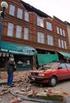 February 28 Earthquake: We got off easy State Geologist John Beaulieu Lucky may not be the first word that comes to mind after an earthquake that injured more than 200 and caused more than $1 billion damage,
DYNAMIC CRUST: Unit 4 Exam Plate Tectonics and Earthquakes
 DYNAMIC CRUST: Unit 4 Exam Plate Tectonics and Earthquakes NAME: BLOCK: DATE: 1. Base your answer to the following question on The block diagram below shows the boundary between two tectonic plates. Which
Chapter 5: Earthquakes
 Chapter 5: Earthquakes 1. Experiencing an Earthquake firsthand 2. The Science of Ghost Forests and Megaearthquakes 3. Faults, Earthquakes, and Plate Tectonics 4. Seismic Waves and Earthquake Detection
DECISION PROCESS AND OPTIMIZATION RULES FOR SEISMIC RETROFIT PROGRAMS. T. Zikas 1 and F. Gehbauer 2
 International Symposium on Strong Vrancea Earthquakes and Risk Mitigation Oct. 4-6, 2007, Bucharest, Romania DECISION PROCESS AND OPTIMIZATION RULES FOR SEISMIC RETROFIT PROGRAMS T. Zikas 1 and F. Gehbauer
Chapter 2. Plate Tectonics. Plate Tectonics: Learning Goals
 Plate Tectonics Chapter 2 Interactions at depend on the direction of relative plate motion and the type of crust. Which kind of plate boundary is associated with Earthquake activity? A. Divergent Boundary
Magnitude 8.8 OFFSHORE MAULE, CHILE
 A great 8.8-magnitude struck central Chile early Saturday. The quake hit 200 miles (325 kilometers) southwest of the capital Santiago. The epicenter was just 70 miles (115 kilometers) from Concepcion,
Name: Date: Class: Finding Epicenters and Measuring Magnitudes Worksheet
 Example Answers Name: Date: Class: Finding Epicenters and Measuring Magnitudes Worksheet Objective: To use seismic data and an interactive simulation to triangulate the location and measure the magnitude
Earthquake Hazards and Risks
 Page 1 of 7 EENS 3050 Tulane University Natural Disasters Prof. Stephen A. Nelson Earthquake Hazards and Risks This page last updated on 28-Aug-2013 Earthquake Risk Many seismologists have said that "earthquakes
Tectonic plates push together at convergent boundaries.
 KEY CONCEPT Plates converge or scrape past each other. BEFORE, you learned Plates move apart at divergent boundaries In the oceans, divergent boundaries mark where the sea floor spreads apart On land,
Transform Boundaries
 Lecture 7 Plates and Mantle Plumes Transform Boundaries Transform boundaries occur where one segment of rigid lithosphere slides horizontally past another in response to stresses in the lithosphere. The
Plate Tectonics Practice Questions and Answers Revised August 2007
 Plate Tectonics Practice Questions and Answers Revised August 2007 1. Please fill in the missing labels. 2. Please fill in the missing labels. 3. How many large plates form the outer shell of the earth?
Earthquakes: Risk and Insurance Issues
 Page 1 of 8 HOT TOPICS & INSURANCE ISSUES Earthquakes: Risk and Insurance Issues THE TOPIC JULY 2003 An earthquake is a sudden and rapid shaking of the earth caused by the breaking and shifting of rock
The Oceans Role in Climate
 The Oceans Role in Climate Martin H. Visbeck A Numerical Portrait of the Oceans The oceans of the world cover nearly seventy percent of its surface. The largest is the Pacific, which contains fifty percent
From Clients to Global Financial Markets. Flood Insurance. Wolfgang Kron Geo Risks Research Munich Reinsurance Company. Topics
 4 th International Symposium on Flood Defence Flood Insurance From Clients to Global Financial Markets Wolfgang Kron Geo Risks Research Munich Reinsurance Company Topics Recent flood disasters and disaster
Chapter 8: Plate Tectonics -- Multi-format Test
 Name: Class: Date: ID: A Chapter 8: Plate Tectonics -- Multi-format Test Modified True/False Indicate whether the statement is true or false. If false, change the identified word or phrase to make the
Tsunami Practice Questions and Answers Revised November 2008
 Tsunami Practice Questions and Answers Revised November 2008 1. What happened on 26 December 2004 off the west coast of Sumatra? 2. What is the final estimate of the magnitude of the Sumatra 26 December
Seasonal & Daily Temperatures. Seasons & Sun's Distance. Solstice & Equinox. Seasons & Solar Intensity
 Seasonal & Daily Temperatures Seasons & Sun's Distance The role of Earth's tilt, revolution, & rotation in causing spatial, seasonal, & daily temperature variations Please read Chapter 3 in Ahrens Figure
1. The diagram below shows a cross section of sedimentary rock layers.
 1. The diagram below shows a cross section of sedimentary rock layers. Which statement about the deposition of the sediments best explains why these layers have the curved shape shown? 1) Sediments were
The IPCC Special Report on Managing the Risks of Extreme Events and Disasters to Advance Climate Change Adaptation
 The IPCC Special Report on Managing the Risks of Extreme Events and Disasters to Advance Climate Change Adaptation A changing climate leads to changes in extreme weather and climate events 2 How do changes
Exploring Florida: Teaching Resources for Science 1 of 6
 Exploring Florida: Teaching Resources for Science 1 of 6 Tropical Cyclones This document describes tropical cyclones and the dangers they pose to coastal populations. It is intended to help teachers improve
APPENDIX A : 1998 Survey of Proprietary Risk Assessment Systems
 APPENDIX A : 1998 Survey of Proprietary Risk Assessment Systems In its 1997 paper, the working party reported upon a survey of proprietary risk assessment systems designed for use by UK household insurers
Chapter 3: Weather Map. Station Model and Weather Maps Pressure as a Vertical Coordinate Constant Pressure Maps Cross Sections
 Chapter 3: Weather Map Station Model and Weather Maps Pressure as a Vertical Coordinate Constant Pressure Maps Cross Sections Weather Maps Many variables are needed to described dweather conditions. Local
The Dynamic Crust 2) EVIDENCE FOR CRUSTAL MOVEMENT
 The Dynamic Crust 1) Virtually everything you need to know about the interior of the earth can be found on page 10 of your reference tables. Take the time to become familiar with page 10 and everything
Georgia Performance Standards Framework for Shaky Ground 6 th Grade
 The following instructional plan is part of a GaDOE collection of Unit Frameworks, Performance Tasks, examples of Student Work, and Teacher Commentary. Many more GaDOE approved instructional plans are
KCC Event Brief: 2014 La Habra Earthquake
 KAREN CLARK & COMPANY KCC Event Brief: 2014 La Habra Earthquake June 2014 2 COPLEY PLACE BOSTON, MA 02116 T: 617.423.2800 F: 617.423.2808 Overview On Friday, March 28, 2014 at 9:09pm, a magnitude 5.1 earthquake
Continents join together and split apart.
 KEY CONCEPT Continents change position over time. BEFORE, you learned Earth s main layers are the core, the mantle, and the crust The lithosphere and asthenosphere are the topmost layers of Earth The lithosphere
Thompson/Ocean 420/Winter 2005 Tide Dynamics 1
 Thompson/Ocean 420/Winter 2005 Tide Dynamics 1 Tide Dynamics Dynamic Theory of Tides. In the equilibrium theory of tides, we assumed that the shape of the sea surface was always in equilibrium with the
Curriculum Map Earth Science - High School
 September Science is a format process to use Use instruments to measure Measurement labs - mass, volume, to observe, classify, and analyze the observable properties. density environment. Use lab equipment
Climate Change in Mexico implications for the insurance and reinsurance market
 Climate Change in Mexico implications for the insurance and reinsurance market Eberhard Faust Geo Risks Research Munich Reinsurance Company 1980 April 2008: Billion & Ten Billion Dollar Losses The costliest
Forecaster comments to the ORTECH Report
 Forecaster comments to the ORTECH Report The Alberta Forecasting Pilot Project was truly a pioneering and landmark effort in the assessment of wind power production forecast performance in North America.
Scope of Insurance Premium for Residential Houses against Seismic Risk in Japan
 Scope of Insurance Premium for Residential Houses against Seismic Risk in Japan J. Kanda a) and K. Nishijima b) a) University of Tokyo, Japan [email protected] b) ETH, Switzerland ABSTRACT The premium
Gravitational potential
 Gravitational potential Let s assume: A particle of unit mass moving freely A body of mass M The particle is attracted by M and moves toward it by a small quantity dr. This displacement is the result of
Extra-Tropical Cyclones in a Warming Climate:
 Extra-Tropical Cyclones in a Warming Climate: Observational Evidence of Trends in Frequencies and Intensities in the North Pacific, North Atlantic, & Great Lakes Regions David Levinson Scientific Services
Amplification of the Radiation from Two Collocated Cellular System Antennas by the Ground Wave of an AM Broadcast Station
 Amplification of the Radiation from Two Collocated Cellular System Antennas by the Ground Wave of an AM Broadcast Station Dr. Bill P. Curry EMSciTek Consulting Co., W101 McCarron Road Glen Ellyn, IL 60137,
Modeling Flood Perils and Flood Insurance Program in Taiwan
 Modeling Flood Perils and Flood Insurance Program in Taiwan Ching-Cheng Chang 1 Research Fellow, Institute of Economics, Academia Sinica and Professor, Department of Agricultural Economics, National Taiwan
EARTHQUAKE PREDICTION
 Lecture 15 Earthquake Prediction EARTHQUAKE PREDICTION To successfully predict an earthquake we would like to know:- PLACE TIME MAGNITUDE (rather like a weather forecast) 1 Evidence must be integrated
What Causes Climate? Use Target Reading Skills
 Climate and Climate Change Name Date Class Climate and Climate Change Guided Reading and Study What Causes Climate? This section describes factors that determine climate, or the average weather conditions
CONTRASTING DISPLACEMENT DEMANDS OF DUCTILE STRUCTURES FROM TOHOKU SUBDUCTION TO CRUSTAL EARTHQUAKE RECORDS. Peter Dusicka 1 and Sarah Knoles 2
 CONTRASTING DISPLACEMENT DEMANDS OF DUCTILE STRUCTURES FROM TOHOKU SUBDUCTION TO CRUSTAL EARTHQUAKE RECORDS Abstract Peter Dusicka 1 and Sarah Knoles 2 With the impending Cascadia subduction zone event
Magnitude 7.2 GUERRERO, MEXICO
 A powerful magnitude-7.2 earthquake shook central and southern Mexico on Friday. The earthquake occurred at a depth of 24 km (15 miles). Its epicenter was in the western state of Guerrero, near the seaside