
The AIR Multiple Peril Crop Insurance (MPCI) Model For The U.S.
|
|
|
- Elinor Lambert
- 9 years ago
- Views:
Transcription
1 The AIR Multiple Peril Crop Insurance (MPCI) Model For The U.S. According to the National Climatic Data Center, crop damage from widespread flooding or extreme drought was the primary driver of loss in four of the top eight costliest weather disasters from 1980 to The 2012 drought, the worst since 1988, cost more than USD 17 billion to the crop insurance program.
2 Multiple Peril Crop Insurance (MPCI) covers a wide range of crops, geographic areas, climates, and insurance coverages. Crop yields have improved over time as a result of technological progress. The MPCI program changes regularly and farmers can choose between yield- and revenuebased policies, introducing price risk for the insurer. Premium rates and farmer participation have changed significantly over recent years. Because of these complexities, simply relying on historical losses is no longer sufficient. In this changing environment, insurers and reinsurers need an advanced risk assessment model to ensure maximum profit within risk tolerance levels. The AIR MPCI model is used by all leading crop reinsurers and crop insurers, and has become the independent pricing model for the crop insurance industry. THE INDUSTRY S FIRST FULLY PROBABILISTIC APPROACH TO MODELING CROP LOSSES Estimating the likelihood and magnitude of future losses presents challenges. Traditional approaches are largely actuarial, relying on historical losses to project future losses. However, the usefulness of past loss data is limited because of the constantly changing crop insurance landscape, including Changing exposures (crops) from year to year An evolving crop insurance program (for example, the importance of revenue-based policies over yield-based policies has shifted dramatically in some key regions, thus affecting the program risk) New risk-reducing technologies (for example, minimum till, transgenic seeds, and precision agriculture) Changing premium rates following rerating procedures from the Risk Management Agency (RMA) Dramatic changes in market volatilities and corresponding impact on premium rates and price risk Because traditional methods that rely on historical losses have proven unreliable in quantifying and managing this complex risk, AIR released the industry s first fully probabilistic Multiple Peril Crop Insurance Model in WEATHER IMPACT ON YIELD VARIABILITY Losses in the MPCI program occur when yields and/or prices fall below a threshold set by the U.S. Department of Agriculture s Risk Management Agency for the coverage level selected by the policyholder. The primary determinant of a yield outcome for non-irrigated crops is the weather. Depending on the stage in the growing season, drought, heat, excess moisture, frost and freeze, and wind can significantly reduce yields. Furthermore, these adverse weather effects can be highly localized and can affect different crops in different ways. AIR scientists use crop- and county-specific relationships between weather and yield to fit yield probability distributions, which capture the full range of potential yield losses that could occur in a growing season. 2
3 THE AIR AGRICULTURAL WEATHER INDEX (AWI) Basing yield estimation analysis on prior history is further complicated by technology improvements, which lead to increased production and improved tolerance to natural perils. These improvements are introduced gradually over time, resulting in a trend in average yields that may obscure the true impact of weather on yields. Therefore, to accurately isolate and quantify the effects of weather on today s crop yield potential, it is necessary to remove the long-term impact of technological improvements. AIR developed the Agricultural Weather Index (AWI), which is used to detrend historical yield time series before fitting accurate yield distributions. This approach explicitly accounts for the impact of weather events on yields that may otherwise be attributed to a technological trend. The AWI is county-specific and crop-specific. The key components of the AWI are high-resolution temperature, precipitation, and soil data with crop-specific phenological data. For temperature and precipitation, AIR uses highresolution gridded data of daily observations dating back to the 1940s. The result of the AWI analysis is a county-based yield probability distribution trended to current technology that more accurately reflects the effects of weather, thus providing improved risk estimates for policies insuring yield in the county. For each major crop that is insured in the U.S., AIR models yields stochastically using the AWI trended county yield distributions. The current AWI technology also accounts for the slowing of yearly yield increases that has been observed in recent years. AWI-based yield probability distributions could indicate either higher or lower risk than indicated by other estimates, particularly for a defined county yield guarantee. TEMPERATURE PRECIPITATION CROP-SPECIFIC DATA COUNTY-SPECIFIC AWI INDEX AVAILABLE WATER CAPACITY (SOIL) R2 R3 R4 R5 R6 AIR s AWI is a measure of the impact of weather on yield variability (key components include high resolution temperature, precipitation, and soil data, along with crop-specific phenological data) 3

4 PRICE UNCERTAINTY ADDS TO CROP INSURANCE RISK EXPOSURE AIR combines the AWI-corrected yield probability distributions with a price model. A price modeling component is necessary because revenue-based policies are dominant compared to yield-based policies in today s crop insurance market. Modeling price risk is particularly important considering large changes in commodity price volatilities in the futures markets during the last few years. For crop insurance, the prices at planting and at harvest are the only prices that can affect losses. To account for the fact that these prices are dependent on overall U.S. production for a given crop, the AIR MPCI price model assesses the historical relationship between the planting price and harvest price and the difference between expected and actual yield on a nationwide basis. The historical data are then augmented with three levels of price volatility low, medium, and high for the three stochastic catalogs of AIR s U.S. MPCI model. The model uses historical price volatility from 2003 to 2012 to determine the appropriate price volatility for each catalog. The low volatility catalog exhibits price volatilities closest to the historically observed values. 200% LOW PRICE VOLATILITY Three levels of price volatility for the three stochastic catalogs of AIR s MPCI model Harvest Price (Percent of Planting Price) 180% 160% 140% 120% 100% 80% 60% 40% 20% Modeled -Low Price Volatility Historical Example Yield Scenario 0% 60% 70% 80% 90% 100% 110% 120% 130% Event Yield (Percent of Normal) 200% MEDIUM PRICE VOLATILITY 200% HIGH PRICE VOLATILITY 4 Harvest Price (Percent of Planting Price) 180% 160% 140% 120% 100% 80% 60% 40% 20% Modeled -Medium Price Volatility Historical Example Yield Scenario 0% 60% 70% 80% 90% 100% 110% 120% 130% Event Yield (Percent of Normal) Harvest Price (Percent of Planting Price) 180% 160% 140% 120% 100% 80% 60% 40% Modeled - High Price Volatility Historical % Example Yield Scenario % 60% 70% 80% 90% 100% 110% 120% 130% Event Yield (Percent of Normal)

5 The stochastic catalog captures spatial yield correlations among neighboring counties AIR has developed a set of 10,000 potential yield outcomes that can occur in each county. By pairing these yield outcomes with three different sets of 10,000 harvest price/ planting price ratios, which reflect low, medium, and high price volatility, AIR has produced three stochastic catalogs of crop yield and price ratio that allow clients to choose the catalog that best reflects the price volatility of the current year. The AIR catalog generation process carefully maintains correlations correlations between neighboring counties, correlations between crops within a county, and price correlations across crops. These correlations are extremely important from a risk management perspective because they are the basis of any risk protection available from a well diversified crop insurance portfolio. The AIR MPCI model computes probabilistic loss estimates before and after application of the SRA program YIELD PROBABILITIES AGRICULTURAL WEATHER INDEX CALCULATION DETRENDED YIELD DISTRIBUTIONS YIELD/PRICE SCENARIOS FINANCIAL EVENT YIELD GENERATION PRICE MODEL INSURED PRE-SRA LOSS INSURED POST-SRA LOSS EXPOSURE DATA POLICY CONDITIONS FUND ALLOCATION STRATEGY 5

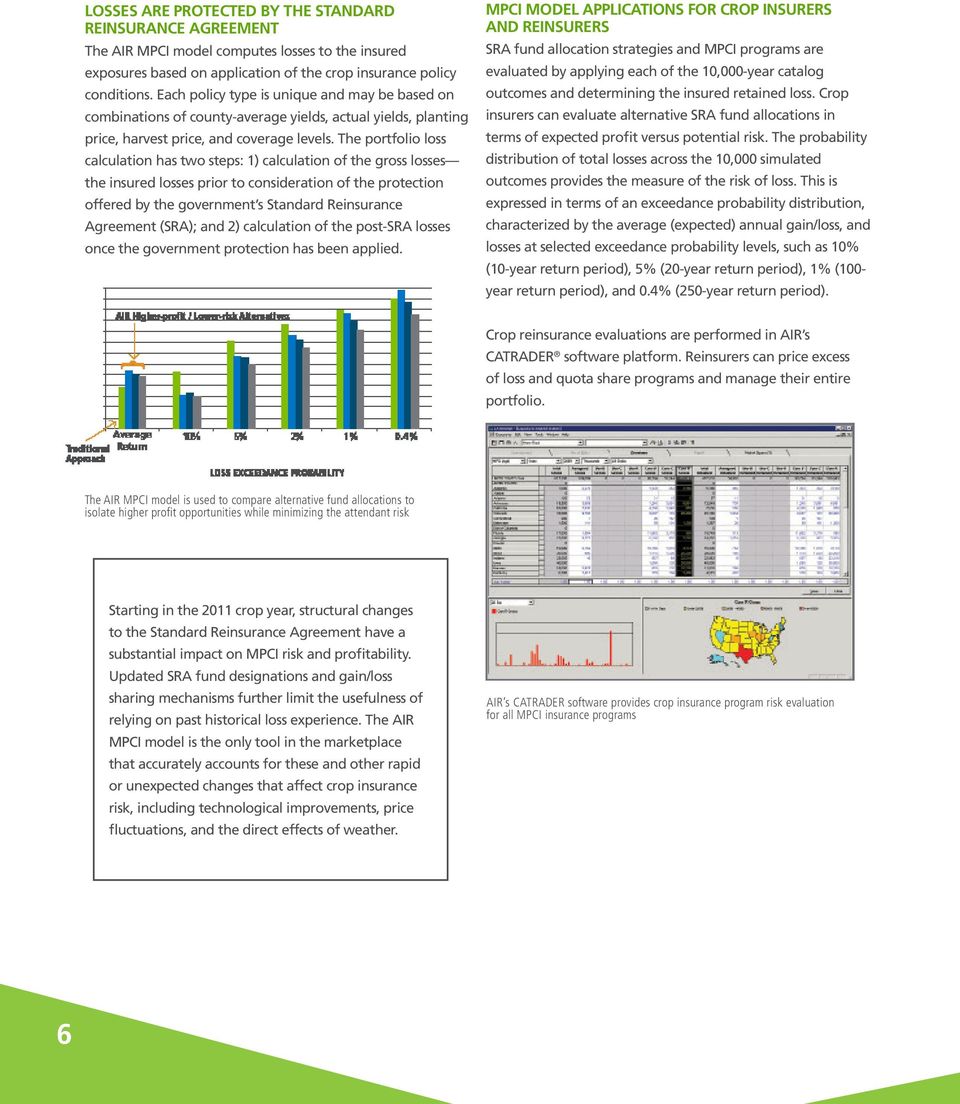
6 LOSSES ARE PROTECTED BY THE STANDARD REINSURANCE AGREEMENT The AIR MPCI model computes losses to the insured exposures based on application of the crop insurance policy conditions. Each policy type is unique and may be based on combinations of county-average yields, actual yields, planting price, harvest price, and coverage levels. The portfolio loss calculation has two steps: 1) calculation of the gross losses the insured losses prior to consideration of the protection offered by the government s Standard Reinsurance Agreement (SRA); and 2) calculation of the post-sra losses once the government protection has been applied. MPCI MODEL APPLICATIONS FOR CROP INSURERS AND REINSURERS SRA fund allocation strategies and MPCI programs are evaluated by applying each of the 10,000-year catalog outcomes and determining the insured retained loss. Crop insurers can evaluate alternative SRA fund allocations in terms of expected profit versus potential risk. The probability distribution of total losses across the 10,000 simulated outcomes provides the measure of the risk of loss. This is expressed in terms of an exceedance probability distribution, characterized by the average (expected) annual gain/loss, and losses at selected exceedance probability levels, such as 10% (10-year return period), 5% (20-year return period), 1% (100- year return period), and 0.4% (250-year return period). Crop reinsurance evaluations are performed in AIR s CATRADER software platform. Reinsurers can price excess of loss and quota share programs and manage their entire portfolio. The AIR MPCI model is used to compare alternative fund allocations to isolate higher profit opportunities while minimizing the attendant risk Starting in the 2011 crop year, structural changes to the Standard Reinsurance Agreement have a substantial impact on MPCI risk and profitability. Updated SRA fund designations and gain/loss sharing mechanisms further limit the usefulness of relying on past historical loss experience. The AIR MPCI model is the only tool in the marketplace that accurately accounts for these and other rapid or unexpected changes that affect crop insurance risk, including technological improvements, price fluctuations, and the direct effects of weather. AIR s CATRADER software provides crop insurance program risk evaluation for all MPCI insurance programs 6
7 THE MPCI MODEL IS KEPT CURRENT Each year, AIR incorporates new crop yield data from the National Agricultural Statistics Service (NASS) and new loss and exposure information from the Risk Management Agency (RMA). In addition, AIR calculates a new set of AWI values. Changes to the crop insurance program are also incorporated following the government s publication of these changes. Regular model updates ensure that analyses reflect the latest available weather, yield, price, and exposure information. ENHANCED USER FLEXIBILITY User flexibility is a hallmark of the AIR MPCI model for the United States. Collected premiums for a given risk depend on market price volatility. In a low price volatility environment, lower premiums are collected than in a high price volatility environment. Users can choose from three different volatility scenarios to best account for the price volatility of the current year and therefore get the most accurate loss estimates. Premium rates can, in turn, be set to reflect any changes made to the program by the government s rerating procedures. By allowing the user to choose price volatility and premium rates, the model is always current. MODEL AT A GLANCE MODEL DOMAIN SUPPORTED GEOGRAPHIC RESOLUTION VULNERABILITY MODULE 42 U.S. states (excludes the 6 New England states, Hawaii, and Alaska) County and state Vulnerability varies by county, crop type, and stage of development MODEL HIGHLIGHTS Provides a fully probabilistic yield and price catalog that takes into account the spatial and temporal correlations of crop losses Leverages the award-winning AWI to accurately isolate the impact of weather on crop yields from long-term technology trends Incorporates three stochastic catalogs of crop yield and price ratio that allow exploration of the effect of price volatility on modeled losses and choice of catalog that best fits the current year s volatility Updated regularly with new crop yield data, new loss and exposure information, and the latest changes to the insurance program 7
8 ABOUT AIR WORLDWIDE AIR Worldwide (AIR) is the scientific leader and most respected provider of risk modeling software and consulting services. AIR founded the catastrophe modeling industry in 1987 and today models the risk from natural catastrophes and terrorism in more than 90 countries. More than 400 insurance, reinsurance, financial, corporate, and government clients rely on AIR software and services for catastrophe risk management, insurance-linked securities, detailed site-specific wind and seismic engineering analyses, and agricultural risk management. AIR is a member of the Verisk Insurance Solutions group at Verisk Analytics (Nasdaq:VRSK) and is headquartered in Boston with additional offices in North America, Europe, and Asia. For more information, please visit AIR is a member of the Verisk Insurance Solutions group at Verisk Analytics. AIR Worldwide and CATRADER are registered trademarks of AIR Worldwide Corporation AIR WORLDWIDE

Traditional Products. The two Traditional Crop Insurance Products are: Named Peril Crop Insurance (NPCI) Multi Peril Crop Insurance (MPCI)
 Traditional Products Traditional crop insurance relies on the principle of indemnity, where losses are measured in the field either after the event (named peril crop insurance) or through yield measurement
THE COMMODITY RISK MANAGEMENT GROUP WORLD BANK
 THE COMMODITY RISK MANAGEMENT GROUP WORLD BANK Agricultural Insurance: Scope and Limitations for Rural Risk Management 5 March 2009 Agenda The global market Products Organisation of agricultural insurance
JAMAICA. Agricultural Insurance: Scope and Limitations for Weather Risk Management. Diego Arias Economist. 18 June 2009
 JAMAICA Agricultural Insurance: Scope and Limitations for Weather Risk Management Diego Arias Economist 18 June 2009 Financed partly by the AAACP EU Support to the Caribbean Agenda The global market Products
Mitigating catastrophic risk in Australian agriculture
 Australia s Leader in MPCI Mitigating catastrophic risk in Australian agriculture Andrew Trotter, Latevo Outlook 2015 Conference Tuesday 3 rd March 2015. 1 Multi-Peril Crop Insurance is now working in
Federal Crop Insurance: The Basics
 Federal Crop Insurance: The Basics Presented by Shawn Wade Director of Communications Plains Cotton Growers, Inc. 4517 West Loop 289 Lubbock, TX 79414 WWW.PLAINSCOTTON.ORG Why Federal Crop Insurance? Every
Concept Note on Farm Income Insurance: Issues and Way Forward
 Farm Income Insurance India, an agrarian economy with 1/3 rd population depending on the agriculture sector directly or indirectly has ~ 116 million farm holdings covering an area of 163 million hectares
CHAPTER 2 AGRICULTURAL INSURANCE: A BACKGROUND 9
 CHAPTER 2 AGRICULTURAL INSURANCE: A BACKGROUND 9 Chapter 2: AGRICULTURAL INSURANCE: A BACKGROUND In Chapter 1 we saw that insurance is one of the tools that farmers and other stakeholders can use to manage
Cost & Efficiency Analysis of U.S. Crop Insurance Program: Implications of Additional FSA Responsibilities
 Cost & Efficiency Analysis of U.S. Crop Insurance Program: Implications of Additional FSA Responsibilities Executive Summary Prepared for: Informa Economics Phone: 901.766.4669 www.informaecon.com September
The AIR Inland Flood Model for the United States In Spring 2011, heavy rainfall and snowmelt produced massive flooding along the Mississippi River,
 The AIR Inland Flood Model for the United States In Spring 2011, heavy rainfall and snowmelt produced massive flooding along the Mississippi River, inundating huge swaths of land across seven states. As
Group Risk Income Protection Plan and Group Risk Plans added in New Kansas Counties for 2005 1 Updated 3/12/05
 Disclaimer: This web page is designed to aid farmers with their marketing and risk management decisions. The risk of loss in trading futures, options, forward contracts, and hedge-to-arrive can be substantial
Using Insurance Catastrophe Models to Investigate the Economics of Climate Change Impacts and Adaptation
 Using Insurance Catastrophe Models to Investigate the Economics of Climate Change Impacts and Adaptation Dr Nicola Patmore Senior Research Analyst Risk Management Solutions (RMS) Bringing Science to the
Group Risk Income Protection Plan added in Kansas for 2006 Wheat (Updated) 1
 Disclaimer: This web page is designed to aid farmers with their marketing and risk management decisions. The risk of loss in trading futures, options, forward contracts, and hedge-to-arrive can be substantial
Agriculture Insurance Company of India Limited (AIC)
 Q1: What is Insurance? WEATHER BASED CROP INSURANCE SCHEME FREQUENTLY ASKED QUESTIONS (FAQS) Insurance is a tool to protect you against a small probability of a large unexpected loss. It is a technique
PREMIUM RATE ADJUSTMENT
 PREMIUM RATE ADJUSTMENT Background on Process Section 508(i) of the Federal Crop Insurance Act (Act) requires the Risk Management Agency (RMA) to set premium rates and implement rate changes in a timely
Crop Insurance For Those Who Choose To Manage Risk
 2008 INSIDE: Crop Insurance For Those Who Choose To Manage Risk n Price And Weather Volatility Increase Risks n It Doesn t Cost To Ask n How To Evaluate Crop-Hail Insurance n Risk Management Checklist
Preliminary advances in Climate Risk Management in China Meteorological Administration
 Preliminary advances in Climate Risk Management in China Meteorological Administration Gao Ge Guayaquil,Ecuador, Oct.2011 Contents China Framework of Climate Service Experience in Climate/disaster risk
Agriculture Insurance Programs developed with PPP mechanisms case study of Europa Re
 IIF 2015 Property Insurance in a Stormy Era Munich, June 22-23 Agriculture Insurance Programs developed with PPP mechanisms case study of Europa Re Marijana Lemic-Saramandic, MSc Country Program Manager
Benefits and Opportunities of Europa Re Programme for the Insurance Industry
 Europa Re 2nd Regional Insurance Conference "New Generation of Insurance Solutions" Benefits and Opportunities of Europa Re Programme for the Insurance Industry KLIME POPOSKI BELGRADE, O CTOBER 2 014 Natural
Speaker Summary Note
 2020 CONFERENCE MAY 2014 Session: Speaker: Speaker Summary Note Building Resilience by Innovating and Investing in Agricultural Systems Mark Rosegrant Director, Environment and Production Technology Division
Role of Government in Agriculture Risk Mitigation & Expansion of Insurance in India
 Role of Government in Agriculture Risk Mitigation & Expansion of Insurance in India Kolli N Rao 4 th October 2015 0 OVERVIEW India: The Agriculture Setting India: Agriculture Insurance Architecture Agriculture
Portfolio Allocation and Alternative Structures of the Standard
 Portfolio Allocation and Alternative Structures of the Standard Reinsurance Agreement Dmitry V. Vedenov, Mario J. Miranda, Robert Dismukes, and Joseph W. Glauber 1 Selected Paper presented at AAEA Annual
Tailoring Agricultural Insurance Products to Developing Countries
 Tailoring Agricultural Insurance Products to Developing Countries Ramiro Iturrioz Senior Agriculture Insurance Specialist Insurance for the Poor The World Bank October, 2010 1 Agenda Risk and constraints
Improving farmers access to agricultural insurance in India
 International Microinsurance Conference Learning Sessions Daniel Clarke Improving farmers access to agricultural insurance in India 30 June 2011 2010 The Actuarial Profession www.actuaries.org.uk Background:
Multiple Peril Crop Insurance
 Multiple Peril Crop Insurance Multiple Peril Crop Insurance (MPCI) is a broadbased crop insurance program regulated by the U.S. Department of Agriculture and subsidized by the Federal Crop Insurance Corporation
Pasture, Rangeland, and Forage Insurance: A Risk Management Tool for Hay and Livestock Producers
 October 2012 Pasture, Rangeland, and Forage Insurance: A Risk Management Tool for Hay and Livestock Producers Monte Vandeveer, Otoe County Extension Educator University of Nebraska-Lincoln Institute of
Risk Management for Greenhouse and Nursery Growers in the United States
 Risk Management for Greenhouse and Nursery Growers in the United States Dr. Robin G. Brumfield, Specialist in Farm Management Dr. Edouard K. Mafoua, Research Associate in Agricultural Economics Rutgers,
Crop Insurance Reserving
 Carl X. Ashenbrenner Abstract: The crop insurance industry is a private-public partnership, whereby the private companies issue policies and handle claims for multi-peril crop insurance policies, which
Federal Crop Insurance: Background and Issues
 Federal Crop Insurance: Background and Issues Dennis A. Shields Specialist in Agricultural Policy December 13, 2010 Congressional Research Service CRS Report for Congress Prepared for Members and Committees
We have seen in the How
 : Examples Using Hedging, Forward Contracting, Crop Insurance, and Revenue Insurance To what extent can hedging, forward contracting, and crop and revenue insurance reduce uncertainty within the year (intrayear)
RenaissanceRe. Agriculture Products
 Syndicate 1458 Agriculture Products Syndicate 1458 Agriculture Products Syndicate 1458 is part of the Group of Companies a leading global provider of property catastrophe and specialty reinsurance, and
Federal Crop Insurance: Background
 Dennis A. Shields Specialist in Agricultural Policy August 13, 2015 Congressional Research Service 7-5700 www.crs.gov R40532 Summary The federal crop insurance program began in 1938 when Congress authorized
APPENDIX A : 1998 Survey of Proprietary Risk Assessment Systems
 APPENDIX A : 1998 Survey of Proprietary Risk Assessment Systems In its 1997 paper, the working party reported upon a survey of proprietary risk assessment systems designed for use by UK household insurers
CONFERENCE ON CATASTROPHIC RISKS AND INSURANCE 22-23 November 2004 INSURANCE OF ATMOSPHERIC PERILS CHALLENGES AHEAD.
 DIRECTORATE FOR FINANCIAL AND ENTERPRISE AFFAIRS CONFERENCE ON CATASTROPHIC RISKS AND INSURANCE 22-23 November 2004 INSURANCE OF ATMOSPHERIC PERILS CHALLENGES AHEAD Peter Zimmerli (Swiss Re) Background
Romania. Agricultural Insurance Alternatives
 Romania Agricultural Insurance Alternatives Report from GlobalAgRisk, Inc Subcontractor for Noesis, Inc. 1 TECHNICAL ADVISORY SERVICES CONCERNING CROP INSURANCE LEGISLATION AND POLICY IN ROMANIA In Partial
Rain on Planting Protection. Help Guide
 Rain on Planting Protection Help Guide overview Rain on Planting Protection allows growers to protect themselves from losses if rain prevents planting from being completed on schedule. Coverage is highly
GAO CROP INSURANCE. Savings Would Result from Program Changes and Greater Use of Data Mining
 GAO March 2012 United States Government Accountability Office Report to the Ranking Member, Permanent Subcommittee on Investigations, Committee on Homeland Security and Governmental Affairs, U.S. Senate
CROP REVENUE COVERAGE INSURANCE PROVIDES ADDITIONAL RISK MANAGEMENT WHEAT ALTERNATIVES 1
 Presented at the 1997 Missouri Commercial Agriculture Crop Institute CROP REVENUE COVERAGE INSURANCE PROVIDES ADDITIONAL RISK MANAGEMENT WHEAT ALTERNATIVES 1 Presented by: Art Barnaby Managing Risk With
Big Data: Challenges in Agriculture. Big Data Summit, November 2014 Moorea Brega: Agronomic Modeling Lead The Climate Corporation
 Big Data: Challenges in Agriculture Big Data Summit, November 2014 Moorea Brega: Agronomic Modeling Lead The Climate Corporation Outline THE AGRICULTURAL CHALLENGE DATA SCIENCE MEETS AGRICULTURE THE ROLE
The Supplementary Insurance Coverage Option: A New Risk Management Tool for Wyoming Producers
 The Supplementary Insurance Coverage Option: A New Risk Management Tool for Wyoming Producers Agricultural Marketing Policy Center Linfield Hall P.O. Box 172920 Montana State University Bozeman, MT 59717-2920
How Large is the 2012 Crop Insurance Underwriting Loss? 1
 Disclaimer: This web page is designed to aid farmers with their marketing and risk management decisions. The risk of loss in trading futures, options, forward contracts, and hedge-to-arrive can be substantial
Operational methodology to assess flood damages in Europe
 IIASA-DPRI 2008 Operational methodology to assess flood damages in Europe Contributors: Nicola Lugeri, Carlo Lavalle, Elisabetta Genovese 1 Focus of ADAM work on extremes Types Floods, Heat-wave, Drought
6 Index insurance in agriculture The (re)insurer s perspective
 47 6 Index insurance in agriculture The (re)insurer s perspective Joachim Herbold Munich Reinsurance Company [email protected] KEYWORDS: agricultural insurance, index-based agricultural insurance,
CROP INSURANCE FOR NEW YORK VEGETABLE CROPS
 CROP INSURANCE FOR NEW YORK VEGETABLE CROPS Multi-peril crop insurance is a valuable risk management tool that allows growers to insure against losses due to adverse weather conditions, price fluctuations,
UNISDR - Global Risk Assessment: Towards a high-performance environment
 1 UNISDR - Global Risk Assessment: Towards a high-performance environment WCDRR, Sendai 15 March, 2015 Sahar Safaie, Julio Serje Global Assessment Report Team United Nations Office for Disaster Risk Reduction
Agricultural Data and Insurance
 Agricultural Data and Insurance Innovations in agricultural data development for insurance Background Insurance requires high quality data. From an insurance perspective data is high quality if it is timely
Terms of Reference for consultants
 Terms of Reference for consultants The consultants for the proposed TA will largely comprise actuaries, underwriters and data analysts with relevant experience in crop insurance and their expertise will
Index Insurance and Climate Risk Management In Malawi:
 Index Insurance and Climate Risk Management In Malawi: Theory and Practice (mostly practice) Presented by Daniel Osgood (IRI) at the 2007 CPASW, Seattle [email protected] Material contributed by: Miguel
Risk Management Agency
 Risk Management Agency Premium Rate Study Update Questions & Answers November 2012 Q1 Why is RMA examining premium rates and the process for determining them? A1 Section 508(i) of the Federal Crop Insurance
FACT SHEET. Production Risk
 ALABAMA AGRICULTURAL & MECHANICAL UNIVERSITY SMALL FARMERS RESEARCH CENTER FACT SHEET Production Risk Any production related activity or event that is uncertain is a production risk. Agricultural production
Ratemaking Considerations for Multiple Peril Crop lnsurance
 Ratemaking Considerations for Multiple Peril Crop lnsurance Frank F. Schnapp, ACAS, MAAA, James L. Driscoll, Thomas P. Zacharias, and Gary R. Josephson, FCAS, MAAA 159 Ratemaking Considerations for Multiple
Your Partner in Building Catastrophe and Weather Risk Markets
 Your Partner in Building Catastrophe and Weather Risk Markets Building Resilience to Disasters in Western Balkans and Turkey Natural Catastrophe Risk Exposure Natural Disasters can strike anyone, anywhere
Index Insurance for Climate Impacts Millennium Villages Project A contract proposal
 Index Insurance for Climate Impacts Millennium Villages Project A contract proposal As part of a comprehensive package of interventions intended to help break the poverty trap in rural Africa, the Millennium
Everything you need to build bespoke catastrophe models is HERE
 Everything you need to build bespoke catastrophe models is HERE The Building Blocks Scientific and engineering expertise RiskInsightConnect Advanced tools for customizing model components WindfieldBuilder
Scientific and Economic Rationale for Weather Risk Insurance for Agriculture
 Scientific and Economic Rationale for Weather Risk Insurance for Agriculture Prof. Dr. Peter Hoeppe Geo Risks Research Munich Re New Delhi, India, 27 October 2006 Munich Re Insurer of Insurances Founded
Argonne National Laboratory
 Argonne National Laboratory Using Climate Data to Inform Critical Infrastructure Resilience and Urban Sustainability Decisionmaking National Academy of Sciences Roundtable on Science and Technology for
Annual Forage (AF) Pilot Program
 Oklahoma Cooperative Extension Service AGEC-626 Annual Forage (AF) Pilot Program Jody Campiche Assistant Professor & Extension Economist JJ Jones Southeast Area Extension Agriculture Economist The Rainfall
Federal Crop Insurance RISK MANAGEMENT. Chris Eddy Dell s Insurance Agency
 Federal Crop Insurance RISK MANAGEMENT Chris Eddy Dell s Insurance Agency Multiperil Coverage Crop: Barley Practice: Irrigated Level: 75% Actual Price: $2.05 per bu. Average Yield: 130 bu/acre Guarantee
COMPARISON BETWEEN NATIONAL AGRICULTURAL INSURANCE SCHEME (NAIS), MODIFIED NAIS AND WBCIS PARAMETER NAIS MNAIS WBCIS
 REVISED COMPARISON BETWEEN NATIONAL AGRICULTURAL INSURANCE SCHEME (NAIS), MODIFIED NAIS AND WBCIS S. No. PARAMETER NAIS MNAIS WBCIS 1 Insurance Unit Scheme provided for reduction of unit to Village Panchayat
Catastrophe Bond Risk Modelling
 Catastrophe Bond Risk Modelling Dr. Paul Rockett Manager, Risk Markets 6 th December 2007 Bringing Science to the Art of Underwriting Agenda Natural Catastrophe Modelling Index Linked Securities Parametric
Stochastic Analysis of Long-Term Multiple-Decrement Contracts
 Stochastic Analysis of Long-Term Multiple-Decrement Contracts Matthew Clark, FSA, MAAA, and Chad Runchey, FSA, MAAA Ernst & Young LLP Published in the July 2008 issue of the Actuarial Practice Forum Copyright
Lower Rates Mean Lower Crop Insurance Cost 1
 Disclaimer: This web page is designed to aid farmers with their marketing and risk management decisions. The risk of loss in trading futures, options, forward contracts, and hedge-to-arrive can be substantial
Comparison of different crop insurance models in Nepal. Sunil K. Singh Senior Agriculutural Economist, MoAD
 Comparison of different crop insurance models in Nepal Sunil K. Singh Senior Agriculutural Economist, MoAD 1 Outline of Presentation Introduction Risk in Agriculture Tools and technique for minimizing
Group Risk Income Protection
 Group Risk Income Protection James B. Johnson and John Hewlett* Objective Analysis for Informed Agricultural Marketing Policy Paper No. 13 July 2006 Decision Making * University of Wyoming, Extension Educator
Agricultural Reinsurance in Latin America Actual Situation & Outlook. 4 th Reinsurance Congress Rio de Janeiro (Brazil) April 2015
 Agricultural Reinsurance in Latin America Actual Situation & Outlook 4 th Reinsurance Congress Rio de Janeiro (Brazil) April 2015 AGENDA Commodity Price & Food Consumption Context Worldwide Agriculture
Implications of Crop Insurance as Social Policy
 Implications of Crop Insurance as Social Policy Bruce Babcock Iowa State University Presented at the Minnesota Crop Insurance Conference Sept 10, 2014 Mankato, MN Summary of talk 2014 farm bill irrevocably
Repayment Capacity Sensitivity Analysis Using Purdue Farm Financial Analysis Spreadsheet
 Repayment Capacity Sensitivity Analysis Using Purdue Farm Financial Analysis Spreadsheet ABSTRACT Many agricultural producers purchased capital items the past few years and some used borrowed funds to
Agricultural risk modelling to improve market information systems in developing countries
 Original article Agricultural risk modelling to improve market information systems in developing countries Oscar Vergara Heidi Wang Gerhard Zuba AIR Worldwide 131 Dartmouth Street Boston MA 02116 USA
Crop Insurance: Data is King
 Crop Insurance: Data is King A BRIEFING PAPER Knowledge Transfer Network Financial Services 01 Introduction Emerging technology from a range of sources including Earth Observation data bring new opportunities
Yield Response of Corn to Plant Population in Indiana
 Purdue University Department of Agronomy Applied Crop Production Research Update Updated May 2016 URL: http://www.kingcorn.org/news/timeless/seedingrateguidelines.pdf Yield Response of Corn to Plant Population
WEATHER DERIVATIVES AND SPECIFIC EVENT RISK. Calum G. Turvey
 WEATHER DERIVATIVES AND SPECIFIC EVENT RISK By Calum G. Turvey Associate Professor Department of Agricultural Economics and Business Faculty of Management University of Guelph Guelph Ontario Canada Paper
Insurance environment in India: Bottlenecks and opportunities for a cost effective insurance products. Srinivasa Rao Gattineni
 Insurance environment in India: Bottlenecks and opportunities for a cost effective insurance products Srinivasa Rao Gattineni Rainfall variability is dominant due to the presence of the Monsoon (seasonal
Crop Insurance. Crop Insurance
 Crop Insurance Farmers in the United States and elsewhere face risks the average person seldom considers. When we experience a dry summer most of us consider it an extra day at the beach; for the farmer
Revenue Risk, Crop Insurance and Forward Contracting
 Revenue Risk, Crop Insurance and Forward Contracting Cory Walters and Richard Preston AAEA Crop Insurance and Farm Bill Symposium, October 8-9 th, 2013 [email protected] 859-421-6354 University of Kentucky
INTRODUCTION TO AGRICULTURAL INSURANCE AND RISK MANAGEMENT. Manual 1
 INTRODUCTION TO AGRICULTURAL INSURANCE AND RISK MANAGEMENT Manual 1 The material in this work is copyrighted. Copying and/or transmitting portions or all of this work without permission may be a violation
CSC SEEKS TO MONETIZE CLIMATE DATA WITH BIG DATA ANALYTICS SEPTEMBER 2012
 CSC SEEKS TO MONETIZE CLIMATE DATA WITH BIG DATA ANALYTICS SEPTEMBER 2012 Verdantix Ltd 2007-2012. Reproduction Prohibited. CSC SEEKS TO MONETIZE CLIMATE DATA WITH BIG DATA ANALYTICS September 2012 EXECUTIVE
INSURANCE. Moody s Analytics Solutions for the Insurance Company
 INSURANCE Moody s Analytics Solutions for the Insurance Company Moody s Analytics Solutions for the Insurance Company HELPING PROFESSIONALS OVERCOME TODAY S CHALLENGES Recent market events have emphasized
CROP INSURANCE. Reducing Subsidies for Highest Income Participants Could Save Federal Dollars with Minimal Effect on the Program
 United States Government Accountability Office Report to Congressional Requesters March 2015 CROP INSURANCE Reducing Subsidies for Highest Income Participants Could Save Federal Dollars with Minimal Effect
Index Insurance in India
 Index Insurance in India Kolli N Rao, PhD Aon Benfield, India Indian Agriculture & Risks What s Index Insurance? Why Index Insurance? The Outline Architecture of Indian Crop Insurance Coverage: The Numbers
GENERAL INSURANCE BUSINESS UNDERWRITING
 GENERAL INSURANCE BUSINESS UNDERWRITING R.Qaiser, Professor, NIA, Pune For a general insurance company, underwriting business is the basic core activity. All other activities, in fact, emanate from this
SECTOR ASSESSMENT (SUMMARY): CLIMATE CHANGE. 1. Sector Performance, Problems, and Opportunities
 Climate Resilience Sector Project (RRP TON 46351) Sector Road Map SECTOR ASSESSMENT (SUMMARY): CLIMATE CHANGE 1. Sector Performance, Problems, and Opportunities 1. Tonga is being affected by climate change,