
TESTING RELATIVISTIC GRAVITY AND DETECTING GRAVITATIONAL WAVES IN SPACE *
|
|
|
- Phebe Elisabeth Chapman
- 10 years ago
- Views:
Transcription
1 TESTING RELATIVISTIC GRAVITY AND DETECTING GRAVITATIONAL WAVES IN SPACE * WEI-TOU NI Center for Gravitation and Cosmology, Purple Mountain Observatory, Chinese Academy of Sciences, No. 2, Beijing W. Rd., Nanjing, China National Astronomical Observatories, Chinese Academy of Sciences, Beijing, China [email protected] For testing gravity and detecting gravitational waves in space, deep-space laser ranging using drag-free spacecraft is a common method. Deep space provides a large arena and a long integration time. Laser technology provides measurement sensitivity, while dragfree technology ensures that gravitational phenomenon to be measured with least spurious noises. In this talk, we give an overview of motivations and methods of various space missions/proposals testing relativistic gravity and detecting gravitational waves, and refer to various references. 1. Introduction - Mapping the Gravitational Field in the Solar System The solar-system gravitational field is determined by three factors: the dynamic distribution of matter in the solar system; the dynamic distribution of matter outside the solar system (galactic, cosmological, etc.) and gravitational waves propagating through the solar system. Different relativistic theories of gravity make different predictions of the solar-system gravitational field. Hence, precise measurements of the solar-system gravitational field test these relativistic theories, in addition to enabling gravitational wave observations, determination of the matter distribution in the solar-system and determination of the observable (testable) influence of our galaxy and cosmos. The tests and observations from various missions with various configurations could include: (i) a precise determination of the relativistic parameters with 3-5 orders of magnitude improvement over previous measurements; (ii) a 1-2 order of magnitude improvement in the measurement of Ġ; (iii) a precise determination of any anomalous, constant acceleration A a directed towards the Sun; (iv) a measurement of solar angular momentum via the Lense-Thirring effect; (v) the * This work is supported by the National Natural Science Foundation of China (Grant Nos and ). 1
2 2 detection of solar g-mode oscillations via their changing gravity field, thus, providing a new eye to see inside the Sun; (vi) precise determination of the planetary orbit elements and masses; (vii) better determination of the orbits and masses of major asteroids; (viii) exploring the dynamic distribution of matter outside the solar system (galactic, cosmological, etc.) and testing large scale gravitational theories; (ix) detection and observation of gravitational waves from massive black holes and galactic compact binary stars in the low and middle frequency range 100 nhz to 10 Hz; and (x) exploring background gravitationalwaves [1]. 2. Methods of Measurement For testing gravity and detecting gravitational waves in space, deep-space laser ranging using drag-free spacecraft is a common method. Deep space provides a large arena and a long integration time. Laser technology provides measurement sensitivity, while drag-free technology ensures that gravitational phenomenon to be measured with least spurious noises. Up to now, microwave technology is used for measuring the solar-system and testing solar-system gravity. However, this will be replaced by more precise laser technology. The precision has already been demonstrated by lunar laser ranging [2]. For last forty years, we have seen great advances in the dynamical testing of relativistic gravity. This is largely due to interplanetary radio ranging and lunar laser ranging [3]. Interplanetary radio ranging and tracking provided more stimuli and progresses at first. However with improved accuracy of 1 mm from cm and long-accumulation of observation data, lunar laser ranging reaches similar accuracy in determining relativistic parameters as compared to interplanetary radio ranging. There are various interplanetary optical missions proposed. As an example of interplanetary missions, we mention ASTROD; the baseline scheme of ASTROD is to have two spacecraft in separate solar orbits and one spacecraft near the Earth-Sun L1/L2 point carrying a payload of a proof mass, two telescopes, two 1-2 W lasers with spares, a clock and a drag-free system ranging coherently among one another using lasers. [1] For technology development, we refer the readers to LISA proceedings and ASTROD proceedings. 3. Demonstration of Interplanetary Laser Ranging Interplanetary laser ranging has been demonstrated by MESSENGER (MErcury Surface, Space ENvironment, GEochemistry, and Ranging) [4-6]. The MESSENGER spacecraft, launched on 3 August 2004, is carrying the Mercury
3 3 Laser Altimeter (MLA) as part of its instrument suite on its 6.6-year voyage to Mercury. Between 24 May, 2005 and 31 May, 2005 in an experiment performed at about 24 million km before an Earth flyby, the MLA on board MESSENGER spacecraft performed a raster scan of Earth by firing its Q-switched Nd:YAG laser at an 8 Hz rate. Pulses were successfully received by the 1.2 m telescope aimed at the MESSENGER spacecraft in the NASA Goddard Geophysical and Astronomical Observatory at Gaddard Space Flight Center (GSFC) when the MLA raster scan passed over the Earth station. Simultaneously, a ground based Q-switched Nd:YAG laser at GSFC s 1.2 m telescope was aimed at the MESSENGER spacecraft. Pulses were successfully exchanged between the two terminals. From this two-way laser link, the range as a function of time at the spacecraft over m (~ 0.16 AU) was determined to ± 0.2 m (± 670 ps): a fractional accuracy of better than A similar experiment was conducted by the same team to the Mars Orbiter Laser Altimeter (MOLA) on board the Mars Global Surveyor (MGS) spacecraft in orbit about Mars [6]. At that time, the MOLA laser was no longer operable after a successful topographic mapping mission at Mars. The experiment was one way (uplink) and the MOLA detector saw hundreds of pulses from 8.4 W Q- switched Nd:YAG laser at GSFC. 4. Missions for Testing Relativistic Gravity In this section, we briefly review various missions for testing relativistic gravity and illustrate by looking into various ongoing / proposed experiments related to the determination of the PPN space curvature parameter γ. Some motivations for determining γ precisely to are given in [7, 8]. First, we mention two recently completed experiments --- Cassini experiment and GP-B experiment. Cassini experiment is the most precise experiment measuring the PPN space curvature parameter γ up to now. In 2003, Bertotti, Iess and Tortora [9] reported a measurement of the frequency shift of radio photons due to relativistic Shapiro time-delay effect from the Cassini spacecraft as they passed near the Sun during the June 2002 solar conjunction. From this measurement, they determined γ to be ± GP-B experiment used quartz gyro at low-temperature to measure the Lense-Thirring precession and the geodetic precession in a polar orbit of the earth. The geodetic precession gives a measure of γ. The precision from their current analysis is around [10]. Bepi-Colombo [11] is planned for a launch in 2013 to Mercury. A simulation predicts that the determination of γ can reach [12].
4 4 GAIA (Global Astrometric Interferometer for Astrophysics) [13] is an astrometric mission concept aiming at the broadest possible astrophysical exploitation of optical interferometry using a modest baseline length (~3m). GAIA is planned to be launched in At the present study, GAIA aims at limit magnitude 21, with survey completeness to visual magnitude 19-20, and proposes to measure the angular positions of 35 million objects (to visual magnitude V=15) to 10 µas accuracy and those of 1.3 billion objects (to V=20) to 0.2 mas accuracy. The observing accuracy of V=10 objects is aimed at 4 µas. To increase the weight of measuring the relativistic light deflection parameter γ, GAIA is planned to do measurements at elongations greater than 35 (as compared to essentially 47 for Hipparcos) from the Sun. With all these, a simulation shows that GAIA could measure γ to accuracy [14]. ASTROD I is a first step towards ASTROD. Its scheme is to have one spacecraft in a Venus-gravity-assisted solar orbit, ranging optically with ground stations with less ambitious, but still significant scientific goals in testing relativistic gravity. In the ranging experiments, the retardations (Shapiro time delays) of the electromagnetic waves are measured to give γ. In the astrometric experiments, the deflections of the electromagnetic waves are measured to give γ. These two kinds of experiments complement each other in determining γ. The Cosmic Vision ASTROD I (Single Spacecraft Astrodynamical Space Test of Relativity using Optical Devices) mission concept [15] is to use a drag-free spacecraft orbiting around the Sun using 2-way (both uplink and downlink) laser pulse ranging between Earth and spacecraft to measure γ and other relativistic parameters precisely. The γ parameter can be separated from the study of the Shapiro delay variation. The uncertainty on the Shapiro delay measurement depends on the uncertainties introduced by the atmosphere, timing systems of the ground and space segments, and the drag-free noise. A simulation shows that an uncertainty of on the determination of γ is achievable. LATOR (Laser Astrometric Test Of Relativity) [16] proposed to use laser interferometry between two micro-spacecraft in solar orbits, and a 100 m baseline multi-channel stellar optical interferometer placed on the ISS (International Space Station) to do spacecraft astrometry for a precise measurement of γ. For ASTROD (Astrodynamical Space Test of Relativity) [1], 3 spacecraft, advanced drag-free systems, and mature laser interferometric ranging will be used and the resolution is subwavelength. The accuracy of measuring γ and other parameters will depend on the stability of the lasers and/or clocks. An
5 5 uncertainty of on the determination of γ is achievable in the time frame of Space mission proposals to the outer solar system for testing relativistic gravity and cosmology theories include Super-ASTROD [17], SAGAS [18] and Odyssey [19]. We refer the readers to the refereces mentioned. 5. Missions for Detecting Gravitational Waves A complete classification of gravitational waves according to their frequencies is: (i) Ultra high frequency band (above 1 THz); (ii) Very high frequency band (100 khz 1 THz); (iii) High frequency band (10 Hz 100 khz); (iv) Middle frequency band ( 0.1 Hz 10 Hz); (v) Low frequency band (100 nhz 0.1 Hz); (vi) Very low frequency band (300 phz 100 nhz); (vii) Ultra low frequency band (10 fhz 300 phz); (viii) Hubble (extremely low) frequency band (1 ahz 10 fhz); (ix) Infra-Hubble frequency band (below 1 ahz). The aims of gravitational-wave space missions are for detection of gravitational waves in the low frequency band (LISA, ASTROD, ASTROD-GW, and Super-ASTROD) and middle frequency band (DECIGO and Big Bang Observer). The space detectors are complimentary to the ground detectors which aim at detection of gravitational waves in the high frequency band. LISA has nearly equilateral triangular spacecraft formation of armlength km in orbit 20 behind earth. ASTROD has a large variation in its triangular formation with armlength varying up to about 2 AU. ASTROD-GW (ASTROD [Astrodynamical Space Test of Relativity using Optical Devices] optimized for Gravitation Wave detection) is an optimization of ASTROD to focus on the goal of detection of gravitational waves. The detection sensitivity is shifted 52 times toward larger wavelength compared to that of LISA. The scientific aim is focused for gravitational wave detection at low frequency. The mission orbits of the 3 spacecraft forming a nearly equilateral triangular array are chosen to be near the Sun-Earth Lagrange points L3, L4 and L5. The 3 spacecraft range interferometrically with one another with arm length about 260 million kilometers. After mission-orbit optimization, the changes of arm length are less than AU or, fractionally, less than ±10-4 in ten years, and the Doppler velocities for the three spacecraft are less than ±4m/s. Both fit the LISA requirement and a number of technologies developed by LISA could be applied to ASTROD-GW. For the purpose of primordial GW detection, a 6-S/C formation for ASTROD-GW will be used for correlated detection of stochastic GWs. The science goals for these missions are detection of Gravitational Waves (GWs) from (i) Supermassive Black Holes; (ii) Intermediate-Mass Black Holes;
6 6 (iii) Extreme-Mass-Ratio Black Hole Inspirals; (iv) Galactic Compact Binaries; and (v) Primordial Gravitational Wave Sources, Strings, Boson Stars etc. For direct detection of primordial (inflationary, relic) GWs in space, one may go to frequencies lower or higher than the LISA [20] bandwidth, where there are potentially less foreground astrophysical sources to mask detection. DECIGO [21] and Big Bang Observer [22-23] look for GWs in the higher frequency range while ASTROD [1], ASTROD-GW [24] and Super-ASTROD [17] look for GWs in the lower frequency range. In the following section, we address to the issue of detectability of primordial gravitational waves. 6. The Detectability of Primordial Gravitational Waves Inflationary cosmology is successful in explaining a number of outstanding cosmological issues including the flatness, the horizon and the relic issues. More spectacular is the experimental confirmation of the structure as arose from the inflationary quantum fluctuations. However, the physics in the inflationary era is unclear. Polarization observations of Cosmic Microwave Background (CMB) missions may detect the tensor mode effects of inflationary gravitational waves (GWs) and give an energy scale of inflation. To probe the inflationary physics, direct observation of gravitational waves generated in the inflationary era is needed. The following figure shows the sen that the direct observation of these GWs with sensitivity down to Ω gw ~ is possible using present projected technology development if foreground could be separated (Figure 1). 7. Outlook Space missions using optical devices will be important in testing relativistic gravity, measuring solar-system parameters and detecting gravitational waves. Laser Astrodynamics in the solar system envisages ultra-precision tests of relativistic gravity, provision of a new eye to see into the solar interior, precise measurement of Ġ, monitoring the solar-system mass loss, and detection of lowfrequency gravitational waves to probe the early Universe and study strong-field black hole physics together with astrophysics of binaries. One spacecraft and multi-spacecraft mission concepts are in line for mission opportunities. In view of their importance both in fundamentals and in technology developments, mission concepts of this kind will be a focus in the near future.
7 Nv = 4 ms pulsars LIGO or VIRGO (single intf) bar-intf 2 intf N v = 3.2 (c) cosmic strings Log (h0 2 Ωgw) WMAP (a) inflatio n (b) String Extrapolated cosmolog y Super-ASTROD LISA ASTROD-GW (correlation detection) LIGO II/LCGT/VIRGO II (2 adv intf) * Super-ASTROD (correlation detection) * Log (f[hz]) Average Extragalactic DECIGO/BBO-grand (correlation detection) Figure 1. The stochastic backgrounds with bounds and GW detector sensitivities. (Adapted from Figure 3 and Figure 4 of Ref s 17 and 25 with sensitivity curve of DECIGO/BBO-grand added; the extragalactic foreground and the extrapolated foreground curves are from Ref. 27; see Ref s 17, and for explanations). References 1. W.-T. Ni, Int. J. Mod. Phys. D 17, 921 (2008); and references therein. 2. T. W. Murphy, et al., Publ. Astron. Soc. Pac. 120, 20 (2008); and references therein. 3. W.-T. Ni, Int. J. Mod. Phys. D 14, 901 (2005); and references therein. 4. D.E. Smith, M.T. Zuber, X. Sun, G.A. Neumann, J.F. Cavanaugh, J.F. McGarry and T.W. Zagwodzki, Science 311, 53 (2006). 5. X. Sun, G. A. Neumann, J. F. McGarry, T. W. Zagwodzki, J. F. Cavanaugh, J. J. Degnan, D. B. Coyle, D. R. Skillman, M. T. Zuber, and D. E. Smith, Laser
8 8 Ranging between the Mercury Laser Altimeter and an Earth-based Laser Satellite Tracking Station over a 24 Million Kilometer Distance, presented at OSA Annual Meeting, Tucson, Arizona, USA, October 16-20, J. J. Degnan, Laser Transponders for High Accuracy Interplanetary Laser Ranging and Time Transfer, pp in Lasers, Clocks, and Drag-Free: Exploration of Relativistic Gravity in Space, Eds. H. Dittus, C. Lämmerzahl and S. G. Turyshev (Springer, 2008). 7. T. Damour and K. Nordtvedt, Jr., Phys. Rev. Lett. 70, 2217 (1993). 8. T. Damour, F. Piazza, and G. Veneziano, Phys. Rev. D 66, (2002). 9. B. Bertotti, L. Iess, and P. Tortora, Nature 425, (2003). 10. C. W. F. Everitt, private communication A. Milani, D. Vokrouhlicky, D. Villani, C. Bonanno, and A. Rossi, Phys. Rev. D 66 (8), (21) (2004) A. Vecchiato, M. G. Lattanzi, B. Bucciarelli, et al., Astron. Astrophys. 399 (1), , (2003). 15. T. Appourchaux et al., Exp. Astron. 23 (2009) S. G. Turyshev, M. Shao, and K. Nordtvedt, Class. Quantum Grav. 21, 2773 (2004). 17. W.-T. Ni, Class. Quantum Grav. 26, (2009). 18. P. Wolf et al., Exp. Astron. 23, 651 (2009). 19. B. Christophe et al., Exp. Astron. 23, 529 (2009). 20. LISA Study Team, LISA (Laser Interferometer Space Antenna): A Cornerstone Mission for the Observation of Gravitational Waves, ESA System and Technology Study Report ESA-SCI 11 (2000). 21. S. Kawamura et al., Class. Quantum Grav. 23, S125 (2006). 22. J. Crowder and N. J. Cornish, Phys. Rev. D 72, (2005); and references therein. 23. N. Seto, Phys. Rev. D73, (2006); and references therein. 24. W.-T. Ni, ASTROD optimized for gravitational-wave detection: ASTROD- GW a pre-phase A study proposal submitted to Chinese Academy of Sciences, February 26, M. Maggiore, Stochastic backgrounds of gravitational waves (2000) [arxiv:gr-qc/ v1]. 26. M. Maggiore, Phys. Reports 331, 283 (2000). 27. A. J. Farmer and E. S. Phinney, Mon. Not. Roy. Astron. Soc. 346, 1197 (2003). 28. W.-T. Ni, Int. J. Mod. Phys. D 18, December issue (2009); arxiv: (2009).
Deep space gravity tests in the solar system
 Deep space gravity tests in the solar system Serge REYNAUD Laboratoire Kastler Brossel CNRS, ENS, UPMC (Paris) Discussions and collaborations with persons quoted below and several collaborations Deep Space
LISA reflectors, Advantages and Disadvantages
 39th Winter Meeting FP, Canfranc 9-ii-2011 A. Lobo, Gravitational Waves 1 39th Winter Meeting FP, Canfranc 9-ii-2011 A. Lobo, Gravitational Waves 2 Some PSRB 1913+16 parameters Character Keplerian Post-Keplerian
Interaction of Energy and Matter Gravity Measurement: Using Doppler Shifts to Measure Mass Concentration TEACHER GUIDE
 Interaction of Energy and Matter Gravity Measurement: Using Doppler Shifts to Measure Mass Concentration TEACHER GUIDE EMR and the Dawn Mission Electromagnetic radiation (EMR) will play a major role in
Class 2 Solar System Characteristics Formation Exosolar Planets
 Class 1 Introduction, Background History of Modern Astronomy The Night Sky, Eclipses and the Seasons Kepler's Laws Newtonian Gravity General Relativity Matter and Light Telescopes Class 2 Solar System
Overview of NASA s Laser Communications Relay Demonstration
 Overview of NASA s Laser Communications Relay Demonstration April 2012 Bernard Edwards NASA Goddard Space Flight Center (301) 286-8926 [email protected] 1 LCRD Demonstration Scenarios Mission
How Fundamental is the Curvature of Spacetime? A Solar System Test. Abstract
 Submitted to the Gravity Research Foundation s 2006 Essay Contest How Fundamental is the Curvature of Spacetime? A Solar System Test Robert J. Nemiroff Abstract Are some paths and interactions immune to
165 points. Name Date Period. Column B a. Cepheid variables b. luminosity c. RR Lyrae variables d. Sagittarius e. variable stars
 Name Date Period 30 GALAXIES AND THE UNIVERSE SECTION 30.1 The Milky Way Galaxy In your textbook, read about discovering the Milky Way. (20 points) For each item in Column A, write the letter of the matching
Science Standard 4 Earth in Space Grade Level Expectations
 Science Standard 4 Earth in Space Grade Level Expectations Science Standard 4 Earth in Space Our Solar System is a collection of gravitationally interacting bodies that include Earth and the Moon. Universal
NASA s Future Missions in X-ray Astronomy
 NASA s Future Missions in X-ray Astronomy Nicholas E. White NASA s Goddard Space Flight Center Laboratory for High Energy Astrophysics Greenbelt, MD 20771 USA [email protected] Abstract The
Günter Seeber. Satellite Geodesy 2nd completely revised and extended edition
 Günter Seeber Satellite Geodesy 2nd completely revised and extended edition Walter de Gruyter Berlin New York 2003 Contents Preface Abbreviations vii xvii 1 Introduction 1 1.1 Subject of Satellite Geodesy...
Science@ESA vodcast series. Script for Episode 6 Charting the Galaxy - from Hipparcos to Gaia
 Science@ESA vodcast series Script for Episode 6 Charting the Galaxy - from Hipparcos to Gaia Available to download from http://sci.esa.int/gaia/vodcast Hello, I m Rebecca Barnes and welcome to the Science@ESA
The facts we know today will be the same tomorrow but today s theories may tomorrow be obsolete.
 The Scale of the Universe Some Introductory Material and Pretty Pictures The facts we know today will be the same tomorrow but today s theories may tomorrow be obsolete. A scientific theory is regarded
CSSAR Space Science Cooperation
 CSSAR Space Science Cooperation WANG Shuzhi Center for Space Science and Applied Research Chinese Academy of Science(CSSAR) Table of Contents Brief History of CSSAR International Cooperation CAS Strategic
Neutron Stars. How were neutron stars discovered? The first neutron star was discovered by 24-year-old graduate student Jocelyn Bell in 1967.
 Neutron Stars How were neutron stars discovered? The first neutron star was discovered by 24-year-old graduate student Jocelyn Bell in 1967. Using a radio telescope she noticed regular pulses of radio
Ionospheric Research with the LOFAR Telescope
 Ionospheric Research with the LOFAR Telescope Leszek P. Błaszkiewicz Faculty of Mathematics and Computer Science, UWM Olsztyn LOFAR - The LOw Frequency ARray The LOFAR interferometer consist of a large
Exploring the Universe Through the Hubble Space Telescope
 Exploring the Universe Through the Hubble Space Telescope WEEK FIVE: THE HUBBLE DEEP FIELD + LIMITATIONS OF HUBBLE, COLLABORATIONS, AND THE FUTURE OF ASTRONOMY Date: October 14, 2013 Instructor: Robert
Astronomy & Physics Resources for Middle & High School Teachers
 Astronomy & Physics Resources for Middle & High School Teachers Gillian Wilson http://www.faculty.ucr.edu/~gillianw/k12 A cosmologist is.... an astronomer who studies the formation and evolution of the
Gravitomagnetism and complex orbit dynamics of spinning compact objects around a massive black hole
 Gravitomagnetism and complex orbit dynamics of spinning compact objects around a massive black hole Kinwah Wu Mullard Space Science Laboratory University College London United Kingdom [email protected]
Undergraduate Studies Department of Astronomy
 WIYN 3.5-meter Telescope at Kitt Peak near Tucson, AZ Undergraduate Studies Department of Astronomy January 2014 Astronomy at Indiana University General Information The Astronomy Department at Indiana
Gravity Testing and Interpreting Cosmological Measurement
 Cosmological Scale Tests of Gravity Edmund Bertschinger MIT Department of Physics and Kavli Institute for Astrophysics and Space Research January 2011 References Caldwell & Kamionkowski 0903.0866 Silvestri
Origins of the Cosmos Summer 2016. Pre-course assessment
 Origins of the Cosmos Summer 2016 Pre-course assessment In order to grant two graduate credits for the workshop, we do require you to spend some hours before arriving at Penn State. We encourage all of
AIDA: Asteroid Impact & Deflection Assessment A Joint ESA-NASA Mission. Joint ESA NASA AIDA Team
 AIDA: Asteroid Impact & Deflection Assessment A Joint ESA-NASA Mission Joint ESA NASA AIDA Team Chelyabinsk Meteor on 15 February 2013 AIDA Asteroid Deflection Test AIDA international cooperation First
Measuring the Universe with Einstein s Gravita3onal Waves
 Measuring the Universe with Einstein s Gravita3onal Waves Prof. Dr. Karsten Danzmann Albert Einstein Ins-tute (AEI) Max Planck Society and Leibniz Universität Hannover What are Gravita3onal Waves? Distor3on
PHYSICS FOUNDATIONS SOCIETY THE DYNAMIC UNIVERSE TOWARD A UNIFIED PICTURE OF PHYSICAL REALITY TUOMO SUNTOLA
 PHYSICS FOUNDATIONS SOCIETY THE DYNAMIC UNIVERSE TOWARD A UNIFIED PICTURE OF PHYSICAL REALITY TUOMO SUNTOLA Published by PHYSICS FOUNDATIONS SOCIETY Espoo, Finland www.physicsfoundations.org Printed by
Structure formation in modified gravity models
 Structure formation in modified gravity models Kazuya Koyama Institute of Cosmology and Gravitation University of Portsmouth Dark energy v modified gravity Is cosmology probing the breakdown of general
Science Investigations: Investigating Astronomy Teacher s Guide
 Teacher s Guide Grade Level: 6 12 Curriculum Focus: Astronomy/Space Duration: 7 segments; 66 minutes Program Description This library of videos contains seven segments on celestial bodies and related science.
Curriculum Vitae. Jonah B. Kanner. NASA Goddard Space Flight Center Mail Code 663, Greenbelt, MD 20771 (301) 286-8760 jonah.b.kanner@nasa.
 Curriculum Vitae Jonah B. Kanner NASA Goddard Space Flight Center Mail Code 663, Greenbelt, MD 20771 (301) 286-8760 [email protected] Education and Employment: NASA Postdoctoral Fellow, GSFC, 2011
Carol and Charles see their pencils fall exactly straight down.
 Section 24-1 1. Carol is in a railroad car on a train moving west along a straight stretch of track at a constant speed of 120 km/h, and Charles is in a railroad car on a train at rest on a siding along
The Hidden Lives of Galaxies. Jim Lochner, USRA & NASA/GSFC
 The Hidden Lives of Galaxies Jim Lochner, USRA & NASA/GSFC What is a Galaxy? Solar System Distance from Earth to Sun = 93,000,000 miles = 8 light-minutes Size of Solar System = 5.5 light-hours What is
This paper is also taken for the relevant Examination for the Associateship. For Second Year Physics Students Wednesday, 4th June 2008: 14:00 to 16:00
 Imperial College London BSc/MSci EXAMINATION June 2008 This paper is also taken for the relevant Examination for the Associateship SUN, STARS, PLANETS For Second Year Physics Students Wednesday, 4th June
circular motion & gravitation physics 111N
 circular motion & gravitation physics 111N uniform circular motion an object moving around a circle at a constant rate must have an acceleration always perpendicular to the velocity (else the speed would
ABSTRACT. We prove here that Newton s universal gravitation and. momentum conservation laws together reproduce Weinberg s relation.
 The Speed of Light and the Hubble parameter: The Mass-Boom Effect Antonio Alfonso-Faus E.U.I.T. Aeronáutica Plaza Cardenal Cisneros s/n 8040 Madrid, Spain ABSTRACT. We prove here that Newton s universal
Robot Perception Continued
 Robot Perception Continued 1 Visual Perception Visual Odometry Reconstruction Recognition CS 685 11 Range Sensing strategies Active range sensors Ultrasound Laser range sensor Slides adopted from Siegwart
astronomy 2008 1. A planet was viewed from Earth for several hours. The diagrams below represent the appearance of the planet at four different times.
 1. A planet was viewed from Earth for several hours. The diagrams below represent the appearance of the planet at four different times. 5. If the distance between the Earth and the Sun were increased,
A short history of telescopes and astronomy: Galileo to the TMT
 A short history of telescopes and astronomy: Galileo to the TMT Telescopes in the last 400 years Galileo 1608 Hans Lippershey applied for a patent for seeing things far away as if they were nearby 1609
Satellites and Space Stations
 Satellites and Space Stations A satellite is an object or a body that revolves around another object, which is usually much larger in mass. Natural satellites include the planets, which revolve around
Astronomical applications of the over-the-horizon radar NOSTRADAMUS
 Astronomical applications of the over-the-horizon radar NOSTRADAMUS J-F. Degurse 1,2, J-Ph. Molinié 1, V. Rannou 1,S. Marcos 2 1 ONERA, Département Electromagnétisme et Radar 2 L2S Supéléc, CNRS UMR 8506,
Prospects for an Improved Lense-Thirring Test with SLR and the GRACE Gravity Mission
 Prospects for an Improved Lense-Thirring Test with SLR and the GRACE Gravity Mission J. C. Ries, R. J. Eanes, B. D. Tapley Center for Space Research The University of Texas at Austin Austin, TX G. E. Peterson
How To Monitor Sea Level With Satellite Radar
 Satellite Altimetry Wolfgang Bosch Deutsches Geodätisches Forschungsinstitut (DGFI), München email: [email protected] Objectives You shall recognize satellite altimetry as an operational remote sensing
PRESENTATION SPACE MISSIONS
 GENERAL PRESENTATION SPACE MISSIONS CONTENTS 1. Who we are 2. What we do 3. Space main areas 4. Space missions Page 2 WHO WE ARE GENERAL Multinational conglomerate founded in 1984 Private capital Offices
Beginning of the Universe Classwork 6 th Grade PSI Science
 Beginning of the Universe Classwork Name: 6 th Grade PSI Science 1 4 2 5 6 3 7 Down: 1. Edwin discovered that galaxies are spreading apart. 2. This theory explains how the Universe was flattened. 3. All
Pioneer 10 - TNO Accurate Acceleration ofSystem
 The Astrophysical Journal, 666:1296Y1302, 2007 September 10 # 2007. The American Astronomical Society. All rights reserved. Printed in U.S.A. TESTING GRAVITY IN THE OUTER SOLAR SYSTEM: RESULTS FROM TRANS-NEPTUNIAN
The Milky Way Galaxy is Heading for a Major Cosmic Collision
 The Milky Way Galaxy is Heading for a Major Cosmic Collision Roeland van der Marel (STScI) [based on work with a team of collaborators reported in the Astrophysical Journal July 2012] Hubble Science Briefing
Top 10 Discoveries by ESO Telescopes
 Top 10 Discoveries by ESO Telescopes European Southern Observatory reaching new heights in astronomy Exploring the Universe from the Atacama Desert, in Chile since 1964 ESO is the most productive astronomical
Gravitational waves from compact object binaries
 Gravitational waves from compact object binaries Laboratoire Univers et Théories Observatoire de Paris / CNRS aligo, avirgo, KAGRA, elisa, ( DECIGO, ET,... ( Main sources of gravitational waves (GW) elisa
A long time ago, people looked
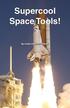 Supercool Space Tools! By Linda Hermans-Killam A long time ago, people looked into the dark night sky and wondered about the stars, meteors, comets and planets they saw. The only tools they had to study
Can Hubble be Moved to the International Space Station? 1
 Can Hubble be Moved to the International Space Station? 1 On January 16, NASA Administrator Sean O Keefe informed scientists and engineers at the Goddard Space Flight Center (GSFC) that plans to service
The Sino-French Gamma-Ray Burst Mission SVOM (Space-based multi-band astronomical Variable Objects Monitor)
 The Sino-French Gamma-Ray Burst Mission SVOM (Space-based multi-band astronomical Variable Objects Monitor) Didier BARRET on behalf of the SVOM collaboration [email protected] Outline SVOM background
Satellite Posi+oning. Lecture 5: Satellite Orbits. Jan Johansson [email protected] Chalmers University of Technology, 2013
 Lecture 5: Satellite Orbits Jan Johansson [email protected] Chalmers University of Technology, 2013 Geometry Satellite Plasma Posi+oning physics Antenna theory Geophysics Time and Frequency GNSS
Einstein Rings: Nature s Gravitational Lenses
 National Aeronautics and Space Administration Einstein Rings: Nature s Gravitational Lenses Leonidas Moustakas and Adam Bolton Taken from: Hubble 2006 Science Year in Review The full contents of this book
Solar System Observations contains two components: Planetary Astronomy and Near Earth Object Observations.
 C.6 SOLAR SYSTEM OBSERVATIONS 1. Scope of Program Solar System Observations supports both ground-based astronomical observations and suborbital investigations of our Solar System involving sounding rockets
Due Tuesday, January 27th IN CLASS. Grading Summary: Question 11: 12 points. Question 12: 26 points. Question 13: 12 Points.
 HOMEWORK #1 Solar System Exploration Due Tuesday, January 27th IN CLASS Answers to the questions must be given in complete sentences (except where indicated), using correct grammar and spelling. Please
Grade 6 Standard 3 Unit Test A Astronomy. 1. The four inner planets are rocky and small. Which description best fits the next four outer planets?
 Grade 6 Standard 3 Unit Test A Astronomy Multiple Choice 1. The four inner planets are rocky and small. Which description best fits the next four outer planets? A. They are also rocky and small. B. They
Evolution of the Universe from 13 to 4 Billion Years Ago
 Evolution of the Universe from 13 to 4 Billion Years Ago Prof. Dr. Harold Geller [email protected] http://physics.gmu.edu/~hgeller/ Department of Physics and Astronomy George Mason University Unity in the
Halliday, Resnick & Walker Chapter 13. Gravitation. Physics 1A PHYS1121 Professor Michael Burton
 Halliday, Resnick & Walker Chapter 13 Gravitation Physics 1A PHYS1121 Professor Michael Burton II_A2: Planetary Orbits in the Solar System + Galaxy Interactions (You Tube) 21 seconds 13-1 Newton's Law
Adaptive Optics (AO) TMT Partner Institutions Collaborating Institution Acknowledgements
 THIRTY METER TELESCOPE The past century of astronomy research has yielded remarkable insights into the nature and origin of the Universe. This scientific advancement has been fueled by progressively larger
Chang e-3 s Progress and Achievement 2/2014
 Chang e-3 s Progress and Achievement 2/2014 Main content 1. Chinese Lunar Exploration Program 2. Chang e-3 s Progress 3. Chang e-3 s Achievement Chinese Lunar Exploration Program Phase I Orbital missions
World of Particles Big Bang Thomas Gajdosik. Big Bang (model)
 Big Bang (model) What can be seen / measured? basically only light (and a few particles: e ±, p, p, ν x ) in different wave lengths: microwave to γ-rays in different intensities (measured in magnitudes)
How To Understand Light And Color
 PRACTICE EXAM IV P202 SPRING 2004 1. In two separate double slit experiments, an interference pattern is observed on a screen. In the first experiment, violet light (λ = 754 nm) is used and a second-order
Are We Alone?! Exoplanet Characterization and Direct Imaging!
 From Cosmic Birth to Living Earths A Vision for Space Astronomy in the 2020s and Beyond Are We Alone?! Exoplanet Characterization and Direct Imaging! A Study Commissioned by the Associated Universities
REALIZING EINSTEIN S DREAM Exploring Our Mysterious Universe
 REALIZING EINSTEIN S DREAM Exploring Our Mysterious Universe The End of Physics Albert A. Michelson, at the dedication of Ryerson Physics Lab, U. of Chicago, 1894 The Miracle Year - 1905 Relativity Quantum
Solar System Fundamentals. What is a Planet? Planetary orbits Planetary temperatures Planetary Atmospheres Origin of the Solar System
 Solar System Fundamentals What is a Planet? Planetary orbits Planetary temperatures Planetary Atmospheres Origin of the Solar System Properties of Planets What is a planet? Defined finally in August 2006!
THE ANOMALOUS TRAJECTORIES OF THE PIONEER SPACECRAFT a
 THE ANOMALOUS TRAJECTORIES OF THE PIONEER SPACECRAFT a Michael Martin Nieto, John D. Anderson, Philip A. Laing, + Eunice L. Lau, and Slava G. Turyshev Theoretical Division (MS-B285), Los Alamos National
California Standards Grades 9 12 Boardworks 2009 Science Contents Standards Mapping
 California Standards Grades 912 Boardworks 2009 Science Contents Standards Mapping Earth Sciences Earth s Place in the Universe 1. Astronomy and planetary exploration reveal the solar system s structure,
Specific Intensity. I ν =
 Specific Intensity Initial question: A number of active galactic nuclei display jets, that is, long, nearly linear, structures that can extend for hundreds of kiloparsecs. Many have two oppositely-directed
DIN Department of Industrial Engineering School of Engineering and Architecture
 DIN Department of Industrial Engineering School of Engineering and Architecture Elective Courses of the Master s Degree in Aerospace Engineering (MAE) Forlì, 08 Nov 2013 Master in Aerospace Engineering
What is the Sloan Digital Sky Survey?
 What is the Sloan Digital Sky Survey? Simply put, the Sloan Digital Sky Survey is the most ambitious astronomical survey ever undertaken. The survey will map one-quarter of the entire sky in detail, determining
102 26-m Antenna Subnet Telecommunications Interfaces
 DSMS Telecommunications Link Design Handbook 26-m Antenna Subnet Telecommunications Interfaces Effective November 30, 2000 Document Owner: Approved by: Released by: [Signature on file in TMOD Library]
Astrophysical Techniques. C R Kitchin
 Astrophysical Techniques C R Kitchin University of Hertfordshire Observatory Third Edition SUB Gottingen 7 210 119 268 99 A 8843 Institute of Physics Publishing Bristol and Philadelphia Contents Preface
Notes: Most of the material in this chapter is taken from Young and Freedman, Chap. 13.
 Chapter 5. Gravitation Notes: Most of the material in this chapter is taken from Young and Freedman, Chap. 13. 5.1 Newton s Law of Gravitation We have already studied the effects of gravity through the
SIERRA COLLEGE OBSERVATIONAL ASTRONOMY LABORATORY EXERCISE NUMBER III.F.a. TITLE: ASTEROID ASTROMETRY: BLINK IDENTIFICATION
 SIERRA COLLEGE OBSERVATIONAL ASTRONOMY LABORATORY EXERCISE NUMBER III.F.a. TITLE: ASTEROID ASTROMETRY: BLINK IDENTIFICATION DATE- PRINT NAME/S AND INITIAL BELOW: GROUP DAY- LOCATION OBJECTIVE: Use CCD
TEMPERATURE DEPENDENCE OF GRAVITATIONAL FORCE: EXPERIMENTS, ASTROPHYSICS, PERSPECTIVES. A.L. Dmitriev
 TEMPERATURE DEPENDENCE OF GRAVITATIONAL FORCE: EXPERIMENTS, ASTROPHYSICS, PERSPECTIVES A.L. Dmitriev St-Petersburg University of Information Technologies, Mechanics and Optics 49, Kronverksky Prospect,
TELESCOPE AS TIME MACHINE
 TELESCOPE AS TIME MACHINE Read this article about NASA s latest high-tech space telescope. Then, have fun doing one or both of the word puzzles that use the important words in the article. A TELESCOPE
Halliday, Resnick & Walker Chapter 13. Gravitation. Physics 1A PHYS1121 Professor Michael Burton
 Halliday, Resnick & Walker Chapter 13 Gravitation Physics 1A PHYS1121 Professor Michael Burton II_A2: Planetary Orbits in the Solar System + Galaxy Interactions (You Tube) 21 seconds 13-1 Newton's Law
STAAR Science Tutorial 30 TEK 8.8C: Electromagnetic Waves
 Name: Teacher: Pd. Date: STAAR Science Tutorial 30 TEK 8.8C: Electromagnetic Waves TEK 8.8C: Explore how different wavelengths of the electromagnetic spectrum such as light and radio waves are used to
Transcript 22 - Universe
 Transcript 22 - Universe A few introductory words of explanation about this transcript: This transcript includes the words sent to the narrator for inclusion in the latest version of the associated video.
The Universe. The Solar system, Stars and Galaxies
 The Universe The Universe is everything. All us, the room, the U.S. the earth, the solar system, all the other stars in the Milky way galaxy, all the other galaxies... everything. How big and how old is
x 1 ' = x 1 vt 1 x 1 ' = 4.0 m t 1 = 1.0 s x 2 vt 2 ' = 4.0 m t 2 ' = x 2 = 3.0 s x 1 = x 2 x 1 ' + vt 1 ' + vt 2 v (t 1 t 2 ) = x 2 ' x 1 ' = x 2
 Physics 2220 Module 16 Homework 01. A firecracker explodes in reference frame S at t 1 1.0 seconds. A second firecracker explodes at the same position at t 2 3.0 seconds. In reference frame S', which moves
AMS COLLABORATION. First Results from the Alpha Magnetic Spectrometer (AMS) Experiment
 AMS COLLABORATION Press Release April 3 rd, 2013, Geneva, Switzerland First Results from the Alpha Magnetic Spectrometer (AMS) Experiment The Alpha Magnetic Spectrometer (AMS) Collaboration announces the
USING MS EXCEL FOR DATA ANALYSIS AND SIMULATION
 USING MS EXCEL FOR DATA ANALYSIS AND SIMULATION Ian Cooper School of Physics The University of Sydney [email protected] Introduction The numerical calculations performed by scientists and engineers
Chapter 25.1: Models of our Solar System
 Chapter 25.1: Models of our Solar System Objectives: Compare & Contrast geocentric and heliocentric models of the solar sytem. Describe the orbits of planets explain how gravity and inertia keep the planets
Hallerstrasse 6 CH-3012 Bern Switzerland. ISSI/HISPAC Forum on Understanding Gravity. 3/4 December 2013 at ISSI premises in Bern, Switzerland
 Hallerstrasse 6 CH-3012 Bern Switzerland ISSI/HISPAC Forum on Understanding Gravity 3/4 December 2013 at ISSI premises in Bern, Switzerland FINAL REPORT Tel: +41 31 631 4896 Fax: +41 31 631 4897 Understanding
DSL Mission Concept at Lunar Orbit
 DSL Mission Concept at Lunar Orbit Jingye Yan Na9onal Space Science Center (NSSC) Chinese Academy of Sciences (CAS) 2015-02- 02, ASTRON, The Netherland 1 Payload onboard single nano- sat Element antenna
Chapter 7 Our Planetary System. Agenda. Intro Astronomy. Intro Astronomy. What does the solar system look like? A. General Basics
 Chapter 7 Our Planetary System Agenda Pass back & discuss Test 2 Where we are (at) Ch. 7 Our Planetary System Finish Einstein s Big Idea Earth, as viewed by the Voyager spacecraft A. General Basics Intro