
THE ANOMALOUS TRAJECTORIES OF THE PIONEER SPACECRAFT a
|
|
|
- Logan Randall
- 10 years ago
- Views:
Transcription
1 THE ANOMALOUS TRAJECTORIES OF THE PIONEER SPACECRAFT a Michael Martin Nieto, John D. Anderson, Philip A. Laing, + Eunice L. Lau, and Slava G. Turyshev Theoretical Division (MS-B285), Los Alamos National Laboratory, University of California, Los Alamos, NM 87545,, Jet Propulsion Laboratory, California Institute of Technology, Pasadena, CA The Aerospace Corporation, 2350 E. El Segundo Blvd., El Segundo, CA Because of their unique designs, the Pioneer 10 and 11 spacecraft have provided the cleanest Doppler, deep-space navigation data. Analysis of this data can be interpreted as showing an anomalous acceleration of these craft directed towards the Sun of a P cm/s 2. The background of this discovery and the significance of the result are discussed. 1 Introduction Some thirty years ago, on 2 March 1972, Pioneer 10 was launched on an Atlas/Centaur rocket from Cape Canaveral. Pioneer 10 was Earth s first space probe to reach an outer planet. After surviving intense radiation, on 4 December 1973 it successfully encountered Jupiter 1 4. Today we are all used to spectacular photographs from the solar system. But in 1973 it was different. For those of us (speaker - MMN) who remember, the impact of the first Jupiter encounter photographs was astounding. To understand this one only has to compare the 25 January 1974 cover of Science 1 with the best Palomar telescope photographs. Pioneer 10 was followed by Pioneer 11 (launched on 5 April 1973). After Jupiter and (for Pioneer 11) Saturn encounters, the two spacecraft have followed hyperbolic orbits near the plane of the ecliptic to opposite sides of the solar system. Pioneer 10 was also the first mission to leave the solar system when in June 1983 it passed beyond the orbit of Pluto 3. (See Figure 1.) The Pioneers have been amazingly robust. They knew how to build cars in those days! The Pioneers were adventures into the unknown, so great care was aelectronic addresses: [email protected] [email protected] + [email protected] [email protected] [email protected] 1

2 Figure 1: Ecliptic pole view of Pioneer 10, Pioneer 11, and Voyager trajectories. Pioneer 11 is traveling approximately in the direction of the Sun s orbital motion about the galactic center. The galactic center is approximately in the direction of the top of the figure. given to the design and reliability of the craft. Hence, although it was required (hoped) these craft would have a lifetime of 3 (7) years, they successfully operated for much longer. Pioneer 10 (at a distance > 70 AU) is still transmitting and we have analyzed data up to The Pioneer 11 Doppler signals failed on 1 October So, after that date, when the spacecraft was 30 AU away from the Sun, no useful data has been generated for our purposes. 2 Testing Newtonian Dynamics I myself (MMN) became involved in this project while I was preparing a talk on antimatter and gravity for the 1994 Low Energy Antiproton conference 5. I wanted to argue that we really do not understand gravity at distances much larger than the size of the solar system. We know it is there, but we don t know how well it obeys Newton/Einstein physics. Basically the rotation curves of 2

3 spiral galaxies tell us something is wrong. Our creationist solution is dark matter (although we can t find enough of it to explain the problem). To better understand what spacecraft could tell us about this, I eventually was directed to John Anderson. He ed me that rather than considering the orbits of three-axis stabilized craft like the Voyagers, spinning craft like the Pioneers were better since fewer maneuvers are necessary. How you obtain a result from spacecraft is very simple to understand in principle. You transmit an S-band signal to the craft via the Deep Space Network. It is transponded back and you compare the re-received signal to your station clocks. There will be a Doppler shift since the spacecraft is traveling out. From this shift you subtract out known effects, like the gravity of the Sun and any nearby planets. b Then you see if any Doppler residuals are left over. 3 The Anomaly As to what the Pioneers could actually tell us, John went on, By the way, the biggest systematic in our acceleration residuals is a bias of km/s 2 directed toward the Sun. It turns out that indicative evidence of this had been around for some time. But the motivation to analyze it seriously had not arisen. Now it did 6. Our collaboration expended a great deal of effort in detailed analysis of the Pioneer 10 data between and and of the Pioneer 11 data between and When systematics had been considered, we obtained a present result of 7 a P =(8.74 ± 1.25) 10 8 cm/s 2. 4 A Standard Physic Explanation Most people (including ourselves) believe the answer must be some systematic. But we have not found it. The most likely candidates are gas leaks from the thrusters or non-isotropic heat radiation. In what probably shows a deep respect for what they deal with, space navigators tend to think it is gas leaks and space scientists tend to think it is heat. The navigators argue their case privately and the space scientists argue their case in print. The navigational and heat details are in our big report 7. bi am sympathetic to the story Eric Adelberger told us about the commercial miscalibration of their micrometer. We spent a couple of months trying to understand evidence of an anomalously large corona signal. Eventually we realized that we needed to input physical parameters that had been determined elsewhere instead of using default operations of the codes. 3

4 Figure 2: A drawing of the Pioneer spacecraft. The ongoing heat discussions are in our references You people will have to decide for yourselves, but we claim no smoking gun has been found. The care of the design turned out to be beneficial to us. (See Figure 2.) The radioisotope thermoelectric generators (RTGs) were placed at the end of long booms. Therefore, the effect of the radiant heat from them was much less than it might have been. Further, these extended booms had to be balanced as part of a rotating craft. This spin-stabilization meant there were fewer maneuvers. Finally, the basically cylindrical symmetry meant one could easily look for changes in the anomaly with time that might be associated with radioactive or electrical-power heat decay. 5 Something Wrong? If, contrary to expectation, no systematic can explain the anomaly, one has to ask what it could be. The obvious answer to explain an acceleration is a force. But as discussed elsewhere 6,7, this force would not satisfy the Principle of Equivalence. Still one has to remain curious since a P O(a 0 ) O(cH), where a 0 is Milgrom s acceleration parameter in his Modified Newtonian Dy- 4

5 namics 11 and H is the Hubble constant. This last ties into this conference on CPT. One can easily speculate (and people have) that the effect is time. Remember, this is a Doppler measurement which we interpreted as an acceleration, a P. But if one writes it as ca t = a P one has a time acceleration. The question probably must be settled by new experiment. A craft going quickly to deep space, built to minimize systematics, and with modern Doppler and range electronics is what is called for. We are thinking about this. Acknowledgments M.M.N. acknowledges support by the U.S. DOE. This work of J.D.A., E.L.L, and S.G.T. was performed under contract with the National Aeronautics and Space Administration. P.A.L. was supported by a grant from NASA through the Ultraviolet, Visible, and Gravitational Astrophysics Program. References 1. See the special issue Science 183, No (25 January 1974). 2. R. O. Fimmel, J. Van Allen, and E. Burgess, Pioneer: First to Jupiter, Saturn, and beyond, NASA report NASA SP-446 (NASA, Washington D.C., 1980). 3. Pioneer Extended Mission Plan, Revised, NASA/ARC document No. PC-1001 (NASA, Washington, D.C., 1994). 4. For web summaries of Pioneer, go to: Projects/pioneer /PNhome.html 5. A preliminary discussion of these results appeared in M. M. Nieto, T. Goldman, J. D. Anderson, E. L. Lau, and J. Pérez-Mercader, in: Proc. Third Biennial Conference on Low-Energy Antiproton Physics, LEAP 94, ed. by G. Kernel, P. Krizan, and M. Mikuz (World Scientific, Singapore, 1995), p Eprint hep-ph/ J. D. Anderson, P. A. Laing, E. L. Lau, A. S. Liu, M. M. Nieto, and S. G. Turyshev, Phys. Rev. Lett. 81, 2858 (1998). Eprint gr-qc/ J. D. Anderson, P. A. Laing, E. L. Lau, A. S. Liu, M. M. Nieto, and S. G. Turyshev, eprint gr-qc/ E. M. Murphy, Phys. Rev. Lett. 83, 1890 (1999), eprint gr-qc// ; J. I. Katz, ibid (1999), gr-qc/ : L. K. Scheffer, eprints grqc/ , gr-qc/ , gr-qc/

6 9. J. D. Anderson, P. A. Laing, E. L. Lau, A. S. Liu, M. M. Nieto, and S. G. Turyshev, Phys. Rev. Lett. 83, 1891 (1999), eprint gr-qc/ ; ibid (1999), gr-qc/ J. D. Anderson, P. A. Laing, E. L. Lau, M. M. Nieto, and S. G. Turyshev, eprint gr-qc/ M. Milgrom, La Recherche 19, 182 (1988); Ann. Phys. 229, 384 (1994). 6

The Quest to Understand the Pioneer Anomaly
 LA-UR-06-6181 The Quest to Understand the Pioneer Anomaly Michael Martin Nieto Theoretical Division (MS-B285) Los Alamos National Laboratory Los Alamos, New Mexico 87545 U.S.A email: [email protected] Summary:
Deep space gravity tests in the solar system
 Deep space gravity tests in the solar system Serge REYNAUD Laboratoire Kastler Brossel CNRS, ENS, UPMC (Paris) Discussions and collaborations with persons quoted below and several collaborations Deep Space
DESCRIPTION ACADEMIC STANDARDS INSTRUCTIONAL GOALS VOCABULARY BEFORE SHOWING. Subject Area: Science
 DESCRIPTION Host Tom Selleck conducts a stellar tour of Jupiter, Saturn, Uranus, Neptune, and Pluto--the outer planets of Earth's solar system. Information from the Voyager space probes plus computer models
Chapter 25.1: Models of our Solar System
 Chapter 25.1: Models of our Solar System Objectives: Compare & Contrast geocentric and heliocentric models of the solar sytem. Describe the orbits of planets explain how gravity and inertia keep the planets
The Solar System: Cosmic encounter with Pluto
 Earth and Space Sciences The Solar System: Cosmic encounter with Pluto The size and nature of our Solar System is truly awe inspiring, and things are going to get even more exciting once the New Horizons
TELESCOPE AS TIME MACHINE
 TELESCOPE AS TIME MACHINE Read this article about NASA s latest high-tech space telescope. Then, have fun doing one or both of the word puzzles that use the important words in the article. A TELESCOPE
Name: Earth 110 Exploration of the Solar System Assignment 1: Celestial Motions and Forces Due in class Tuesday, Jan. 20, 2015
 Name: Earth 110 Exploration of the Solar System Assignment 1: Celestial Motions and Forces Due in class Tuesday, Jan. 20, 2015 Why are celestial motions and forces important? They explain the world around
First Discoveries. Asteroids
 First Discoveries The Sloan Digital Sky Survey began operating on June 8, 1998. Since that time, SDSS scientists have been hard at work analyzing data and drawing conclusions. This page describes seven
Pioneer 10 - TNO Accurate Acceleration ofSystem
 The Astrophysical Journal, 666:1296Y1302, 2007 September 10 # 2007. The American Astronomical Society. All rights reserved. Printed in U.S.A. TESTING GRAVITY IN THE OUTER SOLAR SYSTEM: RESULTS FROM TRANS-NEPTUNIAN
Astrodynamics (AERO0024)
 Astrodynamics (AERO0024) 6. Interplanetary Trajectories Gaëtan Kerschen Space Structures & Systems Lab (S3L) Course Outline THEMATIC UNIT 1: ORBITAL DYNAMICS Lecture 02: The Two-Body Problem Lecture 03:
Spacecraft Power for Cassini
 NASA Fact Sheet Spacecraft Power for Cassini Cassini s electrical power source Radioisotope Thermoelectric Generators (RTGs) have provided electrical power for some of the U.S. space program s greatest
Exploring the Weak Limit of Gravity at Solar System Scales
 Exploring the Weak Limit of Gravity at Solar System Scales A dissertation submitted in partial fulfillment of the requirements for the degree of Doctor of Philosophy at George Mason University By Gary
Name Class Date. true
 Exercises 131 The Falling Apple (page 233) 1 Describe the legend of Newton s discovery that gravity extends throughout the universe According to legend, Newton saw an apple fall from a tree and realized
A long time ago, people looked
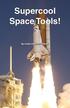 Supercool Space Tools! By Linda Hermans-Killam A long time ago, people looked into the dark night sky and wondered about the stars, meteors, comets and planets they saw. The only tools they had to study
Can Hubble be Moved to the International Space Station? 1
 Can Hubble be Moved to the International Space Station? 1 On January 16, NASA Administrator Sean O Keefe informed scientists and engineers at the Goddard Space Flight Center (GSFC) that plans to service
Science Standard 4 Earth in Space Grade Level Expectations
 Science Standard 4 Earth in Space Grade Level Expectations Science Standard 4 Earth in Space Our Solar System is a collection of gravitationally interacting bodies that include Earth and the Moon. Universal
DIRECT ORBITAL DYNAMICS: USING INDEPENDENT ORBITAL TERMS TO TREAT BODIES AS ORBITING EACH OTHER DIRECTLY WHILE IN MOTION
 1 DIRECT ORBITAL DYNAMICS: USING INDEPENDENT ORBITAL TERMS TO TREAT BODIES AS ORBITING EACH OTHER DIRECTLY WHILE IN MOTION Daniel S. Orton email: [email protected] Abstract: There are many longstanding
Exam # 1 Thu 10/06/2010 Astronomy 100/190Y Exploring the Universe Fall 11 Instructor: Daniela Calzetti
 Exam # 1 Thu 10/06/2010 Astronomy 100/190Y Exploring the Universe Fall 11 Instructor: Daniela Calzetti INSTRUCTIONS: Please, use the `bubble sheet and a pencil # 2 to answer the exam questions, by marking
NOTES: GEORGIA HIGH SCHOOL SCIENCE TEST THE SOLAR SYSTEM
 NOTES: GEORGIA HIGH SCHOOL SCIENCE TEST THE SOLAR SYSTEM 1.What is a Solar system? A solar system consists of: * one central star, the Sun and * nine planets: Mercury, Venus, Earth, Mars, Jupiter, Saturn,
Grade 6 Standard 3 Unit Test A Astronomy. 1. The four inner planets are rocky and small. Which description best fits the next four outer planets?
 Grade 6 Standard 3 Unit Test A Astronomy Multiple Choice 1. The four inner planets are rocky and small. Which description best fits the next four outer planets? A. They are also rocky and small. B. They
Use the following information to deduce that the gravitational field strength at the surface of the Earth is approximately 10 N kg 1.
 IB PHYSICS: Gravitational Forces Review 1. This question is about gravitation and ocean tides. (b) State Newton s law of universal gravitation. Use the following information to deduce that the gravitational
The Milky Way Galaxy is Heading for a Major Cosmic Collision
 The Milky Way Galaxy is Heading for a Major Cosmic Collision Roeland van der Marel (STScI) [based on work with a team of collaborators reported in the Astrophysical Journal July 2012] Hubble Science Briefing
Lab 7: Gravity and Jupiter's Moons
 Lab 7: Gravity and Jupiter's Moons Image of Galileo Spacecraft Gravity is the force that binds all astronomical structures. Clusters of galaxies are gravitationally bound into the largest structures in
Study Guide: Solar System
 Study Guide: Solar System 1. How many planets are there in the solar system? 2. What is the correct order of all the planets in the solar system? 3. Where can a comet be located in the solar system? 4.
Georgia Performance Standards Framework for Science Grade 6. Unit Organizer: UNIVERSE AND SOLAR SYSTEM (Approximate Time 3 Weeks)
 The following instructional plan is part of a GaDOE collection of Unit Frameworks, Performance Tasks, examples of Student Work, and Teacher Commentary. Many more GaDOE approved instructional plans are
Asteroids. Earth. Asteroids. Earth Distance from sun: 149,600,000 kilometers (92,960,000 miles) Diameter: 12,756 kilometers (7,926 miles) dotted line
 Image taken by NASA Asteroids About 6,000 asteroids have been discovered; several hundred more are found each year. There are likely hundreds of thousands more that are too small to be seen from Earth.
THE SOLAR SYSTEM - EXERCISES 1
 THE SOLAR SYSTEM - EXERCISES 1 THE SUN AND THE SOLAR SYSTEM Name the planets in their order from the sun. 1 2 3 4 5 6 7 8 The asteroid belt is between and Which planet has the most moons? About how many?
Swarthmore College Newsletter
 93 Fog, clouds, and light pollution limit the effectiveness of even the biggest optical telescopes on Earth. Astronomers who study ultraviolet or X-ray emission of stars have been more limited because
Lecture 17 Newton on Gravity
 Lecture 17 Newton on Gravity Patrick Maher Philosophy 270 Spring 2010 Introduction Outline of Newton s Principia Definitions Axioms, or the Laws of Motion Book 1: The Motion of Bodies Book 2: The Motion
Solar System Observations contains two components: Planetary Astronomy and Near Earth Object Observations.
 C.6 SOLAR SYSTEM OBSERVATIONS 1. Scope of Program Solar System Observations supports both ground-based astronomical observations and suborbital investigations of our Solar System involving sounding rockets
Earth Is Not the Center of the Universe
 Earth Is Not the Center of the Universe Source: Utah State Office of Education Introduction Have you ever looked up at the night sky and wondered about all the pinpoint lights? People through the ages
Chapter 1: Our Place in the Universe. 2005 Pearson Education Inc., publishing as Addison-Wesley
 Chapter 1: Our Place in the Universe Topics Our modern view of the universe The scale of the universe Cinema graphic tour of the local universe Spaceship earth 1.1 A Modern View of the Universe Our goals
The Solar System. Unit 4 covers the following framework standards: ES 10 and PS 11. Content was adapted the following:
 Unit 4 The Solar System Chapter 7 ~ The History of the Solar System o Section 1 ~ The Formation of the Solar System o Section 2 ~ Observing the Solar System Chapter 8 ~ The Parts the Solar System o Section
CELESTIAL MOTIONS. In Charlottesville we see Polaris 38 0 above the Northern horizon. Earth. Starry Vault
 CELESTIAL MOTIONS Stars appear to move counterclockwise on the surface of a huge sphere the Starry Vault, in their daily motions about Earth Polaris remains stationary. In Charlottesville we see Polaris
165 points. Name Date Period. Column B a. Cepheid variables b. luminosity c. RR Lyrae variables d. Sagittarius e. variable stars
 Name Date Period 30 GALAXIES AND THE UNIVERSE SECTION 30.1 The Milky Way Galaxy In your textbook, read about discovering the Milky Way. (20 points) For each item in Column A, write the letter of the matching
Group Leader: Group Members:
 THE SOLAR SYSTEM PROJECT: TOPIC: THE SUN Required Project Content for an Oral/Poster Presentation on THE SUN - What it s made of - Age and how it formed (provide pictures or diagrams) - What is an AU?
The Hidden Lives of Galaxies. Jim Lochner, USRA & NASA/GSFC
 The Hidden Lives of Galaxies Jim Lochner, USRA & NASA/GSFC What is a Galaxy? Solar System Distance from Earth to Sun = 93,000,000 miles = 8 light-minutes Size of Solar System = 5.5 light-hours What is
Data Provided: A formula sheet and table of physical constants is attached to this paper. DARK MATTER AND THE UNIVERSE
 Data Provided: A formula sheet and table of physical constants is attached to this paper. DEPARTMENT OF PHYSICS AND ASTRONOMY Autumn Semester (2014-2015) DARK MATTER AND THE UNIVERSE 2 HOURS Answer question
Summary: Four Major Features of our Solar System
 Summary: Four Major Features of our Solar System How did the solar system form? According to the nebular theory, our solar system formed from the gravitational collapse of a giant cloud of interstellar
Class 2 Solar System Characteristics Formation Exosolar Planets
 Class 1 Introduction, Background History of Modern Astronomy The Night Sky, Eclipses and the Seasons Kepler's Laws Newtonian Gravity General Relativity Matter and Light Telescopes Class 2 Solar System
4.1.6. Interplanetary Travel. Outline. In This Section You ll Learn to...
 Interplanetary Travel 4.1.6 In This Section You ll Learn to... Describe the basic steps involved in getting from one planet in the solar system to another Explain how we can use the gravitational pull
Astronomy 110 Homework #04 Assigned: 02/06/2007 Due: 02/13/2007. Name:
 Astronomy 110 Homework #04 Assigned: 02/06/2007 Due: 02/13/2007 Name: Directions: Listed below are twenty (20) multiple-choice questions based on the material covered by the lectures this past week. Choose
2. Orbits. FER-Zagreb, Satellite communication systems 2011/12
 2. Orbits Topics Orbit types Kepler and Newton laws Coverage area Influence of Earth 1 Orbit types According to inclination angle Equatorial Polar Inclinational orbit According to shape Circular orbit
Introduction to the Solar System
 Introduction to the Solar System Lesson Objectives Describe some early ideas about our solar system. Name the planets, and describe their motion around the Sun. Explain how the solar system formed. Introduction
Outdoor Exploration Guide. A Journey Through Our Solar System. A Journey Through Our Solar System
 Outdoor Exploration Guide A Journey Through Our Solar System A Journey Through Our Solar System The Solar System Imagine that you are an explorer investigating the solar system. It s a big job, but in
Interaction of Energy and Matter Gravity Measurement: Using Doppler Shifts to Measure Mass Concentration TEACHER GUIDE
 Interaction of Energy and Matter Gravity Measurement: Using Doppler Shifts to Measure Mass Concentration TEACHER GUIDE EMR and the Dawn Mission Electromagnetic radiation (EMR) will play a major role in
A Taxonomy for Space Curricula
 A Taxonomy for Space Curricula Arthur W. Draut, Ph.D. College of Aviation Embry-Riddle Aeronautical University Abstract Many universities have added courses and curricula related to satellites and space.
Chapter 15.3 Galaxy Evolution
 Chapter 15.3 Galaxy Evolution Elliptical Galaxies Spiral Galaxies Irregular Galaxies Are there any connections between the three types of galaxies? How do galaxies form? How do galaxies evolve? P.S. You
Chapter 8 Formation of the Solar System. What theory best explains the features of our solar system? Close Encounter Hypothesis
 Chapter 8 Formation of the Solar System What properties of our solar system must a formation theory explain? 1. Patterns of motion of the large bodies Orbit in same direction and plane 2. Existence of
Welcome to Class 4: Our Solar System (and a bit of cosmology at the start) Remember: sit only in the first 10 rows of the room
 Welcome to Class 4: Our Solar System (and a bit of cosmology at the start) Remember: sit only in the first 10 rows of the room What is the difference between dark ENERGY and dark MATTER? Is Earth unique,
UC Irvine FOCUS! 5 E Lesson Plan
 UC Irvine FOCUS! 5 E Lesson Plan Title: Astronomical Units and The Solar System Grade Level and Course: 8th grade Physical Science Materials: Visual introduction for solar system (slides, video, posters,
Science 9 Worksheet 13-1 The Solar System
 Name Date Due Date Science 9 Read pages 264-287 of SP to help you answer the following questions: Also, go to a school computer connected to the internet. Go to Mr. Colgur s Webpage at http://sd67.bc.ca/teachers/dcolgur
Due Tuesday, January 27th IN CLASS. Grading Summary: Question 11: 12 points. Question 12: 26 points. Question 13: 12 Points.
 HOMEWORK #1 Solar System Exploration Due Tuesday, January 27th IN CLASS Answers to the questions must be given in complete sentences (except where indicated), using correct grammar and spelling. Please
The sun and planets. On this picture, the sizes of the sun and 8 planets are to scale. Their positions relative to each other are not to scale.
 The solar system The solar system consists of our sun and its eight planets. The word solar means to do with the sun. The solar system formed 4½ billion years ago, when the universe was about two-thirds
How Rockets Work Newton s Laws of Motion
 How Rockets Work Whether flying a small model rocket or launching a giant cargo rocket to Mars, the principles of how rockets work are exactly the same. Understanding and applying these principles means
The University of Texas at Austin. Gravity and Orbits
 UTeach Outreach The University of Texas at Austin Gravity and Orbits Time of Lesson: 60-75 minutes Content Standards Addressed in Lesson: TEKS6.11B understand that gravity is the force that governs the
STUDY GUIDE: Earth Sun Moon
 The Universe is thought to consist of trillions of galaxies. Our galaxy, the Milky Way, has billions of stars. One of those stars is our Sun. Our solar system consists of the Sun at the center, and all
Chapter 8 Welcome to the Solar System
 Chapter 8 Welcome to the Solar System 8.1 The Search for Origins What properties of our solar system must a formation theory explain? What theory best explains the features of our solar system? What properties
Chapter 8 Formation of the Solar System Agenda
 Chapter 8 Formation of the Solar System Agenda Announce: Mercury Transit Part 2 of Projects due next Thursday Ch. 8 Formation of the Solar System Philip on The Physics of Star Trek Radiometric Dating Lab
COLLATED QUESTIONS: ELECTROMAGNETIC RADIATION
 COLLATED QUESTIONS: ELECTROMAGNETIC RADIATION 2011(2): WAVES Doppler radar can determine the speed and direction of a moving car. Pulses of extremely high frequency radio waves are sent out in a narrow
The facts we know today will be the same tomorrow but today s theories may tomorrow be obsolete.
 The Scale of the Universe Some Introductory Material and Pretty Pictures The facts we know today will be the same tomorrow but today s theories may tomorrow be obsolete. A scientific theory is regarded
Chapter 7 Our Planetary System. Agenda. Intro Astronomy. Intro Astronomy. What does the solar system look like? A. General Basics
 Chapter 7 Our Planetary System Agenda Pass back & discuss Test 2 Where we are (at) Ch. 7 Our Planetary System Finish Einstein s Big Idea Earth, as viewed by the Voyager spacecraft A. General Basics Intro
WELCOME to Aurorae In the Solar System. J.E. Klemaszewski
 WELCOME to Aurorae In the Solar System Aurorae in the Solar System Sponsoring Projects Galileo Europa Mission Jupiter System Data Analysis Program ACRIMSAT Supporting Projects Ulysses Project Outer Planets
Lecture L17 - Orbit Transfers and Interplanetary Trajectories
 S. Widnall, J. Peraire 16.07 Dynamics Fall 008 Version.0 Lecture L17 - Orbit Transfers and Interplanetary Trajectories In this lecture, we will consider how to transfer from one orbit, to another or to
The Solar System. Source http://starchild.gsfc.nasa.gov/docs/starchild/solar_system_level1/solar_system.html
 The Solar System What is the solar system? It is our Sun and everything that travels around it. Our solar system is elliptical in shape. That means it is shaped like an egg. Earth s orbit is nearly circular.
G U I D E T O A P P L I E D O R B I T A L M E C H A N I C S F O R K E R B A L S P A C E P R O G R A M
 G U I D E T O A P P L I E D O R B I T A L M E C H A N I C S F O R K E R B A L S P A C E P R O G R A M CONTENTS Foreword... 2 Forces... 3 Circular Orbits... 8 Energy... 10 Angular Momentum... 13 FOREWORD
Space Exploration. A Visual History. Philip Stooke
 Space Exploration A Visual History Philip Stooke It all began with Sputnik 4 th October 1957 It all began with Sputnik 4 th October 1957 It all began with Sputnik 4 th October 1957 and Laika Laika on the
1.1 A Modern View of the Universe" Our goals for learning: What is our place in the universe?"
 Chapter 1 Our Place in the Universe 1.1 A Modern View of the Universe What is our place in the universe? What is our place in the universe? How did we come to be? How can we know what the universe was
Reasons for Seasons. Question: TRUE OR FALSE. Question: TRUE OR FALSE? What causes the seasons? What causes the seasons?
 Reasons for Seasons Question: TRUE OR FALSE? Earth is closer to the Sun in summer and farther from the Sun in winter. Question: TRUE OR FALSE? Earth is closer to the Sun in summer and farther from the
Planets and Dwarf Planets by Shauna Hutton
 Name: Wow! Technology has improved so well in the last several years that we keep finding more and more objects in our solar system! Because of this, scientists have had to come up with new categories
Rosaly Lopes, Jet Propulsion Laboratory, California Institute of Technology
 Saturn s Moon Titan: Cassini-Huygens Reveals a New World Rosaly Lopes, Jet Propulsion Laboratory, California Institute of Technology The year 2005 will be remembered in the history of space exploration
Look at Our Galaxy. by Eve Beck. Space and Technology. Scott Foresman Reading Street 2.1.2
 Suggested levels for Guided Reading, DRA, Lexile, and Reading Recovery are provided in the Pearson Scott Foresman Leveling Guide. Space and Technology Look at Our Galaxy Genre Expository nonfiction Comprehension
How Fundamental is the Curvature of Spacetime? A Solar System Test. Abstract
 Submitted to the Gravity Research Foundation s 2006 Essay Contest How Fundamental is the Curvature of Spacetime? A Solar System Test Robert J. Nemiroff Abstract Are some paths and interactions immune to
Solar System Fundamentals. What is a Planet? Planetary orbits Planetary temperatures Planetary Atmospheres Origin of the Solar System
 Solar System Fundamentals What is a Planet? Planetary orbits Planetary temperatures Planetary Atmospheres Origin of the Solar System Properties of Planets What is a planet? Defined finally in August 2006!
California Standards Grades 9 12 Boardworks 2009 Science Contents Standards Mapping
 California Standards Grades 912 Boardworks 2009 Science Contents Standards Mapping Earth Sciences Earth s Place in the Universe 1. Astronomy and planetary exploration reveal the solar system s structure,
Where is Fundamental Physics Heading? Nathan Seiberg IAS Apr. 30, 2014
 Where is Fundamental Physics Heading? Nathan Seiberg IAS Apr. 30, 2014 Disclaimer We do not know what will be discovered. This is the reason we perform experiments. This is the reason scientific research
Halliday, Resnick & Walker Chapter 13. Gravitation. Physics 1A PHYS1121 Professor Michael Burton
 Halliday, Resnick & Walker Chapter 13 Gravitation Physics 1A PHYS1121 Professor Michael Burton II_A2: Planetary Orbits in the Solar System + Galaxy Interactions (You Tube) 21 seconds 13-1 Newton's Law
WEIGHTLESS WONDER Reduced Gravity Flight
 WEIGHTLESS WONDER Reduced Gravity Flight Instructional Objectives Students will use trigonometric ratios to find vertical and horizontal components of a velocity vector; derive a formula describing height
Evolution of Close Binary Systems
 Evolution of Close Binary Systems Before going on to the evolution of massive stars and supernovae II, we ll think about the evolution of close binary systems. There are many multiple star systems in the
SPACE EXPLORATION BYU Merit Badge PowWow Official Merit Badge Worksheet
 SPACE EXPLORATION BYU Merit Badge PowWow Official Merit Badge Worksheet Scout's Name Instructor's Name Scout's Address City State Zip Instructions 1) The Scout is to review the merit badge book before
Phases of the Moon. --demonstrate the ability to apply an in-depth understanding of moon phases to real life situations
 6 th Grade Standard I Rubric Phases of the Moon --demonstrate the ability to apply an in-depth understanding of moon phases to real life situations --demonstrate an understanding of different reasons why
In studying the Milky Way, we have a classic problem of not being able to see the forest for the trees.
 In studying the Milky Way, we have a classic problem of not being able to see the forest for the trees. A panoramic painting of the Milky Way as seen from Earth, done by Knut Lundmark in the 1940 s. The
Scale of the Solar System. Sizes and Distances: How Big is Big? Sizes and Distances: How Big is Big? (Cont.)
 Scale of the Solar System Scale of the Universe How big is Earth compared to our solar system? How far away are the stars? How big is the Milky Way Galaxy? How big is the Universe? How do our lifetimes
How the Universe Works
 How the Universe Works Grades: 8 th Program Duration: 30 Min Program Type: Interactive Planetarium Program Program Description This presentation presents evidence that has baffled astronomers for years.
Section 4: The Basics of Satellite Orbits
 Section 4: The Basics of Satellite Orbits MOTION IN SPACE VS. MOTION IN THE ATMOSPHERE The motion of objects in the atmosphere differs in three important ways from the motion of objects in space. First,
Chapter 7 Our Planetary System. What does the solar system look like? Thought Question How does the Earth-Sun distance compare with the Sun s radius
 Chapter 7 Our Planetary System 7.1 Studying the Solar System Our goals for learning:! What does the solar system look like?! What can we learn by comparing the planets to one another?! What are the major
Solar System Overview
 Solar System Overview Planets: Four inner planets, Terrestrial planets Four outer planets, Jovian planets Asteroids: Minor planets (planetesimals) Meteroids: Chucks of rocks (smaller than asteroids) (Mercury,
Space Exploration Classroom Activity
 Space Exploration Classroom Activity The Classroom Activity introduces students to the context of a performance task, so they are not disadvantaged in demonstrating the skills the task intends to assess.
Newton s Law of Gravity
 Gravitational Potential Energy On Earth, depends on: object s mass (m) strength of gravity (g) distance object could potentially fall Gravitational Potential Energy In space, an object or gas cloud has
Carol and Charles see their pencils fall exactly straight down.
 Section 24-1 1. Carol is in a railroad car on a train moving west along a straight stretch of track at a constant speed of 120 km/h, and Charles is in a railroad car on a train at rest on a siding along
Cycles in the Sky. Teacher Guide: Cycles in the Sky Page 1 of 8 2008 Discovery Communications, LLC
 Cycles in the Sky What is a Fun damental? Each Fun damental is designed to introduce your younger students to some of the basic ideas about one particular area of science. The activities in the Fun damental
Earth in the Solar System
 Copyright 2011 Study Island - All rights reserved. Directions: Challenge yourself! Print out the quiz or get a pen/pencil and paper and record your answers to the questions below. Check your answers with
JUNJUN LIU MC 131-24 California Institute of Technology 1200 E. California Blvd. Pasadena, CA 91125 [email protected] Phone #: 626-395-8674
 JUNJUN LIU MC 131-24 California Institute of Technology 1200 E. California Blvd. Pasadena, CA 91125 [email protected] Phone #: 626-395-8674 Research Interests Comparative planetary climatology, atmospheric
THE SOLAR SYSTEM. Worksheets UNIT 1. Raül Martínez Verdún
 Worksheets UNIT 1 October-December 2009 NAME: DATE: Worksheet 1A Cut out these 9 circles and then order them from the smallest to the biggest. NAME: DATE: Worksheet 1B NAME: DATE: Worksheet 2 Read the