
What is the Sloan Digital Sky Survey?
|
|
|
- Elwin Boone
- 9 years ago
- Views:
Transcription
1 What is the Sloan Digital Sky Survey? Simply put, the Sloan Digital Sky Survey is the most ambitious astronomical survey ever undertaken. The survey will map one-quarter of the entire sky in detail, determining the positions and absolute brightnesses of hundreds of millions of celestial objects. It will also measure the distances to more than a million galaxies and quasars. The SDSS addresses fascinating, fundamental questions about the universe. With the survey, astronomers will be able to see the large-scale patterns of galaxies: sheets and voids through the whole universe. Scientists have many ideas about how the universe evolved, and different patterns of large-scale structure point to different theories. The Sloan Digital Sky Survey will tell us which theories are right - or whether we will have to come up with entirely new ideas. Mapping the Universe Making maps is an activity central to the step-by-step advance of human knowledge. The last decade has seen an explosion in the scale and diversity of the mapmaking enterprise, with fields as disparate as genetics, oceanography, neuroscience, and surface physics applying the power of computers to recording and understanding enormous and complex new territories. The ability to record and digest immense quantities of data in a timely way is changing the face of science. The Sloan Digital Sky Survey will bring this modern practice of comprehensive mapping to cosmography, the science of mapping and understanding the universe. The SDSS will make the largest map in human history. It will give us a three-dimensional picture of the universe through a volume one hundred times larger than that explored to date. The SDSS will also record the distances to 100,000 quasars, the most distant objects known, giving us an unprecedented hint at the distribution of matter to the edge of the visible universe. The SDSS is the first large-area survey to use electronic light detectors, so the images it produces will be substantially more sensitive and accurate than earlier surveys, which relied on photographic plates. The results of the SDSS are electronically available to the scientific community and the general public, both as images and as precise catalogs of all objects discovered. By the end of the survey, the total quantity of information produced, about 15 terabytes (trillion bytes), will rival the information content in all the books of the Library of Congress.

2 By systematically and sensitively observing a large fraction of the sky, the SDSS will have a significant impact on astronomical studies as diverse as the large-scale structure of the universe, the origin and evolution of galaxies, the relation between dark and luminous matter, the structure of our own Milky Way, and the properties and distribution of the dust from which stars like our sun were created. The SDSS will be a new reference point, a field guide to the universe that will be used by scientists for decades to come. The Science of the SDSS The universe today is filled with sheets of galaxies that curve through mostly empty space. Like soap bubbles in a sink, they form into dense filaments with voids between. Our best model for how the universe began, the Big Bang, gives us a picture of a universe filled with a hot, uniform soup of fundamental particles. Somehow, between the time the universe began and today, gravity has pulled together the matter into regions of high density, leaving behind voids. What triggered this change from uniformity to structure? Understanding the origin of the structure we see in the universe today is a crucial part of reconstructing our cosmic history. Understanding the arrangement of matter in the universe is made more difficult because the luminous stars and galaxies that we see are only a small part of the total. More than 90% of the matter in the universe does not give off light. The nature, amount and distribution of this "dark matter" are among the most important questions in astrophysics. How has the gravity from dark matter influenced visible structures? Or, put another way, we can use careful mapping of the positions and motions of galaxies to reconstruct the distribution of mass, and from that, we can find clues about dark matter. A Map of the Universe One of the difficulties in studying the entire universe is getting enough information to make a picture. Astronomers designed the Sloan Digital Sky Survey to address this problem in a direct and ambitious way: the SDSS gathers a body of data large enough and accurate enough to address a broad range of astronomical questions. The SDSS will obtain high-resolution pictures of one quarter of the entire sky in five different colors. From these pictures, advanced image processing software will measure the shape, brightness, and color of hundreds of millions of astronomical objects including stars, galaxies, quasars (compact but very bright objects thought to be powered by material falling into giant black holes), and an array of other celestial exotica. Selected galaxies, quasars, and stars will be observed using an instrument called a spectrograph to determine accurate distances to a million galaxies and 100,000 quasars, and to provide a wealth of information about the individual objects. These data will give the astronomical community one of the things it needs most: a comprehensive catalog of the constituents of a representative part of the universe. SDSS's map will reveal how big the largest structures in our universe are, and what they look like. It will help us understand the

3 mechanisms that converted a uniform "primordial soup" into a frothy network of galaxies. An Intergalactic Census The U.S. Census Bureau collects statistical information about how many people live in the U.S., where they live, their races, their family incomes, and other characteristics. The Census becomes a primary source of information for people trying to understand the nation. The Sloan Digital Sky Survey will conduct a sort of celestial census, gathering information about how many galaxies and quasars the universe contains, how they are distributed, their individual properties, and how bright they are. Astronomers will use this information to study questions such as why flat spiral galaxies are found in less dense regions of the universe than football-shaped elliptical galaxies, or how quasars have changed during the history of the universe. The SDSS will also collect information about the Milky Way galaxy and even about our own solar system. The wide net cast by the SDSS telescope will sweep up as many stars as galaxies, and as many asteroids in our solar system as quasars in the universe. Knowledge of these objects will help us learn how stars are distributed in our galaxy, and where asteroids fit into the history of our solar system.

4 Needles in a Haystack, Lighthouses in the Fog Rare objects, almost by definition, are scientifically interesting. By sifting through the several hundred million objects recorded by the SDSS, scientists will be able to construct entire catalogs of the most distant quasars, the rarest stars, and the most unusual galaxies. The most unusual objects in the catalog will be about a hundred times rarer than the rarest objects now known. For example, stars with a chemical composition The spectrum of a rare "carbon star." very low in metals like iron are the oldest in the Milky Way. They can therefore tell us about the formation of our galaxy. However, such stars are also extremely rare, and only a wide-field deep sky survey can find enough of them to form a coherent picture. Because they are so far away, quasars can serve as probes for intergalactic matter throughout the visible universe. In particular, astronomers can identify and study galaxies by the way they block certain wavelengths of light emitted by quasars behind them. Using the light from quasars, the SDSS will detect tens of thousands of galaxies in the initial stages of formation. These galaxies are typically too faint and too diffuse for their own light to be detected by even the largest of telescopes. Quasar probes will also allow scientists to study the evolution of the chemistry of the universe throughout its history. The Telescope as a Time Machine Peering into the universe with a telescope allows us to look not only out into space, but also back in time. Imagine intelligent beings in a planetary system around a star 20 light years away. Suppose these beings pick up a stray television transmission from Earth. They would see events 20 years after they occurred on Earth: for instance, a newscast covering Ronald Reagan's re-election (1984) would be seen 20 years later (2004). While today we have seen three new presidents, the beings would still see Reagan. Light travels extremely fast, but the universe is a very big place. In fact, astronomers routinely look at quasars so far away that it takes billions of years for the light they produce to reach us. When we look at galaxies or quasars that are billions of light-years away, we are seeing them as they were billions of years ago.

5 By looking at galaxies and quasars at different distances, astronomers can see how their properties change with time. The SDSS will measure the distribution of nearby galaxies, allowing astronomers to compare them with more distant galaxies now being seen by the new instruments like the Hubble Space Telescope and the Keck Telescope. Because quasars are very bright, the SDSS will allow astronomers to study their evolution through more than 90 percent of the history of the universe. Measuring Distance and Time: Redshift The universe is expanding like a loaf of raisin bread rising in an oven. Pick any raisin, and imagine that it's our own Milky Way galaxy. If you place yourself on that raisin, then no matter how you look at the loaf, as the bread rises, all the other raisins move away from you. The farther away another raisin is from you, the faster it moves away. In the same way, all the other galaxies are moving away from ours as the universe expands. And because the universe is uniformly expanding, the farther a galaxy is from Earth, the faster it is receding from us. The light coming to us from these distant objects is shifted toward the red end of the electromagnetic spectrum, in much the same way the sound of a train whistle changes as a train leaves or approaches a station. The faster a distant object is moving, the more it is redshifted. Astronomers measure the amount of redshift in the spectrum of a galaxy to figure out how far away it is from us. By measuring the redshifts of a million galaxies, the Sloan Digital Sky Survey will provide a three-dimensional picture of our local neighborhood of the universe.

The Expanding Universe
 Stars, Galaxies, Guided Reading and Study This section explains how astronomers think the universe and the solar system formed. Use Target Reading Skills As you read about the evidence that supports the
Astro 102 Test 5 Review Spring 2016. See Old Test 4 #16-23, Test 5 #1-3, Old Final #1-14
 Astro 102 Test 5 Review Spring 2016 See Old Test 4 #16-23, Test 5 #1-3, Old Final #1-14 Sec 14.5 Expanding Universe Know: Doppler shift, redshift, Hubble s Law, cosmic distance ladder, standard candles,
Origins of the Cosmos Summer 2016. Pre-course assessment
 Origins of the Cosmos Summer 2016 Pre-course assessment In order to grant two graduate credits for the workshop, we do require you to spend some hours before arriving at Penn State. We encourage all of
First Discoveries. Asteroids
 First Discoveries The Sloan Digital Sky Survey began operating on June 8, 1998. Since that time, SDSS scientists have been hard at work analyzing data and drawing conclusions. This page describes seven
TELESCOPE AS TIME MACHINE
 TELESCOPE AS TIME MACHINE Read this article about NASA s latest high-tech space telescope. Then, have fun doing one or both of the word puzzles that use the important words in the article. A TELESCOPE
Science Standard 4 Earth in Space Grade Level Expectations
 Science Standard 4 Earth in Space Grade Level Expectations Science Standard 4 Earth in Space Our Solar System is a collection of gravitationally interacting bodies that include Earth and the Moon. Universal
STAAR Science Tutorial 30 TEK 8.8C: Electromagnetic Waves
 Name: Teacher: Pd. Date: STAAR Science Tutorial 30 TEK 8.8C: Electromagnetic Waves TEK 8.8C: Explore how different wavelengths of the electromagnetic spectrum such as light and radio waves are used to
Modeling Galaxy Formation
 Galaxy Evolution is the study of how galaxies form and how they change over time. As was the case with we can not observe an individual galaxy evolve but we can observe different galaxies at various stages
Chapter 15 Cosmology: Will the universe end?
 Cosmology: Will the universe end? 1. Who first showed that the Milky Way is not the only galaxy in the universe? a. Kepler b. Copernicus c. Newton d. Hubble e. Galileo Ans: d 2. The big bang theory and
Chapter 15.3 Galaxy Evolution
 Chapter 15.3 Galaxy Evolution Elliptical Galaxies Spiral Galaxies Irregular Galaxies Are there any connections between the three types of galaxies? How do galaxies form? How do galaxies evolve? P.S. You
165 points. Name Date Period. Column B a. Cepheid variables b. luminosity c. RR Lyrae variables d. Sagittarius e. variable stars
 Name Date Period 30 GALAXIES AND THE UNIVERSE SECTION 30.1 The Milky Way Galaxy In your textbook, read about discovering the Milky Way. (20 points) For each item in Column A, write the letter of the matching
The Milky Way Galaxy is Heading for a Major Cosmic Collision
 The Milky Way Galaxy is Heading for a Major Cosmic Collision Roeland van der Marel (STScI) [based on work with a team of collaborators reported in the Astrophysical Journal July 2012] Hubble Science Briefing
Beginning of the Universe Classwork 6 th Grade PSI Science
 Beginning of the Universe Classwork Name: 6 th Grade PSI Science 1 4 2 5 6 3 7 Down: 1. Edwin discovered that galaxies are spreading apart. 2. This theory explains how the Universe was flattened. 3. All
Pretest Ch 20: Origins of the Universe
 Name: _Answer key Pretest: _2_/ 58 Posttest: _58_/ 58 Pretest Ch 20: Origins of the Universe Vocab/Matching: Match the definition on the left with the term on the right by placing the letter of the term
The Crafoord Prize 2005
 I N F O R M A T I O N F O R T H E P U B L I C The Royal Swedish Academy of Sciences has decided to award the Crafoord Prize in Astronomy 2005 to James Gunn, Princeton University, USA, James Peebles, Princeton
National Aeronautics and Space Administration. Teacher s. Science Background. GalaxY Q&As
 National Aeronautics and Space Administration Science Background Teacher s GalaxY Q&As 1. What is a galaxy? A galaxy is an enormous collection of a few million to several trillion stars, gas, and dust
Georgia Performance Standards Framework for Science Grade 6. Unit Organizer: UNIVERSE AND SOLAR SYSTEM (Approximate Time 3 Weeks)
 The following instructional plan is part of a GaDOE collection of Unit Frameworks, Performance Tasks, examples of Student Work, and Teacher Commentary. Many more GaDOE approved instructional plans are
1.1 A Modern View of the Universe" Our goals for learning: What is our place in the universe?"
 Chapter 1 Our Place in the Universe 1.1 A Modern View of the Universe What is our place in the universe? What is our place in the universe? How did we come to be? How can we know what the universe was
Study Guide: Solar System
 Study Guide: Solar System 1. How many planets are there in the solar system? 2. What is the correct order of all the planets in the solar system? 3. Where can a comet be located in the solar system? 4.
The Origin and Evolution of the Universe
 The Origin and Evolution of the Universe 9.7 People have been wondering about the Universe for a long time. They have asked questions such as Where did the Universe come from? How big is it? What will
A Universe of Galaxies
 A Universe of Galaxies Today s Lecture: Other Galaxies (Chapter 16, pages 366-397) Types of Galaxies Habitats of Galaxies Dark Matter Other Galaxies Originally called spiral nebulae because of their shape.
The Birth of the Universe Newcomer Academy High School Visualization One
 The Birth of the Universe Newcomer Academy High School Visualization One Chapter Topic Key Points of Discussion Notes & Vocabulary 1 Birth of The Big Bang Theory Activity 4A the How and when did the universe
Top 10 Discoveries by ESO Telescopes
 Top 10 Discoveries by ESO Telescopes European Southern Observatory reaching new heights in astronomy Exploring the Universe from the Atacama Desert, in Chile since 1964 ESO is the most productive astronomical
Chapter 1: Our Place in the Universe. 2005 Pearson Education Inc., publishing as Addison-Wesley
 Chapter 1: Our Place in the Universe Topics Our modern view of the universe The scale of the universe Cinema graphic tour of the local universe Spaceship earth 1.1 A Modern View of the Universe Our goals
Einstein Rings: Nature s Gravitational Lenses
 National Aeronautics and Space Administration Einstein Rings: Nature s Gravitational Lenses Leonidas Moustakas and Adam Bolton Taken from: Hubble 2006 Science Year in Review The full contents of this book
1 A Solar System Is Born
 CHAPTER 3 1 A Solar System Is Born SECTION Formation of the Solar System BEFORE YOU READ After you read this section, you should be able to answer these questions: What is a nebula? How did our solar system
Big bang, red shift and doppler effect
 Big bang, red shift and doppler effect 73 minutes 73 marks Page of 26 Q. (a) Scientists have observed that the wavelengths of the light from galaxies moving away from the Earth are longer than expected.
Modeling the Expanding Universe
 H9 Modeling the Expanding Universe Activity H9 Grade Level: 8 12 Source: This activity is produced by the Universe Forum at NASA s Office of Space Science, along with their Structure and Evolution of the
Transcript 22 - Universe
 Transcript 22 - Universe A few introductory words of explanation about this transcript: This transcript includes the words sent to the narrator for inclusion in the latest version of the associated video.
galaxy solar system supernova (noun) (noun) (noun)
 WORDS IN CONTEXT DAY 1 (Page 1 of 4) galaxy A galaxy is a collection of stars, gas, and dust. We live in the Milky Way galaxy. One galaxy may contain billions of stars. solar system A solar system revolves
astronomy 2008 1. A planet was viewed from Earth for several hours. The diagrams below represent the appearance of the planet at four different times.
 1. A planet was viewed from Earth for several hours. The diagrams below represent the appearance of the planet at four different times. 5. If the distance between the Earth and the Sun were increased,
Defining Characteristics (write a short description, provide enough detail so that anyone could use your scheme)
 GEMS COLLABORATON engage The diagram above shows a mosaic of 40 galaxies. These images were taken with Hubble Space Telescope and show the variety of shapes that galaxies can assume. When astronomer Edwin
Astrophysics with Terabyte Datasets. Alex Szalay, JHU and Jim Gray, Microsoft Research
 Astrophysics with Terabyte Datasets Alex Szalay, JHU and Jim Gray, Microsoft Research Living in an Exponential World Astronomers have a few hundred TB now 1 pixel (byte) / sq arc second ~ 4TB Multi-spectral,
Introduction to the Solar System
 Introduction to the Solar System Lesson Objectives Describe some early ideas about our solar system. Name the planets, and describe their motion around the Sun. Explain how the solar system formed. Introduction
UNIT V. Earth and Space. Earth and the Solar System
 UNIT V Earth and Space Chapter 9 Earth and the Solar System EARTH AND OTHER PLANETS A solar system contains planets, moons, and other objects that orbit around a star or the star system. The solar system
GRAVITY CONCEPTS. Gravity is the universal force of attraction between all matter
 IT S UNIVERSAL GRAVITY CONCEPTS Gravity is the universal force of attraction between all matter Weight is a measure of the gravitational force pulling objects toward Earth Objects seem weightless when
The Hidden Lives of Galaxies. Jim Lochner, USRA & NASA/GSFC
 The Hidden Lives of Galaxies Jim Lochner, USRA & NASA/GSFC What is a Galaxy? Solar System Distance from Earth to Sun = 93,000,000 miles = 8 light-minutes Size of Solar System = 5.5 light-hours What is
Activity: Multiwavelength Bingo
 ctivity: Multiwavelength background: lmost everything that we know about distant objects in the Universe comes from studying the light that is emitted or reflected by them. The entire range of energies
Class 2 Solar System Characteristics Formation Exosolar Planets
 Class 1 Introduction, Background History of Modern Astronomy The Night Sky, Eclipses and the Seasons Kepler's Laws Newtonian Gravity General Relativity Matter and Light Telescopes Class 2 Solar System
Galaxy Classification and Evolution
 name Galaxy Classification and Evolution Galaxy Morphologies In order to study galaxies and their evolution in the universe, it is necessary to categorize them by some method. A classification scheme generally
Size and Scale of the Universe
 Size and Scale of the Universe (Teacher Guide) Overview: The Universe is very, very big. But just how big it is and how we fit into the grand scheme can be quite difficult for a person to grasp. The distances
Astronomy & Physics Resources for Middle & High School Teachers
 Astronomy & Physics Resources for Middle & High School Teachers Gillian Wilson http://www.faculty.ucr.edu/~gillianw/k12 A cosmologist is.... an astronomer who studies the formation and evolution of the
In studying the Milky Way, we have a classic problem of not being able to see the forest for the trees.
 In studying the Milky Way, we have a classic problem of not being able to see the forest for the trees. A panoramic painting of the Milky Way as seen from Earth, done by Knut Lundmark in the 1940 s. The
Unit 1.7: Earth and Space Science The Structure of the Cosmos
 Lesson Summary: This week students will search for evidence provided in passages that lend support about the structure and organization of the Cosmos. Then students will summarize a passage. Materials
Scale of the Solar System. Sizes and Distances: How Big is Big? Sizes and Distances: How Big is Big? (Cont.)
 Scale of the Solar System Scale of the Universe How big is Earth compared to our solar system? How far away are the stars? How big is the Milky Way Galaxy? How big is the Universe? How do our lifetimes
California Standards Grades 9 12 Boardworks 2009 Science Contents Standards Mapping
 California Standards Grades 912 Boardworks 2009 Science Contents Standards Mapping Earth Sciences Earth s Place in the Universe 1. Astronomy and planetary exploration reveal the solar system s structure,
Grade 6 Standard 3 Unit Test A Astronomy. 1. The four inner planets are rocky and small. Which description best fits the next four outer planets?
 Grade 6 Standard 3 Unit Test A Astronomy Multiple Choice 1. The four inner planets are rocky and small. Which description best fits the next four outer planets? A. They are also rocky and small. B. They
Science Investigations: Investigating Astronomy Teacher s Guide
 Teacher s Guide Grade Level: 6 12 Curriculum Focus: Astronomy/Space Duration: 7 segments; 66 minutes Program Description This library of videos contains seven segments on celestial bodies and related science.
Using Photometric Data to Derive an HR Diagram for a Star Cluster
 Using Photometric Data to Derive an HR Diagram for a Star Cluster In In this Activity, we will investigate: 1. How to use photometric data for an open cluster to derive an H-R Diagram for the stars and
A long time ago, people looked
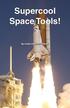 Supercool Space Tools! By Linda Hermans-Killam A long time ago, people looked into the dark night sky and wondered about the stars, meteors, comets and planets they saw. The only tools they had to study
A short history of telescopes and astronomy: Galileo to the TMT
 A short history of telescopes and astronomy: Galileo to the TMT Telescopes in the last 400 years Galileo 1608 Hans Lippershey applied for a patent for seeing things far away as if they were nearby 1609
The Cosmic Microwave Background and the Big Bang Theory of the Universe
 The Cosmic Microwave Background and the Big Bang Theory of the Universe 1. Concepts from General Relativity 1.1 Curvature of space As we discussed earlier, Einstein s equivalence principle states that
Adaptive Optics (AO) TMT Partner Institutions Collaborating Institution Acknowledgements
 THIRTY METER TELESCOPE The past century of astronomy research has yielded remarkable insights into the nature and origin of the Universe. This scientific advancement has been fueled by progressively larger
The Doppler Effect & Hubble
 The Doppler Effect & Hubble Objectives Explain the Doppler Effect. Describe Hubble s discoveries. Explain Hubble s Law. The Doppler Effect The Doppler Effect is named after Austrian physicist Christian
The Earth, Sun & Moon. The Universe. The Earth, Sun & Moon. The Universe
 Football Review- Earth, Moon, Sun 1. During a total solar eclipse, when almost all of the Sun's light traveling to the Earth is blocked by the Moon, what is the order of the Earth, Sun, and Moon? A. Moon,
Cosmic Journey: Teacher Packet
 Cosmic Journey: Teacher Packet Compiled by: Morehead State University Star Theatre with help from Bethany DeMoss Table of Contents Table of Contents 1 Corresponding Standards 2 Vocabulary 4 Sizing up the
FXA 2008. UNIT G485 Module 5 5.5.1 Structure of the Universe. Δλ = v λ c CONTENTS OF THE UNIVERSE. Candidates should be able to :
 1 Candidates should be able to : CONTENTS OF THE UNIVERSE Describe the principal contents of the universe, including stars, galaxies and radiation. Describe the solar system in terms of the Sun, planets,
The facts we know today will be the same tomorrow but today s theories may tomorrow be obsolete.
 The Scale of the Universe Some Introductory Material and Pretty Pictures The facts we know today will be the same tomorrow but today s theories may tomorrow be obsolete. A scientific theory is regarded
Your years of toil Said Ryle to Hoyle Are wasted years, believe me. The Steady State Is out of date Unless my eyes deceive me.
 Your years of toil Said Ryle to Hoyle Are wasted years, believe me. The Steady State Is out of date Unless my eyes deceive me. My telescope Has dashed your hope; Your tenets are refuted. Let me be terse:
Discover the Universe AST-1002 Section 0427, Spring 2016
 Discover the Universe AST-1002 Section 0427, Spring 2016 Instructor: Dr. Francisco Reyes Office: Room 12 Bryant Space Science Center Telephone: 352-294-1885 Email: [email protected] Office hours: Monday
Space Exploration Classroom Activity
 Space Exploration Classroom Activity The Classroom Activity introduces students to the context of a performance task, so they are not disadvantaged in demonstrating the skills the task intends to assess.
Chapter 1 Our Place in the Universe
 Chapter 1 Our Place in the Universe Syllabus 4 tests: June 18, June 30, July 10, July 21 Comprehensive Final - check schedule Website link on blackboard 1.1 Our Modern View of the Universe Our goals for
Answers for the Student Worksheet for the Hubble Space Telescope Scavenger Hunt
 Instructions: Answers are typed in blue. Answers for the Student Worksheet for the Hubble Space Telescope Scavenger Hunt Crab Nebula What is embedded in the center of the nebula? Neutron star Who first
By Adam G. Riess and Michael S. Turner
 SPECIAL REPORT FROM SLOWDOWN to SPEEDUP By Adam G. Riess and Michael S. Turner Distant supernovae are revealing the crucial time when the expansion of the universe changed from decelerating to accelerating
World of Particles Big Bang Thomas Gajdosik. Big Bang (model)
 Big Bang (model) What can be seen / measured? basically only light (and a few particles: e ±, p, p, ν x ) in different wave lengths: microwave to γ-rays in different intensities (measured in magnitudes)
So What All Is Out There, Anyway?
 So What All Is Out There, Anyway? Imagine that, like Alice in Wonderland, you have taken a magic potion that makes you grow bigger and bigger. You get so big that soon you are a giant. You can barely make
Undergraduate Studies Department of Astronomy
 WIYN 3.5-meter Telescope at Kitt Peak near Tucson, AZ Undergraduate Studies Department of Astronomy January 2014 Astronomy at Indiana University General Information The Astronomy Department at Indiana
The Solar System. Unit 4 covers the following framework standards: ES 10 and PS 11. Content was adapted the following:
 Unit 4 The Solar System Chapter 7 ~ The History of the Solar System o Section 1 ~ The Formation of the Solar System o Section 2 ~ Observing the Solar System Chapter 8 ~ The Parts the Solar System o Section
SYLLABUS FORM WESTCHESTER COMMUNITY COLLEGE Valhalla, NY l0595. l. Course #:PHYSC 151 2. NAME OF ORIGINATOR /REVISOR: PAUL ROBINSON
 SYLLABUS FORM WESTCHESTER COMMUNITY COLLEGE Valhalla, NY l0595 l. Course #:PHYSC 151 2. NAME OF ORIGINATOR /REVISOR: PAUL ROBINSON NAME OF COURSE: ASTRONOMY 3. CURRENT DATE: OCTOBER 26, 2011. Please indicate
Big Bang and Steady State Theories - Past exam questions (6 mark)
 Big Bang and Steady State Theories - Past exam questions (6 mark) (1) * Scientists believe that the Universe is expanding. Describe how careful observation of electromagnetic radiation from distant galaxies
1 Branches of Earth Science
 CHAPTER 1 1 Branches of Earth Science SECTION The World of Earth Science BEFORE YOU READ After you read this section, you should be able to answer these questions: What are the four major branches of Earth
From lowest energy to highest energy, which of the following correctly orders the different categories of electromagnetic radiation?
 From lowest energy to highest energy, which of the following correctly orders the different categories of electromagnetic radiation? From lowest energy to highest energy, which of the following correctly
Unit 8 Lesson 2 Gravity and the Solar System
 Unit 8 Lesson 2 Gravity and the Solar System Gravity What is gravity? Gravity is a force of attraction between objects that is due to their masses and the distances between them. Every object in the universe
Swarthmore College Newsletter
 93 Fog, clouds, and light pollution limit the effectiveness of even the biggest optical telescopes on Earth. Astronomers who study ultraviolet or X-ray emission of stars have been more limited because
The Earth, Sun, and Moon
 reflect The Sun and Moon are Earth s constant companions. We bask in the Sun s heat and light. It provides Earth s energy, and life could not exist without it. We rely on the Moon to light dark nights.
Earth Is Not the Center of the Universe
 Earth Is Not the Center of the Universe Source: Utah State Office of Education Introduction Have you ever looked up at the night sky and wondered about all the pinpoint lights? People through the ages
The Solar System. Source http://starchild.gsfc.nasa.gov/docs/starchild/solar_system_level1/solar_system.html
 The Solar System What is the solar system? It is our Sun and everything that travels around it. Our solar system is elliptical in shape. That means it is shaped like an egg. Earth s orbit is nearly circular.
3 HOW WERE STARS FORMED?
 3 HOW WERE STARS FORMED? David Christian explains how the first stars were formed. This two-part lecture begins by focusing on what the Universe was like in its first 200 million years of existence, a
Science@ESA vodcast series. Script for Episode 6 Charting the Galaxy - from Hipparcos to Gaia
 Science@ESA vodcast series Script for Episode 6 Charting the Galaxy - from Hipparcos to Gaia Available to download from http://sci.esa.int/gaia/vodcast Hello, I m Rebecca Barnes and welcome to the Science@ESA
Carol and Charles see their pencils fall exactly straight down.
 Section 24-1 1. Carol is in a railroad car on a train moving west along a straight stretch of track at a constant speed of 120 km/h, and Charles is in a railroad car on a train at rest on a siding along
The Big Bang A Community in the Classroom Presentation for Grade 5
 The Big Bang A Community in the Classroom Presentation for Grade 5 Richard Cupp Engineer STANARDS CONNECTION Grade 5 Physical Science: Elements and their combinations account for all the varied types of
Week 1-2: Overview of the Universe & the View from the Earth
 Week 1-2: Overview of the Universe & the View from the Earth Hassen M. Yesuf ([email protected]) September 29, 2011 1 Lecture summary Protein molecules, the building blocks of a living organism, are made
Einstein s cosmological legacy: From the big bang to black holes
 School of Mathematical and Computing Sciences Te Kura Pangarau, Rorohiko Einstein s cosmological legacy: From the big bang to black holes Matt Visser Overview: 2005 marks 100 years since Einstein discovered
Test 2 --- Natural Sciences 102, Professors Rieke --- VERSION B March 3, 2010
 Enter your answers on the form provided. Be sure to write your name and student ID number on the first blank at the bottom of the form. Please mark the version (B) in the Key ID space at the top of the
Faber-Jackson relation: Fundamental Plane: Faber-Jackson Relation
 Faber-Jackson relation: Faber-Jackson Relation In 1976, Faber & Jackson found that: Roughly, L! " 4 More luminous galaxies have deeper potentials Can show that this follows from the Virial Theorem Why
The spectacular eruption of a volcano, the magnificent scenery of a
 Section 1.1 1.1 What Is Earth Science 1 FOCUS Section Objectives 1.1 Define Earth science. 1.2 Describe the formation of Earth and the solar system. Build Vocabulary Word Parts Ask students to use a dictionary
ASTR 115: Introduction to Astronomy. Stephen Kane
 ASTR 115: Introduction to Astronomy Stephen Kane ASTR 115: Introduction to Astronomy Textbook: The Essential Cosmic Perspective, 7th Edition Homework will be via the Mastering Astronomy web site: www.pearsonmastering.com
DESCRIPTION ACADEMIC STANDARDS INSTRUCTIONAL GOALS VOCABULARY BEFORE SHOWING. Subject Area: Science
 DESCRIPTION Host Tom Selleck conducts a stellar tour of Jupiter, Saturn, Uranus, Neptune, and Pluto--the outer planets of Earth's solar system. Information from the Voyager space probes plus computer models
Once you have assembled the cards, they can be used either as fact cards or for a variety of activities in the classroom including:
 Our Place in Space This activity consists of a series of 15 cards that include images of astronomical objects on the front and information about these objects on the reverse. The card backs include information
RETURN TO THE MOON. Lesson Plan
 RETURN TO THE MOON Lesson Plan INSTRUCTIONS FOR TEACHERS Grade Level: 9-12 Curriculum Links: Earth and Space (SNC 1D: D2.1, D2.2, D2.3, D2.4) Group Size: Groups of 2-4 students Preparation time: 1 hour
Chapter 7 Our Planetary System. Agenda. Intro Astronomy. Intro Astronomy. What does the solar system look like? A. General Basics
 Chapter 7 Our Planetary System Agenda Pass back & discuss Test 2 Where we are (at) Ch. 7 Our Planetary System Finish Einstein s Big Idea Earth, as viewed by the Voyager spacecraft A. General Basics Intro
Classroom Exercise ASTR 390 Selected Topics in Astronomy: Astrobiology A Hertzsprung-Russell Potpourri
 Classroom Exercise ASTR 390 Selected Topics in Astronomy: Astrobiology A Hertzsprung-Russell Potpourri Purpose: 1) To understand the H-R Diagram; 2) To understand how the H-R Diagram can be used to follow
Exploring the Universe Through the Hubble Space Telescope
 Exploring the Universe Through the Hubble Space Telescope WEEK FIVE: THE HUBBLE DEEP FIELD + LIMITATIONS OF HUBBLE, COLLABORATIONS, AND THE FUTURE OF ASTRONOMY Date: October 14, 2013 Instructor: Robert
Observing the Universe
 Observing the Universe Stars & Galaxies Telescopes Any questions for next Monday? Light Doppler effect Doppler shift Doppler shift Spectra Doppler effect Spectra Stars Star and planet formation Sun Low-mass
Lecture 12: The Solar System Briefly
 Lecture 12: The Solar System Briefly Formation of the Moonhttp://www.youtube.com/watch?v=WpOKztEiMqo&feature =related Formation of our Solar System Conservation of Angular Momentum Why are the larger,
Earth & Space Voyage Content Unit Report. Grades: 8 States: Nevada Content Standards
 Earth & Space Voyage Content Unit Report Grades: 8 States: Unit 1: Exploring the Earth- Teacher's Guide pages 5B-18B: CONTENT STANDARD NV.N.8.A. Scientific Inquiry (Nature of Unifying graphs. opinion.
Name Class Date. true
 Exercises 131 The Falling Apple (page 233) 1 Describe the legend of Newton s discovery that gravity extends throughout the universe According to legend, Newton saw an apple fall from a tree and realized
7. In which part of the electromagnetic spectrum are molecules most easily detected? A. visible light B. radio waves C. X rays D.
 1. Most interstellar matter is too cold to be observed optically. Its radiation can be detected in which part of the electromagnetic spectrum? A. gamma ray B. ultraviolet C. infrared D. X ray 2. The space