
Section 4.3. Separating Floors. Timber frame floor with I-Beams. Upgrading existing timber floor with new ceiling. Timber frame floor with
|
|
|
- Eugene Eaton
- 10 years ago
- Views:
Transcription
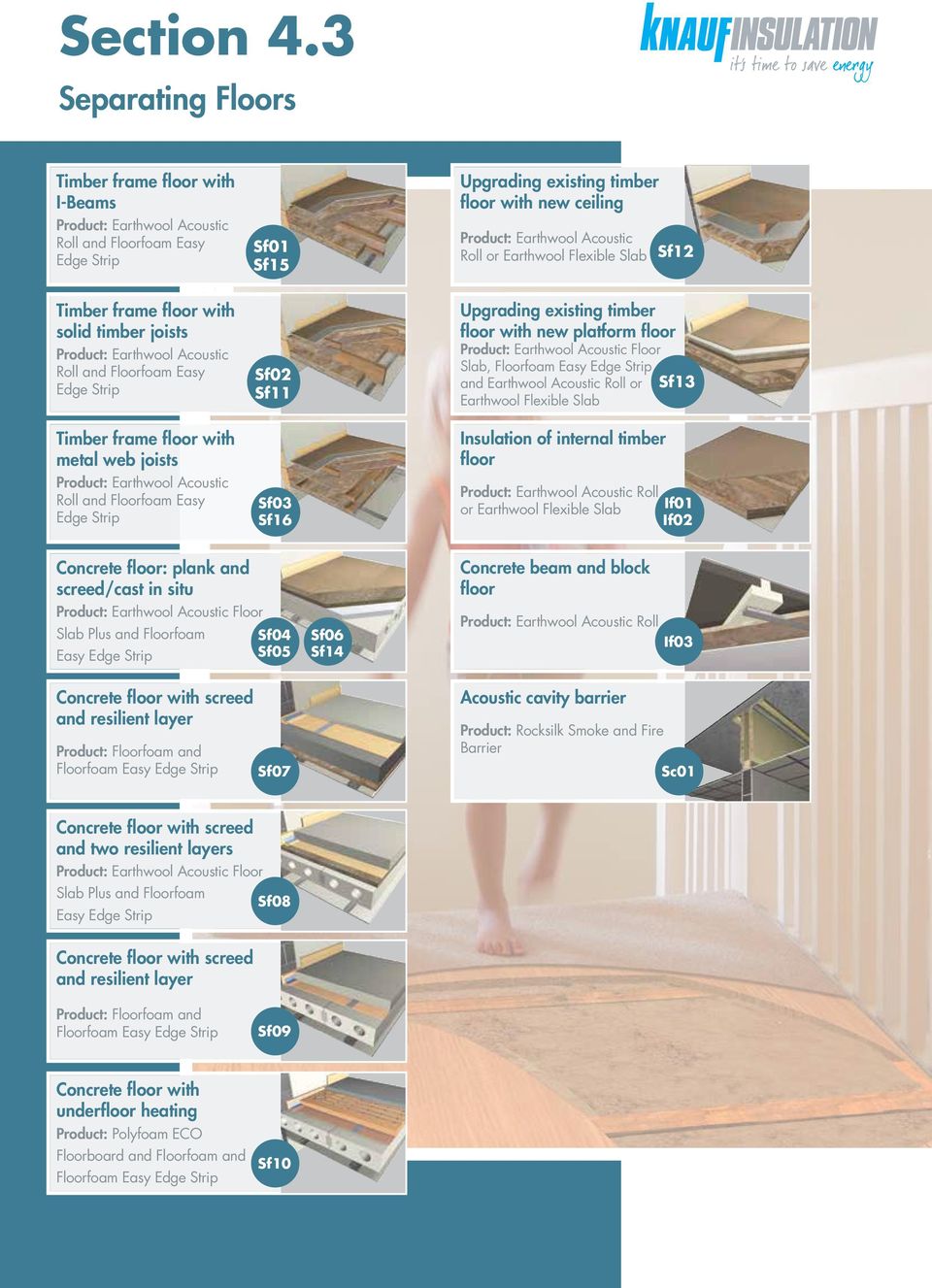
1 Section Separating Floors Timber frame floor with I-Beams Product: Earthwool Acoustic Roll and Floorfoam Easy Edge Strip Timber frame floor with solid timber joists Product: Earthwool Acoustic Roll and Floorfoam Easy Edge Strip Timber frame floor with metal web joists Product: Earthwool Acoustic Roll and Floorfoam Easy Edge Strip Sf01 Sf15 Sf02 Sf11 Sf03 Sf16 Upgrading existing timber floor with new ceiling Product: Earthwool Acoustic Roll or Earthwool Flexible Slab Sf12 Upgrading existing timber floor with new platform floor Product: Earthwool Acoustic Floor Slab, Floorfoam Easy Edge Strip and Earthwool Acoustic Roll or Sf13 Earthwool Flexible Slab Insulation of internal timber floor Product: Earthwool Acoustic Roll or Earthwool Flexible Slab If01 If02 Concrete floor: plank and screed/cast in situ Product: Earthwool Acoustic Floor Slab Plus and Floorfoam Easy Edge Strip Concrete floor with screed and resilient layer Product: Floorfoam and Floorfoam Easy Edge Strip Sf04 Sf05 Sf07 Sf06 Sf14 Concrete beam and block floor Product: Earthwool Acoustic Roll If03 Acoustic cavity barrier Product: Rocksilk Smoke and Fire Barrier Sc01 Concrete floor with screed and two resilient layers Product: Earthwool Acoustic Floor Slab Plus and Floorfoam Easy Edge Strip Concrete floor with screed and resilient layer Sf08 Product: Floorfoam and Floorfoam Easy Edge Strip Sf09 Concrete floor with underfloor heating Product: Polyfoam ECO Floorboard and Floorfoam and Floorfoam Easy Edge Strip Sf10
2 Separating Floors Separating floors Separating floor design Mineral wool products offer substantial advantages when used as both sound absorbent and resilient layers in floors that are required to provide sound insulation. Mineral wool provides an alternative method of controlling airborne sound transmission through a floor as opposed to simply increasing the mass. The sound reduction performance of floors can be greatly increased by installing a layer of glass or rock mineral wool in floor voids to absorb energy from airborne sound waves. A secondary benefit of glass or rock mineral wool is to provide thermal separation between floors so that dwellings can be zoned independently for heating. When used as a resilient layer to isolate the floor surface from the structural deck, appropriate rock mineral wool products will substantially reduce the transmission of impact sound through a structure. Equally, extruded polyethylene offers a high level of performance when used as a resilient layer below a screed. England and Wales Compliance with Approved Document E for separating floors can be achieved in one of two ways: Construct the separating floor and show compliance by carrying out airborne and impact sound tests, in accordance with the procedures stated in the aforementioned document, proving the performance of the floor complies with the standards set out in the table below Construct the separating floor using a Robust Detail no sound test is required, but a fee is payable to Robust Details Ltd Robust Details Monitoring of the Robust Details is carried out by Robust Details Ltd, a not for profit company specifically set up for this purpose. See Robust Details Ltd will organise quality checking of existing Robust Details and be responsible for the future development of Robust Details. All floating floor and ceiling treatments for separating floors, where stipulated, are to have a proven level of performance from laboratory tests before they can be used in a Robust Detail. Scotland and Ireland In Technical Handbook 5 of the Technical Standards in Scotland, Technical Booklet G in Northern Ireland and Part E of the Irish Regulations, compliance can be achieved either by adopting specified constructions or by testing to show that non-specified constructions meet the Performance Standards. Note that Scotland, Northern Ireland and Ireland have not adopted the D nt,w +C tr sound spectrum for testing that must be used in England and Wales. The performance standards are therefore not directly comparable. The rationale for using mineral wool as noise control The sound absorption characteristics of mineral wool make it ideal for use in modern buildings to comply with Approved Document E of the Building Regulations in England and Wales, Technical Handbook, Section 5 for Scotland and Technical booklets G and G1 for Northern Ireland. In addition, the thermal properties of mineral wool provide a secondary benefit of minimising heat loss, either between attached dwellings or between storeys within a dwelling. A further benefit is to minimise the overall mass of the construction, easing construction processes. How glass or rock mineral wool works in a wall or floor cavity In an unfilled cavity, the linings (plasterboard or chipboard etc) and cavity alone provide the sound insulation which can result in poor performance and a hollow sounding construction. Adding mineral wool improves the sound insulation by absorbing reverberant sound within the cavity therefore reducing the amount of sound energy transferred from one side of the construction to the other. 230 Technical Advice and Support Centre

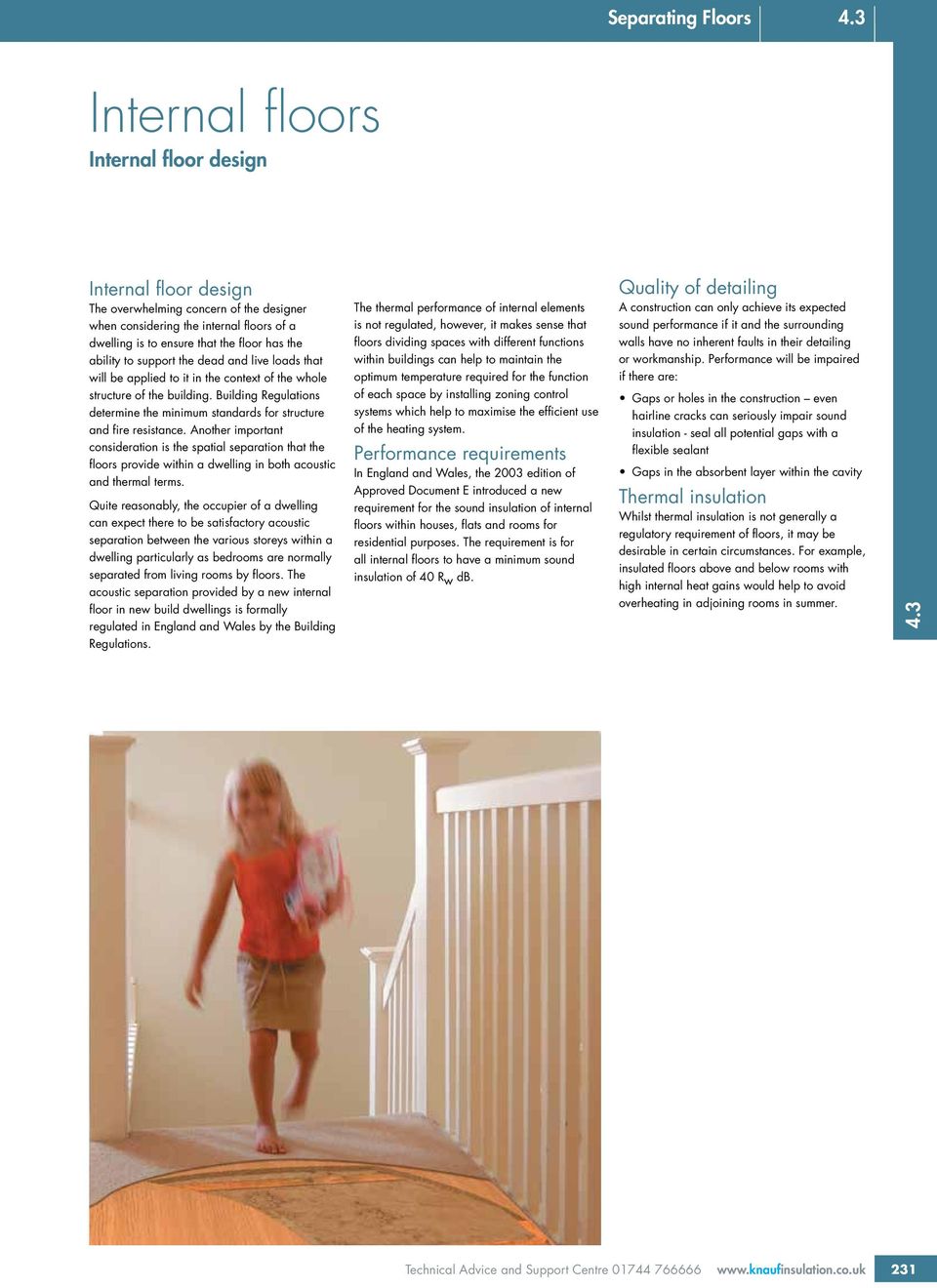
3 Separating Floors Internal floors Internal floor design Internal floor design The overwhelming concern of the designer The thermal performance of internal elements Quality of detailing A construction can only achieve its expected when considering the internal floors of a is not regulated, however, it makes sense that sound performance if it and the surrounding dwelling is to ensure that the floor has the floors dividing spaces with different functions walls have no inherent faults in their detailing ability to support the dead and live loads that within buildings can help to maintain the or workmanship. Performance will be impaired will be applied to it in the context of the whole optimum temperature required for the function if there are: structure of the building. Building Regulations determine the minimum standards for structure and fire resistance. Another important consideration is the spatial separation that the floors provide within a dwelling in both acoustic and thermal terms. Quite reasonably, the occupier of a dwelling can expect there to be satisfactory acoustic separation between the various storeys within a dwelling particularly as bedrooms are normally separated from living rooms by floors. The acoustic separation provided by a new internal floor in new build dwellings is formally regulated in England and Wales by the Building of each space by installing zoning control systems which help to maximise the efficient use of the heating system. Performance requirements In England and Wales, the 2003 edition of Approved Document E introduced a new requirement for the sound insulation of internal floors within houses, flats and rooms for residential purposes. The requirement is for all internal floors to have a minimum sound insulation of 40 R w db. Gaps or holes in the construction even hairline cracks can seriously impair sound insulation - seal all potential gaps with a flexible sealant Gaps in the absorbent layer within the cavity Thermal insulation Whilst thermal insulation is not generally a regulatory requirement of floors, it may be desirable in certain circumstances. For example, insulated floors above and below rooms with high internal heat gains would help to avoid overheating in adjoining rooms in summer. Regulations. Technical Advice and Support Centre
4 Separating Floors Separating floors Timber frame floor with I-Beams ( RD E-FT-1) Earthwool Acoustic Roll and Floorfoam Easy Edge Strip Established acoustic solution delivering a high level of sound insulation No need to carry out pre-completion site testing Sf01 Sf15 25mm Earthwool Acoustic Roll Sub-deck Timber battens with resilient foam base NEW BUILD Provides a high level of thermal separation between adjoining properties Earthwool Acoustic Roll Non-combustible with a Euroclass A1 reaction to fire rating A+ Generic BRE Green Guide Rating Zero Ozone Depletion Potential (ODP) Zero Global Warming Potential (GWP) Floorfoam Easy Edge Strip Knauf Drywall Resilient Bar at 400mm centres 18mm chipboard spot bonded to19mm Knauf Drywall Plank 240mm deep engineered timber I beams 100mm Earthwool Acoustic Roll One layer 19mm Knauf Drywall Plank and one layer12.5mm Knauf Drywall Soundshield Products Earthwool Acoustic Roll is made from glass mineral wool and formed into rolls which are lightweight, flexible, resilient and non-combustible. The product s density meets the appropriate requirements of Robust Detail E-FT-1. Floorfoam Easy Edge Strip is a strip of extruded polyethylene, pre-scored to fold around the edge of the floor deck. The 65mm wide top section is also scored at 10mm intervals to make trimming at the skirting easier. The 65mm vertical section incorporates a self adhesive strip with release tape. This enables Floorfoam Easy Edge Strip to be secured in place when the floor deck is laid. Typical construction Timber floor using engineered I beams with battened floor with 25mm Earthwool Acoustic Roll between resilient battens. 100mm Earthwool Acoustic Roll between the joists and a double layer ceiling of mass 24 kg/m 2 on Knauf Drywall resilient bars at 400mm centres. The construction complies with Robust Detail E-FT-1. No pre-completion testing is required with Robust Details. Refer to Robust Details specification sheets and checklists for junction, flanking and other construction details. It should be noted when considering using Robust Details in the construction of flats, that separating walls and floors must be compatible. The Robust Detail manual carries details of which walls and floors can be combined together. Installation On completion of the structural timber floor, Knauf Drywall Resilient Bars are screw fixed to the underside of the joists. Lengths of Earthwool Acoustic Roll are inserted into the voids between the I beams. The insulation should rest on the resilient bars and butt up against the I beams with no gaps. The plasterboard ceiling can then be fixed to the resilient bars. Ensure that the plasterboard screws do not penetrate into the timber I beams. On completion of the sub-floor deck and first fix services, resilient composite timber battens are laid out at 600mm centres. Earthwool Acoustic Roll is laid between the battens. It must be laid under any services in the sub-floor void. The plasterboard plank and chipboard floor deck are fixed to the timber battens. Floorfoam Easy Edge Strip should be adhered to the perimeter wall with the integral self adhesive strip. The floor deck is laid and butted up to the Floorfoam Easy Edge Strip, which is later folded under the skirting to provide acoustic isolation of the floor deck from the walls. 232 Technical Advice and Support Centre

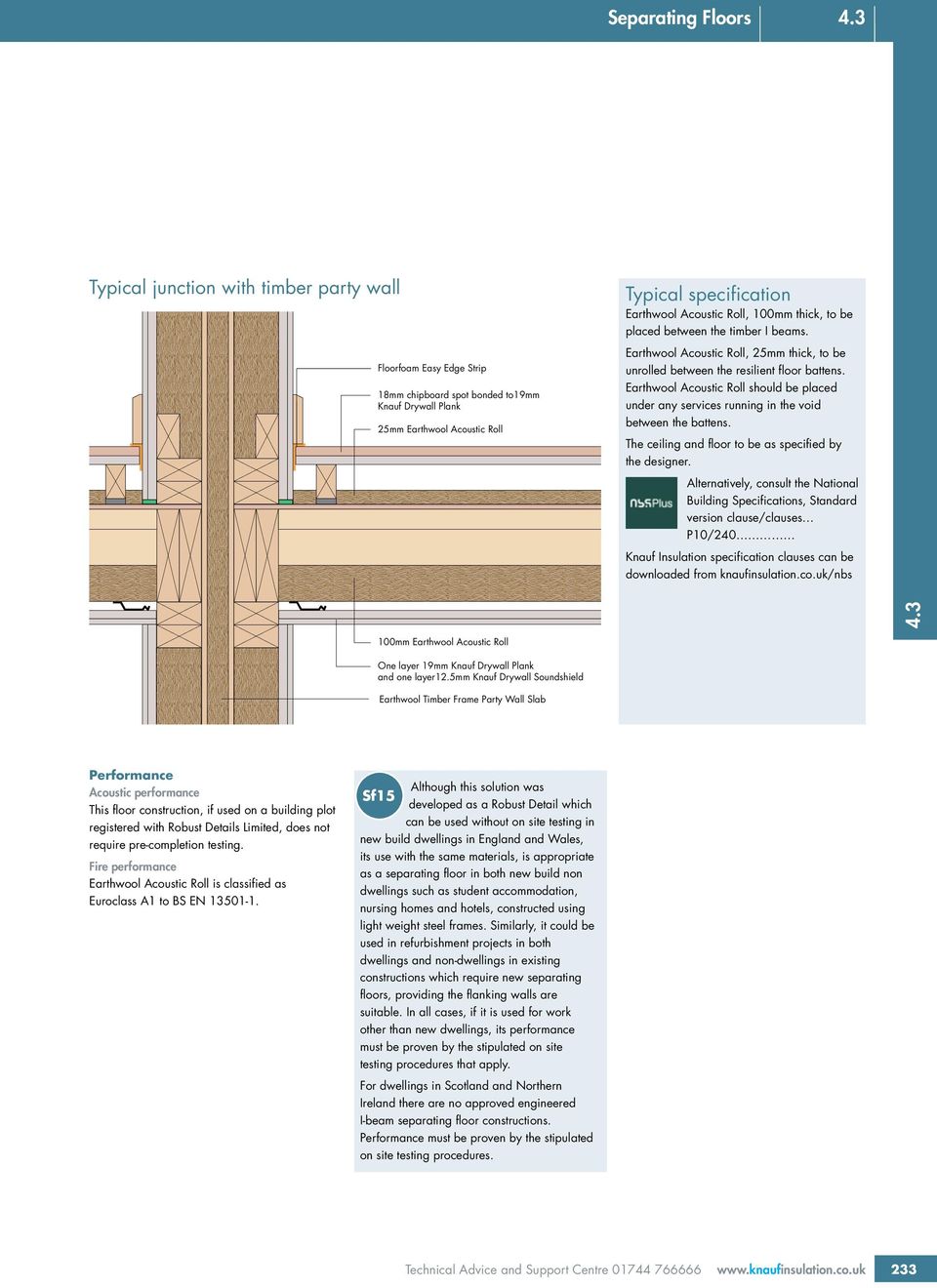
5 Separating Floors Typical junction with timber party wall Floorfoam Easy Edge Strip 18mm chipboard spot bonded to19mm Knauf Drywall Plank 25mm Earthwool Acoustic Roll Typical specification Earthwool Acoustic Roll, 100mm thick, to be placed between the timber I beams. Earthwool Acoustic Roll, 25mm thick, to be unrolled between the resilient floor battens. Earthwool Acoustic Roll should be placed under any services running in the void between the battens. The ceiling and floor to be as specified by the designer. Alternatively, consult the National Building Specifications, Standard version clause/clauses P10/240 Knauf Insulation specification clauses can be downloaded from knaufinsulation.co.uk/nbs 100mm Earthwool Acoustic Roll One layer 19mm Knauf Drywall Plank and one layer12.5mm Knauf Drywall Soundshield Earthwool Timber Frame Party Wall Slab Performance Acoustic performance This floor construction, if used on a building plot registered with Robust Details Limited, does not require pre-completion testing. Fire performance Earthwool Acoustic Roll is classified as Euroclass A1 to BS EN Although this solution was Sf15 developed as a Robust Detail which can be used without on site testing in new build dwellings in England and Wales, its use with the same materials, is appropriate as a separating floor in both new build non dwellings such as student accommodation, nursing homes and hotels, constructed using light weight steel frames. Similarly, it could be used in refurbishment projects in both dwellings and non-dwellings in existing constructions which require new separating floors, providing the flanking walls are suitable. In all cases, if it is used for work other than new dwellings, its performance must be proven by the stipulated on site testing procedures that apply. For dwellings in Scotland and Northern Ireland there are no approved engineered I-beam separating floor constructions. Performance must be proven by the stipulated on site testing procedures. Technical Advice and Support Centre
6 Separating Floors Separating floors Timber frame floor with solid timber joists ( RD E-FT-2) Earthwool Acoustic Roll and Floorfoam Easy Edge Strip Resilient deep battens and Floorfoam Easy Edge Strip isolate the flooring surface from the main structure Sf02 Sf11 NEW BUILD Provides a high level of thermal separation between adjoining properties No need to carry out pre-completion site testing Earthwool Acoustic Roll Non-combustible with a Euroclass A1 reaction to fire rating Floorfoam Easy Edge Strip A+ Generic BRE Green Guide Rating Zero Ozone Depletion Potential (ODP) Zero Global Warming Potential (GWP) 100mm Earthwool Acoustic Roll 75mm Earthwool Acoustic Roll between resilient composite deep battens 18mm chipboard spot bonded to19mm Knauf Drywall Plank 11mm OSB or Walker Timber perforated deck system 220mm (min) timber joists One layer 19mm Knauf Drywall Plank and one layer12.5mm Knauf Drywall Standard Wallboard on Knauf Drywall Resilient Bar at 400mm centres Products Earthwool Acoustic Roll is made from glass mineral wool and formed into rolls which are lightweight, flexible, resilient and noncombustible. The product s density meets the appropriate requirements of Robust Detail E-FT-2. Floorfoam Easy Edge Strip is a strip of extruded polyethylene, pre-scored to fold around the edge of the floor deck. The 65mm wide top section is also scored at 10mm intervals to make trimming at the skirting easier. The 65mm vertical section incorporates a self adhesive strip with release tape. This enables the Floorfoam Easy Edge Strip to be secured in place when the floor deck is laid. Typical construction A new timber floor using solid timber joists with battened floor with 75mm Earthwool Acoustic Roll between resilient battens. 100mm Earthwool Acoustic Roll between the joists and a ceiling of double layer plasterboard on Knauf Drywall resilient bars at 400mm centres. The construction complies with Robust Detail E-FT-2. No pre-completion testing is required with Robust Details. Refer to Robust Detail specification sheets and checklists for junction, flanking and other construction details. It should be noted when considering using Robust Details in the construction of flats that separating walls and floors must be compatible. The Robust Detail manual carries details of which walls and floors can be combined together. Installation On completion of the structural timber floor, Knauf Drywall Resilient Bars are screw fixed to the underside of the joists. Lengths of Earthwool Acoustic Roll are inserted into the voids between the timber joists. The insulation should rest on the resilient bars and butt up against the timber joists with no gaps. The plasterboard ceiling can then be fixed to the resilient bars. Ensure that the plasterboard screws do not penetrate into the timber joists. On completion of the sub-floor deck and first fix services, resilient composite timber battens are laid out at 600mm centres. Earthwool Acoustic Roll is laid between the battens. It must be laid under the services in the sub-floor void. The plasterboard plank and chipboard floor deck are fixed to the timber battens. Floorfoam Easy Edge Strip should be adhered to the perimeter wall with the integral self adhesive strip. The floor deck is laid and butted up to the Polyfoam Easy Edge Strip, which is later folded under the skirting to provide acoustic isolation of the floor deck from the walls. 234 Technical Advice and Support Centre

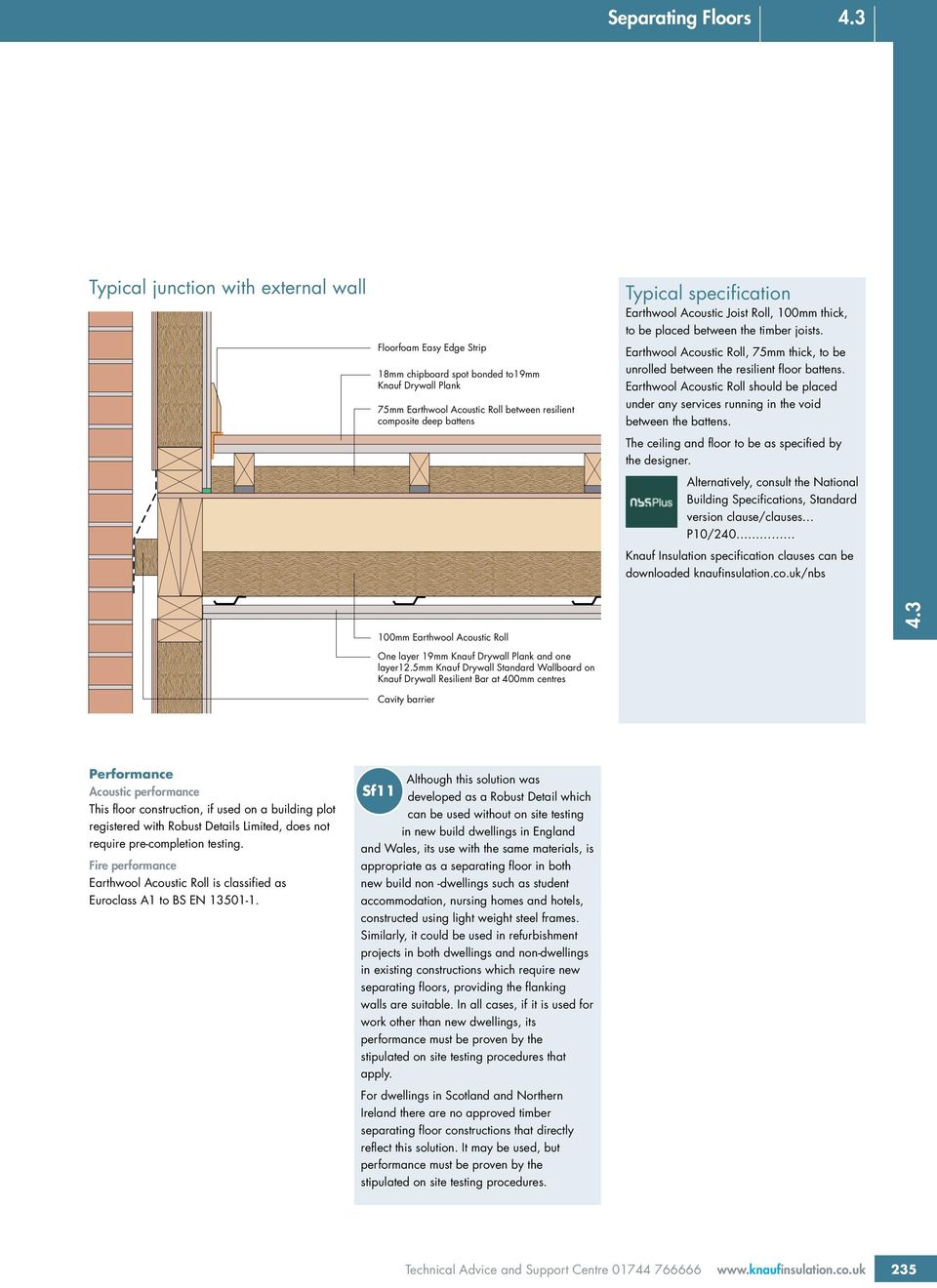
7 Separating Floors Typical junction with external wall Floorfoam Easy Edge Strip 18mm chipboard spot bonded to19mm Knauf Drywall Plank 75mm Earthwool Acoustic Roll between resilient composite deep battens Typical specification Earthwool Acoustic Joist Roll, 100mm thick, to be placed between the timber joists. Earthwool Acoustic Roll, 75mm thick, to be unrolled between the resilient floor battens. Earthwool Acoustic Roll should be placed under any services running in the void between the battens. The ceiling and floor to be as specified by the designer. Alternatively, consult the National Building Specifications, Standard version clause/clauses P10/240 Knauf Insulation specification clauses can be downloaded knaufinsulation.co.uk/nbs 100mm Earthwool Acoustic Roll One layer 19mm Knauf Drywall Plank and one layer12.5mm Knauf Drywall Standard Wallboard on Knauf Drywall Resilient Bar at 400mm centres Cavity barrier Performance Acoustic performance This floor construction, if used on a building plot registered with Robust Details Limited, does not require pre-completion testing. Fire performance Earthwool Acoustic Roll is classified as Euroclass A1 to BS EN Although this solution was Sf11 developed as a Robust Detail which can be used without on site testing in new build dwellings in England and Wales, its use with the same materials, is appropriate as a separating floor in both new build non -dwellings such as student accommodation, nursing homes and hotels, constructed using light weight steel frames. Similarly, it could be used in refurbishment projects in both dwellings and non-dwellings in existing constructions which require new separating floors, providing the flanking walls are suitable. In all cases, if it is used for work other than new dwellings, its performance must be proven by the stipulated on site testing procedures that apply. For dwellings in Scotland and Northern Ireland there are no approved timber separating floor constructions that directly reflect this solution. It may be used, but performance must be proven by the stipulated on site testing procedures. Technical Advice and Support Centre
8 Separating Floors Separating floors Timber frame floor with metal web joists ( RD E-FT-3) Earthwool Acoustic Roll and Floorfoam Easy Edge Strip Resilient deep battens and Floorfoam Easy Edge Strip isolate the floor surface from the main structure Sf03 Sf16 NEW BUILD Provides a high level of thermal separation between adjoining properties No need to carry out pre-completion site acoustic tests Earthwool Acoustic Roll Non-combustible with a Euroclass A1 reaction to fire rating A+ Generic BRE Green Guide Rating 100mm Earthwool Acoustic Roll Zero Ozone Depletion Potential (ODP) Zero Global Warming Potential (GWP) 25mm Earthwool Acoustic Roll between resilient composite deep battens Floorfoam Easy Edge Strip One layer 19mm Knauf Drywall Plank and one layer12.5mm Knauf Drywall Standard Wallboard on Knauf Drywall Resilient Bar at 400mm centres 220mm (min) metal web joists 18mm chipboard spot bonded to19mm Knauf Drywall Plank 18mm thick wood based board Products Earthwool Acoustic Roll is made from glass mineral wool and formed into rolls which are lightweight, flexible, resilient and non-combustible. The product s density meets the appropriate requirements of Robust Detail E-FT-3. Floorfoam Easy Edge Strip is a strip of extruded polyethylene, pre-scored to fold around the edge of the floor deck. The 65mm wide top section is also scored at 10mm intervals to make trimming at the skirting easier. The 65mm vertical section incorporates a self adhesive strip with release tape. This enables the Floorfoam Easy Edge Strip to be secured in place when the floor deck is laid. Typical construction A new timber floor using metal web joists built into frame to support floor. 100mm Earthwool Acoustic Roll is installed between the metal web joists and a ceiling of double layer plasterboard on Knauf Drywall resilient bars at 400mm centres, above which is a resilient battened floor with 25mm Earthwool Acoustic Roll between the resilient composite deep battens. The construction complies with Robust Detail E-FT-3. No pre completion testing is required with Robust Details. Refer to Robust Details specification sheets and checklists for junction, flanking and other construction details. It should be noted when considering using Robust Details in the construction of flats that separating walls and floors must be compatible. The Robust Detail manual carries details of which walls and floors can be combined together. Installation On completion of the structural timber floor, Knauf Drywall Resilient Bars are screw fixed to the underside of the metal web joists. Lengths of Earthwool Acoustic Roll are inserted into the voids between the web joists. The insulation should rest on the resilient bars and butt up against the joists with no gaps. The plasterboard ceiling can then be fixed to the resilient bars. On completion of the sub-floor deck and first fix services, resilient composite timber battens are laid out at 600mm centres. Earthwool Acoustic Roll is laid between the battens. It must be laid under the services in the sub-floor void. The plasterboard plank and chipboard floor deck are fixed to the timber battens. Floorfoam Easy Edge Strip should be adhered to the perimeter wall with the integral self adhesive strip. The floor deck is laid and butted up to the Floorfoam Easy Edge Strip, which is later folded under the skirting to provide acoustic isolation of the floor deck from the walls. 236 Technical Advice and Support Centre

9 Separating Floors Typical junction with external wall Typical specification Earthwool Acoustic Roll, 100mm thick, to be placed between the timber joists. Floorfoam Easy Edge Strip 18mm chipboard spot bonded to 19mm Knauf Drywall Plank 25mm Earthwool Acoustic Partition Roll between resilient composite deep battens Earthwool Acoustic Roll, 25mm thick, to be unrolled between the resilient floor battens. Earthwool Acoustic Roll should be placed under any services running in the void between the battens. The ceiling and floor to be as specified by the designer. Alternatively, consult the National Building Specifications, Standard version clause/clauses P10/240 Knauf Insulation specification clauses can be downloaded from knaufinsulation.co.uk/nbs 100mm Earthwool Acoustic Joist Roll One layer 19mm Knauf Drywall Plank and one layer 12.5mm Knauf Drywall Standard Wallboard on Knauf Drywall Resilient Bar at 400mm centres Cavity Barrier Performance Acoustic performance This floor construction, if used on a building plot registered with Robust Details Limited, does not require pre completion testing. Fire performance Earthwool Acoustic Roll is classified as Euroclass A1 to BS EN Although this solution was Sf16 developed as a Robust Detail which can be used without on site testing in new build dwellings in England and Wales, its use with the same materials, is appropriate as a separating floor in both new build non- dwellings such as student accommodation, nursing homes and hotels, constructed using light weight steel frames. Similarly, it could be used in refurbishment projects in both dwellings and non-dwellings in existing constructions which require new separating floors, providing the flanking walls are suitable. In all cases, if it is used for work other than new dwellings, its performance must be proven by the stipulated on site testing procedures that apply. For dwellings in Scotland and Northern Ireland there are no approved timber separating floor constructions that directly reflect this solution. It may be used, but performance must be proven by the stipulated on site testing procedures. Technical Advice and Support Centre

10 Separating Floors Separating floors Concrete floor: plank and screed/cast in situ ( RD E-FC-1, E-FC-2 and E-FS-1) Earthwool Acoustic Floor Slab Plus and Floorfoam Easy Edge Strip Earthwool Acoustic Floor Slab Plus 97/3433 No need to carry out pre-completion site testing Exceeds the acoustic performance required by Robust Details for a resilient layer in a floating floor application Sf04 Sf05 Sf06 Sf14 NEW BUILD 40mm (min) screed directly applied to plank - cement/sand or proprietary screed nominal 80 kg/m 2 mass per unit area Earthwool Acoustic Floor Slab Plus Non-combustible with a Euroclass A1 reaction to fire rating Zero Ozone Depletion Potential (ODP) Zero Global Warming Potential (GWP) EFC-1 - Sf05 18mm chipboard 30mm Earthwool Acoustic Floor Slab Plus Floorfoam Easy Edge Strip Minimum 150mm precast concrete slab (minimum 300kg/m 2 mass) 15mm plasterboard supported by Knauf Drywall C Form II Ceiling System, minimum 75mm separation Products Earthwool Acoustic Floor Slab Plus is a dense, rigid, non-combustible slab of rock mineral wool which is highly compression resistant. Floorfoam Easy Edge Strip is a 10mm thick strip of extruded polyethylene, pre-scored to fold around the edge of a floating floor deck. Typical construction A precast concrete floor slab with a 40mm (min) screed directly applied to plank (cement/ sand or proprietary screed nominal 80 kg/m 2 mass per unit area) and a floating floor of 18mm chipboard on 30mm Earthwool Acoustic Floor Slab Plus. A ceiling of 15mm plasterboard supported on the Knauf Drywall C Form II ceiling system. The construction complies with Robust Standard Detail E-FC-1 with FFT4 floating floor treatment. No pre-completion testing is required with Robust Details. Refer to Robust Detail specification sheets and checklists for junction, flanking and other construction details. It should be noted when considering using Robust Details in the construction of flats, that separating walls and floors must be compatible. The Robust Detail manual carries details of which walls and floors can be combined together. Earthwool Acoustic Floor Slab Plus is also suitable for Robust Standard Details E-FC-2 (Sf06) and E-FS-1 (Sf04), as illustrated on the page opposite. Installation The surface of the screed should be smooth and flat within 5mm when measured with a 2 metre straight edge. When the screed has dried out, fix Floorfoam Easy Edge Strip to the perimeter wall with the integral self adhesive strip. Install timber battens on resilient strips at the floor perimeter and thresholds then lay Earthwool Acoustic Floor Slab Plus over the entire floor area. The slabs should be tightly butted together with no open joints. Lay the tongued and grooved chipboard over the insulation and glue all joints. Ensure that the Floorfoam Easy Edge Strip isolates the boards from the walls. Turn the top edge of the Floorfoam Easy Edge Strip onto the surface of the chipboard and trim once the skirting has been fixed in position. No services should be installed in the floor system. Performance Acoustic performance Earthwool Acoustic Floor Slab Plus has been tested with standard 18mm chipboard in accordance with the requirements of Robust Detail Appendix D to exceed the minimum requirement for acoustic performance for floating floor treatments for use with concrete and steel composite separating floors. This floor construction, if used on a building plot registered with Robust Details Limited, does not require pre completion testing. Fire performance Earthwool Acoustic Floor Slab Plus is classified as Euroclass A1 to BS EN Technical Advice and Support Centre

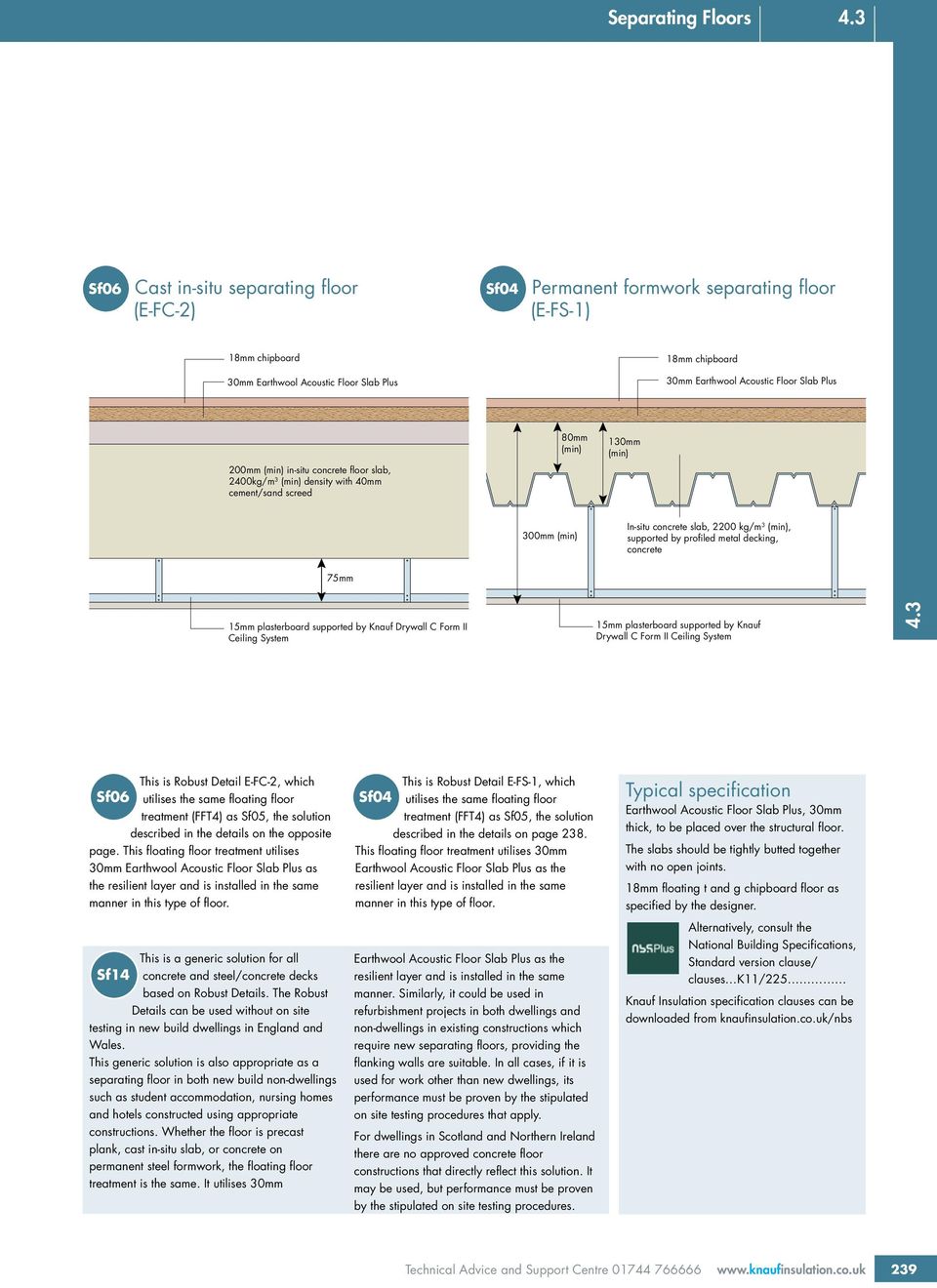
11 Separating Floors Sf06 Cast in-situ separating floor (E-FC-2) Sf04 Permanent formwork separating floor (E-FS-1) 18mm chipboard 18mm chipboard 30mm Earthwool Acoustic Floor Slab Plus 30mm Earthwool Acoustic Floor Slab Plus 200mm (min) in-situ concrete floor slab, 2400kg/m 3 (min) density with 40mm cement/sand screed 80mm (min) 130mm (min) 300mm (min) In-situ concrete slab, 2200 kg/m 3 (min), supported by profiled metal decking, concrete 75mm 15mm plasterboard supported by Knauf Drywall C Form II Ceiling System 15mm plasterboard supported by Knauf Drywall C Form II Ceiling System This is Robust Detail E-FC-2, which Sf06 utilises the same floating floor treatment (FFT4) as Sf05, the solution described in the details on the opposite page. This floating floor treatment utilises 30mm Earthwool Acoustic Floor Slab Plus as the resilient layer and is installed in the same manner in this type of floor. This is a generic solution for all Sf14 concrete and steel/concrete decks based on Robust Details. The Robust Details can be used without on site testing in new build dwellings in England and Wales. This generic solution is also appropriate as a separating floor in both new build non-dwellings such as student accommodation, nursing homes and hotels constructed using appropriate constructions. Whether the floor is precast plank, cast in-situ slab, or concrete on permanent steel formwork, the floating floor treatment is the same. It utilises 30mm This is Robust Detail E-FS-1, which Sf04 utilises the same floating floor treatment (FFT4) as Sf05, the solution described in the details on page 238. This floating floor treatment utilises 30mm Earthwool Acoustic Floor Slab Plus as the resilient layer and is installed in the same manner in this type of floor. Earthwool Acoustic Floor Slab Plus as the resilient layer and is installed in the same manner. Similarly, it could be used in refurbishment projects in both dwellings and non-dwellings in existing constructions which require new separating floors, providing the flanking walls are suitable. In all cases, if it is used for work other than new dwellings, its performance must be proven by the stipulated on site testing procedures that apply. For dwellings in Scotland and Northern Ireland there are no approved concrete floor constructions that directly reflect this solution. It may be used, but performance must be proven by the stipulated on site testing procedures. Typical specification Earthwool Acoustic Floor Slab Plus, 30mm thick, to be placed over the structural floor. The slabs should be tightly butted together with no open joints. 18mm floating t and g chipboard floor as specified by the designer. Alternatively, consult the National Building Specifications, Standard version clause/ clauses K11/225 Knauf Insulation specification clauses can be downloaded from knaufinsulation.co.uk/nbs Technical Advice and Support Centre
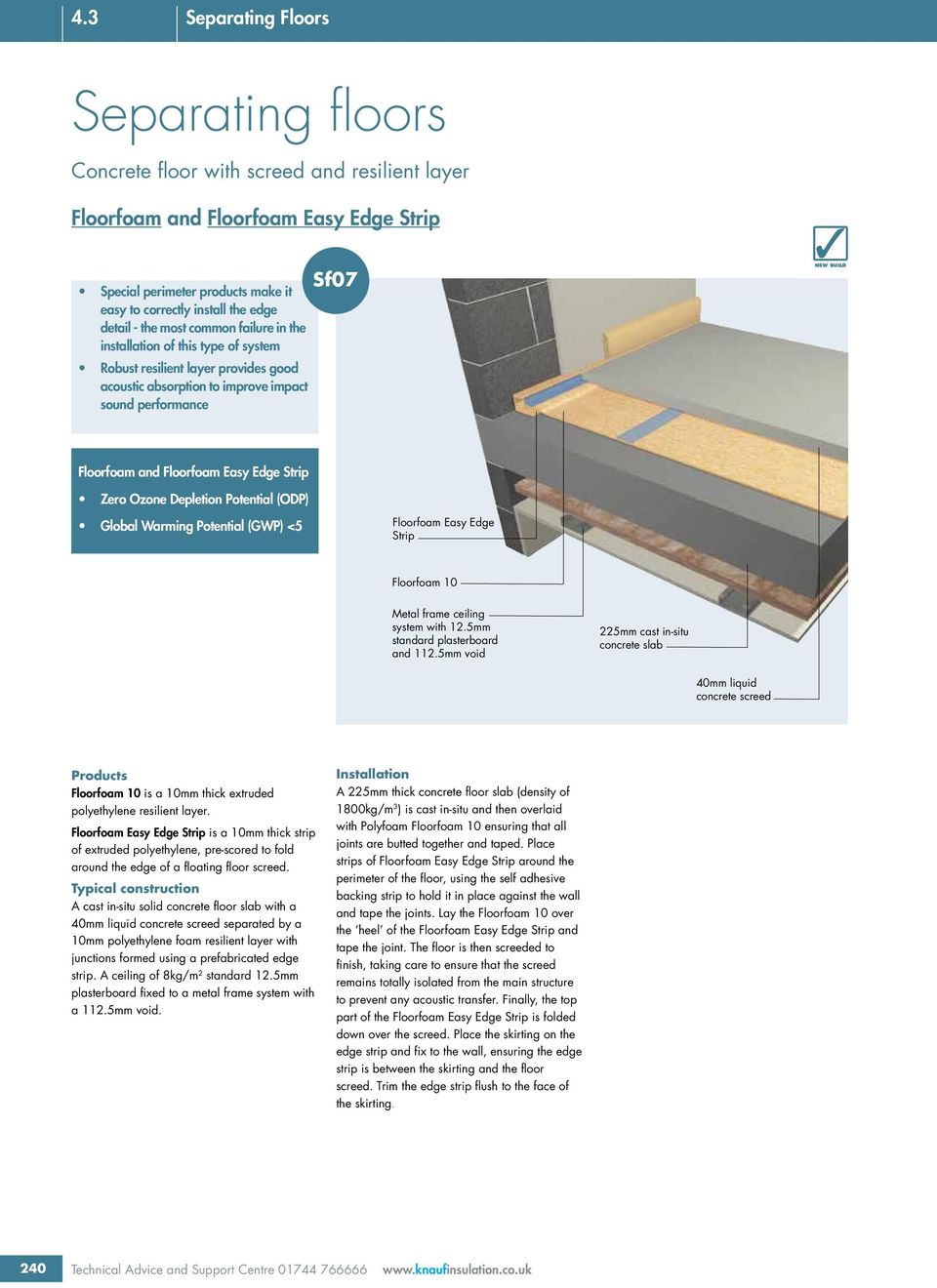
12 Separating Floors Separating floors Concrete floor with screed and resilient layer Floorfoam and Floorfoam Easy Edge Strip Special perimeter products make it easy to correctly install the edge detail - the most common failure in the installation of this type of system Robust resilient layer provides good acoustic absorption to improve impact sound performance Sf07 NEW BUILD Floorfoam and Floorfoam Easy Edge Strip Zero Ozone Depletion Potential (ODP) Global Warming Potential (GWP) <5 Floorfoam Easy Edge Strip Floorfoam 10 Metal frame ceiling system with 12.5mm standard plasterboard and 112.5mm void 225mm cast in-situ concrete slab 40mm liquid concrete screed Products Floorfoam 10 is a 10mm thick extruded polyethylene resilient layer. Floorfoam Easy Edge Strip is a 10mm thick strip of extruded polyethylene, pre-scored to fold around the edge of a floating floor screed. Typical construction A cast in-situ solid concrete floor slab with a 40mm liquid concrete screed separated by a 10mm polyethylene foam resilient layer with junctions formed using a prefabricated edge strip. A ceiling of 8kg/m 2 standard 12.5mm plasterboard fixed to a metal frame system with a 112.5mm void. Installation A 225mm thick concrete floor slab (density of 1800kg/m 3 ) is cast in-situ and then overlaid with Polyfoam Floorfoam 10 ensuring that all joints are butted together and taped. Place strips of Floorfoam Easy Edge Strip around the perimeter of the floor, using the self adhesive backing strip to hold it in place against the wall and tape the joints. Lay the Floorfoam 10 over the heel of the Floorfoam Easy Edge Strip and tape the joint. The floor is then screeded to finish, taking care to ensure that the screed remains totally isolated from the main structure to prevent any acoustic transfer. Finally, the top part of the Floorfoam Easy Edge Strip is folded down over the screed. Place the skirting on the edge strip and fix to the wall, ensuring the edge strip is between the skirting and the floor screed. Trim the edge strip flush to the face of the skirting. 240 Technical Advice and Support Centre
13 Separating Floors Typical junction with external wall Floorfoam Easy Edge Strip 40mm liquid concrete screed Floorfoam 10 resilient layer Typical specification An unfolded strip of Floorfoam Easy Edge Strip to be placed against the wall at the floor perimeter. Overlay concrete floor slab with Floorfoam 10, closely butt jointing and taping joints, including overlap over heel of Floorfoam Easy Edge Strip. Minimum 40mm liquid screed laid over the resilient layer. The screed to be isolated from the wall and structural elements in the floor. Floorfoam Easy Edge Strip to be folded back over screed and fixed between skirting board and wall. Alternatively, consult the National Building Specifications, Standard version clause/clauses M10/290 25mm Earthwool Acoustic Roll Knauf Insulation specification clauses can be downloaded from knaufinsulation.co.uk/nbs Metal frame ceiling system with 12.5mm standard plasterboard and 112.5mm void Performance Acoustic performance Floorfoam 10 and Easy Edge Strip have been developed for cushioning vibrations. Their closed cell construction makes them excellent at absorbing impact sound. This construction requires testing to show compliance with Building Regulations. Density Floorfoam 10 and Floorfoam Easy Edge Strip have a minimum density of 30 kg/m 3. Compression resistance The closed cell nature of Floorfoam makes it resistant to compression. Fire performance When Floorfoam is installed in a concrete floor construction it will not contribute to the development stages of a fire. Technical Advice and Support Centre

14 Separating Floors Separating floors Concrete floor with screed and two resilient layers Earthwool Acoustic Floor Slab Plus and Floorfoam Easy Edge Strip Earthwool Acoustic Floor Slab Plus 97/3433 Special perimeter products make it easy to correctly install the edge detail - the most common failure in the installation of this type of system Sf08 NEW BUILD Robust resilient layer provides good acoustic absorption to improve impact sound performance Earthwool Acoustic Floor Slab Plus Non-combustible with a Euroclass A1 reaction to fire rating Zero Ozone Depletion Potential (ODP) Earthwool Acoustic Floor Slab Plus Global Warming Potential (GWP) Floorfoam and Floorfoam Easy Edge Strip Zero Ozone Depletion Potential (ODP) Global Warming Potential (GWP) <5 Floating screed Floorfoam Easy Edge Strip folded over screed and under skirting Floorfoam Easy Edge Strip placed, unfolded, around the floor perimeter Precast concrete planks Floorfoam 5 laid over Earthwool Acoustic Floor Slab Plus Metal ceiling system with 8 kg/m 2 plasterboard and 150mm void Products Earthwool Acoustic Floor Slab Plus is a dense, rigid, non-combustible slab of rock mineral wool which is highly compression resistant. Floorfoam 5 is a 5mm thick extruded polyethylene resilient layer. Floorfoam Easy Edge Strip is a 10mm thick strip of extruded polyethylene, pre-scored to fold around the edge of a floating floor screed. Typical construction A precast concrete floor slab with a 65mm sand/cement screed or 40mm liquid screed (with a minimum mass of 80 kg/m 2 ) on 5mm Floorfoam 5 and 25mm Earthwool Acoustic Floor Slab Plus. A ceiling of 15mm plasterboard supported on the Knauf Drywall C Form II ceiling system. This construction requires testing to show compliance with Building Regulations. Installation All the joints between the precast planks should be grouted and sealed. Place unfolded strips of Floorfoam Easy Edge Strip around the perimeter of the floor, using the self adhesive backing strip to hold it in place against the wall. Lay the Earthwool Acoustic Floor Slab Plus over the entire floor area. The slabs should be tightly butted together with no open joints. Place folded strips of Floorfoam Easy Edge Strip on top of the Earthwool Acoustic Floor Slab Plus at the floor perimeter. Overlay the Earthwool Acoustic Floor Slab Plus with the Floorfoam 5, with joints overlapped a minimum of 150mm and ensuring they do not coincide with the joints of the insulation slabs. Turn the Floorfoam 5 over the heel of the Floorfoam Easy Edge Strip and tape the joint. The floor is then screeded to finish, taking care to ensure that the screed remains totally isolated from the main structure to prevent any acoustic transfer. Finally, the top part of the Floorfoam Easy Edge Strip is folded down over the screed. Place the skirting on the edge strip and fix to the wall, ensuring the edge strip is between the skirting and the floor screed. Trim the edge strip flush to the face of the skirting. 242 Technical Advice and Support Centre

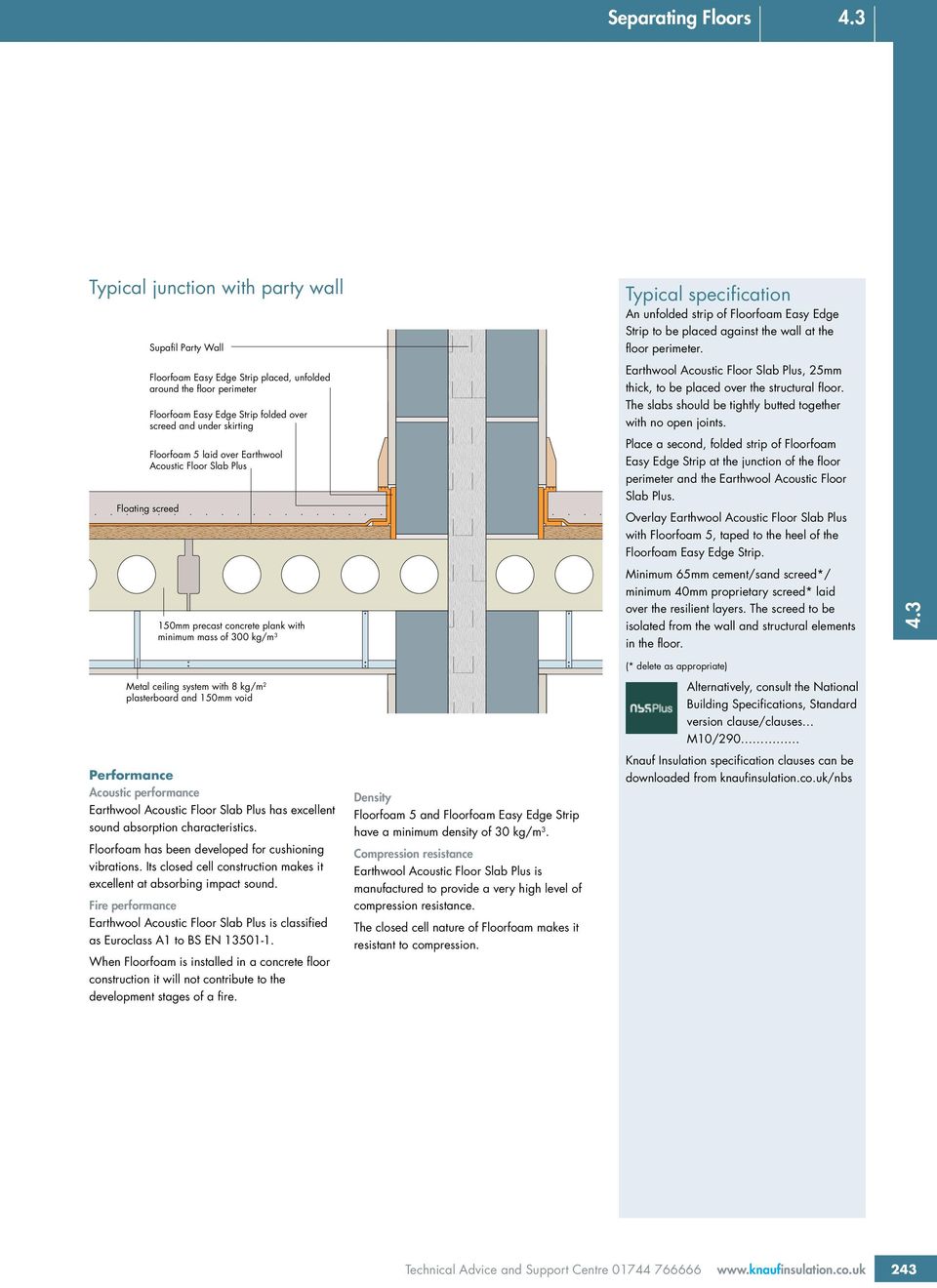
15 Separating Floors Typical junction with party wall Floorfoam Easy Edge Strip placed, unfolded around the floor perimeter Floorfoam 5 laid over Earthwool Acoustic Floor Slab Plus Floating screed Supafil Party Wall Floorfoam Easy Edge Strip folded over screed and under skirting Typical specification An unfolded strip of Floorfoam Easy Edge Strip to be placed against the wall at the floor perimeter. Earthwool Acoustic Floor Slab Plus, 25mm thick, to be placed over the structural floor. The slabs should be tightly butted together with no open joints. Place a second, folded strip of Floorfoam Easy Edge Strip at the junction of the floor perimeter and the Earthwool Acoustic Floor Slab Plus. Overlay Earthwool Acoustic Floor Slab Plus with Floorfoam 5, taped to the heel of the Floorfoam Easy Edge Strip. 150mm precast concrete plank with minimum mass of 300 kg/m 3 Minimum 65mm cement/sand screed*/ minimum 40mm proprietary screed* laid over the resilient layers. The screed to be isolated from the wall and structural elements in the floor. Metal ceiling system with 8 kg/m 2 plasterboard and 150mm void (* delete as appropriate) Alternatively, consult the National Building Specifications, Standard version clause/clauses M10/290 Performance Acoustic performance Earthwool Acoustic Floor Slab Plus has excellent sound absorption characteristics. Floorfoam has been developed for cushioning vibrations. Its closed cell construction makes it excellent at absorbing impact sound. Fire performance Earthwool Acoustic Floor Slab Plus is classified as Euroclass A1 to BS EN When Floorfoam is installed in a concrete floor construction it will not contribute to the development stages of a fire. Density Floorfoam 5 and Floorfoam Easy Edge Strip have a minimum density of 30 kg/m 3. Compression resistance Earthwool Acoustic Floor Slab Plus is manufactured to provide a very high level of compression resistance. The closed cell nature of Floorfoam makes it resistant to compression. Knauf Insulation specification clauses can be downloaded from knaufinsulation.co.uk/nbs Technical Advice and Support Centre
16 Separating Floors Separating floors Concrete floor with screed and resilient layer Floorfoam and Floorfoam Easy Edge Strip Special perimeter products make it easy to correctly install the edge detail - the most common failure in the installation of this type of system Robust resilient layer provides good acoustic absorption to improve impact sound performance Sf09 NEW BUILD Floorfoam and Floorfoam Easy Edge Strip Zero Ozone Depletion Potential (ODP) Global Warming Potential (GWP) <5 65mm reinforced sand/cement screed, or 40mm proprietary liquid screed Floorfoam Easy Edge Strip folded over screed and under skirting Floorfoam 10 Precast concrete planks Metal ceiling system with 8 kg/m 2 plasterboard and 150mm void Products Floorfoam 10 is a 10mm thick extruded polyethylene resilient layer. Floorfoam Easy Edge Strip is a 10mm thick strip of extruded polyethylene, pre-scored to fold around the edge of a floating floor screed. Typical construction A precast concrete floor slab with either a 65mm sand/cement screed or 40mm liquid screed (with a minimum mass of 80 kg/m 2 ) on Floorfoam 10 and isolated from the perimeter walls with Floorfoam Easy Edge Strip. A ceiling of 8 kg/m 2 plasterboard is suspended on a metal frame system 150mm below the floor slab. Installation All the joints between the precast planks should be grouted and sealed. Place folded strips of Floorfoam Easy Edge Strip at the floor perimeter. Lay Floorfoam 10, with joints tightly butted and tape all joints. Tightly butt the Floorfoam 10 over the heel of the Floorfoam Easy Edge Strip at wall junctions and tape the joint. Ensure there are no gaps. The floor is then screeded to finish, taking care to ensure that the screed remains totally isolated from the main structure to prevent any acoustic transfer. Finally, the top part of the Floorfoam Easy Edge Strip is folded down over the screed. Plasterboard is installed on the wall and rested on top of the Easy Edge Strip. When fixing the skirting, place it on the Easy Edge Strip and fix to the wall, ensuring the Easy Edge Strip is between the skirting and the floor screed. Trim the Easy Edge Strip flush to the face of the skirting and seal with acoustic sealant. Performance Acoustic performance Floorfoam has been developed for cushioning vibrations. Its closed cell construction makes it excellent at absorbing impact sound. The construction shown should achieve the sound insulation performance required by Approved Document E when Floorfoam 10 is used in conjunction with Floorfoam Easy Edge Strip. The construction shown meets the requirements of Floor type 2 with floating layer F2 in Scotland (where a 12.5mm thick product is used) together with a levelling screed to the concrete floor and a separating membrane above the Floorfoam to prevent screed entering the resilient layer. Fire performance When Floorfoam is installed in a concrete floor construction it will not contribute to the development stages of a fire. 244 Technical Advice and Support Centre

17 Separating Floors 65mm reinforced sand/cement screed or 40mm proprietary liquid screed with mass of 80 kg/m 3 Floorfoam 10 Typical specification Place Floorfoam Easy Edge Strip at the floor perimeter. Lay Floorfoam 10, and tape to the heel of the Floorfoam Easy Edge Strip. Tape all joints in Floorfoam 10. Joints in floor planks to be grouted 150mm precast concrete plank with minimum mass of 300 kg/m 3 Minimum 65mm cement/sand screed*/ minimum 40mm proprietary screed* laid over the resilient layer. The screed to be isolated from the wall and all structural elements in the floor. (* delete as appropriate) Alternatively, consult the National Building Specifications, Standard version clause/clauses M10/290 Metal ceiling system with 8 kg/m 2 plasterboard and 150mm void Knauf Insulation specification clauses can be downloaded from knaufinsulation.co.uk/nbs Density Floorfoam 10 and Floorfoam Easy Edge Strip have a minimum density of 30 kg/m 3. Compression resistance The closed cell nature of Floorfoam makes it resistant to compression. Table 21 - Results of acoustic test data lab testing with Floorfoam Thickness Screed type Airborne Impact (mm) R w (C,C tr ) L n,w mm sand/cement 57 db (-1; -5) 57 db mm liquid screed 57 db (-1; -5) 56 db Test method: BS EN ISO 140-3: 1995-TP15 and BS EN ISO 140-6: 1998-TP12. Results interpretation: BS EN ISO 717-1: 1997 and BS EN ISO Table 22 - Results of acoustic test data site testing Thickness Screed type Airborne Impact (mm) R w (C,C tr ) L n,w 10 65mm sand/cement 53 db 54 db 10 40mm liquid screed 51 db 55 db Test method: BS EN ISO 140-4: 1995-TP15 and BS EN ISO Results interpretation: BS EN ISO 717-1: 1997 and BS EN ISO Technical Advice and Support Centre

18 Separating Floors Separating floors Concrete floor with underfloor heating Polyfoam ECO Floorboard and Floorfoam and Floorfoam Easy Edge Strip Allows underfloor heating to be used in upper floor flats whilst complying with the requirements of Part E of the Building Regulations Heating system and installation can be carried out by one contractor Sf10 NEW BUILD Polyfoam ECO Floorboard, Floorfoam and Floorfoam Easy Edge Strip Zero Ozone Depletion Potential (ODP) Global Warming Potential (GWP) <5 Floorfoam 5 52mm liquid screed Floorfoam Easy Edge Strip 35mm Polyfoam ECO Floorboard Standard 150mm precast concrete slab Metal ceiling system with 8kg/m 2 plasterboard and 150mm void. Products Floorfoam 5 is a 5mm thick extruded polyethylene resilient layer. Floorfoam Easy Edge Strip is a 10mm thick strip of extruded polyethylene, pre-scored to fold around the edge of a floating floor screed. Polyfoam ECO Floorboard Standard is a 100% ozone friendly extruded polystyrene rigid board. It is lightweight yet has excellent structural strength and long term effectiveness. Typical construction A precast concrete floor slab with a proprietary liquid screed on Polyfoam ECO Floorboard Standard with stapled underfloor heating system separated by Floorfoam 5 with junctions formed using Floorfoam Easy Edge Strip. A ceiling of 8kg/m 2 plasterboard fixed to a metal frame system with a 150mm void. The precast concrete hollow core slab should be 150mm thick and have a minimum mass of 300 kg/m 2. Joints between planks should be filled with a sand cement mix grout. The heating pipes are stapled to the Polyfoam ECO Floorboard Standard, all boards should be closely butted together with all joints closed and taped. Installation All the joints between the precast planks should be grouted and sealed. Place folded strips of Floorfoam Easy Edge Strip at the floor perimeter. Lay Floorfoam 5, with joints butted together and taped. Lay the Floorfoam 5 over the heel of the edge strip and tape the joint. Lay the Polyfoam ECO Floorboard Standard over the Floorfoam 5 and tape the joints. Install the heating pipes in accordance with the manufacturer s instructions. The floor is then screeded to finish, taking care to ensure that the screed remains totally isolated from the main structure to prevent any acoustic transfer. Finally, the top part of the Floorfoam Easy Edge Strip is folded down over the screed, the plasterboard is installed and rested on top of the Easy Edge Strip. Place the skirting on the edge strip and fix to the wall, ensuring the edge strip is between the skirting and the floor screed. Trim the edge strip flush to the face of the skirting. Where a greater level of compressive strength is required Polyfoam ECO Floorboard Extra should be used in place of Polyfoam ECO Floorboard Standard. 246 Technical Advice and Support Centre

19 Separating Floors Floorfoam Easy Edge Strip 52mm liquid screed, with embedded heating pipes 35mm Polyfoam ECO Floorboard Standard Floorfoam 5 150mm precast concrete slab Typical specification Place Floorfoam Easy Edge Strip at the floor perimeter. Lay Floorfoam 5, butt joint and tape to the heel of the Floorfoam Easy Edge Strip. Lay Polyfoam ECO Floorboard Standard all boards should be closely butted together with all joints closed and taped. Minimum 52mm proprietary liquid screed laid over the resilient layers. The screed to be isolated from the wall and structural elements in the floor. Alternatively, consult the National Building Specifications, Standard version clause/clauses M10/290 Metal ceiling system with 8kg/m 2 plasterboard and 150mm void. Knauf Insulation specification clauses can be downloaded from knaufinsulation.co.uk/nbs Performance Acoustic performance Floorfoam has been developed for cushioning vibrations. Its closed cell construction makes it excellent at absorbing impact sound. The construction shown should achieve the sound insulation performance required by Approved Document E. Fire performance When Floorfoam and Polyfoam ECO Floorboard are installed in a concrete floor construction they will not contribute to the development stages of a fire. Density Floorfoam and Floorfoam 5 Easy Edge Strip have a minimum density of 30 kg/m 3. Compression resistance The closed cell nature of Floorfoam makes it resistant to compression. Table 23 - Results of acoustic test data Screed type Airborne Impact R w (C,C tr ) L n,w 52mm liquid screed 57dB (-1; -5) 54dB Test method: BS EN ISO 140-3: 1995-TP15 and BS EN ISO 140-6: 1998-TP12 Results interpretation: BS EN ISO 717-1: 1997 and BS EN ISO Table 24 - Compressive creep results for Polyfoam ECO Floorboards Product Polyfoam ECO Floorboard Standard Polyfoam ECO Floorboard Extra Load applied (kpa) Initial compression (%) Further compression after 50 years (%) Technical Advice and Support Centre

20 Separating Floors Separating floors Upgrading existing timber floor with new ceiling Earthwool Acoustic Roll or Earthwool Flexible Slab Product knits together and closes joints to help ensure sound insulation performance is achieved Provides a high level of thermal separation between adjoining properties Sf12 REFURB Earthwool Acoustic Roll and Earthwool Flexible Slab Non-combustible with a Euroclass A1 reaction to fire rating A+ Generic BRE Green Guide Rating Zero Ozone Depletion Potential (ODP) Zero Global Warming Potential (GWP) New independent joists Hardboard fixed to existing timber boarding Two layers of plasterboard, min 20 kg/m 2 100mm of Earthwool Acoustic Roll or Earthwool Flexible Slab Existing timber floor Existing ceiling upgraded to 20 kg/m 2 Products Earthwool Acoustic Roll is made from glass mineral wool and formed into rolls which are lightweight, flexible, resilient and non-combustible. Earthwool Flexible Slab is a semi-rigid non-combustible rock mineral wool slab designed for friction fitting between timber joists. Typical construction Existing timber joist floor with existing boarding overlaid with hardboard. A new independent timber joist ceiling with 100mm Earthwool Acoustic Roll or 100mm Earthwool Flexible Slab between the joists and a double layer plasterboard ceiling of at least 20 kg/m 2 overall mass. Where the existing ceiling is being retained, it should be upgraded to achieve an overall mass of at least 20 kg/m 2. The construction is as recommended for Floor treatment 1 in Approved Document E and is for use where flats are formed by material change of use. Pre-completion testing is required. Installation Any remedial work necessary to the existing ceiling should be carried out before installation of the new independent ceiling. After installing the new independent ceiling joists, friction fit 100mm Earthwool Acoustic Roll or 100mm Earthwool Flexible Slab between the joists. The insulation should butt up tightly against the sides of each joist, with no gaps between the rolls/slabs. Install the double layer plasterboard ceiling as specified. Seal the perimeter of the new ceiling with tape or sealant. Leave at least 25mm clearance between the top of the new ceiling joists and the underside of the existing ceiling. 248 Technical Advice and Support Centre

21 Separating Floors Typical section Hardboard fixed to existing timber floor Existing timber floor Existing ceiling upgraded to 20 kg/m 2 Typical specification Earthwool Acoustic Roll*/Earthwool Flexible Slab*, 100mm thick, to be placed between the timber joists of the independent ceiling. Alternatively, consult the National Building Specifications, Standard version clause/clauses P10/240 Knauf Insulation specification clauses can be downloaded from knaufinsulation.co.uk/nbs 100mm Earthwool Acoustic Roll or Earthwool Flexible Slab Two layers of plasterboard, min 20 kg/m 2 New independent joists Performance Acoustic performance This construction has the potential to comply with the requirements of the Building Regulations when forming a separating floor from an existing floor by material change of use. Compliance can only be demonstrated by a package of sound testing agreed with Building Control. Earthwool Acoustic Roll and Earthwool Flexible Slab have excellent sound absorption characteristics. For optimum performance, the insulation rolls/slabs should be tightly butted together with no open joints. Fire performance Earthwool Acoustic Roll and Earthwool Flexible Slab are classified as Euroclass A1 to BS EN Generally, this type of floor construction will be required to provide 30 minutes fire resistance. This will be provided by the plasterboard ceiling. Density Both Earthwool Acoustic Roll (100mm) and Earthwool Flexible Slab have a density in excess of 10 kg/m 3. Technical Advice and Support Centre
22 Separating Floors Separating floors Upgrading existing timber floor with new platform floor Earthwool Acoustic Floor Slab, Floorfoam Easy Edge Strip and Earthwool Acoustic Roll or Earthwool Flexible Slab Product knits together and closes joints to help ensure sound insulation performance is achieved Provides a high level of thermal separation between adjoining properties Sf13 Earthwool Acoustic Floor Slab 97/3433 REFURB Earthwool Acoustic Roll and Earthwool Flexible Slab Non-combustible with a Euroclass A1 reaction to fire rating A+ Generic BRE Green Guide Rating Zero Ozone Depletion Potential (ODP) Zero Global Warming Potential (GWP) Floorfoam Easy Edge Strip 18mm chipboard spot bonded to 19mm Knauf Drywall Plank 25mm Earthwool Acoustic Floor Slab Floor deck 100mm of Earthwool Acoustic Roll or Earthwool Flexible Slab Existing timber floor joists Existing ceiling upgraded to 20 kg/m 2 Products Earthwool Acoustic Floor Slab is a rigid, non-combustible, compression resistant slab of rock mineral wool. Earthwool Acoustic Roll is made from glass mineral wool and formed into rolls which are lightweight, flexible, resilient and non-combustible. Earthwool Flexible Slab is a semi-rigid non-combustible rock mineral wool slab designed for friction fitting between timber joists. Floorfoam Easy Edge Strip is a strip of extruded polyethylene, pre-scored to fold around the edge of the floating floor deck. Typical construction Existing timber joist floor with new floating platform (min 25kg/m 2 ) on a resilient layer of 25mm Earthwool Acoustic Floor Slab. 100mm Earthwool Acoustic Roll or 100mm Earthwool Flexible Slab to be installed between the joists of the existing floor. The existing ceiling should be upgraded to achieve an overall mass of at least 20 kg/m 2. The construction is as recommended for Floor treatment 2 in Approved Document E and is for use where flats are formed by material change of use. Pre-completion testing is required. Installation Before installing the floating platform, lay 100mm Earthwool Acoustic Roll or place 100mm Earthwool Flexible Slab between the joists of the existing floor. The insulation should butt up tightly against the sides of each joist, with no gaps between the rolls/slabs. Refix the floor deck and fix Floorfoam Easy Edge Strip to the perimeter wall with the integral self adhesive strip. Install timber battens on resilient strips at the floor perimeter and thresholds. Lay Earthwool Acoustic Floor Slab to cover the entire floor. The joints between slabs should be tightly butted together. Lay sheets of 19mm plasterboard over the resilient layer and butt up to the Floorfoam Easy Edge Strip. Spot bond 18mm tongue and groove chipboard to the plasterboard and glue the tongue and groove joints. The joints between the two layers should be staggered. Floorfoam Easy Edge Strip is folded under the skirting to provide acoustic isolation of the floor deck from the walls. Internal partitions should be built off the structural timber floor. No services should be placed within, or penetrate the resilient layer. Performance Acoustic performance This construction has the potential to comply with the requirements of the Building Regulations when forming a separating floor from an existing floor by material change of use. Compliance can only be demonstrated by a package of sound testing agreed with Building Control. Earthwool Acoustic Floor Slab, Earthwool Acoustic Roll and Earthwool Flexible Slab have excellent sound absorption characteristics. 250 Technical Advice and Support Centre
23 Separating Floors Typical section 18mm chipboard spot bonded to 19mm Knauf Drywall Plank 25mm Earthwool Acoustic Floor Slab Floor deck Typical specification Earthwool Acoustic Roll*/Earthwool Flexible Slab* 100mm thick, to be placed between the existing floor joists. (*Delete as appropriate). Earthwool Acoustic Floor Slab, 25mm thick, to be placed over the existing floor deck. All joints to be close butted and taped. The floating platform floor to be as specified by the designer. Alternatively, consult the National Building Specifications, Standard version clause/clauses P10/240 and K11/ mm Earthwool Acoustic Roll or Earthwool Flexible Slab Knauf Insulation specification clauses can be downloaded from knaufinsulation.co.uk/nbs Existing ceiling upgraded to 20 kg/m 2 Existing timber floor joists Fire performance Earthwool Acoustic Roll, Earthwool Acoustic Floor Slab and Earthwool Flexible Slab are classified as Euroclass A1 to BS EN Generally, this type of floor construction will be required to provide 30 minutes fire resistance. This will be provided by the plasterboard ceiling. Density Earthwool Acoustic Floor Slab has a density of 100 kg/m 3. Both Earthwool Acoustic Roll and Earthwool Flexible Slab have a density in excess of 10 kg/m 3. Compression resistance Earthwool Acoustic Floor Slab is manufactured to provide a high level of compression resistance. Technical Advice and Support Centre
24 Separating Floors Internal floors Insulation of internal timber floor Earthwool Acoustic Roll or Earthwool Flexible Slab Improved acoustic performance with no increase in floor depth and minimal increase in floor weight If01 If02 NEW BUILD REFURB Product knits together and closes joints to help ensure sound insulation performance is achieved Provides a high level of thermal separation between adjoining properties Earthwool Acoustic Roll and Earthwool Flexible Slab Non-combustible with a Euroclass A1 reaction to fire rating Timber deck with minimum mass of 15kg/m 2 A+ Generic BRE Green Guide Rating Timber or steel joists Zero Ozone Depletion Potential (ODP) Zero Global Warming Potential (GWP) Earthwool Acoustic Roll or Earthwool Flexible Slab Plasterboard at least 10kg/m 2 Products Earthwool Acoustic Roll is made from glass mineral wool and formed into rolls which are lightweight, flexible, resilient and non-combustible. Earthwool Flexible Slab is a semi-rigid non-combustible rock mineral wool slab designed for friction fitting between timber joists. Typical construction Timber or metal joist floor with a plasterboard (10kg/m 2 minimum) ceiling and 100mm Earthwool Acoustic Roll or 100mm Earthwool Flexible Slab between the joists. Floor deck to be timber or wood based board with a minimum mass of 15 kg/m 2, e.g. 22mm chipboard. The insulation should butt up tightly against the sides of each joist, with no gaps between the rolls/slabs. Performance Acoustic performance The construction complies with internal floor type C in Approved Document E2. Fire performance Earthwool Acoustic Roll and Earthwool Flexible Slab are classified as Euroclass A1 to BS EN Density Both Earthwool Acoustic Roll and Earthwool Flexible Slab have a density in excess of 10 kg/m 3. Typical specification Earthwool Acoustic Roll*/Earthwool Flexible Slab*, 100mm thick, to be placed between the floor joists. (*Delete as appropriate) The ceiling and floor deck to be as specified by the designer. Alternatively, consult the National Building Specifications, Standard version clause/clauses P10/240 Knauf Insulation specification clauses can be downloaded from knaufinsulation.co.uk/nbs If02 If02 is an alternative solution to If01. It replaces Earthwool Acoustic Roll with Earthwool Flexible Slab. 252 Technical Advice and Support Centre
25 Separating Floors Internal floors Concrete beam and block floor Earthwool Acoustic Roll Mineral wool in void absorbs sound and improves acoustic performance If03 Sand/cement screed Beam and block floor NEW BUILD REFURB High mass of concrete floor units provides good acoustic performance Knauf Drywall C-Form II ceiling system The independent ceiling provides good acoustic isolation and space for services Earthwool Acoustic Roll Plasterboard at least 10kg/m 2 Earthwool Acoustic Roll Non-combustible with a Euroclass A1 reaction to fire rating A+ Generic BRE Green Guide Rating Zero Ozone Depletion Potential (ODP) Zero Global Warming Potential (GWP) Products Earthwool Acoustic Roll is made from glass mineral wool and formed into rolls which are lightweight, flexible, resilient and non-combustible. Typical construction Concrete beam and block floor with a minimum mass per unit area of 220kg/m 2 finished with a bonded 40mm sand/cement screed. Plasterboard ceiling with a minimum mass of 10kg/m 2 fixed to the Knauf Drywall C-Form II ceiling system with 25mm Earthwool Acoustic Roll in the ceiling void. Contact the manufacturer of the beam and block floor system to determine the correct method of mechanically fixing channels to the beams. Performance Acoustic performance The construction complies with internal floor type B in Approved Document E2. Fire performance Earthwool Acoustic Roll is classified as Euroclass A1 to BS EN Density 25mm Earthwool Acoustic Roll has a density of 19.5 kg/m 3. Typical specification Earthwool Acoustic Roll, 25mm thick, to be supported by the horizontal members of the Knauf Drywall C-Form II ceiling system. The plasterboard ceiling to be as specified by the designer. Alternatively, consult the National Building Specifications, Standard version clause/clauses K10/235 Knauf Insulation specification clauses can be downloaded from knaufinsulation.co.uk/nbs Technical Advice and Support Centre
26 Separating Floors Suspended ceilings Acoustic cavity barrier Rocksilk Smoke and Fire Barrier High levels of sound insulation performance can be achieved Sc01 NEW BUILD REFURB System uses standard metal components Rocksilk Smoke and Fire Barrier Solution delivers both fire and acoustic performance Metal angles fixed to soffit Rocksilk Smoke and Fire Barrier Non-combustible with a Euroclass A1 reaction to fire rating Zero Ozone Depletion Potential (ODP) Zero Global Warming Potential (GWP) Rocksilk Smoke and Fire Barrier fixed to timber spacer Products Rocksilk Smoke and Fire Barrier is made from rock mineral wool and formed into a flexible mattress faced on one side with galvanised wire mesh stitched in position. Rocksilk Smoke and Fire Barrier is also available foil faced on one or both sides. Typical construction A single or double layer of 50mm Rocksilk Smoke and Fire Barrier, applied as a hanging curtain, supported continuously from above and both sides. At the base it is either lapped freely on to the back of a suspended ceiling or fixed to a partition head. Suitable for drops up to 7 metres. Performance Acoustic performance A cavity barrier comprised of one layer of foil faced 50mm Rocksilk Smoke and Fire Barrier will offer significant sound reduction. When coupled with a ceiling system offering at least 32dB sound reduction, the partition offering 44dB sound reduction, the flanking path through the ceiling and cavity barrier can also achieve a sound reduction of 44dB. If a double layer (foil faced) is installed, the room to room sound reduction is 50dB, for a single unfaced layer the value is 42dB. Table 25 - Acoustic performance Fire performance Rocksilk Smoke and Fire Barrier is classified as non-combustible to BS 476: Part 4: Rocksilk Smoke and Fire Barrier has a Class 1 surface spread of flame to BS 476: Part 7: 1997 and is Class O to the Building Regulations. Always use foil faced Rocksilk Smoke and Fire Barrier when the ceiling void is used as an air plenum. Installation See pages for installation details. Thickness Ceiling performance Room to room sound reduction (mm) R w R w 50mm (unfaced) 32dB 42dB 50mm foil faced (one side) 32dB 44dB 2x50mm foil faced (one side) 32dB 50dB 254 Technical Advice and Support Centre
27 Separating Floors 50x50x2mm metal angle fixed to soffit Rocksilk Smoke and Fire Barrier 40x2mm metal strip fixed to timber Typical specification A single*/double* layer of 50mm Rocksilk Smoke and Fire Barrier (*foil faced) to be installed in the positions marked on the drawings, and fixed in accordance with the manufacturer s recommendations. All joints either tightly butted, overlapped, or with edges returned, and stitched in a continuous spiral loop with 1mm diameter galvanised lacing wire. (* delete as required) Alternatively, consult the National Building Specifications, Standard version clause/clauses K10/545A Knauf Insulation specification clauses can be downloaded from knaufinsulation.co.uk/nbs Flanking sound The void above a suspended ceiling is a potential route for flanking sound above partitions. This is especially true where a lightweight, modular ceiling is installed. The sound absorbent characteristics of mineral wool can be employed to minimise the acoustic weakness of suspended ceilings by installing mineral wool cavity barriers above partitions. Sound absorbent cavity barriers There are many situations, such as hospital consulting rooms, where it is important that the sound performance of a partition is not compromised by the void above the suspended ceiling. In these cases, a mineral wool cavity barrier, in combination with the suspended ceiling, can limit flanking sound see illustrations below. To achieve the sound reduction figures in the illustrations below, the partition must have at least the same level of sound insulation as the Fire protection Concealed spaces or cavities, particularly those above a suspended ceiling, provide a ready made route for smoke and flame spread. Cavity barriers above suspended ceilings are used to prevent smoke and flame from bypassing fire resisting walls and partitions. The Building Regulations require cavity barriers to be provided above suspended ceilings in non-domestic buildings where the fire resisting construction is not carried full storey height. See pages for more details of cavity barriers in ceiling voids to prevent fire spread. cavity barrier and ceiling combined. Typical sound performance of Rocksilk Smoke and Fire Barrier above partitions 50mm Rocksilk Smoke and Fire Barrier Foil facing 50mm Rocksilk Smoke and Fire Barrier 50mm Rocksilk Smoke and Fire Barrier 50mm cavity Foil facing Suspended ceiling of 12.5mm plasterboard* 42 db 44 db 50 db * The sound reduction values for the flanking route above the partition will be achieved when the ceiling achieves approximately 32 db in its own right. Technical Advice and Support Centre
28 Knauf Insulation Ltd Customer Service (Sales) Technical Advice and Support Centre Literature PO Box 10 Tel: Tel: Tel: Stafford Road Fax: Fax: Fax: St Helens Merseyside WA10 3NS
Section 5.0. Basements. Wall insulated externally. Wall insulated internally. Ba02. Product: Polyfoam ECO Floorboard Ba01.
 Section 5.0 Basements Wall insulated externally Product: Polyfoam ECO Ba01 Wall insulated internally Product: Polyfoam ECO Ba02 Basements Basements Basement design Waterproofing BS 8102: 2009 Code of practice
Section 2.4. Built-up Metal Roofs. Rail and bracket system. Standing seam system. Bu02. Product: Earthwool FactoryClad range Bu01
 Section Built-up Metal Roofs Rail and bracket system Product: Earthwool FactoryClad range Bu01 Standing seam system Product: Earthwool FactoryClad range and Earthwool Universal Slab Bu02 Built-up Metal
ENVIRONMENTAL INFORMATION APR 1200 products are made from glass mineral wool, one of the most environmentally friendly insulants available.
 APR 1200 Acoustic Partition Roll CI/Sfb Ref: APR002 Glass mineral wool roll designed to provide high levels of sound insulation in walls and floors to meet Part E (England & Wales) and Section 5 (Scotland)
Rockwool Flexi Insulation Application Guide
 Pitched roof Rafters InterMediate floors INTERNAL partitions external Framed walls separating floors Separating Walls Rockwool Flexi Insulation Application Guide Ground floor The perfect fit for any framed
Section 3.1.2. Timber Frame Walls. Single layer between studs. Single layer between studs with service void. Between studs with insulated lining
 Section Timber Frame Walls Single layer between studs Product: Earthwool FrameTherm Rolls and Slabs Tf01 Single layer between studs with service void Product: Earthwool FrameTherm Rolls and Slabs Tf02
Fire 2This Technical Bulletin has been commissioned by the UK SIP Association in
 REV 1-12.12.11/TB002 Technical Bulletin Fire 2This Technical Bulletin has been commissioned by the UK SIP Association in conjunction with TRADA Technology and is intended to provide the reader with introductory
The Pocket Guide To Insulation August 2013
 The Pocket Guide To Insulation August 2013 Introduction Knauf Insulation is the UK s leading manufacturer of insulation products, including: Earthwool glass and rock mineral wool Polyfoam ECO extruded
Section 2.3. Flat Roofs. Warm deck single ply membrane. Warm deck single ply membrane. Warm deck built-up felt/ mastic asphalt. Protected membrane
 Section Flat Roofs Warm deck single ply membrane Product: Rocksilk Krimpact Flat Roof Slab Fl01 Warm deck single ply membrane Product: Polyfoam ECO Roofboard Fl02 Warm deck built-up felt/ mastic asphalt
Knauf Aquapanel Interior. Tile Backing. Cement board for wet areas. Will not deteriorate in water. Easy to score and snap
 Tile Backing Will not deteriorate in water Easy to score and snap Resistant to mould and mildew Knauf Aquapanel Interior Cement board for wet areas Knauf Aquapanel Interior Cement Board Drywall for Wet
Energy Company Obligation (ECO): Technical Monitoring Questions
 Energy Company Obligation (ECO) Technical Monitoring Questions v1 30/05/2013 Energy Company Obligation (ECO): Technical Monitoring Questions Under ECO suppliers are required to instruct suitably qualified
sound reduction systems for commercial, educational and industrial environments
 sound reduction systems for commercial, educational and industrial environments Tel: +44 ()14 3874 Fax: +44 ()14 38957 E-mail: [email protected] Web: www.soundreduction.co.uk soundblocker Acoustic
Multi-layer Insulation Blanket for Roofs
 Multilayer Insulation Blanket for Roofs Thermal Insulation in a 40mm thin, flexible, multilayer membrane Meets requirements of L1A, L1B 2010 In accordance with BR443 NHBC Acceptance Pitched & Flat roof
The Kingspan Insulation Price List 1 st January 2013
 Insulation The Kingspan Insulation Price List 1 st January 2013 FOR BUILDING FABRIC INSULATION, CAVITY CLOSERS AND MEMBRANES Visit our website: www.kingspaninsulation.co.uk Low Energy - Low Carbon Buildings
CERTIFICATE OF APPROVAL No CF 5055 ARABIAN VERMICULITE INDUSTRIES
 CERTIFICATE OF APPROVAL No CF 5055 This is to certify that, in accordance with TS00 General Requirements for Certification of Fire Protection Products The undermentioned products of 1 st Industrial Area,
ProRox Slabs (formerly known as RW slabs)
 Slabs (formerly known as RW slabs) Versatile thermal acoustic insulation slabs ROCKWOOL's Slabs are high quality resin bonded slabs that can be used for thermal, acoustic and fire insulation. They are
ONLINE VERSION. The Building Regulations 2010 The Building (Approved Inspectors etc) Regulations 2010 ONLINE VERSION
 The Building Regulations 2010 The Building (Approved Inspectors etc) Regulations 2010 E1 E2 E3 E4 E Protection against sound from other parts of the building and adjoining buildings Protection against
Cavity Drain R20 is manufactured from1.0mm thick black high density polyethylene with studs approximately 20mm high.
 CI/SfB Tn6 L6813 September 2013 RIW CAVITY DRAIN R20 R20 is manufactured from1.0mm thick black high density polyethylene with studs approximately 20mm high. Other systems are available for specific uses,
Improving the flood resistance of your home. Advice sheet 6: Flood-resilient floors
 Improving the flood resistance of your home Advice sheet 6: Flood-resilient This sheet provides guidance on identifying different types of floor, assessing the routes floodwater may enter, and describes
CERTIFICATE NAME OF PRODUCT MANUFACTURER PRODUCT DESCRIPTION CERTIFICATION PROCEDURE. No VTT C-6044-10 Date of issue 11.10.2010, Updated July 1, 2011
 CERTIFICATE NAME OF PRODUCT No VTT C-6044-10 Date of issue 11.10.2010, Updated July 1, 2011 H-CONTROL REFLEX+ reflective insulating vapour control layer for roof and wall applications MANUFACTURER ACTIS
CHESTERFLEX ROOF WATERPROOFING MEMBRANES
 CI/SfB (47) Ln2 Chesterfelt Ltd CHESTERFLEX ROOF WATERPROOFING MEMBRANES Certificate No 94/3062 DETAIL SHEET 2 Product THIS DETAIL SHEET RELATES TO CHESTERFLEX ROOF WATERPROOFING MEMBRANES, POLYESTER REINFORCED
SOUND INSULATION FOR EXTERIOR WALLS AND FACADE SYSTEMS
 NOISE TECHNICAL FACT SHEET FACT SHEET 5 SOUND INSULATION FOR EXTERIOR WALLS AND FACADE SYSTEMS The sound insulation of exterior walls and roof-ceiling systems refers to their ability to reduce external
INTERIOR WALLS AND BASEMENTS CHOOSING THE RIGHT MEMBRANE FOR INTERIOR WALLS. Multi-Layer Technology provides increased strength.
 INTERIOR WALLS AND BASEMENTS CHOOSING THE RIGHT MEMBRANE FOR INTERIOR WALLS Multi-Layer Technology provides increased strength. Specifically designed for interior applications. Compatible with most internal
Introduction & Principles Issued in support of Junction Details, Parts 1 to 5
 Accredited Construction Details (Scotland) 2010 For the limitation of thermal bridging and air infiltration in low and medium rise domestic buildings Introduction & Principles Issued in support of Junction
Built-up roofing solutions with rigid insulation boards on concrete decks for new-build and refurbishment E-a5
 Cl Sfb (27-9) Rn7 M2 December 2004 Built-up roofing solutions with rigid insulation boards on concrete decks for new-build and refurbishment E-a5 Fesco, Fesco S, Retrofit, Retrofit S, Fesco Fillet, PF,
ModuSec. Secure and efficient IT room solutions Composite Panel Systems Compared. Panel Systems are not all the same!
 Secure and efficient IT room solutions Composite Panel Systems Compared Panel Systems are not all the same! When it comes to accommodating critical IT systems, the first issue to look at is the environment
Rockwool Cladding Roll
 Rockwool Cladding Roll High performance industrial insulation has been specifically developed for use in lightweight cladding applications to commercial or industrial framed buildings. Cladding Roll U/F
The WANZ Guide to Window Installation
 The WANZ Guide to Window Installation as described in E2/AS1 Amendment 5 Ver. 1.1 Page 2 of 74 Contents Overview Page 5 Objective Page 5 Scope Page 5 Opening Preparation Page 7 Step P1 Preliminary Check
Steel-framed Walls. Insulation
 Insulation A4/8 SF AW1192 Issue 4 Nov 2012 Steel-framed Walls Insulation guide Helps achieve a 6-star house energy rating Rigid and flexible Kingspan AIR-CELL solutions available Vapour barrier or vapourpermeable
Construction. SikaProof A-08 Edge, A-12 Edge. Fully bonded FPO sheet membrane in L-shape for the SikaProof A waterproofing system. Product Description
 Product Data Sheet Edition 15/10/2014 Identification no: 02 07 04 10 300 0 000002 SikaProof A Edge SikaProof A-08 Edge, A-12 Edge Fully bonded FPO sheet membrane in L-shape for the SikaProof A waterproofing
Contents. APA Construction Details. Full fill cavity walls 2-13. Partial fill cavity walls 14-25. Solid externally insulated walls 26-37
 Contents Pages Full fill cavity walls 2-13 Partial fill cavity walls 14-25 Solid externally insulated walls 26-37 Appendix (BRE confirmation of Ψ and y-values) 38-40 Page 1 of 40 APA Construction Details
This seminar covers the principles, design and installation of ground bearing and suspended insulated floors. You will discover
 Dow Construction Products Thermal Insulation of Floors This seminar covers the principles, design and installation of ground bearing and suspended insulated floors. You will discover Why a floor should
Rev 1-12.2013. Code of Practice. SIP Technology. www.uksips.org
 Rev 1-12.2013 Code of Practice SIP Technology www.uksips.org What are Structural Insulated Panels (SIPS)? SIPS are prefabricated, high performance, lightweight, building panels that can be used in floors,
Module 3.7. Thermal bridging
 Module 3.7 Thermal bridging Learning Outcomes On successful completion of this module learners will be able to - Describe construction details which influence thermal bridging. 2 Introduction to thermal
ROCKWOOL Rigid, Semi-rigid and Flexible Slabs are high quality resin bonded slabs that can be used for thermal, acoustic and fire insulation.
 Rigid, Semirigid and Flexible Slabs Versatile thermal acoustic insulation slabs ROCKWOOL are high quality resin bonded slabs that can be used for thermal, acoustic and fire insulation. They are manufactured
PB301 July 2009. Lightweight Building Solutions. Bushfire Protection. www.boral.com.au/bushfireprotection
 PB301 July 2009 Lightweight Building Solutions Bushfire Protection www.boral.com.au/bushfireprotection Attached or adjacent within 6m roofed structures such as garages, carports, verandas and the like,
PASSIVE FIRE PROTECTION SYSTEMS Application & Technical Manual: Ceilings & Floors
 PASSIVE FIRE PROTECTION SYSTEMS Application & Technical Manual: Ceilings & Floors For distribution in Asia Pacific PASSIVE FIRE PROTECTION SYSTEMS Application & Technical Manual: Ceilings & Floors Contents
Low Energy Low Carbon Buildings
 I n s u l a t i o n CI/Sfb (27.9) Rn7 M2 Eighth Issue March 2011 TR27 LPC/FM INSULATION FOR FLAT ROOFS WATERPROOFED WITH FULLY ADHERED SINGLE PLY, PARTIALLY BONDED BUILT UP FELT, MASTIC ASPHALT AND COLD
Formwork Direct International Ltd Phone No +44 (0151) 532 0179 Fax no +44 (0151) 523 8330 E-Mail: [email protected].
 Joint Fillers Formwork Direct are proud to be The UK and Ireland distributor for LJA Miers & Co. who have been responsible for many of the developments in Joint Fillers that are today accepted as common
Lightweight Partition Design for Residential and Commercial Buildings
 Lightweight Partition Design for Residential and Commercial Buildings Stanley D. Gatland II, CertainTeed Corporation, Valley Forge, Pennsylvania Guidelines are presented for the design and proper installation
Schlüter -KERDI-BOARD Substrate, structural panel, bonded waterproofing
 Substrate, structural panel, bonded waterproofing The universal substrate for tiles Perfect covering No matter whether you work with mosaics or large format tiles, an absolutely level substrate with straight
Basements. I n s u l a t i o n. Low Energy Low Carbon Buildings
 I n s u l a t i o n CI/Sfb (13.9) Rn7 M2 Third Issue March 2011 INSULATION FOR BASEMENTS Basements High performance rigid extruded polystyrene insulation thermal conductivities as low as 0.029 W/m.K High
necessary for years of satisfactory service. SmartBlock insulating form concrete walls share the
 Chapter 7 PLUMBING AND ELECTRICAL 7.1 Introduction to Plumbing and Electrical Consideration of support services such as plumbing and electrical systems from the preliminary schematics phase through final
Installation Details. D1 General D2 Walls D3 Ceilings D4 Reference. D Installation Details
 D Installation Details D1 General D2 Walls D3 Ceilings D4 Reference D Installation Details D Contents D1 General Installation and Fastening Sequence for Steel Studs D1.1 Fastener Selection D1.3 D2 Walls
European Organisation for Technical Approvals
 Warrington Certification Limited, Holmesfield Road, Warrington, WA1 2DS Tel. +44 (0) 1925-646777 Fax +44 (0) 1925-646667 Member of EOTA Authorised and notified according to Article 10 of the Council Directive
Document type: Practice Note Title: External and internal membranes Document number: AC2234 Version: 5. 1. Purpose
 Document type: Practice Note Title: External and internal membranes Document number: AC2234 Version: 5 1. Purpose The purpose of this practice note is to address the incidence of deck and roof membrane
SikaProof A Technology
 SikaProof A Technology The fully bonded waterproofing system Keep your basements durably and securely watertight What is SikaProof A? How does it work? Where can it be used? What are the advantages of
PRESTRESSED CONCRETE FLOORING BEAMS
 PRESTRESSED CONCRETE FLOORING BEAMS TRIED & TRUSTED Introduction Established in 2001 TT Concrete Products Limited has become a prominent manufacturer of prestressed concrete flooring beams throughout the
Uniclass L31:N14:P7111 C1/SfB (16.9) Rn7 (J4) February 2008. Foundation Heave Protection
 Uniclass L31:N14:P7111 C1/SfB (16.9) Rn7 (J4) February 2008 Foundation Heave Protection The safe, sure way to provide foundation protection Clayshield is the proven solution to protecting foundations against
TR21. I n s u l a t i o n. Low Energy Low Carbon Buildings
 I n s u l a t i o n CI/Sfb (27.9) Rn7 M2 Fourth Issue March 2011 TR21 INSULATION FOR FLAT ROOFS WATERPROOFED WITH PARTIALLY BONDED BUILT UP FELT AND MASTIC ASPHALT High performance rigid thermoset insulation
IMPACT DAMAGE RESISTANT WALL SYSTEMS
 IMPACT DAMAGE RESISTANT WALL SYSTEMS CONTENTS Introduction 2 Advantages 2 2 Material Specifications 2 Design Considerations 3 Framing 5 Plasterboard Installation 5 Health, Safety & Warranty 6 Contact Details
Hanson Building Products. precast basement solutions
 Hanson Building Products precast basement solutions Hanson Building Products Basement Systems Add an extra dimension and combine the inherent flexible, structural and waterproof properties of concrete
Acoustics factsheet Requirements for new homes and how NHBC can help
 Acoustics factsheet Requirements for new homes and how NHBC can help New homes are built to high standards; however, acoustics and noise control are important factors requiring careful consideration during
Composite Panel Firewall Systems
 Composite Panel Firewall Systems part of the Protecting more than your business Insulated mineral fibre panels have excellent thermal and acoustic properties, ideal for factory and office partition walls.
C05. S03. P02 P08 FireWall. Including C05. S01. P02 Specialist partitions introduction
 C05. S03. P02 P08 Including C05. S01. P02 Specialist partitions introduction C05 Specialist partitions Introduction Specialist partitions This section details specialist lightweight systems where high-security,
Manual lifting and handling
 Manual lifting and handling When installing British Gypsum products and systems care should be taken to ensure that appropriate methods of handling and lifting are adopted. The following guidance details
Part 3 Ancillary technologies. Chapter 3.2. Mechanical ventilation with heat recovery
 Part 3 Ancillary technologies Chapter CONTENTS SCOPE Clause Page DESIGN Design standards D1 1 Statutory requirements D2 1 System design D3 1 Building integration D4 2 Noise D5 2 Access and controls D6
Report Number BTC 17755F
 Leics. LE NP Tel () 4 Fax () 4 Email [email protected] Report Number BTC 77F A FIRE RESISTANCE TEST ON A LOADBEARING TIMBER JOIST FLOOR INCORPORATING 4mm x 7mm x 47mm SOLID JOISTS PROTECTED BY
Sports Buildings: budget costs for the Flood Relief Fund
 Sports Buildings: budget costs for the Flood Relief Fund The list below provides typical costs for flood insurance works, typically required by sports clubs or facilities. The list is not exhaustive but
fire & soundproofing Insulation Roxul Safe n Sound Fire and Soundproofing Insulation for Interior Partition Walls and Floors
 fire & soundproofing Insulation Roxul Safe n Sound Fire and Soundproofing Insulation for Interior Partition Walls and Floors Roxul Safe n Sound Sound Control and Fire Safety From One Batt Insulation Roxul
Timber Frame Walls Rethinking Construction
 Insulation Fifth Issue November 2007 Timber Frame Walls Rethinking Construction INSULATION BEST PRACTICE FOR THE 21ST CENTURY Summary 9 mm OSB sheathing 3 mm skim coated 15 mm plasterboard Rock or glass
Low Energy Low Carbon Buildings
 I n s u l a t i o n CI/Sfb (27.9) Rn7 M2 Seventh Issue March 2011 TR26 LPC/FM INSULATION FOR FLAT ROOFS WATERPROOFED WITH MECHANICALLY FIXED SINGLE PLY WATERPROOFING High performance rigid thermoset insulation
12.1 Schlüter -KERDI-BOARD
 I n n o v a t i v e p r o f i l e s 12.1 Schlüter -KERDI-BOARD S u b s t r a t e U N I V E R S A L S T R U C T U R A L P A N E L, B O N D E D W A T E R P R O O F I N G Application and Function Schlüter
FireSmart IRS Insulating Roof Screed
 Insulating Roof Screed CI/SfB January 2004 CI/SfB January 2004 M2 P M2 P Icopal Ltd Barton Dock Road Stretford, Manchester M32 0YL Telephone: 0161 865 4444 Fax: 0161 866 9859 Technical Fax: 0161 865 8433
Acoustic Design Practices for Sustainable Buildings
 Acoustics 2008 Geelong, Victoria, Australia 24 to 26 November 2008 Acoustics and Sustainability: How should acoustics adapt to meet future demands? Acoustic Design Practices for Sustainable Buildings Danny
Chapter 3 Pre-Installation, Foundations and Piers
 Chapter 3 Pre-Installation, Foundations and Piers 3-1 Pre-Installation Establishes the minimum requirements for the siting, design, materials, access, and installation of manufactured dwellings, accessory
WATERPROOFING OF REINFORCED CONCRETE FLAT ROOF 12
 WATERPROOFING OF REINFORCED CONCRETE FLAT ROOF 12 87 88 GOOD INDUSTRY PRACTICES 12 WATERPROOFING OF REINFORCED CONCRETE FLAT ROOF 12.1 BACKGROUND Most roofs in Singapore are constructed using reinforced
How To Certify The Scottsdale Construction System
 BRE CERTIFICATION LIMITED PRODUCT SCOTTSDALE CONSTRUCTION SYSTEM CERTIFICATE NUMBER 129/07 DATE OF ISSUE December 2007 SUPPLIED BY Scottsdale Construction System Ltd SUMMARY The Scottsdale Construction
Schluter -KERDI-BOARD Substrate, building panel, bonded waterproofing
 Schluter -KERDI-BOARD Substrate, building panel, bonded waterproofing Schluter -KERDI-BOARD The universal substrate for tiles Flat. Level. Plumb. Square. No matter the quality, cost, or extravagance of
Built to Last. Built for Beauty. Good. Solid. Logix. TM
 Built to Last. Built for Beauty. Good. Solid. Logix. TM Quality, Value and Service Introducing LOGIX Insulated Concrete Forms. Based on the simple concept of interlocking blocks, LOGIX ICF gives you a
FireWall. High performance fireresistant. FireWall. www.british-gypsum.com
 FireWall FireWall High performance fireresistant wall system FireWall is a non-loadbearing wall which provides up to 240 minutes fire resistance. It is used in certain ground floor basement situations
NCMA TEK CONCRETE MASONRY FOUNDATION WALL DETAILS. TEK 5-3A Details (2003)
 NCMA TEK National Concrete Masonry Association an information series from the national authority on concrete masonry technology CONCRETE MASONRY FOUNDATION WALL DETAILS TEK 5-3A Details (2003) Keywords:
Residential Refurbishment. September 2012. ThermoShell Internal Wall Insulation System Design Guide
 Residential Refurbishment September 2012 ThermoShell Internal Wall Insulation System Design Guide The importance of wall insulation in houses Buildings account for 40% of our energy consumption and in
Renovating Your Basement
 building science.com 2006 Building Science Press All rights of reproduction in any form reserved. Renovating Your Building America Report - 0309 2003 (revised 2007) Building Science Corporation Abstract:
Chapter 2 Basis of design and materials
 Chapter 2 Basis of design and materials 2.1 Structural action It is necessary to start a design by deciding on the type and layout of structure to be used. Tentative sizes must be allocated to each structural
WATERPROOFING SikaProof -A TECHNOLOGY
 SikaProof -A TECHNOLOGY content What is SikaProof -A? 6 How does it work? 8 Where can it be used? 0 What are the advantages of SikaProof -A? 2 How should it be installed? SikaProof -A system components
Services Enclosures and Protected Shafts - Maintaining Compartmentation
 Introduction When a fire resisting element is used to provide fire compartmentation, every opening that allows services to pass through the element must be adequately protected by sealing, or fire stopping
Annex of the certificate (Page 1/6) Accreditation Scope
 As a Testing Laboratory Annex of the certificate (Page 1/6) Accreditation Scope Address: Küçük Çiğli Mh. 8780/1 Sk. No:5 Çiğli 35681 İZMİR / TÜRKİYE Phone : 0 232 376 24 25 Fax : 0 232 386 33 98 E-Mail
Internal wall insulation in existing housing
 Energy Efficiency Best Practice in Housing Internal wall insulation in existing housing A guide for specifiers and contractors Cost-effective External wall appearance maintained Easier to install and maintain
ALKALI-RESISTANT WATERPROOFING AND DECOUPLING MEMBRANE UNDER CERAMIC TILES AND NATURAL STONE
 Mapeguard WP System ALKALI-RESISTANT WATERPROOFING AND DECOUPLING MEMBRANE UNDER CERAMIC TILES AND NATURAL STONE Products used: Mapeguard WP 200, Mapeguard ST, Mapeguard IC, Mapeguard EC, Mapeguard WP
Memtec Single Ply PVC Membrane Roofing and Waterproofing Technology. Modern Efficient Performance Cost Effective Flat Roofing Systems
 Memtec Single Ply PVC Membrane Roofing and Waterproofing Technology Modern Efficient Performance Cost Effective Flat Roofing Systems Introduction A complete range of Memtec Roofing and Waterproofing Single
Ultimate Acoustic Solutions for Floors & Ceilings
 Ultimate Acoustic Solutions for Floors & Ceilings Uniclass L586+L542:N372 EPIC E42+E512:Y45 CI/SfB (43)+(45) R+T (P2) Contains SRS Ltd s Rigorous Standard Details for: Building Regulations Approved Document
The WANZ Guide to Window Installation
 The WANZ Guide to Window Installation as described in E2/AS1 Amendment 5 2 of 60 Contents Overview 5 Objective 5 Scope 5 Opening Preparation 7 Step P1 Preliminary Check 8 Step P2 Cut the Underlay 9 Step
HIGH PERFORMANCE PRE-APPLIED SYSTEM FOR BLIND SIDE & BELOW GRADE WATERPROOFING APPLICATIONS
 BSW HIGH PERFORMANCE PRE-APPLIED SYSTEM FOR BLIND SIDE & BELOW GRADE WATERPROOFING APPLICATIONS BSW is a fully reinforced Pre-Applied system membrane designed for horizontal and vertical external blind-side
EcoTouch Insulation with PureFiber Technology
 PROJECT ENGINEER RESPONSIBILITY: This is a general specification guide, intended to be used by experienced construction professionals, in conjunction with good construction practice and professional judgment.
H-Stud Area Separation Wall System
 12 TH EDITION 09 21 16.33/NGC H-Stud Area Separation Wall System 09 21 16.33 139 H-STUD AREA SEPARATION WALL SYSTEM The fire-protection of gypsum-based Area Separation Walls is demonstrated in dramatic
FIRE PERFORMANCE OF STRUCTURAL INSULATED PANEL SYSTEMS
 INFORMATION PAPER IP 21/10 FIRE PERFORMANCE OF STRUCTURAL INSULATED PANEL SYSTEMS Tom Lennon and Danny Hopkin The use of Structural Insulated Panel (SIP) systems in construction in the UK has increased
RESIDENTIAL ROOFING & RE-ROOFING, ROOF VENTILATION AND ROOF SHEATHING REQUIREMENTS MICHIGAN RESIDENTIAL CODE 2000
 RESIDENTIAL ROOFING & RE-ROOFING, ROOF VENTILATION AND ROOF SHEATHING REQUIREMENTS MICHIGAN RESIDENTIAL CODE 2000 SECTION R905 REQUIREMENTS FOR ROOF COVERINGS R905.1 Roof covering application. Roof coverings
AMF Line; wall absorbers Wall mounted acoustic designs PERFORMANCE CEILINGS. M ore s c op e f or i n n ovat i on MADE IN GERMANY
 PERFORMANCE CEILINGS M ore s c op e f or i n n ovat i on AMF Line; wall absorbers Wall mounted acoustic designs MADE IN GERMANY 138568_Prospekt Wandabsorber_GB int.indd 1 Acoustic elements on the wall
Linea Weatherboard DIRECT FIX CONCRETE SLAB AND SOFFIT FIGURE 1
 Top plate Stud Soffit lining 45mm min nog Fix scotia bead Building underlay/james Hardie rigid air barrier Soffit Detail Building underlay/james Hardie rigid air barrier Bottom plate 25mm wide cant strip.
FLASHMAN WINDOW AND DOOR FLASHING SYSTEM. Product. Scope. Appraisal No. 573 [2013]
![FLASHMAN WINDOW AND DOOR FLASHING SYSTEM. Product. Scope. Appraisal No. 573 [2013]](/thumbs/40/20900857.jpg "FLASHMAN WINDOW AND DOOR FLASHING SYSTEM. Product. Scope. Appraisal No. 573 [2013]") FLASHMAN WINDOW AND DOOR FLASHING SYSTEM This Appraisal replaces BRANZ Appraisal No. 573 (2007). Amended 05 February 2016. BRANZ Appraisals Technical Assessments of products for building and construction.
FLASHMAN WINDOW AND DOOR FLASHING SYSTEM This Appraisal replaces BRANZ Appraisal No. 573 (2007). Amended 05 February 2016. BRANZ Appraisals Technical Assessments of products for building and construction.
Leeds Metropolitan University - Design and Build of new Acoustic Laboratory Suite
 http://www.pdaltd.com Leeds Metropolitan University - Design and Build of new Acoustic Laboratory Suite Introduction Leeds Metropolitan University (LMU) is a well established and respected centre for education
plumbing products guide
 plumbing products guide radiator pipe guide & seals A significant development in the drive to reduce air leakage and heat loss. Installations such as that shown are all too common. The detail is poorly
The assessment is described in the following pages which form integral parts of this certificate, which should be read in its entirety.
 Cl/SfB (13.1) Ly (L2) BRE CERTIFICATION LTD CERTIFICATE OF ASSESSMENT PRODUCT Powerbase RB 340 and RB 370 Radon Resistant Membranes CERTICATE NO. 100/03 ISSUED: MARCH 03 REISSUED: NOVEMBER 07 SUPPLIED
ModuSec. Secure and efficient IT room solutions. Turnkey Modular Construction Fast clean build to any size or shape
 ModuSec Secure and efficient IT room solutions Turnkey Modular Construction Fast clean build to any size or shape Room in room Standalone external build Transportable Modusec SR Options Modusec SR Options
Building Regulations for the Conservation of Fuel and Power
 Insulation CI/SfB Rn7 M2 First Issue April 2014 Building Regulations for the Conservation of Fuel and Power ENGLAND EXISTING DWELLINGS 2013 EDITION Low Energy Low Carbon Buildings Contents Page Introduction
Building Envelope Design by Roxul (BEDR ) FireWall and Roxul Plus MB. Fire Rated Board Insulation for Pre-Engineered Metal Buildings
 BUILDING ENVELOPE DESIGN BY ROXUL Building Envelope Design by Roxul (BEDR ) FireWall and Roxul Plus MB Fire Rated Board Insulation for Pre-Engineered Metal Buildings ROXUL FIREWALL & ROXUL PLUS MB Exterior
State of Connecticut Department of Public Health RADON PROGRAM
 State of Connecticut Department of Public Health RADON PROGRAM Scope The Connecticut Department of Public Health (DPH) Radon Program is providing this information for contractors who decide to build radon
Envelope INSULATION BATT (2) Avoid Using Batt Insulation With Metal Framing. Pressure or Friction Fit
 R-H-DI1 INSULATION BATT NR-E-IB1 Avoid Using Batt Insulation With Metal Framing Batt insulation should not be used with metal framing systems. Although it is common to see fiberglass batt insulation installed
How To Repair A Boat Landing Deck With A Boat Bed
 RESIDENTIAL INSULATED SHEATHING INSTALLATION GUIDE Residential Insulated Sheathing Installation Guide ROXUL COMFORTBOARD IS Table of Contents Slab-on-grade-to Above Grade Wall...1 Foundation Wall at Footing
Controlling the Transmission of Impact Sound through Floors
 Construction Technology Update No. 35 Controlling the Transmission of Impact Sound through Floors by A.C.C. Warnock This Update presents guidelines for controlling the transmission of impact sound through