
UNIT 16 ELECTRIC MOTORS
|
|
|
- Cathleen Benson
- 10 years ago
- Views:
Transcription
1 UNT 16 ELECTRC MOTORS OBJECTVES After studying this unit, the student will be able to state the purpose of an electric motor., identify the parts of an electric motor. /! name the basic types of electric motors. v explain how an induction motor works. list the common types of single-phase induction motors. connect dual-voltage motors for operation at either voltage. reverse the direction of rotation of an electric motor. explain the meaning of nameplate infom1ation. list several factors that affect motor efficiency. choose the correct motor enclosure for an application. explain how motor speed can be varied. PURPOSE OF AN ELECTRC MOTOR An electric motor is a device for converting electrical power into mechanical power. An electric motor will try to deliver the required power even at the risk of self-destruction. Therefore, an electric motor must be protected from self-destruction. Motors may be ruined by physical damage to the windings but, usually, the enemy of a motor is excessive heat in the windings. Overheating breaks down the thin varnishlike insulation on the windings. When the insulation fails, the motor fails. Overheating is the result of excessive current flow or inadequate ventilation. Accumulation of dust and dirt on and in the motor can reduce ventilation and heat removal. MOTOR PARTS Many types of electric motors are used for agricultural applications, and they are not all alike. However, all motors have some basic essential parts, Figure The frame of the motor holds all the parts in place, and Unit 76 Electric Motors 377

2 Figure 16-1 Parts of an electric motor provides a means of mounting the motor to machinery. The frame also conducts heat produced within the motor to the surrounding air. Some motors have fins to help get rid of heat even faster. The stator is a laminated magnetic core which holds the electrical windings. Electricity flowing through these windings produces a magnetic field. The rotor is the part that turns and, in most farm motors, has no windings, Figure The rotor shaft extends from one end of the motor for connection to the driven device or machine. Some motors, such as a grinder, have a shaft extending from both ends. Directcurrent (de) motors and some alternating-current (ac) motors have windings on the rotor. These are called armatures. One end of the armature has a commutator and brushes, Figure The bearings hold the rotating shaft to the motor frame. Different types are sleeve, roller, and ball bearings. The choice of bearings depends upon the application and mounting position of the motor. A fan inside the motor moves air over the windings to remove heat (part 4 in Figure 16-1). Heat is produced by the resistance of the windings: Heat = 2 x R x t; where t = time (see Eq. 2.22). n an open motor, air is drawn in at one end, moved over the windings, and blown out the other end. For a totally enclosed motor, the air picks up heat from the windings and takes it to the frame, where it gets to the outside by conduction. A motor terminal housing is provided to connect th branch-circuit wires to the wires from the motor wine ings. Minimum terminal housing dimensions are spec fied in NEC Section A means of terminating 2 equipment grounding wire is also required at the termin housing for new motors, NEC Section (e). Figure 16-2 Rotor of an electric motor 318 Unit 16 Electric Motors

3 Figure 16-3 An electric motor with an armature e l- 1-.n :tl A nameplate provides the necessary information for motor application and circuit wiring. The nameplate may also contain diagrams for connecting and reversing the motor. This information may also be provided in the terminal housing. MOTOR TYPES Three types of motors are used in agriculture: induction, synchronous, and direct current. nduction Motor The induction motor is the motor most commonly used in agriculture. The speed of rotation of an induction motor is fairly constant, but it does vary somewhat with loading. As the motor is loaded, it slows down slightly. The induction motor is discussed in detail in this unit. Synchronous Motor The synchronous motor runs at a constant speed regardless of the load on the motor. Synchronous motors usually have an armature. The most common farm application of a synchronous motor is in an electric clock or timer. Direct-current Motor Direct-current motors are used in electric vehicle~, and for applications where variable speed is required. An application would be a variable-speed motor operating an auger to meter high-protein supplement into a cattle feeding system. Although the motor requires direct current, the supply is usually alternating current. A solidstate rectifier in the motor controller changes ac to de. One type of direct-current motor can also operate on alternating current. This type is called a universal m(;tor. ts most common application is in such power tools as an electric drill. t is also referred to as a series-wound de motor. The stator or field winding is wired in series with the armature winding. The speed of these motors is not constant; the more they are loaded, the slower they turn. A big advantage, however, is that they develop very high torque at low speeds (torque is twisting force). Torque is observed every time an electric drill is forced through tough material. THREE-PHASE NDUCTON MOTOR The most basic 3-phase induction motor has three sets of windings, with each phase connected to a different set of windings, Figure The current in each winding is 120 electrical degrees out of phase with the urrent in the other windings. The current flowing through the windings creates an electromagnet with a north pole and a south pole. Since this motor has one north pole and one south pole, it is a 2-pole motor. Unit 16 Electric Motors 379

4 N N Phase B Phase C Figure 16-4 Simplified view of a 2-pole, 3-phase induction motor. t is a 2-pole motor because at any one time there is one north and one south magnetic pole. The stator magnetic field will rotate from A 1 to B1 to C1 and then back to A 1, 60 times each second. Phase C Figure 16-5 The direction of rotation of the magnetic field is reversed by reversing any two phase wires of a 3-phase induction motor. Compare the rotation of this motor with that in Figure Assume that when the alternating current reaches a maximum, a strong north pole is created in the winding next to the rotor, as in Figure i 6-4. Notice that there is a north pole at stator pole A 1, but not at pole B 1 or pole Cl. As time progresses, a strong north pole will appear at pole B 1 and then at pole C 1. This sequence repeats itself 60 times each second, or times per minute. The magnetic field in the stator rotates around the motor at a speed of r/min. A 4-pole motor has twice as many windings, and it actually creates two sets o'f no~h and south poles at the same time. n one alternating-current cycle, the pole moves halfway around the stator. t takes a second ac cycle for the magnetic field to complete a full revolution of the stator. The magnetic field rotates at 30 revolutions per second, or revolutions per minute. Reversing the Rotation Now, let us see how the motor can be reversed. Figure 16-5 is a 2-pole motor with phase wires B and C reversed. The north pole will move from stator pole A to pole C 1, and then to pole B 1. The magnetic field is now rotating counterclockwise. n Figure 16-4, the magnetic field is rotating clockwise. Therefore, the direction of rotation of the magnetic field for a 3-phase induction motor is reversed by changing any two input phase wires. Why the Rotor Turns How does the rotor turn? Electrical power is not applied directly to the rotor. Electrical current is produced in the rotor by mutual induction, similar to a primary winding of a transformer producing current in the secondary winding. The rotor actually has a path in which current can flow. This shape of this path is similar to a squirrel cage; thus, the name squirrel-cage motor, Figure The squirrel cage is not obvious because it is hidden by the laminated steel in the rotor. This laminated steel is needed to keep the magnetic field strong, and to give the rotor weight like a flywheel. ' The rotating magnetic field of the stator cuts across the squittel-cage conductors, and current is induced into the squirrel cage. This current simply flows from one end of the squirrel cage to the other, forming a complete loop, Figure The current flowing in the squirrel cage produces its own magnetic field. This new magnetic field tries to follow the rotating stator field. Thus, the rotor turns in the same direction as the rotating statm magnetic field. Reversing the field rotation reverses the rotor direction. 320 Unit 16 Electric Motors

5 5NZ370LB36 Figure 16-6 Squirrel cage inside a rotor with the shaft and steel core removed Figure 16-8 ~~R LMO CNCNNAT, OHO MADE N U.S A Nameplate of an electric induction motor A motor running idle with no load will almost, but not quite, come up to synchronous speed. The motor represented by the nameplate in Figure 16-8 would probably rotate idle at about r/min. As the motor is loaded, more torque is required. The rotor will slip more and more, thus slowing down. The stator field cuts the squirrel cage faster, thus producing greater rotor current. This produces more torque. An induction motor will rotate slower and slower the more it is loaded. Figure 16-7 Current flow is induced into the squirrel cage of the rotor by the rotating magnetic field created by the stator windings. The rotor of an induction motor never rotates as fast as the stator magnetic field. This difference in speed is called slip. f the rotor were rotating at the same speed as the field, then the field would not be cutting across the rotor conductors. Recall from Unit 14 that a wire must be cutting across a magnetic field for current to be induced into the wire. Therefore, it is impossible for the rotor of an induction motor to be in synchrorlization (to rotate at the same speed) with the stator field. There must be slip. Notice the motor nameplate in Figure The rotor turns at r/min when operating at full load. The stator magnetic field of this 4-pole motor is actually rotating at r/min. Motor Current The instant a motor is turned on, current flows through the stator windings. The amount of current depends upon the impedance of the windings. The wire in the winding has resistance, and that limits the flow of current. But self-induction also limits the current flow. A magnetic field builds up around each wire because of the current flowing in the wire. This magnetic field cuts across adjacent wires, inducing a voltage in the adjacent wires. This is called se(finduction, and it produces a voltage in the wire opposite to the applied voltage. This self-induced voltage resists the flow of current. The combined effect of the resistance of the wire and the self-induction is the impedance of the winding that resists the flow of current. The current draw of the motor would be constant, as shown in Figure 16-9, if the rotor did not turn. This is called the locked-rotor current of the motor. The rotor Unit 76 Electric Motors 327

6 Locked-rotor current Motor starter Time Rotor turning at rated speed Figure 16-9 The starting current of a motor decreases as the rotor speeds up has a magnetic field induced by the stator magnetic field. As the rotor begins to turn, its magnetic field cuts across the stationary stator winding. The rotor magnetic field inquces a voltage in the stator winding that also opposes the applied voltage. The faster the rotor turns, the greater is the reverse voltage in the stator winding. The current flow in the stator winding decreases until the rotor reaches full operating speed. After that, the motor current remains constant. The solid line in Figure 16-9 shows the actual motor current during starting. This start-up may occur in a fraction of a second or it may take several seconds, depending upon the load. The locked-rotor current is about five to six times the fullload current for most induction motors. SNGLE-PHASE NDUCTON MOTOR The single-phase induction motor is most commonly used for agricultural applications. A 2-pole, single-phase motor is shown in Figure As the 60-Hz current reverses direction, the north pole and the south pole of the stator windings alternate. The stator magnetic field appears to be alternating back and forth rather than rotating, as in the case of the 3-phase motor. The rotor does not turn in either direction, it remains still. The singlephase motor will not start. The motor will run, however, once the rotor has started turning. The rotor may be started either clockwise or counterclockwise, and it will turn in that direction. Therefore, a single-phase motor needs a method of starting, and then it can run by itself on single-phase power. A starting winding is added to the single-phase motor to get it started, Figure The impedance of the starting winding is made different from the main running Figure The poles alternate in a single-phase induction motor, but they do not rotate around the stator. The rotor does not turn in either direction. winding. This causes the current in the starting winding to be out of phase with the current in the running winding. A single-phase motor is temporarily turned into a 2-phase motor to get it started. Now the stator magnetic field will rotate. A capacitor is commonly used to shift the current in the starting winding out of phase with the current in the running winding. (Refer to the section on capacitance in Unit 2). This type of motor is called a capacitor start, induction run motor. REVERSNG A SNGLE-PHASE MOTOR Reversing the lead wires to the starting winding reverses the direction of rotation of the rotor, Figure Directions are contained on the nameplate for clock- N N G) S J Rotor Figure The capacitor in the starting winding shift! the current out of phase with the running winding so the magnetic field will rotate around the stator. 322 Unit 16 Electric Motors

7 Running winding Figure Reversing the starting winding lead.wires causes the magnetic field to rotate around the stator m the opposite direction. wise and counterclockwise rotation. However, some single-phase electric motors cannot be reversed in this manner. MOTOR TORQUE A motor must develop enough turning force to start a load and to keep it operating under normal conditions. The manufacturer designs an electric motor to produce adequate torque for different types of loads. A graph can be drawn of the torque developed by the motor at various rotor r/min, Figure The locked-rotor torque is the torque available to get a load or machine started. This is one of the most important considerations when choosing a motor for a farm application. Single-phase motors are discussed later in this unit, from lowest to highest starting torque. The breakdown torque is not a consideration when selecting a motor. However, it is used by manufacturers in determining the rated horsepower of a motor. f the load torque requirement exceeds the breakdown torque, the motor will stall. A motor is designed to operate at the full-load torque. A continuous-duty motor will operate indefinitely at full-load torque without overheating. f the motor is oversized for the load, it will produce less than the full-load torque. f the motor is overloaded, it will develop more than the full-load torque. Look closely at Figure and notice that the induction motor slows down when overloaded, and speeds up when underloaded. Many single-phase motors have a starting winding that is disconnected when the motor achieves about three-quarters of operating r/min. A centrifugal switch attached to the rotor shaft is often used to disconnect the starting winding. This switching point is easily noticeable on a single-phase induction motor torque-speed graph, Figure TYPES OF SNGLE-PHASE MOTORS AND THER APPLCATONS Single-phase motors are of several different types to meet different load requirements. The motor must have sufficient starting torque for the load. The motor should be as free as possible from maintenance problems, as well as having the lowest practical cost. The split-phase induction motor is commonly used for easy-starting loads. A typical farm application for motors with low starting torque is the powering of ventilation fans. A schematic diagram of a split-phase induction motor is shown in Figure The starting wind- Locked- Breakdown Synchronous speed Full-load / torque : QJ :::l 0" 0 1- Starting and Centrifugal switch opens Running winding only Full-load torque Motor r/min Nameplate r/min Figure Torque of a 3-phase motor, and some singlephase motors, as the rotor accelerates from zero to full speed. Motor r/min Nameplate r/min Figure Torque of a single-phase motor as the rotor accelerates from zero to full speed Unit 16 Electric Motors 323

8 Centrifugal /switch Capacitor Running winding 8 Starting winding Running winding 8 Auxiliary winding Figure Schematic diagram of the windings of a single-phase, split-phase induction motor ing has many turns of small size wire. The starting winding is not designed for continuous operation; therefore, a centrifugal switch disconnects the winding before the motor reaches full operating speed. The permanent split-capacitor induction motor has a starting winding which also acts as a running winding in addition to the main running winding. This motor has a slightly higher starting torque than the split-phase type. An oil-filled capacitor is either attached to the outside of the motor or sometimes placed inside the motor frame, Figure This type of motor does not have a centrifugal switch, thus reducing maintenance problems. t is commonly used to power variable-speed ventilation Figure Schematic diagram of the windings of a single-phase, permanent split-capacitor motor fans, and heating system blowers. A schematic diagram of a permanent split-capacitor motor is shown in Figure The capacitor start, induction run motor, discussed earlier in this unit, is probably the most commonly used single-phase motor for farm applications. t has good starting torque. An electrolytic capacitor is used in the starting winding, which is disconnected before the motor reaches full operating speed. The capacitor is often attached to the surface of the motor, Figure 16-18, but sometimes it is placed in the motor terminal housing or inside the motor frame. A schematic diagram of a capacitor start, induction run motor is shown in Figure Silo unloaders, refrigeration units, gutter cleaners and similar hard-starting loads require a motor which develops high starting torque. The two-value capacitor induction run motor is frequently used for this type o1 load. An auxiliary winding is used for starting, but it ie also operated continuously. These motors are available Figure A permanent split-capacitor motor has an oil-filled capacitor connected in series with the auxiliary winding. Figure A single-phase capacitor start, induction ru motor 324 Unit 16 Electric Motors

9 Electrolytic /starting capacitor Running winding 8 Starting winding Running winding 8 Oil-filled run capacitor Auxiliary Winding Figure Schematic diagram of the windings of a single-phase capacitor start, induction run motor in sizes larger than 1 hp, and they use both electrolytic and oil-filled capacitors. Both types of capacitors are used during starting, but a centrifugal switch disconnects the electrolytic capacitors before the motor reaches full operating speed. The capacitors may be attached to the outside of the motor, Figure 16-20, or they may be placed in the terminal housing. A schematic diagram of a two-value capacitor induction run motor is shown in Figure SHADED. POLE MOTOR The shaded pole motor is available only in very small sizes, usually not larger than 1/20 hp. ts most frequent Figure Schematic diagram of the windings of a single-phase, two-value capacitor induction motor application is in ventilation fans for range hoods and bathrooms, electrical equipment, and similar applications. Shaded pole motors have a special wire loop attached to the poles of the stator, Figure These motors are inexpensive to build, but they develop very low starting torque. Sometimes when they fail to start, lubrication of the bearings will solve the problem. Normally, these motors are not reversible. REPULSON START, NDUCTON RUN MOTOR The repulsion start, mduction run motor develops very high starting torque. These motors are expensive to build because they have an armature, a commutator, and brushes (see Figure 16-3). The current that flows through the armature windings is induced by the stator field. The motor starts due to a strong repelling effect between the stator magnetic field and the armature magnetic field. Once the rotor achieves nearly full operating speed, a centrifugal switch shorts all the armature windings together. The motor then operates like an induction motor. Repulsion start motors are reversed by changing the location of the brushes on the commutator. The bracket Rotor n Figure A single-phase, two-value capacitor induction motor Shading winding on stator pole Figure Shaded pole single-phase motor Stator winding Unit 76 Electric Motors 325

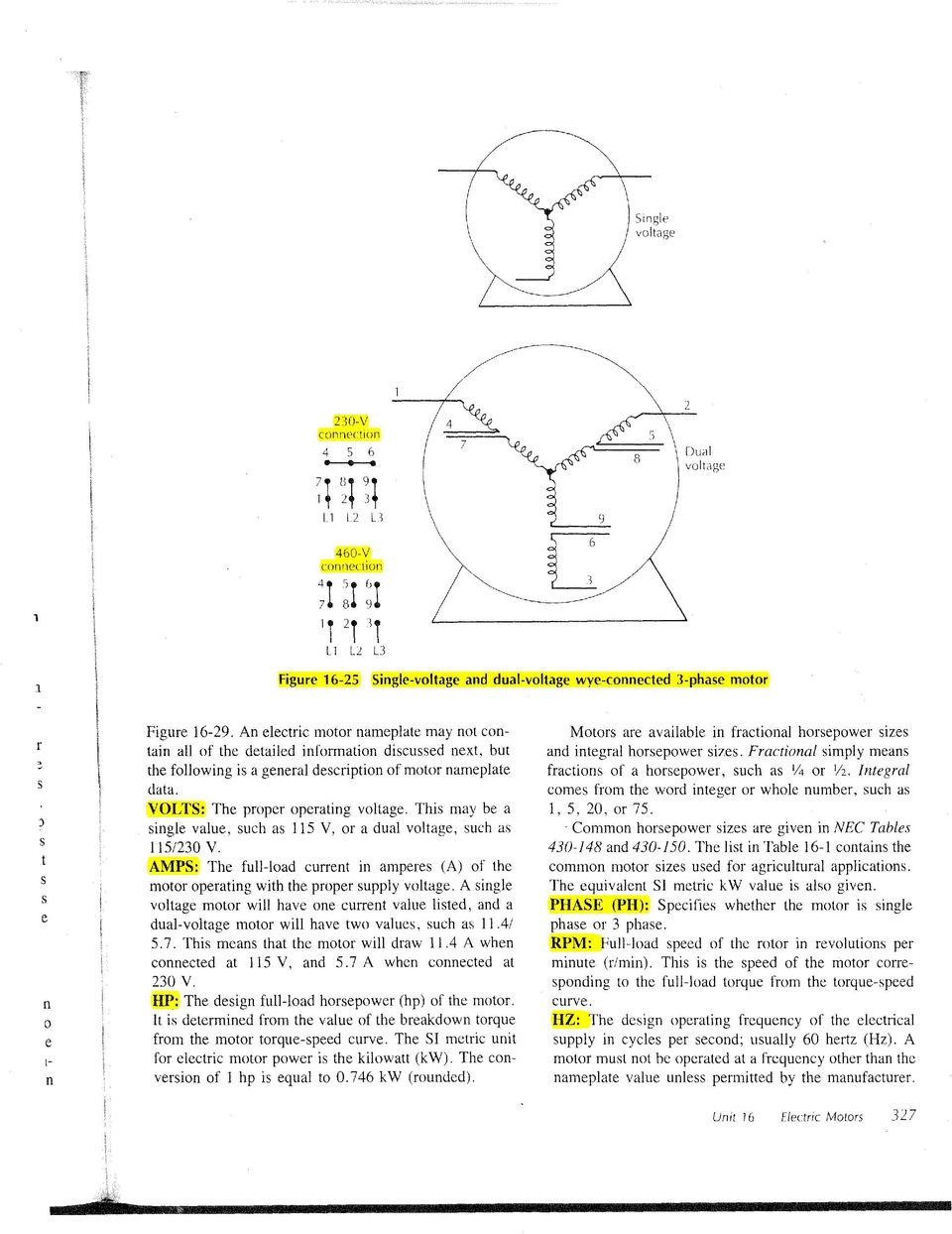
10 holding the brushes is moved to the reverse location. The schematic diagram for a repulsion start, induction run motor is shown in Figure DUAL-VOLTAGE MOTORS Many single- and 3-phase motors are designed to be operated at two different voltages.. A typical dual-voltage motor may be rated at 115/230 V. This motor may be connected for operation from a 115-V supply or a 230-V supply. Dual-voltage motors have two sets of running windings. The running windings are connected in parallel for the lower voltage operation, and in series for the higher voltage operation, Figure Each winding of a 115/230-V motor is designed to be operated at 115 V. Examination of Figure reveals that each winding receives 115 V even when the motor is connected to a 230-V supply. These motors can be reversed by simply reversing the leads to the starting winding. Three-phase motors are also commonly available as dual-voltage motors. The most common voltage combination is 230/460. Three-phase motor windings may be connected to form a wye or a delta. The wye-connected dual-voltage motor is most common for farm applications. This type of motor usually has nine leads available in the terminal housing, Figure A single-voltage wye-connectcd motor has only three leads available. A connection diagram is usually shown on the motor nameplate for both the higher and lower voltages. At the higher voltage the windings are connected in series, and at the lower voltage they are connected in parallel, Figure Delta-connected 3-phase motors are available as single voltage or dual voltage. They are also three-lead and nine-lead motors, as shown in Figure The dualvoltage delta motor windings are connected in parallel for the lower voltage, and in series for the higher voltage, Figure A six-lead, single-voltage, delta-connected motor is available for a special type of starting Running winding Brusi~Armature Brushes are connected together to complete armature circuit figure Schematic diagram of the windings of a single-phase repulsion start, induction run motor figure Single-phase, dual-voltage motor show connected for operation at 115 V and at 230 V called wye-delta starting. Dual-voltage motors started i this manner must have twelve leads available at the tej minal housing. Dual-voltage motors should be operated at the highe voltage whenever possible. The motor power will beth same, but only half as much current will be drawn. Thi means that the motor circuit wire can be sized smalle1 Looking up the current draw of a single-phase, 5-h motor in NEC Table shows that the motor dra\\ 56 A at 115 V. When the motor is operated at 230 V draws only 28 A or half as much. Recall that power i proportional to current times voltage. f the voltage ; doubled, the current must be cut in half to maintain th same power. NAMEPLATE NFORMATON The National Electrical Manufacturers Associatic (NEMA) has developed design and rating standards, 5 that motors supplied by different manufacturers can t compared for basic minimum performance and used i1 terchangeably. A typical motor nameplate is shown ; 326 Unit 16 Electric Motors

11 Single voltage V connection V connection ~! ~ ~! l i 2i ii Ll L2 U 1:9 8 L 2 Dual voltage Figure Single-voltage and dual-voltage wye-connected 3-phase motor s s e n 0 e l n Figure An electric motor nameplate may not contain all of the detailed information discussed next, but the following is a general description of motor nameplate data. VOLTS: The proper operating voltage. This may be a single value, such as 115 V, or a dual voltage, such as 115/230 v. AMPS: The full-load current in amperes (A) of the motor operating with the proper supply voltage. A single voltage motor will have one current value listed, and a dual-voltage motor will have two values, such as 11.4/ This means that the motor will draw 11.4 A when connected at 115 V, and 5. 7 A when connected at 230 V. HP: The design full-load horsepower (hp) of the motor. t is determined from the value of the breakdown torque from the motor torque-speed curve. The S metric unit for electric motor power is the kilowatt (kw). The conversion of 1 hp is equal to kw (rounded). Motors are available in fractional horsepower sizes and integral horsepower sizes. Fractional simply means fractions of a horsepower, such as lj4 or l/2. ntegral comes from the word integer or whole number, such as 1, 5, 20, or 7 5. Common horsepower sizes are given in NEC Tables and The list in Table 16-1 contains the common motor sizes used for agricultural applications. The equivalent S metric kw value is also given. PHASE (PH): Specifies whether the motor is single phase or 3 phase. RPM: Full-load speed of the rotor in revolutions per minute (r/min). This is the speed of the motor corresponding to the full-load torque from the torque-speed curve. HZ: The design operating frequency of the electrical supply in cycles per second; usually 60 hertz (Hz). A motor must not be operated at a frequency other than the nameplate value unless permitted by the manufacturer. Unit 16 Electric Motors 327
12 230 V, 3 phase 460 V, 3 phase Figure Dual-voltage, wye-connected 3-phase motor connected for operation at 230 V and 460 V FRAME (FR): These are standard frame numbers used by motor manufacturers to make sure motors are interchangeable. Common frame numbers for fractional horsepower sizes are 42, 48, and 56. Letters may be added before or after the number to specify motor dimensions and type of mounting. The frame number divided by 16 is the height in inches from the center line of the shaft to the bottom of the mounting. Common induction motors in use today are generally designated as T-frame motors, such as 213T for a 5-hp single-phase motor. Other motors may have what is called a U frame. The U frame usually has a heavier construction than the T frame. t is ir,nportant when replacing a motor to obtain a replacement with the same frame number so that the new motor will bolt into the same place as the old motor without alterations. HOURS OR DUTY: Most motors for farm applications should be designed for continuous duty. There are applications where the motor will be operated for only a few minutes. Motor size and cost can be reduced if it is designed for intermittent duty. The actual hours or minutes of operation will be stated. f the motor is operated longer than the stated period of time, the maximum safe operating temperature of the motor may be exceeded. TEMPERATURE RSE CC): Sometimes the nameplate will state temperature rise or degree C rise. This indicates the rise in temperature of the motor above a 40 C ( 04 F) ambient temperature when operating at full-load conditions. f the surrounding temperature is 40 C (104 F) and the motor temperature rises an additional 40 C (104 F), then the frame of the motor will be 80 C (176 F). This is too hot to touch. Generally, if a motor is not too hot to touch it is actually operating quite coolly. A motor rated 40 C (104 F) can often be overloaded 10% to 15% without damaging the motor. A motor rated 50 C or 55 C ( 122 F or 131 F) rise is actually operating near the breakdown temperature of the insulation on the windings. Motors with a high-temperature rise rating should never be overloaded. Ambient temperature is sometimes printed on ' motor nameplate. This has a different meaning than rise above ambient. Essentially, ambient means that tht: motor is suitable for application where the surroundin~ temperature does not exceed the temperature marked or the nameplate. For example, a nameplate may be markec 40 C ambient (104 F). The motor must not be placed ir an environment with a temperature above 40 C (104 F without consulting the manufacturer. SERVCE FACTOR (SF): This is a better indication o safe overload rating of an electric motor than tempera ture rise. The service factor is a multiplier which, whe1 applied to the rated horsepower, indicates a permissibl< horsepower loading. A service factor of 1.0 means that: motor does not have any continuous overload capacity A service factor of means a motor could be operate< with a 15% overload without danger of overheating. Th1 service factor is considered when sizing the motor over load protection. A replacement motor for a farm machin1 should have a service factor the same as that of the ol< motor. f not, consult the machine manufacturer 'for. recommended replacement. A farm-duty motor coul< have a service factor of 1.35 or more. NSULATON CLASS: The insulation on motor wire is rated in several classes, depending upon the maximur safe operating temperature which will not cause prema ture breakdown. Common insulation classes are A, B, F 328 Unit 16 Electric Motors

13 Single voltage 230-V connection Dual voltage V connection 7 ' &, ""- 4 ' r figure Single-voltage and dual-voltage, delta-connected 3-phase motor and H. Class A insulation has the lowest temperature rating. Most farm-duty motors have class A or B insulation. The insulation class is considered when assigning a motor service factor. The life of a motor is dependent upon the life of the insulation. Frequent overheating of the motor will shorten the motor's normal operating life. CODE LETTER: The code letter is based upon the locked-rotor current drawn by the motor. The code letter is used to determine the maximum rating of the motor branch-circuit protection. The code letter is determined by multiplying the supply voltage by the locked-rotor current and then dividing by the motor horsepower. This value must also be divided by to give kilovoltamperes per horsepower (k V A/hp). The approximate locked-rotor current can be found in NEC Table (included in Unit 15 of this text). The code letter is found in NEC Table 430-7(b). The code letters may be used to calculate the approximate motor instantaneous starting current (locked-rotor current). Consider an example of a 5-hp, 3-phase, 230-V motor with code letter J on the nameplate. Here is how to calculate motor starting current from the code letter. Equation 16.1 gives motor locked-rotor current. k VA X hp X EX 1.73 (Omit for a single-phase motor.) Eq The kilovolt -amperes per horsepower corresponding to code letter J is looked up in NEC Table 430-7(b). For letter J, the range is 7. 1 to X 5 X A minimum 230 X X 5 X ] 000 = = A maximum 230 X 1.73 Unit 76 Electric Motors 329

14 460 V, 3 phase Figure Nameplate from a 3-phase electric motor 230 V, 3-phase Figure Dual-voltage, delta-connected 3-phase motor connected for operation at 230 V and 460 V type is a temperature-sensitive switch placed in the motor windings. Some thermal protectors are manual resetting, while others are automatic. With the automatic type, the motor will restart when it cools. Some farrr motors have a thermal protector in the windings whid must be wired in as a part of the control circuit. Thest wires will be in the terminal housing with the lead wires and are marked thermal protection or thermostat. Tht wiring of these thermal protectors is discussed in Unit r on the subject of motor control. EFFCENCY More than half of electrical energy is used to powe1 electric motors; therefore, motor efficiency is of vita concern. An electric motor is usually designed for maxi mum efficiency when it is operated at 80% to 100% of it: rated load. Fractional-horsepower motors often reacl maximum efficiency at 100% to 120% of full load. Effi ciency decreases rapidly when a motor is operated signif The instantaneous starting current of the motor in the example ranges from 89.2 A to A. DESGN: A design letter may be given on the nameplate or in the manufacturer's literature. This letter is assigned according to NEMA design standards. The design letter is an indication of the shape of the motor torque-speed graph, the level of starting torque, and the level of starting current. Most squirrel-cage induction motors are design A or B. The design B motor generally has a lower starting current than the design A, with approximately the same starting torque. THERMAL PROTECTON: Many motors have builtin thermal protection to disconnect power to the motor in the event the motor windings become too hot. Some thermal protectors sense motor current, while another Table 16-1 Common motor sizes used for agricultura applications Horsepower (hp) Kilowatts (kw) 1;(> / j, / / / Unit 16 Electric Motors

15 7 r J s h icantly under its rated load. Therefore, matching a motor to the load is important to achieve maximum efficiency. Three major sources of motor losses are: 1) winding losses, 2) magnetic core losses, and 3) mechanical losses. The losses in the windings occur from the resistance of the wire. As current flows through the windings, heat is produced (Heat = 1 2 X R x t, Eq. 2.22). The manufacturer selects wire size and materials to minimize this heating effect. The user of electric motors can keep them clean so that they will run cooler. f operating temperature is minimized, the winding resistance will be minimized. Losses in the stator and rotor core are controlled by the manufacturer. A high-efficiency motor will be more expensive because the manufacturer has used materials in the motor with better magnetic qualities. Heat is produced in the core by eddy currents that are induced by the rotating magnetic fields. The core is laminated with insulation between each layer to reduce these heat-producing eddy currents. Mechanical losses result from friction in bearings, gears, and belt and chain drives. Bearings should be lubricated according to the manufacturer's recommendations in order to reduce losses. This lubrication practice applies to the entire machine, not just the motor. Chain drives should be adjusted to proper tension. Belt drives should not be loose, but neither should they be bowstring tight. Proper adjustment will reduce friction and losses. ENCLOSURES FOR MOTORS The type of motor enclosure for an agricultural application is extremely important. Dust, excessive moisture, and rodents must not be permitted to enter a motor. Rodents are a particular problem. Openings in motors should be not larger than lj4 in (6.35 mm). Basically, if a pencil can be inserted into the motor, the opening is too large. Common motor enclosures used for agricultural applications are the open, dripproof, splashproof, totally enclosed, or explosionproof types. An open motor is shown in Figure Air is drawn through the motor to cool the windings. These motors must only be used inside where dust is not present. They are often used for furnace blowers. These motors must not be used where water will be sprayed for cleaning. n general, open motors are not recommended for use in agricultural buildings. A dripproof motor is shown in Figure Air is drawn through the motor to cool the windings, but the openings are located in such a way that rain will not enter the motor. These motors are suitable for outside use, but Figure A motor with an open enclosure only in dust-free areas. The openings must be small enough so that rodents cannot enter. t is possible for water to be splashed into the motor. A similar type is the splashproof motor which has the openings located in such a way that water cannot be easily splashed inside. Many dripproof motors are actually splashproof motors. Totally enclosed motors are permitted in areas where dust and settlings may be present around the motor. Air is not drawn through the motor for cooling. nstead, air inside the motor is circulated through the windings carrying heat to the case where it moves to the outside by conduction. Many totally enclosed motors have a fan on one end which blows air over the outside of the case, Figure This is called a totally enclosed fan-cooled (TEFC) motor. This type of motor enclosure is recommended for dusty or wet areas in or around farm buildings. Figure A motor with a dripproof enclosure Unit 16 Electric Motors 33 7

16 Figure A motor with a totally enclosed, fan-cooled (TEFC) enclosure Explosionproof motors must be used in areas where hazardous vapors could cause an explosion or fire. A typical example is a motor on a fuel-dispensing pump. Wiring in areas where there are hazardous vapors present is called Class wiring. Gasoline is further identified as a Group D vapor, NEC Section An explosionproof motor will state ''suitable for Class areas'' on the nameplate. f it is to be used in an area where gasoline vapors are present, the nameplate must also state that the motor is suitable for Group D vapors. SOFT-START MOTORS The high starting current of a large motor can be up to six times the full-load current at full-load speed. This high starting current may cause excessive voltage drop on the electric power supplier's primary lines. The result is voltage flicker. The most noticeable effect is a dimming of incandescent lights while the motor is starting, or the shrinking of a television image on the screen. The problem is that this dimming also occurs for neighboring electric customers. f the voltage flicker becomes annoying to customers, the power supplier will impost a limit upon the maximum size across-the-line motor which a customer may install. An industrial customer may be limited to the number of times in o,ne day and the hours when a large motor may be started. An across-the-line motor starter is one which receives full operating voltage. A common motor starting technique often acceptable to the power supplier is to start the motor at reduced voltage. The motor draws much less starting current when started at reduced volt age, Figure The starting torque is also reduced therefore, this type of starting will not work on som farm loads. A soft-start single-phase motor has special control which limit the current draw of the motor during starting These motors are available in sizes up to 50 hp. Th electric power supplier must be contacted prior to th purchase of a large size motor to make sure the primar: wires and transformer are adequate. A 3-phase moto operating from a phase converter also draws less curren during starting than the same motor operating direct!: from utility-supplied 3-phase power. Special starters are available which start a motor i1 such a way that the inrush current is limited. Methods o starting motors with reduced inrush current are: 1) pat winding: 2) wye-delta, 3) primary resistor, and 4) auto transformer starting. The wye-delta technique work with 3-phase motors only, while the others work wit! both single- and 3-phase motors. VARABLE-SPEED MOTORS Variable speed may be desirable for some farm appli cations. An electric drill is a universal motor, and it: speed can be varied by lowering the input voltage. Usu ally, speed in an electric drill is controlled with a solid state eiectronic device called a siiicon controlled rect(fie, (SCR controller). The input current of the motor woul< look much like that of the light dimmer shown in Uni 11. Direct-current motors may be used for special appli cations such as feed-supplement metering where variabl' speed is desirable. Speed may be continuously varied with a variabl1 belt drive. A handle is turned which changes the diame Motor starter energized Locked-rotor current Time Regul:1r motor Full-loJd current Motor turning at rated speed Figure Starting current of a regular motor and soft -start motor 332 Unit 16 Electric Motors

17 t l; e s r,. e e y lr lt y )-.S h s r d t e e ter of a pulley in the drive unit. This type of drive is most desirable where high power requirements are required. The motor is always operating at full rated speed even though the output shaft speed is variable. This ensures adequate available torque for the load. At one time, alternating-current induction motors were generally not capable of significant speed variability, but electronic devices have overcome that barrier. A permanent split-capacitor motor is capable of some speed variation. A common application is a variablespeed fan. The input power to the motor is controlled in a manner similar to the light dimmer shown in Unit 11. A thermistor, rather than a variable resistor, is used to control the fan speed. A thermistor is a resistor whose resistance changes as the temperature changes. A variable resistor can be used instead of a thermistor in the electronic circuit to select the desired speed. To understand how the variable-speed, permanent split-capacitor motor works, it is necessary to understand the torque required to tum a fan at different speeds. A fan requires very little torque to get started, but as it turns faster it pushes more air and requires more torque. Figure is a torque-speed curve for a fan and an electric motor. The operating point is where the fan load curve and the motor torque curve cross. Farm equipment manufacturers must make sure that this operating point is equal to or below the full-load torque of the motor. Reducing the voltage to a permanent split-capacitor motor causes the torque-speed curve for the motor to shrink, Figure The fan load curve and the motor torque-speed curve cross at a lower r/min. Therefore, the fan slows down. Further reducing the input voltage slows down the fan even more. The motor has less torque available as the voltage is reduced. Therefore, Motor torque Motor rated full-load torque Load torque Synchronous speed Motor torque Figure The torque curve of the motor shrinks as the input voltage to the permanent split-capacitor motor is reduced. this technique for varying the speed of an induction motor usually works only when powering fans. The rotational speed of a 3-phase induction motor may be varied by changing the frequency to the motor. A special controller rectifies the input 60-Hz ac to de. An electronic inverter changes the direct current back into alternating current, but at a different frequency. f the 60-Hz input frequency is changed to 40 Hz, the motor will tum more slowly. f the 60-Hz input is increased to 70 Hz, the motor will rotate faster. The voltage to the motor is also varied to prevent motor overheating due to too much cun ent. Typically, speed variation may range from 20% to 110% of the motor nameplate full-load speed. For a motor rated at r/min, this would be a speed variation of 345 r/min to 900 r/min. Much wider speed variation can be obtained, depending upon the application. The electronic speed controller usually maintains a constant output torque from the motor. But, horsepower is proportional to torque times r/min, Equation Therefore, the motor horsepower decreases as the r/min is reduced, and the motor horsepower increases as the r/min is increased. Variable-speed controllers for induction motors must be carefully matched to the type of load. These controllers are best suited to loads such as fans, blowers, and some pumps. a r/min r/min Figure The operating speed occurs where the motor torque-speed curve and the load torque curve cross x torque x r/min Horsepower = (torque is measured in pound-feet.) Eq Unit 16 Electric Motors 333

18 nduction motors are available with multiple speeds. These motors change the number of magnetic stator poles. A 2-pole induction motor turns at about r/min. A 4-pole motor turns at about r/min. Equation 16.3 gives the approximate speed of an induction motor based upon the number of stator magnetic poles. 2 X Motor r/min = Number of poles Eq A 6-pole induction motor would turn at about r/min. 2 X Motor r/min = r/min A typical two-speed motor is capable of operating with four or six poles. ts two operating speeds are then r/min and r/min. f the motor could also be connected with eight poles, it could then be operated at r/min, or 862 r/min. BEARNGS The bearings hold the turning rotor or armature of the motor to the frame. Common bearings are the sleeve type and the ball type. Motors with sleeve bearings are designed to be operated with the shaft in the horizontal position. They are lubricated by a thin film of oil which is pulled into the space between the shaft and the bearings. Usually, there is an oil reservoir below the bearings, and a wick keeps oil next to the bearings. This oil reservoir must be mounted below the shaft. f the motor is mounted on a wall, the end bell of the motor should be rotated so that the oil reservoir is downward. Motors with ball bearings are more expensive than those with sleeve bearings, but they can be mounted in any position. They are grease lubricated so there is no danger of lubricant spilling out of the bearing. Most ball bearings are prelubricated, and will run for years before it becomes necessary to open them and repack them with grease. BRAKNG Braking a machine quickly when it is turned off is sometimes desirable, particularly from a safety standpoint. Most farm machines experience high friction and, therefore, stop quite quickly when power is disconnected. Rotating machines with a great deal of weight have considerable turning inertia, and some type of bra1 ing is needed to bring them to a halt quickly. One type of braking is simply a friction brake, sim Jar to that on an automobile. A brake shoe contacts steel drum or a disk contacts a plate. The friction brak can be added to the machine or motors with built-i brakes are available. Dynamic braking is another method which is con monly used on ac motors. A special control and a sourc of de power are required. Usually, these are supplied as part of a dynamic control panel. When the ac power disconnected, de is applied to the field windings. Th creates a strong magnetic field that does not rotate. As result, the rotor comes to a halt quickly. The stronger tt de magnetic field, the faster the rotor and machine stc turning. Other methods of braking are also availablt BELTS, CHANS, AND COUPLNGS Motors must be properly coupled to machines if eff cient power transfer and long bearing life are to l achieved. Common types of couplings for farm equi] ment are V -belts, roller chains, and direct-drive co1 plers. V -belts are especially common because they a inexpensive and efficient, and require minimal maint nance. Proper belt tension and pulley alignment is ir. portant. Figure shows how to check for proper bt tension. Push down hard on the belt. For every 12 (305 mm) from the center of one shaft to the cen.ter, the other, the belt should depress about % in ( 19 mm For example, if the shafts are 18 in (457 mm) apart, tl belt should depress about 1 1 /s in (28.5 mm) Figure The V -belt tension is correct when distan, A is % in (19 mm) for every 12 in (305 mm) of distance 334 Unit 16 Electric Motors

19 ,- l- a e n 1- e a ls ls a le p i- )e )- 1- re 1- Jt in )f ). Proper alignment is important to maximize power transfer and to minimize bearing, belt or chain wear. Figure shows proper (and improper) alignment for belt and chain drives. Direct-drive couplings must be aligned properly to avoid vibration and wear on bearings. Figure illustrates correct (and incorrect) direct-drive coupler alignment. Sizing a Pulley Fans, pumps, and machinery are designed to operate at a certain speed, but this speed is often different from the r/min of the motor. R/min can be changed easily by changing the diameter of the pulley of a V-belt drive. The same relationship is true for gear and chain drives. Consider an example where there is a 4-in diameter pulley on a motor turning at 740 r/min, and a machine has an 8-in diameter pulley, Figure The 8-in diameter pulley will make only J2 revolution when the 4-in diameter pulley makes one complete revolution. Therefore, the machine will have a shaft rotation only half as fast as the motor, or 870 r/min. Equations 16.4, 16.5, and 16.6 are used to solve pulley-sizing problems. CORRECT ~~~----~~~~~~-----NCORRECT c:::cr=r '=' 2 -~ l). CORRECT NCORRECT Figure ncorrect direct-drive coupler alignment can lead to early bearing failure. Motor pulley diameter Eq Machine r/min X machine diameter Motor r/min Machine pulley diameter Eq Motor r/min X motor diameter Machine r/min Motor Problem 16-1 Machine r/min Eq diameter x motor r/min Machine pulley diameter An example will help to illustrate how a pulley is selected for a particular application. Consider a machine with a 2-in diameter pulley which is intended to rotate at 400 r/min. Select the proper size pulley for a motor with a full-load speed of 725 r/min. Solution The problem is solved using Equation Motor pulley diameter 400 r/min X 12 in = 2.8 in 725 r/min Common pulley diameters are 2 in, 21J2 in, and 3 in. f a 3-in diameter pulley is selected, the load will turn faster than 400 r/min. :e B. Figure Proper belt and chain alignment is important. Machine r/min 3 in x r/min 12 in 431 r/min Unit 76 Electric Motors 335

20 1 740 r/min r 8 in l Figure R/min is changed by changing the diameter of the pulley on the motor and the machine. f a 21/2-in diameter pulley is selected, the machine will turn at 360 r/min. f the motor is oversized for the load, it will actually run faster than r/min. Therefore, it would probably be wise to select a pulley which is ' standard size smaller than 3 in in diameter or, in thi~ case, 2 1 /2 in. REVEW Refer to the National Electrical Code when necessary to complete the following review material. Write your answers on a separate sheet of paper. 1. State the basic purpose of an electric motor. 2. N arne the parts of the electric motor in this diagram. c 3. The motor in the diagram is a. 3 phase. b. single phase. c. 2 phase. d. split phase. 4. f the shaft of an electric motor turns at r/min, and the motor operates from a 60-Hz ac supply, it is a( an) a. universal motor. b. permanent magnetic motor. c. synchronous motor. d. induction motor. 336 Unit 16 Electric Motors

21 5. The motor with the highest starting torque from the list is a a. permanent split capacitor. b. shaded pole. c. two-value capacitor. d. split phase. 6. A 2-pole, 3-phase induction motor could have a shaft rotation of a r/min. b r/min. c r/min. d r/min. i s 7. An electric motor has a number 56 frame. The height of the shaft above the mounting surface is which of the following? a. 5.6 in b. 5.0 in c. 3.5 in d. 6.0 in 8. The type of capacitor used for a permanent split-capacitor motor is a. electrolytic. b. oil filled. c. variable. d. disc type. 9. A 4-pole synchronous motor operating from a 60-Hz ac supply will have a shaft rotation of a r/min. b r/min. c r/min. d r/min. 10. Will the 3-phase, 2-pole induction motor in the diagram have a shaft rotation that is clockwise or counterclockwise? 11. The shaft rotation of the motor in Problem No. 10 may be reversed by a. switching wires A and B. b. switching wires B and C. c. switching wires A and C. d. switching any two wires. 12. The induction motor in the accompanying diagram at the top of the next page is dual voltage, rates at 115/230 V. The motor is which of the following types? Unit 16 E /ectric Motors 337
22 a. Permanent split capacitor b. 3-phase c. Capacitor start, induction run d. Split-phase start, induction run 13. The motor in Problem No. 12 is connected for operation at a. 115 V. b. 230 v. c. 460 V. d. 277 v. 14. The starting current of a single-phase, lj2-hp electric motor, at the instant the windings are first subjected to line voltage and the rotor is not turning yet, is approximately which of the following? (The motor draws 9.8 A full-load current at 115 V.) a. 9.8 A b. 24 A c. 58 A d. 82 A 15. The type of motor enclosure best suited for a farm feed-processing or feed-handiing room is a. totally enclosed, fan cooled. b. open. c. dripproof. d. splashproof. 16. Examine the motor nameplate of Figure f the motor is connected for 230-V operation, how many amperes will it draw fully loaded? 17. Refer to the diagram. Based on the torque-speed curve for the motor and fan, a. the motor is half loaded. b. the motor is overloaded. c. the fan will run at synchronous speed. d. there is insufficient accelerating torque to get the fan started. r/min J1l ~ \\) l:g ~ 12..!::. u ~ Vl 338 Unit 16 Electric Motors
23 18. The motor in the following list not generally capable of having its shaft rotation variable is a a. direct-current motor. b. single-phase, capacitor start, induction run motor. c. permanent split-capacitor motor. d. universal motor. 19. The motor in the diagram can have the direction of rotation of the shaft reversed by a. changing to the reverse location the bracket holding the brushes. b. reversing lead wires T 1 and T2. c. reversing lead wires T5 and T8. d. reversing the hot and neutral wire. Hot TS T1 T3 115 v N T2 T4 TB 20. What is the type of single-phase motor illustrated in Problem No. 19? 21. The 3-phase motor in this illustration is a. wye connected. b. delta connected. c. improperly connected. T1 T2 T3 22. A 3-phase, 20-hp electric motor draws 54 A at full load if connected to a 230-V supply. f the motor is connected to a 460-V supply, it will a. develop 40 hp. b. draw 108 A. c. develop 10 hp. d. draw 27 A. Unit 16 Electric Motors 339
24 23. f an induction motor is disconnected from the ac power supply, and the stator windings are energized with de power, the motor will a. speed up. b. reverse and tum in the opposite direction. ~. come to a stop quickly. d. coast to a halt. 24. f a motor is to be mounted with the shaft in the vertical position, the motor should have what type of bearings? 25. A fan is designed to operate at r/min, and is driven by a r/min motor through a V-belt drive. f the fan is equipped with a 6-in diameter pulley, the proper motor pulley diameter is which of the following? a. 2 in b. 3 in c. 4 in d. 8 in 340 Unit 76 Electric Motors
SECTION 4 ELECTRIC MOTORS UNIT 17: TYPES OF ELECTRIC MOTORS
 SECTION 4 ELECTRIC MOTORS UNIT 17: TYPES OF ELECTRIC MOTORS UNIT OBJECTIVES After studying this unit, the reader should be able to Describe the different types of open single-phase motors used to drive
We will discuss common industrial applications with guides for the proper use of electric motors on these.
 INTRODUCTION: Baldor Electric Company has prepared this Specifiers Guide to help you cover all the bases when you are specifying electric motors. It will cover in a generic way most of the subjects which
(3) Explosion proof. Designed to prevent ignition of any explosive gases or dust and dirt which may surround the motor.
 ELECTRIC MOTORS Enclosures for Motors Types of motor enclosures generally used in farm applications: (1) Open type; drip proof or splash-proof. A general purpose motor for use in dry locations which are
Rotary Phase Converters
 FACTS from Ronk Electrical Industries, Inc. Bulletin 11981 Rotary Phase Converters ROTOVERTER Pat. No. 3,670,238 ROTO-CON Pat. No. 4,158,225 What are the ROTO-CON and ROTOVERTER power converters? The ROTO-CON
TERMINAL MARKINGS AND CONNECTIONS PART WINDING START
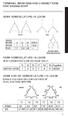 TERMINAL MARKINGS AND CONNECTIONS PART WINDING START NEMA NOMENCLATURE 6 LEADS 7 7 3 9 8 Delta 3 9 8 Wye OPER. 9 MODE L L L3 OPEN 7 START 3 7,8,9 T T T3 T7 T8 T9 RUN,7,8 3,9 3 8 MOTOR LEADS 3 7 Double
AC Motor Speed. n s = synchronous speed (in RPM), f = frequency (in Hz), and p = the number of poles
 AC Induction Motors Simplest and most rugged electric motor Consists of wound stator and rotor assembly AC in the primary member (stator) induces current in the secondary member (rotor) Combined electromagnetic
INSTALLATION AND MAINTENANCE INSTRUCTIONS FOR THREE PHASE INDUCTION MOTORS
 INSTALLATION AND MAINTENANCE INSTRUCTIONS FOR THREE PHASE INDUCTION MOTORS Frames 143T - 449TZ 5100 North IH 35 Round Rock, Texas 78681 Phone: 800-451-8798 512-255-4141 Fax: 512-244-5512 RECEIVING 1. Check
DIRECT CURRENT GENERATORS
 DIRECT CURRENT GENERATORS Revision 12:50 14 Nov 05 INTRODUCTION A generator is a machine that converts mechanical energy into electrical energy by using the principle of magnetic induction. This principle
Unit 33 Three-Phase Motors
 Unit 33 Three-Phase Motors Objectives: Discuss the operation of wound rotor motors. Discuss the operation of selsyn motors. Discuss the operation of synchronous motors. Determine the direction of rotation
Motor Protection Voltage Unbalance and Single-Phasing
 Motor Protection Voltage Unbalance and Single-Phasing Cooper Bussmann contributes the following information, which is an excerpt from their 190-page handbook SPD Selecting Protective Devices Based on the
Motor Fundamentals. DC Motor
 Motor Fundamentals Before we can examine the function of a drive, we must understand the basic operation of the motor. It is used to convert the electrical energy, supplied by the controller, to mechanical
Introduction. Upon completion of Basics of AC Motors you should be able to:
 Table of Contents Introduction...2 AC Motors...4 Force and Motion...6 AC Motor Construction... 12 Magnetism... 17 Electromagnetism... 19 Developing a Rotating Magnetic Field...24 Rotor Rotation...29 Motor
Equipment: Power Supply, DAI, Wound rotor induction motor (8231), Electrodynamometer (8960), timing belt.
 Lab 13: Wound rotor induction motor. Objective: to examine the construction of a 3-phase wound rotor induction motor; to understand exciting current, synchronous speed and slip in this motor; to determine
2. A conductor of length 2m moves at 4m/s at 30 to a uniform magnetic field of 0.1T. Which one of the following gives the e.m.f. generated?
 Extra Questions - 2 1. A straight length of wire moves through a uniform magnetic field. The e.m.f. produced across the ends of the wire will be maximum if it moves: a) along the lines of magnetic flux
TERMINAL MARKINGS AND INTERNAL WIRING DIAGRAMS SINGLE PHASE AND POLYPHASE MOTORS MEETING NEMA STANDARDS
 INTRODUCTION The following represents the most up-to-date information on motor terminal marking for proper connection to power source for all alternating current motors manufactured in accordance with
Synchronous motor. Type. Non-excited motors
 Synchronous motor A synchronous electric motor is an AC motor in which the rotation rate of the shaft is synchronized with the frequency of the AC supply current; the rotation period is exactly equal to
Motor Specifications. Nameplate
 Motor Specifications Nameplate The nameplate of a motor provides important information necessary for selection and application. The following drawing illustrates the nameplate of a sample 30 horsepower
Equipment: Power Supply, DAI, Synchronous motor (8241), Electrodynamometer (8960), Tachometer, Timing belt.
 Lab 9: Synchronous motor. Objective: to examine the design of a 3-phase synchronous motor; to learn how to connect it; to obtain its starting characteristic; to determine the full-load characteristic of
Specifying a Variable Frequency Drive s
 Specifying a Variable Frequency Drive s Put on by Bruce Reeves and Jeremy Gonzales Dykman Electrical Covering the Western US For all of your VFD and Soft Start and Motor Needs How To Specify a Variable
Data Sheet. AC Industrial Electric Motors
 Data Pack B Issued ovember 2005 1502325812 Data Sheet AC Industrial Electric Motors Standards organisations The RS-ABB range of ac induction motors is produced to common European standards, these being
What Do All Those Things on an AC Motor Nameplate Mean?
 What Do All Those Things on an AC Motor Nameplate Mean? Introduction: Ever order a motor on power, speed, and enclosure? PO says maybe "5 hp, 1,800 rpm, TEFC." New-motor nameplate says "HP 5, RPM 1748,
Single-Phase AC Synchronous Generator
 ST Series Single-Phase AC Synchronous Generator Instructions for Operation and Maintenance English to English translation by R.G. Keen, May 2004. ST Series of Single-Phase AC Synchronous Generators Description
C Standard AC Motors
 C Standard AC Standard AC C-1 Overview, Product Series... C-2 Constant... C-9 C-21 C-113 Reversible C-147 Overview, Product Series Constant Reversible Electromagnetic Brake C-155 Electromagnetic Brake
WYE-DELTA AND SOLID STATE STARTER APPLICATION GUIDE
 WHITE PAPER WYE-DELTA AND SOLID STATE STARTER APPLICATION GUIDE EXPLANATION AND ASSISTANCE FOR APPLYING SOLID STATE SOFT STARTERS IN TRADITIONAL REDUCED VOLTAGE APPLICATIONS Introduction..............................................................2
GE Industrial Systems. AC Motor Selection and Application Guide
 apple GE Industrial Systems AC Motor Selection and Application Guide TABLE OF CONTENTS Voltage... 2 Frequency... 3 Phase... 4 Motor Output Rating... 4 Polyphase Motors... 4 Single-phase Motors... 4 Service
Equipment: Power Supply, DAI, Universal motor (8254), Electrodynamometer (8960), timing belt.
 Lab 12: The universal motor. Objective: to examine the construction of the universal motor; to determine its no-load and full-load characteristics while operating on AC; to determine its no-load and full-load
Section 10. Application Manual for NEMA Motors. Special Applications
 Special Applications 1 Power Factor Correction 1 Methods of Starting 3AC Induction Motors 5 3 Duty Cycles and Inertia 3 4 Horsepower Determination 30 5 Formulas and General Data 34 Power Factor Correction
26 3213.13 Diesel Engine Driven Generators Page 1 of 6
 Last Update: December 8, 2014 A. Description of System Consultant s Handbook Page 1 of 6 1. Provide a diesel engine driven electric generating unit, factory assembled, tested and certified to operate at
Application Information
 Moog Components Group manufactures a comprehensive line of brush-type and brushless motors, as well as brushless controllers. The purpose of this document is to provide a guide for the selection and application
Direct Current Motors
 Direct Current Motors DC MOTORS The DC machine can operate as a generator and as a motor. Chap 5. Electrical Machines by Wildi, 6 e Lecturer: R. Alba-Flores Alfred State College Spring 2008 When a DC machine
8 Speed control of Induction Machines
 8 Speed control of Induction Machines We have seen the speed torque characteristic of the machine. In the stable region of operation in the motoring mode, the curve is rather steep and goes from zero torque
AC Induction Motor Slip What It Is And How To Minimize It
 AC Induction Motor Slip What It Is And How To Minimize It Mauri Peltola, ABB Oy, Helsinki, Finland The alternating current (AC) induction motor is often referred to as the workhorse of the industry because
Technical Guide No. 100. High Performance Drives -- speed and torque regulation
 Technical Guide No. 100 High Performance Drives -- speed and torque regulation Process Regulator Speed Regulator Torque Regulator Process Technical Guide: The illustrations, charts and examples given in
IV. Three-Phase Induction Machines. Induction Machines
 IV. Three-Phase Induction Machines Induction Machines 1 2 3 4 5 6 7 8 9 10 11 12 13 Example 1: A 480V, 60 Hz, 6-pole, three-phase, delta-connected induction motor has the following parameters: R 1 =0.461
I hope you find them useful and I would appreciate any comments or thoughts you might have for future improvements, corrections or topics.
 COWERN PAPERS Baldor Electric Company 5711 R.S. Boreham Jr. Street Fort Smith, AR 72901 Phone (479) 646-4711 Fax (479) 648-5792 www.baldor.com Enclosed you will find a set of papers that I have written
SYNCHRONOUS MACHINES
 SYNCHRONOUS MACHINES The geometry of a synchronous machine is quite similar to that of the induction machine. The stator core and windings of a three-phase synchronous machine are practically identical
PowerFlex Dynamic Braking Resistor Calculator
 Application Technique PowerFlex Dynamic Braking Resistor Calculator Catalog Numbers 20A, 20B, 20F, 20G, 22A, 22B Important User Information Solid-state equipment has operational characteristics differing
AC Replacement for DC Mill-Duty Motors
 AC Replacement for DC Mill-Duty Motors This article is available online at www.aist.org for 30 days following publication. For many years, DC mill auxiliary motors for steel mill applications such as screwdowns,
SPEED CONTROL SYSTEM
 SPEED CONTROL SYSTEM INDEX SPEED CONTROL MOTOR FEATURES 144 6W ( 70mm) 153 10W ( 70mm) 155 15W ( 80mm) 157 25W ( 80mm) 159 40W ( 90mm) 161 SPEED CONTROL W ( 90mm) 163 90W ( 90mm) 165 120W ( 90mm) 168 180W
Basics of Electricity
 Basics of Electricity Generator Theory PJM State & Member Training Dept. PJM 2014 8/6/2013 Objectives The student will be able to: Describe the process of electromagnetic induction Identify the major components
DC GENERATOR THEORY. LIST the three conditions necessary to induce a voltage into a conductor.
 DC Generators DC generators are widely used to produce a DC voltage. The amount of voltage produced depends on a variety of factors. EO 1.5 LIST the three conditions necessary to induce a voltage into
SINGLE PHASE MOTORS. INSTALLATION AND MAINTENANCE MANUAL March 21, 2006
 SINGLE PHASE MOTORS INSTALLATION AND MAINTENANCE MANUAL March 21, 2006 Irvine, California (800) 474-0520 Indianapolis, Indiana (800) 866-7973 Hamilton, Ontario (800) 809-0330 e-mail: [email protected]
chapter6 Electrical machines and motors Unit 1 outcome 6
 Electrical machines and motors chapter6 Unit 1 outcome 6 The principles of magnetism are central to many of the tasks you will carry out as an electrician. Magnetism, like gravity, is a fundamental force.
Principles of Adjustable Frequency Drives
 What is an Adjustable Frequency Drive? An adjustable frequency drive is a system for controlling the speed of an AC motor by controlling the frequency of the power supplied to the motor. A basic adjustable
Roller Chain Coupling
 Roller Chain Coupling Features 1. Simple structure A roller chain coupling consists of one duplex roller chain and two sprockets for a simplex chain. Handling is very simple as both the shafts (driving
Introduction. Three-phase induction motors are the most common and frequently encountered machines in industry
 Induction Motors Introduction Three-phase induction motors are the most common and frequently encountered machines in industry - simple design, rugged, low-price, easy maintenance - wide range of power
Single Phase Soft Starter
 Single Phase Soft Starter Installation & Operating Manual 6/02 Table of Contents Section 1 General Information................................................... 1 1 General Description................................................
ADJUSTABLE FREQUENCY DRIVES APPLICATION GUIDE
 ADJUSTABLE FREQUENCY DRIVES APPLICATION GUIDE Adjustable Frequency Drives Application Guide Table of Contents Introduction....................................................................................
1. The diagram below represents magnetic lines of force within a region of space.
 1. The diagram below represents magnetic lines of force within a region of space. 4. In which diagram below is the magnetic flux density at point P greatest? (1) (3) (2) (4) The magnetic field is strongest
SEWER CHEWER Wastewater / Sludge Grinder Submersible Gearmotor
 INSTALLATION, OPERATION AND MAINTENANCE MANUAL For SEWER CHEWER Wastewater / Sludge Grinder Submersible Gearmotor Yeomans Chicago Corporation 3905 Enterprise Court P.O. Box 6620 Aurora, IL 60598-0620 Phone:
AC Generators and Motors
 AC Generators and Motors Course No: E03-008 Credit: 3 PDH A. Bhatia Continuing Education and Development, Inc. 9 Greyridge Farm Court Stony Point, NY 10980 P: (877) 322-5800 F: (877) 322-4774 [email protected]
Induction Motor Theory
 PDHonline Course E176 (3 PDH) Induction Motor Theory Instructor: Jerry R. Bednarczyk, P.E. 2012 PDH Online PDH Center 5272 Meadow Estates Drive Fairfax, VA 22030-6658 Phone & Fax: 703-988-0088 www.pdhonline.org
GENERATOR SELECTION. a. Three phase - 120/208V, 3 phase, 4W wye; 277/408, 3 phase, 4W wye; * 120/240V 3 phase, 4W Delta
 GENERATOR SELECTION Generators must be sized to handle their load based on the continuous KW, kilowatt load, and KVA, kilovoltamp load, and the worst case starting load KW + KVA. They must be derated for
ABB drives. Technical guide No. 4 Guide to variable speed drives
 ABB drives Technical guide No. 4 Guide to variable speed drives 2 Guide to variable speed drives Technical guide No. 4 Technical guide No. 4 Guide to variable speed drives Copyright 2011 ABB. All rights
DHANALAKSHMI COLLEGE OF ENGINEERING DEPARTMENT OF ELECTRICAL AND ELECTRONICS ENGINEERING EE2302 - ELECTRICAL MACHINES II UNIT-I SYNCHRONOUS GENERATOR
 1 DHANALAKSHMI COLLEGE OF ENGINEERING DEPARTMENT OF ELECTRICAL AND ELECTRONICS ENGINEERING Constructional details Types of rotors EE2302 - ELECTRICAL MACHINES II UNIT-I SYNCHRONOUS GENERATOR PART A 1.
GLOLAB Two Wire Stepper Motor Positioner
 Introduction A simple and inexpensive way to remotely rotate a display or object is with a positioner that uses a stepper motor to rotate it. The motor is driven by a circuit mounted near the motor and
General Information. ME-business can be accessed through: www. marathonelectric.com.
 MARATHON ELECTRIC Since 1913, Marathon Electric s name has been recognized for engineering excellence, custom-designed products and an extensive product line of industrial quality motors. Available in
Lab 8: DC generators: shunt, series, and compounded.
 Lab 8: DC generators: shunt, series, and compounded. Objective: to study the properties of DC generators under no-load and full-load conditions; to learn how to connect these generators; to obtain their
The Ultimate Truck Stock Motor
 The Ultimate Truck Stock Motor What is a Rescue Motor? Universal Replacement Motor for Condenser Fan and Direct Drive Blower Applications Multi-Horsepower PSC Motors Flexible Mounting Options Permanent
What Is Regeneration?
 What Is Regeneration? Braking / Regeneration Manual Regeneration Overview Revision 1.0 When the rotor of an induction motor turns slower than the speed set by the applied frequency, the motor is transforming
ABB ! CAUTION. Type COQ Negative Sequence Generator Relay. (50/60 Hertz) 41-161J. Instruction Leaflet
 ABB Instruction Leaflet 41-161J Effective: May 1997 Supersedes I.L. 41-161H Dated July 1984 ( ) Denotes Change Since Previous Issue Type COQ Negative Sequence Generator Relay (50/60 Hertz)! CAUTION Before
Welcome to Linear Controls Quarterly Training
 Welcome to Linear Controls Quarterly Training Introduction to Power Generation Objectives Supply attendees with basic knowledge of power generators and voltage regulators and provide the fundamentals of
FREQUENCY CONTROLLED AC MOTOR DRIVE
 FREQUENCY CONTROLLED AC MOTOR DRIVE 1.0 Features of Standard AC Motors The squirrel cage induction motor is the electrical motor motor type most widely used in industry. This leading position results mainly
FAIRBANKS NIJHUIS FIRE PUMPS. www.fairbanksnijhuis.com
 FAIRBANKS NIJHUIS FIRE PUMPS www.fairbanksnijhuis.com FAIRBANKS NIJHUIS Long established as a leading fire pump manufacturer, Fairbanks Nijhuis offers a broad range of horizontal and vertical split case,
..OR How To Protect your 3-Phase Equipment Investment with 3-Phase Monitors from Time Mark...
 ..OR How To Protect your 3-Phase Equipment Investment with 3-Phase Monitors from Time Mark... TIME MARK CORPORATION 11440 EAST PINE STREET TULSA, OK 74116 USA tel 918 438-1220 fax 918 437-7584 www.time-mark.com
REVIEWED BY CAPITAL PROJECTS MANAGER (DAN REDDY) GENERAL MANAGER EQUIPMENT ENGINEERING & ASSET MANAGEMENT (HAMILTON NXUMALO)
 SA Port Operations DOCUMENT TYPE: REFERENCE EEAM-Q-014 (ORIGINAL SPECIFICATION HE8.2.3 Ver5) REVISION 0 SPECIFICATION TITLE: SPECIFICATION FOR ELECTRICAL MOTORS AND GENERATORS PAGE 0 of 07 COMPILED BY
Chen. Vibration Motor. Application note
 Vibration Motor Application note Yangyi Chen April 4 th, 2013 1 Table of Contents Pages Executive Summary ---------------------------------------------------------------------------------------- 1 1. Table
Belt Drives and Chain Drives. Power Train. Power Train
 Belt Drives and Chain Drives Material comes for Mott, 2002 and Kurtz, 1999 Power Train A power train transmits power from an engine or motor to the load. Some of the most common power trains include: Flexible
AND8008/D. Solid State Control Solutions for Three Phase 1 HP Motor APPLICATION NOTE
 Solid State Control Solutions for Three Phase 1 HP Motor APPLICATION NOTE INTRODUCTION In all kinds of manufacturing, it is very common to have equipment that has three phase motors for doing different
GE Industrial Systems. AC Motor Selection and Application Guide
 apple GE Industrial Systems AC Motor Selection and Application Guide TABLE OF CONTENTS Voltage... 2 Frequency... 3 Phase... 4 Motor Output Rating... 4 Polyphase Motors... 6 Single-phase Motors... 9 Service
Test Code: 8094 / Version 1
 Blueprint Electromechanical Engineering Technology PA Test Code: 8094 / Version 1 Copyright 2014. All Rights Reserved. General Assessment Information Electromechanical Engineering Technology PA Blueprint
UNIT 3 AUTOMOBILE ELECTRICAL SYSTEMS
 UNIT 3 AUTOMOBILE ELECTRICAL SYSTEMS Automobile Electrical Structure 3.1 Introduction Objectives 3.2 Ignition System 3.3 Requirement of an Ignition System 3.4 Types of Ignition 3.4.1 Battery or Coil Ignition
Speed Control Methods of Various Types of Speed Control Motors. Kazuya SHIRAHATA
 Speed Control Methods of Various Types of Speed Control Motors Kazuya SHIRAHATA Oriental Motor Co., Ltd. offers a wide variety of speed control motors. Our speed control motor packages include the motor,
AC Electric Motors best practice
 If you want to learn more about best practice machinery maintenance, or world class mechanical equipment maintenance and installation practices, follow the link to our Online Store and see the Training
Baldor Electric Position on DOE Small Motor Rule
 Baldor Electric Position on DOE Small Motor Rule WP0035 WP0034 Page 1 of 6 US Integral DOE Small HP Motor Rule Rule Baldor Electric Position on DOE Small Motor Rule 10/28/14 On March 9, 2010 the US Department
Variable Transformers Product Design & Engineering Data
 Variable Transformers Product Design & Engineering Data Product Design & Engineering Data Type 1010B Cutaway General Information STACO ENERGY PRODUCTS CO. is a leading manufacturer of variable transformers,
WIND TURBINE TECHNOLOGY
 Module 2.2-2 WIND TURBINE TECHNOLOGY Electrical System Gerhard J. Gerdes Workshop on Renewable Energies November 14-25, 2005 Nadi, Republic of the Fiji Islands Contents Module 2.2 Types of generator systems
IEC Three Phase AC Motors (Aluminum Frame) Installation & Operating Manual
 IEC Three Phase AC Motors (Aluminum Frame) Installation & Operating Manual 7/09 MN301 Table of Contents Section 1 General Information.................................................. 1-1 Overview........................................................
PRODUCTS DC MOTORS BLPM MOTORS AC MOTORS CONTROLLERS
 D R I V E S Y S T E M S PRODUCTS DC MOTORS BLPM MOTORS AC MOTORS CONTROLLERS The vision of Iskra Avtoelektrika is to be: One of the world's leading manufacturers of electric motors and controllers for
SECTION 11 78 13 MORTUARY REFRIGERATORS
 PART 1 - GENERAL 1.1 DESCRIPTION SECTION 11 78 13 MORTUARY REFRIGERATORS SPEC WRITER NOTE: Delete between //---// if not applicable to project. Also delete any other item or paragraph not applicable in
How To Understand And Understand The Electrical Power System
 DOE-HDBK-1011/4-92 JUNE 1992 DOE FUNDAMENTALS HANDBOOK ELECTRICAL SCIENCE Volume 4 of 4 U.S. Department of Energy Washington, D.C. 20585 FSC-6910 Distribution Statement A. Approved for public release;
VARIABLE FREQUENCY DRIVES THEORY, APPLICATION, AND TROUBLESHOOTING
 VARIABLE FREQUENCY DRIVES THEORY, APPLICATION, AND TROUBLESHOOTING BY HOWARD W. PENROSE UNIVERSITY OF ILLINOIS AT CHICAGO ENERGY RESOURCES CENTER 851 SOUTH MORGAN STREET ROOM 1213, SEO, MC156 CHICAGO,
Lab 14: 3-phase alternator.
 Lab 14: 3-phase alternator. Objective: to obtain the no-load saturation curve of the alternator; to determine the voltage regulation characteristic of the alternator with resistive, capacitive, and inductive
Installation Manual Version 7.3 IMPORTANT:
 Installation Manual Version 7.3 IMPORTANT: READ ENTIRE MANUAL CAREFULLY, THIS PHASE CONVERTER MUST BE INSTALLED BY A INDUSTRIAL LICENSED ELECTRICIAN 230 VOLTS MODEL ONLY READ FIRST!!!!!! DANGER: HIGH VOLTAGE
Evaluating Induction Motor Rotor Bars with Electrical Signature Analysis
 Evaluating Induction Motor Rotor Bars with Electrical Signature Analysis Howard W Penrose, Ph.D., CMRP SUCCESS by DESIGN Reliability Services Hello and welcome to our presentation on Evaluating Induction
AUTOMATED, FULL LOAD MOTOR TESTING AT PRODUCTION SPEEDS
 AUTOMATED, FULL LOAD MOTOR TESTING AT PRODUCTION SPEEDS Abstract: Revolutionary test method coupled with innovative automation yields superior motor performance measurement data without sacrifice of production
DC MOTOR ANALYSIS & TROUBLESHOOTING
 DC MOTOR ANALYSIS & TROUBLESHOOTING By Don Shaw Condition assessment of DC motors requires a basic understanding of the design and operating characteristics of the various types available: the series motor,
How the efficiency of induction motor is measured?
 How the efficiency of induction motor is measured? S. Corino E. Romero L.F. Mantilla Department of Electrical Engineering and Energy E.T.S.I.I. y T. Universidad de Cantabria Avda de Los Castros, 395 Santander
Power Plant Electrical Distribution Systems
 PDH Course E184 Power Plant Electrical Distribution Systems Gary W Castleberry, PE 2008 PDH Center 2410 Dakota Lakes Drive Herndon, VA 20171-2995 Phone: 703-478-6833 Fax: 703-481-9535 www.pdhcenter.com
MOTOR PROTECTION AGAINST SINGLE-PHASING
 THE SINGLE-PHASE DILEMMA: FACT OR FICTION PROTECTION AGAINST SINGLE-PHASING Bulletin PSP The Single-Phasing Issue: Fact or Fiction Overview Before discussing SINGLE-PHASING, let s take a look at some of
THREE-PHASE INDUCTION MOTOR March 2007
 THREE-PHASE INDUCTION MOTOR March 2007 A. PREPARATION 1. Introduction 2. The Rotating Field 3. Rotor Currents 4. Induction Motor Equivalent Circuit 5. Torque and Power Characteristics 6. Operation Beyond
Service manual. Website: www.andico.com.au CAUTION - BEFORE SERVICING THE UNIT, READ THE SAFETY - PRECAUTIONS IN THIS MANUAL.
 Website: www.andico.com.au Service manual CAUTION - BEFORE SERVICING THE UNIT, READ THE SAFETY - PRECAUTIONS IN THIS MANUAL. - ONLY FOR AUTHORISED SERVICE PERSONNEL. MODELS: MPK1-09CR-QB8 MPK1-12ER-QB6
FASCO FACTS TIME-SAVING MOTOR REPLACEMENT TIPS
 FASCO FACTS TIME-SAVING MOTOR REPLACEMENT TIPS INTRODUCTION This edition of the long-standing informative Fasco Facts booklet has been prepared by Fasco Distributing Company as a helpful guide for the
NO LOAD & BLOCK ROTOR TEST ON THREE PHASE INDUCTION MOTOR
 INDEX NO. : M-142 TECHNICAL MANUAL FOR NO LOAD & BLOCK ROTOR TEST ON THREE PHASE INDUCTION MOTOR Manufactured by : PREMIER TRADING CORPORATION (An ISO 9001:2000 Certified Company) 212/1, Mansarover Civil
Product Description Full Voltage Starting Electric Fire Pump Controllers FTA1000
 Product Description Full Voltage Starting Electric Fire Pump Controllers FTA1000 Description Firetrol FTA1000 Full Voltage Fire Pump Controllers are intended for use with electric motor driven fi re pumps
An Easy to Build and Operate Induction Generator
 An Easy to Build and Operate Induction Generator Believe it or not, nearly everyone you know has at least one induction generator and probably more That's right! You say that is impossible... well, read
Drive circuit basics + V. τ e. Industrial Circuits Application Note. Winding resistance and inductance
 ndustrial Circuits Application Note Drive circuit basics For a given size of a stepper motor, a limited space is available for the windings. n the process of optimizing a stepper motor drive system, an
Electric Motor Brake Horsepower Calculations
 Electric Motor Brake Horsepower Calculations By Norm Christopherson These motor calculations are contained here as they apply to the changing conditions of the blower motor when pulley adjustments are
Objectives. Capacitors 262 CHAPTER 5 ENERGY
 Objectives Describe a capacitor. Explain how a capacitor stores energy. Define capacitance. Calculate the electrical energy stored in a capacitor. Describe an inductor. Explain how an inductor stores energy.
ELECTRIC MOTORS. Energy Efficiency Reference Guide STATOR POLE COMMUTATOR LINE
 ELECTRIC MOTORS Energy Efficiency Reference Guide STATOR POLE N BRUSH COMMUTATOR S LINE DISCLAIMER: Neither CEA Technologies Inc. (CEATI), the authors, nor any of the organizations providing funding support