
Manual Code: OGU A1
|
|
|
- Shanna Logan
- 10 years ago
- Views:
Transcription
1
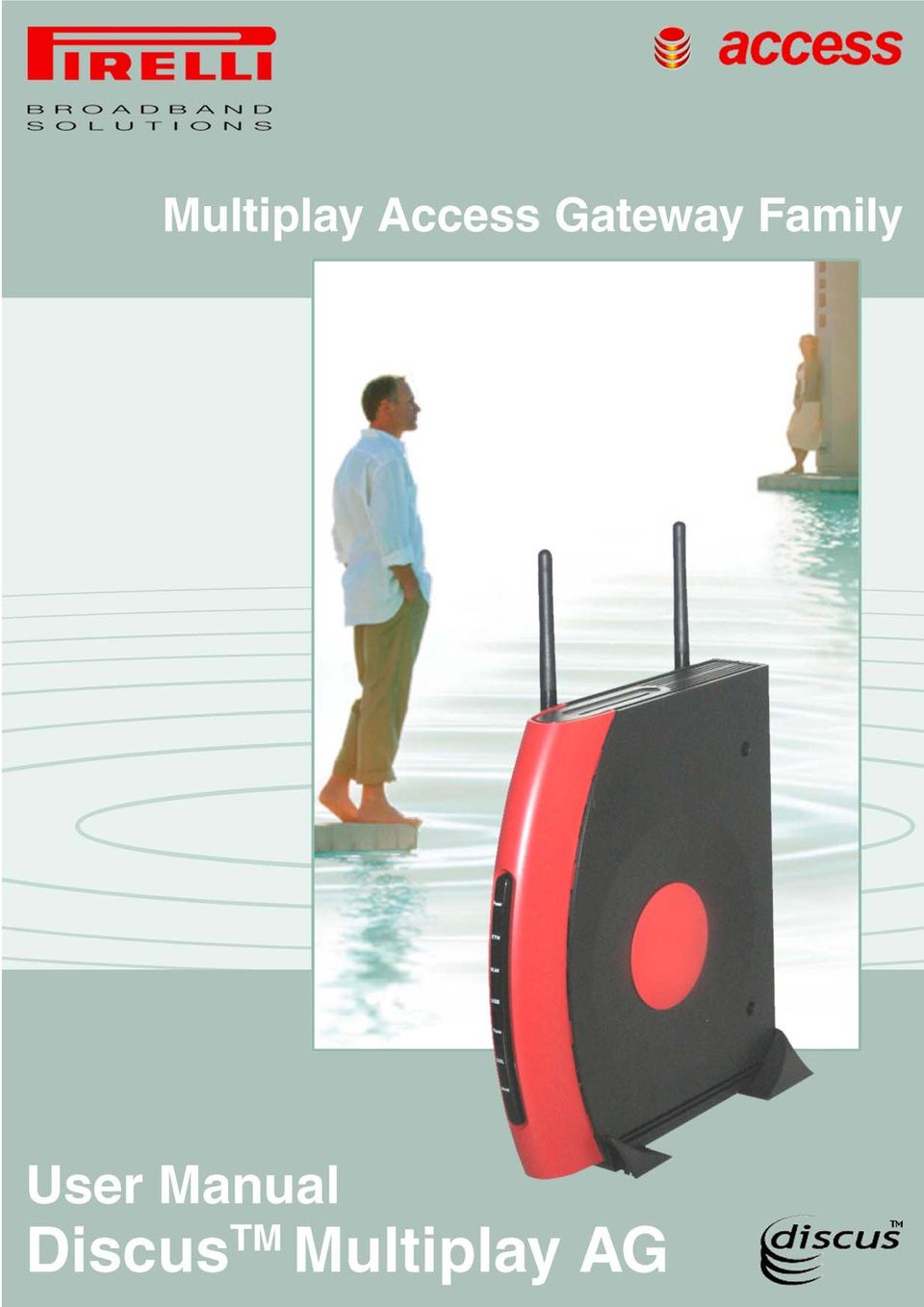
2 Copyright (C) 2006 Pirelli Broadband Solutions S.p.A. All rights reserved. This document contains Pirelli proprietary and confidential information. No part of this document may be copied, reprinted or reproduced in any material form or electronically, whether wholly or in part, and no information contained herein may be used or disclosed to third parties unless under a previous written agreement with Pirelli Broadband Solutions S.p.A setting forth relevant terms and conditions. Trademarks: All terms used in this document that are known to be trademarks or service marks have been noted as such. Pirelli cannot attest to the accuracy of this information. Other product and corporate names used in this document that may be trademarks or service marks of other companies are used only for explanation and to the owner s benefit, without intent to infringe. Use of a term in this document should not be regarded as affecting the validity of any trademark or service mark. This publication is subject to change without notice. Pirelli reserves the right to make changes to equipment design and system components as well as system documentation and literature as progress in engineering, manufacturing methods, or other circumstances may warrant. This publication is intended solely for informational and instructional purposes. Refer to the above as to its possible uses. It constitutes neither a contract with the user hereof nor a warranty or guarantee with regard to any of the Pirelli products described herein nor shall it be construed to grant a license or any other rights under any proprietary rights to information or material included herein. Pirelli hereby expressly disclaims any warranty or guarantee, whether express or implied, with regard to items described herein. Any contract, license, or warranty between Pirelli and the user hereof is created solely by separate legal documents. Manual Code:
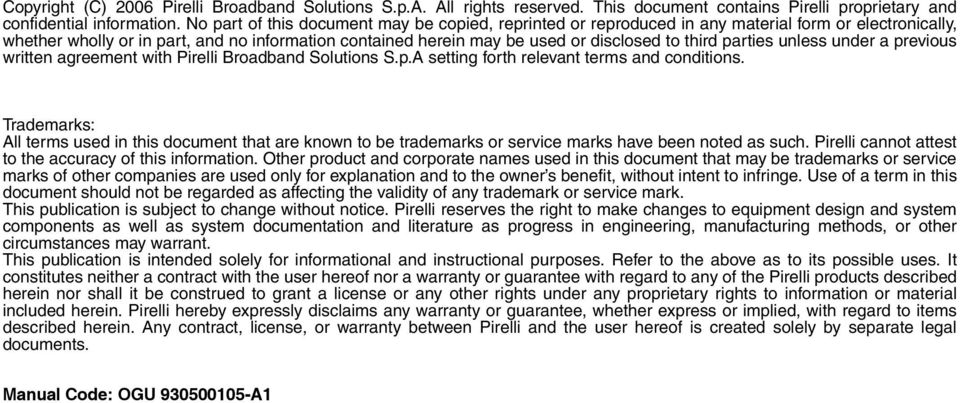
3 CONTENTS Welcome 1 About this Guide 1 Naming Convention 1 Conventions 1 Introduction 3 Introduction 3 Package Contents 3 Router Advantages 6 Minimum System and Component Requirements 6 Front Panel 7 Rear Panel 8 Hardware Installation 11 Introduction 11 Positioning the Router 11 Installing Micro Filters 12 Powering up the router 13 Connecting the Router 13 Setting Up Your Computer 19 INSTALL Software 19 Ethernet Connection 20 Ethernet Connection >> TCP/IP Protocol Installation 20 Ethernet Connection >> MS Windows 98SE, ME, Ethernet Connection >> MS Windows XP 22 Ethernet Connection >> MAC OS 10.X 23 USB Connection 24 USB Connection >> MS Windows 24 USB Connection >> MAC OS 10.x 25 Wi-Fi connection 26 Router Configuration 29 Introduction 29 i
4 Quick Setup Section 35 Point-to-point protocol over Ethernet (PPPoE) 36 Point-to-point protocol over ATM (PPPoA) 37 Routed Ethernet Connection over ATM (ETHoA) 37 Bridged Ethernet Connection over ATM (ETHoA) 37 No Internet Connection 37 Wireless 37 Administrator 38 Network Connections Section 39 LAN Bridge 40 LAN Bridge >> General 40 LAN Bridge >> Settings 41 LAN Bridge >> Routing 44 LAN Bridge >> Bridging 45 LAN Bridge >> Advanced 46 LAN Hardware Ethernet Switch 47 LAN Hardware Ethernet Switch >> General 47 LAN Hardware Ethernet Switch >> Settings 47 LAN Hardware Ethernet Switch >> HW Switch 48 LAN Hardware Ethernet Switch >> Advanced 49 LAN USB 50 LAN USB >> General 50 LAN USB >> Settings 50 LAN USB >> Advanced 51 LAN Wireless g Access Point 52 LAN Wireless g Access Point >> General 52 LAN Wireless g Access Point >> Settings 53 LAN Wireless g Access Point >> Wireless 54 LAN Wireless g Access Point >> Advanced 59 WAN DSL 59 WAN DSL >> General 59 WAN DSL >> Settings 60 Security Section 61 General 62 Access Control 64 Port Forwarding 65 DMZ Host 68 Port Triggering 69 Web Site Restrictions 69 ii

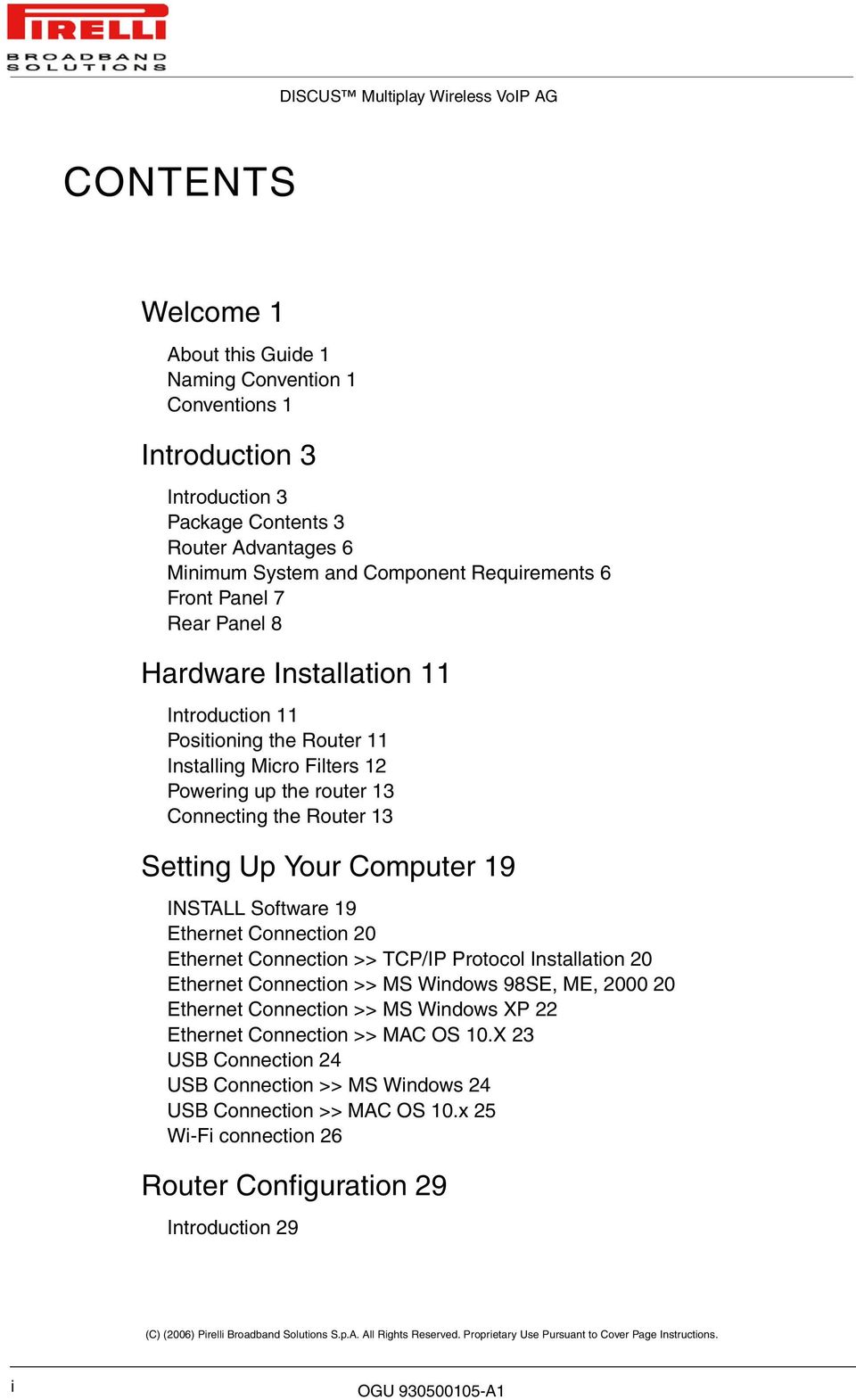
5 NAT 70 Connections 71 Advanced Filtering 72 Security Log 73 Voice over IP Section 75 Line Settings 75 Speed Dial 76 Monitoring 77 Advanced 77 Quality of Service Section 81 General 81 Traffic Priority 82 Traffic Shaping 84 DSCP Settings p Settings 87 Class Statistics 87 Advanced Section 89 About Discus 90 Backup and Restore 91 Certificates 92 Configuration File 93 DNS Server 94 Date and Time 94 Diagnostics 95 Discus Firmware Upgrade 97 Disk Management 98 File Server 99 IP Address Distribution 99 Network Objects 101 PPPoE Relay 102 Personal Domain Name (Dynamic DNS) 102 Print Server 103 Protocols 103 RADIUS 104 Reboot 105 Remote Administration 105 Restore Defaults 107 Routing 108 iii
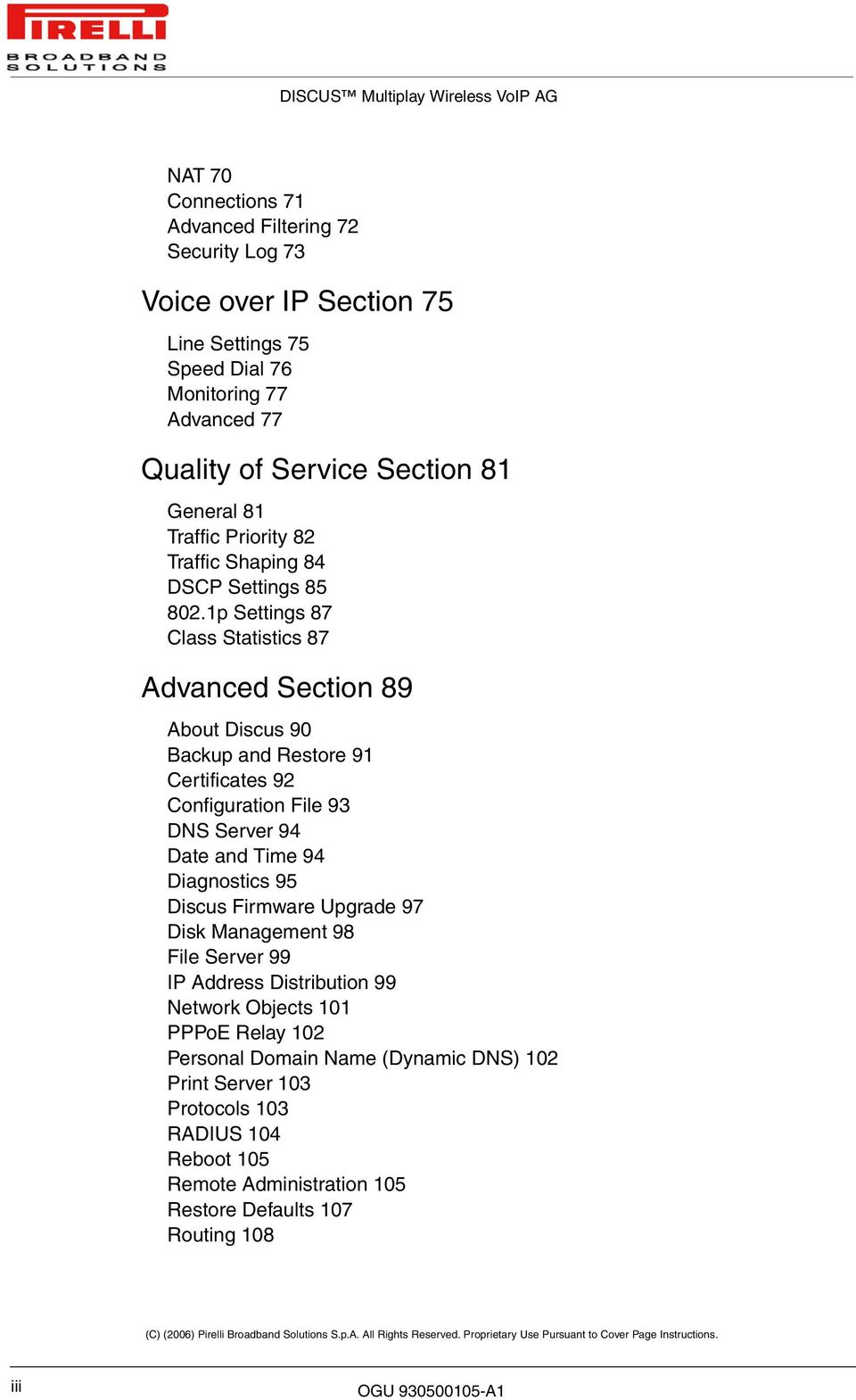
6 SSH 109 Scheduler Rules 110 System Settings 111 Universal Plug and Play 113 Users 114 System Monitoring Section 117 Network Connections 117 System Log 118 CPU 119 Troubleshooting 121 Basic Connection Checks 121 Browsing to the Router Configuration Screens 121 Connecting to the Internet 122 Forgotten Password and Reset to Factory Defaults 122 Wireless Networking 122 Frequently Asked Questions 123 Safety Information 124 IP Addressing 126 Technical Specifications 128 Glossary 134 iv
7 Welcome ABOUT THIS GUIDE This guide describes how to install and configure the DISCUS Multiplay Wireless VoIP AG. This guide is intended for use by those responsible for installing and setting up network equipment; consequently, it assumes a basic working knowledge of LANs (Local Area Networks) and Internet Routers. NAMING CONVENTION Throughout this guide, the DISCUS Multiplay Wireless VOIP AG is referred to as the Wireless Router. Category 5 Ethernet Cables are referred to as Ethernet Cables throughout this guide. CONVENTIONS Table 1 and Table 2 list conventions that are used throughout this guide. TABLE 1. Notice Icons Icon Notice Type Description Information note Information that describes important features or instructions. 1 Welcome
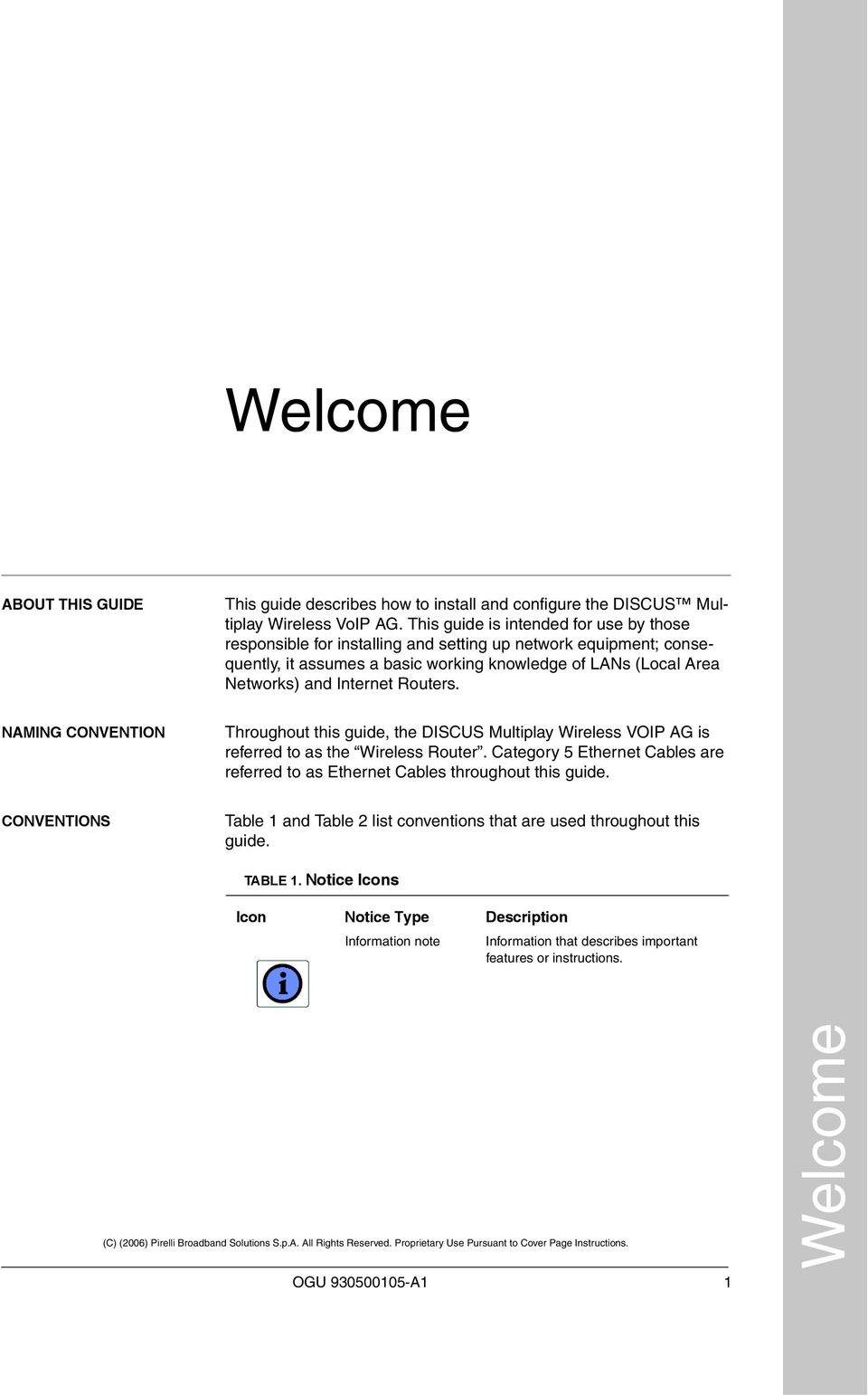
8 TABLE 1. Notice Icons Icon Notice Type Description Caution Information that alerts you to potential loss of data or potential damage to an application, system, or device. Warning Information that alerts you to potential personal injury. TABLE 2. Text Conventions Convention The words enter and type Keyboard key names Words in italics Description When you see the word enter in this guide, you must type something, and then press Return or Enter. Do not press Return or Enter when an instruction simply says type. If you must press two or more keys simultaneously, the key names are linked with a plus sign (+). Example: Press Ctrl+Alt+Del Italics are used to: Emphasize a point. Denote a new term at the place where it is defined in the text. Identify menu names, menu commands, and software button names. Examples: From the Help menu, select Contents. Click OK. 2 Welcome
9 Introduction INTRODUCTION The DISCUS Multiplay Wireless VoIP AG is designed to provide a cost-effective means of sharing a single broadband Internet connection between several wired and wireless computers. The Router also provides protection in the form of an electronic firewall preventing anyone outside of your network from seeing your files or damaging your computers. The Router offers VoIP functionalities through 2 VoIP channels allowing you to use existing analog phones and a fallback to old telephony at loss of power, WAN, Internet or VoIP. The DISCUS Multiplay Wireless VoIP AG is an ADSL2+ router, targeted to residential environments SOHO customers, that provides routed broadband services from a single and modular access point. The DISCUS Multiplay Wireless VoIP AG is the ideal solution for: PACKAGE CONTENTS 1. Connecting multiple PCs and Video game consoles; 2. Sharing broadband internet connections with all home computers; 3. Sharing printers and peripherals; 4. Performing VoIP connections. Your new DISCUS Multiplay Wireless VoIP AG ADSL2+ Router kit contains the related hardware and software. In it you will find: 1. One DISCUS Multiplay Wireless VoIP AG unit 2. One Table Support 3. One Power Supply adapter 4. One ADSL splitter micro filter 5. One USB cable Introduction 3

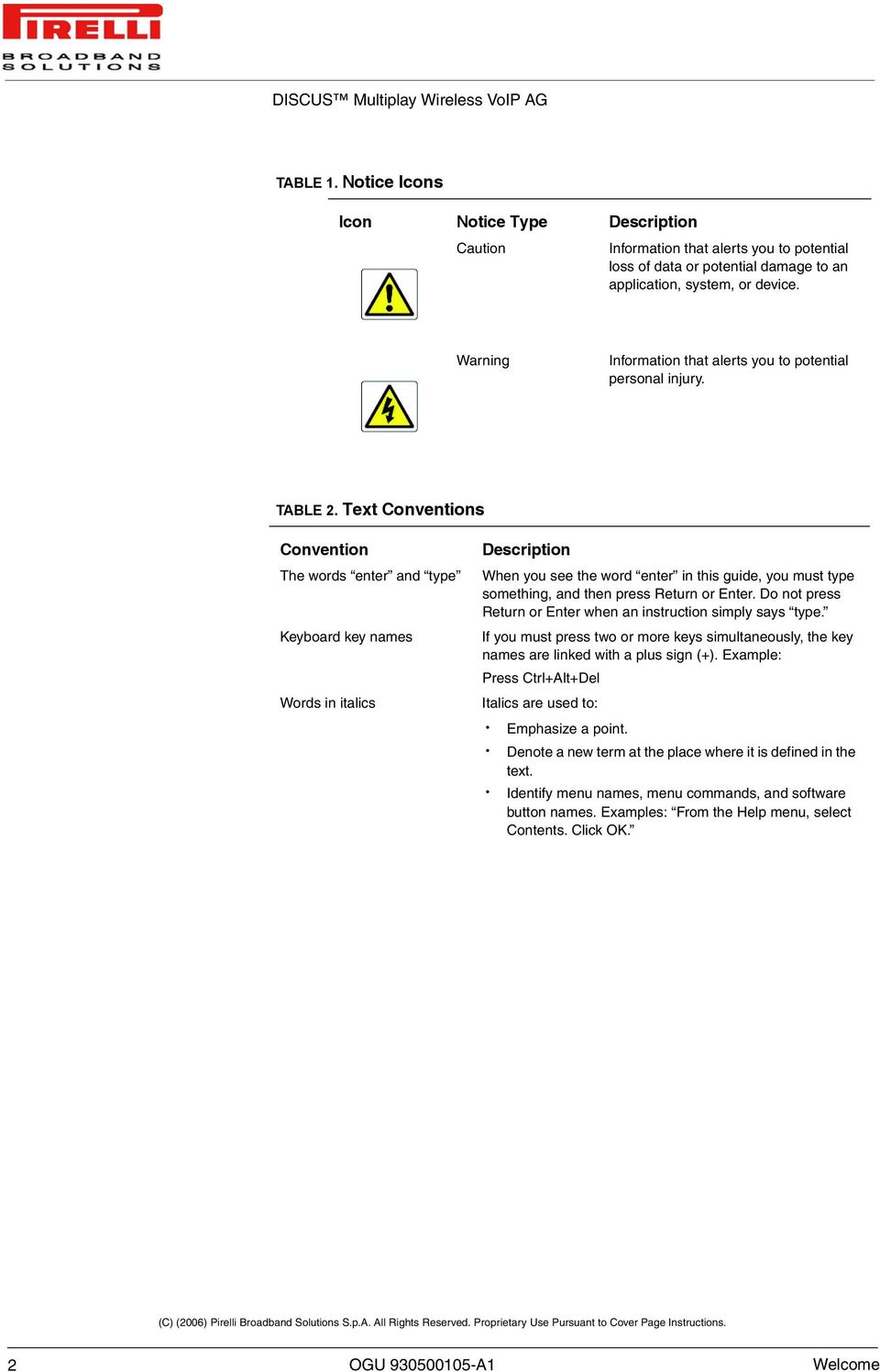
10 6. One phone cable 7. One Ethernet cable 8. One installation CD-ROM 9. One Quick Guide TABLE 1. Kit Material Quantity DESCRIPTION 1 DISCUS Multiplay Wireless VoIP AG 1 Power Supplier 1 Ethernet Cable 1 USB Cable 1 Phone Cord 1 CD-ROM 1 Quick Guide 4 Introduction

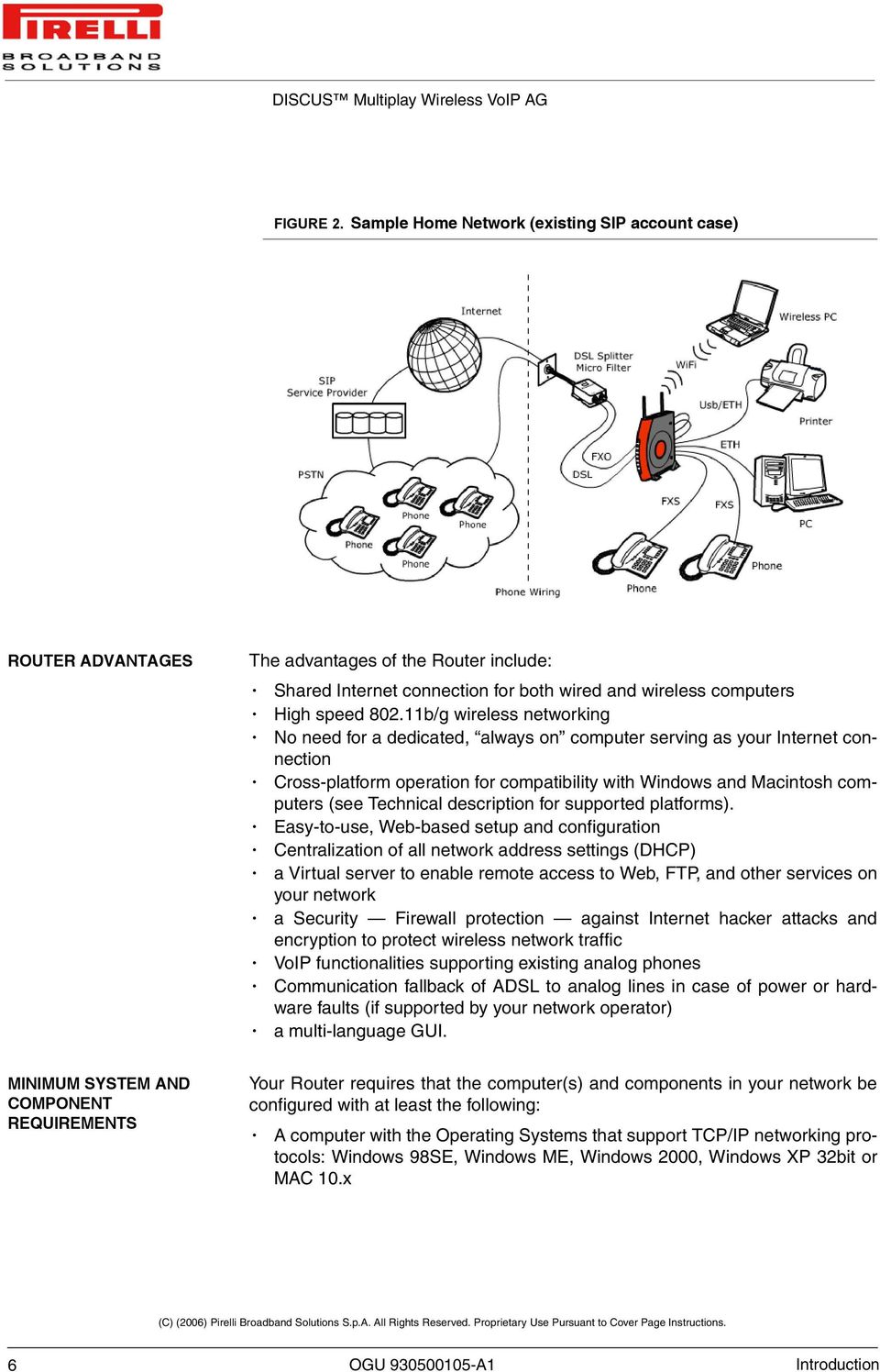
11 Quantity 1 ADSL Splitter Micro Filter DESCRIPTION 1 Table Support If any of these items are missing or damaged, please contact your retailer. It implements an always-on high speed Asymmetric Digital Subscriber Line (ADSL2/2+) connection to the telephone line on the WAN side, as well several local connectivity technologies on the LAN side: Four switched 10/100 Base-TX Ethernet ports One Universal Serial Bus 1.1 (USB) connection to a host PC One USB 2.0 Host port for external USB peripherals One IEEE b/g Wireless LAN access point Two FXS ports to analog phones One FXO port to wall phone socket Figure 2 shows a sample network, while in Figure 2 an existing SIP account case is shown: your Router becomes your connection to the Internet. Connections can be made directly to the Router expanding the number of computers you can have in your network. FIGURE 1. Sample Home Network Introduction 5
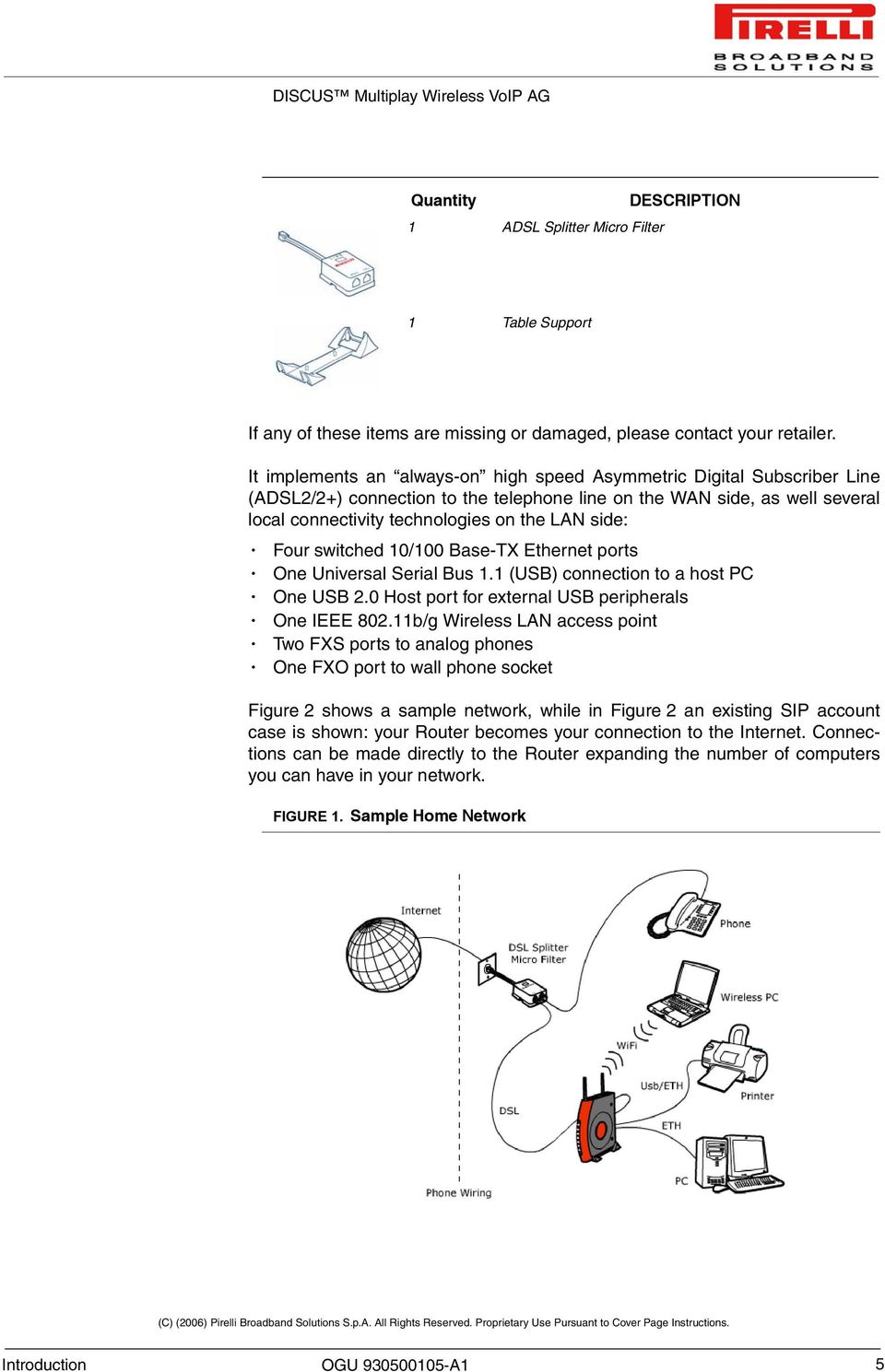
12 FIGURE 2. Sample Home Network (existing SIP account case) ROUTER ADVANTAGES The advantages of the Router include: Shared Internet connection for both wired and wireless computers High speed b/g wireless networking No need for a dedicated, always on computer serving as your Internet connection Cross-platform operation for compatibility with Windows and Macintosh computers (see Technical description for supported platforms). Easy-to-use, Web-based setup and configuration Centralization of all network address settings (DHCP) a Virtual server to enable remote access to Web, FTP, and other services on your network a Security Firewall protection against Internet hacker attacks and encryption to protect wireless network traffic VoIP functionalities supporting existing analog phones Communication fallback of ADSL to analog lines in case of power or hardware faults (if supported by your network operator) a multi-language GUI. MINIMUM SYSTEM AND COMPONENT REQUIREMENTS Your Router requires that the computer(s) and components in your network be configured with at least the following: A computer with the Operating Systems that support TCP/IP networking protocols: Windows 98SE, Windows ME, Windows 2000, Windows XP 32bit or MAC 10.x 6 Introduction
13 An Ethernet 10Mbps or 10/100 Mbps NIC for each computer to be connected to one of the three Ethernet port at the rear of the Router An USB 2.0 port As optional, an b/g wireless NIC At least, 60MB of free hard disk space At least, 128 MB of RAM Supported Browsers: Internet Explorer 5.5 or higher, Netscape 4.7 or higher FRONT PANEL The front panel of the Router contains seven indicator lights (LEDs) that help to describe the state of networking and connection operations. FIGURE 3. Front Panel LEDs TABLE 2. LED Description LED STATUS DESCRIPTION 1 Power GREEN on correctly powered on off not correctly powered RED on Power on Self Test failure 2 Ethernet link/activity GREEN on link active GREEN blinking data exchange off no active link 3 Wireless activity GREEN blinking data exchange off no wireless link Introduction 7
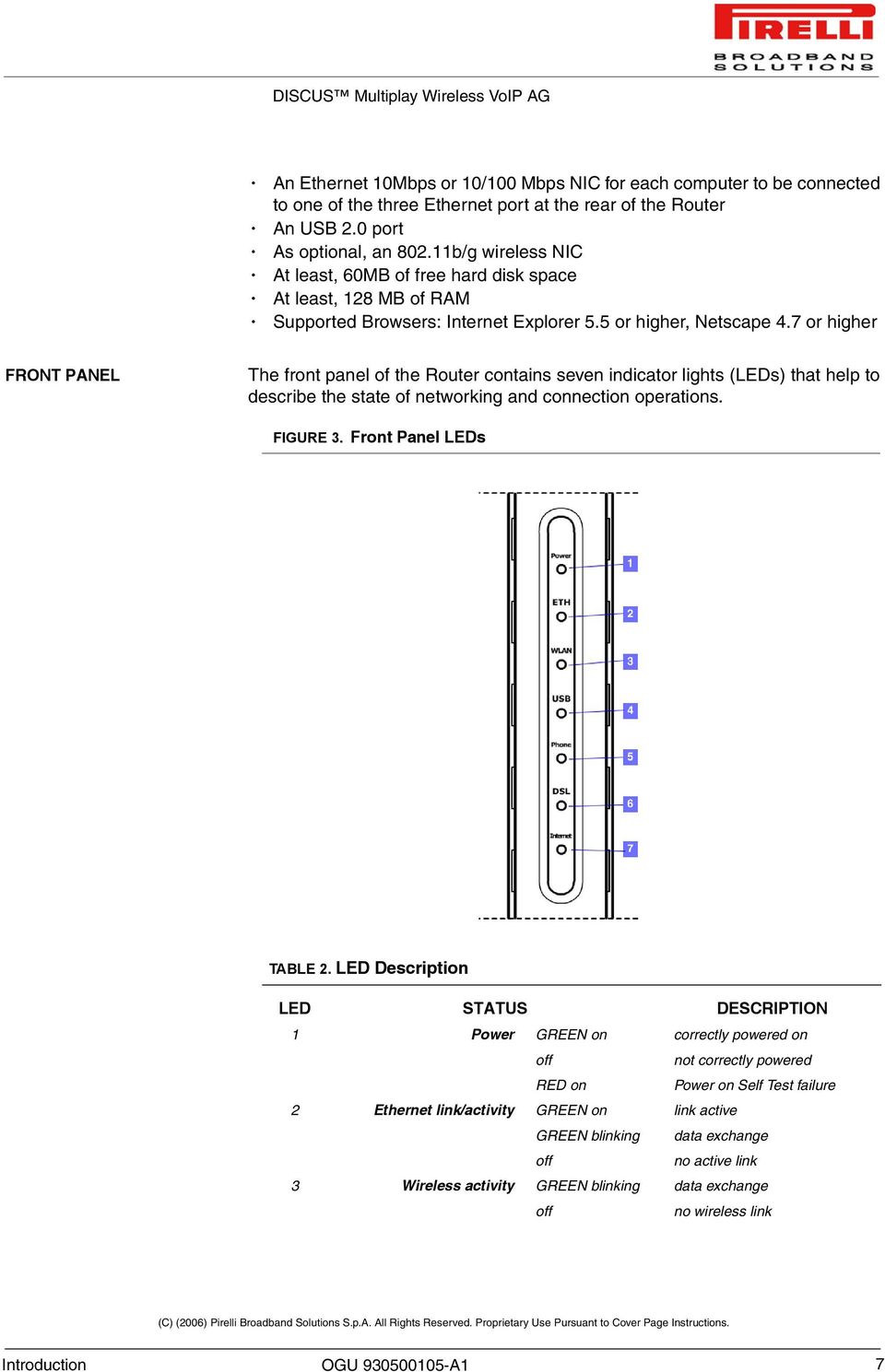
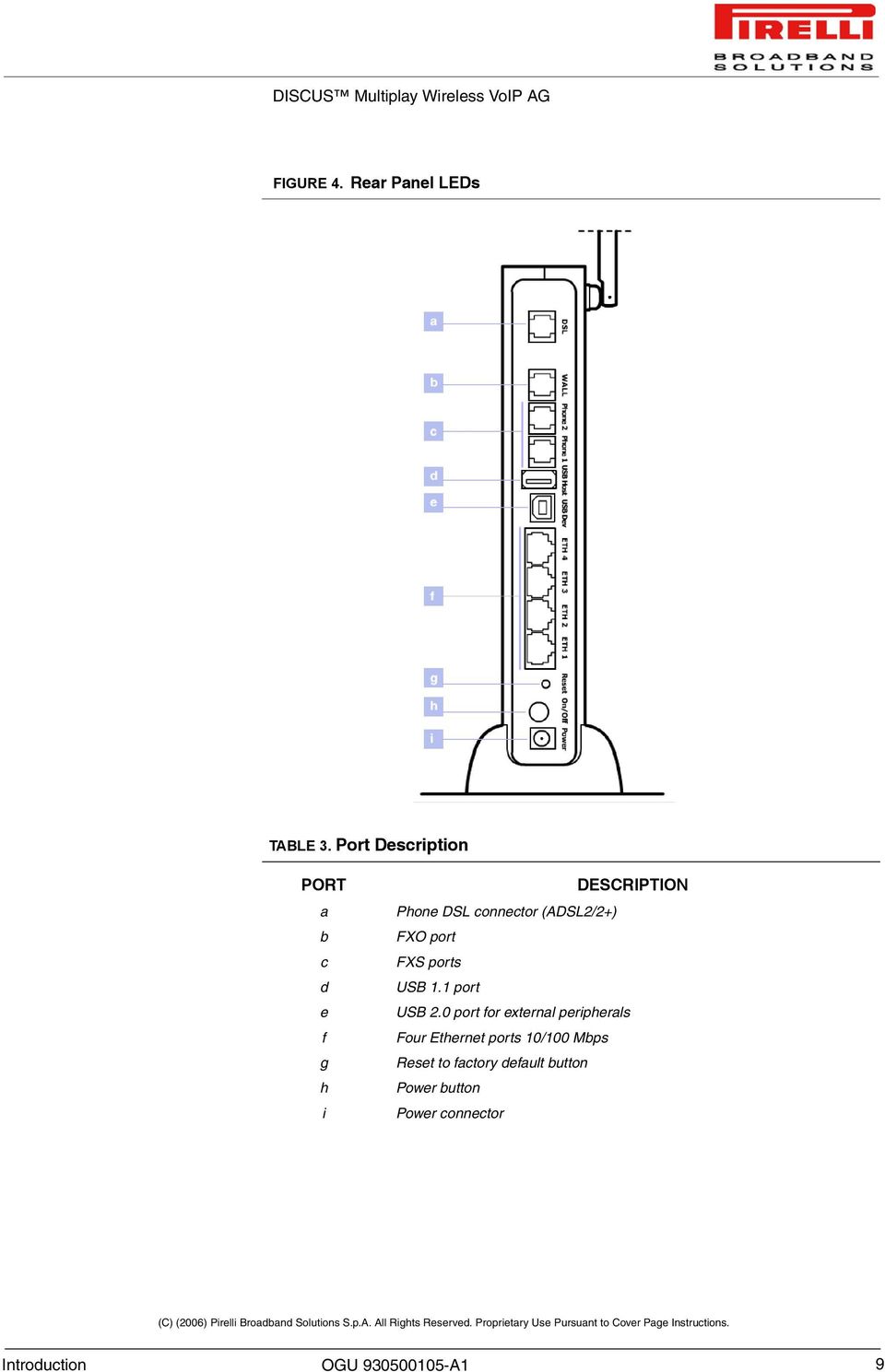
14 TABLE 2. LED Description LED STATUS DESCRIPTION GREEN on link established 4 USB link/activity GREEN on link active GREEN blinking data exchange off no active link 5 Phones off Phone line 1 or 2 not registered GREEN on At least one of the FXS ports has been registered with a SIP Proxy server GREEN blinking One of the phones is off-hook 6 DSL line activity off no DSL line link is active GREEN on connected GREEN blinking connection in progress 7 Internet activity GREEN on link active GREEN blinking data exchange off no active link RED All Internet connection attempts failed REAR PANEL The rear panel of the Router contains a reset button, a power adapter socket, four LAN ports, one ADSL port, one USB device port and one USB Host port, one FXO port and two FXS ports. Do not force the antenna beyond its mechanical stops. Rotating the antenna further may cause damage. 8 Introduction

15 FIGURE 4. Rear Panel LEDs TABLE 3. Port Description PORT a b c d e f g h i DESCRIPTION Phone DSL connector (ADSL2/2+) FXO port FXS ports USB 1.1 port USB 2.0 port for external peripherals Four Ethernet ports 10/100 Mbps Reset to factory default button Power button Power connector Introduction 9
16 10 Introduction
17 Hardware Installation INTRODUCTION POSITIONING THE ROUTER This chapter will guide you through a basic installation of the Router including: 1. Positioning the DISCUS Multiplay Wireless VoIP AG 2. Installing Micro Filters 3. Connecting the Router to your network 4. Setting up your computer for networking with the Router Please read carefully the Safety Information in Appendix A A multimedia guided tour on how to connect your device and install the router s drivers is available on CD-ROM. It is recommended to follow CD-ROM procedures to easy up device setup. You should place the Router in such a location to ensure that: It is located near an electrical outlet and a phone wall socket Water or moisture cannot enter the case of the unit It is out of direct sunlight and away from sources of heat The cabling is away from power lines, fluorescent lighting fixtures, and sources of electrical noise such as radios, transmitters and broadband amplifiers. Hardware Installation 11
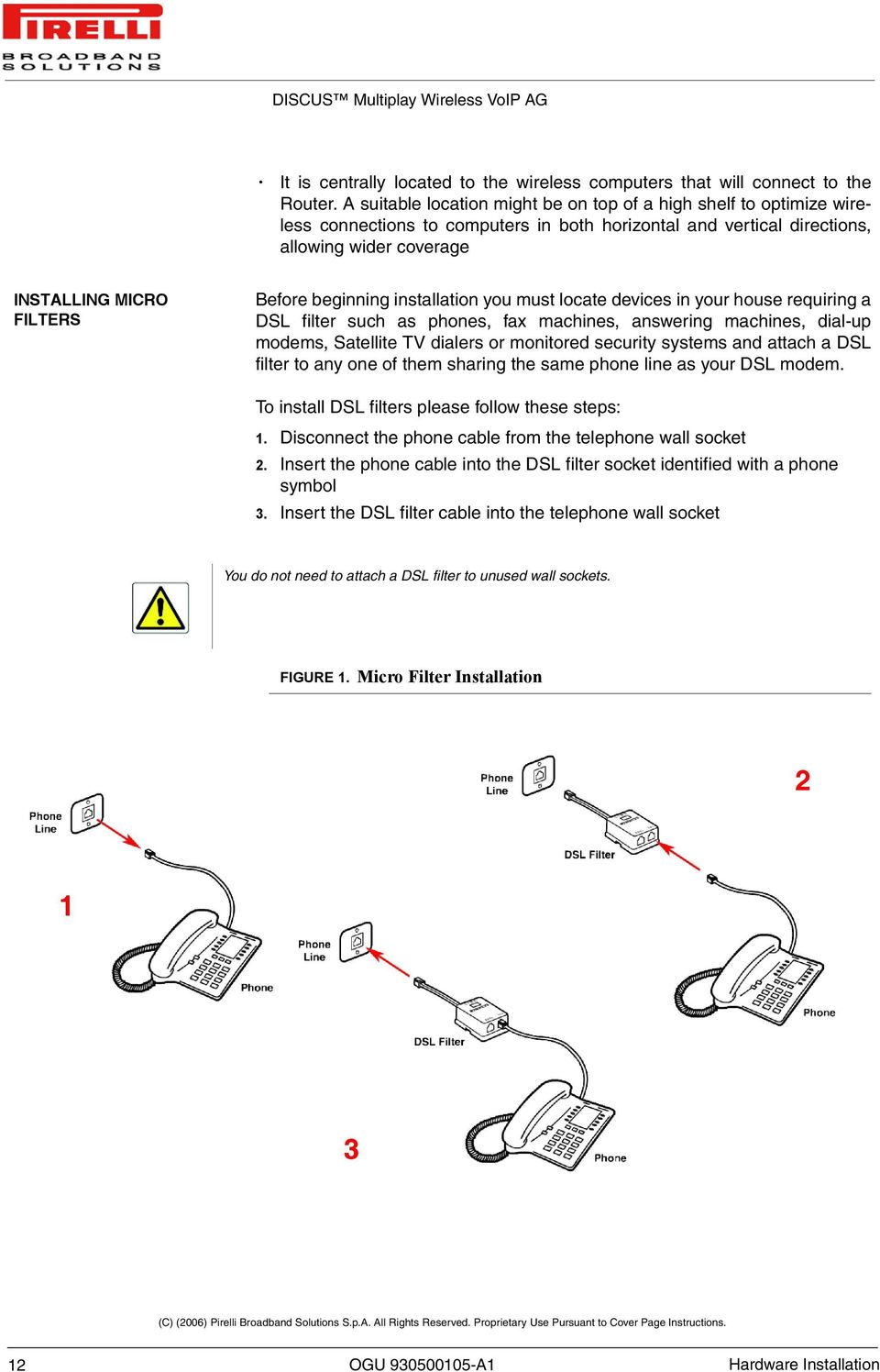
18 It is centrally located to the wireless computers that will connect to the Router. A suitable location might be on top of a high shelf to optimize wireless connections to computers in both horizontal and vertical directions, allowing wider coverage INSTALLING MICRO FILTERS Before beginning installation you must locate devices in your house requiring a DSL filter such as phones, fax machines, answering machines, dial-up modems, Satellite TV dialers or monitored security systems and attach a DSL filter to any one of them sharing the same phone line as your DSL modem. To install DSL filters please follow these steps: 1. Disconnect the phone cable from the telephone wall socket 2. Insert the phone cable into the DSL filter socket identified with a phone symbol 3. Insert the DSL filter cable into the telephone wall socket You do not need to attach a DSL filter to unused wall sockets. FIGURE 1. Micro Filter Installation Hardware Installation
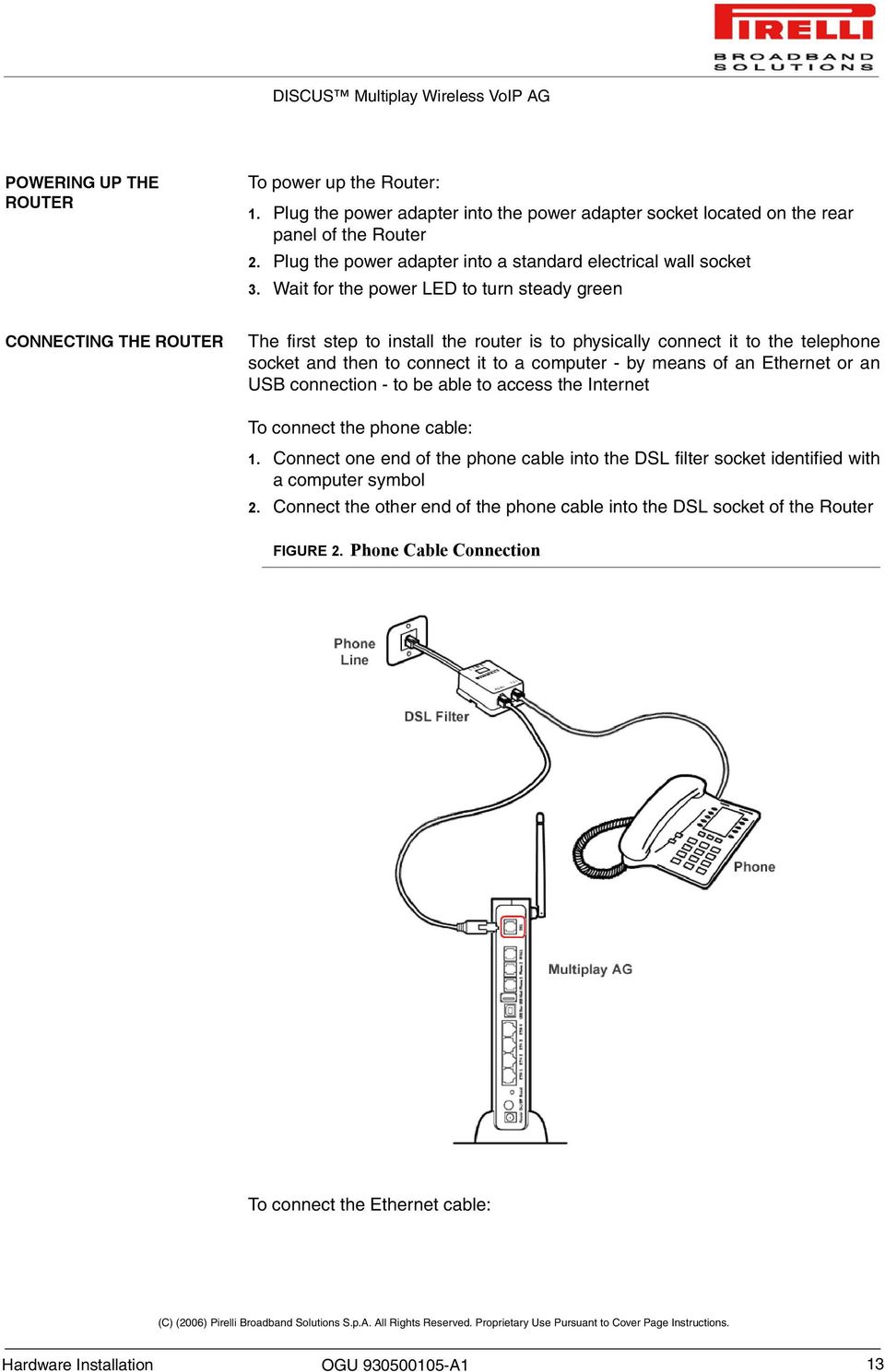
19 POWERING UP THE ROUTER To power up the Router: 1. Plug the power adapter into the power adapter socket located on the rear panel of the Router 2. Plug the power adapter into a standard electrical wall socket 3. Wait for the power LED to turn steady green CONNECTING THE ROUTER The first step to install the router is to physically connect it to the telephone socket and then to connect it to a computer - by means of an Ethernet or an USB connection - to be able to access the Internet To connect the phone cable: 1. Connect one end of the phone cable into the DSL filter socket identified with a computer symbol 2. Connect the other end of the phone cable into the DSL socket of the Router FIGURE 2. Phone Cable Connection To connect the Ethernet cable: Hardware Installation 13
20 1. Connect one end of the Ethernet cable into one of the four Ethernet sockets on the rear of the Router 2. Connect the other end of the ethernet cable into the Ethernet plug of your computer FIGURE 3. Ethernet Cable Connection To connect the USB cable: 1. Connect one end of the USB cable into the USB socket on the rear of the Router. 14 Hardware Installation

21 FIGURE 4. USB Cable Connection 2. Launch USB driver setup available on CD-ROM. To do this, browse till x:\driver folder (where x is the CD-ROM drive unit letter); from this folder, according to your Operating System, launch the following executable: WINDOWS >> x:\driver\windows\setup.exe MACOS X >> x:\driver\macosx\package.sit and follow setup instructions. 3. The setup software will invite you to plug the other end of the USB cable into the USB socket of your computer (see USB Connection ). Don t plug the other end of the USB cable until setup software will ask you to do it. Hardware Installation 15
22 To perform for the very first time a USB connection or an Ethernet one to the Router, it is recommended you to launch the setup application on CD-ROM and follow the step by step procedure. In the case your provider will supply to you a SIP account, it will be needed to properly connect the FXS and FXO ports. In detail you must follow these steps, after micro filters installation: 1. Connect one end of the first phone cable into the DSL filter socket identified with a computer symbol 2. Connect the other end of the first phone cable into the DSL socket of the Router 3. Connect one end of the second phone cable into the DSL filter socket identified with a phone symbol 4. Connect the other end of the second phone cable into the WALL socket of the Router (FXO connection) 5. Connect a maximum of two analog phones to the Phone 1 or Phone 2 sockets of the Router (FXS connection) 16 Hardware Installation
23 FIGURE 5. FXS and FXO connections Connect to your PC with Ethernet or USB cables as described in the previous steps. Hardware Installation 17
24 18 Hardware Installation
25 Setting Up Your Computer INSTALL SOFTWARE The Router has the ability to dynamically allocate network addresses to the computers on your network, using DHCP. However, your computers need to be configured correctly for this to take place. To change the configuration of your computers to allow this, follow the instructions in this chapter. The very first time you set up your computer, we recommend you to use setup software available on CD-ROM. Before installing the DISCUS Multiplay Wireless VoIP AG software please close all applications to avoid any conflict. Setup software offers a guided product tour, a step by step hardware installation guide, a software installation guide and setup depending on your connection choice (USB or ETHERNET) and a driven user registration with DSL Internet connection line check. Setup software allows, for supported Microsoft Windows Operating Systems, to setup automatically your computer Ethernet settings. To launch Setup, insert Setup software CD-ROM in CD-ROM unit: if the autoplay function is enabled it will start automatically, otherwise click once on the Run... item in Start menu. In the opened panel type x:\install.exe where x is your CD-ROM drive letter. Setting Up Your Computer 19
26 ETHERNET CONNECTION In case you already established a connection with your Router a first time and/or you do need to set up manually a connection to your Router, please follow the instructions described in this chapter. You will be guided to set up an Ethernet connection to the Router. To do so, first you have to verify the existence of a TCP/IP protocol stack and, then, according to your Operating System, to establish an Ethernet connection to it. This connection will require you to enable your computer to receive from the Router its own IP Address automatically: in such a case, the Router acts like the DHCP server in your local network. ETHERNET CONNECTION >> TCP/IP PROTOCOL INSTALLATION This procedure requires the TCP/IP protocol installed on your computer. Refer to the following chapters and to your Windows or MacOS operating systems manuals. Microsoft Windows 98SE, ME, Put in the CD-ROM drive your Windows installation CD-ROM 2. Starting from Start -> Settings -> Control Panel -> Network Control Panel, make a double click on the Network icon 3. Select Configuration -> TCP/IP and then click on the Add button 4. Select Protocols, click on Add button and choose Microsoft TCP/IP. Then click on the OK button 5. After the computer reboots, you're ready to configure the TCP/IP settings Configure the Network adapter to obtain automatically an IP address Microsoft Windows XP. 1. Put in the CD-ROM drive your Windows installation CD-ROM 2. Starting from Start -> Settings -> Control Panel make a double click on the Network icon. 3. Select Protocol and click on the Add button. Select Microsoft and TCP/IP, then click on the OK button. 4. Configure the Network adapter to obtain automatically an IP address. Apple MacOS 10.x. TCP/IP is installed on a MacOS system as part of Open Transport. ETHERNET CONNECTION >> MS WINDOWS 98SE, ME, 2000 To configure TCP/IP on these Operating Systems follow these steps: 1. Select Start -> Settings -> Control Panel and make a double click on the Network icon. 2. Select Configuration ->TCP/IP then click on Properties button. 20 Setting Up Your Computer
27 FIGURE 1. Local Area Connection Properties 3. Select the IP Address Tab, then check to obtain an automatically IP address. Click on OK button. FIGURE 2. Internet Protocol (TCP/IP) Properties Setting Up Your Computer 21
28 4. A system reboot will be required to make the changes real. ETHERNET CONNECTION >> MS WINDOWS XP To configure TCP/IP on MS Windows XP Operating System follow these steps: 5. Select Start -> Settings -> Control Panel and make a double click on the Network icon. 6. Select Protocols ->TCP/IP then click on Properties button. FIGURE 3. Local Area Connection Properties 7. Select the General Tab, then check to obtain an automatically IP address. Click on OK button. 22 Setting Up Your Computer
29 FIGURE 4. Internet Protocol (TCP/IP) Properties ETHERNET CONNECTION >> MAC OS 10.X To configure TCP/IP on MAC OS 10.x follow these steps: 1. Open the Apple Menu -> System Preferences and select Network. 2. From the Show drop down list, according to the type of connection used, select Built-in Ethernet. 3. Select the TCP/IP tab. 4. Select DHCP from the Configure pop-up menu to have a dynamic IP address. Setting Up Your Computer 23
30 FIGURE 5. Network panel on MAC OS 10.x 5. Click Apply Now. 6. Click on the Register button to save the changes in the Control Panel. 7. Enter in the address bar of your browser to open the DIS- CUS Multiplay Wireless VoIP AG Home Page. USB CONNECTION To connect your first Computer to the DISCUS Multiplay Wireless VoIP AG using USB port, you have to install the Router s USB driver on your computer. Before connecting the USB Cable to the USB Port of the DISCUS Multiplay Wireless VoIP AG you have to run the setup software and to follow the instructions. Connect the USB Cable only when required from the installation software. Only one Windows or Macintosh computer can be directly connected to the DISCUS Multiplay Wireless VoIP AG using the USB connection. Additional computers can be added to your network using the others connection such as Ethernet or Wi-Fi. USB CONNECTION >> MS WINDOWS Using Windows 98SE the system could require the Operating System installation CD-ROM. 24 Setting Up Your Computer
31 1. Browse the Setup CD-ROM and install the USB Windows driver selecting the folder x:\driver\windows (where x is the CD-ROM driver unit). 2. Make a double click on setup.exe file to start driver setup procedure. 3. When the message NOW CONNECT THE USB CABLE should appear, connect the USB cable from a free USB port of the computer to the DIS- CUS Multiplay Wireless VoIP AG USB port. 4. Enter in the address bar of your browser to open the DIS- CUS Multiplay Wireless VoIP AG Home Page. USB CONNECTION >> MAC OS 10.X 1. Browse the CD-ROM and install the USB MAC OS 10.x selecting the folder x:\driver\macosx (where x is the CD-ROM drive unit). 2. Make a double click on the Package.sit zipped file to start the unzip. If the system requires the path, select the hard disk main folder, normally named Macintosh HD. 3. Select the folder Macintosh HD:osxdrv:Install USB ADSL. 4. Make a double click on the install script file. 5. Restart the computer clicking on the Restart button. 6. When appear the message NOW CONNECT THE USB CABLE, connect the USB cable from a free USB port of the computer to the DISCUS Multiplay Wireless VoIP AG USB port. 7. Verify that your computer is configured to obtain an IP address automatically via DHCP mode, following the next steps. 8. Open the Apple Menu -> System Preferences and select Network. 9. From the Show drop down list, according to the type of connection used, select Built-in USB ADSL. 10. Select the TCP/IP tab. 11. Select Using DHCP from the Configure pop-up menu to have a dynamic IP address. Setting Up Your Computer 25
32 FIGURE 6. Network Panel 12. Click Apply Now. 13. Click on the Register button to save the changes in the Control Panel. 14. Enter in the address bar of your browser to open the DIS- CUS Multiplay Wireless VoIP AG Home Page. WI-FI CONNECTION It requires a computer with b/g (Wi-Fi Certified) wireless adapter installed. 1. Install your wireless adapter according to the manufacturer s instructions and verify that your computer is set to obtain an IP address automatically (DHCP mode). You will need to properly configure your adapter to communicate with the DISCUS Multiplay Wireless VoIP AG according to the configuration rules. 2. In the configuration window of your wireless adapter scan the wireless network (marked with the relevant SSID name) present in your physical environment. 3. Select the SSID of the DISCUS Multiplay Wireless VoIP AG (default value: openrg). 4. Complete the configuration of the wireless adapter with the same parameters of the DISCUS Multiplay Wireless VoIP AG which are: 26 Setting Up Your Computer
33 RF channel; automatically detect (default = 6) WEP encryption enable or disable (default = Disable) WEP key size WEP key used 5. To check the connection, connect to the DISCUS Multiplay Wireless VoIP AG Home Page, entering in the address bar of your browser. Setting Up Your Computer 27
34 28 Setting Up Your Computer
35 Router Configuration INTRODUCTION The Router setup program is web based, which means that it is accessed through your web browser. To access to Router s web server: 1. Launch your web browser on the computer 2. Enter the following URL in the location or address field of your browser: The Router comes with a default IP address ( ). If you change it, please take note of the new Router s IP address, otherwise a Reset to Factory Default operation should be done to be able to access again to the Router. Access to DSL router configuration pages is controlled through user accounts. The default one is the admin user with unrestricted access to change and view configuration of the DSL Router. The default username and password are both set to admin. It is recommended to change these default values. Make sure you remember your user name and password, since this is the only way you will be able to manage your Router You will be asked to choose the Router interface language between English, French, Russian, Spanish, Korean, Japanese, Chinese, Hebrew, German and Italian and to insert a User Name and a Password: insert them to access to Router s configuration panels. Router Configuration 29
36 If not already configured, at the first login the Quick Setup panel will be shown to configure the Router connection parameters, otherwise the Home page will be opened as shown in Figure 1. The Home page contains a menu on the left - always available in all the web pages which is the starting point for any Router s configuration. The complete menu has the following main items: 1. Home: it shows a graphical representation of your network. 2. Quick Setup: it allows to quickly perform the Router s connection setup 3. Network Connections: it shows the status of network connections allowing to modify them or to create new ones 4. Security: it allows to set security settings 5. Voice over IP: it allows to set VoIP accounts 6. QoS: it gathers all QoS parameters and settings 7. Advanced: it allows the access to the advanced configuration panels and to define Router parameters devoted to user access, log management, Router s time, Backup Router s configuration, etc. 8. System Monitoring: a menu to show and run diagnostic test for troubleshooting or system behavior analysis and to access to Device Information and Statistics 9. Logout: to logout from Router s session. In order to submit the changes of most of device parameters you have to click the Apply button to save permanently your changes. In some case a Router s reboot is required. 30 Router Configuration
37 FIGURE 1. Router s Home Page Every object in the network map is a link for jumping directly to the object settings pages. A tooltip, by moving the mouse over these network objects, helps in having an immediate comprehension of pointed object name and type. Router Configuration 31
38 In the following table a list of all available network objects and related description is shown. TABLE 1. Available Network Objects Map Symbol Description It represents the Internet It represents your DSL Wide Area Network (WAN) connection. Click this icon to configure the WAN interface It represents your Ethernet Wide Area Network (WAN) connection or an Ethernet Local Area Network (LAN) connection. Click this icon to configure the WAN interface or the Ethernet LAN device It represents the gateway's Firewall. The height of the wall corresponds to the security level currently selected: Minimum, Typical or Maximum. Click this icon to configure security settings It represents a USB LAN connection. Click this icon to configure network parameters for the USB LAN device It represents a Wireless LAN connection. Click this icon to configure network parameters for the Wireless LAN device It represents a bridge connected in the home network. Click this icon to view the bridge's underlying devices. 32 Router Configuration
39 TABLE 1. Available Network Objects Map Symbol Description It represents a computer (host) connected in the home network. Each computer connected to the network appears below the network symbol of the network through which it is connected. Click an icon to view network information for the corresponding computer. It represents a printer that is connected to the Router and is shared by network users. Click the icon to view the printer's settings. It represents a file server that is connected to the Router and is shared by network users. Click the icon to view the file server configuration. Router Configuration 33
40 34 Router Configuration
41 Quick Setup Section This chapter will describe the Quick Setup Section accessible from the Home Page of the DISCUS Multiplay Wireless VoIP AG upon user authentication to the Router. Be aware that any configuration changes could compromise your connectivity. The Quick Setup enables speedy and accurate configuration of your Internet connection and other important parameters. After the setup described in this chapter, you can immediately start using your Router to: 1. Share a broadband connection among multiple users (HTTP, FTP, Telnet, NetMeeting) and between all of the computers connected to your home network. 2. Build a home network by connecting additional PCs and network devices to the gateway. 3. Share resources (file servers, printers, etc.) between computers in the home network using their names; auto-learning DNS enables DIS- CUS Multiplay Wireless VoIP AG to automatically detect the network identification names of the LAN PCs, enabling mutual communication using names, not IP addresses. 4. Control network parameters, including DHCP, DNS and WAN settings. 5. View network status, traffic statistics, system log and more. Quick Setup Section 35
42 6. Allow access from the Internet to games and other services provided by computers in the home network. 7. Prohibit computers in the home network from accessing selected services on the Internet. 8. Block access to specific Internet Web sites from your home network. FIGURE 1. Quick Setup Panel Your WAN connection(s) can be configured using one of the following methods. Read the configuration instructions relevant to you, by selecting your connection method from the list below and clicking its section link: 1. Point-to-point protocol over Ethernet (PPPoE) 2. Point-to-point protocol over ATM (PPPoA) 3. Routed Ethernet Connection over ATM (ETHoA) 4. Bridged Ethernet Connection over ATM (ETHoA) 5. No Internet connection POINT-TO-POINT PROTOCOL OVER ETHERNET (PPPOE) To configure the Point-to-point protocol over Ethernet, follow these steps: 1. Select 'Point-to-point protocol over Ethernet (PPPoE)' from the 'Connection Type' combo-box. 2. Your Internet Service Provider (ISP) should provide you with the Login user name and Login password. 3. If your board features a DSL connection, you will see an 'Automatic PVC Scan' check box. Select this check box to enable the automatic configuration of the VPI, VCI and encapsulation parameters (relevant to DSL connections). 36 Quick Setup Section
43 POINT-TO-POINT PROTOCOL OVER ATM (PPPOA) To configure the Point-to-point protocol over ATM, follow these steps: 1. Select 'Point-to-point protocol over ATM (PPPoA)' from the 'Connection Type' combo-box 2. Your Internet Service Provider (ISP) should provide you with the following information: - Login user name - Login password - By default, the 'Automatic PVC Scan' check box is enabled, which means that the Router configures the VPI, VCI and encapsulation parameters automatically. If you would like to configure these parameters manually, uncheck this check box. - Specify the VPI and VCI values. - Select the encapsulation method from the combo-box. You can choose among the following methods: LLC, VCMux and VCMux - HDLC ROUTED ETHERNET CONNECTION OVER ATM (ETHOA) To configure the Routed Ethernet connection over ATM, follow these steps: 1. Select 'Routed Ethernet Connection over ATM (ETHoA)' from the 'Connection Type' combo-box 2. Your Internet Service Provider (ISP) should provide you with the following information: - Specify the value of the VPI and VCI parameters. - Select the encapsulation method from the combo-box. You can choose among the following methods: LLC, VCMux. - Select the Internet Protocol: Most Internet Service Providers (ISPs) provide dynamic IP addresses, hence the default "Obtain an IP Address Automatically". Should this not be the case, select the "Use the Following IP Address" option. The screen will refresh. Enter the IP Address, Subnet Mask, Default Gateway, and DNS Server details provided to you by your ISP. BRIDGED ETHERNET CONNECTION OVER ATM (ETHOA) To configure the Bridged Ethernet Connection over ATM (ETHoA), follow these steps: 1. Select 'Bridged Ethernet Connection over ATM (ETHoA)' from the 'Connection Type' combo-box 2. Your Internet Service Provider (ISP) should provide you with the following information: - Specify the value of the VPI and VCI parameters. - Select the encapsulation method from the combo-box. You can choose among the following methods: LLC, VCMux NO INTERNET CONNECTION Select 'No Internet Connection' from the 'Connection Type' combo-box. Choose this connection type if you do not have an Internet connection, or if you want to disable all existing connections. WIRELESS Click the 'Enabled' check box to enable your wireless connection. Specify the wireless network's ID in the 'SSID' field. The default SSID is 'openrg'. Quick Setup Section 37
44 ADMINISTRATOR In this section it is necessary to specify the administrator's in the ' ' field. System alerts and notifications are sent to this address. 38 Quick Setup Section
45 Network Connections Section This chapter will describe the Network Connections Section accessible from the Home Page of the DISCUS Multiplay Wireless VoIP AG. Be aware that any configuration changes could compromise your connectivity. This section (see Figure 1) is intended to present a summary of the Router's connections, such as WAN and LAN (i.e. Ethernet, USB, Wireless) interfaces. DISCUS Multiplay Wireless VoIP AG supports various network connections, both physical and logical. The Network Connections screen enables you to configure the various parameters of your physical connections, the LAN and WAN, and create new connections, using tunneling protocols over existing connections, such as PPP and VPN. Press the 'Advanced' button to expand the screen and display all connection entries. Network Connections Section 39
46 FIGURE 1. Network Connections Panel LAN BRIDGE The LAN bridge connection is used to combine several LAN devices under one virtual network. For example, creating one network for LAN Ethernet and LAN wireless devices. Please note, that when a bridge is removed, its formerly underlying devices inherit the bridge's DHCP settings. For example, the removal of a bridge that is configured as DHCP client, automatically configures the LAN devices formerly constituting the bridge as DHCP clients, with the exact DHCP client configuration. LAN BRIDGE >> GENERAL To view and edit the LAN bridge connection settings, click the 'LAN Bridge' link in the 'Network Connections' screen. The 'LAN Bridge Properties' screen will appear, displaying a detailed summary of the connection's parameters, under the 'General' tab. These parameters can be edited in the rest of the screen's tabs, as described in the following sections. 40 Network Connections Section
47 FIGURE 2. LAN Bridge >> General Panel LAN BRIDGE >> SETTINGS General. This section displays the connection's general parameters. It is recommended not to change the default values unless familiar with the networking concepts they represent. Since your gateway is configured to operate with the default values, no parameter modification is necessary. Network Connections Section 41
48 FIGURE 3. LAN Bridge >> Settings Panel Schedule. By default, the connection will always be active. However, you can configure scheduler rules in order to define time segments during which the connection may be active. Once a scheduler rule(s) is defined, this field changes to a combo-box, allowing you to choose between the available rules. Network. Select whether the parameters you are configuring relate to a WAN, LAN or DMZ connection, by selecting the connection type from the combo-box. Physical Address. The physical address of the network card used for your network. Some cards allow you to change this address. MTU. MTU is the Maximum Transmission Unit. It specifies the largest packet size permitted for Internet transmission. In the default setting, Automatic, the gateway selects the best MTU for your Internet connection. Select "Automatic by DHCP" to have the DHCP determine the MTU. In case you select "Manual", it is recommended to enter a value in the 1200 to 1500 range. Internet Protocol. Select one of the following Internet protocol options from the 'Internet Protocol' combo-box: 42 Network Connections Section
49 - No IP Address: Select 'No IP Address' if you require that your gateway have no IP address. This can be useful if you are working in an environment where you are not connected to other networks, such as the Internet. - Obtain an IP Address Automatically: Your connection is configured by default to act as a DHCP client. You should keep this configuration in case your service provider supports DHCP, or if you are connecting using a dynamic IP address. The server that assigns the gateway with an IP address, also assigns a subnet mask. You can override the dynamically assigned subnet mask by selecting the 'Override Subnet Mask' and specifying your own mask instead. You can press the 'Release' button to release the current leased IP address. Once the address has been released, the button text changes to 'Renew'. Use the 'Renew' button to renew the leased IP address. - Use the Following IP Address: Your connection can be configured using a permanent (static) IP address. Your service provider should provide you with such an IP address and subnet mask. DNS Server. Domain Name System (DNS) Server is the method by which Web site domain names are translated into IP addresses. You can configure the connection to automatically obtain a DNS server address, or specify such an address manually, according to the information provided by your ISP. To configure the connection to automatically obtain a DNS server address, select 'Obtain DNS Server Address Automatically' from the 'DNS Server' drop down menu. To manually configure DNS server addresses, select 'Use the Following DNS Server Addresses' from the 'DNS Server' drop down menu. Specify up to two different DNS server address, one primary, another secondary. IP Address Distribution. The 'IP Address Distribution' section allows you to configure the gateway's Dynamic Host Configuration Protocol (DHCP) server parameters. The DHCP automatically assigns IP addresses to network PCs. If you enable this feature, make sure that you also configure your network PCs as DHCP clients. Select one of the following options from the 'IP Address Distribution' combo-box: DHCP Server. Start IP Address: The first IP address that may be assigned to a LAN host. Since the gateway's default IP address is , this address must be or greater. End IP Address: The last IP address in the range that can be used to automatically assign IP addresses to LAN hosts. Subnet Mask: A mask used to determine to what subnet an IP address belongs. An example of a subnet mask value is Network Connections Section 43
50 Lease Time In Minutes: Each device will be assigned an IP address by the DHCP server for this amount of time, when it connects to the network. When the lease expires the server will determine if the computer has disconnected from the network. If it has, the server may reassign this IP address to a newly-connected computer. This feature ensures that IP addresses that are not in use will become available for other computers on the network. Provide Host Name if Not Specified by Client: If the DHCP client does not have a host name, the gateway will automatically assign one for him. DHCP Relay. Your gateway can act as a DHCP relay in case you would like to dynamically assign IP addresses from a DHCP server other than your gateway's DHCP server. Note that when selecting this option you must also change Router's WAN to work in routing mode. 1. After selecting 'DHCP Relay' from the drop down menu, a 'New IP Address' link will appear: Click the 'New IP Address' link. The 'DHCP Relay Server Address' screen will appear. 2. Specify the IP address of the DHCP server. 3. Click 'OK' to save the settings. Disabled. Select 'Disabled' from the combo-box if you would like to statically assign IP addresses to your network computers. LAN BRIDGE >> ROUTING You can choose to setup your gateway to use static or dynamic routing. Dynamic routing automatically adjusts how packets travel on the network, whereas static routing specifies a fixed routing path to neighboring destinations. FIGURE 4. LAN Bridge >> Routing Panel 44 Network Connections Section
51 Routing. Select 'Advanced' or 'Basic' routing. Routing Mode. Select one of the following routing modes: Route: Use route mode if you want your gateway to function as a router between two networks. NAPT: Network Address and Port Translation (NAPT) refers to network address translation involving the mapping of port numbers, allowing multiple machines to share a single IP address. Use NAPT if your LAN encompasses multiple devices, a topology that necessitates port translation in addition to address translation. Device Metric. The device metric is a value used by the gateway to determine whether one route is superior to another, considering parameters such as bandwidth, delay, and more. Default Route. Select this check box to define this device as a the default route. Routing Information Protocol (RIP). Select this check box to enable the Routing Information Protocol (RIP). RIP determines a route based on the smallest hop count between source and destination. When RIP is enabled, select the following: Listen to RIP messages - select 'None', 'RIPv1', 'RIPv2' or 'RIPv1/2'. Send RIP messages - select 'None', 'RIPv1', 'RIPv2-broadcast' or 'RIPv2-multicast'. Multicast - IGMP Proxy Internal. IGMP proxy enables the system to issue IGMP host messages on behalf of hosts that the system discovered through standard IGMP interfaces. IGMP proxy enables the routing of multicast packets according to the IGMP requests of LAN devices asking to join multicast groups. Select the 'Multicast IGMP Proxy Internal' check-box to enable this feature. Routing Table. Allows you to add or modify routes when this device is active. Use the 'New Route' button to add a route or edit existing routes. LAN BRIDGE >> BRIDGING This section allows you to specify the devices that you would like to join under the network bridge. Network Connections Section 45
52 FIGURE 5. LAN Bridge >> Bridging Panel Select the 'STP' check box to enable the Spanning Tree Protocol on the device. You should use this to ensure that there are no loops in your network configuration, and apply these settings in case your network consists of multiple switches, or other bridges apart from those created by the gateway. LAN BRIDGE >> ADVANCED Internet Connection Firewall. Your gateway's firewall helps protect your computer by preventing unauthorized users from gaining access to it through a network such as the Internet. The firewall can be activated per network connection. To enable the firewall on this network connection, select the 'Enabled' check box. FIGURE 6. LAN Bridge >> Advanced Panel 46 Network Connections Section
53 Additional IP Addresses. You can add alias names (additional IP addresses) to the gateway by clicking the 'New IP Address' link. This enables you to access the gateway using these aliases in addition to the LAN HARDWARE ETHERNET SWITCH A LAN Ethernet connection connects computers to the Router using Ethernet cables, either directly or via network hubs and switches. LAN HARDWARE ETHERNET SWITCH >> GENERAL To view and edit the LAN Ethernet connection settings, click the 'LAN Ethernet' link in the 'Network Connections' screen. The 'LAN Ethernet Properties' screen will appear, displaying a detailed summary of the connection's parameters, under the 'General' tab. These parameters can be edited in the rest of the screen's tabs, as described in the following sections. FIGURE 7. LAN Hardware Ethernet Switch >> General Panel LAN HARDWARE ETHERNET SWITCH >> SETTINGS General. This section displays the connection's general parameters. It is recommended not to change the default values unless familiar with the networking concepts they represent. Since your gateway is configured to operate with the default values, no parameter modification is necessary. Schedule. By default, the connection will always be active. However, you can configure scheduler rules in order to define time segments during which the connection may be active. Once a scheduler rule(s) is defined, this field changes to a combo-box, allowing you to choose between the available rules. Network Connections Section 47
54 FIGURE 8. LAN Hardware Ethernet Switch >> Settings Panel Network. Select whether the parameters you are configuring relate to a WAN, LAN or DMZ connection, by selecting the connection type from the combo-box. Physical Address. The physical address of the network card used for your network. Some cards allow you to change this address. MTU. MTU is the Maximum Transmission Unit. It specifies the largest packet size permitted for the transmission. In the default setting, Automatic, the gateway selects the best MTU for your Internet connection. Select "Automatic by DHCP" to have the DHCP determine the MTU. In case you select "Manual", it is recommended to enter a value in the 1200 to 1500 range. LAN HARDWARE ETHERNET SWITCH >> HW SWITCH This section allows to configure the Hardware Switch parameters and ports. 48 Network Connections Section
55 FIGURE 9. LAN Hardware Ethernet Switch >> HW Switch Panel LAN HARDWARE ETHERNET SWITCH >> ADVANCED Internet Connection Firewall. Your gateway's firewall helps protect your computer by preventing unauthorized users from gaining access to it through a network such as the Internet. The firewall can be activated per network connection. To enable the firewall on this network connection, select the 'Enabled' check box. FIGURE 10. LAN Hardware Ethernet Switch >> Advanced Panel Network Connections Section 49
56 Additional IP Addresses. You can add alias names (additional IP addresses) to the gateway by clicking the 'New IP Address' link. This enables you to access the gateway using these aliases in addition to the LAN USB The LAN USB connection allows you to connect a Windows PC to the Router using a USB cable. Connect your gateway's USB slave port to a master port on the PC. LAN USB >> GENERAL To view and edit the LAN USB connection settings, click the 'LAN USB' link in the 'Network Connections' screen. The 'LAN USB Properties' screen will appear, displaying a detailed summary of the connection's parameters, under the 'General' tab. These parameters can be edited in the rest of the screen's tabs, as described in the following sections. FIGURE 11. LAN USB >> General Panel LAN USB >> SETTINGS General. This section displays the connection's general parameters. It is recommended not to change the default values unless familiar with the networking concepts they represent. Since your gateway is configured to operate with the default values, no parameter modification is necessary. 50 Network Connections Section
57 FIGURE 12. LAN USB >> Settings Panel Schedule. By default, the connection will always be active. However, you can configure scheduler rules in order to define time segments during which the connection may be active. Once a scheduler rule(s) is defined, this field changes to a combo-box, allowing you to choose between the available rules. Network. Select whether the parameters you are configuring relate to a WAN, LAN or DMZ connection, by selecting the connection type from the combo-box. Physical Address. The physical address of the network card used for your network. Some cards allow you to change this address. MTU. MTU is the Maximum Transmission Unit. It specifies the largest packet size permitted for the transmission. LAN USB >> ADVANCED Internet Connection Firewall. Your gateway's firewall helps protect your computer by preventing unauthorized users from gaining access to it through a network such as the Internet. The firewall can be activated per network connection. To enable the firewall on this network connection, select the 'Enabled' check box. Network Connections Section 51
58 FIGURE 13. LAN USB >> Advanced Panel Additional IP Addresses. You can add alias names (additional IP addresses) to the gateway by clicking the 'New IP Address' link. This enables you to access the gateway using these aliases in addition to the LAN WIRELESS G ACCESS POINT DISCUS Multiplay Wireless VoIP AG integrates multiple layers of wireless security. These include the IEEE 802.1x port-based authentication protocol, RADIUS client, EAP-MD5, EAP-TLS, EAP-TTLS, EAP-PEAP, Wi-Fi Protected Access (WPA), WPA2, WPA and WPA2 (mixed mode) and industry leading Discus Firewall and VPN applications. In addition, the Router s built-in authentication server enables home/soho users to define authorized wireless users without the need for an external RADIUS server. LAN WIRELESS G ACCESS POINT >> GENERAL To view and edit the LAN Wireless connection settings, click the 'LAN Wireless g Access Point' link in the 'Network Connections' screen. The 'LAN Wireless g Access Point Properties' screen will appear, displaying a detailed summary of the connection's parameters, under the 'General' tab. These parameters can be edited in the rest of the screen's tabs, as described in the following sections. 52 Network Connections Section
59 FIGURE 14. LAN Wireless g Access Point >> General Panel LAN WIRELESS G ACCESS POINT >> SETTINGS General. This section displays the connection's general parameters. It is recommended not to change the default values unless familiar with the networking concepts they represent. Since your gateway is configured to operate with the default values, no parameter modification is necessary. Network Connections Section 53
60 FIGURE 15. LAN Wireless g Access Point >> Settings Panel Schedule. By default, the connection will always be active. However, you can configure scheduler rules in order to define time segments during which the connection may be active. Once a scheduler rule(s) is defined, this field changes to a combo-box, allowing you to choose between the available rules. Network. Select whether the parameters you are configuring relate to a WAN, LAN or DMZ connection, by selecting the connection type from the combo-box. Physical Address. The physical address of the network card used for your network. Some cards allow you to change this address. MTU. MTU is the Maximum Transmission Unit. It specifies the largest packet size permitted for Internet transmission. In the default setting, Automatic, the gateway selects the best MTU for your Internet connection. Select "Automatic by DHCP" to have the DHCP determine the MTU. In case you select "Manual", it is recommended to enter a value in the 1200 to 1500 range. LAN WIRELESS G ACCESS POINT >> WIRELESS Wireless Access Point Use this section to define the basic wireless access point settings. SSID. The SSID is the network name shared among all points in a wireless network. The SSID must be identical for all points in the wireless network. It is case-sensitive and must not exceed 32 characters (use any of the characters on the keyboard). Make sure this setting is the same for 54 Network Connections Section
61 all points in your wireless network. For added security, you should change the default SSID (openrg) to a unique name. FIGURE 16. LAN Wireless g Access Point >> Wireless Panel SSID Broadcast. Select this check-box to enable the SSID's broadcast. SSID broadcast is used in order to hide the name of the AP (SSID) from clients that should not be aware to its existence Mode. Select the Wireless communication standard that is compatible with you PC's wireless card. You can work in either g, b or in mixed mode. Channel. Select the appropriate channel from the list provided to correspond with your network settings. All devices in your wireless network must broadcast on different channels in order to function correctly. The channels available depend on the Regulatory Authority (stated in brackets) to which your gateway conforms. Network Authentication. The WPA network authentication method is 'Open System Authentication', meaning that a network key is not used for authentication. When using the 802.1X WEP or Non-802.1X WEP security protocols, this field Network Connections Section 55
62 changes to a combo-box, offering the 'Shared Key Authentication' method (which uses a network key for authentication), or both methods combined. MAC Filtering Mode. You can filter wireless users according to their MAC address, either allowing or denying access. Choose the action to be performed by selecting it from the drop down menu. MAC Filtering Settings Use this section to define advanced wireless access point settings. New MAC Address. Click this link to define filtering of MAC addresses. Enter the MAC address to be filtered and press the OK button. A MAC address list will appear, upon which the selected filtering action (allow/deny) will be performed. Wireless Security To configure your wireless security, enable this feature by checking its 'Enabled' check-box. The screen will refresh, displaying the wireless security options. Use the 'Stations Security Type' combo-box to select the type of security protocol for securing your wireless network. You may choose between WPA, WPA2, 802.1x WEP, and Non-802.1x WEP. The screen will refresh, presenting each protocol's configuration respectively. WPA: WPA is a data encryption method for wireless LANs. Authentication Method. Select the authentication method you would like to use. You can choose between Pre-Shared Key and 802.1x. Pre-Shared Key. This entry appears only if you had selected this authentication method. Enter your encryption key in the 'Pre-Shared Key' field. You can use either an ASCII or a Hex value by selecting the value type in the combo-box provided. Encryption Algorithm. Select between Temporal Key Integrity Protocol (TKIP) and Advanced Encryption Standard (AES) for the encryption algorithm. Group Key Update Interval. It defines the time interval in seconds for updating a group key. WPA2: WPA2 is an enhanced version of WPA, and defines the i protocol. Authentication Method. Select the authentication method you would like to use. You can choose between Pre-Shared Key and 802.1x. Pre-Shared Key. This entry appears only if you had selected this authentication method. Enter your encryption key in the 'Pre-Shared Key' field. You can use 56 Network Connections Section
63 either an ASCII or a Hex value by selecting the value type in the combo-box provided. Encryption Algorithm. The encryption algorithm used for WPA2 is the Advanced Encryption Standard (AES). Group Key Update Interval. It defines the time interval in seconds for updating a group key. WPA and WPA2 Mixed Mode: WPA and WPA2 is a mixed data encryption method. Authentication Method. Select the authentication method you would like to use. You can choose between Pre-Shared Key and 802.1x. Pre-Shared Key. This entry appears only if you had selected this authentication method. Enter your encryption key in the 'Pre-Shared Key' field. You can use either an ASCII or a Hex value by selecting the value type in the combo-box provided. Encryption Algorithm. The encryption algorithm used for WPA and WPA2 is a either the Temporal Key Integrity Protocol (TKIP) or the Advanced Encryption Standard (AES). Group Key Update Interval. It defines the time interval in seconds for updating a group key x WEP: 802.1x WEP is a data encryption method utilizing a statically or automatically defined key for wireless clients that use 802.1x for authentication and WEP for encryption. You may define up to four keys but use only one at a time. Generate Keys Automatically. Select this option to generate the encryption keys automatically rather than entering them manually. The screen will refresh, hiding the table of keys described below. Group Key Update Interval. Defines the time interval in seconds for updating a group key. Active Select the encryption key to be activated. Encryption Key. Type the encryption key until the entire field is filled. The key cannot be shorter than the field's length. Entry Method. Select the character type for the key: Hex or ASCII. Key Length Select the key length in bits: 40 or 104 bits. Key Length. Select the key length in bits: 40 or 104 bits. Non-802.1x WEP: Non-802.1xWEP is a data encryption method utilizing a statically-defined key for wireless clients that do not use 802.1x for authentication Network Connections Section 57
64 and WEP for encryption. This method's configuration is virtually identical to the 802.1x WEP method described above, excluding the automatic key generation and the group key update interval specification. Please refer to the 802.1x WEP section above when configuring this method. Remember that the static key must be defined in the wireless Windows client as well. Virtual AP You can set up multiple wireless LANs on DISCUS Multiplay Wireless VoIP AG, limited only to the number supported by your wireless card. Each wireless LAN is defined as an access point. The 'Virtual APs' section displays the Router's physical wireless access point, on top of which virtual connections may be created. To create a virtual connection, click the 'New Virtual AP' link. The new connection will also be added to the network connections list, and will be configurable like any other connection. You can change the connection's default name by clicking its Edit action icon and changing the SSID value in the 'Configure LAN Wireless g Access Point - Virtual AP' screen. Wireless QoS (WMM) Wi-Fi Multimedia (WMM) is a Wi-Fi Alliance certification, based on the IEEE e draft standard. It provides basic Quality of Service (QoS) features to IEEE networks. If your wireless card supports WMM, enable this feature by checking its 'Enabled' check-box. Upon enabling WMM, the highest priority is given to Voice packets, decreasing towards Background packets which receive the lowest priority. In addition, you can control the reliability of traffic flow. By default, the 'Ack Policy' for each access category is set to "Normal", meaning that an acknowledge packet is returned for every packet received. This provides a more reliable transmission but increases traffic load, which decreases performance. You may choose to cancel the acknowledgement by selecting "No Ack" in the combo-box of each access category, thus changing the Ack policy. This can be useful for Voice, for example, where speed of transmission is important and packet loss is tolerable to a certain degree. RADIUS Server For authentication to work, the client's transmission must go through the Router, and reach the back-end server that performs the actual authentication. The wireless client contacts the access point, which in turn communicates with the Remote Authentication Dial-in User Service (RADIUS) server. The RADIUS server verifies the client's credentials to determine whether the device is authorized to connect to the LAN. If the RADIUS server accepts the client, the server 58 Network Connections Section
65 responds by exchanging data with the Router, including security keys for subsequent encrypted sessions. LAN WIRELESS G ACCESS POINT >> ADVANCED Internet Connection Firewall. Your gateway's firewall helps protect your computer by preventing unauthorized users from gaining access to it through a network such as the Internet. The firewall can be activated per network connection. To enable the firewall on this network connection, select the 'Enabled' check box. FIGURE 17. LAN Wireless g Access Point >> Advanced Panel Additional IP Addresses. You can add alias names (additional IP addresses) to the gateway by clicking the 'New IP Address' link. This enables you to access the gateway using these aliases in addition to the WAN DSL The WAN DSL panels allows you to check and configure the WAN DSL line interface. WAN DSL >> GENERAL From the WAN DSL General panel, it is possible to enable/disable the WAN DSL interface and to set the WAN DSL friendly name. Network Connections Section 59
66 FIGURE 18. WAN DSL >> General Panel WAN DSL >> SETTINGS From the WAN DSL Settings panel, it is possible to set the Line Mode. FIGURE 19. WAN DSL >> Settings Panel 60 Network Connections Section
67 Security Section This chapter will describe the Security Section accessible from the Home Page of the DISCUS Multiplay Wireless VoIP AG. Be aware that any configuration changes could compromise your connectivity. The Router's gateway security suite includes comprehensive and robust security services: Stateful Packet Inspection Firewall, user authentication protocols and password protection mechanisms. These features together allow users to connect their computers to the Internet and simultaneously be protected from the security threats of the Internet. The firewall has been exclusively tailored to the needs of the residential/office user and has been pre-configured to provide optimum security. The Router's firewall provides both the security and flexibility that home and office users seek. It provides a managed, professional level of network security while enabling the safe use of interactive applications, such as Internet gaming and video-conferencing. Additional features, including surfing restrictions and access control, can also be easily configured locally by the user through a userfriendly Web-based interface, or remotely by a service provider. Security Section 61
68 The Router firewall supports advanced filtering, designed to allow comprehensive control over the Firewall s behavior. You can define specific input and output rules, control the order of logically similar sets of rules and make a distinction between rules that apply to WAN and LAN network devices. GENERAL Use the 'General' screen to configure the gateway's basic security settings. The firewall regulates the flow of data between the home network and the Internet. Both incoming and outgoing data are inspected and then either accepted (allowed to pass through the Router) or rejected (barred from passing through the Router) according to a flexible and configurable set of rules. These rules are designed to prevent unwanted intrusions from the outside, while allowing home users access to the Internet services that they require. The firewall rules specify what types of services available on the Internet may be accessed from the home network and what types of services available in the home network may be accessed from the Internet. Each request for a service that the firewall receives, whether originating in the Internet or from a computer in the home network, is checked against the set of firewall rules to determine whether the request should be allowed to pass through the firewall. If the request is permitted to pass, then all subsequent data associated with this request (a session ) will also be allowed to pass, regardless of its direction. For example, when you point your Web browser to a Web page on the Internet, a request is sent out to the Internet for this page. When the request reaches the Router the firewall will identify the request type and origin - HTTP and a specific PC in your home network, in this case. Unless you have configured access control to block requests of this type from this computer, the firewall will allow this request to pass out onto the Internet. When the Web page is returned from the Web server the firewall will associate it with this session and allow it to pass, regardless of whether HTTP access from the Internet to the home network is blocked or permitted. The important thing to note here is that it is the origin of the request, not subsequent responses to this request, that determines whether a session can be established or not. You may choose from among three pre-defined security levels for the Router: Minimum, Typical, and Maximum (the default setting). The table below summarizes the behavior of the Router for each of the three security levels. 62 Security Section
69 TABLE 1. Security Levels Security Level Maximum Security (Default) Typical Security Minimum Security Requests Originating in the WAN (Incoming Traffic) Blocked: no access to home network from Internet, except as configured in the Port Forwarding, DMZ host and Remote Access screens Blocked: no access to home network from Internet, except as configured in the Port Forwarding, DMZ host and Remote Access screens Unrestricted: permits full access from Internet to home network; all connection attempts permitted. Requests Originating in the LAN (Outgoing Traffic) Limited: by default, only commonly-used services, such as Web browsing and , are permitted Unrestricted: all services are permitted, except as configured in the Access Control screen Unrestricted: all services are permitted, except as configured in the Access Control screen FIGURE 1. Security General panel Security Section 63
70 ACCESS CONTROL You may want to block specific computers within the home network (or even the whole network) from accessing certain services on the Internet. For example, you may want to prohibit one computer from surfing the Web, another computer from transferring files using FTP, and the whole network from receiving incoming . Access Control defines restrictions on the types of requests that may pass from the home network out to the Internet, and thus may block traffic flowing in both directions. It can also be used for allowing specific services when maximum security is configured. In the example given above, you may prevent computers in the home network from receiving by blocking their outgoing requests to POP3 servers on the Internet. There are numerous services you should consider blocking, such as popular game and file sharing servers. For example, if you want to make sure that your employees do not put your business at risk from illegally traded copyright files, you may want to block several popular P2P and file sharing applications. FIGURE 2. Access Control panel To allow or restrict services: 1. Select the 'Access Control' tab in the 'Security' management screen. The 'Access Control' screen will appear. 2. Click the 'New Entry' link. The 'Add Access Control Rule' screen will appear 3. The Address combo-box provides you the ability to specify the computer or group of computers for which you would like to apply the access control rule. 64 Security Section
71 You can select between any, a specific computer in your LAN, or 'User Defined'. If you choose the 'User Defined' option, the 'Edit Network Object' screen will appear. Specifying an address is done by creating a 'Network Object'; 4. The Protocol combo-box lets you select or specify the type of protocol that will be used. Selecting the 'Show All Services' option will expand the list of available protocols. Select a protocol or add a new one using the 'User Defined' option. This will commence a sequence that will add a new service, representing the protocol. 5. Select the 'Reply an HTML page to the blocked client' check-box to display the following message to the client: Access Denied - this computer is not allowed to surf the WAN. Please contact your admin.. When this check-box is unselected, the client's packets will simply be ignored and he/she will not receive any notification. 6. The Schedule combo-box allows you to define the time period during which this rule will take effect. By default, the rule will always be active. However, you can configure scheduled rules by selecting 'User Defined'. 7. Click the 'OK' button to save your changes. The 'Access Control' screen will display a summary of the rule that you just added. PORT FORWARDING In its default state, DISCUS Multiplay Wireless VoIP AG blocks all external users from connecting to or communicating with your network. Therefore the system is safe from hackers who may try to intrude on the network and damage it. However, you may want to expose your network to the Internet in certain limited and controlled ways in order to enable some applications to work from the LAN (game, voice and chat applications, for example) and to enable Internet-access to servers in the home network. The Port Forwarding feature supports both of these functionalities. If you are familiar with networking terminology and concepts, you may have encountered this topic referred to as Local Servers. The 'Port Forwarding' screen lets you define the applications that require special handling by the Router. All you have to do is select the application's protocol and the local IP address of the computer that will be using or providing the service. If required, you may add new protocols in addition to the most common ones provided by the Router. For example, if you wanted to use a File Transfer Protocol (FTP) application on one of your PCs, you would simply select 'FTP' from the list and enter the local IP address or host name of the designated computer. All FTP-related data arriving at the Router from the Internet will henceforth be forwarded to the specified computer. Similarly, you can grant Internet users access to servers inside your home network, by identifying each service and the PC that will provide it. This is useful, for example, if you want to host a Web Security Section 65
72 server inside your home network. When an Internet user points his/her browser to the Router's external IP address, the gateway will forward the incoming HTTP request to your Web server. With one external IP address (Router's main IP address), different applications can be assigned to your LAN computers, however each type of application is limited to use one computer. For example, you can define that FTP will use address X to reach computer A and Telnet will also use address X to reach computer A, but attempting to define FTP to use address X to reach both computer A and B will fail. The Router therefore provides the ability to add additional public IP addresses to port forwarding rules, which you must first obtain from your ISP, and enter into the 'NAT IP Addresses Pool'. You will then be able to define FTP to use address X to reach computer A and address Y to reach computer B. Additionally, port forwarding enables you to redirect traffic to a different port instead of the one to which it was designated. Lets say, that you have a Web server running on your PC on port 8080 and you want to grant access to this server to anyone who accesses the Router via HTTP. To accomplish this, do the following: Define a port forwarding rule for the HTTP service, with the PC's IP or host name. Specify 8080 in the 'Forward to Port' field. All incoming HTTP traffic will now be forwarded to the PC running the Web server on port When setting a port forwarding service, you must ensure that the port is not already in use by another application, which may stop functioning. A common example is when using SIP signaling in Voice over IP - the port used by the gateway's VoIP application (5060) is the same port on which port forwarding is set for LAN SIP agents. 66 Security Section
73 FIGURE 3. Port Forwarding panel To add a new port forwarding service: 8. Select the 'Port Forwarding' tab in the 'Security' management screen. The 'Port Forwarding' screen will appear 9. Click the 'New Entry' link. The 'Add Port Forwarding Rule' screen will appear 10. Select the 'Specify Public IP Address' check-box if you would like to apply this rule on a specific external IP address. The screen will refresh 11. Enter the additional external IP address in the 'Public IP Address' field. 12. Enter the host name or IP address of the computer that will provide the service (the server ) in the 'Local Host' field. Note that unless an additional external IP address has been added, only one LAN computer can be assigned to provide a specific service or application. 13. The Protocol combo-box lets you select or specify the type of protocol that will be used. Selecting the 'Show All Services' option will expand the list of available protocols. Select a protocol or add a new one using the 'User Defined' option. This will commence a sequence that will add a new service, representing the protocol. 14. By default, the Router will forward traffic to the same port as the incoming port. If you wish to redirect traffic to a different port, select the 'Specify' option. The screen will refresh, and an additional field will appear enabling you to enter the port number. 15. The Schedule combo-box allows you to define the time period during which this rule will take effect. By default, the rule will always be active. However, you can configure scheduled rules by selecting 'User Defined'. 16. Click the 'OK' button to save your changes. The 'Port Forwarding' screen will display a summary of the rule that you just added Security Section 67
74 DMZ HOST The DMZ (Demilitarized) Host feature allows one local computer to be exposed to the Internet. Designate a DMZ host when: You wish to use a special-purpose Internet service, such as an on-line game or videoconferencing program, that is not present in the Port Forwarding list and for which no port range information is available. You are not concerned with security and wish to expose one computer to all services without restriction. A DMZ host is not protected by the firewall and may be vulnerable to attack. Designating a DMZ host may also put other computers in the home network at risk. When designating a DMZ host, you must consider the security implications and protect it if necessary. An incoming request for access to a service in the home network, such as a Web-server, is handled by the Router. DISCUS Multiplay Wireless VoIP AG will forward this request to the DMZ host (if one is designated) unless the service is being provided by another PC in the home network (assigned in Port Forwarding), in which case that PC will receive the request instead. FIGURE 4. DMZ Host panel To designate a local computer as a DMZ Host: 17. Select the 'DMZ Host' tab in the 'Security' management screen. The 'DMZ Host' screen will appear 18. Enter the local IP address of the computer that you would like to designate as a DMZ host, and select the check-box. Note that only one LAN computer may be a DMZ host at any time. 19. Click 'OK' to save the settings. 68 Security Section
75 PORT TRIGGERING Port triggering can be used for dynamic port forwarding configuration. By setting port triggering rules, you can allow inbound traffic to arrive at a specific LAN host, using ports different than those used for the outbound traffic. This is called port triggering since the outbound traffic triggers to which ports inbound traffic is directed. For example, consider a gaming server that is accessed using UDP protocol on port The gaming server responds by connecting the user using UDP on port 3333 when starting gaming sessions. In such a case you must use port triggering, since this scenario conflicts with the following default firewall settings: The firewall blocks inbound traffic by default. The server replies to the Router's IP, and the connection is not sent back to your host, since it is not part of a session. In order to solve this you need to define a Port Triggering entry, which allows inbound traffic on UDP port 3333, only after a LAN host generated traffic to UDP port This will result in accepting the inbound traffic from the gaming server, and sending it back to the LAN Host which originated the outgoing traffic to UDP port Select the 'Port Triggering' tab in the 'Security' management screen. The 'Port Triggering' screen will appear. FIGURE 5. Port Triggering panel WEB SITE RESTRICTIONS You may configure the Router to block specific Internet web sites so that they cannot be accessed from computers in the home network. Moreover, restric- Security Section 69
76 tions can be applied to a comprehensive and automatically updated table of sites to which access is not recommended. FIGURE 6. Web Site Restrictions panel To block access to a web site: 20. Click the 'Web Site Restrictions' tab in the 'Security' management screen 21. Click the 'New Entry' link. The 'Restricted Web Site' screen will appear 22. Enter the web site address (IP address or URL) that you would like to make inaccessible from your home network (all Web pages within the site will also be blocked). If the web site address has multiple IP addresses, the Router will resolve all additional addresses and automatically add them to the restrictions table. 23. The Local Host combo-box provides you the ability to specify the computer or group of computers for which you would like to apply the web site restriction. You can select between any, a specific computer in your LAN, or 'User Defined'. If you choose the 'User Defined' option, the 'Edit Network Object' screen will appear. Specifying an address is done by creating a 'Network Object'. 24. The Schedule combo-box allows you to define the time period during which this rule will take effect. By default, the rule will always be active. However, you can configure scheduled rules by selecting 'User Defined'. 25. Click 'OK' to save the settings.you will be returned to the previous screen while the Router attempts to find the site. 'Resolving...' will appear in the Status column while the site is being located (the URL is 'resolved' into one or more IP addresses). NAT DISCUS Multiplay Wireless VoIP AG features a configurable Network Address Translation (NAT) and Network Address Port Translation (NAPT) mech- 70 Security Section
77 anism, allowing you to control the network addresses and ports of packets routed through your gateway. When enabling multiple computers on your network to access the Internet using a fixed number of public IP addresses, you can statically define which LAN IP address will be translated to which NAT IP address and/or ports. By default, the Router operates in NAPT routing mode. However, you can control your network translation by defining static NAT/NAPT rules. Such rules map LAN computers to NAT IP addresses. The NAT/NAPT mechanism is useful for managing Internet usage in your LAN, or complying with various application demands. For example, you can assign your primary LAN computer with a single NAT IP address, in order to assure its permanent connection to the Internet. Another example is when an application server with which you wish to connect, such as a security server, requires that packets have a specific IP address - you can define a NAT rule for that address. FIGURE 7. NAT panel CONNECTIONS The connection list displays all the connections that are currently open on the firewall, as well as various details and statistics. You can use this list to close undesired connections by clicking their Remove action icons. The basic display includes the name of the protocol, the different ports it uses, and the direction of traffic secured. Press the 'Advanced' button to display a more detailed connection list, which includes the connection's time-to-live, number of kilo-bytes and packets received and transmitted, the device type and the routing mode. Security Section 71
78 Use the 'Connections Per Page' combo-box to select the number of connections to display at once. The 'Approximate Max. Connections' value represents the amount of additional concurrent connections possible. FIGURE 8. Connections panel ADVANCED FILTERING Advanced filtering is designed to allow comprehensive control over the Firewall s behavior. You can define specific input and output rules, control the order of logically similar sets of rules and make a distinction between rules that apply to WAN and LAN devices. To view Router's advanced filtering options, click 'Advanced Filtering' under the 'Firewall' tab in the 'Services' screen. The 'Advanced Filtering' screen will appear. This screen is divided into two identical sections, one for 'Input Rule Sets' and the other for 'Output Rule Sets', which are for configuring inbound and outbound traffic, respectively. Each section is comprised of subsets, which can be grouped into three main subjects: Initial rules - rules defined here will be applied first, on all gateway devices. Network devices rules - rules can be defined per each gateway device. Final rules - rules defined here will be applied last, on all gateway devices. The order of the rules' appearance represents both the order in which they were defined and the sequence by which they will be applied. You may change this order after your rules are already defined (without having to delete and then readd them), by using the Move Up and Move Down action icons. There are numerous rules automatically inserted by the firewall in order to provide improved security and block harmful attacks. 72 Security Section
79 To add an advanced filtering rule, first choose the traffic direction and the device on which to set the rule. Then click the appropriate 'New Entry' link. The 'Add Advanced Filter' screen will appear: this screen is divided into two main sections, 'Matching' and 'Operation', which are for defining the operation to be executed when matching conditions apply. FIGURE 9. Advanced Filtering panel SECURITY LOG The Security Log displays a list of firewall-related events, including attempts to establish inbound and outbound connections, attempts to authenticate through an administrative interface (Web-based management or Telnet terminal), firewall configuration and system start-up. To view the security log, click the 'Security Log' tab in the 'Security' management screen. The 'Security Log' screen will appear. Security Section 73
80 FIGURE 10. Security Log panel Time. The time the event occurred. Event. There are five kinds of events: Inbound Traffic: The event is a result of an incoming packet. Outbound Traffic: The event is a result of outgoing packet. Firewall Setup: Configuration message. WBM Login: Indicates that a user has logged in to WBM. CLI Login: Indicates that a user has logged in to CLI (via Telnet). Event-Type. A textual description of the event: Blocked: The packet was blocked. The message is colored red. Accepted: The packet was accepted. The message is colored green. Details. More details about the packet or the event, such as protocol, IP addresses, ports, etc. To view or change the security log settings, click the 'Settings' button that appears at the top of the 'Firewall Log' screen. The 'Security Log Settings' screen will appear allowing you to set the types of activities for which you would like to have a log message generated. 74 Security Section
81 Voice over IP Section This chapter will describe the Voice Section accessible from the Home Page of the DISCUS Multiplay Wireless VoIP AG. Be aware that any configuration changes could compromise your connectivity. LINE SETTINGS The Line Settings tab of the VoIP screen defines the phone ports of the Router and allows you to configure them. 1. Click the 'Voice Over IP' side-bar icon. 2. Click the 'Line Settings' tab, the following screen will appear. Before starting to make phone calls, you need to configure each line's parameters. You can manage which telephone is operational by marking the check-box next to it. Voice over IP Section 75
82 FIGURE 1. Line Settings Panel 3. Click the edit action icon of each line to configure its different parameters. SPEED DIAL You can assign speed dial numbers to parties you frequently call. A speed dial entry must specify a destination which may be of one of three types: proxy, local line or direct call. FIGURE 2. Speed Dial Panel Speed Dial via Proxy. To add a new proxy speed dial entry: 1. Click the 'Speed Dial' tab. 2. Click the 'New Entry' link to add a new speed dial entry. The 'Speed Dial Settings' screen will appear 3. Enter the following parameters: - Speed Dial: A shortcut number which you will dial to call this party. - Destination: The entry's destination, in this case a proxy server. - User ID: Specify the remote party's user ID. 4. Click 'OK' to save the settings. 76 Voice over IP Section
83 Speed Dial via Local Line. To add a new local line speed dial entry: 1. Click the 'New Entry' link on the 'Speed Dial' tab and select the 'Local Line' option from the combo-box. 2. Enter the following parameters: - Speed Dial: A shortcut number which you will dial to call this party. - Destination: The entry's destination, in this case a local line. - Line: A combo-box will display your pre-defined local lines. Select the destination line. 3. Click 'OK' to save the settings. Speed Dial via Direct Call. To add a new direct call speed dial entry: 1. Click the 'New Entry' link on the 'Speed Dial' tab and select the 'Direct Call' option from the combo-box. 2. Enter the following parameters: - Speed Dial: A shortcut number which you will dial to call this party. - Destination: The entry's destination, in this case a direct call. - User ID: Specify the remote party's user ID. - IP Address or Host Name: Specify the remote party's IP Address or host name. 3. Click 'OK' to save the settings. MONITORING It is possible to access to the line monitoring page by selecting the Monitoring Tab panel: the Registration Status and Call State for each line are shown. FIGURE 3. Monitoring Panel ADVANCED The IP Telephony tab of the Voice over IP screen allows configuration of dialing parameters, VoIP Signaling Protocol, media streaming parameters and codecs. The following sections describe these various parameters. Voice over IP Section 77
84 FIGURE 4. Advanced Panel Dialing Parameters. Dialing Timeouts: Dialing timeout specifies the duration (in seconds) of allowed inactivity between dialed digits. If the limit is exceeded, the dialing process will time out and you will hear a warning tone. When you work with a proxy or gatekeeper, the number you have dialed before the dialing process has timed out is sent to the proxy/gatekeeper as the user ID to be called. This is useful for calling a remote party without creating a speed dial entry (assuming the remote party is registered with the proxy/gatekeeper). Phone Number Size: The maximum length of shortcut numbers that you can enter and the maximum number of digits that you can dial. Signaling Protocol. The signaling protocol options available in the combo-box, are determined by the VoIP stack on your gateway. 78 Voice over IP Section
85 A different subset of parameters will become visible with each of the combo-box choices. To apply the change of protocol you must press either 'OK' or 'Apply'. If the applied protocol is of another stack, the Router will reboot after you accept the reboot warning. RTP. Local RTP Port Range defines the port range for Real Time Protocol (RTP) voice transport. Quality of Service. Type of Service (HEX) This is a part of the IP header that defines the type of routing service to be used to tag outgoing voice packets originated from the Router. It is used to tell routers along the way that this packet should get specific QoS. Leave this value as 0XB8 (default) if you are unfamiliar with the differentiated Services IP protocol parameter. Codecs. Codecs define the method of relaying voice data. Different codecs have different characteristics, such as data compression and voice quality. For example, G.723 is a codec that uses compression, so it is good for use where bandwidth is limited but its voice quality is not as good compared to other codecs such as the G.711. Voice over IP Section 79
86 80 Voice over IP Section
87 Quality of Service Section GENERAL This chapter will describe the Quality of Service Section accessible from the Home Page of the DISCUS Multiplay Wireless VoIP AG. Be aware that any configuration changes could compromise your connectivity. Quality of Service refers to the capability of a network device to provide better service to selected network traffic. This is achieved by processing higher priority traffic before lower priority traffic. As Quality of Service is dependent on the "weakest link in the chain", failure of a single component along the data path can easily cause a VoIP call or a Video on Demand (VoD) broadcast to fail miserably. QoS must therefore obviously be addressed end-to-end. The 'General' tab provides a Quality of Service "wizard", with which you can configure your QoS parameters according to predefined profiles, with just a few clicks. A chosen QoS profile will automatically define QoS rules, which you can view and edit in the rest of the QoS tab screens. WAN Devices Bandwidth (Rx/Tx). Before selecting the QoS profile that mostly suits your needs, select your bandwidth from this combobox. If you do not see an appropriate entry, select 'User Defined', and enter your Tx and Rx bandwidths manually. Quality of Service Section 81
88 Tx Bandwidth. Enter your Tx bandwidth in Kbits per second. Rx Bandwidth. Enter your Rx bandwidth in Kbits per second. QoS Profiles. Select the profile that mostly suits your bandwidth usage. Each profile entry displays a quote describing what the profile is best used for, and the QoS priority levels granted to each bandwidth consumer in this profile. Default: No QoS preferences P2P User: Peer-to-peer and file sharing applications will receive priority Triple Play User: VoIP and video streaming will receive priority Home Worker: VPN and browsing will receive priority Gamer: Game-related traffic will receive priority Priority By Host: This entry provides the option to configure which computer in your LAN will receive the highest priority and which the lowest. If you have additional computers, they will receive medium priority. - High Priority Host: enter the host name or IP address of the computer to which you would like to grant the highest bandwidth priority. - Low Priority Host: enter the host name or IP address of the computer to which you would like to grant the lowest bandwidth priority. FIGURE 1. General Panel TRAFFIC PRIORITY Traffic Priority allows you to manage and avoid traffic congestion by defining inbound and outbound priority rules for each device on your gateway. These rules determine the priority that packets, traveling through the device, will 82 Quality of Service Section
89 receive. QoS parameters (DSCP marking and packet priority) are set per packet, on an application basis. You can set QoS parameters using flexible rules, according to the following parameters: Source/destination IP address, MAC address or host name Device Source/destination ports Limit the rule for specific days and hours The Router supports two priority marking methods for packet prioritization: DSCP 802.1p Priority The matching of packets by rules is connection-based, known as Stateful Packet Inspection (SPI). Once a packet matches a rule, all subsequent packets with the same attributes receive the same QoS parameters, both inbound and outbound. A packet can match more than one rule. Therefore: The first class rule has precedence over all other class rules (scanning is stopped once the first rule is reached). The first traffic-priority (classless) rule has precedence over all other traffic-priority rules. There is no prevention of a traffic-priority rule conflicting with a class rule. In this case, the priority and DSCP setting of the class rule (if given) will take precedence. Connection-based QoS also allows inheriting QoS parameters by some of the applications that open subsequent connections. For instance, you can define QoS rules on SIP, and the rules will apply to both control and data ports (even if the data ports are unknown): SIP MSN Messenger/Windows Messenger TFTP FTP MGCP H.323 Port Triggering applications PPTP IPSec Quality of Service Section 83
90 FIGURE 2. Traffic Priority Panel To set traffic priority rules: 1. Click 'Traffic Priority' under the 'QoS' tab in the 'Services' screen. The 'Traffic Priority' screen will appear. This screen is divided into two identical sections, one for 'QoS input rules' and the other for 'QoS output rules', which are for prioritizing inbound and outbound traffic, respectively. Each section lists all the gateway devices on which rules can be set. You can set rules on all devices at once, using the 'All devices' entry. 2. After choosing the traffic direction and the device on which to set the rule, click the appropriate New Entry link. The 'Add Traffic Priority Rule' screen will appear. This screen is divided into two main sections, 'Matching' and 'Operation', which are for defining the operation to be executed when matching conditions apply. - Matching: Use this section to define the rule's conditions, which are the LAN computer's parameters to be matched. - Operation: Set rule priority with Quality of Service. 3. Click 'OK' to save the settings. TRAFFIC SHAPING Traffic Shaping is the solution for managing and avoiding congestion where a high speed LAN meets limited broadband bandwidth. A user may have, for 84 Quality of Service Section
91 example, a 100 Mbps Ethernet LAN with a 100 Mbps WAN interface router. The router may communicate with the ISP using a modem with a bandwidth of 2Mbps. This typical configuration makes the modem, having no QoS module, the bottleneck. The router sends traffic as fast as it is received, while its welldesigned QoS algorithms are left unused. Traffic shaping limits the bandwidth of the router, artificially forcing the router to be the bottleneck. A traffic shaper is essentially a regulated queue that accepts uneven and/or bursty flows of packets and transmits them in a steady, predictable stream so that the network is not overwhelmed with traffic. While Traffic Priority allows basic prioritization of packets, Traffic Shaping provides more sophisticated definitions. Such are: Bandwidth limit for each device Bandwidth limit for classes of rules Prioritization policy TCP serialization on a device Additionally, you can define QoS traffic shaping rules for a default device. These rules will be used on a device that has no definitions of its own. This enables the definition of QoS rules on Default WAN, for example, and their maintenance even if the PPP or bridge device over the WAN is removed. FIGURE 3. Traffic Shaping Panel DSCP SETTINGS In order to understand what is Differentiated Services Code Point (DSCP), one must first be familiarized with the Differentiated Services model. Differentiated Services (Diffserv) is a Class of Service (CoS) model that enhances best-effort Internet services by differentiating traffic by users, service requirements and other criteria. Packets are specifically marked, allowing network nodes to provide different levels of service, as appropriate for voice calls, video playback or other delay-sensitive applications, via priority queuing or bandwidth allocation, or by choosing dedicated routes for specific traffic flows. Quality of Service Section 85
92 Diffserv defines a field in IP packet headers referred to as DSCP. Hosts or routers passing traffic to a Diffserv-enabled network will typically mark each transmitted packet with an appropriate DSCP. The DSCP markings are used by Diffserv network routers to appropriately classify packets and to apply particular queue handling or scheduling behavior. DISCUS Multiplay Wireless VoIP AG provides a table of predefined DSCP values, which are mapped to 802.1p priority marking method. You can edit or delete any of the existing DSCP setting, as well as add new entries. 1. Click 'DSCP Settings' under the QoS tab in the 'Services' screen. The following screen will appear 2. To edit an existing entry, click its Edit action icon. To add a new entry, click the 'New Entry' link. In both cases, the 'Edit DSCP Settings' screen will appear. 3. Configure the following fields: DSCP Value (hex) Enter a hexadecimal number that will serve as the DSCP value p Priority Select a 802.1p priority level from the combo-box (each priority level is mapped to low/medium/high priority). 4. Click 'OK' to save the settings. FIGURE 4. DSCP Settings Panel 86 Quality of Service Section
93 802.1P SETTINGS The IEEE 802.1p priority marking method is a standard for prioritizing network traffic at the data link/mac sub-layer p traffic is simply classified and sent to the destination, with no bandwidth reservations established. The 802.1p header includes a 3-bit prioritization field, which allows packets to be grouped into eight levels of priority. DISCUS Multiplay Wireless VoIP AG maps these eight levels to three main priorities: high, medium and low. By default, values six and seven are mapped to high priority, which may be assigned to network-critical traffic. Values four and five are mapped to medium priority, which may be applied to delay-sensitive applications, such as interactive video and voice. Values three to zero are mapped to low priority, which may range from controlled-load applications down to loss eligible traffic. The zero value is normally used for best-effort traffic. It is the default value for traffic with unassigned priority. 1. Click '802.1p Settings' under the QoS tab in the 'Services' screen. The following screen will appear 2. The eight 802.1p values are pre-configured with the three priority levels: high, medium and low. You can change these levels for each of the eight values in their respective combo-box. 3. Click 'OK' to save the settings. FIGURE p Settings Panel CLASS STATISTICS DISCUS Multiplay Wireless VoIP AG provides you with accurate, real-time information on the traffic moving through your defined device classes. For example, the amount of packets sent, dropped or delayed, are just a few of the parameters that you can monitor per each shaping class. Quality of Service Section 87
94 To view your class statistics, click 'Class Statistics' under the QoS tab in the 'Services' screen. The following screen will appear. Note that class statistics will only be available after defining at least one class (otherwise the screen will not present any information). FIGURE 6. Class Statistics Panel 88 Quality of Service Section
95 Advanced Section This chapter will describe the Advanced Section accessible from the Home Page of the DISCUS Multiplay Wireless VoIP AG. Be aware that any configuration changes could compromise your connectivity. The Advanced panel collects many functionalities from the operating and configuration point of view. This chapter will describe one by one all icons and related features as shown in the following screen shot. Advanced Section 89
96 FIGURE 1. Advanced Panel ABOUT DISCUS The 'About Discus' screen presents various details about Router s software version, such as version number, type of platform and list of features. FIGURE 2. About Discus Panel 90 Advanced Section
97 BACKUP AND RESTORE The DISCUS Multiplay Wireless VoIP AG backup facility allows backing user and system data to external USB disks connected to the router. You may specify backups to run automatically at scheduled times. Two preliminary conditions must be met before enabling the backup mechanism: The file server feature must be activated and configured. The file server must be consisted of at least two disks. Please note that the backup is done at the directory level, meaning that it is not possible to backup a single stand-alone file. To backup your data: 1. Access the Backup settings either from its link in the 'Advanced' tab under the 'Services' screen, or by clicking the 'Backup and Restore' icon in the 'Advanced' screen. The 'Backup and Restore' screen will appear 2. Click the 'New Entry' link in the 'Backup Schedule' section. 3. In the 'Edit Backup' screen that appears, configure the following parameters: (a) Type the source to backup. For example, A/homes. (b) Type the destination of the backup files. For example, B/backups. It is recommended that the destination be an external storage device. (c) Choose between full backup, incremental backup, or both, by scheduling a time for the backup operation. You can choose between daily, weekly or monthly backups in the 'Schedule' combo-boxes. 4. Press 'OK' to save the schedule settings. 5. Press 'Backup Now' to run the backup operation immediately. When backing up, the screen will display the status and progress of the operation. FIGURE 3. Backup Panel Advanced Section 91
98 To restore your data: 1. Press the 'Backup and Restore' icon in the 'Advanced' screen of the Management Console. The 'Backup and Restore' screen will appear. 2. Press the 'Restore' tab. 3. In the Restore screen that appears, configure the following parameters: (a) Type the source to restore in the 'Source Archive' field. For example, A/ homes. (b) Choose whether to restore the entire archive or only a sub directory, in the 'Restore Option' combo-box. If you choose sub directory, a second field will appear in which you must enter the name of the sub directory, relative to the source archive. For example, to restore A/homes/john, type john as the sub directory. (c) Choose a destination for which to restore the archive. You can choose between the original location or any other directory. If you choose the another directory, a second field will appear in which you must enter the name of the directory. Note that the path of the restored directory will be created under the path of the destination directory. For example, if you specify the directory A/restore dir, the result will be A/restore dir/a/homes/john. FIGURE 4. Restore Panel CERTIFICATES DISCUS Multiplay Wireless VoIP AG maintains two certificate stores: Discus s Local. This store contains a list of approved certificates that are used to identify the Router to its clients. The list also includes certificate requests that are pending a CA's endorsement. You can obtain certificates for the Router using the following methods: Requesting an X509 Certificate. This method creates both a private and a matching public key. The public key is then sent to the CA to be certified. Creating a Self-Signed Certificate. This method is the same as requesting a certificate, only the authentication of the public key does not require a CA. This is mainly intended for use within small organizations. Loading a PKCS#12 Format Certificate. This method loads a certificate using an already available and certified set of private and public keys. 92 Advanced Section
99 FIGURE 5. Certificates >> Discus s Local Panel Certificate Authority (CA) Store. This store contains a list of the trusted certificate authorities, which is used to check certificates presented by the Router clients. FIGURE 6. Certificates >> CA s Panel CONFIGURATION FILE This feature is intended to provide the whole configuration of the DISCUS Multiplay Wireless VoIP AG in only one step. You are asked only to locate the file and begin the configuration file loading process. The configuration file is a script containing all the parameters you want to change and it is an alternative to the manually step by step change of the same parameters performed by means of the web screenshots. Advanced Section 93
100 DNS SERVER Domain Name System (DNS) provides a service that translates domain names into IP addresses and vice versa. The gateway's DNS server is an auto-learning DNS, which means that when a new computer is connected to the network the DNS server learns its name and automatically adds it to the DNS table. Other network users may immediately communicate with this computer using either its name or its IP address. In addition your gateway's DNS: Shares a common database of domain names and IP addresses with the DHCP server. Supports multiple sub-nets within the LAN simultaneously. Automatically appends a domain name to unqualified names. Allows new domain names to be added to the database using Router's WBM. Permits a computer to have multiple host names. Permits a host name to have multiple IPs (needed if a host has multiple network cards). The DNS server does not require configuration. However, you may wish to view the list of computers known by the DNS, edit the host name or IP address of a computer on the list, or manually add a new computer to the list. FIGURE 7. DNS Server Panel To add a new entry to the list: 1. Click the 'New DNS Entry' button. The 'DNS Entry' screen will appear. 2. Enter the computer's host name and IP address. 3. Click 'OK' to save the settings. DATE AND TIME To configure date, time and daylight savings time settings perform the following: 1. Click the 'Date and Time' icon in the 'Advanced' screen of the Web-based Management. The 'Date & Time' settings screen will be displayed 2. Select the local time zone from the pull-down menu. The Router can automatically detect daylight saving setting for selected time zones. If the daylight saving settings for your time zone are not automatically detected, the following fields will be displayed: - Enabled. Select this check box to enable daylight saving time. 94 Advanced Section
101 - Start. Date and time when daylight saving starts. - End. Date and time when daylight saving ends. - Offset. Daylight saving time offset. 3. If you want the gateway to perform an automatic time update, perform the following: Select the 'Enabled' check-box under the 'Automatic Time Update' section. Select the protocol to be used to perform the time update by selecting wither the 'Time of Day' or 'Network Time Protocol' radio button. Specify how often to perform the update in the 'Update Every' field. You can define time server addresses by pressing the 'New Entry' link on the bottom of the 'Automatic Time Update' section. FIGURE 8. Date and Time Panel DIAGNOSTICS The Diagnostics screen can assist you in testing network connectivity and viewing statistics, such as the number of packets transmitted and received, roundtrip time and success status. Advanced Section 95
102 FIGURE 9. Diagnostics Panel Network connectivity. To diagnose network connectivity, follow these steps: 1. Click the 'Diagnostics' icon from the 'Advanced' screen in the Web-based Management. The 'Diagnostics' screen will appear. 2. Under the Ping section, enter the IP address or URL to be tested in the 'Destination' field. 3. Enter the number of pings you would like to perform. 4. Press the 'Go' button. 5. In a few seconds, diagnostic statistics will be displayed. If no new information is displayed, press the 'Refresh' button. Performing a Traceroute. To perform a traceroute, follow these steps: 1. Click the 'Diagnostics' icon from the 'Advanced' screen in the Web-based Management. The 'Diagnostics' screen will appear. 2. Under the Traceroute section, enter the IP address or URL to be tested in the 'Destination' field. 3. Press the 'Go' button. A traceroute will commence, constantly refreshing the screen. 4. To stop the trace and view the results, press 'Cancel'. Performing a PVC Scan. To perform a PVC scan, follow these steps: 1. Click the 'Diagnostics' icon from the 'Advanced' screen in the Web-based Management. The 'Diagnostics' screen will appear. 96 Advanced Section
103 2. Under the PVC Scan section, press the 'Go' button. 3. In a few seconds, diagnostic statistics will be displayed. If no new information is displayed, press the 'Refresh' button. Performing an OAM Ping. To perform an OAM ping, follow these steps: 1. Click the 'Diagnostics' icon from the 'Advanced' screen in the Web-based Management. The 'Diagnostics' screen will appear. 2. Under the OAM Ping section, select the type of OAM ping to perform: F4 End-to-End, F4 Segment, F5 End-to-End, F5 Segment 3. Press the 'Go' button. 4. In a few seconds, diagnostic statistics will be displayed. If no new information is displayed, press the 'Refresh' button. DISCUS FIRMWARE UPGRADE DISCUS Multiplay Wireless VoIP AG offers a built-in mechanism for upgrading its software image, without losing any of your custom configurations and settings. To upgrade Discus' software image using a locally available.rmt file: 1. Click the 'Discus Firmware Upgrade' icon from the 'Advanced' screen. The 'Discus Firmware Upgrade' screen will appear. 2. In the 'Upgrade From a Computer in the Network' section, press the 'Upgrade Now' button. The 'Upgrade From a Computer in the Network' screen will appear. 3. Enter the path of the software image file, or press the 'Browse' button to browse for the file on your PC, and click 'OK'. The file will start loading from your PC to your gateway. 4. Click 'OK' to confirm your upgrade action. The upgrade process will begin and should take no longer than one minute to complete. At the conclusion of the upgrade process the Discus will automatically reboot. The new software version will run, maintaining your custom configurations and settings. Advanced Section 97
104 FIGURE 10. Discus Firmware Upgrade Panel DISK MANAGEMENT DISCUS Multiplay Wireless VoIP AG can operate as a disk manager for external storage devices connected via USB or FireWire. Your home-network's LAN devices can share this storage device as a mapped network drive, and exchange information without directly accessing each other. The Web based management provides disk management utilities such as partitioning and formatting. An internal disk or a connected storage device will appear on the network map. You can view information about the disk by clicking its icon. The 'Disk Information' screen will appear. For a broader view, click the 'Shared Storage' link from the 'Local Network' tab of the Web-based management. The 'Disk Management' screen will appear. FIGURE 11. Disk Management Panel Enabled. Check or un-check this box to enable or disable this feature. 98 Advanced Section
105 System Data. The the name of the partition intended to hold the system data. User Data. The the name of the partition intended to hold the user data. Disks. This section displays a table with your connected storage devices. The 'Device' column displays the names the Router grants connected devices. Click this link to view the device's 'Disk Information' screen. If a device is partitioned, the 'Partitions' column will display its partition names. If the partitions are formatted, their name will include a letter. RAID Devices. This section displays the RAID devices when configured. FILE SERVER The Router provides a file server utility, allowing you to perform various tasks on your files, such as manage file server shares and define access control lists. The file server utility complements Discus' disk management. Access the File Server settings either from its link in the 'Storage' tab under the 'Services' screen, or by clicking the 'File Server' icon in the 'Advanced' screen. The 'File Server' screen will appear. Enabled. Check or un-check this box to enable or disable this feature. NetBIOS Workgroup Discus workgroup name that will be displayed in the Windows network map of LAN hosts. File Server Shares. Define file shares on your disk partitions. FIGURE 12. File Server Panel IP ADDRESS DISTRIBUTION Your gateway's Dynamic Host Configuration Protocol (DHCP) server makes it possible to easily add computers that are configured as DHCP clients to the home network. It provides a mechanism for allocating IP addresses and delivering network configuration parameters to such hosts. Router's default DHCP server is the LAN bridge. Advanced Section 99
106 A client (host) sends out a broadcast message on the LAN requesting an IP address for itself. The DHCP server then checks its list of available addresses and leases a local IP address to the host for a specific period of time and simultaneously designates this IP address as `taken'. At this point the host is configured with an IP address for the duration of the lease. The host can choose to renew an expiring lease or let it expire. If it chooses to renew a lease then it will also receive current information about network services, as it did with the original lease, allowing it to update its network configurations to reflect any changes that may have occurred since it first connected to the network. If the host wishes to terminate a lease before its expiration it can send a release message to the DHCP server, which will then make the IP address available for use by others. Your gateway's DHCP server: Displays a list of all DHCP host devices connected to the Router Defines the range of IP addresses that can be allocated in the LAN Defines the length of time for which dynamic IP addresses are allocated Provides the above configurations for each LAN device and can be configured and enabled/disabled separately for each LAN device Can assign a static lease to a LAN PC so that it receives the same IP address each time it connects to the network, even if this IP address is within the range of addresses that the DHCP server may assign to other computers Provides the DNS server with the host name and IP address of each PC that is connected to the LAN Additionally, the Router can act as a DHCP relay, escalating DHCP responsibilities to a WAN DHCP server. In this case, DISCUS Multiplay Wireless VoIP AG will act merely as a router, while its LAN hosts will receive their IP addresses from a DHCP server on the WAN. With the Router's optional Zero Configuration Technology feature, the IP Auto Detection method detects statically-defined IP addresses in addition to the Router's DHCP clients. It learns all the IP addresses on the LAN, and integrates the collected information with the database of the DHCP server. This allows the DHCP server to issue valid leases, thus avoiding conflicting IP addresses used by other computers in the network. 100 Advanced Section
107 FIGURE 13. IP Address Distribution Panel NETWORK OBJECTS Network Objects is a method used to abstractly define a set of LAN hosts, according to one or more MAC address, IP address, and host name. Defining such a group can assist when configuring system rules. For example, network objects can be used when configuring the Router's security filtering settings such as IP address filtering, host name filtering or MAC address filtering. You can use network objects in order to apply security rules based on host names instead of IP addresses. This may be useful, since IP addresses change from time to time. Moreover, it is possible to define network objects according to MAC addresses, making rule application more persistent against network configuration settings. FIGURE 14. Network Objects Panel To define a network object: 1. Click the 'Network Objects' icon in the 'Advanced' screen of the Web-based Management. The 'Network Objects' screen will appear 2. Click the 'New Entry' link, the 'Edit Network Object' screen will appear. 3. Name the network object in the Description field, and click New Entry to actually create it. The 'Edit Item' screen will appear. The source address can be entered in one of the following methods: IP Address, IP Subnet, IP Range, MAC Address and Host Name. When selecting a method from the combo-box, the screen will refresh, presenting the respective fields by which to enter the relevant information. Advanced Section 101
108 4. Select a method and enter the source address accordingly. 5. Click 'OK' to save the settings. PPPOE RELAY PPPoE Relay enables DISCUS Multiplay Wireless VoIP AG to relay packets on PPPoE connections, while keeping its designated functionality for any additional connections. The PPPoE Relay screen displays a check-box that enables PPPoE Relay. FIGURE 15. PPPoE Relay Panel PERSONAL DOMAIN NAME (DYNAMIC DNS) The Dynamic DNS (DDNS) service enables you to alias a dynamic IP address to a static hostname, allowing your computer to be more easily accessible from various locations on the Internet. Typically, when you connect to the Internet, your service provider assigns an unused IP address from a pool of IP addresses, and this address is used only for the duration of a specific connection. Dynamically assigning addresses extends the usable pool of available IP addresses, whilst maintaining a constant domain name. When using the DDNS service, each time the IP address provided by your ISP changes, the DNS database will change accordingly to reflect the change. In this way, even though your IP address will change often, your domain name will remain constant and accessible. FIGURE 16. Personal Domain Name (Dynamic DNS) Panel 102 Advanced Section
109 In order to use the DDNS feature, you must first obtain a DDNS account. For example, you can open a free account at When applying for an account, you will need to specify a user name and password. Please have them readily available when customizing Router's DDNS support. Use the DDNS feature to define different static host names for each of your WAN connections. Moreover, you can define more than one static host name for each WAN connection, by simply repeating the following procedure for the same connection. 1. Access the Dynamic DNS settings either from its link in the 'Advanced' tab under the 'Services' screen, or by clicking the 'Dynamic DNS' icon in the 'Advanced' screen. The 'Dynamic DNS' connections screen will appear. This screen displays a table that will present the different connections and their DDNS aliases. 2. Click the 'New Dynamic DNS Entry' link to add a new DDNS entry. The 'Dynamic DNS' screen will appear 3. Specify the DDNS parameters PRINT SERVER The DISCUS Multiplay Wireless VoIP AG can act as a Print Server (see Figure 17). Through this panel user can manage and track printer server tasks. FIGURE 17. Print Server Panel PROTOCOLS The Protocols feature incorporates a list of preset and user-defined applications and common port settings. You can use protocols in various security features such as Access Control and Port Forwarding. You may add new protocols to support new applications or edit existing ones according to your needs. Advanced Section 103
110 To view the basic protocols list, click the 'Protocols' icon in the 'Advanced' screen. Press the 'Advanced' button at the bottom of this screen for the full list of protocols supported by the Router. To define a protocol: 1. Click the 'Protocols' icon in the 'Advanced' screen. The 'Protocols' screen will appear. 2. Click the 'New Entry' link, the 'Edit Service' screen will appear. 3. Name the service in the 'Service Name' field, and click the 'New Service Ports' link. The 'Edit Service Server Ports' screen will appear. You may choose any of the protocols available in the combo-box, or add a new one by selecting 'Other'. When selecting a protocol from the combo-box, the screen will refresh, presenting the respective fields by which to enter the relevant information. 4. Select a protocol and enter the relevant information. 5. Click 'OK' to save the settings. FIGURE 18. Protocols Panel RADIUS For authentication to work, the client's transmission must go through the Router, and reach the back-end server that performs the actual authentication. The wireless client contacts the access point, which in turn communicates with the Remote Authentication Dial-in User Service (RADIUS) server. The RADIUS server verifies the client's credentials to determine whether the device is authorized to connect to the LAN. If the RADIUS server accepts the client, the server 104 Advanced Section
111 responds by exchanging data with the Router, including security keys for subsequent encrypted sessions. To configure the RADIUS authentication mechanism, perform the following steps: 1. Click the 'RADIUS' icon in the 'Advanced' screen of the Web based Management. The RADIUS screen will appear. 2. Specify the following parameters: - Enabled: Select this check-box to enable RADIUS client authentication. - Server IP: Type in the RADIUS server's IP address. - Server Port: Type in the RADIUS server's port. - Shared Secret: Type in your shared secret. FIGURE 19. RADIUS Panel REBOOT To reboot DISCUS Multiplay Wireless VoIP AG: 1. Click the 'Reboot' icon in the 'Advanced' screen of the WBM. The 'Reboot' screen will appear. 2. Press 'OK' to reboot the Router. This may take up to one minute. To re-enter the WBM after restarting the gateway, press the browser's 'Refresh' button. FIGURE 20. Reboot Panel REMOTE ADMINISTRATION It is possible to access and control DISCUS Multiplay Wireless VoIP AG not only from within the home network, but also from the Internet. This allows you to view or change settings while travelling. It also enables you to allow your ISP to Advanced Section 105
112 change settings or help you troubleshoot functionality or communication issues from a remote location. Remote access to the Router is blocked by default to ensure the security of your home network. However, remote access is supported by the following services, and you may use the 'Remote Administration' screen to selectively enable these services if they are needed. To view the Router's remote administration options, click the 'Remote Administration' icon in the 'Advanced' screen of the Web-based management. The 'Remote Administration' screen will appear. To allow remote access to the Router services: 1. Select the services that you would like to make available to computers on the Internet. The following should be taken into consideration: Although Telnet service is password-protected, it is not considered a secured protocol. When allowing incoming access to a Telnet server, if port forwarding is configured to use port 23, select port 8023 to avoid conflicts. When allowing incoming access to the Web-based management, if port forwarding is configured to use port 80, select port 8080 to avoid conflicts. 2. Click 'OK' to save the settings. 106 Advanced Section
113 FIGURE 21. Remote Administration Panel RESTORE DEFAULTS You may sometimes wish to restore the Router's factory default settings. This may happen, for example, when you wish to build a new network from the beginning, or when you cannot recall changes made to the network and wish to go back to the default configuration. To restore default settings: 1. Click the 'Restore Defaults' icon in the 'Advanced' screen of the Web-based Management. The 'Restore Defaults' screen will appear 2. Press 'OK' to restore Discus factory default settings. Advanced Section 107
114 FIGURE 22. Restore Defaults Panel ROUTING Access the Router's routing settings by clicking the 'Routing' icon from the 'Advanced' screen. The basic 'Routing' screen will appear. Press the 'Advanced' button to view the full routing settings. Routing Table. You can add, edit and delete routing rules from the routing table. Click the New Route link. The 'Route Settings' screen will appear. When adding a routing rule, you need to specify the following: Name: Select the network device. Destination: The destination is the destination host, subnet address, network address, or default route. The destination for a default route is Netmask: The network mask is used in conjunction with the destination to determine when a route is used. Gateway: Enter the gateway's IP address. Metric: A measurement of the preference of a route. Typically, the lowest metric is the most preferred route. If multiple routes have the same metric value, the default route will be the first in order of appearance. Routing Protocols. Routing Information Protocol (RIP): Select this check-box in order to enable connections previously defined to use RIP. If this check-box is not selected, RIP will be disabled for all connections, including those defined to use RIP. - Reverse: Discus will advertise acquired route information with a high metric, in order for other routers to disregard it. 108 Advanced Section
115 - Do not Advertise Direct Connected Routes: the Router will not advertise the route information to the same subnet device from which it was obtained. Internet Group Management Protocol (IGMP): the Router provides support for IGMP multicasting, which allows hosts connected to a network to be updated whenever an important change occurs in the network. A multicast is simply a message that is sent simultaneously to a pre-defined group of recipients. When you join a multicast group you will receive all messages addressed to the group, much like what happens when an message is sent to a mailing list. IGMP multicasting may be useful when connected to the Internet through a router. When an application running on a LAN computer sends out a request to join a multicast group, the Router will listen and intercept this group's messages, sending them to the subscribed application. Domain Routing: When Router s DNS server receives a reply from an external DNS server, it will add a routing entry for the IP address of the reply through the device from which it arrived. This means that future packets from this IP address will be routed through the device from which the reply arrived. FIGURE 23. Routing Panel SSH Secure Shell (SSH) is a protocol that provides encrypted connections to remote hosts or servers. DISCUS Multiplay Wireless VoIP AG supports SSH connection requests from LAN clients with administrative permissions. When connected, a secured command-line session will grant a user access to all system settings and parameters. This service can also be opened to WAN clients. Click the 'SSH' icon in the 'Advanced' screen of the Web-based management. The 'SSH' screen will appear. Enabled. Check or un-check this box to enable or disable this feature. Advanced Section 109
116 Status. This feature is enabled by default, and its status appears as Running. This status will change reflecting actions performed. Host Keys. Host keys are used to identify the Router to incoming SSH connection requests. You may wish to use new keys instead of the old ones. To do so, press the 'Recreate' button. The status will change to Generating Host Keys until the keys are created and saved in the Router's configuration file. FIGURE 24. SSH Panel SCHEDULER RULES Scheduler rules are used for limiting the activation of Firewall rules to specific time periods, specified in days of the week, and hours. To define a Rule: 1. Click the 'Scheduler Rules' icon in the 'Advanced' screen of the Web-base Management. The 'Scheduler Rules' screen will appear. 2. Click the 'New Scheduler Entry' link. The 'Scheduler Rule Edit' screen will appear 3. Specify a name for the rule in the 'Name' field. 4. Specify if the rule will be active/inactive during the designated time period, by selecting the appropriate 'Rule Activity Settings' check-box. 5. Click the 'New Time Segment Entry' link to define the time segment to which the rule will apply. The 'Time Segment Edit' screen will appear. (a) Select active/inactive days of the week. (b) Click the 'New Time Segment Entry' to define an active/inactive hourly range. 6. Click 'OK' to save the settings. 110 Advanced Section
117 FIGURE 25. Scheduler Rules Panel SYSTEM SETTINGS The System Settings screen allows you to configure various system and management parameters. System. Configures general system parameters. - Discus's Hostname Specify the gateway's host name. The host name is the gateway's URL address. - Local Domain Specify your network's local domain. File Server. Name the file server workgroup. - NetBIOS Workgroup Discus' workgroup name that will be displayed in the Windows network map of LAN hosts. Discus Management Console. Configure Web-based management settings. - Automatic Refresh of System Monitoring Web Pages. Select this check-box to enable the automatic refresh of system monitoring web pages. - Warn User Before Network Configuration. Changes Select this check-box to activate user warnings before network configuration changes take effect. - Session Lifetime. The duration of idle time (in seconds) in which the WBM session will remain active. When this duration times out, the user will have to relogin. - Language. Select a different language for the WBM interface. Management Application Ports. Configure the following management application ports: 1. Primary/secondary HTTP ports 2. Primary/secondary HTTPS ports 3. Primary/secondary Telnet ports 4. Secure Telnet over SSL ports System Logging. Configure system logging parameters. Advanced Section 111
118 - System Log Buffer Size. Set the size of the system log buffer in Kilobytes. - Remote System Notify Level The remote system notification level can be one of the following: None, Error, Warning and Information. Security Logging. Configure security logging parameters. - Security Log Buffer Size Set the size of the security log buffer in Kilobytes. - Remote Security Notify Level The remote security notification level can be one of the following: None, Error, Warning and Information. Outgoing Mail Server. Configure outgoing mail server parameters. - Server Enter the hostname of your outgoing (SMTP) server in the 'Server' field. - From Address Each requires a 'from' address and some outgoing servers refuse to forward mail without a valid 'from' address for anti-spam considerations. Enter a 'from' address in the 'From Address' field. - Port Enter the port that is used by your outgoing mail server. - Server Requires Authentication If your outgoing mail server requires authentication check the 'Server Requires Authentication' check-box and enter your user name and password in the 'User Name' and 'Password' fields respectively. HTTP Interception. When no Internet connection is available, the Router will display an attention screen explaining the connection's status instead of the standard The page cannot be displayed window. 112 Advanced Section
119 FIGURE 26. System Settings Panel UNIVERSAL PLUG AND PLAY Universal Plug-and-Play is a networking architecture that provides compatibility among networking equipment, software and peripherals. UPnP-enabled products can seamlessly connect and communicate with other Universal Plug-and- Advanced Section 113
120 Play enabled devices, without the need for user configuration, centralized servers, or product-specific device drivers. If your computer is running an operating system that supports UPnP, such as Windows XP, you can add the computer to your home network and access the Web-based Management directly from within Windows. FIGURE 27. Universal Plug and Play Panel USERS You can add, edit and delete users. You may also group users according to your preferences. To access the user settings, click the 'Users' icon in the 'Advanced' screen. The 'Users' screen will appear. This screen lists the users and groups defined in the Router. The Administrator is a default user provided by the system. FIGURE 28. Users Panel To add a new user, click the 'New User' link. The 'User Settings' screen will appear Full Name: The remote user's full name. 114 Advanced Section
121 User Name: The name that a user will use to access your network. New Password: The user's password. Retype New Password: If a new password is assigned, type it again to verify its correctness. Primary Group: This check-box will only appear after a user is defined, enabling you to select the primary group to which this user will belong. Permissions: Select the user's privileges on your home network. Administrator Permissions: Grants permissions to remotely modify system setting via Webbased management or Telnet. Remote Access by SSL-VPN: Grants remote access to the Router using the SSL-VPN protocol. Mail Server Access: Grants permission to use the Router's mail server. When selecting this option, you must also enable the user home directory and mailbox in the following sections. Microsoft File and Printer Sharing Access: Grants permission to use shared files and printers. FTP Server Access: Grants permission to use the Router's FTP server. Internet Printer Access: Grants permission to use an Internet Printing Protocol (IPP) printer. Remote Access by VPN: Grants remote access to the Router using the VPN protocol. Advanced Section 115
122 116 Advanced Section
123 System Monitoring Section NETWORK CONNECTIONS This chapter will describe the System Monitoring Section accessible from the Home Page of the DISCUS Multiplay Wireless VOIP AG upon user authentication to the Router. Be aware that any configuration changes could compromise your connectivity. The Monitoring screen displays a table summarizing the monitored connection data. DISCUS Multiplay Wireless VOIP AG constantly monitors traffic within the local network and between the local network and the Internet. You can view statistical information about data received from and transmitted to the Internet (WAN) and to computers in the local network (LAN). Click the 'Refresh' button to update the display, or press the 'Automatic Refresh On' button to constantly update the displayed parameters. 117 System Monitoring Section
124 DISCUS Multiplay Wireless VOIP AG FIGURE 1. Network Connections Panel SYSTEM LOG The Log screen displays a list of the most recent activity that has taken place on the Router. 118 System Monitoring Section
125 DISCUS Multiplay Wireless VOIP AG FIGURE 2. System Log Panel CPU The 'CPU' screen displays the amount of time that has passed since the system was last started, and the load average. In addition, the screen also displays a list of all the processes currently running on the Router and their virtual memory usage. The screen is automatically refreshed by default, though you may change this by clicking 'Automatic Refresh Off'. System Monitoring Section 119
126 DISCUS Multiplay Wireless VOIP AG FIGURE 3. CPU Panel 120 System Monitoring Section
127 Troubleshooting BASIC CONNECTION CHECKS Check that the Router is connected to your computers and to the telephone line, and that all the equipment is powered on. Check that the LAN or USB Status (according to your connection type) and DSL LEDs on the Router are illuminated, and that any corresponding LEDs on the NIC are also illuminated. Ensure that the computers have completed their start-up procedure and are ready for use. Some network interfaces may not be correctly initialized until the start-up procedure has completed. If the link status LED does not illuminate for a port that is connected, check that you do not have a faulty cable. Try a different cable. BROWSING TO THE ROUTER CONFIGURATION SCREENS If you have connected your Router and computers together but cannot browse to the Router configuration screens, check the following: Confirm that the physical connection between your computer and the Router is OK, and that the LAN Status LEDs on the Router and NIC are illuminated. Some NICs do not have status LEDs, in which case a diagnostic program may be available that can give you this information. Ensure that you have configured your computer as described in Setting Up Your Computer on page 19. Restart your computer while it is connected to the Router to ensure that your computer receives an IP address. When entering the address of the Router into your web browser, ensure that you use the full URL including the prefix (e.g. Ensure that you do not have a Web proxy enabled on your computer. Go to the Control Panel and click on Internet Options. Select the Connections tab and click on the LAN Settings button at the bottom. Make sure that the Proxy Server option is unchecked. If you cannot browse to the Router, use the winipcfg utility in Windows 98/ME to verify that your computer has received the correct address information from the Router. From the Start menu, choose Run and then enter winipcfg. Check that the computer has an IP address of the form xxx (where xxx is in the range 2-254), the subnet mask is , and the default Router is Troubleshooting
128 (the address of the Router). If these are not correct, use the Release and Renew functions to obtain a new IP address from the Router. Under Windows 2000 and Windows XP, use the ipconfig command-line utility to perform the same functions. CONNECTING TO THE INTERNET If you can browse to the Router configuration screens but cannot access sites on the Internet, check the following: Confirm that the physical connection between the Router and the telephone line is OK, and that the DSL LED on the Router is GREEN on. Ensure that you have entered the correct information into the Router configuration screens as required. Use the Internet Settings screen to verify this. Check that the user name and password are correct. Ensure that your computers are not configured to use a Web proxy. On Windows computers, this can be found under Control Panel >Internet Options > Connections. FORGOTTEN PASSWORD AND RESET TO FACTORY DEFAULTS If you can browse to the Router configuration screen but cannot log on because you do not know or have forgotten the password, follow the steps below to reset the Router to it s factory default configuration. All your configuration changes will be lost, and you will need to configure again your network before you can re-establish your Router connection to the Internet. Also, other computer users will lose their network connections whilst this process is taking place, so choose a time when this would be convenient. 1. Switch off the Router. 2. Disconnect all your computers and the telephone line from the Router. 3. Re-apply power to the Router, and wait for it to finish booting up. 4. Press the Reset button on the rear panel for a while. 5. The Router will restart, and when the start-up sequence has completed, browse to: and configure your network. 6. Reconnect your network as it was before. WIRELESS NETWORKING Ensure that you have an b or g wireless adapter for each wireless computer, and that it is correctly installed and configured. Verify that each Wireless computer has either Windows 98SE or higher or MAC OS 10.x or higher. If you have a wired and a wireless NIC in the same computer, ensure that the wired NIC is disabled. Check the status of the Router Wireless LED. Ensure that the TCP/IP settings for all devices are correct. Ensure that the Wireless Clients are using the same SSID or Service Area Name as the Router. The SSID is case-sensitive. Ensure that the encryption method and level that you use on your clients are the same as those configured on the Router. The Router cannot simultaneously support WPA and WEP encryption. Ensure that you have the Wireless computer enabled in the list of allowed MAC addresses if you are using MAC Address Filtering on the Router. If you are having difficulty connecting or are operating at a low speed try changing the antenna positions on the rear of the Router. For more effective coverage you can try reorientating your antenna. Additionally consider moving the wireless computer closer to the Router to confirm that the building structure or fittings are not adversely affecting the connectivity. If this resolves the problem consider relocating the Wireless computer or the Router, or trying a different channel on the Router. 122 Troubleshooting
129 Sources of interference: The 2.4GHz ISM band is used for b and g. This is generally a licence free band for low power applications, and you may have other devices at your location that operate in this frequency band. You should take care to ensure that there are no devices like microwave ovens for example close to the Router or wireless computers as this could affect receiver sensitivity and reduce the performance of your network. If you are unsure try relocating both the wireless computers and the Router to establish whether this problem exists. Most wireless computer Adapters will scan the channels for the wireless Router. If a wireless computer has not located the Router then try initiating a search manually if the client software supports this feature or manually set the channel on your wireless computer to correspond to the Router channel number. Please refer to your Wireless computer adapter documentation and vendor to do this. Speed of connection: The b and g standards will automatically choose the best speed depending on the quality of your connection. As the signal quality weakens then the speed falls back to a lower speed. The speeds supported by g are 54 Mbps, 48 Mbps, 36 Mbps, 24 Mbps, 18 Mbps, 12 Mbps, and 6 Mbps. The speeds supported by b are 11 Mbps, 5.5 Mbps, 2 Mbps and 1 Mbps. In general the closer you are to the Router the better the speed. If you are not achieving the speed you had anticipated then try moving the antenna on the Router or moving the Wireless computer closer to the Router. In an ideal network the Router should be located in the centre of the network with Wireless computers distributed around it. Applications are generally available with the computer wireless card to carry out a site survey. Use this application to find the optimal siting for your wireless computer. Consult your Computer Card documentation and vendor for more details. FREQUENTLY ASKED QUESTIONS How do I reset the Router to Factory Defaults? See How To... change the administrator password on page 107. How many computers on the LAN does the Router support? Up to a maximum of 256 computers on the LAN are supported. The Quality of Service (QoS) is related to the guaranteed level of throughput (the amount of data transferred from the Router to the clients). As many clients are connected as lower is the Quality as Service. How many wireless clients does the Router support? A maximum of 15 wireless clients are supported. How are additional computers connected? You can expand the number of connections available on your LAN by using hubs, switches and wireless access points connected to the Router. Wireless access points and hubs and switches provide a simple, reliable means of expanding your network; contact your supplier for more information, or visit: Troubleshooting 123
130 Safety Information A Important Safety Information This appendix contains directions that you must follow for your personal safety. Follow all directions carefully. You must read the following safety information carefully before you install or remove the unit. - Use only the power adapter that is supplied with the unit. The use of an alternative adapter can damage the Router and invalidate the warranty. - Use an electrical outlet within easy distance and do not damage the power cable. - To avoid electrical shock, do not open the Router. - To prevent fire or shock hazard, do not expose your Router to rain or moisture, liquid and toxic substances. - Particular care must be taken during installation and removal of cables and telephone line. - Never touch uninsulated telephone wire or terminals unless the telephone line has been disconnected at the network interface. - Ensure the correct ventilation to the Router. Do not obstruct the air conducts and do not lean anything over. - Verify to place the Router out of direct sunlight and away from sources of heat. - Avoid using your Router during an electrical storm. - The Router generates and uses Radio Frequency (RF) energy. In some environments, the use of RF energy is not permitted. The user should seek local advice on whether or not RF energy is permitted within the area of intended use. 124
131 The crossed-out wheeled bin symbol on this electric or electronic equipment, or on its packaging, indicates that, at the end of its life, it must not be disposed of as unsorted household waste. Instead it must be separately collected. As a consumer you must, therefore, use the specific collection schemes and, in particular, the municipal collection schemes provided for waste electrical and electronic equipment. The separate collection and appropriate treatment of the equipment at the time of disposal helps to conserve natural resources and to ensure that it is recycled in a manner that protects human health and the environment from materials, components and substances that can be dangerous to the environment and harmful to human health. Furthermore, the separate collection and appropriate treatment of the equipment, at the time of disposal, facilitates its possible reuse or possible materials recovery. 125
132 IP Addressing B The Internet Protocol Suite The Internet protocol suite consists of a well-defined set of communications protocols and several standard application protocols. Transmission Control Protocol/Internet Protocol (TCP/IP) is probably the most widely known and is a combination of two of the protocols (IP and TCP) working together. TCP/IP is an internationally adopted and supported networking standard that provides connectivity between equipment from many vendors over a wide variety of networking technologies. Managing the Router over the NetworK To manage a device over the network, the Router must be correctly configured with the following IP information: An IP address A Subnet Mask IP Addresses and Subnet Masks Each device on your network must have a unique IP address to operate correctly. An IP address identifies the address of the device to which data is being sent and the address of the destination network. IP addresses have the format n.n.n.x where n is a decimal number between 0 and 255 and x is a number between 1 and 254 inclusive. However, an IP Address alone is not enough to make your device operate. In addition to the IP address, you need to set a subnet mask. All networks are divided into smaller sub-networks and a subnet mask is a number that enables a device to identify the sub-network to which it is connected. For your network to work correctly, all devices on the network must have: The same sub-network address. The same subnet mask. The only value that will be different is the specific host device number. This value must always be unique. An example IP address is However, the size of the network determines the structure of this IP Address. In using the Router, you will probably only encounter two types of IP Address and subnet mask structures. Type One In a small network, the IP address of is split into two parts: Part one ( ) identifies the network on which the device resides. Part two (.8 ) identifies the device within the network. This type of IP Address operates on a subnet mask of Type Two 126
133 In larger networks, where there are more devices, the IP address of is, again, split into two parts but is structured differently: Part one ( ) identifies the network on which the device resides. Part two (.10.8 ) identifies the device within the network. This type of IP Address operates on a subnet mask of How does a Device Obtain an IP Address and Subnet Mask? There are three different ways to obtain an IP address and the subnet mask. These are: Dynamic Host Configuration Protocol (DHCP) Addressing Static Addressing DHCP Addressing Automatic Addressing (Auto-IP Addressing) The Router contains a DHCP server, which allows computers on your network to obtain an IP address and subnet mask automatically. DHCP assigns a temporary IP address and subnet mask which gets reallocated once you disconnect from the network. DHCP will work on any client Operating System. Also, using DHCP means that the same IP address and subnet mask will never be duplicated for devices on the network. DHCP is particularly useful for networks with large numbers of users on them. Static Addressing You must enter an IP Address and the subnet mask manually on every device. Using a static IP and subnet mask means the address is permanently fixed. Auto-IP Addressing Network devices use automatic IP addressing if they are configured to acquire an address using DHCP but are unable to contact a DHCP server. Automatic IP addressing is a scheme where devices allocate themselves an IP address at random from the industry standard subnet of x.x (with a subnet mask of ). If two devices allocate themselves the same address, the conflict is detected and one of the devices allocates itself a new address. Automatic IP addressing support was introduced by Microsoft in the Windows 98 operating system and is also supported in Windows 2000 and Windows XP. 127
134 Technical Specifications C This section lists the technical specifications for the DISCUS Multiplay Wireless VoIP AG. Interfaces/Standard WAN Interface N 1 Line port (RJ-11plug, inner pair) supporting the following standards: - ADSL (G.992.1, G992.2, T1.413, G994.1, G.997.1) - ADSL2 (G.992.3) - ADSL2+ (G992.5) Annex A/Annex B are available in different product version LAN Interface - N 4 10/100BASE-T Ethernet ports (RJ-45 plug), compliant IEEE 802.3, with auto MDIX and auto-negotiation - Ports can be configured in order to be dedicated to video traffic to/from a STB - N 1 USB Host v N 1 USB Device v1.1 Wireless LAN Interface Wi-Fi access point solution is compliant with the following standards: - IEEE b/g (MiniPCI for an easy upgrade to n technology) - WPA/WPA2 (IEEE i) - WMM (IEEE e) - N 2 external antennas Voice Interface - N 2 FXS Phone port (RJ11 Plug) - N 1 FXO Phone port (RJ11 Plug) DSL (ATM) Features - AAL5 (ITU-T I.363.5) - UBR, VBR-nrt, VBR-rt, CBR traffic classes - Multiple VC/PPP connections - Classic IP (CLIP) and ARP over ATM, RFCs 1577, Multiple PPPoE connections on a single VC - Multi-protocol encapsulation over AAL5 bridging and routing, RFCs 1483, PPP over AAL5 (PPPoATM), RFC OAM (ITU-T I.610) F4, F5 Loop-back - Encapsulation modes in ATM stack: LLC and VC-Mux 128
135 Routing/Bridging Routing: - Static routing - RIPv1, RIPv2 - IP Multicasting IGMP v2, v3 Bridge: - WAN-LAN transparent bridging - Transparent bridging between LAN devices - Automatic discovery of MAC addresses - Spanning tree protocol NAT - NAT-NAPT, RFCs Static NAT - Static NAPT - Application Level Gateway (ALGs) modules QoS - ATM QoS: UBR, VBR-nrt, VBR-rt, CBR P/Q prioritization - Diffserv (RFC2474, RFC2475) marking and queuing according to connection type, network interface, MAC, IP, hostname, DSCP/ToS value, port number and application - Port based QoS Voice Over IP Codecs: G.711 a-law/µ-law, G.729(*), G.726(*), G.723 (*) Codecs Control: - RTP/RTCP, RFC SDP, RFC RTP payload for DTMF digits RFC 2833 Voip stacks supported: - SIP/SIPv2 - MGCP - H323 VoIP QoS: - Layer 3 QoS: control ToS and DSCP for VoIP RTP - Prioritization of voice over data at the network stack (*) optional to be quoted a part 129
136 Remote Management DSL Forum TR-069 CPE Management Protocol: - Auto- configuration and dynamic service provisioning - Software/firmware image management - Status and performance monitoring - WEB GUI (HTTP-S web server - TFTP, RFC Telnet server Security - Stateful Packet Inspection (SPI) Firewall - IP protocol filtering - Access Control - Parental control Environmental Specifications Temperature: - Operating: +0 to 40 C - Non Operating: -20 to 65 C Relative Humidity: - Operating: 10 to 85% non condensing - Non Operating:5 to 95% non condensing Power Adapter - European Plug - Primary: nominal voltage 220V-230V, 50 Hz; - Secondary: 15V 1.2A. 130
137 DECLARATION OF CONFORMITY We, Pirelli BroadBand Solutions SpA, Viale Sarca, Milano Italy Declare under our own responsibility that the product DISCUS Multiplay Wireless VoIP AG (P/N 1510xxx01) to which this declaration refers conforms with the relevant standards according to the regulation in Article 3.1.a, 3.1.b and 3.2 of the R&TTE Directive 1999/5/EEC of the European Community Standards Applied: - EN EN EN EN EN EN EN National Authorities were informed according to Article 6.4 of Frequency Notification. Special Requirements are considered. The product is labelled with CE Marking. Any unauthorized modification of the product voids this declaration. This product can be used in the following countries AT BE CY CZ DK EE FI FR DE GR HU IE IT LV LT LU MT NL PL PT SK SI ES SE GB IS LI NO CH BG RO TR 131
138 WASTE ELECTRICAL AND ELECTRONIC EQUIPMENT (WEEE) DIRECTIVE 2002/96/EC This product complies with the WEEE Directive (2002/96/EC) marking requirement. The affixed product label (see above) indicates that you must not discard this electrical/electronic product in domestic household waste. Product category: With reference to the equipment types in the WEEE directive Annex 1, this product is classified as an IT and telecommunications equipment product. Do not dispose in domestic household waste. 132
139 133
140 Glossary D b The IEEE specification for wireless Ethernet which allows speeds of up to 11 Mbps. The standard provides for 1, 2, 5.5 and 11 Mbps data rates. The rates will switch automatically depending on range and environment g The IEEE specification for wireless Ethernet which allows speeds of up to 54 Mbps. The standard provides for 6, 12, 24, 36, 48 and 54 Mbps data rates. The rates will switch automatically depending on range and environment. 10BASE-T The IEEE specification for 10 Mbps Ethernet over Category 3, 4 or 5 twisted pair cable. 100BASE-TX The IEEE specification for 100 Mbps Fast Ethernet over Category 5 twisted-pair cable. Access Point An Access Point is a device through which wireless clients connect to other wireless clients and which acts as a bridge between wireless clients and a wired network, such as Ethernet. Wireless clients can be moved anywhere within the coverage area of the access point and still connect with each other. If connected to an Ethernet network, the access point monitors Ethernet traffic and forwards appropriate Ethernet messages to the wireless network, while also monitoring wireless client radio traffic and forwarding wireless client messages to the Ethernet LAN. Ad Hoc mode Ad Hoc mode is a configuration supported by most wireless clients. It is used to connect a peer to peer network together without the use of an access point. It offers lower performance than infrastructure mode, which is the mode the router uses. (see also Infrastructure mode. Auto-negotiation Some devices in the range support auto-negotiation. Auto-negotiation is where two devices sharing a link, automatically configure to use the best common speed. The order of preference (best first) is: 100BASE-TX full duplex, 100BASE-TX half duplex, 10BASE-T full duplex, and 10BASE-T half duplex. Auto-negotiation is defined in the IEEE standard for Ethernet and is an operation that takes place in a few milliseconds. Bandwidth The information capacity, measured in bits per second, that a channel can transmit. The bandwidth of Ethernet is 10 Mbps, the bandwidth of Fast Ethernet is 100 Mbps. The bandwidth for b wireless is 11Mbps. 134
141 Category 5 Cables One of five grades of Twisted Pair (TP) cabling defined by the EIA/TIA-586 standard. Category 5 can be used in Ethernet (10BASE-T) and Fast Ethernet networks (100BASE-TX) and can transmit data up to speeds of 100 Mbps. Category 5 cabling is better to use for network cabling than Category 3, because it supports both Ethernet (10 Mbps) and Fast Ethernet (100 Mbps) speeds. Channel Similar to any radio device, the Wireless Cable/DSL router allows you to choose different radio channels in the wireless spectrum. A channel is a particular frequency within the 2.4GHz spectrum within which the Router operates. Client The term used to described the desktop PC that is connected to your network. DHCP Dynamic Host Configuration Protocol. This protocol automatically assigns an IP address for every computer on your network. Windows 95, Windows 98 and Windows NT 4.0 contain software that assigns IP addresses to workstations on a network. These assignments are made by the DHCP server software that runs on Windows NT Server, and Windows 95 and Windows 98 will call the server to obtain the address. Windows 98 will allocate itself an address if no DHCP server can be found. DMZ DMZ (Demilitarized Zone) is an area outside the firewall, to let remote users to have access to items on your network (Web site, FTP download and upload area, etc.). DNS Server Address DNS stands for Domain Name System, which allows Internet host computers to have a domain name (such as pirelli.com) and one or more IP addresses (such as ). A DNS server keeps a database of host computers and their respective domain names and IP addresses, so that when a domain name is requested (as in typing pirelli.com into your Internet browser), the user is sent to the proper IP address. The DNS server address used by the computers on your home network is the location of the DNS server your ISP has assigned. DSL Short for digital subscriber line, but is commonly used in reference to the asymmetric version of this technology (ADSL) that allows data to be sent over existing copper telephone lines at data rates of from 1.5 to 9 Mbps when receiving data (known as the downstream rate) and from 16 to 640 Kbps when sending data (known as the upstream rate). ADSL requires a special ADSL modem. ADSL is growing in popularity as more areas around the world gain access. DSL modem DSL stands for digital subscriber line. A DSL modem uses your existing phone lines to send and receive data at high speeds. 135
142 Encryption A method for providing a level of security to wireless data transmissions. The Router uses two levels of encryption; 40/64 bit and 128 bit. 128 bit is a more powerful level of encryption than 40/64 bit. Ethernet A LAN specification developed jointly by Xerox, Intel and Digital Equipment Corporation. Ethernet networks use CSMA/CD to transmit packets at a rate of 10 Mbps over a variety of cables. Ethernet Address See MAC address. Fast Ethernet An Ethernet system that is designed to operate at 100 Mbps. Firewall Electronic protection that prevents anyone outside of your network from seeing your files or damaging your computers. Full Duplex A system that allows packets to be transmitted and received at the same time and, in effect, doubles the potential throughput of a link. IEEE Institute of Electrical and Electronics Engineers. This American organization was founded in 1963 and sets standards for computers and communications. IETF Internet Engineering Task Force. An organization responsible for providing engineering solutions for TCP/IP networks. In the network management area, this group is responsible for the development of the SNMP protocol. IGMP The Internet Group Management Protocol (IGMP) is an Internet protocol that provides a way for an Internet computer to report its multicast group membership to adjacent routers. Multicasting allows one computer on the Internet to send content to multiple other computers that have identified themselves as interested in receiving the originating computer's content. Multicasting can be used for such applications as updating the address books of mobile computer users in the field, sending out company newsletters to a distribution list, and "broadcasting" high-bandwidth programs of streaming media to an audience that has "tuned in" by setting up a multicast group membership. 136
143 Infrastructure mode Infrastructure mode is the wireless configuration supported by the Router. You will need to ensure all of your clients are set up to use infrastructure mode in order for them to communicate with the Access Point built into your Router. (see also Ad Hoc mode) IP Internet Protocol. IP is a layer 3 network protocol that is the standard for sending data through a network. IP is part of the TCP/IP set of protocols that describe the routing of packets to addressed devices. An IP address consists of 32 bits divided into two or three fields: a network number and a host number or a network number, a subnet number, and a host number. IP Address Internet Protocol Address. A unique identifier for a device attached to a network using TCP/IP. The address is written as four octets separated with periods (full-stops), and is made up of a network section, an optional subnet section and a host section. ISP Internet Service Provider. An ISP is a business that provides connectivity to the Internet for individuals and other businesses or organizations. LAN Local Area Network. A network of end stations (such as PCs, printers, servers) and network devices (hubs and switches) that cover a relatively small geographic area (usually not larger than a floor or building). LANs are characterized by high transmission speeds over short distances (up to 1000 metres). MAC Media Access Control. A protocol specified by the IEEE for determining which devices have access to a network at any one time. MAC Address Media Access Control Address. Also called the hardware or physical address. A layer 2 address associated with a particular network device. Most devices that connect to a LAN have a MAC address assigned to them as they are used to identify other devices in a network. MAC addresses are 6 bytes long. Mbps Megabits per second. MDI/MDIX In cable wiring, the concept of transmit and receive are from the perspective of the PC, which is wired as a Media Dependant Interface (MDI). In MDI wiring, a PC transmits on pins 1 and 2. At the hub, switch, router, or 137
144 access point, the perspective is reversed, and the hub receives on pins 1 and 2. This wiring is referred to as Media Dependant Interface - Crossover (MDI-X). NAT Network Address Translation. NAT enables all the computers on your network to share one IP address. The NAT capability of the Router allows you to access the Internet from any computer on your home network without having to purchase more IP addresses from your ISP. Network A Network is a collection of computers and other computer equipment that are connected for the purpose of exchanging information or sharing resources. Networks vary in size, some are within a single room, others span continents. Network Interface Card (NIC) A circuit board installed into a piece of computing equipment, for example, a computer, that enables you to connect it to the network. A NIC is also known as an adapter or adapter card. Protocol A set of rules for communication between devices on a network. The rules dictate format, timing, sequencing and error control. PSTN Public Switched Telephone Network. PPPoA Point-to-Point Protocol over ATM. PPP over ATM is a protocol for connecting remote hosts to the Internet over an always-on connection by simulating a dial-up connection. PPPoE Point-to-Point Protocol over Ethernet. Point-to-Point Protocol is a method of data transmission originally created for dial-up connections; PPPoE is for Ethernet connections. RJ-45 A standard connector used to connect Ethernet networks. The RJ stands for registered jack. Router A device that acts as a central hub by connecting to each computer's network interface card and managing the data traffic between the local network and the Internet. Server 138
145 A computer in a network that is shared by multiple end stations. Servers provide end stations with access to shared network services such as computer files and printer queues. SSID Service Set Identifier. Some vendors of wireless products use SSID interchangeably with ESSID. Subnet Address An extension of the IP addressing scheme that allows a site to use a single IP network address for multiple physical networks. Subnet mask A subnet mask, which may be a part of the TCP/IP information provided by your ISP, is a set of four numbers configured like an IP address. It is used to create IP address numbers used only within a particular network (as opposed to valid IP address numbers recognized by the Internet, which must assigned by InterNIC). Subnets A network that is a component of a larger network. Switch A device that interconnects several LANs to form a single logical LAN that comprises of several LAN segments. Switches are similar to bridges, in that they connect LANs of a different type; however they connect more LANs than a bridge and are generally more sophisticated. TCP/IP Transmission Control Protocol/Internet Protocol. This is the name for two of the most well-known protocols developed for the interconnection of networks. Originally a UNIX standard, TCP/IP is now supported on almost all platforms, and is the protocol of the Internet. TCP It relates to the content of the data travelling through a network ensuring that the information sent arrives in one piece when it reaches its destination. IP relates to the address of the end station to which data is being sent, as well as the address of the destination network. Traffic The movement of data packets on a network. Universal plug and play Universal plug and play is a system which allows compatible applications to read some of their settings from the Router. This allows them to automatically configure some, or all, of their settings and need less user configuration. 139
146 URL Filter A URL Filter is a feature of a firewall that allows it to stop its clients form browsing inappropriate Web sites. UTP Unshielded twisted pair is the cable used by 10BASE-T and 100BASE-Tx Ethernet networks. VCI VCI - Virtual Channel Identifier. The identifier in the ATM (Asynchronous Transfer Mode) cell header that identifies to which virtual channel the cell belongs. VPI VPI - Virtual Path Identifier. The field in the ATM (Asynchronous Transfer Mode) cell header that identifies to which VP (Virtual Path) the cell belongs. WAN Wide Area Network. A network that connects computers located in geographically separate areas (for example, different buildings, cities, or countries). The Internet is an example of a wide area network. WEP Wired Equivalent Privacy. A shared key encryption mechanism for wireless networking. Encryption strength is 40/64 bit or 128 bit. Wi-Fi Wireless Fidelity. This is the certification granted by WECA to products that meet their inter operability criteria. (see also b, WECA) Wi-Fi Alliance The Wi-Fi Alliance is a trade group, owning the trademark to Wi-Fi, aiming at performing the testing, certifying interoperability of products and promoting the technology. Wireless Client The term used to describe a desktop or mobile PC that is wirelessly connected to your wireless network Wireless LAN Service Area Another term for ESSID (Extended Service Set Identifier) Wizard 140
147 A Windows application that automates a procedure such as installation or configuration. WLAN Wireless Local Area Network. A WLAN is a group of computers and devices connected together by wireless in a relatively small area (such as a house or office). WPA Wi-Fi Protected Access. A dynamically changing encryption mechanism for wireless networking. Encryption strength is 256 bit. 141
148 142
149
Manual Code: OGU 930500105-A1
 Copyright 2007 Pirelli Broadband Solutions S.p.A. All rights reserved. This document contains Pirelli proprietary and confidential information. No part of this document may be copied, reprinted or reproduced
Manual Code: OGU 930500275-A1
 Copyright 2007 Pirelli Broadband Solutions S.p.A. All rights reserved. This document contains Pirelli proprietary and confidential information. No part of this document may be copied, reprinted or reproduced
Chapter 3 Connecting the Router to the Internet
 Chapter 3 Connecting the Router to the Internet This chapter describes how to set up the router on your Local Area Network (LAN) and connect to the Internet. It describes how to configure your DG834GT
DSL-2600U. User Manual V 1.0
 DSL-2600U User Manual V 1.0 CONTENTS 1. OVERVIEW...3 1.1 ABOUT ADSL...3 1.2 ABOUT ADSL2/2+...3 1.3 FEATURES...3 2 SPECIFICATION...4 2.1 INDICATOR AND INTERFACE...4 2.2 HARDWARE CONNECTION...4 2.3 LED STATUS
Quick Installation Guide DSL-2750U/NRU. 3G/ADSL/Ethernet Router with Wi-Fi and Built-in Switch
 DSL-2750U/NRU 3G/ADSL/Ethernet Router with Wi-Fi and Built-in Switch BEFORE YOU BEGIN Delivery Package Router DSL-2750U/NRU Power adapter RJ-11 telephone cable Straight-through Ethernet cable (CAT 5E)
Broadband Router ESG-103. User s Guide
 Broadband Router ESG-103 User s Guide FCC Warning This equipment has been tested and found to comply with the limits for Class A & Class B digital device, pursuant to Part 15 of the FCC rules. These limits
Prestige 623R-T. Quick Start Guide. ADSL Dual-link Router. Version 3.40
 Prestige 623R-T ADSL Dual-link Router Quick Start Guide Version 3.40 February 2004 Introducing the Prestige The Prestige 623R-T ADSL Dual-link Router is the ideal all-in-one device for small networks connecting
Front LEDs... 2 Rear Ports... 3 BASIC INSTALLATION... 4 Connecting Your Router... 5 Network Configuration... 6
 0 P a g e Table of contents Front LEDs... 2 Rear Ports... 3 BASIC INSTALLATION... 4 Connecting Your Router... 5 Network Configuration... 6 Gateway Configuration... 11 Accessing your gateway... 11 Displaying
Quick Installation Guide DSL-2750U. 3G/ADSL/Ethernet Router with Wi-Fi and Built-in Switch
 DSL-2750U 3G/ADSL/Ethernet Router with Wi-Fi and Built-in Switch BEFORE YOU BEGIN Delivery Package Router DSL-2750U Power adapter DC 12V/1A RJ-11 telephone cable Ethernet cable (CAT 5E) Splitter (brochure).
Prestige 660R-6x Read Me First
 Prestige 660R-6x Read Me First Prestige Rear Panel Connections DSL PORT CONNECTION Connect the DSL port on the Prestige to the wall jack using the included DSL cable (telephone wire). Connect the micro
ADSL MODEM. User Manual V1.0
 ADSL MODEM User Manual V1.0 CONTENTS 1.OVERVIEW... 3 1.1 ABOUT ADSL... 3 1.2 ABOUT ADSL2/2+... 3 1.3 FEATURES... 3 2 SPECIFICATION... 4 2.1 INTERFACE INTRODUCTION... 4 2.1.1 INDICATOR AND INTERFACE...
Chapter 4 Customizing Your Network Settings
 . Chapter 4 Customizing Your Network Settings This chapter describes how to configure advanced networking features of the Wireless-G Router Model WGR614v9, including LAN, WAN, and routing settings. It
TW100-BRV204 VPN Firewall Router
 TW100-BRV204 VPN Firewall Router Cable/DSL Internet Access 4-Port Switching Hub User's Guide Table of Contents CHAPTER 1 INTRODUCTION... 1 TW100-BRV204 Features... 1 Package Contents... 3 Physical Details...
LevelOne. User Manual. FBR-1430 VPN Broadband Router, 1W 4L V1.0
 LevelOne FBR-1430 VPN Broadband Router, 1W 4L User Manual V1.0 Table of Contents CHAPTER 1 INTRODUCTION... 1 VPN BROADBAND ROUTER FEATURES... 1 Internet Access Features... 1 Advanced Internet Functions...
Broadband Router ALL1294B
 Broadband Router ALL1294B Broadband Internet Access 4-Port Switching Hub User's Guide Table of Contents CHAPTER 1 INTRODUCTION... 1 Broadband Router Features... 1 Package Contents... 3 Physical Details...
Linksys Gateway SPA2100-SU Manual
 Linksys Gateway SPA2100-SU Manual Manuel de l'utilisateur Table of Contents Looking for Basic Setup Instructions?... 3 Most Recent Version of this Manual... 3 Advanced Setup Instructions... 4 Wiring Your
Building Networks For People. DIR-100 Ethernet Broadband Router User Manual
 Building Networks For People DIR-100 Ethernet Broadband Router User Manual CONTENTS About This User s Guide... iii Before You Start... iii Installation Notes... iv Installation Information... v INTRODUCTION...1
1. Panel Descriptions... 1. 2. Connecting the 4 Ports VoIP ADSL Router... 3. 3. Setting up the TCP/IP in Windows... 5
 Contents 1. Panel Descriptions... 1 2. Connecting the 4 Ports VoIP ADSL Router... 3 3. Setting up the TCP/IP in Windows... 5 Windows ME/98... 5 Windows 2000... 6 Windows XP... 7 4. Setting up the 4 Ports
Prestige 650R-31/33 Read Me First
 Prestige 650R-31/33 Read Me First Prestige Rear Panel Connections PORT DSL CONSOLE LAN 10/100M POWER Connect to a telephone jack using a telephone wire. CONNECTION Connect to a serial port (COM port) on
Broadband Phone Gateway BPG510 Technical Users Guide
 Broadband Phone Gateway BPG510 Technical Users Guide (Firmware version 0.14.1 and later) Revision 1.0 2006, 8x8 Inc. Table of Contents About your Broadband Phone Gateway (BPG510)... 4 Opening the BPG510's
How to Configure a DIR-120 Broadband Router
 CONTENTS About This User s Guide...iv Before You Start...iv Installation Notes...v Installation Information...vi INTRODUCTION... 1 Router Description and Operation...1 Front Panel...3 Rear Panel...4 CONNECTING
Prestige 2602HW-C Series. Prestige 2602HWL-C Series
 Prestige 2602HW-C Series 802.11g Wireless ADSL VoIP IAD Prestige 2602HWL-C Series 802.11g Wireless ADSL VoIP IAD with Lifeline Quick Start Guide Version 3.40 3/2005 Prestige 2602HW Series Quick Start Guide
TW100-BRF114 Firewall Router. User's Guide. Cable/DSL Internet Access. 4-Port Switching Hub
 TW100-BRF114 Firewall Router Cable/DSL Internet Access 4-Port Switching Hub User's Guide Table of Contents CHAPTER 1 INTRODUCTION...1 TW100-BRF114 Features...1 Package Contents...3 Physical Details...
Multifunctional Broadband Router User Guide. Copyright Statement
 Copyright Statement is the registered trademark of Shenzhen Tenda Technology Co., Ltd. Other trademark or trade name mentioned herein are the trademark or registered trademark of above company. Copyright
User Manual. Page 2 of 38
 DSL1215FUN(L) Page 2 of 38 Contents About the Device...4 Minimum System Requirements...5 Package Contents...5 Device Overview...6 Front Panel...6 Side Panel...6 Back Panel...7 Hardware Setup Diagram...8
MN-700 Base Station Configuration Guide
 MN-700 Base Station Configuration Guide Contents pen the Base Station Management Tool...3 Log ff the Base Station Management Tool...3 Navigate the Base Station Management Tool...4 Current Base Station
RedRapid X WIRELESS MODEM ROUTER. Quick Installation Guide (DN-7060)
 RedRapid X WIRELESS MODEM ROUTER Quick Installation Guide (DN-7060) 1. Product Introduction Congratulations on purchasing this Wireless N ADSL2/2+ Router. This router is a cost-effective ADSL2+ router,
Wireless Router Setup Manual
 Wireless Router Setup Manual NETGEAR, Inc. 4500 Great America Parkway Santa Clara, CA 95054 USA 208-10082-02 2006-04 2006 by NETGEAR, Inc. All rights reserved. Trademarks NETGEAR is a trademark of Netgear,
GHz 2.4 802.11g. Wireless-G. User Guide. ADSL Gateway with 2 Phone Ports WIRELESS WAG54GP2. Model No.
 GHz 2.4 802.11g WIRELESS Wireless-G ADSL Gateway with 2 Phone Ports User Guide Model No. WAG54GP2 Copyright and Trademarks Specifications are subject to change without notice. Linksys is a registered trademark
A Division of Cisco Systems, Inc. Broadband Router. with 2 Phone Ports. Voice Installation and Troubleshooting Guide RTP300. Model No.
 A Division of Cisco Systems, Inc. Broadband Router with 2 Phone Ports Voice Installation and Troubleshooting Guide Model No. RTP300 Copyright and Trademarks Specifications are subject to change without
znid Administration and Configuration Guide For software version 1.1.0
 znid Administration and Configuration Guide For software version 1.1.0 January 2008 Document Part Number: 830-01703-04 Zhone Technologies @Zhone Way 7001 Oakport Street Oakland, CA 94621 USA 510.777.7000
USB/Ethernet DSL Modem Model #: GT701 User Manual
 USB/Ethernet DSL Modem Model #: GT701 User Manual Solutions for the Digital Life Table of Contents 1 Introduction 1 Package Contents 1 Minimum System Requirements 2 Features 2 Getting to Know the Modem
Connecting the DG-102S VoIP Gateway to your network
 Contents of Package: DG-102S VoIP Station Gateway Power adapter CD-ROM, including User s Manual Quick Install Guide Requirements: RS-232 Console Cable Two RJ-45 CAT-5 Straight-Through Cables For more information
DSL-584T ADSL2+ Router User Guide
 DSL-584T ADSL2+ Router User Guide January 2006 ESL584TEU.A1G FCC Warning This device complies with part 15 of the FCC Rules. Operation is subject to the following two conditions: (1) This device may not
BROADBAND INTERNET ROUTER USER S MANUAL. Version 1.0. - Page 1 of 13 -
 Version 1.0 - Page 1 of 13 - 10/100M Broadband Router GETTING TO KNOW 2 3 4 1 5 7 6 - Page 2 of 13 - LED Indicator S/N Indicator Function 1 Power LED (Green) LED lights up steadily indicate that the power
How To Set Up An Andsl Modem Router For Internet Access
 ADSL Modem Router Setup Manual NETGEAR, Inc. 4500 Great America Parkway Santa Clara, CA 95054 USA 208-10026-01 2006-2 2006 by NETGEAR, Inc. All rights reserved. Trademarks NETGEAR is a trademark of Netgear,
UIP1868P User Interface Guide
 UIP1868P User Interface Guide (Firmware version 0.13.4 and later) V1.1 Monday, July 8, 2005 Table of Contents Opening the UIP1868P's Configuration Utility... 3 Connecting to Your Broadband Modem... 4 Setting
1. Hardware Installation
 4 Port 10/100M Internet Broadband Router with USB Printer server Quick Installation Guide #4824904AXZZ0 1. Hardware Installation A. System Requirement Before you getting started, make sure that you meet
BiPAC 7404V series. VoIP/(802.11g) ADSL2+ (VPN) Firewall Router. Quick Start Guide
 BiPAC 7404V series VoIP/(802.11g) ADSL2+ (VPN) Firewall Router Quick Start Guide VoIP/(802.11g) ADSL2+ (VPN) Firewall Router For more detailed instructions on configuring and using the Billion VoIP/(802.11g)
Preface. Manual Revisions. Trademarks
 Preface D-Link reserves the right to revise this publication and to make changes in the content hereof without obligation to notify any person or organization of such revisions or changes. Manual Revisions
Belkin Wireless Cable/DSL Gateway Router
 Belkin Wireless Cable/DSL Gateway Router User Manual F5D6230-3 Table of Contents Introduction................................................ 1-3 Knowing your Belkin Router....................................
P-660R-TxC Series. ADSL2+ Access Router. Quick Start Guide
 P-660R-TxC Series ADSL2+ Access Router Quick Start Guide Version 3.40 Edition 1 2/2006 Overview The P-660R-TxC ADSL2+ access router is the ideal device for small networks connecting to the Internet via
Broadband ADSL2+ Modem DM111PSPv2
 Broadband ADSL2+ Modem DM111PSPv2 User Manual 350 East Plumeria Drive San Jose, CA 95134 USA August 2011 202-10913-01 v1.0 2011 NETGEAR, Inc. All rights reserved No part of this publication may be reproduced,
Firewall VPN Router. Quick Installation Guide M73-APO09-380
 Firewall VPN Router Quick Installation Guide M73-APO09-380 Firewall VPN Router Overview The Firewall VPN Router provides three 10/100Mbit Ethernet network interface ports which are the Internal/LAN, External/WAN,
CPEi 800/825 Series. User Manual. * Please see the Introduction Section
 CPEi 800/825 Series User Manual * Please see the Introduction Section Contents Introduction...iii Chapter 1: CPEi 800/825 User Guide Overview... 1-1 Powerful Features in a Single Unit... 1-2 Front of the
Broadband Router User s Manual
 Broadband Router User s Manual Table of Contents Chapter 1 Introduction...4 1.1 The Broadband Router......4 1.2 Physical Features of Broadband Router...4 1.3 Non-Physical Features of Broadband Router..
your Gateway Windows network installationguide 802.11b wireless series Router model WBR-100 Configuring Installing
 your Gateway Windows network installationguide 802.11b wireless series Router model WBR-100 Installing Configuring Contents 1 Introduction...................................................... 1 Features...........................................................
Connecting to the Internet. LAN Hardware Requirements. Computer Requirements. LAN Configuration Requirements
 Connecting to the Internet LAN Hardware Requirements Computer Requirements LAN Configuration Requirements Installation Performed by Time Warner Cable Technician Connecting via Ethernet Connecting via USB
NOTICE. All brand and product names are the trademarks of their respective owners. Copyright 2011 All rights reserved.
 X7N USER MANUAL NOTICE This document contains proprietary information protected by copyright, and this Manual and all the accompanying hardware, software, and documentation are copyrighted. No part of
P-2302HWUDL-P1. Quick Start Guide. 802.11g Wireless VoIP Station Gateway. with Built-in DECT Base Station
 P-2302HWUDL-P1 802.11g Wireless VoIP Station Gateway with Built-in DECT Base Station Quick Start Guide Version 3.60 Edition 1 3/2007 Overview The P-2302HWUDL-P1 model is a router with IEEE 802.11g wireless
Wireless Broadband Router. Manual
 Wireless Broadband Router Manual 1 Introduction... 4 Features... 4 Minimum Requirements... 4 Package Content... 4 Note... 4 Get to know the Broadband Router... 5 Back Panel... 5 Front Panel... 6 Setup
STATIC IP SET UP GUIDE
 STATIC IP SET UP GUIDE VERIZON D-LINK 2750B & ACTIONTEC GT784 WNV WIRELESS GATEWAY Verizon High Speed Internet for Business Verizon High Speed Internet for Business YOUR NEW STATIC IP CONNECTION AND SET
The Gigaset SX762 WLAN dsl... 7
 First steps Contents Contents The Gigaset SX762 WLAN dsl.................. 7 Do your part for the environment (ECO)................................. 8 Local area networks with Gigaset products..................................
PePWave Surf Series PePWave Surf Indoor Series: Surf 200, AP 200, AP 400
 PePWave Surf Series PePWave Surf Indoor Series: Surf 200, AP 200, AP 400 PePWave Surf Outdoor Series: Surf AP 200/400-X, PolePoint 400-X, Surf 400-DX User Manual Document Rev. 1.2 July 07 COPYRIGHT & TRADEMARKS
Multi-Homing Security Gateway
 Multi-Homing Security Gateway MH-5000 Quick Installation Guide 1 Before You Begin It s best to use a computer with an Ethernet adapter for configuring the MH-5000. The default IP address for the MH-5000
Prestige 324. Prestige 324. Intelligent Broadband Sharing Gateway. Version 3.60 January 2003 Quick Start Guide
 Prestige 324 Intelligent Broadband Sharing Gateway Version 3.60 January 2003 Quick Start Guide 1 Introducing the Prestige The Prestige is a broadband sharing gateway with a built-in four-port 10/100 Mbps
C2-010/C2-010-I ADSL2+ Router
 s C2-010/C2-010-I ADSL2+ Router User s Manual Rev: 1.3 2005/1210 No part of this publication may be reproduced in any form by any means without the prior written permission. Other trademarks or brand names
Quick Installation Guide DAP-1360. Wireless N 300 Access Point & Router
 DAP-1360 Wireless N 300 Access Point & Router BEFORE YOU BEGIN Delivery Package Access point DAP-1360 Power adapter DC 12V Ethernet cable (CAT 5E) (brochure). If any of the items are missing, please contact
DSL-520T ADSL Router User Guide
 DSL-520T ADSL Router User Guide May 2006 ESL520TEU.A1G Table Of Contents BEFORE YOU START...1 Installation Overview...1 Setup Wizard...1 Packing List...1 Installation Notes...2 INTRODUCTION...5 Router
DSL Modem. User Manual. Solutions for the Digital Life. Model #: GT701D. Ver 1.0
 DSL Modem Model #: GT701D User Manual Ver 1.0 Solutions for the Digital Life Table of Contents 1 Introduction 1 Minimum System Requirements 1 Features 2 Getting to Know the Modem 3 2 Performing a Quick
N150 WiFi Router (N150R)
 Easy, Reliable & Secure N150 WiFi Router (N150R) User Manual 350 East Plumeria Drive San Jose, CA 95134 USA August 2012 202-11000-01 v1.0 Trademarks Brand and product names are trademarks or registered
Vigor 2700 Series Firewall Router User s Guide
 Vigor 2700 Series Firewall Router User s Guide Version: 2.5 Date: 2007/03/19 Copyright 2006 All rights reserved. This publication contains information that is protected by copyright. No part may be reproduced,
Chapter 6 Using Network Monitoring Tools
 Chapter 6 Using Network Monitoring Tools This chapter describes how to use the maintenance features of your Wireless-G Router Model WGR614v9. You can access these features by selecting the items under
Chapter 6 Using Network Monitoring Tools
 Chapter 6 Using Network Monitoring Tools This chapter describes how to use the maintenance features of your RangeMax Wireless-N Gigabit Router WNR3500. You can access these features by selecting the items
DSL-G604T Wireless ADSL Router
 This product can be set up using any current web browser, i.e., Internet Explorer 6 or Netscape Navigator 6.2.3. DSL-G604T Wireless ADSL Router Before You Begin 1. If you purchased this Router to share
Wireless-N. User Guide. Broadband Router WRT300N WIRELESS. Model No.
 2.4 GHz WIRELESS Wireless-N Broadband Router User Guide Model No. WRT300N Copyright and Trademarks Specifications are subject to change without notice. Linksys is a registered trademark or trademark of
Multi-Homing Dual WAN Firewall Router
 Multi-Homing Dual WAN Firewall Router Quick Installation Guide M73-APO09-400 Multi-Homing Dual WAN Firewall Router Overview The Multi-Homing Dual WAN Firewall Router provides three 10/100Mbit Ethernet
DSL-G604T Install Guides
 Internet connection with NAT...2 Internet connection with No NAT, IP Un-number...6 Port Forwarding...12 Filtering & Firewall Setup...20 Access Control... 21 DMZ Setup... 26 Allow Incoming Ping... 27 How
User Manual DIR-632. Multifunction Wireless Router Supporting WiMAX, 3G GSM/CDMA with Built-in 8-port Switch
 DIR-632 Multifunction Wireless Router Supporting WiMAX, 3G GSM/CDMA with Built-in 8-port Switch October 2011 Contents Chapter 1. Introduction...5 Contents and Audience...5 Conventions...5 Document Structure...5
Chapter 7 Troubleshooting
 Chapter 7 Troubleshooting This chapter provides troubleshooting tips and information for your ProSafe VPN Firewall 200. After each problem description, instructions are provided to help you diagnose and
DSL-502T ADSL Router User s Guide
 DSL-502T ADSL Router User s Guide (December 2004) 651SL502T045 FCC Warning This equipment has been tested and found to comply with the limits for a Class A digital device, pursuant to Part 15 of the FCC
BR-6104K / BR-6104KP Fast Ethernet Broadband Router User s Manual
 BR-6104K / BR-6104KP Fast Ethernet Broadband Router User s Manual 1 Introduction... 4 Features... 4 Minimum Requirements... 4 Package Content... 4 Note... 4 Get to know the Broadband Router... 4 Back Panel...
Quick Installation Guide DSL-2640U. Wireless N 150 ADSL2+ Modem Router
 DSL-2640U Wireless N 150 ADSL2+ Modem Router BEFORE YOU BEGIN Delivery Package Wireless router DSL-2640U Power adapter DC 12V/0.5A RJ-11 telephone cable Straight-through Ethernet cable (CAT 5E) Splitter
Prestige 202H Plus. Quick Start Guide. ISDN Internet Access Router. Version 3.40 12/2004
 Prestige 202H Plus ISDN Internet Access Router Quick Start Guide Version 3.40 12/2004 Table of Contents 1 Introducing the Prestige...3 2 Hardware Installation...4 2.1 Rear Panel...4 2.2 The Front Panel
Sweex Wireless BroadBand Router + 4 port switch + print server
 Sweex Wireless BroadBand Router + 4 port switch + print server Advantages Internet Sharing - A broadband internet connection makes it possible for several PCs to use the internet simultaneously. Wireless
Voice Gateway with Router
 Voice User Guide Model No. SPA3102 Copyright and Trademarks Specifications are subject to change without notice. Linksys is a registered trademark or trademark of Cisco Systems, Inc. and/or its affiliates
Table of Contents. D-Link DSL-2640U User Manual 1
 Table of Contents D-Link DSL-2640U User Manual 1 Table of Contents PACKAGE CONTENTS... 4 SYSTEM REQUIREMENTS... 4 FEATURES... 5 HARDWARE OVERVIEW... 7 Connections... 7 LEDs... 8 INSTALLATION... 9 BEFORE
c. Securely insert the Ethernet cable from your cable or DSL modem into the Internet port (B) on the WGT634U. Broadband modem
 Start Here Follow these instructions to set up your router. Verify That Basic Requirements Are Met Assure that the following requirements are met: You have your broadband Internet service settings handy.
3.5 EXTERNAL NETWORK HDD. User s Manual
 3.5 EXTERNAL NETWORK HDD User s Manual Table of Content Before You Use Key Features H/W Installation Illustration of Product LED Definition NETWORK HDD Assembly Setup the Network HDD Home Disk Utility
Broadband Services from MTNL. User's Guide
 Broadband Services from MTNL User's Guide 1 Dear Customer, Welcome to the world of TRIBAND the true broadband service from MTNL. This Users Guide contains general information to help you utilise our services
GWA501 package contains: 1 Wireless-G Broadband Gateway 1 Power Adapter 1 Ethernet Cable 1 Manual CD 1 Quick Start Guide 1 Warranty/Registration Card
 Wireless-G Broadband Gateway GWA501 Quick Start Guide Read this guide thoroughly and follow the installation and operation procedures carefully to prevent any damage to the unit and/or any of the devices
WEB CONFIGURATION. Configuring and monitoring your VIP-101T from web browser. PLANET VIP-101T Web Configuration Guide
 WEB CONFIGURATION Configuring and monitoring your VIP-101T from web browser The VIP-101T integrates a web-based graphical user interface that can cover most configurations and machine status monitoring.
Prestige 324 Quick Start Guide. Prestige 324. Intelligent Broadband Sharing Gateway. Version V3.61(JF.0) May 2004 Quick Start Guide
 Prestige 324 Intelligent Broadband Sharing Gateway Version V3.61(JF.0) May 2004 Quick Start Guide 1 1 Introducing the Prestige The Prestige is a broadband sharing gateway with a built-in four-port 10/100
Building Networks For People. DIR-100 Triple Play Router User Manual
 Building Networks For People DIR-100 Triple Play Router User Manual CONTENTS Before You Start...iii Packing List...iii Installation Notes...iv Installation Information...v INTRODUCTION...1 Router Description
2 Setting Up the Hardware for a Wired Ethernet Network... 13. 3 Setting Up the Software for an Ethernet Network... 21
 Contents 1 Networking Basics............................................... 1 Selecting a network connection........................................ 2 Wired Ethernet network...........................................
BASIC INSTRUCTIONS TO CONFIGURE ZYXEL P8701T CPE USING THE WEB INTERFACE
 BASIC INSTRUCTIONS TO CONFIGURE ZYXEL P8701T CPE USING THE WEB INTERFACE 12/11/2012 Index 1 INTRODUCTION... 1-1 2 FACTORY DEFAULT SETTINGS... 2-1 3 CPE BASIC OPERATIONS... 3-1 3.1 PASSWORD MODIFICATION...
NETVIGATOR Wireless Modem Setup Guide. (TG789Pvn)
 NETVIGATOR Wireless Modem Setup Guide (TG789Pvn) Configure the NETVIGATOR Wireless Modem Make sure that system meets the following requirement prior to NETVIGATOR Wireless Modem usage: - Subscribers who
Frontier DSL SelfConnect Guide
 Frontier DSL SelfConnect Guide Frontier DSL Self-Installation Guide Table of Contents Getting Started...2 Customer and Computer Requirements...2...3 STEP 1: Install Microfilters...3 STEP 2: Install Your
How To Check If Your Router Is Working Properly On A Nr854T Router (Wnr854) On A Pc Or Mac) On Your Computer Or Ipad (Netbook) On An Ipad Or Ipa (Networking
 Chapter 7 Using Network Monitoring Tools This chapter describes how to use the maintenance features of your RangeMax NEXT Wireless Router WNR854T. These features can be found by clicking on the Maintenance
UTStarcom UT-300R2U. ADSL Modem. UTStarcom, Inc. USER GUIDE. Release: 1.0. Doc. Code:
 UTStarcom UT-300R2U ADSL Modem USER GUIDE Release: 1.0 Doc. Code: UTStarcom, Inc. Copyright 2005 UTStarcom, Inc. All rights reserved. No part of this documentation may be reproduced in any form or by any
DRO-210i LOAD BALANCING ROUTER. Review Package Contents
 DRO-210i LOAD BALANCING ROUTER Review Package Contents Make sure that the package contains the following items. DRO-210i Load Balancing Router 2 Straight Ethernet Cables 1 Cross Over Ethernet Cable 1 Power
Congratulations on your HomePortal purchase. To install your HomePortal and configure your home network, follow these steps.
 Notice to Users 2003 2Wire, Inc. All rights reserved. This manual in whole or in part, may not be reproduced, translated, or reduced to any machine-readable form without prior written approval. 2WIRE PROVIDES
Designing AirPort Extreme Networks
 Designing AirPort Extreme Networks Contents 1 Getting Started 5 About AirPort 5 How AirPort Works 6 How Wireless Internet Access Is Provided 6 Configuring AirPort Extreme Base Station Internet Access
Wireless-G. User Guide. GHz 2.4 802.11g. A Division of Cisco Systems, Inc. WIRELESS. Model No.WRT54GP2
 Your Internet Telephone Company offering you more - connecting you for less A Division of Cisco Systems, Inc. GHz 2.4 802.11g Wireless-G WIRELESS User Guide Model No.WRT54GP2 Copyright and Trademarks Specifications
STATIC IP SET UP GUIDE VERIZON 7500 WIRELESS ROUTER/MODEM
 STATIC IP SET UP GUIDE VERIZON 7500 WIRELESS ROUTER/MODEM Verizon High Speed Internet for Business Verizon High Speed Internet for Business SETTING UP YOUR NEW STATIC IP CONNECTION AND IP ADDRESS(ES) This
Quick Start Guide. WRV210 Wireless-G VPN Router with RangeBooster. Cisco Small Business
 Quick Start Guide Cisco Small Business WRV210 Wireless-G VPN Router with RangeBooster Package Contents WRV210 Router Ethernet Cable Power Adapter Product CD-ROM Quick Start Guide Welcome Thank you for
ZyWALL 5. Internet Security Appliance. Quick Start Guide Version 3.62 (XD.0) May 2004
 ZyWALL 5 Internet Security Appliance Quick Start Guide Version 3.62 (XD.0) May 2004 Introducing the ZyWALL The ZyWALL 5 is the ideal secure gateway for all data passing between the Internet and the LAN.
ADSL2+ Service Gateway
 ADSL2+ Service Gateway HM410dp User Guide ADSL2+ Service Gateway HM410dp. User Guide Copyright Ericsson AB - 2004 All Rights Reserved Disclaimer No part of this document may be reproduced in any form without
Wireless DSL Gateway GT704WG. User s Manual
 Wireless DSL Gateway GT704WG User s Manual Table of Contents 1 Introduction 1 Minimum System Requirements 1 Features 2 Getting to Know the Gateway 3 2 Performing a Quick Setup 7 Accessing Quick Setup Screens
Wireless-N. User Guide. Broadband Router WRT300N (EU/LA) WIRELESS. Model No.
 2,4 GHz WIRELESS Wireless-N Broadband Router User Guide Model No. WRT300N (EU/LA) Copyright and Trademarks Specifications are subject to change without notice. Linksys is a registered trademark or trademark