
znid Administration and Configuration Guide For software version 1.1.0
|
|
|
- Eleanor Caldwell
- 10 years ago
- Views:
Transcription
1 znid Administration and Configuration Guide For software version January 2008 Document Part Number:

2 Zhone Way 7001 Oakport Street Oakland, CA USA COPYRIGHT Zhone Technologies, Inc. All rights reserved. This publication is protected by copyright law. No part of this publication may be copied, distributed, displayed, modified, transmitted, stored in a retrieval system, or translated without express written permission from Zhone Technologies, Inc. Acculink, ADSL/R, Bitstorm, Comsphere, DSL the Easy Way, ETC, Etherloop, FrameSaver, GranDSLAM, GrandVIEW, Hotwire, the Hotwire logo, imarc, Jetstream, MVL, NextEDGE, Net to Net Technologies, OpenLane, Paradyne, the Paradyne logo, Performance Wizard, ReachDSL, StormPort, and TruePut are registered trademarks of Zhone Technologies, Inc. BAN, Connect to Success, GigMux, Hotwire Connected, JetFusion, JetVision, MALC, MicroBurst, PacketSurfer, Quick Channel, Raptor, Reverse Gateway, SLMS, Spectrum Manager, StormTracker, Z-Edge, Zhone, ZMS, and the Zhone logo are trademarks of Zhone Technologies, Inc. All other products names or service marks mentioned herein are the trademarks, trade names and service names of their respective owners. Zhone Technologies makes no representation or warranties with respect to the contents hereof and specifically disclaims any implied warranties of merchantability, noninfringement, or fitness for a particular purpose. Further, Zhone Technologies reserves the right to revise this publication and to make changes from time to time in the contents hereof without obligation of Zhone Technologies to notify any person of such revision or changes.

3 CONTENTS About This Guide 5 Style and notation conventions...5 Technical Support...8 Service Requirements...8 Chapter 4 Getting Started...9 Chapter 5 Web-based Management...13 Left Sidebar...15 Chapter 6 Network Connections...17 The Connection Wizard...19 Ethernet Gateway...19 Network Types...21 Point-to-Point Protocol over Ethernet (PPPoE)...42 Ethernet Connection...47 Dynamic Host Configuration Protocol (DHCP)...48 WAN-LAN Bridge...50 Virtual LAN Interface (VLAN)...57 Chapter 7 Security...71 Access Control...75 DMZ Host...84 Port Triggering...85 Network Address Translation (NAT)...92 Configuration...92 Using NAT/NAPT...96 Defining NAT/NAPT Rules...98 Advanced Filtering Security Log Applying Corporate-Grade Security znid Administration and Configuration Guide 3

4 Chapter 8 Voice Over IP Physical Setup IP Telephony Dialing Parameters Signaling Protocol Quality of Service Phone Features Codecs RTCP Chapter 9 Quality of Service General Chapter 10 Advanced GPON znid ONU Information Configuration File Customer Factory default Universal Plug and Play Firmware Upgrade Firmware Restore Fast Path Secure Socket Layer VPN Chapter 11 System Monitoring Monitoring Connections Traffic Statistics System Log System Up Time Chapter 12 znid TR-069 Commands Choosing TR-069 Interface TR-069 Commands SNMP Management Chapter 13 Glossary znid Administration and Configuation Guide

5 ABOUT THIS GUIDE This guide is intended for use by installation technicians, system administrators, and network administrators. It explains how to configure the znid. Style and notation conventions The following conventions are used in this document to alert users to information that is instructional, warns of potential damage to system equipment or data, and warns of potential injury or death. Carefully read and follow the instructions included in this document. Caution: A caution alerts users to conditions or actions that could damage equipment or data. Note: A note provides important supplemental or amplified information. Tip: A tip provides additional information that enables users to more readily complete their tasks. WARNING! A warning alerts users to conditions or actions that could lead to injury or death. WARNING! A warning with this icon alerts users to conditions or actions that could lead to injury caused by a laser. Related documentation Refer to the following publication for additional information: znid Hardware Installation Guide explains how to install the znid. znid Quick Installation Guide provides a quick overview of the znid installation znid Administration and Configuation Guide 5

6 Refer to the release notes for software installation information and for changes in features and functionality of the product (if any). Acronyms The following acronyms are related to Zhone products and may appear throughout this manual: Table 1: Acronyms and their descriptions Acronym ADSL ARP ATM BAN CID DSL EFM SHDSL IAD MALC MIB MTAC MTAC-FC PBX POTS RIP SDSL SHDSL SLMS SNMP TFTP VCI VCL Description Asymmetrical digital subscriber line Address resolution protocol Asynchronous Transfer Mode Broadband Access Node Channel identifier Digital subscriber line Ethernet in the First Mile Symmetric high-bit-rate digital subscriber line Integrated access device Multi-access line concentrator Management information bases Metallic Test Access Card Metallic Test Access Card with fan controller Private branch exchange Plain old telephone service Routing Information Protocol Symmetric digital subscriber line Symmetric high-bit-rate digital subscriber line Single Line Multi-Service Simple Network Management Protocol Trivial File Transfer Protocol Virtual channel identifier Virtual channel link 6 znid Administration and Configuation Guide

7 Contacting Global Service and Support Table 1: Acronyms and their descriptions Acronym VPI ZMS Description Virtual path identifier Zhone Management System Contacting Global Service and Support Technical support Contact Global Service and Support (GSS) if you have any questions about this or other Zhone products. Before contacting GSS, make sure you have the following information: Zhone product you are using System configuration Software version running on the system Description of the issue If you require assistance with the installation or operation of your product, or if you want to return a product for repair under warranty, contact GSS. The contact information is as follows: Service requirements [email protected] Telephone (North America) 877-ZHONE20 Telephone (International) Internet If you purchased the product from an authorized dealer, distributor, Value Added Reseller (VAR), or third party, contact that supplier for technical assistance and warranty support. If the product malfunctions, all repairs must be performed by the manufacturer or a Zhone-authorized agent. It is the responsibility of users requiring service to report the need for service to GSS. znid Administration and Configuation Guide 7
8 Contacting Global Service and Support Contact Global Service and Support (GSS) if you have any questions about this or other Zhone products. Before contacting GSS, make sure you have the following information: Zhone product you are using System configuration Software version running on the system Description of the issue Technical Support If you require assistance with the installation or operation of your product, or if you want to return a product for repair under warranty, contact GSS. The contact information is as follows: Telephone (North America) [email protected] 877-ZHONE20 Telephone (International) Internet If you purchased the product from an authorized dealer, distributor, Value Added Reseller (VAR), or third party, contact that supplier for technical assistance and warranty support. Service Requirements If the product malfunctions, all repairs must be performed by the manufacturer or a Zhone-authorized agent. It is the responsibility of users requiring service to report the need for service to GSS. 8 znid Administration and Configuation Guide

9 GETTING STARTED Connecting your computer or home network to the gateway is a simple procedure, varying slightly depending on your operating system. The setup is designed to seamlessly integrate the znid with your computer or home network. Moreover, zero-configuration is attained when taking advantage of Universal Plug-and-Play support in Windows XP. The Windows default network settings dictate that in most cases the setup procedure described below will be unnecessary. For example, the default DHCP setting in Windows 2000 is client, requiring no further modification. However, it is advised to follow the setup procedure described below to verify that all communication parameters are valid and that the physical cable connections are correct. znid Setup The basic setup procedure consists of three consecutive configuration stages: 1. Setting up LAN and WAN connections 2. PC network configuration 3. znid configuration Stage 1 - Setting up LAN and WAN Connections LAN Connection Your connection to the Internet is determined by the type of gateway that you have. Please consult the znid Installation Guide for details on how to connect copper wires or fiber to the znid s WAN interface. WAN Connection Your connection to the Internet is determined by the type of gateway that you have. If your gateway has a built-in DSL modem, connect its DSL socket to the wall socket using a telephone cable. Consult your modem documentation regarding specific cables necessary for connection. Mention GPON and AE. znid Administration and Configuation Guide 9

10 Getting Started Stage 2 - PC Network Configuration Each network interface on the PC should either be configured with a statically defined IP address and DNS address, or should be instructed to automatically obtain an IP address using the Network DHCP server. The znid provides a DHCP server on its LAN and it is recommended to configure your LAN to obtain its IP and DNS server IPs automatically. This configuration principle is identical but performed differently on each operating system. The figure below displays the TCP/IP Properties dialog box as it appears in Windows XP. Following are TCP/IP Figure 1: IP and DNS Configuration Windows XP 1. Access Network Connections from the Control Panel. 2. Right-click the Ethernet connection icon, and select Properties. 3. Under the General tab, select the Internet Protocol (TCP/IP) component, and press the Properties button. 4. The Internet Protocol (TCP/IP) properties window will be displayed. (a) Select the Obtain an IP address automatically radio button. 10 znid Administration and Configuation Guide

11 znid Setup (b) Select the Obtain DNS server address automatically radio button. (c) Click OK to save the settings. Windows 2000/98/Me 1. Access Network and Dialing Connections from the Control Panel. 2. Right-click the Ethernet connection s icon, and select Properties to display the connection s properties. 3. Select the Internet Protocol (TCP/IP) component, and press the Properties button. 4. The Internet Protocol (TCP/IP) properties will be displayed. (a) Select the Obtain an IP address automatically radio button. (b) Select the Obtain DNS server address automatically radio button. Windows NT 1. Access Network from the Control Panel to display the network control panel. 2. From the Protocol tab, select the Internet Protocol (TCP/IP) component, and press the Properties button. 3. From the IP Address tab select the Obtain an IP address automatically radio button. 4. From the DNS tab, verify that no DNS server is defined in the DNS Service Search Order box and no suffix is defined in the Domain Suffix Search Order box. Linux Additional Network Configuration 1. Login into the system as a super-user, by entering `su at the prompt. 2. Type ifconfig to display the network devices and allocated IP s. 3. Type pump -i <dev>, where <dev> is the network device name. 4. Type ifconfig again to view the new allocated IP address. 5. Make sure no firewall is active on device <dev>. The znid does not require further configuration in order to start working. After the setup described in this chapter, you can immediately start using your gateway to: Share a broadband connection among multiple users (HTTP, FTP, Telnet, NetMeeting) and between all of the computers connected to your home network. znid Administration and Configuation Guide 11

12 Getting Started Build a home network by connecting additional PCs and network devices to the gateway. Control network parameters, including DHCP, DNS and WAN settings. View network status, traffic statistics, system log and more. Allow access from the Internet to games and other services provided by computers in the home net- work. Prohibit computers in the home network from accessing selected services on the Internet. Block access to specific Internet Web sites from your home network. Advanced users can fully configure and control the znid via the Web-based management. Figure 2: Security General Adding Computers to Network Multiple computers can be connected directly to the gateway without requiring a hub or a switch. 12 znid Administration and Configuation Guide

13 WEB-BASED MANAGEMENT Accessing the Web-based Management This chapter describes the znid Web-based management (WBM) which allows you to control various znid system parameters, using a user-friendly graphical interface. The Web-based management includes a connection wizard, a graphic network map, multiple sessions, authentication data kept on gateway, multiple user support, multilingual support, a connection diagnostics screen and more. To access the Web-based management: If your computer is running an operating system that supports UPnP, such Windows XP, you can easily add the computer to your home network and access the Web-based management directly from within. 1. Launch a Web-browser on a PC in the LAN. 2. Type the gateway s IP address or name as provided with your gateway in the address bar (Internet Explorer) or location bar (Netscape Navigator). The default IP address is , and default name is 3. Enter your username and password to log on to the WBM. For security reasons, you should change these settings after the initial login. The default user name is admin, and the default password is zhone for administration rights, and the default user name is user and the default password is password for limited user rights. A read only user is also pre-configured with a user name of user read and a password of password. Your session will automatically time-out after a few minutes of inactivity. If you try to operate the Web- based management after the session has expired the Login screen will appear and you will have to re- enter your user name and password before proceeding. This feature helps to prevent unauthorized users from accessing the web-based management and changing the gateway s settings. Your Home Network Map To view your network map, press the Network Map View button located at the top of the left sidebar of the WBM screen. The Network Map screen will appear. znid Administration and Configuation Guide 13
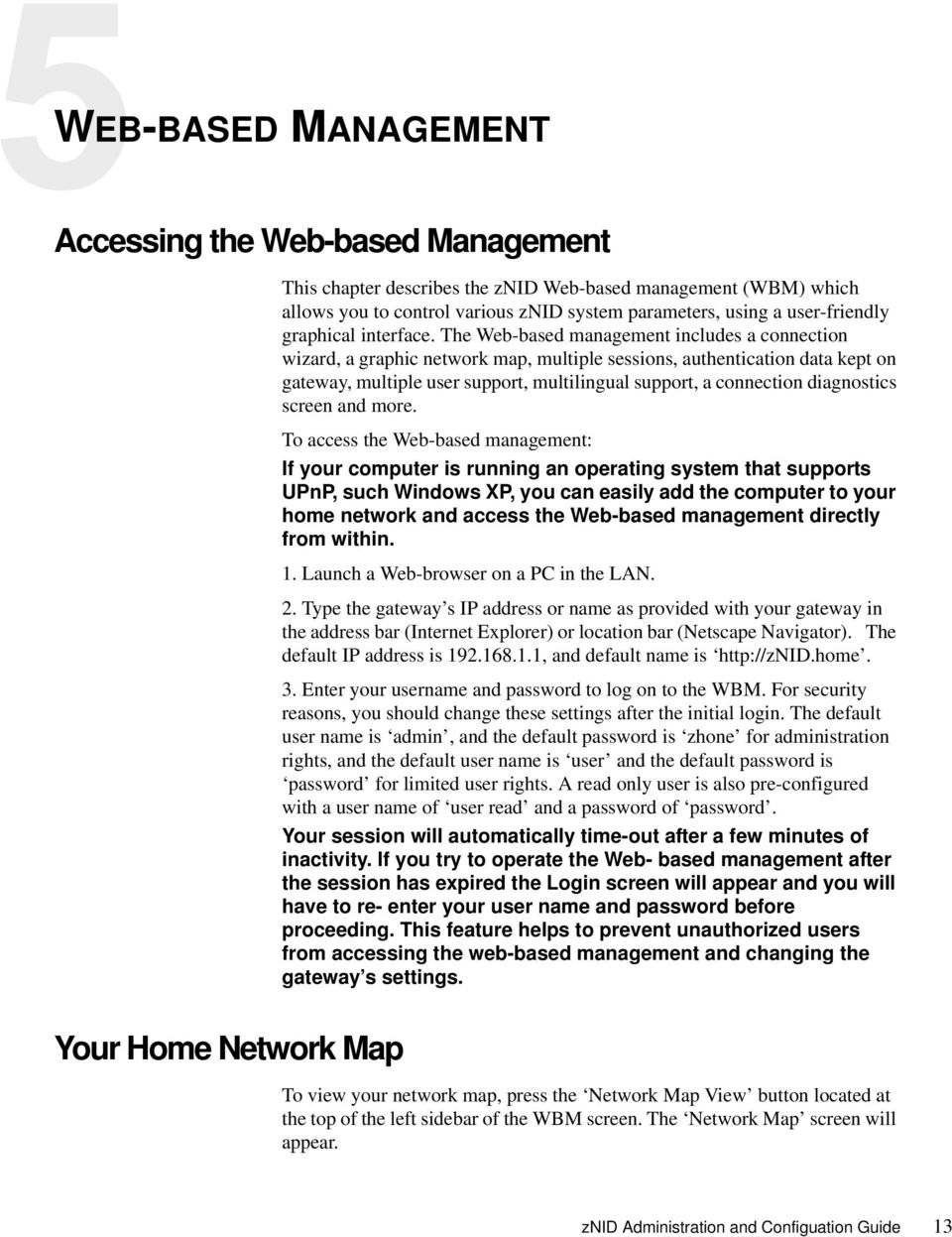
14 Web-based Management Figure 3: The Network Map The network map depicts the various network elements, such as the Internet connection, firewall, gateway, internal network interface and local network computers and peripherals. The following explains the meaning of different network map symbols: Represents the Internet Represents your Ethernet Wide Area Network (WAN) connection. Click this icon to configure the WAN interface. Represents the gateway s Firewall. The height of the wall corresponds to the security level currently selected: Minimum, Typical or Maximum. Click this icon to configure security settings. If the znid is equipped with multiple LAN devices (other than bridges) then the home network will use the following icons to indicate the interface used for connecting the PC. Represents an Ethernet Local Area Network (LAN) connection. Click this icon to configure network parameters for the Ethernet LAN device. 14 znid Administration and Configuation Guide
15 Your Home Network Map Represents a bridge connected in the home network. Click this icon to view the bridge s underlying devices. Represents a computer (host) connected in the home network. Each computer connected to the network appears below the network symbol of the network through which it is connected. Click an icon to view network information for the corresponding computer. The znid s standard network map displays devices that the znid recognized and granted a DHCP lease. Left Sidebar The Web-based management screens have been grouped into several subject areas and may be accessed by clicking the appropriate icon in the left sidebar. The subject areas are: Network Map: Display the Network Map Network Connections: Create and configure networks connections Security: Configure the Firewall and regulate communications between the Internet and the home network Voice Over IP: Use the znid s Voice over IP to place and receive calls over the Internet using a standard telephone set QoS: Use the znid s Quality of Service to provide better service to selected network traffic Advanced: Control system parameters (DHCP server, DNS) and perform administrative functions, including changing password, setting date & time and upgrading the system System Monitoring: View network status, traffic statistics and the system log Logout: Log out from the znid Managing Tables Tables are structures used throughout the Web-based management. They handle user-defined entries relating to elements such as network connections, local servers, restrictions and configurable parameters. The principles outlined in this section apply to all tables in the Web-based management. znid Administration and Configuation Guide 15
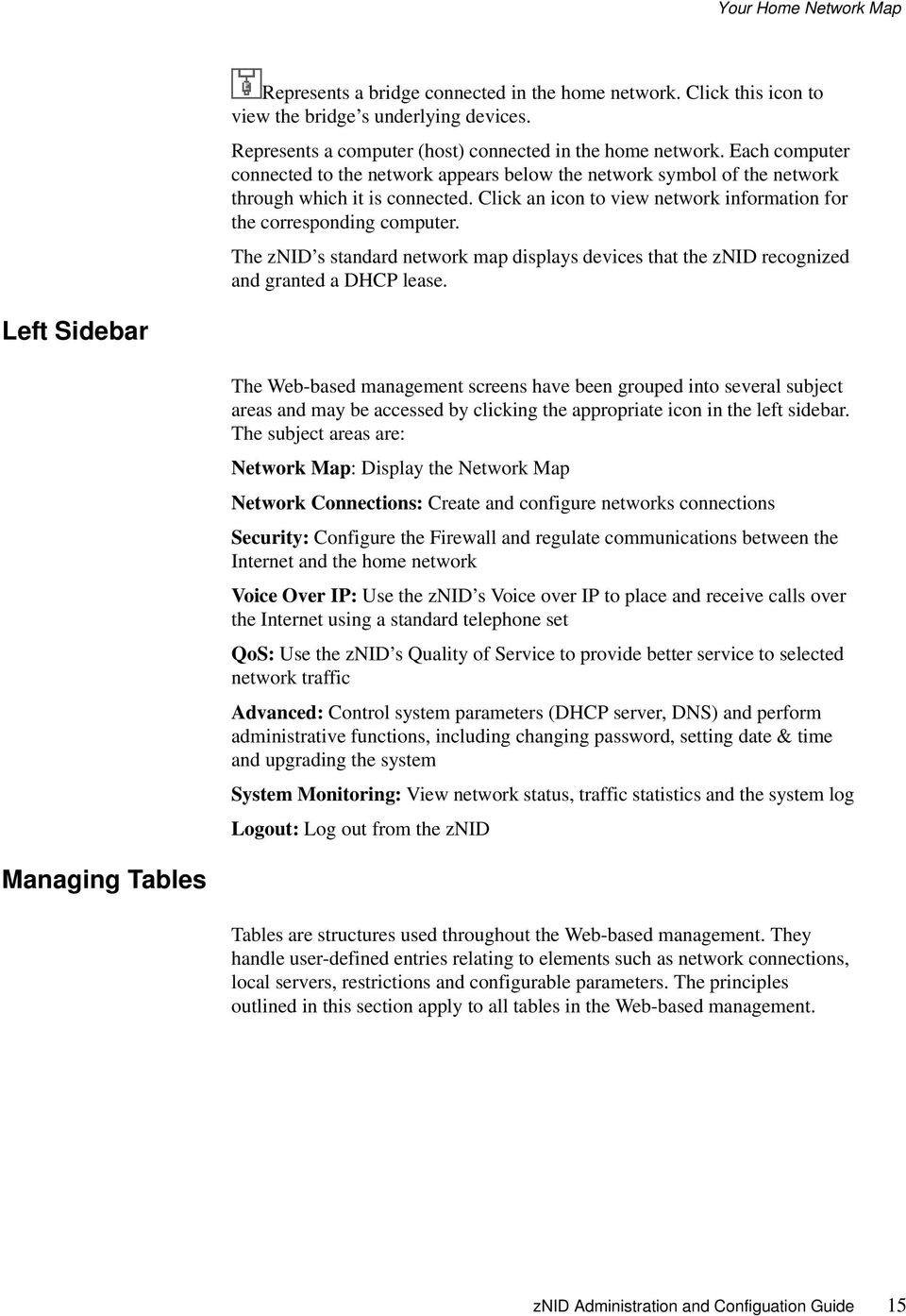
16 Web-based Management Figure 4: Typical Table Structure Each row defines an entry in the table. The following buttons located in the Action column enable adding, editing, deleting and moving table entries: Use the Add action icon to add a row to the table. Use the Edit action icon to edit a row in the table. Use the Remove action icon to remove a row from the table. Use the Move Up action icon to move a row one step up in the table. table. Use the Move Down action icon to move a row one step down in the 16 znid Administration and Configuation Guide

17 NETWORK CONNECTIONS The znid supports various network connections, both physical and logical. The Network Connections screen enables you to configure the various parameters of your physical connections, the LAN and WAN, and create new connections, using tunneling protocols over existing connections, such as PPP and VPN. When clicking the Network Connections icon on the sidebar for the first time, the following typical screen will appear: Figure 5: Network Connections - Basic Press the Advanced button to expand the screen and display all connection entries. znid Administration and Configuation Guide 17

18 Network Connections Figure 6: Network Connections - Advanced This chapter describes the different network connections available with the znid in their order of appearance in the Network Connections screen, as well as the connection types that you can create using the Connection Wizard. Note: Some of the connections described herein may not be available with certain versions. The znid s default network connections are: LAN - Creating a home/soho network LAN Bridge LAN Ethernet WAN - Internet Connection WAN Ethernet The logical network connections available with the znid are: WAN - Internet Connection Point-to-Point Protocol over Ethernet Ethernet Connection Dynamic Host Configuration Protocol Manual IP Address Configuration Determine Protocol Type Automatically WAN-LAN Bridge Advanced Connections Network Bridging 18 znid Administration and Configuation Guide

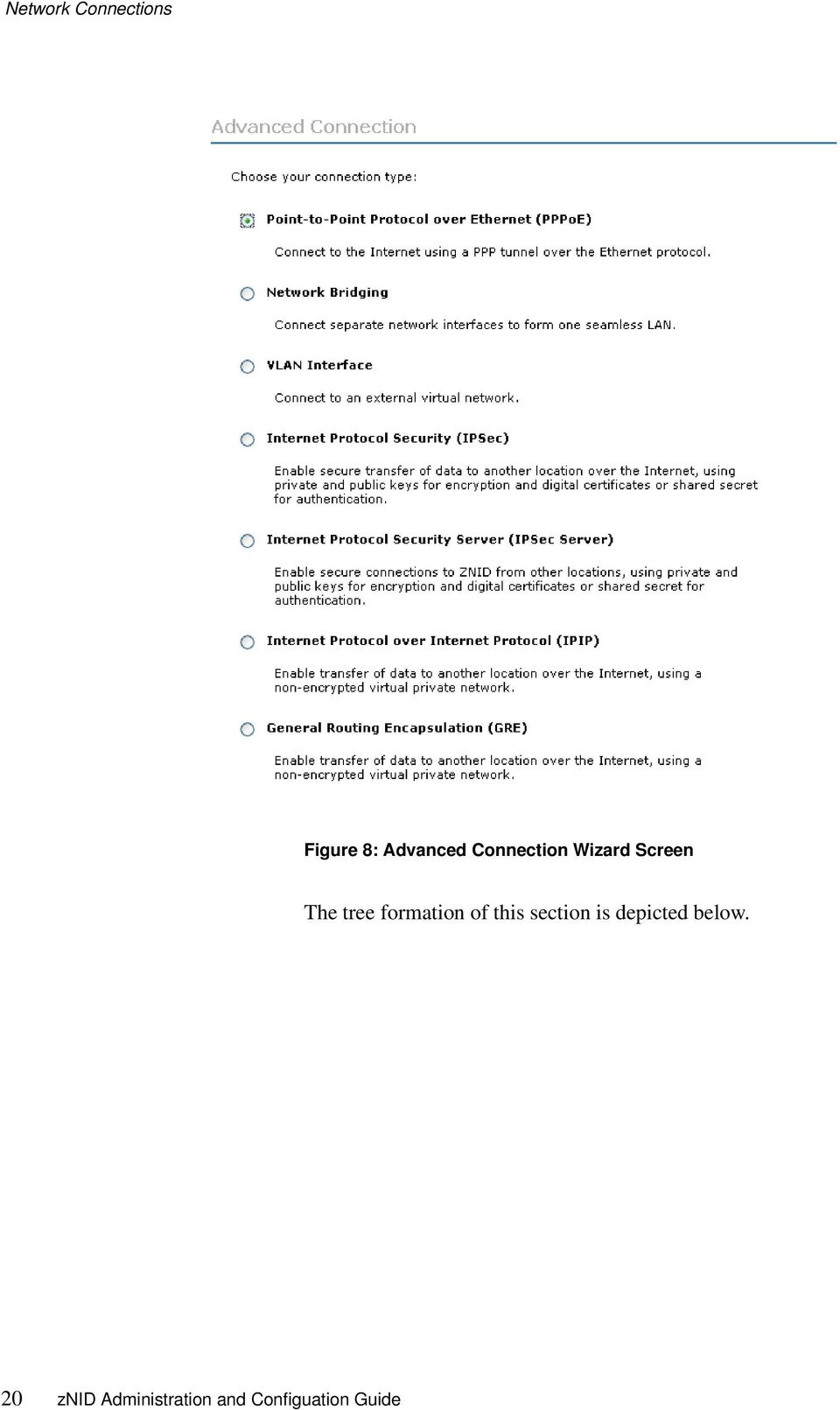
19 The Connection Wizard VLAN Interface The Connection Wizard Ethernet Gateway The logical network connections can be easily created using the Connection Wizard. This wizard is consisted of a series of Web-based management screens, intuitively structured to gather all the information needed to create a logical connection. In order to create a connection on an Ethernet gateway using the wizard, click the New Connection link in the Network Connections screen. The Connection Wizard screen will appear. Figure 7: Connection Wizard This screen presents you with the main connection types. Each option that you choose will lead you to further options in a tree-like formation, adding more information with each step and narrowing down the parameters towards the desired network connection. znid Administration and Configuation Guide 19

20 Network Connections Figure 8: Advanced Connection Wizard Screen The tree formation of this section is depicted below. 20 znid Administration and Configuation Guide
21 The Connection Wizard Figure 9: Advanced Connection Wizard Tree Network Types Every network connection in the znid can be configured as one of three types: WAN, LAN or DMZ. This provides high flexibility and increased functionality. For example, you may define that a LAN Ethernet connection on the znid will operate as a WAN network. This means that all hosts in this LAN will be referred to as WAN computers, both by computers outside the znid and by the znid itself. WAN and firewall rules may be applied, such as on any other WAN network. Another example, is that a network connection can be defined as a DMZ (Demilitarized) network. Although the network is physically inside the znid, it will function as an unsecured, independent network, for which the znid merely acts as a router. znid Administration and Configuation Guide 21
22 Network Connections One of these three network types is defined in each connection s configuration screen, in the Network combo-box, as depicted in the following sections. DMZ Network When defining a network connection as a DMZ network, you must also: Remove the connection from under a bridge, if that is the case. Change the connection s routing mode to Route, in the Routing section of the configuration screen. Add a routing rule on your external gateway (which may be with your ISP) informing of the DMZ network behind the znid. LAN Bridge The LAN bridge connection is used to combine several LAN devices under one virtual network. Please note, that when a bridge is removed, its formerly underlying devices inherit the bridge s DHCP settings. For example, the removal of a bridge that is configured as DHCP client, automatically configures the LAN devices formerly constituting the bridge as DHCP clients, with the exact DHCP client configuration. Creation with the Connection Wizard To configure an existing bridge or create a new one, perform the following steps: 1. Click the New Connection link in the Network Connections screen. The Connection Wizard screen will appear. 2. Select the Advanced Connection radio button and click Next. The Advanced Connection screen will appear. 3. Select the Network Bridging radio button and click Next. The Bridge Options screen will appear. 22 znid Administration and Configuation Guide
23 The Connection Wizard Figure 10: Bridge Options 4. Select whether to configure an existing bridge (this option will only appear if a bridge exists) or to add a new one: (a) Configure Existing Bridge Select this option and click Next. The Network Bridging screen will appear allowing you to add new connections or remove existing ones, by checking or unchecking their respective check boxes. znid Administration and Configuation Guide 23
24 Network Connections Figure 11: Network Bridging For example, checking the WAN check box will create a LAN-WAN bridge. (b) Add a New Bridge Select this option and click Next. A different Network Bridging screen will appear allowing you to add a bridge over the unbridged connections, by checking their respective check boxes. Figure 12: Network Bridging 24 znid Administration and Configuation Guide
25 The Connection Wizard Important notes: The same connections cannot be shared by two bridges. A bridge cannot be bridged. Bridged connections will lose their IP settings. 5. Click Next. The Connection Summary screen will appear corresponding to your changes. Figure 13: Connection Summary - Configure Existing Bridge 6. Check the Edit the Newly Created Connection check box if you wish to be routed to the new connection s configuration screen after clicking Finish. 7. Click Finish to save the settings. The new bridge will be added to the network connections list, and will be configurable like any other bridge. General The top part of the configuration window displays general communication parameters. It is recommended not to change the default values in this screen unless you are familiar with the networking concepts they represent. Since your gateway is configured to operate with the default values, no parameter modification is necessary. You can configure the following general connection settings: znid Administration and Configuation Guide 25
26 Network Connections Schedule By default, the connection will always be active. However, you can configure scheduler rules in order to define time segments during which the connection may be active. Once a scheduler rule(s) is defined, this field changes to a combo box, allowing you to choose between the available rules. To learn how to configure scheduler rules. Network Select whether the parameters you are configuring relate to a WAN, LAN or DMZ connection, by selecting the connection type from the combo-box. For more information. Physical Address The physical address of the network card used for your network. Some cards allow you to change this address. MTU MTU is the Maximum Transmission Unit. It specifies the largest packet size permitted for Internet transmission. The default setting, Manual, allows you to enter the largest packet size that will be transmitted. The recommended size is You should leave this value in the 1200 to 1500 range. To have the gateway select the best MTU for your Internet connection, select Automatic. Figure 14: General Bridge Settings Internet Protocol Select one of the following Internet Protocol options from the Internet Protocol drop down menu: No IP Address Obtain an IP Address Automatically Use the Following IP Address Please note that according to the selection you make in the Internet Protocol drop down menu, the screen will refresh and display relevant configuration settings. No IP Address Select No IP Address if you require that this connection will have no IP address. This can be useful if this connection is under a bridge. 26 znid Administration and Configuation Guide
27 The Connection Wizard Figure 15: Internet Protocol Settings No IP Address Use the Following IP Address The LAN connection is usually configured using a permanent (static) IP address. Your service provider should provide you with this address, and subnet mask. Figure 16: Internet Protocol Settings Static IP Bridge Settings The bridge section allows you to specify the LAN devices that you would like to join under the network bridge. Click the Edit icon on the VLAN column to assign the network connections to specific Virtual LANS. Select the STP check box to enable the Spanning Tree Protocol on the device. You should use this to ensure that there are no loops in your network configuration, and apply these settings in case your network consists of multiple switches, or other bridges apart from those created by the gateway. Figure 17: LAN Bridge Settings znid Administration and Configuation Guide 27
28 Network Connections IP Address Distribution The IP Address Distribution section allows you to configure the gateway s Dynamic Host Configuration Protocol (DHCP) server parameters. The DHCP automatically assigns IP addresses to network PCs. If you enable this feature, make sure that you also configure your network PCs as DHCP clients. Select one of the following options from the IP Address Distribution combo-box: DHCP Server Start IP Address The first IP address that may be assigned to a LAN host. Since the gateway s default IP address is , this address must be or greater. End IP Address The last IP address in the range that can be used to automatically assign IP addresses to LAN hosts. Subnet Mask A mask used to determine to what subnet an IP address belongs. An example of a subnet mask value is Lease Time In Minutes Each device will be assigned an IP address by the DHCP server for a this amount of time, when it connects to the network. When the lease expires the server will determine if the computer has disconnected from the network. If it has, the server may reassign this IP address to a newly-connected computer. This feature ensures that IP addresses that are not in use will become available for other computers on the network. Provide Host Name If Not Specified by Client If the DHCP client does not have a host name, the gateway will automatically assign one. Figure 18: IP Address Distribution DHCP Server DHCP Relay Your gateway can act as a DHCP relay in case you would like to dynamically assign IP addresses from a DHCP server other than your gateway s DHCP server. Note that when selecting this option you must also change the znid s WAN to work in routing mode. 28 znid Administration and Configuation Guide
29 The Connection Wizard 1. After selecting DHCP Relay from the drop down menu, a New IP Address link will appear: Figure 19: IP Address Distribution - DHCP Relay Click the New IP Address link. The DHCP Relay Server Address screen will appear: Figure 20: DHCP Relay Server Address 2. Specify the IP address of the DHCP server. 3. Click OK to save the settings. Disabled Select Disabled from the combo-box if you would like to statically assign IP addresses to your network computers. Figure 21: IP Address Distribution - Disable DHCP Routing You can choose to setup your gateway to use static or dynamic routing. Dynamic routing automatically adjusts how packets travel on the network, whereas static routing specifies a fixed routing path to neighboring destinations. Routing Select Advanced or Basic routing. Routing Mode Select one of the following routing modes: znid Administration and Configuation Guide 29
30 Network Connections Route Use route mode if you want your gateway to function as a router between two networks. NAPT Network Address and Port Translation (NAPT) refers to network address translation involving the mapping of port numbers, allowing multiple machines to share a single IP address. Use NAPT if your LAN encompasses multiple devices, a topology that necessitates port translation in addition to address translation. Device Metric The device metric is a value used by the gateway to determine whether one route is superior to another, considering parameters such as bandwidth, delay, and more. Default Route Select this check box to define this device as a the default route. Routing Information Protocol (RIP) Select this check box to enable the Routing Information Protocol (RIP). RIP determines a route based on the smallest hop count between source and destination. When RIP is enabled, select the following: Listen to RIP messages - select None, RIPv1, RIPv2 or RIPv1/2. Send RIP messages - select None, RIPv1, RIPv2-broadcast or RIPv2-multicast. Multicast - IGMP Proxy Internal IGMP proxy enables the system to issue IGMP host messages on behalf of hosts that the system discovered through standard IGMP interfaces. IGMP proxy enables the routing of multicast packets according to the IGMP requests of LAN devices asking to join multicast groups. Select the Multicast IGMP Proxy Internal check-box to enable this feature. Routing Table Allows you to add or modify routes when this device is active. Use the New Route button to add a route or edit existing routes. Figure 22: Advanced Routing Properties 30 znid Administration and Configuation Guide
31 The Connection Wizard Internet Connection Firewall Your gateway s firewall helps protect your computer by preventing unauthorized users from gaining access to it through a network such as the Internet. The firewall can be activated per network connection. To enable the firewall on this network connection, select the Enabled check box. Figure 23: Internet Connection Firewall Additional IP Addresses You can add alias names (additional IP addresses) to the gateway by clicking the New IP Address link. This enables you to access the gateway using these aliases in addition to the and the Figure 24: Additional IP addresses LAN Ethernet A LAN Ethernet connection connects computers to the znid using Ethernet cables, either directly or via network hubs and switches. Figure 25: LAN Ethernet properties znid Administration and Configuation Guide 31
32 Network Connections Clicking the Settings button at the bottom-right of the connection s Properties window, will open its Configuration window: Figure 26: LAN Ethernet Configuration General The top part of the configuration window displays general communication parameters. It is recommended not to change the default values in this screen unless you are familiar with the networking concepts they represent. Since your gateway is configured to operate with the default values, no parameter modification is necessary. You can configure the following general connection settings: Schedule By default, the connection will always be active. However, you can configure scheduler rules in order to define time segments during which the connection may be active. Once a scheduler rule(s) is defined, this field changes to a combo box, allowing you to choose between the available rules. Network Select whether the parameters you are configuring relate to a WAN, LAN or DMZ connection, by selecting the connection type from the combo-box. Physical Address The physical address of the network card used for your network. Some cards allow you to change this address. 32 znid Administration and Configuation Guide
33 The Connection Wizard MTU MTU is the Maximum Transmission Unit. It specifies the largest packet size permitted for Internet transmission. The default setting, Manual, allows you to enter the largest packet size that will be transmitted. The recommended size, is You should leave this value in the 1200 to 1500 range. To have the gateway select the best MTU for your Internet connection, select Automatic. Internet Protocol Select one of the following Internet Protocol options from the Internet Protocol drop down menu: No IP Address Obtain an IP Address Automatically Use the Following IP Address Please note that according to the selection you make in the Internet Protocol drop down menu, the screen will refresh and display relevant configuration settings. No IP Address Select No IP Address if you require that this connection will have no IP address. This can be useful if this connection is under a bridge. Figure 27: Internet Protocol Settings No IP Address Use the Following IP Address The LAN connection is usually configured using a permanent (static) IP address. Your service provider should provide you with this address, and subnet mask. Figure 28: Internet Protocol Settings Static IP IP Address Distribution The IP Address Distribution section allows you to configure the gateway s Dynamic Host Configuration Protocol (DHCP) server parameters. The DHCP automatically assigns IP addresses to network PCs. If you enable this feature, make sure that you also configure your network PCs as DHCP clients. znid Administration and Configuation Guide 33
34 Network Connections Select one of the following options from the IP Address Distribution combo-box: DHCP Server Start IP Address The first IP address that may be assigned to a LAN host. Since the gateway s default IP address is , this address must be or greater. End IP Address The last IP address in the range that can be used to automatically assign IP addresses to LAN hosts. Subnet Mask A mask used to determine to what subnet an IP address belongs. An example of a subnet mask value is Lease Time In Minutes Each device will be assigned an IP address by the DHCP server for a this amount of time, when it connects to the network. When the lease expires the server will determine if the computer has disconnected from the network. If it has, the server may reassign this IP address to a newly-connected computer. This feature ensures that IP addresses that are not in use will become available for other computers on the network. Provide Host Name If Not Specified by Client If the DHCP client does not have a host name, the gateway will automatically assign one for him. Figure 29: IP Address Distribution DHCP Server DHCP Relay Your gateway can act as a DHCP relay in case you would like to dynamically assign IP addresses from a DHCP server other than your gateway s DHCP server. Note that when selecting this option you must also change the znid s WAN to work in routing mode. 1. After selecting DHCP Relay from the drop down menu, a New IP Address link will appear: Figure 30: IP Address Distribution - DHCP Relay Click the New IP Address link. The DHCP Relay Server Address screen will appear: 34 znid Administration and Configuation Guide
35 The Connection Wizard Figure 31: DHCP Relay Server Address 2. Specify the IP address of the DHCP server. 3. Click OK to save the settings. Disabled Select Disabled from the combo-box if you would like to statically assign IP addresses to your net- work computers. Figure 29. IP Address Distribution - Disable DHCP Routing You can choose to setup your gateway to use static or dynamic routing. Dynamic routing automatically adjusts how packets travel on the network, whereas static routing specifies a fixed routing path to neighboring destinations. Routing Select Advanced or Basic routing. Routing Mode Select one of the following routing modes: Route Use route mode if you want your gateway to function as a router between two networks. NAPT Network Address and Port Translation (NAPT) refers to network address translation involving the mapping of port numbers, allowing multiple machines to share a single IP address. Use NAPT if your LAN encompasses multiple devices, a topology that necessitates port translation in addition to address translation. Device Metric The device metric is a value used by the gateway to determine whether one route is superior to another, considering parameters such as bandwidth, delay, and more. znid Administration and Configuation Guide 35
36 Network Connections Default Route Select this check box to define this device as a the default route. Multicast - IGMP Proxy Internal IGMP proxy enables the system to issue IGMP host messages on behalf of hosts that the system discovered through standard IGMP interfaces. IGMP proxy enables the routing of multicast packets according to the IGMP requests of LAN devices asking to join multicast groups. Select the Multicast IGMP Proxy Internal check-box to enable this feature. Routing Table Allows you to add or modify routes when this device is active. Use the New Route button to add a route or edit existing routes. Figure 32: Advanced Routing Properties Internet Connection Firewall Your gateway s firewall helps protect your computer by preventing unauthorized users from gaining access to it through a network such as the Internet. The firewall can be activated per network connection. To enable the firewall on this network connection, select the Enabled check box. Figure 33: Internet Connection Firewall Additional IP Addresses You can add alias names (additional IP addresses) to the gateway by clicking the New IP Address link. This enables you to access the gateway using these aliases in addition to the and the Figure 34: Additional IP Addresses 36 znid Administration and Configuation Guide
37 The Connection Wizard General The top part of the configuration window displays general communication parameters. It is recommended not to change the default values in this screen unless you are familiar with the networking concepts they represent. Since your gateway is configured to operate with the default values, no parameter modification is necessary. You can configure the following general connection settings: Schedule By default, the connection will always be active. However, you can configure scheduler rules in order to define time segments during which the connection may be active. Once a scheduler rule(s) is defined, this field changes to a combo box, allowing you to choose between the available rules. Network Select whether the parameters you are configuring relate to a WAN, LAN or DMZ connection, by selecting the connection type from the combo-box. The physical address of the network card used for your network. Some cards allow you to change this address. Clone MAC Allows you to copy the current MAC address of your PC to the MAC address of this device. MTU MTU is the Maximum Transmission Unit. It specifies the largest packet size permitted for Internet transmission. In the default setting, Automatic, the gateway selects the best MTU for your Internet connection. In case you change to manual, you can enter the largest packet size, you should leave this value in the 1200 to 1500 range. Figure 35: 100 WAN Ethernet properties znid Administration and Configuation Guide 37
38 Network Connections Figure 36: WAN Ethernet configuration Internet Protocol Settings Select one of the following Internet Protocol options from the Internet Protocol drop down menu: No IP Address Obtain an IP Address Automatically Use the Following IP Address Please note that according to the selection you make in the Internet Protocol drop down menu, the screen will refresh and display relevant configuration settings. 38 znid Administration and Configuation Guide
39 The Connection Wizard No IP Address Select No IP Address if you require that your gateway have no IP address. This can be useful if you are working in an environment where you are not connected to other networks, such as the Internet. Figure 35. Internet Protocol Settings No IP Address Obtain an IP Address Automatically Your WAN connection is configured by default to act as a DHCP client. You should keep this configuration in case your service provider supports DHCP, or if you are connecting using a dynamic IP address. The server that assigns the gateway with an IP address, also assigns a subnet mask. You can override the dynamically assigned subnet mask by selecting the Override Subnet Mask and specifying your own mask instead. You can press the Release button to release the current leased IP address. Once the address has been released, the button text changes to Renew. Use the Renew button to renew the leased IP address. Figure 37: Internet Protocol Settings Automatic IP Use the Following IP Address Your WAN connection can be configured using a permanent (static) IP address. Your service provider should provide you with this IP address, subnet mask and the default gateway IP address. Figure 38: Internet Protocol Settings Static IP znid Administration and Configuation Guide 39
40 Network Connections DNS Server Domain Name System (DNS) is the method by which website or domain names are translated into IP addresses. You can configure the connection to automatically obtain a DNS server address, or specify such an address manually, according to the information provided by your ISP. To configure the connection to automatically obtain a DNS server address, select Obtain DNS Server Address Automatically from the DNS Server drop down menu. Figure 39: Automatic DNS Settings To manually configure DNS server addresses, select Use the Following DNS Server Addresses from the DNS Server drop down menu. Specify up to two different DNS server address, one primary, another secondary. Figure 40: DNS Settings Routing You can choose to setup your gateway to use static or dynamic routing. Dynamic routing automatically adjusts how packets travel on the network, whereas static routing specifies a fixed routing path to neighboring destinations. Routing Select Advanced or Basic routing. Routing Mode Select one of the following routing modes: Route Use route mode if you want your gateway to function as a router between two networks. NAPT Network Address and Port Translation (NAPT) refers to network address translation involving the mapping of port numbers, allowing multiple machines to share a single IP address. Use NAPT if your LAN encompasses multiple devices, a topology that necessitates port translation in addition to address translation. Device Metric The device metric is a value used by the gateway to determine whether one route is superior to another, considering parameters such as bandwidth, delay, and more. 40 znid Administration and Configuation Guide
41 The Connection Wizard Default Route Select this check box to define this device as a the default route. Multicast - IGMP Proxy Internal IGMP proxy enables the system to issue IGMP host messages on behalf of hosts that the system discovered through standard IGMP interfaces. IGMP proxy enables the routing of multicast packets according to the IGMP requests of LAN devices asking to join multicast groups. Select the Multicast IGMP Proxy Internal check-box to enable this feature. Routing Table Allows you to add or modify routes when this device is active. Use the New Route button to add a route or edit existing routes. Figure 41: Advanced Routing Properties Internet Connection Firewall Your gateway s firewall helps protect your computer by preventing unauthorized users from gaining access to it through a network such as the Internet. The firewall can be activated per network connection. To enable the firewall on this network connection, select the Enabled check box. Figure 42: Internet Connection Firewall Additional IP Addresses You can add alias names (additional IP addresses) to the gateway by clicking the New IP Address link. This enables you to access the gateway using these aliases in addition to the and the znid Administration and Configuation Guide 41
42 Network Connections Figure 43: Additional IP Addresses Point-to-Point Protocol over Ethernet (PPPoE) Point-to-Point Protocol over Ethernet (PPPoE) relies on two widely accepted standards, PPP and Ethernet. PPPoE enables your home network PCs that communicate on an Ethernet network to exchange information with PCs on the Internet. PPPoE supports the protocol layers and authentication widely used in PPP and enables a point-to-point connection to be established in the normally multipoint architecture of Ethernet. A discovery process in PPPoE determines the Ethernet MAC address of the remote device in order to establish a session. Creation with the Connection Wizard To create a new PPPoE connection, perform the following steps: 1. Click the New Connection link in the Network Connections screen. The Connection Wizard screen will appear. 2. Select the Internet Connection radio button and click Next. The Internet Connection screen will appear. Figure 44: Point-to-Point Protocol over Ethernet 4. Enter the username and password provided by your Internet Service Provider (ISP), and click Next. The Connection Summary screen will appear. 42 znid Administration and Configuation Guide
43 Point-to-Point Protocol over Ethernet (PPPoE) Figure 45: Connection Summary 5. Check the Edit the Newly Created Connection check box if you wish to be routed to the new connection s configuration screen after clicking Finish. 6. Click Finish to save the settings. The new PPPoE connection will be added to the network connections list, and will be configurable like any other connection. General Schedule By default, the connection will always be active. However, you can configure scheduler rules in order to define time segments during which the connection may be active. Once a scheduler rule(s) is defined, this field changes to a combo box, allowing you to choose between the available rules. Network Select whether the parameters you are configuring relate to a WAN, LAN or DMZ connection, by selecting the connection type from the combo-box. MTU MTU is the Maximum Transmission Unit. It specifies the largest packet size permitted for Internet transmission. The default setting, Manual, allows you to enter the largest packet size that will be transmitted. The recommended size, is You should leave this value in the 1200 to 1500 range. To have the gateway select the best MTU for your Internet connection, select Automatic. Underlying Connection Specify the underlying connection above which the protocol will be initiated. znid Administration and Configuation Guide 43
44 Network Connections Figure 46: General PPPoE Settings Internet Protocol Select one of the following Internet Protocol options from the Internet Protocol drop down menu: Obtain an IP Address Automatically Use the Following IP Address Please note that according to the selection you make in the Internet Protocol drop down menu, the screen will refresh and display relevant configuration settings. Obtain an IP Address Automatically Your PPP connection is configured by default to obtain an IP automatically. You should change this configuration in case your service provider requires it. The server that assigns the gateway with an IP address, also assigns a subnet mask. You can override the dynamically assigned subnet mask by selecting the Override Subnet Mask and specifying your own mask instead. Figure 47: Internet Protocol Settings Automatic IP Use the Following IP Address Your WAN connection can be configured using a permanent (static) IP address. Your service provider should provide you with this IP address, subnet mask and the default gateway IP address. 44 znid Administration and Configuation Guide
45 Point-to-Point Protocol over Ethernet (PPPoE) Figure 48: Internet Protocol Settings Static IP DNS Server Domain Name System (DNS) is the method by which website or domain names are translated into IP addresses. You can configure the connection to automatically obtain a DNS server address, or specify such an address manually, according to the information provided by your ISP. To configure the connection to automatically obtain a DNS server address, select Obtain DNS Server Address Automatically from the DNS Server drop down menu. Figure 49: Automatic DNS Settings To manually configure DNS server addresses, select Use the Following DNS Server Addresses from the DNS Server drop down menu. Specify up to two different DNS server address, one primary, another secondary. Figure 50: DNS Settings Routing You can choose to setup your gateway to use static or dynamic routing. Dynamic routing automatically adjusts how packets travel on the network, whereas static routing specifies a fixed routing path to neighboring destinations. Routing Select Advanced or Basic routing. znid Administration and Configuation Guide 45
46 Network Connections Routing Mode Select one of the following routing modes: Route Use route mode if you want your gateway to function as a router between two networks. NAPT Network Address and Port Translation (NAPT) refers to network address translation involving the mapping of port numbers, allowing multiple machines to share a single IP address. Use NAPT if your LAN encompasses multiple devices, a topology that necessitates port translation in addition to address translation. Device Metric The device metric is a value used by the gateway to determine whether one route is superior to another, considering parameters such as bandwidth, delay, and more. Default Route Select this check box to define this device as a the default route. Multicast - IGMP Proxy Internal IGMP proxy enables the system to issue IGMP host messages on behalf of hosts that the system discovered through standard IGMP interfaces. IGMP proxy enables the routing of multicast packets according to the IGMP requests of LAN devices asking to join multicast groups. Select the Multicast IGMP Proxy Internal check-box to enable this feature. Routing Table Allows you to add or modify routes when this device is active. Use the New Route button to add a route or edit existing routes. Figure 51: Advanced Routing Properties Internet Connection Firewall Your gateway s firewall helps protect your computer by preventing unauthorized users from gaining access to it through a network such as the Internet. The firewall can be activated per network connection. To enable the firewall on this network connection, select the Enabled check box. 46 znid Administration and Configuation Guide
47 Point-to-Point Protocol over Ethernet (PPPoE) Figure 52: Internet Connection Firewall Ethernet Connection The Ethernet connection wizard utility is one of the three methods used to configure the physical WAN Ethernet connection. It is the most basic method, intended for connections that do not require user name and password in order to connect to the Internet. To configure a new Ethernet connection, perform the following steps: 1. Click the New Connection link in the Network Connections screen. The Connection Wizard screen will appear. 2. Select the Internet Connection radio button and click Next. The Internet Connection screen will appear. 3. Select the External Cable Modem radio button and click Next. The Internet Cable Modem Connection screen will appear. Figure 53: Internet Cable Modem Connection znid Administration and Configuation Guide 47
48 Network Connections 4. Select the Ethernet Connection radio button and click Next. The Connection Summary screen will appear. Figure 54: Connection Summary 5. Check the Edit the Newly Created Connection check box if you wish to be routed to the new connection s configuration screen after clicking Finish. 6. Click Finish to save the settings. The WAN Ethernet connection will be configured accordingly. Dynamic Host Configuration Protocol (DHCP) The Dynamic Host Configuration Protocol (DHCP) connection wizard utility is one of the three methods used to configure the physical WAN Ethernet connection. It is a dynamic negotiation method, where the client obtains an IP address automatically from the service provider when connecting to the Internet. To configure a new DHCP connection, perform the following steps: 1. Click the New Connection link in the Network Connections screen. The Connection Wizard screen will appear. 2. Select the Internet Connection radio button and click Next. The Internet Connection screen will appear. 3. Select the Ethernet Connection radio button and click Next. The Ethernet Connection screen will appear. 48 znid Administration and Configuation Guide
49 Point-to-Point Protocol over Ethernet (PPPoE) Figure 55: Ethernet Connection 4. Select the Dynamic Negotiation (DHCP) radio button and click Next. The Connection Summary screen will appear. Figure 56: Connection Summary 5. Check the Edit the Newly Created Connection check box if you wish to be routed to the new connection s configuration screen after clicking Finish. 6. Click Finish to save the settings. The WAN Ethernet connection will be configured to obtain an IP address using a DHCP. znid Administration and Configuation Guide 49
50 Network Connections WAN-LAN Bridge WAN bridge creates a bridge over WAN and LAN devices. This way computers on the znid LAN side can get IP addresses that are known on the WAN side. Creation with the Connection Wizard To configure an existing bridge or create a new one, perform the following steps: 1. Click the New Connection link in the Network Connections screen. The Connection Wizard screen will appear. 2. Select the Advanced Connection radio button and click Next. The Advanced Connection screen will appear. 3. Select the Network Bridging radio button and click Next. The Bridge Options screen will appear. Figure 57: Bridge Options 4. Select whether to configure an existing bridge (this option will only appear if a bridge exists) or to add a new one: (a) Configure Existing Bridge Select this option and click Next. 50 znid Administration and Configuation Guide
51 Point-to-Point Protocol over Ethernet (PPPoE) The Network Bridging screen will appear allowing you to add new connections or remove existing ones, by checking or unchecking their respective check boxes. Figure 58: Network Bridging For example, checking the WAN check box will create a LAN-WAN bridge. (b) Add a New Bridge Select this option and click Next. A different Network Bridging screen will appear allowing you to add a bridge over the unbridged connections, by checking their respective check boxes. Figure 59: Network Bridging Important notes: The same connections cannot be shared by two bridges. A bridge cannot be bridged. Bridged connections will lose their IP settings. 5. Click Next. znid Administration and Configuation Guide 51
52 Network Connections The Connection Summary screen will appear, corresponding to your changes. Figure 60: Connection Summary - Configure Existing Bridge 6. Check the Edit the Newly Created Connection check box if you wish to be routed to the new connection s configuration screen after clicking Finish. 7. Click Finish to save the settings. The new bridge will be added to the network connections list, and will be configurable like any other bridge. General The top part of the configuration window displays general communication parameters. It is recommended not to change the default values in this screen unless you are familiar with the networking concepts they represent. Since your gateway is configured to operate with the default values, no parameter modification is necessary. You can configure the following general connection settings: Schedule By default, the connection will always be active. However, you can configure scheduler rules in order to define time segments during which the connection may be active. Once a scheduler rule(s) is defined, this field changes to a combo box, allowing you to choose between the available rules. Network Select whether the parameters you are configuring relate to a WAN, LAN or DMZ connection, by selecting the connection type from the combo-box. Physical Address The physical address of the network card used for your network. Some cards allow you to change this address. Clone MAC Allows you to copy the current MAC address of your PC to the MAC address of this device. 52 znid Administration and Configuation Guide
53 Point-to-Point Protocol over Ethernet (PPPoE) MTU MTU is the Maximum Transmission Unit. It specifies the largest packet size permitted for Internet transmission. In the default setting, Automatic, the gateway selects the best MTU for your Internet connection. In case you change to manual, you can enter the largest packet size, you should leave this value in the 1200 to 1500 range. Figure 61: General WAN Bridge Settings Internet Protocol Settings Select one of the following Internet Protocol options from the Internet Protocol drop down menu: No IP Address Obtain an IP Address Automatically Use the Following IP Address Please note that according to the selection you make in the Internet Protocol drop down menu, the screen will refresh and display relevant configuration settings. No IP Address Select No IP Address if you require that your gateway have no IP address. This can be useful if you are working in an environment where you are not connected to other networks, such as the Internet. Figure 61. Internet Protocol Settings No IP Address Obtain an IP Address Automatically Your WAN connection is configured by default to act as a DHCP client. You should keep this configuration in case your service provider supports DHCP, or if you are connecting using a dynamic IP address. znid Administration and Configuation Guide 53
54 Network Connections The server that assigns the gateway with an IP address, also assigns a subnet mask. You can override the dynamically assigned subnet mask by selecting the Override Subnet Mask and specifying your own mask instead. You can press the Release button to release the current leased IP address. Once the address has been released, the button text changes to Renew. Use the Renew button to renew the leased IP address. Figure 62. Internet Protocol Settings Automatic IP Use the Following IP Address Your WAN connection can be configured using a permanent (static) IP address. Your service provider should provide you with this IP address, subnet mask and the default gateway IP address. Figure 62: Internet Protocol Settings Static IP Bridge Settings The bridge section allows you to specify the LAN and WAN devices that you would like to join under the network bridge. Click the Edit icon on the VLAN column to assign the network connections to specific Virtual LANS. Select the STP check box to enable the Spanning Tree Protocol on the device. You should use this to ensure that there are no loops in your network configuration, and apply these settings in case your network consists of multiple switches, or other bridges apart from those created by the gateway. 54 znid Administration and Configuation Guide
55 Point-to-Point Protocol over Ethernet (PPPoE) Figure 63: Bridge Settings DNS Server Domain Name System (DNS) is the method by which website or domain names are translated into IP addresses. You can configure the connection to automatically obtain a DNS server address, or specify such an address manually, according to the information provided by your ISP. To configure the connection to automatically obtain a DNS server address, select Obtain DNS Server Address Automatically from the DNS Server drop down menu. Figure 64: Automatic DNS Settings To manually configure DNS server addresses, select Use the Following DNS Server Addresses from the DNS Server drop-down menu. Specify up to two different DNS server address, one primary, another secondary. Figure 65: DNS Settings znid Administration and Configuation Guide 55
56 Network Connections Routing You can choose to setup your gateway to use static or dynamic routing. Dynamic routing automatically adjusts how packets travel on the network, whereas static routing specifies a fixed routing path to neighboring destinations. Routing Select Advanced or Basic routing. Routing Mode Select one of the following routing modes: Route Use route mode if you want your gateway to function as a router between two networks. NAPT Network Address and Port Translation (NAPT) refers to network address translation involving the mapping of port numbers, allowing multiple machines to share a single IP address. Use NAPT if your LAN encompasses multiple devices, a topology that necessitates port translation in addition to address translation. Device Metric The device metric is a value used by the gateway to determine whether one route is superior to another, considering parameters such as bandwidth, delay, and more. Default Route Select this check box to define this device as a the default route. Multicast - IGMP Proxy Internal IGMP proxy enables the system to issue IGMP host messages on behalf of hosts that the system discovered through standard IGMP interfaces. IGMP proxy enables the routing of multicast packets according to the IGMP requests of LAN devices asking to join multicast groups. Select the Multicast IGMP Proxy Internal check-box to enable this feature. Routing Table Allows you to add or modify routes when this device is active. Use the New Route button to add a route or edit existing routes. Figure 66: Advanced Routing Properties 56 znid Administration and Configuation Guide
57 Virtual LAN Interface (VLAN) Internet Connection Firewall Your gateway s firewall helps protect your computer by preventing unauthorized users from gaining access to it through a network such as the Internet. The firewall can be activated per network connection. To enable the firewall on this network connection, select the Enabled check box. Figure 67: Internet Connection Firewall Additional IP Addresses You can add alias names (additional IP addresses) to the gateway by clicking the New IP Address link. This enables you to access the gateway using these aliases in addition to the and the Figure 69. Additional IP Addresses Virtual LAN Interface (VLAN) The znid allows you to create Virtual LAN (VLAN) interfaces in order to connect to external virtual networks. Creation with the Connection Wizard To create a new VLAN interface, perform the following steps: 1. Click the New Connection link in the Network Connections screen. The Connection Wizard screen will appear. 2. Select the Advanced Connection radio button and click Next. The Advanced Connection screen will appear. 3. Select the VLAN Interface radio button and click Next. The VLAN Interface screen will appear. znid Administration and Configuation Guide 57
58 Network Connections Figure 68: VLAN Interface 4. Select the underlying device for this interface. The combo box will display the znid s Ethernet connections. 5. Enter a value that will serve as the VLAN ID, and click Next. The Connection Summary screen will appear. Figure 69: Connection Summary 6. Check the Edit the Newly Created Connection check box if you wish to be routed to the new connection s configuration screen after clicking Finish. 7. Click Finish to save the settings. The new VLAN interface will be added to the network connections list, and will be configurable like any other connection. 58 znid Administration and Configuation Guide
59 Virtual LAN Interface (VLAN) General The top part of the configuration window displays general communication parameters. It is recommended not to change the default values in this screen unless you are familiar with the networking concepts they represent. Since your gateway is configured to operate with the default values, no parameter modification is necessary. You can configure the following general connection settings: Schedule By default, the connection will always be active. However, you can configure scheduler rules in order to define time segments during which the connection may be active. Once a scheduler rule(s) is defined, this field changes to a combo box, allowing you to choose between the available rules. Network Select whether the parameters you are configuring relate to a WAN, LAN or DMZ connection, by selecting the connection type from the combo-box. Physical Address The physical address of the network card used for your network. Some cards allow you to change this address. Clone MAC Allows you to copy the current MAC address of your PC to the MAC address of this device. MTU MTU is the Maximum Transmission Unit. It specifies the largest packet size permitted for Internet transmission. In the default setting, Automatic, the gateway selects the best MTU for your Internet connection. In case you change to manual, you can enter the largest packet size, you should leave this value in the 1200 to 1500 range. Underlying Connection The Ethernet device that the connection is implemented over. Internet Protocol Select one of the following Internet Protocol options from the Internet Protocol drop down menu: No IP Address Obtain an IP Address Automatically Use the Following IP Address Please note that according to the selection you make in the Internet Protocol drop down menu, the screen will refresh and display relevant configuration settings. No IP Address Select No IP Address if you require that your gateway have no IP address. This can be useful if you are working in an environment where you are not connected to other networks, such as the Internet. Figure 70: Internet Protocol Settings No IP Address znid Administration and Configuation Guide 59
60 Network Connections Obtain an IP Address Automatically Your WAN connection is configured by default to act as a DHCP client. You should keep this configuration in case your service provider supports DHCP, or if you are connecting using a dynamic IP address. The server that assigns the gateway with an IP address, also assigns a subnet mask. You can override the dynamically assigned subnet mask by selecting the Override Subnet Mask and specifying your own mask instead. You can press the Release button to release the current leased IP address. Once the address has been released, the button text changes to Renew. Use the Renew button to renew the leased IP address. Figure 71: Internet Protocol Settings Automatic IP Use the Following IP Address Your WAN connection can be configured using a permanent (static) IP address. Your service provider should provide you with this IP address, subnet mask and the default gateway IP address. Figure 72: Internet Protocol Settings Static IP IP Address Distribution The IP Address Distribution section allows you to configure the gateway s Dynamic Host Configuration Protocol (DHCP) server parameters. The DHCP automatically assigns IP addresses to network PCs. If you enable this feature, make sure that you also configure your network PCs as DHCP clients. Select one of the following options from the IP Address Distribution combo-box: DHCP Server 60 znid Administration and Configuation Guide
61 Virtual LAN Interface (VLAN) Start IP Address The first IP address that may be assigned to a LAN host. Since the gateway s default IP address is , this address must be or greater. End IP Address The last IP address in the range that can be used to automatically assign IP addresses to LAN hosts. Subnet Mask A mask used to determine to what subnet an IP address belongs. An example of a subnet mask value is Lease Time In Minutes Each device will be assigned an IP address by the DHCP server for a this amount of time, when it connects to the network. When the lease expires the server will determine if the computer has disconnected from the network. If it has, the server may reassign this IP address to a newly-connected computer. This feature ensures that IP addresses that are not in use will become available for other computers on the network. Provide Host Name If Not Specified by Client If the DHCP client does not have a host name, the gateway will automatically assign one for him. Figure 73: IP Address Distribution DHCP Server DHCP Relay Your gateway can act as a DHCP relay in case you would like to dynamically assign IP addresses from a DHCP server other than your gateway s DHCP server. Note that when selecting this option you must also change the znid s WAN to work in routing mode. znid Administration and Configuation Guide 61
62 Network Connections 1. After selecting DHCP Relay from the drop down menu, a New IP Address link will appear: Figure 74: IP Address Distribution - DHCP Relay Click the New IP Address link. The DHCP Relay Server Address screen will appear: Figure 75: DHCP Relay Server Address 2. Specify the IP address of the DHCP server. 3. Click OK to save the settings. Disabled Select Disabled from the combo-box if you would like to statically assign IP addresses to your network computers. Figure 76: IP Address Distribution - Disable DHCP Routing You can choose to setup your gateway to use static or dynamic routing. Dynamic routing automatically adjusts how packets travel on the network, whereas static routing specifies a fixed routing path to neighboring destinations. Routing Select Advanced or Basic routing. 62 znid Administration and Configuation Guide
63 Virtual LAN Interface (VLAN) Routing Mode Select one of the following routing modes: Route Use route mode if you want your gateway to function as a router between two networks. NAPT Network Address and Port Translation (NAPT) refers to network address translation involving the mapping of port numbers, allowing multiple machines to share a single IP address. Use NAPT if your LAN encompasses multiple devices, a topology that necessitates port translation in addition to address translation. Device Metric The device metric is a value used by the gateway to determine whether one route is superior to another, considering parameters such as bandwidth, delay, and more. Default Route Select this check box to define this device as a the default route. Multicast - IGMP Proxy Internal IGMP proxy enables the system to issue IGMP host messages on behalf of hosts that the system discovered through standard IGMP interfaces. IGMP proxy enables the routing of multicast packets according to the IGMP requests of LAN devices asking to join multicast groups. Select the Multicast IGMP Proxy Internal check-box to enable this feature. Routing Table Allows you to add or modify routes when this device is active. Use the New Route button to add a route or edit existing routes. Figure 77: Advanced Routing Properties Internet Connection Firewall Your gateway s firewall helps protect your computer by preventing unauthorized users from gaining access to it through a network such as the Internet. The firewall can be activated per network connection. To enable the firewall on this network connection, select the Enabled check box. znid Administration and Configuation Guide 63
64 Network Connections Figure 78: Internet Connection Firewall Allow Unrestricted Administration Select this check box to enable users other than those defined as Administrator to change the znid s configuration. Figure 79: Allow Unrestricted Administration Additional IP Addresses You can add alias names (additional IP addresses) to the gateway by clicking the New IP Address link. This enables you to access the gateway using these aliases in addition to the and the Figure 80: Additional IP Addresses DSCP Remark According to 802.1p CoS When creating a VLAN interface over a LAN connection, it is possible to determine the IP header s Differentiated Services Code Point (DSCP) priority value according to the VLAN header s 802.1p Class of Service (CoS) tag. The DSCP value can then be used for Quality of Service (Qos) traffic prioritization. 1. Check the Enabled check-box. The screen will refresh, presenting a table. Figure 81: DSCP Remark According to 802.1p CoS 2. Click the New DSCP Remark link. The following screen will appear: 64 znid Administration and Configuation Guide
65 Virtual LAN Interface (VLAN) Figure 82: DSCP Remark According to 802.1p CoS 3. Enter the 802.1p CoS and DSCP values to be associated, and click OK. The new pair of values will appear in the table. 4. Click OK to save the settings. VLAN Use Case The following example demonstrates the advantages of a VLAN interface through practical setup and performance measurements. The VLAN interface in this example is used to grant prioritization to specific traffic, providing a basic level of Quality of Service. Hardware Requirements This use case requires the following: A znid Two equal Linux LAN hosts holding two identical 100MB files A 10 Mbps switch (optional) A WAN host serving as an FTP server Physical Setup Since this example requires overloading the WAN, the WAN network segment bandwidth must be less than the LAN s. This can be achieved, for example, by either connecting the znid s WAN to 10 Mbps switch, or forcing the FTP server s WAN interface to 10 Mbps. 1. Connect the two LAN hosts to the development board s LAN ports. 2. Connect the board s WAN port to the 10 Mbps switch, and the switch to the WAN. znid Administration and Configuation Guide 65
66 Network Connections Figure 83: Physical Setup znid Configuration To configure the VLAN interface, perform the following steps: 1. In the Network Connections screen, delete the LAN bridge (if one exists) by clicking its Remove action icon. Click OK in the attention screen to confirm the deletion. The LAN Ethernet that was enslaved to the bridge will automatically be configured with the IP address , and serve as the DHCP server for this subnet. 2. Create a VLAN interface over the LAN Ethernet, using the Advanced utility of the connection wizard. The underlying device should be LAN Ethernet, and the VLAN ID set to 100. Figure 84: VLAN Interface Configuration 3. In the Connection Summary screen, check the Edit the Newly Created Connection check box and click Finish. The Configure LAN Ethernet 2 screen will appear. 66 znid Administration and Configuation Guide
67 Virtual LAN Interface (VLAN) Figure 85: Configure LAN Ethernet 2 4. In the Internet Protocol section, select Use the Following IP Address from the combo box. The screen will refresh. 5. Enter as the IP address and as the subnet mask. Figure 86: Internet Protocol 6. In the IP Address Distribution section, select DHCP Server from the combo box. The screen will refresh. 7. Enter as the start IP address and as the end IP address. Enter as the subnet mask. Leave all other fields at their defaults. znid Administration and Configuation Guide 67
68 Network Connections Figure 87: IP Address Distribution 8. In the Internet Connection Firewall section, disable the firewall by unchecking the Enabled check box. Figure 88: Internet Connection Firewall 9. Click OK to save the settings. Host 1 Configuration This computer will act as an ordinary LAN host connected to the znid with no special settings. After connecting the computer to the gateway, use the following command (in the Linux shell command line) to obtain an IP address from the znid: # pump -i eth0 Verify that the obtained IP address is in the znid s default subnet ( x) using this command: # ifconfig eth0 Host 2 Configuration This computer will act as a VLAN-capable host connected to the znid. Use the following command to create the VLAN interface (verify that the vconfig utility is installed on this host s Linux operating system): # vconfig add eth0 100 After connecting the computer to the gateway, use the following command (in the Linux shell command line) to obtain an IP address from the znid: # pump -i eth0.100 Verify that the obtained IP address is the znid s VLAN subnet ( x) using this command: # ifconfig eth znid Administration and Configuation Guide
69 Virtual LAN Interface (VLAN) Running the Scenario 1. Open an FTP connection from both hosts to the WAN FTP server. Use an FTP client that displays throughput rates. 2. Initiate an FTP upload of the 100MB files from both hosts to the server simultaneously. Observe that the throughput rates on both hosts are similar - approximately half of the forced WAN bandwidth (5MB each). 3. Configure the VLAN interface of Host 2 to add priority to VLAN frames, using the following command: # vconfig set_egress_map eth Repeat the FTP upload test and observe that the throughput rate of Host 2 increases significantly at the expense of Host 1. znid Administration and Configuation Guide 69
70 Network Connections 70 znid Administration and Configuation Guide
71 SECURITY The znid s gateway security suite includes comprehensive and robust security services: Stultify Packet Inspection Firewall, user authentication protocols and password protection mechanisms. These features together allow users to connect their computers to the Internet and simultaneously be protected from the security threats of the Internet. The firewall is the cornerstone of your gateway s security suite, has been exclusively tailored to the needs of the residential/office user and has been pre-configured to provide optimum security. Figure 89: The znid s Firewall in Action The znid s firewall provides both the security and flexibility that home and office users seek. It provides a managed, professional level of network security while enabling the safe use of interactive applications, such as Internet gaming and video-conferencing. Additional features, including surfing restrictions and access control, can also be easily configured locally by the user through a user-friendly Web-based interface, or remotely by a service provider. znid Administration and Configuation Guide 71
72 Security The znid firewall supports advanced filtering, designed to allow comprehensive control over the firewall s behavior. You can define specific input and output rules, control the order of logically similar sets of rules and make a distinction between rules that apply to WAN and LAN network devices. The Web-based management screens in the Security section feature the following: The General screen allows you to choose the security level for the firewall. The Access Control screen can be used to restrict access from the home network to the Internet. The Port Forwarding screen can be used to enable access from the Internet to specified services provided by computers in the home network and special Internet applications. The DMZ Host screen allows you to configure a LAN host to receive all traffic arriving at your gateway, which does not belong to a known session. The Port Triggering screen allows you to define port triggering entries, to dynamically open the firewall for some protocols or ports. The Website Restrictions screen allows you to block LAN access to a certain host or Web site on the Internet. The NAT screen allows you to manually control the translation of network addresses and ports. Advanced Filtering allows you to implicitly control the firewall setting and rules. Security Log allows you to view and configure the firewall Log. General Use the General screen to configure the gateway s basic security settings. 72 znid Administration and Configuation Guide
73 General Figure 90: General The firewall regulates the flow of data between the home network and the Internet. Both incoming and outgoing data are inspected and then either accepted (allowed to pass through the znid) or rejected (barred from passing through the znid) according to a flexible and configurable set of rules. These rules are designed to prevent unwanted intrusions from the outside, while allowing home users access to the Internet services that they require. The firewall rules specify what types of services available on the Internet may be accessed from the home network and what types of services available in the home network may be accessed from the Internet. Each request for a service that the firewall receives, whether originating in the Internet or from a znid Administration and Configuation Guide 73
74 Security computer in the home network, is checked against the set of firewall rules to determine whether the request should be allowed to pass through the firewall. If the request is permitted to pass, then all subsequent data associated with this request (a session ) will also be allowed to pass, regardless of its direction. For example, when you point your Web browser to a Web page on the Internet, a request is sent out to the Internet for this page. When the request reaches the znid, the firewall will identify the request type and origin HTTP and a specific PC in your home network, in this case. Unless you have configured access control to block requests of this type from this computer, the firewall will allow this request to pass out onto the Internet. When the Web page is returned from the Web server the firewall will associate it with this session and allow it to pass, regardless of whether HTTP access from the Internet to the home network is blocked or permitted. The important thing to note here is that it is the origin of the request, not subsequent responses to this request, that determines whether a session can be established or not. You may choose from among three pre-defined security levels for the znid: Minimum, Typical, and Maximum (the default setting). The table below summarizes the behavior of the znid for each of the three security levels. Security Level Maximum Security (Default) Typical Security Minimum Security Requests Originating in the WAN (Incoming Traffic) Blocked: No access to home network from Internet, except as configured in the Port Forwarding, DMZ host and Remote Access screens Blocked: No access to home network from Internet, except as configured in the Port Forwarding, DMZ host and Remote Access screens Unrestricted: Permits full access from Internet to home network; all connection attempts permitted. Requests Originating in the LAN (Outgoing Traffic) Limited By Default. Only commonly used services such as Web browsing and are permitted. Unrestricted All services are permitted except as configured in the Access Control screen. Unrestricted: All services are permitted except as configured in the Access Control screen. 74 znid Administration and Configuation Guide
75 Access Control These services include Telenet, FTP, HTTP, HTTPS, DNS, IMAP, POP3 and SMTP. The list of allowed services at Maximum Security mode can be edited in the Access Control page. Attention: Some applications (such as some Internet messengers and Peer-To-Peer client applications) tend to use these ports, if they cannot connect with their own default ports. When applying this behavior, these applications will not be blocked outbound, even at Maximum Security Level. To configure the znid s security settings. 1. Choose from among the three predefined security levels described in the table above. Maximum Security is the default setting. Using the Minimum Security setting may expose the home network to significant security risks, and thus should only be used, when necessary, for short periods of time. 2. Check the Block IP Fragments box in order to protect your home network from a common type of hacker attack that could make use of fragmented data packets to sabotage your home network. Note that VPN over IPSec and some UDP-based services make legitimate use of IP fragments. You will need to allow IP fragments to pass into the home network in order to make use of these select services. 3. Click the OK button to save your changes. Access Control You may want to block specific computers within the home network (or even the whole network) from accessing certain services on the Internet. For example, you may want to prohibit one computer from surfing the Web, another computer from transferring files using FTP, and the whole network from receiving incoming . Access Control defines restrictions on the types of requests that may pass from the home network out to the Internet, and thus may block traffic flowing in both directions. It can also be used for allowing specific services when maximum security is configured. In the example given above, you may prevent computers in the home network from receiving by blocking their outgoing requests to POP3 servers on the Internet. There are numerous services you should consider blocking, such as popular game and file sharing servers. For example, if you want to make sure that your employees do not put your business at risk from illegally traded copyright files, you may want to block several popular P2P and file sharing applications. To allow or restrict services: 1. Select the Access Control tab in the Security management screen. The Access Control screen will appear. znid Administration and Configuation Guide 75
76 Security Figure 91: Access Control 2. Click the New Entry link. The Add Access Control Rule screen will appear. Figure 92: Add Access Control Rule 3. The Address combo box provides you the ability to specify the computer or group of computers for which you would like to apply the access control rule. 76 znid Administration and Configuation Guide
77 Access Control You can select between any or a specific computer address in your LAN. If you choose the Specify Address option, the screen will refresh, and an Add link will appear: Figure 93: Add a Specific Address Click the Add link to specify a computer address. Specifying an address is done by creating a Network Object ; to learn more about network objects. 4. The Protocol combo-box lets you select or specify the type of protocol that will be used. Selecting the Show All Services option will expand the list of available protocols. Select a protocol or add a new one using the User Defined option. This will commence a sequence that will add a new service, representing the protocol. 5. The Schedule combo-box allows you to define the time period during which this rule will take effect. By default, the rule will always be active. However, you can configure scheduler rules by selecting User Defined. 6. Click the OK button to save your changes. The Access Control screen will display a summary of the rule that you just added. Figure 94: Access Control Rule znid Administration and Configuation Guide 77
78 Security You may edit the access control rule by modifying its entry under the Local Host column in the Access Control screen. To modify an entry: 1. Click the Edit action icon for the rule. The Edit Access Control Rule screen will appear. This screen allows you to edit all the parameters that you configured when creating the access control rule. Figure 95: Edit Access Control Rule 2. Click the OK button to save your changes and return to the Access Control screen. You can disable an access control rule in order to make a service available without having to remove the rule from the Access Control screen. This may be useful if you wish to make the service available only temporarily and expect that you will want to reinstate the restriction in the future. To temporarily disable a rule, clear the check box next to the service name. To reinstate it at a later time, simply reselect the check box. 78 znid Administration and Configuation Guide
79 Port Forwarding To remove a rule, click the Remove action icon for the service. The service will be permanently re- moved. Note: Please note that when Web Filtering is enabled, HTTP services cannot be blocked by Access Control. Port Forwarding In its default state, the znid blocks all external users from connecting to or communicating with your network. Therefore the system is safe from hackers who may try to intrude on the network and damage it. However, you may want to expose your network to the Internet in certain limited and controlled ways in order to enable some applications to work from the LAN (game, voice and chat applications, for example) and to enable Internet-access to servers in the home network. The Port Forwarding feature supports both of these functionalities. If you are familiar with networking terminology and concepts, you may have encountered this topic referred to as Local Servers. The Port Forwarding screen lets you define the applications that require special handling by the znid. All you have to do is select the application s protocol and the local IP address of the computer that will be using or providing the service. If required, you may add new protocols in addition to the most common ones provided by the znid. For example, if you wanted to use a File Transfer Protocol (FTP) application on one of your PCs, you would simply select FTP from the list and enter the local IP address or host name of the designated computer. All FTP-related data arriving at the znid from the Internet will henceforth be forwarded to the specified computer. Similarly, you can grant Internet users access to servers inside your home network, by identifying each service and the PC that will provide it. This is useful, for example, if you want to host a Web server inside your home network. When an Internet user points his/her browser to the znid s external IP address, the gateway will forward the incoming HTTP request to your Web server. With one external IP address (the znid s main IP address), different applications can be assigned to your LAN computers, however each type of application is limited to use one computer. For example, you can define that FTP will use address X to reach computer A and Telnet will also use address X to reach computer A, but attempting to define FTP to use address X to reach both computer A and B will fail. The znid therefore provides the ability to add additional public IP addresses to port forwarding rules, which you must first obtain from your ISP, and enter into the NAT IP Addresses Pool. You will then be able to define FTP to use address X to reach computer A and address Y to reach computer B. Additionally, port forwarding enables you to redirect traffic to a different port instead of the one to which it was designated. Lets say, that you have a Web server running on your PC on port 8080 and you want to grant access to this server to anyone who accesses the znid via HTTP. To accomplish this, do the following: znid Administration and Configuation Guide 79
80 Security Define a port forwarding rule for the HTTP service, with the PC s IP or host name. Specify 8080 in the Forward to Port field. All incoming HTTP traffic will now be forwarded to the PC running the Web server on port When setting a port forwarding service, you must ensure that the port is not already in use by another application, which may stop functioning. A common example is when using SIP signaling in Voice over IP- the port used by the gateway s VoIP application (5060) is the same port on which port forwarding is set for LAN SIP agents. Note: Some applications, such as FTP, TFTP, PPTP and H323, require the support of special specific Application Level Gateway (ALG) modules in order to work inside the home network. Data packets associated with these applications contain information that allows them to be routed correctly. An ALG is needed to handle these packets and ensure that they reach their intended destinations. The znid is equipped with a robust list of ALG modules in order to enable maximum functionality in the home network. The ALG is automatically assigned based on the destination port. To add a new port forwarding service: 1. Select the Port Forwarding tab in the Security management screen. The Port Forwarding screen will appear. Figure 96: Port Forwarding 80 znid Administration and Configuation Guide
81 Port Forwarding 2. Click the New Entry link. The Add Port Forwarding Rule screen will appear. Figure 97: Add Port Forwarding Rule 3. Select the Specify Public IP Address check-box if you would like to apply this rule on a specific external IP address. The screen will refresh. Figure 98: Specify Public IP Address 4. Enter the additional external IP address in the Public IP Address field. 5. Enter the host name or IP address of the computer that will provide the service (the server ) in the Local Host field. Note that unless an additional external IP address has been added, only one LAN computer can be assigned to provide a specific service or application. 6. The Protocol combo-box lets you select or specify the type of protocol that will be used. Selecting the Show All Services option will expand the list of available protocols. Select a protocol or add a new one using the User Defined option. This will commence a sequence that will add a new service, representing the protocol. znid Administration and Configuation Guide 81
82 Security 7. By default, the znid will forward traffic to the same port as the incoming port. If you wish to redirect traffic to a different port, select the Specify option. The screen will refresh, and an additional field will appear enabling you to enter the port number: Figure 99: Forward to a Specific Port 8. The Schedule combo-box allows you to define the time period during which this rule will take effect. By default, the rule will always be active. However, you can configure scheduler rules by selecting User Defined. 9. Click the OK button to save your changes. The Port Forwarding screen will display a summary of the rule that you just added. Figure 100: Port Forwarding Rule You may edit the port forwarding rule by modifying its entry under the Local Host column in the Port Forwarding screen. To modify an entry: 82 znid Administration and Configuation Guide
83 Port Forwarding 1. Click the Edit action icon for the rule. The Edit Port Forwarding Rule screen will appear.this screen allows you to edit all the parameters that you configured when creating the port forwarding rule. Figure 101: Edit Port Forwarding Rule 2. Click the OK button to save your changes and return to the Port Forwarding screen. You can disable a port forwarding rule in order to make a service unavailable without having to remove the rule from the Port Forwarding screen. This may be useful if you wish to make the service unavailable only temporarily and expect that you will want to reinstate it in the future. To temporarily disable a rule, clear the check box next to the service name. To reinstate it at a later time, simply reselect the check box. To remove a rule, click the Remove action icon for the service. The service will be permanently removed. How many computers can use a service or play a game simultaneously? znid Administration and Configuation Guide 83
84 Security Well, the answer may be a bit confusing. All the computers on the network can use a specific service as clients simultaneously. Being a client means that the computer within the network initiates the connection for example, opens an FTP connection with an FTP server on the Internet. But only one computer can serve as a server, meaning responding to requests from computers on the Internet. Assigning a specific computer as a server is done in the Port Forwarding section of Web-based management. DMZ Host The DMZ (Demilitarized) Host feature allows one local computer to be exposed to the Internet. Designate a DMZ host when: You wish to use a special-purpose Internet service, such as an on-line game or video-conferencing program, that is not present in the Port Forwarding list and for which no port range information is available. You are not concerned with security and wish to expose one computer to all services without restriction. Warning: A DMZ host is not protected by the firewall and may be vulnerable to attack. Designating a DMZ host may also put other computers in the home network at risk. When designating a DMZ host, you must consider the security implications and protect it if necessary. An incoming request for access to a service in the home network, such as a Web-server, is fielded by the znid. The znid will forward this request to the DMZ host (if one is designated) unless the service is being provided by another PC in the home network (assigned in Port Forwarding), in which case that PC will receive the request instead. To designate a local computer as a DMZ Host: 1. Select the DMZ Host tab in the Security management screen. The DMZ Host screen will appear. Figure 102: DMZ Host 84 znid Administration and Configuation Guide
85 Port Triggering 2. Enter the local IP address of the computer that you would like to designate as a DMZ host, and select the check-box. Note that only one LAN computer may be a DMZ host at any time. 3. Click OK to save the settings. You can disable the DMZ host so that it will not be fully exposed to the Internet, but keep its IP address recorded on the DMZ Host screen. This may be useful if you wish to disable the DMZ host but expect that you will want to enable it again in the future. To disable the DMZ host so that it will not be fully exposed to the Internet, clear the check-box next to the DMZ IP designation, and click OK. To reinstate it at a later time, simply reselect the check box. Port Triggering Port triggering can be used for dynamic port forwarding configuration. By setting port triggering rules, you can allow inbound traffic to arrive at a specific LAN host, using ports different than those used for the outbound traffic. This is called port triggering since the outbound traffic triggers to which ports inbound traffic is directed. For example, consider a gaming server that is accessed using UDP protocol on port The gaming server responds by connecting the user using UDP on port 3333 when starting gaming sessions. In such a case you must use port triggering, since this scenario conflicts with the following default firewall settings: The firewall blocks inbound traffic by default. The server replies the znid s IP, and the connection is not sent back to your host, since it is not part of a session. In order to solve this you need to define a Port Triggering entry, which allows inbound traffic on UDP port 3333, only after a LAN host generated traffic to UDP port This will result in accepting the inbound traffic from the gaming server, and sending it back to the LAN Host which originated the outgoing traffic to UDP port Select the Port Triggering tab in the Security management screen. The Port Triggering screen will appear). This screen will list all of the port triggering entries. znid Administration and Configuation Guide 85
86 Security Figure 103: Port Triggering Let s add an entry for the gaming example above: 1. Click the Add link to add an entry. The Edit Service screen will appear. Figure 104: Adding Port Triggering Rules 86 znid Administration and Configuation Guide
87 Port Triggering 2. Enter a name for the service (e.g. game server ), and click the New Trigger Ports link. The Edit Service Server Ports screen will appear. Figure 105: Edit Service Server Ports 3. In the Protocol combo-box, select UDP. The screen will refresh, providing source and destination port options. 4. Leave the Source Ports combo-box at its default Any. In the Destination Ports combo-box, select Single. The screen will refresh again, providing an additional field in which you should enter 2222 as the destination port. Figure 106: Edit Service Server Ports 5. Click OK to save the settings. 6. Back in the Edit Service screen, click the New Opened Ports link. znid Administration and Configuation Guide 87
88 Security The Edit Service Opened Ports screen will appear. Figure 107: Edit Service Opened Ports 7. Similar to the trigger ports screen, select UDP as the protocol, leave the source port at Any, and enter a 3333 as the single destination port. Figure 108: Edit Service Opened Ports 8. Click OK to save the settings. The Edit Service screen will present your entered information. Click OK again to save the port triggering rule. The Port Triggering screen will now include the new port triggering entry. 88 znid Administration and Configuation Guide
89 Website Restrictions Figure 109: New Port Triggering Rule You can disable a port triggering rule without having to remove it from the Port Triggering screen. To temporarily disable a rule, clear the check box next to the service name. To reinstate it at a later time, simply reselect the check box. To remove a rule, click the Remove action icon for the service. The service will be permanently removed. There may be a few default port triggering rules listed when you first access the port triggering screen. Please note that disabling these rules may result in impaired gateway functionality. Website Restrictions You may configure the znid to block specific Internet websites so that they cannot be accessed from computers in the home network. Moreover, restrictions can be applied to a comprehensive and automatically- updated table of sites to which access is not recommended. To block access to a website: 1. Click the Website Restrictions tab in the Security management screen. znid Administration and Configuation Guide 89
90 Security Figure 110: Website Restrictions 2. Click the New Entry link. The Restricted Website screen will appear. Figure 111: Restricted Website 3. Enter the website address (IP address or URL) that you would like to make inaccessible from your home network (all Web pages within the site will also be blocked). If the website address has multiple IP addresses, the znid will resolve all additional addresses and automatically add them to the restrictions table. 90 znid Administration and Configuation Guide
91 Website Restrictions 4. The Local Host combo box provides you the ability to specify the computer or group of computers for which you would like to apply the website restriction. You can select between any or a specific computer address in your LAN. If you choose the Specify Address option, the screen will refresh, and an Add link will appear: Figure 112: Add a Specific Host Click the Add link to specify a computer address. Specifying an address is done by creating a Network Object ; to learn more about network objects. 5. The Schedule combo-box allows you to define the time period during which this rule will take effect. By default, the rule will always be active. However, you can configure scheduler rules by selecting User Defined. 6. Click OK to save the settings. You will be returned to the previous screen while the znid at- tempts to find the site. Resolving... will appear in the Status column while the site is being located (the URL is resolved into one or more IP addresses). 7. Click the Refresh button to update the status if necessary. If the site is successfully located then Resolved will appear in the status bar, otherwise Hostname Resolution Failed will appear. In case the znid fails to locate the website, do the following: (a) Use a Web browser to verify that the website is available. If it is, then you probably entered the website address incorrectly. (b) If the website is not available, return to the Website Restrictions screen at a later time and click the Resolve Now button to verify that the website can be found and blocked by the znid. You may edit the website restriction by modifying its entry under the Local Host column in the Website Restrictions screen. To modify an entry: 1. Click the Edit action icon for the restriction. The Restricted Website screen will appear. Modify the website address, group or schedule as necessary. 2. Click the OK button to save your changes and return to the Website Restrictions screen. To ensure that all current IP addresses corresponding to the restricted websites are blocked: 1. Click the Resolve Now button. the znid will check each of the restricted website addresses and ensure that all IP addresses at which this website can be found are included in the IP addresses column. znid Administration and Configuation Guide 91
92 Security You can disable a restriction in order to make a website available again without having to remove it from the Website Restrictions screen. This may be useful if you wish to make the website available only temporarily and expect that you will want to block it again in the future. To temporarily disable a rule, clear the check box next to the service name. To reinstate it at a later time, simply reselect the check box. To remove a rule, click the Remove action icon for the service. The service will be permanently re- moved. Network Address Translation (NAT) The znid features a configurable Network Address Translation (NAT) and Network Address Port Translation (NAPT) mechanism, allowing you to control the network addresses and ports of packets routed through your gateway. When enabling multiple computers on your network to access the Internet using a fixed number of public IP addresses, you can statically define which LAN IP address will be translated to which NAT IP address and/or ports. By default, the znid operates in NAPT routing mode. However, you can control your network translation by defining static NAT/NAPT rules. Such rules map LAN computers to NAT IP ad- dresses. The NAT/NAPT mechanism is useful for managing Internet usage in your LAN, or complying with various application demands. For example, you can assign your primary LAN computer with a single NAT IP address, in order to assure its permanent connection to the Internet. Another example is when an application server with which you wish to connect, such as a security server, requires that packets have a specific IP address you can define a NAT rule for that address. Configuration Click the NAT tab in the Security management screen. The NAT screen will appear. 92 znid Administration and Configuation Guide
93 Configuration Figure 113: Network Address Translation Before configuring NAT/NAPT rules, you must first enter the additional public IP addresses obtained from your ISP as your NAT IP addresses, in the NAT IP Addresses Pool section. The primary IP address used by the WAN device for dynamic NAPT should not be added to this table. To add a NAT IP address, click the New IP Address link. The Edit Item screen will appear. Figure 114: Edit Item znid Administration and Configuation Guide 93
94 Security Select between IP address, subnet or range in the Network Object Type combo-box, and enter the information respectively. To add a new NAT/NAPT rule, click the New Entry link in the NAT/NAPT Rule Sets section. The Add NAT/NAPT Rule screen will appear. Figure 115: Add NAT/NAPT Rule This screen is divided into two main sections, Matching and Operation. The Matching section defines the LAN addresses to be translated to the external addresses, which are defined in the Operation section. Matching Use this section to define the rule s conditions, which are the LAN computer s parameters to be matched. Source Address The source address of packets sent or received from the LAN computer. The combo-box displays all the host names or IP addresses of currently connected LAN computers, as well as the options Any and User Defined. Select an address from the list, or Any to apply the rule on all computers. If you would like add a new address, select the User Defined option in the combo-box. This will commence a sequence that will add a new network object, representing the LAN computer. The network object may be an IP address, subnet or range, a MAC address or a host name. 94 znid Administration and Configuation Guide
95 Configuration Destination Address The destination address of packets sent or received from the network object. This address can be configured in the same manner as the source address. This entry enables further filtration of the packets. Protocol You may also specify a traffic protocol. Selecting the Show All Services option in the combo-box will expand the list of available protocols. Select a protocol or add a new one using the User Defined option. This will commence a sequence that will add a new service, representing the protocol. Operation Use this section to define the operation that will be applied on the IP addresses matching the criteria defined above. The operations available are NAT or NAPT. Selecting each from the combo-box will refresh the screen accordingly. Figure 116: Add NAT Rule NAT Addresses The NAT address into which the original IP address will be translated. The combo- box displays all of your added NAT addresses/ranges, from which you can select an entry. If you would like to add a new address, select the User Defined option in the combo-box. Similarly, this will commence a sequence that will add a new network object. Logging Monitor the rule: Log Packets Matched by This Rule Check this check box to log the first packet from a connection that was matched by this rule. Figure 117: Add NAPT Rule znid Administration and Configuation Guide 95
96 Security NAPT Address The NAPT address into which the original IP address will be translated. The combo- box displays all of your added NAPT addresses/ ranges, from which you can select an entry. If you would like to add a new address, select the User Defined option in the combo-box. Similarly, this will commence a sequence that will add a new network object. Note, however, that in this case the network object may only be an IP address, as NAPT is port-specific. NAPT Ports Specify the port(s) of the IP address into which the original IP address will be translated. Enter a single port or select Range in the combo-box. The screen will refresh, enabling you to enter a range of ports. Figure 118: Add NAPT Rule Logging Monitor the rule: Log Packets Matched by This Rule Check this check box to log the first packet from a connection that was matched by this rule. Schedule By default, the rule will always be active. However, you can configure scheduler rules by selecting User Defined, in order to define time segments during which the rule may be active. Using NAT/NAPT This section demonstrates the NAT/NAPT usage and capabilities, by creating several rules and observing their implementation. Adding NAT/NAPT IP Addresses In the following examples, LAN IP addresses are marked X, while NAT addresses are marked X. Assuming your obtained public IP addresses are through , add them as NAT IP addresses to the WAN Ethernet settings, as follows: 1. Click the NAT tab in the Security management screen. The NAT screen will appear. 2. Click the New IP Address link in the NAT IP Addresses Pool section. The Edit Item screen will appear. 3. Select the IP address option and enter znid Administration and Configuation Guide
97 Configuration Figure 119: Edit Item 4. Click OK to save the settings. 5. Click the New IP Address link again to enter the rest of the addresses. This sequence is for demonstration purposes; you may enter your public IP addresses in the method that suits you. 6. Select the IP range option and enter through Figure 120: Edit Item 7. Click OK to save the settings. The new IP addresses will be displayed in the NAT IP Addresses Pool section: znid Administration and Configuation Guide 97
98 Security Figure 121: NAT IP Addresses Defining NAT/NAPT Rules 8. Click OK to save the settings. You can now add NAT/NAPT rules based on these IP addresses. Click the New Entry link in the NAT/- NAPT Rule Sets section. The Add NAT/ NAPT Rule screen will appear. Figure 122: Add NAT/NAPT Rule 98 znid Administration and Configuation Guide
99 Configuration Create the following NAT/NAPT rules: 1. Translate the address to In this example we assume that LAN addresses ( X) are not yet connected, therefore do not appear as combo-box options, and network objects must be created in order to represent them. (a) Select User Defined in the Source Address combo-box. The Edit Network Object screen will appear. Figure 123: Edit Network Object (b) Click New Entry. The Edit Item screen will appear. (c) Select IP Address in the Network Object Type combo-box, and enter Figure 124: Edit Item (d) Click OK to save the settings. (e) Click OK once more in the Edit Network Object screen. znid Administration and Configuation Guide 99
100 Security (f) Back in the Add NAT/NAPT Rule screen, select the option in the NAT Ad- dresses combo-box. The screen will refresh, adding this address as a NAT IP address. (g) Click OK to save the settings. This NAT rule will be displayed in the NAT screen. Figure 125: Attention Click OK. The rule will be displayed in the NAT screen: Figure 126: NAT/NAPT Rule Sets This rule translates five new LAN IP addresses to two NAT IP addresses, both of which are already in use by the second rule. The znid is therefore unable to resolve this situation and the rule s status is set to Error. 100 znid Administration and Configuation Guide
101 Configuration Notice that had this rule been defined as the second rule, all three rules would be valid. This is because the NAT address would still be available for rule number 1. This can easily be amended: you can use the green arrow icons to move a rule entry up or down, changing its priority respectively. Click this rule s Move Up action icon once. All rules will now be set to Active. Figure 127: NAT/NAPT Rule Sets Note: Rule number 1 now maps five LAN addresses to one NAT address. The znid subtracts all previously used NAT addresses, requested by previous rules, from the requested NAT addresses of the current rule. The requested range of addresses does not determine how many will be available; the number of available addresses is determined by previous rules configuration and order. Rules will appear as Active even if they only have one usable NAT address. 4. Translate the address to ports Define this NAPT rule in the same manner depicted above, with the following exception: (a) Select the NAPT option in the Operation section combo-box. The screen will refresh: znid Administration and Configuation Guide 101
102 Security Figure 128: Add NAPT Rule (b) Add a NAPT address by selecting the User Defined option. (c) Enter as the range of ports in the NAPT Ports section. (d) Click OK to save the settings. The rule will be displayed in the NAT screen: Figure 129: NAT/NAPT Rule Sets This rule translates a LAN IP address to a NAT IP address with specific ports. Its status is set to Active. 5. Translate the address to ports znid Administration and Configuation Guide
103 Configuration Define this NAPT rule in the same manner depicted above. The rule will be displayed in the NAT screen: Figure 130: NAT/NAPT Rule Sets This rule translates a LAN IP address to a NAT IP address with ports However, only ports will be used for this LAN computer, as ports are already in use by the preceding rule. The status is set to Active. Every new NAT/NAPT rule is verified in relation to preceding rules. Rules are prioritized according to the order in which they are defined. As long as at least one unused IP address (or port) is available, the rule will be accepted. However, as seen in the examples above, not all addresses in the range defined may be available for computers in that rule; some may already be in use by other rules. The znid automatically calculates the relationships between rules, narrowing down the address ranges if needed, and thus provides placability for user input. The verification performed by the znid is as follows: NAT rule Verifies whether the IP address is already in use by another NAT/NAPT rule. NAPT rule 1. Verifies whether the port is already in use by another NAPT rule activated on the same IP ad- dress. 2. Verifies whether the IP address is already in use by another NAT rule. znid Administration and Configuation Guide 103
104 Security Advanced Filtering Advanced filtering is designed to allow comprehensive control over the firewall s behavior. You can define specific input and output rules, control the order of logically similar sets of rules and make a distinction between rules that apply to WAN and LAN devices. To view the znid s advanced filtering options, click the Advanced Filtering tab in the Security management screen. The Advanced Filtering screen appears. Figure 131: Advanced Filtering 104 znid Administration and Configuation Guide
105 Configuration This screen is divided into two identical sections, one for Input Rule Sets and the other for Output Rule Sets, which are for configuring inbound and outbound traffic, respectively. Each section is comprised of subsets, which can be grouped into three main subjects: Initial rules - rules defined here will be applied first, on all gateway devices. Network devices rules - rules can be defined per each gateway device. Final rules - rules defined here will be applied last, on all gateway devices. The order of the rules appearance represents both the order in which they were defined and the sequence by which they will be applied. You may change this order after your rules are already defined (without having to delete and then re-add them), by using the Move Up and Move Down action icons. Figure 132: Move Up and Move Down Action Icons There are numerous rules automatically inserted by the firewall in order to provide improved security and block harmful attacks. To add an advanced filtering rule, first choose the traffic direction and the device on which to set the rule. Then click the appropriate New Entry link. The Add Advanced Filter screen will appear. znid Administration and Configuation Guide 105
106 Security Figure 133: Add Advanced Filter This screen is divided into two main sections, Matching and Operation, which are for defining the operation to be executed when matching conditions apply. Matching Use this section to define the rule s conditions, which are the LAN computer s parameters to be matched. Source Address The source address of packets sent or received from the LAN computer. The combo-box displays all the host names or IP addresses of currently connected LAN computers, as well as the options Any and User Defined. Select an address from the list, or Any to apply the rule on all computers. If you would like add a new address, select the User Defined option in the combo-box. This will commence a sequence that will add a new network object, representing the LAN computer. The network object may be an IP address, subnet or range, a MAC address or a host name. Destination Address The destination address of packets sent or received from the network object. This address can be configured in the same manner as the source address. This entry enables further filtration of the packets. 106 znid Administration and Configuation Guide
107 Configuration Protocol You may also specify a traffic protocol. Selecting the Show All Services option in the combo-box will expand the list of available protocols. Select a protocol or add a new one using the User Defined option. This will commence a sequence that will add a new service, representing the protocol. DSCP The DSCP value of the packet sent or received from the network object. Checking this option will display a text box allowing a user-defined Hex value to be specified. Priority The 802.1p priority value in the packet sent or received from the network object. Checking this option will display a drop down list of priority values ranging from Low (0) to Critical (7) Length The length of the packet sent or received from the network object. Checking this option will display two text boxes allowing you to enter a range of values indicating lower end and upper end of the number of bytes in the packet. Ethertype The Ethertype of the packet sent or received from the network object. Checking this option will display a text box allowing you to enter the ethertype hex value that should be filtered. Operation Define what action the rule will take, by selecting one of the following radio buttons: Drop Deny access to packets that match the source and destination IP addresses and service ports defined above. Reject Deny access to packets that match the criteria defined, and send an ICMP error or a TCP reset to the origination peer. Accept Connection Allow access to packets that match the criteria defined. The data transfer session will be handled using Stateful Packet Inspection (SPI), meaning that other packets matching this rule will be automatically allowed access. Accept Packet Allow access to packets that match the criteria defined. The data transfer session will not be handled using SPI, meaning that other packets matching this rule will not be automatically allowed access. This can be useful, for example, when creating rules that allow broadcasting. QoS Connection Allow access to packets that match the criteria defined, and define QoS parameters for the first packet. The data transfer session will be handled using SPI. QoS Packet Allow access to packets that match the criteria defined, and define QoS parameters for the first packet. The data transfer session will not be handled using SPI. Logging Monitor the rule: Log Packets Matched by This Rule Check this check box to log the first packet from a connection that was matched by this rule. Schedule By default, the rule will always be active. However, you can configure scheduler rules by selecting User Defined, in order to define time segments during which the rule may be active. znid Administration and Configuation Guide 107
108 Security Security Log The Security Log displays a list of firewall-related events, including attempts to establish inbound and out- bound connections, attempts to authenticate through an administrative interface (Web-based management or Telnet terminal), firewall configuration and system start-up. To view the security log, click the Security Log tab in the Security management screen. The Security Log screen will appear. Figure 134: Security Log Time The time the event occurred. Event There are five kinds of events: Inbound Traffic: The event is a result of an incoming packet. Outbound Traffic: The event is a result of outgoing packet. Firewall Setup: Configuration message. 108 znid Administration and Configuation Guide
109 Configuration WBM Login: Indicates that a user has logged in to WBM. CLI Login: Indicates that a user has logged in to CLI (via Telnet). Event-Type A textual description of the event: Blocked: The packet was blocked. The message is colored red. Accepted: The packet was accepted. The message is colored green. Details More details about the packet or the event, such as protocol, IP addresses, ports, etc. To view or change the security log settings: 1. Click the Settings button that appears at the top of the Firewall Log screen. The Security Log Settings screen will appear. Figure 135: Security Log Settings znid Administration and Configuation Guide 109
110 Security 2. Select the types of activities for which you would like to have a log message generated: Accepted Events Accepted Incoming Connections Write a log message for each successful attempt to establish an inbound connection to the home network. Accepted Outgoing Connections Write a log message for each successful attempt to establish an outgoing connection to the public network. Blocked Events All Blocked Connection Attempts Write a log message for each blocked attempt to establish an inbound connection to the home network or vice versa. You can enable logging of blocked packets of specific types by disabling this option, and enabling some of the more specific options below it. Specific Events Specify the blocked events that should be monitored. Use this to monitor specific event such as SynFlood. A log message will be generated if either the corresponding check-box is checked, or the All Blocked Connection Attempts check-box is checked. Other Events Remote Administration Attempts Write a log message for each remote-administration connection attempt, whether successful or not. Connection States Provide extra information about every change in a connection opened by the firewall. Use this option to track connection handling by the firewall and Application Level Gateways (ALGs). Log Buffer Prevent Log Overrun Select this check box in order to stop logging firewall activities when the memory allocated for the log fills up. 3. Click OK to save the settings. The following are the available event types that can be recorded in the firewall log: 1. Firewall internal - an accompanying explanation from the firewall internal mechanism will be added in case this event-type is recorded. 2. Firewall status changed - the firewall changed status from up to down or the other way around, as specified in the event type description. 3. STP packet - an STP packet has been accepted/rejected. 4. Illegal packet options - the options field in the packet s header is either illegal or forbidden. 5. Fragmented packet - a fragment has been rejected. 6. WinNuke protection - a WinNuke attack has been blocked. 7. ICMP replay - an ICMP replay message has been blocked. 8. ICMP redirect protection - an ICMP redirected message has been blocked. 110 znid Administration and Configuation Guide
111 Configuration 9. Packet invalid in connection - a packet has been blocked, being on an invalid connection. 10. ICMP protection - a broadcast ICMP message has been blocked. 11. Broadcast/Multicast protection - a packet with a broadcast/multicast source IP has been blocked. 12. Spoofing protection - a packet from the WAN with a source IP of the LAN has been blocked. 13. DMZ network packet - a packet from a demilitarized zone network has been blocked. 14. Trusted device - a packet from a trusted device has been accepted. 15. Default policy - a packet has been accepted/blocked according to the default policy. 16. Remote administration - a packet designated for the znid management has been accepted/blocked. 17. Access control - a packet has been accepted/blocked according to an access control rule. 18. Parental control - a packet has been blocked according to a parental control rule. 19. NAT out failed - NAT failed for this packet. 20. DHCP request - the znid sent a DHCP request (depends on the distribution). 21. DHCP response - the znid received a DHCP response (depends on the distribution). 22. DHCP relay agent - a DHCP relay packet has been received (depends on the distribution). 23. IGMP packet - an IGMP packet has been accepted. 24. Multicast IGMP connection - a multicast packet has been accepted. 25. RIP packet - a RIP packet has been accepted. 26. PPTP connection - a packet inquiring whether the znid is ready to receive a PPTP connection has been accepted. 27. Kerberos key management security related, for future use. 28. Kerberos 88 - for future use. 29. AUTH:113 request - an outbound packet for AUTH protocol has been accepted (for maximum security level). 30. Packet-Cable - for future use. 31. IPV6 over IPV4 - an IPv6 over IPv4 packet has been accepted. 32. ARP - an ARP packet has been accepted. 33. PPP Discover - a PPP discover packet has been accepted. znid Administration and Configuation Guide 111
112 Security 34. PPP Session - a PPP session packet has been accepted Q - a 802.1Q (VLAN) packet has been accepted. 36. Outbound Auth1X - an outbound Auth1X packet has been accepted. 37. IP Version 6 - an IPv6 packet has been accepted. 38. The znid initiated traffic - all traffic that the znid initiates is recorded. 39. Maximum security enabled service - a packet has been accepted because it belongs to a permitted service in the maximum security level. 40. SynCookies Protection - a SynCookies packet has been blocked. 41. ICMP Flood Protection - a packet has been blocked, stopping an ICMP flood. 42. UDP Flood Protection - a packet has been blocked, stopping a UDP flood. 43. Service - a packet has been accepted because of a certain service, as specified in the event type. 44. Advanced Filter Rule - a packet has been accepted/blocked because of an advanced filter rule. 45. Fragmented packet, header too small - a packet has been blocked because after the defragmentation, the header was too small. 46. Fragmented packet, header too big - a packet has been blocked because after the defragmentation, the header was too big. 47. Fragmented packet, drop all - not used. 48. Fragmented packet, bad align - a packet has been blocked because after the defragmentation, the packet was badly aligned. 49. Fragmented packet, packet too big - a packet has been blocked because after the defragmentation, the packet was too big. 50. Fragmented packet, packet exceeds - a packet has been blocked because defragmentation found more fragments than allowed. 51. Fragmented packet, no memory - a fragmented packet has been blocked because there was no memory for fragments. 52. Fragmented packet, overlapped - a packet has been blocked because after the defragmentation, there were overlapping fragments. 53. Defragmentation failed - the fragment has been stored in memory and blocked until all fragments arrived and defragmentation could be performed. 54. Connection opened - usually a debug message regarding a connection. 55. Wildcard connection opened - usually a debug message regarding a connection. 56. Wildcard connection hooked - usually debug message regarding connection. 57. Connection closed - usually a debug message regarding a connection. 112 znid Administration and Configuation Guide
113 Configuration Applying Corporate-Grade Security 58. Echo/Chargen/Quote/Snork protection - a packet has been blocked, protecting from Echo/Chargen/Quote/Snork. 59. First packet in connection is not a SYN packet - a packet has been blocked because of a TCP connection that had started without a SYN packet. 60. Error: No memory - a message notifying that a new connection has not been established because of lack of memory. 61. NAT Error: Connection pool is full - a message notifying that a connection has not been created because the connection pool is full. 62. NAT Error: No free NAT IP - a message notifying that there is no free NAT IP, therefore NAT has failed. 63. NAT Error: Conflict Mapping already exists - a message notifying that there is a conflict since the NAT mapping already exists, therefore NAT has failed. 64. Malformed packet: Failed parsing - a packet has been blocked because it is malformed. 65. Passive attack on ftp-server: Client attempted to open Server ports - a packet has been blocked be- cause of an unauthorized attempt to open a server port. 66. FTP port request to 3rd party is forbidden (Possible bounce attack) - a packet has been blocked because of an unauthorized FTP port request. 67. Firewall Rules were changed - the firewall rule set has been modified. 68. User authentication - a message during login time, including both successful and failed authentication. 69. First packet is Invalid - First packet in connection failed to pass firewall or NAT The following set of instructions is designed to assist you in applying corporate-grade security standards to your network. When implementing these instructions, it is important to execute the configuration steps in the exact order they are presented. To apply corporate-grade firewall security standards perform the following: Do not allow non-administrative services access to the LAN: 1. Open a Telnet session from a LAN host that is connected to the znid. 2. Telnet to the znid at address Logon to the znid as an administrator (the default username and password are both admin ). After logging on, issue the following command at the prompt: >rg conf set fw/protect/allow rg_remote administration only 1 znid Administration and Configuation Guide 113
114 Security > reconf 1 > exit Configure the znid to permit only HTTPS as means of remote administration: 1. Click the Security icon on the side-bar. 2. Click the Remote Administration tab. 3. Enable the following check boxes: Using Primary HTTPS Port (443) Using Secondary HTTPS Port (8443) Figure 136: Enabling Secure Remote Administration 4. Click OK to save the settings. Apply firewall protection on the LAN: 1. Click the Network Connections icon on the side-bar. 2. Click the LAN Ethernet connection link. 3. Click the Settings button. 4. Enable the Internet Connection Firewall check box. 114 znid Administration and Configuation Guide
115 Configuration Figure 137: Apply Firewall Protection 5. Click OK to save the settings. At this point you have set your firewall to corporate-grade security. If you wish to allow additional LAN services, or other outbound services. znid Administration and Configuation Guide 115
116 Security 116 znid Administration and Configuation Guide
117 VOICE OVER IP The znid s Voice over IP (VoIP) solution allows you to connect multiple phones over a single broadband connection, providing the benefits and quality of digital voice. The znid enables you to place and receive calls over the Internet using a standard telephone set connected to the znid. Physical Setup 1. Verify that the znid is connected to the WAN as the gateway. 2. Connect a telephone to the gateway in any of the following methods: (a) Connect a standard Plain Old Telephone Service (POTS) telephone to one of the available telephone ports on the gateway. (b) Connect a POTS telephone to a LAN port on the gateway, using an Analog Telephone Adaptor (ATA) unit. (c) Connect an IP telephone to a LAN port on the gateway. Figure 138: Telephony Physical Setup IP Telephony The IP Telephony tab of the Voice over IP screen allows configuration of dialing parameters, VoIP Signaling Protocol, media streaming parameters and codecs. The following sections describe these various parameters. znid Administration and Configuation Guide 117
118 Voice Over IP Dialing Parameters Figure 139: Dialing Parameters Signaling Protocol Dialing Timeout Dialing timeout specifies the duration (in seconds) of allowed inactivity between dialed digits. If the limit is exceeded, the dialing process will time out and you will hear a warning tone. When you work with a proxy or gatekeeper, the number you have dialed before the dialing process has timed out is sent to the proxy/gatekeeper as the user ID to be called. This is useful for calling a remote party without creating a speed dial entry (assuming the remote party is registered with the proxy/gatekeeper). Phone Number Size The maximum length of shortcut numbers that you can enter and the maximum number of digits that you can dial. Figure 140: Signaling Protocols RTP A different subset of parameters will become visible with each of the combo-box choices. To apply the change of protocol you must press either OK or Apply. If the applied protocol is of another stack, The znid will reboot after you accept the reboot warning. Figure 141: Real Time Protocol 118 znid Administration and Configuation Guide
119 IP Telephony Local RTP Port Range Defines the port range for Real Time Protocol (RTP) voice transport. Quality of Service Figure 142: Quality of Service Type of Service (HEX) This is a part of the IP header that defines the type of routing service to be used to tag outgoing voice packets originated from the znid. It is used to tell routers along the way that this packet should get specific QoS. Leave this value as 0XB8 (default) if you are unfamiliar with the Differentiated Services IP protocol parameter. Use MSS Clamping to Reduce Voice Delay When using Maximum Segment Size (MSS) Clamping, TCP streams routed via the znid when a voice call is active, will have a smaller segment size. This will cause RTP to receive better priority, and will help prevent high voice jitter that is caused by slow upstream transmission rate, which is common with most WAN connections (DSL, DOCSIS, etc.). When checking this option, the Maximum Segment Size (MSS) field will appear, where you can change the maximal segment size. Line Settings The Line Settings tab of the VoIP screen defines the phone ports of the znid and allows you to configure them. 1. Click the Voice Over IP side-bar icon. 2. Click the Line Settings tab, the following screen will appear. znid Administration and Configuation Guide 119
120 Voice Over IP Figure 143: Line Settings The table above shows the configuration of the different lines. Before starting to make phone calls, you need to configure each line s parameters. You can manage which telephone is operational by marking the check-box next to it. 3. Click the edit action icon of each line to configure its different parameters. The following sections describe this configuration for both versions. Line Parameters Figure 144: Telephony Line Settings Line Number A telephone port in the znid to which you can connect a standard (POTS) telephone. 120 znid Administration and Configuation Guide
121 IP Telephony User ID This telephone s VoIP user ID, used for identification to initiate and accept calls. Block Caller ID Select this check box to hide your ID from the remote party. Enable Sip PLAR A variation of SIP. When this box is checked the screen will update to show the user only the options relevant to a Sip PLAR endpoint as shown in the image below. Figure 145: Sip PLAR endpoint Display Name A free text description which will be displayed to remote parties as your caller ID. Authentication User Name The login name used for authentication with the proxy. Authentication Password The password used for authentication with the proxy. Use SIP Proxy Select this check box if your znid uses a SIP proxy. When this item is checked, the following fields become visible: Host Name or Address Specify the proxy s host name or IP address. Port The port that this proxy is listening on. Register with Proxy Select this option to register with the proxy, allowing other parties to call the znid through it. When this item is checked, the following field becomes visible: Register Expires The number of seconds between registration renewals. Use Outbound Proxy Some network service providers require the use of an outbound proxy. This is an additional proxy, through which all outgoing calls are directed. In some cases, the outbound proxy is placed alongside the firewall and is the only way to let SIP traffic pass from the internal network to the Internet. When this item is checked, the following fields become visible: Host Name or Address The Outbound Proxy s name or IP address. Port The port that the Outbound Proxy is listening on. znid Administration and Configuation Guide 121
122 Voice Over IP Figure 146: Outbound Proxy DTMF Transmission Method DTMFs are the tones generated by your telephone s keypad. Inband The DTMF keypad tones are sent within the voice stream. Out-of-Band Always (RFC2833) The DTMF keypad tones are represented by the keypad number and are sent as separate packets. This is a more reliable transmission method. Out-of-Band by Negotiation (RFC2833) This method allows negotiation with the remote party. DTMF tones will be sent either in-band or out-of-band, depending on the remote party s preference. SIP special INFO SIP A message that includes the DTMF event description. Figure 147: Services Screen Enable Call Waiting Select this box to enable Call Waiting Enable 3-Way Calling Select this box to enable 3-Way Calling Enable Visual Message Waiting Indicator Select this box to enable Visual Message Waiting Indicator. Figure 148: Enable Visual Message waiting Indicator Screen Determines how the znid handles a Fax call when using voice compression. 122 znid Administration and Configuation Guide
123 IP Telephony Off Nothing done when fax tones detected. Reinvite Send a reinvite message to the switch when fax tones detected Fall Back Change codec to G.711 when fax tones detected. Figure 149: Set Silence Suppression Screen When selected the znid will perform silence suppression on voice calls. Phone Features Phones connected to the znid can place calls, put calls on hold, transfer calls and manage 3-way conferences. In addition, you can quickly place calls using speed dial. The following describes how to perform these operations. VoIP Telephone Operation Telephone Operation Placing a Call 1. Pick up the handset on the phone. 2. Dial the remote party s number or a pre-configured speed dial followed by #. Answering a Waiting Call When the Call Waiting feature is enabled, you may receive a call while engaged in another call. When such call arrives, you will hear a call waiting tone. 1. To answer a waiting call, press Flash. 2. Flash may be used to switch back and forth between calls. Blind Transfer To transfer an existing call (B) to a third party (C) without consultation, do the following: 1. Press Flash. Party B will now be placed on hold, and you will hear a dial tone. 2. Dial party C s number or a pre-configured speed dial followed by #. 3. To complete the transfer, place the phone s handset on-hook. B is now initiating a call to C. Call Transfer With Consultation znid Administration and Configuation Guide 123
124 Voice Over IP To transfer an existing call (B) to a third party (C), do the following: 1. Press Flash on the phone. Party B will now be placed on hold, and you will hear a dial tone. 2. Dial party C s number or a pre-configured speed dial followed by #, (you can engage in conversation). 3. To complete the transfer, place the phone s handset on-hook. 3-Way Conference To extend an existing call (B) into a 3-way conference by bringing in an additional party (C), do the following: 1. Press Flash on the phone. Party B will now be placed on hold and you will hear a dial tone. 2. Dial party C s number or a pre-configured speed dial followed by #, (you can engage in conversation). 3. Press Flash to join both C and B to a single conference. 4. When you place the phone s handset on-hook, party B and party C will remain in conversation. Audio The Audio tab allows you to configure the advanced audio options of the znid s VoIP. Figure 150: Audio Configuration 124 znid Administration and Configuation Guide
125 IP Telephony Echo Cancellation Echo Cancellation is the elimination of reflected signals ( echoes ) made noticeable by delay in the network. This also improves the bandwidth of the line. When the delay of a voice call exceeds acceptable limits, The znid will protect the far end from receiving any echo generated at the local end and sent back through the network. Enabled Checking this box enables the Echo Cancellation feature. Tail Length Defines the length of the elapsed time frame used for calculating the extrapolation of the echo cancellation. A long tail improves the echo cancellation, but increases the load on the Digital Signal Processor (DSP). Non-Linear Process (NLP) Determines the type of calculation that is used for removing the echo effect. You can set this feature to Normal, High or Off. Using high NLP improves the echo cancellation, but increases the load on the DSP. Delay Compensation A time delay compensating the echo cancellation. Codecs Codecs define the method of relaying voice data. Different codecs have different characteristics, such as data compression and voice quality. For example, G.723 is a codec that uses compression, so it is good for use where bandwidth is limited but its voice quality is not as good compared to other codecs such as the G.711. Figure 151: Codecs znid Administration and Configuation Guide 125
126 Voice Over IP Supported Codecs In order to make a call, at lease one codec must be enabled. Moreover, all codecs may be enabled for best performance. When you start a call to a remote party, your available codecs are compared against the remote party s, to determine which codec will be used. The priority by which the codecs are compared is according to the descending order of their list. If there is no codec that both parties have made available, the call attempt will fail. Note that if more than one codec is common to both parties, you cannot force which of the common codecs that were found will be used by the remote party s client. If you do wish to force the use of a specific codec, leave only that codec checked. The Packetization Time is the length of the digital voice segment that each packet holds. The default is 20 millisecond packets. Selecting 10 millisecond packets enhances the voice quality, as less information is lost due to packet loss, but doubles the load on the network traffic. Monitoring The Monitoring tab shows the current state of all voice lines on the znid. 126 znid Administration and Configuation Guide
127 IP Telephony User ID Configured User ID Registration Status Current registration status of the line. Values are Registration Disabled, Registering, Registration Failed, Registered. Call State Current call state of the line. Values are On-hook, Off-hook. Caller ID Caller ID value received from the calling party Remote IP Only available if remote party is using a SIP phone Packets Sent The number of packets sent for this call. Packets Received The number of packets received for this call Bytes Sent The number of bytes sent for this call Bytes Received The number of bytes received for this call znid Administration and Configuation Guide 127
128 Voice Over IP Packets Lost The number of packets that were not received during this call Receive Packet Loss Rate The ratio of packets that were not received during this call expressed as a percentage Far-End Packet Loss Rate If available, the ratio of packets that were not received by the remote party expressed as a percentage Receive Interarrival Jitter The jitter experienced during the call expressed in milliseconds. Far-End Receive Interarrival Jitter The jitter experienced during the call by the remote party expressed in milliseconds. Round Trip Delay The round trip delay of packets during the call Codec In User The codec in use for this call. RTCP The RTCP tab displays the last two RTCP receive and transmit packets of the last attempted call. This information is usefully in debugging a VoIP issue after the phone call has already completed. 128 znid Administration and Configuation Guide
129 IP Telephony VoIP Log The VoIP Log tab displays all events related to VoIP activity on the available znid voice lines. znid Administration and Configuation Guide 129
130 Voice Over IP Figure 152: VoIP Log Clear Log Empties the log of all entries Save Log Saves the log to a local computer as a text file Refresh Updates the data shown on the screen 130 znid Administration and Configuation Guide
131 QUALITY OF SERVICE Network-based applications and traffic are growing at a high rate, producing an ever-increasing demand for bandwidth and network capacity. For obvious reasons, bandwidth and capacity cannot be expanded infinitely, requiring that bandwidth-demanding services be delivered over existing infrastructure, without incurring additional, expansive investments. The next logical means of ensuring optimal use of existing resources are Quality of Service (QoS) mechanisms for congestion management and avoidance. Quality of Service refers to the capability of a network device to provide better service to selected network traffic. This is achieved by shaping the traffic and processing higher priority traffic before lower priority traffic. As Quality of Service is dependent on the weakest link in the chain, failure of but a single component along the data path to assure priority packet transmission can easily cause a VoIP call or a Video on Demand (VoD) broadcast to fail miserably. QoS must therefore obviously be addressed end-to-end. Figure 153: End-to-end QoS Challenge Areas The following are the potential bottleneck areas that need be taken into consideration when implementing an end-to-end QoS-enabled service. znid Administration and Configuation Guide 131
132 Quality of Service The Local Area Network LANs have finite bandwidth, and are typically limited to 100 Mbps. When given the chance, some applications will consume all available network bandwidth. In business networks, a large number of network-attached devices can lead to congestion. The need for QoS mechanisms is more apparent in wireless LANs (802.11a/b/g), where bandwidth is even more limited (typically no more than 20 Mbps on g networks). The Broadband Router All network traffic passes through and is processed by the broadband router. It is therefore a natural focal point for QoS implementation. Lack of sufficient buffer space, memory or processing power, and poor integration among system components can result in highly undesirable real-time service performance. The only way to assure high quality of service is the use of proper and tightly-integrated router operating system software and applications, which can most effectively handle multiple real- time services simultaneously. The Broadband Connection Typically the most significant bottleneck of the network, this is where the high speed LAN meets limited broadband bandwidth. Special QoS mechanisms must be built into routers to ensure that this sudden drop in connectivity speed is taken into account when prioritizing and transmitting real-time service-related data packets. The Internet Internet routers typically have a limited amount of memory and bandwidth available to them, so that congestions may easily occur when links are over-utilized, and routers attempt to queue packets and schedule them for retransmission. One must also consider the fact that while Internet backbone routers take some prioritization into account when making routing decisions, all data packets are treated equally under congested conditions. The following figure depicts the znid s QoS role and architecture in a network. Many of the terms it contains will become familiar as you read on. 132 znid Administration and Configuation Guide
133 General Figure 154: The znid s QoS Architecture General The General tab provides a Quality of Service wizard, with which you can configure your QoS parameters according to predefined profiles, with just a few clicks. A chosen QoS profile will automatically define QoS rules, which you can view and edit in the rest of the QoS tab screens, described later in this chapter. Note: Selecting a QoS profile will cause all previous QoS configuration settings to be permanently lost. Press the QoS button on the sidebar. The Quality of Service screen will appear, displaying the General Tab. znid Administration and Configuation Guide 133
134 Quality of Service Figure 155: General 134 znid Administration and Configuation Guide
135 General WAN Devices Bandwidth (Rx/Tx) Before selecting the QoS profile that mostly suits your needs, select your bandwidth from this combo-box. If you do not see an appropriate entry, select User Defined, and enter your Tx and Rx bandwidths manually. Tx Bandwidth Enter your Tx bandwidth in Kbits per second. Rx Bandwidth Enter your Rx bandwidth in Kbits per second. QoS Profiles Select the profile that mostly suits your bandwidth usage. Each profile entry displays a quote describing what the profile is best used for, and the QoS priority levels granted to each bandwidth consumer in this profile. Default No QoS preferences P2P User Peer-to-peer and file sharing applications will receive priority Triple Play User VoIP and video streaming will receive priority Home Worker VPN and browsing will receive priority Gamer Game-related traffic will receive priority Priority By Host This entry provides the option to configure which computer in your LAN will receive the highest priority and which the lowest. If you have additional computers, they will receive medium priority. High Priority Host Enter the host name or IP address of the computer to which you would like to grant the highest bandwidth priority. Low Priority Host Enter the host name or IP address of the computer to which you would like to grant the lowest bandwidth priority. Traffic Priority Traffic Priority allows you to manage and avoid traffic congestion by defining inbound and outbound priority rules for each device on your gateway. These rules determine the priority that packets, traveling through the device, will receive. QoS parameters (DSCP marking and packet priority) are set per packet, on an application basis. You can set QoS parameters using flexible rules, according to the following parameters: Source/destination IP address, MAC address or host name Device Source/destination ports Limit the rule for specific days and hours The znid supports two priority marking methods for packet prioritization: DSCP 802.1p Priority znid Administration and Configuation Guide 135
136 Quality of Service The matching of packets by rules is connection-based, known as Stateful Packet Inspection (SPI), using the same connection-tracking mechanism used by the firewall. Once a packet matches a rule, all subsequent packets with the same attributes receive the same QoS parameters, both inbound and outbound. A packet can match more than one rule. Therefore: The first class rule has precedence over all other class rules (scanning is stopped once the first rule is reached). The first traffic-priority (classless) rule has precedence over all other traffic-priority rules. There is no prevention of a traffic-priority rule conflicting with a class rule. In this case, the priority and DSCP setting of the class rule (if given) will take precedence. Connection-based QoS also allows inheriting QoS parameters by some of the applications that open subsequent connections. For instance, you can define QoS rules on SIP, and the rules will apply to both control and data ports (even if the data ports are unknown). This feature applies to all applications that have ALG at the firewall: SIP MSN Messenger/Windows Messenger TFTP FTP MGCP H.323 Port Triggering applications PPTP IPSec To set traffic priority rules: 1. Press the QoS button on the sidebar. The Traffic Priority screen, being the first tab, will appear.this screen is divided into two identical sections, one for QoS input rules and the other for QoS output rules, which are for prioritizing inbound and outbound traffic, respectively. Each section lists all the gateway devices on which rules can be set. You can set rules on all devices at once, using the All devices entry. 136 znid Administration and Configuation Guide
137 General Figure 156: Traffic Priority 2. After choosing the traffic direction and the device on which to set the rule, click the appropriate New Entry link. The Add Traffic Priority Rule screen will appear. znid Administration and Configuation Guide 137
138 Quality of Service Figure 157: Add Traffic Priority Rule This screen is divided into two main sections, Matching and Operation, which are for defining the operation to be executed when matching conditions apply. Matching Use this section to define the rule s conditions, which are the LAN computer s parameters to be matched. Source Address The source address of packets sent or received from the LAN computer. The combo-box displays all the host names or IP addresses of currently connected LAN computers, as well as the options Any and User Defined. Select an address from the list, or Any to apply the rule on all computers. If you would like add a new address, select the 138 znid Administration and Configuation Guide
139 General User Defined option in the combo-box. This will commence a sequence that will add a new network object, representing the LAN computer. network object may be an IP address, subnet or range, a MAC address or a host name. Destination Address The destination address of packets sent or received from the network object. This address can be configured in the same manner as the source address. This entry enables further filtration of the packets. Protocol You may also specify a traffic protocol. Selecting the Show All Services option in the combo-box will expand the list of available protocols. Select a protocol or add a new one using the User Defined option. This will commence a sequence that will add a new service, representing the protocol. Operation Set rule priority with Quality of Service: Set Priority Check this check-box to add a priority to the rule. The screen will refresh allowing you to select between one of eight priority levels, zero being the lowest and seven the highest (each priority level is mapped to low/medium/high priority). This sets the priority of a packet on the connection matching the rule, while routing the packet. Figure 158: Set Priority Rule Set DSCP Check this check-box to mark a DSCP value on packets matching this rule. The screen will refresh allowing you to enter the hexadecimal value of the DSCP. Figure 159: Set DSCP Rule Apply QoS on Select whether to apply QoS on a connection or just the first packet. When applying on a connection, the data transfer session will be handled using Stateful Packet Inspection (SPI), meaning that other packets matching this rule will be automatically allowed access. Logging Monitor the rule: Log Packets Matched by This Rule Check this check box to log the first packet from a connection that was matched by this rule. Schedule By default, the rule will always be active. However, you can configure scheduler rules by selecting User Defined, in order to define time segments during which the rule may be active. 3. Click OK to save the settings. znid Administration and Configuation Guide 139
140 Quality of Service The order of the rules appearance represents both the order in which they were defined and the sequence by which they will be applied. You may change this order after your rules are already defined (without having to delete and then re-add them), by using the Move Up and Move Down action icons (see figure 10.8). Figure 160: Move Up and Move Down Action Icons Traffic Shaping Traffic Shaping is the solution for managing and avoiding congestion where a high speed LAN meets limited broadband bandwidth. A user may have, for example, a 100 Mbps Ethernet LAN with a 100 Mbps WAN interface router. The router may communicate with the ISP using a modem with a bandwidth of 2Mbps. This typical configuration makes the modem, having no QoS module, the bottleneck. The router sends traffic as fast as it is received, while its well-designed QoS algorithms are left unused. Traffic shaping limits the bandwidth of the router, artificially forcing the router to be the bottleneck. A traffic shaper is essentially a regulated queue that accepts uneven and/or bursty flows of packets and transmits them in a steady, predictable stream so that the network is not overwhelmed with traffic. While Traffic Priority allows basic prioritization of packets, Traffic Shaping provides more sophisticated definitions. Such are: Bandwidth limit for each device Bandwidth limit for classes of rules Prioritization policy TCP serialization on a device Additionally, you can define QoS traffic shaping rules for a default device. These rules will be used on a device that has no definitions of its own. This enables the definition of QoS rules on Default WAN, for example, and their maintenance even if the PPP or bridge device over the WAN is removed. Traffic Classes The bandwidth of a device can be divided in order to reserve constant portions of bandwidth to predefined traffic types. Such a portion is known as a Traffic Class. When not used by its predefined traffic type, or owner (for example VoIP), the bandwidth will be available to all other traffic. However when needed, the entire class is reserved solely for its owner. Moreover, you can limit the maximum bandwidth that a class can use even if the entire bandwidth is available. 140 znid Administration and Configuation Guide
141 General When a shaping class is first defined for a specific traffic type, two shaping classes are created. The second class is the Default Class, which is responsible for all the packets that do not match the defined shaping class, or any other classes that may be defined on the device. You can also define wildcard devices, such as all WAN devices. This can be viewed in the Class Statistics screen. Device Traffic Shaping This section describes the different Traffic Shaping screens and terms, and presents the feature s configuration logic. 1. Press the QoS button on the sidebar and then click the Traffic Shaping tab. The following screen will appear. Figure 161: Traffic Shaping You can select a specific device for which to shape the traffic, or you can select Any Device to add a traffic shaping class to all devices. 2. Click the New Entry link. The Add Device Traffic Shaping screen will appear. 3. Select the device for which you would like to shape the traffic. The combo box includes all your gateway s devices as well as the option to select all devices in each category (e.g. All LAN Devices, All WAN Devices). In this example, select the WAN Ethernet option. znid Administration and Configuation Guide 141
142 Quality of Service Figure 162: Add Device Traffic Shaping 4. Click OK. The Edit Device Traffic Shaping screen will appear. Figure 163: Edit Device Traffic Shaping 142 znid Administration and Configuation Guide
143 General Tx Traffic Shaping The bandwidth of a device can be divided in order to reserve constant portions of bandwidth to predefined traffic types. Such a portion is known as a Shaping Class. When not used by its predefined traffic type, or owner (for example VoIP), the class will be available to all other traffic. However when needed, the entire class is reserved solely for its owner. Moreover, you can limit the maximum bandwidth that a class can use even if the entire bandwidth is available. Configure the following fields: Tx Bandwidth This parameter limits the gateway s bandwidth transmission rate. The purpose is to limit the bandwidth of the WAN device to that of the weakest outbound link, for instance, the DSL speed provided by the ISP. This forces the znid to be the network bottleneck, where sophisticated QoS prioritization can be performed. If the device s bandwidth is not limited correctly, the bottleneck will be in an unknown router or modem on the network path, rendering QoS useless. TCP Serialization You can enable TCP Serialization in its combo box, either for active voice calls only or for all traffic. The screen will refresh, adding a Maximum Delay field. This function allows you to define the maximal allowed transmission time frame (in milliseconds) of a single packet. Any packet that requires a longer time to be transmitted, will be fragmented to smaller sections. This avoids transmission of large, bursty packets that may cause delay or jitter for real-time traffic such as VoIP. If you insert a delay value in milliseconds, the delay in number of bytes will be automatically updated on refresh. Figure 164: TCP Serialization - Maximum Delay To define a Tx Traffic Shaping Class: 1. Click the New Entry link in the Tx Traffic Shaping section of the Edit Device Traffic Shaping screen. The Add Class screen will appear. Figure 165: Add Class znid Administration and Configuation Guide 143
144 Quality of Service 2. Name the new class and click OK to save the settings, e.g. Class A. 3. Click the class name to edit the shaping class. Alternatively, click its Edit action icon. The Edit Class screen will appear. Figure 166: Edit Class Configure the following fields: Name The name of the class. Class Priority The class can be granted one of eight priority levels, zero being the highest and seven the lowest (note the observation when compared to the rules priority levels). This level sets the priority of a class in comparison to other classes on the device. Bandwidth The reserved transmission bandwidth in kilo-bits per second. You can limit the maximum allowed bandwidth by selecting the Specify option in the combo box. The screen will refresh, adding yet another Kbits/s field. Figure 167: Specify Maximum Bandwidth Policy The class policy determines the policy of routing packets inside the class. Select one of the four options: Priority Priority queuing utilizes multiple queues, so that traffic is distributed among queues based on priority. This priority is defined according to packet s priority, which can be defined explicitly, by a DSCP value or by a 802.1p value. FIFO The First In, First Out priority queue. This queue ignores any previously-marked priority that packets may have. Fairness The fairness algorithm ensures no starvation by granting all packets a certain level of priority. RED The Random Early Detection algorithm utilizes statistical methods to drop packets in a probabilistic way before queues overflow. Dropping packets in this way slows a source down enough to keep the 144 znid Administration and Configuation Guide
145 General queue steady and reduces the number of packets that would be lost when a queue overflows and a host is transmitting at a high rate. Schedule By default, the class will always be active. However, you can configure scheduler rules in order to define time segments during which the class may be active. Rx Traffic Policing Configure the following fields: Rx Bandwidth This parameter specifies the maximum traffic the policing can receive from the ISP. To define an Rx Traffic Policy Class: 1. Click the New Entry link in the Rx Traffic Policing section of the Edit Device Traffic Shaping screen. The Add Class screen will appear. Figure 168: Add Class 2. Name the new class and click OK to save the settings, e.g. Class B. 3. Click the class name to edit the shaping class. Alternatively, click its Edit action icon. The Edit Class screen will appear. Figure 169: Edit Class Configure the following fields: Name The name of the class. Bandwidth The reserved reception bandwidth in kilo-bits per second. You can limit the maximum al- lowed bandwidth by selecting the Specify option in the combo box. The screen will refresh, adding yet another Kbits/s field. znid Administration and Configuation Guide 145
146 Quality of Service Figure 170: Specify Maximum Bandwidth Schedule By default, the class will always be active. However, you can configure scheduler rules in order to define time segments during which the class may be active. Differentiated Services Code Point Settings In order to understand what is Differentiated Services Code Point (DSCP), one must first be familiarized with the Differentiated Services model. Differentiated Services (Diffserv) is a Class of Service (CoS) model that enhances best-effort Internet services by differentiating traffic by users, service requirements and other criteria. Packets are specifically marked, allowing network nodes to provide different levels of service, as appropriate for voice calls, video play- back or other delay-sensitive applications, via priority queuing or bandwidth allocation, or by choosing dedicated routes for specific traffic flows. Diffserv defines a field in IP packet headers referred to as DSCP. Hosts or routers passing traffic to a Diffserv-enabled network will typically mark each transmitted packet with an appropriate DSCP. The DSCP markings are used by Diffserv network routers to appropriately classify packets and to apply particular queue handling or scheduling behavior. The znid provides a table of predefined DSCP values, which are mapped to 802.1p priority marking method. You can edit or delete any of the existing DSCP setting, as well as add new entries. 1. Press the QoS button on the sidebar and then click the DSCP Settings tab. The following screen will appear. 146 znid Administration and Configuation Guide
147 General Figure 171: DSCP Settings 2. To edit an existing entry, click its Edit action icon. To add a new entry, click the New Entry link. In both cases, the Edit DSCP Settings screen will appear. znid Administration and Configuation Guide 147
148 Quality of Service Figure 172: Edit DSCP Settings 3. Configure the following fields: DSCP Value (hex) Enter a hexadecimal number that will serve as the DSCP value p Priority Select a 802.1p priority level from the combo box (each priority level is mapped to low/medium/high priority). 4. Click OK to save the settings. Note that the DSCP value overriding the priority of incoming packets with an unassigned value (priority 0, assumed to be a no-priority-set) is 0x0. By default, this value is mapped to 802.1p priority level 0 - Low, which means that such packets will receive the lowest priority p Settings The IEEE 802.1p priority marking method is a standard for prioritizing network traffic at the data link/mac sub-layer p traffic is simply classified and sent to the destination, with no bandwidth reservations established. The 802.1p header includes a 3-bit prioritization field, which allows packets to be grouped into eight levels of priority. The znid maps these eight levels to three main priorities: high, medium and low. By default, values six and seven are mapped to high priority, which may be assigned to network-critical traffic. Values four and five are mapped to medium priority, which may be applied to delay-sensitive applications, such as interactive video and voice. Values three to zero are mapped to low priority, which may range from controlled-load applications down to loss eligible traffic. The zero value is normally used for best-effort traffic. It is the default value for traffic with unassigned priority. 1. Press the QoS button on the sidebar and then click the 802.1p Settings tab. The following screen will appear. 148 znid Administration and Configuation Guide
149 General Figure 173: 802.1p Settings 2. The eight 802.1p values are pre-configured with the three priority levels: high, medium and low. You can change these levels for each of the eight values in their respective combo box. 3. Click OK to save the settings. Class Statistics The znid provides you with accurate, real-time information on the traffic moving through your defined device classes. For example, the amount of packets sent, dropped or delayed, are just a few of the parameters that you can monitor per each shaping class. To view your class statistics, press the QoS button on the sidebar and then click the Class Statistics tab. The following screen will appear. Note that class statistics will only be available after defining at least one class (otherwise the screen will not present any information). znid Administration and Configuation Guide 149
150 Quality of Service Figure 174: Class Statistics Voice QoS Scenario In order to gain a better understanding of the Quality of Service concept, the following section presents a scenario where the WAN bandwidth is shaped to provide priority to a voice stream. When shared by a Voice over IP (VoIP) conversation and a file transfer, the bandwidth will normally be exploited by the file transfer, reducing the quality of the conversation or even causing it to disconnect. With QoS, the VoIP conversation, which is a real-time session, receives the priority it requires, maintaining a high level of voice quality. Hardware Requirements A gateway running the znid Two IP phones A LAN computer running an FTP client, containing a large file (100MB) A WAN computer running an FTP server Physical Setup 1. Connect an IP phone and the LAN computer to the znid s LAN ports. 2. Connect the znid s WAN port to your network. The second IP phone and the WAN computer should be available on the WAN. 150 znid Administration and Configuation Guide
151 General Figure 175: Physical Setup Scenario Configuration 1. Configure the znid and all other devices with the static IPs. 2. Define a global service for the VoIP stream over a SIP protocol: (a) In the znid s WBM, click the Protocols icon in the Advanced screen, and then click the New Entry link. The Edit Service screen will appear. (b) Enter SIP as the service name. You may also add a description for the service. Figure 176: Edit Service (c) Click the New Server Ports link. The Edit Service Server Ports screen will appear. (d) Choose the UDP protocol in the combo box. The screen will refresh. (e) Verify that Any is selected in the Source Ports combo box. (f) Choose Single in the Destination Ports combo box. The screen will refresh again. (g) Enter 5060 as the single destination port. (h) Click OK to save the settings. znid Administration and Configuation Guide 151
152 Quality of Service Figure 177: Edit Service Server Ports 3. Limit the bandwidth of the znid s WAN device: (a) Press the QoS button on the sidebar and then click the Traffic Shaping tab. The following screen will appear. Figure 178: Traffic Shaping (b) Click the New Entry link, and choose All WAN Devices in the Device combo box. Figure 179: Add Device Traffic Shaping 152 znid Administration and Configuation Guide
153 General (c) Click OK. The Edit Device Traffic Shaping screen will appear. (d) Enter 200 Kbps in the Tx Bandwidth field. (e) Enter 200 Kbps in the Rx Bandwidth field. (f) Verify that TCP Serialization is disabled. Figure 180: Edit Device Traffic Shaping 4. Configure a QoS class for the VoIP stream: (a) Click the New Entry link in the Shaping Classes section of the Edit Device Traffic Shaping screen. The Add Class screen will appear. (b) Name the new class VoIP, and click OK to save the settings. Figure 181: Add Class (c) Uncheck the entry in the Class ID column to disable the class at this point. znid Administration and Configuation Guide 153
154 Quality of Service Figure 182: Shaping Classes - Uncheck the Class ID (d) Click the class name to edit the shaping class. Alternatively, click its Edit action icon. The Edit Class screen will appear. (e) Enter 100 Kbps in the Reserved Tx Bandwidth field. (f) Enter 100 Kbps in the Reserved Rx Bandwidth field. (g) Leave all other fields at their default values. Figure 183: Edit Class (h) Click the New Entry link in the Outbound rules row. The Add Traffic Priority Rule screen will appear. 154 znid Administration and Configuation Guide
155 General Figure 184: Add Traffic Priority Rule (i) Choose SIP in the Protocol combo box. The screen will refresh displaying the protocol parameters. Figure 185: Add Traffic Priority Rule - SIP Protocol (j) Leave all other fields at their default values, and click OK to save the settings. Running the Scenario 1. Initiate a direct call (using the SIP protocol) from one IP phone to the other. For VoIP configuration. Verify that the conversation can be conducted clearly and adequately. 2. Initiate an FTP file upload from the LAN computer to the WAN computer. This can be done using the Windows command line. Use the hash command to utilize the pound sign process indicator before starting the file transfer. As soon as the upload commences, your ability to transmit voice will be lost and the WAN party will not be able to hear you. The upload, on the other hand, will be proceeding rapidly, taking up all of your transmit bandwidth. znid Administration and Configuation Guide 155
156 Quality of Service Figure 186: FTP Process 3. Activate QoS to restore the voice transmission: (a) Press the QoS button on the sidebar and then click the Traffic Shaping tab. The following screen will appear. Figure 187: Traffic Shaping (b) Click the Device name, in this case All WAN devices, and check the entry in the Class ID column to enable the class. Figure 188: Shaping Classes - Check the Class ID (c) Click OK to save the settings. The transmission capability will be restored, as most of the bandwidth will now be reserved for the 156 znid Administration and Configuation Guide
157 General VoIP stream. The file upload rate, on the other hand, will obviously slow down. Note: Some IP phones and ATA devices are preconfigured to send DSCP-marked data. The znid will handle such data with QoS priority, even if a QoS class is not configured for the VoIP stream. To run the above evaluation successfully, you must first disable DSCP marking on such devices. znid Administration and Configuation Guide 157
158 Quality of Service 158 znid Administration and Configuation Guide
159 ADVANCED This section of the Web-based Management is intended primarily for more advanced users. Some changes to settings within this section could adversely affect the operation of the znid and the home network, and should be made with caution. Press the Advanced button on the WBM sidebar. The Advanced screen appears. The znid Ethernet and the znid GPON have slightly different Advanced screens. Figure 189: znid Ethernet advanced screen znid Administration and Configuation Guide 159
160 Advanced This screen enables you to configure the following features: Remote Administration Configure remote administration privileges About the znid View various details about the znid s software version, such as version number, type of platform and list of features Configuration File View, save and load the configuration file Restart Restart the znid Restore Defaults Restore default factory settings Diagnostics Perform networking diagnostics MAC Cloning Clone your PC s MAC address System Settings Modify administrator settings, including the hostname SNMP Protocol Configure the znid s SNMP agent Universal Plug and Play Configure UPnP parameters Firmware Upgrade Upgrade the znid s software image Scheduler Rules Define time segments for system rules Date and Time Set the local date and time Certificates Manage digital certificates Users Configure remote VPN clients Routing Manage routing policies 160 znid Administration and Configuation Guide
161 Network Objects Define groups of LAN devices for system rules Firmware Restore Manually restore firmware to last known good version. Customer Configuration Manage customer specific default configurations. Fast Path Fastest way to create a bridge interface for IP video. SSH Allow incoming access to the Secure Shell server SSL VPN Create a zero-configuration remote connection to the znid Dynamic DNS Alias a dynamic IP address to a static hostname IP Address Distribution Modify the behavior of the DHCP server for each LAN device and view a list of DHCP clients in the local network DNS Server View and modify the DNS hosts table IP Sec A set of protocols that support the secure exchange of packets at the IP layer and is used to implement Virtual Private Networks (VPNs) Protocols View and edit the znid s list of supported protocols znid Administration and Configuation Guide 161
162 Advanced Figure 190: znid GPON advanced screen This screen enables you to configure the following features: Remote Administration Configure remote administration privileges About the znid View various details about the znid s software version, such as version number, type of platform and list of features Configuration File View, save and load the configuration file Restart Restart the znid 162 znid Administration and Configuation Guide
163 Restore Defaults Restore default factory settings WAN GPON Status and statistics of GPON interface Diagnostics Perform networking diagnostics MAC Cloning Clone your PC s MAC address System Settings Modify administrator settings, including the hostname SNMP Protocol Configure the znid s SNMP agent Universal Plug and Play Configure UPnP parameters Firmware Upgrade Upgrade the znid s software image Scheduler Rules Define time segments for system rules Date and Time Set the local date and time Certificates Manage digital certificates Users Configure remote VPN clients Routing Manage routing policies Network Objects Define groups of LAN devices for system rules Firmware Restore Manually restore firmware to last known good version Customer Configuration Manage customer specific default configurations. znid Administration and Configuation Guide 163
164 Advanced Fast Path Fastest way to create a bridge interface for IP video. SSH Allow incoming access to the Secure Shell server SSL VPN Create a zero-configuration remote connection to the znid Dynamic DNS Alias a dynamic IP address to a static hostname IP Address Distribution Modify the behavior of the DHCP server for each LAN device and view a list of DHCP clients in the local network DNS Server View and modify the DNS hosts table IP Sec A set of protocols that support the secure exchange of packets at the IP layer and is used to implement Virtual Private Networks (VPNs) Protocols View and edit the znid s list of supported protocols GPON znid ONU Information The ONU Information tab will provide znid GPON information including the PON serial number. If the model support RF overlay, enabling and disabling this feature remotely can be performed on this screen. For debugging purposes it may be necessary to view GPON status and statistics. The remaining tabs allow technical personnel to view information specific to GPON. 164 znid Administration and Configuation Guide
165 GPON znid ONU Information Figure 191: GPON ONU Information znid Administration and Configuation Guide 165
166 Advanced Figure 192: GPON Configuration 166 znid Administration and Configuation Guide
167 GPON znid ONU Information Figure 193: GPON EMAC Configuration znid Administration and Configuation Guide 167
168 Advanced Figure 194: GPON Statistics Figure 195: GPON Bridge Statistics 168 znid Administration and Configuation Guide
169 GPON znid ONU Information Figure 196: GPON EMAC Statistics znid Administration and Configuation Guide 169
170 Advanced Configuration File Customer Factory default Customer Configuration The znid contains two main configuration files - the active running configuration file and the factory configuration file. The factory configuration file is loaded when the Restore Defaults command is selected from the Web UI or when the reset button is depressed for more than 5 seconds.the factory configuration is set in the factory when the product ships. Service providers have the ability to change the factory configuration file with customer specific defaults. If Customer Configuration file is not set on the znid, then the factory defaults are used. If the Customer Configuration file is set, the znid will use this configuration file when the Restore to Defaults icon is clicked or the reset button is depressed for 5 seconds. Click on the Customer Configuration icon in the Advanced screen. Click the "Set" button to make the Customer Configuration the current active configuration. This action will make the currently running configuration into the new default configuration. Click the "Import" button to take a configuration file from your PC and make it the Customer Configuration file. 170 znid Administration and Configuation Guide
171 Configuration File Click the "Export" button to export the Customer Configuration file to your PC. Figure 197: Customer Configuration File Backup and Restore the Configuration File The znid enables you to view, save and load its configuration file in order to backup and restore your current configuration. 1. Click the Configuration File icon in the Advanced screen of the Web-based management. The Configuration File screen will appear displaying the complete contents of the znid s configuration file. znid Administration and Configuation Guide 171
172 Advanced Figure 198: Configuration File 2. Press the Load Configuration File button to restore your configuration from a file and restart the znid. 3. Click the Save Configuration File to backup your current configuration to a file. Note: Upon reboot, the znid restores the settings from its configuration file. However, if reboot attempts fail three times consecutively, the znid will reset the configuration file by restoring factory defaults before attempting to reboot. Restart To restart your gateway: 1. Click the Restart icon in the Advanced screen of the Web-based Management. The Restart screen will appear. Figure 199: Restart 2. Press OK to restart the znid. This may take up to one minute. 172 znid Administration and Configuation Guide
173 Configuration File To re-enter the Web-based Management after restarting the gateway press the browser s Refresh button. Restore Defaults You may sometimes wish to restore the znid s factory default settings. This may happen, for example, when you wish to build a new network from the beginning, or when you cannot recall changes made to the network and wish to go back to the default configuration. Figure 200: Restore Defaults To restore default settings: 1. Click the Restore Defaults icon in the Advanced screen of the Web-based Management. The Restore Defaults screen will appear. 2. Press OK to restore the znid s factory default settings. Note: All Web-based management settings and parameters, not only those in the Advanced section, will be restored to their default values. This includes the administrator password; a user-specified password will no longer be valid. WAN GPON You can view GPON statistics by clicking the GPON WAN icon in the Advanced screen. Several tabbed screens are available with a variety of information including ONU Vendor, ONU Serial, receives and discards per GEM port, and bridge statistics per GEM port. znid Administration and Configuation Guide 173
174 Advanced The ONU Information tab displays the ONU Vendor name and PON Serial Number as well as link status. RF Video Overlay can be toggled on/off on this screen when RF Video is supported on the model. The GPON Statistics tab displays statistics that are specific to the GPON interface. 174 znid Administration and Configuation Guide
175 Configuration File Diagnostics The Diagnostics screen can assist you in testing network connectivity and viewing statistics, such as the number of packets transmitted and received, round-trip time and success status. Please note that the test tools depicted below are platform-dependent, and therefore may not all be available at once. Figure 201: Advanced Diagnostics The Voltage and Temperature Monitor section of this screen displays the current voltage seen by the znid and the current temperature recorded inside the znid enclosure Diagnosing Network Connectivity To diagnose network connectivity, perform the following steps: 1. Click the Diagnostics icon from the Advanced screen in the Web-based Management. The Diagnostics screen will appear. znid Administration and Configuation Guide 175
176 Advanced 2. Under the Ping section, enter the IP address or URL to be tested in the Destination field. 3. Enter the number of pings you would like to perform. 4. Press the Go button. 5. In a few seconds, diagnostic statistics will be displayed. If no new information is displayed, press the Refresh button. Performing a Traceroute To perform a traceroute, follow these steps: 1. Click the Diagnostics icon from the Advanced screen in the Web-based Management. The Diagnostics screen will appear. 2. Under the Traceroute section, enter the IP address or URL to be tested in the Destination field. 3. Press the Go button. A traceroute will commence, constantly refreshing the screen. 4. To stop the trace and view the results, press Cancel. MAC Cloning A Media Access Control (MAC) address is the numeric code that identifies a device on a network, such as your external cable/dsl modem or a PC network card. Your service provider may ask you to supply the MAC address of your PC, external modem, or both. When replacing an external modem with the znid, you can simplify the installation process by copying the MAC address of your existing PC to the znid. In such a case, you do not need to delay the setup process by informing your service provider of newly installed equipment. Figure 202: MAC Cloning Settings To use MAC cloning: 1. Click the MAC Cloning icon in the Advanced screen of the Web-based Management. The MAC Cloning screen will appear. 176 znid Administration and Configuation Guide
177 Configuration File 2. Enter the physical MAC address to be cloned. 3. Press the Clone My MAC Address button. System Settings The System Settings screen allows you to configure various system and management parameters. Figure 203: System Settings System Configure general system parameters. znid Administration and Configuation Guide 177
178 Advanced The znid s Hostname Specify the gateway s host name. The host name is the gateway s URL address. Local Domain Specify your network s local domain. The znid s Management Console Configure Web-based management settings. Automatic Refresh of System Monitoring Web Pages Select this check-box to enable the automatic refresh of system monitoring web pages. Warn User Before Network Configuration Changes Select this check-box to activate user warnings before network configuration changes take effect. Session Lifetime The duration of idle time (in seconds) in which the WBM session will remain active. When this duration times out, the user will have to login again. Language Select a different language for the WBM interface. Remote Administration Use this link to access the znid s remote administration screen, from where you can selectively enable services that grant remote access to the znid. Management Application Ports Configure the following management application ports: 1. Primary/secondary HTTP ports 2. Primary/secondary HTTPS ports 3. Primary/secondary Telnet ports 4. Secure Telnet over SSL ports System Logging Configure system logging parameters. System Log Buffer Size Set the size of the system log buffer in Kilobytes. Remote System Notify Level The remote system notification level can be one of the following: None Error Warning Information Security Logging Configure security logging parameters. Security Log Buffer Size Set the size of the security log buffer in Kilobytes. Remote Security Notify Level The remote security notification level can be one of the following: None Error Warning Information 178 znid Administration and Configuation Guide
179 Configuration File Outgoing Mail Server Configure outgoing mail server parameters. Server Enter the hostname of your outgoing (SMTP) server in the Server field. From Address Each requires a from address and some outgoing servers refuse to forward mail without a valid from address for anti-spam considerations. Enter a from address in the From Address field. Port Enter the port that is used by your outgoing mail server. Server Requires Authentication If your outgoing mail server requires authentication check the Server Requires Authentication check-box and enter your user name and password in the User Name and Password fields respectively. Simple Network Management Protocol Simple Network Management Protocol (SNMP) enables network management systems to remotely monitor the znid. Battery backup alarms received by the znid can also be monitored by a SNMP trap collection device. Configuring the znid s SNMP Agent Technical information regarding the properties of the znid s SNMP agent should be provided by your ISP. To configure the znid s SNMP agent, perform the following: 1. Click the SNMP icon in the Advanced screen of the Web-based Management. The SNMP screen will appear. 2. Specify the SNMP parameters, as provided by your Internet service provider: SNMP Trusted Peer The IP address, or subnet of addresses, that identify which remote management stations are allowed to perform SNMP operations on the znid. Read-only/Write Community Names SNMP community strings are passwords used in SNMP messages between the management system and the znid. A read-only community allows the manager to monitor the znid. A read-write community allows the manager to both monitor and configure the znid. SNMP Traps Messages sent by the znid to a remote management station, in order to notify the manager about the occurrence of important events or serious conditions. The znid supports both SNMP version 1 and SNMP version 2c traps. znid Administration and Configuation Guide 179
180 Advanced Figure 204: SNMP Management Universal Plug and Play Universal Plug-and-Play is a networking architecture that provides compatibility among networking equipment, software and peripherals. UPnP -enabled products can seamlessly connect and communicate with other Universal Plug-and-Play enabled devices, without the need for user configuration, centralized servers, or product-specific device drivers. This technology leverages existing standards and technologies, including TCP/IP, HTTP 1.1 and XML, facilitating the incorporation of Universal Plug-and-Play capabilities into a wide range of networked products for the home. Universal Plug-and-Play technologies are rapidly adopted and integrated into widely-used consumer products such as Windows XP. Therefore it is critical that today s Residential Gateways be UPnP-compliant. Your gateway is at the forefront of this development, offering a complete software platform for UPnP devices. This means that any UPnP-enabled control point (client) can dynamically join the network, obtain an IP address and exchange information about its capabilities and those of other computers on the network. They can subsequently communicate with each other directly, thereby further enabling peer-to-peer networking. And this all happens automatically, providing a truly zero-configuration network. UPnP on the znid If your computer is running an operating system that supports UPnP, such as Windows XP, you can add the computer to your home network and access the Web-based Management directly from within Windows. To add a UPnP-enabled computer to the home network: 1. Connect the PC to the gateway. 180 znid Administration and Configuation Guide
181 Configuration File 2. The PC will automatically be recognized and added to the home network. The znid will be added to My Network Places as the Internet Gateway Device and will allow configuration via a standard Windows interface. 3. A message will appear on the notification area of the Taskbar notifying that the PC has been added to the network. To access the Web-based Management directly from Windows: 1. Open the My Network Places window by double-clicking its desktop icon. 2. Double-click the Internet Gateway Device icon. The login screen of the znid s WBM will appear in a browser window. This method is similar to opening a browser window and typing in To monitor the status of the connection between the znid and the Internet: 1. Open the Network Connections control panel. 2. Double-click Internet Connection icon. The Internet Connection Status window will appear. Figure 205: Internet Connection Status You may also make services provided by computers in the home network available to computers on the Internet. For example, you may designate a PC in your home network to act as a Web server, allowing computers on the Internet to request pages from it. Or a game that you want to play over the Internet may require that specific ports be opened to allow communication between your PC and other players. znid Administration and Configuation Guide 181
182 Advanced To make local services available to computers on the Internet: 1. Open the Network Connections control panel. 2. Right-click Internet Connection and choose Properties. The Internet Connection Properties window will appear. 3. Press the Settings button. The Advanced Settings window will appear. Figure 206: Advanced Settings 4. Select a local service that you would like to make available to computers on the Internet. The Service Settings window will automatically appear. 182 znid Administration and Configuation Guide
183 Configuration File Figure 207: Service Settings: Edit Service 5. Enter the local IP address of the computer that provides this service and click OK. 6. Select other services as desired and repeat the previous step for each. 7. Click OK to save the settings. To add a local service that is not listed in the Advanced Settings window: 1. Follow steps 1-3 above. 2. Press the Add... button. The Service Settings window will appear. znid Administration and Configuation Guide 183
184 Advanced Figure 208: Service Settings: Add Service 3. Complete the fields as indicated in the window. 4. Click OK to close the window and return to the Advanced Settings window. The service will be selected. 5. Click OK to save the settings. UPnP Configuration The UPnP feature is enabled by default. To access its settings, click the Universal Plug and Play icon in the Advanced screen of the Web-based Management. The Universal Plug and Play settings screen will appear. Figure 209: Universal Plug and Play 184 znid Administration and Configuation Guide
185 Configuration File Allow Other Network Users to Control the znid s Network Features Select this check-box to enable the UPnP feature. This will enable you to define UPnP services on any of the LAN hosts. Enable Automatic Cleanup of Old Unused UPnP Services Select this check-box to enable automatic cleanup of invalid rules. This feature checks the validity of all UPnP services every 5 minutes, and removes old and obsolete services, unless a user-defined rule depends on them. WAN Connection Publication By default, the znid will publish only its main WAN connection, which will be controllable by UPnP entities. However, you may select the Publish All WAN Connections option if you wish to grant UPnP control over all of the znid s WAN connections. Firmware Upgrade The znid offers a built-in mechanism for upgrading its software image, without losing any of your custom configurations and settings. There are two methods for upgrading the software image: 1. Upgrading from a local computer use a software image file pre-downloaded to your PC s disk drive or located on the accompanying evaluation CD. 2. Upgrading from the Internet also referred to as Remote Update, use this method to upgrade your firmware by remotely downloading an updated software image file. Following are instructions for each of these methods. Upgrading From a Local Computer To upgrade the znid s software image using a locally available.rmt file: 1. Click the OpenzNID Firmware Upgrade icon from the Advanced screen. The znid Firmware Upgrade screen will appear. znid Administration and Configuation Guide 185
186 Advanced Figure 210: : znidfirmware Upgrade 2. In the Upgrade From a Computer in the Network section, press the Upgrade Now button. The Upgrade From a Computer in the Network screen will appear. Figure 211: Upgrade From a Computer in the Network 3. Enter the path of the software image file, or press the Browse button to browse for the file on your PC, and click OK. 186 znid Administration and Configuation Guide
187 Configuration File Note: You can only use files with an rmt extension when performing the firmware upgrade procedure. Enter the path of the software image file, or press the Browse button to browse for the file on your PC, and click OK. The file will start loading from your PC to your gateway. When loading is completed, the following confirmation screen will appear, asking you if you want to upgrade to the new version: Figure 212: Confirm Upgrade 4. Click OK to confirm. The upgrade process will begin and should take no longer than one minute to complete. Figure 213: Upgrade in Progress At the conclusion of the upgrade process the znid will automatically reboot. The new software version will run, maintaining your custom configurations and settings. Scheduler Rules Scheduler rules are used for limiting the activation of Firewall rules to specific time periods, specified in days of the week, and hours. To define a Rule: 1. Click the Scheduler Rules icon in the Advanced screen of the Web-base Management. The Scheduler Rules screen will appear. znid Administration and Configuation Guide 187
188 Advanced Figure 214: Scheduler Rules 2. Click the New Scheduler Entry link. The Scheduler Rule Edit screen will appear. Figure 215: Scheduler Rule Edit 3. Specify a name for the rule in the Name field. 4. Specify if the rule will be active/inactive during the designated time period, by selecting the appor- priate Rule Activity Settings check-box. 5. Click the New Time Segment Entry link to define the time segment to which the rule will apply. The Time Segment Edit screen will appear. 188 znid Administration and Configuation Guide
189 Configuration File Figure 216: Time Segment Edit (a) Select active/inactive days of the week. (b) Click the New Time Segment Entry to define an active/inactive hourly range. 6. Click OK to save the settings. Date & Time To configure date, time and daylight savings time settings perform the following: 1. Click the Date and Time icon in the Advanced screen of the Web-based Management. The Date & Time settings screen will be displayed. znid Administration and Configuation Guide 189
190 Advanced Figure 217: Date & Time Settings 2. Select the local time zone from the pull-down menu. The znid can automatically detect daylight saving setting for selected time zones. If the daylight saving settings for your time zone are not automaticlly detected, the following fields will be displayed: Enabled Select this check box to enable daylight saving time. Start Date and time when daylight saving starts. End Date and time when daylight saving ends. Offest Daylight saving time offset. 3. If you want the gateway to perform an automatic time update, perform the following: Select the Enabled checkbox under the Automatic Time Update section. Select the protocol to be used to perform the time update by selecting wither the Time of Day or Network Time Protocol radio button. Specify how often to perform the update in the Update Every field. 190 znid Administration and Configuation Guide
191 Configuration File You can define time server addresses by pressing the New Entry link on the bottom of the Automatic Time Update section. Certificates Overview Public-key cryptography uses a pair of keys: a public key and a corresponding private key. These keys can play opposite roles, either encrypting or decrypting data. Your public key is made known to the world, while your private key is kept secret. The public and private keys are mathematically associated; however it is computationally infeasible to deduce the private key from the public key. Anyone who has the public key can encrypt information that can only be decrypted with the matching private key. Similarly, the person with the private key can encrypt information that can only be decrypted with the matching public key. Technically, both public and private keys are large numbers that work with cryptographic algorithms to produce encrypted material. The primary benefit of public-key cryptography is that it allows people who have no preexisting security arrangement to authenticate each other and exchange messages securely. The znid makes use of public-key cryptography to encrypt and authenticate keys for the encryption of Wireless and VPN data communication, the Web Based Management (WBM) utility, and secured telnet. Digital Certificates When working with public-key cryptography, you should be careful and make sure that you are using the correct person s public key. Man-in-the-middle attacks pose a potential threat, where an ill-intending 3rd party posts a phony key with the name and user ID of an intended recipient. Data transfer that is intercepted by the owner of the counterfeit key can fall in the wrong hands. Digital certificates provide a means for establishing whether a public key truly belongs to the supposed owner. It is a digital form of credential. It has information on it that identifies you, and an authorized statement to the effect that someone else has confirmed your identity. Digital certificates are used to foil attempts by an ill-intending party to use an unauthorized public key. A digital certificate consists of the following: A public key Certificate information The identity of the user, such as name, user ID and so on. Digital signatures A statement stating that the information enclosed in the certificate has been vouched for by a Certificate Authority (CA). znid Administration and Configuation Guide 191
192 Advanced Binding this information together, a certificate is a public key with identification forms attached, coupled with a stamp of approval by a trusted party. X.509 Certificate Format The znid supports X.509 certificates that comply with the ITU-T X.509 international standard. An X.509 certificate is a collection of a standard set of fields containing information about a user or device and their corresponding public key. The X.509 standard defines what information goes into the certificate, and de- scribes how to encode it (the data format). All X.509 certificates have the following data: The certificate holder s public key the public key of the certificate holder, together with an algorithm identifier that specifies which cryptosystem the key belongs to and any associated key parameters. The serial number of the certificate the entity (application or person) that created the certificate is responsible for assigning it a unique serial number to distinguish it from other certificates it issues. This information is used in numerous ways; for example when a certificate is revoked, its serial number is placed on a Certificate Revocation List (CRL). The certificate holder s unique identifier this name is intended to be unique across the Internet. A DN consists of multiple subsections and may look something like this: CN=John Smith, [email protected], OU=R&D, O=Jungo, C=US (These refer to the subject s Common Name, Organizational Unit, Organization, and Country.) The certificate s validity period the certificate s start date/time and expiration date/time; indicates when the certificate will expire. The unique name of the certificate issuer the unique name of the entity that signed the certificate. This is normally a CA. Using the certificate implies trusting the entity that signed this certificate. (Note that in some cases, such as root or top-level CA certificates, the issuer signs its own certificate.) The digital signature of the issuer the signature using the private key of the entity that issued the certifi- cate. The signature algorithm identifier identifies the algorithm used by the CA to sign the certificate. The znid Certificate Stores The znid maintains two certificate stores: 1. znidlocal Store This store contains a list of approved certificates that are used to identify the znid to its clients. The list also includes certificate requests that are pending a CA s endorsement. You can obtain certificates for the znid using the following methods: 192 znid Administration and Configuation Guide
193 Configuration File Requesting an X509 Certificate This method creates both a private and a matching public key. The public key is then sent to the CA to be certified. Creating a Self-Signed Certificate This method is the same as requesting a certificate, only the authentication of the public key does not require a CA. This is mainly intended for use within small organizations. Loading a PKCS#12 Format Certificate This method loads a certificate using an already available and certified set of private and public keys. 2. Certificate Authority (CA) Store This store contains a list of the trusted certificate authorities, which is used to check certificates pre- sented by znid clients. Requesting an X509 Certificate To obtain an X509 certificate, you must ask a CA to issue you one. You provide your public key, proof that you possess the corresponding private key, and some specific information about yourself. You then digitally sign the information and send the whole package the certificate request to the CA. The CA then performs some due diligence in verifying that the information you provided is correct and, if so, generates the certificate and returns it. You might think of an X509 certificate as looking like a standard paper certificate with a public key taped to it. It has your name and some information about you on it, plus the signature of the person who issued it to you. 1. Click the Certificates icon in the Advanced screen of the Web-base Management. The Certificates screen will appear. 2. Click the znid s Local certificates tab. 3. Click the Create Certificate Request button. The Create X509 Request screen will appear. 4. Enter the following certification request parameters: Certificate Name Subject Organization State Country znid Administration and Configuation Guide 193
194 Advanced 5. Click the Generate button. A screen will appear stating that the certification request is being generated. 6. After a short while, press the Refresh button, until the Save Certificate Request screen appears. 7. Click the Save Certificate Request button and save the request to a file. 8. Click the Close button. The main certificate management screen will reappear, listing your certificate as Unsigned. In this state, the request file may be opened at any time by pressing the save icon under the Action column and then Open in the dialogue box (Windows only). 9. After receiving a reply from the CA in form of a.pem file, click the Load Certificate link. The Load znid s Local Certificate screen will appear. 10. Use the Browse button to browse to the signed certificate.pem file. Leave the password entry empty and press Load to load the signed certificate. The certificate details screen will appear, displaying the certificate name and issuer. 11. You can click the save icon under the Action column, and then Open in the dialogue box to view the Certificate window (Windows only) Alternatively, click Save in the dialogue box to save the certificate to a file. 12. You can also click the edit icon under the Action column to view the Certificate Detail screen. Creating a Self-Signed Certificate A default self-signed certificate is included in the znid. in order to enable certificate demanding services such as HTTPS. Note that if deleted, this certificate is restored when the znid s Restore Defaults operation is run. To create a self-signed certificate: 1. Click the Certificates icon in the Advanced screen of the Web-based Management. The Certificates screen will appear. 2. Click the znid s Local certificates tab. 3. Click the Create Self Signed Certificate button. The Create Self Signed X509 Certificate screen will appear. 4. Enter the following certification request parameters: Certificate Name Subject Organization State Country 5. Click the Generate button. A screen will appear stating that the certificate is being generated. 194 znid Administration and Configuation Guide
195 Configuration File 6. After a short while, press the Refresh button, until the Certificate Detail screen appears. 7. Click the Close button. The main certificate management screen will reappear, displaying the certifi- cate name and issuer. 8. You can click the save icon under the Action column, and then Open in the dialogue box to view the Certificate window (Windows only). Alternatively, click Save in the dialogue box to save the certificate to a file. 9. You can also click the edit icon under the Action column to view the Certificate Detail screen. Loading a PKCS#12 Format Certificate You can also load certificates in PKCS#12 format (usually stored in.p12 files) to the znid s certificate store. You must first obtain the.p12 file, containing the private and public keys and optional CA certificates. 1. Click the Certificates icon in the Advanced screen of the Web-based Management. The Certificates screen will appear. 2. Click the znid s Local certificates tab. 3. Click the Load Certificate link. The Load znid s Local Certificate screen will appear. 4. Use the Browse button to browse to the.p12 file. If the private key is encrypted using a password, type it in the password entry (otherwise leave the entry empty) and press Load to load the certifi- cate. The certificate management screen will appear, displaying the certificate name and issuer. If the.p12 file contained any CA certificates, they will be displayed in the CA store (click the CA s tab to view the CA certificates). 5. You can click the save icon under the Action column, and then Open in the dialogue box to view the Certificate window (Windows only). Alternatively, click Save in the dialogue box to save the certificate to a file. 6. You can also click the edit icon under the Action column to view the Certificate Detail screen. Loading a CA s Certificate Before you can load a CA s certificate, you must obtain a signed certificate.pem or.p12 file. 1. Click the Certificates icon in the Advanced screen of the Web-based Management. The Certificates screen will appear. 2. Click the CA s certificates tab. The CA Certificates screen will appear. 3. Click the Load Certificate link. The Load CA s Certificate screen will appear. Use the Browse button to browse to the.pem or.p12 file. Leave the password entry empty and press Load to load the certificate. The CA Certificates screen will reappear displaying the trusted certificate authority. znid Administration and Configuation Guide 195
196 Advanced 5. You can click the save icon under the Action column, and then Open in the dialogue box to view the Certificate window (Windows only). Alternatively, click Save in the dialogue box to save the certificate to a file. 6. You can also click the edit icon under the Action column to view the Certificate Detail screen. Users You can add, edit and delete users. You may also group users according to your preferences. To access the user settings, click the Users icon in the Advanced screen. The Users screen will appear. This screen lists the users and groups defined in the znid The system provides three default users Administrator, User, and UserRead. The user Administrator has full access to the system with a user name of admin and a password of zhone. The user User has limited access to the system with a user name of user and a password of password. The user UserRead has limited read only access to the system with a user name of user_read and a password of password.. The Administrator is a default user provided by the system. Figure 218: Users 196 znid Administration and Configuation Guide
197 Configuration File To add a new user, click the New User link. The User Settings screen will appear. Figure 219: User Settings General Full Name The remote user s full name. User Name The name that a user will use to access your network. New Password The user s password. Retype New Password If a new password is assigned, type it again to verify its correctness. znid Administration and Configuation Guide 197
198 Advanced Primary Group This check-box will only appear after a user is defined, enabling you to select the primary group to which this user will belong. Permissions Select the user s privileges on your home network. Administrator Permissions Grants permissions to remotely modify system setting via Web-based management or Telnet. Remote Access by SSL-VPN Grants remote access to the znid using the SSL-VPN protocol. Mail Server Access Grants permission to use the znid s mail server. When selecting this option, you must also enable the user home directory and mailbox in the following sections. Microsoft File and Printer Sharing Access Grants permission to use shared files and printers. FTP Server Access Grants permission to use the znid s FTP server. Internet Printer Access Grants permission to use an Internet Printing Protocol (IPP) printer. Remote Access by VPN Grants remote access to the znid using the VPN protocol. Notification You can use notification to receive indications of system events for a predefined severity classification. The available types of events are System or Security events. The available severity of events are Error, Warning and Information. If the Information level is selected the user will receive notification of Information, Warning and Error events. If the Warning level is selected the user will receive notification of Warning and Error events etc. To configure notification for a specific user: First make sure you have configured an outgoing mail server in System Settings. A click on the Configure Mail Server link will display the System Settings page were you can configure the outgoing mail server. Enter the user s address in the Address field in the section. Select the System and Security notification levels in the System Notify Level and Security Notify Level combo boxes respectively. Group Settings You may assemble your defined users into different groups, based on different criteria for example, home users versus office users. By default, new users will be added to the default group Users. To add a new group, click the New Group link. The Group Settings screen will appear. 198 znid Administration and Configuation Guide
199 Configuration File Figure 220: Group Settings Name Enter a name for the group of users. Description You may also enter a short description for the group. Group Members Select the users that will belong to this group. All users defined are presented in this section. A user can belong to more than one group. Routing Access the znid s routing settings by clicking the Routing icon from the Advanced screen. The basic Routing screen will appear. Press the Advanced button to view the full routing settings. znid Administration and Configuation Guide 199
200 Advanced Figure 221: Routing Routing Table You can add, edit and delete routing rules from the routing table. Click the New Route link. The Route Settings screen will appear. Figure 222: Route Settings When adding a routing rule, you need to specify the following: 200 znid Administration and Configuation Guide
201 Configuration File Name Select the network device. Destination The destination is the destination host, subnet address, network address, or default route. The destination for a default route is Netmask The network mask is used in conjunction with the destination to determine when a route is used. Gateway Enter the gateway s IP address. Metric A measurement of the preference of a route. Typically, the lowest metric is the most preferred route. If multiple routes have the same metric value, the default route will be the first in order of appearance. Routing Protocols Routing Information Protocol (RIP) Select this check-box in order to enable connections previously de- fined to use RIP. If this check-box is not selected, RIP will be disabled for all connections, including those defined to use RIP. Poison Reverse The znid will advertise acquired route information with a high metric, in order for other routers to disregard it. Do not Advertise Direct Connected Routes The znid will not advertise the route information to the same subnet device from which it was obtained. Internet Group Management Protocol (IGMP) The znid provides support for IGMP multicasting, which allows hosts connected to a network to be updated whenever an important change occurs in the network. A multicast is simply a message that is sent simultaneously to a pre-defined group of recipients. When you join a multicast group you will receive all messages addressed to the group, much like what happens when an message is sent to a mailing list. IGMP multicasting may be useful when connected to the Internet through a router. When an appli- cation running on a LAN computer sends out a request to join a multicast group, the znid will listen and intercept this group s messages, sending them to the subscribed application. Domain Routing When the znid s DNS server receives a reply from an external DNS server, it will add a routing entry for the IP address of the reply through the device from which it arrived. This means that future packets from this IP address will be routed through the device from which the reply arrived. Network Objects Network Objects is a method used to abstractly define a set of LAN hosts, according to one or more MAC address, IP address, and host name. Defining such a group can assist when configuring system rules. For example, network objects can be used when configuring the znid s security filtering settings such as IP address filtering, host name filtering or MAC address filtering. znid Administration and Configuation Guide 201
202 Advanced You can use network objects in order to apply security rules based on host names instead of IP addresses. This may be useful, since IP addresses change from time to time. Moreover, it is possible to define network objects according to MAC addresses, making rule application more persistent against network configuration settings. To define a network object: 1. Click the Network Objects icon in the Advanced screen of the Web-based Management. The Network Objects screen will appear. Figure 223: Network Objects 2. Click the New Entry link, the Edit Network Object screen will appear. Figure 224: Edit Network Object 3. Name the network object in the Description field, and click New Entry to actually create it. The Edit Item screen will appear. The source address can be entered in one of the following methods: IP Address IP Subnet IP Range MAC Address Host Name 202 znid Administration and Configuation Guide
203 Configuration File When selecting a method from the combo box, the screen will refresh, presenting the respective fields by which to enter the relevant information. Figure 225: Edit Item 4. Select a method and enter the source address accordingly. 5. Click OK to save the settings. Firmware Restore 1. Press the Restore Backup Firmware button. Figure 226: Firmware Restore button 2. Then click the OK button to confirm that you want to restore the firmware. znid Administration and Configuation Guide 203
204 Advanced Figure 227: Confirm the firmware restoration The system restores the software and reboots. 3. Click the Login button to log back into the system after the system finishes rebooting. Figure 228: Logon button Fast Path Fast Path is a quick and easy way to configure a bridge for delay sensitive applications. This feature was designed specifically for IP video, but can be used for any bridged service. Click the Fast Path icon in the Advanced screen of the Web-based management. The Fast Path screen will appear. 204 znid Administration and Configuation Guide
205 Configuration File Figure 229: Fast Path LAN Hardware Ethernet Switch Select the LAN ports that should be associated with this bridge. WAN Device Select the device that will act as the WAN interface for this bridge. VID Enter the VLAN ID used with this service Priority Enter the 802.1p priority value that is used with this service. Secure Shell Secure Shell (SSH) is a protocol that provides encrypted connections to remote hosts or servers. The znid supports SSH connection requests from LAN clients with administrative permissions. When connected, a secured command-line session will grant a user access to all system settings and parameters. This service can also be opened to WAN clients. Click the SSH icon in the Advanced screen of the Web-based management. The SSH screen will appear. znid Administration and Configuation Guide 205
206 Advanced Figure 230: Secure Shell Secure Socket Layer VPN Enabled Check or uncheck this box to enable or disable this feature. Status This feature is enabled by default, and its status appears as Running. This status will change reflecting actions performed. Host Keys Host keys are used to identify the znid to incoming SSH connection requests. You may wish to use new keys instead of the old ones. To do so, press the Recreate button. The status will change to Generating Host Keys until the keys are created and saved the znid s configuration file. Secure Socket Layer Virtual Private Network (SSL VPN) provides simple and secure remote access to home and office network resources. It provides the security level of IPSec but with the simplicity of using a standard Web browser. The unparalleled advantage of SSL VPN is its zero-configuration on the client s end. Remote users can simply browse to the znid from any computer in the world and run applications on its LAN computers. However, since SSL VPN is not a tunnel such as PPTP or IPSec, only pre-defined applications may be used. When using this featu e, non-administrator remote users browsing to the znid will be routed to the SSL VPN Portal. This portal will present them each with his/her list of applications. Note: The only requirement for the client computer is the availability of Java Runtime Environment (JRE), which is mandatory for using this feature. To obtain the latest JRE version, please refer to Configuring SSL VPN To access Secure Socket Layer VPN (SSL VPN) settings, click the SSL VPN icon in the Advanced screen. The SSL VPN screen will appear. 206 znid Administration and Configuation Guide
207 Configuration File Figure 231: SSL VPN This screen enables you to configure the following: Enabled Check or uncheck this box to enable or disable this feature. Private Shortcuts Each user can configure private shortcuts that are user specific, and will be displayed for the defined user when logged in. Global Shortcuts These are shortcuts that your system administrator configures, and will be displayed for specific groups or users when logged in. Refer to the following section for the steps for adding shortcuts to applications. You can install the required JRE by clicking the provided link. Remote Administration Use this link to access the znid s remote administration screen, from where you can selectively enable services that grant remote access to The znid. In order to use SSL VPN, open either HTTPS port 443 or 8443 (or both): Figure 232: Remote Administration Ports Users Click this link to define the remote users that will be granted access to your home network. The Users screen will appear. Please refer to section to learn how to define and configure users. znid Administration and Configuation Guide 207
208 Advanced In order for a user to be able to use SSL VPN, enable the Remote Access by SSL VPN option for that user. In the same manner you can specify a group of users. Greeting Message Enter the greeting message that will appear at the top of the SSL VPN portal screen. Image Location (URL) Enter the URL of an image you would like to display at the top-left of the portal screen (instead of the default image). Application Inactivity Timeout in Seconds The timeframe of application idleness in seconds, after which the application disconnects. The user will have to use the shortcut to reactivate the application. Enter zero if you would like to un-limit this timeframe. Restrict Access Only to the Global Shortcuts When checked, only the Global shortcuts will appear and be accessible. Shortcuts to Applications The second section of the SSL VPN screen displays the global shortcuts to the applications available to remote users. To add a new global shortcut perform the following steps: 1. Click the New Shortcut link. The Shortcut Wizard screen will appear. Figure 233: Add Shortcut 2. Choose whether to select a host from a given list comprised of DHCP leases that are known to the znid or to manually enter the IP address f the host, and press the Next button. If you choose From a List, the next Shortcut Wizard screen will appear. Select the host to which you wish to add a shortcut, and press the Next button. 208 znid Administration and Configuation Guide
209 Configuration File Figure 234: Choose Host from List 3. The next Shortcut Wizard screen will appear, either with the IP address of a selected host, or without an IP address for the manual selection. Figure 235: Choose Application 4. Select the application to launch when the user clicks this shortcut. Each application refreshes the screen to display its configurable parameters. After configuring the application parameters, press the Next button and the new user screen of the Shortcut Wizard will appear. znid Administration and Configuation Guide 209
210 Advanced Figure 236: New User 5. You can select a new user or a new group. For a new user click the New User link. The User screen will appear. Figure 237: User The summary screen appears.: Figure 238: Shortcut Summary 210 znid Administration and Configuation Guide
211 Configuration File To add a new private shortcut perform the following steps: 1. Click the New Shortcut link from the SSL VPN Portal screen. The Shortcut Wizard screen will appear. 2. Choose whether to select a host from a given list comprised of DHCP leases that are known to the znid or to manually enter the IP address of the host, and press the Next button. If you choose From a List, the next Shortcut Wizard screen will appear. Select the host to which you wish to add a shortcut, and press the Next button. Figure 239: Choose Host from List 3. The next Shortcut Wizard screen will appear, either with the IP address of a selected host, or without an IP address for the manual selection. Figure 240: Choose Application znid Administration and Configuation Guide 211
212 Advanced 4. Select the application to launch when the user clicks this shortcut. Each application refreshes the screen to display its configurable parameters. After configuring the application parameters, press the Next button and the next screen of the Shortcut Wizard will appear. Figure 241: Save or Launch 5. You can either save the private shortcut or launch it without saving it. To save the shortcut, select the Save radio button and enter a name. Click the Next button. The next screen will display the shortcut summary. Click Finish to create the new private shortcut. To launch, select the Launch radio button and click the Next button. The Shortcut Summary screen will appear. Click the link to launch the application or Finish to exit the wizard. Web Based CIFS This option enables the user to open a Web-based Common Internet File System (CIFS) application using the znid WBM. Configure the following parameters: Name Enter a name for this shortcut. IP Address Enter the IP address of the LAN computer on which to perform the application. Specify Login Information If the LAN computer requires a login, specify the following parameters to auto-login when launching the application: User Name The user name with which to login. Password The password with which to login. Share Specify the name of the share directory on which to perform the application. 212 znid Administration and Configuation Guide
213 Configuration File Show Hidden Files Select this check-box to allow showing of hidden files. CIFS This option enables the user to open a Common Internet File System (CIFS) application with a computer inside the znid s LAN. Configure the following parameters: Figure 242: CIFS Parameters Name Enter a name for this shortcut. IP Address Enter the IP address of the LAN computer on which to perform the application. Specify Login Information If the LAN computer requires a login, specify the following parameters to auto-login when launching the application: User Name The user name with which to login. Password The password with which to login. Initial Directory Specify the root directory on which to perform the application. For example, A/, C:nProgram Files/, etc. Remote Desktop (RDP) This option enables the user to open a Microsoft Remote Desktop application on a computer inside the znid s LAN. Configure the following parameters: znid Administration and Configuation Guide 213
214 Advanced Figure 243: Remote Desktop Parameters Name Enter a name for this shortcut. IP Address Enter the IP address of the LAN computer on which to perform the application. Override Default Port Select this option if the LAN computer uses a port other than the application s well known default port. An additional field will appear, in which you must enter the alternative port. Figure 244: Override Default Port Specify Login Information If the LAN computer requires a login, specify the following parameters to auto-login when launching the application: User Name The user name with which to login. Password The password with which to login. Size Select the size of the screen in which the remote desktop application will be displayed. VNC This option enables the user to open a Virtual Network Connection (VNC) application with a computer inside the znid s LAN. Configure the following parameters: 214 znid Administration and Configuation Guide
215 Configuration File Figure 245: VNC Parameters Name Enter a name for this shortcut. IP Address Enter the IP address of the LAN computer on which to perform the application. Override Default Port Select this option if the LAN computer uses a port other than the application s well known default port. An additional field will appear, in which you must enter the alternative port. Figure 246: Override Default Port Specify Login Information If the LAN computer requires a login, specify the following parameter to auto- login when launching the application: Password The password with which to login. FTP This option enables the user to open a File Transfer Protocol (FTP) application with a computer inside the znid s LAN. Configure the following parameters: znid Administration and Configuation Guide 215
216 Advanced Figure 247: FTP Parameters Name Enter a name for this shortcut. IP Address Enter the IP address of the LAN computer on which to perform the application. Override Default Port Select this option if the LAN computer uses a port other than the application s well known default port. An additional field will appear, in which you must enter the alternative port. Figure 248: Override Default Port Specify Login Information If the LAN computer requires a login, specify the following parameters to auto-login when launching the application: User Name The user name with which to login. Password The password with which to login. Initial Directory Specify the root directory on which to perform the application. For example, A/, C:nProgram Files/, etc. List Command Select the FTP command that determines the list of files and their properties available for FTP. You should only change this option if the LAN computer does not support the default LIST command. Telnet This option enables the user to connect with the Telnet application to a computer inside the znid s LAN. Configure the following parameters: 216 znid Administration and Configuation Guide
217 Configuration File Figure 249: Telnet Parameters Name Enter a name for this shortcut. IP Address Enter the IP address of the LAN computer on which to perform the application. Connecting to a LAN Computer with SSL VPN This section demonstrates using SSL VPN by remotely connecting to a computer inside the znid s LAN using the Telnet application. Configuring the Application Configure the Telnet application for a user: 1. Click the SSL VPN icon in the Advanced screen. The SSL VPN screen will appear. Figure 250: SSL VPN znid Administration and Configuation Guide 217
218 Advanced 2. Select the Enabled check-box. 3. Click the Remote Administration link, and select either HTTPS port 443 or 8443 (or both): Figure 251: Remote Administration Ports 4. Click OK to save the settings. 5. Click the Users link and define a user with the Remote Access by SSL VPN option enabled. Figure 252: Users 6. Back in the SSL VPN screen, click the New Shortcut link. The Shortcut Wizard screen will appear. 218 znid Administration and Configuation Guide
219 Configuration File Figure 253: Choose Host 7. Select the Manual Selection check-box, and press the Next button. The next Shortcut Wizard screen will appear. Figure 254: Add Shortcut 8. By default, Web Based CIFS is the selected application. Select Telnet. The screen will refresh displaying the Telnet parameters. znid Administration and Configuation Guide 219
220 Advanced Figure 255: Add Shortcut 9. Enter a name for the shortcut. 10. Enter the IP address of the LAN computer to which the Telnet will be performed, and press the Next button. 11. The User screen of the Shortcut Wizard will appear. Click the New User link. The User screen will appear, enabling you to select a user. Figure 256: User 12. Select the newly added user. 13. Click OK to save the settings.the new user will be added. Figure 257: User 220 znid Administration and Configuation Guide
221 Configuration File 14. Click Next and then finish to save the shortcut. The new shortcut will be added to the SSL VPN Screen. Figure 258: Shortcuts Using the Application Launch the Telnet application from a remote computer: 1. Login to the znid with the newly added user. Since this user has only SSL VPN remote access permissions, the portal screen will appear, displaying a shortcut to the Telnet application. 2. Click the shortcut link. A Telnet session screen will open. If such a screen fails to load, check that JRE is properly installed on the client computer. Figure 259: Telnet Session Dynamic DNS The Dynamic DNS (DDNS) service enables you to alias a dynamic IP address to a static hostname, allowing your computer to be more easily accessible from various locations on the Internet. Typically, when you connect to the Internet, your service provider assigns an unused IP address from a pool of IP addresses, and this address is used only for the duration of a specific connection. Dynamically assigning addresses extends the usable pool of available IP addresses, whilst maintaining a constant domain name. znid Administration and Configuation Guide 221
222 Advanced When using the DDNS service, each time the IP address provided by your ISP changes, the DNS database will change accordingly to reflect the change. In this way, even though your IP address will change often, your domain name will remain constant and accessible. Opening a Dynamic DNS Account In order to use the DDNS feature, you must first obtain a DDNS account. For example, you can open a free account at create.html. When applying for an account, you will need to specify a user name and password. Please have them readily available when customizing the znid s DDNS support. Using Dynamic DNS Use the DDNS feature to define different static host names for each of your WAN connections. Moreover, you can define more than one static host name for each WAN connection, by simply repeating the following procedure for the same connection. 1. Click the Dynamic DNS icon in the Advanced screen of the Management Console. The Dynamic DNS connections screen will appear. This screen displays a table that will present the different connections and their DDNS aliases. Figure 260: Dynamic DNS 2. Click the New Dynamic DNS Entry link to add a new DDNS entry. The Dynamic DNS screen will appear. 222 znid Administration and Configuation Guide
223 Configuration File Figure 261: Dynamic DNS 3. Specify the DDNS parameters: Host Name Enter your full DDNS domain name. Connection Select the connection to which you would like to couple the DDNS service. The DDNS service will only use the chosen device, unless failover is enabled. In this case, the failed-to device will be used instead (assuming its route rules consent), until the chosen device is up again. Provider Select your DDNS service provider. The screen will refresh, displaying the parameters required by each provider. The provider depicted herein is dyndns.org, which includes all avail- able parameters. Click Here to Initiate and Manage your Subscription Clicking this link will open the selected provider s account creation Web page. For example, when dyndns.org is selected, the following page will open: User Name Enter your DDNS user name. Password Enter your DDNS password. Wildcard Select this check-box to enable use of special links such as host>.<ddns domain>. Mail Exchanger Enter your mail exchange server address, to redirect all s arriving at your DDNS address to your mail server. Backup MX Select this check-box to designate the mail exchange server to be a backup server. znid Administration and Configuation Guide 223
224 Advanced IP Address Distribution Offline If you wish to temporarily take your site offline (prevent traffic from reaching your DDNS domain name), check this box to enable redirection of DNS requests to an alternative URL, pre- defined in your DDNS account. The availability of this feature depends on your account s level and type of service. Your gateway s Dynamic Host Configuration Protocol (DHCP) server makes it possible to easily add computers that are configured as DHCP clients to the home network. It provides a mechanism for allocating IP addresses and delivering network configuration parameters to such hosts. The znid s default DHCP server is the LAN bridge. A client (host) sends out a broadcast message on the LAN requesting an IP address for itself. The DHCP server then checks its list of available addresses and leases a local IP address to the host for a specific period of time and simultaneously designates this IP address as `taken. At this point the host is configured with an IP address for the duration of the lease. The host can choose to renew an expiring lease or let it expire. If it chooses to renew a lease then it will also receive current information about network services, as it did with the original lease, allowing it to update its network configurations to reflect any changes that may have occurred since it first connected to the network. If the host wishes to terminate a lease before its expiration it can send a release message to the DHCP server, which will then make the IP address available for use by others. Your gateway s DHCP server: Displays a list of all DHCP host devices connected to the znid Defines the range of IP addresses that can be allocated in the LAN Defines the length of time for which dynamic IP addresses are allocated Provides the above configurations for each LAN device and can be configured and enabled/disabled separately for each LAN device Can assign a static lease to a LAN PC so that it receives the same IP address each time it connects to the network, even if this IP address is within the range of addresses that the DHCP server may assign to other computers Provides the DNS server with the host name and IP address of each PC that is connected to the LAN. Additionally, the znid can act as a DHCP relay, escalating DHCP responsibilities to a WAN DHCP server. In this case, the znid will act merely as a router, while its LAN hosts will receive their IP addresses from a DHCP server on the WAN. 224 znid Administration and Configuation Guide
225 Configuration File With the znid s optional Zero Configuration Technology feature, the IP Auto Detection method detects statically-defined IP addresses in addition to the znid s DHCP clients. It learns all the IP addresses on the LAN, and integrates the collected information with the database of the DHCP server. This allows the DHCP server to issue valid leases, thus avoiding conflicting IP addresses used by other computers in the network. DHCP Server Settings To view a summary of the services currently being provided by the DHCP server, click the IP Address Distribution icon in the Advanced screen of the Web-based Management. The IP Address Distribution screen will appear. Figure 262: IP Address Distribution Note: If a device is listed as Disabled in the Service column, then DHCP services are not being provided to hosts connected to the network through that device. This means that the gateway will not assign IP addresses to these computers, which is useful if you wish to work with static IP addresses only. To edit the DHCP server settings for a device: 1. Click the device s Edit action icon. The DHCP settings for this device will appear. znid Administration and Configuation Guide 225
226 Advanced Figure 263: DHCP Settings for LAN Bridge 2. Select the DHCP service: Disabled Disable the DHCP server for this device. DHCP Server Enable the DHCP server for this device. DHCP Relay Set this device to act as a DHCP relay. 3. Assuming you have chosen DHCP Server, complete the following fields: Start IP Address The first IP address that may be assigned to a LAN host. Since the gateway s de- fault IP address is , this address must be or greater. End IP Address The last IP address in the range that can be used to automatically assign IP addresses to LAN hosts. Subnet Mask A mask used to determine to what subnet an IP address belongs. An example of a subnet mask value is Lease Time In Minutes Each device will be assigned an IP address by the DHCP server for a this amount of time, when it connects to the network. When the lease expires the server will deter- mine if the computer has disconnected from the network. If it has, the server may reassign this IP address to a newly-connected computer. This feature ensures that IP addresses that are not in use will become available for other computers on the network. Provide Host Name If Not Specified by Client If the DHCP client does not have a host name, the gateway will automatically assign one for him. 4. Click OK to save the settings. DHCP Relay Settings To configure a device as a DHCP relay, perform the following steps: 226 znid Administration and Configuation Guide
227 Configuration File 1. Select the DHCP Relay option in the IP Address Distribution combo-box under the Service section. The screen will refresh. Figure 264: DHCP Settings for LAN Bridge 2. Click the New IP Address link. The DHCP Relay Server Address screen will appear. Figure 265: DHCP Relay Server Address 3. Specify the IP address of the DHCP server. 4. Click OK to save the settings. 5. Click OK once more in the DHCP Settings screen. 6. Click the Network Connections icon on the WBM s sidebar. The Network Connections screen will appear. 7. Click the WAN Ethernet link. The WAN Ethernet Properties screen will appear. 8. Press the Settings button. The Configure WAN Ethernet screen will appear. 9. In the Routing section, select Advanced from the combo-box. The screen will refresh. znid Administration and Configuation Guide 227
228 Advanced Figure 266: Configure WAN Ethernet Routing 10. In the Routing Mode combo-box, select Route. This will change the znid s WAN to work in routing mode, which is necessary in order for DHCP relaying to function properly. 11. Click OK to save the settings. DHCP Connections To view a list of computers currently recognized by the DHCP server, press the Connection List button that appears at the bottom of the IP Address Distribution screen. The DHCP Connections screen will appear. Figure 267: DHCP Connections To define a new connection with a fixed IP address: 1. Click the New Static Connection link. The DHCP Connection Settings screen will appear. 228 znid Administration and Configuation Guide
229 Configuration File Figure 268: DHCP Connection Settings 2. Enter a host name for this connection. 3. Enter the fixed IP address that you would like to have assigned to the computer. 4. Enter the MAC address of the computer s network card. Note: A device s fixed IP address is actually assigned to the specific network card s (NIC) MAC address installed on the LAN computer. If you replace this network card then you must update the device s entry in the DHCP connections list with the new network card s MAC address. 5. Click OK to save the settings. The DHCP Connections screen will reappear, displaying the defined static connection. This connection can be edited or deleted using the standard action icons. Figure 269: DHCP Connections znid Administration and Configuation Guide 229
230 Advanced DNS Server Domain Name System (DNS) provides a service that translates domain names into IP addresses and vice versa. The gateway s DNS server is an auto-learning DNS, which means that when a new computer is connected to the network the DNS server learns its name and automatically adds it to the DNS table. Other network users may immediately communicate with this computer using either its name or its IP address. In addition your gateway s DNS: Shares a common database of domain names and IP addresses with the DHCP server. Supports multiple subnets within the LAN simultaneously. Automatically appends a domain name to unqualified names. Allows new domain names to be added to the database using the znid s Web-based Management. Permits a computer to have multiple host names. Permits a host name to have multiple IPs (needed if a host has multiple network cards). The DNS server does not require configuration. However, you may wish to view the list of computers known by the DNS, edit the host name or IP address of a computer on the list, or manually add a new computer to the list. Viewing and Modifying the DNS Table Figure 270: DNS Table To view the list of computers stored in the DNS table: 1. Click the DNS Server icon in the Advanced screen of the Web-based Management. The DNS table will be displayed. Figure 271: Add or Edit a DNS Entry 230 znid Administration and Configuation Guide
231 Configuration File To add a new entry to the list: 1. Click the New DNS Entry button. The DNS Entry screen will appear. 2. Enter the computer s host name and IP address. 3. Click the OK button to save your changes. To edit the host name or IP address of an entry: 1. Click the Edit button that appears in the Action column. The DNS Entry screen will appear. 2. If the host was manually added to the DNS Table then you may modify its host name and/or IP address, otherwise you may only modify its host name. 3. Click the OK button to save your changes. To remove a host from the DNS table: 1. Click the Delete button that appears in the Action column. The entry will be removed from the table. Remote Administration It is possible to access and control the znid not only from within the home network, but also from the Internet. This allows you to view or change settings while traveling. It also enables you to allow your ISP to change settings or help you troubleshoot functionality or communication issues from a remote location. Remote access to the znid is blocked by default to ensure the security of your home network. However, remote access is supported by the following services, and you may use the Remote Administration screen to selectively enable these services if they are needed. To view the znid s remote administration options, click the Remote Administration icon in the Advanced screen of the Web-based management. The Remote Administration screen will appear. znid Administration and Configuation Guide 231
232 Advanced Figure 272: Remote Administration Allow Incoming Access to the Web-Management Used to obtain access to the Web-based Management and gain access to all system settings and parameters (using a browser). Both secure (HTTPS) and non-secure (HTTP) access is available. Allow Incoming Access to the Telnet Server Used to create a command-line session and gain access to all system settings and parameters (using a text-based terminal). 232 znid Administration and Configuation Guide
233 Configuration File Allow Incoming Access to the SSH Server Similar to Telnet, this protocol is used to create a secured command- line session and gain access to all system settings and parameters. Note: Web-Management, Telnet and SSH may be used to modify settings of the firewall or disable it. The user may also change local IP addresses and other settings, making it difficult or impossible to access the gateway from the home network. Therefore, remote access to Telnet or HTTP services should be blocked and should only be permitted when absolutely necessary. Allow SNMP Control and Diagnostic Requests Used to allow Simple Network Management Protocol (SNMP) requests to remotely configure and monitor the znid. Diagnostic Tools Used for troubleshooting and remote system management by you or your Internet Service Provider. The utilities that can be used are Ping and Traceroute (over UDP). TR-069 TR-069 is a WAN management protocol intended for communication between Customer Premise Equipment (CPE) and an Auto-Configuration Server (ACS). It defines a mechanism that encompasses secure auto configuration of a CPE, and also incorporates other CPE management functions into a common framework. TR-064 As residential gateways offer increasingly complex services, customer premise installation and configuration increase the operators operational costs. DSL Forum s LAN-Side DSL CPE Configuration protocol, known as TR-064, provides a zero-touch solution for automating the installation and configuration of gateways from the LAN side. To allow remote access to the znid services: 1. Select the services that you would like to make available to computers on the Internet. The following should be taken into consideration: Although Telnet service is password-protected, it is not considered a secured protocol. When allowing incoming access to a Telnet server, if port forwarding is configured to use port 23, select port 8023 to avoid conflicts. When allowing incoming access to the Web-based management, if port forwarding is configured to use port 80, select port 8080 to avoid conflicts. 2. Click OK to save the settings. Encrypted remote administration is performed using a secure SSL connection, which requires an SSL certificate. When accessing the znid for the first time using encrypted remote administration, you will encounter a warning message generated by your browser regarding certificate authentication. This is due to the fact that the znid s SSL certificate is self-generated. When encountering this message under these circumstances, ignore it and continue. It should be noted that even though this message appears, the self- generated certificate is safe, and provides you with a secure SSL connection. It is also possible to assign a user-defined certificate to the znid. znid Administration and Configuation Guide 233
234 Advanced IP Security Internet Protocol Security (IPSec) is a series of guidelines for the protection of Internet Protocol (IP) communications. It species procedures for securing private information transmitted over public networks. The IPSec protocols include:. AH (Authentication Header) provides packet-level authentication.. ESP (Encapsulating Security Payload) provides encryption and authentication. IKE (Internet Key Exchange) negotiates connection parameters, including keys, for the other two services. Services supported by the IPSec protocols (AH, ESP) include condentiality (encryption), authenticity (proof of sender), integrity (detection of data tampering), and replay protection (defense against unauthorized resending of data). IPSec also species methodologies for key management. Internet Key Exchange (IKE), the IPSec key management protocol, denes a series of steps to establish keys for encrypting and decrypting information; it denes a common language on which communications between two parties is based. Developed by the Internet Engineering Task Force (IETF), IPSec and IKE together standardize the way data protection is performed, thus making it possible for security systems developed by different vendors to interoperate. Technical Specications Security architecture for the Internet Protocol P Security Document Roadmap Connection type: Tunnel, Transport Use of Internet Security Association and Key Management Protocol (ISAKMP) in main and aggressive modes Key management: Manual, Automatic (Internet Key Exchange) NAT Traversal Negotiation for resolution of NATed tunnel endpoint scenarios Dead Peer Detection for tunnel disconnection in case the remote endpoint ceases to operate Gateway authentication: X.509, RSA signatures and pre-shared secret key IP protocols: ESP, AH Encryption: AES, 3DES, DES, NULL, HW encryption integration (platform dependent) Authentication: MD5, SHA-1 IP Payload compression Interoperability: VPNC Certied IPSec,Windows 2000,Windows NT, FreeS/WAN, FreeBSD, Checkpoint Firewall-1, Safenet SoftRemote, NetScreen, SSH Sentinel 234 znid Administration and Configuation Guide
235 Configuration File IPSec Settings To access the Internet Protocol Security (IPSec) settings, click the IPSec icon in the 'Advanced' screen. The 'Internet Protocol Security (IPSec)' screen will appear. Figure 273: Internet Protocol Security (IPSec) screen This screen enables you to configure: Block Unauthorized IP Select the Enabled check-box to block unauthorized IP packets to znid. Specifythe following parameters: Maximum Number of Authentication Failures The maximum number of packets to authenticate before blocking the origin's IP address. Block Period (in seconds) The timeframe in which packets from an unauthorized IP address will be dropped. Enable Anti-Replay Protection Select this option to enable dropping of packets that are recognized (by their sequence number) as already been received. Connections This section displays the list of IPSec connections. Public Key Management The Settings button in the IPSec screen enables you to manage the znid's public keys. 1. Press the 'Set' button view the znid s public key. If necessary, you can copy the public key from this screen. znid Administration and Configuation Guide 235
236 Advanced Figure 274: Internet Protocol Security public key settings 2. Press the 'Recreate Key' button to recreate the pubic key, or the 'Refresh' button to refresh the key. 3. Press the Close button to close the screen. Log Settings The IPSec Log can be used to identify and analyze the history of the IPSec package commands, attempts to create connections, etc. IPSec activity, as well as that of other znid modules, is displayed together in this view. 1. In the Internet Prococol Security (IPSec) screen, press the 'Log Settings' button at the bottom of the screen. The 'IPSec Log Settings' screen appears. 2. Select the check-boxes relevant to the information you would like the IPSec log to record. 3. Click 'OK' to save the settings. 236 znid Administration and Configuation Guide
237 Configuration File Figure 275: IP Security log settings znid Administration and Configuation Guide 237
238 Advanced IPSec Connection Settings The IPSec connections are displayed under the 'Connections' section of the 'Internet Protocol Security (IPSec)' screen, in addition to the general 'Network Connections' screen. To congure an IPSec connection setting, perform the following: 1. Press Connections on the Internet Protocol Security (IPSec) window then press on New Connection in the Network Connections window. The Connection Wizard screen appears. Figure 276: VPN IPSec properties 2. Choose the type of network connection to create, in this case Connect to a Virtual Private Network over the Internet, then press the Next button. Figure 277: Connect to a Virtual Private Network over the Internet screen The VPN CLient or Point-to-Point screen appears. 238 znid Administration and Configuation Guide
239 Configuration File Figure 278: VPN Client or Point-toPoint screen 3. Choose Internet Protocol Security (IPSec), then press the Next button. The Internet Protocol Security screen appears displaying the following fields. Host Name or IP Address of Destination Gateway The IP address of your IPSec peer. If your connection is an IPSec Server, this field will display Any Remote Gateway. Encapsulation Type Select between 'Tunneling' or 'Transport' encapsulation. 'Transport' encapsulation is performed between two gateways (no subnets), and therefore needs no explicit conguration. 'Tunneling' requires that you congure the following parameters: Remote Subnet Define the remote endpoint by selecting one of the following options: IP Subnet (default) enter the znid's Local Subnet IP Address and Local Subnet Mask. IP Range enter the 'From' and 'To' IP addresses, forming the endpoints range of the local subnet(s). IP Address enter the Local IP Address to dene the endpoint as a single host. Shared Secret Allows a connection from any address holding the Shared Secret. znid Administration and Configuation Guide 239
240 Advanced Figure 279: Internet Protocol Security (IPSec) screen 4. Configure the IPSec connection properties, then press the Next button. The Connection Summary screen appears. Figure 280: Connection Summary screen 5. Either press the Finish button to create the connection or to make configuration changes check the Edit the Newly Created Connection field. If Edit the Newly Created Connection field is checked, The Configure VPN IPSec screen appears. 6. Select the configuration parameters necessary to your configuration, then press the Apply button at the bottom of the screen to save the settings and OK to return to the Network Connections screen. 240 znid Administration and Configuation Guide
241 Configuration File Figure 281: Configure VPN IPSec screen displaying General and IPSec sections Network Select whether the parameters you are conguring relate to awan, LAN or DMZ connection, by selecting the connection type from the combo-box. Host Name or IP Address of Destination Gateway The IP address of your IPSec peer. If your connection is an IPSec Server, this eld will display Any Remote Gateway. Encapsulation Type Select between 'Tunneling' or 'Transport' encapsulation. 'Transport' encapsulation is performed between two gateways (no subnets), and therefore needs no explicit conguration. 'Tunneling' requires that you congure the following parameters: Local Subnet Define your local endpoint, by selecting one of the following options: IP Subnet (default) enter the znid's Local Subnet IP Address and Local Subnet Mask. IP Range enter the 'From' and 'To' IP addresses, forming the endpoints range of the local subnet(s). IP Address enter the Local IP Address to dene the endpoint as a single host. None select this option if you do not want to dene a local endpoint. The endpoint will be set to the gateway. znid Administration and Configuation Guide 241
242 Advanced Remote Subnet This section is identical to the 'Local Subnet' section above, but is for dening the remote endpoint. Compress (Support IPComp protocol) Select this check-box to compress packets during encapsulation with the IP Payload Compression protocol. Please note that this reduces performance (and is therefore unchecked by default). Protect Protocol Select the protocols to protect with IPSec: All, TCP, UDP, ICMP or GRE. When selecting TCP or UDP, additional source port and destination port combo-boxes will appear, enabling you to select 'All' or to specify 'Single' ports in order to define the protection of specic packets. For example, in order to protect L2TP packets, select UDP and specify 1701 as both single source and single destination ports. Route NetBIOS Broadcasts Select this option to allow NetBIOS packets through the IPSec tunnel, which otherwise would not meet the routing conditions specied. Key Exchange Method The IPSec key exchange method can be 'Automatic' (the default) or 'Manual'. Selecting one of these options will alter the rest of the screen. Auto Reconnect The IPSec connection will reconnect automatically if disconnected for any reason. Enable Dead Peer Detection The znid will detect whether the tunnel endpoint has ceased to operate, in which case will terminate the connection. Note that this feature will be functional only if the other tunnel endpoint supports it. This is determined during the negotiation phase of the two endpoints. DPD Delay in Seconds The timeframe in which no trafc has passed through the tunnel. After this timeframe, the znid will send a packet to test the tunnel endpoint, expecting a reply. DPD Timeout in Seconds The timeframe the znid will wait for the test reply, after which it will terminate the connection. 242 znid Administration and Configuation Guide
243 Configuration File Figure 282: Configure VPN IPSec screen IPSec Automatic Phase I section IPSec Automatic Phase 1 Mode Select the IPSec mode. either 'Main Mode' or 'Aggressive Mode'. Main mode is a secured but slower mode, which presents negotiable propositions according to the authentication algorithms that you select in the check-boxes. Aggressive Mode is faster but less secured. When selecting this mode, the algorithm check-boxes are replaced by radio buttons, presenting strict propositions according to your selections. Negotiation attempts Select the number of negotiation attempts to be performed in the automatic key exchange method. If all attempts fail, the znid will wait for a negotiation request. Life Time in Seconds The timeframe in which the peer authentication will be valid. Rekey Margin Species how long before connection expiry should attempts to negotiate a replacement begin. It is similar to that of the key life time and is given as an integer denoting seconds. Rekey Fuzz Percent Species the maximum percentage by which Rekey Margin should be randomly increased to randomize re-keying intervals. Peer Authentication IPSec Shared secret. enter the IPSec shared secret. znid Administration and Configuation Guide 243
244 Advanced Encryption Algorithm Select the encryption algorithms that the znid will attempt to use when negotiating with the IPSec peer. Hash Algorithm Select the hash algorithms that the znid will attempt to use when negotiating with the IPSec peer. Group Description Attribute Select the Dife-Hellman (DH) group description(s). Dife-Hellman is a public-key cryptography scheme that allows two parties to establish a shared secret over an insecure communications channel. Figure 283: Configure VPN IPSec screen IPSec Automatic Phase 2 section IPSec Automatic Phase 2 Life Time in Seconds The length of time before a security association automatically performs renegotiation. 244 znid Administration and Configuation Guide
245 Configuration File Use Perfect Forward Secrecy (PFS) Select whether Perfect Forward Secrecy of keys is required on the connection's keying channel (with PFS, penetration of the key-exchange protocol does not compromise keys negotiated earlier). Deselecting this option will hide the next parameter. Group Description Attribute Select whether to use the same group chosen in phase 1, or reselect specic groups. Encryption Algorithm Select the encryption algorithms that the znid will attempt to use when negotiating with the IPSec peer. Authentication Algorithm (for ESP protocol) Select the authentication algorithms that the znid will attempt to use when negotiating with the IPSec peer. Hash Algorithm (for AH protocol) Select the hash algorithms that the znid will attempt to use when negotiating with the IPSec peer. Routing Define the connection's routing rules. Figure 284: Configure VPN IPSec screen Advanced Routing section Press Apply to save the changes, and then press OK to return to the network connections screen. znid Administration and Configuation Guide 245
246 Advanced Advanced configurations Return to the Network Connections window. Figure 285: Network Connections window Press on New Connection in the Network Connections window and the Connection Wizard window opens. Figure 286: Connection Wizard window 2. Choose Advanced Connection and press the Next button. The Advanced Connection window opens. 246 znid Administration and Configuation Guide
247 Configuration File Figure 287: Advanced Connection screen Protocols Press the Advanced button at the bottom of this screen for the full list of protocols supported by the znid. Note that toggling this view between Basic and Advanced is reflected throughout the WBM wherever the protocols list is displayed, and can be set back with Show All Services and Show Basic Services, respectively. To define a protocol: 1. Click the Protocols icon in the Advanced screen. The Protocols screen will appear. Click the New Entry link, the Edit Service screen will appear. znid Administration and Configuation Guide 247
248 Advanced Figure 288: Edit Service 3. Name the service in the Service Name field, and click the New Service Ports link. The Edit Service Server Ports screen will appear.you may choose any of the protocols available in the combo box, or add a new one by selecting Other. When selecting a protocol from the combo box, the screen will refresh, presenting the respective fields by which to enter the relevant information. Figure 289: Edit Service Server Ports 4. Select a protocol and enter the relevant information. 5. Click OK to save the settings. 248 znid Administration and Configuation Guide
249 SYSTEM MONITORING The System Monitoring screen displays important system information, including: Key network device parameters Network traffic statistics The system log The amount of time that has passed since the system was last started Monitoring Connections Traffic Statistics 1. Click the System Monitoring icon in the left sidebar to display a table summarizing the monitored connection data. 2. Click the Refresh button to update the display, or press the Automatic Refresh On button to constantly update the displayed parameters. The znid is constantly monitoring traffic within the local network and between the local network and the Internet. You can view up-to-the-second statistical information about data received from and transmitted to the Internet (WAN) and about data received from and transmitted to computers in the local network (LAN). znid Administration and Configuration Guide 249
250 System Monitoring Figure 290: Traffic Statistics System Log The System Log displays a list of the most recent activity that has taken place on the znid. Figure 291: System Log 250 znid Administration and Configuration Guide
251 System Up Time System Up Time Press the System button to display the amount of time that has passed since the system was last started. Figure 292: System Up Time znid Administration and Configuration Guide 251
252 System Monitoring 252 znid Administration and Configuration Guide
253 ZNID TR-069 COMMANDS Choosing TR-069 Interface znid Administration and Configuration Guide 253
254 znid TR-069 Commands TR-069 Commands Table 1: RPC Methods RPC Methods Upload Factory reset ScheduleInform Table 2: CPE Parameters CPE Parameter Type CPE Parameters InternetGatewayDevice. LANDeviceNumberOfEntries, WANDeviceNumberOfEntries InternetGatewayDevice.ManagementSer URL, Username, Password, PeriodicInformEnable, ver. PeriodicInformInterval, PeriodicInformTime, ParameterKey, ConnectionRequestURL, ConnectionRequestUsername, ConnectionRequestPassword InternetGatewayDevice.DeviceInfo. Manufacturer, ManufacturerOUI (Organizationally Unique Identifier), ModelName, Description, Product Class, SerialNumber, HardwareVersion, SoftwareVersion, SpecVersion, ProvisioningCode, UpTime, DeviceLog InternetGatewayDevice.LANDevice.{i} LANEthernetInterfaceNumberOfEntries, LANUSBInterfaceNumberOfEntries, LANWLANConfigurationNumberOfEntries InternetGatewayDevice.LANDevice.{i}. DHCPServerEnable, MinAddress, MaxAddress, SubnetMask, LANHostConfigManagement. DNSServers InternetGatewayDevice.LANDevice.{i}. HostNumberOfEntries Hosts. InternetGatewayDevice.LANDevice.{i}. IPAddress, AddressSource, MACAddress, HostName, Hosts.Host.{i}. InterfaceType InternetGatewayDevice.LANDevice.{i}. Status, MACAddress, MaxBitRate LANEthernetInterfaceConfig.{}. InternetGatewayDevice.LANDevice.{i}. BytesSent, BytesReceived, PacketsSent, PacketsReceived LANEthernetInterfaceConfig.{}.Stats. InternetGatewayDevice.WANDevice.{i}. WANConnectionNumberOfEntries InternetGatewayDevice.WANDevice.{i}. WANCommonInterfaceConfig. InternetGatewayDevice.WANDevice.{i}. WANDSLConnectionManagement. InternetGatewayDevice.WANDevice.{i}. WANDSLConnectionManagement.Conn ectionservice.{i}. EnabledForInternet, WANAccessType, Layer1UpstreamMaxBitRate, Layer1DownstreamMaxBitRate, PhysicalLinkStatus, TotalBytesSent, TotalBytesReceived, TotalPacketsSent, TotalPacketsReceived WANConnectionDevice,WANConnectionService, DestinationAddress, LinkType, ConnectionType, Name 254 znid Administration and Configuration Guide
255 SNMP Management InternetGatewayDevice.WANDevice.{i}. WANIPConnectionNumberOfEntries, WANConnectionDevice.{i}. WANPPPConnectionNumberOfEntries InternetGatewayDevice.WANDevice.{i}. Enable, LinkStatus, LinkType, AutoConfig, DestinationAddress, WANConnectionDevice.{i}.WANDSLL ATMTransmittedBlocks, ATMReceivedBlocks inkconfig. InternetGatewayDevice.WANDevice.{i}. Enable, ConnectionStatus, ConnectionType, Name, Uptime, WANConnectionDevice.{i}.WANPPPC Username, Password, ExternalIPAddress, DNSServers, onnection.{i}. TransportType, PPPoEACName, PPPoEServiceName Internet_Gateway_Device._WAN_Device. Port_Mapping_Enabled, Port_Mapping_Lease_Duration, _{i}._wan_connection_device._{i}._wa Remote_Host, External_Port, Internal_Port, N_PPP_Connection._{i}._Port_Mapping._ Port_Mapping_Protocol, Internal_Client, Port_Mapping_Description {i}._ Internet_Gateway_Device._WAN_Device. Enable, Connection_Status, Connection_Type, Connection_Type, _{i}._wan_connection_device._{i}._wa Uptime, Last_Connection_Error, Auto_Disconnect_Time, N_IP_Connection._{i}._ Idle_Disconnect_Time, Warn_Disconnect_Delay, RSIP_Available, NAT_Enabled, Addressing_Type, External_IP_Address, Subnet_Mask, Default_Gateway, DNS_Enabled, DNS_Override_Allowed, DNS_Servers, Max_MTU_Size, MAC_Address, MAC_Address_Override, ConnectionTrigger, RouteProtocolRx, Port_Mapping_Number_Of_Entries Internet_Gateway_Device._WAN_Device. Port_Mapping_Enabled, Port_Mapping_Lease_Duration, _{i}._wan_connection_device._{i}._wa Remote_Host, External_Port, Internal_Port, N_IP_Connection._{i}._Port_Mapping._{i} Port_Mapping_Protocol, Internal_Client, Port_Mapping_Description._ Internet_Gateway_Device._User_Interfac Password_Required e Internet_Gateway_Device._IP_Ping_Diag Diagnostics_State, Interface, Host, NumberOfRepetitions, Timeout, n ostics DataBlockSize, DSCP, SuccessCount, FailureCount, AverageRe-sponseTime, MinimumResponseTime, MaximumResponseTime InternetGatewayDevice.WANDe-vice.{i}. Enable, Status, MACAddress, MaxBitRate, DuplexMode WAN EthernetInterfaceConfig. InternetGatewayDevice.WANDevice.{i}. BytesSent, BytesReceived, PacketsSent, PacketsReceived WAN-EthernetInterfaceConfig.Stats. SNMP Management znid SNMP management supports the following RFCs: SNMPv1, RFCs SNMPv2c, RFCs , SNMPv3, RFCs , 3584 MIB-II, RFCs 1213, 2011, 2012, 2013 This chapter describes the TR-069 commands and the supported RFCs for SNMP management for the znid. znid Administration and Configuration Guide 255
256 znid TR-069 Commands 256 znid Administration and Configuration Guide
257 GLOSSARY 100Base-T Also known as Fast Ethernet, an Ethernet cable standard with a data transfer rate of up to 100Mbps. 10Base-T An older Ethernet cable standard with a data transfer rate of up to 10 Mbps The IEEE (Institute of Electrical and Electronics Engineers - defined specification that describes the characteristics of Ethernet (wired) connections. Adapter Also known as a network interface card (NIC). An expansion card or other device used to provide network access to a computer, printer, or other device. Administrator A person responsible for planning, configuring, and managing the day-to-day operation of a computer network. The duties of an administrator include installing new workstations and other devices, adding and removing individuals from the list of authorized users, archiving files, overseeing password protection and other security measures, monitoring usage of shared resources, and handling malfunctioning equipment. Authentication The process of identifying an individual, usually based on a username and password. In security systems, authentication is distinct from authorization, which is the process of giving individuals access to system objects based on their identity. Authentication merely ensures that the individual is who he or she claims to be, but says nothing about the access rights of the individual. Bandwidth The amount of information, or size of file, that can be sent through a network connection at one time. A connection with more bandwidth can transfer information more quickly. Bridge A device that forwards packets of information from one segment of a network to another. A bridge forwards only those packets necessary for communication between the segments. Broadband connection A high-speed connection, typically 256 Kbps or faster. Broadband services include cable modems and DSL. Broadcast Broadcasting sends a message to everyone on the network whereas multicasting sends a message to a select list of recipients. znid Administration and Configuration Guide 257
258 Glossary Bus A set of hardware lines used for data transfer among the components of a computer system. A bus essentially allows different parts of the system to share data. For example, a bus connects the disk-drive controller, memory, and input/output ports to the microprocessor. CAT 5 cable Abbreviation for Category 5 cable. A type of Ethernet cable that has a maximum data rate of 100 Mbps. Channel A path or link through which information passes between two devices. CHAP Challenge Handshake Authentication Protocol, a type of authentication in which the authentication agent (typically a network server) sends the client program a random value that is used only once and an ID value. The sender and peer must share a predefined secret. Client Any computer or program that connects to, or requests the services of, another computer or pro- gram on a network. For a local area network or the Internet, a client is a computer that uses shared network resources provided by a server. Client/server network A network of two or more computers that rely on a central server to mediate the connections or provide additional system resources. This dependence on a server differentiating a client/server network from a peer-to-peer network. Computer name A name that uniquely identifies a computer on the network so that all its shared resources can be accessed by other computers on the network. One computer name cannot be the same as any other computer or domain name on the network. Crossover cable A type of cable that facilitates network communications. A crossover cable is a cable that is used to interconnect two computers by crossing over (reversing) their respective pin contacts. DHCP Acronym for `Dynamic Host Configuration Protocol. A TCP/IP protocol that automatically as- signs temporary IP addresses to computers on a local area network (LAN). The znid supports the use of DHCP. You can use DHCP to share one Internet connection with multiple computers on a network. DMZ Acronym for `demilitarized zone. A collection of devices and subnets placed between a private network and the Internet to help protect the private network from unauthorized Internet users. DNSAcronym for `Domain Name System. A data query service chiefly used on the Internet for translating host names into Internet addresses. The DNS database maps DNS domain names to IP ad- dresses, so that users can locate computers and services through user-friendly names. Domain In a networked computer environment, a collection of computers that share a common domain database and security policy. A domain is administered as a unit with common rules and procedures, and each domain has a unique name. 258 znid Administration and Configuration Guide
259 Domain name An address of a network connection that identifies the owner of that address in a hierarchical format: server.organization.type. For example, identifies the Web server at the White House, which is part of the U.S. government. Driver Within a networking context, a device that mediates communication between a computer and a network adapter installed on that computer. Duplex A mode of connection. Full-duplex transmission allows for the simultaneous transfer of information between the sender and the receiver. Half-duplex transmission allows for the transfer of information in only one direction at a time. Dynamic IP address The IP address assigned (using the DHCP protocol) to a device that requires it. A dynamic IP address can also be assigned to a gateway or router by an ISP. Edge computer The computer on a network that connects the network to the Internet. Other devices on the network connect to this computer. The computer running the most current, reliable operating system is the best choice to designate as the edge computer. Encryption The translation of data into a secret code. Encryption is the most effective way to achieve data security. To read an encrypted file, you must have access to a secret key or password that enables you to decrypt it. Ethernet A networking standard that uses cables to provide network access. Ethernet is the most widely- installed technology to connect computers together. Ethernet cable A type of cable that facilitates network communications. An Ethernet cable comes in a couple of flavors. there is twisted pair, and coax Ethernet cables. Each of these allow data to travel at 10Mbit per second. Firewall A security system that helps protect a network from external threats, such as hacker attacks, originating outside the network. A hardware Firewall is a connection routing device that has specific data checking settings and that helps protect all of the devices connected to it. Firmware Software information stored in nonvolatile memory on a device. FTPAcronym for `File Transfer Protocol. The standard Internet protocol for downloading, or transfer- ring, files from one computer to another. Gateway A device that acts as a central point for networked devices, receives transmitted messages, and forwards them. The znid can link many computers on a single network, and can share an encrypted Internet connection with wired and wireless devices. Gateway address The IP address you use when you make a connection outside your immediate network. Hexadecimal A numbering system that uses 16 rather than 10 as the base for representing numbers. It is therefore referred to as a base-16 numbering system. The hexadecimal system uses the znid Administration and Configuration Guide 259
260 Glossary digits 0 through 9 and the letters A through F (uppercase or lowercase) to represent the decimal numbers 0 through 15. For example, the hexadecimal letter D represents the decimal number 13. One hexadecimal digit is equivalent to 4 bits, and 1 byte can be expressed by two hexadecimal digits. HomePNA An industry standard that ensures that through existing telephone lines and a registered jack, computer users on a home network can share resources (such as an Internet connection, files, and printers) without interfering with regular telephone service. HomePNA currently offers data trans- mission speeds of up to 10 Mbps. Host name The DNS name of a device on a network, used to simplify the process of locating computers on a network. Hub A device that has multiple ports and that serves as a central connection point for communication lines from all devices on a network. When data arrives at one port, it is copied to the other ports. IEEEAcronym for `Institute of Electrical and Electronics Engineers. A society of engineering and electronics professionals that develops standards for the electrical, electronics, computer engineering, and science-related industries. The IEEE (Eye-triple-E) is a non-profit, technical professional association of more than 377,000 individual members in 150 countries. The full name is the Institute of Electrical and Electronics Engineers, Inc., although the organization is most popularly known and referred to by the letters I-E-E-E. Infrastructure network A network configuration in which wireless devices connect to a wireless access point (such as the znid) instead of connecting to each other directly. Internet domain In a networked computer environment, a collection of computers that share a common domain database and security policy. A domain is administered as a unit with common rules and procedures, and each domain has a unique name. Intranet A network within an organization that uses Internet technologies (such a Web browser for viewing information) and protocols (such as TCP/ IP), but is available only to certain people, such as employees of a company. Also called a private network. Some intranets offer access to the Internet, but such connections are directed through a Firewall. IP Acronym for `Internet Protocol. The protocol within TCP/IP that is used to send data between computers over the Internet. More specifically, this protocol governs the routing of data messages, which are transmitted in smaller components called packets. IP address Acronym for `Internet Protocol address. IP is the protocol within TCP/IP that is used to send data between computers over the Internet. An IP address is an assigned number used to identify a computer that is connected to a network through TCP/IP. An IP address consists of four numbers (each of which can be no greater than 255) separated by periods, such as znid Administration and Configuration Guide
261 ISO/OSI reference model Abbreviation for International Organization for Standardization Open Systems Interconnection reference model. An architecture that standardizes levels of service and types of interaction for computers that exchange information through a communications network. The ISO/OSI reference model separates computer-to-computer communications into seven protocol layers, or levels; each builds on and relies on the standards contained in the levels below it. The lowest of the seven layers deals solely with hardware links; the highest deals with software interactions at the program level. It is a fundamental blueprint designed to help guide the creation of hardware and software for networks. ISP Acronym for `Internet service provider. A company that provides individuals or companies access to the Internet. Kbps Abbreviation of `kilobits per second. Data transfer speed, as through a modem or on a network, measured in multiples of 1,000 bits per second. LAN Acronym for `local area network. A group of computers and other devices dispersed over a relatively limited area (for example, a building) and connected by a communications link that enables any device to interact with any other on the network. MAC address Abbreviation for `media access control address. The address that is used for communication between network adapters on the same subnet. Each network adapter is manufactured with its own unique MAC address. MAC layer Abbreviation for `media access control layer. The lower of two sub layers that make up the data-link layer in the ISO/OSI reference model. The MAC layer manages access to the physical network, so a protocol like Ethernet works at this layer. mapping A process that allows one computer to communicate with a resource located on another computer on the network. For example, if you want to access a folder that resides on another computer, you map to that folder, as long as the computer that holds the folder has been configured to share it. Mbps Abbreviation of `megabits per second. A unit of bandwidth measurement that defines the speed at which information can be transferred through a network or Ethernet cable. One megabyte is roughly equivalent to eight megabits. Modem A device that transmits and receives information between computers. MPPE Microsoft Point to Point Encryption (MPPE) is a means of representing Point to Point Protocol (PPP) packets in an encrypted form. Multicast To transmit a single message to a select group of recipients. A simple example of multicasting is sending an message to a mailing list. Teleconferencing and videoconferencing also use multicasting, but require more robust protocols and networks. znid Administration and Configuration Guide 261
262 Glossary NATAcronym for `network address translation. The process of converting between IP addresses used within a private network and Internet IP addresses. NAT enables all of the computers on a network to share one IP address. Network A collection of two or more computers that are connected to each other through wired or wireless means. These computers can share access to the Internet and the use of files, printers, and other equipment. Network adapter Also known as a `network interface card (NIC). An expansion card or other device used to provide network access to a computer, printer, or other device. Network name The single name of a grouping of computers that are linked together to form a network. Network printer A printer that is not connected directly to a computer, but is instead connected directly to a network through a wired or wireless connection. Packet A unit of information transmitted as a whole from one device to another on a network. PAPPassword Authentication Protocol, the most basic form of authentication, in which a user s name and password are transmitted over a network and compared to a table of name-password pairs. Typically, the passwords stored in the table are encrypted. The Basic Authentication feature built into the HTTP protocol uses PAP. Peer-to-peer network A network of two or more computers that communicate without using a central server. This lack of reliance on a server differentiates a peer-to-peer network from a client/server network. PING A protocol for testing whether a particular computer is connected to the Internet by sending a packet to the computer s IP address and waiting for a response. Plug and Play A set of specifications that allows a computer to automatically detect and configure various peripheral devices, such as monitors, modems, and printers. PortA physical connection through which data is transferred between a computer and other devices (such as a monitor, modem, or printer), a network, or another computer. Also, a software channel for network communications. PPPoE Acronym for `Point-to-Point Protocol over Ethernet. A specification for connecting users on an Ethernet network to the Internet by using a broadband connection (typically through a DSL modem). PPTPIP Security, a set of protocols developed to support secure exchange of packets at the IP layer. IPsec has been deployed widely to implement Virtual Private Networks (VPNs). 262 znid Administration and Configuration Guide
263 PPTPPoint-to-Point Tunneling Protocol, a technology for creating Virtual Private Networks (VPNs). Because the Internet is essentially an open network, the Point-to-Point Tunneling Protocol (PPTP) is used to ensure that messages transmitted from one VPN node to another are secure. With PPTP, users can dial in to their corporate network via the Internet. Profile A computer-based record that contains an individual network s software settings and identification information. Protocol A set of rules that computers use to communicate with each other over a network. Resource Any type of hardware (such as a modem or printer) or software (such as an application, file, or game) that users can share on a network. Restore factory defaults The term used to describe the process of erasing your base station s current settings to restore factory settings. You accomplish this by pressing the Reset button and holding it for five or more seconds. Note that this is different from resetting the base station. RJ-11 connector An attachment used to join a telephone line to a device such as a modem or the external telephone lines. RJ-45 connector An attachment found on the ends of all Ethernet cables that connects Ethernet (wired) cables to other devices and computers Server A computer that provides shared resources, such as storage space or processing power, to network users. Shared folder A folder (on a computer) that has been made available for other people to use on a network. Shared printer A printer (connected to a computer) that has been made available for other people to use on a network. Sharing To make the resources associated with one computer available to users of other computers on a network. SNTP Acronym for `Simple Network Time Protocol. A protocol that enables client computers to synchronize their clocks with a time server over the Internet. Static IP address A permanent Internet address of a computer (assigned by an ISP). Straight-through cable A type of cable that facilitates network communications. An Ethernet cable comes in a couple of flavors. There is twisted pair, and coax Ethernet cables. Each of these allow data to travel at 10Mbit per second. Unlike the Crossover cable, straight-through cable has the same order of pin contacts on each end-plug of the cable. Subnet A distinct network that forms part of a larger computer network. Subnets are connected through routers and can use a shared network address to connect to the Internet. znid Administration and Configuration Guide 263
264 Glossary Subnet mask Typically, a subnet may represent all the machines at one geographic location, in one building, or on the same local area network (LAN). Having an organization s network divided into sub- nets allows it to be connected to the Internet with a single shared network address. Similar in form to an IP address and typically provided by an ISP. An example of a subnet mask value is Switch A central device that functions similarly to a hub, forwarding packets to specific ports rather than broadcasting every packet to every port. A switch is more efficient when used on a high-volume network. Switched network A communications network that uses switching to establish a connection between par- ties. Switching A communications method that uses temporary rather than permanent connections to establish a link or to route information between two parties. In computer networks, message switching and packet switching allow any two parties to exchange information. Messages are routed (switched) through intermediary stations that together serve to connect the sender and the receiver. TCP/IP Acronym for `Transmission Control Protocol/Internet Protocol. A networking protocol that al- lows computers to communicate across interconnected networks and the Internet. Every computer on the Internet communicates by using TCP/IP. Throughput The data transfer rate of a network, measured as the number of kilobytes per second trans- mitted. USBAcronym for `universal serial bus. USB (Universal Serial Bus) is a plug-and-play interface between a computer and add-on devices (such as audio players, joysticks, keyboards, telephones, scanners, and printers). With USB, a new device can be added to your computer without having to add an adapter card or even having to turn the computer off. USB adapter A device that connects to a USB port. USB connector The plug end of the USB cable that is connected to a USB port. It is about half an inch wide, rectangular and somewhat flat. USB port A rectangular slot in a computer into which a USB connector is inserted. UTPAcronym for `unshielded twisted pair. A cable that contains one or more twisted pairs of wires without additional shielding. It s more flexible and takes less space than a shielded twisted pair (STP) cable, but has less bandwidth. Virtual server One of multiple Web sites running on the same server, each with a unique domain name and IP address. VPNA Virtual Private Network (VPN) is a private Network that makes use of the public telecommunication infrastructure, maintaining privacy through the use of a tunneling Protocol and security procedures. 264 znid Administration and Configuration Guide
265 WAN Acronym for `wide area network. A geographically widespread network that might include many linked local area networks. WLAN Acronym for wireless local area network. A network that exclusively relies on wireless technology for device connections. znid Administration and Configuration Guide 265
266 Glossary 266 znid Administration and Configuration Guide
Broadband Router ESG-103. User s Guide
 Broadband Router ESG-103 User s Guide FCC Warning This equipment has been tested and found to comply with the limits for Class A & Class B digital device, pursuant to Part 15 of the FCC rules. These limits
UIP1868P User Interface Guide
 UIP1868P User Interface Guide (Firmware version 0.13.4 and later) V1.1 Monday, July 8, 2005 Table of Contents Opening the UIP1868P's Configuration Utility... 3 Connecting to Your Broadband Modem... 4 Setting
TW100-BRV204 VPN Firewall Router
 TW100-BRV204 VPN Firewall Router Cable/DSL Internet Access 4-Port Switching Hub User's Guide Table of Contents CHAPTER 1 INTRODUCTION... 1 TW100-BRV204 Features... 1 Package Contents... 3 Physical Details...
Broadband Router ALL1294B
 Broadband Router ALL1294B Broadband Internet Access 4-Port Switching Hub User's Guide Table of Contents CHAPTER 1 INTRODUCTION... 1 Broadband Router Features... 1 Package Contents... 3 Physical Details...
Chapter 4 Customizing Your Network Settings
 . Chapter 4 Customizing Your Network Settings This chapter describes how to configure advanced networking features of the Wireless-G Router Model WGR614v9, including LAN, WAN, and routing settings. It
A Division of Cisco Systems, Inc. Broadband Router. with 2 Phone Ports. Voice Installation and Troubleshooting Guide RTP300. Model No.
 A Division of Cisco Systems, Inc. Broadband Router with 2 Phone Ports Voice Installation and Troubleshooting Guide Model No. RTP300 Copyright and Trademarks Specifications are subject to change without
TW100-BRF114 Firewall Router. User's Guide. Cable/DSL Internet Access. 4-Port Switching Hub
 TW100-BRF114 Firewall Router Cable/DSL Internet Access 4-Port Switching Hub User's Guide Table of Contents CHAPTER 1 INTRODUCTION...1 TW100-BRF114 Features...1 Package Contents...3 Physical Details...
LevelOne. User Manual. FBR-1430 VPN Broadband Router, 1W 4L V1.0
 LevelOne FBR-1430 VPN Broadband Router, 1W 4L User Manual V1.0 Table of Contents CHAPTER 1 INTRODUCTION... 1 VPN BROADBAND ROUTER FEATURES... 1 Internet Access Features... 1 Advanced Internet Functions...
Manual Code: OGU 930500105-A1
 Copyright (C) 2006 Pirelli Broadband Solutions S.p.A. All rights reserved. This document contains Pirelli proprietary and confidential information. No part of this document may be copied, reprinted or
Multifunctional Broadband Router User Guide. Copyright Statement
 Copyright Statement is the registered trademark of Shenzhen Tenda Technology Co., Ltd. Other trademark or trade name mentioned herein are the trademark or registered trademark of above company. Copyright
Protecting the Home Network (Firewall)
 Protecting the Home Network (Firewall) Basic Tab Setup Tab DHCP Tab Advanced Tab Options Tab Port Forwarding Tab Port Triggers Tab DMZ Host Tab Firewall Tab Event Log Tab Status Tab Software Tab Connection
Broadband Phone Gateway BPG510 Technical Users Guide
 Broadband Phone Gateway BPG510 Technical Users Guide (Firmware version 0.14.1 and later) Revision 1.0 2006, 8x8 Inc. Table of Contents About your Broadband Phone Gateway (BPG510)... 4 Opening the BPG510's
Manual Code: OGU 930500105-A1
 Copyright 2007 Pirelli Broadband Solutions S.p.A. All rights reserved. This document contains Pirelli proprietary and confidential information. No part of this document may be copied, reprinted or reproduced
Chapter 3 Connecting the Router to the Internet
 Chapter 3 Connecting the Router to the Internet This chapter describes how to set up the router on your Local Area Network (LAN) and connect to the Internet. It describes how to configure your DG834GT
Downloaded from www.manualslib.com manuals search engine
 Copyright and Trademarks Specifications are subject to change without notice. Linksys is a registered trademark or trademark of Cisco Systems, Inc. and/or its affiliates in the U.S. and certain other countries.
User Manual. Page 2 of 38
 DSL1215FUN(L) Page 2 of 38 Contents About the Device...4 Minimum System Requirements...5 Package Contents...5 Device Overview...6 Front Panel...6 Side Panel...6 Back Panel...7 Hardware Setup Diagram...8
Management Software. Web Browser User s Guide AT-S106. For the AT-GS950/48 Gigabit Ethernet Smart Switch. Version 1.0.0. 613-001339 Rev.
 Management Software AT-S106 Web Browser User s Guide For the AT-GS950/48 Gigabit Ethernet Smart Switch Version 1.0.0 613-001339 Rev. A Copyright 2010 Allied Telesis, Inc. All rights reserved. No part of
Chapter 4 Customizing Your Network Settings
 Chapter 4 Customizing Your Network Settings This chapter describes how to configure advanced networking features of the RangeMax Dual Band Wireless-N Router WNDR3300, including LAN, WAN, and routing settings.
Multi-Homing Security Gateway
 Multi-Homing Security Gateway MH-5000 Quick Installation Guide 1 Before You Begin It s best to use a computer with an Ethernet adapter for configuring the MH-5000. The default IP address for the MH-5000
DSL-2600U. User Manual V 1.0
 DSL-2600U User Manual V 1.0 CONTENTS 1. OVERVIEW...3 1.1 ABOUT ADSL...3 1.2 ABOUT ADSL2/2+...3 1.3 FEATURES...3 2 SPECIFICATION...4 2.1 INDICATOR AND INTERFACE...4 2.2 HARDWARE CONNECTION...4 2.3 LED STATUS
Broadband ADSL2+ Modem DM111PSPv2
 Broadband ADSL2+ Modem DM111PSPv2 User Manual 350 East Plumeria Drive San Jose, CA 95134 USA August 2011 202-10913-01 v1.0 2011 NETGEAR, Inc. All rights reserved No part of this publication may be reproduced,
Manual Code: OGU 930500275-A1
 Copyright 2007 Pirelli Broadband Solutions S.p.A. All rights reserved. This document contains Pirelli proprietary and confidential information. No part of this document may be copied, reprinted or reproduced
1. Hardware Installation
 4 Port 10/100M Internet Broadband Router with USB Printer server Quick Installation Guide #4824904AXZZ0 1. Hardware Installation A. System Requirement Before you getting started, make sure that you meet
TL-R460 Cable/DSL Router
 Cable/DSL Router Rev: 2.0.0 1910010471 COPYRIGHT & TRADEMARKS Specifications are subject to change without notice. is a registered trademark of TP-LINK TECHNOLOGIES CO., LTD. Other brands and product names
SSVVP SIP School VVoIP Professional Certification
 SSVVP SIP School VVoIP Professional Certification Exam Objectives The SSVVP exam is designed to test your skills and knowledge on the basics of Networking, Voice over IP and Video over IP. Everything that
SSVP SIP School VoIP Professional Certification
 SSVP SIP School VoIP Professional Certification Exam Objectives The SSVP exam is designed to test your skills and knowledge on the basics of Networking and Voice over IP. Everything that you need to cover
MN-700 Base Station Configuration Guide
 MN-700 Base Station Configuration Guide Contents pen the Base Station Management Tool...3 Log ff the Base Station Management Tool...3 Navigate the Base Station Management Tool...4 Current Base Station
Load Balancing Router. User s Guide
 Load Balancing Router User s Guide TABLE OF CONTENTS 1: INTRODUCTION... 1 Internet Features... 1 Other Features... 3 Package Contents... 4 Physical Details... 4 2: BASIC SETUP... 8 Overview... 8 Procedure...
ADSL MODEM. User Manual V1.0
 ADSL MODEM User Manual V1.0 CONTENTS 1.OVERVIEW... 3 1.1 ABOUT ADSL... 3 1.2 ABOUT ADSL2/2+... 3 1.3 FEATURES... 3 2 SPECIFICATION... 4 2.1 INTERFACE INTRODUCTION... 4 2.1.1 INDICATOR AND INTERFACE...
Prestige 324. Prestige 324. Intelligent Broadband Sharing Gateway. Version 3.60 January 2003 Quick Start Guide
 Prestige 324 Intelligent Broadband Sharing Gateway Version 3.60 January 2003 Quick Start Guide 1 Introducing the Prestige The Prestige is a broadband sharing gateway with a built-in four-port 10/100 Mbps
Load Balancer LB-2. User s Guide
 Load Balancer LB-2 User s Guide TABLE OF CONTENTS 1: INTRODUCTION...1 Internet Features...1 Other Features...3 Package Contents...4 Physical Details...4 2: BASIC SETUP...8 Overview...8 Procedure...8 3:
BR-6624. Load Balancing Router. Manual
 BR-6624 Load Balancing Router Manual TABLE OF CONTENTS 1: INTRODUCTION...1 Internet Features...1 Other Features...3 Package Contents...4 Physical Details...4 2: BASIC SETUP...8 Overview...8 Procedure...8
CPEi 800/825 Series. User Manual. * Please see the Introduction Section
 CPEi 800/825 Series User Manual * Please see the Introduction Section Contents Introduction...iii Chapter 1: CPEi 800/825 User Guide Overview... 1-1 Powerful Features in a Single Unit... 1-2 Front of the
Wireless-N. User Guide. Broadband Router WRT300N WIRELESS. Model No.
 2.4 GHz WIRELESS Wireless-N Broadband Router User Guide Model No. WRT300N Copyright and Trademarks Specifications are subject to change without notice. Linksys is a registered trademark or trademark of
BR-6104K / BR-6104KP Fast Ethernet Broadband Router User s Manual
 BR-6104K / BR-6104KP Fast Ethernet Broadband Router User s Manual 1 Introduction... 4 Features... 4 Minimum Requirements... 4 Package Content... 4 Note... 4 Get to know the Broadband Router... 4 Back Panel...
Firewall VPN Router. Quick Installation Guide M73-APO09-380
 Firewall VPN Router Quick Installation Guide M73-APO09-380 Firewall VPN Router Overview The Firewall VPN Router provides three 10/100Mbit Ethernet network interface ports which are the Internal/LAN, External/WAN,
WEB CONFIGURATION. Configuring and monitoring your VIP-101T from web browser. PLANET VIP-101T Web Configuration Guide
 WEB CONFIGURATION Configuring and monitoring your VIP-101T from web browser The VIP-101T integrates a web-based graphical user interface that can cover most configurations and machine status monitoring.
TL-R402M Cable/DSL Router
 Cable/DSL Router Rev: 3.0.2 1910010053 COPYRIGHT & TRADEMARKS Specifications are subject to change without notice. is a registered trademark of TP-LINK TECHNOLOGIES CO., LTD. Other brands and product names
OfficeConnect Internet Firewall 25 Internet Firewall DMZ. QuickStart Guide (3C16770, 3C16771)
 OfficeConnect Internet Firewall 25 Internet Firewall DMZ QuickStart Guide (3C16770, 3C16771) Checking Package Contents Getting Started Thank you for purchasing the OfficeConnect Internet Firewall. The
Prestige 324 Quick Start Guide. Prestige 324. Intelligent Broadband Sharing Gateway. Version V3.61(JF.0) May 2004 Quick Start Guide
 Prestige 324 Intelligent Broadband Sharing Gateway Version V3.61(JF.0) May 2004 Quick Start Guide 1 1 Introducing the Prestige The Prestige is a broadband sharing gateway with a built-in four-port 10/100
your Gateway Windows network installationguide 802.11b wireless series Router model WBR-100 Configuring Installing
 your Gateway Windows network installationguide 802.11b wireless series Router model WBR-100 Installing Configuring Contents 1 Introduction...................................................... 1 Features...........................................................
Chapter 1 Configuring Basic Connectivity
 Chapter 1 Configuring Basic Connectivity This chapter describes the settings for your Internet connection and your wireless local area network (LAN) connection. When you perform the initial configuration
STATIC IP SET UP GUIDE VERIZON 7500 WIRELESS ROUTER/MODEM
 STATIC IP SET UP GUIDE VERIZON 7500 WIRELESS ROUTER/MODEM Verizon High Speed Internet for Business Verizon High Speed Internet for Business SETTING UP YOUR NEW STATIC IP CONNECTION AND IP ADDRESS(ES) This
Networking 4 Voice and Video over IP (VVoIP)
 Networking 4 Voice and Video over IP (VVoIP) Course Objectives This course will give delegates a good understanding of LANs, WANs and VVoIP (Voice and Video over IP). It is aimed at those who want to move
Wireless Broadband Router. Manual
 Wireless Broadband Router Manual 1 Introduction... 4 Features... 4 Minimum Requirements... 4 Package Content... 4 Note... 4 Get to know the Broadband Router... 5 Back Panel... 5 Front Panel... 6 Setup
Chapter 3 LAN Configuration
 Chapter 3 LAN Configuration This chapter describes how to configure the advanced LAN features of your ProSafe Dual WAN Gigabit Firewall with SSL & IPsec VPN. This chapter contains the following sections
Quick Installation Guide DAP-1360. Wireless N 300 Access Point & Router
 DAP-1360 Wireless N 300 Access Point & Router BEFORE YOU BEGIN Delivery Package Access point DAP-1360 Power adapter DC 12V Ethernet cable (CAT 5E) (brochure). If any of the items are missing, please contact
Quick Installation Guide DSL-2750U. 3G/ADSL/Ethernet Router with Wi-Fi and Built-in Switch
 DSL-2750U 3G/ADSL/Ethernet Router with Wi-Fi and Built-in Switch BEFORE YOU BEGIN Delivery Package Router DSL-2750U Power adapter DC 12V/1A RJ-11 telephone cable Ethernet cable (CAT 5E) Splitter (brochure).
Quick Installation Guide DSL-2750U/NRU. 3G/ADSL/Ethernet Router with Wi-Fi and Built-in Switch
 DSL-2750U/NRU 3G/ADSL/Ethernet Router with Wi-Fi and Built-in Switch BEFORE YOU BEGIN Delivery Package Router DSL-2750U/NRU Power adapter RJ-11 telephone cable Straight-through Ethernet cable (CAT 5E)
Voice Gateway with Router
 Voice User Guide Model No. SPA3102 Copyright and Trademarks Specifications are subject to change without notice. Linksys is a registered trademark or trademark of Cisco Systems, Inc. and/or its affiliates
IPitomy 1000 User Guide
 IPitomy 1000 User Guide Table of Contents Introduction... 1 About the IPitomy 1000... 1 Benefits of VoIP Technology... 1 How This Guide Works... 2 Web-based System Setup... 2 The Installation Worksheet...
Internet Access to a DVR365
 Configuration Details : Internet Access to DVR365 Page : 1 Internet Access to a DVR365 These instructions will show you how to connect your DVR365 to the internet via an ADSL broadband modem/router. The
High Speed Internet DSL Modem GT701C. User s Manual
 High Speed Internet DSL Modem GT701C User s Manual Table of Contents 1 Introduction 1 Minimum System Requirements 1 Features 2 Getting to Know the Modem 3 2 Performing a Quick Setup 7 Accessing Quick Setup
N150 WiFi Router (N150R)
 Easy, Reliable & Secure N150 WiFi Router (N150R) User Manual 350 East Plumeria Drive San Jose, CA 95134 USA August 2012 202-11000-01 v1.0 Trademarks Brand and product names are trademarks or registered
Building Networks For People. DIR-100 Ethernet Broadband Router User Manual
 Building Networks For People DIR-100 Ethernet Broadband Router User Manual CONTENTS About This User s Guide... iii Before You Start... iii Installation Notes... iv Installation Information... v INTRODUCTION...1
C2-010/C2-010-I ADSL2+ Router
 s C2-010/C2-010-I ADSL2+ Router User s Manual Rev: 1.3 2005/1210 No part of this publication may be reproduced in any form by any means without the prior written permission. Other trademarks or brand names
Prestige 202H Plus. Quick Start Guide. ISDN Internet Access Router. Version 3.40 12/2004
 Prestige 202H Plus ISDN Internet Access Router Quick Start Guide Version 3.40 12/2004 Table of Contents 1 Introducing the Prestige...3 2 Hardware Installation...4 2.1 Rear Panel...4 2.2 The Front Panel
P-660R-TxC Series. ADSL2+ Access Router. Quick Start Guide
 P-660R-TxC Series ADSL2+ Access Router Quick Start Guide Version 3.40 Edition 1 2/2006 Overview The P-660R-TxC ADSL2+ access router is the ideal device for small networks connecting to the Internet via
47611 GT4. Internet Gateway. Broadband Internet Access. 4-Port Switch. User's Manual
 47611 GT4 Internet Gateway Broadband Internet Access 4-Port Switch User's Manual Table of Contents CHAPTER 1 INTRODUCTION... 1 Internet GatewayFeatures... 1 Package Contents... 3 Physical Details... 4
Chapter 2 Connecting the FVX538 to the Internet
 Chapter 2 Connecting the FVX538 to the Internet Typically, six steps are required to complete the basic connection of your firewall. Setting up VPN tunnels are covered in Chapter 5, Virtual Private Networking.
Barracuda Link Balancer
 Barracuda Networks Technical Documentation Barracuda Link Balancer Administrator s Guide Version 2.2 RECLAIM YOUR NETWORK Copyright Notice Copyright 2004-2011, Barracuda Networks www.barracuda.com v2.2-110503-01-0503
Internet and Intranet Calling with Polycom PVX 8.0.1
 Internet and Intranet Calling with Polycom PVX 8.0.1 An Application Note Polycom PVX is an advanced conferencing software application that delivers Polycom's premium quality audio, video, and content sharing
Chapter 6 Using Network Monitoring Tools
 Chapter 6 Using Network Monitoring Tools This chapter describes how to use the maintenance features of your Wireless-G Router Model WGR614v9. You can access these features by selecting the items under
BROADBAND INTERNET ROUTER USER S MANUAL. Version 1.0. - Page 1 of 13 -
 Version 1.0 - Page 1 of 13 - 10/100M Broadband Router GETTING TO KNOW 2 3 4 1 5 7 6 - Page 2 of 13 - LED Indicator S/N Indicator Function 1 Power LED (Green) LED lights up steadily indicate that the power
Building Networks For People. DIR-100 Triple Play Router User Manual
 Building Networks For People DIR-100 Triple Play Router User Manual CONTENTS Before You Start...iii Packing List...iii Installation Notes...iv Installation Information...v INTRODUCTION...1 Router Description
Lab 8.4.2 Configuring Access Policies and DMZ Settings
 Lab 8.4.2 Configuring Access Policies and DMZ Settings Objectives Log in to a multi-function device and view security settings. Set up Internet access policies based on IP address and application. Set
Lab 8.4.2 Configuring Access Policies and DMZ Settings
 Lab 8.4.2 Configuring Access Policies and DMZ Settings Objectives Log in to a multi-function device and view security settings. Set up Internet access policies based on IP address and application. Set
Wireless-N. User Guide. Broadband Router WRT300N (EU/LA) WIRELESS. Model No.
 2,4 GHz WIRELESS Wireless-N Broadband Router User Guide Model No. WRT300N (EU/LA) Copyright and Trademarks Specifications are subject to change without notice. Linksys is a registered trademark or trademark
Azatel Communications Inc. 2-Port Multi-Protocol VOIP Gateway Device Administrator Guide
 Azatel Communications Inc. 2-Port Multi-Protocol VOIP Gateway Device Administrator Guide Version 1.5.6 Administrator Guide Azatel VOIP Gateway Copyright Notice All rights reserved, Azatel Communications
Prestige 623R-T. Quick Start Guide. ADSL Dual-link Router. Version 3.40
 Prestige 623R-T ADSL Dual-link Router Quick Start Guide Version 3.40 February 2004 Introducing the Prestige The Prestige 623R-T ADSL Dual-link Router is the ideal all-in-one device for small networks connecting
Chapter 5 Customizing Your Network Settings
 Chapter 5 Customizing Your Network Settings This chapter describes how to configure advanced networking features of the RangeMax NEXT Wireless Router WNR834B, including LAN, WAN, and routing settings.
GHz 2.4 802.11g. Wireless-G. User Guide. ADSL Gateway with 2 Phone Ports WIRELESS WAG54GP2. Model No.
 GHz 2.4 802.11g WIRELESS Wireless-G ADSL Gateway with 2 Phone Ports User Guide Model No. WAG54GP2 Copyright and Trademarks Specifications are subject to change without notice. Linksys is a registered trademark
Wireless-G. User Guide. GHz 2.4 802.11g. A Division of Cisco Systems, Inc. WIRELESS. Model No.WRT54GP2
 Your Internet Telephone Company offering you more - connecting you for less A Division of Cisco Systems, Inc. GHz 2.4 802.11g Wireless-G WIRELESS User Guide Model No.WRT54GP2 Copyright and Trademarks Specifications
Chapter 1 Configuring Internet Connectivity
 Chapter 1 Configuring Internet Connectivity This chapter describes the settings for your Internet connection and your wireless local area network (LAN) connection. When you perform the initial configuration
Broadband Router User s Manual
 Broadband Router User s Manual Table of Contents Chapter 1 Introduction...4 1.1 The Broadband Router......4 1.2 Physical Features of Broadband Router...4 1.3 Non-Physical Features of Broadband Router..
Chapter 2 Preparing Your Network
 Chapter 2 Preparing Your Network This document describes how to prepare your network to connect to the Internet through a router and how to verify the readiness of your broadband Internet service from
Overview. Introduction
 Table of Contents Manual... 1 Overview... 3 Introduction... 3 Package Contents... 4 System Requirements... 4 Hardware Overview... 5 Rear Panel... 5 Front Pannel... 6 Features... 7 Configuration... 8 Log
Wireless G Broadband quick install
 Wireless G Broadband Router quick install guide Model 503693 INT-503693-QIG-0608-02 Thank you for purchasing the INTELLINET NETWORK SOLUTIONS Wireless G Broadband Router, Model 503693. This quick install
Barracuda Link Balancer Administrator s Guide
 Barracuda Link Balancer Administrator s Guide Version 1.0 Barracuda Networks Inc. 3175 S. Winchester Blvd. Campbell, CA 95008 http://www.barracuda.com Copyright Notice Copyright 2008, Barracuda Networks
How to Configure a DIR-120 Broadband Router
 CONTENTS About This User s Guide...iv Before You Start...iv Installation Notes...v Installation Information...vi INTRODUCTION... 1 Router Description and Operation...1 Front Panel...3 Rear Panel...4 CONNECTING
Chapter 6 Using Network Monitoring Tools
 Chapter 6 Using Network Monitoring Tools This chapter describes how to use the maintenance features of your RangeMax Wireless-N Gigabit Router WNR3500. You can access these features by selecting the items
XRT-401C XRT-402C XRT-204C
 XRT-401C XRT-402C XRT-204C Copyright Copyright (C) 2003 PLANET Technology Corp. All rights reserved. The products and programs described in this User s Manual are licensed products of PLANET Technology,
Multi-Homing Dual WAN Firewall Router
 Multi-Homing Dual WAN Firewall Router Quick Installation Guide M73-APO09-400 Multi-Homing Dual WAN Firewall Router Overview The Multi-Homing Dual WAN Firewall Router provides three 10/100Mbit Ethernet
Wireless-G. GHz 2.4 802.11g. Broadband Router with 2 Phone Ports. Installation and Troubleshooting Guide WRT54GP2. VoIP
 A Division of Cisco Systems, Inc. GHz 2.4 802.11g VoIP Wireless-G Broadband Router with 2 Phone Ports Installation and Troubleshooting Guide Model No. WRT54GP2 Copyright and Trademarks Specifications are
ADSL2+ Service Gateway
 ADSL2+ Service Gateway HM410dp User Guide ADSL2+ Service Gateway HM410dp. User Guide Copyright Ericsson AB - 2004 All Rights Reserved Disclaimer No part of this document may be reproduced in any form without
DSL Modem. User Manual. Solutions for the Digital Life. Model #: GT701D. Ver 1.0
 DSL Modem Model #: GT701D User Manual Ver 1.0 Solutions for the Digital Life Table of Contents 1 Introduction 1 Minimum System Requirements 1 Features 2 Getting to Know the Modem 3 2 Performing a Quick
Quick Start Guide. WRV210 Wireless-G VPN Router with RangeBooster. Cisco Small Business
 Quick Start Guide Cisco Small Business WRV210 Wireless-G VPN Router with RangeBooster Package Contents WRV210 Router Ethernet Cable Power Adapter Product CD-ROM Quick Start Guide Welcome Thank you for
 Setup The Setup screen is the first screen you will see when accessing the Gateway. Most users will be able to configure the Gateway and get it working properly using only the settings on this screen.
Issue 1 April 2, 2009 Using the VT2442 Web User Interface
 Using the VT2442 Web User Interface View the Terms of Service by visiting the Vonage website at www.vonage.com/tos. 1 Table of Contents Introduction to the Web UI... 3 Home Page... 4 Setup... 7 WAN Configuration...
V310 Support Note Version 1.0 November, 2011
 1 V310 Support Note Version 1.0 November, 2011 2 Index How to Register V310 to Your SIP server... 3 Register Your V310 through Auto-Provision... 4 Phone Book and Firmware Upgrade... 5 Auto Upgrade... 6
Wireless Router Setup Manual
 Wireless Router Setup Manual NETGEAR, Inc. 4500 Great America Parkway Santa Clara, CA 95054 USA 208-10082-02 2006-04 2006 by NETGEAR, Inc. All rights reserved. Trademarks NETGEAR is a trademark of Netgear,
- 1 - Wireless Modem Router User Guide
 - 1 - Wireless Modem Router User Guide Copyright Statement is the registered trademark of Shenzhen Tenda Technology Co., Ltd. All the products and product names mentioned herein are the trademarks or registered
Front LEDs... 2 Rear Ports... 3 BASIC INSTALLATION... 4 Connecting Your Router... 5 Network Configuration... 6
 0 P a g e Table of contents Front LEDs... 2 Rear Ports... 3 BASIC INSTALLATION... 4 Connecting Your Router... 5 Network Configuration... 6 Gateway Configuration... 11 Accessing your gateway... 11 Displaying
RedRapid X WIRELESS MODEM ROUTER. Quick Installation Guide (DN-7060)
 RedRapid X WIRELESS MODEM ROUTER Quick Installation Guide (DN-7060) 1. Product Introduction Congratulations on purchasing this Wireless N ADSL2/2+ Router. This router is a cost-effective ADSL2+ router,
DSL-G604T Wireless ADSL Router
 This product can be set up using any current web browser, i.e., Internet Explorer 6 or Netscape Navigator 6.2.3. DSL-G604T Wireless ADSL Router Before You Begin 1. If you purchased this Router to share
DSL-G604T Install Guides
 Internet connection with NAT...2 Internet connection with No NAT, IP Un-number...6 Port Forwarding...12 Filtering & Firewall Setup...20 Access Control... 21 DMZ Setup... 26 Allow Incoming Ping... 27 How
ADSL Modem. User Guide AM200 (EU/LA) Model No. WIRED
 WIRED User Guide Model No. AM200 (EU/LA) Copyright and Trademarks Specifications are subject to change without notice. Linksys is a registered trademark or trademark of Cisco Systems, Inc. and/or its affiliates
ZyWALL 5. Internet Security Appliance. Quick Start Guide Version 3.62 (XD.0) May 2004
 ZyWALL 5 Internet Security Appliance Quick Start Guide Version 3.62 (XD.0) May 2004 Introducing the ZyWALL The ZyWALL 5 is the ideal secure gateway for all data passing between the Internet and the LAN.