
TW100-BRF114 Firewall Router. User's Guide. Cable/DSL Internet Access. 4-Port Switching Hub
|
|
|
- Agatha Cunningham
- 10 years ago
- Views:
Transcription
1 TW100-BRF114 Firewall Router Cable/DSL Internet Access 4-Port Switching Hub User's Guide

2 Table of Contents CHAPTER 1 INTRODUCTION...1 TW100-BRF114 Features...1 Package Contents...3 Physical Details... 4 CHAPTER 2 INSTALLATION...6 Requirements...6 Procedure... 6 CHAPTER 3 SETUP...8 Overview...8 Configuration Program...9 Setup Wizard...11 LAN Screen...14 Password Screen...16 CHAPTER 4 PC CONFIGURATION...17 Overview...17 Windows Clients...17 Macintosh Clients...29 Linux Clients...29 Other Unix Systems...29 CHAPTER 5 OPERATION AND STATUS...30 Operation Status Screen...30 Connection Status - PPPoE...32 Connection Status - PPTP...34 Connection Status - Telstra Big Pond...35 Connection Details - SingTel RAS...36 Connection Details - Fixed/Dynamic IP Address...37 CHAPTER 6 INTERNET FEATURES...39 Overview...39 Advanced Internet Screen...39 Dynamic DNS (Domain Name Server)...44 MAC Address...46 Virtual Servers...47 CHAPTER 7 OTHER FEATURES AND SETTINGS...51 Overview...51 Access Control...52 Remote Management...58 PC Database...59 Upgrade Firmware...63 Options...64 Security Logs...67 Routing...69 APPENDIX A TROUBLESHOOTING...73 Overview...73 General Problems...73 Internet Access...74 APPENDIX B SPECIFICATIONS...75 TW100-BRF Regulatory Approvals...75 P/N: 9560ML0037 Copyright All Rights Reserved. Document Version: 1.0 All trademarks and trade names are the properties of their respective owners. i ii

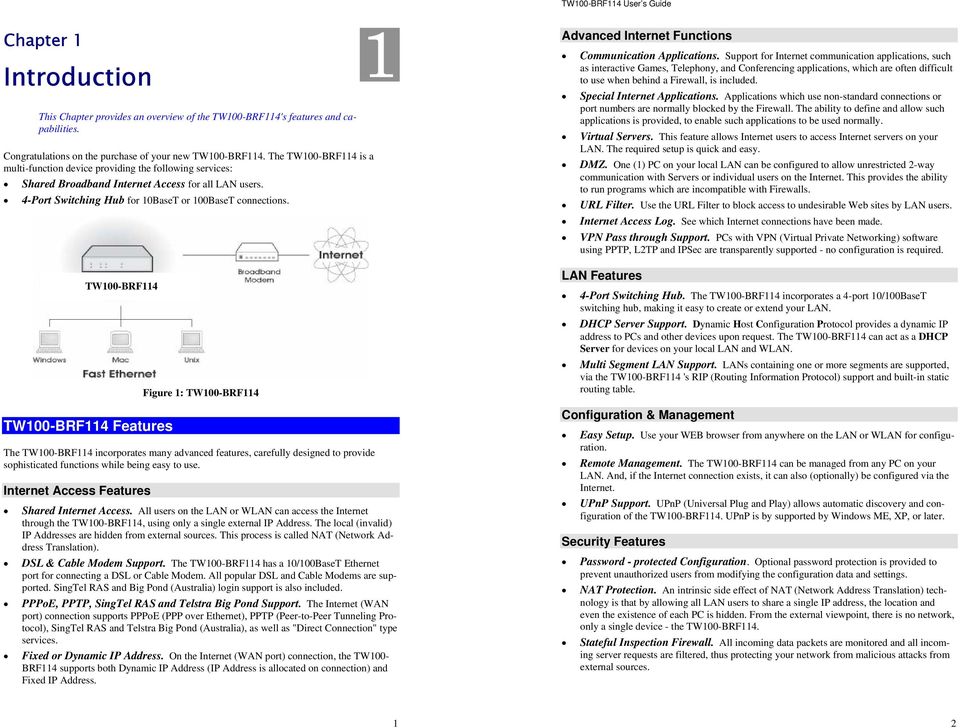
3 Chapter 1 Introduction This Chapter provides an overview of the TW100-BRF114's features and capabilities. Congratulations on the purchase of your new TW100-BRF114. The TW100-BRF114 is a multi-function device providing the following services: Shared Broadband Internet Access for all LAN users. 4-Port Switching Hub for 10BaseT or 100BaseT connections. TW100-BRF114 TW100-BRF114 Features Figure 1: TW100-BRF114 The TW100-BRF114 incorporates many advanced features, carefully designed to provide sophisticated functions while being easy to use. Internet Access Features 1 Shared Internet Access. All users on the LAN or WLAN can access the Internet through the TW100-BRF114, using only a single external IP Address. The local (invalid) IP Addresses are hidden from external sources. This process is called NAT (Network Address Translation). DSL & Cable Modem Support. The TW100-BRF114 has a 10/100BaseT Ethernet port for connecting a DSL or Cable Modem. All popular DSL and Cable Modems are supported. SingTel RAS and Big Pond (Australia) login support is also included. PPPoE, PPTP, SingTel RAS and Telstra Big Pond Support. The Internet (WAN port) connection supports PPPoE (PPP over Ethernet), PPTP (Peer-to-Peer Tunneling Protocol), SingTel RAS and Telstra Big Pond (Australia), as well as "Direct Connection" type services. Fixed or Dynamic IP Address. On the Internet (WAN port) connection, the TW100- BRF114 supports both Dynamic IP Address (IP Address is allocated on connection) and Fixed IP Address. Advanced Internet Functions Communication Applications. Support for Internet communication applications, such as interactive Games, Telephony, and Conferencing applications, which are often difficult to use when behind a Firewall, is included. Special Internet Applications. Applications which use non-standard connections or port numbers are normally blocked by the Firewall. The ability to define and allow such applications is provided, to enable such applications to be used normally. Virtual Servers. This feature allows Internet users to access Internet servers on your LAN. The required setup is quick and easy. DMZ. One (1) PC on your local LAN can be configured to allow unrestricted 2-way communication with Servers or individual users on the Internet. This provides the ability to run programs which are incompatible with Firewalls. URL Filter. Use the URL Filter to block access to undesirable Web sites by LAN users. Internet Access Log. See which Internet connections have been made. VPN Pass through Support. PCs with VPN (Virtual Private Networking) software using PPTP, L2TP and IPSec are transparently supported - no configuration is required. LAN Features 4-Port Switching Hub. The TW100-BRF114 incorporates a 4-port 10/100BaseT switching hub, making it easy to create or extend your LAN. DHCP Server Support. Dynamic Host Configuration Protocol provides a dynamic IP address to PCs and other devices upon request. The TW100-BRF114 can act as a DHCP Server for devices on your local LAN and WLAN. Multi Segment LAN Support. LANs containing one or more segments are supported, via the TW100-BRF114 's RIP (Routing Information Protocol) support and built-in static routing table. Configuration & Management Easy Setup. Use your WEB browser from anywhere on the LAN or WLAN for configuration. Remote Management. The TW100-BRF114 can be managed from any PC on your LAN. And, if the Internet connection exists, it can also (optionally) be configured via the Internet. UPnP Support. UPnP (Universal Plug and Play) allows automatic discovery and configuration of the TW100-BRF114. UPnP is by supported by Windows ME, XP, or later. Security Features Password - protected Configuration. Optional password protection is provided to prevent unauthorized users from modifying the configuration data and settings. NAT Protection. An intrinsic side effect of NAT (Network Address Translation) technology is that by allowing all LAN users to share a single IP address, the location and even the existence of each PC is hidden. From the external viewpoint, there is no network, only a single device - the TW100-BRF114. Stateful Inspection Firewall. All incoming data packets are monitored and all incoming server requests are filtered, thus protecting your network from malicious attacks from external sources. 1 2
4 Introduction Protection against DoS attacks. DoS (Denial of Service) attacks can flood your Internet connection with invalid packets and connection requests, using so much bandwidth and so many resources that Internet access becomes unavailable. The TW100- BRF114 incorporates protection against DoS attacks. Physical Details Front-mounted LEDs Package Contents The following items should be included: The TW100-BRF114 Unit Quick Installation Guide CD-ROM containing the on-line manual. Power Adapter If any of the above items are damaged or missing, please contact your local dealer immediately. Power (Green) Status (Red) LAN WAN (Green) On - Power on. Off - No power. Figure 2: Front Panel On - Error condition. Off - Normal operation. Blinking - This LED blinks during start up. For each port, there are 2 LEDs Link/Act (Green) On - Corresponding LAN (hub) port is active. Off - No active connection on the corresponding LAN (hub) port. Flashing - Data is being transmitted or received via the corresponding LAN (hub) port. 100 (Yellow) On - Corresponding LAN (hub) port is using 100BaseT. Off - Corresponding LAN (hub) port connection is using 10BaseT, or no active connection. On - Connection to the modem attached to the WAN (Internet) port is established. Flashing - Data is being transmitted or received via the WAN port. 3 4

5 Introduction Rear Panel Chapter 2 Installation 2 This Chapter covers the physical installation of the TW100-BRF114. Reset Button WAN port (10/100BaseT) 10/100BaseT LAN connections Power port Figure 3: Rear Panel This button has two (2) functions: Reboot. When pressed and released, the TW100-BRF114 will reboot (restart). Clear All Data. This button can also be used to clear ALL data and restore ALL settings to the factory default values. To Clear All Data and restore the factory default values: 1. Power Off. 2. Hold the Reset Button down while you Power On. 3. Keep holding the Reset Button down for five (5) seconds, until the Red Status LED has flashed TWICE. 4. Release the Reset Button. The TW100-BRF114 is now using the factory default values. Connect the DSL or Cable Modem here. If your modem came with a cable, use the supplied cable. Otherwise, use a standard LAN cable. Use standard LAN cables (RJ45 connectors) to connect your PCs to these ports. Note: Any LAN port on the TW100-BRF114 will automatically function as an "Uplink" port when required. Just connect any port to a normal port on the other hub, using a standard LAN cable. Connect the supplied power adapter here. Requirements Network cables. Use standard 10/100BaseT network (UTP) cables with RJ45 connectors. TCP/IP protocol must be installed on all PCs. For Internet Access, an Internet Access account with an ISP, and either of a DSL or Cable modem (for WAN port usage) Procedure Figure 4: Installation Diagram 1. Choose an Installation Site Select a suitable place on the network to install the TW100-BRF114. Ensure the TW100-BRF114 and the DSL/Cable modem are powered OFF. 2. Connect LAN Cables Use standard LAN cables to connect PCs to the Switching Hub ports on the TW100- BRF114. Both 10BaseT and 100BaseT connections can be used simultaneously. If required, you can connect any LAN port to another Hub. Any LAN port on the TW100- BRF114 will automatically function as an "Uplink" port when required. Just connect any LAN port to a normal port on the other hub, using a standard LAN cable. 5 6

6 Installation 3. Connect WAN Cable Connect the DSL or Cable modem to the WAN port on the TW100-BRF114. Use the cable supplied with your DSL/Cable modem. If no cable was supplied, use a standard cable. 4. Power Up Power on the Cable or DSL modem. Connect the supplied power adapter to the TW100-BRF114 and power up. Use only the power adapter provided. Using a different one may cause hardware damage Chapter 3 Setup This Chapter provides Setup details of the TW100-BRF Check the LEDs The Power LED should be ON. The Status LED should flash, then turn Off. If it stays on, there is a hardware error. For each LAN (PC) connection, the LAN Link/Act LED should be ON (provided the PC is also ON.) The WAN LED should be ON. For more information, refer to Front-mounted LEDs in Chapter 1. Overview This chapter describes the setup procedure for: Internet Access LAN configuration PCs on your local LAN may also require configuration. For details, see Chapter 4 - PC Configuration. Other configuration may also be required, depending on which features and functions of the TW100-BRF114 you wish to use. Use the table below to locate detailed instructions for the required functions. To Do this: Refer to: Configure PCs on your LAN. Chapter 4: PC Configuration Check TW100-BRF114 operation and Status. Chapter 5: Operation and Status Use any of the following Internet features: Advanced Setup Dynamic DNS MAC Address Virtual Servers Configure or use any of the following: Access Control Remote Management PC Database Upgrade Firmware Options Security Logs Routing Chapter 6: Internet Features Chapter 7: Other Features and Settings Where use of a certain feature requires that PCs or other LAN devices be configured, this is also explained in the relevant chapter. 7 8

7 Setup Configuration Program The TW100-BRF114 contains an HTTP server. This enables you to connect to it, and configure it, using your Web Browser. Your Browser must support JavaScript. The configuration program has been tested on the following browsers: Netscape V4.08 or later Internet Explorer V4 or later Preparation Before attempting to configure the TW100-BRF114, please ensure that: Your PC can establish a physical connection to the TW100-BRF114. The PC and the TW100-BRF114 must be directly connected (using the Hub ports on the TW100-BRF114) or on the same LAN segment. The TW100-BRF114 must be installed and powered ON. If the TW100-BRF114 's default IP Address ( ) is already used by another device, the other device must be turned OFF until the TW100-BRF114 is allocated a new IP Address during configuration. Using UPnP If your Windows system supports UPnP, an icon for the TW100-BRF114 will appear in the system tray, notifying you that a new network device has been found, and offering to create a new desktop shortcut to the newly-discovered device. Unless you intend to change the IP Address of the TW100-BRF114, you can accept the desktop shortcut. Whether you accept the desktop shortcut or not, you can always find UPnP devices in My Network Places (previously called Network Neighborhood). Double - click the icon for the TW100-BRF114 (either on the Desktop, or in My Network Places) to start the configuration. Refer to the following section Setup Wizard for details of the initial configuration process. Using your Web Browser To establish a connection from your PC to the TW100-BRF114: 1. After installing the TW100-BRF114 in your LAN, start your PC. If your PC is already running, restart it. 2. Start your WEB browser. 3. In the Address box, enter " and the IP Address of the TW100-BRF114, as in this example, which uses the TW100-BRF114 's default IP Address: If you can't connect If the TW100-BRF114 does not respond, check the following: The TW100-BRF114 is properly installed, LAN connection is OK, and it is powered ON. You can test the connection by using the "Ping" command: Open the MS-DOS window or command prompt window. Enter the command: ping If no response is received, either the connection is not working, or your PC's IP address is not compatible with the TW100-BRF114 's IP Address. (See next item.) If your PC is using a fixed IP Address, its IP Address must be within the range to to be compatible with the TW100-BRF114 's default IP Address of Also, the Network Mask must be set to See Chapter 4 - PC Configuration for details on checking your PC's TCP/IP settings. Ensure that your PC and the TW100-BRF114 are on the same network segment. (If you don't have a router, this must be the case.) 9 10

8 Setup Setup Wizard The first time you connect to the TW100-BRF114, the Setup Wizard will run automatically. (The Setup Wizard will also run if the TW100-BRF114's default setting are restored.) 1. Step through the Wizard until finished. You need to know the type of Internet connection service used by your ISP. Check the data supplied by your ISP. The common connection types are explained in the tables below. 2. On the final screen of the Wizard, run the test and check that an Internet connection can be established. 3. If the connection test fails: Check your data, the Cable/DSL modem, and all connections. Check that you have entered all data correctly. If using a Cable modem, your ISP may have recorded the MAC (physical) address of your PC. Run the Wizard, and on the Cable Modem screen, use the "Clone MAC address" button to copy the MAC address from your PC to the TW100-BRF114. Common Connection Types Cable Modems Type Details ISP Data required Dynamic IP Address Your IP Address is allocated automatically, when you connect to you ISP. Usually, none. However, some ISPs may require you to use a particular Hostname, Domain name, or MAC (physical) address. PPTP Mainly used in Europe. You connect to the ISP only when required. The IP address is usually allocated automatically, but may be Static (Fixed). Other Modems (e.g. Broadband Wireless) PPTP Server IP Address. User name and password. IP Address allocated to you, if Static (Fixed). Type Details ISP Data required Dynamic IP Address Static (Fixed) IP Address Your IP Address is allocated automatically, when you connect to you ISP. Your ISP allocates a permanent IP Address to you. Big Pond Cable (Australia) For this connection method, the following data is required: User Name Password Big Pond Server IP address Usually, none. However, some ISP's may require you to use a particular Hostname, Domain name, or MAC (physical) address. IP Address allocated to you, mask and gateway (if provided), and DNS address. Static (Fixed) IP Address Your ISP allocates a permanent IP Address to you. IP Address allocated to you, mask and gateway (if provided), and DNS address. Some ISP's may also require you to use a particular Hostname, Domain name, or MAC (physical) address. SingTel RAS For this connection method, the following data is required: User Name Password RAS Plan DSL Modems Type Details ISP Data required Dynamic IP Address Static (Fixed) IP Address PPPoE Your IP Address is allocated automatically, when you connect to you ISP. Your ISP allocates a permanent IP Address to you. You connect to the ISP only when required. The IP address is usually allocated automatically. None. IP Address allocated to you, mask and gateway (if provided), and DNS address. User name and password

9 Setup Home Screen After finishing or exiting the Setup Wizard, you will see the Home screen. When you connect in future, you will see this screen when you connect. An example screen is shown below. LAN Screen Use the LAN link on the main menu to reach the LAN screen. An example screen is shown below. Figure 6: LAN Screen Data - LAN Screen Figure 5: Home Screen Navigation & Data Input Use the menu bar on the top of the screen, and the "Back" button on your Browser, for navigation. Changing to another screen without clicking "Save" does NOT save any changes you may have made. You must "Save" before changing screens or your data will be ignored. On each screen, clicking the "Help" button will display help for that screen. From any help screen, you can access the list of all help files (help index). TCP/IP IP Address IP address for the TW100-BRF114, as seen from the local LAN. Use the default value unless the address is already in use or your LAN is using a different IP address range. In the latter case, enter an unused IP Address from within the range used by your LAN. Subnet Mask The default value is standard for small (class "C") networks. For other networks, use the Subnet Mask for the LAN segment to which the TW100-BRF114 is attached (the same value as the PCs on that LAN segment). DHCP Server If Enabled, the TW100-BRF114 will allocate IP Addresses to PCs (DHCP clients) on your LAN when they start up. The default (and recommended) value is Enabled. If you are already using a DHCP Server, this setting must be Disabled, and the existing DHCP server must be re-configured to treat the TW100-BRF114 as the default Gateway. See the following section for further details. The Start IP Address and Finish IP Address fields set the values used by the DHCP server when allocating IP Addresses to DHCP clients. This range also determines the number of DHCP clients supported. See the following section for further details on using DHCP. Buttons Save Cancel Save the data on screen. The "Cancel" button will discard any data you have entered and reload the file from the TW100-BRF

10 Setup DHCP What DHCP Does A DHCP (Dynamic Host Configuration Protocol) Server allocates a valid IP address to a DHCP Client (PC or device) upon request. The client request is made when the client device starts up (boots). The DHCP Server provides the Gateway and DNS addresses to the client, as well as allocating an IP Address. The TW100-BRF114 can act as a DHCP server. Windows 95/98/ME2000/XP and other non-server versions of Windows will act as a DHCP client. This is the default Windows setting for the TCP/IP network protocol. However, Windows uses the term Obtain an IP Address automatically instead of "DHCP Client". You must NOT have two (2) or more DHCP Servers on the same LAN segment. (If your LAN does not have other Routers, this means there must only be one (1) DHCP Server on your LAN.) Using the TW100-BRF114 's DHCP Server This is the default setting. The DHCP Server settings are on the LAN screen. On this screen, you can: Enable or Disable the TW100-BRF114 's DHCP Server function. Set the range of IP Addresses allocated to PCs by the DHCP Server function. Password Screen The password screen allows you to assign a password to the Firewall Router. Figure 7: Password Screen Once you have assigned a password to the Firewall Router (on the Password screen above) you will be prompted for the password when you connect, as shown below. (If no password has been set, this dialog will not appear.) You can assign Fixed IP Addresses to some devices while using DHCP, provided that the Fixed IP Addresses are NOT within the range used by the DHCP Server. Using another DHCP Server You can only use one (1) DHCP Server per LAN segment. If you wish to use another DHCP Server, rather than the TW100-BRF114 's, the following procedure is required. 1. Disable the DHCP Server feature in the TW100-BRF114. This setting is on the LAN screen. 2. Configure the DHCP Server to provide the TW100-BRF114 's IP Address as the Default Gateway. Figure 8: Password Dialog Leave the "User Name" blank. Enter the password for the Firewall Router, as set on the Password screen above. To Configure your PCs to use DHCP This is the default setting for TCP/IP under Windows 95/98/ME/NT4.0/2000/XP. See Chapter 4 - Client Configuration for the procedure to check these settings

11 Chapter 4 PC Configuration 4 Checking TCP/IP Settings - Windows 9x/ME: 3. Select Control Panel - Network. You should see a screen like the following: This Chapter details the PC Configuration required on the local ("Internal") LAN. Overview For each PC, the following may need to be configured: TCP/IP network settings Internet Access configuration Windows Clients This section describes how to configure Windows clients for Internet access via the TW100- BRF114. Figure 9: Network Configuration 4. Select the TCP/IP protocol for your network card. 5. Click on the Properties button. You should then see a screen like the following. The first step is to check the PC's TCP/IP settings. The TW100-BRF114 uses the TCP/IP network protocol for all functions, so it is essential that the TCP/IP protocol be installed and configured on each PC. TCP/IP Settings - Overview If using the default TW100-BRF114 settings, and the default Windows TCP/IP settings, no changes need to be made. By default, the TW100-BRF114 will act as a DHCP Server, automatically providing a suitable IP Address (and related information) to each PC when the PC boots. For all non-server versions of Windows, the default TCP/IP setting is to act as a DHCP client. If using a Fixed (specified) IP address, the following changes are required: The Gateway must be set to the IP address of the TW100-BRF114 The DNS should be set to the address provided by your ISP. If your LAN has a Router, the LAN Administrator must reconfigure the Router itself. Refer to Chapter 8 - Other Features and Operations for details. Figure 10: IP Address (Win 95) Ensure your TCP/IP settings are correct, as follows: Using DHCP To use DHCP, select the radio button Obtain an IP Address automatically. This is the default Windows setting. Using this is recommended. By default, the TW100-BRF114 will act as a DHCP Server. Restart your PC to ensure it obtains an IP Address from the TW100-BRF114. Using "Specify an IP Address" If your PC is already configured, check with your network administrator before making the following changes: 17 18

12 PC Configuration On the Gateway tab, enter the TW100-BRF114 's IP address in the New Gateway field and click Add, as shown below. Your LAN administrator can advise you of the IP Address they assigned to the TW100-BRF114. Checking TCP/IP Settings - Windows NT Select Control Panel - Network, and, on the Protocols tab, select the TCP/IP protocol, as shown below. Figure 11: Gateway Tab (Win 95/98/ME) On the DNS Configuration tab, ensure Enable DNS is selected. If the DNS Server Search Order list is empty, enter the DNS address provided by your ISP in the fields beside the Add button, then click Add. Figure 13: Windows NT4.0 - TCP/IP 2. Click the Properties button to see a screen like the one below. Figure 12: DNS Tab (Win 95/98/ME) 19 20
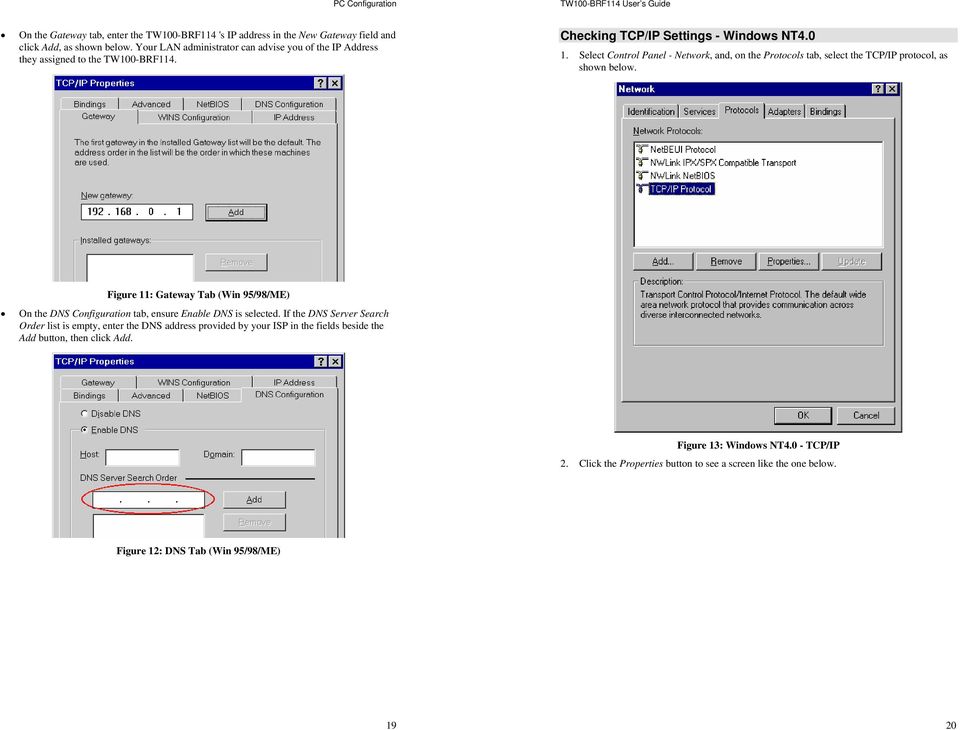
13 PC Configuration Figure 15 - Windows NT4.0 - Add Gateway Figure 14: Windows NT4.0 - IP Address 3. Select the network card for your LAN. 4. Select the appropriate radio button - Obtain an IP address from a DHCP Server or Specify an IP Address, as explained below. 2. The DNS should be set to the address provided by your ISP, as follows: Click the DNS tab. On the DNS screen, shown below, click the Add button (under DNS Service Search Order), and enter the DNS provided by your ISP. Obtain an IP address from a DHCP Server This is the default Windows setting. Using this is recommended. By default, the TW100- BRF114 will act as a DHCP Server. Restart your PC to ensure it obtains an IP Address from the TW100-BRF114. Specify an IP Address If your PC is already configured, check with your network administrator before making the following changes. 1. The Default Gateway must be set to the IP address of the TW100-BRF114. To set this: Click the Advanced button on the screen above. On the following screen, click the Add button in the Gateways panel, and enter the TW100-BRF114 's IP address, as shown in Figure 15 below. If necessary, use the Up button to make the TW100-BRF114 the first entry in the Gateways list
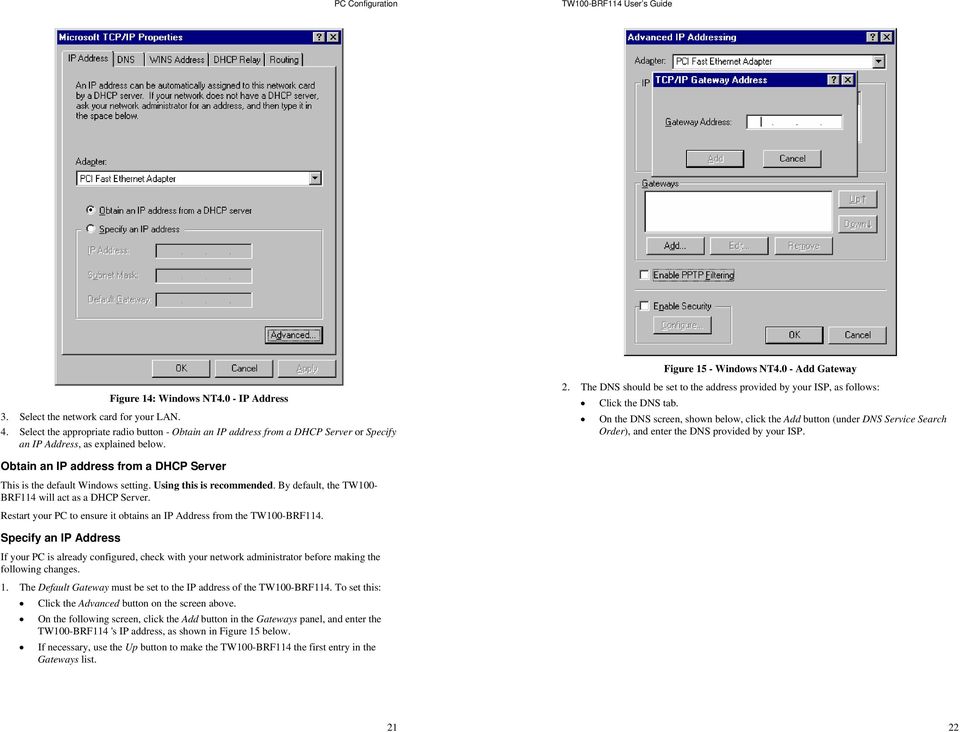
14 PC Configuration Checking TCP/IP Settings - Windows 2000: 1. Select Control Panel - Network and Dial-up Connection. 2. Right - click the Local Area Connection icon and select Properties. You should see a screen like the following: Figure 16: Windows NT4.0 - DNS Figure 17: Network Configuration (Win 2000) 3. Select the TCP/IP protocol for your network card. 4. Click on the Properties button. You should then see a screen like the following

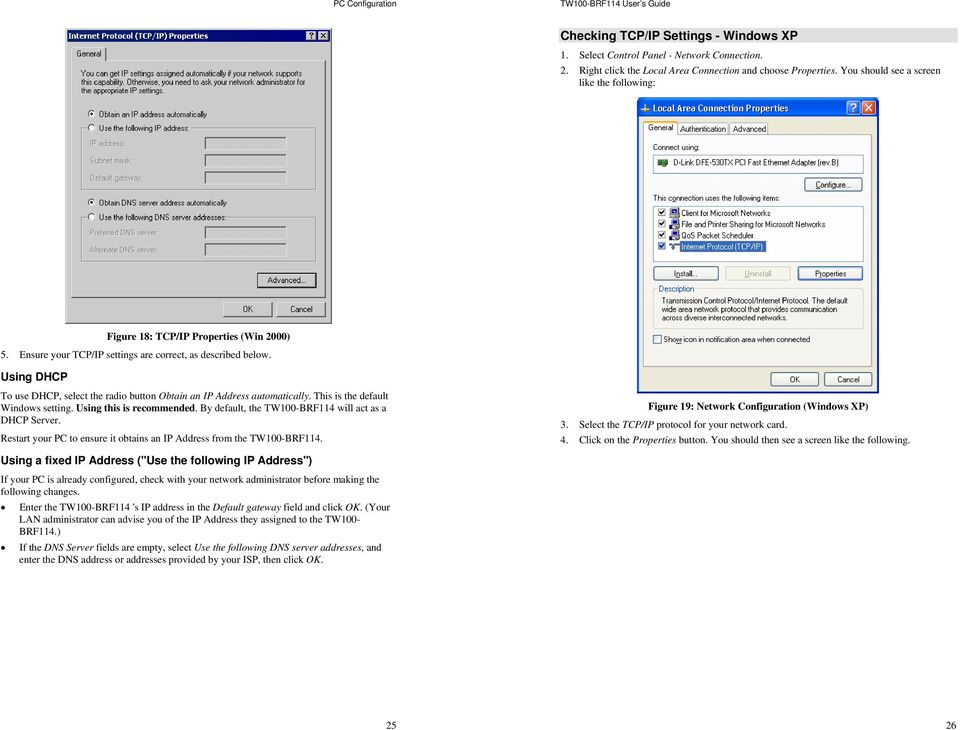
15 PC Configuration Checking TCP/IP Settings - Windows XP 1. Select Control Panel - Network Connection. 2. Right click the Local Area Connection and choose Properties. You should see a screen like the following: Figure 18: TCP/IP Properties (Win 2000) 5. Ensure your TCP/IP settings are correct, as described below. Using DHCP To use DHCP, select the radio button Obtain an IP Address automatically. This is the default Windows setting. Using this is recommended. By default, the TW100-BRF114 will act as a DHCP Server. Restart your PC to ensure it obtains an IP Address from the TW100-BRF114. Figure 19: Network Configuration (Windows XP) 3. Select the TCP/IP protocol for your network card. 4. Click on the Properties button. You should then see a screen like the following. Using a fixed IP Address ("Use the following IP Address") If your PC is already configured, check with your network administrator before making the following changes. Enter the TW100-BRF114 's IP address in the Default gateway field and click OK. (Your LAN administrator can advise you of the IP Address they assigned to the TW100- BRF114.) If the DNS Server fields are empty, select Use the following DNS server addresses, and enter the DNS address or addresses provided by your ISP, then click OK
16 PC Configuration Internet Access To configure your PCs to use the TW100-BRF114 for Internet access: Ensure that the DSL modem, Cable modem, or other permanent connection is functional. Use the following procedure to configure your Browser to access the Internet via the LAN, rather than by a Dial-up connection. For Windows 9x/ME/ Select Start Menu - Settings - Control Panel - Internet Options. 2. Select the Connection tab, and click the Setup button. 3. Select "I want to set up my Internet connection manually, or I want to connect through a local area network (LAN)" and click Next. 4. Select "I connect through a local area network (LAN)" and click Next. 5. Ensure all of the boxes on the following Local area network Internet Configuration screen are unchecked. 6. Check the "No" option when prompted "Do you want to set up an Internet mail account now?". 7. Click Finish to close the Internet Connection Wizard. Setup is now completed. Figure 20: TCP/IP Properties (Windows XP) 5. Ensure your TCP/IP settings are correct. Using DHCP To use DHCP, select the radio button Obtain an IP Address automatically. This is the default Windows setting. Using this is recommended. By default, the TW100-BRF114 will act as a DHCP Server. Restart your PC to ensure it obtains an IP Address from the TW100-BRF114. Using a fixed IP Address ("Use the following IP Address") If your PC is already configured, check with your network administrator before making the following changes. In the Default gateway field, enter the TW100-BRF114 's IP address and click OK. Your LAN administrator can advise you of the IP Address they assigned to the TW100-BRF114. If the DNS Server fields are empty, select Use the following DNS server addresses, and enter the DNS address or addresses provided by your ISP, then click OK. For Windows XP 1. Select Start Menu - Control Panel - Network and Internet Connections. 2. Select Set up or change your Internet Connection. 3. Select the Connection tab, and click the Setup button. 4. Cancel the pop-up "Location Information" screen. 5. Click Next on the "New Connection Wizard" screen. 6. Select "Connect to the Internet" and click Next. 7. Select "Set up my connection manually" and click Next. 8. Check "Connect using a broadband connection that is always on" and click Next. 9. Click Finish to close the New Connection Wizard. Setup is now completed. Accessing AOL To access AOL (America On Line) through the TW100-BRF114, the AOL for Windows software must be configured to use TCP/IP network access, rather than a dial-up connection. The configuration process is as follows: Start the AOL for Windows communication software. Ensure that it is Version 2.5, 3.0 or later. This procedure will not work with earlier versions. Click the Setup button. Select Create Location, and change the location name from "New Locality" to "TW100- BRF114 ". Click Edit Location. Select TCP/IP for the Network field. (Leave the Phone Number blank.) Click Save, then OK. Configuration is now complete. Before clicking "Sign On", always ensure that you are using the "TW100-BRF114 " location

17 PC Configuration Macintosh Clients From your Macintosh, you can access the Internet via the TW100-BRF114. The procedure is as follows. 1. Open the TCP/IP Control Panel. 2. Select Ethernet from the Connect via pop-up menu. 3. Select Using DHCP Server from the Configure pop-up menu. The DHCP Client ID field can be left blank. 4. Close the TCP/IP panel, saving your settings. Note: If using manually assigned IP addresses instead of DHCP, the required changes are: Set the Router Address field to the TW100-BRF114 's IP Address. Ensure your DNS settings are correct. Linux Clients To access the Internet via the TW100-BRF114, it is only necessary to set the TW100-BRF114 as the "Gateway". Ensure you are logged in as "root" before attempting any changes. Fixed IP Address By default, most Unix installations use a fixed IP Address. If you wish to continue using a fixed IP Address, make the following changes to your configuration. Set your "Default Gateway" to the IP Address of the TW100-BRF114. Ensure your DNS (Name server) settings are correct. To act as a DHCP Client (recommended) Chapter 5 Operation and Status This Chapter details the operation of the TW100-BRF114 and the status screens. Operation Once both the TW100-BRF114 and the PCs are configured, operation is automatic. However, there are some situations where additional Internet configuration may be required: If using Internet-based Communication Applications, it may be necessary to specify which PC receives an incoming connection. Refer to Chapter 6 - Internet Features for further details. Applications which use non-standard connections or port numbers may be blocked by the TW100-BRF114 's built-in firewall. You can define such applications as Special Applications to allow them to function normally. Refer to Chapter 6 - Internet Features for further details. Some non-standard applications may require use of the DMZ feature. Refer to Chapter 6 - Internet Features for further details. Status Screen Use the Status link on the main menu to view this screen. 5 The procedure below may vary according to your version of Linux and X -windows shell. 1. Start your X Windows client. 2. Select Control Panel - Network 3. Select the "Interface" entry for your Network card. Normally, this will be called "eth0". 4. Click the Edit button, set the "protocol" to "DHCP", and save this data. 5. To apply your changes Use the "Deactivate" and "Activate" buttons, if available. OR, restart your system. Other Unix Systems To access the Internet via the TW100-BRF114: Ensure the "Gateway" field for your network card is set to the IP Address of the TW100- BRF114. Ensure your DNS (Name Server) settings are correct. Figure 21: Status Screen 29 30

18 Operation and Status Data - Status Screen Internet Connection Method Broadband Modem Internet Connection Internet IP Address "Connection Details" Button LAN IP Address Network Mask DHCP Server System Device Name Firmware Version "System Data" Button Buttons Connection Details System Data Restart Router Refresh Screen This indicates the current connection method, as set in the Setup Wizard. This shows the connection status of the modem. Current connection status: Active Idle Unknown Failed If there is an error, you can click the "Connection Details" button to find out more information. This IP Address is allocated by the ISP (Internet Service Provider). Click this button to open a sub-window and view a detailed description of the current connection. Depending on the type of connection, a "log" may also be available. The IP Address of the TW100-BRF114. The Network Mask (Subnet Mask) for the IP Address above. This shows the status of the DHCP Server function - either "Enabled" or "Disabled". For additional information about the PCs on your LAN, and the IP addresses allocated to them, use the PC Database option on the Advanced menu. This displays the current name of the TW100-BRF114. The current version of the firmware installed in the TW100- BRF114. Clicking this button will open a Window which lists all system details and settings. View the details of the current Internet connection. The subscreen displayed will depend on the connection method used. See the following sections for details of each sub-screen. Display all system information in a sub-window. Restart (reboot) the Router. You will have to wait for the restart to be completed before continuing. Update the data displayed on screen. Connection Status - PPPoE If using PPPoE (PPP over Ethernet), a screen like the following example will be displayed when the "Connection Details" button is clicked. Figure 22: PPPoE Status Screen Data - PPPoE Screen Connection Physical Address The hardware address of this device, as seen by remote devices on the Internet. (This is different to the hardware address seen by devices on the local LAN.) IP Address Network Mask PPPoE Link Status Connection Log The IP Address of this device, as seen by Internet users. This address is allocated by your ISP (Internet Service Provider). The Network Mask associated with the IP Address above. This indicates whether or not the connection is currently established. If the connection does not exist, the "Connect" button can be used to establish a connection. If the connection currently exists, the "Disconnect" button can be used to break the connection. Connection Log The Connection Log shows status messages relating to the existing connection. The most common messages are listed in the table below. The "Clear Log" button will restart the Log, while the Refresh button will update the messages shown on screen

19 Operation and Status Buttons Connect Disconnect Clear Log Refresh If not connected, establish a connection to your ISP. If connected to your ISP, hang up the connection. Delete all data currently in the Log. This will make it easier to read new messages. Update the data on screen. Connection Status - PPTP If using PPTP (Peer-to-Peer Tunneling Protocol), a screen like the following example will be displayed when the "Connection Details" button is clicked. Connection Log Messages Message Connect on Demand Manual connection Reset physical connection Connecting to remote server Remote Server located Start PPP PPP up successfully Idle time-out reached Disconnecting Error: Remote Server not found Error: PPP Connection failed Error: Connection to Server lost Error: Invalid or unknown packet type Description Connection attempt has been triggered by the "Connect automatically, as required" setting. Connection attempt started by the "Connect" button. Preparing line for connection attempt. Attempting to connect to the ISP's server. ISP's Server has responded to connection attempt. Attempting to login to ISP's Server and establish a PPP connection. Able to login to ISP's Server and establish a PPP connection. The connection has been idle for the time period specified in the "Idle Time-out" field. The connection will now be terminated. The current connection is being terminated, due to either the "Idle Time-out" above, or "Disconnect" button being clicked. ISP's Server did not respond. This could be a Server problem, or a problem with the link to the Server. Unable to establish a PPP connection with the ISP's Server. This could be a login problem (name or password) or a Server problem. The existing connection has been lost. This could be caused by a power failure, a link failure, or Server failure. The data received from the ISP's Server could not be processed. This could be caused by data corruption (from a bad link), or the Server using a protocol which is not supported by this device. Figure 23: PPTP Status Screen Data - PPTP Screen Connection Physical Address The hardware address of this device, as seen by remote devices on the Internet. (This is different to the hardware address seen by devices on the local LAN.) IP Address PPTP Status Connection Log The IP Address of this device, as seen by Internet users. This address is allocated by your ISP (Internet Service Provider). This indicates whether or not the connection is currently established. If the connection does not exist, the "Connect" button can be used to establish a connection. If the connection currently exists, the "Disconnect" button can be used to break the connection. Connection Log The Connection Log shows status messages relating to the existing connection. The "Clear Log" button will restart the Log, while the Refresh button will update the messages shown on screen. Buttons Connect If not connected, establish a connection to your ISP

20 Operation and Status Disconnect Clear Log Refresh If connected to your ISP, hang up the connection. Delete all data currently in the Log. This will make it easier to read new messages. Update the data on screen. Connection Status - Telstra Big Pond An example screen is shown below. Connection Log Connection Log The Connection Log shows status messages relating to the existing connection. The Clear Log button will restart the Log, while the Refresh button will update the messages shown on screen. Buttons Connect Disconnect Clear Log Refresh If not connected, establish a connection to Telstra Big Pond. If connected to Telstra Big Pond, terminate the connection. Delete all data currently in the Log. This will make it easier to read new messages. Update the data on screen. Connection Details - SingTel RAS If using the SingTel RAS access method, a screen like the following example will be displayed when the "Connection Details" button is clicked. Data - Telstra Big Pond Screen Connection Figure 24: Telstra Big Pond Status Screen Physical Address IP Address Connection Status The hardware address of this device, as seen by remote devices. (This is different to the hardware address seen by devices on the local LAN.) The IP Address of this device, as seen by Internet users. This address is allocated by your ISP (Internet Service Provider). This indicates whether or not the connection is currently established. If the connection does not exist, the "Connect" button can be used to establish a connection. If the connection currently exists, the "Disconnect" button can be used to break the connection. Normally, it is not necessary to use the Connect and Disconnect buttons unless the setting "Connect automatically, as required" is disabled. Figure 25: Connection Details - SingTel RAS Data - SingTel RAS Screen Internet RAS Plan The RAS Plan which is currently used. Physical Address IP Address The hardware address of this device, as seen by remote devices on the Internet. (This is different to the hardware address seen by devices on the local LAN.) The IP Address of this device, as seen by Internet users. This address is allocated by your ISP (Internet Service Provider)

21 Operation and Status Network Mask Default Gateway DNS IP Address DHCP Client Buttons Release/Renew Button will display EITHER "Release" OR "Renew" Refresh The Network Mask associated with the IP Address above. The IP Address of the remote Gateway or Router associated with the IP Address above. The IP Address of the Domain Name Server which is currently used. This will show "Enabled" or "Disabled", depending on whether or not this device is functioning as a DHCP client. If "Enabled" the "Remaining lease time" field indicates when the IP Address allocated by the DHCP Server will expire. The lease is automatically renewed on expiry; use the "Renew" button if you wish to manually renew the lease immediately. This button is only useful if the IP address shown above is allocated automatically on connection. (Dynamic IP address). If you have a Fixed (Static) IP address, this button has no effect. If the ISP's DHCP Server has NOT allocated an IP Address for the TW100-BRF114, this button will say "Renew". Clicking the "Renew" button will attempt to re-establish the connection and obtain an IP Address from the ISP's DHCP Server. If an IP Address has been allocated to the TW100-BRF114 (by the ISP's DHCP Server), this button will say "Release". Clicking the "Release" button will break the connection and release the IP Address. Update the data shown on screen. Connection Details - Fixed/Dynamic IP Address If your access method is "Direct" (no login), a screen like the following example will be displayed when the "Connection Details" button is clicked. Data - Fixed/Dynamic IP address Screen Internet Physical Address The hardware address of this device, as seen by remote devices on the Internet. (This is different to the hardware address seen by devices on the local LAN.) IP Address Network Mask Default Gateway DNS IP Address DHCP Client Buttons Release/Renew Button will display EITHER "Release" OR "Renew" Refresh The IP Address of this device, as seen by Internet users. This address is allocated by your ISP (Internet Service Provider). The Network Mask associated with the IP Address above. The IP Address of the remote Gateway or Router associated with the IP Address above. The IP Address of the Domain Name Server which is currently used. This will show "Enabled" or "Disabled", depending on whether or not this device is functioning as a DHCP client. If "Enabled" the "Remaining lease time" field indicates when the IP Address allocated by the DHCP Server will expire. The lease is automatically renewed on expiry; use the "Renew" button if you wish to manually renew the lease immediately. This button is only useful if the IP address shown above is allocated automatically on connection. (Dynamic IP address). If you have a Fixed (Static) IP address, this button has no effect. If the ISP's DHCP Server has NOT allocated an IP Address for the TW100-BRF114, this button will say "Renew". Clicking the "Renew" button will attempt to re-establish the connection and obtain an IP Address from the ISP's DHCP Server. If an IP Address has been allocated to the TW100-BRF114 (by the ISP's DHCP Server), this button will say "Release". Clicking the "Release" button will break the connection and release the IP Address. Update the data shown on screen. Figure 26: Connection Details - Fixed/Dynamic IP Address 37 38
22 Chapter 6 Internet Features Overview This Chapter explains when and how to use the TW100-BRF114's "Internet" Features. The following advanced features are covered in this Chapter: Advanced Internet Dynamic DNS MAC Address Virtual Servers Advanced Internet Screen 6 Communication Applications Most applications are supported transparently by the TW100-BRF114. But sometimes it is not clear which PC should receive an incoming connection. This problem could arise with the Communication Applications listed on this screen. If this problem arises, you can use this screen to set which PC should receive an incoming connection, as described below. Communication Applications Select an Application Send incoming calls to Special Applications This lists applications which may generate incoming connections, where the destination PC (on your local LAN) is unknown. This lists the PCs on your LAN. If necessary, you can add PCs manually, using the "PC Database" option on the advanced menu. For each application listed above, you can choose a destination PC. There is no need to "Save" after each change; you can set the destination PC for each application, then click "Save". If you use Internet applications which use non-standard connections or port numbers, you may find that they do not function correctly because they are blocked by the TW100-BRF114 's firewall. In this case, you can define the application as a "Special Application". Special Applications Screen This screen can be reached by clicking the Special Applications button on the Advanced Internet screen. You can then define your Special Applications. You will need detailed information about the application; this is normally available from the supplier of the application. Also, note that the terms "Incoming" and "Outgoing" on this screen refer to traffic from the client (PC) viewpoint. Figure 27: Internet Screen This screen allows configuration of all advanced features relating to Internet access. Communication Applications Special Applications DMZ URL filter 39 40
23 Internet Features If an application still cannot function correctly, try using the "DMZ" feature. DMZ This feature, if enabled, allows one (1) computer on your LAN to be exposed to all users on the Internet, allowing unrestricted 2-way communication between the "DMZ PC" and other Internet users or Servers. This allows almost any application to be used on the "DMZ PC". The "DMZ PC" will receive all "Unknown" connections and data. If the DMZ feature is enabled, you must select the PC to be used as the "DMZ PC". The DMZ feature can be Enabled and Disabled on the Advanced Internet screen. Figure 28: Special Applications Screen Data - Special Applications Screen Checkbox Use this to Enable or Disable this Special Application as required. Name Incoming Ports Outgoing Ports Enter a descriptive name to identify this Special Application. Type - Select the protocol (TCP or UDP) used when you receive data from the special application or service. (Note: Some applications use different protocols for outgoing and incoming data). Start - Enter the beginning of the range of port numbers used by the application server, for data you receive. If the application uses a single port number, enter it in both the "Start" and "Finish" fields. Finish - Enter the end of the range of port numbers used by the application server, for data you receive. Type - Select the protocol (TCP or UDP) used when you send data to the remote system or service. Start - Enter the beginning of the range of port numbers used by the application server, for data you send to it. If the application uses a single port number, enter it in both the "Start" and "Finish" fields. Finish - Enter the end of the range of port numbers used by the application server, for data you send to it. If the application uses a single port number, enter it in both the "Start" and "Finish" fields. The "DMZ PC" is effectively outside the Firewall, making it more vulnerable to attacks. For this reason, you should only enable the DMZ feature when required. Using a Special Application Configure the Special Applications screen as required. On your PC, use the application normally. Remember that only one (1) PC can use each Special application at any time. Also, when 1 PC is finished using a particular Special Application, there may need to be a "Time-out" before another PC can use the same Special Application. The "Time-out" period may be up to 3 minutes
24 Internet Features URL Filter Screen Click the "Configure URL Filter" button on the Advanced Internet screen to access the URL Filter screen. An example screen is shown below. Dynamic DNS (Domain Name Server) This free service is very useful when combined with the Virtual Server feature. It allows Internet users to connect to your Virtual Servers using a URL, rather than an IP Address. This also solves the problem of having a dynamic IP address. With a dynamic IP address, your IP address may change whenever you connect, which makes it difficult to connect to you. The Service works as follows: 1. You must register for the service at (Registration is free). Your password will be ed to you. 2. After registration, use the "Create New Host" option (at to request your desired Domain name. 3. Enter your data from in the TW100-BRF114 's DDNS screen. 4. The TW100-BRF114 will then automatically ensure that your current IP Address is recorded at 5. From the Internet, users will be able to connect to your Virtual Servers (or DMZ PC) using your Domain name, as shown on this screen. Dynamic DNS Screen Select Internet on the main menu, then Dynamic DNS, to see a screen like the following: Figure 29: URL Filter Screen Data - URL Filter Screen Filter Strings Current Entries Add Filter String This lists any existing entries. If you have not entered any values, this list will be empty. To add an entry to the list, enter it here, and click the "Add" button. An entry may be a Domain name (e.g. or simply a string. (e.g. ads/ ) Any URL which contains ANY entry ANYWHERE in the URL will be blocked. Buttons Delete/Delete All Add Use these buttons to delete the selected entry or all entries, as required. Multiple entries can be selected by holding down the CTRL key while selecting. (On the Macintosh, hold the SHIFT key while selecting.) Use this to add the current Filter String to the site list. Data - Dynamic DNS Screen DDNS Service Figure 30: DDNS Screen DDNS Service You must sign up first to create a new account before using the service. The service is free. Click this link to connect to the Web site. Your initial password will be ed to you; you can change this later if you wish. After registration, use the "Create New Host" link (on the Web site) to request a domain name
25 Internet Features DDNS Data User Name Password Enter the "User name" specified at the Web site when you registered. Enter your current password for Domain Name Enter your domain name, as allocated at The name should consist only of letters and the hyphen (dash). Using any other characters may cause problems.. DDNS Status This message is returned by the DDNS Server at Normally, this message should be "Update successful" (current IP address was updated on the server). If the message is "No host", this indicates the host name entered was not allocated to you. You need to connect to and correct this problem. MAC Address The MAC (hardware) address is a low-level network identifier. It may be called "MAC Address", "Hardware Address", or "Physical Address". On a PC, this address is associated with the Network card or adapter. The address on the MAC Address screen is the address on the Internet (WAN port) interface, and has no effect on the LAN interface. If your ISP asks for the "Network Adapter Address", "Physical Address", "Hardware Address", or "MAC Address" for the PC the DSL/Cable modem is connected to, provide this value. If your ISP has already recorded a MAC address, you can change the address used by the Firewall Router to match the address recorded by your ISP. MAC Address Screen Select MAC Address from the Advanced menu to reach a screen like the example below. Data - MAC address Screen Figure 31: MAC address Screen MAC (hardware) Address Buttons Default Copy from PC Save Cancel The current MAC (hardware) address is displayed. If your ISP has recorded a Hardware Address, you can "spoof" that address by entering it in the address field. The hardware address consists of 12 characters, where each character is a digit (0..9) or a character between A and F. Inserts the default MAC address into the MAC address field. You must click "Save" to actually change the address used. Inserts the MAC address from your PC into the MAC address field. You must click "Save" to actually change the address used. Save your changes to the Firewall Router. Reverse any changes made since the last "Save". If the MAC address is changed, the Firewall Router must restart
26 Internet Features Virtual Servers This feature allows you to make Servers on your LAN accessible to Internet users. Normally, Internet users would not be able to access a server on your LAN because: Your Server does not have a valid external IP Address. Attempts to connect to devices on your LAN are blocked by the firewall in this device. The "Virtual Server" feature solves these problems and allows Internet users to connect to your servers, as illustrated below. Virtual Servers Screen The Virtual Servers screen is reached by the Virtual Servers link on the Internet menu. An example screen is shown below. Figure 33: Virtual Servers Screen This screen lists a number of pre-defined Servers, and allows you to define your own Servers. Details of the selected Server are shown in the "Properties" area. Data - Virtual Servers Screen Servers Figure 32: Virtual Servers IP Address seen by Internet Users Note that, in this illustration, both Internet users are connecting to the same IP Address, but using different protocols. To Internet users, all virtual Servers on your LAN have the same IP Address. This IP Address is allocated by your ISP. This address should be static, rather than dynamic, to make it easier for Internet users to connect to your Servers. However, you can use the DDNS (Dynamic DNS) feature to allow users to connect to your Virtual Servers using a URL, instead of an IP Address. Servers Properties Enable PC (Server) Protocol Internal Port No. External Port No. This lists a number of pre-defined Servers, plus any Servers you have defined. Details of the selected Server are shown in the "Properties" area. Use this to Enable or Disable support for this Server, as required. If Enabled, any incoming connections will be forwarded to the selected PC. If Disabled, any incoming connection attempts will be blocked. Select the PC for this Server. The PC must be running the appropriate Server software. Select the protocol (TCP or UDP) used by the Server. Enter the port number which the Server software is configured to use. The port number used by Internet users when connecting to the Server. This is normally the same as the Internal Port Number. If it is different, this device will perform a "mapping" or "translation" function, allowing the server to use one port address, while clients use a different port address
27 Internet Features Buttons Defaults Disable All Add Update Delete Clear Form This will delete any Servers you have defined, and set the predefined Servers to use their default port numbers. This will cause the "Enable" setting of all Virtual Servers to be set OFF. Add a new entry to the Virtual Server list, using the data shown in the "Properties" area on screen. The entry selected in the list is ignored, and has no effect. Update the current Virtual Server entry, using the data shown in the "Properties" area on screen. Delete the current Virtual Server entry. Note that the pre-defined Servers can not be deleted. Only Servers you have defined yourself can be deleted. Clear all data from the "Properties" area, ready for input of a new Virtual Server entry. Connecting to the Virtual Servers Once configured, anyone on the Internet can connect to your Virtual Servers. They must use the Internet IP Address (the IP Address allocated to you by your ISP). e.g. ftp:// It is more convenient if you are using a Fixed IP Address from your ISP, rather than Dynamic. However, you can use the Dynamic DNS feature, described in the following section, to allow users to connect to your Virtual Servers using a URL, rather than an IP Address. For each entry, the PC must be running the appropriate Server software. Defining your own Virtual Servers If the type of Server you wish to use is not listed on the Virtual Servers screen, you can define and manage your own Servers: Create a new Server: 1. Click "Clear Form" 2. Enter the required data, as described above. 3. Click "Add". 4. The new Server will now appear in the list. Modify (Edit) a Server: 1. Select the desired Server from the list 2. Make any desired changes (for example, change the Enable/Disable setting). 3. Click "Update" to save changes to the selected Server. Delete a Server: 1. Select the entry from the list. 2. Click "Delete". Note: You can only delete Servers you have defined. Predefined Server cannot be deleted. From the Internet, ALL Virtual Servers have the IP Address allocated by your ISP
28 Chapter 7 Other Features and Settings 7 Access Control This feature is accessed by the Access Control link on the Advanced menu. Overview Overview This Chapter explains the screens and settings available via the "Other" menu. Normally, it is not necessary to use these screens, or change any settings. These screens and settings are provided to deal with non-standard situations, or to provide additional options for advanced users. The screens available are: The Access Control feature allows administrators to restrict the level of Internet Access available to PCs on your LAN. With the default settings, everyone has unrestricted Internet access. To use this feature: 1. Set the desired restrictions on the "Default" group. All PCs are in the "Default" group unless explicitly moved to another group. 2. Set the desired restrictions on the other groups ("Group 1", "Group 2", "Group 3" and "Group 4") as needed. 3. Assign PC to the groups as required. Access Control Remote Management PC Database Upgrade Firmware Options Security Logs Routing The Access Control feature allows administrators to restrict the level of Internet Access avail-able to PCs on your LAN. With the default settings, everyone has unrestricted Internet access. This feature allows you to manage the TW100-BRF114 via the Internet. This is the list of PCs shown when you select the "DMZ PC", "Virtual Server", or "Internet Application". This database is maintained automatically, but you can add and delete entries for PCs which use a Fixed (Static) IP Address. The firmware (software) in the TW100-BRF114 can be upgraded using your Web Browser. Set options for UPnP, backup DNS, and MTU (Maximum Transmission Unit) Security options. For most situations, the default settings do not need to be changed. Enable and view the logs, and logs if required. Only required if your LAN has other Routers or Gateways. Restrictions are imposed by blocking "Services", or types of connections. All common Services are pre-defined. If required, you can also define your own Services. Access Control Screen To view this screen, select the Access Control link on the Advanced menu. Figure 34: Access Control Screen 51 52
29 Other Features and Settings Data - Access Control Screen Group Group "Members" Button Internet Access Restrictions Block by Schedule Define Schedule Button Services Edit Service List Button Buttons Members Define Schedule Select the desired Group. The screen will update to display the settings for the selected Group. Groups are named "Default", "Group 1", "Group 2", "Group 3" and "Group 4", and cannot be renamed. Click this button to add or remove members from the current Group. If the current group is "Default", then members can not be added or deleted. This group contains PCs not allocated to any other group. To remove PCs from the Default Group, assign them to another Group. To assign PCs to the Default Group, delete them from the Group they are currently in. See the following section for details of the Group Members screen. Select the desired options for the current group: None - Nothing is blocked. Use this to create the least restrictive group. Block all Internet access - All traffic via the WAN port is blocked. Use this to create the most restrictive group. Block selected Services - You can select which Services are to block. Use this to gain fine control over the Internet access for a group. If Internet access is being blocked, you can choose to apply the blocking only during scheduled times. (If access is not blocked, no Scheduling is possible, and this setting has no effect.) Clicking this will open a sub-window where you can define or modify the Schedule. This lists all defined Services. Select the Services you wish to block. To select multiple services, hold the CTRL key while selecting. (On the Macintosh, hold the SHIFT key rather than CTRL.) If you wish to define additional Services, or manage the Service list, click this button to open the "Services" screen. Click this button to add or remove members from the current Group. If the current group is "Default", then members can not be added or deleted. This group contains PCs not allocated to any other group. See the following section for details of the Group Members screen. Click this to open a sub-window where you can define or modify the Schedule. Edit Service List View Log Clear Log Group Members Screen If you wish to define additional Services, or manage the Service list, click this button to open the "Services" screen. Click this to open a sub-window where you can view the "Access Control" log. This log shows attempted Internet accesses which have been blocked by the Access Control feature. Click this to clear and restart the "Access Control" log, making new entries easier to read. This screen is displayed when the Members button on the Access Control screen is clicked. Figure 35: Group Members Use this screen to add or remove members (PCs) from the current group. The "Del >>" button will remove the selected PC (in the Members list) from the current group. The "<< Add" button will add the selected PC (in the Other PCs list) to the current group. PCs not assigned to any group will be in the "Default" group. PCs deleted from any other Group will be added to the "Default" group
30 Other Features and Settings Default Schedule Screen This screen is displayed when the Define Schedule button on the Access Control screen is clicked. This schedule can be (optionally) applied to any Access Control Group. Blocking will be performed during the scheduled time (between the "Start" and "Finish" times.) Two (2) separate sessions or periods can be defined. Times must be entered using a 24 hr clock. If the time for a particular day is blank, no action will be performed. Services Screen This screen is displayed when the Edit Service List button on the Access Control screen is clicked. Data - Services Screen Available Services Figure 37: Access Control - Services Figure 36: Default Schedule Screen Data - Default Schedule Screen Day Each day of the week can scheduled independently. Session 1 Session 2 Start Time Finish Time Two (2) separate sessions or periods can be defined. Session 2 can be left blank if not required. Enter the start using a 24 hr clock. Enter the finish time using a 24 hr clock. Available Services "Delete" button Add New Service Name Type Start Port Finish Port ICMP Type This lists all the available services. Use this to delete any Service you have added. Pre-defined Services can not be deleted. Enter a descriptive name to identify this service. Select the protocol (TCP, UDP, ICMP) used to the remote system or service. For TCP and UDP Services, enter the beginning of the range of port numbers used by the service. If the service uses a single port number, enter it in both the "Start" and "Finish" fields. For TCP and UDP Services, enter the end of the range of port numbers used by the service. If the service uses a single port number, enter it in both the "Start" and "Finish" fields. For ICMP Services, enter the type number of the required service
31 Other Features and Settings Access Control Log To check the operation of the Access Control feature, an Access Control Log is provided. Click the View Log button on the Access Control screen to view this log. Remote Management This feature allows you to manage the TW100-BRF114 via the Internet. This log shows attempted Internet accesses which have been blocked by the Access Control function. Data shown in this log is as follows: Date/Time Name Source IP address MAC address Destination Date and Time of the attempted access. If known, the name of the PC whose access was blocked. This name is taken from the Network Clients database The IP Address of the PC or device whose access request was blocked The hardware or physical address of the PC or device whose access request was blocked The destination URL or IP address Data - Remote Management Screen Remote Management Figure 38: Remote Management Screen Enable Remote Management Port Number Current IP Address Enable to allow Management via the Internet. If Disabled, this device will ignore management connection attempts from the Internet. Enter a port number between 1024 and (8080 is recommended). This port number must be specified when you connect (see below). Note: The default port number for HTTP (Web) connections is port 80, but using port 80 here will prevent the use of a Web "Virtual Server" on your LAN. (See Advanced Internet - Virtual Servers) You must use this IP Address to connect (see below). This IP Address is allocated by your ISP. But if using a Dynamic IP Address, this value can change each time you connect to your ISP. So it is better if your ISP allocates you a Fixed IP Address. To connect from a remote PC via the Internet 1. Ensure your Internet connection is established, and start your Web Browser. 2. In the "Address" bar, enter " followed by the Internet IP Address of the TW100- BRF114. If the port number is not 80, the port number is also required. (After the IP Address, enter ":" followed by the port number.) e.g. This example assumes the WAN IP Address is , and the port number is
32 Other Features and Settings PC Database The PC Database is used whenever you need to select a PC (e.g. for the "DMZ" PC). It eliminates the need to enter IP addresses. Also, you do not need to use fixed IP addresses on your LAN. PC Database Screen An example PC Database screen is shown below. Buttons Add Delete Refresh Generate Report Advanced Administration This will add the new PC to the list. The PC will be sent a "ping" to determine its hardware address. If the PC is not available (not connected, or not powered On) you will not be able to add it. Delete the selected PC from the list. This should be done in 2 situations: The PC has been removed from your LAN. The entry is incorrect. Update the data on screen. Display a read-only list showing full details of all entries in the PC database. View the Advanced version of the PC database screen. See below for details. Figure 39: PC Database PCs which are "DHCP Clients" are automatically added to the database, and updated as required. By default, non-server versions of Windows act as "DHCP Clients"; this setting is called "Obtain an IP Address automatically". The TW100-BRF114 uses the "Hardware Address" to identify each PC, not the name or IP address. The "Hardware Address" can only change if you change the PC's network card or adapter. This system means you do NOT need to use Fixed (static) IP addresses on your LAN. However, you can add PCs using Fixed (static) IP Addresses to the PC database if required. Data - PC Database Screen Known PCs Name IP Address This lists all current entries. Data displayed is name (IP Address) type. The "type" indicates whether the PC is connected to the LAN. If adding a new PC to the list, enter its name here. It is best if this matches the PC's "hostname". Enter the IP Address of the PC. The PC will be sent a "ping" to determine its hardware address. If the PC is not available (not connected, or not powered On) you will not be able to add it
33 Other Features and Settings PC Database (Admin) This screen is displayed if the "Advanced Administration" button on the PC Database is clicked. It provides more control than the standard PC Database screen. MAC Address Buttons Add as New Entry Update Selected PC Clear Form Refresh Generate Report Standard Screen Select the appropriate option Automatic discovery - Select this to have the TW100-BRF114 contact the PC and find its MAC address. This is only possible if the PC is connected to the LAN and powered On. MAC is - Enter the MAC address on the PC. The MAC address is also called the "Hardware Address", "Physical Address", or "Network Adapter Address". The TW100-BRF114 uses this to provide a unique identifier for each PC. Because of this, the MAC address can NOT be left blank. Add a new PC to the list, using the data in the "Properties" box. If "Automatic discovery" (for MAC address) is selected, the PC will be sent a "ping" to determine its hardware address. This will fail unless the PC is connected to the LAN, and powered on. Update (modify) the selected PC, using the data in the "Properties" box. Clear the "Properties" box, ready for entering data for a new PC. Update the data on screen. Display a read-only list showing full details of all entries in the PC database. Click this to view the standard "PC Database" screen. Data - PC Database ( Admin) Screen Figure 40: PC Database (Admin) Known PCs PC Properties Name IP Address This lists all current entries. Data displayed is name (IP Address) type. The "type" indicates whether the PC is connected to the LAN. If adding a new PC to the list, enter its name here. It is best if this matches the PC's "hostname". Select the appropriate option: Automatic - The PC is set to be a DHCP client (Windows: "Obtain an IP address automatically"). The TW100-BRF114 will allocate an IP address to this PC when requested to do so. The IP address could change, but normally won't. DCHP Client - Reserved IP Address - Select this if the PC is set to be a DCHP client, and you wish to guarantee that the TW100- BRF114 will always allocate the same IP Address to this PC. Enter the required IP address. Only the last field is required; the other fields must match the TW100-BRF114. Fixed IP Address - Select this if the PC is using a Fixed (Static) IP address. Enter the IP address allocated to the PC. (The PC must be configured to use this IP address.) 61 62
34 Other Features and Settings Upgrade Firmware The firmware (software) in the TW100-BRF114 can be upgraded using your Web Browser. You must first download the upgrade file, then select Upgrade on the Other menu. You will see a screen like the following. Options This screen allows advanced users to enter or change a number of settings. For normal operation, there is no need to use this screen or change any settings. To perform the Firmware Upgrade: Figure 41: Upgrade Firmware Screen 1. Click the "Browse" button and navigate to the location of the upgrade file. 2. Select the upgrade file. It's name will appear in the Upgrade File field. 3. Click the "Start Upgrade" button to commence the firmware upgrade. The TW100-BRF114 is unavailable during the upgrade process, and must restart when the upgrade is completed. Any connections to or through the TW100-BRF114 will be lost. Data - Options Screen Backup DNS IP Address Figure 42: Options Screen Enter the IP Address of the DNS (Domain Name Servers) here. These DNS will be used only if the primary DNS is unavailable. MTU MTU size MTU (Maximum Transmission Unit) value should only be changed if advised to do so by Technical Support. Enter a value between 1 and This device will still auto-negotiate with the remote server, to set the MTU size. The smaller of the 2 values (auto-negotiated, or entered here) will be used. For direct connections (not PPPoE or PPTP), the MTU used is always
35 Other Features and Settings Security This screen allows you to set Firewall and other security-related options. Data - Security Screen Firewall Enable DoS Firewall Threshold Figure 43: Security Screen If enabled, DoS (Denial of Service) attacks will be detected and blocked. The default is enabled. It is strongly recommended that this setting be left enabled. Note: A DoS attack does not attempt to steal data or damage your PCs, but overloads your Internet connection so you can not use it - the service is unavailable. This device uses "Stateful Inspection" technology. This system can detect situations where individual TCP/IP packets are valid, but collectively they become a DoS attack. This setting affects the number of "half-open" connections allowed. A "half-open" connection arises when a remote client contacts the Server with a connection request, but then does not reply to the Server's response. While the optimum number of "half-open" connections allowed (the "Threshold") depends on many factors, the most important factor is the available bandwidth of your Internet connection. Select the setting to match the bandwidth of your Internet connection. Options Respond to ICMP Allow IPsec Allow PPTP Allow L2TP The ICMP protocol is used by the "ping" and "traceroute" programs, and by network monitoring and diagnostic programs. If checked, the Firewall Router will repond to ICMP packets received from the Internet. If not checked, ICMP packets from the Internet will be ignored. Disabling this option provides a slight increase in security. The IPSec protocol is used to establish a secure connection, and is widely used by VPN (Virtual Private Networking) programs. If checked, IPSec connections are allowed. If not checked, IPSec connections are blocked. PPTP (Point to Point Tunneling Protocol) is widely used by VPN (Virtual Private Networking) programs. If checked, PPTP connections are allowed. If not checked, PPTP connections are blocked. L2TP is a protocol developed by Cisco for VPNs (Virtual Private Networks). If checked, L2TP connections are allowed. If not checked, L2TP connections are blocked
36 Other Features and Settings Logs The Logs record various types of activity on the Firewall Router. This data is useful for troubleshooting, but enabling all logs will generate a large amount of data and adversely affect performance. Since only a limited amount of log data can be stored in the Firewall Router, log data can also be ed to your PC. Data - Logs Screen Enable Logs Outgoing Access Control DoS Attacks View Log Button Clear Log Button Figure 44: Logs Screen If selected, Outgoing Internet connections are logged. Normally, the (Internet) "Destination" will be shown as an IP address. But if the "URL Filter" is enabled, the "Destination" will be shown as a URL. If enabled, the log will include attempted outgoing connections which have been blocked by the "Access Control" feature. If enabled, this log will show details of DoS (Denial of Service) attacks which have been blocked by the built-in Firewall. Use this to view each log, as required. Use this to restart the required log. This makes it easier to read the latest entries. Timezone Timezone Adjust for Daylight Saving Logs Send alert Logs Send Address Address Select the correct Timezone for your location. This is required for the date/time shown on the logs to be correct. If your area uses Daylight Saving, you should Enable this as the beginning of the Daylight Saving period, and disable it when Daylight saving ends. If enabled, an will be sent immediately if a DoS (Denial of Service) attack is detected. If enabled, the address information must be provided. You can choose to have the logs ed to you, by enabling either or both checkboxes. If enabled, the Log will send to the specified address. The interval between s is determined by the "Send" setting. Select the desired option for sending the log by . When log is full - The time is not fixed. The log will be sent when the log is full, which will depend on the volume of traffic. Every day, Every Monday... - The log is sent on the interval specified. If "Every day" is selected, the log is sent at the time specified. If the day is specified, the log is sent once per week, on the specified day. Select the time of day you wish the to be sent. If the log is full before the time specified to send it, it will be sent regardless of the day and time specified. Enter the address the Log is to be sent to. The will also show this address as the Sender's address. Subject Enter the text string to be shown in the "Subject" field for the E- mail. SMTP Server Port No. Enter the address or IP address of the SMTP (Simple Mail Transport Protocol) Server you use for outgoing . Enter the port number used to connect to the SMTP Server. The default value is
37 Other Features and Settings Routing Overview If you don't have other Routers or Gateways on your LAN, you can ignore the "Routing" page completely. If the TW100-BRF114 is only acting as a Gateway for the local LAN segment, ignore the "Routing" page even if your LAN has other Routers. If your LAN has a standard Router (e.g. Cisco) on your LAN, and the TW100-BRF114 is to act as a Gateway for all LAN segments, enable RIP (Routing Information Protocol) and ignore the Static Routing table. If your LAN has other Gateways and Routers, and you wish to control which LAN segments use each Gateway, do NOT enable RIP (Routing Information Protocol). Configure the Static Routing table instead. (You also need to configure the other Routers.) If using Windows 2000 Data center Server as a software Router, enable RIP on the TW100-BRF114, and ensure the following Windows 2000 settings are correct: Open Routing and Remote Access In the console tree, select Routing and Remote Access, [server name], IP Routing, RIP In the "Details" pane, right-click the interface you want to configure for RIP version 2, and then click "Properties". On the "General" tab, set Outgoing packet protocol to "RIP version 2 broadcast", and Incoming packet protocol to "RIP version 1 and 2". Routing Screen The routing table is accessed by the Routing link on the Other screen. Using this Screen Generally, you will use either RIP (Routing Information Protocol) OR the Static Routing Table, as explained above, although is it possible to use both methods simultaneously. Static Routing Table If RIP is not used, an entry in the routing table is required for each LAN segment on your Network, other than the segment to which this device is attached. The other Routers must also be configured. See Configuring Other Routers on your LAN later in this chapter for further details and an example. Figure 45: Routing Screen Data - Routing Screen RIP Enable RIP Check this to enable the RIP (Routing Information Protocol) feature of the TW100-BRF114. The TW100-BRF114 supports RIP 1 only. Static Routing Static Routing Table Entries This list shows all entries in the Routing Table. The "Properties" area shows details of the selected item in the list. Change any the properties as required, then click the "Update" button to save the changes to the selected entry. Properties Destination Network - The network address of the remote LAN segment. For standard class "C" LANs, the network address is the first 3 fields of the Destination IP Address. The 4th (last) field can be left at 0. Network Mask - The Network Mask for the remote LAN segment. For class "C" networks, the default mask is Gateway IP Address - The IP Address of the Gateway or Router which the TW100-BRF114 must use to communicate with the destination above. (NOT the router attached to the remote segment.) Metric - The number of "hops" (routers) to pass through to reach the remote LAN segment. The shortest path will be used. The default value is
38 Other Features and Settings Buttons Save Add Update Delete Clear Form Generate Report Save the RIP setting. This has no effect on the Static Routing Table. Add a new entry to the Static Routing table, using the data shown in the "Properties" area on screen. The entry selected in the list is ignored, and has no effect. Update the current Static Routing Table entry, using the data shown in the "Properties" area on screen. Delete the current Static Routing Table entry. Clear all data from the "Properties" area, ready for input of a new entry for the Static Routing table. Generate a read-only list of all entries in the Static Routing table. Static Routing - Example Figure 46: Routing Example Configuring Other Routers on your LAN It is essential that all IP packets for devices not on the local LAN be passed to the TW100- BRF114, so that they can be forwarded to the external LAN, WAN, or Internet. To achieve this, the local LAN must be configured to use the TW100-BRF114 as the Default Route or Default Gateway. Local Router The local router is the Router installed on the same LAN segment as the TW100-BRF114. This router requires that the Default Route is the TW100-BRF114 itself. Typically, routers have a special entry for the Default Route. It should be configured as follows. Destination IP Address Network Mask Gateway IP Address Metric 1 Other Routers on the Local LAN Normally , but check your router documentation. Normally , but check your router documentation. The IP Address of the TW100-BRF114. Other routers on the local LAN must use the TW100-BRF114 's Local Router as the Default Route. The entries will be the same as the TW100-BRF114 's local router, with the exception of the Gateway IP Address. For a router with a direct connection to the TW100-BRF114 's local Router, the Gateway IP Address is the address of the TW100-BRF114 's local router. For routers which must forward packets to another router before reaching the TW100- BRF114 's local router, the Gateway IP Address is the address of the intermediate router. For the TW100-BRF114 's Routing Table For the LAN shown above, with 2 routers and 3 LAN segments, the TW100-BRF114 requires 2 entries as follows. Entry 1 (Segment 1) Destination IP Address Network Mask (Standard Class C) Gateway IP Address Metric 2 Entry 2 (Segment 2) Destination IP Address (TW100-BRF114 's local Router) Network Mask (Standard Class C) Gateway IP Address Metric 3 For Router A's Default Route Destination IP Address Network Mask Gateway IP Address For Router B's Default Route Destination IP Address Network Mask Gateway IP Address (TW100-BRF114 's IP Address) (TW100-BRF114 's local router) 71 72
39 Appendix A Troubleshooting Overview This Appendix covers the most likely problems and their solutions. This chapter covers some common problems that may be encountered while using the TW100- BRF114 and some possible solutions to them. If you follow the suggested steps and the TW100-BRF114 still does not function properly, contact your dealer for further advice. General Problems Problem 1: Solution 1: Can't connect to the TW100-BRF114 to configure it. A Check the following: The TW100-BRF114 is properly installed, LAN connections are OK, and it is powered ON. Ensure that your PC and the TW100-BRF114 are on the same network segment. (If you don't have a router, this must be the case.) If your PC is set to "Obtain an IP Address automatically" (DHCP client), restart it. If your PC uses a Fixed (Static) IP address, ensure that it is using an IP Address within the range to and thus compatible with the TW100-BRF114 's default IP Address of Also, the Network Mask should be set to to match the TW100-BRF114. In Windows, you can check these settings by using Control Panel- Network to check the Properties for the TCP/IP protocol. Internet Access Problem 1: Solution 1: Problem 2: Solution 2: When I enter a URL or IP address I get a time out error. A number of things could be causing this. Try the following troubleshooting steps. Check if other PCs work. If they do, ensure that your PCs IP settings are correct. If using a Fixed (Static) IP Address, check the Network Mask, Default gateway and DNS as well as the IP Address. If the PCs are configured correctly, but still not working, check the TW100-BRF114. Ensure that it is connected and ON. Connect to it and check its settings. (If you can't connect to it, check the LAN and power connections.) If the TW100-BRF114 is configured correctly, check your Internet connection (DSL/Cable modem etc) to see that it is working correctly. Some applications do not run properly when using the TW100-BRF114. The TW100-BRF114 processes the data passing through it, so it is not transparent. Use the Special Applications feature to allow the use of Internet applications which do not function correctly. If this does solve the problem you can use the DMZ function. This should work with almost every application, but: It is a security risk, since the firewall is disabled. Only one (1) PC can use this feature
40 Appendix B Specifications B TW100-BRF114 Model Dimensions Operating Temperature Storage Temperature Network Protocol: Network Interface: TW100-BRF mm(W) * 100mm(D) * 27mm(H) 0 C to 40 C -10 C to 70 C TCP/IP 5 Ethernet: 4 * 10/100BaseT (RJ45) LAN connection 1 * 10/100BaseT (RJ45) for WAN LEDs 11 Power Adapter 12V DC External Regulatory Approvals CE Standards This product complies with the 99/5/EEC directives, including the following safety and EMC standards: EN /-17 EN60950 CE Marking Warning This is a Class B product. In a domestic environment this product may cause radio interference in which case the user may be required to take adequate measures. 75
Broadband Router ALL1294B
 Broadband Router ALL1294B Broadband Internet Access 4-Port Switching Hub User's Guide Table of Contents CHAPTER 1 INTRODUCTION... 1 Broadband Router Features... 1 Package Contents... 3 Physical Details...
TW100-BRV204 VPN Firewall Router
 TW100-BRV204 VPN Firewall Router Cable/DSL Internet Access 4-Port Switching Hub User's Guide Table of Contents CHAPTER 1 INTRODUCTION... 1 TW100-BRV204 Features... 1 Package Contents... 3 Physical Details...
LevelOne. User Manual. FBR-1430 VPN Broadband Router, 1W 4L V1.0
 LevelOne FBR-1430 VPN Broadband Router, 1W 4L User Manual V1.0 Table of Contents CHAPTER 1 INTRODUCTION... 1 VPN BROADBAND ROUTER FEATURES... 1 Internet Access Features... 1 Advanced Internet Functions...
47611 GT4. Internet Gateway. Broadband Internet Access. 4-Port Switch. User's Manual
 47611 GT4 Internet Gateway Broadband Internet Access 4-Port Switch User's Manual Table of Contents CHAPTER 1 INTRODUCTION... 1 Internet GatewayFeatures... 1 Package Contents... 3 Physical Details... 4
Load Balancer LB-2. User s Guide
 Load Balancer LB-2 User s Guide TABLE OF CONTENTS 1: INTRODUCTION...1 Internet Features...1 Other Features...3 Package Contents...4 Physical Details...4 2: BASIC SETUP...8 Overview...8 Procedure...8 3:
Load Balancing Router. User s Guide
 Load Balancing Router User s Guide TABLE OF CONTENTS 1: INTRODUCTION... 1 Internet Features... 1 Other Features... 3 Package Contents... 4 Physical Details... 4 2: BASIC SETUP... 8 Overview... 8 Procedure...
XRT-401C XRT-402C XRT-204C
 XRT-401C XRT-402C XRT-204C Copyright Copyright (C) 2003 PLANET Technology Corp. All rights reserved. The products and programs described in this User s Manual are licensed products of PLANET Technology,
BR-6624. Load Balancing Router. Manual
 BR-6624 Load Balancing Router Manual TABLE OF CONTENTS 1: INTRODUCTION...1 Internet Features...1 Other Features...3 Package Contents...4 Physical Details...4 2: BASIC SETUP...8 Overview...8 Procedure...8
your Gateway Windows network installationguide 802.11b wireless series Router model WBR-100 Configuring Installing
 your Gateway Windows network installationguide 802.11b wireless series Router model WBR-100 Installing Configuring Contents 1 Introduction...................................................... 1 Features...........................................................
Internet Broadband Router XRT-501. Quick Installation Guide
 Internet Broadband Router XRT-501 Quick Installation Guide Table of Contents 1. Requirements... 3 2. Before Startup... 3 2.1 Physical Installation... 3 2.2 Configuration... 4 3. Quick Installation... 5
BR-6104K / BR-6104KP Fast Ethernet Broadband Router User s Manual
 BR-6104K / BR-6104KP Fast Ethernet Broadband Router User s Manual 1 Introduction... 4 Features... 4 Minimum Requirements... 4 Package Content... 4 Note... 4 Get to know the Broadband Router... 4 Back Panel...
FBR-4000. Multi-WAN VPN Router. User Manual
 FBR-4000 Multi-WAN VPN Router User Manual V1.0 TABLE OF CONTENTS 1: INTRODUCTION... 1 INTERNET FEATURES... 1 OTHER FEATURES... 3 PACKAGE CONTENTS... 4 PHYSICAL DETAILS... 4 Front Panel... 4 Rear Panel...
1. Hardware Installation
 4 Port 10/100M Internet Broadband Router with USB Printer server Quick Installation Guide #4824904AXZZ0 1. Hardware Installation A. System Requirement Before you getting started, make sure that you meet
Broadband Router User s Manual
 Broadband Router User s Manual Table of Contents Chapter 1 Introduction...4 1.1 The Broadband Router......4 1.2 Physical Features of Broadband Router...4 1.3 Non-Physical Features of Broadband Router..
BROADBAND INTERNET ROUTER USER S MANUAL. Version 1.0. - Page 1 of 13 -
 Version 1.0 - Page 1 of 13 - 10/100M Broadband Router GETTING TO KNOW 2 3 4 1 5 7 6 - Page 2 of 13 - LED Indicator S/N Indicator Function 1 Power LED (Green) LED lights up steadily indicate that the power
Multifunctional Broadband Router User Guide. Copyright Statement
 Copyright Statement is the registered trademark of Shenzhen Tenda Technology Co., Ltd. Other trademark or trade name mentioned herein are the trademark or registered trademark of above company. Copyright
TL-R402M Cable/DSL Router
 Cable/DSL Router Rev: 3.0.2 1910010053 COPYRIGHT & TRADEMARKS Specifications are subject to change without notice. is a registered trademark of TP-LINK TECHNOLOGIES CO., LTD. Other brands and product names
ISDNLink INET-800 ISDN Router User s Guide
 ISDNLink INET-800 ISDN Router User s Guide FCC Statement: This device complies with Part 15 of the FCC Rules. Operation is subject to the following two conditions: (1) This device may not cause harmful
CPEi 800/825 Series. User Manual. * Please see the Introduction Section
 CPEi 800/825 Series User Manual * Please see the Introduction Section Contents Introduction...iii Chapter 1: CPEi 800/825 User Guide Overview... 1-1 Powerful Features in a Single Unit... 1-2 Front of the
Broadband Router ESG-103. User s Guide
 Broadband Router ESG-103 User s Guide FCC Warning This equipment has been tested and found to comply with the limits for Class A & Class B digital device, pursuant to Part 15 of the FCC rules. These limits
A Division of Cisco Systems, Inc. Broadband Router. with 2 Phone Ports. Voice Installation and Troubleshooting Guide RTP300. Model No.
 A Division of Cisco Systems, Inc. Broadband Router with 2 Phone Ports Voice Installation and Troubleshooting Guide Model No. RTP300 Copyright and Trademarks Specifications are subject to change without
TL-R460 Cable/DSL Router
 Cable/DSL Router Rev: 2.0.0 1910010471 COPYRIGHT & TRADEMARKS Specifications are subject to change without notice. is a registered trademark of TP-LINK TECHNOLOGIES CO., LTD. Other brands and product names
Prestige 324. Prestige 324. Intelligent Broadband Sharing Gateway. Version 3.60 January 2003 Quick Start Guide
 Prestige 324 Intelligent Broadband Sharing Gateway Version 3.60 January 2003 Quick Start Guide 1 Introducing the Prestige The Prestige is a broadband sharing gateway with a built-in four-port 10/100 Mbps
Prestige 324 Quick Start Guide. Prestige 324. Intelligent Broadband Sharing Gateway. Version V3.61(JF.0) May 2004 Quick Start Guide
 Prestige 324 Intelligent Broadband Sharing Gateway Version V3.61(JF.0) May 2004 Quick Start Guide 1 1 Introducing the Prestige The Prestige is a broadband sharing gateway with a built-in four-port 10/100
Protecting the Home Network (Firewall)
 Protecting the Home Network (Firewall) Basic Tab Setup Tab DHCP Tab Advanced Tab Options Tab Port Forwarding Tab Port Triggers Tab DMZ Host Tab Firewall Tab Event Log Tab Status Tab Software Tab Connection
TL-R860 Cable/DSL Router
 TL-R860 Cable/DSL Router Rev: 1.0.2 1910010010 COPYRIGHT & TRADEMARKS Specifications are subject to change without notice. is a registered trademark of TP-LINK TECHNOLOGIES CO., LTD. Other brands and product
NetLINE Wireless Broadband Gateway
 NetLINE Setup Guide Farallon s NetLINE connects to your cable/dsl modem, allowing computers on your local wired and wireless networks to share a single broadband connection to the Internet. This Setup
TL-R860 Cable/DSL Router
 TL-R860 Cable/DSL Router Rev: 1.0.2 1910010010 COPYRIGHT & TRADEMARKS Specifications are subject to change without notice. is a registered trademark of TP-LINK TECHNOLOGIES CO., LTD. Other brands and product
BROADBAND FIREWALL ROUTER WITH 1-USB + 1-PARALLEL PRINT SERVER PORT
 BROADBAND FIREWALL ROUTER WITH 1-USB + 1-PARALLEL PRINT SERVER PORT USER S MANUAL V1.0 Trademarks Windows 95/98/Me and Windows NT/2000/XP are registered trademarks of Microsoft Corporation. All other brands
UIP1868P User Interface Guide
 UIP1868P User Interface Guide (Firmware version 0.13.4 and later) V1.1 Monday, July 8, 2005 Table of Contents Opening the UIP1868P's Configuration Utility... 3 Connecting to Your Broadband Modem... 4 Setting
Broadband Phone Gateway BPG510 Technical Users Guide
 Broadband Phone Gateway BPG510 Technical Users Guide (Firmware version 0.14.1 and later) Revision 1.0 2006, 8x8 Inc. Table of Contents About your Broadband Phone Gateway (BPG510)... 4 Opening the BPG510's
Wireless Broadband Router. Manual
 Wireless Broadband Router Manual 1 Introduction... 4 Features... 4 Minimum Requirements... 4 Package Content... 4 Note... 4 Get to know the Broadband Router... 5 Back Panel... 5 Front Panel... 6 Setup
Chapter 4 Customizing Your Network Settings
 Chapter 4 Customizing Your Network Settings This chapter describes how to configure advanced networking features of the RangeMax Dual Band Wireless-N Router WNDR3300, including LAN, WAN, and routing settings.
Chapter 2 Preparing Your Network
 Chapter 2 Preparing Your Network This document describes how to prepare your network to connect to the Internet through a router and how to verify the readiness of your broadband Internet service from
Prestige 202H Plus. Quick Start Guide. ISDN Internet Access Router. Version 3.40 12/2004
 Prestige 202H Plus ISDN Internet Access Router Quick Start Guide Version 3.40 12/2004 Table of Contents 1 Introducing the Prestige...3 2 Hardware Installation...4 2.1 Rear Panel...4 2.2 The Front Panel
Broadband Bandwidth Controller
 User s Manual Broadband Bandwidth Controller Model No.: SP883B World Wide Web: www.micronet.com.tw Table of Content -------------------------------------------------------------------------------------------------------------------------
Wireless G Broadband quick install
 Wireless G Broadband Router quick install guide Model 503693 INT-503693-QIG-0608-02 Thank you for purchasing the INTELLINET NETWORK SOLUTIONS Wireless G Broadband Router, Model 503693. This quick install
High Speed. Internet BroadBand Router. User Guide
 High Speed Internet BroadBand Router User Guide FCC Warning This equipment has been tested and found to comply with the regulations for a Class B digital device, pursuant to Part 15 of the FCC Rules. These
High Speed. Internet BroadBand Router. User Guide
 High Speed Internet BroadBand Router User Guide FCC Warning This equipment has been tested and found to comply with the regulations for a Class B digital device, pursuant to Part 15 of the FCC Rules.
Chapter 1 Configuring Basic Connectivity
 Chapter 1 Configuring Basic Connectivity This chapter describes the settings for your Internet connection and your wireless local area network (LAN) connection. When you perform the initial configuration
COPYRIGHT & TRADEMARKS FCC STATEMENT EC DECLARATION OF CONFORMITY (EUROPE) SAFETY NOTICES
 COPYRIGHT & TRADEMARKS Specifications are subject to change without notice. is a registered trademark of TP-LINK Technologies Co., Ltd. Other brands and product names are trademarks or registered trademarks
Chapter 4 Customizing Your Network Settings
 . Chapter 4 Customizing Your Network Settings This chapter describes how to configure advanced networking features of the Wireless-G Router Model WGR614v9, including LAN, WAN, and routing settings. It
TL-R600VPN. SafeStream TM Gigabit Broadband VPN Router. Rev: 1.0.0 1910010557
 SafeStream TM Gigabit Broadband VPN Router Rev: 1.0.0 1910010557 COPYRIGHT & TRADEMARKS Specifications are subject to change without notice. is a registered trademark of TP-LINK TECHNOLOGIES CO., LTD.
A Division of Cisco Systems, Inc. 10/100 4-Port. VPN Router. User Guide WIRED RV042. Model No.
 A Division of Cisco Systems, Inc. WIRED 10/100 4-Port VPN Router User Guide Model No. RV042 Copyright and Trademarks Linksys is a registered trademark or trademark of Cisco Systems, Inc. and/or its affiliates
Front LEDs... 2 Rear Ports... 3 BASIC INSTALLATION... 4 Connecting Your Router... 5 Network Configuration... 6
 0 P a g e Table of contents Front LEDs... 2 Rear Ports... 3 BASIC INSTALLATION... 4 Connecting Your Router... 5 Network Configuration... 6 Gateway Configuration... 11 Accessing your gateway... 11 Displaying
Chapter 2 Connecting the FVX538 to the Internet
 Chapter 2 Connecting the FVX538 to the Internet Typically, six steps are required to complete the basic connection of your firewall. Setting up VPN tunnels are covered in Chapter 5, Virtual Private Networking.
Connecting the DG-102S VoIP Gateway to your network
 Contents of Package: DG-102S VoIP Station Gateway Power adapter CD-ROM, including User s Manual Quick Install Guide Requirements: RS-232 Console Cable Two RJ-45 CAT-5 Straight-Through Cables For more information
Building Networks For People. DIR-100 Ethernet Broadband Router User Manual
 Building Networks For People DIR-100 Ethernet Broadband Router User Manual CONTENTS About This User s Guide... iii Before You Start... iii Installation Notes... iv Installation Information... v INTRODUCTION...1
GW400 VoIP Gateway. User s Guide
 GW400 VoIP Gateway User s Guide P/N: 956YD30001 Copyright 2006. All Rights Reserved. Document Version: 1.0 All trademarks and trade names are the properties of their respective owners. i Table of Contents
Chapter 5 Customizing Your Network Settings
 Chapter 5 Customizing Your Network Settings This chapter describes how to configure advanced networking features of the RangeMax NEXT Wireless Router WNR834B, including LAN, WAN, and routing settings.
Downloaded from www.manualslib.com manuals search engine
 Copyright and Trademarks Specifications are subject to change without notice. Linksys is a registered trademark or trademark of Cisco Systems, Inc. and/or its affiliates in the U.S. and certain other countries.
How to Configure a DIR-120 Broadband Router
 CONTENTS About This User s Guide...iv Before You Start...iv Installation Notes...v Installation Information...vi INTRODUCTION... 1 Router Description and Operation...1 Front Panel...3 Rear Panel...4 CONNECTING
Wireless-N. User Guide. Broadband Router WRT300N WIRELESS. Model No.
 2.4 GHz WIRELESS Wireless-N Broadband Router User Guide Model No. WRT300N Copyright and Trademarks Specifications are subject to change without notice. Linksys is a registered trademark or trademark of
Wireless Router Setup Manual
 Wireless Router Setup Manual NETGEAR, Inc. 4500 Great America Parkway Santa Clara, CA 95054 USA 208-10082-02 2006-04 2006 by NETGEAR, Inc. All rights reserved. Trademarks NETGEAR is a trademark of Netgear,
SSL-VPN 200 Getting Started Guide
 Secure Remote Access Solutions APPLIANCES SonicWALL SSL-VPN Series SSL-VPN 200 Getting Started Guide SonicWALL SSL-VPN 200 Appliance Getting Started Guide Thank you for your purchase of the SonicWALL SSL-VPN
Firewall VPN Router. Quick Installation Guide M73-APO09-380
 Firewall VPN Router Quick Installation Guide M73-APO09-380 Firewall VPN Router Overview The Firewall VPN Router provides three 10/100Mbit Ethernet network interface ports which are the Internal/LAN, External/WAN,
DSL Modem. User Manual. Solutions for the Digital Life. Model #: GT701D. Ver 1.0
 DSL Modem Model #: GT701D User Manual Ver 1.0 Solutions for the Digital Life Table of Contents 1 Introduction 1 Minimum System Requirements 1 Features 2 Getting to Know the Modem 3 2 Performing a Quick
BiPAC 7404V series. VoIP/(802.11g) ADSL2+ (VPN) Firewall Router. Quick Start Guide
 BiPAC 7404V series VoIP/(802.11g) ADSL2+ (VPN) Firewall Router Quick Start Guide VoIP/(802.11g) ADSL2+ (VPN) Firewall Router For more detailed instructions on configuring and using the Billion VoIP/(802.11g)
ZyWALL 5. Internet Security Appliance. Quick Start Guide Version 3.62 (XD.0) May 2004
 ZyWALL 5 Internet Security Appliance Quick Start Guide Version 3.62 (XD.0) May 2004 Introducing the ZyWALL The ZyWALL 5 is the ideal secure gateway for all data passing between the Internet and the LAN.
A Division of Cisco Systems, Inc. 10/100 8-Port. VPN Router. User Guide WIRED RV082. Model No.
 A Division of Cisco Systems, Inc. WIRED 10/100 8-Port VPN Router User Guide Model No. RV082 Copyright and Trademarks Specifications are subject to change without notice. Linksys is a registered trademark
Cable/DSL Gateway Router plus 4-port Switch
 Cable/DSL Gateway Router plus 4-port Switch User Guide Version 1.0 1 The information in this guide may change without notice. The manufacturer assumes no responsibility for any errors which may appear
ADSL MODEM. User Manual V1.0
 ADSL MODEM User Manual V1.0 CONTENTS 1.OVERVIEW... 3 1.1 ABOUT ADSL... 3 1.2 ABOUT ADSL2/2+... 3 1.3 FEATURES... 3 2 SPECIFICATION... 4 2.1 INTERFACE INTRODUCTION... 4 2.1.1 INDICATOR AND INTERFACE...
Chapter 3 Connecting the Router to the Internet
 Chapter 3 Connecting the Router to the Internet This chapter describes how to set up the router on your Local Area Network (LAN) and connect to the Internet. It describes how to configure your DG834GT
Chapter 7 Troubleshooting
 Chapter 7 Troubleshooting This chapter provides troubleshooting tips and information for your ProSafe VPN Firewall 200. After each problem description, instructions are provided to help you diagnose and
Wireless Cable Gateway CG3100Dv3
 Wireless Cable Gateway CG3100Dv3 User Manual 350 East Plumeria Drive San Jose, CA 95134 USA October 2011 202-10942-01 v1.0 2011 NETGEAR, Inc. All rights reserved No part of this publication may be reproduced,
Chapter 1 Configuring Internet Connectivity
 Chapter 1 Configuring Internet Connectivity This chapter describes the settings for your Internet connection and your wireless local area network (LAN) connection. When you perform the initial configuration
DSL-2600U. User Manual V 1.0
 DSL-2600U User Manual V 1.0 CONTENTS 1. OVERVIEW...3 1.1 ABOUT ADSL...3 1.2 ABOUT ADSL2/2+...3 1.3 FEATURES...3 2 SPECIFICATION...4 2.1 INDICATOR AND INTERFACE...4 2.2 HARDWARE CONNECTION...4 2.3 LED STATUS
Wireless-G. User Guide. GHz 2.4 802.11g. A Division of Cisco Systems, Inc. WIRELESS. Model No.WRT54GP2
 Your Internet Telephone Company offering you more - connecting you for less A Division of Cisco Systems, Inc. GHz 2.4 802.11g Wireless-G WIRELESS User Guide Model No.WRT54GP2 Copyright and Trademarks Specifications
Multi-Homing Dual WAN Firewall Router
 Multi-Homing Dual WAN Firewall Router Quick Installation Guide M73-APO09-400 Multi-Homing Dual WAN Firewall Router Overview The Multi-Homing Dual WAN Firewall Router provides three 10/100Mbit Ethernet
3.5 EXTERNAL NETWORK HDD. User s Manual
 3.5 EXTERNAL NETWORK HDD User s Manual Table of Content Before You Use Key Features H/W Installation Illustration of Product LED Definition NETWORK HDD Assembly Setup the Network HDD Home Disk Utility
Broadband ADSL2+ Modem DM111PSPv2
 Broadband ADSL2+ Modem DM111PSPv2 User Manual 350 East Plumeria Drive San Jose, CA 95134 USA August 2011 202-10913-01 v1.0 2011 NETGEAR, Inc. All rights reserved No part of this publication may be reproduced,
Initial Access and Basic IPv4 Internet Configuration
 Initial Access and Basic IPv4 Internet Configuration This quick start guide provides initial and basic Internet (WAN) configuration information for the ProSafe Wireless-N 8-Port Gigabit VPN Firewall FVS318N
OfficeConnect Internet Firewall 25 Internet Firewall DMZ. QuickStart Guide (3C16770, 3C16771)
 OfficeConnect Internet Firewall 25 Internet Firewall DMZ QuickStart Guide (3C16770, 3C16771) Checking Package Contents Getting Started Thank you for purchasing the OfficeConnect Internet Firewall. The
MN-700 Base Station Configuration Guide
 MN-700 Base Station Configuration Guide Contents pen the Base Station Management Tool...3 Log ff the Base Station Management Tool...3 Navigate the Base Station Management Tool...4 Current Base Station
Chapter 10 Troubleshooting
 Chapter 10 Troubleshooting This chapter provides troubleshooting tips and information for your ProSafe Dual WAN Gigabit Firewall with SSL & IPsec VPN. After each problem description, instructions are provided
DVG-2101SP VoIP Telephone Adapter
 This product can be set up using any current web browser, i.e., Internet Explorer 6 or Netscape Navigator 6.2.3. DVG-2101SP VoIP Telephone Adapter Before You Begin 1. If you purchased this VoIP Telephone
Wireless-N. User Guide. Broadband Router WRT300N (EU/LA) WIRELESS. Model No.
 2,4 GHz WIRELESS Wireless-N Broadband Router User Guide Model No. WRT300N (EU/LA) Copyright and Trademarks Specifications are subject to change without notice. Linksys is a registered trademark or trademark
Proscend 120. VDSL2 Router. User Manual. Version 0.01
 Proscend 120 VDSL2 Router User Manual Version 0.01 Tables of Contents 1 INTRODUCTION... 3 1.1 FEATURES... 3 1.2 SPECIFICATION... 4 1.3 DEVICE REQUIREMENTS... 5 2 GETTING TO KNOW THE DEVICE... 6 2.1 PARTS
Wireless-G. GHz 2.4 802.11g. Broadband Router with 2 Phone Ports. Installation and Troubleshooting Guide WRT54GP2. VoIP
 A Division of Cisco Systems, Inc. GHz 2.4 802.11g VoIP Wireless-G Broadband Router with 2 Phone Ports Installation and Troubleshooting Guide Model No. WRT54GP2 Copyright and Trademarks Specifications are
Quick Installation Guide DAP-1360. Wireless N 300 Access Point & Router
 DAP-1360 Wireless N 300 Access Point & Router BEFORE YOU BEGIN Delivery Package Access point DAP-1360 Power adapter DC 12V Ethernet cable (CAT 5E) (brochure). If any of the items are missing, please contact
Phone Adapter. with 2 Ports for Voice-over-IP. Installation and Troubleshooting Guide. Model No. PAP2 Ver. 2. Voice
 Phone Adapter with 2 Ports for Voice-over-IP Voice Installation and Troubleshooting Guide Model No. PAP2 Ver. 2 Copyright and Trademarks Specifications are subject to change without notice. Linksys is
A Division of Cisco Systems, Inc. 10/100 16-Port VPN Router. User Guide WIRED RV016. Model No.
 A Division of Cisco Systems, Inc. 10/100 16-Port VPN Router WIRED User Guide Model No. RV016 Copyright and Trademarks Linksys is a registered trademark or trademark of Cisco Systems, Inc. and/or its affiliates
Connecting to the Internet. LAN Hardware Requirements. Computer Requirements. LAN Configuration Requirements
 Connecting to the Internet LAN Hardware Requirements Computer Requirements LAN Configuration Requirements Installation Performed by Time Warner Cable Technician Connecting via Ethernet Connecting via USB
Prestige 2302R Series
 VoIP Station Gateway Quick Start Guide Version 3.60 6/2005 Overview This Quick Start Guide covers the Prestige (P2302R) and (P2302RL) models. It explains how to use your Prestige to make phone calls through
Belkin Wireless Cable/DSL Gateway Router
 Belkin Wireless Cable/DSL Gateway Router User Manual F5D6230-3 Table of Contents Introduction................................................ 1-3 Knowing your Belkin Router....................................
TL-R480T SMB Broadband Router
 SMB Broadband Router Rev: 1.1.2 1910010056 COPYRIGHT & TRADEMARKS Specifications are subject to change without notice. is a registered trademark of TP-LINK TECHNOLOGIES CO., LTD. Other brands and product
High Speed Internet DSL Modem GT701C. User s Manual
 High Speed Internet DSL Modem GT701C User s Manual Table of Contents 1 Introduction 1 Minimum System Requirements 1 Features 2 Getting to Know the Modem 3 2 Performing a Quick Setup 7 Accessing Quick Setup
Appendix C Network Planning for Dual WAN Ports
 Appendix C Network Planning for Dual WAN Ports This appendix describes the factors to consider when planning a network using a firewall that has dual WAN ports. This appendix contains the following sections:
Building Networks For People. DIR-100 Triple Play Router User Manual
 Building Networks For People DIR-100 Triple Play Router User Manual CONTENTS Before You Start...iii Packing List...iii Installation Notes...iv Installation Information...v INTRODUCTION...1 Router Description
TL-R488T Load Balance Broadband Router
 Load Balance Broadband Router Rev: 1.1.2 COPYRIGHT & TRADEMARKS Specifications are subject to change without notice. is a registered trademark of TP-LINK TECHNOLOGIES CO., LTD. Other brands and product
WN-151ARM. Wireless 11b/g/n 150Mbps ADSL2/2+ Router. User s Manual
 WN-151ARM Wireless 11b/g/n 150Mbps ADSL2/2+ Router User s Manual Copyright & Disclaimer No part of this publication may be reproduced in any form or by any means, whether electronic, mechanical, photocopying,
Multi-Homing Security Gateway
 Multi-Homing Security Gateway MH-5000 Quick Installation Guide 1 Before You Begin It s best to use a computer with an Ethernet adapter for configuring the MH-5000. The default IP address for the MH-5000
Chapter 6 Using Network Monitoring Tools
 Chapter 6 Using Network Monitoring Tools This chapter describes how to use the maintenance features of your Wireless-G Router Model WGR614v9. You can access these features by selecting the items under
P-2302HWUDL-P1. Quick Start Guide. 802.11g Wireless VoIP Station Gateway. with Built-in DECT Base Station
 P-2302HWUDL-P1 802.11g Wireless VoIP Station Gateway with Built-in DECT Base Station Quick Start Guide Version 3.60 Edition 1 3/2007 Overview The P-2302HWUDL-P1 model is a router with IEEE 802.11g wireless
Broadband Firewall Router with 4-Port Switch/VPN Endpoint
 USER GUIDE Broadband Firewall Router with 4-Port Switch/VPN Endpoint Model: BEFSX41 About This Guide About This Guide Icon Descriptions While reading through the User Guide you may see various icons that
Prestige 2002 Series. VoIP Analog Telephone Adaptor. Quick Start Guide
 VoIP Analog Telephone Adaptor Quick Start Guide Version 3.60 5/2005 Overview The Prestige allows you to use an analog telephone to make phone calls over the Internet (Voice over IP or VoIP). It uses SIP