
7 Control and Field Instrumentation Documentation
|
|
|
- Jane Griffin
- 10 years ago
- Views:
Transcription
1 7 Control and Field Instrumentation Documentation To successfully work with (and design) control systems, it is essential to understand the documents that are typically used to illustrate process control and associated field instrumentation. The documentation of process control and associated field instrumentation is normally created by the engineering firm that designs and constructs the plant. The company that commissioned the plant may have an internal documentation standard the engineering firm will be required to follow. For an older installation, the plant documentation may only exist as a series of paper documents. Today the documentation created for a new or upgraded plant is produced electronically using automated design tools and software. The tools and software selected by the plant or engineering firm for initial plant design or upgrade will influence the documentation format and how documentation is maintained at the plant site. Also, the selection of the control system determines to what extent the system is self-documenting. Self-documenting the automatic creation of documents that follow defined conventions for naming and structure. If the documentation generated by the control system does not follow standards that have been established for process control and instrumentation, then it may be necessary to manually create this documentation. Control System - A component, or system of components functioning as a unit, which is activated either manually or automatically to establish or maintain process performance within specification limits. 89

2 90 CONTROL LOOP FOUNDATION: BATCH AND CONTINUOUS PROCESSES In this chapter, we examine four types of drawings that are commonly used to document process control and associated field instrumentation. In spite of cosmetic differences, the documentation of process control and field instrumentation for a plant are strongly influenced by and, in some cases, are required to follow standards established for the process industry. For example, companies and engineering firms located in North America may follow standards established by ISA. [1] Accredited by the American National Standards Institute (ANSI), ISA has published more than 135 standards, recommended practices, and technical reports. The standards address control and field instrumentation documentation, as well as other areas such as security, safety, batch control, control valves, fieldbus communication, environmental conditions, measurement, and symbols. Many ISA standards were developed through collaboration with the International Electrotechnical Commission (IEC). The IEC is the world s leading organization that prepares and publishes International Standards for all electrical, electronic, and related technologies collectively known as electrotechnology. [2] As previously mentioned in section 2.9, the function block standards, such as IEC and IEC (ANSI/ISA-61804), and the batch standards, ANSI/ISA-88 Parts 1-3, have been adopted by many designers of modern control systems for graphics design and documentation of the control system. 7.1 Plot Plan It is often helpful to look at the plot plan to get an overview of how a plant is physically organized. By examining the plot plan, it is possible to get an idea of where a piece of equipment is located in the plant. A typical plot plan is shown in Figure 7-1. As will become clear in the following chapters, understanding the physical layout of the plant and the distances between pieces of equipment can often provide insight into the expected transport delay associated with material or product flow between pieces of equipment. For example, how long does it take a liquid, gas, or solid material flow to get from one point in the process to another? Transport Delay Time required for a liquid, gas or solid material flow to move from one point to another through the process. Physically, if the major pieces of process equipment are laid out far apart, then the transport delay can be significant and in some cases, impact control performance. Also, the physical layout of a plant will impact the length of wiring runs and communication distance from the control sys-

3 CHAPTER 7 CONTROL AND FIELD INSTRUMENTATION DOCUMENTATION 91 DRAINAGE DITCH T1 T2 T3 POWER HOUSE OFFICE BUILDING SCALE (FEET) REACTION FILTRATION CONTROL ROOM WATER TREATMENT N S1 S2 S3 POND NO. 1 POND NO. 2 PUMP STATION PROPERTY BOUNDARY PACKAGING / SHIPPING TRUCK LOADING/UNLOADING AREAS ( Company Name ) PLOT PLAN PLANT ( ) SHEET DRAWING NUMBER REV 1 OF 1 DA Figure 7-1. Plot Plan tem to the field devices; thus, it is a good idea to use the plot plan to get a sense of the plant layout and a feel for the location of process equipment and process areas. 7.2 Process Flow Diagram To meet market demands, a company may commission an engineering firm to build a new plant or to modify an existing plant to manufacture a product that meets certain specifications and that can be manufactured at a specific cost. Given these basic objectives, a process engineer will select the type of chemical or mechanical processing that best meets the planned production, quality, and efficiency targets. For example, if the equipment is to be used to make more than one product then the process engineer may recommend a batch process. For example, a batch reactor may be used to manufacture various grades of a lubrication additive. Once these basic decisions are made, the process engineer selects the equipment that will most cost-effectively meet the company s objectives. Based on the production rate, the process engineer selects the size of the processing equipment and determines the necessary connections between the pieces of equipment. The process engineer then documents the design in a process flow diagram (PFD). The process flow diagram typically identifies the major pieces of equipment, the flowpaths through the process, and the design operating conditions that is, the flow rates, pressures, and temperatures at normal operating conditions and the target production rate.

4 92 CONTROL LOOP FOUNDATION: BATCH AND CONTINUOUS PROCESSES Process flow diagram Drawing that shows the general process flow between major pieces of equipment of a plant and the expected operating conditions at the target production rate. Since the purpose of the process flow diagram is to document the basic process design and assumptions, such as the operating pressure and temperature of a reactor at normal production rates, it does not include many details concerning piping and field instrumentation. In some cases, however, the process engineer may include in the PFD an overview of key measurements and control loops that are needed to achieve and maintain the design operating conditions. Control Loop - One segment of a process control system. During the design process, the process engineer will typically use highfidelity process simulation tools to verify and refine the process design. The values for operating pressures, temperatures, and flows that are included in the PFD may have been determined using these design tools. An example of a process flow diagram is shown in Figure 7-2. In this example, the design conditions are included in the lower portion of the drawing. 7.3 Piping and Instrumentation Diagram The instrumentation department of an engineering firm is responsible for the selection of field devices that best matches the process design requirements. This includes the selection of the transmitters that fit the operating conditions, the type and sizing of valves, and other implementation details. An instrumentation engineer selects field devices that are designed to work under the normal operating conditions specified in the process flow diagram. Tag numbers are assigned to the field devices so they may be easily identified when ordering and shipping, as well as installing in the plant. Tag number Unique identifier that is assigned to a field device. The decisions that are made concerning field instrumentation, the assignment of device tags, and piping details are documented using a piping and instrumentation diagram (P&ID). A piping and instrumentation diagram is similar to a process flow diagram in that it includes an illustration of the major equipment. However, the P&ID includes much more detail about the piping associated with the process, to include manually operated blocking valves. It shows the field instrumentation that will be wired
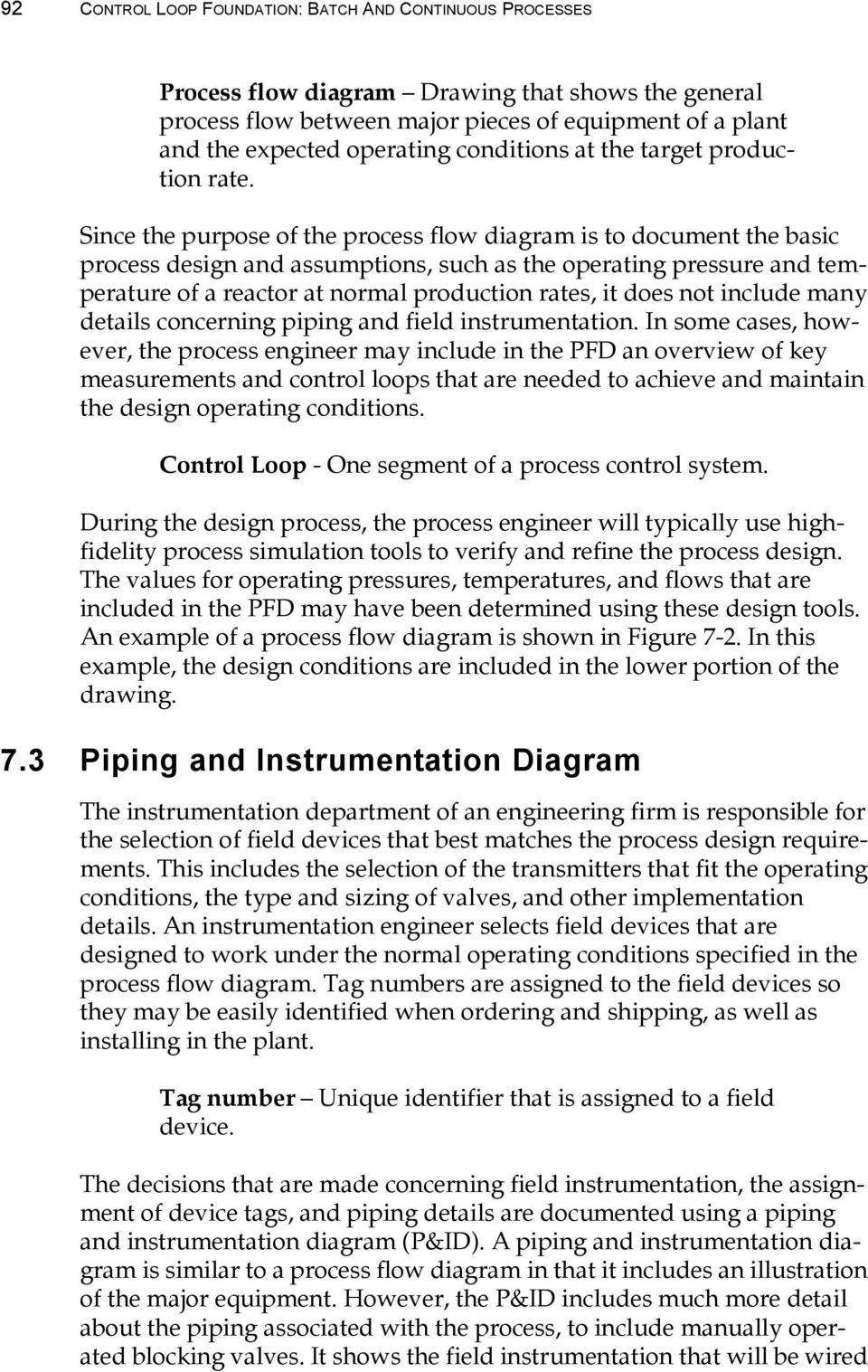
5 CHAPTER 7 CONTROL AND FIELD INSTRUMENTATION DOCUMENTATION E-401 DEETHANIZER FEED PREHEATE OP = 590 PSIG OT = 230 Deg F (NOTE 1) 222-C-401 DEETHANIZER COLUMN TOP: ID=11 0 BOTTOM: ID = 14 6 OP = 560 PSIG OT = 350 Deg F 222-E-402A/B DEETHANIZER COLUMN REBOILER MMBTU/HR OP = 560 PSIG OT = 350 Deg F 60 PSIG STEAM TC C-401 PC SPLIT RANGE (NOTE 2) OFF-GAS TO FLARE OFF_GAS TO PLANT (NOTE 1) 222-E FEED FROM 220-E-350 COND 1 TC LC E-402A/B 60 PSIG STEAM 3 AE 5 CONDENSATE To 225-E-505 DEETHANIZER BOTTOMS COOLER STREAM ID MOLE FRAC LIQUID TEMPERATURE, Deg F PRESSURE, PSIG RATE, LB/HR MOLECULAR WEIGHT Act. RATE, GAL/MIN DENSITY, LB/ COMP. LB-MOL/HR 1. METHANE ETHANE PROPANE IBUTANE BUTANE IPENTANE , PENTANE HEXANE HEPTANE Figure 7-2. Process Flow Diagram COMMENTS: 1. DEETHANIZER FEED PREHEATER (222-E-401) IS OUT OF OPERATION IN SUMMER 2. PROPOSED REVISION IN CONTROL STRATEGY IS SHOWN LEGEND VALVE NORMALLY OPEN VALVE NORMALLY CLOSED REFERENCE DRAWINGS TITLE DWG NO. PFD PLANT/225/220 DA6502 DRAWING CONTROL DA6500 SYMBOLS & LEGEND DA6501 AS BUILT BY DATE 1 CONSTRUCTION 9/12/-2020 REV ISSUED FOR DATE ( Company Name ) PROCESS FLOW DIAGRAM PLANT ( ), SUMMER CASE SHEET DRAWING NUMBER REV 1 OF 1 DA6503 1

6 94 CONTROL LOOP FOUNDATION: BATCH AND CONTINUOUS PROCESSES into the control system, as well as local pressure, temperature, or level gauges that may be viewed in the field but are not brought into the control system. As mentioned earlier, the engineering company that is creating the P&ID normally has standards that they follow in the creation of this document. In some cases, the drawing includes an overview of the closed loop and manual control, calculations, and measurements that will be implemented in the control system. Closed loop control - Automatic regulation of a process inputs based on a measurement of process output. Manual control Plant operator adjustment of a process input. However, details on the implementation of these functions within the control system are not shown on the P&ID. Even so, the P&ID contains a significant amount of information and in printed form normally consists of many D size drawings (22 x 34 inches; 559 x 864 mm) or the European equivalent C1 (648 x 917mm). The drawings that make up the P&ID are normally organized by process area, with one or more sheets dedicated to the equipment, instrumentation, and piping for one process area. Piping and Instrumentation Diagram Drawing that shows the instrumentation and piping details for plant equipment. The P&ID acts as a directory to all field instrumentation and control that will be installed on a process and thus is a key document to the control engineer. Since the instrument tag (tag number) assigned to field devices is shown on this document, the instrument tag associated with, for example, a measurement device or actuator of interest may be quickly found. Also, based on the instrument tags, it is possible to quickly identify the instrumentation and control associated with a piece of equipment. For example, a plant operator may report to Maintenance that a valve on a piece of equipment is not functioning correctly. By going to the P&ID the maintenance person can quickly identify the tag assigned to the valve and also learn how the valve is used in the control of the process. Thus, the P&ID plays an important role in the design, installation and day to day maintenance of the control system. It is a key piece of information in terms of understanding what is currently being used in the plant for process control. An example of a P&ID is shown in Figure 7-3.

7 CHAPTER 7 CONTROL AND FIELD INSTRUMENTATION DOCUMENTATION 95 TO/FROM DRW. DA OUTLET STEAM FY 302 PI 332 PT 332 PI 332 DRUM STEAM -1 DRUM STEAM -2 LC 301 LY 301 LI 301A LT 301A LY 301 LI 301 LG 301D TI A1 ASME ASME STEAM DRUM 1 TE /2 1 1/2 LT 301 TI 312 1/2 1/2 LS 301A LS 301E LS 301B LS 301C LS 301D LG 301A LS 301F LG 301B LS 301I LS 301H LS 301G LG 301C LS 301J B 301A 1 10 W-149-6A1 FEEDWATER DA SHT 1 1/2 D-118-1A1 AE 336 AT W C-24-6A1 PHOSPHATE INJECTION DA SHT 1 UTILITY WATER DA SHT 1 AI 336 Figure 7-3. Piping and Instrumentation Diagram NOTES: 1. LEAD/ LAG VALUES SHALL BE TUNED FROM THE OPERATOR CONSOLE. 2. WHEN LIC-301 IS CHANGED TO MANUAL, THE SETPOINT IS TRACKED TO 0 REFERENCE DRAWINGS TITLE DWG NO. PFD BOILER-12 DA5450 STEAM GENERATION DA50230 FEEDWATER DA50228 UTILITY WATER DA50220 SYMBOLS & LEGEND DA6501 AS BUILT BY DATE 1 CONSTRUCTION 9/12/-2020 REV ISSUED FOR DATE ( Company Name ) PIPING AND INSTRUMENTATION DIAGRAM STEAM DRUM - BOILER -12 SHEET DRAWING NUMBER REV 1 OF 1 DA LIMIT IN ASME 6A11A1 1 ½ D16-1A1 1/2 D-118-1A1 1/2 D-118-1A1 NOTE 1 LEAD/LAG OPERATION SELECT 1 NOTE 2 1/2 1/ / /2 H 180 F TE x7 x8 763 PSIG PZV 332A 301A 301B PZV 332B 4 x7 x8 770 PSIG H 180 F DA SHT 1 LOG. DIAG 42A7 STM DRUM LVL LO LO ALARM DA SHT 1 LOG. DIAG 42A7 STM DRUM LVL HI HI ALARM 2 DA SHT 1 LOG. DIAG 42A7 STM DRUM LVL HIGH ALARM DA SHT 1 LOG. DIAG 42A7 STM DRUM LVL LOW ALARM DA SHT 1 LOG. DIAG 42A7 STM DRUM MONITOR FAULT 110-E 30 SAMPLE COOLER CONDUCTIVITY TO/FROM DRW. DA-50230

8 96 CONTROL LOOP FOUNDATION: BATCH AND CONTINUOUS PROCESSES When you are doing a survey of an existing plant, obtaining a copy of the plant P&IDs is a good starting point for getting familiar with the process and instrumentation. Unfortunately, the presentation of process control on the P&ID is not standardized and varies with the engineering firm that creates the plant design. In some cases, process control is illustrated at the top of the drawing and its use of field instrumentation is indicated by arrows on the drawing that point from the field instrumentation to the control representation. Another common approach is to show control in the main body of the drawing with lines connected to the field instrumentation. Using either approach complicates the drawing and its maintenance since process control design may change with plant operational requirements. For this reason, the P&ID may only show the field instrumentation, with other documentation referenced that explains the control and calculations done by the control system. For example, when the process involves working with hazardous chemicals, then a controller functional description (CFD) may be required for process safety management (PSM). Standards have been established by OSHA for controller functional descriptions. [3] 7.4 Loop Diagram The piping and instrumentation diagram identifies, but does not describe in detail, the field instrumentation that is used by the process control system, as well as field devices such as manual blocking valves that are needed in plant operations. Many of the installation details associated with field instrumentation, such as the field devices, measurement elements, wiring, junction block termination, and other installation details are documented using a loop diagram. ISA has defined the ISA-5.4 standard for Instrument Loop Diagrams. [4] This standard does not mandate the style and content of instrument loop diagrams, but rather it is a consensus concerning their generation. A loop diagram, also commonly known as a loop sheet, is created for each field device that has been given a unique tag number. The loop diagrams for a process area are normally bound into a book and are used to install and support checkout of newly installed field devices. After plant commissioning, the loop Diagrams provide the wiring details that a maintenance person needs to find and troubleshoot wiring to the control system. Loop Diagram Drawing that shows field device installation details including wiring and the junction box (if one is used) that connects the field device to the control system. The loop diagram is a critical piece of documentation associated with the installation of the control system. As has been mentioned, the engineering

9 CHAPTER 7 CONTROL AND FIELD INSTRUMENTATION DOCUMENTATION 97 company that is designing a process normally has standards that they follow in the creation of a loop diagram. These standards may be documented by the creation of a master template that illustrates how field devices and nomenclature are used on the drawing. The loop diagram typically contains a significant amount of detail. For example, if a junction box is used as an intermediate wiring point, the loop diagram will contain information on the wiring junctions from the field device to the control system. An example of a loop diagram is shown in Figure 7-4. As is illustrated in this example, junction box connections are shown on the line that shows the division between the field and the rack room. The loop diagram shows the termination numbers used in the junction box and the field device and for wiring to the control system input and output cards. Also, the Display and Schematic portions of the loop diagram provide information on how the field input and output are used in the control system. Figure 7-4 shows installation details for a two-wire level transmitter that is powered through the control system analog input card. Also, connections are shown between the control system analog output card and an I/P transducer and pneumatic valve actuator. Details such as the 20 psi air supply to the I/P and the 60 psi air supply to the actuator are shown on this drawing. Based on information provided by the loop diagram, we know that the I/P will be calibrated to provide a 3 15 psi signal to the valve actuator. In addition, specific details are provided on the level measurement installation. Since the installation shows sensing lines to the top and bottom of the tank, it becomes clear that the tank is pressurized and that level will be sensed based on the differential pressure. In this particular installation, the instrumentation engineer has included purge water to keep the sensing line from becoming plugged by material in the tank. Even fine details such as the manual valve to regulate the flow of purge water are included in the loop diagram to guide the installation and maintenance of the measurement device. In this example, the loop diagram shows the installation of a rotameter. A rotameter consists of a movable float inserted in a vertical tube and may be used to provide an inexpensive mechanical means of measuring volumetric flow rate in the field. As this example illustrates, the loop diagram provides information that is critical to the installation, checkout, and maintenance of field devices. By examining the loop diagram, it is possible to learn details that may not be
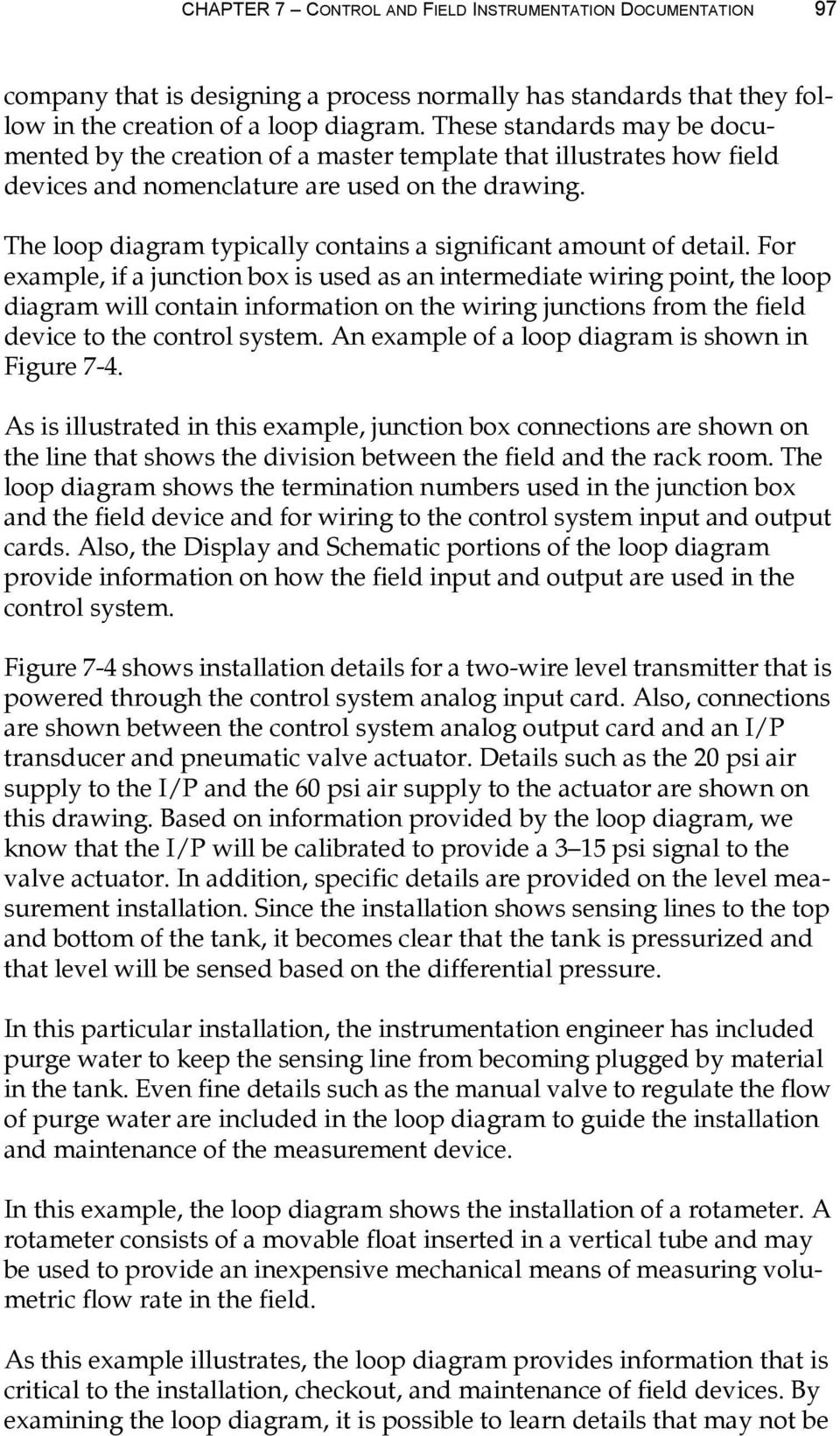
10 98 CONTROL LOOP FOUNDATION: BATCH AND CONTINUOUS PROCESSES NO. 1 FLASH TANK EQ.NO B 3/8 M3 20PSI 15A WATER PURGE FIELD RACK DISPLAY 1/4 A1 WATER PURGE I/P LV15 1/4 CI + LOCATION: COL. 4,5G, ELEV T T T T5 4-20ma 4-20ma TB TB PULP MILL RACK ROOM PULP MILL CONTROL ROOM DIRECT LC V LC INCHES SCHEMATIC 1/2 P2 3/8 M4 1/2 PI LT 15 LOCATION: COL. 4,5G, F ELEV NOTES & INTERLOCK DESCRIPTION 1. SP. GR. = A/O, F/L LV LOCATION: 15 COL. 4,5G, ELEV /8 A2 60# TO NO.2 FLASH TANK EQ.NO RACK: CARD FILE: 3 SLOT: 6 REF DWGS/COMMENTS P & ID DWG: LOC DWG: ( Company Name ) LC 15 LT 15 I/P 15 LV 15 B ITEM 6A EC-1011 W & T 5120M GPH A ITEM 6A EC-1011 W & T 5120M GPH LV ITEM 1B EC 1011 KAMYR LJMA I/P ITEM 6B EC-1011 FISHER CONSTRUCTION 10/2/2009 LC EC-1010 FISHER CL IN H ELECT. DESIGN 8/20/2009 LT ITEM 2C. EC-1011 GOULD PD TO IN H 2 O 0 CONFIGURATION 6/21/2009 TAG NO. SPEC NO. PO/REL/ITEM MFGR. MODEL NO. CALIB/RANGE REV ISSUED FOR DATE LOOP TITLE ** LEVEL ** FIRST STAGE FLASH TANK SHEET LOOP NO. REV 1 OF 1 P LS 15 2 Figure 7-4. Example Loop Diagram Level Control - -

11 CHAPTER 7 CONTROL AND FIELD INSTRUMENTATION DOCUMENTATION 99 obvious when you are touring the plant site. For example, as was previously presented in Chapter 3 on measurement, there are various ways to measure temperature. In the case of a temperature measurement, the loop diagram will provide information on the temperature transmitter, as well as the measurement element that is used. Figure 7-5 shows the loop diagram for a temperature measurement in which a three-wire RTD element is used for the temperature measurement. Details such as the grounding of the shield for the element wire and for the twisted pair going from the transmitter to the control system are noted on the loop diagram. The process of creating and reviewing loop diagrams is made easier by the fact that many components used to represent measurement and control in similar applications are often repeated. For example, the manner in which the control valve, actuator, and associated I/P transducer were represented in the loop diagram example for a level application is duplicated in other loop diagrams that depict a regulating (control) valve. This is illustrated in the loop diagram shown in Figure 7-6 for a pressure application in which a regulating valve is used in the control of pressure. Also in this example, the pressure measurement is made with a two-wire transmitter. As will be noted by comparing Figure 7-4 and Figure 7-6, the wiring for the pressure transmitter is similar to that used for the level transmitter. In some cases, the operator uses a process measurement as an indicator or as an input to a calculation that is done in the control system. A loop diagram may be developed for these types of measurement that details the device installation and wiring to the control system. In such cases, the loop diagram will contain no definitions of control. Figure 7-7 shows a flow measurement made by measuring the differential pressure across an orifice plate. As was previously covered in Chapter 3 on measurement, the hole in the orifice plate is sized to give a specific pressure drop at the maximum flow rate that the process is designed to support. As noted in the lower portion of the loop diagram, the orifice plate is sized to provide a differential pressure of 500 inches H 2 O at a flow rate of 750 gpm. Also noted in the loop diagram is the control system is expected to take the square root of this differential pressure to obtain an indication of flow rate. 7.5 Tagging Conventions The tagging conventions that were shown in examples of a P&ID and loop diagrams may be confusing to someone who has not worked with these documents. The naming convention illustrated in the P&ID and loop diagram examples are fairly well standardized in North America. To a certain extent, similar conventions are used in Europe and Asia to document process instrumentation and control. The standard tagging convention used

12 100 CONTROL LOOP FOUNDATION: BATCH AND CONTINUOUS PROCESSES FIELD RACK DISPLAY PULP MILL RACK ROOM PULP MILL CONTROL ROOM + - TT T T2 4-20ma TB VDC TI 16 3 RACK: CARD FILE: 1 SLOT: 4 TI Deg F LOCATION: COL. 4,5G, ELEV SCHEMATIC TI W W W3 LOCATION: COL. E-D/4-5 ELEV TE 16 TT 16 FROM NO.1 DIGESTER TO NO.1 FLASH TANK TE 16 NOTES & INTERLOCK DESCRIPTION REF DWGS/COMMENTS P & ID DWG: LOC DWG: ( Company Name ) TI EC-1040 FISHER DM Deg F 2 CONSTRUCTION 10/2/2009 TT ITEM 5D EC-1032 GOULD T Deg F 1 ELECT. DESIGN 8/20/2009 TE ITEM 5D EC-1032 GOULD T Deg F 0 CONFIGURATION 6/21/2009 TAG NO. SPEC NO. PO/REL/ITEM MFGR. MODEL NO. CALIB/RANGE REV ISSUED FOR DATE LOOP TITLE ** TEMPERATURE ** DIGESTER EXTRACTION SHEET LOOP NO. REV 1 OF 1 P LS 16 2 Figure 7-5. Example Loop Diagram Temperature Control

13 CHAPTER 7 CONTROL AND FIELD INSTRUMENTATION DOCUMENTATION 101 FROM SECOND STAGE FLASH TANK 1/2 PI LOCATION: COL. 4-5, G-H ELEV PT PSI FIELD RACK DISPLAY 1/4 A1 I/P LV T T2 + LOCATION: COL. 4-5/G-H ELEV C C2 4-20ma 4-20ma TB TB PULP MILL RACK ROOM PULP MILL CONTROL ROOM DIRECT PC V PC PSIG SCHEMATIC 1/4 CI RACK: CARD FILE: 3 SLOT: 6 PC 17 PV 17 A/O, FL 3/8 A2 LOCATION: COL. 4,5G, ELEV # TO TURPENTINE CONDENSER PT 17 I/P 17 PV 17 NOTES & INTERLOCK DESCRIPTION REF DWGS/COMMENTS P & ID DWG: LOC DWG: ( Company Name ) PV ITEM 1B EC-1020 KAMYR LJMA I/P ITEM 6B EC-1020 FISHER CONSTRUCTION 10/2/2009 PC EC-1040 FISHER CL PSIG 1 ELECT. DESIGN 8/20/2009 PT ITEM 4B EC-1020 GOULD LPG PSIG 0 CONFIGURATION 6/21/2009 TAG NO. SPEC NO. PO/REL/ITEM MFGR. MODEL NO. CALIB/RANGE REV ISSUED FOR DATE LOOP TITLE **PRESSURE** SECOND STAGE FLASH TANK SHEET LOOP NO. REV 1 OF 1 P LS 17 2 Figure 7-6. Example Loop Diagram Pressure Control - -

14 102 CONTROL LOOP FOUNDATION: BATCH AND CONTINUOUS PROCESSES FIELD RACK DISPLAY PULP MILL RACK ROOM PULP MILL CONTROL ROOM T T5 4-20ma TB VDC FI 18 6 RACK: CARD FILE: 1 SLOT: 4 FI GPM PURGE WATER 18A M1 3/ LOCATION: COL. 4/C ELEV M2 3/8 18A PURGE WATER SCHEMATIC FI 18 P1 1/2 P2 1/2 FROM COLD BLOW PUMP FE 18 LOCATION: COL. 4/C ELEV TO DIGESTER OUTLET 18 FE 18 NOTES & INTERLOCK DESCRIPTION REF DWGS/COMMENTS P & ID DWG: LOC DWG: ( Company Name ) B ITEM 6A EC-1021 W & T 5120M GPH A ITEM 6A EC-1021 W & T 5120M GPH FI EC-1040 FISHER DM GPM 2 CONSTRUCTION 10/2/2009 ITEM 1B EC-1021 GOULD PDH IN H2O 1 ELECT. DESIGN 8/20/2009 FE ITEM F18 EC-1021 FLUID TECH IN H2O 0 CONFIGURATION 6/21/2009 TAG NO. SPEC NO. PO/REL/ITEM MFGR. MODEL NO. CALIB/RANGE REV ISSUED FOR DATE LOOP TITLE ** FLOW ** COUNTER WASH SHEET LOOP NO. REV 1 OF 1 P LS 18 2 Figure 7-7. Example Loop Diagram Flow Measurement

15 CHAPTER 7 CONTROL AND FIELD INSTRUMENTATION DOCUMENTATION 103 in North America has been developed through the efforts of ISA. The format of tags used to identify field devices is defined by ISA Instrumentation Symbols and Identification. The ISA-5.1 standard defines a standard tag number convention for valves, transmitters, other field devices, and calculation and control functions. In addition, the standard defines expanded tag number conventions that may better meet the documentation requirements of large installations that consist of many process areas or multiple measurements that serve similar functions. The tag number convention defined by ISA-5.1 is summarized in Figure 7-8. TYPICAL TAG NUMBER TIC Instrument Identification or Tag Number T Loop Identifier Loop Number TIC - Function Identification T - First-letter IC - Succeeding-Letters EXPANDED TAG NUMBER 10-PAH-5A - Tag Number 10 - Optional Prefix A - Optional Suffix Note: Hyphens are optional as separators Figure 7-8. ISA-5.1 Tag Number Convention The tag number convention established by ISA-5.1 may appear cumbersome, but when examined in detail, it can be easily understood and applied when you are creating new documentation. When first looking at this standard, it is often helpful to consider some examples contained in the standard that illustrate the use of this tagging convention. The letters that make up the first few characters of a typical tag number (the leading letters ) are used to identify the function performed by the field device or by the control system. Following these leading letters is a number. The number that appears on the tag is known as the loop number. The loop number is used to uniquely identify one or more field devices that are used to perform a specific function. This combination of function letter and loop number allows a field device in a process area to be precisely identified. Knowing the device tag number is required when filling out a work order to or in discussing a field measurement with an operator or instrument technician. The tag number assigned to a field device is normally stamped on a tag that is attached to the device.

16 104 CONTROL LOOP FOUNDATION: BATCH AND CONTINUOUS PROCESSES All the devices that are used together to perform a specific function are normally assigned the same loop number. For example, the flow transmitter and regulating valve used to measure and regulate the flow of a process stream may be assigned loop number 101. The loop number normally has only three digits. Consequently, the number of field devices that can be uniquely identified using the standard tag number convention is very limited. For this reason, an expanded tag number convention, defined by the ISA-5.1 standard, is used in the process industry. The expanded tag number convention allows a number to be inserted in front of the function, and that number is usually the process area number. As discussed in Chapter 2, a plant is divided into process areas that are assigned a number. The combination of the area number, the function letters, and the loop number is unique within a plant. In some cases, multiple field devices may be used to perform a similar function. For example, in some boiler applications the temperature of each tube in the superheater section of a boiler may have individual temperature measurements. Rather than assigning a loop number to each measurement, the expanded tag number convention assigns a common loop number to all these measurements. When this is done, one or more characters may be added after the loop number to uniquely identify each measurement. For the boiler example, loop number 105 might be assigned to all the superheater temperature measurements and the individual measurements may be identified by adding an A after the loop number for the first measurement, a B for the second measurement, and a C for the third measurement. This option to add letters after the loop number allows unique tag numbers to be created for each measurement, even when a large number of similar measurements is made in a process area. A hyphen may be optionally used in the tag number to separate the area number or characters added after the loop number. However, in general, the use of a hyphen in the tag number is not recommended since in many control systems, the length of a tag number is limited to a maximum number of characters (e.g., 12 or 16 characters). As defined by ISA-5.1, the identification letters used to specify the function of a field device are organized in a specific manner. The meaning of a letter varies depending on whether it is the first letter or a succeeding letter. A table of the identification letters defined by the standard is shown in Figure 7-9. If the first letter of a tag number is an A, this indicates that the primary function of the device is analysis; if the first letter is an F, then the primary function is flow. When the first letter is H, this indicates that a manual or Hand function is to be performed. By reviewing this table of

17 CHAPTER 7 CONTROL AND FIELD INSTRUMENTATION DOCUMENTATION 105 identification letters, the use of the letters in a tag number can be easily determined. First Letters Succeeding Letters Measured/Initiating Variable Variable Modifier Readout/Passive Function Output/Active Function Function Modifier A Analysis Alarm B Burner, Combustion User s Choice User s Choice User s Choice C User s Choice Control Close D User s Choice Difference, Differential Deviation E Voltage Sensor, Primary Element F Flow, Flow Rate Ratio G User s Choice Glass, Gauge, Viewing Device H Hand High I Current Indicate J Power Scan K Time, Schedule Time Rate of Change Control Station L Level Light Low M User s Choice Middle, Intermediate N User s Choice User s Choice User s Choice User s Choice O User s Choice Orifice, Restriction Open P Pressure Point (Test Connection) Q Quantity Integrate, Totalize Integrate, Totalize R Radiation Record Run S Speed, Frequency Safety Switch Stop T Temperature Transmit U Multivariable Multifunction Multifunction V Vibration, Mechanical Analysis Valve, Damper, Louver W Weight, Force Well, Probe X Unclassified X-axis Accessory Devices, Unclassified Unclassified Unclassified Y Event, State, Presence Y-axis Auxiliary Devices, Z Position, Dimension Z-axis, Safety Instrumented System Driver, Actuator, Unclassified final control element Figure 7-9. ISA-5.1 Identification Letters In some cases, a letter can only be used as a succeeding letter. For example, the letter D would never be used as a first character, but it may be used as a succeeding letter to indicate differential. Thus, the combination PD is valid and would indicate the function of the device is pressure, differential, that is, differential pressure. The combination HIC would be used to indicate hand indicator controller, that is, manual control. Indication and control based on an analytic measurement would be identified as AIC. The letter combination FIC is quite common and used to indicate a flow indicating control function. A control valve used in pressure control would be identified using the letters PV, pressure valve. A temperature

18 106 CONTROL LOOP FOUNDATION: BATCH AND CONTINUOUS PROCESSES measurement used only for indication would be identified as TI, temperature indication. A position transmitter would be identified using the letters ZT. In the ISA-5.1 standard, several examples are provided that illustrate the correct use of the indication letters within a tag number. Also, the standard covers other letters that may be used in special applications. The use of tag numbers in a process control system is quite straightforward and must be understood to work with or create documentation for a process control system. 7.6 Line and Function Symbols Different types of lines are used in process flow diagrams, piping and instrumentation diagrams, and loop diagrams to indicate the type of connection between field devices and the control system. The ISA-5.1 standard defines the instrument line symbols that are commonly used in control system documentation. As illustrated in Figure 7-10, a solid line is used to represent a physical connection to the process. Two slashes shown as points along a line are used to indicate a pneumatic signal. One of the most common ways to indicate an electric signal is a dashed line as defined in ISA-5.1. Communication links between devices and functions of a distributed control system are indicated by small bubbles along the line as illustrated in Figure Instrument supply or connection to process Pneumatic Signal Electric Variable or Binary Communication Link Figure Excerpt from ISA-5.1 Instrument Line Symbols The previous examples of the process flow diagram, piping and instrumentation diagram, and loop diagram contained one or more circle symbols. In these drawings, a circle is used to indicate a discrete instrumentation or control function. A horizontal line drawn through the middle of the circle indicates the function may be accessed by the plant operator. There are many functions, such as those performed by an I/P transducer or valve positioner, that are typically not directly accessible by the operator. Also, some field devices for measurement and actuation may

19 CHAPTER 7 CONTROL AND FIELD INSTRUMENTATION DOCUMENTATION 107 only be accessed by control or calculation functions in the control system and thus would not be shown in the documentation as being directly accessed by the operator. However, the associated control or calculation function that is accessed by the operator would include a horizontal line. As illustrated in Figure 7-11, one of the conventions advocated in ISA-5.1 is to include a square around the circle if the associated function is accessed by an operator through a video display of a distributed control system (DCS). However, in practice, this convention is often not followed. Discrete Instrument, field mounted Discrete instrument, accessible to operator Visible on video Display Figure Excerpt from ISA-5.1 General Instrumentation or Symbol Function It is common practice to illustrate the valve body, as well as the valve actuator and positioner function in control system documentation. The ISA-5.1 standard addresses the representation of a valve body. Most types of valves are addressed by this standard. However, the engineering firm that is designing a process plant may have adopted some variation of what is shown in ISA-5.1. In such cases, it is common practice for the engineering firm to provide a drawing that explains the symbol functions included in their documentation. Also, in some cases, a general valve representation is used rather than different representations for a rotary valve or sliding stem valve. [5] Generally, a damper will be shown rather than the general valve symbol to indicate the regulation of air or gas flow to a boiler or a similar process such as a kiln or heater. An excerpt from ISA-5.1 Valve Body and Damper Symbols are illustrated in Figure Since the type of actuator used with a valve body may impact the operation and failure mode of the valve, the type of actuator is normally indicated in control system documentation. The representation of common types of actuators as defined by ISA-5.1 is shown in Figure A complete representation of the valve is provided by combining the valve representation with the actuator representation.

20 108 CONTROL LOOP FOUNDATION: BATCH AND CONTINUOUS PROCESSES General Symbol Ball Valve Globe Valve Damper Figure Excerpt from ISA-5.1 Valve Body and Damper Symbols When a positioner is used with a valve, the diaphragm representation may be combined with a representation of the actuator and the valve body, as is illustrated in Figures 7-16 to The failure mode of the valve (i.e., fail open or fail closed) is often indicated by the valve symbol in control system documentation. A special actuator symbol is defined by the standard for motorized actuators. Motorized actuators are used in some industry segments because upon loss of power, the last valve position is maintained. Also, better resolution may be achieved using a motorized actuator for a specific application, such as the basis weight valve that is used to regulate the thick stock flow to a paper machine in paper manufacturing. [6] Solenoid actuators that are used to automate valves used in on-off service are shown using a special symbol. Installation details are provided in the loop diagram documentation. Some of details may also be provided in the P&ID. For example, the P&ID and loop diagram may show the orifice that must be installed to measure flow using a differential pressure transmitter. Hand-operated valves that are used to block flow during startup or maintenance are shown since they impact process operation if not properly set up. Also, the installation of inline instrumentation, such as a magnetic flowmeter, is commonly shown in a unique manner in the control system documentation. In addition, measurement elements such as an RTD or a thermocouple are shown since they may be physically installed some distance from the field transmitter or the control system. To provide a consistent means of documenting the physical installation, the ISA-5.1 standard includes symbols for many of these common installation details and field devices. A sample of some of these symbols is shown in Figure 7-14.

21 CHAPTER 7 CONTROL AND FIELD INSTRUMENTATION DOCUMENTATION 109 Generic actuator, Spring-diaphragm Spring-diaphragm with positioner Linear piston actuator with positioner Rotary motor operated actuator Solenoid actuator for on-off valve M S Figure Excerpt from ISA-5.1 Actuator Symbols Restriction Orifice, With Flow Transmitter Hand Valve Inline Measurement Measurement Element TE Figure Excerpt from ISA-5.1 Symbols for Other Devices 7.7 Equipment Representation A representation of major pieces of process equipment is normally included in control system documentation. This allows the field instrumentation installation to be shown in relationship to the process equipment. Example process equipment representations are illustrated in Figure A general vessel representation may be appropriate for vessels, agitators, heat exchangers, and pumps that do not play an important role in the control system. For example, an agitator on a tank may not directly impact the control associated with the tank level. A special representation is provided
22 110 CONTROL LOOP FOUNDATION: BATCH AND CONTINUOUS PROCESSES Vessel, Jacketed Vessel, Reactor Atmospheric Tank, Storage Heat Exchange Agitator Pump Figure Examples of Process Equipment Symbols for a reactor. A jacketed vessel symbol may be used when a vessel is heated or cooled by circulating liquid through an outside shell. Such a design is commonly used in the batch industry, and permits the vessel s contents to be heated or cooled without coming in contact with the circulating liquid. A symbol is also provided for flat-bottomed and coneshaped storage tanks that are open to the atmosphere. The examples include a representation of a heat exchanger, which is used to heat or cool a liquid stream. A symbol is defined for an agitator that may be used to ensure good mixing of liquids in a vessel. Also, a pump symbol is shown in these examples. 7.8 Documentation Examples The four examples included in this section are designed to illustrate many of the recommendations of the ISA-5.1 standard. In the first example, questions and answers are used to highlight specific points that have been covered in this chapter. A review of these questions will hopefully serve to reinforce your understanding of concepts and terminology that will be used in later chapters. By studying the control system and field instrumentation documentation, a lot can be learned about the process and the way the control system is designed to work. Such background information can be extremely helpful when you are working with or troubleshooting the control system for a new process Example Basic Neutralizer Control System The neutralizer process may be used to adjust the ph of a feed stream. The field devices and process controls that would typically be provided to this
23 CHAPTER 7 CONTROL AND FIELD INSTRUMENTATION DOCUMENTATION 111 process are shown in this piping and instrumentation diagram illustrated in Figure After reviewing this diagram, consider the following questions and answers. 101 Reagent Stage AV 103 AC 103 AY 103 Signal Characterizer Feedforward AC Reagent Stage Feed 101 Static Mixer AT 103 Neutralizer AT Discharge Figure Example Basic Neutralizer Control System Question: What tag number convention is shown in this example? Answer: The expanded tag number convention, defined by the ISA-5.1 standard, is not used in this example since the tag only contains function letters and a loop number. Question: Flow measurements are made using 101, 102, and 105. What type of measurement technique is used by these field devices? Answer: The field device is shown as installed inline and the liquid is conductive. Thus, a magnetic flowmeter is installed. Question: Do the valves have digital positioners? Answer: Yes, an electric signal is shown going directly to a box located on each valve. The pneumatic line from the
24 112 CONTROL LOOP FOUNDATION: BATCH AND CONTINUOUS PROCESSES actuator is also tied to this box. Therefore, we can assume that these valves are installed with a valve positioner. Question: What type of valve is being used to regulate flow? Answer: The general valve body symbol is used and thus the type of valve is not indicated in this drawing. Question: Is the plant operator able to access the control functions indicated by AC103, AC104, 101, and 105? Answer: Yes, the circle indicating these control functions contains a horizontal line that indicates the operator may access this function. Question: Can the operator access flow measurements 101, 102, and 105, as well as analytic (ph) measurements AT103 and AT104? Answer: No, the circle indicating these measurement functions does not include a horizontal line. In this case, these measurements are not directly accessed by the operator. Question: Are any on-off (blocking) valves used in this process? Answer: Yes, two blocking valves are shown with electric on-off actuators. Question: What function is provided by AC103? Answer: The function letters of the tag number indicate that the function is analytic control. Question: What measurement is used by AC103 in performing its control function? Answer: Since an electric signal line is shown from AT103 to AC103, then control must be based on the measurement AT103 (ph). Question: What is the purpose of the function shown between AT103 and AC103, that is, AY103? Answer: On the diagram, this function is noted as Signal Characterization. When a complex calculation is done, it is often represented by a single function with AY noted inside the circle and a note provided to explain the purpose of this function.
25 CHAPTER 7 CONTROL AND FIELD INSTRUMENTATION DOCUMENTATION 113 Question: Does the vessel have an agitator? Answer: Yes, the figure shows an agitator impeller in the vessel, powered by a motor on top of the vessel. Question: Is the pump fixed speed or variable speed? Answer: Since control of the process is done using a regulating valve, then it may be assumed that the pump is fixed speed. Question: How could the liquid in the vessel be heated? Answer: A heat exchanger is shown in the recirculation line and could be used to heat (or cool) the liquid in the vessel. Question: How is the ph of the incoming stream adjusted? Answer: The output of AC103 and AC104 go to a valve and flow loop, respectively, that regulates the flow of reagent to the inlet stream and recirculation line. Thus, it may be assumed that reagent is used to adjust ph Example Basic Column Control The basic column control system shown in Figure 7-17 is somewhat more complicated than the basic neutralizer control system. However, after studying this example, it will become clear that many of the components that make up the column control system are similar to those used in the basic neutralizer control system. As we have seen, what is learned by working with one process may be often applied to another process. Once you become familiar with a few processes, it becomes easier to work with other processes Example Batch Reactor Control System Batch processing plays an important role in some industries. In a batch process, a vessel is charged with feed material that is processed in the vessel through mechanical or chemical means (or both). At the end of the process, the product which may be a finished product or an intermediate product for use in another process is removed from the vessel. The batch reactor example illustrated in Figure 7-18 is known as continuous feed batch, in which feed material is continuously added to the vessel throughout part or all of the batch processing. The reaction takes place, and finally the product is pumped from the vessel. In comparing the basic components to those seen in the previous two examples, the only new element introduced by this example is an eductor (a device that produces vacuum by means of the Venturi effect) that is used to remove gases created by the batch reaction.
26 114 CONTROL LOOP FOUNDATION: BATCH AND CONTINUOUS PROCESSES PC 115 PV 115 Feed Tank 111 Feedforward LC 117 LT 117 FO Vent PT Feed Column 114 Reflux FO RTD TT Distillate Receiver Feedforward TC Overheads Storage Tank Steam LC 113 LT 113 Bottoms Figure Basic Column Control System Anti-Foam Feed B TT 126 TC 126 FO Coolant TV 126 PC 127 PT 127 FO TC 124 PV 127 Vent System TT 125 PC 128 PT 128 TC 125 PV 128 Eductor FO Feed A Batch Reactor LT 123 TT 124 LC 123 FO TV 125 Coolant LV 123 Figure 7-18 Discharge Figure Example Batch Reactor Control
27 CHAPTER 7 CONTROL AND FIELD INSTRUMENTATION DOCUMENTATION Example Continuous Feed and Recycle Tank In studying the example of a continuous feed and recycle tank shown in Figure 7-19, you will note that the only new function that was not contained in a previous example is F133. The function letters of the tag number indicate that this new function is ratio control. The line connections indicate that the ratio control is implemented using two feed streams to Reactor Makeup 135 Recycle Tank Recycle LC 134 LT Reactor 1 PC Feed Tank Reactor 1 FO 131 PV 130 PT 130 F Reactor 2 Figure Example Continuous Feed and Recycle Tank Knowing the tag number and symbols on a P&ID is the first step in understanding which measurement and control functions have been installed on the process. As the examples shown in Figure 7-16 to 7-19 illustrate, a basic understanding of the control and process is possible if you are familiar with the tag number and symbols on the P&ID. Later chapters on control implementation will address how the control functions shown on the P&ID and loops sheet are implemented.
28 116 CONTROL LOOP FOUNDATION: BATCH AND CONTINUOUS PROCESSES References 1. The International Society of Automation (ISA) International Electrotechnical Commission (IEC) OSHA Standard 29 CFR , Process safety management of highly hazardous chemicals ISA , Instrument Loop Diagrams, Research Triangle Park, NC: ISA (ISBN ). 5. Skousen, Philip. Valve Handbook Second Edition, Chapter 1.5.1, McGraw-Hill Handbook (ISBN: ). 6. Lehtinen, Marjaana. More speed and accuracy for basis weight control, pp , Automation 1, 2004.
www.klmtechgroup.com TABLE OF CONTENT
 Page : 1 of 24 Project Engineering Standard www.klmtechgroup.com KLM Technology #03-12 Block Aronia, Jalan Sri Perkasa 2 Taman Tampoi Utama 81200 Johor Bahru Malaysia S TABLE OF CONTENT SCOPE 2 DEFINITIONS
Terminology and Symbols in Control Engineering
 Technical Information Terminology and Symbols in Control Engineering 1 Part 1 Fundamentals Technical Information Part 1: Fundamentals Part 2: Self-operated Regulators Part 3: Control Valves Part 4: Communication
Industrial Steam System Process Control Schemes
 Industrial Steam System Process Control Schemes This paper was developed to provide a basic understanding of the different process control schemes used in a typical steam system. This is however a fundamental
DIRECT STEAM INJECTION HOT WATER SYSTEMS FOR JACKETED HEATING
 By Philip Sutter Pick Heaters, Inc. DIRECT STEAM INJECTION HOT WATER SYSTEMS FOR JACKETED HEATING INTRODUCTION Many process plants currently use steam or hot water to heat jacketed devices such as tanks,
www.klmtechgroup.com TABLE OF CONTENT
 Page : 1 of 38 Project Engineering Standard www.klmtechgroup.com KLM Technology #03-12 Block Aronia, Jalan Sri Perkasa 2 Taman Tampoi Utama 81200 Johor Bahru Malaysia CAUSTIC AND CHEMICAL TABLE OF CONTENT
Some Criteria for Choosing a Steam Boiler for a Microbrewery
 Some Criteria for Choosing a Steam Boiler for a Microbrewery Jack Coe Rite Engineering and Manufacturing Corporation Breweries rely on steam heating for a number of functions, primarily to heat the brew
FLASH TANK ECONOMIZER PRODUCT GUIDE
 FLASH TANK ECONOMIZER PRODUCT GUIDE Overview A flash tank is used to recover blowdown energy in the form of flash steam and blowdown. This can only be used with a deaerator or some other pressurized device.
F ox W hi t e Paper. Reduce Energy Costs and Enhance Emissions Monitoring Systems
 F ox W hi t e Paper Reduce Energy Costs and Enhance Emissions Monitoring Systems A Technical White Paper from Fox Thermal Instruments Rich Cada, VP Sales & Marketing, Fox Thermal Instruments, Inc. 399
VAD. Variable Area Desuperheaters
 Desuperheater overview Steam used in process plants can be superheated, that is, heated to a temperature above saturation. The excess of temperature above its saturation is called 'superheat'. Desuperheated
Heating Water by Direct Steam Injection
 Heating Water by Direct Steam Injection Producing hot water by direct steam injection provides a solution where large volumes of hot water at precise temperatures are required, and where energy and space
Gas Custody Transfer Calibration
 Gas Custody Transfer Calibration Using multi variable temperature / pressure calibrators for flowmeter calibration 2013 Introduction Gas custody transfer flow computers require special calibration to perform
Process Analysis and Control P&ID Handout Page 1 P&ID SYMBOLS. ISA Symbols and Loop Diagrams
 Process Analysis and Control P&ID Handout Page 1 P&ID SYMBOLS ISA Symbols and Loop Diagrams Process Analysis and Control P&ID Handout Page 2 P&IDs Piping and Instrumentation Diagrams or simply P&IDs are
Grant Agreement No. 228296 SFERA. Solar Facilities for the European Research Area SEVENTH FRAMEWORK PROGRAMME. Capacities Specific Programme
 Grant Agreement No. 228296 SFERA Solar Facilities for the European Research Area SEVENTH FRAMEWORK PROGRAMME Capacities Specific Programme Research Infrastructures Integrating Activity - Combination of
MTI10 Insertion and MTL10 In-line Thermal Mass Flowmeter and Temperature Transmitter
 Thermal Mass meter and Temperature Transmitter Description The MTI10 insertion thermal mass flowmeter and the MTL10 in-line thermal mass flowmeter provide accurate mass flow measurement of clean, dry gases
Electronic Flow Switches
 Industries Electronic Flow Switches Petrochemical Refining Oil Production Water Treatment Pharmaceutical Food and Beverage Pulp and Paper Power Production Gas Processing Mining Biotechnology Semiconductor
IGEMA BOILER LEVEL & TDS CONTROLS
 IGEMA BOILER LEVEL & TDS CONTROLS IGEMA offers boiler level and TDS control products of the highest quality standard, being certified to ISO 9001. Made in Germany, IGEMA products are manufactured in compliance
In-Line Electronic Flow Switches
 In-Line Electronic Flow Switches Industries Petrochemical Refining Oil Production Water Treatment Pharmaceutical Food and Beverage Pulp and Paper Power Production Gas Processing Mining Biotechnology Semiconductor
RECON WATER HEATER INSTALLATION FORM
 RECON WATER HEATER INSTALLATION FORM Please complete ONE (1) form for each SITE and return to AERCO for warranty validation within 30 days of start-up. After completion, e-mail this form to: [email protected].
Sanitary Type Electronic Flow Switches
 Industries Pharmaceutical Sanitary Type Electronic Flow Switches Food and Beverage Biotechnology Semiconductor Water Treatment S Series Ameritrol, Inc. Instruments and Controls Features No Moving Parts
Commercial Semi-Instantaneous Water Heaters
 FEATURES HWI Models A. O. Smith s HWI models are available for operation with steam or boiler water as the energy source. They are factory assembled with components sized, piped and checked at the factory
HC900 for Boiler Control Applications
 HC900 for Boiler Control Applications Background Until recent years, only the largest boilers could justify sophisticated boiler controls. Now high fuel costs make it necessary to improve boiler efficiency
Boiler & Pressure Vessel Inspection discrepancies and failures
 Boiler & Pressure Vessel Inspection discrepancies and failures Water Heaters / Pressure Vessels Pressure Vessels are inspected once every three years. This requires a test of A: safety relief devices B:
How To Clean Up A Reactor Water Cleanup
 General Electric Systems Technology Manual Chapter 2.8 Reactor Water Cleanup System TABLE OF CONTENTS 2.8 REACTOR CLEANUP SYSTEM... 1 2.8.1 Introduction... 2 2.8.2 System Description... 2 2.8.3 Component
VAD Variable Area Desuperheaters
 Local regulations may restrict the use of this product to below the conditions quoted. In the interests of development and improvement of the product, we reserve the right to change the specification without
Engineering Drawings - Mechanical
 Engineering Drawings - Mechanical Course No: M04-015 Credit: 4 PDH A. Bhatia Continuing Education and Development, Inc. 9 Greyridge Farm Court Stony Point, NY 10980 P: (877) 322-5800 F: (877) 322-4774
Element D Services Plumbing
 Medical Vacuum and Gas PART 1 - GENERAL 1.01 OVERVIEW A. This section addresses medical vacuum, waste anesthetic gas disposal, compressed air, oxygen, nitrous oxide, nitrogen and carbon dioxide systems.
Automation System TROVIS 6400 TROVIS 6493 Compact Controller
 Automation System TROVIS 6400 TROVIS 6493 Compact Controller For panel mounting (front frame 48 x 96 mm/1.89 x 3.78 inch) Application Digital controller to automate industrial and process plants for general
BB-18 Black Body High Vacuum System Technical Description
 BB-18 Black Body High Vacuum System Technical Description The BB-18 Black Body is versatile and is programmed for use as a fixed cold target at 80 K or variable target, at 80 K- 350 K no extra cost. The
Boiler Preparation, Start-Up and Shutdown
 Boiler Preparation, Start-Up and Shutdown Learning Outcome When you complete this module you will be able to: Describe the basic preparation of a boiler for start-up, and the start-up and shutdown procedures.
20,000 Barrel Per Day Crude Oil Refinery
 20,000 Barrel Per Day Crude Oil Refinery (For Sale) AT THE EXCEPTIONAL PRICE OF $39,500,000.00 PRICE INCLUDES SHIPPING AND INSTALLATION Includes 2- TEN T B/D DISTILLILATION UNITS (SELLER NEEDS TO SELL
Pressurized Water Reactor B&W Technology Crosstraining Course Manual. Chapter 9.0. Integrated Control System
 Pressurized Water Reactor B&W Technology Crosstraining Course Manual Chapter 9.0 Integrated Control System TABLE OF CONTENTS 9.0 INTEGRATED CONTROL SYSTEM... 1 9.1 Introduction... 1 9.2 General Description...
INTEC Engineering GmbH Heating Solutions for the Marine Industry
 INTEC Engineering GmbH Heating Solutions for the Marine Industry Thermal Oil Heaters Heating Solutions for the Marine Industry Compared to conventional plants using hot water or steam, thermal oil as a
C. starting positive displacement pumps with the discharge valve closed.
 KNOWLEDGE: K1.04 [3.4/3.6] P78 The possibility of water hammer in a liquid system is minimized by... A. maintaining temperature above the saturation temperature. B. starting centrifugal pumps with the
Aeration Air & Digester Gas Flow Metering Using Thermal Mass Technology. HWEA 2011 Conference Craig S. Johnson
 Aeration Air & Digester Gas Flow Metering Using Thermal Mass Technology HWEA 2011 Conference Craig S. Johnson Presentation Overview Introduction Aeration Air & Digester gas challenges Gas flow metering
Oil and Coolant Circulating Heating System. Model - OCSM
 Oil and Coolant Circulating Heating System Model - OCSM Installation & Operation Manual 216280-000 REV 2 Identifying Your System The HOTSTART heating system is designed to heat fluids for use in marine
ADVANCED CONTROL TECHNIQUE OF CENTRIFUGAL COMPRESSOR FOR COMPLEX GAS COMPRESSION PROCESSES
 ADVANCED CONTROL TECHNIQUE OF CENTRIFUGAL COMPRESSOR FOR COMPLEX GAS COMPRESSION PROCESSES by Kazuhiro Takeda Research Manager, Research and Development Center and Kengo Hirano Instrument and Control Engineer,
with MERCURY FREE 1 HP Relays ! WARNING Before using this product read and understand instructions.
 B Installation & Maintenance Instructions MM-414 Series 150E and 157E Low Water Cut-Off/Pump Controllers For Steam Boilers and Other Level Control Applications A Typical Applications: Primary or secondary
GAS HANDLING SYSTEMS VACUUM INSTRUMENT CORPORATION
 GAS HANDLING SYSTEMS VACUUM INSTRUMENT CORPORATION 2099 Ninth Avenue Ronkonkoma, NY 11779 www.vacuuminst.com Smart Charge II An advanced gas backfill and evacuation system with built-in gross leak test.
Equivalents & Conversion Factors 406 Capacity Formulas for Steam Loads 407 Formulas for Control Valve Sizing 408-409
 Engineering Data Table of Contents Page No. I II Formulas, Conversions & Guidelines Equivalents & Conversion Factors 406 Capacity Formulas for Steam Loads 407 Formulas for Control Sizing 408-409 Steam
Nozzle Loads, Piping Stresses, and the Effect of Piping on Equipment
 Nozzle Loads, Piping Stresses, and the Effect of Piping on Equipment By Patty Brown & Mark van Ginhoven November 13, 2009 1 CA 2009 Fluor Corporation. All Rights Reserved. Topics Covered Introduction Nozzle
I. STEAM GENERATION, BOILER TYPES
 I. STEAM GENERATION, BOILER TYPES and BOILER PLANT SYSTEMS 1 Steam Generation Water s Unique Properties: High Thermal Capacity (Specific Heat) High Critical Temperature Ideal Medium for Heat Delivery High
G234X-55 Conventional Gas Boiler
 Engineering Submittal Sheet Boiler Overview C US Engineering Specifications There shall be provided and installed a quantity of Buderus G234X-55 fl oor standing hot water boiler(s), suitable with natural
The Piping System Model a New Life Cycle Document. Elements of the Piping System Model
 Piping System Model as a Life Cycle Document White Paper Introduction When designing piping systems, a variety of documents are created providing the details necessary to design, purchase, build, and test
In-Line Electronic Flow Switches
 In-Line Electronic Flow Switches Industries Petrochemical Refining Oil Production Water Treatment Pharmaceutical Food and Beverage Pulp and Paper Power Production Gas Processing Mining Biotechnology Semiconductor
Digital inductive conductivity transmitter
 Digital inductive conductivity transmitter Optimal solution for conductivity measurements in difficult fluids (polluted, dirty,...) PEEK/PPA version for CIP applications Large range of process connections
A Practical Guide to Free Energy Devices
 A Practical Guide to Free Energy Devices Part PatE17: Last updated: 24th November 2006 Author: Patrick J. Kelly This is a patent application from Stephen Meyer, brother of the late Stan Meyer. While this
Steam Generation Efficiency Module Blowdown Losses Section
 Steam End User Training Steam Generation Efficiency Module Blowdown Losses Section Slide 1 Blowdown Losses Module This section will discuss blowdown loss and its affect on boiler efficiency. [Slide Visual
Micro Motion Net Oil Computer Software and NOC System
 Instruction Manual P/N 20006444, Rev. A May 2007 Micro Motion Net Oil Computer Software and NOC System Configuration and Use Manual 2007, Micro Motion, Inc. All rights reserved. ELITE and ProLink are registered
Density Measurement. Technology: Pressure. Technical Data Sheet 00816-0100-3208 INTRODUCTION. S min =1.0 S max =1.2 CONSTANT LEVEL APPLICATIONS
 Technical Data Sheet 00816-0100-3208 Density Measurement Technology: Pressure INTRODUCTION Pressure and differential pressure transmitters are often used to measure the density of a fluid. Both types of
ISA108 Intelligent Device Management (IDM)
 ISA108 Intelligent Device Management (IDM) Intelligent Digital Devices - Have Self-Diagnostics and More Eight-channel two-wire temperature transmitter Intelligent two-wire on/off valve 2 Fully integrated
! WARNING. McDonnell & Miller Installation & Maintenance Instructions MM-217(I) Series 150S and 157S (Snap Switch, All Models except 157S-RB-P)
 Series 150S and 157S (Snap Switch, All Models except 157S-RB-P) Low Water Cut-Off/Pump Controllers For Steam Boilers and Other Level Control Applications McDonnell & Miller Installation & Maintenance Instructions
EBS852 (Contrac) Power Electronic Unit
 Data Sheet Rev. A EBS852 (Contrac) Power Electronic Unit For continuous control of Contrac actuators RHD(E) and RSD(E) Microprocessor-controlled power electronic unit with integrated frequency converter
TOPIC: 191004 KNOWLEDGE: K1.01 [3.3/3.5] Which one of the following contains indications of cavitation in an operating centrifugal pump?
![TOPIC: 191004 KNOWLEDGE: K1.01 [3.3/3.5] Which one of the following contains indications of cavitation in an operating centrifugal pump?](/thumbs/17/105210.jpg "TOPIC: 191004 KNOWLEDGE: K1.01 [3.3/3.5] Which one of the following contains indications of cavitation in an operating centrifugal pump?") KNOWLEDGE: K1.01 [3.3/3.5] P21 Which one of the following contains indications of cavitation in an operating centrifugal pump? A. Low flow rate with low discharge pressure. B. Low flow rate with high discharge
KNOWLEDGE: K1.01 [3.3/3.5] P21 Which one of the following contains indications of cavitation in an operating centrifugal pump? A. Low flow rate with low discharge pressure. B. Low flow rate with high discharge
Quik Lining Systems Heater Owners Guide
 Quik Lining Systems Heater Owners Guide Quik Lining Systems, Inc is pleased to present the Quik Heater, an innovative heater used to cure cured in place pipe for sewer laterals. The unit is the most cost
Sulfur Tail Gas Thermal Oxidizer Systems By Peter Pickard
 Sulfur Tail Gas Thermal Oxidizer Systems By Peter Pickard Introduction SRU s (Sulfur Recovery Units) are critical pieces of equipment in refineries and gas plants. SRUs remove sulfur compounds from certain
Enhancing Process Control Education with the Control Station Training Simulator
 Enhancing Process Control Education with the Control Station Training Simulator DOUG COOPER, DANIELLE DOUGHERTY Department of Chemical Engineering, 191 Auditorium Road, Room 204, U-222, University of Connecticut,
Factory owners must ensure the boiler is:
 Factory owners must ensure the boiler is: * Registered with the Boilers and Pressure Vessels Division, Labour Department * Examined by an appointed examiner and has a valid certificate of fitness * Supervised
UA-NJ Air Conditioning & Refrigeration Division Training Curriculum
 UA-NJ Air Conditioning & Refrigeration Division Training Curriculum 1st Year Basic Mathematics for HVAC Using formulas as an expression of logical sequence in solving problems. Measuring using a ruler
Steam System Efficiency. Bill Lumsden Leidos Engineering
 Steam System Efficiency Bill Lumsden Leidos Engineering Steam System Efficiency Steam System Efficiency Key Take-aways: Review of the properties of ice, water, and steam Learn the basics of steam trap
Streaming Potential System (SPT1000, SPD1000)
 Streaming Potential System (SPT1000, SPD1000) User's Manual Sentrol Systems, Inc. 3949 Cotswold Dr. SW, Lilburn, GA 30047-2371 Tel: 770-564-1541, Fax: 770-564-8605 www.sentrolsystems.com Since the streaming
Mechanical Seal Piping Plans
 Mechanical Seal Piping Plans Single Seals plans 01, 02, 03, 11, 13, 14, 21, 23, 31, 32, 41 Dual Seals plans 52, 53A, 53B, 53C, 54, 55 Quench Seals plans 62, 65A, 65B, 66A, 66B Gas Seals plans 72, 74, 75,
ETC TWO STAGE ELECTRONIC TEMPERATURE CONTROL
 RANCO INSTALLATION INSTRUCTIONS ETC TWO STAGE ELECTRONIC TEMPERATURE CONTROL Relay Electrical Ratings PRODUCT DESCRIPTION The Ranco ETC is a microprocessor-based family of electronic temperature controls,
Mixing Valves. ARGUS Application Note: Mixing Valves
 Mixing Valves Most radiant hot water heating systems in greenhouses use mixing valves to control the temperature of heating pipes. Both 3-way and 4- way valves are commonly used. Mixing valves provide
Instrumentation and Process Control. Boiler Control. Courseware Sample 85993-F0
 Instrumentation and Process Control Boiler Control Courseware Sample 85993-F0 A INSTRUMENTATION AND PROCESS CONTROL BOILER CONTROL Courseware Sample by the staff of Lab-Volt Ltd. Copyright 2010 Lab-Volt
Unidirectional Transmitter/ Receiver Units Introduction
 Unidirectional Transmitter/ Receiver Units Introduction Wireless Input/Output (I/O) connects directly to analog, discrete and pulse transducer signals. The signals are transmitted by radio and either re-created
Automatic Fire Sprinkler Submittal Requirements
 Automatic Fire Sprinkler Submittal Requirements All commercial and industrial buildings with a total floor area of 5000 sq. ft. shall have an approved automatic sprinkler system installed. The Windsor-Severance
www.klmtechgroup.com TABLE OF CONTENT
 Page : 1 of 23 Rev: 01 Project Engineering Standard www.klmtechgroup.com KLM Technology #03-12 Block Aronia, Jalan Sri Perkasa 2 Taman Tampoi Utama 81200 Johor Bahru Malaysia TABLE OF CONTENT SCOPE 2 DEFINITIONS
SuperIOr Controller. Digital Dynamics, Inc., 2014 All Rights Reserved. Patent Pending. Rev: 5-16-14 1
 SuperIOr Controller The SuperIOr Controller is a game changer in the world of high speed embedded control. The system combines incredible speed of both control and communication with revolutionary configurable
Intelligent Device Management: Device Diagnostics
 wp_eddl device diagnostics ra 31/03/2010 16:14:00 Intelligent Device Management: Device Diagnostics Device diagnostics can be carried out using a handheld communicator in the field, a laptop in the workshop,
E&I MAINTENANCE ENTRY TEST ENABLING OBJECTIVES. DESCRIBE hazards and precautions taken to avoid injury in the workplace.
 SAFETY Industrial DESCRIBE hazards and precautions taken to avoid injury in the workplace. Example #1: All of the following are common PPE used to perform maintenance activities EXCEPT: a. Safety Glasses
SERVICE MANUAL FOR 6535 SERIES TWO TON HIGH EFFICIENCY PACKAGED HEAT PUMPS
 SERVICE MANUAL FOR 6535 SERIES TWO TON HIGH EFFICIENCY PACKAGED HEAT PUMPS TABLE OF CONTENTS 1. Warnings...2 2. Accessibility Of Appliance...3 3. Unit Dimensions And Specifications...3 4. Unit Specifications
HERZ-Thermal Actuators
 HERZ-Thermal Actuators Data Sheet 7708-7990, Issue 1011 Dimensions in mm 1 7710 00 1 7710 01 1 7711 18 1 7710 80 1 7710 81 1 7711 80 1 7711 81 1 7990 00 1 7980 00 1 7708 11 1 7708 10 1 7708 23 1 7709 01
Optimization of Natural Gas Processing Plants Including Business Aspects
 Page 1 of 12 Optimization of Natural Gas Processing Plants Including Business Aspects KEITH A. BULLIN, Bryan Research & Engineering, Inc., Bryan, Texas KENNETH R. HALL, Texas A&M University, College Station,
Overview of Heat Recovery Boiler Systems and Operating Costs Factors Effecting Blowdown Blowdown Heat Recovery The Energy Tank
 Overview of Heat Recovery Boiler Systems and Operating Costs Factors Effecting Blowdown Blowdown Heat Recovery The Energy Tank Unbiased, Third-Party, Water & Energy Management Consulting Firm: - Not affiliated
C. Burner management system to follow requirements of Industrial Risk Insurers (IRI).
 SECTION 23 52 30 PART 1 - GENERAL 1.01 RELATED WORK A. Section 23 05 00: Common Work Results for HVAC B. Section 23 25 00: Chemical Water Treatment C. Section 23 51 23: Flue Piping 1.02 QUALITY ASSURANCE
CHAPTER TWO. P&IDs and Symbols
 19 CHAPTER TWO P&IDs and Symbols Overview The acronym P&ID is widely understood within the process industries as the name for the principal document used to define a process the equipment, piping and all
LAKE COUNTY ANIMAL SERVICES EXPANSION SECTION 15459
 SECTION 15459 PART 1 - GENERAL 1.1 RELATED DOCUMENTS: A. Drawings and general provisions of Contract, including General and Supplementary Conditions and Division-1 Specification sections, apply to work
ngenieros Ingenieros Asociados De Control S.L.
 ngenieros sociados de ontrol 1 Company founded in 1985 to serve commercial and technical assistance in the fields of instrumentation, control and installation for all types of industries. We offer top
Improved Modern Control Station for High Pressure Bypass System in Thermal Power Plant
 Improved Modern Control Station for High Pressure Bypass System in Thermal Power Plant P.Karthikeyan 1, A.Nagarajan 2, A.Vinothkumar 3 UG Student, Department of EEE, S.A. Engineering College, Chennai,
Terry Blevins Principal Technologist Emerson Process Management Austin, TX
 Terry Blevins Principal Technologist Emerson Process Management Austin, TX QUALITY CONTROL On-line Decision Support for Operations Personnel Product quality predictions Early process fault detection Embedded
RDJ10RF/SET. Wireless room temperature controller with 24-hour time switch and LCD. Programmable, for heating systems
 3 072 RDJ10RF RCR10/433 Wireless room temperature controller with 24-hour time switch and LCD Programmable, for heating systems RDJ10RF/SET Operating modes: Automatic, Comfort, Energy Saving, and Frost
ENERGY TRANSFER SYSTEMS AND THEIR DYNAMIC ANALYSIS
 ENERGY TRANSFER SYSTEMS AND THEIR DYNAMIC ANALYSIS Many mechanical energy systems are devoted to transfer of energy between two points: the source or prime mover (input) and the load (output). For chemical
OROT RABIN POWER STATION UNITS 1-4. 4 x 350 MW
 ISRAEL ELECTRIC OROT RABIN POWER STATION UNITS 1-4 4 x 350 MW COAL BOILER CONVERSION TO LOW NO X NATURAL GAS AND COAL FIRING BY PRIMARY AND SECONDARY MEASURES INSTALLATION Replacing the Burner Management
Fault codes DM1. Industrial engines DC09, DC13, DC16. Marine engines DI09, DI13, DI16 INSTALLATION MANUAL. 03:10 Issue 5.0 en-gb 1
 Fault codes DM1 Industrial engines DC09, DC13, DC16 Marine engines DI09, DI13, DI16 03:10 Issue 5.0 en-gb 1 DM1...3 Abbreviations...3 Fault type identifier...3...4 03:10 Issue 5.0 en-gb 2 DM1 DM1 Fault
Liquefied Natural Gas (LNG)
 Graduate Diploma in Petroleum Studies Major in Liquefied Natural Gas (LNG) INDUCTION Launching ceremony Week 39, 2012 Administration / Plant visit / Fundamentals of LNG and LNG main risks awareness Module
COMMISSIONING OF HVAC SYSTEMS
 FORM CL-01 SYSTEMS / EQUIPMENT INCLUDED : SYSTEM STARTUP CHECKLIST I - PRE - STARTUP INSPECTION EQUIPMENT MOUNTING & SETTING CONTROL, INTERLOCK & POWER WIRING ALIGNMENT OF MOTORS & DRIVES PIPING, CONNECTIONS
CENTRIFUGAL PUMP OVERVIEW Presented by Matt Prosoli Of Pumps Plus Inc.
 CENTRIFUGAL PUMP OVERVIEW Presented by Matt Prosoli Of Pumps Plus Inc. 1 Centrifugal Pump- Definition Centrifugal Pump can be defined as a mechanical device used to transfer liquid of various types. As
Liquid level measurement using hydrostatic pressure and buoyancy
 iquid level measurement using hydrostatic pressure and buoyancy This worksheet and all related files are licensed under the Creative Commons Attribution icense, version 1.0. To view a copy of this license,
Overview. Introduction Cooling Tower Basics Principles of Operation Types of Cooling Towers Common Applications Design Considerations
 Stephen Lowe ASHRAE Hampton Roads Chapter Past President AECOM Design Mechanical Engineering Discipline Manager, Virginia Beach Division Professional Engineer Commonwealth of Virginia, NCEES BSME University
Increasing Natural Gas Boiler Efficiency by Capturing Waste Energy from Flue Gas
 Increasing Natural Gas Boiler Efficiency by Capturing Waste Energy from Flue Gas Mark Schiffhauer, ATSI Engineering Services Cameron Veitch, Combustion and Energy Systems Scott Larsen, New York State Energy
Instrumentation and Control Systems Documentation
 1 INTRODUCTION Instrumentation and Control Systems Documentation Introduction This book is written to be easy to read, with many illustrations and little or no mathematics (and absolutely no calculus!).
How To Use A Flowmeter
 INLINE flowmeter for continuous flow measurement Economic integration in pipe systems without any additional piping 3-wire frequency pulse version to directly interface with PLC s (both PNP and NPN) Connection
IPB-IB ELECTRIC ACTUATORS FOR INDUSTRIAL PROCESS CONTROL INDUSTRIAL STEAM BOILERS. BECK VIDEO Scan w/ Smartphone
 IPB-IB R ELECTRIC ACTUATORS FOR INDUSTRIAL PROCESS CONTROL INDUSTRIAL STEAM BOILERS BECK VIDEO Scan w/ Smartphone 1 Increasing Business Pressures Necessitate Boiler Control Improvements Today s industrial
HVAC Processes. Lecture 7
 HVAC Processes Lecture 7 Targets of Lecture General understanding about HVAC systems: Typical HVAC processes Air handling units, fan coil units, exhaust fans Typical plumbing systems Transfer pumps, sump
Natural Gas Processing Solutions Using the 700XA Gas Chromatograph
 Application Note Oil & Gas Natural Gas Processing Solutions Using the 700XA Gas Chromatograph Optimizing the efficiency and profitability of a natural gas processing plant requires responding to the changing
FLUID FLOW Introduction General Description
 FLUID FLOW Introduction Fluid flow is an important part of many processes, including transporting materials from one point to another, mixing of materials, and chemical reactions. In this experiment, you
ABC-1000 Automatic Boiler Level Controller Operation and Installation Manual
 QUALITY STEAM SPECIALTIES SINCE ABC-1000 Automatic Boiler Level Controller Operation and Installation Manual Section: C500 Bulletin: C500.40 Date: 06-26-01 Supersedes: New PRODUCT DESCRIPTION: The Clark-Reliance
M7RL Series TECHNICAL SPECIFICATIONS. FEATURES and BENEFITS. High Efficiency / Direct Vent Condensing Downflow Gas Furnace
 TECHNICAL SPECIFICATIONS M7RL Series High Efficiency / Direct Vent Condensing Downflow Gas Furnace Induced Draft - 9%+ AFUE Input 4,000 thru 7,000 Btuh The high efficiency downflow gas furnace is especially