
Engineering Drawings - Mechanical
|
|
|
- Leona Terry
- 9 years ago
- Views:
Transcription
1 Engineering Drawings - Mechanical Course No: M Credit: 4 PDH A. Bhatia Continuing Education and Development, Inc. 9 Greyridge Farm Court Stony Point, NY P: (877) F: (877) [email protected]

2 DOE-HDBK-1016/1-93 JANUARY 1993 DOE FUNDAMENTALS HANDBOOK ENGINEERING SYMBOLOGY, PRINTS, AND DRAWINGS Volume 1 of 2 U.S. Department of Energy Washington, D.C FSC-6910 DISTRIBUTION STATEMENT A. Approved for public release; distribution is unlimited.

3 Department of Energy Fundamentals Handbook ENGINEERING SYMBOLOGY, PRINTS, AND DRAWINGS Module 1 Introduction to Print Reading

4 Introduction To Print Reading DOE-HDBK-1016/1-93 TABLE OF CONTENTS TABLE OF CONTENTS LIST OF FIGURES... ii LIST OF TABLES... iii REFERENCES... OBJECTIVES... iv v INTRODUCTION TO PRINT READING... 1 Introduction... 1 Anatomy of a Drawing... 2 The Title Block... 2 Grid System... 5 Revision Block... 6 Changes... 7 Notes and Legend... 8 Summary... 9 INTRODUCTION TO THE TYPES OF DRAWINGS, VIEWS, AND PERSPECTIVES Categories of Drawings Piping and Instrument Drawings (P&IDs) Electrical Single Lines and Schematics Electronic Diagrams and Schematics Logic Diagrams and Prints Fabrication, Construction, and Architectural Drawings Drawing Format Views and Perspectives Summary Rev. 0 Page i PR-01

5 LIST OF FIGURES DOE-HDBK-1016/1-93 Introduction To Print Reading LIST OF FIGURES Figure 1 Title Block... 3 Figure 2 Example of a Grid... 5 Figure 3 Revision Block... 6 Figure 4 Methods of Denoting Changes... 7 Figure 5 Notes and Legends... 8 Figure 6 Example P&ID Figure 7 Example of a Single Line Figure 8 Example of a Schematic Figure 9 Example of an Electronic Diagram Figure 10 Example of a Logic Print Figure 11 Example of a Fabrication Drawing Figure 12 Example of a Single Line P&ID Figure 13 Example Pictorial Figure 14 Example of an Assembly Drawing Figure 15 Example of a Cutaway Figure 16 Example Orthographic Projection Figure 17 Orthographic Projections Figure 18 Example of an Isometric PR-01 Page ii Rev. 0

6 Introduction To Print Reading DOE-HDBK-1016/1-93 INTRODUCTION TO PRINT READING INTRODUCTION TO PRINT READING A through knowledge of the information presented in the title block, the revision block, the notes and legend, and the drawing grid is necessary before a drawing can be read. This information is displayed in the areas surrounding the graphic portion of the drawing. EO 1.1 EO 1.2 EO 1.3 EO 1.4 STATE the five types of information provided in the title block of an engineering drawing. STATE how the grid system on an engineering drawing is used to locate a piece of equipment. STATE the three types of information provided in the revision block of an engineering drawing. STATE the purpose of the notes and legend section of an engineering drawing. Introduction The ability to read and understand information contained on drawings is essential to perform most engineering-related jobs. Engineering drawings are the industry's means of communicating detailed and accurate information on how to fabricate, assemble, troubleshoot, repair, and operate a piece of equipment or a system. To understand how to "read" a drawing it is necessary to be familiar with the standard conventions, rules, and basic symbols used on the various types of drawings. But before learning how to read the actual "drawing," an understanding of the information contained in the various non-drawing areas of a print is also necessary. This chapter will address the information most commonly seen in the non-drawing areas of a nuclear grade engineering type drawing. Because of the extreme variation in format, location of information, and types of information presented on drawings from vendor to vendor and site to site, all drawings will not necessarily contain the following information or format, but will usually be similar in nature. In this handbook the terms print, drawing, and diagram are used interchangeably to denote the complete drawing. This includes the graphic portion, the title block, the grid system, the revision block, and the notes and legend. When the words print, drawing, or diagram, appear in quotes, the word is referring only to the actual graphic portion of the drawing. Rev. 0 Page 1 PR-01

7 INTRODUCTION TO PRINT READING DOE-HDBK-1016/1-93 Introduction To Print Reading Anatomy of a Drawing A generic engineering drawing can be divided into the following five major areas or parts. 1. Title block 2. Grid system 3. Revision block 4. Notes and legends 5. Engineering drawing (graphic portion) The information contained in the drawing itself will be covered in subsequent modules. This module will cover the non-drawing portions of a print. The first four parts listed above provide important information about the actual drawing. The ability to understand the information contained in these areas is as important as being able to read the drawing itself. Failure to understand these areas can result in improper use or the misinterpretation of the drawing. The Title Block The title block of a drawing, usually located on the bottom or lower right hand corner, contains all the information necessary to identify the drawing and to verify its validity. A title block is divided into several areas as illustrated by Figure 1. First Area of the Title Block The first area of the title block contains the drawing title, the drawing number, and lists the location, the site, or the vendor. The drawing title and the drawing number are used for identification and filing purposes. Usually the number is unique to the drawing and is comprised of a code that contains information about the drawing such as the site, system, and type of drawing. The drawing number may also contain information such as the sheet number, if the drawing is part of a series, or it may contain the revision level. Drawings are usually filed by their drawing number because the drawing title may be common to several prints or series of prints. Second Area of the Title Block The second area of the title block contains the signatures and approval dates, which provide information as to when and by whom the component/system was designed and when and by whom the drawing was drafted and verified for final approval. This information can be invaluable in locating further data on the system/component design or operation. These names can also help in the resolution of a discrepancy between the drawing and another source of information. PR-01 Rev. 0 Page 2

8 Introduction To Print Reading DOE-HDBK-1016/1-93 INTRODUCTION TO PRINT READING Figure 1 Title Block Third Area of the Title Block The third area of the title block is the reference block. The reference block lists other drawings that are related to the system/component, or it can list all the other drawings that are cross-referenced on the drawing, depending on the site's or vendor's conventions. The reference block can be extremely helpful in tracing down additional information on the system or component. Other information may also be contained in the title block and will vary from site to site and vendor to vendor. Some examples are contract numbers and drawing scale. Rev. 0 Page 3 PR-01

9 INTRODUCTION TO PRINT READING DOE-HDBK-1016/1-93 Introduction To Print Reading Drawing Scale All drawings can be classified as either drawings with scale or those not drawn to scale. Drawings without a scale usually are intended to present only functional information about the component or system. Prints drawn to scale allow the figures to be rendered accurately and precisely. Scale drawings also allow components and systems that are too large to be drawn full size to be drawn in a more convenient and easy to read size. The opposite is also true. A very small component can be scaled up, or enlarged, so that its details can be seen when drawn on paper. Scale drawings usually present the information used to fabricate or construct a component or system. If a drawing is drawn to scale, it can be used to obtain information such as physical dimensions, tolerances, and materials that allows the fabrication or construction of the component or system. Every dimension of a component or system does not have to be stated in writing on the drawing because the user can actually measure the distance (e.g., the length of a part) from the drawing and divide or multiply by the stated scale to obtain the correct measurements. The scale of a drawing is usually presented as a ratio and is read as illustrated in the following examples. 1" = 1" Read as 1 inch (on the drawing) equals 1 inch (on the actual component or system). This can also be stated as FULL SIZE in the scale block of the drawing. The measured distance on the drawing is the actual distance or size of the component. 3/8" = 1' Read as 3/8 inch (on the drawing) equals 1 foot (on the actual component or system). This is called 3/8 scale. For example, if a component part measures 6/8 inch on the drawing, the actual component measures 2 feet. 1/2" = 1' Read as 1/2 inch (on the drawing) equals 1 foot (on the actual component or system). This is called 1/2 scale. For example, if a component part measures 1-1/2 inches on the drawing the actual component measures 3 feet. PR-01 Rev. 0 Page 4

10 Introduction To Print Reading DOE-HDBK-1016/1-93 INTRODUCTION TO PRINT READING Grid System Because drawings tend to be large and complex, finding a specific point or piece of equipment on a drawing can be quite difficult. This is especially true when one wire or pipe run is continued on a second drawing. To help locate a specific point on a referenced print, most drawings, especially Piping and Instrument Drawings (P&ID) and electrical schematic drawings, have a grid system. The grid can consist of letters, numbers, or both that run horizontally and vertically around the drawing as illustrated on Figure 2. Like a city map, the drawing is divided into smaller blocks, each having a unique two letter or number identifier. For example, when a pipe is continued from one drawing to another, not only is the second drawing referenced on the first drawing, but so are the grid coordinates locating the continued pipe. Therefore the search for the pipe contained in the block is much easier than searching the whole drawing. Figure 2 Example of a Grid Rev. 0 Page 5 PR-01

11 INTRODUCTION TO PRINT READING DOE-HDBK-1016/1-93 Introduction To Print Reading Revision Block As changes to a component or system are made, the drawings depicting the component or system must be redrafted and reissued. When a drawing is first issued, it is called revision zero, and the revision block is empty. As each revision is made to the drawing, an entry is placed in the revision block. This entry will provide the revision number, a title or summary of the revision, and the date of the revision. The revision number may also appear at the end of the drawing number or in its own separate block, as shown in Figure 2, Figure 3. As the component or system is modified, and the drawing is updated to reflect the changes, the revision number is increased by one, and the revision number in the revision block is changed to indicate the new revision number. For example, if a Revision 2 drawing is modified, the new drawing showing the latest modifications will have the same drawing number, but its revision level will be increased to 3. The old Revision 2 drawing will be filed and maintained in the filing system for historical purposes. Figure 3 Revision Block PR-01 Rev. 0 Page 6

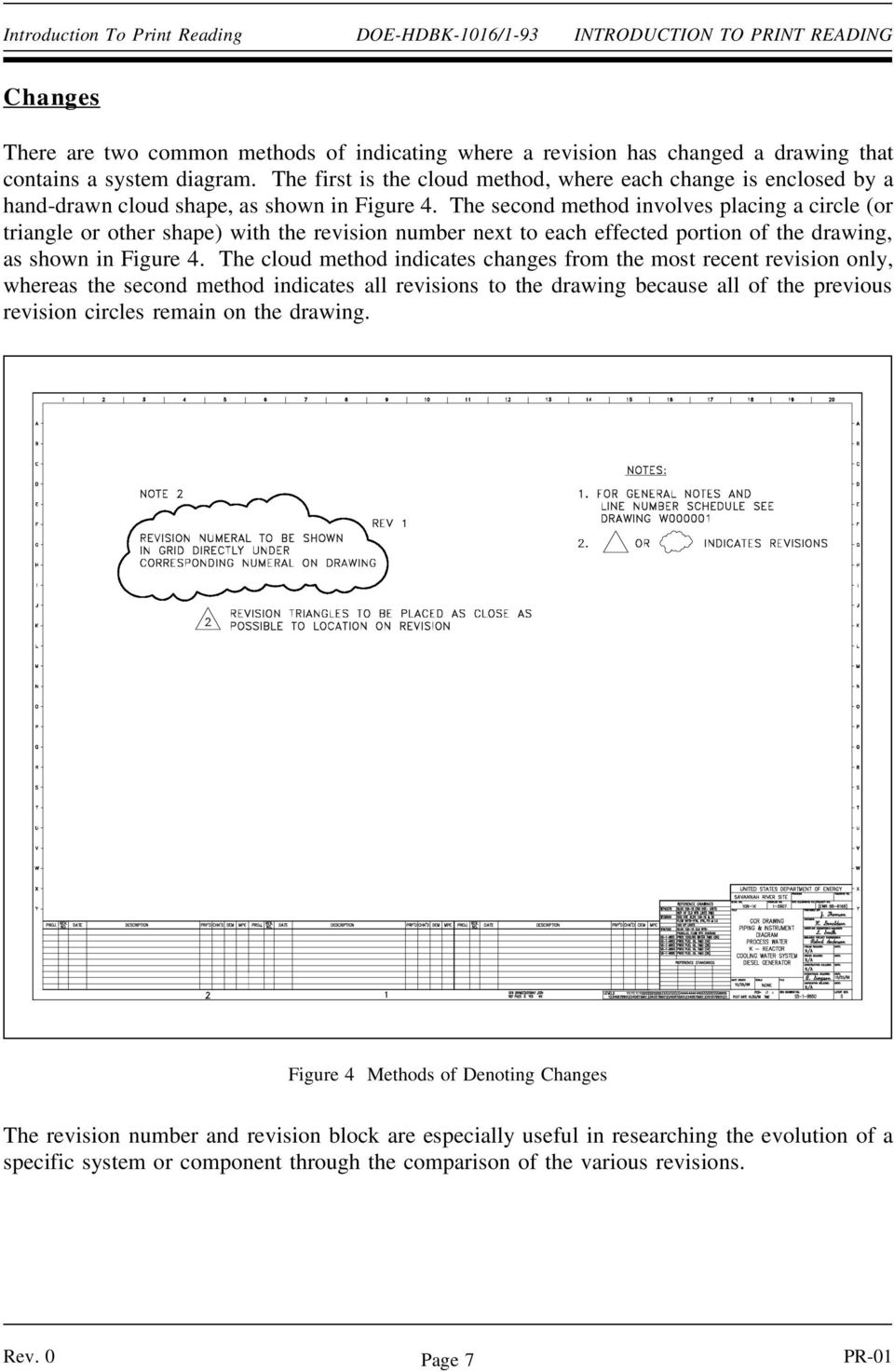
12 Introduction To Print Reading DOE-HDBK-1016/1-93 INTRODUCTION TO PRINT READING Changes There are two common methods of indicating where a revision has changed a drawing that contains a system diagram. The first is the cloud method, where each change is enclosed by a hand-drawn cloud shape, as shown in Figure 4. The second method involves placing a circle (or triangle or other shape) with the revision number next to each effected portion of the drawing, as shown in Figure 4. The cloud method indicates changes from the most recent revision only, whereas the second method indicates all revisions to the drawing because all of the previous revision circles remain on the drawing. Figure 4 Methods of Denoting Changes The revision number and revision block are especially useful in researching the evolution of a specific system or component through the comparison of the various revisions. Rev. 0 Page 7 PR-01
13 INTRODUCTION TO PRINT READING DOE-HDBK-1016/1-93 Introduction To Print Reading Notes and Legend Drawings are comprised of symbols and lines that represent components or systems. Although a majority of the symbols and lines are self-explanatory or standard (as described in later modules), a few unique symbols and conventions must be explained for each drawing. The notes and legends section of a drawing lists and explains any special symbols and conventions used on the drawing, as illustrated on Figure 5. Also listed in the notes section is any information the designer or draftsman felt was necessary to correctly use or understand the drawing. Because of the importance of understanding all of the symbols and conventions used on a drawing, the notes and legend section must be reviewed before reading a drawing. Figure 5 Notes and Legends PR-01 Rev. 0 Page 8

14 Introduction To Print Reading DOE-HDBK-1016/1-93 INTRODUCTION TO PRINT READING Summary The important information in this chapter is summarized below. Introduction to Print Reading Summary The title block of a drawing contains: the drawing title the drawing number location, site, or vendor issuing the drawing the design, review, and approval signatures the reference block The grid system of a drawing allows information to be more easily identified using the coordinates provided by the grid. The coordinate letters and/or numbers break down the drawing into smaller blocks. The revision block of a drawing provides the revision number, a title or summary of the revision, and the date of the revision, for each revision. The notes and legend section of a drawing provides explanations of special symbols or conventions used on the drawing and any additional information the designer or draftsman felt was necessary to understand the drawing. Rev. 0 Page 9 PR-01

15 INTRODUCTION TO THE TYPES DOE-HDBK-1016/1-93 Introduction To Print Reading OF DRAWINGS, VIEWS, AND PERSPECTIVES INTRODUCTION TO THE TYPES OF DRAWINGS, VIEWS, AND PERSPECTIVES To read a drawing correctly, the user must have a basic understanding of the various categories of drawings and the views and perspectives in which each drawing can be presented. EO 1.5 LIST the five drawing categories used on engineering drawings. Categories of Drawings The previous chapter reviewed the non-drawing portions of a print. This chapter will introduce the five common categories of drawings. They are 1) piping and instrument drawings (P&IDs), 2) electrical single lines and schematics, 3) electronic diagrams and schematics, 4) logic diagrams and prints, and 5) fabrication, construction, and architectural drawings. Piping and Instrument Drawings (P&IDs) P&IDs are usually designed to present functional information about a system or component. Examples are piping layout, flowpaths, pumps, valves, instruments, signal modifiers, and controllers, as illustrated in Figure 6. Figure 6 Example P&ID PR-01 Rev. 0 Page 10

16 Introduction To Print Reading DOE-HDBK-1016/1-93 INTRODUCTION TO THE TYPES OF DRAWINGS, VIEWS, AND PERSPECTIVES As a rule P&IDs do not have a drawing scale and present only the relationship or sequence between components. Just because two pieces of equipment are drawn next to each other does not indicate that in the plant the equipment is even in the same building; it is just the next part or piece of the system. These drawings only present information on how a system functions, not the actual physical relationships. Because P&IDs provide the most concise format for how a system should function, they are used extensively in the operation, repair, and modification of the plant. Electrical Single Lines and Schematics Electrical single lines and schematics are designed to present functional information about the electrical design of a system or component. They provide the same types of information about electrical systems that P&IDs provide for piping and instrument systems. Like P&IDs, electrical prints are not usually drawn to scale. Examples of typical single lines are site or building power distribution, system power distribution, and motor control centers. Figure 7 is an example of an electrical single line. Electrical schematics provide a more detailed level of information about an electrical system or component than the single lines. Electrical Figure 7 Example of a Single Line schematic drawings present information such as the individual relays, relay contacts, fuses, motors, lights, and instrument sensors. Examples of typical schematics are valve actuating circuits, motor start circuits, and breaker circuits. Rev. 0 Page 11 PR-01

17 INTRODUCTION TO THE TYPES DOE-HDBK-1016/1-93 Introduction to Print Reading OF DRAWINGS, VIEWS, AND PERSPECTIVES Figure 8 is an example of a motor start circuit schematic. Electrical single lines and schematics provide the most concise format for depicting how electrical systems should function, and are used extensively in the operation, repair, and modification of the plant. Figure 8 Example of a Schematic PR-01 Rev. 0 Page 12

18 Introduction to Print Reading DOE-HDBK-1016/1-93 INTRODUCTION TO THE TYPES OF DRAWINGS, VIEWS, AND PERSPECTIVES Electronic Diagrams and Schematics Electronic diagrams and schematics are designed to present information about the individual components (resistors, transistors, and capacitors) used in a circuit, as illustrated in Figure 9. These drawings are usually used by circuit designers and electronics repair personnel. Figure 9 Example of an Electronic Diagram Rev. 0 Page 13 PR-01

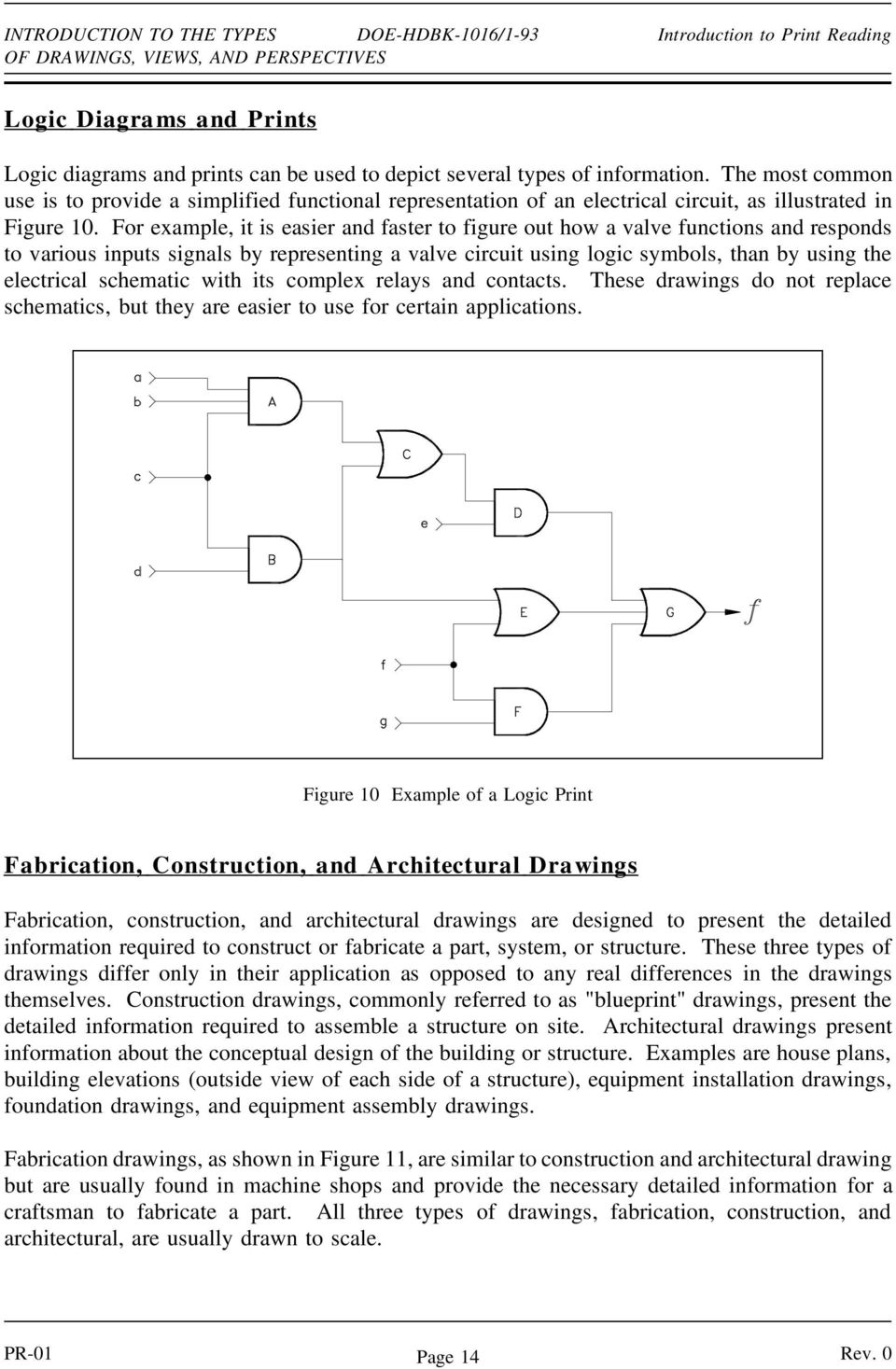
19 INTRODUCTION TO THE TYPES DOE-HDBK-1016/1-93 Introduction to Print Reading OF DRAWINGS, VIEWS, AND PERSPECTIVES Logic Diagrams and Prints Logic diagrams and prints can be used to depict several types of information. The most common use is to provide a simplified functional representation of an electrical circuit, as illustrated in Figure 10. For example, it is easier and faster to figure out how a valve functions and responds to various inputs signals by representing a valve circuit using logic symbols, than by using the electrical schematic with its complex relays and contacts. These drawings do not replace schematics, but they are easier to use for certain applications. Figure 10 Example of a Logic Print Fabrication, Construction, and Architectural Drawings Fabrication, construction, and architectural drawings are designed to present the detailed information required to construct or fabricate a part, system, or structure. These three types of drawings differ only in their application as opposed to any real differences in the drawings themselves. Construction drawings, commonly referred to as "blueprint" drawings, present the detailed information required to assemble a structure on site. Architectural drawings present information about the conceptual design of the building or structure. Examples are house plans, building elevations (outside view of each side of a structure), equipment installation drawings, foundation drawings, and equipment assembly drawings. Fabrication drawings, as shown in Figure 11, are similar to construction and architectural drawing but are usually found in machine shops and provide the necessary detailed information for a craftsman to fabricate a part. All three types of drawings, fabrication, construction, and architectural, are usually drawn to scale. PR-01 Rev. 0 Page 14
20 Introduction to Print Reading DOE-HDBK-1016/1-93 INTRODUCTION TO THE TYPES OF DRAWINGS, VIEWS, AND PERSPECTIVES Figure 11 Example of a Fabrication Drawing Rev. 0 Page 15 PR-01

21 INTRODUCTION TO THE TYPES DOE-HDBK-1016/1-93 Introduction to Print Reading OF DRAWINGS, VIEWS, AND PERSPECTIVES Drawing Format P&IDs, fabrication, construction, and architectural drawings can be presented using one of several different formats. The standard formats are single line, pictorial or double line, and cutaway. Each format provides specific information about a component or system. Single Line Drawings The single line format is most commonly used in P&IDs. Figure 12 is an example of a single line P&ID. The single line format represents all piping, regardless of size, as single line. All system equipment is represented by simple standard symbols (covered in later modules). By simplifying piping and equipment, single lines allow the system's equipment and instrumentation relationships to be clearly understood by the reader. Figure 12 Example of a Single Line P&ID Pictorial or Double Line Drawings Pictorial or double line drawings present the same type information as a single line, but the equipment is represented as if it had been photographed. Figure 13 provides an example illustration of a pictorial drawing. This format is rarely used since it requires much more effort to produce than a single line drawing and does not present any more information as to how the system functions. Compare the pictorial illustration, Figure 13, to the single line of the same system shown in Figure 12. Pictorial or double line drawings are often used in advertising and training material. PR-01 Rev. 0 Page 16
22 Introduction To Print Reading DOE-HDBK-1O16/1-93 INTRODUCTION TO THE TYPES OF DRAWINGS, VIEWS, AND PERSPECTIVES Assembly Drawings Figure 13 Example Pictorial Assembly drawing are a special application of pictorial drawings that are common in the engineering field. As seen in Figure 14, an assembly drawing is a pictorial view of the object with all the components shown as they go together. This type pictorial is usually found in vendor manuals and is used for parts identification and general information relative to the assembly of the component. Figure 14 Example of an Assembly Drawing Rev. 0 Page 17 PR-01
23 INTRODUCTION TO THE TYPES DOE-HDBK1016/1-93 Introduction To Print Reading OF DRAWINGS, VIEWS, AND PERSPECTIVES Cutaway Drawings A cutaway drawing is another special type of pictorial drawing. In a cutaway, as the name implies, the component or system has a portion cut away to reveal the internal parts of the component or system. Figure 15 is an illustration of a cutaway. This type of drawing is extremely helpful in the maintenance and training areas where the way internal parts are assembled is important. Figure 15 Example of a Cutaway PR-01 Page 18 Rev. 0
24 Introduction To Print Reading DOE-HDBK-1016/1-93 INTRODUCTION TO THE TYPES OF DRAWINGS, VIEWS, AND PERSPECTIVES Views and Perspectives In addition to the different drawing formats, there are different views or perspectives in which the formats can be drawn. The most commonly used are the orthographic projection and the isometric projection. Orthographic Projections Orthographic projection is widely used for fabrication and construction type drawings, as shown in Figure 16. Orthographic projections present the component or system through the use of three views, These are a top view, a side view, and a front view. Other views, such as a bottom view, are used to more fully depict the component or system when necessary. Figure 16 Example Orthographic Projection PR-01 Rev. 0 Page 19 PR-01
25 INTRODUCTION TO THE TYPES DOE-HDBK-1016/1-93 Introduction To Print Reading OF DRAWINGS, VIEWS, AND PERSPECTIVES Figure 17 shows how each of the three views is obtained. The orthographic projection is typically drawn to scale and shows all components in their proper relationships to each other. The three views, when provided with dimensions and a drawing scale, contain information that is necessary to fabricate or construct the component or system. Figure 17 Orthographic Projections PR-01 Rev. 0 Page 20
26 Introduction To Print Reading DOE-HDBK-1016/1-93 INTRODUCTION TO THE TYPES OF DRAWINGS, VIEWS, AND PERSPECTIVES Isometric Projection The isometric projection presents a single view of the component or system. The view is commonly from above and at an angle of 30. This provides a more realistic threedimensional view. As shown on Figure 18, this view makes it easier to see how the system looks and how its various portions or parts are related to one another. Isometric projections may or may not be drawn to a scale. Figure 18 Example of an Isometric Rev. 0 Page 21 PR-01
27 INTRODUCTION TO THE TYPES DOE-HDBK-1016/1-93 Introduction To Print Reading OF DRAWINGS, VIEWS, AND PERSPECTIVES Summary The important information in this chapter is summarized below. Drawing Types, Views, and Perspectives Summary The five engineering drawing categories are: P&IDs Electrical single lines and schematics Electronic diagrams and schematics Logic diagrams and prints Fabrication, construction, and architectural drawings PR-01 Rev. 0 Page 22
28 ENGINEERING SYMBOLOGY, PRINTS, AND DRAWINGS Module 2 Engineering Fluid Diagrams and Prints
29 Engineering Fluid Diagrams and Prints DOE-HDBK-1016/1-93 TABLE OF CONTENTS TABLE OF CONTENTS LIST OF FIGURES... iii LIST OF TABLES... v REFERENCES... vi OBJECTIVES... vii ENGINEERING FLUIDS DIAGRAMS AND PRINTS... 1 Symbology... 2 Valve Symbols... 3 Valve Actuators... 4 Control Valve Designations... 6 Piping Systems... 7 Instrumentation... 8 Sensing Devices and Detectors Modifiers and Transmitters Indicators and Recorders Controllers Examples of Simple Instrument Loops Components Miscellaneous P&ID Symbols Summary READING ENGINEERING P&IDs Standards and Conventions for Valve Status Summary P&ID PRINT READING EXAMPLE Example Summary Rev. 0 Page i PR-02
30 TABLE OF CONTENTS DOE-HDBK-1016/1-93 Engineering Fluid Diagrams and Prints TABLE OF CONTENTS FLUID POWER P&IDs Fluid Power Diagrams and Schematics Pumps Reservoirs Actuator Piping Valves Reading Fluid Power Diagrams Types of Fluid Power Diagrams Summary PR-02 Page ii Rev. 0
31 Engineering Fluid Diagrams and Prints DOE-HDBK-1016/1-93 LIST OF FIGURES LIST OF FIGURES Figure 1 Valve Symbols...3 Figure 2 Valve Actuator Symbols...4 Figure 3 Remotely Controlled Valve...4 Figure 4 Level Control Valve...5 Figure 5 Control Valves with Valve Positioners...6 Figure 6 Control Valve Designations...6 Figure 7 Piping Symbols...7 Figure 8 More Piping Symbols...8 Figure 9 Detector and Sensing Device Symbols Figure 10 Transmitters and Instruments Figure 11 Indicators and Recorders Figure 12 Controllers Figure 13 Signal Conditioners Figure 14 Instrumentation System Examples Figure 15 Symbols for Major Components Figure 16 Miscellaneous Symbols Figure 17 Valve Status Symbols Figure 18 Exercise P&ID Figure 19 Fluid Power Pump and Compressor Symbols Figure 20 Fluid Power Reservoir Symbols Figure 21 Symbols for Linear Actuators Rev. 0 Page iii PR-02
32 LIST OF FIGURES DOE-HDBK-1016/1-93 Engineering Fluid Diagrams and Prints LIST OF FIGURES (Cont.) Figure 22 Symbols for Rotary Actuators Figure 23 Fluid Power Line Symbols Figure 24 Valve Operation Figure 25 Valve Symbol Development Figure 26 Fluid Power Valve Symbols Figure 27 Simple Hydraulic Power System Figure 28 Line Diagram of Figure Figure 29 Typical Fluid Power Diagram Figure 30 Pictorial Fluid Power Diagram Figure 31 Cutaway Fluid Power Diagram Figure 32 Schematic Fluid Power Diagram PR-02 Page iv Rev. 0
33 Engineering Fluid Diagrams and Prints DOE-HDBK-1016/1-93 OBJECTIVES TERMINAL OBJECTIVE 1.0 Given an engineering print, READ and INTERPRET facility engineering Piping and Instrument Drawings. ENABLING OBJECTIVES 1.1 IDENTIFY the symbols used on engineering P&IDs for the following types of valves: a. Globe valve g. Relief valve b. Gate valve h. Rupture disk c. Ball valve i. Three-way valve d. Check valve j. Four-way valve e. Stop check valve k. Throttle (needle) valve f. Butterfly valve l. Pressure regulator 1.2 IDENTIFY the symbols used on engineering P&IDs for the following types of valve operators: a. Diaphragm valve operator b. Motor valve operator c. Solenoid valve operator d. Piston (hydraulic) valve operator e. Hand (manual) valve operator f. Reach-rod valve operator 1.3 IDENTIFY the symbols used on engineering P&IDs for educators and ejectors. 1.4 IDENTIFY the symbols used on engineering P&IDs for the following lines: a. Process b. Pneumatic c. Hydraulic d. Inert gas e. Instrument signal (electrical) f. Instrument capillary g. Electrical Rev. 0 Page vii PR-02
34 OBJECTIVES DOE-HDBK-1016/1-93 Engineering Fluid Diagrams and Prints ENABLING OBJECTIVES (cont.) 1.5 IDENTIFY the symbols used on engineering P&IDs for the following basic types of instrumentation: a. Differential pressure cell b. Temperature element c. Venturi d. Orifice e. Rotometer f. Conductivity or salinity cell g. Radiation detector 1.6 IDENTIFY the symbols used on engineering P&IDs to denote the location, either local or board mounted, of instruments, indicators, and controllers. 1.7 IDENTIFY the symbols used on engineering P&IDs for the following types of instrument signal controllers and modifiers: a. Proportional b. Proportional-integral c. Proportional-integral-differential d. Square root extractors 1.8 IDENTIFY the symbols used on engineering P&IDs for the following types of system components: a. Centrifugal pumps b. Positive displacement pumps c. Heat exchangers d. Compressors e. Fans f. Tanks g. Filters/strainers PR-02 Page viii Rev. 0
35 Engineering Fluid Diagrams and Prints DOE-HDBK-1016/1-93 OBJECTIVES ENABLING OBJECTIVES (cont.) 1.9 STATE how the following valve conditions are depicted on an engineering P&ID: a. Open valve b. Closed valve c. Throttled valve d. Combination valves (3- or 4-way valve) e. Locked-closed valve f. Locked-open valve g. Fail-open valve h. Fail-closed valve i. Fail-as-is valve 1.10 Given an engineering P&ID, IDENTIFY components and DETERMINE the flowpath(s) for a given valve lineup IDENTIFY the symbols used on engineering fluid power drawings for the following components: a. Pump b. Compressor c. Reservoir d. Actuators e. Piping and piping junctions f. Valves 1.12 Given a fluid power type drawing, DETERMINE the operation or resultant action of the stated component when hydraulic pressure is applied/removed. Rev. 0 Page ix PR-02
36 Engineering Fluid Diagrams and Prints DOE-HDBK-1016/1-93 ENGINEERING FLUIDS DIAGRAMS AND PRINTS ENGINEERING FLUIDS DIAGRAMS AND PRINTS To read and understand engineering fluid diagrams and prints, usually referred to as P&IDs, an individual must be familiar with the basic symbols. EO 1.1 IDENTIFY the symbols used on engineering P&IDs for the following types of valves: a. Globe valve g. Relief valve b. Gate valve h. Rupture disk c. Ball valve i. Three-way valve d. Check valve j. Four-way valve e. Stop check valve k. Throttle (needle) valve f. Butterfly valve l. Pressure regulator EO 1.2 IDENTIFY the symbols used on engineering P&IDs for the following types of valve operators: a. Diaphragm valve operator b. Motor valve operator c. Solenoid valve operator d. Piston (hydraulic) valve operator e. Hand (manual) valve operator f. Reach rod valve operator EO 1.3 EO 1.4 IDENTIFY the symbols used on engineering P&IDs for educators and ejectors. IDENTIFY the symbols used on engineering P&IDs for the following lines: a. Process b. Pneumatic c. Hydraulic d. Inert gas e. Instrument signal (electrical) f. Instrument capillary g. Electrical Rev. 0 Page 1 PR-02
37 DOE-HDBK-1016/1-93 ENGINEERING FLUIDS DIAGRAMS AND PRINTS Engineering Fluid Diagrams and Prints EO 1.5 IDENTIFY the symbols used on engineering P&IDs for the following basic types of instrumentation: a. Differential pressure cell b. Temperature element c. Venturi d. Orifice e. Rotometer f. Conductivity or salinity cell g. Radiation detector EO 1.6 EO 1.7 IDENTIFY the symbols used on engineering P&IDs to denote the location, either local or board mounted, of instruments, indicators, and controllers. IDENTIFY the symbols used on engineering P&IDs for the following types of instrument signal modifiers: a. Proportional b. Proportional-integral c. Proportional-integral-differential d. Square root extractors EO 1.8 IDENTIFY the symbols used on engineering P&IDs for the following types of system components: a. Centrifugal pumps b. Positive displacement pumps c. Heat exchangers d. Compressors e. Fans f. Tanks g. Filters/strainers Symbology To read and interpret piping and instrument drawings (P&IDs), the reader must learn the meaning of the symbols. This chapter discusses the common symbols that are used to depict fluid system components. When the symbology is mastered, the reader will be able to interpret most P&IDs. The reader should note that this chapter is only representative of fluid system symbology, rather than being all-inclusive. The symbols presented herein are those most commonly used in engineering P&IDs. The reader may expand his or her knowledge by obtaining and studying the appropriate drafting standards used at his or her facility. PR-02 Rev. 0 Page 2
38 Engineering Fluid Diagrams and Prints DOE-HDBK-1016/1-93 ENGINEERING FLUIDS DIAGRAMS AND PRINTS Valve Symbols Valves are used to control the direction, flow rate, and pressure of fluids. Figure 1 shows the symbols that depict the major valve types. It shoud be noted that globe and gate valves will often be depicted by the same valve symbol. In such cases, information concerning the valve type may be conveyed by the component identification number or by the notes and legend section of the drawing; however, in many instances even that may not hold true. Figure 1 Valve Symbols Rev. 0 Page 3 PR-02
39 DOE-HDBK-1016/1-93 ENGINEERING FLUIDS DIAGRAMS AND PRINTS Engineering Fluid Diagrams and Prints Valve Actuators Some valves are provided with actuators to allow remote operation, to increase mechanical advantage, or both. Figure 2 shows the symbols for the common valve actuators. Note that although each is shown attached to a gate valve, an actuator can be attached to any type of valve body. If no actuator is shown on a valve symbol, it may be assumed the valve is equipped only with a handwheel for manual operation. Figure 2 Valve Actuator Symbols The combination of a valve and an actuator is commonly called a control valve. Control valves are symbolized by combining the appropriate valve symbol and actuator symbol, as illustrated in Figure 2. Control valves can be configured in many different ways. The most commonly found configurations are to manually control the actuator from a remote operating station, to automatically control the actuator from an instrument, or both. In many cases, remote control of a valve is accomplished by using an intermediate, small control valve to operate the actuator of the process control valve. The intermediate control valve is placed in the line supplying motive force to the process control valve, as shown in Figure 3. In this example, air to the process air-operated control valve is controlled by the solenoid-operated, 3-way valve in the air supply line. The 3-way valve may supply air to the control valve's diaphragm or vent the diaphragm to the atmosphere. Figure 3 Remotely Controlled Valve PR-02 Rev. 0 Page 4
40 Engineering Fluid Diagrams and Prints DOE-HDBK-1016/1-93 ENGINEERING FLUIDS DIAGRAMS AND PRINTS Note that the symbols alone in Figure 3 do not provide the reader with enough information to determine whether applying air pressure to the diaphragm opens or closes the process control valve, or whether energizing the solenoid pressurizes or vents the diaphragm. Further, Figure 3 is incomplete in that it does not show the electrical portion of the valve control system nor does it identify the source of the motive force (compressed air). Although Figure 3 informs the reader of the types of mechanical components in the control system and how they interconnect, it does not provide enough information to determine how those components react to a control signal. Control valves operated by an instrument signal are symbolized in the same manner as those shown previously, except the output of the controlling instrument goes to the valve actuator. Figure 4 shows a level instrument (designated "LC") that controls the level in the tank by positioning an air-operated diaphragm control valve. Again, note that Figure 4 does not contain enough information to enable the reader to determine how the control valve responds to a change in level. Figure 4 Level Control Valve An additional aspect of some control valves is a valve positioner, which allows more precise control of the valve. This is especially useful when instrument signals are used to control the valve. An example of a valve positioner is a set of limit switches operated by the motion of the valve. A positioner is symbolized by a square box on the stem of the control valve actuator. The positioner may have lines attached for motive force, instrument signals, or both. Figure 5 shows two examples of valves equipped with positioners. Note that, although these examples are more detailed than those of Figure 3 and Figure 4, the reader still does not have sufficient information to fully determine response of the control valve to a change in control signal. Rev. 0 Page 5 PR-02
41 DOE-HDBK-1016/1-93 ENGINEERING FLUIDS DIAGRAMS AND PRINTS Engineering Fluid Diagrams and Prints Figure 5 Control Valves with Valve Positioners In Example A of Figure 5, the reader can reasonably assume that opening of the control valve is in some way proportional to the level it controls and that the solenoid valve provides an override of the automatic control signals. However, the reader cannot ascertain whether it opens or closes the control valve. Also, the reader cannot determine in which direction the valve moves in response to a change in the control parameter. In Example B of Figure 5, the reader can make the same general assumptions as in Example A, except the control signal is unknown. Without additional information, the reader can only assume the air supply provides both the control signal and motive force for positioning the control valve. Even when valves are equipped with positioners, the positioner symbol may appear only on detailed system diagrams. Larger, overall system diagrams usually do not show this much detail and may only show the examples of Figure 5 as air-operated valves with no special features. Control Valve Designations A control valve may serve any number of functions within a fluid system. To differentiate between valve uses, a balloon labeling system is used to identify the function of a control valve, as shown in Figure 6. The common convention is that the first letter used in the valve designator indicates the parameter to be controlled by the valve. For example: F = flow T = temperature L = level P = pressure H = hand (manually operated valve) The second letter is usually a "C" and identifies the valve as a controller, or active component, as opposed to a hand-operated valve. The third letter is a "V" to indicate that the piece of equipment is a valve. Figure 6 Control Valve Designations PR-02 Rev. 0 Page 6
42 Engineering Fluid Diagrams and Prints DOE-HDBK-1016/1-93 ENGINEERING FLUIDS DIAGRAMS AND PRINTS Piping Systems The piping of a single system may contain more than a single medium. For example, although the main process flow line may carry water, the associated auxiliary piping may carry compressed air, inert gas, or hydraulic fluid. Also, a fluid system diagram may also depict instrument signals and electrical wires as well as piping. Figure 7 shows commonly used symbols for indicating the medium carried by the piping and for differentiating between piping, instrumentation signals, and electrical wires. Note that, although the auxiliary piping symbols identify their mediums, the symbol for the process flow line does not identify its medium. Figure 7 Piping Symbols Rev. 0 Page 7 PR-02
43 DOE-HDBK-1016/1-93 ENGINEERING FLUIDS DIAGRAMS AND PRINTS Engineering Fluid Diagrams and Prints The diagram may also depict the individual fittings comprising the piping runs depending on its intended use. Figure 8 shows symbols used to depict pipe fittings. Instrumentation One of the main purposes of a P&ID is to provide functional information about how instrumentation in a system or piece of equipment interfaces with the system or piece of equipment. Because of this, a large amount of the symbology appearing on P&IDs depicts instrumentation and instrument loops. The symbols used to represent instruments and their loops can Figure 8 More Piping Symbols be divided into four categories. Generally each of these four categories uses the component identifying (labeling) scheme identified in Table 1. The first column of Table 1 lists the letters used to identify the parameter being sensed or monitored by the loop or instrument. The second column lists the letters used to indicate the type of indicator or controller. The third column lists the letters used to indicate the type of component. The fourth column lists the letters used to indicate the type of signals that are being modified by a modifier. PR-02 Rev. 0 Page 8
44 Engineering Fluid Diagrams and Prints DOE-HDBK-1016/1-93 ENGINEERING FLUIDS DIAGRAMS AND PRINTS TABLE 1 Instrument Identifiers Sensed Parameter Type of Indicator or Controller Type of Component Type of signal F = flow T = temperature P = pressure I = current L = level V = voltage Z = position R = recorder I = indicator C = controller T = transmitter M = modifier E = element I V P = current = voltage = pneumatic The first three columns above are combined such that the resulting instrument identifier indicates its sensed parameter, the function of the instrument, and the type of instrument. The fourth column is used only in the case of an instrument modifier and is used to indicate the types of signals being modified. The following is a list of example instrument identifiers constructed from Table 1. FIC = flow indicating controller FM = flow modifier PM = pressure modifier TE = temperature element TR = temperature recorder LIC = level indicating controller TT PT FE FI TI FC = temperature transmitter = pressure transmitter = flow element = flow indicator = temperature indicator = flow controller Rev. 0 Page 9 PR-02
45 DOE-HDBK-1016/1-93 ENGINEERING FLUIDS DIAGRAMS AND PRINTS Engineering Fluid Diagrams and Prints Sensing Devices and Detectors The parameters of any system are monitored for indication, control, or both. To create a usable signal, a device must be inserted into the system to detect the desired parameter. In some cases, a device is used to create special conditions so that another device can supply the necessary measurement. Figure 9 shows the symbols used for the various sensors and detectors. Figure 9 Detector and Sensing Device Symbols PR-02 Rev. 0 Page 10
46 Engineering Fluid Diagrams and Prints DOE-HDBK-1016/1-93 ENGINEERING FLUIDS DIAGRAMS AND PRINTS Modifiers and Transmitters Sensors and detectors by themselves are not sufficient to create usable system indications. Each sensor or detector must be coupled with appropriate modifiers and/or transmitters. The exceptions are certain types of local instrumentation having mechanical readouts, such as bourdon tube pressure gages and bimetallic thermometers. Figure 10 illustrates various examples of modifiers and transmitters. Figure 10 also illustrates the common notations used to indicate the location of an instrument, i.e., local or board mounted. Transmitters are used to convert the signal from a sensor or detector to a form that can be sent to a remote point for processing, controlling, or monitoring. The output can be electronic (voltage or current), pneumatic, or hydraulic. Figure 10 illustrates symbols for several specific types of transmitters. The reader should note that modifiers may only be identified by the type of input and output signal (such as I/P for one that converts an electrical input to a pneumatic output) rather than by the monitored parameter (such as PM for pressure modifier). Figure 10 Transmitters and Instruments Rev. 0 Page 11 PR-02
47 DOE-HDBK-1016/1-93 ENGINEERING FLUIDS DIAGRAMS AND PRINTS Engineering Fluid Diagrams and Prints Indicators and Recorders Indicators and recorders are instruments that convert the signal generated by an instrument loop into a readable form. The indicator or recorder may be locally or board mounted, and like modifiers and transmitters this information is indicated by the type of symbol used. Figure 11 provides examples of the symbols used for indicators and recorders and how their location is denoted. Controllers Controllers process the signal from an instrument loop and use it to position or manipulate some other system component. Generally they are denoted by placing a "C" in the balloon after the controlling parameter as shown in Figure 12. There are controllers that serve to process a signal and create a new signal. These include proportional Figure 11 Indicators and Recorders controllers, proportional-integral controllers, and proportional-integral-differential controllers. The symbols for these controllers are illustrated in Figure 13. Note that these types of controllers are also called signal conditioners. Figure 12 Controllers Figure 13 Signal Conditioners PR-02 Rev. 0 Page 12
48 Engineering Fluid Diagrams and Prints DOE-HDBK-1016/1-93 ENGINEERING FLUIDS DIAGRAMS AND PRINTS Examples of Simple Instrument Loops Figure 14 shows two examples of simple instrument loops. Figure 14 (A) shows a temperature transmitter (TT), which generates two electrical signals. One signal goes to a boardmounted temperature recorder (TR) for display. The second signal is sent to a proportional-integral-derivative (PID) controller, the output of which is sent to a current-to-pneumatic modifier (I/P). In the I/P modifier, the electric signal is converted into a pneumatic signal, commonly 3 psi to 15 psi, which in turn operates the valve. The function of the complete loop is to modify flow based on process fluid temperature. Note that there is not enough information to determine how flow and temperature are related and what the setpoint is, but in some instances the setpoint is stated on a P&ID. Knowing the setpoint and purpose of the system will usually be sufficient to allow the operation of the instrument loop to be determined. Figure 14 Instrumentation System Examples The pneumatic level transmitter (LT) illustrated in Figure 14 (B) senses tank level. The output of the level transmitter is pneumatic and is routed to a board-mounted level modifier (LM). The level modifier conditions the signal (possibly boosts or mathematically modifies the signal) and uses the modified signal for two purposes. The modifier drives a board-mounted recorder (LR) for indication, and it sends a modified pneumatic signal to the diaphragm-operated level control valve. Notice that insufficient information exists to determine the relationship between sensed tank level and valve operation. Components Within every fluid system there are major components such as pumps, tanks, heat exchangers, and fans. Figure 15 shows the engineering symbols for the most common major components. Rev. 0 Page 13 PR-02
49 DOE-HDBK-1016/1-93 ENGINEERING FLUIDS DIAGRAMS AND PRINTS Engineering Fluid Diagrams and Prints Figure 15 Symbols for Major Components PR-02 Rev. 0 Page 14
50 Engineering Fluid Diagrams and Prints DOE-HDBK-1016/1-93 ENGINEERING FLUIDS DIAGRAMS AND PRINTS Miscellaneous P&ID Symbols In addition to the normal symbols used on P&IDs to represent specific pieces of equipment, there are miscellaneous symbols that are used to guide or provide additional information about the drawing. Figure 16 lists and explains four of the more common miscellaneous symbols. Figure 16 Miscellaneous Symbols Summary The important information in this chapter is summarized below. Engineering Fluids Diagrams and Prints Summary In this chapter the common symbols found on P&IDs for valves, valve operators, process piping, instrumentation, and common system components were reviewed. Rev. 0 Page 15 PR-02
51 READING ENGINEERING P&IDs DOE-HDBK-1016/1-93 Engineering Fluid Diagrams and Prints READING ENGINEERING P&IDs Standards and conventions have been developed to provide consistency from drawing to drawing. To accurately interpret a drawing, these standards and conventions must be understood. EO 1.9 STATE how the following valve conditions are depicted on an engineering P&ID drawing: a. Open valve b. Closed valve c. Throttled valve d. Combination valves (3- or 4- way valve) e. Locked-closed valve f. Locked-open valve g. Fail-open valves h. Fail-closed valve i. Fail-as-is valve Standards and Conventions for Valve Status Before a diagram or print can be properly read and understood, the basic conventions used by P&IDs to denote valve positions and failure modes must be understood. The reader must be able to determine the valve position, know if this position is normal, know how the valve will fail, and in some cases know if the valve is normally locked in that position. Figure 17 illustrates the symbols used to indicate valve status. Unless otherwise stated, P&IDs indicate valves in their "normal" position. This is usually interpreted as the normal or primary flowpath for the system. An exception is safety systems, which are normally shown in their standby or non-accident condition. Figure 17 Valve Status Symbols 3-way valves are sometimes drawn in the position that they will fail to instead of always being drawn in their "normal" position. This will either be defined as the standard by the system of drawings or noted in some manner on the individual drawings. PR-02 Rev. 0 Page 16
52 Engineering Fluid Diagrams and Prints DOE-HDBK-1016/1-93 READING ENGINEERING P&IDs Summary The important information in this chapter is summarized below. Reading Engineering P&IDs Summary This chapter reviewed the basic symbology, common standards, and conventions used on P&IDs, such as valve conditions and modes of failure. This information, with the symbology learned in the preceding chapter, provides the information necessary to read and interpret most P&IDs. Rev. 0 Page 17 PR-02
53 P&ID PRINT READING EXAMPLE DOE-HDBK-1016/1-93 Engineering Fluid Diagrams and Prints P&ID PRINT READING EXAMPLE The ability to read and understand prints is achieved through the repetitive reading of prints. EO 1.10 Given an engineering P&ID, IDENTIFY components and DETERMINE the flowpath(s) for a given valve lineup. Example At this point, all the symbols for valves and major components have been presented, as have the conventions for identifying the condition of a system. Refer to Figure 18 as necessary to answer the following questions. The answers are provided in the back of this section so that you may judge your own knowledge level. PR-02 Page 18 Rev.0
54 Engineering Fluid Diagrams and Prints DOE-HDBK-1016/1-93 P&ID PRINT READING EXAMPLE Figure 18 Exercise P&ID Rev. 0 Page 19 PR-02
55 P&ID PRINT READING EXAMPLE DOE-HDBK-1016/1-93 Engineering Fluid Diagrams and Prints 1. Identify the following components by letter or number. a. Centrifugal pump b. Heat exchanger c. Tank d. Venturi e. Rupture disc f. Relief valve g. Motor-operated valve h. Air-operated valve i. Throttle valve j. Conductivity cell k. Air line l. Current-to-pneumatic converter m. Check valve n. A locked-closed valve o. A closed valve p. A locked-open valve q. A solenoid valve 2. What is the controlling parameter for Valves 10 and 21? 3. Which valves would need to change position in order for Pump B to supply flow to only points G and H? 4. Which valves will fail open? Fail closed? Fail as is? PR-02 Page 20 Rev.0
56 Engineering Fluid Diagrams and Prints DOE-HDBK-1016/1-93 P&ID PRINT READING EXAMPLE Answers for questions on Figure a. A or B b. C or D c. E d. 31 e. 1 f. 8 or 17 g. 2,3,7 or 16 h. 10, 21 i. 12 or 24 j. 26 k. 32 l. 28 m. 5 or 14 n. 18 or 19 o. 18 or 19 p. 4 q. 11 or Temperature as sensed by the temperature elements (TE) 3. Open 18 and/or 19 Shut 13 and Fail Open: 2 and 3 Fail Closed: 10 and 21 Fail as is: 7 and 16 Rev. 0 Page 21 PR-02
57 P&ID PRINT READING EXAMPLE DOE-HDBK-1016/1-93 Engineering Fluid Diagrams and Prints Summary The important information in this chapter is summarized below. P&ID Print Reading Example Summary This chapter provided the student with examples in applying the material learned in Chapters 1 and 2. PR-02 Page 22 Rev.0
58 Engineering Fluid Diagrams and Prints DOE-HDBK-1016/1-93 FLUID POWER P&IDs FLUID POWER P&IDs Fluid power diagrams and schematics require an independent review because they use a unique set of symbols and conventions. EO 1.11 IDENTIFY the symbols used on engineering fluid power drawings for the following components: a. Pump d. Actuators b. Compressor e. Piping and piping junctions c. Reservoir f. Valves EO 1.12 Given a fluid power type drawing, DETERMINE the operation or resultant action of the stated component when hydraulic pressure is applied/removed. Fluid Power Diagrams and Schematics Different symbology is used when dealing with systems that operate with fluid power. Fluid power includes either gas (such as air) or hydraulic (such as water or oil) motive media. Some of the symbols used in fluid power systems are the same or similar to those already discussed, but many are entirely different. Fluid power systems are divided into five basic parts: pumps, reservoirs, actuators, valves, and lines. Pumps In the broad area of fluid power, two categories of pump symbols are used, depending on the motive media being used (i.e., hydraulic or pneumatic). The basic symbol for the pump is a circle containing one or more arrow heads indicating the direction(s) of flow with the points of the arrows in contact with the circle. Hydraulic pumps are shown by solid arrow heads. Pneumatic compressors are represented by hollow arrow heads. Figure 19 provides common symbols used for pumps (hydraulic) and compressors (pneumatic) in fluid power diagrams. Figure 19 Fluid Power Pump and Compressor Symbols Rev. 0 Page 23 PR-02
59 FLUID POWER P&IDs DOE-HDBK-1016/1-93 Engineering Fluid Diagrams and Prints Reservoirs Reservoirs provide a location for storage of the motive media (hydraulic fluid or compressed gas). Although the symbols used to represent reservoirs vary widely, certain conventions are used to indicate how a reservoir handles the fluid. Pneumatic reservoirs are usually simple tanks and their symbology is usually some variation of the cylinder shown in Figure 20. Hydraulic reservoirs can be much more complex in terms of how the fluid is admitted to and removed from the tank. To convey this information, symbology conventions have been developed. These symbols are in Figure 20. Figure 20 Fluid Power Reservoir Symbols Actuator An actuator in a fluid power system is any device that converts the hydraulic or pneumatic pressure into mechanical work. Actuators are classified as linear actuators and rotary actuators. Linear actuators have some form of piston device. Figure 21 illustrates several types of linear actuators and their drawing symbols. PR-02 Rev. 0 Page 24
60 Engineering Fluid Diagrams and Prints DOE-HDBK-1016/1-93 FLUID POWER P&IDs Figure 21 Symbols for Linear Actuators Rotary actuators are generally called motors and may be fixed or variable. Several of the more common rotary symbols are shown in Figure 22. Note the similarity between rotary motor symbols in Figure 22 and the pump symbols shown in Figure 19. The difference between them is that the point of the arrow touches the circle in a pump and the tail of the arrow touches the circle in a motor. Rev. 0 Page 25 PR-02
61 FLUID POWER P&IDs DOE-HDBK-1016/1-93 Engineering Fluid Diagrams and Prints Piping Figure 22 Symbols for Rotary Actuators The sole purpose of piping in a fluid power system is to transport the working media, at pressure, from one point to another. The symbols for the various lines and termination points are shown in Figure 23. Figure 23 Fluid Power Line Symbols PR-02 Rev. 0 Page 26
62 Engineering Fluid Diagrams and Prints DOE-HDBK-1016/1-93 FLUID POWER P&IDs Valves Valves are the most complicated symbols in fluid power systems. Valves provide the control that is required to ensure that the motive media is routed to the correct point when needed. Fluid power system diagrams require much more complex valve symbology than standard P&IDs due to the complicated valving used in fluid power systems. In a typical P&ID, a valve opens, closes, or throttles the process fluid, but is rarely required to route the process fluid in any complex manner (three- and four-way valves being the common exceptions). In fluid power systems it is common for a valve to have three to eight pipes attached to the valve body, with the valve being capable of routing the fluid, or several separate fluids, in any number of combinations of input and output flowpaths. The symbols used to represent fluid power valves must contain much more information than the standard P&ID valve symbology. To meet this need, the valve symbology shown in the following figures was developed for fluid power P&IDs. Figure 24, a cutaway view, provides an example of the internal complexity of a simple fluid power type valve. Figure 24 illustrates a four-way/three-position valve and how it operates to vary the flow of the fluid. Note that in Figure 24 the operator of the valve is not identified, but like a standard process fluid valve the valve could be operated by a diaphragm, motor, hydraulic, solenoid, or manual operator. Fluid power valves, when electrically operated by a solenoid, are drawn in the de-energized position. Energizing the solenoid will cause the valve to shift to the other port. If the valve is operated by other than a solenoid or is a multiport valve, the information necessary to determine how the valve operates will be provided on each drawing or on its accompanying legend print. Figure 24 Valve Operation Rev. 0 Page 27 PR-02
63 FLUID POWER P&IDs DOE-HDBK-1016/1-93 Engineering Fluid Diagrams and Prints Refer to Figure 25 to see how the valve in Figure 24 is transformed into a usable symbol. Figure 25 Valve Symbol Development PR-02 Rev. 0 Page 28
64 Engineering Fluid Diagrams and Prints DOE-HDBK-1016/1-93 FLUID POWER P&IDs Figure 26 shows symbols for the various valve types used in fluid power systems. Figure 26 Fluid Power Valve Symbols Rev. 0 Page 29 PR-02
65 FLUID POWER P&IDs DOE-HDBK-1016/1-93 Engineering Fluid Diagrams and Prints Reading Fluid Power Diagrams Using the symbology previously discussed, a fluid power diagram can now be read. But before reading some complex examples, let's look at a simple hydraulic system and convert it into a fluid power diagram. Using the drawing in Figure 27, the left portion of Figure 28 lists each part and its fluid power symbol. The right side of Figure 28 shows the fluid power diagram that represents the drawing in Figure 27. Figure 27 Simple Hydraulic Power System Figure 28 Line Diagram of Simple Hydraulic Power System PR-02 Rev. 0 Page 30
66 Engineering Fluid Diagrams and Prints DOE-HDBK-1016/1-93 FLUID POWER P&IDs With an understanding of the principles involved in reading fluid power diagram, any diagram can be interpreted. Figure 29 shows the kind of diagram that is likely to be encountered in the engineering field. To read this diagram, a step-by-step interpretation of what is happening in the system will be presented. Figure 29 Typical Fluid Power Diagram The first step is to get an overall view of what is happening. The arrows between A and B in the lower right-hand corner of the figure indicate that the system is designed to press or clamp some type of part between two sections of the machine. Hydraulic systems are often used in press work or other applications where the work piece must be held in place. Rev. 0 Page 31 PR-02
67 FLUID POWER P&IDs DOE-HDBK-1016/1-93 Engineering Fluid Diagrams and Prints With the basic function understood, a detailed study of the diagram can be accomplished using a step-by-step analysis of each numbered local area in the diagram. LOCAL AREA NUMBER 1 Symbol for an open reservoir with a strainer. The strainer is used to clean the oil before it enters the system. LOCAL AREA NUMBER 2 Fixed displacement pump, electrically operated. This pump provides hydraulic pressure to the system. LOCAL AREA NUMBER 3 Symbol for a relief valve with separate pressure gage. The relief valve is spring operated and protects the system from over pressurization. It also acts as an unloader valve to relieve pressure when the cylinder is not in operation. When system pressure exceeds its setpoint, the valve opens and returns the hydraulic fluid back to the reservoir. The gage provides a reading of how much pressure is in the system. LOCAL AREA NUMBER 4 Composite symbol for a 4-way, 2-position valve. Pushbutton PB-1 is used to activate the valve by energizing the S-1 solenoid (note the valve is shown in the de-energized position). As shown, the high pressure hydraulic fluid is being routed from Port 1 to Port 3 and then to the bottom chamber of the piston. This drives and holds the piston in local area #5 in the retracted position. When the piston is fully retracted and hydraulic pressure builds, the unloader (relief) valve will lift and maintain the system's pressure at setpoint. When PB-1 is pushed and S-1 energized, the 1-2 ports are aligned and 3-4 ports are aligned. This allows hydraulic fluid to enter the top chamber of the piston and drive it down. The fluid in the bottom chamber drains though the 3-4 ports back into the reservoir. The piston will continue to travel down until either PB-1 is released or full travel is reached, at which point the unloader (relief) valve will lift. LOCAL AREA NUMBER 5 Actuating cylinder and piston. The cylinder is designed to receive fluid in either the upper or lower chambers. The system is designed so that when pressure is applied to the top chamber, the bottom chamber is aligned to drain back to the reservoir. When pressure is applied to the bottom chamber, the top chamber is aligned so that it drains back to the reservoir. PR-02 Rev. 0 Page 32
68 Engineering Fluid Diagrams and Prints DOE-HDBK-1016/1-93 FLUID POWER P&IDs Types of Fluid Power Diagrams Several kinds of diagrams can be used to show how systems work. With an understanding of how to interpret Figure 29, a reader will be able to interpret all of the diagrams that follow. A pictorial diagram shows the physical arrangement of the elements in a system. The components are outline drawings that show the external shape of each item. Pictorial drawings do not show the internal function of the elements and are not especially valuable for maintenance or troubleshooting. Figure 30 shows a pictorial diagram of a system. Figure 30 Pictorial Fluid Power Diagram A cutaway diagram shows both the physical arrangement and the operation of the different components. It is generally used for instructional purposes because it explains the functions while showing how the system is arranged. Because these diagrams require so much space, they are not usually used for complicated systems. Figure 31 shows the system represented in Figure 30 in cutaway diagram format and illustrates the similarities and differences between the two types of diagrams. Rev. 0 Page 33 PR-02
69 FLUID POWER P&IDs DOE-HDBK-1016/1-93 Engineering Fluid Diagrams and Prints Figure 31 Cutaway Fluid Power Diagram A schematic diagram uses symbols to show the elements in a system. Schematics are designed to supply the functional information of the system. They do not accurately represent the relative location of the components. Schematics are useful in maintenance work, and understanding them is an important part of troubleshooting. Figure 32 is a schematic diagram of the system illustrated in Figure 30 and Figure 31. Figure 32 Schematic Fluid Power Diagram PR-02 Rev. 0 Page 34
70 Engineering Fluid Diagrams and Prints DOE-HDBK-1016/1-93 FLUID POWER P&IDs Summary The important information in this chapter is summarized below. Fluid Power P&IDs Summary This chapter reviewed the most commonly used symbols on fluid power diagrams and the basic standards and conventions for reading and interpreting fluid power diagrams. Rev. 0 Page 35 PR-02
Schematic Symbols Chart (Design Hydraulic and Pneumatic circits)
 Page 1 of 6 (Home) Symbols / Visit us on: Fluid Power, Automation and Motion Control for all Industries About Us Products Services Catalogs Place an Order Training & Information Contact Us Employee Access
Industrial Steam System Process Control Schemes
 Industrial Steam System Process Control Schemes This paper was developed to provide a basic understanding of the different process control schemes used in a typical steam system. This is however a fundamental
www.klmtechgroup.com TABLE OF CONTENT
 Page : 1 of 24 Project Engineering Standard www.klmtechgroup.com KLM Technology #03-12 Block Aronia, Jalan Sri Perkasa 2 Taman Tampoi Utama 81200 Johor Bahru Malaysia S TABLE OF CONTENT SCOPE 2 DEFINITIONS
Introduction to Process Control Actuators
 1 Introduction to Process Control Actuators Actuators are the final elements in a control system. They receive a low power command signal and energy input to amplify the command signal as appropriate to
Basic Symbols. Lines. Circular. Square. Diamond. Miscellaneous Symbols. -continuous line - flow line. -dashed line - pilot, drain
 Airline Hydraulic's Main Page Basic Symbols Lines continuous line flow line dashed line pilot, drain envelope long and short dashes around two or more component symbols. Circular Square Diamond large circle
WHAT YOU DON T KNOW ABOUT ACCUMULATORS CAN KILL YOU!
 WHAT YOU DON T KNOW ABOUT ACCUMULATORS CAN KILL YOU! Atlanta (Monroe) GA 770-267-3787 [email protected] www.gpmhydraulic.com What You Don t Know About Hydraulic Accumulators Can Kill You TABLE OF CONTENTS
A descriptive definition of valve actuators
 A descriptive definition of valve actuators Abstract A valve actuator is any device that utilizes a source of power to operate a valve. This source of power can be a human being working a manual gearbox
The Secret of Hydraulic Schematics. BTPHydraulics www.iranfluidpower.com
 The Secret of Hydraulic Schematics BTPHydraulics www.iranfluidpower.com www.iranfluidpower.com Table of Contents The Secret to Reading and Interpreting Hydraulic Schematics... 1 Hydraulic System Schematics...
Process Analysis and Control P&ID Handout Page 1 P&ID SYMBOLS. ISA Symbols and Loop Diagrams
 Process Analysis and Control P&ID Handout Page 1 P&ID SYMBOLS ISA Symbols and Loop Diagrams Process Analysis and Control P&ID Handout Page 2 P&IDs Piping and Instrumentation Diagrams or simply P&IDs are
Chapter 5. Components, Symbols, and Circuitry of Air-Conditioning Wiring Diagrams
 Chapter 5 Components, Symbols, and Circuitry of Air-Conditioning Wiring Diagrams Objectives Upon completion of this course, you will be able to: Explain what electrical loads are and their general purpose
Unit 24: Applications of Pneumatics and Hydraulics
 Unit 24: Applications of Pneumatics and Hydraulics Unit code: J/601/1496 QCF level: 4 Credit value: 15 OUTCOME 2 TUTORIAL 4 DIRECTIONAL CONTROL VALVES The material needed for outcome 2 is very extensive
COUNTERBALANCE VALVES
 COUNTERBALANCE VALVES Introduction They are modulating valves which allow free flow into the actuator and then block the reverse flow until they feel a pilot pressure inversely proportional to the load
Drawings for Pipe Installation
 TRADE OF Pipefitting PHASE 2 Module 5 Technical Drawing UNIT: 4 Produced by In cooperation with subject matter expert: Finbar Smith SOLAS 2014 Table of Contents Unit Objective... 1 Learning Outcome...
Example. Fluid Power. Circuits
 Example Fluid Power Circuits To Enhance Symbol Reading Skills To Work On Circuit Reading Skills With Answers HI LO Pump Circuit 18 A1 B1 17 16 15 13 Set 14 2,000 PSI PG2 Set 500 PSI 12 11 7 8 10 PG1 9
Sensors Collecting Manufacturing Process Data
 Sensors & Actuators Sensors Collecting Manufacturing Process Data Data must be collected from the manufacturing process Data (commands and instructions) must be communicated to the process Data are of
Michelin North America
 www.centecinc.com SC Telephone: 864.527.7750 Outside SC: 800.227.0855 Michelin North America Industrial Maintenance Technical Interview Outline Industrial Maintenance Technical Interview Outline The Technical
DWG 001. Blueprint Reading. Line Standards Drawing Symbols. Instructor Guide
 DWG 001 Blueprint Reading Line Standards Drawing Symbols Instructor Guide Module Purpose Introduction The purpose of the Blueprint Reading modules is to introduce students to production drawings and blueprint
PIPING DRAWINGS BASICS N.P.TODKAR
 PIPING DRAWINGS BASICS N.P.TODKAR There are two types of views used in the piping drawings: a) Orthographic- Plans and Elevations b) Pictorial - Isometric Views Piping layout is developed in both plan
KNC Model 3666 Automatic Pressure Calibration System
 KNC Model 3666 Automatic Pressure Calibration System Product Description The Model 3666 Automatic Pressure Calibration (APC) System by King Nutronics Corporation is a portable secondary standards laboratory
Why and How we Use Capacity Control
 Why and How we Use Capacity Control On refrigeration and air conditioning applications where the load may vary over a wide range, due to lighting, occupancy, product loading, ambient weather variations,
ENERGY TRANSFER SYSTEMS AND THEIR DYNAMIC ANALYSIS
 ENERGY TRANSFER SYSTEMS AND THEIR DYNAMIC ANALYSIS Many mechanical energy systems are devoted to transfer of energy between two points: the source or prime mover (input) and the load (output). For chemical
The Piping System Model a New Life Cycle Document. Elements of the Piping System Model
 Piping System Model as a Life Cycle Document White Paper Introduction When designing piping systems, a variety of documents are created providing the details necessary to design, purchase, build, and test
Signature and ISX CM870 Electronics
 Signature and ISX CM870 Electronics Cummins West Training Center System Description General Information The Signature and ISX CM870 engine control system is an electronically operated fuel control system
Unit 24: Applications of Pneumatics and Hydraulics
 Unit 24: Applications of Pneumatics and Hydraulics Unit code: J/601/1496 QCF level: 4 Credit value: 15 OUTCOME 2 TUTORIAL 3 HYDRAULIC AND PNEUMATIC MOTORS The material needed for outcome 2 is very extensive
Heating, Ventilation, Air Conditioning and Refrigeration (HVACR)
 Heating, Ventilation, Air Conditioning and Refrigeration (HVACR) I. Demonstrate safety skills in typical HVACR work situations to NATE Core Installer Knowledge Areas for Technician Excellence for Safety
2301.1 Scope: Communications and Electronic Systems addressed in this section include:
 Chapter 23 COMMUNICATIONS / ELECTRONIC SYSTEMS SECTION 2301 - GENERAL 2301.1 Scope: Communications and Electronic Systems addressed in this section include: 1. Fire Alarm System 2. Telecommunication and
Pneumatics Basic Level Set of Overhead Transparencies TP 101
 Pneumatics Basic Level Set of Overhead Transparencies TP 0 Festo Didactic 0900 en Order No.: 0900 Description: PNEUM.FOLIEN. Designation: D:OT-TP0-GB Edition: 0/000 Author: Frank Ebel Graphics: Doris Schwarzenberger
Numeracy and mathematics Experiences and outcomes
 Numeracy and mathematics Experiences and outcomes My learning in mathematics enables me to: develop a secure understanding of the concepts, principles and processes of mathematics and apply these in different
The Versatile Differential Pressure Transmitter. By David Gunn Honeywell Process Solutions
 The Versatile Differential Pressure Transmitter By David Gunn Honeywell Process Solutions The Versatile Differential Pressure Transmitter 2 Table of Contents Abstract... 3 Pressure Fundamentals... 3 Applications...
SIMPLIFIED VALVE CIRCUIT GUIDE
 SIMPLIFIED CIRCUIT GUIDE A GUIDE TO UNDERSTANDG PNEUMATIC DIRECTIONAL CONTROL S SOLENOID NO. 0 OUT 0 FLOW CONTROL METERED- FREE FLOW 0 0 OUT CYLDER TENDED Z-00 Compressed Air Valves Directional control
Fault codes DM1. Industrial engines DC09, DC13, DC16. Marine engines DI09, DI13, DI16 INSTALLATION MANUAL. 03:10 Issue 5.0 en-gb 1
 Fault codes DM1 Industrial engines DC09, DC13, DC16 Marine engines DI09, DI13, DI16 03:10 Issue 5.0 en-gb 1 DM1...3 Abbreviations...3 Fault type identifier...3...4 03:10 Issue 5.0 en-gb 2 DM1 DM1 Fault
Electric Motor Operator for: Gate Valves / Butterfly Valves / Plug Valves M&H VALVE
 Electric Motor Operator for: Gate Valves / Butterfly Valves / Plug Valves M&H VALVE Almost every business day, M&H is assembling and testing valves with Electric Motor operators. Electric motor operator
Programming Logic controllers
 Programming Logic controllers Programmable Logic Controller (PLC) is a microprocessor based system that uses programmable memory to store instructions and implement functions such as logic, sequencing,
Chapter 11 SERVO VALVES. Fluid Power Circuits and Controls, John S.Cundiff, 2001
 Chapter 11 SERVO VALVES Fluid Power Circuits and Controls, John S.Cundiff, 2001 Servo valves were developed to facilitate the adjustment of fluid flow based on the changes in the load motion. 1 Typical
Centrifugal Fans and Pumps are sized to meet the maximum
 Fans and Pumps are sized to meet the maximum flow rate required by the system. System conditions frequently require reducing the flow rate. Throttling and bypass devices dampers and valves are installed
Electrical Symbols and Line Diagrams
 Electrical Symbols and Line Diagrams Chapter 3 Material taken from Chapter 3 of One-Line Diagrams One-line diagram a diagram that uses single lines and graphic symbols to indicate the path and components
Commercial Semi-Instantaneous Water Heaters
 FEATURES HWI Models A. O. Smith s HWI models are available for operation with steam or boiler water as the energy source. They are factory assembled with components sized, piped and checked at the factory
SERVICE MANUAL FOR 12 VDC WALL THERMOSTAT AIR CONDITIONING SYSTEMS ROOF TOP UNITS ONLY
 RV Products Division SERVICE MANUAL FOR 12 VDC WALL THERMOSTAT AIR CONDITIONING SYSTEMS ROOF TOP UNITS ONLY Airxcel, Inc. RV Products Division P.O. Box 4020 Wichita, KS 67204 1976A376 (1-11) TABLE OF CONTENTS
A/C refrigerant system, overview
 Page 1 of 19 87-18 A/C refrigerant system, overview A/C refrigerant system, identification Typical A/C refrigerant system with expansion valve and receiver drier 1 - Evaporator 2 - Expansion valve 3 -
Learning Systems Software Simulation
 Learning Systems Software Simulation EasyVeep PLC controls and technology training FluidSIM Fluid Power training aid for instructors and design tool for engineers COSIMIR PLC 3D simulation tool for practical
SIMPLIFIED VALVE CIRCUIT GUIDE
 NA-09 FLOW CONTROL METERED- FREE FLOW UT OUT CYLDER TENDED SOLENOID NO. A Guide to Understanding Pneumatic Directional Control Valves SIMPLIFIED CIRCUIT GUIDE 0 0 0 0 Compressed Air Valves Directional
98371000 REV. REL 1302 WEST BEARDSLEY AVENUE P.O. BOX 1127 ELKHART IN 46515 (574) 295-8330 FAX (574) 293-9914 2011 ELKHART BRASS MFG. CO., INC.
 81471067 Electric Monitor Motor Control Panel For use with Model 8394059 SPIT-FIRE Monitor Installation, Operation, and Maintenance Instructions FOR ATEX APPLICATIONS 1302 WEST BEARDSLEY AVENUE P.O. BOX
Recognizing and understanding schematic symbols will enable you to comprehend a circuit s function.
 Schematic symbols are used to identify and graphically depict the function of fluid power components. Recognizing and understanding schematic symbols will enable you to comprehend a circuit s function.
Basic Hydraulics and Pneumatics
 Basic Hydraulics and Pneumatics Module 1: Introduction to Pneumatics PREPARED BY IAT Curriculum Unit March 2011 Institute of Applied Technology, 2011 ATM 1122 Basic Hydraulics and Pneumatics Module 1:
Heating Water by Direct Steam Injection
 Heating Water by Direct Steam Injection Producing hot water by direct steam injection provides a solution where large volumes of hot water at precise temperatures are required, and where energy and space
BODY ELECTRICAL TOYOTA ELECTRICAL WIRING DIAGRAM WORKBOOK. ASSIGNMENT Version 1.8 WORKSHEETS. http://www.autoshop101.com
 BODY ELECTRICAL ASSIGNMENT Version 1.8 WORKSHEETS TOYOTA ELECTRICAL WIRING DIAGRAM WORKBOOK http://www.autoshop101.com Developed by Kevin R. Sullivan All Rights Reserved TOYOTA Table of Contents Wiring
LINEAR ACTUATORS. Linear Actuators. Linear Actuators. Linear Actuators are Actuators that creates motion in a straight line, as contrasted
 LINEAR ACTUATORS Linear Actuators Linear Actuators Linear Actuators are Actuators that creates motion in a straight line, as contrasted with circular motion of a conventional electric motor. Linear actuators
Fire Pump Plan Review March 2010
 Fire Pump Plan Review March 2010 Date of Review: / / Permit Number: Business/Building Name: Address of Project: Designer Name: Designer s Phone: Contractor: Contractor s Phone: Occupancy Classification:
Index 11.1. Page. Pumping Systems...11.2-11.4 Intensifiers...11.5 Gas Boosters...11.6-11.7 High Pressure Generators...11.8-11.9
 Pumping Systems, Intensifiers, Gas Boosters and High Pressure Generators High Pressure Equipment Company produces a number of components and systems for general industrial, elevated pressure applications.
14. Troubleshooting Guide
 14. Guide 14.1 Refrigeration Cycle System In order to diagnose malfunctions, ensure the air conditioner is free from electrical problems before inspecting the refrigeration cycle. Such problems include
Oil and Coolant Circulating Heating System. Model - OCSM
 Oil and Coolant Circulating Heating System Model - OCSM Installation & Operation Manual 216280-000 REV 2 Identifying Your System The HOTSTART heating system is designed to heat fluids for use in marine
Current Standard: Mathematical Concepts and Applications Shape, Space, and Measurement- Primary
 Shape, Space, and Measurement- Primary A student shall apply concepts of shape, space, and measurement to solve problems involving two- and three-dimensional shapes by demonstrating an understanding of:
Material taken from Fluid Power Circuits and Controls, John S. Cundiff, 2001
 Pressure Control Chapter 3 Material taken from Fluid Power Circuits and Controls, John S. Cundiff, 2001 Introduction Pressure control is a key element in the design of any circuit. Used correctly, it can
INSTRUMENTATION AND CONTROL TUTORIAL 3 SIGNAL PROCESSORS AND RECEIVERS
 INSTRUMENTATION AND CONTROL TUTORIAL 3 SIGNAL PROCESSORS AND RECEIVERS This tutorial provides an overview of signal processing and conditioning for use in instrumentation and automatic control systems.
Terminology and Symbols in Control Engineering
 Technical Information Terminology and Symbols in Control Engineering 1 Part 1 Fundamentals Technical Information Part 1: Fundamentals Part 2: Self-operated Regulators Part 3: Control Valves Part 4: Communication
MECE 102 Mechatronics Engineering Orientation
 MECE 102 Mechatronics Engineering Orientation Mechatronic System Components Associate Prof. Dr. of Mechatronics Engineering Çankaya University Compulsory Course in Mechatronics Engineering Credits (2/0/2)
CHAPTER II. This chapter contains a simplified description of the pipeline safety requirements. The complete text can be found in 49 CFR Part 192.
 CHAPTER II REGULATOR AND RELIEF DEVICES This chapter contains a simplified description of the pipeline safety requirements. The complete text can be found in 49 CFR Part 192. BASIC CONCEPT In understanding
www.klmtechgroup.com TABLE OF CONTENT
 Page : 1 of 31 Project Engineering Standard www.klmtechgroup.com KLM Technology #03-12 Block Aronia, Jalan Sri Perkasa 2 Taman Tampoi Utama 81200 Johor Bahru Malaysia TABLE OF CONTENT SCOPE 3 TYPES OF
Energy savings in commercial refrigeration. Low pressure control
 Energy savings in commercial refrigeration equipment : Low pressure control August 2011/White paper by Christophe Borlein AFF and l IIF-IIR member Make the most of your energy Summary Executive summary
Oildyne. 165 Series Hydraulic Power Units. Pressures to 241 bar (3500 psi) Flows to 5.4 lpm (1.4 gpm)
 Oildyne Hydraulic Power Units Pressures to 241 bar (3500 psi) Flows to 5.4 lpm (1.4 gpm) 11 Power Unit Features We are pleased to introduce our new power units. The power units let you put more power where
Robotics and Automation Blueprint
 Robotics and Automation Blueprint This Blueprint contains the subject matter content of this Skill Connect Assessment. This Blueprint does NOT contain the information one would need to fully prepare for
Control Box Wiring For PRSstandard Tool
 888-680-4466 ShopBotTools.com Control Box Wiring For PRSstandard Tool Copyright 2016 ShopBot Tools, Inc. page 1 Copyright 2016 ShopBot Tools, Inc. page 2 Table of Contents Introduction:...5 Installation:...5
..OR How To Protect your 3-Phase Equipment Investment with 3-Phase Monitors from Time Mark...
 ..OR How To Protect your 3-Phase Equipment Investment with 3-Phase Monitors from Time Mark... TIME MARK CORPORATION 11440 EAST PINE STREET TULSA, OK 74116 USA tel 918 438-1220 fax 918 437-7584 www.time-mark.com
Course available 24/7 for up to six months from the date of purchase or until completion
 SPED ONLINE COURSE TRAINING Piper BootCamp and Process Plant Layout BOTH Piper BootCamp and Process Plant Layout online courses contain: Approximately 25 hours of online videos Printable notes Links to
BULLETIN 70.00-1 OCTOBER 2012. DeZURIK ROTARY DIAPHRAGM ACTUATORS
 BULLETIN 70.00-1 OCTOBER 2012 DeZURIK ROTARY DIAPHRAGM ACTUATORS 2 2012 DeZURIK, Inc. Design & Construction DeZURIK rotary diaphragm actuators are available for use on rotary control valves including:
Mustang Series PRESSURE REDUCING CONTROL VALVE WITH PRESSURE SUSTAINING FEATURE. M115-2 (Globe) M1115-2 (Angle) Schematic. Standard Components
 Schematic Throttles to reduce high upstream pressure to constant lower downstream pressure Throttles to maintain minimum upstream pressure PRESSURE REDUCING CONTROL VALVE WITH PRESSURE SUSTAINING FEATURE
6 Series Parallel Circuits
 6 Series Parallel Circuits This work is licensed under the Creative Commons Attribution 3.0 Unported License. To view a copy of this license, visit http://creativecommons.org/licenses/by/3.0/. Air Washington
Frequently Asked Questions
 Frequently Asked Questions System and Valve Basics: 1. Q: What is good cooling coil performance? A: The temperature range is controlled within +/- 0.5 F (0.28 C) off the cooling coil at set point or below.
Introduction. In this Self-study Programme we will explain to you the design and function of the CAN data bus. SSP 186/01
 Introduction The requirements relating to driving safety, driving comfort, exhaust emissions and fuel economy are are becoming ever more stringent. This entails more intensive information exchange between
MOBILE FIRE - RESCUE DEPARTMENT FIRE CODE ADMINISTRATION
 MOBILE FIRE - RESCUE DEPARTMENT FIRE CODE ADMINISTRATION Fire Pump Plan Review 2009 International Fire Code and NFPA 20 Date of Review / / BLD201 - Project Address: Project Name: Contractor s Business
Daniel. Liquid Control Valves Technical Guide. Technical Guide DAN-LIQ-TG-44-rev0813. DAN-LIQ-TG-44-rev0208. February 2008.
 DAN-LIQ-TG-44-rev0208 February 2008 Daniel Liquid Control Valves Technical Guide www.daniel.com Daniel Measurement and Control Theory, Principle of Operation and Applications This brochure has been prepared
THE STRAIN GAGE PRESSURE TRANSDUCER
 THE STRAIN GAGE PRESSURE TRANSDUCER Pressure transducers use a variety of sensing devices to provide an electrical output proportional to applied pressure. The sensing device employed in the transducers
Federal Wage System Job Grading Standard for Powered Support Systems Mechanic, 5378. Table of Contents
 Federal Wage System Job Grading Standard for Powered Support Systems Mechanic, 5378 Table of Contents WORK COVERED... 2 WORK NOT COVERED...2 GRADES... 2 TITLES... 3 HELPER AND INTERMEDIATE JOBS... 3 NOTE
A Practical Guide to Free Energy Devices
 A Practical Guide to Free Energy Devices Part PatE17: Last updated: 24th November 2006 Author: Patrick J. Kelly This is a patent application from Stephen Meyer, brother of the late Stan Meyer. While this
Pressure Relief and Regulating Valves
 Pressure Relief and Regulating Valves With blocked center directional valves and variable displacement pumps, or open center directional valves and fixed displacement pumps where fast response, low leakage
FUNDAMENTALS OF CONTROL ENGINEERING
 EQUIPMENT FOR ENGINEERING EDUCATION EQUIPMENT FOR ENGINEERING EDUCATION ENGINEERING MECHANICS & MACHINE ELEMENTS Statics Strength of Materials Dynamics Fundamentals of Engineering Design Machinery Diagnosis
How to Choose the Right Air Compressor
 How to Choose the Right Air Compressor Air compressors have been around for well over 100 years and have as many uses as there are tools that use air. One reason for their popularity is because air as
Michael Montgomery Marketing Product Manager Rosemount Inc. Russ Evans Manager of Engineering and Design Rosemount Inc.
 ASGMT / Averaging Pitot Tube Flow Measurement Michael Montgomery Marketing Product Manager Rosemount Inc. Russ Evans Manager of Engineering and Design Rosemount Inc. Averaging Pitot Tube Meters Introduction
AC-DC Converter Application Guidelines
 AC-DC Converter Application Guidelines 1. Foreword The following guidelines should be carefully read prior to converter use. Improper use may result in the risk of electric shock, damaging the converter,
AE21-1319 R6 December 2013. Digital Capacity Control for Copeland Scroll Refrigeration Compressors AE21-1319 R6
 AE21-1319 R6 December 2013 Digital Capacity Control for Copeland Scroll Refrigeration Compressors TABLE OF CONTENTS Section Page Section Page Safety Safety Instructions...2 Safety Icon Explanation...2
ABB Drives. User s Manual. Pulse Encoder Interface Module RTAC-01
 ABB Drives User s Manual Pulse Encoder Interface Module RTAC-0 Pulse Encoder Interface Module RTAC-0 User s Manual 3AFE 64486853 REV A EN EFFECTIVE:.5.00 00 ABB Oy. All Rights Reserved. Safety instructions
PORTER MASS FLOW MEASUREMENT AND CONTROL SYSTEMS
 PORTER MASS MEASUREMENT AND CONTROL SYSTEMS PORTER: THE STANDARD OF EXCELLENCE IN MASS Porter Mass Flow products reflect nearly three decades of experience in the design and manufacture of precision instruments
DIGITAL-TO-ANALOGUE AND ANALOGUE-TO-DIGITAL CONVERSION
 DIGITAL-TO-ANALOGUE AND ANALOGUE-TO-DIGITAL CONVERSION Introduction The outputs from sensors and communications receivers are analogue signals that have continuously varying amplitudes. In many systems
Test Code: 8297 / Version 1
 Blueprint HVAC Maintenance Technology PA Test Code: 8297 / Version 1 Copyright 2014. All Rights Reserved. General Assessment Information HVAC Maintenance Technology PA Blueprint Contents General Assessment
Density Measurement. Technology: Pressure. Technical Data Sheet 00816-0100-3208 INTRODUCTION. S min =1.0 S max =1.2 CONSTANT LEVEL APPLICATIONS
 Technical Data Sheet 00816-0100-3208 Density Measurement Technology: Pressure INTRODUCTION Pressure and differential pressure transmitters are often used to measure the density of a fluid. Both types of
Guidelines for operation of minimum flow control valves
 Guidelines for operation of minimum flow control valves Holter Regelarmaturen GmbH & Co KG Helleforthstr. 58-60 D-33758 Schloß Holte-Stukenbrock 05/2005 List of contents I. Minimum flow control valves...
SunMaxx Solar Filling Station Operating Instructions
 SunMaxx Solar Filling Operating Instructions Content 1. Declaration of conformity... 2 2. Introduction... 2 3. Transportation and unpacking... 4 4. Mounting and commissioning... 5 5. End of operation...
Automation System TROVIS 6400 TROVIS 6493 Compact Controller
 Automation System TROVIS 6400 TROVIS 6493 Compact Controller For panel mounting (front frame 48 x 96 mm/1.89 x 3.78 inch) Application Digital controller to automate industrial and process plants for general
Hydraulic Trouble Shooting
 Hydraulic Trouble Shooting Hydraulic systems can be very simple, such as a hand pump pumping up a small hydraulic jack, or very complex, with several pumps, complex valving, accumulators, and many cylinders
Description. Lesson Outcomes. Assumptions. Terminology. Electrician
 Description Successfully performing electrical work requires the ability to read and interpret many different types of drawings and diagrams. Understanding circuit symbols and components is another one
EECAD s MUST List MUST MUST MUST MUST MUST MUST MUST MUST MUST MUST
 Customers are required to follow certain criteria for all designs whether they are ultimately done in EECAD or by the customers themselves. These criteria, approved by EES Management, are listed below:
CHAPTER TWO. P&IDs and Symbols
 19 CHAPTER TWO P&IDs and Symbols Overview The acronym P&ID is widely understood within the process industries as the name for the principal document used to define a process the equipment, piping and all
The Disciplines of Engineering Graphics. Introduction
 The Need for Electrical/Electronic Graphics in Engineering and Related Curricula School of Engineering Technology Eric Hansberry, Robert Angus, and Thomas Hulbert Northeastern University Boston, Massachusetts
SuperIOr Controller. Digital Dynamics, Inc., 2014 All Rights Reserved. Patent Pending. Rev: 5-16-14 1
 SuperIOr Controller The SuperIOr Controller is a game changer in the world of high speed embedded control. The system combines incredible speed of both control and communication with revolutionary configurable
HOW TO ORDER SAFETY PRODUCTS/SAFETY CONTROL SYSTEMS ELECTRICAL SAFETY CONTROLS
 HOW TO ORDER SAFETY PRODUCTS/SAFETY CONTROL SYSTEMS PNEUMATIC SAFETY CONTROLS BASIC CONTROLS SC3000 - SELF CONTAINED 2 HAND CONTROL - STAND ALONE MODEL SC3300 - SELF CONTAINED 2 HAND CONTROL - PRESS READY
جامعة البلقاء التطبيقية
 AlBalqa Applied University تا سست عام 997 The curriculum of associate degree in Air Conditioning, Refrigeration and Heating Systems consists of (7 credit hours) as follows: Serial No. Requirements First
SELECTION, APPLICATION AND MAINTENANCE
 DIESEL PROTECTION SYSTEMS Automatic Diesel Engine Shut Down System for Safe Area Applications SELECTION, APPLICATION AND MAINTENANCE Series 300 Series 310 SYSTEM DESCRIPTION Suitable for attended engine
PRESSURE REDUCING CONTROL VALVE
 Schematics Throttles to reduce high upstream pressure to constant lower downstream pressure Low Flow By-Pass controls at low flows 4 PRESSURE REDUCING CONTROL VALVE with LOW FLOW BY-PASS FEATURE Main Line
Ampere's Law. Introduction. times the current enclosed in that loop: Ampere's Law states that the line integral of B and dl over a closed path is 0
 1 Ampere's Law Purpose: To investigate Ampere's Law by measuring how magnetic field varies over a closed path; to examine how magnetic field depends upon current. Apparatus: Solenoid and path integral
HYDRONIC DESIGNER / INSTALLER MODULE DESCRIPTIONS
 HYDRONIC DESIGNER / INSTALLER MODULE DESCRIPTIONS PIP301: Blueprint Reading This module covers the basic skills required for interpreting information provided by drawings. These skills are essential in