
Characterization Of Polynomials Using Reflection Coefficients
|
|
|
- Dorthy Lewis
- 10 years ago
- Views:
Transcription
1 Applied Mathematics E-Notes, 4(2004), c ISSN Available free at mirror sites of amen/ Characterization Of Polynomials Using Reflection Coefficients José LuisDíaz-Barrero,JuanJosé Egozcue Received 3 October 2003 Abstract A characterization of polynomials by means of their reflection coefficients is presented. A complete classification of the set of all polynomials is obtained and two theorems on self-inversive polynomials are given. 1 Introduction Polynomials can be defined in terms of their coefficients and/or their zeros. They can also be characterized by their reflection coefficients using Schur-Cohn type recursions ([9], [10]). Polynomials characterized by reflection coefficients have been used efficiently in many applications in control theory, signal processing and system identification areas ([1], [3], [8], [12]). Although reflection coefficients and polynomials appear frequently in studies of polynomials that are orthogonal on the unit circle ([6], [13]), they have never been explicitly characterized and classified. The aim of this paper is to give a complete characterization and classification of polynomials using reflection coefficients instead of zeros and coefficients. In order to define our characterization, we first introduce some notations and known results. Let A n (z) be a monic complex polynomial of degree n, namely, A n (z) =z n + a n,n 1 z n a n1 z + a n0. (1) The reciprocal polynomial A n(z) ofa n (z) isdefined by A n(z) =z n A n (1/z) = n a n,n k (2) Here a denotes the complex conjugation of a. If there exists an unitary complex number u, such that A n (z) =ua n(z), we say A n (z) is self-inversive (or self reciprocal). Notice that its zeros lie on or are symmetric in the unit circle. Mathematics Subject Classifications: 12D10, 26C05, 30C15. Applied Mathematics III, Universitat Politècnica de Catalunya, Jordi Girona 1-3, C2, Barcelona, Spain Applied Mathematics III, Universitat Politècnica de Catalunya, Jordi Girona 1-3, C2, Barcelona, Spain k=0 114

2 J. L. Díaz-Barrero and J. J. Egozcue 115 The reflection coefficients α k s, also known in the literature as Schur-Szegö parameters [5] or partial correlation (PARCOR) coefficients [8], can be obtained from A n (z) by using backward Levinson s recursion (implicitly given by Levinson in [9]; see also [12]) 1 za k 1 (z) = 1 α k 2 [A k(z) α k A k(z)] (3) where α k = a k0. From (3), and some straightforward algebra, the forward recursion A k (z) =za k 1 (z)+α k A k 1(z), (4) is obtained. REMARK. From (3) and (4) the coefficient expressions of A k 1 (z) anda k (z) are given respectively by k 1 1 A k 1 (z) = 1 α k 2 (a k,j+1 α k a k,k 1 j ) z j and A k (z) = j=0 k (a k 1,j 1 + α k a k 1,k 1 j ) z j. j=0 Note that in the last expressions we have considered all the coefficients with negative subscript equal to zero. We close this section stating a key and well known result in the theory of polynomials and reflection coefficients ([1], [3], [11], [14]) that we will use further on. THEOREM 1. Let A n (z) = n k=0 a nk be a monic complex polynomial with reflection coefficients α 1, α 2,...,α n. Then, A n (z) has all its zeros inside the unit disk if, and only if, α k < 1fork =1, 2,...,n. 2 Characterization of Polynomials Now we can define the characterization of A n (z) byitsreflection coefficients. It can be stated as follows. DEFINITION 1. The characterization of the monic complex polynomial A n (z) using reflection coefficient is given by A n (z) [A j (z); α j+1, α j+2,...,α n ] r, (5) where 0 j n and A j (z), called base polynomial, is either A j (z) =A 0 (z) =1for j =0orA j (z) is a non-self-inversive unitary polynomial (i.e., a j0 =1)for1 j n. The α k C, k = j +1,j+2,...,n, are reflection coefficients. We remark that in (5), the subscript r means reflection coefficient characterization. Frequently A j (z) =A 0 (z) = 1; then the reference to polynomial A j (z) maybeomitted.
![backward Levinson s recursion (implicitly given by Levinson in [9]; see also [12]) 1 za k 1 (z) = 1 α k 2 [A k(z) α k A k(z)] (3) where α k = a k0.](/docs-images/56/8306842/images/page_2.jpg "From (3), and some straightforward algebra, the forward recursion A k (z) =za k 1 (z)+α k A k 1(z), (4) is obtained. REMARK.")
3 116 Characterization of Polynomials The preceding recursion (3) cannot be carried out whenever an unitary reflection coefficient is found (i.e., α k = 1). In that case, recursion (3) is stopped. However, backward recursion can be carried out if the polynomial A k (z) is self-inversive, as we will see later on. But, if A k (z) is not self-inversive, backward recursion is impossible and the characterization (5) holds with [A k (z); α k+1,...,α n ] r. If α k = 1fork =1, 2,...,n, then A j (z) in (5) becomes A 0 (z) =1and(5)isa pure reflection coefficient characterization. From (3), every polynomial of degree n can be characterized by [1; α 1, α 2,...,α n ] r, with base polynomial A 0 (z) = 1 if, and only if, its reflection coefficients are not unitary. THEOREM2. IfapolynomialA n (z) can be characterized by non-unitary reflection coefficients with base polynomial A 0 (z) = 1, then the characterization is unique. PROOF. Assume that we have two characterizations for A n (z). That is, A n (z) [1; α 1, α 2,...,α n ] r [1; β 1, β 2,...,β n ] r. We have to prove that α k = β k for all k =1, 2,...,n. We start with A 0 (z) =B 0 (z) = A 0(z) =B 0(z) =1. By applying forward recursion (4), we generate the polynomials A 1 (z) B 1 (z) A 2 (z) B 2 (z) A n (z) B n (z). Then, from A n (z) =B n (z), we get α n = a n0 = b n0 = β n. Now, by using backward recursion, we have (observe that the application of (3) requires non-unitary reflection coefficients) 1 za n 1 (z) = 1 α n 2 [A n(z) α n A n(z)] = zb n 1 (z). Hence, α n 1 = a n 1,0 = b n 1,0 = β n 1. This procedure can be applied repeatedly and this implies α k = β k, for all k = 1, 2,...,n, and we are done. As far as we know, Theorem 2 has been partially treated, specially for α k < 1 (e.g. [3]). But the case α k > 1 has been studied only in a weak form. After establishing the uniqueness of the pure reflection characterization, a more general question arises: what happens when an unitary reflection coefficient appears before applying backward recursion (3)? This question is addressed in the literature only partially, when backward recursion is carried out by using the derivative of the polynomial. This has appeared in handling the classical zero counter problems ([2],[4],[7]). To answer the preceding question we state and prove the main result of this paper. THEOREM 3. Every polynomial can be characterized by using reflection coefficients. The characterization is unique if A n (z) and all the polynomials that can be obtained from it by applying (3) recursively are not self-inversive. If by applying (3) recursively to A n (z), a self-inversive polynomial is obtained, then A n (z) can be characterized by reflection coefficients, but this characterization is not unique.
![But, if A k (z) is not self-inversive, backward recursion is impossible and the characterization (5) holds with [A k (z); α k+1,...,α n ] r. If α k = 1fork =1, 2,.](/docs-images/56/8306842/images/page_3.jpg "..,n, then A j (z) in (5) becomes A 0 (z) =1and(5)isa pure reflection coefficient characterization. From (3), every polynomial of degree n can be characterized by [1; α 1, α 2,.")
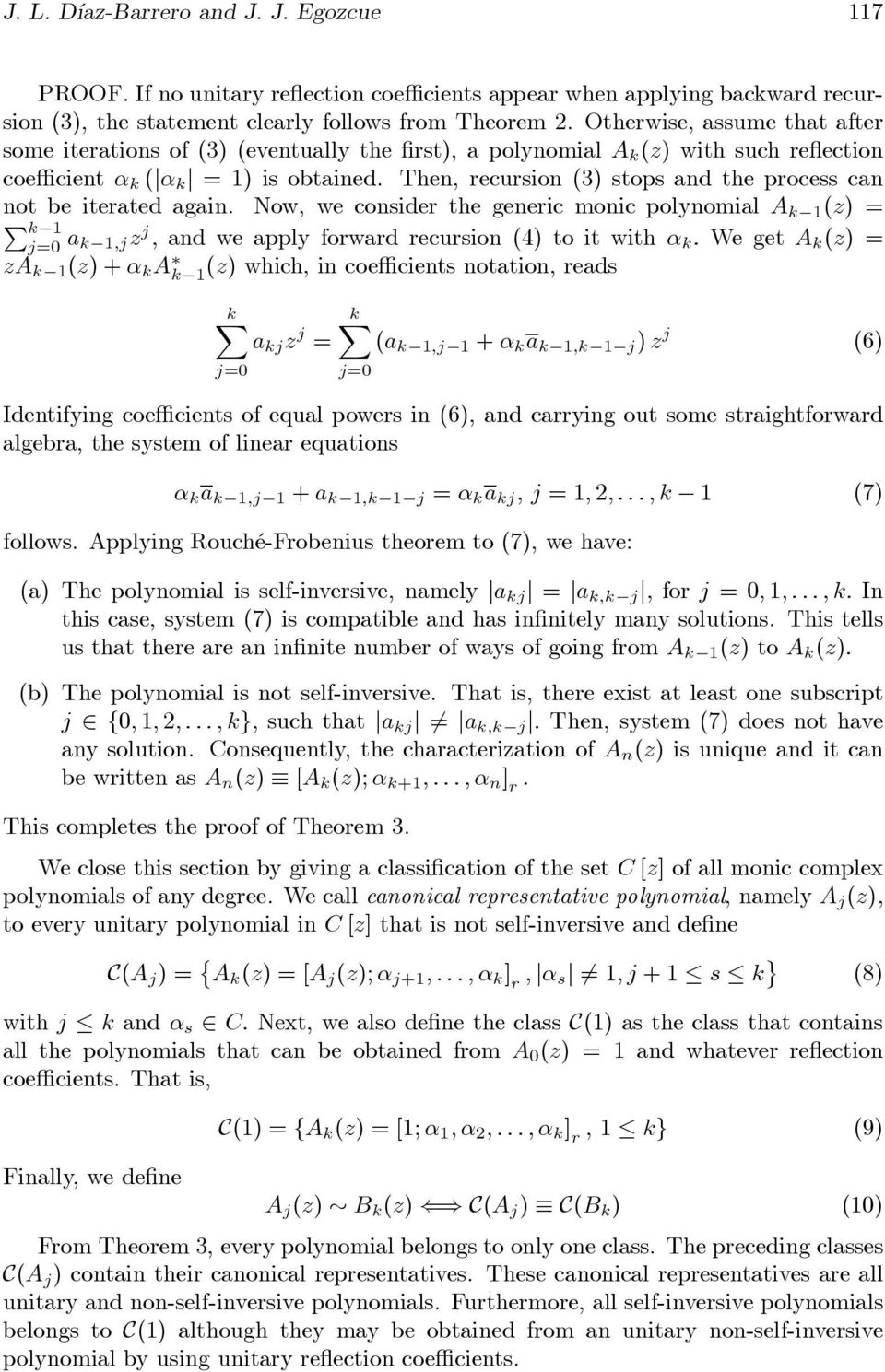
4 J. L. Díaz-Barrero and J. J. Egozcue 117 PROOF. If no unitary reflection coefficients appear when applying backward recursion (3), the statement clearly follows from Theorem 2. Otherwise, assume that after some iterations of (3) (eventually the first), a polynomial A k (z) withsuchreflection coefficient α k ( α k = 1) is obtained. Then, recursion (3) stops and the process can not be iterated again. Now, we consider the generic monic polynomial A k 1 (z) = k 1 j=0 a k 1,jz j, and we apply forward recursion (4) to it with α k. We get A k (z) = za k 1 (z)+α k A k 1 (z) which,incoefficients notation, reads k a kj z j = j=0 k (a k 1,j 1 + α k a k 1,k 1 j ) z j (6) j=0 Identifying coefficients of equal powers in (6), and carrying out some straightforward algebra, the system of linear equations α k a k 1,j 1 + a k 1,k 1 j = α k a kj,, 2,...,k 1 (7) follows. Applying Rouché-Frobenius theorem to (7), we have: (a) The polynomial is self-inversive, namely a kj = a k,k j, for j =0, 1,...,k. In this case, system (7) is compatible and has infinitely many solutions. This tells us that there are an infinite number of ways of going from A k 1 (z) toa k (z). (b) The polynomial is not self-inversive. That is, there exist at least one subscript j {0, 1, 2,...,k}, such that a kj = a k,k j. Then, system (7) does not have any solution. Consequently, the characterization of A n (z) is unique and it can be written as A n (z) [A k (z); α k+1,...,α n ] r. This completes the proof of Theorem 3. We close this section by giving a classification of the set C [z] ofallmoniccomplex polynomials of any degree. We call canonical representative polynomial, namely A j (z), to every unitary polynomial in C [z] that is not self-inversive and define C(A j )= A k (z) =[A j (z); α j+1,...,α k ] r, α s = 1,j+1 s k (8) with j k and α s C. Next, we also define the class C(1) as the class that contains all the polynomials that can be obtained from A 0 (z) = 1 and whatever reflection coefficients. That is, Finally, we define C(1) = {A k (z) =[1;α 1, α 2,...,α k ] r, 1 k} (9) A j (z) B k (z) C(A j ) C(B k ) (10) From Theorem 3, every polynomial belongs to only one class. The preceding classes C(A j ) contain their canonical representatives. These canonical representatives are all unitary and non-self-inversive polynomials. Furthermore, all self-inversive polynomials belongs to C(1) although they may be obtained from an unitary non-self-inversive polynomial by using unitary reflection coefficients.
5 118 Characterization of Polynomials From the definition of an equivalence class, two classes do not overlap and they are a partition of C [z]. Hence, (10) is an equivalence relation that produces a classification in the set of complex polynomials. After this classification, we point out that in the literature concerning reflection coefficients, the polynomials usually considered belong to C(1) class, but they are often restricted to those which reflection coefficients are of moduluslessthan1. The above results show that self inversive polynomials and polynomials whose reflection coefficients are of modulus greater than 1 share with the preceding polynomials some properties. For instance, they can be obtained from A 0 (z) =1byforwardLevinsonrecursion(4). 3 Self-inversive Polynomials and Reflection Coefficients The preceding statement announces that a self-inversive polynomial A n (z) can be obtained from polynomials of degree n 1. Onewayofdoingsoistoobtainitfromits derivative ([4], [7]). This known result, which is useful when handling with classical zero counters, can be stated as follows THEOREM 4. Every self inversive polynomial can be obtained from its derivative, normalized to monic, by applying forward recursion (4) with an appropriate reflection coefficient. In what follows, we exhibit another explicit way to do it. This procedure uses reflection coefficients as explicit functions of the zeros of A n (z). THEOREM 5. Let A n (z) =(z z r )A n 1 (z) be a self-inversive polynomial and let z r be a zero of A n (z) on the unit circle. Then A n (z) =za n 1 (z)+α n A n 1(z) with α n = z r α n 1. PROOF. Since the zeros of a self-inverse polynomial lie on the unit circle z =1 or are symmetric in the unit circle, we assume that A n (z) can be factored into r s A n (z) = (z z j ) (z ) z 1 (11) where z j =1forj =1, 2,...,r, < 1fork =1, 2,...,s and r +2s = n. Setting A n 1 (z) = r 1 (z z j) s (z ) z 1, we have and n 1 A n 1(z) =( 1) n 1 (z z j ) z j r 1 s (z ) z 1 = α n 1 A n 1 (z) za n 1 (z)+α n A n 1(z) =za n 1 (z)+α n α n 1 A n 1 (z) =(z + α n α n 1 )A n 1 (z) (12) By equating (11) and (12), it follows (z z r )A n 1 (z) =(z + α n α n 1 )A n 1 (z) (13)
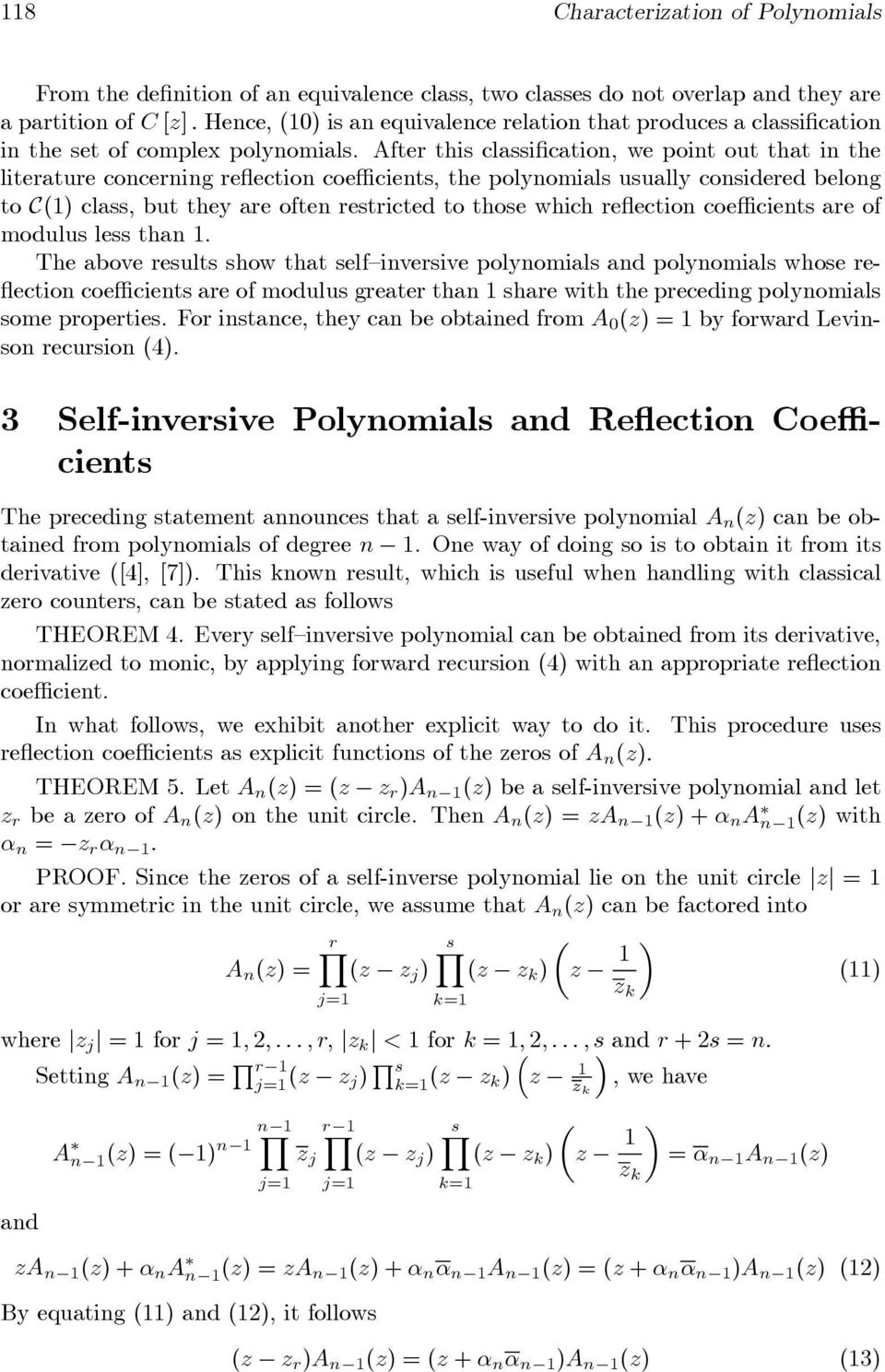
6 J. L. Díaz-Barrero and J. J. Egozcue 119 Since α n 1 is unitary, from (13), we get α n = z r α n 1 and we are done. THEOREM 6. Let A n (z) =(z z s )(z 1/z s )A n 2 (z) be a self-inversive polynomial. Then A n (z) can be obtained from A n 2 (z) by applying forward recursion (4) two times with reflection coefficients α n 1 = 1 2 eiθ s r s + 1rs α n 2 and α n = e i2θ s α n 2, where z s = r s e iθs. PROOF. Assume that A n (z) can be factored into r s A n (z) = (z z j ) (z ) z 1 where z j =1, < 1,, 2,...,s and r +2s = n. We will prove that there exist two reflection coefficients α n 1 and α n such that A n (z) =A n 2 (z)b 2 (z), where A n 2 (z) = and B 2 (z) =(z z s ) z 1zs r s 1 (z z j ) (z ) z 1 =(z r s e iθ s ) z 1 e iθ s = z 2 e iθ s r s + 1rs z + e i2θ s ; r s can be obtained from A n 2 (z) by applying forward recursion (4) with reflection coefficients α n 1 and α n. To carry out the first iteration we set α n 1 = 1 2 eiθ s r s + 1rs α n 2 and we get A n 1 (z) =za n 2 (z) 1 2 eiθ s r s + 1rs α n 2 A n 2(z) (14) Since A n 2(z) =α n 2 then (14) can be written as r s 1 (z z j ) (z ) z 1 = α n 2 A n 2 (z), A n 1 (z) = za n 2 (z) 1 (r 2 eiθs s + 1 )α n 2 α n 2 A n 2 (z) r s = A n 2 (z) z 12 r eiθs s + 1rs. Before running forward recursion (4) again, we observe that 1 A n 1(z) = z n 1 A n 2 (1/z) z 1 r 2 e iθs s + 1rs = z n 2 A n 2 (1/z) 1 12 r e iθs s + 1rs z = α n 2 A n 2 (z) 1 12 r e iθs s + 1rs z.
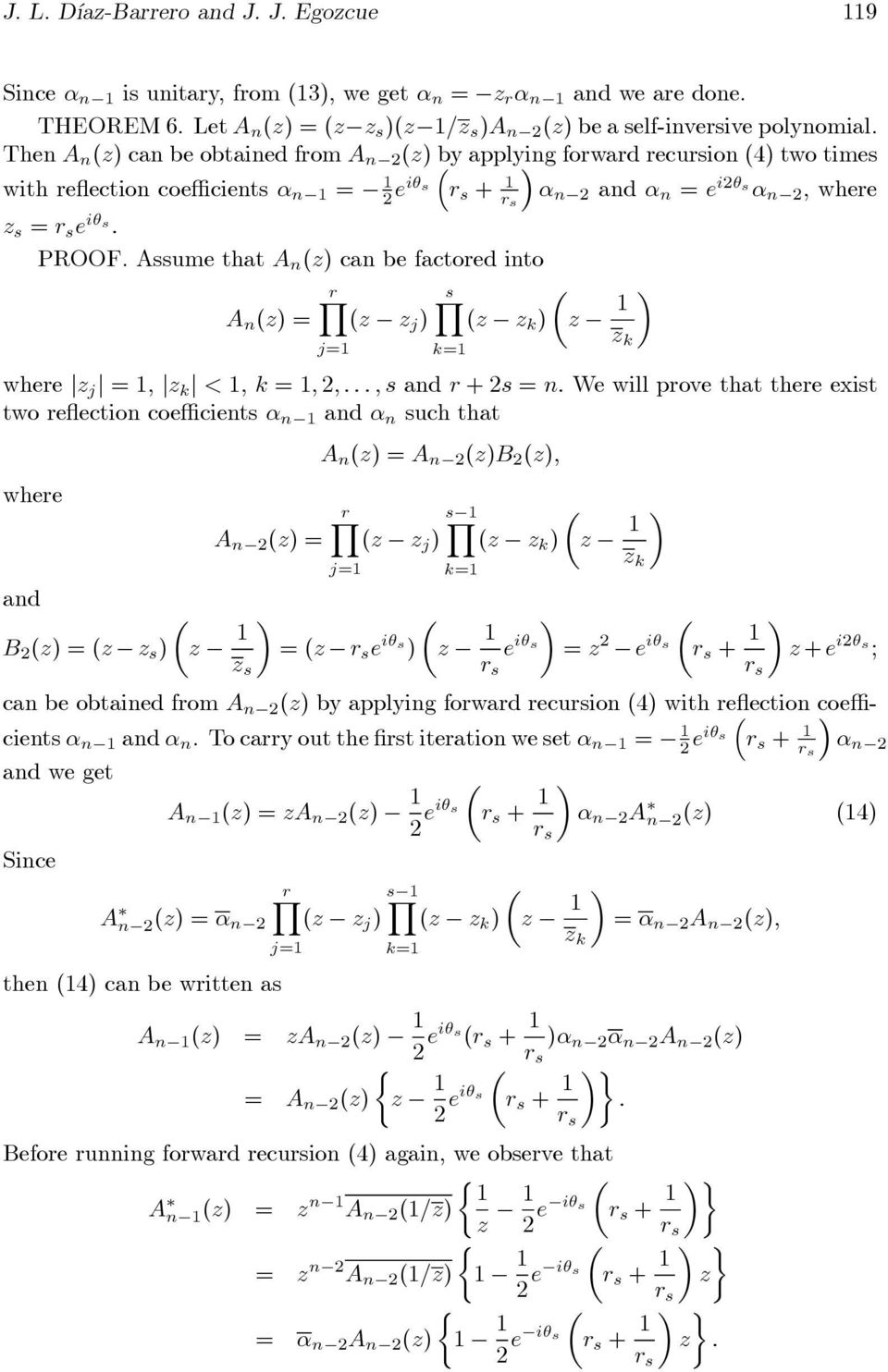
7 120 Characterization of Polynomials Next, we take α n = e i2θ s α n 2 and apply forward recursion (4) again, we get A n (z) = za n 2 (z){z 1 2 eiθ s r s + 1rs } + e i2θ s α n 2 α n 2 A n 2 (z) e iθ s r s + 1rs z = A n 2 (z) z 2 e iθ s r s + 1rs z + e i2θ s = A n 2 (z)b 2 (z). This completes the proof of Theorem 6. Acknowledgement. The authors would like to acknowledge the suggestions and recommendations of an anonymous referee who has contributed to improve the final version of the paper. References [1] K. J. Astrom, Introduction to Stochastic Control Theory, Academic Press, [2] Y. Bistritz, Zero Location with Respect to the Unit Circle of Discrete Time Linear System Polynomials, Proc. IEEE. 72(1984), [3] J. P. Burg, Maximum Entropy Spectral Analysis, PhD Thesis, Stanford University, Stanford, CA., [4] A. Cohn, Uber die Anzahl der Wurzeln eine algebraishen Gleichung in einen Kreise, Math. Z, 14 (1922), [5] T. Constantinescu, Schur Parameters, Factorization and Dilation Problems, Basel, Birkhaüser Verlag, [6] Ya L. Geronimus, Polynomials orthogonal on a circle and thier applications, Amer. Math. Soc. Transl., Series 1, 3 (1962), [7] E. I. Jury, Theory and Applications of the z Transform, John Wiley, New York, [8] S. M. Kay, Modern Spectral Estimation, Prentice Hall, New Jersey, [9] N. Levinson, The Wiener rms (root mean square) error criterion in filter design and prediction, J. Math. Phys. 25(1947), [10] M. Marden, Geometry of Polynomials, Mathematical Surveys Number 3, American Mathematical Society, Providence. Rhode Island, [11] A. Papoulis, Probability, Random Variables and Stochastic Processes, McGraw Hill, Singapore, [12] B. Picinbono and M. Benidir, Some Properties of Lattice Autoregressive Filters, IEEE Trans. on Acoust. Speech Signal Process, ASSP 34(1986),
![The authors would like to acknowledge the suggestions and recommendations of an anonymous referee who has contributed to improve the final version of the paper. References [1] K. J.](/docs-images/56/8306842/images/page_7.jpg "Astrom, Introduction to Stochastic Control Theory, Academic Press, 1970. [2] Y. Bistritz, Zero Location with Respect to the Unit Circle of Discrete Time Linear System Polynomials, Proc. IEEE.")
8 J. L. Díaz-Barrero and J. J. Egozcue 121 [13] G. Szegö, Ortogonal Polynomials, American Mathematical Society, Providence, Rhode Island, [14] S. Treitel and T. J. Ulrych, A new Proof of the Minimum-Phase Property of the Unit Prediction Error Operator, IEEE Trans. on Acoustics, Speech and Signal Processing, ASSP-27(1)(1979),
![Island, 1975. [14] S. Treitel and T. J.](/docs-images/56/8306842/images/page_8.jpg "Ulrych, A new Proof of the Minimum-Phase Property of the Unit Prediction Error")
By choosing to view this document, you agree to all provisions of the copyright laws protecting it.
 This material is posted here with permission of the IEEE Such permission of the IEEE does not in any way imply IEEE endorsement of any of Helsinki University of Technology's products or services Internal
Matrices and Polynomials
 APPENDIX 9 Matrices and Polynomials he Multiplication of Polynomials Let α(z) =α 0 +α 1 z+α 2 z 2 + α p z p and y(z) =y 0 +y 1 z+y 2 z 2 + y n z n be two polynomials of degrees p and n respectively. hen,
Associativity condition for some alternative algebras of degree three
 Associativity condition for some alternative algebras of degree three Mirela Stefanescu and Cristina Flaut Abstract In this paper we find an associativity condition for a class of alternative algebras
ON COMPLETELY CONTINUOUS INTEGRATION OPERATORS OF A VECTOR MEASURE. 1. Introduction
 ON COMPLETELY CONTINUOUS INTEGRATION OPERATORS OF A VECTOR MEASURE J.M. CALABUIG, J. RODRÍGUEZ, AND E.A. SÁNCHEZ-PÉREZ Abstract. Let m be a vector measure taking values in a Banach space X. We prove that
The van Hoeij Algorithm for Factoring Polynomials
 The van Hoeij Algorithm for Factoring Polynomials Jürgen Klüners Abstract In this survey we report about a new algorithm for factoring polynomials due to Mark van Hoeij. The main idea is that the combinatorial
Prime Numbers and Irreducible Polynomials
 Prime Numbers and Irreducible Polynomials M. Ram Murty The similarity between prime numbers and irreducible polynomials has been a dominant theme in the development of number theory and algebraic geometry.
ON GALOIS REALIZATIONS OF THE 2-COVERABLE SYMMETRIC AND ALTERNATING GROUPS
 ON GALOIS REALIZATIONS OF THE 2-COVERABLE SYMMETRIC AND ALTERNATING GROUPS DANIEL RABAYEV AND JACK SONN Abstract. Let f(x) be a monic polynomial in Z[x] with no rational roots but with roots in Q p for
Factoring Patterns in the Gaussian Plane
 Factoring Patterns in the Gaussian Plane Steve Phelps Introduction This paper describes discoveries made at the Park City Mathematics Institute, 00, as well as some proofs. Before the summer I understood
Continuity of the Perron Root
 Linear and Multilinear Algebra http://dx.doi.org/10.1080/03081087.2014.934233 ArXiv: 1407.7564 (http://arxiv.org/abs/1407.7564) Continuity of the Perron Root Carl D. Meyer Department of Mathematics, North
FACTORING POLYNOMIALS IN THE RING OF FORMAL POWER SERIES OVER Z
 FACTORING POLYNOMIALS IN THE RING OF FORMAL POWER SERIES OVER Z DANIEL BIRMAJER, JUAN B GIL, AND MICHAEL WEINER Abstract We consider polynomials with integer coefficients and discuss their factorization
2.3. Finding polynomial functions. An Introduction:
 2.3. Finding polynomial functions. An Introduction: As is usually the case when learning a new concept in mathematics, the new concept is the reverse of the previous one. Remember how you first learned
MOP 2007 Black Group Integer Polynomials Yufei Zhao. Integer Polynomials. June 29, 2007 Yufei Zhao [email protected]
 Integer Polynomials June 9, 007 Yufei Zhao [email protected] We will use Z[x] to denote the ring of polynomials with integer coefficients. We begin by summarizing some of the common approaches used in dealing
F. ABTAHI and M. ZARRIN. (Communicated by J. Goldstein)
 Journal of Algerian Mathematical Society Vol. 1, pp. 1 6 1 CONCERNING THE l p -CONJECTURE FOR DISCRETE SEMIGROUPS F. ABTAHI and M. ZARRIN (Communicated by J. Goldstein) Abstract. For 2 < p
5. Factoring by the QF method
 5. Factoring by the QF method 5.0 Preliminaries 5.1 The QF view of factorability 5.2 Illustration of the QF view of factorability 5.3 The QF approach to factorization 5.4 Alternative factorization by the
CONTROLLABILITY. Chapter 2. 2.1 Reachable Set and Controllability. Suppose we have a linear system described by the state equation
 Chapter 2 CONTROLLABILITY 2 Reachable Set and Controllability Suppose we have a linear system described by the state equation ẋ Ax + Bu (2) x() x Consider the following problem For a given vector x in
7. Some irreducible polynomials
 7. Some irreducible polynomials 7.1 Irreducibles over a finite field 7.2 Worked examples Linear factors x α of a polynomial P (x) with coefficients in a field k correspond precisely to roots α k [1] of
MATRIX ALGEBRA AND SYSTEMS OF EQUATIONS
 MATRIX ALGEBRA AND SYSTEMS OF EQUATIONS Systems of Equations and Matrices Representation of a linear system The general system of m equations in n unknowns can be written a x + a 2 x 2 + + a n x n b a
MATH 423 Linear Algebra II Lecture 38: Generalized eigenvectors. Jordan canonical form (continued).
 MATH 423 Linear Algebra II Lecture 38: Generalized eigenvectors Jordan canonical form (continued) Jordan canonical form A Jordan block is a square matrix of the form λ 1 0 0 0 0 λ 1 0 0 0 0 λ 0 0 J = 0
Continued Fractions and the Euclidean Algorithm
 Continued Fractions and the Euclidean Algorithm Lecture notes prepared for MATH 326, Spring 997 Department of Mathematics and Statistics University at Albany William F Hammond Table of Contents Introduction
WHEN DOES A CROSS PRODUCT ON R n EXIST?
 WHEN DOES A CROSS PRODUCT ON R n EXIST? PETER F. MCLOUGHLIN It is probably safe to say that just about everyone reading this article is familiar with the cross product and the dot product. However, what
DEFINITION 5.1.1 A complex number is a matrix of the form. x y. , y x
 Chapter 5 COMPLEX NUMBERS 5.1 Constructing the complex numbers One way of introducing the field C of complex numbers is via the arithmetic of matrices. DEFINITION 5.1.1 A complex number is a matrix of
Lecture Notes on Polynomials
 Lecture Notes on Polynomials Arne Jensen Department of Mathematical Sciences Aalborg University c 008 Introduction These lecture notes give a very short introduction to polynomials with real and complex
A NOTE ON TRIVIAL FIBRATIONS
 A NOTE ON TRIVIAL FIBRATIONS Petar Pavešić Fakulteta za Matematiko in Fiziko, Univerza v Ljubljani, Jadranska 19, 1111 Ljubljana, Slovenija [email protected] Abstract We study the conditions
Integer roots of quadratic and cubic polynomials with integer coefficients
 Integer roots of quadratic and cubic polynomials with integer coefficients Konstantine Zelator Mathematics, Computer Science and Statistics 212 Ben Franklin Hall Bloomsburg University 400 East Second Street
Solution of Linear Systems
 Chapter 3 Solution of Linear Systems In this chapter we study algorithms for possibly the most commonly occurring problem in scientific computing, the solution of linear systems of equations. We start
4)(x) du(x) = n-' E?(zi(x)) du(x),
 PROCEEDINGS OF THE AMERICAN MATHEMATICAL SOCIETY Volume 98, Number 1, September 1986 ORTHOGONALITY AND THE HAUSDORFF DIMENSION OF THE MAXIMAL MEASURE ARTUR OSCAR LOPES ABSTRACT. In this paper the orthogonality
Ideal Class Group and Units
 Chapter 4 Ideal Class Group and Units We are now interested in understanding two aspects of ring of integers of number fields: how principal they are (that is, what is the proportion of principal ideals
Generic Polynomials of Degree Three
 Generic Polynomials of Degree Three Benjamin C. Wallace April 2012 1 Introduction In the nineteenth century, the mathematician Évariste Galois discovered an elegant solution to the fundamental problem
RINGS WITH A POLYNOMIAL IDENTITY
 RINGS WITH A POLYNOMIAL IDENTITY IRVING KAPLANSKY 1. Introduction. In connection with his investigation of projective planes, M. Hall [2, Theorem 6.2]* proved the following theorem: a division ring D in
JUST THE MATHS UNIT NUMBER 1.8. ALGEBRA 8 (Polynomials) A.J.Hobson
 JUST THE MATHS UNIT NUMBER 1.8 ALGEBRA 8 (Polynomials) by A.J.Hobson 1.8.1 The factor theorem 1.8.2 Application to quadratic and cubic expressions 1.8.3 Cubic equations 1.8.4 Long division of polynomials
MATH 590: Meshfree Methods
 MATH 590: Meshfree Methods Chapter 7: Conditionally Positive Definite Functions Greg Fasshauer Department of Applied Mathematics Illinois Institute of Technology Fall 2010 [email protected] MATH 590 Chapter
The Characteristic Polynomial
 Physics 116A Winter 2011 The Characteristic Polynomial 1 Coefficients of the characteristic polynomial Consider the eigenvalue problem for an n n matrix A, A v = λ v, v 0 (1) The solution to this problem
Factoring Cubic Polynomials
 Factoring Cubic Polynomials Robert G. Underwood 1. Introduction There are at least two ways in which using the famous Cardano formulas (1545) to factor cubic polynomials present more difficulties than
MATH 304 Linear Algebra Lecture 9: Subspaces of vector spaces (continued). Span. Spanning set.
 MATH 304 Linear Algebra Lecture 9: Subspaces of vector spaces (continued). Span. Spanning set. Vector space A vector space is a set V equipped with two operations, addition V V (x,y) x + y V and scalar
Analysis of Load Frequency Control Performance Assessment Criteria
 520 IEEE TRANSACTIONS ON POWER SYSTEMS, VOL. 16, NO. 3, AUGUST 2001 Analysis of Load Frequency Control Performance Assessment Criteria George Gross, Fellow, IEEE and Jeong Woo Lee Abstract This paper presents
The Open University s repository of research publications and other research outputs
 Open Research Online The Open University s repository of research publications and other research outputs The degree-diameter problem for circulant graphs of degree 8 and 9 Journal Article How to cite:
MATRIX ALGEBRA AND SYSTEMS OF EQUATIONS. + + x 2. x n. a 11 a 12 a 1n b 1 a 21 a 22 a 2n b 2 a 31 a 32 a 3n b 3. a m1 a m2 a mn b m
 MATRIX ALGEBRA AND SYSTEMS OF EQUATIONS 1. SYSTEMS OF EQUATIONS AND MATRICES 1.1. Representation of a linear system. The general system of m equations in n unknowns can be written a 11 x 1 + a 12 x 2 +
How To Prove The Dirichlet Unit Theorem
 Chapter 6 The Dirichlet Unit Theorem As usual, we will be working in the ring B of algebraic integers of a number field L. Two factorizations of an element of B are regarded as essentially the same if
FINITE DIMENSIONAL ORDERED VECTOR SPACES WITH RIESZ INTERPOLATION AND EFFROS-SHEN S UNIMODULARITY CONJECTURE AARON TIKUISIS
 FINITE DIMENSIONAL ORDERED VECTOR SPACES WITH RIESZ INTERPOLATION AND EFFROS-SHEN S UNIMODULARITY CONJECTURE AARON TIKUISIS Abstract. It is shown that, for any field F R, any ordered vector space structure
Working Paper Series
 RGEA Universidade de Vigo http://webs.uvigo.es/rgea Working Paper Series A Market Game Approach to Differential Information Economies Guadalupe Fugarolas, Carlos Hervés-Beloso, Emma Moreno- García and
1 Short Introduction to Time Series
 ECONOMICS 7344, Spring 202 Bent E. Sørensen January 24, 202 Short Introduction to Time Series A time series is a collection of stochastic variables x,.., x t,.., x T indexed by an integer value t. The
ON SUPERCYCLICITY CRITERIA. Nuha H. Hamada Business Administration College Al Ain University of Science and Technology 5-th st, Abu Dhabi, 112612, UAE
 International Journal of Pure and Applied Mathematics Volume 101 No. 3 2015, 401-405 ISSN: 1311-8080 (printed version); ISSN: 1314-3395 (on-line version) url: http://www.ijpam.eu doi: http://dx.doi.org/10.12732/ijpam.v101i3.7
U.C. Berkeley CS276: Cryptography Handout 0.1 Luca Trevisan January, 2009. Notes on Algebra
 U.C. Berkeley CS276: Cryptography Handout 0.1 Luca Trevisan January, 2009 Notes on Algebra These notes contain as little theory as possible, and most results are stated without proof. Any introductory
Advanced Signal Processing and Digital Noise Reduction
 Advanced Signal Processing and Digital Noise Reduction Saeed V. Vaseghi Queen's University of Belfast UK WILEY HTEUBNER A Partnership between John Wiley & Sons and B. G. Teubner Publishers Chichester New
MATH 551 - APPLIED MATRIX THEORY
 MATH 55 - APPLIED MATRIX THEORY FINAL TEST: SAMPLE with SOLUTIONS (25 points NAME: PROBLEM (3 points A web of 5 pages is described by a directed graph whose matrix is given by A Do the following ( points
Zeros of Polynomial Functions
 Review: Synthetic Division Find (x 2-5x - 5x 3 + x 4 ) (5 + x). Factor Theorem Solve 2x 3-5x 2 + x + 2 =0 given that 2 is a zero of f(x) = 2x 3-5x 2 + x + 2. Zeros of Polynomial Functions Introduction
Mehtap Ergüven Abstract of Ph.D. Dissertation for the degree of PhD of Engineering in Informatics
 INTERNATIONAL BLACK SEA UNIVERSITY COMPUTER TECHNOLOGIES AND ENGINEERING FACULTY ELABORATION OF AN ALGORITHM OF DETECTING TESTS DIMENSIONALITY Mehtap Ergüven Abstract of Ph.D. Dissertation for the degree
Analysis of Mean-Square Error and Transient Speed of the LMS Adaptive Algorithm
 IEEE TRANSACTIONS ON INFORMATION THEORY, VOL. 48, NO. 7, JULY 2002 1873 Analysis of Mean-Square Error Transient Speed of the LMS Adaptive Algorithm Onkar Dabeer, Student Member, IEEE, Elias Masry, Fellow,
Chapter 4, Arithmetic in F [x] Polynomial arithmetic and the division algorithm.
![Chapter 4, Arithmetic in F [x] Polynomial arithmetic and the division algorithm.](/thumbs/26/8276997.jpg "Chapter 4, Arithmetic in F [x] Polynomial arithmetic and the division algorithm.") Chapter 4, Arithmetic in F [x] Polynomial arithmetic and the division algorithm. We begin by defining the ring of polynomials with coefficients in a ring R. After some preliminary results, we specialize
Chapter 4, Arithmetic in F [x] Polynomial arithmetic and the division algorithm. We begin by defining the ring of polynomials with coefficients in a ring R. After some preliminary results, we specialize
March 29, 2011. 171S4.4 Theorems about Zeros of Polynomial Functions
 MAT 171 Precalculus Algebra Dr. Claude Moore Cape Fear Community College CHAPTER 4: Polynomial and Rational Functions 4.1 Polynomial Functions and Models 4.2 Graphing Polynomial Functions 4.3 Polynomial
CHAPTER II THE LIMIT OF A SEQUENCE OF NUMBERS DEFINITION OF THE NUMBER e.
 CHAPTER II THE LIMIT OF A SEQUENCE OF NUMBERS DEFINITION OF THE NUMBER e. This chapter contains the beginnings of the most important, and probably the most subtle, notion in mathematical analysis, i.e.,
The degree of a polynomial function is equal to the highest exponent found on the independent variables.
 DETAILED SOLUTIONS AND CONCEPTS - POLYNOMIAL FUNCTIONS Prepared by Ingrid Stewart, Ph.D., College of Southern Nevada Please Send Questions and Comments to [email protected]. Thank you! PLEASE NOTE
Linear-Quadratic Optimal Controller 10.3 Optimal Linear Control Systems
 Linear-Quadratic Optimal Controller 10.3 Optimal Linear Control Systems In Chapters 8 and 9 of this book we have designed dynamic controllers such that the closed-loop systems display the desired transient
Classification of Cartan matrices
 Chapter 7 Classification of Cartan matrices In this chapter we describe a classification of generalised Cartan matrices This classification can be compared as the rough classification of varieties in terms
SOLVING POLYNOMIAL EQUATIONS BY RADICALS
 SOLVING POLYNOMIAL EQUATIONS BY RADICALS Lee Si Ying 1 and Zhang De-Qi 2 1 Raffles Girls School (Secondary), 20 Anderson Road, Singapore 259978 2 Department of Mathematics, National University of Singapore,
z 0 and y even had the form
 Gaussian Integers The concepts of divisibility, primality and factoring are actually more general than the discussion so far. For the moment, we have been working in the integers, which we denote by Z
Algebra 1 Course Title
 Algebra 1 Course Title Course- wide 1. What patterns and methods are being used? Course- wide 1. Students will be adept at solving and graphing linear and quadratic equations 2. Students will be adept
Introduction to Matrix Algebra
 Psychology 7291: Multivariate Statistics (Carey) 8/27/98 Matrix Algebra - 1 Introduction to Matrix Algebra Definitions: A matrix is a collection of numbers ordered by rows and columns. It is customary
RESULTANT AND DISCRIMINANT OF POLYNOMIALS
 RESULTANT AND DISCRIMINANT OF POLYNOMIALS SVANTE JANSON Abstract. This is a collection of classical results about resultants and discriminants for polynomials, compiled mainly for my own use. All results
Efficient Recovery of Secrets
 Efficient Recovery of Secrets Marcel Fernandez Miguel Soriano, IEEE Senior Member Department of Telematics Engineering. Universitat Politècnica de Catalunya. C/ Jordi Girona 1 i 3. Campus Nord, Mod C3,
Computing divisors and common multiples of quasi-linear ordinary differential equations
 Computing divisors and common multiples of quasi-linear ordinary differential equations Dima Grigoriev CNRS, Mathématiques, Université de Lille Villeneuve d Ascq, 59655, France [email protected]
Winter Camp 2011 Polynomials Alexander Remorov. Polynomials. Alexander Remorov [email protected]
 Polynomials Alexander Remorov [email protected] Warm-up Problem 1: Let f(x) be a quadratic polynomial. Prove that there exist quadratic polynomials g(x) and h(x) such that f(x)f(x + 1) = g(h(x)).
Row Echelon Form and Reduced Row Echelon Form
 These notes closely follow the presentation of the material given in David C Lay s textbook Linear Algebra and its Applications (3rd edition) These notes are intended primarily for in-class presentation
A note on companion matrices
 Linear Algebra and its Applications 372 (2003) 325 33 www.elsevier.com/locate/laa A note on companion matrices Miroslav Fiedler Academy of Sciences of the Czech Republic Institute of Computer Science Pod
SOME PROPERTIES OF FIBER PRODUCT PRESERVING BUNDLE FUNCTORS
 SOME PROPERTIES OF FIBER PRODUCT PRESERVING BUNDLE FUNCTORS Ivan Kolář Abstract. Let F be a fiber product preserving bundle functor on the category FM m of the proper base order r. We deduce that the r-th
s-convexity, model sets and their relation
 s-convexity, model sets and their relation Zuzana Masáková Jiří Patera Edita Pelantová CRM-2639 November 1999 Department of Mathematics, Faculty of Nuclear Science and Physical Engineering, Czech Technical
SOME PROPERTIES OF SYMBOL ALGEBRAS OF DEGREE THREE
 SOME PROPERTIES OF SYMBOL ALGEBRAS OF DEGREE THREE CRISTINA FLAUT and DIANA SAVIN Communicated by the former editorial board In this paper, we study some properties of the matrix representations of the
Prentice Hall Algebra 2 2011 Correlated to: Colorado P-12 Academic Standards for High School Mathematics, Adopted 12/2009
 Content Area: Mathematics Grade Level Expectations: High School Standard: Number Sense, Properties, and Operations Understand the structure and properties of our number system. At their most basic level
3.3. Solving Polynomial Equations. Introduction. Prerequisites. Learning Outcomes
 Solving Polynomial Equations 3.3 Introduction Linear and quadratic equations, dealt within Sections 3.1 and 3.2, are members of a class of equations, called polynomial equations. These have the general
Taylor and Maclaurin Series
 Taylor and Maclaurin Series In the preceding section we were able to find power series representations for a certain restricted class of functions. Here we investigate more general problems: Which functions
PUTNAM TRAINING POLYNOMIALS. Exercises 1. Find a polynomial with integral coefficients whose zeros include 2 + 5.
 PUTNAM TRAINING POLYNOMIALS (Last updated: November 17, 2015) Remark. This is a list of exercises on polynomials. Miguel A. Lerma Exercises 1. Find a polynomial with integral coefficients whose zeros include
Irreducibility criteria for compositions and multiplicative convolutions of polynomials with integer coefficients
 DOI: 10.2478/auom-2014-0007 An. Şt. Univ. Ovidius Constanţa Vol. 221),2014, 73 84 Irreducibility criteria for compositions and multiplicative convolutions of polynomials with integer coefficients Anca
a 1 x + a 0 =0. (3) ax 2 + bx + c =0. (4)
 ROOTS OF POLYNOMIAL EQUATIONS In this unit we discuss polynomial equations. A polynomial in x of degree n, where n 0 is an integer, is an expression of the form P n (x) =a n x n + a n 1 x n 1 + + a 1 x
Homological Algebra Workshop 02-03-15/06-03-15
 Homological Algebra Workshop 02-03-15/06-03-15 Monday: Tuesday: 9:45 10:00 Registration 10:00 11:15 Conchita Martínez (I) 10:00 11:15 Conchita Martínez (II) 11:15 11:45 Coffee Break 11:15 11:45 Coffee
An example of a computable
 An example of a computable absolutely normal number Verónica Becher Santiago Figueira Abstract The first example of an absolutely normal number was given by Sierpinski in 96, twenty years before the concept
Properties of BMO functions whose reciprocals are also BMO
 Properties of BMO functions whose reciprocals are also BMO R. L. Johnson and C. J. Neugebauer The main result says that a non-negative BMO-function w, whose reciprocal is also in BMO, belongs to p> A p,and
4.3 Lagrange Approximation
 206 CHAP. 4 INTERPOLATION AND POLYNOMIAL APPROXIMATION Lagrange Polynomial Approximation 4.3 Lagrange Approximation Interpolation means to estimate a missing function value by taking a weighted average
Chapter ML:IV. IV. Statistical Learning. Probability Basics Bayes Classification Maximum a-posteriori Hypotheses
 Chapter ML:IV IV. Statistical Learning Probability Basics Bayes Classification Maximum a-posteriori Hypotheses ML:IV-1 Statistical Learning STEIN 2005-2015 Area Overview Mathematics Statistics...... Stochastics
ABSTRACT. For example, circle orders are the containment orders of circles (actually disks) in the plane (see [8,9]).
![ABSTRACT. For example, circle orders are the containment orders of circles (actually disks) in the plane (see [8,9]).](/thumbs/26/7227512.jpg "ABSTRACT. For example, circle orders are the containment orders of circles (actually disks) in the plane (see [8,9]).") Degrees of Freedom Versus Dimension for Containment Orders Noga Alon 1 Department of Mathematics Tel Aviv University Ramat Aviv 69978, Israel Edward R. Scheinerman 2 Department of Mathematical Sciences
Degrees of Freedom Versus Dimension for Containment Orders Noga Alon 1 Department of Mathematics Tel Aviv University Ramat Aviv 69978, Israel Edward R. Scheinerman 2 Department of Mathematical Sciences
FUNCTIONAL ANALYSIS LECTURE NOTES: QUOTIENT SPACES
 FUNCTIONAL ANALYSIS LECTURE NOTES: QUOTIENT SPACES CHRISTOPHER HEIL 1. Cosets and the Quotient Space Any vector space is an abelian group under the operation of vector addition. So, if you are have studied
Math 115A HW4 Solutions University of California, Los Angeles. 5 2i 6 + 4i. (5 2i)7i (6 + 4i)( 3 + i) = 35i + 14 ( 22 6i) = 36 + 41i.
 Math 5A HW4 Solutions September 5, 202 University of California, Los Angeles Problem 4..3b Calculate the determinant, 5 2i 6 + 4i 3 + i 7i Solution: The textbook s instructions give us, (5 2i)7i (6 + 4i)(
A simple criterion on degree sequences of graphs
 Discrete Applied Mathematics 156 (2008) 3513 3517 Contents lists available at ScienceDirect Discrete Applied Mathematics journal homepage: www.elsevier.com/locate/dam Note A simple criterion on degree
minimal polyonomial Example
 Minimal Polynomials Definition Let α be an element in GF(p e ). We call the monic polynomial of smallest degree which has coefficients in GF(p) and α as a root, the minimal polyonomial of α. Example: We
A SURVEY ON CONTINUOUS ELLIPTICAL VECTOR DISTRIBUTIONS
 A SURVEY ON CONTINUOUS ELLIPTICAL VECTOR DISTRIBUTIONS Eusebio GÓMEZ, Miguel A. GÓMEZ-VILLEGAS and J. Miguel MARÍN Abstract In this paper it is taken up a revision and characterization of the class of
CONTROL SYSTEMS, ROBOTICS, AND AUTOMATION - Vol. V - Relations Between Time Domain and Frequency Domain Prediction Error Methods - Tomas McKelvey
 COTROL SYSTEMS, ROBOTICS, AD AUTOMATIO - Vol. V - Relations Between Time Domain and Frequency Domain RELATIOS BETWEE TIME DOMAI AD FREQUECY DOMAI PREDICTIO ERROR METHODS Tomas McKelvey Signal Processing,
Zero: If P is a polynomial and if c is a number such that P (c) = 0 then c is a zero of P.
 MATH 11011 FINDING REAL ZEROS KSU OF A POLYNOMIAL Definitions: Polynomial: is a function of the form P (x) = a n x n + a n 1 x n 1 + + a x + a 1 x + a 0. The numbers a n, a n 1,..., a 1, a 0 are called
Florida Math 0028. Correlation of the ALEKS course Florida Math 0028 to the Florida Mathematics Competencies - Upper
 Florida Math 0028 Correlation of the ALEKS course Florida Math 0028 to the Florida Mathematics Competencies - Upper Exponents & Polynomials MDECU1: Applies the order of operations to evaluate algebraic
SOLVING LINEAR SYSTEMS
 SOLVING LINEAR SYSTEMS Linear systems Ax = b occur widely in applied mathematics They occur as direct formulations of real world problems; but more often, they occur as a part of the numerical analysis
Solving Systems of Linear Equations
 LECTURE 5 Solving Systems of Linear Equations Recall that we introduced the notion of matrices as a way of standardizing the expression of systems of linear equations In today s lecture I shall show how
Introduction to time series analysis
 Introduction to time series analysis Margherita Gerolimetto November 3, 2010 1 What is a time series? A time series is a collection of observations ordered following a parameter that for us is time. Examples
LEVERRIER-FADEEV ALGORITHM AND CLASSICAL ORTHOGONAL POLYNOMIALS
 This is a reprint from Revista de la Academia Colombiana de Ciencias Vol 8 (106 (004, 39-47 LEVERRIER-FADEEV ALGORITHM AND CLASSICAL ORTHOGONAL POLYNOMIALS by J Hernández, F Marcellán & C Rodríguez LEVERRIER-FADEEV
SECRET sharing schemes were introduced by Blakley [5]
![SECRET sharing schemes were introduced by Blakley [5]](/thumbs/24/4404980.jpg "SECRET sharing schemes were introduced by Blakley [5]") 206 IEEE TRANSACTIONS ON INFORMATION THEORY, VOL. 52, NO. 1, JANUARY 2006 Secret Sharing Schemes From Three Classes of Linear Codes Jin Yuan Cunsheng Ding, Senior Member, IEEE Abstract Secret sharing has
206 IEEE TRANSACTIONS ON INFORMATION THEORY, VOL. 52, NO. 1, JANUARY 2006 Secret Sharing Schemes From Three Classes of Linear Codes Jin Yuan Cunsheng Ding, Senior Member, IEEE Abstract Secret sharing has
Indiana State Core Curriculum Standards updated 2009 Algebra I
 Indiana State Core Curriculum Standards updated 2009 Algebra I Strand Description Boardworks High School Algebra presentations Operations With Real Numbers Linear Equations and A1.1 Students simplify and
1.3 Algebraic Expressions
 1.3 Algebraic Expressions A polynomial is an expression of the form: a n x n + a n 1 x n 1 +... + a 2 x 2 + a 1 x + a 0 The numbers a 1, a 2,..., a n are called coefficients. Each of the separate parts,
The Australian Journal of Mathematical Analysis and Applications
 The Australian Journal of Mathematical Analysis and Applications Volume 7, Issue, Article 11, pp. 1-14, 011 SOME HOMOGENEOUS CYCLIC INEQUALITIES OF THREE VARIABLES OF DEGREE THREE AND FOUR TETSUYA ANDO
A CONSTRUCTION OF THE UNIVERSAL COVER AS A FIBER BUNDLE
 A CONSTRUCTION OF THE UNIVERSAL COVER AS A FIBER BUNDLE DANIEL A. RAMRAS In these notes we present a construction of the universal cover of a path connected, locally path connected, and semi-locally simply
Breaking Generalized Diffie-Hellman Modulo a Composite is no Easier than Factoring
 Breaking Generalized Diffie-Hellman Modulo a Composite is no Easier than Factoring Eli Biham Dan Boneh Omer Reingold Abstract The Diffie-Hellman key-exchange protocol may naturally be extended to k > 2