
Factoring Cubic Polynomials
|
|
|
- Peregrine Sullivan
- 9 years ago
- Views:
Transcription
1 Factoring Cubic Polynomials Robert G. Underwood 1. Introduction There are at least two ways in which using the famous Cardano formulas (1545) to factor cubic polynomials present more difficulties than the quadratic formula poses when factoring quadratic polynomials. First and obviously, with its cube roots and roots of roots, the Cardano formulas involve computations that are more complicated. Second, we get less in return; in particular, with the Cardano formulas we only obtain one out of three factors, whereas the quadratic formula yields both factors of any given quadratic polynomial. In this paper, we will describe a natural procedure that will lead us to all three factors of an arbitrary cubic polynomial with real number coefficients. Let R denote the real field, and let R[X] denote the ring of polynomials over R. Consider the cubic polynomial p(x) =X 3 k R[X]. Let C denote the field of complex numbers, and let ζ be aprimitive3rdrootofunity,thatis,ζ is one of the two complex solutions of the equation X 3 = 1. One calculates ζ = 1+i 3, 2 where i = 1. The cubic p(x) factors completely over C. Indeed, if 3 k is the real 3rd root of k, thenwehavethefactorization X 3 k =(X 3 k)(x ζ 3 k)(x ζ 2 3 k), and the roots of X 3 k are 3 k, ζ 3 k, ζ 2 3 k. [25]

2 26 Alabama Journal of Mathematics In this paper we show how to generate the roots of any cubic polynomial over R in an analogous manner, using ζ, and a solution (a, b) of the equation X 3 + Y 3 =1overC. 2. Generating the roots of a cubic polynomial The problem of finding all the zeros of an arbitrary monic cubic polynomial f(x) =X 3 + αx 2 + βx + γ is equivalent to the problem of finding the zeros of the reduced cubic g(x) =X 3 + δx + ². We see that if c is a zero of g(x), then c (1/3)α will be a zero of f(x), cf. [3, p. 568]. It is not difficult to show that any reduced cubic can be written in the form p(x) =X 3 3k 2 abx + k 3 where (a, b) C C is a solution to the equation X 3 + Y 3 =1. For example, if p(x) =X 3 12X +8, wechoosek =2anda and b so that a 3 + b 3 =1withab = 1. Hence the required solution is (a, 1/a), where a is the root s a = i 3 2 of the quadratic equation in X 3 : X 6 X 3 +1=0. With this in mind, we prove the following: Theorem. Suppose p(x) is a reduced cubic in the form p(x) =X 3 3k 2 abx + k 3 where (a, b) is a solution of the equation X 3 + Y 3 =1,andk is a real number. Then the roots of p(x) are
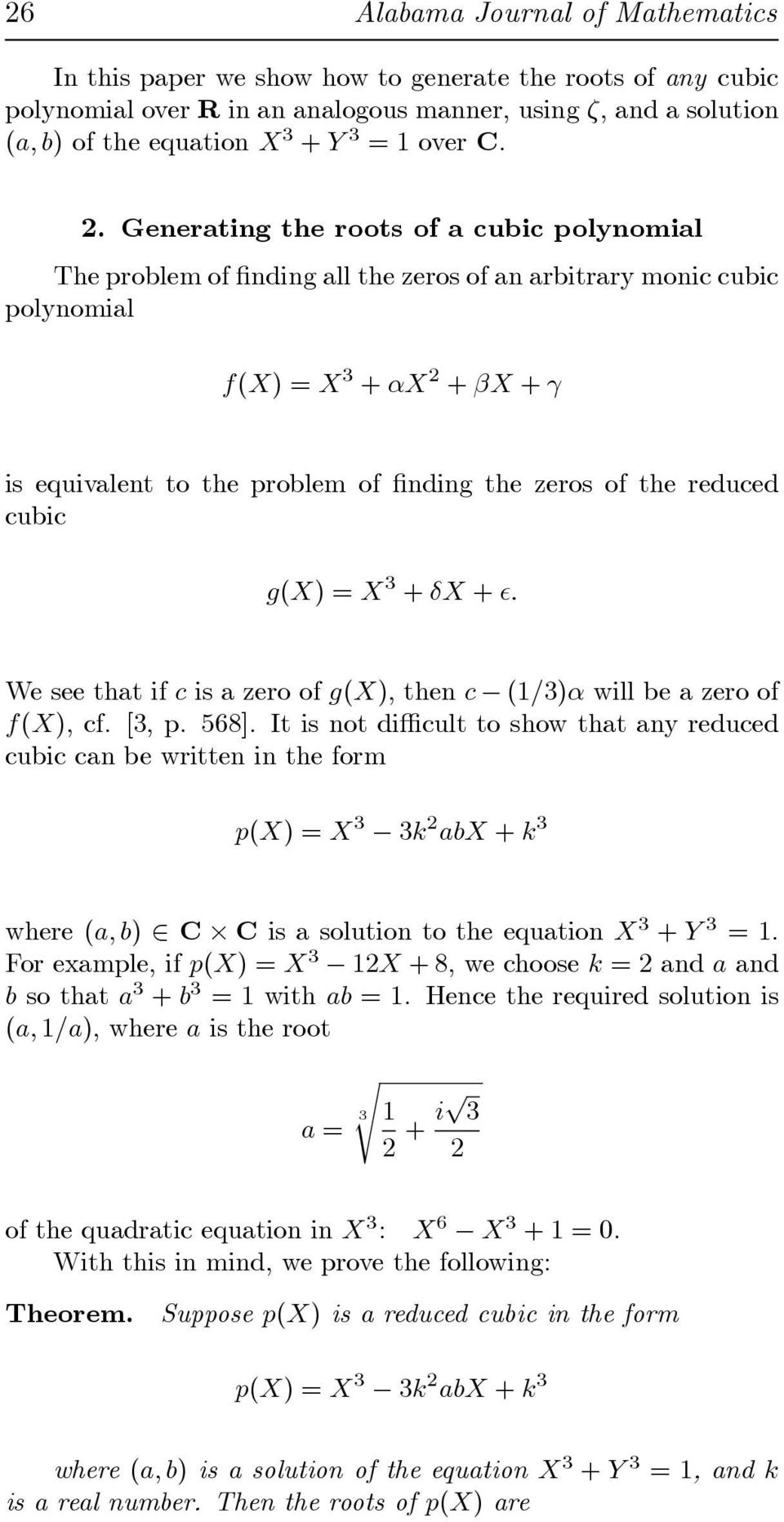
3 Spring c 1 = ka kb c 2 = kaζ kbζ 2 c 3 = kaζ 2 kbζ. Proof. One could show directly that p(c i )=0fori =1, 2, 3, but we present a different proof. Consider C 3, the vector space generated by ordered triples (r, s, t) of complex numbers. Set r = ka, s = kb, andt = c 1 = ka kb. Then the set S = {(ka, kb, t), (t, ka, kb), (kb,t,ka)} is linearly dependent over C. To see this,observe that: ( 1)(ka, kb, c 1 )+( 1)(c 1,ka,kb)=(kb, c 1,ka) is a dependence relation. It follows that the matrix A = ka kb c 1 c 1 ka kb kb c 1 ka is singular, since the rows of A are linearly dependent. Thus det(a) =k 3 a 3 + k 3 b 3 + c 3 1 3k 2 abc 1 =0, which we may rewrite as k 3 a 3 + k 3 b 3 k 3 +(c 3 1 3k 2 abc 1 + k 3 )=0, or c 3 1 3k 2 abc 1 + k 3 =0, since (a, b) isasolutionofx 3 + Y 3 =1. Weconcludethatc 1 = ka kb is a root of our reduced cubic p(x) =X 3 3k 2 abx + k 3.
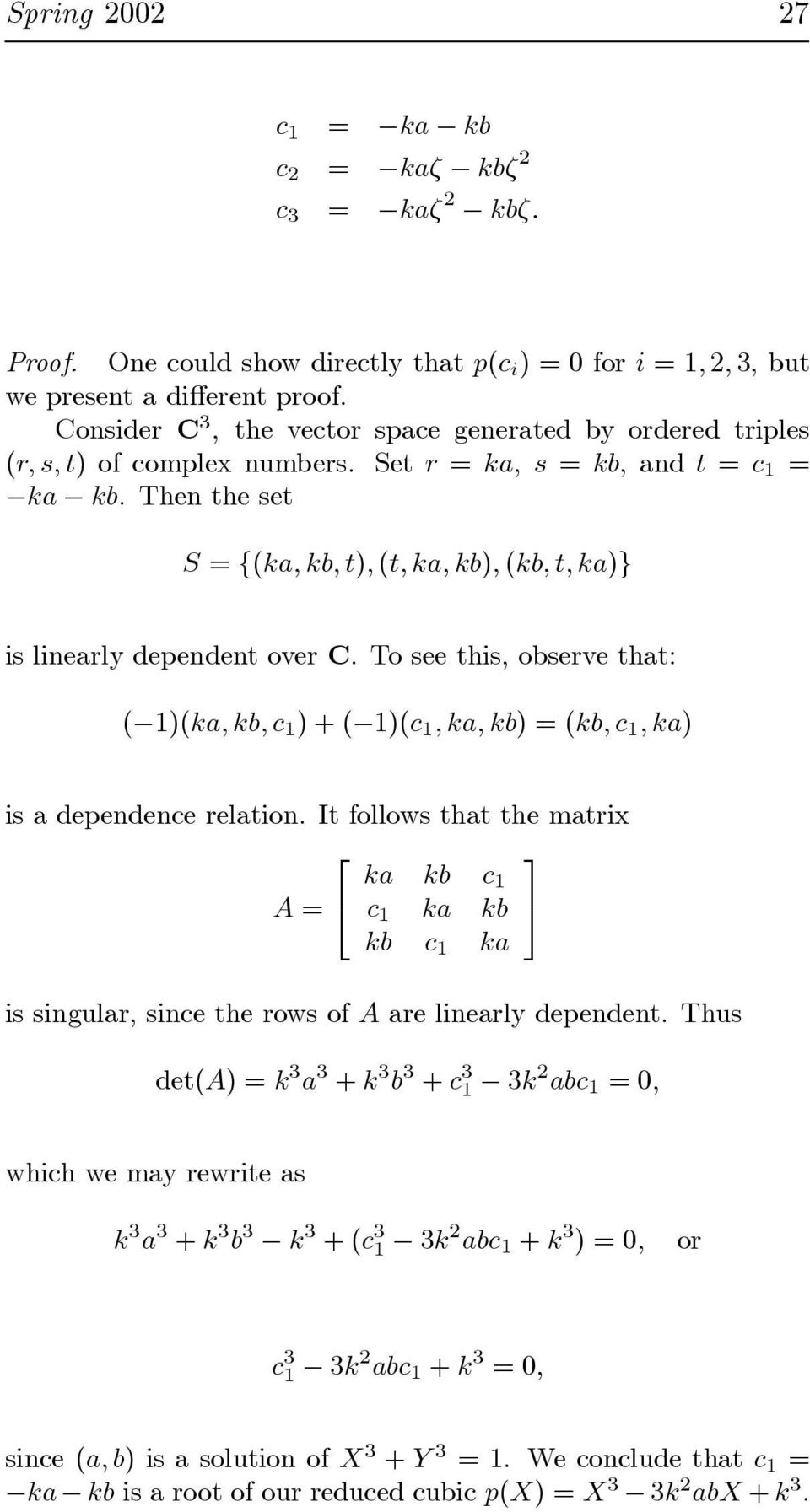
4 28 Alabama Journal of Mathematics To find the other roots of the cubic p(x), we find other values of t so that the set S = {(ka, kb, t), (t, ka, kb), (kb,t,ka)} is linearly dependent. Another such value is t = c 2 = kaζ kbζ 2. To see this, observe that the set S is linearly dependent via the relation ( ζ 2 )(ka, kb, c 2 )+( ζ)(c 2,ka,kb)=(kb, c 2,ka). The matrix is singular, and A = ka kb c 2 c 2 ka kb kb c 2 ka det(a) =k 3 a 3 + k 3 b 3 + c 3 2 3k 2 abc 2 =0, which, in turn, implies that c 3 2 3k 2 abc 2 + k 3 =0. Thus c 2 is the second root of p(x). Finally,ifweputt = c 3 = kaζ 2 kbζ the set S = {(ka, kb, t), (t, ka, kb), (kb,t,ka)} is linearly dependent via the relation ( ζ)(ka, kb, c 3 )+( ζ 2 )(c 3,ka,kb)=(kb, c 3,ka). The matrix A = ka kb c 3 c 3 ka kb kb c 3 ka is singular, and det(a) =k 3 a 3 + k 3 b 3 + c 3 3 3k 2 abc 3 =0,
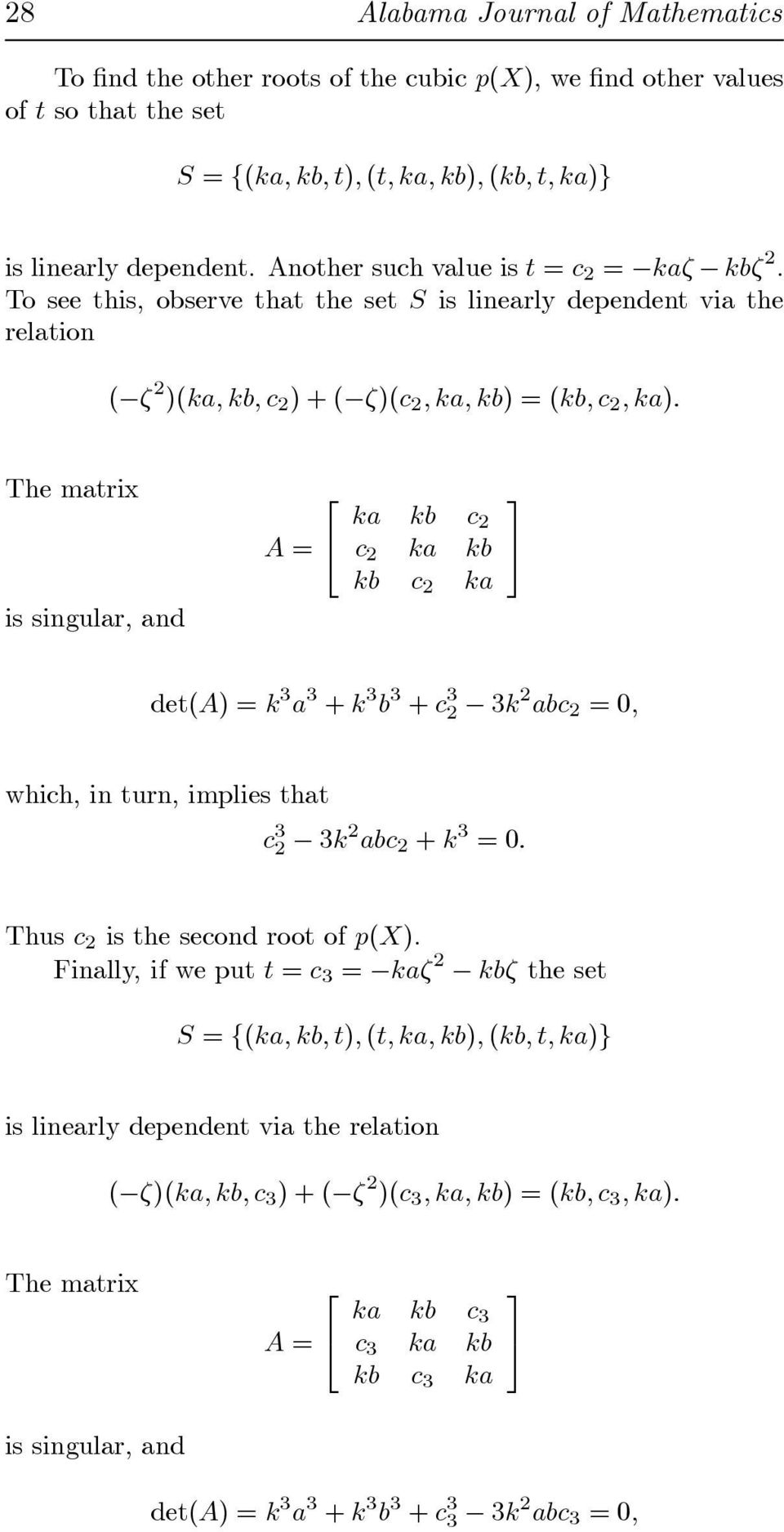
5 Spring which, in turn, implies that c 3 3 3k2 abc 3 + k 3 =0. Thus c 3 is the third and last root of p(x). Returningtoourexamplep(X) =X 3 12X +8, we obtain the factorization p(x) =(X +2a +2a 1 )(X +2ζa +2ζ 2 a 1 )(X +2ζ 2 a +2ζa 1 ), where s a = i 3 2. We close with a final thought. Let Q denote the rational numbers. Suppose p(x) =X 3 3k 2 abx + k 3 is a reduced cubic over Q with exactly one rational root with k 2 ab 6= 0. Because Fermat s Last Theorem is true for the case n = 3, there are no non-trivial solutions to the equation X 3 + Y 3 =1inQ Q. Hence if we use our cubic formula to calculate this rational zero, we must involve non-rational reals or non-real complex numbers. We wonder if this is the case using the standard cubic formula, see [3, Theorem 51.3]. References [1] K. Hoffman, R. Kunze, Linear Algebra, Second Edition, Prentice-Hall, New Jersey, [2] K. Ireland, M. Rosen, A Classical Introduction to Modern Number Theory, Second Edition, Springer-Verlag, New York, [3] S. Warner, Modern Algebra, Vol. II, Prentice-Hall, New Jersey, Department of Mathematics Auburn University Montgomery Montgomery, AL [email protected]
6 30 Alabama Journal of Mathematics

SOLVING POLYNOMIAL EQUATIONS
 C SOLVING POLYNOMIAL EQUATIONS We will assume in this appendix that you know how to divide polynomials using long division and synthetic division. If you need to review those techniques, refer to an algebra
Modern Algebra Lecture Notes: Rings and fields set 4 (Revision 2)
 Modern Algebra Lecture Notes: Rings and fields set 4 (Revision 2) Kevin Broughan University of Waikato, Hamilton, New Zealand May 13, 2010 Remainder and Factor Theorem 15 Definition of factor If f (x)
H/wk 13, Solutions to selected problems
 H/wk 13, Solutions to selected problems Ch. 4.1, Problem 5 (a) Find the number of roots of x x in Z 4, Z Z, any integral domain, Z 6. (b) Find a commutative ring in which x x has infinitely many roots.
JUST THE MATHS UNIT NUMBER 1.8. ALGEBRA 8 (Polynomials) A.J.Hobson
 JUST THE MATHS UNIT NUMBER 1.8 ALGEBRA 8 (Polynomials) by A.J.Hobson 1.8.1 The factor theorem 1.8.2 Application to quadratic and cubic expressions 1.8.3 Cubic equations 1.8.4 Long division of polynomials
SOLVING POLYNOMIAL EQUATIONS BY RADICALS
 SOLVING POLYNOMIAL EQUATIONS BY RADICALS Lee Si Ying 1 and Zhang De-Qi 2 1 Raffles Girls School (Secondary), 20 Anderson Road, Singapore 259978 2 Department of Mathematics, National University of Singapore,
PUTNAM TRAINING POLYNOMIALS. Exercises 1. Find a polynomial with integral coefficients whose zeros include 2 + 5.
 PUTNAM TRAINING POLYNOMIALS (Last updated: November 17, 2015) Remark. This is a list of exercises on polynomials. Miguel A. Lerma Exercises 1. Find a polynomial with integral coefficients whose zeros include
Integer roots of quadratic and cubic polynomials with integer coefficients
 Integer roots of quadratic and cubic polynomials with integer coefficients Konstantine Zelator Mathematics, Computer Science and Statistics 212 Ben Franklin Hall Bloomsburg University 400 East Second Street
6 EXTENDING ALGEBRA. 6.0 Introduction. 6.1 The cubic equation. Objectives
 6 EXTENDING ALGEBRA Chapter 6 Extending Algebra Objectives After studying this chapter you should understand techniques whereby equations of cubic degree and higher can be solved; be able to factorise
a 1 x + a 0 =0. (3) ax 2 + bx + c =0. (4)
 ROOTS OF POLYNOMIAL EQUATIONS In this unit we discuss polynomial equations. A polynomial in x of degree n, where n 0 is an integer, is an expression of the form P n (x) =a n x n + a n 1 x n 1 + + a 1 x
The Characteristic Polynomial
 Physics 116A Winter 2011 The Characteristic Polynomial 1 Coefficients of the characteristic polynomial Consider the eigenvalue problem for an n n matrix A, A v = λ v, v 0 (1) The solution to this problem
Zeros of Polynomial Functions
 Review: Synthetic Division Find (x 2-5x - 5x 3 + x 4 ) (5 + x). Factor Theorem Solve 2x 3-5x 2 + x + 2 =0 given that 2 is a zero of f(x) = 2x 3-5x 2 + x + 2. Zeros of Polynomial Functions Introduction
by the matrix A results in a vector which is a reflection of the given
 Eigenvalues & Eigenvectors Example Suppose Then So, geometrically, multiplying a vector in by the matrix A results in a vector which is a reflection of the given vector about the y-axis We observe that
Equations, Inequalities & Partial Fractions
 Contents Equations, Inequalities & Partial Fractions.1 Solving Linear Equations 2.2 Solving Quadratic Equations 1. Solving Polynomial Equations 1.4 Solving Simultaneous Linear Equations 42.5 Solving Inequalities
it is easy to see that α = a
 21. Polynomial rings Let us now turn out attention to determining the prime elements of a polynomial ring, where the coefficient ring is a field. We already know that such a polynomial ring is a UF. Therefore
Mathematics Course 111: Algebra I Part IV: Vector Spaces
 Mathematics Course 111: Algebra I Part IV: Vector Spaces D. R. Wilkins Academic Year 1996-7 9 Vector Spaces A vector space over some field K is an algebraic structure consisting of a set V on which are
3 1. Note that all cubes solve it; therefore, there are no more
 Math 13 Problem set 5 Artin 11.4.7 Factor the following polynomials into irreducible factors in Q[x]: (a) x 3 3x (b) x 3 3x + (c) x 9 6x 6 + 9x 3 3 Solution: The first two polynomials are cubics, so if
RESULTANT AND DISCRIMINANT OF POLYNOMIALS
 RESULTANT AND DISCRIMINANT OF POLYNOMIALS SVANTE JANSON Abstract. This is a collection of classical results about resultants and discriminants for polynomials, compiled mainly for my own use. All results
7. Some irreducible polynomials
 7. Some irreducible polynomials 7.1 Irreducibles over a finite field 7.2 Worked examples Linear factors x α of a polynomial P (x) with coefficients in a field k correspond precisely to roots α k [1] of
March 29, 2011. 171S4.4 Theorems about Zeros of Polynomial Functions
 MAT 171 Precalculus Algebra Dr. Claude Moore Cape Fear Community College CHAPTER 4: Polynomial and Rational Functions 4.1 Polynomial Functions and Models 4.2 Graphing Polynomial Functions 4.3 Polynomial
minimal polyonomial Example
 Minimal Polynomials Definition Let α be an element in GF(p e ). We call the monic polynomial of smallest degree which has coefficients in GF(p) and α as a root, the minimal polyonomial of α. Example: We
The Method of Least Squares
 The Method of Least Squares Steven J. Miller Mathematics Department Brown University Providence, RI 0292 Abstract The Method of Least Squares is a procedure to determine the best fit line to data; the
Solving Cubic Polynomials
 Solving Cubic Polynomials 1.1 The general solution to the quadratic equation There are four steps to finding the zeroes of a quadratic polynomial. 1. First divide by the leading term, making the polynomial
3.6 The Real Zeros of a Polynomial Function
 SECTION 3.6 The Real Zeros of a Polynomial Function 219 3.6 The Real Zeros of a Polynomial Function PREPARING FOR THIS SECTION Before getting started, review the following: Classification of Numbers (Appendix,
CHAPTER SIX IRREDUCIBILITY AND FACTORIZATION 1. BASIC DIVISIBILITY THEORY
 January 10, 2010 CHAPTER SIX IRREDUCIBILITY AND FACTORIZATION 1. BASIC DIVISIBILITY THEORY The set of polynomials over a field F is a ring, whose structure shares with the ring of integers many characteristics.
4.3 Lagrange Approximation
 206 CHAP. 4 INTERPOLATION AND POLYNOMIAL APPROXIMATION Lagrange Polynomial Approximation 4.3 Lagrange Approximation Interpolation means to estimate a missing function value by taking a weighted average
Zeros of Polynomial Functions
 Zeros of Polynomial Functions Objectives: 1.Use the Fundamental Theorem of Algebra to determine the number of zeros of polynomial functions 2.Find rational zeros of polynomial functions 3.Find conjugate
Rolle s Theorem. q( x) = 1
 Lecture 1 :The Mean Value Theorem We know that constant functions have derivative zero. Is it possible for a more complicated function to have derivative zero? In this section we will answer this question
SOLUTIONS TO PROBLEM SET 3
 SOLUTIONS TO PROBLEM SET 3 MATTI ÅSTRAND The General Cubic Extension Denote L = k(α 1, α 2, α 3 ), F = k(a 1, a 2, a 3 ) and K = F (α 1 ). The polynomial f(x) = x 3 a 1 x 2 + a 2 x a 3 = (x α 1 )(x α 2
A simple application of the implicit function theorem
 Boletín de la Asociación Matemática Venezolana, Vol. XIX, No. 1 (2012) 71 DIVULGACIÓN MATEMÁTICA A simple application of the implicit function theorem Germán Lozada-Cruz Abstract. In this note we show
FACTORING POLYNOMIALS IN THE RING OF FORMAL POWER SERIES OVER Z
 FACTORING POLYNOMIALS IN THE RING OF FORMAL POWER SERIES OVER Z DANIEL BIRMAJER, JUAN B GIL, AND MICHAEL WEINER Abstract We consider polynomials with integer coefficients and discuss their factorization
Introduction to Algebraic Geometry. Bézout s Theorem and Inflection Points
 Introduction to Algebraic Geometry Bézout s Theorem and Inflection Points 1. The resultant. Let K be a field. Then the polynomial ring K[x] is a unique factorisation domain (UFD). Another example of a
Algebra Unpacked Content For the new Common Core standards that will be effective in all North Carolina schools in the 2012-13 school year.
 This document is designed to help North Carolina educators teach the Common Core (Standard Course of Study). NCDPI staff are continually updating and improving these tools to better serve teachers. Algebra
Tim Kerins. Leaving Certificate Honours Maths - Algebra. Tim Kerins. the date
 Leaving Certificate Honours Maths - Algebra the date Chapter 1 Algebra This is an important portion of the course. As well as generally accounting for 2 3 questions in examination it is the basis for many
Factorization Algorithms for Polynomials over Finite Fields
 Degree Project Factorization Algorithms for Polynomials over Finite Fields Sajid Hanif, Muhammad Imran 2011-05-03 Subject: Mathematics Level: Master Course code: 4MA11E Abstract Integer factorization is
Basics of Polynomial Theory
 3 Basics of Polynomial Theory 3.1 Polynomial Equations In geodesy and geoinformatics, most observations are related to unknowns parameters through equations of algebraic (polynomial) type. In cases where
calculating the result modulo 3, as follows: p(0) = 0 3 + 0 + 1 = 1 0,
 Homework #02, due 1/27/10 = 9.4.1, 9.4.2, 9.4.5, 9.4.6, 9.4.7. Additional problems recommended for study: (9.4.3), 9.4.4, 9.4.9, 9.4.11, 9.4.13, (9.4.14), 9.4.17 9.4.1 Determine whether the following polynomials
Chapter 4, Arithmetic in F [x] Polynomial arithmetic and the division algorithm.
![Chapter 4, Arithmetic in F [x] Polynomial arithmetic and the division algorithm.](/thumbs/26/8276997.jpg "Chapter 4, Arithmetic in F [x] Polynomial arithmetic and the division algorithm.") Chapter 4, Arithmetic in F [x] Polynomial arithmetic and the division algorithm. We begin by defining the ring of polynomials with coefficients in a ring R. After some preliminary results, we specialize
Chapter 4, Arithmetic in F [x] Polynomial arithmetic and the division algorithm. We begin by defining the ring of polynomials with coefficients in a ring R. After some preliminary results, we specialize
3.2 The Factor Theorem and The Remainder Theorem
 3. The Factor Theorem and The Remainder Theorem 57 3. The Factor Theorem and The Remainder Theorem Suppose we wish to find the zeros of f(x) = x 3 + 4x 5x 4. Setting f(x) = 0 results in the polynomial
Recall that two vectors in are perpendicular or orthogonal provided that their dot
 Orthogonal Complements and Projections Recall that two vectors in are perpendicular or orthogonal provided that their dot product vanishes That is, if and only if Example 1 The vectors in are orthogonal
Factoring Polynomials
 Factoring Polynomials Any Any Any natural number that that that greater greater than than than 1 1can can 1 be can be be factored into into into a a a product of of of prime prime numbers. For For For
3 Factorisation into irreducibles
 3 Factorisation into irreducibles Consider the factorisation of a non-zero, non-invertible integer n as a product of primes: n = p 1 p t. If you insist that primes should be positive then, since n could
15. Symmetric polynomials
 15. Symmetric polynomials 15.1 The theorem 15.2 First examples 15.3 A variant: discriminants 1. The theorem Let S n be the group of permutations of {1,, n}, also called the symmetric group on n things.
9. POLYNOMIALS. Example 1: The expression a(x) = x 3 4x 2 + 7x 11 is a polynomial in x. The coefficients of a(x) are the numbers 1, 4, 7, 11.
 9. POLYNOMIALS 9.1. Definition of a Polynomial A polynomial is an expression of the form: a(x) = a n x n + a n-1 x n-1 +... + a 1 x + a 0. The symbol x is called an indeterminate and simply plays the role
1 Sets and Set Notation.
 LINEAR ALGEBRA MATH 27.6 SPRING 23 (COHEN) LECTURE NOTES Sets and Set Notation. Definition (Naive Definition of a Set). A set is any collection of objects, called the elements of that set. We will most
MATH 4552 Cubic equations and Cardano s formulae
 MATH 455 Cubic equations and Cardano s formulae Consider a cubic equation with the unknown z and fixed complex coefficients a, b, c, d (where a 0): (1) az 3 + bz + cz + d = 0. To solve (1), it is convenient
2.3. Finding polynomial functions. An Introduction:
 2.3. Finding polynomial functions. An Introduction: As is usually the case when learning a new concept in mathematics, the new concept is the reverse of the previous one. Remember how you first learned
3.3. Solving Polynomial Equations. Introduction. Prerequisites. Learning Outcomes
 Solving Polynomial Equations 3.3 Introduction Linear and quadratic equations, dealt within Sections 3.1 and 3.2, are members of a class of equations, called polynomial equations. These have the general
The Method of Partial Fractions Math 121 Calculus II Spring 2015
 Rational functions. as The Method of Partial Fractions Math 11 Calculus II Spring 015 Recall that a rational function is a quotient of two polynomials such f(x) g(x) = 3x5 + x 3 + 16x x 60. The method
Notes on Factoring. MA 206 Kurt Bryan
 The General Approach Notes on Factoring MA 26 Kurt Bryan Suppose I hand you n, a 2 digit integer and tell you that n is composite, with smallest prime factor around 5 digits. Finding a nontrivial factor
5. Factoring by the QF method
 5. Factoring by the QF method 5.0 Preliminaries 5.1 The QF view of factorability 5.2 Illustration of the QF view of factorability 5.3 The QF approach to factorization 5.4 Alternative factorization by the
THE FUNDAMENTAL THEOREM OF ALGEBRA VIA PROPER MAPS
 THE FUNDAMENTAL THEOREM OF ALGEBRA VIA PROPER MAPS KEITH CONRAD 1. Introduction The Fundamental Theorem of Algebra says every nonconstant polynomial with complex coefficients can be factored into linear
Discrete Mathematics: Homework 7 solution. Due: 2011.6.03
 EE 2060 Discrete Mathematics spring 2011 Discrete Mathematics: Homework 7 solution Due: 2011.6.03 1. Let a n = 2 n + 5 3 n for n = 0, 1, 2,... (a) (2%) Find a 0, a 1, a 2, a 3 and a 4. (b) (2%) Show that
Similarity and Diagonalization. Similar Matrices
 MATH022 Linear Algebra Brief lecture notes 48 Similarity and Diagonalization Similar Matrices Let A and B be n n matrices. We say that A is similar to B if there is an invertible n n matrix P such that
Math 55: Discrete Mathematics
 Math 55: Discrete Mathematics UC Berkeley, Spring 2012 Homework # 9, due Wednesday, April 11 8.1.5 How many ways are there to pay a bill of 17 pesos using a currency with coins of values of 1 peso, 2 pesos,
Winter Camp 2011 Polynomials Alexander Remorov. Polynomials. Alexander Remorov [email protected]
 Polynomials Alexander Remorov [email protected] Warm-up Problem 1: Let f(x) be a quadratic polynomial. Prove that there exist quadratic polynomials g(x) and h(x) such that f(x)f(x + 1) = g(h(x)).
Lecture Notes on Polynomials
 Lecture Notes on Polynomials Arne Jensen Department of Mathematical Sciences Aalborg University c 008 Introduction These lecture notes give a very short introduction to polynomials with real and complex
Factoring Polynomials and Solving Quadratic Equations
 Factoring Polynomials and Solving Quadratic Equations Math Tutorial Lab Special Topic Factoring Factoring Binomials Remember that a binomial is just a polynomial with two terms. Some examples include 2x+3
Linear Algebra Notes for Marsden and Tromba Vector Calculus
 Linear Algebra Notes for Marsden and Tromba Vector Calculus n-dimensional Euclidean Space and Matrices Definition of n space As was learned in Math b, a point in Euclidean three space can be thought of
Zero: If P is a polynomial and if c is a number such that P (c) = 0 then c is a zero of P.
 MATH 11011 FINDING REAL ZEROS KSU OF A POLYNOMIAL Definitions: Polynomial: is a function of the form P (x) = a n x n + a n 1 x n 1 + + a x + a 1 x + a 0. The numbers a n, a n 1,..., a 1, a 0 are called
Application. Outline. 3-1 Polynomial Functions 3-2 Finding Rational Zeros of. Polynomial. 3-3 Approximating Real Zeros of.
 Polynomial and Rational Functions Outline 3-1 Polynomial Functions 3-2 Finding Rational Zeros of Polynomials 3-3 Approximating Real Zeros of Polynomials 3-4 Rational Functions Chapter 3 Group Activity:
Real Roots of Univariate Polynomials with Real Coefficients
 Real Roots of Univariate Polynomials with Real Coefficients mostly written by Christina Hewitt March 22, 2012 1 Introduction Polynomial equations are used throughout mathematics. When solving polynomials
Math 115A HW4 Solutions University of California, Los Angeles. 5 2i 6 + 4i. (5 2i)7i (6 + 4i)( 3 + i) = 35i + 14 ( 22 6i) = 36 + 41i.
 Math 5A HW4 Solutions September 5, 202 University of California, Los Angeles Problem 4..3b Calculate the determinant, 5 2i 6 + 4i 3 + i 7i Solution: The textbook s instructions give us, (5 2i)7i (6 + 4i)(
The Notebook Series. The solution of cubic and quartic equations. R.S. Johnson. Professor of Applied Mathematics
 The Notebook Series The solution of cubic and quartic equations by R.S. Johnson Professor of Applied Mathematics School of Mathematics & Statistics University of Newcastle upon Tyne R.S.Johnson 006 CONTENTS
Chapter 17. Orthogonal Matrices and Symmetries of Space
 Chapter 17. Orthogonal Matrices and Symmetries of Space Take a random matrix, say 1 3 A = 4 5 6, 7 8 9 and compare the lengths of e 1 and Ae 1. The vector e 1 has length 1, while Ae 1 = (1, 4, 7) has length
ALGEBRA 2 CRA 2 REVIEW - Chapters 1-6 Answer Section
 ALGEBRA 2 CRA 2 REVIEW - Chapters 1-6 Answer Section MULTIPLE CHOICE 1. ANS: C 2. ANS: A 3. ANS: A OBJ: 5-3.1 Using Vertex Form SHORT ANSWER 4. ANS: (x + 6)(x 2 6x + 36) OBJ: 6-4.2 Solving Equations by
Factoring Polynomials
 Factoring Polynomials Sue Geller June 19, 2006 Factoring polynomials over the rational numbers, real numbers, and complex numbers has long been a standard topic of high school algebra. With the advent
The Division Algorithm for Polynomials Handout Monday March 5, 2012
 The Division Algorithm for Polynomials Handout Monday March 5, 0 Let F be a field (such as R, Q, C, or F p for some prime p. This will allow us to divide by any nonzero scalar. (For some of the following,
Au = = = 3u. Aw = = = 2w. so the action of A on u and w is very easy to picture: it simply amounts to a stretching by 3 and 2, respectively.
 Chapter 7 Eigenvalues and Eigenvectors In this last chapter of our exploration of Linear Algebra we will revisit eigenvalues and eigenvectors of matrices, concepts that were already introduced in Geometry
Zeros of Polynomial Functions
 Zeros of Polynomial Functions The Rational Zero Theorem If f (x) = a n x n + a n-1 x n-1 + + a 1 x + a 0 has integer coefficients and p/q (where p/q is reduced) is a rational zero, then p is a factor of
Inner Product Spaces
 Math 571 Inner Product Spaces 1. Preliminaries An inner product space is a vector space V along with a function, called an inner product which associates each pair of vectors u, v with a scalar u, v, and
Quotient Rings and Field Extensions
 Chapter 5 Quotient Rings and Field Extensions In this chapter we describe a method for producing field extension of a given field. If F is a field, then a field extension is a field K that contains F.
South Carolina College- and Career-Ready (SCCCR) Pre-Calculus
 South Carolina College- and Career-Ready (SCCCR) Pre-Calculus Key Concepts Arithmetic with Polynomials and Rational Expressions PC.AAPR.2 PC.AAPR.3 PC.AAPR.4 PC.AAPR.5 PC.AAPR.6 PC.AAPR.7 Standards Know
1.7. Partial Fractions. 1.7.1. Rational Functions and Partial Fractions. A rational function is a quotient of two polynomials: R(x) = P (x) Q(x).
 .7. PRTIL FRCTIONS 3.7. Partial Fractions.7.. Rational Functions and Partial Fractions. rational function is a quotient of two polynomials: R(x) = P (x) Q(x). Here we discuss how to integrate rational
Row Ideals and Fibers of Morphisms
 Michigan Math. J. 57 (2008) Row Ideals and Fibers of Morphisms David Eisenbud & Bernd Ulrich Affectionately dedicated to Mel Hochster, who has been an inspiration to us for many years, on the occasion
Cyclotomic Extensions
 Chapter 7 Cyclotomic Extensions A cyclotomic extension Q(ζ n ) of the rationals is formed by adjoining a primitive n th root of unity ζ n. In this chapter, we will find an integral basis and calculate
Introduction to Finite Fields (cont.)
 Chapter 6 Introduction to Finite Fields (cont.) 6.1 Recall Theorem. Z m is a field m is a prime number. Theorem (Subfield Isomorphic to Z p ). Every finite field has the order of a power of a prime number
Math Common Core Sampler Test
 High School Algebra Core Curriculum Math Test Math Common Core Sampler Test Our High School Algebra sampler covers the twenty most common questions that we see targeted for this level. For complete tests
The van Hoeij Algorithm for Factoring Polynomials
 The van Hoeij Algorithm for Factoring Polynomials Jürgen Klüners Abstract In this survey we report about a new algorithm for factoring polynomials due to Mark van Hoeij. The main idea is that the combinatorial
ON GALOIS REALIZATIONS OF THE 2-COVERABLE SYMMETRIC AND ALTERNATING GROUPS
 ON GALOIS REALIZATIONS OF THE 2-COVERABLE SYMMETRIC AND ALTERNATING GROUPS DANIEL RABAYEV AND JACK SONN Abstract. Let f(x) be a monic polynomial in Z[x] with no rational roots but with roots in Q p for
First and raw version 0.1 23. september 2013 klokken 13:45
 The discriminant First and raw version 0.1 23. september 2013 klokken 13:45 One of the most significant invariant of an algebraic number field is the discriminant. One is tempted to say, apart from the
Solving for the Roots of the Cubic Equation. Finding the solution to the roots of a polynomial equation has been a fundamental
 Dallas Gosselin and Jonathan Fernandez Professor Buckmire April 18, 014 Complex Analysis Project Solving for the Roots of the Cubic Equation Finding the solution to the roots of a polynomial equation has
MATH10212 Linear Algebra. Systems of Linear Equations. Definition. An n-dimensional vector is a row or a column of n numbers (or letters): a 1.
 MATH10212 Linear Algebra Textbook: D. Poole, Linear Algebra: A Modern Introduction. Thompson, 2006. ISBN 0-534-40596-7. Systems of Linear Equations Definition. An n-dimensional vector is a row or a column
Separable First Order Differential Equations
 Separable First Order Differential Equations Form of Separable Equations which take the form = gx hy or These are differential equations = gxĥy, where gx is a continuous function of x and hy is a continuously
Factoring Polynomials
 Factoring Polynomials Hoste, Miller, Murieka September 12, 2011 1 Factoring In the previous section, we discussed how to determine the product of two or more terms. Consider, for instance, the equations
Høgskolen i Narvik Sivilingeniørutdanningen STE6237 ELEMENTMETODER. Oppgaver
 Høgskolen i Narvik Sivilingeniørutdanningen STE637 ELEMENTMETODER Oppgaver Klasse: 4.ID, 4.IT Ekstern Professor: Gregory A. Chechkin e-mail: [email protected] Narvik 6 PART I Task. Consider two-point
63. Graph y 1 2 x and y 2 THE FACTOR THEOREM. The Factor Theorem. Consider the polynomial function. P(x) x 2 2x 15.
 9.4 (9-27) 517 Gear ratio d) For a fixed wheel size and chain ring, does the gear ratio increase or decrease as the number of teeth on the cog increases? decreases 100 80 60 40 20 27-in. wheel, 44 teeth
2.5 Zeros of a Polynomial Functions
 .5 Zeros of a Polynomial Functions Section.5 Notes Page 1 The first rule we will talk about is Descartes Rule of Signs, which can be used to determine the possible times a graph crosses the x-axis and
BX in ( u, v) basis in two ways. On the one hand, AN = u+
 1. Let f(x) = 1 x +1. Find f (6) () (the value of the sixth derivative of the function f(x) at zero). Answer: 7. We expand the given function into a Taylor series at the point x = : f(x) = 1 x + x 4 x
4.5 Linear Dependence and Linear Independence
 4.5 Linear Dependence and Linear Independence 267 32. {v 1, v 2 }, where v 1, v 2 are collinear vectors in R 3. 33. Prove that if S and S are subsets of a vector space V such that S is a subset of S, then
The Mean Value Theorem
 The Mean Value Theorem THEOREM (The Extreme Value Theorem): If f is continuous on a closed interval [a, b], then f attains an absolute maximum value f(c) and an absolute minimum value f(d) at some numbers
8 Polynomials Worksheet
 8 Polynomials Worksheet Concepts: Quadratic Functions The Definition of a Quadratic Function Graphs of Quadratic Functions - Parabolas Vertex Absolute Maximum or Absolute Minimum Transforming the Graph
Generic Polynomials of Degree Three
 Generic Polynomials of Degree Three Benjamin C. Wallace April 2012 1 Introduction In the nineteenth century, the mathematician Évariste Galois discovered an elegant solution to the fundamental problem
Lecture 13 Linear quadratic Lyapunov theory
 EE363 Winter 28-9 Lecture 13 Linear quadratic Lyapunov theory the Lyapunov equation Lyapunov stability conditions the Lyapunov operator and integral evaluating quadratic integrals analysis of ARE discrete-time
2.5 ZEROS OF POLYNOMIAL FUNCTIONS. Copyright Cengage Learning. All rights reserved.
 2.5 ZEROS OF POLYNOMIAL FUNCTIONS Copyright Cengage Learning. All rights reserved. What You Should Learn Use the Fundamental Theorem of Algebra to determine the number of zeros of polynomial functions.
1.5. Factorisation. Introduction. Prerequisites. Learning Outcomes. Learning Style
 Factorisation 1.5 Introduction In Block 4 we showed the way in which brackets were removed from algebraic expressions. Factorisation, which can be considered as the reverse of this process, is dealt with
MA106 Linear Algebra lecture notes
 MA106 Linear Algebra lecture notes Lecturers: Martin Bright and Daan Krammer Warwick, January 2011 Contents 1 Number systems and fields 3 1.1 Axioms for number systems......................... 3 2 Vector
December 4, 2013 MATH 171 BASIC LINEAR ALGEBRA B. KITCHENS
 December 4, 2013 MATH 171 BASIC LINEAR ALGEBRA B KITCHENS The equation 1 Lines in two-dimensional space (1) 2x y = 3 describes a line in two-dimensional space The coefficients of x and y in the equation
MOP 2007 Black Group Integer Polynomials Yufei Zhao. Integer Polynomials. June 29, 2007 Yufei Zhao [email protected]
 Integer Polynomials June 9, 007 Yufei Zhao [email protected] We will use Z[x] to denote the ring of polynomials with integer coefficients. We begin by summarizing some of the common approaches used in dealing
MATH 590: Meshfree Methods
 MATH 590: Meshfree Methods Chapter 7: Conditionally Positive Definite Functions Greg Fasshauer Department of Applied Mathematics Illinois Institute of Technology Fall 2010 [email protected] MATH 590 Chapter
Linearly Independent Sets and Linearly Dependent Sets
 These notes closely follow the presentation of the material given in David C. Lay s textbook Linear Algebra and its Applications (3rd edition). These notes are intended primarily for in-class presentation