
ENERGY SECTOR JOBS TO 2030: A GLOBAL ANALYSIS
|
|
|
- Regina Dennis
- 10 years ago
- Views:
Transcription
1 ENERGY SECTOR JOBS TO : A GLOBAL ANALYSIS Final report For Greenpeace International Authors Jay Rutovitz, Alison Atherton Institute for Sustainable Futures UTS 2009
2 Disclaimer While all due care and attention has been taken to establish the accuracy of the material published, UTS/ISF and the authors disclaim liability for any loss that may arise from any person acting in reliance upon the contents of this document. Acknowledgements We would like to thank Sven Teske, Sophie Clausen, Jane Daly, John Glassmire, Mick Paddon, Chris Riedy, and Alice Cooper for their assistance with this research. PLEASE CITE THIS REPORT AS: Rutovitz, J., Atherton, A. 2009, Energy sector jobs to : a global analysis. Prepared for Greenpeace International by the Institute for Sustainable Futures, University of Technology, Sydney. Energy sector jobs to : a global analysis i

3 Executive summary Greenpeace International and the European Renewable Energy Council published a global energy scenario, Energy, that sets out a vision for low-carbon global energy supply and compares it to the energy projection put forward by the International Energy Agency (IEA 2007). This report presents an analysis of the potential job creation associated with the two scenarios to. Only direct employment associated with electricity production is calculated, including jobs in fuel production, manufacturing, construction, and operations and maintenance. Results are presented for the regions used in both the IEA and Greenpeace projections, namely OECD North America, OECD Europe, OECD Pacific, Africa, Latin America, Middle East, Developing Asia, the Transition Economies, India, and China. Additional detail is given for the G8 countries and the European Union. There have been many reports in recent years attempting to analyse local, national, or regional job effects of energy scenarios and energy policy. This is the first report that attempts to systematically analyse global job impacts of a low-carbon energy future. The Energy scenarios The Energy sets a target reduction of 50% below the 1990 level of greenhouse emissions by 2050, with average per capita emissions of less than 1.3 tonnes per annum. Emissions reductions are achieved through existing technologies, such as energy efficiency, renewable energy and combined heat and power generation. Coal and nuclear power are gradually phased out. Global electricity generation under the and scenarios Energy sector jobs to : a global analysis ii

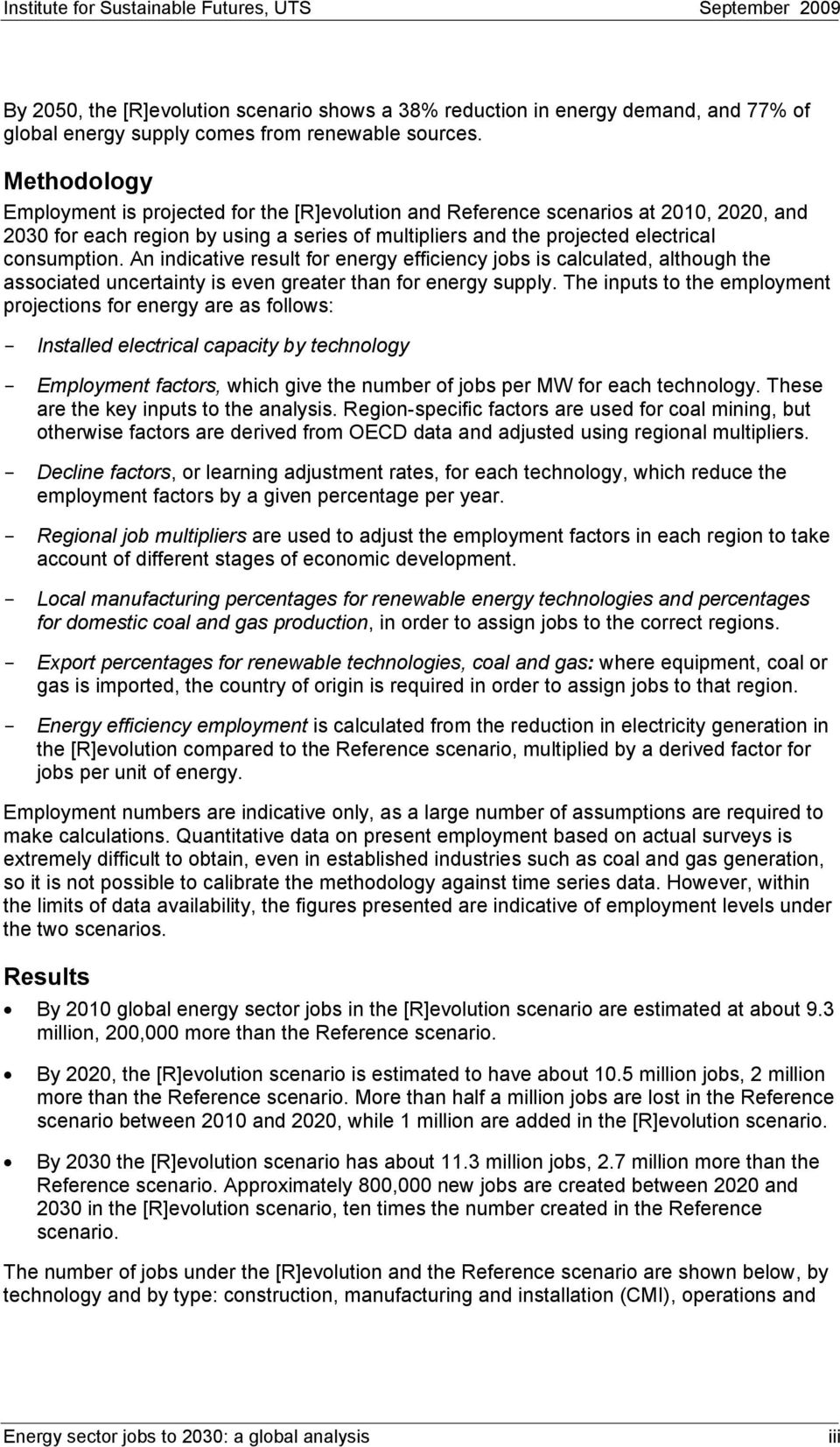
4 By 2050, the scenario shows a 38% reduction in energy demand, and 77% of global energy supply comes from renewable sources. Methodology Employment is projected for the and scenarios at,, and for each region by using a series of multipliers and the projected electrical consumption. An indicative result for energy efficiency jobs is calculated, although the associated uncertainty is even greater than for energy supply. The inputs to the employment projections for energy are as follows: - Installed electrical capacity by technology - Employment factors, which give the number of jobs per MW for each technology. These are the key inputs to the analysis. Region-specific factors are used for coal mining, but otherwise factors are derived from OECD data and adjusted using regional multipliers. - Decline factors, or learning adjustment rates, for each technology, which reduce the employment factors by a given percentage per year. - Regional job multipliers are used to adjust the employment factors in each region to take account of different stages of economic development. - Local manufacturing percentages for renewable energy technologies and percentages for domestic coal and gas production, in order to assign jobs to the correct regions. - Export percentages for renewable technologies, coal and gas: where equipment, coal or gas is imported, the country of origin is required in order to assign jobs to that region. - Energy efficiency employment is calculated from the reduction in electricity generation in the compared to the scenario, multiplied by a derived factor for jobs per unit of energy. Employment numbers are indicative only, as a large number of assumptions are required to make calculations. Quantitative data on present employment based on actual surveys is extremely difficult to obtain, even in established industries such as coal and gas generation, so it is not possible to calibrate the methodology against time series data. However, within the limits of data availability, the figures presented are indicative of employment levels under the two scenarios. Results By global energy sector jobs in the scenario are estimated at about 9.3 million, 200,000 more than the scenario. By, the scenario is estimated to have about 10.5 million jobs, 2 million more than the scenario. More than half a million jobs are lost in the scenario between and, while 1 million are added in the scenario. By the scenario has about 11.3 million jobs, 2.7 million more than the scenario. Approximately 800,000 new jobs are created between and in the scenario, ten times the number created in the scenario. The number of jobs under the and the scenario are shown below, by technology and by type: construction, manufacturing and installation (CMI), operations and Energy sector jobs to : a global analysis iii
5 maintenance (O&M), fuel supply, and energy efficiency. Combined heat and power generation is included under the fuel type, for example gas or biomass. There is a decrease in coal power jobs in both scenarios between and, but strong growth in renewable energy jobs in the scenario leads to a net gain in employment. Growth in gas generation jobs in the scenario is not sufficient to compensate for the losses in coal jobs. Overall, jobs in the scenario jobs increase significantly from 9.3 million in to 10.5 million by, and reach 11.3 million in. By comparison, there is a global decrease in electricity sector jobs in the scenario. Jobs fall from 9.1 million to 8.5 million by, before climbing back to 8.6 million in. World jobs by technology and type in,, and World Millions Ocean Solar thermal Geothermal PV Wind Hydro Biomass Nuclear Oil & diesel Gas Coal World Millions Fuel O&M CMI World employment and electricity generation at,, and WORLD REFERENCE SCENARIO [R]EVOLUTION SCENARIO JOBS (millions) Coal 4.65 m 3.16 m 2.86 m 4.26 m 2.28 m 1.39 m Gas 1.95 m 2.36 m 2.55 m 2.08 m 2.12 m 1.80 m Nuclear, oil and diesel 0.61 m 0.58 m 0.50 m 0.56 m 0.31 m 0.13 m Renewable 1.88 m 2.41 m 2.71 m 2.38 m 5.03 m 6.90 m Energy supply jobs 9.1 m 8.5 m 8.6 m 9.3 m 9.7 m 10.2 m Energy efficiency jobs 0.0 m 0.0 m 0.0 m 0.1 m 0.7 m 1.1 m TOTAL JOBS 9.1 m 8.5 m 8.6 m 9.3 m 10.5 m 11.3 m Note: Energy efficiency jobs included are only those over and above efficiency jobs in the reference scenario. Energy sector jobs to : a global analysis iv

6 CONTENTS EXECUTIVE SUMMARY...II LIST OF TABLES... VI LIST OF FIGURES... IX ABBREVIATIONS INTRODUCTION Background Report structure Global installed renewable energy capacity and sector leaders Production capacity Employment in the renewable sector ENERGY [R]EVOLUTION SCENARIOS METHODOLOGY Methodology overview Limitations Employment factors overview Employment factors for coal and lignite Employment factors by technology Adjustment for learning rates decline factors Regional adjustments Adjustment for manufacturing in the renewable sector Energy efficiency Methodology variations for case studies EMPLOYMENT IN THE ENERGY SECTOR WORLD RESULTS EMPLOYMENT IN THE ENERGY SECTOR REGIONAL RESULTS OECD North America Latin America OECD Europe Africa Middle East Transition Economies India Energy sector jobs to : a global analysis v

7 5.8 Developing Asia China OECD Pacific CASE STUDIES THE G8 COUNTRIES AND THE EU The G8 summary Canada France Germany Japan Italy Russia United States United Kingdom The EU EMPLOYMENT IN THE ENERGY SECTOR - TECHNOLOGY RESULTS Detailed results selected technology SENSITIVITY ANALYSIS REFERENCES Appendices APPENDIX 1 LIST OF COUNTRIES FOR REGIONAL ANALYSIS APPENDIX 2 COAL EMPLOYMENT AND PRODUCTION DATA APPENDIX 3 ENERGY SECTOR SCENARIO EMPLOYMENT FURTHER DETAIL APPENDIX 4 DETAILED RESULTS BY TECHNOLOGY List of Tables TABLE 1 RENEWABLE ENERGY ADDED AND EXISTING CAPACITIES, 2008 (ESTIMATED)*... 3 TABLE 2 RENEWABLE ENERGY SECTOR LEADERS - INSTALLED CAPACITY 2008*... 3 TABLE 3 WIND & SOLAR PV SECTOR LEADERS - PRODUCTION 2008*... 4 TABLE 4 RENEWABLE ENERGY EMPLOYMENT SELECTED COUNTRIES AND WORLD... 5 TABLE 5 EMPLOYMENT FACTORS FOR USE IN GLOBAL ANALYSIS Energy sector jobs to : a global analysis vi
8 TABLE 6 EMPLOYMENT FACTORS FOR COAL POWER CONSTRUCTION AND O&M (ALSO USED FOR LIGNITE) TABLE 7 REGIONAL AND COUNTRY FACTORS FOR COAL PRODUCTION AND EMPLOYMENT TABLE 8 OECD COUNTRIES WITH LESS THAN 5% LIGNITE IN ELECTRICITY PRODUCTION TABLE 9 NET INTER-REGIONAL HARD COAL TRADE, 2006, IEA REFERENCE SCENARIO TABLE 10 REGIONAL PRODUCTION OF COAL, 2006, IEA REFERENCE SCENARIO (MILLION TONS OF COAL EQUIVALENT) TABLE 11 PROPORTION OF COAL IMPORTS IN THE REFERENCE AND {R]EVOLUTION SCENARIO TABLE 12 EMPLOYMENT FACTORS FOR GAS (ALSO USED FOR OIL AND DIESEL) TABLE 13 NET INTER-REGIONAL GAS TRADE, 2006, IEA REFERENCE SCENARIO TABLE 14 REGIONAL PRODUCTION OF GAS, 2006, IEA REFERENCE SCENARIO (BILLION CUBIC METRES) TABLE 15 PROPORTION OF GAS IMPORTS IN THE REFERENCE AND [R]EVOLUTION SCENARIO TABLE 16 EMPLOYMENT FACTORS FOR NUCLEAR POWER TABLE 17 EMPLOYMENT FACTORS FOR BIOMASS TABLE 18 EMPLOYMENT FACTORS FOR HYDRO TABLE 19 EMPLOYMENT FACTORS FOR GEOTHERMAL POWER TABLE 20 EMPLOYMENT FACTORS FOR OCEAN POWER TABLE 21 EMPLOYMENT FACTORS FOR PV TABLE 22 EMPLOYMENT FACTORS FOR SOLAR THERMAL TABLE 23 EMPLOYMENT FACTORS FOR WIND ENERGY TABLE 24 DECLINE RATES TABLE 25 NUMBERS OF COUNTRIES INCLUDED IN ENERGY SCENARIOS AND NUMBERS WITH LABOUR PRODUCTIVITY DATA TABLE 26 GROWTH IN GDP PER CAPITA COMPARED TO GROWTH IN LABOUR PRODUCTIVITY, HISTORIC VALUES TABLE 27 REGIONAL LABOUR PRODUCTIVITY COMPARED TO OECD LABOUR PRODUCTIVITY TABLE 28 MULTIPLIERS TO BE APPLIED TO EMPLOYMENT FACTORS TABLE 29 EMPLOYMENT PER MW IN WAFER PRODUCTION TABLE 30 PROPORTION OF LOCAL MANUFACTURING AND IMPORT / EXPORT, ALL REGIONS TABLE 31 EMPLOYMENT FROM ENERGY EFFICIENCY INVESTMENT IN THE US, TABLE 32 ENERGY EFFICIENCY COMPARATIVE EMPLOYMENT FACTORS DERIVED FROM VARIOUS STUDIES TABLE 33 PROPORTION OF ELECTRICITY SAVINGS BY SECTOR, ENERGY [R]EVOLUTION TABLE 34 PERCENTAGE OF COAL IMPORTED, G8 COUNTRIES AND EU TABLE 35 PERCENTAGE OF GAS IMPORTED, G8 COUNTRIES AND EU TABLE 36 PROPORTIONS OF GLOBALLY TRADED RENEWABLE ENERGY COMPONENTS Energy sector jobs to : a global analysis vii
![.. 15 TABLE 10 REGIONAL PRODUCTION OF COAL, 2006, IEA REFERENCE SCENARIO (MILLION TONS OF COAL EQUIVALENT)... 15 TABLE 11 PROPORTION OF COAL IMPORTS IN THE REFERENCE AND {R]EVOLUTION SCENARIO.](/docs-images/51/13805775/images/page_8.jpg ".. 16 TABLE 12 EMPLOYMENT FACTORS FOR GAS (ALSO USED FOR OIL AND DIESEL)... 17 TABLE 13 NET INTER-REGIONAL GAS TRADE, 2006, IEA REFERENCE SCENARIO.")
9 TABLE 37 MULTIPLIERS TO BE APPLIED TO EMPLOYMENT FACTORS IN CASE STUDY COUNTRIES (WHOLE OF ECONOMY) TABLE 38 EMPLOYMENT FACTORS FOR COAL SUPPLY, G8 AND EU TABLE 39 EMPLOYMENT FACTORS FOR GERMANY IN COUNTRY ANALYSIS TABLE 40 WORLD EMPLOYMENT AND ELECTRICITY GENERATION AT,, AND TABLE 41 OECD NORTH AMERICA: EMPLOYMENT AND ELECTRICITY GENERATION AT,, AND TABLE 42 LATIN AMERICA: EMPLOYMENT AND ELECTRICITY GENERATION AT,, AND TABLE 43 OECD EUROPE: EMPLOYMENT AND ELECTRICITY GENERATION AT,, AND TABLE 44 AFRICA: EMPLOYMENT AND ELECTRICITY GENERATION AT,, AND TABLE 45 MIDDLE EAST: EMPLOYMENT AND ELECTRICITY GENERATION AT,, AND TABLE 46 TRANSITION ECONOMIES: EMPLOYMENT AND ELECTRICITY GENERATION AT,, AND TABLE 47 INDIA: EMPLOYMENT AND ELECTRICITY GENERATION AT,, AND TABLE 48 DEVELOPING ASIA: JOBS AND ELECTRICITY GENERATION,, AND TABLE 49 CHINA: EMPLOYMENT AND ELECTRICITY GENERATION AT,, AND TABLE 50 OECD PACIFIC: EMPLOYMENT AND ELECTRICITY GENERATION AT,, AND TABLE 51 THE G8 COUNTRIES: EMPLOYMENT AND ELECTRICITY GENERATION AT,, AND TABLE 52 CANADA: EMPLOYMENT AND ELECTRICITY GENERATION AT,, AND TABLE 53 FRANCE: EMPLOYMENT AND ELECTRICITY GENERATION AT,, AND TABLE 54 JAPAN: EMPLOYMENT AND ELECTRICITY GENERATION AT,, AND TABLE 55 ITALY: EMPLOYMENT AND ELECTRICITY GENERATION AT,, AND TABLE 56 RUSSIA: EMPLOYMENT AND ELECTRICITY GENERATION AT,, AND TABLE 57 USA: EMPLOYMENT AND ELECTRICITY GENERATION AT,, AND TABLE 58 UK: EMPLOYMENT AND ELECTRICITY GENERATION AT,, AND TABLE 59 EU-27: EMPLOYMENT AND ELECTRICITY GENERATION AT,, AND TABLE 60 WORLD: ELECTRICITY GENERATION AND JOBS AT,, AND TABLE 61 CAPACITY, INVESTMENT, AND DIRECT JOBS COAL TABLE 62 CAPACITY, INVESTMENT, AND DIRECT JOBS WIND TABLE 63 CAPACITY, INVESTMENT, AND DIRECT JOBS PV TABLE A 1 COAL EMPLOYMENT AND PRODUCTION, DETAILED COUNTRY AND REGION DATA TABLE A 2 REGIONAL EMPLOYMENT BY TYPE Energy sector jobs to : a global analysis viii
10 TABLE A 3 G8 AND EU27 EMPLOYMENT BY TYPE TABLE A 4 CAPACITY, INVESTMENT, AND DIRECT JOBS GAS TABLE A 5 CAPACITY, INVESTMENT, AND DIRECT JOBS OIL AND DIESEL TABLE A 6 CAPACITY, INVESTMENT, AND DIRECT JOBS NUCLEAR TABLE A 7 CAPACITY, INVESTMENT, AND DIRECT JOBS BIOMASS TABLE A 8 CAPACITY, INVESTMENT, AND DIRECT JOBS HYDRO TABLE A 9 CAPACITY, INVESTMENT, & DIRECT JOBS SOLAR THERMAL TABLE A 10 CAPACITY, INVESTMENT, & DIRECT JOBS GEOTHERMAL TABLE A 11 CAPACITY, INVESTMENT, & DIRECT JOBS OCEAN TABLE A 12 CAPACITY, INVESTMENT, AND DIRECT JOBS FOSSIL FUEL CHP TABLE A 13 CAPACITY, INVESTMENT, AND DIRECT JOBS RENEWABLE CHP List of Figures FIGURE 1 GLOBAL DEVELOPMENT OF ELECTRICITY GENERATION UNDER THE REFERENCE AND [R]EVOLUTION SCENARIOS... 7 FIGURE 2 WORLD JOBS BY TECHNOLOGY AND TYPE IN,, AND FIGURE 3 WORLD EMPLOYMENT CHANGE IN AND, COMPARED TO FIGURE 4 WORLD ENERGY SECTOR EMPLOYMENT BY REGION, REFERENCE SCENARIO FIGURE 5 OECD NORTH AMERICA: JOBS BY TECHNOLOGY AND TYPE IN,, AND 45 FIGURE 6 OECD NORTH AMERICA: EMPLOYMENT CHANGE AND, COMPARED TO FIGURE 7 LATIN AMERICA: JOBS BY TECHNOLOGY AND TYPE IN,, AND FIGURE 8 LATIN AMERICA: EMPLOYMENT CHANGE AND, COMPARED TO FIGURE 9 OECD EUROPE: JOBS BY TECHNOLOGY AND TYPE IN,, AND FIGURE 10 OECD EUROPE: EMPLOYMENT CHANGE &, COMPARED TO FIGURE 11 AFRICA: JOBS BY TECHNOLOGY AND TYPE IN,, AND FIGURE 12 AFRICA: EMPLOYMENT CHANGE AND, COMPARED TO FIGURE 13 MIDDLE EAST: JOBS BY TECHNOLOGY AND TYPE IN,, AND FIGURE 14 MIDDLE EAST: EMPLOYMENT CHANGE AND, COMPARED TO FIGURE 15 TRANSITION ECOMONIES: JOBS BY TECHNOLOGY AND TYPE IN,, AND FIGURE 16 TRANSITION ECONOMIES: EMPLOYMENT CHANGE AND, COMPARED TO FIGURE 17 INDIA: JOBS BY TECHNOLOGY AND TYPE IN,, AND FIGURE 18 INDIA: EMPLOYMENT CHANGE AND, COMPARED TO Energy sector jobs to : a global analysis ix

11 FIGURE 19 DEVELOPING ASIA: JOBS BY TECHNOLOGY IN,, AND FIGURE 20 DEVELOPING ASIA: EMPLOYMENT CHANGE AND, COMPARED TO FIGURE 21 DEVELOPING ASIA: THE EFFECT OF THE JOB MULTIPLIER PROJECTIONS FIGURE 22 CHINA: JOBS BY TECHNOLOGY AND TYPE IN,, AND FIGURE 23 CHINA: EMPLOYMENT CHANGE IN AND, COMPARED TO FIGURE 24 CHINA: THE EFFECT OF THE JOB MULTIPLIER ON EMPLOYMENT PROJECTIONS FIGURE 25 OECD PACIFIC: JOBS BY TECHNOLOGY AND TYPE IN,, AND FIGURE 26 OECD PACIFIC: EMPLOYMENT CHANGE AND, COMPARED TO FIGURE 27 G8 COUNTRIES: JOBS BY TECHNOLOGY AND TYPE IN,, AND FIGURE 28 THE G8 COUNTRIES: EMPLOYMENT CHANGE AND, COMPARED TO.. 68 FIGURE 29 CANADA: JOBS BY TECHNOLOGY AND TYPE IN,, AND FIGURE 30 CANADA: EMPLOYMENT CHANGE AND, COMPARED TO FIGURE 31 FRANCE: JOBS BY TECHNOLOGY AND TYPE IN,, AND FIGURE 32 FRANCE: EMPLOYMENT CHANGE AND, COMPARED TO FIGURE 33 GERMANY: JOBS BY TECHNOLOGY AND TYPE IN,, AND FIGURE 34 GERMANY: EMPLOYMENT CHANGE AND, COMPARED TO FIGURE 35 JAPAN: JOBS BY TECHNOLOGY AND TYPE IN,, AND FIGURE 36 JAPAN: EMPLOYMENT CHANGE AND, COMPARED TO FIGURE 37 ITALY: JOBS BY TECHNOLOGY AND TYPE IN,, AND FIGURE 38 ITALY: EMPLOYMENT CHANGE AND, COMPARED TO FIGURE 39 RUSSIA: JOBS BY TECHNOLOGY AND TYPE IN,, AND FIGURE 40 RUSSIA: EMPLOYMENT CHANGE AND, COMPARED TO FIGURE 41 USA: JOBS BY TECHNOLOGY AND TYPE IN,, AND FIGURE 42 USA: EMPLOYMENT CHANGE AND, COMPARED TO FIGURE 43 UK: JOBS BY TECHNOLOGY AND TYPE IN,, AND FIGURE 44 UK: EMPLOYMENT CHANGE AND, COMPARED TO FIGURE 45 EU-27: JOBS BY TECHNOLOGY AND TYPE IN,, AND FIGURE 46 EU-27: EMPLOYMENT CHANGE AND, COMPARED TO FIGURE 47 EMPLOYMENT BY TECHNOLOGY IN,, AND FIGURE 48 EMPLOYMENT BY TECHNOLOGY IN FIGURE 49 SENSITIVITY ANALYSIS BY MULTIPLIER, BOTH SCENARIOS FIGURE A 1 EMPLOYMENT BY TECHNOLOGY, DETAILED RESULTS Energy sector jobs to : a global analysis x
12 Abbreviations CMI EREC ESTELA EWEA GPI GW GWh ISF MW MWh NREL O&M Construction, manufacturing and installation European Renewable Energy Council European Solar Thermal Electricity Association European Wind Energy Association Greenpeace International Gigawatt Gigawatt hour Institute for Sustainable Futures Megawatt Megawatt hour National Renewable Energy Laboratories (US) Operations and maintenance Energy sector jobs to : a global analysis 1

13 1 Introduction 1.1 Background Greenpeace International and the European Renewable Energy Council have published a global energy scenario, Energy that sets out a vision for lowcarbon global energy supply and compares it to the energy projection put forward by the International Energy Agency (IEA 2007). The Greenpeace report advocates a pathway for low carbon development up to This report presents an analysis of the potential job creation associated with the two scenarios to. The analysis includes all the regions modelled in the Energy, and further detail for nine case study areas: the EU 27, the G8 as a whole, and each of the G8 countries. Only direct employment is included. Direct jobs are those in the primary industry sector and include jobs in fuel production, manufacturing, construction, and operations and maintenance. Indirect jobs generally include jobs in secondary industries which supply the primary industry sector, which may include, for example, catering and accommodation, and are sometimes taken to include the effects from spending wages earned in the primary industries. Indirect jobs are usually calculated using a multiplier factor derived from input-output modelling. Indirect jobs have been completely excluded from this analysis owing to the considerable uncertainties involved. There have been many reports in recent years attempting to analyse local, national, or regional job effects of energy scenarios and energy policy. This is the first report that attempts to systematically analyse global job impacts of a low-carbon energy future. 1.2 Report structure This section of the report provides high-level background on the global renewable energy industry, including an overview of current employment. Section 2 summarises the Energy scenario on which the jobs analysis is based. Section 3 of the report explains the methodology used to estimate jobs impacts and sections 4 to 7 present the results of the analysis. Section 4 presents global and regional results, section 6 provides case study results and section 7 analyses job impacts by technology. Section 8 presents sensitivity analysis. 1.3 Global installed renewable energy capacity and sector leaders The information in Sections 1.3 and 1.4 is based on the 2009 Renewables Global Status Report (REN ). Worldwide, renewable energy experienced strong growth during Highlights for the year include: Wind power grew by around 29% or 27 GW, constituting the largest addition to renewable energy capacity. The US, China, India and Germany collectively installed 18.2 GW of wind power. Approximately 2 GW of biomass power generation was added in 2008, mainly in Europe. Brazil and the Philippines are the world leaders in biomass power from bagasse (sugar cane trash). Energy sector jobs to : a global analysis 2

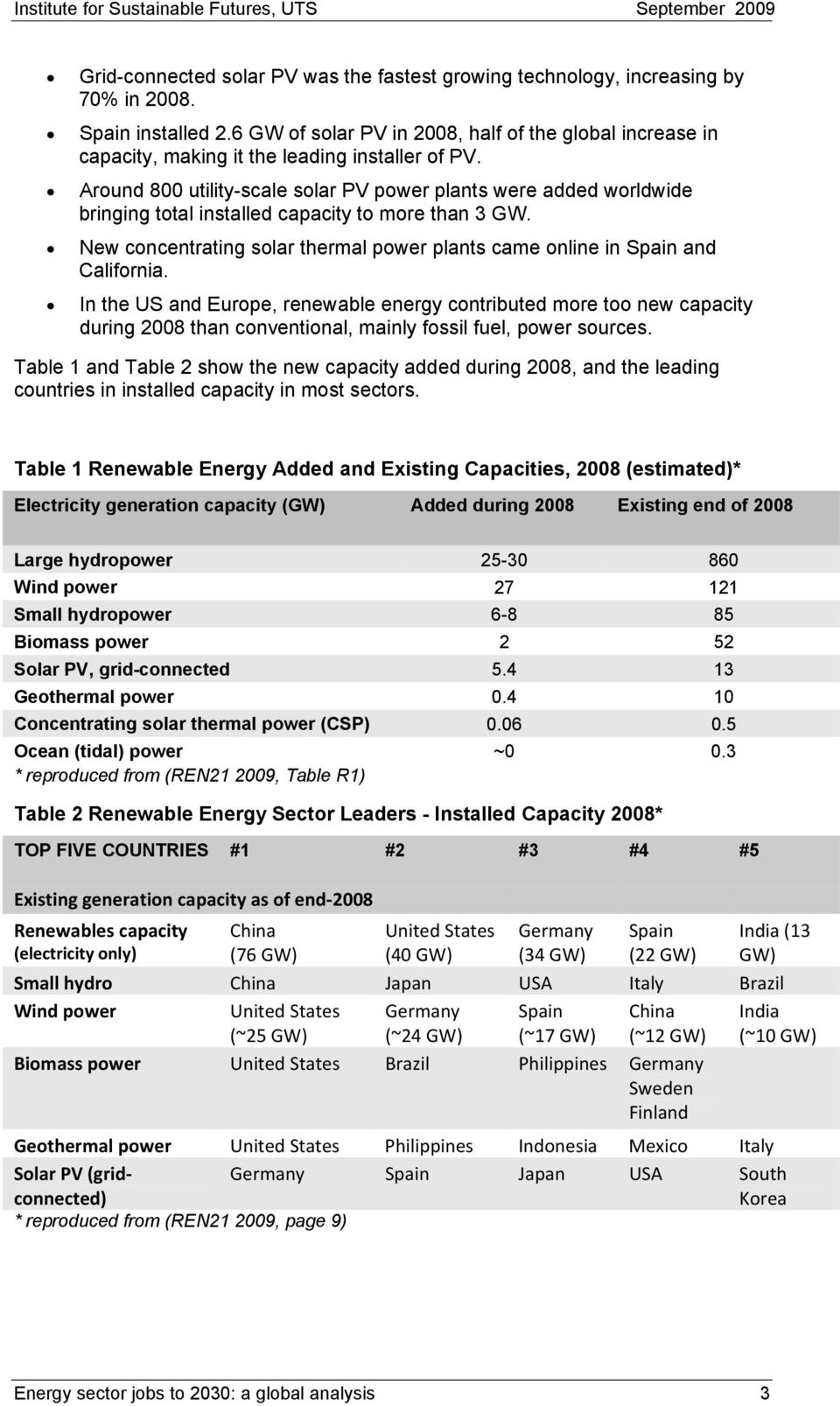
14 Grid-connected solar PV was the fastest growing technology, increasing by 70% in Spain installed 2.6 GW of solar PV in 2008, half of the global increase in capacity, making it the leading installer of PV. Around 800 utility-scale solar PV power plants were added worldwide bringing total installed capacity to more than 3 GW. New concentrating solar thermal power plants came online in Spain and California. In the US and Europe, renewable energy contributed more too new capacity during 2008 than conventional, mainly fossil fuel, power sources. Table 1 and Table 2 show the new capacity added during 2008, and the leading countries in installed capacity in most sectors. Table 1 Renewable Energy Added and Existing Capacities, 2008 (estimated)* Electricity generation capacity (GW) Added during 2008 Existing end of 2008 Large hydropower Wind power Small hydropower Biomass power 2 52 Solar PV, grid-connected Geothermal power Concentrating solar thermal power (CSP) Ocean (tidal) power ~0 0.3 * reproduced from (REN , Table R1) Table 2 Renewable Energy Sector Leaders - Installed Capacity 2008* TOP FIVE COUNTRIES #1 #2 #3 #4 #5 Existing generation capacity as of end 2008 Renewables capacity (electricity only) China (76 GW) United States (40 GW) Germany (34 GW) Spain (22 GW) India (13 GW) Small hydro China Japan USA Italy Brazil Wind power United States (~25 GW) Germany (~24 GW) Spain (~17 GW) China (~12 GW) India (~10 GW) Biomass power United States Brazil Philippines Germany Sweden Finland Geothermal power United States Philippines Indonesia Mexico Italy Solar PV (gridconnected) Germany Spain Japan USA South Korea * reproduced from (REN , page 9) Energy sector jobs to : a global analysis 3
15 1.4 Production capacity 2008 saw large increases in renewables manufacturing capacity, although production and expansion plans were impacted at the end of the year by the global financial crisis. Highlights include: In the solar PV sector, China overtook Japan as the world s leading producer of PV cells during Globally, manufacturing capacity in the PV industry was more than 8 GW by the end of Production during 2008 was 6.9 GW, up from 2.5 GW in The wind power industry in China grew most during 2008 and appeared to be unaffected by the global financial crisis. It is anticipated that by, the Chinese wind industry will have an annual production capacity of 20 GW. By the end of 2008 the US was manufacturing 50% of its wind power components domestically, up from 30% in The top 10 wind turbine manufacturers globally were responsible for 85% of total production in The concentrating solar (thermal) power (CSP) industry grew substantially during 2008 with manufacturing facilities opening in the US and Spain. TOP FIVE COMPANIES/ COUNTRIES #1 #2 #3 #4 #5 Annual production in 2008 Wind power top 5 companies Solar PV top 5 countries Vestas (Denmark) China (1.8 GW) GE Wind (USA) Germany (1.3 GW) Gamesa (Spain) Japan (1.2 GW) Enercon (Germany) Taiwan (0.9 GW) Table 3 shows the world leaders in wind and solar PV production during Suzlon (India) United States (0.4 GW) Table 3 Wind & Solar PV Sector Leaders - Production 2008* TOP FIVE COMPANIES/ COUNTRIES #1 #2 #3 #4 #5 Annual production in 2008 Wind power top 5 companies Solar PV top 5 countries * from REN21, 2009 Vestas (Denmark) China (1.8 GW) GE Wind (USA) Germany (1.3 GW) Gamesa (Spain) Japan (1.2 GW) Enercon (Germany) Taiwan (0.9 GW) Suzlon (India) United States (0.4 GW) Unsurprisingly, countries which have the largest internal markets are generally also leaders in production capacity. Germany, Spain and the US feature as world leaders in production and installed capacity of wind and solar PV. Japan is a leader in PV production and installed capacity, as is India in wind power production and installed capacity. China, the world s leading PV cell manufacturer, does not yet feature as a leader in solar PV installation, but the market in China is growing rapidly. Energy sector jobs to : a global analysis 4

16 1.5 Employment in the renewable sector Data on employment in the electricity sector globally is patchy and disaggregated, even in established industries such as coal generation. Data is more readily available for some sectors, such as wind power, and for some OECD countries. For emerging technologies, such as ocean power, data on employment impacts are hard to find. Similarly, for countries where an industry is nascent, employment data is often absent. Table 4 gives an indication of levels of renewable energy employment in selected countries, although it is not always clear whether data is for direct jobs only. There is no data available for China, which currently leads the world in installed capacity. Current estimates for world employment in renewable energy sector other than solar water heating are 1.3 million (REN , p 7) to 1.7 million (UNEP 2008, p. 295). Table 4 Renewable electricity employment selected countries and world RENEWABLE ENERGY SOURCE Wind Solar PV Solar Thermal electricity Biomass power Selected countries United States Spain Denmark India World estimate United States Spain World estimate United States Spain United States Spain Employment estimates 16,000 a 32,906 b 21,612 c 10,000 d 300,000 f 6,800 a 26,449 b 170,000 f 800 a 968 b 66,000 a 4,948 b Hydropower Europe United States Spain (small hydro) 20,000 8,000 a 6,661 b Geothermal United States 9,000 a All sectors World estimate 1.3 e f million a 2006 data: Bedzek 2007 b 2007 data: Nieto Sáinz J 2007, in UNEP 2008 Table c 2006 data: Danish Wind Industry Association d 2007 data: Suzlon 2007 e 2006 data: REN p7 f UNEP 2008 p295; total for renewable sector minus estimated jobs in solar thermal as these are nearly all in solar water heating. Energy sector jobs to : a global analysis 5

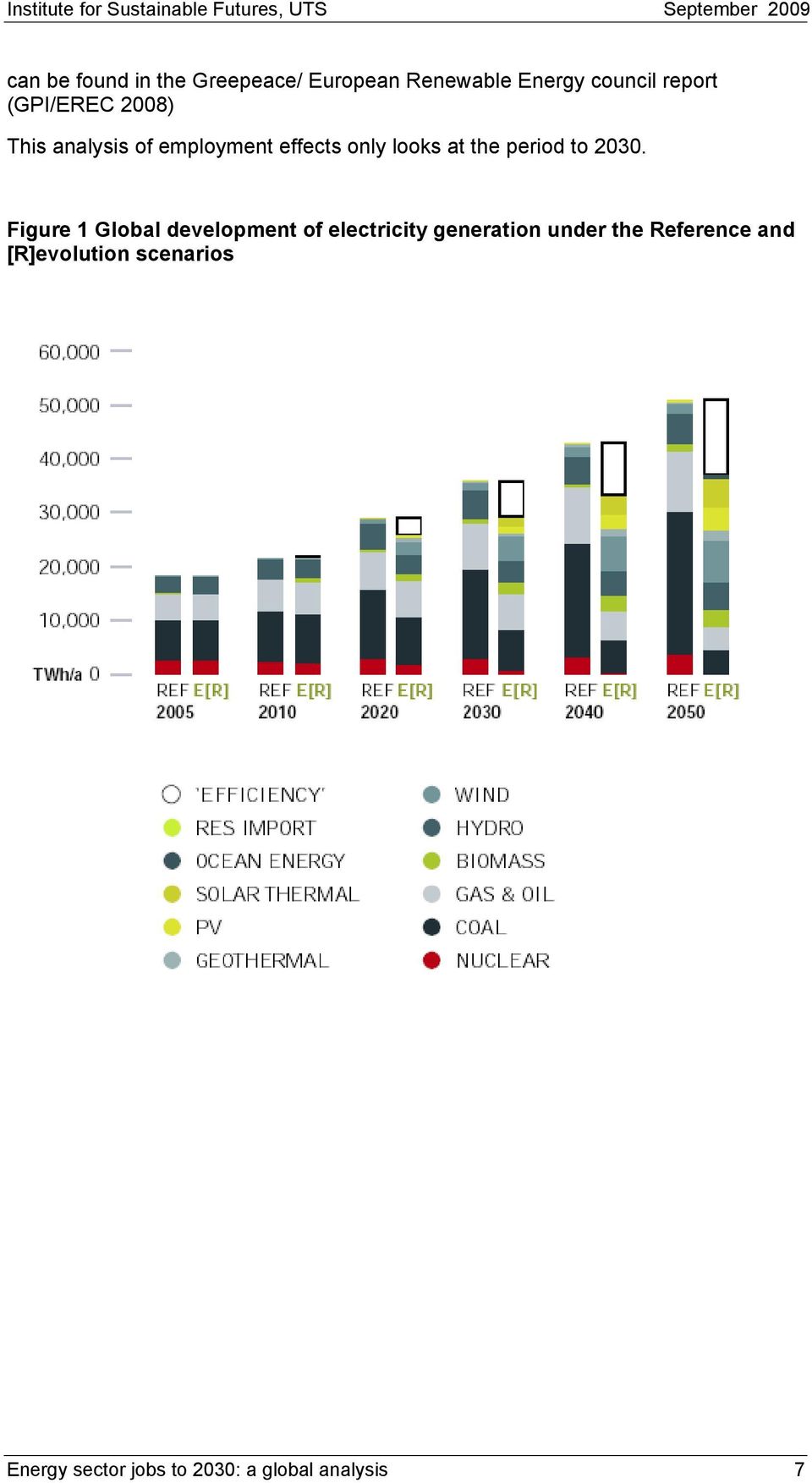
17 2 Energy scenarios Greenpeace International and the European Renewable Energy Council set out a vision for a low carbon global energy supply. They present a low carbon scenario, the Energy and a Scenario. The scenario is the International Energy Association s World Energy Outlook 2007 projection, extrapolated from to Energy highlights The Energy sets a target reduction of 50% below 1990 level of greenhouse emissions by 2050, with average per capita emissions of less than 1.3 tonnes per annum. Under the Energy Scenario, emissions peak at 2015 and decline thereafter. Emissions reductions in the Energy Scenario are achieved through existing technology such as energy efficiency, renewable energy and combined heat and power generation. Coal and nuclear power are gradually phased out. By 2050, the report projects that a 38% reduction in energy demand can be achieved compared to the Scenario. In, the Scenario projects renewable electricity capacity of 2,719 GW, supplying 36% of total electricity production, compared to 22% in the Scenario. Over the entire modelling period, installed renewable energy technologies will grow from 1,000 GW in 2005 to 9,100 GW in 2050, accounting for 77% of electricity generation. In line with the International Energy Agency, Energy uses a multi-region model to reflect structural differences in energy supply in different regions. The regions modelled are OECD North America, OECD Europe, OECD Pacific, Africa, Latin America, Middle East, Developing Asia, and the Transition Economies (see Appendix 1 for a listing of the countries in each region). India and China are modelled separately. The regional framework is used in this report to model employment effects. Two key underlying drivers of energy demand are population development and economic growth. The scenario uses the same GDP and population assumptions as the International Energy Agency 2007 projection up to (the limit of this study). The third key driver of future global energy demand is energy intensity i.e. how much energy is required to produce a unit of GDP. This is a key point of difference between the and the Scenario. The scenario decouples energy consumption from economic growth through efficiency measures, so energy intensity under the scenario is significantly lower than the scenario. Thus energy efficiency displaces a significant share of electricity consumption. The Scenario also proposes significant shifts in electricity supply. By 2050, new renewables such as wind, solar thermal energy and solar PV will supply 60% of world electricity, with 77% in total coming from renewable energy sources. Figure 1 shows electricity supply, including the portion of consumption displaced by energy efficiency, for the two scenarios up until Full details of the scenarios Energy sector jobs to : a global analysis 6

18 can be found in the Greepeace/ European Renewable Energy council report (GPI/EREC 2008) This analysis of employment effects only looks at the period to. Figure 1 Global development of electricity generation under the and scenarios Energy sector jobs to : a global analysis 7
19 3 Methodology 3.1 Methodology overview Employment is projected for the and scenarios at,, and for each region by using a series of multipliers and the projected electrical consumption. Only direct employment is included in this analysis, namely jobs in construction, manufacturing, operations and maintenance, and fuel supply associated with electricity generation. An indicative result for energy efficiency jobs is calculated, although the associated uncertainty is even greater than for energy supply. The inputs to the employment projections for energy are as follows: - Installed electrical capacity by technology, for each region, at 5 or 10 yearly intervals. The energy projections are for two scenarios, the and the. Both come from the Greenpeace / European Renewable Energy Council report (GPI/ EREC 2008) Their case is the International Energy Agency 2007 projection (IEA 2007), and the case is the GPI/ EREC low carbon projection. - Employment factors which give the number of jobs per MW for each technology in construction and manufacturing, operations and maintenance, and fuel supply. These are the key inputs to the analysis. Employment factors other than for coal mining are derived from OECD data, and are adjusted using regional multipliers to allow for the fact that economic activities in poorer regions are generally more labour intensive. Region-specific factors have been used for coal mining because of the size of the industry and the large variation between regions. - Decline factors, or learning adjustment rates, for each technology. These reduce the employment factors by a given percentage per year, to take account of the reduction in employment per MW as technologies mature. - Regional job multipliers are used to adjust the employment factors in each region to take account of different stages of economic development. The job multiplier used is the ratio of labour productivity (excluding agriculture) in the OECD compared to the regional labour productivity. Job multipliers change over the study period according to projected changes in GDP per capita. - Local manufacturing percentages and domestic coal and gas production percentages are used to determine the proportion of manufacturing jobs, and the proportion of coal and gas production, occurring within each region. - Export percentages for renewable technologies, coal and gas: where equipment, coal or gas is imported, the country of origin is required in order to assign jobs to that region. A percentage of globally traded components / coal are assigned to each exporting region. - Energy efficiency employment: is calculated from the reduction in electricity generation in the compared to the scenario, multiplied by a derived factor for jobs per unit of energy, with adjusted for regions by the regional job multiplier, reduced by a decline factor in and. See section 3.9 for details. Energy sector jobs to : a global analysis 8

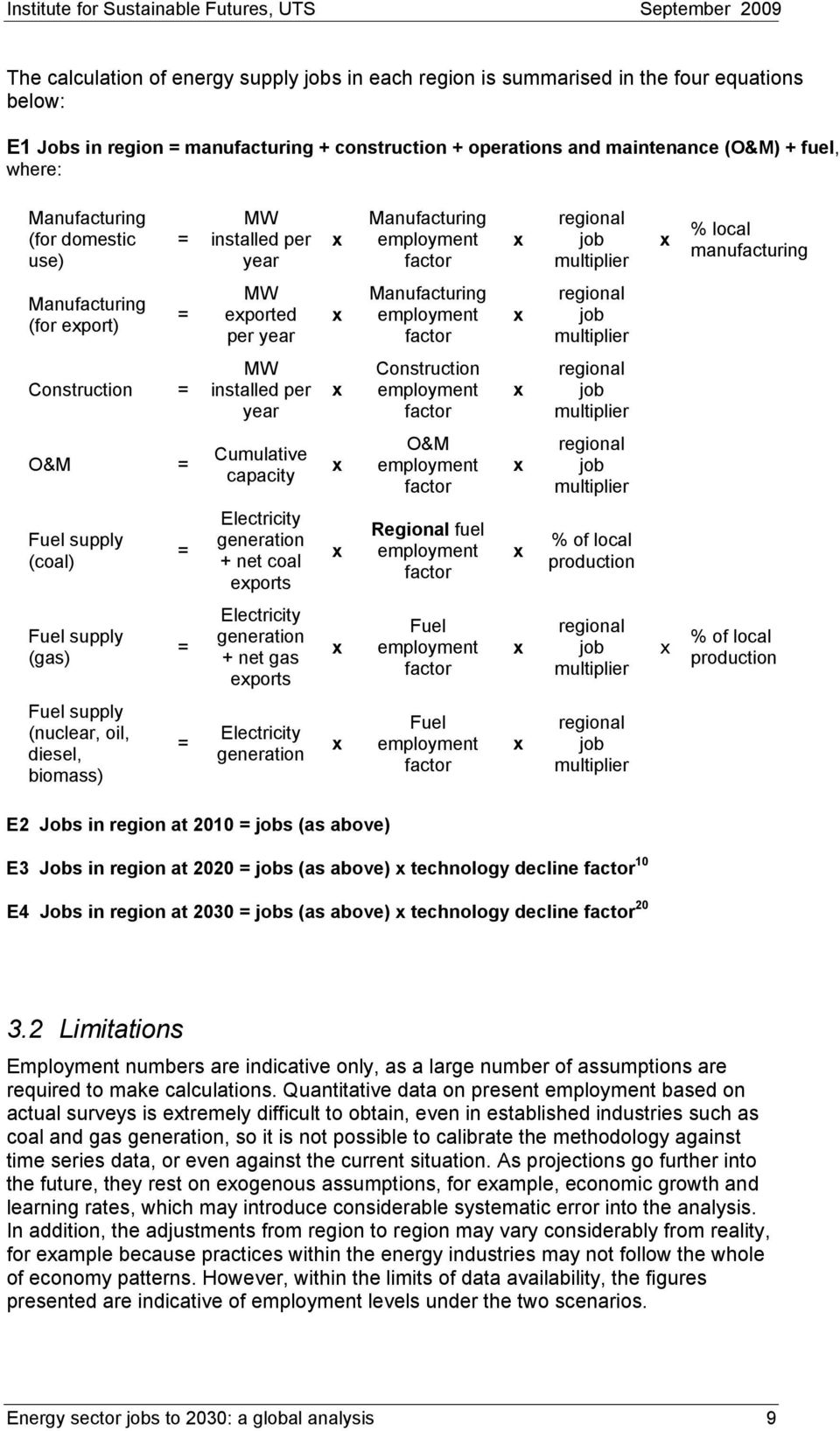
20 The calculation of energy supply jobs in each region is summarised in the four equations below: E1 Jobs in region = manufacturing + construction + operations and maintenance (O&M) + fuel, where: Manufacturing (for domestic use) = MW installed per year x Manufacturing employment factor x regional job multiplier x % local manufacturing Manufacturing (for export) = MW exported per year x Manufacturing employment factor x regional job multiplier Construction = MW installed per year x Construction employment factor x regional job multiplier O&M = Cumulative capacity x O&M employment factor x regional job multiplier Fuel supply (coal) = Electricity generation + net coal exports x Regional fuel employment factor x % of local production Fuel supply (gas) = Electricity generation + net gas exports x Fuel employment factor x regional job multiplier x % of local production Fuel supply (nuclear, oil, diesel, biomass) = Electricity generation x Fuel employment factor x regional job multiplier E2 Jobs in region at = jobs (as above) E3 Jobs in region at = jobs (as above) x technology decline factor 10 E4 Jobs in region at = jobs (as above) x technology decline factor Limitations Employment numbers are indicative only, as a large number of assumptions are required to make calculations. Quantitative data on present employment based on actual surveys is extremely difficult to obtain, even in established industries such as coal and gas generation, so it is not possible to calibrate the methodology against time series data, or even against the current situation. As projections go further into the future, they rest on exogenous assumptions, for example, economic growth and learning rates, which may introduce considerable systematic error into the analysis. In addition, the adjustments from region to region may vary considerably from reality, for example because practices within the energy industries may not follow the whole of economy patterns. However, within the limits of data availability, the figures presented are indicative of employment levels under the two scenarios. Energy sector jobs to : a global analysis 9
21 Some variations in methodology are used for the case studies, as results need to be at a more detailed level. These are described in Section Employment factors overview Table 5 Employment factors for use in global analysis CMI JOBS O&M AND FUEL MAIN REFERENCE Capacity factors Year for factors Total CMI Construction/ installation Manufacturing Total O&M and fuel O&M FUEL person years/ MW Jobs/MW jobs/gwh Coal 66% Regional JEDI model factors Gas 39% JEDI model Nuclear 87% Derived from US and Au industry data Biomass 69% EPRI 2001, DTI 2004 Hydro 39% Pembina 2004 Wind 25% EWEA 2009 (onshore) Wind EWEA 2009 (offshore) PV 15% EPIA 2008A, BMU 2008a Geothermal 77% GEA 2005 Solar thermal 26% EREC 2008 Ocean 26% SERG 2007/ SPOK ApS 2008 Energy efficiency 0.29 jobs /GWh (adjusted to 0.23 jobs/ GWh for ) ACEEE 2008 Note 1 Factors are all for OECD countries, and need to be adjusted for use in other regions Note 2 The capacity factors listed used to convert fuel factors to the totals given in tables for O&M and fuel, and are from GPI/ EREC Note 3 Regional factors are used for coal fuel supply see section 3.4. Note 4 Additional factors are used for case studies see section 3.9. The factors used in the global analysis are presented in Table 5. The method used to derive factors and the explanation for their choice is given in the next two sections, along with factors from other studies for comparison. Where possible, factors from industry sources are used. Only direct employment in development, construction, manufacturing, operations and maintenance, and fuel supply is included. Energy sector jobs to : a global analysis 10
22 Construction, installation, manufacturing and development (CMI) are all expressed in terms of job years per MW new capacity. Operations and maintenance (O&M) and fuel supply jobs are expressed in terms of jobs per MW and per GWh respectively. The factors presented in Table 1 are all for OECD countries or regions. These are adjusted to: - Take account of differing stages of economic development by using regional job multipliers (see Section 3.7). - Take account of the proportion of manufacturing which occurs locally by using local manufacturing percentages (see section 3.8). - Take account of the reduction in technology costs and the corresponding fall in employment per MW by using decline factors (see section 3.6). 3.4 Employment factors for coal and lignite Table 6 Employment factors for coal power construction and O&M (also used for lignite) CMI JOBS COAL YEAR TOTAL CMI Installation Manufacturing O&M Region Source and Notes Person years/ MW Factors used in this study Coal new California NRELJEDI model, downloaded 30/4/09 The model calculates employment effects of a new coal power station. Factors for comparison Coal new REPP 2001, Appendix B Economic analysis of capital and operating costs of hypothetical coal plant. Coal existing NSW CoFFEE 2008, Table 15 page 47 Derived from industry data for employment and capacity Despite the fact that coal generation is the most established form of electricity generation, it is difficult to find robust data on current employment. The factors for construction, manufacturing, and operations and maintenance used in this study are derived from the USA National Renewable Energy Laboratory publicly available JEDI model, which was developed to allow calculation of local benefits from different electricity supply options. Default values from the model were used for all variables. Energy sector jobs to : a global analysis 11
23 The factors for coal are also used for lignite. The construction employment factor from the model is much higher than the values most commonly used in the literature, as may be seen in Table 5. This will tend to increase jobs in the compared to the scenario, as the case is heavily dependent on coal generation. Factors other than construction are very close to values in the literature. Coal for fuel is treated in more detail than other employment factors because it accounts for such a significant proportion of current energy sector jobs, and because employment per ton (and therefore per GWh) in coal mining varies so extremely around the world. Employment and production data has been collected for as many of the major coal producing countries as possible. This is shown in Table 7, with employment data available for 68% of world coal production. As can be seen, employment per GWh varies by almost a factor of twenty between the USA and China. Data for individual countries has been used to arrive at regional factors. The individual country data used is given in Appendix 2. The reference case shows very strong growth in generation from coal. Employment from generation in each modelled year (,, and ) up to the 2005 generation level is calculated using the factor headed Employment factor (existing) in Table 7. The factor headed Employment factor (new) is used for generation above the 2005 level. The employment factor for existing generation is calculated from current employment and production data. This is modified for new generation, assuming that new generation will come from hard coal rather than lignite, and will use generation equipment which is more efficient than existing. Employment per GWh is calculated from the employment per ton, and the tons per GWh, as shown in the equation below. Employment per GWh = Employment per ton coal x tons per GWh At present 20% of electricity generation comes from lignite, which requires more tons per GWh than generation from hard coal because of the higher water content of lignite. However, the growth in electricity generation in the scenario is almost entirely from hard coal. At, while generation from hard coal increases by 8000 from levels, generation from lignite increases by only 400. Therefore we estimate the tons of hard coal per GWh which will be used in new generation capacity. For this estimate we use the weighted average of the five OECD countries which use less than 5% lignite, which is 322 tons per GWh, as shown in Table 8. This is used to calculate the employment per GWh for new generation in each region except China, using the regional employment per ton from present (2006) data multiplied by 322. Employment data for three regions was not available, Developing Asia (which includes Indonesia, a major coal producer), the Middle East, and Latin America. The analysis uses the average world factor these three regions, namely 0.39 jobs per GWh for existing generation and 0.24 for new generation. Energy sector jobs to : a global analysis 12
24 Table 7 Regional and country factors for coal production and employment Production Domestic production million tons % Coal for electricity % of lignite in electricity production Employment Tons/ GWh 000s Productivity Tons / person /year Employment factor (existing) Employment factor (new) Jobs per GWh YEAR World 6,669 m 99% % n/a OECD North America 1,238 m 104% 403 9% 88 14, OECD Europe (see Note 1) OECD Pacific (data for Australia only) 550 m 84% % 298 1, m 257% % 27 13, India 466 m 92% 745 6% 464 1, China 2,525 m 97% 516-3, Africa (data for South Africa only) Transition economies (see Note 2) Developing Asia (data for Asia exc China) 247 m 138% , m % m 108% 648 9% n/a Latin America 90 m 198% % n/a Middle east 3 m 20% 365 3% n/a Note 1 OECD Europe results are the weighted average of data from the Czech Republic, France, Finland, Germany, Greece, Poland, the Slovak Republic and the UK. Note 2 Transition economies results are the weighted average of data from Russia, Bulgaria, and Slovenia. Note 3 All data for coal production and electricity from International Energy Agency statistics, downloaded 18th June Note 4 Employment data sources: USA: Energy Information Administration (2008) Report No. DOE/EIA 0584 (2007) Table 18. Average Number of Employees by State and Mine Type, 2007, 2006 Canada: Natural Resources Canada Table 22. Canada, employment in the mineral industry, stage 1 mineral extraction and concentrating (total activity), (1) Australia: Australian Bureau of Statistics. Cat. No Census Tables 2006 India: Data for coal mining employment from Government of India Ministry of Coal Annual report Table Employment has been scaled up from the reported figure of 429,500 employees because the reported production is 431 million tons rather than the IEA figure of 466 million tons. China: China Yearbook 2008, cited in personal communication, Sven Teske, 21/6/09. South Africa personal communication, Sven Teske, 21 st June 2009 Europe Glückauf (German Coal statistics), cited in personal communication, Sven Teske, 21/6/09. Russia personal communication, Sven Teske, 21 st June 2009 Note 5 The calculated employment factors shown have been modified using the annual percentage growth in labour productivity for each region to arrive at the factor factors are shown in the Appendix 2. Energy sector jobs to : a global analysis 13
25 Table 8 OECD countries with less than 5% lignite in electricity production Tons coal per GWh Finland 264 France 328 Italy 316 Japan 299 UK 377 Weighted average 322 The employment factor for new generation in China has been taken as the current level for the US. China has the lowest average productivity in the world at present, with only 700 tons produced per employee. However, this is because of the large numbers of people working in very small village or township mines where coal extraction is entirely manual, which have productivity as low as 100 tons per person per year (IEA 2007, page 337). Productivity in large Chinese coal mines is a very different story. Five mines with annual output of 10 million tonnes each have productivity of 30,000 tons per person per year, double the highest average productivity for any OECD country. The case sees coal production in China doubling by. This is not going to be from small mines; Chinese government policy is to close at least half of the 20,000 small village mines by. There are 16 mines planned with average annual output of more than 70 million tonnes each, and new approvals will only be considered for mines with an output of 30,000 tons per year or more (IEA 2007). The factor for coal employment for new generation in China in is therefore taken as identical to the US figure. Even this may overestimate the employment for coal supply in China in the future, if the projected doubling of output is primarily from super mines such as are being developed at the present. Coal trade Jobs in coal supply have been allocated after taking international trade into account. The projected volumes of international trade and world coal production in the scenario are taken from the IEA 2008, and shown in Table 9 and Table 10. The proportion of coal imports in the and scenarios are shown in Table 11. These are calculated for the scenario from the tons imported divided by the total consumed. Energy sector jobs to : a global analysis 14
26 Table 9 Net Inter-regional hard coal trade, 2006, IEA reference scenario Negative values = imports, positive values = exports. Million tons of coal equivalent OECD N America OECD Europe OECD Pacific Asia Oceania E. Europe/Eurasia Russia Asia China India Middle East Africa Latin America World European Union From IEA 2008, Table 5.3, with values for and calculated assuming linear change. Table 10 Regional production of coal, 2006, IEA reference scenario (million tons of coal equivalent) OECD N America OECD Europe OECD Pacific Non OECD E. Europe/Eurasia Russia Asia China India Middle East Africa Latin America World European Union From IEA 2008, Table 5.2, with values for and calculated assuming linear change. Energy sector jobs to : a global analysis 15
27 Table 11 Proportion of coal imports in the and scenario IMPORT REFERENCE [R]EVOLUTION OECD North America OECD Europe 46% 50% 50% 38% 14% 0% OECD Pacific 1% Transition economies Developing Asia China 0% 2% 3% 0% 0% 0% India 18% 24% 27% 6% 0% 0% Middle East 91% 91% 92% 90% 84% 64% Africa Latin America The proportion of coal imports in the scenario is calculated by first adjusting the amount of coal consumed according to the ratio of coal use in the scenario to coal use in the scenario. The regional coal production for the relevant year is subtracted to see if there is net import. Potential coal production is assumed to be constant between the two scenarios, so coal is only imported if the adjusted consumption is more than production. The revised figure for imports is divided by the coal production to determine the percentage import. The proportion of domestic coal production is used to calculate a value for GWh of coal imports for each region. This is assigned to export regions according to the proportion of total international trade belonging to each region in the IEA scenario shown in Table 9. The proportion of coal imports in the scenario is calculated by first adjusting the amount of coal consumed according to the ratio of coal use in the scenario to coal use in the scenario. The regional coal production for the relevant year is subtracted to see if there is net import. Potential coal production is assumed to be constant between the two scenarios, so coal is only imported if the adjusted consumption is more than production. The revised figure for imports is divided by the coal production to determine the percentage import. The proportion of domestic coal production is used to calculate a value for GWh of coal imports for each region. This is assigned to export regions according to the proportion of total international trade belonging to each region in the IEA scenario shown in Table Employment factors by technology Gas, oil, and diesel The proposed factors are derived from the USA National Renewable Energy Laboratory s publicly available JEDI model, which was developed to allow calculation of local benefits from different electricity supply options. This has been used in preference to the factors given in CALPRG 2002 (shown in Table 12) as it is more Energy sector jobs to : a global analysis 16
28 recent and may include a more complete assessment of manufacturing employment. Default values from the JEDI model are used for all variables except fuel. In order to obtain a factor for fuel supply, the default value for local percentage was changed from zero to 100%. The JEDI figures are uniformly higher than the CALPRG figures, so the use of the JEDI factors will tend to increase jobs in the scenario compared to the scenario. As no factors are available for diesel or oil generation, the factor for gas has been used for both of these technologies. The small penetration of the technology means this has little effect on the overall employment calculation. Table 12 Employment factors for gas (also used for oil and diesel) CMI JOBS O&M AND FUEL GAS YEAR TOTAL CMI Installation Manufacturing Person years/ MW TOTAL O&M and fuel O&M Jobs/ MW Fuel Jobs/ GWh Region Source and notes Factors used in this study Natural gas, new California NREL JEDI model, downloaded 30/4/09. The model calculates employment effects of natural gas power station. Factors for comparison Natural gas, new California CALPRG, 2002 Direct construction jobs include work on the gas pipelines. Installation and O&M from Table 9, page 15. Factors derived from review of applications for 19 gas power plants built or approved from 2001, total 12 GW. Natural gas, existing California CALPRG, 2002 Table 8, page 14. Employees at 16 GW of existing gas generation. Note: Fuel supply jobs per GWh are converted to jobs per MW using a capacity factor of 39% Gas trade Jobs in gas supply have been allocated after taking international trade into account. The projected volumes of international trade and world gas production in the scenario are taken from the IEA 2008, and shown in Table 13 and Table 14. The proportion of gas imports in the and scenarios are shown in Table 11. These are calculated for the scenario from the billion cubic metres imported divided by the total consumed. The proportion of gas imports in the scenario is calculated by first adjusting the amount of gas consumed according to the ratio of gas use in the scenario to gas use in the scenario. The revised figure for Energy sector jobs to : a global analysis 17
29 consumption is divided by the gas production to determine the proportion of imports in the scenario. Potential gas production is assumed to be constant between the two scenarios in gas importing regions, so the proportion imported increases in the scenario in some cases. The proportion of domestic gas production is used to calculate a value for GWh of coal imports for each region. This is assigned to export regions according to the proportion of total international trade belonging to each region in the IEA scenario shown in Table 9, with the assumption that export regions will increase production in response to demand. Table 13 Net Inter-regional gas trade, 2006, IEA reference scenario Negative values = imports, positive values = exports. Billion cubic metres OECD N America OECD Europe OECD Pacific Asia Oceania E. Europe/Eurasia Russia Asia China India Middle East Africa Latin America World European Union From IEA 2008, Table 4.3, with values for and calculated assuming linear change. Energy sector jobs to : a global analysis 18
30 Table 14 Regional production of gas, 2006, IEA reference scenario (billion cubic metres) OECD N America OECD Europe OECD Pacific Non OECD E. Europe/Eurasia Russia Asia China India Middle East Africa Latin America Brazil World European Union From IEA 2008, Table 4.2, with values for and calculated assuming linear change. Table 15 Proportion of gas imports in the and scenario IMPORT REFERENCE [R]EVOLUTION OECD North America 4% 10% 16% 13% 20% 9% OECD Europe 49% 59% 69% 46% 53% 53% OECD Pacific 63% 58% 54% 65% 62% 55% Transition economies Developing Asia China 9% 30% 48% 8% 36% 47% India 25% 45% 61% 26% 58% 77% Middle East Africa Latin America Energy sector jobs to : a global analysis 19
31 Nuclear Although the nuclear industry is well established, global employment data is surprisingly difficult to find. The factors for operations and maintenance and fuel supply have been derived from industry and national sources for employment and production as described below. The construction, manufacturing and installation factor is derived from a Nuclear Energy Institute (NEI) 2009 fact sheet, which states that building a new [1000 MW] nuclear plant would result in the creation of 1,400 to 1,800 jobs, assuming a 10 year construction period. The O&M factor is derived for this study from 2002 US Census data on the number of paid employees in census category nuclear electric power generation (2007 census data was not available at the time of writing). In 2002 this was 31,698. The jobs/mw factor is calculated using Energy Information Administration (EIA) data on US nuclear capacity for 2002, which was 99,209 MW. This is used in preference to the NEI figure, as it derives from a large existing industry. The fuel factor has been derived for this study from data on Australian uranium mining and uranium requirements for the US industry. Uranium (as U) required per GWh of power generation has been derived. World Nuclear Association (WNA) data states 18,867 tonnes of U was required for nuclear generation in the US in 2009 (which was the same as 2007) US nuclear generation was 806,425 GWh, giving a requirement of tonnes per GWh. This has been converted to U 3 O 8 requirement using a standard conversion of Employment per tonne of U 3 O 8 has been derived for this study using industry data for Australia (Deloitte 2008). Table 16 Employment factors for nuclear power Total CMI NUCLEAR Year jobs Person years/ MW Jobs/ MW Factors used in this study Nuclear (CMI) Nuclear (O&M) Nuclear (fuel) Factors for comparison Nuclear (O&M) O&M Fuel Region Source and Notes Jobs/ GWh NEI 2009 Factor derived from fact sheet assuming a 10 year construction time US US Census 2002 Table 1 and EIA 2009a Factors derived for this study from industry employment and capacity data Australi a/ US US NEI 2009 Deloitte 2008 and WNA 2009 Uranium requirement from WNA 2009 Australian production and employees from Deloitte 2008, page 25, Table 3.1 Energy sector jobs to : a global analysis 20
32 Biomass Table 17 Employment factors for biomass CMI JOBS O&M AND FUEL BIOMASS POWER YEAR Factors used in this study TOTAL CMI Installation Manufacturing Person years/ MW TOTAL O&M and fuel Jobs/ MW O&M fuel Jobs/ GWh Region Notes Source From energy crops (3.4) (0.22 ) UK Detailed economic analysis Fuel source not stated Factors for comparison Fuel source not stated US Table C-3, page C-6. No details given of derivation. Manufacturing factor taken from gas (NREL JEDI) DTI 2004 EPRI US No details given EPRI 2001 From energy crops UK Detailed economic analysis From waste UK Detailed economic analysis Fuel source not stated Fuel source not stated Fuel source not stated Germany Derived for this study from industry data US Derived from REPP Canada Derived from REPP 2001 DTI 2004 DTI 2004 BMU 2008a and 2008b Kammen 2004, Pg 10 Pembina 2004, Table Europe Includes O&M MITRE 2003 Note 1: Fuel supply jobs/gwh are converted to jobs/mw using a capacity factor of 69% Note 2: The value from DTI 2004 is for O&M and fuel combined. This has been split using the higher end of the Kammen factor for biomass fuel jobs, and a capacity factor of 15%. Only biomass for power generation is considered in this analysis. There is very little available data for biomass power generation, although biofuels for transport is a large and well established industry. A detailed UK DTI analysis provides O&M fuel factor by fuel source, and the factor for energy crops is used in this study. The DTI O&M factors are higher than factors from other studies, but lower than factors derived from German industry data. The DTI only gives a factor for O&M and fuel combined. This has been split using the higher end of the Kammen range of factors for biomass fuel jobs, and a capacity factor of 69%. The construction factor used in this study is taken from the EPRI report. Unfortunately it does not include manufacturing jobs. These are assumed to be Energy sector jobs to : a global analysis 21
33 similar to gas, namely in the region of jobs per MW, as biomass plant equipment is likely to be similar to gas plant equipment. The construction factors provided by the DTI report have not been used in this analysis because they are much higher than other factors in the literature, and this analysis has generally chosen a cautious approach. Factors derived by Kammen and Pembina from REPP data are provided for comparison, although the factors derived differ slightly from each other. MITRE factors are also shown for comparison. Hydro Operations and maintenance employment factors for hydro from Pembina (2004) have been used in this study. These are lower than the UK study (DTI 2004), but have the advantage of being split into manufacturing and installation. The factor for operations and maintenance is in between the figures derived from the US and German industry data. The figure for operations and maintenance for Germany has been derived from data on employment and capacity published by the Federal Ministry for the Environment, Nature Conservation and Nuclear Safety (BMU 2008a and 2008b). There were 4,400 people employed in operations and maintenance for hydro, and 4,720 MW installed capacity. This is much higher than the industry figure for the US, which may reflect the higher proportion of small hydro in the German electricity supply. The factor derived from the MITRE 2003 data is higher than all the others. Table 18 Employment factors for hydro CMI JOBS HYDRO YEAR TOTAL CMI Installation Manufacturing Operations & Maintenance Region Notes Source Factors used in this study Small hydro (run of river) Factors for comparison Person years/ MW Jobs/ MW Canada From industry interviews and literature survey. Hydro Germany Industry data for employment and capacity. Hydro US Industry data for employment and capacity. Small hydro (less than 30 MW) Pembina 2004 Derived from BMU 2008a and 2008b Derived from Bedzek, 2007 and EIA 2009b California EPRI 2001 Hydro UK New developments; detailed economic analysis for UK DTI 2004 Small hydro Europe Includes O&M MITRE 2003 Energy sector jobs to : a global analysis 22
34 Geothermal Factors used in this study have been derived from US geothermal industry data projections for jobs and installed capacity. Data in the GEA report has been collated from an industry survey and other sources such as environmental impact assessments. The derived construction factor is similar to EPRI and the derived operations and maintenance factor is slightly lower than EPRI. The factor derived from the MITRE 2003 data is considerably higher, as is the case for many of the MITRE technology employment factors. Table 19 Employment factors for geothermal power GEO- THERMAL YEAR TOTAL CMI CMI JOBS Installation Manufacturing Person years/ MW Factors used in this study Geothermal power Factors for comparison Geothermal power Geothermal power Operations & Maintenance Jobs/ MW Region Notes Source US Factors derived for this study from geothermal industry projection California No details of derivation. 18 Europe Includes operations and maintenance GEA 2005, page 20 Table 7 EPRI 2001, page C-6, Table C-3 MITRE 2003 Energy sector jobs to : a global analysis 23
35 Ocean As with solar thermal, ocean power is an emerging sector and hence very little data is available for jobs associated with ocean power technology. The construction factor used in this study is a combined projection for wave and tidal power derived from data for offshore wind power. A study of a particular wave power technology, Wave Dragon, provided jobs creation potential for that technology. The O&M factor used here is based on that report. However, the construction factor used in this study is lower and therefore more conservative than the factor provided by the Wave Dragon study. Table 20 Employment factors for ocean power OCEAN YEAR Factors used in this study Ocean/oceanwave 2007/ 2008 Factors for comparison TOTAL CMI CMI JOBS Installation Manufacturing Person years/ MW Operations & Maintenance Jobs/ MW Region Notes UK SPOK report references Wave Dragon study Ocean wave US Calculated using data from REPP 2001 & EPRI 2001 Ocean - wave UK s Wave Dragon study Source SERG 2007, Section 6/ SPOK ApS 2008, p17 Pembina 2004, Table 2 SPOK ApS 2008, p17 Energy sector jobs to : a global analysis 24
36 PV The construction factors used in this study are the projections for jobs and installed capacity in the advanced scenario put forward by the European PV Industry Association (EPIA and Greenpeace 2008). As can be seen from the comparison factors, the construction factor is in the mid range of available factors and more conservative than those proposed by the UK Department of Trade and industry study (DTI 2004). The O&M factor used in this study has been derived from 2007 German industry data for employment and capacity, which is deemed to be the most robust of the available data for O&M. Table 21 Employment factors for PV PV TOTAL CMI CMI JOBS Installation Manufacturing Operations & Maintenance Region Notes Source YEAR Person years/ MW Jobs/ MW Factors used in this study Europe Industry projections. EPIA 2008b Germany Derived for this study from industry data for capacity and employment. Factors for comparison 2007 n/a 34.5 Germany Derived for this study from industry data for capacity and employment 2007 n/a 22.1 n/a US Derived for this study from industry data for capacity and employment UK Detailed economic analysis for the UK California No details of derivation given. From Table C-3, Page C Canada Data from industry interviews and literature survey; however, installation and O&M figures come from EPRI, so are not reproduced here. EPIA 2008A and BMU 2008a Sawin 2008 and BMU 2008 EIA 2008 (PV), Tables 3.1 & DTI 2004 EPRI 2001 Pembina 2004, Table US Analytical study from industry survey. The study reports 5,000 person hours per MW for O&M, and assumes 10 years servicing, and a working year of 40 hours x 49 weeks.. Reported here as 0.25 FTE jobs per MW. REPP Europe Includes O&M jobs MITRE 2003 Energy sector jobs to : a global analysis 25
37 Solar thermal The new generation of solar thermal power plants is an emerging sector, so the factors used in this study are industry projections for job creation from the technology. The European Renewable Energy Council (EREC) estimate that every 100 MW of solar thermal-electric power plant installed will provide 400 full-time equivalent manufacturing jobs, 600 contracting and installation jobs, and 30 annual jobs in O&M (EREC 2008). Note that a more recent report from the European Solar Thermal Electricity Association quotes the same figures for construction, installation, and manufacturing, but a figure three times higher for operations and maintenance. We have taken a conservative approach and used the lower figure (GPE/ESTELA 2009). These projected figures are higher than the US National Renewable Energy Laboratories (NREL) projections. Black & Veatch used the Regional Input-Output Modelling System (RIMS II) developed and maintained by the US Bureau of Economic Analysis. In their analysis, it has been assumed that all construction and operations labour jobs created are in southern California, but that there is a high proportion of importing, so not all manufacturing jobs are included in their estimates. The installation factor is similar to EPRI and operations and maintenance slightly higher. However the total installation and manufacturing jobs is lower than the Shwer and Riddel factor, which was derived from data generated using the REMI model. Table 22 Employment factors for solar thermal SOLAR THERMAL YEAR TOTAL CMI Factors used in this study CMI JOBS Installation Manufacturing Operations & Maintenance Person years/ MW Jobs/ MW Region Notes Source Industry projection GPI/ ESTELA 2009 page 62, EREC 2008 Page 16 Factors for comparison World Industry projection GPI & ESTELA 2009, page California Black & Veatch used the Regional Input- Output Modelling System (RIMS II) California No details given of derivation Nevada Factors derived from data generated using the REMI model. NREL 2006, Table 5-7 EPRI 2001, page C-6, Table C-3 Schwer & Riddel Table 4, page12 Energy sector jobs to : a global analysis 26
38 Wind energy The factors for wind energy used in this analysis all come from the most recent industry data, contained in the European Wind Energy Association (EWEA 2009) report on wind energy employment. This is the most robust data source for wind energy employment. Table 23 Employment factors for wind energy WIND ENERGY YEAR CMI JOBS TOTAL CMI Installation Manufacturing Operations & Maintenance Region Notes Source Person years/ MW Jobs/ MW Factors used in this study Onshore Europe Table 07 Page 21 EWEA 2009 Onshore Europe Footnote 5 page 22 for total annual jobs decline, with the same ratios of installation to EWEA 2009 O&M maintained. Offshore Europe The ratio of employment in offshore: onshore wind is assumed to be the same as the cost ratios, which are given in footnote 5 page 22 Factors for comparison Onshore Germany Industry data for employment and production. Onshore UK Detailed economic analysis for the UK. Onshore California No details of derivation given Onshore Canada Data from industry interviews and literature survey. offshore UK Detailed economic analysis for the UK. offshore Canada Data from industry interviews and literature survey. Derived from EWEA 2009 Derived from BMU 2008a and 2008b DTI 2004 EPRI 2001 Pembina 2004 DTI 2004 Pembina 2004 Onshore 32 Europe Includes O&M jobs MITRE 2003 Energy sector jobs to : a global analysis 27
39 3.6 Adjustment for learning rates decline factors Employment factors are adjusted to take account of the reduction in employment per unit of electrical capacity as technologies and production techniques mature. The learning rates assumed have a significant effect on the outcome of the analysis. Industry projections for employment decline values are only available in a small number of technologies, namely wind, solar, and ocean. For other technologies, the annual decline in cost for each technology is taken as a proxy value for the decline in employment. Cost declines will correspond to a reduction in employment, whether they result from greater efficiency in production processes, scaling up of technology, or as a direct result of more efficient working practices. The decline factors derived from the GPI/EREC data are presented in Table 24, along with decline factors from industry sources. The decline factors from cost data for wind, PV, solar thermal, and ocean energy are shown for comparison but are not used in the analysis. Table 24 Decline rates Annual decline in job factors scenario Annual decline in job factors scenario Source Coal 0.9% 0.3% 1.0% 0.3% GPI & EREC 2008 (cost data) Gas 0.4% 0.5% 0.4% 0.6% GPI & EREC 2008 (cost data) Oil 0.4% 0.4% 0.4% 0.4% GPI & EREC 2008 (cost data) Diesel 0.0% 0.0% 0.0% 0.0% GPI & EREC 2008 (cost data) Nuclear 0.0% 0.0% 0.0% n/a GPI & EREC 2008 (cost data) Biomass power plant 1.0% 0.5% 1.0% 0.5% GPI & EREC 2008 (cost data) Hydro -0.6% -0.5% -0.6% -0.5% GPI & EREC 2008 (cost data) Wind on shore 1.40% 1.40% 1.40% 1.40% Derived from EWEA 200, footnotes 5 & 6 page 22. Wind off shore 3.90% 1.50% 3.90% 1.50% Derived from EWEA 200, footnotes 5 & 6 page 22. Wind turbine * 1.1% 0.8% 1.2% 0.7% GPI & EREC 2008 (cost data) PV 6.88% 1.41% 7.72% 2.42% EPIA 2008b PV * 6.5% 5.7% 6.9% 5.2% GPI & EREC 2008 (cost data) Geothermal 2.3% 2.0% 2.5% 1.7% GPI & EREC 2008 (cost data) Solar thermal (electricity) Solar thermal (electricity) * 0% 2.2% 1.6% 0.5% GPI/ ESTELA 2009, page % 1.7% 2.0% 1.7% GPI & EREC 2008 (cost data) Ocean 7.80% 7.80% 7.80% 7.80% SERG 2007 Ocean energy * 8.4% 3.8% 8.4% 3.8% GPI & EREC 2008 (cost data) * Factors not used in analysis, provided for comparison only. Energy sector jobs to : a global analysis 28
40 3.7 Regional adjustments The available employment factors are for OECD countries or regions, and need adjustment for differing stages of economic development. Broadly, the lower the cost of labour in a country, the greater the number of workers that will be employed to produce a unit of any particular output, be it manufacturing, construction or agriculture. This is because when labour costs are low, labour is relatively affordable compared to mechanised means of production. Low average labour costs are closely associated with low GDP per capita, a key indicator of economic development. This means that changes to levels of production in any given sector of the economy are likely to have a greater impact on jobs in developing countries than in developed countries. Ideally, we would derive employment factors for both developed and developing countries. In practice, data for developing countries is extremely limited. Instead we multiply the derived OECD employment factors using a proxy regional adjustment factor. It is important to derive these job multipliers from a relatively complete data set with global coverage. The best available proxy factor is average labour productivity, measured as GDP (or value added) per worker. Job multipliers are expected to change over the study period ( to ), as the differences in labour productivity alter with regional economic growth. Fortunately regional economic growth is a key input to the energy scenarios, as it is the major determinant of projected changes in energy consumption. We have therefore used the projected change in GDP per capita to adjust the regional job multipliers over time. Derivation of regional adjustment factors We calculate a regional labour productivity value for each of the ten Energy scenario regions using data from International Labour Organisation Key Indicators of the Labour Market database (ILO 2007 KILM). The KILM database holds data for economy wide average labour productivity, and for productivity in agriculture, forestry, and fishing, and manufacturing. Productivity is calculated as average GDP per worker. Countries were grouped according to the Energy regional categorisation, and labour productivity data for each country used to calculate weighted average productivity for the region, with weighting according to total workforce numbers. Table 25 Numbers of countries included in energy scenarios and numbers with labour productivity data Region Number of countries in GPI/ EREC Number of countries with data available on labour productivity OECD North America 3 3 OECD Europe OECD Pacific 4 3 Africa China 2 2 Developing Asia India 1 1 Latin America Middle East Transition economies Energy sector jobs to : a global analysis 29
41 Where available, GDP per worker for the year 2006 was used. Of a total of 178 countries included in the energy projections, reasonably complete data was available in the KLIM database for 125. However, the regional distribution was uneven. The numbers of countries per region with productivity data are shown Table 25. While some regions have relatively few countries represented, those with data tend to be the larger ones. Two sets of indicators from the KILM database were used in order to obtain total workforce numbers for every country included. The indicators were employment by industry, and educational levels by industry. Where workforce numbers were available from both data sets the average value was used. Annual average growth in productivity over the period 1980 to 2005 can be derived from the KILM data. However, this cannot be used to forecast growth up to. Instead, we used a proxy, namely growth in GDP per capita. We applied this to the 2006 regional labour productivity data to calculate labour productivity in and. We derived GDP per capita growth for each of the 10 regions using projected GDP and population growth from IEA 2007 (these economic assumptions are key inputs to the IEA scenario and the scenario). The derived average growth in GDP per capita over the period 1980 to 2005 was compared to the derived average growth in productivity from the KILM data. As the two rates of growth are broadly similar, we conclude that GDP per capita growth is a reasonable proxy for labour productivity growth. The comparison is shown in Table 26. Table 26 Growth in GDP per capita compared to growth in labour productivity, historic values WEO 2007 ILO 2007 Indicator Average annual growth in GDP per capita Average annual growth in labour productivity, whole economy Region World 1.7% 3.1% OECD 1.5% 1.6% OECD North America 1.5% 1.7% OECD Europe 1.4% 1.6% OECD Pacific 1.5% 1.8% Africa 0.9% 0.2% China 5.8% 6.1% Developing Asia 3.9% 2.8% India 3.0% 3.7% Latin America 1.3% -0.04% Middle East 1.6% -1.5% Transition economies 0.4% 0.2% We calculated three sets of productivity data one set for whole of economy, a second for agricultural, forestry and fisheries workers only, and a third set which is whole of economy excluding agricultural, forestry and fisheries. In developing regions, the value for average GDP production per agricultural worker is considerably lower than the value for the rest of the economy. When agricultural value added is included, it lowers the economy wide labour productivity figure in Energy sector jobs to : a global analysis 30
42 developing regions, and therefore increases the job multiplier between developed and developing countries, as shown in Table 27. However, agricultural productivity is not relevant to the majority of energy technologies. Table 27 Regional labour productivity compared to OECD labour productivity Ratio to OECD Ratio to OECD Ratio to OECD Whole economy Agriculture Whole economy excluding Agriculture Whole economy Agriculture Whole economy excluding agriculture Whole economy Agriculture Whole economy excluding agriculture World OECD OECD North America OECD Europe OECD Pacific Africa China Developing Asia India Latin America Middle East Transition economies Note 1 Labour productivity (defined as average GDP per worker) from ILO KILM 2007 edition 5. Note 2 Growth rates in labour productivity taken as growth rate in GDP per capita, derived from World Energy Outlook 2007 Note 3 The multiplier listed as agriculture is in fact for forestry, fisheries and agriculture. The multiplier for agriculture is used for bioenergy fuel production, while the multipliers for the economy excluding agriculture is used for all other fuels and for construction, manufacturing, and operations and maintenance. It was not possible to calculate separate productivity ratios for manufacturing, construction or O&M due to insufficient data sets, so the same multiplier is used for all three. Productivity data for each region and time period is compared to the OECD region, where OECD is presented as 1.0 and all other regions as a ratio to OECD. The ratios are presented in Table 27 below. Regional job multipliers are obtained from the ratios in Table 27, such that if productivity or value added per worker is 0.5 times the OECD value, we assume 2x jobs in that region. The resulting multipliers are presented in Table 27. Energy sector jobs to : a global analysis 31
43 Table 28 Multipliers to be applied to employment factors JOB MULTIPLIERS Construction, manufacturing, O&M Biomass fuel supply Construction, manufacturing, O&M Biomass fuel supply Construction, manufacturing, O&M Biomass fuel supply OECD Africa China Developing Asia India Latin America Middle East Transition economies The calculated values may in fact underestimate the additional employment in non- OECD countries. Regional data was collected for PV employment, and jobs per MW production in China is approximately 3 times greater than employment in the US and Germany. The regional multiplier used for China is 1.9 in. Table 29 Employment per MW in wafer production PV company Country Production capacity 2008 MW Employees per MW 2008 Source Suntech China 1, Suntech Power Holdings Co Ltd Annual Report for 2008, Pages 12 & 84 Q-Cells Germany Q.Cells 2008 Annual Report, page 2 First Solar US/Germany/ Malaysia 1, First Solar 2008 Annual Report, pages 4 & 9 Energy sector jobs to : a global analysis 32
44 3.8 Adjustment for manufacturing in the renewable sector The proportion of manufacturing that occurs within each region varies around the world. In order to calculate employment, percentages have been assigned in each region for,, and. These are shown in Table 30. Table 30 Proportion of local manufacturing and import / export, all regions Proportion of manufacturing within the region Region where equipment is imported from OECD Europe OECD North America OECD Europe 100% 100% 100% OECD North America 100% 100% 100% 50% - 25% 25% OECD Pacific 30% 50% 50% 50% - 25% 25% Developing Asia 30% 50% 70% 50% - 25% 25% India 70% 100% 100% 50% % China 70% 100% 100% 50% 25% 25% - Africa 30% 30% 50% 50% 10% 20% 20% Latin America 30% 50% 70% 50% 50% - - Middle East 30% 30% 30% 50% - 25% 25% Transition economies 30% 50% 70% 50% - 25% 25% Note: Local manufacturing is applied across all technologies, with the exception of solar thermal in OECD N America. Only 50% and 70% of manufacturing for solar thermal is allocated to the OECD N America in and, but by all manufacturing is assumed to occur locally. Local manufacturing percentages vary from 100% manufacturing within Europe for each period, to only 30% of manufacturing occurring within Africa in, rising to only 70% by. Local percentages are applied to all technologies, and to the and scenarios, at the same proportion. The only exception is that a specific value for solar thermal technologies is applied in the OECD North America, as mirrors are currently imported from Germany. Where equipment is imported, it is allocated among exporting regions as shown in Table 30. Import and export percentages, and current export regions, are set according to current practice. Local manufacturing is generally increased over time. 3.9 Energy efficiency It is difficult to assess employment creation in energy efficiency, as the sector is diverse and activities are frequently bundled into other actions. For example, energy efficiency improvements may occur as part of normal replacement cycles, so the associated employment must be differentiated into that which results from the energy efficiency premium 1 rather than the total investment (or work) associated with the retrofit. India China 1 The energy efficiency premium is the additional expenditure incurred, over and above the expenditure for the normal replacement or retrofit, in order to reduce energy consumption. Energy sector jobs to : a global analysis 33
45 The most common way to derive or describe employment creation from energy efficiency is via annual investment (for example, Dupressoir et al, 2007, Wade et al, ACEEE 2005, Access Economics 2009). Energy efficiency investment data is not available for the Energy scenarios. In order to make an assessment of the efficiency employment, an employment factor of job creation per GWh saved is derived for this study. The most comprehensive assessment of the energy efficiency industry is given in a 2008 study of the USA, The Size of the U.S. Energy Market: Generating a More Complete Picture, by Ehrhardt-Martinez and Laitner (ACEEE 2008). This identifies the energy efficiency premium spending by sector in the US in 2004, and gives both the energy savings and the job creation. This information has been used to derive sectoral figures for energy efficiency jobs per GWh, shown in Table 31. The multiplier is adjusted with regional multipliers in the same way as all other technology multipliers. While there are jobs in energy efficiency in the Scenario, this calculation takes the as a base line, and only considers additional energy efficiency employment over and above what would occur in the scenario. A weighted average of 0.29 jobs per GWh for energy efficiency jobs in the residential, commercial, industrial and utilities sectors is calculated using the approximate distribution of electricity savings in the Energy Scenario (based on the Ecofys study). This is reduced for by the average decline factor for renewable technologies (wind, PV, and geothermal), to a value of 0.23 jobs per GWh. This figure is used to estimate jobs in energy efficiency which result from the Scenario. The employment factor is adjusted in and using the renewable decline for wind and PV, giving 0.15 in and 0.13 in. Energy sector jobs to : a global analysis 34
46 Table 31 Employment from energy efficiency investment in the US, 2004 Residential Commercial Industrial Appliances and electronics Transport Utilities Entire economy premium employment Jobs per million US$ investment Investment billion US$ Energy savings GWh Employment per GWh 47,400 45,200 52,700 44,700 22,700 20, , bn 7.7 bn 11 bn 10.6 bn n/a 96,713 73, ,427 43, , ,024 1,532, From ACEEE 2008, Table 8 (employment and jobs per million), Figures 5 8 and page 24 (investment and energy savings). Table 32 Energy efficiency comparative employment factors derived from various studies Sector Factor used in this analysis for Country Total energy savings GWh Jobs per GWh US 0.23 Residential 13, Source 2004 sectoral factors from ACEEE 2008, weighted according to the mix of energy savings in the scenario, declined to. Commercial 4, Australia Industrial 3, Access Economics 2009 Weighted average 22, All sectors Germany 75, Dupressoir et al, 2007 Residential 96, Commercial 73, Industrial 193, ACEEE 2008 US Utilities 718, Weighted average 363, Other studies were examined to obtain employment factors per GWh, but many did not have appropriate data to enable the calculation. Table 32 shows factors from different studies for comparison. Energy sector jobs to : a global analysis 35
47 The factors for Germany derive from projections for the Energy Saving Fund Project, which includes 12 programmes between 2006 and, covering manufacturing, tertiary, public administration, and housing (Dupressoir et al, 2007, page 152). The German factor covers only electricity. The Australian data comes from a 2009 Access Economics report, and derives from programs and actions that are planned in Australia between 2009 and. For this study, the US data is used as it is both the most comprehensive study, and has the largest coverage. The sectoral results for jobs per GWh for residential, commercial, industrial and utilities from the ACEEE 2008 report are used to derive a factor for the sectoral mix in the Energy, which projects sectoral electricity savings as shown in Table 33. The mix includes relatively more of residential and commercial sector savings, and relatively less of the utilities sector (here described as services ) than the US data shown in Table 32. This is why the factor used here is higher than the weighted average from the US study (0.23 and 0.19 respectively), as the relatively high proportion of utilities energy efficiency in the US data led to an overall low figure. Table 33 Proportion of electricity savings by sector, Energy Sector Proportion of electricity savings Industry 32% Residential & commercial 26% Other 7% Services 24% Agriculture 11% 3.10 Methodology variations for case studies The analysis includes case studies for the G8 countries and for the European Union. Some methodological changes are made in the case studies, in order that the results are more meaningful on the country level. These are: - Importing and exporting is treated in more detail. Manufacturing of globally traded components in renewable energy is allocated by technology and country, rather than an overall figure being used for all renewable technologies, as there are significant differences between countries within the G8. - Country specific employment multipliers are used for Germany, as detailed data is available on their renewable energy sector. - Job multipliers are used for countries in the same way as they were used for regions in the global analysis, to adjust for different productivity levels in the OECD. The job multiplier is derived using exactly the same methodology as used in the regional analysis. This means, for example, that the US, which has higher labour productivity, is assigned lower job creation per unit of generation. International trade - coal To derive the percentage of imported coal used in each scenario at,, and we use country data for the proportion of coal domestic production in 2006 from the International Energy Agency statistics, combined with the growth in coal use in the and revolution scenarios, and the projected consumption in IEA The import percentages are shown in Table 34. Energy sector jobs to : a global analysis 36
48 Table 34 Percentage of coal imported, G8 countries and EU-27 scenario scenario Canada France 87% 92% 96% 85% 86% 85% Germany 23% 16% -12% 23% - - Italy 83% 75% 88% 82% 74% 67% Japan 82% 82% 82% 72% 69% 66% Russia UK 69% 67% 65% 65% - - USA EU27 45% 50% 51% 32% 0% 0% The need to import coal is reduced in the scenario compared to the scenario because coal consumption is reduced. Only Russia, the USA, and Canada are net coal exporting countries in the G8 and EU-27. Coal exports are calculated in the regional analysis, as exports are not just for countries included in the case studies. Coal exports assigned to Developing Asia from the regional analysis are assigned to Russia. 90% of the OECD North America coal exports are allocated to the USA, and 10% of OECD North America coal exports are allocated to Canada. International trade - gas To derive the percentage of imported gas used in each scenario at,, and we use country data for the proportion of domestic gas production in 2006 from the International Energy Agency statistics, combined with the growth in gas use in the and scenarios, and the projected production. The import percentages are shown in Table 35. The need to import gas increases in some cases in the scenario compared to the scenario because gas consumption goes up, and it is assumed that production levels in importing countries remain the same. Table 35 Percentage of gas imported, G8 countries and EU-27 scenario scenario Canada France 99% 100% 100% 100% 100% 100% Germany 98% 98% 99% 98% 99% 99% Italy 91% 95% 97% 90% 93% 92% Japan 96% 96% 97% 97% 97% 97% Russia UK 13% 65% 76% 22% 35% 11% USA 15% 17% 17% 36% 48% 51% EU27 64% 77% 85% 67% 77% 83% Energy sector jobs to : a global analysis 37
49 Only Russia and Canada are net gas exporting countries in the G8 and EU-27. Gas exports are assigned to Russia from the total gas exports calculated in the regional analysis, as exports are not just for countries included in the case studies. Exports are assigned to Russia according to the proportion of net inter-regionally traded gas in the relevant year. Canada is assumed to export a constant amount in the reference scenario, with this going up in the scenario as domestic consumption goes down. International trade renewables Global inter-regional trade in renewables is allocated within the G8 and EU27 countries according to the percentages in Table 36. Trade within regions is not accounted for. This is likely to result in an underestimate of jobs in countries which are high exporters, and an overestimate of jobs in countries which do not manufacture renewable components. For example, jobs in Germany will be underestimated, as Germany has a very high share of renewable manufacturing, while jobs in Italy may be overestimated. The country proportions of globally traded wind and solar components have been taken from the European Commission EmployRes study (Solar PV from Table 9, and Table 10, wind from Figure 72, EmployRes 2009), as has the figure for the EU27 overall share of renewable components. The EU27 figure is from the moderate scenario for European exports (EmployRes 2009, page 124). Proportions are assumed to stay constant over the study period. Table 36 Proportions of globally traded renewable energy components Biomass Hydro Wind PV Geothermal Solar thermal Ocean Canada France - - 4% 1% Germany % 13% 100% Italy Japan - - 0% 16% Russia UK - - 3% 1% USA EU27 43% 43% 34% 23% 43% 100% 43% Note: percentages derived from EmployRes 2009, Tables 9 and 10, Figure 72, and page 124. Country specific factors Job multipliers have been used in the same way as for the regional analysis (see Section 3.7), as the inverse ratio of labour productivity in the relevant country to the OECD average. The whole of economy values have been used. The projections are obtained from the IEA projections for growth in GDP per capita (IEA 2007). The job multipliers are shown in Table 37. Energy sector jobs to : a global analysis 38
50 Factors for employment in coal fuel supply are also calculated for each country, and are shown in Table 38. The methodology to derive these factors is described in Section 3.4. The employment factors for operations and maintenance in biomass, wind, and hydro were modified for Germany, as specific data is available for current jobs in those fields in Germany (BMU 2008). While this would not make a significant difference on a regional analysis, at the country level it is enough to make a noticeable difference. Unfortunately the same level of data is not available in any other study country. The modified factors are presented in Table 39, with the ones that they replace. Table 37 Multipliers to be applied to employment factors in case study countries (whole of economy) JOB MULTIPLIERS OECD Canada France Germany Italy Japan Russia UK USA EU Table 38 Employment factors for coal supply, G8 and EU27 Employment per GWh Coal fuel factor (existing consumption) Coal fuel employment (new consumption) Canada France Germany Italy Japan Russia UK USA EU Table 39 Employment factors for Germany in country analysis Employment per GWh Biomass operations and maintenance Biomass fuel supply Hydro operations and maintenance Wind operations and maintenance Unit Factor for Germany Factor used in regional analysis person years/ MW person years/ GWh person years/ MW person years/ MW Note German factors from 2007 data (BMU 2008a and 2008b), reduced by three years of decline factors for the relevant technology. Energy sector jobs to : a global analysis 39
51 4 Employment in the energy sector world results Highlights By global energy sector jobs in the scenario are estimated at about 9.3 million, 200,000 more than the scenario. By, the scenario is estimated to have about 10.5 million jobs, 2 million more than the scenario. More than half a million jobs are lost in the scenario between and, while 1 million are added in the scenario. By the scenario has about 11.3 million, 2.7 million more than the scenario. Approximately 800,000 new jobs are created between and in the, ten times the number created in the scenario. Detailed results Figure 2 shows the number of jobs under both the scenario and the scenario by technology and by type: construction, manufacturing and installation (CMI), operations and maintenance (O&M), fuel supply, and energy efficiency in, and. Combined heat and power generation is included under the fuel type, for example gas or biomass. Figure 2 World jobs by technology and type in,, and World Millions Ocean Solar thermal Geothermal PV Wind Hydro Biomass Nuclear Oil & diesel Gas Coal Millions World Fuel O&M CMI Jobs in the scenario jobs increase significantly from 9.3 million in to 10.5 million by, and then reach 11.3 million in. In the scenario energy sector jobs fall between and, from 9.1 million to 8.5 million, before climbing back to 8.6 million in. Figure 3 shows the change in job numbers under both scenarios for each technology between and, and and. There is a decrease in coal power jobs in both scenarios between and, but strong growth in renewable energy jobs in the scenario leads to a net gain in employment. Growth in gas generation jobs in the scenario is not sufficient to compensate for the losses in coal jobs. Energy sector jobs to : a global analysis 40
52 Employment numbers are indicative only, as a large number of assumptions are required to make calculations, particularly for energy efficiency. However, within the limits of data availability, the figures presented are indicative of employment levels under the two scenarios. Table 40 presents worldwide electricity generation, jobs in energy supply by energy source and energy efficiency under the and Scenarios from to. Figure 3 World employment change in and, compared to Millions World Employment change at (from ) Millions World Employment change at (from ) Coal Gas Oil & diesel Nuclear Biomass Hydro Wind PV Geothermal Solar thermal Ocean Table 40 World employment and electricity generation at,, and WORLD REFERENCE SCENARIO [R]EVOLUTION SCENARIO Electricity generation () Coal 9,283 12,546 16,030 8,751 8,953 7,784 Gas 4,447 6,256 7,974 4,704 6,126 6,335 Nuclear, oil & diesel 4,004 4,133 4,079 3,814 2,309 1,003 Renewable 4,047 5,871 7,286 4,254 8,355 14,002 TOTAL electricity generation 21,780 28,807 35,369 21,523 25,743 29,124 JOBS (millions) Energy supply 9.1 m 8.5 m 8.6 m 9.3 m 9.7 m 10.2 m Energy efficiency m 0.72 m 1.13 m TOTAL JOBS 9.1 m 8.5 m 8.6 m 9.3 m 10.5 m 11.3 m Note: Energy efficiency jobs are only those over and above efficiency jobs in the reference scenario. Energy sector jobs to : a global analysis 41
53 Discussion As shown in Figure 2 above, total energy sector jobs in the scenario fall by 600,000 between and. This fall is dominated by a reduction in coal generation jobs. The decrease in coal jobs occurs despite an increase of 37% in electricity generation from coal in the scenario, as shown in Table 40. The biggest influence on coal generation jobs in the scenario is the reduction in jobs per MW as prosperity and labour productivity increases, which is reflected in the regional job multipliers. Regional job multipliers are applied to OECD employment factors in non-oecd regions. These regional multipliers are higher in earlier years, and fall over the study period as the difference between labour productivity in the OECD and other regions falls (see section 3.7 for more details). If regional multipliers are not used, coal employment by falls by only 5% relative to, rather than by 32%. As shown in Decline factors are used to reflect the reduced labour intensity of generation as costs fall over time. Decline factors are applied to every technology and are taken as the average annual cost reduction between and, or and. Decline factors affect every type of generation, although coal is less affected than most, as it is already a mature technology. The decline factor accounts for only 17% of the reduction in coal sector employment, or 250,000 jobs. However, decline factors significantly reduce the total number of jobs. If decline factors were not used, it would increase employment projections in both scenarios, but would affect the scenario considerably more. Without decline factors, at energy supply jobs (not including energy efficiency) would be 1.7 million higher than presented above, while the scenario energy supply jobs would be 0.7 million higher. In, jobs would be 4 million higher, while the scenario jobs would be 1.2 million higher. The scenario is more affected because it has much stronger growth in new technologies, which have steeper cost declines. As there is uncertainty about what decline factors are appropriate for energy efficiency, this analysis has taken a cautious approach in using the average decline of renewable technologies. However, it may be, for example, that job creation per GWh increases in later years as the easier options to save energy disappear. Certainly, the actual projected numbers are low in this analysis compared to other studies. For example, applying the multipliers to energy savings in the US, additional energy efficiency jobs are calculated as 70,000 in and 11,000 in (see section 6.8). A recent analysis of grid management jobs associated with Intelligent Grid operation estimated 280,000 new jobs created in the US during the implementation phase, with 140,000 permanent jobs, more than double the total jobs projected here (KEMA 2008). If no decline factor is applied, energy efficiency jobs would be projected at 1.4 million in and 2.6 million in. More explanation of decline factors can be found in Section 3.6. Figure 4, China accounts for one third of worldwide energy sector jobs in under the scenario, with more than three quarters of those in coal power. The change in the regional factor for China accounts for a significant proportion of the coal job losses projected in the scenario, a reduction of 700,000 jobs. 2 2 Compared to the situation of maintaining the multiplier at 1.9 in. If no multiplier was used at all, and totals would both be reduced significantly. Energy sector jobs to : a global analysis 42
54 More explanation of the decline in scenario jobs may be found in the discussion of coal employment (Section 7.1), and of China (Section 5.4). The decline factors applied to each technology also reduce the employment per MW, although his does not affect coal sector employment substantially, as it is a mature technology. Lastly, annual world wide growth in coal generation falls from 71 GW per year in to 58 GW per year in. This means construction and manufacturing jobs fall, reflecting the slower annual growth in. Although there is job growth in gas generation and renewable energy in the scenario, it is insufficient to counteract the job losses. By there has been some recovery in total job numbers, with strong growth in the gas generation employment resulting from the 50% expansion in gas capacity. However, jobs in the scenario do not regain the levels. In the scenario, the reduction in coal sector jobs occurs mainly because growth in coal capacity is almost zero, and by there is a slight reduction in coal capacity. This means that construction, installation and manufacturing jobs in the coal sector fall to almost zero. The reduction in coal jobs is compounded by the same influences that operate in the scenario, as the change in regional employment multipliers and decline factors exaggerate the effect of zero growth. Job growth in renewable energy and energy efficiency in the scenario is so strong that there is a net gain of 2 million jobs by, relative to the case. Decline factors are used to reflect the reduced labour intensity of generation as costs fall over time. Decline factors are applied to every technology and are taken as the average annual cost reduction between and, or and. Decline factors affect every type of generation, although coal is less affected than most, as it is already a mature technology. The decline factor accounts for only 17% of the reduction in coal sector employment, or 250,000 jobs. However, decline factors significantly reduce the total number of jobs. If decline factors were not used, it would increase employment projections in both scenarios, but would affect the scenario considerably more. Without decline factors, at energy supply jobs (not including energy efficiency) would be 1.7 million higher than presented above, while the scenario energy supply jobs would be 0.7 million higher. In, jobs would be 4 million higher, while the scenario jobs would be 1.2 million higher. The scenario is more affected because it has much stronger growth in new technologies, which have steeper cost declines. As there is uncertainty about what decline factors are appropriate for energy efficiency, this analysis has taken a cautious approach in using the average decline of renewable technologies. However, it may be, for example, that job creation per GWh increases in later years as the easier options to save energy disappear. Certainly, the actual projected numbers are low in this analysis compared to other studies. For example, applying the multipliers to energy savings in the US, additional energy efficiency jobs are calculated as 70,000 in and 11,000 in (see section 6.8). A recent analysis of grid management jobs associated with Intelligent Grid operation estimated 280,000 new jobs created in the US during the implementation phase, with 140,000 permanent jobs, more than double the total jobs Energy sector jobs to : a global analysis 43
55 projected here (KEMA 2008). If no decline factor is applied, energy efficiency jobs would be projected at 1.4 million in and 2.6 million in. More explanation of decline factors can be found in Section 3.6. Figure 4 World energy sector employment by region, scenario Africa 8% OECD Europe 8% India 9% Latin America 6% Transition economies 13% China 32% Developing Asia 10% OECD North America 7% Middle East 5% OECD Pacific 2% Africa 12% OECD Europe 10% Latin America 8% India 8% Transition economies 11% China 23% Developing Asia 9% OECD North America 9% Middle East 7% OECD Pacific 3% Energy sector jobs to : a global analysis 44
56 5 Employment in the energy sector regional results 5.1 OECD North America Highlights There are 694,000 energy sector jobs in the scenario in OECD North America in, compared to 665,000 in the scenario. In, job numbers reach over 1.3 million in the scenario, 600,000 more than in the scenario. Job numbers climb slightly in the scenario by, to nearly 1.4 million, and reach nearly 0.8 million in the scenario. Discussion Figure 22 shows the number of jobs under both the scenario and the scenario by technology and by type. There are more energy sector jobs in OECD North America in the scenario at every stage. Figure 5 OECD North America: jobs by technology and type in,, and Millions OECD North America Ocean Solar thermal Geothermal PV Wind Hydro Biomass Nuclear Oil & diesel Gas Coal Millions OECD North America Fuel O&M Export CMI Figure 6 shows the change in job numbers under both scenarios for each technology between and, and and. Both scenarios show losses in coal generation, but these are outweighed by employment growth in renewable technologies and gas. Wind shows particularly strong growth in the scenario at, but by there is significant employment in a portfolio of renewable technologies. Energy sector jobs to : a global analysis 45
57 Figure 6 OECD North America: employment change and, compared to Millions OECD North America Employment change at (from ) Millions OECD North America Employment change at (from ) Coal Gas Oil & diesel Nuclear Biomass Hydro Wind PV Geothermal Solar thermal Ocean Table 35 presents OECD North America electricity generation, jobs in energy supply by energy source and energy efficiency under the and Scenarios from to.it is assumed that all manufacturing occurs within OECD North America, and that the region exports just under 10% of globally traded renewable energy components. In the scenario export jobs reach 5% of the total energy sector jobs in, and stay at that level. In the scenario export jobs do not even reach 1%. Table 41 OECD North America: employment and electricity generation at,, and JOBS (thousands) REFERENCE SCENARIO [R]EVOLUTION SCENARIO Coal Gas Nuclear, oil, Diesel Renewable ,048 Energy supply jobs ,241 1,269 Energy efficiency jobs TOTAL JOBS ,346 1,410 ELECTRICITY GENERATION Coal 2,534 2,918 3,446 2,303 1,583 1,052 Gas 1,000 1,211 1,358 1,113 1,560 1,426 Nuclear, oil, diesel 1,153 1,173 1,179 1, Renewable 879 1,179 1, ,172 3,673 Total electricity generation () 5,565 6,481 7,350 5,411 5,793 Note: Base case energy efficiency jobs are not calculated, so the energy efficiency jobs shown are only those additional to the reference scenario. 6,234 Energy sector jobs to : a global analysis 46
58 5.2 Latin America Highlights There are 581,000 energy sector jobs in the scenario in Latin America in, compared to 541,000 in the scenario. In, job numbers grow in both scenarios. The scenario reaches 814,000 and the scenario 651,000. Job numbers in the scenario continue to grow strongly, reaching just over a million jobs by, nearly 300,000 more than in the scenario. Discussion There are more energy sector jobs in Latin America in the scenario at every stage. In, the has about 50,000 additional jobs compared to the scenario, with 160,000 more in, and 300,000 more by. Figure 7 shows total projected jobs in the energy sector, broken down by technology. While there is strong growth in both sectors, employment under the scenario increases much more strongly. It is assumed that only 30% of renewable energy manufacturing occurs within the region at, increasing to 70% by. However, Latin America exports a high percentage of the inter-regionally traded gas, which results in high employment numbers in the scenario, and significant numbers in the. Figure 7 Latin America: jobs by technology and type in,, and Millions Latin America Ocean Solar thermal Geothermal PV Wind Hydro Biomass Nuclear Oil & diesel Gas Coal Millions Latin America Fuel O&M Export CMI Figure 8 shows the change in job numbers under both scenarios for each technology between and, and and. Employment associated with gas generation grows most strongly in the scenario, but this is dwarfed by the exceptional growth in renewable energy employment, especially biomass, in the scenario. Energy sector jobs to : a global analysis 47
59 Figure 8 Latin America: employment change and, compared to Millions Latin America Millions Latin America Employment change at (from ) Employment change at (from ) Coal Gas Oil & diesel Nuclear Biomass Hydro Wind PV Geothermal Solar thermal Ocean Table 42 Latin America: employment and electricity generation at,, and JOBS (thousands) REFERENCE SCENARIO [R]EVOLUTION SCENARIO Coal Gas Nuclear, oil, Diesel Renewable Energy supply jobs Energy efficiency jobs TOTAL JOBS ,058 ELECTRICITY GENERATION Coal Gas Nuclear, oil, diesel Renewable , ,095 1,392 Total electricity generation () 1,137 1,596 2,051 1,130 1,333 Note: Base case energy efficiency jobs are not calculated, so the energy efficiency jobs shown are only those additional to the reference scenario. 1,579 Energy sector jobs to : a global analysis 48
60 5.3 OECD Europe Highlights There are 888,000 energy sector jobs in the scenario in OECD Europe in, and 749,000 in the scenario. In, job numbers reach 1.2 million in the scenario and 854,000 in the scenario. Job numbers reach nearly 1.3 million in in the scenario, compared to 940,000 in the scenario. Detailed results There are more energy sector jobs in OECD Europe in the scenario at every stage. In, the has about 140,000 additional jobs compared to the scenario. By, the scenario has 350,000 additional jobs. The gap between the two scenarios remains similar in. Figure 10 shows the change in job numbers under both scenarios for each technology between and, and and. New jobs in the scenario are dominated by wind, and there are significant losses in the coal sector in both scenarios. It is assumed that by all manufacturing occurs within Europe, and that OECD Europe is a major exporter to other regions. In the scenario export jobs reach 5% of the energy supply jobs in, and 7% by. In the scenario export jobs fall to 1% by. Figure 9 OECD Europe: jobs by technology and type in,, and Millions OECD Europe Ocean Solar thermal Geothermal PV Wind Hydro Biomass Nuclear Oil & diesel Gas Coal Millions OECD Europe Fuel O&M Export CMI Energy sector jobs to : a global analysis 49
61 Figure 10 OECD Europe: employment change &, compared to Millions OECD Europe Employment change at (from ) Millions OECD Europe Employment change at (from ) Coal Gas Oil & diesel Nuclear Biomass Hydro Wind PV Geothermal Solar thermal Ocean Table 43 OECD Europe: employment and electricity generation at,, and OECD Europe REFERENCE SCENARIO [R]EVOLUTION SCENARIO JOBS (thousands) Coal Gas Nuclear, oil, Diesel Renewable Energy supply jobs ,097 1,099 Energy efficiency jobs TOTAL JOBS ,202 1,278 ELECTRICITY GENERATION Coal 1, , Gas 859 1,106 1, ,090 1,040 Nuclear, oil, diesel 1, , Renewable 812 1,293 1, ,496 1,991 Total electricity generation () 3,742 4,288 4,805 3,672 3,599 Note: Base case energy efficiency jobs are not calculated, so the energy efficiency jobs shown are only those additional to the reference scenario. 3,391 Energy sector jobs to : a global analysis 50
62 5.4 Africa Highlights There are 783,000 energy sector jobs in the scenario in Africa in, compared to 767,000 in the reference scenario. Job growth is strong to, and there are close to 1 million jobs in both scenarios by. The has slightly higher growth, with 40,000 more jobs by. Strong job growth is maintained in both scenarios to, with projected jobs in the 1.5 million, compared to 1.4 million in the scenario. Detailed results Figure 11 shows total jobs by technology in both scenarios at,, and. Gas jobs grow very strongly in the scenario, and while they also grow in the, it is less significant, particularly after. Job numbers are almost the same in both scenarios, although the Revolution scenario always has slightly higher results. Under the scenario electricity use is reduced by 9% in compared to the reference case, and by 16% by. The case has slightly higher employment in energy supply jobs in both and, as may be expected with the generation so much greater, but this is outweighed by the increase in energy efficiency jobs. Africa is an important gas exporter, with exports accounting for 40% of fuel supply jobs in. This falls to 22% in the scenario by, reflecting the steep increase in domestic use of fuel. The proportion of exports remains higher in the scenario (33% at ). Africa is assumed to largely remain a technology importer in these projections, importing 30% of renewable technology in and 50% in. If 100% of manufacturing occurred locally in there would be an additional 86,000 jobs in the scenario by, while the same change would only create an additional 16,000 jobs in the scenario. Figure 11 Africa: jobs by technology and type in,, and Millions Africa Ocean Solar thermal Geothermal PV Wind Hydro Biomass Nuclear Oil & diesel Gas Coal Millions Africa Fuel O&M Export CMI Energy sector jobs to : a global analysis 51
63 Figure 12 shows the change in job numbers under both scenarios for each technology between and, and and. Jobs in solar PV are very significant in the scenario by. Figure 12 Africa: employment change and, compared to Millions Africa Employment change at (from ) Millions Africa Employment change at (from ) Coal Gas Oil & diesel Nuclear Biomass Hydro Wind PV Geothermal Solar thermal Ocean Table 44 Africa: employment and electricity generation at,, and REFERENCE SCENARIO [R]EVOLUTION SCENARIO JOBS (thousands) Coal Gas Nuclear, oil, Diesel Renewable Energy supply jobs 767 1,056 1, ,025 1,321 Energy efficiency jobs TOTAL JOBS 767 1,056 1, ,104 1,485 ELECTRICITY GENERATION Coal Gas Nuclear, oil, diesel Renewable Total electricity generation () 683 1,001 1, Note: Base case energy efficiency jobs are not calculated, so the energy efficiency jobs shown are only those additional to the reference scenario. 1,146 Energy sector jobs to : a global analysis 52
64 5.5 Middle East Highlights There are 422,000 electricity sector jobs in the scenario in the Middle East in, and 427,000 in the scenario. In, jobs in the scenario are slightly higher, with 655,000 compared to 615,000 in the case. Jobs in both scenarios grow strongly to. The has 790,000 compared to 753,000 in the scenario. Figure 13 shows total jobs by technology in both scenarios at,, and. Gas jobs grow very strongly in the scenario, and while they also grow in the, it is less significant, particularly after. Growth in renewable jobs make up for the reduced growth in the gas sector in the scenario. Energy efficiency jobs are also important, resulting from the 19% reduction in electricity use compared to the case in. The Middle East is a very important gas exporting region, with exports accounting for 30% of fuel jobs in both sectors in. This increases to 40% of fuel supply jobs in the scenario by, and reaches 60% in the scenario. Only 30% of renewable technology is assumed to be manufactured locally by ; securing these manufacturing jobs within the region would add another 85,000 jobs. Figure 13 Middle East: jobs by technology and type in,, and Millions Middle East Ocean Solar thermal Geothermal PV Wind Hydro Biomass Nuclear Oil & diesel Gas Coal Millions Middle East Fuel O&M Export CMI Figure 14 shows the change in job numbers under both scenarios for each technology between and, and and. The big difference between the scenarios is the jobs associated with gas generation, which grow very strongly in the scenario, and fall in the. This is primarily because of the reduction in domestic gas generation as a result of improved energy efficiency in the scenario. Energy sector jobs to : a global analysis 53
65 Figure 14 Middle East: employment change and, compared to Millions Middle East Employment change at (from ) Millions Middle East Employment change at (from ) Coal Gas Oil & diesel Nuclear Biomass Hydro Wind PV Geothermal Solar thermal Ocean Table 45 Middle East: employment and electricity generation at,, and JOBS (thousands) REFERENCE SCENARIO [R]EVOLUTION SCENARIO Coal Gas Nuclear, oil, Diesel Renewable Energy supply jobs Energy efficiency jobs TOTAL JOBS ELECTRICITY GENERATION Coal Gas , Nuclear, oil, diesel Renewable Total electricity generation () 789 1,154 1, Note: Base case energy efficiency jobs are not calculated, so the energy efficiency jobs shown are only those additional to the reference scenario. 1,225 Energy sector jobs to : a global analysis 54
66 5.6 Transition Economies Included in the Transition Economies are Albania, Armenia, Azerbaijan, Belarus, Bosnia-Herzegovina, Bulgaria, Croatia, Estonia, Serbia and Montenegro, the former Republic of Macedonia, Georgia, Kazakhstan, Kyrgyzstan, Latvia, Lithuania, Moldova, Romania, Russia, Slovenia, Tajikistan, Turkmenistan, Ukraine, Uzbekistan, Cyprus, and Malta. Highlights There are 1 million energy sector jobs in the scenario in the Transition Economies in, and 1.1 million in the scenario. Jobs fall sharply in the case after, while growing in the scenario. By, there are 1.1 million jobs in the scenario, 200,000 more than in the scenario. Job numbers continue to fall in the scenario between and, and strong growth continues in the technologies. By there are 1.2 million jobs in the compared to 0.9 million in the scenario. Discussion Figure 15 shows the overall job numbers by technology for,, and. Strong growth in the scenario contrasts with continuing job losses in the scenario. It is assumed that only 30% of renewable energy manufacturing occurs within the region at, increasing to 70% by. However, the Transition economies (mainly Russia) export a high percentage of the inter-regionally traded gas, which results in high employment numbers in the scenario, and significant numbers in the. Figure 16 shows the change in job numbers under both scenarios for each technology between and, and and. The biggest changes are in coal employment, which drops sharply in both scenarios. In the scenario coal employment almost disappears, to be replaced by biomass as the largest employment sector. Figure 15 Transition Economies: jobs by technology and type in,, and Millions Transition economies Ocean Solar thermal Geothermal PV Wind Hydro Biomass Nuclear Oil & diesel Gas Coal Millions Transition economies Fuel O&M Export CMI Energy sector jobs to : a global analysis 55
67 Figure 16 Transition Economies: employment change and, compared to Millions Transition economies Millions Transition economies Employment change at (from ) Employment change at (from ) Coal Gas Oil & diesel Nuclear Biomass Hydro Wind PV Geothermal Solar thermal Ocean Table 46 Transition Economies: employment and electricity generation at,, and REFERENCE SCENARIO [R]EVOLUTION SCENARIO JOBS (thousands) Coal Gas Nuclear, oil, Diesel Renewable Energy supply jobs 1, ,068 1,083 1,086 Energy efficiency jobs TOTAL JOBS 1, ,068 1,146 1,188 ELECTRICITY GENERATION Coal Gas Nuclear, oil, diesel Renewable Total electricity generation () 1,789 2,123 2,397 1,788 1,923 Note: Base case energy efficiency jobs are not calculated, so the energy efficiency jobs shown are only those additional to the reference scenario. 1,948 Energy sector jobs to : a global analysis 56
68 5.7 India Highlights There are 862,000 energy sector jobs in the scenario in India in, and 817,000 in the scenario. In, job numbers fall in the scenario, but the scenario reaches 949,000. Job numbers in the scenario continue to grow, reaching 1 million by, compared to 706,000 in the scenario. Discussion Figure 17 shows the overall job numbers by technology for,, and. Strong growth in the scenario contrasts with continuing job losses in the scenario. Under the scenario electricity use in India is reduced by 8% in compared to the reference case, and by 12% in. This will require a program of retrofitting buildings, potentially creating large numbers of energy efficiency jobs. It is assumed that all manufacturing occurs within the region by, and that India exports nearly 25% of inter-regionally traded renewable energy components. Technology exports account for 5% of energy supply jobs by. The scenario shows falling employment, mainly in coal associated jobs. Figure 17 India: jobs by technology and type in,, and Millions India Ocean Solar thermal Geothermal PV Wind Hydro Biomass Nuclear Oil & diesel Gas Coal Millions India Fuel O&M Export CMI Figure 18 shows the change in job numbers under both scenarios for each technology between and, and and. There are losses in employment associated with coal generation in both scenarios, but in the scenario these are more than compensated for by gains in the renewable sector. Biomass and wind show particularly strong growth. Energy sector jobs to : a global analysis 57
69 Figure 18 India: employment change and, compared to Millions India Employment change at (from ) Millions India Employment change at (from ) Coal Gas Oil & diesel Nuclear Biomass Hydro Wind PV Geothermal Solar thermal Ocean Table 47 India: employment and electricity generation at,, and REFERENCE SCENARIO [R]EVOLUTION SCENARIO JOBS (thousands) Coal Gas Nuclear, oil, Diesel Renewable Energy supply jobs Energy efficiency jobs TOTAL JOBS ,003 ELECTRICITY GENERATION Coal 699 1,248 1, ,080 Gas Nuclear, oil, diesel Renewable Total electricity generation () 997 1,807 2, ,661 Note: Base case energy efficiency jobs are not calculated, so the energy efficiency jobs shown are only those additional to the reference scenario. 2,403 Energy sector jobs to : a global analysis 58
70 5.8 Developing Asia Highlights There are 861,000 jobs projected in the scenario in, compared to 881,000 in the scenario. In, job numbers in both scenarios fall. There is somewhat better retention of jobs in the scenario, with 799,000 compared to 741,000 in the scenario. By the job numbers in the scenario are increasing, and there are 754,000. Jobs in the scenario continue to fall, reaching 738,000 Detailed results Figure 19 shows the overall job numbers by technology for,, and. The scenario has 50,000 more jobs in. However, electricity use in the scenario is reduced by 11% in compared to the case, and 17% by. This will require a major energy efficiency program, potentially creating large numbers of additional construction and energy management jobs. By, the jobs in energy efficiency mean that there are more jobs in the than the scenario. Figure 20 shows the change in job numbers under both scenarios for each technology between and, and and. Both scenarios show significant losses in coal sector employment, with 100,000 coal jobs lost by in the scenario. While losses in the coal sector are greater in the scenario, strong growth in the renewable sectors, particularly wind power means there are slightly higher job numbers in the scenario by. Figure 19 Developing Asia: jobs by technology in,, and Millions Developing Asia Ocean Solar thermal Geothermal PV Wind Hydro Biomass Nuclear Oil & diesel Gas Coal Millions Developing Asia Fuel O&M Export CMI Energy sector jobs to : a global analysis 59
71 Figure 20 Developing Asia: employment change and, compared to Millions Developing Asia Millions Developing Asia Employment change at (from ) Employment change at (from ) Coal Gas Oil & diesel Nuclear Biomass Hydro Wind PV Geothermal Solar thermal Ocean Table 48 Developing Asia: jobs and electricity generation,, and REFERENCE SCENARIO [R]EVOLUTION SCENARIO JOBS (thousands) Coal Gas Nuclear, oil, Diesel Renewable Energy supply jobs Energy efficiency jobs TOTAL JOBS ELECTRICITY GENERATION Coal Gas Nuclear, oil, diesel Renewable Total electricity generation () 1,210 1,758 2,234 1,209 1,560 Note: Base case energy efficiency jobs are not calculated, so the energy efficiency jobs shown are only those additional to the reference scenario. 1,845 Developing Asia (mostly Indonesia) is a major coal exporter, and fuel exports account for nearly a quarter of the fuel supply jobs in (both scenarios). However, while coal exports jobs fall in the scenario, gas exports increase relative to the scenario. Figure 20 shows the change in job Energy sector jobs to : a global analysis 60
72 numbers under both scenarios for each technology between and, and and. Developing Asia is assumed to import 30% of renewable technology in (down from 70% in ). If domestic production reached 100% by, jobs in the scenario reach 798,000 by. Energy sector job projections for Developing Asia are highest in in both scenarios, mainly because projections of economic growth are high in this region (IEA 2007). This has the effect that the job multiplier used to adjust employment projections from OECD factors gets much smaller over the study period. Figure 21 shows the effects if no job multiplier was used: in this case jobs would be projected to grow steadily over the study period in both scenarios; however job projections would be much lower overall. Figure 21 Developing Asia: the effect of the job multiplier projections Millions Developing Asia Millions Developing Energy Asia 0.9 efficiency 0.8 Ocean 0.7 Solar thermal 0.6 Geothermal 0.5 PV Wind 0.2 Hydro 0.1 Biomass 0.0 Nuclear Ocean Solar thermal Geothermal PV Wind Hydro Biomass Nuclear Oil & diesel Gas Coal Energy sector jobs to : a global analysis 61
73 5.9 China Highlights There are close to 2.9 million energy jobs in China in both scenarios in, with about 40,000 more in the scenario (note that these only include the electricity sector). 3 In, job numbers in both scenarios fall relative to, but the scenario keeps 2.2 million jobs compared to 1.9 million in the scenario. The has 300,000 more jobs than the scenario. In the retains just over 2 million jobs, while the scenario job numbers fall to 1.5 million. The has 500,000 more jobs than the scenario at. Detailed results The most striking feature of the job projections for China is the decrease between and. Job numbers fall from close to 2.9 million in both scenarios to just 1.9 million in the scenario, and 2.1 million in the scenario. There are more energy sector jobs in China in the scenario at every stage. In, jobs are about 40,000 higher than the scenario. By, the scenario has 300,000 additional jobs, and by the scenario has about 570,000 more jobs than the scenario. Figure 22 China: jobs by technology and type in,, and Millions China Ocean Solar thermal Geothermal PV Wind Hydro Biomass Nuclear Oil & diesel Gas Coal Millions China Fuel O&M Export CMI Figure 23 shows the change in job numbers under both scenarios for each technology between and, and and. While both scenarios show significant job losses, more jobs are retained in the scenario. 3 Only coal for electricity generation and combined heat and power is included here, in order to use a consistent methodology. The China Year Book 2008 reports 3.6 million jobs in coal mining and 2.3 million in electricity generation; however, as a little more than half of Chinese coal production was used for non-electricity purposes, approximately 1.9 million of these are not included in this analysis. Energy sector jobs to : a global analysis 62
74 Coal sector jobs fall substantially between and in both scenarios. For example, in the scenario jobs in the coal sector are 100,000 less at than, continuing current trends world wide. In the scenario coal losses are greater, but only by about 20,000. In the, these losses are counteracted by strong growth in the renewable energy sectors, particularly wind energy, combined heat and power, and solar PV, with the effect that more jobs are retained in the scenario. In the case, job growth in renewable energy is weak, so the job losses in the coal sector dominate. Figure 23 China: employment change in and, compared to Millions China China Employment change at (from ) Employment change at (from ) Millions Coal Gas Oil & diesel Nuclear Biomass Hydro Wind PV Geothermal Solar thermal Ocean The job losses projected between and are largely a result of the increased prosperity in China. This can be seen in Figure 24, which shows the projected employment for China, and what it would be if no job multiplier were used. Thus the modelled fall in employment results is a direct result of the projected growth in prosperity and labour productivity. Figure 24 China: the effect of the job multiplier on employment projections No jobchina multiplier used Millions Job multiplier China used Energy 3.5 Millions efficiency Ocean 3.0 Solar thermal 2.5 Geothermal 2.0 PV 1.5 Wind 1.0 Hydro 0.5 Biomass 0.0 Nuclear Ocean Solar thermal Geothermal PV Wind Hydro Biomass Nuclear Oil & diesel Gas Coal Specific data for China has been used in the coal sector, and it is possible that the change in productivity in coal production has been underestimated. This would lead Energy sector jobs to : a global analysis 63
75 to an even greater loss of jobs in the coal sector. However, both the increase in productivity and the scale of job losses is very much a matter of policy. As discussed in Section 3.4, it is Chinese government policy to close the small, employment intensive, village coal mines, which is likely to see a sharp reduction in coal sector jobs. It may also be government policy to transfer these jobs into, for example, energy efficiency, cogeneration, or renewable energy, so that the losses would be compensated for by jobs in these other sectors. The job multiplier is the ratio of jobs creation per MW to job creation per MW in the OECD. The multiplier for China is 1.9 in, and reduces to only 1.2 by, and to 1 by. This fall is a result of the projected 7% annual growth in GDP per capita, derived from IEA It projected that China will have the same GDP per capita as the OECD average by, with the effect that generating capacity which supported 1.8 jobs in will only support 1 by. Coal mining has been treated separately, as described in Section 3.4 Employment factors for coal. Table 49 China: employment and electricity generation at,, and JOBS (thousands) REFERENCE SCENARIO [R]EVOLUTION SCENARIO Coal 2,461 1,449 1,017 2,438 1, Gas Nuclear, oil, Diesel Renewable ,128 Energy supply jobs 2,899 1,912 1,474 2,940 2,123 1,909 Energy efficiency jobs TOTAL JOBS 2,899 1,912 1,474 2,942 2,204 2,059 ELECTRICITY GENERATION Coal 3,179 5,050 6,586 3,150 4,238 4,105 Gas Nuclear, oil, diesel Renewable , ,378 2,645 Total electricity generation () 3,957 6,388 8,472 3,948 5,983 Note: Base case energy efficiency jobs are not calculated, so the energy efficiency jobs shown are only those additional to the reference scenario. 7,258 4 The job multiplier is calculated from labour productivity across the non-agricultural economy, and the change in labour productivity is assumed to mirror the change in GDP per capita. Energy sector jobs to : a global analysis 64
76 5.10 OECD Pacific Highlights There are 240,000 energy sector jobs in the scenario in the OECD Pacific region in, and 214,000 in the scenario. In, job numbers reach 310,000 in the scenario, 80,000 more than in the scenario. Energy supply job numbers fall slightly in the scenario at, but growth in energy efficiency means that are there are 324,000 jobs in the scenario by, nearly 90,000 more than in the scenario. Discussion There are more energy sector jobs projected for the OECD Pacific region in the scenario at every stage. Figure 25 shows the job totals by technology for both scenarios at each year. Under the scenario electricity use in OECD Pacific region is reduced by 12% in compared to the case. This will require a major program of retrofitting buildings, improving industrial and service efficiency. Jobs in energy efficiency maintain the growth in jobs when energy supply jobs remain level. Figure 26 shows the change in job numbers under both scenarios for each technology between and, and and. The greatest losses occur in jobs associated with coal generation in the scenario, but extremely strong growth in all renewable sectors lead to a substantial net gain in job numbers. It is assumed that by 30% of renewable energy manufacturing occurs within the region at, and this increases to 50% by Figure 25 OECD Pacific: jobs by technology and type in,, and Millions OECD Pacific Ocean Solar thermal Geothermal PV Wind Hydro Biomass Nuclear Oil & diesel Gas Coal Millions OECD Pacific Fuel O&M Export CMI Energy sector jobs to : a global analysis 65
77 Figure 26 OECD Pacific: employment change and, compared to Millions OECD Pacific Employment change at (from ) Millions OECD Pacific Employment change at (from ) Coal Gas Oil & diesel Nuclear Biomass Hydro Wind PV Geothermal Solar thermal Ocean Table 50 OECD Pacific: employment and electricity generation at,, and JOBS (thousands) REFERENCE SCENARIO [R]EVOLUTION SCENARIO Coal Gas Nuclear, oil, Diesel Renewable Energy supply jobs Energy efficiency jobs TOTAL JOBS ELECTRICITY GENERATION Coal Gas Nuclear, oil, diesel Renewable Total electricity generation () 1,911 2,210 2,402 1,902 2,045 Note: Base case energy efficiency jobs are not calculated, so the energy efficiency jobs shown are only those additional to the reference scenario. 2,096 Energy sector jobs to : a global analysis 66
78 6 Case studies the G8 countries and the EU The G8 summary Highlights There are 1.5 million energy sector jobs in the G8 countries in the scenario in, compared to 1.4 million in the scenarios. In, job numbers grow in the scenario, while job growth in the scenario is flat. The scenario reaches 2 million and the scenario remains near 1.4 million. Job numbers in the scenario continue to grow strongly, reaching 2.4 million jobs by, nearly 900,000 more than in the scenario. Discussion There are more energy sector jobs in the G8 as a whole in the scenario at every stage. In, the has about 130,000 additional jobs compared to the scenario, 600,000 more in, and 900,000 more by. Figure 27 shows total projected jobs in the energy sector, broken down by technology and type. Employment under the scenario grows very strongly to, while employment in the scenario is almost stagnant. Figure 28 shows the change in job numbers under both scenarios for each technology between and, and and. The greatest losses occur in jobs associated with coal generation in the scenario, but extremely strong growth in all renewable sectors lead to a substantial net gain in job numbers. Figure 27 G8 countries: jobs by technology and type in,, and Millions G8 Ocean Solar thermal Geothermal PV Wind Hydro Biomass Nuclear Oil & diesel Millions G8 Fuel O&M Export CMI 0.0 Gas Coal 0.0 Energy sector jobs to : a global analysis 67
79 Figure 28 The G8 countries: employment change and, compared to Millions G Employment change at (from ) Millions G8 Employment change at (from ) Coal Gas Oil & diesel Nuclear Biomass Hydro Wind PV Geothermal Solar thermal Ocean Table 51 The G8 countries: employment and electricity generation at,, and REFERENCE SCENARIO [R]EVOLUTION SCENARIO JOBS (millions) Coal 0.42 m 0.38 m 0.42 m 0.37 m 0.16 m 0.08 m Gas 0.23 m 0.18 m 0.16 m 0.31 m 0.20 m 0.16 m Nuclear, oil and diesel 0.17 m 0.18 m 0.15 m 0.15 m 0.07 m 0.02 m Renewable 0.61 m 0.70 m 0.82 m 0.70 m 1.49 m 1.88 m Energy supply jobs 1.44 m 1.44 m 1.54 m 1.52 m 1.92 m 2.14 m Energy efficiency jobs 0.00 m 0.00 m 0.00 m 0.05 m 0.21 m 0.30 m TOTAL JOBS 1.44 m 1.44 m 1.54 m 1.57 m 2.13 m 2.45 m ELECTRICITY GENERATION Coal 3,439 3,810 4,316 3,209 2,160 1,296 Gas 2,170 2,471 2,674 2,505 3,027 3,062 Nuclear, oil, diesel 2,431 2,442 2,415 2,026 1, Renewable 1,446 1,954 2,372 1,533 3,111 4,944 Total electricity generation () 9,486 10,677 11,777 9,274 9,459 Note: Base case energy efficiency jobs are not calculated, so the energy efficiency jobs shown are only those additional to the reference scenario. 9,632 Energy sector jobs to : a global analysis 68
80 6.2 Canada Highlights There are 72,000 energy sector jobs in the Canada in the scenario in, compared to 62,500 in the scenarios. In, job numbers grow in both scenarios, although much more strongly in the scenario. The reaches 89,200 and the scenario 68,300. Job numbers fall slightly to 88,800 jobs in the scenario by, and fall sharply in to 60,000 jobs in the scenario. Discussion There are more energy sector jobs in the Canada in the scenario at every stage. In, the has about 10,000 additional jobs compared to the scenario, with 21,000 more in, and 29,000 more by. Figure 29 shows total projected jobs in the energy sector, broken down by technology. Employment under the scenario grows very strongly to, while employment in the scenario rises at, but then drops sharply to only 60,000 in. Figure 28 shows the change in job numbers under both scenarios for each technology between and, and and. The greatest loss is a reduction of 8,000 gas associated jobs in both scenarios by. Strong growth in all renewable sectors and energy efficiency in the scenario leads to a substantial net gain in job numbers despite the losses in gas jobs, while the scenario sees overall net losses of about 250,000 jobs. Figure 29 Canada: jobs by technology and type in,, and Thousands Canada Ocean Solar thermal Geothermal PV Wind Hydro Biomass Nuclear Oil & diesel Gas Coal Thousands Canada Fuel O&M Export CMI Energy sector jobs to : a global analysis 69
81 Figure 30 Canada: employment change and, compared to Thousands Canada Thousands Canada Employment change at (from ) Employment change at (from ) Coal Gas Oil & diesel Nuclear Biomass Hydro Wind PV Geothermal Solar thermal Ocean Table 52 Canada: employment and electricity generation at,, and REFERENCE SCENARIO [R]EVOLUTION SCENARIO JOBS (thousands) Coal Gas Nuclear, oil & diesel Renewable Energy supply jobs Energy efficiency jobs TOTAL JOBS ELECTRICITY GENERATION Coal Gas Nuclear, oil, diesel Renewable Total electricity generation () Energy sector jobs to : a global analysis 70
82 6.3 France Highlights There are 62,000 energy sector jobs in France in the scenario in, compared to 48,000 in the scenarios. In, job numbers grow in both scenarios, although more strongly in the scenario. The reaches 92,000 and the scenario 62,000. Job numbers fall slightly in the scenario by, to 57,000. In the scenario, jobs grow slightly to reach 92,500. Discussion There are more energy sector jobs in France in the scenario at every stage. In, the has about 14,000 additional jobs compared to the scenario, with 30,000 more in, and 36,000 more by. Figure 31 shows total projected jobs in the energy sector, broken down by technology. Employment under the scenario grows very strongly to, while employment in the scenario rises at, but then drops to only 57,000 in. Energy efficiency plays a large part in creating jobs, as can be seen. France s electricity consumption is reduced by 19% in, and 29% by, relative to the energy generated in the scenario. Figure 31 France: jobs by technology and type in,, and Thousands France Ocean Solar thermal Geothermal PV Wind Hydro Biomass Nuclear Oil & diesel Gas Coal Thousands France Fuel O&M Export CMI Figure 32 shows the change in job numbers under both scenarios for each technology between and, and and. The greatest losses occur in jobs associated with nuclear energy, with significant losses in both scenarios. These jobs are reduced by 12,000 in the and by 18,000 in the scenario. Strong growth in all renewable sectors and energy efficiency lead to a substantial net gain in jobs in the scenario, of about 30,000. The scenario has a net job gain of about 8,000. Energy sector jobs to : a global analysis 71
83 Figure 32 France: employment change and, compared to Thousands France Thousands France Employment change at (from ) Employment change at (from ) Coal Gas Oil & diesel Nuclear Biomass Hydro Wind PV Geothermal Solar thermal Ocean Table 53 France: employment and electricity generation at,, and JOBS (thousands) REFERENCE SCENARIO [R]EVOLUTION SCENARIO Coal Gas Nuclear, oil & diesel Renewable Energy supply jobs Energy efficiency jobs TOTAL JOBS ELECTRICITY GENERATION Coal Gas Nuclear, oil, diesel Renewable Total electricity generation () Note: Base case energy efficiency jobs are not calculated, so the energy efficiency jobs shown are only those additional to the reference scenario. Energy sector jobs to : a global analysis 72
84 6.4 Germany Highlights There are 278,000 energy sector jobs in Germany in the scenario in, compared to 275,000 in the scenarios. In, job numbers fall in both scenarios, although more jobs are preserved in the scenario. The jobs fall to 277,000 and the scenario to 244,000. Job numbers reach 330,000 in the by, and 299,000 in the scenario. Discussion Figure 33 shows total projected jobs in the energy sector, broken down by technology. Employment under the both scenarios drops between and, but then grows again to. The drop in employment at is mainly a result of the variation in the annual increment in capacity in relative to both and. The combined annual increment in renewable capacity is 5.1 GW in, drops to 4.3 GW in, and then rises to 7.6 GW in. Figure 33 Germany: jobs by technology and type in,, and Thousands Germany Ocean Solar thermal Geothermal PV Wind Hydro Biomass Nuclear Oil & diesel Gas Coal Thousands Germany Fuel O&M Export CMI Energy sector jobs to : a global analysis 73
85 Figure 34 Germany: employment change and, compared to Thousands Germany Employment change at (from ) Thousands Germany Employment change at (from ) Coal Gas Oil & diesel Nuclear Biomass Hydro Wind PV Geothermal Solar thermal Ocean Table Germany: employment and electricity generation at,, and REFERENCE SCENARIO [R]EVOLUTION SCENARIO JOBS (thousands) Coal Gas Nuclear, oil & diesel Renewable Energy supply jobs Energy efficiency jobs TOTAL JOBS ELECTRICITY GENERATION Coal Gas Nuclear, oil, diesel Renewable Total electricity generation () Note: Base case energy efficiency jobs are not calculated, so the energy efficiency jobs shown are only those additional to the reference scenario. Energy sector jobs to : a global analysis 74
86 6.5 Japan Highlights There are 171,000 energy sector jobs in Japan in the scenario in, compared to 140,000 in the scenarios. In, the scenario shows strong job growth, reaching 214,000. The scenario jobs fall slightly, to 136,000. Job numbers reach 247,000 in the by, compared to 145,000 in the scenario. Discussion Figure 35 shows total projected jobs in the energy sector, broken down by technology. Employment in the scenario remains almost the same over the study period, varying only from 136,000 to 147,000. Employment in the scenario show very strong growth, reaching 214,000 by and 247,000 by, 100,000 more than in the scenario. Figure 35 Japan: jobs by technology and type in,, and Thousands Japan Ocean Solar thermal Geothermal PV Wind Hydro Biomass Nuclear Oil & diesel Gas Coal Thousands Japan Fuel O&M Export CMI Energy sector jobs to : a global analysis 75
87 Figure 36 Japan: employment change and, compared to Thousands Japan Employment change at (from ) Thousands Japan Employment change at (from ) Coal Gas Oil & diesel Nuclear Biomass Hydro Wind PV Geothermal Solar thermal Ocean Table 54 Japan: employment and electricity generation at,, and REFERENCE SCENARIO [R]EVOLUTION SCENARIO JOBS (thousands) Coal Gas Nuclear, oil & diesel Renewable Energy supply jobs Energy efficiency jobs TOTAL JOBS ELECTRICITY GENERATION Coal Gas Nuclear, oil, diesel Renewable Total electricity generation () 1,185 1,288 1,430 1,114 1,138 Note: Base case energy efficiency jobs are not calculated, so the energy efficiency jobs shown are only those additional to the reference scenario. 1,092 Energy sector jobs to : a global analysis 76
88 6.6 Italy Highlights There are 61,000 energy sector jobs in Italy in the scenario in, compared to 57,000 in the scenarios. In, the scenario shows strong job growth, reaching 88,000. The scenario jobs reach 72,000. Job numbers reach 102,000 in the by, and 56,000 in the scenario. Discussion Figure 37 shows total projected jobs in the energy sector, broken down by technology. Employment in the scenario grows to, but then falls sharply to below the level between and. Employment in the scenario shows very strong growth, reaching 88,000 by, and 102,000 by. At there are 46,000 more jobs in the scenario compared to the. Figure 37 Italy: jobs by technology and type in,, and Thousands Italy Ocean Solar thermal Geothermal PV Wind Hydro Biomass Nuclear Oil & diesel Gas Coal Thousands Italy Fuel O&M Export CMI Figure 38 Italy: employment change and, compared to Thousands Italy Employment change at (from ) Thousands Italy Employment change at (from ) Coal Gas Oil & diesel Nuclear Biomass Hydro Wind PV Geothermal Solar thermal Ocean Energy sector jobs to : a global analysis 77
89 Table 55 Italy: employment and electricity generation at,, and REFERENCE SCENARIO [R]EVOLUTION SCENARIO JOBS (thousands) Coal Gas Nuclear, oil & diesel Renewable Energy supply jobs Energy efficiency jobs TOTAL JOBS ELECTRICITY GENERATION Coal Gas Nuclear, oil, diesel Renewable Total electricity generation () Note: Base case energy efficiency jobs are not calculated, so the energy efficiency jobs shown are only those additional to the reference scenario. Energy sector jobs to : a global analysis 78
90 6.7 Russia Highlights There are 406,000 energy sector jobs in Russia in the scenario in, compared to 401,000 in the scenarios. In, the scenario shows strong job growth, reaching 465,000. The scenario jobs fall by nearly 60,000, to 345,000. Job numbers continue to grow in the scenario, reaching 497,000 by. Jobs continue to fall in the case, dropping to 307,000 by in the scenario. Discussion Figure 39 shows total projected jobs in the energy sector, broken down by technology. Employment in the scenario drops consistently between and, from 401,000 down to 301,000. Employment in the scenario shows strong and consistent growth, reaching 497,000 by, 180,000 more than in the scenario. Figure 39 Russia: jobs by technology and type in,, and Thousands Russia Ocean Solar thermal Geothermal PV Wind Hydro Biomass Nuclear Oil & diesel Gas Coal Thousands Russia Fuel O&M Export CMI Energy sector jobs to : a global analysis 79
91 Figure 40 Russia: employment change and, compared to Thousands Russia Employment change at (from ) Thousands Russia Employment change at (from ) Coal Gas Oil & diesel Nuclear Biomass Hydro Wind PV Geothermal Solar thermal Ocean Figure 40 shows the shows the change in job numbers under both scenarios for each technology between and, and and. The greatest losses occur in jobs associated with coal and gas supply. These losses are more than outweighed in the scenario by strong growth in renewable energy technologies and energy efficiency. There are significant net losses in the scenario.. Table 56 Russia: employment and electricity generation at,, and JOBS (thousands) REFERENCE SCENARIO [R]EVOLUTION SCENARIO Coal Gas Nuclear, oil & diesel Renewable Energy supply jobs Energy efficiency jobs TOTAL JOBS ELECTRICITY GENERATION Coal Gas Nuclear, oil, diesel Renewable Total electricity generation () 1,078 1,268 1,377 1,078 1,125 Note: Base case energy efficiency jobs are not calculated, so the energy efficiency jobs shown are only those additional to the reference scenario. 1,117 Energy sector jobs to : a global analysis 80
92 6.8 United States Highlights There are 449,000 energy sector jobs in the US in the scenario in, compared to 382,000 in the scenarios. Both scenarios have increased job numbers at, with the showing exceptional growth. In there are 772,000 jobs projected for the, compared to 460,000 in the. Job numbers continue to grow in both scenarios, reaching 938,000 in the and 547,000 in the scenarios. Discussion Figure 41 shows total projected jobs in the energy sector, broken down by technology. There are more energy sector jobs in the USA in the scenario at every stage. In, the has about 70,000 additional jobs compared to the scenario, with 300,000 more in, and 400,000 more by. Employment in the scenario show very strong growth, reaching 772,000 by and 938,000 by Energy efficiency plays a significant role in employment creation, as electricity use is reduced by 10% and 16% relative to the case in and respectively. It is likely that the energy efficiency jobs have been underestimated. A recent report on the employment potential in smart grids (KEMA 2009) estimated that approximately 280,000 jobs would be created during the implementation phase of rolling out meters, and in the long-term approximately 140,000 permanent staff. This is more than all the energy efficiency jobs projected in this study. Figure 41 USA: jobs by technology and type in,, and Thousands 1, USA Ocean Solar thermal Geothermal PV Wind Hydro Biomass Nuclear Oil & diesel Gas Coal Thousands 1, USA Fuel O&M Export CMI Energy sector jobs to : a global analysis 81
93 Figure 42 USA: employment change and, compared to Thousands USA Employment change at (from ) Thousands USA Employment change at (from ) Coal Gas Oil & diesel Nuclear Biomass Hydro Wind PV Geothermal Solar thermal Ocean Table 57 USA: employment and electricity generation at,, and REFERENCE SCENARIO [R]EVOLUTION SCENARIO JOBS (thousands) Coal Gas Nuclear, oil & diesel Renewable Energy supply jobs Energy efficiency jobs TOTAL JOBS ELECTRICITY GENERATION Coal 2,361 2,797 3,324 2,286 1,598 1,000 Gas ,105 1,353 1,432 Nuclear, oil, diesel 969 1,021 1, Renewable ,462 2,650 Total electricity generation () 4,610 5,413 6,176 4,605 4,863 Note: Base case energy efficiency jobs are not calculated, so the energy efficiency jobs shown are only those additional to the reference scenario. 5,160 Energy sector jobs to : a global analysis 82
94 6.9 United Kingdom Highlights There are 73,000 energy sector jobs in the UK scenario in, compared to 70,000 in the scenarios. The scenario loses jobs between and, while the shows exceptional growth. In there are 150,000 jobs projected for the, double the amount in the scenario. Between and, job numbers grow in both scenarios, reaching 915,000 in the and 546,000 in the scenarios. Discussion Figure 43 shows total projected jobs in the energy sector, broken down by technology. There are more energy sector jobs in the UK in the scenario at every stage. In, the has about 3,000 additional jobs compared to the scenario, with 79,000 more in, and 78,000 more by. Employment in the scenario show very strong growth, reaching 130,000 by and 152,000 by. Figure 44 shows the changes in shows the shows the change in job numbers under both scenarios for each technology between and, and and. The greatest losses in the scenario are in wind energy. This is because the annual increment in wind power falls from 0.9 GW per year in, to only 0.2 GW per year in, at the same time as the decline factor is reducing the employment per MW. The scenario shows steady capacity growth in renewable energy, with very strong growth in wind energy and biomass. Figure 43 UK: jobs by technology and type in,, and Thousands UK Ocean Solar thermal Geothermal PV Wind Hydro Biomass Nuclear Oil & diesel Gas Coal Thousands UK Fuel O&M Export CMI Energy sector jobs to : a global analysis 83
95 Figure 44 UK: employment change and, compared to Thousands UK Employment change at (from ) Thousands UK Employment change at (from ) Coal Gas Oil & diesel Nuclear Biomass Hydro Wind PV Geothermal Solar thermal Ocean Table 58 UK: employment and electricity generation at,, and REFERENCE SCENARIO [R]EVOLUTION SCENARIO JOBS (thousands) Coal Gas Nuclear, oil & diesel Renewable Energy supply jobs Energy efficiency jobs TOTAL JOBS ELECTRICITY GENERATION Coal Gas Nuclear, oil, diesel Renewable Total electricity generation () Note: Base case energy efficiency jobs are not calculated, so the energy efficiency jobs shown are only those additional to the reference scenario. Energy sector jobs to : a global analysis 84
96 6.10 The EU 27 Highlights There are approximately 1.1 million energy sector jobs in the EU-27 in the scenario in, compared to 0.9 million in the scenarios. The scenario loses jobs at, while the shows strong growth. In there are nearly 1.4 million jobs projected for the, 0.5 million more than the scenario. Job numbers drop slightly in the scenario, falling to 1.3 million in. Jobs keep falling in the case, to 0.8 million by. There are nearly 600,000 more jobs in the scenario in. Discussion Figure 45 shows total projected jobs in the energy sector, broken down by technology. Employment in the scenario show very strong growth overall, reaching 1.4 million by and then falling slightly to 1.3 million by. There are more energy sector jobs in the EU-27 at every stage in the scenario. In, the has about 150,000 additional jobs compared to the scenario, 500,000 more in, and 580,000 more by. Jobs in the coal industry drop in and in both scenarios. A combination of biomass, wind, PV, and energy efficiency jobs outweigh the losses in coal jobs in the scenario, contributing to net job growth. In the scenario there are net losses 150,000 jobs by, mostly in the coal industry. Figure 45 EU-27: jobs by technology and type in,, and Thousands 1,400 1,200 1, EU27 Ocean Solar thermal Geothermal PV Wind Hydro Biomass Nuclear Oil & diesel Gas Coal Thousands 1,400 1,200 1, EU27 Fuel O&M Export CMI Energy sector jobs to : a global analysis 85
97 Figure 46 EU-27: employment change and, compared to Thousands EU Employment change at (from ) Thousands EU Employment change at (from ) Coal Gas Oil & diesel Nuclear Biomass Hydro Wind PV Geothermal Solar thermal Ocean Table 59 EU-27: employment and electricity generation at,, and REFERENCE SCENARIO [R]EVOLUTION SCENARIO JOBS (thousands) Coal Gas Nuclear, oil & diesel Renewable ,031 Energy supply jobs ,062 1,232 1,140 Energy efficiency jobs TOTAL JOBS ,078 1,372 1,340 ELECTRICITY GENERATION Coal 1,165 1,270 1, Gas 816 1,152 1, ,157 1,162 Nuclear, oil, diesel 1, , Renewable , ,355 1,991 Total electricity generation () 3,655 4,351 4,855 3,585 3,594 Note: Base case energy efficiency jobs are not calculated, so the energy efficiency jobs shown are only those additional to the reference scenario. 3,519 Energy sector jobs to : a global analysis 86
98 7 Employment in the energy sector - technology results There are 10.5 million jobs in the scenario in, 2 million more than in the scenario. Jobs in coal reduce substantially between and in both scenarios, but this is more than compensated in the scenario by growth in the renewable energy and energy efficiency sectors. Direct jobs by technology types are shown for the and scenarios in Figure 47 and Figure 48. By, more than half of direct jobs in the scenario are in renewable energy, even though renewable energy accounts for only 36% of electricity generation. In the, scenario renewable energy accounts for about one third of energy sector jobs and 22% of electricity generation. The higher percentage of employment relative to generation reflects the greater labour intensity in the renewable sector. Electricity generation and direct jobs are shown for coal, gas, renewable energy, energy efficiency, and other technology groups in Figure 47. A more detailed distribution of employment between technologies is shown in Figure 48. Figure 47 Employment by technology in,, and Direct jobs (millions) 7m 6m 5m 4m 3m 2m 1m 0m Coal Gas Nuclear, oil and diesel Renewable Direct jobs (millions) 7 m 6 m 5 m 4 m 3 m 2 m 1 m 0 m Coal Gas Nuclear, oil and diesel Renewable In coal is the largest employer in both scenarios, accounting for nearly half of energy sector employment. Job numbers in the coal sector drop substantially by, with coal employment falling to 34% in the and only 21% in the scenario. In the scenario, the reduction in coal jobs, although greater than in the, is more than compensated for by the strong growth in the renewable sector. In the scenario, wind power employment grows the most, and has the highest number of direct jobs in both and. Renewable CHP (mostly biomass) has the next highest employment by, closely followed by solar PV. Energy sector jobs to : a global analysis 87
99 Figure 48 Employment by technology in Gas 24% Oil & diesel Coal 34% - direct jobs Nuclear (total 8.5 million) Fossil CHP Renewable 28% CHP Biomass Hydro Wind PV Geothermal Solar thermal Oil & diesel Nuclear Fossil CHP - direct jobs (total 10.5 million) CHP Gas 17% Coal 21% Renewable 52% Biomass Hydro Wind PV Geothermal Solar thermal Table 60 World: electricity generation and jobs at,, and WORLD REFERENCE SCENARIO [R]EVOLUTION SCENARIO JOBS (millions) Coal 4.65 m 3.16 m 2.86 m 4.26 m 2.28 m 1.39 m Gas 1.95 m 2.36 m 2.55 m 2.08 m 2.12 m 1.80 m Nuclear, oil and diesel 0.61 m 0.58 m 0.50 m 0.56 m 0.31 m 0.13 m Renewable 1.88 m 2.41 m 2.71 m 2.38 m 5.03 m 6.90 m Energy supply jobs 9.1 m 8.5 m 8.6 m 9.3 m 9.7 m 10.2 m Energy efficiency jobs 0.0 m 0.0 m 0.0 m 0.1 m 0.7 m 1.1 m TOTAL JOBS 9.1 m 8.5 m 8.6 m 9.3 m 10.5 m 11.3 m ELECTRICITY GENERATION Coal 9,283 12,546 16,030 8,751 8,953 7,784 Gas 4,447 6,256 7,974 4,704 6,126 6,335 Nuclear, oil, diesel 4,004 4,133 4,079 3,814 2,309 1,003 Renewable 4,047 5,871 7,286 4,254 8,355 14,002 Total electricity 21,780 28,807 35,369 21,523 25,743 29,124 generation () Energy sector jobs to : a global analysis 88
100 7.1 Detailed results selected technology Detailed results for coal, wind, and solar PV direct jobs are shown in Table 61 to Table 63. Appendix 3 gives detailed results for every other technology, including the installed capacity, annual incremental capacity, investment, jobs, and electricity generation at,, and. Coal There is a significant reduction in coal sector jobs by and in both scenarios, as can be seen in Table 61 (note this does not include CHP, so numbers will not be identical to coal jobs presented in previous sections). In the scenario coal employment by is reduced by 1.3 million jobs, more than a third. This is despite an increase in generation of nearly 40%. By there is a further reduction of 200,000 jobs. There are three reasons for this major reduction in the scenario coal jobs: - Jobs per MW across all technologies falls as prosperity and labour productivity increases, which is reflected in the regional job multipliers. Regional job multipliers are applied to OECD employment factors in non-oecd regions. These regional multipliers are higher in earlier years, and fall over the study period as the difference between labour productivity in the OECD and other regions falls (see section 3.7 for more details). If regional multipliers are not used, coal employment by falls by only 5% relative to, rather than 32%. This is mainly because of China, which has a high proportion of the world s coal employment in, and has a rapid increase in labour productivity projected between and. As labour productivity reaches a par with OECD countries, employment per MW falls to OECD levels. This has the greatest impact on job numbers. - The decline factors applied to each technology correspond to the reduction in price of that technology. An annual decline of 0.9% is applied between and and 0.3% between and (for more details see Section 3.6. The effect is to reduce employment per MW by 9% in and 12% in ; employment per MW in solar PV, for comparison, falls by 55% by and 65% by. ). This does not affect coal sector employment substantially, as it is a relatively low annual decline; if no decline factors are used then coal employment falls by 25% rather than 32% between and. - Annual growth in coal generation falls from 71 GW per year in to 58 GW per year in. This means construction and manufacturing jobs fall, reflecting the slower annual growth in. If growth was maintained coal sector jobs would fall 26% rather than the 32% projected. In the scenario, the reduction in coal sector jobs occurs mainly because growth in coal capacity is almost zero, and by there is a slight reduction in coal capacity. This means that construction, installation and manufacturing jobs in the coal sector fall to almost zero. The reduction in coal jobs is compounded by the same influences that operate in the scenario, as the change in regional employment multipliers and decline factors exaggerate the effect of zero growth. Energy sector jobs to : a global analysis 89
101 Table 61 Capacity, investment, and direct jobs COAL Coal (excludes CHP) Unit Energy parameters Installed capacity GW 1,477 2,054 2,665 1,400 1,460 1,263 Generated electricity 8,575 11,771 15,117 8,110 8,313 7,067 Share of total supply % 40% 46% 52% 38% 32% 24% Market & Investment Annual increase in capacity MW/a Annual investment US$/a 149, , , ,828 53,028 20,306 Direct jobs Construction and manufacturing jobs 2.01 m 1.11 m 0.94 m 1.76 m 0.50 m 0.05 m Operations and maintenance jobs 0.26 m 0.27 m 0.29 m 0.25 m 0.20 m 0.14 m Fuel 1.93 m 1.49 m 1.38 m 1.90 m 1.25 m 0.88 m Total jobs 4.20 m 2.87 m 2.60 m 3.91 m 1.94 m 1.07 m Wind and PV Wind and solar PV generation both show strong growth in the scenario, reflecting the rapid increase in these technologies. Wind and solar PV reach 15% and 5%, respectively, of total electricity generation by. Growth is much more modest in the scenario, with the effect that increases in employment at are followed by reduction in. Capacity increases in the scenario are not strong enough to offset the reduction caused by regional job multipliers and decline factors. The strongest influence on jobs in wind and solar PV are the decline factors, which reduce the projected employment per MW to take account of the falling cost of the technologies (see section 3.6 for details). If decline factors were not applied, solar PV jobs would be more than three times greater by, an extra 3 million jobs. Decline factors are used because the cost of PV is expected to fall by 50% by and 70% by. 5 The effect on wind power jobs is less marked, because the technology is further along the commercialization path. If decline factors were not used, wind jobs would be 0.3 million higher in, and 0.8 million higher in. 5 It is assumed that employment per MW will fall at the same rate as the cost per MW falls. Energy sector jobs to : a global analysis 90
102 Table 62 Capacity, investment, and direct jobs WIND WIND Unit Energy parameters Installed capacity GW ,405 Generated electricity , ,255 4,398 Share of total supply % 1% 3% 4% 2% 9% 15% Market & Investment Annual increase in capacity MW/a Annual investment US$/a 23,526 30,418 26,226 35,058 94, ,818 Direct jobs Construction and manufacturing jobs 0.29 m 0.36 m 0.41 m 0.43 m 1.26 m 1.38 m Operations and maintenance jobs 0.07 m 0.15 m 0.18 m 0.09 m 0.43 m 0.65 m Total jobs 0.36 m 0.51 m 0.59 m 0.52 m 1.68 m 2.03 m Table 63 Capacity, investment, and direct jobs PV PV Unit Energy parameters Installed capacity GW Generated electricity ,351 Share of total supply % 0% 0% 0% 0% 1% 5% Market & Investment Annual increase in capacity MW/a Annual investment US$/a 8,731 9,967 6,689 19,289 60,323 96,019 Direct jobs Construction and manufacturing jobs 0.08 m 0.08 m 0.09 m 0.18 m 0.54 m 1.39 m Operations and maintenance jobs 0.00 m 0.01 m 0.02 m 0.01 m 0.06 m 0.20 m Total jobs 0.08 m 0.10 m 0.10 m 0.19 m 0.61 m 1.59 m Energy sector jobs to : a global analysis 91
103 8 Sensitivity analysis The key input to the job calculations are the employment multipliers, the regional multipliers, and the decline factors. We undertook sensitivity analysis on the job projections in both scenarios in,, and. Input values were varied to determine the sensitivity of the results to changes in the inputs. The variations tested in the sensitivity analysis are as follows: Employment factors - Fossil fuels employment factors were varied by ± 20% (a lower variation is tested than other technologies because of the relative maturity of the technology) - Biomass, hydro, wind and PV employment factors were varied by ± 40% - The energy efficiency factor was varied by ± 40% - Decline factors (for all technologies) were varied by ± 40% Regional job multipliers - The gross effect of the regional jobs multipliers is tested, by setting all multipliers to one (so OECD factors are used everywhere). - The effect of using one factor (the whole of economy excluding agriculture) for everything, including biomass fuels, is tested. In this analysis multipliers derived from whole of economy (excluding agriculture) are used for everything except biomass fuels, which uses multipliers derived from agriculture, forestry and fisheries data. Sensitivity analysis results Figure 49 shows the results of the sensitivity analysis on total job numbers in,, and for both the and the scenarios. The figure contains bar graphs which indicate the total number of jobs for each scenario and time. The error bars indicate the amount of expected change resulting from varying the specified input. Varying any of the factors usually increases or decreases jobs by similar proportions in both scenarios, so the relationship between the total jobs in the and the scenario remains the same. The most significant exception is that decreasing the decline factors has a much greater effect on the scenario than it does on the scenario in. If the decline in employment per unit of generation is slower than predicted, the scenario will have considerably greater gains in employment than projected in the original analysis. The same does not apply to the scenario. The use of regional multipliers has the greatest effect on both scenarios, as total world jobs projected would be decreased significantly if these multipliers are not used. This effect is particularly strong in. However, evidence from the coal and PV sector suggest that the multipliers underestimate the adjustment needed to differentiate the OECD and developing regions. For example, the regional multiplier for China is calculated as 2.6 in, while industry data for employment per MW in PV manufacturing varies by a factor of three between the OECD and China (see Section 3.7). Energy sector jobs to : a global analysis 92
104 Figure 49 Sensitivity analysis by multiplier, both scenarios Total jobs Total jobs 12 m 12 m Million jobs 10 m 8 m 6 m 4 m 2 m Million jobs 10 m 8 m 6 m 4 m 2 m 0 m 0 m Total jobs Total jobs 12 m 10 m 12 m 10 m 8 m 6 m 4 m 2 m 0 m Total jobs Total jobs Million jobs 12 m 10 m 8 m 6 m 4 m 2 m 0 m 12 m 10 m 8 m 6 m 4 m 2 m 0 m Fossil fuels: +20% Biomass: +40% Hydro: +40% Wind: +40% PV: +40% Energy efficiency Decline factor: -40% Don't use specific Ag multiplier Fossil fuels: -20% Biomass: -40% Hydro: -40% Wind: -40% PV: -40% Energy efficiency Declin factor: +40% No regional multplier Fossil fuels: +20% Biomass: +40% Hydro: +40% Wind: +40% PV: +40% Energy efficiency Decline factor: -40% Don't use specific Ag multiplier Fossil fuels: -20% Biomass: -40% Hydro: -40% Wind: -40% PV: -40% Energy efficiency Million jobs Declin factor: +40% No regional multplier Fossil fuels: +20% Biomass: +40% Hydro: +40% Wind: +40% PV: +40% Energy efficiency Decline factor: -40% Don't use specific Ag multiplier Million jobs 8 m 6 m 4 m 2 m 0 m Fossil fuels: - 20% Biomass: -40% Hydro: - 40% Wind: - 40% PV: -40% Energy efficiency Declin factor: +40% No regional multplier Million jobs Energy sector jobs to : a global analysis 93
105 9 s Abbreviation used ACEEE 2008 Bedzek 2007 BMU 2008a BMU 2008b CALPRG 2002 CoFFEE 2008 Deloitte 2008 DTI 2004 Dupressoir et al, 2007 EIA 2008 (PV) EIA 2009a (nuclear) EIA 2009b (hydro) EmployRes 2009 EPIA 2008a Ehrhardt-Martinez, K. and Laitner, J.A.S The Size of the U.S. Energy Market: Generating a More Complete Picture. ACEEE May 2008 Report Number E083 Bezdek R Renewable Energy and Energy : Economic Drivers for the 21st Century (Boulder, CO: American Solar Energy Society, 2007) Federal Ministry for the Environment, Nature Conservation and Nuclear Safety Short-and Long-Term Impacts of the Expansion of Renewable Energy on the German Labour Market. Gross Employment A first estimate - March 14, 2008 Federal Ministry for the Environment, Nature Conservation and Nuclear Safety Development of renewable energy sources in Germanyin Graphics and tables. Version: Heavner, B and Churchill, S Renewables Work. Job Growth from Renewable Energy Development in California. CALPIRG Charitable Trust, 2002 Bill, A., Mitchell, W., Welters R., Rutovitz J., and Evans G A Just Transition to a Renewable Energy Economy in the Hunter Region, Australia. Centre of Full Employment and Equity. Deloitte, Outlook for the Uranium Industry, for the Australian Uranium Association UK Department for Trade and Industry Renewable Supply Chain Gap Analysis: Summary Report. Sophie Dupressoir et al Climate Change and Employment: Impact on Employment in the European Union-25 of Climate Change and CO2 Emission Reduction Measures by. Brussels: European Trade Union Confederation (ETUC), Instituto Sindical de Trabajo, Ambiente y Salud (ISTAS), Social Development Agency (SDA), Syndex, and Wuppertal Institute. Energy Information Administration Solar Photovoltaic Cell/Module Manufacturing Activities, 2007 Release Date: December 2008 Energy Information Administration. 2009a. Monthly Energy Review April 2009 Table 8.1 Nuclear Energy overview Energy Information Administration. 2009b. Electric Power Annual Table 2.1. Existing Net Summer Capacity by Energy Source and Producer Type, 1996 through Released: January 21, 2009 Ragwitz M et al EmployRES. The impact of renewable energy policy on economic growth and employment in the European Union Final report Contract no.: TREN/D1/474/2006 European Photovoltaic Industry Association and Greenpeace Solar Generation V 2008 EPIA 2008b SolarGeneration V and PV Technology Platform 2008, Energy sector jobs to : a global analysis 94
106 EPRI 2001 EREC 2008 EWEA 2009 GEA 2005 GPI & EREC 2008 GPI & ESTELA 2009 EPRI (Electric Power Research Institute) California Renewable Technology Market and Benefits Assessment. California Energy Commission, European Renewable Energy Council 2008 Renewable Energy Technology Roadmap 20% by. Page 16 European Wind Energy Association Wind at work. Wind energy and job creation in the EU. Geothermal Energy Association Geothermal industry employment: survey results & analysis. By Cédric Nathanaël Hance for the Department of Energy - Geothermal Program. Greenpeace International and the European Renewable Energy Association Energy. A sustainable global energy outlook. Greenpeace International, SolarPACES, ESTELA Concentrating solar power. Global outlook IEA 2007 International Energy Agency World Energy Outlook 2007 p60 & 62 IEA 2008 International Energy Agency World Energy Outlook 2008 ILO 2007 International Labour Organisation, 2007, Key Indicators of the Labour Market, Fifth Edition software. JEDI model NREL JEDI model, downloaded 30/4/09. Kammen 2004 KEMA 2008 MITRE 2003 NEI 2009 NREL NREL 2006 Pembina 2004 REN REN REPP 2001 Sawin 2008 Kammen, D, Kapadia K, and Fripp, M Putting Renewables to Work: How Many Jobs Can the Clean Energy Industry Generate? RAEL Report, University of California, Berkley. KEMA The U.S. Smart Grid Revolution. KEMA s Perspectives for Job Creation. Prepared for the GridWise Alliance. MITRE Overview Report Meeting the targets and putting renewables to work. European Commission. Nuclear Energy Institute Fact Sheet. Nuclear Power Plants Contribute Significantly to State and Local Economies. Washington. National Renewable Energy Laboratory L. Stoddard, J. Abiecunas, and R. O'Connell, 2006, Economic, Energy, and Environmental Benefits of Concentrating Solar Power in California, National Renewable Energy Laboratory Pembina Institute Canadian Renewable Electricity Development: Employment Impacts. Prepared for Clean Air Renewable Energy Coalition. REN Renewables 2007 Global Status Report (Paris: REN21 Secretariat and Washington, DC:Worldwatch Institute) REN Renewables Global Status Report: 2009 Update (Paris: REN21 Secretariat). Singh, V., with BBC Research and Consulting & Fehrs, J. (2001). The work that goes into renewable energy. Washington, DC: Renewable Energy Policy Project (REPP). Sawin J Another Sunny Year for Solar Power. Published Worldwatch, Vital Signs Online, May 2008 Energy sector jobs to : a global analysis 95
107 Schwer & Riddel 2004 SERG 2007 SPOK ApS 2008 US Census 2002 Wade Schwer, R. K. and Riddel, M The potential economic impact of constructing and operating solar power generation facilities in Nevada prepared for National Renewable Energy Laboratory. Center for Business and Economic Research, University of Nevada, W.M.J. Batten and A.S. Bahaj, 2007, An assessment of growth scenarios and implications for ocean energy industries in Europe, Sustainable Energy Research Group, School of Civil Engineering and the Environment, University of Southampton Soerensen, H.C. (SPOK ApS) 2008, Co-ordination action on ocean energy, Work Session 5 Environmental, Economics, Development Policy and Promotion of Opportunities. Project co-funded by the European Commission within the Sixth Framework Programme ( ) US Census Bureau, Issued December Economic Census, Electric Power Generation, Transmission and Distribution: Wade J et al National and Local Employment Impacts of Energy Investment Programmes. European Commission. WNA 2009 World Nuclear Association, World Nuclear Power Reactors and Uranium Requirements, accessed 1/5/09 Energy sector jobs to : a global analysis 96
108 Appendix 1 List of countries for regional analysis OECD North America Canada, Mexico, United States Latin America Antigua and Barbuda, Argentina, Bahamas, Barbados, Belize, Bermuda, Bolivia, Brazil, Chile, Colombia, Costa Rica, Cuba, Dominica, Dominican Republic, Ecuador, El Salvador, French Guiana, Grenada, Guadeloupe, Guatemala, Guyana, Haiti, Honduras, Jamaica, Martinique, Netherlands Antilles, Nicaragua, Panama, Paraguay, Peru, St. Kitts-Nevis-Anguila, Saint Lucia, St. Vincent and Grenadines, Suriname, Trinidad and Tobago, Uruguay, Venezuela OECD Europe Austria, Belgium, Czech Republic, Denmark, Finland, France, Germany, Greece, Hungary, Iceland, Ireland, Italy, Luxembourg, Netherlands, Norway, Poland, Portugal, Slovak Republic, Spain, Sweden, Switzerland, Turkey, United Kingdom Africa Algeria, Angola, Benin, Botswana, Burkina Faso, Burundi, Cameroon, Cape Verde, Central African Republic, Chad, Comoros, Congo, Democratic Republic of Congo, Cote d Ivoire, Djibouti, Egypt, Equatorial Guinea, Eritrea, Ethiopia, Gabon, Gambia, Ghana, Guinea, Guinea-Bissau, Kenya, Lesotho, Liberia, Libya, Madagascar, Malawi, Mali, Mauritania, Mauritius, Morocco, Mozambique, Namibia, Niger, Nigeria, Reunion, Rwanda, Sao Tome and Principe, Senegal, Seychelles, Sierra Leone, Somalia, South Africa, Sudan, Swaziland, United Republic of Tanzania, Togo, Tunisia, Uganda, Zambia, Zimbabwe Middle East Bahrain, Iran, Iraq, Israel, Jordan, Kuwait, Lebanon, Oman, Qatar, Saudi Arabia, Syria, United Arab Emirates, Yemen India India China People s Republic of China including Hong Kong Developing Asia Afghanistan, Bangladesh, Bhutan, Brunei, Cambodia, Chinese Taipei, Fiji, French Polynesia, Indonesia, Kiribati, Democratic People s Republic of Korea, Laos, Macao, Malaysia, Maldives, Mongolia, Myanmar, Nepal, New Caledonia, Pakistan, Papua New Guinea, Philippines, Samoa, Singapore, Solomon Islands, Sri Lanka, Thailand, Vietnam, Vanuatu Transition economies Albania, Armenia, Azerbaijan, Belarus, Bosnia-Herzegovina, Bulgaria, Croatia, Estonia, Serbia and Montenegro, the former Republic of Macedonia, Georgia, Kazakhstan, Kyrgyzstan, Latvia, Lithuania, Moldova, Romania, Russia, Slovenia, Tajikistan, Turkmenistan, Ukraine, Uzbekistan, Cyprus*, Malta* OECD Pacific Australia, Japan, Korea (South), New Zealand Energy sector jobs to : a global analysis 97
109 Appendix 2 Coal employment and production data Table A 1 Coal employment and production, detailed country and region data Production Domestic production Coal for electricity % of lignite in electricity production Employment Productivity Employment factor (existing) Employment factor (new) Employment factor (existing) Employment factor (new) million tons % Tons/ GWh 000s Tons / person /year Jobs per GWh Jobs per GWh Australia 371 m 257% % 27 13, India 466 m 92% 745 6% 464 1, China 2,525 m 97% 516-3, South Africa 247 m 138% , Middle east 3 m 20% 365 3% n/a Latin America 90 m 198% % n/a Japan 44 m 20% n/a OECD Europe 550 m 84% % 298 1, Germany 209 m 82% % 42 4, UK 23 m 31% Poland 165 m 109% % Greece 65 m 100% % 6 10, France 5 m 19% , Czech Rep 66 m 109% % 18 3, Slovak Rep 4 m 39% % Finland 14 m 77% Italy 5 m 16% n/a Transition economies 347 m % Russia 317 m 127% % 200 1, Bulgaria 26 m 85% % Slovenia 5 m 86% % 2 2, OECD North America 1,238 m 104% 403 9% 88 14, USA 1,168 m 103% 399 8% 83 14, CANADA 70 m 112% % 5 14, Energy sector jobs to : a global analysis 98
110 Appendix 3 Energy sector scenario employment further detail Table A 2 Regional employment by type WORLD REFERENCE SCENARIO [R]EVOLUTION SCENARIO CMI 3.6 m 2.7 m 2.4 m 3.56 m 3.34 m 3.59 m Export O&M 1.4 m 1.76 m 1.98 m 1.55 m 2.50 m 3.10 m Fuel supply 4.1 m 4.06 m 4.21 m 4.17 m 3.92 m 3.53 m Energy supply jobs 9.1 m 8.52 m 8.62 m 9.28 m 9.75 m m Energy efficiency jobs m 0.72 m 1.13 m TOTAL JOBS 9.1 m 8.52 m 8.62 m 9.34 m m m OECD North America CMI Export O&M Fuel supply Energy supply jobs ,241 1,269 Energy efficiency jobs TOTAL JOBS ,346 1,410 Latin America CMI Export O&M Fuel supply Energy supply jobs Energy efficiency jobs TOTAL JOBS ,058 OECD Europe CMI Export O&M Fuel supply Energy supply jobs ,097 1,099 Energy efficiency jobs TOTAL JOBS ,202 1,278 Energy sector jobs to : a global analysis 99
111 Table A2 regional employment by type, continued REFERENCE SCENARIO [R]EVOLUTION SCENARIO Africa CMI Export O&M Fuel supply Energy supply jobs 767 1,056 1, ,025 1,321 Energy efficiency jobs TOTAL JOBS 767 1,056 1, ,104 1,485 Middle East CMI Export O&M Fuel supply Energy supply jobs Energy efficiency jobs TOTAL JOBS Transition economies CMI Export O&M Fuel supply Energy supply jobs 1, ,068 1,083 1,086 Energy efficiency jobs TOTAL JOBS 1, ,068 1,146 1,188 India CMI Export O&M Fuel supply Energy supply jobs Energy efficiency jobs TOTAL JOBS ,003 Energy sector jobs to : a global analysis 100
112 Table A 3 G8 and EU27 employment by type REFERENCE SCENARIO [R]EVOLUTION SCENARIO EU27 CMI 0.4 m 0.3 m 0.2 m 0.4 m 0.5 m 0.4 m Export 0.0 m 0.0 m 0.0 m 0.0 m 0.1 m 0.1 m O&M 0.3 m 0.3 m 0.3 m 0.3 m 0.4 m 0.5 m Fuel supply 0.3 m 0.2 m 0.2 m 0.3 m 0.3 m 0.2 m Energy supply jobs 0.9 m 0.8 m 0.8 m 1.1 m 1.2 m 1.1 m Energy efficiency jobs m 0.1 m 0.2 m TOTAL JOBS 0.9 m 0.8 m 0.8 m 1.1 m 1.4 m 1.3 m G8 (summary) CMI 0.5 m 0.4 m 0.5 m 0.6 m 0.7 m 0.8 m Export 0.0 m 0.0 m 0.0 m 0.0 m 0.0 m 0.0 m O&M 0.5 m 0.6 m 0.6 m 0.5 m 0.7 m 0.9 m Fuel supply 0.5 m 0.5 m 0.5 m 0.5 m 0.4 m 0.4 m Energy supply jobs 1.4 m 1.4 m 1.5 m 1.5 m 1.9 m 2.1 m Energy efficiency jobs m 0.2 m 0.3 m TOTAL JOBS 1.4 m 1.4 m 1.5 m 1.6 m 2.1 m 2.4 m Canada CMI Export O&M Fuel supply Energy supply jobs Energy efficiency jobs TOTAL JOBS France CMI Export O&M Fuel supply Energy supply jobs Energy efficiency jobs TOTAL JOBS Germany CMI Export O&M Fuel supply Energy supply jobs Energy efficiency jobs TOTAL JOBS Energy sector jobs to : a global analysis 101
113 Table A3, G8 and EU27 employment by type, continued REFERENCE SCENARIO [R]EVOLUTION SCENARIO Italy CMI Export O&M Fuel supply Energy supply jobs Energy efficiency jobs TOTAL JOBS Japan CMI Export O&M Fuel supply Energy supply jobs Energy efficiency jobs TOTAL JOBS Russia CMI Export O&M Fuel supply Energy supply jobs Energy efficiency jobs TOTAL JOBS UK CMI Export O&M Fuel supply Energy supply jobs Energy efficiency jobs TOTAL JOBS US CMI Export O&M Fuel supply Energy supply jobs Energy efficiency jobs TOTAL JOBS Energy sector jobs to : a global analysis 102
114 Appendix 4 Detailed results by technology Figure A 1 Employment by technology, detailed results 5 m Direct jobs (millions) 4 m 3 m 2 m 1 m 5 m Direct jobs (millions) 4 m 3 m 2 m 1 m 0 m Coal Gas Nuclear, oil & diesel Fossil CHP Renewable CHP Wind PV Other renewable 0 m Coal Gas Nuclear, oil & diesel Fossil CHP Renewable CHP Wind PV Other renewable Table A 4 Capacity, investment, and direct jobs GAS GAS Unit Energy parameters Installed capacity GW 979 1,404 1,814 1,025 1,284 1,320 Generated electricity 3,304 4,925 6,376 3,474 4,383 4,406 Share of total supply % 15% 19% 22% 16% 17% 15% Market & Investment Annual increase in capacity MW/a Annual investment US$/a 67,901 47,176 54,743 74,043 34,410 29,557 Direct jobs CMI jobs 0.28 m 0.30 m 0.27 m 0.32 m 0.14 m 0.05 m O&M 0.09 m 0.12 m 0.15 m 0.03 m 0.26 m 0.65 m Fuel jobs 1.22 m 1.60 m 1.77 m 1.28 m 1.46 m 1.27 m Total jobs 1.59 m 2.02 m 2.19 m 1.63 m 1.86 m 1.97 m Table A 5 Capacity, investment, and direct jobs Oil and diesel Oil and diesel Unit Energy parameters Installed capacity GW Generated electricity 1, , Share of total supply % 5% 4% 3% 5% 2% 1% Market & Investment Annual increase in capacity Annual investment MW/ a US$/ a 189, , , , ,619 95,526 Direct jobs CMI jobs 0.05 m 0.03 m 0.02 m 0.02 m 0.00 m 0.00 m O&M & fuel jobs 0.32 m 0.26 m 0.21 m 0.31 m 0.18 m 0.09 m Total jobs 0.37 m 0.29 m 0.24 m 0.33 m 0.18 m 0.09 m Energy sector jobs to : a global analysis 103
115 Table A 6 Capacity, investment, and direct jobs NUCLEAR Nuclear Unit Energy parameters Installed capacity GW Generated electricity 2,824 3,068 3,173 2,688 1, Share of total supply % 13% 12% 11% 12% 6% 2% Market & Investment Annual increase in capacity MW/a Annual investment US$/a 45,052 31,000 28,608 36,848 5,622 0 Direct jobs CMI jobs 0.06 m 0.11 m 0.08 m 0.05 m 0.02 m 0.00 m O&M & fuel jobs 0.15 m 0.16 m 0.16 m 0.15 m 0.09 m 0.04 m Total jobs 0.21 m 0.27 m 0.24 m 0.20 m 0.12 m 0.04 m Table A 7 Capacity, investment, and direct jobs BIOMASS (including CHP) Biomass Unit Energy parameters Installed capacity GW Generated electricity ,084 1,826 Share of total supply % 1% 2% 3% 2% 4% 6% Market & Investment Annual increase in capacity MW/a Annual investment US$/a 7,339 8,821 9,442 11,331 8,131 8,509 Direct jobs CMI jobs 0.02 m 0.03 m 0.02 m 0.06 m 0.09 m 0.05 m O&M & fuel jobs 0.45 m 0.77 m 1.00 m 0.64 m 1.62 m 2.22 m Total jobs 0.47 m 0.80 m 1.02 m 0.69 m 1.71 m 2.27 m Table A 8 Capacity, investment, and direct jobs HYDRO HYDRO Unit Energy parameters Installed capacity GW 989 1,215 1, ,178 1,300 Generated electricity 3,362 4,164 4,833 3,334 4,010 4,425 Share of total supply % 16% 16% 17% 15% 16% 15% Market & Investment Annual increase in capacity MW/a Annual investment US$/a 174, , , , ,102 92,123 Direct jobs CMI jobs 0.54 m 0.50 m 0.43 m 0.53 m 0.38 m 0.21 m O&M & fuel jobs 0.40 m 0.47 m 0.53 m 0.39 m 0.44 m 0.46 m Total jobs 0.94 m 0.97 m 0.97 m 0.93 m 0.81 m 0.67 m Energy sector jobs to : a global analysis 104
116 Table A 9 Capacity, investment, & direct jobs SOLAR THERMAL Energy parameters Unit Installed capacity GW Generated electricity ,172 Share of total supply % 0% 0% 0% 0% 1% 4% Market & Investment Annual increase in capacity MW/a Annual investment US$/a 2,418 2,802 2,422 4,289 35,168 59,283 Direct jobs CMI jobs 0.01 m 0.01 m 0.00 m 0.02 m 0.11 m 0.14 m O&M & fuel jobs 0.00 m 0.00 m 0.00 m 0.00 m 0.04 m 0.08 m Total jobs 0.01 m 0.01 m 0.01 m 0.02 m 0.15 m 0.22 m Table A 10 Capacity, investment, & direct jobs GEOTHERMAL Energy parameters Unit Installed capacity GW Generated electricity Share of total supply % 0% 0% 1% 0% 1% 2% Market & Investment Annual increase in capacity MW/a Annual investment US$/a 16,489 11,050 11,641 21,068 30,479 45,158 Direct jobs CMI jobs 0.00 m 0.00 m 0.00 m 0.01 m 0.01 m 0.02 m O&M & fuel jobs 0.01 m 0.02 m 0.02 m 0.01 m 0.03 m 0.04 m Total jobs 0.02 m 0.02 m 0.02 m 0.02 m 0.04 m 0.06 m Table A 11 Capacity, investment, & direct jobs OCEAN Energy parameters Unit Installed capacity GW Generated electricity Share of total supply % 0% 0% 0% 0% 0% 1% Market & Investment Annual increase in capacity MW/a Annual investment US$/a ,389 7,362 8,649 Direct jobs CMI jobs 0.00 m 0.00 m 0.00 m 0.00 m 0.01 m 0.01 m O&M & fuel jobs 0.00 m 0.00 m 0.00 m 0.00 m 0.00 m 0.00 m Total jobs 0.00 m 0.00 m 0.00 m 0.00 m 0.02 m 0.01 m Energy sector jobs to : a global analysis 105
117 Table A 12 Capacity, investment, and direct jobs FOSSIL FUEL CHP FOSSIL FUEL CHP Unit Energy parameters Installed capacity GW Generated electricity 1,954 2,209 2,614 1,980 2,430 2,658 Share of total supply % 9% 9% 9% 9% 9% 9% Market & Investment Annual increase in capacity MW/a Annual investment US$/a Direct jobs CMI jobs 0.26 m 0.16 m 0.16 m 0.18 m 0.26 m 0.27 m O&M & fuel jobs 0.59 m 0.50 m 0.48 m 0.60 m 0.51 m 0.44 m Total jobs 0.85 m 0.65 m 0.65 m 0.78 m 0.78 m 0.71 m Table A 13 Capacity, investment, and direct jobs RENEWABLE CHP RENEWABLE CHP Unit Energy parameters Installed capacity GW Generated electricity ,594 Share of total supply % 1% 1% 1% 1% 3% 5% Market & Investment Annual increase in capacity MW/a Annual investment US$/a Direct jobs CMI jobs 0.01 m 0.01 m 0.01 m 0.04 m 0.08 m 0.07 m O&M & fuel jobs 0.20 m 0.32 m 0.37 m 0.34 m 1.14 m 1.73 m Total jobs 0.21 m 0.33 m 0.37 m 0.38 m 1.22 m 1.80 m Energy sector jobs to : a global analysis 106
CALCULATING GLOBAL ENERGY SECTOR JOBS: 2012 METHODOLOGY
 INSTITUTE FOR SUSTAINABLE FUTURES CALCULATING GLOBAL ENERGY SECTOR JOBS: 2012 METHODOLOGY CALCULATING GLOBAL ENERGY SECTOR JOBS: 2012 METHODOLOGY For Greenpeace International Draft report Authors Jay Rutovitz,
World Energy Outlook 2007: China and India Insights. www.worldenergyoutlook.org International Energy Agency
 World Energy Outlook 27: China and India Insights www.worldenergyoutlook.org International Energy Agency Why Focus on China & India? Increase in World Primary Energy Demand, Imports & Energy-Related CO
INVESTING IN A TRANSITIONING SECTOR
 INVESTING IN A TRANSITIONING SECTOR Eurelectric conference Jon Moore, CEO NEW INVESTMENT IN CLEAN ENERGY 24-14 ($BN) 32% 17% $318bn -7% $294bn 16% -9% $31bn.5% $272bn $268bn 17% 46% 36% $175bn $25bn $26bn
Fact Sheet on China s energy sector and Danish solutions
 Fact Sheet on China s energy sector and Danish solutions 1. EXPANSION WITH RENEWABLE ENERGY: China focuses on a massive expansion with non fossil energy that is renewable energy and nuclear energy. The
Please address your inquiries to [email protected].
 Excerpt from: ii - EXCERPT FROM ENERGY BALANCES OF OECD COUNTRIES (215 edition) The following analysis is an excerpt from the publication Energy Balances of OECD Countries (215 edition). Please note that
RENEWABLE ENERGY IN AUSTRALIA
 RENEWABLE ENERGY IN AUSTRALIA Increasing electricity generation from renewable energy sources is one of the main strategies to reduce greenhouse emissions from the power sector. Australia has historically
Summary of the Impact assessment for a 2030 climate and energy policy framework
 Summary of the Impact assessment for a 2030 climate and energy policy framework Contents Overview a. Drivers of electricity prices b. Jobs and growth c. Trade d. Energy dependence A. Impact assessment
Energy Efficiency Indicators for Public Electricity Production from Fossil Fuels
 international energy agency agence internationale de l energie Energy Efficiency Indicators for Public Electricity Production from Fossil Fuels IEA Information paper In Support of the G8 Plan of Action
Updated development of global greenhouse gas emissions 2013
 Updated development of global greenhouse gas emissions 2013 Hans-Joachim Ziesing Low Carbon Markets and the Legacy of Nuclear Power 19 th REFORM Group Meeting, Schloss Leopoldskron, Salzburg September
Contents. Wind power sector facts. Growth drivers. Immediate challenges. Innovative and global response
 Wind power sector 'Keys to competitiveness on the international stage ESADE-Deloitte Jorge Calvet, Chairman of Gamesa Madrid, 1 July 2010 Contents 5 5 5 1 Wind power sector facts Growth drivers Immediate
Projected Costs of Generating Electricity
 Executive Summary Projected Costs of Generating Electricity 2015 Edition Projected Costs of Generating Electricity 2015 Edition INTERNATIONAL ENERGY AGENCY NUCLEAR ENERGY AGENCY ORGANISATION FOR ECONOMIC
GLOBAL RENEWABLE ENERGY MARKET OUTLOOK 2013
 GLOBAL RENEWABLE ENERGY MARKET OUTLOOK 213 FACT PACK GUY TURNER HEAD OF ECONOMICS AND COMMODITIES APRIL 26, 213 GLOBAL RENEWABLE ENERGY MARKET OUTLOOK, 26 APRIL 213 1 INTRODUCTION This year s Global Renewable
Wind Power in Germany in 2014
 Renewables International www.renewablesinternational.net Wind Power in Germany in 2014 Bernard CHABOT BCCONSULT, Garbejaire B107, 06560 VALBONNE, France Email: [email protected] Content Scope, main
Annex 5A Trends in international carbon dioxide emissions
 Annex 5A Trends in international carbon dioxide emissions 5A.1 A global effort will be needed to reduce greenhouse gas emissions and to arrest climate change. The Intergovernmental Panel on Climate Change
TRENDS 2015 IN PHOTOVOLTAIC APPLICATIONS EXECUTIVE SUMMARY
 TRENDS 2015 IN PHOTOVOLTAIC APPLICATIONS EXECUTIVE SUMMARY Report IEA-PVPS T1-27:2015 FOREWORD.... The IEA PVPS Programme is proud to provide you with its 20 th edition of the international survey report
WP1 Task 1 The Drivers of Electricity Demand and Supply
 PROJECT NO 518294 SES6 CASES COST ASSESSMENT OF SUSTAINABLE ENERGY SYSTEMS Observatoire Méditerranéen de l Energie WP1 Task 1 The Drivers of Electricity Demand and Supply Version April 2007 1. Drivers
Economic Analysis of the Renewable Energy Policies in the European Union
 6th International Conference on Industrial Engineering and Industrial Management. XVI Congreso de Ingeniería de Organización. Vigo, July 18-20, 2012 Economic Analysis of the Renewable Energy Policies in
Photovoltaik und globale Energieversorgung
 11/05/2011 EKZ Elektrizitätswerke des Kantons Zürich 1 Photovoltaik und globale Energieversorgung Arnulf Jäger-Waldau European Commission, DG JRC, Ispra Institute for Energy Renewable Energies Disclaimer
Cost and benefit of renewable energy in europe
 Cost and benefit of renewable energy in europe Yoram Krozer University Twente/Sustainable Innovations Academy, Enschede/Amsterdam, the Netherlands Corresponding author. Tel: +31 6 51 23 13 71, Fax: +31
Global growth rates Macroeconomic indicators CEDIGAZ Reference Scenario
 Medium and Long Term Natural Gas Outlook CEDIGAZ February 215 Global growth rates Macroeconomic indicators CEDIGAZ Reference Scenario 4 3 %/year 199-213 213-235 6 Main consuming markets - %/year (213-235)
Solar Heat Worldwide Markets and Contribution to the Energy Supply 2013
 Solar Heat Worldwide Markets and Contribution to the Energy Supply 2013 EDITION 2015 Franz Mauthner, Werner Weiss, Monika Spörk-Dür AEE INTEC AEE - Institute for Sustainable Technologies A-8200 Gleisdorf,
Energy Megatrends 2020
 Energy Megatrends 2020 Esa Vakkilainen 1 NOTE The data included in the following is mainly based on International Energy Agency's (IEA) World Energy Outlook 2007 IEA is considered the most reliable source
CHILE LEVELISED COST OF ENERGY
 CHILE LEVELISED COST OF ENERGY PRESENTED TO NRDC TYLER TRINGAS, ENERGY ECONOMICS APRIL 2011 Chile Levelised Cost of Energy, April 2011 1 CONTENTS Introduction Objectives Levelised Cost of Energy Model
H1 2014 LEVELISED COST OF ELECTRICITY - PV
 H1 2014 LEVELISED COST OF ELECTRICITY - PV JENNY CHASE 4 FEBRUARY 2014 LCOE OF PV, FEBRUARY 2014 1 PV EXPERIENCE CURVE, 1976-2013 (2013 $/W) 100 Cost per W (2013 $) 1976 10 1985 2003 2006 1 2012 2013 Q3
Energy [R]evolution vs. IEA World Energy Outlook scenario
![Energy [R]evolution vs. IEA World Energy Outlook scenario](/thumbs/35/17229912.jpg "Energy [R]evolution vs. IEA World Energy Outlook scenario") Energy [R]evolution vs. IEA World Energy Outlook scenario New set of scenarios takes climate crisis into account World Energy Outlook (WEO) 2008 for the first time takes the climate crisis really into
Energy [R]evolution vs. IEA World Energy Outlook scenario New set of scenarios takes climate crisis into account World Energy Outlook (WEO) 2008 for the first time takes the climate crisis really into
Analysis of electricity production in EU-28 up to 2014 with a focus on renewables
 Renewables International. www.renewablesinternational.net Analysis of electricity production in EU-28 up to 2014 with a focus on renewables Bernard CHABOT BCCONSULT, Garbejaire B107, 06560 VALBONNE, France
The Global Commission on the Economy and Climate. Major Economies Forum, Paris
 The Global Commission on the Economy and Climate Major Economies Forum, Paris Jeremy Oppenheim, Programme Director 11 th July 2014 Purpose of the Global Commission Reframe the debate about economic growth
U.S. Trade Overview, 2013
 U.S. Trade Overview, 213 Stephanie Han & Natalie Soroka Trade and Economic Analysis Industry and Analysis Department of Commerce International Trade Administration October 214 Trade: A Vital Part of the
How many students study abroad and where do they go?
 From: Education at a Glance 2012 Highlights Access the complete publication at: http://dx.doi.org/10.1787/eag_highlights-2012-en How many students study abroad and where do they go? Please cite this chapter
Consumer Credit Worldwide at year end 2012
 Consumer Credit Worldwide at year end 2012 Introduction For the fifth consecutive year, Crédit Agricole Consumer Finance has published the Consumer Credit Overview, its yearly report on the international
Levelized Cost and Levelized Avoided Cost of New Generation Resources in the Annual Energy Outlook 2015
 June 2015 Levelized Cost and Levelized Avoided Cost of New Generation Resources in the Annual Energy Outlook 2015 This paper presents average values of levelized costs for generating technologies that
EU Energy Policy and the Energy Situation in Germany
 IIPS Japan Policy Commentary EU Energy Policy and the Energy Situation in Germany By Mikihiko Shimizu Senior Research Fellow at IIPS Introduction Japan s energy policy is undergoing fundamental review
Renewable Energy Sector in the EU: its Employment and Export Potential
 Renewable Energy Sector in the EU: its Employment and Export Potential A Final Report to DG Environment ECOTEC Research & Consulting Limited Priestley House 28-34 Albert Street Birmingham B4 7UD United
2014 BP Madrid forum on energy & sustainability BP 2014
 14 BP Madrid forum on energy & sustainability BP 14 Contents Global energy trends Liquid fuels Refining implications European focus Energy Outlook 35 BP 14 Primary energy consumption growth slows and the
The impact Equation where scientists and engineers fit in the picture
 The impact Equation where scientists and engineers fit in the picture In a series of papers in 1970-74, Paul Ehrlich and John Holdren proposed the following equation to estimate the overall impact of our
Germany Energy efficiency report
 Germany Energy efficiency report Objectives: 231 TWh of end-user energy savings by 216 Overview 29 2-29 (% / year) Primary intensity (EU=1) 1 99 + -1.3% - CO 2 intensity (EU=1) 16 - -1.6% - CO 2 emissions
Geothermal power station in Tuscany, Italy. Delivering On Renewable Energy Around The World: How Do Key Countries Stack Up?
 energy facts Jeda Villa Bali lets.book Solar power panels in Indonesia. Geothermal power station in Tuscany, Italy. Delivering On Renewable Energy Around The World: How Do Key Countries Stack Up? by Jake
Appendix SM1: Sources of Modal Data and Calculation of Modal Shares
 Online Appendix for Trade and the Greenhouse Gas Emissions from International Freight Transport, Cristea Anca, David Hummels, Laura Puzzello and Avetisyan Misak: Supplementary Materials The supplementary
ON OECD I-O DATABASE AND ITS EXTENSION TO INTER-COUNTRY INTER- INDUSTRY ANALYSIS " Norihiko YAMANO"
 ON OECD I-O DATABASE AND ITS EXTENSION TO INTER-COUNTRY INTER- INDUSTRY ANALYSIS " Norihiko YAMANO" OECD Directorate for Science Technology and Industry" " 1 February 2012" INTERNATIONAL WORKSHOP ON FRONTIERS
Energy Options in a Carbon Constrained World. Martin Sevior, School of Physics, University of Melbourne http://nuclearinfo.net
 Energy Options in a Carbon Constrained World. Martin Sevior, School of Physics, University of Melbourne Energy underpins our Civilization Imagine one week without Electricity Imagine one week without Motorized
Nuclear power is part of the solution for fighting climate change
 Nuclear power is part of the solution for fighting climate change "Nuclear for Climate" is an initiative undertaken by the members of the French Nuclear Energy Society (SFEN), the American Nuclear Society
With data up to: May 2016. Monthly Electricity Statistics
 With data up to: 216 Monthly Electricity Statistics Date of publication: 12 ust 216 Monthly Electricity Statistics TABLE OF CONTENTS Page # HIGHLIGHTS i ORGANISATIONAL AND REGIONAL TABLES OECD Total 1
Energy Projections 2006 2030 Price and Policy Considerations. Dr. Randy Hudson Oak Ridge National Laboratory
 Energy Projections 2006 2030 Price and Policy Considerations Dr. Randy Hudson Oak Ridge National Laboratory There is perhaps no single current topic so potentially impacting to all life on this planet
41 T Korea, Rep. 52.3. 42 T Netherlands 51.4. 43 T Japan 51.1. 44 E Bulgaria 51.1. 45 T Argentina 50.8. 46 T Czech Republic 50.4. 47 T Greece 50.
 Overall Results Climate Change Performance Index 2012 Table 1 Rank Country Score** Partial Score Tendency Trend Level Policy 1* Rank Country Score** Partial Score Tendency Trend Level Policy 21 - Egypt***
Pure Power. Wind energy targets for 2020 and 2030
 Pure Power Wind energy targets for 2020 and 2030 A report by the European Wind Energy Association - 2011 Pure Power Wind energy targets for 2020 and 2030 A report by the European Wind Energy Association
Trade in Environmental Goods & Services Solar Energy in Kenya
 Trade in Environmental Goods & Services Solar Energy in Kenya Dr. Moses Ikiara Kenya Institute for Public Policy Research and Analysis WTO Workshop, Geneva, Switzerland September 23 25, 2009 Outline Introduction
Appendix 1: Full Country Rankings
 Appendix 1: Full Country Rankings Below please find the complete rankings of all 75 markets considered in the analysis. Rankings are broken into overall rankings and subsector rankings. Overall Renewable
Pure Power. Wind Energy Scenarios up to 2030. By the European Wind Energy Association
 Pure Power Wind Energy Scenarios up to 23 By the European Wind Energy Association Text and analysis: Arthouros Zervos and Christian Kjaer Project Coordinator: Sarah Clifford Design: www.inextremis.be Pure
Electricity & Gas Energy & Energy Services
 Electricity & Gas Energy & Energy Services International Development Executive Training Programme for Young Energy Leaders Energy Charter Secretariat Brussels 29 October 2013 César Ortiz Sotelo Deputy
Wind in power 2014 European statistics. February 2015 THE EUROPEAN WIND ENERGY ASSOCIATION
 Wind in power 2014 European statistics February 2015 1 WIND IN POWER: 2014 EUROPEAN STATISTICS Contents Executive summary... 3 2014 annual installations... 5 Wind power capacity installations... 5 Power
Solar Heat Worldwide
 Solar Heat Worldwide Markets and Contribution to the Energy Supply 2012 EDITION 2014 Franz Mauthner and Werner Weiss AEE INTEC AEE - Institute for Sustainable Technologies A-8200 Gleisdorf, Austria IEA
Low Carbon and Environmental Goods and Services: an industry analysis. Update for 2008/09
 Low Carbon and Environmental Goods and Services: an industry analysis Update for 2008/09 Innovas Solutions Ltd March 2010 In partnership with 1 Copyright Crown copyright, 2010 The views expressed within
A macro-economic viewpoint. What is the real cost of offshore wind? siemens.com / wind
 A macro-economic viewpoint What is the real cost of offshore wind? siemens.com / wind in the cost debate A broader view of the value of renewables. Globally, installed power generation capacity currently
Some micro- and macro-economics of offshore wind*
 Some micro- and macro-economics of offshore wind* EPSRC SUPERGEN Wind Energy Hub University of Strathclyde May 2016 Fraser of Allander Institute Energy Modelling Team Fraser of Allander Institute Department
www.pwc.co.uk/economics Global wage projections to 2030 September 2013
 www.pwc.co.uk/economics Global wage projections to 2030 Summary: Wage gap between emerging and advanced economies will shrink significantly by 2030 By 2030, our projections in this report suggest that
New Zealand s response to climate change. March 2008 www.nzinstitute.org
 New Zealand s response to climate change March 2008 www.nzinstitute.org THE AIM OF THIS PRESENTATION This presentation summarises the research, analysis, and recommendations made in the New Zealand Institute
Annual Electricity and Heat Questionnaire
 Annual Electricity and Heat Questionnaire IEA Statistics Course Pierre Boileau International Energy Agency OVERVIEW Global trends in electricity production 1973-2009 IEA Annual Electricity and Heat Questionnaire
Macro-economic impact of Renewable Energy Production in Belgium. 21 October 2014
 Macro-economic impact of Renewable Energy Production in Belgium 21 October 2014 Context and objectives of the study Renewable energy deployment among key solutions for meeting energy challenges to be addressed
International comparison of fossil power efficiency and CO 2 intensity - Update 2014 FINAL REPORT
 International comparison of fossil power efficiency and CO 2 intensity - Update 2014 FINAL REPORT International comparison of fossil power efficiency and CO 2 intensity Update 2014 FINAL REPORT By: Charlotte
WORLDWIDE RETAIL ECOMMERCE SALES: EMARKETER S UPDATED ESTIMATES AND FORECAST THROUGH 2019
 WORLDWIDE RETAIL ECOMMERCE SALES: EMARKETER S UPDATED ESTIMATES AND FORECAST THROUGH 2019 Worldwide retail sales including in-store and internet purchases will surpass $22 trillion in 2015, up 5.6% from
World Energy Outlook. Dr. Fatih Birol IEA Chief Economist Paris, 27 February 2014
 World Energy Outlook Dr. Fatih Birol IEA Chief Economist Paris, 27 February 2014 The world energy scene today Some long-held tenets of the energy sector are being rewritten Countries are switching roles:
Issue. September 2012
 September 2012 Issue In a future world of 8.5 billion people in 2035, the Energy Information Administration s (EIA) projected 50% increase in energy consumption will require true all of the above energy
Methodologies for assessing green jobs Policy brief
 Methodologies for assessing green jobs Policy brief I. Introduction February 2013... and what about jobs? This key question is often asked by policy makers around the world when considering whether or
OUTLOOK FOR NATURAL GAS IN EUROPE
 6th German-Norwegian Energy Conference OUTLOOK FOR NATURAL GAS IN EUROPE Dr. Berit Tennbakk, Partner, RETROSPECT FALLING AND CONVERGING GAS PRICES HISTORICAL DEVELOPMENT MAIN DRIVERS Financial crisis Fukushima
Comprehensive emissions per capita for industrialised countries
 THE AUSTRALIA INSTITUTE Comprehensive emissions per capita for industrialised countries Hal Turton and Clive Hamilton The Australia Institute September 2001 the Parties included in Annex I shall implement
Biomass Pellet Prices Drivers and Outlook What is the worst that can happen?
 Biomass Pellet Prices Drivers and Outlook What is the worst that can happen? European Biomass Power Generation 1st October 2012 Cormac O Carroll Director, London Office Pöyry Management Consulting (UK)
PGE - Polish Energy Group. Nuclear power development in Poland - we need decision today. Organisation of the Polish Power Sector After Consolidation
 Nuclear power development in Poland - we need decision today Hanna Trojanowska Director of International Affairs and New Technologies Department PGE Polska Grupa Energetyczna S.A. Organisation of the Polish
Pöyry Point of View: Shaping the next future. How will Lancashire shale gas impact the GB energy market?
 Pöyry Point of View: Shaping the next future How will Lancashire shale gas impact the GB energy market? Why are people interested in shale gas? Shale gas production in the US is massive, exceeding 2bcm
ERMInE Database. Presentation by Nils Flatabø SINTEF Energy Research. ERMInE Workshop 2 - Northern Europe Oslo, 1. November 2006
 ERMInE Database Presentation by Nils Flatabø SINTEF Energy Research ERMInE Workshop 2 - Northern Europe Oslo, 1. November 26 Overview Content of the Ermine Database Electronic Questionnaire RTD&D Data
Wind energy scenarios for 2020. A report by the European Wind Energy Association - July 2014. Wind energy scenarios for 2020
 A report by the European Wind Energy Association - July 2014 1 WIND ENERGY SCENARIOS FOR 2020 Content Background...3 Reasons for the new scenarios...3 Proposed new scenarios...3 Text and analysis: Jacopo
WORLD ENERGY INVESTMENT OUTLOOK 2014 FACTSHEET OVERVIEW
 OVERVIEW More than $1.6 trillion was invested in 2013 in energy supply, a figure that has more than doubled in real terms since 2000, and a further $130 billion to improve energy efficiency. Renewables
International Solar Energy Arena January 23rd, 2009, Istanbul STEAM (Strategic Technical Economic Research Center)
 International Solar Energy Arena January 23rd, 2009, Istanbul STEAM (Strategic Technical Economic Research Center) Good morning. Sayin Bakanım. Members of Parliament. Ladies and Gentlemen. Slide 1: Opening
Methodologies for assessing Green Jobs Policy Brief
 Methodologies for assessing Green Jobs Policy Brief Introduction By pioneering sustainable economic activities, both developed and developing countries stand to generate new jobs and strengthen their economies,
Sweden Energy efficiency report
 Sweden Energy efficiency report Objectives: o 41 TWh of end use energy savings in 216 o 2 reduction in total energy intensity by 22 Overview - (%/year) Primary intensity (EU=1)¹ 124 - -1.8% + CO 2 intensity
WNA Report. Comparison of Lifecycle Greenhouse Gas Emissions of Various Electricity Generation Sources
 WNA Report Comparison of Lifecycle Greenhouse Gas Emissions of Various Electricity Generation Sources Contents 1. Introduction 2 2. Scope and Objectives 2-4 3. Methodology 5 4. Summary of Assessment Findings
Module 7 Forms of energy generation
 INTRODUCTION In rich countries like Australia, our standard of living is dependent on easily available energy. Every time you catch a bus, turn on a light or watch television energy is being used up. Over
Medium voltage products. Technical guide Smart grids
 Medium voltage products Technical guide Smart grids Contents 2 1. Introduction 8 2 The different components and functions of a smart grid 8 2.1 Integration of distributed renewable energy sources 9 2.2
Heating technology mix in a future German energy system dominated by renewables
 Heating technology mix in a future German energy system dominated by renewables Prof. Dr. Hans-Martin Henning Fraunhofer Institute for Solar Energy Systems ISE 4 th Congress of Polish Organization of Heat
Power and Social Infrastructure Business Strategies May 29, 2015 Fuji Electric Co., Ltd. Power and Social Infrastructure Business Group
 Power and Social Infrastructure Business Strategies May 29, 2015 Fuji Electric Co., Ltd. Power and Social Infrastructure Business Group 1 Contents Business Overview Market Trends Business Targets Priority
World Energy Outlook 2009. Presentation to the Press London, 10 November 2009
 World Energy Outlook 29 Presentation to the Press London, 1 November 29 The context The worst economic slump since the 2 nd World War & signs of recovery but how fast? An oil price collapse & then a rebound
Alfa Business Advisors Company Profile
 Alfa Business Advisors Company Profile Project Finance M&A Renewable Energy Infrastructure February 2014 www.alfaba.com 8300 Greensboro Drive, Suite 800, McLean, VA 22102 About Us Alfa Business Advisors,
Energy Consumption Increases Slightly in 2015. Renewables Continue to Grow / Advantages Due to Weather, Economic Trend, and Immigration
 Nro 06 2015 Energy Consumption Increases Slightly in 2015 Renewables Continue to Grow / Advantages Due to Weather, Economic Trend, and Immigration Berlin/Cologne (December 21, 2015) In 2015, energy consumption
2015 Growth in data center employment continues but the workforce is changing
 Published in Conjunction with MARKET BRIEFING GLOBAL DATA CENTER EMPLOYMENT 2015 2015 Growth in data center employment continues but the workforce is changing Globally, the number of people working in
Future possible uses of renewable energy in the V4 countries
 Future possible uses of renewable energy in the V4 countries Róbert Magda Szent István University Institute of Economics, Law and Methodology, Department of Microeconomics Páter Károly út 1. H-2100 Gödöllő,