
LOCAL DISTRIBUTION OF FRACTAL SETS AND MEASURES
|
|
|
- Kory Hill
- 10 years ago
- Views:
Transcription
1 LOCAL DISTRIBUTION OF FRACTAL SETS AND MEASURES VILLE SUOMALA Academic dissertation To be presented with the permission of the Faculty of Science of the University of Helsinki, for public criticism in Auditorium XII, the Main Building of the University, on February 12th, 2005, at 10 o clock a.m. University of Helsinki Department of Mathematics and Statistics 2005

2 ISBN (PDF)

3 Acknowledgements I wish to express my sincere gratitude to my adviser Pertti Mattila for introducing me to measure theory, for suggesting me this subject, and for his excellent guidance. I am also indebted to Maarit Järvenpää and Miroslav Chlebic for reading the manuscript and for their comments. My special thanks go to Antti Käenmäki for good cooperation. I thank the following persons for their support and useful discussions: Esa Järvenpää, Tero Kilpeläinen, Pekka Koskela, Mika Leikas, Hannes Luiro, Juho Niemelä, Tomi Nieminen, Jouni Parkkonen, Kai Rajala, Sari Rogovin, Eero Saksman, Juhani Takkinen, Tapani Tolonen, Clifford Weil, and Ludek Zajíček. I acknowledge the people at the Department of Mathematics and Statistic of the University of Jyväskylä for providing a warm and inspiring working atmosphere. For financial support I am indebted to the Academy of Finland, Finnish Academy of Science and Letters, Vilho, Yrjö, and Kalle Väisälä Foundation, and the Finnish Graduate School in Mathematical Analysis. My warmest thanks are due to my parents Ulla and Jyrki for their encouragement throughout my studies. I also thank my daughters Maaria and Viola, and my sons Julius and Klaus who have made my life rich during the last years. Finally, I express my deepest gratitude to my wife Suvi for her support and patience to my work and, especially, for her love. Jyväskylä, December 2004 Ville Suomala

4 List of included articles This thesis consists of an introductory part and the following three publications: [A] On the conical density properties of measures on R n. Ville Suomala. To appear in Math. Proc. Cambridge Philos. Soc. [B] Nonsymmetric conical upper density and k-porosity. Antti Käenmäki and Ville Suomala. Preprint 299, Department of Mathematics and Statistics, University of Jyväskylä, [C] Tangential behavior of functions and conical densities of Hausdorff measures. Ville Suomala. Preprint 303, Department of Mathematics and Statistics, University of Jyväskylä, In the introductory part these articles will be referred as [A], [B], and [C]. The article [B] is an outcome of a collaboration to which both authors have contributed equally.
![Preprint 299, Department of Mathematics and Statistics, University of Jyväskylä, 2004. [C] Tangential behavior of functions and conical densities of Hausdorff measures. Ville Suomala.](/docs-images/51/13755193/images/page_4.jpg "Preprint 303, Department of Mathematics and Statistics, University of Jyväskylä, 2004. In the introductory part these articles will be referred as [A], [B], and [C].")
5 LOCAL DISTRIBUTION OF FRACTAL SETS AND MEASURES 5 1. Introduction The birth of geometric measure theory dates back to 1920 s and 1930 s when Besicovitch started the systematic study of sets A having positive and finite s- dimensional Hausdorff measure, 0 < H s (A) <. The main emphasis was given to plane sets having positive and finite 1-dimensional measure, and to sets on the real line having positive and finite s-dimensional measure for some 0 < s < 1. In particular, Besicovitch studied the distribution of the above sets A on certain cones. These results have since then been used and also generalised by various authors, but mostly only for the Hausdorff measures. In this thesis we consider more general measures and study their distribution on cones. Among the most useful concepts in geometric measure theory, or fractal geometry in general, are Hausdorff measures and the Hausdorff dimension. However, during the last decades there has been a growing interest in fractals, mostly due to their applicability in modelling scientific phenomena, and this has led mathematicians to develop also new kinds of tools for studying them. For example, instead of Hausdorff dimension it is sometimes more advantageous to consider some other dimension, such as Minkowski dimension or packing dimension. The role of using different measures has also become very important. When studying a particular fractal set, it is often useful to study measures supported on this set rather than the set itself since the measures carry information about the geometry of the set. It is thus natural and important to figure out the structure of these measures. One of the most important sample results for the Hausdorff measures is the following: If A is a subset of the Euclidean n-space R n with 0 < H s (A) < for some 0 < s < n, then 1 lim sup H s (B(x, r) A)/r s 2 s (1.1) for H s -almost all points x A where B(x, r) denotes the open ball with centre at x and radius r. Given this result we know roughly how much of mass there is in some small balls. It is then natural to ask how the set A (or the measure H s A, given by H s A(B) = H s (A B) for B R n ) is distributed around the points x. Among others, Besicovitch [2], [3], Marstrand [17], Federer [8], Salli [28], and Mattila [22], have studied this kind of questions by considering the upper and lower limits of the ratio H s (B(x, r) A C)/r s, where C is a cone around x, see (2.1). The main motivation of the research carried out in [A] was to find out if these, so called conical density theorems, can be obtained if the Hausdorff measures are replaced by more general measures. A special interest was focused on the conical density properties of packing measures, P s, which are often thought as dual objects to Hausdorff measures. The results of [A] may also be applied to a large collection of general Hausdorff- and packing type measures. In particular, one can use also gauge functions other than power functions.

6 6 VILLE SUOMALA The local distribution of a given fractal can be approached from two different viewpoints. On one hand, we can study the distribution of this fractal when the amount of mass is known in small balls. The problems studied in [A] fall into this category. On the other hand, it is sometimes possible to go to the opposite direction as well, that is, to deduce information on the dimension (on the amount of mass on small balls), from information that is given on the distribution of the mass. In this context porosity has proved to be a useful tool. Originating from the works of Denjoy [4] and Dolzenko [5], porosity has traditionally been used in analysis to describe the smallness of certain exceptional sets, see [31]. Porosity of a set describes the maximal relative size of holes on this set on small scales, and intuitively it is clear that the bigger the porosity is, the smaller the dimension should be. Various theorems concerning this statement have been proved for example by Sarvas [30], Martio and Vuorinen [20], Mattila [22], Salli [29], and Koskela and Rohde [15]. A porosity of a measure was introduced by Eckmann, Järvenpää, and Järvenpää in [6] and its effect on dimension has been studied also by Järvenpää and Järvenpää [12] and by Beliaev and Smirnov [1]. If a set has holes in several different directions instead of just one, this does not affect the value of the porosity. Consequently, the best theoretical upper bound for the dimension of a porous set can never be better than n 1 where n is the dimension of the ambient space; any (n 1)-dimensional affine subspace has maximal porosity. This fact motivated the definition of k-porosity introduced in [B]. It is proved in [B] that if a set A R n has big holes into k orthogonal directions at all small scales, then the Hausdorff dimension of A, dim H A, can not be much greater than n k. The proof of this fact relies on a certain nonsymmetric conical upper density result for the Hausdorff measures which is also proved in [B]. In [C] a very special conical density problem is studied. By constructing a C 1 -function with suitable properties, it is shown that for all integers 0 < m < n, there are rectifiable m-dimensional sets A R n for which the m-lower density of A is strictly positive on all open half-spaces at H m -almost all points x A. This example led us also to study the differentiability structure of typical continuous functions. It is shown in [C] that for a typical continuous function f : [0, 1] R, all extended real numbers are symmetrical essential derived numbers of f at almost all points of the interval (0, 1). 2. Conical densities A set A R n with 0 < H s (A) < will be called an s-set, recall the definition of H s from 2.7. Note that we do not require an s-set to be measurable. For the Hausdorff measures, conical density theorems illustrate the distribution of s-sets on small scales. The lower density results allow one to find a lot of empty space around a typical point of an s-set. This kind of results were used for example by Marstrand [17], [18], [19]. He proved among other things that for any Radon

7 LOCAL DISTRIBUTION OF FRACTAL SETS AND MEASURES 7 measure µ on R n, the positive and finite density lim µ(b(x, r))/r s can exist in a set of positive µ-measure only if s is an integer. In fact, a great deal more can be said about the distribution of such measures, see Preiss [27]. Upper density results for Hausdorff measures describe how much of an s-set is contained on certain narrow cones. They have been used in an essential way, for example, in connection with rectifiable and purely unrectifiable sets. The importance of the conical density theorems is based on the fact that they can be used to obtain geometric information for the measure from a given metric information, that is, the values of the measure on small balls reflect the distribution of the measure. In this section we shall first give an overview of the conical density properties of Hausdorff measures and then discuss the new results proved in [A], [B], and [C]. For any integers 0 m n, let G(n, m) stand for the collection of all m- dimensional linear subspaces of R n and for any θ S n 1 = {y R n : y = 1}, denote L θ = {tθ : t > 0}. When x R n, θ S n 1, V G(n, m), and 0 η 1, we define the following cones: X(x, V, η) = {y R n : d(y x, V ) < η y x }, X + (x, θ, η) = {y R n : d(y x, L θ ) < η y x }, H(x, θ, η) = {y R n : (y x) θ > η y x }, H(x, θ) = H(x, θ, 0) = {y R n : (y x) θ > 0}. (2.1) For 0 < r <, we also use the abbreviations X(x, r, V, η) = X(x, V, η) B(x, r), X + (x, r, θ, η) = X + (x, θ, η) B(x, r), H(x, r, θ, η) = H(x, θ, η) B(x, r), and H(x, r, θ) = H(x, θ) B(x, r). Note that X + (x, θ, (1 η 2 ) 1/2 ) = H(x, θ, η). However, both notations are useful for us. Suppose that A R n with 0 < H s (A) <. Let us focus on the lower and upper limits of the ratio H s (B(x, r) A C(x)) /r s where C is one of the cones in (2.1). On the real line the only cones are half-lines and in this case conical densities are one-sided densities. Besicovitch studied these densities on the real line and proved the following [2, Theorem 2]. Theorem 2.1. If 0 < s < 1 and A R is an s-set, then and lim inf lim sup H s (A (x, x + r))/r s = lim inf H s (A (x r, x))/r s = 0 H s (A (x, x + r))/r s = lim sup H s (A (x r, x))/r s = 1 for H s -almost all points x A. On the real line, the upper one-sided densities are often easier to handle than the corresponding lower densities. See [21] and [A, Theorem 3.3] for upper density results of measures on the real line.

8 8 VILLE SUOMALA In the plane, the direct analogue of Theorem 2.1 is not true anymore. If we let A = {(t, 0) R 2 : 0 < t < 1}, θ = (1, 0) S 1, V = {(0, t) : t R} G(2, 1), and 0 < η < 1, then lim H 1 (A H(x, r, θ, η))/r = 1 and lim H 1 (A X(x, r, V, η))/r = 0 for all x A. In fact, every rectifiable curve shares a somewhat similar behaviour. If the set A is purely unrectifiable, then the situation is different. We recall that a set A R n is called m-rectifiable if H m -almost all of it can be covered by countably many Lipschitz images of R m. A set A R n is purely m-unrectifiable if it intersects every Lipschitz graph of R m in a set of zero H m measure. The next theorem is also due to Besicovitch [3, Theorem 8, Theorem 13]. Theorem 2.2. Let A R 2 be a purely 1-unrectifiable 1-set. If θ S 1, V G(2, 1), and 0 < η < 1, then and lim inf H 1 (A H(x, r, θ))/r = 0 (2.2) lim sup H 1 (A X(x, r, V, η))/r > c(η) (2.3) for H 1 -almost all points x A. Here c(η) > 0 is a constant depending only on η. For the cones H(x, r, θ, η), η > 0, claim (2.2) was proved already by Gillis [10]. Besicovitch [3, p ] gave an example to illustrate that (2.3) is not true for any 0 < η < 1 if the cones X(x, r, V, η) are replaced by the one-sided cones X + (x, r, θ, η). However, it holds for the cones X + (x, r, θ, 1) = H(x, r, θ) [3, Theorem 7]. The study of the conical density properties of s-sets for nonintegral s was pioneered by Marstrand. We collect some of his results from [17] in the following theorem. See also Falconer [7, 4] and Mattila [23, 11]. Theorem 2.3. Let 0 < s < 2, 0 < η < 1, and A R 2 with 0 < H s (A) <. (1) For H s -almost all points x A, there is a direction θ S 1 such that lim inf H s (A H(x, r, θ, η))/r s = 0. (2) If s < 1 and θ S 1, then lim inf H s (A H(x, r, θ))/r s = 0 for H s -almost all x A. (3) If s > 1, then for H s -almost all x A, there is a direction θ S 1 such that lim inf H s (A H(x, r, θ))/r s = 0. (4) If s > 1 and θ S 1, then lim sup H s (A X + (x, r, θ, η))/r s > c(η) for H s -almost all x A where c(η) > 0 is a constant depending only on η.

9 LOCAL DISTRIBUTION OF FRACTAL SETS AND MEASURES 9 Marstrand s arguments can be easily generalised to prove that the direct analogues of statements 1 and 2 hold also in R n. Moreover, claim 3 holds for s-sets A R n if n 1 < s < n. Lorent [16] proved that one can choose the directions θ in 1 to lie on a given (n 1)-dimensional linear subspace, provided that either s < n 1, or s = n 1 and A is purely (n 1)-unrectifiable. The following generalisation of the statement 4 was given by Salli [28]. Theorem 2.4. Suppose that V G(n, n m), s > m, 0 < η < 1, and A R n is an s-set. Then lim sup H s (A X(x, r, V, η))/r s > c 1 (2.4) for H s -almost all x A. If n 1 < s < n and θ S n 1, then lim sup H s (A X + (x, r, θ, η))/r s > c 2 (2.5) for H s -almost all x A. Above the constant c 1 > 0 depends only on n, m, s, and η, and c 2 > 0 depends only on n, s, and η. In fact, Salli proved also much more general results. In (2.4) he was able to use cones generated by open sets U G(n, n m), and in (2.5) he used cones generated by open sets of S n 1, see [28, Theorem 3.7, Theorem 3.8]. Federer (see [9, ]) has shown that claim (2.4) holds also for purely m-unrectifiable sets A R n if 0 < H m (A) <. See also Morse and Randolph [26]. As noted above, claim (2.5) is not true for purely (n 1)-unrectifiable (n 1)-sets. The following result of Mattila [22] shows that it is not necessary to fix V in Theorem 2.4. Below, γ n,n m denotes the unique Radon probability measure on G(n, n m) which is invariant under the orthogonal group O(n), see [23, 3.9]. Denote also C x = {x} + V C V if C G(n, n m), and C x = {x} + θ C L θ for C S n 1. Theorem 2.5. Let s > m, 0 < η < 1, and A R n with 0 < H s (A) <. Then for H s -almost all points x A, lim sup inf C Hs (A B(x, r) C x )/r s > c (2.6) where the infimum is taken over all Borel sets C G(n, n m) for which γ n,n m (C) > η, and c > 0 is a constant depending only on n, m, s, and η. Moreover, if n 1 < s < n, then the infimum in (2.6) may be taken over the Borel sets C S n 1 for which H n 1 (C) > η. The purpose of the paper [A] was to find out how much of the above mentioned conical density results remain true if Hausdorff measures are replaced by more general measures. It was proved useful to study measures µ for which there is a function h: (0, r 0 ) (0, ) that may be used to estimate the measures of some small balls around typical points x R n. One of the main results proved in [A] is the following generalisation for the claim 1 of Theorem 2.3.
![Lorent [16] proved that one can choose the directions θ in 1 to lie on a given (n 1)-dimensional linear subspace, provided that either s < n 1, or s = n 1 and A is purely (n 1)-unrectifiable.](/docs-images/51/13755193/images/page_9.jpg "The following generalisation of the statement 4 was given by Salli [28]. Theorem 2.4. Suppose that V G(n, n m), s > m, 0 < η < 1, and A R n is an s-set.")
10 10 VILLE SUOMALA Theorem 2.6 ([A] Theorem 2.1). Let m, n N with m n. h: (0, r 0 ) (0, ) fulfils the following three conditions: lim h(r) = 0, lim h(r)/r m =, Assume that (h1) (h2) h(r 1 ) + h(r 2 ) h((r m 1 + r m 2 ) 1/m ) whenever r m 1 + r m 2 r m 0. (h3) Suppose that V G(n, m), η > 0, and µ is a measure on R n which satisfies lim inf µ(b(x, r))/h(r) < for µ-almost all x R n. For µ-almost all x R n, there is θ = θ(x) V S n 1 so that lim inf µ(h(x, r, θ, η))/h(r) = 0. At first, the above theorem might seem a little technical, so let us illustrate it in a light of some examples. Let 0 < s < n, and take an s-set A R n. If V = R n, µ = H s A, and h(r) = r s, then the assumptions of Theorem 2.6 are clearly satisfied. Thus, Theorem 2.6 really implies the claim 1 of Theorem 2.3. If P s denotes the s-dimensional packing measure, see the definition below, and µ = P s A where 0 < P s (A) <, then lim inf µ(b(x, r))/r s = 2 s for P s -almost all x A, see [23, Theorem 6.10]. Hence, Theorem 2.6 shows that the statement 1 of Theorem 2.3 is true also for the packing measures P s. Suppose now that s < m < n, and let again µ = H s A, where A R n is an s-set. Now our theorem asserts that for H s -almost all x A, the lower density lim inf µ(h(x, r, θ, η))/r s is zero for some θ V S n 1 whenever V G(n, m). Thus we can find many empty sectors around x instead of just one. It is worth mentioning that this is not true anymore if s m, see [A, Example 2.5]. We recall the definitions of the following generalised Hausdorff and packing type measures. Definition 2.7. Suppose that h: [0, r 0 ] [0, ) is a function with h(0) = 0. For any A R n and 0 < δ, we define { } Hh(A) δ = inf h (diam(a i )) : A A i and diam(a i ) < δ for all i i=1 and Ph(A) δ = sup h (diam(b i )) i where the supremum is taken over all disjoint collections of balls B 1, B 2,... whose centres lie on A and for which 0 diam(b i ) < δ for all i. Define H h (A) = lim δ 0 Hh δ (A) and P h(a) = lim δ 0 Ph δ(a). Now H h is called the h- Hausdorff measure and defining { } P h (A) = inf P h (A i ) : A A i i=1 i=1 i=1

11 LOCAL DISTRIBUTION OF FRACTAL SETS AND MEASURES 11 for A R n, gives the h-packing measure, P h. If h(r) = r s, then we denote H h = H s and P h = P s, and call these the s-dimensional Hausdorff measure and the s-dimensional packing measure, respectively. Suppose that h fulfils (h1) (h3). Let A, B R n, 0 < H h (A) <, 0 < P h (B) <, µ = H h A, and ν = P h B. Then lim sup µ(b(x, r))/h(r) lim sup h(2r)/h(r) for µ-almost all x R n and lim inf ν(b(x, r))/h(r) lim sup h(2r)/h(r) for ν-almost all x R n. These density estimates are proved like Theorems 6.2 and 6.10 in [23]. Since the condition (h3) implies that h is doubling, namely lim sup h(2r)/h(r) 2 m <, our theorem applies for the measures µ and ν. We just saw that if h satisfies the conditions (h1) (h3), then there are many natural measures to which Theorem 2.6 can be applied. Let us now briefly discuss these assumptions. The condition (h2) says that h(r) tends to zero quite slowly compared to r m. This is needed for example to exclude the measures H m V, where V G(n, m). Assumption (h1) is used for technical reasons. It guarantees that µ has no atoms. If (h1) is not true, then the assertion of Theorem 2.6 is trivially true. In [A, Example 2.12] it is shown that that there are functions h satisfying (h1) and (h2) for which the claim of Theorem 2.6 fails and thus we need more assumptions. However, the condition (h3) is somewhat technical, and it is reasonable to ask if it could be replaced for example by a doubling condition on h. Fortunately, the condition (h3) is fulfilled by many natural gauge functions. Among others, the functions h(r) = r s log(1/r), h(r) = r s log(log(1/r)) etc. satisfy (h1) (h3) when 0 < s m. The case s = n is of particular interest: Let h(r) = r n log(1/r). Then h is only slightly bigger than r n, in particular all the sets with 0 < H h (A) < are of Hausdorff dimension n. Still, according to Theorem 2.6, one can find sectors H(x, r i, θ, η) around typical points x A such that their measure is small compared to h(r i ). In this case one can even take η = 0, see [A, p. 5]. If µ and h satisfy the assumptions of Theorem 2.6 with m = 1, then one can fix θ and let η = 0. The next result generalises the statement 2 of Theorem 2.3. Theorem 2.8 ([A] Theorem 2.2). Suppose that h: (0, r 0 ) (0, ) fulfils the conditions (h1) (h3) with m = 1 and let µ be a measure on R n such that lim inf µ(b(x, r))/h(r) < for µ-almost all x R n. If θ S n 1, then lim inf µ(h(x, r, θ))/h(r) = 0 for µ-almost all x R n. Using the same technique as in the proof of Theorem 2.6, one can also obtain the following result. It has been proved by Lorent [16] in the case m = n 1. The latter statement is (2.2) in R n, and it can be proved by generalising Besicovitch s argument from [3]. Theorem 2.9 ([A] Theorem 2.11). Suppose that 0 m < n, A R n is purely m-unrectifiable with 0 < H m (A) <, and V G(n, m). If 0 < η < 1, then for

12 12 VILLE SUOMALA H m -almost all x A, there is θ V S n 1 for which lim inf H m (A H(x, r, θ, η))/r m = 0. Moreover, if m = 1 and θ S n 1 is fixed, then for H 1 -almost all x A. lim inf H 1 (A H(x, r, θ))/r = 0 Due to a simple compactness argument, the directions θ = θ(x) V S n 1 in Theorems 2.3 (part 1), 2.6, and 2.9 may be chosen to be independent of the opening angle, that is, the same direction works for all 0 < η < 1. One of the interesting open questions concerning the lower conical densities is that when can one take η = 0 in Theorem 2.6. Even for the measures H s, there is no any satisfactory answer known. It is only known that for any integers m n N there is an m-rectifiable m-set A R n so that for H m -almost all x A, lim inf H m (A H(x, r, θ))/r m > 0 for all θ S n 1. If A R n is an s-set and s (1, n) is either nonintegral, or if s is an integer and A is purely s-unrectifiable, then it is not known whether for H s -almost all x A, there is θ = θ(x) S n 1 with lim inf H s (A H(x, r, θ))/r s = 0. These questions have been discussed in [C, 3], see also 4 below. Another possible research direction in the future would be to study which measures µ on R n have the following property: For µ-almost all x R n, there is θ S n 1 so that lim inf µ(h(x, r, θ, η))/µ(b(x, r)) = 0 for all 0 < η < 1. If h: (0, r 0 ) R fulfils (h1) (h3) and if 0 < lim inf µ(b(x, r))/h(r) < for µ- almost all x R n, then the above property holds by Theorem 2.6. On the other hand, it seems to be unknown if the statement is true for the measures H s A when A R n is an s-set with lim inf H s (A B(x, r))/r s = 0 for H s -almost all x A. If µ is doubling, the above condition is true if and only if a certain upper porosity of µ equals 1. This follows from the arguments used by Mera and Morán in [25]. In [A, 3] the methods of Salli from [28] were developed to prove some generalisations of Theorem 2.4. The first one is an analogue of (2.4). Theorem 2.10 ([A] Theorem 3.1). Let h: (0, r 0 ) (0, ) be a function which satisfies, for some 0 < c 1 <, the doubling condition h(2r) < c 1 h(r). Assume also that for some m N and for all r < r 0, 0 < t < 1, h(tr) t m h(r), lim h(r)/r m = 0. (d) (h4) (h5)

13 LOCAL DISTRIBUTION OF FRACTAL SETS AND MEASURES 13 If µ is a measure on R n such that lim inf µ(b(x, r))/h(r) < for µ-almost all x R n, V G(n, n m), and 0 < η 1, then lim sup µ(x(x, r, V, η))/h(r) c lim sup µ(b(x, r))/h(r) (2.7) for µ-almost all x R n. Above the constant c > 0 depends only on m, n, η, and c 1. The main applications of Theorem 2.10 are the generalised Hausdorff- and packing measures, H h and P h, which are constructed using a gauge function h that satisfies the assumptions (d), (h4), and (h5). Such functions include for example h(r) = r s (m < s < n), h(r) = r s log(1/r) (m < s < n), and h(r) = r m / log(1/r). The last one of these is interesting since it is only slightly smaller than r m : If h(r) = r m / log(1/r), then all the sets with 0 < H h (A) < have Hausdorff dimension m. Slightly more restrictive assumptions were needed to show that when m = n 1 in the above theorem, then the cones X(x, r, V, η) may be replaced by their one side. For example, the function h(r) = r s log(1/r) satisfies the assumptions of the next theorem if s > n 1 while the function h(r) = r n 1 / log(1/r) does not. Theorem 2.11 ([A] Theorem 3.2). Assume that h: (0, r 0 ) (0, ) satisfies the doubling condition (d). Suppose also that for some s > n 1 and for all r < r 0, 0 < t < 1, h(tr) t s h(r). (h6) If µ is a measure on R n with lim inf µ(b(x, r))/h(r) < for µ-almost all x R n, θ S n 1, and 0 < η 1, then lim sup µ(x + (x, r, θ, η))/h(r) c lim sup µ(b(x, r))/h(r) (2.8) for µ-almost all x R n. Above the constant c > 0 depends only on n, s, η, and c 1 (the constant of (d)). In Theorems 2.10 and 2.11 it is possible that lim sup µ(b(x, r))/h(r) = almost everywhere. This is often the case for the packing measures µ = P s A when 0 < P s (A) <. In such a case Theorems 2.10 and 2.11 say that the upper densities in the narrow cones of (2.7) and (2.8), respectively, are also infinite almost everywhere. The study of k-porous sets, see 3 below, led us to study upper densities in more general nonsymmetric cones. The next theorem should be compared with Theorem 2.5. It is proved in [B] only for the Hausdorff measures but the same proof gives also the following more general result. Figure 1 illustrates the cones X(x, r, V, α) \ H(x, θ, η). Theorem 2.12 ([B] Theorem 2.6). Suppose that 0 m < n and let h: (0, r 0 ) (0, ) be a function with h(ɛr)/ɛ m h(r) 0 uniformly for all 0 < r < r 0 (h7)

14 14 VILLE SUOMALA PSfrag replacements x δ r Figure 1. The set X(x, r, V, α) \ H(x, θ, η) when n = 3, m = 1, and α = sin(δ/2). as ɛ 0. For all 0 < α, η 1, there is a constant c > 0 depending only on n, m, h, α, and η such that µ ( X(x, r, V, α) \ H(x, θ, η) ) lim sup inf θ S n 1 V G(n,n m) h(r) c lim sup for µ almost all x R n whenever µ is a measure on R n with µ(b(x, r)) h(r) lim sup µ(b(x, r))/h(r) < (2.9) for µ almost every x R n. Theorem 2.12 does not imply Theorem 2.5 since much more general cones than X(x, r, V, α) are used in Theorem 2.5. On the other hand, Theorem 2.5 does neither give Theorem 2.12 for the Hausdorff measures (unless m = n 1) since, in the case m < n 1, all the cones used in Theorem 2.5 are symmetric. The proof of Theorem 2.12 given in [B] is relatively simple compared to Mattila s proof of Theorem 2.5 which is a corollary to a sophisticated result dealing with the distribution of general Radon measures on R n. Theorem 2.12 is often more useful than Theorems 2.10 and 2.11 since we do not need to fix V in Theorem However, Theorem 2.12 is not a generalisation of Theorems 2.10 and 2.11 due to the assumption (2.9). The condition (h7) is also stronger than the assumptions (h4) and (h5) in Theorem It has been shown by Käenmäki and the author [14] that if h fulfils (h6) for some s > m, then the lim sup in (2.9) may be replaced by lim inf. 3. Dimension estimate for k-porous sets Porosity conditions are used to describe the relative size of the holes in a given set. One can find plenty of different definitions of porosity from the literature but if one wants to relate porosity to dimension, then it is worthwhile to use a definition of porosity which describes the size of the maximal holes at all, or at least most, small scales. Dimension estimates for porous sets have been used, for

15 LOCAL DISTRIBUTION OF FRACTAL SETS AND MEASURES 15 example, to study the boundary behaviour of quasiconformal mappings, see [20] and [15]. The following definition of k-porosity, por k, was introduced in [B]. For 0 < k n, x R n, A R n, and r > 0, set por k (A, x, r) = sup{ϱ : there are z 1,..., z k R n such that B(z i, ϱr) B(x, r) \ A for every i, and (z i x) (z j x) = 0 if i j}. The k-porosity of A at a point x is por k (A, x) = lim inf por k (A, x, r), and the k-porosity of A is given by por k (A) = inf x A por k (A, x). We also use the abbreviation por = por 1. The dimensional behaviour of 1-porous sets is rather well investigated. If the relative size of the holes is big, the following theorem may be used to estimate the dimension. Below dim p denotes the packing dimension, and dim M refers to the upper Minkowski dimension, see [23, 5]. Theorem 3.1. For all n N, there is a constant c = c(n) < so that dim p A n 1 + c/ log(1/(1 2α)) (3.1) whenever 0 < α < 1/2 and A R n with por(a) α. Moreover, if A satisfies por(a, x, r) α for all x A and 0 < r < r 0, then the packing dimension in (3.1) may be replaced by the Minkowski dimension. Theorem 3.1 is due to Salli [29]. It is asymptotically sharp modulo the constant c, see [29, 3.8.2]. An analogous result for the Hausdorff dimension was obtained earlier by Mattila [22, Corollary 3.4]. Every hyperplane has maximal 1-porosity and thus n 1 is the best theoretical dimension bound that can be obtained from the information on por 1. The concept of k-porosity was introduced since it can be used to describe also sets whose dimension is smaller than n 1. For instance, many familiar Cantor type constructions lead to k-porous sets. Let 0 < λ < 1/2. If C λ R is the λ-cantor set (see [23, 4.10]), then the set A = C λ C λ R R 3 is 2-porous and the set B = C λ C λ C λ R 3 is 3-porous. Moreover, por 2 (A) 1/2 λ por 3 (B). The following theorem gives an upper bound for the Hausdorff dimension of k-porous sets. Theorem 3.2 ([B] Theorem 3.2). Suppose k, n N with 0 < k n. Then sup{s > 0 : por k (A) > ϱ and dim H (A) > s for some A R n } n k as ϱ 1/2. In the case k = 1, Theorem 3.2 was obtained by Mattila [22] as a corollary to Theorem 2.5. We followed the same lines in [B] and proved Theorem 3.2 using Theorem Quite recently, the above result with asymptotically sharp estimates was generalised for the packing and Minkowski dimensions by

16 16 VILLE SUOMALA E. Järvenpää, M. Järvenpää, A. Käenmäki, and the author [13]. A related approximation property and its effect on dimension has been studied by Mattila and Vuorinen [24]. In [B, 4] some dimension estimates for sets with porosity close to zero are discussed. 4. Symmetric essential derived numbers The article [C] was motivated by the problem that when does the statement 1 of Theorem 2.3 hold with η = 0. Combining Theorems 2.2 (first claim) and statements 2 3 of Theorem 2.3, it follows that (in the plane) this may be done when s 1 or if s = 1 and A is purely 1-unrectifiable. For a differentiable function f : (0, 1) R, define the sets A + (f, x) and A (f, x) by A + (f, x) = {y (0, 1) : f(y) > f(x) + f (x)(y x)}, A (f, x) = {y (0, 1) : f(y) < f(x) + f (x)(y x)}. In [C, Theorem 2.1] we constructed a C 1 -function f : [0, 1] R so that for almost all x (0, 1), there is r > 0 for which (x, x + r) A + (f, x) and (x r, x) A (f, x). This shows, see [C, 3], that one can not always take η = 0 in Theorem 2.3 when s = 1 and A is purely 1-rectifiable. The above example led us to study the distribution of the sets A + (f, x) and A (f, x) for typical functions f C 1 [0, 1]. As usual, we say that some property is typical on the space C[0, 1] of continuous functions f : [0, 1] R if it holds on a residual subset of C[0, 1] with respect to the norm f = sup x [0,1] f(x). On the space C 1 [0, 1] typicality is defined similarly, the norm being defined by f = sup x [0,1] max{ f(x), f (x) }. The following theorem shows that the example discussed above is exceptional in C 1 [0, 1]. Below L denotes the Lebesgue measure. Theorem 4.1 ([C] Corollary 2.5). For a typical f C 1 [0, 1], it holds that lim sup L((x r, x + r) A + (f, x))/(2r) = 1, lim sup L((x r, x + r) A (f, x))/(2r) = 1, lim inf lim inf L((x r, x + r) A + (f, x))/(2r) = 0, L((x r, x + r) A (f, x))/(2r) = 0, for all x (0, 1) \ A where A is a set (depending on f) of Hausdorff dimension zero. To prove Corollary 4.1 we had to study the differentiability structure of typical continuous functions. Let R = R {, } denote the set of the extended real

17 LOCAL DISTRIBUTION OF FRACTAL SETS AND MEASURES 17 numbers. We call a number c R a symmetrical essential derived number of f at x provided there is a set E R with for which lim sup L((x r, x + r) E)/(2r) = 1 (4.1) f(y) f(x) lim y x y x y E = c. (4.2) Theorem 4.2 ([C] Theorem 2.3 ). For a typical f C[0, 1], every c R is a symmetrical essential derived number of f at x for L-almost every point on the interval (0, 1). I have not found a proof for Theorem 4.2 in the literature, although many related topics have been discussed. Jarnik [11] called c R a right essential derived number of f at x if there is a set E R for which (4.2) holds and lim sup L((x, x + r) E)/r = 1. Left essential derived numbers are defined in an analogous way. A point x R is called a knot point of f if all extended real numbers are both left- and right essential derived numbers of f at x. Jarnik proved in [11] that almost all points x (0, 1) are knot points of f for a typical function f C[0, 1]. Zajíček [32] generalised Jarník s result using porosity notations. In fact, it is possible to modify Zajíček s method to prove Theorem 4.2 and even more general results, see [C, Theorem 2.4]. These are needed to prove Corollary 4.1 and related more general results, see [C, Theorem 2.5]. References [1] D.B. Beliaev and S.K. Smirnov. On dimension of porous measures. Math. Ann., 323(1): , [2] A.S. Besicovitch. On linear sets of points of fractional dimension. Math. Ann., 101: , [3] A.S. Besicovitch. On the fundamental geometrical properties of linearly measurable plane sets of points II. Math. Ann., 115: , [4] A. Denjoy. Sur une propriété des séries trigonométriques. Verlag v.d.g.v. der Wis-en Natuur. Afd., [5] J. Dolzenko. Boundary properties of arbitrary functions (Russian). Izv. Akad. Nauk SSSR Ser. Mat., 31:3 14, [6] J.-P. Eckmann, E. Järvenpää, and M. Järvenpää. Porosities and dimensions of measures. Nonlinearity, 13:1 18, [7] K.J. Falconer. The Geometry of fractal sets. Cambridge University Press, Cambridge, [8] H. Federer. The (ϕ, k) rectifiable subsets of n-space. Trans. Amer. Math. Soc., 62: , [9] H. Federer. Geometric Measure Theory. Springer-Verlag, Berlin, [10] J. Gillis. A theorem on irregular linearly measurable plane sets of points. J. London Math. Soc., 10: , [11] V. Jarník. Sur les nombres dérivés approximatifs. Fund. Math., 22:4 16, 1934.
![2 ([C] Theorem 2.3 ). For a typical f C[0, 1], every c R is a symmetrical essential derived number of f at x for L-almost every point on the interval (0, 1). I have not found a proof for Theorem 4.](/docs-images/51/13755193/images/page_17.jpg "2 in the literature, although many related topics have been discussed. Jarnik [11] called c R a right essential derived number of f at x if there is a set E R for which (4.")
18 18 VILLE SUOMALA [12] E. Järvenpää and M. Järvenpää. Porous measures on R n : Local structure and dimensional properties. Proc. Amer. Math. Soc., 130(2): , [13] E. Järvenpää, M. Järvenpää, A. Käenmäki, and V. Suomala. Asymptotically sharp dimension estimates for k-porous sets. preprint [14] A. Käenmäki and V. Suomala. Nonsymmetric conical upper density theorem for measures with finite lower density. in preparation. [15] P. Koskela and S. Rohde. Hausdorff dimension and mean porosity. Math. Ann., 309: , [16] A. Lorent. A generalised conical density theorem for unrectifiable sets. Ann. Acad. Sci. Fenn. Math., 28(2): , [17] J.M. Marstrand. Some fundamental geometrical properties of plane sets of fractional dimensions. Proc. London Math. Soc. (3), 4: , [18] J.M. Marstrand. Circular density of plane sets. J. London Math. Soc., 30: , [19] J.M. Marstrand. The (φ, s) regular subsets of n-space. Trans. Amer. Math. Soc., 113: , [20] O. Martio and M. Vuorinen. Whitney cubes, p-capacity, and Minkowski content. Exposition. Math., 5(1):17 40, [21] P. Mattila. Densities of measures on the real line. Ann. Acad. Sci. Fenn. Ser. A I Math., 4(1):53 61, [22] P. Mattila. Distribution of sets and measures along planes. J. London Math. Soc. (2), 38(1): , [23] P. Mattila. Geometry of Sets and Measures in Euclidean Spaces: Fractals and rectifiability. Cambridge University Press, Cambridge, [24] P. Mattila and M. Vuorinen. Linear approximation property, Minkowski dimension, and quasiconformal spheres. J. London Math. Soc. (2), 42(2): , [25] M.E. Mera and M. Morán. Attainable values for upper porosities of measures. Real. Anal. Exchange, 26(1): , 2000/01. [26] A.P Morse and J.F. Randolph. The φ rectifiable subsets of the plane. Trans. Amer. Math. Soc., 55: , [27] D. Preiss. Geometry of measures in R n : distribution, rectifiability, and densities. Ann. of Math. (2), 125(3): , [28] A. Salli. Upper density properties of Hausdorff measures on fractals. Ann. Acad. Sci. Fenn. Ser. A I Math. Dissertationes No. 55, [29] A. Salli. On the Minkowski dimension of strongly porous fractal sets in R n. Proc. London Math. Soc. (3), 62(2): , [30] J. Sarvas. The Hausdorff dimension of the branch set of a quasiregular mapping. Ann. Acad. Sci. Fenn. Ser. A I Math., 1(2): , [31] L. Zajíček. Porosity and σ-porosity. Real Anal. Exchange, 13(2): , 1987/88. [32] L. Zajíček. Porosity, derived numbers and knot points of typical continuous functions. Czechoslovak Math. J., 39(114)(1):45 52, 1989.
![in preparation. [15] P. Koskela and S. Rohde. Hausdorff dimension and mean porosity. Math. Ann., 309:593 609, 1997. [16] A. Lorent. A generalised conical density theorem for unrectifiable sets. Ann. Acad.](/docs-images/51/13755193/images/page_18.jpg "Sci. Fenn. Math., 28(2):415 431, 2003. [17] J.M. Marstrand. Some fundamental geometrical properties of plane sets of fractional dimensions. Proc. London Math. Soc. (3), 4:257 301, 1954. [18] J.M. Marstrand. Circular density of plane sets.")
The Henstock-Kurzweil-Stieltjes type integral for real functions on a fractal subset of the real line
 The Henstock-Kurzweil-Stieltjes type integral for real functions on a fractal subset of the real line D. Bongiorno, G. Corrao Dipartimento di Ingegneria lettrica, lettronica e delle Telecomunicazioni,
9 More on differentiation
 Tel Aviv University, 2013 Measure and category 75 9 More on differentiation 9a Finite Taylor expansion............... 75 9b Continuous and nowhere differentiable..... 78 9c Differentiable and nowhere monotone......
INDISTINGUISHABILITY OF ABSOLUTELY CONTINUOUS AND SINGULAR DISTRIBUTIONS
 INDISTINGUISHABILITY OF ABSOLUTELY CONTINUOUS AND SINGULAR DISTRIBUTIONS STEVEN P. LALLEY AND ANDREW NOBEL Abstract. It is shown that there are no consistent decision rules for the hypothesis testing problem
Metric Spaces. Chapter 1
 Chapter 1 Metric Spaces Many of the arguments you have seen in several variable calculus are almost identical to the corresponding arguments in one variable calculus, especially arguments concerning convergence
AHLFORS DAVID REGULAR SETS AND BILIPSCHITZ MAPS
 Annales Academiæ Scientiarum Fennicæ Mathematica Volumen 34, 2009, 487 502 AHLFORS DAVID REGULAR SETS AND BILIPSCHITZ MAPS Pertti Mattila Pirjo Saaranen University of Helsinki, Department of Mathematics
A STABILITY RESULT ON MUCKENHOUPT S WEIGHTS
 Publicacions Matemàtiques, Vol 42 (998), 53 63. A STABILITY RESULT ON MUCKENHOUPT S WEIGHTS Juha Kinnunen Abstract We prove that Muckenhoupt s A -weights satisfy a reverse Hölder inequality with an explicit
Mathematical Methods of Engineering Analysis
 Mathematical Methods of Engineering Analysis Erhan Çinlar Robert J. Vanderbei February 2, 2000 Contents Sets and Functions 1 1 Sets................................... 1 Subsets.............................
Duality of linear conic problems
 Duality of linear conic problems Alexander Shapiro and Arkadi Nemirovski Abstract It is well known that the optimal values of a linear programming problem and its dual are equal to each other if at least
BANACH AND HILBERT SPACE REVIEW
 BANACH AND HILBET SPACE EVIEW CHISTOPHE HEIL These notes will briefly review some basic concepts related to the theory of Banach and Hilbert spaces. We are not trying to give a complete development, but
PETER HÄSTÖ, RIKU KLÉN, SWADESH KUMAR SAHOO, AND MATTI VUORINEN
 GEOMETRIC PROPERTIES OF ϕ-uniform DOMAINS PETER HÄSTÖ, RIKU KLÉN, SWADESH KUMAR SAHOO, AND MATTI VUORINEN Abstract. We consider proper subdomains G of R n and their images G = f(g) under quasiconformal
No: 10 04. Bilkent University. Monotonic Extension. Farhad Husseinov. Discussion Papers. Department of Economics
 No: 10 04 Bilkent University Monotonic Extension Farhad Husseinov Discussion Papers Department of Economics The Discussion Papers of the Department of Economics are intended to make the initial results
Geometrical Characterization of RN-operators between Locally Convex Vector Spaces
 Geometrical Characterization of RN-operators between Locally Convex Vector Spaces OLEG REINOV St. Petersburg State University Dept. of Mathematics and Mechanics Universitetskii pr. 28, 198504 St, Petersburg
Properties of BMO functions whose reciprocals are also BMO
 Properties of BMO functions whose reciprocals are also BMO R. L. Johnson and C. J. Neugebauer The main result says that a non-negative BMO-function w, whose reciprocal is also in BMO, belongs to p> A p,and
Metric Spaces. Chapter 7. 7.1. Metrics
 Chapter 7 Metric Spaces A metric space is a set X that has a notion of the distance d(x, y) between every pair of points x, y X. The purpose of this chapter is to introduce metric spaces and give some
RANDOM INTERVAL HOMEOMORPHISMS. MICHA L MISIUREWICZ Indiana University Purdue University Indianapolis
 RANDOM INTERVAL HOMEOMORPHISMS MICHA L MISIUREWICZ Indiana University Purdue University Indianapolis This is a joint work with Lluís Alsedà Motivation: A talk by Yulij Ilyashenko. Two interval maps, applied
Metric Spaces Joseph Muscat 2003 (Last revised May 2009)
 1 Distance J Muscat 1 Metric Spaces Joseph Muscat 2003 (Last revised May 2009) (A revised and expanded version of these notes are now published by Springer.) 1 Distance A metric space can be thought of
1 if 1 x 0 1 if 0 x 1
 Chapter 3 Continuity In this chapter we begin by defining the fundamental notion of continuity for real valued functions of a single real variable. When trying to decide whether a given function is or
2.3 Convex Constrained Optimization Problems
 42 CHAPTER 2. FUNDAMENTAL CONCEPTS IN CONVEX OPTIMIZATION Theorem 15 Let f : R n R and h : R R. Consider g(x) = h(f(x)) for all x R n. The function g is convex if either of the following two conditions
and s n (x) f(x) for all x and s.t. s n is measurable if f is. REAL ANALYSIS Measures. A (positive) measure on a measurable space
 RAL ANALYSIS A survey of MA 641-643, UAB 1999-2000 M. Griesemer Throughout these notes m denotes Lebesgue measure. 1. Abstract Integration σ-algebras. A σ-algebra in X is a non-empty collection of subsets
Undergraduate Notes in Mathematics. Arkansas Tech University Department of Mathematics
 Undergraduate Notes in Mathematics Arkansas Tech University Department of Mathematics An Introductory Single Variable Real Analysis: A Learning Approach through Problem Solving Marcel B. Finan c All Rights
SOLUTIONS TO EXERCISES FOR. MATHEMATICS 205A Part 3. Spaces with special properties
 SOLUTIONS TO EXERCISES FOR MATHEMATICS 205A Part 3 Fall 2008 III. Spaces with special properties III.1 : Compact spaces I Problems from Munkres, 26, pp. 170 172 3. Show that a finite union of compact subspaces
AN INTRODUCTION TO DIMENSION THEORY AND FRACTAL GEOMETRY: FRACTAL DIMENSIONS AND MEASURES
 AN INTRODUCTION TO DIMENSION THEORY AND FRACTAL GEOMETRY: FRACTAL DIMENSIONS AND MEASURES ERIN PEARSE 1. Historical context and motivation Poincaré s topological reinterpretation of Euclid s initial concept
Notes on metric spaces
 Notes on metric spaces 1 Introduction The purpose of these notes is to quickly review some of the basic concepts from Real Analysis, Metric Spaces and some related results that will be used in this course.
Basic Concepts of Point Set Topology Notes for OU course Math 4853 Spring 2011
 Basic Concepts of Point Set Topology Notes for OU course Math 4853 Spring 2011 A. Miller 1. Introduction. The definitions of metric space and topological space were developed in the early 1900 s, largely
1. Prove that the empty set is a subset of every set.
 1. Prove that the empty set is a subset of every set. Basic Topology Written by Men-Gen Tsai email: [email protected] Proof: For any element x of the empty set, x is also an element of every set since
ALMOST COMMON PRIORS 1. INTRODUCTION
 ALMOST COMMON PRIORS ZIV HELLMAN ABSTRACT. What happens when priors are not common? We introduce a measure for how far a type space is from having a common prior, which we term prior distance. If a type
An example of a computable
 An example of a computable absolutely normal number Verónica Becher Santiago Figueira Abstract The first example of an absolutely normal number was given by Sierpinski in 96, twenty years before the concept
THE DIMENSION OF A CLOSED SUBSET OF R n AND RELATED FUNCTION SPACES
 THE DIMENSION OF A CLOSED SUBSET OF R n AND RELATED FUNCTION SPACES HANS TRIEBEL and HEIKE WINKELVOSS (Jena) Dedicated to Professor Károly Tandori on his seventieth birthday 1 Introduction Let F be a closed
Stationary random graphs on Z with prescribed iid degrees and finite mean connections
 Stationary random graphs on Z with prescribed iid degrees and finite mean connections Maria Deijfen Johan Jonasson February 2006 Abstract Let F be a probability distribution with support on the non-negative
ABSTRACT. For example, circle orders are the containment orders of circles (actually disks) in the plane (see [8,9]).
![ABSTRACT. For example, circle orders are the containment orders of circles (actually disks) in the plane (see [8,9]).](/thumbs/26/7227512.jpg "ABSTRACT. For example, circle orders are the containment orders of circles (actually disks) in the plane (see [8,9]).") Degrees of Freedom Versus Dimension for Containment Orders Noga Alon 1 Department of Mathematics Tel Aviv University Ramat Aviv 69978, Israel Edward R. Scheinerman 2 Department of Mathematical Sciences
Degrees of Freedom Versus Dimension for Containment Orders Noga Alon 1 Department of Mathematics Tel Aviv University Ramat Aviv 69978, Israel Edward R. Scheinerman 2 Department of Mathematical Sciences
MATH 425, PRACTICE FINAL EXAM SOLUTIONS.
 MATH 45, PRACTICE FINAL EXAM SOLUTIONS. Exercise. a Is the operator L defined on smooth functions of x, y by L u := u xx + cosu linear? b Does the answer change if we replace the operator L by the operator
Fuzzy Differential Systems and the New Concept of Stability
 Nonlinear Dynamics and Systems Theory, 1(2) (2001) 111 119 Fuzzy Differential Systems and the New Concept of Stability V. Lakshmikantham 1 and S. Leela 2 1 Department of Mathematical Sciences, Florida
MASSACHUSETTS INSTITUTE OF TECHNOLOGY 6.436J/15.085J Fall 2008 Lecture 5 9/17/2008 RANDOM VARIABLES
 MASSACHUSETTS INSTITUTE OF TECHNOLOGY 6.436J/15.085J Fall 2008 Lecture 5 9/17/2008 RANDOM VARIABLES Contents 1. Random variables and measurable functions 2. Cumulative distribution functions 3. Discrete
FACTORING POLYNOMIALS IN THE RING OF FORMAL POWER SERIES OVER Z
 FACTORING POLYNOMIALS IN THE RING OF FORMAL POWER SERIES OVER Z DANIEL BIRMAJER, JUAN B GIL, AND MICHAEL WEINER Abstract We consider polynomials with integer coefficients and discuss their factorization
4. Expanding dynamical systems
 4.1. Metric definition. 4. Expanding dynamical systems Definition 4.1. Let X be a compact metric space. A map f : X X is said to be expanding if there exist ɛ > 0 and L > 1 such that d(f(x), f(y)) Ld(x,
Date: April 12, 2001. Contents
 2 Lagrange Multipliers Date: April 12, 2001 Contents 2.1. Introduction to Lagrange Multipliers......... p. 2 2.2. Enhanced Fritz John Optimality Conditions...... p. 12 2.3. Informative Lagrange Multipliers...........
CURVES WHOSE SECANT DEGREE IS ONE IN POSITIVE CHARACTERISTIC. 1. Introduction
 Acta Math. Univ. Comenianae Vol. LXXXI, 1 (2012), pp. 71 77 71 CURVES WHOSE SECANT DEGREE IS ONE IN POSITIVE CHARACTERISTIC E. BALLICO Abstract. Here we study (in positive characteristic) integral curves
Introduction to Algebraic Geometry. Bézout s Theorem and Inflection Points
 Introduction to Algebraic Geometry Bézout s Theorem and Inflection Points 1. The resultant. Let K be a field. Then the polynomial ring K[x] is a unique factorisation domain (UFD). Another example of a
ON THE NUMBER OF REAL HYPERSURFACES HYPERTANGENT TO A GIVEN REAL SPACE CURVE
 Illinois Journal of Mathematics Volume 46, Number 1, Spring 2002, Pages 145 153 S 0019-2082 ON THE NUMBER OF REAL HYPERSURFACES HYPERTANGENT TO A GIVEN REAL SPACE CURVE J. HUISMAN Abstract. Let C be a
3. INNER PRODUCT SPACES
 . INNER PRODUCT SPACES.. Definition So far we have studied abstract vector spaces. These are a generalisation of the geometric spaces R and R. But these have more structure than just that of a vector space.
Bipan Hazarika ON ACCELERATION CONVERGENCE OF MULTIPLE SEQUENCES. 1. Introduction
 F A S C I C U L I M A T H E M A T I C I Nr 51 2013 Bipan Hazarika ON ACCELERATION CONVERGENCE OF MULTIPLE SEQUENCES Abstract. In this article the notion of acceleration convergence of double sequences
Lebesgue Measure on R n
 8 CHAPTER 2 Lebesgue Measure on R n Our goal is to construct a notion of the volume, or Lebesgue measure, of rather general subsets of R n that reduces to the usual volume of elementary geometrical sets
24. The Branch and Bound Method
 24. The Branch and Bound Method It has serious practical consequences if it is known that a combinatorial problem is NP-complete. Then one can conclude according to the present state of science that no
Sign changes of Hecke eigenvalues of Siegel cusp forms of degree 2
 Sign changes of Hecke eigenvalues of Siegel cusp forms of degree 2 Ameya Pitale, Ralf Schmidt 2 Abstract Let µ(n), n > 0, be the sequence of Hecke eigenvalues of a cuspidal Siegel eigenform F of degree
CHAPTER II THE LIMIT OF A SEQUENCE OF NUMBERS DEFINITION OF THE NUMBER e.
 CHAPTER II THE LIMIT OF A SEQUENCE OF NUMBERS DEFINITION OF THE NUMBER e. This chapter contains the beginnings of the most important, and probably the most subtle, notion in mathematical analysis, i.e.,
t := maxγ ν subject to ν {0,1,2,...} and f(x c +γ ν d) f(x c )+cγ ν f (x c ;d).
 1. Line Search Methods Let f : R n R be given and suppose that x c is our current best estimate of a solution to P min x R nf(x). A standard method for improving the estimate x c is to choose a direction
Separation Properties for Locally Convex Cones
 Journal of Convex Analysis Volume 9 (2002), No. 1, 301 307 Separation Properties for Locally Convex Cones Walter Roth Department of Mathematics, Universiti Brunei Darussalam, Gadong BE1410, Brunei Darussalam
MEASURE AND INTEGRATION. Dietmar A. Salamon ETH Zürich
 MEASURE AND INTEGRATION Dietmar A. Salamon ETH Zürich 12 May 2016 ii Preface This book is based on notes for the lecture course Measure and Integration held at ETH Zürich in the spring semester 2014. Prerequisites
Lecture 4: BK inequality 27th August and 6th September, 2007
 CSL866: Percolation and Random Graphs IIT Delhi Amitabha Bagchi Scribe: Arindam Pal Lecture 4: BK inequality 27th August and 6th September, 2007 4. Preliminaries The FKG inequality allows us to lower bound
Mathematics Review for MS Finance Students
 Mathematics Review for MS Finance Students Anthony M. Marino Department of Finance and Business Economics Marshall School of Business Lecture 1: Introductory Material Sets The Real Number System Functions,
Math 241, Exam 1 Information.
 Math 241, Exam 1 Information. 9/24/12, LC 310, 11:15-12:05. Exam 1 will be based on: Sections 12.1-12.5, 14.1-14.3. The corresponding assigned homework problems (see http://www.math.sc.edu/ boylan/sccourses/241fa12/241.html)
The degree, size and chromatic index of a uniform hypergraph
 The degree, size and chromatic index of a uniform hypergraph Noga Alon Jeong Han Kim Abstract Let H be a k-uniform hypergraph in which no two edges share more than t common vertices, and let D denote the
Collinear Points in Permutations
 Collinear Points in Permutations Joshua N. Cooper Courant Institute of Mathematics New York University, New York, NY József Solymosi Department of Mathematics University of British Columbia, Vancouver,
UNIFORMLY DISCONTINUOUS GROUPS OF ISOMETRIES OF THE PLANE
 UNIFORMLY DISCONTINUOUS GROUPS OF ISOMETRIES OF THE PLANE NINA LEUNG Abstract. This paper discusses 2-dimensional locally Euclidean geometries and how these geometries can describe musical chords. Contents
PROJECTIVE GEOMETRY. b3 course 2003. Nigel Hitchin
 PROJECTIVE GEOMETRY b3 course 2003 Nigel Hitchin [email protected] 1 1 Introduction This is a course on projective geometry. Probably your idea of geometry in the past has been based on triangles
Prime Numbers and Irreducible Polynomials
 Prime Numbers and Irreducible Polynomials M. Ram Murty The similarity between prime numbers and irreducible polynomials has been a dominant theme in the development of number theory and algebraic geometry.
Probability Theory. Florian Herzog. A random variable is neither random nor variable. Gian-Carlo Rota, M.I.T..
 Probability Theory A random variable is neither random nor variable. Gian-Carlo Rota, M.I.T.. Florian Herzog 2013 Probability space Probability space A probability space W is a unique triple W = {Ω, F,
1 Norms and Vector Spaces
 008.10.07.01 1 Norms and Vector Spaces Suppose we have a complex vector space V. A norm is a function f : V R which satisfies (i) f(x) 0 for all x V (ii) f(x + y) f(x) + f(y) for all x,y V (iii) f(λx)
ON LIMIT LAWS FOR CENTRAL ORDER STATISTICS UNDER POWER NORMALIZATION. E. I. Pancheva, A. Gacovska-Barandovska
 Pliska Stud. Math. Bulgar. 22 (2015), STUDIA MATHEMATICA BULGARICA ON LIMIT LAWS FOR CENTRAL ORDER STATISTICS UNDER POWER NORMALIZATION E. I. Pancheva, A. Gacovska-Barandovska Smirnov (1949) derived four
FUNCTIONAL ANALYSIS LECTURE NOTES: QUOTIENT SPACES
 FUNCTIONAL ANALYSIS LECTURE NOTES: QUOTIENT SPACES CHRISTOPHER HEIL 1. Cosets and the Quotient Space Any vector space is an abelian group under the operation of vector addition. So, if you are have studied
Some remarks on Phragmén-Lindelöf theorems for weak solutions of the stationary Schrödinger operator
 Wan Boundary Value Problems (2015) 2015:239 DOI 10.1186/s13661-015-0508-0 R E S E A R C H Open Access Some remarks on Phragmén-Lindelöf theorems for weak solutions of the stationary Schrödinger operator
Section 1.1. Introduction to R n
 The Calculus of Functions of Several Variables Section. Introduction to R n Calculus is the study of functional relationships and how related quantities change with each other. In your first exposure to
Lecture Notes on Measure Theory and Functional Analysis
 Lecture Notes on Measure Theory and Functional Analysis P. Cannarsa & T. D Aprile Dipartimento di Matematica Università di Roma Tor Vergata [email protected] [email protected] aa 2006/07 Contents
On the representability of the bi-uniform matroid
 On the representability of the bi-uniform matroid Simeon Ball, Carles Padró, Zsuzsa Weiner and Chaoping Xing August 3, 2012 Abstract Every bi-uniform matroid is representable over all sufficiently large
ON FIBER DIAMETERS OF CONTINUOUS MAPS
 ON FIBER DIAMETERS OF CONTINUOUS MAPS PETER S. LANDWEBER, EMANUEL A. LAZAR, AND NEEL PATEL Abstract. We present a surprisingly short proof that for any continuous map f : R n R m, if n > m, then there
A Non-Linear Schema Theorem for Genetic Algorithms
 A Non-Linear Schema Theorem for Genetic Algorithms William A Greene Computer Science Department University of New Orleans New Orleans, LA 70148 bill@csunoedu 504-280-6755 Abstract We generalize Holland
ON COMPLETELY CONTINUOUS INTEGRATION OPERATORS OF A VECTOR MEASURE. 1. Introduction
 ON COMPLETELY CONTINUOUS INTEGRATION OPERATORS OF A VECTOR MEASURE J.M. CALABUIG, J. RODRÍGUEZ, AND E.A. SÁNCHEZ-PÉREZ Abstract. Let m be a vector measure taking values in a Banach space X. We prove that
MA651 Topology. Lecture 6. Separation Axioms.
 MA651 Topology. Lecture 6. Separation Axioms. This text is based on the following books: Fundamental concepts of topology by Peter O Neil Elements of Mathematics: General Topology by Nicolas Bourbaki Counterexamples
F. ABTAHI and M. ZARRIN. (Communicated by J. Goldstein)
 Journal of Algerian Mathematical Society Vol. 1, pp. 1 6 1 CONCERNING THE l p -CONJECTURE FOR DISCRETE SEMIGROUPS F. ABTAHI and M. ZARRIN (Communicated by J. Goldstein) Abstract. For 2 < p
Gambling Systems and Multiplication-Invariant Measures
 Gambling Systems and Multiplication-Invariant Measures by Jeffrey S. Rosenthal* and Peter O. Schwartz** (May 28, 997.. Introduction. This short paper describes a surprising connection between two previously
(Basic definitions and properties; Separation theorems; Characterizations) 1.1 Definition, examples, inner description, algebraic properties
 Lecture 1 Convex Sets (Basic definitions and properties; Separation theorems; Characterizations) 1.1 Definition, examples, inner description, algebraic properties 1.1.1 A convex set In the school geometry
FIRST YEAR CALCULUS. Chapter 7 CONTINUITY. It is a parabola, and we can draw this parabola without lifting our pencil from the paper.
 FIRST YEAR CALCULUS WWLCHENW L c WWWL W L Chen, 1982, 2008. 2006. This chapter originates from material used by the author at Imperial College, University of London, between 1981 and 1990. It It is is
WHAT ARE MATHEMATICAL PROOFS AND WHY THEY ARE IMPORTANT?
 WHAT ARE MATHEMATICAL PROOFS AND WHY THEY ARE IMPORTANT? introduction Many students seem to have trouble with the notion of a mathematical proof. People that come to a course like Math 216, who certainly
Finitely Additive Dynamic Programming and Stochastic Games. Bill Sudderth University of Minnesota
 Finitely Additive Dynamic Programming and Stochastic Games Bill Sudderth University of Minnesota 1 Discounted Dynamic Programming Five ingredients: S, A, r, q, β. S - state space A - set of actions q(
SOLUTIONS TO ASSIGNMENT 1 MATH 576
 SOLUTIONS TO ASSIGNMENT 1 MATH 576 SOLUTIONS BY OLIVIER MARTIN 13 #5. Let T be the topology generated by A on X. We want to show T = J B J where B is the set of all topologies J on X with A J. This amounts
Principle of Data Reduction
 Chapter 6 Principle of Data Reduction 6.1 Introduction An experimenter uses the information in a sample X 1,..., X n to make inferences about an unknown parameter θ. If the sample size n is large, then
A survey on multivalued integration 1
 Atti Sem. Mat. Fis. Univ. Modena Vol. L (2002) 53-63 A survey on multivalued integration 1 Anna Rita SAMBUCINI Dipartimento di Matematica e Informatica 1, Via Vanvitelli - 06123 Perugia (ITALY) Abstract
Associativity condition for some alternative algebras of degree three
 Associativity condition for some alternative algebras of degree three Mirela Stefanescu and Cristina Flaut Abstract In this paper we find an associativity condition for a class of alternative algebras
Row Ideals and Fibers of Morphisms
 Michigan Math. J. 57 (2008) Row Ideals and Fibers of Morphisms David Eisenbud & Bernd Ulrich Affectionately dedicated to Mel Hochster, who has been an inspiration to us for many years, on the occasion
LEARNING OBJECTIVES FOR THIS CHAPTER
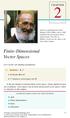 CHAPTER 2 American mathematician Paul Halmos (1916 2006), who in 1942 published the first modern linear algebra book. The title of Halmos s book was the same as the title of this chapter. Finite-Dimensional
ON NONNEGATIVE SOLUTIONS OF NONLINEAR TWO-POINT BOUNDARY VALUE PROBLEMS FOR TWO-DIMENSIONAL DIFFERENTIAL SYSTEMS WITH ADVANCED ARGUMENTS
 ON NONNEGATIVE SOLUTIONS OF NONLINEAR TWO-POINT BOUNDARY VALUE PROBLEMS FOR TWO-DIMENSIONAL DIFFERENTIAL SYSTEMS WITH ADVANCED ARGUMENTS I. KIGURADZE AND N. PARTSVANIA A. Razmadze Mathematical Institute
ISOMETRIES OF R n KEITH CONRAD
 ISOMETRIES OF R n KEITH CONRAD 1. Introduction An isometry of R n is a function h: R n R n that preserves the distance between vectors: h(v) h(w) = v w for all v and w in R n, where (x 1,..., x n ) = x
1. Introduction. PROPER HOLOMORPHIC MAPPINGS BETWEEN RIGID POLYNOMIAL DOMAINS IN C n+1
 Publ. Mat. 45 (2001), 69 77 PROPER HOLOMORPHIC MAPPINGS BETWEEN RIGID POLYNOMIAL DOMAINS IN C n+1 Bernard Coupet and Nabil Ourimi Abstract We describe the branch locus of proper holomorphic mappings between
THE DEGREES OF BI-HYPERHYPERIMMUNE SETS
 THE DEGREES OF BI-HYPERHYPERIMMUNE SETS URI ANDREWS, PETER GERDES, AND JOSEPH S. MILLER Abstract. We study the degrees of bi-hyperhyperimmune (bi-hhi) sets. Our main result characterizes these degrees
Introduction to Topology
 Introduction to Topology Tomoo Matsumura November 30, 2010 Contents 1 Topological spaces 3 1.1 Basis of a Topology......................................... 3 1.2 Comparing Topologies.......................................
Section 1.4. Lines, Planes, and Hyperplanes. The Calculus of Functions of Several Variables
 The Calculus of Functions of Several Variables Section 1.4 Lines, Planes, Hyperplanes In this section we will add to our basic geometric understing of R n by studying lines planes. If we do this carefully,
ON GALOIS REALIZATIONS OF THE 2-COVERABLE SYMMETRIC AND ALTERNATING GROUPS
 ON GALOIS REALIZATIONS OF THE 2-COVERABLE SYMMETRIC AND ALTERNATING GROUPS DANIEL RABAYEV AND JACK SONN Abstract. Let f(x) be a monic polynomial in Z[x] with no rational roots but with roots in Q p for
Further Study on Strong Lagrangian Duality Property for Invex Programs via Penalty Functions 1
 Further Study on Strong Lagrangian Duality Property for Invex Programs via Penalty Functions 1 J. Zhang Institute of Applied Mathematics, Chongqing University of Posts and Telecommunications, Chongqing
Large induced subgraphs with all degrees odd
 Large induced subgraphs with all degrees odd A.D. Scott Department of Pure Mathematics and Mathematical Statistics, University of Cambridge, England Abstract: We prove that every connected graph of order
ON SEQUENTIAL CONTINUITY OF COMPOSITION MAPPING. 0. Introduction
 ON SEQUENTIAL CONTINUITY OF COMPOSITION MAPPING Abstract. In [1] there was proved a theorem concerning the continuity of the composition mapping, and there was announced a theorem on sequential continuity