
ENVIRONMENTAL STATEMENT: VOLUME 2 APPENDICES 11.1 TO 11.3
|
|
|
- Virgil Lyons
- 10 years ago
- Views:
Transcription
1 NORTH LONDON WASTE AUTHORITY NORTH LONDON HEAT AND POWER PROJECT ENVIRONMENTAL STATEMENT: VOLUME 2 APPENDICES 11.1 TO 11.3 AD06.02
2

3 NORTH LONDON WASTE AUTHORITY NORTH LONDON HEAT AND POWER PROJECT ENVIRONMENTAL STATEMENT: VOLUME 2 APPENDIX 11.1 WATER RESOURCES AND FLOOD RISK ASSESSMENT METHODOLOGY AD06.02

4 North London Heat and Power Project Environmental Statement Volume 2 Appendix 11.1 Water Resources and Flood Risk Assessment Methodology AD06.02 The Planning Act 2008 The Infrastructure Planning (Applications: Prescribed Forms and Procedure) Regulations 2009 Regulation 5 (2)(a) Issue October 2015 Amec Foster Wheeler E&I UK Ltd This report takes into account the particular instructions and requirements of our client. It does not in any way constitute advice to any third party who is able to access it by any means. Amec Foster Wheeler excludes to the fullest extent lawfully permitted all liability whatsoever for any loss or damage howsoever arising from reliance on the contents of this report. We do not however exclude our liability (if any) for personal injury or death resulting from our negligence, for fraud or any other matter in relation to which we cannot legally exclude liability..

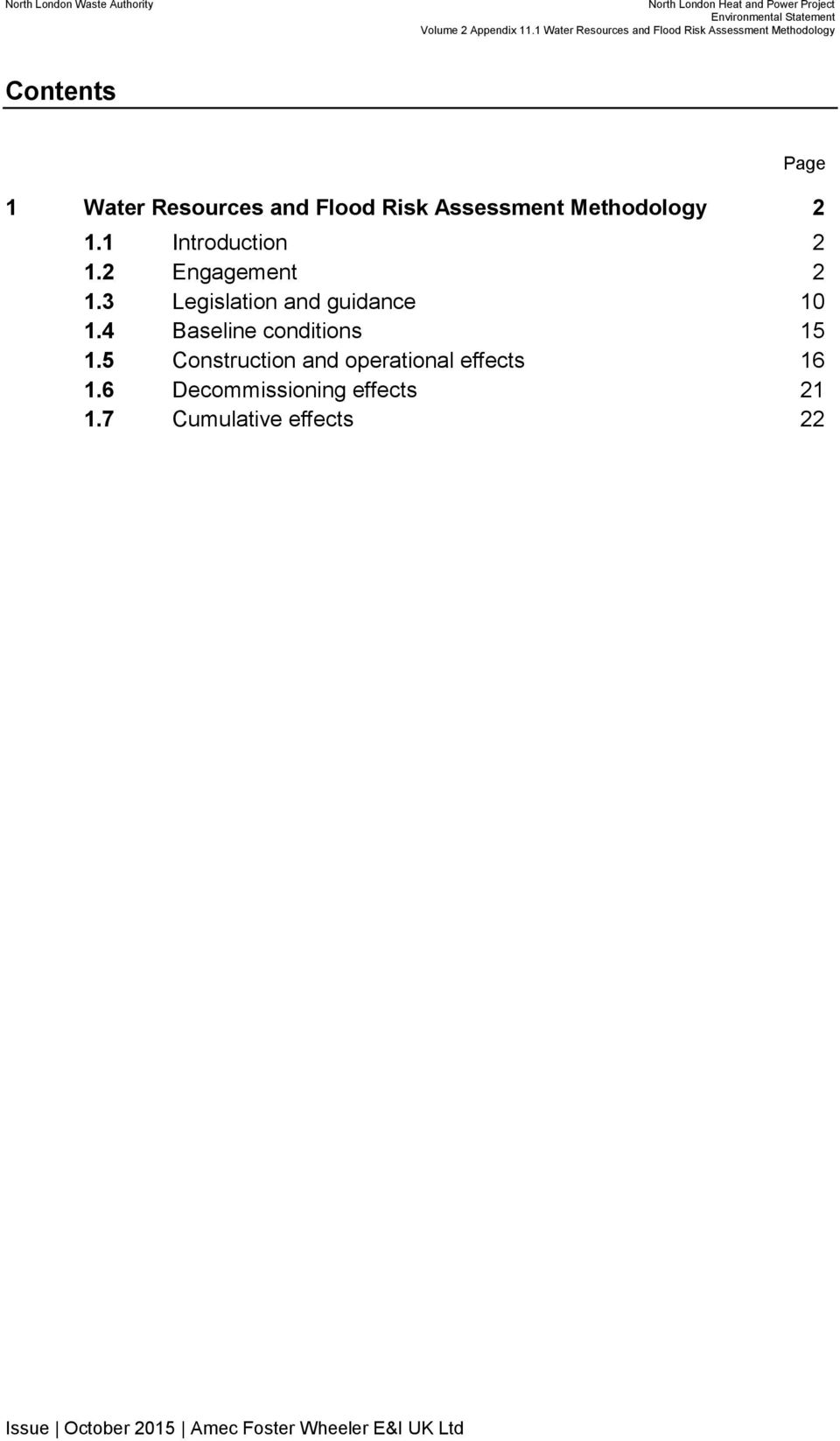
5 Environmental Statement Volume 2 Appendix 11.1 Water Resources and Flood Risk Assessment Methodology Contents Page 1 Water Resources and Flood Risk Assessment Methodology Introduction Engagement Legislation and guidance Baseline conditions Construction and operational effects Decommissioning effects Cumulative effects 22 Issue October 2015 Amec Foster Wheeler E&I UK Ltd
6 Environmental Statement Volume 2 Appendix 11.1 Water Resources and Flood Risk Assessment Methodology 1 Water Resources and Flood Risk Assessment Methodology 1.1 Introduction This appendix sets out the methodology for assessing the likely significant effects of the Project on water resources (in terms of surface watercourses, groundwater flow, associated abstractions and discharges, water quality, designated sites, and wetland habitats) and flood risk This topic assesses effects on groundwater flows and quality as a result of activities at the ground surface, for example pollution of surface run-off. The Ground Conditions and Contamination section (Vol 2 Section 7) assess effects caused by changes to ground structure which could affect groundwater flow pathways and/or remobilise any existing ground contamination This appendix is divided into the following parts: a. engagement describing a summary of comments included in the Scoping Opinion and through further stakeholder engagement and how these comments have been addressed; b. legislation and guidance detailing requirements of the relevant National Policy Statements (NPS), how these have been addressed and additional guidance relevant to the assessment; c. methodology for establishing baseline conditions; and d. methodology for the assessment of construction, operation decommissioning and cumulative effects. 1.2 Engagement Stakeholder engagement has taken place throughout the development of the design and environmental assessment. Vol 2 Appendix 7.1 provides a summary of the stakeholder engagement that has been undertaken in relation to groundwater, including comments on reports issued to the stakeholders and stakeholder consultation meetings A summary of water resources and flood risk specific engagement is provided in Vol 2 Appendix 11.1 Table 1. Vol 2 Appendix 11.1 Table 1: Water Resources and Flood Risk Technical Engagement and Scoping Responses No Organisation (date) Comment Response 1 Scoping Opinion: Secretary of State (November 2014) Insufficient detail provided when: scoping out the potential effects on water resources; and identifying that downstream flow regimes would not be significantly affected by the Further information regarding the surface water regime is provided in the FRA (Vol 2 Appendix 11.2). These aspects have been scoped back in and are considered fully in this assessment. Page 2 Issue October 2015 Amec Foster Wheeler E&I UK Ltd

7 Environmental Statement Volume 2 Appendix 11.1 Water Resources and Flood Risk Assessment Methodology No Organisation (date) Comment Response proposed abstraction/discharge rates. The proximity of sensitive receptors indicates the potential for significant effects and there remains the potential for water use to exceed expected requirements or licensed limits. Air cooled condensers are proposed as part of the Project. Two options for the sourcing of water for these have been assessed as part of this ES. The proposed cooling water options will be discussed further with the EA. 2 Scoping Opinion: Secretary of State (November 2014) 3 Scoping Opinion: Secretary of State (November 2014) 4 Scoping Opinion: Secretary of State (November 2014) 5 Scoping Response: Assessment required of potential groundwater pathway for discharge of liquids to surface and coastal waters (including allowances for climate change), including engagement with the Environment Agency (EA) to determine the scope of the assessment as the proposed development design progresses. Full consideration required of the potential effects of the cooling water connection on local hydrological and hydrogeological resources. This will require: consultation with the Environment Agency (EA) regarding positioning of the intake/outfall point; details of abstraction and outfall rates to be defined and assessed; agreement with the Environment Agency (EA) that the rates are valid and the assessment represents the worst case; and the rate of mains water use to be clarified. Flood Risk Assessment (FRA), should form an appendix to the ES and be cross referenced with other ES chapters. Should review River Basin Management Plan to determine The impact of climate change over the development lifetime has been considered within the FRA in line with current guidance. Contamination of groundwater (and remobilisation of ground contaminants) has been addressed in Vol 2 Section 7 (Ground Conditions and Contamination). Climate change effects are considered within Vol 2 Section 11 (Water Resources and Flood Risk). Designs would be discussed with in the EA through ongoing engagement. The EA has been consulted in preparing the FRA (Vol 2 Appendix 11.2) and Hydrogeological Assessment (Vol 2 Appendix 7.2). A comprehensive assessment of cooling water requirements, the intake/outfall locations, and the effect on the water environment has been undertaken as part of this assessment. Vol 2 Section 11 (Water Resources and Flood Risk) sets out details of proposed abstraction and discharge rates, including mains water, and the proposed intake and outfall points. All three cooling water options have been considered in the assessment, and the options have been discussed with the EA. The FRA forms an appendix to the ES (Vol 2 Appendix 11.2) and is referenced in the discussion of flood risk in the water resources assessment. WatFD requirements have been considered in the water resources Page 3 Issue October 2015 Amec Foster Wheeler E&I UK Ltd
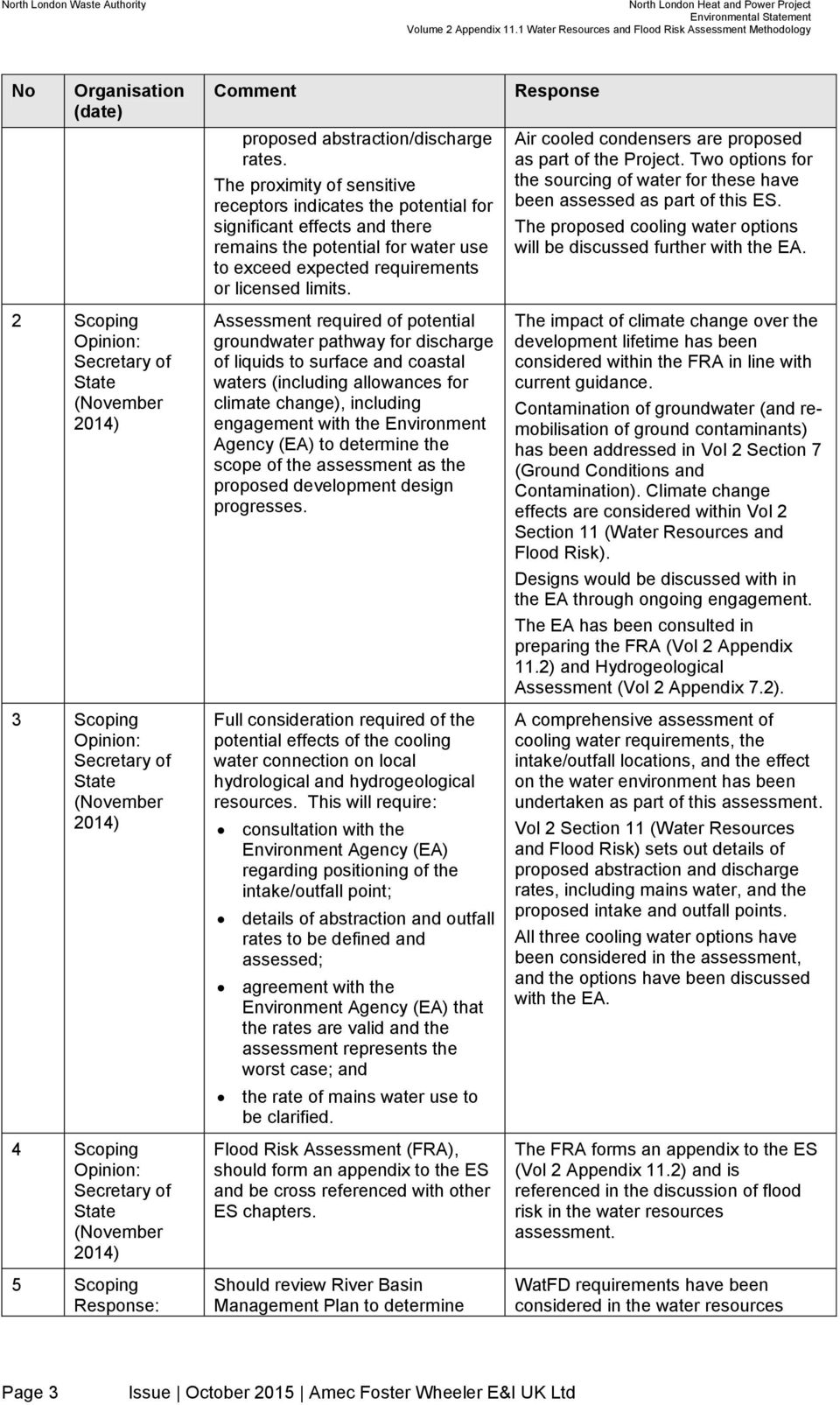
8 Environmental Statement Volume 2 Appendix 11.1 Water Resources and Flood Risk Assessment Methodology No Organisation (date) Comment Response Secretary of State, Environment Agency (November 2014) how the Project can contribute to Water Framework Directive [WatFD] objectives. Consideration required of the requirements of the [WatFD]including causing no overall deterioration in water quality or the ecological status of any waterbody. assessment. Consideration also given to the River Basin Management Plan (RBMP) and the potential for the development to contribute to the WatFD objectives. 6 Scoping Response: Environment Agency (November 2014) 7 Scoping Response: Environment Agency (November 2014) 8 Scoping Response: Greater London Authority (January 2015) 1 Flood risk and surface water should be addressed in line with the requirements of the National Planning Policy Framework (NPPF) and the London Plan Policy Flood risk will need to be scoped into the ES if works are proposed to Enfield Ditch to ensure that any negative impact on people or the environment is avoided. The FRA will need to consider the risk of fluvial flooding from the nearby River Lee and Salmon s Brook systems, the risk of surface water flooding and the risk of reservoir flooding from the range of raised reservoirs along the Lee Valley. A flood risk assessment for the development has been prepared (Vol 2 Appendix 11.2). These aspects have been scoped back in and are considered fully in the water resources assessment. The impacts of the Project on flood risk have been assessed within the FRA and the ES (Vol 2 Section 11). The FRA takes into consideration the risks identified by the Greater London Authority. The FRA is included as Vol 2 Appendix London Plan Policy 5.13 and the associated sustainable drainage hierarchy should be applied to limit surface water discharge to the drainage system. Full consideration required for rainwater harvesting systems. Sustainable Drainage Strategy has been considered during design development. Surface water run-off would be limited as set out in the FRA, in line with the London Plan and EA guidance. 10 Engagement Response: Environment Agency (February 2015) Issues discussed at Environment Agency (EA) consultation meeting held on the 18 February 2015: Consideration required of desire to widen the entrance to the Edmonton EcoPark from Advent Way and the entrance to the wharf area and to create a new crossing across Enfield Ditch from Lee Park Way that would contradict Water Framework Directive requirement for culverts to be A Flood Risk Assessment (FRA) has been undertaken (Vol 2 Appendix 11.2) and considers the proposed works to the bridges. Consideration of the requirements of the Water Framework Directive (WatFD) within the Water Resources and Flood Risk assessment includes consideration of the new crossing and entrance widening. 1 The Planning Inspectorate (2015) Late scoping consultation responses, January Submission/EIA/Scoping/Late%20Response/Late%20responses%20to%20EIA%20scoping%20consu ltation.pdf (Accessed July 2015) Page 4 Issue October 2015 Amec Foster Wheeler E&I UK Ltd
![Framework Directive [WatFD] objectives. Consideration required of the requirements of the [WatFD]including causing no overall deterioration in water quality or the ecological status of any waterbody.](/docs-images/51/13557670/images/page_8.jpg "assessment. Consideration also given to the River Basin Management Plan (RBMP) and the potential for the development to contribute to the WatFD objectives.")
9 Environmental Statement Volume 2 Appendix 11.1 Water Resources and Flood Risk Assessment Methodology No Organisation (date) Comment Response opened up when possible to increase biodiversity. Most of the Application Site is in Flood Risk Zone 1 with some in Zone 2. The Flooding Evacuation Emergency Plan would form part of the overall Emergency Plan for the site. The Flood Emergency Plan is discussed in the Flood Risk Assessment (Volume 2 Appendix 11.2 of the ES) Each of the three proposed flood management areas within the Application Site would drain to a containment tank that is sufficient to contain surface water and storm water and/or fire water. After a fire or spillage the contained contaminated water could be removed from the Application Site by tanker. Uncontaminated surface water could be attenuated through the storage tanks. Surface water drainage is addressed in the Drainage Strategy which forms an appendix to the Flood Risk Assessment (Vol 2 Appendix 11.2). The on-site waste water treatment plant is to be replaced to properly treat contamination captured in the storage tanks before discharging to the environment. Replacement of the existing waste water treatment plant is addressed in the Utilities Strategy (AD05.10). 11 Engagement Response: Environment Agency (February 2015) The flood risk assessment needs to include the effect of the proposed expansion of the bridges described above. The proposed works to the bridges, and the proposed new bridge are considered in the FRA. 12 Engagement Response, LB Enfield (June 2015) Points raised by LB Enfield in discussion at a meeting held on 2 June 2015: Full range of above ground sustainable drainage (SuDS) features should be considered in developing the drainage strategy, including permeable paving, swales, rain gardens, wetland features/detention basins, green and blue roofs, where appropriate Infiltration is not appropriate at the site due to the source protection zone and waste site allocation The Preliminary Drainage Strategy, Appendix E of the FRA (Vol 2 Appendix 11.2), details the range of SuDS features which will be included in the design, comprising rainwater harvesting, green and/or brown roofs. lined permeable paving and lined filter trenches. Attenuation tanks will also be required and these are discussed and justified in the drainage strategy. Infiltration of surface runoff is not included in the design at the Edmonton EcoPark site. Surface runoff discharged from the Application Site will be limited to greenfield rates up to the 100 year Page 5 Issue October 2015 Amec Foster Wheeler E&I UK Ltd
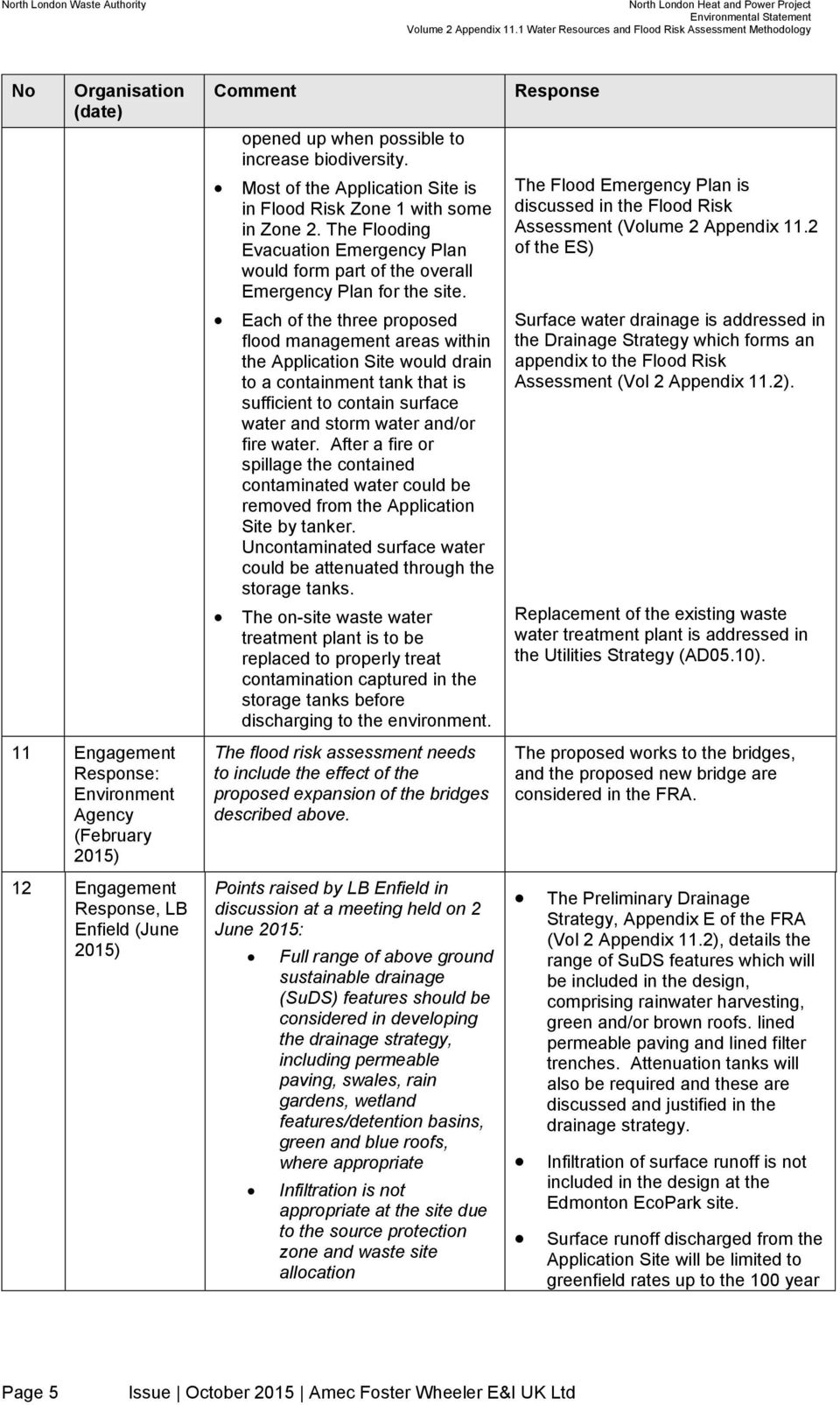
10 Environmental Statement Volume 2 Appendix 11.1 Water Resources and Flood Risk Assessment Methodology No Organisation (date) Comment Response Controlled discharge of surface runoff should be restricted to greenfield rates for the 1 year and 100 year return period storm event The laydown area should use a permeable surface so that additional attenuation is not required, subject to any SPZ constraints return period storm event, and accounting for climate change The Temporary Laydown Area will be located on the innser SPZ zone, and appropriate surface based SuDS features in the form of swales, filter strips and retention pond where appropriate 13 Phase 2 Consultation response: Canal and Rivers Trust (June 2015) The Canal and Rivers Trust (CRT) supports the use of river and canal water for the cooling purposes of plant, although we would like further information as to how this will operate. Your consultation documents state that water will be taken from the "adjacent watercourse" but it is not clear whether this is referring to the Lee Navigation or Salmons Brook. Current surface water abstraction is, and future water abstraction would be, from the Deephams Sewage Treatment Works outfall upstream of Salmon s Brook, north-west of the Application Site. 14 Phase 2 Consultation response: Canal and Rivers Trust (June 2015) The documents also refer to the water being "vaporised" rather than returning flows back to the watercourse. This would imply an abstraction of water which would require a licence from CRT if the water is being abstracted from the Lee Navigation. It should be noted that Thames Water extracts a large volume of water from the Lee Navigation further upstream and this would need to be taken into consideration. Current surface water abstraction is, and future water abstraction would be, from the Deephams Sewage Treatment Works outfall upstream of Salmon s Brook, north-west of the Application Site. If water is to be taken from the Navigation for cooling and the flow is returned, the Trust will need details about the temperature differentials on the receiving water as this can have an impact on the ecology of the waterway. 15 Phase 2 Consultation response: Canal and Rivers Trust (June 2015) The Flood Risk Assessment mentions the possible requirement for temporary discharge into Enfield Ditch. Water from Enfield Ditch enters the Lee Navigation via Pymmes Brook and from there the level is controlled by the CRT sluice at Lea Bridge. CRT must be given the chance to evaluate any proposed increase to the current discharge rates and we request It is proposed that all surface water from all of the Application Site would drain to Enfield Ditch at a rate no greater than 168 l/s. This would improve flows at Enfield Ditch which are currently low. Currently some surface water at the Application site drains to the Chingford sewer, and in more extreme rainfall events, some would, currently, drain to Salmon s Brook. Page 6 Issue October 2015 Amec Foster Wheeler E&I UK Ltd
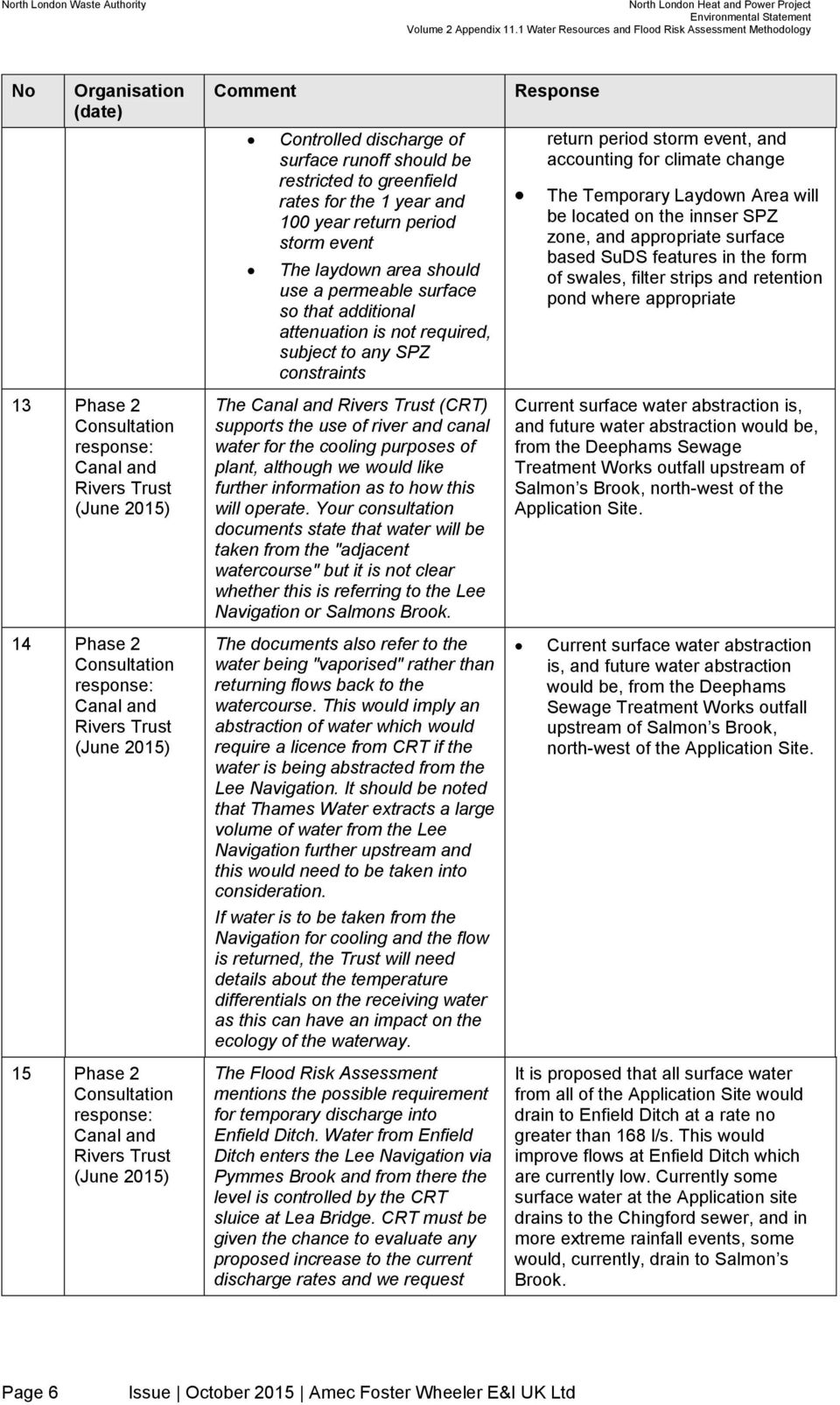
11 Environmental Statement Volume 2 Appendix 11.1 Water Resources and Flood Risk Assessment Methodology No Organisation (date) Comment Response that this information is provided as soon as it is available. 16 Phase 2 Consultation response: Canal and Rivers Trust (June 2015) 17 Phase 2 Consultation response: Environment Agency (June 2015) 18 Phase 2 Consultation response: Environment Agency (June 2015) CRT would also like confirmation of the surface water drainage details. The FRA states that pumped discharge will be limited to 507 litres per second and to three times the calculated Greenfield run-off rate. It is not clear how this compares to the current discharge levels and CRT would requires this information so that we can undertake our own assessment. We are satisfied that the scope of the Flood Risk Assessment (FRA) is appropriate and covers everything it will need to. We have no objections to this work progressing as proposed. The FRA should be submitted alongside the DCO application and contain the most relevant data for the site. The FRA should be written in conjunction with the requirements of the National Planning policy Framework (NPPF) and Policy 5.13 of the London Plan. Please note that on 15 April 2015, the responsibility for giving advice on major planning applications for surface water flood risk transferred from us to Lead Local Flood Authorities (LLFAs). As we are no longer a statutory consultee on sites over a hectare, you will need to consult the LLFA about managing the surface water drainage from this proposal. We are pleased that the EIA scoping report has considered the requirements of the Water Framework Directive [WatFD] in acknowledging the current status of the waterbody and the requirement for a further [WatFD] assessment. The Preliminary Drainage Strategy (appended to the FRA in Vol 2 Appendix 11.2) states that surface water discharge to Enfield Ditch would be limited to greenfield rates, not more than 168 l/s from the 100 year rainfall event, with climate change. This is the requirement set by the London Borough of Enfield (LB Enfield) in their Development Management Document 2 and has been confirmed during engagement with them. The existing discharge from the Application Site is not known. The FRA is submitted as part of the DCO application documents (as Vol 2 Appendix 11.2 of the ES) and has been written in accordance with the NPPF and London Plan, and in consultation with LB Enfield, the relevant LLFA for the Application Site. A Water Framework Directive assessment is being produced for the Project. The Project would reduce flood risk to Salmon s Brook, and improve existing low flows in Enfield Ditch, since surface water at the Application Site would drain into Enfield Ditch, and 2 LB Enfield (2014), Development Management Document, Adopted November ent_document_dmd (accessed July 2015) Page 7 Issue October 2015 Amec Foster Wheeler E&I UK Ltd
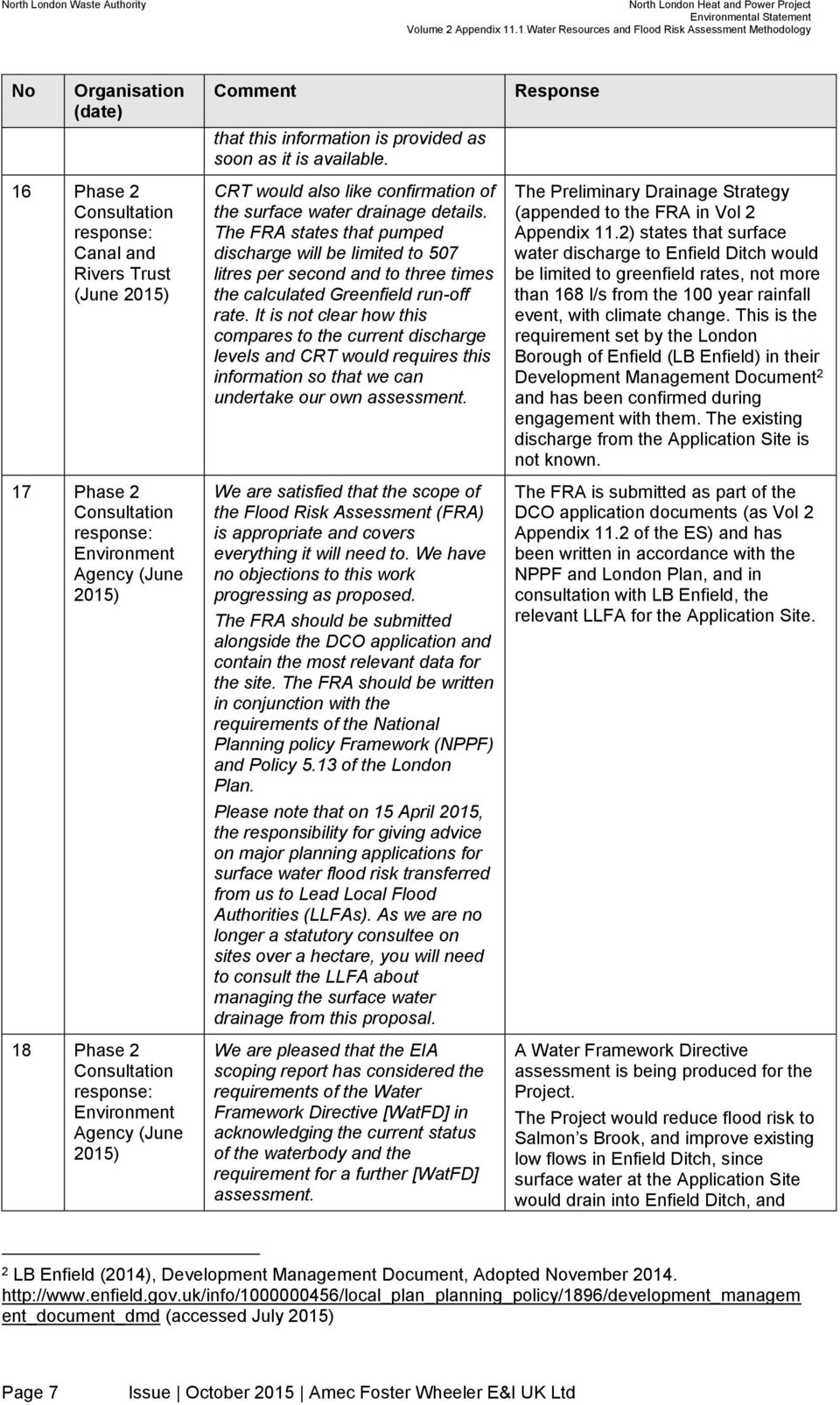
12 Environmental Statement Volume 2 Appendix 11.1 Water Resources and Flood Risk Assessment Methodology No Organisation (date) Comment Response A development of this size should be seeking to improve the waterbody where possible as potential mitigation from the disturbance caused from construction and operation. A [WatFD] action highlighted for the waterbody in this area is the 'Replacement of hard bank protection with soft engineering solutions within the Salmons Brook and reduce flood risk to riparian land'. As part of the [WatFD] assessment you should investigate the potential to naturalise banks or consider other environmental enhancements. The assessment will need to demonstrate that there will be no deterioration in water quality as a result of the works. Where possible, the assessment should also demonstrate an improvement in water quality. none to Salmon s Brook (up to the 100 year flow event with climate change). After consideration it has been decided not to carry out works to naturalise the banks of Salmon s Brook by providing soft engineering solutions at the Application Site, given the nature of the watercourse at this location as a utilities corridor. The water resources and flood risk assessment sets out the measures which would be taken to ensure no significant effects on the water environment from the proposed development. If a separate WatFD assessment is undertaken it would demonstrate no deterioration, and if possible an improvement, in water quality downstream of the development. 19 Phase 2 Consultation response: LB Enfield (June 2015) 20 Phase 2 Consultation response: Thames Water (June 2015) The local planning authority acknowledges that a flood risk assessment will be submitted with the application and will be commented upon by the Environment Agency. The FRA will should reflect the need to maximise the potential for SuDs being adopted within the development Surface Water Drainage - With regard to surface water drainage it is the responsibility of a developer to make proper provision for drainage to ground, water courses or a suitable sewer. In respect of surface water it is recommended that the applicant should ensure that storm flows are attenuated or regulated into the receiving public network through on or off site storage. When it is proposed to connect to a combined public sewer, the site drainage should be separate and combined at the final manhole nearest the boundary. Connections are not permitted for the removal of groundwater. Reason - to ensure that the surface water discharge from the site shall not be detrimental to the existing sewerage system. SuDS has been included in the Project as set out in the Preliminary Drainage Strategy (Appendix E of the FRA see Vol 2 Appendix 11.2). It is not proposed to discharge surface water run-off to a sewer. It would be discharged to Enfield Ditch, as set out in the ES (Section 11.6). Page 8 Issue October 2015 Amec Foster Wheeler E&I UK Ltd

13 Environmental Statement Volume 2 Appendix 11.1 Water Resources and Flood Risk Assessment Methodology No Organisation (date) Comment Response 21 Phase 2 Consultation response: Thames Water (June 2015) 22 Phase 2 Consultation response: Thames Water (June 2015) 23 Phase 2 Consultation response: Thames Water (June 2015) 24 Phase 2 Consultation response: Thames Water (June 2015) We would expect the developer to demonstrate what measures he will undertake to minimise groundwater discharges into the public sewer. Groundwater discharges typically result from construction site dewatering, deep excavations, basement infiltration, borehole installation, testing and site remediation. Any discharge made without a permit is deemed illegal and may result in prosecution under the provisions of the Water Industry Act Should the Local Planning Authority be minded to approve the planning application, Thames Water would like the following informative attached to the planning permission: Groundwater Risk Management Permit from Thames Water will be required for discharging groundwater into a public sewer. Any discharge made without a permit is deemed illegal and may result in prosecution under the provisions of the Water Industry Act A Trade Effluent Consent will be required for any Effluent discharge other than a 'Domestic Discharge'. Any discharge without this consent is illegal and may result in prosecution. Thames Water would recommend that petrol / oil interceptors be fitted in all car parking/washing /repair facilities. Failure to enforce the effective use of petrol / oil interceptors could result in oilpolluted discharges entering local watercourses. Thames Water recommends the installation of a properly maintained fat trap on all catering establishments. We further recommend, in line with best practice for the disposal of Fats, Oils and Grease, the collection of waste oil by a contractor, particularly to recycle for the production of bio diesel. Failure to implement these recommendations may result in this and other properties suffering blocked drains, Measures to protect the aquifer (groundwater) during construction, including construction site drainage and preventing and managing pollution incidents are set out in the Code of Construction Practice (CoCP) for the Project (Volume 1 Appendix 3.1). Method statements for piling and excavations at the Application Site have not yet been written; they would be produced by the appointed contractors and would be in accordance with the best practice requirements set out in the CoCP, and with reference to the Hydrogeological Risk Assessment (Vol 2 Appendix 7.2) and the Piling Risk Assessment (Vol 2 Appendix 7.3). Where discharge of groundwater to a public sewer is proposed during construction, the contractor would apply for a Groundwater Risk Management Permit. Trade effluent consents and other consents required to discharge to sewer from the Project (not surface run-off) have now been provided by TWUL. The trade effluent consent number is TDEE0B01. The Preliminary Drainage Strategy (Appendix E of the FRA, Vol 2 Appendix 11.2) sets out that oil interceptors would be used where necessary at the Application Site. All discharges would be treated on-site where required, with oil and fat interceptors where appropriate, and including treatment at the on-site water treatment works, before being discharged to Enfield Ditch. Note that the proposed EcoPark House would not be a catering establishment, although there may be some catering for staff on-site. Page 9 Issue October 2015 Amec Foster Wheeler E&I UK Ltd
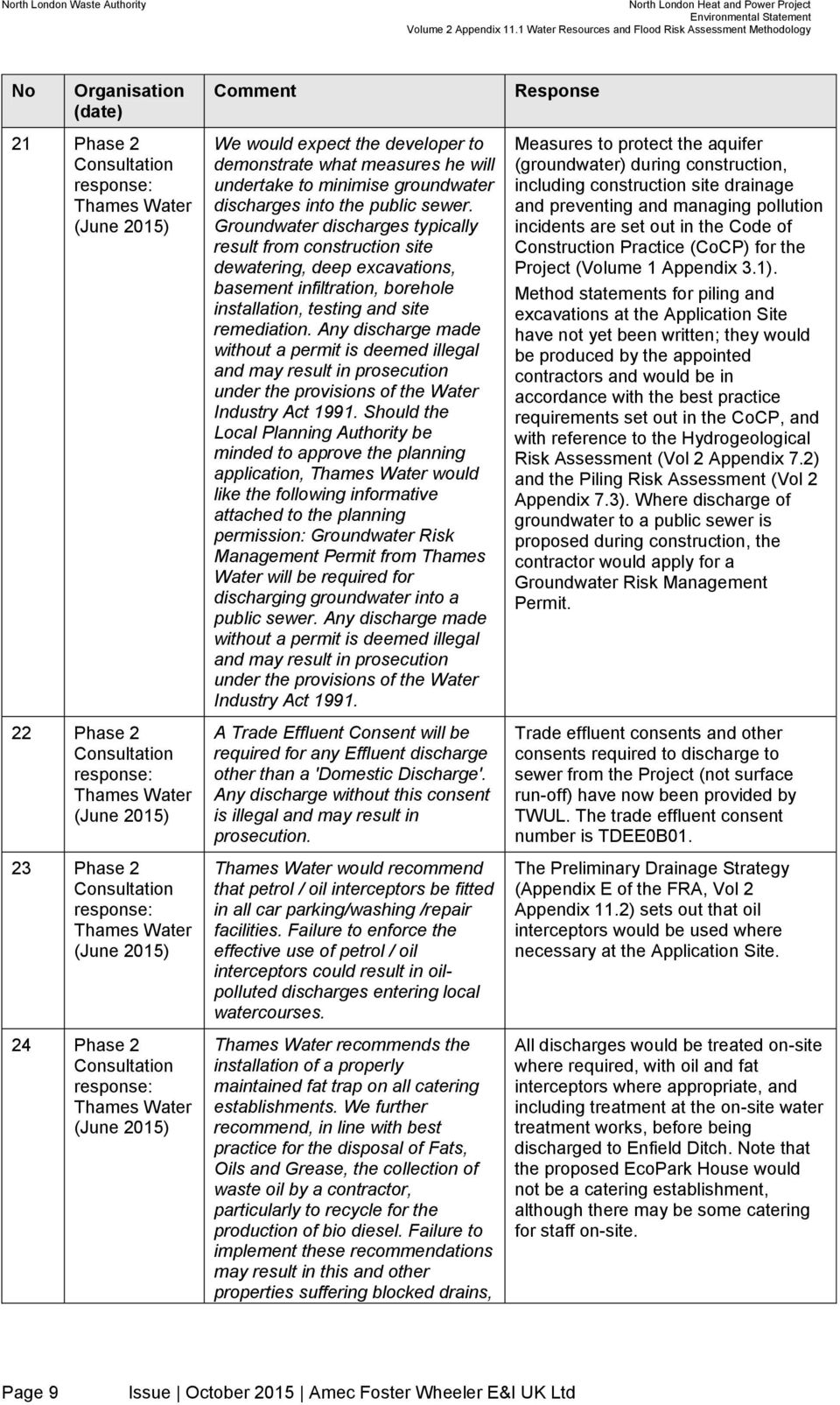
14 Environmental Statement Volume 2 Appendix 11.1 Water Resources and Flood Risk Assessment Methodology No Organisation (date) 25 Phase 2 Consultation response: Thames Water (June 2015) 26 Phase 2 Consultation response: Thames Water (June 2015) Comment sewage flooding and pollution to local watercourses. It is difficult to calculate the potential impact on the Clean Water infrastructure for this development with no detail available on the changes to demand. If the site has a significant change in use the developer will need to contact Thames Water Developer Services. From the information submitted, we have not been able to determine the potential impact on the public foul and surface water sewerage networks. We request that further details be submitted, in the form of a drainage strategy. We require further information about the existing and proposed foul and surface water discharge rates, along with the points of connection to the public network. Flood Risk Assessment dated May 2015 states no surface water will be discharged to public sewer after work completion but doesn t provide any details regarding this discharge during work progression (document Vol. 2 Appendix 10.2 states that there will be one). Response There would not be a significant change in land use at the Application Site. The ES identifies that current abstraction from TWUL potable supply is m 3 /hr. With the Project in place this demand could increase to m 3 /hr if all water is sourced from TWUL potable water supplies. The potable maximum flow required (141.1 m 3 /hr) has been agreed with Thames Water. Thames Water has agreed that the Edmonton EcoPark can connect from a DN150 pipe into an existing 355 mm diameter main that can supply this flow. The ES sets out that the likely discharge to the Chingford sewer would be 48.1 m 3 /hr. This compares with current discharge to sewer of approximately m 3 /hr. TWUL has issued a consent for the higher discharge rate into the sewer. 1.3 Legislation and guidance This section identifies all of the policy and legislation that is relevant to the assessment of effects on water resources and flood risk, however this assessment addresses the specific issues related to the Project. Where relevant policy and legislation is listed here but not mentioned in the assessment, there are no issues with respect to the development and the requirements of that particular policy/ legislation. National policy This section identifies policies, legislation and guidance relevant to the assessment of the effects on water and flood risk. The issues included in these need to be considered in this assessment. Policies and legislation relevant to groundwater and contamination are in Vol 2 Appendix 7.1. Page 10 Issue October 2015 Amec Foster Wheeler E&I UK Ltd

15 Environmental Statement Volume 2 Appendix 11.1 Water Resources and Flood Risk Assessment Methodology The NPS sets out national policy for energy infrastructure. There are two NPS of direct relevance to the Project. The requirements which are relevant to the water resources and flood risk assessment from EN-1: Overarching NPS for Energy 3 and EN-3: NPS for Renewable Energy Infrastructure 4 are listed in Vol 2 Appendix 11.1 Table 2 and Vol 2 Appendix 11.1 Table 3:. Vol 2 Appendix 11.1 Table 2: NPS EN-1 requirements Requirements of NPS EN-1 Paragraph Where the project is likely to have effects on the water environment, the applicant should undertake an assessment of the existing status of, and impact of the proposed project on, water quality, water resources and physical characteristics of the water environment as part of the ES. How the requirement is addressed Water environment considered within the works plans (see Book of Plans (AD02.01)) and CoCP (Vol 1 Appendix 3.1) and potential impacts considered as part of water resources and flood risk assessment. Paragraph of this NPS notes that the Applicant should include the following in the ES. the existing quality of waters affected by the proposed project and the impacts of the proposed project on water quality, noting any relevant existing discharges, proposed new discharges and proposed changes to discharges; existing water resources affected by the proposed project and the impacts of the proposed project on water resources, noting any relevant existing abstraction rates, proposed new abstraction rates and proposed changes to abstraction rates (including any impact on or use of mains supplies and reference to Catchment Abstraction Management Strategies); existing physical characteristics of the water environment (including quantity and dynamics of flow) affected by the proposed project and any impact of physical modifications to these characteristics; any impacts of the proposed project on water bodies or protected areas under the Water Framework Directive and source protection zones (SPZs) around potable groundwater abstractions. Water quality is considered within the water resources and flood risk assessment, including consideration of WatFD. Existing discharges and proposed discharges have been are identified and assessed. Existing abstractions and water resources affected by the Project have been considered within the water resources and flood risk assessment. Considered as part of the water resources and flood risk assessment. Considered within the water resources and flood risk assessment. Location of where to find further detail Vol 2 Section 11 Vol 2 Section 11 Vol 2 Section 11 Vol 2 Section 11 Vol 2 Section 11 Paragraph notes that activities that discharge to the water environment are subject to pollution control. The considerations set out in Section 4.10 of this NPS and detailed below on the interface between planning and pollution control therefore apply, and should be considered. These considerations will also apply in an analogous way to the abstraction licensing regime regulating activities that take water from the water environment, and to the control of regimes relating to works to, and structures in, on, or under a controlled water. 3 Department of Energy and Climate Change (2011) Overarching National Policy Statement for Energy (EN-1), July Department of Energy and Climate Change (2011) National Policy Statement for Renewable Energy Infrastructure (EN-3), July Page 11 Issue October 2015 Amec Foster Wheeler E&I UK Ltd

16 Environmental Statement Volume 2 Appendix 11.1 Water Resources and Flood Risk Assessment Methodology Requirements of NPS EN-1 Paragraph Pollution control is concerned with preventing pollution through the use of measures to prohibit or limit the releases of substances to the environments from different sources to the lowest practicable levels. It also ensures that water quality meet standards that guard against impacts to the environment or human health. Paragraph Applicants are advised to make early contact with relevant regulators including the EA, to discuss their requirements for environmental permits and other consents. This will help ensure count of all relevant environmental considerations and that the relevant regulators are able to provide timely advice and assurance to the Infrastructure Planning Commission. Whenever possible, applicants are encouraged to submit applications for Environmental Permits and other necessary consents at the same time as applying to the Infrastructure Planning Commission for development consent. Paragraph The relevant pollution control authority is satisfied that potential releases can be adequately regulated under the pollution control framework; the effects of existing sources of pollution in and around the site are not such that the cumulative effects of pollution when the proposed development is added would make that development unacceptable, particularly in relation to statutory environmental limits. Paragraph A proposal should have regard to the River Basin Management Plans and meet the requirements of the Water Framework Directive (including Article 4.7) and its daughter directives, including those on priority substances and groundwater. The specific objectives for particular river basins are set out in River Basin Management Plans. Paragraph It should be considered whether appropriate requirements should be attached to any development consent and/or planning obligations entered into to mitigate adverse effects on the water environment. Paragraph It should be considered whether mitigation measures are needed over and above any which may form part of the project application. A construction management plan may help codify mitigation at that stage. Paragraph The risk of impacts on the water environment can be reduced through careful design to facilitate adherence to good pollution control practice. For example, designated areas for storage How the requirement is addressed Pollution control is included in the design and detailed in the CoCP. Pollution control risk has been assessed and impacts noted as part of ground conditions and contamination assessment and the water resources and flood risk assessment. The EA and LB Enfield have been consulted and informed throughout the design of the Project and the assessment. Considered as part of water resources and flood risk assessment. FRA and hydrogeological risk assessment undertaken. Likely significant effects have been considered as part of the water resources and flood risk assessment. Likely significant effects have been considered as part of the water resources and flood risk assessment. The CoCP sets out relevant construction management measures. The water environment has been given due consideration within the design and likely significant effects have been assessed as part of Location of where to find further detail Vol 2 Section 11 and Vol 2 Section 7 Section 1.2 of this appendix Vol 2 Section 11 Vol 2 Appendix 11.2 Vol 2 Appendix 7.2 Vol 2 Section 11 Vol 2 Section 11 Page 12 Issue October 2015 Amec Foster Wheeler E&I UK Ltd

17 Environmental Statement Volume 2 Appendix 11.1 Water Resources and Flood Risk Assessment Methodology Requirements of NPS EN-1 and unloading, with appropriate drainage facilities, should be clearly marked. Paragraph The impact on local water resources can be minimised through planning and design for the efficient use of water, including water recycling. How the requirement is addressed water resources and flood risk assessment. Efficient water use at the Application Site has been considered in the assessment including rainwater harvesting, water efficient appliances and the technology for water cooling. Location of where to find further detail Vol 2 Section 11 Vol 2 Appendix 11.1 Table 3: NPS EN-3 requirements Requirements of NPS EN-3 How the requirement is addressed Location of where to find further detail Paragraph notes additional impacts of the design of water cooling systems for EfW generating stations, other than the generic impacts listed in EN-1. These will have additional impacts on water quality, abstraction and discharge. These may include: discharging water at a higher temperature that the receiving water affecting the biodiversity of aquatic flora and fauna; use of resources may reduce the flow of watercourses, affecting the rate at which sediment is deposited, conditions for aquatic flora and potentially affecting migratory fish species (e.g. salmon); Fish impingement and/or entrainment i.e. being taken into the cooling system during abstraction; Discharging water containing chemical and anti-fouling treatment of water for use in cooling systems may have adverse impacts on aquatic biodiversity. Paragraph Where the project is likely to have effects on water quality or resources the applicant should undertake an assessment as required in EN-1 Section The assessment should particularly demonstrate that appropriate measures will be put in place to avoid or minimised adverse impacts of abstraction and discharge of cooling water. Paragraph The applicant should have demonstrated measures to minimise adverse impacts on water quality and resources as described in EN-1 and EN-3. Paragraph Design of the cooling system should include intake and outfall locations that avoid or minimise adverse impacts. There should also be specific measures to minimise fish impingement and/or Considered within the water resources and flood risk assessment and the ecology assessment. Considered within the water resources and flood risk assessment and the ecology assessment. Considered within the water resources and flood risk assessment and the ecology assessment. Fish entrainment has been considered in the ecology assessment but scoped out on the basis that the existing abstraction would be re-used for the Project. Considered within the water resources and flood risk assessment. Vol 2 Section 11 Vol 2 Section 5 Vol 2 Section 11 Vol 2 Section 5 Vol 2 Section 11 Vol 2 Section 5 Vol 2 Section 11 Page 13 Issue October 2015 Amec Foster Wheeler E&I UK Ltd
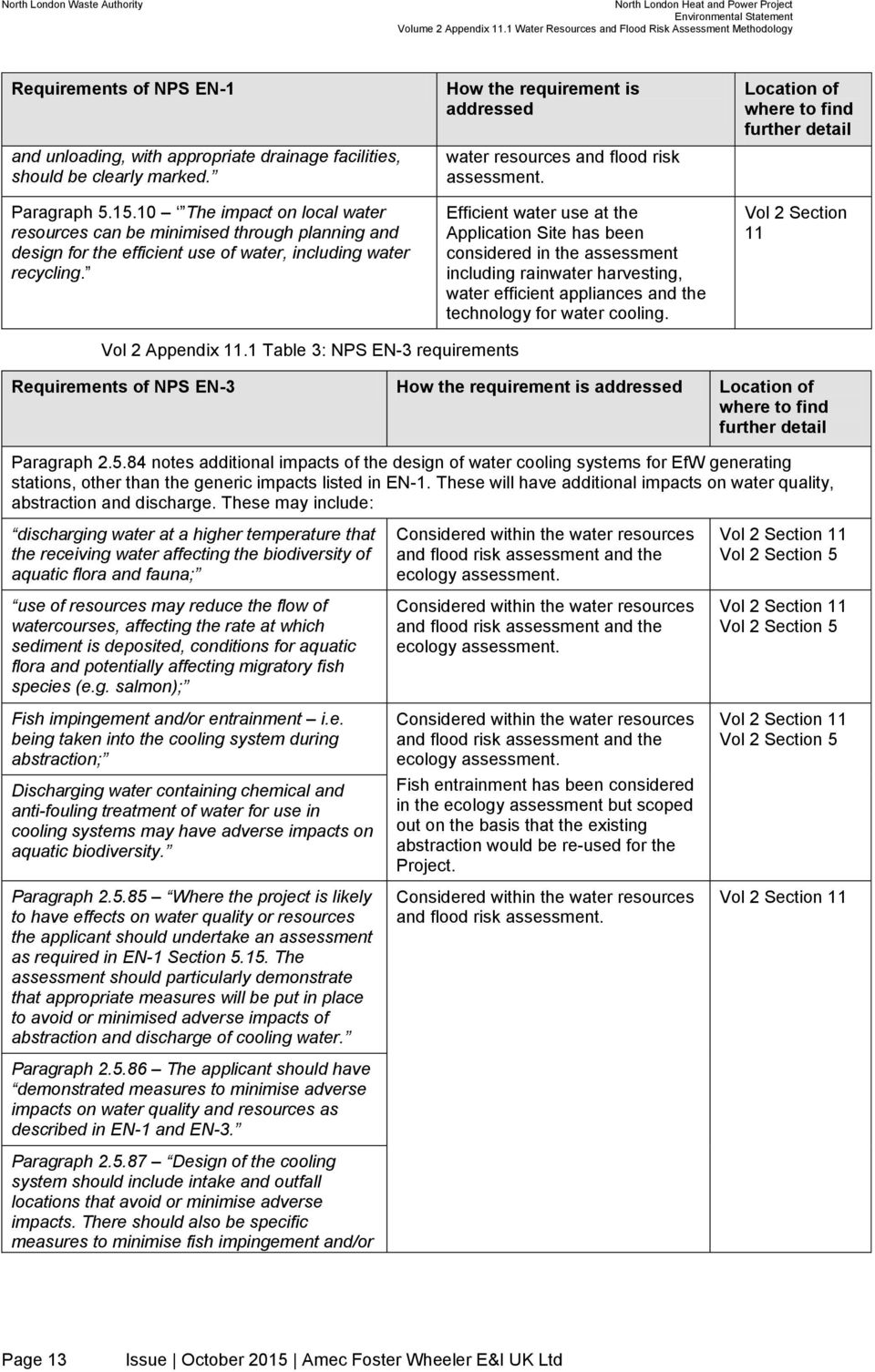
18 Environmental Statement Volume 2 Appendix 11.1 Water Resources and Flood Risk Assessment Methodology Requirements of NPS EN-3 How the requirement is addressed Location of where to find further detail entrainment and the discharge of excessive hear to receiving waters. Local policy The London Plan: Spatial Development Strategy for Greater London (2011) came into effect on 22 July 2011, and was most recently updated by the Further Alterations to the London Plan in March Policies contained within the London Plan which are relevant to water resource and flood risk assessment are: a. Policy 5.12 Flood Risk Management; b. Policy 5.13 Sustainable Drainage; and c. Policy 5.15 Water Use and Supplies Enfield Council Core Strategy Section 8 details the core policies for the Environment Protection for future developments in the Borough of Enfield Enfield Council Development Management Document (2014) Section 11, details policy on Environmental Protection for future developments in the borough, and also provides guidance on the policies. Legislative requirements The main legislative framework regarding the water environment and pollution prevention is set by the following Acts and Regulations. a. Control of Pollution Act 1974; b. EC Fisheries Directive (78/659/EEC); c. Floods and Water Management Act 2010; d. Land Drainage Act 1991; e. The Groundwater (England and Wales) Regulations 2009; f. The Water Supply (Water Quality) Regulations 2010; g. Water Act ; h. WatFD (2000/60/EC); i. Water Resources Act 1991 (WRA 1991); j. Wildlife and Countryside Act 1981 and (Amendment) Act 1985 (as amended by the Countryside and Rights of Way Act 2000); k. Floods and Water Management Act (2010); and 5 Greater London Authority (GLA) (2015) The London Plan, the Spatial Development Strategy for London Consolidated with Alterations since 2015, March Legislation UK (2003), Water Act, Act 2003, Ch 37. Page 14 Issue October 2015 Amec Foster Wheeler E&I UK Ltd
19 Environmental Statement Volume 2 Appendix 11.1 Water Resources and Flood Risk Assessment Methodology l. Reservoirs Act (1975) Policy guidance and good practice advice regarding the water environment and pollution prevention includes the following: a. EA Pollution Prevention Guidance Notes (PPG) 7 ; b. Guidance from Construction Industry Research and Information Association; c. BS6031: 2009 Code of Practice for Earth Works; and d. Good Practice Guide for Handling Soils (Ministry of Agriculture Fisheries and Food, 2000). 1.4 Baseline conditions Current baseline Extensive work has been undertaken in relation to water resources at the Application Site. This work is summarised in Vol 2 Appendix 11.1 Table A map of the current Application Site groundwater monitoring network and further details of each of the Application Site investigations and assessments are detailed in Vol 2 Appendix 7.2 (Hydrogeological Risk Assessment). Vol 2 Appendix 11.1 Table 4: Investigation work undertaken on and around Edmonton EcoPark. Date Relevant baseline data 2011 A review of historical information was undertaken prior to an intrusive geo-environmental investigation which included: Soils data from 56 intrusive locations; two groundwater and six ground gas monitoring rounds; and Human health and controlled waters generic risk assessments A screening assessment for the SPZ for nearby public water supply boreholes has been undertaken. This study included a conceptual site model and preliminary risk categorisation for anaerobic digestion plant that was proposed at that time (not progressed further) An assessment was undertaken that considered the engineering constraints to development, including those posed by flood risk. Potential options for managing flood risk and drainage at the Application Site, as well as other engineering and infrastructure issues were considered surface water monitoring Ground Water monitoring was undertaken quarterly during 2012 and 2013, for key potentially polluting substances and bi-annually in Monitoring will be ongoing as part of site protection management plan In addition further desk-based work has been undertaken to gain the most up-to-date information on the baseline. This information is summarised in Vol 2 Appendix 11.1 Table 5. 7 Environment Agency (2014) Pollution Prevention Guidance Notes (Accessed July 2015) Page 15 Issue October 2015 Amec Foster Wheeler E&I UK Ltd

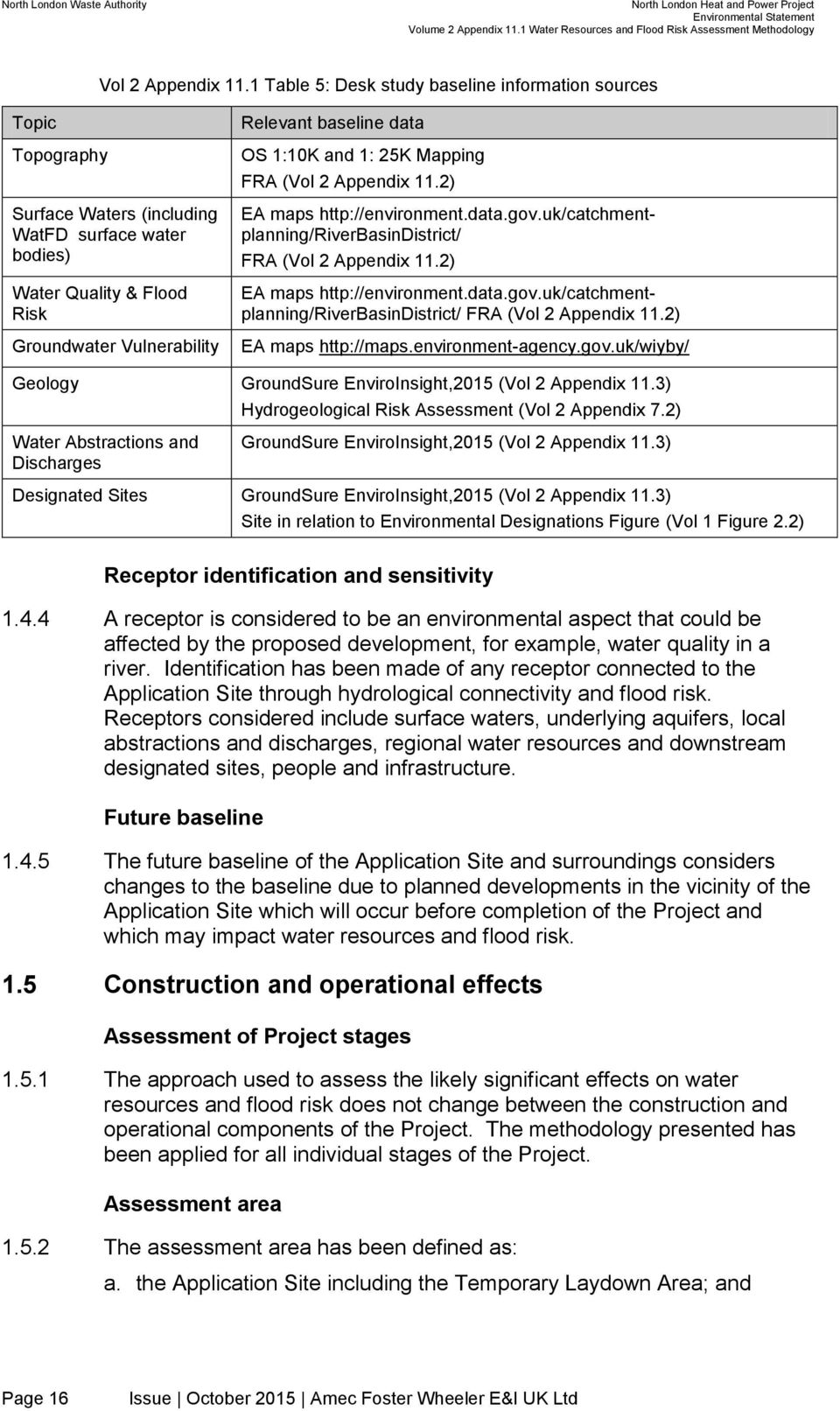
20 Environmental Statement Volume 2 Appendix 11.1 Water Resources and Flood Risk Assessment Methodology Vol 2 Appendix 11.1 Table 5: Desk study baseline information sources Topic Topography Surface Waters (including WatFD surface water bodies) Water Quality & Flood Risk Groundwater Vulnerability Relevant baseline data OS 1:10K and 1: 25K Mapping FRA (Vol 2 Appendix 11.2) EA maps FRA (Vol 2 Appendix 11.2) EA maps FRA (Vol 2 Appendix 11.2) EA maps Geology GroundSure EnviroInsight,2015 (Vol 2 Appendix 11.3) Hydrogeological Risk Assessment (Vol 2 Appendix 7.2) Water Abstractions and Discharges GroundSure EnviroInsight,2015 (Vol 2 Appendix 11.3) Designated Sites GroundSure EnviroInsight,2015 (Vol 2 Appendix 11.3) Site in relation to Environmental Designations Figure (Vol 1 Figure 2.2) Receptor identification and sensitivity A receptor is considered to be an environmental aspect that could be affected by the proposed development, for example, water quality in a river. Identification has been made of any receptor connected to the Application Site through hydrological connectivity and flood risk. Receptors considered include surface waters, underlying aquifers, local abstractions and discharges, regional water resources and downstream designated sites, people and infrastructure. Future baseline The future baseline of the Application Site and surroundings considers changes to the baseline due to planned developments in the vicinity of the Application Site which will occur before completion of the Project and which may impact water resources and flood risk. 1.5 Construction and operational effects Assessment of Project stages The approach used to assess the likely significant effects on water resources and flood risk does not change between the construction and operational components of the Project. The methodology presented has been applied for all individual stages of the Project. Assessment area The assessment area has been defined as: a. the Application Site including the Temporary Laydown Area; and Page 16 Issue October 2015 Amec Foster Wheeler E&I UK Ltd
21 Environmental Statement Volume 2 Appendix 11.1 Water Resources and Flood Risk Assessment Methodology b. an additional area of approximately 2km outside the Application Site where receptors are located. In the case of WatFD waterbodies this extends to include the full extent of waterbody catchments that intersect or are adjacent to the Application Site boundary. Assessment method The assessment has been a staged process. The first stage has involved identifying potential receptors and their sensitivity following determination of the existing hydrological, hydrogeological and ground conditions baseline for the Application Site Potential effects of the Project have then been determined primarily using a semi-quantitative approach based on professional judgement, environmental legislation and general guidance related to the water environment. Effects are likely to be most significant where sensitive features are present and there is a clear pathway between the development activity and the receptor The key aspects to identifying significant effects are: a. understanding the physical characteristics of the Application Site in terms of climate, geology, soils, land use and hydrology; b. determining how and where water flows through the system both on the surface and in the subsurface; c. locating water supply installations or water dependent ecosystems and understanding their relationship with their hydrological catchments; d. understanding how local private water supplies are utilised; e. considering how the hydrological environment may change in the future (other than as a result of the Project) the future baseline; and f. integrating this understanding into an assessment of the likely overall sensitivity of the various component parts of the hydrological environment to the development The significance of effects is evaluated, following standard methodology, based on the sensitivity of the receptor, and the magnitude of change in water quality, quantity and morphology resulting from the proposed development, assuming all environmental measures identified are implemented Sensitivity of hydrological and hydrogeological water features is normally related to the relative importance of the surface water or groundwater feature that might be at risk from effects. Vol 2 Appendix 11.1 Table 6 provides a summary of the criteria used by AMEC in the assessment of water feature sensitivity. The criteria are qualitative, so professional judgement is required in the assessment. This is based on an assessment of a number of criteria, including: a. the presence of international or national nature conservation designations (where designations relate specifically to waterdependent habitats or interest features); Page 17 Issue October 2015 Amec Foster Wheeler E&I UK Ltd
22 Environmental Statement Volume 2 Appendix 11.1 Water Resources and Flood Risk Assessment Methodology b. the use of the receptor water body for public or private water supply (and as evaluated for water resource status in terms of the Catchment Abstraction Management Strategies, Thames RBMP 4, Water Resources Management Plan); c. the scale of the water body; and d. the environmental quality of the water body (as evaluated in terms of the WatFD status, as reported in the Thames RBMP 8 or any statutory conservation designations) The sensitivity of the receptors relevant to this Project are provided within Vol 2 Appendix 11.1 Table 7, and are used to support the assessment in Section 11 of the ES. Identification is made of the receptors relevant to this assessment and the reasoning behind the assigned sensitivity, based on the criteria provided in Vol 2 Appendix 11.1 Table The magnitude of the effect on the water receptor is independent of the sensitivity of the receptor. This is a qualitative assessment and relies on professional judgement. Vol 2 Appendix 11.1 Table 8 provides examples of how various levels of change have been determined with respect to water features. Where magnitude is considered to be negligible, no perceivable effect would result from the activities. The magnitude of an effect may be adverse, beneficial, temporary or long term. Vol 2 Appendix 11.1 Table 6: Summary of Sensitivity of water receptors (developed based on professional judgement and expertise) Sensitivity Criteria Examples Very High International scale receptor Conditions supporting sites with international conservation designations (Special Areas of Conservation, Special Protection Areas, Ramsar sites), where the designation is based specifically on aquatic features. High National scale receptor Regional scale receptor high yield/quality Conditions supporting a water-dependent Site of Special Scientific Interest. Regional-scale surface water bodies at Good or High WatFD Status. Public water supplies. Principal Aquifer. Medium Regional scale receptor medium or low yield/quality Local scale receptor high yield/quality Low Local scale receptor medium or low yield/quality Regional-scale water bodies at Moderate WatFD Status or below. Local-scale surface water bodies at Good or High WatFD Status. Private water supplies. Secondary A Aquifer. Local-scale water bodies at Moderate WatFD Status or below. Small surface water bodies such as drainage ditches and ephemeral ponds that are too small to be classified under WatFD and have limited 8 Environment Agency (2009) Water for life and liveihoods: river basin management plan: Thames River basin district. Assessed July 2015 Page 18 Issue October 2015 Amec Foster Wheeler E&I UK Ltd
23 Environmental Statement Volume 2 Appendix 11.1 Water Resources and Flood Risk Assessment Methodology Sensitivity Criteria Examples ecological potential due to being artificial or heavily-modified. Secondary B Aquifer; livestock supplies; springs; ponds/lagoons; non-statutory groundwaterdependent conservation sites. Vol 2 Appendix 11.1 Table 7: Assigned sensitivity of water receptors (developed based on professional judgement and expertise) Receptor Sensitivity Reasoning Local surface watercourses including Salmon s Brook and Enfield Ditch Medium Local scale waterbodies that are at Good status and underlain by Secondary A aquifer that is capable of providing water supply at a local scale. River Lee, River Lee Navigation, Groundwater in the principal and secondary aquifers underlying the Application Site and by association the Public Water Supply abstractions associated with the SPZ in which the Application Site is situated Licensed discharge from the Application Site to Thames Water Utilities Limited Chingford Sewer Licenced discharge from Henry Group Ltd Regional water resources (Thames Water Utilities Limited London Water Resource Zone) High High Medium Medium High Objective of WatFD to achieve good ecological potential by 2027 (Vol 2 Section 11). For the purpose of this assessment (because of the timescales of the construction and operation of the Application Site) these regional scale waterbodies and associated watercourses are anticipated to be Good status and have regional scale influence, The superficial deposits across the Application Site (Kempton Park Gravels) are designated as a secondary A aquifer, while the lower Chalk is identified as a principal aquifer (Vol 2 Section 11). Current discharge from the Application Site to the Chingford Sewer. Local scale receptor with a low yield that discharges to an existing drainage network not classified under WatFD, but importance from drainage from the facility Vol 2 Section 11. Local scale receptor with importance for drainage from the facility. The Application Site is located primarily in the inner and partly in the outer zones (Zone 1 and 2) of an EA designated SPZ for groundwater sources to public water supply Vol 2 Section 11. Foul sewerage network Low Local scale receptor that is an existing drainage network not classified under WatFD. People, property and infrastructure Downstream nature conservation sites Medium/High High Flood zone 2 and 3 designations Vol 2 Section 11. Walthamstow Reservoirs Site of Special Scientific Interest, also designated as Ramsar and Special Protection Area located downstream of the Application Site with potential hydrological connectivity Vol 2 Section 11. The designation relates to plant and wildfowl Page 19 Issue October 2015 Amec Foster Wheeler E&I UK Ltd
24 Environmental Statement Volume 2 Appendix 11.1 Water Resources and Flood Risk Assessment Methodology Receptor Sensitivity Reasoning species not aquatic features (that would give it a very high classification). Vol 2 Appendix 11.1 Table 8: Magnitude of effect criteria (hydrology and hydrogeology) (developed based on professional judgement and expertise) Hydrological Definition Magnitud e of effect Site runoff regime Surface water quality Riverine flow regime Riverine morpholog y Groundwat er levels Groundwat er quality High Change (>50%) in proportion of site rainfall immediatel y running off, changing the flood risk or erosion of channels Change in water quality, changing river status with respect to Environment al Quality Standard (EQS) 9 for more than one month Change in flows >5% resulting in a measurabl e change in dilution capacity Change in erosion and deposition, with conservation interests put at risk Change in groundwater levels leading to an identifiable change in groundwater flow regime and artesian flows Change in groundwater quality, changing site quality with respect to Drinking Water Standards 10 for more than 1% of samples Medium Change (10-50%) in proportion of site rainfall immediatel y running off, changing the flood risk or erosion of channels Change in water quality, changing site status with respect to short-term EQS, or for less than one month with other EQS Change in flows between 2-5% resulting in a measurabl e change in dilution capacity Some change in deposition and erosion regimes Change in groundwater levels leading to an identifiable change in groundwater flow regime Change in groundwater quality, changing site quality with respect to Drinking Water Standards for less than 1% of samples Low Small change (<10%) in proportion of site rainfall immediatel y running off, but no change in flood risk or channel erosion Measurable short-term change in water quality but no change with respect to EQS Measurabl e change in flow of up to 2% Slight change in bed morphology and sedimentatio n pattern, minor erosion Measurable change in groundwater levels, but no appreciable change in groundwater flow regime Measurable change in groundwater quality, but not changing site status with respect to Drinking Water Standards 9 Environmental Quality Standard, as laid down in relevant EU Directives and national legislation. 10 Drinking Water Standards, laid down in national regulations derived from the EU Drinking Water Directive Page 20 Issue October 2015 Amec Foster Wheeler E&I UK Ltd
25 Environmental Statement Volume 2 Appendix 11.1 Water Resources and Flood Risk Assessment Methodology Hydrological Definition Magnitud e of effect Site runoff regime Surface water quality Riverine flow regime Riverine morpholog y Groundwat er levels Groundwat er quality Negligible No significant change in run-off from Application Site No significant loss in water quality No increase in flood risk No significant change in river bed. No significant change in groundwater No significant loss in groundwater quality In some cases information may be available that allows a high level quantitative assessment of the magnitude of effect. For example when considering effect from changes in water usage at a site a new quantity or prescribed limit could be used. In these cases a direct comparison between existing site usage and that at during the operation of the new site can be made (often through volumetric abstractions, discharges, or demands from public water supply). Significance Magnitude and sensitivity are then combined to determine the significance of a potential effect on a receptor as detailed in Vol 2 Appendix 11.1 Table 9. Vol 2 Appendix 11.1 Table 9: Significance of effect (developed based on professional judgement and expertise) Magnitude of Impact Sensitivity of Receptor Very High High Medium Low High Very Substantial Substantial Substantial /Moderate Medium Substantial Substantial /Moderate Low Substantial /Moderate Moderate Moderate Moderate Moderate/ Slight Slight Moderate/ Slight Negligible Negligible Negligible Negligible Negligible Key: Significant Impact Not significant Impact Where the risk of significant effect is assessed to be substantial or greater, mitigation would normally be required to reduce the level of risk to slight or negligible levels. In any situations where it is not possible, or reasonable, to mitigate the effects down to this level, the residual risks would be assessed. 1.6 Decommissioning effects The approach used for undertaking the assessment of decommissioning of the Application Site is qualitative and based on professional judgement and a number of assumptions. It is assumed that the same standard Page 21 Issue October 2015 Amec Foster Wheeler E&I UK Ltd
26 Environmental Statement Volume 2 Appendix 11.1 Water Resources and Flood Risk Assessment Methodology embedded design requirements and guidelines would be in place as are used for the other stages of the Project. Indications have been given of the approach that is likely to be undertaken (e.g. demolition and clearance) and an assessment has been made of any likely significant effects that would arise. 1.7 Cumulative effects Cumulative effects have been considered during both the construction and operation of the Project, using professional judgement and any available information relating to the other developments Cumulative effects of construction include consideration of construction activities of both the Project and additional sites occurring together. Cumulative effects of operation include consideration of operational activities of both the Project and additional sites occurring together Information on the scale of the works, the likely activities (e.g. excavations, site clearance), and the type of development planned (e.g. industrial, residential) have all been considered where available Planning permissions for other developments will be subject to the same standard requirements and best practice measures as the Project. Page 22 Issue October 2015 Amec Foster Wheeler E&I UK Ltd
27 NORTH LONDON WASTE AUTHORITY NORTH LONDON HEAT AND POWER PROJECT ENVIRONMENTAL STATEMENT: VOLUME 2 APPENDIX 11.2 FLOOD RISK ASSESSMENT AD06.02
28 REFER TO APPLICATION DOCUMENT AD05.14 FLOOD RISK ASSESSMENT
29 NORTH LONDON WASTE AUTHORITY NORTH LONDON HEAT AND POWER PROJECT ENVIRONMENTAL STATEMENT: VOLUME 2 APPENDIX 11.3 WATER FRAMEWORK DIRECTIVE ASSESSMENT AD06.02
30 North London Heat and Power Project Water Framework Directive Assessment AD06.02 The Planning Act 2008 The Infrastructure Planning (Applications and Prescribed Forms and Procedure) Regulations 2009 Regulation 5(2)(ei) Issue October 2015 Amec Foster Wheeler E&I UK Ltd This report takes into account the particular instructions and requirements of our client. It is not intended for and should not be relied upon by any third party and no responsibility is undertaken to any third party.
31 Flood Risk Assessment Contents Page Executive summary 4 1 Introduction Introduction Purpose of this document Document structure 5 2 Development context Application Site location and hydrology Project description 6 3 Legislative background The Water Framework Directive (WatFD, 2000/60/EC) Classifying Water Framework Directive status in Surface Water Bodies Ecological potential of heavily modified/artificial water bodies Classifying Water Framework Directive status in groundwater bodies Assessing deterioration in Water Framework Directive status 12 4 Assessment methodology Summary of methodology Stage 1: Baseline assessment of the water environment Stage 2: Water Framework Directive assessment of the Project Stage 3: Identification of mitigation measures 14 5 Baseline assessment of the water environment Surface water body review Groundwater body review 21 6 Water Framework Directive assessment of the Project Introduction Consideration of the Project Salmon s Brook upstream Deephams STW (GB ) Pymmes and Salmon Brook Deephams STW outflow channel to Tottenham Locks (GB ) Lea Navigation Enfield Lock to Tottenham Locks (GB ) WatFD mitigation measures Downstream Water Framework Directive water bodies Overall Water Framework Directive status 31 AD06.02 Issue October 2015 Amec Foster Wheeler Environment & Infrastructure UK Ltd
32 Flood Risk Assessment 7 Conclusion 33 Tables Table 4.1: WatFD Quality elements supporting WatFD ecological classification Table 5.1: WatFD Water Body characterisation Cycle 2 (2014) Table 6.1: Project components relevant to this assessment Figures Figure 3.1: WatFD Quality Elements supporting WatFD Ecological Classification Appendices Appendix A : Hydrology features 34 Appendix B : Water Framework Directive surface water bodies 35 Glossary See Project Glossary (AD01.05) AD06.02 Issue October 2015 Amec Foster Wheeler Environment & Infrastructure UK Ltd
33 Water Framework Directive Assessment Executive summary i.i.i i.i.ii i.i.iii i.i.iv i.i.v This Water Framework Directive (WatFD) assessment has been prepared for the (the Project) at Advent Way, Enfield, North London, in support of a Development Consent Order (DCO). The WatFD has adopted a methodology based on UK legislation relating to the WatFD (Directive 2000/60/EC) and comprises: a baseline assessment of the water environment; an assessment of the Project against WatFD aims and criteria; and the recommendation of appropriate mitigation measures where appropriate. Note references to water bodies in consideration are made in accordance with the WatFD water body classification as shown in Appendix B (EA Catchment Data Explorer 1 and RBMPs). With respect to the WatFD, three surface water bodies have been identified within the vicinity of the Application Site, which may be impacted by the Project either directly or indirectly. These include the Salmon s Brook (upstream of Deephams Sewage Treatment Works (STW) outflow channel), Pymmes and Salmon s Brooks (and Enfield Ditch) and the Lea Navigation. An assessment of the baseline conditions (Cycle 2 of the WatFD) indicates that all three waterbodies are of moderate overall status, moderate ecological status but fail on chemical status. An appraisal of the River Basin Management Plans (Cycle and draft Cycle 2 summary information ) for the Lower Lee Catchment reveals that the reason for this failure is due to both diffuse and point source pollutants. Primary sources of pollution are from the urban environment and transport and the water industry. Assessment of the component elements of the overall water body status classification (biological, physico-chemical, hydromorphology and chemical) have been made for each of the water bodies in relation to the potential impacts of the Project. The identified potential effects are considered to be highly local in scale and the identified control and mitigation measures for the Project would ensure that none of the aforementioned WatFD elements would be negatively affected. Ultimately, there would be no reduction in the overall WatFD status of the water bodies and it is deemed that the Project would not conflict with any prospective future works for improvement that might be identified for the water bodies during Cycle 2. The Project is therefore considered to be compliant with the aims of the WatFD; it would not cause degradation to any WatFD elements nor limit the potential for future improvement to these elements in any of the related water bodies. 1 Environment Agency Catchment Data Explorer ( 2 Environment Agency (2009) Water for life and livelihoods. River Basin Management Plan Thames River Basin District. 3 Environment Agency (2014) A summary of information about the water environment in the London management catchment. AD06.02 Issue October 2015 Amec Foster Wheeler Environment & Infrastructure UK Ltd 4
34 Water Framework Directive Assessment 1 Introduction 1.1 Introduction The North London Waste Authority (the Applicant) is submitting an application (the Application) for a Development Consent Order (DCO) for the (the Project) at Edmonton EcoPark within the London Borough of Enfield. 1.2 Purpose of this document This report is a Water Framework Directive (WatFD) assessment to accompany the Application for Edmonton EcoPark at Advent Way, Edmonton in North London, N18 3AG In summary, the Project is for the upgrade of the existing waste management complex, primarily comprising the development of a proposed Energy Recovery Facility (ERF) to replace the existing Energy from Waste (EfW) facility on the Application Site. Full details of the Project can be found in Vol 1 of the Environmental Statement (ES) (AD06.02) The Project would be designed to include appropriate mitigation measures that would ensure a minimal impact on the associated water bodies and local water features within the vicinity of the Application Site. 1.3 Document structure The structure of the report is as follows: a. Section 2: Development context outlines the main elements comprising the Project, with emphasis on those aspects that have potential to interact with the water environment and WatFD water body supporting elements (as defined later, in Section 3); b. Section 3: Legislative background introduces the WatFD (Directive 2000/60/EC) and the available guidance that has informed the scope and methodology of this assessment; c. Section 4: Methodology describes the methodology used for the WatFD assessment; d. Section 5: Baseline assessment of the water environment identifies and describes the baseline water environment through a review of WatFD water body information and other relevant baseline characterisation data; e. Section 6: WatFD assessment of the Project provides an assessment of Project proposals in context of the WatFD; and f. Section 7: Conclusions summarises the findings of the WatFD assessment (this report). AD06.02 Issue October 2015 Amec Foster Wheeler Environment & Infrastructure UK Ltd 5
35 Water Framework Directive Assessment 2 Development context 2.1 Application Site location and hydrology The Application Site for the Project is largely set within the curtilage of the existing Edmonton EcoPark but includes a Temporary Laydown Area to be located outside the Edmonton EcoPark (see Project description in Vol 1 Section 3 of the ES (AD06.02)). The surrounding land is predominantly industrial in nature and all of the watercourses immediately surrounding the Application Site are classified as Heavily Modified Water Bodies (HMWB) under the WatFD, as recorded by the EA Catchment Data Explorer The River Lee Navigation flows parallel to Edmonton EcoPark, approximately 20m from its eastern boundary, before flowing south through the Lee Valley Regional Park (LVRP). A map showing the watercourses within the vicinity of the Application Site is provided in Figure 1 of Appendix A (this report) The closest watercourses to the Application Site are the Salmon s Brook and the Enfield Ditch, which respectively bound the western and eastern boundaries of the Edmonton EcoPark. The Salmon s Brook and Enfield Ditch converge at the south-western corner of the Edmonton EcoPark, before meeting the Pymmes Brook. The Pymmes Brook joins the River Lee Navigation roughly 3.2km downstream of the Application Site The Enfield Ditch flows from north to south, parallel to the River Lee Navigation, and immediately adjacent to the eastern boundary of the Edmonton EcoPark. It then flows south-west along the southern border before meeting the Salmon s Brook in the south-western corner of Edmonton EcoPark. Enfield Ditch is partly culverted and features several bridges that provide access to the main body of the Application Site The River Lee Diversion Channel also flows from north to south, immediately to the east of the Temporary Laydown Area All of the aforementioned rivers are classified as Main River and fall within the River Lee Catchment Within the Application Site, there is a plastic-lined ornamental pond; however, there is no drainage or hydraulic connectivity between this pond and any of the surrounding water bodies. 2.2 Project description A full description of the Project is provided in the Design and Access Statement (DAS) (AD05.07) and Book of Plans (AD02.01), which should be read in conjunction with this WatFD assessment The Project is for the replacement of the existing EfW facility with a new ERF at the Edmonton EcoPark, which would comprise the principal development. Associated development within the Application Site would include the decommissioning and demolition of the existing EfW facility, construction of a Resource Recovery facility (RRF), administrative building AD06.02 Issue October 2015 Amec Foster Wheeler Environment & Infrastructure UK Ltd 6
36 Water Framework Directive Assessment and visitor centre (referred to as EcoPark House), new internal roads and parking areas, creation of new access points to the Application Site and hard and soft landscaping related to the main building works. It is anticipated that the Project would be carried out over a 10 year period and that the development would be operational by around The Project would have three distinct stages: construction, operation and decommissioning. The construction stage would occur in stages, more details of which can be found in Vol 1 of the ES (AD06.02) Any components of the Project that have the possibility to interact with watercourses and the WatFD water body elements are considered and assessed in Section 6 of this report In addition to the principal development of the proposed ERF, the potential impacts of works on the wider Application Site during the construction or operational stages also need to be considered. This is to include: a. the use of up to 3.5 ha of Temporary Laydown Area on land adjacent to the Edmonton EcoPark as part of the decommissioning, demolition and construction stages of the Project; b. landscape enhancements along the eastern edge of the Edmonton EcoPark between the Edmonton EcoPark and the Lee Valley Regional Park (LVRP) to include re-profiling of land, vegetation planting and potential re-profiling of Enfield Ditch; and c. improvements to the existing access to the south of the Edmonton EcoPark and creation of a new point of entry to the Edmonton EcoPark along its eastern boundary respectively, this is likely to include the widening of an existing bridge that crosses Enfield Ditch or construction of a new bridge (at the south of the Edmonton EcoPark) and the creation of a new bridge crossing Enfield Ditch at the eastern boundary of the Edmonton EcoPark Any impacts during the construction stage would be short-term in nature (relative to the lifetime of the Project) and would adhere to pollution prevention plans and other relevant guidance. Environment Agency (EA) Flood Defence Consent (FDC) will be required for any works that fall within 8 metres of the aforementioned water bodies. Any construction works at the Application Site would be carried out in accordance with best practice principles. AD06.02 Issue October 2015 Amec Foster Wheeler Environment & Infrastructure UK Ltd 7
37 Water Framework Directive Assessment 3 Legislative background 3.1 The Water Framework Directive (WatFD, 2000/60/EC) The WatFD provides a framework through which disparate regulatory controls on human activities that have the potential to impact on the water environment may be managed effectively and consistently. In addition to inland surface water and groundwater, the WatFD covers transitional waters (estuaries and lagoons) and coastal waters up to one nautical mile from mean low water (the baseline from which territorial waters are measured). Existing regulations that have recently been incorporated under the WatFD include the Freshwater Fish Directive (78/659/EEC, as consolidated in 2006) and the Dangerous Substances Directive (76/464/EEC) The WatFD (2000/60/EC) is primarily implemented throughout England and Wales through the Water Environment (Water Framework Directive) (England and Wales) Regulations 2003 (the Water Framework Regulations) United Kingdom surface waters have been divided into a number of discrete units, termed water bodies with meaningful typologies that relate to their physical and ecological characteristics. Based on these determinants, water bodies are classified into one of several status classifications As part of the long-term implementation of the WatFD in the UK, the EA has been given the power to apply environmental standards to individually defined WatFD water bodies via the River Basin Districts Typology, Standards and Groundwater Threshold Values (Water Framework Directive) (England and Wales) Directions 2010, and the River Basin Districts Surface Water and Groundwater Classification (Water Framework Directive). Consultation is currently ongoing on updated standards and these are expected to be finalised later this year (2015) Implementation of the WatFD is primarily achieved through a system of river basin management plans. Water bodies in England and Wales have been allocated into river basin districts depending on catchment areas, and a plan drawn up for each. River Basin Management Plans (RBMPs) contain a programme of measures tailored to each catchment in accordance with the timelines set out in the WatFD The aims of the WatFD are twofold and apply to all water bodies (rivers, lakes and groundwater), these are: (a) to achieve good status; and (b) to ensure that the future deterioration of their current status is prevented. All new development must account for their potential impacts on surrounding water bodies The key environmental objectives of the WatFD can be summarised as follows: a. to prevent the deterioration of aquatic ecosystems, protect them and improve their ecological condition; AD06.02 Issue October 2015 Amec Foster Wheeler Environment & Infrastructure UK Ltd 8
38 Water Framework Directive Assessment b. to achieve at least good status for all water bodies by 2015, and where this is not possible by 2021 or 2027; c. to meet the requirements of WatFD protected areas; d. to promote the sustainable use of natural water resources; e. to phase out, or reduce the release of pollutants that could have a detrimental effect on the aquatic environment; f. to prevent or reduce pollution to groundwater bodies; g. to conserve the habitat of species that are dependent upon water; and h. to contribute to mitigating the effects of both drought and flood The final deadline for the WatFD objectives to be met is Clear interim deadlines and implementation cycles have been identified between 2000 (when the directive was introduced) and the final deadline (2027). This includes the characterisation of river basins and establishment of a monitoring network (by 2006), management Cycle 1 ( ), management Cycle 2 ( ) and management Cycle 3 ( ). RBMPs are produced for the start of each Cycle. 3.2 Classifying Water Framework Directive status in Surface Water Bodies The EA s Method Statement for the Classification of Surface Water Bodies 4 identifies the elements and methodology for classifying the status of water bodies in accordance with the WatFD There are two separate status classifications: chemical and ecological. These classifications are based on the assessment of specific criteria, for example the ecological status is based on biological, physico-chemical and hydro-morphological quality elements. Each quality element is made up of several determinants that are monitored e.g. the biological quality element uses numeric measures of communities of plants and animals such as fish, invertebrates, macrophytes and phytobenthos Classifications indicate where the quality of the water body is good, identify where it may need improvement and what measures need to be taken to make these improvements The final chemical and ecological status classifications are then combined together to provide the overall water body status. Ecological status classification Ecological status classification comprises four water quality elements: biological (fish, invertebrates, macrophytes, and phytobenthos), physicochemical (measurements of water quality elements that support aquatic ecology such as ph, temperature and dissolved oxygen), hydromorphological (qualitative assessment of the physical habitat as determined by flow regime and sediment dynamics) and specific pollutants (chemical parameters such as zinc and arsenic). 4 Environment Agency (2011) Method statement for the classification of surface water bodies AD06.02 Issue October 2015 Amec Foster Wheeler Environment & Infrastructure UK Ltd 9
39 Water Framework Directive Assessment Ecological status classifications are expressed as one of five classes: high, good, moderate, poor or bad. The classification of ecological status for the water body, and the confidence limit in the prescribed status, is determined by the lowest scoring quality element For water bodies of high ecological status (based on biological and physico-chemical status), a hydromorphological element is also considered. Conversely, a hydromorphological element is not specified for those water bodies with lower ecological status or potential. In this instance a hydromorphological value indirectly contributes to the biological quality element on which the water body is classified. Chemical status classification Chemical status of a water body is determined by assessing its compliance with environmental standards for chemicals, listed in the Environmental Quality Standards Directive (2008/105/EC) and under other relevant European legislation pertaining to environmental quality. Chemical status is recorded to either pass (i.e. good status) or fail (i.e. bad status). As with the classification of ecological status, the overall chemical status classification is determined by the lowest scoring quality element. 3.3 Ecological potential of heavily modified/artificial water bodies For water bodies that are classified as being heavily modified or artificial (due to physical alterations by human activity that deviate from their natural form) the EA instead classifies these systems based on their ecological potential. The UK has adopted a mitigation based approach for classifying heavily modified and artificial water bodies. This approach assesses whether more can be done to improve the ecological potential of these waterbodies, without detrimentally affecting their specified use The WatFD aims for all HMWBs to achieve good ecological potential and to ensure no deterioration from their current status/ potential A range of factors are considered when making an assessment of the ecological potential of heavily modified or artificial water bodies. These include: assessment of river flow, the presence (or absence) of mitigation measures, and the overall status of other quality elements. These factors are considered together to provide an overall assessment of the water body s ecological potential. This overall assessment is illustrated in Figure 3.1. AD06.02 Issue October 2015 Amec Foster Wheeler Environment & Infrastructure UK Ltd 10
40 Water Framework Directive Assessment Figure 3.1: WatFD Quality Elements supporting WatFD Ecological Classification 3.4 Classifying Water Framework Directive status in groundwater bodies The target conditions for good status in groundwater bodies is set out in the WatFD (2000/60/EC) and the Groundwater (Daughter) Directive (2006/118/EC). In order to assess these criteria, a series of tests has been defined by the EA for each of the quality elements that define good groundwater status for quantitative and chemical elements There are five chemical and four quantitative tests. Each test is applied independently and the results combined in order to give an overall assessment of the chemical and quantitative status of a groundwater body. The lowest scoring chemical test is taken to represent the overall chemical status for given groundwater body and, similarly, the lowest scoring quantitative test is reported as the overall quantitative status for the groundwater body. The worst result from the chemical and quantitative tests is then used as the overall status of the groundwater body. Groundwater bodies are classified as having either good or poor status. AD06.02 Issue October 2015 Amec Foster Wheeler Environment & Infrastructure UK Ltd 11
41 Water Framework Directive Assessment Chemical status classification A groundwater body is classified as having poor chemical status in the following circumstances: if there is widespread diffuse pollution within the groundwater body; the quality of the groundwater is having an adverse impact on surface water bodies (including wetlands), if there is saline intrusion due to over-abstraction, or if the quality of water used for potable supply is deteriorating significantly. Besides those objectives that would allow for classification of a groundwater body as having good status, there are additional objectives relating to groundwater quality; these include requirements to prevent or limit the input of pollutants to groundwater and the implementation of measures to reverse significant and sustained rising trends in pollutants present in groundwater. Quantitative status classification Poor quantitative status of a groundwater body is defined when low groundwater levels are responsible for an adverse impact on rivers and wetlands normally reliant on ground water, where abstraction of groundwater has resulted in saline intrusion, or where it is possible that the amount of groundwater abstracted will not be replaced each year by rainfall. 3.5 Assessing deterioration in Water Framework Directive status This WatFD assessment adopts a precautionary approach with regards to the definition of deterioration of WatFD status. A reduction in any one of the supporting quality elements defined in the current WatFD water body description that leads to an overall reduction in ecological status or potential would constitute a deterioration of WatFD status Mitigation measures required to achieve a good ecological status or good ecological potential (for water bodies and HMWBs, respectively) have been defined as part of the RBMP process. To this end, the definition of deterioration may also be extended to include impacts that prevent or inhibit the necessary mitigation measures from being successfully implemented. AD06.02 Issue October 2015 Amec Foster Wheeler Environment & Infrastructure UK Ltd 12
42 Water Framework Directive Assessment 4 Assessment methodology 4.1 Summary of methodology This WatFD assessment has adopted a methodology based on the following guidance notes: a. The methodology outlined in the guidance note Carrying out a Water Framework Directive (WFD) Assessment on EIA Developments, issued by the Northern Ireland Environment Agency (NIEA, 2012) 5. In the absence of specific published guidance for carrying out a WatFD in England, the NIEA (2012)5 represents a complete and structure methodology relating to WatFD assessment; and b. Internal guidance provided by the EA which provides further information on WatFD assessments that is compatible with the NIEA (2012)5 methodology approach. Specific documents include: Environment Agency: Assessing Impacts on Water Bodies in Planning, Quick Guide 6 ; Environment Agency (2010): Assessing New Modifications for Compliance with WFD: Detailed Supplementary Guidance 7 ; and Environment Agency (draft unpublished): Interim Water Framework Directive Assessment and Statement of Compliance The methodology applied to this WatFD assessment has three specific stages: a. Baseline assessment of water bodies; b. Assessment of the Project and its potential on the WatFD water bodies; and c. Identified mitigation measures. 4.2 Stage 1: Baseline assessment of the water environment Stage 1 entails an assessment of the current WatFD water body descriptions for surface water and groundwater bodies related to the Project. Table 4.1 details the data sources consulted for this information. 5 Northern Ireland Environment Agency (2012) Carrying out a Water Framework Directive (WFD) Assessment on EIA Developments, March Environment Agency (2011, unpublished) Assessing impacts on water bodies in planning; Quick Guide (614_11), May Environment Agency (2010, unpublished) Assessing new modifications for compliance with WFD: detailed supplementary guidance (488_10_SD01), November Environment Agency (unpublished) Interim Water Framework Directive Assessment and Statement of Compliance. AD06.02 Issue October 2015 Amec Foster Wheeler Environment & Infrastructure UK Ltd 13
43 Water Framework Directive Assessment Table 4.1: WatFD Quality elements supporting WatFD ecological classification Data source Description Local RBMPs (Cycle 1) Draft RBMP s (Cycle 2) EA What s in Your Backyard? website EA Catchment Data Explorer Published RBMP s for Cycle 1 ( ) of the WatFD2. Draft documents, out for consultation, for Cycle 2 ( ) of the WatFD. Interactive maps of environmental assessment criteria (e.g. Groundwater Vulnerability Zones). Available online at; Online EA resource summarising information on the water environment for use in RBMPs. Available online at: Review of WatFD water body information involves examining the described WatFD supporting elements, the current water WatFD status of water bodies, the predicted future status of the water bodies, any identified environmental constraints and any existing or proposed mitigation measures Where possible, examination of the WatFD water body descriptions is combined with a review of relevant historical or contemporary summary baseline information (in so far as it relates to supporting features of the water bodies). 4.3 Stage 2: Water Framework Directive assessment of the Project Stage 2 describes and considers all elements and activities of the Project that could potentially affect the WatFD status of the water bodies relating to the Application Site. Potential effects (or impacts) that have already been identified in concurrent reports that relate to the Project are also referred to in this WatFD assessment The potential impacts associated with the Project are compared against the WatFD classification elements for water bodies and against the following WatFD objectives: d. Objective 1 to prevent deterioration in the ecological status of the water body (relative to its baseline status/potential); e. Objective 2 to ensure that the attainment of the WatFD objectives for the given water body are not compromised (to prevent the introduction of impacts that could impede this); and f. Objective 3 to ensure that the achievement of the WatFD objectives in other water bodies within the same catchment are not permanently excluded or otherwise compromised. 4.4 Stage 3: Identification of mitigation measures If the assessment of the Project identifies any elements or activities of the development that could impact on a water body, and the proposed works AD06.02 Issue October 2015 Amec Foster Wheeler Environment & Infrastructure UK Ltd 14
44 Water Framework Directive Assessment do not include adequate migration measures to reduce or prevent the undesired impact, then these elements are deemed to be incompatible with achieving the WatFD objectives. In this instance mitigation measures to ensure compliance will be outlined and discussed at this stage. AD06.02 Issue October 2015 Amec Foster Wheeler Environment & Infrastructure UK Ltd 15
45 Water Framework Directive Assessment 5 Baseline assessment of the water environment 5.1 Surface water body review As aforementioned in sub-section 2.1, the Application Site and surrounding area is drained by a series of channels and ditches (Enfield Ditch, the Salmon s Brook and the Pymmes Brook). Salmon s Brook and Enfield Ditch are located adjacent to and/or within the Application Site (see Figure 1 in Appendix A). Enfield Ditch flows into Salmon s Brook at the southwest corner of the Edmonton EcoPark, and Salmon s Brook is in confluence with Pymmes Brook to the south of the Edmonton EcoPark. Pymmes Brook flows in a southerly direction and drains into the River Lee Navigation. In turn, the River Lee Navigation joins the River Lee downstream Vol 2 of the ES (AD06.02) also notes the presence of two reservoirs within the wider site area: the William Girling Reservoir, around 300m to the north-east of the Application Site, and the Banbury Reservoir roughly 600m to the south-east. These reservoirs are both raised and are filled by pumping from a series of inlets from the River Lee Diversion Channel. As William Girling Reservoir lies upstream of the Application Site it would not be affected by the development. Unless any deterioration in the status of the water bodies immediately adjacent to the Application Site is noted, the Banbury Reservoir will not be given further consideration as part of this WatFD assessment All of the aforementioned surface water bodies are within the Lower Lee River Catchment, which is defined by the EA as an Operational Catchment. At RBMP level, the Lower Lee River Catchment falls within the Thames River Basin District, London Management Catchment, and River Lee Operational Catchment. The water bodies to be reviewed as part of this WatFD assessment are considered within the Thames RBMP. All are classified as HMWBs under the WatFD, as shown on the EA Catchment Data Explorer It is important to note that the Lower Lee River Catchment is classed under the London Catchment for both Cycle 1 and Cycle 2 of the WatFD. Cycles 1 and 2 are respectively addressed in the Thames River Basin District RBMP2 and the draft update RBMP The Cycle 1 RBMP2 notes that the London Catchment is highly urbanised and that the majority of its rivers are designated as HMWBs. This channel modification has resulted in the loss of habitat diversity and barriers to fish migration. This is noted to include in-stream structures in the Lee Navigation Water quality is also identified as being a key issue. The urbanised nature of the catchment results in high pollution pressures through increased surface water run-off, storm sewage overflows and misconnections and effluent from sewage treatment works. Furthermore, physical channel modifications and invasive species have resulted in poor water quality and 9 Environment Agency (unpublished) Water for life and livelihoods: Draft update River Basin Management Plan Thames River Basin District. AD06.02 Issue October 2015 Amec Foster Wheeler Environment & Infrastructure UK Ltd 16
46 Water Framework Directive Assessment varied biological quality across the catchment. With specific regard to the Pymmes Brook, the EA2 notes that pollution prevention projects will be required to improve water quality WatFD Cycle 1 extended from , with Cycle 2 running from For Cycle 2, the extent and boundaries of water bodies were revised and updated in some cases. For instance, the Salmon s Brook was previously considered to be part of the River Lee Navigation water body, but under Cycle 2 is considered as a separate entity. Similarly, the River Lee Diversion Channel is classified as part of the River Lee Navigation for the purposes of Cycle For Cycle 2, three primary surface water bodies are identified under the WatFD within the Application Site area1. These are Salmon s Brook upstream of Deephams STW (water body ID GB ) the Pymmes and Salmon Brooks Deephams STW to Tottenham Locks (GB ), and the Lea Navigation Enfield Lock to Tottenham Locks (GB ). The next downstream water body is the River Lee Tottenham Locks to Bow Locks/Three Mills Locks (GB ), which has the potential to be influenced by the water quality of the three aforementioned water bodies, on account of its hydraulic connectivity It should be noted that Enfield Ditch is not considered as a stand-alone water body for the purposes of the WatFD Cycles 1 or 2. Instead, Enfield Ditch is grouped within Pymmes and Salmon Brooks Deephams STW to Tottenham Locks (GB ) water body and is therefore assigned the same classification as that water body Note hereafter references to water bodies in consideration will be made in accordance with the WatFD water body classification as shown in Appendix B (EA Catchment Data Explorer1 and RBMPs). The Salmon Brook upstream Deephams STW (GB ) flows in a westerly direction until it reaches the northwest boundary of the Edmonton EcoPark. The Deephams STW outflow channel flows into the Brook at this point from the north. From here as it flows south along the western boundary of the Edmonton EcoPark it is classified as the Pymmes and Salmon Brooks Deephams STW to Tottenham Locks (GB ), which includes the Enfield Ditch. The Tottenham Locks are located approximately 3km downstream of the Edmonton EcoPark. A map of WatFD surface water bodies is provided in Figure 2 of Appendix B (this report) Similarly, the WatFD groups the Lea Navigation and River Lee Diversion Channel into one group: Lea Navigation Enfield Lock to Tottenham Locks (GB ). Enfield Lock is located roughly 5.5km to the north of the Edmonton EcoPark Based on the EA Catchment Data Explorer1 the WatFD classification Cycle 1 starts from 2009, with the Cycle 2 interim period starting in Notably, for the Pymmes and Salmon Brooks Deephams STW to Tottenham Locks (GB ) and the Lea Navigation Enfield Lock to Tottenham Locks (GB ) the Cycle 1 data included an assessment of the ecological status only and the chemical status was AD06.02 Issue October 2015 Amec Foster Wheeler Environment & Infrastructure UK Ltd 17
47 Water Framework Directive Assessment not required to undergo assessment (i.e. no data were recorded). In this instance the overall water body classification was made on the basis of ecological components only At the end of Cycle 1 (2013) the Salmon s Brook upstream Deephams STW (GB ) was assigned a poor overall status (with poor ecological status but good chemical status). The Pymmes and Salmon Brook Deephams STW to Tottenham Locks (GB ), and the Lea Navigation Enfield Lock to Tottenham Locks (GB ) were assigned a moderate overall water body status (based on ecological status only). The River Lee Tottenham Locks to Bow Locks/Three Mills Locks (GB ) had a poor overall water body classification, with poor ecological status and failing chemical status From the Cycle 2 interim period (2013), onwards the WatFD assessment also gives consideration to chemical status parameters for all of the above water bodies. For this reason, the characterisation of the baseline assessment of the water environment will be made based on the most recent Cycle 2 data (2014). A summary of the Cycle 2 (2014) water body WatFD characterisation is provided in Table 5.1. Table 5.1: WatFD Water Body characterisation Cycle 2 (2014)1 Element Salmon s Brook upstream Deephams STW (GB ) Pymmes and Salmon Brooks Deephams STW to Tottenham Locks (GB ) Lea Navigation Enfield Lock to Tottenham Locks (GB ) River Lee Tottenham Locks to Bow Locks/Three Mills Locks (GB ) Overall water body status (2014) Current ecological status Biological quality elements Moderate Moderate Moderate Bad Moderate Moderate Moderate Bad Poor Poor Moderate Bad Fish Good - - Bad Invertebrates Poor Poor Moderate Moderate Macrophytes Macrophytes and phytobenthos combined High High - - Phytobenthos Hydromorphologi cal Supporting Elements Not high Not high Not high Not high AD06.02 Issue October 2015 Amec Foster Wheeler Environment & Infrastructure UK Ltd 18
48 Water Framework Directive Assessment Element Salmon s Brook upstream Deephams STW (GB ) Pymmes and Salmon Brooks Deephams STW to Tottenham Locks (GB ) Lea Navigation Enfield Lock to Tottenham Locks (GB ) River Lee Tottenham Locks to Bow Locks/Three Mills Locks (GB ) Hydrological regime Supports good Supports good Does not support good Does not support good Mitigation measures assessment Other Substances Physico-chemical quality elements Ammonia (physchem) Dissolved Oxygen (DO) Biological Oxygen Demand (BOD) Moderate or less Moderate or less Moderate or less Moderate or less Moderate Moderate Moderate Moderate Moderate Moderate High Moderate Bad Poor High Poor - - High Good ph High High Moderate High Phosphate Poor Bad Poor Poor Temperature High High good High Specific Pollutants Supporting elements (surface water) Moderate Moderate Moderate Moderate Moderate Moderate Moderate Moderate Chemical Fail Fail Fail Fail Other Pollutants - Good Good Good Priority Hazardous Substances Priority Substances Overall Objective (2021) Ecological Objective Fail Fail Fail Fail Good Fail Fail Fail Good Good Moderate Moderate Good Good Moderate Moderate AD06.02 Issue October 2015 Amec Foster Wheeler Environment & Infrastructure UK Ltd 19
49 Water Framework Directive Assessment Element Salmon s Brook upstream Deephams STW (GB ) Pymmes and Salmon Brooks Deephams STW to Tottenham Locks (GB ) Lea Navigation Enfield Lock to Tottenham Locks (GB ) River Lee Tottenham Locks to Bow Locks/Three Mills Locks (GB ) Chemical Objective Hydromorphologi cal Objective Physico-chemical Objective Good Good Good Good Not high Not high Not high Not high Good Good Good Good The Cycle 2 (2014) WatFD results in Table 5.1 show that three of the four water bodies, the Salmon s Brook upstream Deephams STW (GB ), the Pymmes and Salmon Brooks Deephams STW to Tottenham Locks (GB ), and the Lea Navigation Enfield Lock to Tottenham Locks (GB ) were classified as being of moderate overall status, whilst the River Lee Tottenham Locks to Bow Locks/Three Mills Locks (GB ) (downstream) received a bad overall status. All of the water bodies failed on current chemical status, largely due to the Priority Hazardous Substances and Priority Substance elements. The Salmon s Brook upstream Deephams STW (GB ), the Pymmes and Salmon Brooks Deephams STW to Tottenham Locks GB ) and the Lea Navigation Enfield Lock to Tottenham Locks (GB ) were deemed to be of moderate ecological status, whereas the River Lee Tottenham Locks to Bow Locks/Three Mills Locks (GB ) was bad; this accounts for the differing overall status between the water bodies The draft Cycle 2 RBMP summary information3 states that the main reasons for water bodies in the Lower Lee Catchment not achieving good WatFD status are both point source pollution from waste waters from the water industry and diffuse pollution from urban areas and transport. This is broadly reflected by the poor water quality as indicated by the physicochemical status of the surface water bodies adjacent to the Application Site, as discussed above In terms of mitigation the draft Cycle 2 RBMP summary information3 notes that substantial funds have gone towards Sustainable Urban Drainage Systems (SuDS) to tackle diffuse pollution since It specifically makes reference to the installation of SuDS along the Salmon s Brook but does not provide further details on these mitigation measures. Other downstream surface water bodies As the downstream waterbody, the River Lee, is located approximately 11km downstream of the Application Site, a conservative and iterative approach has been adopted with regards to the WatFD assessment. Potential effects on the River Lee will only be considered where it is AD06.02 Issue October 2015 Amec Foster Wheeler Environment & Infrastructure UK Ltd 20
50 Water Framework Directive Assessment identified that there is potential for a status change to the upstream waterbodies the Salmon s Brook upstream Deephams STW (GB ), the Pymmes and Salmon Brooks Deephams STW to Tottenham Locks (GB ), and the Lea Navigation Enfield Lock to Tottenham Locks (GB ) which could negatively impact on the River Lee Tottenham Locks to Bow Locks/Three Mills Locks (GB ). Otherwise, the River Lee Tottenham Locks to Bow Locks/Three Mills Locks (GB ) will not be considered further here Vol 2 of the ES (AD06.02) also notes that the Walthamstow Reservoirs Site of Special Scientific Interest (SSSI) and Lee Valley Special Protection Area (SPA), which is a Ramsar site are located approximately 3.0km downstream of the Application Site, with potential for hydraulic connectivity with the surface water bodies adjacent to the Application Site. These reservoirs are fed by abstraction from the River Lee and pumping from the Lee Navigation As the River Lee is the main point of hydraulic connectivity to the Walthamstow Reservoirs, implications of the development on the reservoir will only be considered if there is potential for status change within the River Lee (see sub-section , above). Otherwise, impacts on the Walthamstow Reservoir and Lee Valley SPA will not be considered further here. 5.2 Groundwater body review The geology of the Application Site is detailed in the Hydrogeological Risk Assessment (Vol 2 Appendix 7.2 of the EA (AD06.02)). In summary, it shows the following: superficial deposits of alluvium, overlying Kempton Park Gravels (River Terrace deposits of sand and gravel) and London Clay of up to 18.0m in thickness. Below this, geology includes the Lambeth Group, Thanet Sand and Upper Chalk According to the EA Groundwater mapping provided by the What s in Your Backyard? 10 (EA WIYBY) online resource the permeable superficial deposits at the Application Site are designated as a Secondary A Aquifer (capable of supporting water bodies at the local, rather than the strategic scale) The EA Groundwater mapping also indicates that the bedrock geology (London Clay) is unproductive strata that is not designated as an aquifer by the British Geological Society (BGS). However, the Hydrogeological Risk Assessment (Vol. 2 Appendix 7.2) identifies the underlying Chalk to be Principal Aquifer. This layer is located below the impermeable London Clay. Therefore, provided the London Clay layer remains intact, there would be no hydraulic connectivity between the surface water zone and the underlying Principal Aquifer As noted in the FRA (Vol 2 Appendix 11.2 of the EA (AD06.02)) the majority of the Application Site is located within the inner zone (Zone 1) of 10 Environment Agency, What s in Your Backyard? AD06.02 Issue October 2015 Amec Foster Wheeler Environment & Infrastructure UK Ltd 21
51 Water Framework Directive Assessment a groundwater Source Protection Zone (SPZ) relating to the public water supply that is sourced from the Chalk and superficial aquifers. The water supply boreholes are located m east of the Application Site. Furthermore, the north-western corner of the Application Site is identified as the outer zone (Zone 2) of the SPZ. According to the EA WIYBY Groundwater Source Protection Zone Mapping, Zone 1 is defined as the 50 day travel time from any point below the water table to the source, with a minimum radius of 50m. Zone 2 is identified as having a 400 day travel time from a point below the water table, and with a minimum radius of m around the source, depending on the size of the abstraction With regard to the WatFD, the Cycle RBMP Groundwater mapping on EA, WIYBY does not identify any groundwater bodies within the vicinity of the Application Site Similarly, the EA catchment Data Explorer (WatFD Cycle 2) does not identify any groundwater bodies within the vicinity of the Application Site. It is assumed that no groundwater bodies are identified because of the impermeable London Clay layer, which would effectively prevent any hydraulic connectivity between surface water and the underlying aquifer Furthermore, the Project design measures have ensured that the impermeable London Clay layer would not be breached during any stage of the Project (construction, operation or decommissioning). On this basis, there would be no change to the existing groundwater connectivity at the Application Site No groundwater bodies have been identified to be associated with the Application Site or the wider surrounding area. On this basis no groundwater bodies will be considered as part of this WatFD assessment. 6 Water Framework Directive assessment of the Project 6.1 Introduction This section assesses the potential for the Project s components to affect the identified WatFD bodies. Each water body is examined in turn, and potential impacts on the individual WatFD elements are assessed. The components of the Project listed in Section 6.2 are considered in context of the baseline data for the water bodies, as reviewed in Section Where required, further detail on Project components and their potential interaction with the WatFD elements are provided in the assessment tables. The Project components are assessed for all stages of the Project, i.e. construction, operation and decommissioning. The focus is to identify the potential for adverse effects on the water bodies. The assessment takes account of planned Project design measures, which are presented in other documents relating to the Project (Vol 1 and Vol 2 of the ES (AD06.03) and the FRA (Vol 2 Appendix 11.2 of the ES (AD06.02)). AD06.02 Issue October 2015 Amec Foster Wheeler Environment & Infrastructure UK Ltd 22
52 Water Framework Directive Assessment 6.2 Consideration of the Project Following the introduction and overview of the Project provided in Section 2, Table 6.1 identifies those specific components of the Project that are directly applicable to a consideration of potential effects on the surface water bodies outlined earlier. Scheme component Table 6.1: Project components relevant to this assessment Description Potential effects Control measures Construction stage Demolition and clearance (Stage 1) Infill of pond and landscaped area; construction of Temporary Laydown Area; piling and excavation; construction of attenuation tanks; diversion of utilities and services; creation of access tracks; building construction; construction of parking and facilities areas. Increase in surface water runoff (water quantity) from soil compaction. Change in flow velocities. Increased erosion and bank stability (increased sediment yield in run-off). Localised changes in water quality and pollution due to spillage/pollution incidents. Suitable storage and bunding for use of potentially polluting materials, plant and equipment. Provision of a suitable construction site drainage system with treatment facilities (e.g. detention basins). Compliance with the Code of Construction Practice (CoCP) Vol 1 Appendix 7.2 of the (AD06.02). The Hydrogeological Risk Assessment (Vol 2 Appendix 7.2 of the ES (AD06.02)) also contains measures relating to environmental monitoring of surface water to be undertaken during construction. Weighbridge construction Excavation weighbridges for Increase in surface water runoff (water quantity) from soil compaction. Change in flow velocities. Increased erosion and bank stability (increased sediment yield in run-off). Localised changes in water quality and pollution due to spillage/pollution incidents. Suitable storage and bunding for use of potentially polluting materials, plant and equipment. Provision of a suitable construction site drainage system with treatment facilities (e.g. detention basins). Compliance with the CoCP (Vol 1 Appendix 7.2 of the ES (AD06.02)). AD06.02 Issue October 2015 Amec Foster Wheeler Environment & Infrastructure UK Ltd 23
53 Water Framework Directive Assessment Scheme component Description Potential effects Control measures The Hydrogeological Risk Assessment (Vol 2 Appendix 7.2 of the ES (AD06.02)) also contains measures relating to environmental monitoring of surface water to be undertaken during construction. Bridge widening/ construction Widening of existing bridge or construction of a new bridge over Enfield Ditch at Advent Way (to the south of the Application Site). Construction of a new bridge over Enfield Ditch to provide access at the eastern boundary of the Edmonton EcoPark. Increase in surface water runoff (water quantity) from soil compaction. Change in flow velocities. Increased erosion and bank stability (increased sediment yield in run-off). Localised changes in water quality and pollution due to spillage/pollution incidents. Both bridge structures would be designed to span the banks and bed of the waterways they cross. They would therefore have minimal impact on the water bodies within which they would be constructed (e.g. on river continuity, water quality, habitats and hydromorphology). Further details on bridge design are provided in the FRA (Vol 2 Appendix 11.2 of the ES (AD06.02)). Provision of a suitable construction site drainage system with treatment facilities (e.g. detention basins). Compliance with the CoCP (Vol 1 Appendix 7.2 of the ES (AD06.02)). The Hydrogeological Risk Assessment (Vol 2 Appendix 7.2 of the EA (AD06.02)) also contains measures relating to environmental monitoring of surface water to be undertaken during construction. AD06.02 Issue October 2015 Amec Foster Wheeler Environment & Infrastructure UK Ltd 24
54 Water Framework Directive Assessment Scheme component Description Potential effects Control measures Demolition and decommisioning (Stage 3) Demolition of existing EfW facility bunker, piling and excavation, construction of attenuation tanks, creation of access tracks, building construction, construction of parking and facilities areas (including the main body of the Application Site and the Temporary Laydown Area). Increase in surface water runoff (water quantity) from soil compaction. Change in flow velocities. Increased erosion and bank stability (increased sediment yield in run-off). Localised changes in water quality and pollution due to spillage/pollution incidents. Suitable storage and bunding for use of potentially polluting materials, plant and equipment. Provision of a suitable construction site drainage system with treatment facilities (e.g. detention basins). Compliance with the CoCP (Vol 1 Appendix 7.2 of the ES (AD06.02)). The Hydrogeological Risk Assessment (Vol 2 Appendix 7.2 of the ES (AD06.02)) also contains measures relating to environmental monitoring of surface water to be undertaken during construction. Construction traffic Vehicles moving around on-site. Localised change in water quality in receiving water bodies due to increased sediment yield in run-off and pollution from spillage incidents. Suitable storage and bunding for use of potentially polluting materials, plant and equipment. Provision of a suitable construction site drainage system with treatment facilities (e.g. detention basins). Compliance with the CoCP (Vol 1 Appendix 7.2 of the ES (AD06.02)). The Hydrogeological Risk Assessment (Vol 2 Appendix 7.2 of the ES (AD06.02)) also contains measures relating to environmental monitoring of surface water to be undertaken during construction. AD06.02 Issue October 2015 Amec Foster Wheeler Environment & Infrastructure UK Ltd 25
55 Water Framework Directive Assessment Scheme component Description Potential effects Control measures Operational stage Discharge from site operations Discharge from the Project during daily operations and increased impermeable site area. Increased water quantities being discharged from the Application Site to Enfield Ditch. Discharges from the Application Site would operate within agreed discharge consents. Abstraction from watercourse Abstraction from Deephams STW outflow channel upstream of Salmon s Brook. Option A1 - Increased water availability within Salmon s Brook (downstream of the abstraction point). Future operations to be optimised to minimise water demand from abstraction. There are two options for sourcing water for cooling of the plant summarised in the Vol 2 of the ES (AD06.02). Option A2 no change in water available within Salmon s Brook (downstream of the abstraction point). Option A1 (air cooling) Option A2 (air cooling) Decommissioning stage Removal of all equipment including all residues and operating chemicals Localised change in water quality or quantity in receiving water bodies from spills or leakage. Decommissioning to be compliant with the CoCP (Vol 1 Appendix 7.2 of the ES (AD06.02)) measures with all residues and operating chemicals being cleaned out from the plant and disposed of in an appropriate manner. Demolition To include ground infrastructure. Potential for pollution to surrounding water bodies. Control measures to be consistent with the CoCP (Vol 1 Appendix 7.2 of the ES (AD06.02)). Vehicles and traffic on-site Traffic associated with the decommissioning stage. Localised change in water quality in receiving water bodies from spills or leakage. Control measures to be consistent with the CoCP (Vol 1 Appendix 7.2 of the ES (AD06.02)) As set out in Vol 2 of the ES (AD06.02), good environmental design and management measures would be implemented during the construction, operations and decommissioning stages of the Project. AD06.02 Issue October 2015 Amec Foster Wheeler Environment & Infrastructure UK Ltd 26
56 Water Framework Directive Assessment The CoCP (Vol 1 Appendix 3.1 of the ES (AD06.02)) contains measures relating to the environmental design and management measures that would be incorporated into the construction stage of the Project. Aspects of the CoCP most relevant to this assessment include storage, bunding and use of potentially polluting materials, required permits and consents from relevant authorities (e.g. the EA), construction site drainage systems and disposal of foul water and sewage effluents. The Hydrogeological Risk Assessment (Vol 2 Appendix 7.2 of the ES (AD06.02)) also contains measures relating to environmental monitoring of surface water and groundwater to be undertaken during the construction stage An operational management plan would also be prepared in consultation with the EA prior to commencement of the construction works. This would include any identified requirements for water quality monitoring of discharges to receiving water bodies as appropriate to identify potential pollution risks As outlined in Table 6.1 the primary interactions between the Project and adjacent WatFD water bodies include the construction of new, or modifications to water crossings over Enfield Ditch and associated reprofiling of Enfield Ditch during the landscaping stage. These measures will be designed not to have a negative impact on the watercourse and to have a positive impact on water quality/hydromorphology (and thus habitat) wherever possible. There is potential for direct interaction during the operational stage, through the discharge of waters from the Application Site to Enfield Ditch. However, these discharges would be regulated in accordance with the EA to limit any significant impacts on the receiving watercourse. Finally, indirect impacts may be associated with the construction stage of the Project; these would be mitigated against through control of pollutants and sediments in runoff by following best practice guidelines. Any required monitoring of both surface water and groundwater would be established before commencement of the Project and undertaken during all stages from construction to decommissioning. 6.3 Salmon s Brook upstream Deephams STW (GB ) Interactions between the Project and the Salmon s Brook upstream Deephams STW (GB ) No direct interaction between the Project and this water body is anticipated as the proposed abstraction is from Deephams STW outflow channel (as existing). Abstraction would not affect the Salmon s Brook upstream of this point. Potential impacts on Water Framework Directive elements No direct impacts are proposed from the Project on this watercourse by virtue of its location upstream of the Application Site. No secondary impacts on water quality or other determinants are anticipated (e.g. through increased pollutants or sediments within runoff) as the watercourse lies upstream of the Application Site. AD06.02 Issue October 2015 Amec Foster Wheeler Environment & Infrastructure UK Ltd 27
57 Water Framework Directive Assessment Control and mitigation measures No direct mitigation measures would be required in this instance. Overall, the Project components would not adversely affect this WatFD element. 6.4 Pymmes and Salmon Brook Deephams STW outflow channel to Tottenham Locks (GB ) Interactions between the Project and the Pymmes and Salmon Brooks Deephams STW outflow channel to Tottenham Locks (GB ) Interactions between the Project and the Pymmes and Salmon Brooks (GB ) during the construction stage would include bridge widening and or construction over Enfield Ditch to the southern and eastern ends of the Application Site, general demolition and clearance of the Application Site (during stages 1, 2 and 3) and the presence of construction traffic on-site During the operational stage interactions would comprise the proposed abstraction from Deephams STW outflow channel and surface water discharge from operations to Enfield Ditch. Process effluent would be discharged to the local sewer network and would not be discharged to any of the surface water bodies associated with the Application Site All aspects of the decommissioning stage (removal of all site equipment including residues and operational chemicals, demolition of infrastructure) and vehicles on traffic on-site could potentially impact on this WatFD water body. Potential impacts on WatFD elements Direct impacts from the Project during the construction and decommissioning stages would include the potential for accidental release of pollutants/chemical spillage or the generation of increased silt-laden runoff from ground disturbance (during bridge construction, associated with site clearance/construction and moving vehicles). This could affect the physico-chemical composition of the watercourses (e.g. on ph, DO) and also due to sediment-bound contaminants (e.g. phosphate). This could detrimentally affect the ecology within the watercourse (e.g. fish and invertebrates) Bridge construction itself would have no impact on the hydromorphological aspects of Enfield Ditch or other watercourse within this water body due to the single span design (as outlined in Vol 1 of the ES (AD06.02), there are no in-channel modifications to be made to the watercourse). The points addressed in sub-section would still apply during the construction of the bridge/s There may be increased runoff during both the construction and operational stages, respectively due to ground compaction by vehicles and due to the creation of new impermeable surfaces on the Application Site In terms of the operational stage, air cooled condensers are proposed as part of the Project. Two sources of water for these have been considered AD06.02 Issue October 2015 Amec Foster Wheeler Environment & Infrastructure UK Ltd 28
58 Water Framework Directive Assessment in Vol 2 of the ES (AD06.02). Option A1 would not use any water abstracted from Deephams STW outflow channel resulting in an increase in water availability in the Salmon s Brook (downstream of the abstraction point). Option A2 would abstract water from Deephams STW outflow channel at 130m 3 /hr, the same rate as existing. This would result in no change in water availability. The potential impacts would vary dependant on the chosen option, with Option A1 potentially having a positive effect on ecological status and Option A2 having a neutral effect. Control and mitigation measures Mitigation measures to be implemented during the construction stage include the suitable storage and bunding for the use of potentially polluting materials, plant and equipment and the provision of a suitable construction site drainage system with treatment facilities (e.g. detention basins). The CoCP (Vol 1 Appendix 7.2 of the ES (AD06.02)) would also be adhered to during the construction stage to ensure best practice Abstraction from the Deephams STW outflow channel and surface water discharges to Enfield Ditch during the operational stage would be subject to strict controls and limits, as agreed with the EA before the operational stage. The prescribed limits would be set to ensure there are no detrimental effects on the relevant watercourse/s (or downstream). In addition to this, appropriate monitoring of surface water bodies would also be outlined in order to ensure that there are no long-term adverse effects on water quality/quantities that would otherwise affect the ecological quality element or chemical element (through inadequate dilution of pollutants/chemicals within the watercourse). Future operations would be optimised in order to minimise water demand from abstraction Installation of a sustainable on-site drainage system (detailed in the FRA in Vol 2 Appendix 11.2 of the ES (AD06.02)) would manage surface water on site and reduce the volumes of water discharged to Enfield Ditch. It would also ensure that no discharges are made without treatment During the landscaping stage the hydromorphological aspects of Enfield Ditch may be re-profiled, although the specifics are not known at this stage. However, the design of the modifications would be sympathetic with the aims of the WatFD and would aim to improve the hydromorphology (and habitat) wherever possible Control measures for the decommissioning stage would be compliant with the CoCP to ensure that all residues and operating chemicals are cleaned out from the plant and are disposed of in an appropriate manner. Best practice principles at the time of decommissioning would be applied. This would greatly reduce the risk of any potential release of contaminants into the water body Overall, due to the identified control and mitigation measures, the Project components would not adversely affect this WatFD element. AD06.02 Issue October 2015 Amec Foster Wheeler Environment & Infrastructure UK Ltd 29
59 Water Framework Directive Assessment 6.5 Lea Navigation Enfield Lock to Tottenham Locks (GB ) Interactions between the Project and the Lea Navigation Enfield Lock to Tottenham Locks (GB ) Interactions between the Project and the Pymmes and Salmon Brooks (GB ) during the construction stage would arise through the construction of the Temporary Laydown Area, during demolition and clearance stages 1, 2 and 3 and from associated site traffic. Potential impacts on Water Framework Directive elements Direct impacts from the Project during the construction and decommissioning stages would include the potential for accidental release of pollutants/chemical spillage or the generation of increased silt-laden runoff from ground disturbance (associated with site clearance/construction and moving vehicles). This could affect the physico-chemical composition of the watercourses (e.g. ph, DO) and also due to sediment-bound contaminants (e.g. phosphate). This could detrimentally affect the ecology within the watercourse (e.g. fish and invertebrates) Any impacts associated with the Temporary Laydown Area would be temporary, due to the short-term timescale associated with this aspect of the Project Increased runoff may also be generated due to ground compaction during the construction stage and through the introduction of new impermeable surfaces on-site. Control and mitigation measures Mitigation measures to be implemented during the construction stage include the suitable storage and bunding for the use of potentially polluting materials, plant and equipment and the provision of a suitable construction site drainage system with treatment facilities (e.g. detention basins). The CoCP (Vol 1 Appendix 7.2 of the ES (AD06.02)) would also be adhered to during the construction stage to ensure best practice. This above would apply to the whole of the Application Site No direct discharges to the Lea Navigation are anticipated under the Project and the Application Site drainage plan would ensure the management of all surface water within the red line boundary. There would be no impact on the watercourse from this perspective Overall, due to the identified control and mitigation measures, the Project components would not adversely affect this WatFD element. 6.6 WatFD mitigation measures Due to the relatively recent delineation of the Cycle 2 water bodies there is limited information available on mitigation measures and assessment results of these measures in relation to the above water bodies. AD06.02 Issue October 2015 Amec Foster Wheeler Environment & Infrastructure UK Ltd 30
60 Water Framework Directive Assessment Nonetheless, a Cycle 2 overall water body score of moderate or less suggests that mitigation measures would be required and implemented to the water bodies in order to maintain a moderate overall status for the objectives that have been outlined as part of Cycle Due to the proposed interactions of the Project with the associated water bodies, it is not anticipated that the Project would interfere with or otherwise prohibit the achievement of any WatFD mitigation measures that are identified in Cycle Downstream Water Framework Directive water bodies No adverse effects on WatFD elements have been identified on the immediate surface water bodies surrounding the Application Site. Therefore, there is no requirement to further assess the downstream River Lee water body (GB ). 6.8 Overall Water Framework Directive status The assessment of the Project components against the WatFD elements for each relevant WatFD water body has indicated that the Project would not result in any adverse impact or change in the overall WatFD status or to any of the supporting elements The most significant potential impacts from the Application Site relate to ground disturbance and associated runoff (pollutants and sediments) during the construction stage, from the construction of new watercourse crossings, and from the potential for ground chemical spillage/other pollutants during the construction, operational or decommissioning stage. Appropriate mitigation measures have been outlined in relation to each of the above and incorporate into the Project design. This includes applying best practice principles and a CoCP (Vol 1 Appendix 7.2 of the ES (AD06.02)) Based on the EA Catchment Data Explorer the surface water bodies adjacent to the Application Site are currently failing to meet good potential, primarily due to both diffuse and point source pollution from urban and transport and from the water industry. This is reflected by the fact all of the water bodies failed on chemical status (WatFD Cycle 2) on both priority substances and priority hazardous substances; only Salmon s Brook (upstream of the Deephams STW outflow channel) received a good status for priority substances Due to the identified mitigation measures and project design requirements to be implemented during construction, operation and decommissioning of the Project, no WatFD parameters (including priority substances and priority hazardous substances) would be adversely affected. This would also limit indirect impacts on the smaller watercourses such as Enfield Ditch As outlined earlier, limited connectivity between the surface water bodies surrounding the Application Site and the underlying aquifers has been identified; owing to the presence of a clay cap (London Clay). A Piling Risk Assessment (Vol 2 Appendix 7.3 of the ES (AD06.02)), undertaken as part AD06.02 Issue October 2015 Amec Foster Wheeler Environment & Infrastructure UK Ltd 31
61 Water Framework Directive Assessment of the project design, has recommended that all piles relating to the development are to be terminated in the London Clay Formation and that if piles are constructed within the Lambeth Group then appropriate low-risk piling methods would be used, with appropriate mitigation measures. For this reason, no adverse impacts have been found in relation to underlying groundwater Due to the relatively recent delineation of Cycle 2 water bodies, there is limited information available on mitigation measures assessment results. Due to the moderate overall status of the water bodies, mitigation measures are likely although no further information is available on what these measures would specifically constitute. Given the low impact nature of the Project, and the incorporation of control and mitigation measures, it is assumed that the Project would have no impact on the implementation of any future WatFD mitigation measures. AD06.02 Issue October 2015 Amec Foster Wheeler Environment & Infrastructure UK Ltd 32
62 Water Framework Directive Assessment 7 Conclusion This WatFD assessment indicates that the Project, as designed, would not result in degradation of the existing status for the three WatFD surface water bodies within the vicinity of the Application Site. The component WatFD elements (biological, physico-chemical, hydromorphology and chemical) of the WatFD water bodies have been fully assessed for potential impacts The identified potential effects are considered to be highly local in scale, for example the ground disturbance associated with building demolition within the red line boundary of the Application Site. This report has identified that the potentially negative effects largely relate to the construction stage, which would be temporary. Appropriate control and mitigation measures have been identified to mitigate any effects to an acceptable level, should they occur The Project components and identified control and mitigation measures would ensure that none of the WatFD elements would be negatively affected and that there would be no reduction in the overall status of the water bodies. Furthermore, it is deemed that the Project would not conflict with any prospective future works for improvement that might be identified for the water bodies during Cycle As the changes to the WatFD water bodies are predicted to be of no or negligible impact, no impact on downstream waterbodies, such as the River Lee, is expected The Project is therefore considered to be compliant with the aims of the WatFD; it would not cause degradation to any WatFD elements nor limit the potential for future improvement to these elements. On this basis, no further assessment is required or proposed. AD06.02 Issue October 2015 Amec Foster Wheeler Environment & Infrastructure UK Ltd 33
63 Water Framework Directive Assessment Appendix A: Hydrology features AD06.02 Issue October 2015 Amec Foster Wheeler Environment & Infrastructure UK Ltd 34
64 A406 Meridian Way Angel Road Salmon's Brook Enfield Ditch River Lee Navigation River Lee North Circular Road William Girling Reservoir A1009 A406 Hall Lane A1037 River Lee Navigation file: R:\Projects\35180 NLWA Support\Drawings\GIS\35180-New68.mxd Key Pymme's Brook Application Site boundary Contains Ordnance Survey data Crown Copyright and database right Scale at A4: 1:10,000 Metres Banbury Reservoir North London Heat and Power Project Water Framework Directive Assessment Figure 1 Hydrology features September New68.mxd parkj
65 Water Framework Directive Assessment Appendix B: Water Framework Directive surface water bodies AD06.02 Issue October 2015 Amec Foster Wheeler Environment & Infrastructure UK Ltd 35
66 ! Pymmes and Salmon Brooks Deephams STW to Tottenham Locks (GB ) A406 Meridian Way Pymmes and Salmon Brooks - Deephams STW to Tottenham Locks (GB ) Pymmes Brook upstream Salmon Brook confluence (GB ) Pymmes and Salmon Brooks - Deephams STW to Tottenham Locks (GB ) Salmon's Brook upstream Deephams STW (GB ) Salmon's Brook! Angel Road Deephams STW discharge channel River Lee Navigation Enfield Ditch Lea Navigation - Enfield Lock totottenham Locks (GB )! River Lee Navigation River Lee North Circular Road William Girling Reservoir Lea Navigation - Enfield Lock to Tottenham Locks (GB ) A1009 A406 Hall Lane A1037 Pymme's Brook file: R:\Projects\35180 NLWA Support\Drawings\GIS\35180-New69.mxd Key Application Site boundary WFD waterbody Contains Ordnance Survey data Crown Copyright and database right Scale at A4: 1:10,000 Metres Banbury Reservoir North London Heat and Power Project Water Framework Directive Assessment Figure 2 Water Framework Directive surface water bodies September New69.mxd parkj
67 NORTH LONDON WASTE AUTHORITY 1b Berol House, 25 Ashley Road Tottenham Hale N17 9LJ Series 06 Environmental Statement Telephone: Fax:
Chapter 9: Water, Hydrology and Drainage Land West of Uttoxeter
 Chapter 9: Water, Hydrology and Drainage Land West of Uttoxeter ENVIRONMENTAL STATEMENT: VOLUME 1 9.1 INTRODUCTION 9.1.1 This Chapter considers the effects of the Project on surface water and groundwater
Recommendations for future developments
 C Recommendations for future developments C.1 Reducing flood risk through site layout and design C.1.1 C.1.2 Flood risk should be considered at an early stage in deciding the layout and design of a site
Flood Risk Assessment and Drainage Impact Assessment: Planning Guidance for Developers
 Flood Risk Assessment and Drainage Impact Assessment: Planning Guidance for Developers Development and Regeneration Services Glasgow City Council 229 George Street Glasgow G1 1QU May 2011 1. Introduction...-
WEST LONDON PIPELINE AND STORAGE LIMITED AND UNITED KINGDOM OIL PIPELINES LIMITED
 WEST LONDON PIPELINE AND STORAGE LIMITED AND UNITED KINGDOM OIL PIPELINES LIMITED WLPS BUNCEFIELD REBUILD Flood Risk Assessment Green Lane Hemel Hempstead Hertfordshire HP2 7HZ September 2009 Prepared
London Borough of Waltham Forest LOCAL FLOOD RISK MANAGEMENT STRATEGY. Summary Document
 LOCAL FLOOD RISK MANAGEMENT STRATEGY Summary Document October 2013 Local Flood Risk Management Strategy Summary 1 Introduction 2 Partner responsibilities 3 What do we know about flooding in the borough?
FLOOD RISK AND SURFACE WATER DRAINAGE ASSESSMENT HILLHOUSE RESTORATION SITE, OFF JAMESON ROAD, THORNTON CLEVELEYS ON BEHALF OF NPL ESTATES
 FLOOD RISK AND SURFACE WATER DRAINAGE ASSESSMENT HILLHOUSE RESTORATION SITE, OFF JAMESON ROAD, THORNTON CLEVELEYS ON BEHALF OF NPL ESTATES Integra Consulting Engineers Limited NS / 2543 Fountain House
Creating the environment for business
 1. Introduction 1.1 Introduction to Water Cycle Strategies (WCS) 1.1.1 Background The water cycle describes the pathways and processes through which water moves through the natural and built environment,
DRAINAGE MANAGEMENT PLAN. HERTFORDSHIRE RESIDUAL WASTE TREATMENT PLANT Hertfordshire County Council
 DRAINAGE MANAGEMENT PLAN HERTFORDSHIRE RESIDUAL WASTE TREATMENT PLANT Hertfordshire County Council EMPLOYER: Veolia Environmental Services (UK) Plc Veolia House 154A Pentonville Road London N1 9PE Copy
SUSTAINABLE DRAINAGE IN LEEDS Supplementary Guidance No. 22 JULY 2004
 SUSTAINABLE DRAINAGE IN LEEDS Supplementary Guidance No. 22 JULY 2004 BACKGROUND This guidance provides information for developers on the use of sustainable drainage techniques in new developments. It
Introduction. The vision of the West Yorkshire Combined Authority (WYCA) Flood Risk Partnership
 WYCA SuDS Guidance Introduction As part of the government s continuing commitment to protect people and property from flood risk, the Department for Communities and Local Government and the Department
1.2 This technical note provides a preliminary investigation into the Flood Risk and provides outline drainage strategies.
 ODYSSEY MARKIDES TECHNICAL NOTE PROJECT : CHAILEY HOUSE, BLEWBURY JOB NO. : 14-216 NOTE TITLE : PRELIMINARY FLOODING AND DRAIANGE AUTHOR : STEVEN ROOTH APPROVED : ANDREAS MARKIDES DATE : 02/09/2014 1.0
London Borough of Merton Local Flood Risk Management Strategy
 Local Flood Risk Management Strategy Summary 2014-2020 Introduction In response to the severe flooding across large parts of England and Wales in summer 2007, the Government has recently enacted the Flood
1. Purpose and scope. 2. SEPA's role in hydropower and planning
 Page no: 1 of 10 1. Purpose and scope 1.1 The purpose of this note is to provide guidance on the approach that we will take when dealing with hydropower development management consultations. We welcome
Taylor Wimpey UK Ltd. December 2007
 Taylor Wimpey UK Ltd December 2007 QM Issue/revision Issue 1 Revision 1 Revision 2 Revision 3 Remarks Draft For Planning Date 3 August 2007 20 December 2007 Prepared by D Gooding P Barton Signature Checked
Designed and produced by geo-graphicsdesign.com DP 300 3/02
 Designed and produced by geo-graphicsdesign.com DP 300 3/02 Guidance for Developers and Regulators Purpose This booklet is produced on behalf of the North East Scotland Flooding Advisory Group and is intended
INFRASTRUCTURE, FLOOD PROTECTION AND REMEDIATION. Infrastructure Flood Protection Remediation Policies
 INFRASTRUCTURE, FLOOD PROTECTION AND REMEDIATION Infrastructure Flood Protection Remediation Policies DRAFT POOLBEG PLANNING SCHEME 196 FIGURE 9.1: UTILITIES WAYLEAVES Electricity Cables 8m Wayleave for
Bolton s Flood Risk Management Strategy
 Bolton s Flood Risk Management Strategy www.bolton.gov.uk Public Summary Bolton s Flood Risk Management Strategy Public Summary Introduction Over 5.5 million properties in England and Wales are at risk
Flood Risk & Surface Water Management. Page 1 of 20
 Page 1 of 20 Flood Risk & Surface Water Management Flood Risk & Surface Water Management and the Planning Process Introduction The purpose of this document is to increase awareness of the potential of
Vital Earth Composting Facility Flood Risk and Drainage Statement
 Vital Earth Flood Risk and Drainage Statement Final December 2011 Prepared for Vital Earth Ltd Revision Schedule Flood Risk and Drainage Statement December 2011 Rev Date Details Prepared by Reviewed by
Newbiggin House Farm,
 Newbiggin House Farm, Near Waberthwaite Flood Investigation Report 32 Flood Event 30/8/2012 Cumbria County Council Version Undertaken by Reviewed by Approved by Date Preliminary Colin Parkes Anthony Lane
Sustainable Drainage Systems (SUDS) A guide for developers
 Sustainable Drainage Systems (SUDS) A guide for developers We are the Environment Agency. It s our job to look after your environment and make it a better place for you, and for future generations. Your
PPG21. Pollution Prevention Guidelines. pollution incident response planning: PPG 21. 1. Introduction
 PPG21 February 2004 Environmental Alliance working together Pollution Prevention Guidelines pollution incident response planning: PPG 21 These guidance notes have been drawn up to assist those developing
National Planning Policy for Waste
 National Planning Policy for Waste October 2014 Department for Communities and Local Government Crown copyright, 2014 Copyright in the typographical arrangement rests with the Crown. You may re-use this
Planning, Health and Environment Division
 18 Planning, Health and Environment Division A Planning Guide to Sustainable Drainage Systems Introduction Working in co-operation with the Environment Agency, Severn Trent Water Ltd., the Highway Authority
2 ND SEPTEMBER 2014. Report of the Bi-Borough Executive Director for Transport and Technical Services
 London Borough of Hammersmith & Fulham COMMUNITY SAFETY, ENVIRONMENT & RESIDENTS SERVICES POLICY & ACCOUNTABILITY COMMITTEE 2 ND SEPTEMBER 2014 SURFACE WATER MANAGEMENT PLAN (SWMP) Report of the Bi-Borough
Flood Risk Management in Southwark
 Flood Risk Management in Southwark 1 Presented to Borough & Bankside Community Council 25 th April 2012 By Flood and Drainage Team Agenda Item 11 IN BRIEF Background Legislation What have we done? What
London Borough of Croydon Local Flood Risk Management Strategy
 London Borough of Croydon Local Flood Risk Management Strategy Summary 2014-2020 Introduction In response to the severe flooding across large parts of England and Wales in summer 2007, the Government has
Development proposals will require to demonstrate, according to scale, type and location, that they:-
 Appendix 2 : Relevant Development Plan Policies Angus Local Plan Review 2009 Policy S1 : Development Boundaries (a) Within development boundaries proposals for new development on sites not allocated on
Development at 2 St Albans Road, Kingston, London, KT25HQ
 Development at SuDS Report. Prepared for: Report prepared by: Dave Alonso Divine Ideas (UK) ltd Date: August 2015 Project/Issue number: Appendices Attached: 1510/01/SuDS A, B & C Divine Ideas (UK) Ltd
APPENDIX 4. Risk Tables
 APPENDIX 4 Tables Preliminary Qualitative Criteria The qualitative risk assessment criteria have been developed to identify key risks to the environment, society, heritage and business reputation. The
Chapter 2 Spatial Portrait
 15 November 2013 Dear Julie Fylde Local Plan to 2030 Part 1 Preferred Options Thank you for the opportunity to meet with you on 9 October in respect of the above mentioned document. As discussed at the
Stormwater management around the world Lessons from Novatech 2010 Dennis Corbett and Marion Urrutiaguer
 Stormwater management around the world Lessons from Novatech 2010 Dennis Corbett and Marion Urrutiaguer Novatech 2010, the 7th international conference on sustainable techniques and strategies in urban
Pollution Control NEW! NEW! Stormwater Attenuation Systems Sustainable Urban Drainage Solutions for Domestic & Commercial Applications. klargester.
 Pollution Control NEW! NEW! Stormwater Attenuation Systems Sustainable Urban Drainage Solutions for Domestic & Commercial Applications klargester.com Stormwater Attenuation Systems Sustainable Urban Drainage
Proposed Terms of Reference for EIA studies
 1 Proposed Terms of Reference for EIA studies Base line data collection will be collected for the Post-Monsoon season 2016 (September to November 2016) in study area and 10 kms radius from project site.
A Developer s Guide: Watershed-Wise Development
 A Developer s Guide: Watershed-Wise Development Environmental Protection What is a watershed? It does not matter how far away you build from a creek, lake, or the ocean, you are in a watershed. Another
Environmental guidelines for preparation of an Environment Management Plan
 Environmental guidelines for preparation of an Environment Management Plan Environment Protection Authority MAY 2013 Australian Capital Territory, Canberra 2013 This work is copyright. Apart from any use
Needs Report. Application for Development Consent. Thames Tideway Tunnel Thames Water Utilities Limited. Application Reference Number: WWO10001
 Thames Tideway Tunnel Thames Water Utilities Limited Application for Development Consent Application Reference Number: WWO10001 Needs Report Doc Ref: 8.3 Main Report APFP Regulations 2009: Regulation 5(2)(q)
East Riding of Yorkshire Council
 East Riding of Yorkshire Council Lead Local Flood Authority Interim Standing Advice Revision A - April 2015 1. Introduction From April 2015 the Lead Local Flood Authority (LLFA) became a statutory consultee
Issue: 2 Adopted by Council: 20/02/07. Directorate of Environment and Regeneration Planning Services
 Issue: 2 Adopted by Council: 20/02/07 Directorate of Environment and Regeneration Planning Services LOCAL PLANNIING GUIIDANCE NOTE NO..19:: SUSTAIINABLE DRAIINAGE SYSTEMS Background The provision of adequate
Places Directorate Environment Infrastructure PO Box 100 Wigan Council WN1 3DS. Culvert Advice Note
 Places Directorate Environment Infrastructure PO Box 100 Wigan Council WN1 3DS Culvert Advice Note Culverts Advice Note Revisions Rev Date Details Prepared by Reviewed by Approved by 1 19/07/2013 AC MAJ
Proposed Construction of Basement Flood Risk Assessment. 35 Edwardes Square London W8 6HH
 Proposed Construction of Basement Flood Risk Assessment 35 Edwardes Square London W8 6HH 1 Introduction This FRA has been carried out in accordance with the National Planning Policy Statement (NPPF), the
FLOOD RISK ASSESSMENT AND DRAINAGE STRATEGY
 FLOOD RISK ASSESSMENT AND DRAINAGE STRATEGY London Rd. WATERLOOVILE FOR McCarthy & Stone Ltd. July 2010 Such Salinger Peters Ltd 30558-1- Flood Risk Assessment & Drainage Strategy Contents Paragraph Page
ANNEX 2 Emergency / Pollution Incident Response Plan
 ANNEX 2 Emergency / Pollution Incident Response Plan Volume 5 of 5 Appendix 21.1 Annex 2 EPIRP Page 1 of 9 1 WIND FARM CONSTRUCTION ENVIRONMENTAL EMERGENCY / POLLUTION RESPONSE PLAN... 3 1.1 Policy...
Proposed Residential Development Land off Cody Road Waterbeach Cambridgeshire. Flood Risk Assessment
 Land off Cody Road Waterbeach Cambridgeshire Cedar Barn, White Lodge, Walgrave, Northampton, NN6 9PY T: F: E: W: 01604 781811 01604 781999 [email protected] jppuk.net Proposed Residential Development Land
Guidance on the use of sustainable drainage systems (SUDS) and an overview of the adoption policy introduced by
 Guidance on the use of sustainable drainage systems (SUDS) and an overview of the adoption policy introduced by Easy guide to Sustainable drainage systems 02 Contents Page Introduction 05 Purpose of this
BUILDING SURVEYING 313021
 BUILDING SURVEYING 313021 Session topic SUDS - Sustainable Urban Drainage Systems Session objectives To examine various Sustainable Urban Drainage Systems (SUDS) for managing rainwater run-off and discuss
CHAPTER 24: ENVIRONMENTAL MANAGEMENT
 Central Eyre Iron Project Environmental Impact Statement CHAPTER 24: ENVIRONMENTAL MANAGEMENT CHAPTER 24 ENVIRONMENTAL MANAGEMENT COPYRIGHT Copyright Iron Road Limited, 2015 All rights reserved This document
Anglian Water Services Limited. Sustainable drainage systems (SUDS) adoption manual
 Anglian Water Services Limited i towards sustainable water stewardship Sustainable drainage systems (SUDS) adoption manual Anglian Water Services Limited 1 Tomorrow s forecast is more frequent, more violent
COMPREHENSIVE PLAN SECTION B, ELEMENT 4 WATER RESOURCES. April 20, 2010 EXHIBIT 1
 COMPREHENSIVE PLAN SECTION B, ELEMENT 4 WATER RESOURCES April 20, 2010 EXHIBIT 1 ELEMENT 4 WATER RESOURCES TABLE OF CONTENTS 4.1 INTRODUCTION 4.2 GOALS AND POLICIES 4.2.A General Goals and Policies 1 4.2.B
SUSTAINABLE URBAN DRAINAGE SYSTEMS
 overflow can lead into a permeable conveyance system to increase further the benefit and reduce the need for pipe systems. Pollutant removal rates have been shown to be high, with some pollutants being
Draft Water Services Strategic Plan
 Draft Water Services Strategic Plan A Plan for the Future of Water Services Customer Water Wastewater Environment Growth Investment Safeguarding your water for your future Irish Water at a glance... Irish
Land Disturbance, Erosion Control and Stormwater Management Checklist. Walworth County Land Conservation Department
 Land Disturbance, Erosion Control and Stormwater Management Checklist Walworth County Land Conservation Department The following checklist is designed to assist the applicant in complying with the Walworth
Environmental Guidelines for Preparation of an Environmental Management Plan
 2013 Environmental Guidelines for Preparation of an Environmental Management Plan Environmental Management Division Environmental Protection Agency 3/13/2013 ENVIRONMENTAL GUIDELINES FOR PREPARATION OF
R enfrewshire Local Plan. Safe Environment. Page. Flooding & Sustainable Urban Drainage 163 Contaminated Land 175 Noise 177 Major-Accident Hazards 179
 R enfrewshire Local Plan Safe Environment Page Flooding & Sustainable Urban Drainage 163 Contaminated Land 175 Noise 177 Major-Accident Hazards 179 16 Flooding and Sustainable Urban Drainage OVERVIEW Flooding
Littleport Co-located Schools
 Littleport Co-located Schools February 2015 Morgan Sindall Littleport Co-located Schools 330763 BNI BSE 003 C P:\Cambridge\Murdoch\EST\PROJECTS\330763 Littleport Co-located Schools\12.0 Documents\12.2
Granville Road Estate, London Borough of Barnet. Flood Risk Assessment and Drainage Strategy August 2014. New Granville LLP
 Granville Road Estate, London Borough of Barnet Flood Risk Assessment and Drainage Strategy August 2014 New Granville LLP Document History JOB NUMBER: 237 DOCUMENT REF: Granville Road FRA REVISIONS: Final
CHAPTER 9 PERMITTING. 9.2 Scotland 102 9.2.1 Exemption 102 9.2.2 Waste management licence 102 9.2.3 PPC permit 102
 CHAPTER 9 PERMITTING 9.1 England and Wales 100 9.1.1 T24 exemption for on-farm AD 100 9.1.2 T25 exemption for off-farm AD 100 9.1.3 Standard rules environmental permits 100 9.1.4 Standard rules for on-farm
APPENDIX 9 INFRASTRUCTURE SERVICING REPORT
 APPENDIX 9 INFRASTRUCTURE SERVICING REPORT Lot 50 Cockram Street, Mundijong Infrastructure Servicing Report Peet Ltd August 2012 LOT 50 COCKRAM STREET, MUNDIJONG-INFRASTRUCTURE SERVICING REPORT Project
11.2 The proposals to deal with the leachate within the closed Lodmoor North Landfill site are assessed in Chapter 10 Geology and Soils.
 Chapter Eleven Water Quality, Drainage and Hydrogeology Introduction 11.1 This Chapter considers the impact of the Relief Road on the hydrology of the area and considers both surface and groundwater. Runoff
LYNDE CREEK WATERSHED EXISTING CONDITIONS REPORT CHAPTER 12 - STORMWATER MANAGEMENT
 Whitby CLOCA Whitby CLOCA LYNDE CREEK WATERSHED EXISTING CONDITIONS REPORT CHAPTER 12 - STORMWATER MANAGEMENT June 2008 TABLE OF CONTENTS 1.0 INTRODUCTION... 3 2.0 STUDY AREA AND SCOPE... 4 3.0 METHODOLOGY...
Waste Handling & Disposal
 Objectives Cover Contain Educate Reduce/Minimize Product Substitution Description Improper storage and handling of solid wastes can allow toxic compounds, oils and greases, heavy metals, nutrients, suspended
Product 4 (Detailed Flood Risk) for: Sam Murray (Amey) Site: Land at Kingsnorth Reference: KSL151125 KR79 Date: 30 th November 2015.
 Product 4 (Detailed Flood Risk) for: Sam Murray (Amey) Site: Land at Kingsnorth Reference: KSL151125 KR79 Date: 30 th November 2015 Contents Flood Map Confirmation Flood Map Extract Model Output Data Data
SCHEDULE 2 TO THE DEVELOPMENT PLAN OVERLAY Shown on the planning scheme map as DPO2 WAVERLEY GOLF COURSE, LYSTERFIELD VALLEY
 SCHEDULE 2 TO THE DEVELOPMENT PLAN OVERLAY Shown on the planning scheme map as DPO2 WAVERLEY GOLF COURSE, LYSTERFIELD VALLEY 1.0 Conditions and requirements for permits A permit to use and develop the
Making the polluter pay Environmental Damage Regulations March 2009
 Making the polluter pay Environmental Damage Regulations March 2009 Introduction... 1 When do the Regulations apply?... 2 Type of damage... 2 Cause of damage... 3 When did the incident or damage occur?...
CITY OF ST. CA THARINE S. cn- Olc.4 BY-LAW NO. WHEREAS the Council of the Corporation of the City of St. Catharines, is
 ~: ~,,' " CITY OF ST. CA THARINE S BY-LAW NO. cn- Olc.4 A By-law to regulate sanitary and storm drainage. WHEREAS the Council of the Corporation of the City of St. Catharines, is authorized by the provisions
London Borough of Bromley LEAD LOCAL FLOOD AUTHORITY UPDATE AND GRANT DRAW-DOWN
 Report No. ES15041 London Borough of Bromley PART ONE - PUBLIC Decision Maker: Executive Date: 9 th September 2015 Decision Type: Non-Urgent Executive Non-Key Title: Contact Officer: Chief Officer: Ward:
Aiding the Hydro-scheme development process. Web-links to useful information sources
 Aiding the Hydro-scheme development process. Web-links to useful information sources Web-pages are in bold. These pages aim at providing developers, land-owners, decision makers and advisors with a collation
SITE-SPECIFIC BEST MANAGEMENT PRACTICES (BMP) PLAN REVIEW CHECKLIST
 This checklist may be used by applicants for encroachment permits, and contractors in development of Site- Specific BMP Plans for projects. plan reviewers will use this checklist to review the Site-Specific
Type of Sewer Systems. Solomon Seyoum
 Type of Sewer Systems Solomon Seyoum 0 Learning objectives Upon completion of this lecture, the participants will be able to differentiate between types of sewer systems and discuss different aspects of
Birmingham City University / Students Union Aspects and Impacts Register. Waste. Impacts description
 Birmingham City University / Students Union and Impacts Register Waste Production of non - hazardous waste Production of hazardous waste Storage of non - hazardous waste Potential for waste to be disposed
On Site Sewage System Maintenance Inspections. March 2011. Building and Development Branch Ministry of Municipal Affairs and Housing
 On Site Sewage System Maintenance Inspections March 2011 Building and Development Branch Ministry of Municipal Affairs and Housing Introduction The Building Code Act, 1992 and Building Code (Ontario Regulation
MAP KEYS GLOSSARY FOR THE DRAINAGE AND WATER REPORT
 Record MAP KEYS GLOSSARY FOR THE DRAINAGE AND WATER REPORT Abandoned Gravity Private Combined Gravity Private Foul Gravity Private Surface Water Gravity Public Combined Gravity Public Foul Gravity Public
How To Conduct An Environmental Impact Assessment
 Proposed Terms of Reference for EIA studies 1. Introduction The proposed expansion of Bulk Drugs & Intermediates manufacturing unit by M/s. Sri Krishna Pharmaceuticals Limited (Unit V). is located at Plot
Strategic Flood Risk Assessment Update 2015
 Strategic Flood Risk Assessment Update 2015 On behalf of Contents Glossary... iv Executive Summary... 1 1 Introduction... 4 1.1 Overview... 4 1.2 Future Development in Lewisham Borough... 5 2 SFRA Approach...
SITE-SPECIFIC BEST MANAGEMENT PRACTICES (SSBMP) PLAN/STORM WATER POLLUTION PREVENTION PLAN (SWPPP) REVIEW CHECKLIST
 This checklist may be used by applicants for encroachment permits, and contractors in development of Site Specific Best Management Practice (SSBMP) Plans or Storm Water Pollution Prevention Plans (SWPPP)
3. Given the geographic extent of the area, amendments have been made to the following regional planning documents
 AMENDMENTS TO THE REGIONAL PLANS RELATING TO LAND REPAIR ON EARTHQUAKE DAMAGED RESIDENTIAL LAND UNDER s27 OF THE CANTERBURY EARTHQUAKE RECOVERY ACT 2011 1. This memorandum outlines the specific changes
Essex County Council Flood Investigation Report
 Essex County Council Stock City of Chelmsford Rev Date Details Author Checked and Approved By 01 February 2015 Draft report for stakeholder consultation Ed Clarke Flood Investigation Engineer Lucy Shepherd
Interim Technical Guidelines for the Development of Environmental Management Plans for Underground Infrastructure Revised - July 2013.
 Interim Technical Guidelines for the Development of Environmental Management Plans for Underground Infrastructure Revised - July 2013 Rationale Underground infrastructure may be at risk from valley, streambank
approval of matters specified in conditions; and The Town and Country Planning (Development Management Procedure) (Scotland) Regulations 2013
 Application for: planning permission; planning permission in principle; further applications; approval of matters specified in conditions; and mineral workings (if the planning authority do not have a
Homes and Environment Scrutiny Committee. (Environment & Transport)
 REPORT TO: REPORT NO: Homes and Environment Scrutiny Committee HHPPE/89/15S DATE: 9 September 2015 LEAD MEMBER: Councillor David A Bithell (Environment & Transport) CONTACT OFFICER: Neil Taunt (Tel: 729734)
THE CORPORATION OF THE CITY OF COURTENAY BYLAW NO. 2182. A bylaw to amend Storm Sewer Bylaw No. 1402, 1986
 THE CORPORATION OF THE CITY OF COURTENAY BYLAW NO. 2182 A bylaw to amend Storm Sewer Bylaw No. 1402, 1986 The Council of the Corporation of the City of Courtenay in open meeting assembled enacts as follows:
Stormwater harvesting
 Stormwater harvesting How to collect and re-use stormwater from Sydney Water s stormwater system Most of the stormwater pipes and channels in the Sydney metropolitan area are the responsibility of local
STAFF REPORT TO COMMITTEE OF THE WHOLE
 STAFF REPORT TO COMMITTEE OF THE WHOLE DATE: November 7 2012 TO: FROM: SUBJECT: ATTACHMENT(S): COMMITTEE OF THE WHOLE GINA LAYTE-LISTON, SUPERVISOR, WASTEWATER Stormwater Management Funding Strategy None
Building over or close to a public sewer
 Building over or close to a public sewer thameswater.co.uk/developerservices thameswater.co.uk/developerservices 1 Questions and answers Did you know Thames Water is legally responsible for more than 100,000
Floodplain Development Land Use Review
 COMMUNITY DEVELOPMENT DEPARTMENT Planning Division P.O. Box 490 333 Broadalbin Street SW Albany, OR 97321 Phone 541-917-7550 Fax 541-791-0150 www.cityofalbany.net Floodplain Development Land Use Review
DESCRIPTION OF STORMWATER STRUCTURAL CONTROLS IN MS4 PERMITS
 DESCRIPTION OF STORMWATER STRUCTURAL CONTROLS IN MS4 PERMITS Phase I MS4 permits require continuous updating of the stormwater system inventory owned and operated by the MS4. They also include inspection
Draft New Museums Site Development Framework Supplementary Planning Document SUSTAINABILITY APPRAISAL SCREENING REPORT
 Draft New Museums Site Development Framework Supplementary Planning Document SUSTAINABILITY APPRAISAL SCREENING REPORT MAY 2015 1 Contents 1 INTRODUCTION 3 2 DRAFT NEW MUSEUMS SITE SPD 4 3 STRATEGIC ENVIRONMENTAL
Strategic Flood Risk Assessment
 local development framework Strategic Flood Risk Assessment LOCAL DEVELOPMENT FRAMEWORK ROYAL BOROUGH OF KINGSTON UPON THAMES Level 1 and 2 April 2011 Contents Executive Summary 5 Part 1 - Aiding Planning
Macro water sharing plans the approach for unregulated rivers
 Macro water sharing plans the approach for unregulated rivers Access and trading rules for pools Leading policy and reform in sustainable water management Publisher NSW Office of Water Level 18, 227 Elizabeth
Local Flood Risk Management Strategy
 Local Flood Risk Management Strategy Lewisham Local Flood Risk Management Strategy - June 2015 1 Foreword I am sure you will agree that flooding has been an issue for many over the past few years, particularly
Basements and Deep Building Construction Policy 2014
 Basements and Deep Building Construction Policy 2014 APPROVAL Council / CEO 27 October 2014 VERSION NO: Version 1.0 TRIM REF: 14/67838 REVIEW 30/10/2019 RESPONSIBLE EXECUTIVE General Manager City Assets
ENVIRONMENT ACT PROPOSED TERMS OF REFERENCE FOR PUBLIC REVIEW AND COMMENT NOVA SCOTIA DEPARTMENT OF TRANSPORTATION AND PUBLIC WORKS
 ENVIRONMENT ACT PROPOSED TERMS OF REFERENCE FOR PUBLIC REVIEW AND COMMENT NOVA SCOTIA DEPARTMENT OF TRANSPORTATION AND PUBLIC WORKS Beaver Bank Bypass Highway 101 to the Beaver Bank Road Halifax County,