
Alternatives Evaluation Overview
|
|
|
- Tobias Lane
- 10 years ago
- Views:
Transcription
1 Alternatives Evaluation Overview 124 Alternatives were analyzed against the evaluation criteria Criteria and criteria weighting were set by the Community Task Force Ratings were quantitative and qualitative Total of over 4,500 individual scores!

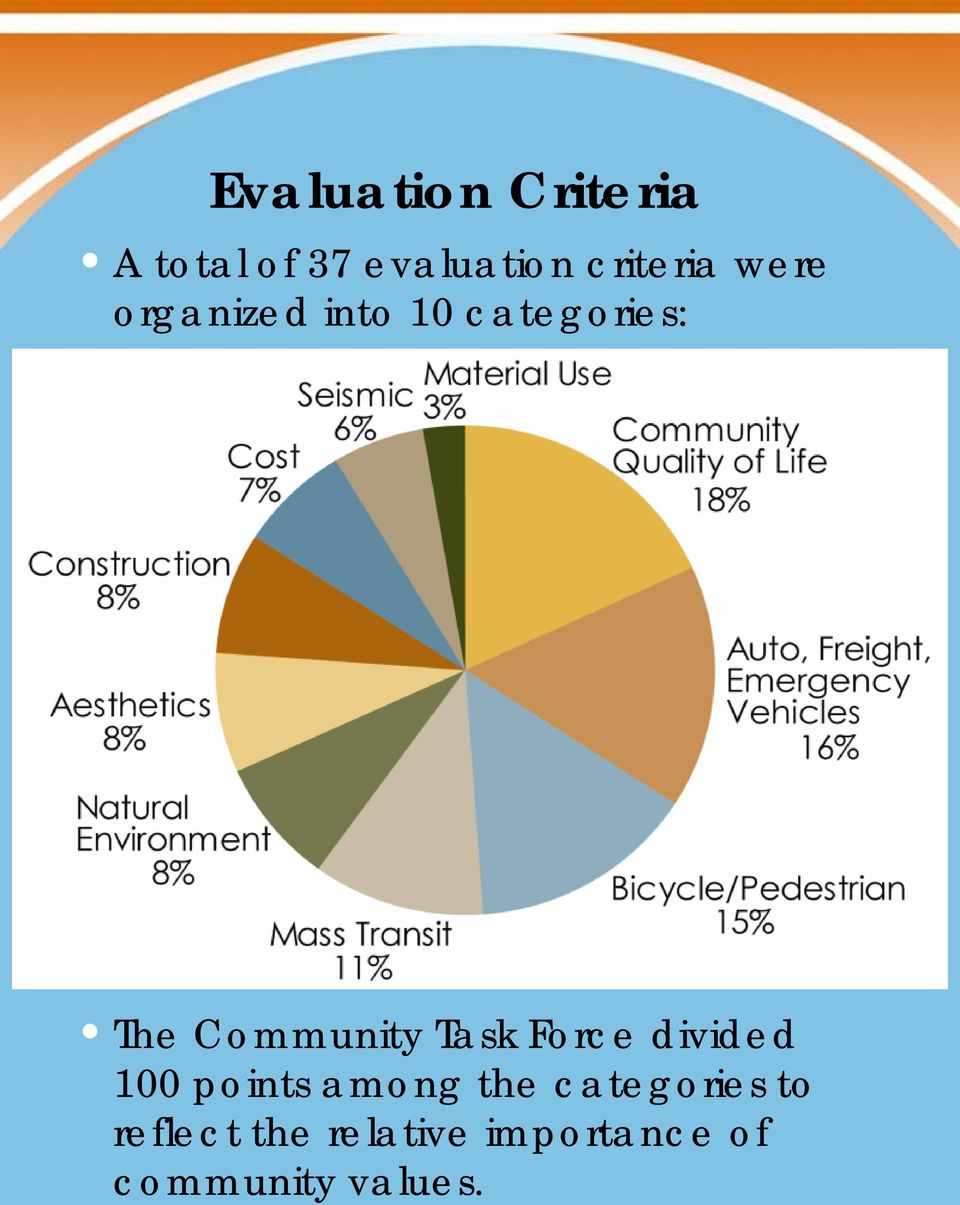
2 Evaluation Criteria A total of 37 evaluation criteria were organized into 10 categories: The Community Task Force divided 100 points among the categories to reflect the relative importance of community values.
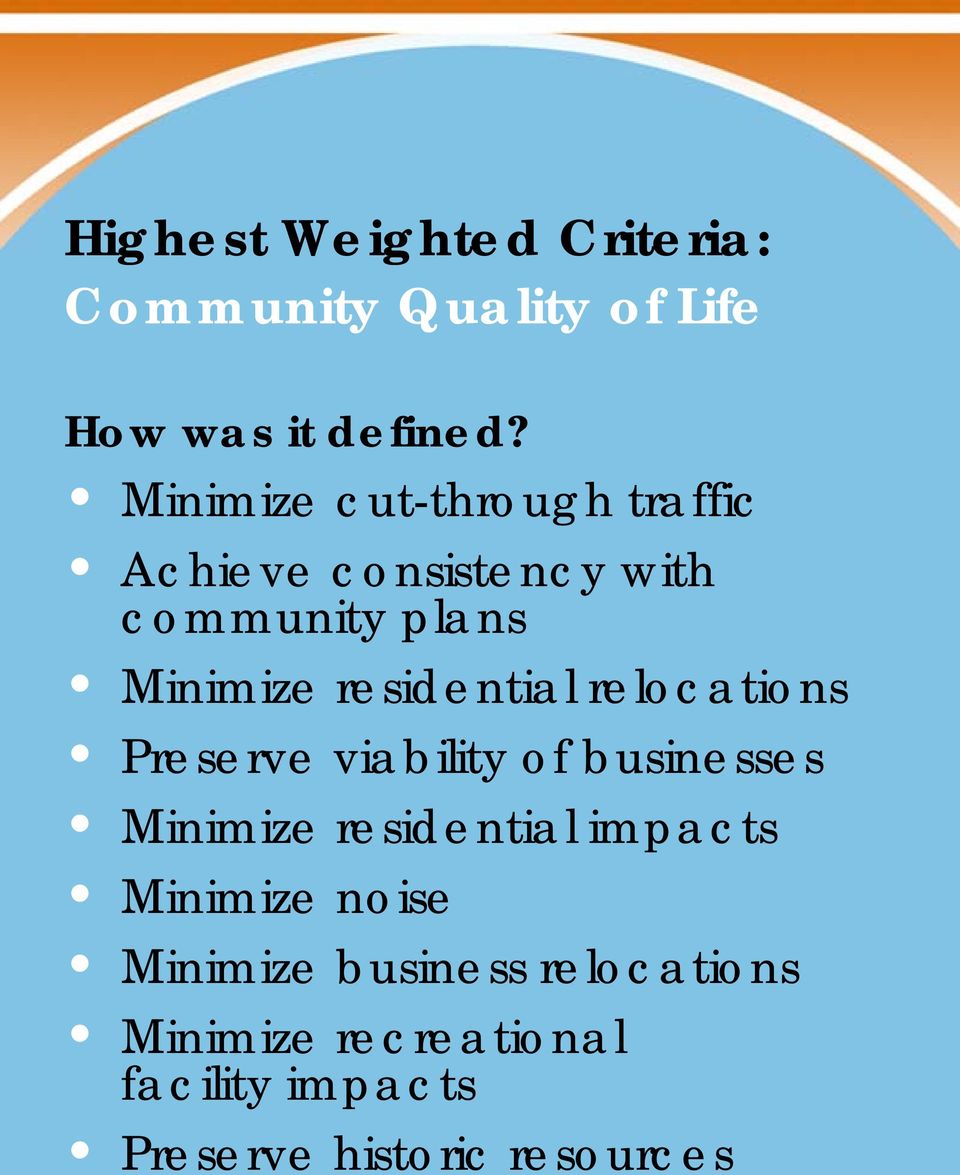
3 Highest Weighted Criteria: Community Quality of Life How was it defined? Minimize cut-through traffic Achieve consistency with community plans Minimize residential relocations Preserve viability of businesses Minimize residential impacts Minimize noise Minimize business relocations Minimize recreational facility impacts Preserve historic resources
4 Interchange Choices for All Alternatives

5 2-Level Signalized Interchange

6 2-Level Roundabout

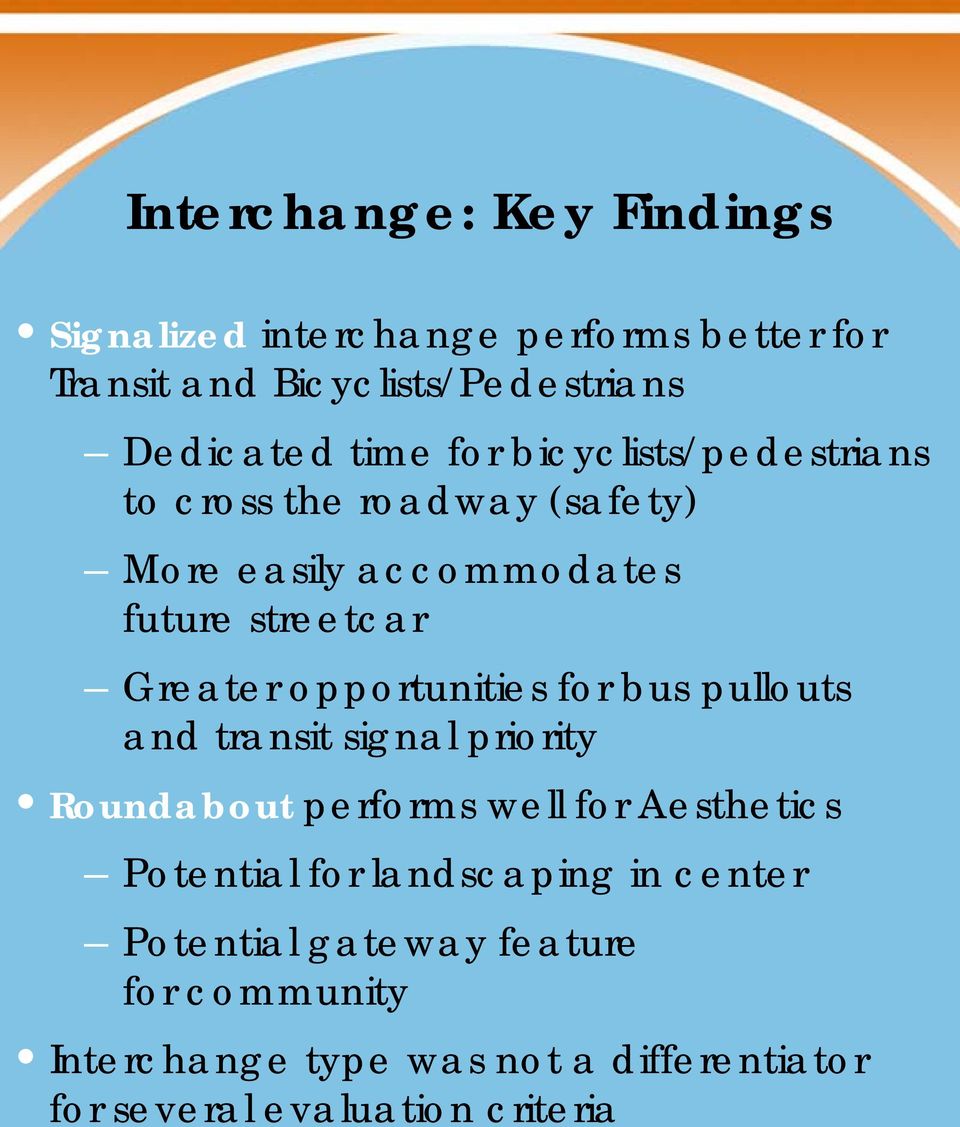
7 Interchange: Key Findings Signalized interchange performs better for Transit and Bicyclists/Pedestrians Dedicated time for bicyclists/pedestrians to cross the roadway (safety) More easily accommodates future streetcar Greater opportunities for bus pullouts and transit signal priority Roundabout performs well for Aesthetics Potential for landscaping in center Potential gateway feature for community Interchange type was not a differentiator for several evaluation criteria
8 East Side Connection Ideas No change leave as is Traffic signal at SE 7 th Avenue SE Grand Avenue extension No change Traffic signal at 7 th Ave Grand Ave extension

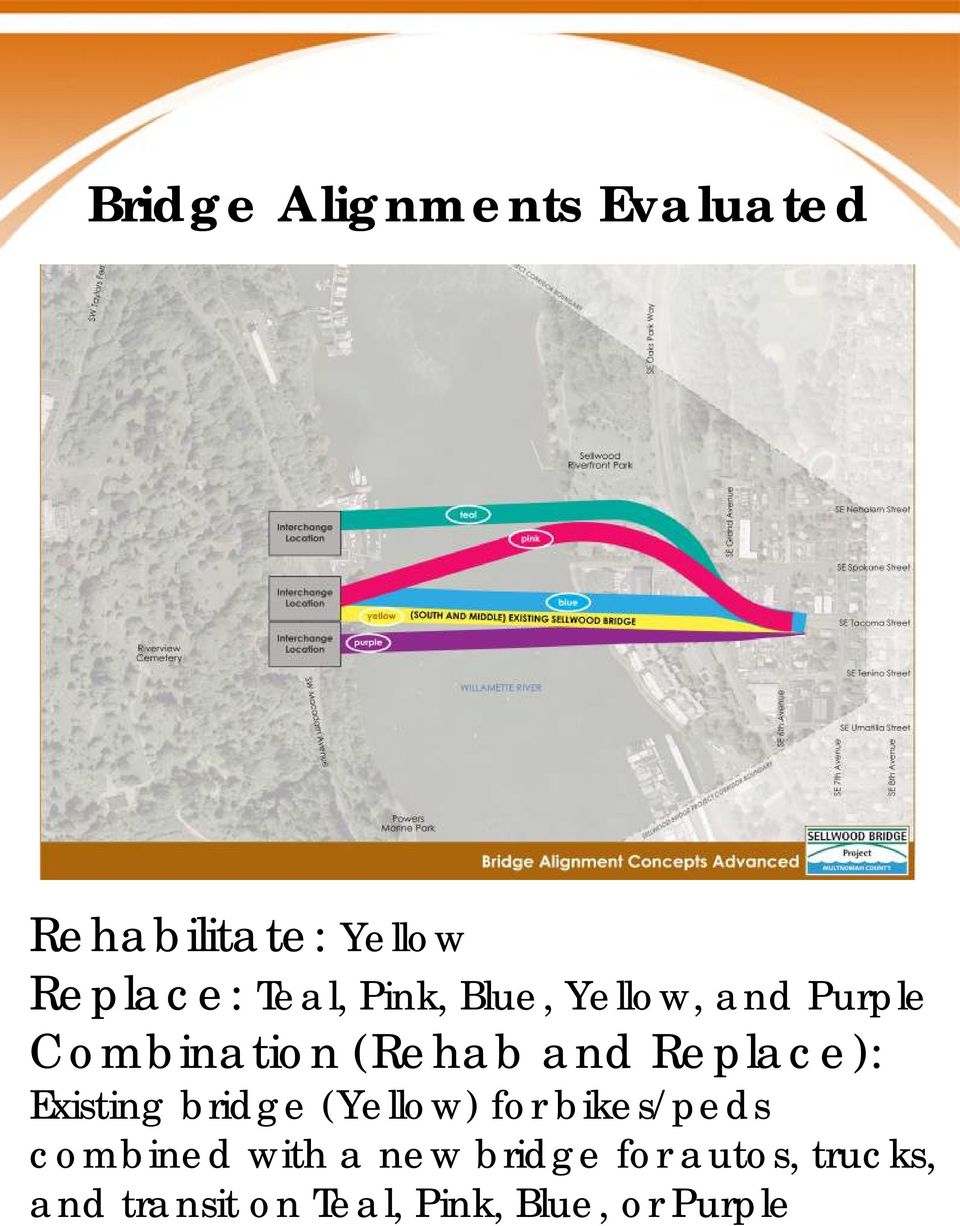
9 Bridge Alignments Evaluated Rehabilitate: Yellow Replace: Teal, Pink, Blue, Yellow, and Purple Combination (Rehab and Replace): Existing bridge (Yellow) for bikes/peds combined with a new bridge for autos, trucks, and transit on Teal, Pink, Blue, or Purple
10 Rehabilitation Alternatives

11 Yellow Rehabilitation Alignment: Key Findings Advantages: Minimizes impact to the natural environment Minimizes residential relocations Least impact to recreational and historic resources Disadvantages: Least potential to accommodate autos, freight, emergency vehicles, and transit Least flexibility to respond to future needs Most closure time and travel impacts during construction (assuming no detour bridge) Highest noise impacts Less effective in seismic protection than a new bridge

12 Detour Bridge If a detour bridge is included with a rehabilitation alternative, it would follow the Teal alignment to minimize residential and business relocations. A detour bridge would cost approximately $35 million (in year 2012 dollars). If no detour bridge is built during construction, there will not be a bridge in the area for about 3 years. A temporary ferry option during construction will be considered in the draft EIS.

13 Rehabilitation Cross-Sections

14 Rehabilitation Cross-Sections A, I, and L cross-sections were the poorest performers of all cross-sections Poorest for Transit and Auto, Freight, and Emergency Vehicles Least ability to respond to future needs As 2-lane cross-sections, performed well for Aesthetics, Community Quality of Life, Construction,. and Natural Environment (but replacement 2-lane cross-sections performed better)

15 Rehabilitation Alternatives Summary Rehabilitation alternatives performed worse than replacement alternatives Little or no cost saving over comparable replacement options Require about 3-year bridge closure during construction or a $35 million detour bridge (in year 2012 dollars) Less able to meet functional requirements (autos, trucks, transit, bikes, and peds) Least flexibility for meeting future needs Least flexibility for bridge design Higher seismic risk
16 Replacement Alternatives

17 Teal Alignment: Key Findings Advantages: Avoids relocation of existing residences Lowest noise impact Minimizes construction impacts (farther away from the existing bridge) Allows use of existing bridge for traffic during construction Disadvantages: Higher impacts to natural environment, including impacts to riparian area, floodplain, and tree canopy Highest impact to historic resources Highest impact to recreational facilities

18 Pink Alignment: Key Findings Advantages: Avoids relocation of existing residences Minimizes noise impact Minimizes construction impacts (farther away from the existing bridge) Allows use of existing bridge for traffic during construction Disadvantages: Highest number of business relocations Natural environment impacts higher due to longer bridge span More historic and recreational facilities impacted

19 Blue Alignment: Key Findings Advantages: Minimizes natural environment impacts (close to existing bridge) Least impact to recreational facilities Fewer noise impacts Allows use of existing bridge for traffic during construction Disadvantages: Impacts condominiums north of bridge (highest number of residential relocations) High number of business relocations Construction impacts higher because alignment is close to existing bridge

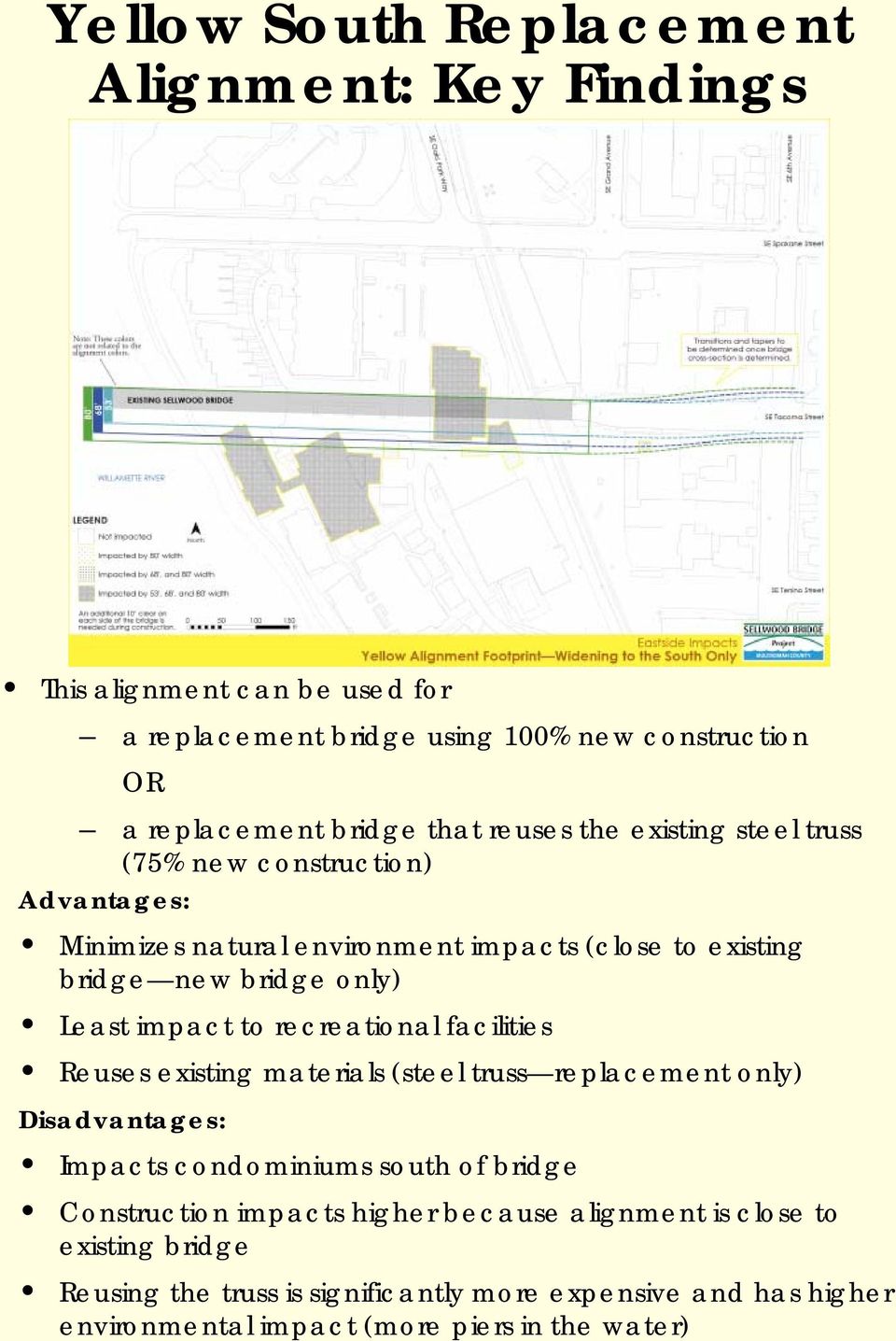
20 Yellow South Replacement Alignment: Key Findings This alignment can be used for a replacement bridge using 100% new construction OR a replacement bridge that reuses the existing steel truss (75% new construction) Advantages: Minimizes natural environment impacts (close to existing bridge new bridge only) Least impact to recreational facilities Reuses existing materials (steel truss replacement only) Disadvantages: Impacts condominiums south of bridge Construction impacts higher because alignment is close to existing bridge Reusing the truss is significantly more expensive and has higher environmental impact (more piers in the water)
21 Yellow Center Replacement Alignment: Key Findings Advantages: Minimizes impact to the natural environment Minimizes residential relocations Least impact to recreational and historic resources Disadvantages: Least potential to accommodate autos, freight, emergency vehicles, bicyclists, pedestrians, and transit Most closure time and travel impacts during construction (assuming no detour bridge) Highest noise impacts
22 Purple Alignment: Key Findings Advantages: Minimizes natural environment impacts (close to existing bridge) Least impact to recreational facilities Allows use of existing bridge for traffic during construction Disadvantages: Residential relocations (impacts condos south of bridge) Construction impacts higher because alignment is close to existing bridge
23 Replacement Cross-Sections
24 Replacement Cross-Sections: Key Findings Advantages: 2-lane sections rated high for Aesthetics, Community Quality of Life, Construction, and Natural Environment Compatible with regional and community plans Shorter construction schedules Less impervious surface Wider cross-sections rated high for Automobile, Freight, and Emergency Vehicles Added capacity for automobiles and freight More space for emergency vehicles to navigate, and for traffic to move around disabled vehicles Greater flexibility to respond to future transportation needs Greatest opportunity to keep bridge open to traffic during periods of maintenance
25 Replacement Cross-Sections: Key Findings Top performer was D 2-lane bridge with dedicated transit lanes Performed well for Transit; Community Quality of Life; Bicycle/Pedestrian; and Auto, Freight, and Emergency Vehicles Other top performers were C, C', and K C and C' have dedicated bicycle lanes and multi-use paths, and performed well for Bicycle/ Pedestrian, but also for Aesthetics and Community Quality of Life K is a 4-lane bridge with bicycle/pedestrian facilities beneath, and performed well for Auto, Freight, and Emergency Vehicles
26 Replacement Alternatives Summary Replacement alternatives performed better than rehabilitation or combination alternatives: Greater flexibility to meet current and future needs of all modes and users 2-lane replacement alternatives have comparable or lower cost than rehabilitation alternatives Most alignments allow for movement of traffic on the existing bridge during construction; no need for separate detour bridge Replacements perform better than rehabilitation for protection during earthquakes Note: Costs for replacement alternatives are for a mid cost range conventional bridge type, not a signature bridge such as cable stayed or arch. Costs are for the lifecycle (75 years) of each alternative in year 2012 dollars.
27 Combination Alternatives
28 Combination (Rehab and Replace) = Rehab existing bridge for bikes/ peds only + one of these A new bridge for autos, trucks, and transit
29 Combination Cross-Sections
30 Combination: Key Findings Combination rehabilitation/ replacement alternatives performed poorly in relation to one bridge alternatives Higher cost than other bridge replacement alternatives (because need to rehabilitate existing bridge and build new bridge) More impacts to natural resources (more piers) Complex connections for bikes and peds to street and trail networks (because of separation from roadway interchange)
31 Two Decision Points Remain What alternatives will go into the EIS? Community Task Force considers public and technical feedback and recommends four alternatives plus the No-Build alternative for the Draft EIS. Policy Advisory Group of elected officials adopts alternatives for EIS. Public outreach on design concepts and finance strategies. Draft EIS document produced. Which alternative will be selected? Public outreach collects input on preferred alternative. Community Task Force recommends preferred alternative. Policy Advisory Group adopts preferred alternative. Local/State agencies concur on preferred alternative. Federal Highway Administration approves preferred alternative.
Alternatives to the Circ Project Prioritization Methodology Prepared for Circ Task Force July 28, 2011
 Alternatives to the Circ Project Prioritization Methodology Prepared for Circ Task Force July 28, 2011 CCRPC staff has developed a draft methodology described below and detailed in the attached pages for
3.1 Historical Considerations
 3. Recommended Scope of Bridge improvements 3.1 Historical Considerations In the fall of 2000, an outside consultant, Fraser Design, suggested that the existing 4 th St. Bridge is potentially eligible
Informational Workshop Public Meeting Kanawha Falls Bridge Project
 Informational Workshop Public Meeting Kanawha Falls Project WV Department of Transportation Division of Highways in Cooperation with the Federal Highway Administration State Project S310-13-0.02 00 Federal
Red Wing Bridge Project. PAC #5/TAC #8 Meeting July 18, 2013
 Red Wing Bridge Project PAC #5/TAC #8 Meeting July 18, 2013 Alternatives Analysis Agenda Overview of Past Progress Progress Since April PAC Bridge 9103 Rehabilitation Study Bridge 9040 Rehab vs. Replacement
3 Tappan Zee Bridge Rehabilitation Options
 3 Tappan Zee Bridge Rehabilitation Options 3.1 Introduction This chapter describes possible options that rehabilitate and enhance the existing Tappan Zee Bridge. Four Rehabilitation Options have been developed:
Executive Summary. Transportation Needs CHAPTER. Existing Conditions
 CHAPTER 1 Executive Summary The City of Forest Grove Transportation System Plan (TSP) was updated to keep it consistent with recent growth trends in the city and other transportation planning efforts in
Section ALTERNATIVES. 3. Alternatives
 Section 3 ALTERNATIVES 3. Alternatives 3.0 Alternatives The Springfield Rail Improvements Project Build Alternatives would utilize different routes. The No Build Alternative includes the continuation of
5 ALTERNATIVE SOLUTIONS AND EVALUATION
 Page 23 5 ALTERNATIVE SOLUTIONS AND EVALUATION The process used for the assessment and evaluation of the alternatives follows the procedures of the Municipal Class EA, as described below: Identify a reasonable
Florida Avenue Multimodal Transportation Study. June 19, 2013
 Florida Avenue Multimodal Transportation Study June 19, 2013 Today s Agenda Team & project introduction Project Timeline What you said Tools we use Mapped data and what clues it can provide Highlights
KENTUCKY TRANSPORTATION CABINET. Department of Rural and Municipal Aid. Office of Local Programs
 KENTUCKY TRANSPORTATION CABINET Department of Rural and Municipal Aid Office of Local Programs Office of Local Programs Transportation Enhancements Safe Routes to School Congestion Mitigation and Air Quality
Goals & Objectives. Chapter 9. Transportation
 Goals & Objectives Chapter 9 Transportation Transportation MISSION STATEMENT: TO PROVIDE A TRANSPORTATION NETWORK CAPABLE OF MOVING PEOPLE AND GOODS EFFICIENTLY AND SAFELY. T he transportation system
Safety Evidence for Bicycling
 Photo: Boegh (Flickr) Cycling in Cities Research Program School of Population & Public Health The University of British Columbia Faculty of Health Sciences Simon Fraser University Driving near bicyclists
APPLICATION LAFAYETTE METROPOLITAN PLANNING ORGANIZATION (MPO) SURFACE TRANSPORTATION PROGRAM (STP) FUNDS TRANSPORTATION IMPROVEMENT PROGRAM (TIP)
 APPLICATION LAFAYETTE METROPOLITAN PLANNING ORGANIZATION (MPO) SURFACE TRANSPORTATION PROGRAM (STP) FUNDS TRANSPORTATION IMPROVEMENT PROGRAM (TIP) To be considered for STP funding, a proposed project must
North Avenue Corridor Study. Advisory Committee Meeting #5 June 11, 2014
 North Avenue Corridor Study Advisory Committee Meeting #5 June 11, 2014 Agenda Welcome and introductions Concept refinement and evaluation: Public meeting and web survey General cross-section concepts
BEST PRACTICES. Smart Transportation is a key concept for the Paoli Roadway Improvement Project.
 Smart Transportation Smart Transportation is a key concept for the Paoli Roadway Improvement Project. PennDOT s Smart Transportation Guidebook (2008) outlines a comprehensive approach to transportation
AGENCY COORDINATION AND PUBLIC INVOLVEMENT
 5 AGENCY COORDINATION AND PUBLIC INVOLVEMENT 5.1 AGENCY COORDINATION As part of the planning process for the Oregon Avenue Final EA, DDOT conducted an agency coordination program. This coordination included
Examples of Eligible Projects. Project Category Description Examples
 Examples of Eligible Projects Public Transit Local Roads, Bridges, and Active Transportation Regional and Local Airports which supports a shared passenger transport system which is available for public
REHABILITATION PACKAGE 1-a
 1-a WINONA BRIDGE (BRIDGE 5900) REHABILITATION PACKAGE 1-a Rehab option 1-a is a rehabilitation package whereby all spans of the existing structure would be rehabilitated to the degree feasible and strengthened
KOSCIUSZKO BRIDGE PROJECT BRIDGE PRIMER
 KOSCIUSZKO BRIDGE PROJECT BRIDGE PRIMER The New York State Department of Transportation (NYSDOT) is preparing an Environmental Impact Statement (EIS) to evaluate alternatives for the rehabilitation or
Infrastructure and Growth Leadership Advisory Group Ideas and Approaches Survey
 Infrastructure and Growth Leadership Advisory Group Ideas and Approaches Survey In its second meeting, the Infrastructure and Growth Leadership Advisory Group expanded and refined the list of approaches/ideas
SAN DIEGO - A BICYCLE FRIENDLY CITY
 SAN DIEGO - A BICYCLE FRIENDLY CITY MANY OPPORTUNITIES FOR IMPROVEMENT SUMMARY The designated bicycle paths and lanes in the City of San Diego (City) are often substandard because of their location and
Bicycle Safety Enforcement Action Guidelines
 Introduction Bicycle Safety Enforcement Action Guidelines People ride bicycles for many different reasons: fitness, recreation, or for transportation. Regardless of the reason for riding, bicyclists young
ENGINEERING SOLUTIONS FOR DESIGNING YOUR SAFE ROUTES
 How to Get Started ENGINEERING SOLUTIONS FOR DESIGNING YOUR SAFE ROUTES Design Elements Selecting appropriate design treatments for school neighborhoods creates environments that address the needs of all
Federal Highway Administration 1200 New Jersey Avenue, SE Washington, DC 20590 202-366-4000
 1 of 8 12/27/2013 8:21 AM U.S. Department of Transportation Federal Highway Administration 1200 New Jersey Avenue, SE Washington, DC 20590 202-366-4000 MAP-21 - Moving Ahead for Progress in the 21st Century
Near Westside Neighborhood and University Avenue Corridor Transportation Study. Public Workshop #2. September 12 and 23, 2013
 Near Westside Neighborhood and University Avenue Corridor Transportation Study Public Workshop #2 September 12 and 23, 2013 Presentation Outline: Brief Review of Study Scope, Background, and Current Conditions
Downtown Tampa Transportation Vision
 Downtown Tampa Transportation Vision Executive Summary August 1, 2006 Hillsborough County Metropolitan Planning Organization County Center, 18 th Floor Tampa, Florida 33602 813-272-5940 www.hillsboroughmpo.org
For more information, visit: rethinkingstreets.com
 For more information, visit: rethinkingstreets.com 37 Arterial Rehab Busy, multi-lane streets, often referred to as arterials, crisscross the landscape of our cities and suburbs. Alongside these wide thoroughfares,
Healthy, Equitable Transportation Performance Measures and Creative Place-making
 THE HONORABLE Mayor KEN WILBER, Karl Dean, CHAIRMAN Chairman Healthy, Equitable Transportation Performance Measures and Creative Place-making Rochelle Carpenter PSRC Bicycle/Pedestrian Advisory Committee
Light Rail Transit in Phoenix
 4. Presentation and Discussion: Phoenix Light Rail Implementation Wulf Grote Planning and Development Director, Phoenix Valley Metro Light Rail Transit in Phoenix Broadway Citizen s Task Force February
HRTPO PROJECT PRIORITIZATION AND SELECTION PROCESS PROJECT CATEGORIES AND EVALUATION CRITERIA
 HRTPO PROJECT PRIORITIZATION AND SELECTION PROCESS PROJECT CATEGORIES AND EVALUATION CRITERIA September 24, 2009 Intermodal Projects Better Accommodates Intermodal Movements Improves Rail or Vehicular
Topic 2 11/28/2012 Blocks & Street Network
 TOPIC 2 Blocks & Street Network Implementation Note: 1. Some recommendations are summarized in the tables herein. For complete recommendation language, please see the. 2. Recommendations referenced in
Clean, Green, Fun! Cady Way. Trail
 Clean, Green, Fun! Cady Way Trail Seminole County Burkett Osceola 426 Mizell Sylvan 426 Ward Memorial Cady Way 436 426 551 Nan Waunatta Martha Mira Pearl George Virginia Berry Irma Winter Pines Golf Course
Wilmington Urban Area Metropolitan Planning Organization Surface Transportation Program Direct Attributable Project Submittal Guide Fiscal Year 2016
 Wilmington Urban Area Metropolitan Planning Organization Surface Transportation Program Direct Attributable Project Submittal Guide Fiscal Year 2016 Date of Release: September 14, 2015 Pre application
CITY OF TRAIL MEMORANDUM
 0 C CITY OF TRAIL MEMORANDUM DATE: TO: FROM: SUBJECT: March 24, 2011 FILE NO. 5400-02 DAVID PEREHJJDOFF, CHIEF ADM1NTSTRATIVE OFFICER WARREN PROULX, ENGINEERING TECHMCIAN OLD TRAIL BRIDGE With the interest
Surface Transportation Program (STP) Projects
 Toledo Metropolitan Area Council of Governments American Reinvestment and Recovery Act (Economic Stimulus Program) Application Packet for: Surface Transportation Program (STP) Projects APPLICATIONS DUE
Public Information & Public Scoping Meeting
 Public Information & Public Scoping Meeting William F. Cribari Memorial Bridge Route 136 over the Saugatuck River Review of Rehabilitation Study Report Public Scoping for the gathering and analysis of
CITY OF ROANOKE AND TOWN OF VINTON, VIRGINIA. RSTP Funds Joint Application FOR
 CITY OF ROANOKE AND TOWN OF VINTON, VIRGINIA RSTP Funds Joint Application FOR Tinker Creek Pedestrian Bridge: Tinker Creek and Glade Creek Greenways Connection Date: September 15, 2014 RSTP Project Profile
Near West Side Comprehensive Plan Executive Summary (Revised) April 2004 City of Milwaukee DCD
 Near West Side Comprehensive Plan Executive Summary (Revised) April 2004 City of Milwaukee DCD Boundaries The Near West Side Comprehensive Plan covers a broad area immediately west of Milwaukee s downtown.
APPENDIX F RIGHTS-OF-WAY PRESERVATION GUIDELINES
 Los Angeles County Metropolitan Transportation Authority (Metro) 2009 Transportation Improvement Program Call for Projects APPENDIX F RIGHTS-OF-WAY PRESERVATION GUIDELINES Los Angeles County Metropolitan
Examples of Transportation Plan Goals, Objectives and Performance Measures
 Examples of Transportation Plan Goals, Objectives and Performance Measures The next step in the Long Range Transportation Plan (LRTP) process is to develop goals, objectives, and performance measures.
Chapter 2. Project Development. 2 Project Development
 Chapter 2 Project Development 2 Project Development Chapter 2 Project Development Project Development is the process that takes a transportation improvement from concept through construction. There are
SURFACE TRANSPORTATION PROGRAM (STP) PROCEDURES FOR THE OKLAHOMA CITY URBANIZED AREA FUNDS
 SURFACE TRANSPORTATION PROGRAM (STP) PROCEDURES FOR THE OKLAHOMA CITY URBANIZED AREA FUNDS October 2015 Background The Surface Transportation Program (STP) was originally established as Section 133 of
Effect on structures. Uniform settlement - no concerns. Angular distortion - causes damage due to tensile strain
 Effect on structures Uniform settlement - no concerns Angular distortion - causes damage due to tensile strain 1/500 - safe limit for no cracking of buildings 1/150 - potential structural damage 36 37
Maryland Invests $845 Million in New Highway and Bridge Projects
 Maryland Invests $845 Million in New Highway and Bridge Projects Completing Widening of MD 404 Talbot And Caroline Counties Top Regional Priority Queen Anne s, Talbot, and Caroline Counties Widening MD
Smart Cycling IN SANTA MONICA SANTA MONICA POLICE DEPARTMENT BE SMART. BE VISIBLE. BE ATTENTIVE. HAVE FUN!
 Smart Cycling IN SANTA MONICA BE SMART. BE VISIBLE. BE ATTENTIVE. HAVE FUN! Safety Tips and Rules of the Road for Cyclists SANTA MONICA POLICE DEPARTMENT Rules of the Road Drivers, bicyclists, and pedestrians
REPORTS & PRESENTATIONS AGENDA ITEM #III-3 CORTEZ BRIDGE PROJECT DEVELOPMENT AND ENVIRONMENT (PD&E) STUDY
 NOTES REPORTS & PRESENTATIONS AGENDA ITEM #III-3 CORTEZ BRIDGE PROJECT DEVELOPMENT AND ENVIRONMENT (PD&E) STUDY Presenter: Summary: Tony Sherrad, FDOT Project Manager The Cortez Bridge in Manatee County,
Pavement Management Program
 Pavement Management Program 2014 Street Maintenance Program Executive Summary 01/21/2014 Presented by Mark Thiel Assistant Director of Public Works Program Overview Start of current program 2005 825.1
Chapter 9: Transportation
 Chapter 9: Transportation What is this chapter about? The goals and policies in this chapter convey the City s intent to: Create a coordinated, efficient, and more affordable multimodal transportation
I-676 (Vine Expressway) Bridge Reconstruction Project 22 nd - 18 th Streets Philadelphia, PA. PSPE Presentation, December 3, 2015
 I-676 (Vine Expressway) Bridge Reconstruction Project 22 nd - 18 th Streets Philadelphia, PA PSPE Presentation, December 3, 2015 Location Map N PROJECT LOCATION 22 nd 18 th Streets PHILADELPHIA, PA General
Bicycle Safety Quiz Answers Parental Responsibilities
 Bicycle riding is a great way to get into shape and enjoy the outdoors. To remain safe on Illinois roads, it is important to follow the same traffic safety laws that govern vehicle drivers. No amount of
South Carolina Multimodal Transportation Plan Vision, Goals, Objectives, and Performance Measures
 South Carolina Multimodal Transportation Plan Vision, Goals, Objectives, and Performance Measures Prepared for: Prepared by: June 2013 TABLE OF CONTENTS 1. Introduction... 1 1.1 Baseline Understanding...
Project R-4467 PROJECT DESCRIPTION PROJECT SCHEDULE PURPOSE OF THIS MEETING WHAT WILL BE DONE WITH THE COMMENTS? FOR MORE INFORMATION:
 Workshop #3 Aug ust 2012 PROJECT DESCRIPTION The North Carolina Department of Transportation (NCDOT) proposes to maintain a direct highway connection between Hertford and Winfall along or close to US 17
Mayors Welcome Strong Surrey Votes Yes Coalition Support. Yes Vote Would Vastly Improve Transit and Transportation in Fast Growing City
 Mayors Welcome Strong Surrey Votes Yes Coalition Support Yes Vote Would Vastly Improve Transit and Transportation in Fast Growing City February 11, 2015 Vancouver, BC The Mayors Council on Regional Transportation
Federal Guidelines for STP-U Funding
 MPC 5.f Attachment 1 STP-U Eligibility Guidelines Page 1 of 5 Federal Guidelines for STP-U Funding SURFACE TRANSPORTATION PROGRAM (STP) ELIGIBLE EXPENDITURES PERIOD AVAILABLE: FY + 3 Years FUND: Highway
Roadway Cost Per Centerline Mile Revised June 2014
 Rural Arterial From LRE MOT * Mobilization * Subtotal Total PE Design (15%) CEI (15%) Total Project ** New (2-Lane Roadway) with 5' Paved Shoulders $3,351,896 $335,190 $368,709 $4,055,794 $1,013,949 $5,069,743
Cycling in Cities: The Research Program and its Impact
 Cycling in Cities: The Research Program and its Impact Meghan Winters Faculty of Health Sciences Simon Fraser University [email protected] Creating Active Communities Saskatoon, Oct 2012 % of trips by bicycle
The financial plan was prepared in conjunction with the Technical Working Group. Refer to Table 3-1: Funding and Implementation Plan.
 3 Financial Plan The purpose of the financial plan is to identify funding options that would be likely sources of money to advance recommendations made by this study. The Capitol Region Transportation
OREGON TRAFFIC ACCIDENT AND INSURANCE REPORT
 DMV OREGON TRAFFIC ACCIDENT AND INSURANCE REPORT Tear this sheet off your report, read and carefully follow the directions. ONLY drivers involved in an accident resulting in any of the following MUST file
STREETS -- BICYCLES -- PATHS
 STREETS -- BICYCLES -- PATHS RCW 35.75.050 Bicycle road fund -- Sources -- Use. The city or town council shall by ordinance provide that the whole amount or any amount not less than seventy-five percent
Best Practices in Bicycle and Pedestrian Wayfinding in the Washington Region Survey Results
 Bike/Ped Subcommittee 03/20/07, Item 5 Best Practices in Bicycle and Pedestrian Wayfinding in the Washington Region Survey Results Michael J. Farrell COG/TPB 1 Background At the request of Jay Fisette,
Measuring the Street:
 Measuring the Street: New Metrics for 21st Century Streets 1 Measuring the Street: New Metrics for 21st Century Streets New York City s streets are constantly called on to the meet new and varied needs
Corridor Goals and Objectives
 Corridor Goals and Objectives This chapter presents the goals and objectives, developed by the Corridor Study Committee, that serve as the purpose and intent of the Corridor Plan. This plan covers a twenty
 Walkable Communities Florida Department of Transportation State Safety Office Pedestrian and Bicycle Program April 1995 www.dot.state.fl.us/safety Twelve Steps for an Effective Program Page 1 Twelve Steps
Belmont Street Bridge Rehabilitation Project
 Belmont Street Bridge Rehabilitation Project Christian Gospel Church Worcester 43 Belmont Street Worcester MA February 20, 2015 7:00PM Agenda Introductions Project site and overview Project history Construction
Background and Goals for the Project
 City of Asheville, NC REQUEST FOR PROPOSALS Wilma Dykeman Riverway Environmental Analysis, Project Development, and Preliminary Design Submittal Address: Dan Baechtold, AICP City of Asheville Engineering
DMV. OREGON TRAFFIC ACCIDENT AND INSURANCE REPORT Tear this sheet off your report, read and carefully follow the directions.
 OREGON TRAFFIC ACCIDENT AND INSURANCE REPORT Tear this sheet off your report, read and carefully follow the directions. ONLY drivers involved in an accident resulting in any of the following MUST file
Alterna ves Development & Evalua on
 Spring 2015 Newsletter Issue III WHERE ARE WE IN THE PROCESS? Since the NLSD Phase I Study kickoff in 2013, numerous meetings have been held with the public, the existing conditions and transportation
RPA 14/ATURA Surface Transportation Program (STP) APPLICATION FOR FUNDS
 RPA 14/ATURA Surface Transportation Program (STP) APPLICATION FOR FUNDS Please provide the following information when applying to RPA 14/ATURA for Surface Transportation Program (STP) funding for projects
REGIONAL NON-MOTORIZED TRANSPORTATION NETWORK
 Chapter 10 Bicycle and Pedestrian SAFETEA-LU legislation requires that non-motorized users be considered in the LRTP. The legislation allows for bicycle and pedestrian safety to be incorporated into the
Appendix J Santa Monica Travel Demand Forecasting Model Trip Generation Rates
 Appendix J Santa Monica Travel Demand Forecasting Model Trip Generation Rates SANTA MONICA TRAVEL DEMAND FORECASTING MODEL TRIP GENERATION RATES SUBMITTED BY: 201 Santa Monica Blvd., Suite 500 Santa Monica,
Veterans Memorial Bridge (Orange Avenue) PD&E Study
 Veterans Memorial Bridge (Orange Avenue) PD&E Study From City Island Parkway to South Peninsula Drive FDOT FPID# 242172-128-01 Volusia County Project# P-5351-1 Project Limits End Project City Island Veterans
HIGHWAY DESIGN REPORT. Appendix 4. Proposed Design Principles for City Passings
 HIGHWAY DESIGN REPORT Appendix 4 Proposed Design Principles for City Passings June 2000 Contents Page 1 Introduction 2 1.1 Purpose 2 1.2 Definition of city passing 2 1.3 Safety Problems 2 1.4 Planning
2010 Salida Community Priorities Survey Summary Results
 SURVEY BACKGROUND The 2010 Salida Community Priorities Survey was distributed in September in an effort to obtain feedback about the level of support for various priorities identified in the draft Comprehensive
ARIZONA-SONORA BORDER MASTER PLAN
 Introduction Travel between the State of Arizona in the United States and the State of Sonora in Mexico at the international border has increased over the last ten years. There are nine specific land ports
Schenk-Atwood Neighborhood Business District Master Plan
 Schenk-Atwood Neighborhood Business District Master Plan Prepared for the Schenk-Atwood Revitalization Association (SARA) and the City of Madison SCHREIBER/ANDERSON ASSOCIATES, INC. BEST Real Estate Group,