
In-Place HEPA Filter Penetration Test
|
|
|
- Magnus Johnston
- 10 years ago
- Views:
Transcription
1 UCRL-JC PRBPRINT In-Place HEPA Filter Penetration Test W. Bergman K. Wilson J. Elliott B. Bettencourt J.W. Slawski Thispaperwaspreparedfor submittalto the 24th DOEliVRC Nuclear Air (Waning and Treatment Conference Portfa& OR July15-18, 19%

2 DISCLAIMER This document was prepared as an account of work sponsored by an agency of the United States Government. Neither the United States Government nor the University of California nor any of their employees, makes any warranty, express or implied, or assumes any legal liability or responsibility for the accuracy, completeness, or usefulness of any information, apparatus, product, or process disclosed, or represents that its use would not infringe privately owned rights. Reference herein to any specific commercial product, process, or service by trade name, trademark, manufacturer, or otherwise, does not necessarily constitute or imply its endorsement, recommendation, or favoring by the United States Government or the University of California. The views and opinions of authors expressed herein do not necessarily state or reflect those of the United States Government or the University of California, and shall not be used for advertising or product endorsement purposes.

3 24th DOE/NRC NUCLEAR AIR CLEANING AND TREATMENT IN-PLACEHEPAFILTERPENETRATIONTESl% by W. Bergman, K. Wilson, J. Elliott, B. Bettencourt and J. W. Slawskil Lawrence Livermore National Laboratory Livermore, CA94550 Abstract. We have demonstrated the feasibility of conducting penetration tests on high efficiency particulate air (HEPA)filters as installed in nuclear ventilation systems. The in-place penetration test, which is designed to yield equivalent penetration measurements as the standard DOP efficiency test, is based on measuring the aerosol penetration of the filter installation as a function of particle size using a portable laser particle counter.(l) This in-place penetration test is compared to the current in-place leak test using light scattering photometers for single HEPAfilter installations and for HEPAfilter plenums using the shroud method. Test results show the in-place penetration test is more sensitive than the in-place leak test, has a similar operating procedure, but takes longer to conduct. Additional tests are required to confirm that the in-place penetration test yields identical results as the standard dioctyl phthalate (DOP) penetration test for HEPAfilters with controlled leaks in the filter and gasket and duct by-pass leaks. Further development of the procedure is also required to reduce the test time before the in-place penetration test is practical I. Introdu ction Before a HEPAfiltration system can be used in a DOE nuclear facility, the ventilation system and the HEPAfalters must pass acceptance tests described in ASMEN510 or AG1, and the HEPAfilter must pass the MIL-STD-282 penetration test. ( 3) The acceptance tests consist of leak tests of ducts and housings, airflow capacity and distribution tests, and air-aerosol mixing uniformity tests. The airflow distribution test is designed to insure that HEPAfilters see a uniform air flow, while the air-aerosol mixing test is performed to insure that the concentration of aerosols challenging the filter is uniform. This will insure that representative samples can be obtained before and after the filter for computing the filter penetration. 1 U.S. Departmentof Energy,Defense Programs(DP-4S),Germantown,MD20874 *This work was performed under the auspices of the U.S. Department of Energy by Lawrence Livermore National Laboratory under contract no. W-7405-ENG- 41 The work was supportedby DOE sdefenseprogramoffice of Technical and Environmental Support, DP-45. 1

4 The HEPAfilter penetration test is given in MIL-STD-282.(1) This test requires HEPA filters to have less than 0.03% penetration for 0.3 pm DOP aerosols as measured by a light scattering photometer. The 0.3 ~m aerosols were originally selected because they were believed to be the most penetrating aerosols and would yield the most conservative penetration values for the HEPAfilters. These aerosols were generated in a very large machine by a controlled condensation of DOP vapor and were thought to be monodisperse. After the HEPAfilter is installed in a certified ductwork, and once a year thereafter, the filter installation must be tested for leaks. (2-4) This in-place leak test is performed to insure that the HEPAfilter is properly installed and has not been damaged, that there are no leaks in the mounting frame or between the mounting frame and the housing, and that the system contains no bypassing that would reduce the system penetration. The in-place leak test is not a filter penetration test and can not be used in determining the penetration of HEPA filters. The difference between the two tests is the particle size and the type of aerosol generator used to challenge the lllte~ the DOP penetration test uses near monodisperse 0.3 ~m particles generated by a very large vapor condensation generator, while the in-place test uses heterodisperse 0.7 pm particles generated by small portable air or thermal generators. ERDA recommends an acceptance criterion of 0.03% maximum penetration for the in-place DOP test.(4) The HEPAfilter leak test was implemented in 1960 in the U.S. to verify that the installed filtration systems did not have leaks.(s) This test represented a secondbest choice at that time since it was not possible to conduct in-place penetration tests using the available test equipment. The problem was that the particle measuring instruments at that time could not distinguish between particle sizes, and monodisperse 0.3 Lm aerosol generators were not portable. The available light, scattering photometers were portable but could not distinguish between different particle sizes. To measure HEPAfalter penetration at 0.3 ~m diameter, it was necessary to have a monodisperse 0.3 Urn diameter generator, which were not portable. The only portable aerosol generators at that time produced heterodisperse aerosols. Now, a variety of instruments and aerosol generators are commercially available that can be used for measuring in-place filter penetration. Portable particle spectrometers are available that can measure specific particle sizes in heterodisperse aerosols. Portable aerosol generators are also available that can generate monodisperse aerosols. Thus it is now possible to measure in-place HEPA filter penetration at 0.3 Vm using portable equipment consisting of either a particle size spectrometer and a heterodisperse aerosol generator or an integrated particle analyzer (e.g. photometer, condensation nuclei counter) and a monodisperse aerosol generator. We will only address the in-place penetration method using laser spectrometers and heterodisperse aerosols in this paper. 2

5 JI. Difference Between Penetr- In-Place Leak. and In-Place Penetration The difference between the results of the penetration and the in-place leak tests can be illustrated with a typical HEPAfilter penetration curve shown as a function of particle size in Figure 1. The penetration is a maximum at O.15Lm, decreases rapidly with increasing particle size and is negligible at 0.7 km for HEPAfilters with no leaks. Although the penetration measurement at 0.3 ~m is significantly less than the maximum, it still provides a sensitive measurement of the filter penetration. In contrast to the in-tact HEPAfilter installation in Figure 1, particle penetration through leaks is independent of particle size. Thus any penetration that is measured at 0.7 Vm diameter during the in-place leak test can ix attributed to leaks Diameter, urn Figure 1. Plot of HEPA filter penetration measurements as a function of particle size for dioctyl sebacate (DOS) aerosols with two different laser spectrometers. Nuclear grade, 1,000 cfm HEPA filter. 3

6 Two different laser particle counters (Particle Measurement Systems, Bolder, CO) were used to generate the curve in Figure 1: the LAS-HS laser counter, which measures particles from to 0.95 Mmdiameter and the LASAIRlaser counter, which measures particles from 0.14 to 2.4 pm diameter. The diameter measurements are based on the logarithm midpoint of each of the counter channels. A 100:1 diluter (TSI, Minneapolis, MN) was used to dilute the upstream measurements to avoid coincidence counting. The dioctyl sebacate aerosols were generated with a Laskin nozzle aerosol generator (Virtis, Gardiner, NY). Details of the test procedure are described in previous reports. The agreement between the two instruments is good. It is possible to conduct filter penetration tests as described in ASME N-510 and ASMEAG-1 using a laser particle counter during in-place filter tests. (2 3) If the laser counter is used for measuring the total number of particles without regard to particle size, then the filter test becomes another leak test. However, if the laser counter is used to discriminate between different particle sizes, such as 0.3 Km, then the laser test becomes an in-place penetration test. Using the laser particle counter also allows the maximum filter penetration, as shown in Figure 1, to be determined with the in-place penetration test. A description of the filter efficiency test using the laser particle counter is given by Bergman and Biermann and by Scripsick et al.(g 8) The in-place penetration test using the laser particle counter is a measurement of the penetration of the total filtration system. This test incorporates the aerosol penetration from both the HEPAfilter and leaks in the filter housing or gaskets. In separate filter penetration and leak tests, the total penetration of the filtration system is determined from the sum of the filter penetration and the leak penetration. In separate penetration and leak tests, once the filter is installed, it is only possible to determine system leaks with the light scattering photometer and assume the filter penetration remains the same. The in-place leak test using the light scattering photometer can only detect a major deterioration in filter penetration. The increased sensitivity of the laser particle counter allows filter penetration measurements of two stages of HEPA filters for both the leak test and the penetration test. This capability, which is not possible for the standard photometer based leak test, is advantageous because of the reduced testing time and the difficulty in measuring the penetration of individual stages in systems having minimal space between stages. Schuster and Osetck were the first to use a laser particle counter to measure the filter penetration of one-stage and two-stage, size 1 HEPAfilters.(g) They found typical DOP penetrations of A for single stage and % for two stage HEPA filters. However measurements of penetration versus particle size were only reported for the single stage HEPA filters.(g)

7 Ortiz determined the filter leaks in a number of 20,000 cfm two-stage HEPA filter systems. He did not discriminate between particle size, but rather used the total particle count before and after the filters to determine the system leaks. The test was therefore a leak test and not a penetration test. The leak measurements for ten systems varied from % to %. The maximum allowable leakage for two stage HEPAfilters is %. This study was significant not only because the test system was demonstrated under field conditions, but also because it showed the laser particle counter detected filter system failures that were not seen with the standard single stage method described in ASMEN510.(2) Ortiz et al also conducted a round robin test of two-stage HEPAfiltration system in which they measured filter penetration as a function of particle size using a laser spectrometer.(n) In this configuration, the filter test was an in-place penetration test. To avoid coincidence counting, the upstream concentration was diluted. The test apparatus and procedure were incorporated into an ASTM test method for evaluating HEPAfilters. The Los Alamos National Laboratory (LANL) uses a laser spectrometer and heterodisperse aerosols as developed by Ortiz and incorporated in the ASTM standard for conducting in-place HEPAfilter leak tests in all of their facilities.(1-13j Since the particle measurements are made by adding all of the sizes into a single count, the LANLin-place filter measurements can not be used for determining filter penetration, but rather for leaks. Adding together the particle counts in the different particle size bins destroys the ability to measure filter penetration with heterodisperse aerosols. However, by keeping the particle counts in the different size bins separate, the LANLtest procedure for leaks can be converted to a test of filter penetration test Correlation of In-Place Penetration Test With Standard Penetration Test In order to claim that an in-place filter penetration test is equivalent to the standard HEPA filter penetration test at 0.3 ~m, it is necessary to establish a correlation between the in-place penetration test with the standard penetration test specified in MIL-STD-282.(1) Such a correlation would include penetration measurements on HEPAfilters with varying defects in the filter and the gasket as well as by-pass leaks in the ventilation ducting. These correlation tests have not yet been completed. However Scripsick et al conducted tests on 849 new HEPA filters using laser measurements at 0.31 Lm and the standard Q-107 measurements at O3 ~m.(8) The correlation between the laser measurements at 0.31 ~m and the Q-107 measurements at 0.3 pm is good, as shown in Figure 2.(6) Note that the correlation becomes worse at smaller penetration values. This is not surprising considering the photometer in the Q-107 measurements is increasingly noisy below 0.01% penetration. We plan to conduct similar correlations using filters with controlled leaks in the media and gaskets and using controlled by-pass leaks in the ducting. 5

8 o rv; o 0 0 -c m, ~~l! [ o,0 0 5A v ,.. I Q107 Penetration at 0.30 pm, % Figure 2. ~o~elation of HEpA filter pene~ation be~een laser s~e~~ometer and Q107 ~hotometer.(s) For measurements of the maximum filter penetration, it is not necessary to conduct correlation tests with the Q107 tester because it only measures the penetration at 0.3 km. The Q107 can not be used to determine the maximum filter penetration at 0.15 }m, as seen in Figure 1. In fact, there are no standard reference tests for the maximum filter penetration. The laser spectrometer can be used in a primary test standard for the maximum filter penetration if the particle size range is sufficient to clearly show a maximum as seen in Figure 1. IV. Correlation of In-Place Penetration Test With Standard Leak Test We have conducted a series of filter penetration tests on a HEPAfilter with an increasing number of pin holes to establish a correlation between the in-place penetration test and the standard leak test. A nuclear grade, 1,000 cfm HEPA filter was used in these correlation tests. Two different laser spectrometers were used to 6

9 determine the in-place filter penetration as a function of size: the LAS-HS laser counter, which measures particles from to 0.95 ~m diameter and the LASAIR laser counter, which measures particles from 0.14 to 2.4 pm diameter. A 100:1 diluter (TSI, Minneapolis, MN) was used to dilute the upstream measurements to avoid coincidence counting. The dioctyl sebacate aerosols used in the in-place penetration tests were generated with a Laskin nozzle aerosol generator (Virtis, Gardiner, NY). Filter penetration was determined from the ratio of the downstream concentration divided by the upstream concentration after correcting for the upstream dilution and subtracting background aerosols. Figure 1 shows the penetration of the new HEPAfilter as a function of particle size. The standard leak test was conducted using a TDA-2GN light scattering photometer (ATI, Owings Mills, MD) to obtain aerosol measurements before and after the HEPAfilter. A TDA-5B aerosol generator (ATI, Owings Mills, MD) was used to generate the alpha-olefin (Emery 3004) aerosols for the in-place leak tests. Filter leak measurements were made by electronically setting the photometer upstream concentration to 10WOand reading the downstream concentration directly. The in-place leak test yielded a leak of 0.01% for the test shown in Figure 1. Following the initial test on the new HEPAfilter, we made a single pinhole in the filter medium using a inch diameter needle and repeated the in-place penetration and in-place leak tests. Additional pin holes were then made in the falter, and the filter was retested each time for penetration and leakage. The test results for the in-place penetration measurements are shown in Figure 3 for the filter having O, 1, 2, and 6 pin holes and in Figure 4 for the filter having 9, 13, 19, 27, and 40 pin holes. The photometer measurements for each of the filter tests are shown in Table 1 along with the designated number of pinholes. Table 1 also shows the filter pressure drop and the penetration measured at 0.15, 0.3, and 0.7 pm diameter. Note that the pressure drop is not affected by the pin holes, whereas the laser penetration and photometer leaks show large increases with increasing number of pin holes. The agreement between the HS-LASand the LASAIRlaser counters is very good over the overlapping size range as seen in Figures 3 and 4. The HS-LASand LASAIR data are indicated by the open and closed data points, respectively. Both laser counters also yield the same value at the maximum filter penetration. However, the maximum penetration for the LASAIRoccurs in the first size channel ( ~m), which will not allow verification of m~imum penetration when the LASAIR instrument is used alone. This is not a serious problem since the maximum penetration occurs at 0.15 Vmdiameter for filters with and without pin holes. The, preferred laser counter should have several measurements between 0.1 and 0.2 Lm to verify that the maximum filter penetration is bracketed.

10 o,c; ;:!, ,.* :?... j :..{...7.!: W?-4?$ c o Diameter, pm Figure 3. pene~ation of D(JS aerosols as a function of aerosol diameter for the same HEPAfilter having O, 1, 2, and 6 pin holes produced with a inch needle. HS-LAS,open points, LASAIR,closed points. 8

11 24th DOE/NRC NUCLEAR CLEANING AND TREATMENT Table 1. Penetration and leak measurements on a HEPAfilter with varying pin holes. Pin Holes AP, inches LaserPenetrationat Diameter Photometer 0.7 m Leak o x x X x X x x X1 O X x x X1 O x x X X10-4, x x x X1O X X x x X X X x X X x x x X x x 10-3 We have plotted the threee different penetration measurements photometer measurements from Table 1 in Figure 5 to examine the between the various measurements. versus the correlation I=----:.* I !. :: ~;... In-Place Leak Test (Photometer), % Figure 5. Correlation of laser penetration test with in-place leak test. 9
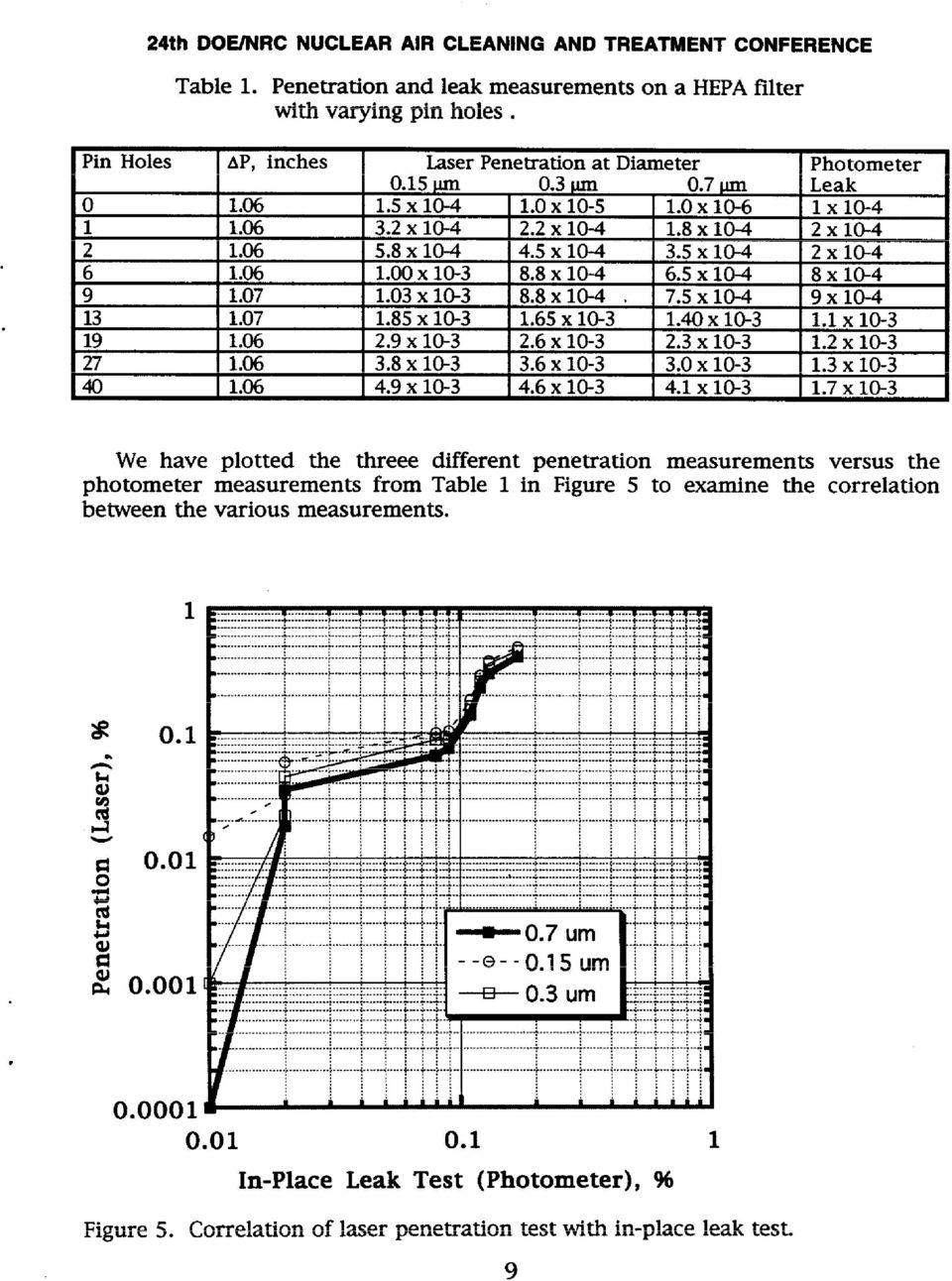
12 In general, there is poor correlation between the photometer leak and the laser penetration measurements, even for the 0,7~m data, which is supposed to represent the average size of the test aerosol in the photometer test. One of the reasons for the poor correlation is the lack of sensitivity of the photometer for penetration measurements less than 0.01%. However, the major reason for the poor correlation between the photometer leak and the laser penetration measurements is due to the fundamental difference between differential and integrated size measurements with heterodisperse aerosols. Bergman and Biermann have shown that large variations in the photometer measurements are possible compared to laser or condensation nuclei counters depending on the degree of aerosol heterodispersion and the extent of filter leaks. (7314)Figure 5 also shows that the photometer measurements, although still not satisfacto~, correlate better with the maximum penetration measurements at 0.15 pm than with the measurements at 0.3 or 0.7 pm. The lack of correlation between the in-place penetration test and the in-place leak test illustrates that the present leak test provides only an approximate measure of the sytem penetration. V. Field EvaluaH on of In-Place Penetration and In-Place Leak Tests We have conducted in-place penetration and leak tests on two typical HEPA filter installations at LLNI+a single HEPAfilter system and a two-stage HEPAfilter plenum, to evaluate the practicality of the in-place penetration test. The single HEPAfilter system located on the roof of a UN, building is shown in Figure 6 with the HS-LASlaser counter on the HEPAfilter, the LASAIRlaser counter on the blower, and the TSI aerosol diluter on the floor. The Laskin nozzle aerosol generator, not shown, was placed inside a ventilation hood in one of the building laboratories. After several in-place penetration tests were completed, the standard in-place leak test was performed using a TDA-2GN aerosol photometer (ATI, Owens Mills, MD) and a TDA-4A aerosol generator (ATI, Owens Mills, MD) with Emery The inplace leak test indicated the HEPAfilter system had 0.006% leakage. Several in-place penetration tests were conducted on the single HEPA filter system to determine the effect of challenge concentration and the repeatability of the test results. The challenge concentration is an important factor in the in-place penetration test because it affects the accuracy of the data and the duration of the test. Higher aerosol concentrations result in shorter and more precise tests but also result in instrument error due to coincidence counting. Counting errors due to coincidence occur at higher concentrations when two or more particles are counted as a single particle. Since filter penetration measurements involve two measurements at significantly different concentrations, one upstream and one downstream of the filter, separate optimization are required for each measurement. In theory, the challenge concentration is adjusted so the downstream concentration after the filter is just below coincidence counting. The upstream concentration then has to be diluted to avoid coincidence counting. However, since the commercially available diluters have a fixed dilution ratio; e.g. 100:1 for one stage dilution, 10,000:1 for two stages of dilution; the challenge 10

13 24th DOE/NRC NUCLEAR AIR CLEANING AND TREATMENT CONFERENCE concentration must be adjusted to avoid coincidence in both the upstream (challenge) and downstream measurements... Figure 6. Photograph of the in-place penetration test apparatus on a single HEPA filter system using laser counters. The HS-LASlaser counter is on the HEPAfilter, the LASAIRlaser counter on the blower, and the TSI aerosol diluter on the floor. The available dilution ratios did not allow for optimization of the concentration measurements as shown with the following illustration. Figure 7 shows the filter penetration curve derived from measurements using a 100:1 dilution of the upstream (challenge) aerosols for a single HEPAfilter system which is similar to the system shown in Figure 6. The filter penetration curve is 11

14 extremely noisy, even with a 1 minute upstream and a 15 minute downstream sample, because the low downstream aerosol concentration is at the background level. This resulted from reducing the challenge concentration to avoid coincidence counting. Increasing the sampling time did not help in this case because the measurement of background aerosols also increased. Using a 10,00Ckl diluter on the upstream sample significantly improved the precision of the data and also reduced the sampling time as seen in Figure 8. The upstream and downstream sample times for that test were 2 and 6 minutes, respectively. An optimized diluter between 1,0001 and 2,000:1 would reduce the sample time to about 1 minute for each measurement. The optimized diluter and associated calibration procedure must be developed before the in-place penetration method is adopted for routine measurements. AP=1.1O H2O Diameter, j-m Figure 7. Filter penetration as a function of aerosol diameter for a single HEPAfilter system using the in-place penetration measurement with a 1001 diluter. Open data was generated with HS-LAS,closed data with LASAIR. In-place leak test with a photometer was 6 x

15 24th DOE/NRC NUCLEAR AIR CLEANING AND TREATMENT AP=1.1O H2O y-...-v.....r...n...F.L.o.w=.l.!.oo.cF.M....v... Diameter, pm Figure 8. Filter penetration as a function of aerosol diameter for a single HEPAfilter system using the in-place penetration measurement with a 1,000:1 diluter. Open data was generated with HS-LAS, closed data with LASAIR.In-place leak test with a photometer was 6 x A detailed comparison of the time requirements for the in-place leak and the in-place penetration test is given in Table 2. The increased time to carry the penetration equipment was due to the additional laser counter, the diluter and pumps and miscellaneous items. After the in-place penetration equipment and procedure is finalized, the time for carrying the equipment will be the same for both in-place tests. The much longer test time for the penetration test can be reduced to be comparable to the leak test once the optimum diluter is developed. Table 2. Comparison of time requirements for in-place leak and in-place penetration measurements on a single HEPAfilter installation. Task Leak Test Penetration Test carryequipment to roof 2 min. 10 min. Set up equipment 2 min. 3 min. Set up generator 8 min. 8 min. Test filter 2 min. 12 min. Total 1.4 min. 33 min. 13

16 We repeated the in-place penetration test two additional times to assess the repeatability of the test. Figure 9 shows the three in-place penetration tests on the single HEPAfilter installation are very repeatable. Figure 9. Measurements of the filter penetration obtained with the in-place penetration test apparatus shown in Figure 6 repeated three times. The second field evaluation of the in-place penetration measurement was in a two-stage I-EPA filter plenum using the shroud sampling method. The shroud sampling method allows individual HEPAfalters to be leak tested independent of the other HEPAfilters in a filter bank. This is done by placing shrouds on the upstream and the downstream side of individual I-HA filters to effectively isolate the HEPAfilter from all others in the filter bank. Each shroud is a sheet metal duct that is held against the HEPAfilter or frame on one end and has a reduced 1 x 1 section on the other end. The upstream shroud is used for injecting aerosols, and the downstream shroud is used for sampling the downstream aerosols. Figure 10 shows the front (A) and rear (B) sides of the upstream shroud, that is used to expose a HEPAfilter to a uniform aerosol concentration. Figure 10 B shows the rear side of the upstream shroud with the 9 point aerosol injection manifold. The aerosols are then mixed by a baffle plate seen in Figure 10 A and B and further dispersed by a screen seen in Figure 10 B. The upstream shroud also has a sample 14

17 port for sampling the challenge concentration. The downstream shroud, shown in Figure 11, has a 9 point sampling manifold and no internal mixing devices. The filter leak or penetration is obtained by simultaneously placing the upstream and downstream shrouds against the HEPAfilter or frame as shown in Figures 12 and 13 respectively. (A) *, (B) 10. Upstream shroud for exposing individual HEPAfilters in a filter plenum to challenge aerosols. (A) shows the front side, (B) shows the rear side. 15

18 24th DOE/NRC NUCLEAR AIR CLEANING AND TREATMENT CONFERENCE!+.. Figure 11. Downstream shroud for sampling filter penetration or leak. sampling manifold is seen from the inlet side facing the HEPA filter. 16 Nine point

19 24th DOE/NRC NUCLEAR AIR CLEANING AND TREATMENT CONFERENCE. Figure 12. Downstream shroud for sampling aerosol penetration from individual filter. In-place penetration equipment used in this test.. Figure 13. Upstream shroud for generating challenge aerosols. Laskin nozzle aerosol generator used in this test. The result of the in-place penetration measurement on one filter in the plenum is shown in Figure 14. We were unable to generate the required high concentration of challenge aerosols to use the 10,000:1 diluter because the compressor shown in Figure 13 could not supply sufficient pressure to the Laskin nozzle aerosol As a result, we used the 100:1 diluter with a lower aerosol generator. concentration. This resulted in lower precision and a longer sampling time than would be required with a higher aerosol concentration and a 10,000:1 diluter. The upstream and downstream sample times were 2 and 8 minutes, respectively. The equipment used for the in-place penetration measurement using the shroud method was the same as previously described for the single filter test. 17

20 Since the shroud method only measures the penetration or leaks through the filter, and not around gasket leaks, a separate leak test is performed on each filter. This is done by directing a concentrated aerosol challenge around the perimeter of the upstream side of the filter using a long tube. Another person samples the perimeter of the downstream side of the filter using a long probe that is moved in synchronization with the upstream challenge tube. If the downstream leak is greater than 0.03% of the upstream concentration, then the filter is replaced. This traverse leak test is far more conservative than the leak or penetration measurement through the filter because no signtilcant air volume passes through the leak compared to that flowing through the filter. Since the air flow through a gasket leak parth is not known, the traverse leak test is not quantitative, but rather a qualitative test. When using the laser counter in this leak test, the counter output is set to the concentration mode and not the count mode. The conventional in-place leak test indicated the filter in Figure 14 had a leak of 2 x We used a TDA-2ENphotometer and a TDA-5B aerosol generator, both from ATI, for the in-place leak test. The test aerosol for the in-place leak test was Emery PLENUM AP=O.70 H2O Figure 14. In-place penetration measurement of a HEPAfilter in a plenum using the shroud sampling method. Open data obtained with HS-IAS, closed data with LASm. 18

21 We performed a detailed analysis of the time requirement for the in-place leak and the penetration test using the shroud method and tabulted the results in Table 3. The time requirements for all of the tasks except for the downstream measurements are comparable for the two in-place tests. As noted before, the long downstream sampling times was primarily due to the inability to generate a sufficient concentration. We anticipate that the in-place penetration measurement would not require much more time than the in-place leak test once the experimental test system is optimized.. Table 3. Comparison of time requirements for in-place leak and in-place penetration measurements on a HEPAfilter bank using the shroud method. ] Task ] Leak Test ] Penetration Test [ Equipment set up 10 min. 15 min. Equipment warm up 10 min. 10 min. Upstream mess./filter (5 min.) (4 min.) Upstreti bank (16 filters) I WI min I 64 min Downstream mess./filter.- io.3min.) (1O min.) --l n L.-.-l. f3l 01 I-JUWIH.I CdUl UtiIA1 ~ v Aers) 5 min. 160 min. m-. A-----?n : 1~dr UUWI1 I o u 11111, no 30 min. Total I 135 mi,in. I 279 min. I VI. Conclusions We have demonstrated the feasibility of conducting in-place penetration tests on high efficiency particulate air (HEPA)filters as installed in nuclear ventilation systems. The in-place penetration test, which is designed to yield equivalent penetration measurements as the standard DOP penetration tesl is based on measuring the aerosol penetration of the filter installation as a function of particle size using a portable laser particle counter.(l) Additional tests are required to confirm that the in-place penetration test yields identical results as the standard DOP penetration test for HEPAfilters with controlled leaks in the filter and gasket and duct by-pass leaks. Further development of the procedure is also required to reduce the test time before the in-place penetration test is practical. * VU, Acknowled~men~ We gratefully acknowledge the assistance Mr. Wayne Krause and Mr. Donald Beason in the shroud tests. 19
22 VII. References 1. MIL-STD-282 Filter Units, Protective Clothing, Gas-Mask Components and Related Products: Performance-Test Methods, Method 105.9, Military Standard MIL-STD-282, Commanding Ofllcer, Frankford Arsenal, Navy Department, A ITN: SMUFA-N1100, Philadelphia, PA, 19137, (1974) 2. American Society of Mechanical Engineers, Testing of Nuclear Air Treatment Systems, ASME Standard N51O-1989, The American Society of Mechanical, Engineers, th Street, NewYork, N.Y , (1989) 3. American Society of Mechanical Engineers, Code on Nuclear Air and Gas Treatment, ASME AG1-1994, The American Society of Mechanical Engineers, th Street, NewYork, N.Y , (1989) 4. Burchsted, CA, Kahn, JE, and Fuller, AB, Nuclear Air Cleaning Handbook, ERDA 76-21, National Technical Information Service, 5285 Fort Royal Rd, Springfield, VA 22161, (1976). 5. Parrish, EC and Schneider, RW, Review of inspection and testing of high-efficiency particulate air filters at ORNL, in Treatment of Radioactive Wastes, International Atomic Energy Agency, Vienna, pp (1968) installed Airborne , 6. W. Bergman, A. Biermann, W. Kuhl, B. Lure, A. Bogdanoff, H. Hebard, M. Hall, D. Banks, M. Mazumder, and J. Johnson, Electric Air Filtration: Theory, Laboratory Studies, Hardware Development, and Field Evaluations, LLNLReport, UCID January 9, (1984) 7. W. Bergman and A. Biermann, Effect of DOP Hetero-dispersion on HEPAFilter Penetration Measurements, in Proceedings of 18th DOE Nuclear Airborne Waste Nianagement and Air Cleaning Conference, Baltimore, MD, Aug , 1984, pp , NTIS,Springfield, VA, CONF , (1985) 8. Scripsick, R.c., Smitherman, R.L., and McNabb, S.A. operational evaluation. of the High Flow Alternative Filter Test System Proceedings of 19th DOE/NRC Nuclear Air Cleaning Conference, CONF , National Technical Information Service, Springfield, VA 22161, pp , (1987). 9. Schusster, B and Osetek, D, The use of a single particle intra-cavity laser particle spectrometer for measurements of HEPAfilters and filter systems 14th ERDAAir Cleaning Conference, P.528, CONF , NTIS,Springfield, VA, (1977). 20
23 10. Ortiz, J, In-place testing of multiple stage filter systems without disruption of plant operations in the plutonium facility at Los Alamos, 18th DOE Nuclear Airborne Waste Management and Air Cleaning Conference, CONF , NTIS,Springfield, VA, p. 209, (1985). 11. Ortiz, J, Biermann, A, and Nicholson, R, Preliminary test results of a round robin test program to evaluate a nulti-stage HEPA filter system using single particle size counts in Advances in Filtration and Separation Technology, 4, 213, American Filtration Society, Gulf Publishing Co., Houston, Texas (1991 ). 12. ASTM Standard Test Method for Air cleaning performance of a highefficiency particulate air filter system, F , ASTM, 1916 Race St. Philadelphia, PA, 19103, (1993). 13. Martinez, V. Procedure for in-place filter testing Los Alamos National Laboratory, Operating Manual, (1995). 14. Biermann, AH and Bergman, W, Filter penetration measurements using a condensation nuclei counter and an aerosol photometer J. Aerosol Sci., Vol. 19, No. 4, pp , (1988). 21
24 Technical Information Department Lawrence Livermore National Laboratory University of California Livermore, California 94551
HEPA FILTER DEFECTS ARE COMMON
 HEPA FILTER DEFECTS ARE COMMON Kenneth F. Cherry 1 and Kenneth A. Smigielski 2 1 NCEC Inc. 2 First Solar LLC. ABSTRACT HEPA filters (High Efficiency Particulate Air) filters are claimed by vendors to have
Guide to in situ leak testing of HEPA filter configurations that cannot be conventionally scan tested
 DOP Solutions Technical Document: Guide to in situ leak testing of HEPA filter configurations that cannot be conventionally scan tested Issue 1: Prepared by Neil Stephenson and Tim Triggs and edited by
HEPA Filters and Filter Testing A Comparison of Factory Tests and In-Service Tests Bulletin: PB2007-0504
 HEPA Filters and Filter Testing A Comparison of Factory Tests and In-Service Tests Bulletin: PB2007-0504 Introduction HEPA filters, once known as absolute filters, were originally developed as the particulate
EACO DOP / PAO TESTING GUIDELINE 2013
 2013 Foreword The guideline promotes industry standards for training, equipment, and methodologies for HEPA filter integrity testing of negative air units, vacuums and any other HEPA filtered equipment
HEPA Filters and Filter Testing A Comparison of Factory Tests and In-Service Tests
 FOREMOST IN AIR FILTRATION HEPA Filters and Filter Testing PB-2007-1203 HEPA Filters and Filter Testing A Comparison of Factory Tests and In-Service Tests A Wholly Owned Subsidiary of Flanders Corporation
Certification system of air filter quality (CAF mark)
 Certification system of air filter quality (CAF mark) KOREA AIR CLEANING ASSOCIATION 1. Overview What is the certification system of air filter quality (CAF mark)? It is a mark granted by the KACL depending
CETA Application Guide for the Exhaust System Requirements of Class II, Type B Biosafety Cabinets CAG-007-2010 March 24, 2010
 CETA Application Guide for the Exhaust System Requirements of Class II, Type B Biosafety Cabinets CAG-007-2010 March 24, 2010 1. Background Class II Type B Biosafety Cabinets (BSCs) are unique laboratory
Environmental Monitoring
 Chapter 10 Environmental Monitoring By the end of this chapter, you will be able to: l List the types of environmental testing l Name three types of checks that are carried out to ensure the isolator is
ENVIRONMENTAL MONITORING / TESTING TO CONFORM WITH ISO14644 & TGA GMP REQUIREMENTS
 ENVIRONMENTAL MONITORING / TESTING TO CONFORM WITH ISO14644 & TGA GMP REQUIREMENTS PRESENTATION TO RACI 20 TH APRIL 2016 PAUL MORGAN DIRECTOR CRITICAL CERTIFICATION PTY LTD CHANGES TO ISO14644 PART 1 CHANGES
MILLIKEN CLEAN COAL TECHNOLOGY DEMONSTRATION PROJECT UNIT 2 ELECTROSTATIC PRECIPITATOR PERFORMANCE TEST RESULTS BEFORE AND AFTER MODIFICATION
 MILLIKEN CLEAN COAL TECHNOLOGY DEMONSTRATION PROJECT UNIT 2 ELECTROSTATIC PRECIPITATOR PERFORMANCE TEST RESULTS BEFORE AND AFTER MODIFICATION Prepared by: CONSOL Inc. Research & Development 4000 Brownsville
Active Vibration Isolation of an Unbalanced Machine Spindle
 UCRL-CONF-206108 Active Vibration Isolation of an Unbalanced Machine Spindle D. J. Hopkins, P. Geraghty August 18, 2004 American Society of Precision Engineering Annual Conference Orlando, FL, United States
G U I D E L CERTIFICATION EDUCATION TRAINING. Procurement Guideline. National Air Filtration Association Recommended Practice
 G U National Air Filtration Association Recommended Practice I D E L I N E Procurement Guideline TRAINING EDUCATION CERTIFICATION HVAC Air Filter Purchasing Specification Guideline 1.0 Purpose To provide
Asbestos in the Workplace: A Guide to Removal of Friable Asbestos Containing Material
 Asbestos in the Workplace: A Guide to Removal of Friable Asbestos Containing Material Revised November 21, 2013 Application Code of Practice Where asbestos is present or believed to be present in a workplace
Modeling and Simulation of HVAC Faulty Operations and Performance Degradation due to Maintenance Issues
 LBNL-6129E ERNEST ORLANDO LAWRENCE BERKELEY NATIONAL LABORATORY Modeling and Simulation of HVAC Faulty Operations and Performance Degradation due to Maintenance Issues Liping Wang, Tianzhen Hong Environmental
Testing HEPA/ULPA filters at the manufacturer s facility and in situ on the user s premises
 Publication Series Viledon Testing HEPA/ULPA filters at the manufacturer s facility and in situ on the user s premises Dipl.-Ing. Thomas Schroth Dr.-Ing. Thomas Caesar Lecture at 4th CLEANROOMS Europe
1.0 What Are the Purpose and Applicability of Performance Specification 11?
 While we have taken steps to ensure the accuracy of this Internet version of the document, it is not the official version. Please refer to the official version in the FR publication, which appears on the
Defect studies of optical materials using near-field scanning optical microscopy and spectroscopy
 UCRL-ID-142178 Defect studies of optical materials using near-field scanning optical microscopy and spectroscopy M. Yan, J. McWhirter, T. Huser, W. Siekhaus January, 2001 U.S. Department of Energy Laboratory
DISCLAIMER. This document was prepared as an account of work sponsored by an agency of the United States
 DISCLAIMER This document was prepared as an account of work sponsored by an agency of the United States Government. Neither the United States Government nor the University of California nor any of their
How To Run A Data Center Efficiently
 A White Paper from the Experts in Business-Critical Continuity TM Data Center Cooling Assessments What They Can Do for You Executive Summary Managing data centers and IT facilities is becoming increasingly
Evaluation Of Hybrid Air- Cooled Flash/Binary Power Cycle
 INL/CON-05-00740 PREPRINT Evaluation Of Hybrid Air- Cooled Flash/Binary Power Cycle Geothermal Resources Council Annual Meeting Greg Mines October 2005 This is a preprint of a paper intended for publication
AABC Specifications for Testing and Balancing HVAC Systems
 AABC Specifications for Testing and Balancing HVAC Systems The Associated Air Balance Council (AABC) Total System Balancing Specifications for HVAC Testing, Balancing and Performance Verification TOTAL
DRAFT 8/13/2015. Proposed Addition of Non-Mandatory Appendix FC-B has been withdrawn from publication in the next edition.
 AG-1-201X Revision of ASME AG-1-2012 Code on Nuclear Air and Gas Treatment DRAFT 8/13/2015 Appendix FC-B has been withdrawn from publication in the next edition. Proposed revisions to Section FC-B have
Wind Forecasting stlljectives for Utility Schedule and Energy Traders
 NREUCP 500 24680 UC Category: 1210 Wind Forecasting stlljectives for Utility Schedule and Energy Traders Marc N. Schwartz National Renewable Energy Laboratory Bruce H. Bailey A WS Scientific, Inc. Presented
CONTAMINATION CONTROL FOR ELECTRONIC AND SEMICONDUCTOR APPLICATIONS
 CONTAMINATION CONTROL FOR ELECTRONIC AND SEMICONDUCTOR APPLICATIONS UNDERSTANDING, ACCELERATED TSI SETS THE STANDARD FOR PARTICLE COUNTING Performance Semiconductor, hard disk drive, and flat panel manufacturers
APPENDIX A-1 SAMPLE CLEANROOM SPECIFICATIONS MICROELECTRONICS & SEMICONDUCTORS
 APPENDIX A-1 SAMPLE CLEANROOM SPECIFICATIONS SECTION xxxxx CLEANROOM PERFORMANCE TESTING PART 1 -- GENERAL 1.1 WORK INCLUDED A. This Section specifies the requirements of the NEBB Certified Cleanroom Performance
WinMagic Encryption Software Installation and Configuration
 WinMagic Encryption Software Installation and Configuration Don Mendonsa, Faranak Nekoogar, Harry Martz Lawrence Livermore National Laboratory Livermore, CA 94551 Work performed on the Science & Technology
IPACK2005-73273 DISTRIBUTED LEAKAGE FLOW IN RAISED-FLOOR DATA CENTERS
 Proceedings of IPACK5 ASME InterPACK '5 July 17-, San Francisco, California, USA IPACK5-7373 DISTRIBUTED LEAKAGE FLOW IN RAISED-FLOOR DATA CENTERS Amir Radmehr Innovative Research, Inc. Plymouth, MN, USA
PROCESS PARTICLE COUNTER (PPC) SENSOR/CONTROLLER FOR OPTIMIZING POWER RECOVERY EXPANDER AND GAS TURBINE PERFORMANCE
 PROCESS PARTICLE COUNTER (PPC) SENSOR/CONTROLLER FOR OPTIMIZING POWER RECOVERY EXPANDER AND GAS TURBINE PERFORMANCE APPLICATIONS NOTE FOR MEASUREMENTS AT THE ENTRANCE AND EXIT OF A THIRD STAGE SEPARATOR
S.L. Chang, S.A. Lottes, C.Q. Zhou,** B. Golchert, and M. Petrick
 3 -- 3 CFD CODE DEVELOPMENT FOR PERFORMANCE EVALUATION OF A PILOT-SCALE FCC RISER REACTOR* S.L. Chang, S.A. Lottes, C.Q. Zhou,** B. Golchert, and M. Petrick Ekergy Systems Division Argonne National Laboratory
How Does Your Data Center Measure Up? Energy Efficiency Metrics and Benchmarks for Data Center Infrastructure Systems
 How Does Your Data Center Measure Up? Energy Efficiency Metrics and Benchmarks for Data Center Infrastructure Systems Paul Mathew, Ph.D., Staff Scientist Steve Greenberg, P.E., Energy Management Engineer
Confocal μ-xrf for 3D analysis of elements distribution in hot environmental particles
 LLNL-TR-400056 LAWRENCE LIVERMORE NATIONAL LABORATORY Confocal μ-xrf for 3D analysis of elements distribution in hot environmental particles M. Bielewski M. Eriksson J. Himbert R. Simon M. Betti T.F. Hamilton
SECTION 23 81 03 - PACKAGED ROOFTOP AIR CONDITIONING UNITS NON-CUSTOM
 SECTION 23 81 03 - PACKAGED ROOFTOP AIR CONDITIONING UNITS NON-CUSTOM PART 1 - GENERAL 1.1 SUMMARY A. Section Includes: 1. Packaged rooftop air conditioning unit (5 tons and smaller). 2. Roof curb. 1.2
Isolation of Battery Chargers Integrated Into Printed Circuit Boards
 LLNL-TR-646864 Isolation of Battery Chargers Integrated Into Printed Circuit Boards J. S. Sullivan November 26, 2013 Disclaimer This document was prepared as an account of work sponsored by an agency of
NREL Job Task Analysis: Crew Leader
 NREL Job Task Analysis: Crew Leader Chuck Kurnik National Renewable Energy Laboratory Cynthia Woodley Professional Testing Inc. NREL is a national laboratory of the U.S. Department of Energy, Office of
SPECIAL APPLICATIONS
 Page 1 SPECIAL APPLICATIONS The protection of microelectronics clean rooms using aspirating smoke detection systems requires special consideration. The physical configuration of the room(s) and the direction
Status And Future Plans. Mitsuyoshi Tanaka. AGS Department.Brookhaven National Laboratory* Upton NY 11973, USA INTRODUCTION
 6th Conference on the Intersections of Particle & Nuclear Physics Big Sky, Montana May 27-June 2, 1997 / BNL-6 40 4 2 c0,lvf- 7 70 5 The BNL AGS Accelerator Complex Status And Future Plans Mitsuyoshi Tanaka
VOLU-probe/SS. Stainless Steel Pitot Airflow Traverse Probes. Accurate airflow measurement for demanding applications
 VOLU-probe/SS Stainless Steel Pitot Airflow Traverse Probes Accurate airflow measurement for demanding applications VOLU-probe/SS The VOLU-probe/SS Stainless Steel Pitot Airflow Traverse Probe is ideally
A. Air-Conditioning and Refrigeration Institute: 1. ARI 850 - Commercial and Industrial Air Filter Equipment.
 SECTION 23 40 00 - HVAC AIR CLEANING DEVICES PART 1 - GENERAL 1.1 SUMMARY A. Section Includes: 1. Activated carbon filters. 2. Extended surface rigid air filter with synthetic media. 3. Disposable panel
HVAC Design Requirements
 Maintenance of HVAC HVAC Design Requirements Air Flow Diagram แบบ Recirculation Air Flow Diagram แบบ Once Through Definition Of Conditions As built At rest In operation air air air Maintenance GMP Requirements
FEMP Designated Product Assessment for Commercial Gas Water Heaters
 FEMP Designated Product Assessment for Commercial Gas Water Heaters Jim Lutz Energy Analysis Department Lawrence Berkeley National Laboratory Berkeley, CA 94720 April, 2010 This work was supported by the
How to Measure HVAC System Airflow
 How to Measure HVAC System Airflow About National Comfort Institute National Comfort Institute is an international training Since our and beginning development in 1994 company we have trained with and
Class II Type B2 Laminar Flow Biological Safety Cabinets at Ordering Criteria for the National Institutes of Health
 Background Class II Type B2 Laminar Flow Biological Safety Cabinets at Ordering Criteria for the National Institutes of Health This document provides guidelines for the design and installation of Class
NEBB STANDARDS SECTION-8 AIR SYSTEM TAB PROCEDURES
 NEBB STANDARDS SECTION-8 AIR SYSTEM TAB PROCEDURES 8.1 INTRODUCTION Testing, adjusting, and balancing of HVAC systems can best be accomplished by following a series of systematic procedures. The NEBB TAB
Technical Support for ENERGY STAR Windows Version 6.0 Specification Revision. Gregory K. Homan, Christian Kohler, Emily Zachery* and Dariush Arasteh
 Technical Support for ENERGY STAR Windows Version 6.0 Specification Revision Gregory K. Homan, Christian Kohler, Emily Zachery* and Dariush Arasteh Lawrence Berkeley National Laboratory 1 Cyclotron Road
PERFORMANCE OF SIDE-BY-SIDE SOUTH TEXAS HOMES Isolating the Contribution of Spray Polyurethane Foam Insulation
 PERFORMANCE OF SIDE-BY-SIDE SOUTH TEXAS HOMES Isolating the Contribution of Spray Polyurethane Foam Insulation INTRODUCTION As the use of spray polyurethane foam (SPF) insulation is increasing in both
Building CHAOS: an Operating System for Livermore Linux Clusters
 UCRL-ID-151968 Building CHAOS: an Operating System for Livermore Linux Clusters Jim E. Garlick Chris M. Dunlap February 21, 2002 Approved for public release; further dissemination unlimited DISCLAIMER
Laser Safety Audit and Inventory System Database
 SAND REPORT SAND2003-1144 Unlimited Release Printed May 2003 Laser Safety Audit and Inventory System Database Arnold L. Augustoni Prepared by Sandia National Laboratories Albuquerque, New Mexico 87185
Ceiling Mount Air Handler Manual
 www.surna.com 303.993.5271 Ceiling Mount Air Handler Manual Models: CMAH12, CMAH18, CMAH24, CMAH30, CMAH36, CMAH48, CMAH60 Revised: September 2014 Table of Contents Warranty Information 4 Limited Warranty
HVAC Systems: Overview
 HVAC Systems: Overview Michael J. Brandemuehl, Ph.D, P.E. University of Colorado Boulder, CO, USA Overview System Description Secondary HVAC Systems Air distribution Room diffusers and air terminals Duct
LifeASSURE PFS Series Filter Cartridge Integrity Testing
 LifeASSURE PFS Series Filter Cartridge Integrity Testing Introduction Integrity testing is the end user s method of confirming the structural integrity of a membrane filter before and after use. It is
Penetration Testing of Industrial Control Systems
 SF-1075-SUR (8-2005) SANDIA REPORT SAND2005-2846P Unlimited Release Printed March, 2005 Penetration Testing of Industrial Control Systems David P. Duggan Prepared by Sandia National Laboratories Albuquerque,
Radioactive Waste Storage Facility and Tank System Design Criteria Standards
 UCRL-AR-133355 Rev 1 Radioactive Waste Storage Facility and Tank System Design Criteria Standards John Wood Rich Michalik Karen Doiron May 1999 DISCLAIMER This document was prepared as an account of work
Measurement of BET Surface Area on Silica Nanosprings
 PNNL-17648 Prepared for the U.S. Department of Energy under Contract DE-AC05-76RL01830 Measurement of BET Surface Area on Silica Nanosprings AJ Karkamkar September 2008 DISCLAIMER This report was prepared
ASBESTOS MANAGEMENT PROGRAM
 ASBESTOS MANAGEMENT PROGRAM Prepared By: Triumvirate Environmental Program Approval Developed: August 2011 Updated: June 2015 Associate Vice President of Public Safety & Administrative Services Date Associate
Indoor air quality monitoring made easy
 Indoor air quality monitoring made easy with the Fluke 985 Particle Counter Application Note Introduction Energy savings is top of facilities owners agenda. HVAC system tends to be the largest contributor
Home Energy Evaluation Report for Fritz Kreiss and Catherine McQueen
 Home Energy Evaluation Report for Fritz Kreiss and Catherine McQueen May 2008 Wisconsin Area PO BOX 115 Lake Geneva, WI 53147 CELL (414) 550-4765 Home Performance with ENERGY STAR Evaluation Report Customer
ME 538: Experiment # 1 Flow measurement and particle generation instruments
 ME 538: Experiment # 1 Flow measurement and particle generation instruments Suresh Dhaniyala Mechanical and Aeronautical Engineering Clarkson University Flow rate measurement Various types of flowmeters
A Compact Linac for Proton Therapy Based on a Dielectric Wall Accelerator
 UCRL-CONF-236077 A Compact Linac for Proton Therapy Based on a Dielectric Wall Accelerator G. J. Caporaso, T. R. Mackie, S. Sampayan, Y. -J. Chen, D. Blackfield, J. Harris, S. Hawkins, C. Holmes, S. Nelson,
Requesting Nodes, Processors, and Tasks in Moab
 LLNL-MI-401783 LAWRENCE LIVERMORE NATIONAL LABORATORY Requesting Nodes, Processors, and Tasks in Moab D.A Lipari March 29, 2012 This document was prepared as an account of work sponsored by an agency of
Situated Usability Testing for Security Systems
 PNNL-20201 Prepared for the U.S. Department of Energy under Contract DE-AC05-76RL01830 Situated Usability Testing for Security Systems FL Greitzer February 2011 DISCLAIMER This report was prepared as an
Phoenix Process Engineering, Inc. Project Experience Helping Clients Achieve MACT Compliance
 Phoenix Process Engineering, Inc. Project Experience Helping Clients Achieve MACT Compliance The Boiler MACT, 40 CFR 63, Subpart DDDDD, was vacated in 2007 by the U.S Court of Appeals and the 2004 rule
A LAMINAR FLOW ELEMENT WITH A LINEAR PRESSURE DROP VERSUS VOLUMETRIC FLOW. 1998 ASME Fluids Engineering Division Summer Meeting
 TELEDYNE HASTINGS TECHNICAL PAPERS INSTRUMENTS A LAMINAR FLOW ELEMENT WITH A LINEAR PRESSURE DROP VERSUS VOLUMETRIC FLOW Proceedings of FEDSM 98: June -5, 998, Washington, DC FEDSM98 49 ABSTRACT The pressure
Filter Test Facility Report On The Testing of HEPA Filters for the DOE
 Filter Test Facility Report On The Testing of HEPA Filters for the DOE Nuclear Air Cleaning Conference August 2008 Air Techniques International Test Laboratory 1708 Whitehead Rd., Baltimore, MD 21207 2
ISO 21501 A Standard Methodology to Optical Particle Counter Calibration and What It Means to Cleanroom Owners
 ISO 21501 A Standard Methodology to Optical Particle Counter Calibration and What It Means to Cleanroom Owners Tony Harrison and Bob Latimer ISO 21501- A Standard Methodology to Optical Particle Counter
Section 6 Fire Detection and Alarm Systems Russell Porteous Chief Executive Officer Firewize Services
 Section 6 Fire Detection and Alarm Systems Russell Porteous Chief Executive Officer Firewize Services General Information Section 6 of AS1851-2012 covers: Fire Detection and Alarms Systems Electrical Detection
How To Install A Perfect 16 Id Series Filter System
 IQAir Perfect 16 ID-Series MERV16 Micro-Particle Filtration System Perfect 16 Installation Manual Product Data High-Performance Medical-Grade Residential/Commercial Air Filtration System Application The
SUMMARY of PRODUCTS. HVAC Systems Control Airflow, Space, & Building Pressurization. Accurate airflow measurement for demanding applications
 SUMMARY of PRODUCTS HVAC Systems Control Airflow, Space, & Building Pressurization Accurate airflow measurement for demanding applications Airflow Measuring Stations FAN-E AIRFLOW MEASURING STATION. The
Second Line of Defense Virtual Private Network Guidance for Deployed and New CAS Systems
 PNNL-19266 Prepared for the U.S. Department of Energy under Contract DE-AC05-76RL01830 Second Line of Defense Virtual Private Network Guidance for Deployed and New CAS Systems SV Singh AI Thronas January
R. Ruckman & B. Prosser Mine Ventilation Services, Inc., Clovis, California USA
 13 th United States/North American Mine Ventilation Symposium, 2010 Hardcastle & McKinnon (Eds.) 2010, MIRARCO - Mining Innovation Integrating ventilation monitoring sensor data with ventilation computer
How To Order A Direct Flow Air Cleaner
 Reduced Volume - Improved Performance - Flexible Packaging The patented Direct Flow technology provides the flexibility to optimize the air system performance to size ratio, meeting the demands of today
Optical Blade Position Tracking System Test
 National Renewable Energy Laboratory Innovation for Our Energy Future A national laboratory of the U.S. Department of Energy Office of Energy Efficiency & Renewable Energy Optical Blade Position Tracking
Potential of Energy Efficiency and Renewable Energy Savings To Impact Florida s Projected Energy Use in 2014
 Potential of Energy Efficiency and Renewable Energy Savings To Impact Florida s Projected Energy Use in 2014 Author Fairey, Philip Publication Number FSEC-RR-58-06 Copyright Copyright Florida Solar Energy
Molecular Dynamics Study of Void Growth and Dislocations in dynamic Fracture of FCC and BCC Metals
 Preprint UCRL-JC-151375 Molecular Dynamics Study of Void Growth and Dislocations in dynamic Fracture of FCC and BCC Metals E. T. Seppala, J. Belak, R. E. Rudd This article was submitted to: Plasticity
Liabilities of Vented Crawl Spaces And Their Impacts on Indoor Air Quality in Southeastern U.S. Homes
 Liabilities of Vented Crawl Spaces And Their Impacts on Indoor Air Quality in Southeastern U.S. Homes Jonathan Coulter, Bruce Davis, Cyrus Dastur, Melissa Malkin-Weber and Tracy Dixon Advanced Energy,
A Systems Approach to HVAC Contractor Security
 LLNL-JRNL-653695 A Systems Approach to HVAC Contractor Security K. M. Masica April 24, 2014 A Systems Approach to HVAC Contractor Security Disclaimer This document was prepared as an account of work sponsored
Simulating Aftershocks for an On Site Inspection (OSI) Exercise
 LLNL-TR-677873 Simulating Aftershocks for an On Site Inspection (OSI) Exercise J. J. Sweeney, S. R. Ford October 5, 2015 Disclaimer This document was prepared as an account of work sponsored by an agency
Impact of Infiltration on Heating and Cooling Loads in U.S. Office Buildings
 Impact of Infiltration on Heating and Cooling Loads in U.S. Office Buildings 1 Steven J. Emmerich, 1 Andrew K. Persily, and 2 Timothy P. McDowell 1 Building and Fire Research Laboratory, National Institute
SECTION 23 01 30.51 HVAC AIR-DISTRIBUTION SYSTEM CLEANING
 SECTION 23 01 30.51 HVAC AIR-DISTRIBUTION PART 1 - GENERAL 1.1 SUMMARY A. Section includes cleaning of interior surfaces of HVAC equipment. The HVAC equipment cleaning work includes the following: 1. Air
OPTICAL PARTICLE SIZER MASS CALIBRATION METHOD
 OPTICAL PARTICLE SIZER MASS CALIBRATION METHOD APPLICATION NOTE OPS-001 The Optical Particle Sizer (OPS) is calibrated for size with Polystyrene Latex (PSL) spheres (per ISO 12501-1/4) at TSI. This method
Nuclear Engineering Enrollments and Degrees Survey, 2014 Data
 Nuclear Engineering Enrollments and Degrees Survey, 2014 Data Number 74 Oak Ridge Institute for Science and Education 2015 SURVEY UNIVERSE The 2014 survey includes degrees granted between September 1,
Benefits of Cold Aisle Containment During Cooling Failure
 Benefits of Cold Aisle Containment During Cooling Failure Introduction Data centers are mission-critical facilities that require constant operation because they are at the core of the customer-business
INFRARED MONITORING OF 110 GHz GYROTRON WINDOWS AT DIII D
 GA A23981 INFRARED MONITORING OF 110 GHz GYROTRON WINDOWS AT DIII D by Y. GORELOV, J. LOHR, R.W. CALLIS, and D. PONCE MAY 2002 DISCLAIMER This report was prepared as an account of work sponsored by an
Validation of process gas systems
 Validation of Process Gas Systems By Jeff Hargroves Alza Corporation Validation of process gas systems involve documenting the expected system behavior, and verifying that the system performs as expected.
PERFORMANCE TEST REPORT. Rendered to: FORMTECH ENTERPRISES, INC. SERIES/MODEL: Truline PRODUCT TYPE: PVC Seawall
 PERFORMANCE TEST REPORT Rendered to: FORMTECH ENTERPRISES, INC. SERIES/MODEL: Truline PRODUCT TYPE: PVC Seawall Report No.: Test Dates: 04/17/12 Through: 04/18/12 Report Date: 06/13/12 130 Derry Court
A New Empirical Relationship between Thrust Coefficient and Induction Factor for the Turbulent Windmill State
 National Renewable Energy Laboratory Innovation for Our Energy Future A national laboratory of the U.S. Department of Energy Office of Energy Efficiency & Renewable Energy A New Empirical Relationship
PROCEDURAL STANDARDS FOR CERTIFIED TESTING OF CLEANROOMS
 PROCEDURAL STANDARDS FOR CERTIFIED TESTING OF CLEANROOMS 2009 THIRD EDITION National Environmental Balancing Bureau 8575 Grovemont Circle Gaithersburg, Maryland 20877 301-977-3698 301-977-9589 FAX www.nebb.org
UBC Plant Operations Asbestos Work Procedures April 2004
 UBC Plant Operations Asbestos Work Procedures April 2004 These Procedures are for use by UBC Plant Operations, Utilities, Housing & Conferences, and IT Services only and are not intended for use by other