
Optical Blade Position Tracking System Test
|
|
|
- Moris Walsh
- 10 years ago
- Views:
Transcription
1 National Renewable Energy Laboratory Innovation for Our Energy Future A national laboratory of the U.S. Department of Energy Office of Energy Efficiency & Renewable Energy Optical Blade Position Tracking System Test Technical Report NREL/TP January 2006 L.J. Fingersh NREL is operated by Midwest Research Institute Battelle Contract No. DE-AC36-99-GO10337

2 Optical Blade Position Tracking System Test Technical Report NREL/TP January 2006 L.J. Fingersh Prepared under Task No(s). CP National Renewable Energy Laboratory 1617 Cole Boulevard, Golden, Colorado Operated for the U.S. Department of Energy Office of Energy Efficiency and Renewable Energy by Midwest Research Institute Battelle Contract No. DE-AC36-99-GO10337

3 NOTICE This report was prepared as an account of work sponsored by an agency of the United States government. Neither the United States government nor any agency thereof, nor any of their employees, makes any warranty, express or implied, or assumes any legal liability or responsibility for the accuracy, completeness, or usefulness of any information, apparatus, product, or process disclosed, or represents that its use would not infringe privately owned rights. Reference herein to any specific commercial product, process, or service by trade name, trademark, manufacturer, or otherwise does not necessarily constitute or imply its endorsement, recommendation, or favoring by the United States government or any agency thereof. The views and opinions of authors expressed herein do not necessarily state or reflect those of the United States government or any agency thereof. Available electronically at Available for a processing fee to U.S. Department of Energy and its contractors, in paper, from: U.S. Department of Energy Office of Scientific and Technical Information P.O. Box 62 Oak Ridge, TN phone: fax: mailto:[email protected] Available for sale to the public, in paper, from: U.S. Department of Commerce National Technical Information Service 5285 Port Royal Road Springfield, VA phone: fax: [email protected] online ordering: Printed on paper containing at least 50% wastepaper, including 20% postconsumer waste

4 Introduction As wind turbines have grown larger, their structures have grown softer and more highly optimized. As a result, wind turbine controls are now seen as a viable way of reducing structural loads on wind turbines and therefore reducing the amount of material needed to withstand the resulting stresses. One problem with using such advanced controls is that they need inputs. The inputs that work best are those closest to the forces applying the loads to the structure. On a wind turbine, those are aerodynamic forces applied to the blades. Unfortunately, systems designed to measure those forces directly are expensive and unreliable and are therefore very unlikely to be deployed onto commercial machines. The alternative described in this paper is to measure the blade deflection along the span of the blade. It has long been known that this is a very good input source for advanced controls. The problem is in obtaining a blade deflection signal in a cost-effective and reliable manner. This paper proposes the use of simple off-the-shelf infrared security cameras along with blade-mounted retro-reflective tape and video image processing hardware and software to obtain these measurements. System The system proposed is extremely simple and easy to implement. All one must do is to mount small tabs along the blade, preferably along the trailing edge, each with a small amount of highly-selective retro-reflective tape facing the blade root. A security camera containing infrared emitters (Figure 1) is then mounted at a position near the root of the blade such that it can see the tabs. The infrared light from the emitters is bounced straight back to the camera via the tape. The camera can observe the location of the tape and the image can be captured by video capture hardware. Through calibration, the location of the tape, and hence the blade, can be determined. Figure 1. Security camera with infrared emitter and IR filter The camera used has been modified with the addition of an infrared filter over the lens. This filter has its center frequency at the frequency of the IR LEDs. This filter is designed to filter out all other wavelength except those that come from the infrared LED light reflected back by the tape. Unfortunately, clouds also emit this frequency when illuminated by sunlight. It is hoped that the IR tape is brighter than the clouds and the clouds can be filtered out by luminance 1

5 value at the processing stage. Initial testing indicated this might be the case, but this result has yet to be validated. Testing In order to determine the feasibility of this system, a simple test was performed. A static blade test was performed (Figure 2) and the testing involved string-potentiometers designed to measure deflection at three locations along the blade. This represented an opportunity to check the performance of the optical system against a known reference. Figure 2. Blade static test 2

6 The camera was set up and tape was applied to the three load saddles (Figure 3). The bolt will be addressed later. One complication of the test was that the stringpotentiometers were not located at the saddle locations but were instead located nearby. This resulted in the need to adjust one data set to the other in order to determine if the data were consistent. Figure 3. Camera, tape, and bolt locations 3

7 Calibrations were performed very simply by holding a large ruler next to the measurement locations. Video was captured during this process and frames were analyzed later. One such frame is in Figure 4. The frame was analyzed to determine the length of the ruler in pixels. Combining this information with the known length of the ruler (18 inches in this case) led to a calibration of pixels/inch at each station. The bright squares at the top are lens flare and the speckles around the frame are hot pixels. Both can be eliminated quite easily in several ways. We intend to remove most of the flare by reducing the image exposure and the hot pixels by a method called dark-frame subtraction in which a frame is captured in the dark and that frame is subtracted from all future frames. Figure 4. Example calibration frame 4

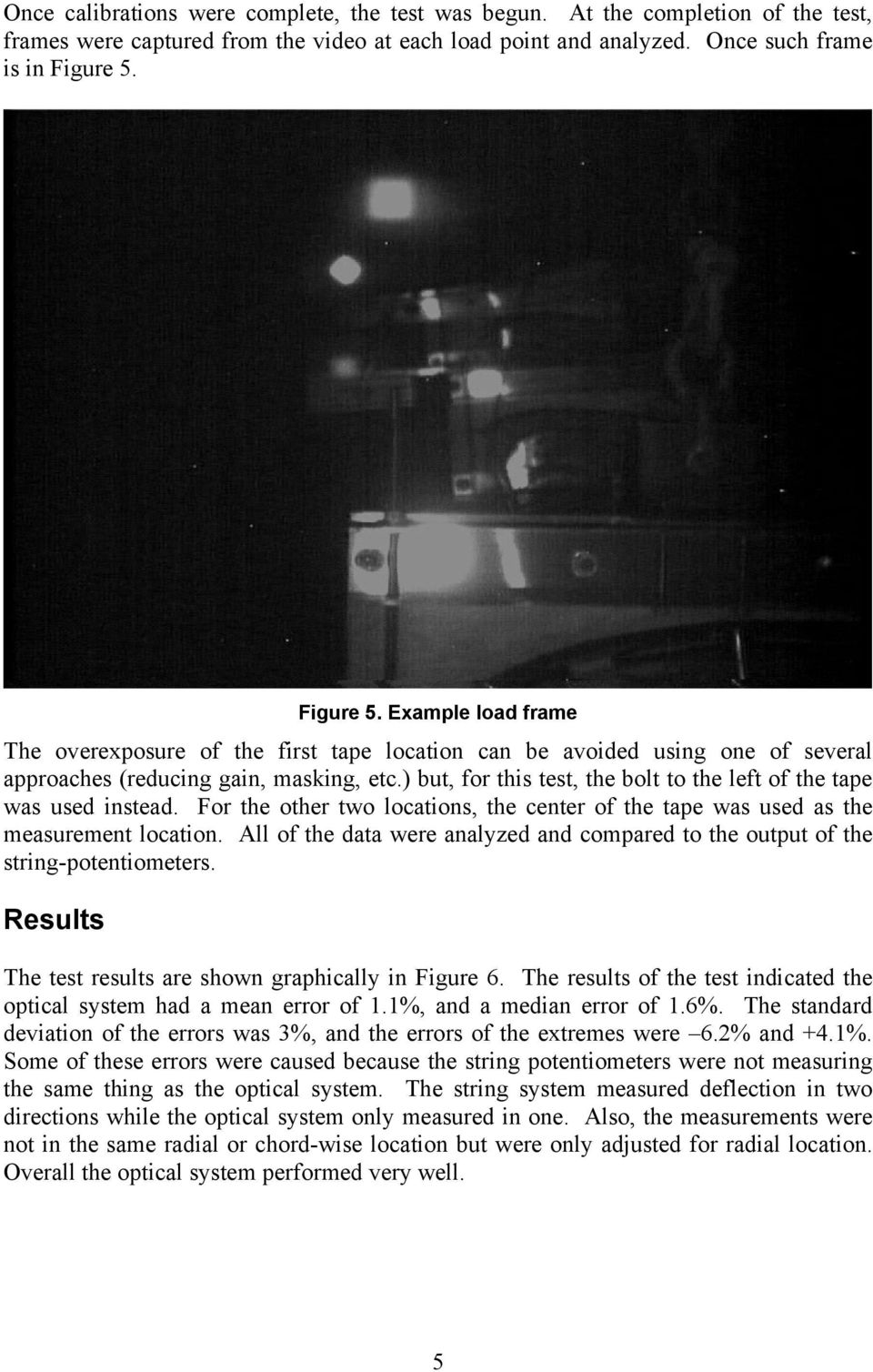
8 Once calibrations were complete, the test was begun. At the completion of the test, frames were captured from the video at each load point and analyzed. Once such frame is in Figure 5. Figure 5. Example load frame The overexposure of the first tape location can be avoided using one of several approaches (reducing gain, masking, etc.) but, for this test, the bolt to the left of the tape was used instead. For the other two locations, the center of the tape was used as the measurement location. All of the data were analyzed and compared to the output of the string-potentiometers. Results The test results are shown graphically in Figure 6. The results of the test indicated the optical system had a mean error of 1.1%, and a median error of 1.6%. The standard deviation of the errors was 3%, and the errors of the extremes were 6.2% and +4.1%. Some of these errors were caused because the string potentiometers were not measuring the same thing as the optical system. The string system measured deflection in two directions while the optical system only measured in one. Also, the measurements were not in the same radial or chord-wise location but were only adjusted for radial location. Overall the optical system performed very well. 5
9 Displacement Station 1 - String pot Station 2 - String pot Station 3 - String pot Station 1 - Optical Station 2 - Optical Station 3 - Optical Load Figure 6. Test results One big benefit to this system over other systems for measuring blade deflection is that it is inherently continuous and multi-point. In fact, with an interleaved camera, it is possible to extract 60 new frames per second for analysis at three or more points along the blade span. The system is also very inexpensive, highly reliable, and readily available. Possible drawbacks include the need for video capture hardware and processing software, though, in many cases these can also be obtained quite inexpensively. Another possible drawback is interference from the sun or from clouds. Finally, it is not known how well this system will perform in snow, fog, or icing conditions. In the event there are dropouts from the system, it may be possible to control the turbine loads anyway. With estimators, there is likely to be a loss of performance but it is equally likely that turbine shutdown will not be required. There are many approaches to increasing robustness in control design and many of them are applicable to this system. Conclusion and Future Plans The optical system was set up very easily and quickly and yet performed very well. We now intend to put the system on the CART 3 turbine that is currently being installed at the National Wind Technology Center for controls research. The cameras will be interfaced with real-time video processing hardware and software and integrated into the control system. 6

10 REPORT DOCUMENTATION PAGE Form Approved OMB No The public reporting burden for this collection of information is estimated to average 1 hour per response, including the time for reviewing instructions, searching existing data sources, gathering and maintaining the data needed, and completing and reviewing the collection of information. Send comments regarding this burden estimate or any other aspect of this collection of information, including suggestions for reducing the burden, to Department of Defense, Executive Services and Communications Directorate ( ). Respondents should be aware that notwithstanding any other provision of law, no person shall be subject to any penalty for failing to comply with a collection of information if it does not display a currently valid OMB control number. PLEASE DO NOT RETURN YOUR FORM TO THE ABOVE ORGANIZATION. 1. REPORT DATE (DD-MM-YYYY) January REPORT TYPE technical report 4. TITLE AND SUBTITLE Optical Blade Position Tracking System Test 3. DATES COVERED (From - To) 5a. CONTRACT NUMBER DE-AC36-99-GO b. GRANT NUMBER 5c. PROGRAM ELEMENT NUMBER 6. AUTHOR(S) L.J. Fingersh 5d. PROJECT NUMBER NREL/TP e. TASK NUMBER WER f. WORK UNIT NUMBER 7. PERFORMING ORGANIZATION NAME(S) AND ADDRESS(ES) National Renewable Energy Laboratory 1617 Cole Blvd. Golden, CO PERFORMING ORGANIZATION REPORT NUMBER NREL/TP SPONSORING/MONITORING AGENCY NAME(S) AND ADDRESS(ES) 10. SPONSOR/MONITOR'S ACRONYM(S) NREL 11. SPONSORING/MONITORING AGENCY REPORT NUMBER 12. DISTRIBUTION AVAILABILITY STATEMENT National Technical Information Service U.S. Department of Commerce 5285 Port Royal Road Springfield, VA SUPPLEMENTARY NOTES 14. ABSTRACT (Maximum 200 Words) Wind turbine controls are a viable way of reducing structural loads on large wind turbines, therefore reducing the amount of material needed to withstand the resulting stresses. Advanced controls need inputs on the forces applying the loads to the structure. On a wind turbine, those are aerodynamic forces applied to the blades. Systems designed to measure those forces directly are expensive and unreliable. This paper proposes the use of simple offthe-shelf infrared security cameras along with blade-mounted retro-reflective tape and video image processing hardware and software to obtain wind turbine blade deflection measurements along the span of the blade. 15. SUBJECT TERMS wind turbine control systems; load measurement; blade deflection measurements; infrared camera 16. SECURITY CLASSIFICATION OF: 17. LIMITATION 18. NUMBER 19a. NAME OF RESPONSIBLE PERSON OF ABSTRACT OF PAGES a. REPORT b. ABSTRACT c. THIS PAGE Unclassified Unclassified Unclassified UL 19b. TELEPHONE NUMBER (Include area code) Standard Form 298 (Rev. 8/98) Prescribed by ANSI Std. Z39.18 F1147-E(12/2004)

A New Empirical Relationship between Thrust Coefficient and Induction Factor for the Turbulent Windmill State
 National Renewable Energy Laboratory Innovation for Our Energy Future A national laboratory of the U.S. Department of Energy Office of Energy Efficiency & Renewable Energy A New Empirical Relationship
Elastomer Compatibility Testing of Renewable Diesel Fuels
 National Renewable Energy Laboratory Innovation for Our Energy Future A national laboratory of the U.S. Department of Energy Office of Energy Efficiency & Renewable Energy Elastomer Compatibility Testing
Regional Field Verification Operational Results from Four Small Wind Turbines in the Pacific Northwest
 National Renewable Energy Laboratory Innovation for Our Energy Future A national laboratory of the U.S. Department of Energy Office of Energy Efficiency & Renewable Energy Regional Field Verification Operational
Small PV Systems Performance Evaluation at NREL's Outdoor Test Facility Using the PVUSA Power Rating Method
 National Renewable Energy Laboratory Innovation for Our Energy Future A national laboratory of the U.S. Department of Energy Office of Energy Efficiency & Renewable Energy Small PV Systems Performance
Rate Analysis of Two Photovoltaic Systems in San Diego
 Rate Analysis of Two Photovoltaic Systems in San Diego Technical Report NREL/TP-6A2-43537 July 2009 Elizabeth Doris, Sean Ong, and Otto Van Geet Rate Analysis of Two Photovoltaic Systems in San Diego Technical
Early Fuel Cell Market Deployments: ARRA and Combined (IAA, DLA, ARRA)
 Technical Report NREL/TP-56-588 January 3 Early Fuel Cell Market Deployments: ARRA and Combined (IAA, DLA, ARRA) Quarter 3 Composite Data Products Jennifer Kurtz, Keith Wipke, Sam Sprik, Todd Ramsden,
Computer Simulations of Edge Effects in a Small-Area Mesa N-P Junction Diode
 Computer Simulations of Edge Effects in a Small-Area Mesa N-P Junction Diode Preprint Conference Paper NREL/CP-520-45002 February 2009 J. Appel and B. Sopori National Renewable Energy Laboratory N.M. Ravindra
Financing Projects That Use Clean-Energy Technologies: An Overview of Barriers and Opportunities
 National Renewable Energy Laboratory Innovation for Our Energy Future A national laboratory of the U.S. Department of Energy Office of Energy Efficiency & Renewable Energy Financing Projects That Use Clean-Energy
Second Line of Defense Virtual Private Network Guidance for Deployed and New CAS Systems
 PNNL-19266 Prepared for the U.S. Department of Energy under Contract DE-AC05-76RL01830 Second Line of Defense Virtual Private Network Guidance for Deployed and New CAS Systems SV Singh AI Thronas January
Wind Forecasting stlljectives for Utility Schedule and Energy Traders
 NREUCP 500 24680 UC Category: 1210 Wind Forecasting stlljectives for Utility Schedule and Energy Traders Marc N. Schwartz National Renewable Energy Laboratory Bruce H. Bailey A WS Scientific, Inc. Presented
Wind Energy and Production of Hydrogen and Electricity Opportunities for Renewable Hydrogen
 National Renewable Energy Laboratory Innovation for Our Energy Future A national laboratory of the U.S. Department of Energy Office of Energy Efficiency & Renewable Energy Wind Energy and Production of
NREL Job Task Analysis: Crew Leader
 NREL Job Task Analysis: Crew Leader Chuck Kurnik National Renewable Energy Laboratory Cynthia Woodley Professional Testing Inc. NREL is a national laboratory of the U.S. Department of Energy, Office of
Using HOMER Software, NREL s Micropower Optimization Model, to Explore the Role of Gen-sets in Small Solar Power Systems
 National Renewable Energy Laboratory Innovation for Our Energy Future A national laboratory of the U.S. Department of Energy Office of Energy Efficiency & Renewable Energy Using HOMER Software, NREL s
Energy Systems Integration
 Energy Systems Integration A Convergence of Ideas Ben Kroposki, Bobi Garrett, Stuart Macmillan, Brent Rice, and Connie Komomua National Renewable Energy Laboratory Mark O Malley University College Dublin
Rounding and Significant Figures
 National Renewable Energy Laboratory Innovation for Our Energy Future A national laboratory of the U.S. Department of Energy Office of Energy Efficiency & Renewable Energy Rounding and Significant Figures
Measurement of BET Surface Area on Silica Nanosprings
 PNNL-17648 Prepared for the U.S. Department of Energy under Contract DE-AC05-76RL01830 Measurement of BET Surface Area on Silica Nanosprings AJ Karkamkar September 2008 DISCLAIMER This report was prepared
Laser Safety Audit and Inventory System Database
 SAND REPORT SAND2003-1144 Unlimited Release Printed May 2003 Laser Safety Audit and Inventory System Database Arnold L. Augustoni Prepared by Sandia National Laboratories Albuquerque, New Mexico 87185
IDC Reengineering Phase 2 & 3 US Industry Standard Cost Estimate Summary
 SANDIA REPORT SAND2015-20815X Unlimited Release January 2015 IDC Reengineering Phase 2 & 3 US Industry Standard Cost Estimate Summary Version 1.0 James Mark Harris, Robert M. Huelskamp Prepared by Sandia
This document was prepared in conjunction with work accomplished under Contract No. DE-AC09-96SR18500 with the U. S. Department of Energy.
 This document was prepared in conjunction with work accomplished under Contract No. DE-AC09-96SR18500 with the U. S. Department of Energy. DISCLAIMER This report was prepared as an account of work sponsored
Dynamic Vulnerability Assessment
 SANDIA REPORT SAND2004-4712 Unlimited Release Printed September 2004 Dynamic Vulnerability Assessment Cynthia L. Nelson Prepared by Sandia National Laboratories Albuquerque, New Mexico 87185 and Livermore,
Electrical Collection and Transmission Systems for Offshore Wind Power
 National Renewable Energy Laboratory Innovation for Our Energy Future A national laboratory of the U.S. Department of Energy Office of Energy Efficiency & Renewable Energy Electrical Collection and Transmission
Situated Usability Testing for Security Systems
 PNNL-20201 Prepared for the U.S. Department of Energy under Contract DE-AC05-76RL01830 Situated Usability Testing for Security Systems FL Greitzer February 2011 DISCLAIMER This report was prepared as an
Drupal Automated Testing: Using Behat and Gherkin
 PNNL-23798 Prepared for the U.S. Department of Energy under Contract DE-AC05-76RL01830 Drupal Automated Testing: Using Behat and Gherkin Thomas Williams [email protected] Carolyn Wolkenhauer [email protected]
WET BULB GLOBE TEMPERATURE MEASUREMENT AT THE Y-12 NATIONAL SECURITY COMPLEX
 WET BULB GLOBE TEMPERATURE MEASUREMENT AT THE Y-12 NATIONAL SECURITY COMPLEX Thomas E. Bellinger, CCM Y-12 National Security Complex Oak Ridge, Tennessee 1. INTRODUCTION To better serve the needs of the
Penetration Testing of Industrial Control Systems
 SF-1075-SUR (8-2005) SANDIA REPORT SAND2005-2846P Unlimited Release Printed March, 2005 Penetration Testing of Industrial Control Systems David P. Duggan Prepared by Sandia National Laboratories Albuquerque,
Method to Calculate Uncertainties in Measuring Shortwave Solar Irradiance Using Thermopile and Semiconductor Solar Radiometers
 Method to Calculate Uncertainties in Measuring Shortwave Solar Irradiance Using Thermopile and Semiconductor Solar Radiometers Ibrahim Reda NREL is a national laboratory of the U.S. Department of Energy,
Automated Transportation Management System
 - BOE/RL-93-52 Rev. 1 Automated Transportation Management System (ATMS) Configuration Management Plan /, MAR 2 2 1995 OSTI 1 United States Department of Energy Richland, Washington - Approved for Public
W. C. Reinig. Savannah River Laboratory E. I. du Pent de Nemours and Company Aiken, South Carolina 298o1
 .*. *.-a /dp73j/3~ DP-MS-68-48 calforn1um-252: A NEW SOTOPC SOUR(!EFOR NEUTRON RADOGRAPHY by W. C. Reinig Savannah River Laboratory E.. du Pent de Nemours and Company Aiken, South Carolina 298o1. SRL7
Report Documentation Page
 (c)2002 American Institute Report Documentation Page Form Approved OMB No. 0704-0188 Public reporting burden for the collection of information is estimated to average 1 hour per response, including the
Improving a Gripper End Effector
 PNNL-13440 Improving a Gripper End Effector OD Mullen CM Smith KL Gervais January 2001 Prepared for the U.S. Department of Energy under Contract DE-AC06-76RL01830 DISCLAIMER This report was prepared as
Guide to Using DoD PKI Certificates in Outlook 2000
 Report Number: C4-017R-01 Guide to Using DoD PKI Certificates in Outlook 2000 Security Evaluation Group Author: Margaret Salter Updated: April 6, 2001 Version 1.0 National Security Agency 9800 Savage Rd.
DEFENSE CONTRACT AUDIT AGENCY
 DEFENSE CONTRACT AUDIT AGENCY Fundamental Building Blocks for an Acceptable Accounting System Presented by Sue Reynaga DCAA Branch Manager San Diego Branch Office August 24, 2011 Report Documentation Page
An Oil-Free Thrust Foil Bearing Facility Design, Calibration, and Operation
 NASA/TM 2005-213568 An Oil-Free Thrust Foil Bearing Facility Design, Calibration, and Operation Steve Bauman Glenn Research Center, Cleveland, Ohio March 2005 The NASA STI Program Office... in Profile
Cost and Performance Assumptions for Modeling Electricity Generation Technologies
 Cost and Performance Assumptions for Modeling Electricity Generation Technologies Rick Tidball, Joel Bluestein, Nick Rodriguez, and Stu Knoke ICF International Fairfax, Virginia NREL is a national laboratory
Overview Presented by: Boyd L. Summers
 Overview Presented by: Boyd L. Summers Systems & Software Technology Conference SSTC May 19 th, 2011 1 Report Documentation Page Form Approved OMB No. 0704-0188 Public reporting burden for the collection
Integrated Force Method Solution to Indeterminate Structural Mechanics Problems
 NASA/TP 2004-207430 Integrated Force Method Solution to Indeterminate Structural Mechanics Problems Surya N. Patnaik Ohio Aerospace Institute, Brook Park, Ohio Dale A. Hopkins and Gary R. Halford Glenn
Multiple Network Marketing coordination Model
 REPORT DOCUMENTATION PAGE Form Approved OMB No. 0704-0188 The public reporting burden for this collection of information is estimated to average 1 hour per response, including the time for reviewing instructions,
A GPS Digital Phased Array Antenna and Receiver
 A GPS Digital Phased Array Antenna and Receiver Dr. Alison Brown, Randy Silva; NAVSYS Corporation ABSTRACT NAVSYS High Gain Advanced GPS Receiver (HAGR) uses a digital beam-steering antenna array to enable
Risk D&D Rapid Prototype: Scenario Documentation and Analysis Tool
 PNNL-18446 Risk D&D Rapid Prototype: Scenario Documentation and Analysis Tool Report to DOE EM-23 under the D&D Risk Management Evaluation and Work Sequencing Standardization Project SD Unwin TE Seiple
Mr. Steve Mayer, PMP, P.E. McClellan Remediation Program Manger Air Force Real Property Agency. May 11, 2011
 Mr. Steve Mayer, PMP, P.E. McClellan Remediation Program Manger Air Force Real Property Agency May 11, 2011 Report Documentation Page Form Approved OMB No. 0704-0188 Public reporting burden for the collection
System Advisor Model, SAM 2014.1.14: General Description
 System Advisor Model, SAM 2014.1.14: General Description Nate Blair, Aron P. Dobos, Janine Freeman, Ty Neises, and Michael Wagner National Renewable Energy Laboratory Tom Ferguson, Paul Gilman, and Steven
How To Find Out What People Think About Renewable Energy
 Consumer Attitudes About Renewable Energy: Trends and Regional Differences Natural Marketing Institute Harleysville, Pennsylvania NREL is a national laboratory of the U.S. Department of Energy, Office
NEAMS Software Licensing, Release, and Distribution: Implications for FY2013 Work Package Planning
 ORNL/TM-2012/246 NEAMS Software Licensing, Release, and Distribution: Implications for FY2013 Work Package Planning Preliminary Report (NEAMS Milestone M4MS-12OR0608113) Version 1.0 (June 2012) David E.
DCAA and the Small Business Innovative Research (SBIR) Program
 Defense Contract Audit Agency (DCAA) DCAA and the Small Business Innovative Research (SBIR) Program Judice Smith and Chang Ford DCAA/Financial Liaison Advisors NAVAIR 2010 Small Business Aviation Technology
AFRL-RX-WP-TP-2008-4023
 AFRL-RX-WP-TP-2008-4023 HOW KILLDEER MOUNTAIN MANUFACTURING IS OPTIMIZING AEROSPACE SUPPLY CHAIN VISIBILITY USING RFID (Postprint) Jeanne Duckett Killdeer Mountain Manufacturing, Inc. FEBRUARY 2008 Final
Advanced Micro Ring Resonator Filter Technology
 Advanced Micro Ring Resonator Filter Technology G. Lenz and C. K. Madsen Lucent Technologies, Bell Labs Report Documentation Page Form Approved OMB No. 0704-0188 Public reporting burden for the collection
Using the Advancement Degree of Difficulty (AD 2 ) as an input to Risk Management
 Using the Advancement Degree of Difficulty (AD 2 ) as an input to Risk Management James W. Bilbro JB Consulting International Huntsville, AL Multi-dimensional Assessment of Technology Maturity Technology
HyDIVE (Hydrogen Dynamic Infrastructure and Vehicle Evolution) model analysis. Cory Welch. Hydrogen Analysis Workshop, August 9-10 Washington, D.C.
 HyDIVE (Hydrogen Dynamic Infrastructure and Vehicle Evolution) model analysis Cory Welch Hydrogen Analysis Workshop, August 9-10 Washington, D.C. Disclaimer and Government License This work has been authored
CAPTURE-THE-FLAG: LEARNING COMPUTER SECURITY UNDER FIRE
 CAPTURE-THE-FLAG: LEARNING COMPUTER SECURITY UNDER FIRE LCDR Chris Eagle, and John L. Clark Naval Postgraduate School Abstract: Key words: In this paper, we describe the Capture-the-Flag (CTF) activity
Dynamic IR Scene Projector Based Upon the Digital Micromirror Device
 Dynamic IR Scene Projector Based Upon the Digital Micromirror Device D. Brett Beasley, Matt Bender, Jay Crosby, Tim Messer, and Daniel A. Saylor Optical Sciences Corporation www.opticalsciences.com P.O.
Simulation of Air Flow Through a Test Chamber
 Simulation of Air Flow Through a Test Chamber by Gregory K. Ovrebo ARL-MR- 0680 December 2007 Approved for public release; distribution unlimited. NOTICES Disclaimers The findings in this report are not
Shock Response of Diamond Crystals
 SANDIA REPORT SAND2001-3838 Unlimited Release Printed December 2001 Shock Response of Diamond Crystals Marcus D. Knudson, James R. Asay, Scott C. Jones and Yogi M. Gupta Prepared by Sandia National Laboratories
Solar America Board for Codes and Standards
 Impacts on Photovoltaic Installations of Changes to the 2012 International Codes A Solar ABCs White Paper May 2011 Solar America Board for Codes and Standards www.solarabcs.org Solar America Board for
CERT Virtual Flow Collection and Analysis
 CERT Virtual Flow Collection and Analysis For Training and Simulation George Warnagiris 2011 Carnegie Mellon University Report Documentation Page Form Approved OMB No. 0704-0188 Public reporting burden
Microstructural Evaluation of KM4 and SR3 Samples Subjected to Various Heat Treatments
 NASA/TM 2004-213140 Microstructural Evaluation of KM4 and SR3 Samples Subjected to Various Heat Treatments David Ellis and Timothy Gabb Glenn Research Center, Cleveland, Ohio Anita Garg University of Toledo,
Asset Management- Acquisitions
 Indefinite Delivery, Indefinite Quantity (IDIQ) contracts used for these services: al, Activity & Master Plans; Land Use Analysis; Anti- Terrorism, Circulation & Space Management Studies; Encroachment
Dynamic Programming Applied to Investigate Energy Management Strategies for a Plug-in HEV
 National Renewable Energy Laboratory Innovation for Our Energy Future A national laboratory of the U.S. Department of Energy Office of Energy Efficiency & Renewable Energy Dynamic Programming Applied to
Proposal: Application of Agile Software Development Process in xlpr ORNL- 2012/41412 November 2012
 Proposal: Application of Agile Software Development Process in xlpr ORNL- 2012/41412 November 2012 Prepared by Hilda B. Klasky Paul T. Williams B. Richard Bass This report was prepared as an account of
Derived Intervention Levels for Tritium Based on Food and Drug Administration Methodology Using ICRP 56 Dose Coefficients (U)
 .' I Keywords: Retention: Tritium ICRP 56 Dose Coefficients Derived Intervention Level Lifetime Derived Intervention Levels for Tritium Based on Food and Drug Administration Methodology Using ICRP 56 Dose
Pima Community College Planning Grant For Autonomous Intelligent Network of Systems (AINS) Science, Mathematics & Engineering Education Center
 Pima Community College Planning Grant For Autonomous Intelligent Network of Systems (AINS) Science, Mathematics & Engineering Education Center Technical Report - Final Award Number N00014-03-1-0844 Mod.
EAD Expected Annual Flood Damage Computation
 US Army Corps of Engineers Hydrologic Engineering Center Generalized Computer Program EAD Expected Annual Flood Damage Computation User's Manual March 1989 Original: June 1977 Revised: August 1979, February
Wind Electrolysis: Hydrogen Cost Optimization
 Wind Electrolysis: Hydrogen Cost Optimization Genevieve Saur and Todd Ramsden NREL is a national laboratory of the U.S. Department of Energy, Office of Energy Efficiency & Renewable Energy, operated by
Assessment of NASA Dual Microstructure Heat Treatment Method Utilizing Ladish SuperCooler Cooling Technology
 NASA/CR 2005-213574 Assessment of NASA Dual Microstructure Heat Treatment Method Utilizing Ladish SuperCooler Cooling Technology Joe Lemsky Ladish Company, Inc., Cudahy, Wisconsin February 2005 The NASA
High-Speed Shaft Bearing Loads Testing and Modeling in the NREL Gearbox Reliability Collaborative
 High-Speed Shaft Bearing Loads Testing and Modeling in the NREL Gearbox Reliability Collaborative Preprint B. McNiff McNiff Light Industry Y. Guo, J. Keller, and L. Sethuraman National Renewable Energy
How To Find Out If The Winds From The Oak Ridge Site Are Calm
 EVALUATING THE WIND DATA FROM THE AUTOMATED SURFACE OBSERVING SYSTEM IN OAK RIDGE, TENNESSEE - IS KOQT THE CALMEST SITE IN THE US? Thomas E. Bellinger, CCM Y-12 National Security Complex Oak Ridge, Tennessee
DISCLAIMER. This document was prepared as an account of work sponsored by an agency of the United States
 DISCLAIMER This document was prepared as an account of work sponsored by an agency of the United States Government. Neither the United States Government nor the University of California nor any of their
Collaboration on Renewable Energy Standards, Testing, and Certification under the U.S. China Renewable Energy Partnership
 Collaboration on Renewable Energy Standards, Testing, and Certification under the U.S. China Renewable Energy Partnership Preprint W. Wallace and S. Kurtz National Renewable Energy Laboratory W. Lin China
Climate-Weather Modeling Studies Using a Prototype Global Cloud-System Resolving Model
 ANL/ALCF/ESP-13/1 Climate-Weather Modeling Studies Using a Prototype Global Cloud-System Resolving Model ALCF-2 Early Science Program Technical Report Argonne Leadership Computing Facility About Argonne
REPORT DOCUMENTATION PAGE
 REPORT DOCUMENTATION PAGE Form Approved OMB NO. 0704-0188 The public reporting burden for this collection of information is estimated to average 1 hour per response, including the time for reviewing instructions,
HEC-DSS Add-In Excel Data Exchange for Excel 2007-2010
 HEC-DSS Add-In Excel Data Exchange for Excel 2007-2010 User's Manual Version 3.2.1 January 2010 Approved for Public Release. Distribution Unlimited. CPD-79b REPORT DOCUMENTATION PAGE Form Approved OMB
Software Quality Assurance Plan for the Hydrologic Evaluation of Landfill Performance (HELP) Model. Author: Mark A. Phifer OCTOBER, 2006
 DISCLAIMER This report was prepared for the United States Department of Energy under Contract No. DE-AC09-96SR18500 and is an account of work performed under that contract. Neither the United States Department
John Mathieson US Air Force (WR ALC) Systems & Software Technology Conference Salt Lake City, Utah 19 May 2011
 John Mathieson US Air Force (WR ALC) Systems & Software Technology Conference Salt Lake City, Utah 19 May 2011 Report Documentation Page Form Approved OMB No. 0704-0188 Public reporting burden for the
An Application of an Iterative Approach to DoD Software Migration Planning
 An Application of an Iterative Approach to DoD Software Migration Planning John Bergey Liam O Brien Dennis Smith September 2002 Product Line Practice Initiative Unlimited distribution subject to the copyright.
Y-12 EMBOS Medical Lab Interface Batch Loader
 DOE-FIU SCIENCE & TECHNOLOGY WORKFORCE DEVELOPMENT PROGRAM STUDENT SUMMER INTERNSHIP TECHNICAL REPORT June 4, 2012 to August 10, 2012 Y-12 EMBOS Medical Lab Interface Batch Loader Principal Investigators: