
Row Quantile Normalisation of Microarrays
|
|
|
- Caroline Gregory
- 10 years ago
- Views:
Transcription
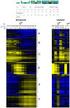
1 Row Quantile Normalisation of Microarrays W. B. Langdon Departments of Mathematical Sciences and Biological Sciences University of Essex, CO4 3SQ Technical Report CES-484 ISSN: June 2008 Abstract Variation in tissue sample preparation leads to variation across the Transcriptome not just between experiments but to between individual microarrays. Normalisation is essential before data from different arrays can be compared. Quantile normalisation can be used to force data from a single GeneChip to take a given distribution. However quantile normalisation can be blind to the consistent spatial variation we note in thousands of Affymetrix High-density oligonucleotide array (HDONAs) from NCBI GEO. We propose a simple computationally efficient normalisation technique which takes into account the spatial aspect. BioConductor R code is included. Keyword: Normalisation, Gene expression, High-density oligonucleotide array, data mining, standard chip, MIAME 1 Introduction While high-density oligonucleotide arrays have created biological data on an industrial scale, the cost of such GeneChips means few arrays are used in each experiment. Unfortunately it is difficult to control the dose of total mrna. Instead some form of normalisation of the data collected by different arrays is necessary. Early normalisation schemes tended to do things such as taking a number of readings from different samples and adjusting them to have the same mean. Typically the adjustment was made by linear rescaling. It was realised that by rescaling the data could also be adjusted to have the same standard deviation. In fact with modern computers it is possible to adjust data so that not only the first and second moments are the same but in fact the whole distribution is the same. This is known as quantile normalisation (Bolstad et al. 2003). Typically quantile normalisation is applied across all the chips used in a particular experiment. However the advent of large public repositories of GeneChip experiments opens the way to normalisation against far larger numbers of chips. Normalisation against all published experiments using the same chip has been demonstrated (Langdon et al. 2007b). With a reference chip, created by averaging across all of GEO (Barrett et al. 2007), a Bioinformatician can quantile normalise a single chip. Further this can be done quickly using R. Figure 1 shows mrna concentration measurements provided by a single Affymetrix HG- U GeneChip. The horizontal spatial banding is obvious. (Figure 2 plots it numerically.) Figure 3 shows the banding carries over to individual probe performance. C and G DNA base pairings have three rather than two main hydrogen bonds. This means probes with many Cs or Gs bind more tightly than those with more As and Ts. (This is confirmed by Figure 4.) The number of each type of base in HG-U probes follows a similar pattern to that which would be produced by a random choice, see Figure 6. The

2 Figure 1: Example Homo Sapiens HG-U GeneChip (prior to normalisation, yellow is higher). The banding of signal intensities is clear. Note perfect match (PM) probes are adjacent to their mismatch (MM) partner in the next row. However the horizontal banding occurs regardless of PM/MM. (In terms of spatial defects, this CEL file is the median of 2757 HG-U down loaded from NCBI s GEO). probes are deliberately placed on the chip such that probes with similar sequences are adjacent. This increases the feature size on the 100 photolithographic masks required for each GeneChip. Having larger holes in the masks, caused by adjacent probes have the same base at the same depth, tends to reduce the importance of edge effects. This in turn eases manufacture (Pease et al. 2001; Feldman and Pevzner 1994). Assorting the probes by sequence gives the non-random layout of the probes shown in Figure 5. It is this assorting that is the underlying cause of the banding in both probe intensity and performance. Until now this strong spatial feature has been ignored by common normalisation tools. 2 Row Quantile Normalisation Recently we have applied quantile normalisation not to just a collection of GeneChips relating to one experiment but to thousands of public chips (Langdon et al. 2007a). This allows a Biologist to normalise a single chip against a public base line (i.e. GEO), rather than his own much smaller private experimental set. And normalisation can be safely done for a small number of chips, even just one. Quantile normalisation works by placing measured data in rank order. The reference distribution (in our case a robust average taken across thousands of GeneChips of the same type in GEO) is also sorted into rank order. To normalise a GeneChip, the sorted probe intensities are simply replaced by the corresponding value with the same rank from the reference distribution, i.e. the smallest measured probe intensity is replaced with the smallest average value in GEO. The value of the probe with second smallest value is replaced with the second smallest average value in GEO. And so on, until the largest measure probe intensity has been replaced by the largest average probe value from GEO. This can be done efficiently in R. Note with ordinary quantile normalisation a probe can be normalised to the average value of any probe. That probe may be anywhere on the GeneChip. 2

3 400 Vertical+200 Row 350 Intensity (geometric mean) Row number Figure 2: Average intensity by row (dashed line). In contrast average signal across rows is close to 150. Variation is about a factor of two, both along rows and across them. (Same data as Figure 1.) Figure 3: Performance of probes across HG-U GeneChips. Highest correlation between probes in the same probeset. (2757 GEO HG-U133 +2). (Yellow is higher. Areas without probesets are white.). The banding of signal performance is clear. 3

4 Count Geometric Mean probe intensity Guanine and Cytosine Figure 4: Distributions of average HG-U probe intensity vs. number of Cs and Gs. On average (mode, solid line) probes with many C+G are approximately twice as bright as those with few. Figure 5: Number of C s and G s in probes across HG-U GeneChips. (Yellow is higher. Areas without probesets are white.). 4

5 HG-U Binomial m= Number of HG-U probes Number of Guanine and Cytosine in probe Figure 6: The distribution of number of C s and G s in HG-U probes is approximated by a random distribution (dashed line) with the same mean (11.9). (Same data as Figure 5.) Row quantile normalisation is the same as regular quantile normalisation, except we insist that a probe s normalised value must come from a probe in the same row. With modern GeneChips, this still leaves the sort algorithm hundreds or thousands of values to chose from. Using the same row automatically takes advantage of the way Affymetrix lays out probes on its GeneChips (see previous section). This ensures every probe in normalised to the average value of a probe which has a similar probe sequence to it. Row normalisation is readily and efficiently implemented in R. See code fragments in Figure 7. References 1 Barrett, T., Troup, D. B., Wilhite, S. E., Ledoux, P., Rudnev, D., Evangelista, C., Kim, I. F., Soboleva, A., Tomashevsky, M., and Edgar, R. (2007). NCBI GEO: mining tens of millions of expression profiles database and tools update. Nucleic Acids Research, 35(Database issue), D760 D Bolstad, B. M., Irizarry, R. A., Åstrand, M., and Speed, T. P. (2003). A comparison of normalization methods for high density oligonucleotide array data based on variance and bias. Bioinformatics, 19(2), Feldman, W. and Pevzner, P. A. (1994). Gray code masks for sequencing by hybridization. Genomics, 23, Langdon, W. B., da Silva Camargo, R., and Harrison, A. P. (2007a). Spatial defects in 5896 HG-U133A GeneChips. In J. Dopazo, A. Conesa, F. Al Shahrour, and D. Montener, editors, Critical Assesment of Microarray Data, Valencia. Presented at EMERALD Workshop. 5 Langdon, W. B., Upton, G. J. G., da Silva Camargo, R., and Harrison, A. P. (2007b). A survey of spatial defects in Homo Sapiens Affymetrix GeneChips. Submitted. 6 Pease, R. F., McGall, G., Goldberg, M. J., Rava, R. P., Fodor, S. P. A., Goss, V., Stryer, L., and Winkler, J. L. (2001). Printing molecular library arrays. US Patent 6,239,273. Affymetrix, Inc. (Santa Clara, CA), Filed: October 26,

6 sortbyrow=function(mat) { apply(mat,2,sort); } quantilebyrow=function(mat,rank) { #rather than sort, use rank to ensure two probes with the same value #before normalisation, have the same value after normalisation. r = apply(mat,2,rank,ties.method="min"); ans=array(na,dim=c(nrow(rank),ncol(rank))); for(j in seq(from=1,to=ncol(r))) { ans[,j]=rank[r[,j],j]; } return(ans); } qdistribution <- sortbyrow(normean); library(affy); a <- ReadAffy(filenames,sd=FALSE); mat <- quantilebyrow(array(exprs(a),dim=c(s,s)),qdistribution); Figure 7: R code fragment showing the row quantile normalisation of a single GeneChip filenames against the whole of GEO. The reference distribution, previously calculated from all the GeneChips in GEO of the same type, is stored in S S array normean. (For an HG-U S = 1164.) The R function sortbyrow orders the array s rows independently. The individual probe values, given by ReadAffy and exprs(a), must also be stored in a S S array. quantilebyrow creates an array of indexes r into the reference distribution rank. For each row, it calculates a vector of S values which are taken from rank via the sorted indexes in r. (The R [,j] syntax implies all elements of an array with second index j.) 6
![method="min"); ans=array(na,dim=c(nrow(rank),ncol(rank))); for(j in seq(from=1,to=ncol(r))) { ans[,j]=rank[r[,j],j]; } return(ans); } qdistribution <- sortbyrow(normean); library(affy); a <-](/docs-images/52/13178172/images/page_6.jpg "ReadAffy(filenames,sd=FALSE); mat <- quantilebyrow(array(exprs(a),dim=c(s,s)),qdistribution); Figure 7: R code fragment showing the row quantile normalisation of a single GeneChip filenames against")
Software and Methods for the Analysis of Affymetrix GeneChip Data. Rafael A Irizarry Department of Biostatistics Johns Hopkins University
 Software and Methods for the Analysis of Affymetrix GeneChip Data Rafael A Irizarry Department of Biostatistics Johns Hopkins University Outline Overview Bioconductor Project Examples 1: Gene Annotation
Frozen Robust Multi-Array Analysis and the Gene Expression Barcode
 Frozen Robust Multi-Array Analysis and the Gene Expression Barcode Matthew N. McCall October 13, 2015 Contents 1 Frozen Robust Multiarray Analysis (frma) 2 1.1 From CEL files to expression estimates...................
Analysis of gene expression data. Ulf Leser and Philippe Thomas
 Analysis of gene expression data Ulf Leser and Philippe Thomas This Lecture Protein synthesis Microarray Idea Technologies Applications Problems Quality control Normalization Analysis next week! Ulf Leser:
Quality Assessment of Exon and Gene Arrays
 Quality Assessment of Exon and Gene Arrays I. Introduction In this white paper we describe some quality assessment procedures that are computed from CEL files from Whole Transcript (WT) based arrays such
Gene Expression Analysis
 Gene Expression Analysis Jie Peng Department of Statistics University of California, Davis May 2012 RNA expression technologies High-throughput technologies to measure the expression levels of thousands
Molecular Genetics: Challenges for Statistical Practice. J.K. Lindsey
 Molecular Genetics: Challenges for Statistical Practice J.K. Lindsey 1. What is a Microarray? 2. Design Questions 3. Modelling Questions 4. Longitudinal Data 5. Conclusions 1. What is a microarray? A microarray
BASIC STATISTICAL METHODS FOR GENOMIC DATA ANALYSIS
 BASIC STATISTICAL METHODS FOR GENOMIC DATA ANALYSIS SEEMA JAGGI Indian Agricultural Statistics Research Institute Library Avenue, New Delhi-110 012 [email protected] Genomics A genome is an organism s
Basic Analysis of Microarray Data
 Basic Analysis of Microarray Data A User Guide and Tutorial Scott A. Ness, Ph.D. Co-Director, Keck-UNM Genomics Resource and Dept. of Molecular Genetics and Microbiology University of New Mexico HSC Tel.
Measuring gene expression (Microarrays) Ulf Leser
 Measuring gene expression (Microarrays) Ulf Leser This Lecture Gene expression Microarrays Idea Technologies Problems Quality control Normalization Analysis next week! 2 http://learn.genetics.utah.edu/content/molecules/transcribe/
Analyzing microrna Data and Integrating mirna with Gene Expression Data in Partek Genomics Suite 6.6
 Analyzing microrna Data and Integrating mirna with Gene Expression Data in Partek Genomics Suite 6.6 Overview This tutorial outlines how microrna data can be analyzed within Partek Genomics Suite. Additionally,
Lecture 11 Data storage and LIMS solutions. Stéphane LE CROM [email protected]
 Lecture 11 Data storage and LIMS solutions Stéphane LE CROM [email protected] Various steps of a DNA microarray experiment Experimental steps Data analysis Experimental design set up Chips on catalog
affyplm: Fitting Probe Level Models
 affyplm: Fitting Probe Level Models Ben Bolstad [email protected] http://bmbolstad.com April 16, 2015 Contents 1 Introduction 2 2 Fitting Probe Level Models 2 2.1 What is a Probe Level Model and What is
A greedy algorithm for the DNA sequencing by hybridization with positive and negative errors and information about repetitions
 BULLETIN OF THE POLISH ACADEMY OF SCIENCES TECHNICAL SCIENCES, Vol. 59, No. 1, 2011 DOI: 10.2478/v10175-011-0015-0 Varia A greedy algorithm for the DNA sequencing by hybridization with positive and negative
Gene expression analysis. Ulf Leser and Karin Zimmermann
 Gene expression analysis Ulf Leser and Karin Zimmermann Ulf Leser: Bioinformatics, Wintersemester 2010/2011 1 Last lecture What are microarrays? - Biomolecular devices measuring the transcriptome of a
Predictive Gene Signature Selection for Adjuvant Chemotherapy in Non-Small Cell Lung Cancer Patients
 Predictive Gene Signature Selection for Adjuvant Chemotherapy in Non-Small Cell Lung Cancer Patients by Li Liu A practicum report submitted to the Department of Public Health Sciences in conformity with
Microarray Technology
 Microarrays And Functional Genomics CPSC265 Matt Hudson Microarray Technology Relatively young technology Usually used like a Northern blot can determine the amount of mrna for a particular gene Except
Using the Grid for the interactive workflow management in biomedicine. Andrea Schenone BIOLAB DIST University of Genova
 Using the Grid for the interactive workflow management in biomedicine Andrea Schenone BIOLAB DIST University of Genova overview background requirements solution case study results background A multilevel
Factors for success in big data science
 Factors for success in big data science Damjan Vukcevic Data Science Murdoch Childrens Research Institute 16 October 2014 Big Data Reading Group (Department of Mathematics & Statistics, University of Melbourne)
SNP Essentials The same SNP story
 HOW SNPS HELP RESEARCHERS FIND THE GENETIC CAUSES OF DISEASE SNP Essentials One of the findings of the Human Genome Project is that the DNA of any two people, all 3.1 billion molecules of it, is more than
Analyzing the Effect of Treatment and Time on Gene Expression in Partek Genomics Suite (PGS) 6.6: A Breast Cancer Study
 Analyzing the Effect of Treatment and Time on Gene Expression in Partek Genomics Suite (PGS) 6.6: A Breast Cancer Study The data for this study is taken from experiment GSE848 from the Gene Expression
Normalization Methods for Analysis of Affymetrix GeneChip Microarray
 Microarray Data Analysis Normalization Methods for Analysis of Affymetrix GeneChip Microarray 中 央 研 究 院 生 命 科 學 圖 書 館 2008 年 教 育 訓 練 課 程 2008/01/29 1 吳 漢 銘 淡 江 大 學 數 學 系 [email protected] http://www.hmwu.idv.tw
Materials and Methods. Blocking of Globin Reverse Transcription to Enhance Human Whole Blood Gene Expression Profiling
 Application Note Blocking of Globin Reverse Transcription to Enhance Human Whole Blood Gene Expression Profi ling Yasmin Beazer-Barclay, Doug Sinon, Christopher Morehouse, Mark Porter, and Mike Kuziora
Statistical issues in the analysis of microarray data
 Statistical issues in the analysis of microarray data Daniel Gerhard Institute of Biostatistics Leibniz University of Hannover ESNATS Summerschool, Zermatt D. Gerhard (LUH) Analysis of microarray data
How To Run Statistical Tests in Excel
 How To Run Statistical Tests in Excel Microsoft Excel is your best tool for storing and manipulating data, calculating basic descriptive statistics such as means and standard deviations, and conducting
Microarray Data Mining: Puce a ADN
 Microarray Data Mining: Puce a ADN Recent Developments Gregory Piatetsky-Shapiro KDnuggets EGC 2005, Paris 2005 KDnuggets EGC 2005 Role of Gene Expression Cell Nucleus Chromosome Gene expression Protein
Introduction To Real Time Quantitative PCR (qpcr)
 Introduction To Real Time Quantitative PCR (qpcr) SABiosciences, A QIAGEN Company www.sabiosciences.com The Seminar Topics The advantages of qpcr versus conventional PCR Work flow & applications Factors
GeneChip Sequence Analysis Software (GSEQ) is used to analyze data from the Resequencing Arrays
 GeneChip Sequence Analysis Software 4.1 Note For more information, Please refer to the Affymetrix GeneChip Sequence Analysis Software User s Guide Version 4.1 guidebook & Quick Reference Card I. GSEQ Introduction
Service courses for graduate students in degree programs other than the MS or PhD programs in Biostatistics.
 Course Catalog In order to be assured that all prerequisites are met, students must acquire a permission number from the education coordinator prior to enrolling in any Biostatistics course. Courses are
Microarray Analysis. The Basics. Thomas Girke. December 9, 2011. Microarray Analysis Slide 1/42
 Microarray Analysis The Basics Thomas Girke December 9, 2011 Microarray Analysis Slide 1/42 Technology Challenges Data Analysis Data Depositories R and BioConductor Homework Assignment Microarray Analysis
Data, Measurements, Features
 Data, Measurements, Features Middle East Technical University Dep. of Computer Engineering 2009 compiled by V. Atalay What do you think of when someone says Data? We might abstract the idea that data are
An Introduction to Genomics and SAS Scientific Discovery Solutions
 An Introduction to Genomics and SAS Scientific Discovery Solutions Dr Karen M Miller Product Manager Bioinformatics SAS EMEA 16.06.03 Copyright 2003, SAS Institute Inc. All rights reserved. 1 Overview!
DNA Sequence formats
 DNA Sequence formats [Plain] [EMBL] [FASTA] [GCG] [GenBank] [IG] [IUPAC] [How Genomatix represents sequence annotation] Plain sequence format A sequence in plain format may contain only IUPAC characters
Basic Concepts of DNA, Proteins, Genes and Genomes
 Basic Concepts of DNA, Proteins, Genes and Genomes Kun-Mao Chao 1,2,3 1 Graduate Institute of Biomedical Electronics and Bioinformatics 2 Department of Computer Science and Information Engineering 3 Graduate
From Reads to Differentially Expressed Genes. The statistics of differential gene expression analysis using RNA-seq data
 From Reads to Differentially Expressed Genes The statistics of differential gene expression analysis using RNA-seq data experimental design data collection modeling statistical testing biological heterogeneity
User Manual. Transcriptome Analysis Console (TAC) Software. For Research Use Only. Not for use in diagnostic procedures. P/N 703150 Rev.
 User Manual Transcriptome Analysis Console (TAC) Software For Research Use Only. Not for use in diagnostic procedures. P/N 703150 Rev. 1 Trademarks Affymetrix, Axiom, Command Console, DMET, GeneAtlas,
How many of you have checked out the web site on protein-dna interactions?
 How many of you have checked out the web site on protein-dna interactions? Example of an approximately 40,000 probe spotted oligo microarray with enlarged inset to show detail. Find and be ready to discuss
Genetic Analysis. Phenotype analysis: biological-biochemical analysis. Genotype analysis: molecular and physical analysis
 Genetic Analysis Phenotype analysis: biological-biochemical analysis Behaviour under specific environmental conditions Behaviour of specific genetic configurations Behaviour of progeny in crosses - Genotype
Algorithms in Computational Biology (236522) spring 2007 Lecture #1
 Algorithms in Computational Biology (236522) spring 2007 Lecture #1 Lecturer: Shlomo Moran, Taub 639, tel 4363 Office hours: Tuesday 11:00-12:00/by appointment TA: Ilan Gronau, Taub 700, tel 4894 Office
ANALYSIS OF ENTITY-ATTRIBUTE-VALUE MODEL APPLICATIONS IN FREELY AVAILABLE DATABASE MANAGEMENT SYSTEMS FOR DNA MICROARRAY DATA PROCESSING 1.
 JOURNAL OF MEDICAL INFORMATICS & TECHNOLOGIES Vol. 20/2012, ISSN 1642-6037 entity-attribute-value model, relational database management system, DNA microarray Tomasz WALLER 1, Damian ZAPART 1, Magdalena
Why Taking This Course? Course Introduction, Descriptive Statistics and Data Visualization. Learning Goals. GENOME 560, Spring 2012
 Why Taking This Course? Course Introduction, Descriptive Statistics and Data Visualization GENOME 560, Spring 2012 Data are interesting because they help us understand the world Genomics: Massive Amounts
Real-time PCR: Understanding C t
 APPLICATION NOTE Real-Time PCR Real-time PCR: Understanding C t Real-time PCR, also called quantitative PCR or qpcr, can provide a simple and elegant method for determining the amount of a target sequence
Version 5.0 Release Notes
 Version 5.0 Release Notes 2011 Gene Codes Corporation Gene Codes Corporation 775 Technology Drive, Ann Arbor, MI 48108 USA 1.800.497.4939 (USA) +1.734.769.7249 (elsewhere) +1.734.769.7074 (fax) www.genecodes.com
AGILENT S BIOINFORMATICS ANALYSIS SOFTWARE
 ACCELERATING PROGRESS IS IN OUR GENES AGILENT S BIOINFORMATICS ANALYSIS SOFTWARE GENESPRING GENE EXPRESSION (GX) MASS PROFILER PROFESSIONAL (MPP) PATHWAY ARCHITECT (PA) See Deeper. Reach Further. BIOINFORMATICS
CCR Biology - Chapter 9 Practice Test - Summer 2012
 Name: Class: Date: CCR Biology - Chapter 9 Practice Test - Summer 2012 Multiple Choice Identify the choice that best completes the statement or answers the question. 1. Genetic engineering is possible
Correlation of microarray and quantitative real-time PCR results. Elisa Wurmbach Mount Sinai School of Medicine New York
 Correlation of microarray and quantitative real-time PCR results Elisa Wurmbach Mount Sinai School of Medicine New York Microarray techniques Oligo-array: Affymetrix, Codelink, spotted oligo-arrays (60-70mers)
DEVELOPMENT OF MAP/REDUCE BASED MICROARRAY ANALYSIS TOOLS
 Clemson University TigerPrints All Theses Theses 8-2013 DEVELOPMENT OF MAP/REDUCE BASED MICROARRAY ANALYSIS TOOLS Guangyu Yang Clemson University, [email protected] Follow this and additional works at:
Modified Genetic Algorithm for DNA Sequence Assembly by Shotgun and Hybridization Sequencing Techniques
 International Journal of Electronics and Computer Science Engineering 2000 Available Online at www.ijecse.org ISSN- 2277-1956 Modified Genetic Algorithm for DNA Sequence Assembly by Shotgun and Hybridization
FlipFlop: Fast Lasso-based Isoform Prediction as a Flow Problem
 FlipFlop: Fast Lasso-based Isoform Prediction as a Flow Problem Elsa Bernard Laurent Jacob Julien Mairal Jean-Philippe Vert September 24, 2013 Abstract FlipFlop implements a fast method for de novo transcript
Using Excel for inferential statistics
 FACT SHEET Using Excel for inferential statistics Introduction When you collect data, you expect a certain amount of variation, just caused by chance. A wide variety of statistical tests can be applied
2. True or False? The sequence of nucleotides in the human genome is 90.9% identical from one person to the next. False (it s 99.
 1. True or False? A typical chromosome can contain several hundred to several thousand genes, arranged in linear order along the DNA molecule present in the chromosome. True 2. True or False? The sequence
Data Analysis for Ion Torrent Sequencing
 IFU022 v140202 Research Use Only Instructions For Use Part III Data Analysis for Ion Torrent Sequencing MANUFACTURER: Multiplicom N.V. Galileilaan 18 2845 Niel Belgium Revision date: August 21, 2014 Page
Asexual Versus Sexual Reproduction in Genetic Algorithms 1
 Asexual Versus Sexual Reproduction in Genetic Algorithms Wendy Ann Deslauriers ([email protected]) Institute of Cognitive Science,Room 22, Dunton Tower Carleton University, 25 Colonel By Drive
Time series experiments
 Time series experiments Time series experiments Why is this a separate lecture: The price of microarrays are decreasing more time series experiments are coming Often a more complex experimental design
Introduction to transcriptome analysis using High Throughput Sequencing technologies (HTS)
 Introduction to transcriptome analysis using High Throughput Sequencing technologies (HTS) A typical RNA Seq experiment Library construction Protocol variations Fragmentation methods RNA: nebulization,
GeneSifter: Next Generation Data Management and Analysis for Next Generation Sequencing
 for Next Generation Sequencing Dale Baskin, N. Eric Olson, Laura Lucas, Todd Smith 1 Abstract Next generation sequencing technology is rapidly changing the way laboratories and researchers approach the
Comparative genomic hybridization Because arrays are more than just a tool for expression analysis
 Microarray Data Analysis Workshop MedVetNet Workshop, DTU 2008 Comparative genomic hybridization Because arrays are more than just a tool for expression analysis Carsten Friis ( with several slides from
Comparing Methods for Identifying Transcription Factor Target Genes
 Comparing Methods for Identifying Transcription Factor Target Genes Alena van Bömmel (R 3.3.73) Matthew Huska (R 3.3.18) Max Planck Institute for Molecular Genetics Folie 1 Transcriptional Regulation TF
InSyBio BioNets: Utmost efficiency in gene expression data and biological networks analysis
 InSyBio BioNets: Utmost efficiency in gene expression data and biological networks analysis WHITE PAPER By InSyBio Ltd Konstantinos Theofilatos Bioinformatician, PhD InSyBio Technical Sales Manager August
Introduction to Pattern Recognition
 Introduction to Pattern Recognition Selim Aksoy Department of Computer Engineering Bilkent University [email protected] CS 551, Spring 2009 CS 551, Spring 2009 c 2009, Selim Aksoy (Bilkent University)
GeneChip Expression Analysis. Data Analysis Fundamentals
 GeneChip Expression Analysis Data Analysis Fundamentals Table of Contents Page No. Introduction 1 Chapter 1 Guidelines for Assessing Sample and Array Quality 2 Chapter 2 Statistical Algorithms Reference
Hybrid Genetic Algorithm for DNA Sequencing with Errors
 Journal of Heuristics, 8: 495 502, 2002 c 2002 Kluwer Academic Publishers. Manufactured in The Netherlands. Hybrid Genetic Algorithm for DNA Sequencing with Errors JACEK B LAŻEWICZ AND MARTA KASPRZAK Institute
Biotechnology: DNA Technology & Genomics
 Chapter 20. Biotechnology: DNA Technology & Genomics 2003-2004 The BIG Questions How can we use our knowledge of DNA to: diagnose disease or defect? cure disease or defect? change/improve organisms? What
Analysis of Illumina Gene Expression Microarray Data
 Analysis of Illumina Gene Expression Microarray Data Asta Laiho, Msc. Tech. Bioinformatics research engineer The Finnish DNA Microarray Centre Turku Centre for Biotechnology, Finland The Finnish DNA Microarray
Gamma Distribution Fitting
 Chapter 552 Gamma Distribution Fitting Introduction This module fits the gamma probability distributions to a complete or censored set of individual or grouped data values. It outputs various statistics
Heuristics for the Sorting by Length-Weighted Inversions Problem on Signed Permutations
 Heuristics for the Sorting by Length-Weighted Inversions Problem on Signed Permutations AlCoB 2014 First International Conference on Algorithms for Computational Biology Thiago da Silva Arruda Institute
INTELLIGENT DEFECT ANALYSIS SOFTWARE
 INTELLIGENT DEFECT ANALYSIS SOFTWARE Website: http://www.siglaz.com Semiconductor fabs currently use defect count or defect density as a triggering mechanism for their Statistical Process Control. However,
Name Date Period. 2. When a molecule of double-stranded DNA undergoes replication, it results in
 DNA, RNA, Protein Synthesis Keystone 1. During the process shown above, the two strands of one DNA molecule are unwound. Then, DNA polymerases add complementary nucleotides to each strand which results
NCSS Statistical Software Principal Components Regression. In ordinary least squares, the regression coefficients are estimated using the formula ( )
 Chapter 340 Principal Components Regression Introduction is a technique for analyzing multiple regression data that suffer from multicollinearity. When multicollinearity occurs, least squares estimates
Build Panoramas on Android Phones
 Build Panoramas on Android Phones Tao Chu, Bowen Meng, Zixuan Wang Stanford University, Stanford CA Abstract The purpose of this work is to implement panorama stitching from a sequence of photos taken
Multivariate Analysis of Ecological Data
 Multivariate Analysis of Ecological Data MICHAEL GREENACRE Professor of Statistics at the Pompeu Fabra University in Barcelona, Spain RAUL PRIMICERIO Associate Professor of Ecology, Evolutionary Biology
Identification of rheumatoid arthritis and osteoarthritis patients by transcriptome-based rule set generation
 Identification of rheumatoid arthritis and osterthritis patients by transcriptome-based rule set generation Bering Limited Report generated on September 19, 2014 Contents 1 Dataset summary 2 1.1 Project
Real-time qpcr Assay Design Software www.qpcrdesign.com
 Real-time qpcr Assay Design Software www.qpcrdesign.com Your Blueprint For Success Informational Guide 2199 South McDowell Blvd Petaluma, CA 94954-6904 USA 1.800.GENOME.1(436.6631) 1.415.883.8400 1.415.883.8488
Discovery and Quantification of RNA with RNASeq Roderic Guigó Serra Centre de Regulació Genòmica (CRG) [email protected]
 Bioinformatique et Séquençage Haut Débit, Discovery and Quantification of RNA with RNASeq Roderic Guigó Serra Centre de Regulació Genòmica (CRG) [email protected] 1 RNA Transcription to RNA and subsequent
A Tutorial Review of Microarray Data Analysis
 A Tutorial Review of Microarray Data Analysis Alex Sánchez and M. Carme Ruíz de Villa Departament d'estadística. Universitat de Barcelona. Facultat de Biologia. Avda Diagonal 645. 08028 Barcelona. Spain.
VWF. Virtual Wafer Fab
 VWF Virtual Wafer Fab VWF is software used for performing Design of Experiments (DOE) and Optimization Experiments. Split-lots can be used in various pre-defined analysis methods. Split parameters can
RETRIEVING SEQUENCE INFORMATION. Nucleotide sequence databases. Database search. Sequence alignment and comparison
 RETRIEVING SEQUENCE INFORMATION Nucleotide sequence databases Database search Sequence alignment and comparison Biological sequence databases Originally just a storage place for sequences. Currently the
EXPLORING SPATIAL PATTERNS IN YOUR DATA
 EXPLORING SPATIAL PATTERNS IN YOUR DATA OBJECTIVES Learn how to examine your data using the Geostatistical Analysis tools in ArcMap. Learn how to use descriptive statistics in ArcMap and Geoda to analyze
Expression Quantification (I)
 Expression Quantification (I) Mario Fasold, LIFE, IZBI Sequencing Technology One Illumina HiSeq 2000 run produces 2 times (paired-end) ca. 1,2 Billion reads ca. 120 GB FASTQ file RNA-seq protocol Task
Activity IT S ALL RELATIVES The Role of DNA Evidence in Forensic Investigations
 Activity IT S ALL RELATIVES The Role of DNA Evidence in Forensic Investigations SCENARIO You have responded, as a result of a call from the police to the Coroner s Office, to the scene of the death of
Graph theoretic approach to analyze amino acid network
 Int. J. Adv. Appl. Math. and Mech. 2(3) (2015) 31-37 (ISSN: 2347-2529) Journal homepage: www.ijaamm.com International Journal of Advances in Applied Mathematics and Mechanics Graph theoretic approach to
Appendix 2 Statistical Hypothesis Testing 1
 BIL 151 Data Analysis, Statistics, and Probability By Dana Krempels, Ph.D. and Steven Green, Ph.D. Most biological measurements vary among members of a study population. These variations may occur for
DESCRIPTIVE STATISTICS. The purpose of statistics is to condense raw data to make it easier to answer specific questions; test hypotheses.
 DESCRIPTIVE STATISTICS The purpose of statistics is to condense raw data to make it easier to answer specific questions; test hypotheses. DESCRIPTIVE VS. INFERENTIAL STATISTICS Descriptive To organize,