
PROPAGATION OF SOUND WAVES IN DUCTS
|
|
|
- Amberly Angela Allen
- 10 years ago
- Views:
Transcription
1 PROPAGATION OF SOUND WAVES IN DUCTS Finn Jacobsen Acoustic Technology, Department of Electrical Engineering Technical University of Denmark, Building 352 Ørsteds Plads, DK-2800 Lyngby Denmark Technical University of Denmark September 2011 Note no 31260
2 2

3 CONTENTS page 1 Introduction Fundamentals of acoustic wave motion Plane waves in duct with rigid walls The sound field in a duct terminated by an arbitrary impedance Radiation of sound from an open-ended tube Sound transmission through coupled pipes The transmission matrix System performance Dissipative silencers Sound propagation in ducts with mean flow Three-dimensional waves in ducts with rigid walls The sound field in a duct with rectangular cross section The sound field in a duct with circular cross section The sound field in a duct with arbitrary cross-sectional shape Sound propagation in ducts with walls of finite impedance Ducts with nearly hard walls Lined ducts References Bibliography Appendix: Cylindrical Bessel and Neumann functions of integer order List of symbols Index

4 4

5 1. INTRODUCTION Duct acoustics is the branch of acoustics concerned with sound propagation in pipes and ducts. Sound propagation within ducts is of practical concern in many areas of acoustics and noise control. Cylindrical cavities are used for testing or calibrating transducers, and impedance tubes are used for measuring the acoustic properties of absorbing materials. In a number of musical instruments (brass and woodwind instruments, organs) the sound is generated in pipes. Air-distributing systems for heating, ventilating and air-conditioning also transmit noise. Exhaust noise from petrol- and diesel-driven reciprocating engines must be reduced by silencers, which essentially are combinations of pipes. The purpose of this note is to introduce the topic. Non-linear effects are not dealt with, and the effects of viscosity, heat conduction and mean flow are only touched upon. 2. FUNDAMENTALS OF ACOUSTIC WAVE MOTION Sound waves in a fluid are oscillatory disturbances, generated, for example, by a vibrating surface. Such disturbances manifest themselves by pressure fluctuations, which is what we can hear, but also by similar perturbations of the temperature and the density, and by particles 1 moving back and forth. Conservation of mass implies that where u is the particle velocity (a vector), and (2.1) (2.2) is the density of the medium, which is the sum of the equilibrium value D 0 and the small, time-varying perturbation D. Under normal ambient conditions (101.3 kpa, 20 C) the density of air is kgm -3. If eq. (2.1) can be approximated as follows: (2.3) (2.4) In a gas such as air sound is an adiabatic phenomenon, which means that there is no local heat exchange. 2 Under such conditions (2.5) 1 In acoustics the notion of particles and particle velocity refers to a macroscopic average of the medium, not to molecules. 2 Very near solid walls, for instance in narrow tubes, heat conduction cannot be ignored, and the process tends to be isothermal, which means that the temperature is constant. See chapter 7. 5
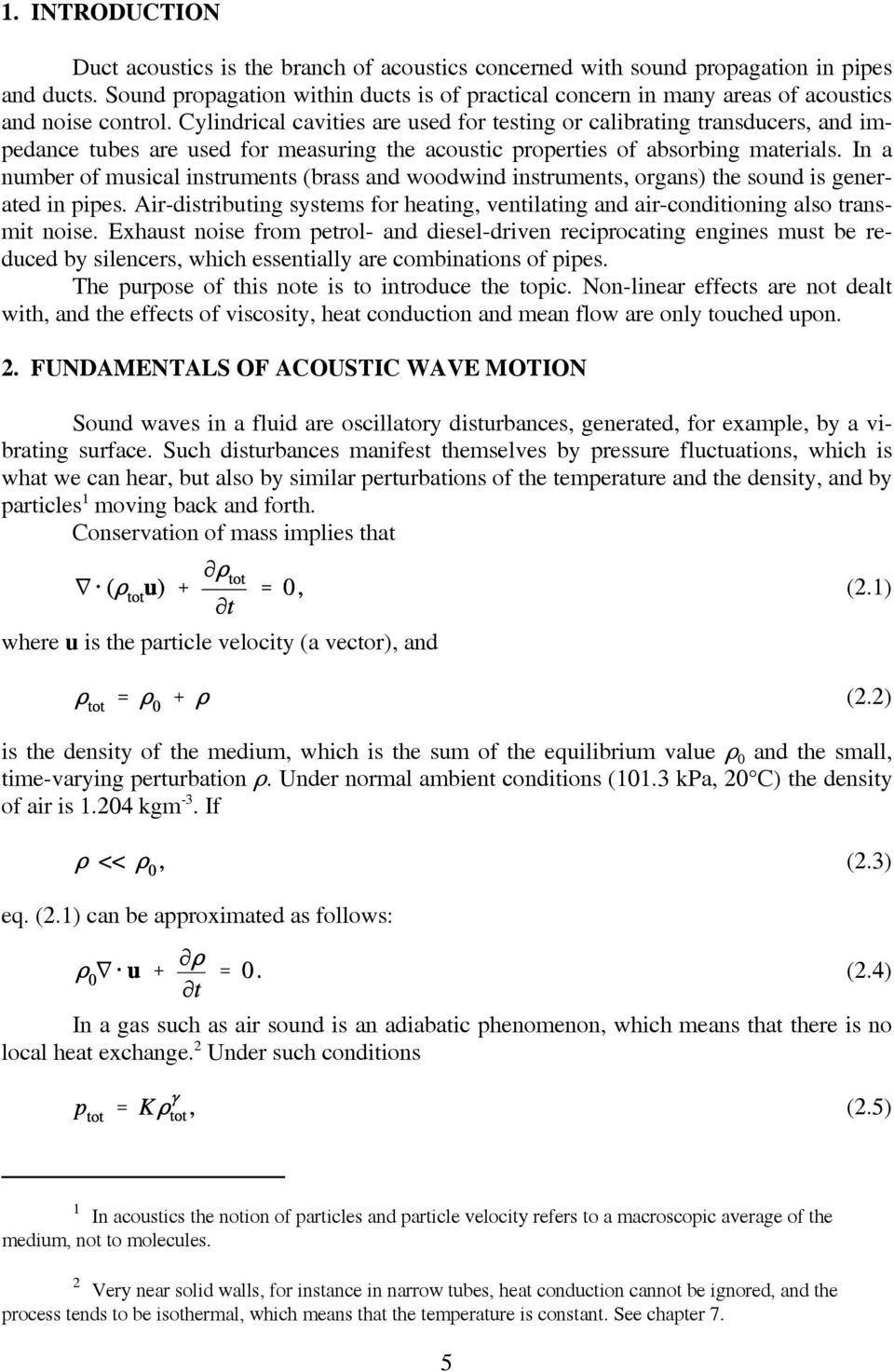
6 where (2.6) is the total pressure, which is the sum of the static (barometric) pressure p 0 and the acoustic, time-varying pressure p (henceforth called the sound pressure), K is a constant, and (2.7) is the ratio of specific heats ( for air). Differentiating eq. (2.5) with respect to time gives (2.8) where we have introduced the quantity (2.9) which, as we shall see later, is the square of the speed of sound ( 343 ms -1 for air at 20 C). Combining eqs. (2.4) and (2.8) gives a relation between the divergence of the particle velocity and the sound pressure: (2.10) The quantity (2.11) is the adiabatic bulk modulus, which is the reciprocal of the adiabatic compressibility. Euler s equation of motion for a fluid is a relation between the gradient of the sound pressure and the acceleration of fluid particles, where 6 (2.12) (2.13) in which > is the particle displacement (or position) and the second term on the right side is due to the fact that the particle velocity is a function of time and position. This is a higherorder term. Thus we can simplify to (2.14)

7 The approximations of eqs. (2.4), (2.8) and (2.14) imply neglecting second- and higher-order terms in the small perturbations p and D. These equations, usually termed the linearised acoustic equations, are good approximations provided that (2.15) which, with a static pressure of kpa, is seen to be the case even at a sound pressure level of 140 db re 20 :Pa (200 Pa). The linearisation simplifies the analysis enormously. 3 Adiabatic compression The absence of local heat exchange implies that the entropy of the medium per unit mass is constant [1], and that pressure fluctuations are accompanied by density fluctuations and temperature fluctuations. From eq. (2.5) it follows that which shows that or indicating that the fractional pressure increase associated with adiabatic compression because of the increase of the temperature exceeds the fractional increase of the density by a factor of (. The temperature fluctuations can be found in a similar manner from the ideal gas equation, where R is the gas constant ( 287 J@ kg -1 K -1 ) and T is the absolute temperature. It follows that and Taking the divergence of eq. (2.14) and combining with eq. (2.10) gives the linearised wave equation expressed in terms of the sound pressure: The Laplacian, that is, the operator L 2, takes the form (2.16) (2.17a) 3 Nonlinear effects include waveform distortion, interaction of waves (instead of linear superposition), and formation of shock waves. It is not only the level that matters; nonlinear effects accumulate with distance. See, e.g., ref. [2]. 7

8 in a Cartesian coordinate system. In a spherical coordinate system it is (2.17b) and in a cylindrical coordinate system it can be written (2.17c) Many acoustic phenomena, resonances in tubes and cavities, for example, can with advantage be studied in the frequency domain. Linearity implies that a disturbance that varies sinusoidally with time with the frequency T, a vibrating solid surface, for example, will generate a sound field in which the sound pressure p varies sinusoidally with time with the frequency T at all positions, and so will the particle velocity and the perturbations of the density and the temperature. It follows that we can describe any linear (first-order) quantity in such a harmonic sound field as the real part of a complex amplitude that varies with the position multiplied with a factor of e jtt, which takes account of the time dependence. This leads to the usual complex representation; see, e.g., ref. [3]. The sound pressure is now written as a complex amplitude multiplied with a complex exponential, and the real, physical sound pressure is the real part, (2.18) where n is the phase of the complex sound pressure at t = 0. Throughout this note complex harmonic variables are indicated by carets. With a time dependence of e jtt the operator M/Mt can be replaced by jt, and the operator M 2 /Mt 2 can be replaced by -T 2. The wave equation now becomes the Helmholtz equation, (2.19a) which is simpler to solve than equation (2.16). The Helmholtz equation is usually written in the form where (2.19b) (2.20) is the wavenumber. In a sinusoidally varying sound field the particle velocity is, from eq. (2.14), (2.21) Complex notation is used throughout this note except in the beginning of chapters 3 and 5 and at the end of chapter 6. Moreover, the equilibrium density of the medium is, for simplicity, written as D rather than D 0. 8

9 Example 2.1 Integration of eq. (2.10) over a small volume V defined by the closed surface S gives, with Gauss s theorem, which leads to the conclusion that the acoustic impedance (the complex ratio of sound pressure to volume velocity) of a cavity that is so small that we have the same sound pressure at all positions is (cf. eq. (2.9)), where is the volume velocity. (The minus sign is due to the fact that a positive divergence indicates a net flow out of the volume.) The air in the cavity behaves as a spring with a stiffness that is proportional to the static pressure and inversely proportional to the volume of the cavity. 3. PLANE WAVES IN DUCTS WITH RIGID WALLS The sound field in a uniform duct with rigid walls, sometimes referred to as an acoustic transmission line, is fairly simple in form at low frequencies where the cross-sectional dimensions are much smaller than the wavelength. As will be shown later, below a certain frequency that depends on the cross-sectional shape and dimensions of the duct only plane waves can propagate, from which it follows that the sound field is essentially onedimensional. This is the case in many situations of practical interest. In the following it is assumed that the sound field is one-dimensional. The wave equation (2.16) now assumes the form where z is the axial coordinate. It is easy to show that the general solution to this equation is 9 (3.1) (3.2) where f and g are continuous functions determined by the initial conditions. Since the argument of f is constant if (3.3) it can be seen that the first term of the general solution represents an acoustic disturbance of shape f(z) travelling undistorted and unattenuated in the z-direction with the speed c. The second term is a similar wave that travels in the opposite direction. Being independent of x and y both waves are plane waves. Example 3.1 If the tube is terminated by a rigid plane at z = 0 then the solution must satisfy the boundary condition u z (0, t) = 0 for all values of t. This is identical with requiring that the pressure gradient in the z-direction is zero at z = 0 for all values of t (cf. eq. (2.14)), and this is seen to be satisfied by the function

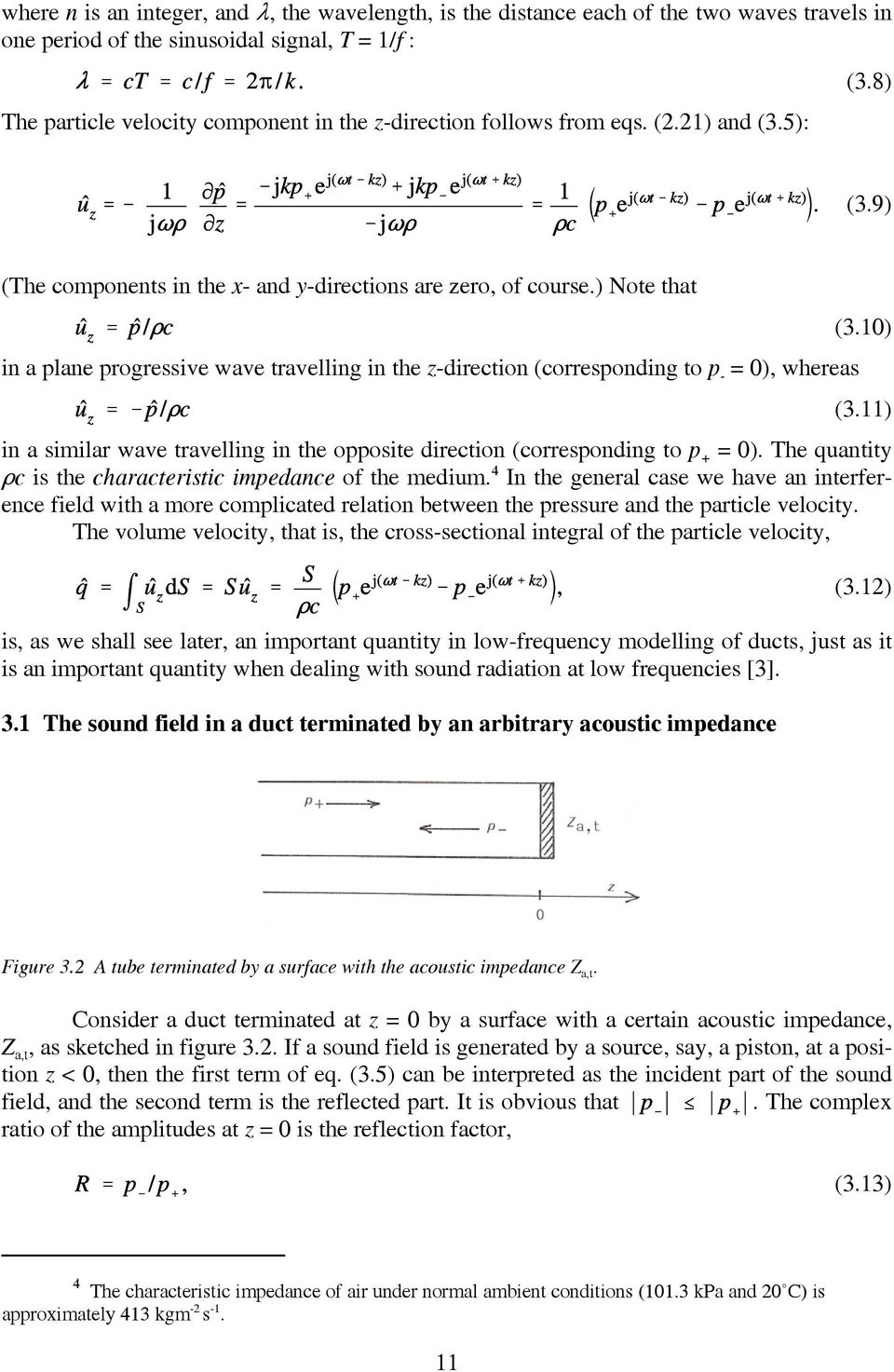
10 since It is apparently that there is perfect reflection at the rigid termination. See figure 3.1. Figure 3.1 Reflection at a rigid termination. (Adapted from ref. [4].) For several reasons it is advantageous to study the problem frequency by frequency, as mentioned in chapter 2. A one-dimensional harmonic sound field is governed by the onedimensional version of the Helmholtz equation (2.19), The general solution to this equation is (3.4) (3.5) where p + and p - are complex quantities. Equation (3.5) implies that the physical sound pressure is (3.6) which is seen to be in agreement with eq. (3.2), as of course it should be. The two terms of eq. (3.5) represent interfering plane waves with amplitudes and travelling in the z- direction and in the negative z-direction, respectively. Note that the sound field is spatially periodic with the period, (3.7) 10

11 where n is an integer, and 8, the wavelength, is the distance each of the two waves travels in one period of the sinusoidal signal, T = 1/f : (3.8) The particle velocity component in the z-direction follows from eqs. (2.21) and (3.5): (3.9) (The components in the x- and y-directions are zero, of course.) Note that (3.10) in a plane progressive wave travelling in the z-direction (corresponding to p - = 0), whereas (3.11) in a similar wave travelling in the opposite direction (corresponding to p + = 0). The quantity Dc is the characteristic impedance of the medium. 4 In the general case we have an interference field with a more complicated relation between the pressure and the particle velocity. The volume velocity, that is, the cross-sectional integral of the particle velocity, (3.12) is, as we shall see later, an important quantity in low-frequency modelling of ducts, just as it is an important quantity when dealing with sound radiation at low frequencies [3]. 3.1 The sound field in a duct terminated by an arbitrary acoustic impedance Figure 3.2 A tube terminated by a surface with the acoustic impedance Z a,t. Consider a duct terminated at z = 0 by a surface with a certain acoustic impedance, Z a,t, as sketched in figure 3.2. If a sound field is generated by a source, say, a piston, at a position z < 0, then the first term of eq. (3.5) can be interpreted as the incident part of the sound field, and the second term is the reflected part. It is obvious that. The complex ratio of the amplitudes at z = 0 is the reflection factor, (3.13) 4 The characteristic impedance of air under normal ambient conditions (101.3 kpa and 20/C) is approximately 413 kgm -2 s
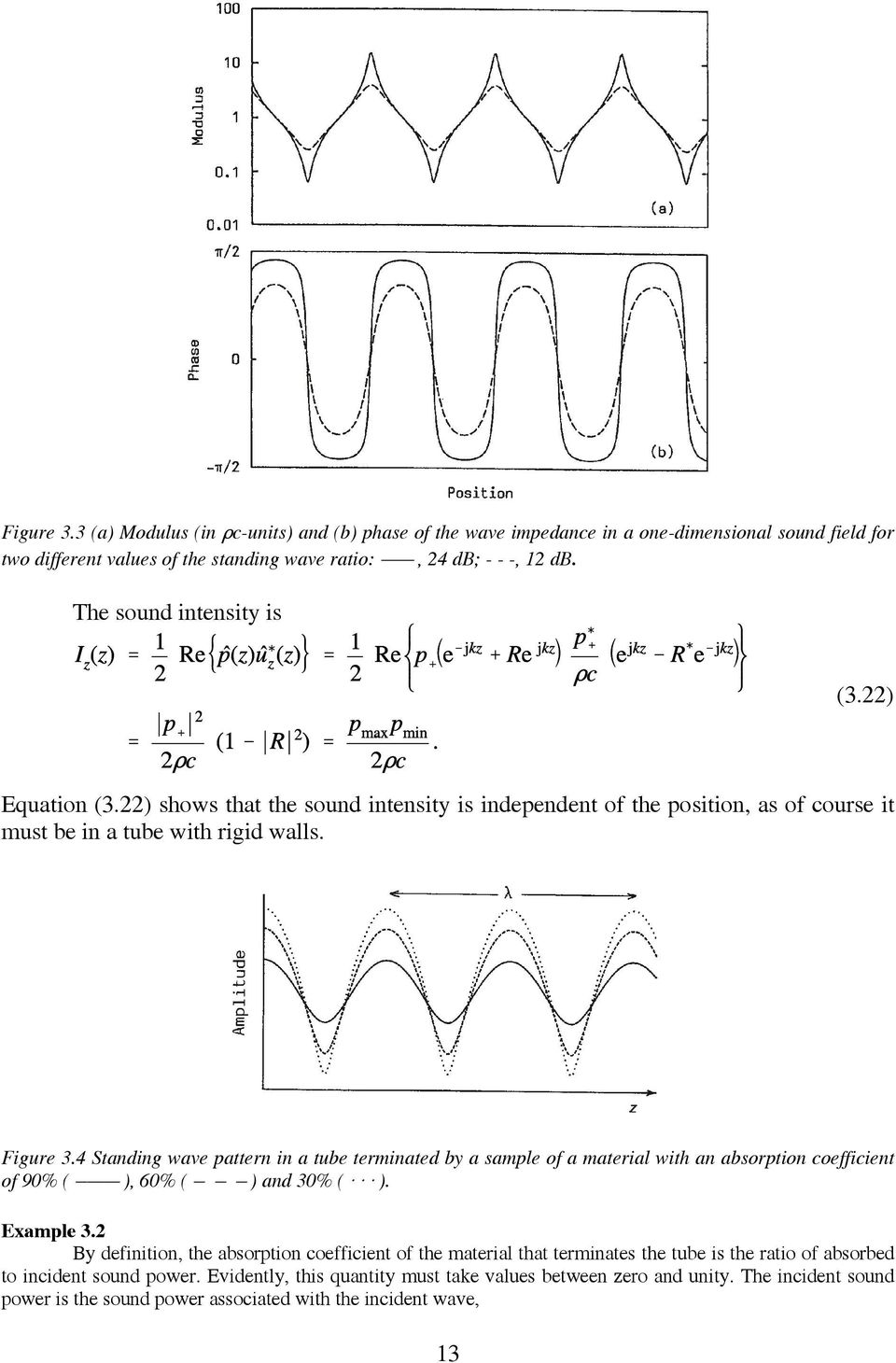
12 which completely characterises the acoustic properties of the surface for normal sound incidence. Equation (3.5) can now be written (3.14) It is easy to see from eq. (3.14) that the amplitude of the sound pressure varies with the position. The maximum value, (3.15) occurs at positions where the incident wave is in phase with the reflected wave (constructive interference), and the minimum value, (3.16) occurs at positions where the two waves are in antiphase (destructive interference). The ratio of the two quantities is the standing wave ratio, (3.17) From eqs. (3.9) and (3.14) it follows that the wave impedance (the complex ratio of the sound pressure to the particle velocity) 5 is (3.18) In figure 3.3 are shown the modulus and phase of the wave impedance as functions of the position for two different values of the standing wave ratio s. The boundary condition at z = 0 implies that It now follows that and (3.19) (3.20) (3.21) The latter equation shows that the quantity is important; this quantity may be called the characteristic impedance of the tube. Apparently, there is total reflection in phase (R 1) when the terminating surface is almost rigid ( ), there is total reflection in antiphase (R -1) when the terminating impedance is very small ( ), and there is no reflection (R = 0) when the terminating impedance equals the characteristic impedance of the tube, Dc/S. 5 This quantity is sometimes referred to as the specific impedance. 12

13 Figure 3.3 (a) Modulus (in Dc-units) and (b) phase of the wave impedance in a one-dimensional sound field for two different values of the standing wave ratio: ))), 24 db; - - -, 12 db. The sound intensity is (3.22) Equation (3.22) shows that the sound intensity is independent of the position, as of course it must be in a tube with rigid walls. Figure 3.4 Standing wave pattern in a tube terminated by a sample of a material with an absorption coefficient of 90% ( ))) ), 60% ( ) ) ) and 30% ( A A A ). Example 3.2 By definition, the absorption coefficient of the material that terminates the tube is the ratio of absorbed to incident sound power. Evidently, this quantity must take values between zero and unity. The incident sound power is the sound power associated with the incident wave, 13
14 and since the sound power absorbed by the material is it follows that the absorption coefficient is The modulus of the reflection factor can be expressed in terms of the standing wave ratio, cf. eq. (3.17), from which it can be seen that The standing wave ratio, and thus the absorption coefficient of the material at the end of the tube, can be measured by drawing a pressure microphone through the tube and recording the sound pressure as a function of the axial position. This is the classical method of determining normal incidence absorption coefficients. Example 3.3 It is possible to determine the reflection factor R and thus the absorption coefficient of the material at the end of the tube by measuring the transfer function between the signals from two pressure microphones mounted in the wall of the tube. Let where )z is the separation distance (see figure 3.5). The transfer function between these signals is Rearranging gives the expression which shows that R can be calculated from H 12, k, z and )z unless the distance between the microphones is a multiple of half a wavelength. Since this method does not require a traversing microphone, it is generally much faster than the classical method based on measuring the standing wave ratio. In practice the tube is driven with wide-band random noise, and the transfer function between the two pressure signals is measured using a dualchannel FFT analyser. By contrast the classical method requires driving the tube with one frequency at a time. Figure 3.5 The two-microphone technique of measuring absorption coefficients in a tube. 14
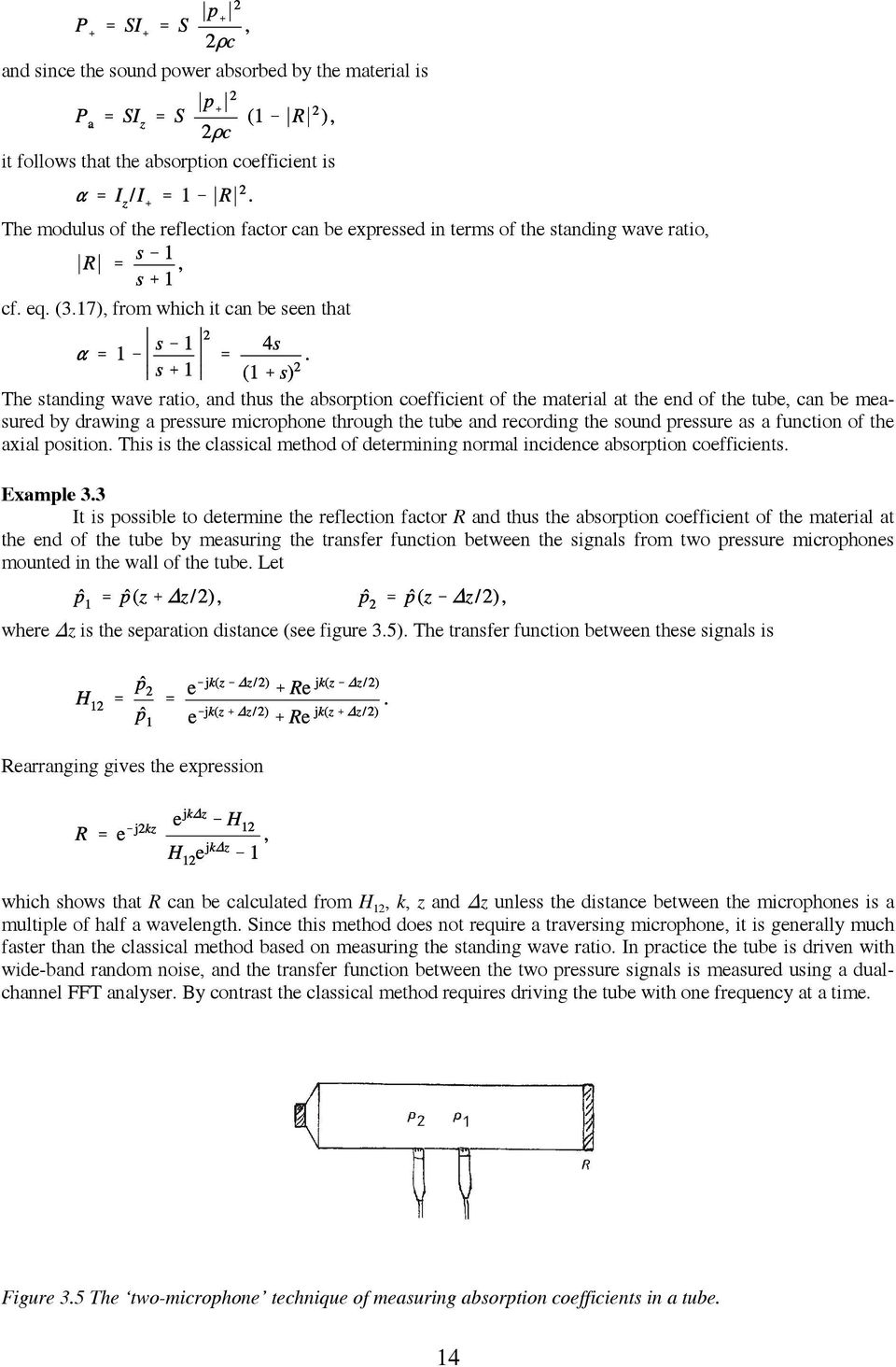
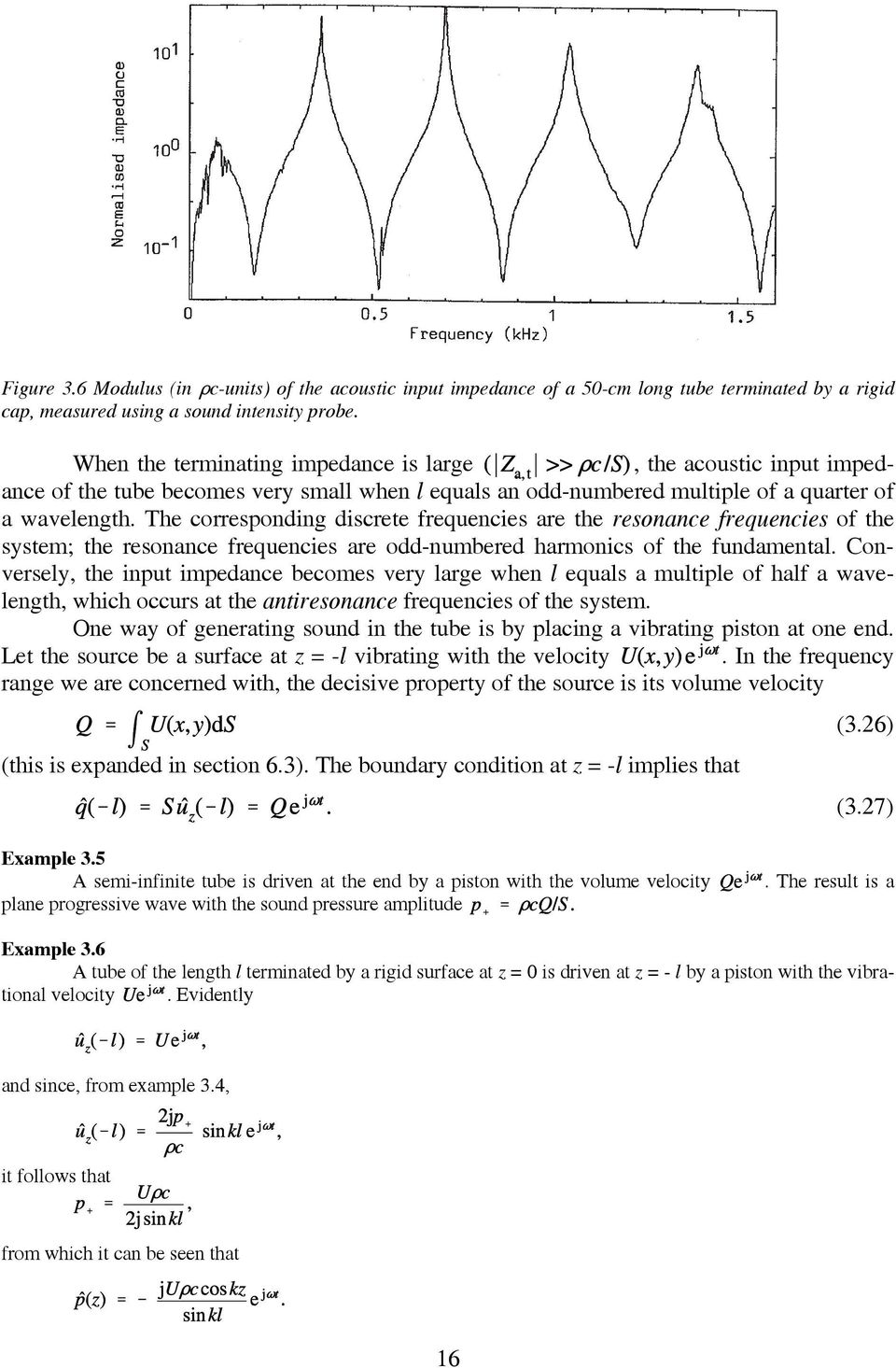
15 tube, Equation (3.18) makes it possible to determine the acoustic input impedance of the (3.23) where l is the length of the tube. Combining eqs. (3.21) and (3.23) gives the acoustic input impedance expressed in terms of the acoustic impedance of the material at the end of the tube: (3.24) It is apparent that the input impedance varies with the frequency unless Z a,t = Dc/S. Note also that Z a,i = Z a,t when kl is a multiple of B corresponding to the length of the tube being a multiple of half a wavelength. It is also interesting to observe that (3.25) when kl is an odd-numbered multiple of B/2 corresponding to the length of the tube being an odd-numbered multiple of a quarter of a wavelength; a tube of this length transforms a large impedance into a small one and vice versa. Example 3.4 The reflection factor equals unity if the tube is terminated by a rigid wall. The resulting interference pattern is called a standing wave. From eqs. (3.9) and (3.14), Note that the sound pressure and the particle velocity are in quadrature (90/ out of phase). Accordingly, the time-averaged sound intensity is zero at all positions in the tube. The input impedance is purely imaginary, and varies strongly with the frequency. At very low frequencies, where the tube is much shorter than the wavelength, the input impedance approaches the impedance of a small cavity, where V = Sl is the volume of the tube. Apparently, in the limit of low frequencies the impedance depends only on the volume. Compare with example 2.1; V/Dc 2 is the acoustic compliance of the cavity. Figure 3.6 shows the measured acoustic input impedance of a tube terminated by a rigid cap. The sound pressure and the particle velocity have been measured using a sound intensity probe. The measurement is not reliable below 100 Hz. 15

16 Figure 3.6 Modulus (in Dc-units) of the acoustic input impedance of a 50-cm long tube terminated by a rigid cap, measured using a sound intensity probe. When the terminating impedance is large, the acoustic input impedance of the tube becomes very small when l equals an odd-numbered multiple of a quarter of a wavelength. The corresponding discrete frequencies are the resonance frequencies of the system; the resonance frequencies are odd-numbered harmonics of the fundamental. Conversely, the input impedance becomes very large when l equals a multiple of half a wavelength, which occurs at the antiresonance frequencies of the system. One way of generating sound in the tube is by placing a vibrating piston at one end. Let the source be a surface at z = -l vibrating with the velocity. In the frequency range we are concerned with, the decisive property of the source is its volume velocity (this is expanded in section 6.3). The boundary condition at z = -l implies that (3.26) (3.27) Example 3.5 A semi-infinite tube is driven at the end by a piston with the volume velocity plane progressive wave with the sound pressure amplitude. The result is a Example 3.6 A tube of the length l terminated by a rigid surface at z = 0 is driven at z = - l by a piston with the vibrational velocity. Evidently and since, from example 3.4, it follows that from which it can be seen that 16
17 Note that the sound pressure goes towards infinity at the antiresonance frequencies owing to the fact that losses have been ignored. In practice there will always be some losses, and the source will have a finite acoustic impedance, which means that it cannot maintain its volume velocity if the sound pressure on its surface goes towards infinity. If the tube is driven with a small piston that is mounted in the wall, say at z = z 0, the boundary conditions at z = z 0 are (3.28) and (3.29) where and are the limits z 0 ± " with " 6 0, and is the volume velocity of the piston. The discontinuity in the volume velocity is due to the fact that the velocity is a vector. Example 3.7 A piston with the volume velocity is mounted at z = 0 in the wall of infinite tube. This source will generate plane waves travelling to the left and to the right: and From eqs. (3.28) and (3.29) it follows that share the volume velocity injected at z = 0.. In effect the right- and left-going waves Figure 3.7 A semi-infinite tube driven by a loudspeaker at an arbitrary position. Example 3.8 A semi-infinite tube is driven by a small loudspeaker with a volume velocity of mounted in the wall the distance l from a rigid termination (see figure 3.7). At positions between the source and the rigid surface (0 # z # l), and and since q(0) = 0 it can be seen that. To the right of the source (at z $ l), and 17
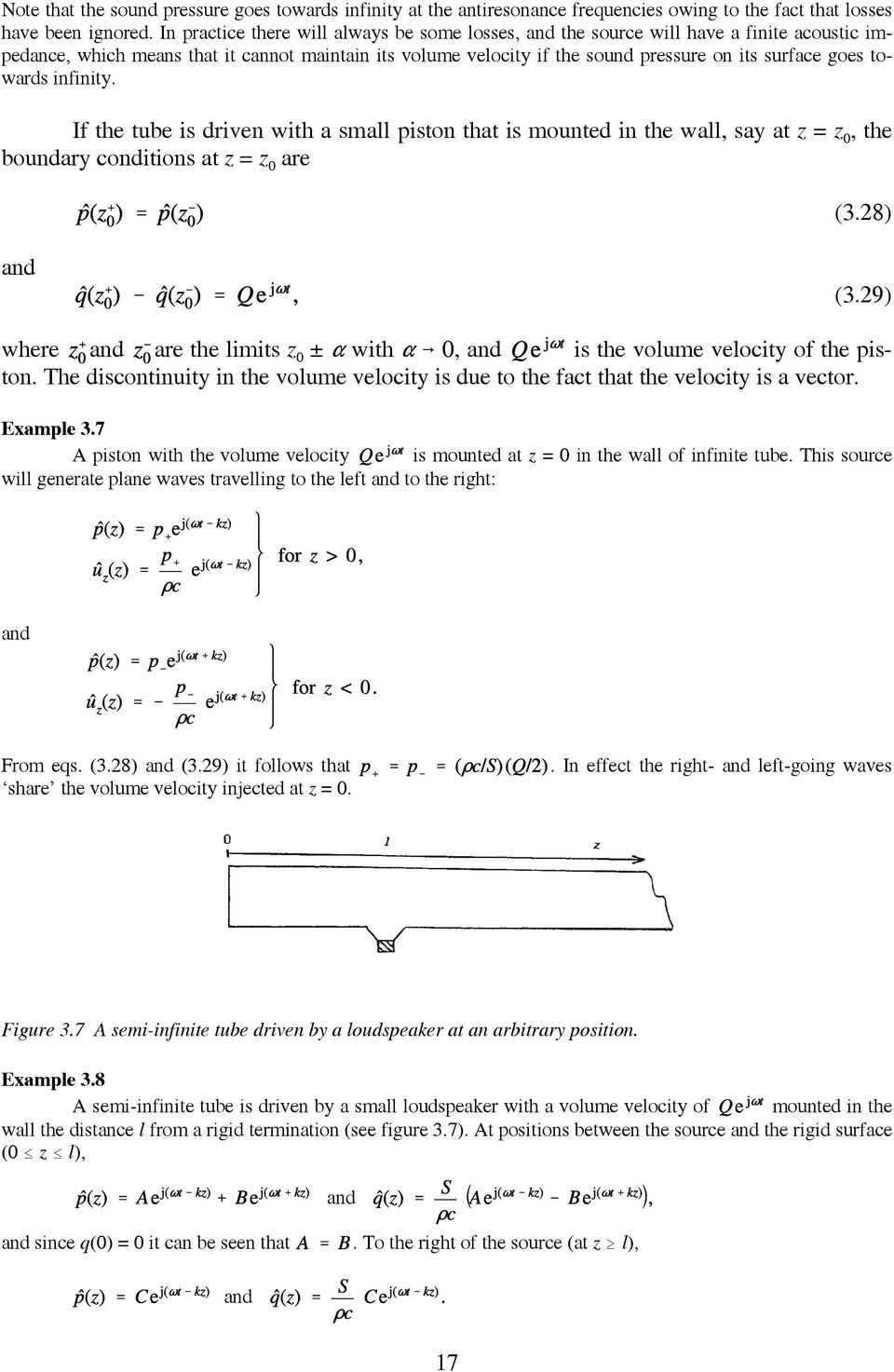
18 From eq. (3.28), and from eq. (3.29), from which it follows that the sound pressure between the source and the rigid surface is (a standing wave), and (a propagating wave) to the right of the source. Note that for z $ l at frequencies where l equals an odd-numbered multiple of a quarter of a wavelength. The physical explanation is that the sound field to the right of the source is the sum of the direct wave from the source and the left-going wave, reflected at z = 0, When l is an odd-numbered multiple of a quarter of a wavelength, the reflected wave has travelled an odd-numbered multiple of half a wavelength longer than the direct wave and is therefore in antiphase; therefore it cancels the direct wave. 3.2 Radiation of sound from an open-ended tube An open-ended tube is in effect terminated by the radiation impedance, which is the impedance that would load a piston at the end of the tube. The radiation impedance of a flanged tube (a tube with the open end in a large, rigid plane) is identical with the radiation impedance of a piston set in a large, plane, rigid baffle; the radiation impedance of an unflanged tube is similar to the radiation impedance of a small monopole in free space. As we shall see, at very low frequencies these quantities are much smaller than the characteristic impedance of the tube, which, with eq. (3.21), leads to the conclusion that R -1; there is a strong reflection in antiphase. 6 Accordingly, the input impedance at the other end of the tube exhibits minima when the (effective) length of the tube is a multiple of half a wavelength. The radiation impedance of a circular piston of the radius a mounted in an infinite baffle is [3] (3.30) where J 1 is the Bessel function and H 1 is the Struve function of first order. At low frequencies this expression can be approximated as follows [1], (3.31) The approximation is fair if ka < 0.5. At very low frequencies a considerable part of the incident sound power is reflected 6 A surface with the boundary condition is termed a pressure release surface. Such a surface gives total reflection in antiphase. 18

19 from the open end of the tube, as mentioned above. The transmission coefficient describes the small fraction of the incident sound power radiated into the open. From eq. (3.21) we have (3.32) from which it follows that the transmission coefficient J is given by (3.33) Note that the transmission coefficient to this approximation is independent of the imaginary part of the radiation impedance, even though the imaginary part is much larger than the real part. The imaginary part of the radiation impedance corresponds to the impedance of a mass of a volume of the medium of the size S)l, where (3.34) This becomes apparent if the radiation impedance is written as a mechanical impedance (the ratio of force to velocity): (3.35) The main effect of the imaginary part of the radiation impedance is to shift the position where reflection in antiphase occurs to a virtual plane outside the tube. This can be seen as follows. If we ignore the small real part of the radiation impedance eq. (3.32) becomes (3.36) corresponding to the input impedance of the tube being (3.37) and this is exactly the result we would obtain if a tube of the length l + )l was terminated by a surface with an acoustic impedance of zero (cf. eq. (3.24)). Equation (3.37) explains why the quantity )l is termed the end correction: the effective length of the tube is l + )l. Ignoring the real part of the radiation impedance is too coarse an approximation at the resonance frequencies, though. At these frequencies 19 (3.38)
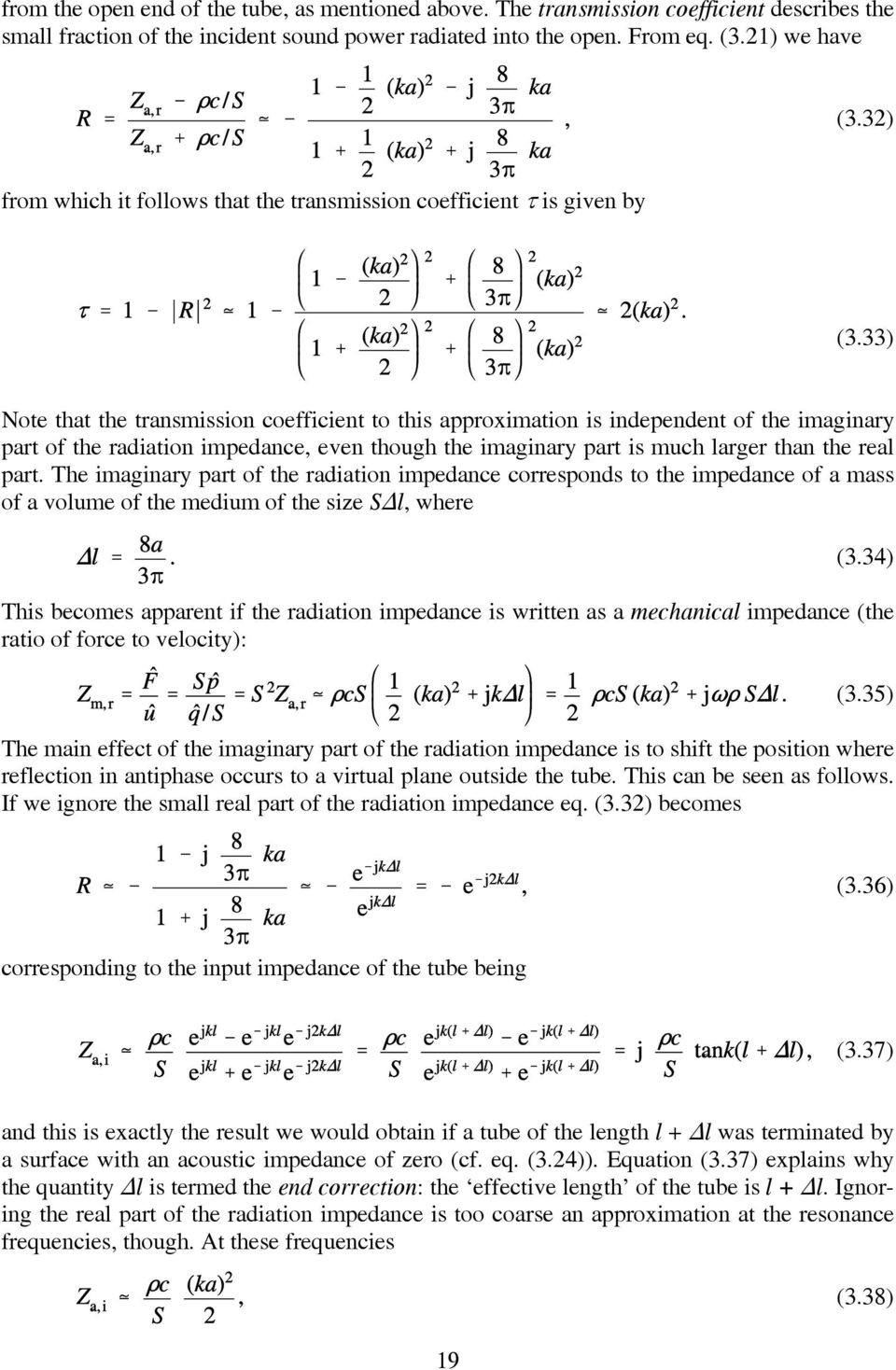
20 which is small but not zero as implied by eq. (3.37). In a similar manner it can be shown that (3.39) at the antiresonance frequencies, and this impedance is large but not infinite as implied by eq. (3.37). In fact, the tube behaves as if it had a length of l + )l and were terminated by a small, purely real impedance, Re{Z a,r }. There is no simple way of calculating the radiation impedance of a thin-walled tube that radiates into open space without a flange. However, it can be shown [5] that in the lowfrequency limit, (3.40) corresponding to a transmission coefficient of and an end correction that takes a value of (3.41) (3.42) Apparently, a large flange tends to double the real part of the radiation impedance ) in agreement with the fact that the solid angle is (almost) halved by the flange, which implies a better impedance match. Note also that the real part of the radiation impedance of the unflanged tube, (3.43) is identical with the radiation resistance of a small pulsating sphere (see, e.g., ref. [3]). Figure 3.8 shows the input impedance of an open-ended tube. As the frequency is increased the impedance peaks and troughs become less and less pronounced. Figure 3.8 The input impedance of an open-ended tube. 20
![There is no simple way of calculating the radiation impedance of a thin-walled tube that radiates into open space without a flange. However, it can be shown [5] that in the lowfrequency limit, (3.](/docs-images/40/1317025/images/page_20.jpg "40) corresponding to a transmission coefficient of and an end correction that takes a value of (3.41) (3.")
21 Example 3.9 A source of high acoustic impedance, that is, a source that tends to maintain its volume velocity irrespective of the acoustic load, tends to excite the antiresonance frequencies of the tube. The generator in reed instruments, e.g. clarinets and oboes, and brass instruments, e.g. trumpets, may be regarded as a source of high impedance; therefore such instruments play at impedance peaks (antiresonance frequencies), which are odd-numbered harmonics of the fundamental. A tone produced by a clarinet therefore has a strong content of odd-numbered harmonics [4]. Example 3.10 A source of low acoustic impedance, that is, a source that tends to produce a given sound pressure at its surface irrespective of the acoustic load, tends to excite the resonance frequencies of the tube. The generator in flutes and organ pipes may be regarded as a source of low impedance; therefore flutes and open organ pipes play at impedance minima (resonance frequencies), which occur at all harmonics. It follows that a tone produced by a flute has even as well as odd harmonics [4]. Example 3.11 A tone produced by a closed organ pipe has only odd-numbered harmonics, because the resonances of a closed tube occur when the length equals an odd-numbered multiple of a quarter of a wavelength. Figure 3.9 Radiation from the open end of a tube. The sound field generated by an open-ended tube driven by a piston at the other end can be calculated as follows. From eq. (3.12) we can write where (3.44) (3.45) is the reflection factor at the virtual reflection plane z = 0 (cf. eq. (3.32)). The boundary condition at the piston implies that (3.46) where is the effective length of the tube. From eqs. (3.44) and (3.46), (3.47) (3.48) 21
22 which shows that the volume velocity is large when the cosine equals zero. In the frequency range we are concerned with the open end of the tube radiates as a monopole with the volume velocity, that is, the sound pressure at a distance r from the virtual opening is [3] (3.49) Example 3.12 The principle of reciprocity implies that the sound pressure at a given point r due to a monopole at another point r 0 is equal to the sound pressure generated by the monopole if the positions r and r 0 are interchanged. This leads to the conclusion that a monopole with the volume velocity radiating at the distance r from the open end of a tube would generate the sound pressure given by eq. (3.49) if the terminating surface at the other end of the tube is rigid. This result can also be obtained without employing the principle of reciprocity. The sound pressure at the distance r from the monopole is in the undisturbed medium. From Thévenin s theorem it now follows that the sound pressure at the open end of the tube is where is the input impedance of the closed tube (cf. example 3.4). There is a simple relation between the sound pressure at the rigid termination,, and the sound pressure at the open end, (cf. example 3.4). When these equations are combined eq. (3.49) results. 4. SOUND TRANSMISSION THROUGH COUPLED PIPES A silencer (or muffler) is a device designed to reduce the emission of noise from a pipe, for example the noise from the exhaust of an engine. Reactive silencers are composed of coupled tubes without absorbing material. They work by reflecting the sound from the source. Dissipative silencers absorb acoustic energy. There is no simple way of dealing with the sound field in a system of coupled tubes as the one sketched in figure 4.1 in the general case. However, at low frequencies where the sound field in each component part can be assumed to be one-dimensional, the problem is a fairly simple one. At each junction it can be assumed that the output sound pressure and volume velocity of one system equal the input sound pressure and volume velocity of the adjoining system; therefore the acoustic input impedance of the exit system is the acoustic load of the preceding system. 22
23 Figure 4.1 A system of coupled pipes. Example 4.1 Two tubes with cross-sectional areas S 1 and S 2 are connected, as sketched in figure 4.2. If the second tube is infinite, its input impedance is, from which it follows that the reflection factor at the junction seen from the first tube is (cf. eq. (3.21)). Note that R 1 if S 2 << S 1, in accordance with the fact that a sudden, strong area contraction almost acts as a rigid wall. Conversely, R - 1 if S 2 >> S 1 ; in this case the junction acts almost as a pressure-release surface. The transmission coefficient is It can be seen that the fraction of incident sound power transmitted from one tube to another is the same in both directions. It is physically obvious that it is unrealistic to expect the sound field to be strictly onedimensional in the immediate vicinity of a discontinuity as the one shown in figure 4.2. Nevertheless, if one s main concern is the transmission properties of the composite system it is usually a good approximation to assume that the sound field is one-dimensional (below a certain frequency determined by the cross-sectional dimensions), because the local disturbances correspond to higher-order modes that die out exponentially with the distance and have little effect on the overall transmission. Higher-order modes are analysed in chapter 6. Figure 4.2 Transmission and reflection at an area discontinuity. 4.1 The transmission matrix The low-frequency approximation implies that each subsystem is an acoustic two-port (or four-pole system) with two (and only two) unknown parameters, the complex amplitudes of two interfering waves travelling in opposite directions. Such a system can be described by its transmission (or four-pole) matrix, as follows, (4.1) 23
24 where and are the sound pressures and volume velocities at the input and at the output; see also figure 4.3. It is apparent that (4.2a-d) The four-pole parameters are not independent. From the reciprocity principle it follows that (4.3) where the latter quantity can be deduced from the matrix equation This leads to the conclusion that the matrix determinant AD - BC equals unity. (4.4) Figure 4.3 An acoustic two-port. Figure 4.4 A system composed of coupled pipes and its transmission matrix. The description of the subsystems in terms of their four-pole parameters is very convenient, because the output of one system is the input of the next system, from which it follows that the transmission matrix of a system consisting of cascaded subsystems is obtained by matrix multiplication, 24
25 (4.5) Figure 4.4 illustrates a composite system and the equivalent electrical circuit based on the product of transmission matrices of subsystems. The source that generates the noise that the silencer is supposed to reduce can be described either in terms of its volume velocity in parallel with its acoustic impedance or its sound pressure in series with its acoustic impedance (see figure 4.5). The former description implies that the actual volume velocity of the source differs from because of the acoustic load of the input system, (4.6) unless it also shows that the actual input sound pressure is (4.7) The latter description entails that (4.8) which shows that the actual input sound pressure differs from unless. It also implies that (4.9) Figure 4.5 Two equivalent descriptions of a source. The two source descriptions are equivalent. However, the former description is the natural choice if the volume velocity of the source is almost independent of the acoustic load, and the latter description is more appropriate if the sound generation mechanism tends to keep the pressure constant. Often the input impedance of the system driven by the source varies strongly with the frequency (cf. figures 3.6 and 3.8), which means that it is necessary to take account of the finite source impedance, though. 7 It is a simple matter to derive the transmission matrix of a cylindrical tube with the length l and the cross-sectional area S. With an appropriate choice of the local coordinate system we can write 7 Outside of ducts and small cavities most sources of air-borne noise are able to maintain their volume velocity irrespective of the radiation load. This corresponds to the case in which. 25
26 (4.10) and (4.11) (4.12) (4.13) for the input and output quantities. The four-pole parameters now follow from eqs. (4.2a-d). For example, a rigid termination ( = 0) leads to the requirement that, from which we conclude that (4.14) The resulting transmission matrix of the tube is (4.15) Example 4.2 A tube of length l might be regarded as two coupled tubes of lengths l 1 and l 2 where l 1 + l 2 = l, in agreement with the fact that The input impedance of a system terminated by a given impedance Z a,t follows from eq. (4.1): (4.16) The sound pressure and volume velocity at the termination impedance of a system driven by a given source follow from eqs. (4.1), (4.6) and (4.16), (4.17a) 26
27 (4.17b) which demonstrate the influence of the source impedance. Example 4.3 Some of the results derived in chapter 3 can be derived more easily if use is made of the transmission matrix of a tube. For example, the input impedance of a tube terminated by a given impedance, eq. (3.24), now follows immediately from eq. (4.16). The formalism derived in the foregoing makes it a simple matter to calculate the sound pressure and volume velocity at the junction between two subsystems. It is apparent from figure 4.6 that (4.18a) (4.18b) where p x and q x are the sound pressure and volume velocity at the input of the terminating subsystem with four-pole parameters AN, BN, CN and DN (which itself may be composed of several subsystems). Combining eqs. (4.17) and (4.18) gives (4.19a) (4.19b) Figure 4.6 Calculation of the sound pressure inside a composite system. Example 4.4 The sound pressure at an arbitrary position in a tube driven by a piston with the volume velocity and terminated by the impedance Z a,t (see figure 4.7) follows from eq. (4.19) with Z a,s = 4, 27
28 Note that if also that ; in this case there is no reflection from the termination, so the tube acts as a simple delay. Note if the termination is rigid. At the piston (that is, for l 1 = l), in agreements with example 3.4. Figure 4.7 The sound pressure in a tube driven by a piston. 4.2 System performance There are several ways of describing the performance of a silencer. The most useful measure is the insertion loss, which is defined as the ratio of the output mean-square volume velocity without the silencer to its value with the silencer. The insertion loss is usually presented in logarithmic form. The reference system can be either an infinitely short tube the transmission matrix of which is a unit matrix (4.20) (cf. eq. (4.15)), or a hard-walled tube that has the same length as the silencer. It follows from eq. (4.17) that (4.21) where A, B, C and D are the four-pole parameters of the entire system including the silencer and AN, BN, CN and DN are the corresponding parameters of the reference system. If this is an infinitely short tube eq. (4.21) reduces to (4.22) If the source is able to maintain its volume velocity irrespective of the acoustic load, then eq. 28
29 (4.21) is reduced to (4.23) and eq. (4.22) is simplified to (4.24) Figure 4.8 The insertion loss is obtained by comparing with a reference system. It is not immediately apparent from eq. (4.21), but it can be shown that the insertion loss is independent of the length of the inlet pipe (the tube between the source and the silencer) if the source has an impedance of Dc/S. The physical explanation is that a source with an impedance that equals the characteristic impedance of the connected tube does not reflect waves. In a similar manner it can be shown that the length of the tailpipe (the tube after the silencer) is of no importance if the terminating impedance is Dc/S, rather than the radiation impedance Z a,r assumed in eq. (4.21). If both the source impedance and the termination impedance equal Dc/S, then the length of the reference system is of no importance, since (4.25) This particular version of the insertion loss with anechoic terminations at both ends is the transmission loss; eq. (4.21) now becomes (4.26) It can be shown that the transmission loss is identical with the ratio of incident to transmitted 29
30 sound power. Since the transmitted sound power cannot possibly exceed the incident sound power it follows that (4.27) for any system. 8 By contrast, the insertion loss as defined by eq. (4.21) may well take negative values at certain frequencies (in db), corresponding to the case where the performance of the silencer is poor compared with the performance of the reference system, for example because the input impedance of the reference system is particularly unfavourable. Example 4.5 An expansion chamber is the simplest possible reactive silencer; see figure 4.9. From eqs. (4.15) and (4.26) it can be seen that the transmission loss is where h is the ratio of the cross-sectional areas and l is the length of the chamber; see figure Note that the transmission loss is zero when l is a multiple of half a wavelength. Figure 4.9 An expansion chamber. Since the insertion loss takes account of reflections from the source and from the outlet of the tailpipe it gives a more realistic picture of the performance of the silencer than the transmission loss does. Figure 4.11 shows the insertion loss of an expansion chamber with an area expansion ratio of four, as in figure 4.10, calculated for a constant volume velocity source. Note the significant influence of the reference system. With an infinitely short tube as the reference system the sharp peaks of the insertion loss disappear, because we no longer have particularly efficient radiation of the reference system at certain frequencies. 8 Silencers of the reactive type contain no absorbing lining; they reduce the sound power radiation by impedance mismatch. Obviously, in the absence of dissipation in the silencer, the radiated sound power equals the sound power output of the source. The sound power incident on the silencer is, of course, larger than (or, at worst, equal to) the sound power output of the silencer. 30
31 Figure 4.10 The transmission loss of an expansion chamber with an area expansion ratio of four. The impedance of the source can also have a significant influence on the insertion loss, as demonstrated by figure 4.12, which shows the insertion loss of a tube with an infinitely short tube as the reference system, calculated for a constant volume velocity source, for a constant sound pressure source, and for an anechoic source. The sound power output of the source is particularly large when it is loaded by an impedance comparable to the source impedance. Thus the sharp minima in the transmission loss occur when the input impedance of the tube matches the impedance of the source. With a source of constant volume velocity this occurs when the effective length of the tube equals an odd-numbered multiple of a quarter of a wavelength; with the constant sound pressure source the phenomenon occurs when the effective length of the tube equals a multiple of half a wavelength. Figure 4.11 The insertion loss of an expansion chamber with an area expansion ratio of four, calculated under the assumption of a source of infinite internal impedance. Reference system: )))), an infinitely short tube; ) ) ), a tube of the same length. Example 4.6 The effect of a side branch resonator (a closed tube mounted in the side of the system, cf. figures 4.8 and 4.12) is to shunt the system with a low input impedance at certain frequencies. The boundary conditions imply continuity in the pressure but a sudden change in the volume velocity, cf. eqs. (3.28) and (3.29), corresponding to the transmission matrix 31
32 where Z a,i is the input impedance of the side branch. A simple closed tube mounted in the side of an exhaust system is a very efficient silencer when the length of the tube is an odd-numbered multiple of a quarter of a wavelength (cf. eq. (3.25)). However, it has very little effect at other frequencies, as can be seen in figure The closed, concentric tube that results if a pipe is projected into another wider pipe as shown in figure 4.14 has the same effect as a closed tube mounted in the side of the system. Figure 4.12 The insertion loss of a tube with hard walls, calculated for a source impedance of )))), 100 Dc/S, - - -, 0.01 Dc/S, ) A ) A, Dc/S. The reference system is an infinitely short tube. Figure 4.13 The transmission loss of a side branch resonator. Figure 4.14 Alternative side branch resonators: extended inlet and extended outlet. 32
33 Figure 4.15 The transmission loss of an expansion chamber with extended inlet and outlet. Figure 4.16 The transmission loss of a double-chamber resonator. Example 4.7 The relatively poor performance of an expansion chamber can be improved significantly if the inlet and outlet pipes are projected into the chamber, as shown in figure Another, particularly efficient configuration is shown in figure It consists of two expansion chambers in series, and the good performance is due to the fact that the resonators made by the tube mounted between the two chambers have their maximum effect at the frequencies where the chambers exhibit a minimum effect. 4.3 Dissipative silencers A dissipative silencer is a device that attenuates sound by absorbing acoustic energy, and a duct with porous lining materials on the walls can be an efficient silencer at medium frequencies. Such lined ducts are often used in air conditioning systems and also sometimes in combination with reactive silencers in exhaust systems. There is no general solution in closed form to the problem of analysing sound propagation in a lined duct (see chapter 7), and solving the problem usually involves iterative numerical procedures. The analysis leads to a solution in terms of waves with a complex wave-number, where the imaginary part indicates that the waves decay exponentially as they propagate. Thus the transmission matrix of a lined duct of the length l and internal cross-sectional areas S has the same form as eq. (4.15): 33
34 (4.28) Dissipative silencers are in some respects easier to deal with than reactive silencers. If the lining attenuates sound waves so efficiently that the influence of sound reflected back from the tailpipe to the source can be neglected, both the input and the output impedance of the silencer are approximately Dc/S, from which it follows that the performance of the silencer is almost independent of the source and termination impedance, so that the insertion loss approximately equals the transmission loss. Moreover, the insertion loss (in db) is simply proportional to the length of the duct, as can be seen as follows, (4.29) Curves showing the predicted attenuation of lined ducts of various configurations are given in many textbooks. An example is reproduced in figure The essential parameters are the flow resistance of the lining material and the thickness of the lining relative to the duct width. A very brief account of the theory behind such predictions is given in chapter 7. Figure 4.17 Attenuation rate of a rectangular duct lined on the two opposite sides with bulk reacting material (see section 7.2). Lined circular ducts give twice the attenuation. (After ref. [6].) 34
35 5. SOUND PROPAGATION IN DUCTS WITH MEAN FLOW The very purpose of the ducts of heating, ventilating and air-conditioning systems and engine exhaust pipes is to transport air, whereas the transmission of sound is an unwanted byproduct. Whether mean flow affects the acoustic properties of such systems is therefore a matter of some practical importance. In the general case where the flow is rotational and turbulent the analysis is very complicated. In what follows we shall only touch upon the simple case of ducts with steady, uniform flow. Equations (2.10) and (2.14) now become (5.1) (5.2) where u 0 is the mean flow velocity. If we assume that the flow is axial (in the z-direction) and the sound field is one-dimensional, eqs. (5.1) and (5.2) become (5.3) (5.4) Eliminating u z from these two equations gives a modified wave equation: (5.5) The corresponding equation in the usual complex notation is (5.6) where we have also introduced the Mach number of the flow, (5.7) It is fairly easy to show that the general solution to eq. (5.6) can be written in the form (5.8) where (5.9a, 5.9b) 35
36 Since it can be seen that the effect of the flow is to stretch the wavelength of waves travelling in the direction of the flow by a factor of 1+M, corresponding to an increase of the speed of sound, (5.10a) and to contract the wavelength of waves travelling in the opposite direction by a factor of 1-M, corresponding to a decrease of the speed of sound, (5.10b) which of course is just what one would expect. The transmission matrix of a tube with the length l, the cross-sectional area S and mean flow in the z-direction with a Mach number of M can now be calculated in the same manner as used in section 4.1. The result is (5.11) where (5.12) Since it follows that the flow tends to reduce resonance and antiresonance frequencies. However, with the moderate air speeds found in heating, ventilating and air-conditioning systems and in engine exhausts the effect is negligible. Since there is no flow in a side branch resonator the effect of even a slight modification of the wavelength in some of the pipes of a composite system can be significant, though. For example, the performance of the doublechamber resonator shown in figure 4.16 is much more affected by mean flow than the performance of the simple expansion chamber. It should finally be mentioned that mean flow also affects the radiation of sound power from the tailpipe. It can be shown [7] that the sound intensity is given by (5.13) 6. THREE-DIMENSIONAL WAVES IN DUCTS WITH RIGID WALLS The foregoing considerations have been based on the assumption that the sound field in a uniform duct is one-dimensional. As we shall see this is a good approximation at low frequencies, but at high frequencies the sound field in a duct is more complicated. It is possible to solve the problem analytically only for uniform ducts with a simple cross-sectional shape. The analytical method is known as separation of variables. 36
37 6.1 The sound field in a duct with rectangular cross section In the usual rectangular coordinate system the Helmholtz equation takes the form (6.1) cf. eq. (2.17). The solution to this equation must also satisfy the boundary conditions implied by the rigid walls. With the coordinate system sketched in figure 6.1 the boundary conditions are and (6.2a, 6.2b) (6.3a, 6.3b) which implies that (6.4) at x = 0 and x = a, and that (6.5) at y = 0 and y = b. Figure 6.1 A tube with rectangular cross section. It is now assumed that the solution to eq. (6.1) can be written as a product of three factors each of which depending on only one coordinate, which means that the sound pressure can be written as Insertion into eq. (6.1) gives (6.6) 37
38 (6.7) or (6.8) Inspection of eq. (6.8) leads to the conclusion that the three first terms must be independent of x, y and z. For example, the first term is obviously independent of y and z, and it does not depend on x either, since it equals the sum of three terms that do not depend on x. Equating this term with the constant gives which is recognised as the one-dimensional Helmholtz equation with the general solution (cf. eq. (3.5)). In a similar manner it follows that (6.9) (6.10) and (6.11) (6.12) Consequently, the general solution to eq. (6.7) can be written (6.13) where the constants k x, k y and k z must satisfy the condition (6.14) The boundary condition at x = 0 (eq. (6.4)) implies that (6.15) at x = 0, from which it follows that. Accordingly, 38 (6.16) which shows that the boundary condition at x = a can be satisfied only for certain discrete values of k x, determined by the condition (6.17) where m is an integer. Obviously, the boundary conditions at y = 0 and y = b lead to a similar condition for k y,
39 where n is an integer. From eq. (6.14) it follows that (6.18) (6.19) which shows that the axial wavenumber k z depends on m and n. Equation (6.13) now becomes (6.20) where (6.21) and g m = 1 for m = 0 and g m = 2 for m > 0. (The factor is a normalisation constant; see section 6.3.) Each term in the sum represents a wave or a duct mode. The term in the first parenthesis is the corresponding cross-sectional eigenfunction. With m = n = 0, (6.22) which can be recognised as the one-dimensional sound field assumed in the foregoing chapters. The plane wave is the fundamental duct mode. The general term with (m, n) (0, 0) is a higher-order mode with the propagation wavenumber k zmn. This mode can propagate unattenuated in the positive or negative z-direction if k zmn is real, which is the case if (6.23) Inspection of eq. (6.20) shows that the sound pressure of the (m, n)-mode is identically zero in m nodal planes parallel to the yz-plane and in n nodal planes parallel to the xz-plane; cf. figure 6.2. The axial particle velocity component associated with the (m, n)-mode follows from eqs. (2.21) and (6.20), (6.24) The axial component of the sound intensity associated with the mode is 39
40 Figure 6.2 Nodal lines of (m, n)-modes in a duct with rectangular cross section. (6.25) which is seen to be independent of z, as expected. In the x-direction, the particle velocity component is (6.26) which clearly is in quadrature with the sound pressure; therefore the sound intensity in a single isolated (m, n)-mode is zero in the transversal direction. In the general case the local sound intensity distribution is far more complicated, because the sound pressure in any mode cooperates with the particle velocity in any mode. However, as we shall see later, since the eigenfunctions are orthogonal such cross terms integrate to zero over the cross section of the duct, which means that the total sound power transmitted through the duct is simply the sum of the powers associated with the various modes. The expression for an (m, n)-mode that propagates along the tube can be rewritten as follows, (6.27) 40
41 (cf. eq. (6.13)), which shows that the mode can be decomposed into four interfering plane waves propagating in the directions (k x, k y, k z ), (k x,-k y, k z ), (-k x,-k y, k z ) and (-k x, k y, k z ). These plane waves may be regarded as one obliquely incident plane wave and its reflections from the walls of the tube. The waves interfere in such a manner that the boundary conditions (eqs. (6.4) and (6.5)) are satisfied. Figure 6.3 Distribution of sound intensity in an infinite duct excited by a point source. Duct width = 1 m. (After ref. [8].) 41
42 Since k z # k, the apparent wavelength in the z-direction is longer than 8 (= c/f): (6.28) Accordingly, the phase velocity exceeds the speed of sound: (6.29) The phase velocity is the velocity with which a given phase angle moves along in the tube. On the other hand, the fact that the four interfering plane waves that constitute the mode travel at oblique angles relative to the z-direction indicates that the acoustic energy propagates at a velocity that is lower than c. It can be shown that this speed, known as the group velocity, is: (6.30) This is the velocity with which a wavelet composed of a narrow band of frequencies (or the envelope of a similar noise signal) travels along the tube [9]. Note that c g depends on the frequency; this phenomenon, which is known as dispersion, means that the various frequency components of a wide-band signal travel with different velocities. A broad band impulse will change its shape as it travels along the tube. In the foregoing we have assumed that the condition expressed by the inequality (6.23) was satisfied. If, by contrast, the tube is driven with the frequency determined by the condition (6.31) that is, at the frequency (6.32) then k zmn = 0, and the sound pressure associated with the (m, n)-mode can be written (6.33) In this case we have a two-dimensional transversal standing wave that does not depend on z at all. At a still lower frequency, when (6.34) the propagation wavenumber k zmn becomes purely imaginary. The corresponding mode is attenuated exponentially, 42
43 (6.35) where (6.36) is the (positive and real-valued) propagation coefficient. The axial component of the particle velocity is (6.37) which is seen to be 90/ out of phase with the pressure; therefore the sound intensity is zero (this can also be seen from eq. (6.25)). Such a mode is called an evanescent mode. The foregoing considerations can be summarised as follows. In the general case the sound field in the tube can be decomposed into a sum of modes or waves, the plane wave plus an infinite number of waves of higher order. Each higher-order mode has a cutoff frequency determined by eq. (6.32); if driven below this frequency the mode is evanescent and decays exponentially with the distance; if driven above this frequency the mode propagates unattenuated. If the tube is driven with a frequency that is lower than the lowest cutoff frequency (which corresponds to the width of the tube being half a wavelength), only the fundamental mode (the plane wave) can propagate, and all the other modes decrease exponentially. This is the justification of the simplifying assumption made in chapters 3, 4 and 5. The cutoff frequency of the lowest higher-order mode (1, 0) is the frequency at which a equals half a wavelength (if a > b). Example 6.1 A given (m, n)-mode is driven an octave below its cutoff frequency, that is, at the frequency f = f mn /2. From eq. (6.36) it can be seen that The mode decays rapidly with the distance. For example, the attenuation over a distance that corresponds to the free-field wavelength at the given frequency is Example 6.2 Since the cross-sectional eigenfunctions are known and simple it is possible to detect the various modes in a rectangular duct with an appropriate arrangement of microphones. For example, an arrangement consisting of two pressure microphones placed symmetrically about the nodal plane of the (1, 0)-mode (say, at (a/4, b/2, z 0 ) and (3a/4, b/2, z 0 ) as sketched in figure 6.4) makes it possible to separate the plane wave from the (1, 0)-mode in the frequency range where only these two modes can propagate. Clearly, with the sum of the microphone signals is proportional to the one-dimensional part of the sound field, 43
44 whereas the difference is proportional to the (1, 0)-mode, Placing the microphones in the xz-plane at y = b/2 has the additional advantage that the (0, 1)-mode has no influence on the detection. Figure 6.4 Microphone arrangement for separating modes (0, 0) and (1, 0). Example 6.3 If the tube is terminated by a rigid surface at z = 0 and at z = h we obviously have a rectangular cavity. In this case k z must satisfy the equation where l is an integer (cf. eq. (6.17)), the mode shapes are functions of the form and the natural frequencies of the cavity are determined by eq. (6.14), from which it follows that One-dimensional modes, for which two out of the three indices are zero, are called axial modes; two-dimensional modes, for which one index equals zero, are known as tangential modes; and three-dimensional modes are also called oblique modes. 6.2 The sound field in a duct with circular cross section In order to determine the sound field in a duct with circular cross section one must express the Helmholtz equation in a cylindrical coordinate system (see figure 6.5): cf. eq. (2.17). The boundary condition for a tube with rigid walls is 44 (6.38) (6.39) It is now assumed that the sound pressure can be expressed as the product of functions that
45 depend only on one coordinate: (6.40) Figure 6.5 A tube with circular cross section. Insertion gives (6.41) It is apparent that the last term but one on the left-hand side is a function only of z that equals a sum of various terms that are independent of z; therefore it must be a constant, Inserting and multiplying with r 2 gives A similar argumentation now shows that where is the third term of eq. (6.43), and therefore (6.42) (6.43) (6.44) (6.45) Equations (6.42) and (6.44) can be identified as versions of the one-dimensional Helmholtz equation with the general solutions and (6.46) (6.47) 45
46 (cf. eq. (3.5)). Inspection of eq. (6.47) leads to the conclusion that k n must be an integer, since the function should obviously be periodic with period 2B: (6.48) Accordingly, we shall use the symbol m instead of k n for this integer. Moreover, we can combine the two exponentials in eq. (6.47), Finally, we introduce the transversal wavenumber k r : Equation (6.45) now becomes This differential equation is known as Bessel s equation, with the general solution (6.49) (6.50) (6.51) (6.52) where J m is the Bessel function of order m and N m is the Neumann function of order m. (Neumann functions are also known as Bessel functions of the second kind.) See figure 6.6 and the Appendix. Only the Bessel functions are finite at r = 0; therefore G must be zero. Figure 6.6 Bessel and Neumann functions of order m for m = 0, 1 and 2. From the boundary condition, eq. (6.39), it follows that (6.53) 46
47 This equation can be satisfied only for certain discrete values of k r, denoted k rmn with n = 0, 1, 2... (see figure 6.6 and table 6.1). The solution to eqs. (6.38) and (6.39) can now be written where (6.54) (6.55) and (6.56) is a normalisation constant. Each term in the sum represents a mode, cf. eq. (6.20). The modes corresponding to m = 0 are axisymmetric. With m = n = 0 eq. (6.54) simplifies to (6.57) which is recognised as the one-dimensional sound field dealt with in chapter 3. In the general case there are m nodal planes (with an orientation that depends on n m ) where the sound pressure is zero, and n coaxial nodal cylindrical surfaces; see figure 6.7. Table 6.1 Roots of eq. (6.53). n \ m Each mode has a cutoff frequency that follows from eq. (6.55) with k zmn = 0, (6.58) where 0 mn is the n th root of eq. (6.53). Some of these roots are listed in table 6.1. If it is driven above the frequency given by eq. (6.58) the mode can propagate unattenuated with the phase velocity (6.59) cf. eq. (6.29), whereas the group velocity is (6.60) 47
48 cf. eq. (6.30). If it is driven below the cutoff frequency the mode declines exponentially with the propagation coefficient cf. eq. (6.36). (6.61) Figure 6.7 Nodal lines of (m, n)-modes in a duct with circular cross section. The orientation of the nodal planes that occur when m > 0 depends on n m. It can be concluded that the first axisymmetric higher-order mode (0, 1) can propagate when ka > 3.83, corresponding to the condition (6.62) However, the lowest cutoff frequency in a duct of circular cross section is the cutoff frequency of the first non-axisymmetric mode (1, 0), below this frequency only the plane wave can propagate. (6.63) Example 6.4 The sound field in a duct consisting of the space between two concentric rigid cylinders with radii a and b (see figure 6.8) can be written as a sum of modes of the form since we cannot discard the Neumann term in this case. The ratio of to follows from the boundary condition at r = a, from which it can be seen that 48
49 The boundary condition at r = b implies that which leads to the conclusion that both boundary conditions can be satisfied only for certain discrete values of k rm (denoted k rmn ), determined by the condition m = 1), In the special case where the ratio of a to b equals the ratio of two of the roots of eq. (6.52), say (with the above condition is fulfilled for In this particular case there is no Neumann term, that is, B = 0; the Bessel term satisfies the boundary conditions at both r = a and r = b. Figure 6.8 A circular duct with a central, coaxial, solid cylinder. Example 6.5 It is easy to see that modes of the form can propagate in the partitioned duct shown in figure 6.9. A thin rigid partition gives rise to the additional boundary condition and this is obviously satisfied by the above expression. The partition excludes spinning modes and fixes the position of the nodal lines determined by the quantity in eq. (6.54). Example 6.6 The modes in a cylindrical enclosure with rigid walls at z = 0, z = h and r = a have the general form where the radial wavenumber k rmn is determined by eq. (6.53), and the axial wavenumber is 49
50 with l = 0, 1, 2,... The eigenfrequencies follow from eq. (6.58): The modes can be classified as longitudinal modes (0 mn = 0, l > 0), axisymmetric (m = 0) or non-axisymmetric (m $ 1) transversal modes (0 mn > 0, l = 0), and three-dimensional modes (0 mn > 0, l > 0). Figure 6.9 A partitioned duct. Equation (6.49) is actually a special case, not the general solution to eq. (6.44). Let us ignore the reflected waves for a moment. The general term, (6.64) is a spinning mode or helical wave (for m 0) with the circumferential mode number m (a positive or negative integer) and the radial mode number n. There are no nodal planes in a spinning mode; the wavefronts are spirals, hence the name; see figure Spinning modes are generated by rotating sources as, e.g., fans and propellers. However, many other excitation mechanisms tend to generate spinning modes in pairs with the same amplitude, and we can now reinterpret eq. (6.54) as the sum of such pairs of interfering spinning modes (with m and - m), spiralling in opposite directions with the same amplitude. Figure 6.10 Wavefronts of a spinning mode shown on a cylindrical surface. The dashed line shows the direction of propagation. (After ref. [10].) 50
51 6.3 The sound field in a duct with arbitrary cross-sectional shape A duct with arbitrary but constant cross-sectional shape may be called a waveguide. In the general case one cannot solve the problem analytically. However, the separation method can still be used. On the assumption that the sound pressure can be written as the product (6.65) the Helmholtz equation becomes (6.66) which shows that (6.67) Irrespective of the cross-sectional shape, the two-dimensional Helmholtz equation (6.68) with the boundary condition that the normal component of the gradient is zero at the walls, (6.69) is satisfied by infinitely many eigenfunctions, 9 the characteristic functions of the duct, each corresponding to a certain discrete, real, nonnegative value of k 2 denoted : (6.70) The lowest value of is zero, corresponding to the trivial case of R m being independent of x and y. This corresponds to the one-dimensional sound field assumed in chapter 3. Combining eqs. (6.67) and (6.70) leads to the equation which obviously has the solution where (6.71) (6.72) 9 The eigenfunctions are usually, but not always, real functions. Spinning modes in ducts with circular cross section correspond to complex eigenfunctions. 51
52 (6.73) Accordingly, the general solution to eq. (6.66) is a sum of waves of the form (6.74) Each mode has a cutoff frequency determined by the eigenvalue, (6.75) If driven above this frequency the mode can propagate unattenuated; if driven at a lower frequency the mode decays exponentially with a propagation coefficient given by eq. (6.62). 10 It is apparent that eq. (6.74) is the general version of eqs. (6.20) and (6.54). However, in the general case the cross-sectional eigenfunctions R m and the corresponding eigenvalues must be determined numerically, for instance by means of the finite element method. Example 6.7 A finite element solution of the two-dimensional eigenvalue problem in the two-dimensional room shown in figure 6.11 has resulted in eigenvalues corresponding to the resonance frequencies 188 Hz, 287 Hz and 393 Hz. If a duct with this cross-sectional shape is driven at 200 Hz only the plane wave and the mode with a cutoff frequency of 188 Hz can propagate. The phase velocity of the latter is Figure 6.11 Cross section of a uniform duct with rigid walls. The propagation coefficient of the first non-propagating mode is This mode will have decreased 60 db after travelling the distance l, where l follows from the relation 10 It can happen that several eigenfunctions have the same eigenvalue. This phenomenon is called modal degeneracy. In this case eq. (6.70) will be satisfied by any combination of these eigenfunctions. Spinning modes in ducts with circular cross section are degenerate. 52
53 from which we conclude that Example 6.8 Let the duct be terminated by rigid walls at z = 0 and at z = h. Equations (6.67) and (6.70) lead to the conclusion that the modes of the resulting cavity can be written where R m is a solution to the two-dimensional eigenvalue problem given by eq. (6.70) and (cf. examples 6.3 and 6.6). The eigenfrequencies of the cavity are given by where k m is the eigenvalue of the two-dimensional problem. An interesting general property of the cross-sectional eigenfunctions can be deduced as follows. From eq. (6.70) we conclude that since we also have However, this equation can be written Integrating over the cross section and applying Gauss s theorem to the first term gives (6.76) (6.77) (6.78) (6.79) where s is the perimeter of the cross section. At the rigid walls the normal component of the gradient of any eigenfunction is zero, therefore the left-hand term is zero. It now follows that the eigenfunctions are orthogonal, that is, that unless m = n. It is customary to normalise the eigenfunctions so that which implies that (6.80) (6.81) (6.82) 53
54 With (6.83) the particle velocity in the axial direction is (6.84) It now follows that the sound power transmitted through the duct is (6.85) However, because of the orthogonality of the eigenfunctions all cross terms (m n) integrate to zero, which means that eq. (6.85) can be reduced to (6.86) which shows that the transmitted power is simply the sum of the powers of the individual modes. Only the propagating modes (for which k zm is real-valued) contribute to this sum. Figure 6.12 Semi-infinite duct excited by a vibrating surface. The orthogonality of the eigenfunctions can be used in determining how a given source excites the various modes. Consider a semi-infinite duct driven by a vibrating surface perpendicular to the duct at z = 0 as sketched in figure Let be the vibrational velocity of the surface. The boundary condition at z = 0 implies that (6.87) that is, from eq. (6.84), (6.88) Multiplication with and integration over the cross section give 54
55 (6.89) which shows that the amplitude of the m th term is (6.90) Figure 6.13 Various loudspeaker arrangements for driving a duct. mode, In the special case where the vibrational velocity is proportional to the shape of a given (6.91) only this mode will be generated. (Whether it can propagate or not depends on whether the frequency of the excitation exceeds the cutoff frequency of the mode.) In the general case infinitely many modes will be generated, some propagating and the rest evanescent. Note that the plane wave generated by the vibrating surface has the amplitude where is the volume velocity of the source (cf. eq. (3.26)). (6.92) Example 6.8 From the foregoing considerations it can be concluded that a loudspeaker mounted in the middle of a plate that terminates a duct with rectangular cross section will generate (m, n)-modes corresponding to even values of m and n. A loudspeaker arrangement consisting of two speakers placed symmetrically as shown in figure 6.13 and driven in antiphase tends to generate modes corresponding to odd values of m and even values of n. Example 6.9 A monopole with the volume velocity is located at the position (x 0, y 0 ) on an otherwise rigid plate that terminates a semi-infinite duct at z = 0. In this case from which that is, the sound pressure generated by the piston can be written 55
56 Note that a given mode is particularly strongly excited if driven just above its cutoff frequency (unless R m (x 0, y 0 ) is zero, of course). Exactly at the cutoff frequency the sound pressure goes to infinity, but in practice it will, of course, be limited by losses. Note also that the function is symmetrical with respect to source and receiver position; this is a consequence of the general reciprocity relation. The solution of the inhomogeneous Helmholtz equation (6.93) (with whatever boundary conditions) is known as the Green s function. 11 This is the sound pressure at r generated by a point source at r 0, normalised by letting. The above expression follows if we add a volume velocity term on the right-hand side of eq. (2.10), (6.94) (or a mass term, divergence of eq. (2.14), on the right-hand side of eq. (2.1)), and combine with the For harmonic time dependence using complex representation this expression takes the form (6.95) (6.96) Thus the Green s function is the frequency response between a point source of constant volume acceleration at the position r 0 and the resulting sound pressure at the position r. The Green s function is much used in theoretical acoustics because it makes it possible to express the solution to the problem of calculating the sound field generated by a continuity of point sources as an integral. The free-space Green s function is (6.97) where. The Green s function for the semi-infinite duct described in example 6.9 is (6.98) where r = (x, y, z) and r 0 = (x 0, y 0, 0) (or vice versa). The magnitude of this function is shown in figure 6.14 as a function of the frequency. Below the lowest cutoff frequency the sound 11 Some authors have - 4B*(r - r 0 ) on the right-hand side of eq. (6.94). 56
57 field is simple because the plane wave dominates. At higher frequencies many modes contribute to the sound field, and since they propagate with different phase velocities complicated interference effects occur. Each higher-order mode is strongly excited at and just above its cutoff frequency. Figure 6.15 shows the magnitude of the Green s function as a function of the receiver position at a frequency where only the plane wave can propagate and at a higher frequency where many modes contributes. Note the decay of the evanescent mode close to the source. Figure 6.14 Magnitude of the Green s function in a duct as a function of the frequency, )))) Source and receiver point close to each other; ) ) ), source and receiver point far from each other. Figure 6.15 Magnitude of the Green s function in a duct as a function of the receiver position, )))), just below the lowest cutoff frequency; ) ) ) at a frequency where five modes of higher order can propagate. Example 6.10 The sound pressure in a duct of rectangular cross section driven by a piston with an area of ab/2 as shown in figure 6.16 can be calculated by integrating the Green s function given by eq. (6.98) over the area of the piston: 57
58 Note that modes for which m > 0 and even and modes for which n > 0 are not excited. Figure 6.16 A semi-infinite duct driven by a piston with an area of ab/2. 7. SOUND PROPAGATION IN DUCTS WITH WALLS OF FINITE IMPEDANCE If the walls of the duct can be assumed to be locally reacting 12 with the specific impedance Z w the boundary condition at the walls is (7.1) where û n is the normal component of the particle velocity. For simplicity we will restrict the analysis to axisymmetric modes in ducts of circular cross section. From eq. (6.57) it follows that the sound pressure can be written in the form The particle velocity in the radial direction is (7.2) 12 This implies that local ratio of the sound pressure to the normal component of the particle velocity is independent of the sound pressure at all other parts of the wall. 58
59 (7.3) where we have used the fact that the eigen equation. Combining eqs. (7.1), (7.2) and (7.3) gives This equation is satisfied for certain discrete values of k r, denoted k rn with n = 0, 1, 2,... With an infinitely large wall impedance corresponding to a duct with perfectly rigid walls, k rn a are the roots of J 1 (z) (0, 3.832, 7.016,...) found in section 6.2, of course. However, in the general case the transcendental equation (7.4) must be solved numerically for k r, which in general is complex unless is purely imaginary. The axial wavenumber can be calculated from eq. (6.55), and this will also be complex unless is purely imaginary, indicating that all modes decay exponentially. This agrees with the fact that the real part of the wall impedance is associated with losses. 7.1 Ducts with nearly hard walls If the discrete values of k r that satisfy eq. (7.4) must be close to the values of k r for ducts with rigid walls; therefore they can be found at least approximately from truncated series of the Bessel functions. For small arguments, and (see the Appendix), and eq. (7.4) becomes from which it follows that the radial wavenumber of the plane wave is (7.4) (7.5) (7.6) (7.7) The corresponding axial wavenumber is (7.8) It can now be seen that the sound pressure varies slightly with the radius even in the fundamental mode, which strictly is no longer a plane wave. It can also be concluded that the wave decays at the rate 59
60 (db per unit length), (7.9) where (7.10) is the normalised admittance of the wall (cf. eq. (4.29)). Another interesting conclusion to be drawn from eq. (7.8) is that the phase speed is less than the free field speed of sound in a tube with compliant walls, that is, walls for which the imaginary part of the normalised admittance is positive. From eqs. (6.59) and (7.8) it can be seen that (7.11) Conversely, the phase speed exceeds the speed of sound if the walls are mass-like. Modes of higher order are affected in a similar manner. The perturbed values of can be determined by expanding the Bessel functions of the eigen equation into Taylor series at the roots of J 1 (z). One consequence of a finite real part of the wall admittance is that there is no sharp cutoff frequency associated with each higher-order mode, since all modes decay to some extent at all frequencies. Even in a duct with perfectly rigid walls there are some losses, which we have ignored up to now. In a thin boundary layer very near the walls heat conduction and viscosity cannot be ignored. The effect of these phenomena can be described in terms of a small but finite wall admittance, (7.12) where ( is the ratio of the specific heat at constant pressure to that at constant volume ( for air), < is the kinematic viscosity ( 10-6 m 2 /s for air), and " t is the thermal diffusivity ( 10-6 m 2 /s for air) [11]. From eq. (7.10) we conclude that a plane wave in a tube with rigid walls decays at the rate (db per unit length), (7.13) because of thermal losses and viscous effects. Note that the rate of decay is proportional to the square root of the frequency and inversely proportional to the radius of the duct. Example 7.1 At 1 khz a sound wave in a duct with radius 1 cm decays 0.8 db per metre. 7.2 Lined ducts Unless axial sound propagation in the lining material is prevented by solid partitions the assumption that the lining is of local reaction is not very realistic. When axial propagation is prevented the attenuation of sound waves in the lining will be particularly strong when the thickness of the lining equals an odd-numbered multiple of a quarter of a wavelength (in the lining material). However, partitions to prevent axial propagation are rarely used. A more realistic assumption in most cases is that the lining is bulk reacting, which implies that sound 60
61 propagation in the lining can be described in terms of a complex wavenumber and a complex characteristic impedance. Simple empirical expressions for these quantities expressed in terms of the flow resistance of the material are available in the literature [12]. Continuity of the sound pressure and of the normal component of the particle velocity at the interface leads to the assumption of a common propagation coefficient. The result of the analysis is an equation similar to (although more complicated than) eq. (7.4). This equation must be solved numerically. 61
62 62
63 REFERENCES 1. A.D. Pierce: Mathematical theory of wave propagation. Chapter 2 in Encyclopedia of Acoustics, ed. M.J. Crocker, John Wiley & Sons, New York, D.G. Crighton: Propagation of finite-amplitude waves in fluids. Chapter 19 in Encyclopedia of Acoustics, ed. M.J. Crocker. John Wiley & Sons, New York, F. Jacobsen: An elementary introduction to acoustics. Chapter 1 in Fundamentals of Acoustics and Noise Control, Acoustic Technology, Department of Electrical Engineering, Technical University of Denmark, Note no 31200, T.D. Rossing R.F. Moore and P.A. Wheeler: The Science of sound (3 rd edition). Addison Wesley, San Francisco, CA, H. Levine and J. Schwinger: On the radiation of sound from an unflanged circular pipe. Physical Review 73, 1948, D.A. Bies and C.H. Hansen: Engineering Noise Control (2 nd edition). E & FN Spon, London, C.L. Morfey: Acoustic energy in non-uniform flow. Journal of Sound and Vibration 14, 1971, F.J. Fahy: Sound Intensity (2 nd edition). E & FN Spon, London, A. Papoulis: Signal Analysis. McGraw-Hill, New York, E.G. Williams: Fourier Acoustics. Sound Radiation and Nearfield Acoustical Holography. Academic Press, San Diego, C. Zwicker and C.W. Kosten: Sound Absorbing Materials. Elsevier Publishing Company, New York, M.E. Delany and E.N. Bazley: Acoustical properties of fibrous absorbent materials. Applied Acoustics 3, 1970, M. Abramowitz and I.A. Stegun: Handbook of Mathematical Functions. National Bureau of Standards, Washington, D.C., See chapters 9 and
64 BIBLIOGRAPHY Sound propagation in ducts is dealt with in many textbooks on acoustics. Recommended reading includes the following. As the title implies, Munjal s book deals exclusively with duct acoustics. Relatively introductory treatments are found in the books by Kinsler et al. and by Morse, and in Davies s chapter in Encyclopedia of Acoustics. More advanced treatments are given in the books by Morse and Ingard, Pierce, and Filippi et al. 1. M.L. Munjal: Acoustics of Ducts and Mufflers. John Wiley & Sons, New York, L.E. Kinsler, A.R. Frey, A.B. Coppens and J.V. Sanders: Fundamental of Acoustics (4 th edition). John Wiley & Sons, New York, See chapter P.M. Morse: Vibration and Sound (2 nd edition). The American Institute of Physics, See chapter P.O.A.L. Davies: Waveguides. Chapter 8 in Encyclopedia of Acoustics, ed. M.J. Crocker. John Wiley & Sons, New York, P.M. Morse and K.U. Ingard: Theoretical Acoustics. McGraw-Hill, New York, 1968/1984. See chapter A.D. Pierce: Acoustics. An Introduction to Its Physical Principles and Applications. The American Institute of Physics, See chapter P. Filippi, D. Habault, J.P. Lefebre and A. Bergassoli: Acoustics, Basic Physics, Theory and Methods. Academic Press, London, See chapter 7. 64
65 APPENDIX: CYLINDRICAL BESSEL AND NEUMANN FUNCTIONS OF INTEGER ORDER Bessel functions and their properties are dealt with in some detail e.g. in the book by Abramowitz and Stegun [13]. Therefore only a few of the most important properties will be listed here. The general solution to Bessel s equation of integer order, that is, the differential equation (A1) where m is an integer, is an arbitrary combination of the Bessel function of order m, J m, and the Neumann function of order m (also known as the Bessel functions of the second kind), N m, The Bessel function can be expressed as a series, (A2) (A3) The corresponding expression for the Neumann function is a bit more complicated; see ref. [13]. From eq. (A3) it follows that (A4a) For small arguments we get the general expressions (A4b) (A5a) (A5b) where ( = is Euler s constant. For large arguments, (A5c) (A6a) 65 (A6b)
66 Other useful relations include the following, (A7a) (A7b) and (A8a) (A8b) Combining eqs. (A7a) and (A8b) gives, with m = 0, (A9) In a similar way one finds that (A10) Finally it should be mentioned that the combination of Bessel and Neumann functions (A11a) is known as the (cylindrical) Hankel function of the first kind and order m, whereas (A11b) is known as the Hankel function of the second kind and order m. Whereas the Bessel and Neumann functions occur in (interior) standing wave problems the Hankel functions occur in (exterior) radiation problems where they describe travelling waves. 66
67 LIST OF SYMBOLS a radius of tube with circular cross section; duct width [m] A four-pole parameter [dimensionless] b duct width [m] B four-pole parameter [kgm -4 s -1 ] c speed of sound [m/s] c g group velocity [m/s] c p phase velocity [m/s] C four-pole parameter [kg -1 m 4 s 1 ] D four-pole parameter [dimensionless] f frequency [Hz] f mn cut-off frequency of duct mode [Hz] G Green s function [m -1 ] H 1 Struve function H 12 tranfer function [dimensionless] I sound intensity [W/m 2 ] IL Insertion loss [db] I z component of sound intensity [W/m 2 ] J m Bessel fuction of order m k wavenumber l length [m] l e effective length of tube [m] m integer M Mach number [dimensionless] n integer N m Neumann function of order m p sound pressure [Pa] sound pressure (complex representation) [Pa] p 0 static pressure [Pa] p i complex amplitude of incident wave [Pa] sound pressure at input (complex representation) [Pa] sound pressure at output (complex representation) [Pa] p r complex amplitude of reflected wave [Pa] sound pressure of source (complex representation) [Pa] P a sound power [W] volume velocity associated with a given surface (complex representation) [m 3 /s] volume velocity of source (complex representation) [m 3 /s] Q volume velocity of source [m 3 /s] r radial distance in cylindrical and spherical coordinate system [m] R complex reflection factor [dimensionless] s standing wave ratio [dimensionless] S cross-sectional area of duct [m 2 ] t time [s] T absolute temperature [K]; period of harmonic signal [s] TL Transmission loss [db] u particle velocity [m/s] mean flow velocity [m/s] u 0 67
68 u z component of the particle velocity [m/s] particle velocity (complex representation) [m/s] U vibrational velocity [m/s] V volume [m 3 ] x, y, z Cartesian coordinates [m] Z a acoustic impedance [kgm -4 s -1 ] Z a, i acoustic input impedance [kgm -4 s -1 ] Z a, r acoustic radiation impedance [kgm -4 s -1 ] Z a, s acoustic source impedance [kgm -4 s -1 ] Z a, t acoustic terminating impedance [kgm -4 s -1 ] Z m, r mechanical radiation impedance [kg/s] Z s specific impedance [kgm -2 s -1 ] absortion coefficient [dimensionless]; imaginary part of wavenumber [m -1 ] $ normalised wall admittance [dimensionless] * ij Kronecker symbol (1 if i = j; 0 if i j) [dimensionless] g i Neumann number (1 if i = 0; 2 if i > 0) [dimensionless] )l end correction [m] ( ratio of specific heats [dimensionless] ( z propagation coefficient [m -1 ] 2 polar angle in spherical coordinate system [radian] 8 wavelength [m] > particle displacement [m] D density [kgm -3 ] J transmission coefficient [dimensionless] n phase angle; azimuth angle in spherical coordinate system [radian] R m mode function [dimensionless] T angular frequency [radian/s] 68
69 INDEX Absorption coefficient, 13 see also Attenuation Acoustic impedance, 9, 11, 15 see also Impedance Adiabatic bulk modulus, 6 Adiabatic compressibility, 6 Adiabatic process, 5, 7 Admittance, 60 Anechoic termination see Semi-infinite duct Antiresonance, 16, 20 Apparent wavelength, 42 Arbitrary cross section, 51 Area discontinuity, 23 Attenuation in duct with rigid walls, 43, 52 in lined duct, 34, 60 Axial wavenumber see Propagation wavenumber Axisymmetric modes, 47 Baffle, 18 Bessel function, 46, 65 Bessel s equation 46, 65 Boundary condition, 9, 37, 58 Boundary layer, 60 Brass instruments, 21 Bulk reacting material, 60 Cavity acoustic impedance, 9, 15 eigenfrequencies, 44, 51 mode shapes, 44, 51 Characteristic function, 51 Characteristic impedance of medium, 11 of tube, 12 Circular cross section, 44 Circular piston in a baffle, 18 Circumferential mode number, 47 Closed organ pipe, 21 Complex notation, 8 Compliance of air spring, 15 Concentric cylinders, 48 Concentric side branch, 32 Conservation of mass, 5 Conservation of momentum see Euler s equation of motion Continuity equation see Conservation of mass Coupled pipes, 22 Cross-sectional eigenfunctions see Characteristic functions Cutoff frequency, 43, 52 Decay rate in duct, 43, 52 see also Attenuation Degenerate modes see Modal degeneracy Density, 5 Dispersion, 42 Dissipative silencer, 33 Double-chamber resonator, 33 Effective length, 21 Eigen equation, 59 Eigenfunctions, 51 End correction, 19 Entropy, 7 Euler s equation of motion, 6 Evanescent modes, 43 Expansion chamber, 30 Extended inlet, 32 Finite impedance, 58 Flanged opening, 18 Flow see Mean flow Flutes, 21 Four-pole parameters see Transmission matrix Fundamental duct mode, 39 Fundamental frequency, 21 Gauss s theorem, 9 Green s function, 56 of semi-infinite duct, 56 of free space, 56 Group velocity, 42, 47 Hankel function, 66 Heat conduction, 60 69
70 Helmholtz equation, 8 Helmholtz inhomogeneous equation, 56 Higher-order modes, 39 Impedance acoustic, 9, 15 characteristic, 11, 13 mechanical, 19 radiation, 18 specific, 12 wave, 12 Input impedance, 14 Insertion loss, 28 Intensity see Sound intensity Isothermal process, 5 Laplacian, 7 Linearised acoustic equations, 7 Linearised wave equation, 7 Lined duct, 34, 61 Local reaction, 59 Mach number, 35 Mean flow, 35 Mechanical impedance, 19 see also Impedance Modal degeneracy, 52 Modes in cavity, 44, 51 in duct, 39 Monopole, 21 Muffler see Silencer Natural frequencies see Resonance Nearly hard walls, 59 Neumann function, 46, 65 Nodal cylinders, 47 Nodal planes, 39 Nonlinear effects, 7 Omnidirectional radiation see Monopole Open-ended tube, 18 Organ pipes, 20 Orthogonality, 53 Particle velocity, 5 see also Volume velocity Partitioned duct, 49 Phase velocity, 42, 47 Piston in baffle, 18 Plane wave, 9 Pressure acoustic, 6 static, 6 Pressure-release surface, 18 Propagation coefficient, 43, 48 Propagation wavenumber, 39 Quadrature, 15 Radial mode number, 47 Radiation impedance, 18 Ratio of specific heats, 6 Reactive silencers, 22, 30 Reciprocity principle, 22, 56 Rectangular cross section, 37 Reed instruments, 21 Reference system, 28 Reflection factor, 11 Resonance in cavity, 44, 51 in duct, 16, 21 Rigid termination of duct, 9, 16 Semi-infinite duct, 16, 17, 55, 56 Separation of variables, 36 Side branch resonator, 31 Silencer, 22 Sound pressure, 6 Sound intensity, 13 Source impedance, 25 Specific impedance, 12 see also Impedance Speed of sound, 6 Spinning modes, 50 Standing wave, 15 Standing wave method, 14 Standing wave ratio, 12 Stiffness of air spring, 9 Temperature fluctuations, 7 Thermal losses, 60 Thévenin s theorem, 22 70
71 Transmission coefficient, 19 Transmission line, 9 Transmission loss, 29 Transmission matrix, 23 Two-microphone method, 14 Two-port, 23 Unflanged tube, 20 Virtual reflection plane, 19, 21 Viscosity, 60 Volume velocity, 9, 11 Wall impedance, 58 Wave equation, 7 Waveguide, 51 Wave impedance, 12 Wavelength, 11 Wavenumber, 8 71
Physics 9e/Cutnell. correlated to the. College Board AP Physics 1 Course Objectives
 Physics 9e/Cutnell correlated to the College Board AP Physics 1 Course Objectives Big Idea 1: Objects and systems have properties such as mass and charge. Systems may have internal structure. Enduring
Introduction to acoustic imaging
 Introduction to acoustic imaging Contents 1 Propagation of acoustic waves 3 1.1 Wave types.......................................... 3 1.2 Mathematical formulation.................................. 4 1.3
3.0 Exhaust Muffler Design Principles. 3.1 Basic Concepts
 3.0 Exhaust Muffler Design Principles 3.1 Basic Concepts Internal combustion engines are typically equipped with an exhaust muffler to suppress the acoustic pulse generated by the combustion process. A
6 J - vector electric current density (A/m2 )
 Determination of Antenna Radiation Fields Using Potential Functions Sources of Antenna Radiation Fields 6 J - vector electric current density (A/m2 ) M - vector magnetic current density (V/m 2 ) Some problems
Finite Element Analysis for Acoustic Behavior of a Refrigeration Compressor
 Finite Element Analysis for Acoustic Behavior of a Refrigeration Compressor Swapan Kumar Nandi Tata Consultancy Services GEDC, 185 LR, Chennai 600086, India Abstract When structures in contact with a fluid
Sound Power Measurement
 Sound Power Measurement A sound source will radiate different sound powers in different environments, especially at low frequencies when the wavelength is comparable to the size of the room 1. Fortunately
SOUND INTENSITY AND ITS MEASUREMENT AND APPLICATIONS
 SOUND INTENSITY AND ITS MEASUREMENT AND APPLICATIONS Finn Jacobsen Acoustic Technology, Department of Electrical Engineering Technical University of Denmark, Building 352 Ørsteds Plads, DK-2800 Lyngby
A wave lab inside a coaxial cable
 INSTITUTE OF PHYSICS PUBLISHING Eur. J. Phys. 25 (2004) 581 591 EUROPEAN JOURNAL OF PHYSICS PII: S0143-0807(04)76273-X A wave lab inside a coaxial cable JoãoMSerra,MiguelCBrito,JMaiaAlves and A M Vallera
High Speed Aerodynamics Prof. K. P. Sinhamahapatra Department of Aerospace Engineering Indian Institute of Technology, Kharagpur
 High Speed Aerodynamics Prof. K. P. Sinhamahapatra Department of Aerospace Engineering Indian Institute of Technology, Kharagpur Module No. # 01 Lecture No. # 06 One-dimensional Gas Dynamics (Contd.) We
Dynamic Process Modeling. Process Dynamics and Control
 Dynamic Process Modeling Process Dynamics and Control 1 Description of process dynamics Classes of models What do we need for control? Modeling for control Mechanical Systems Modeling Electrical circuits
18 Q0 a speed of 45.0 m/s away from a moving car. If the car is 8 Q0 moving towards the ambulance with a speed of 15.0 m/s, what Q0 frequency does a
 First Major T-042 1 A transverse sinusoidal wave is traveling on a string with a 17 speed of 300 m/s. If the wave has a frequency of 100 Hz, what 9 is the phase difference between two particles on the
Differential Relations for Fluid Flow. Acceleration field of a fluid. The differential equation of mass conservation
 Differential Relations for Fluid Flow In this approach, we apply our four basic conservation laws to an infinitesimally small control volume. The differential approach provides point by point details of
Section 5.0 : Horn Physics. By Martin J. King, 6/29/08 Copyright 2008 by Martin J. King. All Rights Reserved.
 Section 5. : Horn Physics Section 5. : Horn Physics By Martin J. King, 6/29/8 Copyright 28 by Martin J. King. All Rights Reserved. Before discussing the design of a horn loaded loudspeaker system, it is
Statistical Energy Analysis software
 Statistical Energy Analysis software Development and implementation of an open source code in Matlab/Octave Master s Thesis in the Master s programme in Sound and Vibration DANIEL JOHANSSON PETER COMNELL
Dispersion diagrams of a water-loaded cylindrical shell obtained from the structural and acoustic responses of the sensor array along the shell
 Dispersion diagrams of a water-loaded cylindrical shell obtained from the structural and acoustic responses of the sensor array along the shell B.K. Jung ; J. Ryue ; C.S. Hong 3 ; W.B. Jeong ; K.K. Shin
State Newton's second law of motion for a particle, defining carefully each term used.
 5 Question 1. [Marks 28] An unmarked police car P is, travelling at the legal speed limit, v P, on a straight section of highway. At time t = 0, the police car is overtaken by a car C, which is speeding
SCHWEITZER ENGINEERING LABORATORIES, COMERCIAL LTDA.
 Pocket book of Electrical Engineering Formulas Content 1. Elementary Algebra and Geometry 1. Fundamental Properties (real numbers) 1 2. Exponents 2 3. Fractional Exponents 2 4. Irrational Exponents 2 5.
Sound absorption and acoustic surface impedance
 Sound absorption and acoustic surface impedance CHRISTER HEED SD2165 Stockholm October 2008 Marcus Wallenberg Laboratoriet för Ljud- och Vibrationsforskning Sound absorption and acoustic surface impedance
Transmission Line and Back Loaded Horn Physics
 Introduction By Martin J. King, 3/29/3 Copyright 23 by Martin J. King. All Rights Reserved. In order to differentiate between a transmission line and a back loaded horn, it is really important to understand
Acoustic Terms, Definitions and General Information
 Acoustic Terms, Definitions and General Information Authored by: Daniel Ziobroski Acoustic Engineer Environmental and Acoustic Engineering GE Energy Charles Powers Program Manager Environmental and Acoustic
Acoustics: the study of sound waves
 Acoustics: the study of sound waves Sound is the phenomenon we experience when our ears are excited by vibrations in the gas that surrounds us. As an object vibrates, it sets the surrounding air in motion,
Relationship between Sound Pressure and Sound Power Levels
 Relationship between Sound Pressure and Sound Power Levels 4 W. T. W. CORY Chairman of the Eurovent WG 1 Fans If we wish to know the sound power transmitted through a fan and ducting system, it is preferable
PAGE 2. Figure 1: Difference between PWL ins and SPL 1m
 PAGE 1 Pipe noise J.H. Granneman and R.P.M. Jansen, Peutz Consulting Engineers, The Netherlands, emphasise the need for an adequate pipe noise control procedure, with reference to the design phase, insulation
BIOMEDICAL ULTRASOUND
 BIOMEDICAL ULTRASOUND Goals: To become familiar with: Ultrasound wave Wave propagation and Scattering Mechanisms of Tissue Damage Biomedical Ultrasound Transducers Biomedical Ultrasound Imaging Ultrasonic
T = 1 f. Phase. Measure of relative position in time within a single period of a signal For a periodic signal f(t), phase is fractional part t p
 Data Transmission Concepts and terminology Transmission terminology Transmission from transmitter to receiver goes over some transmission medium using electromagnetic waves Guided media. Waves are guided
Introduction to Engineering System Dynamics
 CHAPTER 0 Introduction to Engineering System Dynamics 0.1 INTRODUCTION The objective of an engineering analysis of a dynamic system is prediction of its behaviour or performance. Real dynamic systems are
INTERNATIONAL JOURNAL OF RESEARCH SCIENCE & MANAGEMENT
 PREDICTION OF TRANSMISSION LOSS FOR CYLINDRICAL EXPANSION CHAMBER HAVING CENTRAL-OUTLET AND SIDE-OUTLET CONFIGURATION BY TRANSFER MATRIX METHOD Amit Kumar Gupta 1*, Neha Mathur 2 1* Mechanical Engineering
Notes on Elastic and Inelastic Collisions
 Notes on Elastic and Inelastic Collisions In any collision of 2 bodies, their net momentus conserved. That is, the net momentum vector of the bodies just after the collision is the same as it was just
Lesson 11. Luis Anchordoqui. Physics 168. Tuesday, December 8, 15
 Lesson 11 Physics 168 1 Oscillations and Waves 2 Simple harmonic motion If an object vibrates or oscillates back and forth over same path each cycle taking same amount of time motion is called periodic
Basic Concepts of Sound. Contents: Definitions db Conversion Sound Fields db ± db
 Basic Concepts of Sound Contents: Definitions db Conversion Sound Fields db ± db BA 7666-11, 1 Abstract This lecture introduces sound and sound measurements by describing sound pressure, sound level and
State Newton's second law of motion for a particle, defining carefully each term used.
 5 Question 1. [Marks 20] An unmarked police car P is, travelling at the legal speed limit, v P, on a straight section of highway. At time t = 0, the police car is overtaken by a car C, which is speeding
Waves - Transverse and Longitudinal Waves
 Waves - Transverse and Longitudinal Waves wave may be defined as a periodic disturbance in a medium that carries energy from one point to another. ll waves require a source and a medium of propagation.
3-D WAVEGUIDE MODELING AND SIMULATION USING SBFEM
 3-D WAVEGUIDE MODELING AND SIMULATION USING SBFEM Fabian Krome, Hauke Gravenkamp BAM Federal Institute for Materials Research and Testing, Unter den Eichen 87, 12205 Berlin, Germany email: [email protected]
7. DYNAMIC LIGHT SCATTERING 7.1 First order temporal autocorrelation function.
 7. DYNAMIC LIGHT SCATTERING 7. First order temporal autocorrelation function. Dynamic light scattering (DLS) studies the properties of inhomogeneous and dynamic media. A generic situation is illustrated
Sound Attenuation INTRODUCTION
 INTRODUCTION In the broadest sense, a sound wave is any disturbance that is propagated in an elastic medium, which may be a gas, a liquid, or a solid. Noise is defined as any unwanted sound perceived by
Chapter 2. Derivation of the Equations of Open Channel Flow. 2.1 General Considerations
 Chapter 2. Derivation of the Equations of Open Channel Flow 2.1 General Considerations Of interest is water flowing in a channel with a free surface, which is usually referred to as open channel flow.
Development and optimization of a hybrid passive/active liner for flow duct applications
 Development and optimization of a hybrid passive/active liner for flow duct applications 1 INTRODUCTION Design of an acoustic liner effective throughout the entire frequency range inherent in aeronautic
AS COMPETITION PAPER 2008
 AS COMPETITION PAPER 28 Name School Town & County Total Mark/5 Time Allowed: One hour Attempt as many questions as you can. Write your answers on this question paper. Marks allocated for each question
RANDOM VIBRATION AN OVERVIEW by Barry Controls, Hopkinton, MA
 RANDOM VIBRATION AN OVERVIEW by Barry Controls, Hopkinton, MA ABSTRACT Random vibration is becoming increasingly recognized as the most realistic method of simulating the dynamic environment of military
1) The time for one cycle of a periodic process is called the A) wavelength. B) period. C) frequency. D) amplitude.
 practice wave test.. Name Use the text to make use of any equations you might need (e.g., to determine the velocity of waves in a given material) MULTIPLE CHOICE. Choose the one alternative that best completes
Integration of a fin experiment into the undergraduate heat transfer laboratory
 Integration of a fin experiment into the undergraduate heat transfer laboratory H. I. Abu-Mulaweh Mechanical Engineering Department, Purdue University at Fort Wayne, Fort Wayne, IN 46805, USA E-mail: [email protected]
CO 2 41.2 MPa (abs) 20 C
 comp_02 A CO 2 cartridge is used to propel a small rocket cart. Compressed CO 2, stored at a pressure of 41.2 MPa (abs) and a temperature of 20 C, is expanded through a smoothly contoured converging nozzle
Section 2.0 : Construction and Measurement of a Simple Test Transmission Line
 Section 2.0 : Construction and Measurement of a Simple Test Transmission Line After deciding to use a Focal 8V 4412 mid-bass driver for my first transmission line design, I started looking for a simple
An octave bandwidth dipole antenna
 An octave bandwidth dipole antenna Abstract: Achieving wideband performance from resonant structures is challenging because their radiation properties and impedance characteristics are usually sensitive
Absorption Coefficients and Impedance Daniel A. Russell Science and Mathematics Department, Kettering University, Flint, MI, 48504
 Absorption Coefficients and Impedance Daniel A. Russell Science and Mathematics Department, Kettering University, Flint, MI, 48504 1 I. Introduction and ackground In this laboratory exercise you will measure
APPLICATION NOTE AP050830
 APPLICATION NOTE AP050830 Selection and use of Ultrasonic Ceramic Transducers Pro-Wave Electronics Corp. E-mail: [email protected] URL: http://www.prowave.com.tw The purpose of this application note
TCOM 370 NOTES 99-4 BANDWIDTH, FREQUENCY RESPONSE, AND CAPACITY OF COMMUNICATION LINKS
 TCOM 370 NOTES 99-4 BANDWIDTH, FREQUENCY RESPONSE, AND CAPACITY OF COMMUNICATION LINKS 1. Bandwidth: The bandwidth of a communication link, or in general any system, was loosely defined as the width of
Thnkwell s Homeschool Precalculus Course Lesson Plan: 36 weeks
 Thnkwell s Homeschool Precalculus Course Lesson Plan: 36 weeks Welcome to Thinkwell s Homeschool Precalculus! We re thrilled that you ve decided to make us part of your homeschool curriculum. This lesson
1. Fluids Mechanics and Fluid Properties. 1.1 Objectives of this section. 1.2 Fluids
 1. Fluids Mechanics and Fluid Properties What is fluid mechanics? As its name suggests it is the branch of applied mechanics concerned with the statics and dynamics of fluids - both liquids and gases.
Sound. References: L.D. Landau & E.M. Lifshitz: Fluid Mechanics, Chapter VIII F. Shu: The Physics of Astrophysics, Vol. 2, Gas Dynamics, Chapter 8
 References: Sound L.D. Landau & E.M. Lifshitz: Fluid Mechanics, Chapter VIII F. Shu: The Physics of Astrophysics, Vol., Gas Dynamics, Chapter 8 1 Speed of sound The phenomenon of sound waves is one that
Waves: Recording Sound Waves and Sound Wave Interference (Teacher s Guide)
 Waves: Recording Sound Waves and Sound Wave Interference (Teacher s Guide) OVERVIEW Students will measure a sound wave by placing the Ward s DataHub microphone near one tuning fork A440 (f=440hz). Then
ACOUSTIC CAVITIES DESIGN PROCEDURES
 ACOUSTIC CAVITIES DESIGN PROCEDURES A. Santana Jr. a, M. S. Silva b, P. T. Lacava. b, and L. C. S. Góes b a Instituto de Aeronáutica e Espaço Divisão de Sistemas Espaciais CP. 12228-94, São José Campos,
Chapter 10. Flow Rate. Flow Rate. Flow Measurements. The velocity of the flow is described at any
 Chapter 10 Flow Measurements Material from Theory and Design for Mechanical Measurements; Figliola, Third Edition Flow Rate Flow rate can be expressed in terms of volume flow rate (volume/time) or mass
Exhaust noise control case study for 2800 class locomotive
 Exhaust noise control case study for 2800 class locomotive Briony CROFT 1 ; Steve BROWN 2 ; Aaron MILLER 3, Andrew PARKER 4 1 SLR Consulting (Canada) Ltd, Canada 2,3,4 SLR Consulting Australia Pty Ltd,
Waves and Sound. AP Physics B
 Waves and Sound AP Physics B What is a wave A WAVE is a vibration or disturbance in space. A MEDIUM is the substance that all SOUND WAVES travel through and need to have in order to move. Two types of
du u U 0 U dy y b 0 b
 BASIC CONCEPTS/DEFINITIONS OF FLUID MECHANICS (by Marios M. Fyrillas) 1. Density (πυκνότητα) Symbol: 3 Units of measure: kg / m Equation: m ( m mass, V volume) V. Pressure (πίεση) Alternative definition:
Linear Parameter Measurement (LPM)
 (LPM) Module of the R&D SYSTEM FEATURES Identifies linear transducer model Measures suspension creep LS-fitting in impedance LS-fitting in displacement (optional) Single-step measurement with laser sensor
Infrared Spectroscopy: Theory
 u Chapter 15 Infrared Spectroscopy: Theory An important tool of the organic chemist is Infrared Spectroscopy, or IR. IR spectra are acquired on a special instrument, called an IR spectrometer. IR is used
Absorption mufflers in exhaust systems. Rolf Jebasinski. J. Eberspächer GmbH & Co. Abstract
 1 Absorption mufflers in exhaust systems Rolf Jebasinski J. Eberspächer GmbH & Co Abstract Absorption mufflers or combined absorption/reflection mufflers are an almost indispensable element of modern exhaust
Contents. Microfluidics - Jens Ducrée Physics: Fluid Dynamics 1
 Contents 1. Introduction 2. Fluids 3. Physics of Microfluidic Systems 4. Microfabrication Technologies 5. Flow Control 6. Micropumps 7. Sensors 8. Ink-Jet Technology 9. Liquid Handling 10.Microarrays 11.Microreactors
Chapter 17: Change of Phase
 Chapter 17: Change of Phase Conceptual Physics, 10e (Hewitt) 3) Evaporation is a cooling process and condensation is A) a warming process. B) a cooling process also. C) neither a warming nor cooling process.
MODULE VII LARGE BODY WAVE DIFFRACTION
 MODULE VII LARGE BODY WAVE DIFFRACTION 1.0 INTRODUCTION In the wave-structure interaction problems, it is classical to divide into two major classification: slender body interaction and large body interaction.
Lecture 6 - Boundary Conditions. Applied Computational Fluid Dynamics
 Lecture 6 - Boundary Conditions Applied Computational Fluid Dynamics Instructor: André Bakker http://www.bakker.org André Bakker (2002-2006) Fluent Inc. (2002) 1 Outline Overview. Inlet and outlet boundaries.
SECTION 2 Transmission Line Theory
 SEMICONDUCTOR DESIGN GUIDE Transmission Line Theory SECTION 2 Transmission Line Theory Introduction The ECLinPS family has pushed the world of ECL into the realm of picoseconds. When output transitions
8.2 Elastic Strain Energy
 Section 8. 8. Elastic Strain Energy The strain energy stored in an elastic material upon deformation is calculated below for a number of different geometries and loading conditions. These expressions for
An equivalent circuit of a loop antenna.
 3.2.1. Circuit Modeling: Loop Impedance A loop antenna can be represented by a lumped circuit when its dimension is small with respect to a wavelength. In this representation, the circuit parameters (generally
A LAMINAR FLOW ELEMENT WITH A LINEAR PRESSURE DROP VERSUS VOLUMETRIC FLOW. 1998 ASME Fluids Engineering Division Summer Meeting
 TELEDYNE HASTINGS TECHNICAL PAPERS INSTRUMENTS A LAMINAR FLOW ELEMENT WITH A LINEAR PRESSURE DROP VERSUS VOLUMETRIC FLOW Proceedings of FEDSM 98: June -5, 998, Washington, DC FEDSM98 49 ABSTRACT The pressure
Fluid Mechanics Prof. S. K. Som Department of Mechanical Engineering Indian Institute of Technology, Kharagpur
 Fluid Mechanics Prof. S. K. Som Department of Mechanical Engineering Indian Institute of Technology, Kharagpur Lecture - 20 Conservation Equations in Fluid Flow Part VIII Good morning. I welcome you all
NUMERICAL ANALYSIS OF THE EFFECTS OF WIND ON BUILDING STRUCTURES
 Vol. XX 2012 No. 4 28 34 J. ŠIMIČEK O. HUBOVÁ NUMERICAL ANALYSIS OF THE EFFECTS OF WIND ON BUILDING STRUCTURES Jozef ŠIMIČEK email: [email protected] Research field: Statics and Dynamics Fluids mechanics
WAVES AND FIELDS IN INHOMOGENEOUS MEDIA
 WAVES AND FIELDS IN INHOMOGENEOUS MEDIA WENG CHO CHEW UNIVERSITY OF ILLINOIS URBANA-CHAMPAIGN IEEE PRESS Series on Electromagnetic Waves Donald G. Dudley, Series Editor IEEE Antennas and Propagation Society,
State of Stress at Point
 State of Stress at Point Einstein Notation The basic idea of Einstein notation is that a covector and a vector can form a scalar: This is typically written as an explicit sum: According to this convention,
Antenna Properties and their impact on Wireless System Performance. Dr. Steven R. Best. Cushcraft Corporation 48 Perimeter Road Manchester, NH 03013
 Antenna Properties and their impact on Wireless System Performance Dr. Steven R. Best Cushcraft Corporation 48 Perimeter Road Manchester, NH 03013 Phone (603) 627-7877 FAX: (603) 627-1764 Email: [email protected]
Module 1 : Conduction. Lecture 5 : 1D conduction example problems. 2D conduction
 Module 1 : Conduction Lecture 5 : 1D conduction example problems. 2D conduction Objectives In this class: An example of optimization for insulation thickness is solved. The 1D conduction is considered
APPLICATION NOTE ULTRASONIC CERAMIC TRANSDUCERS
 APPLICATION NOTE ULTRASONIC CERAMIC TRANSDUCERS Selection and use of Ultrasonic Ceramic Transducers The purpose of this application note is to aid the user in the selection and application of the Ultrasonic
4.4 WAVE CHARACTERISTICS 4.5 WAVE PROPERTIES HW/Study Packet
 4.4 WAVE CHARACTERISTICS 4.5 WAVE PROPERTIES HW/Study Packet Required: READ Hamper pp 115-134 SL/HL Supplemental: Cutnell and Johnson, pp 473-477, 507-513 Tsokos, pp 216-242 REMEMBER TO. Work through all
XI / PHYSICS FLUIDS IN MOTION 11/PA
 Viscosity It is the property of a liquid due to which it flows in the form of layers and each layer opposes the motion of its adjacent layer. Cause of viscosity Consider two neighboring liquid layers A
INTRODUCTION TO FLUID MECHANICS
 INTRODUCTION TO FLUID MECHANICS SIXTH EDITION ROBERT W. FOX Purdue University ALAN T. MCDONALD Purdue University PHILIP J. PRITCHARD Manhattan College JOHN WILEY & SONS, INC. CONTENTS CHAPTER 1 INTRODUCTION
Indiana's Academic Standards 2010 ICP Indiana's Academic Standards 2016 ICP. map) that describe the relationship acceleration, velocity and distance.
 .1.1 Measure the motion of objects to understand.1.1 Develop graphical, the relationships among distance, velocity and mathematical, and pictorial acceleration. Develop deeper understanding through representations
Assessment Plan for Learning Outcomes for BA/BS in Physics
 Department of Physics and Astronomy Goals and Learning Outcomes 1. Students know basic physics principles [BS, BA, MS] 1.1 Students can demonstrate an understanding of Newton s laws 1.2 Students can demonstrate
Doppler Effect Plug-in in Music Production and Engineering
 , pp.287-292 http://dx.doi.org/10.14257/ijmue.2014.9.8.26 Doppler Effect Plug-in in Music Production and Engineering Yoemun Yun Department of Applied Music, Chungwoon University San 29, Namjang-ri, Hongseong,
Fundamentals of Acoustics & Practical HVAC Design Considerations. Demir Doken Acoustic Engineer
 Fundamentals of Acoustics & Practical HVAC Design Considerations Demir Doken Acoustic Engineer What is sound? Sound is a mechanical wave that is an oscillation of pressure transmitted through some medium
Experiment 7: Familiarization with the Network Analyzer
 Experiment 7: Familiarization with the Network Analyzer Measurements to characterize networks at high frequencies (RF and microwave frequencies) are usually done in terms of scattering parameters (S parameters).
Sample Questions for the AP Physics 1 Exam
 Sample Questions for the AP Physics 1 Exam Sample Questions for the AP Physics 1 Exam Multiple-choice Questions Note: To simplify calculations, you may use g 5 10 m/s 2 in all problems. Directions: Each
Unsteady Pressure Measurements
 Quite often the measurements of pressures has to be conducted in unsteady conditions. Typical cases are those of -the measurement of time-varying pressure (with periodic oscillations or step changes) -the
The Fourier Analysis Tool in Microsoft Excel
 The Fourier Analysis Tool in Microsoft Excel Douglas A. Kerr Issue March 4, 2009 ABSTRACT AD ITRODUCTIO The spreadsheet application Microsoft Excel includes a tool that will calculate the discrete Fourier
potential in the centre of the sphere with respect to infinity.
 Umeå Universitet, Fysik 1 Vitaly Bychkov Prov i fysik, Electricity and Waves, 2006-09-27, kl 16.00-22.00 Hjälpmedel: Students can use any book. Define the notations you are using properly. Present your
4 SENSORS. Example. A force of 1 N is exerted on a PZT5A disc of diameter 10 mm and thickness 1 mm. The resulting mechanical stress is:
 4 SENSORS The modern technical world demands the availability of sensors to measure and convert a variety of physical quantities into electrical signals. These signals can then be fed into data processing
How To Control Noise In A C7 Data Center Server Room
 Brigham Young University Acoustical Analysis of Active Control in the Server Room of a C7 Data Centers Colocation Facility Feasibility Report Advisor: Dr. Scott Sommerfeldt C7 Data Centers representative:
Estimating Acoustic Performance of a Cell Phone Speaker Using Abaqus
 Estimating Acoustic Performance of a Cell Phone Speaker Using Abaqus C. Jackman 1, M. Zampino 1 D. Cadge 2, R. Dravida 2, V. Katiyar 2, J. Lewis 2 1 Foxconn Holdings LLC 2 DS SIMULIA Abstract: Consumers
Chapter 22: Electric Flux and Gauss s Law
 22.1 ntroduction We have seen in chapter 21 that determining the electric field of a continuous charge distribution can become very complicated for some charge distributions. t would be desirable if we
Keysight Technologies Understanding the Fundamental Principles of Vector Network Analysis. Application Note
 Keysight Technologies Understanding the Fundamental Principles of Vector Network Analysis Application Note Introduction Network analysis is the process by which designers and manufacturers measure the
Eðlisfræði 2, vor 2007
 [ Assignment View ] [ Print ] Eðlisfræði 2, vor 2007 30. Inductance Assignment is due at 2:00am on Wednesday, March 14, 2007 Credit for problems submitted late will decrease to 0% after the deadline has
PART VIII: ABSORPTIVE SILENCER DESIGN
 PART VIII: ABSORPTIVE SILENCER DESIGN Elden F. Ray June 10, 2013 TABLE OF CONTENTS Introduction 2 Silencer Performance 4 Flow Resistance and Resistivity 7 Flow Velocity 7 Baffle Attenuation Example 7 Silencer
Physical Science Study Guide Unit 7 Wave properties and behaviors, electromagnetic spectrum, Doppler Effect
 Objectives: PS-7.1 Physical Science Study Guide Unit 7 Wave properties and behaviors, electromagnetic spectrum, Doppler Effect Illustrate ways that the energy of waves is transferred by interaction with
Fluids and Solids: Fundamentals
 Fluids and Solids: Fundamentals We normally recognize three states of matter: solid; liquid and gas. However, liquid and gas are both fluids: in contrast to solids they lack the ability to resist deformation.
Thompson/Ocean 420/Winter 2005 Tide Dynamics 1
 Thompson/Ocean 420/Winter 2005 Tide Dynamics 1 Tide Dynamics Dynamic Theory of Tides. In the equilibrium theory of tides, we assumed that the shape of the sea surface was always in equilibrium with the
Audio Engineering Society. Convention Paper. Presented at the 119th Convention 2005 October 7 10 New York, New York USA
 Audio Engineering Society Convention Paper Presented at the 119th Convention 2005 October 7 10 New York, New York USA This convention paper has been reproduced from the author's advance manuscript, without
Rock Bolt Condition Monitoring Using Ultrasonic Guided Waves
 Rock Bolt Condition Monitoring Using Ultrasonic Guided Waves Bennie Buys Department of Mechanical and Aeronautical Engineering University of Pretoria Introduction Rock Bolts and their associated problems
The Physics of Music: Brass Instruments. James Bernhard
 The Physics of Music: Brass Instruments James Bernhard As a first approximation, brass instruments can be modeled as closed cylindrical pipes, where closed means closed at one end, open at the other Here