
Thank you for purchasing this Factory Service Manual CD/DVD from servicemanuals4u.com.
|
|
|
- Ethel Chambers
- 10 years ago
- Views:
Transcription
1 Thank you for purchasing this Factory Service Manual CD/DVD from servicemanuals4u.com. Please check out our ebay auctions for more great deals on Factory Service Manuals: servicemanuals4u

2 Notice The information in this guide is subject to change without notice. Compaq Computer Corporation shall not be liable for technical or editorial errors or omissions contained herein; nor for incidental or consequential damages resulting from the furnishing, performance, or use of this material. This guide contains information protected by copyright. No part of this guide may be photocopied or reproduced in any form without prior written consent from Compaq Computer Corporation. Copyright 1995 Compaq Computer Corporation. All rights reserved. Printed in the U.S.A. Compaq, Deskpro, LTE, Contura Registered U. S. Patent and Trademark Office. ProLinea is a trademark of Compaq Computer Corporation. Microsoft and MS-DOS are registered trademarks of Microsoft Corporation. Windows is a trademark of Microsoft Corporation. The software described in this guide is furnished under a license agreement or nondisclosure agreement. The software may be used or copied only in accordance with the terms of the agreement. Product names mentioned herein may be trademarks and/or registered trademarks of their respective companies. MAINTENANCE AND SERVICE GUIDE COMPAQ PROLINEA FAMILY OF PERSONAL COMPUTERS DESKTOP 3 SLOT/3 BAY DESKTOP 4 SLOT/4 BAY First Edition (February 1995) Spare Part Number Documentation Part Number
3 Preface This Maintenance and Service Guide is a troubleshooting guide that can be used for reference when servicing the Desktop 3 slot/3 bay and Desktop 4 slot/4 bay models of the Compaq ProLinea Family of Personal Computers. Additional information is available in the SERVICE QUICK REFERENCE GUIDE. Compaq Computer Corporation reserves the right to make changes to the Compaq ProLinea Family of Personal Computers without notice. Symbols The following words and symbols mark special messages throughout this guide: >>>>>>>>>>>>>>>>>>>>>>>>>>>>>>>>> WARNING <<<<<<<<<<<<<<<<<<<<<<<<<<<<<<<<< Text set off in this manner indicates that failure to follow directions in the warning could result in bodily harm or loss of life. >>>>>>>>>>>>>>>>>>>>>>>>>>>>>>>>>>>>><<<<<<<<<<<<<<<<<<<<<<<<<<<<<<<<<<<<<< >>>>>>>>>>>>>>>>>>>>>>>>>>>>>>>>> CAUTION <<<<<<<<<<<<<<<<<<<<<<<<<<<<<<<<< Text set off in this manner indicates that failure to follow directions could result in damage to equipment or loss of data. >>>>>>>>>>>>>>>>>>>>>>>>>>>>>>>>>>>>><<<<<<<<<<<<<<<<<<<<<<<<<<<<<<<<<<<<<< IMPORTANT: Text set off in this manner presents clarifying information or specific instructions. NOTE: Text set off in this manner presents commentary, sidelights, or interesting points of information. Technician Notes >>>>>>>>>>>>>>>>>>>>>>>>>>>>>>>>> WARNING <<<<<<<<<<<<<<<<<<<<<<<<<<<<<<<<< Only authorized technicians trained by Compaq should attempt to repair this equipment. All troubleshooting and repair procedures are detailed to allow only subassembly/module level repair. Because of the complexity of the individual boards and subassemblies, no one should attempt to make repairs at the component level or to make modifications to any printed wiring board. Improper repairs can create a safety hazard. Any indication of component replacement or printed wiring board modifications may void any warranty or exchange allowances. >>>>>>>>>>>>>>>>>>>>>>>>>>>>>>>>>>>>><<<<<<<<<<<<<<<<<<<<<<<<<<<<<<<<<<<<<< >>>>>>>>>>>>>>>>>>>>>>>>>>>>>>>>> CAUTION <<<<<<<<<<<<<<<<<<<<<<<<<<<<<<<<< To properly ventilate your system, you must provide at least 3 inches (7.62 cm) of clearance on the front and back of the computer. >>>>>>>>>>>>>>>>>>>>>>>>>>>>>>>>>>>>><<<<<<<<<<<<<<<<<<<<<<<<<<<<<<<<<<<<<<
4 >>>>>>>>>>>>>>>>>>>>>>>>>>>>>>>>> WARNING <<<<<<<<<<<<<<<<<<<<<<<<<<<<<<<<< The computer is designed to be electrically grounded. To ensure proper operation, plug the AC power cord into a properly grounded electrical outlet only. >>>>>>>>>>>>>>>>>>>>>>>>>>>>>>>>>>>>><<<<<<<<<<<<<<<<<<<<<<<<<<<<<<<<<<<<<< System Serial Number The system serial number is displayed in two locations on the Compaq ProLinea Family of Personal Computers: on the right side of the computer near the front, and below the top expansion slot on the rear of the computer. Locating Additional Information The following documentation is available to support the Compaq ProLinea Family of Personal Computers: o ABOUT YOUR COMPUTER (online document) o COMPAQ DICTIONARY (online document) o COMPAQ QUICK SETUP GUIDE o COMPAQ BEYOND SETUP GUIDE o MICROSOFT WINDOWS & MS-DOS 6 USER'S GUIDE o Technical Training Guides o Compaq Service Advisories and Bulletins o COMPAQ QUICKFIND o TECHNICAL REFERENCE GUIDE o COMPAQ SERVICE QUICK REFERENCE GUIDE
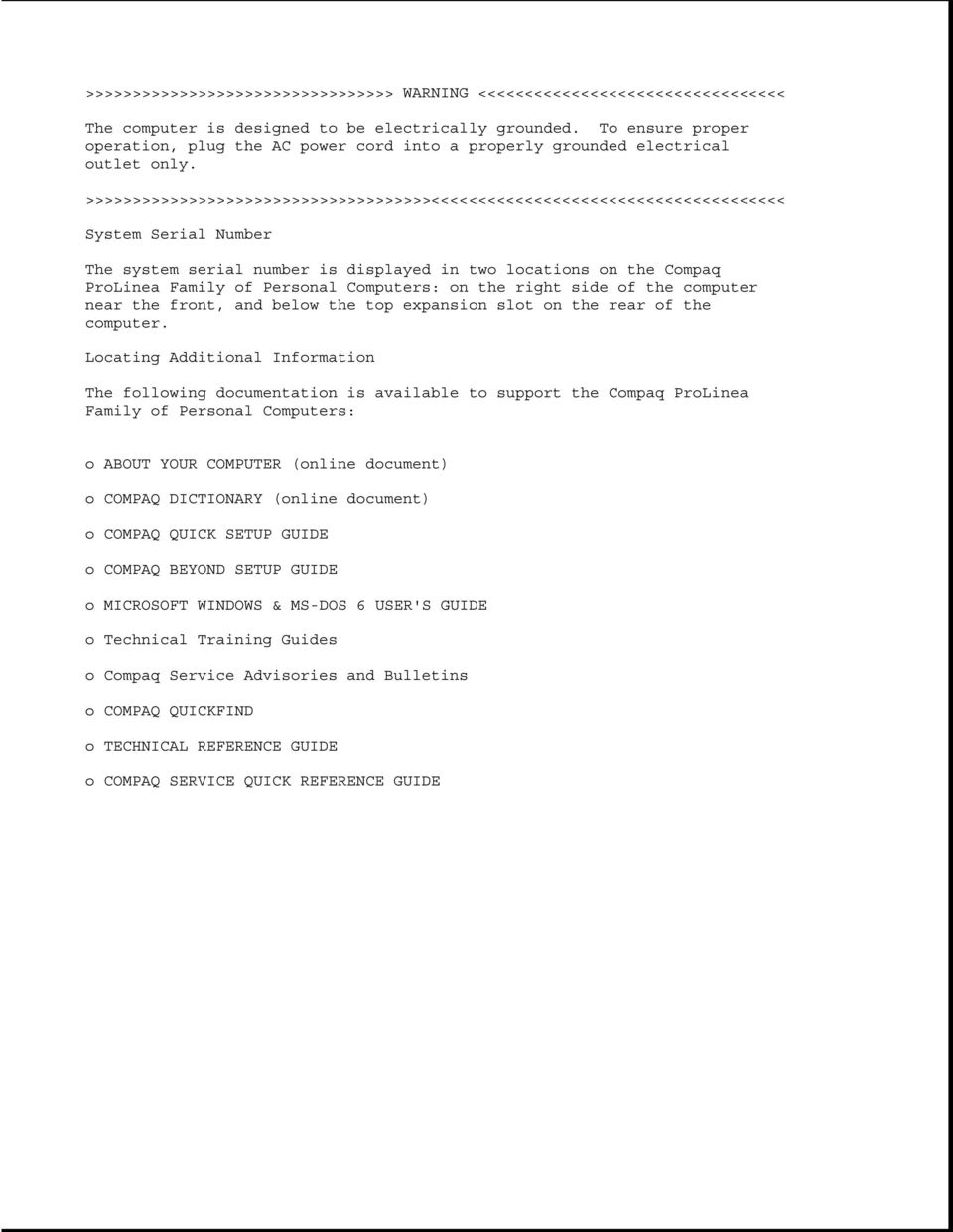
5 Chapter 1. Product Description Chapter 1.1 Models and Features The Compaq ProLinea Family of Personal Computers introduces a new generation of desktop computers designed for the business environment. The family includes Desktop 3 slot/3 bay (DT3) and Desktop 4 slot/4 bay (DT4) models. This chapter describes the model offerings and features of the DT3 and DT4 computers.
6 Chapter 1.2 Models The Compaq ProLinea Family of Personal Computers is available in the desktop models described in the following sections. Compaq ProLinea Personal Computer DT3 Models The Compaq ProLinea Personal Computer is available in the DT3 models described in Table 1-1. These desktop computers have two ISA expansion slots, one shared PCI/ISA expansion slot, one Compaq option slot, and three mass storage bays. All models include a 3.5-inch diskette drive. Table 1-1. Compaq ProLinea Personal Computer DT3 Models * Hard Model Processor Drive Memory Graphics Cache CD-ROM ProLinea DX2/50 None 8 MB PCI Local No Bus ProLinea DX2/ MB 8 MB PCI Local No Bus ProLinea DX2/ MB 4 MB PCI Local No Bus
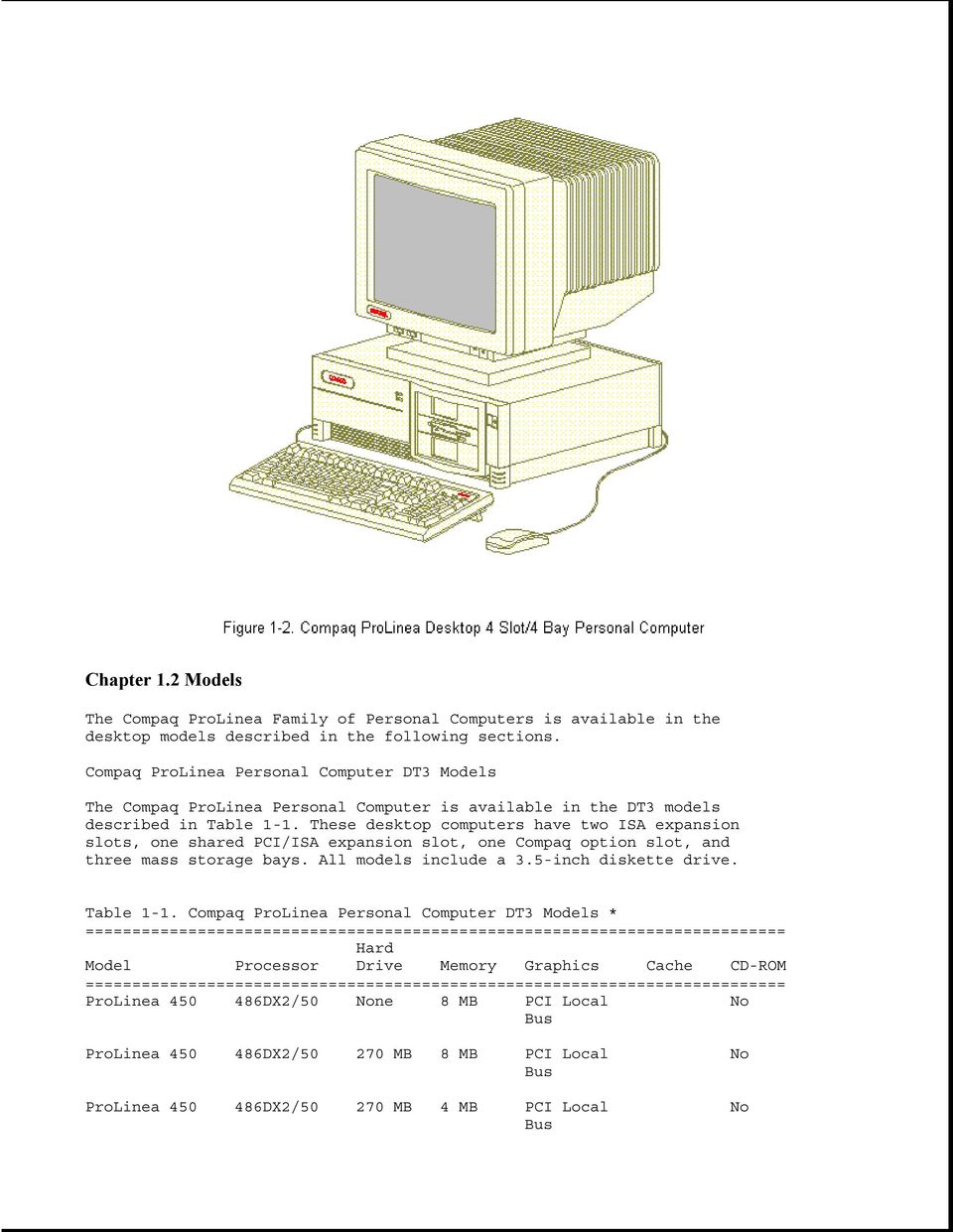
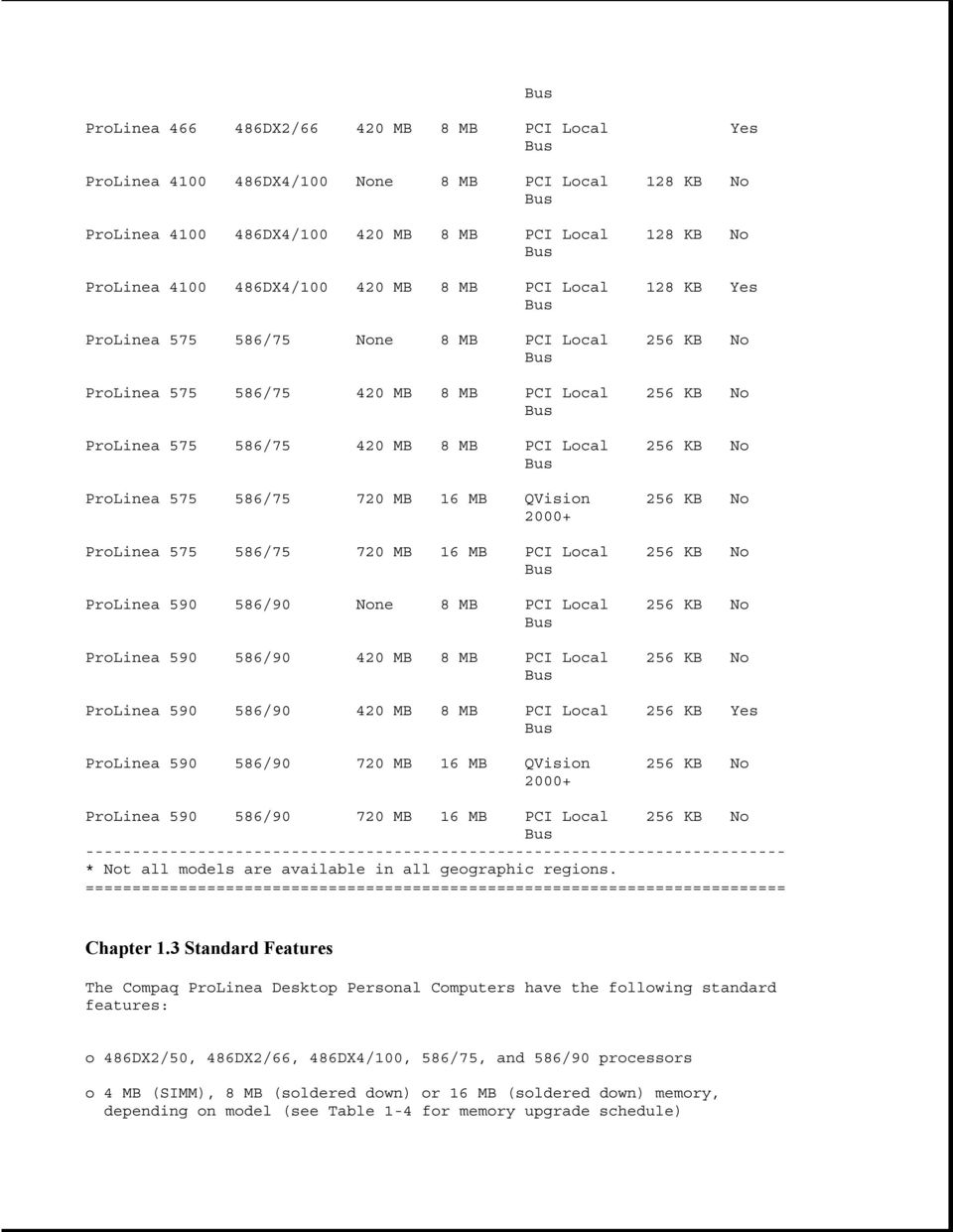
7 ProLinea DX2/66 None 8 MB PCI Local No Bus ProLinea DX2/ MB 8 MB PCI Local No Bus ProLinea DX2/ MB 8 MB PCI Local No Bus ProLinea DX4/100 None 8 MB PCI Local 128 KB No Bus ProLinea DX4/ MB 8 MB PCI Local 128 KB No Bus ProLinea DX4/ MB 8 MB PCI Local 128 KB No Bus ProLinea /75 None 8 MB PCI Local 256 KB No Bus ProLinea / MB 8 MB PCI Local 256 KB No Bus ProLinea / MB 8 MB PCI Local 256 KB No Bus * Not all models are available in all geographic regions. Compaq ProLinea Personal Computer DT4 Models The Compaq ProLinea Personal Computer is available in the DT4 models described in Table 1-2. These desktop computers have two ISA expansion slots, two shared PCI/ISA expansion slots, one Compaq option slot, and four mass storage bays. All models include a 3.5-inch diskette drive. Table 1-2. Compaq ProLinea Personal Computer DT4 Models * Hard Model Processor Drive Memory Graphics Cache CD-ROM ProLinea DX2/50 None 8 MB PCI Local No Bus ProLinea DX2/ MB 8 MB PCI Local No Bus ProLinea DX2/66 None 8 MB PCI Local No Bus ProLinea DX2/ MB 8 MB PCI Local No Bus ProLinea DX2/ MB 8 MB PCI Local No

8 Bus ProLinea DX2/ MB 8 MB PCI Local Yes Bus ProLinea DX4/100 None 8 MB PCI Local 128 KB No Bus ProLinea DX4/ MB 8 MB PCI Local 128 KB No Bus ProLinea DX4/ MB 8 MB PCI Local 128 KB Yes Bus ProLinea /75 None 8 MB PCI Local 256 KB No Bus ProLinea / MB 8 MB PCI Local 256 KB No Bus ProLinea / MB 8 MB PCI Local 256 KB No Bus ProLinea / MB 16 MB QVision 256 KB No ProLinea / MB 16 MB PCI Local 256 KB No Bus ProLinea /90 None 8 MB PCI Local 256 KB No Bus ProLinea / MB 8 MB PCI Local 256 KB No Bus ProLinea / MB 8 MB PCI Local 256 KB Yes Bus ProLinea / MB 16 MB QVision 256 KB No ProLinea / MB 16 MB PCI Local 256 KB No Bus * Not all models are available in all geographic regions. Chapter 1.3 Standard Features The Compaq ProLinea Desktop Personal Computers have the following standard features: o 486DX2/50, 486DX2/66, 486DX4/100, 586/75, and 586/90 processors o 4 MB (SIMM), 8 MB (soldered down) or 16 MB (soldered down) memory, depending on model (see Table 1-4 for memory upgrade schedule)
9 o 128 KB write back cache on 486DX4/100 models, 256 KB write back cache on 586/75 and 586/90 models o 270, 420, or 720 MB IDE IntelliSafe hard drive (models available without hard drive) o Enhanced PCI local bus graphics: - PCI Local Bus Integrated Graphics Controller on selected 486 and 586 models - QVision Graphics Controller on selected 586 models o DT3 form factor includes: one PCI/ISA shared slot, two ISA slots, Compaq option slot, one internal third-height drive bay, and two external half-height drive bays o DT4 form factor includes: two PCI/ISA shared slots, two ISA slots, Compaq option slot, one internal third-height drive bay, one external third-height drive bay, and two external half-height drive bays o CD-ROM drive with Enhanced Business Audio on selected models o PCI local bus IDE interface for hard drive and CD-ROM (up to 4 drives) o Power conservation features o Plug and play design o One mouse port (PS/2 style Compaq mouse) o Preloaded software o Diagnostics/Setup software o Security management o Three-year limited warranty Preloaded Software The following software is preloaded on the Compaq ProLinea Desktop Personal Computers: o Microsoft Windows 3.1 o Diagnostics for Windows o MS-DOS 6 o Windows Sound System 2.0 (CDS models only) o ESS 688 Audio Drivers (CDS models only) o Compaq Welcome Center, Compaq Control Center, and Compaq Learning Center o Drivers for graphics and IDE CD-ROM o Power Management

10 o Security Management (see Section 1.6) o Online documentation Security Management The following security management features are designed into the Compaq ProLinea Desktop Personal Computers. These features can help prevent unauthorized access to critical data and theft of the computer. o Cable lock provision allows the user to physically secure the computer hardware to protect against theft. o Diskette boot control prevents the computer from being booted from a diskette. o Diskette drive control allows disabling of the diskette drive. o Diskette write control prevents unauthorized writing of data to a diskette. o Hard drive control allows disabling of the hard drive. o Flash ROM lock prevents unauthorized changes to the flash ROM. o Keyboard password allows the computer to boot up but prevents data input until the password is entered. o Parallel interface control prevents transfer of data through the parallel interface connector. o Power-on password prevents unauthorized persons from booting up the computer. o QuickLock/QuickBlank allows the user to lock the keyboard and/or blank the screen. o Serial interface control prevents transfer of data through the serial interface connector. o Setup password prevents unauthorized changes to the system configuration. Chapter 1.4 Options The options that are available from Compaq for the Compaq ProLinea Family of Personal Computers are described in the following sections. Processor Upgrade The processors in Compaq ProLinea Family of Personal Computers can be upgraded according to the schedule in Table 1-3. Upgrade kits are available from Compaq. Table 1-3. Processor Upgrades
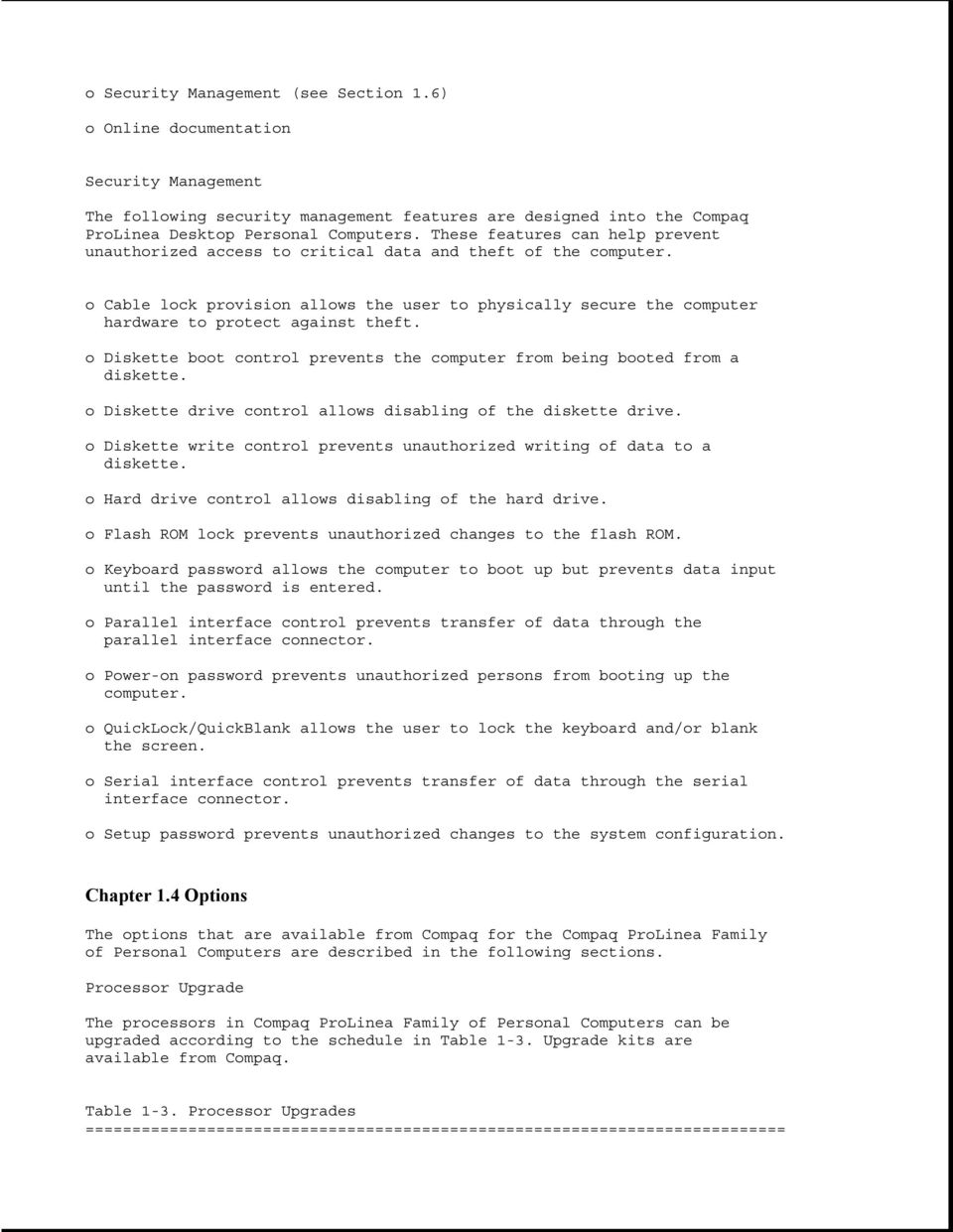
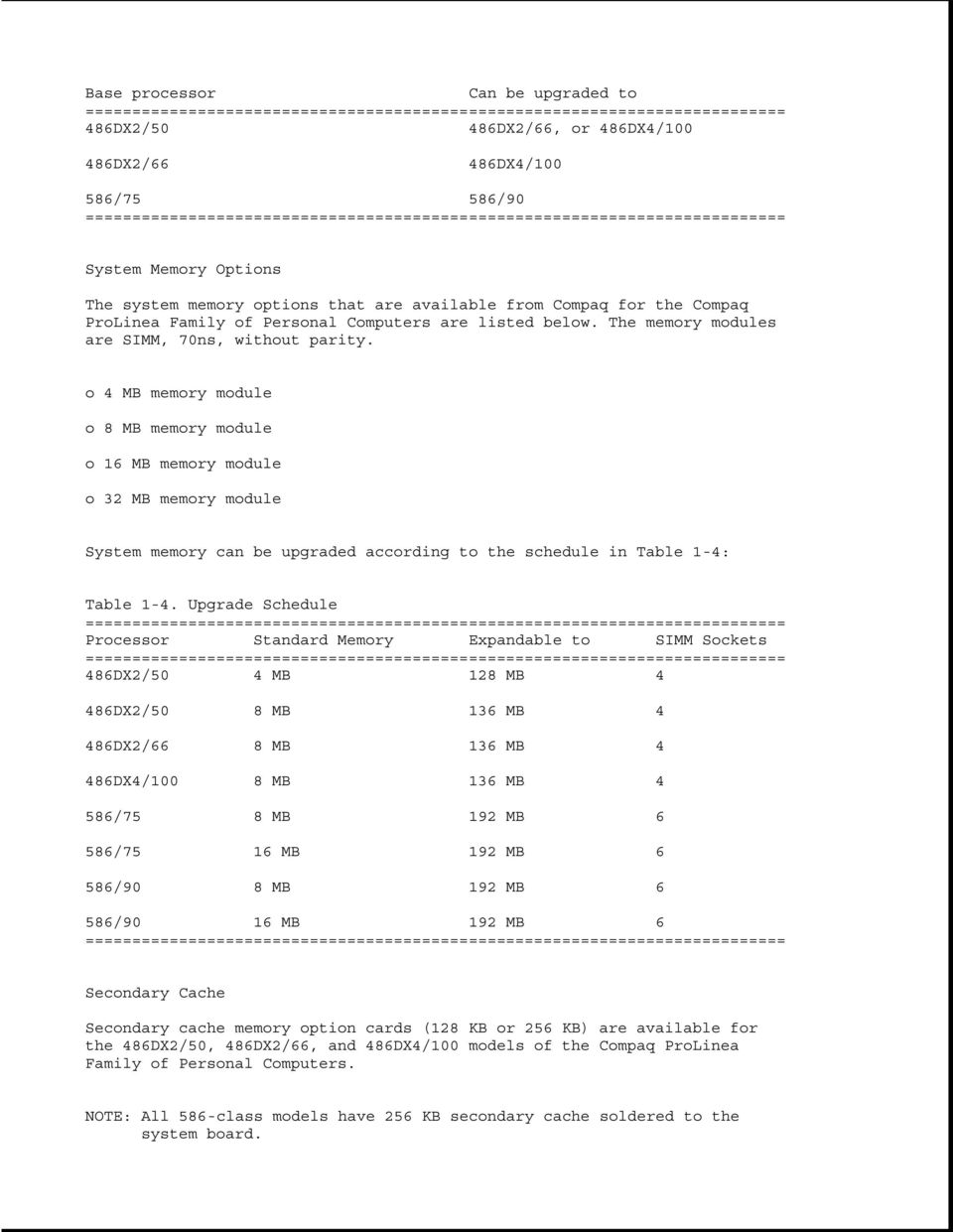
11 Base processor Can be upgraded to 486DX2/50 486DX2/66, or 486DX4/ DX2/66 486DX4/ /75 586/90 System Memory Options The system memory options that are available from Compaq for the Compaq ProLinea Family of Personal Computers are listed below. The memory modules are SIMM, 70ns, without parity. o 4 MB memory module o 8 MB memory module o 16 MB memory module o 32 MB memory module System memory can be upgraded according to the schedule in Table 1-4: Table 1-4. Upgrade Schedule Processor Standard Memory Expandable to SIMM Sockets 486DX2/50 4 MB 128 MB 4 486DX2/50 8 MB 136 MB 4 486DX2/66 8 MB 136 MB 4 486DX4/100 8 MB 136 MB 4 586/75 8 MB 192 MB 6 586/75 16 MB 192 MB 6 586/90 8 MB 192 MB 6 586/90 16 MB 192 MB 6 Secondary Cache Secondary cache memory option cards (128 KB or 256 KB) are available for the 486DX2/50, 486DX2/66, and 486DX4/100 models of the Compaq ProLinea Family of Personal Computers. NOTE: All 586-class models have 256 KB secondary cache soldered to the system board.
12 Mass Storage Options The following mass storage options are available from Compaq for the Compaq ProLinea Family of Personal Computers: o 1.2 MB diskette drive, 5.25-inch, half-height o 1.44 MB diskette drive, 3.5-inch, third-height o 270 MB IDE hard drive o 420 MB IDE hard drive o 540 MB IDE hard drive o 720 MB IDE hard drive o 1 GB IDE hard drive o 535 MB SCSI-2 hard drive o 1.05 GB SCSI-2 hard drive o 2.1 GB SCSI-2 hard drive o 120/250 MB tape drive with compression o 340/680 MB tape drive o 525 MB tape drive o 1.2 GB ACA tape drive o 2/8 GB Turbo DAT tape drive o Internal Quad-Speed IDE CD-ROM drive Monitor Options The following monitor options are available from Compaq for the Compaq ProLinea Family of Desktop Personal Computers: o QVision 200 Color Monitor with AssetControl o QVision 172 Color Monitor with AssetControl o VGA 14-Inch Monochrome Monitor o SVGA Color Monitor with low emissions and energy saver o VGA Color Monitor with low emissions o Compaq 14-Inch 1024 Color Monitor o Compaq 151 FS Color Monitor with low emissions and AssetControl
13 o Compaq 171 FS Color Monitor with low emissions and AssetControl NOTE: The Compaq ProLinea Family of Personal Computers does not support the AssetControl feature. Graphics Controllers and Memory Options The following graphics controller and memory options are available from Compaq for the Compaq ProLinea Family of Personal Computers: o QVision Graphics Controller with 2 MB VRAM o QVision 1280/I Graphics Controller with 2 MB VRAM o QVision 1280/P+ Graphics Controller with 1 MB VRAM (has VAFC connector) o 1 MB DRAM graphics memory module for PCI Local Bus Integrated Graphics Controller o 1 MB VRAM graphics memory module for QVision 1280/P+ Graphics Controller o 2 MB VRAM graphics memory module for QVision Graphics Controller Serial/Parallel Interface Board Ther serial/parallel board option is available from Compaq for the ProLinea Family of Personal Computers. This board uses an expansion slot and provides additional serial and parallel device support to the computer. Modem The SpeedPaq 144/I internal fax/modem is available from Compaq for the Compaq ProLinea Family of Personal Computer: Software Options The following software options are available from Compaq for the Compaq ProLinea Family of Personal Computer: o MS-DOS 6 (3.5-inch diskettes) o Corporate license agreements for MS-DOS 6 o MS-DOS 6 LicensePaq o MS-DOS 6 corporate upgrade (100+ users) o MS-DOS 6 LicensePaq upgrade o SCO UNIX O/S from Compaq version 4.1 (with media kit) o SCO UNIX network bundle from Compaq version 4.1 (with media kit) o SCO UNIX and TCP/IP Development System from Compaq release 1.2
14 o SCO XSight Runtime version 4.1 o Open Desktop Development System, release 3.0 o Windows NT o Sytos Plus Tape software for MS-DOS o Sytos Plus Tape software for OS/2 Chapter 1.5 Front Panel Controls and LEDs The front panel controls and LEDs for the DT3 and DT4 are almost identical. The controls and LEDs are identified in Figure 1-3 and described in Table 1-5. Table 1-5. Front Panel Controls and LEDs Item Description Function 1 Power-On Light Turns on when the computer is turned on and blinks (optional) in Energy Saver mode. 2 Hard Drive Activity Turns on when the hard drive is reading or
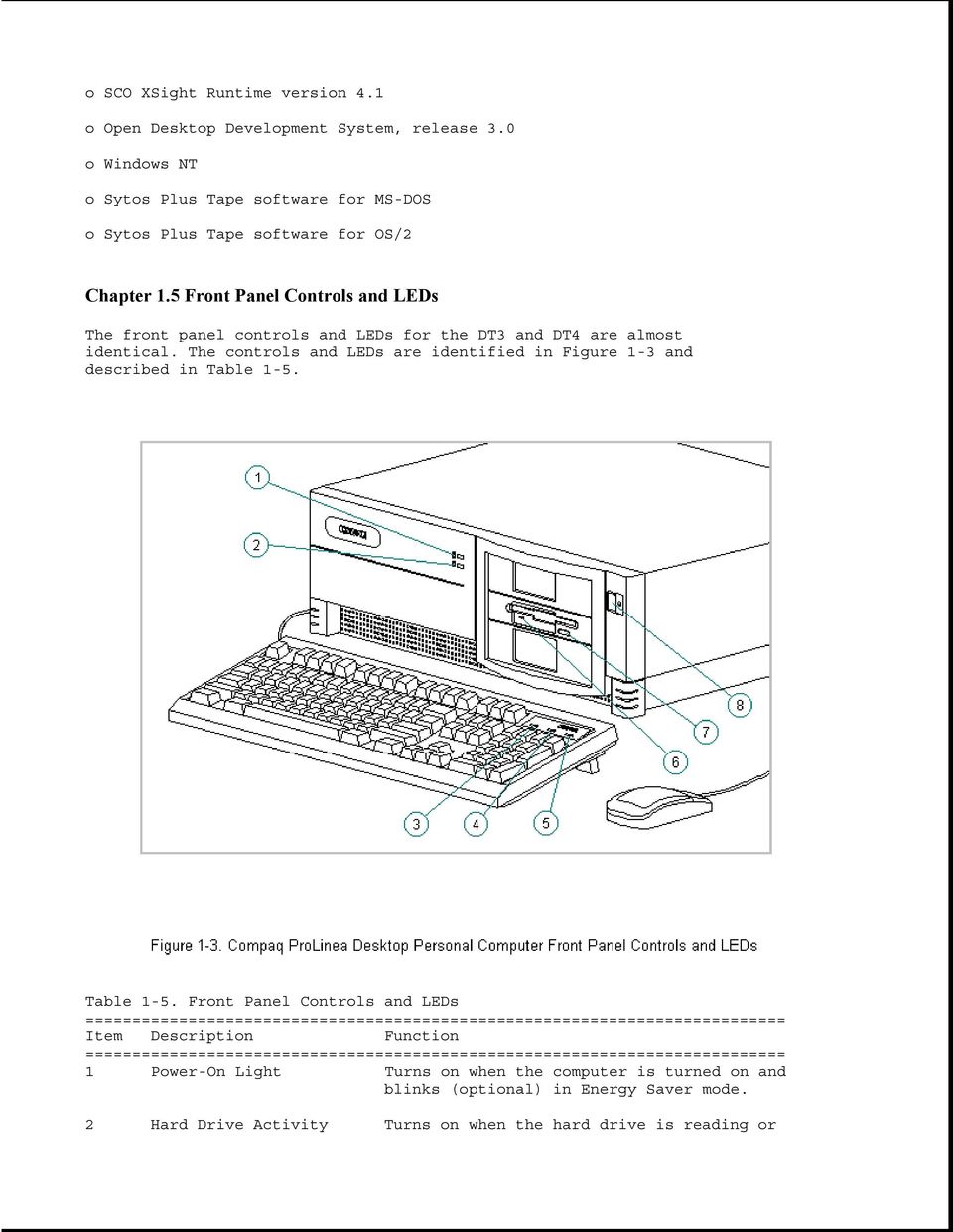
15 Light writing. 3 Num Lock Light When the Num Lock light is on, the numeric keypad is activated. 4 Caps Lock Light When the Caps Lock light is on, all letters typed will be capitalized. 5 Scroll Lock Light When the Scroll Lock light is on, the screen will not scroll. 6 Diskette Drive Turns on when the diskette drive is reading Activity Light or writing. 7 Diskette Eject Button Ejects a loaded diskette. 8 Power (On/Off) Switch Turns the computer on and off. Chapter 1.6 Rear Panel Controls and Connectors The controls and connectors located on the rear of the DT3 and DT4 are almost identical. They are identified in Figure 1-4 and described in Table 1-6. See Appendix A for connector pin assignments.

16 Table 1-6. Rear Panel Controls and Connectors * Item Description Function 1 Power Cord Connector Connects the computer to an electrical power outlet. 2 Mouse Connector Connects the mouse. 3 Voltage Select Switch Switches voltage between 115 VAC (US) and 230 VAC to match geographical requirements. 4 Serial Port Connects to serial devices, such as a serial printer. 5 Parallel Port Connects to parallel devices, such as a parallel printer. 6 Keyboard Connector Connects the keyboard. 7 Monitor Connector Connects the monitor. * Actual connectors will vary with models.

17 Chapter 1.7 System Design This section presents a design overview and functional descriptions of the key components of the Compaq ProLinea Family of Personal Computers. All replaceable components are identified in Chapter 3 and removal/replacement instructions are presented in Chapter 5. Design Overview The Compaq ProLinea Family of Personal Computers has a conventional design that uses a pan-type chassis to house the system board, expansion cards, power supply, and mass storage devices. The chassis is divided into two sections by a permanent panel that extends from the front to the rear of the chassis. This panel provides a mounting surface for the backplane board and separates the system board section from the section that houses the power supply and mass storage devices. All internal components are immediately accessible when the unit cover, held in place by three thumb screws, is removed. The front bezel is mounted to the unit cover. Torx T-15 screws are used throughout the system except for the CD-ROM drive bracket which requires Torx T-10 screws. The system board is easily removed by sliding it out from the side of the chassis after the unit cover is removed. The system board bracket, attached to the system board with three Torx screws, forms the right side of the chassis when the system board is installed. The system board shares the common backplane board with the expansion cards. No mounting screws are used with the system board. Expansion boards are installed horizontally above the system board, engaging the backplane board which is attached to the central panel. A single screw attaches the expansion board to the rear panel of the chassis. The power supply is mounted in the right rear corner of the chassis. Integrated clips on the bottom of the power supply engage cutouts in the floor of the chassis. The power supply is held in place by four Torx screws that are installed through the rear panel of the chassis. The mass storage drive cage is located on the right side of the chassis, directly in front of the power supply. The drive cage can be tilted up from the rear to provide access to cable connections. The drive cage can accommodate one internal hard drive attached to the side of the cage and provides two or three (model dependent) drive bays for accessible mass storage devices. Detailed descriptions of the system components are presented in the sections that follow. System Board The Compaq ProLinea Family of Personal Computers uses four basic system board configurations. All of the boards use SIMMs for expanded memory; four SIMM sockets on 486 models and six SIMM sockets on 586 models. The 486 models have 8 MB RAM soldered down on the system board; one of the 486 models has 4 MB RAM soldered down. The 586 models have either 8 MB or 16 MB SIMMs for RAM. The configurations are described in the following sections.
18 486-Based Board With 4 MB RAM The 486-based system board with 4 MB RAM has the following characteristics: o Used on 3-slot/3-bay and 4-slot/4-bay computers o 4 MB SIMMs o 4 SIMM sockets for memory expansion o PCI Local Bus integrated graphics controller o Accommodates 486DX2/50, 486DX2/66, and 486DX4/100 processors (238-pin ZIF socket) o 128 KB cache memory standard on 486DX4/100 models only; 128 KB and 256 KB options for 486DX2 models o Measures 8.5 x 11.5 inches (21.6 x 29.2 cm) 486-Based Board With 8 MB RAM The 486-based system board with 8 MB RAM has the following characteristics: o Used on 3-slot/3-bay and 4-slot/4-bay computers o Integrated 8 MB RAM on the system board o 4 SIMM sockets for memory expansion o PCI Local Bus integrated graphics controller o Accommodates 486DX2/50, 486DX2/66, and 486DX4/100 processors (238-pin ZIF socket) o 128 KB cache memory standard on 486DX4/100 models only; 128 KB and 256 KB options for 486DX2 models o Measures 8.5 x 11.5 inches (21.6 x 29.2 cm) 586-Based Board With DRAM Graphics The 586-based system board with integrated DRAM graphics has the following characteristics: o Used on 3-slot/3-bay and 4-slot/4-bay computers o PCI Local Bus integrated graphics controller o Six SIMM sockets for memory expansion o Accommodates 586/75 and 586/90 processors (320-pin ZIF socket) o 256 KB cache memory
19 o Measures 8.5 x inches (21.6 x 34.9 cm) 586-Based Board Without Integrated Graphics The 586-based system board without integrated graphics has the following characteristics: o Used on 3-slot/3-bay and 4-slot/4-bay computers o Designed for use with QVision Graphics Controller in a PCI slot o Six SIMM sockets for memory expansion o Accommodates 586/75 and 586/90 processors (320-pin ZIF socket) o 256 KB cache memory o Measures 8.5 x inches (21.6 x 34.9 cm) IDE Interface The IDE interface consists of two IDE connectors that support up to four IDE devices. Each connector can be individually disabled so that option card IDE interfaces will work. Diskette Drive Interface The diskette drive interface is 8477 compatible. Serial Port The serial port is RS-232C compatible. Parallel Port The following parallel support modes are supported: o SPP (Bi-directional Standard Parallel Port) o EPP (Enhanced Parallel Port) o ECP (Extended Capabilities Port) Keyboard/Mouse All system boards will accommodate a standard 8042 keyboard/mouse controller. Processor The 486-based system boards support a variety of 486 processors at bus frequencies of 25-MHz and 33-MHz. These boards have a reconfigurable ZIF socket to accommodate the variety of processor pinouts and supports 3.3V and 5V processors. These system boards can be upgraded to a 486DX4/100

20 processor. The 586-based system boards support the 586 processor running at bus frequencies of 50-MHz and 60-MHz. Memory All of the computers use 70ns enhanced page-mode DRAMs. not supported. Memory parity is The 486-based system boards accommodate a total of four double-sided SIMMs. Either a single-sided 4 MB SIMM or 8 MB of soldered down DRAMs is installed for base memory. The 586-based system boards accommodate a total of six double-sided SIMMs. Either two single-sided 4 MB SIMMs or two double-side 8 MB SIMMs are installed for base memory. Memory Expansion The SIMM sockets on the 486-based system board can be populated with 4, 8, 16, or 32 MB SIMMs in any order. The SIMM sockets on the 586-based system boards must be populated in pairs of equal size in sequential slots. The SIMMs must be 70ns or faster. IMPORTANT: SIMMS with tin-lead pins must be used for memory upgrades. Cache All of the computers support a second level write-back cache. 486DX2/XX and 486DX4/100 models support an optional 128 KB or 256 KB cache board. 586 models support an integrated 256 KB cache. Graphics The Compaq ProLinea Family of Personal Computers is supported with a 2-tiered graphics strategy. The 486-based system boards and selected 586-based system boards are shipped with a PCI Local Bus integrated graphics controller. These system boards are provided with 1 MB DRAM. Additional memory is provided with a daughter card. The PCI Local Bus integrated graphics controller supports the following maximum screen resolutions: o 1024 x 768 x 256 colors with 1 MB DRAM o 1280 x 1024 x 256 colors with 2 MB DRAM Selected 586-based system boards are designed to be used with a QVision Graphics Controller in a PCI slot. This will provide the following maximum screen resolutions: o 1280 x 1024 x 256 colors with 2 MB VRAM o 1280 x 1024 x 16.7M colors with 4 MB VRAM
21 Chapter 2. Troubleshooting Chapter 2.0 Introduction This chapter describes the three levels of troubleshooting for the computer: o Power-On Self-Test (POST) o Compaq diagnostics o Troubleshooting without diagnostics POST messages, diagnostic error codes, and memory error codes are included. The messages and codes appear in tables that include a description of the error, the probable cause, and the recommended action to resolve the error condition. Adherence to the procedures and precautions described in this chapter is essential for proper service. Chapter 2.1 Power-On Password The power-on password prevents use of the computer until the password is entered. To clear the power-on password, you must remove and replace a jumper on the system board. If you do not know the power-on password, use the following procedure to clear the password to allow troubleshooting: 1. Complete the preparation for disassembly procedures in Section Remove the unit cover as described in Section Move the jumper on E6 (Figure 2-1) from pins 1 and 2 and to pins 2 and 3.
22 4. Replace the unit cover and perform the desired troubleshooting. Chapter 2.2 Power-On Self-Test Power-on Self-Test (POST) is a series of diagnostic tests that runs automatically when the system is turned on. POST checks the following assemblies to ensure that the computer system is functioning properly: o Keyboard o Power supply o System board o System memory o Memory modules o Controllers o Graphics system o Diskette drives
23 o Hard drives POST also detects the type of mass storage devices installed in the computer. If POST finds an error in the system, an error condition is indicated by an audible and/or visual message. Power-on Self-Test Messages An error message results if a problem is encountered during the Power-On Self-Test utility. Table 2-1 lists the messages for POST, the audible (beep) message, probable cause, and recommended action. The procedures referenced under "Recommended Action" are described in Sections 2.3 and 2.4 of this chapter. Table 2-1. Power-On Self-Test Messages Message Beeps Probable Cause Recommended Action ROM Error 1 Long, System ROM checksum 1. Inspect the ROM 1 Short placement. 2. Verify the correct ROM. 3. Replace the ROM I/0 ROM None Option ROM checksum 1. Inspect the ROM Error placement. 2. Verify the correct ROM. 3. Replace the ROM System None DMA, timers, etc. Replace the system Board Failure board System 2 Short No diskette drive or Run Computer Setup. Options Error mismatch in drive type System 2 Short Configuration Run Computer Setup. Options Not incorrect Set Time & 2 Short Invalid time or date Run Computer Setup. Date Not Set in configuration memory Memory 2 Short Configuration Run Computer Setup. Size Error memory incorrect ISA 1 Short Plug & Play ISA Run the Configuration/ board not found Configuration and Slot Mismatch Diagnostics Utilities ISA 1 Short Plug & Play ISA Run the Configuration/ board added, Configuration Slot Mismatch configuration not and Diagnostics updated Utilities.
24 178 - Processor None Processor type or Run Computer Setup. Configuration step do not match Invalid configuration memory Memory None RAM failure 1. Run Computer Error Setup. 2. Replace the memory module(s) (if any). 3. Replace system board Memory None RAM failure 1. Run Computer Address Error Setup. 2. Replace the memory module(s) (if any). 3. Replace system board. Message Beeps Probable Cause Recommended Action Memory Error None Cache memory error Run the Configuration and Diagnostics Utilities Secondary None Cache memory Run the cache controller controller or RAM Configuration Failure failure and Diagnostics Utilities Keyboard None Keyboard Failure Reconnect keyboard Error with computer turned off Keyboard None Keyboard Failure Replace the Error or Text keyboard. Fixture Installed Keyboard None I/O board keyboard Replace the system Controller Error controller board Keyboard or None Keyboard 1. Replace the System Unit Error keyboard. 2. Replace the system board. 40X - Parallel 2 Short Both external and Run Computer Setup. Port X Address internal ports are Assignment assigned to parallel Conflict port X Monochrome 1 Long, Monochrome display Replace the Adapter Failure 2 Short controller monochrome display controller.
25 501 - Display 1 Long, Video display Replace the video Adapter Failure 2 Short controller board Diskette None Diskette controller 1. Check and/or Controller Error circuitry replace cables. 2. Replace the system board Diskette None Diskette in drive A Replace the Boot not bootable diskette Diskette 2 Short Mismatch in drive Run Computer Setup. Drive Error type Primary 2 Short Configuration error Run Computer Setup. Floppy Port Address Assignment Conflict Secondary 2 Short Configuration error Run Computer Setup. Floppy Port Address Assignment Conflict A None Configuration error Run Computer Setup. Coprocessor Has Been Detected That Is Not Reported In CMOS CMOS Reports 2 Short Configuration error Run Computer Setup. a Coprocessor That Has Not Been Detected By POST Message Beeps Probable Cause Recommended Action COM Port 1 2 Short Both external and Run Computer Setup. Address Assignment internal serial ports Conflict are assigned to COM COM Port 2 2 Short Both external and Run Computer Setup. Address Assignment internal serial ports Conflict are assigned to COM COM Port 3 2 Short Both external and Run Computer Setup. Address Assignment internal serial ports Conflict are assigned to COM COM Port 4 2 Short Both external and Run Computer Setup. Address Assignment internal serial ports Conflict are assigned to COM Primary 2 Short Internal and external Run Computer Setup. Disk Port Address hard drive Assignment controllers are both Conflict assigned to
26 primary address Secondary 2 Short Internal and external Run Computer Setup. Disk Port Address hard drive Assignment Conflict controllers are both assigned to the secondary address Disk 0 None Hard drive/format Run the Failure error Configuration and Diagnostics Utilities Disk 1 None Hard drive/format Run the Failure error Configuration and Diagnostics Utilities Disk None Hard drive circuitry Run the Controller error Configuration and Diagnostics Utilities Disk 0 None Hard drive error or Run the Failure wrong drive type Configuration and Diagnostics Utilities Disk 1 None Hard drive error or Run the Failure wrong drive type Configuration and Diagnostics Utilities. XX000Y ZZ Parity None Parity RAM failure Run the Check 2 Configuration and Diagnostics Utilities. Hard Drive 3 Long Configuration or Run the Parameter Table or hardware failure Configuration and BIOS Error system Diagnostics Halted Utilities. IOCHECK Active None Defective board in Run the Slot X slot X Configuration and Diagnostics Utilities. Bus Master Timeout None Defective board in Run the Slot X slot X Configuration and Diagnostics Utilities. Audible 1 Short Power-on successful None. Audible 2 Short Power-on successful None. (RESUME = F1 KEY) None As indicated Press the F1 key. to continue
27 Chapter 2.3 Compaq Diagnostics This section explains how to use the Configuration and Diagnostics utilities installed on the computer. IMPORTANT: If you are planning to run an alternate operating system (e.g., OS/2 or UNIX), you will need to configure your system using the Compaq Diagnostics diskette. Failure to do so can result in loss of data and reduced hard drive capacity. Both Windows and DOS have configuration and diagnostic utilities that should be accessed in the following instances: o When a system configuration error is detected during the Power-On Self-Test (POST). o To change factory default settings for some of the computer features. o To change the system configuration, which is sometimes necessary when you add or remove optional hardware. o To set system configuration features. The same utilities are available by selecting options on a menu called "Configuration and Diagnostics." To display this menu, restart the computer, then press the F10 key when the square cursor displays in the upper-right corner of the screen. Full instructions are presented later in this section. Diagnostics are available by selecting the Computer Checkup (TEST) utility on the Configuration and Diagnostics menu. Compaq Diagnostics are installed on the hard drive of the Compaq ProLinea Personal Computer. The diagnostics are also available on diskettes. IMPORTANT: The diagnostics and setup utilities are located on a hard disk partition in the computer, not on ROM. Details for recreating the diagnostics/setup partition are presented in Section 2.4 of this chapter. You can access the diagnostics at startup from the hard drive or from the diskettes. Procedures for both methods are presented below. Both procedures will result in the Configuration and Diagnostics menu being displayed. Your particular menu may differ slightly from the one shown in Figure 2-2.
28 Accessing the Configuration and Diagnostics Menu at Startup To display the menu immediately after startup, complete the following steps: 1. Turn on or restart the computer (Ctrl+Alt+Delete). 2. Press the F10 key as soon as the cursor moves to the upper-right corner of the screen. This occurs immediately: The Power-On Self-Test (POST) runs, you hear two beeps, then the cursor moves to the upper-right corner. 3. If prompted, select the desired language. 4. A menu similar to the one shown in Figure 2-2 will be displayed. You will be prompted through any procedure that you select. Accessing the Configuration and Diagnostics Menu from Diskette You can load either the Setup or Diagnostics diskette with this procedure. To load either of the diskettes, complete the following steps: 1. Insert the diskette into drive A.
29 2. Turn on or restart the computer (Ctrl+Alt+Delete). 3. If prompted, select the desired language. 4. If you load the Diagnostics diskette, a menu similar to the one shown in Figure 2-2 will be displayed. If you select Computer Setup from this menu, you will be prompted to insert the Setup diskette. You will be prompted through any procedure that you select. Compaq Diagnostics for Windows Compaq Diagnostics for Windows utility contains the same functionality as the DOS-based INSPECT program but in a Windows environment. To use the Compaq Diagnostics for Windows utility, select the Compaq Diagnostics icon from the Compaq Utilities group box. Once the program is running, you can use the tool bar or the menus to browse through the information. Some examples of the information you can view are: o Product name o CPU information o Cache size and type o Mouse driver versions o COM ports, LPT ports, modems o ISA and PCI slot information o Version of certain software (MS-DOS, Windows) o ROM version o Storage information o Power Management settings o Multimedia devices information The MS-DOS version of INSPECT is available on the system partition and is accessible as explained earlier in this section. Chapter 2.4 Configuration and Diagnostics Menu Options The Configuration and Diagnostics menu contains the following troubleshooting utilities: o Computer Setup o Computer Checkup (TEST) o View System Information (INSPECT) o Test another computer
30 o Prepare computer for Compaq Service Call (RemotePaq) o Create a Diagnostics Diskette See the user documentation for descriptions of the Security Management and Power Management utilities. A brief description of each of the troubleshooting utilities is presented below. Ample prompting is provided with each of these utilities. Computer Setup The Computer Setup utility is preinstalled on the hard drive and on diskette. It gives a snapshot of the computer's hardware configuration, aids in troubleshooting, and allows you to set custom features. Computer Setup recognizes a newly installed internal or external device and automatically updates the Computer Setup screen. Among the parameters checked are the following: o Date and time o Installed devices o Memory status o Password status o Interface configurations o Graphics configuration o Computer serial number o Controller status The following activities can be performed from this screen: o Press the Esc key to exit the screen and return to the startup procedure. o Press the F1 key for instructions on how to navigate around the screen. Computer Checkup (TEST) Computer Checkup (TEST) is a utility that confirms if the various computer devices are recognized by the system and functioning properly. Use the TEST utility to help set up and test the computer and to install the operating system. The TEST menu offers the following: o Quick Check Diagnostics runs a quick, general test on each device with a minimal number of prompts. If errors occur, they are displayed when the test is complete. o Automatic Diagnostics runs unattended and provides maximum testing of
31 each device with minimal prompts. You can choose how many times to run the tests, to stop on errors, or to print or file a log of errors. o Prompted Diagnostics allows maximum control over the device testing process. You can choose attended or unattended testing, decide to stop on errors, or choose to print or file a log of errors. The TEST option checks the following: o CPU (main system) o Keyboard o Pointing device interface o Parallel interfaces o Graphics controllers o Diskette drives o Fixed disks o Serial interfaces o Installed Compaq devices (tape drive, SCSI device, or network status) View System Information (INSPECT) This utility allows you to inspect the status and configuration of the following parameters: o System o System ROM o Keyboard o System ports o System storage o Graphics o Memory o Operating system o System files o Windows files o Network status o Miscellaneous
32 The options available from this utility are: o Print the inspect status. o Save the inspect status to a file. o Add comments to a parameter status. o Exit the utility. Test Another Computer This utility allows you to download Computer Checkup (TEST), View System Information (INSPECT), or Computer Setup utilities through your computer's serial interface to a supported Compaq product that does not have a diskette drive. RemotePaq This utility is available in some geographical areas and requires a modem. The utility prepares your computer for a call from Compaq Service via modem. It allows Compaq Customer Support to automatically run diagnostics on your machine. Create a Diagnostics Diskette This option allows you to back up the diagnostics software onto two diskettes. IMPORTANT: Compaq highly recommends that backup diagnostics diskettes are created as soon as the system is configured. This software is required to troubleshoot the system if the hard drive cannot be accessed or must be replaced. Manage Diagnostics Partition This option allows you to create, delete, or upgrade the diagnostics software on your computer. If the diagnostics partition is deleted, it can be recreated without deleting the DOS partition. The most likely use of this option is to upgrade the utilities. Chapter 2.5 Diagnostic Error Codes Diagnostic error codes occur if the system recognizes a problem while running the Compaq Diagnostic program. These error codes help identify possibly defective subassemblies. Tables 2-2 through 2-15 list possible error codes, a description of the error condition, and the action required to resolve the error condition. IMPORTANT: Retest the system after completing each step. If the problem has been resolved, do not proceed with the remaining steps.
33 For assistance in the removal and replacement of a particular subassembly, see Chapter 5, "Removal and Replacement Procedures." Table 2-2. Processor Test Error Codes Error Code Description Recommended Action xx CPU test failed Replace the system board and retest xx Coprocessor or Weitek 1. Run the Configuration and Error Diagnostics Utilities. 2. Replace the coprocessor and retest. 3. Replace the processor (if applicable) and retest xx DMA page registers Replace the system board and retest. test failed xx Interrupt controller master test failed xx Port 61 error xx Keyboard controller self-test failed xx CMOS RAM test failed The following steps apply to xx through xx: xx CMOS interrupt test failed 1. Replace the battery/clock module and retest xx CMOS clock test 2. Replace the system board and retest. failed xx Programmable timer Replace the system board and retest. load data test failed xx Protected mode test failed Speaker test failed 1. Check system configuration. 2. Verify cable connections to speaker. 3. Replace the system board and retest. Table 2-3. Memory Test Error Codes Error Code Description Recommended Action xx Memory machine ID The following steps apply to xx and test failed xx: xx Memory system ROM 1. Replace the system ROM and retest. checksum failed 2. Replace the system board and retest xx Write/Read test The following steps apply to xx
34 failed through xx: xx Address test failed 1. Remove the memory modules one at a time until the error goes away xx Random pattern test 2. Replace the good modules one at a failed time while making sure the error code does not return xx Noise test failed 3. Replace the bad modules and retest xx Random address test failed Table 2-4. Keyboard Test Error Codes Error Code Description Recommended Action xx Failed ID Test The following steps apply to xx through xx: xx Failed Self-test/ Interface Test 1. Check the keyboard connection. If disconnected, turn off the computer xx Failed Individual and connect the keyboard. Key Test 2. Replace the keyboard and retest. 3. Replace the system board and retest xx Failed Keyboard Repeat Test Table 2-5. Parallel Printer Test Error Codes Error Code Description Recommended Action xx Printer failed or The following steps apply to xx not connected through xx: xx Failed Port Test 1. Connect the printer. 2. Check power to the printer xx Printer pattern test 3. Install the loop-back connector and failed retest. 4. Check switch on the Serial/Parallel Interface board, if applicable. 5. Replace the Serial/Parallel Interface board, if applicable. 6. Replace the system board and retest. Table 2-6. Diskette Drive Test Error Code Description Recommended Action xx Diskette ID drive The following steps apply to xx types test failed through xx error codes: xx Diskette format 1. Replace the diskette media and retest. failed 2. Check and/or replace the diskette power and signal cables and retest.
35 602 - xx Diskette read test 3. Replace the diskette drive and retest. failed 4. Replace the system board and retest xx Diskette write, read compare test failed xx Diskette random read test failed xx Diskette ID media failed xx Diskette speed test failed xx Diskette reset controller test failed xx Diskette change line test failed xx Diskette type error xx Diskette drive speed not within limits xx Diskette drive/ 1. Replace media. media ID error 2. Run the Configuration and Diagnostics Utilities. Table 2-7. Serial Test Error Codes Error Code Description Recommended Action xx Serial port test 1. Check switch settings on the failed Serial/Parallel Interface Board, if applicable. 2. Replace the system Board. 3. Replace the system board and retest. Table 2-8. Modem Communications Test Error Codes Error Code Description Recommended Action xx Modem internal The following steps apply to xx loopback test failed through xx: xx Modem External 1. Refer to modem documentation for Termination Test correct Computer Setup procedures. failed 2. Check the modem line. 3. Replace the modem and retest xx Modem Auto Originate Test failed
36 xx Auto answer Test failed xx Modem Direct Connect Test failed Table 2-9. Hard Drive Test Error Codes Error Code Description Recommended Action xx Hard drive format The following steps apply to xx test failed through xx: xx Hard drive read test 1. Run the Configuration and failed Diagnostics Utilities and verify drive type xx Hard drive write/read 2. Replace the hard drive signal and /compare test failed power cables and retest. 3. Replace the hard drive controller xx Hard drive random board and retest (if applicable). seek test failed 4. Replace the hard drive and retest (if applicable) xx Hard drive controller 5. Replace the system board and retest. test failed xx Hard drive ready test failed xx Hard drive recalibration test failed xx Hard drive format bad track test failed xx Hard drive reset controller test failed xx Hard drive park head test failed xx Hard drive head select test failed xx Hard drive conditional format test failed xx Hard drive ECC * test failed xx Hard drive power mode test failed xx Network preparation test failed
37 xx Drive monitoring test failed * ECC = Error Correction Code Table Tape Drive Test Error Codes Error Code Description Recommended Action xx Tape ID failed The following steps apply to xx through xx error codes: xx Tape servo write failed 1. Replace the tape cartridge and retest xx Tape format failed 2. Check the switch settings on the adapter board xx Tape drive sensor 3. Check and/or replace the signal test failed cable and retest. 4. Replace the tape adapter board xx Tape BOT/EOT test (if applicable) and retest. failed xx Tape read test failed 5. Replace the tape drive and retest. 6. Replace the system board and retest xx Tape write/read/ compare test failed Table Video Test Error Codes Error Code Description Recommended Action xx Video controller test The following error codes apply to failed xx through xx error codes: xx Video memory test 1. Replace the monitor and retest. failed 2. Replace the system board xx Video attribute test failed xx Video character set test failed xx Video 80 x 25 mode 9 x 14 character cell test failed xx Video 80 x 25 mode 8 x 8 character cell test failed xx Video 40 x 25 mode test failed xx Video 320 x 200 mode color set 0 test
38 failed xx Video 320 x 200 mode color set 1 test failed xx Video 640 x 200 mode test failed xx Video screen memory page test failed xx Video gray scale test failed xx Video white screen test failed xx Video noise pattern test failed Error Code Description Recommended Action xx Video memory test The following steps apply to xx failed through xx error codes: xx Video attribute test 1. Run the Configuration and failed Diagnostics Utilities. 2. Replace the monitor and retest xx Video character set 3. Replace the video board and retest. test failed xx Video 80 x 25 mode 9 x 14 character cell test failed xx Video 80 x 25 mode 8 x 8 character cell test failed xx Video 320 x 200 mode color set 0 test failed xx Video 320 x 200 mode color set 1 test failed xx Video 640 x 200 mode test failed xx Video screen memory page test failed xx Video gray scale test failed xx Video white screen test failed
39 xx Video noise pattern test failed xx ECG/VGC memory test failed Error Code Description Recommended Action xx ECG/VGC ROM The following steps apply to xx checksum test failed through xx error codes: xx ECG/VGC 640 x Run the Configuration and graphics mode test Diagnostics Utilities. failed xx ECG/VGC 640 x color set test failed xx ECG/VGC 640 x color set test failed xx ECG/VGC monochrome text mode test failed xx ECG/VGC monochrome graphics mode test failed xx 640 x 480 graphics test failure xx 320 x 200 graphics (256 color mode) test failure xx Advanced VGA Controller test failed xx 132-column Advanced VGA test failed 2. Replace the monitor and retest. 3. Replace the video board and retest xx Advanced VGA 256 Color test failed xx Advanced VGA BitBLT The following steps apply to xx test through xx error codes: xx Advanced VGA DAC test 1. Replace the video board. 2. Replace the system board and retest xx Advanced VGA data path test xx Advanced VGA BitBLT test xx Advanced VGA Linedraw test
40 Table Audio Test Error Codes Error Code Description Recommended Action xx Audio System Internal Replace the audio board and retest. Error Table Pointing Device Interface Test Error Codes Error Code Description Recommended Action xx Mouse test failed The following steps apply to xx and xx: xx Interface test failed 1. Replace with a working pointing device and retest. 2. Replace pointing device interface board and retest (if applicable). 3. Replace the system board and retest. Table CD-ROM Test Error Codes Error Code Description Recommended Action xx CD-ROM drive read The following steps apply to error test failed xx CD-ROM drive seek test failed codes xx through xx and xx through xx: 1. Replace the CD and retest. 2. Check the jumper settings on the xx ID test failed adapter board. 3. Verify that the speakers are xx Read test failed connected. 4. Check and/or replace the power and xx Controller test signal cables and retest. failed 5. Replace the CD-ROM drive and retest xx Random read test failed The SCSI error codes are written in the format AABB-CC and can be determined by looking up the respective parts of the code in the three corresponding tables numbered 2-15A, 2-15B, and 2-15C shown below. AA (Table 2-15A) identifies the drive type being tested. BB (Table 2-15B) identifies the type of test. CC (Table 2-15C) identifies the exact error received. For example, if you received a diagnostic error code of , you would look at Table 2-15A to identify the meaning of the first two numbers, 65. This indicates a hard drive problem. The second set of two numbers, 23, refers to a random read, as shown in Table 2-15B. The last two numbers,
41 05, indicate a seek failure, as listed in Table 2-15C. When you combine this information, you know that the diagnostics program was testing the random-read functioning of the hard drive and received a seek failure. The device is faulty and must be replaced. Table 2-15A. SCSI Device Names 65XX - XX Hard Drive 66XX - XX CD-ROM Drive 67XX - XX Tape Drive Table 2-15B. SCSI Test Names XX00 - XX ID XX03 - XX XX05 - XX XX06 - XX XX08 - XX XX23 - XX Power Check Read SA/Media Controller Random Read XX28 - XX Media load/unload Table 2-15C. SCSI Test Error Codes Error Code Description Recommended Action XXXX - 02 Drive not installed Check cable connections. XXXX - 03 Media not in drive Install DATA CD/write-enabled tape in drive. XXXX - 05 Seek failure Replace the indicated device. XXXX - 06 XXXX - 07 XXXX - 08 XXXX - 09 XXXX - 10 XXXX - 11 XXXX - 12 XXXX - 13 Drive timed out Drive busy Drive already reserved Unknown Unknown Media soft error Drive not ready Media error
42 XXXX - 14 Drive hardware error XXXX - 15 Illegal drive command Replace the indicated device. XXXX - 16 Media was changed Replace the indicated device. XXXX - 17 Tape write protected 1. Disable write protect on tape cartridge. 2. Replace tape drive. XXXX - 18 No data detected Replace the indicated device. XXXX - 21 Drive command aborted Replace the indicated device. 65XX - 24 Media hard error 1. Back up data and perform Surface Analysis to reallocate defect. 2. Replace drive. 66XX - 24 Media hard error 1. Replace current DATA CD with different DATA CD 2. Replace drive. 67XX - 24 Media hard error 1. Ensure correct media type for this tape drive. 2. Replace current tape with new tape. 3. Replace tape drive. XXXX - 25 Unknown Error Code Description Recommended Action XXXX - 30 Controller timed out Replace the indicated device. XXXX - 31 XXXX - 32 XXXX - 33 XXXX - 34 XXXX - 35 XXXX - 36 XXXX - 39 XXXX - 40 XXXX - 41 XXXX - 42 XXXX - 43 Unrecoverable error Controller/drive disconnected Illegal controller command Invalid SCSI bus phase Invalid SCSI bus phase Invalid SCSI bus phase Error status from drive Target timed out SCSI bus stayed busy ACK/REQ lines bad ACK did not deassert
43 XXXX - 44 XXXX - 50 XXXX - 51 XXXX - 52 XXXX - 53 XXXX - 54 XXXX - 60 XXXX - 61 XXXX - 65 Parity error Data pins bad Data line 7 bad MSG, C/D and/or I/O lines bad BSY never went busy BSY stayed busy Controller CONFIG-1 register bad Controller CONFIG-2 register bad Media not unloaded Error Code Description Recommended Action XXXX - 90 Fan failure 1. Ensure fan(s) connected. 2. Replace non-functional fan(s). XXXX - 91 Over Temperature 1. Ensure proper air flow. 2. Perform required maintenance and cleaning. XXXX - 92 Side panel not N/A installed XXXX - 93 Primary redundant power supply failed, alternate supply active XXXX - 99 Autoloader reported 1. Install tape(s) in autoloader tape tapes not loaded drive according to test properly instructions. 2. Change autoloader magazine. Chapter 2.6 Troubleshooting Without Diagnostics This section describes some simple, preliminary test and guidelines for troubleshooting the computer without using the diagnostics. Checklist for Solving Minor Problems If you encounter some minor problem with the computer or software application, review the following checklist for possible solutions before running any of the diagnostic utilities:
44 o Is the computer connected to a working power outlet? o Is the computer turned on and the power light illuminated? o Are all cables connected properly and seated? o Are all of the necessary device drivers installed? o Is the CONFIG.SYS file correct? o Is the AUTOEXEC.BAT file (MS-DOS) or STARTUP.CMD file (OS/2) correct? o Was a nonbootable diskette loaded in the diskette drive at powerup? o Are all switch settings correct? o Was Computer Setup run after installing options (memory, disk drives, etc.) and before installing industry standard architecture (ISA) boards? Power Problems This section identifies some quick checks for power related problems. Table Solutions for Power Problems Problem Possible Solution Computer will not turn on. Ensure that the computer is connected to a power source. Computer does not The Real Time Clock (RTC) battery may need automatically display the to be replaced. See Chapter 5 for date and time. replacement procedures. Computer powered off The unit temperature may have been exceeded. automatically. Check the fan for function and blockage. Diskette Drive Problems This section identifies some quick checks for diskette drive related problems. Table Solutions for Diskette Drive Problems Problem Possible Solution Diskette drive light stays 1. Diskette can be damaged. Run CHKDSK on on. the diskette. 2. Diskette could be installed incorrectly. Remove the diskette and reinsert. 3. Software program may be damaged. Check the program diskettes.
45 Diskette drive cannot write 1. Diskette is not formatted. Format the to a diskette. diskette. 2. Diskette is write protected. Either use another diskette that is not write protected or disable the write protection on the diskette. 3. Writing to the wrong drive. Check the drive letter in your path statement. 4. Not enough space is left on the diskette. Use another diskette to write the information. Diskette drive cannot 1. Diskette is not formatted. Format the read a diskette. diskette. 2. Using the wrong diskette type for the drive type. Use a diskette that is compatible with the drive. 3. Reading the wrong drive. Check the drive letter in your path statement. 4. Diskette drive has been disabled by Computer Setup. Run Computer Setup and enable the diskette drive. Monitor Problems This section identifies some quick checks for monitor related problems. Table Solutions for Monitor Problems Problem Possible Solution Characters are dim. The brightness control is not set properly. Adjust the brightness control. Screen is blank. 1. A screen blanking utility could be installed. Press any key. If the display reappears, you have a screen blanking utility installed. 2. The brightness needs adjusting. Adjust the brightness control. 3. Screen save has been initiated. Press any key or move the mouse to light the screen. No sound. Check the adjustment of the volume control on the WSS Sound Board on the rear of the computer. Garbled characters on the The ANSI.SYS driver is not in the CONFIG.SYS screen are mixed with text. file. Add the ANSI.SYS driver to the CONFIG.SYS file by adding the following line: DEVICE = C:\DOS\ANSI.SYS Monitor overheats. There is not enough ventilation space for proper airflow. Leave at least 3 inches (7.6 cm) of ventilation space. Also, be sure there is nothing on top of the monitor to
46 obstruct air flow. Cursor will not move using The Num Lock key is on. Press the Num Lock the arrow keys on the key. The Num Lock light should not be on numeric keypad. when you want to use the arrow keys. Hard Drive Problems This section identifies some quick checks for hard drive related problems. IMPORTANT: The IntelliSafe hard drive stores pre-failure information on certain parameters during drive operation. At some point, this information indicates that the drive should fail sometime in the future even though it is currently working fine. When you run diagnostics, if there is any pre-failure information stored on the drive, the computer will fail the hard drive diagnostics test. Proof of this test failure is required when returning a hard drive to Compaq as a failed hard drive. The information provided by the diagnostics test includes: error code, system serial number, drive serial number, drive model, and drive firmware revision. Specific details of the drive failure are not included. When you run the diagnostics, the test results are stored in a log. After completing the test, you can print this log to a local printer or save it to a file. Alternatively, before running the test, you can configure the test options to send the results to a local printer or file. Solutions for some typical hard drive problems are presented in Table Table Solutions for Hard Drive Problems Problem Possible Solution Hard drive error occurs. Hard disk has bad sectors or has failed. Reformat the hard disk. Disk transaction problem. Either the directory structure is bad or there is a problem with a file. At the C:\> prompt, run CHKDSK to check for problems. If problems exist, run CHKDSK /F to correct the problems. If a large number of lost allocation units is found, run the MS-DOS defragmentation program DEFRAG. See the MICROSOFT WINDOWS & MS-DOS 6.2 USER'S GUIDE for more information. Alternatively, at the C:\> prompt, run SCANDISK to check for problems. If problems exist, run SCANDISK/AUTOFIX to correct the problems. If a large number of lost allocation units is found, run the MS-DOS defragmentation program DEFRAG. Type HELP SCANDISK for more information.
47 Drive not found. Cable could be loose. Check cable connections. Nonsystem disk message. 1. The system is trying to start from a diskette that is not bootable. Remove the diskette from the diskette drive. 2. The system is trying to start from the hard drive but the hard disk has been damaged. Insert a bootable diskette into the diskette drive and restart the computer with Ctrl+Alt+Del. 3. Diskette boot has been disabled in Computer Setup. Run Computer Setup and enable diskette boot. Hard drive operation seems The hard disk files may be fragmented. slow. At the C:\> prompt, run CHKDSK to check for problems. If problems exist, run CHKDSK /F to correct the problems. If a large number of lost allocation units is found, run the MS-DOS defragmentation program DEFRAG. See the MICROSOFT WINDOWS & MS-DOS 6.2 USER'S GUIDE for more information. Alternatively, at the C:\> prompt, run SCANDISK to check for problems. If problems exist, run SCANDISK/AUTOFIX to correct the problems. If a large number of lost allocation units is found, run the MS-DOS defragmentation program DEFRAG. Type HELP SCANDISK for more information. Hard drive activity light The hard disk files may be fragmented. is not on, or stays on At the C:\> prompt, run CHKDSK to check for without blinking. problems. If problems exist, run CHKDSK /F to correct the problems. If a large number of lost allocation units is found, run the MS-DOS defragmentation program DEFRAG. See the MICROSOFT WINDOWS & MS-DOS 6.2 USER'S GUIDE for more information. Alternatively, at the C:\> prompt, run SCANDISK to check for problems. If problems exist, run SCANDISK/AUTOFIX to correct the problems. If a large number of lost allocation units is found, run the MS-DOS defragmentation program DEFRAG. Type HELP SCANDISK for more information. Hardware Installation Problems This section identifies some quick checks for a hardware problems. Table Solutions for Hardware Installation Problems Problem Possible Solutions A new device is not 1. When the system advised you of changes to recognized as part the configuration, they were ignored.
48 of the computer system. Reboot the computer and follow the instructions for accepting the changes. 2. The system may not have automatically recognized the new device. Run Computer Setup and identify the new device. 3. The cables for the new external device are loose or the power cables are unplugged. Check all cables. 4. The power switch for the new external device is not turned on. Turn off the computer, turn on the external device, and then turn the computer on to integrate the new device with the computer. CD-ROM Problems This section identifies some quick checks for CD-ROM drive problems. Table Solutions for CD-ROM Problems Problem Possible Solution Cannot read compact disc. 1. CD is not properly seated in the drive. Eject the CD, press down on the CD firmly to correctly seat in the drive, then reload. 2. CD has been loaded upside down. Eject the CD, turn it over, then reload. Cannot eject compact disc. CD is not properly seated in the drive. Turn off the computer and insert a small jeweler's screwdriver (1/16-inch) into the emergency eject hole and push firmly. Slowly pull the tray out from the drive until the tray is fully extended, then remove the CD. CD-ROM devices are not CD-ROM drive is not connected properly. Open detected; driver is not the computer and check to see that the drive loaded. cable is connected properly.
49 Chapter 3. Illustrated Parts Catalog Chapter 3.0 Introduction This chapter provides an illustrated parts breakdown and a reference for spare parts for the DT3 and DT4 models of the Compaq ProLinea Family of Personal Computers. Spare part numbers and warranty tier are included. Chapter 3.1 System Unit Table 3-1. System Unit Spare Parts Spare Part Warranty Description Number Tier 1. Hood Assembly w/front Bezel (DT3) ** (Order logo separately) A 1. Hood Assembly w/front Bezel (DT4) (Order logo separately) A 2. Front Bezel (DT3) ** (Order logo separately) A
50 2. Front Bezel (DT4) (Order logo separately) A 3. Logo Kit (includes logos for ProLinea 450, ProLinea 466, ProLinea 4100, ProLinea 575, and ProLinea 590) D 4. Blank Bezel Kit, Includes: a. 1/2-height bezel b. 1/6-height bezel c. 3.5-inch diskette drive bezel d. Shield (for Minitower) ** D 5. Miscellaneous Plastic Parts Kit, Includes: a. 3.5" Diskette Drive Bezel b. Drive Cage Lock c. Switch Holder d. Switch Cap (DT3 & DT4, ProLinea Desktops (V)) e. Switch Cap (DT3 & DT4, ProLinea Desktops (N)) ** f. Option card guide (DT4) g. Option card guide (DT3) ** h. System board guide (DT3 & DT4) i. Insulator strip j. Rear corner bezel (Quantity = 2) k. Cable clip ** l. Front corner bezel (Quantity = 2) m. Power switch D 6. Power Supply, 145 W (US) * B 6. Power Supply, 145 W (PFC, outside of US) * B 7. Miscellaneous Hardware Kit ***, Includes: a. Hard Drive Bracket b. 3.5" Disk Drive Brkt w/adapter ** c. Thumbscrew (Quantity = 3) d. CD-ROM left drive rail ** e. CD-ROM right drive rail ** f. 3.5" Diskette/Hard Drive left rail ** g. 3.5" Diskette/Hard Drive right rail ** h. System board bracket (Minitower) ** D 8. Chassis (shown for reference only) 9. Feet, Rubber (Quantity = 10) D 10. Speaker w/o bracket (CDS models only) A 11. Slot Cover D 12. Rear Bezel (DT3) ** A 12. Rear Bezel (DT4) A * Includes Power Switch, Switch Holder, and Switch Cap ** Not shown *** See Section 3.7 for details
51 Chapter 3.2 Mass Storage Devices Table 3-2. Hard Drives Spare Part Warranty Description Number Tier 1. Hard Drive (270 MB IDE, w/o Bracket) B 2. Hard Drive (420 MB IDE, w/o Bracket) B 3. Hard Drive (540 MB IDE, w/o Bracket) B 4. Hard Drive (720 MB IDE, w/o Bracket) B 5. Hard Drive (1 GB IDE, w/o Bracket) B 6. Hard Drive (535 MB Fast SCSI-2 w/o Bracket) B 7. Hard Drive (1.05 GB Fast SCSI-2 w/o Bracket) B 8. Hard Drive (2.1 GB Fast SCSI-2 w/o Bracket) B
52 Table 3-3. Diskette Drives, CD-ROM Drives, and Tape Drives Spare Part Warranty Description Number Tier 1. Diskette Drive (3.5", 1.44 MB, 3-mode, 1/3-height without bracket and bezel) B 2. Diskette Drive (5.25", 1.2 MB, 1/2-height) B 3. CD-ROM Drive (Internal Quad Speed, IDE) B 4. Tape Drive (120/250 MB w/compression) B 5. Tape Drive (340/680 MB w/compression) B 6. Tape Drive (525 MB ACA) B 7. Tape Drive (1.2 GB ACA/not shown) B 8. Tape Drive (2/8 GB DAT w/compression/not shown) B Chapter 3.3 Cables
53 Table 3-4. Cables Spare Part Warranty Description Number Tier 1. Cable kit, includes: B a. IDE CD-ROM/hard drive cable, (Quantity = 2) b. Audio cable, (Quantity = 2) 2. Cable, Diskette Drive (DT3) B 3. Cable, Diskette Drive (DT4) A 4. Power cord, AC, Gray (US, Canada, Latin America, Taiwan, Korea, Brazil, Thailand) A 4. Power cord, AC, Black (Australia/New Zealand) A (no longer available) 4. Power cord, AC, Gray (Europe) A 4. Power cord, AC, Gray (Denmark) A 4. Power cord, AC, Gray (Italy) A
54 4. Power cord, AC, Black (Japan) A 4. Power cord, AC, Gray (Switzerland) A 4. Power cord, AC, Gray (UK, Hong Kong, Singapore) A 5. Cable, 2-device SCSI (3-Connector) A 6. Cable, hard drive (cable-select) A 7. Cable, LED Assembly A 8. Adapter, AUI to BNC Ethernet Transceiver (not shown) A 9. Cable, Token Ring (not shown) A 10. Cable kit, audio Includes: B a. Desktop audio cable, (Quantity = 1) b. Minitower audio cable, (Quantity = 1) Chapter 3.4 Standard and Optional Boards
55 Table 3-5 Standard and Optional Boards Spare Part Warranty Description Number Tier 1. Memory Module (SIMM, 4 MB/70ns/Nonparity) A 1. Memory Module (SIMM, 8 MB/70ns/Nonparity) A 1. Memory Module (SIMM, 16 MB/70ns/Nonparity) A 1. Memory Module (SIMM, 32 MB/70ns/Nonparity) A 2. Cache Memory (L2/256 KB/12ns) A 3. Cache Memory (L2/128 KB/15ns) A 4. Processor (486DX2/50 MHz) A 4. Processor (486DX2/66 MHz) A 4. Processor (486DX4/100 MHz) A 5. Processor (586/75 MHz) A 5. Processor (586/90 MHz) A 5. Processor (586/100 MHz) A 6. VRAM (2 MB) for QVision Graphics Controller A 7. VRAM (1 MB) for QVision 1280/P+ Graphics Controller A 8. DRAM (1 MB) for PCI local bus integrated graphics A 9. Controller, 6260 SCSI A 10. Controller, QVision Graphics A 11. IBM-Compatible Auto 16/4 Token Ring ISA Controller (with cable and option slot bracket) A 12. IBM-Compatible Auto 16/4 Token Ring ISA Controller (w/o cable and option slot bracket) no longer available A 13. Enhanced Business Audio Board A 12. Controller, IDE disk drive A 14. Modem, SpeedPaq 144/I Internal Fax/Modem (US) D 15. Controller, Ethernet ISA (includes expansion slot bracket) A
56 16. Serial/Parallel Interface Board A 17. Controller, QVision 1280/I Graphics w/2 MB VRAM (not shown) A 18. Controller, QVision 1280/P+ Graphics w/1 MB VRAM (not shown) A Table 3-6. System and Backplane Boards Spare Part Warranty Description Number Tier 1. System Board (586-based, PCI Local Bus Integrated Graphics, for DT-3 and DT-4) * A 2. System Board (586-based, for use with QVision Graphics Controller, for DT-3 and DT-4) * A 3. System Board (486-based, PCI Local Bus Integrated Graphics, 8 MB RAM down, for DT-3 and DT-4) A 4. System Board (486-based, PCI Local Bus
57 Integrated Graphics, No RAM down, for DT-3 and DT-4) * A 5. Backplane Board, DT B 6. Backplane Board, DT B * Ships without microprocessor and SIMMs NOTE: The spare part number is not printed on the system board. Use the configuration code from the system serial number and Tables 3-7 and 3-8 to determine the correct spare part number. The configuration code for the Compaq ProLinea Personal Computer is located in the fifth, sixth, seventh, and eighth digits of the system serial number, for example: XXXXHLH1XXXX where HLH1 is the configuration code. Use the configuration code and Table 3-7 or Table 3-8 to find the correct spare part number for a replacement system board. Table 3-7. DT3 Configuration Codes Configuration Code PCA Number System Board Spare Part No. GKX GKX HKX HKX HKX GKY GKY HKY HKY HKY GKZ GKZ HKZ HKZ HKZ
58 GMZ GMZ HMZ HMZ HMZ Table 3-7. DT4 Configuration Codes Configuration Code PCA Number System Board Spare Part No. GLA HLA HLA GLB GLB GLB HLB HLB HLB HLB GLC GLC HLC HLC HLC GLD GLD GLD GLD HLD HLD HLD
59 HLD HLD GNA GNA GNA GNA HNA HNA HNA HNA HNA Chapter 3.5 Keyboards
60 Table 3-9. Keyboards Spare Part Warranty Description Number Tier 1. Keyboard, Spacesaver (Albanian *) A 2. Keyboard, Spacesaver (Arabic *) A 3. Keyboard, Spacesaver (Belgian *) A 4. Keyboard, Spacesaver (Brazil *) A 5. Keyboard, Spacesaver (BHCSY *) A 6. Keyboard, Spacesaver (Bulgarian *) A 7. Keyboard, Spacesaver (Canada *) A 8. Keyboard, Spacesaver (Beijing *) A 9. Keyboard, Spacesaver (Czech *) A 10. Keyboard, Spacesaver (Danish *) A 11. Keyboard, Spacesaver (French *) A 12. Keyboard, Spacesaver (French Canadian *) A 13. Keyboard, Spacesaver (German *) A 14. Keyboard, Spacesaver (Greek *) A 15. Keyboard, Spacesaver (Hungarian *) A 16. Keyboard, Spacesaver (Italian *) A 17. Keyboard, Spacesaver (Japan *) A 18. Keyboard, Spacesaver (Korean *) A 19. Keyboard, Spacesaver (Latin American *) A Spare Part Warranty Description Number Tier 20. Keyboard, Spacesaver (Norwegian *) A 21. Keyboard, Spacesaver (Poland *) A 22. Keyboard, Spacesaver (Portuguese *) A 23. Keyboard, Spacesaver (Romania *) A 24. Keyboard, Spacesaver (Russian *) A 25. Keyboard, Spacesaver (Slovakian *) A 26. Keyboard, Spacesaver (Spanish *) A
61 27. Keyboard, Spacesaver (Swedish/Finnish *) A 28. Keyboard, Spacesaver (Swiss *) A 29. Keyboard, Spacesaver (Taiwanese *) A 30. Keyboard, Spacesaver (Turkish *) A 31. Keyboard, Spacesaver, (UK English *) A 32. Keyboard, Spacesaver (US) A 33. Keyboard, Spacesaver (Yugoslavia *) A * Not shown in Figure 3-7. Chapter 3.6 Monitors Table Monitors Spare Parts
62 Spare Part Warranty Description Number Tier 1. VGA 14" Monochrome Monitor (NA) A 1. VGA 14" Monochrome Monitor (NH) A 1. VGA 14" Monochrome Monitor (SH) A 2. VGA 14" Color Monitor, Low Emissions (NA) A 2. VGA 14" Color Monitor, Low Emissions (NH, 470AP) A 2. VGA 14" Color Monitor, Low Emissions (SH, 470AP) A 2. VGA 14" Color Monitor, Low Emissions (NH, 470P) A 2. VGA 14" Color Monitor, Low Emissions (SH, 470P) A 3. SVGA 14" Color Monitor, Low Emissions/Energy Saver (NA, 471P) A 3. SVGA 14" Color Monitor, Low Emissions/Energy Saver (NH, 471P) A 3. SVGA 14" Color Monitor, Low Emissions/Energy Saver (SH, 471P) A 3. SVGA 14" Color Monitor, Low Emissions/Energy Saver (NH, 472P) A 3. SVGA 14" Color Monitor, Low Emissions/Energy Saver (NA, 472P) A 3. SVGA 14" Color Monitor, Low Emissions/Energy Saver (SH, 472P) A " Color Monitor (NH, 460P) A " Color Monitor (SH, 460P) A " Color Monitor (NH, 461P) A " Color Monitor (SH, 461P) A " Color Monitor, AssetControl (NH, 462) A " Color Monitor, AssetControl (SH, 462) A Spare Part Warranty Description Number Tier " Color Monitor, AssetControl (GSA, 462) A
63 FS Color Monitor, Low Emissions (NA, 441P) A FS Color Monitor, Low Emissions (NH, 443P) A FS Color Monitor, Low Emissions (NA, 443P) A FS Color Monitor, Low Emissions (SH, 443P) A FS Color Monitor, Low Emissions (NH, 441P) A FS Color Monitor, Low Emissions (SH, 441P) A FS Color Monitor, Low Emissions/AssetControl (NH, 444) A FS Color Monitor, Low Emissions/AssetControl (TCO, NH, 444) A FS Color Monitor, Low Emissions/AssetControl (SH, 444) A FS Color Monitor, Low Emissions/AssetControl (GSA, 444) A FS Color Monitor, Low Emissions (NA, 490) A FS Color Monitor, Low Emissions (NH, 490) A Spare Part Warranty Description Number Tier FS Color Monitor, Low Emissions (SH, 490) A FS Color Monitor, Low Emissions/AssetControl (NA, 491) A FS Color Monitor, Low Emissions/AssetControl (TCO, NH, 491) A FS Color Monitor, Low Emissions/AssetControl (SH, 491) A FS Color Monitor, Low Emissions/AssetControl (GSA, 491) A 7. QVision 172 Color Monitor, AssetControl (NA) A 7. QVision 172 Color Monitor, AssetControl (TCO NH) A 7. QVision 172 Color Monitor, AssetControl (SH) A 8. QVision 200 Color Monitor, AssetControl (NA) A
64 8. QVision 200 Color Monitor, AssetControl (NH) A 8. QVision 200 Color Monitor, AssetControl (SH) A NOTE: AssetControl feature is not available on the Compaq ProLinea Personal Computer. Chapter 3.7 Miscellaneous Hardware Kit Table Miscellaneous Hardware Kit Spare Part Warranty Description Number Tier 1. Miscellaneous Hardware Kit D " Diskette Drive Bracket with adapter 3. Thumbscrew (Quantity = 3)
65 4. CD-ROM left drive rail 5. CD-ROM right drive rail 6. System board bracket (Minitower only/not shown) " Diskette/Hard Drive left rail " Diskette/Hard Drive right rail 9. Main panel clip for Minitower (not shown) 10. Access panel clip for Minitower (not shown) 11. Drive Shield for Minitower (not shown) Chapter 3.8 Miscellaneous Plastics Kit
66 Table Miscellaneous Plastics Kit Spare Part Warranty Description Number Tier " Diskette Drive Bezel D 2. Drive Cage Lock 3. Switch Holder 4. Switch Cap (DT3 & DT4) 5. Switch cap (V3 & V4) 6. Option Card Guide (DT3) 7. Option Card Guide (DT4) 8. System Board Guide (DT3 & DT4) 9. Insulator Strip 10. Cable clip 11. Front Corner Bezel (V3 & V4/Quantity = 2) 12. Rear Corner Bezel (Quantity = 2) 13. Power switch Chapter 3.9 Miscellaneous Parts
67 Table Miscellaneous Spare Parts Spare Part Warranty Description Number Tier 1. Compaq Mouse D 2. Battery, Real-Time Clock (External) A 3. Tape Cartridge, 250 MB D 4. Tape Cartridge, 525 MB D 5. Option slot cover D 6. DAT Cartridge, 2.0 GB (Not shown) D 7. DDS2 Cartridge, 5.0 GB (Not shown) D 8. Tape Cartridge, 340/680 MB (Not shown) D 9. Screw Kit (6-32 x 5/16", slotted Torx) D Chapter 3.10 Shipping Boxes
68 Spare Part Warranty Description Number Tier DT3 Shipping Box, (Quantity = 5) D DT4 Shipping Box, (Quantity = 5) D Packing cushion (DT4) D Packing cushion (DT3) D Box and Packing, QV200 Color Monitor D Shipping Box, QV200 Color Monitor (Quantity = 5) D Box and Packing, QV172 Color Monitor D Shipping Box, QV172 Color Monitor (Quantity = 5) D Box and Packing, 151FS Monitor D Shipping Box, 151FS Monitor (Quantity = 5) D Box and Packing, 171FS Monitor D Shipping Box, 171FS Monitor (Quantity = 5) D Box and Packing, 1024 Monitor D Shipping Box, 1024 Monitor (Quantity = 5) D Chapter 3.11 Documentation Spare Part Warranty Description Number Tier Kit, ProLinea Quick Setup Guide & Beyond Setup Guide (Arabic) D Kit, ProLinea Quick Setup Guide & Beyond Setup Guide (Brazilian Portuguese) D Kit, ProLinea Quick Setup Guide & Beyond Setup Guide (Chinese) AA1 D Kit, ProLinea Quick Setup Guide & Beyond Setup Guide (Czech) D Kit, ProLinea Quick Setup Guide & Beyond Setup Guide (Danish) D Kit, ProLinea Quick Setup Guide & Beyond Setup Guide (English) D Kit, ProLinea Quick Setup Guide & Beyond Setup
69 Guide (German) D Kit, ProLinea Quick Setup Guide & Beyond Setup Guide (French) D Kit, ProLinea Quick Setup Guide & Beyond Setup Guide (Finnish) D Kit, ProLinea Quick Setup Guide & Beyond Setup Guide (Hungarian) D Kit, ProLinea Quick Setup Guide & Beyond Setup Guide (Italian) D Kit, ProLinea Quick Setup Guide & Beyond Setup Guide (Japanese) D Kit, ProLinea Quick Setup Guide & Beyond Setup Guide (Korean) AD1 D Kit, ProLinea Quick Setup Guide & Beyond Setup Guide (Latin American Spanish) D Kit, ProLinea Quick Setup Gde & Beyond Setup Guide (Netherlands) D Kit, ProLinea Quick Setup Guide & Beyond Setup Guide (Norwegian) D Kit, ProLinea Quick Setup Guide & Beyond Setup Guide (Polish) D Spare Part Warranty Description Number Tier Kit, ProLinea Quick Setup Guide & Beyond Setup Guide (Spanish) D Kit, ProLinea Quick Setup Guide & Beyond Setup Guide (Swedish) D Kit, ProLinea Quick Setup Guide & Beyond Setup Guide (Thai) D Kit, ProLinea Quick Setup Guide & Beyond Setup Guide (Taiwanese) AB1 D Kit, ProLinea PC Maintenance and Service Guide (Desktop & MT) D Manual, Windows Sound System Essentials (English, French, and German) D Manual, Windows Sound System Essentials (English) D User's Guide, QVision 200 Color Monitor D User's Guide, QVision 172 Color Monitor D
70 User's Guide, QVision 171 Color Monitor D User's Guide, Compaq 1024/151FS D Chapter 3.12 Software Spare Part Warranty Description Number Tier Advanced Diagnostics 3.5-inch Diskette Kit (US) D Advanced Diagnostics 3.5-inch Diskette Kit (German) D Advanced Diagnostics 3.5-inch Diskette Kit (French) D Advanced Diagnostics 3.5-inch Diskette Kit (Italian) D Advanced Diagnostics 3.5-inch Diskette Kit (Spanish) D Microsoft Windows 3.5-inch Diskette Kit (US/UK) D Microsoft Windows 3.5-inch Diskette Kit (German) D Microsoft Windows 3.5-inch Diskette Kit (French) D Microsoft Windows 3.5-inch Diskette Kit (Italian) D Microsoft Windows 3.5-inch Diskette Kit (Spanish) D Microsoft Windows 3.5-inch Diskette Kit (Danish) D Microsoft Windows 3.5-inch Diskette Kit (Norwegian) D Microsoft Windows 3.5-inch Diskette Kit (Swedish) D Microsoft Windows 3.5-inch Diskette Kit (Portuguese) D Microsoft Windows 3.5-inch Diskette Kit (Dutch) D Microsoft Windows 3.5-inch Diskette Kit (Finnish) D AMD NIC/SCSI Software Kit D IBM Auto 16/4TR Token Ring Driver Kit D IDE CD-ROM Driver Diskette Kit (English) D IDE CD-ROM Driver Diskette Kit (German) D IDE CD-ROM Driver Diskette Kit (French) D
71 IDE CD-ROM Driver Diskette Kit (Italian) D IDE CD-ROM Driver Diskette Kit (Spanish) D IDE CD-ROM Driver Diskette Kit (Danish) D IDE CD-ROM Driver Diskette Kit (Norwegian) D IDE CD-ROM Driver Diskette Kit (Swedish) D IDE CD-ROM Driver Diskette Kit (Portuguese) D IDE CD-ROM Driver Diskette Kit (Dutch) D IDE CD-ROM Driver Diskette Kit (Finnish) D Mouse Driver Kit (US/UK) D Mouse Driver Kit (German) D Mouse Driver Kit (French) D Mouse Driver Kit (Italian) D Mouse Driver Kit (Spanish) D Spare Part Warranty Description Number Tier SCO Unix Support Drivers D OS/2 Support Drivers D Windows NT Support Drivers D Flash for System ROM D QVision Windows Display Software D QVision 1280/P Windows Display Software (for QVision 1280/P+ Controller) D PCI Local Bus Display Software (CL 5434) D ESS 688 Audio Drivers D Microsoft Windows Sound System (English) D Microsoft Windows Sound System (German) D Microsoft Windows Sound System (French) D Diagnostics for Windows (Danish) D Diagnostics for Windows (Dutch) D Diagnostics for Windows (English) D Diagnostics for Windows (German) D
72 Diagnostics for Windows (French) D Diagnostics for Windows (Italian) D Diagnostics for Windows (Spanish) D Diagnostics for Windows (Norwegian) D Diagnostics for Windows (Swedish) D Diagnostics for Windows (Portuguese) D Diagnostics for Windows (Finnish) D About Your Computer (Brazilian Portuguese) D About Your Computer (Chinese) AA1 D About Your Computer (Danish) D About Your Computer (English) D About Your Computer (Finnish) D About Your Computer (French) D About Your Computer (German) D About Your Computer (Italian) D About Your Computer (Korean) AD1 D About Your Computer (Latin American Spanish) D About Your Computer (Netherlands) D About Your Computer (Norwegian) D About Your Computer (Spanish) D About Your Computer (Swedish) D About Your Computer (Taiwan) AB1 D About Your Computer (Thailand) D QuickFind for Windows CD-ROM Kit (US) XX ** D QuickFind for Windows CD-ROM Kit (Outside US) XX ** D * International spares are not available from Houston. North American customers can order backup sets of all software on diskette format from the Compaq Order Center. ** QuickFind is updated monthly. To complete the QuickFind part number, add the suffix from Table 3-17 for the desired month. If you do not specify the 3-digit suffix, the default is the current month in which the order is placed.
73 Table QuickFind Part Number Suffix Suffix Month Suffix Month January July February August March September April October May November June December
74 Chapter 4. Removal and Replacement Preliminaries Chapter 4.0 Introduction This chapter provides general service information for the computer. Adherence to the procedures and precautions described in this chapter is essential for proper service. Chapter 4.1 Electrostatic Discharge Information A sudden discharge of static electricity from your finger or other conductor can destroy static-sensitive devices or microcircuitry. Often the spark is neither felt nor heard, but damage occurs. An electronic device exposed to electrostatic discharge (ESD) may not be affected at all and can work perfectly throughout a normal cycle. Or it may function normally for a while, then degrade in the internal layers, reducing its life expectancy. Networks built into many integrated circuits provide some protection, but in many cases, the discharge contains enough power to alter device parameters or melt silicon junctions. Generating Static Table 4-1 shows how different activities generate static electricity and at different electrostatic voltage levels. Table 4-1. Typical Electrostatic Voltages Relative Humidity Event 10% 40% 55% Walking across carpet 35,000 V 15,000 V 7,500 V Walking across vinyl floor 12,000 V 5,000 V 3,000 V Motions of bench worker 6,000 V 800 V 400 V Removing DIPS from plastic tube 2,000 V 700 V 400 V Removing DIPS from vinyl tray 11,500 V 4,000 V 2,000 V Removing DIPS from Styrofoam 14,500 V 5,000 V 3,500 V Removing bubble pack from PCB 26,500 V 20,000 V 7,000 V Packing PCBs in foam-lined box 21,000 V 11,000 V 5,000 V NOTE: 700 volts can degrade a product. Preventing Electrostatic Damage to Equipment Many electronic components are sensitive to ESD. Circuitry design and structure determine the degree of sensitivity. The following proper
75 packaging and ground precautions are necessary to prevent damage. o To avoid hand contact, transport products in static-safe containers such as tubes, bags, or boxes. o Protect all electrostatic parts and assemblies with conductive or approved containers or packaging. o Keep electrostatic sensitive parts in their containers until they arrive at static-free stations. o Place items on a grounded surface before removing them from their container. o Always be properly grounded when touching a sensitive component or assembly. o Place reusable electrostatic-sensitive parts from assemblies in protective packaging or conductive foam. Use transporters and conveyors made of antistatic belts and roller bushings. Mechanized equipment used for moving materials must be wired to ground and proper materials selected to avoid static charging. When grounding is not possible, use an ionizer to dissipate electric charges. Preventing Damage to Drives To prevent static damage to diskette drives and hard drives, use the following precautions: o Handle drives gently, using static-guarding techniques. o Store drives in the original shipping containers. o Avoid dropping drives from any height onto any surface. o Handle drives on surfaces that have at least one inch of shock-proof foam. o Always place the drives PCB assembly side down on the foam. Grounding Methods The method for grounding must include either a wrist strap or a foot strap at a grounded workstation. When seated, wear a wrist strap connected to a grounded system. When standing, use footstraps and a grounded floor mat. Table 4-2. Static Shielding Protection Levels Method Voltage Antistatic plastic 1,500 V Carbon-loaded plastic 7,500 V
76 Metallized laminate 15,000 V Grounding Workstations To prevent static damage at the workstation, use the following precautions: o Cover the workstation with approved static-dissipative material. Provide a wrist strap connected to the work surface and properly grounded tools and equipment. o Use static-dissipative mats, foot straps, or air ionizers to give added protection. o Handle electrostatic sensitive components, parts, and assemblies by the case or PCM laminate. Handle them only at static-free workstations. o Avoid contact with pins, leads, or circuitry. o Turn off power and input signals before inserting and removing connectors or test equipment. o Use fixtures made of static-safe materials when fixtures must directly contact dissipative surfaces. o Keep work area free of nonconductive materials such as ordinary plastic assembly aids and Styrofoam. o Use field service tools, such as cutters, screwdrivers, and vacuums, that are conductive. o Use a portable field service kit with a static-dissipative vinyl pouch that folds out of a work mat. Also, use a wrist strap and a ground cord for the work surface. Ground the cord to the chassis of the equipment undergoing test or repair. Grounding Equipment Use the following equipment to prevent static electricity damage to equipment: Wrist Straps are flexible straps with a minimum of one megohm +/- 10% resistance in the ground cords. To provide proper ground, a strap must be worn snug against the skin. On grounded mats with more banana-plug connectors, connect a wrist strap with alligator clips. Heelstraps/Toestraps/Bootstraps can be used at standing workstations and are compatible with most types of shoes or boots. On conductive floors or dissipative floor mats, use them on both feet with a minimum of one-megohm resistance between the operator and ground. To be effective, the conductive strips must be worn in contact with the skin. Recommended Materials and Equipment Other materials and equipment that are recommended for use in preventing static electricity include:
77 o Antistatic tape o Antistatic smocks, aprons, or sleeve protectors o Conductive bins and other assembly or soldering aids o Conductive foam o Conductive table-top workstations with ground cord of one-megohm resistance o Static-dissipative table or floor mats with hard tie to ground o Field service kits o Static awareness labels o Wrist straps and footwear straps providing one-megohm +/- 10% resistance o Material handling packages o Conductive plastic bags o Conductive plastic tubes o Conductive tote boxes o Metal tote boxes o Opaque shielding bags o Transparent metallized shielding bags o Transparent shielding tubes Chapter 4.2 Service Considerations Listed below are some of the considerations that you should keep in mind during the disassembly and assembly of the computer. Tools and Software Requirements To service the computer, you need the following: o Torx T-10 and T-15 screwdrivers o Flat-bladed screwdriver o Diagnostics software Screws The screws used in the computer are not interchangeable. If an incorrect screw is used during the reassembly process, it can damage the unit. Compaq strongly recommends that all screws removed during disassembly be
78 kept with the part that was removed, then returned to their proper locations. IMPORTANT: As each subassembly is removed from the computer, it should be placed away from the work area to prevent damage. Cables and Connectors Most cables used throughout the unit are flat flexible cables. These cables must be handled with extreme care to avoid damage. Apply only the tension required to seat or unseat the cables during insertion or removal from the connector. Handle cables by the connector whenever possible. In all cases, avoid bending, twisting, or tearing the cables, and ensure that the cables are routed in such a way that they cannot be caught or snagged by parts being removed or replaced. >>>>>>>>>>>>>>>>>>>>>>>>>>>>>>>>> CAUTION <<<<<<<<<<<<<<<<<<<<<<<<<<<<<<<<< When servicing this computer, ensure that cables are placed in their proper location during the reassembly process. Improper cable placement can damage the computer. >>>>>>>>>>>>>>>>>>>>>>>>>>>>>>>>>>>>><<<<<<<<<<<<<<<<<<<<<<<<<<<<<<<<<<<<<< Plastic Parts Plastic parts can be damaged by the use of excessive force during disassembly and reassembly. When handling the plastic parts, use care. Do not use a screwdriver or similar tool to pry apart the plastic components.
79 Chapter 5. Removal and Replacement Procedures Chapter 5.0 Introduction This chapter presents the removal and replacement procedures for the DT3 and DT4 models of the Compaq ProLinea Family of Personal Computers. Chapter 5.1 System Serial Number The system serial number should be provided to Compaq when requesting information or ordering spare parts. The system serial number is displayed in two locations: on the right side of the computer near the front, and between the top and middle expansion slots on the rear of the computer. Chapter 5.2 Disassembly Sequence Chart Use the chart below to determine the section number and disassembly sequence for removing components from the computer.
80 Chapter 5.3 Preparation for Disassembly To prepare the computer for the removal and replacement procedures, complete the following steps: 1. Remove any diskette, compact disc, or tape from the computer. 2. Turn off the computer and any peripheral devices that are connected to the computer.
81 >>>>>>>>>>>>>>>>>>>>>>>>>>>>>>>>> CAUTION <<<<<<<<<<<<<<<<<<<<<<<<<<<<<<<<< The computer power switch should be turned off before you disconnect any cables. >>>>>>>>>>>>>>>>>>>>>>>>>>>>>>>>>>>>><<<<<<<<<<<<<<<<<<<<<<<<<<<<<<<<<<<<<< 3. Disconnect the power cord from the electrical outlet and then from the computer. 4. Disconnect all peripheral device cables from the computer. IMPORTANT: During disassembly, label each cable as you remove it, noting its position and routing. Chapter 5.4 External Components This section describes removal and/or replacement procedures that do not require access to the internal components of the computer. This includes: o Compaq Logo o Rear Corner Bezels o Feet o Cable Lock o Unit Cover o Front Bezel o Rear Bezel Compaq Logo The Compaq logo is secured to the front bezel with adhesive. If the original logo came off, complete the following steps to replace the logo without removing the unit cover assembly: 1. Clean the recessed area in the front bezel where the logo is to be installed with a clean, damp cloth. 2. Remove the protective cover from the back of the replacement logo and press it into place as shown in Figure 5-3.
82 If the original logo is still installed and it is necessary to replace it, complete the following steps: 1. Remove the unit cover assembly as described later in this section. 2. From the inside of the front bezel, use a small screwdriver at the two holes shown in Figure 5-3 to apply pressure to the logo and remove it from the front bezel. 3. Clean the recessed area in the front bezel where the logo is to be installed with a clean, damp cloth. 4. Remove the protective cover from the back of the replacement logo and press it into place as shown in Figure 5-3. Rear Corner Bezels The rear corner bezels are not designed for removal; it is difficult to remove the bezels without damaging them. The right rear bezel is mounted to the chassis; the left rear corner bezel is mounted to the system board bracket. There is usually no reason to remove these bezels. Replacement bezels can be installed without removing the unit cover assembly. The bezels snap into place as shown in Figure 5-4.
83 Feet Four rubber feet are mounted to the underside of the base pan. No parts have to be removed to gain access to the feet. The feet have an adhesive surface and are shipped with a protective strip in place. If necessary, use a small flat-bladed screwdriver to remove the old feet. Remove the protective strip, and install the replacement feet (Figure 5-5).
84 Cable Lock Installation The center thumbscrew is the recommended location for installation of the optional cable lock. Remove the thumbscrew and install the cable lock U-bolt as shown in Figure 5-6).
85 Unit Cover Removal and Replacement To remove the unit cover assembly, complete the following steps: 1. Perform preparation procedures described in section Loosen the three thumbscrews on the rear of the computer to release the cover (Figure 5-7). You may need a flat-bladed screwdriver to loosen the screws. NOTE: If the computer has a cable lock mechanism installed in place of one of the thumbscrews, see Cable Lock Installation presented earlier in this section.
86 3. Slide the cover toward the front of the computer and lift it up and away from the chassis (Figure 5-7). The internal components of the computer are now accessible for service. To replace the unit cover, reverse the above procedure. >>>>>>>>>>>>>>>>>>>>>>>>>>>>>>>>> CAUTION <<<<<<<<<<<<<<<<<<<<<<<<<<<<<<<<< The system board bracket serves as the left chassis panel and is not rigidly fastened to the chassis. Lifting the computer by using this bracket as a handle results in the system board with bracket attached being removed from the computer. To avoid damage to the computer and possible personal injury, do not attempt to lift the computer by the system board bracket. >>>>>>>>>>>>>>>>>>>>>>>>>>>>>>>>>>>>><<<<<<<<<<<<<<<<<<<<<<<<<<<<<<<<<<<<<< Front Bezel The front bezel is mounted to the computer cover with five screws. The mounting screws also serve to hold the grounding clips in place along the top inside edge of the bezel. To replace the front bezel, complete the following steps.
87 1. Perform the preparation procedures described in Section Remove the cover assembly as described earlier in this section. 3. Remove the five screws the secure the front bezel to the cover (Figure 5-8) and separate the bezel from the cover. IMPORTANT: Note the locations and orientations of the grounding clips so they can be replaced in their original locations and orientations. 4. Reverse steps 1 through 3 to install a front bezel, taking care to properly position and orient the grounding clips. Rear Bezel The rear bezel is not designed to be removed. It is secured to the rear panel of the base pan with snap-action tabs. It is difficult to remove the bezel without damaging the snap tabs. To install a rear bezel, complete the following steps: 1. Complete the steps in Section 5.3 to prepare the computer for
88 disassembly. 2. Completely remove the three thumbscrews that secure the unit cover assembly (Figure 5-7). 3. Remove the power supply mounting screws (Figure 5-10). NOTE: If the computer has a cable lock mechanism installed in place of one of the thumbscrews, see Cable Lock Installation presented earlier in this section. 4. If the existing rear bezel is still in place, note the locations of the snap action tabs (Figure 5-9) and carefully pry the bezel away from the rear panel of the base pan. 5. To install a rear bezel, align the three snap tabs with their holes in the rear chassis panel and snap the bezel into place (Figure 5-9). 6. Install the four power supply mounting screws (Figure 5-10) and replace the unit cover (Figure 5-7). See Section for installation procedures if a cable lock is present. Chapter 5.5 Power Supply
89 The power supply assembly includes the power supply, attached cables with connectors, power switch, power switch holder, and power switch cap. The power supply is located in the right rear corner of the computer assembly. Removing the Power Supply To remove the power supply, complete the following steps: >>>>>>>>>>>>>>>>>>>>>>>>>>>>>>>>> CAUTION <<<<<<<<<<<<<<<<<<<<<<<<<<<<<<<<< Note the orientation and routing of each power supply cable before you disconnect it. Damage to the computer can result if the cables are inserted incorrectly. >>>>>>>>>>>>>>>>>>>>>>>>>>>>>>>>>>>>><<<<<<<<<<<<<<<<<<<<<<<<<<<<<<<<<<<<<< 1. Complete the steps in Section 5.3 to prepare the computer for disassembly. 2. Complete the steps in Section 5.4 to remove the unit cover assembly to gain access to the power supply. 3. Remove the four screws securing the power supply to the back of the chassis (Figure 5-10).
90 4. Disconnect the power switch (Figure 5-11). 5. Release the drive cage lock (plastic) on the top of the drive cage by rotating it clockwise as shown in the top view in the inset in Figure 5-12.
91 6. Elevating the drive cage will provide access to the drive cable connectors and power switch cable clamps on the floor of the chassis. Push the metal drive cage release (Figure 5-13) away from the drive cage and elevate the back end of the drive cage. The drive cage release will engage a cutout in the side of the drive cage when it has been elevated the proper amount (Figure 5-13).
92 7. Release the wires going to the power switch from the clamps on the base pan (Figure 5-14).
93 8. Disconnect the power supply cables from the hard drive (Figure 5-15), CD-ROM drive (Figure 5-16), and diskette drive (Figure 5-17). Any other mass storage device will disconnect in the same manner.
94
95
96 9. Slide the power supply forward to disengage it from the base pan. Then lift it out slightly and disconnect the two power supply cables from the connectors on the backplane board (Figure 5-18). These connectors are not the same size so they can not be replaced incorrectly.
97 10. The power supply is now disconnected from the computer and can be lifted out of the chassis. Installing the Power Supply To install the power supply, complete the following steps: 1. Position the power supply in its approximate mounting position and connect the two power supply cables to the connectors on the backplane (Figure 5-18). 2. Move the power supply into its mounting position, making certain that it engages the tabs in the floor of the base pan, and install the four power supply mounting screws (Figure 5-10). 3. Connect the power supply cables to the mass storage devices (Figures 5-15 through 5-17). These connectors are identical so they cannot be connected improperly. 4. Route the power switch wires forward and engage the wires in the clips provided on the floor of the base pan (Figure 5-14). >>>>>>>>>>>>>>>>>>>>>>>>>>>>>>>>> WARNING <<<<<<<<<<<<<<<<<<<<<<<<<<<<<<<<<
98 When returning the drive cage from its elevated position to its resting position, lower the cage slowly and keep fingers clear of its travel path. >>>>>>>>>>>>>>>>>>>>>>>>>>>>>>>>>>>>><<<<<<<<<<<<<<<<<<<<<<<<<<<<<<<<<<<<<< >>>>>>>>>>>>>>>>>>>>>>>>>>>>>>>>> CAUTION <<<<<<<<<<<<<<<<<<<<<<<<<<<<<<<<< When returning the drive cage to its resting position, ensure that none of the cables are pinched between the drive cage and the base pan. >>>>>>>>>>>>>>>>>>>>>>>>>>>>>>>>>>>>><<<<<<<<<<<<<<<<<<<<<<<<<<<<<<<<<<<<<< 5. Connect the power switch (Figure 5-11). 6. Release the metal drive cage release (Figure 5-13) and lower the drive cage to its seated position. 7. Install the unit cover assembly (Figure 5-7). >>>>>>>>>>>>>>>>>>>>>>>>>>>>>>>>> CAUTION <<<<<<<<<<<<<<<<<<<<<<<<<<<<<<<<< Verify that the power supply voltage select switch is set to the proper voltage before applying power to the system. >>>>>>>>>>>>>>>>>>>>>>>>>>>>>>>>>>>>><<<<<<<<<<<<<<<<<<<<<<<<<<<<<<<<<<<<<< Chapter 5.6 Power Switch To remove and replace the power switch, complete the following steps: 1. Complete the steps in Section 5.3 to prepare the computer for disassembly. 2. Complete the steps in Section 5.4 to remove the unit cover assembly to gain access to the power switch. 3. Remove the switch cap; it easily slides off the front of the switch (Figure 5-19).
99 4. Disconnect the power switch as shown in the inset in Figure Large hard drives can obstruct the removal of the power switch wires. If it is necessary to move or remove the hard drive, see Section 5.7 for details. 5. Press on the switch holder tabs and slide the switch holder and switch out of the front of the chassis panel. 6. If the switch is to be installed again, remove the switch from the switch holder by spreading the tabs and sliding the switch out of the back of the switch holder. It may be necessary to break the tabs to free the switch. 7. Reverse the above procedure to install a switch. IMPORTANT: Spreading the switch holder tabs to release the switch fatigues the plastic and renders it less reliable for retaining the switch. Compaq recommends that the switch holder should be discarded and not used for another switch installation. Chapter 5.7 Hard Drive The internal hard drive is mounted on the right side of the accessible
100 drive bays cage (Figure 5-20). To remove and replace the internal hard drive, complete the following steps: IMPORTANT: Pay particular attention to the routing and folding of the power and signal cables for the hard drive. If it becomes necessary to replace one of these cables, it is essential that the cable is folded and routed in a similar manner at installation. 1. Complete the steps in Section 5.3 to prepare the computer for disassembly. 2. Complete the steps in Section 5.4 to remove the unit cover to gain access to the hard drive. 3. Disconnect the power and signal cables from the hard drive (Figure 5-20). NOTE: The hard drive cables are accessible without elevating the drive cage. However, if you find it necessary to elevate the drive cage to disconnect these cables from the hard drive, see steps 9 and 10 in Section 5.5 to elevate the drive cage. 4. Remove the single screw holding the hard drive bracket to the
101 accessible bay drive cage and remove the hard drive with bracket attached (Figure 5-21). NOTE: Offset flanges on the hard drive bracket engage cutouts in the side of the drive cage. Be sure to engage these flanges when installing the hard drive. 5. Remove the four screws securing the bracket to the hard drive and remove the bracket (Figure 5-22). Retain the bracket and screws for use on the replacement hard drive.
102 Reverse the above procedure to install the mounting bracket and the hard drive. Be sure that the offset flanges on the bracket engage the cutout in the side of the drive cage. Chapter 5.8 Accessible Drives The following procedures assume the following accessible drive configurations. o DT3 has a 3.5-inch diskette drive in the upper drive bay and optional diskette drive, tape drive, or CD-ROM drive in the lower drive bay. o DT4 has an optional CD-ROM drive or tape drive in the upper drive bay, a 3.5-inch diskette drive in the middle drive bay, and an optional diskette drive, tape drive, or CD-ROM drive in the lower drive bay. Other drive configurations can be removed and replaced with these same procedures. IMPORTANT: Pay particular attention to the routing and folding of the power and signal cables for the accessible drives. If it becomes necessary to replace one of these cables, it is essential that the cable is folded and routed in a similar
103 manner at installation. CD-ROM Drive Ejecting a Compact Disc Manually If you are unable to eject a CD from the CD-ROM drive by pressing the load/eject button, you can eject the CD manually as follows: 1. Turn off the computer. 2. Insert a small rod or jeweler's screwdriver [1/16-inch (1.4-mm) blade] into the manual eject hole (Figure 5-23) and push firmly to release the tray. Note that the manual eject hole is immediately adjacent to the drive eject button. 3. Slowly pull the tray out from the drive until the tray is fully extended, then remove the CD. Removing the CD-ROM Drive To remove the CD-ROM drive, complete the following steps:
104 1. Complete the steps in Section 5.3 to prepare the computer for disassembly. 2. Complete the steps in Section 5.4 to remove the unit cover to gain access to the drive cage and the CD-ROM drive. 3. Release the drive cage lock (plastic) on the top of the drive cage by rotating it clockwise (Figure 5-12). 4. Elevating the drive cage will provide access to the drive cable connectors. Push the metal drive cage release (Figure 5-13) away from the drive cage and elevate the back end of the drive cage. The drive cage release will engage a cutout in the side of the drive cage when the drive cage has been elevated the proper amount (Figure 5-13). 5. Disconnect the three cables (signal, power, and audio cables) from the back of the CD-ROM drive (Figure 5-24). Hint: Use a rocking motion on the signal cable connector (the largest connector) to ease the removal of the connector. >>>>>>>>>>>>>>>>>>>>>>>>>>>>>>>>> WARNING <<<<<<<<<<<<<<<<<<<<<<<<<<<<<<<<< When returning the drive cage from its elevated position to its resting position, lower the cage slowly and keep fingers clear of its travel path.
105 >>>>>>>>>>>>>>>>>>>>>>>>>>>>>>>>>>>>><<<<<<<<<<<<<<<<<<<<<<<<<<<<<<<<<<<<<< >>>>>>>>>>>>>>>>>>>>>>>>>>>>>>>>> CAUTION <<<<<<<<<<<<<<<<<<<<<<<<<<<<<<<<< When returning the drive cage to its resting position, ensure that none of the cables are pinched between the drive cage and the base pan. >>>>>>>>>>>>>>>>>>>>>>>>>>>>>>>>>>>>><<<<<<<<<<<<<<<<<<<<<<<<<<<<<<<<<<<<<< 6. Lower the drive cage down into its normal operating position, taking care not to damage the drive cage lock and retainer. 7. The CD-ROM drive is secured in place with two screws on the front of the computer. Remove the two screws and slide the CD-ROM drive out the front of the drive cage (Figure 5-25). 8. Remove and retain the mounting brackets from the CD-ROM drive (Figure 5-26).
106 Reverse the above procedure to install the mounting brackets on the CD-ROM drive and install the CD-ROM drive. Diskette Drive To remove the diskette drive, complete the following steps: 1. Complete the steps in Section 5.3 to prepare the computer for disassembly. 2. Complete the steps in Section 5.4 to remove the unit cover to gain access to the drive cage and the diskette drive. 3. Release the drive cage lock (plastic) on the top of the drive cage by rotating it clockwise (Figure 5-12). 4. Elevating the drive cage will provide access to the drive cable connectors. Push the metal drive cage release (Figure 5-13) away from the drive cage and elevate the back end of the drive cage. The drive cage release will engage a cutout in the side of the drive cage when the drive cage has been elevated the proper amount (Figure 5-13). 5. Disconnect the power and signal cables from the back of the diskette drive (Figure 5-27). Hint: Use a rocking motion on the signal cable connector (the largest connector) to ease the removal of the connector.
107 >>>>>>>>>>>>>>>>>>>>>>>>>>>>>>>>> WARNING <<<<<<<<<<<<<<<<<<<<<<<<<<<<<<<<< When returning the drive cage from its elevated position to its resting position, lower the cage slowly and keep fingers clear of its travel path. >>>>>>>>>>>>>>>>>>>>>>>>>>>>>>>>>>>>><<<<<<<<<<<<<<<<<<<<<<<<<<<<<<<<<<<<<< >>>>>>>>>>>>>>>>>>>>>>>>>>>>>>>>> CAUTION <<<<<<<<<<<<<<<<<<<<<<<<<<<<<<<<< When returning the drive cage to its resting position, ensure that none of the cables are pinched between the drive cage and the base pan. >>>>>>>>>>>>>>>>>>>>>>>>>>>>>>>>>>>>><<<<<<<<<<<<<<<<<<<<<<<<<<<<<<<<<<<<<< 6. Lower the drive cage down into its normal operating position, taking care not to damage the cables and drive cage locks. 7. The diskette drive is secured in place with two screws on the front of the computer. Remove the two screws and slide the diskette drive out the front of the drive cage (Figure 5-28).
108 8. Remove and retain the diskette drive mounting bracket with bezel attached (Figure 5-29). The bracket is secured in place with four screws.
109 Reverse the above procedure to install the mounting bracket and bezel onto the diskette drive and install the diskette drive. Second Hard Drive Hard drives installed in the ProLinea Personal Computer use cable-select technology. Cable-select technology identifies the hard drives as device 0 (master) or device 1 (slave), depending on where they are connected on the cable-select cable. The configuration jumpers on both hard drives are set the same; the jumpers are preset for cable-select installation. A typical cable-select installation is illustrated in Figure The single-port hard drive cable connects the cable-select cable to the backplane board. The device 0 drive is the drive that is closer to the backplane board; it is connected to the short segment of the cable-select cable. The other drive is identified as the device 1 drive by being connected to the longer segment of the cable-select cable. IMPORTANT: Cable-select may not function properly if drives other than those supported by Compaq are installed. NOTE: The second drive on a cable-select cable can be a CD-ROM drive. However the CD-ROM drive must be installed in the device 1 position if there is a hard drive installed on the same cable. Ensure that the CD-ROM drive is set for cable-select configuration.
110 The following procedure assumes that a second hard drive is already installed in the computer and it is being replaced. To install a second hard drive with cable-select configuration, complete the following steps: 1. Complete the steps in Section 5.3 to prepare the computer for disassembly. 2. Complete the steps in Unit Cover Removal and Replacement in Section 5.4 to gain access to the drive cage and hard drive. 3. Release the drive cage lock (plastic) on the top of the drive cage by rotating it clockwise (Figure 5-12). 4. Elevating the drive cage will provide access to the drive cable connectors. Push the metal drive cage release (Figure 5-13) away from the drive cage and elevate the back end of the drive cage. The drive cage release will engage a cutout in the side of the drive cage when the drive cage has been elevated the proper amount (Figure 5-13). 5. Disconnect the power and signal cables from the back of the hard drive as shown for a diskette drive in Figure Hint: Use a rocking motion on the signal cable connector (the largest connector) to ease the removal of the connector.
111 >>>>>>>>>>>>>>>>>>>>>>>>>>>>>>>>> WARNING <<<<<<<<<<<<<<<<<<<<<<<<<<<<<<<<< When returning the drive cage from its elevated position to its resting position, lower the cage slowly and keep fingers clear of its travel path. >>>>>>>>>>>>>>>>>>>>>>>>>>>>>>>>>>>>><<<<<<<<<<<<<<<<<<<<<<<<<<<<<<<<<<<<<< >>>>>>>>>>>>>>>>>>>>>>>>>>>>>>>>> CAUTION <<<<<<<<<<<<<<<<<<<<<<<<<<<<<<<<< When returning the drive cage to its resting position, ensure that none of the cables are pinched between the drive cage and the base pan. >>>>>>>>>>>>>>>>>>>>>>>>>>>>>>>>>>>>><<<<<<<<<<<<<<<<<<<<<<<<<<<<<<<<<<<<<< 6. Lower the drive cage into its normal operating position, taking care not to damage the cables or the drive cage locks. 7. The hard drive is obstructed from view by a blank bezel. The hard drive and bezel are secured in place with two screws on the front of the computer. The bezel is installed with its mounting tabs behind the mounting tabs for the hard drive. Remove the two screws (Figure 5-31), remove the bezel (Figure 5-32) and slide the hard drive out of the front of the drive cage (Figure 5-32).
112 8. Remove and retain the hard drive mounting bracket (Figure 5-33).
113 9. Ensure that both hard drives have their configuration set for cable-select installation (see Chapter 6) and install the mounting bracket onto the hard drive (Figure 5-33). 10. Reverse the above procedure to complete the installation of the hard drive into an accessible drive bay. Drive Bay Bezel To remove a drive bay bezel, complete the following steps: 1. Complete the steps in Section 5.3 to prepare the computer for disassembly. 2. Complete the steps in Unit Cover Removal and Replacement in Section 5.4 to gain access to the drive bay bezel. 3. The bezel is held in place with two screws (Figure 5-34). Remove the screws to release the bezel.
114 Reverse the above procedure to install a bezel. NOTE: The 1/6-height bezel is always installed directly below the diskette drive. Chapter 5.9 Drive Cage Lock The drive cage lock snaps into place in the hole provided on the top surface of the drive cage. To replace the lock assembly, it is not necessary to remove any of the mass storage devices from the drive cage. To remove and replace the drive cage lock assembly, complete the following steps. 1. Complete the steps in Section 5.3 to prepare the computer for disassembly. 2. Complete the steps in Unit Cover Removal and Replacement in Section 5.4 to gain access to the drive cage assembly. 3. Remove the original drive cage lock assembly if it is still installed. If the lock assembly does not separate easily, it may be necessary to pry it out. A flat bladed screwdriver is an acceptable tool.
115 4. Install the replacement lock by snapping it into place as shown in Figure Chapter 5.10 Speaker The speaker is mounted on the front chassis panel of CDS models. The speaker and its mounting bracket are installed as a unit but you must retain the speaker bracket for reassembly. To remove and replace the speaker, complete the following steps: 1. Complete the steps in Section 5.3 to prepare the computer for disassembly. 2. Complete the steps in Unit Cover Removal and Replacement in Section 5.4 to gain access to the speaker. NOTE: If the Enhanced Business Audio Board is installed in the option slot, the speaker cable is connected to the connector on the backplane board. If the Enhanced Business Audio Board is installed in an expansion slot, the speaker cable is connected to the connector on the Enhanced Business Audio Board. 3. Disconnect the speaker cable from its connector on the backplane (Figure 5-36).
116 4. Release the speaker bracket from the front panel by pushing on the tab and rotating the bracket away from the chassis panel (Figure 5-37).
117 5. The speaker is installed into the bracket with a snap action. Remove the speaker from the bracket. 6. Install the replacement speaker into the bracket using a snap action, making certain that the wires exit the speaker bracket as shown in Figure Reverse the above procedure to install a speaker assembly. Chapter 5.11 Expansion Cards and Slot Covers The DT3 has three ISA expansion slots, one of which is shared for PCI expansion. The DT4 has four ISA expansion slots, two of which are shared for PCI expansion. Expansion cards are installed in any of the slots in the same manner. To remove an expansion card, complete the following steps: 1. Complete the steps in Section 5.3 to prepare the computer for disassembly. 2. Complete the steps in Unit Cover Removal and Replacement in Section 5.4 to gain access to the expansion cards..
118 3. Disconnect any cables connected to the expansion card. NOTE: If removing an expansion card from one of the lower slots, it might be necessary to remove the upper expansion card(s) to have sufficient access for cable removal. NOTE: If removing a full length expansion card from a CDS model, the speaker will have to be removed from the front panel of the chassis to provide adequate clearance. See Section Remove the screw securing the expansion card bracket to the rear of the computer (Figure 5-38) and slide the option card out of its connector on the backplane board. 5. If an expansion card is removed and not replaced, fill the opening in the rear panel with a slot cover as shown in Figure 5-39.
119 Reverse the above procedure to install an option card. Chapter 5.12 System Board The system board rests on the bottom of the base pan under the option cards. It is not necessary to remove expansion cards or an option card prior to removing the system board. The replacement system board is shipped from the factory with the bracket and I/O panel installed. System Board Removal To remove the system board from the computer, complete the following steps: 1. Complete the steps in Section 5.3 to prepare the computer for disassembly. 2. Complete the steps in Unit Cover Removal and Replacement in Section 5.4 to gain access to the system board. >>>>>>>>>>>>>>>>>>>>>>>>>>>>>>>>> CAUTION <<<<<<<<<<<<<<<<<<<<<<<<<<<<<<<<<
120 If a replacement battery has been installed in the computer, do not disconnect the battery cable. Release the battery from the rear panel of the base pan and remove the system board with the battery connected to the board. >>>>>>>>>>>>>>>>>>>>>>>>>>>>>>>>>>>>><<<<<<<<<<<<<<<<<<<<<<<<<<<<<<<<<<<<<< NOTE: Before removing the system board, observe the relationship between the ends of the system board bracket and base pan. You can use this as an aid in determining that the board is properly seated at replacement. 3. Disconnect any option card cables that are connected to the system board. >>>>>>>>>>>>>>>>>>>>>>>>>>>>>>>>> CAUTION <<<<<<<<<<<<<<<<<<<<<<<<<<<<<<<<< Remove the system board slowly. Pull it out far enough to allow any cables to be disconnected. >>>>>>>>>>>>>>>>>>>>>>>>>>>>>>>>>>>>><<<<<<<<<<<<<<<<<<<<<<<<<<<<<<<<<<<<<< 4. Grasp the system board bracket at the ends (Figure 5-40) and slide the system board and bracket out the side of the chassis.
121 System Board Installation The replacement system board can be installed in the computer by completing the following steps: >>>>>>>>>>>>>>>>>>>>>>>>>>>>>>>>> CAUTION <<<<<<<<<<<<<<<<<<<<<<<<<<<<<<<<< The system board should have four bumper pads installed on its bottom side. Verify that the bumper pads are in place before installing the system board. >>>>>>>>>>>>>>>>>>>>>>>>>>>>>>>>>>>>><<<<<<<<<<<<<<<<<<<<<<<<<<<<<<<<<<<<<< 1. Slide the system board all the way in until it touches the backplane connector. 2. It takes a strong push to seat the system board into the backplane connector. Raise the base pan and stand it on edge (Figure 5-41) with the system board on top. In this orientation, the system board can be pushed into place easily.
122 3. Reconnect any cables disconnected during disassembly and replace the unit cover. NOTE: If an option card is installed in the computer, you will not be able to see the system board connector on the backplane board during assembly. You will hear a definite "snap" when the system board is seated. Also, the relationship between the ends of the system board bracket and base pan can serve as another indicator that the board is properly seated. Chapter 5.13 Option Card The option card slot on the ProLinea Desktop Personal Computer is located immediately above the system board connector. The standard option cards are: o Compaq 6260 SCSI-2 Controller o IDE Disk Drive Controller o NetFlex ENET/ISA Controller o IBM Auto 16/4 Token-Ring ISA Adapter
123 o Enhanced Business Audio Board Installation of each of these options uses the same procedure. It is necessary to remove the system board to remove either of these options. To remove and replace an option card, complete the following steps: 1. Complete the steps in Section 5.3 to prepare the computer for disassembly. 2. Complete the steps in Unit Cover Removal and Replacement in Section 5.4 to gain access to the option card. 3. Disconnect any cables connected to the option card. NOTE: It might be necessary to remove expansion card(s) to have sufficient access for cable removal. If removing a full length option card from a CDS model, the speaker will have to be removed from the front panel of the chassis to provide adequate clearance. See Section Remove the system board (Section 5.12). 5. Remove the screw securing the expansion card bracket to the rear of the computer (Figure 5-42) and slide the option card out of its connector on the backplane board.
124 6. If an option card is removed and not replaced, fill the opening in the rear panel with a slot cover as shown in Figure Reverse the above procedure to install an option card. NOTE: If installing an Enhanced Business Audio Board in the option slot, the speaker cable should be connected to the speaker connector on the backplane board. Chapter 5.14 LEDs The LEDs are mounted on the front card bracket (Figure 5-43). The option cards, system board, and fax/modem card must be removed prior to removing the LEDs. To remove the LEDs, complete the following steps: 1. Complete the steps in Section 5.3 to prepare the computer for disassembly. 2. Complete the steps in Unit Cover Removal and Replacement in Section 5.4 to gain access to the option cards, system board, and LEDs. 3. Complete the steps in Section 5.11 and 5-13 to remove full-size expansion and option cards.
125 4. Complete the steps in Section 5.12 to remove the system board. NOTE: On models with CD-ROM installed, disconnecting the speaker cable from the backplane board (Figure 5-35) will prevent interference from this cable during these procedures. 5. Disconnect the LED cable from its connector on the backplane (Figure 5-43). 6. Release the card guide from the front panel by sliding the card guide toward the drive cage while applying pressure from the front of the computer (Figure 5-44). Manipulate the end of the guide with the LEDs out of the cutout first.
126 NOTE: For reference during replacement, note how the LED wires route through the end of the card guide (Figure 5-43). 7. Remove the LEDs from the card guide by spreading the tabs that secure the LEDs in place sufficiently for the LED to clear the tab hooks and pull the LEDs out of the card guide (Figure 5-45).
127 Reverse the above procedure to install the LEDs. HINT: At installation, allowing the tabs that hold the LEDs to extend well beyond the cutout in the chassis front panel will facilitate proper positioning of the mounting tabs for easy insertion of the card guide. Chapter 5.15 Memory Module The SIMM sockets on system boards can be populated with 4, 8, 16, or 32 MB SIMMs. The sockets on the 486-based system boards can be populated in any order. The sockets on the 586-based system boards must be populated in pairs of equal size in sequential slots. The SIMMs must be 70ns or faster. SIMMs with tin-lead pins should be used. To remove a SIMM, complete the following steps: 1. Complete the steps in Section 5.3 to prepare the computer for disassembly. 2. Complete the steps in Unit Cover Removal and Replacement in Section 5.4 to gain access to the system board.
128 3. Push out on the SIMM slot latches and tilt the SIMM 45 degrees from vertical and slide the SIMM out of its slot (Figure 5-46). The notch on the left end of the SIMM (Figure 5-46) serves as an orientation indicator. Use this notch as a guide to orient the SIMM properly and reverse the above procedure to install a SIMM. Chapter 5.16 Processor The processor for the computer is mounted in a ZIF socket on the system board as shown in Figure 5-47 and Figure IMPORTANT: On 586-based system boards, the heat sink retaining clip must be released before actuating the processor eject lever. To replace a processor, complete the following steps: 1. Complete the steps in Section 5.3 to prepare the computer for disassembly. 2. Complete the steps in Unit Cover Removal and Replacement in Section 5.4 to gain access to the system board.
129 3. Remove any option/expansion cards that interfere with access to the processor (Sections 5-11 and 5-13). 4. Release the heat sink clip as shown in Figure 5-47 (586-based system boards only), remove the heat sink, and raise the eject lever to remove the processor. HINT: Use a rotating motion on the end of the heat sink clip to move the clip off of the tab on the side of the processor socket. 5. On 486-based systems, simply raise the eject lever to remove the processor (Figure 5-48).
130 Note the orientation of the notched corner of the processor and reverse the above procedure to install a processor. Chapter 5.17 Cache Board This procedure applies to 486-based system boards only. The secondary cache board is installed on the 486-based system board adjacent to the SIMM sockets (Figure 5-47). To remove the secondary cache board, complete the following steps: 1. Complete the steps in Section 5.3 to prepare the computer for disassembly. 2. Complete the steps in Unit Cover Removal and Replacement in Section 5.4 to gain access to the system board. 3. Remove any option or expansion cards (Sections 5.11 and 5.13) that interfere with access to the cache board. 4. Remove the secondary cache board as shown in Figure 5-49.
131 Reverse the above procedure to install a secondary cache board. NOTE: The configuration of the connectors on the cache board and system board will not allow the board to be installed improperly. However, as a safeguard, verify that you are matching the cache board connectors (E9 and E10) with the system board connectors (P9 and P10, respectively). Chapter 5.18 Graphics Memory Upgrade Module The 1 MB DRAM memory upgrade module is installed on the 486-based system board with PCI Local Bus Integrated Graphics in the location indicated in Figure To remove and replace the memory modules complete the following steps: 1. Complete the steps in Section 5.3 to prepare the computer for disassembly. 2. Complete the steps in Unit Cover Removal and Replacement in Section 5.4 to gain access to the system board. 3. Remove the video memory board as shown in Figure 5-50.
132 Reverse the above procedure to install a video memory board. Chapter 5.19 QVision Controller Memory Board The QVision Graphics Controller is installed in a PCI slot. Reference Section 5.11 for removal and replacement of the board. To remove and replace the 2 MB VRAM upgrade module on the board, complete the following steps. 1. Complete the steps in Section 5.3 to prepare the computer for disassembly. 2. Complete the steps in Unit Cover Removal and Replacement in Section 5.4 to gain access to the system board. 3. Complete the steps in Section 5.11 to remove the QVision board. 4. Remove the video memory board as shown in Figure 5-51.
133 Reverse the above procedure to install a VRAM upgrade module and replace the QVision Graphics Controller. Chapter 5.20 RTC Battery The RTC battery is permanently installed and cannot be removed. To install a replacement battery, complete the following steps: 1. Complete the steps in Section 5.3 to prepare the computer for disassembly. 2. Complete the steps in Unit Cover Removal and Replacement in Section 5.4 to gain access to the system board. 3. Mount the replacement battery on the rear panel of the base pan as shown in Figure The battery is secured to the panel with an adhesive-backed hook-loop fastener. Remove the protective covering from the adhesive surface of the hook-loop fastener and install the battery.
134 4. Move the E5 jumper plug to pins 2 and Connect the battery cable to connector P3 on the system board as shown in Figure NOTE: The hook-loop fastener on the replacement battery allows you to temporarily remove the battery from the rear panel without having to disconnect the battery from the system board. Chapter 5.21 Backplane Board The backplane board is secured to the center chassis panel with six screws. To remove the backplane board, complete the following steps: 1. Complete the steps in Section 5.3 to prepare the computer for disassembly. 2. Complete the steps in Unit Cover Removal and Replacement in Section 5.4 to gain access to the option cards, system board, and LEDs. 3. Complete the steps in Section 5.11 and 5.13 to remove all expansion and option cards.
135 4. Complete the steps in Section 5.12 to remove the system board. 5. Disconnect the LED cable from its connector on the backplane board (Figure 5-42). 6. Release the speaker cable from the backplane board (Figure 5-35). 7. Disconnect the two power supply cables from the back side of the backplane board (Figure 5-19). 8. Disconnect the drive cables from the front side of the backplane board (Figure 5-53). 9. Remove the six screws securing the backplane board to the center chassis panel (Figure 5-54) and remove the backplane board.
136 Reverse the above procedure to install a backplane board. IMPORTANT: If installing a Revision A backplane board, slide the board toward the front of the baseman before tightening the mounting screws. This will ensure proper alignment with the system board. Chapter 5.22 System Board Guide This procedure applies to the 486-based system board only. The system board guide for is attached to the floor of the base pan with adhesive. The guide is shipped with a protective strip over the adhesive. The system board, fax/modem card, and option cards must be removed prior to replacing the system board card guide. To remove the system board guide, complete the following steps. 1. Complete the steps in Section 5.3 to prepare the computer for disassembly. 2. Complete the steps in Unit Cover Removal and Replacement in Section 5.4 to gain access to the option cards, system board, and LEDs.
137 3. Complete the steps in Section 5.11 to remove the option cards. 4. Complete the steps in Section 5.12 to remove the system board. 5. Remove and discard the system board guide. A small, flat-bladed screwdriver can be used to pry the guide from the chassis (Figure 5-55). 6. Remove any residual adhesive from the base pan. 7. Remove the protective strip from the back of the system board guide and install the guide, using the bosses on the pan of the chassis as guides to position the guide properly (Figure 5-55).
138 Chapter 6. Jumper and Switch Information Chapter 6.0 Introduction This chapter provides switch and jumper settings for the DT3 and DT4 models of the Compaq ProLinea Family of Personal Computers. Chapter Based System Boards Connector and jumper locations on the 486-based system board are shown in Figure Based System Board Configuration Jumpers The configuration jumpers for the 486-based system boards are identified in Table 6-1. Table Based System Board Configuration Jumpers Function Setting Description Jumper Password 1-2 Password enabled E6 Enable/Disable 2-3 Password disabled
139 Internal/ 1-2 Internal (onboard) battery E5 External Battery 2-3 External battery. Connect battery at header P3 486-Based System Board Processor Clock Speeds The switch settings for the processors for the 486-based system boards are shown in Table 6-2. Table Based System Board Processor SW1 Switch Settings CPU Type/Operation S1 S2 S3 S4 486DX2/50 MHz ON ON OFF OFF 486DX2/66 MHz ON OFF OFF OFF 486DX4/100 MHz ON OFF OFF OFF 486-Based System Board External Connectors The external connectors located on the 486-based system board are identified in Table 6-3. Table Based System Board External Connectors Function Description Designator Keyboard Miniature 6 Pin J9 Bottom Mouse Miniature 6 Pin J9 Top Parallel DSub25 Pin J8 Serial DSub 9 pin P7 Monitor 15 Pin Header P Based System Board Internal Connectors The internal connectors located on the 486-based system board are identified in Table 6-4. Table Based System Board Internal Connectors Function Description Designator SIMM Sockets 72 Pin SIMM J1 - J4
140 Replacement Battery 4 Pin Header, Key 2 P3 Feature Connector 26 Pin Header P1013 Processor/Upgrade Socket ZIF XU42 Graphics Memory Expansion 30 Pin Small Header J1006, J1014 Chapter Based System Boards Connector and jumper locations on the 586-based system board are shown in Figure Based System Board Configuration Jumpers The configuration jumpers for the 586-based system board are identified in Table 6-5. Table Based System Board Configuration Jumpers Function Setting Description Jumper Password 1-2 Password enabled E6
141 Enable/Disable 2-3 Password disabled Internal/ 1-2 Internal (onboard) battery E5 External 2-3 External battery. Connect battery Battery at header P3 586-Based System Board Processor Clock Speeds The settings for the processor switch SW1 for the 586-based system board are shown in Table 6-6. Table Based System Board SW1 Switch Settings CPU Type/Operation S1 S2 Description 586/75 MHz ON OFF 50 MHz external, 75 MHz internal 586/90 MHz OFF OFF 60 MHz external, 90 MHz internal 586/100 MHz ON ON 50 MHz external, 100 MHz internal 586-Based System Board External Connectors The external connectors located on the 586-based system board are identified in Table 6-7. Table Based System Board External Connectors Function Description Designator Keyboard Miniature 6 Pin J9 Bottom Mouse Miniature 6 Pin J9 Top Parallel DSub25 Pin J2 Serial DSub 9 pin P2 Monitor 15 Pin Header P6 586-Based System Board Internal Connectors The internal connectors located on the 586-based system board are identified in Table 6-8. Table Based System Board Internal Connectors
142 Function Description Designator SIMM Sockets 72 Pin SIMM J7, J8, J10 - J13 Replacement Battery 4 Pin Header, Key 2 P3 Feature Connector 26 Pin Header J1013 Processor/Upgrade Socket ZIF XU10 Graphics Memory Expansion 44 Pin Small Header P4, P5, P7, P8 Chapter 6.3 Backplane Boards 3-Slot Backplane Board The connectors on the 3-slot backplane board are identified in Figure 6-3 and described in Table 6-9. Table Slot Backplane Board Connectors Function Description Designator
143 Standard ISA Slots ISA Socket J5, J7 Shared ISA/PCI Slot ISA Socket J3 Shared ISA/PCI Slot PCI Socket J4 Compaq Option Slot ISA Socket J2 System Board Edge connector J1 Diskette Drive 34-pin edge connector P3 IDE Drive 40 Pin Edge P4, P5 Speaker 4-pin/key 3 P7 Power and Hard Drive LED 6 Pin Header, Key 3 P6 Display Data Channel 5 Pin Header, Key 2 P8 Audio Pickup J20 Power Supply P1, P2 4-Slot Backplane Board The connectors on the 4-slot backplane board are identified in Figure 6-4 and described in Table 6-10.
144 Table Slot Backplane Board Connectors Function Description Designator Standard ISA Slots ISA Socket J7, J8 Shared ISA/PCI Slots ISA Socket J3, J5 Shared ISA/PCI Slots PCI Connector J4, J6 Compaq Option Slot ISA Socket J2 System Board Edge connector J1 Diskette Drive 34-pin edge connector P3 IDE Drive 40 Pin Edge P4,P5 Speaker 4-pin header, key 3 P7 Power and Hard Drive LED 6 Pin Header, Key 3 P6 Display Data Channel 5 Pin Header, Key 2 P8 Audio Pickup J20
145 Power Supply P1, P2 Chapter 6.4 IDE Hard Drives The following IDE hard drives for the Compaq ProLinea Family of Personal Computers are available from Compaq Computer Corporation: o 270 MB IDE hard drive o 420 MB IDE hard drive o 540 MB IDE hard drive o 720 MB IDE hard drive o 1 GB IDE hard drive Cable-Select Technology The Compaq ProLinea Family of Personal Computers uses cable-select technology for identifying Device 0 (master) and Device 1 (slave) IDE hard drives. Check that the jumpers on the IDE hard drive are set properly for cable-select installation. Soft Drive Type The Compaq ProLinea Family of Personal Computers supports an automatic soft-drive type mechanism where the system ROM and Computer Setup provide support for IDE hard drives that are not supported in the hard drive parameter table. Computer setup will automatically build a soft-drive type when it finds that a hard drive is not in the hard drive parameter table. You can also change or add a soft-drive type with Computer Setup. The hard drive parameter information is stored in NV-RAM. The system ROM's POST copies the hard drive parameters into the hard drive parameter table in the shadow RAM copy of the system ROM. After POST, the soft-drive type appears as a hard drive type. The soft-drive types are assigned to hard drive types as shown in Table Table Soft-Drive Type Assignments Controller Drive Hard Drive Type Primary 0 65 Primary 1 66 Secondary 0 68 Secondary 1 15
146 For hard drives larger than 528 MB, the system automatically translates the hard drive parameters for MS-DOS by logically halving the number of cylinders and doubling the number of heads. This allows MS-DOS to access hard drives larger than 528 MB. As stated earlier, the translated hard drive parameters are copied into the hard drive parameter table in the shadow RAM copy of the system ROM. If you are using an operating system other than MS-DOS, you must use the Compaq Diagnostics Diskette to set up the hard drive parameter without translation. Jumper settings for the hard drives used in the computer are presented in the following sections. 270 MB IDE Hard Drive Jumper Settings The jumper settings for the 270 MB IDE hard drives are shown in Figure 6-5 and Figure 6-6.
147 420 MB IDE Hard Drive Jumper Settings The jumper settings for the 420 MB IDE hard drives are shown in Figures 6-7 and 6-8.
148
149 540 MB IDE Hard Drive Jumper Settings The jumper settings for the 540 MB IDE are shown in Figures 6-9 and 6-10.
150
151 720 MB IDE Hard Drive Jumper Settings The jumper settings for the 720 MB IDE are shown in Figure 6-11.
152 1 GB IDE Hard Drive Jumper Settings The jumper settings for the 1 GB IDE are shown in Figure 6-12.
153 Chapter 6.5 SCSI Hard Drives The following SCSI hard drives for the Compaq ProLinea Family of Personal Computers are available from Compaq Computer Corporation: o 535 MB Fast SCSI-2 hard drive o 1.0 GB Fast SCSI-2 hard drive o 1.05 GB Fast SCSI-2 hard drive
154 o 2.1 GB Fast SCSI-2 hard drive 535 MB SCSI Hard Drives Jumper Settings The jumper locations for the three 535 MB SCSI hard drives are shown in Figures 6-13 through Jumper settings are given in Tables 6-12 through Table MB Conner SCSI-2 Hard Drive Jumper Options (Shipped configuration below) Jumper Option Description E1 PARK SCSI Address, Bit 0 E2 PARK SCSI Address, Bit 1 E3 OFF SCSI Address, Bit 2 E4 ON Disable Spin at Power-On E5 OFF Enable term, (No termination on this drive) E6 OFF Enable Term Power
155 Table MB SCSI-2 DEC Hard Drive Jumper Options (Shipped configuration below) Jumper Option Description 1-2 PARK SCSI Address, Bit PARK SCSI Address, Bit OPEN SCSI Address, Bit 2 7 OPEN Fault LED 8 key 9 OPEN Busy LED 10 OPEN Spindle Sync Reference 11 OPEN +5V Out 12 OPEN Reserved OPEN Delay Spin/Write Protect, Disabled
156 15-16 OPEN LED OPEN Reserved OPEN Spindle Sync Reference Table MB IBM SCSI-2 Hard Drive Jumper Options (Shipped configuration below) Jumper Option Description 1-2 OFF Device Identification, Bit OFF Device Identification, Bit OFF Device Identification, Bit ON Auto Spin Up Enabled 9-10 OFF Unit Attention Enabled OFF SCSI Terminator On
157 13-14 OFF TI Sync Negotiation Enabled 1.05 GB SCSI Hard Drive Jumper Settings The jumper locations for the 1.05 GB SCSI hard drives are shown in Figures 6-16 through See Tables 6-15 through 6-19 for jumper settings. Table GB SCSI-2 DEC Hard Drive Jumper Options (Shipped configuration below) Jumper Option Description 1-2 PARK SCSI Address, Bit PARK SCSI Address, Bit OPEN SCSI Address, Bit 2 7 OPEN Fault LED 8 key 9 OPEN Busy LED
158 10 OPEN Spindle Sync Reference 11 OPEN +5V Out 12 OPEN Reserved OPEN Delay Spin/Write Protect, Disabled OPEN LED OPEN Reserved OPEN Spindle Sync Reference Table GB IBM SCSI-2 Hard Drive Jumper Options (Shipped configuration below) Jumper Option Description 1-2 OFF Device Identification, Bit OFF Device Identification, Bit OFF Device Identification, Bit 2
159 7-8 ON Auto Spin Up Enabled 9-10 OFF Unit Attention Enabled OFF SCSI Terminator On OFF TI Sync Negotiation Enabled Table GB SCSI HP Hard Drive Jumper Options (Shipped configuration shown) Jumper Option Description 1 OFF Write protect based on Mode Page 2 OFF Unit Attention enabled 3 ON Initiate SDTR message at power-on and reset 4 ON Parity Checking enabled 5 OFF Spin up with Start Unit Command
160 6 key 7-8 OFF Synchronized Spindle (unused) 9 key 10 PARK SCSI Address, Unit Select 1 11 PARK SCSI Address, Unit Select 2 12 OFF SCSI Address, Unit Select 3 Table GB SCSI Micropolis Hard Drive Jumper Options (Shipped configuration shown) Jumper Option Description SW1 ID0 PARK SCSI Address, Unit Select 1 ID1 PARK SCSI Address, Unit Select 2 ID2 OFF SCSI Address, Unit Select 3
161 PTY OFF Parity Checking enabled WP OFF Write protect disabled SP0 ON Spin up with Start Unit Command SP1 OFF Spin up delay disabled W4 ON LED on PCBA is enabled W3 ON Drive provide BUS termination power W2 OFF Termination power provided by Host W1 OFF Drive provide local termination power W10 OFF Slave Sync Termination enabled W11 OFF Master Sync Termination disabled Table GB Fujitsu Hard Drive Jumper Options (Shipped configuration shown)
162 Jumper Option Description SW1 1 Off SCSI-2 level 2 Off Normal operation 3 On Unit attention enabled 4 On Retry count is unlimited 5 On Parity checking enabled 6 On Initiate SDTR message at power-on and reset 7 On LED lights during operation 8 Off Spin up with Start Unit Command CNH Park SCSI address, Unit Select Park SCSI address, Unit Select Park SCSI address, Unit Select On Write protect disabled 9-10 Off Reserved CNH On Spindle sync terminating resistor power 3-4 On SCSI terminating resistor power from IDD 5-6 On SCSI terminating resistor power from TERMPWR CNH6 A0 Off SCSI address, Unit Select 1 A1 Off SCSI address, Unit Select 2 A2 Off SCSI address, Unit Select 3
163 2.1 GB SCSI Hard Drive Jumper Settings The jumper locations for the two 2.1 GB SCSI hard drives are shown in Figures 6-22 and See Tables 6-20 and 6-21 for jumper settings.
164 Table GB Seagate SCSI-2 Hard Drive Jumper Options (Shipped configuration below) Jumper Option Description J ON Terminator Power SCSI Address, Unit Select OFF J OFF Spindle Sync Connector 3-4 ON Initiate SDTR Message at Power-On and Reset 5-6 OFF Remote LED Connector 7-8 OFF Write Protect Disabled 9-10 OFF Delayed Motor Start Disabled ON Spin Up with Start Unit Command OFF Parity Checking Enabled
165 15-16 OFF Reserved OFF SCSI Address, Unit Select OFF SCSI Address, Unit Select OFF SCSI Address, Unit Select 2 Table GB HP SCSI-2 Hard Drive Jumper Options (Shipped configuration below) Jumper Option Description 1 OFF SCSI Address, Unit Select 1 2 OFF SCSI Address, Unit Select 2 3 OFF SCSI Address, Unit Select 3 4 OFF Reserved 5 key
166 6 OFF Synchronized Spindle Disabled 7 OFF SCSI Pin 29 Disabled 8 key 9 OFF Spin Up with Start Unit Command 10 ON Parity Checking Enabled 11 ON Initiate SDTR Message at Power-On and Reset 12 OFF Unit Attention Enabled 13 OFF Write Protect based on Mode Page 14 OFF Reserved 15 OFF Terminator Disabled 16 OFF Terminator Power Disabled Chapter 6.6 CD-ROM Drive Jumper Settings The jumper settings for the quad speed IDE CD-ROM drive are shown in Figure 6-24 and 6-25.
167
168
169 Chapter 7. Compaq Utilities Chapter 7.0 Introduction This chapter contains description of some Compaq utilities that can be helpful when servicing the Compaq ProLinea Family of Personal Computers. These utilities include: o Energy Saver utility o Graphics resolution o QuickLock/QuickBlank o Additional Security Management Features o Flash ROM Chapter 7.1 Energy Saver Utility Energy Saver is a combination of hardware and software components that allows you to conserve power when your computer is turned on but not in use. The computer can be set to go into the Energy Saver mode after a specified period of inactivity and return to full power mode when user activity at the keyboard or mouse is detected. Energy Saver is available under the Windows environment, and some features are available under the MS-DOS environment. To take full advantage of the Energy Saver features, you must be using an Energy Saver monitor. NOTE: The Energy Saver components are features of the computer; however, for full Energy Saver benefits, the computer must be connected to a monitor that has power conservation features. Energy Saver Features The Energy Saver features are described in Table 7-1. Table 7-1. Energy Saver Features Feature Purpose How It Is Established Energy Saver Mode Allows PC to go to a Energy Saver (Default=OFF) reduced power state. Energy Saver Allows user to select Energy Saver: Monitor Timeouts timeout values for system Default=15 min.; unit and/or energy saver System unit Default=30 monitor. Monitor and min. system timeouts may be set independently of each other.
170 Quick Energy Allows quick transition Energy Saver Saver to Energy Saver mode; overrides Energy Saver timeout. Energy Saver Allows optional blinking Energy Saver Light of system unit Power-On light when PC is in Energy Saver mode. Task Wake Up Allows timed wake up to System unit returns to full power mode in order full power mode when to perform specific system activity is functions. detected. System returns to Energy Saver mode when the task is complete and the Energy Saver timeout has expired. Setting Energy Saver Values To set Energy Saver values under the Windows environment, complete these steps: 1. Select the Power Management icon in the Compaq Control Center. Power Management can also be found in the Compaq Utilities group box of Windows Program Manager. 2. In the Energy Saver dialog box, Check ON to activate Energy Saver. a. Indicate whether you have an Energy Saver monitor. b. Set a timeout value for the system by entering a value ranging from 15 to 75 minutes (the default is 30 minutes). c. If you have an Energy Saver monitor, set a timeout value for the monitor by entering a value ranging from 5 to 60 minutes (the default is 15 minutes). d. Check the Blink LED box if you want the power light to blink when your computer is in Energy Saver mode. e. Click on OK, and the timeout values you set will take effect the next time you start your computer. A dialog box displays, giving you the opportunity to restart your computer immediately. Or you may decide to wait for a more convenient time. For information on accessing Energy Saver under the MS-DOS environment, refer to the online user's guide. Chapter 7.2 Configuring Windows 3.1 Display When you first set up your computer and monitor, the setup utility communicates with the monitor to automatically detect the monitor type,
171 select the best display configuration, and install the appropriate display drivers. This automated setup is referred to as Plug and Play; there are no switches to set or manual procedures to follow; just plug it in. NOTE: A monitor with AssetControl is required for the Plug and Play setup to work. If you do not have a Plug and Play monitor, you can set up your display manually. Supported Resolutions Resolutions supported by the two graphics controllers installed on the Compaq ProLinea Family of Personal Computers are presented in the following Tables: Table 7-2a. Supported Graphics Resolution for the Compaq QVision Graphics Controller Resolution Colors (2 MB VRAM) Colors (4 MB VRAM) 1280 x up to 16,777, x 768 up to 65,536 up to 16,777, x 600 up to 16,777,216 up to 16,777, x 480 up to 16,777,216 up to 16,777,216 Table 7-2b. PCI Local Bus Integrated Graphics Controller Resolution Colors (1 MB DRAM) Colors (2 MB DRAM) 1280 x ** up to 256 ** 1024 x 768 up to 256 up to 65, x 600 up to 65,536 up to 16,777, x 480 up to 16,777,216 up to 16,777,216 ** Interlaced mode For more information on upgrading the graphics memory, refer to Chapter 5, "Removal and Replacement Procedures." Changing Monitor Type Manually Although the setup utility automatically detects Plug and Play monitor types, if you are not using a Plug and Play monitor, you can manually select or change the monitor type. The procedure varies slightly for each graphics controller. NOTE: If you are not sure which graphics controller is installed on the computer, run Compaq Diagnostics to identify the installed controller.
172 QVision Graphics Controller If the computer has a QVision Graphics Controller, complete the following steps to change the monitor type: 1. Select the Monitor Selection icon from the QVision 2000 Power Desk group. 2. Click on the Monitor Selection button and select the desired monitor type from the list of monitors displayed. 3. Click on the Save and Exit button. When you restart Windows, Windows will be configured appropriately for the monitor. PCI Local Bus Integrated Graphics Controller If the computer has a PCI Local Bus Integrated Graphics Controller, complete the following steps to change the monitor type: 1. Select the Winmode icon from the Compaq Utilities Group Box. This launches a window showing the current configuration of your computer. 2. Select the desired monitor brand and model from the list of monitors displayed. 3. Close the Winmode utility and exit Windows. When you restart Windows, Windows will be configured appropriately for the monitor. Setting Graphics Resolution The quality of the picture you see depends on the resolution of the monitor and the number of colors that are displayed. Although the setup utility automatically selects the display configuration, you can manually change the resolution to match a software program or suit personal preferences. The procedure varies slightly for each graphic controller. NOTE: If you are not sure which graphics controller is installed on the computer, run Compaq Diagnostics to identify the installed controller. QVision Graphics Controller If the computer has a QVision Graphics Controller, complete the following steps to change the resolution: 1. Select the Control Panel icon from the QVision 2000 Power Desk group. This launches a window showing the current configuration of your computer. 2. Select a mode and then click on the SETUP button.
173 3. The resolutions in the displayed list are those supported by the selected monitor type. Choose a resolution and color depth. 4. Close the Control Panel and exit Windows. When you restart Windows, the new resolution will be activated. PCI Local Bus Integrated Graphics Controller If the computer has a PCI Local Bus Integrated Graphics Controller, complete the following steps to change the resolution: 1. Select the Winmode icon from the Compaq Utilities Group Box. This launches a window showing the current configuration of your computer. 2. Select a resolution from the list of resolutions. The resolutions available from the list are those supported by the selected monitor type. 3. Close the Winmode utility and exit Windows. When you restart Windows, the new resolution will be activated. Chapter 7.3 QuickLock/QuickBlank The QuickLock/QuickBlank security feature can be used to disable the keyboard and blank the screen without exiting an application. The feature is enabled with a password. Enabling QuickLock/QuickBlank QuickLock and QuickBlank are enabled through Security Management, either from Windows or from the Configuration and Diagnostics Menu. The keyboard and mouse interface can be disabled and the screen blanked from within an application. Entering a QuickLock key combination (Ctrl+Alt+L) disables the keyboard and the mouse interface. If QuickBlank is not activated, the application remains in view on the screen, but it cannot be accessed. To reenable the input device interface and access the application, the user must enter the power-on password that the user established in Security Management. To enable the QuickLock and QuickBlank features from the Configuration and Diagnostics Menu, complete the following steps: 1. Turn on the computer. 2. When the cursor appears in the upper-right corner of the screen, press the F10 key. IMPORTANT: The cursor displays in the upper-right corner of the screen for approximately 2 seconds. If the user do not press the F10 key during this time, the user must turn the computer off, then on again to access the utility. 3. Press the Enter key to bypass the welcome screens and display the main menu.
174 4. From the main menu, select the Security Management feature, and press the Enter key. 5. When the steps in the Security Management screen display, select the step View or Edit Details and press the Enter key. 6. Page down to locate the QuickLock password and QuickBlank items on the screen and follow the instructions provided to enable them. 7. Save the configuration and exit the utility. Keyboard and Mouse Interface Disabling the Keyboard and Mouse Interface Once in an application, enter the QuickLock key combination (Ctrl+Alt+L). The keyboard and mouse (or other input device connected to the mouse connector) are disabled. The application cannot be accessed now, but remains in view, unless the QuickBlank feature was also enabled through the Configuration utility. Enabling the Keyboard and Mouse Interface
175 To enable the keyboard and input device connected to the mouse connector, enter the password. NOTE: For security reasons, the characters the user types do not appear on the screen. The application will not be affected by the characters typed. Chapter 7.4 Additional Security Management Features The additional security features provided in the advanced section of Security Management are presented in Table 7-3. These features must be used in combination with a power-on password. To enable one of these features: 1. Select and open Security Management, found in the Compaq Control Center. 2. Click on the Power-on Password box. 3. From the Power-on Password box, click on the Advanced box. 4. From the Advanced Security Management box, select any of the features listed above. 5. Select the OK button. 6. When you restart the computer, the feature you selected will be disabled. To disable the feature, deselect the option and restart the computer. NOTE: Table 7-3 describes how the utilities and configuration switches function together. In most cases the user will not need to set any switches. For more information about these switches, refer to Chapter 6, "Jumper and Switch Settings." Table 7-3. Advanced Security Features Feature Purpose How It Is Established SETUP Password Allows configuration to Computer Setup utility be changed. Power-On Password Prevents use of the Security Management computer unless password (from both Windows and is entered Configuration and Diagnostics menu) QuickLock/QuickBlank Disables keyboard and Security Management can blank the screen (from both Windows and without exiting Configuration and application; enabled Diagnostics menu) with a password
176 Diskette Boot Control Prevents startup from Security Management diskette drive (from both Windows and Configuration and Diagnostics menu) Diskette Drive Control Disables diskette drive Security Management (from both Windows and Configuration and Diagnostics menu) Hard Drive Control Disables integrated Security Management hard drive (from both Windows and Configuration and Diagnostics menu) Serial Interface Prevents transfer of Security Management Control data through the (from both Windows and integrated serial Configuration and interface Diagnostics menu) Parallel interface Prevents transfer of Security Management Control data through the (from both Windows and integrated parallel Configuration and interface Diagnostics menu) Diskette Write Control Prevents writing to the Security Management diskette drive. Allows (from both Windows and Read only. Configuration and Diagnostics menu) Flash ROM Lock Prevents Flash ROM ROMPaq or Setup updates Password required to update ROM Cable Lock Provision Prevents theft of Optional hardware. computer Lock is used to prevent removal of the computer or computer cover Chapter 7.5 Flash ROM The Compaq ProLinea Personal Computer comes with reprogrammable Flash ROM (Read Only Memory). Flash ROM, set to its default setting of OFF, protects the Flash ROM from being upgraded and the System BIOS from being updated. To update the ROM, order the ROMPaq diskette from Compaq. To upgrade the ROM, complete the following procedures: 1. Insert the ROMPaq diskette in the floppy drive, enter the correct command and the computer will prompt for the Setup Password. >>>>>>>>>>>>>>>>>>>>>>>>>>>>>>>>> CAUTION <<<<<<<<<<<<<<<<<<<<<<<<<<<<<<<<< If the computer does not have a Setup Password enabled, then the ROM is
177 not write-protected and unauthorized updates can occur. >>>>>>>>>>>>>>>>>>>>>>>>>>>>>>>>>>>>><<<<<<<<<<<<<<<<<<<<<<<<<<<<<<<<<<<<<< 2. Enter the Setup Password. 3. If the Setup Password is entered correctly, the ROMPaq utility will take over and run the flash ROM upgrade. NOTE: If the Setup Password is entered incorrectly, the procedure will terminate and no changes will be made to the ROM. 4. When the utility is finished upgrading the ROM, remove the diskette from the diskette drive and reboot the computer.
178 Chapter 8. Specifications Chapter 8.0 Introduction This chapter provides physical, environmental, and performance specifications for the Compaq ProLinea Family of Personal Computers. Chapter 8.1 System The specifications for the DT3 and DT4 computers are presented in Table 8-1 and 8-2, respectively. DT3 System Specifications The specifications for the DT3 Desktop Computer are presented in Table 8-1. Table 8-1. DT3 System Specifications U.S. Metric Dimensions: Height 4.75 in cm Width in cm Depth in cm Weight (approximate) 22.5 lb 10.2 kg Power Supply: Voltage Select Setting 115 VAC 230 VAC Operating Voltage Range VAC VAC Rated Voltage Range VAC VAC Rated Line Frequency Hz Hz Rated Input Current 4 A VAC Power Output Hz 2 A Maximum Rated Power 145 W 145 W Temperature: Operating 50oF to 95oF 10oC to 35oC Nonoperating 50oF to 122oF 10oC to 50oC Humidity (noncondensing): Operating 8% to 90% 8% to 90% Nonoperating 5% to 95% 5% to 95% Maximum Altitude (unpressurized): Operating 10,000 ft 3,048 m Nonoperating 30,000 ft 9,144 m Heat Dissipation (nominal) 770 Btu/hr 3.23 kg-cal/min DT4 System Specifications The specifications for the DT4 Desktop Computer are presented in
179 Table 8-2. Table 8-2. DT4 System Specifications U.S. Metric Dimensions: Height 5.75 in cm Width in cm Depth in cm Weight (approximate) 24.0 lb 10.9 kg Power Supply: Voltage Select Setting 115 VAC 230 VAC Operating Voltage Range VAC VAC Rated Voltage Range VAC VAC Rated Line Frequency Hz Hz Rated Input Current 4 A VAC Power Output Hz 2 A Maximum Rated Power 145 W 145 W Temperature: Operating 50oF to 95oF 10oC to 35oC Nonoperating 50oF to 122oF 10oC to 50oC Humidity (noncondensing): Operating 8% to 90% 8% to 90% Nonoperating 5% to 95% 5% to 95% Maximum Altitude (unpressurized): Operating 10,000 ft 3,048 m Nonoperating 30,000 ft 9,144 m Heat Dissipation (nominal) 770 Btu/hr 3.23 kg-cal/min Chapter 8.2 System Interrupts Hardware IRQ System Function IRQ 0 Timer Interrupt (Not on ISA Bus) * IRQ 1 Keyboard (Not on ISA Bus) * IRQ 2 Interrupt Controller Cascade (Not on ISA Bus) * IRQ 3 (COM 2) * IRQ 4 Serial Port (COM 1) * IRQ 5 Parallel Port (LPT 1) * IRQ 6 Diskette Drive * IRQ 7 Parallel Port *
180 IRQ 8 IRQ 9 IRQ 10 Real-Time Clock (Not on ISA Bus) IDE Controller (Secondary) IDE Controller (Secondary) IRQ 11 PCI Interrupt * IRQ 12 Mouse * IRQ 13 Coprocessor (Not on ISA Bus) IRQ 14 IDE Controller (Primary/Hard Drive) * IRQ 15 IDE Controller (Secondary/CD-ROM Drive) * * Default Configuration Chapter 8.3 System DMA Hardware DMA System Function DMA 0 ISA Expansion DMA 1 DMA 2 System Audio Diskette Drive DMA 3 ECP Parallel Port LPT1 (Default; Alternate = DMA 0) DMA 4 DMA 5 DMA 6 DMA Controller Cascading (Not on ISA Bus) ISA Expansion ISA Expansion DMA 7 ISA Expansion Chapter 8.4 System I/O Address I/O Address (Hex) System Function (Shipping Configuration) F DMA Controller # F Unused F Interrupt Controller # Counter/Timer F Unused
181 060 Keyboard Controller 061 Port B Unused 064 Keyboard Controller F Unused NMI Enable/Real Time Clock F Unused F DMA Page Registers Unused 092 Port A F Unused 0A0-0BF Interrupt Controller # 2 0C0-0DF DMA Controller # 2 0E0-0EB 0EC - 0ED 0EE - 0EF 0F0-0F1 0F2-0F3 0F4-0F5 0F6-0F8 Unused 483 Configuration Index/Data 483 Fast A20/Fast Reset Co-Processor Busy Clear/Reset Unused 483 CPU Speed Slow/Fast Unused 0F9 483/PGL Configuration Lock I/O Address (Hex) System Function (Shipping Configuration) 0FA Unused 0FB 0FC - 0FF 483/PGL configuration Unlock Unused F Unused Modem PGL Index/Data (Default; Alt = 140h, 260h, 270h) F Unused CD-ROM 178-1EF Unused
182 1F0-1F7 1F8-1FF Fixed Disk Controller Unused 200 Unused 201 Unused F Unused F Entertainment Audio (Default; Alternate =240h) Unused F Reserved Parallel Port 280-2E7 Unused 2E8-2EF Reserved Serial Port 2F0-2F7 Unused I/O Address (Hex) System Function (Shipping Configuration) 2F8-2FF Modem (COM 2) Unused TV Tuner Board (Default; Alt = 328h) 31A - 36F Unused Reserved (2nd Diskette Drive) F Parallel Port (Primary) Unused B FM Synthesizer - OPL3 38C Unused Super AI/O Index/Data (Default; Alt = 26Eh, 15Ch, 02Eh) 39A - 3AF 3B0-3BB 3BC - 3BF 3C0-3DF 3E0-3E7 3E8-3EF 3F0-3F7 Unused MDA, EGA/VGA Reserved (Parallel Port) EGA/VGA Unused Reserved (Serial Port) Diskette Controller
183 3F8-3FF Serial Port (Primary) Chapter 8.5 System Memory Map Size Memory Address System Function 640 KB FFFF Base Memory 128 KB 000A BFFFF Video RAM 24 KB 000C C5FFF Video ROM 2 KB 000C C67FF Unused 6 KB 000C C7FFF Video ROM 96 KB 000C DFFFF Unused 64 KB 000E EFFFF Unused 64 KB 000F FFFFF System ROM 15 MB FFFFFF Host, PCI, or ISA Memory Expansion 240 MB FFFFFFF Host or PCI Memory Expansion 1792 MB FFFFFFF PCI Memory Expansion 16 MB FFFFFF ISA Memory Mapped I/O Devices 2,080,384 KB FFFBFFFF PCI Memory Expansion 256 KB FFFC FFFFFFFF System ROM Chapter 8.6 Diskette Drives 1.44 MB 1.2 MB Diskette Size 3.5-in 5.25-in Drive Height One-third One-third Drive Rotation (rpm) LED Read/Write Indicators Green Green Capacity Per Diskette (high/low density) 1.44 MB/720 KB 1.2 MB/360 KB
184 Transfer Rate (bps) (high/low density) 500 K/250 K 500 K/300 K Bytes Per Sector Sectors Per Track (high/low density) 18/9 15/9 Tracks Per Side (high/low density) 80/80 80/40 Seek Time (ms): Track-to-Track (high/low density) 3/3 3/10 Average (high/low density) 94/94 80/133 Settling Time Latency Average Cylinders (high/low) 80/80 80/40 Read/Write Heads 2 2 Chapter 8.7 Hard Drives 270 MB 270 MB 420 MB 420 MB 540 MB Formatted Capacity: Physical (MB) Logical (MB) Compaq Part Number Drive Type Transfer Rate: Media (Mbits/sec) Interface (MB/sec) Typical Seek Time (including settling): Single Track (ms) Average (ms) Full Stroke (ms) Disk Rotational Speed (rpm) Cylinders: Physical Logical Data Heads: Physical Logical Sectors per Track: Physical
185 Logical Buffer Size (KB) * All part numbers have a -001 suffix Table 8-8b. Hard Drives (Part 2 of 4) 540 MB 720 MB 1 GB 535 MB 535 MB Formatted Capacity: Physical (MB) Logical (MB) Compaq Part Number Drive Type SCSI SCSI Transfer Rate: Media (Mbits/sec) Interface (MB/sec) Typical Seek Time (including settling): Single Track (ms) Average (ms) Full Stroke (ms) Disk Rotational Speed (rpm) Cylinders: Physical Logical Data Heads: Physical Logical Sectors per Track: Physical Logical Buffer Size (KB) * All part numbers have a -001 suffix Table 8-8c. Hard Drives (Part 3 of 4) 535 MB 1.05 GB 1.05 GB 1.05 GB 1.05 GB Formatted Capacity: Physical (MB) Logical (MB) Compaq Part Number *
186 Drive Type SCSI SCSI SCSI SCSI SCSI Transfer Rate: Media (Mbits/sec) Interface (MB/sec) Typical Seek Time (including settling): Single Track (ms) Average (ms) Full Stroke (ms) Disk Rotational Speed (rpm) Cylinders: Physical Logical Data Heads: Physical Logical Sectors per Track: Physical Logical Buffer Size (KB) * All part numbers have a -001 suffix Table 8-8d. Hard Drives (Part 4 of 4) 1.05 GB 1.05 GB 2.1 GB 2.1 GB Formatted Capacity: Physical (MB) Logical (MB) Compaq Part Number * Drive Type SCSI SCSI SCSI SCSI Transfer Rate: Media (Mbits/sec) Interface (MB/sec) Typical Seek Time (including settling): Single Track (ms) Average (ms) Full Stroke (ms) Disk Rotational Speed (rpm) Cylinders: Physical
187 Logical Data Heads: Physical Logical Sectors per Track: Physical Logical Buffer Size (KB) * All part numbers have a -001 suffix Chapter 8.8 CD-ROM Drive Applicable Disc: CD-ROM Mode 1 and Mode 2 CD-DA Mixed Mode Audio and Data Combined CD-XA Photo CD Single and Multiple Session Disc Diameter 12 cm, 8 cm Capacity 550 MB (Mode 1, 12 cm) 640 MB (Mode 2, 12 cm) 180 MB (8 cm) Block Size: CD-ROM Mode , 1024, 512 bytes CD-ROM Mode , 2336, 1024, 512 bytes CD-DA 2352 bytes CD-XA 2352, 2324, 2048 bytes Center Hole 15 mm diameter Rotational Speed rpm, quad speed Disc Thickness 1.2 mm Track Pitch 1.6 um Laser: Beam Divergence 53.5 degrees +/- 1.5 degrees Output Power 0.14 mw Type Semiconductor laser GaAIAs Wave Length 780 nm +/- 25 nm Access Time: Random Less than 275 ms Full Stroke Less than 600 ms Audio Output Level: Line Out 0.8V (RMS) at 47 kohms Headphone 0.6V (RMS) at 32 Ohms
188 Cache Buffer 128 KB Data Transfer Rate: Sustained 600 KB/sec Burst 4.0 MB/sec Interface Cable Length (Max) 18 in Startup Time < 7 sec (typical) Stop Time < 2 sec Dimensions: Height 1.67 in (42.5 mm) Width 5.75 in (146.0 mm) Depth 8.23 in (209.0 mm) Weight 1.98 lb (900.0 gm) Table CD-ROM Physical Characteristics U.S. Metric Dimensions: Width 5.75 in cm Height 1.7 in 4.25 cm Depth 8.0 in 20.7 cm Weight 1.15 lb 0.9 kg Table CD-ROM Drive Environmental Conditions U.S. Metric Operating: Temperature 41oF to 113oF 5oC to 45oC Humidity 10 to 80% 10 to 80% Maximum Wet Bulb 86oF 29oC Atmosphere Noncondensing Noncondensing Nonoperating/Transportation: Temperature -22oF to 159oF -30oC to 70oC Humidity 5% to 90% 5% to 90% Atmosphere Noncondensing Noncondensing Power Requirement +5VDC Tolerance +/- 5% Ripple 100 mvp-p Current 0.5 A (typ) 0.8 A max. +12VDC Tolerance +/- 5% Ripple 200 mvp-p Current 0.3 A (typ) 1.5 A max. Shock: Operating 15 RMS at 11 ms half sine wave Nonoperating 50 GO - P at 11 ms half sine wave Transportation 76 cm drop (with standard package)
189 Vibration: Operating 1 GO - P at 5 to 500 Hz Nonoperating 2 GO - P at 5 to 300 Hz Transportation G2/Hz at 5 to 50 Hz (with standard package) Chapter 8.9 Mouse U.S. Metric Dimensions: Height 1.22 in 3.1 cm Length 3.94 in 10.0 cm Width 2.20 in 5.6 cm Weight (without cable) 3.4 oz 85 gm Base Resolution 400 dpi Tracking Speed 10 in/sec maximum 25 cm/sec maximum Lifetime: Mechanical Exceeds 300 miles Switch Exceeds 1 million operations Temperature: Operating 32oF to 104oF 0oC to 40oC Storage -4oF to 140oF -20oC to 60oC Relative Humidity 10% to 90% noncondensing ESD No soft errors through 10 kv No hard errors through 15 kv Specific performance depends on host system.
190 Appendix A. Connector Pin Assignments This appendix contains the pin assignments for all external connectors: Table A-1. Keyboard Pin Signal 1 Data 2 Unused 3 Ground 4 +5 VDC 5 Clock 6 Unused
191 Table A-2. Mouse Pin Signal 1 Data 2 Unused 3 Ground 4 +5 VDC 5 Clock 6 Unused
192 Table A-3. Parallel Interface Pin Signal 1 Strobe * 2 Data Bit 0 3 Data Bit 1 4 Data Bit 2 5 Data Bit 3 6 Data Bit 4 7 Data Bit 5 8 Data Bit 6 9 Data Bit 7 10 Acknowledge 11 Busy
193 12 Paper End 13 Select 14 Auto Linefeed 15 Error 16 Initialize Printer 17 Select IN Signal Ground Table A-4. Serial Interface Pin Signal 1 Carrier Detect 2 Receive Data 3 Transmit Data
194 4 Data Terminal Ready 5 Signal Ground 6 Data Set Ready 7 Request to Send 8 Clear to Send 9 Ring Indicator Table A-5. VGA Monitor Pin Signal 1 Red Analog 2 Green Analog 3 Blue Analog 4 Not Connected
195 5 Ground 6 Ground Analog 7 Ground Analog 8 Ground Analog 9 Not Connected 10 Ground 11 Not Connected 12 Not Connected 13 Horizontal Sync 14 Vertical Sync 15 Not Connected
196 Appendix B. Power Cord Set Requirements The voltage select switch feature on the computer permits it to operate from any line voltage between or volts AC. The power cord set received with the computer meets the requirements for use in the country where you purchased the equipment. Power cord sets for use in other countries must meet the requirements of the country where you use the computer. For more information on power cord set requirements, contact your Authorized Compaq Reseller or Service Provider. General Requirements The requirements listed below are applicable to all countries: 1. The length of the power cord set must be at least 6.00 feet (1.8 m) and a maximum of 9.75 feet (3.0 m). 2. All power cord sets must be approved by an acceptable accredited agency responsible for evaluation in the country where the power cord set will be used. 3. The power cord set must have a minimum current capacity of 10A and a nominal voltage rating of 125 or 250 volts AC, as required by each country's power system. 4. The appliance coupler must meet the mechanical configuration of an EN /IEC 320 Standard Sheet C13 connector, for mating with appliance inlet on the Switch Box. Country-Specific Requirements Power Cord Set Requirements By Country Country Accredited Agency Applicable Note Numbers Australia EANSW 1 Austria OVE 1 Belgium CEBC 1 Canada CSA 2 Denmark DEMKO 1 Finland SETI 1 France UTE 1 Germany VDE 1 Italy IMQ 1
197 Japan JIS 3 Norway NEMKO 1 Sweden SEMKO 1 Switzerland SEV 1 United Kingdom BSI 1 United States UL 2 NOTES 1: The flexible cord must be <HAR> Type HO5VV-F, 3-conductor, 1.0 mm2 conductor size. Power cord set fittings (appliance coupler and wall plug) must bear the certification mark of the agency responsible for evaluation in the country where it will be used. 2: The flexible cord must be Type SJT or equivalent, No. 18 AWG, 3-conductor. The wall plug must be a two-pole grounding type with a NEMA 5-15P (15A, 125V) or NEMA 6-15P (15A 250V) configuration. 3: The appliance coupler, flexible cord, and wall plug must bear a "T" mark and registration number in accordance with the Japanese Dentori Law. The flexible cord must be Type VCT or VCTF, 3-conductor, 0.75mm2 conductor size. The wall plug must be a two-pole grounding type with a Japanese Industrial Standard C8303 (15A, 125V) configuration.
Computer Setup (F10) Utility Guide Evo Desktop Family Evo Workstation Family
 b Computer Setup (F10) Utility Guide Evo Desktop Family Evo Workstation Family Document Part Number: 215867-004 May 2002 This guide provides instructions on how to use Computer Setup. This tool is used
Getting Started. rp5800, rp5700 and rp3000 Models
 Getting Started rp5800, rp5700 and rp3000 Models Copyright 2011 Hewlett-Packard Development Company, L.P. The information contained herein is subject to change without notice. Microsoft, Windows, and Windows
Getting Started. HP Retail Systems
 Getting Started HP Retail Systems Copyright 2012, 2013 Hewlett-Packard Development Company, L.P. The information contained herein is subject to change without notice. Microsoft and Windows are U.S. registered
Product Support Bulletin
 EPSON Product Support Bulletin Subject: Proper Method for Running Benchmark and Diagnostics Programs Date: 06/04/93 PSB No: S-0158 Page(s): 1 of 1 Originator: MWT This bulletin describes the proper method
Portable III. No extended memory when using the expanded memory board E17-2 to E17-3 and E17-5 to E17-6
 System Boards Assembly 80286 System Board 000540 107372-001 80286 System Board 000709 107372-001 System Board Jumper Settings (000540 and 000709) Jumper Settings * E1-1 to E1-2 ** CPU speed 12 or 8 MHz
Computer Setup User Guide
 Computer Setup User Guide Copyright 2008 Hewlett-Packard Development Company, L.P. Bluetooth is a trademark owned by its proprietor and used by Hewlett-Packard Company under license. Intel is a trademark
Deskpro 386s. System Boards Assembly Spare Part 386SX System 000954 1 /001145 112572-001
 System Boards Assembly Spare Part 386SX System 000954 1 /001145 112572-001 001148 2 /001157 001644 386SX System 002116 3 126532-001 1 Comes with VGC Board (Assembly Number 001059) mounted on system board.
Mother Board Component
 Mother Board Component Explain Introduction Mother Board Component 1.Clock Generator 2. CPU socket 3. Memory Socket Memory error checking 4. ROM Bios 5. CMOS Ram 6. Battery 7. Chipset 8. Expansion Slot
Intel RAID Controller Troubleshooting Guide
 Intel RAID Controller Troubleshooting Guide A Guide for Technically Qualified Assemblers of Intel Identified Subassemblies/Products Intel order number C18781-001 September 2, 2002 Revision History Troubleshooting
Microsoft BackOffice Small Business Server 4.5 Installation Instructions for Compaq Prosignia and ProLiant Servers
 Integration Note October 2000 Prepared by OS Integration Engineering Compaq Computer Corporation Contents Introduction...3 Requirements...3 Minimum Requirements...4 Required Information...5 Additional
Parallels Desktop for Mac
 Parallels Software International, Inc. Parallels Desktop for Mac Quick Start Guide 3.0 (c) 2005-2007 Copyright 2006-2007 by Parallels Software International, Inc. All rights reserved. Parallels and Parallels
Chapter 5 Cubix XP4 Blade Server
 Chapter 5 Cubix XP4 Blade Server Introduction Cubix designed the XP4 Blade Server to fit inside a BladeStation enclosure. The Blade Server features one or two Intel Pentium 4 Xeon processors, the Intel
Onboard-RAID. Onboard-RAID supports striping (RAID 0), mirroring (RAID 1), striping/mirroring (RAID 0+1), or spanning (JBOD) operation, respectively.
 1. Introduction Onboard-RAID IEI s Onboard-RAID is designed with Promise IDE RAID controller to provide a cost-effective, high performance RAID that adds performance and/or reliability to systems using
EPSON. Personal Document Station. Printed on recycled paper with at least 10% post-consumer content
 EPSON Personal Document Station @ Printed on recycled paper with at least 10% post-consumer content A Note Concerning Responsible Use of Copyrighted Materials Like photocopiers, scanners can be misused
Promise FastTrak 100-Lite RAID Controller
 Promise FastTrak 100-Lite RAID Controller User s Manual Version 1.3, November 9, 2001 Copyright Copyright by Promise Technology, Inc. ( Promise ), XP. No part of this manual may be reproduced or transmitted
Computer Setup (F10) Utility Guide Business PCs
 Computer Setup (F10) Utility Guide Business PCs Copyright 2007 Hewlett-Packard Development Company, L.P. The information contained herein is subject to change without notice. Microsoft, Windows, and Windows
Deskpro/i. Rev 1. Original DP/i system board. Uses 64K cache p/n 141345-001 - (002581).
 System Boards Serial No. Assembly 386DX/25 Processor HCP 1 002566 141342-001 386DX/25 Processor HEA 2 002623 141098-001 386DX/33 Processor HCQ 1 002569 141341-001 386DX/33 Processor HEB 2 002626 141099-001
Installation Guide. APA-1460 SlimSCSI. PCMCIA-to-SCSI Host Adapter
 R Installation Guide APA-1460 SlimSCSI PCMCIA-to-SCSI Host Adapter Introduction This document explains how to install and use Adaptec s APA -1460 SlimSCSI PCMCIA-to-SCSI adapters. The SlimSCSI adapters
HP ProDisplay P17A LED Backlit Monitor. User Guide
 HP ProDisplay P17A LED Backlit Monitor User Guide 2013 Hewlett-Packard Development Company, L.P. Microsoft, Windows, and Windows Vista are either trademarks or registered trademarks of Microsoft Corporation
PC Notebook Diagnostic Card
 www.winter-con.com User s Guide PC Notebook Diagnostic Card User s Guide 1 www.winter-con.com User s Guide INTRODUCTION Notebook Diagnostic Card is a powerful diagnostic tool for technicians and administrators
H ARDWARE C ONSIDERATIONS
 H ARDWARE C ONSIDERATIONS for Sidewinder 5 firewall software Dell Precision 530 This document provides information on specific system hardware required for running Sidewinder firewall software on a Dell
Taurus Super-S3 LCM. Dual-Bay RAID Storage Enclosure for two 3.5-inch Serial ATA Hard Drives. User Manual March 31, 2014 v1.2 www.akitio.
 Dual-Bay RAID Storage Enclosure for two 3.5-inch Serial ATA Hard Drives User Manual March 31, 2014 v1.2 www.akitio.com EN Table of Contents Table of Contents 1 Introduction... 1 1.1 Technical Specifications...
HP dx5150 RAID Installation and Setup Guide Version 1.10. Document Part Number: 403571-001
 HP dx5150 RAID Installation and Setup Guide Version 1.10 Document Part Number: 403571-001 July 2005 Copyright 2005 Hewlett-Packard Development Company, L.P. The information contained herein is subject
TS500-E5. Configuration Guide
 TS500-E5 Configuration Guide E4631 Second Edition V2 March 2009 Copyright 2009 ASUSTeK COMPUTER INC. All Rights Reserved. No part of this manual, including the products and software described in it, may
Centran Version 4 Getting Started Guide KABA MAS. Table Of Contents
 Page 1 Centran Version 4 Getting Started Guide KABA MAS Kaba Mas Welcome Kaba Mas, part of the world-wide Kaba group, is the world's leading manufacturer and supplier of high security, electronic safe
H ARDWARE C ONSIDERATIONS
 H ARDWARE C ONSIDERATIONS for Sidewinder 5 firewall software Compaq ProLiant ML370 G2 This document provides information on specific system hardware required for running Sidewinder firewall software on
Compaq Presario Desktop Products. Upgrading and Servicing Guide
 Compaq Presario Desktop Products Upgrading and Servicing Guide The information in this document is subject to change without notice. Hewlett-Packard Company makes no warranty of any kind with regard to
Infiniium Upgrade and Recovery Guide
 Infiniium Upgrade and Recovery Guide For detailed upgrade and recovery instructions, find the section of this document that pertains to your particular model number. If your model number is not printed
Fujitsu LifeBook S Series
 Fujitsu LifeBook S Series BIOS Guide LifeBook S Series Model: S7220 Document Date: 07/08/2008 Document Part Number: FPC58-1920-01 FUJITSU COMPUTER SYSTEMS CORPORATION 1 LifeBook S Series BIOS S Series
Guest PC. for Mac OS X. User Guide. Version 1.6. Copyright 1996-2005 Lismore Software Systems, Ltd. All rights reserved.
 Guest PC for Mac OS X Version 1.6 User Guide Copyright 1996-2005 Lismore Software Systems, Ltd. All rights reserved. Table of Contents About Guest PC... 1 About your Virtual Computer... 1 Creating a Virtual
EUCIP IT Administrator - Module 1 PC Hardware Syllabus Version 3.0
 EUCIP IT Administrator - Module 1 PC Hardware Syllabus Version 3.0 Copyright 2011 ECDL Foundation All rights reserved. No part of this publication may be reproduced in any form except as permitted by ECDL
English. Configuring SATA Hard Drive(s)
 Configuring SATA Hard Drive(s) To configure SATA hard drive(s), follow the steps below: (1) Install SATA hard drive(s) in your system. (2) Configure SATA controller mode and boot sequence in BIOS Setup.
INTRODUCTION INSTALLING THE SCSI CARD 2940UW PRO
 2940UWPro-ig.qxd 12/21/98 9:55 AM Page 1 INTRODUCTION With the SCSI Card 2940UW Pro, you can connect up to 15 SCSI devices to any IBM-compatible computer with PCI expansion slots. This installation guide
5-Bay Raid Sub-System Smart Removable 3.5" SATA Multiple Bay Data Storage Device User's Manual
 5-Bay Raid Sub-System Smart Removable 3.5" SATA Multiple Bay Data Storage Device User's Manual www.vipower.com Table of Contents 1. How the SteelVine (VPMP-75511R/VPMA-75511R) Operates... 1 1-1 SteelVine
Installing, upgrading and troubleshooting your CLIO system under the Windows environment.
 Installing, upgrading and troubleshooting your CLIO system under the Windows environment. Audiomatica Srl Rev. 1.1. June 2001. Contents 1 What does this document cover?... 1 2 Windows compatibility...
XTreme Files OS & Data Backup/Restore User Manual Please read the Instruction manual before using the XTreme Files (F Series) 1.
 XTreme Files OS & Data Backup/Restore User Manual Please read the Instruction manual before using the XTreme Files (F Series) 1. The suggested interface for your computer is USB2.0 to have better speed
82341C HPIB Installation and Troubleshooting Windows 95 and Windows NT CE, GC, LC and A/D ChemStation, Version A.05.0x and A.06.0x
 82341C HPIB Installation and Troubleshooting Windows 95 and Windows NT CE, GC, LC and A/D ChemStation, Version A.05.0x and A.06.0x This document will give you the background information that you need in
actitape LTO-3 and LTO-4 internal SCSI and SAS Quick Start Guide
 actitape LTO-3 and LTO-4 internal SCSI and SAS Quick Start Guide Page 1 of 11 Introduction This poster describes how to install your ActiTape LTO half-height internal tape drives with SCSI and SAS interface.
2-Serial/1-Parallel Port PCI Adapter RC303 User Manual
 Overview This PCI I/O card is a dual UART with 1284 printer interface port controller with PCI bus interface and uses an all-in-one solution from NeMos Technology, which provides superior performance and
2-Bay Raid Sub-System Smart Removable 3.5" SATA Multiple Bay Data Storage Device User's Manual
 2-Bay Raid Sub-System Smart Removable 3.5" SATA Multiple Bay Data Storage Device User's Manual www.vipower.com Table of Contents 1. How the SteelVine (VPMP-75211R/VPMA-75211R) Operates... 1 1-1 SteelVine
Using GIGABYTE Notebook for the First Time
 Congratulations on your purchase of the GIGABYTE Notebook P7! This Manual will help you to get started with setting up your notebook. For more detailed information, please visit our website at http://www.gigabyte.com.
OFFICE KEYBOARD (MT1210 & MT1405) OFFICE FEATURES
 OFFICE KEYBOARD (MT1210 & MT1405) OFFICE FEATURES Thank you for purchasing OFFICE KEYBOARD. This User s manual contains all information that helps you to operate your keyboard. Please keep the software
2100 POS System. 2100 User Guide
 2100 POS System 2100 User Guide Thank you for selecting UTC RETAIL s innovative Model 2100 Point of Sale solution! This guide is designed to acquaint you with the features and functionality of the 2100
HP ProDisplay P19A LED Backlit Monitor. User Guide
 HP ProDisplay P19A LED Backlit Monitor User Guide 2013 Hewlett-Packard Development Company, L.P. The only warranties for HP products and services are set forth in the express warranty statements accompanying
Lenovo IdeaPad U510. User Guide V1.0. Read the safety notices and important tips in the included manuals before using your computer.
 Lenovo IdeaPad U510 User Guide V1.0 Read the safety notices and important tips in the included manuals before using your computer. Note Before using the product, be sure to read Lenovo Safety and General
QuickSpecs. Overview. Compaq Remote Insight Lights-Out Edition
 Overview M ODELS Remote Insight Lights-Out Edition 157866-001 New Remote Insight Lights-Out Edition provides virtual graphical control using any standard browser to your remote or data centre server, giving
HP Factory-Installed Operating System Software for Microsoft Windows Small Business Server 2003 R2 User Guide
 HP Factory-Installed Operating System Software for Microsoft Windows Small Business Server 2003 R2 User Guide Part Number 371502-004 October 2007 (Fourth Edition) Copyright 2004, 2007 Hewlett-Packard Development
Installing the Dionex PeakNet System
 Installing the Dionex PeakNet System Follow these installation instructions step-by-step, in the order specified. Failure to do so will prevent the PeakNet system from operating. 1999 Dionex Corporation
Lenovo IdeaCentre Q180 Series
 Machine type: 10087/3110 Lenovo IdeaCentre Q180 Series User Guide Version 1.0 2011.09 31500665 Important Safety Information Before using this manual, it is important that you read and understand all of
Phoenix SecureCore TM Setup Utility
 Phoenix SecureCore TM Setup Utility Important information: We continually strive to bring you the latest and proven features and technologies. As part of our drive to continually improve our products modifications
Cloning Utility for VersaView Industrial Computers
 Technical Data Cloning Utility for VersaView Industrial Computers Overview The Cloning Utility lets you create a backup image of your computer s hard drive. If your system becomes unstable or corrupt,
ProLiant DL380 Generation 2 Server Maintenance and Service Guide
 ProLiant DL380 Generation 2 Server Maintenance and Service Guide Second Edition (June 200) Part Number 203840-002 Spare Part Number 228520-00 Compaq Computer Corporation Notice 200 Compaq Computer Corporation
Internal Modem Installation with Windows 95
 Internal Modem Installation with Windows 95 You will need these items from your U.S. Robotics modem box: modem phone cord Plus: a screwdriver (not included) Determining Available Resources Your U.S. Robotics
HP Advanced Wireless Docking Station. User Guide
 HP Advanced Wireless Docking Station User Guide Copyright 2014, 2015 Hewlett-Packard Development Company, L.P. Intel is a trademark of Intel Corporation in the U.S. and other countries. Windows and Windows
VERITAS Backup Exec 9.1 for Windows Servers Quick Installation Guide
 VERITAS Backup Exec 9.1 for Windows Servers Quick Installation Guide N109548 Disclaimer The information contained in this publication is subject to change without notice. VERITAS Software Corporation makes
Troubleshooting PCs What to do when you don't know what to do!
 Troubleshooting PCs What to do when you don't know what to do! Prepared By: Helpdesk AIT-ITServ ITServ Troubleshooting techniques: Check the Cable Connections First. Check the Cable Connections First.
FrontDesk Installation And Configuration
 Chapter 2 FrontDesk Installation And Configuration FrontDesk v4.1.25 FrontDesk Software Install Online Software Activation Installing State Related Databases Setting up a Workstation Internet Transfer
Frontier DSL SelfConnect Guide
 Frontier DSL SelfConnect Guide Frontier DSL Self-Installation Guide Table of Contents Getting Started...2 Customer and Computer Requirements...2...3 STEP 1: Install Microfilters...3 STEP 2: Install Your
Monitor Characteristics
 Monitor Characteristics ENERGY STAR qualified monitors automatically enter two successive low-power modes of less than or equal to 15 watts and 8 watts after a period of inactivity. New chip technologies
Chapter 2 Installation
 Installation Chapter 2 Installation This chapter will guide you through the installation of the Quartet Serial PCI. There are no jumpers or switches to set for this PCI Plug-n-Play board. 2-1 Hardware
EPSON Scan Server & EPSON TWAIN Pro Network
 EPSON Scan Server & EPSON TWAIN Pro Network EPSON Scan Server & EPSON TWAIN Pro Network SCANNER UTILITY PROGRAMS All rights reserved. No part of this publication may be reproduced, stored in a retrieval
USB 2.0 VGA ADAPTER USER MANUAL
 USB 2.0 VGA ADAPTER USER MANUAL CONTENTS INTRODUCTION... 3 FEATURES... 3 SYSTEM REQUIREMENTS... 3 PACKAGE CONTENTS... 3 SUPPORTED COMMON DISPLAY RESOLUTION... 4 TECHNICAL SPECIFICATIONS... 4 INSTALLATION
Upgrading and Servicing Guide
 Upgrading and Servicing Guide The only warranties for Hewlett-Packard products and services are set forth in the express statements accompanying such products and services. Nothing herein should be construed
Western Digital Hard Drive Installation Guide
 Western Digital Hard Drive Installation Guide Western Digital EIDE Hard Drive Installation Guide Information furnished by Western Digital is believed to be accurate and reliable. However, no responsibility
User s Guide for version 5 Page
 Network Management Interface Catalog VPi 32.15E For use with these ATS products: 7000 & 4000 Series (Group 5 Controller) Series 300 (Group 1 Controller), and 940, 962, 436, 434, 447, 448 (Group 6A/7A Control
EZ DUPE DVD/CD Duplicator
 EZ DUPE DVD/CD Duplicator User s Manual Version 3.0 0 TABLE OF CONTENTS Introduction 2 Setup 11 LCD Front Panel Overview 2 o Auto Start Time 11 Menu Overview 3-5 o Display Mode 12 Functions 6 o Button
Operating Instructions - Recovery, Backup and Troubleshooting Guide
 Personal Computer Operating Instructions - Recovery, Backup and Troubleshooting Guide Please create your recovery discs immediately after setup. Please read this manual carefully before using your product.
Using GIGABYTE Notebook for the First Time
 Congratulations on your purchase of the GIGABYTE Notebook! This Manual will help you to get started with setting up your notebook. For more detailed information, please visit our website at http://www.gigabyte.com.
4 Backing Up and Restoring System Software
 4 Backing Up and Restoring System Software In this Chapter... Planning a Backup Strategy, 4-3 Preparing for Disaster Recovery, 4-4 Creating Boot Recovery Diskettes, 4-5 Making a Full Backup Tape, 4-8 Restoring
File Management Utility. T u t o r i a l
 File Management Utility T u t o r i a l Contents System Requirements... 2 Preparing Files for Transfer to GlobalMark... 2 Application Launch... 2 Printer Setup... 2 Communication Status... 4 Communication
Corsair Flash Voyager USB 2.0 Flash Drive UFD Utility User s Manual
 Corsair Flash Voyager USB 2.0 Flash Drive UFD Utility User s Manual Contents For AP v2.10.0.0 Release For Windows 98/ME/2000/XP Version 1.1B (08/27/2004) Contents...1 Introduction...1 Features & Specifications...2
CashFlow Programming Module CPM
 CashFlow Programming Module CPM Installation & User Guide GB REV G4 08/08/2006 Table of Content Table of Content... 2 CashFlow Programming Module (CPM)... 4 What is a CPM?... 4 CPM Identification... 4
Mitsubishi LS-120 High Capacity Flexible Disk Drive Model MF357G Installation Guide Mitsubishi Electric Australia
 Mitsubishi LS-120 High Capacity Flexible Disk Drive Model MF357G Installation Guide Mitsubishi Electric Australia Rev. 5 20 October, 1998 CONTENTS Before You Start... 3 Precautions... 3 Cleaning the LS-120
Infinity C Reference Guide
 1 2! Infinity C Reference Guide Table of Contents Components... 1 Hardware Setup... 5 SmartDrive Configuration... 12 Startup... 15 Login... 16 System Configuration... 19 DICOM Setup... 20 Monitoring Status...
Electronic Emission Notices
 1 Electronic Emission Notices Federal Communications Commission (FCC) Statement This equipment has been tested and found to comply with the limits for a Class B digital device, pursuant to Part 15 of FCC
2.5" XTreme Files OS & Data Backup/Restore User Manual Please read the Instruction manual before using the XTreme Files (X Series) 1.
 2.5" XTreme Files OS & Data Backup/Restore User Manual Please read the Instruction manual before using the XTreme Files (X Series) 1. The suggested interface for your computer is USB2.0 to have better
AwardBIOS Setup Utility
 AwardBIOS Setup Utility Modifications to the BIOS Setup settings should be performed by advanced users only. Setting items to incorrect values may cause your system to malfunction. Introducing BIOS Setup...2
ITE RAID Controller USER MANUAL
 ITE RAID Controller USER MANUAL 120410096E1N Copyright Copyright 2004. All rights reserved. No part of this publication may be reproduced, transmitted, transcribed, stored in a retrieval system or translated
SATA+Ultra ATA RAID CONTROLLER RC212. User Manual
 SATA+Ultra ATA RAID CONTROLLER RC212 Contents Feature and benefits Package contents System requirement Magic Switch introduction and jumper setting Hardware installation Important message for user RAID
System Release Notes Express5800/320LB System Release Notes
 System Release Notes Express5800/320LB System Release Notes PN: 455-01681-004 2 Proprietary Notice and Liability Disclaimer The information disclosed in this document, including all designs and related
Installation Guide. Wyse C Class Conversion to WES7. Wyse USB Firmware Tool TM Release 1.10. Issue: 102910 PN: 883887-17L Rev. B
 Installation Guide Wyse C Class Conversion to WES7 Wyse USB Firmware Tool TM Release 1.10 Issue: 102910 PN: 883887-17L Rev. B Copyright Notices 2010, Wyse Technology Inc. All rights reserved. This manual
Table of Contents. Configuring IDE RAID Hard Drive(s) (Controller GigaRAID (IT8212))... 2
 Table of Contents Configuring IDE RAID Hard Drive(s) (Controller GigaRAID (IT8212))... 2 (1) Installing IDE hard drive(s) in your system... 2 (2) Configuring GigaRAID controller mode and boot sequence
Cautions When Using BitLocker Drive Encryption on PRIMERGY
 Cautions When Using BitLocker Drive Encryption on PRIMERGY July 2008 Fujitsu Limited Table of Contents Preface...3 1 Recovery mode...4 2 Changes in hardware configurations...5 3 Prior to hardware maintenance
Installation Guide. N5101A Baseband Studio PCI Card. Overview
 Installation Guide N5101A Baseband Studio PCI Card Overview This guide provides instructions on how to install the N5101A Baseband Studio PCI card in a PC. The PCI card is installed in a PC and is used
How To Connect A Port Replicator With An Ethernet To A Usb Port From A Usb Device
 USB Mobile Port Replicator with Ethernet NOTEBOOK COMPUTER MOBILE PORT REPLICATOR User s Guide INTRODUCTION Congratulations on your purchase of the Targus USB Mobile Port Replicator with Ethernet! It is
Chapter 6. Inside the System Unit. What You Will Learn... Computers Are Your Future. What You Will Learn... Describing Hardware Performance
 What You Will Learn... Computers Are Your Future Chapter 6 Understand how computers represent data Understand the measurements used to describe data transfer rates and data storage capacity List the components
User Guide HUAWEI UML397. Welcome to HUAWEI
 User Guide HUAWEI UML397 Welcome to HUAWEI 1 Huawei UML397 4G LTE Wireless Modem User Manual CHAPTER 1 BEFORE USING YOUR UML397 WIRELESS MODEM ABOUT THIS USER MANUAL...4 WHAT S INSIDE THE PRODUCT PACKAGE...4
3.5 EXTERNAL NETWORK HDD. User s Manual
 3.5 EXTERNAL NETWORK HDD User s Manual Table of Content Before You Use Key Features H/W Installation Illustration of Product LED Definition NETWORK HDD Assembly Setup the Network HDD Home Disk Utility
Computer Setup (F10) Utility Guide HP Compaq dx2200 Microtower Business PC
 Guide HP Compaq dx2200 Microtower Business PC Document Part Number: 413759-001 January 2006 This guide provides instructions on how to use Computer Setup. This tool is used to reconfigure and modify computer
drive atapi User s Guide Operating Your Zip Drive Zip Tips Iomega Tools Software Special Information for Windows NT, Windows 95, and Windows/DOS
 drive TM atapi 100 User s Guide Operating Your Zip Drive Zip Tips Iomega Tools Software Special Information for Windows NT, Windows 95, and Windows/DOS User s Guide Operating Your Zip Drive... 3 Zip Tips...
Intel RAID Software v6.x (and newer) Upgrade/Installation Procedures
 Intel RAID Software v6.x (and newer) Upgrade/Installation Procedures For Intel Server RAID Controller U3-1 and Intel Server RAID Controller U3-1L Revision 1.1 12/21/01 Date Rev Modifications 12/21/01 1.1
Taurus - RAID. Dual-Bay Storage Enclosure for 3.5 Serial ATA Hard Drives. User Manual
 Dual-Bay Storage Enclosure for 3.5 Serial ATA Hard Drives User Manual v1.0 August 23, 2007 EN Table of Contents CHAPTER 1 - INTRODUCTION 1 CHAPTER 3 - SYSTEM SET UP 9 ICON KEY 1 THE TAURUS RAID 1 AVAILABLE
1. System Requirements
 BounceBack Data Transfer 14.2 User Guide This guide presents you with information on how to use BounceBack Data Transfer 14.2. Contents 1. System Requirements 2. Attaching Your New Hard Drive To The Data
HP Compaq LE1902x, LE2002x, LE2002xm, and LE2202x LED Backlit LCD Monitors. User Guide
 HP Compaq LE1902x, LE2002x, LE2002xm, and LE2202x LED Backlit LCD Monitors User Guide 2011 Hewlett-Packard Development Company, L.P. Microsoft, Windows, and Windows Vista are either trademarks or registered
ATA HARD DRIVE Installation Guide
 ATA HARD DRIVE Installation Guide P/N: 20255400 FCC Declaration of Conformance This device complies with part 15 of the FCC Rules. Operation is subject to the following two conditions: (1) this device
Using GIGABYTE Notebook for the First Time
 Congratulations on your purchase of the GIGABYTE Notebook. This manual will help you to get started with setting up your notebook. The final product configuration depends on the model at the point of your
is605 Dual-Bay Storage Enclosure for 3.5 Serial ATA Hard Drives FW400 + FW800 + USB2.0 Combo External RAID 0, 1 Subsystem User Manual
 is605 Dual-Bay Storage Enclosure for 3.5 Serial ATA Hard Drives FW400 + FW800 + USB2.0 Combo External RAID 0, 1 Subsystem User Manual (English/Deutsch/ 中 文 ) v1.0 August 23, 2007 Table of Contents CHAPTER
SCSI device drivers are provided for the following operating systems: Microsoft Windows NT Server 4.0 Novell NetWare 5.1
 This section describes how to install and configure the Dell small computer system interface (SCSI) device drivers included with your Dell PowerEdge 1400 computer system. These device drivers are designed
Lenovo IdeaPad. User Guide. Read the safety notices and important tips in the included manuals before using your computer.
 Lenovo IdeaPad User Guide Read the safety notices and important tips in the included manuals before using your computer. Notes Before using the product, be sure to read Lenovo Safety and General Information
Windows 2003 Server Installation Guide
 Windows 2003 Server Installation Guide Revision 2.0 April 14, 2011 Licenses This manual is the exclusive property of Prometric, Inc. This manual is licensed for use with restrictions to authorized centers