
Asbestos Abatement Work Plan for the Carter Carburetor Superfund Site
|
|
|
- Jean Allen
- 10 years ago
- Views:
Transcription

1

2 for the Prepared for: ACF Industries LLC 101 Clark Street St. Charles, Missouri Prepared by: AMEC Environment & Infrastructure, Inc Clayton Road, Suite 215 Ballwin, Missouri Project No February 13, 2014

3 IMPORTANT NOTICE This (Work Plan) was prepared exclusively for ACF Industries, LLC. (ACF) by AMEC Environment & Infrastructure, Inc. (AMEC). The quality of information, conclusions and estimates contained herein is consistent with the level of effort involved in AMEC s services and based on: i) information available at the time of preparation, ii) data supplied by outside sources and iii) the assumptions, conditions and qualifications set forth in this Work Plan. This Work Plan is intended to be used by ACF only, subject to the terms and conditions of its contract with AMEC. Any other use of, or reliance on, this plan by any third party is at that party s sole risk.
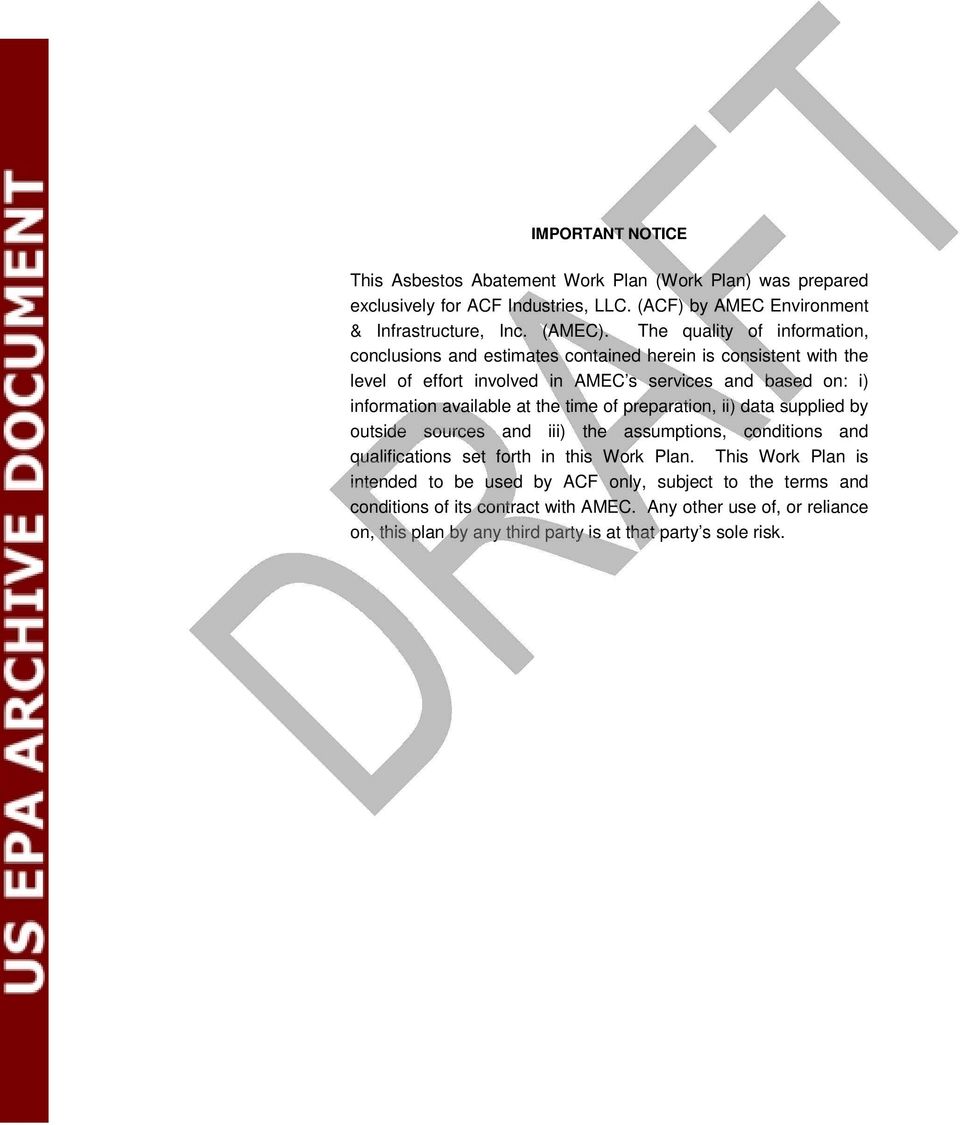
4 C O N T E N T S 1.0 INTRODUCTION ROOF ACM ABATEMENT Cooling Towers Cooling Tower Cooling Tower Thermal System Insulation Work Site Preparation TSI Removal Rooftop Mechanical Houses Work Site Preparation Asbestos Removal FOURTH FLOOR ACM ABATEMENT Thermal System Insulation Work Site Preparation TSI Removal Disposal of TSI Floor Tile and Mastic Work Site Preparation for Gross Removal of ACM Floors, Class I, Non-friable Floor Tile and Mastic Removal Disposal of Floor Tile and Mastic Ceiling Tile Glue Pucks Work Site Preparation for Gross Removal of Ceiling Tile with ACM Glue Pucks, Class I, Non-friable Ceiling Tile Glue Puck Removal Ceiling Tile and Glue Puck Disposal Drywall, Transite Panels and Joint Compound Work Site Preparation Drywall and Transite Panel Removal Disposal of Drywall and Transite Panel Asbestos Plaster and Debris Work Site Preparation Removal of Ceiling Plaster and Debris Disposal of Ceiling Plaster and Debris Window Caulk and Glazing Putty Work Site Preparation Window Removal Disposal of Window Caulking and Glazing Putty Fire Doors Project No.: TOC i

5 4.0 THIRD FLOOR ACM ABATEMENT Thermal System Insulation Work Site Preparation TSI Removal Floor Tile and Mastic Work Site Preparation for Gross Removal of ACM Floors, Class I, Non-friable Floor Tile and Mastic Removal Disposal of Floor Tile and Mastic Ceiling Tile Glue Pucks Work Site Preparation for Gross Removal of Ceiling Tile with ACM Glue Pucks, Class I, Non-friable Ceiling Tile Glue Puck Removal Ceiling Tile and Glue Puck Disposal Asbestos Shingles Work Site Preparation Asbestos Shingles Removal Disposal of Asbestos Shingles Window Caulk and Glazing Putty Work Site Preparation Window Removal Disposal of Window Caulking and Glazing Putty Fire Doors SECOND FLOOR ACM ABATEMENT Thermal System Insulation Work Site Preparation TSI Removal Disposal of TSI Floor Tile and Mastic Work Site Preparation for Gross Removal of ACM Floors, Class I, Non-friable Floor Tile and Mastic Removal Disposal of Floor Tile and Mastic Ceiling Tile Glue Pucks Work Site Preparation for Gross Removal of Ceiling Tile with ACM Glue Pucks, Class I, Non-friable Ceiling Tile Glue Puck Removal Ceiling Tile and Glue Puck Disposal Transite Panels Work Site Preparation Transite Panel Removal Disposal of Transite Panels Window Caulk and Glazing Putty Work Site Preparation Window Removal Project No.: TOC ii
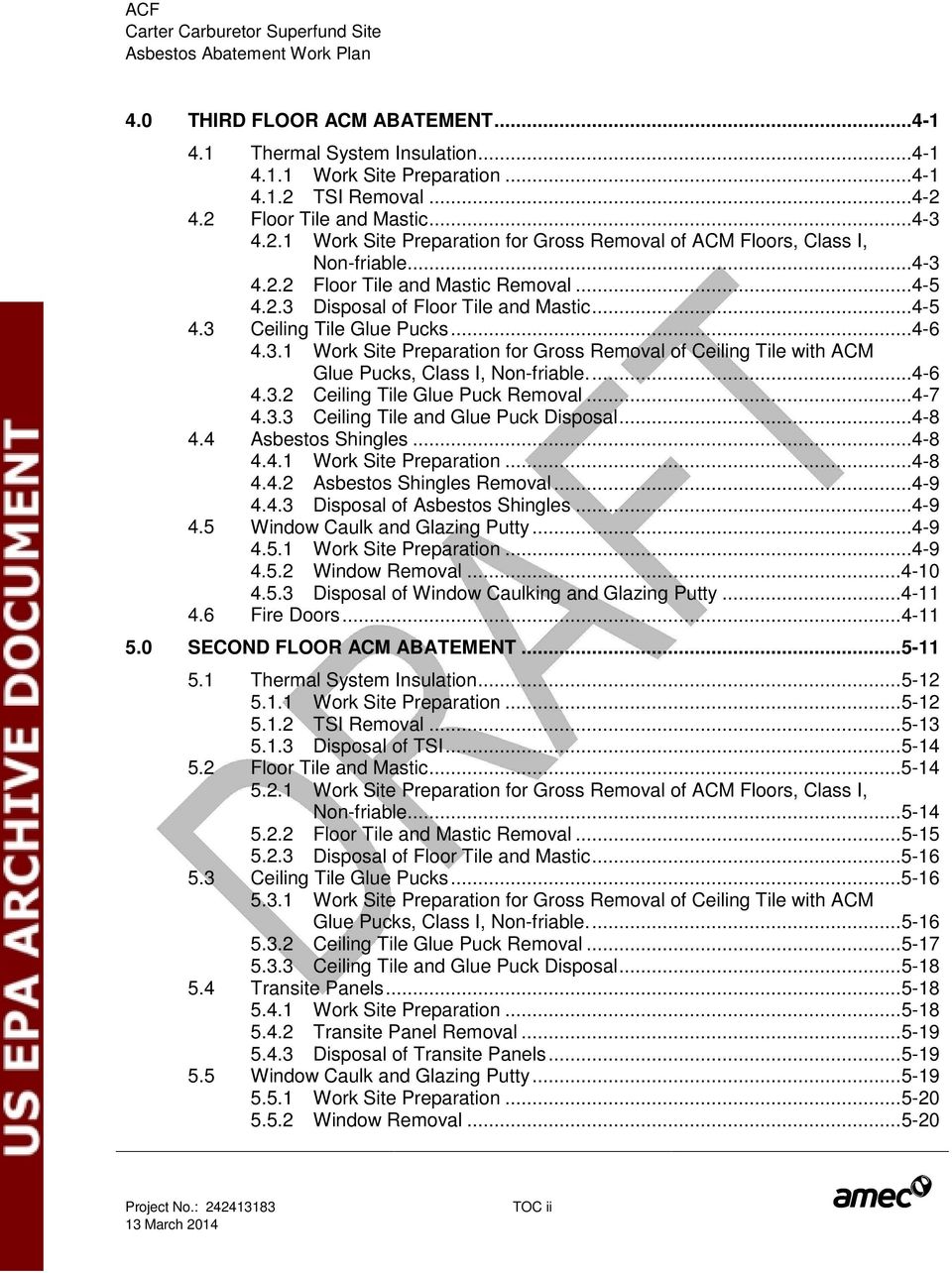
6 5.5.3 Disposal of Window Caulking and Glazing Putty Fire Doors FIRST FLOOR ACM ABATEMENT Thermal System Insulation Work Site Preparation TSI Removal Disposal of TSI Floor Tile and Mastic Work Site Preparation for Gross Removal of ACM Floors, Class I, Non-friable Floor Tile and Mastic Removal Disposal of Floor Tile and Mastic Ceiling Tile Glue Pucks Work Site Preparation for Gross Removal of Ceiling Tile with ACM Glue Pucks, Class I, Non-friable Ceiling Tile Glue Puck Removal Ceiling Tile and Glue Puck Disposal Drywall and Joint Compound Work Site Preparation Drywall Removal Disposal of Drywall Window Caulk and Glazing Putty Work Site Preparation Window Removal Disposal of Window Caulking and Glazing Putty Asbestos Debris Fire Doors A P P E N D I C E S Appendix A Specifications for the Removal and Disposal of Asbestos-Containing Materials Project No.: TOC iii

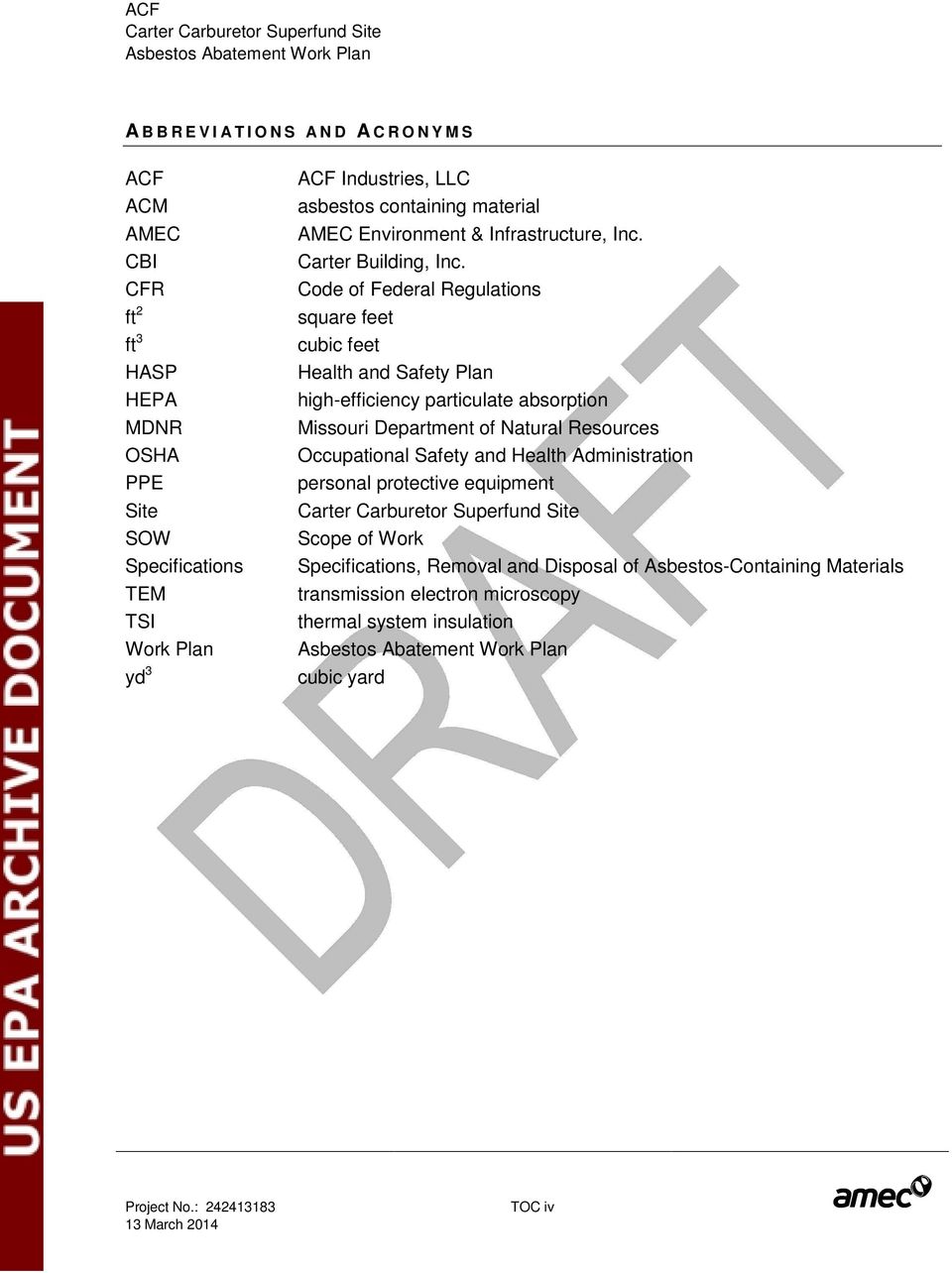
7 A B B R E V I A T I O N S A N D A C R O N Y M S ACF ACM AMEC CBI CFR ft 2 ft 3 HASP HEPA MDNR OSHA PPE Site SOW Specifications TEM TSI Work Plan yd 3 ACF Industries, LLC asbestos containing material AMEC Environment & Infrastructure, Inc. Carter Building, Inc. Code of Federal Regulations square feet cubic feet Health and Safety Plan high-efficiency particulate absorption Missouri Department of Natural Resources Occupational Safety and Health Administration personal protective equipment Scope of Work Specifications, Removal and Disposal of Asbestos-Containing Materials transmission electron microscopy thermal system insulation cubic yard Project No.: TOC iv
8 1.0 INTRODUCTION The purpose of this (Work Plan) is to document the scope of work (SOW) to be executed to abate the asbestos-containing material (ACM) at the Carter Carburetor Site. The Specifications for the Removal and Disposal of Asbestos-Containing Materials (Specifications) is presented in Appendix A. The Specifications are the basis for the means and methods presented in this Work Plan. Locations of the known ACM are listed below: Roof Flashing, roof cements, transite, thermal system insulation (TSI), transite and mastic Fourth Floor Floor tile and mastic, TSI, plaster, ceiling tiles, fire doors, window caulk and miscellaneous debris Third Floor Floor tile and mastic, TSI, shingles, ceiling tiles, fire doors, window caulk and miscellaneous debris Second Floor Floor tile and mastic, TSI, transite, fire doors, window caulk and miscellaneous debris First Floor Floor tile and mastic, TSI, transite, ceiling tiles, fire doors, window caulk and miscellaneous debris The specific location and estimated quantities of ACM for each floor are described in Sections 2.0 through 6.0 of this Work Plan. All work performed under this Work Plan will be in accordance with a contractor developed Site-Specific Health and Safety Plan (HASP) and all federal and state regulations regarding the abatement, handling, storage, transportation and disposal of asbestos and ACM. The HASP will outline the engineering controls, the administrative controls and the personal protective equipment (PPE) to be used for the execution of this Work Plan. THIS WORK PLAN IS NOT INTENDED TO BE MORE STRINGENT, OR TO REQUIRE MORE, THAN APPLICABLE FEDERAL, STATE OR LOCAL LAWS OR REGULATIONS, INCLUDING BUT NOT LIMITED TO THE ASBESTOS NESHAP, 40 CFR , ET SEQ. AND THE OCCUPATIONAL SAFETY AND HEALTH ACT ASBESTOS REQUIREMENTS, 40 CFR Project No.: Page 1-1

9 2.0 ROOF ACM ABATEMENT Prior to the commencement of abatement activities, the location and amount of ACM present will be verified. There are two cooling towers encased with transite louvers and panels and include piping covered with TSI and four mechanical houses contain both TSI piping and transit panels. Prior to commencing abatement activities on the roof, a visual inspection will be performed and any loose asbestos material will be properly containerized for disposal with other asbestos materials from the roof abatement activities described below. 2.1 Cooling Towers The two cooling towers on the roof of the CBI Building will be abated as Category 2 materials. Cooling tower 1 is located on the north half of the CBI Building roof and cooling tower 2 is located on the south half of the CBI Building roof. The location of the cooling towers is depicted on Figure EN-5 of the Specifications located in Appendix A Cooling Tower 1 WORK SITE PREPARATION Scaffolding of sufficient height will be erected to access the top of the cooling tower. The scaffolding will be erected in accordance with manufacturer s recommendation, and a competent person will inspect the scaffolding after initial erection and daily prior to use. The area around the scaffolding will be demarcated with barrier tape and warning signs to alert personnel of the abatement activities and the potential hazards. In areas around the cooling tower where there is no access to the area (along the roof edge), no barrier tape or warning signs will be posted. Workers in this area will be tied off for fall protection in compliance with Occupational Safety and Health Administration (OSHA). Six-mil plastic sheeting will be used to cover the roof in the immediate area of the abatement activities and the adjacent areas up to 20 feet from the base of the cooling tower. Plastic sheets will be seamed together with spray adhesive and duct tape with a minimum 12-inch overlap at the seams. This plastic sheeting may be removed at the end of each day of abatement activities and replaced with new plastic sheeting at the beginning of each work day, as necessary to maintain cleanliness. A dry worker decontamination unit will be constructed adjacent to the abatement area. The location of the decontamination unit will be agreed upon in the field with the AMEC Asbestos Supervisor. To minimize the potential spread of ACM, the decontamination unit will be placed as close as practical to the abatement area. Project No.: Page 2-1
10 Prior to any abatement activities, the AMEC Asbestos Supervisor will be notified to perform a pre-work inspection. Upon completion of a satisfactory inspection, abatement activities will commence. If issues arise from the inspection, the issues will be resolved and the area re-inspected until a satisfactory inspection result is achieved. A temporary waste storage/load out area will be established for the storage of transite panels prior to loading into transport containers for transport to the disposal facility. This location will be agreed upon in the field with the AMEC Asbestos Supervisor. TRANSITE PANEL REMOVAL Transite panels will be sprayed/wetted with amended water and maintained wetted during the removal process. Nail heads will be removed/sheared or screws removed to allow for removal of intact transite panels and/or minimize breakage of the transite panels. If the transite panels are not affixed to the cooling tower with nails or screws, they will be removed from the secured slat or mounting slots. Keeping the panels wetted, the removed panels will be placed on 6-mil (or thicker) plastic sheeting for storage until a sufficient quantity is generated to warrant packaging for disposal. Wrap transite panels in two layers of 6-mil poly sheeting (or thicker) or place transite panels in two sealable labelled plastic bags of 6-mil minimum thickness Transite panel disposal packages will not exceed 50 pounds to allow for manual transport of the packages to the waste package storage/load out area. Palletized waste will be sized to fit the pallets. Following removal of the transite panels, the exposed substrate will be thoroughly cleaned using a High-efficiency particulate absorption (HEPA) vacuum. Upon completion of transite panel removal from one side of the cooling tower, the AMEC Asbestos Supervisor will be notified to conduct visual observation before moving operations to the next side. DISPOSAL OF TRANSITE PANELS Packaged transite panels stored in temporary waste storage/load out area will be removed from the roof using either a telescopic handler or a crane. The packaged transite panels will be placed into an open top roll off container for transport to the disposal facility. The open top roll offs will be tarped in preparation for transport. All transite panel packages and containers will be treated, packaged, labelled and disposed in accordance with 40 Code of Federal Regulations (CFR) 61 and 49 CFR 171 and 172. Project No.: Page 2-2
11 2.1.2 Cooling Tower 2 WORK SITE PREPARATION Scaffolding of sufficient height will be erected to access the top of the cooling tower. The scaffolding will be erected in accordance with manufacturer s recommendation, and a competent person will inspect the scaffolding after initial erection and daily prior to use. The area around the scaffolding will be demarcated with barrier tape and warning signs to alert personnel of the abatement activities and the potential hazards. In areas around the cooling tower where there is no access to the area (along the roof edge), no barrier tape or warning signs will be posted. Workers in this area will be tied off for fall protection in compliance with OSHA. Six-mil plastic sheeting will be used to cover the roof in the immediate area of the abatement activities and the adjacent areas up to 20 feet from the base of the cooling tower. Plastic sheets will be seamed together with spray adhesive and duct tape with a minimum 12-inch overlap at the seams. This plastic sheeting may be removed at the end of each day of abatement activities and replaced with new plastic sheeting at the beginning of each work day, as necessary to maintain cleanliness. A dry worker decontamination unit will be constructed adjacent to the abatement area. The location of the decontamination unit will be agreed upon in the field with the AMEC Asbestos Supervisor. To minimize the potential spread of ACM, the decontamination unit will be placed as close as practical to the abatement area. Prior to any abatement activities the AMEC Asbestos Supervisor will be notified to perform a pre-work inspection. Upon completion of a satisfactory inspection, abatement activities will commence. If issues arise from the inspection, the issues will be resolved and the area re-inspected until a satisfactory inspection result is achieved. A temporary waste storage/load out area will be established for the storage of transite panels prior to loading into transport containers for transport to the disposal facility. This location will be agreed upon in the field with the AMEC Asbestos Supervisor. TRANSITE PANEL REMOVAL Transite panels will be sprayed/wetted with amended water and maintained wetted during the removal process. Nail heads will be removed/sheared or screws removed to allow for removal of intact transite panels and/or minimize breakage of the transite panels. Keeping the panels wetted, the removed panels will be placed on 6-mil (or thicker) plastic sheeting for storage until a sufficient quantity is generated to warrant packaging for Project No.: Page 2-3
12 disposal. Wrap transite panels in two layers of 6-mil poly sheeting (or thicker) or place transite panels in two sealable plastic bags of 6-mil minimum thickness and label. Transite panel disposal packages will not exceed 50 pounds to allow for manual transport of the packages to the waste package storage/load out area. Palletized waste will be sized to fit the pallets. Following removal of the transite panels the exposed substrate will be thoroughly cleaned using a HEPA vacuum. Upon completion of transite panel removal from one side of the cooling tower, the AMEC Asbestos Supervisor will be notified to conduct visual observation before moving operations to the next side. DISPOSAL OF TRANSITE PANELS Packaged transite panels stored in temporary waste storage/load out area will be removed from the roof using either a telescopic handler or a crane. The packaged transite panels will be placed into an open top roll off container for transport to the disposal facility. The open top roll off containers will be tarped prior to transport. All transite panel packages and containers will be treated, packaged, labelled and disposed in accordance with 40 CFR 61 and 49 CFR 171 and Thermal System Insulation There are approximately 130 linear feet of visible thermal system insulation (TSI) on the roof. The location of the TSI is depicted on Figure EN-5 of the Specifications located in Appendix A Work Site Preparation The area around the TSI abatement will be demarcated with barrier tape and warning signs to alert personnel of the abatement activities and the potential hazards. In areas around the TSI abatement where there is no access to the area (along the roof edge), no barrier tape or warning signs will be posted. Workers in this area will be tied off for fall protection in compliance with OSHA. The area will be isolated to separate the abatement area from areas where no abatement is occurring. The immediate area will be pre-cleaned using a HEPA vacuum or wet cleaning method as appropriate. Any immovable object within the abatement area will be pre-cleaned using HEPA vacuum or wet cleaning method as appropriate. The immovable object will be completely sealed in plastic sheeting after cleaning. 6-mil plastic sheeting will be used to cover the roof in the immediate area of the TSI abatement activities and the adjacent areas within 20 feet. Plastic sheets will be seamed together with spray adhesive and duct tape with a minimum 12-inch overlap at the Project No.: Page 2-4
13 seams. This plastic sheeting may be removed at the end of each day of abatement activities and replaced with new plastic sheeting at the beginning of each work day, as necessary to maintain cleanliness. A dry worker decontamination unit will be constructed adjacent to the TSI abatement area. The location of the decontamination unit will be agreed upon in the field with the AMEC Asbestos Supervisor. To minimize the potential spread of ACM, the decontamination unit will be placed as close as practical to the TSI abatement area. Prior to any abatement activities the AMEC Asbestos Supervisor will be notified to perform a pre-work inspection. Upon completion of a satisfactory inspection, abatement activities will commence. If issues arise from the inspection, the issues will be resolved and the area re-inspected until a satisfactory inspection result is achieved. A temporary waste storage/load out area will be established for the storage of TSI prior to loading into transport containers for transport to the disposal facility. This location will be agreed upon in the field with the AMEC Asbestos Supervisor TSI Removal Depending on the conditions at the time of TSI abatement activities, one of the following methods will be employed: Glove Bag or Unit Wrap. GLOVE BAG METHOD A glove bag will be installed as described in Section 3.02 (Paragraph C) of the Specifications (see Appendix A). The TSI will be wetted with amended water and maintained wet during the removal process. Wetted TSI will be removed in small sections. As it is removed from the pipe, it will be saturated with amended water or removal Encapsulant and placed in the bottom of the glove bag in accordance with the manufacturer s recommendations bagged into another labelled 6-mil bag. Once the TSI has been removed from the pipe in the area encompassed by the glove bag, encapsulant will be sprayed on the piping surfaces and ends of adjoining sections of insulation. Following removal of TSI and spraying Encapsulant, the AMEC Asbestos Supervisor will be notified to conduct an observation of the work. The glove bag will be required to remain in place until the pipes and joints have been inspected and are accepted. The glove bag will be evacuated with a HEPA vacuum and sealed with the waste material in the bottom. The glove bag will be removed in accordance with the manufacturer s recommendations and placed in a labelled 6-mil poly bag. Project No.: Page 2-5
14 The glove bag and removed TSI will be placed in a temporary waste storage/load out area. The storage area will be established for the storage of TSI prior to loading into transport containers for transport to the disposal facility. This location will be agreed upon in the field with the AMEC Asbestos Supervisor. UNIT WRAP METHOD Piping covered with TSI will be wrapped with two layers of 6-mil, or thicker, plastic sheeting. A glove bag will be used to remove 12-inches of insulation where the pipe will be cut as described above (Glove Bag Method). The Unit Wrap Method will be used to segment piping runs into sections 12 feet or less in accordance with the Specifications (Appendix A). Once the glove bag is removed from the pipe cut area, cover the entire pipe with a layer of 6-mil plastic sheeting including the ends of the pipe and label as asbestos. DISPOSAL OF TSI Packaged TSI stored in the temporary waste storage/load out area will be removed from the roof using either a telescopic handler or a crane. The packaged TSI will be placed into an enclosed container for transport to the disposal facility. All TSI packages and containers will be treated, packaged, labelled and disposed in accordance with 40 CFR 61 and 49 CFR 171 and Rooftop Mechanical Houses There are four rooftop mechanical houses associated with this project. The location of the mechanical houses is depicted on Figure EN-4 of the Specifications (Appendix A). Visual inspection of the mechanical houses indicated the presence of TSI wrapped piping, transite panels or a combination of both. The three smaller mechanical houses have both TSI wrapped piping and transite panels while the larger mechanical house only has TSI wrapped piping. The mechanical houses have significant amounts of suspected ACM contaminated debris and equipment; this debris will be removed and treated as ACM contaminated waste, equipment will be cut free as necessary to work. Project No.: Page 2-6

15 2.3.1 Work Site Preparation The area around the mechanical houses will be demarcated with barrier tape and warning signs to alert personnel of the abatement activities and the potential hazards. In areas around the mechanical house abatement where there is no access to the area (along the roof edge) no barrier tape or warning signs will be posted. Workers in this area will be tied off for fall protection in compliance with OSHA. The area will be isolated and critical barriers will be erected, as necessary, to separate the abatement area from areas where no abatement is occurring. Since the houses are considered contaminated, pre-cleaning the inside or the roof mechanical houses is not required. The immediately adjacent areas will be pre-cleaned using a HEPA vacuum and/or wet cleaning method as appropriate. Any immovable object within the abatement area will be pre-cleaned using HEPA vacuum and/or wet cleaning method as appropriate. The immovable object will be completely sealed in plastic sheeting after cleaning. Six-mil plastic sheeting will be used to cover the roof in the immediate area of the mechanical house abatement activities and the adjacent areas within 20 feet. Plastic sheets will be seamed together with spray adhesive and duct tape with a minimum 12 inch overlap at the seams. This plastic sheeting may be removed at the end of each day of abatement activities and replaced with new plastic sheeting at the beginning of each work day, as necessary to maintain cleanliness. A wet worker decontamination unit will be constructed adjacent to the mechanical house abatement area. The location of the decontamination unit will be agreed upon in the field with the AMEC Asbestos Supervisor. To minimize the potential spread of ACM, the decontamination unit will be placed as close as practical to the mechanical house abatement area. Place the work area under negative air ensuring that no unfiltered air is discharged outside the work area. The work area will be under negative air from the beginning of mechanical house removal until the area has been decontaminated and certified clean through the use of air testing. Prior to any abatement activities, the AMEC Asbestos Supervisor will be notified to perform a pre-work inspection. Upon completion of a satisfactory inspection, abatement activities will commence. If issues arise from the inspection, the issues will be resolved and the area re-inspected until a satisfactory inspection result is achieved. Project No.: Page 2-7

16 A temporary waste storage/load out area will be established for the storage of transite panels prior to loading into transport containers for transport to the disposal facility. This location will be agreed upon in the field with the AMEC Asbestos Supervisor Asbestos Removal After negative air is established in the roof top houses, the bulk waste materials will be bagged and removed from the area. Wrap transite materials in two layers of 6-mil poly sheeting (or thicker) or place in two sealable plastic bags of 6-mil minimum thickness and label. Equipment may be cut up as necessary to access the ACM. Non-asbestos materials and equipment will be decontaminated of asbestos material, and left on the roof until demolition or disposed of as contaminated waste as appropriate. GLOVE BAG METHOD A glove bag will be installed as described below and in Section 3.02, paragraph C of the Specifications (Appendix A). The TSI will be wetted with amended water and maintained wet during the removal process. Wetted TSI will be removed in small sections. As it is removed from the pipe, it will be saturated with amended water or removal Encapsulant and placed in the bottom of the glove bag in accordance with the manufacturers recommendations bagged into another labelled 6-mil bag. Once the TSI has been removed from the pipe in the area encompassed by the glove bag, Encapsulant will be sprayed on the piping surfaces and ends of adjoining sections of insulation. Following removal of TSI and spraying Encapsulant, the AMEC Asbestos Supervisor will be notified to conduct an observation of the work. The glove bag will be required to remain in place until the pipes and joints have been inspected and are accepted. The glove bag will be evacuated with a HEPA vacuum and sealed with the waste material in the bottom. The glove bag will be removed in accordance with the manufacturer s recommendations and placed in a labelled 6-mil poly bag. The glove bag and removed TSI will be placed in a temporary waste storage/load out area. The storage area will be established for the storage of TSI prior to loading into transport containers for transport to the disposal facility. This location will be agreed upon in the field with the AMEC Asbestos Supervisor. Project No.: Page 2-8
17 UNIT WRAP METHOD Piping covered with TSI will be wrapped with two layers of 6-mil, or thicker, plastic sheeting. A glove bag will be used to remove 12-inches of insulation as described above in Subsection Glove Bag Method. The Unit Wrap Method will be used on piping runs of 12 feet or less in accordance with the Specifications (Appendix A). Cut pipe in bare area and cover the entire pipe with a layer of 6-mil plastic sheeting including the ends of the pipe and label as asbestos. TRANSITE PANEL REMOVAL Transite panels will be sprayed/wetted with amended water and during the removal process. Nail heads will be removed/sheared or screws removed to allow for removal of intact transite panels and/or minimize breakage of the transite panels. Remove the wetted transite panels in small sections, keeping the panels wetted. The removed panels will be placed on 6-mil (or thicker) plastic sheeting for storage until enough is generated to warrant packaging for disposal. Wrap transite panels in two layers of 6-mil poly sheeting (or thicker) or place transite panels in two sealable plastic bags of 6-mil minimum thickness and label. Transite panel disposal packages will generated to a weight of no more than 50 pounds to allow for manual transport of the packages to the waste storage/load out area. Palletized waste will be sized to fit the pallets. Following removal of the transite panels, the exposed substrate will be thoroughly cleaned using a HEPA vacuum. Upon completion of transite panel removal, the AMEC Asbestos Supervisor will be notified to conduct preliminary visual observation and clearance air monitoring, as appropriate. The transite panels will be placed in a temporary packaged waste storage/load out area. DISPOSAL OF DEBRIS, TSI AND TRANSITE PANELS Packaged debris, TSI and transite panels stored in the temporary waste storage/load out area will be removed from the roof using either a telescopic handler or a crane. The packaged waste will be placed into an open top roll off container for transport to the disposal facility. Containers will be tarped prior to transport. All waste packages and containers will be treated, packaged, labelled and disposed in accordance with 40 CFR 61 and 49 CFR 171 and 172. Project No.: Page 2-9

18 3.0 FOURTH FLOOR ACM ABATEMENT Prior to the commencement of abatement activities, the location and amount of ACM present will be verified. The location of the asbestos on the fourth floor is depicted on Figure EN-4 located in the Specifications (see Appendix A). The location of windows and fire doors on the fourth floor is depicted on Figure EN-9 in the Specifications (see Appendix A). The fourth floor contains the following types of asbestos materials: TSI, floor tile and mastic, ceiling tile and asbestos glue pucks, drywall and joint compound, transite, window caulk and glazing putty and asbestos plaster and debris. Estimated quantities of each type of asbestos contained on the fourth floor are provided below: TSI and joint compound 660 linear feet Drywall, joint compound and transite panels 5,475 square feet (ft 2 ) Floor tile and mastic 8,040 ft 2 Ceiling tile with asbestos glue pucks 2,000 ft 2 Asbestos plaster and debris 26,100 ft 2 Fire Doors 7 each Window caulk and glazing putty are not estimated this material will be abated by removing the windows as described in this section. Prior to commencing abatement activities on the fourth floor, a visual inspection will be performed and any loose asbestos material will be properly containerized for future disposal with other asbestos materials from the fourth floor abatement activities described below. 3.1 Thermal System Insulation Work Site Preparation The area around the TSI abatement will be demarcated with barrier tape and warning signs to alert personnel of the abatement activities and the potential hazards. The area will be isolated and critical barriers will be erected to separate the abatement area from areas where no abatement is occurring. The immediate area will be precleaned using a HEPA vacuum or wet cleaning method as appropriate. Any immovable object within the abatement area will be pre-cleaned using HEPA vacuum or wet cleaning method as appropriate. The immovable object will be completely sealed in plastic sheeting after cleaning. Project No.: Page 3-1

19 Six-mil plastic sheeting will be used to cover the floor in the immediate area of the TSI abatement activities and the adjacent areas within 20 feet. Plastic sheets will be seamed together with spray adhesive and duct tape with a minimum 12-inch overlap at the seams. This plastic sheeting may be removed at the end of each day of abatement activities and replaced with new plastic sheeting at the beginning of each work day, as necessary to maintain cleanliness. A dry worker decontamination unit will be constructed adjacent to the TSI abatement area. The location of the decontamination unit will be agreed upon in the field with the AMEC Asbestos Supervisor. To minimize the potential spread of ACM, the decontamination unit will be placed as close as practical to the TSI abatement area. Prior to any abatement activities in this area, the AMEC Asbestos Supervisor will be notified to perform a pre-work inspection. Upon completion of a satisfactory inspection, abatement activities will commence. If issues arise from the inspection, the issues will be resolved and the area re-inspected until a satisfactory inspection result is achieved. A temporary packaged waste storage/load out area will be established for the storage of TSI prior to loading into transport containers for transport to the disposal facility. This location will be agreed upon in the field with the AMEC Asbestos Supervisor TSI Removal Depending on the conditions at the time of TSI abatement activities, one of the following methods will be employed: Glove Bag or Unit Wrap. GLOVE BAG METHOD A glove bag will be installed as described below and in Section 3.02, paragraph C of the Specifications (Appendix A). The TSI will be wetted with amended water and maintained wet during the removal process. Wetted TSI will be removed in small sections. As it is removed from the pipe, it will be saturated with amended water or removal Encapsulant and placed in the bottom of the glove bag in accordance with the manufacturers recommendations bagged into another labelled 6-mil bag. Once the TSI has been removed from the pipe in the area encompassed by the glove bag, Encapsulant will be sprayed on the piping surfaces and ends of adjoining sections of insulation. Following removal of TSI and spraying Encapsulant, the AMEC Asbestos Supervisor will be notified to conduct an observation of the work. The glove bag will be required to remain in place until the pipes and joints have been inspected and are accepted. The glove bag will be evacuated with a HEPA vacuum and sealed with the waste material in Project No.: Page 3-2

20 the bottom. The glove bag will be removed in accordance with the manufacturer s recommendations and placed in a labelled 6-mil poly bag. The glove bag and removed TSI will be placed in a temporary waste storage/load out area. The storage area will be established for the storage of TSI prior to loading into transport containers for transport to the disposal facility. This location will be agreed upon in the field with the AMEC Asbestos Supervisor. UNIT WRAP METHOD Piping covered with TSI will be wrapped with two layers of 6-mil, or thicker, plastic sheeting. A glove bag will be used to remove 12-inches of insulation as described above in Subsection Glove Bag Method. The Unit Wrap Method will be used on piping runs of 12 feet or less in accordance with the Specifications (Appendix A). Cut pipe in bare area and cover the entire pipe with a layer of 6-mil plastic sheeting including the ends of the pipe and label as asbestos Disposal of TSI Packaged TSI stored in the temporary waste storage/load out area will be removed from the fourth floor. Remove the glove bag from the pipe, ensuring that exposed ends of the insulation are properly encapsulated using a telescopic handler or similar mechanical device. The packaged TSI will be placed into an enclosed container for transport to the disposal facility. All TSI packages and containers will be treated, packaged, labelled and disposed in accordance with 40 CFR 61 and 49 CFR 171 and Floor Tile and Mastic Work Site Preparation for Gross Removal of ACM Floors, Category I, Non-friable The area around the floor tile and mastic abatement will be demarcated with barrier tape and warning signs to alert personnel of the abatement activities and the potential hazards. The area will be isolated and critical barriers will be erected to separate the abatement area from areas where no abatement is occurring. The immediate area will be pre-cleaned using a HEPA vacuum and/or wet cleaning method as appropriate. Any immovable object within the abatement area will be pre-cleaned using HEPA vacuum and/or wet cleaning method as appropriate. The immovable object will be completely sealed in plastic sheeting after cleaning. Project No.: Page 3-3
21 If the floor tile can be removed generally intact, the following steps will be followed for the abatement of floor tile: Any baseboards or fixtures that would interfere with access to the floor tile or removal of mastic will be removed. Interior walls, within 10 feet of the abatement area, will be covered with 4-mil plastic sheeting to a height of 4 feet. Plastic sheeting joints will be glued/taped with a 12-inch overlap to minimize/prevent the movement of water. Plastic sheeting joints will be glued/taped with a 12-inch overlap to minimize/prevent the movement of water. If the floor tile cannot be removed generally intact the following steps will be followed for the abatement of floor tile: Any baseboards or fixtures that would interfere with access to the floor tile or removal of mastic will be removed. Interior walls will be covered to full height with 4-mil plastic sheeting. Place the work area under negative air ensuring that no unfiltered air is discharged outside the work area. The work area will be under negative air from the beginning of floor tile and mastic removal until the area has been decontaminated. All barriers and plastic enclosures will remain sealed and taped for the duration of the floor tile and mastic abatement activities and final cleaning/testing. Enclosures will be visually inspected after initial construction and at the beginning of each workday. Any damage discovered during inspections or during the workday will be immediately repaired. A dry worker decontamination unit will be constructed adjacent to the floor tile and mastic abatement area. The location of the decontamination unit will be agreed upon in the field with the AMEC Asbestos Supervisor. To minimize the potential spread of ACM the decontamination unit will be placed as close as practical to the floor tile and mastic abatement area. Prior to any abatement activities in this area, the AMEC Asbestos Supervisor will be notified to perform a pre-work inspection. Upon completion of a satisfactory inspection, abatement activities will commence. If issues arise from the inspection, the issues will be resolved and the area re-inspected until a satisfactory inspection result is achieved. A temporary packaged waste storage/load out area will be established for the storage of floor tile and mastic prior to loading into transport containers for transport to the disposal facility. This location will be agreed upon in the field with the AMEC Asbestos Supervisor. Project No.: Page 3-4
22 3.2.2 Floor Tile and Mastic Removal The floor tile will be sprayed/wetted with amended water during the removal process. Remove the wetted floor tiles in large pieces with minimum breakage. The removed floor tiles will be placed on 6-mil (or thicker) plastic sheeting for storage until enough is generated to warrant packaging for disposal. Wrap floor tiles in two layers of 6-mil poly sheeting (or thicker) or place floor tiles in two sealable plastic bags of 6-mil minimum thickness and label as asbestos. Floor tile disposal packages will not exceed 50 pounds to allow for manual transport of the packages to the waste package storage/load out area. Cardboard barrels or boxes should be used to control the puncturing of bags by sharp tile corners and edges. Floor tile mastic will be removed by using amended water and/or mastic solvent. Mastic will be removed until all build up of mastic material is removed from the substrate. Scrappers and/or other mechanical floor scrubber may be necessary to achieve the required cleanliness. Following removal of the floor tile and mastic the AMEC Asbestos Supervisor will be notified to conduct visual observation Disposal of Floor Tile and Mastic Packaged floor tile and mastic waste stored in the temporary waste storage/load out area will be removed from the fourth floor using a telescopic handler or similar mechanical device. The packaged floor tile and mastic will be placed into an enclosed container for transport to the disposal facility. All floor tile and mastic packages and containers will be treated, packaged, labelled and disposed in accordance with 40 CFR 61 and 49 CFR 171 and 172. Project No.: Page 3-5
23 3.3 Ceiling Tile Glue Pucks Work Site Preparation for Gross Removal of Ceiling Tile with ACM Glue Pucks, Category I, Non-friable The area around the ceiling tile glue puck abatement will be demarcated with barrier tape and warning signs to alert personnel of the abatement activities and the potential hazards. The area will be isolated and critical barriers will be erected to separate the abatement area from areas where no abatement is occurring. The immediate area will be precleaned using a HEPA vacuum or wet cleaning method as appropriate and all trash removed. Any immovable object within the abatement area will be pre-cleaned using HEPA vacuum or wet cleaning method as appropriate. The immovable object will be completely sealed in plastic sheeting after cleaning. If the ceiling tile glue pucks can be removed generally intact the following steps will be used for the abatement of the ceiling tile glue pucks: Interior walls will be covered to full height with 4-mil plastic sheeting. Plastic sheeting joints will be glued/taped with a 12-inch overlap to minimize/prevent the movement of water. Erect scaffolding or other equipment to gain access to the ceiling tile slated for abatement. Ceiling tiles with no asbestos glue pucks will be disposed as general construction waste. If the ceiling tile glue pucks cannot be removed generally intact, the following steps will be used for the abatement of ceiling tile glue pucks: Interior walls will be covered to full height with 4-mil plastic sheeting. Plastic sheeting joints will be glued/taped with a 12-inch overlap to minimize/prevent the movement of water. Place the work area under negative air ensuring that no unfiltered air is discharged outside the work area. The work area will be under negative air from the beginning of floor tile and mastic removal until the area has been decontaminated... Project No.: Page 3-6
24 All barriers and plastic enclosures will remain sealed and taped for the duration of the ceiling tile glue puck abatement activities and final cleaning. Enclosures will be visually inspected after initial construction and at the beginning of each workday. Any damage discovered during inspections or during the workday will be immediately repaired. A dry worker/equipment decontamination unit will be constructed adjacent to the ceiling tile glue puck abatement area. The location of the decontamination unit will be agreed upon in the field with the AMEC Asbestos Supervisor. To minimize the potential spread of ACM, the decontamination unit will be placed as close as practical to the ceiling tile glue puck abatement area. Prior to any abatement activities in this area, the AMEC Asbestos Supervisor will be notified to perform a pre-work inspection. Upon completion of a satisfactory inspection, abatement activities will commence. If issues arise from the inspection, the issues will be resolved and the area re-inspected until a satisfactory inspection result is achieved. A temporary waste storage/load out area will be established for the storage of ceiling tile glue pucks prior to loading into transport containers for transport to the disposal facility. This location will be agreed upon in the field with the AMEC Asbestos Supervisor Ceiling Tile Glue Puck Removal The ceiling tile will be sprayed/wetted with amended water during the removal process. Remove the wetted ceiling tiles and scrap the glue pucks from the substrate. Ceiling tile and removed glue pucks will be placed in two sealable plastic bags of 6-mil minimum thickness and label as asbestos. Ceiling tile disposal packages will not exceed 50 pounds to allow for manual transport of the packages to the waste package storage/load out area. Following removal of the ceiling tile and glue pucks, the AMEC Asbestos Supervisor will be notified to conduct visual observation Ceiling Tile and Glue Puck Disposal Packaged ceiling tile and glue pucks waste stored in the temporary waste storage/load out area will be removed from the fourth floor using a telescopic handler or similar mechanical device. The packaged ceiling tile and glue pucks will be placed into an enclosed container for transport to the disposal facility. All ceiling tile and glue pucks packages and containers will be treated, packaged, labelled and disposed in accordance with 40 CFR 61 and 49 CFR 171 and 172. Project No.: Page 3-7
25 3.4 Drywall, Transite Panels and Joint Compound Work Site Preparation Scaffolding of sufficient height or other approved equipment will be erected to access the top of the drywall/transite panels. The scaffolding will be erected in accordance manufacturer s recommendation and a competent person will inspect after initial erection and daily prior to use. The area around the abatement area will be demarcated with barrier tape and warning signs to alert personnel of the abatement activities and the potential hazards. Six-mil plastic sheeting will be used to cover the floor in the immediate area of the abatement activities and the adjacent areas up to 20 feet from the base of the cooling tower. Plastic sheets will be seamed together with spray adhesive and duct tape with a minimum 12-inch overlap at the seams. A dry worker decontamination unit will be constructed adjacent to the abatement area. The location of the decontamination unit will be agreed upon in the field with the AMEC Asbestos Supervisor. To minimize the potential spread of ACM the decontamination unit will be placed as close as practical to the abatement area. Prior to any abatement activities in this area, the AMEC Asbestos Supervisor will be notified to perform a pre-work inspection. Upon completion of a satisfactory inspection, abatement activities will commence. If issues arise from the inspection, the issues will be resolved and the area re-inspected until a satisfactory inspection result is achieved. A temporary packaged waste storage/load out area will be established for the storage of drywall/transite panels prior to loading into transport containers for transport to the disposal facility. This location will be agreed upon in the field with the AMEC Asbestos Supervisor Drywall and Transite Panel Removal Drywall and transite panels will be sprayed/wetted with amended water and maintained wetted during the removal process. Transite fasteners and nail heads will be removed/sheared or screws removed to allow for removal of intact transite panels and/or minimize breakage of the transite panels. Project No.: Page 3-8
26 Remove the wetted drywall and/or transite panels in large sections, keeping the panels wetted. The removed drywall and/or transite panels will be placed on 6-mil (or thicker) plastic sheeting for storage until enough is generated to warrant packaging for disposal. Wrap drywall and/or transite panels in two layers of 6-mil poly sheeting (or thicker) or place drywall and/or transite panels in two sealable plastic bags of 6-mil minimum thickness and label. Drywall and/or transite panels disposal packages will not exceed 50 pounds to allow for manual transport of the packages to the waste package storage/load out area. Palletized waste will be sized to fit the pallets. Following removal of the drywall and/or transite panels the exposed substrate will be thoroughly cleaned using a HEPA vacuum. Upon completion of drywall and/or transite panels removal the AMEC Asbestos Supervisor will be notified to conduct visual observation Disposal of Drywall and Transite Panel Packaged drywall and/or transite panels stored in temporary waste storage/load out area will be removed from the fourth floor using either a telescopic handler or similar mechanical device. The packaged drywall and/or transite panels will be placed into an enclosed container for transport to the disposal facility. All drywall and/or transite panels packages and containers will be treated, packaged, labelled and disposed in accordance with 40 CFR 61 and 49 CFR 171 and Asbestos Plaster and Debris Work Site Preparation The area around the asbestos plaster and debris abatement will be demarcated with barrier tape and warning signs to alert personnel of the abatement activities and the potential hazards. The area will be isolated and critical barriers will be erected to separate the abatement area from areas where no abatement is occurring. Because the work area is considered contaminated, pre-cleaning is not required. Bulk debris and materials will initially be containerized and removed as contaminated waste Place the work area under negative air ensuring that no unfiltered air is discharged outside the work area. The work area will be under negative air from the beginning of abatement until the area is visually clean, has been decontaminated, and certified clean through the use of air testing. Project No.: Page 3-9
27 All barriers and plastic enclosures will remain sealed and taped for the duration of the asbestos plaster and debris abatement activities and final cleaning/testing. Enclosures will be visually inspected after initial construction and at the beginning of each workday. Any damage discovered during inspections or during the workday will be immediately repaired. A wet worker/equipment decontamination unit will be constructed adjacent to the asbestos plaster and debris abatement area. The location of the decontamination unit will be agreed upon in the field with the AMEC Asbestos Supervisor. To minimize the potential spread of ACM the decontamination unit will be placed as close as practical to the asbestos plaster and debris abatement area. Prior to any abatement activities, the AMEC Asbestos Supervisor will be notified to perform a pre-work inspection. Upon completion of a satisfactory inspection, abatement activities will commence. If issues arise from the inspection, the issues will be resolved and the area re-inspected until a satisfactory inspection result is achieved. A temporary packaged waste storage/load out area will be established for the storage of asbestos plaster and debris prior to loading into transport containers for transport to the disposal facility. This location will be agreed upon in the field with the AMEC Asbestos Supervisor Removal of Ceiling Plaster and Debris The ceiling plaster and debris will be wetted with amended water and maintained wet during the removal process. Wetted ceiling plaster will be removed in sections on the lath if possible. The sections will be lowered to the floor and cut to pallet size. As ceiling plaster is removed it will be saturated with amended water or removal Encapsulant and double wrapped in 6-mil, minimum thickness, plastic sheeting or two sealable plastic bags of minimum thickness and labelled as asbestos. Once the ceiling plaster has been removed, the remaining substrate will be thoroughly cleaned using a HEPA vacuum or other means as necessary to achieve the appropriate level of cleanliness. Once the debris and ceiling plaster has been removed from the floor, the area will be sprayed with Encapsulant. Following removal of ceiling plaster and debris and spraying Encapsulant, the AMEC Asbestos Supervisor will be notified to conduct preliminary visual observation and clearance air monitoring. Project No.: Page 3-10
28 3.5.3 Disposal of Ceiling Plaster and Debris Packaged ceiling plaster and debris stored in temporary waste storage/load out area will be removed from the fourth floor using either a telescopic handler or similar mechanical device. The packaged ceiling plaster and debris will be placed into an enclosed container for transport to the disposal facility. All ceiling plaster and debris packages and containers will be treated, packaged, labelled and disposed in accordance with 40 CFR 61 and 49 CFR 171 and Window Caulk and Glazing Putty Windows in the CBI Building will be removed as a whole unit. Individual window panes will not be removed to access and abate the window caulk and glazing putty Work Site Preparation The area around the window caulk and glazing putty abatement (window removal) will be demarcated with barrier tape and warning signs to alert personnel of the abatement activities and the potential hazards. The immediate area will be pre-cleaned using a HEPA vacuum or wet cleaning method as appropriate and all trash removed. Erect scaffolding or place other equipment in the window removal area to access the top of the window and assist with removal as necessary. A dry worker/equipment decontamination unit will be constructed in the vicinity of the window removal activities. The location of the decontamination unit will be agreed upon in the field with the AMEC Asbestos Supervisor. To minimize the potential spread of ACM the decontamination unit will be placed as close as practical to the window removal area. Prior to any window removal, the AMEC Asbestos Supervisor will be notified to perform a pre-work inspection. Upon completion of a satisfactory inspection, window removal will commence. If issues arise from the inspection, the issues will be resolved and the area re-inspected until a satisfactory inspection result is achieved. A temporary waste storage/load out area will be established for the storage of windows and framing prior to loading into transport containers for transport to the disposal facility. This location will be agreed upon in the field with the AMEC Asbestos Supervisor. Project No.: Page 3-11
29 3.6.2 Window Removal Using amended water, wet the window caulk and/glazing putty. The interior face of the window will be isolated using 6-mil, minimum thickness, plastic sheeting. This plastic sheeting will be erected to separate the window removal from areas where no abatement is occurring. Window frame sections will be removed using one or more (or a combination) of the methods outlined below: Using a sawzall, corner cutter or similar device, cut the exterior of the frame free from the wall and remove the window unit as a whole. Remove brick work in the immediate vicinity of the window frame and dislodge the frame from the brick work. Once the window frames have been removed, inspect the area for visible window caulk or glazing putty. Manually remove the pieces of window caulk or glazing putty attached to brick, and using a HEPA vacuum the window ledge and the floor in the immediate area of the window removal activity will be thoroughly cleaned using a HEPA vacuum or other means as necessary to achieve the appropriate level of cleanliness. Wrap the window frame removed with two layers of 6-mil, minimum thickness, plastic sheeting and labelled as asbestos. The window frames will be staged in the temporary waste storage area. Following removal of windows, the AMEC Asbestos Supervisor will be notified to conduct preliminary visual observation and clearance air monitoring, as appropriate Disposal of Window Caulking and Glazing Putty Packaged window frames stored in temporary waste storage/load out area will be removed from the fourth floor using either a telescopic handler or similar mechanical device. The packaged window frames will be placed into a lined open top roll off container for transport to the disposal facility. All window frame packages and containers will be treated, packaged, labelled and disposed in accordance with 40 CFR 61 and 49 CFR 171 and 172. Project No.: Page 3-12
30 3.7 Fire Doors Intact Fire Doors in the CBI Building are sealed and, therefore, do not require any special handling or area preparation for removal. Damaged doors will be wrapped in two layers of 6-mil plastic. Fire doors will be removed from their framing and labelled as asbestos and placed in the temporary waste storage area. Fire doors will be removed from the fourth floor using either a telescopic handler or similar mechanical device. The fire doors will be placed into an enclosed container for transport to the disposal facility. All fire door packages and containers will be treated, packaged, labelled and disposed in accordance with 40 CFR 61 and 49 CFR 171 and 172. Project No.: Page 3-13
31 4.0 THIRD FLOOR ACM ABATEMENT Prior to the commencement of abatement activities, the location and amount of ACM present will be verified. The location of the asbestos on the third floor is depicted on Figure EN-3 located in the Specifications (Appendix A). The location of windows and fire doors on the third floor is depicted on Figure EN-8 (Appendix A). The third floor contains the following types of asbestos materials: TSI, floor tile and mastic, ceiling tile and asbestos glue pucks, asbestos shingles and window caulk and glazing putty. Estimated quantities of each type of asbestos contained on the fourth floor are provided below: TSI and joint compound 370 linear feet Floor tile and mastic 1000 ft 2 Ceiling tile with asbestos glue pucks 1,000 ft 2 Asbestos Shingles 2,000 ft 2 Fire Doors 7 each Window caulk and glazing putty are not estimated this material will be abated by removing the windows as described in this section. Prior to commencing abatement activities on the third floor, a visual inspection will be performed and any loose asbestos material will be properly containerized for future disposal with other asbestos materials from the third floor abatement activities described below. 4.1 Thermal System Insulation Work Site Preparation The area around the TSI abatement will be demarcated with barrier tape and warning signs to alert personnel of the abatement activities and the potential hazards. The area will be isolated and critical barriers will be erected to separate the abatement area from areas where no abatement is occurring. The immediate area will be pre-cleaned using a HEPA vacuum or wet cleaning method as appropriate. Any immovable object within the abatement area will be pre-cleaned using HEPA vacuum or wet cleaning method as appropriate. The immovable object will be completely sealed in plastic sheeting after cleaning. Six-mil plastic sheeting will be used to cover the floor in the immediate area of the TSI abatement activities and the adjacent areas within 20 feet. Plastic sheets will be seamed Project No.: Page 4-1
32 together with spray adhesive and duct tape with a minimum 12-inch overlap at the seams. This plastic sheeting may be removed at the end of each day of abatement activities and replaced with new plastic sheeting at the beginning of each work day, as necessary to maintain cleanliness. A dry worker decontamination unit will be constructed adjacent to the TSI abatement area. The location of the decontamination unit will be agreed upon in the field with the AMEC Asbestos Supervisor. To minimize the potential spread of ACM, the decontamination unit will be placed as close as practical to the TSI abatement area. Prior to any abatement activities in this area, the AMEC Asbestos Supervisor will be notified to perform a pre-work inspection. Upon completion of a satisfactory inspection, abatement activities will commence. If issues arise from the inspection, the issues will be resolved and the area re-inspected until a satisfactory inspection result is achieved. A temporary waste storage/load out area will be established for the storage of TSI packages prior to loading into transport containers for transport to the disposal facility. This location will be agreed upon in the field with the AMEC Asbestos Supervisor TSI Removal Depending on the conditions at the time of TSI abatement activities, one of the following methods will be employed: Glove Bag or Unit Wrap. GLOVE BAG METHOD A glove bag will be installed as described here and in Section 3.02, paragraph C of the Specifications (Appendix A). The TSI will be wetted with amended water and maintained wet during the removal process. Wetted TSI will be removed in small sections. As it is removed from the pipe it will be saturated with amended water or removal Encapsulant and placed in the bottom of the glove bag in accordance with the manufacturers recommendations bagged into another labelled 6 mil bag. Once the TSI has been removed from the pipe in the area encompassed by the glove bag, Encapsulant will be sprayed on the piping surfaces and ends of adjoining sections of insulation. Project No.: Page 4-2
33 Following removal of TSI and spraying Encapsulant, the AMEC Asbestos Supervisor will be notified to conduct an observation of the work. The glove bag will be required to remain in place until the pipes and joints have been inspected and are accepted. The glove bag will be evacuated with a HEPA vacuum and sealed with the waste material in the bottom. The glove bag will be removed in accordance with the manufacturer s recommendations and placed in a labelled 6-mil poly bag. The glove bag and removed TSI will be placed in a temporary waste storage/load out area. The storage area will be established for the storage of TSI prior to loading into transport containers for transport to the disposal facility. This location will be agreed upon in the field with the AMEC Asbestos Supervisor. UNIT WRAP METHOD Piping covered with TSI will be wrapped with two layers of 6-mil, or thicker, plastic sheeting. A glove bag will be used to remove 12-inches of insulation as described above in Section Glove Bag Method. The Unit Wrap Method will be used to segment piping runs of 12 feet or less in accordance with the ACM Specifications, Appendix A. Cut pipe in bare area and cover the entire pipe with a layer of 6-mil plastic sheeting including the ends of the pipe and label as asbestos Disposal of TSI Packaged TSI stored in the temporary waste storage/load out area will be removed from the third floor. Remove the glove bag from the pipe, ensuring that exposed ends of the insulation are properly encapsulated using a telescopic handler or similar mechanical device. The packaged TSI will be placed into an enclosed container for transport to the disposal facility. All TSI packages and containers will be treated, packaged, labelled and disposed in accordance with 40 CFR 61 and 49 CFR 171 and Floor Tile and Mastic Work Site Preparation for Gross Removal of ACM Floors, Category I, Non-friable The area around the floor tile and mastic abatement will be demarcated with barrier tape and warning signs to alert personnel of the abatement activities and the potential hazards. The area will be isolated and critical barriers will be erected to separate the abatement area from areas where no abatement is occurring. The immediate area will be pre-cleaned using a HEPA vacuum or wet cleaning method as appropriate. Any Project No.: Page 4-3
34 immovable object within the abatement area will be pre-cleaned using HEPA vacuum or wet cleaning method as appropriate. The immovable object will be completely sealed in plastic sheeting after cleaning. If the floor tile can be removed generally intact, the following steps will be followed for the abatement of floor tile: Any baseboards or fixtures that would interfere with access to the floor tile or removal of mastic will be removed. Interior walls, within 10 feet of the abatement area, will be covered with 4-mil plastic sheeting to a height of 4 feet. Plastic sheeting joints will be glued/taped with a 12-inch overlap to minimize/prevent the movement of water. If the floor tile cannot be removed generally intact the following steps will be followed for the abatement of floor tile: Any baseboards or fixtures that would interfere with access to the floor tile or removal of mastic will be removed. Interior walls will be covered to full height with 4-mil plastic sheeting. Plastic sheeting joints will be glued/taped with a 12-inch overlap to minimize/prevent the movement of water. Place the work area under negative air ensuring that no unfiltered air is discharged outside the work area. The work area will be under negative air from the beginning of floor tile and mastic removal until the area has been decontaminated... All barriers and plastic enclosures will remain sealed and taped for the duration of the floor tile and mastic abatement activities and final cleaning/testing. Enclosures will be visually inspected after initial construction and at the beginning of each workday. Any damage discovered during inspections or during the workday will be immediately repaired. A dry worker decontamination unit will be constructed adjacent to the floor tile and mastic abatement area. The location of the decontamination unit will be agreed upon in the field with the AMEC Asbestos Supervisor. To minimize the potential spread of ACM the decontamination unit will be placed as close as practical to the floor tile and mastic abatement area. Prior to any abatement activities in the area, the AMEC Asbestos Supervisor will be notified to perform a pre-work inspection. Upon completion of a satisfactory inspection, abatement activities will commence. If issues arise from the inspection, the issues will be resolved and the area re-inspected until a satisfactory inspection result is achieved. Project No.: Page 4-4
35 A temporary waste storage/load out area will be established for the storage of floor tile and mastic prior to loading into transport containers for transport to the disposal facility. This location will be agreed upon in the field with the AMEC Asbestos Supervisor Floor Tile and Mastic Removal The floor tile will be sprayed/wetted with amended water and maintained wetted during the removal process. Remove the wetted floor tiles in large pieces with minimum breakage. The removed floor tiles will be placed on 6-mil (or thicker) plastic sheeting for storage until enough is generated to warrant packaging for disposal. Wrap floor tiles in two layers of 6-mil poly sheeting (or thicker) or place floor tiles in two sealable plastic bags of 6-mil minimum thickness and label as asbestos. Floor tile disposal packages generated will not exceed 50 pounds to allow for manual transport of the packages to the waste package storage/load out area. Floor tile mastic will be removed by using amended water and/or mastic solvent. Mastic will be removed until all build up material is removed from the substrate. Scrappers and/or other mechanical floor scrubber may be necessary to achieve the required cleanliness. Following removal of the floor tile and mastic, the AMEC Asbestos Supervisor will be notified to conduct visual observation Disposal of Floor Tile and Mastic Packaged floor tile and mastic waste stored in the temporary waste storage/load out area will be removed from the third floor using a telescopic handler or similar mechanical device. The packaged floor tile and mastic will be placed into an enclosed container for transport to the disposal facility. All floor tile and mastic packages and containers will be treated, packaged, labelled and disposed in accordance with 40 CFR 61 and 49 CFR 171 and 172. Project No.: Page 4-5
36 4.3 Ceiling Tile Glue Pucks Work Site Preparation for Gross Removal of Ceiling Tile with ACM Glue Pucks, Category I, Non-friable. The area around the ceiling tile glue puck abatement will be demarcated with barrier tape and warning signs to alert personnel of the abatement activities and the potential hazards. The area will be isolated and critical barriers will be erected to separate the abatement area from areas where no abatement is occurring. The immediate area will be precleaned using a HEPA vacuum or wet cleaning method as appropriate and all trash removed. Any immovable object within the abatement area will be pre-cleaned using HEPA vacuum or wet cleaning method as appropriate. The immovable object will be completely sealed in plastic sheeting after cleaning. If the ceiling tile glue pucks can be removed generally intact, the following steps will be used for the abatement of the ceiling tile glue pucks: Interior walls will be covered to full height with -mil plastic sheeting. Plastic sheeting joints will be glued/taped with a 12-inch overlap to minimize/prevent the movement of water. Erect scaffolding or other equipment to gain access to the ceiling tile slated for abatement. Ceiling tiles with no asbestos glue pucks will be disposed as general construction waste. If the ceiling tile glue pucks cannot be removed generally intact the following steps will be used for the abatement of ceiling tile glue pucks: Interior walls will be covered to full height with 4-mil plastic sheeting. Plastic sheeting joints will be glued/taped with a 12-inch overlap to minimize/prevent the movement of water. Place the work area under negative air ensuring that no unfiltered air is discharged outside the work area. The work area will be under negative air from the beginning of floor tile and mastic removal until the area has been decontaminated and certified clean through the use of air testing. Project No.: Page 4-6
37 All barriers and plastic enclosures will remain sealed and taped for the duration of the ceiling tile glue puck abatement activities and final cleaning. Enclosures will be visually inspected after initial construction and at the beginning of each workday. Any damage discovered during inspections or during the workday will be immediately repaired. A dry worker/equipment decontamination unit will be constructed adjacent to the ceiling tile glue puck abatement area. The location of the decontamination unit will be agreed upon in the field with the AMEC Asbestos Supervisor. To minimize the potential spread of ACM the decontamination unit will be placed as close as practical to the ceiling tile glue puck abatement area. Prior to any abatement activities in the area, the AMEC Asbestos Supervisor will be notified to perform a pre-work inspection. Upon completion of a satisfactory inspection, abatement activities will commence. If issues arise from the inspection, the issues will be resolved and the area re-inspected until a satisfactory inspection result is achieved. A temporary packaged waste storage/load out area will be established for the storage of ceiling tile glue pucks prior to loading into transport containers for transport to the disposal facility. This location will be agreed upon in the field with the AMEC Asbestos Supervisor Ceiling Tile Glue Puck Removal The ceiling tile will be sprayed/wetted with amended water and during the removal process. Remove the wetted ceiling tiles and scrap the glue pucks from the substrate. Ceiling tile and removed glue pucks will be placed in two sealable plastic bags of 6-mil minimum thickness and label as asbestos. Ceiling tile disposal packages will not exceed 50 pounds to allow for manual transport of the packages to the waste package storage/load out area. Following removal of the ceiling tile and glue pucks, the AMEC Asbestos Supervisor will be notified to conduct visual observation... Project No.: Page 4-7
38 4.3.3 Ceiling Tile and Glue Puck Disposal Packaged ceiling tile and glue pucks waste stored in the temporary waste storage/load out area will be removed from the third floor using a telescopic handler or similar mechanical device. The packaged ceiling tile and glue pucks will be placed into an enclosed container for transport to the disposal facility. All ceiling tile and glue pucks packages and containers will be treated, packaged, labelled and disposed in accordance with 40 CFR 61 and 49 CFR 171 and Asbestos Shingles Work Site Preparation Scaffolding of sufficient height or other approved equipment will be erected to access the shingles. The scaffolding will be erected in accordance manufacturer s recommendation and a competent person will inspect after initial erection and daily prior to use. The area around the abatement area will be demarcated with barrier tape and warning signs to alert personnel of the abatement activities and the potential hazards. Six-mil plastic sheeting will be used to cover the floor in the immediate area of the abatement activities and the adjacent areas up to 20 feet from the abatement area. Plastic sheets will be seamed together with spray adhesive and duct tape with a minimum 12-inch overlap at the seams. A dry worker decontamination unit will be constructed adjacent to the abatement area. The location of the decontamination unit will be agreed upon in the field with the AMEC Asbestos Supervisor. To minimize the potential spread of ACM the decontamination unit will be placed as close as practical to the abatement area. Prior to any abatement activities the AMEC Asbestos Supervisor will be notified to perform a pre-work inspection. Upon completion of a satisfactory inspection, abatement activities will commence. If issues arise from the inspection, the issues will be resolved and the area re-inspected until a satisfactory inspection result is achieved. A temporary packaged waste storage/load out area will be established for the storage of asbestos shingles prior to loading into transport containers for transport to the disposal facility. This location will be agreed upon in the field with the AMEC Asbestos Supervisor. Project No.: Page 4-8
39 4.4.2 Asbestos Shingles Removal Asbestos shingles will be sprayed/wetted with amended water and maintained wetted during the removal process. Nail heads will be removed/sheared or screws removed to allow for removal of intact shingles and/or minimize breakage of the shingles. The removed asbestos shingles will be placed on 6-mil (or thicker) plastic sheeting for storage until enough is generated to warrant packaging for disposal. Wrap asbestos shingles in two layers of 6-mil poly sheeting (or thicker) or place the asbestos shingles in two sealable plastic bags of 6-mil minimum thickness and label. Asbestos shingle disposal packages will not exceed 50 pounds to allow for manual transport of the packages to the waste package storage/load out area. Following removal of the asbestos shingles, the exposed substrate will be thoroughly cleaned using a HEPA vacuum. Upon completion of asbestos shingle removal the AMEC Asbestos Supervisor will be notified to conduct visual observation Disposal of Asbestos Shingles Packaged asbestos shingles stored in temporary waste storage/load out area will be removed from the third floor using either a telescopic handler or similar mechanical device. The packaged asbestos shingles will be placed into an enclosed container for transport to the disposal facility. All asbestos shingle packages and containers will be treated, packaged, labelled and disposed in accordance with 40 CFR 61 and 49 CFR 171 and Window Caulk and Glazing Putty Windows in the CBI Building will be removed as a whole unit. Individual window panes will not be removed to access and abate the window caulk and glazing putty Work Site Preparation The area around the window caulk and glazing putty abatement (window removal) will be demarcated with barrier tape and warning signs to alert personnel of the abatement activities and the potential hazards. The immediate area will be pre-cleaned using a HEPA vacuum or wet cleaning method as appropriate and all trash removed. Erect scaffolding or place other equipment in the window removal area to access the top of the window and assist with removal as necessary. Project No.: Page 4-9
40 A dry worker/equipment decontamination unit will be constructed in the vicinity of the window removal activities. The location of the decontamination unit will be agreed upon in the field with the AMEC Asbestos Supervisor. To minimize the potential spread of ACM, the decontamination unit will be placed as close as practical to the window removal area. Prior to beginning any window removal, the AMEC Asbestos Supervisor will be notified to perform a pre-work inspection. Upon completion of a satisfactory inspection, window removal will commence. If issues arise from the inspection, the issues will be resolved and the area re-inspected until a satisfactory inspection result is achieved. A temporary packaged waste storage/load out area will be established for the storage of windows and framing prior to loading into transport containers for transport to the disposal facility. This location will be agreed upon in the field with the AMEC Asbestos Supervisor Window Removal Using amended water, wet the window caulk and/glazing putty. The interior face of the window will be isolated using 6-mil, minimum thickness, plastic sheeting. This plastic sheeting will be erected to separate the window removal from areas where no abatement is occurring. Window frame sections will be removed using one or more (or a combination) of the methods outlined below: Using a corner cutter or similar device, cut the exterior of the frame and remove the window unit as a whole. Remove brick work in the immediate vicinity of the window frame and dislodge the frame from the brick work. Wrap the window frame removed with two layers of 6-mil, minimum thickness, plastic sheeting and labelled as asbestos. The window frames will be staged in the temporary waste storage area. Once the window frames have been removed, inspect the area for visible window caulk or glazing putty. Manually remove the large pieces of window caulk or glazing putty, if visible, and using a HEPA vacuum the window ledge and the floor in the immediate area of the window removal activity will be thoroughly cleaned using a HEPA vacuum or other means as necessary to achieve the appropriate level of cleanliness. Following removal of windows, the AMEC Asbestos Supervisor will be notified to conduct visual observation... Project No.: Page 4-10
41 4.5.3 Disposal of Window Caulking and Glazing Putty Packaged window frames stored in temporary waste storage/load out area will be removed from the third floor using either a telescopic handler or similar mechanical device. The packaged window frames will be placed into an open top roll off container for transport to the disposal facility. All window frame packages and containers will be treated, packaged, labelled and disposed in accordance with 40 CFR 61 and 49 CFR 171 and Fire Doors Intact Fire Doors in the CBI Building are sealed and, therefore, do not require any special handling or area preparation for removal. Damaged doors will be wrapped in two layers of 6-mil plastic. Fire doors will be removed from their framing and labelled as asbestos and placed in the temporary waste storage area. Fire doors will be removed from the fourth floor using either a telescopic handler or similar mechanical device. The fire doors will be placed into an enclosed container for transport to the disposal facility. All fire door packages and containers will be treated, packaged, labelled and disposed in accordance with 40 CFR 61 and 49 CFR 171 and SECOND FLOOR ACM ABATEMENT Prior to the commencement of abatement activities, the location and amount of ACM present will be verified. The location of the asbestos on the second floor is depicted on Figure EN-2 (Specifications, Appendix A). The location of windows and fire doors on the second floor is depicted on Figure EN-7 in Appendix A. The second floor contains the following types of asbestos materials: TSI, floor tile and mastic, ceiling tile and asbestos glue pucks, transite and window caulk and glazing putty. Estimated quantities of each type of asbestos contained on the fourth floor are provided below: TSI and joint compound 850 linear feet Floor tile and mastic 54,500 ft 2 Ceiling tile with asbestos glue pucks 28,000 ft 2 Transite Panels 3,600 ft 2 Fire Doors 9 each Window caulk and glazing putty are not estimated this material will be abated by removing the windows as described in this section. Project No.: Page 5-11
42 Prior to commencing abatement activities on the second floor, a visual inspection will be performed and any loose asbestos material will be properly containerized for disposal with other asbestos materials from the third floor abatement activities described below. 5.1 Thermal System Insulation Work Site Preparation The area around the TSI abatement will be demarcated with barrier tape and warning signs to alert personnel of the abatement activities and the potential hazards. The area will be isolated and critical barriers will be erected to separate the abatement area from areas where no abatement is occurring. The immediate area will be precleaned using a HEPA vacuum and/or wet cleaning method as appropriate. Any immovable object within the abatement area will be pre-cleaned using HEPA vacuum and/or wet cleaning method as appropriate. The immovable object will be completely sealed in plastic sheeting after cleaning. Six-mil plastic sheeting will be used to cover the floor in the immediate area of the TSI abatement activities and the adjacent areas within 20 feet. Plastic sheets will be seamed together with spray adhesive and duct tape with a minimum 12-inch overlap at the seams. This plastic sheeting may be removed at the end of each day of abatement activities and replaced with new plastic sheeting at the beginning of each work day, as necessary to maintain cleanliness. A dry worker decontamination unit will be constructed adjacent to the TSI abatement area. The location of the decontamination unit will be agreed upon in the field with the AMEC Asbestos Supervisor. To minimize the potential spread of ACM the decontamination unit will be placed as close as practical to the TSI abatement area. Prior to any abatement activities, the AMEC Asbestos Supervisor will be notified to perform a pre-work inspection. Upon completion of a satisfactory inspection, abatement activities will commence. If issues arise from the inspection, the issues will be resolved and the area re-inspected until a satisfactory inspection result is achieved. A temporary waste storage/load out area will be established for the storage of TSI packages prior to loading into transport containers for transport to the disposal facility. This location will be agreed upon in the field with the AMEC Asbestos Supervisor. Project No.: Page 5-12
43 5.1.2 TSI Removal Depending on the conditions at the time of TSI abatement activities, one of the following methods will be employed: Glove Bag or Unit Wrap. GLOVE BAG METHOD A glove bag will be installed as Section 3.02, paragraph C of Specification Removal and Disposal of Asbestos-Containing Material (Appendix A). The TSI will be wetted with amended water and maintained wet during the removal process. Wetted TSI will be removed in small sections. As it is removed from the pipe, it will be saturated with amended water or removal Encapsulant and placed in the bottom of the glove bag in accordance with the manufacturers recommendations bagged into another labelled 6-mil bag. Once the TSI has been removed from the pipe in the area encompassed by the glove bag, Encapsulant will be sprayed on the piping surfaces and ends of adjoining sections of insulation. Following removal of TSI and spraying Encapsulant, the AMEC Asbestos Supervisor will be notified to conduct an observation of the work. The glove bag will be required to remain in place until the pipes and joints have been inspected and are accepted. The glove bag will be evacuated with a HEPA vacuum and sealed with the waste material in the bottom. The glove bag will be removed in accordance with the manufacturer s recommendations and placed in a labelled 6-mil poly bag. The glove bag and removed TSI will be placed in a temporary waste storage/load out area. The storage area will be established for the storage of TSI prior to loading into transport containers for transport to the disposal facility. This location will be agreed upon in the field with the AMEC Asbestos Supervisor. UNIT WRAP METHOD Piping covered with TSI will be wrapped with two layers of 6-mil, or thicker, plastic sheeting. A glove bag will be used to remove 12-inches of insulation as described above in Section Glove Bag Method. The Unit Wrap Method will be used to segment piping runs to 12 feet or less in accordance with the ACM Specifications (Appendix A). Cut pipe in bare area and cover the entire pipe with a layer of 6-mil plastic sheeting including the ends of the pipe and label as asbestos. Project No.: Page 5-13
44 5.1.3 Disposal of TSI Packaged TSI stored in the temporary waste storage/load out area will be removed from the second floor using a telescopic handler or similar mechanical device. The packaged TSI will be placed into an enclosed container for transport to the disposal facility. All TSI packages and containers will be treated, packaged, labelled and disposed in accordance with 40 CFR 61 and 49 CFR 171 and Floor Tile and Mastic Work Site Preparation for Gross Removal of ACM Floors, Category I, Non-friable The area around the floor tile and mastic abatement will be demarcated with barrier tape and warning signs to alert personnel of the abatement activities and the potential hazards. The area will be isolated and critical barriers will be erected to separate the abatement area from areas where no abatement is occurring. The immediate area will be precleaned using a HEPA vacuum or wet cleaning method as appropriate. Any immovable object within the abatement area will be pre-cleaned using HEPA vacuum or wet cleaning method as appropriate. The immovable object will be completely sealed in plastic sheeting after cleaning. If the floor tile can be removed generally intact, the following steps will be followed for the abatement of floor tile: Any baseboards or fixtures that would interfere with access to the floor tile or removal of mastic will be removed. Interior walls, within 10 feet of the abatement area will be covered with 4-mil plastic sheeting to a height of 4 feet. Plastic sheeting joints will be glued/taped with a 12-inch overlap to minimize/prevent the movement of water. If the floor tile cannot be removed generally intact the following steps will be followed for the abatement of floor tile: Any baseboards or fixtures that would interfere with access to the floor tile or removal of mastic will be removed. Interior walls will be covered to full height with 4-mil plastic sheeting. Plastic sheeting joints will be glued/taped with a 12-inch overlap to minimize/prevent the movement of water. Place the work area under negative air ensuring that no unfiltered air is discharged outside the work area. The work area will be under negative air from the beginning of floor tile and mastic removal until the area has been decontaminated. Project No.: Page 5-14
45 All barriers and plastic enclosures will remain sealed and taped for the duration of the floor tile and mastic abatement activities and final cleaning. Enclosures will be visually inspected after initial construction and at the beginning of each workday. Any damage discovered during inspections or during the workday will be immediately repaired. A dry worker decontamination unit will be constructed adjacent to the floor tile and mastic abatement area. The location of the decontamination unit will be agreed upon in the field with the AMEC Asbestos Supervisor. To minimize the potential spread of ACM, the decontamination unit will be placed as close as practical to the floor tile and mastic abatement area. Prior to any abatement activities, the AMEC Asbestos Supervisor will be notified to perform a pre-work inspection. Upon completion of a satisfactory inspection, abatement activities will commence. If issues arise from the inspection, the issues will be resolved and the area re-inspected until a satisfactory inspection result is achieved. A temporary waste storage/load out area will be established for the storage of floor tile and mastic prior to loading into transport containers for transport to the disposal facility. This location will be agreed upon in the field with the AMEC Asbestos Supervisor Floor Tile and Mastic Removal The floor tile will be sprayed/wetted with amended water and maintained wetted during the removal process. Remove the wetted floor tiles in large pieces with minimum breakage. The removed floor tiles will be placed on 6-mil (or thicker) plastic sheeting for storage until enough is generated to warrant packaging for disposal. Wrap floor tiles in two layers of 6-mil poly sheeting (or thicker) or place floor tiles in two sealable plastic bags of 6-mil minimum thickness and label as asbestos. Floor tile disposal packages will not exceed 50 pounds to allow for manual transport of the packages to the waste package storage/load out area. Floor tile mastic will be removed by using amended water and/or mastic solvent. Mastic will be removed until all build up material is removed from the substrate. Scrappers and/or other mechanical floor scrubber may be necessary to achieve the required cleanliness. Following removal of the floor tile and mastic the AMEC Asbestos Supervisor will be notified to conduct visual observation.. Project No.: Page 5-15
46 5.2.3 Disposal of Floor Tile and Mastic Packaged floor tile and mastic waste stored in the temporary waste storage/load out area will be removed from the second floor using a telescopic handler or similar mechanical device. The packaged floor tile and mastic will be placed into an enclosed container for transport to the disposal facility. All floor tile and mastic packages and containers will be treated, packaged, labelled and disposed in accordance with 40 CFR 61 and 49 CFR 171 and Ceiling Tile Glue Pucks Work Site Preparation for Gross Removal of Ceiling Tile with ACM Glue Pucks, Category I, Non-friable. The area around the ceiling tile glue puck abatement will be demarcated with barrier tape and warning signs to alert personnel of the abatement activities and the potential hazards. The area will be isolated and critical barriers will be erected to separate the abatement area from areas where no abatement is occurring. The immediate area will be precleaned using a HEPA vacuum or wet cleaning method as appropriate and all trash removed. Any immovable object within the abatement area will be pre-cleaned using HEPA vacuum or wet cleaning method as appropriate. The immovable object will be completely sealed in plastic sheeting after cleaning. If the ceiling tile glue pucks can be removed generally intact the following steps will be used for the abatement of the ceiling tile glue pucks: Interior walls will be covered to full height with 4-mil plastic sheeting. Plastic sheeting joints will be glued/taped with a 12-inch overlap to minimize/prevent the movement of water. Erect scaffolding or other equipment to gain access to the ceiling tile slated for abatement. Ceiling tiles with no asbestos glue pucks will be disposed as general construction waste. Project No.: Page 5-16
47 If the ceiling tile glue pucks cannot be removed generally intact, the following steps will be used for the abatement of ceiling tile glue pucks. Interior walls will be covered to full height with 4-mil plastic sheeting. Plastic sheeting joints will be glued/taped with a 12-inch overlap to minimize/prevent the movement of water. Place the work area under negative air ensuring that no unfiltered air is discharged outside the work area. The work area will be under negative air from the beginning of floor tile and mastic removal until the area has been decontaminated. All barriers and plastic enclosures will remain sealed and taped for the duration of the ceiling tile glue puck abatement activities and final cleaning. Enclosures will be visually inspected after initial construction and at the beginning of each workday. Any damage discovered during inspections or during the workday will be immediately repaired. A dry worker/equipment decontamination unit will be constructed adjacent to the ceiling tile glue puck abatement area. The location of the decontamination unit will be agreed upon in the field with the AMEC Asbestos Supervisor. To minimize the potential spread of ACM the decontamination unit will be placed as close as practical to the ceiling tile glue puck abatement area. Prior to any abatement activities, the AMEC Asbestos Supervisor will be notified to perform a pre-work inspection. Upon completion of a satisfactory inspection, abatement activities will commence. If issues arise from the inspection, the issues will be resolved and the area re-inspected until a satisfactory inspection result is achieved. A temporary packaged waste storage/load out area will be established for the storage of ceiling tile glue pucks prior to loading into transport containers for transport to the disposal facility. This location will be agreed upon in the field with the AMEC Asbestos Supervisor Ceiling Tile Glue Puck Removal The ceiling tile will be sprayed/wetted with amended water and maintained wetted during the removal process. Project No.: Page 5-17
48 Remove the wetted ceiling tiles and scrap the glue pucks from the substrate. Ceiling tile and removed glue pucks will be placed in two sealable plastic bags of 6-mil minimum thickness and label as asbestos. Ceiling tile disposal packages will not exceed 50 pounds to allow for manual transport of the packages to the waste package storage/load out area. Following removal of the ceiling tile and glue pucks, the AMEC Asbestos Supervisor will be notified to conduct visual observation Ceiling Tile and Glue Puck Disposal Packaged ceiling tile and glue pucks waste stored in the temporary waste storage/load out area will be removed from the second floor using a telescopic handler or similar mechanical device. The packaged ceiling tile and glue pucks will be placed into an enclosed container for transport to the disposal facility. All ceiling tile and glue pucks packages and containers will be treated, packaged, labelled and disposed in accordance with 40 CFR 61 and 49 CFR 171 and Transite Panels Work Site Preparation Scaffolding of sufficient height or other approved equipment will be erected to access the transite panels. The scaffolding will be erected in accordance manufacturer s recommendation and a competent person will inspect after initial erection and daily prior to use. The area around the abatement area will be demarcated with barrier tape and warning signs to alert personnel of the abatement activities and the potential hazards. Six-mil plastic sheeting will be used to cover the floor in the immediate area of the abatement activities and the adjacent areas, as applicable. Plastic sheets will be seamed together with spray adhesive and duct tape with a minimum 12-inch overlap at the seams. A dry worker decontamination unit will be constructed adjacent to the abatement area. The location of the decontamination unit will be agreed upon in the field with the AMEC Asbestos Supervisor. To minimize the potential spread of ACM the decontamination unit will be placed as close as practical to the abatement area. Prior to any abatement activities the AMEC Asbestos Supervisor will be notified to perform a pre-work inspection. Upon completion of a satisfactory inspection, abatement Project No.: Page 5-18
49 activities will commence. If issues arise from the inspection, the issues will be resolved and the area re-inspected until a satisfactory inspection result is achieved. A temporary waste storage/load out area will be established for the storage of transite panels prior to loading into transport containers for transport to the disposal facility. This location will be agreed upon in the field with the AMEC Asbestos Supervisor Transite Panel Removal Transite panels will be sprayed/wetted with amended water during the removal process. Transite fasteners and nail heads will be removed/sheared or screws removed to allow for removal of intact transite panels and/or minimize breakage of the transite panels. Remove the wetted transite panels, keeping them wetted. The removed transite panels will be placed on 6-mil (or thicker) plastic sheeting for storage until enough is generated to warrant packaging for disposal. Wrap transite panels in two layers of 6-mil poly sheeting (or thicker) or place the transite panels in two sealable plastic bags of 6-mil minimum thickness and label. Transite panels disposal packages will not exceed 50 pounds to allow for manual transport of the packages to the waste package storage/load out area. Palletized waste will be sized to fit the pallets. Following removal of the transite panels, the exposed substrate will be thoroughly cleaned using a HEPA vacuum. Upon completion of transite panels removal the AMEC Asbestos Supervisor will be notified to conduct preliminary visual observation Disposal of Transite Panels Packaged transite panels stored in temporary waste storage/load out area will be removed from the second floor using either a telescopic handler or similar mechanical device. The packaged transite panels will be placed into an enclosed container for transport to the disposal facility. All transite panels packages and containers will be treated, packaged, labelled and disposed in accordance with 40 CFR 61 and 49 CFR 171 and Window Caulk and Glazing Putty Windows in the CBI Building will be removed as a whole unit. Individual window panes will not be removed to access and abate the window caulk and glazing putty. Project No.: Page 5-19
50 5.5.1 Work Site Preparation The area around the window caulk and glazing putty abatement (window removal) will be demarcated with barrier tape and warning signs to alert personnel of the abatement activities and the potential hazards. The immediate area will be pre-cleaned using a HEPA vacuum or wet cleaning method as appropriate and all trash removed. Erect scaffolding or place other equipment in the window removal area to access the top of the window and assist with removal as necessary. A dry worker/equipment decontamination unit will be constructed in the vicinity of the window removal activities. The location of the decontamination unit will be agreed upon in the field with the AMEC Asbestos Supervisor. To minimize the potential spread of ACM the decontamination unit will be placed as close as practical to the window removal area. Prior to any window removal, the AMEC Asbestos Supervisor will be notified to perform a pre-work inspection. Upon completion of a satisfactory inspection, window removal will commence. If issues arise from the inspection, the issues will be resolved and the area re-inspected until a satisfactory inspection result is achieved. A temporary packaged waste storage/load out area will be established for the storage of windows and framing prior to loading into transport containers for transport to the disposal facility. This location will be agreed upon in the field with the AMEC Asbestos Supervisor Window Removal Using amended water, wet the window caulk and/glazing putty. The interior face of the window will be isolated using 6-mil, minimum thickness, plastic sheeting. This plastic sheeting will be erected to separate the window removal from areas where no abatement is occurring. Window frame sections will be removed using one or more (or a combination) of the methods outlined below: Using a corner cutter or similar device, cut the exterior of the frame and remove the window unit as a whole. Remove brick work in the immediate vicinity of the window frame and dislodge the frame from the brick work. Project No.: Page 5-20
51 Wrap the window frame removed with two layers of 6-mil, minimum thickness, plastic sheeting and labelled as asbestos. The window frames will be staged in the temporary waste storage area. Once the window frames have been removed, inspect the area for visible window caulk or glazing putty. Manually remove the large pieces of window caulk or glazing putty, if visible, and using a HEPA vacuum the window ledge and the floor in the immediate area of the window removal activity will be thoroughly cleaned using a HEPA vacuum or other means as necessary to achieve the appropriate level of cleanliness. Following removal of windows, the AMEC Asbestos Supervisor will be notified to conduct preliminary visual observation Disposal of Window Caulking and Glazing Putty Packaged window frames stored in temporary waste storage/load out area will be removed from the second floor using either a telescopic handler or similar mechanical device. The packaged window frames will be placed into an open top roll off container for transport to the disposal facility. All window frame packages and containers will be treated, packaged, labelled and disposed in accordance with 40 CFR 61 and 49 CFR 171 and Fire Doors Intact Fire Doors in the CBI Building are sealed and therefore do not require any special handling or area preparation for removal. Damaged doors will be wrapped in two layers of 6-mil plastic. Fire doors will be removed from their framing and labelled as asbestos and placed in the temporary waste storage area. Fire doors will be removed from the fourth floor using either a telescopic handler or similar mechanical device. The fire doors will be placed into an enclosed container for transport to the disposal facility. All fire door packages and containers will be treated, packaged, labelled and disposed in accordance with 40 CFR 61 and 49 CFR 171 and 172. Project No.: Page 5-21
52 6.0 FIRST FLOOR ACM ABATEMENT Prior to the commencement of abatement activities, the location and amount of ACM present will be verified. The location of the asbestos on the first floor is depicted on Figure EN-1 and EN-6 in the Appendix A (Specifications). The first floor contains the following types of asbestos materials: TSI, floor tile and mastic, ceiling tile and asbestos glue pucks, drywall and joint compound, and window caulk and glazing putty. Estimated quantities of each type of asbestos contained on the fourth floor are provided below: TSI and joint compound 1,700 linear feet Drywall and joint compound 1,200 ft 2 Floor tile and mastic 7,100 ft 2 Ceiling tile with asbestos glue pucks 6,900 ft 2 Asbestos debris 30,000 ft 2 Fire Doors 15 each Window caulk and glazing putty are not estimated this material will be abated by removing the windows as described in this section. Prior to commencing abatement activities on the first floor, a visual inspection will be performed and any loose asbestos material will be properly containerized for future disposal with other asbestos materials from the fourth floor abatement activities described below. 6.1 Thermal System Insulation Work Site Preparation The area around the TSI abatement will be demarcated with barrier tape and warning signs to alert personnel of the abatement activities and the potential hazards. The area will be isolated and critical barriers will be erected to separate the abatement area from areas where no abatement is occurring. The immediate area will be precleaned using a HEPA vacuum or wet cleaning method as appropriate. Any immovable object within the abatement area will be pre-cleaned using HEPA vacuum or wet cleaning method as appropriate. The immovable object will be completely sealed in plastic sheeting after cleaning. Six-mil plastic sheeting will be used to cover the floor in the immediate area of the TSI abatement activities and the adjacent areas within 20 feet. Plastic sheets will be seamed together with spray adhesive and duct tape with a minimum 12-inch overlap at the Project No.: Page 6-1
53 seams. This plastic sheeting may be removed at the end of each day of abatement activities and replaced with new plastic sheeting at the beginning of each work day, as necessary to maintain cleanliness. A dry worker decontamination unit will be constructed adjacent to the TSI abatement area. The location of the decontamination unit will be agreed upon in the field with the AMEC Asbestos Supervisor. To minimize the potential spread of ACM the decontamination unit will be placed as close as practical to the TSI abatement area. Prior to any abatement activities, the AMEC Asbestos Supervisor will be notified to perform a pre-work inspection. Upon completion of a satisfactory inspection, abatement activities will commence. If issues arise from the inspection, the issues will be resolved and the area re-inspected until a satisfactory inspection result is achieved. A temporary packaged waste storage/load out area will be established for the storage of TSI prior to loading into transport containers for transport to the disposal facility. This location will be agreed upon in the field with the AMEC Asbestos Supervisor TSI Removal Depending on the conditions at the time of TSI abatement activities, one of the following methods will be employed: Glove Bag or Unit Wrap. GLOVE BAG METHOD A glove bag will be installed as described in Section 3.02 paragraph C in the Specifications (Appendix A). The TSI will be wetted with amended water and maintained wet during the removal process. Wetted TSI will be removed in small sections. As it is removed from the pipe it will be saturated with amended water or removal Encapsulant and placed in the bottom of the glove bag in accordance with the manufacturers recommendations bagged into another labelled 6-mil bag. Once the TSI has been removed from the pipe in the area encompassed by the glove bag, Encapsulant will be sprayed on the piping surfaces and ends of adjoining sections of insulation. Following removal of TSI and spraying Encapsulant, the AMEC Asbestos Supervisor will be notified to conduct an observation of the work. The glove bag will be required to remain in place until the pipes and joints have been inspected and are accepted. The glove bag will be evacuated with a HEPA vacuum and sealed with the waste material in the bottom. The glove bag will be removed in accordance with the manufacturer s recommendations and placed in a labelled 6 mil poly bag. Project No.: Page 6-2
54 The glove bag and removed TSI will be placed in a temporary waste storage/load out area. The storage area will be established for the storage of TSI prior to loading into transport containers for transport to the disposal facility. This location will be agreed upon in the field with the AMEC Asbestos Supervisor. UNIT WRAP METHOD Piping covered with TSI will be wrapped with two layers of 6-mil, or thicker, plastic sheeting. A glove bag will be used to remove 12-inches of insulation as described above in Section Glove Bag Method. The Unit Wrap Method will be used on piping runs of 12 feet or less in accordance with the ACM Specifications (Appendix A). The pipe will be cut in bare area and the entire pipe length covered with a layer of 6-mil plastic sheeting including the ends of the pipe and label as asbestos Disposal of TSI Packaged TSI stored in the temporary waste storage/load out area will be removed from the first floor using a telescopic handler or similar mechanical device. The packaged TSI will be placed into an enclosed container for transport to the disposal facility. All TSI packages and containers will be treated, packaged, labelled and disposed in accordance with 40 CFR 61 and 49 CFR 171 and Floor Tile and Mastic Work Site Preparation for Gross Removal of ACM Floors, Class I, Non-friable The area around the floor tile and mastic abatement will be demarcated with barrier tape and warning signs to alert personnel of the abatement activities and the potential hazards. The area will be isolated and critical barriers will be erected to separate the abatement area from areas where no abatement is occurring. The immediate area will be precleaned using a HEPA vacuum and/or wet cleaning method as appropriate. Any immovable object within the abatement area will be pre-cleaned using HEPA vacuum and/or wet cleaning method as appropriate. The immovable object will be completely sealed in plastic sheeting after cleaning. If the floor tile can be removed generally intact, the following steps will be followed for the abatement of floor tile: Project No.: Page 6-3
55 Any baseboards or fixtures that would interfere with access to the floor tile or removal of mastic will be removed. Interior walls, within 10 feet of the abatement area, will be covered with 4-mil plastic sheeting to a height of 4 feet. Plastic sheeting joints will be glued/taped with a 12-inch overlap to minimize/prevent the movement of water. If the floor tile cannot be removed generally intact the following steps will be followed for the abatement of floor tile: Any baseboards or fixtures that would interfere with access to the floor tile or removal of mastic will be removed. Interior walls will be covered to full height with 4-mil plastic sheeting. Plastic sheeting joints will be glued/taped with a 12-inch overlap to minimize/prevent the movement of water. Place the work area under negative air ensuring that no unfiltered air is discharged outside the work area. The work area will be under negative air from the beginning of floor tile and mastic removal until the area has been decontaminated. All barriers and plastic enclosures will remain sealed and taped for the duration of the floor tile and mastic abatement activities and final cleaning. Enclosures will be visually inspected after initial construction and at the beginning of each workday. Any damage discovered during inspections or during the workday will be immediately repaired. A dry worker decontamination unit will be constructed adjacent to the floor tile and mastic abatement area. The location of the decontamination unit will be agreed upon in the field with the AMEC Asbestos Supervisor. To minimize the potential spread of ACM, the decontamination unit will be placed as close as practical to the floor tile and mastic abatement area. Prior to any abatement activities, the AMEC Asbestos Supervisor will be notified to perform a pre-work inspection. Upon completion of a satisfactory inspection, abatement activities will commence. If issues arise from the inspection, the issues will be resolved and the area re-inspected until a satisfactory inspection result is achieved. A temporary packaged waste storage/load out area will be established for the storage of floor tile and mastic prior to loading into transport containers for transport to the disposal facility. This location will be agreed upon in the field with the AMEC Asbestos Supervisor Floor Tile and Mastic Removal The floor tile will be sprayed/wetted with amended water and maintained wetted during the removal process. Project No.: Page 6-4
56 Remove the wetted floor tiles in large pieces with minimum breakage. The removed floor tiles will be placed on 6-mil (or thicker) plastic sheeting for storage until enough is generated to warrant packaging for disposal. Wrap floor tiles in two layers of 6-mil poly sheeting (or thicker) or place floor tiles in two sealable plastic bags of 6-mil minimum thickness and label as asbestos. Floor tile disposal packages will be generated will not exceed 50 pounds to allow for manual transport of the packages to the waste package storage/load out area. Floor tile mastic will be removed by using amended water and/or mastic solvent. Mastic will be removed until all build up material is removed from the substrate. Scrappers and/or other mechanical floor scrubber may be necessary to achieve the required cleanliness. Following removal of the floor tile and mastic, the AMEC Asbestos Supervisor will be notified to conduct visual observation Disposal of Floor Tile and Mastic Packaged floor tile and mastic waste stored in the temporary waste storage/load out area will be removed from the first floor using a telescopic handler or similar mechanical device. The packaged floor tile and mastic will be placed into an enclosed container for transport to the disposal facility. All floor tile and mastic packages and containers will be treated, packaged, labelled and disposed in accordance with 40 CFR 61 and 49 CFR 171 and Ceiling Tile Glue Pucks Work Site Preparation for Gross Removal of Ceiling Tile with ACM Glue Pucks, Category I, Non-friable. The area around the ceiling tile glue puck abatement will be demarcated with barrier tape and warning signs to alert personnel of the abatement activities and the potential hazards. Project No.: Page 6-5
57 The area will be isolated and critical barriers will be erected to separate the abatement area from areas where no abatement is occurring. The immediate area will be precleaned using a HEPA vacuum or wet cleaning method as appropriate and all trash removed. Any immovable object within the abatement area will be pre-cleaned using HEPA vacuum or wet cleaning method as appropriate. The immovable object will be completely sealed in plastic sheeting after cleaning. If the ceiling tile glue pucks can be removed generally intact, the following steps will be used for the abatement of the ceiling tile glue pucks: Interior walls will be covered to full height with 4-mil plastic sheeting. Plastic sheeting joints will be glued/taped with a 12-inch overlap to minimize/prevent the movement of water. Erect scaffolding or other equipment to gain access to the ceiling tile slated for abatement. Ceiling tiles with no asbestos glue pucks will be disposed as general construction waste. If the ceiling tile glue pucks cannot be removed generally intact the following steps will be used for the abatement of ceiling tile glue pucks: Interior walls will be covered to full height with 4-mil plastic sheeting. Plastic sheeting joints will be glued/taped with a 12-inch overlap to minimize/prevent the movement of water. Place the work area under negative air ensuring that no unfiltered air is discharged outside the work area. The work area will be under negative air from the beginning of floor tile and mastic removal until the area has been decontaminated. All barriers and plastic enclosures will remain sealed and taped for the duration of the ceiling tile glue puck abatement activities and final cleaning. Enclosures will be visually inspected after initial construction and at the beginning of each workday. Any damage discovered during inspections or during the workday will be immediately repaired. A dry worker/equipment decontamination unit will be constructed adjacent to the ceiling tile glue puck abatement area. The location of the decontamination unit will be agreed upon in the field with the AMEC Asbestos Supervisor. To minimize the potential spread of ACM, the decontamination unit will be placed as close as practical to the ceiling tile glue puck abatement area. Prior to any abatement activities the AMEC Asbestos Supervisor will be notified to perform a pre-work inspection. Upon completion of a satisfactory inspection, abatement Project No.: Page 6-6
58 activities will commence. If issues arise from the inspection, the issues will be resolved and the area re-inspected until a satisfactory inspection result is achieved. A temporary waste storage/load out area will be established for the storage of Ceiling Tile Glue Puck waste prior to loading into transport containers for transport to the disposal facility. This location will be agreed upon in the field with the AMEC Asbestos Supervisor Ceiling Tile Glue Puck Removal The ceiling tile will be sprayed/wetted with amended water during the removal process. Remove the wetted ceiling tiles and scrap the glue pucks from the substrate. Ceiling tile and removed glue pucks will be placed in two sealable plastic bags of 6-mil minimum thickness and label as asbestos. Ceiling tile disposal packages will not more than 50 pounds to allow for manual transport of the packages to the waste package storage/load out area. Following removal of the ceiling tile and glue pucks, the AMEC Asbestos Supervisor will be notified to conduct visual observation Ceiling Tile and Glue Puck Disposal Packaged ceiling tile and glue pucks waste stored in the temporary waste storage/load out area will be removed from the first floor using a telescopic handler or similar mechanical device. The packaged ceiling tile and glue pucks will be placed into an enclosed container for transport to the disposal facility. All ceiling tile and glue pucks packages and containers will be treated, packaged, labelled and disposed in accordance with 40 CFR 61 and 49 CFR 171 and Drywall and Joint Compound Work Site Preparation Scaffolding of sufficient height or other approved equipment will be erected to access the top of the drywall. The scaffolding will be erected in accordance manufacturer s recommendation and a competent person will inspect after initial erection and daily prior to use. The area around the abatement area will be demarcated with barrier tape and warning signs to alert personnel of the abatement activities and the potential hazards. Project No.: Page 6-7
59 Six-mil plastic sheeting will be used to cover the floor in the immediate area of the abatement activities and the adjacent areas up to 20 feet from the base of the cooling tower. Plastic sheets will be seamed together with spray adhesive and duct tape with a minimum 12-inch overlap at the seams. A dry worker decontamination unit will be constructed adjacent to the abatement area. The location of the decontamination unit will be agreed upon in the field with the AMEC Asbestos Supervisor. To minimize the potential spread of ACM the decontamination unit will be placed as close as practical to the abatement area. Prior to any abatement activities the AMEC Asbestos Supervisor will be notified to perform a pre-work inspection. Upon completion of a satisfactory inspection, abatement activities will commence. If issues arise from the inspection, the issues will be resolved and the area re-inspected until a satisfactory inspection result is achieved. A temporary packaged waste storage/load out area will be established for the storage of drywall prior to loading into transport containers for transport to the disposal facility. This location will be agreed upon in the field with the AMEC Asbestos Supervisor Drywall Removal Drywall will be sprayed/wetted with amended water and maintained wetted during the removal process. Nail heads will be removed/sheared or screws removed to allow for removal of intact drywall to minimize breakage of the drywall. Remove the wetted drywall in small sections, keeping the panels wetted. The removed drywall will be placed on 6-mil (or thicker) plastic sheeting for storage until enough is generated to warrant packaging for disposal. Wrap drywall in two layers of 6-mil poly sheeting (or thicker) or place drywall in two sealable plastic bags of 6-mil minimum thickness and label. Drywall disposal packages will not exceed more than 50 pounds to allow for manual transport of the packages to the waste package storage/load out area. Following removal of the drywall the exposed substrate will be thoroughly cleaned using a HEPA vacuum. Upon completion of drywall removal, the AMEC Asbestos Supervisor will be notified to conduct visual observation. Project No.: Page 6-8
60 6.4.3 Disposal of Drywall Packaged drywall stored in temporary waste storage/load out area will be removed from the first floor using either a telescopic handler or similar mechanical device. The packaged drywall will be placed into an enclosed container for transport to the disposal facility. All drywall packages and containers will be treated, packaged, labelled and disposed in accordance with 40 CFR 61 and 49 CFR 171 and Window Caulk and Glazing Putty Windows in the CBI Building will be removed as a whole unit. Individual window panes will not be removed to access and abate the window caulk and glazing putty Work Site Preparation The area around the window caulk and glazing putty abatement (window removal) will be demarcated with barrier tape and warning signs to alert personnel of the abatement activities and the potential hazards. The immediate area will be pre-cleaned using a HEPA vacuum or wet cleaning method as appropriate and all trash removed. Erect scaffolding or place other equipment in the window removal area to access the top of the window and assist with removal as necessary. A dry worker/equipment decontamination unit will be constructed in the vicinity of the window removal activities. The location of the decontamination unit will be agreed upon in the field with the AMEC Asbestos Supervisor. To minimize the potential spread of ACM the decontamination unit will be placed as close as practical to the window removal area. Prior to any window removal, the AMEC Asbestos Supervisor will be notified to perform a pre-work inspection. Upon completion of a satisfactory inspection, window removal will commence. If issues arise from the inspection, the issues will be resolved and the area re-inspected until a satisfactory inspection result is achieved. A temporary waste storage/load out area will be established for the storage of windows and framing prior to loading into transport containers for transport to the disposal facility. This location will be agreed upon in the field with the AMEC Asbestos Supervisor. Project No.: Page 6-9
61 6.5.2 Window Removal Using amended water, wet the window caulk and/glazing putty. The interior face of the window will be isolated using 6-mil, minimum thickness, plastic sheeting. This plastic sheeting will be erected to separate the window removal from areas where no abatement is occurring. Window frame sections will be removed using one or more (or a combination) of the methods outlined below: Using a corner cutter or similar device, cut the exterior of the frame and remove the window unit as a whole. Remove brick work in the immediate vicinity of the window frame and dislodge the frame from the brick work. Wrap the window frame removed with two layers of 6-mil, minimum thickness, plastic sheeting and labelled as asbestos. The window frames will be staged in the temporary waste storage area. Once the window frames have been removed, inspect the area for visible window caulk or glazing putty. Manually remove the large pieces of window caulk or glazing putty, if visible, and using a HEPA vacuum the window ledge and the floor in the immediate area of the window removal activity will be thoroughly cleaned using a HEPA vacuum or other means as necessary to achieve the appropriate level of cleanliness. Following removal of windows, the AMEC Asbestos Supervisor will be notified to conduct visual observation Disposal of Window Caulking and Glazing Putty Packaged window frames stored in temporary waste storage/load out area will be removed from the first floor using either a telescopic handler or similar mechanical device. The packaged window frames will be placed into an enclosed container for transport to the disposal facility. All window frame packages and containers will be treated, packaged, labelled and disposed in accordance with 40 CFR 61 and 49 CFR 171 and 172. Project No.: Page 6-10
62 6.6 Asbestos Debris 6.7 Fire Doors Intact Fire Doors in the CBI Building are sealed and therefore do not require any special handling or area preparation for removal. Damaged doors will be wrapped in two layers of 6-mil plastic. Fire doors will be removed from their framing and labelled as asbestos and placed in the temporary waste storage area. Fire doors will be removed from the fourth floor using either a telescopic handler or similar mechanical device. The fire doors will be placed into an enclosed container for transport to the disposal facility. All fire door packages and containers will be treated, packaged, labelled and disposed in accordance with 40 CFR 61 and 49 CFR 171 and 172. Project No.: Page 6-11
63 Appendix A Specifications for the Removal and Disposal of Asbestos-Containing Materials Project No.:
64 Specifications Removal and Disposal of Asbestos-Containing Materials ACM Abatement ASA AOC CERCLA St. Louis, MO February 6, 2014
65 ACM Abatement Section Page 1 ASA AOC CERCLA Removal and Disposal of Asbestos-Containing Materials St. Louis, Missouri REMOVAL AND DISPOSAL OF ASBESTOS CONTAINING MATERIALS PART 1 GENERAL 1.01 WORK INCLUDED A. Perform all planning, coordination, administration, execution, and cleaning necessary to safely remove asbestos-containing materials (ACM) from the former Carter Carburetor building as indicated in the Contract Documents. Asbestos survey reports are available at AMEC Environment & Infrastructure, Inc. (AMEC) s office. B. The Abatement Contractor shall fully indemnify and save harmless the Owner, the Consultant (AMEC), and Testing Laboratory from all claims of damages and expenses arising out of or connected with the abatement project. C. Approval of or acceptance by the Consultant, Testing Laboratory, or Owner of various construction activities or methods proposed by the Abatement Contractor does not constitute an assumption of liability for inadequacy or adverse consequences of said activities or methods. D. The ACMs to be abated at Carter Carburetor are included in the following list. Refer to the attached drawings for locations. INTERIOR 1. Remove all layers of ACM flooring and mastic, all floors. 2. Remove ceiling tiles with ACM glue pucks, all floors. 3. Remove ACM thermal system insulation (TSI) from piping and/or hard joints, all floors. 4. Remove TSI from ductwork, all floors. 5. Abate all ACM from pump room on first floor, G Abate all ACM from the boiler room on the first floor, J Abate ACM board roof enclosure, J Abate all ACM from the non-enclosed boiler room first floor, KK Remove all ACM and asbestos contaminated debris from second floor offices and restrooms. 10. Remove stockpiled window units from the third and fourth floors. 11. Abate drywall with ACM joint compound, first and fourth floors. 12. Remove and dispose of ACM plaster ceiling, brown coat and wire ceiling lath in 4 th Floor Cafeteria area and adjoining spaces. Remove ACMs and contaminated debris from on the floor and horizontal surfaces. 13. Remove ACM debris from floor of 4 th floor, MM-13 to SS Remove all ACM and asbestos contaminated debris from former floor mechanical BB Incidental ACM pipe insulation encountered during the execution of this work is considered part of the work, and should be removed while the area is in containment. AMEC Environment & Infrastructure, Inc Clayton Road, Suite 215 St. Louis, Missouri Part 1 General
66 ACM Abatement Section Page 2 ASA AOC CERCLA Removal and Disposal of Asbestos-Containing Materials St. Louis, Missouri ROOF 1. Remove ACM thermal system insulation (TSI) from piping and/or hard joints, ductwork, and debris from roof top mechanical units, O-4, O-9, and M Remove ACM cement louvers and associated pipe insulation from the large cooling tower #1, G Remove ACM cement louvers and associated pipe insulation from the cooling tower #2, BB-10. ROOF ALTERNATE 1. Remove ACM roof cements from capstones and parapet walls. 2. Remove ACM roof flashings from perimeters of built-up roofs. BUILDING ENVELOPE (Recommended to schedule as last abatement) 1. Remove fire doors intact. 2. Remove window units with asbestos caulking and glazing compound throughout. E. Properly package and dispose of all ACM and asbestos-contaminated waste materials in an approved landfill. Provide landfill receipts to document proper disposal of waste. F. Include work listed in these specifications. Require that all phases of the Work be executed by asbestos certified (State of Missouri) skilled craftsman experienced in their respective trades. G. Work Summary: 1. Verify location and amount of all ACM present in areas scheduled for abatement. Existing conditions are reflected correctly to the best of the Consultant s knowledge. Should conditions be encountered over 10% of the abatement project fees that are not exactly as indicated, modification to the Work shall be made as required at no additional expense to Owner. LIST OF DRAWINGS EN-1 ASBESTOS ABATEMENT FIRST FLOOR INTERIOR EN-2 ASBESTOS ABATEMENT SECOND FLOOR INTERIOR EN-3 ASBESTOS ABATEMENT THIRD FLOOR INTERIOR EN-4 ASBESTOS ABATEMENT FOURTH FLOOR INTERIOR EN-5 ASBESTOS ABATEMENT ROOF EN-6 ASBESTOS ABATEMENT FIRST FLOOR BUILDING ENVELOPE EN-7 ASBESTOS ABATEMENT SECOND FLOOR BUILDING ENVELOPE EN-8 ASBESTOS ABATEMENT THIRD FLOOR BUILDING ENVELOPE EN-9 ASBESTOS ABATEMENT FOURTH FLOOR BUILDING ENVELOPE 2. Segregate abatement areas from non-abatement areas. 3. Prepare work areas prior to ACM abatement as described in this Section, paragraph Abate ACMs in areas scheduled for abatement as described in this Section, paragraph AMEC Environment & Infrastructure, Inc Clayton Road, Suite 215 St. Louis, Missouri Part 1 General
67 ACM Abatement Section Page 3 ASA AOC CERCLA Removal and Disposal of Asbestos-Containing Materials St. Louis, Missouri 5. Clean and clear all work areas as described in this Section, paragraph Discard all removed ACMs and asbestos-contaminated materials and wastes as described in this Section, paragraph The Abatement Contractor shall be responsible for all damaged resulting from the Work to the Willco Building or neighboring properties COORDINATION 1. Should a conflict arise, assist workers of other contractors and other trades by performing removal of ACMs or other items, which may require disturbance of ACMs. 2. Provide air monitoring or a negative exposure assessment for safety of Contractor's employees required by the U.S. Occupational Safety and Health Administration (OSHA), and in accordance with Contract Documents. 3. Cooperate with the AMEC s Asbestos Air Sampling Professional in accomplishing the environmental air monitoring and work practice documentation services DEFINITIONS A. The following definitions pertain to the Work of these Contract Documents. 1. Abatement Procedures to decrease or eliminate fiber release from cast, spray- or trowel-applied ACMs by removal, encapsulation, or enclosure of these materials. 2. Airlock System for permitting ingress or egress of personnel without permitting air movement between a contaminated area and an uncontaminated area, typically consisting of two curtained or fixed-louvered doorways at least 3 feet apart. 3. Air Monitoring The process of measuring the fiber content of a specific volume of air during a stated period of time. 4. Amended water Water that has had surfactant added. 5. ANSI American National Standards Institute. 6. Clean Room An uncontaminated area or room that is part of the worker decontamination enclosure system, with provisions for storage of workers' street clothes and protective equipment, also known as the "Change Room." 7. Critical Barrier Seal applied to openings connecting the abatement area with adjacent spaces that will not be included in the containment. Critical barriers shall not be exposed to the gross removal environment. Examples of openings requiring critical barriers include, but are not limited to HVAC vents and diffusers; doorways; windows; floor, wall, and ceiling penetrations; and air plenums. 8. Decontamination Enclosure System A series of connected rooms, with doorways between any two adjacent rooms, for the decontamination of workers or of materials and equipment. A worker decontamination enclosure system always contains at least five AMEC Environment & Infrastructure, Inc Clayton Road, Suite 215 St. Louis, Missouri Part 1 General
68 ACM Abatement Section Page 4 ASA AOC CERCLA Removal and Disposal of Asbestos-Containing Materials St. Louis, Missouri airlocks (rooms). An equipment decontamination system always contains at least three airlocks (rooms). 9. Doorway A device to allow ingress or egress from one room to another while minimizing air movement between the rooms. Two curtained doorways or rigid doors with fixed louvers spaced apart a minimum of three feet. 10. Encapsulation The sealing of surfaces following abatement involving application of a material (encapsulant) that will eliminate fiber fallout. 11. EPA United States Environmental Protection Agency. 12. Equipment Decontamination Enclosure System A decontamination enclosure system for materials and equipment, consisting of a washroom, an airlock, and a holding area. 13. Equipment Room An area or room that is part of the worker decontamination enclosure system with provisions for storage of contaminated clothing and equipment. 14. Fixed Object (Immovable object) A unit of equipment or furniture in the work area, which cannot be removed from the work area. 15. Glove Bag A method for removing ACM from piping, valves, joints, and elbows in a non-contaminated work area. The glove bag assembly is a manufactured or fabricated device consisting of a glove bag (typically constructed of six-mil transparent plastic), two inward projecting long sleeve rubber gloves, one inward projecting water wand sleeve, and internal tool punch, and an attached labelled receptacle for asbestos waste. The glove bag is constructed and installed in such a manner that it surrounds the object or area to be decontaminated and contains all asbestos fibers released during the removal process. 16. HEPA Filter A High Efficiency Particulate Air (HEPA) filter capable of trapping and retaining percent of asbestos fibers greater than 0.3 microns in length. 17. HEPA Vacuum Equipment Vacuuming equipment equipped with a HEPA-filtration system. 18. Holding Area A chamber between the washroom and uncontaminated area in the equipment decontamination enclosure system. The holding area comprises an airlock. 19. Movable Object A unit of equipment or furniture in the work area, which can be removed from the work area. 20. NESHAPS National Emissions Standard for Hazardous Air Pollutants. 21. NIOSH National Institute for Occupational Safety and Health. 22. OSHA Occupational Safety and Health Administration. 23. Plastic Sheeting Plastic sheet material of specified thickness used for protection of walls, floors, etc., and used to seal openings into the work area. 24. Removal The act of removing ACMs or contaminated materials from the structure under properly controlled conditions to a suitable disposal site. 25. Shower Room A room constituting an airlock, between the clean room and the equipment room in the worker decontamination enclosure system, with hot and cold or warm running water suitably arranged for complete showering during decontamination. 26. Surfactant A chemical wetting agent added to water to improve penetrating ability, thus reducing the quantity of water required to saturate ACMs. AMEC Environment & Infrastructure, Inc Clayton Road, Suite 215 St. Louis, Missouri Part 1 General
69 ACM Abatement Section Page 5 ASA AOC CERCLA Removal and Disposal of Asbestos-Containing Materials St. Louis, Missouri 27. Wet Cleaning The process of eliminating asbestos contamination from building surfaces and objects by using cloths, mops, or other cleaning tools which have been dampened with amended water, and disposing of these cleaning tools as asbestos-contaminated waste. 28. Washroom A room between the work area and the holding area in the equipment decontamination enclosure system. The washroom comprises an air lock. 29. Work Area Area or areas of Project that undergo abatement or are contaminated. 30. Worker Decontamination Enclosure System A decontamination enclosure system for workers, typically consisting of a clean room, a shower room, an airlock, and an equipment room DISPOSAL SITES The friable ACM and associated contaminated debris must be disposed at an asbestos-approved sanitary landfill. Non-friable material may be disposed of at either an asbestos-approved sanitary landfill or at a landfill that has been properly notified that non-friable ACM, such as roofing, is being disposed of at their site. The landfill(s) must be designated in the pre-job submittals prior to the start of work. A landfill receipt with the location of the waste in the landfill defined for each load is required QUALITY ASSURANCE Contractor performing asbestos removal shall: A. Be a licensed contractor in Missouri with an asbestos specialty classification. Contractor shall meet all local and state licensing requirements. B. Have a record during the past three years of successful experience in asbestos removal and related work on at least three projects similar in scope and magnitude to this Project. C. Provide a full-time On-Site Supervisor who is experienced in administration and supervision of asbestos abatement projects including work practices, protective measures, disposal procedures, etc. This person shall be the Competent Person as required by OSHA in 29 CFR 1926 for the Contractor and is the Contractor's Representative responsible for compliance with all applicable federal, state and local regulations, particularly those relating to ACMs. Supervisor must be approved by Consultant prior to the start of the Work and shall not be changed without prior approval from Consultant. D. The Contractor's On-Site Supervisor must have completed not less than a five-day (40 hours) course at an EPA/Missouri Accredited Training Center, entitled "Asbestos Project Management and Supervision Course", and be a Missouri Occupational Certified Asbestos Supervisor. Additionally, the On-Site Supervisor must have had a minimum of two years on-the-job training as a Project Supervisor, meet any additional requirements set forth in 29 CFR 1926 for a Competent Person, and any local or state requirements. Supervisor shall remain on site at all times work is in progress. AMEC Environment & Infrastructure, Inc Clayton Road, Suite 215 St. Louis, Missouri Part 1 General
70 ACM Abatement Section Page 6 ASA AOC CERCLA Removal and Disposal of Asbestos-Containing Materials St. Louis, Missouri E. Provide one experienced Inside Job Foreman for every crew, not to exceed ten asbestos removal workers or portion thereof, utilized on the Project. Job Foreman shall be a Missouri Occupational Certified Asbestos Supervisor, and shall remain inside work area at all times that work is in progress. F. Use only Missouri Occupational Certified, Asbestos Workers to perform the work of this Section. Workers shall meet all federal, local and state requirements REFERENCE STANDARDS A. Acknowledge, by execution of the Contract, awareness and familiarity with the contents and requirements of the following regulations, codes, standards, and guidance documents. Assume responsibility for the performance of the Work in strict compliance with these documents and for every instance of failure to comply with these documents. The current issue of each document shall govern. Where conflict exists between these documents and the Contract Documents, the more stringent requirements shall apply. 1. OSHA Asbestos Regulations 29 CFR , 29 CFR , 29 CFR , 29 CFR EPA Office of Pesticide and Toxic Substances (OPTS) Guidance Document, "Guidance for Controlling Asbestos-Containing Materials in Buildings," EPA 560/ EPA National Emissions Standards for Hazardous Air Pollutants (NESHAPS) 40 CFR 61 Subpart M ( ). 4. EPA Toxic Substances; Asbestos Abatement Projects 40 CFR Clean Air Act, 42 USC American National Standards Institute, practices for Respiratory Protection, ANSI Z EPA OPTS Guidance Document, "Guide to Respiratory Protection for the Asbestos Abatement Industry," EPA-560-OPTS U.S. Department of Transportation (DOT) Regulations 49 CFR 172 and Missouri Department of Natural Resources 10 CSR , 10 CSR , 10 CSR , 10 CSR , 10 CSR Missouri Air Conservation Law Statutes , Chapters , , , , , , , , , All State, County, and City codes and ordinances as applicable. AMEC Environment & Infrastructure, Inc Clayton Road, Suite 215 St. Louis, Missouri Part 1 General
71 ACM Abatement Section Page 7 ASA AOC CERCLA Removal and Disposal of Asbestos-Containing Materials St. Louis, Missouri 1.07 SUBMITTALS A. Timing and Review of Submittals 1. Make submittals NOT LESS THAN 1 WEEK IN ADVANCE of schedule date(s) of commencement, execution or installation to provide time required for reviews, for securing necessary approvals, for possible revisions and re-submittals, and for placing orders and securing deliveries. 2. Accept sole responsibility for delays resulting from incomplete submittal package. Partial submittals may be rejected for non-compliance with the Contract Documents. 3. Submittal format shall follow the order of this Section, Part 1, Sections 1.06B or C 4. Review by Consultant does not relieve Contractor from sole responsibility for errors that may exist in the submitted data. B. Pre-Job Submittals 1. Provide Copy of Missouri Contractor s License, Missouri Registered Asbestos Abatement Contractor, state or local permits, and certifications. 2. Provide Copy of Asbestos NESHAP Notification of Demolition and Renovation ( 10 working days prior to commencing work in writing to: Missouri Department of Natural Resources Air Pollution Control Program P.O. Box 176 Jefferson City, Missouri ; With a copy in writing (10 working days prior to commencing work) to: Missouri Department of Natural Resources St. Louis Regional Office 7545 S. Lindbergh, Suite 210 St. Louis, Missouri St. Louis Division of Air Pollution Control Air Quality Program 1520 Market Street, Room 4058 St. Louis, Missouri AMEC Environment & Infrastructure, Inc Clayton Road, Suite 215 St. Louis, Missouri Part 1 General
72 ACM Abatement Section Page 8 ASA AOC CERCLA Removal and Disposal of Asbestos-Containing Materials St. Louis, Missouri Submit a copy of the notice package along with Certified Mail Receipts of notifications to aforementioned agency. If the time from signing of the Contract to the scheduled start of Work is less than the applicable notice period, seek a waiver of the notice period. Without written approval from said agencies, do not shorten the applicable notice period. 3. Provide Copy of all required permits, site location, and arrangements for on-site temporary storage, transport and disposal of ACMs or contaminated materials. Submit signed letter from the landfill or the agency accepting the material that states that the landfill site to be used is permitted to accept the appropriate category of waste. 4. Submit a detailed Work Plan including a schedule for completion of the project within the allowable time period. The work plan should include abatement procedures to be utilized, locations of decontamination units, waste handling, and clean material storage. Also include data for exposure assessments relative to the respiratory protection to be utilized on site. 5. Included in the work plan provide a written description and sketch of the plans for location(s) and construction of an asbestos worker and barrel/equipment decontamination enclosure system and for isolation of the work area in compliance with the Contract Documents. 6. Provide a written description and sketch of the plans for location(s) for temporary waste storage within the building, and waste removal from the site. 7. Provide a written health, safety, and security plan to be utilized and the locations of fire and emergency exits to be maintained during each phase of the Work. Include the protection of the general public as a result of this work as part of the plan. 8. Provide a written description, sketch, or combination thereof, of the work procedures or practices to be utilized on the Project. 9. Provide a specimen copy of Sign In/Sign Out Log forms to be used. Indicate name, date, time, company or agency represented, and reason for entering Work area. 10. Provide a listing of supervisory personnel (including foremen) and workers along with their Missouri Asbestos Supervisor and Worker certifications per Paragraph 1.04 this Section. Certificates must be current according to state and AHERA Regulations (may not be more than one-year old). 11. Provide documentation that each and every asbestos abatement worker to be utilized on the Project is actively involved in a medical surveillance program. Include copies of each employee's medical statement permitting use of respiratory protection. 12. Individually signed copies of form SF-1 by each and every asbestos abatement worker to be utilized on the Project, documenting that each is actively involved in a respirator protection program and has had appropriate training in respiratory protection. 13. Individually signed copies of Certificate of Worker's Release Form SF-2 for each and every asbestos abatement worker to be utilized on the Project. C. Weekly submittals 1. Copy of executed Sign In/Sign Out Logs for project. 2. Copy of personnel air monitoring results from this project relative to OSHA respiratory protection level compliance. 3. Medical examinations, worker release forms, asbestos certification forms, and respirator training documentation of all new employees to be used on the Project. AMEC Environment & Infrastructure, Inc Clayton Road, Suite 215 St. Louis, Missouri Part 1 General
73 ACM Abatement Section Page 9 ASA AOC CERCLA Removal and Disposal of Asbestos-Containing Materials St. Louis, Missouri 4. Receipts from landfill operator that acknowledge the Contractor's deliveries of waste material for each load. Receipts shall include date, quantity of material delivered, a written description or sketch of location of material in landfill, and signature of authorized representative of landfill. D. Post-Job Submittals 1. Copy of executed Sign In/Sign Out Logs for project duration. 2. Copy of personnel air monitoring results from this project relative to OSHA respiratory protection level compliance. 3. Medical examinations, worker release forms, asbestos certification forms, and respirator training documentation of all new employees used on the Project since the pre-job submittal. 4. Receipts from landfill operator that acknowledge the Contractor's deliveries of waste material for each load. Receipts shall include date, quantity of material delivered, a written description or sketch of location of material in landfill, and signature of authorized representative of landfill DELIVERY AND STORAGE A. Deliver materials in the original packaging bearing the name of the manufacturer and brand name. B. Store material subject to damage off the ground, away from wet or damp surfaces, and under cover to prevent damage or contamination. C. Remove from premises all damaged or deteriorating materials. Dispose of materials that have become contaminated with asbestos in accordance with applicable regulatory requirements PERSONNEL PROTECTION A. Prior to commencement of work, instruct all workers in the appropriate procedures for personnel protection and asbestos removal. Ensure that workers are knowledgeable in these procedures. B. Acknowledge and agree to sole responsibility for enforcing worker protection requirements at least equal to those specified in this Section. C. Provide workers with personally issued and marked respiratory equipment approved by NIOSH and OSHA for the type of work being performed. D. Where respirators with disposable filters are used, provide sufficient filters for replacement as necessary. AMEC Environment & Infrastructure, Inc Clayton Road, Suite 215 St. Louis, Missouri Part 1 General
74 ACM Abatement Section Page 10 ASA AOC CERCLA Removal and Disposal of Asbestos-Containing Materials St. Louis, Missouri E. Provide respiratory protection as required by OSHA 29 CFR or as more stringently specified herein from the time of the first operation that may disturb the asbestos (including construction of airtight barriers/barricades, and placing of plastic sheeting on walls) until acceptance of final air test results by Asbestos Consultant. 1. Provide a minimum of half-face dual cartridge respirators for workers anytime a possibility for disturbance of the ACM may occur. 2. Provide a minimum of half-face dual cartridge respirators during Class II abatement of floor tile and mastic, roofing materials, ceiling tiles, transite removal, and removal of pipe insulation by the unit wrap or glove bag methods. 3. Provide a minimum of full-face powered air purifying respirators (PAPR) during removal of the ceiling plaster material on wire lath. 4. Provide full face supplied air respirator operated in the pressure demand mode equipped with an auxiliary positive pressure self-contained breathing apparatus for all employees within the regulated area where Class I work is being performed and for which a negative exposure assessment has not been produced. F. Be solely responsible for scheduling necessary air sampling by an independent testing laboratory for compliance monitoring of abatement workers' respiratory protection with OSHA regulations. Pay for all OSHA testing. G. Provide workers with sufficient sets of protective disposable clothing, consisting of full-body coveralls, head covers, gloves, and foot covers, of sizes to properly fit individual workers. H Leave reusable equipment, apparel, and personal protective equipment (excluding respirators) in the contaminated equipment room until the end of the asbestos abatement work, at which time such items shall be disposed of as contaminated waste or decontaminated for reuse. I. Provide suitable respirators and other personal protective equipment for use by authorized visitors, Owner, Consultant, and Testing Laboratory representatives. Furnish these items in as many sets as required for full-time monitoring by Testing Laboratory. J. Provide a qualified Independent Testing Laboratory to perform personal monitoring required by OSHA Regulations SCHEDULING OF THE WORK A. Submit a project schedule prior to the start of work. Conduct a weekly on-site meeting to adjust the schedule and resolve any conflicts. B. No ACM may be disturbed prior to the end of the required EPA 10-day notification period. AMEC Environment & Infrastructure, Inc Clayton Road, Suite 215 St. Louis, Missouri Part 1 General
75 ACM Abatement Section Page 11 ASA AOC CERCLA Removal and Disposal of Asbestos-Containing Materials St. Louis, Missouri 1.11 SIGN IN/SIGN OUT LOG A. Contractor shall maintain a sign in/sign out log in the immediate vicinity of the change room of any decontamination area. Log shall be maintained from the time the first activity is performed until acceptance of the final air tests. Designers, owners, government officials shall be required to sign in and out each time upon entering and leaving the controlled area. B. Permit no visitors, except for governmental inspectors having jurisdiction, or individuals authorized by Consultant and/or Owner, in the work areas from commencement of asbestos disturbance or removal until clearance has been achieved. AMEC Environment & Infrastructure, Inc Clayton Road, Suite 215 St. Louis, Missouri Part 1 General
76 ACM Abatement Section Page 12 ASA AOC CERCLA Removal and Disposal of Asbestos-Containing Materials St. Louis, Missouri PART 2 PRODUCTS 2.01 MATERIALS A. Plastic Sheeting Thickness as specified, in sizes to minimize the frequency of joints. Utilize reinforced plastic sheeting of specified thickness as crawl space barriers. B. Tape Glass fiber or other type capable of sealing joints of adjacent sheets of plastic and for attachment of plastic sheet to finished or unfinished surfaces under both dry and wet conditions. C. Surfactant (wetting agent) Mixture of "Dust-Set Amended Water Base" (Matheson Chemical Corporation), and water, mixed to Manufacturer's specifications or BWE Removal encapsulant (Better Working Environments, Inc.) mixed to Manufacturer's specifications or equal. D. Sealant (encapsulant) Manufactured by reputable, established manufacturer of encapsulant materials and approved specifically for use in asbestos-contaminated environment. E. Impermeable Containers Suitable to receive and retain asbestos-containing or contaminated materials until disposal at an approved site and labelled in accordance with 29 CFR and 49 CFR Containers shall be both air and water tight. Pre-approved types of impermeable containers: 1. Metal or fiber drums with tightly fitting lids, lined with six-mil plastic. 2. Double-bagged six-mil plastic bags. 3. Double wrapped and sealed in six-mil plastic. 4. Plastic lined lockable dumpsters. F. Warning Labels and Signs As required by OSHA 29 CFR and DOT 49 CFR 172. G. Clothing Full-body coveralls including head covers and foot covers of sizes to properly fit individual workers. AMEC Environment & Infrastructure, Inc Clayton Road, Suite 215 St. Louis, Missouri Part 2 Products
77 ACM Abatement Section Page 13 ASA AOC CERCLA Removal and Disposal of Asbestos-Containing Materials St. Louis, Missouri 2.02 TOOLS AND EQUIPMENT A. Sprayer Utilize airless or other low-pressure sprayer for amended water and encapsulant application. B. Air Filtration Devices (AFDs) Provide high efficiency particulate air (HEPA) filtration systems equipped with filters which complies with ANSI , for local exhaust ventilation and work area air filtration. The AFDs shall be capable of maintaining an air pressure differential across the filters equivalent to 0.05 inches of water. Air movement systems or air filtering equipment shall not discharge unfiltered air outside the work area. A sufficient quantity of AFDs (both inside the work area and at work area exhaust) shall be utilized so as to provide full air circulation and one work area air change every 10 minutes. C. Scaffolding As required to accomplish the specified work and meet all applicable safety regulations. D. Transportation As required for loading, temporary storage, transit, and unloading of contaminated waste without exposure to persons or property. Use only enclosed or covered trucks or dumpsters to haul waste containers to prevent loss or damage of containers in route to the landfill. E. Differential Pressure Recorder Capable of producing a continuous strip chart recording of the water column differential pressure in the work area during Class I work. Instrument shall have a visual and an audible alarm, which is activated if diminished pressure differential in work area of 0.02 inch of water, is not maintained. AMEC Environment & Infrastructure, Inc Clayton Road, Suite 215 St. Louis, Missouri Part 2 Products
78 PART 3 - EXECUTION 3.01 PREPARATION A. Coordinate sequence of work area preparation throughout Project with Owner, Consultant, Testing Laboratory, and other trades or contractors. Work on this project is to be completed in phases. B. Work Site Preparation Inside Building for Class I Work. Gross Removal of Asbestos-Containing Surfacing Material, and Friable TSI: 1. Demarcate work area with barrier tape and warning signs. 2. Provide temporary power, water and lighting, as necessary to maintain a safe work environment. No utilities service the property. 3. Isolate the work area. Erect critical barriers to separate work areas from areas where no abatement is occurring. 4. Maintain emergency and fire exits from the work area, or establish alternative exits satisfactory to OSHA and/or fire officials of local jurisdiction. 5. If necessary, pre-clean all surfaces and objects within the work area using HEPA vacuum equipment or wet-cleaning methods as appropriate to access the material to be abated. Do not use methods that raise dust such as dry sweeping or vacuuming with equipment not equipped with HEPA filtration. 6. Completely seal in plastic all immovable objects in the work area. Remove HVAC system filters and dispose of as contaminated waste. 7. CONSTRUCT WET DECONS: Construct worker and barrel/equipment decontamination units in compliance with EPA guidelines concerning number, size and placement of airlocks, etc. Shower in worker decontamination unit shall open into airlocks on both contaminated and uncontaminated sides. Construct decontamination units of appropriate materials including plastic sheeting (to provide airtight barriers) and plywood or other suitable rigid materials to allow continuous diminished pressure to be maintained in work area. Supply sufficient number of baskets or lockers, in worker decontamination unit change or "clean" room, for workers' clothing. Reserve one basket or locker for Testing Laboratory personnel or authorized visitors. Post OSHA decontamination procedures in change room for duration of Project. In decontamination system shower, trap, filter using filters having a pore size of not larger than one micron, and drain shower wastewater into a sanitary sewer. Replace contaminated filters when they become clogged or at least every three days. Dispose of filters as contaminated waste. Contractor may trap and collect shower wastewater in impermeable containers and dispose of as contaminated material, at his option, rather than filtering and draining into sanitary sewer. 8 Erect curtained doorways or rigid doors with fixed louvers in openings between adjacent areas in work area to minimize fiber dispersal between adjacent areas. 9. Place work area under diminished air pressure with AFDs. Allow no air movement system or air filtering equipment to discharge unfiltered air outside the work area. Maintain an area of diminished pressure on the work area continuously from the start of asbestos removal and until the area has been decontaminated and certified as such by the required air testing. Accomplish the EPA recommended minimum of four air changes per hour in the work area. Exhaust all filtered and discharged air outside the Building. AMEC Environment & Infrastructure, Inc Clayton Road, Suite 215 St. Louis, Missouri Part 3 Execution
79 10. Erect scaffolding or other equipment as necessary to access ACM scheduled for abatement. 11. Notify Asbestos Consultant and Testing Laboratory of work area readiness for observation of the preparation of job site prior to any removal of ACM. C. Work Site Preparation for Gross Removal of ACM Floors, Class I, Non-friable. 1. Demarcate work area with barrier tape and warning signs. 2. Provide temporary power, water and lighting, as necessary to maintain a safe work environment. No utilities service the property. 3. Isolate the work area. Erect critical barriers to separate work areas from areas where no abatement is occurring. 4. Remove trash and Pre-Clean the work areas as necessary to access the material to be abated using HEPA vacuum equipment or wet-cleaning methods as appropriate. Do not use methods that raise dust such as dry sweeping or vacuuming with equipment not equipped with HEPA filtration. 5. Maintain emergency and fire exits from the work area, or establish alternative exits satisfactory to OSHA and/or fire officials of local jurisdiction. 6. Preclean immovable objects, within the proposed work areas, using HEPA vacuum equipment or wet cleaning methods as appropriate. Completely seal in plastic all immovable items following cleaning. 7. Construct dry worker and barrel/equipment decontamination units in compliance with EPA guidelines concerning number, size and equipment of airlocks, etc. The Contractor shall coordinate location of decontamination unit with Consultant. 8 Floor Tile: Remove baseboards and fixtures where present to access floor tile edges, and cover interior walls to a minimum height of four feet with one layer of four mil plastic sheeting as a splash guard during removal of floor mastic (full wall height if required by regulations or floor tile will be made friable by the removal method). If ceiling tile is to be abated from the same area; construct barriers full height. Glue and tape in such a manner to prohibit water movement at all joints in plastic sheeting. 9. Demonstrate that Floor Tile can be removed generally intact or place work area under diminished air pressure with local exhaust ventilation. Allow no air movement system or air filtering equipment to discharge unfiltered air outside the work area. Maintain an air of diminished pressure on the work area continuously (24 hours per day) from the start of asbestos removal, until the area has been decontaminated and certified as such by the required air testing. Maintain a minimum of 0.02 inch of water equivalent diminished air pressure. Exhaust all filtered and discharged air outside the building away from any air intake devices. 10. Ensure that all barriers and plastic enclosures remain effectively sealed and taped for duration of asbestos removal and subsequent cleaning. Repair damaged barriers and remedy defects immediately upon discovery. Visually inspect enclosures at the beginning of each work period. Use smoke methods to test effectiveness of barriers. 11. Notify the AMEC on site representative of work area readiness for observation of the preparation of job site prior to disturbing any ACM. D. Work Site Preparation for Gross Removal of Ceiling Tile with ACM Glue Pucks, Class I, Non-friable. AMEC Environment & Infrastructure, Inc Clayton Road, Suite 215 St. Louis, Missouri Part 3 Execution
80 1. Demarcate work area with barrier tape and warning signs. 2. Provide temporary power, water and lighting, as necessary to maintain a safe work environment. No utilities service the property. 3. Isolate the work area. Erect critical barriers to separate work areas from areas where no abatement is occurring. 4. Remove trash and pre-clean the work areas if necessary using HEPA vacuum equipment or wet-cleaning methods as appropriate to access the material to be abated. Do not use methods that raise dust such as dry sweeping or vacuuming with equipment not equipped with HEPA filtration. 5. Maintain emergency and fire exits from the work area, or establish alternative exits satisfactory to OSHA and/or fire officials of local jurisdiction. 6. Preclean immovable objects, within the proposed work areas, using HEPA vacuum equipment or wet cleaning methods as appropriate. Completely seal in plastic all immovable items following cleaning. 7. Construct worker and barrel/equipment decontamination units in compliance with EPA guidelines concerning number, size and equipment of airlocks, etc. The Contractor shall coordinate location of decontamination unit with Consultant. 8 Ceiling Tile: Erect scaffolding or other equipment as necessary to access ACM ceiling material scheduled for abatement. 9. Non-asbestos ceiling tile may be removed and disposed of as general construction waste provided the tile do not have asbestos-containing glue attached. 10. Demonstrate Glue pucks can be removed generally intact or place work area under diminished air pressure with local exhaust ventilation. Allow no air movement system or air filtering equipment to discharge unfiltered air outside the work area. Maintain an air of diminished pressure on the work area continuously (24 hours per day) from the start of asbestos removal and until the area has been decontaminated and certified as such by the required air testing. Maintain a minimum of 0.02 inch of water equivalent diminished air pressure. Exhaust all filtered and discharged air outside the building away from any air intake devices. 11. Ensure that all barriers and plastic enclosures remain effectively sealed and taped for duration of asbestos removal and subsequent cleaning. Repair damaged barriers and remedy defects immediately upon discovery. Visually inspect enclosures at the beginning of each work period. Use smoke methods to test effectiveness of barriers. 12. Notify AMEC on site representative of work area readiness for observation of the preparation of job site prior to disturbing ACM glue pucks. E. Work Site Preparation for Glove Bag or Unit Wrap Removal of ACM Insulated Pipe Insulation. 1. Demarcate work area with barrier tape and warning signs. 2. Provide temporary power, water and lighting, as necessary to maintain a safe work environment. No utilities service the property. 3. Isolate the work area. Erect critical barriers to separate work areas from areas where no abatement is occurring AMEC Environment & Infrastructure, Inc Clayton Road, Suite 215 St. Louis, Missouri Part 3 Execution
81 4. Pre-clean the immediate work area using HEPA vacuum equipment or wet-cleaning methods as appropriate. Do not use methods that raise dust such as dry sweeping or vacuuming with equipment not equipped with HEPA filtration. 5. Pre-clean immovable objects, within the proposed work areas, using HEPA vacuum equipment or wet cleaning methods as appropriate. Completely seal, in plastic, all immovable items following cleaning. 6. Construct dry worker decontamination unit in compliance with EPA guidelines concerning number, size and equipment of airlocks, etc. The Contractor shall coordinate location of decontamination unit with Owner and Consultant. 7. Cover floor with a layer of six-mil plastic for use as a drop cloth. 8. Notify the AMEC on site representative for observation of the preparation of jobsite prior to disturbing any ACM. F. Work Site Preparation for Removal of ACM roofing Materials and Transite Louvers. 1. Demarcate work area with barrier tape and warning signs. 2. Provide temporary power, water and lighting, as necessary to maintain a safe work environment. No utilities service the property. 3. Remove ballasts as necessary to access the ACM roofing material and to avoid contamination by the abatement. Do not use methods that raise dust such as dry sweeping or vacuuming with equipment not equipped with HEPA filtration. 4. Construct dry worker decontamination unit in compliance with EPA guidelines concerning number, size and equipment of airlocks, etc. The Contractor shall coordinate location of decontamination unit with Owner and Consultant. 5. Cover adjacent roof areas with a layer of six -mil plastic for use as a work area. 6. Notify the AMEC on site representative for observation of the preparation of jobsite prior to any removal of ACM ASBESTOS REMOVAL A. Remove and properly dispose of all ACM indicated to be removed as described in the Contract Documents in accordance with the methods and procedures outlined in the OSHA Asbestos Regulations (Code of Federal Regulations Title 29, Part 1926, Section ) or as more stringently specified herein. B. Gross Removal of Surfacing Material, and Friable TSI, Class I: 1. Prepare work areas as previously specified. 2. Spray ACM to be removed with amended water, using spray equipment recommended by surfactant manufacturer and that is capable of providing a "mist" application to reduce the release of fibers. Wet the material sufficiently to penetrate. Maintain wet condition of the ACM, but do not use excessive amounts of amended water. 3. Contractor shall be solely and completely, financially and otherwise responsible for all damage caused by using excess water throughout the removal operation. AMEC Environment & Infrastructure, Inc Clayton Road, Suite 215 St. Louis, Missouri Part 3 Execution
82 4. Remove the wetted ACM in small sections. Do not allow material to dry out. As it is removed, place material, saturated with amended water or removal encapsulant, in two layers of plastic of six-mil minimum thickness, or in sealable plastic bags (2) of six-mil minimum thickness and label containers for transport. 5. Ensure that all barriers and plastic enclosures remain effectively sealed and taped for duration of asbestos removal and subsequent cleaning. Repair damaged barriers and remedy defects immediately upon discovery. Visually inspect enclosures at the beginning of each work period. Use smoke methods to test effectiveness of barriers. 6. Following removal of the ACM thoroughly clean exposed substrate, and notify AMEC on site representative to schedule visual observation and clearance air monitoring. C. Gross Removal of ACM Floors, Class I, Non-friable. 1. Prepare work areas as previously specified. 2. Spray areas of ACM with amended water, using spray equipment recommended by surfactant manufacturer and that is capable of providing a "mist" application to reduce the release of fibers. Wet the material sufficiently to penetrate without causing damage to the substrate. Maintain wet condition of the ACM, but do not use excessive amounts of amended water. 3. Contractor shall be solely and completely, financially and otherwise responsible for additional work caused by using excess water throughout the removal operation. 4. Remove the wetted asbestos flooring material in large pieces with minimum breakage. Do not allow material to dry out. As it is removed, place material, saturated with amended water or removal encapsulant, in sealable plastic bags (2) of six-mil minimum thickness and place in labelled containers for transport. 5. Use amended water and/or mastic solvent as appropriate to remove floor tile mastic. Continue to remove mastic until all build-up of material is gone from the substrate. It may be necessary to use scrapers, brooms, and/or a mechanical floor scrubber to achieve the required cleanliness. 6. Remove wetted ceiling tiles and place in bags. Wet scrape glue pucks behind ceiling tile from substrate. 7. Following removal of the ACM, notify the AMEC on site representative to schedule preliminary visual observation and clearance air monitoring. D. Gross Removal of Ceiling Tile with ACM Glue Pucks, Class I, Non-friable. 1. Prepare work areas as previously specified. 2. Spray areas of ACM with amended water, using spray equipment recommended by surfactant manufacturer and that is capable of providing a "mist" application to reduce the release of fibers. Wet the material sufficiently to penetrate without causing damage to the substrate. Maintain wet condition of the ACM, but do not use excessive amounts of amended water. 3. Contractor shall be solely and completely, financially and otherwise responsible for all damage caused by using excess water throughout the removal operation. AMEC Environment & Infrastructure, Inc Clayton Road, Suite 215 St. Louis, Missouri Part 3 Execution
83 4. Remove the wetted Ceiling tile in large pieces with minimum breakage. Do not allow material to dry out. As it is removed, place material, saturated with amended water or removal encapsulant, in sealable plastic bags (2) of six-mil minimum thickness and place in labelled containers for transport. 5. Use amended water and/or mastic solvent as appropriate to remove floor tile mastic. Continue to remove mastic until all build-up of material is gone from the substrate. It may be necessary to use scrapers, brooms, and/or a mechanical floor scrubber to achieve the required cleanliness. 6. Remove wetted ceiling tiles and place in bags. Non-asbestos ceiling tile may be removed and disposed of as general construction waste provided the tile do not have asbestoscontaining glue attached. 7. Wet scrape glue pucks behind ceiling tile from substrate. 8. Following removal of the ACM, notify AMEC the onsite representative to schedule preliminary visual observation and clearance air monitoring. E. Glove Bag Removal of ACM Pipe Insulation. 1. Install critical barriers and decontamination units for the work area. 2. Clean all surfaces and objects in the work area using wet-cleaning or HEPA vacuuming procedures as appropriate. 3. Cover the soil, floors and objects in the work area which are within ten feet of a work location with a minimum of one layer of six-mil plastic sheeting. 4. Provide a diminished air pressure glove bag enclosure using EPA protocol outlined below. a. Tape a poly flap, inside the bag over an opening cut into the bag to enable make-up air to enter the bag without allowing it to leave. b. Attach the bag to the pipe using approved methods. If the size of the pipe warrants it, a small rigid plastic collar should be inserted into the bag to ensure that the bag does not collapse when diminished air pressure is created. Insert all of the necessary tools and equipment into the bag prior to its being sealed. Smoke test installed glove bag. c. Create a diminished air pressure within the glove-bag by using small HEPAfiltered vacuum unit and maintain throughout the use of the bag. d. Remove ACM insulation and clean the piping using normal engineering controls, including amended water, during the removal process. e. Spray encapsulant onto the exposed piping surfaces and ends of adjoining sections of insulation. f. Remove diminished air pressure containment bag by an approved method and treat as asbestos-containing waste. Each bag shall be used only once. 5. Following removal of the ACM, notify the AMEC on site representative to schedule visual observation and clearance air monitoring. AMEC Environment & Infrastructure, Inc Clayton Road, Suite 215 St. Louis, Missouri Part 3 Execution
84 F. Unit Wrap Removal of ACM Pipe Insulation 1. Prepare work area in the same manner that you prepare the area for glove bag removal. 2. Remove pipe and insulation using the following procedure: a. Wrap the pipe and insulation, even if encased in a jacket, with two layers of six mil poly. b. Glove bag 12 inches of insulation from each major bend in the pipe or approximately every 12 feet or less of pipe run, and at any other location where the pipe will be cut. c. Treat the exposed end of the insulation with encapsulant while it is still in the glove bag and cover with duct tape. d. Cut pipe in bare area. e. Cover the entire pipe with a layer of six mil poly including the ends of the pipe and label as asbestos. 3. Following removal of the ACM, notify the AMEC on site representative to schedule visual observation and clearance air monitoring G. Removal of ACM Roofing Materials 1. Prepare work areas as previously specified. 2. Spray ACM to be removed with amended water, using spray equipment recommended by surfactant manufacturer and that is capable of providing a "mist" application to reduce the release of fibers. Wet the material sufficiently to penetrate. Maintain wet condition of the ACM, but do not use excessive amounts of amended water. 3. Remove roofing intact if possible. For asbestos flashing removal when the roof field is non-acm, cut non-asbestos roof field beyond flashing to minimize potential for fiber release. Slice asphalt-based asbestos roofing flashing material into sections that can be handled. Use of power cutting tools is permitted if the material can be kept wet at the point of cutting or the dust can be controlled by HEPA vacuum attachment. 4. Remove the wetted asbestos material in small sections. Do not allow material to dry out. As it is removed, place material, saturated with amended water or removal encapsulant, in lined dumpster with two layers of plastic of six-mil minimum thickness, or in sealable plastic bags (2) of six-mil minimum thickness and label containers for transport. 5. Following removal of the ACM thoroughly clean exposed substrate with HEPA vacuum, and notify AMEC on site representative to schedule visual observation and clearance air monitoring. AMEC Environment & Infrastructure, Inc Clayton Road, Suite 215 St. Louis, Missouri Part 3 Execution
85 H. Removal of Transite Louver Materials 1. Prepare work areas as previously specified. 2. Spray ACM to be removed with amended water, using spray equipment recommended by surfactant manufacturer and that is capable of providing a "mist" application to reduce the release of fibers. Wet the material sufficiently to penetrate. Maintain wet condition but do not use excessive amounts of amended water. 3. Remove Transite intact if possible. Cut nail heads if necessary to remove with minimum breakage. 4. Remove the wetted asbestos material in small sections. Do not allow material to dry out. As it is removed, place material, saturated with amended water or removal encapsulant, in two layers of plastic of six-mil minimum thickness, or in sealable plastic bags (2) of sixmil minimum thickness and label containers for transport. 5. Following removal of the ACM thoroughly clean exposed substrate with HEPA vacuum, and notify AMEC on site representative to schedule visual observation and clearance air monitoring OBSERVATIONS A. Asbestos Consultant or his representative will periodically observe the status and progress of the Work for completeness and general compliance with the requirements of the Contract Documents. Notify Consultant at least 24 hours in advance of the need and readiness for such observations. Should advance notice not be given to Designer, Designer will make reasonable effort to comply with time of requested observations. Any delay in the completion of the Project caused by lack of advance notice by Contractor to Consultant shall not be sufficient cause for any extension of time or extension of the Project completion deadline B. The AMEC Representative will perform daily work observations. The following observations will be conducted at a minimum: 1. Following complete preparation of work areas and prior to proceeding with actual removal. 2. Final inspection prior to tear down of containment. 3. Upon completion of work CLEANUP OF WORK AREA A. Clean Up: 1. Remove all visible accumulations of ACM or contaminated material and debris. 2. Clean all surfaces in the work area. 3. Clean all sealed impermeable containers and all equipment (excluding that needed for further cleaning) used in the work area and remove from work area via the equipment decontamination enclosure system. 4. Notify the AMEC on site representative for observation of initial cleaning to determine completeness. Re-clean areas that are not completely cleaned. AMEC Environment & Infrastructure, Inc Clayton Road, Suite 215 St. Louis, Missouri Part 3 Execution
86 5. After a settling period perform second cleaning of all horizontal surfaces in work area and immediately adjacent areas. 6. Notify AMEC on site representative to schedule visual observation of final cleaning to determine completeness for encapsulation application CLEARANCE TESTING A. Standard of Cleaning for Clearance 1. The work area and all other decontaminated areas and cleaned areas shall be considered ready for final clearance when all material has been removed, the area is visibly clean and free of debris, and air testing shows fiber concentrations equal to or less to 0.01 fibers per cubic centimeter of air (f/cc) for all clearance test samples based on a minimum of five air samples collected in each work area. Preliminary Clearance air testing shall be performed by the Testing Laboratory using the NIOSH 7400 Method for Phase Contrast Microscopy (PCM). B. Initial Observations and Testing: 1. Areas which do not comply with the standard of cleaning for clearance shall continue to be cleaned by and at the Contractor's expense until the specified standard of cleaning is achieved as evidenced by visual observation and results of air sampling tests accepted by Testing Laboratory as previously specified. 2. Following successful compliance with the standard of cleaning, apply one coat of approved encapsulant to all floor and wall plastic in work area using misting, spraying and pumping equipment, as recommended by the encapsulant material manufacturer. Encapsulant shall be mixed and applied in accordance with manufacturer's instructions. 3. Notify Testing Laboratory of readiness of work area for observation of encapsulant application for completeness and air testing. 4. Upon notice from Contractor that work area and all other contaminated and cleaned areas are ready for Clearance Testing, the Testing Laboratory will collect multiple samples per work area to test for the Phase I Clearance Level of 0.01 fibers per cubic centimeter of air (f/cc). C. Final Observation and Testing: 1. Upon notice from the Testing Laboratory that the Initial Clearance level has been achieved, remove any wall and floor plastic and dispose of as contaminated waste. Do not remove critical barriers or plastic sheeting covering penetrations to areas outside of the work area. 2. A final observation of the cleaning work of this Section will be performed by Testing Laboratory and deficiencies reported to the contractor. When the contractor achieves the visual standard of cleaning, the Testing Laboratory will collect multiple samples per work area to test for the Final Clearance by TEM according to the AHERA protocol. Testing will be analyzed on standard turn around basis. 3. When Final Clearance is achieved and observation by Testing Laboratory visually determines that the areas have been decontaminated, the decontamination enclosure AMEC Environment & Infrastructure, Inc Clayton Road, Suite 215 St. Louis, Missouri Part 3 Execution
87 system shall be removed, the areas thoroughly cleaned, and materials from the equipment room and decon disposed of as contaminated waste. The remaining barriers between contaminated and clean areas and all seals over openings into the work area shall be removed and disposed of as contaminated waste. D. Payment for Testing Services 1. The Consultant will supply up to 100 regular shifts (Monday through Friday) of air testing, including initial and final air clearance testing required by the Contract Documents. When initial and final clearance tests indicate noncompliance with the Contract Documents, subsequent retesting will be performed by the same testing Laboratory, and all associated costs will be paid by the Contractor. 2. When additional testing is required; due to a breach in the containment, Contractor non-compliance with the Contract Documents, overtime, or failure to complete the work within the allotted shifts subsequent and additional testing shall be performed by Asbestos Air Monitoring Professional and all associated costs will be paid by the Abatement Contractor DISPOSAL OF CONTAMINATED WASTE A. Remove sealed and labelled containers of contaminated material and wastes and dispose of in approved sanitary landfill as follows: 1. Asbestos may be temporarily stored on site in locked containers or on a poly drop cloth within building in designated areas with proper demarcation and labelling. 2. Treat, package, label, and dispose of asbestos-containing waste material in accordance with 40 CFR 61 and 49 CFR 171 and Use only enclosed or covered vehicles to haul impermeable containers to prevent loss or damage to containers enroute to landfill. 4. Allow only sealed plastic bags or impermeable containers to be deposited in landfill. Leave damaged, broken, or leaking plastic bags in the impermeable container and deposit entire container in landfill. 5. Ensure that there are no visible emissions to air from site where materials and waste are deposited. 6. Contractor may recycle uncontaminated impermeable containers STANDARD FORMS A. The following special standard forms for the Contractor's use and reference in documenting the Project are attached: 1. SF-1, Respirator Training Certification 2. SF-2, Certificate of Worker's Release AMEC Environment & Infrastructure, Inc Clayton Road, Suite 215 St. Louis, Missouri Part 3 Execution
88 RESPIRATOR TRAINING CERTIFICATION PROJECT I hereby certify that I have been trained in the use of each type of respiratory protection equipment required for use on this Project. The training included the following: 1. Explanation of dangers related to misuse. 2. Instruction on putting on, fitting, testing and wearing the respirator. 3. Instruction on inspection, cleaning and maintaining respirator. 4. Instruction on emergency situations. I further certify that I understand the use, care and inspection of the respirator and have tested and worn the unit. Social Security No.: xxx-xx-xxxx Name (print or type): Signed: (Submit one copy for each employee prior to starting work) AMEC Environment & Infrastructure, Inc Clayton Road, Suite 215 St. Louis, Missouri 63011
89 ACM Abatement Section Page 25 ASA AOC CERCLA Removal and Disposal of Asbestos-Containing Materials St. Louis, Missouri TO: CERTIFICATE OF ASBESTOS WORKER'S RELEASE In consideration of my employment by (Contractor) in connection with the removal and disposal of asbestos and lead-based paint, or other work in lead or asbestos-contaminated work areas, and in consideration of the sum of ONE AND NO/100 DOLLAR ($1.00) and other good and valuable consideration in hand paid, at and before the sealing and delivery of these presents, the receipt, sufficiency, and adequacy of which are hereby acknowledged, the undersigned does hereby acknowledge, warrant, represent, covenant, and agree as follows: 1. I acknowledge and understand that I have been or will be employed in connection with removal of, disposal of, or other work in asbestos-contaminated work areas, and I acknowledge that I have been advised of and I understand that dangers inherent in handling asbestos and breathing asbestos dust, including, but not limited to, THE FACT THAT ASBESTOS CAN CAUSE ASBESTOSIS AND IS A KNOWN CARCINOGEN AND CAN, THEREFORE CAUSE VARIOUS TYPES OF CANCER. 2. I acknowledge and understand that ANY CONTACT WITH ASBESTOS, WHETHER IT CAN BE SEEN OR NOT, MAY CAUSE ASBESTOSIS AND VARIOUS FORMS OF CANCER, WHICH MAY NOT SHOW UP FOR MANY YEARS, and I covenant and agree faithfully to take all precautions required of me. 3. I knowingly assume all risks in connection with potential exposure to asbestos, and I do hereby covenant not to sue, and to release and forever discharge the Owner, Consultant, Testing Laboratory or consultants employed by the Owner, Consultant, or Testing Laboratory and all of their directors, officers, employees, nominees, personal representatives, affiliates, successors, and assigns for, from and against any and all liability whatsoever, at common law or otherwise, except any rights which I may have under the provision of the applicable workmen's compensation laws. Except as specifically set forth herein I hereby waive and relinquish any and all claims of every nature which I now have or may have or claim to have which are in any way, directly or indirectly, related to exposure to asbestos and asbestos-containing materials. 4. I hereby warrant and represent that I can read the English language, or that I have had someone read this instrument to me, and that I understand the meaning of all the provisions contained herein. Social Security No.: xxx-xx-xxxx Name (print or type): Signed: AMEC Environment & Infrastructure, Inc Clayton Road, Suite 215 St. Louis, Missouri 63011
90 ACM Abatement Section Page 26 ASA AOC CERCLA Removal and Disposal of Asbestos-Containing Materials St. Louis, Missouri Appendix A Figures AMEC Environment & Infrastructure, Inc Clayton Road, Suite 215 St. Louis, Missouri 63011
91 ACM Abatement Section Page 27 ASA AOC CERCLA Removal and Disposal of Asbestos-Containing Materials St. Louis, Missouri Appendix B Photographic Log AMEC Environment & Infrastructure, Inc Clayton Road, Suite 215 St. Louis, Missouri 63011
ASBESTOS MANAGEMENT PROGRAM
 ASBESTOS MANAGEMENT PROGRAM Prepared By: Triumvirate Environmental Program Approval Developed: August 2011 Updated: June 2015 Associate Vice President of Public Safety & Administrative Services Date Associate
ASBESTOS IN ROOFING SYSTEMS WORK PRACTICES AND DISPOSAL IN ASSOCIATION WITH ROOFING PROJECTS
 ASBESTOS IN ROOFING SYSTEMS WORK PRACTICES AND DISPOSAL IN ASSOCIATION WITH ROOFING PROJECTS 1.0 GENERAL 1.1 SUMMARY A. The following procedures apply to the project manual and drawings for asbestos in
Asbestos Management POLICY
 Asbestos Management POLICY All Asbestos Containment Material (ACM) removal activities shall comply with applicable federal, state, and local regulations. Areas of responsibility of Facilities Management
CONTROL METHODS. There are five ways to control the release of asbestos fibers:
 Control Methods CONTROL METHODS When asbestos containing materials are found in a building, the owner must decide which method or methods will be used to deal with the asbestos. The decision will be based
Asbestos Work Permit Procedures
 These procedures are to be followed by all persons required to perform the following work: Handling, installation or removal of non-friable manufactured products known to contain asbestos provided no sanding,
UBC Plant Operations Asbestos Work Procedures April 2004
 UBC Plant Operations Asbestos Work Procedures April 2004 These Procedures are for use by UBC Plant Operations, Utilities, Housing & Conferences, and IT Services only and are not intended for use by other
OGS LIMITED ASBESTOS & LEAD SURVEY REPORT
 our people and our passion in every project OGS LIMITED ASBESTOS & LEAD SURVEY REPORT Building 44 Willard Drug Treatment Center 7116 County Road 132 Willard, NY Prepared for: NYSOGS 33 rd Floor, Corning
EVERYONE'S RESPONSIBILITY
 EVERYONE'S RESPONSIBILITY Guidelines for an Asbestos Operations and Maintenance Program February 2007 Guidelines for an Asbestos Operations and Maintenance Program Workplace Safety & Health Division 200
UNOFFICIAL. 1. Owner: Delaware Department of Transportation (DelDOT) WEBSITE
 SECTION 01013 - SUMMARY OF THE WORK - ASBESTOS ABATEMENT PART 1 - GENERAL 1.1 RELATED DOCUMENTS A. Drawings and general provisions of the Contract, including General and Supplementary Conditions and other
AHERA 3-Year Asbestos Re-Inspection
 AHERA 3-Year Asbestos Re-Inspection Denver 940 Fillmore Street Denver, Colorado 80206 Report Date: November 20, 2013 OEI Project No. 13.159 Prepared For: John Lewis Denver 940 Fillmore Street Denver, CO
DIVISION 248 ASBESTOS REQUIREMENTS. Asbestos Emission Standards and Procedural Requirements 340-248-0250. Asbestos Abatement Project Exemptions
 DIVISION 248 ASBESTOS REQUIREMENTS Asbestos Emission Standards and Procedural Requirements 340-248-0250 Asbestos Abatement Project Exemptions (1) Any person who conducts or provides for the conduct of
Asbestos Inspection Project Procedure
 EOSMS 402 Date: 01/13/2014 Page 1 of 6 1) Purpose This document is intended to specify the scope of services required of Asbestos Contractor in asbestos inspection projects at Kennesaw State University
Standards for Asbestos Abatement
 19a-332a-1. Definitions Standards for Asbestos Abatement 19a-332a-1. Definitions The following definitions shall apply for the purpose of Section 19a-332a-1 to Section 19a-332a- 16 inclusive. (a) "Adequately
Asbestos Management. 2. Introduction. Contents
 Asbestos Management Contents 1. Policy 2. Introduction 3. Scope 4. Definitions 5. Asbestos Inventory and Identification 6. Inspection 7. Access Control 8. Repair and Maintenance of Asbestos-Containing
North Carolina State University. Asbestos Management Plan
 North Carolina State University 1.0 Introduction Purpose The purpose of this plan is to establish the polices and procedures to be used at North Carolina State University (NCSU) in the management of building
NDSU TABLE OF CONTENTS
 NDSU TABLE OF CONTENTS 1.0 INTRODUCTION 2.0 DEFINITIONS AND DESCRIPTIONS 3.0 OPERATIONS AND MAINTENANCE PROCEDURES FOR ACM 4.0 FIBER RELEASE EPISODES 5.0 DEMOLITION INFORMATION 6.0 REMARKS 1.0 INTRODUCTION
Preparing the Work Area
 Preparing the Work Area Work Area Preparation Objectives of Work Area Prep Sequence and Methods for Prep Engineering Controls: Negative Pressure Requirements, Equipment and Set-up Purpose of Area Prep
University of Pittsburgh Safety Manual. EH&S Guideline Number: 01-007 ASBESTOS
 Page 1 of 5 The inhalation of asbestos fibers in excess amounts can lead to chronic lung disease. Our knowledge of these health effects comes from studies of workers exposed routinely to high concentrations
Control Provisions under the Air Pollution Control Ordinance
 ProPECC PN 2/97 ENVIRONMENTAL PROTECTION DEPARTMENT PRACTICE NOTE FOR PROFESSIONAL PERSONS Handlin of Asbestos Containin Materials in Buildins Introduction Asbestos is a generic name given to a group of
Miami University s Asbestos Operations & Maintenance Program Administered by
 Miami University s Asbestos Operations & Maintenance Program Administered by ENVIRONMENTAL SAFETY & RISK MANAGEMENT 529-2829 Table of Contents Purpose 2 Personnel Covered Under the Asbestos Mangement Plan
ASBESTOS MANAGEMENT PROGRAM
 ASBESTOS MANAGEMENT PROGRAM September 2015 Asbestos Management Program Table of Contents I. Purpose II. III. IV. Definitions Identification of Asbestos Asbestos Sampling V. Notification and Labeling VI.
DESERT RESEARCH INSTITUTE MOLD ASSESSMENT AND REMEDIATEION PROCEDURE
 1.0 Introduction DESERT RESEARCH INSTITUTE This Desert Research Institute (DRI) Mold Assessment and Remediation Procedure was established to assure that consistent and uniform information is provided to
Asbestos 2 hr. Awareness
 Asbestos 2 hr. Awareness LEA Designee Definition Any local educational agency as defined in section 198 of the Elementary and Secondary Education Act of 1965 (20U.S.C. 3381) The owner of any nonpublic,
Approved by: UBC ACT Committee
 The University of British Columbia Asbestos Safety Policy Prepared by: Russell R. English Policy Approved by: UBC ACT Committee Issue Date: April 1, 2004 Replaces: March, 1989 I-B-05 1.0 Policy: This policy
Asbestos in the Workplace: A Guide to Removal of Friable Asbestos Containing Material
 Asbestos in the Workplace: A Guide to Removal of Friable Asbestos Containing Material Revised November 21, 2013 Application Code of Practice Where asbestos is present or believed to be present in a workplace
(A) All asbestos-containing waste material shall be deposited as soon as is practical by the waste generator at:
 3745-20-05 Standard for asbestos waste handling. [Comment: For dates of non-regulatory government publications, publications of recognized organizations and associations, federal rules, and federal statutory
Characteristics/Applications
 Facilities Operations and Development Environmental Health & Safety 1314 Kinnear Rd. Columbus, Ohio 43212 Phone (614) 292-1284 Fax (614) 292-6404 http://fod.osu.edu The Ohio State University Asbestos Management
Asbestos Management Program
 Asbestos Management Program Facilities and Operations Revision #4: February 17, 2012 Page IMPORTANT Asbestos related incidents must be reported IMMEDIATELY to your supervisor Emergency Contacts During
have been provided with information on whether they do or do not contain asbestos before starting work;
 Health Effects of Asbestos If your work involves possible exposure to asbestos, you should: be aware of the risks from asbestos exposure; understand the importance of keeping exposure as low as possible;
UI Procedures for Asbestos Management
 UI Procedures for Asbestos Management The University of Iowa Rev.12/12/2012 These procedures apply to employees and contractors involving the identification, work on, removal, or repair of asbestos-containing
Final Amendments of 310 CMR 7.15: Asbestos
 Final Amendments of 310 CMR 7.15: Asbestos Published in the Massachusetts Register on June 20, 2014, Typographical Corrections Published on November 21, 2014 7.00 AIR POLLUTION CONTROL Definitions Revised
ASBESTOS and LEAD-BASED PAINT INVESTIGATION TOWN OF ST. PAUL WILLIS BUILDING ST. PAUL, VIRGINIA
 ASBESTOS and LEAD-BASED PAINT INVESTIGATION TOWN OF ST. PAUL WILLIS BUILDING ST. PAUL, VIRGINIA May 22, 2013 Robert R. Jones, Ph.D., REM, AHERA Asbestos Inspector, 5/22/13 Signature Date Asbestos Virginia
Asbestos. from the Home. Removing. Read this booklet for:
 Removing Asbestos from the Home Read this booklet for: steps and care you should take if your home has asbestos-containing material (ACM) advice about protective gear. How to get ACM removed from your
Loss Control TIPS Technical Information Paper Series
 Loss Control TIPS Technical Information Paper Series Innovative Safety and Health Solutions SM Asbestos-Containing Material (ACM) In Buildings The presence of asbestos in buildings, particularly those
Specifications for Removal and Replacement of Water Damaged/Mold Impacted Materials
 Specifications for Removal and Replacement of Water Damaged/Mold Impacted Materials Park Potomac Place 12500 Park Potomac Avenue Potomac, Maryland 20854 KEM Project # 21703 Prepared for: Park Potomac Place
LEGAL REVIEW & UPDATE
 LEGAL REVIEW & UPDATE There are lots of laws and regulations designed to protect workers, the general public, and the environment. However, not everyone follows the laws. Many people deliberately break
ASBESTOS CONTROL PLAN
 ASBESTOS CONTROL PLAN POLICY It is the long term plan of Emily Carr University to have an asbestos free workplace. In the interim, The University plans to manage asbestos hazards based on prioritization
Asbestos Operations and Maintenance Program. San José State University
 San José State University One Washington Square San José, California Facilities Development and Operations Department July 25, 2012 1) Purpose and Scope The purpose of the Asbestos Operations and Maintenance
Asbestos Procedures. Asbestos Products
 Asbestos Procedures Asbestos Products Where is asbestos known to be located on The Evergreen State College? Please see Appendix A for a list of known asbestos containing materials located on the Olympia
Asbestos WHAT TO DO? Studies of people who were exposed to high levels of asbestos in factories and shipyards, are at increased risk of:
 Asbestos WHAT TO DO? What Is Asbestos? Asbestos is mineral fiber. It can be positively identified only with a special type of microscope. There are several types of asbestos fibers. In the past, asbestos
SECTION 02 8213 ASBESTOS ABATEMENT
 PART 1 GENERAL 1.01 RELATED DOCUMENTS A. Drawings and general provisions of Contract, including General and Supplementary Conditions and Division 1 specification sections shall apply to work of this section.
ASBESTOS MANAGEMENT INTRODUCTION
 SECTION: II. General Hygiene/ Safety Chapter: 7. Asbestos Management Revision Date: 12/05/2013 Review Date: ASBESTOS MANAGEMENT INTRODUCTION PURPOSE This policy has been developed to ensure that hazardous
How To Manage Asbestos From Roofing And Siding
 Contents Frequently Asked Questions Asphaltic Roofing and Siding Materials.... 1 Floor Tile.... 4 Non-Traditional Asbestos Abatement Work Practice Approvals.... 6 Survey Requirements.... 7 Vermiculite
Asbestos Abatement Management Program. Facilities Operations and Development Environmental Health & Safety
 Asbestos Abatement Management Program Facilities Operations and Development Environmental Health & Safety November 7, 2012 INTRODUCTIONS David Kos (EHS) Director of Environmental Affairs David Kehl (EHS)
Asbestos: Guidelines for Managing Asbestos in Buildings
 Asbestos: Guidelines for Managing Asbestos in Buildings 2015 PLEASE NOTE This publication is not designed to replace the legislation. Please use the original legislation to find out exactly what requirements
The Truth About Asbestos In Your Home
 The Truth About Asbestos In Your Home A Complete Report For Anyone Starting A Home Repair Or Remodeling Project In this report you will find out: What asbestos is. What the dangers are of being exposed
SPECIFICATION DIVISION 2 NUMBER SECTION DESCRIPTION DIVISION 02 EXISTING CONDITIONS SECTION 028214 ASBESTOS REMEDIATION FLOOR TILE AND MASTIC
 ARCHITECTURE, ENGINEERING AND CONSTRUCTION P00000000 0000 DOCUMENTS ARCHITECTURE & ENGINEERING 326 East Hoover, Mail Stop B Ann Arbor, MI 48109-1002 Phone: 734-764-3414 Fax: 734-936-3334 SPECIFICATION
LRI Hidden Valley Acceptance Criteria for Asbestos and Asbestos Contaminate Waste Material
 LRI Hidden Valley Acceptance Criteria for Asbestos and Asbestos Contaminate Waste Material Asbestos Policy and Criteria Policy: Pierce County Recycling Composting and Disposal (LRI) has established an
Part 2. Overview. Risk management. Workplace health and safety legislation. How should asbestos exposure be managed? Identifying asbestos hazards
 Part 2. Overview Risk management Workplace health and safety legislation How should asbestos exposure be managed? identify hazards assess risk decide on control measures implement control measures monitor
ASBESTOS AWARENESS IN THE WORKPLACE. This easy-to-use Leader s Guide is provided to assist in conducting a successful presentation.
 ASBESTOS AWARENESS IN THE WORKPLACE This easy-to-use Leader s Guide is provided to assist in conducting a successful presentation. Featured are: INTRODUCTION: A brief description of the program and the
ASBESTOS. CSEA / Local 1000 AFSCME / AFL-CIO. 143 Washington Avenue, Albany, New York 12210. Danny Donohue, President
 S A F E T Y & H E A L T H ASBESTOS QUESTIONS AND ANSWERS FOR BUILDING OCCUPANTS CSEA / Local 1000 AFSCME / AFL-CIO 143 Washington Avenue, Albany, New York 12210 Danny Donohue, President : CSEA OCCUPATIONAL
NARRATIVE REPORT. The Asbestos Bulk Sample Results Table includes asbestos sampling data.
 NARRATIVE REPORT 1.0 BUILDING INFORMATION The original date of construction for Construction Management Engineering was not immediately available; the building has had no major renovations. Construction
Policy on the Management of Asbestos
 WISHAW AND DISTRICT HOUSING ASSOCIATION Policy on the Management of Asbestos As with all the Association s policies and procedures, this document, where required, may be able to be translated into other
THE UNIVERSITY OF NORTH CAROLINA AT CHAPEL HILL ENVIRONMENT, HEALTH AND SAFETY 1120 Estes Drive Extension Chapel Hill, North Carolina 27599 CB#1650
 THE UNIVERSITY OF NORTH CAROLINA AT CHAPEL HILL ENVIRONMENT, HEALTH AND SAFETY 1120 Estes Drive Extension Chapel Hill, North Carolina 27599 CB#1650 REVISION TWO EFFECTIVE DATE: August 2008 UPDATED: April
The Richard Stockton University ASBESTOS MANAGEMENT PLAN
 The Richard Stockton University ASBESTOS MANAGEMENT PLAN January 2015 Asbestos Management Plan Table of Contents I. Introduction II. III. IV. Definitions Identification of Asbestos Notification and Labeling
DUST AND DEBRIS MANAGEMENT PROCEDURES HPD HOUSING REHABILITATION PROGRAMS
 DUST AND DEBRIS MANAGEMENT PROCEDURES HPD HOUSING REHABILITATION PROGRAMS Dust and Debris Management Procedures refers to preventive measures that shall be undertaken by the contractor to prevent exposure
Asbestos Frequently Asked Questions
 Asbestos Frequently Asked Questions What is asbestos? Asbestos is a mineral which is mined, processed, and used in many building materials. Since 1988, asbestos has been banned in most US building components;
ASBESTOS BUILDING INSPECTION REPORT. for the. City of East Lansing Waste Water Treatment Plant East Lansing, Michigan 48823.
 ASBESTOS BUILDING INSPECTION REPORT for the City of East Lansing Waste Water Treatment Plant East Lansing, Michigan 48823 at the City of East Lansing Waste Water Treatment Plant and Woodingham Pump Station
Asbestos Removal Procedures for Homeowners
 Asbestos Removal Procedures for Homeowners How to Properly Remove Cement Asbestos-Board Siding (Single-Family, Owner-Occupied Residences Only) IMPORTANT: Read these procedures from start to finish, making
100 North Senate Avenue, Indianapolis, IN 46204 Phone: (317) 308-3103 Toll Free: (800) 451-6027
 GUIDANCE OLQ GENERAL ID #003-02-SW INDIANA DEPARTMENT OF ENVIRONMENTAL MANAGEMENT OFFICE OF LAND QUALITY ASBESTOS HANDLING AND DISPOSAL REQUIREMENTS www.idem.in.gov Mitchell E. Daniels, Jr. Thomas W. Easterly
Questions & Answers (Q & A) Regarding Asbestos Treatment with the Fire Suppression and Renovation Project
 Questions & Answers (Q & A) Regarding Asbestos Treatment with the Fire Suppression and Renovation Project The Watergate Community is currently in the process with the fire suppression and interior renovations
British Columbia Institute of Technology. BCIT Safety Manual ASBESTOS MANAGEMENT
 BCIT Safety Manual Contents 1. Purpose... 3 2. Definitions... 3 2.1 Asbestos... 3 2.2 Asbestos Containing Material (ACM)... 3 2.3 Friable Material... 3 2.4 Low Risk Work Activity... 3 2.5 Moderate Risk
Washington University Asbestos Operations and Maintenance Plan
 1. Purpose Washington University Asbestos Operations and Maintenance Plan 1.1. The purpose of this Asbestos Operations and Maintenance (O&M) Plan is to minimize the potential for exposure to airborne asbestos
June 27, 2013. Project GSA1570019. Rhonda Rance U.S. General Services Administration 450 Golden Gate Avenue, Floor 4 San Francisco, California 94102
 June 27, 2013 Project GSA1570019 Rhonda Rance U.S. General Services Administration 450 Golden Gate Avenue, Floor 4 San Francisco, California 94102 Subject: Determination of Asbestos Conditions Former USDA
ASBESTOS OPERATIONS & MAINTENANCE PROGRAM
 ASBESTOS OPERATIONS & MAINTENANCE PROGRAM Pursuant to Asbestos standards OSHA: 29CFR1926.1101 Construction; & 1910.1001 General Industry; EPA: 40CFR763.92 Training; & 763.120 Asbestos worker protection
Sprayed vermiculite ceiling coating management plan, Condell Park High School, Condell Park, NSW
 Sprayed vermiculite ceiling coating management plan, Condell Park High School, Condell Park, NSW August 2006 NSW Department of Commerce Parsons Brinckerhoff Australia Pty Limited ACN 078 004 798 and Parsons
ASBESTOS IN THE HOME
 J:\Public Protection Division\Food and Occupational Safety\Leaflets\A S B E S T O S.docJ:\Public Protection Division\Food and Occupational Safety\Leaflets\A S B E S T O S.doc ASBESTOS IN THE HOME What
ASBESTOS MATERIALS IN SCHOOLS
 CODE OF PRACTICE FOR MANAGEMENT OF ASBESTOS MATERIALS IN SCHOOLS CONTENTS 1. Introduction 1.1 Scope 1.2 The OPW Health and Safety Unit 2 Background 2.1 General Information 2.2 Main Risks 2.3 Main Risk
Asbestos Management Program and Procedures. Northern Illinois University
 Asbestos Management Program and Procedures Northern Illinois University Department of Environmental Health and Safety 8/12/2013 INTRODUCTION Contents INTRODUCTION... 2 PURPOSE... 6 DEFINITIONS... 8 GENERAL
Colorado Regulation No. 8, Part B, Asbestos 100 Questions http://www.cdphe.state.co.us/ap/asbeshom.asp
 List of Questions Click on a question and you will be redirected to the answer. Page 1. On a non-friable project, can any poly used be disposed of as non-friable waste material?...2 2. What s the ruling
ASBESTOS SCIENCE TECHNOLOGIES, INC.
 ASBESTOS SCIENCE TECHNOLOGIES, INC. P.O. Box 505 Bangor, CA 95914 Phone (530) 518-0934 Email - [email protected] Report for Lincoln Elementary School 1582 Lincoln Road Yuba City, Ca. 95993 Mold Report
CITY OF BOSTON DEPARTMENT OF HEALTH AND HOSPITALS ASBESTOS REGULATIONS
 Section 1.01 Authority, Purpose and Scope 1.02 Definitions 1.03 General Requirements 1.04 Reserved 1.06 Reserved 1.07 Reserved 1.08 Reserved 1.09 Reserved 1.10 Reserved 1.11 Record Keeping 1.12 Permit
ASBESTOS CONTROL PROGRAM
 WESTERN UNIVERSITY OCCUPATIONAL HEALTH AND SAFETY ASBESTOS CONTROL PROGRAM Last Update: August 2012 TABLE OF CONTENTS 1.0 INTRODUCTION AND SCOPE... 3 2.0 DEFINITIONS... 4 3.0 HISTORICAL INFORMATION...
Asbestos Survey Form (See Instructions)
 Asbestos Survey Form (See Instructions) 777 12th Street, 3rd Floor Sacramento, CA 95814 Office (916) 874-4800 Fax (916) 874-4899 Email: [email protected] 1. Purpose of Survey Renovation Demolition
ENVIRONMENTAL OPERATIONS & MAINTENANCE GUIDANCE MANUAL BACKGROUND INFORMATION ON ASBESTOS AND LEAD BASED PAINT
 ENVIRONMENTAL OPERATIONS & MAINTENANCE GUIDANCE MANUAL I. INTRODUCTION BACKGROUND INFORMATION ON ASBESTOS AND LEAD BASED PAINT Asbestos Asbestos is a naturally occurring fibrous mineral that is mined from
ASBESTOS IN THE HOME
 ASBESTOS IN THE HOME This information will help you understand asbestos: what it is, its health effects, where it is in your home and what to do about it. Even if asbestos is present in your home, it is
STANDARD OPERATING PROCEDURES FOR MOLD REMEDIATION
 West Virginia University Environmental Health and Safety STANDARD OPERATING PROCEDURES FOR MOLD REMEDIATION Origination Date August 2013. Contents Purpose:... 2 Job Scope... 2 Definitions... 2 Roles/Responsibilities:...
Asbestos Containing Material MANAGEMENT PLAN
 Asbestos Containing Material MANAGEMENT PLAN Introduction Extensive research has shown exposure to asbestos containing material (ACM) when it becomes airborne (commonly referred to as friable) poses a
ASBESTOS BUILDING INSPECTION REPORT. for. Michigan State University Office of Environmental and Occupational Safety East Lansing, Michigan 48823
 ASBESTOS BUILDING INSPECTION REPORT for Michigan State University Office of Environmental and Occupational Safety East Lansing, Michigan 48823 at Bailey Hall Building #315 East Lansing, Michigan 48823
Building Owners Responsibilities for Asbestos
 Building Owners Responsibilities for Asbestos August 2012 Minnesota Department of Labor and Industry Occupational Safety and Health Division This material can be provided to you in a different format (Braille,
1200 N. COLORADO WINSLOW, ARIZONA
 ASBESTOS HAZORD EMERGENCY RESPONSE ACT (AHERA) INSPECTION & REPORT OF FIINGS FOR IUSTRIAL ARTS 1200 N. COLORADO WINSLOW, ARIZONA Submitted to: MR. RICHARD WILLIAMS BELFOR PROPERTY RESTORATION 23610 N.