
Graduation Requirements High School Program Options Course Descriptions For Harmony School of Advancement Students, Grades 9 12
|
|
|
- Charlene Cameron
- 10 years ago
- Views:
Transcription
1 Graduation Requirements High School Program Options Course Descriptions For Harmony School of Advancement Students, Grades 9 12

2 Dear Students and Parents, Careful course selection is critical for a successful high school experience as well as a thoughtful and effective approach to the college application and admission process. Admission counselors will consider the courses you have selected, as well as your grades, as they review your academic record. If you have the appropriate academic background and strong ability in a subject, consider taking an Advanced Placement or Dual Credit courses. Remember that maintaining a balance is the key. Do not risk jeopardizing your achievement in other classes by overloading your schedule with too many of these courses. Co curricular activities are a vital element of your experience at HSAdvancement as well. Try something new, whether in the arts, athletics, student government, or a club. Just as community life is a vital part of your HSAdvancement experience, colleges value students who demonstrate extracurricular commitment and concern for others. Take advantage of opportunities for leadership in organizations or within the community that are available to you at Harmony School of Advancement. While building your schedule, please remember that it is important to enjoy the richness of what you are learning today and challenge yourself to perform at your best in each of your courses. The college process will be greatly enhanced if you know yourself, your strengths, and your interests. Explore and learn as much as you can while challenging yourself with the most appropriate and rigorous courses that are reasonable in light of your abilities. Please consult with your teachers and your counselor as you consider your course selections. Good Luck! Counseling Department For a digital copy of the Course Selection Guide and more information, visit our counseling website: Harmony School of Advancement (College Board CEEB code: ) 3171 N. Sam Houston Pkwy W. Houston, TX Phone: Fax:

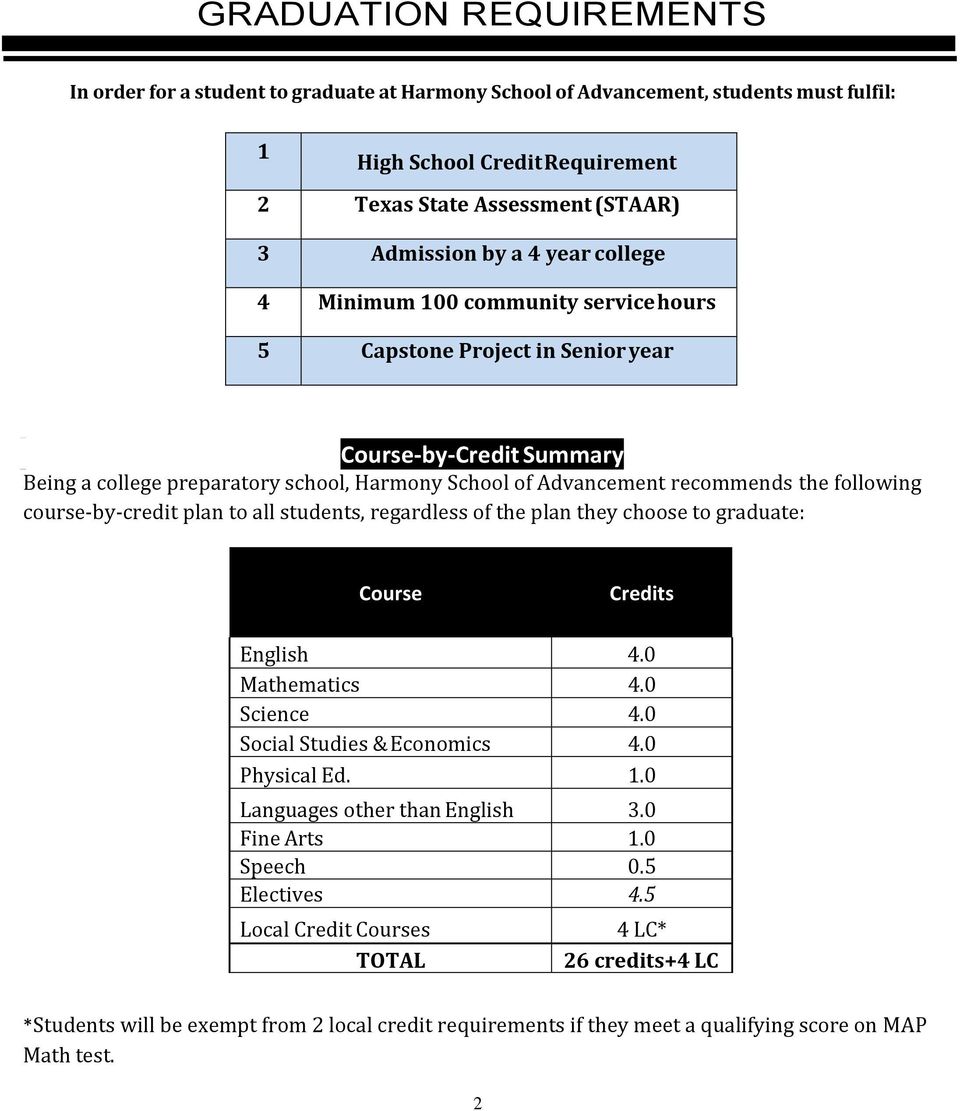
3 GRADUATION REQUIREMENTS In order for a student to graduate at Harmony School of Advancement, students must fulfil: 1 High School Credit Requirement 2 Texas State Assessment (STAAR) 3 Admission by a 4 year college 4 Minimum 100 community service hours 5 Capstone Project in Senior year Course by Credit Summary Being a college preparatory school, Harmony School of Advancement recommends the following course by credit plan to all students, regardless of the plan they choose to graduate: Course Credits English 4.0 Mathematics 4.0 Science 4.0 Social Studies & Economics 4.0 Physical Ed. 1.0 Languages other than English 3.0 Fine Arts 1.0 Speech 0.5 Electives 4.5 Local Credit Courses TOTAL 4 LC* 26 credits+4 LC *Students will be exempt from 2 local credit requirements if they meet a qualifying score on MAP Math test. 2
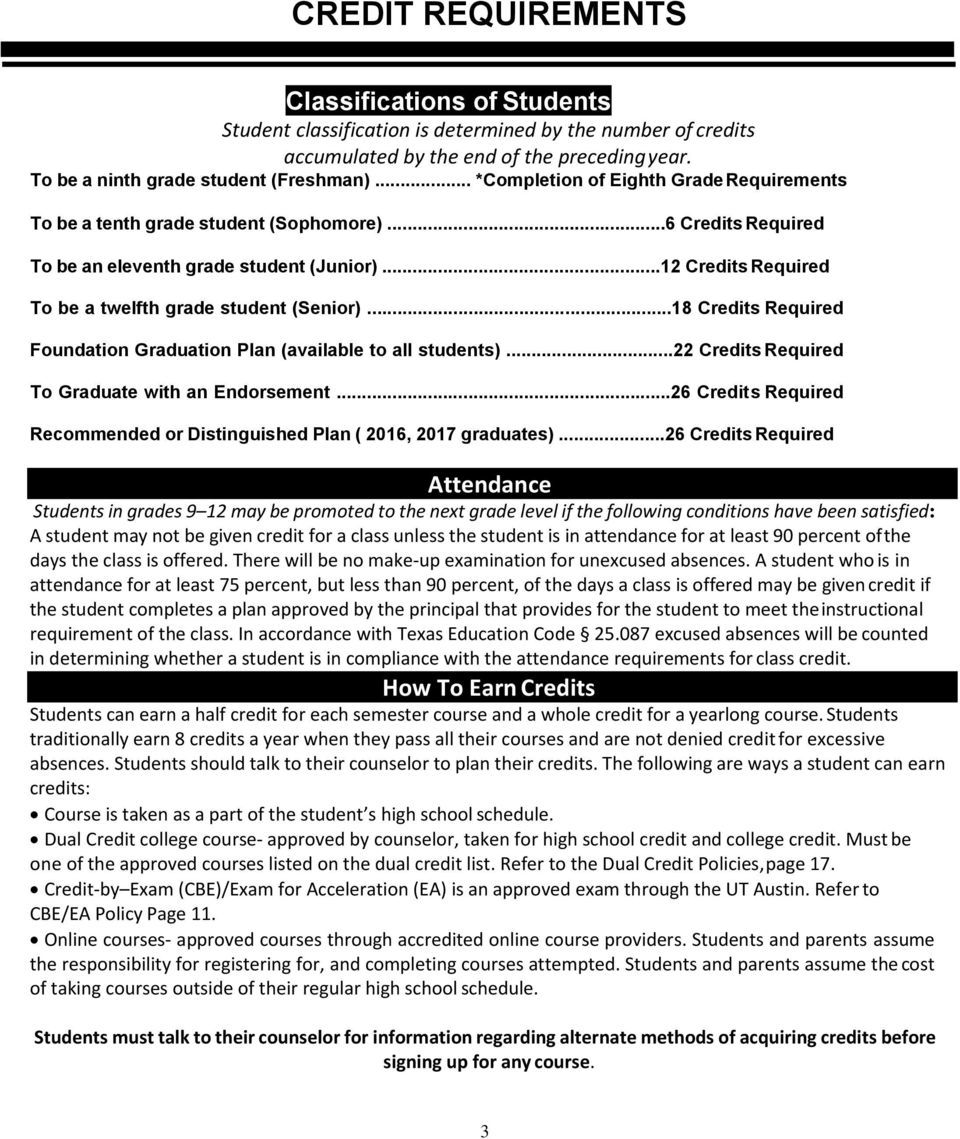
4 CREDIT REQUIREMENTS Classifications of Students Student classification is determined by the number of credits accumulated by the end of the preceding year. To be a ninth grade student (Freshman)... *Completion of Eighth Grade Requirements To be a tenth grade student (Sophomore)...6 Credits Required To be an eleventh grade student (Junior)...12 Credits Required To be a twelfth grade student (Senior)...18 Credits Required Foundation Graduation Plan (available to all students)...22 Credits Required To Graduate with an Endorsement...26 Credits Required Recommended or Distinguished Plan ( 2016, 2017 graduates)...26 Credits Required Attendance Students in grades 9 12 may be promoted to the next grade level if the following conditions have been satisfied: A student may not be given credit for a class unless the student is in attendance for at least 90 percent of the days the class is offered. There will be no make up examination for unexcused absences. A student who is in attendance for at least 75 percent, but less than 90 percent, of the days a class is offered may be given credit if the student completes a plan approved by the principal that provides for the student to meet the instructional requirement of the class. In accordance with Texas Education Code excused absences will be counted in determining whether a student is in compliance with the attendance requirements for class credit. How To Earn Credits Students can earn a half credit for each semester course and a whole credit for a yearlong course. Students traditionally earn 8 credits a year when they pass all their courses and are not denied credit for excessive absences. Students should talk to their counselor to plan their credits. The following are ways a student can earn credits: Course is taken as a part of the student s high school schedule. Dual Credit college course approved by counselor, taken for high school credit and college credit. Must be one of the approved courses listed on the dual credit list. Refer to the Dual Credit Policies, page 17. Credit by Exam (CBE)/Exam for Acceleration (EA) is an approved exam through the UT Austin. Refer to CBE/EA Policy Page 11. Online courses approved courses through accredited online course providers. Students and parents assume the responsibility for registering for, and completing courses attempted. Students and parents assume the cost of taking courses outside of their regular high school schedule. Students must talk to their counselor for information regarding alternate methods of acquiring credits before signing up for any course. 3
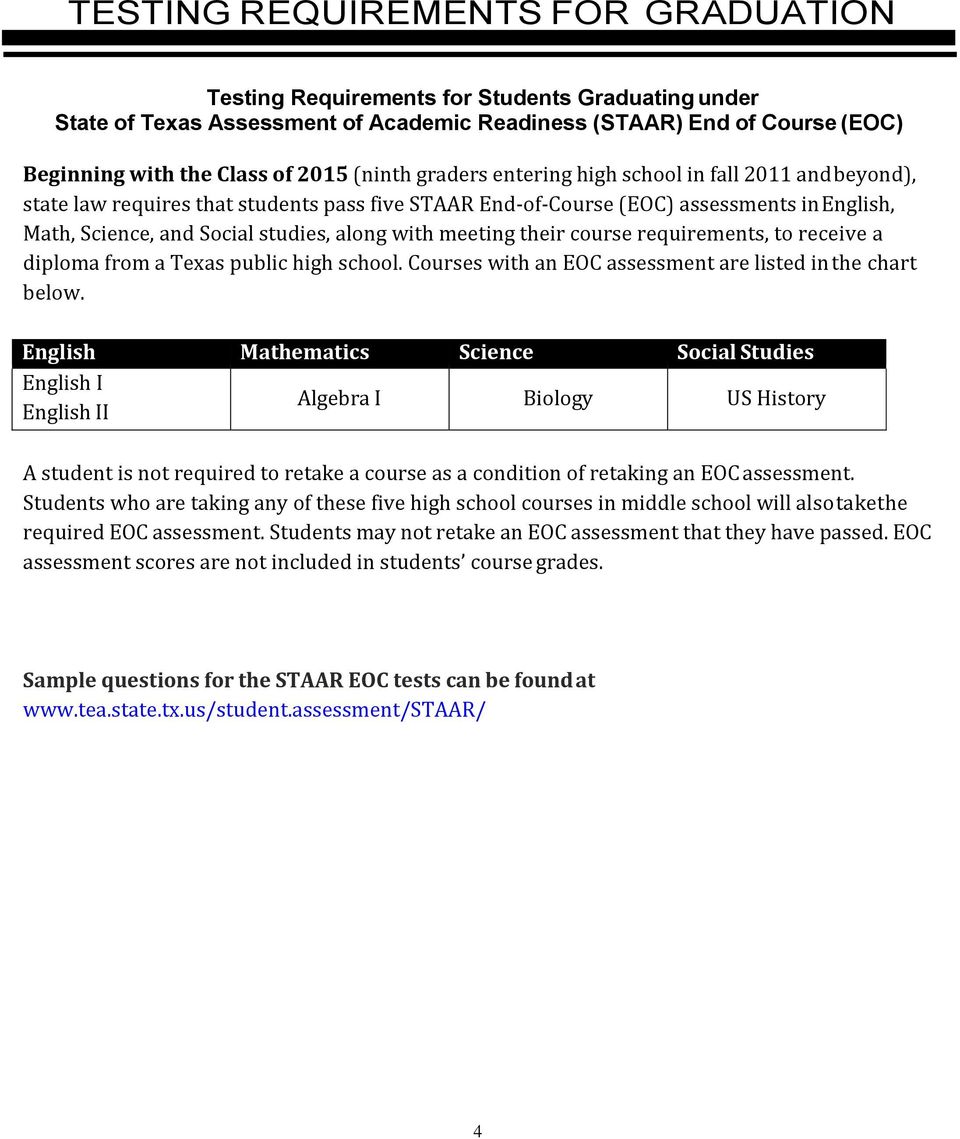
5 TESTING REQUIREMENTS FOR GRADUATION Testing Requirements for Students Graduating under State of Texas Assessment of Academic Readiness (STAAR) End of Course (EOC) Beginning with the Class of 2015 (ninth graders entering high school in fall 2011 and beyond), state law requires that students pass five STAAR End of Course (EOC) assessments in English, Math, Science, and Social studies, along with meeting their course requirements, to receive a diploma from a Texas public high school. Courses with an EOC assessment are listed in the chart below. English Mathematics Science Social Studies English I English II Algebra I Biology US History A student is not required to retake a course as a condition of retaking an EOC assessment. Students who are taking any of these five high school courses in middle school will also takethe required EOC assessment. Students may not retake an EOC assessment that they have passed. EOC assessment scores are not included in students course grades. Sample questions for the STAAR EOC tests can be found at 4
6 Grading Scale and GPA GRADING SCALE All classes will follow a standard scale for assigning letter grades for nine week periods and semester work. Individual teachers will follow the HPS grading practices/guidelines for their classes, with grades corresponding to the following scale: GRADING SCALE: A Excellent B Above C Average F Fail GPA CALCULATION Grade Point Average is calculated by dividing the total amount of grade points earned by the total amount of credit hours attempted. Beginning with the freshman class, all semester grades for courses attempted will count toward a student s GPA. Courses are weighted as follows: TABLE - GPA COMPUTATION DATA Regular AP & Dual Grade & Pre-AP Credit Below Weighted GPA is used to determine class rank. Unweighted GPA is used for admission to most colleges and universities and for scholarships at in state schools. 5

7 CLASS RANK & AUTOMATIC COLLEGE ADMISSION Harmony School of Advancement is a non ranking school and only ranks students on top 10% or if it is for the benefit of the student. Class rank indicates how a student's grades compare with those of other students in his/her class. Semester averages (not full year averages), beginning with the year student started taking high school courses, are used to compute class rank. All numeric scores for regular and college classes, including distance learning will be recorded and used to calculate the GPA. Credit by Examination scores for which the student earns credit toward graduation will be recorded numerically and used to calculate the GPA. Estimated class rankings are to be determined at the end of the junior year, and the first semester of the senior year for the express purpose of college entrance requirements. A final calculation of GPA and class rank is determined at the completion of the senior year and will be reflected on the final transcript. Attention Juniors: Credits earned during the summer of the junior year have to be submitted before August 1 st to their counselors to be entered to the junior year course lists and be counted in the overall GPA and ranking computations. Any credits received after August 1 st will be entered to the senior course list and will not affect the ranking submitted to colleges during the Fall semester of the senior year. It is students responsibility to ensure summer credits submitted on time and properly entered to their course lists. ELIGIBILITY FOR AUTOMATIC COLLEGE ADMISSION Explanation of Eligibility for Automatic College Admission Under the Automatic Admission policy(texas Education Code ), Under the Automatic Admission policy (Texas Education Code ), Texas students may be eligible for automatic admission to a state college or university as an undergraduate student if they meet certain criteria. To qualify for automatic admission, a student must: (1) earn a grade point average in the top 10 percent* of his/her high school graduating class, (2) graduate from a Texas public or private high school (or, if the student is a Texas resident, from a high school operated by the U.S. Department of Defense), (3) earn the Distinguished Level of Achievement and/or a Performance Acknowledgment for outstanding performance (starting from Class of 2018) or successfully complete the requirements for the Recommended High School Program (RHSP) or the Distinguished Achievement Program (DAP) (or the equivalent if enrolled in private school) or satisfy ACT's College Readiness Benchmarks on the ACT college entrance exam or earn a score of at least 1,500 out of 2,400 on the SAT college entrance exam, and 6

8 (4) apply for admission to a state college or university within the first two school years after graduation from high school. Students who meet the criteria for automatic admission must submit an application before the deadline set by the college or university to which they are applying. Students must also provide a high school transcript or diploma that indicates whether they have satisfied or are on schedule to satisfy the requirements of the Distinguished Level of Achievement and/or a Performance Acknowledgment for outstanding performance, RHSP or DAP. Curriculum Requirements Not later than the end of a student s junior year in high school, his or her official transcript should indicate whether the student has satisfied or is on schedule to satisfy the requirements for the Distinguished Level of Achievement and/or a Performance Acknowledgment for outstanding performance (starting with the Class of 2018), RHSP or DAP. Students who are unable to satisfy the curriculum requirements of the graduation requirements because the courses necessary to complete the requirements are unavailable as a result of course scheduling, lack of enrollment capacity, or another cause not within the student's control, are considered to have satisfied the requirements of the relevant program. In such cases, the student must have successfully completed the portions of the graduation requirement curricula that were available and the student s official transcript or diploma must indicate this. Admission and Enrollment State colleges and universities may admit a student accepted under the Automatic Admission policy for either the fall semester of the academic year for which the student applied or for the summer session that proceeds that fall semester. Additionally, the admitting college or university may require that applicants in need of additional preparation for college level work enroll in enrichment courses or programs during the summer immediately after the student is admitted. Colleges and universities are required to admit an applicant as an undergraduate student if the applicant is the child of a public servant who was killed or fatally injured in the line of duty and who meets the minimum entrance requirements set by the college or university. *The University of Texas at Austin Beginning with admissions for the school year, The University of Texas at Austin (UT) is no longer required to automatically admit applicants in excess of 75% of its enrollment capacity for first time resident undergraduate students. The University has determined that it will automatically admit all eligible 2016 summer/fall freshman applicants who rank within the top 8% of their high school graduating classes, with remaining spaces to be filled through holistic review. 7

9 Valedictorian/Salutatorian & Cum Laude System Selection method to determine the valedictorian for a graduating senior class: 1. The student who is selected as the highest ranking graduate eligible to receive the Honor Graduate Certificate and Declaration will also serve as valedictorian. 2. In the event no student meets the criteria to receive the Honor Graduate Certificate, a valedictorian will be selected who meets all of the following criteria: 3. The student must have been enrolled with the school campus for no less than three calendar semesters or all semesters the school has been opened if less than three calendar semesters; and 4. By the date of graduation the student must have met all Texas State Graduation Requirements applicable to him/her including meeting all state assessment requirements; and 5. The student with the highest cumulative grade point average graduating under the Recommended or Distinguished Program will be selected as valedictorian, with the second ranking student serving as salutatorian. Under no circumstance will a student with a higher GPA who is graduating under the Minimum Graduation Program rank higher than a student graduating under the Recommended or Distinguished Program; or 6. In the case where no students are graduating under either the Recommended or Distinguished Program, the student with the highest cumulative grade point average out of all graduating seniors will be selected valedictorian, and the student with the next highest GPA will serve as salutatorian All calculations for this honor will be conducted at the end of the spring semester (before graduation) each school year. An eligible student must have attended at least one of the calendar semesters during the school year that the honor is granted. Grade Point Average will be calculated in accordance with the existing policy adopted by the Board of Directors. Cum Laude System Harmony Public Schools recognize at graduation those students with weighted GPAs at or above specific benchmarks. Benchmarks may require occasional adjustments as changes in curriculum dictate. Currently, graduates are recognized as follows: Summa Cum Laude Weighted average* of exactly or higher Magna Cum Laude Weighted average of exactly or higher Cum Laude Weighted average of exactly or higher GPA = 4.0+ GPA= 3.8 to 3.9 GPA= 3.5 to 3.7 8

10 SCHEDULING & COURSE SELECTIONS Harmony School of Advancement uses Naviance Course Planner for graduation plans and course selections. With Course Planner, students can access the school course catalog, choose courses they want to take the next school year, know which courses are recommended by teachers and see if their course plans satisfy high school graduation requirements, as well as college entrance requirements for schools on their college application lists. Plus, they can identify areas where they can increase academic rigor to improve their college admissions chances. Course Selections and Scheduling Steps 1. Teacher Recommendations new school year course catalog is uploaded and teachers enter their course recommendations to Naviance. 2. Graduation and Course Selection Process with the help of their counselors, students build their graduation plans and select courses through Naviance Course Planner. The Course Planner will be open for editing and review until March 14 th, Students are highly encouraged to consult with their teachers regarding recommended courses and discuss their choices with their parents before submitting course plans for approval. No course selections will be available after March 14 th. 3. Course Plan Approval Counselors and teachers work collaboratively to review student course plans. Counselors will contact students/parents with any questions or concerns. 4. Decision Making After all course plans reviewed and approved, decisions regarding class cancellations, number of sections, and staffing are made. 5. Master schedule is built. Students are notified of conflicts and an alternate request is considered. 6. Counselors review end of year grades and provide students with summer school/credit recovery options. If students do not earn credit in a course during the school year and do not attend summer school, the schedule will be reviewed and student will retake failed courses in This may change the student s previous course request. 7. Finalized schedules are given to students during the orientation day of the new school year. 9

11 . SCHEDULE CHANGES Changes requested after the Course Plan has been submitted will be made only for the following reasons per counselor approval: Senior needs to make up deficient graduation credits. Student received an F grade and needs to repeat the class for high school graduation requirements or to meet college eligibility requirements. Student is in the incorrect course level. Course requested will not be offered due to budgetary restraints or low class size. Student completed a course credit at summer school. During the first 15 school days of academic year, students may request a schedule change according to the following guidelines: Level change request, based on availability Placement recommendation based on academic performance Medical/health issues require adjustment in schedule Course needed for graduation requirement or to meet college eligibility requirement Spring Semester Changes: Yearlong courses will only be dropped for extenuating circumstances with administrative approval. After a semester, a student in a Pre AP class may be transferred to on level course if the student has an average of 70 or lower for the first semester, or with teacher s recommendation. Schedule changes based on teacher preference will not be honored. The administration reserves the right and has the responsibility to only make changes as necessary to meet graduation requirements, balance class sizes, correct administrative or clerical error, reflect changes in school personnel, or other educationally appropriate reasons. Dropping A Course A student who drops a course during the first 15 school days of the academic year may do so without any entry on his/her permanent record card. Course dropping or schedule change requests will not be granted after the first 15 school days of academic year. Note: Students in 9 th 12 th grade are required to register for eight periods and remain on the HSAdvancement campus for eight periods. 10

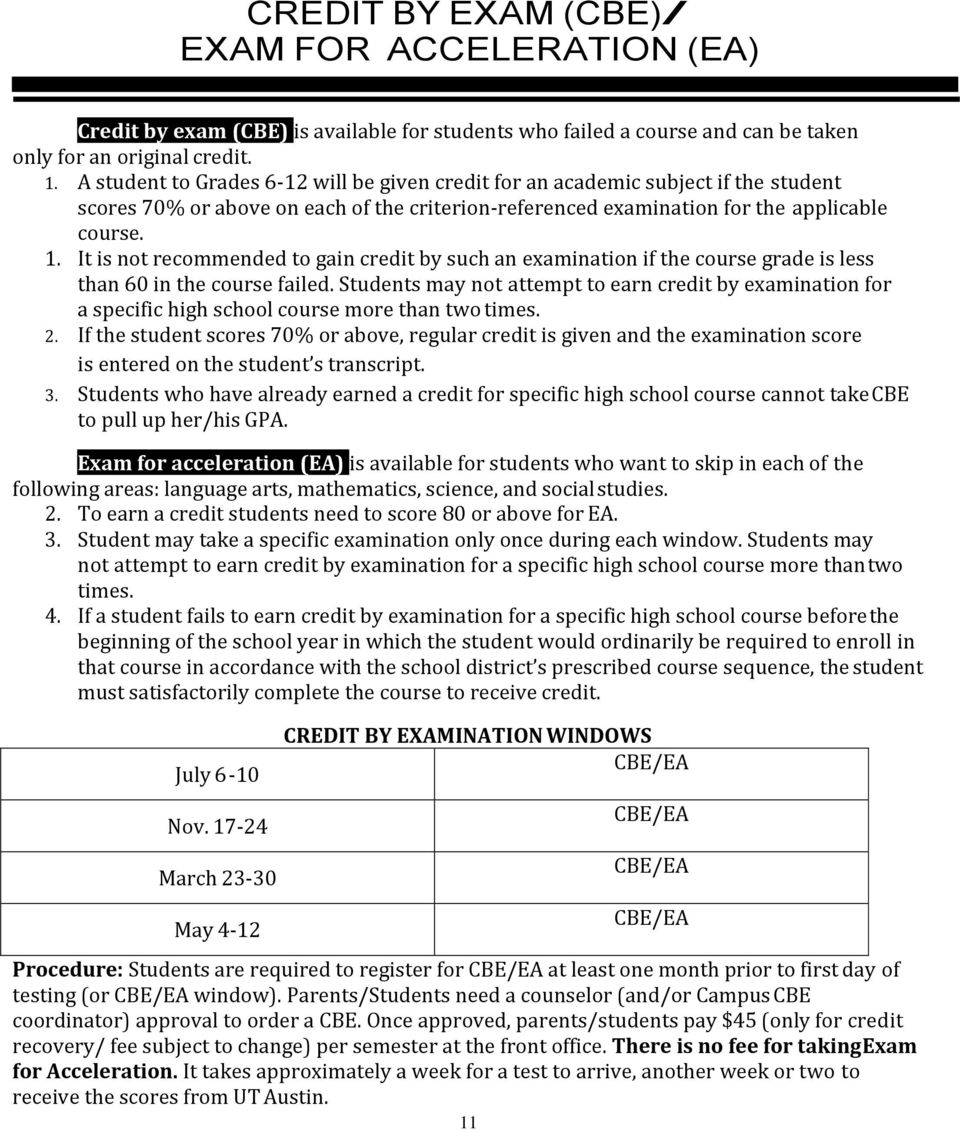
12 CREDIT BY EXAM (CBE)/ EXAM FOR ACCELERATION (EA) Credit by exam (CBE) is available for students who failed a course and can be taken only for an original credit. 1. A student to Grades 6 12 will be given credit for an academic subject if the student scores 70% or above on each of the criterion referenced examination for the applicable course. 1. It is not recommended to gain credit by such an examination if the course grade is less than 60 in the course failed. Students may not attempt to earn credit by examination for a specific high school course more than two times. 2. If the student scores 70% or above, regular credit is given and the examination score is entered on the student s transcript. 3. Students who have already earned a credit for specific high school course cannot take CBE to pull up her/his GPA. Exam for acceleration (EA) is available for students who want to skip in each of the following areas: language arts, mathematics, science, and social studies. 2. To earn a credit students need to score 80 or above for EA. 3. Student may take a specific examination only once during each window. Students may not attempt to earn credit by examination for a specific high school course more than two times. 4. If a student fails to earn credit by examination for a specific high school course before the beginning of the school year in which the student would ordinarily be required to enroll in that course in accordance with the school district s prescribed course sequence, the student must satisfactorily complete the course to receive credit. July 6 10 Nov March May 4 12 CREDIT BY EXAMINATION WINDOWS CBE/EA 11 CBE/EA CBE/EA CBE/EA Procedure: Students are required to register for CBE/EA at least one month prior to first day of testing (or CBE/EA window). Parents/Students need a counselor (and/or Campus CBE coordinator) approval to order a CBE. Once approved, parents/students pay $45 (only for credit recovery/ fee subject to change) per semester at the front office. There is no fee for taking Exam for Acceleration. It takes approximately a week for a test to arrive, another week or two to receive the scores from UT Austin.
13 CREDIT RECOVERY & CREDIT TRANSFERS Students earn one half credit per semester and one credit per year for successful completion of a course. Courses vary from one to two semesters in length. A student who fails the first semester of any core course with a grade no lower than 60, but who passes the second semester of the course, may receive credit if the average of the two semesters results in a grade of 70 or above. Otherwise, to receive credit in a core course, the student must utilize credit recovery to obtain a passing grade for any semester failed. Credit recovery options: Option 1: Retaking the Course (online/summer school), and gaining the passing grade above 70 for the required semester. Option 2: Credit by Examination with Prior Instruction. Students can take credit for an academic subject in which he or she has had some prior instruction if the student scores 70% or higher on a criterion referenced test for the applicable course. Once the course is completed with a passing grade, the credit will be added to the student transcript with the R coding. CREDIT TRANSFERS Credits earned by students in accredited school districts (including summer school programs and credit by exam) or through correspondence courses are transferable and accepted by the school. Credits earned through home schooling and at unaccredited private schools may not be transferrable. These students may be asked to earn credit through taking an exam. State and Local Credit Courses All courses which are to be counted toward graduation must be state approved courses. Local credit courses are courses in which a student may participate without receiving state credit towards graduation, unless the course is required by an ARD Committee for students receiving special education services. Local credit courses are, however, calculated as part of a student s GPA. 12

14 ADVANCED PLACEMENT (AP) PROGRAM The purpose of the AP entrance and exit guidelines is to provide information to parents and students and to facilitate students success in academically challenging courses. AP classes in Harmony School of Advancement stimulate and challenge students to perform at an advanced academic level. Therefore, AP coursework requires students to engage in more independent analytical reading and writing assignments, both inside and outside the classroom. Academic Considerations Entrance Guidelines AP curriculum is designed two grade levels above traditional curriculum. Instruction is fastpaced and much of the work is done outside of class. Therefore, AP students should be independent learners who have demonstrated prior success in the subject area as outlined below: Previous grades in that discipline: An A in a particular subject required to enroll in AP. It indicates that the student has the academic ability to succeed at the AP level in that subject. Standardized Test Scores: SAT PSAT STAAR test in that subject is a good predictor of success in an AP class, therefore it is required. Teacher Recommendations: Students who want to enroll in any one or more AP Courses listed in the class selection sheet must have teacher recommendation(s) from a teacher in the same subject area (English, Social Studies, and Science etc.) Performance Considerations AP classrooms are fast paced and challenging environments, with most lesson preparation done out of the classroom. Therefore, students taking these courses should be self motivated learners willing to invest time and energy into their activities and assignments. AP s t u d e n t s should be independent learners who demonstrate: Motivation and Commitment Time Management skills A positive attitude toward challenging coursework A strong work ethic 13

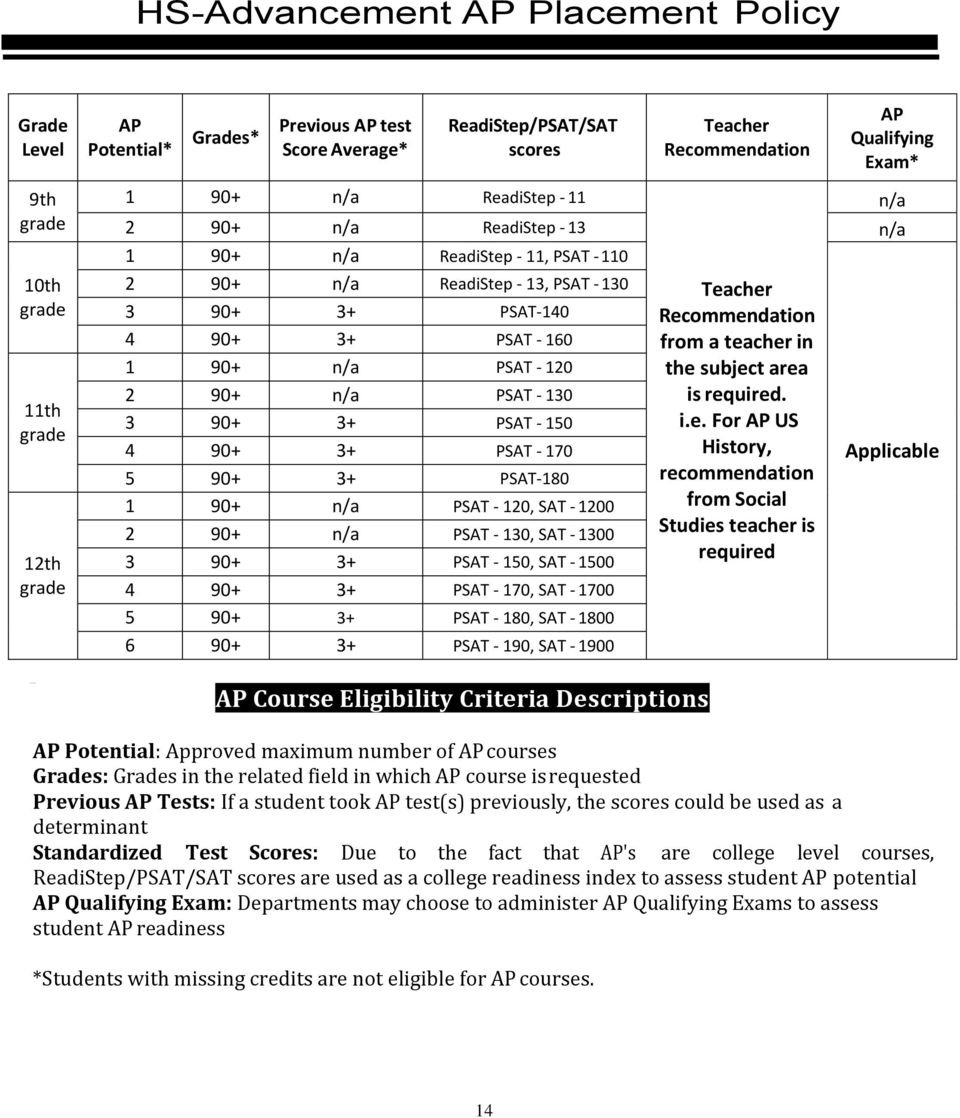
15 HS-Advancement AP Placement Policy Grade Level 9th grade 10th grade 11th grade 12th grade AP Potential* Grades* Previous AP test Score Average* ReadiStep/PSAT/SAT scores n/a ReadiStep 11 Teacher Recommendation Teacher Recommendation from a teacher in the subject area is required. i.e. For AP US History, recommendation from Social Studies teacher is required AP Qualifying Exam* n/a ReadiStep 13 n/a n/a ReadiStep 11, PSAT n/a ReadiStep 13, PSAT PSAT PSAT n/a PSAT n/a PSAT PSAT PSAT PSAT n/a PSAT 120, SAT n/a PSAT 130, SAT PSAT 150, SAT PSAT 170, SAT PSAT 180, SAT PSAT 190, SAT 1900 n/a Applicable AP Course Eligibility Criteria Descriptions AP Potential: Approved maximum number of AP courses Grades: Grades in the related field in which AP course is requested Previous AP Tests: If a student took AP test(s) previously, the scores could be used as a determinant Standardized Test Scores: Due to the fact that AP's are college level courses, ReadiStep/PSAT/SAT scores are used as a college readiness index to assess student AP potential AP Qualifying Exam: Departments may choose to administer AP Qualifying Exams to assess student AP readiness *Students with missing credits are not eligible for AP courses. 14
16 HS-Advancement AP Placement Policy AP Exam Requirement Enrollment in AP course requires that the student take the AP Exam. If the student named in the contract does not take the AP Exam for the subject class, the credit earned will not be weighted on GPA calculations. Further, if a student does not take the required exam, s/he will pay for the Harmony School of Advancement any and all the fees for each exam ordered and paid for by the Harmony School of Advancement. Students Withdrawal Guidelines from AP Course Students may withdraw from AP courses, if withdrawal is requested within first 15 school days after the start of the AP class. Students are expected to complete and turn in the summer assignment during the first week of the school. It is the student s responsibility to track his/her grades, missing course work and absences and to contact with the AP teacher in regards to these. Additional AP Guidelines Students are expected to maintain their school attendance on the AP testing days. Students must attend after school and/or Saturday tutorial sessions if provided. In order to receive credit in AP class, students must attend at least 90% of the days the class is offered. These include both excused and unexcused absences. 15

17 HS-Advancement AP Program List of AP Courses Offered at Harmony School of Advancement AP Course Prerequisite Courses Subject Field AP Calculus AB/BC Precalculus Mathematics AP Statistics Algebra II Mathematics AP Chemistry Biology, Chemistry, Algebra II, concurrent with Precalculus Science AP Physics I Algebra II, PSAT 180 Science AP Physics II AP Physics I Science AP Physics C AP Physics I&II or an Science equivalent course and concurrent with PreCal AP Biology Biology, Chemistry, Algebra I Science AP Environmental Science Biology, Chemistry, Science Algebra II AP English Language English II English Language Arts AP English Literature English III English Language Arts AP Human Geography Pre-Geography Exam Social Studies AP World History World Geography Social Studies AP U.S. History World History and Social Studies English II AP Psychology NA Social Studies AP European History NA Social Studies AP US Government Economics Social Studies AP Computer Science Computer Science I Computer Sciences AP Spanish Language LOTE Spanish II Languages Other Than English AP French Language LOTE French III Languages Other Than English AP Art History Art I, World History Fine Arts AP Studio Art Drawing 2 Arts Credits, which includes Art I 16 Fine Arts

18 Dual Credit Program Courses offered for dual credit stem from agreements between high schools and community colleges whereby a high school junior or senior enrolls in a college course and simultaneously earns college credit and high school credit for the course. Dual Credit Qualification Requirements The student's high school must have a Dual Credit agreement with Lone Star College System (LSCS). The student is enrolled in Junior or Senior year of high school The student has Applied to Lone Star * The student demonstrated College Readiness through approved assessments; 1. TSI Assessment: A high school student is eligible to enroll in Dual Credit in the 11th and 12th grades with the following TSI Assessment Scores: TSI Test Qualifying Score Reading Writing and 4 on essay or 5+ on essay Math A high school student is exempt from taking TSI Assessment and eligible for 11 th or 12 th grade Dual Credit enrollment by meeting one the requirements below SAT: A student has an SAT composite score of 1070 (achieved by adding the math and critical reading scores together) with a score of 500 or higher on the math and critical reading portions of the test. Test score must be less than 5 years old and achieved in one sitting. ACT: A student has an ACT composite score of 23 with a minimum of 19 in both the math and English portions of the test. Scores must be less than 5 years old and achieved in one sitting. PSAT/NMSQT: A 10 th grade student has a PSAT/NMSQT combined score of 107 (achieved by adding the math and critical reading scores) with a minimum of 50 on the critical reading and/or mathematics test(s) relevant to the courses to be attempted in the 11 th grade only. The student must meet prerequisites in the areas that are applicable to the course including reading, writing and math, where appropriate; Per Texas Administrative Code, the student shall not be enrolled in more than 2 dual credit classes per semester. The student must maintain a grade of "C" or better in each class to remain in the program *Refer to Dual Credit Enrollment checklist for more details 17

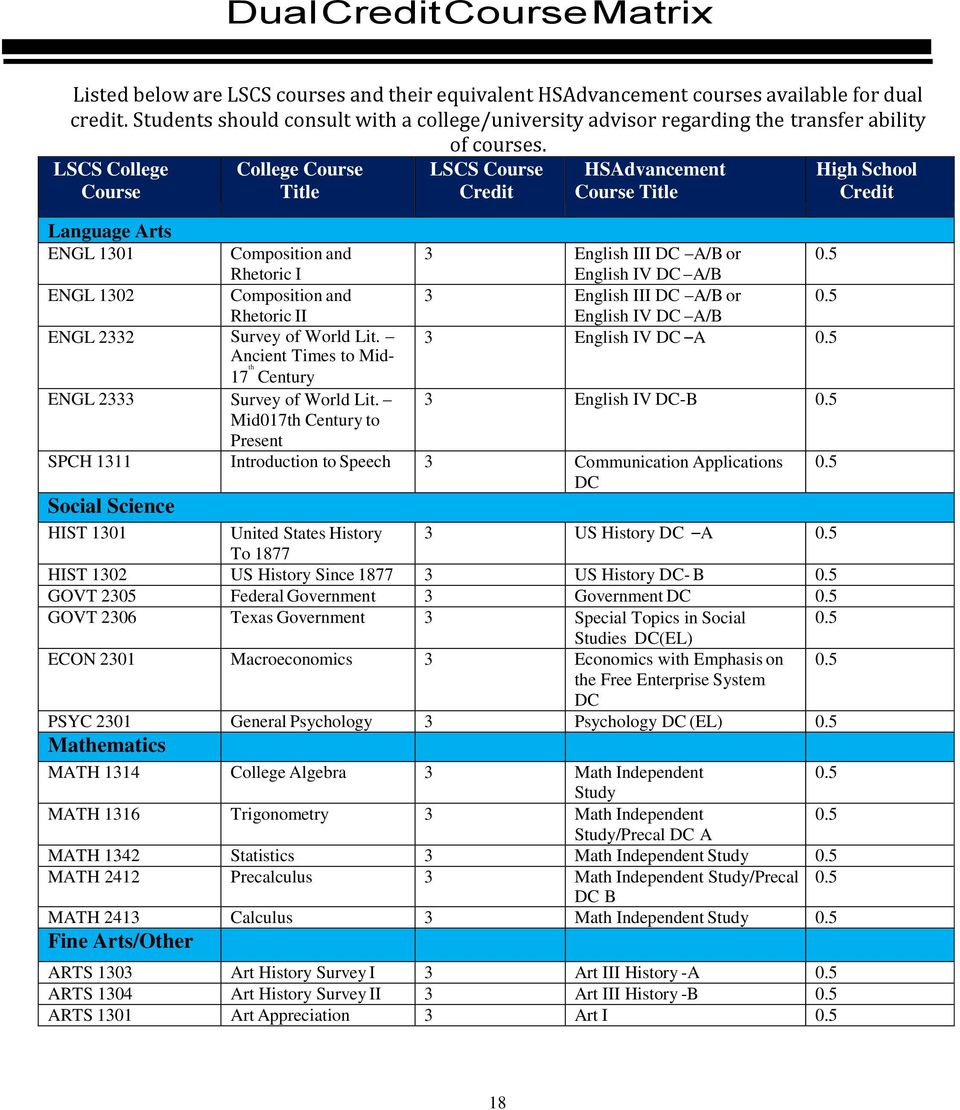
19 Dual Credit Course Matrix Listed below are LSCS courses and their equivalent HSAdvancement courses available for dual credit. Students should consult with a college/university advisor regarding the transfer ability of courses. LSCS College Course College Course Title Language Arts ENGL 1301 Composition and Rhetoric I ENGL 1302 Composition and Rhetoric II ENGL 2332 Survey of World Lit. Ancient Times to Mid- 17 th Century ENGL 2333 Survey of World Lit. Mid017th Century to LSCS Course Credit HSAdvancement Course Title 3 English III DC A/B or English IV DC A/B English III DC A/B or 0.5 English IV DC A/B 3 English IV DC A English IV DC-B 0.5 Present SPCH 1311 Introduction to Speech 3 Communication Applications DC Social Science HIST 1301 United States History 3 US History DC A 0.5 To 1877 HIST 1302 US History Since US History DC- B 0.5 GOVT 2305 Federal Government 3 Government DC 0.5 GOVT 2306 Texas Government 3 Special Topics in Social 0.5 Studies DC(EL) ECON 2301 Macroeconomics 3 Economics with Emphasis on the Free Enterprise System DC 0.5 PSYC 2301 General Psychology 3 Psychology DC (EL) 0.5 Mathematics MATH 1314 College Algebra 3 Math Independent Study 0.5 MATH 1316 Trigonometry 3 Math Independent 0.5 Study/Precal DC A MATH 1342 Statistics 3 Math Independent Study 0.5 MATH 2412 Precalculus 3 Math Independent Study/Precal DC B 0.5 MATH 2413 Calculus 3 Math Independent Study 0.5 Fine Arts/Other ARTS 1303 Art History Survey I 3 Art III History -A 0.5 ARTS 1304 Art History Survey II 3 Art III History -B 0.5 ARTS 1301 Art Appreciation 3 Art I 0.5 High School Credit
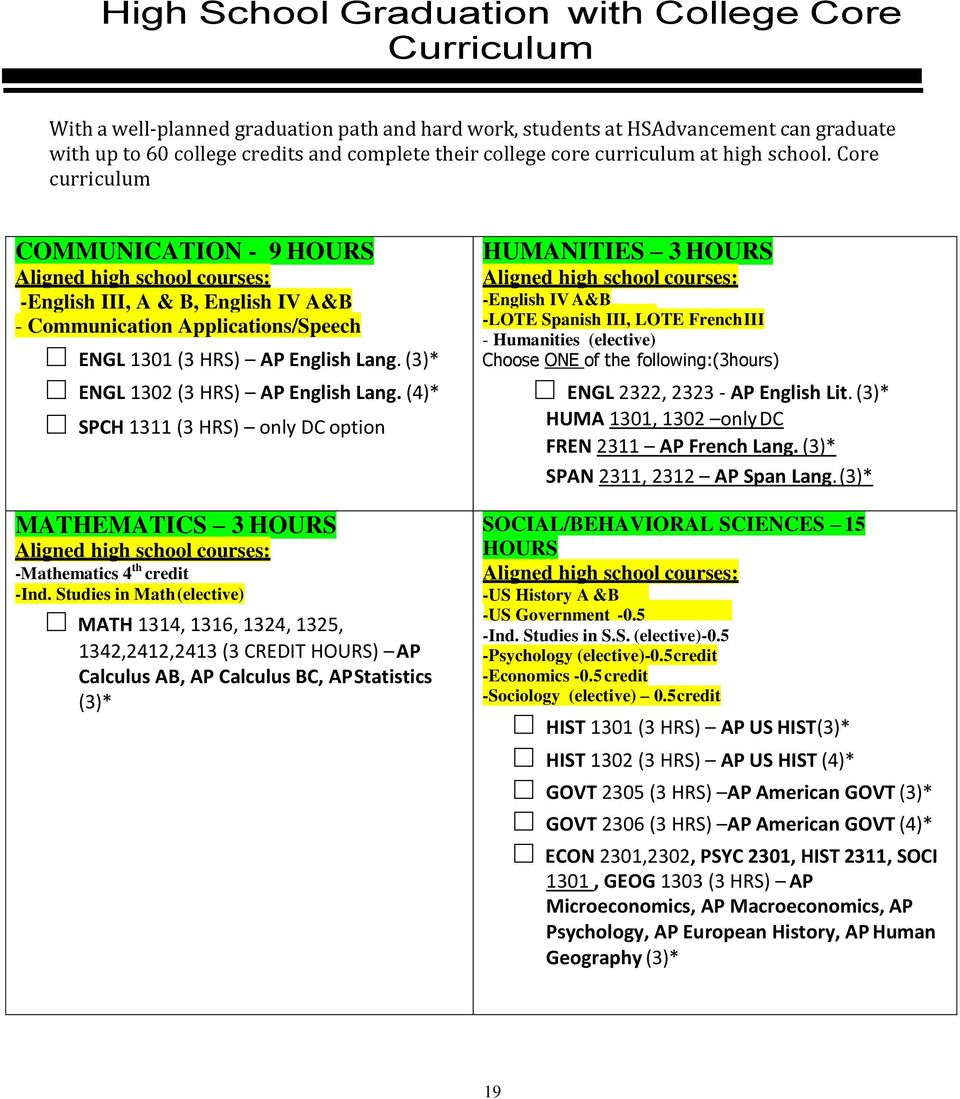
20 High School Graduation with College Core Curriculum With a well planned graduation path and hard work, students at HSAdvancement can graduate with up to 60 college credits and complete their college core curriculum at high school. Core curriculum COMMUNICATION - 9 HOURS Aligned high school courses: -English III, A & B, English IV A&B - Communication Applications/Speech ENGL 1301 (3 HRS) AP English Lang. (3)* ENGL 1302 (3 HRS) AP English Lang. (4)* SPCH 1311 (3 HRS) only DC option MATHEMATICS 3 HOURS Aligned high school courses: -Mathematics 4 th credit -Ind. Studies in Math (elective) MATH 1314, 1316, 1324, 1325, 1342,2412,2413 (3 CREDIT HOURS) AP Calculus AB, AP Calculus BC, AP Statistics (3)* HUMANITIES 3 HOURS Aligned high school courses: -English IV A&B -LOTE Spanish III, LOTE French III - Humanities (elective) Choose ONE of the following:(3hours) ENGL 2322, 2323 AP English Lit. (3)* HUMA 1301, 1302 only DC FREN 2311 AP French Lang. (3)* SPAN 2311, 2312 AP Span Lang. (3)* SOCIAL/BEHAVIORAL SCIENCES 15 HOURS Aligned high school courses: -US History A &B -US Government Ind. Studies in S.S. (elective)-0.5 -Psychology (elective)-0.5 credit -Economics -0.5 credit -Sociology (elective) 0.5 credit HIST 1301 (3 HRS) AP US HIST(3)* HIST 1302 (3 HRS) AP US HIST (4)* GOVT 2305 (3 HRS) AP American GOVT (3)* GOVT 2306 (3 HRS) AP American GOVT (4)* ECON 2301,2302, PSYC 2301, HIST 2311, SOCI 1301, GEOG 1303 (3 HRS) AP Microeconomics, AP Macroeconomics, AP Psychology, AP European History, AP Human Geography (3)* 19
21 Aligned high school courses: of Art, AP Arts AP Aligned high school courses: th OR AP CHEM AP Chem AP AP C ENVR AP v. Science * AP score applies to University of Houston AP Credit Transfer Policy. To check the policies for other colleges, go to : Dual Credit Courses (through Lone Star College Systems) college credit is earned bypassing courses with C and above. The student must maintain a grade of "C" or better in each class to remain in the program. Credits are transferrable among all Texas Public Colleges. Transfer of credits to private and out of state institutions is not guaranteed. For more details, refer to the LSCS Dual Credit Policy. AP Courses college credit is earned by passing AP exams with the score of 3 and above. Colleges have different AP score requirements to award college credits. For more details regarding AP courses, refer to the HS Advancement AP Policy. Every public institution in Texas has a Core, which is designed to provide a solid foundation for your college education and to make transfers between and among Texas institutions of higher education as smooth and seamless as possible. Each institution's Core Curriculum applies to all academic degrees. They range from 42to 48 credit hours, depending on the college or university. Each Core Curriculum is divided into 8 or 9 categories that are common across the state. Watch Out! You may choose a major which has some more rigorous or more specific requirements than the Core. Most science majors, for instance have more intensive math and science requirements. In these cases, the major requirements have priority. So, switching institutions has become easier, but changing majors may still involve taking some extra courses. 20
22 GRADUATION REQUIREMENTS For Students Entering Grade 9 in and after Students enrolled in , or may move to the Foundation Plan. 21
23 Graduation Requirements For Students Entering Grade 9 in and After Students enrolled in , or may move to the Foundation Plan In the Spring of 2013 the 83rd Texas Legislature passed House Bill 5, which made substantial changes to the state s curriculum and graduation requirements, assessment program, and accountability system. The new graduation plan mandated by House Bill 5 is called The Foundation High School Program which is intended to provide students with more flexibility. Students who are freshmen in will be the first class to fall under the graduation requirements in HB5. Beginning in the school year, each student, on entering ninth grade, must indicate in writing an endorsement that the student intends to earn. Students are permitted at any time, to earn an endorsement other than the endorsement the student previously indicated. A student may graduate under the foundation high school program without earning an endorsement if, after the student s sophomore year: (1) ) the student and the student s parent or person standing in parental relation are advised by a school counselor of the specific benefits of graduating from high school with one or more endorsements; and (2) ) the student s parent or person standing in parental relation files with a school counselor written permission allowing the student to graduate under the foundation high school program without earning an endorsement House Bill 5 requires students to pass five State of Texas Assessments of Academic Readiness (STAAR) end of course exams to meet the new graduation requirements: Algebra I, English I (combined reading/writing), English II (combined reading/writing), Biology and U.S. History. Foundation High School Program (22 credits) Foundation High School Program (FHSP) includes the following requirements: ELA 4 credits Math 3 credits Algebra II not required Social Studies 3 credits Science 3 credits Foreign Language 2 credits Fine Arts 1 credit Physical Education 1 credit 5 Elective Credits 22
24 Graduation Requirements For Students Entering Grade 9 in and After Students enrolled in , or may move to the Foundation Plan Foundation High School Program with Endorsements (26 Credits) Foundation High School Program (FHSP) includes the following requirements: Foundation Plan plus the following 4th Math Course 4th Science Course Endorsement Area Coursework (see endorsements section) Distinguished Level of Achievement (26 Credits) A student may earn a distinguished level of achievement by successfully completing: Foundation Plan A total of four credits in mathematics, which must include Algebra II A total of four credits in science The remaining curriculum requirements 44 SECTION III: ACADEMICS AND GRADING Revised in June 2014 The curriculum requirements for at least one endorsement A student must earn the distinguished level of achievement to be eligible for top10% automatic admission. 23
25 Graduation Requirements For Students Entering Grade 9 in andafter Students enrolled in , or may move to the Foundation Plan Discipline Foundation Only (can only be chosen after the sophomore year) HB 5 Graduation Plan in Chart Foundation + Endorsements Distinguished Level of Achievement English I English II English III Advanced English (4 credits) English I/PreAp English II/PreAP English III/AP/DC English IV/AP/DC (4 credits) English I/PreAP English II/PreAP EnglishIII/AP/DC English IV/AP/DC (4 credits) Algebra I Algebra I/PreAp Algebra I/PreAp Geometry Geometry/PreAP Geometry/PreAP Advanced Math Algebra II/PreAP Algebra II/PreAP Elective Math Elective Math (3 credits) (4 credits) (4 credits) Biology Advanced Science Advanced Science (3 credits) US History Government/Economics World Geo. or World Hist. (3 credits) LOTE (2 credits) Physical Education (1 credit) Biology /PreAP Chemistry/PreA Physics/AP Elective Science (4 credits) World Geography/AP World History/AP US History/AP/DC US GOVT/AP/DC Economics/AP/DC (4 credits) LOTE (2 credits) Physical Education (1 credit) Biology /PreAP Chemistry/PreAP Physics/AP Elective Science (4 credits)) World Geography/AP World History/AP US History/AP/DC US GOVT/AP/DC Economics/AP/DC (4 credits) LOTE (2 credits) Physical Education (1 credit) Fine Arts Fine Arts Fine Arts (1 credit) (1 credit) (1 credit) (5 credits) (6 credits) (6 credits) 24
26 Graduation Requirements For Students Entering Grade 9 in andafter Students enrolled in , or may move to the Foundation Plan Performance Acknowledgements Performance Acknowledgements may be earned in one or more of the following categories: AP test score of 3 or above; IB test score of 4 or above (transfer students only; IB is not available in HPS); Qualifying PSAT score based on the 11th grade test; SAT combined critical reading and math score of 1250 or above; ACT composite score of 28 or above; Completion of a minimum of 12 hours dual credit college courses with final grades of A or B (3.0 GPA or above); Bilingualism and biliteracy; and Earning a nationally or internationally recognized business or industry certification or license. Endorsements Students entering 9th Grade must choose from one of the following endorsements: STEM (Examples: Engineering, Computer Science) Business and Industry (Examples: Business, Finance, Accounting) Arts and Humanities (Examples: Literature, Art, Dance, Music) Public Services (Examples: Hotel Management, Psychology, Teaching, Health) Multidisciplinary Studies (Examples Business, Sociology, Art) Students may change their endorsement at any time prior to graduation. To qualify as part of the top ten percent of their graduating class, students must successfully complete Algebra II. A student must complete the Foundation High School Program (22 credits), one additional math credit, one additional science credit, and two additional elective credits while completing the specific requirements of his/her selected endorsement. Please review the following Endorsement Chart for more information. 25
27 Graduation Requirements For Students Entering Grade 9 in and After Students enrolled in , or may move to the Foundation Plan Endorsement s STEM Science, Technology, Engineering,& Math Students may earn a STEM endorsement by selecting and completing the requirements from among these4 options. Note: Algebra II, Chemistry, and Physics are required for the STEM endorsement regardless of the option the student selects from below Option 1: Engineering Pathway (CTE) Students earn four (4) credits by taking following courses CTE Engineering Path: Concepts of Engineering Engineering Design and Problem Solving Engineering Design and Presentation Adv. Engineering Design and Presentation Option 2: Math Students take Algebra I, Geometry, and Algebra II AND two (2) of the following courses for which Algebra II is a prerequisite. Pre Calculus Calculus AB or BC Statistics and Risk Management Option 3: Science College Algebra Dual Credit Statistics AP Students take Biology, Chemistry, and Physics, AND two (2) of the following courses. Chemistry AP Environmental Systems Biology AP Anatomy & Physiology AP Physics II Environmental Science AP AP Physics I AP Physics C 26
28 Graduation Requirements For Students Entering Grade 9 in and After Students enrolled in , or may move to the Foundation Plan Business & Industry Students may earn a Business & Industry endorsement by selecting and completing the requirements from among these 3 options. Option 1: English Students take four (4) English elective credits that include three levels in one for the following areas. Advanced Broadcast Journalism I, II, III Advanced Journalism: Newspaper I, II, III Advanced Journalism: Yearbook I, II, III Debate I, II, III Option 2: Information Technology (CTE) and Arts, A/V Technology, and Communications (CTE) Students take four (4) elective credits from the following courses. Web Technologies Digital & Interactive Media Audio/Video Production Advanced Audio Video Production Public Services Students may earn a Public Services endorsement by selecting and completing the requirements from among the following option: Option: Health Science CTE Students earn four (4) credits by taking following courses in PLTW Biomedical Science: Principles of Biomedical Science Human Body Systems Medical Interventions Biomedical Innovation 27
29 Graduation Requirements For Students Entering Grade 9 in and After Students enrolled in , or may move to the Foundation Plan Arts and Humanities Students may earn an Arts & Humanities endorsement by selecting and completing the requirements from among these 3 options. Option 1: Social Studies Students take five (5) social studies courses for 5 credits. After 4 required social studies courses the 5 th credit can be taken from the following courses: AP European History Social Studies Advance Studies (GOVT 2306 Dual Credit) Psychology AP Psychology Psychology Dual Credit Sociology Option 2: Foreign Language Students take four (4) levels of the same foreign language. OR Students take two (2) levels of one foreign language AND two (2) levels of a different foreign language (two levels ineach of two different foreign languages for 4 credits). Turkish I Spanish I French I Turkish II Spanish II French II Turkish III Spanish III French III Turkish IV AP Spanish Lang. AP French Option 3: Fine Arts Students take four (4) courses in the same fine arts area for 4 credits. OR Students take two (2) courses in one fine arts area AND two (2) courses in a different fine arts area (two courses in each of two different fine arts areas for 4 credits). Music I: Orchestra Music I: Choir Art I Music II: Orchestra Music II: Choir Art II: Drawing Music III: Orchestra Music III: Choir Art III: Drawing Music IV: Orchestra Music IV: Choir AP Studio Arts 28
30 Graduation Requirements For Students Entering Grade 9 in and After Students enrolled in , or may move to the Foundation Plan Multidisciplinary Studies Students may earn a Multidisciplinary Studies endorsement by selecting and completing the requirements from among these 3 options. Option 1: Four by Four (4 X 4) Students take four (4) courses in each of the four core content areas. Four (4) English credits including English IV Four (4) math credit Four (4) science credits including biology and chemistry and/or physics Four (4) social studies credits With a least one (1) advanced (3rd year or higher course in the sequence). Option 2: AP or Dual Students take four (4) Advanced Placement (AP) courses for four (4) credits in English, math, science, social studies, foreign language, or fine arts. OR Students take four (4) Dual credit courses for four (4) credits in English, math, science, social studies, foreign language, or fine arts. Option 3: CTE Students take four advanced courses for four (4) credits that prepare them to enter the workforce or postsecondary education without remediation from within one endorsement area or among endorsement areas not in a coherent sequence 29
31 STEM Business & Industry Public Services Arts & Humanities Multidisciplinary Studies Students may earn a STEM endorsement by selecting and completing the requirements from among these 4 options. Note: Algebra II, Chemistry, and Physics are required for the STEM endorsement regardless of the option the student selects from below. Option 1 Engineering Pathway (CTE) Students earn four (4) credits by taking following courses CTE Engineering Path: Concepts of Engineering Engineering Design and Problem Solving Engineering Design and Presentation Adv. Engineering Design and Presentation Option 2: Math Students take Algebra I, Geometry, and Algebra II AND two (2) of the following courses for which Algebra II is a prerequisite. Pre Calculus Calculus AB or BC Statistics/AP College Algebra I/Dual Credit Option 3: Science Students take Biology, Chemistry, and Physics, AND two (2) of the following courses. Chemistry AP Biology AP Anatomy & Physiology Environmental Science AP AP Physics I AP Physics C Environmental Systems AP Physics II Students may earn a Business & Industry endorsement by selecting and completing the requirements from among these 3 options. Option 1: English Students take four (4) English elective credits that include three levels in one for the following areas Advanced Broadcast Journalism I, II, III Advanced Journalism: Newspaper I, II, III Advanced Journalism: Yearbook I, II, III Debate I, II, III Option 2: Technology Students take four (4) technology credits selected from of the following courses. Web Technologies Digital Art and Animation Audio/Video Production Adv. Audio/Video Production Students may earn a Public Services endorsement by selecting and completing the requirements from among these 1 option. Option 1: CTE Students earn four (4) credits of the following area Biomedical Sciences (PLTW) Human Body Systems Medical Intervention Biomedical Innovation Students may earn an Arts & Humanities endorsement by selecting and completing the requirements from among these 3 options. Option 1: Foreign Language Students take four (4) levels ofthe same foreign language. OR Students take two (2) levels of one foreign language AND two (2) levelsof a different foreign language (two levels in each of two different foreign languages for 4 credits). Option 2: Fine Arts Students take four (4) courses in the same fine arts area for 4 credits OR Students take two (2) courses in one fine arts area AND two (2) courses ina different fine arts area (two coursesin each of two different fine arts areasfor 4 credits). Option 3: Socail Studies Students take (5) social studies courses for 5 credits. After 4 required S.S. courses the 5 th credit can be taken from the following AP European History Psychology/AP/Dual Credit Sociology S.S. Advance Studies Dual Credit Students may earn a Multidisciplinary Studies endorsement by selecting and completing the requirements from among these 3 options. Option 1: Four by Four (4 X 4) Students take four (4) courses in each of the four core content areas. Four (4) English credits including English IV Four (4) math credit Four (4) science credits including biology and chemistry and/or physics Four (4) social studies credits Option 2: AP or Dual Students take four (4) Advanced Placement (AP) courses for four (4) credits in English, math, science, social studies, foreign language, or fine arts. OR Students take four (4) Dual credit courses for four (4) credits in English, math, science, social studies, foreign language, or fine arts. Option 3: CTE Students take four advanced courses for four (4) credits that prepare them to enter the workforce or post-secondary education without remediation from within one endorsement area or among endorsement areas not in a coherent sequence.


32 T GU D V O T g for T ma c A m STEM 1 MATH OR CTE MATH 1 SCIENCE OR CTE SCIENCE 2 ELECTIVES BUSINESS & INDUSTRY 1 MATH OR CTE MATH 1 SCIENCE OR CTE SCIENCE 2 ELECTIVES ARTS & HUMANITIES 1 MATH OR CTE MATH 1 SCIENCE OR CTE SCIENCE 2 ELECTIVES PUBLIC SERVICES 1 MATH OR CTE MATH 1 SCIENCE OR CTE SCIENCE 2 ELECTIVES MULTI DISCIPLINARY STUDIES 1 MATH OR CTE MATH 1 SCIENCE OR CTE 2 ELECTIVES FOUNDATION 22 CREDITS 4 ENGLISH LANGUAGE ARTS (ELA I, II, III, & IV) 3 MATHEMATICS (Algebra I, Geometry & Algebra II) 3 SOCIAL STUDIES (World Geography or World History or combined course, US History, & Government/Economics) 3 SCIENCE (Biology and two additional advanced sciences) 2 FOREIGN LANGUAGES 1 FINE ARTS 1 PHYSICAL EDUCATION 5 ELECTIVES
33 GRADUATION REQUIREMENTS For Students Entering Grade 9 In and
34 Graduation Requirements for Students Entering Grade 9 in and To graduate from high school, students entering the 9th grade in the and school year shall enroll in the courses necessary to complete the curriculum requirements of the Recommended High School Program ( RHSP ) or the Distinguished Achievement Program ( DAP ). In certain circumstances, a student, the student s parent, and a school counselor or administrator may agree in writing that the student should be permitted to take courses under the Minimum High School Program ( MHSP ). DISCIPLINE RECOMMENDED HIGH SCHOOL PROGRAM DISTINGUISHED ACHIEVEMENT PROGRAM (DAP) (RHSP) English Four Credits must consist of: Four Credits must consist of: English I or English I for Speakers of Other Languages English II or English II for Speakers of Other Languages English III or AP English Language and Composition English IV or AP English Literature and Composition English I or English I for Speakers of Other Languages English II or English II for Speakers of Other Languages English III or AP English Language and Composition English IV or AP English Literature and Composition Mathematics Four Credits must consist of: Algebra I Geometry Algebra II The additional credit may be selected from either of the following and must be successfully completed prior to Algebra II: Mathematical Models with Applications Mathematical Applications in Agriculture, Food, and Natural Resources (CTE) The fourth credit may be selected from the following after successful completion of Algebra I, Geometry, and Algebra II: Pre-calculus or AP Statistics or AP Calculus AB or AP Calculus BC or AP Computer Four Credits must consist of: Algebra I Geometry Algebra II An additional course for which Algebra II is prerequisite such as Precalculus or AP Statistics or AP Calculus AB or AP Calculus BC or AP Computer Science or Independent Study or Engineering Mathematics (CTE) 31
35 Science Four Credits must consist of: A biology credit (Biology or AP Biology) A chemistry credit (Chemistry or AP Chemistry) A physics credit (Physics or AP Physics (B or C) or Principles of Technology I ) The fourth credit must be selected from the following Astronomy, Aquatic Science, Environmental Science, Earth and Space Science, AP Biology, AP Chemistry, AP Physics B or C, and AP Environmental Science The additional credit may be IPC and must be successfully completed prior to chemistry and physics. Four Credits must consist of: A biology credit (Biology or AP Biology) A chemistry credit (Chemistry or AP Chemistry) A physics credit (Physics or AP Physics (B or C)) After successful completion of a biology, a chemistry, and a physics course, the fourth credit may be selected from the following: Astronomy, Aquatic Science, Environmental Science, Earth and Space Science, AP Biology, AP Chemistry, AP Physics B or C, and AP Environmental Science IPC may not be taken to fulfill any of the four credits of science requirements. Social Studies Three-and one-half credits must consist of: World Geography or AP Human Geography (one credit) World History or AP World History (one credit) US History or AP US History (one credit) US Government or AP US Government (one-half credit) Three-and one-half credits must consist of: World Geography or AP Human Geography (one credit) World History or AP World History (one credit) US History or AP US History (one credit) US Government or AP US Government (one-half credit) Economics Physical Education Languages Other Than English One-half credit must consist of: Economics or AP Macroeconomics or AP Microeconomics One credit must consist of: Foundations of Personal Fitness Adventure/Outdoor Education Aerobic Activities Team or Individual Sports Two Credits must consist of any two levels in the same language. An AP course can also be substituted for each level (must also be the same language). One-half credit must consist of: Economics or AP Macroeconomics or AP Microeconomics One credit must consist of: Foundations of Personal Fitness Adventure/Outdoor Education Aerobic Activities Team or Individual Sports Three Credits must consist of any three levels in the same language. An AP course can also be substituted for each level (must also be the same language). Speech One-half credit: Communication Applications One-half credit: Communication Applications 32
36 Fine Arts One credit choose one from the followings: Art (I,II,III) Dance (I,II,III) Music (I,II,III) Theatre (I,II,III) AP Music Theory AP Studio Arts AP Art History One credit choose one from the followings: Art (I,II,III) Dance (I,II,III) Music (I,II,III) Theatre (I,II,III) AP Music Theory AP Studio Arts AP Art History Elective Courses Five and one-half credits of elective courses offered by HSAdvancement. Four and one-half credits of elective courses offered by HSAdvancement. Advance d Measures Community Service Senior Capstone Project College Admission None 100 hours 100 hours Successful completion of the Senior Capstone Project within the English IV curriculum Proof of admission by a 4-year college is required A student must receive any combination of four advanced measures. Successful completion of the Senior Capstone Project within the English IV curriculum. Proof of admission by a 4 year college is required State Testing. All students must satisfactorily pass the required state mandated tests for the graduation Course by Credit Summary Discipline RHSP Credits DAP Credits English Language Arts Mathematics Science Social Studies Economics/Free Enterprise Physical Education Languages Other Than English Fine Arts Speech Elective Courses TOTAL
37 Graduation Requirements for Students Entering Grade 9 in and Advanced Measures for the Distinguished Achievement Program The DAP recognizes students who demonstrate levels of performance equivalent to college students. As a college preparatory system, Harmony Public Schools strongly encourages students to follow the DAP. In order to graduate with advanced measures under the DAP, a student must complete any combination of four of the following advanced measures: 1. Original research/project that is: Judged by a panel of professionals in the field that is the focus of the project; or Conducted under the direction of mentor(s) and reported to an appropriate audience; and Related to the required curriculum relating to Essential Knowledge and Skills; 2. A score of three or above on the College Board advanced placement examination; or 3. A score on the Preliminary Scholastic Assessment Test (PSAT) that qualifies the student for recognition as a commended scholar or higher by the National Merit Scholarship Corporation, as part of the National Hispanic Scholar Program of the College Board or as part of the National Achievement Scholarship Program for Outstanding Negro Students of the National Merit Scholarship Corporation. The PSAT score shall count as only one advanced measure regardless of the number of honors received by the student; or 4. College academic courses, advanced technical credit courses, and dual credit courses with a grade of 3.0 or higher. No substitutions are allowed in the Distinguished Achievement High School Program, except as specified by state Title 19,Chapter 74, Texas Administrative Code. 34
38 Graduation Options for Students with Disabilities Students with disabilities are provided an individualized educational program with various opportunities to succeed. Annual meetings are held with students with disabilities and their parents in which an Individualized Educational Plan (IEP) is developed and appropriate educational plan is determined. Students receiving special education services follow the curriculum and credit requirements required of all students as determined by their prospective Graduation Plan. Students with identified special needs will be provided appropriate accommodations in regular classes. Should students need modification of the state standards, they may be served in specialized classes according to their Individual Education Plan (IEP). ARD Committee referral is required for placement in any modified course. The general considerations for graduation options are listed here: 35
39 Graduation Options for Students with Disabilities There are additional graduation options for students who receive special education services whose disabilities interfere with successful completion of the 3 plans mentioned above. Each special education student's ARD committee will work together to determine which plan listed above is appropriate or whether a modified or alternate plan is needed undat g am mplet n IE and ac t mpl ment, ucat n ut publ ucat n mplet n IE and ha full ti mpl t wit t el - elp kills to maintain mpl nt mplet n IE and ha m at mast p mpl yab l t an elf- elp kills mplet n IE and ha ea age 36
40 Community Hours Tracking System x2vol In order to graduate from Harmony School of Advancement students are expected to complete a total of 100 volunteer hours. Volunteer hours are submitted and tracked through x2vol, a simple, fast, paperless way to find opportunities, track hours and generate reports. The following volunteer projects are eligible for community service recognition: Volunteering at a non profit organization A service learning project in one of your classes A volunteer project required for a class (i.e. Life Skills volunteer hours) Community organizing including voter registration and political campaigns. Service learning projects outside of class including the training and preparation time. (Training time must be directly related and cannot be greater than 50% of the number of direct service hours.) Time served with a faith based institution that does NOT include teaching or promoting one faith. (Examples: serving food, fundraisers, banquets, volunteering at the facility.) The following volunteer projects are NOT eligible for community service recognition: Hours spent teaching religion in a church, synagogue, mosque, or faith based institution will NOT be recognized because HARMONY schools are public, nonsectarian institutions. Therefore, hours spent at religious pre schools and day camps as well as hours served during religious ceremonies (including choirs, bands, etc.) may NOT be claimed. Record Keeping It is the responsibility of the student to make sure that the hours are properly logged and verified by the service provider in x2vol. Community service hours cannot be verified by a family member or relative. How to Register to x2vol 1. Log on to your database account and click on the Naviance logo. 2. When you are in Naviance click on the x2vol link located under the resource tab on the far left side of the webpage. 3. This will lead you to Registration page of x2vol with your personal information already inserted. You will only have to fill in your then click proceed. 4. This will lead you to a page that allows you to pick your interest for specific volunteer opportunities. If you have any preferences select them here. 5. Then you will be instructed to make your own password. 6. After you form your password it will lead you to your x2vol main page. For more information and instructions, visit: 37
41 Extracurricular Activities Students are given wonderful opportunities to explore their interests through our school s extracurricular activities. Clubs are formed upon student initiative and HSAdvancement encourages students to propose and lead new clubs every year. Below are the extracurricular activities offered in school year. The list is subject to change depending on teacher availability and demand. Club Name Description/Purpose Sponsors 1. Computer Science Club The aim of the club is to teach student about new, interesting topics about computer science and to develop skills through programming. Students will also prepare for and participate in in an online programming competition, USA Computing Olympiad. Ms. Clark 2. Key Club 3. Student Council Students will develop leadership skills through service to the school and surrounding community. Key Club is a student led leadership organization that will meet weekly to discuss fundraising and service projects as orchestrated by Kiwanis International local/district charters. Students government (students must be elected to the Council by their peers) Ms. Williams Mr. Ermek 4. Debate Students learn the skills necessary to compete successfully in local, state, national, &international competitions. *Note: students in debate may chose only 1 other club to participate in due to the time requirements of debate. 5. Science Olympiad Students study and prepare for advanced science competitions. Students meet weekly or bi-weekly to discuss, study, and practice for different competition events in the fields of: science, engineering, medicine, and technologies. 6. Running Club Students who love to run or just want to get in shape, this club is for you. You be running cross country afterschool. 7. Cosplay/Stagecraft* Students study how to design and sew costumes. The student can learn about period clothing from an era and culture. The student will understand basic stage craft, as well as the arts used to create props and costumes used in theater and cosplay. Ms. Wadsworth Mrs. Zhou Coach Ngo Mrs. Taylor 38
42 8. Books For Harmony Student service organization dedicated to supporting and expanding Harmony libraries around Houston. Students will hold book drives and fundraisers to acquire books for Harmony libraries. The Art Club consists of students who love the Arts 9. Art Club and cannot seem to get enough of them through school classes. We also promote school events in various ways, such as face painting, window & banner painting, and helping with school spirit. Mrs. O Brien Mrs. Taylor 10. FBLA (Future Business Leaders of America) Thousands of students across the nation are joining FBLA! FBLA teaches students skills that are needed in everyday life. Students have the opportunity to be recognized at the local, state, & national levels. FBLA TBA 11. Robotics Engineering Club Students will refine their skills and build the robots needed to compete in various competitions. Mr. Arykchiev 12. French Club Bonjour! If you enjoy trying new foods, discovering great movies and music, practicing your French and leaning about other cultures, you will love French Club. Members will have unique opportunities for American Association of Drilling Engineers, student 13. AADE Student Section section, will work closely with the company as AADE is a major sponsor of the robotics program. Student should be a part of the robotics team/class to participate. Students will work on projects and 14. National Garden Club The Club s mission is to stimulate knowledge and love of gardening and to protect the quality of the environment through programs and action in the fields of education, conservation and civic improvement. 15. Odyssey of the Mind Team members use their creativity to solve problems by creating skits, costumes, etc. and compete at the regional and state levels. Mrs. Fogelsong- Richters Mr. Arykchiev Ms. Zajaczkowski Ms. Clark 16. Skills USA This is a competition based organization. Students will compete in a variety of areas including: technology, STEM, public speaking, robotics, and many others. 17. Turkish Club Students will prepare for the Turkish Olympiad and Speech Contest. Students will learn about culture and the Turkish language. Ms. Clark Mr. Onel 39
43 18. Mu Alpha Theta Harmony Chapter Students will study and solve problems to prepare for Math Olympiad competitions. Mr. Yucel 19. Texas French Symposium Student will prepare their memorized pieces, practice for tests, etc. for state competition. Addition practices will be held as the competition approaches. Mrs. Fogelsong- Richters 20. Physics Club Students will prepare to participate in 2 nationwide competitions: Bridge Contest, Rocket Contest. Students will build their entries for each competition. 21. Health Professions Club 22. Hawks Educational Leadership Program (H.E.L.P.) 23. D Tennis Club The Health Professions Club (HPC) will provide an opportunity for student to be informed about the process of preparing for college and entering a career in the health care fields, such as medicine, dentistry, optometry, & veterinary science. Also, HPC will Students in this program are selected by the Administration to represent HSA, the students, and community in a wide variety of events. Students will plan and execute character wellness programs such as No Place For Hate, BOV, the Bully Project The D20group is a female anime/manga/video game, non-profit organization, which promotes volunteering in these areas of inspiration. The purpose is to make a comfortable environment for girls who enjoy these genres and to help build a skill set. The Texas State Learn to play tennis and stay in shape at the same time. Students will play at a local racquet club, off campus. See Mr. Tran for more information. Mr. Sengez Ms. Arauz Ms. Millspaugh, Ms. Fuerte, Mrs. Henderson. Mrs. Ragno Coach Tran 25. Flag Football This is the HSA football team. It is a no-contact sport similar to American Football. Tryouts are very soon. See Coach Hall or Coach Ngo for more details! Coach Hall, Coach Ngo 26. Hawks Serving Houston Students will organize events and volunteer in the community to give back to Houston. See Jeremy H. for more information. 27. National Honors Society NHS Ms. Williams The National Honor Society is a prestigious Ms. Maldar organization that stands for hard work, dedication, and high academic status. The four characteristics that are the criteria for qualification include scholarship, leadership, service and character. Students may join up to three (3) clubs on this list. If students are a member of debate, they may select only one (1) additional club, due to the rigorous time constraints of debate. 40
44 Athletics Harmony School of Advancement has a wide variety of athletic options, offering six sports during three seasons. HS Advancement is affiliated with the Texas Association of Charter Schools. TAPPS also offers a district schedule with a playoff format similar in nature to UIL public institutions. Sports in Competition Fall Sports (Girls): Volleyball Winter Sports (Girls): Basketball Spring Sports (Girls): Soccer Fall Sports (Boys): Flag Football Winter Sports (Boys): Basketball Spring Sports (Boys): Soccer All sports conduct practices various times a week in preparation for completions, matches, or meets. Practices are primarily after school, and most are one and a half to two hours in length. Winter Season teams practice during Christmas break. Bring the following completed forms to your tryout: Mandatory Participation Forms 1. Permission slip 2. Transportation form 3. Athletic Policy 4. Texas Charter and UIL Student Acknowledgement of Rules form All forms must have parent signatures to be accepted 41
45 COURSE DESCRIPTIONS ACADEMIC SCHOOL YEAR Course offerings may vary based on enrollment. Lone Star Dual Credit course classifications are determined by LSCSstandards. 42
46 English I Grade: 9 Prerequisite: 8 th Grade English Credit: 1.0 In English I, students begin developing college level skills in the use and interpretation of language to better understand themselves and their world. Students read and analyze a wide variety of World Literature, including novels, short stories, plays, essays, and poems. Reading instruction centers not on mere comprehension, but focuses on building higher level thinking skills to evaluate the literary techniques of the author and interpret the themes of the work. Students learn literary forms and terms associated with selections being read and apply these in analysis. Students refine their listening skills to better participate in lecture, classroom discussion, and cooperative group activities English II Grade: 10 Prerequisite: English I Credit: 1.0 In English II, students continue developing college level skills in the use and interpretation of language to better understand themselves and their world. Reading instruction centers not on mere comprehension, but focuses on building higher level thinking skills to evaluate the literary techniques of the author and interpret the themes of the work. Students learn literary forms and terms associated with selections being read and apply these in analysis. Pre AP English I and II Grade: 9 10 Prerequisite: Counselor Approval, Grade above 80 in on level course Credit: 1.0 In 9th and 10th grade, students may take Pre AP English Language Arts. Pre AP prepares students for high school AP courses in language and literature by further emphasizing students skills in using and analyzing language. In addition to the goals of on level language arts courses, students read from more advanced texts and seek to offer more in depth interpretations. Students compose more advanced analytical papers using a college level rubric with appropriate formatting and documentation. English III Grade: 11 Prerequisite: English II Credit: 1.0 Students compose college level analytical papers using appropriate formatting and documentation. Students find the tools to express their ideas through vertically aligned vocabulary development stressing mastery of Greek and Latin roots. Students learn to view art and other visual representations as a compliment to the written word and determine an image s connection with the themes of the text. Students develop speaking skills to express their ideas clearly and effectively. Students refine their listening skills to better participate in lecture, classroom discussion, and cooperative group activities. English IV Grade: 12 Prerequisite: English III Credit: 1.0 In English IV, students master college level skills in the use and interpretation of language to better understand themselves and their world. Students read and analyze a wide variety of British literature, including novels, short stories, plays, essays, and poems, as well as literature from other cultures. AP English Language and Composition Grade: 11 Prerequisite: English II, Counselor Approval Credit: 1.0 Teachers create a course audit approved by College Board for accreditation. The goals of an AP English Language and Composition course are diverse because the college composition course is one of the most varied in the curriculum. The overarching objective in most first year writing courses is to enable students to write effectively and confidently in their college courses across the curriculum and in their professional and personal lives. 43
47 English Language Arts AP English Literature and Composition Grade: 12 Prerequisite: English III, Counselor Approval Credit: 1.0 This course includes the in depth reading of texts drawn from multiple genres, periods, and cultures. In their AP course, students should also read works from several genres and periods from the sixteenth to the twenty first century but, more importantly, they should get to know a few works well. They should read deliberately and thoroughly, taking time to understand a work's complexity, to absorb its richness of meaning, and to analyze how that meaning is embodied in literary form. In addition to considering a work's literary artistry, students should consider the social and historical values it reflects and embodies. Careful attention to both textual detail and historical context should provide a foundation for interpretation, whatever critical perspectives are brought to bear on the literary works studied. Journalism Grade: 9 12 Prerequisite: NA Credit: 1.0 In this class, students will learn the history of Journalism, the techniques used by journalists, the skills needed to be an effective member of a journalism staff and basic elements of design. Students will be expected to complete all reading, writing, editing, and designing assignments. Students must complete this class before they will be given the opportunity to be a part of either production staffs. Adv. Journalism Newspaper I,II, III Grade: Prerequisite: Journalism Credit: 1.0 This is a workshop course in which students produce the school Newsmagazine, The Hawk s Herald. The Hawk s Herald is a print news magazine created monthly by students for students. Students learn every aspect of news reporting, writing, editing, publishing and advertising. Students will apply for positions within the staff and will be led by their Editor In Chief(s) and their Page Editors. The Newsmagazine Staff will learn journalism concepts and terminology through hands on work with each phase of news magazine production. Students learn how to use computer software for desktop publishing, specifically InDesign and Microsoft Word. All journalism students are required to master this software in order to perform the writing, editing, and layout phases of news magazine publishing. All students interested in being on the Newsmagazine Staff must complete an application before they will be considered. Adv. Journalism Yearbook I, II, III Grade: Prerequisite: Journalism Credit: 1.0 This is a workshop course in which students produce the school yearbook. The school yearbook captures and preserves all aspects of the academic year. All aspects of yearbook production will be taught. As a team, the students will combine their skills of layout and design techniques, photojournalism, copywriting, and fitting, advertising graphics, marketing and ad sales to make the yearbook staff function as an efficient business. The students will learn to work and plan toward deadlines and to work with each other in the publication of a good yearbook. All students interested in being on the Yearbook staff must complete an application before they will be considered. Debate I,II,III Grade: 9 12 Prerequisite: N/A Credit: 1.0 Students will learn the fundamentals of public speaking and speech/argument writing as well as become familiar with and participate in competitive speech and debate in and around the Houston area. Students are required to research and present information on current even and will participate in group work as well as give speeches on a regular basis. Students will leave the class with a detailed knowledge of domestic and world politics, philosophy, and legal policy. Debate II and III offers an increased opportunity for students to make the most of their high school experience through travel opportunities, scholarships, and leadership skills. 44
48 Creative Writing Grade: 9 Prerequisite: N/A Credit: 1.0 In this workshop based course, students will imagine structure, develop, revise, and polish original literary contributions to multiple writing genres, which may include poetry, prose, narrative fiction, drama, or teleplay. Lessons will show students specific features of exemplary works of art and literature which students will emulate in their own writing. Students will present, share, and submit their work according to established deadlines, possibly leading up to publication. Practical Writing Grade: 10 Prerequisite: N/A Credit: 1.0 The study of writing allows high school students to earn one half to one credit while developing skills necessary for practical writing. This course emphasizes skill in the use of conventions and mechanics of written English, the appropriate and effective application of English grammar, the reading comprehension of informational text, and the effective use of vocabulary. Students are expected to understand the recursive nature of reading and writing. Evaluation of students' own writing as well as the writing of others ensures that students completing this course are able to analyze and evaluate their writing. Advanced Broadcast Journalism I,II,III Grade: 9 12 Prerequisite: Journalism Credit: 1.0 This is a year long course available to students who have already taken Audio Video Production. This course may be taken multiple times at higher level proficiency for higher course credit. This class will provide the opportunity for students to delve deeper into specific aspects of video production. The students will focus on creating live shows for broadcast on NEWSCAST and coordinating with electives, extracurricular, athletics, and especially newspaper and yearbook students create content for the school website. Advanced Students will also assist in the training and mentoring students in Audio Video Production on use of the studio and equipment. Student work will be highly independent and result driven. Overall, this class will provide enormous potential for self directed student work and creativity. Writing for Academia Grade: 12 Prerequisite: N/A Credit: 1.0 (Local Credit) Writing for Academia is a college preparation course in which students will work on their college applications, college essays, and Capstone project. For the first semester, students will be given assistance in completing their college applications and their college essays. Essay writing basics will be reviewed, and the instructor will work closely with the counselor to ensure college application completion. In the second semester, students will be given the instructions for their Capstone project. The Capstone project will be broken up into smaller portions for easier completion throughout the semester. 45
49 Algebra I Grade: 9 Prerequisite: 8 th Grade Math Credit: 1.0 In this two semester course, students use algebraic methods to explore, model and describe patterns, relationships and functions. There is a strong emphasis on writing, graphing, and solving linear equations. Students will use data collection and analysis; statistics and probability to make inferences, decisions, and arguments as they solve a variety of practical problems. The depth and breadth of the course will develop a strong foundation for the more theoretical and rigorous experience, students will encounter at the Advanced Placement level. Algebra I provide a formal development of the algebraic skills and concepts necessary for students who will take other advanced college preparatory courses. In particular, the instructional program in this course provides for the use of algebraic skills in a wide range of problem solving situations. The concept of function is emphasized throughout the course. Pre AP Algebra I Grade: 9 Prerequisite: 8 th Grade Math with the average of 80 and above Credit: 1.0 This course is an advanced version of Algebra I. Pre AP Algebra I address the same material, but differ in pace, depth, and complexity, and are intended to prepare students for AP level courses. Geometry Grade: 9 10 Prerequisite: Algebra I Credit: 1.0 In this course, students use geometric methods, properties and relationships as a means to recognize, draw, describe, connect, and analyze shapes and representations in the physical world. Students will also apply algebraic models and probabilities to physical applications. Students develop powers of spatial visualization while building their understanding of geometric figures. Students develop an understanding of the deductive reasoning method. Through applications and measurements, students use and strengthen their algebra skills. Geometry offers students, many opportunities to explore geometric situations, develop conjectures and prove conjectures using a variety of methods. Geometry students examine the properties of two and three dimensional objects. Proof and logic, as well as investigative strategies in drawing conclusions, are stressed. Pre AP Geometry Grade: 9 10 Prerequisite: Algebra I with the average of 80 and above Credit: 1.0 This course is an advanced version of Geometry. Pre AP Geometry address the same material, but differ in pace, depth, and complexity, and are intended to prepare students for AP level courses. Algebra II Grade: Prerequisite: Geometry Credit: 1.0 This course reviews and builds on those concepts learned in Algebra I and Geometry. It places more emphasis on applying the basic concepts of Algebra to rational numbers and irrational numbers. The course expands techniques in analytical geometry and trigonometry learned in Geometry as a preview of the next two courses offered. Algebra II is a course which extends the content of Algebra I and provides further development of the concept of a function. 46
50 Pre AP Algebra II Grade: Prerequisite: Geometry with the grade average 80 and above Credit: 1.0 This course is an advanced version of Algebra II. Pre AP Algebra II address the same material, but differ in pace, depth, and complexity, and are intended to prepare students for AP level courses Pre Calculus Grade: Prerequisite: Algebra II Credit: 1.0 In Pre Calculus, students use symbolic reasoning and analytical methods to represent mathematical situations, to express generalizations, and to study mathematical concepts and the relationships among them. Students use functions, equations, and limits as useful tools for expressing generalizations and as means for analyzing and understanding a broad variety of mathematical relationships. Students also use functions as well as symbolic reasoning to represent and connect ideas in geometry, probability, statistics, trigonometry, and calculus and to model physical situations. Pre AP Pre Calculus Grade: Prerequisite: Algebra II with the grade average 80 and above Credit: 1.0 This course is an advanced version of Pre Calculus. Pre AP Precalculus address the same material, but differ in pace, depth, and complexity, and are intended to prepare students for AP level courses Statistics and Risk Management Grade: Prerequisite: Algebra II Credit: 1.0 Students are introduced to major concepts and tools for collecting, analyzing, and drawing conclusions from data. Students collect, organize, analyze, interpret, and report data using statistical formulas and processes. Students distinguish between random sampling and biased sampling. Students use statistical measures to analyze real world phenomena. AP Statistics Grade: Prerequisite: Algebra II Credit: 1.0 Students are introduced to major concepts and tools for collecting, analyzing, and drawing conclusions from data. Students collect, organize, analyze, interpret, and report data using statistical formulas and processes. Students distinguish between random sampling and biased sampling. Students use statistical measures to analyze real world phenomena. Upon completion of this course, students are well prepared and expected to take the Advanced Placement Statistics which can result in one semester of college credit. AP Calculus AB Grade: Prerequisite: Pre Calculus, Counselor and Teacher Approval Credit: 1.0 AP Calculus AB is roughly equivalent to a first semester college calculus course devoted to topics in differential and integral calculus. The AP course covers topics in these areas, including concepts and skills of limits, derivatives, definite integrals, and the Fundamental Theorem of Calculus. The course teaches students to approach calculus concepts and problems when they are represented graphically, numerically, analytically, and verbally, and to make connections amongst these representations. Students learn how to use technology to help solve problems, experiment, interpret results, and support conclusions. 47
51 AP Calculus BC Grade: Prerequisite: Pre Calculus, Counselor and Teacher Approval Credit: 1.0 AP Calculus BC is roughly equivalent to both first and second semester college calculus courses and extends the content learned in AB to different types of equations and introduces the topic of sequences and series. The AP course covers topics in differential and integral calculus, including concepts and skills of limits, derivatives, definite integrals, the Fundamental Theorem of Calculus, and series. The course teaches students to approach calculus concepts and problems when they are represented graphically, numerically, analytically, and verbally, and to make connections amongst these representations. Students learn how to use technology to help solve problems, experiment, interpret results, and support conclusions. SAT Prep Grade: 11 Prerequisite: NA Credit: 1.0 (Local Credit) This course is designed to prepare students for SAT exams. The course will familiarize students with the format of the SAT, and teach testing techniques and strategies. The classes will consist of timed practice tests, followed by discussions of any questions the students have about problems they could not successfully work. Math Enrichment I, II Grade: 9 10 Prerequisite: NA Credit: 1.0 (Local Credit) This course is an intensive review of material covered in previous math courses for freshman and sophomores. These courses are designed to help students maximize their potential through individual approach on ALEX program. Particular focus on how to answer the open response questions in a well organized, detailed manner is also emphasized. Students can be exempt from taking the courses if a satisfying score on MAP Math testing is achieved. Biology Grade: 9 Prerequisite: N/A Credit: 1.0 Biology is designed to acquaint students with basic concepts in science process skills, laboratory skills, and the study of cells, DNA, genetics, the living kingdoms of our earth and how they interact. A study of the fundamental concepts, including the origin and development of life, the similarity of living organisms, the classification, characteristics, structure, reproduction and function of plants and animals, as well as the interrelationships of plants, animals and the physical environment. Pre AP Biology Grade: 9 Prerequisite: 8 th grade Science with grade average 80 and above, Counselor Approval Credit: 1.0 Pre AP Biology is designed to acquaint students with basic concepts in science process skills, laboratory skills, and the living kingdoms of our earth and how they interact. A study of the fundamental concepts, including the origin and development of life, the similarity of living organisms, the classification, characteristics, structure, reproduction and function of plants and animals, as well as the interrelationships of plants, animals and the physical environment. The first semester s study includes the study of cells, DNA, genetics. The class can be considered college preparatory, suggested for the average to above average student. 48
52 Chemistry Grade: 10 Prerequisite: Biology Credit: 1.0 Chemistry provides a broad survey of basic chemistry. The first semester examines chemical and physical properties, the qualitative nature of chemical reactions, chemical periodicity, and bonding. The second semester continues with the quantitative nature of chemical reactions, states of matter, gaseous behavior, solutions, equilibrium, and acid base chemistry. Throughout the year, the course makes use of laboratory investigations to develop the relationships between experiment and theory. Pre AP Chemistry Grade: Prerequisite: Biology, Algebra I, Counselor Approval Credit: 1.0 Pre AP Chemistry covers many of the same topics as Chemistry in greater depth. Special emphasis is placed on a rigorous mathematical examination of chemical principles. The first semester focuses on basic concepts of chemistry, including the qualitative nature of chemical reactions, atomic structure, chemical bonding and molecular geometry. The second semester opens with stoichiometry and the quantitative nature of chemical equations. These concepts are then applied to various topics such as the kinetic theory of gases, condensed phases of matter, reaction kinetics, equilibrium, acid base chemistry and oxidation reduction chemistry. Physics Grade: 11 Prerequisite: Biology and Chemistry Credit: 1.0 Physics as the most basic of all sciences, introduces the nature of basic things around us such as matter, energy, heat, motion, forces, light and sound. This course has been designed to teach the laws of nature in their simplicity, and problem solving skills corresponding to both in ideal and real world situations. The course of physics is integrated with very basic mathematical rules includes mechanics, heat and thermodynamics, waves and optics, electricity and magnetism, and atomic and nuclear physics. A set of experiments will allow students to implement the theory in the real world and appreciate the beauty of the natural world. Environmental Systems Grade: 12 Prerequisite: Biology, Chemistry, and Physics Credit: 1.0 Environmental Science is designed to provide students the environmental aspects, explore Earth s natural systems, and impacts of human activity on the environment. The topics covered in this course are introduction to ecology, the atmosphere of the Earth, food on Earth, water, and energy. The theory is supported by lab and field investigations, and discussions in cooperative learning groups on environmental issues enable students to improve their critical thinking, and problem solving skills. Students are expected to become more sensitive to environmental issues. AP Physics I Grade: Prerequisite: Algebra II,PSAT 180 Credit: 1.0 AP Physics 1 is an algebra based, introductory college level physics course that explores topics such as Newtonian mechanics (including rotational motion); work, energy, and power; mechanical waves and sound; and introductory, simple circuits. Through inquiry based learning, students will develop scientific critical thinking and reasoning skills. 25 percent of the instructional time will be spent in hands on laboratory work, with an emphasis on inquiry based investigations that provide students with opportunities to apply the scientific practices. 49
53 AP Physics II Grade: 11 and 12 Pr er e q u i s i te : AP Physics I, Counselor and Teacher Approval Credit: 1.00 AP Physics 2 is an algebra based, introductory college level physics course that explores topics such as fluid statics and dynamics; thermodynamics with kinetic theory; PV diagrams and probability; electrostatics; electrical circuits with capacitors; magnetic fields; electromagnetic; physical and geometric optics; and quantum, atomic, and nuclear physics. Through inquirybased learning, students will develop scientific critical thinking and reasoning skills. 25 percent of the instructional time will be spent in hands on laboratory work, with an emphasis on inquiry based investigations that provide students with opportunities to apply the scientific practices. AP Physics C Grade: 12 Prerequisite: AP Physics I and AP Physics II or an equivalent course and concurrently taking Pre Calculus Counselor Approval Credit: 1.00 There are two AP Physics C courses Physics C: Mechanics and Physics C: Electricity and Magnetism, each correspond to one semester of an introductory, calculus based college course. Physics C: Mechanics are taught prior to Physics C: Electricity and Magnetism. Both courses are taught over the course of a year, approximately equal time is given to each. Both courses utilize guided inquiry and student centered learning to foster the development of critical thinking skills and use introductory differential and integral calculus throughout the course. Physics C: Mechanics provides instruction in each of the following six content areas: kinematics; Newton s laws of motion; work, energy and power; systems of particles and linear momentum; circular motion and rotation; and oscillations and gravitation. Physics C: Electricity and Magnetism provide instruction in each of the following five content areas: electrostatics; conductors, capacitors and dielectrics; electric circuits; magnetic fields; and electromagnetism. AP Chemistry Grade: Prerequisite: Biology, Chemistry, Algebra II and parallel with PreCal, Counselor Approval Credit: 1.0 The AP Chemistry course is designed to be the equivalent of the general chemistry course usually taken during the first college year. Students in this course should attain a depth of understanding of fundamentals and a reasonable competence in dealing with chemical problems. The curriculum prepares students to take the AP chemistry exam for AP credit. Five general areas are intensively studied: the Structure of Matter, Chemical Bonding, States of Matter, Physical Chemistry and Chemical Reactions. Advanced laboratory work is done in each topic area. Students are expected to take the AP Examination given by the Educational Testing Service in May. AP Biology Grade: Prerequisite: Biology, Chemistry, Algebra I, Counselor and Teacher Approval Credit: 1.0 AP Biology is an introductory college level biology course. Students cultivate their understanding of biology through inquirybased investigations as they explore the following topics: evolution, cellular processes energy and communication, genetics, information transfer, ecology, and interactions. This course requires that 25 percent of the instructional time will be spent in hands on laboratory work, with an emphasis on inquiry based investigations that provide students with opportunities to apply the science practices. For more information, visit AP Environmental Science Grade: Prerequisite: Biology, Chemistry, Algebra II, Counselor and Teacher Approval Credit: 1.0 The goal of the AP Environmental Science course is to provide students with the scientific principles, concepts, and methodologies required to understand the interrelationships of the natural world, to identify and analyze environmental problems both natural and human made, to evaluate the relative risks associated with these problems, and to examine alternative solutions for resolving or preventing them. Environmental science is interdisciplinary; it embraces a wide variety of topics from different areas of study. Yet there are several major unifying constructs, or themes, that cut across the many topics included in the study of environmental science. 50
54 Principles of BioMedical Sciences(PLTW) Grade: 9 12 Prerequisite: strong interest in health science Credit: 1.0 In the introductory course of the PLTW Biomedical Science program, students explore concepts of biology and medicine to determine factors that led to the death of a fictional person. While investigating the case, students examine autopsy reports, investigate medical history, and explore medical treatments that might have prolonged the person s life. The activities and projects introduce students to human physiology, basic biology, medicine, and research processes while allowing them to design their own experiments to solve problems. Anatomy & Physiology Grade: Prerequisite: Biology, Chemistry Credit: 1.0 This course is designed as a preparatory program for students who are interested in pursuing careers in the Allied Health fields, physical education, art, psychology, and anthropology. The course is designed for students who want a more detailed explanation of the structure sand functions of the human body beyond those already covered in biology or health classes. The topics to be studied during Anatomy & Physiology are: Human Body Overview and Terminology, Biochemistry, Tissue Structure and Function, The Integumentary System, The Skeletal System, The Muscular System, and The Nervous System. World Geography Grade: 9 Prerequisite: N/A Credit: 1.0 World Geography Studies, students examine people, places, and environments at local, regional, national, and international scales from the spatial and ecological perspectives of geography. Students describe the influence of geography on events of the past and present. Students compare how components of culture shape the characteristics of regions and analyze the impact of technology and human modifications on the physical environment. Students use problem solving and decision making skills to ask and answer geographic questions. AP Human Geography Grade: 9 Prerequisite: Counselor Approval and Pre Geography Exam Credit: 1.0 The AP Human Geography course emphasizes the importance of geography as a field of inquiry. The course introduces students to the importance of spatial organization the location of places, people, and events; environmental relationships; and interconnections between places and across landscapes in the understanding of human life on Earth. World History Grade: 10 Prerequisite: World Geography Credit: 1.0 World History Studies is the only course offering students an overview of the entire history of humankind. The major emphasis is on the study of significant people, events, and issues from the earliest times to the present. Students evaluate the causes and effects of political and economic imperialism and of major political revolutions since the 17th century. Students analyze the connections between major developments in science and technology and the growth of industrial economies, and they use the process of historical inquiry to research, interpret, and use multiple sources of evidence. 51
55 AP World History Grade: 10 Prerequisite: World Geography, Counselor and Teacher Approval Credit: 1.0 The AP World History course is designed to provide students with the analytic skills and factual knowledge necessary to deal critically with the problems and materials in world history. The program prepares students for intermediate and advanced college courses. Students learn to access historical materials and scholarship and evaluate their reliability and importance. This course develops the skills necessary to arrive at conclusions on the basis of an informed judgment and to present reasons and evidence clearly and persuasively in essay format. United States History since Reconstruction Grade: 11 Prerequisite: World History Credit: 1.0 In this course, which is the second part of a two year study of U.S. history that begins in Grade 8, students study the history of the United States since Reconstruction to the present. Historical content focuses on the political, economic, and social events and issues related to industrialization and urbanization, major wars, domestic and foreign policies of the Cold War and post Cold War eras, and reform movements including civil rights. AP US History Grade: 11 Prerequisite: B and above in AP World History/A in regular W. History, A in English II and approval Credit: 1.0 AP United States History is the equivalent of a college level introductory survey course. The AP U.S. History Exam presumes at least one year of college level preparation as offered in this course. The course is designed to provide students with the analytic skills and factual knowledge necessary to deal critically with the problems and materials in U.S. history. The program prepares students for intermediate and advanced college courses by making demands upon them equivalent to those made by full year introductory college courses. Students should learn to assess historical materials and to weigh the evidence and interpretations presented in historical scholarship. An AP U.S. History course should thus develop the skills necessary to arrive at conclusions on the basis of an informed judgment and to present evidence clearly and persuasively in essay format. AP European History Grade: Prerequisite: Counselor and Teacher Approval Credit: 1.0 The AP European History course is designed to provide students with the analytic skills and factual knowledge necessary to deal critically with the problems and materials in European history. The program prepares students for intermediate and advanced college courses. Students learn to access historical materials and scholarship and evaluate their reliability and importance. This course develops the skills necessary to arrive at conclusions on the basis of an informed judgment and to present reasons and evidence clearly and persuasively in essay format. AP U.S. Government Political Sciences and AP Comparative Government Grade: 12 Prerequisite: Economics Credit: 1.0 The AP US Government course provides an analytical perspective on government and politics in the United States. This course involves both the study of general concepts used to interpret U.S. politics and the analysis of specific case studies. It also requires familiarity with the various institutions, groups, beliefs, and ideas that constitute U.S. political reality. While there is no single approach that an AP Government & Politics: United States course must follow, certain topics are generally covered in college courses. The Advanced Placement Comparative Government and Politics course is intended to provide students with an opportunity to critically examine different political and governmental realities in various regions of the world. In the twenty first century, globalization has become a central theme in our daily lives as we are impacted by events far removed from our neighborhood, state, and nation. It is vital for students to develop an understanding of the diverse political structures and practices at work in the world today. With this in mind, the course focuses on six core countries and the realms in which they operate: Great Britain, Russia, China, Iran, Mexico and Nigeria. As each country is examined, we analyze and evaluate the topical areas of methodology, power, institutional structures, civil society, political and economic change and public policy. 52
56 Psychology Grade: Prerequisite: N/A Credit: 0.5 In Psychology, an elective course, students consider the development of the individual and the personality. The study of psychology is based on an historical framework and relies on effective collection and analysis of data. Students study topics such as theories of human development, personality, motivation, and learning. Sociology Grade: Prerequisite: N/A Credit: 0.5 Students explore the concepts and theories necessary to systematic understanding of our social worlds. Topics may include considering sociology as science, the nature of large and small scale groups, social stratification, historical eras and social change, and race, ethnic and gender relations. AP Psychology Grade: Prerequisite: Student Interest, Counselor and Teacher approval Credit:0.5 This course extends the study of psychology to include an in depth approach to both human and animal behavior through experimental, correlational, and clinical research. Students have opportunities to apply statistical methods for the interpretation of data, while preparing students to perform successfully on the AP Examination. This course may be used to meet only elective course requirements for state graduation. AP Art History Grade: Prerequisite: 1 Art Course, at least B or above in World History Credit: 1.0 The AP Art History course prepares students for the AP Art History Exam. The course covers art from the Paleolithic period through postmodernism and is designed to provide students with the same material covered in an introductory college course in art history. Students gain knowledge of architecture, sculpture, painting, and other art forms within diverse historical and cultural contexts. Students examine and critically analyze major forms of artistic expression from the past and present and from a variety of European and non European cultures. In this course students engage in both visual and historical studies about art and its contexts. Students develop an understanding of artworks in their context, considering issues of patronage, gender, politics, religion, and ethnicity. Attention is given to the interpretation of a work of art based upon its intended use, audience, and the role of both the artist and work of art in a particular society. Throughout the study of AP Art History, students examine how and why the work looks the way it does, what it means within its particular context, and how and why it has this meaning. US Government Grade: Prerequisite: US History Credit: 1.0 In Government, the focus is on the principles and beliefs upon which the United States was founded and on the structure, functions, and powers of government at the national, state, and local levels. This course is the culmination of the civic and governmental content and concepts studied from Kindergarten through required secondary courses. Students learn major political ideas and forms of government in history. Economics Grade: Prerequisite: Algebra I Credit: 1.0 The general objective of a high school economics course is for students to master fundamental economic concepts, appreciate how the principal concepts of economics relate to each other and understand the structure of economic systems. Students will use economic concepts in a reasoned, careful manner in dealing with personal, community, national and global economic issues. 53
57 Spanish I Grade: 9 Prerequisite: N/A Credit: 1.0 This class serves as an introduction to the basics of the Spanish language. The basics of speaking, reading, listening, writing and comprehension are taught, as are aspects of the culture in countries where Spanish is spoken. An emphasis is placed on speaking and comprehension of Spanish. Class participation is required, as is daily study and practice time (outside of the classroom) to ensure the student s success in the course. Spanish II Grade: 9 12 Prerequisite: Spanish I Credit: 1.0 This class serves to further develop the student s ability to use the Spanish language. Speaking, reading, listening, writing and comprehension of Spanish are taught, as is the culture of the countries where the language is spoken. An emphasis is placed on speaking and comprehension of Spanish. Class participation is required as is daily study and practice time (outside of the classroom) to ensure the student s success in the course. Spanish III Grade: 9 12 Prerequisite: Spanish II Credit: 1.0 This class serves to further develop the student s ability to use the Spanish language. More emphasis is placed on the culture of Spanish speaking countries than in previous levels, as well as a higher emphasis on the utilization of Spanish in conversation, presentations, etc. Texts, films and other cultural resources are studied in the target language. Class participation is required as is daily study and practice time (outside of the classroom) to ensure the student s success in the course. AP Spanish Language Grade: Prerequisite: Counselor Approval Credit: 1.0 The AP course in Spanish Language covers the equivalent of a third year college course in advanced Spanish composition and conversation. It stresses oral skills, composition, and grammar. Course content might best reflect intellectual interests shared by the students and the teacher (the arts, history, current events, literature, culture, etc.). Materials include recordings, films, newspapers and magazines. The course seeks to develop language skills that are useful in themselves and those students can apply to various activities and disciplines rather than to the mastery of any specific subject matter. Turkish I Grade: 9 12 Prerequisite: N/A Credit: 1.0 Introduction to Turkish Language is an introductory course which aims to have its attendants to grasp the logic of Turkish Language, that is, the logic of its pronunciation, and the logic of its grammar, including word and sentence structure. Our objective is to get familiar with the Turkish sounding and obtain the necessary vocabulary for higher levels. Turkish II Grade: 9 12 Prerequisite: Turkish I Credit: 1.0 Turkish II is an introductory class which aims to have its attendants grasp the logic of Turkish Language, that is, the logic of its pronunciation, and the logic of its grammar, including word and sentence structure. Our objective is to be able to make three word sentences and to be able to understand pre intermediate level of conversations by the end of the term. 54
58 Turkish III Grade: 9 12 Prerequisite: Turkish II Credit: 1.0 The goal of this course is to have its students to gain a command of the Turkish language by which they are going to be able to communicate with native speakers of this language on simple daily settings. For this purpose, this year s curriculum includes all basic tenses and sentence structures in grammar like the present, future and past tenses, must, need to, etc.; basic conversation examples in speaking and listening like at the bus station, in the restaurant, etc.; related words in vocabulary; basic information about Turkish Culture; and improving writing skills in dictation. Last year in Turkish II, we underscored grammar and we tried to grasp the logic of the language. This year we continue with the application of the skills we got, namely, we are going to build conversation skills. French I Grade: 9 12 Prerequisite: N/A Credit: 1.0 This course is designed for students who wish to take French for the first time, as well as for students who have taken French at other schools and wish to strengthen their oral comprehension skills. Students will develop competencies in speaking, listening to, reading and writing French. French II Grade: 9 12 Prerequisite: French I Credit: 1.0 This course begins, after a brief review of French I, with an in depth study of the passé compose verb tense. Then the course continues its study of the French verb with the reflexive verbs, in both present and passé compose followed by the conditional, the future and the subjunctive tenses. The course includes a study of French pronouns, the uses and positions of adverbs and adjectives, and numerous complex sentences with only one dependent clause, usually introduced by well known simple conjunctions. Teachers direct conversation to ensure correct grammatical habits. French III Grade: 9 12 Prerequisite: French II Credit: 1.0 This course helps each student achieve proficiency in more complex listening, reading, speaking, and writing of French. Combined with daily practice at home, this course will give each student a well rounded understanding of French and the cultures of its speakers throughout the world. We will learn how to communicate in more detail about families, food, health, school, sports, travel, work, among other subjects. AP French Language Grade: Prerequisite: French III, Counselor Approval Credit: 1.0 The AP French Language and Culture course emphasize communication (understanding and being understood by others) by applying interpersonal, interpretive, and presentational skills In real life situations. This includes vocabulary usage, language control, communication strategies, and cultural awareness. The AP French Language and Culture course strive not to overemphasize grammatical accuracy at the expense of communication. To best facilitate the study of language and culture, the course is taught almost exclusively in French. The AP French Language and Culture course engage students in an exploration of culture in both contemporary and historical contexts. The course develops students awareness and appreciation of cultural products (e.g., tools, books, music, laws, conventions, institutions); practices (patterns of social interactions within a culture); and perspectives (values, attitudes, and assumptions). Cultural Studies Grade: Prerequisite: NA Credit: 1.0 The course is designed for students who are interested in learning about other cultures. The ultimate goal of the course is that students will gain awareness and appreciation of and insight into the other world cultures. By the end of this course, the students will be familiar with the general, social, psychological and political underpinnings of different cultures existed. 55
59 Art I Grade: 9 10 Prerequisite: N/A Credit: 1.0 This course will help students use observational skills to express their perception of the world. Students will experience basic drawing and painting techniques through a variety of media. They will also use elements of art (line, shape/form, space, texture, and value) in illustrations as they study concepts of proportion, scale, and perspective. Students will participate in self evaluation and critique, keep a sketchbook of their ideas, and add to a portfolio of their work. Most of the main art history movements will be covered: Renaissance, Impressionism, Cubism, Pointillism, Modernism, Contemporary, and Pop Art. Students will produce works using the techniques and styles found in each of the art history movements. The students will come away from the class as better artists and with knowledge of basic art history. Music Orchestra I IV Grade: Prerequisite: NA Credit: 1.0 This course gives students who have successfully completed one year or more of string study experience in performing music of various styles and periods as they continue to develop skills in fingering and bowing. Musical interpretation and ensemble playing are stressed, and opportunities for public performance are provided. Students continue to develop good tone, intonation, articulation, and style of playing by studying solo, ensemble, and orchestra literature. Orchestra members participate in school concerts and local performance opportunities. In addition to the regular class period, Chamber Orchestra students will have Orchestra Club one day per week after school. Music Theory Grade: 9 12 Prerequisite: N/A Credit: 1.0 In this course, students will gain basic knowledge of music theory and practice note identification, note and rest durations, time signatures, intervals, key signatures, and the circle of fifths through composition, analysis, musicianship, and other applications. Daily class activities will include practical music theory exercises from the textbooks, score analysis, and sight singing and dictation examples. Sight singing examples will cover both rhythmic and melodic exercises. Choir I IV Grade: 9 12 Prerequisite: Teacher Approval Credit: 1.0 This course is designed to provide the student with a basic knowledge of choral music. This course will include foundational studies in vocal techniques, sight singing, music theory concepts, and music history. The rehearsing and performing of choral music with an emphasis in classical works and folk music will achieve the application of these principles. Students in t h e choir are required to perform in a concert each semester and may be required to perform at other times throughout the year. The choir is open by audition to all students with an interest in singing choral music. Art II: Drawing Grade: Prerequisite: Art I Credit: 1.0 This course will help students use observational skills to express their perception of the world. The focus will be on individual development of style and painting skills as students communicate effectively to an audience. Students will experience drawing techniques through a variety of media. They will also use elements of art (line, shape/form, space, texture, and value) in illustrations as they study concepts of proportion, scale, and perspective. Students will participate in self evaluation and critique, keep a sketchbook of their ideas, and add to a portfolio of their work. Students will produce many drawings based on the following art movements and techniques: Realistic, nonobjective, Abstract, Baroque, Impressionism, Surrealism and Pop Art. 56
60 Art II: Painting Grade: Prerequisite: Art I Credit: 1.0 This course will help students use observational skills to express their perception of the world. The focus will be on individual development of style and painting skills as students communicate effectively to an audience. Students will experience drawing and painting techniques through a variety of media. They will also use elements of art (line, shape/form, space, texture, and value) in illustrations as they study concepts of proportion, scale, and perspective. Students will participate in self evaluation and critique, keep a sketchbook of their ideas, and add to a portfolio of their work. Students will learn the basics of water color and acrylic. They will study impressionism, post impressionism, renaissance, abstract and realism Art II: Ceramics Grade: Prerequisite: Art I Credit: 1.0 Sculpture is an intermediate course for students who enjoy working with clay, plaster, wood, wire, and mixed media. The course concentrates on developing technical skills and artistic appreciation of successful three dimensional artwork. Studio projects will be tied to discussion of art historical topics and/or uses of art in modern societies. Lessons will include studio work and class discussions in which students are required to participate. Students should bring with them some understanding of the elements and principles of art and other concepts fundamental to art making, which will be further developed. Students will use a variety of methods, including assemblage, carving, modelling subtractive and additive. Students will study sculpture from across cultures and history. AP Studio Arts Grade: Prerequisite: 2 Art Credits I Credit: 1.0 The only AP Art offered at this time is the Drawing portfolio. This course is reserved for students who wish to further their artistic skills and create professional quality work. The student acknowledges by taking this course that they are committed to creating professional quality artwork. The student will work all year developing their own artistic voice and their mastery of composition, techniques, and execution of various art media for their portfolio. There are three sections for the portfolio: Breadth, Concentration and Quality. The student will explore light, line quality, volumetric rendering, composition, illusion of depth and more during this course. The student is also required to submit their portfolio for review by the College Board for AP testing. It is a submission of at least 24 original works of art via a slide show and 5 of the student s original artworks. Theatre Arts I Grade: Prerequisite: N/A Credit: 1.0 This course is an introduction to theatre and basic acting. Principles of improvisation, theatre history and theatre as an art form are covered the first semester. Stage blocking, monologues, ensemble acting, short dramas, basic makeup and basic stage craft are covered in the second semester. The course is a performance class. Students are expected to work diligently toward an excellent product. Reading, writing, rehearsing and memorizing is vital to success in Theatre Arts. The class is interactive and energetic. Play attendance and critique are required each quarter. Beginning Guitar Class Grade: 9 12 Prerequisite: N/A Credit: 1.0 This is an elective course for beginning guitarists with little or no experience on the instrument. Students will learn open chords, power chords, moveable chords, single note (melody) playing, accompaniment techniques, and a variety of playing techniques and styles, including both pick style and finger style approaches to the guitar. The course also includes music fundamentals, theory, songs, and performances, listening, improvising, and learning to read standard music notation as well as tablature. In addition, students will be encouraged to attend performances, as well as perform or compete themselves. Students will need to furnish their own instrument. 57
61 Web Technologies Grade: 9 12 Prerequisite: N/A Credit: 1.0 The World Wide Web (www) is the fastest growing part of the Internet. The popularity of the WWW is due largely to the ease with which users can not only access and navigate the web but also create pages of information to share with others Students will learn how to design, create, and maintain web pages. Projects will incorporate tools such as HTML, Dreamweaver, Photoshop, Flash, Fireworks, digital cameras, and scanners. Digital and Interactive Media Grade: 9 12 Prerequisite: N/A Credit: 1.0 DGA is an introductory course in design, typography, and imaging techniques. The course includes topics such as digital composition, color, imaging, editing, and animation. The student will use the computer's set of tools, common to bit mapped and object oriented software programs, to produce and edit digital designs as well as to incorporate design principles when capturing digital images with the scanner and camera. Animation, both 2 D and 3 D, will be introduced in this course. Students enrolled in this course will be computer literate and have experience with the basic electronic productivity and telecommunication tools. Audio Video Production Grade: 9 12 Prerequisite: N/A Credit: 1.0 Video production is probably the most universally known of all visual media and is an integral component of many technology applications. The process of editing creates a special mood, tempo, and pace to enhance the subject matter. Video production is not only instructional and analytical, but also artistic. Students will learn video basics as well as participate in pre production, production, and post production stages of video creation, distribution, and evaluation of the product. Students enrolled in this course will be computer literate and have experience with the basic electronic productivity tools. Computer Science I Grade: 9 10 Prerequisite: Algebra I, Counselor Approval Credit: 1.0 This course is intended as a first course for those students just beginning the study of computer science. Students will learn about the computing tools that are used every day. Students will foster their creativity and innovation through opportunities to design, implement, and present solutions to real world problems. Students will collaborate and use computer science concepts to access, analyze, and evaluate information needed to solve problems. Students will learn the problem solving and reasoning skills that are the foundation of computer science. By using computer science knowledge and skills that support the work of individuals and groups in solving problems, students will select the technology appropriate for the task, synthesize knowledge, create solutions, and evaluate the results. 58
62 AP Computer Science Grade: Prerequisite: Computer Science I Credit: 1.0 AP Computer Science is equivalent to a first semester, college level course in computer science. The course introduces students to computer science with fundamental topics that include problem solving, design strategies and methodologies, organization of data (data structures), approaches to processing data (algorithms), analysis of potential solutions, and the ethical and social implications of computing. The course emphasizes both object oriented and imperative problem solving and design using Java language. These techniques represent proven approaches for developing solutions that can scale up from small, simple problems to large, complex problems. Add the end of the course, students are expected to take the AP exam, for which they may receive college credit. Concepts of Engineering and Technology Grade: 9 10 Prerequisite: Teacher/Project Approval Credit: 1.0 This course is designed for students who want to pursue engineering as a career. Students use 3D solid modelling, design software to help them design solutions proposed to solve problems. Students will learn how to document their work and communicate solutions to peers and members of the professional community. The major focus is to expose students to the design process, research and analysis, teamwork, communication methods, global and human impacts, engineering standards, and technical documentation. Students explore concepts related to basic industrial wiring, serial and parallel electrical circuits. They will also learn about designing and etching solid state electronic projects. Engineering Design and Problem Solving Grade: Prerequisite: Concepts of Engineering and Technology Credit: 1.0 Engineering design is the creative process of solving problems by identifying needs and then devising solutions. This solution may be a product, technique, structure, process, or many other things depending on the problem. Science aims to understand the natural world, while engineering seeks to shape this world to meet human needs and wants. Engineering design takes into consideration limiting factors or "design under constraint." Various engineering disciplines address a broad spectrum of design problems using specific concepts from the sciences and mathematics to derive a solution. The design process and problem solving are inherent to all engineering disciplines. Engineering Design and Presentation Grade: Prerequisite: Engineering Design and Problem Solving Credit: 1.0 Students will demonstrate knowledge and skills of the process of design as it applies to engineering fields using multiple software applications and tools necessary to produce and present working drawings, solid model renderings, and prototypes. Students will use a variety of computer hardware and software applications to complete assignments and projects. Through implementation of the design process, students will transfer, advanced academic skills to component designs. Additionally, students explore career opportunities in engineering, technology, and drafting and what is required to gain and maintain employment in these areas. Advanced Engineering Design and Presentation Grade: Prerequisite: Engineering Design and Presentation Credit: 1.0 This course explores concepts related to basic residential wiring, serial and parallel electrical circuits, and wiring connections. The students will also learn about designing and etching a solid state electronic project. Projects will allow students to design and build computer interface boards, learn basic computer programming, and master the control of simple robot functions. Other skills covered include soldering, metering, and working with L.E.D. s, resistors. 59
63 Communication Application/Oral Interpretation Grade: Prerequisite: N/A Credit: 0.5 The student will learn how to demonstrate knowledge of various communication processes in professional and social contexts and use appropriate interpersonal communication strategies in professional and social contexts and make formal and informal professional presentations. The student communicates effectively in groups in professional and social context. Foundations of Personal Fitness Grade: 9 12 Prerequisite: N/A Credit: 1.0 In Physical Education, students acquire the knowledge and skills for movement that provide the foundation for enjoyment, continued social development through physical activity, and access to a physically active lifestyle. The student exhibits a physically active lifestyle and understands the relationship between physical activity and health throughout the lifespan. PE Substitution Athletics I IV Grade: 9 12 Prerequisite: N/A Credit: 1.0 These activities are for students interested in specific sports. Athletic opportunities are offered in the following sports: basketball, soccer, volleyball and weight training. PE Substitution Academic Elective Kickboxing Grade: 9 12 Prerequisite: N/A Credit: 1.0 Students will build the foundation of a healthy lifestyle built upon knowledge of sound nutrition and its impacton fitness, biomechanically sound functional movement, and cardiovascular training. Students will begin class with conditioning used by boxers and martial artists, and then practice proper kicking and punching techniques fro the back half of the class period with the use of punch mitts and hand held kick bags. 60
64 Timeline for College and Career Planning Fall Spring Every Year 9 th 12 th grade Summer Review your high school courses. Take the most challenging courses that you can. Colleges and scholarship committees want to see challenging coursework and good grades. To be ready for college, you need to take courses that not only count for graduation, but also prepare you for college coursework. Often check your School Database and Naviance accounts These resources help students and parents watch for problems and keep up with attendance, assignments and grades. Develop good work habits. Use planners, calendars, folders or other methods to keep you organized. Do all assignments on time, get make up work when absent, and get help from teachers in tutorials. Keep up your grades, and watch your attendance so that you receive all your credits for this year. Credits lost will have to be retaken. Fill out the application for the federal lunch program each year. If you qualify for free or reduced lunch, you can receive fee waivers for PSAT/SAT/ ACT tests and college application fees. Get involved in extracurricular activities. Colleges and scholarship committees look for students that participate in academic and non academic activities like clubs, sports, student organizations etc. Including outside of school activities like sports, community groups, or church youth groups. Take Career and Personality tests on Naviance. Do some career exploration. Research careers. Talk to people who are working in a field you are interested in. Collect career information in a small binder or folder. Do well on your state assessments. The STAAR/EOC tests count for graduation and the scores are reported on your transcript. Be aware of your GPA. GPA is your grade point average of each semester grade. Look at your semester report card and average your grades. Plan your courses for the next school year. Take challenging courses and courses that prepare you for college and careers. Review your Graduation Plan on Naviance Make college list on Naviance and research college admission requirements. Investigate summer enrichment programs such as science or math camps. Check out the offerings at our local college for summer enrichment. Talk to your parents or guardians about your plans to attend college. Have open conversations about careers, college degrees, colleges, living arrangements, money and financial planning. Take Dual Credit courses, study for your AP Summer packages and get ready for the next academic year. Keep in touch with your AP teachers, ask question and read more literature related to your next year courses. Volunteer. Summer is a great time to volunteer for community service projects. Colleges and scholarship committees both like to see a student volunteers. Give back. Local food banks, churches, city and civic organizations are good places to look for opportunities to volunteer. 61
65 Dual Credit Student Checklist HS Advancement Dual Credit Counselor: Mavluda Oripova Lone Star Dual Credit Advisor: Jennie Do Step 1: Visit with your high school Counselor to determine Dual Credit Eligibility. Complete the LSC application. Go to: lonestar.edu/admissions Meningitis Vaccination: Required for all Dual Credit students taking a course held on a LSC campus. Students taking Dual Credit classes ONLY at their high school are exempt. For more info. visit: lonestar.edu/meningitis. NOTE! - Hold must be removed before student is allowed to register for classes! My To-Do List: Step 2: If placement testing is required, your Dual Credit Counselor will notify you of TSI TESTING DATE at UP CAMPUS. For your high school date is: Mondays, from 3:45PM -5:30 (Room:304). You may also ask your Counselor for the Test Prep flyer to help prepare you for the placement test. - My To-Do List: _ Step 3: After you have tested, visit with your Dual Credit Counselor to determine eligibility and if approved select course(s). Your counselor will give you an Exceptional Admission forms which needs tobe signed by Counselor, YOU AND YOUR PARENT even if you are 16 and over. UP Advisors will visit your campus to pick up the Exceptional Admission form. IMPORTANT!: ALL SIGNATURES ARE REQUIRED before form can be accepted. For your high school, Exceptional Admission Forms have to be submitted to Mrs. Oripova (Room 305) Step 4: UP Staff member will add the Dual Credit Tuition Waiver (unless otherwise indicated) at time of registration. If you are taking class as DUAL CREDIT, LSC pays tuition, student pays all fees (unless otherwise indicated). TO PAY ONLINE: Go to: lonestar.edu and click on mylonestar and login using your User ID and password. Or visit the Bursar s/cashier Office at LSC-University Park and pay in person. Be aware of PAYMENT DEADLINES below! If you do not pay on time, you risk being DROPPED! My To-Do List: If you find you need to DROP your dual credit class, you MUST talk with your high school DCcounselor, obtain a DROP form and submit form, in person, to LSC-University Park DC advisor.
66 Calendar 2015 Spring, Summer, Fall Important Dates March 4 th March 9-15 April 3-5 April 8 th May 12 th May 15 th May June 1 st June 23 rd July 2 nd July 7 th July 9 th August 4 th August 16 th August 24 th Summer Registration Begins College Closed College Closed Fall Registration Begins Spring Semester Grades Due Full Payment due for pre-registered summer classes College Closed Summer I Summer I term begins Last day to drop and receive a W College Closed Summer I ends Summer II Summer II begins Last day to drop and receive a W for Summer II Summer II ends Fall 2015 Begins Fall classes begins LSC-University Park SH 249 (SH 249 and Louetta Road) Houston, TX Important Contacts at LSC-University Park: General Information Admissions Advising (Jennie Do) Assessment Center (Testing) Bursar/Cashier Office Counseling/Disability Services Library Tutoring Services MyLoneStar Help Desk or [email protected]
ACC Early College Start, Dual Credit, and Concurrent Enrollment Classes
 ACC Early College Start, Dual Credit, and Concurrent Enrollment Classes Juniors and seniors, you can start earning college credit before graduating from high school. Austin Community College enrolls eligible
House Bill 5 and High School Graduation Requirements
 House Bill 5 and High School Graduation Requirements Foundation High School Program HB 5 gives the SBOE decision-making authority in a number of areas related to the new high school graduation requirements.
HB5 Foundation High School Programs
 HB5 Foundation High School Programs Foundation High School Program 22 Credits 4 English Credits: English I, II, III, one advanced English course 3 Math Credits: Algebra I, Geometry, one credit in any authorized
Graduation Toolkit. Texas Education Agency. Foundation High School Program. Information for Planning Your High School Years & Beyond
 Texas Education Agency Graduation Toolkit Information for Planning Your High School Years & Beyond including information about the new Foundation High School Program Overview Benefits Choices Checklists
Graduation Plans Students who entered 9 th grade before the 2014-2015 school year
 Graduation Plans Students who entered 9 th grade before the 2014-2015 school year All students should plan to graduate on the Recommended or Distinguished Achievement Program. Students should take rigorous
GRADUATION REQUIREMENTS
 GRADUATION REQUIREMENTS The Virginia Board of Education of the Commonwealth of Virginia establishes graduation requirements for all Virginia public schools. The Board of Education of the Chesapeake Public
Graduation Toolkit. Graduation Program - Overview. Distinguished Level of Achievement - Benefits. Texas High School Diploma - Steps
 Texas Education Agency Graduation Toolkit Graduation Program - Overview Distinguished Level of Achievement - Benefits Texas High School Diploma - Steps Endorsements - Choices Graduation Program - Checklists
CURRICULUM. Texas Association of School Administrators
 HB 5 Aycock Accountability, Assessment, and Curriculum Requirements Due to the dense content of HB 5, the following summary is organized into four broad categories: (1) curriculum, (2) assessment, (3)
Pre-Registration 2016-2017. Class of 2017 SENIORS
 Pre-Registration 2016-2017 Class of 2017 SENIORS You should have: Pre-Registration Booklet Course Description Booklet Educational Planning Transcript (will also serve as pre-registration form) College
Engaging Families: Answering K-12 Family Questions About College To Career Readiness
 Engaging Families: Answering K-12 Family Questions About College To Career Readiness AUGUST 12, 2015 1 Key Topic Endorsements/ New Grad Plans/ 2015 Legislative Update Career Exploration Advanced Academics
High School Curriculum Certification Admission to a Texas Public University OR Top 10 Percent Scholarship OR TEXAS Grant
 High School Curriculum Certification Admission to a Texas Public University OR Top 10 Percent Scholarship OR TEXAS Grant UPDATED 11 26 09 EFFECTIVE FALL 2009 Certification of Course Completion Equivalent
GRADUATION REQUIREMENTS
 VI GRADUATION REQUIREMENTS Visit the Hill College website at www.hillcollege.edu and/or contact individual departments for changes and updates. 1 GRADUATION INFORMATION A formal graduation exercise is
Frisco Independent School District last updated 8/14/12
 1 Frisco ISD Mission Statement By providing a unique learning environment that maximizes student opportunity and invests in meaningful relationships, the mission of the Frisco Independent School District
Foundation + Endorsement = Distinguished Level of Achievement
 What does this mean for my learner? A learner entering Grade 9 in the 2014-2015 school year and thereafter shall enroll in the courses necessary to complete the curriculum requirements for the Foundation
Flour Bluff University Preparatory High School Program
 Flour Bluff University Preparatory High School Program 2015-2016 Educational Partnership Texas A&M University - Corpus Christi Del Mar College- Corpus Christi 1 Program Design and Purpose The design of
COURSE SELECTION PROCESS
 COURSE SELECTION PROCESS Franklin Central High School Our vision is to have the most sought after graduates by colleges, universities, and the world of work! Diploma Options Class of 2016+ Core 40 Requirements
Belton ISD Secondary Course Planning Guide 2016-2017
 Belton ISD Secondary Course Planning Guide 2016-2017 Belton High School 600 Lake Road Belton, TX 76513 254.215.2200 Belton New Tech High School @ Waskow 320 N. Blair Belton, TX 76513 254.215.2500 Lake
CANEY CREEK HIGH SCHOOL ACCELERATED COLLEGE 2015 2016
 CANEY CREEK HIGH SCHOOL ACCELERATED COLLEGE 2015 2016 Information Packet CONROE INDEPENDENT SCHOOL DISTRICT LONE STAR COLLEGE MONTGOMERY Spring 2015 Dear prospective students and parents/guardians, Thank
Course Selection for 2016-17
 Course Selection for 2016-17 You can access Course Planner through the district website www.slcs.us select South Lyon East High School. The link Career Cruising/Course Planner is under Career Cruising
EDEN PRAIRIE HIGH SCHOOL REGISTRATION GUIDE. 2015-2016 School Year
 EDEN PRAIRIE HIGH SCHOOL REGISTRATION GUIDE 2015-2016 School Year INTRODUCTION This registration packet and the annual Course Offerings Guide have been prepared to assist students with making important
LEWISVILLE ISD 2015-2016 HIGH SCHOOL COURSE DESCRIPTION GUIDE
 LEWISVILLE ISD 2015-2016 HIGH SCHOOL COURSE DESCRIPTION GUIDE Flower Mound High School FMHS 9 th Grade Campus Hebron High School HHS 9 th Grade Campus Lewisville High School LHS Harmon 9 th /10 th Grade
Bexley High School College Credit Plus 2015-16
 Dear Parent/Guardian, I hope you are having a wonderful spring. It s difficult to believe that we are more than 75% through this school year, and before we know it, your student will be a senior at BHS!
The BCHS Advanced Academics Options. For current 10 th graders as they prepare to select courses for 2016-2017
 The BCHS Advanced Academics Options For current 10 th graders as they prepare to select courses for 2016-2017 Why: Why Are You Here and What Is Our Objective Today? You are selected to be here because
Texas Private High School Certification. Admission to a Texas Public University Top 10 Percent Scholarship
 Texas Private High School Certification Admission to a Texas Public University Top 10 Percent Scholarship UPDATED 4-2014 - EFFECTIVE FALL 2014 Certification of Course Completion Equivalent BACKGROUND INFORMATION
WELCOME TO WASHINGTON HIGH SCHOOL
 WELCOME TO WASHINGTON HIGH SCHOOL CLASS OF 2019 [email protected] remember to update parent email info 1 Choices Are you ready for all of the choices that you have to make? The things you do in high
Joint School District No. 2, Meridian. EDUCATIONAL PROGRAM Series 600. Policy Title: High School Credits & Graduation Code No. 603.
 1 2 3 4 5 6 7 8 9 10 11 12 13 14 15 16 17 18 19 20 21 22 23 24 25 26 27 28 29 30 31 32 33 34 35 36 37 38 39 40 41 42 43 44 45 46 47 48 49 50 51 52 53 Joint School District No. 2, Meridian EDUCATIONAL PROGRAM
Godley High School Class of 2019 Course Selection Guide
 Godley High School Class of 09 Course Selection Guide 0-06 Plan for the future because that s where you are going to spend the rest of your life. ~Mark Twain~ TO THE STUDENTS Students: This Course Catalog
Academic Transfer. Core Requirements for the Associate of Arts and the Associate of Science:
 A course cannot count toward more than one requirement of the degree with one exception the multicultural requirement. Core Component Course Options semester credit hours Communication ENGL 30 and 30 and
Katy ISD/HCC Dual Credit Program. A cooperative effort between Katy ISD and Houston Community College SPRING 2015
 Katy ISD/HCC Dual Credit Program A cooperative effort between Katy ISD and Houston Community College SPRING 2015 This presentation will be posted on the Katy ISD website. www.katyisd.org Departments GT
Admission Standards 2011-2012 FIRST-TIME ENTERING STUDENTS
 FIRST-TIME ENTERING STUDENTS Minimum High School Performance Criteria for Admission of First-Time-Entering Students Option 2 Option 3 Option 1 Minimum GPA and Minimum GPA 1 in the Minimum ACT/ SAT Class
Admission Standards 2015-2016 FIRST-TIME ENTERING STUDENTS
 Oklahoma State University Oklahoma State Regents for Higher Education FIRST-TIME ENTERING STUDENTS Minimum High School Performance Criteria for Admission of First-Time-Entering Students Minimum ACT/ SAT
Katy ISD/HCC Dual Credit Program. A cooperative effort between Katy ISD and Houston Community College SPRING 2014
 Katy ISD/HCC Dual Credit Program A cooperative effort between Katy ISD and Houston Community College SPRING 2014 This presentation will be posted on the Katy ISD website. www.katyisd.org Departments GT
Texas Private High School Certification. TEXAS Grant Admission to a Texas Public University Top 10 Percent Scholarship
 Texas Private High School Certification TEXAS Grant Admission to a Texas Public University Top 10 Percent Scholarship UPDATED 06/2014 - EFFECTIVE FALL 2013 Certification of Course Completion Equivalent
Joint School District No. 2, Meridian. EDUCATIONAL PROGRAM Series 600. Policy Title: High School Credits & Graduation Code No. 603.
 1 2 3 4 5 6 7 8 9 10 11 12 13 14 15 16 17 18 19 20 21 22 23 24 25 26 27 28 29 30 31 32 33 34 35 36 37 38 39 40 41 42 43 44 45 46 47 48 49 50 51 52 53 54 55 Joint School District No. 2, Meridian EDUCATIONAL
GODLEY HIGH SCHOOL 2015-2016 Dual Credit Parent Night
 GODLEY HIGH SCHOOL 2015-2016 Dual Credit Parent Night May 6, 2015 What is Dual Credit? Dual Credit IS college. Students will be exposed to college-level material and are considered college students Students
Gainesville High School Options and Opportunities College Credit Now Dual Enrollment
 Gainesville High School Options and Opportunities College Credit Now Dual Enrollment 2014-2015 College Credit Now Advanced Placement Courses Gainesville High School Dual Academic Course Credit ACCEL University
NORTH EAST ISD HIGH SCHOOL COURSE CATALOG 2014 2015
 Robert E Lee HS Douglas MacArthur HS Winston Churchill HS International School of the Americas NORTH EAST ISD HIGH SCHOOL COURSE CATALOG 2014 2015 Theodore Roosevelt HS James Madison HS Ronald Reagan HS
ASSOCIATE IN ARTS DEGREE GENERAL EDUCATION 2010-2011
 ASSOCIATE IN ARTS DEGREE GENERAL EDUCATION 2010-2011 Revised 2.23.11 Graduation from Santa Monica College with the Associate in Arts degree is granted upon successful completion of a program of study of
State of Texas Assessments of Academic Readiness (STAAR TM ) Questions and Answers (Q&As) Updated March 9, 2012
 State of Texas Assessments of Academic Readiness (STAAR TM ) Questions and Answers (Q&As) Updated March 9, 2012 [As policies are finalized, these Q&As will be updated. Updates are marked with.] Note that
TEXAS STATE BOARD OF EDUCATION
 TEXAS STATE BOARD OF EDUCATION CAPITOL OFFICE: TEXAS EDUCATION AGENCY 1701 N. CONGRESS AVENUE 512.463.9007 (O) 512.936.4319 (F) [email protected] DISTRICT OFFICE: P.O. BOX 276406 SAN ANTONIO,
EVALUATING STUDENT TRANSCRIPTS
 EVALUATING STUDENT TRANSCRIPTS SYMBOL ON TRANSCRIPT EXAMPLE MEANING % SPAN 1001% a grade followed by a % means the course was used to complete a high school course deficiency (College Preparatory Curriculum
Looking Forward. High School Registration for 8th graders
 Looking Forward High School Registration for 8th graders Website https://sites.google.com/a/gaston.k12.nc. us/high-school-curriculum-guide/ Course of Study Students follow the Future Ready Course of Study
ONLINE up in the library February 27 28 during THEOLOGY class. This is only 3 weeks away!!
 Sophomore Year You will request sophomore classes ONLINE up in the library on Thursday or Friday, February 27 or 28 during THEOLOGY class. This is only 3 weeks away!! Registration Fee Reserves your spot
Clyde High School Dual Credit Program 2014-15
 Clyde High School Dual Credit Program 2014-15 Clyde High School is offering students the opportunity to earn college credit in addition to high school credit. The dual credit program aligns Clyde High
Heritage High School Home of the Coyotes. Class of 2015 Registration for Senior Classes
 Heritage High School Home of the Coyotes Class of 2015 Registration for Senior Classes Your Four-Year Plan! Last year during registration, you should have completed your course selections for senior year!
Florida s Guide to Public High School Graduation
 Florida s Guide to Public High School Graduation It s a Major Opportunity! For Students Entering Ninth Grade in 2007-2008 Florida Department of Education 2007 High School Graduation Programs Overview If
FAIRFIELD HIGH SCHOOL ACADEMIC HANDBOOK
 FAIRFIELD HIGH SCHOOL ACADEMIC HANDBOOK It is the policy of Fairfield High School not to discriminate on the basis of race, color, national origin, sex, age, or handicap in all courses and programs as
Coastal Carolina University Catalog 2004/2005 ADMISSIONS
 ADMISSIONS 25 ADMISSION INFORMATION The Office of Admissions is committed to marketing the University and attracting students who seek to attend a comprehensive liberal arts institution. As a team, we
Miami-Dade County Public Schools
 Please note that the information included in this document may be revised, pending legislative changes resulting from the 2016 legislative session. The changes would be in effect for the 2016-2017 school
FRESHMEN RESOURCE GUIDE. Q: What is an endorsement and how do I choose it?
 FRESHMEN RESOURCE GUIDE Q: What is an endorsement and how do I choose it? A: The State of Texas requires all incoming 9 th grade students to choose an endorsement as part of their freshman course selection
Welcome to SE Campus! Dual Credit Program
 Welcome to SE Campus! Dual Credit Program Dual Credit at TCC-SE This program: Expands academic options for college-bound high school students. Minimizes the duplication of courses taken in high school
CMCSS Academic Catalog 2012-2013 Table of Contents
 CMCSS Academic Catalog 2012-2013 Table of Contents Planning for High School and Future Careers Introduction..ii EXPLORE, PLAN, ACT Readiness Benchmark Scores.......ii Graduation Requirements.....iii Focused
Earning College Credit in High School Katy ISD offers three methods by which students may obtain college credit while in high school.
 Earning in High School Katy ISD offers three methods by which students may obtain college credit while in high school. The Advanced Placement Program (page 18) The Program (page 19) Articulated Credit
State of Texas Assessments of Academic Readiness (STAAR) Frequently Asked Questions For Parents and Students
 State of Texas Assessments of Academic Readiness (STAAR) Frequently Asked Questions For Parents and Students Table of Contents STAAR GENERAL QUESTIONS... 2 STAAR END-OF-COURSE (EOC) TESTS FOR HIGH SCHOOL
Florida s Guide to Public High School Graduation
 Florida s Guide to Public High School Graduation It s a Major Opportunity! For Students Entering Ninth Grade in 2008-2009 Florida Department of Education 2008 1 High School Graduation Programs Overview
TABLE OF CONTENTS DEPARTMENT COURSES:
 TABLE OF CONTENTS Mission Statement of Educational Apostolate 02 Beckman System Exit Standards 03 Semester Hour Credit 04 Graduation Requirements 04 Graduation Ceremony Participation 04 Postsecondary Requirements
LVHS DUAL CREDIT 2015-2016. STUDENT/PARENT INFORMATION November 3, 2014
 LVHS DUAL CREDIT 2015-2016 STUDENT/PARENT INFORMATION November 3, 2014 1 What is Dual Credit? Dual Credit (DC) allows a high school student to earn college credit and high school credit concurrently. Our
COURSE DESCRIPTION GUIDE HIGH SCHOOL GRADES 10-12 MESQUITE INDEPENDENT SCHOOL DISTRICT
 COURSE DESCRIPTION GUIDE HIGH SCHOOL GRADES 10-12 MESQUITE INDEPENDENT SCHOOL DISTRICT 2014-2015 High School Course Description Guide Grades 10 through 12 Linda Henrie, Ed.D. Superintendent of Schools
CURRICULUM PROCEDURES REFERENCE MANUAL. Section 14. Career and College Promise
 CURRICULUM PROCEDURES REFERENCE MANUAL Section 14 Career and College Promise Operating Procedures approved by State Board of Community Colleges on 10/12/11; SBCC revised 03/16/12; SBCC revised 07/19/13;
EDEN PRAIRIE HIGH SCHOOL REGISTRATION GUIDE for the 2013-2014 School Year
 EDEN PRAIRIE HIGH SCHOOL REGISTRATION GUIDE for the 2013-2014 School Year Class of 2015/2016/2017 INTRODUCTION This registration packet and the annual Course Offerings Guide have been prepared to assist
Virtual School Option TWO RIVERS VIRTUAL SCHOOL HANDBOOK
 Virtual School Option TWO RIVERS VIRTUAL SCHOOL HANDBOOK 2014-2015 Overview The Two Rivers Virtual School Option was implemented in the 2011-2012 school year for students in grades 9-12. Providing students
Texas Private High School Certification. TEXAS Grant Admission to a Texas Public University Top 10 Percent Scholarship
 myutsa ID HS Rank / Texas Private High School Certification TEXAS Grant Admission to a Texas Public University Top 10 Percent Scholarship EFFECTIVE 11-26-09 Certification of Completion of Courses Equivalent
Pope High School Inspiring students to achieve extraordinary success!
 Pope High School Inspiring students to achieve extraordinary success! Career Academies at Pope High School Pope STEM Academy, Technology, Engineering & Math Pope Culinary Arts Academy Pope Globalization
High School & College Resources
 High School & College Resources Year-by-Year CHECKLIST! 9 th Grade Talk with your counselor and inform them that you want to attend a 4-yr college or university and that you need to schedule college prep
230 Units Pass Algebra 1 Pass California High School Exit Exam 40 Service Hours
 Welcome to 230 Units Pass Algebra 1 Pass California High School Exit Exam 40 Service Hours All 9 th graders are in courses required for graduation Most 9 th graders are in College Prep classes Both College
LOS ANGELES UNIFIED SCHOOL DISTRICT Policy Bulletin
 TITLE: NUMBER: ISSUER: Graduation Requirements for the Graduating Classes of 2014 and 2015 BUL-5186.0 DATE: February 11, 2011 Judy Elliott, Chief Academic Officer Office of Curriculum, Instruction, and
ONLINE up in the library February 27 28 during THEOLOGY class. This is only 3 weeks away!!
 Sophomore Year Students will request sophomore classes ONLINE up in the library on Thursday or Friday, February 27 or 28 during THEOLOGY class. This is only 3 weeks away!! Registration Fee Reserves one
UNDERGRADUATE APPLICATION AND REQUIREMENTS
 www.nku.edu E-Mail: [email protected] Office of Admissions, Lucas Administrative Center 400 Nunn Drive, Highland Heights, KY 41099 UNDERGRADUATE APPLICATION AND REQUIREMENTS Northern Kentucky University
GRADING/ASSESSMENT SYSTEMS
 Policy GRADING/ASSESSMENT SYSTEMS Purpose: To establish a basic structure for assessment of student instruction. Grading system Code IKA Issued 5/11 Student performance should be evaluated based on state
Admissions Information and Requirements
 Admissions Information and Requirements Admission to Prairie View A&M University is open to qualified individuals, regardless of race, color, religion, gender, national origin, or educationally unrelated
10 Different State Diploma Structures from Across the Country. October 28, 2014
 10 Different State Diploma Structures from Across the Country October 28, 2014 Guiding Questions How do other states compare on issues of rigor, complexity of course requirements, and college and career
Admissions Standards for the Massachusetts State University System and the University of Massachusetts. Guidance Document. Updated April 2015
 Admissions Standards for the Massachusetts State University System and the University of Massachusetts Guidance Document Updated April 2015 Massachusetts Department of Higher Education One Ashburton Place,
High School Certification Office of Admissions & Recruitment
 Out of State Applicants Admission to a Texas Public University EFFECTIVE FALL 2009 Certification of Course Completion Equivalent to Recommended High School Program BACKGROUND INFORMATION The Texas Legislature
How To Get To College
 Guidelines for High School Students How To Get To College A Guide to Preparing for the California State University Sponsored by: The California State University and the Boeing Company What Classes Should
The High School Experience
 The High School Experience GENERAL GRADUATION REQUIREMENTS Pass Reading FCAT in 10 th Grade New requirement is Level 3 No longer 300 to pass Pass appropriate End-of-Course Exams Including Algebra I, Geometry,
Academic Degree Plans - Associate in Arts - Year 2013-2014
 Academic Degree Plans - Associate in Arts - Year 2013-2014 Click on your Plan. Go to that page. Degree Transfer Advising Plan 2 Anthropology - BA Specialization 4 Anthropology - BS Specializaion 6 Business
Meeting with Counselors & Counselor Support
 Meeting with Counselors & Counselor Support When does my student meet with their counselor, how can a parent set up a meeting, How does the counselor work with my student? Counselors are always available
Admissions. Office of Admissions. Admission. When to Apply. How to Apply. Undergraduate Admission Directly from High School
 Iowa State University 2015-2016 1 Admissions Office of Admissions Director Katharine Johnson Suski Admission When to Apply Applicants for the fall semester are encouraged to apply during the fall of the
Avenues toward College Credit at CVCA
 Avenues toward College Credit at CVCA Avenues toward College Credit at CVCA AP Program CLEP Dual Credit Courses Online College Courses College Campus Courses Through College Credit Plus Program (CCP) Advanced
Vidor High School Four-Year Graduation Plan and Course Description Catalog Beginning with Freshmen 2014-2015
 Vidor High School Four-Year Graduation Plan and Description Catalog Beginning with Freshmen 2014-2015 2 Dear Parents: It is time once again at Vidor High School for your child to select the courses he/she
ASSOCIATE DEGREE General Education 2013-2014
 ASSOCIATE DEGREE General Education 2013-2014 Graduation from Santa Monica College with an Associate degree is granted upon successful completion of a program of study of a minimum of 60 semester units
Requirements for Admission
 Requirements for Admission 25 Requirements for Admission Admissions Office Cope Administration Building 208 Application Filing Deadlines The deadline for Fall Semester applications is July 1. The deadline
t^iqebo=`eofpqf^k=^`^abjv=
 t^iqebo=`eofpqf^k=^`^abjv= FOUR YEAR CURRICULUM REQUIREMENTS AND ELECTIVES - 2015-2016 Revised 3/11/15 The following requirements have been adopted in order to ensure that our students are prepared for
SCHEDULING PRESENTATION
 SCHEDULING PRESENTATION Class of 2017 Credits Earn 1 credit for every semester class you pass. Passing is a D- Should have 20 by end of soph. year to be on track for Core 40 Need to make up credits? Summer
Montgomery. High School. Course Selection Guide. Prepare yourself for success.
 2012 Montgomery High School Course Selection Guide Prepare yourself for success. 2013 22825 Highway 105 West Montgomery, Texas 77356 Ph: 936/597-6401 Fax: 936/597-6415 Dear Montgomery High School Students
GRADUATION REQUIREMENTS
 SOUTH LYON COMMUNITY SCHOOLS 5460/page 1 of 8 GRADUATION REQUIREMENTS Credits Twenty-three (23) credits in grades 9-12 are required for graduation. One-half (1/2) credit will be awarded for successful
Endorsements Frequently Asked Questions
 Endorsements Frequently Asked Questions General 1. Does every student have to graduate with an endorsement? No. A student may opt to graduate Foundation High School Program only without an endorsement
High School Registration Graduation Requirements
 High School Registration Graduation Requirements Beginning with the class of 2013, students will complete the Future-Ready course of study. These courses are designed so that all students graduate prepared
NORTH EAST ISD HIGH SCHOOL COURSE CATALOG 2015 2016
 Robert E Lee HS Douglas MacArthur HS Winston Churchill HS International School of the Americas NORTH EAST ISD HIGH SCHOOL COURSE CATALOG 2015 2016 Theodore Roosevelt HS James Madison HS Ronald Reagan HS
EDUCATIONAL RECORDS TRANSCRIPTS AND REPORT CARDS... 17 TRANSFER STUDENTS CREDITS... 17 PERMANENT RECORD MAINTENANCE... 17 FULL TIME ENROLLMENT...
 TABLE OF CONTENTS INTRODUCTION...3 GRADUATION REQUIREMENTS...5 QUANTITATIVE REASONING COURSES...7 CLASS RANK CALCULATION...7 TESTS REQUIRED FOR GRADUATION: END OF COURSE ASSESSMENTS (ECA)...8 GRADE WEIGHTING...8
Overview of USI s College Achievement Program (CAP) for Prospective Instructors and School Administrators
 Overview of USI s College Achievement Program (CAP) for Prospective Instructors and School Administrators What is CAP? CAP is a concurrent credit program available to high school juniors & seniors, taught
Appendix II Advanced Placement (AP) Examinations
 Appendix II Advanced Placement (AP) Examinations UMBC will award credit and/or placement based on the scores indicated below in the approved Advanced Placement (AP) examinations listed. To receive credit
Morningside College----Northeast Community College 2014-2015 Transfer Guide
 Morningside College----Northeast Community College 2014-2015 Transfer Guide The transfer guide is designed to help Northeast Community Colleges students who wish to transfer to Morningside College identify
Credit Programs and Awards
 Credit Programs and Awards The college offers programs of instruction designed to meet a variety of educational and vocational needs of students. Students who wish to earn a baccalaureate degree may complete
Fletcher Technical Community College Associate of General Studies Transfer Degree Program Handbook
 Fletcher Technical Community College Associate of General Studies Transfer Degree Program Handbook A Cooperative Agreement with Nicholls State University 2015 2016 Table of Contents Introduction... 4 Application