
HSBC Funds Prospectus February 27, 2015
|
|
|
- Mitchell Farmer
- 9 years ago
- Views:
Transcription
1 HSBC Global Asset Management (USA) Inc. HSBC Funds Prospectus February 27, 2015 EMERGING MARKETS FUNDS Class A Class I Class S HSBC Emerging Markets Debt Fund HCGAX HCGIX HBESX HSBC Emerging Markets Local Debt Fund HBMAX HBMIX HBMSX HSBC Total Return Fund HTRAX HTRIX HTRSX HSBC RMB Fixed Income Fund HRMBX HRMRX HRMSX HSBC Frontier Markets Fund HSFAX HSFIX HSBC Asia ex-japan Smaller Companies Equity Fund HAJAX HAJIX HAJSX THE SECURITIES AND EXCHANGE COMMISSION HAS NOT APPROVED OR DISAPPROVED THESE SECURITIES OR DETERMINED IF THIS PROSPECTUS IS TRUTHFUL OR COMPLETE. ANY REPRESENTATION TO THE CONTRARY IS A CRIMINAL OFFENSE. AN INVESTMENT IN A FUND IS NOT A DEPOSIT OF HSBC BANK USA, N.A. AND IS NOT INSURED OR GUARANTEED BY THE FEDERAL DEPOSIT INSURANCE CORPORATION OR ANY OTHER GOVERNMENT AGENCY.

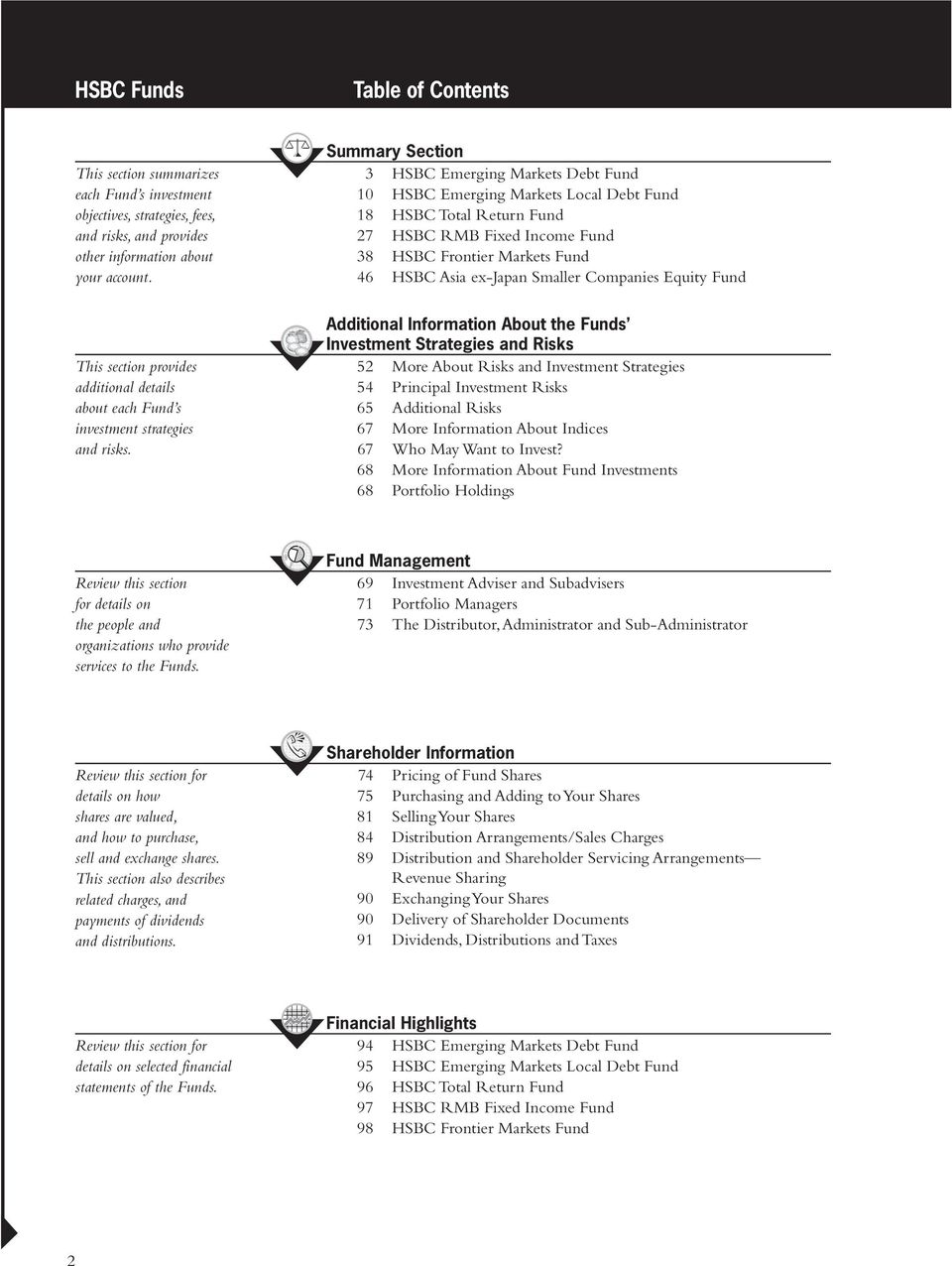
2 HSBC Funds Table of Contents This section summarizes each Fund s investment objectives, strategies, fees, and risks, and provides other information about your account. Summary Section 3 HSBC Emerging Markets Debt Fund 10 HSBC Emerging Markets Local Debt Fund 18 HSBC Total Return Fund 27 HSBC RMB Fixed Income Fund 38 HSBC Frontier Markets Fund 46 HSBC Asia ex-japan Smaller Companies Equity Fund This section provides additional details about each Fund s investment strategies and risks. Additional Information About the Funds Investment Strategies and Risks 52 More About Risks and Investment Strategies 54 Principal Investment Risks 65 Additional Risks 67 More Information About Indices 67 Who May Want to Invest? 68 More Information About Fund Investments 68 Portfolio Holdings Review this section for details on the people and organizations who provide services to the Funds. Fund Management 69 Investment Adviser and Subadvisers 71 Portfolio Managers 73 The Distributor, Administrator and Sub-Administrator Review this section for details on how shares are valued, and how to purchase, sell and exchange shares. This section also describes related charges, and payments of dividends and distributions. Shareholder Information 74 Pricing of Fund Shares 75 Purchasing and Adding to Your Shares 81 Selling Your Shares 84 Distribution Arrangements/Sales Charges 89 Distribution and Shareholder Servicing Arrangements Revenue Sharing 90 Exchanging Your Shares 90 Delivery of Shareholder Documents 91 Dividends, Distributions and Taxes Review this section for details on selected financial statements of the Funds. Financial Highlights 94 HSBC Emerging Markets Debt Fund 95 HSBC Emerging Markets Local Debt Fund 96 HSBC Total Return Fund 97 HSBC RMB Fixed Income Fund 98 HSBC Frontier Markets Fund 2
3 HSBC Emerging Markets Debt Fund Summary Section Class A, Class I and Class S Shares Investment Objective The investment objective of the HSBC Emerging Markets Debt Fund (the Fund ) is to maximize total return (comprised of capital appreciation and income). Fees and Expenses of the Fund This table describes the fees and expenses that you may pay if you buy and hold shares of the Fund. You may qualify for sales charge discounts if you and your family invest, or agree to invest in the future, at least $50,000 in the HSBC Family of Funds. More information about these and other discounts is available from your financial professional, and is explained in Distribution Arrangements/Sales Charges on page 84 of this prospectus and in the Fund s Statement of Additional Information ( SAI ) in Right of Accumulation on page 74. Shareholder Fees (fees paid directly from your investment) Class A Class I Class S Maximum Sales Charge (load) Imposed on Purchases (as a % of offering price) 4.75% None None Maximum Deferred Sales Charge (load) (as a % of amount redeemed) None None None Annual Fund Operating Expenses (expenses that you pay each year as a percentage of the value of your investment) Class A Class I Class S Management Fee 0.50% 0.50% 0.50% Distribution (12b-1) Fee 0.00% 0.00% 0.00% Other Expenses: Shareholder Servicing Fee 0.25% 0.00% 0.00% Other Operating Expenses 0.76% 0.66% 0.56% Total Other Expenses 1.01% 0.66% 0.56% Acquired Fund Fees and Expenses 0.04% 0.04% 0.04% Total Annual Fund Operating Expenses* 1.55% 1.20% 1.10% Fee Waiver and/or Expense Reimbursement** 0.31% 0.31% 0.31% Total Annual Fund Operating Expenses After Fee Waiver and/or Expense Reimbursement 1.24% 0.89% 0.79% * The Total Annual Fund Operating Expenses do not correlate to the ratios of net and total expenses to average net assets provided in the Financial Highlights, which reflect the operating expenses of the Fund and do not include Acquired Fund Fees and Expenses. ** HSBC Global Asset Management (USA) Inc., the Fund s investment adviser ( Adviser ), has entered into a contractual expense limitation agreement with the Fund ( Expense Limitation Agreement ) under which it will limit total expenses of the Fund (excluding interest, taxes, brokerage commissions, extraordinary expenses and estimated indirect expenses attributable to the Fund s investments in investment companies) to an annual rate of 1.20% for Class A Shares, 0.85% for Class I Shares and 0.75% for Class S Shares. Any amounts contractually waived or reimbursed by the Adviser will be subject to repayment by the Fund to the Adviser within three years to the extent that the repayment will not cause the Fund s operating expenses to exceed the contractual expense limit that was in effect at the time of such waiver or reimbursement. The expense limitation shall be in effect until March 1, The Expense Limitation Agreement shall terminate upon the termination of the Amended and Restated Master Investment Advisory Contract between HSBC Funds (the Trust ) and the Adviser, or it may be terminated upon written notice to the Adviser by the Trust. 3

4 HSBC Emerging Markets Debt Fund Summary Section 4 Example This Example is intended to help you compare the cost of investing in the Fund with the cost of investing in other mutual funds. The Example assumes that you invest $10,000 in the Fund for the time periods indicated and then redeem all of your shares at the end of those periods. The Example also assumes that your investment has a 5% return each year and that the Fund s operating expenses remain the same. The Example takes the Fund s Expense Limitation Agreement into account for the first year only. Although your actual costs may be higher or lower, based on these assumptions your costs would be: 1 Year 3 Years 5 Years 10 Years Class A Shares $595 $912 $1,252 $2,208 Class I Shares $ 91 $350 $ 630 $ 1,427 Class S Shares $ 81 $ 319 $ 576 $ 1,312 Portfolio Turnover The Fund pays transaction costs, such as commissions, when it buys and sells securities (or turns over its portfolio). A higher portfolio turnover rate may indicate higher transaction costs and may result in higher taxes when Fund shares are held in a taxable account. These costs, which are not reflected in Annual Fund Operating Expenses or in the Example, affect the Fund s performance. During the most recent fiscal year, the Fund s portfolio turnover rate was 51% of the average value of its portfolio. Principal Investment Strategies The Fund seeks to achieve its investment objective by investing, under normal market conditions, at least 80% of its net assets in fixed income instruments of issuers that economically are tied to emerging markets. The Fund will invest in instruments issued by foreign governments and corporations. Investments will generally be made in U.S. dollar denominated instruments, but the Fund will also seek to invest in emerging market local currency denominated instruments. The total return sought by the Fund consists of income earned on investments, plus capital appreciation, if any, which generally arises from decreases in interest rates or improving credit fundamentals for a particular region, sector or security. The Fund will invest in at least three countries, and at least 40% of its net assets will be invested in foreign securities. An instrument is economically tied to an emerging market country if: (i) the issuer is the government (or any political subdivision, agency, authority or instrumentality of such government) of an emerging market country; (ii) the instrument is principally traded on an emerging market country s securities markets; or (iii) the issuer is organized or principally operates in an emerging market country, derives 50% or more of its income from its operation within the country, or has 50% or more of its assets in the country. For purposes of the Fund s 80% of net assets policy, derivative instruments will be treated as economically tied to emerging market countries if the underlying assets are, or the performance of the instrument is otherwise determined with reference to, currencies of emerging market countries (or baskets or indexes of such currencies), interest rates that are associated with an emerging market country, or instruments or securities that are issued by governments or issuers organized under the laws of an emerging market country. The term emerging markets includes any country: (i) having an emerging stock market as defined by the International Finance Corporation; (ii) with low- to middle-income economies according to the International Bank for Reconstruction and Development (the World Bank ); (iii) listed in World Bank publications as developing; or (iv) determined by the Adviser to be an emerging market. Currently, emerging market countries generally include every country in the world except Australia, Austria, Belgium, Canada, Denmark, Finland, France, Germany, Hong Kong, Ireland, Israel, Italy, Japan, the Netherlands, New Zealand, Norway, Singapore, Spain, Sweden, Switzerland, the United Kingdom and the United States. The Adviser will select investments for purchase or sale by evaluating each issuer based on: (i) general economic and financial conditions; (ii) the specific issuer s business and management, cash flow, earnings coverage of interest and dividends, ability to operate under adverse economic conditions, and fair market value of assets; (iii) any unique political, economic, or social conditions applicable to such issuer s country; and (iv) other considerations the Adviser deems appropriate.

5 HSBC Emerging Markets Debt Fund Summary Section The Fund may invest without limitation in high-yield securities ( junk bonds ),which are those securities rated lower than Baa by Moody s Investors Service ( Moody s ) or lower than BBB by Standard & Poor s Ratings Services ( S&P ) or Fitch, Inc. ( Fitch ), subject to a maximum of 15% of its total assets in securities rated below B by Moody s, or equivalently rated by S&P or Fitch or, if unrated, determined by the Adviser to be of comparable quality. In addition, the Fund may invest in derivative instruments, including, but not limited to, swaps, financial futures, foreign currency futures, foreign currency contracts, options on futures contracts, options on securities and swaps (swaptions) for hedging purposes or for tax-advantaged access to instruments. The Fund may purchase securities of various maturities, but expects under normal market conditions to maintain an average portfolio duration that normally varies within two years (plus or minus) of the duration of the J.P. Morgan Emerging Markets Bond Index Global, which as of December 31, 2014 was 7.11 years. The Fund is considered to be non-diversified under the Investment Company Act of 1940, as amended ( 1940 Act ), which means that the Fund can invest a greater percentage of its assets in a more limited number of issuers than a diversified fund. Principal Investment Risks You could lose money by investing in the Fund. The Fund has the following principal investment risks: Debt Instruments Risk: The risks of investing in debt instruments include: Credit Risk: The Fund could lose money if an issuer or guarantor of a debt instrument is unable or unwilling to make or perceived to be unable or unwilling to make timely payments of interest or principal or enters bankruptcy. This risk is greater for lower-quality bonds than for bonds that are investment grade. Interest Rate Risk: Fluctuations in interest rates may affect the yield, liquidity and value of investments in income producing or debt instruments. Generally, if interest rates rise, the value of such investments may fall. The risks associated with rising interest rates are heightened given that interest rates are at, or near, historic lows, but are expected to increase in the foreseeable future, with unpredictable effects on the markets and the Fund s investments. High-Yield Securities ( Junk Bond ) Risk: Investments in high-yield securities (commonly referred to as junk bonds ) are often considered speculative investments and have significantly higher credit risk than investment-grade securities and tend to be less marketable (i.e., less liquid) than higher-rated securities. The prices of high-yield securities, which may be more volatile than higher rated securities of similar maturity, may be more vulnerable to adverse market, economic, social or political conditions. Inventory Risk: The market-making capacity in debt markets has declined as a result of reduced broker-dealer inventories relative to fund assets, reduced broker-dealer proprietary trading activity and increased regulatory capital requirements for financial institutions such as banks. Because market makers provide stability to a market through their intermediary services, a significant reduction in dealer market-making capacity has the potential to decrease liquidity and increase volatility in the debt markets. Foreign Securities Risk: Investments in foreign securities are generally considered riskier than investments in U.S. securities, and are subject to additional risks, including international trade, social, political, economic and regulatory risks; fluctuating currency exchange rates; less liquid, developed or efficient trading markets; the imposition of exchange controls, confiscations and other government restrictions (e.g., sanctions) by the United States or other countries; and different corporate disclosure and governance standards. Emerging Markets Risk: The Fund s investments in emerging market countries are subject to all of the risks of foreign investing generally, and have additional heightened risks due to a lack of established legal, political, business and social frameworks to support securities markets, including: greater market volatility and illiquidity, lower trading volume, delays in trading or settling portfolio securities transactions; currency and capital controls or other government restrictions or intervention, such as economic sanctions, expropriation and 5
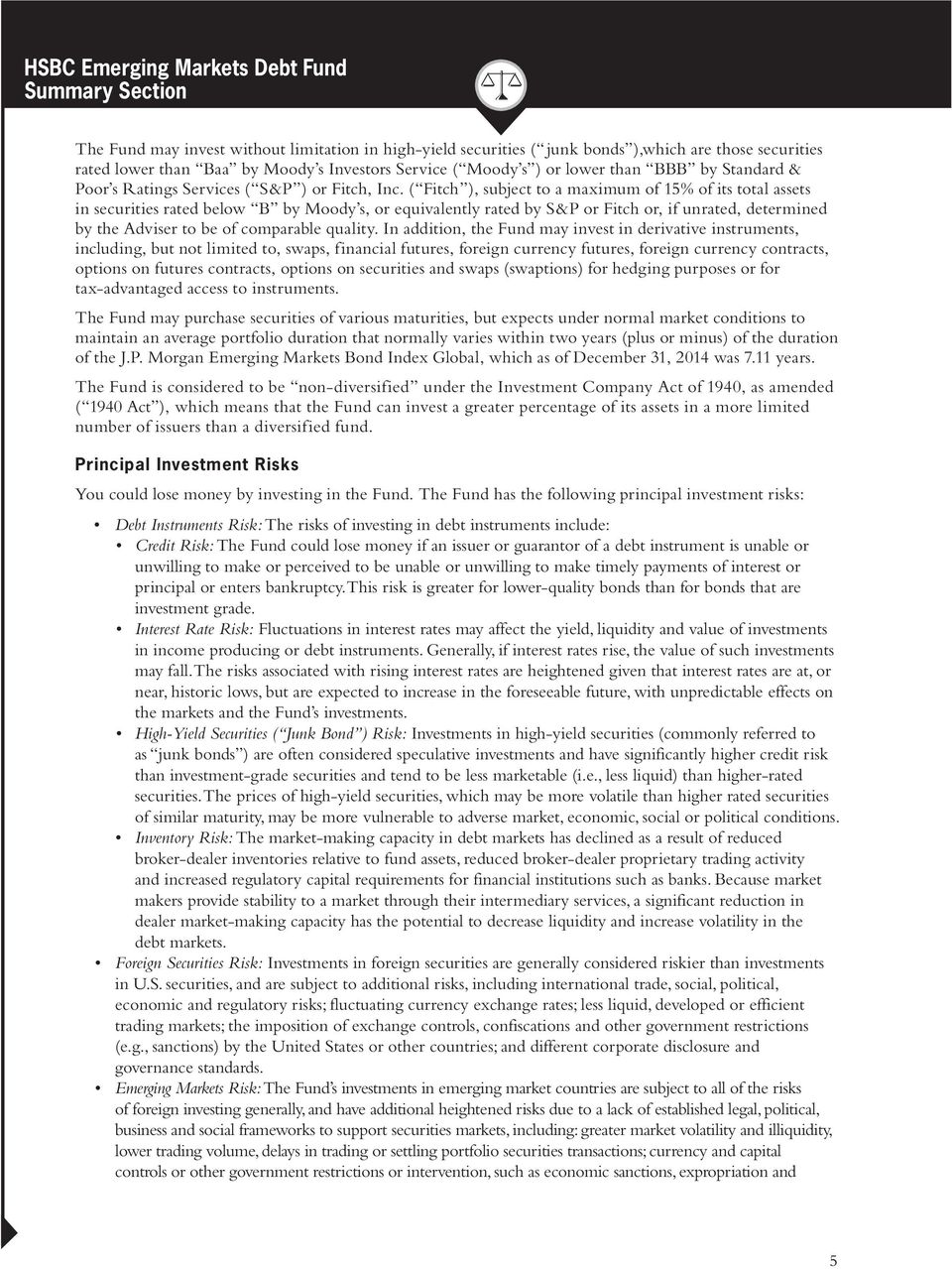
6 HSBC Emerging Markets Debt Fund Summary Section nationalization; greater sensitivity to interest rate changes; pervasiveness of corruption and crime; currency exchange rate volatility; and higher levels of inflation, deflation or currency devaluation. The prices of securities in emerging markets can fluctuate more significantly than the prices of securities in more developed countries. The less developed the country, the greater effect such risks may have on an investment. Derivatives Risk: The Fund s use of derivative instruments involves risks different from, or possibly greater than, the risks associated with investing directly in securities and other traditional investments and could increase the volatility of the Fund s net asset value per share and cause you to lose money. Risks associated with derivatives include the risk that the derivative is not well correlated with the security, index or currency to which it relates; the risk that derivatives may result in losses or missed opportunities; the risk that the Fund will be unable to sell the derivative because of an illiquid secondary market; the risk that a counterparty is unwilling or unable to meet its obligation; the risk that the Fund will be required to pay additional margin or set aside additional collateral to maintain open derivative positions, and the risk that the derivative transaction could expose the Fund to the effects of leverage, which could increase the Fund s exposure to the market and magnify potential losses, particularly when derivatives are used to enhance return rather than offset risk. There is no guarantee that derivatives, to the extent employed, will have the intended effect, and their use could cause lower returns or even losses to the Fund. The use of derivatives by the Fund to hedge risk may reduce the opportunity for gain by offsetting the positive effect of favorable price movements. Swap Risk: The use of swap agreements, which are agreements to exchange the return generated by one instrument for the return generated by another instrument (or index), and similar instruments involves risks that are different from those associated with ordinary portfolio securities transactions. Swap agreements may also subject the Fund to the risk that the counterparty to the transaction may not meet its obligations, causing the Fund s value to decrease. Swap agreements may also be considered illiquid. Leverage Risk: Leverage created by investments such as derivatives can diminish the Fund s performance and increase the volatility of the Fund s net asset value. This is because leverage tends to exaggerate the effect of any increase or decrease in the value of the Fund s portfolio securities. Counterparty Risk: When the Fund enters into an investment contract, such as a derivative or a repurchase or reverse repurchase agreement, the Fund is exposed to the risk that the other party to the contract will not fulfill its contractual obligations. Currency Risk: Fluctuations in exchange rates between the U.S. dollar and foreign currencies, or between various foreign currencies, may negatively affect the Fund s performance. The Fund may seek to reduce currency risk by hedging part or all of its exposure to various foreign currencies; however, if such hedging techniques are employed, there is no assurance that they will be successful. Liquidity Risk: The Fund may hold illiquid securities by virtue of the absence of a readily available market for, or a reduction in the number or capacity of market participants making a market in, certain of its investments, or because of legal or contractual restrictions on sales. The Fund could lose money if it is unable to dispose of an investment at a time that is most beneficial to the Fund. Investments that are illiquid or that trade in lower volumes may be more difficult to value. Issuer Diversification Risk: Focusing investments in a small number of issuers, industries, foreign currencies or particular countries or regions increases risk. The Fund is non-diversified and may invest a greater percentage of its assets in the securities of a single issuer than a fund that is diversified. Funds that invest in a relatively small number of issuers are more susceptible to risks associated with a single economic, political or regulatory occurrence than a more diversified portfolio might be. Custody Risk: The Fund invests in securities markets that are less developed than those in the U.S., which may expose the Fund to risks in the process of clearing and settling trades and the holding of securities by foreign banks, agents and depositories. Investments in emerging markets may be subject to greater custody risks than investments in more developed securities markets. Market Risk: The value of the Fund s investments may decline due to changing economic, political, social, regulatory or market conditions. Market risk may affect a single issuer, industry or section of the economy or it may affect the economy as a whole. Moreover, the conditions in one country or geographic region could adversely affect the Fund s investments in a different country or geographic region. 6

7 HSBC Emerging Markets Debt Fund Summary Section Sovereign Debt Risk: Sovereign debt instruments, which are instruments issued by foreign governmental entities, are subject to the risk that the governmental entity may be unable or unwilling to repay the principal or interest on its sovereign debt due to, among other reasons, cash flow problems, insufficient foreign currency reserves, political considerations, the relative size of the governmental entity s debt or its failure to implement economic reforms. There is no legal or bankruptcy process for collecting sovereign debt. An investment in the Fund is not a deposit of HSBC Bank USA, N.A. and is not insured or guaranteed by the Federal Deposit Insurance Corporation or any other government agency. 7

8 HSBC Emerging Markets Debt Fund Summary Section Performance Bar Chart and Table The bar chart and table below provide an indication of the risks of an investment in the Fund by showing changes in the Fund s year-to-year performance and by showing how the Fund s average annual returns compare with those of a broad measure of market performance. Past performance, including before- and after-tax returns, does not indicate how the Fund will perform in the future. The bar chart below shows the Fund s annual returns for Class A Shares and how performance has varied from year-to-year. The returns for Class I Shares and Class S Shares will differ from the Class A Shares returns shown in the bar chart because the expenses of the classes differ. Annual Total Returns as of 12/31 for Class A Shares (Excluding sales charges, which if included, would cause returns to be lower.) 19.23% 5.17% -7.57% Best Quarter: Q % Worst Quarter: Q % The table that follows shows returns on a before-tax and after-tax basis. After-tax returns are calculated using the historical highest individual federal marginal income tax rates and do not reflect the impact of state and local taxes. Actual after-tax returns depend on an investor s tax situation and may differ from those shown. After-tax returns are not relevant to investors who hold their Fund shares through tax-deferred arrangements, such as 401(k) plans or individual retirement accounts. After-tax returns shown in the table below are for Class A Shares of the Fund and after-tax returns for Class I and Class S Shares may vary. The table further compares the Fund s performance over time to that of the J.P. Morgan Emerging Markets Bond Index Global ( EMBI Global ). Average Annual Total Returns (for the periods ended December 31, 2014) Inception Date 1 Year Since Inception Class A Return Before Taxes April 7, % 4.12% Class A Return After Taxes on Distributions April 7, % 2.15% Class A Return After Taxes on Distributions and Sale of Fund Shares April 7, % 2.48% Class I Return Before Taxes April 7, % 5.88% Class S Return Before Taxes April 7, % 5.99% EMBI Global (reflects no deduction for fees, expenses or taxes) 5.53% 6.11%* * Since April 7,

9 HSBC Emerging Markets Debt Fund Summary Section Investment Adviser HSBC Global Asset Management (USA) Inc. is the Fund s investment adviser. Portfolio Managers Investment decisions for the Fund are made by the Adviser s Emerging Markets Debt Team. Guillermo Ossés, Managing Director, Head of Emerging Markets Debt Portfolio Management; Lisa Chua, CFA, Senior Vice President, Portfolio Manager; Phil Yuhn, Senior Vice President, Portfolio Engineer; and Vinayak Potti, Vice President, Portfolio Manager, are the members of the Emerging Markets Debt Team with the most significant responsibility for the day-to-day management of the Fund s portfolio. Mr. Ossés has managed the Fund since it commenced operations on April 7, The other members of the Emerging Markets Debt Team have managed the Fund since February 28, 2012, except for Mr. Potti, who has managed the fund since September 11, Purchasing and Selling Your Shares Generally, you may purchase or redeem Fund shares on any business day by mail (HSBC Funds, PO Box , Columbus, Ohio ), wire transfer, or telephone at Investors who wish to purchase, exchange or redeem Fund shares through a broker-dealer should contact the broker-dealer directly. Account Type Minimum Initial Investment* Minimum Subsequent Investment* Class A Shares Regular (non-retirement) $ 1,000 $100 Retirement (IRA) $ 250 $100 Automatic Investment Plan $ 250 $ 25 Class I Shares Regular (non-retirement) $ 1,000,000 $ 0 Class S Shares Regular (non-retirement) $25,000,000 $ 0 * Omnibus accounts are eligible to meet the minimums at the omnibus account level. Tax Information The Fund intends to declare and pay dividends from net investment income, if any, at least monthly. The Fund s distributions are taxable, and will be taxed as ordinary income or capital gains, unless you are investing through a tax-deferred arrangement, such as a 401(k) plan or an individual retirement account. Such tax-deferred arrangements may be taxed later upon withdrawal of monies from those arrangements. Payments to Broker-Dealers and Other Financial Intermediaries If you purchase shares of the Fund through a financial intermediary, such as a broker-dealer or investment adviser, the Fund, the Adviser or the distributor may pay the intermediary for the sale of Fund shares and related services. These payments may create a conflict of interest by influencing the broker-dealer or other financial intermediary and your salesperson to recommend the Fund over another investment. Ask your financial intermediary or visit your financial intermediary s Web site for more information. 9

10 HSBC Emerging Markets Local Debt Fund Summary Section Class A, Class I and Class S Shares Investment Objective The investment objective of the HSBC Emerging Markets Local Debt Fund (the Fund ) is to maximize total return (comprised of capital appreciation and income). Fees and Expenses of the Fund This table describes the fees and expenses that you may pay if you buy and hold shares of the Fund. You may qualify for sales charge discounts if you and your family invest, or agree to invest in the future, at least $50,000 in the HSBC Family of Funds. More information about these and other discounts is available from your financial professional, and is explained in Distribution Arrangements/Sales Charges on page 84 of this prospectus and in the Fund s Statement of Additional Information ( SAI ) in Right of Accumulation on page 74. Shareholder Fees (fees paid directly from your investment) Class A Class I Class S Maximum Sales Charge (load) Imposed on Purchases (as a % of offering price) 4.75% None None Maximum Deferred Sales Charge (load) (as a % of amount redeemed) None None None Annual Fund Operating Expenses (expenses that you pay each year as a percentage of the value of your investment) Class A Class I Class S Management Fee 0.50% 0.50% 0.50% Distribution (12b-1) Fee 0.00% 0.00% 0.00% Other Expenses: Shareholder Servicing Fee 0.25% 0.00% 0.00% Other Operating Expenses 1.05% 0.95% 0.85% Total Other Expenses 1.30% 0.95% 0.85% Acquired Fund Fees and Expenses 0.05% 0.05% 0.05% Total Annual Fund Operating Expenses* 1.85% 1.50% 1.40% Fee Waiver and/or Expense Reimbursement** 0.60% 0.60% 0.60% Total Annual Fund Operating Expenses After Fee Waiver and/or Expense Reimbursement 1.25% 0.90% 0.80% * The Total Annual Fund Operative Expenses do not correlate to the ratios of net and total expenses to average net assets provided in the Financial Highlights, which reflect the operating expenses of the Fund and do not include Acquired Fund Fees and Expenses. ** HSBC Global Asset Management (USA) Inc., the Fund s investment adviser ( Adviser ), has entered into a contractual expense limitation agreement with the Fund ( Expense Limitation Agreement ) under which it will limit total expenses of the Fund (excluding interest, taxes, brokerage commissions, extraordinary expenses and estimated indirect expenses attributable to the Fund s investments in investment companies) to an annual rate of 1.20% for Class A Shares, 0.85% for Class I Shares and 0.75% for Class S Shares. Any amounts contractually waived or reimbursed by the Adviser will be subject to repayment by the Fund to the Adviser within three years to the extent that the repayment will not cause the Fund s operating expenses to exceed the contractual expense limit that was in effect at the time of such waiver or reimbursement. The expense limitation shall be in effect until March 1, The Expense Limitation Agreement shall terminate upon the termination of the Amended and Restated Master Investment Advisory Contract between HSBC Funds (the Trust ) and the Adviser, or it may be terminated upon written notice to the Adviser by the Trust. 10

11 HSBC Emerging Markets Local Debt Fund Summary Section Example This Example is intended to help you compare the cost of investing in the Fund with the cost of investing in other mutual funds. The Example assumes that you invest $10,000 in the Fund for the time periods indicated and then redeem all of your shares at the end of those periods. The Example also assumes that your investment has a 5% return each year and that the Fund s operating expenses remain the same. The Example takes the Fund s Expense Limitation Agreement into account for the first year only. Although your actual costs may be higher or lower, based on these assumptions your costs would be: 1 Year 3 Years 5 Years 10 Years Class A Shares $596 $974 $1,375 $2,494 Class I Shares $ 92 $415 $ 762 $1,739 Class S Shares $ 82 $384 $ 709 $1,628 Portfolio Turnover The Fund pays transaction costs, such as commissions, when it buys and sells securities (or turns over its portfolio). A higher portfolio turnover rate may indicate higher transaction costs and may result in higher taxes when Fund shares are held in a taxable account. These costs, which are not reflected in Annual Fund Operating Expenses or in the Example, affect the Fund s performance. During the most recent fiscal year, the Fund s portfolio turnover rate was 199% of the average value of its portfolio. Principal Investment Strategies The Fund seeks to achieve its investment objective by investing, under normal market conditions, at least 80% of its net assets, plus borrowings for investment purposes, in debt instruments issued by foreign governments, government agencies or corporations and denominated in local currencies of countries with emerging securities markets. The Fund may also invest in instruments denominated in U.S. dollars. The total return sought by the Fund consists of income earned on investments, plus capital appreciation, if any, which generally arises from decreases in interest rates or improving credit fundamentals for a particular region, sector or security. The Fund may invest in derivatives such as currency forwards, non-deliverable forwards, equity options, bond options, currency options, interest rate swaps or credit default swaps denominated in any currency for hedging purposes, cash management purposes, as a substitute for investing in equity or fixed income securities, or to enhance returns. These instruments will be treated as investments in debt instruments for the purposes of the Fund s 80% of net assets policy, as appropriate, if the underlying assets of such derivatives are, or the performance of the instrument is determined with reference to, debt instruments issued by foreign governments, government agencies or corporations and denominated in the local currency of an emerging market country or a currency of or interest rate associated with an emerging market country. Equity-related derivatives are not treated as debt instruments for purposes of the Fund s 80% of net assets policy. The term emerging markets includes any country: (i) having an emerging stock market as defined by the International Finance Corporation; (ii) with low- to middle-income economies according to the International Bank for Reconstruction and Development (the World Bank ); (iii) listed in World Bank publications as developing; or (iv) determined by the Adviser to be an emerging market. Currently, emerging market countries generally include every country in the world except Australia, Austria, Belgium, Canada, Denmark, Finland, France, Germany, Hong Kong, Ireland, Israel, Italy, Japan, the Netherlands, New Zealand, Norway, Singapore, Spain, Sweden, Switzerland, the United Kingdom and the United States. The Fund may invest without limit in debt instruments that are economically tied to emerging market countries. An instrument is economically tied to an emerging market country if: (i) the issuer is the government (or any political subdivision, agency, authority or instrumentality of such government) of an emerging market country; (ii) the instrument is principally traded on an emerging market country s securities markets; or (iii) the issuer is organized or principally operates in an emerging market country, derives 50% 11
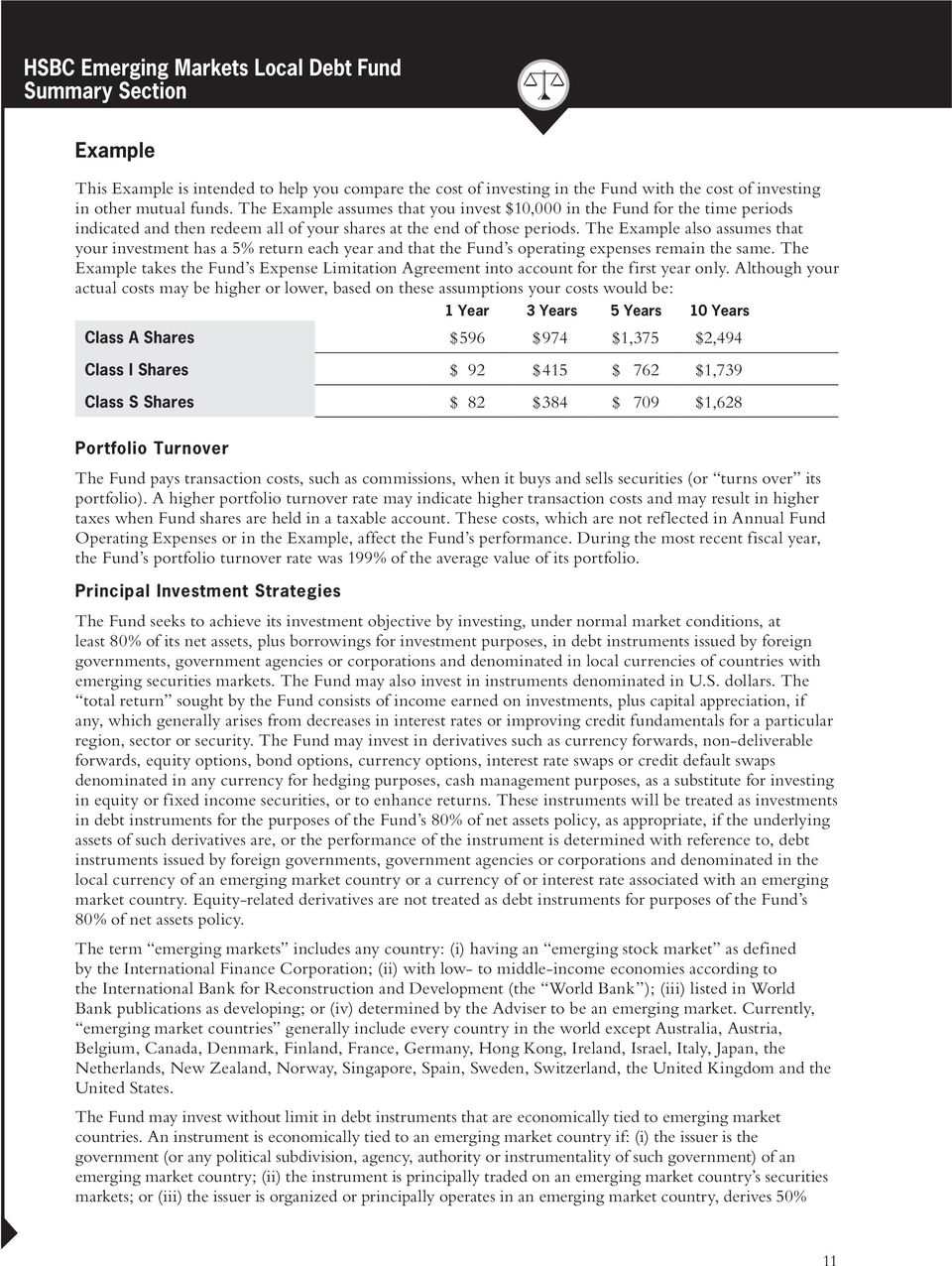
12 HSBC Emerging Markets Local Debt Fund Summary Section or more of its income from its operation within the country, or has 50% or more of its assets in the country. In the case of certain money market instruments, such instruments will be considered economically tied to an emerging market country if either the issuer or the guarantor of such money market instrument is organized under the laws of an emerging market country. With respect to derivative instruments, generally such instruments are treated as economically tied to emerging market countries if the underlying assets are, or the performance of the instrument is otherwise determined with reference to, currencies of emerging market countries (or baskets or indexes of such currencies), interest rates that are associated with an emerging market country, or instruments or securities that are issued by governments or issuers organized under the laws of an emerging market country. The Fund normally will invest primarily in securities whose performance is economically tied to Asia, Africa, the Middle East, Latin America and the developing countries of Europe. The Adviser will select investments for purchase or sale by evaluating issuers based on: (i) general economic and financial conditions; (ii) the specific issuer s business and management, cash flow, earnings coverage of interest and dividends, ability to operate under adverse economic conditions, and fair market value of assets; (iii) any unique political, economic or social conditions applicable to such issuer s country; and (iv) other considerations the Adviser deems appropriate. The Adviser will select the Fund s country and currency composition based on its evaluation of relative interest rates, inflation rates, exchange rates, monetary and fiscal policies, trade and current account balances, legal and political developments and other specific factors that the Adviser believes to be relevant. The Fund may invest in both investment-grade securities, which are those securities that are rated by one or more nationally recognized statistical rating organizations ( NRSROs ) within one of the four highest long-term quality grades at the time of purchase (e.g., AAA, AA, A or BBB by Standard & Poor s Ratings Services ( S&P ) or Fitch, Inc. ( Fitch ) or Aaa, Aa, A or Baa by Moody s Investors Service ( Moody s )), and high-yield securities ( junk bonds ), which are those securities rated lower than Baa by Moody s or lower than BBB by S&P or Fitch. A maximum of 15% of the Fund s total assets may be invested in securities rated below B by Moody s, or equivalently rated by S&P or Fitch, or, if unrated, determined by the Adviser to be of comparable quality. The Fund may invest, without limitation, in non-investment grade securities rated above B by Moody s, or equivalently rated by S&P or Fitch, or, if unrated, determined by the Adviser to be of comparable quality. The Fund may purchase or sell securities on a when-issued, delayed delivery or forward commitment basis and may engage in short sales. The Fund may, without limitation, seek to obtain market exposure to the securities in which it primarily invests by entering into a series of purchase and sale contracts or by using other investment techniques (such as buy backs or dollar rolls). The Fund may purchase securities of various maturities, but expects to maintain an average portfolio duration that normally varies within three years (plus or minus) of the duration of the J.P. Morgan Government Bond Index - Emerging Markets Global Diversified, which as of December 31, 2014 was 4.92 years. The Fund is considered to be non-diversified under the Investment Company Act of 1940, as amended ( 1940 Act ), which means that the Fund can invest a greater percentage of its assets in a more limited number of issuers than a diversified fund. Principal Investment Risks You could lose money by investing in the Fund. The Fund has the following principal investment risks. Debt Instruments Risk: The risks of investing in debt instruments include: Credit Risk: The Fund could lose money if an issuer or guarantor of a debt instrument is unable or unwilling to make or perceived to be unable or unwilling to make timely payments of interest or principal or enters bankruptcy. This risk is greater for lower-quality bonds than for bonds that are investment grade. Interest Rate Risk: Fluctuations in interest rates may affect the yield, liquidity and value of investments in income producing or debt instruments. Generally, if interest rates rise, the value of such investments may fall. The risks associated with rising interest rates are heightened given that interest rates are at, or near, historic lows, but are expected to increase in the foreseeable future, with unpredictable effects on the markets and the Fund s investments. 12
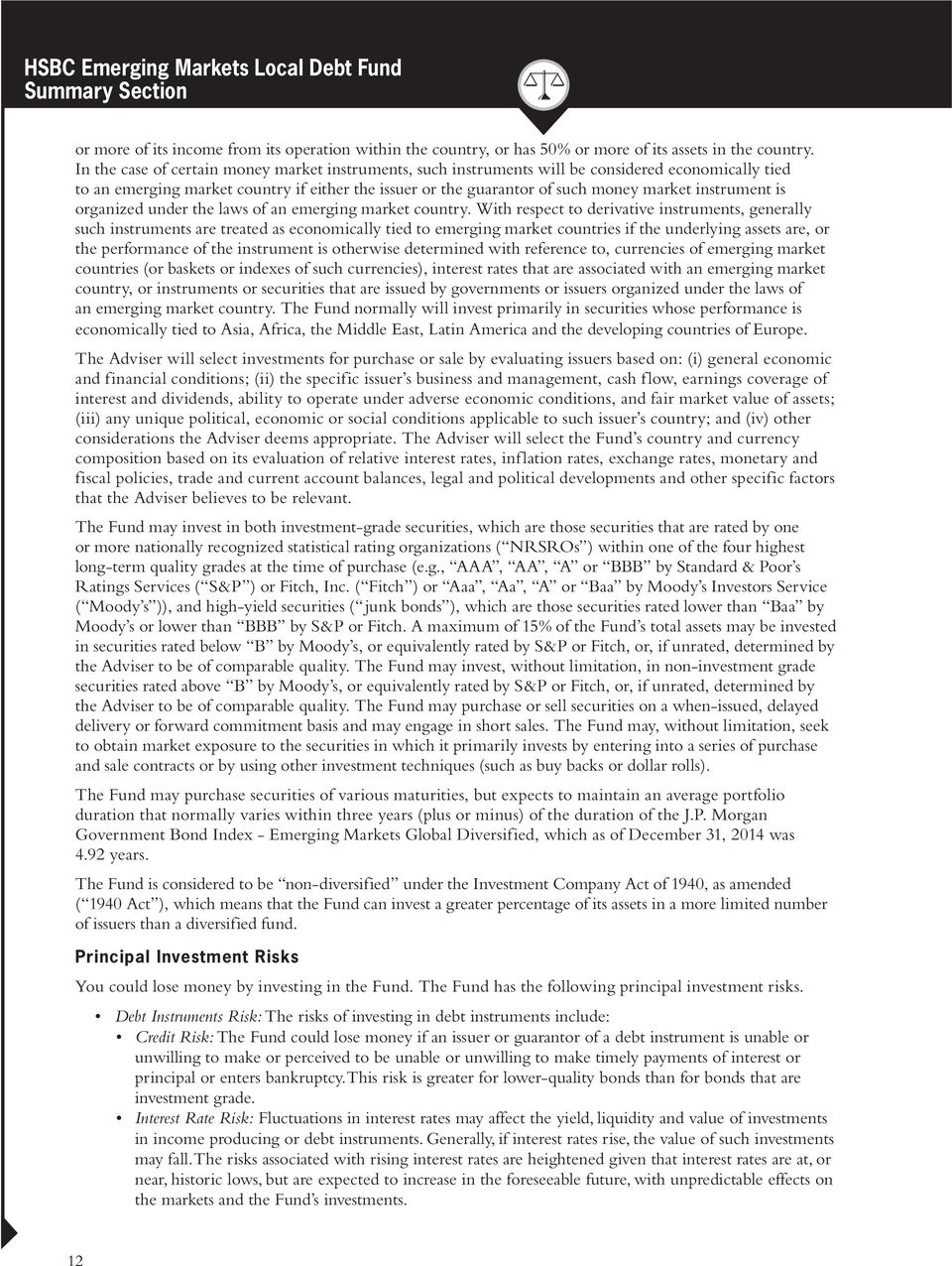
13 HSBC Emerging Markets Local Debt Fund Summary Section High-Yield Securities ( Junk Bond ) Risk: Investments in high-yield securities (commonly referred to as junk bonds ) are often considered speculative investments and have significantly higher credit risk than investment-grade securities and tend to be less marketable (i.e., less liquid) than higher-rated securities. The prices of high-yield securities, which may be more volatile than higher rated securities of similar maturity, may be more vulnerable to adverse market, economic, social or political conditions. Inventory Risk: The market-making capacity in debt markets has declined as a result of reduced broker-dealer inventories relative to fund assets, reduced broker-dealer proprietary trading activity and increased regulatory capital requirements for financial institutions such as banks. Because market makers provide stability to a market through their intermediary services, a significant reduction in dealer market-making capacity has the potential to decrease liquidity and increase volatility in the debt markets. Foreign Securities Risk: Investments in foreign securities are generally considered riskier than investments in U.S. securities, and are subject to additional risks, including international trade, social, political, economic and regulatory risks; fluctuating currency exchange rates; less liquid, developed or efficient trading markets; the imposition of exchange controls, confiscations and other government restrictions (e.g., sanctions) by the United States or other countries; and different corporate disclosure and governance standards. Emerging Markets Risk: The Fund s investments in emerging market countries are subject to all of the risks of foreign investing generally, and have additional heightened risks due to a lack of established legal, political, business and social frameworks to support securities markets, including: greater market volatility and illiquidity, lower trading volume, delays in trading or settling portfolio securities transactions; currency and capital controls or other government restrictions or intervention, such as economic sanctions, expropriation and nationalization; greater sensitivity to interest rate changes; pervasiveness of corruption and crime; currency exchange rate volatility; and higher levels of inflation, deflation or currency devaluation. The prices of securities in emerging markets can fluctuate more significantly than the prices of securities in more developed countries. The less developed the country, the greater effect such risks may have on an investment. Derivatives Risk: The Fund s use of derivative instruments involves risks different from, or possibly greater than, the risks associated with investing directly in securities and other traditional investments and could increase the volatility of the Fund s net asset value per share and cause you to lose money. Risks associated with derivatives include the risk that the derivative is not well correlated with the security, index or currency to which it relates; the risk that derivatives may result in losses or missed opportunities; the risk that the Fund will be unable to sell the derivative because of an illiquid secondary market; the risk that a counterparty is unwilling or unable to meet its obligation; the risk that the Fund will be required to pay additional margin or set aside additional collateral to maintain open derivative positions; and the risk that the derivative transaction could expose the Fund to the effects of leverage, which could increase the Fund s exposure to the market and magnify potential losses, particularly when derivatives are used to enhance return rather than offset risk. There is no guarantee that derivatives, to the extent employed, will have the intended effect, and their use could cause lower returns or even losses to the Fund. The use of derivatives by the Fund to hedge risk may reduce the opportunity for gain by offsetting the positive effect of favorable price movements. Swap Risk: The use of swap agreements, which are agreements to exchange the return generated by one instrument for the return generated by another instrument (or index), and similar instruments involves risks that are different from those associated with ordinary portfolio securities transactions. Swap agreements may also subject the Fund to the risk that the counterparty to the transaction may not meet its obligations, causing the Fund s value to decrease. Swap agreements may also be considered illiquid. Leverage Risk: Leverage created by investments such as derivatives can diminish the Fund s performance and increase the volatility of the Fund s net asset value. This is because leverage tends to exaggerate the effect of any increase or decrease in the value of the Fund s portfolio securities. Counterparty Risk: When the Fund enters into an investment contract, such as a derivative or a repurchase or reverse repurchase agreement, the Fund is exposed to the risk that the other party to the contract will not fulfill its contractual obligations. 13
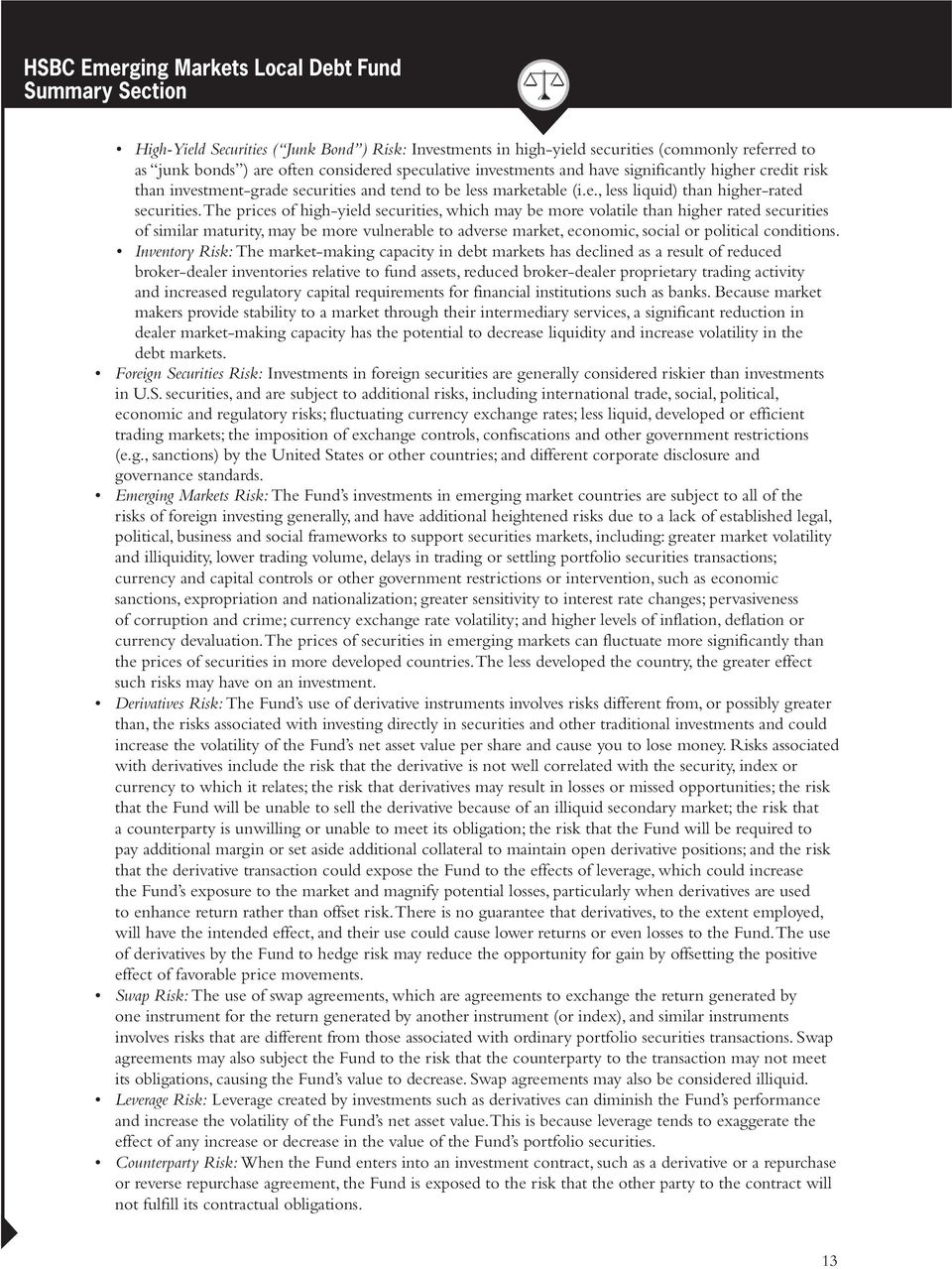
14 HSBC Emerging Markets Local Debt Fund Summary Section Currency Risk: Fluctuations in exchange rates between the U.S. dollar and foreign currencies, or between various foreign currencies, may negatively affect the Fund s performance. The Fund may seek to reduce currency risk by hedging part or all of its exposure to various foreign currencies; however, if such hedging techniques are employed, there is no assurance that they will be successful. When-Issued Securities: The Fund may purchase or sell securities that it is entitled to receive on a when issued basis. When-issued and delayed delivery securities and forward commitments involve the risk that the security the Fund buys will lose value prior to its delivery. There also is the risk that the security will not be issued or that the other party to the transaction will not meet its obligation. Short Sale Risk: When entering into a short sale, the Fund may lose more money than the actual cost of the investment. If the price of the underlying instrument or market on which the Fund has taken a short position increases, then the Fund will incur a loss equal to the increase in price from the time that the short position was entered into plus any related interest payments or other fees. Liquidity Risk: The Fund may hold illiquid securities by virtue of the absence of a readily available market for, or a reduction in the number or capacity of market participants making a market in, certain of its investments, or because of legal or contractual restrictions on sales. The Fund could lose money if it is unable to dispose of an investment at a time that is most beneficial to the Fund. Investments that are illiquid or that trade in lower volumes may be more difficult to value. Issuer Diversification Risk: Focusing investments in a small number of issuers, industries, foreign currencies or particular countries or regions increases risk. The Fund is non-diversified and may invest a greater percentage of its assets in the securities of a single issuer than a fund that is diversified. Funds that invest in a relatively small number of issuers are more susceptible to risks associated with a single economic, political or regulatory occurrence than a more diversified portfolio might be. Custody Risk: The Fund invests in securities markets that are less developed than those in the U.S., which may expose the Fund to risks in the process of clearing and settling trades and the holding of securities by foreign banks, agents and depositories. Investments in emerging markets may be subject to greater custody risks than investments in more developed securities markets. Market Risk: The value of the Fund s investments may decline due to changing economic, political, regulatory or market conditions. Market risk may affect a single issuer, industry or section of the economy or it may affect the economy as a whole. Moreover, the conditions in one country or geographic region could adversely affect the Fund s investments in a different country or geographic region. Sovereign Debt Risk: Sovereign debt instruments, which are instruments issued by foreign governmental entities, are subject to the risk that the governmental entity may be unable or unwilling to repay the principal or interest on its sovereign debt due to, among other reasons, cash flow problems, insufficient foreign currency reserves, political considerations, the relative size of the governmental entity s debt or its failure to implement economic reforms. There is no legal or bankruptcy process for collecting sovereign debt. An investment in the Fund is not a deposit of HSBC Bank USA, N.A. and is not insured or guaranteed by the Federal Deposit Insurance Corporation or any other government agency. 14

15 HSBC Emerging Markets Local Debt Fund Summary Section Performance Bar Chart and Table The bar chart and table below provide an indication of the risks of an investment in the Fund by showing changes in the Fund s year-to-year performance and by showing how the Fund s average annual returns compare with those of a broad measure of market performance. Past performance, including before- and after-tax returns, does not indicate how the Fund will perform in the future. The bar chart below shows the Fund s annual returns for Class A Shares and how performance has varied from year-to-year. The returns for Class I Shares and Class S Shares will differ from the Class A Shares returns shown in the bar chart because the expenses of the classes differ. Annual Total Returns as of 12/31 for Class A Shares (Excluding sales charges, which if included, would cause returns to be lower.) 11.86% -4.92% % Best Quarter: Q % Worst Quarter: Q % 15

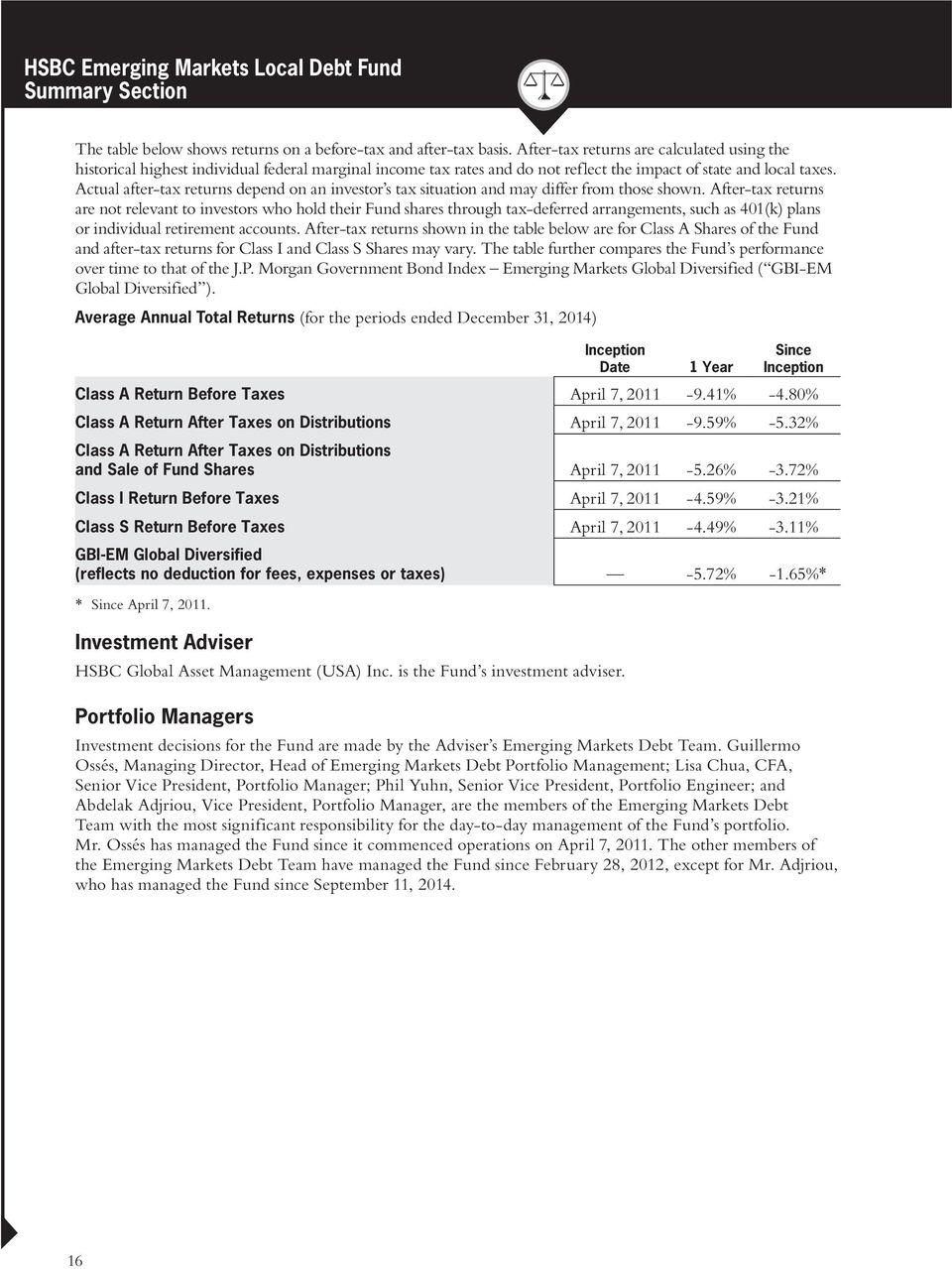
16 HSBC Emerging Markets Local Debt Fund Summary Section The table below shows returns on a before-tax and after-tax basis. After-tax returns are calculated using the historical highest individual federal marginal income tax rates and do not reflect the impact of state and local taxes. Actual after-tax returns depend on an investor s tax situation and may differ from those shown. After-tax returns are not relevant to investors who hold their Fund shares through tax-deferred arrangements, such as 401(k) plans or individual retirement accounts. After-tax returns shown in the table below are for Class A Shares of the Fund and after-tax returns for Class I and Class S Shares may vary. The table further compares the Fund s performance over time to that of the J.P. Morgan Government Bond Index Emerging Markets Global Diversified ( GBI-EM Global Diversified ). Average Annual Total Returns (for the periods ended December 31, 2014) Inception Date 1 Year Since Inception Class A Return Before Taxes April 7, % -4.80% Class A Return After Taxes on Distributions April 7, % -5.32% Class A Return After Taxes on Distributions and Sale of Fund Shares April 7, % -3.72% Class I Return Before Taxes April 7, % -3.21% Class S Return Before Taxes April 7, % -3.11% GBI-EM Global Diversified (reflects no deduction for fees, expenses or taxes) -5.72% -1.65%* * Since April 7, Investment Adviser HSBC Global Asset Management (USA) Inc. is the Fund s investment adviser. Portfolio Managers Investment decisions for the Fund are made by the Adviser s Emerging Markets Debt Team. Guillermo Ossés, Managing Director, Head of Emerging Markets Debt Portfolio Management; Lisa Chua, CFA, Senior Vice President, Portfolio Manager; Phil Yuhn, Senior Vice President, Portfolio Engineer; and Abdelak Adjriou, Vice President, Portfolio Manager, are the members of the Emerging Markets Debt Team with the most significant responsibility for the day-to-day management of the Fund s portfolio. Mr. Ossés has managed the Fund since it commenced operations on April 7, The other members of the Emerging Markets Debt Team have managed the Fund since February 28, 2012, except for Mr. Adjriou, who has managed the Fund since September 11,
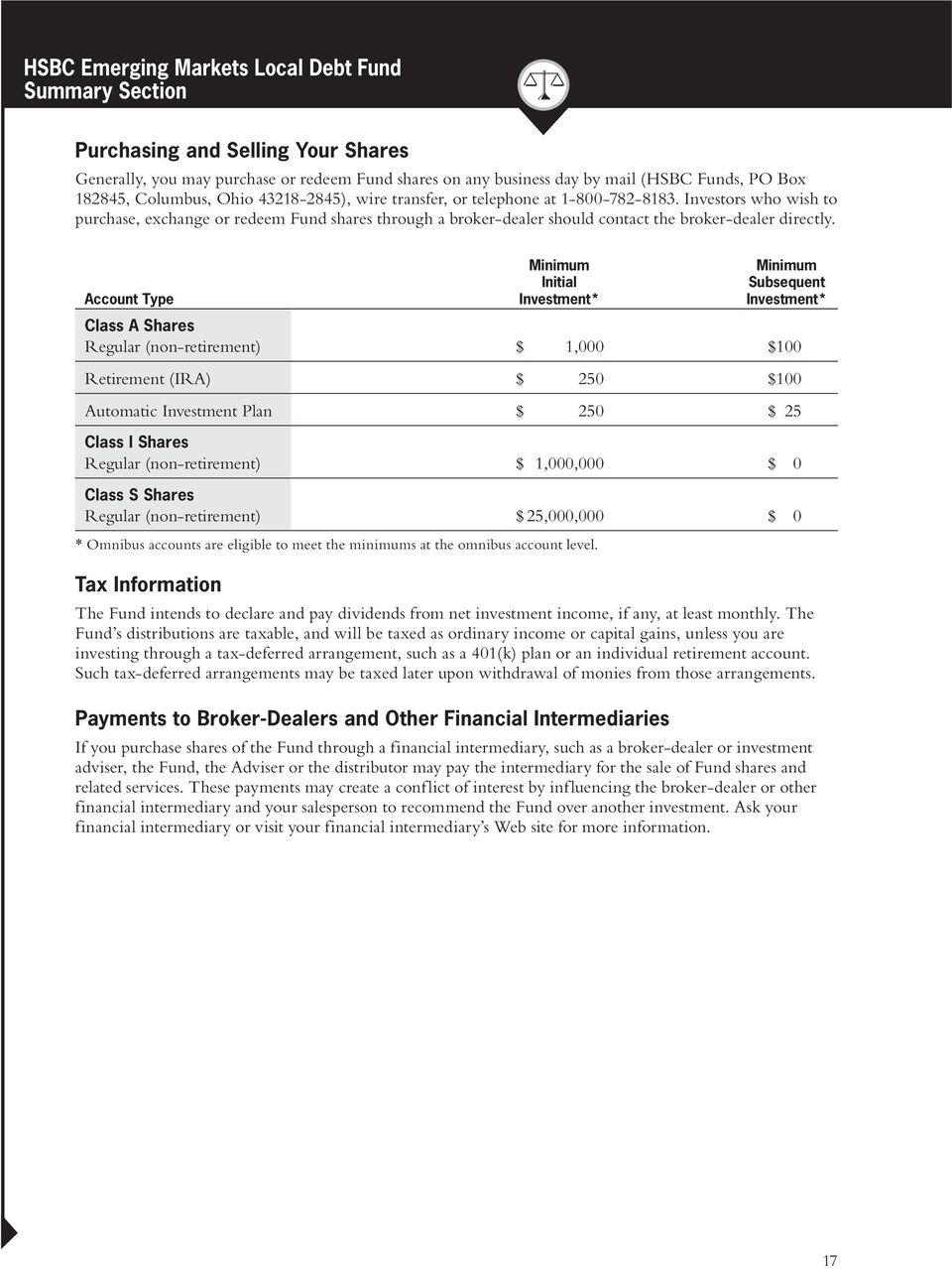
17 HSBC Emerging Markets Local Debt Fund Summary Section Purchasing and Selling Your Shares Generally, you may purchase or redeem Fund shares on any business day by mail (HSBC Funds, PO Box , Columbus, Ohio ), wire transfer, or telephone at Investors who wish to purchase, exchange or redeem Fund shares through a broker-dealer should contact the broker-dealer directly. Account Type Minimum Initial Investment* Minimum Subsequent Investment* Class A Shares Regular (non-retirement) $ 1,000 $100 Retirement (IRA) $ 250 $100 Automatic Investment Plan $ 250 $ 25 Class I Shares Regular (non-retirement) $ 1,000,000 $ 0 Class S Shares Regular (non-retirement) $ 25,000,000 $ 0 * Omnibus accounts are eligible to meet the minimums at the omnibus account level. Tax Information The Fund intends to declare and pay dividends from net investment income, if any, at least monthly. The Fund s distributions are taxable, and will be taxed as ordinary income or capital gains, unless you are investing through a tax-deferred arrangement, such as a 401(k) plan or an individual retirement account. Such tax-deferred arrangements may be taxed later upon withdrawal of monies from those arrangements. Payments to Broker-Dealers and Other Financial Intermediaries If you purchase shares of the Fund through a financial intermediary, such as a broker-dealer or investment adviser, the Fund, the Adviser or the distributor may pay the intermediary for the sale of Fund shares and related services. These payments may create a conflict of interest by influencing the broker-dealer or other financial intermediary and your salesperson to recommend the Fund over another investment. Ask your financial intermediary or visit your financial intermediary s Web site for more information. 17
18 HSBC Total Return Fund Summary Section Class A, Class I and Class S Shares Investment Objective The investment objective of the HSBC Total Return Fund (the Fund ) is to maximize total return (comprised of capital appreciation and income). Fees and Expenses of the Fund This table describes the fees and expenses that you may pay if you buy and hold shares of the Fund. You may qualify for sales charge discounts if you and your family invest, or agree to invest in the future, at least $50,000 in the HSBC Family of Funds. More information about these and other discounts is available from your financial professional, and is explained in Distribution Arrangements/Sales Charges on page 84 of this prospectus and in the Fund s Statement of Additional Information ( SAI ) in Right of Accumulation on page 74. Shareholder Fees (fees paid directly from your investment) Class A Class I Class S Maximum Sales Charge (load) Imposed on Purchases (as a % of offering price) 4.75% None None Maximum Deferred Sales Charge (load) (as a % of amount redeemed) None None None Annual Fund Operating Expenses (expenses that you pay each year as a percentage of the value of your investment) Class A Class I Class S Management Fee 0.85% 0.85% 0.85% Distribution (12b-1) Fee 0.00% 0.00% 0.00% Other Expenses: Shareholder Servicing Fee 0.25% 0.00% 0.00% Other Operating Expenses 0.42% 0.32% 0.22% Total Other Expenses 0.67% 0.32% 0.22% Acquired Fund Fees and Expenses 0.15% 0.15% 0.15% Total Annual Fund Operating Expenses* 1.67% 1.32% 1.22% * The Total Annual Fund Operating Expenses do not correlate to the ratios of net and total expenses to average net assets provided in the Financial Highlights, which reflect the operating expenses of the Fund and do not include Acquired Fund Fees and Expenses. 18

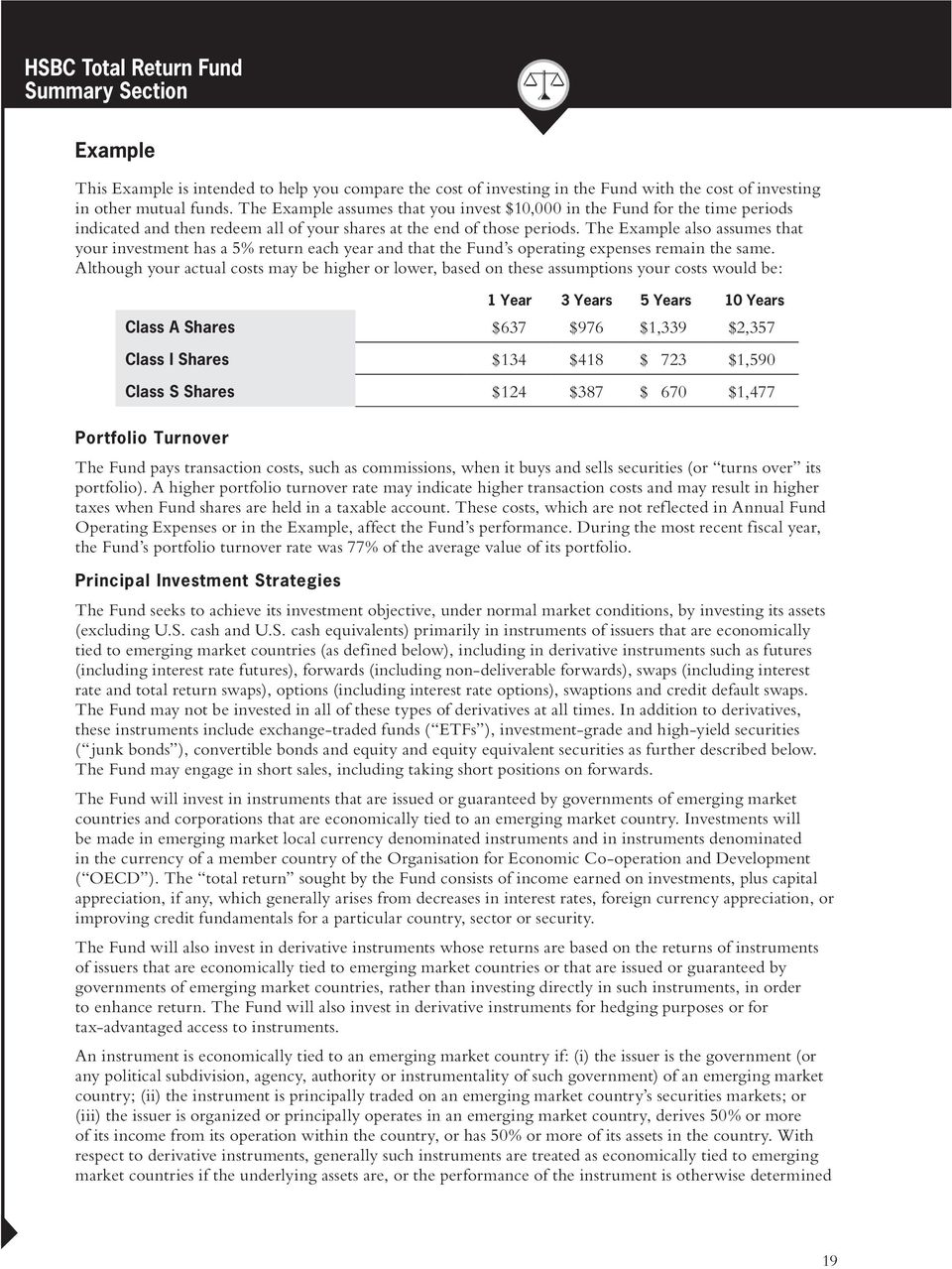
19 HSBC Total Return Fund Summary Section Example This Example is intended to help you compare the cost of investing in the Fund with the cost of investing in other mutual funds. The Example assumes that you invest $10,000 in the Fund for the time periods indicated and then redeem all of your shares at the end of those periods. The Example also assumes that your investment has a 5% return each year and that the Fund s operating expenses remain the same. Although your actual costs may be higher or lower, based on these assumptions your costs would be: 1 Year 3 Years 5 Years 10 Years Class A Shares $637 $976 $1,339 $2,357 Class I Shares $134 $418 $ 723 $1,590 Class S Shares $124 $387 $ 670 $1,477 Portfolio Turnover The Fund pays transaction costs, such as commissions, when it buys and sells securities (or turns over its portfolio). A higher portfolio turnover rate may indicate higher transaction costs and may result in higher taxes when Fund shares are held in a taxable account. These costs, which are not reflected in Annual Fund Operating Expenses or in the Example, affect the Fund s performance. During the most recent fiscal year, the Fund s portfolio turnover rate was 77% of the average value of its portfolio. Principal Investment Strategies The Fund seeks to achieve its investment objective, under normal market conditions, by investing its assets (excluding U.S. cash and U.S. cash equivalents) primarily in instruments of issuers that are economically tied to emerging market countries (as defined below), including in derivative instruments such as futures (including interest rate futures), forwards (including non-deliverable forwards), swaps (including interest rate and total return swaps), options (including interest rate options), swaptions and credit default swaps. The Fund may not be invested in all of these types of derivatives at all times. In addition to derivatives, these instruments include exchange-traded funds ( ETFs ), investment-grade and high-yield securities ( junk bonds ), convertible bonds and equity and equity equivalent securities as further described below. The Fund may engage in short sales, including taking short positions on forwards. The Fund will invest in instruments that are issued or guaranteed by governments of emerging market countries and corporations that are economically tied to an emerging market country. Investments will be made in emerging market local currency denominated instruments and in instruments denominated in the currency of a member country of the Organisation for Economic Co-operation and Development ( OECD ). The total return sought by the Fund consists of income earned on investments, plus capital appreciation, if any, which generally arises from decreases in interest rates, foreign currency appreciation, or improving credit fundamentals for a particular country, sector or security. The Fund will also invest in derivative instruments whose returns are based on the returns of instruments of issuers that are economically tied to emerging market countries or that are issued or guaranteed by governments of emerging market countries, rather than investing directly in such instruments, in order to enhance return. The Fund will also invest in derivative instruments for hedging purposes or for tax-advantaged access to instruments. An instrument is economically tied to an emerging market country if: (i) the issuer is the government (or any political subdivision, agency, authority or instrumentality of such government) of an emerging market country; (ii) the instrument is principally traded on an emerging market country s securities markets; or (iii) the issuer is organized or principally operates in an emerging market country, derives 50% or more of its income from its operation within the country, or has 50% or more of its assets in the country. With respect to derivative instruments, generally such instruments are treated as economically tied to emerging market countries if the underlying assets are, or the performance of the instrument is otherwise determined 19
20 HSBC Total Return Fund Summary Section with reference to, currencies of emerging market countries (or baskets or indexes of such currencies), interest rates that are associated with an emerging market country, or instruments or securities that are issued by governments or issuers organized under the laws of an emerging market country. The term emerging markets includes any country: (i) having an emerging stock market as defined by the International Finance Corporation; (ii) with low- to middle-income economies according to the International Bank for Reconstruction and Development (the World Bank ); (iii) listed in World Bank publications as developing; or (iv) determined by the Adviser to be an emerging market. Currently, these countries generally include every country in the world except Australia, Austria, Belgium, Canada, Denmark, Finland, France, Germany, Hong Kong, Ireland, Israel, Italy, Japan, the Netherlands, New Zealand, Norway, Singapore, Spain, Sweden, Switzerland, the United Kingdom and the United States. OECD is an international organization that aims to help governments tackle economic, social and governance challenges of a globalized economy. As of February 1, 2015, OECD s member countries were Australia, Austria, Belgium, Canada, Chile, Czech Republic, Denmark, Estonia, Finland, France, Germany, Greece, Hungary, Iceland, Ireland, Israel, Italy, Japan, Korea, Luxembourg, Mexico, Netherlands, New Zealand, Norway, Poland, Portugal, Slovak Republic, Slovenia, Spain, Sweden, Switzerland, Turkey, the United Kingdom and the United States. The Fund may invest without limit in both investment-grade and high-yield securities ( junk bonds ). Investment grade securities are those securities that are rated by one or more nationally recognized statistical rating organizations ( NRSROs ) within one of the four highest long-term quality grades at the time of purchase (e.g., Aaa, Aa, A or Baa by Moody s Investors Service ( Moody s ) or AAA, AA, A or BBB by Standard & Poor s Ratings Services ( S&P ) or Fitch, Inc. ( Fitch )). High yield securities are those securities rated lower than Baa by Moody s or lower than BBB by S&P or Fitch or, if unrated, determined by the Adviser to be of comparable quality. The Fund may purchase securities of various maturities but expects to maintain a portfolio duration of one to five years. The Fund may invest up to 25% of its net assets in convertible bonds which may be issued by companies of all sizes and market capitalizations that are economically tied to an emerging market country. Convertible bonds include, but are not limited to: corporate bonds, debentures, notes or preferred stocks and their hybrids that can be converted into (exchanged for) common stock or other securities, such as warrants or options, which provide an opportunity for equity participation. Convertible bonds generally fall within the lower-rated categories as determined by NRSROs. The Fund may also invest up to 10% its net assets in equity and equity equivalent securities issued by corporations of all sizes and market capitalizations that are economically tied to an emerging market country. The Adviser selects securities for purchase and sale by using a top down approach in which country credits, currencies, and local rate curves are analyzed based on their fundamental attractiveness. This analysis is based on information obtained from dedicated in-house market research, local resources and travel to the region, and a variety of other sources including third-party data providers. The Fund s global exposure is calculated using a value-at-risk approach. The Fund s strategy is managed in an absolute return style and is not managed with reference to a benchmark. The Adviser employs a multi-strategy investment approach using segments of the hard and local currency universe to build a portfolio with an overall volatility target less than that of the Fund s theoretical investment universe. The Fund s portfolio is constructed through a rigorous correlation and risk/reward analysis that is intended to capture most of the upside in emerging debt markets with less volatility and fewer drawdowns than traditional benchmark-oriented products. The Fund is considered to be non-diversified under the Investment Company Act of 1940, as amended ( 1940 Act ), which means that the Fund can invest a greater percentage of its assets in a more limited number of issuers than a diversified fund. 20

21 HSBC Total Return Fund Summary Section Principal Investment Risks You could lose money by investing in the Fund. The Fund has the following principal investment risks: Debt Instruments Risk: The risks of investing in debt instruments include: Credit Risk: The Fund could lose money if an issuer or guarantor of a debt instrument is unable or unwilling to make or perceived as unable or unwilling to make timely payments of interest or principal or enters bankruptcy. This risk is greater for lower-quality bonds than for bonds that are investment grade. Interest Rate Risk: Fluctuations in interest rates may affect the yield, liquidity and value of investments in income producing or debt instruments. Generally, if interest rates rise, the value of such investments may fall. The risks associated with rising interest rates are heightened given that interest rates are at, or near, historic lows, but are expected to increase in the foreseeable future, with unpredictable effects on the markets and the Fund s investments. High-Yield Securities ( Junk Bond ) Risk: Investments in high-yield securities (commonly referred to as junk bonds ) are often considered speculative investments and have significantly higher credit risk than investment-grade securities and tend to be less marketable (i.e., less liquid) than higher rated securities. The prices of high-yield securities, which may be more volatile than higher rated securities of similar maturity, may be more vulnerable to adverse market, economic or political conditions. Inventory Risk: The market-making capacity in debt markets has declined as a result of reduced brokerdealer inventories relative to fund assets, reduced broker-dealer proprietary trading activity and increased regulatory capital requirements for financial institutions such as banks. Because market makers provide stability to a market through their intermediary services, a significant reduction in dealer market-making capacity has the potential to decrease liquidity and increase volatility in the debt markets. Foreign Securities Risk: Investments in foreign securities are generally considered riskier than investments in U.S. securities, and are subject to additional risks, including international trade, social, political, economic and regulatory risks; fluctuating currency exchange rates; less liquid, developed or efficient trading markets; the imposition of exchange controls, confiscations and other government restrictions (e.g., sanctions) by the United States or other countries; and different corporate disclosure and governance standards. Emerging Markets Risk: The Fund s investments in emerging market countries are subject to all of the risks of foreign investing generally, and have additional heightened risks due to a lack of established legal, political, business and social frameworks to support securities markets, including: greater market volatility and illiquidity, lower trading volume, delays in trading or settling portfolio securities transactions; currency and capital controls or other government restrictions or intervention, such as economic sanctions, expropriation and nationalization; greater sensitivity to interest rate changes; pervasiveness of corruption and crime; currency exchange rate volatility; and higher levels of inflation, deflation or currency devaluation. The prices of securities in emerging markets can fluctuate more significantly than the prices of securities in more developed countries. The less developed the country, the greater effect such risks may have on an investment. Currency Risk: Fluctuations in exchange rates between the U.S. dollar and foreign currencies, or between various foreign currencies, may negatively affect the Fund s performance. The Fund may seek to reduce currency risk by hedging part or all of its exposure to various foreign currencies; however, if such hedging techniques are employed, there is no assurance that they will be successful. Derivatives Risk: The Fund s use of derivative instruments involves risks different from, or possibly greater than, the risks associated with investing directly in securities and other traditional investments and could increase the volatility of the Fund s net asset value per share and cause you to lose money. Risks associated with derivatives include the risk that the derivative is not well correlated with the security, index or currency to which it relates; the risk that derivatives may result in losses or missed opportunities; the risk that the Fund will be unable to sell the derivative because of an illiquid secondary market; the risk that a counterparty is unwilling or unable to meet its obligation; the risk that the Fund will be required to pay additional margin or set aside additional collateral to maintain open derivative positions; and the risk that 21
22 HSBC Total Return Fund Summary Section the derivative transaction could expose the Fund to the effects of leverage, which could increase the Fund s exposure to the market and magnify potential losses, particularly when derivatives are used to enhance return rather than offset risk. There is no guarantee that derivatives, to the extent employed, will have the intended effect, and their use could cause lower returns or even losses to the Fund. The use of derivatives by the Fund to hedge risk may reduce the opportunity for gain by offsetting the positive effect of favorable price movements. Leverage Risk: Leverage created by investments such as derivatives can diminish the Fund s performance and increase the volatility of the Fund s net asset value. This is because leverage tends to exaggerate the effect of any increase or decrease in the value of the Fund s portfolio securities. Counterparty Risk: When the Fund enters into an investment contract, such as a derivative or a repurchase or reverse repurchase agreement, the Fund is exposed to the risk that the other party to the contract will not fulfill its contractual obligations. Liquidity Risk: The Fund may hold illiquid securities by virtue of the absence of a readily available market for, or a reduction in the number or capacity of market participants making a market in, certain of its investments, or because of legal or contractual restrictions on sales. The Fund could lose money if it is unable to dispose of an investment at a time that is most beneficial to the Fund. Investments that are illiquid or that trade in lower volumes may be more difficult to value. Exchange-Traded Fund Risk: The risks of owning shares of an ETF generally reflect the risks of owning the underlying securities the ETF is designed to track, although lack of liquidity in an ETF could result in it being more volatile than the underlying portfolio of securities. Disruptions in the markets for the securities underlying ETFs purchased or sold by the Fund could result in losses on the Fund s investments. ETFs also have management fees that increase their costs versus owning the underlying securities directly. Short Sale Risk: When entering into a short sale, the Fund may lose more money than the actual cost of the investment. If the price of the underlying instrument or market on which the Fund has taken a short position increases, then the Fund will incur a loss equal to the increase in price from the time that the short position was entered into plus any related interest payments or other fees. Convertible Bond Risk. Convertible bonds are subject to the risks of equity securities when the underlying stock price is high relative to the conversion price (because more of the security s value resides in the conversion feature) and debt instruments when the underlying stock price is low relative to the conversion price (because the conversion feature is less valuable). A convertible bond is not as sensitive to interest rate changes as a similar non-convertible debt instrument, and generally has less potential for gain or loss than the underlying equity security. Issuer Diversification Risk: Focusing investments in a small number of issuers, industries, foreign currencies or particular countries or regions increases risk. The Fund is non-diversified and may invest a greater percentage of its assets in the securities of a single issuer than a fund that is diversified. Funds that invest in a relatively small number of issuers are more susceptible to risks associated with a single economic, political or regulatory occurrence than a more diversified portfolio might be. Custody Risk: The Fund invests in securities markets that are less developed than those in the U.S., which may expose the Fund to risks in the process of clearing and settling trades and the holding of securities by foreign banks, agents and depositories. Investments in emerging markets may be subject to greater custody risks than investments in more developed securities markets. Equity Securities Risk: The prices of equity securities fluctuate from time to time based on changes in a company s financial condition or overall market and economic conditions. As a result, the value of equity securities may fluctuate drastically from day to day. The risks of investing in equity securities also include: Capitalization Risk: Stocks of large capitalization companies may be volatile in the event of earnings disappointments or other financial developments. Medium and smaller capitalization companies may involve greater risks due to limited product lines and market and financial or managerial resources. Stocks of these companies may also be more volatile, more difficult to value accurately, less liquid and subject to the potential for greater declines in stock prices in response to selling pressure. Stocks of smaller capitalization companies generally have more risk than medium capitalization companies. Issuer Risk: An issuer s earnings prospects and overall financial position may deteriorate, causing a decline in the Fund s net asset value. 22
23 HSBC Total Return Fund Summary Section Market Risk: The value of the Fund s investments may decline due to changing economic, political, social, regulatory or market conditions. Market risk may affect a single issuer, industry or section of the economy or it may affect the economy as a whole. Moreover, the conditions in one country or geographic region could adversely affect the Fund s investments in a different country or geographic region. Sovereign Debt Risk: Sovereign debt instruments, which are instruments issued by foreign governmental entities, are subject to the risk that the governmental entity may be unable or unwilling to repay the principal or interest on its sovereign debt due to, among other reasons, cash flow problems, insufficient foreign currency reserves, political considerations, the relative size of the governmental entity s debt or its failure to implement economic reforms. There is no legal or bankruptcy process for collecting sovereign debt. An investment in the Fund is not a deposit of HSBC Bank USA, N.A. and is not insured or guaranteed by the Federal Deposit Insurance Corporation or any other government agency. 23
24 HSBC Total Return Fund Summary Section Performance Bar Chart and Table The bar chart and table below provide an indication of the risks of an investment in the Fund by showing changes in the Fund s year-to-year performance and by showing how the Fund s average annual returns compare with those of a broad measure of market performance. Past performance, including before- and after-tax returns, does not indicate how the Fund will perform in the future. The bar chart below shows the Fund s annual returns for Class A Shares and how performance has varied from year-to-year. The returns for the Class I Shares and Class S Shares will differ from the Class A Shares returns shown in the bar chart because the expenses of the classes differ. Annual Total Returns as of 12/31 for Class A Shares (Excluding sales charges, which if included, would cause returns to be lower.) 5.67% -2.40% Best Quarter: Q % Worst Quarter: Q % 24
25 HSBC Total Return Fund Summary Section The table below shows returns on a before-tax and after-tax basis. After-tax returns are calculated using the historical highest individual federal marginal income tax rates and do not reflect the impact of state and local taxes. Actual after-tax returns depend on an investor s tax situation and may differ from those shown. After-tax returns are not relevant to investors who hold their Fund shares through tax-deferred arrangements, such as 401(k) plans or individual retirement accounts. After-tax returns shown in the table below are for Class A Shares of the Fund and after-tax returns for Class I and Class S Shares may vary. The table further compares the Fund s performance over time to that of the BofA Merrill Lynch 3 Month LIBOR Constant Maturity Index. Average Annual Total Returns (for the periods ended December 31, 2014) Inception Date 1 Year Since Inception Class A Return Before Taxes March 30, % 0.72% Class A Return After Taxes on Distributions March 30, % 0.03% Class A Return After Taxes on Distributions and Sale of Fund Shares March 30, % 0.24% Class I Return Before Taxes March 30, % 2.88% Class S Return Before Taxes March 30, % 2.98% BofA Merrill Lynch 3 Month LIBOR Constant Maturity Index 0.23% 0.32%* * Since March 30, Investment Adviser HSBC Global Asset Management (USA) Inc. is the Fund s investment adviser. Portfolio Managers Investment decisions for the Fund are made by the Adviser s Emerging Markets Debt Team. Guillermo Ossés, Managing Director, Head of Emerging Markets Debt Portfolio Management; Lisa Chua, CFA, Senior Vice President, Portfolio Manager; and Phil Yuhn, Senior Vice President, Portfolio Engineer, are the members of the Emerging Markets Debt Team with the most significant responsibility for the day-to-day management of the Fund s portfolio. The Emerging Markets Debt Team has managed the Fund since its commencement on March 30,
26 HSBC Total Return Fund Summary Section Purchasing and Selling Your Shares Generally, you may purchase or redeem Fund shares on any business day by mail (HSBC Funds, PO Box , Columbus, Ohio ), wire transfer, or telephone at Investors who wish to purchase, exchange or redeem Fund shares through a broker-dealer should contact the broker-dealer directly. Account Type Minimum Initial Investment* Minimum Subsequent Investment* Class A Shares Regular (non-retirement) $ 1,000 $100 Retirement (IRA) $ 250 $100 Automatic Investment Plan $ 250 $ 25 Class I Shares Regular (non-retirement) $ 1,000,000 $ 0 Class S Shares Regular (non-retirement) $25,000,000 $ 0 * Omnibus accounts are eligible to meet the minimums at the omnibus account level. Tax Information The Fund intends to declare and pay dividends from net investment income, if any, at least monthly. The Fund s distributions are taxable, and will be taxed as ordinary income or capital gains, unless you are investing through a tax-deferred arrangement, such as a 401(k) plan or an individual retirement account. Such tax-deferred arrangements may be taxed later upon withdrawal of monies from those arrangements. Payments to Broker-Dealers and Other Financial Intermediaries If you purchase shares of the Fund through a financial intermediary, such as a broker-dealer or investment adviser, the Fund, the Adviser or the distributor may pay the intermediary for the sale of Fund shares and related services. These payments may create a conflict of interest by influencing the broker-dealer or other financial intermediary and your salesperson to recommend the Fund over another investment. Ask your financial intermediary or visit your financial intermediary s Web site for more information. 26
27 HSBC RMB Fixed Income Fund Summary Section Class A, Class I and Class S Shares Investment Objective The investment objective of the HSBC RMB Fixed Income Fund (the Fund ) is to maximize total return (comprised of capital appreciation and income). Fees and Expenses of the Fund This table describes the fees and expenses that you may pay if you buy and hold shares of the Fund. You may qualify for sales charge discounts if you and your family invest, or agree to invest in the future, at least $50,000 in the HSBC Family of Funds. More information about these and other discounts is available from your financial professional, and is explained in Distribution Arrangements/Sales Charges on page 84 of this prospectus and in the Fund s Statement of Additional Information ( SAI ) in Right of Accumulation on page 74. Shareholder Fees (fees paid directly from your investment) Class A Class I Class S Maximum Sales Charge (load) Imposed on Purchases (as a % of offering price) 4.75% None None Maximum Deferred Sales Charge (load) (as a % of amount redeemed) None None None Annual Fund Operating Expenses (expenses that you pay each year as a percentage of the value of your investment) Class A Class I Class S Management Fees 0.55% 0.55% 0.55% Distribution (12b-1) Fee 0.00% 0.00% 0.00% Other Expenses: Shareholder Servicing Fee 0.25% 0.00% 0.00% Other Operating Expenses 1.50% 1.40% 1.30% Total Other Expenses 1.75% 1.40% 1.30% Total Annual Fund Operating Expenses 2.30% 1.95% 1.85% Fee Waiver and/or Expense Reimbursement* 0.85% 0.85% 0.85% Total Annual Fund Operating Expenses After Fee Waiver and/or Expense Reimbursement 1.45% 1.10% 1.00% * HSBC Global Asset Management (USA) Inc., the Fund s investment adviser ( Adviser ), has entered into a contractual expense limitation agreement with the Fund ( Expense Limitation Agreement ) under which it will limit total expenses of the Fund (excluding interest, taxes, brokerage commissions, extraordinary expenses and estimated indirect expenses attributable to the Fund s investments in investment companies) to an annual rate of 1.45% for Class A Shares, 1.10% for Class I Shares and 1.00% for Class S Shares. Any amounts contractually waived or reimbursed by the Adviser will be subject to repayment by the Fund to the Adviser within three years to the extent that the repayment will not cause the Fund s operating expenses to exceed the contractual expense limit that was in effect at the time of such waiver or reimbursement. The expense limitation shall be in effect until March 1, The Expense Limitation Agreement shall terminate upon the termination of the Amended and Restated Master Investment Advisory Contract between HSBC Funds (the Trust ) and the Adviser, or it may be terminated upon written notice to the Adviser by the Trust. 27
28 HSBC RMB Fixed Income Fund Summary Section Example This Example is intended to help you compare the cost of investing in the Fund with the cost of investing in other mutual funds. The Example assumes that you invest $10,000 in the Fund for the time periods indicated and then redeem all of your shares at the end of those periods. The Example also assumes that your investment has a 5% return each year and that the Fund s operating expenses remain the same. The Example takes the Fund s Expense Limitation Agreement into account for the first year only. Although your actual costs may be higher or lower, based on these assumptions your costs would be: 1 Year 3 Years 5 Years 10 Years Class A Shares $616 $1,082 $1,573 $2,923 Class I Shares $112 $ 530 $ 973 $2,206 Class S Shares $102 $ 499 $ 921 $2,100 Portfolio Turnover The Fund pays transaction costs, such as commissions, when it buys and sells securities (or turns over its portfolio). A higher portfolio turnover rate may indicate higher transaction costs and may result in higher taxes when Fund shares are held in a taxable account. These costs, which are not reflected in Annual Fund Operating Expenses or in the Example, affect the Fund s performance. During the most recent fiscal year, the Fund s portfolio turnover rate was 54% of the average value of its portfolio. Principal Investment Strategies The Fund seeks to achieve its investment objective by investing, under normal market conditions, at least 80% of its net assets, plus any borrowings for investment purposes, in debt instruments that provide underlying currency exposure to Renminbi ( RMB ), the official currency of the People s Republic of China ( China ). In order to gain such exposure, the Fund may invest in: (i) RMB-denominated debt instruments, including RMB-denominated deposits, through the RMB market outside mainland China, which is termed the offshore or CNH market, or (ii) Hong Kong dollar or U.S. dollar denominated instruments with underlying currency exposure to RMB. The Fund may invest in futures, forwards (including non-deliverable forwards), options, credit default swaps and warrants, which are derivative instruments, to assist the Fund in achieving its investment objective and for hedging purposes (including hedging certain of its exposure to RMB). These instruments are included for the purposes of the Fund s 80% of net assets policy, as appropriate, if the underlying asset of such derivative is a debt instrument that provides exposure to RMB. The Fund may enter in to offshore deliverable forward and non-deliverable forward currency contracts settled in U.S. dollars. A forward currency contract is an agreement to buy or sell a specific currency at a future date at a price set at the time of the contract. A non-deliverable forward currency contract is a forward contract where there is no physical settlement of the two currencies at maturity. Rather, on the contract settlement date, a net cash settlement will be made by one party to the other based on the difference between the contracted forward rate and the prevailing spot rate, on an agreed notional amount. The Fund may purchase forward currency contracts of various terms, but expects for the terms generally not to exceed one year. The Fund may invest in debt instruments that are issued in or outside of China by governments, government agencies, supra-national and corporate issuers. The Fund may invest without limitation in investment-grade and high-yield securities ( junk bonds ) as well as unrated debt instruments. Investment grade securities are those securities that are rated by at least one nationally recognized statistical rating organization ( NRSRO ) within one of the four highest long-term quality grades at the time of purchase (e.g., Aaa, Aa, A or Baa by Moody s Investors Service ( Moody s ) or AAA, AA, A or BBB by Standard & Poor s Ratings Services ( S&P ) or Fitch, Inc. ( Fitch )). High-yield securities are those securities rated lower than Baa by Moody s or lower than BBB by S&P or Fitch or, if unrated, determined by the Adviser or HSBC Global Asset Management (Hong Kong) Limited, the Fund s subadviser ( AMHK or the Subadviser ), to be of comparable quality. The Fund may purchase securities of various maturities, but expects under normal market conditions to maintain an average portfolio duration of three to five years. The Fund may also purchase U.S. dollar denominated debt instruments, such as U.S. Treasury notes, certificates of deposit and commercial paper for hedging purposes. 28
29 HSBC RMB Fixed Income Fund Summary Section The designation by China of an offshore market for RMB has resulted in the currency trading in two separate and distinct jurisdictions and market places at different exchange rates. RMB traded offshore, which is known as CNH, trades primarily in Hong Kong, while RMB traded onshore in mainland China is known as CNY. While the same currency, CNH and CNY trade at different exchange rates and do not correlate perfectly. Although the CNH and CNY markets generally tend to operate in line with one another, market dynamics may cause the CNH and CNY markets to deviate from one another from time to time. Due to the limited access to the onshore market, the Fund expects to invest primarily in the offshore RMB market. The CNH market provides offshore investors, such as the Fund, with direct access to Chinese RMB and RMB-denominated debt instruments. In the event the CNY market becomes more accessible in the future, the Fund may increase the investments it makes through that market. The offshore RMB bond market is relatively new and may not be as liquid as more established markets. Therefore, until the RMB bond market has fully developed, the Fund may at times invest in cash, deposits and other fixed income instruments that provides underlying exposure to RMB. The Fund may invest in convertible bonds, which may be issued by companies of all sizes and market capitalizations. Convertible bonds include, but are not limited to: corporate bonds, debentures, notes or preferred stocks and their hybrids that can be converted into (exchanged for) common stock or other securities, such as warrants or options, which provide an opportunity for equity participation. Convertible bonds generally fall within the lower-rated categories as determined by an NRSRO. In light of the nature of the Fund s investment strategy, the Fund will, under normal market conditions, invest more than 25% of its total assets (measured at the time of purchase) in issuers that are in the financial services group of industries. For purposes of the Fund s investments, the financial services group of industries includes, among other things, banks, asset management companies, investment banking companies, brokerage companies, custody banks, finance companies (e.g., automobile finance) and insurance companies. AMHK selects securities for purchase and sale by using a top down approach in which country credits, currencies and local rate curves are analyzed based on their fundamental attractiveness. This analysis is based on information obtained from dedicated in-house market research, local resources and travel, and a variety of other sources including third-party data providers. The Subadviser uses an investment process that focuses on managing credit risk and liquidity. The Subadviser will seek to identify risk differentiation across issuers while attempting to manage credit, liquidity and interest rate risks. The Fund is considered to be non-diversified under the Investment Company Act of 1940, as amended ( 1940 Act ), which means that the Fund can invest a greater percentage of its assets in a more limited number of issuers than a diversified fund. Principal Investment Risks You could lose money by investing in the Fund. The Fund has the following principal investment risks: Debt Instruments Risk: The risks of investing in debt instruments include: Credit Risk: The Fund could lose money if an issuer or guarantor of a debt instrument is unable or unwilling to make or perceived to be unable or unwilling to make timely payments of interest or principal or enters bankruptcy. This risk is greater for lower-quality bonds than for bonds that are investment grade. Interest Rate Risk: Fluctuations in interest rates may affect the yield, liquidity and value of investments in income producing or debt instruments. Generally, if interest rates rise, the value of such investments may fall. The risks associated with rising interest rates are heightened given that interest rates are at, or near, historic lows, but are expected to increase in the foreseeable future, with unpredictable effects on the markets and the Fund s investments. High-Yield Securities ( Junk Bond ) Risk: Investments in high-yield securities (commonly referred to as junk bonds ) are often considered speculative investments and have significantly higher credit risk than investment-grade securities and tend to be less marketable (i.e., less liquid than higher rated securities). The prices of high-yield securities, which may be more volatile than higher rated securities of similar maturity, may be more vulnerable to adverse market, economic, social or political conditions. Inventory Risk: The market-making capacity in debt markets has declined as a result of reduced brokerdealer inventories relative to fund assets, reduced broker-dealer proprietary trading activity and increased 29
30 HSBC RMB Fixed Income Fund Summary Section regulatory capital requirements for financial institutions such as banks. Because market makers provide stability to a market through their intermediary services, a significant reduction in dealer market-making capacity has the potential to decrease liquidity and increase volatility in the debt markets. Risks of China-Related Investments: Investing in RMB-denominated debt instruments that may be issued by issuers located in Hong Kong or China or multi-national issuers with subsidiaries in Hong Kong or China, may involve special risks. In this regard, the Fund may be exposed to risks associated with mainland China, even though Hong Kong has a separate political and legal system. Risks relating to Hong Kong and mainland China include: Currency Risk: The U.S. dollar value of your investment in the Fund is expected normally to decline if the value of RMB depreciates against the U.S. dollar. Conversely, the U.S. dollar value of your investment in the Fund is expected normally to increase if the value of RMB appreciates against the U.S. dollar. Currency exchange rates can be very volatile and can change quickly and unpredictably. As a result, there can be no assurance that RMB will not be subject to devaluation or revaluation or that shortages in availability of foreign currency will not develop. The value of an investment in the Fund may change quickly and without warning. In addition, the Fund may incur costs in connection with conversions between U.S. dollars and RMB. The CNH and CNY exchange rates may diverge in value, and the Chinese government may take action that could result in this divergence increasing or decreasing, which could decrease the value of the Fund s investments if the currency is more desirable in one market than another. The divergence between CNH and CNY exchange rates can be pronounced, but has generally narrowed as the CNH market has developed. The Fund will have to acquire RMB to make investments, and convert RMB to U.S. dollars to pay redemptions. The exchange rates of RMB are not pegged to the U.S. dollar. RMB has a managed floating exchange rate based on market supply and demand with reference to a basket of foreign currencies. The daily trading price of RMB against other major currencies in the inter-bank foreign exchange market is allowed to float within a narrow band around the central parity published by the People s Bank of China. As exchange rates are based primarily on market forces, the exchange rates for RMB against other currencies, including the U.S. dollar, are susceptible to movements based on external factors. The Chinese government also regularly intervenes in the CNY market and trading in RMB may be subject to possible delay in the settlement process. Political and Economic Risk: The economy of mainland China, which has been in a state of transition from a planned economy to a more market oriented economy, differs from the economies of most developed countries in many respects, including the level of government involvement, its state of development, its growth rate, control of foreign exchange, and allocation of resources. Although the majority of productive assets in China are still owned by the government at various levels, in recent years, the government has implemented economic reform measures emphasizing utilization of market forces in the development of the economy of China and a higher level of management autonomy. Political changes, social instability and adverse diplomatic developments in China could result in the imposition of additional government restrictions including expropriation of assets, confiscatory taxes or nationalization of some or all of the property held by issuers (or affiliates of issuers) of instruments in which the Fund may invest. The Chinese government strictly regulates the payment of foreign currency denominated obligations and sets monetary policy. Through its policies, the government may provide preferential treatment to particular industries or companies. The policies set by the government could have a substantial effect on the Chinese economy and thus the Fund s investments in RMB-denominated debt instruments. The Chinese government s control of currency conversion and movements in the RMB exchange rates may adversely affect the operations and financial results of issuers in China. 30
31 HSBC RMB Fixed Income Fund Summary Section Inflation: Economic growth in China historically has been accompanied by periods of high inflation. Beginning in 2004, the Chinese government commenced the implementation of various measures to control inflation and restrain the rate of economic growth, which included the tightening of the money supply, the raising of interest rates and more stringent control over certain industries. If these measures are unsuccessful, and if inflation were to steadily increase, the performance of the Chinese economy and the value of the Fund s investments could be negatively impacted. Market Access to China: It is difficult for investors located outside of China to directly access debt instruments in mainland China because of investment and trading restrictions. For this reason, the Fund has to obtain exposure to RMB and RMB-denominated debt instruments by making investments outside of China, and generally in Hong Kong. These limitations and restrictions on access to the CNY market may impact the availability, liquidity, and pricing of investments designed to provide investors with exposure to Chinese markets and RMB. As a result, returns achieved by the Fund could differ from those available to domestic investors in China. Hong Kong Policy: As part of Hong Kong s transition from British to Chinese sovereignty in 1997, China agreed to allow Hong Kong to maintain a high degree of autonomy with regard to its political, legal and economic systems for a period of at least 50 years. China controls matters that relate to defense and foreign affairs. Under the agreement, China does not tax Hong Kong and does not place restrictions on free trade in Hong Kong. However, there is no guarantee that China will continue to honor the agreement, and China may change its policies regarding Hong Kong at any time. Any such change could adversely affect market conditions and the performance of the Chinese economy and the Fund s investments. Regulatory Risk: Disclosure and regulatory standards in emerging market countries, such as China, are in many respects less stringent than U.S. standards. Therefore, disclosure of certain material information may not be made, and less information may be available to the Fund and other investors than would be the case if the Fund s investments were restricted to securities of U.S. issuers. Chinese issuers are subject to accounting, auditing and financial standards and requirements that differ, in some cases significantly and potentially undesirably, from those applicable to U.S. issuers. As discussed further below, Hong Kong is subject to its own regulatory regime. Risks of Change in Regulatory Regime: RMB-denominated debt instrument issuance in Hong Kong is subject to Hong Kong laws and regulations. The Chinese government currently views Hong Kong as one of the key offshore RMB-denominated debt instrument centers and has established a cooperative relationship with Hong Kong s local government to develop the RMB-denominated debt instrument market. There can be no assurance that the Chinese government will continue to encourage issuance of RMB-denominated debt instruments outside of mainland China and any change in the Chinese government s policy or the regulatory regime governing the issuance of RMB-denominated debt instruments in Hong Kong may adversely affect the Fund. Risks of Developing Legal System: Mainland China s legal system is based on statutes enacted by various state bodies dealing with economic matters such as foreign investment, company organization and governance, taxation and trade. These laws are quite recent with published court opinions based on these being limited and non-binding. This makes the interpretation and enforcement of these laws and regulations uncertain. With respect to laws pertaining to bankruptcy proceedings, such laws in mainland China are generally less developed than and different from such laws in the United States. Therefore, bankruptcy proceedings can take more time to resolve than similar proceedings in the United States and results can be unpredictable. Tax Risk: Mainland China s system of taxation is not as well settled as that of the United States. Changes in the Chinese tax system may have retroactive effects. In addition, interest payable on RMBdenominated debt instruments may be deemed to be profits arising in or derived from Hong Kong 31
32 HSBC RMB Fixed Income Fund Summary Section from a trade, profession or business carried out in Hong Kong. Sums derived from the sale, disposal or redemption of RMB-denominated debt instruments by the Fund may be subject to Hong Kong profits tax where the Fund s dealing in RMB-denominated debt instruments is deemed to have carried on a trade, profession or business in Hong Kong and the sum has a Hong Kong source. There is no assurance that the current tax regime will not be changed. Any change of the tax regime could adversely affect the Fund s investments in RMB-denominated debt instruments. Capital Controls Risk: Economic conditions, such as volatile currency exchange rates and interest rates, political events and other conditions may, without prior warning, lead to intervention by the government of China and the imposition of capital controls on the CNY market. Capital controls include the prohibition of, or restrictions on, the ability to transfer currency, securities or other assets. Levies may be placed on profits repatriated by foreign entities (such as the Fund). Capital controls may impact the ability of the Fund to buy, sell or otherwise transfer securities or currency, may adversely affect the trading market and price for shares of the Fund, and may cause the Fund to decline in value. Although no capital controls may directly be imposed on the CNH market, market conditions may limit the ability of the Fund to access the CNH market. Trading and Settlement Risk: Trading and settlement practices for transactions in the markets in which the Fund may trade to achieve RMB exposure may differ from those in U.S. markets. Such differences may include delays beyond periods customary in the United States and practices, such as delivery of securities prior to receipt of payment, which increase the likelihood of a failed settlement. Failed settlements can result in losses. Derivatives Risk: The Fund s use of futures, forwards (including non-deliverable forwards), swaps (including, but not limited to, credit default swaps) options and warrants, which are types of derivative instruments, involves risks different from, or possibly greater than, the risks associated with investing directly in securities and other traditional investments, and could increase the volatility of the Fund s net asset value per share and cause you to lose money. Risks associated with derivatives include the risk that the derivative is not well correlated with the performance of RMB; the risk that such investments may result in losses or missed opportunities; the risk that the Fund will be unable to sell or close a contract; the risk that a counterparty is unwilling or unable to meet its obligation; the risk that the Fund will be required to pay additional margin or set aside additional collateral to maintain open derivative positions; and the risk that the transaction could expose the Fund to the effects of leverage, which could increase the Fund s exposure to the market and magnify potential losses, particularly when derivatives are used to enhance return rather than offset risk. There is no guarantee that derivatives, to the extent employed by the Subadviser, will have the intended effect, and their use could cause lower returns or even losses to the Fund. These risks are heightened in light of the fact that the Subadviser may use derivatives as a substitute for direct holdings in RMB-denominated debt instruments, rather than only to hedge (or offset) the risk of a position or security held by the Fund. The success of the Subadviser s strategy for derivatives will also be affected by its ability to assess and predict the impact of market or economic developments on RMB and the derivative contracts it has entered into, without the benefit of observing the performance of derivative contracts under all possible market conditions. Derivative contracts may be difficult to close out when the Fund s portfolio managers may believe it would be appropriate to do so. The use of derivatives by the Fund to hedge risk may reduce the opportunity for gain by offsetting the positive effect of favorable price movements. Concentrated Country Risk: The performance of the Fund is likely to be more volatile than the performance of other mutual funds due to its focused investment in instruments having exposure to China. Because the Fund concentrates its investments in China, the Fund s performance is expected to be closely tied to social, political, and economic conditions within China and to be more volatile than the performance of more geographically diversified funds. 32
33 HSBC RMB Fixed Income Fund Summary Section Scarcity Risk: RMB-denominated debt instruments available for investment by the Fund are currently limited and the remaining duration of such instruments may be short. In the absence of available instruments, or when such instruments held are at maturity, the Fund may allocate a significant portion of its portfolio in RMB-denominated deposits until suitable RMB-denominated debt instruments are available in the market. This may adversely affect the Fund s performance. Industry Concentration Risk: The Fund will invest more than 25% of its total assets in securities issued by companies in the financial services group of industries, including banks, asset management companies, investment banking companies, brokerage companies, custody banks, finance companies (e.g., automobile finance) and insurance companies. Accordingly, the Fund will be more susceptible to developments that affect such industries than other funds that do not concentrate their investments. Financial Services Risk: The Fund s investments in the financial services group of industries may be particularly affected by economic cycles, interest rate changes, and business developments and regulatory changes applicable to the financial services group of industries. Swap Risk: The use of swap agreements, which are agreements to exchange the return generated by one instrument for the return generated by another instrument (or index), and similar instruments involves risks that are different from those associated with ordinary portfolio securities transactions. Swap agreements may also subject the Fund to the risk that the counterparty to the transaction may not meets its obligations, causing the Fund s value to decrease. Swap agreements may also be considered illiquid. Leverage Risk: Leverage created by investments such as derivatives can diminish the Fund s performance and increase the volatility of the Fund s net asset value. This is because leverage tends to exaggerate the effect of any increase or decrease in the value of the Fund s portfolio securities. Counterparty Risk: When the Fund enters into an investment contract, such as a forward contract, the Fund is exposed to the risk that the other party will not fulfill its contractual obligations. Custody Risk: The Fund invests in securities markets that are less developed than those in the U.S., which may expose the Fund to risks in the process of clearing and settling trades and the holding of securities by foreign banks, agents and depositories. Investments in emerging market countries may be subject to greater custody risks than investments in more developed securities markets. Liquidity Risk: The Fund may hold illiquid securities by virtue of the absence of a readily available market for, or a reduction in the number or capacity of market participants making a market in, certain of its investments, or because of legal or contractual restrictions on sales. The Fund could lose money if it is unable to dispose of an investment at a time that is most beneficial to the Fund. Investments that are illiquid or that trade in lower volumes may be more difficult to value. The secondary market for RMB-denominated debt instruments is currently limited. In the absence of an active secondary market, the Fund may need to hold investments until their maturity date. If sizeable redemption requests are received, the Fund may need to liquidate its investments at a substantial discount in order to satisfy such requests and the Fund may suffer losses in trading such investments. Even if a secondary market is developed, the prices at which the Fund s investments are traded may be higher or lower than the initial subscription prices due to many factors including the prevailing interest rates. Further, the bid and offer spread of the price of the relevant RMB-denominated debt instruments may be high and the Fund may therefore incur significant trading costs and may even suffer losses when selling such instruments. 33
34 HSBC RMB Fixed Income Fund Summary Section Foreign Securities Risk: Investments in foreign securities are generally considered riskier than investments in U.S. securities, and are subject to additional risks, including international trade, social, political, economic and regulatory risks; fluctuating currency exchange rates; less liquid, developed or efficient trading markets; the imposition of exchange controls, confiscations and other government restrictions (e.g., sanctions) by the United States or other countries; and different corporate disclosure and governance standards. Emerging Markets Risk: Investments in emerging market countries are subject to all of the risks of foreign investing generally, and have additional heightened risks due to a lack of established legal, political, business and social frameworks to support securities markets, including: greater market volatility and illiquidity, lower trading volume, delays in trading or settling portfolio securities transactions; currency and capital controls or other government restrictions or intervention, such as economic sanctions, expropriation and nationalization; greater sensitivity to interest rate changes; pervasiveness of corruption and crime; currency exchange rate volatility; and higher levels of inflation, deflation or currency devaluation. The prices of securities in emerging markets can fluctuate more significantly than the prices of securities in more developed countries. The less developed the country, the greater effect such risks may have on an investment. Convertible Bond Risk. Convertible bonds are subject to the risks of equity securities when the underlying stock price is high relative to the conversion price (because more of the security s value resides in the conversion feature) and debt instruments when the underlying stock price is low relative to the conversion price (because the conversion feature is less valuable). A convertible bond is not as sensitive to interest rate changes as a similar non-convertible debt instrument, and generally has less potential for gain or loss than the underlying equity security. The prices of equity securities fluctuate from time to time based on changes in the company s financial condition or overall market and economic conditions. Issuer Diversification Risk: Focusing investments in a small number of issuers, industries, foreign currencies or particular countries or regions increases risk. The Fund is non-diversified and may invest a greater percentage of its assets in the securities of a single issuer than a fund that is diversified. Funds that invest in a relatively small number of issuers are more susceptible to risks associated with a single economic, political or regulatory occurrence than a more diversified portfolio might be. Investment Access Risk: The Subadviser invests in the same securities as the Fund on behalf of its other clients, and affiliates of the Subadviser may underwrite issuances of these securities. At times, regulatory restrictions or a lack of sufficient quantities of certain securities may mean that the Fund is precluded from investing in, or may be limited in its investment in, securities that the Subadviser would otherwise wish to purchase for the Fund. This loss of opportunity may result in lower returns for the Fund than if the Subadviser were not subject to these restrictions or lack of access. Market Risk: The value of the Fund s investments may decline due to changing economic, political, regulatory or market conditions. Market risk may affect a single issuer, industry or section of the economy or it may affect the economy as a whole. Moreover, the conditions in one country or geographic region could adversely affect the Fund s investments in a different country or geographic region. An investment in the Fund is not a deposit of HSBC Bank USA, N.A. and is not insured or guaranteed by the Federal Deposit Insurance Corporation or any other government agency. 34
35 HSBC RMB Fixed Income Fund Summary Section Performance Bar Chart and Table The bar chart and table below provide an indication of the risks of an investment in the Fund by showing changes in the Fund s year-to-year performance and by showing how the Fund s average annual returns compare with those of a broad measure of market performance. Past performance, including before- and after-tax returns, does not indicate how the Fund will perform in the future. The bar chart below shows the Fund s annual returns for Class A Shares and how performance has varied from year-to-year. The returns for the Class I Shares and Class S Shares will differ from the Class A Shares returns shown in the bar chart because the expenses of the classes differ. Annual Total Returns as of 12/31 for Class A Shares (Excluding sales charges, which if included, would cause returns to be lower.) 5.91% -1.55% Best Quarter: Q % Worst Quarter: Q % 35
36 HSBC RMB Fixed Income Fund Summary Section The table below shows returns on a before-tax and after-tax basis. After-tax returns are calculated using the historical highest individual federal marginal income tax rates and do not reflect the impact of state and local taxes. Actual after-tax returns depend on an investor s tax situation and may differ from those shown. After-tax returns are not relevant to investors who hold their Fund shares through tax-deferred arrangements, such as 401(k) plans or individual retirement accounts. After-tax returns shown in the table below are for Class A Shares of the Fund and after-tax returns for Class I and Class S Shares may vary. The table further compares the Fund s performance over time to that of the HSBC Offshore Renminbi Bond Index and the J.P. Morgan Emerging Local Markets Index Plus. Average Annual Total Returns (for the periods ended December 31, 2014) Inception Date 1 Year Since Inception Class A Return Before Taxes June 8, % 1.43% Class A Return After Taxes on Distributions June 8, % -0.14% Class A Return After Taxes on Distributions and Sale of Fund Shares June 8, % 0.42% Class I Return Before Taxes June 8, % 3.74% Class S Return Before Taxes June 8, % 3.84% HSBC Offshore Renminbi Bond Index 0.40% 4.93%* J.P. Morgan Emerging Local Markets Index Plus -7.03% -1.32%* * Since June 8, Investment Advisers HSBC Global Asset Management (USA) Inc. is the Fund s investment adviser. HSBC Global Asset Management (Hong Kong) Limited is the Fund s subadviser. Portfolio Managers Investment decisions for the Fund are made by the Subadviser s Asia Fixed Income Team. Cecilia Chan, Fixed Income Chief Investment Officer, Asia-Pacific; Jim Veneau, Investment Director, Asian Fixed Income; and Gregory Suen, Associate Director, Fixed Income, are the members of the Asia Fixed Income Team with the most significant responsibility for the day-to-day management of the Fund s portfolio. The Asia Fixed Income Team has managed the Fund since it commenced operations on June 8,
37 HSBC RMB Fixed Income Fund Summary Section Purchasing and Selling Your Shares Generally, you may purchase or redeem Fund shares on any business day on which both the New York Stock Exchange and the Hong Kong Stock Exchange are open. Purchases and redemptions may be made by mail (HSBC Funds, PO Box , Columbus, Ohio ), wire transfer, or telephone at Investors who wish to purchase, exchange or redeem Fund shares through a broker-dealer should contact the broker-dealer directly. Account Type Minimum Initial Investment* Minimum Subsequent Investment* Class A Shares Regular (non-retirement) $ 1,000 $100 Retirement (IRA) $ 250 $100 Automatic Investment Plan $ 250 $ 25 Class I Shares Regular (non-retirement) $ 1,000,000 $ 0 Class S Shares Regular (non-retirement) $ 25,000,000 $ 0 * Omnibus accounts are eligible to meet the minimums at the omnibus account level. Tax Information The Fund intends to declare and pay dividends from net investment income, if any, at least monthly. The Fund s distributions are taxable, and will be taxed as ordinary income or capital gains, unless you are investing through a tax-deferred arrangement, such as a 401(k) plan or an individual retirement account. Such tax-deferred arrangements may be taxed later upon withdrawal of monies from those arrangements. Payments to Broker-Dealers and Other Financial Intermediaries If you purchase shares of the Fund through a financial intermediary, such as a broker-dealer or investment adviser, the Fund, the Adviser or the distributor may pay the intermediary for the sale of Fund shares and related services. These payments may create a conflict of interest by influencing the broker-dealer or other financial intermediary and your salesperson to recommend the Fund over another investment. Ask your financial intermediary or visit your financial intermediary s Web site for more information. 37
38 HSBC Frontier Markets Fund Summary Section Class A and Class I Shares Investment Objective The investment objective of the HSBC Frontier Markets Fund (the Fund ) is long-term capital appreciation. Fees and Expenses of the Fund This table describes the fees and expenses that you may pay if you buy and hold shares of the Fund. You may qualify for sales charge discounts if you and your family invest, or agree to invest in the future, at least $50,000 in the HSBC Family of Funds. More information about these and other discounts is available from your financial professional, and is explained in Distribution Arrangements/Sales Charges on page 84 of this prospectus and in the Fund s Statement of Additional Information ( SAI ) in Right of Accumulation on page 74. Shareholder Fees (fees paid directly from your investment) Class A Class I Maximum Sales Charge (load) Imposed on Purchases (as a % of offering price) 5.00% None Maximum Deferred Sales Charge (load) (as a % of amount redeemed) None None Annual Fund Operating Expenses (expenses that you pay each year as a percentage of the value of your investment) Class A Class I Management Fee 1.25% 1.25% Distribution (12b-1) Fee 0.00% 0.00% Other Expenses: Shareholder Servicing Fee 0.25% 0.00% Other Operating Expenses 0.75% 0.65% Total Other Expenses 1.00% 0.65% Acquired Fund Fees and Expenses 0.05% 0.05% Total Annual Fund Operating Expenses* 2.30% 1.95% Fee Waiver and/or Expense Reimbursement** 0.05% 0.05% Total Annual Fund Operating Expenses After Fee Waiver and/or Expense Reimbursement 2.25% 1.90% * The Total Annual Fund Operating Expenses do not correlate to the ratios of net and total expenses to average net assets provided in the Financial Highlights, which reflect the operating expenses of the Fund and do not include Acquired Fund Fees and Expenses. ** HSBC Global Asset Management (USA) Inc., the Fund s investment adviser ( Adviser ), has entered into a contractual expense limitation agreement with the Fund ( Expense Limitation Agreement ) under which it will limit total expenses of the Fund (excluding interest, taxes, brokerage commissions, extraordinary expenses and estimated indirect expenses attributable to the Fund s investments in investment companies) to an annual rate of 2.20% for Class A Shares and 1.85% for Class I Shares. Any amounts contractually waived or reimbursed by the Adviser will be subject to repayment by the Fund to the Adviser within three years to the extent that the repayment will not cause the Fund s operating expenses to exceed the contractual expense limit that was in effect at the time of such waiver or reimbursement. The expense limitation shall be in effect until March 1, The Expense Limitation Agreement shall terminate upon the termination of the Amended and Restated Master Investment Advisory Contract between HSBC Funds (the Trust ) and the Adviser, or it may be terminated upon written notice to the Adviser by the Trust. 38
39 HSBC Frontier Markets Fund Summary Section Example This Example is intended to help you compare the cost of investing in the Fund with the cost of investing in other mutual funds. The Example assumes that you invest $10,000 in the Fund for the time periods indicated and then redeem all of your shares at the end of those periods. The Example also assumes that your investment has a 5% return each year and that the Fund s operating expenses remain the same. The Example takes the Fund s Expense Limitation Agreement into account for the first year only. Although your actual costs may be higher or lower, based on these assumptions your costs would be: 1 Year 3 Years 5 Years 10 Years Class A Shares $717 $1,178 $1,664 $3,000 Class I Shares $193 $ 607 $1,048 $2,271 Portfolio Turnover The Fund pays transaction costs, such as commissions, when it buys and sells securities (or turns over its portfolio). A higher portfolio turnover rate may indicate higher transaction costs and may result in higher taxes when Fund shares are held in a taxable account. These costs, which are not reflected in Annual Fund Operating Expenses or in the Example, affect the Fund s performance. During the most recent fiscal year, the Fund s portfolio turnover rate was 64% of the average value of its portfolio. Principal Investment Strategies Under normal market conditions, the Fund invests at least 80% of its net assets, plus any borrowings for investment purposes, in issuers located in frontier market countries. The term frontier market countries encompasses those countries that are at an earlier stage of economic, political or financial development, even by emerging markets standards. For purposes of the Fund s investments, frontier market companies are those: (i) whose principal securities trading markets are in frontier market countries; (ii) that derive a significant percentage of their total revenue or profit from either goods or services produced or sales made in frontier market countries; (iii) that have a significant percentage of their assets in frontier market countries; (iv) that are linked to currencies of frontier market countries; or (v) that are organized under the laws of, or with principal offices in, frontier market countries. HSBC Global Asset Management (UK) Limited is the Fund s subadviser ( AMEU or the Subadviser ). The Subadviser s Frontier Markets Team has identified a group of more than 30 countries that it currently considers to be frontier market countries. This includes countries that, as of February 1, 2015, are part of the Morgan Stanley Capital International ( MSCI ) Frontier Market Index classification (currently 24 countries Argentina, Bahrain, Bangladesh, Bulgaria, Croatia, Estonia, Jordan, Kazakhstan, Kenya, Kuwait, Lebanon, Lithuania, Mauritius, Morocco, Nigeria, Oman, Pakistan, Romania, Serbia, Slovenia, Sri Lanka, Tunisia, Ukraine and Vietnam), as well as the MSCI Emerging Market Index countries considered by the Subadviser to be cross-over markets (currently four countries Colombia, Egypt, Peru and the Philippines). Cross-over markets are those that are formally included in main emerging markets indices but are deemed by the subadviser to show frontier markets characteristics based on factors such as foreign investment restrictions, lower correlation with global markets, size of free-float adjusted market-cap, and/or other economic and political factors. The Subadviser will also invest in a number of additional countries that it deems to be frontier market countries but not currently part of the above mentioned indices (for example Georgia, Ghana, Panama, Saudi Arabia and Zimbabwe, amongst others). The Subadviser may, in the future, deem other countries to be frontier market countries. The Fund invests primarily in the equity securities of frontier market companies with market capitalizations above $100 million U.S. dollars. However, the Fund may invest in companies of any size. The Fund treats common stocks and other securities with equity characteristics as equity securities, including, but not limited to, depositary receipts, preferred stock, warrants, rights, trust certificates, limited partnership interests and equity participations. The Fund is heavily exposed to commodity (such as oil) producing countries through its investments in frontier market countries. 39
40 HSBC Frontier Markets Fund Summary Section In light of the fact that a relatively significant proportion of frontier market companies available for investment are in the financial services group of industries, the Fund will, under normal market conditions, invest more than 25% of its total assets in issuers that are in the financial services group of industries. For purposes of the Fund s investments, the financial services group of industries includes, among other things, banks, asset management companies, investment banking companies, brokerage companies, custody banks and insurance companies. The Subadviser intends to maintain the Fund s exposure to issuers in the financial services group of industries such that it is broadly in line with the proportion of frontier markets issuers that are available for investment and in the financial services group of industries. The Fund will seek to achieve its investment objective in part through the use of derivatives. The Fund may also use equity index futures for cash management purposes and forward foreign currency exchange contracts and non-deliverable forwards to hedge certain of its exposure to non-u.s. currencies. For the purposes of the foregoing, a derivative that tracks the investment returns of a particular issuer or market will be deemed to be issued by an issuer located in the country where the relevant issuer or market is located. The Fund s use of derivatives will vary depending on market conditions and the ability of the Fund to invest directly in securities providing the desired exposure, but derivatives are expected normally to comprise a minority of the Fund s investments. Additionally, the Fund may seek to achieve its investment objective in part by investing in participatory, unitary and other standard notes, which are equity access products that create synthetic equity exposure to issuers in markets where the Fund is restricted from directly purchasing securities. The Subadviser selects investments for purchase and sale through an in-depth stock analysis that combines quantitative and qualitative analysis. The Subadviser s quantitative analysis is based on publicly available data and is focused on valuation metrics, earnings growth expectations and return on capital and profitability. The Subadviser s qualitative analysis is based on an individual assessment of business model and competitive advantage, cash generation, industry dynamics and corporate governance and management quality. Principal Investment Risks You could lose money by investing in the Fund. The Fund has the following principal investment risks: Equity Securities Risk: The prices of equity securities fluctuate from time to time based on changes in a company s financial condition or overall market and economic conditions. As a result, the value of equity securities may fluctuate drastically from day to day. The risks of investing in equity securities also include: Capitalization Risk: Stocks of large capitalization companies may be volatile in the event of earnings disappointments or other financial developments. Medium and smaller capitalization companies may involve greater risks due to limited product lines and market and financial or managerial resources. Stocks of these companies may also be more volatile, more difficult to value accurately, less liquid and subject to the potential for greater declines in stock prices in response to selling pressure. Stocks of smaller capitalization companies generally have more risk than medium capitalization companies. Issuer Risk: An issuer s earnings prospects and overall financial position may deteriorate, causing a decline in the Fund s net asset value. Market Risk: The value of the Fund s investments may decline due to changing economic, political, social, regulatory or market conditions. Market risk may affect a single issuer, industry or section of the economy or it may affect the economy as a whole. Moreover, the conditions in one country or geographic region could adversely affect the Fund s investments in a different country or geographic region. Foreign Securities Risk: Investments in foreign securities are generally considered riskier than investments in U.S. securities, and are subject to additional risks, including international trade, social, political, economic and regulatory risks; fluctuating currency exchange rates; less liquid, developed or efficient trading markets; the imposition of exchange controls, confiscations and other government restrictions (e.g., sanctions) by the United States or other countries; and different corporate disclosure and governance standards. 40
41 HSBC Frontier Markets Fund Summary Section Emerging Markets Risk: The Fund s investments in emerging market countries are subject to all of the risks of foreign investing generally, and have additional heightened risks due to a lack of established legal, political, business and social frameworks to support securities markets, including: greater market volatility and illiquidity, lower trading volume, delays in trading or settling portfolio securities transactions; currency and capital controls or other government restrictions or intervention, such as economic sanctions, expropriation and nationalization; greater sensitivity to interest rate changes; pervasiveness of corruption and crime; currency exchange rate volatility; and higher levels of inflation, deflation or currency devaluation. The prices of securities in emerging markets can fluctuate more significantly than the prices of securities in more developed countries. The less developed the country, the greater effect such risks may have on an investment. Frontier Market Countries Risk: Frontier market countries generally have smaller economies and even less developed capital markets or legal, regulatory and political systems than traditional emerging market countries. As a result, the risks of investing in emerging market countries are magnified in frontier market countries. The magnification of risks are the result of: the potential for extreme price volatility and illiquidity in frontier markets; government ownership or control of parts of the private sector and of certain companies; trade barriers, exchange controls, managed adjustments in relative currency values and other protectionist measures imposed or negotiated by the countries with which frontier market countries trade; and the relatively new and unsettled securities laws in many frontier market countries. Industry Concentration Risk: The Fund will invest more than 25% of its total assets in securities issued by companies in the financial services group of industries, including banks, broker-dealers, insurance companies and finance companies (e.g., automobile finance). Accordingly, the Fund will be more susceptible to developments that affect such industries than other funds that do not concentrate their investments. Financial Services Risk: The Fund s investments in the financial services group of industries may be particularly affected by economic cycles, interest rate changes, and business developments and regulatory changes applicable to the financial services group of industries. Currency Risk: Fluctuations in exchange rates between the U.S. dollar and foreign currencies, or between various foreign currencies, may negatively affect the Fund s performance. The Fund may seek to reduce currency risk by hedging part or all of its exposure to various foreign currencies; however, if such hedging techniques are employed, there is no assurance that they will be successful. Commodity-Related Investments Risk: Exposure to the commodities markets, including investments in companies in commodity-related industries, may subject the Fund to greater volatility than investments in traditional securities. The value of commodity-related investments may be affected by overall market movements and factors specific to a particular industry or commodity. Derivatives Risk: The Fund s use of derivative instruments involves risks different from, or possibly greater than, the risks associated with investing directly in securities and other traditional investments and could increase the volatility of the Fund s net asset value per share and cause you to lose money. Risks associated with derivatives include the risk that the derivative is not well correlated with the security, index or currency to which it relates; the risk that derivatives may result in losses or missed opportunities; the risk that the Fund will be unable to sell the derivative because of an illiquid secondary market; the risk that a counterparty is unwilling or unable to meet its obligation; the risk that the Fund will be required to pay additional margin or set aside additional collateral to maintain open derivative positions; and the risk that the derivative transaction could expose the Fund to the effects of leverage, which could increase the Fund s exposure to the market and magnify potential losses, particularly when derivatives are used to enhance return rather than offset risk. There is no guarantee that derivatives, to the extent employed, will have the intended effect, and their use could cause lower returns or even losses to the Fund. The use of derivatives by the Fund to hedge risk may reduce the opportunity for gain by offsetting the positive effect of favorable price movements. Structured Note Risk: Investments in participatory, unitary and other structured notes involve risks normally associated with a direct investment in the underlying securities. In addition, these notes are subject to counterparty risk. 41
42 HSBC Frontier Markets Fund Summary Section Counterparty Risk: When the Fund enters into an investment contract, such as a derivative or structured note, the Fund is exposed to the risk that the other party to the contract will not fulfill its contractual obligations. Liquidity Risk: The Fund may hold illiquid securities by virtue of the absence of a readily available market for, or a reduction in the number or capacity of market participants making a market in, certain of its investments, or because of legal or contractual restrictions on sales. The Fund could lose money if it is unable to dispose of an investment at a time that is most beneficial to the Fund. Investments that are illiquid or that trade in lower volumes may be more difficult to value. Depositary Receipt Risk: The Fund s investments may take the form of depositary receipts. Depositary receipts involve many of the same risks of investing directly in foreign securities, and may also involve risks not experienced when investing directly in the equity securities of an issuer, including the risk that unsponsored depositary receipts may not provide as much information about the underlying issuer. Custody Risk: The Fund invests in securities markets that are less developed than those in the U.S., which may expose the Fund to risks in the process of clearing and settling trades and the holding of securities by foreign banks, agents and depositories. Investments in emerging markets may be subject to greater custody risks than investments in more developed securities markets. An investment in the Fund is not a deposit of HSBC Bank USA, N.A. and is not insured or guaranteed by the Federal Deposit Insurance Corporation or any other government agency. 42
43 HSBC Frontier Markets Fund Summary Section Performance Bar Chart and Table The bar chart and table below provide an indication of the risks of an investment in the Fund by showing changes in the Fund s year-to-year performance and by showing how the Fund s average annual returns compare with those of a broad measure of market performance. Past performance, including before- and after-tax returns, does not indicate how the Fund will perform in the future. The bar chart below shows the Fund s annual returns for Class A Shares and how performance has varied from year-to-year. The returns for Class I Shares will differ from the Class A Shares returns shown in the bar chart because the expenses of the classes differ. Annual Total Returns as of 12/31 for Class A Shares (Excluding sales charges, which if included, would cause returns to be lower.) 23.93% 25.69% 4.72% Best Quarter: Q % Worst Quarter: Q % The table below shows returns on a before-tax and after-tax basis. After-tax returns are calculated using the historical highest individual federal marginal income tax rates and do not reflect the impact of state and local taxes. Actual after-tax returns depend on an investor s tax situation and may differ from those shown. After-tax returns are not relevant to investors who hold their Fund shares through tax-deferred arrangements, such as 401(k) plans or individual retirement accounts. After-tax returns shown in the table below are for Class A Shares of the Fund and after-tax returns for Class I Shares may vary. The table further compares the Fund s performance over time to that of the MSCI Frontier Markets Index and the MSCI Select Frontier and Emerging Markets Capped Index. Average Annual Total Returns (for the periods ended December 31, 2014) Inception Date 1 Year Since Inception Class A Return Before Taxes Sept. 6, % 11.31% Class A Return After Taxes on Distributions Sept. 6, % 9.78% Class A Return After Taxes on Distributions and Sale of Fund Shares Sept. 6, % 8.47% Class I Return Before Taxes Sept. 6, % 13.44% MSCI Frontier Markets Index (reflects no deduction for fees, expenses or taxes) 7.21% 10.51%* MSCI Select Frontier and Emerging Markets Capped Index (reflects no deduction for fees, expenses or taxes)*** 6.04% 9.49%** * Since September 6, ** Since September 1, *** The index was formerly known as the MSCI Frontier Emerging Markets Capped Index. 43
44 HSBC Frontier Markets Fund Summary Section Investment Advisers HSBC Global Asset Management (USA) Inc. is the Fund s investment adviser. HSBC Global Asset Management (UK) Limited is the Fund s subadviser. Portfolio Managers Andrew Brudenell and Chris Turner, Portfolio Managers at the Subadviser, serve as co-portfolio Managers of the Fund. Mr. Brudenell has managed the Fund since December 19, 2011 and Mr. Turner has managed the Fund since June 25, Purchasing and Selling Your Shares Generally, you may purchase or redeem Fund shares on any business day by mail (HSBC Funds, PO Box , Columbus, Ohio ), wire transfer, or telephone at Investors who wish to purchase, exchange or redeem Fund shares through a broker-dealer should contact the broker-dealer directly. Account Type Minimum Initial Investment* Minimum Subsequent Investment* Class A Shares Regular (non-retirement) $ 1,000 $100 Retirement (IRA) $ 250 $100 Automatic Investment Plan $ 250 $ 25 Class I Shares Regular (non-retirement) $ 1,000,000 $ 0 * Omnibus accounts are eligible to meet the minimums at the omnibus account level. As of April 30, 2014 (the Effective Date ), the Fund is closed to new investors. Except as indicated below, only current investors of the Fund, whether owning shares of record or through a processing intermediary, are eligible to purchase shares of the Fund. If you are an existing investor in the Fund, you may continue to invest through exchanges and additional purchases. Any other order to purchase shares of the Fund will be rejected. Notwithstanding the foregoing, the following persons are permitted to purchase shares of the Fund: Clients of discretionary investment allocation programs where such programs had investments in the Fund. Clients of a financial adviser or planner who had client assets invested in the Fund. Funds within the HSBC Family of Funds for which the Fund is an approved underlying fund. Participants in a 401(k) plan or other employee retirement plan for which the Fund is an eligible investment alternative and whose records are maintained by a processing intermediary having an agreement with the Fund. Re-registration of accounts held by existing investors, if required for legal transfer or administrative reasons, will be allowed. The Fund reserves the right, at any time, to re-open or modify the extent to which the future sales of shares are limited. 44
45 HSBC Frontier Markets Fund Summary Section Tax Information The Fund intends to declare and pay dividends from net investment income, if any, at least annually. The Fund s distributions are taxable, and will be taxed as ordinary income or capital gains, unless you are investing through a tax-deferred arrangement, such as a 401(k) plan or an individual retirement account. Such tax-deferred arrangements may be taxed later upon withdrawal of monies from those arrangements. Payments to Broker-Dealers and Other Financial Intermediaries If you purchase shares of the Fund through a financial intermediary, such as a broker-dealer or investment adviser, the Fund, the Adviser or the distributor may pay the intermediary for the sale of Fund shares and related services. These payments may create a conflict of interest by influencing the broker-dealer or other financial intermediary and your salesperson to recommend the Fund over another investment. Ask your financial intermediary or visit your financial intermediary s Web site for more information. 45
46 HSBC Asia ex-japan Smaller Companies Equity Fund Summary Section Class A, Class I and Class S Shares Investment Objective The investment objective of the HSBC Asia ex-japan Smaller Companies Equity Fund (the Fund ) is long-term capital appreciation. Fees and Expenses of the Fund This table describes the fees and expenses that you may pay if you buy and hold shares of the Fund. You may qualify for sales charge discounts if you and your family invest, or agree to invest in the future, at least $50,000 in the HSBC Family of Funds. More information about these and other discounts is available from your financial professional, and is explained in Distribution Arrangements/Sales Charges on page 84 of this prospectus and in the Fund s Statement of Additional Information ( SAI ) in Right of Accumulation on page 74. Shareholder Fees (fees paid directly from your investment) Class A Class I Class S Maximum Sales Charge (load) Imposed on Purchases (as a % of offering price) 5.00% None None Maximum Deferred Sales Charge (load) None None None Annual Fund Operating Expenses (expenses that you pay each year as a percentage of the value of your investment) Class A Class I Class S Management Fee 1.00% 1.00% 1.00% Other Expenses: Shareholder Servicing Fee 0.25% 0.00% 0.00% Other Operating Expenses 1.16% 1.06% 0.96% Total Other Expenses* 1.41% 1.06% 0.96% Total Annual Fund Operating Expenses 2.41% 2.06% 1.96% Fee Waiver and/or Expense Reimbursement** 0.66% 0.66% 0.66% Total Annual Fund Operating Expenses After Fee Waiver and/or Expense Reimbursement 1.75% 1.40% 1.30% * Based on estimated amounts for the current fiscal year. ** HSBC Global Asset Management (USA) Inc., the Fund s investment adviser ( Adviser ), has entered into a contractual expense limitation agreement with the Fund ( Expense Limitation Agreement ) under which it will limit total expenses of the Fund (excluding interest, taxes, brokerage commissions, extraordinary expenses and estimated indirect expenses attributable to the Fund s investments in investment companies) to an annual rate of 1.75% for Class A Shares, 1.40% for Class I Shares and 1.30% for Class S Shares. Any amounts contractually waived or reimbursed by the Adviser will be subject to repayment by the Fund to the Adviser within three years to the extent that the repayment will not cause the Fund s operating expenses to exceed the contractual expense limit that was in effect at the time of such waiver or reimbursement. The expense limitation shall be in effect until March 1, The Expense Limitation Agreement shall terminate upon the termination of the Amended and Restated Master Investment Advisory Contract between HSBC Funds (the Trust ) and the Adviser, or it may be terminated upon written notice to the Adviser by the Trust. 46
47 HSBC Asia ex-japan Smaller Companies Equity Fund Summary Section Example This Example is intended to help you compare the cost of investing in the Fund with the cost of investing in other mutual funds. The Example assumes that you invest $10,000 in the Fund for the time periods indicated and then redeem all of your shares at the end of those periods. The Example also assumes that your investment has a 5% return each year and that the Fund s operating expenses remain the same. The Example takes the Fund s Expense Limitation Agreement into account for the first year only. Although your actual costs may be higher or lower, based on these assumptions your costs would be: 1 Year 3 Years Class A Shares $669 $ 1,154 Class I Shares $143 $ 582 Class S Shares $132 $ 551 Portfolio Turnover The Fund pays transaction costs, such as commissions, when it buys and sells securities (or turns over its portfolio). A higher portfolio turnover rate may indicate higher transaction costs and may result in higher taxes when Fund shares are held in a taxable account. These costs, which are not reflected in Annual Fund Operating Expenses or in the Example, affect the Fund s performance. The Fund had not yet commenced investment operations as of the date of the Fund s most recent fiscal year end. Principal Investment Strategies Under normal market conditions, the Fund invests at least 80% of its net assets, plus any borrowings for investment purposes, in the equity of, and equity-related instruments related to, smaller companies that are economically tied to Asia (excluding Japan). For purposes of this test, the Fund treats common stocks and other instruments with equity characteristics as equity securities, including, but not limited to, depositary receipts, preferred stock, warrants, rights, securities convertible into common stock, trust certificates, limited partnership interests, equity participations and shares of exchange-traded funds. The Fund may also invest in participatory, unitary and other structured notes, which are equity access products that create synthetic equity exposure to issuers in markets where the Fund is restricted from directly purchasing securities. Investments will generally be made in non-u.s. dollar denominated instruments. A company is economically tied to Asia (excluding Japan) if it: (i) is principally traded on the securities markets of any country in Asia (excluding Japan); or (ii) is organized or principally operates in any country in Asia (excluding Japan); or (iii) derives 50% or more of its income from its operation within, or has 50% or more of its assets in, any country in Asia (excluding Japan); or (iv) is a government (or any political subdivision, agency, authority or instrumentality of such government) of any country in Asia (excluding Japan). Smaller companies generally are defined as those companies with a maximum market capitalization of $3 billion at the time of purchase. Countries in Asia include China, Hong Kong, South Korea, Taiwan, Malaysia, Singapore, Indonesia, India, the Philippines and Thailand. The Fund may invest a substantial portion of its assets in emerging market countries, and many countries in Asia are emerging market countries. Emerging market countries include countries that, as of the date of this prospectus, were part of the MSCI Emerging Market Index classification (including, among other countries, China, South Korea and Taiwan). For purposes of meeting the Fund s 80% investment policy, the Fund may include derivatives that have characteristics or exposure similar to the equity of smaller companies that are economically tied to Asia (excluding Japan). The types of derivatives in which the Fund may invest include participatory, unitary and other structured notes and index futures. The Fund may, but does not currently intend to, use derivatives, such as forward foreign currency exchange contracts and non-deliverable forwards, to hedge certain of its exposure to non-u.s. currencies. 47
48 HSBC Asia ex-japan Smaller Companies Equity Fund Summary Section Principal Investment Strategies (continued) HSBC Global Asset Management (Hong Kong) Limited, the Fund s subadviser ( AMHK or the Subadviser ), selects investments for purchase and sale through bottom-up fundamental stock analysis. AMHK assembles an investable universe of companies that meet its size and liquidity requirement, across ten countries. It then seeks to invest in companies from that universe that are attractively valued for a given level of profitability, with the potential for capital appreciation over the medium-to-long term horizon. The Subadviser s analysis is based on an individual assessment of, among other things, a company s business model and strategy, shareholder structure, balance sheet, drivers of profitability, competitive positioning, earnings outlook and corporate governance. AMHK may sell securities for a variety of reasons, such as to realize profits, limit losses or take advantage of better investment opportunities. The Fund will not invest more than 25% of the value of its total assets in the securities of one or more issuers conducting their principal business activities in the same industry, except that, to the extent that an industry represents 20% or more of the Fund s benchmark index at the time of investment, the Fund may invest up to 35% of its assets in that industry. The Fund s benchmark index is the MSCI AC Asia ex Japan Small Cap Index. Principal Investment Risks You could lose money by investing in the Fund. The Fund has the following principal investment risks: 48 Equity Securities Risk: The prices of equity securities fluctuate from time to time based on changes in a company s financial condition or overall market and economic conditions. As a result, the value of equity securities may fluctuate drastically from day to day. The risks of investing in equity securities also include: Capitalization Risk: Smaller capitalization companies may involve greater risks due to limited product lines and market and financial or managerial resources. Stocks of these companies may also be more volatile, more difficult to value accurately, less liquid and subject to the potential for greater declines in stock prices in response to selling pressure. Issuer Risk: An issuer s earnings prospects and overall financial position may deteriorate, causing a decline in the Fund s net asset value. Asia Risk: The Fund s performance is expected to be closely tied to the social, political, economic and regulatory developments within Asia and to be more volatile than the performance of a more geographically diversified mutual fund. Moreover, the economies of countries in Asia, including China, differ from the U.S. economy in several ways, including the rate of growth, reliance on a small number of industries or natural resources, rates of inflation, capital reinvestment and balance of payments position. As export-driven economies, the economies of these countries are affected by developments in the economies of their principal trading partners, including the U.S. Furthermore, flooding, monsoons and other natural disasters also can significantly affect the value of investments. Market Risk: The value of the Fund s investments may decline due to changing economic, political, social, regulatory or market conditions. Market risk may affect a single issuer, industry or section of the economy or it may affect the economy as a whole. Moreover, the conditions in one country or geographic region could adversely affect the Fund s investments in a different country or geographic region. Foreign Securities Risk: Investments in foreign securities are generally considered riskier than investments in U.S. securities, and are subject to additional risks, including international trade, social, political, economic and regulatory risks; fluctuating currency exchange rates; less liquid, developed or efficient trading markets; the imposition of exchange controls, confiscations and other government restrictions (e.g., sanctions) by the United States or other countries; and different corporate disclosure and governance standards. Emerging Markets Risk: The Fund s investments in emerging market countries are subject to all of the risks of foreign investing generally, and have additional heightened risks due to a lack of established legal, political, business and social frameworks to support securities markets, including: greater market volatility and illiquidity, lower trading volume, delays in trading or settling portfolio securities transactions;
49 HSBC Asia ex-japan Smaller Companies Equity Fund Summary Section Principal Investment Risks (continued) currency and capital controls or other government restrictions or intervention, such as economic sanctions, expropriation and nationalization; greater sensitivity to interest rate changes; pervasiveness of corruption and crime; currency exchange rate volatility; and higher levels of inflation, deflation or currency devaluation. The prices of securities in emerging markets can fluctuate more significantly than the prices of securities in more developed countries. The less developed the country, the greater effect such risks may have on an investment. Currency Risk: Fluctuations in exchange rates between the U.S. dollar and foreign currencies, or between various foreign currencies, may negatively affect the Fund s performance. The Fund may, but does not currently intend to, seek to reduce currency risk by hedging part or all of its exposure to various foreign currencies; however, if such hedging techniques are employed, there is no assurance that they will be successful. Custody Risk: The Fund invests in securities markets that are less developed than those in the U.S., which may expose the Fund to risks in the process of clearing and settling trades and the holding of securities by foreign banks, agents and depositories. Investments in emerging markets may be subject to greater custody risks than investments in more developed securities markets. Counterparty Risk: When the Fund enters into an investment contract, such as a derivative or structured note, the Fund is exposed to the risk that the other party to the contract will not fulfill its contractual obligations. Depositary Receipt Risk: The Fund s investments may take the form of depositary receipts. Depositary receipts involve many of the same risks of investing directly in foreign securities, and may also involve risks not experienced when investing directly in the equity securities of an issuer, including the risk that unsponsored depositary receipts may not provide as much information about the underlying issuer. Derivatives Risk: The Fund s use of derivative instruments involves risks different from, or possibly greater than, the risks associated with investing directly in securities and other traditional investments and could increase the volatility of the Fund s net asset value per share and cause you to lose money. Risks associated with derivatives include the risk that the derivative is not well correlated with the security, index or currency to which it relates; the risk that derivatives may result in losses or missed opportunities; the risk that the Fund will be unable to sell the derivative because of an illiquid secondary market; the risk that a counterparty is unwilling or unable to meet its obligation; the risk that the Fund will be required to pay additional margin or set aside additional collateral to maintain open derivative positions; and the risk that the derivative transaction could expose the Fund to the effects of leverage, which could increase the Fund s exposure to the market and magnify potential losses. There is no guarantee that derivatives, to the extent employed, will have the intended effect, and their use could cause lower returns or even losses to the Fund. The use of derivatives by the Fund to hedge risk may reduce the opportunity for gain by offsetting the positive effect of favorable price movements. Industry Concentration Risk. The Fund will not invest more than 25% of its total assets in the securities of one or more issuers conducting their principal business activities in the same industry, except that to the extent that an industry represents 20% or more of the Fund s benchmark index at the time of investment, the Fund may invest up to 35% of its assets in that industry. Concentrating Fund investments in a limited number of issuers conducting business in the same industry would subject the Fund to a greater risk of loss as a result of adverse economic, political, regulatory or market conditions affecting that industry than if its investments were not so concentrated. Liquidity Risk: The Fund may hold illiquid securities by virtue of the absence of a readily available market for, or a reduction in the number or capacity of market participants making a market in, certain of its investments, or because of legal or contractual restrictions on sales. The Fund could lose money if it is unable to dispose of an investment at a time that is most beneficial to the Fund. Investments that are illiquid or that trade in lower volumes may be more difficult to value. An investment in the Fund is not a deposit of HSBC Bank USA, N.A. and is not insured or guaranteed by the Federal Deposit Insurance Corporation or any other government agency. 49
50 HSBC Asia ex-japan Smaller Companies Equity Fund Summary Section Performance Information The Fund does not have one full calendar year of investment performance. Therefore, performance information has not been presented for the Fund. Investment Advisers HSBC Global Asset Management (USA) Inc. is the Fund s investment adviser. HSBC Global Asset Management (Hong Kong) Limited is the Fund s subadviser. Portfolio Manager Sanjiv Duggal, Director, Head of Asian & Indian Equities of the Adviser and Elina Fung, Investment Director of Equities of AMHK have managed the Fund since its commencement. Purchasing and Selling Your Shares Generally, you may purchase or redeem Fund shares on any business day on which each of the New York Stock Exchange, the Hong Kong Stock Exchange, the Taiwan Stock Exchange and the Korea Exchange are open. Purchases and redemptions may be made by mail (HSBC Funds, PO Box , Columbus, Ohio ), wire transfer, or telephone at Investors who wish to purchase, exchange or redeem Fund shares through a broker-dealer should contact the broker-dealer directly. Account Type Minimum Initial Investment* Minimum Subsequent Investment* Class A Shares Regular (non-retirement) $ 1,000 $100 Retirement (IRA) $ 250 $100 Automatic Investment Plan $ 250 $ 25 Class I Shares Regular (non-retirement) $ 1,000,000 $ 0 Class S Shares Regular (non-retirement) $ 25,000,000 $ 0 * Omnibus accounts are eligible to meet the minimums at the omnibus account level. As a result of the Fund s combined U.S. and non-u.s. holiday schedule, investors periodically may not be able to purchase or redeem Fund shares for several consecutive weekdays. Please see How NAV is Calculated on page 74 of this prospectus for more information regarding days on which you will not be able to purchase or redeem Fund shares. 50
51 HSBC Asia ex-japan Smaller Companies Equity Fund Summary Section Tax Information The Fund intends to declare and pay dividends from net investment income, if any, annually. The Fund s distributions are taxable, and will be taxed as ordinary income or capital gains, unless you are investing through a tax-deferred arrangement, such as a 401(k) plan or an individual retirement account. Such taxdeferred arrangements may be taxed later upon withdrawal of monies from those arrangements. Payments to Broker-Dealers and Other Financial Intermediaries If you purchase shares of the Fund through a financial intermediary, such as a broker-dealer or investment adviser, the Fund, the Adviser or the distributor may pay the intermediary for the sale of Fund shares and related services. These payments may create a conflict of interest by influencing the broker-dealer or other financial intermediary and your salesperson to recommend the Fund over another investment. Ask your financial intermediary or visit your financial intermediary s Web site for more information. 51
52 HSBC Funds Additional Information About the Funds Investment Strategies and Risks More About Risks and Investment Strategies Each of the Funds is a series of the Trust. The investment objective and strategies of each Fund are nonfundamental and may be changed without shareholder approval. Shareholders will be given at least 60 days advance notice of any change in a Fund s 80% investment policy. Shareholders will be given advance notice of material changes to a Fund s investment objective or other non-fundamental investment policies. If there is a change in the investment objective or strategies of a Fund, shareholders should consider whether the Fund remains an appropriate investment in light of their current financial position and needs. There can be no assurance that the investment objective of a Fund will be achieved. The Funds may, in the future, seek to achieve their respective investment objectives by investing all of their assets in a no-load, open-end management investment company having the same investment objective and policies and substantially the same investment restrictions as those applicable to the respective Fund. Such a move is not currently contemplated. For more information, see the SAI under Investment Techniques Investment Company Securities. The Funds may purchase securities of various maturities. Duration is a measure used to determine the sensitivity of a security s price to changes in interest rates. The longer a security s duration, the more sensitive it will be to changes in interest rates. Similarly, a fund with a longer average portfolio duration will be more sensitive to changes in interest rates than a fund with a shorter average portfolio duration. The maturity of a security, another commonly used measure of price sensitivity, measures only the time until final payment is due, whereas duration takes into account the pattern of all payments of interest and principal on a security over time, including how these payments are affected by prepayments and by changes in interest rates, as well as the time until an interest rate is reset (in the case of variable-rate securities.) Certain HSBC fund-of-funds and other investment products are permitted to invest in the Funds. As a result, the Funds may have large inflows or outflows of cash from time to time. This could have adverse effects on a Fund s performance if the Fund were required to sell securities or invest cash at times when it otherwise would not do so. This activity could also accelerate the realization of capital gains and increase a Fund s transaction costs. As discussed further below, each Fund may seek a temporary or defensive position in response to unfavorable economic or market conditions, while waiting for suitable investment opportunities, or under other circumstances (e.g., to seek returns on excess cash) as the Adviser and/or Sub-adviser, as applicable, deems appropriate. Each Fund may also borrow money for temporary or emergency purposes. HSBC Emerging Markets Debt Fund The Adviser has broad discretion to identify countries that it considers to qualify as emerging markets. The Fund may invest in sovereign and supranational debt obligations (debt instruments issued or guaranteed by foreign governments, agencies, and supranational entities). In addition, the Fund may invest in Eurodollar bank obligations and Yankee bank obligations, and may also invest in Brady Bonds, which are issued as a result of a restructuring of a country s debt obligations to commercial banks under the Brady Plan. When the Fund is seeking a temporary or defensive position, it may invest part or all of its assets in: time deposits, certificates of deposit and bankers acceptances issued by a commercial bank or savings and loan association; commercial paper rated at the time of purchase by one or more NRSROs in one of the two highest categories or, if not rated, issued by a corporation having an outstanding unsecured debt issue rated high-grade by an NRSRO; short-term corporate obligations rated high-grade by an NRSRO; U.S. Government obligations; repurchase agreements collateralized by the securities listed above; and both affiliated (including the HSBC Prime Money Market Fund) and unaffiliated money market fund shares. The Fund s investment objective may not be achieved while it is invested in a temporary or defensive position. HSBC Emerging Markets Local Debt Fund The Adviser has broad discretion to identify countries that it considers to qualify as emerging markets. The Fund may invest in instruments whose return is based on the return of an emerging market security such as a derivative instrument, rather than investing directly in emerging market securities. 52
53 HSBC Funds Additional Information About the Funds Investment Strategies and Risks When the Fund is seeking a temporary or defensive position, it may invest part or all of its assets in: time deposits, certificates of deposit and bankers acceptances issued by a commercial bank or savings and loan association; commercial paper rated at the time of purchase by one or more NRSROs in one of the two highest categories or, if not rated, issued by a corporation having an outstanding unsecured debt issue rated high-grade by an NRSRO; short-term corporate obligations rated high-grade by an NRSRO; U.S. Government obligations; Government agency securities issued or guaranteed by U.S. Governmentsponsored instrumentalities and federal agencies; repurchase agreements collateralized by the securities listed above; and both affiliated (including the HSBC Prime Money Market Fund) and unaffiliated money market fund shares. The Fund s investment objective may not be achieved while it is invested in a temporary or defensive position. HSBC Frontier Markets Fund The Fund may invest up to 20% of its net assets in securities of issuers in countries that are not deemed to be frontier market countries. The Fund may invest a portion of its net assets in debt obligations. For purposes of the Fund s investments, frontier market countries are those defined as such by the Fund s Subadviser, at its discretion. The Subadviser also may, in the future, deem other countries to be cross-over market countries. When the Fund is seeking a temporary or defensive position, it may invest all or part of its assets in fixedincome securities; domestic or foreign government securities; cash or cash equivalents; and both affiliated (including the HSBC Prime Money Market Fund) and unaffiliated money market fund shares. The Fund s investment objective may not be achieved while it is invested in a temporary or defensive position. In addition, the Fund may invest less than 25% of its total assets in the financial services group of industries as a temporary or defensive measure. HSBC Total Return Fund The Fund may invest in other mutual funds managed by the Adviser ( Underlying Funds ). The Fund may purchase securities of various maturities, but expects under normal market conditions to maintain an average portfolio duration of one to five years. The Adviser has broad discretion to identify countries that it considers to qualify as emerging markets. The Adviser will select the Fund s country and currency composition based on its evaluation of relative interest rates, inflation rates, exchange rates, monetary and fiscal policies, trade and current account balances, legal and political developments and other specific factors that the Adviser believes to be relevant. When the Fund is seeking a temporary or defensive position, it may invest all or part of its assets in cash or cash equivalents and both affiliated (including the HSBC Prime Money Market Fund) and unaffiliated money market fund shares. The Fund s investment objective may not be achieved while it is invested in a temporary or defensive position. HSBC RMB Fixed Income Fund When the Fund is seeking a temporary or defensive position, it may invest all or part of its assets in cash or cash equivalents and both affiliated (including the HSBC Prime Money Market Fund) and unaffiliated money market fund shares. In addition, the Fund may invest less than 25% of its total assets in the financial services group of industries as a temporary or defensive measure. The Fund s investment objective may not be achieved while it is invested in a temporary or defensive position. HSBC Asia ex-japan Smaller Companies Equity Fund When the Subadviser believes market conditions are unfavorable or when suitable investments are not otherwise available, the Fund may seek a temporary defensive position and invest all or part of its assets in fixed-income securities, domestic or foreign government securities, or hold its assets in cash or cash equivalents. The Fund s investment objective may not be achieved while it is invested in a temporary defensive position. 53
54 HSBC Funds Additional Information About the Funds Investment Strategies and Risks Principal Investment Risks An investment in a Fund is subject to investment risks, including the possible loss of the principal amount invested. This section provides more detailed information about the Funds principal investments and risks. This prospectus does not disclose all the types of securities or investment strategies that the Funds may use. The Funds SAI provides more detailed information about the securities, investment policies and risks described in this prospectus. Each of the Funds is subject to one or more of the following principal investment risks: Debt Instruments Risk: The risks of investing in debt instruments include: Credit Risk: A Fund could lose money if an issuer or guarantor of a debt instrument is unable or unwilling to make timely payments of interest or principal or enters bankruptcy. Furthermore, the value of a debt instrument may decline if the market believes that the issuer or guarantor is unable or unwilling make such payments on time. Changes in economic conditions could cause issuers or guarantors of these instruments to be unable or unwilling to meet their financial obligations. This risk is greater for lower-quality bonds than for bonds that are investment grade. Interest Rate Risk: Fluctuations in interest rates may affect the yield, liquidity and value of investments in income-producing or debt instruments. Generally, if interest rates rise, the value of such investments may fall. During periods of falling interest rates, borrowers may pay off their debt sooner than expected, forcing the reinvestment of principal proceeds at lower interest rates, resulting in less interest income. Conversely, during periods of rising interest rates, borrowers may pay off their debt later than expected, thereby preventing reinvestment of principal proceeds at higher interest rates, increasing a Fund s sensitivity to changes in interest rates and resulting in less income to the Fund than potentially available. Interest rate changes can be sudden and unpredictable, and a Fund may lose money if these changes are not anticipated by the Adviser and/or Subadviser. A wide variety of factors can cause interest rates to rise (e.g., central bank monetary policies, inflation rates, general economic conditions, etc.). The risks associated with rising interest rates are heightened given that interest rates are at, or near, historic lows, but are expected to increase in the foreseeable future, with unpredictable effects on the markets and a fund s investments. Following the financial crisis in 2007, the Board of Governors of the Federal Reserve System (the Federal Reserve ) has attempted to stabilize the U.S. economy and support the U.S. economic recovery by keeping the federal funds rate at or near zero percent. In addition, the Federal Reserve has purchased large quantities of securities issued or guaranteed by the U.S. government, its agencies or instrumentalities on the open market ( Quantitative Easing ). As the Federal Reserve tapers or reduces Quantitative Easing, and when the Federal Reserve raises the federal funds rate, there is a risk that interest rates across the U.S. financial system will rise. These policy changes may expose debt instrument and related markets to heightened volatility and may reduce liquidity for certain Fund investments, which could cause the value of a Fund s investments and share price to decline. A Fund that invests in derivatives tied to debt instrument markets may be more substantially exposed to these risks than a Fund that does not invest in derivatives. To the extent a Fund experiences high redemptions because of these policy changes, a Fund may experience increased portfolio turnover, which will increase the costs that a Fund incurs and may lower a Fund s performance. The liquidity levels of a Fund s portfolio may also be affected. High-Yield ( Junk Bond ) Risk: High-yield securities (sometimes called junk bonds ) are typically rated below investment grade by one or more of the rating agencies or, if not rated, are determined to be of equivalent quality. High-yield securities are often considered speculative investments that have significantly higher credit risk than investment-grade securities and tend to be less marketable (i.e., less liquid) than higher-rated securities. The prices of high-yield securities, which may be more volatile and less liquid than higher rated securities of similar maturity, may be more vulnerable to adverse market, economic or political conditions, or the expectation of adverse market, economic or political 54
55 HSBC Funds Additional Information About the Funds Investment Strategies and Risks conditions. High-yield securities, which are typically issued by smaller, less credit worthy companies or by highly indebted companies, pay investors a premium (i.e., a higher interest rate or yield) because of the increased risk of loss. Inventory Risk: The market-making capacity in debt markets has declined as a result of reduced broker-dealer inventories relative to fund assets, reduced broker-dealer proprietary trading activity and increased regulatory capital requirements for financial institutions such as banks. Because market makers provide stability to a market through their intermediary services, a significant reduction in dealer market-making capacity has the potential to decrease liquidity and increase volatility in the debt markets. A decrease in liquidity may affect the ability of the Fund to pay redemption proceeds within the allowable time period. Risks of China-Related Investments: Investing in RMB-denominated debt instruments that may be issued by issuers located in Hong Kong or China or multi-national issuers with subsidiaries in Hong Kong or China, may involve special risks. In this regard, the RMB Fixed Income Fund may be exposed to risks associated with mainland China, even though Hong Kong has a separate political and legal system. Risks relating to Hong Kong and mainland China include: Currency Risk: The U.S. dollar value of your investment in a Fund is expected normally to decline if the value of RMB depreciates against the U.S. dollar. Conversely, the U.S. dollar value of your investment in the Fund is expected normally to increase if the value of RMB appreciates against the U.S. dollar. Currency exchange rates can be very volatile and can change quickly and unpredictably. As a result, there can be no assurance that RMB will not be subject to devaluation or revaluation or that shortages in availability of foreign currency will not develop. The value of an investment in the Fund may change quickly and without warning. In addition, the Fund may incur costs in connection with conversions between U.S. dollars and RMB. RMB is currently not a freely convertible currency. The Chinese government regularly intervenes and places strict regulation on the CNY market. Since 2005, the exchange rate of RMB is no longer pegged to the U.S. dollar. RMB has moved to a managed floating exchange rate based on market supply and demand with reference to a basket of foreign currencies. The daily trading price of RMB against other major currencies in the inter-bank foreign exchange market is allowed to float within a narrow band around the central parity published by the People s Bank of China. As the exchange rates are based primarily on market forces, the exchange rates for RMB against other currencies, including U.S. dollars, are susceptible to movements based on external factors. The Chinese government also regularly intervenes in the CNY market and trading in RMB may be subject to possible delay in the settlement process. This government intervention indirectly influences the CNH Market. Political and Economic Risk: The economy of China, which has been in a state of transition from a planned economy to a more market oriented economy, differs from the economies of most developed countries in many respects, including the level of government involvement, its state of development, its growth rate, control of foreign exchange, and allocation of resources. Although the majority of productive assets in China are still owned by the government at various levels, in recent years, the government has implemented economic reform measures emphasizing utilization of market forces in the development of the economy of China and a higher level of management autonomy. Political changes, social instability and adverse diplomatic developments in China could result in the imposition of additional government restrictions including expropriation of assets, confiscatory taxes or nationalization of some or all of the property held by issuers (or affiliates of issuers) of instruments in which the Fund may invest. The Chinese government strictly regulates the payment of foreign currency denominated obligations and sets monetary policy. Through its policies, the government may provide preferential treatment to particular industries or companies. The policies set by the government could have a substantial effect on the Chinese economy and thus the Fund s investments in RMB-denominated debt instruments. The Chinese government s control of currency conversion and movements in the RMB exchange rates may adversely affect the operations and financial results of issuers in China. 55
56 HSBC Funds Additional Information About the Funds Investment Strategies and Risks Inflation: Economic growth in China historically has been accompanied by periods of high inflation. The Chinese government enforces various measures to control inflation and restrain the rate of economic growth, which included the tightening of the money supply, the raising of interest rates and more stringent control over certain industries. If these measures are unsuccessful, and if inflation increases, the performance of the Chinese economy and the value of the Fund s investments could be negatively impacted. Market Access to China: It is difficult for investors located outside of China to directly access debt instruments in mainland China because of investment and trading restrictions. For this reason, the Fund has to obtain exposure to RMB and RMB-denominated debt instruments by making investments outside of China, and generally in Hong Kong. These limitations and restrictions on access to the CNY market may impact the availability, liquidity, and pricing of investments designed to provide investors with exposure to Chinese markets and RMB. As a result, returns achieved by the Fund could differ from those available to domestic investors in China. Hong Kong Policy: As part of Hong Kong s transition from British to Chinese sovereignty in 1997, China agreed to allow Hong Kong to maintain a high degree of autonomy with regard to its political, legal and economic systems for a period of at least 50 years. China controls matters that relate to defense and foreign affairs. Under the agreement, China does not tax Hong Kong and does not place restrictions on free trade in Hong Kong. However, there is no guarantee that China will continue to honor the agreement, and China may change its policies regarding Hong Kong at any time. Any such change could adversely affect market conditions and the performance of the Chinese economy and the Fund s investments. Regulatory Risk: Disclosure and regulatory standards in emerging market countries, such as China, are in many respects less stringent than U.S. standards. Therefore, disclosure of certain material information may not be made, and less information may be available to the Fund and other investors than would be the case if the Fund s investments were restricted to securities of U.S. issuers. Chinese issuers are subject to accounting, auditing and financial standards and requirements that differ, in some cases significantly and potentially undesirably, from those applicable to U.S. issuers. As discussed further below, Hong Kong is subject to its own regulatory regime. Risks of Change in Regulatory Regime: RMB-denominated debt instrument issuance in Hong Kong is subject to Hong Kong laws and regulations. The Chinese government currently views Hong Kong as one of the key offshore RMB-denominated debt instrument centers and has established a cooperative relationship with Hong Kong s local government to develop the RMB-denominated debt instrument market. There can be no assurance that the Chinese government will continue to encourage issuance of RMB-denominated debt instruments outside of mainland China and any change in the Chinese government s policy or the regulatory regime governing the issuance of RMB-denominated debt instruments in Hong Kong may adversely affect the Fund. Risks of Developing Legal System: Mainland China s legal system is based on statutes enacted by various state bodies dealing with economic matters such as foreign investment, company organization and governance, taxation and trade. These laws are quite recent with published court opinions based on these being limited and non-binding. This makes the interpretation and enforcement of these laws and regulations uncertain. With respect to laws pertaining to bankruptcy proceedings, such laws in mainland China are generally less developed than and different from such laws in the United States. Therefore, bankruptcy proceedings can take more time to resolve than similar proceedings in the United States and results can be unpredictable. Tax Risk: Mainland China s system of taxation is not as well settled as that of the United States. Changes in the Chinese tax system may have retroactive effects. In addition, interest payable on RMBdenominated debt instruments may be deemed to be profits arising in or derived from Hong Kong from a trade, profession or business carried out in Hong Kong. Sums derived from the sale, disposal or redemption of RMB-denominated debt instruments by the Fund may be subject to Hong Kong profits tax where the Fund s dealing in RMB-denominated debt instruments is deemed to have 56
57 HSBC Funds Additional Information About the Funds Investment Strategies and Risks carried on a trade, profession or business in Hong Kong and the sum has a Hong Kong source. There is no assurance that the current tax regime will not be changed. Any change of the tax regime could adversely affect the Fund s investments in RMB-denominated debt instruments. Investors should note that where the Fund invests in RMB-denominated debt instruments for which the incomes (such as interest income) are derived from mainland China (including those issued by China s tax resident enterprises, irrespective of whether the same are issued or listed in or outside China or unlisted), the Fund is subject to withholding of Enterprise Income Tax imposed in China. The Fund may also be subject to other taxes imposed in China. Under China s Enterprise Income Tax Law and its implementation rules, incomes derived from China by non-resident enterprises which have no establishment or place in China are subject to withholding of Enterprise Income Tax at the rate of 10% (such rate may however be subject to change from time to time). As such, in respect of the Fund s investments in RMB-denominated debt instruments of which the incomes (such as interest income) are derived from China, if any, the Fund is subject to withholding of Enterprise Income Tax; and such withholding tax will reduce the income from the Fund and adversely affect the performance of the Fund. However, there are still uncertainties as to the application of China s Enterprise Income Tax Law and its implementation rules (e.g. it is not clear as to whether gains on disposal of investments in such debt instruments would be subject to withholding of Enterprise Income Tax and if so, whether such withholding will apply retrospectively). The old Provisional Regulations of Business Tax and its Detailed Implementation Regulations stipulated that capital gains derived from the trading of securities by financial institutions would be subject to business tax at 5%. Such business tax is extended to capital gains derived from the trading of securities to corporate taxpayers in the amended Provisional Regulations of Business Tax, effective January 1, Interest received from China s government bonds and corporate bonds may be subject to business tax at 5%. Dividends are not included in the taxable scope of business tax. Under Hong Kong tax law, funds resident outside of Hong Kong are exempted from Hong Kong profits tax provided certain conditions are met. It is intended that the affairs of the Fund will be conducted in accordance with the conditions for exemption from profits tax, however, the Fund can offer no guaranty that such exemption will be obtained in every instance. AMHK may decide to make or not to make any tax provisions in respect of the Fund. Even if tax provisions are made, such provisions may be more than or less than the Fund s actual China tax liabilities and it is possible that such tax provisions made by AMHK may be insufficient. In case of a difference between the Fund s provision for taxes and its actual China tax liabilities, the relevant amounts shall be credited to or debited from the Fund s assets (as the case may be). As a result, the income from, and/or the performance of, the Fund may/may not be adversely affected and the impact/degree of impact on individual shareholders of the Fund may vary, depending on factors such as the level of the Fund s provision for taxes (if any) and the amount of the difference at the relevant time and when the relevant shareholders subscribed for and/or redeemed their shares in the Fund. Any tax provision, if made by AMHK, will be reflected in the net asset value of the Fund at the time of debit or refund and thus will only impact on shares which remain in the Fund at that time. Shares that are redeemed prior to such time will not be affected by any debit of insufficient tax provisions. Likewise, such shares will not benefit from any refund of excess tax provisions. Investors should note that no shareholders who have redeemed their shares in the Fund before the distribution of any excess provision shall be entitled to claim, in whatsoever form, any part of the withholding amounts distributed to the Fund, which amount would be reflected in the value of shares in the Fund. In the event AMHK considers it necessary to adopt any tax provision (whether in respect of China s Enterprise Income Tax Law or any other applicable tax regulation/laws in China) on a retrospective basis, the prevailing and/or future net asset value of the Fund may be negatively impacted. 57
58 HSBC Funds Additional Information About the Funds Investment Strategies and Risks 58 AMHK will review and make adjustments to its tax provision policy as and when it considers necessary from time to time and as soon as practicable upon issuance of further notices or clarification issued by China s tax authority in respect of the application of China s Enterprise Income Tax and/or any other applicable tax regulations/laws and the respective implementation rules. There is a possibility that the current tax laws, rules, regulations and practice in China and/or the current interpretation or understanding thereof may change in the future and such change(s) may have retrospective effect. The Fund could become subject to additional taxation that is not anticipated as at the date hereof or when the relevant investments are made, valued or disposed of. Any of those changes may reduce the income from, and/or the value of, the relevant investments in the Fund. Capital Controls Risk: Economic conditions, such as volatile currency exchange rates and interest rates, political events and other conditions may, without prior warning, lead to intervention by the government of China and the imposition of capital controls on the CNY market. Capital controls include the prohibition of, or restrictions on, the ability to transfer currency, securities or other assets. Levies may be placed on profits repatriated by foreign entities (such as the Fund). Capital controls may impact the ability of the Fund to buy, sell or otherwise transfer securities or currency, may adversely affect the trading market and price for shares of the Fund, and may cause the Fund to decline in value. Although no capital controls may directly be imposed on the CNH market, market conditions may limit the ability of the Fund to access the CNH market. Trading and Settlement Risk: Trading and settlement practices for transactions in the markets in which the Fund may trade to achieve RMB exposure may differ from those in U.S. markets. Such differences may include delays beyond periods customary in the United States and practices, such as delivery of securities prior to receipt of payment, which increase the likelihood of a failed settlement. Failed settlements can result in losses. Equity Securities Risk: The prices of equity securities fluctuate from time to time based on changes in a company s financial condition or overall market and economic conditions. Individual companies may report poor results or be negatively affected by industry and/or economic trends and developments, and the prices of equity securities issued by such companies may suffer a decline in response. These factors contribute to price volatility, which is the principal risk of investing in funds that primarily hold, directly or indirectly, equity securities. Historically, the equity markets have moved in cycles and investments in equity securities and equity derivatives in general are subject to market risks that may cause their prices to fluctuate over time. As a result, the value of equity securities may fluctuate drastically from day to day, as the market price of such securities increases or decreases. Equity securities have greater price volatility than debt instruments. The risks of investing in equity securities also include: Capitalization Risk: Stocks of large capitalization companies may be volatile in the event of earnings disappointments or other financial developments. Large capitalization stocks can perform differently from other segments of the equity market or the equity market as a whole. Large capitalization companies may also be less flexible in evolving markets or unable to implement change as quickly as small or medium capitalization companies. Stock of medium and smaller capitalization companies may involve greater risks due to limited product lines and market and financial or managerial resources. Stocks of these companies may also be more volatile, more difficult to value accurately, less liquid and subject to the potential for greater declines in stock prices in response to selling pressure. Stocks of smaller capitalization companies generally have more risk than medium capitalization companies. Small capitalization stocks tend to perform differently from other segments of the equity market or the equity market as a whole, and can be more volatile than stocks of medium or large capitalization companies. Small-capitalization companies may be newer or less established. Issuer Risk: The value of a security may fluctuate for a variety of reasons that relate to the issuer, including, but not limited to, earnings prospects and overall financial position, management performance and reduced demand for the issuer s products and services.
59 HSBC Funds Additional Information About the Funds Investment Strategies and Risks Asia Risk: The HSBC Asia ex-japan Smaller Companies Equity Fund s performance is expected to be closely tied to the social, political, economic and regulatory developments within Asia and to be more volatile than the performance of a more geographically diversified mutual fund. Increased social and political tension in some Asian countries, including long-running border and diplomatic disputes with neighboring countries or the international community, could cause economic and market instability throughout the region and significantly impact the value of your investment. Moreover, the economies of countries in Asia, including China, differ from the U.S. economy in several ways, including the rate of growth, reliance on a small number of industries or natural resources, rates of inflation, capital reinvestment and balance of payments position. As export-driven economies, the economies of these countries are affected by developments in the economies of their principal trading partners, including the U.S. Furthermore, flooding, monsoons and other natural disasters also can significantly affect the value of investments. China s governmental actions and the actions of other governments located in the region can also have a significant effect on the economic conditions in other Asian countries, which could adversely affect the value and liquidity of investments. Although the Chinese and other regional governments have recently begun to institute legal and economic reform policies, there can be no assurances that they will continue to pursue such policies or, if they do, that such policies will succeed. Political changes, social instability and adverse diplomatic developments in China (and the actions of other governments located in the region, including North Korea) could result in armed conflict and the imposition of additional government restrictions, including economic sanctions, expropriation of assets, confiscatory taxes or nationalization of some or all of the property held by issuers (or affiliates of issuers) of instruments in which the Fund may invest. Market Risk: The value of a Fund s investments may decline due to changing economic, social, political or market conditions. Issuer, political, economic, regulatory, social or market developments can affect a single issuer, issuers within an industry or economic sector or geographic region, or the market as a whole. In the short term, a Fund s investments can fluctuate dramatically in response to these developments. Different parts of the market and different types of securities can react differently to these developments. Moreover, the conditions in one country or geographic region could adversely affect a Fund s investments in a different country or geographic region due to increasingly interconnected global economies and financial markets. Even when markets perform well, there is no assurance that the investments held by a Fund will increase in value along with the broader market. In addition, market risk includes the risk that geopolitical events will disrupt the economy on a regional, national or global level. For instance, terrorism, regional conflicts, market manipulation, government defaults, government shutdowns, and natural/environmental disasters can all negatively impact the securities markets, which could cause the Funds to lose value. Any market disruptions could also prevent a Fund from executing advantageous investment decisions in a timely manner. Funds that have focused their investments in a region enduring geopolitical market disruption will face higher risks of loss. Thus, investors should closely monitor current market conditions to determine whether a specific Fund meets their individual financial needs and tolerance for risk. Foreign Securities Risk: Investments in foreign securities are generally considered riskier than investments in U.S. securities, and are subject to additional risks, including international trade, social, political, economic and regulatory risks; fluctuating currency exchange rates; less liquid, developed or efficient trading markets; the imposition of exchange controls, confiscations and other government restrictions (e.g., sanctions) by the United States or other countries; and different corporate disclosure and governance standards. Securities of emerging market issuers generally have more risk than securities issued by issuers of more developed markets. Foreign issuers are generally not subject to the same degree of regulations as U.S. issuers, and political changes could adversely affect a Fund s investments in a foreign country. In addition, the lack of regulatory controls may expose a Fund to additional risks. Securities markets of many foreign countries are relatively small, with a limited number of companies representing a smaller number of industries. To the extent a Fund s investments in a single country or a group of countries represent a larger percentage of the Fund s assets, the Fund s performance may be adversely affected by the economic, political and social conditions in that country or group of countries. Emerging Markets Risk: A Fund s investments in emerging market countries are subject to all of the risks of foreign investing generally, and have additional heightened risks due to a lack of established legal, political, business and social frameworks to support securities markets. Investments in emerging markets are subject to a greater risk of loss than investments in a developed market. This is due to, among other 59
60 HSBC Funds Additional Information About the Funds Investment Strategies and Risks things, greater market volatility and illiquidity, lower trading volume, delays in trading or settling portfolio securities transactions; currency and capital controls or other government restrictions or intervention, such as economic sanctions, expropriation and nationalization; greater sensitivity to interest rate changes; pervasiveness of corruption and crime; currency exchange rate volatility; and higher levels of inflation, deflation or currency devaluation. In addition, the financial stability of issuers (including governments) in emerging market countries may be more precarious than in other countries, and rising interest rates, combined with widening credit spreads, could negatively impact the value of emerging market debt and increase the funding costs of such issuers. As a result, there will tend to be an increased risk of price volatility in a Fund s investments in instruments with exposure to emerging market countries, which may be magnified by currency fluctuations relative to the U.S. dollar. Settlement practices for transactions in foreign markets may differ from those in U.S. markets. Such differences include delays beyond periods customary in the United States and practices that could result in losses, such as delivery of securities prior to receipt of payment, which increase the likelihood of a failed settlement. Frontier Market Countries Risk: Frontier market countries, which includes Bangladesh, Pakistan, Sri Lanka and Vietnam, generally have smaller economies and even less developed capital markets or legal, regulatory and political systems than traditional emerging markets. As a result, the risks of investing in emerging market countries are magnified in frontier market countries. Frontier market economies are less correlated to global economic fluctuations than developed economies and have low trading volumes and the potential for extreme price volatility and illiquidity. The government of a frontier market country may exercise substantial influence over many aspects of the private sector, including by restricting foreign investment, which could have a significant effect on economic conditions in the country and the prices and yields of securities in a Fund s portfolio. Economies in frontier market countries generally are heavily dependent upon international trade and, accordingly, have been and may continue to be adversely affected by trade barriers, exchange controls, managed adjustments in relative currency values and other protectionist measures imposed or negotiated by the countries with which they trade. These economies also have been and may continue to be affected adversely by economic conditions in the countries with which they trade. Brokerage commissions, custodial services and other costs relating to investment in frontier market countries generally are more expensive than those relating to investment in more developed markets. The risk also exists that an emergency situation may arise in one or more frontier market countries as a result of which trading of securities may cease or may be substantially curtailed and prices for investments in such markets may not be readily available. Derivatives Risk: The term derivatives covers a broad range of investments, including swaps, futures and currency forwards. In general, a derivative refers to any financial instrument whose value is derived, at least in part, from the price of another security or a specified index, asset or rate. The use of derivatives presents risks different from, and possibly greater than, the risks associated with investing directly in traditional securities. The use of derivatives can lead to losses because of adverse movements in the price or value of the underlying asset, index or rate, which may be magnified by certain features of the derivatives. These risks are heightened when the Adviser or Subadviser uses derivatives to enhance a Fund s return or as a substitute for a position or security, rather than solely to hedge (or offset) the risk of a position or security held by a Fund. The success of the Adviser s or Subadviser s derivatives strategies will also be affected by the ability of the Adviser or Subadviser, as applicable, to assess and predict the impact of market or economic developments on the underlying asset, index or rate and the derivative itself, without the benefit of observing the performance of the derivative under all possible market conditions. Derivatives involve the risk of mispricing or improper valuation and the risk that changes in the value of the derivative may not correlate perfectly with the underlying asset, index or rate. Certain derivative positions may be difficult to close out when a Fund s portfolio manager may believe it would be appropriate to do so. Also, suitable derivative transactions may not be available in all circumstances and there can be no assurance that a Fund will engage in these transactions to reduce exposure to other risks when that would be beneficial. Structured Note Risk: Even though a participatory, unitary or other structured note is intended to reflect the performance of the underlying securities on a one-to-one basis so that investors will not normally gain or lose more in absolute terms than they would have made or lost had they invested in the underlying securities directly, the performance results of these notes will not replicate exactly the performance of the 60
61 HSBC Funds Additional Information About the Funds Investment Strategies and Risks issuers or markets that the notes seek to replicate due to transaction costs and other expenses. Investments in structured notes involve risks normally associated with a direct investment in the underlying securities. In addition, structured notes are subject to counterparty risk. Structured notes constitute general unsecured, unsubordinated contractual obligations of the banks or broker-dealers that issue them, and a Fund is relying on the creditworthiness of such banks or broker-dealers and has no rights under the structured notes against the issuers of the securities underlying such notes. There can be no assurance that the trading price or value of structured notes will equal the value of the underlying value of the securities they seek to replicate. Swap Risk: The use of swap agreements, which are agreements to exchange the return generated by one instrument for the return generated by another instrument (or index), and similar instruments involves risks that are different from those associated with ordinary portfolio securities transactions. For example, a Fund bears the risk of loss of the amount expected to be received under a swap agreement in the event of the default or bankruptcy of a swap agreement counterparty. Swap agreements may also subject a Fund to the risk that the counterparty to the transaction may not meet its obligations, causing the Fund s value to decrease. Swap agreements may also be considered illiquid. Certain standardized swaps are subject to mandatory central clearing. Central clearing is expected to reduce counterparty credit risk and increase liquidity, but central clearing does not make swap transactions risk free. Leverage Risk: Certain transactions may give rise to a form of leverage. Such transactions may include, among others, the use of reverse repurchase agreements and the use of when-issued, delayed delivery or forward commitment transactions. The use of derivatives may also create leverage. The use of leverage may cause a Fund to liquidate portfolio positions when it may not be advantageous to do so. Leveraging, including borrowing, may cause a Fund to be more volatile than if a Fund had not been leveraged. This is because leverage tends to increase a Fund s exposure to market risk, interest rate risk or other risks by, in effect, increasing assets available for investment. Counterparty Risk: When a Fund enters into an investment contract, such as a derivative or a repurchase or reverse repurchase agreement, the Fund is exposed to the risk that the other party to the contract will not fulfill its contractual obligations. For example, in a repurchase agreement, in which a Fund buys a security from a seller that agrees to repurchase the security at an agreed upon price and time, the seller may not repurchase the security. Currency Risk: Fluctuations in exchange rates between the U.S. dollar and foreign currencies, or between various foreign currencies, may negatively affect a Fund s performance. Adverse changes in exchange rates may erode or reverse any gains produced by foreign-currency denominated investments and may widen any losses. Currency exchange rates can be volatile and can be affected by, among other factors, the actions or inactions by U.S. or foreign governments, central banks or supranational entities, the imposition of currency controls, speculation, or general economic or political developments in the U.S. or a foreign country. A Fund may seek to reduce currency risk by hedging part or all of its exposure to various foreign currencies; however, if such hedging techniques are employed, there is no assurance that they will be successful. When-Issued Securities: The price and yield of securities purchased on a when-issued basis is fixed on the date of the commitment but payment and delivery are scheduled for a future date. Consequently, these securities present a risk of loss if the other party to a when-issued transaction fails to deliver or pay for the security. In addition, purchasing securities on a when-issued basis can involve a risk that the yields available in the market on the settlement date may actually be higher (or lower) than those obtained in the transaction itself and, as a result, the when-issued security may have a lesser (or greater) value at the time of settlement than a Fund s payment obligation with respect to that security. Short Sale Risk: A short sale involves the sale by a Fund of a security that it does not own with the hope of purchasing the same security at a later date at a lower price. A Fund may also enter into a short position through a forward commitment or a short derivative position through a futures contract or swap agreement. If the price of the security or derivative has increased during this time, then a Fund will incur a loss equal to the increase in price from the time that the short sale was entered into plus any premiums and interest paid to the third party. Therefore, short sales involve the risk that losses may be exaggerated, potentially losing more money than the actual cost of the investment. 61
62 HSBC Funds Additional Information About the Funds Investment Strategies and Risks Liquidity Risk: A Fund may not be able to sell some or all of its investments at desired prices, or may be unable to sell investments at all, due to a lack of demand in the market for, or a reduction in the number or capacity of market participants making a market in, such investments. Additionally, a Fund may, at times, hold illiquid securities, by virtue of the absence of a readily available market for certain of its investments, or because of legal or contractual restrictions on sales. A Fund will not make investments in illiquid securities to the extent that it would hold 15% of its net assets in securities deemed to be illiquid following the investment. A Fund could lose money if it is unable to dispose of an investment at a time that is most beneficial to the Fund, which could prevent a Fund from taking advantage of other investment opportunities. Investments that are illiquid or that trade in lower volumes may be more difficult to value, particularly during changing economic, political or market conditions. The secondary market for RMB denominated debt instruments is currently limited. In the absence of an active secondary market, the RMB Fixed Income Fund may need to hold investments until their maturity date. If sizeable redemption requests are received, the Fund may need to liquidate its investments at a substantial discount in order to satisfy such requests and the Fund may suffer losses in trading such investments. Even if a secondary market is developed, the prices at which the Fund s investments are traded may be higher or lower than the initial subscription prices due to many factors including the prevailing interest rates. Further, the bid and offer spread of the price of the relevant RMB denominated instruments may be high and the Fund may therefore incur significant trading costs and may even suffer losses when selling such instruments. Commodity-Related Investments Risk: Exposure to the commodities markets, including investments in companies in commodity-related industries, may subject a Fund to greater volatility than investments in traditional securities. The value of commodity-related investments may be affected by changes in overall market movements, commodity index volatility or supply or demand for the commodity, domestic and foreign political, regulatory or economic events, adverse weather, disease, discoveries of additional reserves of the commodity, embargoes, tariffs and changes in interest rates or expectations regarding changes in interest rates. Custody Risk: The Funds invest in securities markets that are less developed than those in the U.S., which may expose the Fund to risks in the process of clearing and settling trades and the holding of securities by foreign banks, agents and depositories. The laws of certain countries may place limitations on the ability to recover assets if a foreign bank, agent or depository enters bankruptcy. In addition, low trading volumes and volatile prices in less developed markets may make trades more difficult to complete and settle, and governments or trade groups may compel local agents to hold securities with designated foreign banks, agents and depositories that may be subject to little or no regulatory oversight or independent evaluation. Local agents are held only to the standards of care of their local markets. Depositary Receipt Risk: A Fund s investments may take the form of sponsored and unsponsored depositary receipts, which include global depositary receipts ( GDRs ) and European depositary receipts ( EDRs ). GDRs and EDRs are receipts issued by foreign banks or trust companies, or foreign branches of U.S. banks, that represent an interest in shares of either a foreign or U.S. corporation. Depositary receipts involve many of the same risks of investing directly in foreign securities, including, for example, risks related to adverse political and economic developments unique to a country or region, currency fluctuations or controls and the possibility of expropriation, nationalization or confiscatory taxation. Depositary receipts also involve risks not experienced when investing directly in the equity securities of an issuer. ADRs may be less liquid than the underlying shares in their primary foreign trading market. Investment restrictions in certain countries also may adversely affect the value of ADRs because such restrictions may limit the ability to convert foreign equity securities into ADRs and vice versa. Such restrictions may cause the equity securities of the foreign company to trade at a discount or premium to the market price of the related ADR. 62
63 HSBC Funds Additional Information About the Funds Investment Strategies and Risks Unsponsored depositary receipts may not provide as much information about the underlying issuer and may not carry the same voting privileges as sponsored depositary receipts. Unsponsored depositary receipts are issued by one or more depositaries in response to market demand, but without a formal agreement with the company that issues the underlying securities. Holders of an unsponsored depositary receipt generally bear all the costs associated with establishing the unsponsored depositary receipt. The issuers of the securities underlying unsponsored depositary receipts are not obligated to disclose material information in the U.S. and, therefore, there may be less information available regarding such issuers and there may not be a correlation between such information and the market value of the depositary receipts. Additionally, to the extent the value of a depositary receipt held by a Fund fails to track that of the underlying security, the use of the depositary receipt may result in tracking error in such Fund. Issuer Diversification Risk: Focusing investments in a small number of issuers, industries, foreign currencies or particular countries or regions increases risk. Certain Funds are non-diversified and may invest a greater percentage of their assets in the securities of a single issuer than a fund that is diversified. Funds that invest in a relatively small number of issuers are more susceptible to risks associated with a single economic, political or regulatory occurrence than a more diversified portfolio might be. The decline in value of one security will impact the Funds to a greater degree than if the Funds were more broadly diversified. Similarly, the Funds may be more sensitive to adverse economic, business, regulatory or political developments if they invest a substantial portion of their assets in issuers located in or with exposure to the same country or region. Convertible Bond Risk. Convertible bonds are subject to the risks of equity securities when the underlying stock price is high relative to the conversion price (because more of the security s value resides in the conversion feature) and debt instruments when the underlying stock price is low relative to the conversion price (because the conversion feature is less valuable). A convertible bond is not as sensitive to interest rate changes as a similar non-convertible debt instrument, and generally has less potential for gain or loss than the underlying equity security. Exchange-Traded Fund Risk: Investments in ETFs are generally intended to assist a Fund track the return of the particular market segments or indices that are represented by the ETFs. The risks of owning shares of an ETF generally reflect the risks of owning the underlying securities the ETF is designed to track, although lack of liquidity in an ETF could result in it being more volatile than the underlying portfolio of securities. Disruptions in the markets for the securities underlying ETFs purchased or sold by a Fund could result in losses on the Fund s investments. ETFs also have management fees that increase their costs versus owning the underlying securities directly. In addition, an ETF may fail to accurately track the market segment or index that underlies its investment objective, and is subject to the risk that the market price of the ETF s shares may trade at a premium or a discount to their net asset value; an active trading market for an ETF s shares may not develop or be maintained; and there is no assurance that the requirements of the exchange necessary to maintain the listing of an ETF will continue to be met or remain unchanged. Industry Concentration Risk: The Frontier Markets Fund and the RMB Fixed Income Fund will invest more than 25% of their respective total assets in securities issued by companies in the financial services group of industries, including banks, broker-dealers, insurance companies and finance companies (e.g., automobile finance). As a result, a Fund s performance will be significantly impacted, both positively and negatively, by developments in the financial services group of industries and the Funds will be more susceptible to such developments than other funds that do not concentrate their investments. The Asia ex-japan Smaller Companies Equity Fund will not invest more than 25% of its total assets in the securities of one or more issuers conducting their principal business activities in the same industry, except that, to the extent that an industry represents 20% or more of the Fund s benchmark index at the time of investment, the Fund may invest up to 35% of its assets in that industry. Concentrating Fund investments in a limited number of issuers conducting business in the same industry would subject the Fund to a greater risk of loss as a result of adverse economic, political, regulatory or market conditions affecting that industry than if its investments were not so concentrated. 63
64 HSBC Funds Additional Information About the Funds Investment Strategies and Risks Financial Services Risk: The Funds investments in the financial services group of industries may be particularly affected by economic cycles, interest rate changes, and business developments and regulatory changes applicable to the financial services group of industries. For example, declining economic and business conditions can disproportionately impact companies in the financial services group of industries due to increased defaults on payments by borrowers. Interest rate increases can also adversely affect financial services companies by increasing their cost of capital. In addition, financial services companies are heavily regulated and, as a result, political and regulatory changes can affect the operations and financial results of such companies, potentially imposing additional costs and possibly restricting the businesses in which such companies may engage. Sovereign Debt Risk: Sovereign debt instruments, which are instruments issued by foreign governmental entities, are subject to the risk that the governmental entity may be unable or unwilling to repay the principal or interest on its sovereign debt due to, among other reasons, cash flow problems, insufficient foreign currency reserves, political considerations, the relative size of the governmental entity s debt or its failure to implement economic reforms required by the International Monetary Fund or other multilateral agencies. A governmental entity that defaults may ask for additional loans or for more time to pay its debt. There is no legal process for collecting sovereign debts that a government does not pay nor are there bankruptcy proceedings through which all or part of the sovereign debt that a governmental entity has not repaid may be collected. Concentrated Country Risk: The performance of the RMB Fixed Income Fund is likely to be more volatile than the performance of other mutual funds due to its focused investment in instruments having exposure to China. Because the Fund concentrates its investments in China, the Fund s performance is expected to be closely tied to social, political, and economic conditions within China and to be more volatile than the performance of more geographically diversified funds. Scarcity Risk: RMB-denominated debt instruments available for investment by the RMB Fixed Income Fund are currently limited and the remaining duration of such instruments may be short. In the absence of available instruments, or when such instruments held are at maturity, the Fund may have to allocate a significant portion of its portfolio in RMB-denominated deposits until suitable RMB-denominated debt instruments are available in the market. This may adversely affect the Fund s performance. Investment Access Risk: AMHK invests in the same securities as the RMB Fixed Income Fund on behalf of its other clients, and affiliates of AMHK may underwrite issuances of these securities. At times, regulatory restrictions or a lack of sufficient quantities of certain securities may mean that the Fund is precluded from investing in, or may be limited in its investment in, securities that the Subadviser would otherwise wish to purchase for the Fund. This loss of opportunity may result in lower returns for the Fund than if AMHK were not subject to these restrictions or lack of access. 64
65 HSBC Funds Additional Information About the Funds Investment Strategies and Risks Additional Risks Generally, in addition to the principal investment risks described above the Funds will be subject to one or more of the following additional risks: Allocation Risk: A Fund s portfolio manager may favor one or more types of investments or assets that underperform other investments, assets, or securities markets as a whole. As a result, an investor may lose money. Portfolio Turnover: Each Fund is actively managed and, in some cases, a Fund s portfolio turnover may exceed 100%. A higher rate of portfolio turnover increases brokerage and other expenses, which must be borne by a Fund and its shareholders and may result in a lower net asset value. High portfolio turnover (over 100%) also may result in the realization of substantial net short-term capital gains, which when distributed are taxable to shareholders. The trading costs and tax effects associated with turnover may adversely affect a Fund s performance. Repurchase Agreement: The use of repurchase agreements, in which a party buys a security from another party ( seller ) and the seller agrees to repurchase the security at an agreed-upon date and price (which reflects a market rate of interest), involves certain risks. If the seller in a repurchase agreement defaults on its obligation to repurchase the underlying securities at a time when the value of these securities has declined, a Fund may incur a loss upon disposition of the securities. There is also a risk that the seller of the agreement may become insolvent and subject to liquidation. Structured Notes Risk: Structured notes and other related instruments, including participatory and unitary notes, purchased by a Fund are derivative instruments, the principal and/or interest payments on which is determined by reference to the performance of a reference asset (e.g., a security, currency, market or interest rate). Structured notes expose a Fund to the credit risk of the issuer of the structured product (or any guarantor), as well as to the underlying reference asset. Structured notes can be more volatile, illiquid and difficult to price accurately than more traditional securities. Structured notes may be indexed positively or negatively and, therefore, the appreciation of the reference asset can produce an increase or decrease in the principal and/or interest payments. Moreover, the rate of return on structured notes can be determined by applying a multiplier to the performance of the reference asset (i.e., leveraged), which could magnify the possibility of gain and the risk of loss. Mortgage- and Asset-Backed Securities: Mortgage- and asset-backed securities are debt instruments that are secured by interests in pools of mortgage loans or other financial assets, such as credit card or automobile receivables. The value of these securities will be influenced by the factors affecting the assets underlying such securities, changes in interest rates, changes in default rates of borrowers and private insurers or deteriorating economic conditions. During periods of declining asset values, mortgage- and asset-backed securities may be difficult to value or become more volatile and/or illiquid. The risk of default is generally higher in the case of securities backed by loans made to borrowers with sub-prime credit metrics. If market interest rates increase substantially and a Fund s adjustable-rate securities are not able to reset to market interest rates during any one adjustment period, the value of the Fund s holdings and its net asset value may decline until the adjustable-rate securities are able to reset to market rates. In the event of a dramatic increase in interest rates, the lifetime limit on a security s interest rate may prevent the rate from adjusting to prevailing market rates. In such an event the security could underperform and affect a Fund s net asset value. In addition, mortgagebacked securities can be highly sensitive to rising interest rates, such that even small movements can cause an investing Fund to lose value. Mortgage- and asset-backed securities are subject to interest rate, prepayment, extension, market, and credit risks, all of which are described elsewhere in this prospectus. Asset-backed securities may not have the benefit of a security interest in collateral comparable to that of mortgage assets, resulting in additional credit risk. Prepayment Risk: During periods of falling interest rates, borrowers may pay off their debt sooner than expected, forcing an Underlying Fund to reinvest the principal proceeds at lower interest rates, resulting in less income. Extension Risk: The risk that during periods of rising interest rates, borrowers pay off their debt later than expected, preventing an Underlying Fund from reinvesting principal proceeds at higher interest rates, increasing the Fund s sensitivity to changes in interest rates and resulting in less income than potentially available. 65
66 HSBC Funds Additional Information About the Funds Investment Strategies and Risks Large Scale Redemption Risk: Certain HSBC fund-of-funds and other investment products are permitted to invest in the Funds. As a result, a Fund may experience redemptions resulting in large outflows of cash from time to time. This could have adverse effects on a Fund s performance if the Fund were required to sell securities at times when it otherwise would not do so. This activity could also accelerate the realization of capital gains and increase a Fund s transaction costs. Temporary Defensive Position Risk: Each Fund may temporarily depart from its principal investment strategies by making short-term investments in cash, cash equivalents, high-quality, short-term debt instruments and money market instruments for temporary defensive purposes in response to adverse market, economic or political conditions. The RMB Fixed Income Fund may temporarily depart from its principal investment strategies by making more significant short-term investments in cash, cash equivalents, high-quality, shortterm debt instruments that are denominated in currencies other than RMB for temporary defensive purposes in response to adverse market, economic or political conditions. If RMB appreciates against the dollar during periods when the Fund is holding a large cash position that is not correlated to RMB, the Fund may not participate in such appreciation to the extent it would have if the Fund had in a manner providing more complete exposure to RMB. This may result in a Fund not achieving its investment objective during that period. If the market advances during periods when a Fund is holding a large cash position, the Fund may not participate to the extent it would have if the Fund had been more fully invested. Underlying Fund Selection Risk: A Fund may invest in Underlying Funds that underperform other similar funds or the markets more generally, due to poor investment decisions by the investment adviser(s) for the Underlying Funds or otherwise. It is possible that one or more Underlying Funds will not meet their own investment objectives, which would affect a Fund s performance. There can be no assurances that the investment objective of a Fund or any Underlying Fund will be achieved. Emerging Market and Frontier Market Countries Tax Risk: Changes in the political climate in emerging market and frontier market countries may result in significant shifts in taxation of foreign investors such as a Fund. These changes may result in changes to legislation, the interpretation of legislation, or the granting of the benefit of tax exemptions or international tax treaties to foreign investors. The effect of such changes can be retroactive and may (if they occur) negatively affect a Fund s performance. Proceeds from the sale of securities in some markets, or the receipt of any dividends or other income, may be or may become subject to tax, levies, duties or other fees or charges imposed by the authorities in that market. This may include taxes levied by withholding at source and/or specific taxes or charges on the Fund s investments. Tax law and practice in certain markets in which a Fund currently invests or may invest in is not clearly established. It is possible that the current interpretation of tax law or understanding of practice might change, or that tax law might be changed with retroactive effect. It is possible that a Fund could become subject to additional taxation that is not anticipated either at the date of this prospectus or when investments are made, valued or disposed of. In the event that new investments into a Fund may result in tax levies that significantly disadvantage the Fund s existing shareholders, the Adviser and the Fund will consider what, if any, actions should be taken, including possibly closing the Fund to new investors. Under Hong Kong tax law, funds resident outside of Hong Kong are exempted from Hong Kong profits tax provided certain conditions are met. It is intended that the affairs of the Funds will be conducted in accordance with the conditions for exemption from profits tax, however, the Funds can offer no guaranty that such exemption will be obtained in every instance. Fund Closure Risk: As a result of the Asia ex-japan Smaller Companies Equity Fund s combined U.S. and non-u.s. holiday schedule, investors periodically may not be able to purchase or redeem Fund shares for several consecutive weekdays, even though the Fund s portfolio securities may change significantly in value. This may prevent an investor from fully benefiting from gains in the Fund and may also prevent an investor from avoiding losses in the Fund. 66
67 HSBC Funds Additional Information About the Funds Investment Strategies and Risks More Information About Indices An index measures the market prices of a specific group of securities in a particular market or market sector. You cannot invest directly in an index. Unlike a mutual fund, an index does not have an investment adviser and does not pay any commissions or expenses. If an index had expenses, the performance would be lower. The BofA Merrill Lynch 3 Month LIBOR Constant Maturity Index tracks the performance of a synthetic asset paying LIBOR to a stated maturity. The index is based on the assumed purchase at par of a synthetic instrument having exactly its stated maturity and with a coupon equal to that day s fixing rate. That issue is assumed to be sold the following business day (at a yield equal to the current day fixing rate) and rolled into a new instrument. Source: BofA Merrill Lynch, used with permission. BOFA MERRILL LYNCH IS LICENSING THE BOFA MERRILL LYNCH INDICES AS IS, MAKES NO WARRANTIES REGARDING SAME, DOES NOT GUARANTEE THE SUITABILITY, QUALITY, ACCURACY, TIMELINESS, AND/ OR COMPLETENESS OF THE BOFA MERRILL LYNCH INDICES OR ANY DATA INCLUDED IN, RELATED TO, OR DERIVED THEREFROM, ASSUMES NO LIABILITY IN CONNECTION WITH THEIR USE, AND DOES NOT SPONSOR, ENDORSE, OR RECOMMEND THE FUNDS, OR ANY OF THEIR PRODUCTS OR SERVICES. The J.P. Morgan Emerging Markets Bond Index Global tracks total returns for U.S. dollar-denominated debt instruments issued by emerging market sovereign and quasi-sovereign entities: Brady bonds, loans, and Eurobonds. The J.P. Morgan Government Bond Index Emerging Markets Global Diversified is an unmanaged comprehensive global emerging markets fixed income index, and consists of regularly traded, liquid fixed-rate, domestic currency government bonds to which international investors can gain exposure. The J.P. Morgan Emerging Local Markets Index Plus tracks total returns for local-currency-denominated money market instruments, including emerging market currency forwards, in 24 emerging markets. The Morgan Stanley Capital International ( MSCI ) Frontier Markets Index captures large- and mid-cap representation across 24 Frontier Markets countries. The index includes 128 securities, covering about 84% of the free f loat-adjusted market capitalization in each country. The MSCI Select Frontier and Emerging Markets Capped Index has been developed by MSCI for the Adviser and, in terms of country constituents, is a continuation of the former customized capitalization (capped) version of the MSCI Frontier Emerging Markets (FEM) Index. The MSCI FEM Index, from June 1, 2014 onwards, is a free float-adjusted market capitalization index designed to measure equity market performance in the 24 countries within the MSCI Frontier Markets Index and four small emerging market crossover countries (namely Colombia, Egypt, Philippines, and Peru) that are also included within the MSCI Emerging Markets Index. Prior to June 1, 2014, the MSCI FEM Index was comprised of 30 countries, including the aforementioned 24 frontier market countries and four crossover countries plus Qatar and UAE. Other Information To the extent authorized by law, each Fund reserves the right to discontinue offering shares at any time, merge, reorganize itself or any class of shares or cease operations and liquidate. Who May Want To Invest? Consider investing in the Emerging Markets Debt Fund or Emerging Markets Local Debt Fund if you are: Investing for a long-term goal such as retirement (five year or longer investment horizon) Looking to add exposure to emerging market countries to your portfolio Looking to add a monthly income component to your investment portfolio Willing to accept the risks of price and income f luctuations 67
68 HSBC Funds Additional Information About the Funds Investment Strategies and Risks 68 Looking to add a foreign income component to your investment portfolio Seeking higher potential returns than provided by other fixed income funds, and willing to accept higher risks of price and income f luctuations than with other fixed income funds Consider investing in the Frontier Markets Fund if you are: Investing for a long-term goal such as retirement (five year or longer investment horizon) Looking to add exposure to emerging and frontier market countries to your portfolio Willing to accept higher risks of investing in the volatile frontier market country markets in exchange for potentially higher long term returns Consider investing in the Total Return Fund if you are: Investing for a long-term goal such as retirement (five year or longer investment horizon) Willing to accept higher volatility associated with emerging market debt investments in exchange for potentially higher long term returns Consider investing in the RMB Fixed Income Fund if you are: Investing for a long-term goal such as retirement (five year or longer investment horizon) Looking to add exposure to China, or RMB-denominated debt instruments, to your portfolio Willing to accept higher volatility associated with RMB-denominated debt instruments in exchange for potentially higher long term returns Consider investing in the Asia ex-japan Smaller Companies Equity Fund if you are: Investing for a long-term goal such as retirement (five year or longer investment horizon) Looking to add exposure to Asia (excluding Japan) to your portfolio Willing to accept higher risks of investing in the volatile emerging or frontier market countries in exchange for potentially higher long term returns The Funds will not be appropriate for anyone: Pursuing a short-term goal or investing emergency reserves. Who does not wish to bear the risks of a fund that invests primarily in foreign markets, particularly emerging markets (Asia ex-japan Smaller Companies Equity Fund, Emerging Markets Debt Fund, Emerging Markets Local Debt Fund and Total Return Fund), frontier markets (Asia ex-japan Smaller Companies Equity Fund, Frontier Markets Fund), or China (RMB Fixed Income Fund) Seeking safety of principal Seeking monthly income (Asia ex-japan Smaller Companies Equity Fund, Frontier Markets Fund and Total Return Fund only) More Information About Fund Investments This prospectus describes the Funds primary strategies, and the Funds will normally invest in the types of securities described in this prospectus. However, in addition to the investments and strategies described in this prospectus, the Funds also may invest in other securities and engage in other investment practices. These securities and investment practices, as well as those described in this prospectus, are described in detail in the SAI. Of course, the Funds cannot guarantee that they will achieve their investment goal. Portfolio Holdings A description of the Funds policies and procedures with respect to the disclosure of the Funds portfolio securities is available in the SAI and on the Funds website at or at To request a copy of the SAI, please refer to the back cover of this prospectus.
69 Fund Management The Investment Adviser and Subadvisers HSBC Global Asset Management (USA) Inc., 452 Fifth Avenue, New York, New York, 10018, is the investment adviser for the Funds, pursuant to an investment advisory contract ( Investment Advisory Agreement ) with the Trust. The Adviser is a wholly-owned subsidiary of HSBC Bank USA, N.A., which is a wholly-owned subsidiary of HSBC USA, Inc., a registered bank holding company (collectively, HSBC ). HSBC currently provides investment advisory services for individuals, trusts, estates and institutions. As of December 31, 2014, the Adviser managed approximately $67.9 billion in the HSBC Family of Funds. The Adviser also provides certain operational support services to the Funds pursuant to a Support Services Agreement but these fees are not charged to Class S Shares. The Adviser is entitled to a fee from each Fund at the annual rate of 0.20% and 0.10% of a Fund s average daily net assets for Class A Shares and Class I Shares, respectively, for services rendered pursuant to the Support Services Agreement. The Trust and the Adviser have received an exemptive order from the Securities and Exchange Commission ( SEC ) that allows the Adviser to implement new investment subadvisory contracts and to make material changes to existing subadvisory contracts with the approval of the Board of Trustees, but without shareholder approval. Subject to the terms of the exemptive order, each Fund may currently hire and/or terminate subadvisers without shareholder approval. The Asia ex-japan Smaller Companies Equity Fund, the Frontier Markets Fund and the RMB Fixed Income Fund are currently using the services of a subadviser that is affiliated with the Adviser, and the conditions under the exemptive order do not apply to the use of an affiliated subadviser. However, the conditions under the exemptive order could be applied to the use of one or more unaffiliated subadvisers at a future time. HSBC Global Asset Management (UK) Limited, 78 St. James Street, London, United Kingdom, SW1A 1EJ, a U.S. registered investment adviser and an affiliate of the Adviser, serves as the investment subadviser of the Frontier Markets Fund pursuant to an investment sub-advisory agreement (the Sub-Advisory Agreement ) with the Adviser. AMEU makes the day-to-day investment decisions and continuously reviews, supervises and administers the Fund s investment program. As of December 31, 2014, AMEU managed approximately 92.4 billion in assets. HSBC Global Asset Management (Hong Kong) Limited, Level 22, HSBC Main Building, 1 Queen s Road Central, Hong Kong, a U.S. registered investment adviser and an affiliate of the Adviser, serves as the investment subadviser of the RMB Fixed income Fund and the Asia ex-japan Smaller Companies Equity Fund pursuant to an investment sub-advisory agreement (the Sub-Advisory Agreement ) with the Adviser. AMHK makes the day-to-day investment decisions and continuously reviews, supervises and administers each Fund s investment program. As of December 31, 2014, AMHK managed approximately $63.3 billion in assets. 69
70 Fund Management For these advisory and management services (including any sub-advisory services), during the last fiscal year the following Funds paid fees (net of fee waivers) as follows:* Percentage of Average Net Assets for Fiscal Year Ended 10/31/14** Emerging Markets Debt Fund 0.19% Emerging Markets Local Debt Fund 0.00% Total Return Fund 0.85% RMB Fixed Income Fund 0.00% Frontier Markets Fund 1.20% * The Adviser may voluntarily waive all or a portion of its management fee. The Adviser has done so for periods of operation during which a Fund s Total Annual Fund Operating Expenses were above that Fund s expense cap, as set forth in the applicable contractual expense limitation agreement. The Adviser has entered into a contractual expense limitation agreement with each Fund ( Agreement ) under which it will limit the total expenses of each respective Fund (excluding interest, taxes, brokerage commissions, extraordinary expenses and estimated indirect expenses attributable to the Fund s investments in investment companies other than the HSBC Growth Portfolio and the HSBC Opportunity Portfolio) to the annual rates shown in the table below: ** Asia ex-japan Smaller Companies Equity Fund commenced operations November 11, For advisory and management services (including any sub-advisory services), the Fund will be obligated to pay a management fee at the annual rate of 1.00% of its respective average net assets. Class A Shares Class I Shares Class S Shares HSBC Emerging Markets Debt Fund HSBC Emerging Markets Local Debt Fund HSBC Total Return Fund HSBC RMB Fixed Income Fund HSBC Frontier Markets Fund N/A HSBC Asia ex-japan Smaller Companies Equity 1.75% 1.40% 1.30% Any amounts contractually waived or reimbursed by the Adviser will be subject to repayment by the Fund to the Adviser within three years to the extent that the repayment will not cause the Fund s operating expenses to exceed the contractual expense limit that was in effect at the time of such waiver or reimbursement. The expense limitation shall be in effect until March 1, The Agreement shall terminate upon the termination of the Investment Advisory Agreement between the Trust and the Adviser, or it may be terminated upon written notice to the Adviser by the Trust. A discussion regarding the basis for the Board of Trustees approval of the Investment Advisory Agreement and Sub-Advisory Agreements is available in the Funds April 30, 2014 semi-annual report and will be available in the April 30, 2015 semi-annual report. A discussion regarding the basis for the Board of Trustees approval of Investment Advisory Agreement and Sub-Advisory Agreement of the HSBC Asia ex-japan Smaller Companies Equity Fund will be available in the Fund s first semi-annual report to shareholders. 70
71 Fund Management Portfolio Managers HSBC Emerging Markets Debt Fund, HSBC Emerging Markets Local Debt Fund and HSBC Total Return Fund: Investment decisions for the Funds are made by consensus of the Adviser s Emerging Markets Debt Team which consists of investment professionals and the primary portfolio management team members listed below. Guillermo Ossés, Managing Director, Head of Emerging Markets Debt Portfolio Management, joined the Adviser in January 2011 as Managing Director with responsibility for all global emerging markets debt portfolios. Before joining the Adviser, Mr. Ossés was a senior emerging markets fixed income portfolio manager at PIMCO from 2006 through Prior to this, he was responsible for proprietary trading and market making of emerging markets currencies at Barclays Capital. Mr. Ossés also held a trading position in Latin American Local Markets at Deutsche Bank. He has 18 years of investment experience and holds an MBA from the MIT Sloan School of Management. He received a B.A. from Universidad Catolica de Cordoba in Argentina. Lisa Chua, CFA, Senior Vice President, Portfolio Manager, is a portfolio manager on the Emerging Markets Debt team responsible for external markets. She joined the firm in May 2007 as an investment analyst focusing on corporate credit, structured and private securities. Prior to joining the firm, Ms. Chua worked as a research analyst at Delaware Investments, where she focused on emerging markets debt and private investments since She has 12 years of investment experience and holds a B.A. from the University of Pennsylvania and is a CFA Charterholder. Phil Yuhn, Senior Vice President, Portfolio Engineer, is in charge of portfolio engineering and risk analytics and also focuses on external markets. He joined the firm in December He previously worked at Deutsche Bank on their risk analytics team from September 2009 to December Prior to that, Mr. Yuhn worked in the emerging markets credit strategy group at Lehman Brothers from September 2005 to September He was a private investor from September 2008 until September Mr. Yuhn began his career as a global management consultant at Adexa in He has 9 years of investment experience and earned an MBA from the University of Chicago and Masters and Bachelors degrees in engineering from Cornell University. Abdelak Adjriou, Vice President, Portfolio Manager, is a portfolio manager on the Emerging Markets Debt team responsible for local markets. He joined the team in August 2013 from HSBC Global Asset Management (France) where he was a portfolio manager on the European Yield Curve Strategy team. He joined HSBC Global Asset Management (France) in December 2004 and moved into a portfolio management role in Before joining HSBC, he worked for Credit Agricole Indosuez (France) as a quantitative analyst and for IBM (France) as an engineer. Mr. Adjriou has been working in the industry since He graduated from the Ecole Superieure en Sciences Informatiques (ESSI) (France) with a degree in Engineering and a postgraduate degree in Computer Science applied to Finance. He also holds a postgraduate degree in Random Modeling from the Universite Paris VI Jussieu. Vinayak Potti, Vice President, Portfolio Manager, is a portfolio manager on the Emerging Markets Debt team focusing on trading sovereigns as well as risk analysis. He has been working in the industry since Prior to joining HSBC in 2009, Mr. Potti worked as a product controller in emerging markets at Barclays Capital and before that, as a fund accountant at T. Rowe Price. He holds a B.S. from the University of Maryland and is a CFA Charterholder. 71
72 Fund Management HSBC RMB Fixed Income Fund Investment decisions for the Fund are made by consensus of AMHK s Asia Fixed Income Team, which consists of investment professionals and the primary portfolio management team members below. Cecilia Chan, Fixed Income Chief Investment Officer, Asia-Pacific, heads up fixed income investment management within the region and has been specializing in management of fixed income portfolios since 1994 when she joined HSBC. Ms. Chan has been working in the financial industry covering markets in Asia Pacific since Prior to joining HSBC, Ms. Chan worked as a fixed income fund manager at Sun Alliance & Royal Insurance Company in Australia and a senior quantitative analyst in Baring Securities (Hong Kong), (Japan) and (Australia) Ltd. She holds a (first honors) bachelor s degree in Commerce from the University of New South Wales (Australia); a master s degree in Economics from the Australia National University; a master s degree in Applied Finance and a MA in Business Research Studies, both from Macquarie University (Australia). Jim Veneau, Investment Director, Asian Fixed Income Team, focuses on the management of credit portfolios. He has previously worked as a senior credit analyst on the team, as well as the US Fixed Income team in New York where he specialized in the telecom, media and technology sectors. Prior to joining HSBC in 2005, Mr. Veneau worked as a senior telecom analyst at Moody s Investors Service. Mr. Veneau has been working in the industry since He holds a Master of International Affairs and a Bachelor of Arts degree from Columbia University and is a CFA charterholder. Gregory Suen, Associate Director, Asian Fixed Income, has been working in the industry since Prior to joining HSBC in 2007, Mr. Suen worked as an investment manager at PCI Investment Management Limited. He holds a master s degree from the University of Hong Kong, a bachelor s degree from the University of British Columbia (Canada). He is also a CFA charterholder and a Certified Public Accountant (CPA). HSBC Frontier Markets Fund: Andrew Brudenell and Chris Turner, Portfolio Managers at AMEU, are responsible for the day-to-day portfolio management of the Fund. Mr. Brudenell joined AMEU in April 2007 and is a member of AMEU s Frontier Emerging Markets team. Mr. Brudenell was a private investor from May 2005 through April Mr. Brudenell previously worked as a US Fund Manager at Scudder Investments in New York and at Deutsche Asset Management in London. He has been working in the asset management industry since Mr. Brudenell holds an MSc from the London School of Economics (UK) and is a CFA charterholder. Mr. Turner joined AMEU on June 25, 2012 and is a member of the Subadviser s Frontier Emerging Markets team. Mr. Turner was a private investor from November 2010 through June From June 2007 through November 2010, Mr. Turner was an emerging markets equity fund manager with EMSO Partners, an emerging markets hedge fund sponsor. Prior to that, he was a Fund Manager in emerging markets equity with Morley Fund Management (now Aviva Investors) and previously spent more than ten years with Morgan Grenfell Asset Management (now Deutsche Asset Management) in a similar role. He has been working in the asset management industry since Mr. Turner holds a BSc in Mathematics from University College London. 72
73 Fund Management HSBC Asia ex-japan Smaller Companies Equity Fund Sanjiv Duggal and Elina Fung, Portfolio Managers at AMHK, are responsible for the day-to-day portfolio management of the Fund. Sanjiv Duggal, Head of Asian and Indian Equities, joined HSBC in Mr. Duggal has been working in the industry since Prior to joining HSBC, Mr. Duggal worked for the Hill Samuel Group where he spent nearly five years, initially in internal audit and later as an Emerging Markets fund manager. Mr. Duggal is a Chartered Accountant. Elina Fung, Investment Director of Equities, joined HSBC in Ms. Fung has been working in the finance industry since Ms. Fung received a Bachelor of Business Administration from the Chinese University of Hong Kong. Additional information about the portfolio managers compensation, other accounts managed by the portfolio managers, and their ownership of securities in the Funds is available in the SAI. You can obtain a copy of the SAI on the Funds website at or at The Distributor, Administrator and Sub-Administrator The Adviser also serves as the Trust s administrator (the Administrator ), and in that role, oversees and coordinates the activities of other service providers, and monitors certain aspects of the Trust s operations. The Administrator has retained Citi Fund Services Ohio, Inc., whose address is 3435 Stelzer Road, Columbus, Ohio , as sub-administrator to the Funds (the Sub-Administrator ). Administrative services provided by the Administrator and Sub-Administrator include providing office space, equipment and clerical personnel to the Funds and supervising custodial, auditing, valuation, bookkeeping, regulatory and dividend disbursing services. Foreside Distribution Services, L.P. (the Distributor ), a member of the Financial Industry Regulatory Authority ( FINRA ), is the Trust s principal underwriter and acts as the Trust s distributor in connection with the offering of Fund shares. The Distributor may enter into agreements with banks, broker-dealers, or other financial intermediaries through which investors may purchase or redeem shares. The SAI has more detailed information about the Adviser, Subadviser, Distributor, Administrator and Sub-Administrator, and other service providers. You can obtain a copy of the SAI on the Funds website at or at 73
74 Shareholder Information Pricing of Fund Shares How NAV is Calculated The net asset value ( NAV ) for each class of shares is calculated by dividing the total value (current market value based on readily available market quotations) of a Fund s investments and other assets attributable to a class, less any liabilities attributable to that class, by the total number of outstanding shares of that class: NAV = Total Assets Liabilities Number of Shares Outstanding The value of assets in a Fund s portfolio is determined on the basis of their market value, or where market quotations are not readily available or are deemed unreliable due to a significant event or otherwise, based on fair value as determined in good faith in accordance with the procedures established by, and under the general supervision of, the Funds Board of Trustees. Debt obligations with maturities of 60 days or less may be valued at amortized cost or on the basis of their market value. A Fund may invest in securities that are primarily listed on foreign exchanges that trade on weekends or other days when the Fund does not price its shares. The value of portfolio securities held by such Fund may change on days when shareholders will not be able to purchase or redeem shares. The NAV of the Emerging Markets Debt Fund, Emerging Markets Local Debt Fund, Frontier Markets Fund and Total Return Fund is determined once each day at the close of regular trading on the New York Stock Exchange ( Exchange ), normally at 4 p.m. Eastern time on days the Exchange is open. The Exchange is generally not open, and the Funds do not price their shares, on most U.S. national holidays and Good Friday. In addition, the Frontier Markets Fund does not price its shares on Boxing Day (December 26). The RMB Fixed Income Fund s NAV is determined once each day at the close of regular trading on the Exchange, normally at 4 p.m. Eastern time on days that both the Exchange and the Hong Kong Stock Exchange (the Hong Kong Exchange ) are open. The Exchange is generally not open, and the Fund does not price its shares, on most U.S. national holidays and Good Friday. The Hong Kong Exchange is generally not open, and the Fund does not price its shares, on Hong Kong holidays (Hong Kong holidays for 2015 include: January 1, February 19-20, April 3, April 6, April 7, May 1, May 25, July 1, September 28, October 1, October 21 and December 25). The Asia ex-japan Smaller Companies Equity Fund NAV is determined once each day at the close of regular trading on the Exchange, normally at 4 p.m. Eastern time on days that the Exchange, as well as the Hong Kong Stock Exchange, the Taiwan Stock Exchange and the Korea Exchange, are open. The Exchange is generally not open, and the Fund does not price its shares, on most U.S. national holidays and on Good Friday. The Hong Kong Stock Exchange, the Taiwan Stock Exchange and the Korea Exchange are generally not open, and the Fund does not price its shares, on Hong Kong, Taiwanese and Korean holidays. U.S., Hong Kong, Taiwanese, and Korean holidays for 2015 (not including Saturdays or Sundays) include: January 1* January 2 January 19* February 16* February 17 February 18 February 19 February 20 February 23 February 27 April 3* April 6 April 7 May 1 May 5 May 25* June 19 July 1 July 3* September 7* September 28 September 29 October 1 October 9 October 21 November 26* December 25* December 31 * U.S. Fund holiday. 74
75 Shareholder Information As a result of a Fund s combined U.S. and non-u.s. holiday schedule, investors periodically may not be able to purchase or redeem Fund shares for several consecutive weekdays, even though the Fund s portfolio securities may change significantly in value. This may prevent an investor from fully benefiting from gains in a Fund and may also prevent an investor from avoiding losses in the Fund. The value of securities traded in markets outside the United States or denominated in RMB and other currencies other than the U.S. dollar may be affected significantly on a day that a Fund does not price its shares (e.g., on a day that the Exchange is closed) and an investor is not able to purchase, redeem or exchange shares. Your order for the purchase, sale or exchange of shares is priced at the next NAV calculated after your order is accepted by a Fund or its agent, plus any applicable sales charge. For more information about sales charges, see the section on Distribution Arrangements/Sales Charges. Fair Value Pricing Policies A Fund will fair value price its securities in accordance with Board-approved procedures when market quotations are not readily available. Generally, this would include securities for which trading has been halted, securities whose value has been materially affected by the occurrence of a significant event (as defined below), securities whose price has become stale (i.e., the market price has remained unchanged for five business days), and other securities where a market price is not available from either a national pricing service or a broker. In addition, exception-priced securities (i.e., securities for which the market value is provided by a quote from a single broker rather than a national pricing service) will be reviewed on a quarterly basis. Fair valuations will be reviewed by the Board of Trustees on a quarterly basis. Fair value pricing should result in a more accurate determination of a Fund s NAV, which should eliminate the potential for stale pricing arbitrage opportunities in a Fund. However, fair value pricing involves the risk that the values used by a Fund to price its investments may be different from those used by other investment companies and investors to price the same investments. A significant event is one that occurred prior to a Fund s valuation time, is not reflected in the most recent market price of a security, and may materially affect the value of a security. Generally, such significant events relate to developments in foreign securities that occur after the close of trading in their respective markets. The Funds accounting agent may obtain fair value prices of foreign securities through utilization of a Fair Value Pricing Service previously approved by the Board where a movement in the U.S. equities market is sufficiently large to constitute a trigger established by the Board. Forward currency contracts entered in to by the Funds are covered by the Board-approved procedures. Purchasing and Adding to Your Shares Purchasing Shares You may purchase shares of the Funds through the Funds Transfer Agent or through banks, brokers and other investment representatives, which may charge additional fees and may require higher minimum investments or impose other limitations on buying and selling shares. If you purchase shares through an investment representative, that party is responsible for transmitting the orders by the close of business and may have an earlier cut-off time for purchase and sale requests. Consult your investment representative or institution for specific information. Orders received by a dealer or selling agent that has been authorized to accept orders for Fund shares on the Trust s behalf, that are received in good order by such authorized agent prior to the time at which a Fund determines its NAV, will be deemed accepted by the Trust the same day and will be executed at that day s closing share price. In general, good order means that payment for your purchase and all the information needed to complete your order must be received by a Fund or its authorized agent before your order is processed. Each authorized dealer s or selling agent s agreement with the Trust or the Distributor allows those orders to be executed at the closing share price on such day, although the order may not be transmitted to the Trust or the Funds Transfer Agent until after the time at which a Fund determines its NAV. 75
76 Shareholder Information Purchasing and Adding to Your Shares continued All purchases must be in U.S. dollars. A fee will be charged for any checks that do not clear. Third-party checks, money orders, travelers checks and credit card convenience checks are not accepted. Bank starter checks will not be accepted for initial purchases. A Fund may reject a purchase order if it considers it in the best interest of a Fund and its shareholders. A Fund has the option of not accepting purchase orders from non-u.s. investors. Investment minimums for any class may be waived or lowered, at the discretion of the Adviser, for investments in a Fund by clients of the Adviser and its affiliates, or in other situations where the Adviser determines that it is in the best interests of a Fund and its shareholders to do so. Minimum Initial Investment* Minimum Subsequent Investment* Class A Shares Regular $ 1,000 $ 100 (non-retirement) Retirement (IRA) $ 250 $ 100 Automatic Investment Plan $ 250 $ 25 Class I Shares** $ 1,000,000 $ 0 Class S Shares*** $25,000,000 $ 0 * Omnibus accounts are eligible to meet the minimums at the omnibus account level. ** Class I Shares are available for investment by investment companies advised by the Adviser without regard to these minimums. Investment minimums for Class I Shares have been lowered for share purchases made by employees of the Adviser and its affiliates and by members of the HSBC Funds Board of Trustees. *** The Frontier Markets Fund does not offer Class S Shares. The HSBC Frontier Markets Fund (the Fund ) is closed to new investors. Except as indicated below, only current investors of the Fund, whether owning shares of record or through a processing intermediary, are eligible to purchase shares of the Fund. If you are an existing investor in the Fund, you may continue to invest through exchanges and additional purchases. Any other order to purchase shares of the Fund will be rejected. Notwithstanding the foregoing, the following persons are permitted to purchase shares of the Fund: Clients of discretionary investment allocation programs where such programs had investments in the Fund. Clients of a financial adviser or planner who had client assets invested in the Fund. Funds within the HSBC Family of Funds for which the Fund is an approved underlying fund. Participants in a 401(k) plan or other employee retirement plan for which the Fund is an eligible investment alternative and whose records are maintained by a processing intermediary having an agreement with the Fund. Re-registration of accounts held by existing investors, if required for legal transfer or administrative reasons, will be allowed. The Fund reserves the right, at any time, to re-open or modify the extent to which the future sales of shares are limited. 76
77 Shareholder Information Avoid 28% Tax Withholding Purchasing and Adding to Your Shares continued The Funds are required to withhold 28% of taxable dividends, capital gains distributions and redemptions paid to shareholders who have not provided the Funds with their certified taxpayer identification number in compliance with Internal Revenue Service ( IRS ) rules, or if you have been notified by the IRS that you are subject to backup withholding. Backup withholding is not an additional tax; rather, it is a way in which the IRS ensures that it will collect taxes otherwise due. Any amounts withheld may be credited against your U.S. federal income tax liability. To avoid this, make sure you provide your correct Tax Identification Number (social security number for most investors) on your Account Application. Instructions for Opening or Adding to an Account By Regular Mail or By Overnight Service Initial Investment: If purchasing through your financial adviser or brokerage account, simply tell your adviser or broker that you wish to purchase shares of the Funds and he or she will take care of the necessary documentation. For all other purchases, follow the instructions below. 1. Carefully read, complete, and sign the Account Application. Establishing your account privileges now saves you the inconvenience of having to add them later. A copy of the application can be obtained on the Funds website at or at 2. Make your check payable to HSBC Funds and include the name of the appropriate Fund(s) on the check. 3. Mail to: HSBC Funds, PO Box , Columbus, Ohio Subsequent Investment: 1. Use the investment slip attached to your account statement. Or, if unavailable, 2. Include the following information in writing: Fund name Share class Amount invested Account name Account number 3. Mail to: HSBC Funds, PO Box , Columbus, Ohio Electronic vs. Wire Transfer Wire transfers allow financial institutions to send funds to each other, almost instantaneously. With an electronic purchase or sale, the transaction is made through the Automated Clearing House (ACH) and may take up to eight days to clear. There is generally no fee for ACH transactions. 77
78 Shareholder Information Electronic Purchases Purchasing and Adding to Your Shares continued Your bank must participate in the ACH and must be a U.S. bank. Your bank or broker may charge for this service. Select the electronic purchase option on your Account Application or call Your account can generally be set up for electronic purchases within 15 days. Call to arrange a transfer from your bank account. By Wire Transfer For information on how to request a wire transfer, call Automatic Investment Plan You can make automatic investments in the Funds from your bank account, through payroll deduction or from your federal employment, Social Security or other regular government checks. Automatic investments can be as little as $25, once you ve invested the $250 minimum required to open the account. To invest regularly from your bank account: Complete the Automatic Investment Plan portion on your Account Application. Make sure you note: Your bank name, address and account number The amount you wish to invest automatically (minimum $25) How often you want to invest (every month, 4 times a year, twice a year or once a year) Attach a voided personal check. To invest regularly from your paycheck or government check: Call for an enrollment form. Customer Identification Information Directed Dividend Option By selecting the appropriate box on the Account Application, you can elect to receive your distributions (capital gains and dividends) in cash (check) or have distributions reinvested in the applicable Fund or reinvested in another HSBC Fund without a sales charge. You must maintain the minimum balance in each Fund into which you plan to reinvest dividends or the reinvestment will be suspended and your dividends paid to you. The Funds may modify or terminate this reinvestment option without notice. You can change or terminate your participation in the reinvestment option at any time by calling To help the U.S. Government fight the funding of terrorism and money laundering activities, federal law requires all financial institutions to obtain, verify and record information that identifies each person that opens a new account, and to determine whether such person s name appears on U.S. Government lists of known or suspected terrorists and terrorist organizations. As a result, the Funds must obtain the following information for each person that opens a new account: Name; Date of birth (for individuals); Residential or business street address (although post office boxes are still permitted for mailing); and Social security number, taxpayer identification number, or other identifying number. You may also be asked for a copy of your driver s license, passport or other identifying document in order to verify your identity. In addition, it may be necessary to verify your identity by cross-referencing your identification information with a consumer report or other electronic database. Additional information may be required to open accounts for corporations and other entities. 78
79 Shareholder Information Federal law prohibits the Funds and other financial institutions from opening a new account unless they receive from an investor the minimum identifying information listed above. After an account is opened, the Funds may restrict your ability to purchase additional shares until your identity is verified. The Funds may close your account or take other appropriate action if they are unable to verify your identity within a reasonable time. If your account is closed for this reason, your shares will be redeemed at the NAV next calculated after the account is closed. Restrictions on Offers and Sales to Canadian Residents The shares described in this prospectus may only be distributed in Canada through HSBC Global Asset Management (Canada) Limited, and this prospectus may not be used to solicit, and will not constitute a solicitation of, an offer to buy shares in Canada unless such solicitation is made by HSBC Global Asset Management (Canada) Limited. A distribution or solicitation may be deemed to occur in Canada where a distribution or solicitation is made to a person (including an individual, corporation, trust, partnership or other entity, or other legal person) resident or otherwise located in Canada at the applicable time. For these purposes, the following persons will generally be considered to be a Canadian resident: 1 An individual, if the individual s primary principal residence is located in Canada; or the individual is physically located in Canada at the time of the offer, sale or other relevant activity. 2 A corporation, if the corporation s head office or principal office is located in Canada; or securities of the corporation that entitle the holder to elect a majority of the directors are held by Canadian Resident individuals (as described above) or by legal persons resident or otherwise located in Canada; or the individuals that make investment decisions or provide instructions on behalf of the corporation are Canadian Resident individuals (as described above). 3 A trust, if the principal office of the trust (if any) is located in Canada; or the trustee (or in the case of multiple trustees, the majority of trustees) are Canadian Resident individuals (as described above) or are legal persons resident or otherwise located in Canada; or the individuals that make investment decisions or provide instructions on behalf of the trust are Canadian Resident individuals (as described above). 4 A partnership, if the partnership s head office or principal office (if any) is located in Canada; or the holders of the majority of the interests of or in the partnership are held by Canadian Residents (as described above); or the general partner (if any) is a Canadian Resident (as described above); or the individuals that make investment decisions or provide instructions on behalf of the partnership are Canadian Resident individuals (as described above). 79
80 Shareholder Information Market Timing In accordance with policies and procedures adopted by the Board of Trustees, the Funds discourage market timing and other excessive trading practices. The Funds are intended primarily for use as longterm investment vehicles. Frequent short-term (market timing) trading practices may disrupt portfolio management strategies, increase brokerage and administrative costs, harm Fund performance and result in dilution in the value of Fund shares held by longer-term shareholders. In addition, a Fund may be more susceptible to the risks of short-term trading than other funds that do not invest substantially in the foreign securities markets. The nature of the holdings of a Fund may present opportunities for a shareholder to engage in a short-term trading strategy that exploits possible delays between changes in the prices of a Fund s portfolio holdings and the reflection of those changes in a Fund s NAV (referred to as time zone arbitrage ). These delays may occur because a Fund has significant investments in foreign securities where, due to time zone differences, the values of those securities are established some time before a Fund calculates its NAV. In such circumstances, the available market prices for such foreign securities may not accurately reflect the latest indications of value at the time a Fund calculates its NAV. There is a possibility that time zone arbitrage may dilute the value of a Fund s shares if redeeming shareholders receive proceeds (and purchasing shareholders receive shares) based upon a NAV that does not ref lect appropriate fair value prices. Frequent purchases and redemptions of shares of a mutual fund (including activities of market timers ) can result in the dilution in the value of Trust shares held by long-term shareholders, interference with the efficient management of a Fund s investment portfolio, and increased brokerage and administrative costs. The Board of Trustees has considered the extent to which the Funds may be vulnerable to such risks. The Funds reserve the right to reject any purchase or exchange order for any reason. The Funds are not designed to serve as vehicles for frequent trading. As a deterrent to excessive trading, many foreign equity securities held by a Fund are priced by an independent pricing service using fair valuation methodologies approved and monitored by the Board of Trustees. For more information on fair valuation, see Shareholder Information Pricing of Fund Shares Fair Value Pricing Policies. It is the practice of the Funds to monitor purchases, sales and exchanges of Fund shares, and to take appropriate action if it is determined that there is transactional activity in the Funds shares that is deemed inappropriate. The Funds and the Adviser reserve the right to reject or restrict purchase or exchange requests from any investor and also reserve the right to close any account in which a pattern of excessive trading has been identified. The Funds cannot guarantee that they will detect every market timer due to the limitations inherent in their technological systems. Under Rule 22c-2 of the 1940 Act, the Funds have entered into agreements with financial intermediaries obligating them to provide, upon the Funds request, information regarding their customers and their customers transactions in shares of the Funds. However, there can be no guarantee that all market timing will be detected in a timely manner, since the Funds will rely on the financial intermediaries to provide the trading information, and the Funds cannot be assured that the trading information, when received, will be in a format that can be quickly analyzed or evaluated by the Funds. The Funds reserve the right to modify their policies and procedures at any time without prior notice as the Funds deem necessary in their sole discretion to be in the best interests of Fund shareholders, or to comply with state or federal legal requirements. 80
81 Shareholder Information Generally, you may sell your Fund shares at any time. Your sales price will be the next NAV calculated after your sell order is received in good order by a Fund, its transfer agent, or your investment representative. Normally, unless you request a wire transfer, you will receive your proceeds within a week after your request is received. For more information on wire transfer requests, please see below. Selling Your Shares Withdrawing Money from Your Fund Investment As a mutual fund shareholder, you are technically selling shares when you request a withdrawal in cash. This is also known as redeeming shares or a redemption of shares. Instructions for Selling Shares If selling your Fund shares through your financial adviser or broker, ask him or her for redemption procedures. Your adviser and/or broker may have transaction minimums and/or transaction times that will affect your redemption. For all other sales transactions, follow the instructions below. By Telephone (unless you have declined telephone sales privileges) 1. Call with instructions as to how you wish to receive your funds (mail, wire, electronic transfer). (See Selling Your Shares Verifying Telephone Redemptions ) By Mail or Overnight Service (See Selling Your Shares Redemptions in Writing Required ) 1. Call to request redemption forms or write a letter of instruction indicating: your Fund and account number amount you wish to redeem address where your check should be sent account owner signature 2. Mail to: HSBC Funds, PO Box , Columbus, Ohio Wire Transfer You must select this option on your Account Application. Call to request a wire transfer. If you call by 4 p.m. Eastern time, your payment will normally be wired to your bank on the next business day. Otherwise, it will normally be wired on the second business day after your call. The Funds may charge a wire transfer fee. NOTE: Your financial institution may also charge a separate fee. Electronic Redemptions Call to request an electronic redemption. Your bank must participate in the ACH and must be a U.S. bank. Redemption proceeds will normally be credited within 7 days. Your bank may charge for this service. 81
82 Shareholder Information Systematic Withdrawal Plan You can receive automatic payments from your account on a monthly, quarterly, semi-annual or annual basis. The minimum withdrawal is $50. To activate this feature: Make sure you have checked the appropriate box on the Account Application, or call Include a voided personal check. Your account must have a value of $10,000 or more to start withdrawals. If the value of your account falls below $1,000, you may be asked to add sufficient funds to bring the account back to $1,000, or the Fund may close your account and mail the proceeds to you. Redemptions in Writing Required You must request redemptions in writing in the following situations: 1. Certain types of redemptions by Individual Retirement Accounts ( IRAs ). 2. Redemption requests requiring a Medallion Signature Guarantee, which include any of the following: Your account address has changed within the last 14 calendar days; The check is not being mailed to the address on your account; The check is not being made payable to the owner of the account; The redemption proceeds are being transferred to another Fund account with a different registration; The redemption proceeds are being wired to bank instructions currently not on your account; or Other unusual situations as determined by the Funds transfer agent. You must obtain a Medallion Signature Guarantee from members of the STAMP (Securities Transfer Agents Medallion Program), MSP (New York Stock Exchange Signature Program) or SEMP (Stock Exchanges Medallion Program). Members are subject to dollar limitations which must be considered when requesting their guarantee. The transfer agent may reject any signature guarantee if it believes the transaction would otherwise be improper. The transfer agent reserves the right to waive signature guarantee requirements, require a signature guarantee under other circumstances or reject or delay a redemption if the signature guarantee is not in good form. Faxed signature guarantees are generally not accepted. A notary public cannot provide a signature guarantee. The transfer agent reserves the right to reject a signature guarantee if it is not provided by a STAMP 2000 Medallion guarantor. Signature Validation Program Non-Financial Transactions The Signature Validation Program (SVP) is intended to provide validation of authorized signatures for those transactions considered non-financial (i.e. do not involve the sale, redemption or transfer of securities). The purpose of the SVP stamp on a document is to authenticate your signature and to confirm that you have the authority to provide the instructions in the document. This stamp may be obtained from eligible members of a Medallion Signature Guarantee Program (see above) or other eligible guarantor institutions in accordance with SVP. Eligible guarantor institutions generally include banks, broker/dealers, credit unions, members of national securities exchanges, registered securities associations, clearing agencies and savings associations. You should verify with the institution that they are an eligible guarantor institution prior to signing. A notary public can not provide an SVP stamp. The transfer agent accepts an SVP stamp or a Medallion Signature Guarantee stamp if you request any of the following non-financial transactions: A change of name; Add or change banking instructions; Add or change beneficiaries; Add or change authorized account traders; Add a Power of Attorney; Add or change a Trustee; or A UTMA/UGMA custodian change. 82
83 Shareholder Information Verifying Telephone Redemptions The Funds attempt to ensure that telephone redemptions are only made by authorized shareholders. All telephone calls are recorded for your protection and you will be asked for information to verify your identity. Given these precautions, unless you have specifically indicated on your Account Application that you do not want the telephone redemption feature, you may be responsible for any fraudulent telephone orders. Redemptions Within 10 Days of Shares Purchased by Check When you have made an investment by check and subsequently request a redemption, you will not receive the redemption proceeds until the Funds transfer agent is satisfied that the check has cleared (which may require up to 10 business days). Delay in Payment of Redemption Proceeds Payment for Fund shares may be delayed under extraordinary circumstances or as permitted by the SEC in order to protect remaining shareholders. Redemption Proceeds Redemption proceeds are generally paid in cash, but the Funds reserve the right to pay, above certain limits, all or part of any redemption proceeds in kind, that is, in securities with a market value equal to the redemption price. If the Funds make a payment in securities, the securities will be valued in the same manner as NAV is calculated. The Funds may provide these securities in lieu of cash without prior notice. You would have to pay transaction costs to sell the securities distributed to you, as well as taxes on any capital gains you may realize from the sale, or from the sale of securities you receive. Additional information is available in the Funds SAI. Suspension of Redemptions The Funds may suspend the right of redemption and postpone for more than seven days the date of payment upon redemption: (i) during periods when the Exchange is closed other than for weekends and certain holidays or when trading on such Exchange is restricted, (ii) during periods in which, as a result of emergency, disposal, or evaluation of the NAV of the portfolio securities is not reasonably practicable or (iii) for such other periods as the SEC may permit. Closing of Small Accounts If your account falls below $50 due to redemptions, a Fund may ask you to increase your balance. If it is still below $50 after 30 days, the Fund may close your account and send you the proceeds at the current NAV. Undeliverable or Uncashed Checks Any check tendered in payment of a redemption transaction that cannot be delivered by the post office, or which remains uncashed for more than six months, may be reinvested in the shareholder s account at the then-current NAV. No interest will accrue on amounts represented by uncashed redemption checks. Any check tendered in payment of dividends or other distributions that cannot be delivered by the post office, or which remains uncashed for more than six months, may be reinvested in the shareholder s account at the then-current NAV, and if a Fund cannot locate the shareholder, the dividend option may be changed from cash to reinvest. Distributions are reinvested on the ex-date at the NAV determined at the close of business on that date. Unclaimed Accounts Per state requirements, property may be transferred to the appropriate state if no activity occurs in the account within the time period specified by state law. 83
84 Shareholder Information Distribution Arrangements/Sales Charges This section describes the sales charges and fees you will pay as an investor in different share classes offered by the Funds. The offering price of Class A Shares includes the front-end sales load. There is no sales charge on purchases of Class I Shares or Class S Shares. In addition, there are no 12b-1 distribution fees paid from the Funds for Class I Shares or Class S Shares. As such, Class I Shares and Class S Shares have lower annual expenses than Class A Shares. Emerging Markets Debt Fund, Emerging Markets Local Debt Fund, Total Return Fund and RMB Fixed Income Fund Sales Charge (Load) Amount of Purchase Percentage of Offering Price* Class A Shares Class I Shares Class S Shares Percentage of Investment Less than $50, % 4.99% $50,000 but less than $100, % 4.44% $100,000 but less than $250, % 3.63% $250,000 but less than $500, % 2.56% $500,000 but less than $1,000, % 2.04% $1,000,000 and over None None Distribution (12b-1) and Servicing Fees Subject to shareholder servicing fees of up to 0.25% annually of a Fund s total average daily net assets attributable to Class A Shares. Fund Expenses Higher annual expenses than Class I Shares and Class S Shares. * The offering price of Class A Shares includes the front-end sales load. No front-end sales charge. No Distribution or Servicing Fees. Lower annual expenses than Class A Shares. Higher annual expenses than Class S Shares. No front-end sales charge. No Distribution or Servicing Fees. Lower annual expenses than Class A and Class I Shares. 84
85 Shareholder Information Frontier Markets Fund Sales Charge (Load) Amount of Purchase Percentage of Offering Price* Class A Shares Percentage of Investment Less than $50, % 5.26% $50,000 but less than $100, % 4.71% $100,000 but less than $250, % 3.90% $250,000 but less than $500, % 2.56% $500,000 but less than $1,000, % 2.04% $1,000,000 and over None None Distribution (12b-1) and Servicing Fee Subject to shareholder servicing fees of up to 0.25% annually of the Fund s average daily net assets attributable to Class A Shares. Fund Expenses Higher annual expenses than Class I Shares. Class I Shares No front-end sales charge. No Distribution or Servicing Fees. Lower annual expenses than Class A Shares. * The offering price of Class A Shares includes the front-end sales load. Asia ex-japan Smaller Companies Equity Fund Sales Charge (Load) Amount of Purchase Percentage of Offering Price* Class A Shares Class I Shares Class S Shares Percentage of Investment Less than $50, % 5.26% $50,000 but less than $100, % 4.71% $100,000 but less than $250, % 3.90% $250,000 but less than $500, % 2.56% $500,000 but less than $1,000, % 2.04% $1,000,000 and over None None Servicing Fee Subject to shareholder servicing fees of up to 0.25% annual of the Fund s total average daily net assets attributable to Class A Shares. Fund Expenses Higher annual expenses than Class I Shares and Class S Shares. * The offering price of Class A Shares includes the front-end sales load. No front-end sales charge. No Servicing Fees. Lower annual expenses than Class A Shares. Higher annual expenses than Class S Shares. No front-end sales charge. No Servicing Fees. Lower annual expenses than Class A and Class I Shares. 85
86 Shareholder Information You should note that the sales charge that appears in your trade confirmation may differ slightly from the rate disclosed in this prospectus due to rounding calculations. As indicated in the above chart, and as discussed further below, you may, under certain circumstances, be entitled to pay reduced sales charges on your purchases of Fund shares or have those charges waived entirely. To take advantage of these discounts, you or your broker-dealer or financial intermediary must notify the Funds transfer agent at the time of your purchase order that a discount may apply to your current purchase. You may also be required to provide appropriate documentation to receive these discounts, including: (A) Information or records regarding shares of the HSBC Funds held in all accounts (e.g., retirement accounts) of the shareholder at the financial intermediary; (B) Information or records regarding shares of the HSBC Funds held in any account of the shareholder at another financial intermediary; and (C) Information or records regarding shares of the HSBC Funds held at any financial intermediary by related parties of the shareholder, such as members of the same family or household. 86
87 Shareholder Information Distribution Arrangements/Sales Charges continued You should note in particular that, if the Funds transfer agent is properly notified, as described in Right of Accumulation and Combination Privilege below, the Amount of Purchase in the above chart will be deemed to include all Class A Shares of the HSBC Funds that were acquired by purchase or exchange, and that were subject to a sales charge, that are held at the time of purchase by you, your spouse and your children under age 21. This includes, for example, any shares held at a broker-dealer or financial intermediary other than the one handling your current purchase. In some circumstances, other Fund shares may be aggregated with your current purchase under the Right of Accumulation as described in the SAI. For purposes of determining the Amount of Purchase, all qualifying shares held at the time of purchase will be valued at their current market value. You should also note that if you provide the Funds transfer agent a signed written letter of intent to invest a total of at least $50,000 in one or more of the HSBC Funds within a 13 month period, any investments you make during the 13 months will be treated as though the total quantity were invested in one lump sum and you will receive the discounted sales charge based on your investment commitment. You must, however, inform the transfer agent that the letter of intent is in effect each time shares are purchased. Each purchase will be made at NAV plus the sales charge applicable at the time of such purchase to a single transaction of the total amount indicated in the letter of intent. In addition to the information provided in this prospectus and the SAI, information about sales charge discounts is available from your broker or financial intermediary and, free of charge, on the Funds website at or at Class A Shares Sales Charge Reductions Reduced sales charges for Class A Shares are available to shareholders with investments of $50,000 or more. In addition, you may qualify for reduced sales charges under the following circumstances. See the SAI for additional details. Letter of Intent. You inform a Fund in writing that you intend to purchase enough shares over a 13-month period to qualify for a reduced sales charge. You must include a minimum of 5% of the total amount you intend to purchase with your letter of intent. Right of Accumulation. When the value of Class A Shares that were subject to a sales charge at the time of acquisition, and/or any Class B or Class C Shares that you already own, plus the amount you intend to invest in Class A Shares reaches the amount needed to qualify for reduced sales charges, your added investment will qualify for the reduced sales charge. You must, at the time of purchase, give the Funds transfer agent or the Distributor sufficient information to permit confirmation of your qualification for the right of accumulation. Combination Privilege. In addition to combining share classes (to the extent set forth above), you can combine accounts of multiple HSBC Funds (excluding the HSBC Funds that are money market funds (the HSBC Money Market Funds )) or accounts of immediate family household members (spouse and children under 21) to achieve reduced sales charges. The reduced sales charge will apply only to current purchases and must be requested in writing when you buy your shares. If you qualify for a reduced sales charge, it will apply to the total amount of money being invested, even if only a portion of that amount exceeds the breakpoint for the reduced sales charge. For example, if you already own qualifying Class A Shares of an HSBC Fund with a value of $40,000 and wish to invest an additional $20,000 in Class A Shares of an HSBC Fund, the reduced initial sales charge of 4.50% or 4.25%, as applicable, will apply to the full $20,000 purchase and not just to the $10,000 in excess of the $50,000 breakpoint. To qualify for obtaining the discount applicable to a particular purchase, you or your financial intermediary must furnish the transfer agent with a list of the account numbers and the names in which your accounts are registered at the time the purchase is made. 87
88 Shareholder Information Class A Shares Waiver of Sales Charges The following qualify for waivers of sales charges: 88 Shares purchased by investment representatives through fee-based investment products or accounts. Proceeds from redemptions from any of the HSBC Funds within 60 days after redemption, if you paid a front-end sales charge for those shares. Proceeds from redemptions of Class B Shares of any of the HSBC Funds within 60 days after redemption. Proceeds from redemption of Class A Shares received from the automatic conversion of Class B Shares of any of the HSBC Funds within 60 days after redemption of the Class A Shares. Proceeds from redemptions of Class A Shares of any HSBC Money Market Fund within 60 days after redemption, if you purchased the shares of the HSBC Money Market Fund with the proceeds of Class A Shares of any of the HSBC Funds on which you paid a front-end sales charge or which were received from the automatic conversion of Class B Shares of any of the HSBC Funds. Reinvestment of distributions from a deferred compensation plan, agency, trust, or custody account that was maintained by the Adviser or its affiliates or invested in any of the HSBC Funds. Shares purchased for trust or other advisory accounts established with the Adviser or its affiliates. Shares purchased by tax-qualified employee benefit plans. Shares purchased by directors, trustees, employees, and family members of the Adviser and its affiliates and any organization that provides services to the HSBC Funds; current and retired Fund trustees; dealers who have an agreement with the Distributor; and any trade organization to which the Adviser or the Sub-Administrator belongs. Additional information concerning your ability to qualify for sales charge reductions is set forth in the SAI. You can obtain a copy of the SAI on the Funds website at or at Distribution (12b-1) and Shareholder Servicing Fees The Funds (except the HSBC Asia ex-japan Smaller Companies Equity Fund) have adopted a Distribution ( 12b-1 ) Plan for the Class A Shares. 12b-1 fees compensate the Distributor and other dealers and investment representatives for services and expenses relating to the sale and distribution of the Funds shares and/or for providing shareholder services. 12b-1 fees are paid from Fund assets on an ongoing basis, and will decrease the return on your investment and may cost you more than paying other types of sales charges. The Funds have also adopted a Shareholder Services Plan for Class A Shares. The Shareholder Services Plan provides that certain financial institutions and securities brokers ( Shareholder Servicing Agents ) provide certain services to the shareholders of the Funds, including performing certain shareholder account, administrative and service functions. The 12b-1 and shareholder servicing fees vary by share class as follows: Class A Shares may pay a 12b-1 fee of up to 0.25% of the average daily net assets of the Class A Shares of a Fund. Class A Shares have a non-compensatory 12b-1 Plan. No payments have been made under this plan and there is no current intention to charge this fee. In addition to the 12b-1 fees, Class A Shares are subject to a shareholder servicing fee of up to 0.25% of the average daily net assets of the Class A Shares of the Funds. The combination of the 12b-1 fees and shareholder servicing fees will not exceed 0.50% for the Class A Shares. There are no Rule 12b-1 distribution and shareholder servicing fees paid from the Funds for Class I shares or Class S Shares.
89 Shareholder Information Class I Shares and Class S Shares There is no sales charge on purchases of Class I Shares or Class S Shares. Distribution and Shareholder Servicing Arrangements Revenue Sharing The Adviser and its affiliates may, out of their own resources, assist in the marketing of the Funds shares. Without limiting the foregoing, the Adviser may, out of its own resources, and without cost to the Funds, make payments to selected financial intermediaries for shareholder recordkeeping, processing, accounting and/or other administrative services in connection with the sale or servicing of shares of the Funds. Historically, these payments have generally been structured as a percentage of net assets attributable to the financial intermediary, but may also be structured as a percentage of gross sales, a fixed dollar amount, or a combination of the three. These payments are in addition to 12b-1 fees, servicing fees and sales charges borne by shareholders as well as any payments made by the Distributor. The making of these payments could create a conf lict of interest for a financial intermediary receiving such payments. 89
90 Shareholder Information Exchanging Your Shares If exchanging your shares through your financial adviser or broker, ask him or her for exchange procedures. Your adviser and/or broker may have transaction minimums and/or transaction times that will affect your exchange. For all other redemption transactions, follow the instructions below. You can exchange your shares of a Fund for shares of the same class of another HSBC Fund, usually without paying additional sales charges (see Notes on Exchanges ). Transaction fees are generally not charged for exchanges. You must meet the minimum investment requirements for the HSBC Fund into which you are exchanging. Exchanges from one HSBC Fund to another are taxable. Instructions for Exchanging Shares Exchanges may be made by sending a written request to HSBC Funds, PO Box , Columbus, Ohio or by calling Please provide the following information: Your name and telephone number The exact name on your account and account number Taxpayer identification number (usually your social security number) Dollar value or number of shares to be exchanged The name of the Fund from which the exchange is to be made The name of the Fund into which the exchange is being made See Selling Your Shares for important information about telephone transactions. To prevent disruption in the management of the Funds due to market timing strategies, excessive exchange activity may be limited. Notes on Exchanges When exchanging from an HSBC Fund that has no sales charge or a lower sales charge to an HSBC Fund with a higher sales charge, you will pay the difference. The registration and tax identification numbers of the two accounts must be identical. The Exchange Privilege (including automatic exchanges) may be changed or eliminated at any time upon a 60-day notice to shareholders. Be sure to read carefully the prospectus of any HSBC Fund into which you wish to exchange shares. Class A Shares of the Funds may be exchanged for Class D Shares of the HSBC Money Market Funds only if you are otherwise eligible to hold Class D Shares. In all other cases, you will receive Class A Shares of the HSBC Money Market Funds in exchange for your Class A Shares of the HSBC Funds. Delivery of Shareholder Documents In an effort to reduce the cost associated with the printing and mailing of prospectuses, annual reports and semi-annual reports, as well as reduce the likelihood of our shareholders receiving duplicative mailings, the Funds intend to mail only one prospectus and shareholder report to shareholders having the same last name and residing at a common address. If you wish to receive separate copies of the prospectuses and shareholder reports, please contact your financial adviser or registered representative at the institution where you have your account. 90
91 Shareholder Information If you are a client of HSBC Securities (USA) Inc., please send your request to the address below: HSBC Securities (USA) Inc. P.O. Box 4217 Buffalo, NY If you have any questions regarding the delivery of shareholder documents, please call If your account is held directly with a Fund, please mail your request to the address below: HSBC Funds PO Box Columbus, Ohio If you have any questions regarding the delivery of shareholder documents, please call The Funds will begin sending you individual copies of prospectuses and shareholder reports thirty days after receiving your request. Dividends and Distributions Dividends, Distributions and Taxes All dividends and distributions will be automatically reinvested unless you request otherwise. There are no sales charges for reinvested dividends and distributions. Dividends are higher for Class I Shares and Class S Shares than for Class A Shares because Class I Shares and Class S Shares have lower operating expenses. Net capital gains are distributed at least annually. Distributions are made on a per share basis regardless of how long you have owned your shares. Therefore, if you invest shortly before the distribution date, some of your investment will be returned to you in the form of a distribution, which will generally be taxable. Taxes The following information related to tax matters is meant as a general summary for U.S. taxpayers. Please see the SAI for more information. Because everyone s tax situation is unique, you should rely on your own tax advisor for advice about the particular federal, state and local tax consequences to you of investing in the Funds. A Fund generally will not have to pay income tax on amounts it distributes to shareholders, although shareholders will be taxed on distributions they receive. Any income a Fund receives and any capital gain that a Fund derives is paid out, less expenses, to its shareholders. Dividends on all Funds except the Frontier Markets Fund and Asia ex-japan Smaller Companies Equity Fund are paid monthly. Dividends on the Frontier Markets Fund and Asia ex-japan Smaller Companies Equity Fund are paid annually. Net capital gains, if any, for all Funds are distributed at least annually. Unless a shareholder elects to receive dividends in cash, dividends and distributions will be automatically invested in additional shares of a Fund. Dividends and distributions are treated in the same manner for federal income tax purposes whether you receive them in cash or in additional shares. Subject to certain limitations, qualifying dividends on corporate stock that are designated as qualified dividend income are eligible for a reduced maximum rate to individuals of 15% or 20%, depending on whether the individual s income exceeds certain threshold amounts. 91
92 Shareholder Information Any portion of a Fund s dividend that is derived from interest will not qualify for the reduced rate of tax that may apply to certain qualifying dividends on corporate stock, as described above. Instead, dividends attributable to interest will be taxed at the ordinary income tax rate applicable to the taxpayer. If a Fund reports a dividend as a capital gain distribution (e.g., when the Fund has a gain from the sale of an asset that the Fund held for more than one year), you will pay tax on that dividend at the long-term capital gains tax rate, no matter how long you have held your Fund shares. Distributions of short-term capital gains (e.g., when a Fund has a gain from the sale of an asset it held for one year or less) are taxable at ordinary income tax rates. An additional 3.8% Medicare tax is imposed on certain net investment income (including ordinary dividends and capital gain distributions received from a Fund and net gains from redemptions or other taxable dispositions of Fund shares) of U.S. individuals, estates and trusts to the extent that such person s modified adjusted gross income (in the case of an individual) or adjusted gross income (in the case of an estate or trust) exceeds certain threshold amounts. Dividends are taxable in the year in which they are paid or deemed paid, even if they appear on your account statement the following year. If a Fund declares a dividend in October, November or December of a year and distributes the dividend in January of the next year, you may be taxed as if you received it in the year declared rather than the year received. There may be tax consequences to you if you dispose of your shares in a Fund, for example, through redemption, exchange or sale. The amount of any gain or loss and the rate of tax will depend mainly upon how much you pay for the shares, how much you sell them for, and how long you held them. Any loss recognized on shares held for six months or less will be treated as long-term capital loss to the extent of any long-term capital gain distributions that were received with respect to the shares. Additionally, any loss realized on a sale or exchange of shares of a Fund may be disallowed under wash sale rules to the extent the shares disposed of are replaced within a period of 61 days beginning 30 days before and ending 30 days after disposition including replacements pursuant to a dividend reinvestment in shares of the Fund. If disallowed, the loss will be reflected in an adjustment to the tax basis of the shares acquired. The Internal Revenue Code requires the Funds to report to the Internal Revenue Service, and furnish to Fund shareholders, cost basis information for Fund shares purchased on or after January 1, 2012, and sold on or after that date. The Funds will permit Fund shareholders to elect from among several cost basis methods accepted by the Internal Revenue Service, including average cost. In the absence of an election by a shareholder, the Funds will use the average cost method with respect to that shareholder. Some foreign governments levy withholding taxes against dividend and interest income. Although in some countries a portion of these withholding taxes is recoverable, the non-recovered portion will reduce the income received from the securities in the Funds. If more than 50% of the value of a Fund s total assets at the close of its taxable year consists of stock or securities of foreign corporations, that Fund may elect to pass through to its shareholders the amount of foreign taxes paid or deemed paid by that Fund. If that Fund so elects, each of its shareholders would be required to include in gross income, even though not actually received, its pro rata share of the foreign taxes paid or deemed paid by that Fund, but would be treated as having paid its pro rata share of such foreign taxes and would therefore be allowed to either deduct such amount in computing taxable income or use such amount (subject to holding period and certain other limitations) as a foreign tax credit against federal income tax (but not both). A Fund will provide you with the information necessary to reflect foreign taxes paid on your income tax if it makes this election. Information regarding the federal tax status of distributions made by a Fund will be mailed by February 15th of each year. The notice will tell you which dividends must be treated as taxable ordinary income and which (if any) are long-term capital gain. Depending on your residence for tax purposes, distributions also may be subject to state and local taxes, including withholding taxes. 92
93 Shareholder Information If you buy shares of a Fund before it makes a taxable distribution, the distribution will be taxable to you even though it may actually be a return of a portion of your investment. This is known as buying a dividend. As with all mutual funds, a Fund may be required to withhold U.S. federal income tax at the rate of 28% of all taxable distributions payable to you if you fail to provide the Fund with your correct taxpayer identification number or to make required certifications, or if you have been notified by the IRS that you are subject to backup withholding. Backup withholding is not an additional tax, but is a method in which the IRS ensures that it will collect taxes otherwise due. Any amounts withheld may be credited against your U.S. federal income tax liability. Foreign shareholders are generally subject to special withholding requirements. If a Fund elects to report distributions of U.S. source interest and short-term capital gains, such distributions may be paid to foreign shareholders free of withholding through October 31, 2015 (unless the effective date of the relevant exemption is extended to later taxable years). A Fund has the option of not accepting purchase orders from non-u.s. investors. If you invest through a tax-deferred retirement account, such as an IRA, you generally will not have to pay tax on dividends or capital gains until they are distributed from the account. These accounts are subject to complex tax rules, and you should consult your tax adviser about investment through a tax-deferred account. There is a penalty on certain pre-retirement distributions from retirement accounts. Effective July 1, 2014, a Fund is required to withhold U.S. tax (at a 30% rate) on payments of dividends and (effective January 1, 2017) redemption proceeds and certain capital gains dividends, made to certain non-u.s. entities that fail to comply (or be deemed compliant) with extensive new reporting and withholding requirements designed to inform the U.S. Department of the Treasury of U.S.-owned foreign investment accounts. Shareholders may be requested to provide additional information to the Fund to enable the Fund to determine whether withholding is required. 93
94 Financial Highlights The financial highlights table is intended to help you understand each Fund s financial performance for the past 5 years or, if shorter, the period of the Fund s operations. Certain information reflects financial results for a single Fund share. The total returns in the table represent the rate that an investor would have earned or lost on an investment in a Fund (assuming reinvestment of all dividends and distributions). This information has been derived from information audited by KPMG LLP, whose report, along with each Fund s financial statements, are incorporated herein by reference and included in the Fund s annual report, which is available upon request. HSBC EMERGING MARKETS DEBT FUND Selected data for a share outstanding throughout the periods indicated. Net Asset Value, Beginning of Period Net Investment Income (Loss) Investment Activities Dividends Ratios/Supplementary Data Net Realized and Unrealized Gains (Losses) from Investments Total from Investment Activities Net Investment Income Net Realized Gains from Investment Transactions Total Dividends Net Asset Value, End of Period Total Return(a) Net Assets at End of Period (000 s) Ratio of Net Expenses to Average Net Assets(b) Ratio of Net Investment Income (Loss) to Average Net Assets(b) Ratio of Expenses to Average Net Assets (Excluding Fee Reductions)(b) CLASS A SHARES Period Ended October 31, 2011(d) $10.00 $0.25 $ 0.25 $ 0.50 $(0.27) $ $(0.27) $ % $ % 4.81% 1.38% 10% Year Ended October 31, (0.49) (0.49) % % 4.32% 1.55% 54% Year Ended October 31, (0.74) (0.31) (0.47) (0.22) (0.69) (2.84)% 1, % 3.92% 1.48% 53% Year Ended October 31, (0.39) (0.16) (0.55) % 1, % 3.59% 1.51% 51% CLASS I SHARES Period Ended October 31, 2011(d) (0.28) (0.28) % 34, % 5.07% 1.12% 10% Year Ended October 31, (0.52) (0.52) % 39, % 4.68% 1.28% 54% Year Ended October 31, (0.72) (0.27) (0.51) (0.22) (0.73) (2.52)% 41, % 4.19% 1.13% 53% Year Ended October 31, (0.43) (0.16) (0.59) % 40, % 3.99% 1.16% 51% CLASS S SHARES Period Ended October 31, 2011(d) (0.28) (0.28) % % 5.14% 1.02% 10% Year Ended October 31, (0.53) (0.53) % % 4.78% 1.18% 54% Year Ended October 31, (0.73) (0.26) (0.52) (0.22) (0.74) (2.42)% % 4.29% 1.03% 53% Year Ended October 31, (0.44) (0.16) (0.60) % % 4.09% 1.06% 51% (a) Not annualized for periods less than one year. Total return calculations do not include any sales or redemption charges. (b) Annualized for periods less than one year. (c) Portfolio turnover is calculated on the basis of the Fund as a whole without distinguishing between the classes of shares issued. (d) Commencement of operations on April 7, Amounts designated as - are $0 or have been rounded to $0. Portfolio Turnover (a)(c) 94
95 Financial Highlights HSBC EMERGING MARKETS LOCAL DEBT FUND Selected data for a share outstanding throughout the periods indicated. Net Asset Value, Beginning of Period Net Investment Income (Loss) Investment Activities Dividends Ratios/Supplementary Data Net Realized and Unrealized Gains (Losses) from Investments Total from Investment Activities Net Investment Income Net Realized Gains from Investment Transactions Tax Return of Capital Total Dividends Net Asset Value, End of Period Total Return(a) Net Assets at End of Period (000 s) Ratio of Net Expenses to Average Net Assets(b) Ratio of Net Investment Income (Loss) to Average Net Assets(b) Ratio of Expenses to Average Net Assets (Excluding Fee Reductions)(b) CLASS A SHARES Period Ended October 31, 2011(d) $10.00 $0.12 $(0.46) $(0.34) $(0.09) $ $(0.03) $(0.12) $ 9.54 (3.43)% $ 1, % 2.29% 1.66% 66% Year Ended October 31, (0.10) (0.10) % 2, % 2.13% 1.94% 43% Year Ended October 31, (e) (0.69) (0.45) (0.19) (0.05) (0.02) (0.26) 9.15 (4.60)% 1, % 2.49% 1.69% 86% Year Ended October 31, (e) (0.54) (0.18) (0.36) (0.36) 8.61 (1.91)% % 4.08% 1.79% 199%(f) CLASS I SHARES Period Ended October 31, 2011(d) (0.45) (0.32) (0.10) (0.03) (0.13) 9.55 (3.21)% 24, % 2.46% 1.32% 66% Year Ended October 31, (0.13) (0.13) % 30, % 2.47% 1.62% 43% Year Ended October 31, (e) (0.70) (0.42) (0.22) (0.05) (0.02) (0.29) 9.16 (4.25)% 29, % 2.87% 1.34% 86% Year Ended October 31, (e) (0.59) (0.15) (0.04) (0.36) (0.40) 8.61 (1.55)% 40, % 5.01% 1.45% 199%(f) CLASS S SHARES Period Ended October 31, 2011(d) (0.45) (0.31) (0.11) (0.03) (0.14) 9.55 (3.16)% % 2.58% 1.22% 66% Year Ended October 31, (0.14) (0.14) % % 2.59% 1.51% 43% Year Ended October 31, (e) (0.70) (0.41) (0.23) (0.05) (0.02) (0.30) 9.16 (4.16)% % 2.97% 1.24% 86% Year Ended October 31, (e) (0.58) (0.14) (0.05) (0.36) (0.41) 8.61 (1.46)% % 5.05% 1.34% 199%(f) (a) Not annualized for periods less than one year. Total return calculations do not include any sales or redemption charges. (b) Annualized for periods less than one year. (c) Portfolio turnover is calculated on the basis of the Fund as a whole without distinguishing between the classes of shares issued. (d) Commencement of operations on April 7, (e) Calculated based on average shares outstanding. (f) The amount and timing of purchases and sales of fund shares during the period contributed to a higher portfolio turnover rate for the year ended October 31, 2014 as compared to prior years. Amounts designated as - are $0 or have been rounded to $0. Portfolio Turnover (a)(c) 95
96 Financial Highlights HSBC TOTAL RETURN FUND Selected data for a share outstanding throughout the periods indicated. Net Asset Value, Beginning of Period Net Investment Income (Loss)(a) Investment Activities Dividends Ratios/Supplementary Data Net Realized and Unrealized Gains (Losses) from Investments Total from Investment Activities Net Investment Income Net Realized Gains from Investment Transactions Total Dividends Net Asset Value, End of Period Total Return(b) Net Assets at End of Period (000 s) Ratio of Net Expenses to Average Net Assets(c) Ratio of Net Investment Income (Loss) to Average Net Assets(c) Ratio of Expenses to Average Net Assets (Excluding Fee Reductions)(c) CLASS A SHARES Period Ended October 31, 2012(e) $10.00 $0.03 $ 0.33 $ 0.36 $(0.04) $ $(0.04) $ % $ % 0.56% 1.61% 83% Year Ended October 31, (0.21) (0.11) (0.05) (0.03) (0.08) (1.06)% % 0.94% 1.47% 64% Year Ended October 31, (0.18) (0.04) (0.22) % % 0.44% 1.52% 77% CLASS I SHARES Period Ended October 31, 2012(e) (0.05) (0.05) % 348, % 1.08% 1.18% 83% Year Ended October 31, (0.20) (0.07) (0.08) (0.03) (0.11) (0.66)% 642, % 1.33% 1.18% 64% Year Ended October 31, (0.21) (0.04) (0.25) % 1,025, % 0.77% 1.17% 77% CLASS S SHARES Period Ended October 31, 2012(e) (0.06) (0.06) % % 0.91% 1.48% 83% Year Ended October 31, (0.24) (0.06) (0.09) (0.03) (0.12) (0.57)% 24, % 1.80% 1.12% 64% Year Ended October 31, (0.22) (0.04) (0.26) % 25, % 0.95% 1.07% 77% (a) Calculated based on average shares outstanding. (b) Not annualized for periods less than one year. Total return calculations do not include any sales or redemption charges. (c) Annualized for periods less than one year. (d) Portfolio turnover is calculated on the basis of the Fund as a whole without distinguishing between the classes of shares issued. (e) Commencement of operations on March 30, Amounts designated as - are $0 or have been rounded to $0. Portfolio Turnover (b)(d) 96
97 Financial Highlights HSBC RMB FIXED INCOME FUND Selected data for a share outstanding throughout the periods indicated. Net Asset Value, Beginning of Period Net Investment Income (Loss) Investment Activities Dividends Ratios/Supplementary Data Net Realized and Unrealized Gains (Losses) from Investments Total from Investment Activities Net Investment Income Net Realized Gains from Investment Transactions Total Dividends Net Asset Value, End of Period Total Return(a) Net Assets at End of Period (000 s) Ratio of Net Expenses to Average Net Assets(b) Ratio of Net Investment Income (Loss) to Average Net Assets(b) Ratio of Expenses to Average Net Assets (Excluding Fee Reductions)(b) CLASS A SHARES Period Ended October 31, 2012(d) $10.00 $0.10(e) $ 0.22 $0.32 $(0.08) $ $(0.08) $ % $ 1, % 2.54% 3.26% % Year Ended October 31, (0.32) (0.32) % 2, % 2.97% 2.50% % Year Ended October 31, (0.16) 0.16 (0.37) (0.37) % 2, % 3.10% 2.29% 54%(f) CLASS I SHARES Period Ended October 31, 2012(d) (e) (0.09) (0.09) % 10, % 2.43% 2.26% % Year Ended October 31, (0.36) (0.36) % 10, % 3.30% 2.09% % Year Ended October 31, (0.17) 0.19 (0.40) (0.40) % 10, % 3.45% 1.95% 54%(f) CLASS S SHARES Period Ended October 31, 2012(d) (e) (0.09) (0.09) % % 2.53% 2.16% % Year Ended October 31, (0.37) (0.37) % % 3.40% 1.99% % Year Ended October 31, (0.17) 0.20 (0.41) (0.41) % % 3.55% 1.85% 54%(f) (a) Not annualized for periods less than one year. Total return calculations do not include any sales or redemption charges. (b) Annualized for periods less than one year. (c) Portfolio turnover is calculated on the basis of the Fund as a whole without distinguishing between the classes of shares issued. (d) Commencement of operations on June 8, (e) Calculated based on average shares outstanding. (f) The portfolio turnover rate significantly increased due to there being both sales and purchases of long-term securities during the year. Amounts designated as - are $0 or have been rounded to $0. Portfolio Turnover (a)(c) 97
98 Financial Highlights HSBC FRONTIER MARKETS FUND Selected data for a share outstanding throughout the periods indicated. Net Asset Value, Beginning of Period Net Investment Income (Loss) Investment Activities Dividends Ratios/Supplementary Data Net Realized and Unrealized Gains (Losses) from Investments Total from Investment Activities Net Investment Income Net Realized Gains from Investment Transactions Total Dividends Net Asset Value, End of Period Total Return(a) Net Assets at End of Period (000 s) Ratio of Net Expenses to Average Net Assets(b) Ratio of Net Investment Income (Loss) to Average Net Assets(b) Ratio of Expenses to Average Net Assets (Excluding Fee Reductions)(b) CLASS A SHARES Period Ended October 31, 2011(d) $10.00 $ $(0.34) $(0.34) $ $ $ $ 9.66 (3.40)% $ % (0.26)% 2.57% Year Ended October 31, (e) (0.01) (0.01) % 1, % 1.51% 3.79% Year Ended October 31, (e) (0.40) (0.40) % 18, % 0.60% 2.69% Year Ended October 31, (e) (0.05) (0.40) (0.45) % 44, % 1.38% 2.24% CLASS I SHARES Period Ended October 31, 2011(d) (0.33) (0.33) 9.67 (3.30)% 14, % 0.09% 2.23% Year Ended October 31, (e) (0.02) (0.02) % 16, % 2.83% 2.79% Year Ended October 31, (e) (0.40) (0.40) % 70, % 1.20% 2.38% Year Ended October 31, (e) (0.07) (0.40) (0.47) % 173, % 1.57% 1.90% (a) Not annualized for periods less than one year. Total return calculations do not include any sales or redemption charges. (b) Annualized for periods less than one year. (c) Portfolio turnover is calculated on the basis of the Fund as a whole without distinguishing between the classes of shares issued. (d) Commencement of operations on September 6, (e) Calculated based on average shares outstanding. Amounts designated as - are $0 or have been rounded to $0. Portfolio Turnover (a)(c) 98
99 PRIVACY POLICY FOR HSBC FUNDS This privacy policy notice summarizes the collection and disclosure of nonpublic personal information ( Information ) of customers ( you ) of the HSBC Family of Funds ( we or us ). If you are an individual shareholder of record of any series of the Funds, we consider you to be a customer of the HSBC Family of Funds. Shareholders purchasing or owning shares of any of the HSBC Family of Funds through their bank, broker, or other financial institution should consult that financial institution s privacy policies. We collect the following categories of Information about you We collect Information about you from the following sources: information we receive from you on applications or other forms; information about your transactions with us, our affiliates, or others; and information we receive from a consumer reporting agency. We disclose the following categories of Information about you We do not disclose any Information about you or any former customer to anyone, except as permitted by law, including to our affiliates and third party service providers. We disclose Information about you to the following types of third parties We may disclose Information about you and any former customer to our affiliates, which we consider to include HSBC Bank USA, N.A. and HSBC Global Asset Management (USA) Inc. and their affiliates, and to nonaffiliated third parties, as permitted by law. We may disclose all of the Information we collect to companies that perform marketing services on our behalf or to other financial institutions with whom we have joint marketing agreements. Protecting the security and confidentiality of your Information We restrict access to Information about you to those employees who need to know that information to provide products or services to you. We maintain physical, electronic, and procedural safeguards that comply with federal standards to guard your Information. This is not part of the prospectus
100 For more information about the Funds, the following documents are or will be available free upon request: Annual/Semi-annual Reports: The Funds annual and semi-annual reports to shareholders contain additional information on the Funds investments. In the annual report, you will find a discussion of the market conditions and investment strategies that significantly affected the Funds performance during the last fiscal year. Statement of Additional Information (SAI): The SAI provides more detailed information about the Funds, including their operations and investment policies. It is incorporated by reference and legally considered a part of this prospectus. You can get free copies of the Funds annual and semi-annual reports and the SAI and prospectuses of other funds in the HSBC Family of Funds from the Funds website at or at You can also obtain these items or request other information, and discuss your questions about the Fund, by contacting a broker or bank through which shares of the Funds may be purchased or sold, or by contacting the Funds at: HSBC Funds P.O. Box Columbus, Ohio Telephone: You can review and copy the Funds annual and semi-annual reports and SAI at the Public Reference Room of the SEC in Washington D.C. You can get text-only copies: For a duplicating fee, by writing the SEC s Public Reference Section, Washington, D.C , or by electronic request at [email protected]. Information on the operation of the Public Reference Room may be obtained by calling the SEC at or SEC Free from the SEC s Website at Investment Company Act File No HSB-PU-EM 0315
Emerging Markets Bond Fund Emerging Markets Corporate Bond Fund Emerging Markets Local Currency Bond Fund International Bond Fund
 PROSPECTUS PREMX TRECX PRELX RPIBX T. Rowe Price Emerging Markets Bond Fund Emerging Markets Corporate Bond Fund Emerging Markets Local Currency Bond Fund International Bond Fund May 1, 2016 A choice of
PIMCO Foreign Bond Fund (U.S. Dollar- Hedged)
 Your Global Investment Authority PIMCO Foreign Bond Fund (U.S. Dollar- Hedged) SUMMARY PROSPECTUS July 31, 2015 (as supplemented December 1, 2015) Share Class: Inst P Admin D A C R Ticker: PFORX PFBPX
ALLOCATION STRATEGIES A, C, & I SHARES PROSPECTUS August 1, 2015
 ALLOCATION STRATEGIES A, C, & I SHARES PROSPECTUS August 1, 2015 Investment Adviser: RidgeWorth Investments A Shares C Shares I Shares Aggressive Growth Allocation Strategy SLAAX CLVLX CVMGX Conservative
Catalyst/Princeton Floating Rate Income Fund Class A: CFRAX Class C: CFRCX Class I: CFRIX SUMMARY PROSPECTUS NOVEMBER 1, 2015
 Catalyst/Princeton Floating Rate Income Fund Class A: CFRAX Class C: CFRCX Class I: CFRIX SUMMARY PROSPECTUS NOVEMBER 1, 2015 Before you invest, you may want to review the Fund s complete prospectus, which
Brown Advisory Strategic Bond Fund Class/Ticker: Institutional Shares / (Not Available for Sale)
 Summary Prospectus October 30, 2015 Brown Advisory Strategic Bond Fund Class/Ticker: Institutional Shares / (Not Available for Sale) Before you invest, you may want to review the Fund s Prospectus, which
Brown Advisory WMC Strategic European Equity Fund Class/Ticker: Institutional Shares / BAFHX Investor Shares / BIAHX Advisor Shares / BAHAX
 Summary Prospectus October 30, 2015 Brown Advisory WMC Strategic European Equity Fund Class/Ticker: Institutional Shares / BAFHX Investor Shares / BIAHX Advisor Shares / BAHAX Before you invest, you may
SUMMARY PROSPECTUS. TCW High Yield Bond Fund FEBRUARY 29 I SHARE: TGHYX N SHARE: TGHNX
 TCW High Yield Bond Fund I SHARE: TGHYX N SHARE: TGHNX 20 6 FEBRUARY 29 SUMMARY PROSPECTUS Before you invest, you may want to review the Fund s Prospectus which contain more information about the Fund
BRANDES. Brandes Core Plus Fixed Income Fund Class A BCPAX Class E BCPEX Class I BCPIX. Brandes Credit Focus Yield Fund Class A BCFAX Class I BCFIX
 BRANDES Brandes Core Plus Fixed Income Fund Class A BCPAX Class E BCPEX Class I BCPIX Brandes Credit Focus Yield Fund Class A BCFAX Class I BCFIX Prospectus January 30, 2015 The U.S. Securities and Exchange
INVESTMENT OBJECTIVE The Fund s investment objective is to generate current income consistent with preservation of capital.
 SUMMARY PROSPECTUS January 31, 2013 AllianceBernstein Global Bond Fund Ticker: Class A ANAGX; Class B ANABX; Class C ANACX; Advisor Class ANAYX; Class R ANARX; Class K ANAKX; Class I ANAIX Before you invest,
SUMMARY PROSPECTUS. TCW Emerging Markets Multi-Asset Opportunities Fund FEBRUARY 29 I SHARE: TGMAX N SHARE: TGMEX
 TCW Emerging Markets Multi-Asset Opportunities Fund I SHARE: TGMAX N SHARE: TGMEX 20 6 FEBRUARY 29 SUMMARY PROSPECTUS Before you invest, you may want to review the Fund s Prospectus which contain more
RBC Money Market Funds Prospectus
 RBC Money Market Funds Prospectus November 25, 2015 Prime Money Market Fund RBC Institutional Class 1: RBC Institutional Class 2: RBC Select Class: RBC Reserve Class: RBC Investor Class: TPNXX TKIXX TKSXX
PIMCO Funds. Disclosure Related to PIMCO Emerging Markets Bond Fund and PIMCO Global Advantage Strategy Bond Fund (the Funds )
 PIMCO Funds Supplement Dated April 11, 2014 to the PIMCO International Bond Funds Institutional Class, Class P, Administrative Class, Class D, Class A, Class B, Class C and Class R Prospectus dated July
T. Rowe Price Target Retirement 2030 Fund Advisor Class
 T. Rowe Price Target Retirement 2030 Fund Advisor Class Supplement to Summary Prospectus Dated October 1, 2015 Effective February 1, 2016, the T. Rowe Price Mid-Cap Index Fund and the T. Rowe Price Small-Cap
OAKTREE HIGH YIELD BOND FUND
 OAKTREE HIGH YIELD BOND FUND Institutional Class OHYIX Advisor Class OHYDX Before you invest, you may want to review the Fund s prospectus, which contains more information about the Fund and its risks.
Nuveen Tactical Market Opportunities Fund
 Nuveen Tactical Market Opportunities Fund Summary Prospectus January 29, 2016 Ticker: Class A NTMAX, Class C NTMCX, Class I FGTYX This summary prospectus is designed to provide investors with key Fund
Nuveen Intelligent Risk Conservative Allocation Fund will be liquidated after the close of business on June 24, 2016.
 NUVEEN INTELLIGENT RISK CONSERVATIVE ALLOCATION FUND SUPPLEMENT DATED APRIL 18, 2016 TO THE SUMMARY PROSPECTUS DATED DECEMBER 31, 2015 Nuveen Intelligent Risk Conservative Allocation Fund will be liquidated
Seix Total Return Bond Fund
 Summary Prospectus Seix Total Return Bond Fund AUGUST 1, 2015 (AS REVISED FEBRUARY 1, 2016) Class / Ticker Symbol A / CBPSX R / SCBLX I / SAMFX IS / SAMZX Before you invest, you may want to review the
Federated New York Municipal Income Fund
 Summary Prospectus October 31, 2015 Share Class A B Ticker NYIFX NYIBX Federated New York Municipal Income Fund A Portfolio of Federated Municipal Securities Income Trust Before you invest, you may want
ADVISORSHARES TRUST. AdvisorShares Pacific Asset Enhanced Floating Rate ETF NYSE Arca Ticker: FLRT
 ADVISORSHARES TRUST AdvisorShares Pacific Asset Enhanced Floating Rate ETF NYSE Arca Ticker: FLRT Supplement dated February 26, 2016 to the Summary Prospectus, Prospectus, and Statement of Additional Information
Nuveen NWQ Global Equity Income Fund
 Nuveen NWQ Global Equity Income Fund Summary Prospectus October 30, 2015, as supplemented June 1, 2016 Ticker: Class A NQGAX, Class C NQGCX, Class I NQGIX This summary prospectus is designed to provide
TD ASSET MANAGEMENT USA FUNDS INC. TDAM U.S. Equity Shareholder Yield Fund. TDAM U.S. Large Cap Core Equity Fund
 TD ASSET MANAGEMENT USA FUNDS INC. TDAM U.S. Equity Shareholder Yield Fund TDAM U.S. Large Cap Core Equity Fund TDAM Global Equity Shareholder Yield Fund TDAM Global All Cap Fund TDAM U.S. Small-Mid Cap
Retirement Balanced Fund
 SUMMARY PROSPECTUS TRRIX October 1, 2015 T. Rowe Price Retirement Balanced Fund A fund designed for retired investors seeking capital growth and income through investments in a combination of T. Rowe Price
Leader Short-Term Bond Fund. Leader Total Return Fund
 Leader Short-Term Bond Fund Institutional Shares: Investor Shares: Class A Shares: Class C Shares: LCCIX LCCMX LCAMX LCMCX Leader Total Return Fund Institutional Shares: Investor Shares: Class A Shares:
(expenses that you pay each year as a percentage of the value of your investment)
 July 31, 2015 SUMMARY PROSPECTUS SAAT Core Market Strategy Allocation Fund (SKTAX) Class A Before you invest, you may want to review the Fund s prospectus, which contains information about the Fund and
EAGLE CAPITAL APPRECIATION FUND EAGLE SERIES TRUST Eagle Investment Grade Bond Fund
 EAGLE CAPITAL APPRECIATION FUND EAGLE SERIES TRUST Eagle Investment Grade Bond Fund SUPPLEMENT DATED JUNE 26, 2015, TO THE PROSPECTUS AND SUMMARY PROSPECTUS DATED MARCH 1, 2015, AS SUPPLEMENTED APRIL 9,
John Hancock Bond Trust. John Hancock Focused High Yield Fund (the fund )
 John Hancock Bond Trust John Hancock Focused High Yield Fund (the fund ) Supplement dated June 24, 2016 to the current Summary Prospectus, as may be supplemented The following information supplements and
Summary Prospectus October 28, 2014
 OPPENHEIMER Gold & Special Minerals Fund NYSE Ticker Symbols Class A OPGSX Class B OGMBX Class C OGMCX Class R OGMNX Class Y OGMYX Class I OGMIX Summary Prospectus October 28, 2014 Before you invest, you
Balanced Fund RPBAX. T. Rowe Price SUMMARY PROSPECTUS
 SUMMARY PROSPECTUS RPBAX May 1, 2016 T. Rowe Price Balanced Fund A fund seeking capital growth and current income through a portfolio of approximately 65% stocks and 35% fixed income securities. Before
Summary Prospectus September 28, 2015 PNC S&P 500 Index Fund Class A PIIAX Class C PPICX Class I PSXIX Class R4 PSPEX Class R5 PSFFX
 Summary Prospectus September 28, 2015 PNC S&P 500 Index Fund Class A PIIAX Class C PPICX Class I PSXIX Class R4 PSPEX Class R5 PSFFX Before you invest, you may want to review the Fund s Prospectus, which
Dow Jones Target Date Funds
 Wells Fargo Advantage Funds July 1, 2015 Dow Jones Target Date Funds Prospectus Classes A, B, C Target Today Fund Class A STWRX, Class B WFOKX, Class C WFODX Target 2010 Fund Class A STNRX, Class B SPTBX,
Lord Abbett High Yield Municipal Bond Fund
 SUMMARY PROSPECTUS Lord Abbett High Yield Municipal Bond Fund FEBRUARY 1, 2016 CLASS/TICKER CLASS A... HYMAX CLASS C... HYMCX CLASS I... HYMIX CLASS B... HYMBX CLASS F... HYMFX CLASS P... HYMPX Before
Target Retirement Funds
 Prospectus March 1, 2015 Target Retirement Funds Institutional Class Administrative Class Investor Class Harbor Target Retirement Income Fund HARAX HARBX HARCX Harbor Target Retirement 2015 Fund HARGX
Bond Fund of the TIAA-CREF Life Funds
 Summary Prospectus MAY 1, 2015 Bond Fund of the TIAA-CREF Life Funds Ticker: TLBDX Before you invest, you may want to review the Fund s prospectus, which contains more information about the Fund and its
INVESTMENT OBJECTIVE The Fund s investment objective is to seek to maximize total returns from price appreciation and income.
 SUMMARY PROSPECTUS January 31, 2013 AllianceBernstein High Income Fund Ticker: Class A AGDAX; Class B AGDBX; Class C AGDCX; Advisor Class AGDYX; Class R AGDRX; Class K AGDKX; Class I AGDIX Before you invest,
BLACKROCK FUNDS SM BlackRock Emerging Markets Long/Short Equity Fund (the Fund )
 BLACKROCK FUNDS SM BlackRock Emerging Markets Long/Short Equity Fund (the Fund ) Supplement dated May 6, 2016 to the Fund s Summary Prospectus and Prospectus, each dated November 27, 2015 Effective immediately,
GNMA Fund PRGMX. T. Rowe Price SUMMARY PROSPECTUS
 SUMMARY PROSPECTUS PRGMX October 1, 2015 T. Rowe Price GNMA Fund A bond fund seeking income and high overall credit quality through investments in mortgage-backed securities issued by the Government National
EATON VANCE HEXAVEST GLOBAL EQUITY FUND Supplement to Summary Prospectus dated December 1, 2015
 EATON VANCE HEXAVEST GLOBAL EQUITY FUND Supplement to Summary Prospectus dated December 1, 2015 1. The following replaces Fees and Expenses of the Fund : Fees and Expenses of the Fund This table describes
EP Asia Small Companies Fund EP Latin America Fund EP China Fund Each a series of Investment Managers Series Trust
 EP Asia Small Companies Fund EP Latin America Fund EP China Fund Each a series of Investment Managers Series Trust Supplement dated June 30, 2015, to the Summary Prospectus dated March 5, 2015, and the
City National Rochdale High Yield Bond Fund a series of City National Rochdale Funds
 City National Rochdale High Yield Bond Fund a series of City National Rochdale Funds SUMMARY PROSPECTUS DATED JANUARY 31, 2015, AS SUPPLEMENTED MAY 1, 2015 Class: Institutional Class Servicing Class Class
Fund Name Class A Class B Class C Class I
 Mutual Funds Prospectus August 31, 2011 Nuveen Municipal Bond Funds Dependable, tax-free income because it s not what you earn, it s what you keep. Class / Ticker Symbol Fund Name Class A Class B Class
JPMorgan U.S. Equity Fund
 Prospectus J.P. Morgan U.S. Equity Funds Institutional Class Shares November 1, 2009 JPMorgan Disciplined Equity Fund JPMorgan Diversified Fund JPMorgan Mid Cap Value Fund JPMorgan Small Cap Growth Fund
Janus Investment Fund
 January 28, 2013 Class A Shares Ticker Class C Shares Ticker Class S Shares Ticker Class I Shares Ticker Class N Shares Ticker Class R Shares Ticker Class T Shares Ticker Global & International Janus Asia
ADVISORSHARES YIELDPRO ETF (NASDAQ Ticker: YPRO) SUMMARY PROSPECTUS November 1, 2015
 ADVISORSHARES YIELDPRO ETF (NASDAQ Ticker: YPRO) SUMMARY PROSPECTUS November 1, 2015 Before you invest in the AdvisorShares Fund, you may want to review the Fund s prospectus and statement of additional
Lord Abbett High Yield Fund
 SUMMARY PROSPECTUS Lord Abbett High Yield Fund APRIL 1, 2015 CLASS/TICKER CLASS A... LHYAX CLASS I... LAHYX CLASS R4... TBD CLASS B... LHYBX CLASS P... LHYPX CLASS R5... TBD CLASS C... LHYCX CLASS R2...
May 1, 2015 as amended June 1, 2015
 INSTITUTIONAL INVESTOR May 1, 2015 as amended June 1, 2015 DATE TARGET FUNDS MyDestination 2005 Fund MyDestination 2015 Fund MyDestination 2025 Fund MyDestination 2035 Fund MyDestination 2045 Fund MyDestination
City National Rochdale Intermediate Fixed Income Fund a series of City National Rochdale Funds
 City National Rochdale Intermediate Fixed Income Fund a series of City National Rochdale Funds SUMMARY PROSPECTUS DATED JANUARY 31, 2015, AS SUPPLEMENTED MAY 1, 2015 Class: Class N Institutional Class
Deutsche Emerging Markets Frontier Fund
 Summary Prospectus December 1, 2015 Deutsche Emerging Markets Frontier Fund Class/Ticker A DEFAX C DEFCX INST DEFWX S DEFSX Before you invest, you may want to review the fund s prospectus, which contains
Government Money Market Fund Summary
 Government Money Market Fund Summary Class/Ticker: Institutional Class - GVIXX Summary Prospectus July 1, 2015 Link to Prospectus Link to SAI Before you invest, you may want to review the Fund's prospectus,
DFA INVESTMENT DIMENSIONS GROUP INC.
 PROSPECTUS February 28, 2015 Please carefully read the important information it contains before investing. DFA INVESTMENT DIMENSIONS GROUP INC. DFA ONE-YEAR FIXED INCOME PORTFOLIO Ticker: DFIHX DFA TWO-YEAR
SUPPLEMENT TO THE CURRENTLY EFFECTIVE SUMMARY PROSPECTUS
 SUPPLEMENT TO THE CURRENTLY EFFECTIVE SUMMARY PROSPECTUS Deutsche Global Real Estate Securities Fund Effective May 1, 2016, the following information replaces the existing disclosure contained under the
General Money Market Funds
 General Money Market Funds Prospectus April 1, 2014 Class A General Money Market Fund, Inc. (GMMXX) General Government Securities Money Market Fund (GGSXX) General Treasury Prime Money Market Fund (GTAXX)
Janus Investment Fund
 October 26, 2012 Class A Shares Ticker Class C Shares Ticker Class S Shares Ticker Class I Shares Ticker Class N Shares Ticker Class R Shares Ticker Class T Shares Ticker Fixed Income Janus Flexible Bond
WST ASSET MANAGER U.S. EQUITY FUND
 Prospectus December 18, 2015 WST ASSET MANAGER U.S. EQUITY FUND Investor Shares (Ticker Symbol: WSTEX) Institutional Shares (Ticker Symbol: WSTIX) WST ASSET MANAGER U.S. BOND FUND Investor Shares (Ticker
The Fund s investment objective is to seek to provide a level of current income consistent with limited price volatility.
 SUMMARY PROSPECTUS June 30, 2016 DoubleLine Ultra Short Bond Fund DoubleLine F U N D S Share Class (Ticker): Class I (DBULX) Class N (DLUSX) Before you invest, you may wish to review the Fund s Prospectus,
Summary Prospectus Supplement dated January 12, 2016. Invesco Equity and Income Fund
 VK-EQI SUM SUP-1 011216 Summary Prospectus Supplement dated January 12, 2016 The purpose of this mailing is to provide you with changes to the current Summary Prospectuses for A, B, C, R, Y, R5 and R6
Class / Ticker Symbol Fund Name Class A Class C Class C1 Class I
 Mutual Funds Prospectus August 31, 2011 Nuveen Municipal Bond Funds Dependable, tax-free income because it s not what you earn, it s what you keep. Class / Ticker Symbol Fund Name Class A Class C Class
Deutsche Gold & Precious Metals Fund (formerly DWS Gold & Precious Metals Fund)
 Summary Prospectus March, 205 Deutsche Gold & Precious Metals Fund (formerly DWS Gold & Precious Metals Fund) Class/Ticker A SGDAX B SGDBX C SGDCX INST SGDIX S SCGDX Before you invest, you may want to
Morgan Stanley Institutional Fund Trust
 INVESTMENT MANAGEMENT Morgan Stanley Institutional Fund Trust U.S. Equity Portfolios U.S. Mid Cap Value Portfolio U.S. Small Cap Value Portfolio Value Portfolio Prospectus Share Class and Ticker Symbol
SUMMARY PROSPECTUS. BlackRock Funds SM. Service Shares BlackRock Science & Technology Opportunities Portfolio Service: BSTSX JANUARY 28, 2016
 JANUARY 28, 2016 SUMMARY PROSPECTUS BlackRock Funds SM Service Shares BlackRock Science & Technology Opportunities Portfolio Service: BSTSX Before you invest, you may want to review the Fund s prospectus,
Putnam Global Health Care Fund. Summary prospectus 12 30 14
 FUND SYMBOLS CLASS A CLASS B CLASS C CLASS M CLASS R CLASS Y PHSTX PHSBX PCHSX PHLMX PHSRX PHSYX Putnam Global Health Care Fund Summary prospectus 12 30 14 Putnam Global Health Care Fund Before you invest,
How To Invest In American Funds Insurance Series Portfolio Series
 American Funds Insurance Series Portfolio Series Prospectus May 1, 2015 Class 4 shares American Funds Global Growth Portfolio American Funds Growth and Income Portfolio Class P2 shares American Funds Managed
HATTERAS DISCIPLINED OPPORTUNITY FUND CLASS A a series of Hatteras Alternative Mutual Funds Trust. December 3, 2015
 HATTERAS DISCIPLINED OPPORTUNITY FUND CLASS A a series of Hatteras Alternative Mutual Funds Trust December 3, 2015 Supplement to the Summary Prospectus, Prospectus, and Statement of Additional Information
Small to Mid Cap Stock Funds
 Wells Fargo Advantage Funds August 1, 2014 Small to Mid Cap Stock Funds Prospectus Institutional Class Intrinsic Small Cap Value Fund WFSSX Small Cap Value Fund WFSVX Small/Mid Cap Value Fund WWMSX Special
Templeton Institutional Funds
 Prospectus May 1, 2016 Templeton Institutional Funds The U.S. Securities and Exchange Commission (SEC) has not approved or disapproved these securities or passed upon the adequacy of this prospectus. Any
FREE MARKET U.S. EQUITY FUND FREE MARKET INTERNATIONAL EQUITY FUND FREE MARKET FIXED INCOME FUND of THE RBB FUND, INC. PROSPECTUS.
 FREE MARKET U.S. EQUITY FUND FREE MARKET INTERNATIONAL EQUITY FUND FREE MARKET FIXED INCOME FUND of THE RBB FUND, INC. PROSPECTUS December 31, 2014 Investment Adviser: MATSON MONEY, INC. 5955 Deerfield
SPDR Wells Fargo Preferred Stock ETF
 SPDR Wells Fargo Preferred Stock ETF Summary Prospectus-October 31, 2015 PSK (NYSE Ticker) Before you invest in the SPDR Wells Fargo Preferred Stock ETF (the Fund ), you may want to review the Fund's prospectus
SUMMARY PROSPECTUS SIPT VP Conservative Strategy Fund (SVPTX) Class II
 April 30, 2016 SUMMARY PROSPECTUS SIPT VP Conservative Strategy Fund (SVPTX) Class II Before you invest, you may want to review the Fund s Prospectus, which contains information about the Fund and its
John Hancock Retirement Choices at 2045 Portfolio
 CLICK HERE FOR PROSPECTUS CLICK HERE FOR THE STATEMENT OF ADDITIONAL INFORMATION John Hancock Retirement Choices at 2045 Portfolio (FORMERLY JOHN HANCOCK RETIREMENT 2045 PORTFOLIO) SUMMARY PROSPECTUS 12
BOND FUNDS L SHARES. October 1, 2004
 BOND FUNDS A SHARES L SHARES October 1, 2004 CLASSIC INSTITUTIONAL U.S. GOVERNMENT SECURITIES SUPER SHORT INCOME PLUS FUND FLORIDA TAX-EXEMPT BOND FUND GEORGIA TAX-EXEMPT BOND FUND HIGH INCOME FUND INVESTMENT
JPMORGAN VALUE OPPORTUNITIES FUND, INC. JPMORGAN TRUST II JPMorgan Large Cap Value Fund (All Share Classes)
 JPMORGAN VALUE OPPORTUNITIES FUND, INC. JPMORGAN TRUST II JPMorgan Large Cap Value Fund (All Share Classes) Supplement dated October 15, 2013 to the Summary Prospectuses dated November 1, 2012, as supplemented
ADVISORSHARES GARTMAN GOLD/YEN ETF (NYSE Arca Ticker: GYEN) SUMMARY PROSPECTUS November 1, 2015
 ADVISORSHARES GARTMAN GOLD/YEN ETF (NYSE Arca Ticker: GYEN) SUMMARY PROSPECTUS November 1, 2015 Before you invest in the AdvisorShares Fund, you may want to review the Fund s prospectus and statement of
Federated Max-Cap Index Fund
 Summary Prospectus December 31, 2015 Share Class C R Institutional Service Ticker MXCCX FMXKX FISPX FMXSX Federated Max-Cap Index Fund A Portfolio of Federated Index Trust Before you invest, you may want
ALPINE HIGH YIELD MANAGED DURATION MUNICIPAL FUND, A SERIES OF ALPINE INCOME TRUST
 ALPINE HIGH YIELD MANAGED DURATION MUNICIPAL FUND, A SERIES OF ALPINE INCOME TRUST SUPPLEMENT DATED APRIL 4, 2016 TO THE SUMMARY PROSPECTUS DATED FEBRUARY 29, 2016 The following replaces the fee table
SPDR Nuveen S&P High Yield Municipal Bond ETF
 SPDR Nuveen S&P High Yield Municipal Bond ETF Summary Prospectus-October 31, 2015 HYMB (NYSE Ticker) Before you invest in the SPDR Nuveen S&P High Yield Municipal Bond ETF (the Fund ), you may want to
BTS BOND ASSET ALLOCATION FUND
 BTS BOND ASSET ALLOCATION FUND CLASS A SHARES: BTSAX CLASS C SHARES: BTSCX BTS HEDGED INCOME FUND CLASS A SHARES: BDIAX CLASS C SHARES: BDICX BTS TACTICAL FIXED INCOME FUND CLASS A SHARES: BTFAX CLASS
J.P. MORGAN SPECIALTY FUNDS. JPMorgan U.S. Real Estate Fund (All Share Classes) (a series of JPMorgan Trust II)
 J.P. MORGAN SPECIALTY FUNDS JPMorgan U.S. Real Estate Fund (All Share Classes) (a series of JPMorgan Trust II) Supplement dated November 12, 2013 to the Prospectus and Summary Prospectus dated May 1, 2013,
SUP-0115-0216 AB BOND FUNDS -AB
 SUP-0115-0216 AB BOND FUNDS -AB Credit Long/Short Portfolio -AB High Yield Portfolio -AB Intermediate Bond Portfolio -AB Limited Duration High Income Portfolio -AB Tax-Aware Fixed Income Portfolio -AB
BBIF Government Securities Fund BBIF Tax-Exempt Fund. Shareholders should retain this Supplement for future reference.
 BBIF Government Securities Fund BBIF Tax-Exempt Fund Supplement dated April 22, 2016 to the Prospectus, Summary Prospectuses and Statement of Additional Information of the Funds, dated January 4, 2016
Catalyst Insider Buying Fund CLASS A: INSAX CLASS C: INSCX CLASS I: INSIX SUMMARY PROSPECTUS NOVEMBER 1, 2014
 Catalyst Insider Buying Fund CLASS A: INSAX CLASS C: INSCX CLASS I: INSIX SUMMARY PROSPECTUS NOVEMBER 1, 2014 Before you invest, you may want to review the Fund s complete prospectus, which contains more
John Hancock Alternative Asset Allocation Fund
 Click here for the prospectus. Click here for the Statement of Additional Information. John Hancock Alternative Asset Allocation Fund Summary prospectus 1/1/16 Before you invest, you may want to review
2015 SUMMARY PROSPECTUS
 MARCH 1, 2015 (as revised September 2, 2015) 2015 SUMMARY PROSPECTUS ishares Interest Rate Hedged High Yield Bond ETF HYGH NYSE ARCA Before you invest, you may want to review the Fund s prospectus, which
New Horizons Fund PRNHX. T. Rowe Price SUMMARY PROSPECTUS
 SUMMARY PROSPECTUS PRNHX May 1, 2015 T. Rowe Price New Horizons Fund An aggressive stock fund seeking long-term capital growth primarily through investments in small, rapidly growing companies. Before
KKM ARMOR Fund Class A Shares (Symbol: RMRAX) Class I Shares (Symbol: RMRIX)
 KKM ARMOR Fund Class A Shares (Symbol: RMRAX) Class I Shares (Symbol: RMRIX) KKM U.S. Equity ARMOR Fund Class A Shares (Symbol: UMRAX) Class I Shares (Symbol: UMRIX) Prospectus June 2, 2014 The U.S. Securities
Federated High Income Bond Fund II
 Summary Prospectus April 30, 2016 Share Class Primary Federated High Income Bond Fund II A Portfolio of Federated Insurance Series Before you invest, you may want to review the Fund s Prospectus, which
SUMMARY PROSPECTUS SIT Emerging Markets Equity Fund (SIEMX) Class A
 January 31, 2016 SUMMARY PROSPECTUS SIT Emerging Markets Equity Fund (SIEMX) Class A Before you invest, you may want to review the Fund s prospectus, which contains information about the Fund and its risks.
City National Rochdale Municipal High Income Fund a series of City National Rochdale Funds
 City National Rochdale Municipal High Income Fund a series of City National Rochdale Funds SUMMARY PROSPECTUS DATED JANUARY 31, 2016 Class: Servicing Class Class N Ticker: (CNRMX) (CNRNX) Before you invest,
Federated Quality Bond Fund II
 Summary Prospectus April 30, 2015 Share Class Primary Federated Quality Bond Fund II A Portfolio of Federated Insurance Series Before you invest, you may want to review the Fund s Prospectus, which contains