
Forms and Templates. Recognition of Prior Learning Initiative CHC50113
|
|
|
- Jeffry Sparks
- 10 years ago
- Views:
Transcription
1 Recognition of Prior Learning Initiative Forms and Templates RPL Assessment Toolkit for CHC50113 Diploma of Early Childhood Education and Care CHC50113 DIPLOMA Effective July 2013
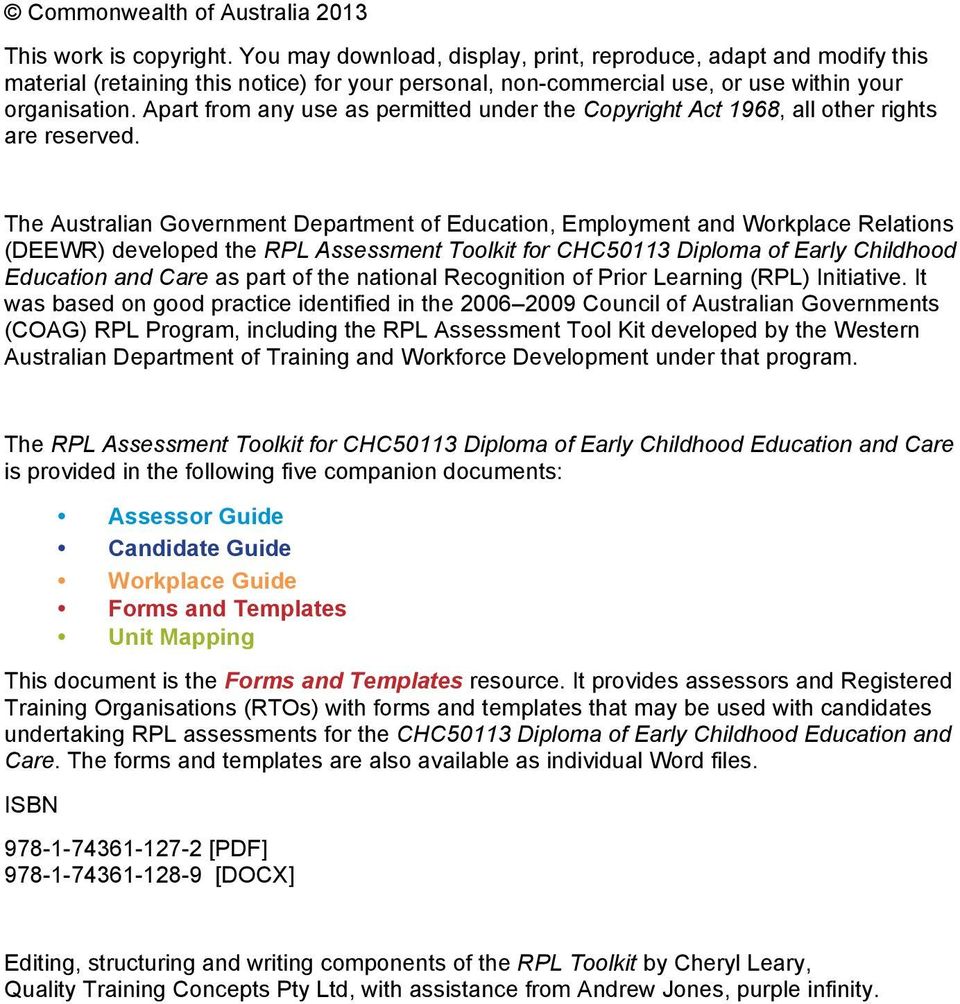
2 Commonwealth of Australia 2013 This work is copyright. You may download, display, print, reproduce, adapt and modify this material (retaining this notice) for your personal, non-commercial use, or use within your organisation. Apart from any use as permitted under the Copyright Act 1968, all other rights are reserved. The Australian Government Department of Education, Employment and Workplace Relations (DEEWR) developed the RPL Assessment Toolkit for CHC50113 Diploma of Early Childhood Education and Care as part of the national Recognition of Prior Learning (RPL) Initiative. It was based on good practice identified in the Council of Australian Governments (COAG) RPL Program, including the RPL Assessment Tool Kit developed by the Western Australian Department of Training and Workforce Development under that program. The RPL Assessment Toolkit for CHC50113 Diploma of Early Childhood Education and Care is provided in the following five companion documents: Assessor Guide Candidate Guide Workplace Guide Forms and Templates Unit Mapping This document is the Forms and Templates resource. It provides assessors and Registered Training Organisations (RTOs) with forms and templates that may be used with candidates undertaking RPL assessments for the CHC50113 Diploma of Early Childhood Education and Care. The forms and templates are also available as individual Word files. ISBN [PDF] [DOCX] Editing, structuring and writing components of the RPL Toolkit by Cheryl Leary, Quality Training Concepts Pty Ltd, with assistance from Andrew Jones, purple infinity.
3 RPL Assessment Toolkit CHC50113 Diploma of Early Childhood Education and Care Forms and Templates Contents Introduction 1 What is this resource? 1 What forms and templates are in this resource? 1 Can the forms and templates be customised? 1 Summary of forms and templates in this resource 2 Template for the Candidate Information Form 5 Template for the RPL Assessment Plan 10 Template for the Workplace Representative Form 19 Template for Third Party Report 21 Template for RPL Assessment Outcomes Form 23 Candidate Self-evaluation Tools 31 Candidate Self-evaluation Tools: Instructions for the assessor 33 Candidate Self-evaluation Tools: Instructions for the RPL candidate and workplace representative 34 Candidate self-evaluation for Cluster 1 Nutrition and children s health and safety 35 Candidate self-evaluation for Cluster 2 Work practices 40 Candidate self-evaluation for Cluster 3 Relationships with children 46 Candidate self-evaluation for Cluster 4 Physical and emotional wellbeing 51 Candidate self-evaluation for Cluster 5 Cultural competence and awareness 56 Candidate self-evaluation for Cluster 6 Health, safety and quality 61 Candidate self-evaluation for Cluster 7 Leadership and service management 67 Candidate self-evaluation for Cluster 8 Children s development and wellbeing 74 Candidate self-evaluation for Cluster 9 Program design and implementation 80 Candidate self-evaluation for Cluster 10 Children s behaviour and inclusion 85 Candidate Self-evaluation: Instructions for attaching documents 91 Candidate Self-evaluation: List of Attached Documents 92 Competency Conversation Recording Tools 94 Competency Conversation Recording Tools: Instructions for the assessor 96 Competency conversation recording tool for Cluster 1 Nutrition and children s health and safety 97 Competency conversation recording tool for Cluster 2 Work practices 103 Competency conversation recording tool for Cluster 3 Relationships with children 109 Commonwealth of Australia 2013 Contents Page iii
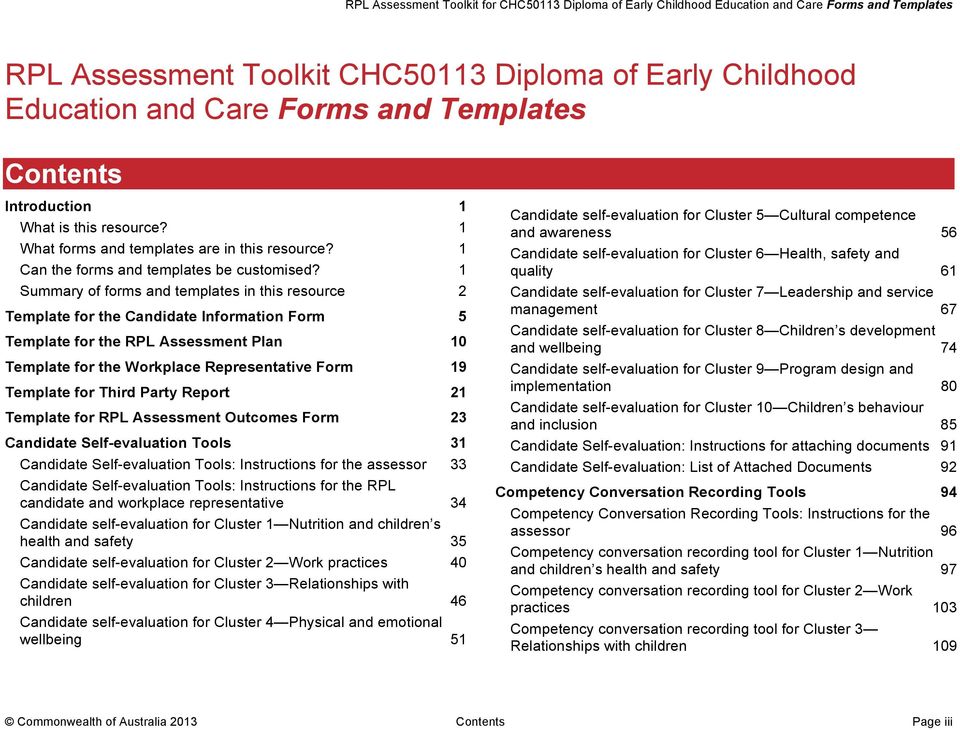
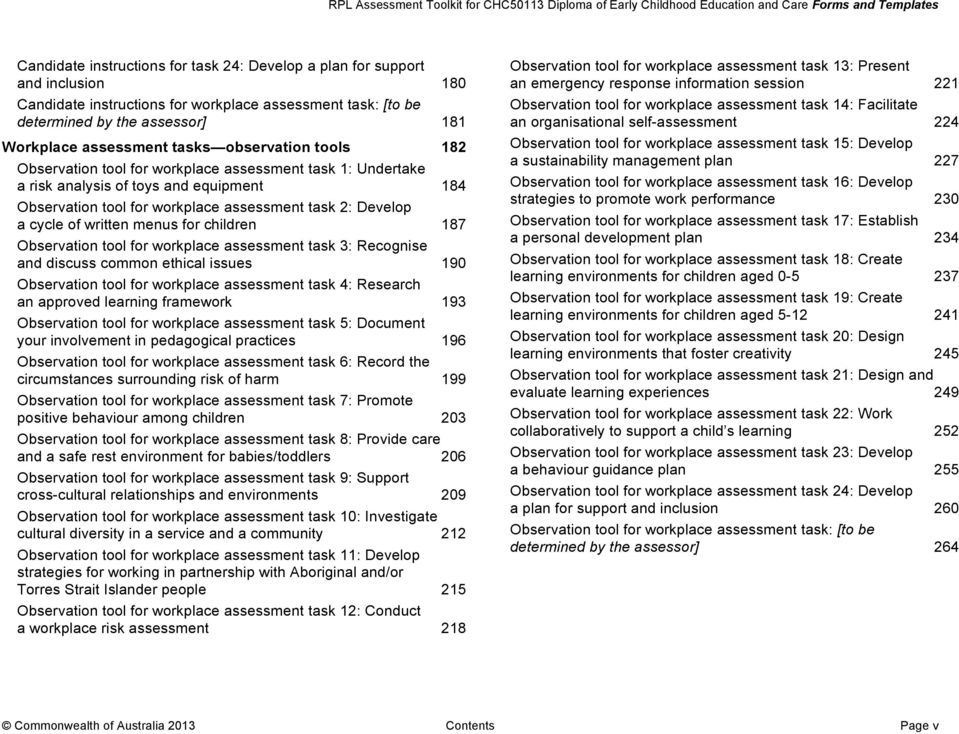
4 Competency conversation recording tool for Cluster 4 Physical and emotional wellbeing 113 Competency conversation recording tool for Cluster 5 Cultural awareness and competence 120 Competency conversation recording tool for Cluster 6 Health, safety and quality 126 Competency conversation recording tool for Cluster 7 Leadership and service management 133 Competency conversation recording tool for Cluster 8 Children s development and wellbeing 140 Competency conversation recording tool for Cluster 9 Program design and implementation 145 Competency conversation recording tool for Cluster 10 Children s behaviour and inclusion 151 Workplace assessment tasks instructions for candidates 155 Candidate instructions for task 1: Undertake a risk analysis of toys and equipment 157 Candidate instructions for task 2: Develop a cycle of written menus for children 158 Candidate instructions for task 3: Recognise and discuss common ethical issues 159 Candidate instructions for task 4: Research an approved learning framework 160 Candidate instructions for task 5: Document your involvement in pedagogical practices 161 Candidate instructions for task 6: Record the circumstances surrounding risk of harm 162 Candidate instructions for task 7: Promote positive behaviour among children 163 Candidate instructions for task 8: Provide care and a safe rest environment for babies/toddlers 164 Candidate instructions for task 9: Support cross-cultural relationships and environments 165 Candidate instructions for task 10: Investigate cultural diversity in a service and a community 166 Candidate instructions for task 11: Develop strategies for working in partnership with Aboriginal and/or Torres Strait Islander people 167 Candidate instructions for task 12: Conduct a workplace risk assessment 168 Candidate instructions for task 13: Present an emergency response information session 169 Candidate instructions for task 14: Facilitate an organisational self-assessment 170 Candidate instructions for task 15: Develop a sustainability management plan 171 Candidate instructions for task 16: Develop strategies to promote work performance 172 Candidate instructions for task 17: Establish a personal development plan 173 Candidate instructions for task 18: Create learning environments for children aged Candidate instructions for task 19: Create learning environments for children aged Candidate instructions for task 20: Design learning environments that foster creativity 176 Candidate instructions for task 21: Design and evaluate learning experiences 177 Candidate instructions for task 22: Work collaboratively to support a child s learning 178 Candidate instructions for task 23: Develop a behaviour guidance plan 179 Commonwealth of Australia 2013 Contents Page iv

5 Candidate instructions for task 24: Develop a plan for support and inclusion 180 Candidate instructions for workplace assessment task: [to be determined by the assessor] 181 Workplace assessment tasks observation tools 182 Observation tool for workplace assessment task 1: Undertake a risk analysis of toys and equipment 184 Observation tool for workplace assessment task 2: Develop a cycle of written menus for children 187 Observation tool for workplace assessment task 3: Recognise and discuss common ethical issues 190 Observation tool for workplace assessment task 4: Research an approved learning framework 193 Observation tool for workplace assessment task 5: Document your involvement in pedagogical practices 196 Observation tool for workplace assessment task 6: Record the circumstances surrounding risk of harm 199 Observation tool for workplace assessment task 7: Promote positive behaviour among children 203 Observation tool for workplace assessment task 8: Provide care and a safe rest environment for babies/toddlers 206 Observation tool for workplace assessment task 9: Support cross-cultural relationships and environments 209 Observation tool for workplace assessment task 10: Investigate cultural diversity in a service and a community 212 Observation tool for workplace assessment task 11: Develop strategies for working in partnership with Aboriginal and/or Torres Strait Islander people 215 Observation tool for workplace assessment task 12: Conduct a workplace risk assessment 218 Observation tool for workplace assessment task 13: Present an emergency response information session 221 Observation tool for workplace assessment task 14: Facilitate an organisational self-assessment 224 Observation tool for workplace assessment task 15: Develop a sustainability management plan 227 Observation tool for workplace assessment task 16: Develop strategies to promote work performance 230 Observation tool for workplace assessment task 17: Establish a personal development plan 234 Observation tool for workplace assessment task 18: Create learning environments for children aged Observation tool for workplace assessment task 19: Create learning environments for children aged Observation tool for workplace assessment task 20: Design learning environments that foster creativity 245 Observation tool for workplace assessment task 21: Design and evaluate learning experiences 249 Observation tool for workplace assessment task 22: Work collaboratively to support a child s learning 252 Observation tool for workplace assessment task 23: Develop a behaviour guidance plan 255 Observation tool for workplace assessment task 24: Develop a plan for support and inclusion 260 Observation tool for workplace assessment task: [to be determined by the assessor] 264 Commonwealth of Australia 2013 Contents Page v
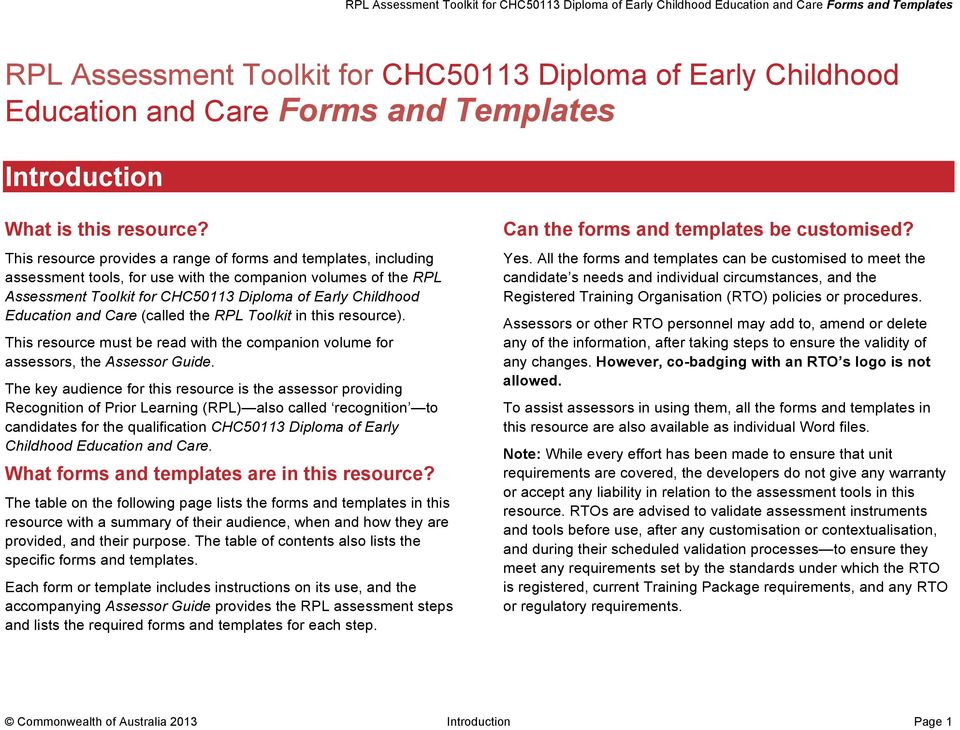
6 RPL Assessment Toolkit for CHC50113 Diploma of Early Childhood Education and Care Forms and Templates Introduction What is this resource? This resource provides a range of forms and templates, including assessment tools, for use with the companion volumes of the RPL Assessment Toolkit for CHC50113 Diploma of Early Childhood Education and Care (called the RPL Toolkit in this resource). This resource must be read with the companion volume for assessors, the Assessor Guide. The key audience for this resource is the assessor providing Recognition of Prior Learning (RPL) also called recognition to candidates for the qualification CHC50113 Diploma of Early Childhood Education and Care. What forms and templates are in this resource? The table on the following page lists the forms and templates in this resource with a summary of their audience, when and how they are provided, and their purpose. The table of contents also lists the specific forms and templates. Each form or template includes instructions on its use, and the accompanying Assessor Guide provides the RPL assessment steps and lists the required forms and templates for each step. Can the forms and templates be customised? Yes. All the forms and templates can be customised to meet the candidate s needs and individual circumstances, and the Registered Training Organisation (RTO) policies or procedures. Assessors or other RTO personnel may add to, amend or delete any of the information, after taking steps to ensure the validity of any changes. However, co-badging with an RTO s logo is not allowed. To assist assessors in using them, all the forms and templates in this resource are also available as individual Word files. Note: While every effort has been made to ensure that unit requirements are covered, the developers do not give any warranty or accept any liability in relation to the assessment tools in this resource. RTOs are advised to validate assessment instruments and tools before use, after any customisation or contextualisation, and during their scheduled validation processes to ensure they meet any requirements set by the standards under which the RTO is registered, current Training Package requirements, and any RTO or regulatory requirements. Commonwealth of Australia 2013 Introduction Page 1
7 Summary of forms and templates in this resource Please see the Assessor Guide for details of the RPL assessment steps referred to in the tables below. Form or template Who uses it? When is it provided and by whom? What is its purpose? Candidate Information Form The prospective RPL candidate completes this (before commencing the RPL assessment process). The RTO considers information on the form in deciding RPL participation. An RTO contact person such as an RPL Coordinator, Information Officer or assessor provides it to the prospective RPL candidate on application to participate in RPL (and/or uses RTO-required forms or processes), and gives the candidate advice about RPL. This form can be used by the RTO to capture initial information about an applicant for RPL. The assessor considers the information on this form during Step 1 of the RPL assessment process the initial interview and RPL planning session. RPL Assessment Plan Template The assessor prepares a draft RPL Assessment Plan and finalises it with candidate during Step 1. Then it is updated as the RPL assessment process continues. The assessor considers information from the Candidate Information Form and discussion with the candidate during Step 1 in developing the Plan (including adding any other electives if chosen). The candidate and the assessor should both make copies and bring them to every RPL assessment activity for updating. The RPL Assessment Plan is used to document the intended steps in the RPL assessment process for that candidate, including electives, any dates of visits, clusters to be considered, and expectations of the candidate and workplace. Note: The RPL Assessment Plan will be progressively amended during the RPL assessment process. Workplace Representative Form All workplace representatives who verify candidate performance should complete this form. The assessor should provide this to the workplace representative when workplace verification is sought give it to the candidate with the Candidate Selfevaluation Tools so they can pass it on to the workplace representative (and if a Third Party Report is requested). This form requires the workplace representative to verify that they understand what is required of them, and that information they provide will be true and correct. It is intended to reinforce the accountability and significance of workplace verifications. Commonwealth of Australia 2013 Introduction Page 2

8 Form or template Who uses it? When is it provided and by whom? What is its purpose? Third Party Report Template The assessor adds any requirements for a Third Party Report to the template, and the workplace representative completes it. The assessor would provide this to an appropriately qualified workplace representative where further verification of specific candidate skills or knowledge is required. This form is used to capture further verification from a workplace that a candidate can apply specified skills or knowledge. RPL Assessment Outcomes Form The assessor uses this form to record RPL assessment methods and final outcomes. Assessors and candidates sign the form at the end of the RPL process. The assessor can progressively add the RPL assessment methods for each unit. The form should be finalised by the assessor after the RPL assessment process for all units is concluded, and signed by both the assessor and candidate. This form provides the capacity to record the RPL assessment methods for a candidate and the final outcomes of the RPL assessment process for all units of competency that make up the qualification. Candidate Selfevaluation Tools The candidate completes these after Step 1 of the RPL assessment process. A workplace representative verifies the candidate s self-evaluation. After the Candidate Selfevaluation Tools are returned, the assessor considers the evidence and records outcomes. The assessor provides these to the candidate during Step 1 of the RPL assessment process (the initial interview and RPL planning step) and should advise the candidate how to complete it, including the need for workplace verification of skills. After the initial interview in Step 1, the candidate independently completes the tools and gains workplace verification, then copies and returns the tools to the assessor on the agreed date. The assessor considers the information provided, along with any documentary evidence before Step 2 the competency conversations. The completed candidate self-evaluation tools can also be referred to during Step 2. These tools allow candidates to document and evaluate their knowledge and skills against workplace tasks (aligned to unit clusters) and to collate some initial evidence. They also require workplace representatives to verify the candidate s skills and knowledge. The candidate identifies workplace tasks they can do, and the workplace verifies this. This provides some evidence for the assessor to consider and also assists the candidate to prepare for Step 2 of the RPL assessment process (the competency conversation). This tool provides the assessor with evidence to consider before Step 2. Commonwealth of Australia 2013 Introduction Page 3

9 Form or template Who uses it? When is it provided and by whom? What is its purpose? Competency Conversation Recording Tools The assessor completes these during Step 2 of the RPL assessment process the competency conversation interviews. Note: The recording tools are not provided to the candidate. Before Step 2 of the RPL assessment process, the assessor should prepare the tools for use in Step 2 by: deleting any sections that will not be assessed in that session (it is unrealistic to cover all the unit clusters in the RPL Toolkit in one session) saving the files to a laptop, or printing hard copies, depending on method used to record candidate responses. These assessment tools provide: a bank of questions and prompts for the assessor to use during the conversations an assessment tool in which the assessor can record evidence of the competency conversation key points the assessor should look for in candidate responses, with the capacity to record candidate responses. Workplace Assessment Tasks: Instructions for the Candidate The candidate reads these to gain information on the workplace assessment task or tasks they need to undertake. The assessor should advise candidates which workplace assessment task or tasks are required, and agree a date and workplace location with the candidate. The assessor should provide the appropriate instructions to candidates before the workplace assessment task is undertaken. These provide the candidate with instructions on the workplace assessment task requirements and criteria for assessment, thus assisting them to prepare for the assessment. They may also assist the workplace to understand what the task demonstration involves. Workplace Assessment Tasks: Observation Tools The assessor completes the observation tools during the workplace assessment. The assessor should use the tools during the demonstration. The assessment tools describe the assessment tasks and criteria for assessment, and are used to record the assessor s observations and outcomes of workplace assessment tasks. Commonwealth of Australia 2013 Introduction Page 4

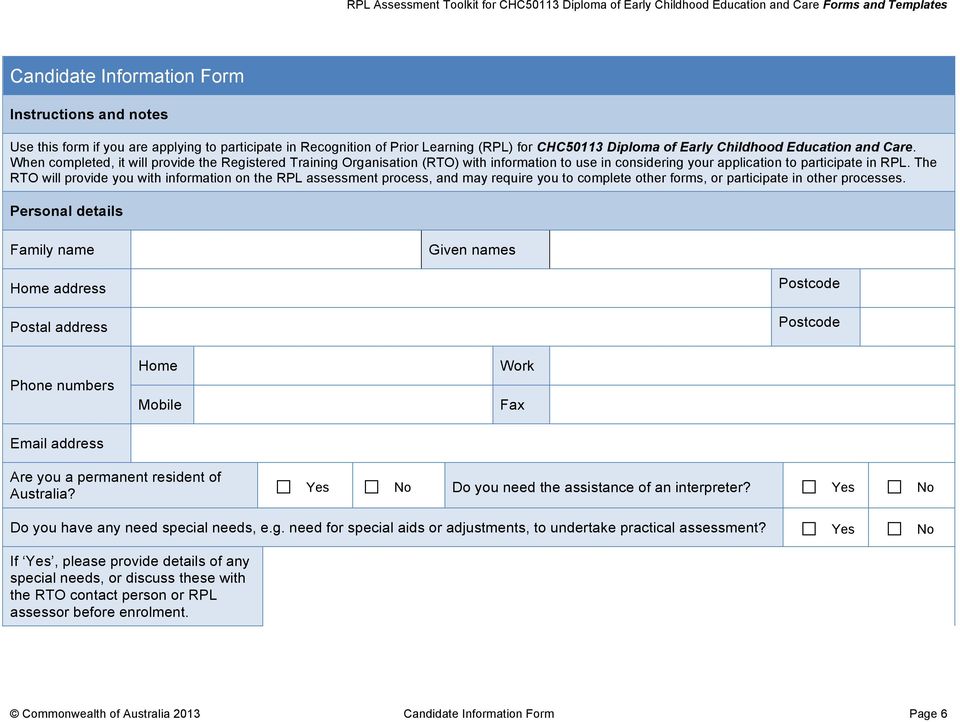
10 Template for the Candidate Information Form The following template provides the basis for a Candidate Information Form to capture initial information about prospective RPL candidates (additional to any RTO-required forms or processes). In completing the form, the candidate provides some initial information and may also attach documents such as a Resume or reference. The blank form would typically be provided to a person registering their interest in RPL, and could be provided by an RTO contact person such as an RPL Coordinator, Information Officer. When providing the form, that person should also give the candidate brief and accurate information about the likely RPL processes. At the first enquiry, or after being accepted for RPL the candidate should also be provided with the Candidate Guide from this RPL Toolkit. That document advises them on the RPL assessment processes involved. If the prospective RPL candidate completes this form before commencing the RPL assessment process, the RTO has some initial information to consider in deciding their RPL eligibility and participation. Once the candidate is enrolled with the RTO, the assessor can also consider the information and any initial evidence provided by the candidate in the initial interview and planning session (Step 1 of the RPL assessment process recommended in this RPL Toolkit). Commonwealth of Australia 2013 Candidate Information Form Page 5

11 Candidate Information Form Instructions and notes Use this form if you are applying to participate in Recognition of Prior Learning (RPL) for CHC50113 Diploma of Early Childhood Education and Care. When completed, it will provide the Registered Training Organisation (RTO) with information to use in considering your application to participate in RPL. The RTO will provide you with information on the RPL assessment process, and may require you to complete other forms, or participate in other processes. Personal details Family name Given names Home address Postal address Postcode Postcode Phone numbers Home Mobile Work Fax address Are you a permanent resident of Australia? Yes No Do you need the assistance of an interpreter? Yes No Do you have any need special needs, e.g. need for special aids or adjustments, to undertake practical assessment? Yes No If Yes, please provide details of any special needs, or discuss these with the RTO contact person or RPL assessor before enrolment. Commonwealth of Australia 2013 Candidate Information Form Page 6
12 Current employment (If you are not employed please go to the next section of this form) What is your current job title? How long have you been in this job? Who is your current employer? Please briefly list your duties in this job. Previous employment and other work roles RPL recognises that you may have gained valuable skills and knowledge in paid (and unpaid) working roles. For example, you might have worked in an early childhood education and care service where you designed and implemented curriculum, implemented an approved learning framework or supervised others. In completing the following section, think about working roles relevant to your application. List brief details of any relevant work you have done (paid or unpaid). Job title Employer or organisation Dates of work I have attached a CV or Resume (Please attach this if you have one.) Yes No Commonwealth of Australia 2013 Candidate Information Form Page 7

13 List some of the tasks you can do (or have done) in paid or unpaid work that might relate to early childhood education and care work. Related (non work) experience RPL also recognises that you may have gained skills and knowledge in experiences such as informal training, volunteer work or clubs. For example in informal roles, you might have used people and communications skills, handled funds, worked in committee processes, spoken to stakeholders or participated in informal training or self-development activities. If you have relevant (non-job) experiences, please list them below. Qualifications, Statements of Attainment or workplace training If you have any qualifications, Statements of Attainment or other awards from a training organisation, please list them below. Commonwealth of Australia 2013 Candidate Information Form Page 8

14 Is there any more information you wish to give in support of your application to participate in RPL? (Attach other pages if needed.) Declaration Applicant s signature I declare that the information contained in or provided with this application is true and correct. Date Commonwealth of Australia 2013 Candidate Information Form Page 9

15 Template for the RPL Assessment Plan The following template provides the basis for an RPL Assessment Plan for the assessor to complete with the candidate during Step 1 of the RPL assessment process (the initial interview and planning session). The Plan should be thought of as a living document, to be updated throughout the RPL assessment process. The RPL Assessment Plan is used to document the requirements and steps in the RPL assessment process for the candidate, such as electives chosen, dates of workplace visits, clusters to be considered, and expectations of the candidate and workplace. To develop the Plan, the assessor should consider information in the Candidate Information Form as well as information gained in discussions with the candidate at the initial interview and planning session (Step 1). Then, in consultation with the candidate, the assessor should develop the first cut of the Plan for that candidate. The candidate and the assessor should both make copies and bring them to every RPL assessment activity for updating as the assessment process progresses (for example, by adding information about the competency conversation sessions, or identified workplace assessment tasks as required). Commonwealth of Australia 2013 RPL Assessment Plan Page 10
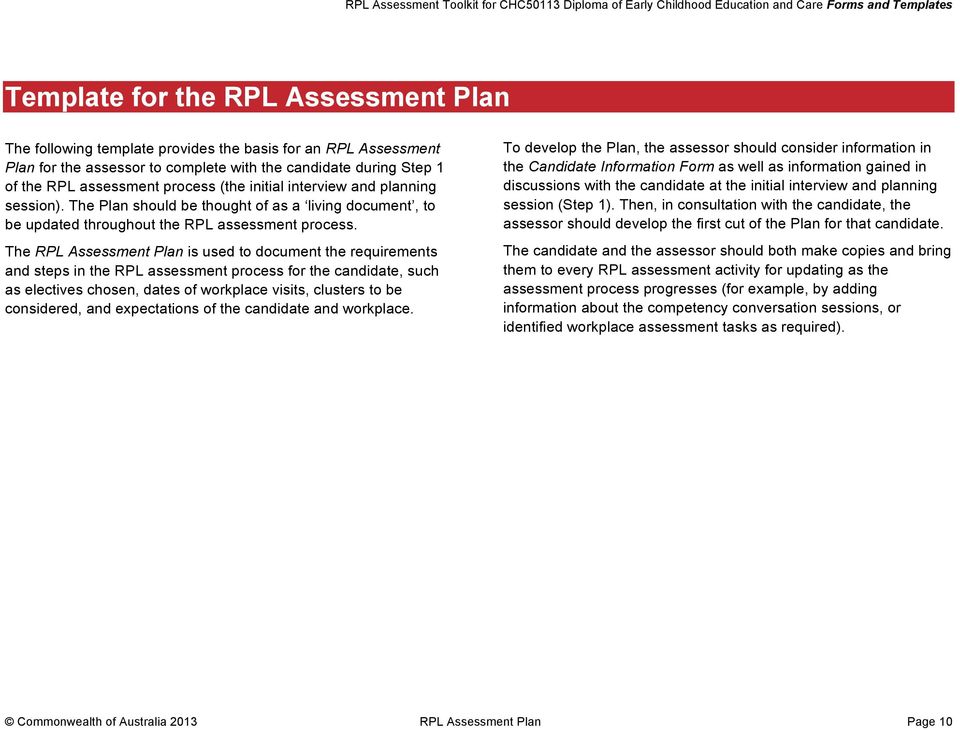
16 RPL Assessment Plan: CHC50113 Diploma of Early Childhood Education and Care Instructions and notes This form is for initial completion by the assessor with the candidate in Step 1, at the initial RPL interview and planning session it sets out the steps in the RPL process for an individual candidate based on their needs and circumstances. First, complete Parts 1 to 6, then, as the RPL assessment process continues, progressively update dates and activities using Part 7. Both the assessor and candidate should keep a copy and bring their copy to each RPL assessment activity for updating if needed. Candidate s personal details Family name PART 1: UNITS OF COMPETENCY FOR RPL Given names Employer Units of competency (If other electives selected, delete incorrect electives in the table and add selected electives.) Is RPL sought for this unit? Cluster 1 Nutrition and children s health and safety CHCECE002 Ensure the health and safety of children (core unit) Yes No CHCECE004 Promote and provide healthy food and drinks (core unit) Yes No Cluster 2 Work practices CHCCS400C Work within a relevant legal and ethical framework (core unit) Yes No CHCPRT001 Identify and respond to children and young people at risk (core unit) Yes No CHCECE009 Use an approved learning framework to guide practice (core unit) Yes No Commonwealth of Australia 2013 RPL Assessment Plan Page 11
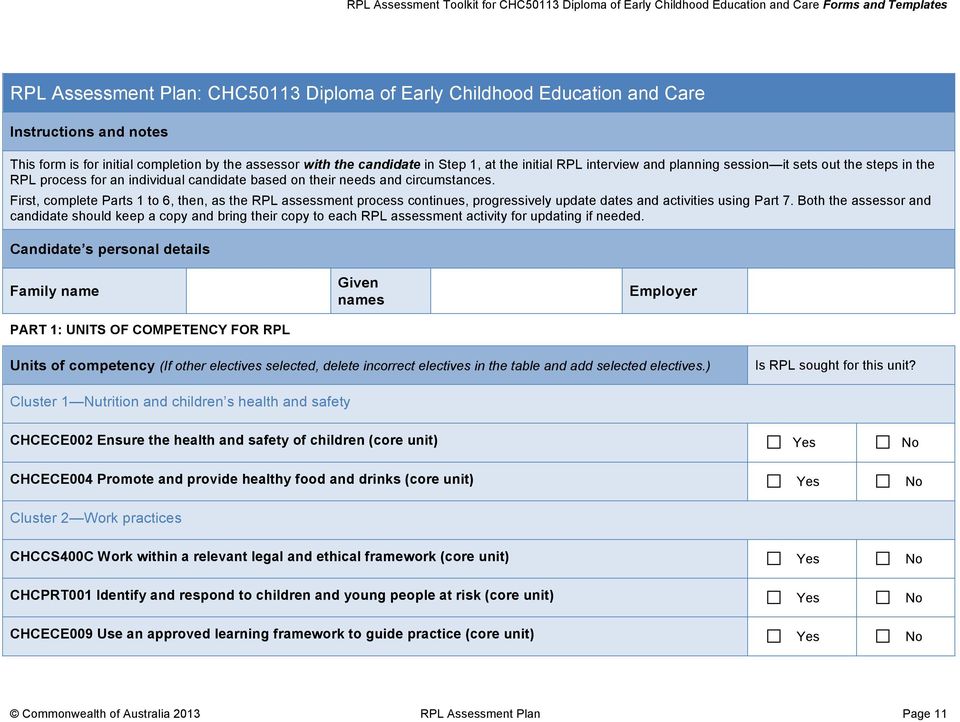
17 Units of competency (If other electives selected, delete incorrect electives in the table and add selected electives.) Is RPL sought for this unit? Cluster 3 Relationships with children CHCECE007 Develop positive and respectful relationships with children (core unit) Yes No Cluster 4 Physical and emotional wellbeing CHCECE003 Provide care for children (core unit) Yes No CHCECE005 Provide care for babies and toddlers (core unit) Yes No Cluster 5 Cultural awareness and competence CHCECE001 Develop cultural competence (core unit) Yes No HLTHIR404D Work effectively with Aboriginal and/or Torres Strait Islander people (core unit) Yes No Cluster 6 Health, safety and quality CHCECE016 Establish and maintain a safe and healthy environment for children (core unit) Yes No CHCECE019 Facilitate compliance in an education and care service (core unit) Yes No HLTWHS003 Maintain work health and safety (core unit) Yes No Cluster 7 Leadership and service management CHCECE025 Embed sustainable practices in service operations (core unit) Yes No Commonwealth of Australia 2013 RPL Assessment Plan Page 12
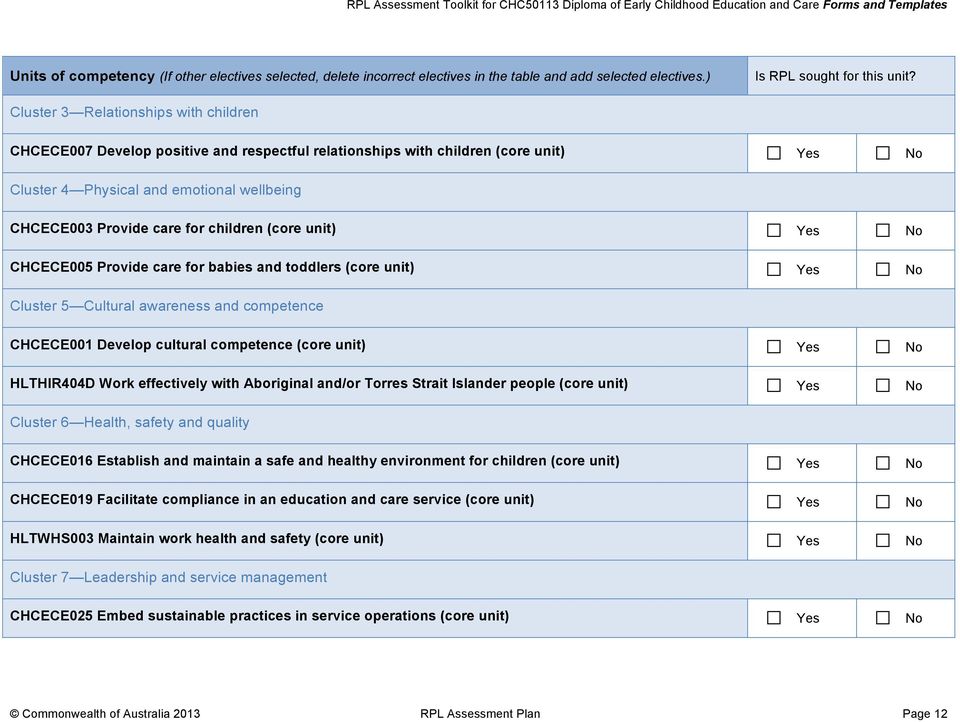
18 Units of competency (If other electives selected, delete incorrect electives in the table and add selected electives.) Is RPL sought for this unit? CHCORG428A Reflect on and improve own professional practice (elective unit) Yes No CHCORG506E Coordinate the work environment (elective unit) Yes No CHCORG624E Provide leadership in community services delivery (elective unit) Yes No CHCPOL504B Develop and implement policy (elective unit) Yes No Cluster 8 Children s development and wellbeing CHCECE017 Foster the holistic development and wellbeing of the child in early childhood (core unit) Yes No CHCECE018 Nurture creativity in children (core unit) Yes No CHCSAC005 Foster the holistic development and wellbeing of the child in school age care (elective unit) Yes No Cluster 9 Program design and implementation CHCECE022 Promote children s agency (core unit) Yes No CHCECE023 Analyse information to inform learning (core unit) Yes No CHCECE024 Design and implement the curriculum to foster children's learning and development (core unit) Yes No CHCECE026 Work in partnership with families to provide appropriate education and care for children (core) Yes No Cluster 10 Children s behaviour and inclusion Commonwealth of Australia 2013 RPL Assessment Plan Page 13
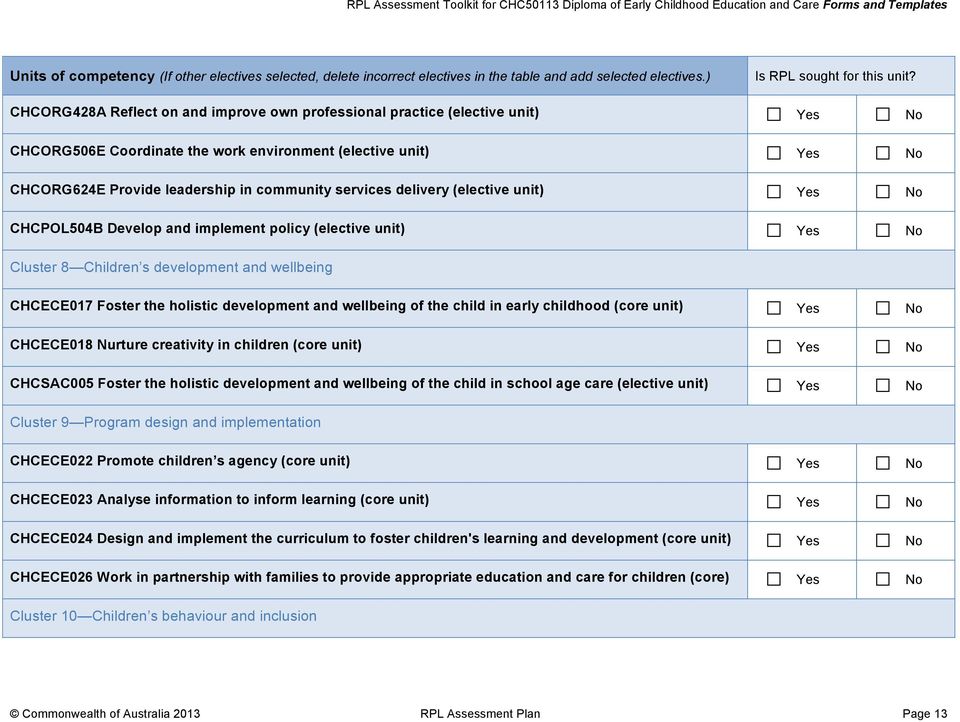
19 Units of competency (If other electives selected, delete incorrect electives in the table and add selected electives.) Is RPL sought for this unit? CHCECE020 Establish and implement plans for developing cooperative behaviour (core unit) Yes No CHCECE021 Implement strategies for the inclusion of all children (core unit) Yes No Unit not provided for in the RPL Toolkit but required for the qualification See note below and record how this is to be provided: HLTAID004 Provide an emergency first aid response in an education and care setting (core unit) [If other electives are selected, add them below, and delete any above as applicable 5 electives are required.] Yes Yes No No Yes Yes Yes No No No Note: The core unit HLTAID004 Provide an emergency first aid response in an education and care setting is not provided for in the RPL Toolkit, apart from the capacity to record that it has been attained in the RPL Assessment Outcomes Form. Depending on regulatory and workplace requirements, some candidates may hold the unit or its equivalent. If so, candidates could provide evidence such as a Statement of Attainment. If they do not hold the unit, they should be assessed against its requirements. Commonwealth of Australia 2013 RPL Assessment Plan Page 14

20 PART 2: AGREED DATES FOR CANDIDATE TO COMPLETE THEIR SELF-EVALUATION Candidate self-evaluation and workplace verification Agreed date for completion Done? Candidate Self-evaluation Tools (The candidate should complete the Candidate Self-evaluation Tools, seek workplace verification, and return the completed tools to the assessor before or on the agreed date.) Workplace Representative Form (The workplace representative should complete a Workplace Representative Form, when verifying the candidate s self-evaluation. The candidate should return it and the assessor should retain it.) This should be returned with the Self-evaluation tools. PART 3: AGREED DATES AND COVERAGE OF COMPETENCY CONVERSATIONS Competency conversation interviews (Assessors should add details of the clusters or units to be addressed in each competency conversation interview session in the table below. This section will usually be completed after the initial interview and assessor consideration of the candidate s self-evaluation.) Agreed date Venue Done? Commonwealth of Australia 2013 RPL Assessment Plan Page 15
21 Competency conversation interviews (Assessors should add details of the clusters or units to be addressed in each competency conversation interview session in the table below. This section will usually be completed after the initial interview and assessor consideration of the candidate s self-evaluation.) Agreed date Venue Done? PART 4: AGREED DATES AND DETAILS OF WORKPLACE ASSESSMENT TASKS Workplace assessment tasks (Assessors should add the number and brief title of the required workplace assessment tasks below, noting that this section will usually be completed after the competency conversation interview/s.) Agreed date Venue Done? Commonwealth of Australia 2013 RPL Assessment Plan Page 16
22 Workplace assessment tasks (Assessors should add the number and brief title of the required workplace assessment tasks below, noting that this section will usually be completed after the competency conversation interview/s.) Agreed date Venue Done? PART 5: THIRD PARTY REPORTING REQUIREMENTS Third Party Report (Assessor to add brief summary of any required report/s below, noting that this section will usually be completed after other RPL evidence gathering and assessment processes if further workplace verification is required.) Agreed date Done? PART 6: CANDIDATE AND ASSESSOR SIGN OFF (ON PLAN AS FIRST DEVELOPED) Signatures Assessor s name Assessor signature Date Candidate s signature Date (If required, update the above information in the following section of the table, or attach additional sheets, as changes to the above are made.) Any updates? Yes No Commonwealth of Australia 2013 RPL Assessment Plan Page 17
23 PART 7: ANY ADDITIONAL UPDATES OR CHANGES DURING THE RPL PROCESS RPL Assessment Plan: Updated Information Date and assessor and candidate initials Finalisation of RPL process: Once all the above-listed processes are completed and recorded, the assessor should provide the candidate with feedback, record the outcomes on the RPL Toolkit s RPL Assessment Outcomes Form, and follow the RTO s procedures to finalise the RPL process. Commonwealth of Australia 2013 RPL Assessment Plan Page 18
24 Template for the Workplace Representative Form All workplace representatives who verify candidate performance should complete the following form. The assessor should provide it to the workplace representative when verification of candidate skills and knowledge is sought perhaps by giving it to the candidate with the Candidate Self-evaluation Tools so they can in turn give it to the workplace representative, or by giving it directly to the workplace if a Third Party Report is requested and negotiated. The form requires the workplace representative to verify that they understand the process and that any verification and information they provide will be, to the best of their ability, true and correct. The form is intended to reinforce the accountability and significance of workplace verifications. Commonwealth of Australia 2013 Workplace Representative Form Page 19
25 Confidential Workplace Representative Form: CHC50113 Diploma of Early Childhood Education and Care Purpose of this form: The Registered Training Organisation (RTO) in which the candidate below is enrolled, requires all workplace representatives who verify an RPL candidate s skills and knowledge to complete this form. Such workplace representatives will typically be working with the candidate in a position of responsibility, perhaps their employer or supervisor, hold higher qualifications than the candidate, and have observed their workplace performance. To ensure all candidates gain recognition for skills and knowledge they genuinely hold, workplace representatives must carefully consider their verification of the candidate and provide accurate statements. Candidate s name Candidate s workplace Name of workplace representative completing this form Workplace Is the workplace verification related to (tick response): Candidate Self-evaluation? Yes Third Party Report? Yes What is your working relationship to the candidate? (e.g. team leader, manager, employer, supervisor) Please list your qualifications and give a summary of your experience in Children s Services How long have you worked with the RPL candidate? (Please provide date range if possible.) Have you had an explanation, and do you understand what is required of you, in providing verification of the candidate s skills? Yes No Do you understand your responsibilities in verifying a candidate s workplace skills and knowledge as accurately as possible? Yes No Would you like to be provided with more information about the requested workplace verification before you complete it? Yes No Are you willing to be contacted if further verification of the candidate s skills and knowledge is required? Yes No Declaration: In signing this form you agree that you are appropriately qualified to verify the candidate s current Children s Services-related workplace skills and knowledge, and that if you provide the requested workplace verification, it will be, to the best of your knowledge, accurate and correct. Workplace representative s signature Date Commonwealth of Australia 2013 Confidential Workplace Representative Form Page 20
26 Template for Third Party Report The following template provides a basis for the assessor to design a Third Party Report where additional workplace verification of any aspect of their workplace skills or knowledge is required. For example, it could be used after candidate-directed workplace activities to gain evidence of application of knowledge. Commonwealth of Australia 2013 Third Party Report Form Page 21
27 Third Party Report: CHC50113 Diploma of Early Childhood Education and Care Instructions In completing this report you are asked to provide third party verification as accurately as possible that the candidate can apply the workplace skills and knowledge specified below. Please try to provide examples of how the candidate applies the skills or knowledge. [Assessor to add required skills to table.] Details of workplace representative completing this report Family name Given name Employer Please give information on whether the candidate consistently applies the skills and knowledge listed below to the expected workplace standard. I have completed and provided a Workplace Representative Form Yes No Workplace representative s signature Date Commonwealth of Australia 2013 Third Party Report Form Page 22
28 Template for RPL Assessment Outcomes Form The RPL Assessment Outcomes Form provides the capacity to record the RPL assessment methods for each unit and the final outcomes of the RPL assessment process for all units of competency that make up the qualification. The assessor should progressively add information on the RPL assessment methods undertaken with the candidate. After the RPL assessment process for all units is concluded, the form should be finalised by the assessor and signed by both the assessor and candidate. Depending on the RTOs record-keeping processes, the completed form would usually be kept in the candidate s file, providing a summary of the processes undertaken and the final RPL outcomes. Commonwealth of Australia 2013 RPL Assessment Outcomes Form Page 23
29 RPL Assessment Outcomes: CHC50113 Diploma of Early Childhood Education and Care Instructions and notes This form is for completion by the assessor it provides a cover sheet in which details of the final assessment outcome for a candidate and the basis for that decision can be recorded. Assessors should progressively add information as RPL assessment activities are undertaken. Depending on the RTO s processes, the assessor could add information for units not assessed by RPL (e.g. credit transfer, national recognition, or training and assessment). Once final assessment is completed, assessors should finalise the form by ticking Competent or Not Yet Competent for each unit, signing the declaration and having the candidate also sign the form. The signed copy would usually then be retained in the candidate s file of RPL assessment evidence. Personal details Family name Given names Employer Units of competency Record of RPL assessment processes undertaken for each unit [Assessor to initial and date the evidence-gathering processes undertaken] Final Outcome [Assessor to tick Competent (C) or Not Yet Competent (NYC) and initial and date] Core (C), Elective (E) [Assessor must amend this list if other electives are chosen] Initial RPL Interview Candidate Selfevaluation Competency Conversation Interview Workplace Assessment Task Third Party Report C NYC CHCECE002 Ensure the health and safety of children (C) CHCECE004 Promote and provide healthy food and drinks (C) Commonwealth of Australia 2013 RPL Assessment Outcomes Form Page 24
30 Units of competency Record of RPL assessment processes undertaken for each unit [Assessor to initial and date the evidence-gathering processes undertaken] Final Outcome [Assessor to tick Competent (C) or Not Yet Competent (NYC) and initial and date] Core (C), Elective (E) [Assessor must amend this list if other electives are chosen] Initial RPL Interview Candidate Selfevaluation Competency Conversation Interview Workplace Assessment Task Third Party Report C NYC CHCCS400C Work within a relevant legal and ethical framework (C) CHCPRT001 Identify and respond to children and young people at risk (C) CHCECE009 Use an approved learning framework to guide practice (C) CHCECE007 Develop positive and respectful relationships with children (C) CHCECE003 Provide care for children (C) CHCECE005 Provide care for babies and toddlers (C) Commonwealth of Australia 2013 RPL Assessment Outcomes Form Page 25
31 Units of competency Record of RPL assessment processes undertaken for each unit [Assessor to initial and date the evidence-gathering processes undertaken] Final Outcome [Assessor to tick Competent (C) or Not Yet Competent (NYC) and initial and date] Core (C), Elective (E) [Assessor must amend this list if other electives are chosen] Initial RPL Interview Candidate Selfevaluation Competency Conversation Interview Workplace Assessment Task Third Party Report C NYC CHCECE001 Develop cultural competence (C) HLTHIR404D Work effectively with Aboriginal and/or Torres Strait Islander people (C) CHCECE016 Establish and maintain a safe and healthy environment for children (C) CHCECE019 Facilitate compliance in an education and care service (C) HLTWHS003 Maintain work health and safety (C) CHCECE025 Embed sustainable practices in service operations (C) Commonwealth of Australia 2013 RPL Assessment Outcomes Form Page 26
32 Units of competency Record of RPL assessment processes undertaken for each unit [Assessor to initial and date the evidence-gathering processes undertaken] Final Outcome [Assessor to tick Competent (C) or Not Yet Competent (NYC) and initial and date] Core (C), Elective (E) [Assessor must amend this list if other electives are chosen] Initial RPL Interview Candidate Selfevaluation Competency Conversation Interview Workplace Assessment Task Third Party Report C NYC CHCORG428A Reflect on and improve own professional practice (E) CHCORG506E Coordinate the work environment (E) CHCORG624E Provide leadership in community services delivery (E) CHCPOL504B Develop and implement policy (E) CHCECE017 Foster the holistic development and wellbeing of the child in early childhood (C) CHCECE018 Nurture creativity in children (C) Commonwealth of Australia 2013 RPL Assessment Outcomes Form Page 27
33 Units of competency Record of RPL assessment processes undertaken for each unit [Assessor to initial and date the evidence-gathering processes undertaken] Final Outcome [Assessor to tick Competent (C) or Not Yet Competent (NYC) and initial and date] Core (C), Elective (E) [Assessor must amend this list if other electives are chosen] Initial RPL Interview Candidate Selfevaluation Competency Conversation Interview Workplace Assessment Task Third Party Report C NYC CHCSAC005 Foster the holistic development and wellbeing of the child in school age care (E) CHCECE022 Promote children s agency (C) CHCECE023 Analyse information to inform learning (C) CHCECE024 Design and implement the curriculum to foster children's learning and development (C) CHCECE026 Work in partnership with families to provide appropriate education and care for children (C) CHCECE020 Establish and implement plans for developing cooperative behaviour (C) Commonwealth of Australia 2013 RPL Assessment Outcomes Form Page 28
34 Units of competency Record of RPL assessment processes undertaken for each unit [Assessor to initial and date the evidence-gathering processes undertaken] Final Outcome [Assessor to tick Competent (C) or Not Yet Competent (NYC) and initial and date] Core (C), Elective (E) [Assessor must amend this list if other electives are chosen] Initial RPL Interview Candidate Selfevaluation Competency Conversation Interview Workplace Assessment Task Third Party Report C NYC CHCECE021 Implement strategies for the inclusion of all children (C) HLTAID004 Provide an emergency first aid response in an education and care setting (C) [NB: Not provided for in the RPL Toolkit record how attained.] [If other electives are selected, add them below, and delete any above as applicable 5 electives are required.] Commonwealth of Australia 2013 RPL Assessment Outcomes Form Page 29
35 Units of competency Record of RPL assessment processes undertaken for each unit [Assessor to initial and date the evidence-gathering processes undertaken] Final Outcome [Assessor to tick Competent (C) or Not Yet Competent (NYC) and initial and date] Core (C), Elective (E) [Assessor must amend this list if other electives are chosen] Initial RPL Interview Candidate Selfevaluation Competency Conversation Interview Workplace Assessment Task Third Party Report C NYC Assessor s declaration: On the basis of the assessment outcomes listed above, the candidate meets the requirements to be awarded the qualification CHC50113 Diploma of Early Childhood Education and Care. Yes No Assessor s signature Candidate s signature Date Date Commonwealth of Australia 2013 RPL Assessment Outcomes Form Page 30
36 Candidate Self-evaluation Tools Introduction The Candidate Self-evaluation Tools are for the candidate s own evaluation. The candidate is required to consider the workplace tasks they can do, and complete these tools in their own time. The candidate should be given the tools at Step 1 of the RPL assessment process the initial interview and planning session. The assessor should advise the candidate on how to complete the self-evaluation, including the need for workplace verification. The tools allow candidates to document and broadly evaluate their knowledge and skills against workplace tasks they believe they can do, and to collate some initial evidence. The tools include instructions for assessors, candidates and workplaces, self-evaluation tools for ten clusters of units of competency, and a form for listing any attached evidence. The units of competency are arranged in ten clusters as follows. Clusters 1 to 5 The Candidate Self-evaluation Tools in Clusters 1 to 5 relate to ten of 11 core units in the CHC50113 Diploma of Early Childhood Education and Care that are also core in the CHC30113 Certificate III in Early Education and Care 1. Please see the Assessor Guide for details of candidate pathways. 1 The core unit HLTAID004 Provide an emergency first aid response in an education and care setting is not in RPL Toolkit for CHC50113 Diploma of Early Childhood Education and Care Cluster 1 Nutrition and children s health and safety CHCECE002 Ensure the health and safety of children CHCECE004 Promote and provide healthy food and drinks Cluster 2 Work practices CHCCS400C Work within a relevant legal and ethical framework CHCECE009 Use an approved learning framework to guide practice CHCPRT001 Identify and respond to children and young people at risk Cluster 3 Relationships with children CHCECE007 Develop positive and respectful relationships with children Cluster 4 Physical and emotional wellbeing CHCECE003 Provide care for children CHCECE005 Provide care for babies and toddlers Cluster 5 Cultural awareness and competence CHCECE001 Develop cultural competence HLTHIR404D Work effectively with Aboriginal and/or Torres Strait Islander people Clusters 6 to 10 The Candidate Self-evaluation Tools in Clusters 6 to 10 relate to the remaining 12 core units required for the CHC50113 Diploma of Early Childhood Education and Care and five electives. Commonwealth of Australia 2013 Candidate Self-evaluation Tools Page 31
37 Cluster 6 Health, safety and quality CHCECE016 Establish and maintain a safe and healthy environment for children (core) CHCECE019 Facilitate compliance in an education and care service (core) HLTWHS003 Maintain work health and safety (core) Cluster 7 Leadership and service management CHCECE025 Embed sustainable practices in service operations (core) CHCORG428A Reflect on and improve own professional practice (elective) CHCORG506E Coordinate the work environment (elective) CHCORG624E Provide leadership in community services delivery (elective) CHCPOL504B Develop and implement policy (elective) Cluster 8 Children s development and wellbeing CHCECE017 Foster the holistic development and wellbeing of the child in early childhood (core) CHCECE018 Nurture creativity in children (core) CHCSAC005 Foster the holistic development and wellbeing of the child in school age care (elective) Cluster 9 Program design and implementation CHCECE022 Promote children s agency (core) CHCECE023 Analyse information to inform learning (core) CHCECE024 Design and implement the curriculum to foster children's learning and development (core) CHCECE026 Work in partnership with families to provide appropriate education and care for children (core) Cluster 10 Children s behaviour and inclusion CHCECE020 Establish and implement plans for developing cooperative behaviour (core) CHCECE021 Implement strategies for the inclusion of all children (core) Use of the Candidate Self-evaluation Tools Assessors should provide the required Candidate Self-evaluation Tools, depending on any units already held. The Assessor Guide explains pathways for candidates. In summary: candidates who hold no Children's Services or Early Childhood Education and Care qualifications or relevant units would be provided with the Self-evaluation Tools for Clusters 1 to 10 (as they hold none of the units of competency required for CHC50113) candidates who hold the replaced Children's Services Certificate III and Diploma qualifications (CHC30708/12 and CHC50908) would be provided with the Self-evaluation Tools for Clusters 1 to 10 (as they hold no units of competency equivalent to the units required for CHC50113) candidates who hold the CHC30113 Certificate III in Early Childhood Education and Care would be provided with the Candidate Self-evaluation Tools for Clusters 6 to 10 only (as they already hold the 10 core units of competency required for CHC50113 that are in Clusters 1 to 5 in this Toolkit). Note: If students require additional support to complete the selfevaluation, this should be provided Commonwealth of Australia 2013 Candidate Self-evaluation Tools Page 32
38 Candidate Self-evaluation Tools: Instructions for the assessor Assessors should read the following notes before providing candidates with the self-evaluation tools What are these tools? These tools include self-evaluation forms each related to a cluster of units of competency, and a form to list attached documents to be completed independently by the candidate and verified by the workplace. When completed, these provide evidence of workplace tasks the candidate believes they can do and examples of how they apply skills and knowledge, with this information supplemented and verified by the workplace. Please note that, except for Cluster 4, none of the unit clusters are the same as the clusters in the CHC30113 RPL Toolkit (see the Assessor Guide for details). Note: The candidate self-evaluation will not be sufficient to determine competence (the RPL Toolkit requires candidates to be assessed in the workplace). However, it will provide evidence and information that can be used in determining the next steps in the RPL assessment process. Instructions for assessors providing the tools Provide the candidate with the tools (including the Instructions to the Candidate and the List of attached documents section) during Step 1 of the RPL assessment process (at the initial interview/planning session). Make sure the correct tools are provided for example, candidates who hold the CHC30113 Certificate III in Early Childhood Education and Care would need to be provided with the Tools for Clusters 6 to 10 only (as they already hold the 10 core units that are in Clusters 1 to 5 in this Toolkit). Other candidates will usually require tools for Clusters 1 to 10 check pathways in the Assessor Guide. Before providing the tools, remove any sections for any units in which the candidate has been assessed as competent (for example, by credit transfer). When providing the Candidate Self-evaluation Tools: advise the candidate that the completed tools will be part of the evidence to be considered in determining their competence, and go through the tools, showing the candidate how to complete them determine any support that could be needed by the candidate, such as language, literacy or numeracy support or skills in using a computer if needed, and advise how this can be sourced inform the candidate that the RPL process is not based on documentary evidence only that is, while documents can be attached, the candidate does not need to provide documents as evidence of every skill they claim they hold, as other assessment processes will also be used inform the candidate that they will need to seek verification of their completed self-evaluation from a workplace representative (that is, a person in a position of responsibility who holds higher qualifications than they do and has observed their workplace performance) give the candidate the Workplace Representative Form that also must be completed by the workplace representative. Instructions for assessors in reviewing the completed tools After the completed tools are returned, assessors should check them for completion and sign-off, review the information and any evidence provided, and add comments to the tools in the section provided at the end of each. The information gathered from the candidate self-evaluation should guide the assessor in determining the focus of the competency conversations and workplace assessment tasks to be undertaken. Commonwealth of Australia 2013 Candidate Self-evaluation Tools Page 33
39 Candidate Self-evaluation Tools: Instructions for the RPL candidate and workplace representative RPL candidates and workplace personnel please read the following notes before completing the tables What is in this document? This document will help you to evaluate the knowledge and skills you apply at work the first step in your RPL process. The following pages include sections with tables with clusters of units of competency, and there is also a table for listing any attached documents. How to conduct the self-evaluation Completing this self-evaluation will take some time please allow enough time to think very carefully about the workplace tasks you can do. The tools include numbered tasks. Think about each task. Consider if you do it very well, quite well or no, or not well, and tick the box. Then, add examples of how you do the task in the space provided. After you have completed the tables, ask a workplace representative to complete and sign the workplace sections. This should be someone who knows your work, perhaps your employer or supervisor. They will also need to complete a Workplace Representative Form. The completed tables give the assessor important evidence of tasks you believe you can do, to help them to decide the next RPL steps. You can attach documents Documents can be evidence you might have documents at work or at home that show you can do some of the workplace tasks. If so, attach them to the back of the completed tables, and add details to the List of Attached Documents table. In thinking about documents to attach, remember: you don t have to find documents for every workplace task only where you can easily find these, and in line with your assessor s suggestions any document can be listed against more than one workplace task the table has a space to put the document number make sure the same number is on the attached document to maintain confidentiality, remove all personal information from any workplace documents you use. Instructions for workplace representatives The Workplace Guide explains the RPL assessment process. If you do not have this, please ask the assessor or the candidate. As a workplace representative you are required to verify the candidate s selfevaluation. To do this you need to be someone in a position of responsibility who knows the candidate s performance and holds higher qualifications than they do, perhaps an employer or supervisor. Confirm the self-evaluation (where they have observed it) and provide comments and examples you will also need to complete a Workplace Representative Form. After candidates have completed the self-evaluation Copy the completed tables and Workplace Representative Form for your records, and give a copy to the assessor on the date agreed in the RPL Assessment Plan. Commonwealth of Australia 2013 Candidate Self-evaluation Tools Page 34
40 Candidate self-evaluation for Cluster 1 Nutrition and children s health and safety Units of competency: CHCECE002 Ensure the health and safety of children (core unit) CHCECE004 Promote and provide healthy food and drinks (core unit) Go to your Candidate Guide to see a brief description of the above units. The full text of the units can also be viewed at Candidate s name Workplace tasks related to cluster 1 Nutrition and children s health and safety Date completed I do the workplace task Evidence and examples Confirmation by workplace very quite no, or Candidates may attach documents as evidence of representative well well not well - please tick workplace tasks if so, add the document number è I m sure I I think I I don t (or and initial if can do the can do the can t) do Candidates who can do the workplace task give candidate can task task the task do the task brief examples below of how you do this at work ê Document number 1. Providing a clean and safe environment for children in an early childhood education and care service 2. Recognising and responding to signs of illness of children, including signs and symptoms of asthma and anaphylaxis Commonwealth of Australia 2013 Candidate Self-evaluation Tools Page 35
41 Workplace tasks related to cluster 1 Nutrition and children s health and safety 3. Reading and interpreting medical and food-related information I do the workplace task Evidence and examples Confirmation by workplace very quite no, or Candidates may attach documents as evidence of representative well well not well - please tick workplace tasks if so, add the document number è and initial if I m sure I I think I I don t (or candidate can can do the can do the can t) do Candidates who can do the workplace task give do the task task task the task brief examples below of how you do this at work ê For example, authorisation forms, medication labels, medical management plans and food labels. Document number 4. Developing children s awareness of safety 5. Planning and providing food and drink to children in line with healthy eating guidelines Commonwealth of Australia 2013 Candidate Self-evaluation Tools Page 36
42 Workplace tasks related to cluster 1 Nutrition and children s health and safety I do the workplace task Evidence and examples Confirmation by workplace very quite no, or Candidates may attach documents as evidence of representative well well not well - please tick workplace tasks if so, add the document number è and initial if I m sure I I think I I don t (or candidate can can do the can do the can t) do Candidates who can do the workplace task give do the task task task the task brief examples below of how you do this at work ê Document number 6. Engaging children by involving them in menu planning and assisting in meal preparation Candidate s signature (In signing this form you are verifying that information you have provided is true and correct.) Commonwealth of Australia 2013 Candidate Self-evaluation Tools Page 37
43 Workplace representative s comments for cluster 1 Nutrition and children s health and safety Please provide brief comments on whether the candidate can do the above workplace tasks, including examples you have seen if possible, and sign the form where indicated. Note: You will also be asked to complete a Workplace Representative Form verifying that the information you have provided is accurate. Workplace representative s name Workplace title Workplace representative s signature Date Commonwealth of Australia 2013 Candidate Self-evaluation Tools Page 38
44 THE FOLLOWING SECTION IS FOR OFFICE USE ONLY Instructions to assessors Assessors must consider the evidence provided. This first step in the RPL assessment process will contribute to evidence of the candidate s competency, but will not yield evidence that meets the rules of evidence (i.e. valid, sufficient, current and authentic evidence) against the units of competency assessment requirements. Assessors should advise the candidate of the units to be considered in the competency conversation interview or other assessments. Assessor s comments re Cluster 1 Nutrition and children s health and safety (Summarise your feedback to the candidate, or provide any other objective comments in relation to the self-evaluation and evidence below.) Assessor s name Assessor s signature Date Commonwealth of Australia 2013 Candidate Self-evaluation Tools Page 39
45 Candidate self-evaluation for Cluster 2 Work practices Units of competency: CHCCS400C Work within a relevant legal and ethical framework (core unit) CHCECE009 Use an approved learning framework to guide practice (core unit) CHCPRT001 Identify and respond to children and young people at risk (core unit) Go to your Candidate Guide to see a brief description of the above units. The full text of the units can also be viewed at Candidate s name Date completed Workplace tasks related to cluster 2 Work practices I do the workplace task Evidence and examples of applying workplace tasks Confirmation by workplace very quite no, or Candidates may attach documents as evidence of representative well well not well - please tick workplace tasks if so, add the document number è I m sure I I think I I don t (or and initial if can do the can do the can t) do Candidates who can do the workplace task give candidate can task task the task do the task brief examples below of how you do this at work ê Document number 7. Understanding and following your own work roles and responsibilities in an early childhood education and care service Commonwealth of Australia 2013 Candidate Self-evaluation Tools Page 40
46 Workplace tasks related to cluster 2 Work practices I do the workplace task Evidence and examples of applying workplace tasks Confirmation by workplace very quite no, or Candidates may attach documents as evidence of representative well well not well - please tick workplace tasks if so, add the document number è and initial if I m sure I I think I I don t (or candidate can can do the can do the can t) do Candidates who can do the workplace task give do the task task task the task brief examples below of how you do this at work ê Document number 8. Following organisational policies, protocols and procedures in an early childhood education and care workplace 9. Working within ethical frameworks in an early childhood education and care service 10. Addressing duty of care requirements in an early childhood education and care service Commonwealth of Australia 2013 Candidate Self-evaluation Tools Page 41
47 Workplace tasks related to cluster 2 Work practices I do the workplace task Evidence and examples of applying workplace tasks Confirmation by workplace very quite no, or Candidates may attach documents as evidence of representative well well not well - please tick workplace tasks if so, add the document number è and initial if I m sure I I think I I don t (or candidate can can do the can do the can t) do Candidates who can do the workplace task give do the task task task the task brief examples below of how you do this at work ê Document number 11. Providing children with opportunities to maximise their potential and develop a foundation for their future success 12. Working with others to implement an approved learning framework in an early childhood education and care service Please make sure you name the approved framework/s. 13. Investigating and documenting pedagogical practices in an early childhood education and care service Go to if you need more information on pedagogical practices. Commonwealth of Australia 2013 Candidate Self-evaluation Tools Page 42
48 Workplace tasks related to cluster 2 Work practices 14. Implementing work practices that support the protection of children and young people I do the workplace task Evidence and examples of applying workplace tasks Confirmation by workplace very quite no, or Candidates may attach documents as evidence of representative well well not well - please tick workplace tasks if so, add the document number è and initial if I m sure I I think I I don t (or candidate can can do the can do the can t) do Candidates who can do the workplace task give do the task task task the task brief examples below of how you do this at work ê This includes knowing the procedures for reporting children at risk. Document number Candidate s signature (In signing this form you are verifying that information you have provided is true and correct.) Commonwealth of Australia 2013 Candidate Self-evaluation Tools Page 43
49 Workplace representative s comments for cluster 2 Work practices Please provide brief comments on whether the candidate can do the above workplace tasks, including examples you have seen if possible, and sign the form where indicated. Note: You will also be asked to complete a Workplace Representative Form verifying that the information you have provided is accurate. Workplace representative s name Workplace title Workplace representative s signature Date Commonwealth of Australia 2013 Candidate Self-evaluation Tools Page 44
50 THE FOLLOWING SECTION IS FOR OFFICE USE ONLY Instructions to assessors Assessors must consider the evidence provided. This first step in the RPL assessment process will contribute to evidence of the candidate s competency, but will not yield evidence that meets the rules of evidence (i.e. valid, sufficient, current and authentic evidence) against the units of competency assessment requirements. Assessors should advise the candidate of the units to be considered in the competency conversation interview or other assessments. Assessor s comments re cluster 2 Work practices (Summarise your feedback to the candidate, or provide any other objective comments in relation to the self-evaluation below.) Assessor s name Assessor s signature Date Commonwealth of Australia 2013 Candidate Self-evaluation Tools Page 45
51 Candidate self-evaluation for Cluster 3 Relationships with children Unit of competency: CHCECE007 Develop positive and respectful relationships with children (core unit) Go to your Candidate Guide to see a brief description of the above unit. The full text of the units can also be viewed at Candidate s name Date completed Workplace tasks related to cluster 3 Relationships with children I do the workplace task Evidence and examples of applying workplace tasks Confirmation by workplace very quite no, or Candidates may attach documents as evidence of representative well well not well - please tick workplace tasks if so, add the document number è I m sure I I think I I don t (or and initial if can do the can do the can t) do Candidates who can do the workplace task give candidate can task task the task do the task brief examples below of how you do this at work ê Document number 15. Interacting positively and effectively with children 16. Involving and encouraging children in decision-making and planning Commonwealth of Australia 2013 Candidate Self-evaluation Tools Page 46
52 Workplace tasks related to cluster 3 Relationships with children I do the workplace task Evidence and examples of applying workplace tasks Confirmation by workplace very quite no, or Candidates may attach documents as evidence of representative well well not well - please tick workplace tasks if so, add the document number è I m sure I I think I I don t (or and initial if can do the can do the can t) do Candidates who can do the workplace task give candidate can task task the task do the task brief examples below of how you do this at work ê Document number 17. Encouraging children to respect similarities and differences between each other 18. Using appropriate techniques to guide the behaviour of children 19. Assessing and responding appropriately to behaviours of concern Commonwealth of Australia 2013 Candidate Self-evaluation Tools Page 47
53 Workplace tasks related to cluster 3 Relationships with children I do the workplace task Evidence and examples of applying workplace tasks Confirmation by workplace very quite no, or Candidates may attach documents as evidence of representative well well not well - please tick workplace tasks if so, add the document number è I m sure I I think I I don t (or and initial if can do the can do the can t) do Candidates who can do the workplace task give candidate can task task the task do the task brief examples below of how you do this at work ê Document number 20. Maintaining the rights and dignity of children when guiding their behaviour Candidate s signature (In signing this form you are verifying that information you have provided is true and correct.) Commonwealth of Australia 2013 Candidate Self-evaluation Tools Page 48
54 Workplace representative s comments for cluster 3 Relationships with children Please provide brief comments on whether the candidate can do the above workplace tasks, including examples you have seen if possible, and sign the form where indicated. Note: You will also be asked to complete a Workplace Representative Form verifying that the information you have provided is accurate. Workplace representative s name Workplace title Workplace representative s signature Date Commonwealth of Australia 2013 Candidate Self-evaluation Tools Page 49
55 THE FOLLOWING SECTION IS FOR OFFICE USE ONLY Instructions to assessors Assessors must consider the evidence provided. This first step in the RPL assessment process will contribute to evidence of the candidate s competency, but will not yield evidence that meets the rules of evidence (i.e. valid, sufficient, current and authentic evidence) against the units of competency assessment requirements. Assessors should advise the candidate of the units to be considered in the competency conversation interview or other assessments. Assessor s comments cluster 3 Relationships with children (Summarise your feedback to the candidate, or provide any other objective comments in relation to the self-evaluation below.) Assessor s name Assessor s signature Date Commonwealth of Australia 2013 Candidate Self-evaluation Tools Page 50
56 Candidate self-evaluation for Cluster 4 Physical and emotional wellbeing Units of competency: CHCECE003 Provide care for children (core unit) CHCECE005 Provide care for babies and toddlers (core unit) Go to your Candidate Guide to see a brief description of the above units. The full text of the units can also be viewed at Candidate s name Date completed Workplace tasks related to cluster 4 Physical and emotional wellbeing I do the workplace task Evidence and examples of applying workplace tasks Confirmation by workplace very quite no, or Candidates may attach documents as evidence of representative well well not well - please tick workplace tasks if so, add the document number è and initial if I m sure I I think I I don t (or candidate can can do the can do the can t) do Candidates who can do the workplace task give do the task task task the task brief examples below of how you do this at work ê Document number 21. Providing care and responding appropriately to children Commonwealth of Australia 2013 Candidate Self-evaluation Tools Page 51
57 Workplace tasks related to cluster 4 Physical and emotional wellbeing I do the workplace task Evidence and examples of applying workplace tasks Confirmation by workplace very quite no, or Candidates may attach documents as evidence of representative well well not well - please tick workplace tasks if so, add the document number è and initial if I m sure I I think I I don t (or candidate can can do the can do the can t) do Candidates who can do the workplace task give do the task task task the task brief examples below of how you do this at work ê Document number 22. Promoting physical activity to children and engaging them in discussions about physical health and wellbeing 23. Supporting children through transition and change 24. Providing care to babies and toddlers using safe and hygienic practices Commonwealth of Australia 2013 Candidate Self-evaluation Tools Page 52
58 Workplace tasks related to cluster 4 Physical and emotional wellbeing I do the workplace task Evidence and examples of applying workplace tasks Confirmation by workplace very quite no, or Candidates may attach documents as evidence of representative well well not well - please tick workplace tasks if so, add the document number è and initial if I m sure I I think I I don t (or candidate can can do the can do the can t) do Candidates who can do the workplace task give do the task task task the task brief examples below of how you do this at work ê Document number 25. Developing nurturing and securely attached relationships with babies and toddlers 26. Supporting the learning of babies and toddlers Candidate s signature (In signing this form you are verifying that information you have provided is true and correct.) Commonwealth of Australia 2013 Candidate Self-evaluation Tools Page 53
59 Workplace representative s comments for cluster 4 Physical and emotional wellbeing Please provide brief comments on whether the candidate can do the above workplace tasks, including examples you have seen if possible, and sign the form where indicated. Note: You will also be asked to complete a Workplace Representative Form verifying that the information you have provided is accurate. Workplace representative s name Workplace title Workplace representative s signature Date Commonwealth of Australia 2013 Candidate Self-evaluation Tools Page 54
60 THE FOLLOWING SECTION IS FOR OFFICE USE ONLY Instructions to assessors Assessors must consider the evidence provided. This first step in the RPL assessment process will contribute to evidence of the candidate s competency, but will not yield evidence that meets the rules of evidence (i.e. valid, sufficient, current and authentic evidence) against the units of competency assessment requirements. Assessors should advise the candidate of the units to be considered in the competency conversation interview or other assessments. Assessor s comments re cluster 4 Physical and emotional wellbeing (Summarise your feedback to the candidate, or provide any other objective comments in relation to the self-evaluation below.) Assessor s name Assessor s signature Date Commonwealth of Australia 2013 Candidate Self-evaluation Tools Page 55
61 Candidate self-evaluation for Cluster 5 Cultural competence and awareness Units of competency: CHCECE001 Develop cultural competence (core unit) HLTHIR404D Work effectively with Aboriginal and/or Torres Strait Islander people (core unit) Go to your Candidate Guide to see a brief description of the above units. The full text of the units can also be viewed at Candidate s name Date completed Workplace tasks related to cluster 5 Cultural competence and awareness I do the workplace task Evidence and examples of applying workplace tasks Confirmation by workplace very quite no, or Candidates may attach documents as evidence of representative well well not well - please tick workplace tasks if so, add the document number è I m sure I I think I I don t (or and initial if can do the can do the can t) do Candidates who can do the workplace task give candidate can task task the task do the task brief examples below of how you do this at work ê Document number 27. Reflecting on your own cultural identity and biases 28. Investigating cultural diversity in an early childhood education and care workplace, and in a community Commonwealth of Australia 2013 Candidate Self-evaluation Tools Page 56
62 Workplace tasks related to cluster 5 Cultural competence and awareness I do the workplace task Evidence and examples of applying workplace tasks Confirmation by workplace very quite no, or Candidates may attach documents as evidence of representative well well not well - please tick workplace tasks if so, add the document number è and initial if I m sure I I think I I don t (or candidate can can do the can do the can t) do Candidates who can do the workplace task give do the task task task the task brief examples below of how you do this at work ê Document number 29. Supporting crosscultural understanding and relationships 30. Interacting in culturally appropriate ways with children, families and communities 31. Encouraging children to respect all cultures and to celebrate cultural differences Commonwealth of Australia 2013 Candidate Self-evaluation Tools Page 57
63 Workplace tasks related to cluster 5 Cultural competence and awareness I do the workplace task Evidence and examples of applying workplace tasks Confirmation by workplace very quite no, or Candidates may attach documents as evidence of representative well well not well - please tick workplace tasks if so, add the document number è and initial if I m sure I I think I I don t (or candidate can can do the can do the can t) do Candidates who can do the workplace task give do the task task task the task brief examples below of how you do this at work ê Document number 32. Identifying and implementing culturally safe work practices 33. Forming mentoring arrangements with Aboriginal and/or Torres Strait Islander people Candidate s signature (In signing this form you are verifying that information you have provided is true and correct.) Commonwealth of Australia 2013 Candidate Self-evaluation Tools Page 58
64 Workplace representative s comments for cluster 5 Cultural competency and inclusion Please provide brief comments on whether the candidate can do the above workplace tasks, including examples you have seen if possible, and sign the form where indicated. Note: You will also be asked to complete a Workplace Representative Form verifying that the information you have provided is accurate. Workplace representative s name Workplace title Workplace representative s signature Date Commonwealth of Australia 2013 Candidate Self-evaluation Tools Page 59
65 THE FOLLOWING SECTION IS FOR OFFICE USE ONLY Instructions to assessors Assessors must consider the evidence provided. This first step in the RPL assessment process will contribute to evidence of the candidate s competency, but will not yield evidence that meets the rules of evidence (i.e. valid, sufficient, current and authentic evidence) against the units of competency assessment requirements. Assessors should advise the candidate of the units to be considered in the competency conversation interview or other assessments. Assessor s comments re cluster 5 Cultural competency and inclusion (Summarise your feedback to the candidate, or provide any other objective comments in relation to the self-evaluation below.) Assessor s name Assessor s signature Date Commonwealth of Australia 2013 Candidate Self-evaluation Tools Page 60
66 Candidate self-evaluation for Cluster 6 Health, safety and quality Units of competency: CHCECE016 Establish and maintain a safe and healthy environment for children (core unit) CHCECE019 Facilitate compliance in an education and care service (core unit) HLTWHS003 Maintain work health and safety (core unit) Go to your Candidate Guide to see a brief description of the above units. The full text of the units can also be viewed at Candidate s name Workplace tasks related to cluster 6 Health, safety and quality 34. Establishing and maintaining an environment that is safe and healthy for children Date completed I do the workplace task Evidence and examples Confirmation by workplace very quite no, or Candidates may attach documents as evidence of representative well well not well - please tick workplace tasks if so, add the document number è and initial if I m sure I I think I I don t (or candidate can can do the can do the can t) do Candidates who can do the workplace task give task task the task do the task brief examples below of how you do this at work ê Includes planning and coordinating supervision of children and promoting and monitoring safety practices such as administration of medicines and safe food handling. Document number Commonwealth of Australia 2013 Candidate Self-evaluation Tools Page 61
67 Workplace tasks related to cluster 6 Health, safety and quality 35. Communicating work health and safety (WHS) information to colleagues in an early childhood education and care service I do the workplace task Evidence and examples Confirmation by workplace very quite no, or Candidates may attach documents as evidence of representative well well not well - please tick workplace tasks if so, add the document number è and initial if I m sure I I think I I don t (or candidate can can do the can do the can t) do Candidates who can do the workplace task give do the task task task the task brief examples below of how you do this at work ê Includes communicating hazards/safety issues, explaining WHS policies and procedures, and demonstrating safe housekeeping practices and correct use of personal protective equipment (PPE). Document number 36. Supporting children to take increasing responsibility for their own health and physical wellbeing 37. Coordinating appropriate procedures for handling children s infections and illnesses Includes communicating with families. Commonwealth of Australia 2013 Candidate Self-evaluation Tools Page 62
68 Workplace tasks related to cluster 6 Health, safety and quality 38. Coordinating emergency responses in an early childhood education and care service I do the workplace task Evidence and examples Confirmation by workplace very quite no, or Candidates may attach documents as evidence of representative well well not well - please tick workplace tasks if so, add the document number è and initial if I m sure I I think I I don t (or candidate can can do the can do the can t) do Candidates who can do the workplace task give do the task task task the task brief examples below of how you do this at work ê Includes developing evacuation plans and following workplace procedures for a simulated emergency situation. Document number 39. Conducting a workplace risk assessment and recording the results Includes identifying hazards and potential hazards, developing strategies for minimising risk, and analysing residual risk. 40. Completing a workplace incident report Commonwealth of Australia 2013 Candidate Self-evaluation Tools Page 63
69 Workplace tasks related to cluster 6 Health, safety and quality 41. Checking and maintaining compliance in an early childhood education and care service I do the workplace task Evidence and examples Confirmation by workplace very quite no, or Candidates may attach documents as evidence of representative well well not well - please tick workplace tasks if so, add the document number è and initial if I m sure I I think I I don t (or candidate can can do the can do the can t) do Candidates who can do the workplace task give do the task task task the task brief examples below of how you do this at work ê Includes interpreting and applying the National Quality Framework, and facilitating a self-assessment process. Document number 42. Developing a quality improvement plan and reviewing it with colleagues Includes documenting the plan and checking it for accuracy and completeness. Candidate s signature (In signing this form you are verifying that information you have provided is true and correct.) Commonwealth of Australia 2013 Candidate Self-evaluation Tools Page 64
70 Workplace representative s comments for cluster 6 Health, safety and quality Please provide brief comments on whether the candidate can do the above workplace tasks, including examples you have seen if possible, and sign the form where indicated. Note: You will also be asked to complete a Workplace Representative Form verifying that the information you have provided is accurate. Workplace representative s name Workplace title Workplace representative s signature Date Commonwealth of Australia 2013 Candidate Self-evaluation Tools Page 65
71 THE FOLLOWING SECTION IS FOR OFFICE USE ONLY Instructions to assessors Assessors must consider the evidence provided. This first step in the RPL assessment process will contribute to evidence of the candidate s competency, but will not yield evidence that meets the rules of evidence (i.e. valid, sufficient, current and authentic evidence) against the units of competency assessment requirements. Assessors should advise the candidate of the units to be considered in the competency conversation interview or other assessments. Assessor s comments re cluster 6 Health, safety and quality (Summarise your feedback to the candidate, or provide any other objective comments in relation to the self-evaluation and evidence below.) Assessor s name Assessor s signature Date Commonwealth of Australia 2013 Candidate Self-evaluation Tools Page 66
72 Candidate self-evaluation for Cluster 7 Leadership and service management Units of competency: CHCECE025 Embed sustainable practices in service operations (core unit) CHCORG428A Reflect on and improve own professional practice (elective unit) CHCORG506E Coordinate the work environment (elective unit) CHCORG624E Provide leadership in community services delivery (elective unit) CHCPOL504B Develop and implement policy (elective unit) Go to your Candidate Guide to see a brief description of the above units. The full text of the units can also be viewed at Candidate s name Date completed Workplace tasks related to cluster 7 Leadership and service management I do the workplace task Evidence and examples of applying workplace tasks Confirmation by workplace very quite no, or Candidates may attach documents as evidence of representative well well not well - please tick workplace tasks if so, add the document number è I m sure I I think I I don t (or and initial if can do the can do the can t) do Candidates who can do the workplace task give candidate can do the task task task the task brief examples below of how you do this at work ê Document number 43. Encouraging children to develop respect for the natural environment Commonwealth of Australia 2013 Candidate Self-evaluation Tools Page 67
73 Workplace tasks related to cluster 7 Leadership and service management I do the workplace task Evidence and examples of applying workplace tasks Confirmation by workplace very quite no, or Candidates may attach documents as evidence of representative well well not well - please tick workplace tasks if so, add the document number è and initial if I m sure I I think I I don t (or candidate can can do the can do the can t) do Candidates who can do the workplace task give do the task task task the task brief examples below of how you do this at work ê Document number 44. Analysing the environmental sustainability of an early childhood education and care service 45. Designing, implementing and reviewing a program to enhance environmental sustainability in an early childhood education and care service 46. Encouraging others to participate in a program to enhance environmental sustainability Includes colleagues, children, families and the broader community. Commonwealth of Australia 2013 Candidate Self-evaluation Tools Page 68
74 Workplace tasks related to cluster 7 Leadership and service management 47. Influencing effective practices in an early childhood education and care service I do the workplace task Evidence and examples of applying workplace tasks Confirmation by workplace very quite no, or Candidates may attach documents as evidence of representative well well not well - please tick workplace tasks if so, add the document number è and initial if I m sure I I think I I don t (or candidate can can do the can do the can t) do Candidates who can do the workplace task give do the task task task the task brief examples below of how you do this at work ê Includes establishing effective procedures to maximise staff work performance, negotiating changes to work practices to enhance environmental sustainability, and using strategic planning to achieve workplace outcomes. Document number 48. Developing effective working relationships with all staff in an early childhood education and care service Includes using positive communication, negotiation and decisionmaking skills. 49. Providing leadership in an early childhood education and care service to enable the achievement of common goals Commonwealth of Australia 2013 Candidate Self-evaluation Tools Page 69
75 Workplace tasks related to cluster 7 Leadership and service management I do the workplace task Evidence and examples of applying workplace tasks Confirmation by workplace very quite no, or Candidates may attach documents as evidence of representative well well not well - please tick workplace tasks if so, add the document number è and initial if I m sure I I think I I don t (or candidate can can do the can do the can t) do Candidates who can do the workplace task give do the task task task the task brief examples below of how you do this at work ê Document number 50. Researching and consulting with others to develop policies in an early childhood education and care service 51. Implementing policies and procedures in an early childhood education and care service Includes testing policies and procedures before implementation, and reviewing their effectiveness after implementation. 52. Being aware of and sensitive to conflict, culture and context in an early childhood education and care service Commonwealth of Australia 2013 Candidate Self-evaluation Tools Page 70
76 Workplace tasks related to cluster 7 Leadership and service management 53. Reflecting on and developing your personal capability to meet professional standards in an early childhood education and care service I do the workplace task Evidence and examples of applying workplace tasks Confirmation by workplace very quite no, or Candidates may attach documents as evidence of representative well well not well - please tick workplace tasks if so, add the document number è and initial if I m sure I I think I I don t (or candidate can can do the can do the can t) do Candidates who can do the workplace task give do the task task task the task brief examples below of how you do this at work ê Includes actively seeking and participating in professional development, seeking and reflecting upon feedback, seeking opportunities for supervision and mentoring, and integrating learning into improved practice. Document number 54. Operating within an agreed code of ethics or practice in an early childhood education and care service Candidate s signature (In signing this form you are verifying that information you have provided is true and correct.) Commonwealth of Australia 2013 Candidate Self-evaluation Tools Page 71
77 Workplace representative s comments for cluster 7 Leadership and service management Please provide brief comments on whether the candidate can do the above workplace tasks, including examples you have seen if possible, and sign the form where indicated. Note: You will also be asked to complete a Workplace Representative Form verifying that the information you have provided is accurate. Workplace representative s name Workplace title Workplace representative s signature Date Commonwealth of Australia 2013 Candidate Self-evaluation Tools Page 72
78 THE FOLLOWING SECTION IS FOR OFFICE USE ONLY Instructions to assessors Assessors must consider the evidence provided. This first step in the RPL assessment process will contribute to evidence of the candidate s competency, but will not yield evidence that meets the rules of evidence (i.e. valid, sufficient, current and authentic evidence) against the units of competency assessment requirements. Assessors should advise the candidate of the units to be considered in the competency conversation interview or other assessments. Assessor s comments re cluster 7 Leadership and service management (Summarise your feedback to the candidate, or provide any other objective comments in relation to the self-evaluation below.) Assessor s name Assessor s signature Date Commonwealth of Australia 2013 Candidate Self-evaluation Tools Page 73
79 Candidate self-evaluation for Cluster 8 Children s development and wellbeing Unit of competency: CHCECE017 Foster the holistic development and wellbeing of the child in early childhood (core unit) CHCECE018 Nurture creativity in children (core unit) CHCSAC005 Foster the holistic development and wellbeing of the child in school age care (elective unit) Go to your Candidate Guide to see a brief description of the above unit. The full text of the units can also be viewed at Candidate s name Date completed Workplace tasks related to cluster 8 Children s development and wellbeing 55. Planning and providing opportunities for children to develop in a range of areas, including physical, social, emotional, cognitive and language development I do the workplace task Evidence and examples of applying workplace tasks Confirmation by workplace very quite no, or Candidates may attach documents as evidence of representative well well not well - please tick workplace tasks if so, add the document number è I m sure I I think I I don t (or and initial if can do the can do the can t) do Candidates who can do the workplace task give candidate can task task the task do the task brief examples below of how you do this at work ê You will need to have planned and provided opportunities of this nature on at least six occasions in which at least three of the children involved were aged between 5 and 12 years. Document number Commonwealth of Australia 2013 Candidate Self-evaluation Tools Page 74
80 Workplace tasks related to cluster 8 Children s development and wellbeing I do the workplace task Evidence and examples of applying workplace tasks Confirmation by workplace very quite no, or Candidates may attach documents as evidence of representative well well not well - please tick workplace tasks if so, add the document number è I m sure I I think I I don t (or and initial if can do the can do the can t) do Candidates who can do the workplace task give candidate can task task the task do the task brief examples below of how you do this at work ê Document number 56. Facilitating and supporting emotional and psychological development in children 57. Encouraging self-help and independence in children 58. Planning opportunities to foster children s positive self-concept and self-esteem Commonwealth of Australia 2013 Candidate Self-evaluation Tools Page 75
81 Workplace tasks related to cluster 8 Children s development and wellbeing I do the workplace task Evidence and examples of applying workplace tasks Confirmation by workplace very quite no, or Candidates may attach documents as evidence of representative well well not well - please tick workplace tasks if so, add the document number è I m sure I I think I I don t (or and initial if can do the can do the can t) do Candidates who can do the workplace task give candidate can task task the task do the task brief examples below of how you do this at work ê Document number 59. Providing a positive and safe environment to encourage children to express their thoughts, feelings and ideas 60. Planning and providing programs or active learning environments that foster creativity in children You will need to have planned and provided programs of this nature on at least three occasions, and to have encouraged at least three children of varying ages to actively participate. 61. Providing creative experiences that are initiated by children Commonwealth of Australia 2013 Candidate Self-evaluation Tools Page 76
82 Workplace tasks related to cluster 8 Children s development and wellbeing I do the workplace task Evidence and examples of applying workplace tasks Confirmation by workplace very quite no, or Candidates may attach documents as evidence of representative well well not well - please tick workplace tasks if so, add the document number è I m sure I I think I I don t (or and initial if can do the can do the can t) do Candidates who can do the workplace task give candidate can task task the task do the task brief examples below of how you do this at work ê Document number 62. Providing dramatic and imaginative play opportunities 63. Providing creative approaches to routines 64. Providing opportunities for children to develop self-expression skills in music, movement, construction, visual art and dramatic play Candidate s signature (In signing this form you are verifying that information you have provided is true and correct.) Commonwealth of Australia 2013 Candidate Self-evaluation Tools Page 77
83 Workplace representative s comments for cluster 8 Children s development and wellbeing Please provide brief comments on whether the candidate can do the above workplace tasks, including examples you have seen if possible, and sign the form where indicated. Note: You will also be asked to complete a Workplace Representative Form verifying that the information you have provided is accurate. Workplace representative s name Workplace title Workplace representative s signature Date Commonwealth of Australia 2013 Candidate Self-evaluation Tools Page 78
84 THE FOLLOWING SECTION IS FOR OFFICE USE ONLY Instructions to assessors Assessors must consider the evidence provided. This first step in the RPL assessment process will contribute to evidence of the candidate s competency, but will not yield evidence that meets the rules of evidence (i.e. valid, sufficient, current and authentic evidence) against the units of competency assessment requirements. Assessors should advise the candidate of the units to be considered in the competency conversation interview or other assessments. Assessor s comments cluster 8 Children s development and wellbeing (Summarise your feedback to the candidate, or provide any other objective comments in relation to the self-evaluation below.) Assessor s name Assessor s signature Date Commonwealth of Australia 2013 Candidate Self-evaluation Tools Page 79
85 Candidate self-evaluation for Cluster 9 Program design and implementation Units of competency: CHCECE022 Promote children s agency (core unit) CHCECE023 Analyse information to inform learning (core unit) CHCECE024 Design and implement the curriculum to foster children's learning and development (core unit) CHCECE026 Work in partnership with families to provide appropriate education and care for children (core unit) Go to your Candidate Guide to see a brief description of the above units. The full text of the units can also be viewed at Candidate s name Date completed Workplace tasks related to cluster 9 Program design and implementation 65. Planning and implementing learning programs that promote and encourage children s participation I do the workplace task Evidence and examples of applying workplace tasks Confirmation by workplace very quite no, or Candidates may attach documents as evidence of representative well well not well - please tick workplace tasks if so, add the document number è and initial if I m sure I I think I I don t (or candidate can can do the can do the can t) do Candidates who can do the workplace task give do the task task task the task brief examples below of how you do this at work ê You will need to have planned/implemented at least two programs (such as learning environments and experiences) that promote children s agency. Document number Commonwealth of Australia 2013 Candidate Self-evaluation Tools Page 80
86 Workplace tasks related to cluster 9 Program design and implementation I do the workplace task Evidence and examples of applying workplace tasks Confirmation by workplace very quite no, or Candidates may attach documents as evidence of representative well well not well - please tick workplace tasks if so, add the document number è and initial if I m sure I I think I I don t (or candidate can can do the can do the can t) do Candidates who can do the workplace task give do the task task task the task brief examples below of how you do this at work ê Document number 66. Establishing environments and opportunities in response to children s interests 67. Collecting and documenting observations of children, and using this information to inform planning and curriculum design You will need to have observed at least three different children and documented their behaviour, learning, play preferences, strengths, interests and relationships. 68. Designing and implementing curriculum in consultation with children, their families and other educators Commonwealth of Australia 2013 Candidate Self-evaluation Tools Page 81
87 Workplace tasks related to cluster 9 Program design and implementation I do the workplace task Evidence and examples of applying workplace tasks Confirmation by workplace very quite no, or Candidates may attach documents as evidence of representative well well not well - please tick workplace tasks if so, add the document number è and initial if I m sure I I think I I don t (or candidate can can do the can do the can t) do Candidates who can do the workplace task give do the task task task the task brief examples below of how you do this at work ê Document number 69. Sharing information with children, families, educators, experts and specialists 70. Working collaboratively with families to support children s education and care You need to have worked with at least three different families, where you developed care strategies together, discussed each child s interests/development and planned for individual needs. 71. Involving families in the delivery and evaluation of early childhood education and care programs Includes encouraging families to participate in their child s experiences and providing opportunities for them to give feedback. Candidate s signature (In signing this form you are verifying that information you have provided is true and correct.) Commonwealth of Australia 2013 Candidate Self-evaluation Tools Page 82
88 Workplace representative s comments for cluster 9 Program design and implementation Please provide brief comments on whether the candidate can do the above workplace tasks, including examples you have seen if possible, and sign the form where indicated. Note: You will also be asked to complete a Workplace Representative Form verifying that the information you have provided is accurate. Workplace representative s name Workplace title Workplace representative s signature Date Commonwealth of Australia 2013 Candidate Self-evaluation Tools Page 83
89 THE FOLLOWING SECTION IS FOR OFFICE USE ONLY Instructions to assessors Assessors must consider the evidence provided. This first step in the RPL assessment process will contribute to evidence of the candidate s competency, but will not yield evidence that meets the rules of evidence (i.e. valid, sufficient, current and authentic evidence) against the units of competency assessment requirements. Assessors should advise the candidate of the units to be considered in the competency conversation interview or other assessments. Assessor s comments re cluster 9 Program design and implementation (Summarise your feedback to the candidate, or provide any other objective comments in relation to the self-evaluation below.) Assessor s name Assessor s signature Date Commonwealth of Australia 2013 Candidate Self-evaluation Tools Page 84
90 Candidate self-evaluation for Cluster 10 Children s behaviour and inclusion Units of competency: CHCECE020 Establish and implement plans for developing cooperative behaviour (core unit) CHCECE021 Implement strategies for the inclusion of all children (core unit) Go to your Candidate Guide to see a brief description of the above units. The full text of the units can also be viewed at Candidate s name Date completed Workplace tasks related to cluster 10 Children s behaviour and inclusion 72. Observing and analysing children s behaviour in a range of situations and contexts I do the workplace task Evidence and examples of applying workplace tasks Confirmation by workplace very quite no, or Candidates may attach documents as evidence of representative well well not well - please tick workplace tasks if so, add document number è and initial if I m sure I I think I I don t (or candidate can can do the can do the can t) do Candidates who can do the workplace task give do the task task task the task brief examples below of how you do this at work ê You will need to have done this on at least three occasions. Document number Commonwealth of Australia 2013 Candidate Self-evaluation Tools Page 85
91 Workplace tasks related to cluster 10 Children s behaviour and inclusion I do the workplace task Evidence and examples of applying workplace tasks Confirmation by workplace very quite no, or Candidates may attach documents as evidence of representative well well not well - please tick workplace tasks if so, add document number è and initial if I m sure I I think I I don t (or candidate can can do the can do the can t) do Candidates who can do the workplace task give do the task task task the task brief examples below of how you do this at work ê Document number 73. Creating, implementing and measuring the effectiveness of a behaviour guidance plan 74. Developing positive relationships with children and involving them in decision making and planning 75. Respecting the expectations and cultural values of parents Commonwealth of Australia 2013 Candidate Self-evaluation Tools Page 86
92 Workplace tasks related to cluster 10 Children s behaviour and inclusion I do the workplace task Evidence and examples of applying workplace tasks Confirmation by workplace very quite no, or Candidates may attach documents as evidence of representative well well not well - please tick workplace tasks if so, add document number è and initial if I m sure I I think I I don t (or candidate can can do the can do the can t) do Candidates who can do the workplace task give do the task task task the task brief examples below of how you do this at work ê Document number 76. Identifying and assessing the additional needs of individual children 77. Investigating and trialling strategies to address the additional needs of individual children Includes developing and adapting curriculum to meet the additional needs of individual children. 78. Contributing to individualised, childcentred planning and service delivery Includes reviewing and suggesting adaptations to service delivery to meet the needs of children with special needs. Commonwealth of Australia 2013 Candidate Self-evaluation Tools Page 87
93 Workplace tasks related to cluster 10 Children s behaviour and inclusion 79. Collaborating with a family and other educators to develop, implement and evaluate an inclusion plan I do the workplace task Evidence and examples of applying workplace tasks Confirmation by workplace very quite no, or Candidates may attach documents as evidence of representative well well not well - please tick workplace tasks if so, add document number è and initial if I m sure I I think I I don t (or candidate can can do the can do the can t) do Candidates who can do the workplace task give do the task task task the task brief examples below of how you do this at work ê You will need to have done this for at least one child. Document number Candidate s signature (In signing this form you are verifying that information you have provided is true and correct.) Commonwealth of Australia 2013 Candidate Self-evaluation Tools Page 88
94 Workplace representative s comments for cluster 10 Children s behaviour and inclusion Please provide brief comments on whether the candidate can do the above workplace tasks, including examples you have seen if possible, and sign the form where indicated. Note: You will also be asked to complete a Workplace Representative Form verifying that the information you have provided is accurate. Workplace representative s name Workplace title Workplace representative s signature Date Commonwealth of Australia 2013 Candidate Self-evaluation Tools Page 89
95 THE FOLLOWING SECTION IS FOR OFFICE USE ONLY Instructions to assessors Assessors must consider the evidence provided. This first step in the RPL assessment process will contribute to evidence of the candidate s competency, but will not yield evidence that meets the rules of evidence (i.e. valid, sufficient, current and authentic evidence) against the units of competency assessment requirements. Assessors should advise the candidate of the units to be considered in the competency conversation interview or other assessments. Assessor s comments re cluster 10 Children s behaviour and inclusion (Summarise your feedback to the candidate, or provide any other objective comments in relation to the self-evaluation below.) Assessor s name Assessor s signature Date Commonwealth of Australia 2013 Candidate Self-evaluation Tools Page 90
96 Candidate Self-evaluation: Instructions for attaching documents Candidates should read the following instructions You may decide to attach documents that show you can do any of the workplace tasks you have self-evaluated. Documents you might attach include any of the following. Photos relevant to work activities, video diaries Reflective journals, diaries, workplace task or job sheets, logbooks Early childhood education and care service s workplace documents (with permission and all names deleted) References or letters from families or other clients, past employers, supervisors (with permission and all names deleted) Workplace documents you have contributed to or written Brief Resume or CV, position descriptions Workplace training or professional development records Membership of professional associations, networks or clubs Records of hobbies or special skills and activities outside work Workplace, industry or other awards. However, don t be put off if you don t have these documents. Your assessor will help you to identify any other documentary evidence during the next steps of your RPL assessment process. Please list any documents you attach to your Candidate Selfevaluation Tools on the following table. Remember that: you don t have to find documents for every workplace task only where you can easily find these, as suggested by your assessor documents can include anything that supports your claim for RPL such as paper documents, photos, videos, electronic files one document can be evidence for more than one workplace task make sure each document you added a number for in the Selfevaluation Tool is also listed in the following table, and attached you can add extra pages to the document list if you need to remove all confidential or sensitive information from any workplace documents you attach, to ensure privacy and confidentiality if you think it will help the assessor to know the document is your work, you might get your workplace supervisor or other suitable person to write this on the document and sign it. Please sign the declaration at the end of this form to verify that the information you have provided is true and correct. Remember to make (and keep) a copy of your self-evaluation tools and all documents before giving them to the assessor. Commonwealth of Australia 2013 Candidate Self-evaluation Tools Page 91
97 Candidate Self-evaluation: List of Attached Documents Document number Document title or brief description (e.g. type of document, purpose, date, author) e.g. Letter from parent of toddler leaving the service, thanking me for my work in supporting him during his time there, June 2012 (names erased). Unit cluster or clusters e.g. Cluster 4 Physical and emotional wellbeing Workplace task number or numbers e.g. Task 25 (Developing nurturing and securely attached relationships with toddlers ) Is it attached? Yes No Yes No Yes No Yes No Yes No Commonwealth of Australia 2013 Candidate Self-evaluation Tools Page 92
98 Candidate Self-evaluation: List of Attached Documents Document number Document title or brief description (e.g. type of document, purpose, date, author) e.g. Letter from parent of toddler leaving the service, thanking me for my work in supporting him during his time there, June 2012 (names erased). Unit cluster or clusters e.g. Cluster 4 Physical and emotional wellbeing Workplace task number or numbers e.g. Task 25 (Developing nurturing and securely attached relationships with toddlers ) Is it attached? Yes No Yes No Yes No Candidate s declaration: The information I have provided is accurate and truthful; and (unless stated) the attached documents are my own work. (Sign to indicate you agree with the declaration, and have your signature witnessed by your workplace representative.) Candidate s name Candidate s signature Witness s name/title Witness s signature Date Date Commonwealth of Australia 2013 Candidate Self-evaluation Tools Page 93
99 Competency Conversation Recording Tools Introduction The Competency Conversation Recording Tools are for assessor use during Step 2 of the RPL assessment process the competency conversation interviews. Clusters 1 to 5 The Competency Conversation Recording Tools in Clusters 1 to 5 relate to ten of 11 core units in the CHC50113 Diploma of Early Childhood Education and Care that are also core in the CHC30113 Certificate III in Early Education and Care 2. See the Assessor Guide for details of candidate pathways. Cluster 1 Nutrition and children s health and safety CHCECE002 Ensure the health and safety of children CHCECE004 Promote and provide healthy food and drinks Cluster 2 Work practices CHCCS400C Work within a relevant legal and ethical framework CHCECE009 Use an approved learning framework to guide practice CHCPRT001 Identify and respond to children and young people at risk Cluster 3 Relationships with children CHCECE007 Develop positive and respectful relationships with children 2 The core unit HLTAID004 Provide an emergency first aid response in an education and care setting is not in RPL Toolkit for CHC50113 Diploma of Early Childhood Education and Care apart from the capacity to record its attainment in the RPL Assessment Outcomes Form. Cluster 4 Physical and emotional wellbeing CHCECE003 Provide care for children CHCECE005 Provide care for babies and toddlers Cluster 5 Cultural awareness and competence CHCECE001 Develop cultural competence HLTHIR404D Work effectively with Aboriginal and/or Torres Strait Islander people Clusters 6 to 10 The Competency Conversation Recording Tools in Clusters 6 to 10 relate to the remaining 12 core units required for the CHC50113 Diploma of Early Childhood Education and Care and five electives. Cluster 6 Health, safety and quality CHCECE016 Establish and maintain a safe and healthy environment for children (core) CHCECE019 Facilitate compliance in an education and care service (core) HLTWHS003 Maintain work health and safety (core) Cluster 7 Leadership and service management CHCECE025 Embed sustainable practices in service operations (core) CHCORG428A Reflect on and improve own professional practice (elective) CHCORG506E Coordinate the work environment (elective) CHCORG624E Provide leadership in community services delivery (elective) Commonwealth of Australia 2013 Competency Conversation Recording Tools Page 94
100 CHCPOL504B Develop and implement policy (elective) Cluster 8 Children s development and wellbeing CHCECE017 Foster the holistic development and wellbeing of the child in early childhood (core) CHCECE018 Nurture creativity in children (core) CHCSAC005 Foster the holistic development and wellbeing of the child in school age care (elective) Cluster 9 Program design and implementation CHCECE022 Promote children s agency (core) CHCECE023 Analyse information to inform learning (core) CHCECE024 Design and implement the curriculum to foster children's learning and development (core) CHCECE026 Work in partnership with families to provide appropriate education and care for children (core) Cluster 10 Children s behaviour and inclusion CHCECE020 Establish and implement plans for developing cooperative behaviour (core) CHCECE021 Implement strategies for the inclusion of all children (core) Use of the Competency Conversation Recording Tools Assessors should consider the competency conversations to be conducted, depending on any units already held. The Assessor Guide explains pathways for candidates. In summary: candidates who hold no Children's Services or Early Childhood Education and Care qualifications or relevant units require competency conversations for Clusters 1 to 10 (as they hold none of the units of competency required for CHC50113) candidates who hold the replaced Children's Services Certificate III and Diploma qualifications (CHC30708/12 and CHC50908) require competency conversations for Clusters 1 to 10 (as they hold no units of competency equivalent to the units required for CHC50113) candidates who hold the CHC30113 Certificate III in Early Childhood Education and Care require competency conversations for Clusters 6 to 10 only (as they already hold the 10 core units of competency required for CHC50113 that are in Clusters 1 to 5 in this Toolkit). The assessor should prepare the tools in advance for use by: deleting any sections that will not be assessed or used in a given session (it is unrealistic to cover too many of the unit clusters in the RPL Toolkit in one session) saving the files to a laptop, or printing hard copies, depending on method used to record candidate responses. The Competency Conversation Recording Tools provide: a bank of questions and prompts for the assessor to use during the conversations an assessment tool in which the assessor can record evidence of the competency conversation key points the assessor should look for in candidate responses and particular notes re assessment requirements including for frequency and volume (criteria for assessment), with the capacity to record candidate responses. Note: The recording tools are for assessor use, and are not given to the candidate during the competency conversation interview. Commonwealth of Australia 2013 Competency Conversation Recording Tools Page 95
101 Competency Conversation Recording Tools: Instructions for the assessor Assessors should read the following instructions and notes The Competency Conversation Recording Tools are assessment instruments used by the assessor to record competency conversations interviews. Do not provide these assessment tools to the candidate in the interview. The competency conversation provides an opportunity for the candidate to confirm their knowledge as identified in the Candidate Self-evaluation Tools, and for you (the assessor) to assess aspects of relevant units of competency. How to complete the Competency Conversation Recording Tools The Assessor Guide provides detailed instructions for assessors on how to conduct the competency conversation. If you are not familiar with the process, go to that document and follow the step-by-step instructions. The following points summarise those steps and instructions. Make sure the correct tools are selected for example, candidates who hold the CHC30113 Certificate III in Early Childhood Education and Care, would need competency conversations to be held for Clusters 6 to 10 only (as they already hold the 10 core units in Clusters 1 to 5 in this RPL Toolkit). Other candidates will usually require competency conversations across Clusters 1 to 10 check pathways in the Assessor Guide and determine the candidate s currently held equivalent units. Prepare for the conversation collate the assessment tools that is, the recording tools only for the units you will assess at a given session (perhaps one or two clusters per session). Before providing the tools, remove any sections for any units in which the candidate has already been assessed as competent (including by credit transfer). Advise the candidate and agree to the venue. Workplace venues are suitable for most candidates the workplace provides a familiar setting where they may be more comfortable discussing their roles and capacities, and where additional natural evidence of workplace competency may be gathered (for example by observing the candidate in the workplace, or seeking documents). Contextualise or change questions if required the questions are discussion starters, and are not necessarily fixed. You may alter the wording and can ask follow-up questions in a conversational style. Support the candidate ensure the candidate is as comfortable as possible. Take breaks if needed. Don t try to cram too many units (clusters) into one session. Staggered sessions will be more useful. Record candidate responses listen for the key points to be addressed in the candidate s response, and record notes on these as the conversation proceeds using the Assessor notes section, checking also for additional requirements that might be in those sections. You could highlight points you wish to come back to, and you might need some time after the interview to finalise the recording tool. Summarise findings Use the Outcomes section at the end of each cluster to provide further details on the candidate, including examples that may be relevant in confirming competence. Add pages if needed. Commonwealth of Australia 2013 Competency Conversation Recording Tools Page 96
102 Competency conversation recording tool for Cluster 1 Nutrition and children s health and safety Units of competency: CHCECE002 Ensure the health and safety of children (core unit) CHCECE004 Promote and provide healthy food and drinks (core unit) The full text of the units can be viewed at Candidate s name Date completed Venue Specific assessment requirements that apply across units in this cluster Specific foundation skills for this cluster Assessment for CHCECE002 Ensure the health and safety of children and CHCECE004 Promote and provide healthy food and drinks must ensure use of the National Quality Framework for Early Childhood Education and Care AND the relevant approved learning framework under the National Quality Framework. (Assessor to tick if confirmed for this cluster.) Skills for CHCECE002 Ensure the health and safety of children and CHCECE004 Promote and provide healthy food and drinks must be demonstrated in a regulated education and care service. (Assessor to tick if confirmed for this candidate.) Candidates must have reading skills in order to accurately read and interpret food labels and dietary requirements; and accurately read and interpret medication packaging and dosage instructions. (Assessor to tick if confirmed for this candidate.) Candidates must have numeracy skills in order to correctly calculate medication dosages for common measurements including milligrams (mg) and millilitres (ml). (Assessor to tick if confirmed for this candidate.) Assessor to add how foundation skills were confirmed: Commonwealth of Australia 2013 Competency Conversation Recording Tools Page 97
103 Question 1 Describe your role in providing a clean and safe environment for children in an early childhood education and care service. Key points to be addressed by the candidate organisational standards, policies and procedures potential hazards to children, including medical conditions safety issues/risk management strategies for children s health and safety basic home fire safety children s requirements for sleep and rest environments that promote rest and sleep guidelines for infection control hand hygiene how to undertake a risk analysis of toys and equipment sun safety ASSESSOR S NOTES NB: In addition to the key points to be addressed, evidence must confirm that the candidate has consistently supported the health needs of the children in the service, including developing children s awareness of safety. Commonwealth of Australia 2013 Competency Conversation Recording Tools Page 98
104 Question 2 How do you recognise and respond to the signs and symptoms of illness in children, including anaphylaxis and asthma? Key points to be addressed by the candidate signs, symptoms and key characteristics of allergy/anaphylaxis and asthma potential hazards to children, including medical conditions food allergies/intolerances and possible reactions, including anaphylaxis how to use an adrenalin auto injector for anaphylaxis safety issues/risk management strategies for children s health and safety organisational standards, policies and procedures reading and interpreting relevant medical information ASSESSOR S NOTES NB: In addition to the key points to be addressed, evidence must confirm that the candidate has consistently supported the health needs of children in the service, including: recognising and responding appropriately to signs of illness of children, including asthma and anaphylaxis reading and interpreting authorisation forms, medication labels, medical management plans and other relevant medical information. Commonwealth of Australia 2013 Competency Conversation Recording Tools Page 99
105 Question 3 Describe how you plan and provide healthy food and drinks for children, and the principles that guide this. Key points to be addressed by the candidate Australian Dietary Guidelines and Infant Feeding Guidelines children s oral health and its impact on their general health and well-being dietary requirements and nutritional needs of babies/toddlers (including specific cultural, religious or health requirements) food allergies/intolerances and possible reactions, including anaphylaxis food-handling requirements (e.g. preventing microorganism contamination and/or allergic reactions) food safety guidelines hand hygiene implications of poor diet infant feeding requirements and guidelines oral health recommendations organisational standards, policies and procedures how to access/navigate the: National Quality Framework National Quality Standards relevant approved learning framework used in the workplace ASSESSOR S NOTES NB: In addition to the key points to be addressed, evidence must confirm that the candidate has planned and provided food and drink for children on at least three occasions including: Identifying/responding to requirements re food allergies, medical conditions and cultural/religious requirements role-modelling healthy eating habits for children ensuring safe handling, preparation and storage of food and drinks creating a positive, relaxed environment during mealtimes reading and interpreting food labels to identify ingredients of concern and nutrition content engaging children by involving them in menu planning and preparation. Commonwealth of Australia 2013 Competency Conversation Recording Tools Page 100
106 Question 4 Describe the strategies you have used to minimise risks in an early childhood education and care workplace. Key points to be addressed by the candidate ASSESSOR S NOTES hand hygiene how to undertake a risk analysis of toys and equipment potential hazards to children, including medical conditions safety issues/risk management strategies for children s health and safety how to correctly calculate medication dosages for common measurements including milligrams (mg) and millilitres (ml) organisational standards, policies and procedures (including for the use, storage and labelling of dangerous products) Commonwealth of Australia 2013 Competency Conversation Recording Tools Page 101
107 Outcomes of the competency conversation interview for cluster 1 Nutrition and children s health and safety Assessors must consider whether the rules of evidence are met (valid, sufficient, current and authentic) in relation to the candidate s knowledge, and whether the evidence is sufficient to demonstrate the candidate s ability to complete and manage tasks and manage contingencies in the job role context. Record findings below. If the evidence shows the candidate has not demonstrated competence, discuss the next steps practical workplace tasks to be assessed by the assessor in the workplace (see the Workplace Assessment Tasks provided for in this RPL Toolkit) or candidate self-directed professional development activities to build knowledge or skills. If the candidate has demonstrated workplace competence for unit or units, complete the RPL Assessment Outcomes Form. Assessor s name Assessor s signature The candidate has not yet demonstrated competence, more evidence of knowledge and/or skills is required The candidate has demonstrated competence to the standard expected in the workplace (and the rules of evidence are met) Commonwealth of Australia 2013 Competency Conversation Recording Tools Page 102
108 Competency conversation recording tool for Cluster 2 Work practices Units of competency: CHCCS400C Work within a relevant legal and ethical framework (core unit) CHCECE009 Use an approved learning framework to guide practice (core unit) CHCPRT001 Identify and respond to children and young people at risk (core unit) The full text of the units can be viewed at Candidate s name Date completed Venue Assessment requirements that apply across this cluster Specific foundation skills for this cluster Assessment must ensure use of the National Quality Framework for Early Childhood Education and Care AND the relevant approved learning framework under the National Quality Framework. (Assessor to tick if confirmed for this cluster.) Skills must be demonstrated in a regulated education and care service. (Assessor to tick if confirmed for this candidate.) Candidates must have reading skills in order to interpret and apply relevant approved learning frameworks in the context of own work role, and to read and understand forms and make accurate reports. (Assessor to tick if confirmed for this candidate.) Candidates must have writing skills in order to record details of children and young people at risk and to make reports using handwritten skills and computer skills. (Assessor to tick if confirmed for this candidate.) Assessor to add how foundation skills were confirmed: Commonwealth of Australia 2013 Competency Conversation Recording Tools Page 103
109 Question 5 Describe the various legal and ethical frameworks that are relevant to early childhood education and care, and how these apply to your work in an early childhood education and care service. Key points to be addressed by the candidate child protection legislation code of ethics common legal issues distinction between ethical/legal problems importance of ethics in practice overview of legal system principles of ethical decision-making principles underpinning duty of care and associated legal requirements principles/practices for upholding the rights of children and young people principles/practices of confidentiality relevant legislation, standards, codes of practice, licensing, accreditation/registration to professional bodies, service agreements rights/responsibilities of workers and clients strategies for addressing common ethical issues strategies for managing complaints types of law work health and safety (WHS) requirements ASSESSOR S NOTES NB: In addition to the key points to be addressed, evidence must confirm that the candidate: demonstrates understanding of and adherence to own work role and responsibilities can follow organisation policies, protocols and procedures works within legal and ethical frameworks. Commonwealth of Australia 2013 Competency Conversation Recording Tools Page 104
110 Question 6 Describe the learning framework that applies in the early childhood education and care service where you work, and explain your role in implementing the framework. Key points to be addressed by the candidate how to access and navigate: Belonging, Being and Becoming: The Early Years Learning Framework for Australia My Time, My Place: Framework for School Age Care in Australia the relevant approved learning framework used in the service (if different from those listed above) key participants in the implementation of the framework organisational standards, policies and procedures United Nations Convention on the Rights of the Child ASSESSOR S NOTES NB: In addition to the key points to be addressed, documented evidence must confirm that the candidate has worked with at least one other educator to implement the approved learning framework, including: investigating/documenting at least 2 examples of how the learning framework is demonstrated in the service researching/documenting at least 1 example of how each principle of the framework is reflected in the service working closely with others and under supervision to help implement the framework reflecting on and discussing practice with supervisor and others. (The following question also relates to this question and includes a link for further information.) Commonwealth of Australia 2013 Competency Conversation Recording Tools Page 105
111 Question 7 Give examples of your involvement in pedagogical practices in the early childhood education and care service where you work. Key points to be addressed by the candidate how to access/navigate the following: Belonging, Being and Becoming: The Early Years Learning Framework for Australia My Time, My Place: Framework for School Age Care in Australia the relevant approved learning framework used in the service (if different from those listed above) key participants in the implementation of the framework organisational standards, policies and procedures United Nations Convention on the Rights of the Child ASSESSOR S NOTES NB: In addition to the key points to be addressed, the candidate must provide evidence they have: investigated and documented their own involvement in at least 3 examples of pedagogical practices in a regulated (approved) education and care service. (Examples of pedagogical practices are listed in the Frameworks documents go to if you need further information.) Commonwealth of Australia 2013 Competency Conversation Recording Tools Page 106
112 Question 8 Give examples of the work practices you have implemented to protect children and young people at risk, including the legal and organisational basis for the work practices. Key points to be addressed by the candidate Candidates must demonstrate knowledge of: child protection legislation (including state/territory requirements and processes) child protection system (including reporting protocols and interagency policies) different types and dynamics of abuse as they apply to age, gender, disability, culture and sexuality duty of care responsibilities ethical considerations impact of risk of harm organisation standards, policies and procedures types of abuse experienced by children and young people strategies for managing the abuse of children and young people trauma-informed care UN Convention on the Rights of the Child ASSESSOR S NOTES NB: In addition to the key points to be addressed, evidence must confirm that the candidate has implemented practices in the workplace that support the protection of children and young people, including: complying with regulations, legislations and duty of care responsibilities employing child focused work practices to uphold the rights of children and young people maintaining confidentiality providing appropriate responses in the protection of children and young people. The candidate must also demonstrate that they have read and interpreted the procedures for reporting children at risk in line with organisational expectations and legislative requirements. Commonwealth of Australia 2013 Competency Conversation Recording Tools Page 107
113 Outcomes of the competency conversation interview for cluster 2 Work practices Assessors must consider whether the rules of evidence are met (valid, sufficient, current and authentic) in relation to the candidate s knowledge, and whether the evidence is sufficient to demonstrate the candidate s ability to complete and manage tasks and manage contingencies in the job role context. Record findings below. If the evidence shows the candidate has not demonstrated competence, discuss the next steps practical workplace tasks to be assessed by the assessor in the workplace (see the Workplace Assessment Tasks provided for in this RPL Toolkit) or candidate self-directed professional development activities to build knowledge or skills. If the candidate has demonstrated workplace competence for unit or units, complete the RPL Assessment Outcomes Form. Assessor s name Assessor s signature The candidate has not yet demonstrated competence, more evidence of knowledge and/or skills is required The candidate has demonstrated competence to the standard expected in the workplace (and the rules of evidence are met) Commonwealth of Australia 2013 Competency Conversation Recording Tools Page 108
114 Competency conversation recording tool for Cluster 3 Relationships with children Unit of competency: CHCECE007 Develop positive and respectful relationships with children (core unit) The full text of the unit can be viewed at Candidate s name Date completed Venue Specific assessment requirements that apply across this cluster Specific foundation skills for this cluster Assessment must ensure use of the National Quality Framework for Early Childhood Education and Care AND the relevant approved learning framework under the National Quality Framework. (Assessor to tick if confirmed for this cluster.) Skills must be demonstrated in a regulated education and care service. (Assessor to tick if confirmed for this candidate.) Candidates must have oral communication skills in order to engage in sustained conversations with children. Assessor to add how foundation skills were confirmed: Early childhood education and care work requirement Candidates must have performed the activities outlined in the performance criteria of CHCECE007 Develop positive and respectful relationships with children during a period of at least 120 hours of work in at least one regulated education and care service. Assessor to add how the work requirement was confirmed: Commonwealth of Australia 2013 Competency Conversation Recording Tools Page 109
115 Question 9 Describe how you have communicated positively and respectively with children. Key points to be addressed by the candidate effective communication techniques such as communication of care and respect through all interactions interpreting non-verbal cues of children using verbal and non-verbal ways to show respect active listening considering a child s age, activities, interests, culture and needs responding to distress in ways that meets the child s need how to access/navigate the: National Quality Framework National Quality Standards relevant approved learning framework used in the workplace organisational standards, policies and procedures techniques to guide children s behaviour UN Convention on the Rights of the Child ASSESSOR S NOTES NB: The candidate must demonstrate that they have communicated positively and respectfully with at least 3 children including using effective communication techniques (see examples in key points to be addressed). Commonwealth of Australia 2013 Competency Conversation Recording Tools Page 110
116 Question 10 Describe techniques you have used to respond to and guide the behaviour of children, including where behaviours have been of concern. Key points to be addressed by the candidate ASSESSOR S NOTES effective communication techniques (see points at Question 9) how the candidate has assessed behaviour and responded to signs of distress in ways that meets the child s need examples of involving children in decisionmaking examples of encouraging children to respect similarities/differences between each other techniques to guide children s behaviour examples of how the candidate has maintained the rights and dignity of children when guiding their behaviour supporting children to develop skills to self-regulate their behaviour preserving and promoting children s selfesteem UN Convention on the Rights of the Child how to access/navigate the National Quality Framework, National Quality Standards and relevant approved learning framework used in the workplace organisational standards, policies and procedures Commonwealth of Australia 2013 Competency Conversation Recording Tools Page 111
117 Outcomes of the competency conversation interview for cluster 3 Relationships with children Assessors must consider whether the rules of evidence are met (valid, sufficient, current and authentic) in relation to the candidate s knowledge, and whether the evidence is sufficient to demonstrate the candidate s ability to complete and manage tasks and manage contingencies in the job role context. Record findings below. If the evidence shows the candidate has not demonstrated competence, discuss the next steps practical workplace tasks to be assessed by the assessor in the workplace (see the Workplace Assessment Tasks provided for in this RPL Toolkit) or candidate self-directed professional development activities to build knowledge or skills. If the candidate has demonstrated workplace competence for unit or units, complete the RPL Assessment Outcomes Form. Assessor s name Assessor s signature The candidate has not yet demonstrated competence, more evidence of knowledge and/or skills is required The candidate has demonstrated competence to the standard expected in the workplace (and the rules of evidence are met) Commonwealth of Australia 2013 Competency Conversation Recording Tools Page 112
118 Competency conversation recording tool for Cluster 4 Physical and emotional wellbeing Units of competency: CHCECE003 Provide care for children (core unit) CHCECE005 Provide care for babies and toddlers (core unit) The full text of the units can be viewed at Candidate s name Date completed Venue Specific assessment requirements that apply across this cluster Specific foundation skills for this cluster Assessment must ensure use of the National Quality Framework for Early Childhood Education and Care AND the relevant approved learning framework under the National Quality Framework. (Assessor to tick if confirmed for this cluster.) Skills must be demonstrated in a regulated education and care service. (Assessor to tick if confirmed for this candidate.) Candidates must have oral communication skills in order to interact calmly and positively with families and children. Assessor to add how foundation skills were confirmed: Requirement for actual babies and toddlers Early childhood education and care work requirement Assessment of CHCECE005 Provide care for babies and toddlers must involve interactions with actual babies and toddlers under the age of 24 months under the supervision of an early childhood educator (Assessor to tick if confirmed for this candidate.) Candidates must have performed the activities outlined in the performance criteria of CHCECE005 Provide care for babies and toddlers and CHCECE003 Provide care for children (as well as unit CHCECE007 Develop positive and respectful relationships with children) during a period of at least 120 hours of work in at least one regulated education and care service. Assessor to add how the work requirement was confirmed: Commonwealth of Australia 2013 Competency Conversation Recording Tools Page 113
119 Question 11 Describe the importance of predictable and meaningful care routines for babies and children, and the impact that changes to these routines can have. Key points to be addressed by the candidate ASSESSOR S NOTES attachment theory code of ethics different practices/routines used by families and their cultural and personal rationale impact of change to routines/environments individual patterns/routines of babies and toddlers organisational standards, policies and procedures routines/strategies to minimise distress at separation of parent and child how to access/navigate the: National Quality Framework National Quality Standards relevant approved learning framework used in the workplace Commonwealth of Australia 2013 Competency Conversation Recording Tools Page 114
120 Question 12 Describe how you have assessed and responded to the needs of babies and toddlers. Key points to be addressed by the candidate Caring for babies and toddlers safely and hygienically assessing and responding appropriately to babies needs, including hunger, distress, tiredness and pain setting up a safe environment for rest changing nappies heating breast milk and formula, preparing bottles, and preparing and heating food and feeding babies cleaning equipment and utensils appropriate interactions with babies individual differences of babies needs for rest and sleep/rest patterns signs of stress, distress or pain in babies social development of babies dietary requirements and nutritional needs of babies organisational standards, policies and procedures UN Convention on the Rights of the Child relevant aspects of the: National Quality Framework National Quality Standards relevant approved learning framework used in the workplace ASSESSOR S NOTES NB: Evidence must confirm that the candidate has provided care for babies and toddlers (including the specific dot points under caring for babies and toddlers safely and hygienically in the Key points to be addressed ). This must have involved at least 3 different babies and toddlers of varying ages. Commonwealth of Australia 2013 Competency Conversation Recording Tools Page 115
121 Question 13 Describe the various methods you have used to develop nurturing and securely attached relationships with babies and toddlers. Key points to be addressed by the candidate appropriate interactions with babies and toddlers, including: individual differences of babies /toddlers needs for rest and sleep/rest patterns signs of stress, distress or pain in babies and toddlers social development of babies and toddlers how to ensure the smooth transition of new arrivals organisational standards, policies and procedures UN Convention on the Rights of the Child relevant aspects of the: National Quality Framework National Quality Standards relevant approved learning framework used in the workplace ASSESSOR S NOTES NB: In addition to the key points to be addressed, evidence must confirm that the candidate has developed a nurturing relationship with at least three babies and toddlers, including: settling new babies and toddlers ensuring the smooth transition of new arrivals interacting appropriately with them and their caregivers engaging in one-to-one interactions with babies and toddlers during daily routines. Commonwealth of Australia 2013 Competency Conversation Recording Tools Page 116
122 Question 14 Describe how you have supported the learning of babies and toddlers in an early childhood education and care service. Key points to be addressed by the candidate appropriate interactions with babies and toddlers, including: individual differences of babies /toddlers needs for rest and sleep/rest patterns signs of stress, distress or pain in babies and toddlers social development of babies and toddlers brain development in babies and toddlers emotional, physical and language development of babies and toddlers organisational standards, policies and procedures UN Convention on the Rights of the Child relevant aspects of the: National Quality Framework National Quality Standards relevant approved learning framework used in the workplace ASSESSOR S NOTES NB: In addition to the key points to be addressed, evidence must confirm that the candidate has supported the learning of at least 3 different babies and toddlers of varying ages and abilities, including. responding appropriately to babies and toddlers cues and language initiating and modelled language with babies and toddlers providing stimulating environments that supported skill development modifying the environment and interactions to support babies and toddlers changing requirements encouraging their attempts to gain new skills providing opportunities to develop self-knowledge and awareness contributing to their emotional and psychological well-being. Commonwealth of Australia 2013 Competency Conversation Recording Tools Page 117
123 Question 15 Describe how you provided appropriate physical care for children in an early childhood education and care service. Key points to be addressed by the candidate basic principles of child physical and emotional development recommendations for physical activity for birth to 5- year-olds and 5- to 12-year-olds in the National Physical Activity Guidelines for Australians routines and strategies to minimise distress at separation of parent and child communication with children impact of changes of routines and environments for children sun safety relevance of hand hygiene for minimising infectious diseases code of ethics organisational standards, policies and procedures UN Convention on the Rights of the Child relevant aspects of the: National Quality Framework National Quality Standards relevant approved learning framework used in the workplace ASSESSOR S NOTES NB: In addition to the key points to be addressed, evidence must confirm that the candidate has provided care and responded appropriately to at least three children of varying ages, including: promoting physical activity and encouraging participation engaging children in discussions around physical health and wellbeing adapting the physical environment to ensure challenge and appropriate risk-taking ensuring the smooth transition of new arrivals supporting children through transition and change. Commonwealth of Australia 2013 Competency Conversation Recording Tools Page 118
124 Outcomes of the competency conversation interview for cluster 4 Physical and emotional wellbeing Assessors must consider whether the rules of evidence are met (valid, sufficient, current and authentic) in relation to the candidate s knowledge, and whether the evidence is sufficient to demonstrate the candidate s ability to complete and manage tasks and manage contingencies in the job role context. Record findings below. If the evidence shows the candidate has not demonstrated competence, discuss the next steps practical workplace tasks to be assessed by the assessor in the workplace (see the Workplace Assessment Tasks provided for in this RPL Toolkit) or candidate self-directed professional development activities to build knowledge or skills. If the candidate has demonstrated workplace competence for unit or units, complete the RPL Assessment Outcomes Form. Assessor s name Assessor s signature The candidate has not yet demonstrated competence, more evidence of knowledge and/or skills is required The candidate has demonstrated competence to the standard expected in the workplace (and the rules of evidence are met) Commonwealth of Australia 2013 Competency Conversation Recording Tools Page 119
125 Competency conversation recording tool for Cluster 5 Cultural awareness and competence Units of competency: CHCECE001 Develop cultural competence (core unit) HLTHIR404D Work effectively with Aboriginal and/or Torres Strait Islander people (core unit) The full text of the units can be viewed at Candidate s name Date completed Venue Specific assessment requirements that apply across units in this cluster Assessment for CHCECE001 Develop cultural competence must ensure use of the National Quality Framework for Early Childhood Education and Care AND the relevant approved learning framework under the National Quality Framework. (Assessor to tick if confirmed for this cluster.) Skills for CHCECE001 Develop cultural competence must be demonstrated in a regulated education and care service. (Assessor to tick if confirmed for this candidate.) Commonwealth of Australia 2013 Competency Conversation Recording Tools Page 120
126 Question 16 Describe your own sense of cultural identity, including any biases that might relate to cultural identity and diversity. Key points to be addressed by the candidate significant events in own family background or history which may influence values, beliefs and attitudes cultural competence and diversity as outlined in the approved learning framework relevant to the workplace understanding of own culture and western systems/structures and how this impacts on cultural identity including in relation to Aboriginal and Torres Strait Islander cultures relationship of own cultural identity to the cultural identities of the children within the service, their families and the local community organisational policies and initiatives designed to support participation ASSESSOR S NOTES NB: In addition to the key points to be addressed, evidence must confirm that the candidate has investigated cultural diversity in at least one service and community. Commonwealth of Australia 2013 Competency Conversation Recording Tools Page 121
127 Question 17 Describe the impact of colonisation, historical events and issues on Aboriginal and/or Torres Strait Islander people. Key points to be addressed by the candidate Aboriginal and Torres Strait Islander culture and history (including impact of European settlement, loss of land/culture, importance of law/kinship) appreciation of cultural shock and its impact on health and well being differences between cultures diversity of Aboriginal and Torres Strait Islander cultures factors which contribute to Aboriginal and Torres Strait Islander ill health impact of colonisation, historical events and issues on Aboriginal and/or Torres Strait Islander people past/present power relations and its impact on workplace and communities social/political/economic issues affecting Aboriginal and Torres Strait Islander people racism/discrimination and laws pertaining to these issues understanding of own culture and western systems/structures and how this impacts Aboriginal and Torres Strait Islander cultures ASSESSOR S NOTES NB: Assessment is recommended to involve a person who is Aboriginal or Torres Strait Islander or who has worked closely with Aboriginal and/or Torres Strait Islander people and communities. In order to work with local Aboriginal and/or Torres Strait Islander communities, workers must demonstrate an understanding of Aboriginal and/or Torres Strait Islander culture and history, the local community and other communities. Commonwealth of Australia 2013 Competency Conversation Recording Tools Page 122
128 Question 18 Describe what you do (or have done) to support children and families cross-cultural relationships in an early childhood education and care service and community. Key points to be addressed by the candidate cultural competence and diversity as outlined in the relevant approved learning framework used in the workplace organisational policies and initiatives designed to support participation culturally appropriate communication ASSESSOR S NOTES NB: In addition to the key points to be addressed, evidence must confirm that the candidate has supported children s and families cross-cultural relationships through the following activities: interacting in culturally appropriate ways with children, families and communities consulting with appropriate persons to access local knowledge of Aboriginal and/or Torres Strait Islander culture planning and implementing supportive environments for all children supporting implementing experiences to encourage children to respect all cultures and celebrate cultural diversity using effective oral communication techniques to liaise between differing cultural contexts and situations. Commonwealth of Australia 2013 Competency Conversation Recording Tools Page 123
129 Question 19 Give examples of how you embed diversity and inclusion into your daily work practices, and how you support children s cultural identity. Key points to be addressed by the candidate cultural competence and diversity as outlined in the relevant approved learning framework used in the workplace designing experiences and activities that build on the diverse backgrounds of children and families and encourage appreciation of diversity creating environments that support children s cross-cultural understanding and relationships promoting trusting relationships, respectful interactions, understandings of alternate world views and celebrations of diversity using inclusive language, and ensuring ethical and culturally sensitive interactions with children and families organisational policies and initiatives designed to support participation ASSESSOR S NOTES NB: In addition to the key points to be addressed, evidence must confirm that the candidate: embeds an understanding of diversity and inclusion into daily practice has planned and implemented supportive environments for all children sensitively and respectfully communicate in a cross cultural context. Commonwealth of Australia 2013 Competency Conversation Recording Tools Page 124
130 Outcomes of the competency conversation interview for cluster 5 Cultural awareness and competence Assessors must consider whether the rules of evidence are met (valid, sufficient, current and authentic) in relation to the candidate s knowledge, and whether the evidence is sufficient to demonstrate the candidate s ability to complete and manage tasks and manage contingencies in the job role context. Record findings below. If the evidence shows the candidate has not demonstrated competence, discuss the next steps practical workplace tasks to be assessed by the assessor in the workplace (see the Workplace Assessment Tasks provided for in this RPL Toolkit) or candidate self-directed professional development activities to build knowledge or skills. If the candidate has demonstrated workplace competence for unit or units, complete the RPL Assessment Outcomes Form. Assessor s name Assessor s signature The candidate has not yet demonstrated competence, more evidence of knowledge and/or skills is required The candidate has demonstrated competence to the standard expected in the workplace (and the rules of evidence are met) Commonwealth of Australia 2013 Competency Conversation Recording Tools Page 125
131 Competency conversation recording tool for Cluster 6 Health, safety and quality Units of competency: CHCECE016 Establish and maintain a safe and healthy environment for children (core unit) CHCECE019 Facilitate compliance in an education and care service (core unit) HLTWHS003 Maintain work health and safety (core unit) The full text of the units can be viewed at Candidate s name Date completed Venue Specific assessment requirements that apply across units in this cluster Specific foundation skills for this cluster Early childhood education and care work requirement Assessor to tick the following if confirmed Assessment for CHCECE016 Establish and maintain a safe and healthy environment for children and CHCECE019 Facilitate compliance in an education and care services must ensure use of the National Quality Framework for Early Childhood Education and Care AND the relevant approved learning framework under the National Quality Framework. Skills for CHCECE016 Establish and maintain a safe and healthy environment for children and CHCECE019 Facilitate compliance in an education and care service must be demonstrated in a regulated early childhood education and care service. Candidates must have reading skills in order to analyse, interpret and apply relevant legislative and regulatory requirements, including National Quality Standards, required for ensuring safety in a service. (Assessor to tick if confirmed for this candidate.) Candidates must have written communication skills in order to complete a workplace risk assessment and complete a workplace incident report in line with regulatory guidelines and organisational policies. (Assessor to tick if confirmed for this candidate.) Candidates must have oral communication skill in order to accurately present information to a small group of at least two participants. (Assessor to tick if confirmed for this candidate.) Assessor to add how foundation skills were confirmed: Candidates must have performed the activities outlined in the performance criteria of CHCECE019 Facilitate compliance in an education and care service during a period of at least 120 hours of work in at least one regulated early childhood education and care service. Assessor to add how the work requirement was confirmed: Commonwealth of Australia 2013 Competency Conversation Recording Tools Page 126
132 Question 20 Describe how you have promoted and monitored safety practices in an early childhood education and care service. Key points to be addressed by the candidate current workplace policies/procedures for WHS (including food-handling, travel and medication administration) hazards common to the work environment and how they cause harm methods for communicating hazards and safety issues to colleagues, including: explaining WHS policies and procedures demonstrating safe housekeeping practices correctly using personal protective equipment (PPE) organisational standards, policies and procedures principles of hazards and risk assessment, including: hazard identification procedures risk assessment process residual risk risk controls hierarchy of control strategies for minimising risk workplace emergency procedures ASSESSOR S NOTES NB: In addition to the key points to be addressed, evidence must confirm that the candidate has: established and maintained an environment that is safe and healthy for children in at least one early childhood education and care service provided WHS information to at least two workers within an early childhood education and care service consistently monitored safety procedures in the day-to-day work activities required by their job role conducted a workplace risk assessment and recorded the results completed a workplace incident report followed workplace procedures for a simulated emergency situation. Commonwealth of Australia 2013 Competency Conversation Recording Tools Page 127
133 Question 21 Describe the procedures you have used to handle children s infections and illness in an early childhood education and care service. Key points to be addressed by the candidate common childhood illnesses and appropriate responses communicating with families current workplace policies/procedures for WHS (including food-handling, travel and medication administration) notifiable diseases organisational standards, policies and procedures ASSESSOR S NOTES NB: In addition to the key points to be addressed, evidence must confirm that the candidate has: established and maintained an environment that is safe and healthy for children in at least one early childhood education and care service coordinated appropriate procedures for handling infections and illnesses, including communicating with families. Commonwealth of Australia 2013 Competency Conversation Recording Tools Page 128
134 Question 22 Describe the procedures you have used to check and maintain compliance in an early childhood education and care service. Key points to be addressed by the candidate best-practice principles and emerging trends in early childhood education and care how to access/navigate the: National Quality Framework National Quality Standards relevant approved learning framework used in the workplace legislation, standards and regulations relevant to the children s services industry organisational self-assessment processes processes for engaging stakeholders in the planning and consultation stages of quality assurance support systems (including government and non-government consultants, resources and personnel) ASSESSOR S NOTES NB: In addition to the key points to be addressed, evidence must confirm that the candidate has: interpreted and applied the requirements outlined in the National Quality Framework in at least one early childhood education and care service facilitated a self-assessment process in at least one early childhood education and care service. Commonwealth of Australia 2013 Competency Conversation Recording Tools Page 129
135 Question 23 Describe the processes you have used to develop a quality improvement plan in an early childhood education and care service. Key points to be addressed by the candidate best-practice principles and emerging trends in early childhood education and care how to access/navigate the: National Quality Framework National Quality Standards relevant approved learning framework used in the workplace legislation, standards and regulations relevant to the children s services industry processes for documenting and checking information for accuracy and completeness processes for engaging stakeholders in the planning and consultation stages of quality assurance support systems (including government and non-government consultants, resources and personnel) ASSESSOR S NOTES NB: In addition to the key points to be addressed, evidence must confirm that the candidate has: developed at least one quality improvement plan consulted with at least one other educator or service coordinator to review the plan. Commonwealth of Australia 2013 Competency Conversation Recording Tools Page 130
136 Question 24 Describe the legislative and regulatory work health and safety (WHS) frameworks that apply to early childhood education and care environments. Key points to be addressed by the candidate ASSESSOR S NOTES hazardous manual tasks infection control legislative requirements for record-keeping and reporting regulatory requirements relevant to the particular industry and type of work site rights and responsibilities (including duty of care) of persons conducting a business or undertaking (PCBUs), officers and workers state/territory legislation and how it impacts on workplace regulations, codes of practice and industry standards state/territory WHS authorities Commonwealth of Australia 2013 Competency Conversation Recording Tools Page 131
137 Outcomes of the competency conversation interview for cluster 6 Health, safety and quality Assessors must consider whether the rules of evidence are met (valid, sufficient, current and authentic) in relation to the candidate s knowledge, and whether the evidence is sufficient to demonstrate the candidate s ability to complete and manage tasks and manage contingencies in the job role context. Record findings below. If the evidence shows the candidate has not demonstrated competence, discuss the next steps practical workplace tasks to be assessed by the assessor in the workplace (see the Workplace Assessment Tasks provided for in this RPL Toolkit) or candidate self-directed professional development activities to build knowledge or skills. If the candidate has demonstrated workplace competence for unit or units, complete the RPL Assessment Outcomes Form. Assessor s name Assessor s signature The candidate has not yet demonstrated competence, more evidence of knowledge and/or skills is required The candidate has demonstrated competence to the standard expected in the workplace (and the rules of evidence are met) Commonwealth of Australia 2013 Competency Conversation Recording Tools Page 132
138 Competency conversation recording tool for Cluster 7 Leadership and service management Units of competency: CHCECE025 Embed sustainable practices in service operations (core unit) CHCORG428A Reflect on and improve own professional practice (elective unit) CHCORG506E Coordinate the work environment (elective unit) CHCORG624E Provide leadership in community services delivery (elective unit) CHCPOL504B Develop and implement policy (elective unit) The full text of the units can be viewed at Candidate s name Date completed Venue Assessment requirements that apply across this cluster Specific foundation skills for this cluster Assessment for CHCECE025 Embed sustainable practices in service operations must ensure use of the National Quality Framework for Early Childhood Education and Care AND the relevant approved learning framework under the National Quality Framework. (Assessor to tick if confirmed for this cluster.) Skills for CHCECE025 Embed sustainable practices in service operations must be demonstrated in a regulated early childhood education and care service. (Assessor to tick if confirmed for this candidate.) Candidates must have functional skills to interpret written and oral information about workplace requirements. (Assessor to tick if confirmed for this candidate.) Candidates must have communication skills including receiving literacy and analysing feedback and reporting. (Assessor to tick if confirmed for this candidate.) Assessor to add how foundation skills were confirmed: Commonwealth of Australia 2013 Competency Conversation Recording Tools Page 133
139 Question 25 Describe programs you have designed and implemented to enhance sustainability in an early childhood education and care service. Key points to be addressed by the candidate ASSESSOR S NOTES barriers and drivers for behavioural change impact of key global issues, such as: biodiversity climate change earth resources greenhouse effect ozone layer effects importance of community as a source of knowledge, skills and values organisational standards, policies and procedures qualitative and quantitative evaluation processes for sustainability programs research methodologies strategies to increase children s experiences and understanding of animals and the natural environment sustainable practices and strategies Commonwealth of Australia 2013 Competency Conversation Recording Tools Page 134
140 Question 26 Describe policies you have designed and implemented in an early childhood education and care service, and how you embedded sustainability into these policies. Key points to be addressed by the candidate impact of key global issues, such as: biodiversity climate change earth resources greenhouse effect ozone layer effects organisational consultation processes for key stakeholders (e.g. colleagues, children, families, community groups, funding bodies) organisational mission, philosophy and structure organisational standards, policies and procedures policy evaluation and review processes principles / practices of policy development relevant policy at global, national, state, regional and local levels, including: community services policy industrial relations policy productivity and human services policy training and education policy sustainable practices and strategies ASSESSOR S NOTES NB: Assessment must include all stages of developing and implementing policy Commonwealth of Australia 2013 Competency Conversation Recording Tools Page 135
141 Question 27 Describe the leadership styles and roles that you have applied in an early childhood education and care service. Key points to be addressed by the candidate ASSESSOR S NOTES characteristics, relationships, influence and accountability in the community cultural awareness and practice government programs and policies models of leadership nature and structure of the community services industry organisational guidelines relevant legislation social, political and organisational systems and structures strategic planning Commonwealth of Australia 2013 Competency Conversation Recording Tools Page 136
142 Question 28 Describe methods you have used to maximise staff work performance in an early childhood education and care service. Key points to be addressed by the candidate ASSESSOR S NOTES basic contract management effective team management effective working relationships industrial relations conditions, requirements and awards legal, health and safety requirements organisational mission, philosophy and structure organisational standards, policies and procedures positive communication techniques recruitment techniques relevant legislation (and its broad implications for staff work performance) Commonwealth of Australia 2013 Competency Conversation Recording Tools Page 137
143 Question 29 Describe how you reflect upon and improve your own work practices. Key points to be addressed by the candidate ASSESSOR S NOTES codes of ethics and practice standards functions of supervision (educative, administrative and supportive) information systems and research trends (as they relate to the development of work plans and personal development plans) learning styles (and how they relate to the individual) organisational guidelines, policies, plans and procedures personal development opportunities and options principles and techniques as they relate to: establishing a personal development plan identifying personal behaviour, self awareness and personality traits measuring performance personal goal setting time management relevant legislation work methods / practices which can improve personal performance Commonwealth of Australia 2013 Competency Conversation Recording Tools Page 138
144 Outcomes of the competency conversation interview for cluster 7 Leadership and service management Assessors must consider whether the rules of evidence are met (valid, sufficient, current and authentic) in relation to the candidate s knowledge, and whether the evidence is sufficient to demonstrate the candidate s ability to complete and manage tasks and manage contingencies in the job role context. Record findings below. If the evidence shows the candidate has not demonstrated competence, discuss the next steps practical workplace tasks to be assessed by the assessor in the workplace (see the Workplace Assessment Tasks provided for in this RPL Toolkit) or candidate self-directed professional development activities to build knowledge or skills. If the candidate has demonstrated workplace competence for unit or units, complete the RPL Assessment Outcomes Form. Assessor s name Assessor s signature The candidate has not yet demonstrated competence, more evidence of knowledge and/or skills is required The candidate has demonstrated competence to the standard expected in the workplace (and the rules of evidence are met) Commonwealth of Australia 2013 Competency Conversation Recording Tools Page 139
145 Competency conversation recording tool for Cluster 8 Children s development and wellbeing Unit of competency: CHCECE017 Foster the holistic development and wellbeing of the child in early childhood (core unit) CHCECE018 Nurture creativity in children (core unit) CHCSAC005 Foster the holistic development and wellbeing of the child in school age care (elective unit) The full text of the unit can be viewed at Candidate s name Date completed Venue Specific assessment requirements that apply across this cluster Specific foundation skills for this cluster Assessment for all of the units in this cluster must ensure use of the National Quality Framework for Early Childhood Education and Care AND the relevant approved learning framework under the National Quality Framework. (Assessor to tick if confirmed.) Skills for all of the units in this cluster must be demonstrated in a regulated early childhood education and care service. (Assessor to tick if confirmed for this candidate.) Candidates must have oral communication skills in order to facilitate collaborative discussions with children, families and other educators. (Assessor to tick if confirmed for this candidate.) Candidates must have oral communication skills in order to facilitate creative discussions and play with children aged 0 to 5 years. (Assessor to tick if confirmed for this candidate.) Candidates must have reading skills in order to access and apply relevant pedagogical principles from an approved learning framework. (Assessor to tick if confirmed for this candidate.) Assessor to add how foundation skills were confirmed: Early childhood education and care work requirement Candidates must have performed the activities outlined in the performance criteria of CHCECE017 Foster the holistic development and wellbeing of the child in early childhood during a period of at least 240 hours of work in at least one regulated education and care service. Assessor to add how the work requirement was confirmed: Commonwealth of Australia 2013 Competency Conversation Recording Tools Page 140
146 Question 30 What opportunities have you provided and used to foster and enhance the holistic development and wellbeing of children from birth to 5 years of age? Key points to be addressed by the candidate child development areas: physical development social development emotional development cognitive development communication development (language and literacy) contextual factors which influence the children s emotional and psychological development core principles of child development and associated developmental tasks factors which enhance the development of self-esteem and self-identity links between social, physical, psychological and cognitive development organisational standards, policies and procedures range of developmental theories for children between birth and 5 years of age relevant aspects of theories of children s emotional and psychological development (as they apply to the educator s role) ASSESSOR S NOTES NB: In addition to the key points to be addressed, evidence must confirm that the candidate has planned and provided at least three opportunities for children of varying ages to develop in a range of areas. Commonwealth of Australia 2013 Competency Conversation Recording Tools Page 141
147 Question 31 What opportunities have you provided and used to foster and enhance the holistic development and wellbeing of children from 5 to 12 years of age? Key points to be addressed by the candidate child development areas: physical development social development emotional development cognitive development communication development (language and literacy) contextual factors which influence the children s emotional and psychological development core principles of child development and associated developmental tasks factors which enhance the development of self-esteem and self-identity links between social and physical development, and between psychological and cognitive development organisational standards, policies and procedures range of developmental theories for children between 5 and 12 years of age relevant aspects of theories of children s emotional and psychological development (as they apply to the educator s role) ASSESSOR S NOTES NB: In addition to the key points to be addressed, evidence must confirm that the candidate has planned and provided opportunities for at least three children ranging between the ages of 5 to 12 years. Commonwealth of Australia 2013 Competency Conversation Recording Tools Page 142
148 Question 32 Discuss the programs or active learning environments that you have developed and used to nurture creativity in children. Key points to be addressed by the candidate aesthetic, safe, interesting and challenging environments to encourage curiosity, experimentation, active learning, literacy and choice environments sufficient to foster creativity, including: physical environments human environments learning environments/frameworks experiences sufficient to engage children and assist them to implement their ideas, which must include: music movement construction visual art dramatic play organisational standards, policies and procedures stages of children s development (as they relate to planning and delivering a range of appropriate activities to stimulate an interest and love of learning in children) ASSESSOR S NOTES NB: In addition to the key points to be addressed, evidence must confirm that the candidate has: planned and provided at least three programs or active learning environments that foster creativity in for children of varying ages facilitated the active participation of at least three children of varying ages through encouragement, appropriate interactions and communications. Commonwealth of Australia 2013 Competency Conversation Recording Tools Page 143
149 Outcomes of the competency conversation interview for cluster 8 Children s development and wellbeing Assessors must consider whether the rules of evidence are met (valid, sufficient, current and authentic) in relation to the candidate s knowledge, and whether the evidence is sufficient to demonstrate the candidate s ability to complete and manage tasks and manage contingencies in the job role context. Record findings below. If the evidence shows the candidate has not demonstrated competence, discuss the next steps practical workplace tasks to be assessed by the assessor in the workplace (see the Workplace Assessment Tasks provided for in this RPL Toolkit) or candidate self-directed professional development activities to build knowledge or skills. If the candidate has demonstrated workplace competence for unit or units, complete the RPL Assessment Outcomes Form. Assessor s name Assessor s signature The candidate has not yet demonstrated competence, more evidence of knowledge and/or skills is required The candidate has demonstrated competence to the standard expected in the workplace (and the rules of evidence are met) Commonwealth of Australia 2013 Competency Conversation Recording Tools Page 144
150 Competency conversation recording tool for Cluster 9 Program design and implementation Units of competency: CHCECE022 Promote children s agency (core unit) CHCECE023 Analyse information to inform learning (core unit) CHCECE024 Design and implement the curriculum to foster children's learning and development (core unit) CHCECE026 Work in partnership with families to provide appropriate education and care for children (core unit) The full text of the units can be viewed at Candidate s name Date completed Venue Specific assessment requirements that apply across units in this cluster Specific foundation skills for this cluster Assessment for all of the units in this cluster must ensure use of the National Quality Framework for Early Childhood Education and Care AND the relevant approved learning framework under the National Quality Framework. (Assessor to tick if confirmed for this cluster.) Skills for all of the units in this cluster must be demonstrated in a regulated early childhood education and care service. (Assessor to tick if confirmed for this candidate.) Candidates must have writing skills in order to document observations in line with workplace procedures and policies. (Assessor to tick if confirmed for this candidate.) Candidates must have oral communication skills in order to facilitate collaborative discussions with parents and caregivers. (Assessor to tick if confirmed for this candidate.) Assessor to add how foundation skills were confirmed: Early childhood education and care work requirement Candidates must have performed the activities outlined in the performance criteria of CHCECE024 Design and implement the curriculum to foster children's learning and development during a period of at least 240 hours of work in at least one regulated education and care service. Assessor to add how the work requirement was confirmed: Commonwealth of Australia 2013 Competency Conversation Recording Tools Page 145
151 Question 33 Describe the strategies you have used to engage and encourage children in learning experiences. Key points to be addressed by the candidate organisational standards, policies and procedures relevant theories about childhood learning strategies for intentional teaching techniques to encourage and support children to participate, and to promote children s agency ASSESSOR S NOTES NB: In addition to the key points to be addressed, evidence must confirm that the candidate has planned and implemented at least two programs that promote and encourage children s agency. Commonwealth of Australia 2013 Competency Conversation Recording Tools Page 146
152 Question 34 Describe how you have documented observations of children and used this information to collaboratively plan and design learning experiences. Key points to be addressed by the candidate code of ethics collaborative planning techniques confidentiality requirements observation and inclusion principles organisation standards, policies and procedures summative assessments ASSESSOR S NOTES NB: In addition to the key points to be addressed, evidence must confirm that the candidate has: collected and documented observations of at least three different children applied this information to educational practice. Commonwealth of Australia 2013 Competency Conversation Recording Tools Page 147
153 Question 35 Give examples of curriculum and learning experiences that you have designed, implemented and evaluated to foster children s learning and development. Key points to be addressed by the candidate evaluation strategies how to design programs and environments that foster children s development organisational standards, policies and procedures ASSESSOR S NOTES NB: In addition to the key points to be addressed, evidence must confirm that the candidate has designed and implemented curriculum on at least one occasion. Commonwealth of Australia 2013 Competency Conversation Recording Tools Page 148
154 Question 36 What strategies do you use to involve family members in children s services programs? Key points to be addressed by the candidate organisational standards, policies and procedures relevant theories that underpin the value of family / educator relationships strategies for involving family members in the service, including: encouraging participation in children s experiences providing opportunities for families to give feedback on the service/program ASSESSOR S NOTES NB: In addition to the key points to be addressed, evidence must confirm that the candidate has: worked collaboratively with at least three different families to support education and care involved families in the service/program. Commonwealth of Australia 2013 Competency Conversation Recording Tools Page 149
155 Outcomes of the competency conversation interview for cluster 9 Program design and implementation Assessors must consider whether the rules of evidence are met (valid, sufficient, current and authentic) in relation to the candidate s knowledge, and whether the evidence is sufficient to demonstrate the candidate s ability to complete and manage tasks and manage contingencies in the job role context. Record findings below. If the evidence shows the candidate has not demonstrated competence, discuss the next steps practical workplace tasks to be assessed by the assessor in the workplace (see the Workplace Assessment Tasks provided for in this RPL Toolkit) or candidate self-directed professional development activities to build knowledge or skills. If the candidate has demonstrated workplace competence for unit or units, complete the RPL Assessment Outcomes Form. Assessor s name Assessor s signature The candidate has not yet demonstrated competence, more evidence of knowledge and/or skills is required The candidate has demonstrated competence to the standard expected in the workplace (and the rules of evidence are met) Commonwealth of Australia 2013 Competency Conversation Recording Tools Page 150
156 Competency conversation recording tool for Cluster 10 Children s behaviour and inclusion Units of competency: CHCECE020 Establish and implement plans for developing cooperative behaviour (core unit) CHCECE021 Implement strategies for the inclusion of all children (core unit) The full text of the units can be viewed at Candidate s name Date completed Venue Specific assessment requirements that apply across this cluster Specific foundation skills for this cluster Assessment for all of the units in this cluster must ensure use of the National Quality Framework for Early Childhood Education and Care AND the relevant approved learning framework under the National Quality Framework. (Assessor to tick if confirmed.) Skills for all of the units in this cluster must be demonstrated in a regulated early childhood education and care service. (Assessor to tick if confirmed for this candidate.) Candidates must have oral communication skills in order to facilitate a range of collaborative discussions with children, families and other educators. (Assessor to tick if confirmed for this candidate.) Assessor to add how foundation skills were confirmed: Commonwealth of Australia 2013 Competency Conversation Recording Tools Page 151
157 Question 37 Describe some of the plans you have developed to guide the behaviour of individual children. Key points to be addressed by the candidate appropriate and inappropriate behaviours (review of own stance and reflection on own values) code of ethics different family styles of discipline and beliefs about behaviour in different cultures and social groups organisational standards, policies and procedures possible contributing factors to behaviours of concern, including: recent events child s history actions of others developmental or emotional reasons relationship-based strategies to help children learn about behaviour stage of development / age-appropriate expectations of children s behaviour United Nations Conventions on the Rights of the Child ASSESSOR S NOTES NB: In addition to the key points to be addressed, evidence must confirm that the candidate has: observed and analysed children s behaviour, on at least three occasions, in a range of situations and contexts created, implemented and measured the effectiveness of at least one behaviour guidance plan developed positive relationships with children, respected family expectations and their cultural values, and acted within the service policy interacted with children and involved them in decision-making and planning. Commonwealth of Australia 2013 Competency Conversation Recording Tools Page 152
158 Question 38 Describe how you have assessed and met the additional needs of children. Key points to be addressed by the candidate organisational standards, policies and procedures range of additional needs that may be identified and the implications for the role of the educator, including: behavioural or psychological disorders child at risk of harm or illness family circumstances and needs health problems physical, sensory or developmental disability relevant legislation, regulations and workplace practices strategies that encourage participation understanding of different backgrounds, experiences and needs of children and families in exceptional circumstances or with additional needs ASSESSOR S NOTES NB: In addition to the key points to be addressed, evidence must confirm that the candidate has developed and implemented a plan for support and inclusion for at least one child. Commonwealth of Australia 2013 Competency Conversation Recording Tools Page 153
159 Outcomes of the competency conversation interview for cluster 10 Children s behaviour and inclusion Assessors must consider whether the rules of evidence are met (valid, sufficient, current and authentic) in relation to the candidate s knowledge, and whether the evidence is sufficient to demonstrate the candidate s ability to complete and manage tasks and manage contingencies in the job role context. Record findings below. If the evidence shows the candidate has not demonstrated competence, discuss the next steps practical workplace tasks to be assessed by the assessor in the workplace (see the Workplace Assessment Tasks provided for in this RPL Toolkit) or candidate self-directed professional development activities to build knowledge or skills. If the candidate has demonstrated workplace competence for unit or units, complete the RPL Assessment Outcomes Form. Assessor s name Assessor s signature The candidate has not yet demonstrated competence, more evidence of knowledge and/or skills is required The candidate has demonstrated competence to the standard expected in the workplace (and the rules of evidence are met) Commonwealth of Australia 2013 Competency Conversation Recording Tools Page 154
160 Workplace assessment tasks instructions for candidates Introduction The following pages include instructions for candidates for the Workplace Assessment Tasks, and a blank template for assessors to use if they wish to design another assessment task (for example, for a more holistic workplace demonstration by the candidate). The candidate instructions provide details of the task and criteria for assessment, thus assisting candidates to prepare. The instructions may also assist the workplace to understand what the task involves, assisting them to also prepare for the activity if required. The instructions are arranged in ten clusters as described below. Clusters 1 to 5 The candidate instructions for Workplace Assessment Tasks in Clusters 1 to 5 relate to ten of 11 core units in the CHC50113 Diploma of Early Childhood Education and Care that are also core in the CHC30113 Certificate III in Early Education and Care 3. Cluster 1 Nutrition and children s health and safety CHCECE002 Ensure the health and safety of children CHCECE004 Promote and provide healthy food and drinks Cluster 2 Work practices CHCCS400C Work within a relevant legal and ethical framework CHCECE009 Use an approved learning framework to guide practice CHCPRT001 Identify and respond to children and young people at risk Cluster 3 Relationships with children CHCECE007 Develop positive and respectful relationships with children Cluster 4 Physical and emotional wellbeing CHCECE003 Provide care for children CHCECE005 Provide care for babies and toddlers Cluster 5 Cultural awareness and competence CHCECE001 Develop cultural competence HLTHIR404D Work effectively with Aboriginal and/or Torres Strait Islander people Clusters 6 to 10 The candidate instructions for Workplace Assessment Tasks in Clusters 6 to 10 relate to the remaining 12 core units required for the CHC50113 Diploma of Early Childhood Education and Care and five electives. Cluster 6 Health, safety and quality CHCECE016 Establish and maintain a safe and healthy environment for children (core) CHCECE019 Facilitate compliance in an education and care service (core) HLTWHS003 Maintain work health and safety (core) 3 The core unit HLTAID004 Provide an emergency first aid response in an education and care setting is not in this RPL Toolkit (apart from the capacity to record its attainment). Commonwealth of Australia 2013 Workplace Assessment Tasks: Instructions for Candidates Page 155
161 Cluster 7 Leadership and service management CHCECE025 Embed sustainable practices in service operations (core) CHCORG428A Reflect on and improve own professional practice (elective) CHCORG506E Coordinate the work environment (elective) CHCORG624E Provide leadership in community services delivery (elective) CHCPOL504B Develop and implement policy (elective) Cluster 8 Children s development and wellbeing CHCECE017 Foster the holistic development and wellbeing of the child in early childhood (core) CHCECE018 Nurture creativity in children (core) CHCSAC005 Foster the holistic development and wellbeing of the child in school age care (elective) Cluster 9 Program design and implementation CHCECE022 Promote children s agency (core) CHCECE023 Analyse information to inform learning (core) CHCECE024 Design and implement the curriculum to foster children's learning and development (core) CHCECE026 Work in partnership with families to provide appropriate education and care for children (core) Cluster 10 Children s behaviour and inclusion CHCECE020 Establish and implement plans for developing cooperative behaviour (core) CHCECE021 Implement strategies for the inclusion of all children (core) Use of the instructions for workplace assessment tasks The assessor should consider and advise the candidate the workplace assessment tasks that are required, agree a date and workplace location, and provide the correct set of instructions before the workplace assessment task is undertaken. More than one task could be combined if practical. The required workplace assessment tasks should be added to the candidate s RPL Assessment Plan. Commonwealth of Australia 2013 Workplace Assessment Tasks: Instructions for Candidates Page 156
162 Candidate instructions for task 1: Undertake a risk analysis of toys and equipment Is task required? Yes No If yes, date and venue for assessment Instructions to the candidate This workplace assessment task requires you to undertake a risk analysis of toys and equipment in a regulated education and care workplace. You are required to: conduct a risk analysis of toys and equipment in an early childhood education and care workplace check that the toys and equipment are safe for children, and that they are safe to use in their proposed area provide the findings of your risk analysis to your assessor. Your assessor may ask questions during or after the process, such as asking you to outline risk management strategies for children s health and safety in a variety of contexts. The workplace assessment task should be completed in about one hour (excluding preparation and assessor feedback). Your assessor will consider your findings, answers to questions, and any workplace observations, and will give you feedback. Resources required to complete this task Your assessor (or workplace representative) will ensure you have: toys and equipment for children of various ages current organisational standards, policies and procedures regarding the use, storage and labelling of dangerous products the National Quality Framework for Early Childhood Education and Care, and relevant approved learning framework under the National Quality Framework. How will I be assessed in this task? Your assessor will check that you can: conduct a risk analysis of toys and equipment correctly determine the safety and suitability of toys and equipment in their area. Units of competency related to this task CHCECE002 Ensure the health and safety of children (core unit) Your Candidate Guide has a brief description of the units related to this task. The units can be viewed at Commonwealth of Australia 2013 Workplace Assessment Tasks: Instructions for Candidates Page 157
163 Candidate instructions for task 2: Develop a cycle of written menus for children Is task required? Yes No If yes, date and venue for assessment Instructions to the candidate This workplace assessment task requires you to develop and display a cycle of written menus detailing the food and drinks to be provided to children in a regulated education and care service. You are required to: work with others to develop and display the menus check that the menus are consistent with the guidelines for healthy eating, and any advice from families about the specific dietary requirements of each child engage children in the menu planning process provide the menus to the assessor, along with evidence you have worked with colleagues and children. Your assessor may ask questions during or after the process, such as asking how you identified the dietary needs and preferences of children and how you addressed (or would address) any specific cultural, religious or health requirements. The workplace assessment task should be completed in about one hour (excluding preparation and assessor feedback). Your assessor will consider your menus, answers to questions, and any workplace observations, and will give you feedback. Resources needed to complete this task Your assessor (or workplace representative) will ensure you have access to: the Australian Dietary Guidelines and Infant Feeding Guidelines access to children and colleagues (such as other educators) and any dietary requirements of children who will eat the food food-handling, preparation and storage policies or procedures the National Quality Framework for Early Childhood Education and Care, and relevant approved learning framework under the National Quality Framework. How will I be assessed in this task? Your assessor will check that you can: work with others to develop a cycle of written menus that are consistent with the guidelines for healthy eating and specific dietary requirements of children consider individual children s needs including health, cultural, religious requirements. engage children by involving them in menu planning. Units of competency related to this task CHCECE002 Ensure the health and safety of children (core unit) CHCECE004 Promote and provide healthy food and drinks (core unit) Your Candidate Guide has a brief description of the units related to this task. The units can be viewed at Commonwealth of Australia 2013 Workplace Assessment Tasks: Instructions for Candidates Page 158
164 Candidate instructions for task 3: Recognise and discuss common ethical issues Is task required? Yes No If yes, date and venue for assessment Instructions to the candidate This workplace assessment task requires you to: respond to a simulated incident of unethical conduct stating why the conduct is unethical, and suggesting strategies to deal with it discuss a range of common ethical issues you may have experienced, or may come across, in early childhood education and care workplaces and ways to deal with them. Your assessor will arrange with you how you might conduct the discussion on common ethical issues for example, you may be asked to give a verbal response to a staff meeting, to your supervisor, or to the assessor. The workplace assessment task should be completed in about one hour (excluding preparation and assessor feedback). Your assessor will consider your response to the scenario, your answers to any questions asked about common ethical issues, and your agreed discussion, and will give you feedback. Resources needed to complete this task Your assessor (or workplace representative) will ensure you have access to: a scenario of unethical conduct, which may be invented or based on an actual incident with all identifying information removed relevant workplace policies and procedures, standards or protocols a staff meeting, or other forum to discuss ethical issues. How will I be assessed in this task? Your assessor will check that you can: discuss a range of common ethical issues that may apply to an early childhood education and care service respond to an incident of unethical conduct, stating why the behaviour is unethical and identifying strategies to deal with it (including ways to report it) work within legal and ethical frameworks relevant to your work role. Units of competency related to this task CHCCS400C Work within a relevant legal and ethical framework (core unit) CHCPRT001 Identify and respond to children and young people at risk (core unit) Your Candidate Guide has a brief description of the units related to this task. The units can be viewed at Commonwealth of Australia 2013 Workplace Assessment Tasks: Instructions for Candidates Page 159
165 Candidate instructions for task 4: Research an approved learning framework Is task required? Yes No If yes, date and venue for assessment Instructions to the candidate This workplace assessment task requires you to research how an approved learning framework is applied in the early childhood education and care service in which you work, and present findings in a format suitable to the service present your research findings on the learning framework in a format suitable for the service for example, you could develop a short information flier for parents, add to a newsletter article, or make a presentation to others. Your flier, article or presentation should: refer to the National Quality Framework for Early Childhood Education and Care and the approved learning framework describe how the learning framework is applied to support children s learning in the service give examples of how each principle of the learning framework is reflected in the service clarify your own role, and the roles of others, in implementing the framework, including providing evidence of this. Your assessor will consider your agreed activity and provide you with feedback. Resources needed to complete this task Your assessor (or workplace representative) will ensure you have access to: an early childhood education and care service relevant organisational standards, policies, protocols and procedures the National Quality Framework for Early Childhood Education and Care, and relevant approved learning framework under the National Quality Framework. How will I be assessed in this task? Your assessor will check that you can: investigate and document how an approved learning framework is applied, including how each principle of the learning framework is reflected in the service work collaboratively with at least one other educator to implement an approved learning framework within an early childhood education and care service. Units of competency related to this task CHCCS400C Work within a relevant legal and ethical framework (core unit) CHCECE009 Use an approved learning framework to guide practice (core unit) Your Candidate Guide has a brief description of the units related to this task. The units can be viewed at Commonwealth of Australia 2013 Workplace Assessment Tasks: Instructions for Candidates Page 160
166 Candidate instructions for task 5: Document your involvement in pedagogical practices Is task required? Yes No If yes, date and venue for assessment Instructions to the candidate This workplace assessment task requires you to document your involvement in pedagogical practices in a regulated early childhood education and care workplace. Your assessor will confirm with you a suitable activity. For example, you might develop a short report or make a presentation to a small group. Your report or presentation should: give examples of pedagogical practices describe your own work role in implementing at least three pedagogical practices in the service identify the basis for these practices in the National Quality Framework for Early Childhood Education and Care clarify your own role, and the roles of others, in implementing pedagogical practices, including providing evidence of this. (Examples of pedagogical practices are listed in the Frameworks documents go to if you need further information.) Your assessor will consider the outcomes of the agreed activity and provide you with feedback. Resources needed to complete this task Your assessor (or workplace representative) will ensure you have access to: relevant organisational standards, policies, protocols and procedures the National Quality Framework for Early Childhood Education and Care, and relevant approved learning framework under the National Quality Framework. How will I be assessed in this task? Your assessor will check that you: have been involved in at least three pedagogical practices in an early childhood education and care workplace can describe, document and discuss pedagogical practices can identify the basis for pedagogical practices in the National Quality Framework. Units of competency related to this task CHCCS400C Work within a relevant legal and ethical framework (core unit) CHCECE009 Use an approved learning framework to guide practice (core unit) Your Candidate Guide has a brief description of the units related to this task. The units can be viewed at Commonwealth of Australia 2013 Workplace Assessment Tasks: Instructions for Candidates Page 161
167 Candidate instructions for task 6: Record the circumstances surrounding risk of harm Is task required? Yes No If yes, date and venue for assessment Instructions to the candidate This workplace assessment task requires you to: report on possible circumstances surrounding indications of risk-of-harm develop a response that would be appropriate for an early childhood education and care service. Your assessor will confirm the required activity with you. For example, you might be asked to develop a brief verbal or written report to your supervisor, or make a short presentation to a staff meeting. Your report or presentation should: identify and outline indicators and circumstances that could relate to risk of harm in children or young people (you will also need to reference the source of the information) identify appropriate responses to risk of harm for an educator working in an early childhood education and care service describe the duty of care responsibilities of an educator within an early childhood education and care workplace describe work practices you use to support the protection of children, and have your supervisor verify this. Your assessor will consider the outcomes of the agreed activity and provide you with feedback. Resources needed to complete this task Your assessor (or workplace representative) will ensure you have access to: relevant organisational standards, policies, protocols and procedures the National Quality Framework for Early Childhood Education and Care, and relevant approved learning framework under the National Quality Framework. How will I be assessed in this task? Your assessor will check that you can: identify and outline possible risk of harm indicators and circumstances identify appropriate responses to risk of harm indicators and circumstances for the protection of children and young people use child focussed work practices that support the protection of children work within legal and ethical frameworks and workplace procedures relevant to your work role. Units of competency related to this task CHCCS400C Work within a relevant legal and ethical framework (core unit) CHCPRT001 Identify and respond to children and young people at risk (core unit) Your Candidate Guide has a brief description of the units related to this task. The units can be viewed at Commonwealth of Australia 2013 Workplace Assessment Tasks: Instructions for Candidates Page 162
168 Candidate instructions for task 7: Promote positive behaviour among children Is task required? Yes No If yes, date and venue for assessment Instructions to the candidate This workplace assessment task requires you to communicate positively and respectively with children to guide their behaviour. Your assessor will observe you over an agreed timeframe in an early childhood education and care service interacting with children in a range of situations and environments to promote positive behaviour. Your assessor may ask questions during or after the observation, such as asking you to explain the communication techniques you use to guide the behaviour of children. The workplace demonstration should be completed in about two hours (excluding preparation and assessor feedback). Your assessor will record their observations on a checklist and give you feedback. Your Candidate Guide has a brief description of the units related to this task. The units can be viewed at Resources needed to complete this task Your assessor (or workplace representative) will ensure you have access to: an early childhood education and care service children in the service relevant organisational standards, policies and procedures the National Quality Framework for Early Childhood Education and Care, and relevant approved learning framework under the National Quality Framework. How will I be assessed in this task? Your assessor will check that you can: communicate positively and respectfully with at least three children interact effectively with children to promote positive behaviour use appropriate techniques to guide the behaviour of children. Unit of competency related to this task CHCECE007 Develop positive and respectful relationships with children (core) Commonwealth of Australia 2013 Workplace Assessment Tasks: Instructions for Candidates Page 163
169 Candidate instructions for task 8: Provide care and a safe rest environment for babies/toddlers Is task required? Yes No If yes, date and venue for assessment Instructions to the candidate This workplace assessment task requires you to prepare babies for rest, and to set up and implement a safe rest environment for babies and toddlers of varying ages. Your assessor will observe you in the service: using safe and hygienic practices to check that cots, bedding and equipment are clean and meet approved standards preparing babies and toddlers for rest assessing and responding to tiredness in at least three different babies and toddlers of varying ages implementing safe sleep practices. Your assessor may ask questions during or after the observation, such as asking you to explain how you identified the individual sleep and rest patterns of babies and toddlers. The demonstration should take about one hour (excluding preparation and assessor feedback). Your assessor will record their observations on a checklist and give you feedback. Your Candidate Guide has a brief description of the units related to this task. The units can be viewed at Resources needed to complete this task Your assessor (or workplace representative) will ensure you have access to: access to at least three babies and toddlers of varying ages information about the individual babies and toddlers relevant equipment and resources (including cots, bedding, toys and comfort items) relevant organisational standards, policies and procedures. the National Quality Framework for Early Childhood Education and Care, and relevant approved learning framework under the National Quality Framework How will I be assessed in this task? Your assessor will check that you can: provide care to babies and toddlers of varying ages in an early childhood education and care service using safe and hygienic practices (including changing nappies, heating breast milk and formula, feeding babies) assess and respond appropriately to babies needs, including hunger, distress, tiredness and pain set up and implement a safe environment that is conducive to rest, including undertaking prevention measures for Sudden Infant Death Syndrome (SIDS) and checking that check that cots, bedding and equipment meet approved standards. Unit of competency related to this task CHCECE005 Provide care for babies and toddlers (core unit). Commonwealth of Australia 2013 Workplace Assessment Tasks: Instructions for Candidates Page 164
170 Candidate instructions for task 9: Support cross-cultural relationships and environments Is task required? Yes No If yes, date and venue for assessment Instructions to the candidate This workplace assessment task requires you to: conduct an activity in an early childhood education and care service to foster effective and supportive cross-cultural relationships and environments prepare a brief written or verbal report outlining the activity, and how the activity and your work, is culturally appropriate The activity must involve planning and implementing experiences to encourage children to respect all cultures and to celebrate cultural diversity The activity will be designed with your assessor in consultation with you, and should be in line with the needs of the service and its cultural mix. Depending on the activity, your assessor could also observe your interactions with children and families. Your assessor may ask questions during or after the process, such as asking how you identified culturally safe work practices that were relevant to your workplace. Your assessor will record their observations on a checklist and give you feedback. Your Candidate Guide has a brief description of the units related to this task. The units can be viewed at Resources needed to complete this task Your assessor (or workplace representative) will ensure you have access to: information on culturally appropriate practices relevant to the service, its children, families and community, and resources in relation to cultural diversity organisational policies and initiatives designed to support participation the National Quality Framework for Early Childhood Education and Care, and relevant approved learning framework under the National Quality Framework How will I be assessed in this task? Your assessor will check that you can: plan and implement experiences that encourage children to respect all cultures and to celebrate cultural diversity plan and implement supportive environments for all children interact in culturally appropriate ways with children, families and communities, and make and maintain cross cultural relationships identify and implement culturally safe work practices. Units of competency related to this task CHCECE001 Develop cultural competence (core) HLTHIR404D Work effectively with Aboriginal and/or Torres Strait Islander people (core) Commonwealth of Australia 2013 Workplace Assessment Tasks: Instructions for Candidates Page 165
171 Candidate instructions for task 10: Investigate cultural diversity in a service and a community Is task required? Yes No If yes, date and venue for assessment Instructions to the candidate This workplace assessment task requires you to: investigate and document cultural diversity in an early childhood education and care service, and in a community report on your findings either verbally or in writing to a work team, your assessor, a supervisor, or another educator. Your assessor will discuss investigation techniques with you and the format of the report. The investigation will be in line with the requirements of the service where you work, and its cultural mix. Your reporting of findings should be appropriate to your work role and the cultural context of the service and the community. It should be able to support and inform planning and work practices. Resources needed to complete this task Your assessor (or workplace representative) will ensure you have access to: resources and assistance in relation to cultural diversity (including interpreter resources if required). organisational policies and initiatives that support participation the National Quality Framework for Early Childhood Education and Care, and relevant approved learning framework under the National Quality Framework. How will I be assessed in this task? Your assessor will check that you can: use sensitive and respectful oral communication when interacting with people from differing cultural contexts and situations reflect on your own cultural identity and possible biases research and reflect on different cultural practices and world views describe cultural competence and diversity (as outlined in the learning framework relevant to your workplace) provide appropriate suggestions for reviewing and modifying work practices, in consultation with people from diverse cultural backgrounds. Units of competency related to this task CHCECE001 Develop cultural competence (core) HLTHIR404D Work effectively with Aboriginal and/or Torres Strait Islander people (core) Your Candidate Guide has a brief description of the units related to this task. The units can be viewed at Commonwealth of Australia 2013 Workplace Assessment Tasks: Instructions for Candidates Page 166
172 Candidate instructions for task 11: Develop strategies for working in partnership with Aboriginal and/or Torres Strait Islander people Is task required? Yes No If yes, date and venue for assessment Instructions to the candidate This workplace assessment task requires you to: develop appropriate strategies for working with Aboriginal and/or Torres Strait Islander children and families in an early childhood education and care service report on those strategies, in a written or verbal format. Your assessor will discuss the research you need to conduct it must be sufficient to develop your awareness of the diversity of Aboriginal and/or Torres Strait Islander history and culture. If you work in a service without Aboriginal or Torres Strait Islander children, your assessor may provide a scenario to assist you to develop strategies. If there are Aboriginal or Torres Strait Islander children in the service, the assessor may also observe your interactions with children. Your reporting of the strategies should be in line with your work role, and must include information on Aboriginal and Torres Strait Islander history and culture. Your report should support and inform work practices in the service that support Aboriginal and/or Torres Strait Islander children and families. Your Candidate Guide has a brief description of the units related to this task. The units can be viewed at Resources needed to complete this task Your assessor (or workplace representative) will ensure you have access to: information on culturally appropriate practices relevant to the service, its children, families and community, including access to people who can provide local knowledge of Aboriginal and/or Torres Strait Islander culture organisational policies and initiatives designed to support participation the National Quality Framework for Early Childhood Education and Care, and relevant approved learning framework under the National Quality Framework. How will I be assessed in this task? Your assessor will check that you can: demonstrate an awareness of the diversity of Aboriginal and Torres Strait Islander history and culture, and health issues, and how these could apply to work practices in early childhood education and care suggest appropriate strategies to improve the service s capacity to work in partnership with Aboriginal and Torres Strait Islander people and communities, and to provide education and care to Aboriginal and/or Torres Strait Islander children. Units of competency related to this task CHCECE001 Develop cultural competence (core unit) HLTHIR404D Work effectively with Aboriginal and/or Torres Strait Islander people (core) Commonwealth of Australia 2013 Workplace Assessment Tasks: Instructions for Candidates Page 167
173 Candidate instructions for task 12: Conduct a workplace risk assessment Is task required? Yes No If yes, date and venue for assessment Instructions to the candidate This workplace assessment task requires you to conduct a workplace risk assessment in a regulated early childhood education and care service and to record the results in line with workplace procedures. You are required to: identify existing and potential hazards identify strategies for minimising risk provide an analysis of residual risk record the results of the risk assessment according to workplace procedures communicate the outcomes of the risk assessment (including hazards and safety issues) to your work team provide the risk assessment report to your assessor. The workplace assessment task should be completed in about two hours (excluding preparation and assessor feedback). Your assessor may ask questions during or after the process, such as asking you to describe the principles of hazards and risk assessment. Your assessor will consider your documentation of the risk assessment, your answers to questions, and any workplace observations, and will give you feedback. Resources required to complete this task Your assessor (or workplace representative) will ensure you have access to: a small work team in a regulated early childhood education and care service current workplace policies and procedures for work health and safety (WHS) including strategies for minimising risk the National Quality Framework for Early Childhood Education and Care, and relevant approved learning framework under the National Quality Framework. How will I be assessed in this task? Your assessor will check that you can: conduct a workplace risk assessment and record the results according to workplace procedures provide WHS information to at least two workers communicate hazards and safety issues to appropriate persons within the service. Units of competency related to this task CHCECE016 Establish and maintain a safe and healthy environment for children (core unit) HLTWHS003 Maintain work health and safety (core unit) Your Candidate Guide has a brief description of the units related to this task. The units can be viewed at Commonwealth of Australia 2013 Workplace Assessment Tasks: Instructions for Candidates Page 168
174 Candidate instructions for task 13: Present an emergency response information session Is task required? Yes No If yes, date and venue for assessment Instructions to the candidate This workplace assessment task requires you to communicate information to families about your workplace s emergency procedures and incident management plan. This could be done as part of a broader session to which families are invited. You are required to: prepare an information session that details your workplace s emergency procedures and incident management plan present the information session to a small group of family members and colleagues provide the notes of the information session to your assessor. Your assessor may ask questions during or after the process, such as asking you to describe how you would coordinate an emergency response (such as an evacuation) in your workplace. The workplace assessment task should be completed in about two hours (excluding preparation and assessor feedback). Your assessor will consider the notes you prepare for your information session, answers to questions, and any workplace observations, and will give you feedback. Resources required to complete this task Your assessor (or workplace representative) will ensure you have access to: a small group of colleagues and family members in a regulated early childhood education and care service current workplace policies and procedures for WHS (including evacuation plans and workplace emergency procedures) the National Quality Framework for Early Childhood Education and Care, and relevant approved learning framework under the National Quality Framework. How will I be assessed in this task? Your assessor will check that you can: communicate information to families about the workplace s emergency procedures and incident management plan provide WHS information to at least two workers communicate hazards and safety issues to appropriate persons within the service. Units of competency related to this task CHCECE016 Establish and maintain a safe and healthy environment for children (core unit) HLTWHS003 Maintain work health and safety (core unit) Your Candidate Guide has a brief description of the units related to this task. The units can be viewed at Commonwealth of Australia 2013 Workplace Assessment Tasks: Instructions for Candidates Page 169
175 Candidate instructions for task 14: Facilitate an organisational self-assessment Is task required? Yes No If yes, date and venue for assessment Instructions to the candidate This workplace assessment task requires you to facilitate an organisational self-assessment process against the standards and elements in the National Quality Framework in a regulated early childhood education and care service. You are required to: determine ways to collect information from staff, children and families to inform the self-assessment involve colleagues in the collection of information record the information collected during the self-assessment against the standards and elements in the National Quality Framework provide the self-assessment report to your assessor and/or to others such as at a team meeting. The time to complete the self-assessment may depend on the extent of information held by the service including any previous self-assessments. Your assessor will discuss this with you. Your assessor may ask questions, such as asking you to describe the processes for engaging stakeholders in the planning and consultation. Your assessor will consider your organisational selfassessment report, answers to questions, and any workplace observations, and will give you feedback. Resources required to complete this task Your assessor (or workplace representative) will ensure you have access to: colleagues, children and family members in a regulated early childhood education and care service current organisational standards, policies and procedures (including processes for engaging stakeholders in the planning and consultation stages of quality assurance) the National Quality Framework for Early Childhood Education and Care, and relevant approved learning framework under the National Quality Framework. How will I be assessed in this task? Your assessor will check that you can: facilitate an organisational self-assessment process against the standards and elements in the National Quality Framework check and maintain compliance in an education and care service interpret and apply the requirements outlined in the National Quality Framework. Unit of competency related to this task CHCECE019 Facilitate compliance in an education and care service (core unit) Your Candidate Guide has a brief description of the units related to this task. The units can be viewed at Commonwealth of Australia 2013 Workplace Assessment Tasks: Instructions for Candidates Page 170
176 Candidate instructions for task 15: Develop a sustainability management plan Is task required? Yes No If yes, date and venue for assessment Instructions to the candidate This workplace assessment task requires you to analyse sustainability in an early childhood education and care service, and develop a plan to enhance environmental sustainability. You are required to: undertake an analysis of the environmental sustainability of the service, considering factors such as nature, waste, energy and toxins identify areas of potential change that may enhance the service s environmental sustainability develop strategies in a plan to address these areas of potential change in consultation with children and colleagues provide the sustainability management plan to your assessor. The time to complete the analysis and develop the plan may depend factors such as the extent of information already held in the service. Your assessor will discuss this with you. Your assessor may ask questions during or after the process, such as asking you to describe the typical barriers and drivers for behavioural change. Resources needed to complete this task Your assessor (or workplace representative) will ensure you have access to: children in a regulated early childhood education and care service current organisational standards, policies and procedures (including qualitative and quantitative evaluation processes for sustainability programs) the National Quality Framework for Early Childhood Education and Care, and relevant approved learning framework under the National Quality Framework. How will I be assessed in this task? Your assessor will check that you can: undertake an analysis of the environmental sustainability of an early childhood education and care service develop a management plan to enhance environmental sustainability in an early childhood education and care service. Unit of competency related to this task CHCECE025 Embed sustainable practices in service operations (core unit) Your Candidate Guide has a brief description of the units related to this task. The units can be viewed at Your assessor will consider your strategies, answers to questions, and any workplace observations, and will give you feedback. Commonwealth of Australia 2013 Workplace Assessment Tasks: Instructions for Candidates Page 171
177 Candidate instructions for task 16: Develop strategies to promote work performance Is task required? Yes No If yes, date and venue for assessment Instructions to the candidate This workplace assessment task requires you to develop strategies to maximise the effective work performance of staff in an early childhood education and care service. You are required to: research the factors that influence effective work performance in an early childhood education and care service, including researching policies and theories that relate to productivity in workplaces identify ways of working that could sustain ongoing health and morale for employees in the service identify barriers and constraints to effective work performance, and develop strategies and performance standards to address these promote the strategies in the workplace to influence workplace practices provide the strategies and performance standards to your assessor. Your assessor may ask questions during or after the process, such as asking you to describe the relevant policies and theories that relate to workplace productivity. Your assessor will consider your strategies and performance, answers to questions, and any workplace observations, and will give you feedback. The time to complete the analysis, develop and communicate the strategies may depend factors such as your skills in research, information already held in the service, and the selected communication method. Your assessor will discuss this with you. Resources needed to complete this task Your assessor (or workplace representative) will ensure you have access to: staff and colleagues in an early childhood education and care service current organisational standards, policies and procedures. How will I be assessed in this task? Your assessor will check that you can: research ways to improve workplace productivity and performance, identifying factors that could impeded and enhance workplace performance establish effective strategies to maximise staff work performance promote the strategies in the workplace to influence effective practice in an early childhood education and care service. Units of competency related to this task CHCORG506E Coordinate the work environment (elective unit) CHCORG624E Provide leadership in community services delivery (elective unit) Your Candidate Guide has a brief description of the units related to this task. The units can be viewed at Commonwealth of Australia 2013 Workplace Assessment Tasks: Instructions for Candidates Page 172
178 Candidate instructions for task 17: Establish a personal development plan Is task required? Yes No If yes, date and venue for assessment Instructions to the candidate This workplace assessment task requires you to reflect on your own work practice and establish a personal development plan. You are required to: undertake a self-evaluation of your professional work practice against the current and future needs of your workplace seek feedback from colleagues as part of your self-evaluation establish realistic goals and targets for self development and record these in a personal development plan provide the personal development plan to your assessor. Your assessor may ask questions during or after the process, such as asking you to describe the principles and techniques of personal goal setting. The workplace assessment task should be completed in about two hours (excluding preparation and assessor feedback). Your assessor will consider your personal development plan, answers to questions, and any workplace observations, and will give you feedback. Resources needed to complete this task Your assessor (or workplace representative) will ensure you have access to: colleagues in an actual or simulated early childhood education and care service a sample development plan format, or access to the workplace s format for performance plans current relevant organisational standards, policies and procedures. How will I be assessed in this task? Your assessor will check that you can: reflect on and evaluate your personal capacity to meet professional standards assess the effectiveness of your own skills development elicit, analyse and interpret feedback from colleagues research information and establish a personal development plan including realistic goals and targets for your self-development. Unit of competency related to this task CHCORG428A Reflect on and improve own professional practice (elective unit) Your Candidate Guide has a brief description of the units related to this task. The units can be viewed at Commonwealth of Australia 2013 Workplace Assessment Tasks: Instructions for Candidates Page 173
179 Candidate instructions for task 18: Create learning environments for children aged 0-5 Is task required? Yes No If yes, date and venue for assessment Instructions to the candidate This workplace assessment task requires you to create at least three positive and safe learning environments in an early childhood education and care service for children from birth to 5 years. In each learning environment you are required to provide selfdirected play opportunities which: support children s emotional and psychological development encourage children to be independent and immerse themselves in self-directed play foster children s positive self-concept and self-esteem encourage children to express their thoughts, feelings and ideas. Your assessor will observe you over an agreed timeframe in an early childhood education and care service. Your assessor may ask questions during or after the observation, such as asking you to outline the range of developmental theories for children between birth and 5 years of age. Your assessor will record their observations on a checklist and give you feedback. Resources needed to complete this task Your assessor (or workplace representative) will ensure you have access to: children from birth to 5 years in a regulated early childhood education and care service current relevant organisational standards, policies and procedures the National Quality Framework for Early Childhood Education and Care, and relevant approved learning framework under the National Quality Framework. How will I be assessed in this task? Your assessor will check that you can: plan and provide at least three opportunities for children to develop in a range of areas describe developmental theories for children between 0 and 5 years of age create at least three positive and safe learning environments for children aged 0 to 5 years that support self-directed play opportunities. Unit of competency related to this task CHCECE017 Foster the holistic development and wellbeing of the child in early childhood (core unit) Your Candidate Guide has a brief description of the units related to this task. The units can be viewed at Commonwealth of Australia 2013 Workplace Assessment Tasks: Instructions for Candidates Page 174
180 Candidate instructions for task 19: Create learning environments for children aged 5-12 Is task required? Yes No If yes, date and venue for assessment Instructions to the candidate This workplace assessment task requires you to create positive and safe learning environments where at least three children from 5 to 12 years of age can immerse themselves in self-directed play. In each learning environment you are required to provide selfdirected play opportunities which: support children s emotional and psychological development encourage children to be independent foster children s positive self-concept and self-esteem encourage children to express their thoughts, feelings and ideas. Your assessor will observe you over an agreed timeframe in an early childhood education and care service. Your assessor may ask questions during or after the observation, such as asking you to outline the range of developmental theories for children between 5 and 12 years of age. Your assessor will record their observations on a checklist and give you feedback. Resources needed to complete this task Your assessor (or workplace representative) will ensure you have access to: at least three children from 5 to 12 years of age in a regulated early childhood education and care service current relevant organisational standards, policies and procedures the National Quality Framework for Early Childhood Education and Care, and relevant approved learning framework under the National Quality Framework. How will I be assessed in this task? Your assessor will check that you can: plan and provide opportunities for at least three children between the ages of 5 to 12 years describe developmental theories for children from 5 to 12 years of age create positive and safe learning environments where at least three children from 5 to 12 years of age can immerse themselves in self-directed play. Unit of competency related to this task CHCSAC005 Foster the holistic development and wellbeing of the child in school age care (elective unit) Your Candidate Guide has a brief description of the units related to this task. The units can be viewed at Commonwealth of Australia 2013 Workplace Assessment Tasks: Instructions for Candidates Page 175
181 Candidate instructions for task 20: Design learning environments that foster creativity Is task required? Yes No If yes, date and venue for assessment Instructions to the candidate This workplace assessment task requires you to design at least three active learning environments (both indoor and outdoor) that foster creativity in children of varying ages. In each learning environment you are required to provide: a range of experiences to nurture creativity, including music, movement, construction, visual art and dramatic play creative experiences initiated by children creative approaches to routines opportunities for each child to develop self-expression skills. Your assessor will observe you over an agreed timeframe in an early childhood education and care service. Your assessor may ask questions during or after the observation, such as asking you to describe how you use music, movement, construction, visual art and dramatic play to engage children and assist them to implement their ideas. Your assessor will record their observations on a checklist and give you feedback. Resources needed to complete this task Your assessor (or workplace representative) will ensure you have access to: at least three children of varying ages in a regulated early childhood education and care service current relevant organisational standards, policies and procedures the National Quality Framework for Early Childhood Education and Care, and relevant approved learning framework under the National Quality Framework. How will I be assessed in this task? Your assessor will check that you can: plan and provide at least three active learning environments that foster creativity in children of varying ages describe how music, movement, construction, visual art and dramatic play can engage children and assist them to implement their ideas facilitate the active participation of at least three children of varying ages through encouragement, appropriate interactions and communications. Unit of competency related to this task CHCECE018 Nurture creativity in children (core unit) Your Candidate Guide has a brief description of the units related to this task. The units can be viewed at Commonwealth of Australia 2013 Workplace Assessment Tasks: Instructions for Candidates Page 176
182 Candidate instructions for task 21: Design and evaluate learning experiences Is task required? Yes No If yes, date and venue for assessment Instructions to the candidate This workplace assessment task requires you to design and evaluate at least two learning experiences in consultation with other educators that reflect children s interests and needs. You are required to: gather information on each child and use the information as a basis for addressing their interests and needs design at least two learning experiences to foster children s agency engage and encourage children to participate in the learning experiences assess and evaluate the learning experiences. Your assessor will observe you over an agreed timeframe in an early childhood education and care service, and will consider the information you gather on children, and the plans and evaluations you develop. Your assessor may ask questions during or after the observation, such as asking you to describe the techniques you use to encourage and support children to participate. Your assessor will record their observations on a checklist and give you feedback. Resources needed to complete this task Your assessor (or workplace representative) will ensure you have access to: children and other educators in an early childhood education and care service current relevant organisational standards, policies and procedures the National Quality Framework for Early Childhood Education and Care, and relevant approved learning framework under the National Quality Framework. How will I be assessed in this task? Your assessor will check that you can: use information on children to plan to meet their individual needs and interests plan, implement and evaluate at least two programs that promote and encourage children s agency encourage and support children to participate in the programs design and implement developmentally appropriate curriculum in consultation with other educators. Units of competency related to this task CHCECE022 Promote children s agency (core unit) CHCECE024 Design and implement the curriculum to foster children's learning and development (core unit) Your Candidate Guide has a brief description of the units related to this task. The units can be viewed at Commonwealth of Australia 2013 Workplace Assessment Tasks: Instructions for Candidates Page 177
183 Candidate instructions for task 22: Work collaboratively to support a child s learning Is task required? Yes No If yes, date and venue for assessment Instructions to the candidate This workplace assessment task requires you to work collaboratively with at least three different families to support their children s learning in an early childhood education and care service. You are required to: collaborate with at least three different families to plan for their child s individual needs, interests and development collect and document observations of at least one child from each family and use this information to inform your planning develop care strategies together with each family encourage each family to participate in their child s experiences provide opportunities for each family to give feedback on the operation of your early childhood education and care service. Your assessor will consider the documents you develop, and will observe you over an agreed timeframe in an early childhood education and care service. Your assessor may ask questions during or after the observation, such as asking you to describe the relevant theories that underpin the value of family/educator relationships. Your assessor will record their observations on a checklist and give you feedback. Resources needed to complete this task Your assessor (or workplace representative) will ensure you have access to: at least three families and their children in a regulated early childhood education and care service current relevant organisational standards, policies and procedures the National Quality Framework for Early Childhood Education and Care, and relevant approved learning framework under the National Quality Framework. How will I be assessed in this task? Your assessor will check that you can: work collaboratively with at least three different families to support the education and care of their child collect and document observations of at least three different children and apply this information to educational practice develop effective strategies for individual children s participation, and support and encourage families to participate and to give feedback. Units of competency related to this task CHCECE023 Analyse information to inform learning (core unit) CHCECE026 Work in partnership with families to provide appropriate education and care for children (core unit) Your Candidate Guide has a brief description of the units related to this task. The units can be viewed at Commonwealth of Australia 2013 Workplace Assessment Tasks: Instructions for Candidates Page 178
184 Candidate instructions for task 23: Develop a behaviour guidance plan Is task required? Yes No If yes, date and venue for assessment Instructions to the candidate This workplace assessment task requires you to work with family members and colleagues to create and implement a realistic plan to guide the behaviour of a child. You are required to: observe the child s behaviour on at least three occasions (in different situations and contexts) identify long-term and short-term goals/objectives that are consistent with child s abilities, age and developmental stage establish a baseline for their behaviour clearly identify more acceptable alternative behaviours develop the plan in accordance with service policy support colleagues to implement the plan communicate your expectations with the child monitor the effectiveness of the plan. Your assessor will consider the documentation you develop and may observe you over an agreed timeframe in an early childhood education and care service. Your assessor may ask questions during or after the observation, such as asking you to describe the relationship-based strategies that you used to help the child learn about behaviour. Your assessor will record their observations on a checklist and give you feedback. Resources needed to complete this task Your assessor (or workplace representative) will ensure you have access to: a family, child and other educators in a regulated early childhood education and care service current relevant organisational standards, policies and procedures the National Quality Framework for Early Childhood Education and Care, and relevant approved learning framework under the National Quality Framework. How will I be assessed in this task? Your assessor will check that you can: observe and analyse a child s behaviour, on at least three occasions, in a range of situations and contexts create, implement and measure the effectiveness of a behaviour guidance plan in line with the philosophy and policies of the service (see more details of the requirements for this at left) develop positive relationships with children and involve them in decision-making and planning respect family expectations and their cultural values. Unit of competency related to this task CHCECE020 Establish and implement plans for developing cooperative behaviour (core unit) Your Candidate Guide has a brief description of the units related to this task. The units can be viewed at Commonwealth of Australia 2013 Workplace Assessment Tasks: Instructions for Candidates Page 179
185 Candidate instructions for task 24: Develop a plan for support and inclusion Is task required? Yes No If yes, date and venue for assessment Instructions to the candidate This workplace assessment task requires you to collaborate with family members and colleagues to develop and implement a plan for support and inclusion for a child with additional/special needs. You are required to: identify and assess the child s additional needs (considering their abilities, goals, interests, expectations and health status) investigate and trial strategies to address the child s needs review and suggest adaptations to service delivery to meet the child s special needs (including developing and adapting curriculum) collaborate with family members and colleagues to develop an inclusion plan reflect on the effectiveness of the plan and its impact on the child. Your assessor will observe you over an agreed timeframe in an early childhood education and care service. Resources needed to complete this task Your assessor (or workplace representative) will ensure you have access to: a family, child and other educators in a regulated early childhood education and care service current relevant organisational standards, policies and procedures the National Quality Framework for Early Childhood Education and Care, and relevant approved learning framework under the National Quality Framework. How will I be assessed in this task? Your assessor will check that you can: develop, implement and evaluate a plan for support and inclusion for at least one child who has additional or special needs (with the plan developed through the task requirements described at left). Unit of competency related to this task CHCECE021 Implement strategies for the inclusion of all children (core unit) Your Candidate Guide has a brief description of the units related to this task. The units can be viewed at Your assessor may ask questions during or after the observation, such as asking you to describe your approach to individualised, child-centred planning and service delivery. Your assessor will record their observations on a checklist and give you feedback. Commonwealth of Australia 2013 Workplace Assessment Tasks: Instructions for Candidates Page 180
186 Candidate instructions for workplace assessment task: [to be determined by the assessor] Is task required? Yes No If yes, date and venue for assessment Instructions to the candidate Resources needed to complete this task How will I be assessed in this task? Units of competency related to this task The full text of the units can be viewed at Commonwealth of Australia 2013 Workplace Assessment Tasks: Instructions for Candidates Page 181
187 Workplace assessment tasks observation tools Introduction The following pages include assessment tools for use by the assessor when assessing the Workplace Assessment Tasks in this RPL Toolkit. A blank template is also included for assessors to use if they wish to design another assessment task (for example, for a more holistic workplace demonstration by the candidate). The assessor should use the assessment tools when observing and assessing workplace assessment tasks. The tools are arranged in clusters as described below. Clusters 1 to 5 The Workplace Assessment Tasks in Clusters 1 to 5 relate to ten of 11 core units in the CHC50113 Diploma of Early Childhood Education and Care that are also core in the CHC30113 Certificate III in Early Education and Care 4. Cluster 1 Nutrition and children s health and safety CHCECE002 Ensure the health and safety of children CHCECE004 Promote and provide healthy food and drinks Cluster 2 Work practices CHCCS400C Work within a relevant legal and ethical framework CHCECE009 Use an approved learning framework to guide practice CHCPRT001 Identify and respond to children and young people at risk Cluster 3 Relationships with children CHCECE007 Develop positive and respectful relationships with children Cluster 4 Physical and emotional wellbeing CHCECE003 Provide care for children CHCECE005 Provide care for babies and toddlers Cluster 5 Cultural awareness and competence CHCECE001 Develop cultural competence HLTHIR404D Work effectively with Aboriginal and/or Torres Strait Islander people Clusters 6 to 10 The Workplace Assessment Tasks in Clusters 6 to 10 relate to the remaining 12 core units required for the CHC50113 Diploma of Early Childhood Education and Care and five electives. Cluster 6 Health, safety and quality CHCECE016 Establish and maintain a safe and healthy environment for children (core) CHCECE019 Facilitate compliance in an education and care service (core) HLTWHS003 Maintain work health and safety (core) 4 The core unit HLTAID004 Provide an emergency first aid response in an education and care setting is not in this RPL Toolkit (apart from the capacity to record its attainment). Commonwealth of Australia 2013 Workplace Assessment Tasks: Observation Tools Page 182
188 Cluster 7 Leadership and service management CHCECE025 Embed sustainable practices in service operations (core) CHCORG428A Reflect on and improve own professional practice (elective) CHCORG506E Coordinate the work environment (elective) CHCORG624E Provide leadership in community services delivery (elective) CHCPOL504B Develop and implement policy (elective) Cluster 8 Children s development and wellbeing CHCECE017 Foster the holistic development and wellbeing of the child in early childhood (core) CHCECE018 Nurture creativity in children (core) CHCSAC005 Foster the holistic development and wellbeing of the child in school age care (elective) Cluster 9 Program design and implementation CHCECE022 Promote children s agency (core) CHCECE023 Analyse information to inform learning (core) CHCECE024 Design and implement the curriculum to foster children's learning and development (core) CHCECE026 Work in partnership with families to provide appropriate education and care for children (core) Cluster 10 Children s behaviour and inclusion CHCECE020 Establish and implement plans for developing cooperative behaviour (core) CHCECE021 Implement strategies for the inclusion of all children (core) Use of the Candidate Self-evaluation Tools The Workplace Assessment Task Observation Tools to be used will depend on the individual candidate s assessment tasks to be undertaken. Commonwealth of Australia 2013 Workplace Assessment Tasks: Observation Tools Page 183
189 Observation tool for workplace assessment task 1: Undertake a risk analysis of toys and equipment Units of competency: CHCECE002 Ensure the health and safety of children (core unit) The full text of the units can be viewed at Candidate s name Assessor s name Workplace Date completed Times (duration) Location Description of the workplace assessment task This workplace assessment task requires the candidate to undertake a risk analysis of toys and equipment in an education and care service. The assessor should: ask questions during or after the process, such as asking the candidate to explain risk management strategies for children s health and safety in a variety of contexts consider the risk analysis developed by the candidate record observations on the observation checklist consider the candidate s risk analysis, answers to questions and any workplace demonstration in determining the assessment outcomes. The assessor is required to verify that the candidate can: conduct a risk analysis to check that toys and equipment are safe for children, and safe to use in their proposed area correctly determine the safety and suitability of toys and equipment in the area they will be used. The workplace task should be completed in about one hour (excluding preparation and assessor feedback). The assessment outcomes should be recorded on this observation tool and the Assessment Outcomes form. Commonwealth of Australia 2013 Workplace Assessment Tasks: Observation Tools Page 184
190 Observation tool for workplace assessment task 1: Undertake a risk analysis of toys and equipment Instructions for the assessor Completed or provided? Provide the candidate with the Candidate instructions for task 1: Undertake a risk analysis of toys and equipment, ensuring you give reasonable notice of the assessment and that details are recorded in the RPL Assessment Plan. Yes No Provide or ensure access to toys and equipment for various ages; current organisational standards, policies and procedures regarding the use, storage and labelling of dangerous products; and a regulated early childhood education and care service. Yes No Ensure access to the National Quality Framework for Early Childhood Education and Care, and relevant approved learning framework under the National Quality Framework. Yes No Consider the candidate s risk analysis, asking questions (during or after the process). Complete task 1 observation checklist. Yes No Observation checklist Did the candidate demonstrate that they can Regulations, workplace or industry standards Is behaviour observed? Yes No Assessor notes, including examples of candidate responses or application Undertake a risk analysis of toys and equipment, and correctly determine the safety of toys for their area Organisational standards, policies and procedures (including risk management strategies for children s health and safety) Follow legislative and regulatory requirements Safe work practices regarding equipment; safety measures to minimise risks for children and others; sun safety; work health and safety (WHS) requirements Responsibly care for children Duty of care requirements The candidate completed the assessment task to workplace standards Yes No Commonwealth of Australia 2013 Workplace Assessment Tasks: Observation Tools Page 185
191 Observation tool for workplace assessment task 1: Undertake a risk analysis of toys and equipment Additional assessor comments on candidate performance (Assessor to sign and date) Commonwealth of Australia 2013 Workplace Assessment Tasks: Observation Tools Page 186
192 Observation tool for workplace assessment task 2: Develop a cycle of written menus for children Units of competency: CHCECE002 Ensure the health and safety of children (core unit) CHCECE004 Promote and provide healthy food and drinks (core unit) The full text of the units can be viewed at Candidate s name Assessor s name Workplace Date completed Times (duration) Location Description of the workplace assessment task This workplace assessment task requires candidates to develop and display a cycle of written menus that detail the food and drinks to be provided to children in a regulated early childhood education and care service. The assessor should: ask the candidate to explain how they identified the individual dietary needs and preferences of children and how they addressed (or would address) specific cultural, religious or health requirements consider the prepared cycle of menus, and evidence of collaboration with children and colleagues record observations on the observation checklist consider the candidate s menus, answers to questions and any workplace demonstration in determining the assessment outcomes. The assessor is required to verify that the candidate can: work with others to develop and display a cycle of written menus that are consistent with the guidelines for healthy eating, and with advice from families about the specific dietary requirements of each child consider the individual requirements of children including any health, cultural or religious requirements engage children in the menu planning process. The workplace task should be completed in about one hour (excluding preparation and assessor feedback). The assessment outcomes should be recorded on this observation tool and the Assessment Outcomes form. Commonwealth of Australia 2013 Workplace Assessment Tasks: Observation Tools Page 187
193 Observation tool for workplace assessment task 2: Develop a cycle of written menus for children Instructions for the assessor Completed or provided? Provide the candidate with Candidate instructions for task 2: Develop a cycle of written menus for children, ensuring you give reasonable notice of the assessment and that details are recorded in the RPL Assessment Plan. Yes No Provide or ensure access to Australian Dietary Guidelines/Infant Feeding Guidelines and relevant organisation food-handling, preparation and storage policies and procedures. Yes No Ensure access to an early childhood education and care service, including any dietary requirements of children for whom candidates will be preparing the menus. Also provide samples of various cultural or religious requirements that could apply. Yes No Ensure access to the National Quality Framework for Early Childhood Education and Care, and relevant approved learning framework under the National Quality Framework. Yes No Ensure that the candidate has reading skills in order to accurately read and interpret food labels and dietary requirements. Yes No Consider the candidate s menus, asking questions (before or after the process). Complete the observation checklist for task 2. Yes No Observation checklist Did the candidate demonstrate that they can Regulations, workplace or industry standards Is behaviour observed? Yes No Assessor notes, including examples of candidate responses or application Develop an appropriate cycle of written menus for children, involving both children and colleagues in the process Organisational standards, policies and procedures (including food-handling, preparation and storage policies/procedures) Follow guidelines for healthy eating Australian Dietary Guidelines and Infant Feeding Guidelines Commonwealth of Australia 2013 Workplace Assessment Tasks: Observation Tools Page 188
194 Observation tool for workplace assessment task 2: Develop a cycle of written menus for children Follow legislative and regulatory requirements Maintain the dignity and rights of children Food safety and food handling requirements; code of ethics; work health and safety (WHS) requirements United Nations Convention on the Rights of the Child The candidate completed the assessment task to workplace standards Yes No Additional assessor comments on candidate performance (Assessor to sign and date) Commonwealth of Australia 2013 Workplace Assessment Tasks: Observation Tools Page 189
195 Observation tool for workplace assessment task 3: Recognise and discuss common ethical issues Units of competency: CHCCS400C Work within a relevant legal and ethical framework (core unit) CHCPRT001 Identify and respond to children and young people at risk (elective unit) The full text of the units can be viewed at Candidate s name Assessor s name Workplace Date completed Times (duration) Location Description of the workplace assessment task This workplace assessment task requires the candidate to respond to a simulated incident of unethical conduct (scenario provided by the assessor). The assessor should: observe the candidate demonstrating agreed workplace activities relevant to their response for example, the candidate could present a verbal response to a staff meeting, to their supervisor, or to the assessor ask the candidate questions before or after their demonstration, such as what could be common ethical issues and how to deal with them record observations on the observation checklist consider the candidate s planning, answers to questions and workplace demonstration in determining the assessment outcomes. The assessor is required to verify that the candidate can: discuss a range of common ethical issues they may have experienced or may come across in an early childhood education and care service. respond (in writing or verbally) to an incident of unethical conduct, stating why the behaviour is unethical and identifying strategies to deal with it (including ways to report it) work within legal and ethical frameworks and workplace procedures relevant to the work role. The workplace task should be completed in about one hour (excluding preparation and assessor feedback). The assessment outcomes should be recorded on this observation tool and the Assessment Outcomes form. Commonwealth of Australia 2013 Workplace Assessment Tasks: Observation Tools Page 190
196 Observation tool for workplace assessment task 3: Recognise and discuss common ethical issues Instructions for the assessor Completed or provided? Provide the candidate with Candidate instructions for task 3: Recognise and discuss common ethical issues, ensuring you give reasonable notice of the assessment and that details are recorded in the RPL Assessment Plan. Yes No Provide or ensure access to a scenario (simulated) of unethical conduct. This may be invented or based on an actual incident with all identifying information removed. Also provide relevant organisational standards, policies, protocols and procedures and ensure access to person or persons with whom to hold the discussion of ethical issues. Ensure access to the National Quality Framework for Early Childhood Education and Care, and relevant approved learning framework under the National Quality Framework, and access to a workplace (or a simulated workplace). Yes Yes No No Observe the candidate s response, asking questions (during or after). Complete the observation checklist for task 3. Yes No Observation checklist Did the candidate demonstrate that they can Regulations, workplace or industry standards Is behaviour observed? Yes No Assessor notes, including examples of candidate responses or application Recognise and discuss common ethical issues, including how to report unethical conduct Organisational standards, policies, protocols and procedures Identify strategies to address ethical issues Principles of ethical decisionmaking Follow legislative and regulatory requirements Codes of practice, licensing, accreditation/registration to professional bodies, service agreements Responsibly care for children Duty of care responsibilities Commonwealth of Australia 2013 Workplace Assessment Tasks: Observation Tools Page 191
197 Observation tool for workplace assessment task 3: Recognise and discuss common ethical issues The candidate completed the assessment task to workplace standards Yes No Additional assessor comments on candidate performance (Assessor to sign and date) Commonwealth of Australia 2013 Workplace Assessment Tasks: Observation Tools Page 192
198 Observation tool for workplace assessment task 4: Research an approved learning framework Units of competency: CHCCS400C Work within a relevant legal and ethical framework (core unit) CHCECE009 Use an approved learning framework to guide practice (core unit) The full text of the units can be viewed at Candidate s name Assessor s name Workplace Date completed Times (duration) Location Description of the workplace assessment task This workplace assessment task requires the candidate to research how an approved learning framework is applied in a regulated early childhood education and care service, and document own role in implementing it. The assessor should: confirm with the candidate an appropriate format for providing their research findings in line with requirements of the service for example, the candidate could prepare an information flier, or add to a newsletter for parents, or make a presentation to parents or colleagues consider the completed product or presentation record findings on the observation checklist, and, when determining the assessment outcomes, consider the candidate s research and workplace verification or direct evidence of implementing the framework. The assessor is required to verify that the candidate can: investigate and document how the National Quality Framework is applied in the early childhood education and care service in which they work, including an example of how each principle is reflected in the service document their own work role in implementing the approved learning framework, including how they how they integrated aspects of the National Quality Framework for Early Childhood Education and Care implement an approved learning framework, working closely with others and under supervision. The time taken to complete the research will depend on the candidate s level of knowledge and the selected activity. The assessment outcomes should be recorded on this observation tool and the Assessment Outcomes form. Commonwealth of Australia 2013 Workplace Assessment Tasks: Observation Tools Page 193
199 Observation tool for workplace assessment task 4: Research an approved learning framework Instructions for the assessor Completed or provided? Provide the candidate with Candidate instructions for task 4: Research an approved learning framework, ensuring you give reasonable notice of the assessment and that details are recorded in the RPL Assessment Plan. Yes No Determine the research activity in consultation with the candidate e.g. it could involve developing an information brochure for parents, adding to a newsletter for parents of children in the service, or making a presentation to staff or others. Yes No Ensure access to the National Quality Framework for Early Childhood Education and Care, and Belonging, Being and Becoming: The Early Years Learning Framework for Australia; My Time, My Place: Framework for School Age Care in Australia; or the relevant approved learning framework used in the service. Yes No Ensure access to an early childhood education and care service, and organisational standards, policies and procedures. Yes No Ensure the candidate has reading skills in order to interpret and apply learning frameworks in the context of own work role. Yes No Consider the candidate s research and evidence of implementing the framework. Complete the task 4 observation checklist. Yes No Observation checklist Did the candidate demonstrate that they can Regulations, workplace or industry standards Is behaviour observed? Yes No Assessor notes, including examples of candidate responses or application Research and document an approved learning framework, and document their own role in implementing the framework working closely with others Relevant approved learning framework under the National Quality Framework for Early Childhood Education and Care Interact with individuals and work groups, and with at least one other educator in implementing the learning framework Organisational standards, policies, protocols and procedures NB: Unless direct evidence is sighted, the candidate s role in implementing the framework must be verified by the workplace. Commonwealth of Australia 2013 Workplace Assessment Tasks: Observation Tools Page 194
200 Observation tool for workplace assessment task 4: Research an approved learning framework Follow legislative and regulatory requirements, including maintaining confidentiality Provide children with opportunities Privacy legislation. Relevant work health and safety (WHS) requirements. Safe information technology use. United Nations Convention on the Rights of the Child The candidate completed the assessment task to workplace standards Yes No Additional assessor comments on candidate performance (Assessor to sign and date) Commonwealth of Australia 2013 Workplace Assessment Tasks: Observation Tools Page 195
201 Observation tool for workplace assessment task 5: Document your involvement in pedagogical practices Units of competency: CHCCS400C Work within a relevant legal and ethical framework (core unit) CHCECE009 Use an approved learning framework to guide practice (core unit) The full text of the units can be viewed at Candidate s name Assessor s name Workplace Date completed Times (duration) Location Description of the workplace assessment task This workplace assessment task requires the candidate to document their involvement in at least three pedagogical practices in a regulated early childhood education and care service. The assessor should: confirm with the candidate an appropriate activity to focus the research; for example, the candidate could prepare a short report for a colleague or supervisor, or make a presentation to some parents or colleagues consider the completed product or presentation record findings on the observation checklist, and, when determining assessment outcomes, consider both the research and direct evidence (or workplace verification) of implementing pedagogical practices. The assessor is required to verify that the candidate: has been involved in implementing at least three pedagogical practices in an early childhood education and care service can investigate and document pedagogical practices in the early childhood education and care service in which they work can identify the basis for the practices in the National Quality Framework can discuss their involvement in pedagogical practices with others. The time taken to complete the activity will depend on the candidate s level of knowledge and the selected activity. The assessment outcomes should be recorded on this observation tool and the Assessment Outcomes form. Commonwealth of Australia 2013 Workplace Assessment Tasks: Observation Tools Page 196
202 Observation tool for workplace assessment task 5: Document your involvement in pedagogical practices Instructions for the assessor Completed or provided? Provide the candidate with Candidate instructions for task 5: Document your involvement in pedagogical practices, ensuring you give reasonable notice of the assessment and that details are recorded in the RPL Assessment Plan. Yes No Ensure suitable arrangements are made for access to a regulated education and care service. Yes No Ensure access to the National Quality Framework for Early Childhood Education and Care, and Belonging, Being and Becoming: The Early Years Learning Framework for Australia; My Time, My Place: Framework for School Age Care in Australia; or the relevant approved learning framework used in the service. Yes No Ensure access to an early childhood education and care service, and organisational standards, policies and procedures. Yes No Ensure the candidate has reading skills in order to interpret and apply learning frameworks in the context of own work role. Consider the candidate s research and evidence of involvement in pedagogical practices. Complete task 5 checklist. Yes No Observation checklist Did the candidate demonstrate that they can Regulations, workplace or industry standards Is behaviour observed? Yes No Assessor notes, including examples of candidate responses or application Document own involvement in pedagogical practices Relevant approved learning framework under the National Quality Framework for Early Childhood Education and Care Discuss own pedagogical practices with supervisor and others Organisational standards, policies, protocols and procedures Commonwealth of Australia 2013 Workplace Assessment Tasks: Observation Tools Page 197
203 Observation tool for workplace assessment task 5: Document your involvement in pedagogical practices Follow legislative and regulatory requirements, including maintaining confidentiality Privacy legislation. Relevant work health and safety (WHS) requirements. Safe information technology use. The candidate completed the assessment task to workplace standards Yes No Additional assessor comments on candidate performance (Assessor to sign and date) Examples of pedagogical practices are listed in the Frameworks documents go to if you need further information. Commonwealth of Australia 2013 Workplace Assessment Tasks: Observation Tools Page 198
204 Observation tool for workplace assessment task 6: Record the circumstances surrounding risk of harm Units of competency: CHCCS400C Work within a relevant legal and ethical framework (core unit) CHCPRT001 Identify and respond to children and young people at risk (core unit) The full text of the units can be viewed at Candidate s name Assessor s name Workplace Date completed Times (duration) Location Description of the workplace assessment task This workplace assessment task requires candidates to report on possible circumstances surrounding indications of risk-of-harm, and to develop a response that would be appropriate for an educator working in an early childhood education and care service. The assessor should: confirm with the candidate a suitable activity for example, the candidate could provide a brief verbal or written report to their supervisor, or make a short presentation to a staff meeting consider the completed product or presentation record findings on the observation checklist, and, when determining the assessment outcomes, consider the candidate s research and workplace verification/direct evidence of practices supporting protection of children. The assessor is required to verify that the candidate can: identify and outline circumstances surrounding indications of risk-of-harm to children identify and outline appropriate responses to the risk of harm for an early childhood education and care service, including describing the duty of care responsibilities of an educator use child focussed work practices that support the protection of children work within legal and ethical frameworks and workplace procedures relevant to the work role. The time taken to complete the activity will depend on the candidate s level of knowledge and the selected activity. The assessment outcomes should be recorded on this observation tool and the Assessment Outcomes form. Commonwealth of Australia 2013 Workplace Assessment Tasks: Observation Tools Page 199
205 Observation tool for workplace assessment task 6: Record the circumstances surrounding risk of harm Instructions for the assessor Completed or provided? Provide the candidate with Candidate instructions for task 6: Record the circumstances surrounding risk of harm, ensuring you give reasonable notice of the assessment and that details are recorded in the RPL Assessment Plan. Yes No Ensure suitable arrangements are made for access to a workplace (noting that simulations and scenarios must be used where the full range of contexts and situations cannot be provided in the workplace, or may occur only rarely). Yes No You may provide a scenario with indications or circumstances of risk-of-harm which may be invented or based on an actual incident with all identifying information removed. Yes No Ensure access to relevant workplace/organisational standards, policies, protocols and procedures. Yes No Ensure access to the National Quality Framework for Early Childhood Education and Care, and relevant approved learning framework under the National Quality Framework. Yes No Ensure the candidate has reading skills in order to read and understand forms and make accurate reports; and writing skills in order to record details of children and young people at risk and to make reports using handwritten skills and computer skills. Yes No Consider the candidate s activity, asking questions (during or after). Complete the observation checklist for task 6. Yes No Observation checklist Did the candidate demonstrate that they can Regulations, workplace or industry standards Is behaviour observed? Yes No Assessor notes, including examples of candidate responses or application Record the circumstances surrounding risk of harm (including accurately reading and interpreting workplace procedures for reporting children at risk) Organisational expectations, standards, policies, protocols and procedures Commonwealth of Australia 2013 Workplace Assessment Tasks: Observation Tools Page 200
206 Observation tool for workplace assessment task 6: Record the circumstances surrounding risk of harm Follow legislative and regulatory requirements in supporting the protection of children and young people from risk of harm Use practices to support the protection of children Maintain confidentiality Uphold the rights of children and young people Child protection system (including reporting protocols, responses to reporting and interagency policies) State/territory child protection legislation State/territory requirements and processes for notifying and reporting suspected abuse Duty of care responsibilities Principles and practices of confidentiality United Nations Convention on the Rights of the Child The candidate completed the assessment task to workplace standards Yes No Commonwealth of Australia 2013 Workplace Assessment Tasks: Observation Tools Page 201
207 Observation tool for workplace assessment task 6: Record the circumstances surrounding risk of harm Additional assessor comments on candidate performance (Assessor to sign and date) Commonwealth of Australia 2013 Workplace Assessment Tasks: Observation Tools Page 202
208 Observation tool for workplace assessment task 7: Promote positive behaviour among children Unit of competency: CHCECE007 Develop positive and respectful relationships with children (core unit) The full text of the unit can be viewed at Candidate s name Assessor s name Workplace Date completed Times (duration) Location Description of the workplace assessment task This workplace assessment task requires candidates to communicate positively and respectively with children to guide their behaviour. The assessor should: observe the candidate in the early childhood education and care service interacting with children in a range of situations and environments ask questions during or after the observation such as asking the candidate to explain effective communication techniques to guide the behaviour of children The assessor is required to verify that the candidate can: communicate positively and respectfully with at least three children interact effectively with children to promote positive behaviour use appropriate techniques to guide the behaviour of children. The workplace assessment task observation should be completed in about two hours excluding preparation and assessor feedback. Outcomes should be recorded on this observation tool and the Assessment Outcomes form. record observations on the observation checklist consider the candidate s answers to questions and workplace demonstration in determining the assessment outcomes. Commonwealth of Australia 2013 Workplace Assessment Tasks: Observation Tools Page 203
209 Observation tool for workplace assessment task 7: Promote positive behaviour among children Instructions for the assessor Completed or provided? Provide the candidate with Candidate instructions for task 7: Promote positive behaviour among children, ensuring you give reasonable notice of the assessment and that details are recorded in the RPL Assessment Plan. Yes No Ensure access to an early childhood education and care service (including children in the service) Yes No Ensure that the candidate has oral communication skills in order to engage in sustained conversations with children. Yes No Ensure access to the National Quality Framework for Early Childhood Education and Care, and relevant approved learning framework under the National Quality Framework, and relevant organisational standards, policies and procedures. Yes No Observe the candidate s performance, asking questions (during or after). Complete the observation checklist for task 7. Yes No Observation checklist Did the candidate demonstrate that they can Regulations, workplace or industry standards Is behaviour observed? Yes No Assessor notes, including examples of candidate responses or application Interact with children to holistically support their development and learning Use positive support techniques to guide behaviour Relevant approved learning framework under the National Quality Framework for Early Childhood Education and Care Organisational standards, policies and procedures Follow legislative and regulatory requirements Code of ethics. Work health and safety (WHS) requirements. Commonwealth of Australia 2013 Workplace Assessment Tasks: Observation Tools Page 204
210 Observation tool for workplace assessment task 7: Promote positive behaviour among children Responsibly care for children Maintain the dignity and rights of children Duty of care requirements United Nations Convention on the Rights of the Child The candidate completed the assessment task to workplace standards Yes No Additional assessor comments on candidate performance (Assessor to sign and date) NB: Candidates must also have performed the activities outlined in the performance criteria of CHCECE007 Develop positive and respectful relationships with children during a period of at least 120 hours of work in at least one regulated education and care service. Commonwealth of Australia 2013 Workplace Assessment Tasks: Observation Tools Page 205
211 Observation tool for workplace assessment task 8: Provide care and a safe rest environment for babies/toddlers Unit of competency: CHCECE005 Provide care for babies and toddlers (core unit) The full text of the unit can be viewed at Candidate s name Assessor s name Workplace Date completed Times (duration) Location Description of the workplace assessment task This workplace assessment task requires candidates to prepare babies for rest, assess their needs, and set up and implement a safe rest environment for babies and toddlers of varying ages. The assessor should: observe the candidate in the early childhood education and care service providing care for babies and toddlers, including preparing them for rest ask questions during or after the observation such as asking the candidate to explain the biological and environmental influences on children s development, and to analyse their own response to behaviours record observations on the observation checklist consider the candidate s answers to questions and workplace demonstration in determining the assessment outcomes. The assessor should ask questions, such as how they the candidate identified individual sleep and rest patterns of babies and toddlers. The assessor is required to verify that the candidate can: provide care to babies and toddlers of varying ages in an early childhood education and care service using safe and hygienic practices (including changing nappies, heating breast milk and formula, feeding babies) assess and respond appropriately the needs of at least three different babies or toddlers, including hunger, distress, tiredness and pain set up and implement a safe environment that is conducive to rest, including undertaking prevention measures for Sudden Infant Death Syndrome (SIDS), and checking that check that cots, bedding and equipment are clean and meet approved standards. The workplace assessment task observation should be completed in about two hours excluding preparation and assessor feedback. Outcomes should be recorded on this observation tool and the Assessment Outcomes form. Commonwealth of Australia 2013 Workplace Assessment Tasks: Observation Tools Page 206
212 Observation tool for workplace assessment task 8: Provide care and a safe rest environment for babies/toddlers Instructions for the assessor Completed or provided? Provide the candidate with Candidate instructions for task 8: Provide care and a safe rest environment for babies/toddlers, ensuring you give reasonable notice of the assessment and that details are recorded in the RPL Assessment Plan. Yes No Ensure access to at least three different babies and toddlers in an early childhood education and care service. Yes No Ensure access to information about individual babies and toddlers and relevant equipment and resources including cots, bedding, toys and comfort items. Yes No Ensure access to the National Quality Framework for Early Childhood Education and Care, and relevant approved learning framework under the National Quality Framework, and relevant organisational standards, policies and procedures. Yes No Observe the candidate s performance, asking questions (during or after). Complete the observation checklist for task 8. Yes No Observation checklist Did the candidate demonstrate that they can Regulations, workplace or industry standards Is behaviour observed? Yes No Assessor notes, including examples of candidate responses or application Provide care for babies and toddlers of varying ages using safe and hygienic practices (including changing nappies, heating breast milk and formula, feeding babies) Organisational standards, policies and procedures Safe and hygienic practices in feeding and caring for babies/toddlers (such as dietary requirements and nutritional needs of babies and toddlers, food safety guidelines, safe hand washing and infection control procedures) Commonwealth of Australia 2013 Workplace Assessment Tasks: Observation Tools Page 207
213 Observation tool for workplace assessment task 8: Provide care and a safe rest environment for babies/toddlers Set up a safe environment conducive to rest Follow legislative and regulatory requirements Safe sleeping practices; prevention measures for Sudden Infant Death Syndrome (SIDS) Organisational standards, policies and procedures Relevant approved learning framework under the National Quality Framework for Early Childhood Education and Care Work health and safety (WHS) requirements. Safe and unsafe practices for working with babies/toddlers The candidate completed the assessment task to workplace standards Yes No Additional assessor comments on candidate performance (Assessor to sign and date) NB: Candidates must have performed the activities outlined in the performance criteria of CHCECE005 Provide care for babies and toddlers during a period of at least 120 hours of work in at least one regulated education and care service. Commonwealth of Australia 2013 Workplace Assessment Tasks: Observation Tools Page 208
214 Observation tool for workplace assessment task 9: Support cross-cultural relationships and environments Units of competency: CHCECE001 Develop cultural competence (core unit) HLTHIR404D Work effectively with Aboriginal and/or Torres Strait Islander people (core unit) The full text of the units can be viewed at Candidate s name Assessor s name Workplace Date completed Times (duration) Location Description of the workplace assessment task This workplace assessment task requires candidates to conduct an activity in the early childhood education and care service designed to foster effective and supportive cross-cultural relationships and environments. The candidate is also required to prepare a brief written or verbal report outlining how the activity, and their work, is culturally appropriate. The specific activity will be designed in consultation with the candidate, in line with the circumstances of the service and its cultural mix. It must involve designing and implementing experiences to encourage children to respect all cultures and to celebrate cultural diversity. In a culturally diverse service, the activity could involve the assessor observing the candidate s interactions. The assessor is required to observe the candidate, consider the candidate s written or verbal report, and verify that they can: plan and implement supportive environments for all children implement experiences that encourage children to respect all cultures and to celebrate cultural diversity interact in culturally appropriate ways with children, families and communities, making and maintaining cross cultural relationships identify and implement culturally safe work practices. The time taken will depend on the selected activity. Assessment outcomes should be recorded on this tool and the Assessment Outcomes form. Commonwealth of Australia 2013 Workplace Assessment Tasks: Observation Tools Page 209
215 Observation tool for workplace assessment task 9: Support cross-cultural relationships and environments Instructions for the assessor Completed or provided? Provide the candidate with Candidate instructions for task 9: Support cross-cultural relationships and environments, ensuring you give reasonable notice of the assessment and that details are recorded in the RPL Assessment Plan. Yes No Ensure access to an early childhood education and care service, including children and families from diverse cultures, and information and resources in relation to cultural diversity. Yes No Ensure access to information on culturally appropriate practices relevant to the service, its children, families and community, including, as applicable, access to people who can provide local knowledge of Aboriginal and/or Torres Strait Islander culture. Yes No Ensure access to the National Quality Framework for Early Childhood Education and Care, and relevant approved learning framework under the National Quality Framework, and relevant organisational standards, policies and procedures. Yes No Consider the candidate s activity, asking questions (during or after). Complete the observation checklist for task 9. Yes No Observation checklist Did the candidate demonstrate that they can Regulations, workplace or industry standards Is behaviour observed? Yes No Assessor notes, including examples of candidate responses or application Support children s and families cross-cultural relationships by: interacting in culturally appropriate ways consulting with communities and individuals encouraging children to respect all cultures and celebrate cultural diversity communicating sensitively and respectfully with all people Organisational policies and initiatives, including those designed to support participation and culturally appropriate services [Assessor to insert details of the selected activity] Commonwealth of Australia 2013 Workplace Assessment Tasks: Observation Tools Page 210
216 Observation tool for workplace assessment task 9: Support cross-cultural relationships and environments Plan and implement supportive environments for all children: Understand and apply cultural competence in work practice Organisational policies and initiatives, including those designed to support participation and culturally appropriate services Relevant approved learning framework under the National Quality Framework for Early Childhood Education and Care [Assessor to insert details of the selected activity] Follow legislative and regulatory requirements Follow protocols when engaging with community members Discrimination legislation and regulations; codes of practice; community standards Community protocols The candidate completed the assessment task to workplace standards Yes No Additional assessor comments on candidate performance (Assessor to sign and date) Commonwealth of Australia 2013 Workplace Assessment Tasks: Observation Tools Page 211
217 Observation tool for workplace assessment task 10: Investigate cultural diversity in a service and a community Units of competency: CHCECE001 Develop cultural competence (core unit) HLTHIR404D Work effectively with Aboriginal and/or Torres Strait Islander people (core unit) The full text of the units can be viewed at Candidate s name Assessor s name Workplace Date completed Times (duration) Location Description of the workplace assessment task This workplace assessment task requires candidates to investigate cultural diversity in an early childhood education and care service and in a community, and to report their findings to others. The form of the research, investigation and resulting report will be decided with the candidate and the service, in line with organisation requirements and expectations. Depending on the circumstances, the candidate could consult, prepare and provide a practical written or verbal short report to a work team, to the assessor, a supervisor, or another educator. The report must be appropriate to the educator s work role and the cultural context of the service and the community. It should be capable of supporting and informing planning and work practices. The candidate will be expected to: use sensitive and respectful oral communication when interacting with people from differing cultural contexts and situations reflect on their own cultural identity and possible biases research and reflect on different cultural practices and world views describe cultural competence and diversity (as outlined in the learning framework relevant to their workplace) provide suggestions for reviewing and modifying work practices, in consultation with people from diverse cultural backgrounds. Commonwealth of Australia 2013 Workplace Assessment Tasks: Observation Tools Page 212
218 Observation tool for workplace assessment task 10: Investigate cultural diversity in a service and a community Instructions for the assessor Completed or provided? Provide the candidate with Candidate instructions for task 10: Investigate cultural diversity in a service and a community, ensuring you give reasonable notice of the assessment and that details are recorded in the RPL Assessment Plan. Yes No Ensure access to an early childhood education and care service, including children, families and a community. Yes No Ensure access to resources and assistance in relation to cultural diversity (including interpreter resources if required). Yes No Ensure access to the National Quality Framework for Early Childhood Education and Care, and relevant approved learning framework under the National Quality Framework, and organisational policies and initiatives designed to support participation. Yes No Consider the candidate s investigation and report, asking questions (during or after). Complete task 10 observation checklist. Yes No Observation checklist Did the candidate demonstrate that they can Regulations, workplace or industry standards Is behaviour observed? Yes No Assessor notes, including examples of candidate responses or application Investigate cultural diversity and apply findings to the service Organisational standards, policies and procedures Understand and apply cultural competence, including forming effective relationships people of diverse backgrounds and cultures Relevant approved learning framework under the National Quality Framework for Early Childhood Education and Care Follow legislative and regulatory requirements Discrimination legislation and regulations; codes of practice; community standards Commonwealth of Australia 2013 Workplace Assessment Tasks: Observation Tools Page 213
219 Observation tool for workplace assessment task 10: Investigate cultural diversity in a service and a community Follow protocols when engaging with community members Community protocols The candidate completed the assessment task to workplace standards Yes No Additional assessor comments on candidate performance (Assessor to sign and date) Commonwealth of Australia 2013 Workplace Assessment Tasks: Observation Tools Page 214
220 Observation tool for workplace assessment task 11: Develop strategies for working in partnership with Aboriginal and/or Torres Strait Islander people Units of competency: CHCECE001 Develop cultural competence (core unit) HLTHIR404D Work effectively with Aboriginal and/or Torres Strait Islander people (core unit) The full text of the units can be viewed at Candidate s name Assessor s name Workplace Date completed Times (duration) Location Description of the workplace assessment task This workplace assessment task requires candidates to develop and suggest strategies for working with Aboriginal and/or Torres Strait Islander children and families in an early childhood education and care service, and to report on these in a written or verbal format. The reporting and strategies will be in line with the circumstances of the service and its cultural mix. The candidate must undertake sufficient research to ensure awareness of Aboriginal and Torres Strait Islander history and culture, and health issues. It is recommended that the candidate includes consultation with Aboriginal and/or Torres Strait Islander people. For a candidate working in a service without Aboriginal or Torres Strait Islander children, the assessor could devise a hypothetical scenario to assist candidates to devise strategies. In a service with Aboriginal or Torres Strait Islander children, the assessor should observe the candidate s interactions. The assessor is required to consider the candidate s research and written or verbal report and suggested strategies, and verify that they: demonstrate an awareness of the diversity of Aboriginal and Torres Strait Islander history and culture, and health issues, and how these could apply to work practices in early childhood education and care include appropriate strategies to improve the service s capacity to work in partnership with Aboriginal and Torres Strait Islander people and communities, and to provide effective education and care services to Aboriginal and/or Torres Strait Islander children. The time taken to complete this task will depend on the candidate s level of existing knowledge. Assessment outcomes should be recorded on this tool and the Assessment Outcomes form. Commonwealth of Australia 2013 Workplace Assessment Tasks: Observation Tools Page 215
221 Observation tool for workplace assessment task 11: Develop strategies for working in partnership with Aboriginal and/or Torres Strait Islander people Instructions for the assessor Completed or provided? Provide the candidate with Candidate instructions for task 11: Develop strategies for working in partnership with Aboriginal and/or Torres Strait Islander people. Give reasonable notice of the assessment/record details in the RPL Assessment Plan. Yes No Ensure access to information on culturally appropriate practices relevant to an early childhood education and care service, its children, families and community, including access to people who can provide local knowledge of Aboriginal and/or Torres Strait Islander culture. Yes No Ensure access to the National Quality Framework for Early Childhood Education and Care, and relevant approved learning framework under the National Quality Framework, and relevant organisational standards, policies and procedures. Yes No Consider the candidate s strategies and report, asking questions (during or after). Complete task 11 observation checklist. Yes No Observation checklist Did the candidate demonstrate that they can Regulations, workplace or industry standards Is behaviour observed? Yes No Assessor notes, including examples of candidate responses or application Suggest strategies that reflect an appropriate understanding of: Aboriginal and Torres Strait Islander participation, selfdetermination, and community control in relation to health care policies, programs and/or service delivery cultural differences workplace communication workplace and professional relationships Organisational policies and initiatives, including those designed to support participation and culturally appropriate services [Assessor to insert details of the selected activity] Commonwealth of Australia 2013 Workplace Assessment Tasks: Observation Tools Page 216
222 Observation tool for workplace assessment task 11: Develop strategies for working in partnership with Aboriginal and/or Torres Strait Islander people Plan and implement supportive environments for all children Understand and apply cultural competence in work practice Organisational policies and initiatives, including those designed to support participation and culturally appropriate services Relevant approved learning framework under the National Quality Framework for Early Childhood Education and Care [Assessor to insert details of the selected activity] Follow legislative and regulatory requirements Follow protocols when engaging with community members Discrimination legislation and regulations; codes of practice; community standards Community protocols The candidate completed the assessment task to workplace standards Yes No Additional assessor comments on candidate performance (Assessor to sign and date) Commonwealth of Australia 2013 Workplace Assessment Tasks: Observation Tools Page 217
223 Observation tool for workplace assessment task 12: Conduct a workplace risk assessment Units of competency: CHCECE016 Establish and maintain a safe and healthy environment for children (core unit) HLTWHS003 Maintain work health and safety (core unit) The full text of the units can be viewed at Candidate s name Assessor s name Workplace Date completed Times (duration) Location Description of the workplace assessment task This workplace assessment task requires the candidate to conduct a workplace risk assessment in a regulated early childhood education and care service and record the results according to workplace procedures. The assessor should: ask questions during or after the process, such as asking the candidate to describe the principles of hazards and risk assessment consider the workplace risk assessment conducted by the candidate record observations on the observation checklist consider the candidate s risk assessment report, answers to questions and any observed workplace demonstration in determining the assessment outcomes. The assessor is required to verify that the candidate can: conduct a workplace risk assessment identifying existing and potential hazards, strategies for minimising risk, analysing residual risk record the results according to workplace procedures, provide WHS information to at least two workers (the assessor should either observe this or consider other evidence) communicate hazards and safety issues to appropriate persons within the service. The workplace task should be completed in about two hours (excluding preparation and assessor feedback). The assessment outcomes should be recorded on this observation tool and the Assessment Outcomes form. Commonwealth of Australia 2013 Workplace Assessment Tasks: Observation Tools Page 218
224 Observation tool for workplace assessment task 12: Conduct a workplace risk assessment Instructions for the assessor Completed or provided? Provide the candidate with the Candidate instructions for task 12: Conduct a workplace risk assessment, ensuring you give reasonable notice of the assessment and that details are recorded in the RPL Assessment Plan. Yes No Provide or ensure access to current workplace policies and procedures for WHS (including strategies for minimising risk); and a small work team in a regulated early childhood education and care service. Yes No Ensure candidate has reading skills in order to interpret and apply relevant legislative and regulatory requirements, including National Quality Standards, required for ensuring safety in a service. Ensure candidate has written communication skills in order to complete a workplace risk assessment in line with regulatory guidelines and organisational policies. Ensure access to the National Quality Framework for Early Childhood Education and Care, and relevant approved learning framework under the National Quality Framework. Yes Yes No No Consider the risk assessment report and any observed workplace performance (or consider evidence of this such as a supervisor s report) asking questions (during or after the process). Complete the observation checklist for task 12. Observation checklist Yes No Did the candidate demonstrate that they can Regulations, workplace or industry standards Is behaviour observed? Yes No Assessor notes, including examples of candidate responses or application Conduct a workplace risk assessment and record the results according to workplace procedures This must include identifying existing and potential hazards, strategies for minimising risk, analysing residual risk Organisational standards, policies and procedures Principles of hazards and risk assessment Workplace policies/procedures for WHS (including strategies for minimising risk) Commonwealth of Australia 2013 Workplace Assessment Tasks: Observation Tools Page 219
225 Observation tool for workplace assessment task 12: Conduct a workplace risk assessment Communicate hazards and safety issues to appropriate persons within the service Provide WHS information to at least two workers Follow legislative and regulatory requirements Legislative requirements for record-keeping and reporting Relevant approved learning framework under the National Quality Framework for Early Childhood Education and Care Relevant WHS legislation and regulations; workplace regulations, codes of practice and industry standards The candidate completed the assessment task to workplace standards Yes No Additional assessor comments on candidate performance (Assessor to sign and date) Commonwealth of Australia 2013 Workplace Assessment Tasks: Observation Tools Page 220
226 Observation tool for workplace assessment task 13: Present an emergency response information session Units of competency: CHCECE016 Establish and maintain a safe and healthy environment for children (core unit) HLTWHS003 Maintain work health and safety (core unit) The full text of the units can be viewed at Candidate s name Assessor s name Workplace Date completed Times (duration) Location Description of the workplace assessment task This workplace assessment task requires the candidate to communicate information to families about the workplace s emergency procedures and incident management plan. This could be done as part of a broader session to which families are invited. The assessor should: ask questions during or after the process, such as asking the candidate to describe how they would coordinate an emergency response (such as an evacuation) in their workplace consider the information session presented by the candidate record observations on the observation checklist consider the candidate s information session notes, answers to questions and any workplace demonstration in determining the assessment outcomes. The assessor is required to verify that the candidate can: communicate information to families about the workplace s emergency procedures and incident management plan (the assessor should either observe this or consider other evidence) provide WHS information to at least two workers (the assessor should either observe this or consider other evidence) communicate hazards and safety issues to appropriate persons within the service. The workplace task should be completed in about two hours (excluding preparation and assessor feedback). The assessment outcomes should be recorded on this observation tool and the Assessment Outcomes form. Commonwealth of Australia 2013 Workplace Assessment Tasks: Observation Tools Page 221
227 Observation tool for workplace assessment task 13: Present an emergency response information session Instructions for the assessor Completed or provided? Provide the candidate with the Candidate instructions for task 13: Present an emergency response information session, ensuring you give reasonable notice of the assessment and that details are recorded in the RPL Assessment Plan. Yes No Provide or ensure access to current workplace policies and procedures for WHS (including evacuation plans and workplace emergency procedures); and a small group of colleagues and family members in a regulated early childhood education and care service. Yes No Ensure candidate has reading skills in order to interpret and apply relevant legislative and regulatory requirements, including National Quality Standards, required for ensuring safety in a service. Ensure candidate has oral communication skill in order to accurately present information to a small group of at least two participants. Ensure access to the National Quality Framework for Early Childhood Education and Care, and relevant approved learning framework under the National Quality Framework. Yes Yes No No Observe the candidate s information session (or consider evidence of that process such as a supervisor s report) and consider their notes for the session, asking questions (during or after the process). Complete the observation checklist for task 13. Yes No Observation checklist Did the candidate demonstrate that they can Regulations, workplace or industry standards Is behaviour observed? Yes No Assessor notes, including examples of candidate responses or application Communicate information to families about the workplace s emergency procedures and incident management plan Workplace policies/procedures for WHS (including evacuation plans and workplace emergency procedures) Commonwealth of Australia 2013 Workplace Assessment Tasks: Observation Tools Page 222
228 Observation tool for workplace assessment task 13: Present an emergency response information session Communicate hazards and safety issues to appropriate persons within the service Provide WHS information to at least two workers Follow legislative and regulatory requirements Legislative requirements for record-keeping and reporting Relevant approved learning framework under the National Quality Framework for Early Childhood Education and Care Relevant WHS legislation and regulations; workplace regulations, codes of practice and industry standards The candidate completed the assessment task to workplace standards Yes No Additional assessor comments on candidate performance (Assessor to sign and date) Commonwealth of Australia 2013 Workplace Assessment Tasks: Observation Tools Page 223
229 Observation tool for workplace assessment task 14: Facilitate an organisational self-assessment Unit of competency: CHCECE019 Facilitate compliance in an education and care service (core unit) The full text of the units can be viewed at Candidate s name Assessor s name Workplace Date completed Times (duration) Location Description of the workplace assessment task This workplace assessment task requires the candidate to facilitate an organisational self-assessment against the standards and elements in the National Quality Framework in a regulated early childhood education and care service. The assessor should: consider the organisational self-assessment facilitated by the candidate record observations on the observation checklist ask questions during or after the process, such as asking the candidate to explain describe the processes for engaging stakeholders in the planning and consultation stages of quality assurance consider the candidate s self-assessment report, answers to questions and any workplace demonstration, such as a presentation to others if conducted, in determining the assessment outcomes. The assessor is required to verify that the candidate can: check and maintain compliance in an education and care service interpret and apply the requirements outlined in the National Quality Framework facilitate an organisational self-assessment process against the standards and elements in the National Quality Framework. The time to complete the self-assessment of the service may depend on factors such as the extent of information already held by the service, including any previous analyses. Discuss this with the candidate, outlining the expectations for a self-assessment that meets the above requirements. The assessment outcomes should be recorded on this observation tool and the Assessment Outcomes form. Commonwealth of Australia 2013 Workplace Assessment Tasks: Observation Tools Page 224
230 Observation tool for workplace assessment task 14: Facilitate an organisational self-assessment Instructions for the assessor Completed or provided? Provide the candidate with the Candidate instructions for task 14: Facilitate an organisational self-assessment, ensuring you give reasonable notice of the assessment and that details are recorded in the RPL Assessment Plan. Yes No Provide or ensure access to current organisational standards, policies and procedures (including processes for engaging stakeholders in the planning and consultation stages of quality assurance); and colleagues, children and family members in a regulated early childhood education and care service. Yes No Ensure candidate has reading skills in order to analyse and apply relevant legislative and regulatory requirements, including the National Quality Standards. Yes No Ensure access to the National Quality Framework for Early Childhood Education and Care, and relevant approved learning framework under the National Quality Framework. Yes No Consider the candidate s self-assessment report and any workplace observations, asking questions (during or after the process). Complete the observation checklist for task 14. Observation checklist Yes No Did the candidate demonstrate that they can Regulations, workplace or industry standards Is behaviour observed? Yes No Assessor notes, including examples of candidate responses or application Check and maintain compliance in an education and care service Interpret and apply the requirements outlined in the National Quality Framework Facilitate an organisational selfassessment process against the standards and elements in the National Quality Framework National Quality Framework for Early Childhood Education and Care Processes for engaging stakeholders in the planning and consultation stages of quality assurance Commonwealth of Australia 2013 Workplace Assessment Tasks: Observation Tools Page 225
231 Observation tool for workplace assessment task 14: Facilitate an organisational self-assessment Follow legislative and regulatory requirements Legislation, standards and regulations relevant to the children s services industry The candidate completed the assessment task to workplace standards Yes No Additional assessor comments on candidate performance (Assessor to sign and date) NB: Candidates must have performed the activities outlined in the performance criteria of CHCECE019 Facilitate compliance in an education and care service during a period of at least 120 hours of work in at least one regulated early childhood education and care service. Commonwealth of Australia 2013 Workplace Assessment Tasks: Observation Tools Page 226
232 Observation tool for workplace assessment task 15: Develop a sustainability management plan Unit of competency: CHCECE025 Embed sustainable practices in service operations (core unit) The full text of the units can be viewed at Candidate s name Assessor s name Workplace Date completed Times (duration) Location Description of the workplace assessment task This workplace assessment task requires the candidate to design a program to enhance environmental sustainability in an early childhood education and care service. The assessor should: ask questions during or after the process, such as asking the candidate to describe the typical barriers and drivers for behavioural change consider the candidate s analysis of the environmental sustainability of their workplace consider the candidate s strategies and program to address change in their workplace, answers to questions and any workplace demonstration in determining the assessment outcomes record observations on the observation checklist. The assessor is required to verify that the candidate can: undertake an analysis of the environmental sustainability of an early childhood education and care service, considering factors such as nature, waste, energy and toxins identify areas of potential change in the service that may enhance its environmental sustainability design a program based on the analysis to enhance environmental sustainability in the service. The time to complete the analysis and develop the program may depend on factors such as the extent of the information already held on sustainability in the service. Discuss this with the candidate outlining expectations for an analysis and report that meets the above requirements. The assessment outcomes should be recorded on this observation tool and the Assessment Outcomes form. Commonwealth of Australia 2013 Workplace Assessment Tasks: Observation Tools Page 227
233 Observation tool for workplace assessment task 15: Develop a sustainability management plan Instructions for the assessor Completed or provided? Provide the candidate with Candidate instructions for task 15: Develop a sustainability management plan, ensuring you give reasonable notice of the assessment and that details are recorded in the RPL Assessment Plan. Provide or ensure access to current organisational standards, policies and procedures (including qualitative and quantitative evaluation processes for sustainability programs); and colleagues and children in a regulated early childhood education and care service. Ensure access to the National Quality Framework for Early Childhood Education and Care, and relevant approved learning framework under the National Quality Framework. Consider the candidate s analysis of the environmental sustainability of the service and the sustainability management plan they develop to address change, asking questions (during or after). Complete the observation checklist for task 15. Observation checklist Yes Yes Yes Yes No No No No Did the candidate demonstrate that they can Regulations, workplace or industry standards Is behaviour observed? Yes No Assessor notes, including examples of candidate responses or application Undertake an analysis of the environmental sustainability of an early childhood education and care service, considering factors such as nature, waste, energy and toxins Develop a plan that would be effective in enhancing environmental sustainability in an early childhood education and care service Barriers and drivers for behavioural change Qualitative and quantitative evaluation processes for sustainability programs Sustainable practices and sustainable strategies Commonwealth of Australia 2013 Workplace Assessment Tasks: Observation Tools Page 228
234 Observation tool for workplace assessment task 15: Develop a sustainability management plan Follow legislative and regulatory requirements Follow workplace procedures Relevant approved learning framework under the National Quality Framework for Early Childhood Education and Care Use of information technology in line with work health and safety (WHS) guidelines Organisational standards, policies and procedures The candidate completed the assessment task to workplace standards Yes No Additional assessor comments on candidate performance (Assessor to sign and date) Commonwealth of Australia 2013 Workplace Assessment Tasks: Observation Tools Page 229
235 Observation tool for workplace assessment task 16: Develop strategies to promote work performance Units of competency: CHCORG506E Coordinate the work environment (elective unit) CHCORG624E Provide leadership in community services delivery (elective unit) The full text of the units can be viewed at Candidate s name Assessor s name Workplace Date completed Times (duration) Location Description of the workplace assessment task Commonwealth of Australia 2013 Workplace Assessment Tasks: Observation Tools Page 230
236 Observation tool for workplace assessment task 16: Develop strategies to promote work performance This workplace assessment task requires the candidate to develop strategies to maximise the effective work performance of staff in an early childhood education and care service. The assessor should: ask questions during or after the process, such as asking the candidate to describe the relevant policies and theories that relate to productivity in workplaces, specifically the early childhood education and care service consider the research undertaken by the candidate (namely the factors that influence effective work performance) record observations on the observation checklist consider the candidate s strategies and performance standards, answers to questions and any observed workplace demonstration of promotion of the strategies (or other evidence of this) in determining the assessment outcomes. The assessor is required to verify that the candidate can: identify factors that could impeded and enhance workplace performance establish effective strategies or procedures to maximise staff work performance promote the strategies in the workplace to influence effective practice in an early childhood education and care service. The time to complete the analysis, develop and communicate the strategies may depend factors such as the research skills of the candidate, information already held in the service, and the selected communication method. Discuss this with the candidate outlining expectations for research and analysis that meets the above requirements. The workplace task should be completed in about two hours (excluding preparation and assessor feedback). The assessment outcomes should be recorded on this observation tool and the Assessment Outcomes form. Commonwealth of Australia 2013 Workplace Assessment Tasks: Observation Tools Page 231
237 Observation tool for workplace assessment task 16: Develop strategies to promote work performance Instructions for the assessor Completed or provided? Provide the candidate with Candidate instructions for task 16: Develop strategies to promote work performance, ensuring you give reasonable notice of the assessment and that details are recorded in the RPL Assessment Plan. Yes No Provide or ensure access to staff and colleagues in an early childhood education and care service, and current organisational standards, policies and procedures. Yes No Observe the candidate s research methodologies and outcomes, their strategies, and observation if conducted (or other evidence of strategy promotion) asking questions (during or after). Complete the observation checklist for task 16. Observation checklist Yes No Did the candidate demonstrate that they can Regulations, workplace or industry standards Is behaviour observed? Yes No Assessor notes, including examples of candidate responses or application Research workplace productivity theories, and identify factors that could impeded and enhance workplace performance Establish effective procedures to maximise staff work performance Effective team management Nature and structure of the community services industry Organisational standards, policies and procedures Policies and theories of productivity and human services Relevant industrial relations policy, structures and practice Research methodologies Influence effective workplace practices in an early childhood education and care service As above Commonwealth of Australia 2013 Workplace Assessment Tasks: Observation Tools Page 232
238 Observation tool for workplace assessment task 16: Develop strategies to promote work performance Follow legislative and regulatory requirements Use of information technology in line with work health and safety (WHS) guidelines The candidate completed the assessment task to workplace standards Yes No Additional assessor comments on candidate performance (Assessor to sign and date) Commonwealth of Australia 2013 Workplace Assessment Tasks: Observation Tools Page 233
239 Observation tool for workplace assessment task 17: Establish a personal development plan Unit of competency: CHCORG428A Reflect on and improve own professional practice (elective unit) The full text of the units can be viewed at Candidate s name Assessor s name Workplace Date completed Times (duration) Location Description of the workplace assessment task This workplace assessment task requires candidates to reflect on their own work practice and establish a personal development plan. The assessor should: ask questions during or after the process, such as asking the candidate to describe the principles and techniques of personal goal setting consider the self-evaluation undertaken by the candidate consider the candidate s personal development plan, answers to questions and any workplace demonstration in determining the assessment outcomes record observations on the observation checklist. The assessor is required to verify that the candidate can: reflect on their personal capability to meet professional standards assess the effectiveness of their own skills development elicit, analyse and interpret feedback from colleagues research information to establish a personal development plan. The workplace task should be completed in about two hours (excluding preparation and assessor feedback). The assessment outcomes should be recorded on this observation tool and the Assessment Outcomes form. Commonwealth of Australia 2013 Workplace Assessment Tasks: Observation Tools Page 234
240 Observation tool for workplace assessment task 17: Establish a personal development plan Instructions for the assessor Completed or provided? Provide the candidate with Candidate instructions for task 17: Establish a personal development plan, ensuring you give reasonable notice of the assessment and that details are recorded in the RPL Assessment Plan. Yes No Provide or ensure access to colleagues in an actual or simulated early childhood education and care service. Yes No Provide the candidate with a sample development plan format or access to the workplace format for performance plans, and current relevant organisational standards, policies and procedures Yes No Ensure candidate has functional literacy skills to interpret written and oral information about workplace requirements. Ensure candidate has communication skills including receiving and analysing feedback and reporting. Consider the candidate s self evaluation and their personal development plan, asking questions (during or after). Complete the observation checklist for task 17. Observation checklist Yes Yes No No Did the candidate demonstrate that they can Regulations, workplace or industry standards Is behaviour observed? Yes No Assessor notes, including examples of candidate responses or application Evaluate and reflect on their personal capability to meet professional standards Assess the effectiveness of their own skills development Elicit, analyse and interpret feedback from colleagues Codes of ethics and practice standards Organisational policies, plans and procedures Personal development opportunities and options Work methods and practices which can improve personal performance Commonwealth of Australia 2013 Workplace Assessment Tasks: Observation Tools Page 235
241 Observation tool for workplace assessment task 17: Establish a personal development plan Research information and establish a personal development plan including realistic goals and targets for self development Follow legislative and regulatory requirements Principles and techniques of establishing a personal development plan Use of information technology in line with work health and safety (WHS) guidelines The candidate completed the assessment task to workplace standards Yes No Additional assessor comments on candidate performance (Assessor to sign and date) Commonwealth of Australia 2013 Workplace Assessment Tasks: Observation Tools Page 236
242 Observation tool for workplace assessment task 18: Create learning environments for children aged 0-5 Unit of competency: CHCECE017 Foster the holistic development and wellbeing of the child in early childhood (core unit) The full text of the unit can be viewed at Candidate s name Assessor s name Workplace Date completed Times (duration) Location Description of the workplace assessment task This workplace assessment task requires the candidate to create at least three positive and safe learning environments in an early childhood education and care service for children from birth to 5 years. The assessor should: ask questions during or after the process, such as asking the candidate to outline the range of developmental theories for children between birth and 5 years of age consider and observe the self-directed play opportunities provided by the candidate consider the learning environments developed by the candidate, answers to questions and any workplace demonstration in determining the assessment outcomes record observations on the observation checklist. The assessor is required to verify that the candidate can: plan and provide at least three opportunities for children to develop in a range of areas describe developmental theories for children between 0 and 5 years of age create at least three safe learning environments for children aged 0 to 5 years that: o o o o support children s emotional and psychological development encourage children to be independent and immerse themselves in self-directed play foster children s positive self-concept and self-esteem encourage children to express their thoughts, feelings and ideas. The assessment outcomes should be recorded on this observation tool and the Assessment Outcomes form. Commonwealth of Australia 2013 Workplace Assessment Tasks: Observation Tools Page 237
243 Observation tool for workplace assessment task 18: Create learning environments for children aged 0-5 Instructions for the assessor Completed or provided? Provide the candidate with Candidate instructions for task 18: Create learning environments for children aged 0-5, ensuring you give reasonable notice of the assessment and that details are recorded in the RPL Assessment Plan. Yes No Ensure access to children from birth to 5 years of age in a regulated early childhood education and care service, and current relevant organisational standards, policies and procedures. Yes No Ensure candidate has oral communication skills in order to facilitate collaborative discussions with children, families and other educators. Ensure candidate has reading skills in order to access and apply relevant pedagogical principles from an approved learning framework. Ensure access to the National Quality Framework for Early Childhood Education and Care, and relevant approved learning framework under the National Quality Framework. Yes Yes No No Observe the candidate s learning environments and self-directed play opportunities for children from birth to 5 years, asking questions (during or after). Complete the observation checklist for task 18. Observation checklist Yes No Did the candidate demonstrate that they can Regulations, workplace or industry standards Is behaviour observed? Yes No Assessor notes, including examples of candidate responses or application Plan and provide opportunities for children to develop in a range of areas Core principles of child development and associated developmental tasks Range of developmental theories for children between birth and 5 years of age Commonwealth of Australia 2013 Workplace Assessment Tasks: Observation Tools Page 238
244 Observation tool for workplace assessment task 18: Create learning environments for children aged 0-5 Create positive and safe learning environments where children from birth to 5 years can immerse themselves in self-directed play: supporting children s emotional and psychological development encouraging children to be independent fostering children s positive self-concept and self-esteem encouraging children to express their thoughts, feelings and ideas Access and apply relevant pedagogical principles from an approved learning framework, including describing developmental theories for children between 0 and 5 years of age Follow workplace requirements Core principles of child development and associated developmental tasks Range of developmental theories for children between birth and 5 years of age Relevant approved learning framework under the National Quality Framework for Early Childhood Education and Care Organisational standards, policies and procedures (including policies and procedures for WHS) The candidate completed the assessment task to workplace standards Yes No Commonwealth of Australia 2013 Workplace Assessment Tasks: Observation Tools Page 239
245 Observation tool for workplace assessment task 18: Create learning environments for children aged 0-5 Additional assessor comments on candidate performance (Assessor to sign and date) NB: Candidates must have performed the activities outlined in the performance criteria of CHCECE017 Foster the holistic development and wellbeing of the child in early childhood during a period of at least 240 hours of work in at least one regulated early childhood education and care service. Commonwealth of Australia 2013 Workplace Assessment Tasks: Observation Tools Page 240
246 Observation tool for workplace assessment task 19: Create learning environments for children aged 5-12 Unit of competency: CHCSAC005 Foster the holistic development and wellbeing of the child in school age care (elective unit) The full text of the unit can be viewed at Candidate s name Assessor s name Workplace Date completed Times (duration) Location Description of the workplace assessment task This workplace assessment task requires the candidate to create positive and safe learning environments where at least three children from 5 to 12 years of age can immerse themselves in self-directed play. The assessor should: ask questions during or after the process, such as asking the candidate to outline the range of developmental theories for children between 5 and 12 years of age consider the self-directed play opportunities provided by the candidate record observations on the observation checklist consider the candidate s learning environments, answers to questions and any workplace demonstration in determining the assessment outcomes. The assessor is required to verify that the candidate can: plan and provide opportunities for at least three children between the ages of 5 to 12 years to develop in a range of areas describe developmental theories for children from 5 to 12 years of age create at least three safe learning environments for children aged 5 to 12 years that: o o o o support children s emotional and psychological development encourage children to be independent and immerse themselves in self-directed play foster children s positive self-concept and self-esteem encourage children to express their thoughts, feelings and ideas. The assessment outcomes should be recorded on this observation tool and the Assessment Outcomes form. Commonwealth of Australia 2013 Workplace Assessment Tasks: Observation Tools Page 241
247 Observation tool for workplace assessment task 19: Create learning environments for children aged 5-12 Instructions for the assessor Completed or provided? Provide the candidate with Candidate instructions for task 19: Create learning environments for children aged 5-12, ensuring you give reasonable notice of the assessment and that details are recorded in the RPL Assessment Plan. Yes No Ensure access to at least three children from 5 to 12 years of age in a regulated early childhood education and care service, and current relevant organisational standards, policies and procedures. Yes No Ensure candidate has oral communication skills in order to facilitate collaborative discussions with children, families and other educators. Ensure candidate has reading skills in order to access and apply relevant pedagogical principles from an approved learning framework. Ensure access to the National Quality Framework for Early Childhood Education and Care, and relevant approved learning framework under the National Quality Framework. Yes Yes No No Observe the candidate s learning environments and self-directed play opportunities for children from 5 to 12 years, asking questions (during or after). Complete the observation checklist for task 19. Observation checklist Yes No Did the candidate demonstrate that they can Regulations, workplace or industry standards Is behaviour observed? Yes No Assessor notes, including examples of candidate responses or application Plan and provide opportunities for children between the ages of 5 to 12 years Core principles of child development and associated developmental tasks Range of developmental theories for children between 5 and 12 years of age Commonwealth of Australia 2013 Workplace Assessment Tasks: Observation Tools Page 242
248 Observation tool for workplace assessment task 19: Create learning environments for children aged 5-12 Create positive and safe learning environments where children from 5 to 12 years of age can immerse themselves in self-directed play including: supporting children s emotional and psychological development encouraging children to be independent fostering children s positive self-concept and self-esteem encouraging children to express their thoughts, feelings and ideas. Access and apply relevant pedagogical principles from an approved learning framework, including describing developmental theories for children between 5 and 12 years of age Follow workplace requirements Core principles of child development and associated developmental tasks Range of developmental theories for children between 5 and 12 years of age Relevant approved learning framework under the National Quality Framework for Early Childhood Education and Care Organisational standards, policies and procedures (including policies and procedures for WHS) The candidate completed the assessment task to workplace standards Yes No Commonwealth of Australia 2013 Workplace Assessment Tasks: Observation Tools Page 243
249 Observation tool for workplace assessment task 19: Create learning environments for children aged 5-12 Additional assessor comments on candidate performance (Assessor to sign and date) NB: Candidates must have performed the activities outlined in the performance criteria of CHCSAC005 Foster the holistic development and wellbeing of the child in school age care during a period of at least 240 hours of work in at least one regulated early childhood education and care service. Commonwealth of Australia 2013 Workplace Assessment Tasks: Observation Tools Page 244
250 Observation tool for workplace assessment task 20: Design learning environments that foster creativity Unit of competency: CHCECE018 Nurture creativity in children (core unit) The full text of the unit can be viewed at Candidate s name Assessor s name Workplace Date completed Times (duration) Location Description of the workplace assessment task This workplace assessment task requires the candidate to design at least three active learning environments (both indoor and outdoor) that foster creativity in children of varying ages. The assessor should: ask questions during or after the process, such as asking the candidate to describe how they use music, movement, construction, visual art and dramatic play to engage children and assist them to implement their ideas consider the encouragement, interaction and communication used by the candidate to facilitate each child s active participation record observations on the observation checklist consider the candidate s active learning environments, answers to questions and any workplace demonstration in determining the assessment outcomes. The assessor is required to verify that the candidate can: plan and provide at least three active learning environments that foster creativity in children of varying ages, and include: o o o o a range of experiences to nurture creativity, including music, movement, construction, visual art and dramatic play creative experiences initiated by children creative approaches to routines opportunities for each child to develop self-expression skills describe how educators can use music, movement, construction, visual art and dramatic play to engage children and assist them to implement their ideas facilitate the active participation of at least three children of varying ages through encouragement, appropriate interactions and communications. The assessment outcomes should be recorded on this observation tool and the Assessment Outcomes form. Commonwealth of Australia 2013 Workplace Assessment Tasks: Observation Tools Page 245
251 Observation tool for workplace assessment task 20: Design learning environments that foster creativity Instructions for the assessor Completed or provided? Provide the candidate with Candidate instructions for task 20: Design learning environments that foster creativity, ensuring you give reasonable notice of the assessment and that details are recorded in the RPL Assessment Plan. Yes No Ensure access to at least three children of varying ages in a regulated early childhood education and care service, and current relevant organisational standards, policies and procedures. Ensure candidate has oral communication skills in order to facilitate creative discussions and play with children aged birth to 5 years. Ensure candidate has reading skills in order to access and apply relevant pedagogical principles from an approved learning framework. Ensure access to the National Quality Framework for Early Childhood Education and Care, and relevant approved learning framework under the National Quality Framework. Yes Yes Yes No No No Observe the candidate s interaction with children and consider their active learning environments, asking questions (during or after). Complete the observation checklist for task 20. Yes No Observation checklist Did the candidate demonstrate that they can Regulations, workplace or industry standards Is behaviour observed? Yes No Assessor notes, including examples of candidate responses or application Commonwealth of Australia 2013 Workplace Assessment Tasks: Observation Tools Page 246
252 Observation tool for workplace assessment task 20: Design learning environments that foster creativity Plan and provide active learning environments that foster creativity in children of varying ages including: experiences to nurture creativity, such as music, movement, construction, visual art and dramatic play creative experiences initiated by children creative approaches to routines opportunities for each child to develop self-expression skills. Facilitate the active participation of children through encouragement, appropriate interactions and communications Access and apply relevant pedagogical principles from an approved learning framework, including describing how music, movement, construction, visual art and dramatic play can engage children and assist them to implement their ideas Stages of children s development (in relation to planning a range of appropriate activities to stimulate an interest and love of learning in children) Stages of children s development (in relation to planning a range of appropriate activities to stimulate an interest and love of learning in children) Relevant approved learning framework under the National Quality Framework for Early Childhood Education and Care Commonwealth of Australia 2013 Workplace Assessment Tasks: Observation Tools Page 247
253 Observation tool for workplace assessment task 20: Design learning environments that foster creativity Follow workplace requirements Organisational standards, policies and procedures (including policies and procedures for WHS) The candidate completed the assessment task to workplace standards Yes No Additional assessor comments on candidate performance (Assessor to sign and date) Commonwealth of Australia 2013 Workplace Assessment Tasks: Observation Tools Page 248
254 Observation tool for workplace assessment task 21: Design and evaluate learning experiences Units of competency: CHCECE022 Promote children s agency (core unit) CHCECE024 Design and implement the curriculum to foster children's learning and development (core unit) The full text of the unit can be viewed at Candidate s name Assessor s name Workplace Date completed Times (duration) Location Description of the workplace assessment task This workplace assessment task requires the candidate to design and evaluate at least two learning experiences in consultation with other educators that reflect children s interests and needs. The assessor should: ask questions during or after the process, such as asking the candidate to describe the techniques they use to encourage and support children to participate consider the information gathered by the candidate on each child s interests and needs and the plans and evaluations they develop consider the candidate s learning experiences, answers to questions and any workplace demonstration in determining the assessment outcomes The assessor is required to verify that the candidate can: use information on children to plan to meet their individual needs and interests plan, implement and evaluate at least two programs that promote and encourage children s agency encourage and support children to participate in the programs design and implement developmentally appropriate curriculum in consultation with other educators. The assessment outcomes should be recorded on this observation tool and the Assessment Outcomes form. record observations on the observation checklist. Commonwealth of Australia 2013 Workplace Assessment Tasks: Observation Tools Page 249
255 Observation tool for workplace assessment task 21: Design and evaluate learning experiences Instructions for the assessor Completed or provided? Provide the candidate with Candidate instructions for task 21: Design and evaluate learning experiences, ensuring you give reasonable notice of the assessment and that details are recorded in the RPL Assessment Plan. Ensure access to children and other educators in a regulated early childhood education and care service, and current relevant organisational standards, policies and procedures.. Ensure access to the National Quality Framework for Early Childhood Education and Care, and relevant approved learning framework under the National Quality Framework. Observe the candidate s encouragement and support for children and consider their learning experiences, asking questions (during or after). Complete the observation checklist for task 21. Observation checklist Yes Yes Yes Yes No No No No Did the candidate demonstrate that they can Regulations, workplace or industry standards Is behaviour observed? Yes No Assessor notes, including examples of candidate responses or application Plan and implement programs that promote and encourage children s agency Relevant theories about childhood learning Relevant approved learning framework under the National Quality Framework for Early Childhood Education and Care Use effective techniques to encourage and support children to participate As above Design and implement curriculum in consultation with other educators As above Commonwealth of Australia 2013 Workplace Assessment Tasks: Observation Tools Page 250
256 Observation tool for workplace assessment task 21: Design and evaluate learning experiences Assess and evaluate curriculum and learning experiences in accordance with guidelines Follow legislative and regulatory requirements Follow workplace requirements Evaluation strategies Relevant approved learning framework under the National Quality Framework for Early Childhood Education and Care Organisational standards, policies and procedures (including policies and procedures for WHS) The candidate completed the assessment task to workplace standards Yes No Additional assessor comments on candidate performance (Assessor to sign and date) NB: Candidates must have performed the activities outlined in the performance criteria of CHCECE024 Design and implement the curriculum to foster children's learning and development during a period of at least 240 hours of work in at least one regulated early childhood education and care service. Commonwealth of Australia 2013 Workplace Assessment Tasks: Observation Tools Page 251
257 Observation tool for workplace assessment task 22: Work collaboratively to support a child s learning Units of competency: CHCECE023 Analyse information to inform learning (core unit) CHCECE026 Work in partnership with families to provide appropriate education and care for children (core unit) The full text of the unit can be viewed at Candidate s name Assessor s name Workplace Date completed Times (duration) Location Description of the workplace assessment task This workplace assessment task requires the candidate to work collaboratively with at least three different families and other educators to support a child s learning. The assessor should: ask questions during or after the process, such as asking the candidate to describe the relevant theories that underpin the value of family/educator relationships consider the observations of children documented by the candidate consider the candidate s care strategies, answers to questions and any workplace demonstration in determining the assessment outcomes The assessor is required to verify that the candidate can: work collaboratively with at least three different families to support the education and care of their child collect and document observations of at least three different children and apply this information to educational practice develop effective strategies for individual children s participation, and support and encourage families to participate and to give feedback. The assessment outcomes should be recorded on this observation tool and the Assessment Outcomes form. record observations on the observation checklist. Commonwealth of Australia 2013 Workplace Assessment Tasks: Observation Tools Page 252
258 Observation tool for workplace assessment task 22: Work collaboratively to support a child s learning Instructions for the assessor Completed or provided? Provide the candidate with Candidate instructions for task 22: Work collaboratively to support a child s learning, ensuring you give reasonable notice of the assessment and that details are recorded in the RPL Assessment Plan. Ensure access to at least three families and their children in a regulated early childhood education and care service, and current relevant organisational standards, policies and procedures. Ensure candidate has oral communication skills in order to facilitate collaborative discussions with parents and caregivers. Ensure candidate has writing skills in order to document observations in line with workplace procedures and policies. Ensure access to the National Quality Framework for Early Childhood Education and Care, and relevant approved learning framework under the National Quality Framework. Observe the candidate collaborating with families (or consider other evidence of that interaction) and consider the care strategies they develop together, asking questions (during or after). Complete the observation checklist for task 22. Observation checklist Yes Yes Yes Yes Yes No No No No No Did the candidate demonstrate that they can Regulations, workplace or industry standards Is behaviour observed? Yes No Assessor notes, including examples of candidate responses or application Work collaboratively with at least three different families to support education and care Encourage and support the families to participate and to give feedback Collaborative planning techniques Relevant theories that underpin the value of family / educator relationships Strategies for involving family members in the service Commonwealth of Australia 2013 Workplace Assessment Tasks: Observation Tools Page 253
259 Observation tool for workplace assessment task 22: Work collaboratively to support a child s learning Collect and document observations of at least three different children and apply this information to educational practice Follow legislative and regulatory requirements Follow workplace requirements Code of ethics Confidentiality requirements Observation and inclusion principles Relevant approved learning framework under the National Quality Framework for Early Childhood Education and Care Organisational standards, policies and procedures (including policies and procedures for WHS) The candidate completed the assessment task to workplace standards Yes No Additional assessor comments on candidate performance (Assessor to sign and date) Commonwealth of Australia 2013 Workplace Assessment Tasks: Observation Tools Page 254
260 Observation tool for workplace assessment task 23: Develop a behaviour guidance plan Unit of competency: CHCECE020 Establish and implement plans for developing cooperative behaviour (core unit) The full text of the unit can be viewed at Candidate s name Assessor s name Workplace Date completed Times (duration) Location Description of the workplace assessment task This workplace assessment task requires the candidate to work with family members and colleagues to create and implement a realistic plan to guide the behaviour of a child. The assessor should: consider the candidate s analysis of the child s behaviour consider the candidate s behaviour guidance plan, answers to questions and any workplace demonstration in determining the assessment outcomes ask questions during or after the process, such as asking the candidate to describe the relationship-based strategies they used to help the child learn about behaviour The assessor is required to verify that the candidate can: observe and analyse a child s behaviour, on at least three occasions, in a range of situations and contexts create, implement and measure the effectiveness of a behaviour guidance plan in accordance with the philosophy and policies of the service develop positive relationships with children and involve them in decisionmaking and planning respect family expectations and their cultural values. The assessment outcomes should be recorded on this observation tool and the Assessment Outcomes form. record observations on the observation checklist. Commonwealth of Australia 2013 Workplace Assessment Tasks: Observation Tools Page 255
261 Observation tool for workplace assessment task 23: Develop a behaviour guidance plan Instructions for the assessor Completed or provided? Provide the candidate with Candidate instructions for task 23: Develop a behaviour guidance plan, ensuring you give reasonable notice of the assessment and that details are recorded in the RPL Assessment Plan. Yes No Provide or ensure access to a family, child and colleagues in a regulated early childhood education and care service, and current relevant organisational standards, policies and procedures. Yes No Ensure candidate has oral communication skills in order to facilitate a range of collaborative discussions with children, families and other educators. Yes No Ensure access to the National Quality Framework for Early Childhood Education and Care, and relevant approved learning framework under the National Quality Framework. Yes No Observe the candidate s interaction with children and consider their behaviour guidance plan, asking questions (during or after). Complete the observation checklist for task 23. Observation checklist Yes No Did the candidate demonstrate that they can Regulations, workplace or industry standards Is behaviour observed? Yes No Assessor notes, including examples of candidate responses or application Create, implement and measure the effectiveness of a behaviour guidance plan. This is to include: making observations Code of ethics Relationship-based strategies to help children learn about behaviour identifying long-term and shortterm goals/objectives that are consistent with child s abilities, age and developmental stage (continued over ) Stage of development / ageappropriate expectations of children s behaviour United Nations Conventions on the Rights of the Child Commonwealth of Australia 2013 Workplace Assessment Tasks: Observation Tools Page 256
262 Observation tool for workplace assessment task 23: Develop a behaviour guidance plan establishing a baseline for children s behaviour clearly identifying more acceptable alternative behaviours developing the plan in accordance with service policy supporting colleagues to implement the plan communicating expectations with the child plan monitoring. Relevant approved learning framework under the National Quality Framework for Early Childhood Education and Care Observe and analyse a child s behaviour in a range of situations and contexts (on at least three occasions and in different situations and contexts) As above Commonwealth of Australia 2013 Workplace Assessment Tasks: Observation Tools Page 257
263 Observation tool for workplace assessment task 23: Develop a behaviour guidance plan Develop positive relationships with children and involve them in decision-making and planning As above Respect family expectations and their cultural values Act within service policy Follow legislative and regulatory requirements Different family styles of discipline and beliefs about behaviour in different cultures and social groups Organisational standards, policies and procedures (including service philosophy) Relevant approved learning framework under the National Quality Framework for Early Childhood Education and Care The candidate completed the assessment task to workplace standards Yes No Commonwealth of Australia 2013 Workplace Assessment Tasks: Observation Tools Page 258
264 Observation tool for workplace assessment task 23: Develop a behaviour guidance plan Additional assessor comments on candidate performance (Assessor to sign and date) NB: This workplace task focuses on the development of a behaviour guidance plan. Evidence must also confirm that the candidate has supported and communicated with their colleagues to implement the plan, and that they have revisited the plan and reflected on its effectiveness. Commonwealth of Australia 2013 Workplace Assessment Tasks: Observation Tools Page 259
265 Observation tool for workplace assessment task 24: Develop a plan for support and inclusion Unit of competency: CHCECE021 Implement strategies for the inclusion of all children (core unit) The full text of the unit can be viewed at Candidate s name Assessor s name Workplace Date completed Times (duration) Location Description of the workplace assessment task This workplace assessment task requires the candidate to collaborate with family members and colleagues to develop and implement a plan for support and inclusion for a child with additional or special needs. The assessor should: ask questions during or after the process, such as asking the candidate to describe their approach to individualised, child-centred planning and service delivery consider the candidate s assessment of the child s additional needs consider the candidate s inclusion plan, answers to questions and any workplace demonstration in determining the assessment outcomes record observations on the observation checklist. The assessor is required to verify that the candidate can: develop, implement and evaluate a plan for support and inclusion for at least one child who has additional or special needs. This is to involve: o o o o o identifying/assessing the child s additional needs (considering abilities, goals, interests, expectations and health status) investigating and trialling strategies to address the child s needs reviewing and suggesting adaptations to service delivery to meet the child s special needs (including developing and adapting curriculum) collaborating with family members and colleagues to develop an inclusion plan reflecting on effectiveness of the plan and its impact on the child. The assessment outcomes should be recorded on this observation tool and the Assessment Outcomes form. Commonwealth of Australia 2013 Workplace Assessment Tasks: Observation Tools Page 260
266 Observation tool for workplace assessment task 24: Develop a plan for support and inclusion Instructions for the assessor Completed or provided? Provide the candidate with Candidate instructions for task 24: Develop a plan for support and inclusion, ensuring you give reasonable notice of the assessment and that details are recorded in the RPL Assessment Plan. Yes No Provide or ensure access to a family, child and other educators in a regulated early childhood education and care service, and current relevant organisational standards, policies and procedures. Yes No Ensure access to the National Quality Framework for Early Childhood Education and Care, and relevant approved learning framework under the National Quality Framework. Yes No Consider the inclusion plan and information used to develop it, observe the candidate s approach to child-centred planning asking questions (during or after). Complete the observation checklist for task 24. Observation checklist Yes No Did the candidate demonstrate that they can Regulations, workplace or industry standards Is behaviour observed? Yes No Assessor notes, including examples of candidate responses or application Develop and implement a plan for support and inclusion for at least one child with special or additional needs, including: identifying and assessing the child s needs investigating and trialling strategies to address these collaborating with family members and colleagues to develop an inclusion plan (continued over ) Strategies that encourage participation Understanding of different backgrounds, experiences and needs of children and families in exceptional circumstances or with additional needs Relevant approved learning framework under the National Quality Framework for Early Childhood Education and Care Organisational procedures for inclusion/child-centred planning Commonwealth of Australia 2013 Workplace Assessment Tasks: Observation Tools Page 261
267 Observation tool for workplace assessment task 24: Develop a plan for support and inclusion reviewing and suggesting adaptations to service delivery to meet the child s special needs (including developing and adapting curriculum) reflecting on the effectiveness of the plan and its impact on the child. Follow legislative and regulatory requirements Follow workplace procedures Relevant approved learning framework under the National Quality Framework for Early Childhood Education and Care Relevant legislation, regulations and workplace practices Organisational standards, policies and procedures (including policies and procedures for WHS) The candidate completed the assessment task to workplace standards Yes No Commonwealth of Australia 2013 Workplace Assessment Tasks: Observation Tools Page 262
268 Observation tool for workplace assessment task 24: Develop a plan for support and inclusion Additional assessor comments on candidate performance (Assessor to sign and date) Commonwealth of Australia 2013 Workplace Assessment Tasks: Observation Tools Page 263
269 Observation tool for workplace assessment task: [to be determined by the assessor] Units of competency: [insert code and title of unit/s] The full text of the units can be viewed at Candidate s name Assessor s name Workplace Date completed Times (duration) Location Description of the workplace assessment task [Sum up the assessment task and points the assessor needs to cover.] [Summarise the criteria for assessment.] Instructions for the assessor Completed or provided? Ensure access to [add any requirements to be provided or accessed such as resources, equipment, documentation]. Yes No Ensure candidate has [add any foundation skills specified in the unit] Yes No Ensure access to the National Quality Framework for Early Childhood Education and Care, and relevant approved learning framework under the National Quality Framework. [If specified in the unit.] Yes No Consider the candidates performance, asking questions during the process. Complete the observation checklist for this task. Yes No Observation checklist Did the candidate demonstrate that they can Regulations, workplace or industry standards Is behaviour observed? Yes No Assessor notes, including examples of candidate responses or application Commonwealth of Australia 2013 Workplace Assessment Tasks: Observation Tools Page 264
270 Observation tool for workplace assessment task: [to be determined by the assessor] The candidate completed the assessment task to workplace standards Yes No Additional assessor comments on candidate performance (Assessor to sign and date) Commonwealth of Australia 2013 Workplace Assessment Tasks: Observation Tools Page 265
Forms and Templates. Recognition of Prior Learning Initiative CHC30113
 Recognition of Prior Learning Initiative Forms and Templates RPL Assessment Toolkit for CHC30113 Certificate III in Early Childhood Education and Care CHC30113 CERTIFICATE III Effective July 2013 Commonwealth
Workplace Guide. Recognition of Prior Learning Initiative CHC50113. RPL Assessment Toolkit for CHC50113 Diploma of Early Childhood Education and Care
 Recognition of Prior Learning Initiative Workplace Guide RPL Assessment Toolkit for CHC50113 Diploma of Early Childhood Education and Care CHC50113 DIPLOMA Effective July 2013 Commonwealth of Australia
Candidate Guide. Recognition of Prior Learning Initiative CHC30113
 Recognition of Prior Learning Initiative Candidate Guide RPL Assessment Toolkit for CHC30113 Certificate III in Early Childhood Education and Care CHC30113 CERTIFICATE III Effective July 2013 Commonwealth
RPL Assessment Toolkit for CHC30113 Certificate III in Early Childhood Education and Care
 Template for the Candidate Information Form The following template provides the basis for a Candidate Information Form to capture initial information about prospective RPL candidates (additional to any
Assessor Guide. Recognition of Prior Learning Initiative CHC50113. RPL Assessment Toolkit for CHC50113 Diploma of Early Childhood Education and Care
 Recognition of Prior Learning Initiative Assessor Guide RPL Assessment Toolkit for CHC50113 Diploma of Early Childhood Education and Care CHC50113 DIPLOMA Effective July 2013 Commonwealth of Australia
Assessor Guide. Recognition of Prior Learning Initiative CHC30113
 Recognition of Prior Learning Initiative Assessor Guide RPL Assessment Toolkit for CHC30113 Certificate III in Early Childhood Education and Care CHC30113 CERTIFICATE III Effective July 2013 Commonwealth
Unit Mapping. Recognition of Prior Learning Initiative CHC50113. RPL Assessment Toolkit for CHC50113 Diploma of Early Childhood Education and Care
 Recognition of Prior Learning Initiative Unit Mapping RPL Toolkit for CHC50113 Diploma of Early Childhood Education and Care CHC50113 DIPLOMA Effective July 2013 Commonwealth of Australia 2013 This work
CHC50113 Diploma of Early Childhood Education and Care
 CHC50113 Diploma of Early Childhood Education and Care Release 2 CHC50113 Diploma of Early Childhood Education and Care Modification History Release Release 1.1 Release 1.0 Comments Corrections to metadata
CHC50113 Diploma of Early Childhood Education and Care
 CHC50113 Diploma of Early Childhood Education and Care Release 3 CHC50113 Diploma of Early Childhood Education and Care Modification History Release Release 3 Release 2 Release 1 Comments Units of competency
Diploma of Early Childhood Education and Care CHC50113
 Diploma of Early Childhood Education and Care CHC50113 Traineeship Employment-based program Information for students This training is subsidised by the NSW Government Wave Learning 19/03/14 Page 1 of 10
CHC50113 Diploma of Early Childhood Education and Care
 Introduction CHC50113 Diploma of Early Childhood Education and Care is a Registered Training Organisation (RTO number 41095) registered with the Australian Skills Quality Authority. Early Learning Institute
Course Information Booklet
 Course Information Booklet CHC50113 Diploma of Early Childhood Education and Care NSW Family Day Care Association CHC 50113 Diploma of Early Childhood Education and Care Course Information Revision date
T/A Laverton Community Education Centre TOID: 6408. Student Information. CHC50113 Diploma of Early Childhood Education and Care
 Student Information CHC50113 Diploma of Early Childhood Education and Care Course Dates The course runs one day a week for 63 weeks Time: Location: 9.30 am 3.30 pm Laverton Community Hub, 95-105 Railway
Unit Mapping. Recognition of Prior Learning Initiative CHC30113
 Recognition of Prior Learning Initiative Unit Mapping RPL Toolkit for CHC30113 Certificate III in Early Childhood Education and Care CHC30113 CERTIFICATE III Effective July 2013 Commonwealth of Australia
CHC50113 Diploma of Early Childhood Education and Care
 CHC50113 Diploma of Early Childhood Education and Care DESCRIPTOR This qualification reflects the role of early childhood educators who are responsible for designing and implementing curriculum in early
CHC50113 Diploma of Early Childhood Education and Care
 CHC50113 Diploma of Early Childhood Education and Care Introduction Australian National Training Group is a Registered Training Organisation (RTO number 41311) registered with the Australian Skills Quality
DIPLOMA OF EARLY CHILDHOOD EDUCATION AND CARE
 DIPLOMA OF EARLY CHILDHOOD EDUCATION AND CARE National course code CHC50113 Training package How long will it take? TAFE NSW delivery Institute CHC Community Services 78 weeks + 240 hours of work placement
CHC30113 Certificate III in Early Childhood Education and Care (Release 4)
 CHC30113 Certificate III in Early Childhood Education and Care (Release 4) Course Brochure Traineeship (NSW/TAS) Introduction Campbell Page Employment and Training is a Registered Training Organisation
Nationally Recognised Training. Certificate III in Early Childhood Education and Care CHC30113 COURSE OVERVIEW
 Nationally Recognised Training Certificate III in Early Childhood Education and Care CHC113 COURSE OVERVIEW Welcome to the Certificate III in Early Education and Care The Certificate III in Early Education
Course Structure & Delivery Plan Diploma of Early Childhood Education & Care Blended Delivery
 Course Structure & Delivery Plan Diploma of Early Childhood Education & Care Blended Delivery Learning method Learning Topics Qualification Materials Formative/ Term 1 on-campus Theory N/A Orientation
CHC50908 Diploma of Children s Services. CHC50113 Diploma of Early Childhood Education and Care. Transition RPL Kit
 CHC50908 Diploma of Children s Services CHC50113 Diploma of Early Childhood Education and Care Transition RPL Kit blueprint Transition RPL Blueprint Project LLC. Except as provided by the Copyright Act
VET FEE-HELP Schedule of Fees 2015
 Blended (Includes Site Visits) Time (18 Months) Due to prerequisite requirements s will need to enrol according to a study plan. Please note that if you do not currently work in the industry Unit of Unit
Workplace Assessment Tasks: Observation Tools
 Workplace Assessment Tasks: Observation Tools This document is from the RPL Assessment Toolkit for CHC30113 Certificate III in Early Childhood Education and Care Forms and Templates. See the Assessor Guide
Fact Sheet: Diploma of Early Childhood Education and Care
 The CHC50113 Diploma of Early Childhood has a strong emphasis on advocacy for the rights of children; the development of strong relationships, effective workplace processes; inclusive, respectful and responsive
Diploma of Early Childhood Education and Care
 Diploma of Early Childhood The CHC50113 Diploma of Early Childhood has a strong emphasis on advocacy for the rights of children; the development of strong relationships, effective workplace processes;
Fact Sheet Early Childhood Teacher Bridging Program
 Fact Sheet Early Childhood Teacher Bridging Program Registered primary teachers who hold an approved diploma level qualification are recognised by the Australian Children's Education and Care Quality Authority
CHC30113 Certificate III in Early Childhood Education and Care
 CHC30113 Certificate III in Early Childhood Education and Care Introduction is a Registered Training Organisation (RTO number 41095) registered with the Australian Skills Quality Authority. Early Learning
CHC50113 Diploma of Early Childhood Education and Care
 CHC50113 Diploma of Early Childhood Education and Care 03/04 About Conwal 08/09 Completion details 05/06 Who we are Accreditation Age requirements What we provide Course overview Specific course details
Diploma of Early Childhood Education and Care CHC50113
 Diploma of Early Childhood Education and Care CHC50113 03/04 About Conwal 08 Completion details Who we are Accreditation Fee Help What we provide What you receive Pathways Other courses Job Squad assistance
Training and Assessment Strategy Outline for CHC30113 Certificate III in Early Childhood Education and Care
 Head office: 163-165 Main road west St. Albans - Vic: 3021 F: 03 93569724 P: 1300724939 Email: [email protected] Web: www.atinstitute.com.au Sydney office: Shop P3, Auburn central shopping centre
CHC30113: CERTIFICATE III OF EARLY CHILDHOOD EDUCATION AND CARE CHC50113: DIPLOMA
 tabua 1 Who is Empower College? Empower College is a Registered Training Organisation based in Parramatta, New South Wales specialising in the Children s Services Industry. Our trainers are professionals
CHC30113 Certificate III in Early Childhood Education and Care (Release 4)
 CHC30113 Certificate III in Early Childhood Education and Care (Release 4) Course Brochure Class based Introduction Campbell Page Employment and Training is a Registered Training Organisation (RTO number
Course Information Booklet
 Course Information Booklet CHC30113 Certificate III in Early Childhood Education and Care NSW Family Day Care Association CHC 30113 Certificate III in Early Childhood Education and Care Course Information
CHC50113 DIPLOMA OF EARLY CHILDHOOD EDUCATION AND CARE
 CHC50113 DIPLOMA OF EARLY CHILDHOOD EDUCATION AND CARE This qualification reflects the role of early childhood educators who are responsible for designing and implementing curriculum in early childhood
RTO Code 32492. 25 hours of assessment completion and homework per week over 64 weeks. Total volume of learning amounts to 2368 hours
 Description RTO Code 32492 CHC50113 Diploma of Early Childhood Education and Care This qualification reflects the role of early childhood educators who are responsible for designing and implementing curriculum
Smart and Skilled Student Information Booklet
 Smart and Skilled Student Information Booklet CHC30113 Certificate III in Early Childhood Education and Care National Training Package This training is subsidised by the NSW Government NSW Family Day Care
Department of Training and Workforce Development Western Australia RPL Assessment Tool Kit
 Department of Training and Workforce Development Western Australia RPL Assessment Tool Kit CHC50908 Diploma of Children s Services (Early Childhood Education and Care) First published 2010 ISBN 978-1-74205-643-2
Diploma of Early Childhood Education and Care
 of community services Diploma of Early Childhood Education and Care CHC50113 The information on this course guide is for Australian students only. This course is currently not available for overseas students.
Department of Training and Workforce Development Western Australia. RPL Assessment Tool Kit. BSB51407 Diploma of Project Management
 Department of Training and Workforce Development Western Australia RPL Assessment Tool Kit BSB51407 Diploma of Project Management First published 2010 ISBN 978-1-74205-511-4 Department of Training and
Department of Training and Workforce Development Western Australia. RPL Assessment Tool Kit. BSB41507 Certificate IV in Project Management
 Department of Training and Workforce Development Western Australia RPL Assessment Tool Kit BSB41507 Certificate IV in Project Management First published 2010 ISBN 978-1-74205-510-7 Department of Training
Appendix A - Mapping of Units of Competency in Certificate III and Diploma of Early Childhood Education Qualifications
 Community Services & Health Industry Skills Council Appendix A - Mapping of Units of Competency in Certificate III and Diploma of Early Childhood Education Qualifications Of Implementation Guide for CHC
Certificate III in Early Childhood Education and Care (CHC30113) 2015 Course Information
 Certificate III in Early Childhood Education and Care (CHC30113) 2015 Course Information This nationally recognized qualification is from the Community Services Training Package CHC08 and reflects the
V15.10.01. Course Description CHC50113 Diploma of Early Childhood Education and Care VET FEE-HELP
 Course Description CHC50113 Diploma of Early Childhood Education and Care VET FEE-HELP Page 2/6 COURSE NAME: NATIONAL CODE: DURATION: VET FEE-HELP UNIT COMMENCEMENT DATE COURSE DESCRIPTION Diploma of Early
COURSE INFORMATION. CHC30113 Certificate III in Early Childhood Education and Care - Correspondence
 42 Station St, Waratah, NSW, 2298 Ph: (02) 49387200 Fax: (02) 49387231 [email protected] ABN: 90406988002 TGA ID: 91665 RTO ID: 391654 COURSE INFORMATION CHC30113 Certificate III in Early
Once received our assessors will check your application, and if successful your certificate will be issued.
 Dear Student, Thank you for your enquiry regarding the RPL from TAA to TAE. Please find below, an Enrolment form and an RPL Application form. Please complete both and return with full payment: By post
CHC30113 Certificate III in Early Childhood Education and Care
 QUALIFICATION OVERVIEW 1. QUALIFICATION SUMMARY National code/title: Industry relevance: Entry requirements: Recommended skills: CHC30113 Certificate III in Early Childhood Education and Care This qualification
Diploma of Early Childhood Education and Care CHC50113 Information Pack 2015
 Macarthur Community College PO Box 71 Liverpool NSW 1871 Rear, 7 Willan Drive (Learner Place) Cartwright NSW 2168 Ph: 9826 6455 Fax: 8905 9346 RTO 6860 ABN 26135808624 www.macarthurcc.com.au Diploma of
Recognition of Prior Learning (RPL) Kit. BSB50607 Diploma of Human Resources Management
 Recognition of Prior Learning (RPL) Kit BSB50607 Diploma of Human Resources Management Applicant: Date: Diploma of Human Resources Management RPL Kit 1 Applicant declaration: I have completed the following
Candidate name: Assessor name:
 Candidate name: Assessor name: 2014 RTO Advice Group Pty Ltd If you have any enquiries please contact us at [email protected] or on 1300 676 870. Visit www.eduworks.com.au to view our product range.
VET FEE-HELP. Diploma of Early Childhood Education and Care CHC50113 WWW.QUEENSFORD.EDU.AU
 VET FEE-HELP Diploma of Early Childhood Education and Care CHC50113 RTO: 31736 CRICOS: 03010G WWW.QUEENSFORD.EDU.AU Course Duration 52 Weeks Work Placement 240 Hours Online Learning Face to Face Learning
CHC50113 Diploma of Early Childhood Education and Care
 H50113 Diploma of arly hildhood ducation and are Introduction xceed hildcare Training is a Registered Training Organisation (RTO code: 41175) registered with the Australian Skills Quality Authority. xceed
CHC50113 Diploma of Early Childhood Education and Care. Course Information and Application Book 2016. RTO No. 3732
 CHC50113 Diploma of Early Childhood Education and Care Course Information and Application Book 2016 RTO No. 3732 NATIONAL COURSE CODE: CHC50113 COURSE NAME: Diploma of Early Childhood Education and Care
Recognition of Prior Learning (RPL) Kit. BSB51107 Diploma of Management
 Recognition of Prior Learning (RPL) Kit BSB51107 Diploma of Management Applicant: Date: Diploma of Management RPL Kit 1 Applicant declaration: I have completed the following RPL application kit and acknowledge
Certificate III in Early Childhood Education and Care
 of community services Certificate III in Early Childhood Education and Care CHC30113 The information on this course guide is for Australian students only. This course is currently not available for overseas
Registered Secondary teachers RPL APPLICATION TAE40110 CERTIFICATE IV IN TRAINING AND ASSESSMENT: ONLINE
 Registered Secondary teachers RPL APPLICATION TAE40110 CERTIFICATE IV IN TRAINING AND ASSESSMENT: ONLINE Name of applicant: Postal address: Phone: Fax: Email: Declaration I declare that the information
Qualifications CHC30113 Certificate III in Early Childhood Education and Care CHC50113 Diploma of Early Childhood Education and Care
 Want an inspiring and rewarding career in the Child Care industry? Then get the best start to your career and train with the company that cares for over 20,000 children every day Qualifications CHC30113
CHC30113 Certificate III in Early Childhood Education and Care. Course Information and Application Book 2016. RTO No. 3732
 CHC30113 Certificate III in Early Childhood Education and Care Course Information and Application Book 2016 RTO No. 3732 NATIONAL COURSE CODE: CHC30113 COURSE NAME: Certificate III in Early Childhood Education
Diploma of Early Childhood Education and Care Vocational Education & Training
 CHC50113 Diploma of Early Childhood Education and Care Vocational Education & Training Winner 2015 Learn Local - Learn Local Legend Winner 2014 Learn Local - Excellence in Creating Local Solutions Winner
How to enrol in a Distance or Traineeship/Apprenticeship Course and Course Fees 7. CHC30113 Certificate III in Early Childhood Education and Care 8,9
 2 ECTARC Contents Welcome to ECTARC 4 Student support 5 Recognition of Prior Learning (RPL) 6 How to enrol in a Distance or Traineeship/Apprenticeship Course and Course Fees 7 CHC30113 Certificate III
CHC50612 Diploma of Community Services Work
 CHC50612 Diploma of Community Services Work Information and 2015 CHC50612 Diploma of Community Services Work Is this qualification for me? This qualification is for community workers with some experience
Fact Sheet Diploma Early Childhood Education and Care
 Fact Sheet Diploma Early Childhood Education and Care The CHC50113 Diploma of Early Childhood Education and Care is a nationally recognised qualification from the CHC Community Services Training Package.
BSB41513 Certificate IV in Project Management Practice
 RPL Assessment Tool Kit AUSTRALIAN SALESMASTERS TRAINING CO RPL Assessment Tool Kit BSB41513 Certificate IV in Project Management Practice Page 1 of 126 BSB415137 Certificate IV in Project Management Practice
Recognition of Prior Learning Guide. Candidate Guide. www.equals.edu.au
 O GN Candidate Guide www.equals.edu.au Table of Contents INTRODUCTION... 3 POSSIBLE BENEFITS OF RECOGNITION... 4 RPL FLOWCHART... 5 RPL CHECKLIST... 6 SIX STEPS TO THE PROCESS... 6 APPLICATION FORM...
College. College. College CHC50113 DIPLOMA OF EARLY CHILDHOOD EDUCATION AND CARE CRICOS COURSE CODE: 089592B. Achieve your dreams
 College Achieve your dreams CHC50113 DIPLOMA OF EARLY CHILDHOOD EDUCATION AND CARE College CRICOS COURSE CODE: 089592B College 4Life Pty Ltd Registered Training Organisation National Provider Number: 40185
Recognition Pathway. BSB42015 Certificate IV in Leadership & Management
 BSB42015 Certificate IV in Leadership & Management Descriptor This qualification reflects the role of individuals working as developing and emerging leaders and managers in a range of enterprise and industry
Prerequisite validation and assessment form. CHC60208 Advanced Diploma in Children s Services
 Prerequisite validation and assessment form CHC60208 Advanced Diploma in Children s Services Candidate s Name APPLICANT DETAILS Candidate s address Phone H) M) Email Purpose of this document Entry into
SAMPLE. Assessment field. TAAASS403B Develop assessment tools Learner Guide. Supporting the TAA04 Training and Assessment Training Package Version 2.
 TAAASS403B Develop assessment tools Learner Guide Assessment field Supporting the TAA04 Training and Assessment Training Package Version 2.1 Shea Business Consulting Copyright 2009 Shea Business Consulting
Release: 2. CHC60208 Advanced Diploma of Children's Services
 Release: 2 CHC60208 Advanced Diploma of Children's Services CHC60208 Advanced Diploma of Children's Services Modification History CHC08 Version 3 CHC08 Version 4 Comments CHC60208 Advanced Diploma of Children
ASSESSMENT KIT BUNDLE
 ASSESSMENT KIT BUNDLE ASSESSMENT TASK 4 CHC30113 CERTIFICATE III IN EARLY CHILDHOOD EDUCATION AND CARE AND CHC50113 DIPLOMA OF EARLY CHILDHOOD EDUCATION AND CARE A c l u s t e r e d a p p r o a c h t o
Training and Assessment Strategy (TAS)
 Training and Assessment Strategy (TAS) RTO Name: Baker Ebert Pty Ltd RTO Code: 40958 Qualification: Learner Group: Use hygienic practices for food safety Public Date Implemented: 1 January 2016 The Training
Student Handbook 2015
 2015 Contents About AICT... 4 Course Information and Outcomes... 5 Certificate III in Early Childhood Education and Care (CHC30113)... 6 Diploma of Early Childhood Education and Care (CHC50113)... 7 RECOGNISED
Gowrie South Australia. Certificate III in Children s Services CHC30712. Course Overview
 Gowrie South Australia Certificate III in Children s Services CHC30712 Course Overview Certificate III in Children s Services One of the key changes with the introduction of the National Quality Framework
inspire education Course Outline Diploma of Children s Services - CHC50908
 inspire education Course Outline Diploma of Children s Services - CHC50908 Take your Childcare Career to the Next Level with the Advance your Career in Childcare with the! Just imagine having a job that
Diploma of Early Childhood Education and Care
 Become a leader in children s services Diploma of Early Childhood Education and Care CHC50113 2016 COURSE INFORMATION BOOK Welcome to Living & Learning Nillumbik! Taking on a course of study can be an
THE QUALIFICATIONS GUIDE
 THE QUALIFICATIONS GUIDE EDUCATION AND CARE SECTOR: EDUCATORS (Almost) Everything you need to know about obtaining a qualification in the education and care sector in Tasmania 1 A GUIDE TO OBTAINING A
COURSE INFORMATION BSB50415 Diploma of Business Administration
 COURSE INFORMATION BSB50415 Diploma of Business Administration What is the Australian Qualifications Framework? The Australian Qualifications Framework (AQF) establishes the quality of Australian qualifications.
CHC40213 Certificate IV in Education Support
 TRISCOTT EDUCATIONAL SERVICES PTY LTD RTO: 6937 www.triscott.com.au E: [email protected] P: 03 5962 2848 F: 03 5962 4796 ACN: 152 551 623 ABN: 30 152 551 623 CHC40213 Certificate IV in Education Support
Community Services & Health. Assessment Strategies Guide for. CHC Children s and Youth Services
 Community Services & Health Industry Skills Council Assessment Strategies Guide for CHC Children s and Youth Services Contents Overview... 1 Background to Companion Volumes... 1 Endorsed and non-endorsed
College. College. College CHC30113 CERTIFICATE III IN EARLY CHILDHOOD EDUCATION AND CARE CRICOS COURSE CODE: 089591C. Achieve your dreams
 Achieve your dreams CHC30113 CERTIFICATE III IN EARLY CHILDHOOD EDUCATION AND CARE CRICOS COURSE CODE: 089591C 4Life Pty Ltd Registered Training Organisation National Provider Number: 40185 CRICOS Provider
Facilitator Guide. Supporting the TAE10 Learner Guides. Version 2.0. supporting the TAE10 Training and Education Training Package
 Supporting the TAE10 Learner Guides Shea Business Consulting supporting the TAE10 Training and Education Training Package Version 2.0 stockcode: SHEA78 Complementing the Shea Series Learner Guides Why
CHC30113 Certificate III in Early Childhood Education and Care
 H30113 ertificate III in arly hildhood ducation and are Introduction xceed hildcare Training is a Registered Training Organisation (RTO code: 41175) registered with the Australian Skills Quality Authority.
TAFE DIRECTORS AUSTRALIA NATIONAL BOARD MEETING REPORT FROM TDA REPRESENTATIVE ON EXTERNAL COMMITTEE
 TAFE DIRECTORS AUSTRALIA NATIONAL BOARD MEETING REPORT FROM TDA REPRESENTATIVE ON EXTERNAL COMMITTEE TDA representatives: Gail Horwood: Children and Youth Services, Aboriginal and Torres Strait Islander
Guide to Developing a Quality Improvement Plan
 4 Guide to Developing a Quality Improvement Plan September 2013 Copyright The details of the relevant licence conditions are available on the Creative Commons website (accessible using the links provided)
Recognition of Prior Learning
 Recognition of Prior Learning Certificate IV in Training & Assessment Student Name: Date Completed: TAE40110 January 2012 Application for Recognition This kit may be used to upgrade from BSZ40198 Certificate
Qualifications CHC30113 Certificate III in Early Childhood Education and Care CHC50113 Diploma of Early Childhood Education and Care
 Want an inspiring and rewarding career in the Child Care industry? Then get the best start to your career and train with the company that cares for over 20,000 children every day Qualifications CHC30113
EMPOWER COLLEGE CHC30712: CERTIFICATE III IN CHILDREN S SERVICES INFORMATION PACK V4.10 JANUARY 2013 2
 Empower College is a Registered Training Organisation based in Parramatta, New South Wales specialising in the Children s Services Industry. Our trainers are professionals who have extensive industry experience,
Human Services Certificate III in Aged Care (CHC30212)
 Human Services Certificate III in Aged Care (CHC30212) Effective from 2013 Date published January 2013 Date updated February 2014 Training Package CHC08 version 4.2 Original published version updated:
CERTIFICATE III Property Services (Agency) - CPP30211. CERTIFICATE IV Property Services (Real Estate) - CPP40307
 REIT Training CERTIFICATE III Property Services (Agency) - CPP30211 CERTIFICATE IV Property Services (Real Estate) - CPP40307 DIPLOMA Property Services (Agency Management) - CPP50307 Student Handbook View
Australian Institute of Childcare Training Student Handbook
 2015 Contents About AICT... 4 Course Information and Outcomes... 5 Certificate III in Early Childhood Education and Care (CHC30113)... 6 Diploma of Early Childhood Education and Care (CHC50113)... 7 RECOGNISED
Community Services and Health Industry Skills Council. CHC: New qualifications for early childhood education and care
 Community Services and Health Industry Skills Council CHC: New qualifications for early childhood education and care What we will talk about today: Who is the Industry Skills Council and why are you changing
COURSE INFORMATION BSB61015 Advanced Diploma of Leadership and Management
 COURSE INFORMATION BSB61015 Advanced Diploma of Leadership and Management What is the Australian Qualifications Framework? The Australian Qualifications Framework (AQF) establishes the quality of Australian
Recognition of Prior Learning (RPL) Kit. BSB51407 Diploma of Project Management
 Recognition of Prior Learning (RPL) Kit BSB51407 Diploma of Project Management Applicant: Date: Diploma of Project Management RPL Kit 1 Applicant declaration: I have completed the following RPL application
Guide to Assessment and Rating for Services
 Guide to Assessment and Rating for Services August 2014 Copyright The details of the relevant licence conditions are available on the Creative Commons website (accessible using the links provided) as is
D325 Diploma of Community Services (Financial counselling)
 D325 Diploma of Community Services (Financial counselling) ONLINE COURSE - Information Pack Education, Community and Children's Services Central Institute of Technology 2015 This publication is copyright
Guide to the National Quality Standard
 3 Guide to the National Quality Standard September 2013 Amendments to the Education and Care Services National Regulations affecting the National Quality Framework Resource Kit Amendments to the Education
CHC30712 Certificate III in Children s Services
 CHC30712 Certificate III in Children s Services Qualification information and vocational outcomes This nationally accredited qualification covers workers who use organisation policies, procedures and individual
Guide to Assessment and Rating for Regulatory Authorities
 Guide to Assessment and Rating for Regulatory Authorities January 2013 Copyright The details of the relevant licence conditions are available on the Creative Commons website (accessible using the links