
PREMIUM EFFICIENCY MOTOR SELECTION AND APPLICATION GUIDE
|
|
|
- Adrian Norton
- 10 years ago
- Views:
Transcription
1 ADVANCED MANUFACTURING OFFICE PREMIUM EFFICIENCY MOTOR SELECTION AND APPLICATION GUIDE A HANDBOOK FOR INDUSTRY
2 DISCLAIMER This publication was prepared by the Washington State University Energy Program for the U.S. Department of Energy s Office of Energy Efficiency and Renewable Energy. Neither the United States, the U.S. Department of Energy, the Copper Development Association, the Washington State University Energy Program, the National Electrical Manufacturers Association, nor any of their contractors, subcontractors, or employees makes any warranty, express or implied, or assumes any legal responsibility for the accuracy, completeness, or usefulness of any information, apparatus, product, or process described in this guidebook. In addition, no endorsement is implied by the use of examples, figures, or courtesy photos. PREMIUM EFFICIENCY MOTOR SELECTION AND APPLICATION GUIDE
3 ACKNOWLEDGMENTS The Premium Efficiency Motor Selection and Application Guide and its companion publication, Continuous Energy Improvement in Motor-Driven Systems, have been developed by the U.S. Department of Energy (DOE) Office of Energy Efficiency and Renewable Energy (EERE) with support from the Copper Development Association (CDA). The authors extend thanks to the EERE Advanced Manufacturing Office (AMO) and to Rolf Butters, Scott Hutchins, and Paul Scheihing for their support and guidance. Thanks are also due to Prakash Rao of Lawrence Berkeley National Laboratory (LBNL), Rolf Butters (AMO and Vestal Tutterow of PPC for reviewing and providing publication comments. The primary authors of this publication are Gilbert A. McCoy and John G. Douglass of the Washington State University (WSU) Energy Program. Helpful reviews and comments were provided by Rob Penney of WSU; Vestal Tutterow of Project Performance Corporation, and Richard defay, Project Manager, Sustainable Energy with CDA. Technical editing, design, and publishing were provided by DOE s National Renewable Energy Laboratory (NREL). DOE, CDA, WSU, and NREL thank the staff at the many organizations that generously contributed information and/or review for this publication. Contributions of the following participants are especially appreciated. Dale Basso, Motors Manager, WEG Electric Corporation Bruce Benkhart, Director, Applied Proactive Technologies Thomas Bishop, PE, Senior Technical Support Specialist, Electrical Apparatus Service Association Rob Boteler, Director of Marketing, Nidec Motor Corporation Dave Brender, National Program Manager, Electrical Applications, Copper Development Association Wally Brithinee, Brithinee Electric Kitt Butler, Director, Motors and Drives, Advanced Energy John Caroff, Marketing Manager for Low Voltage Motors, Siemens Industry, Inc. Ken Gettman, National Electrical Manufacturers Association Willian Hoyt, Industry Director, National Electrical Manufacturers Association John Malinowski, Senior Product Manager, AC Motors, Baldor Electric Company Howard Penrose, Engineering and Reliability Services, Dreisilker Electric Motors. Cover photo from istock PREMIUM EFFICIENCY MOTOR SELECTION AND APPLICATION GUIDE i
4 CONTENTS GLOSSARY vii LIST OF ACRONYMS x CHAPTER 1 INTRODUCTION Industrial Motor Population, Energy Consumption, and Uses Annual Electric Motor Sales Volume and Energy Savings Potential When to Buy Premium Efficiency Motors References CHAPTER 2 PREMIUM EFFICIENCY MOTOR PERFORMANCE Overview of U.S. Motor Minimum Efficiency Performance Standards European and IEC Motor Efficiency Standards European MEPS: Efficiency Standard Levels and Implementation Timeline Motor Losses and Loss Reduction Techniques Determining and Comparing Motor Efficiencies Efficiency Definitions Motor Efficiency Testing Standards Testing Equipment Accuracy Limitations NEMA Motor Nameplate Labeling Standards MotorMaster+ Motor Price and Performance Database References CHAPTER 3 EVALUATING MOTOR ENERGY EFFICIENCY OPPORTUNITIES Understanding Your Utility Rate Schedule Determining Motor Load Using Input Power Measurements Using Line Current Measurements The Slip Method Determining Operating Hours Estimating the Performance of Old Standard Efficiency Motors Calculating Annual Energy and Demand Savings Understanding Motor Purchase Prices Assessing Cost-Effectiveness Making the Right Choice References ii PREMIUM EFFICIENCY MOTOR SELECTION AND APPLICATION GUIDE
5 CHAPTER 4 PREMIUM EFFICIENCY MOTOR APPLICATION CONSIDERATIONS New Motor Purchases Motor Failure and Repair/Replace Decision-Making Motor Repair Best Practices Immediate Replacement of Operable Standard Efficiency Motors Oversized and Underloaded Motors Efficiency Gains and Motor Operating Speed Motor Efficiency at Full and Part Load Use MotorMaster+ to Conduct Analyses of Motor Repair or Oversized Motor Replacement Opportunities References CHAPTER 5 MOTOR PERFORMANCE UNDER USUAL AND ABNORMAL OPERATING CONDITIONS Overvoltage Operation Undervoltage Operation Phase Voltage Unbalance Load Shedding Motor Interactions with Electronic Adjustable Speed Drives Voltage Overshoot Bearing Currents References CHAPTER 6 MOTOR CHOICES: EXTERNAL ENVIRONMENT AND APPLICATION CONSIDERATIONS Motor Enclosures Motor Efficiency Versus Speed and Enclosure Type Motor Insulation Systems Service Factor Motor Speed, Slip, and Torque Relationships Severe Duty and IEEE 841 Motors Inverter-Duty Motors Inverter-Duty Motor Design Features Guidance for Selecting Motors Controlled by an ASD References PREMIUM EFFICIENCY MOTOR SELECTION AND APPLICATION GUIDE iii
6 CHAPTER 7 ADVANCED MOTOR TECHNOLOGIES Copper Rotor Motors Permanent Magnet Motors Switched Reluctance Motors Line Start PM Motors Applications Overview References CHAPTER 8 PREVENTIVE AND PREDICTIVE MAINTENANCE PLANNING Overview Cleaning Lubrication Mountings, Couplings, and Alignment Belted Power Transmission System Maintenance Variable Frequency Drive Maintenance Operating Environment Predictive Maintenance Tests Thermal Vibration Acoustic Predictive Maintenance and Condition Assessment Wireless Motor Sensors In-Plant Distribution System Electrical Tests Motor Storage and Transport CHAPTER 9 INDUSTRIAL ELECTRICAL SYSTEM TUNEUPS The Plant Electrical Distribution System Overvoltage and Undervoltage Troubleshooting and Tuning Your In-Plant Distribution System Troubleshooting Poor Contacts Voltage Drop Survey Infrared Thermography Troubleshooting Overvoltage And Undervoltage Troubleshooting Voltage Unbalance Troubleshooting Low Power Factor Troubleshooting Undersized Conductors Troubleshooting Harmonics References iv PREMIUM EFFICIENCY MOTOR SELECTION AND APPLICATION GUIDE
7 FIGURES Figure 2-1. Standard, energy-efficient and premium efficiency motor performance Figure 2-2. Market share of motors of various efficiency classes in Europe under the CEMEP Voluntary Agreement Figure 2-3. IEC motor efficiency classes Figure 2-4. Losses versus Motor Load for a Standard Efficiency Motor Figure 2-5. Cut-away of standard, energy-efficient, and premium efficiency motors Figure 2-6. Typical MotorMaster+ motor database search results and motor detailed reports Figure 4-1. Motor repair (bearing replacement plus rewinding) and new premium efficiency motor costs (for 1,800 RPM TEFC motors, 2011 prices) Figure 4-2. Horsepower breakpoint for replacing a failed motor with a premium efficiency motor Figure 4-3. Full-load speed characteristics of standard and energy efficient motors Figure 4-4. Motor part load efficiency as a function of percent full-load efficiency Figure 4-5. Motor power factor as a function of percent full-load amperage Figure 5-1. Voltage variation effect on standard efficiency motor performance Figure 5-2. Motor derating due to voltage unbalance Figure 5-3. Effects of voltage unbalance on motor losses Figure 5-4. Sine wave overlaid on square carrier waves Figure 5-5. Effect of cable length on voltage increase Figure 5-6. Bearing failures due to ASD-induced current flows (fluting) Figure 6-1. Motor synchronous speed versus efficiency gain (premium versus standard efficiency motors) Figure 6-2. Motor enclosure type versus efficiency gain (premium versus standard efficiency 1,800 RPM motors at three-quarter load) Figure 6-3. Efficiency improvement versus motor load (premium versus standard efficiency 1,800 RPM TEFC motors) Figure 6-4. Service life versus operating temperature for motor insulation systems Figure 6-6. Locked rotor torques for energy efficient and standard efficiency motors (1,800 RPM, TEFC) Figure 6-7. PWM pulse with reflected voltage or ringing Figure 7-1. Copper rotor motor Figure 7-2. Full-load efficiency values for PM versus NEMA premium efficiency motor models Figure 7-3. Typical switched reluctance motor construction Figure 8-1. Ideal, parallel, and angular misalignment Figure 8-2. Online analyzers Figure 9-1. Acceptable motor utilization voltage range Figure 9-2. Harmonic voltage derating curve TABLES Table 1-1. Electrical Energy Use by Electric Motors by Sector (million kwh/year 2006) Table 1-2. Percentage of Sector Energy Use by Motor-Driven Systems (2006) Table 1-3. Motor Population, Operating Hours, and Energy Use by Size (Overall Manufacturing) PREMIUM EFFICIENCY MOTOR SELECTION AND APPLICATION GUIDE v
8 Table 1-4. Distribution of Motor Applications in U.S. Industry (%) Table 1-5. Motor System Energy Use by Manufacturing Industry (million kwh/year) Table 1-6. Total U.S. Motor Stock and Annual Shipments (motors covered by EISA) Table 1-7. Annual Shipments of Motors not Covered by the EISA Minimum Full-Load Efficiency Standards (typical year) Table 1-8. Premium Efficiency Motor Sales by Horsepower Rating (U.S. 2003) Table 2-1. EISA Mandatory Minimum Full-Load Efficiency Standards, % (for motors rated 600 V or less) Table 2-2. Comparable Levels of Energy Efficiency Table 2-3. Motor Loss Categories (Old Standard Efficiency Motors) Table 2-4. Typical Distribution of Motor Losses, % (1,800 RPM ODP Motor Enclosure) Table 2-5. Efficiency Results From Various Motor Testing Standards Table 2-6. NEMA Motor Nameplate Efficiency Marking Standard Table 3-1. Sample Utility Rate Schedule Showing Seasonal Pricing and Declining Energy Block Rates Table 3-2. Motor Operating Profile Table 3-3. History of Motor Efficiency Improvements Table 3-4. Value of a 1% Gain in Motor Efficiency by Motor Size Table 4-1. New Motor Purchase: Annual Energy Savings versus Motor Rating Table 4-2. Repair versus Replace: Annual Energy and Cost Savings versus Motor Rating Table 4-3. Motor Downsizing versus Efficiency Class of the Replacement Motor Table 4-4. Fan Laws/Affinity Laws Table 4-5. Motor Load versus Full-Load Speed (Original Motor Load is 70% Loaded) Table 4-6. Efficiency by Class at Full and Part-Load (1,800 RPM, TEFC Motors) Table 5-1. Performance Comparison for 230-V 10-hp NEMA Design B Motor When Operating at 230 and 208 V Table 5-2. Motor Efficiency Under Conditions of Voltage Unbalance Table 5-3. Motor Performance with an Unbalanced Utilization Voltage Table 5-4. Allowable Number of Motor Starts and Minimum Time Between Starts (for an 1,800 RPM NEMA Design B motor) Table 5-5. Motor Efficiency Under Conditions of Voltage Unbalance Table 6-1. Degree of Protection Definitions Table 6-2. Temperature Limitations for Insulation Classes Table 6-3. NEMA Torque Characteristics for Medium Polyphase Induction Motors Table 7-1. Premium Efficiency Levels and Copper Rotor Motor Full-Load Efficiency Values Table 7-2. Variable Speed Drive System Comparison Table 8-1. Lubrication Frequency Guide (in months) Table 8-2. Grease Compatibility Table 8-3. Comparison of Offline and Online Testers Table 9-1. Acceptable System Voltage Ranges vi PREMIUM EFFICIENCY MOTOR SELECTION AND APPLICATION GUIDE
9 GLOSSARY Here are some of the principal terms associated with motor and drive systems. For more, please see the IEEE Standard Dictionary of Electrical and Electronics Terms. adjustable speed drive (ASD) An electric drive designed to provide easily operable means for speed adjustment of the motor, within a specified speed range. air gap A separating space between two parts of magnetic material, the combination serving as a path for magnetic flux. Note: This space is normally filled with air or hydrogen and represents clearance between rotor and stator of an electric machine. alternating current (AC) A periodic current the average value of which over a period is zero. (Unless distinctly specified otherwise, the term refers to a current that reverses at regular recurring intervals of time and that has alternately positive and negative values.) ambient Immediate surroundings or vicinity. Ampere (A) A unit of electric current flow equivalent to the motion of 1 coulomb of charge or electrons past any cross section in 1 second. balancing The process of adding (or removing) weight on a rotating part to move the center of gravity toward the axis of rotation. bars Axial conductors in a rotor cage. brake horsepower Mechanical energy consumed at a rate of 33,000 foot-pounds per minute; a consumption rating. breakdown torque The maximum shaft-output torque that an induction motor (or a synchronous motor operating as an induction motor) develops when the primary winding is connected for running operation, at normal operating temperature, with rated voltage applied at rated frequency. Note: A motor with a continually increasing torque, as the speed decreases to a standstill, is not considered to have a breakdown torque. brush A conductor, usually composed in part of some form of the element carbon, serving to maintain an electric connection between stationary and moving parts of a machine or apparatus. Note: Brushes are classified according to the types of material used, as follows: carbon, carbon-graphite, electrographite, graphite, and metalgraphite. burnout oven Heat-cleaning oven used for stripping windings from a core. These are sometimes called roasting ovens. They operate at temperatures up to 750 F and may have water-spray systems to control temperature transients and secondary combustion to control emissions. They are distinguished from lower temperature baking ovens, which are used to cure varnish. cage See squirrel cage. capacitor A device, the primary purpose of which is to introduce capacitance into an electric circuit. Capacitors are usually classified, according to their dielectrics, as air capacitors, mica capacitors, paper capacitors, etc. coil One or more turns of wire that insert into a single pair of core slots. cooling fan The part that provides an airstream for ventilating the motor. compressor A device that increases the pressure of a gas through mechanical action. Compressors are used to provide a compressed air system to facilities and in mechanical vapor compression systems to provide cooling and refrigeration. consumption The amount of energy used by a motor system, measured in kilowatt-hours core The magnetic iron structure of a motor s rotor or stator. It is comprised of stacked sheet iron. core losses The power dissipated in a magnetic core subjected to a time-varying magnetizing force. Note: Core loss includes hysteresis and eddy-current losses of the core. corrosion The deterioration of a substance (usually a metal) because of a reaction with its environment. demand The electric load integrated over a specific interval of time. demand charge That portion of the charge for electric service based upon a customer s demand. direct current (DC) A unidirectional current in which the changes in value are either zero or so small that they may be neglected. (As ordinarily used, the term designates a practically non-pulsing current.) PREMIUM EFFICIENCY MOTOR SELECTION AND APPLICATION GUIDE vii
10 efficiency The ratio of the useful output to the input (energy, power, quantity of electricity, etc.). Note: Unless specifically stated otherwise, the term efficiency means efficiency with respect to power. frame size A set of physical dimensions of motors as established by National Electrical Manufacturers Association for interchangeability between manufacturers. Dimensions include shaft diameter, shaft height, and motormounting footprint. frequency The number of periods per unit time. full-load speed The speed that the output shaft of the drive attains with rated load connected and with the drive adjusted to deliver rated output at rated speed. Note: In referring to the speed with full load connected and with the drive adjusted for a specified condition other than for rated output at rated speed, it is customary to speak of the fullload speed under the (stated) conditions. full-load torque The torque required to produce the rated horsepower at full-load speed. harmonics A sinusoidal component of a periodic wave or quantity having a frequency that is an integral multiple of the fundamental frequency. Note: For example, a component the frequency of which is twice the fundamental frequency is called the second harmonic. hertz (Hz) Unit of frequency, one cycle per second. horsepower (hp) A measure of the amount of the work a motor can perform in a period of time, 33,000 foot-pounds per minute or kilowatt. induction motor The simplest and, by far, most commonplace alternating-current motor design. The induction motor rotor is simple, having neither permanent magnets, externally excited electromagnets, nor salient (projecting) poles. The rotor contains a conducting structure, which is excited by magnetic induction from the stator without necessity of brushes or other direct contact. inertia Tendency of an object to remain in the state it is in. For motors, inertia generally refers to the resistance of the rotor, coupling, and load to acceleration. insulation Material or a combination of suitable nonconducting materials that provide isolation of two parts at different voltages. inverter duty Intended for being powered by a directcurrent to alternating-current inverter. An inverter comprises the output stage of all electronic adjustable speed drives, which are also known as variable speed drives or variable frequency drives. Part 31 of the National Electrical Manufacturers Association MG-1 provides recommended standards for inverter-duty motors. inverter A machine, device, or system that changes direct-current power to alternating-current power. kilowatt A measure of power equal to 1.34 horsepower; 1,000 watts. load factor The ratio of the average load over a designated period of time to the peak load occurring in that period. locked rotor torque The minimum torque of a motor that is developed upon startup for all angular positions of the rotor, with rated voltage applied at rated frequency. losses Motor input power that is lost rather than being converted to shaft power. The lost power manifests as heat in various parts of the motor structure. low voltage Voltage ratings not exceeding 600-volt alternating current. poles The total number of magnetic north/south poles produced in the rotating magnetic field of a motor. The number of poles is determined by the winding design, and the motor speed is inversely related to the number of poles. polyphase A polyphase system usually has three energized electrical conductors (a three-wire system) carrying alternating currents with a time offset between the voltage waves in each conductor. Polyphase systems are particularly useful for transmitting continuous power to electric motors. resistance, insulation Resistance between points that are supposed to be electrically isolated. resistance, winding Resistance of the winding measured between each pair of line connections. Rewinding should replicate original resistance. Changed resistance after rewinding may indicate an altered winding pattern, incorrect wire gauge, or a turn miscount. rotor The rotating part of an alternating-current induction motor that includes the shaft, the laminated iron, and the squirrel cage. viii PREMIUM EFFICIENCY MOTOR SELECTION AND APPLICATION GUIDE
11 rotor losses The losses due to current flow in the rotor circuit (equal to I2R where I is the current in the rotor and R is the resistance of the rotor circuit). service factor A multiplier that, when applied to the rated power, indicates a permissible power loading that may be carried under the conditions specified for the service multiplier. single phase A power system defined by having an AC source with only one voltage waveform. slip The quotient of (A) the difference between the synchronous speed and the actual speed of a rotor to (B) the synchronous speed, expressed as a ratio or as a percentage. squirrel cage This is the current-conducting assembly used in most induction motor rotors. Sometimes called a rotor cage. It is typically cast aluminum in smaller motors and fabricated of copper alloy in larger motors. torque A force that produces rotation, commonly measured in foot-pounds. variable frequency drive (VFD) A type of adjustable speed drive that changes the frequency of the electric power supplied to a motor. Because motor speed is linearly related to electrical frequency, these devices directly control motor rotation, avoiding the need for an intermediate coupling between the motor and the driven equipment. watt (W) The unit of power in the International System of Units (SI). The watt is the power required to do work at the rate of 1 joule per second. windings An assembly of coils designed to act in consort to produce a magnetic-flux field or to link a flux field. stator The stationary part of a motor s magnetic circuit. In induction motors, it is the outer annular iron structure containing the power windings. stator losses Losses due to the flow of current through the stator windings, (equal to I2R, where I is the stator current and R is the resistance of the stator circuit). stray load losses The losses due to eddy currents in copper and additional core losses in the iron, produced by distortion of the magnetic flux by the load current, not including that portion of the core loss associated with the resistance drop. surge A transient wave of current, potential, or power in an electrical circuit. synchronous speed The speed of the rotation of the magnetic flux, produced by or linking the primary winding. temperature rise Temperature increase above ambient. National Electrical Manufacturers Association provides standards for temperature rise of fully loaded motors based upon insulation class and other motor parameters. three-phase Commonplace alternating-current electrical service involving three conductors offset in phase from each other. The concept eliminates torque pulsation and accommodates creation of rotating magnetic fields within motors to facilitate starting and running torque. PREMIUM EFFICIENCY MOTOR SELECTION AND APPLICATION GUIDE ix
12 LIST OF ACRONYMS A AC AEMT AMO ANSI ASD CDA ampere alternating current Association of Electrical and Mechanical Trades Advanced Manufacturing Office American National Standards Institute adjustable speed drive Copper Development Association CEMPEP European Committee of Manufacturers of Electric Machines and Power Electronics cfm CIV CSA DC DOE EASA EDM EERE cubic feet per minute corona inception voltage Canadian Standards Association direct current U.S. Department of Energy Electrical Apparatus Service Association electrical discharge machining effect Office of Energy Efficiency & Renewable Energy EISA Energy Independence and Security Act of 2007 EPAct EU EXPL gal hp HVAC Hz I R IEA IEC IEEE IGBT IR IRR ISO JEC khz kw kwh kva Energy Policy Act European Union explosion proof gallon horsepower heating, ventilating, and air conditioning hertz current flow electrical resistance International Energy Agency International Electrotechnical Commission Institute of Electrical and Electronics Engineers insulated gate bipolar transistor insulation resistance internal rate of return International Organization for Standardization Japanese Electrotechnical Committee kilohertz kilowatt kilowatt-hour KVa reactive power kvar kilovolt-ampere LSPM line start permanent magnet motor MCC motor control center MEPS minimum energy performance standards mm millimeter mpg miles per gallon NdFeB neodymium iron boron NEMA National Electrical Manufacturers Association NIST National Institute of Standards and Technology NPV net present value NREL National Renewable Energy Laboratory ODP open drip-proof OEM original equipment manufacturer P pressure PEM-Ready premium efficiency motor-ready PF power factor PI polarization index PM permanent magnet PPM predictive and preventive maintenance psig pounds per square inch gauge PWM pulse-width modulated RMS root-mean-square ROI return on investment RPM revolutions per minute SI Standard International SR switched reluctance SynRM synchronous reluctance TEAO totally enclosed air over TEFC totally enclosed fan cooled TEFV totally enclosed fan ventilated TENV totally enclosed nonventilated μsec microseconds V volt VAR volt-ampere reactive VFD variable frequency drive VPI vacuum-pressure impregnation WSU Washington State University x PREMIUM EFFICIENCY MOTOR SELECTION AND APPLICATION GUIDE
13 CHAPTER 1 Introduction
14 CHAPTER 1 INTRODUCTION INTRODUCTION The National Electrical Manufacturers Association (NEMA) adopted a NEMA Premium efficiency motor standard in August of A motor can be marketed as a NEMA Premium motor if it meets or exceeds a set of minimum full-load efficiency levels. These premium efficiency motor standards cover the 1 horsepower (hp) to 500 hp three-phase low-voltage NEMA Design A and B general, special, and definite purpose induction motors that are in widespread use in U.S. industrial facilities. The energy savings from replacing in-service standard and energy efficient motors with premium efficiency motor models can be substantial. This Premium Efficiency Motor Selection and Application Guide is intended to help guide new motor purchase decisions, and identify and determine the energy and cost savings for those motors that should be replaced with premium efficiency units. This guide begins by examining the in-service motor population and motor uses in the industrial sector. The guide then discusses the evolution of voluntary and mandatory motor efficiency standards and summarizes the current mandatory minimum full-load efficiency requirements and the classes of motors covered by the standards. The guide indicates how to evaluate motor efficiency opportunities, address application considerations, and determine cost-effectiveness. Potential adverse motor interactions with electronic adjustable speed drives are illustrated and actions that can be taken to protect the motor are given. The guide also provides an overview of currently available and emerging advanced Super Premium efficiency motor technologies. It also provides tips on tuning your in-plant distribution system to ensure efficiency gains are not lost due to undervoltage operation or to excessive voltage unbalance. Finally, this guide discusses the preventive and predictive maintenance activities necessary to keep premium efficiency motors operating at peak efficiency. The companion publication to this guide, Continuous Energy Improvement for Motor-Driven Systems, illustrates how to conduct an in-plant motor survey and estimate the load and efficiency of in-service motors; identify motor efficiency opportunities; and construct a motor efficiency improvement plan. This publication discusses motor system energy savings measures, including matching driven equipment performance to process requirements, optimizing the efficiency of belted power transmission systems, understanding and making choices regarding gear speed reducer efficiency, and using adjustable speed drives instead of throttling valve or damper flow control for applications with variable flow requirements. Industrial Motor Population, Energy Consumption, and Uses The total annual energy consumption due to motor-driven equipment in the U.S. industrial, commercial, residential, and transportation sectors was approximately 1,431 billion kilowatt-hours (kwh) in [1-1] This amounted to 38.4% of total U.S. electrical energy use (see Table 1-1). Motordriven systems in the industrial sector consume approximately 632 billion kwh/year, or 44% of all motor-driven system energy use. This industrial sector motor use equates to about 17% of the total U.S. electrical energy use. Within the industrial sector, about 62.5% of the total electrical energy use is for motor-driven equipment. In the industrial sector, motors are used to drive pumps, fans, compressors, machine tools, conveyors, and other materials handling and processing equipment. Commercial sector end-use applications include supply and exhaust air ventilation fans, boiler forced draft fans, refrigeration compressors, and circulating water pumps. Motors are used within residences to drive appliances for air conditioning and for air handling units. Total electrical energy use by sector and the annual energy use due to motor-driven equipment are summarized in Table 1-2. Table 1-1. Electrical Energy Use by Electric Motors by Sector (million kwh/year 2006) U.S. Total Electrical Energy Use Industrial Commercial Transport Residential Total Electrical Energy Use, all Motors 632, ,000 4, ,000 1,431,000 3,722,000 Motor energy use as % of total U.S. electrical energy use: Premium Efficiency Motor Selection and Application Guide
15 CHAPTER 1 INTRODUCTION Table 1-2. Percentage of Sector Energy Use by Motor-Driven Systems (2006) Sector Total Electrical Energy Use for Sector, Million kwh/year 1, 2006 Annual Motor- Driven System Energy Use, Million kwh/year Percentage of Sector Use by Motor-Driven Equipment Percentage of Total Motor-Driven Equipment Energy Use Residential 1,351, , Commercial 1,299, , Industrial 1,011, , Source: U.S. Energy Information Administration, Annual Energy Review, 2010 Table 1-3. Motor Population, Operating Hours, and Energy Use by Size (Overall Manufacturing) Size Range Number Average Hours of Operation per Year Total Energy Use, Million kwh/year % of Total Motor Energy Use 1 to 5 hp 7,306,080 2,745 27, to 20 hp 3,288,035 3,391 60, to 50 hp 1,129,527 4,067 73, to 100 hp 363,940 5,329 72, to 200 hp 220,908 5,200 83, to 500 hp 86,836 6,132 90, to 1,000 hp 28,047 7,186 77, ,000+ hp 10,958 7,436 90, Totals: 12,434,330 5, ,400 Table 1-4. Distribution of Motor Applications in U.S. Industry (%) Pumps Fans Compressors Refrigeration Material Handling Material Processes Other Share of Stock Premium Efficiency Motor Selection and Application Guides 1-3
16 CHAPTER 1 INTRODUCTION Table 1-5. Motor System Energy Use by Manufacturing Industry (million kwh/year) Industry Description Motor System Energy Use, Million kwh/year % of Total Industrial Motor System Energy Use Chemicals and Allied Products 144, Paper and Allied Products 99, Primary Metals 87, Petroleum and Coal 51, Food and Kindred Products 37, Rubber and Plastics 36, Transportation Equipment 29, Lumber and Wood Products 22, Total Manufacturing 575,400 The total U.S. motor stock was estimated at 24.0 million motors in [1-1, 1-3] Table 1-3 provides the number of motors, annual energy use, and percentage of total manufacturing energy use by motor horsepower size range. While this information is somewhat dated, it shows that over 58% of the total population of integral hp motors are 5 hp and below, while more than 29% of the total motor energy use within the manufacturing sector is due to motors larger than 500 hp. [1-2] Motors exceeding 500 hp are not covered by any mandatory motor efficiency standards. The International Energy Agency (IEA) and U.S. Department of Energy (DOE) studies also estimate the number of motors and energy consumption by end use within the industrial sector. As shown in Table 1-4, the IEA estimates that 59% of all industrial integral horsepower motors are used in material handling and processing, with an additional 19.7% of motors used for fluid movement and 17.3% used for fans, air compressors, and blowers. [1-1] The DOE report shows that the chemicals and allied products industry is the largest process user of motor-driven electricity, followed by pulp and paper and primary metals. As shown in Table 1-5, the top eight energy consuming industries account for 88.8% of the total manufacturing motor-driven equipment energy use. 1-2 Annual Electric Motor Sales Volume and Energy Savings Potential In a typical year, approximately 1.8 million motors that are covered by the mandatory minimum full-load efficiency standards imposed by the Energy Independence and Security Act of 2007 (EISA) are sold. EISA went into effect in December Table 1-6 provides a summary of motor shipments by size range and provides an estimate of the existing in-service motor stock. 1-5 Note that about 56% of the total shipments are for motors rated 5 hp or less. Table 1-7 indicates that annual shipments of motor types that are not covered by the EISA efficiency standards exceed 3.7 million units. Motors not covered include partial motors, integral gear motors, 56 frame motors, special and definite purpose motors, and finished motors (or motors embedded in equipment that are not covered by EISA but imported into the U.S.). Over 92% of the shipments that are not covered by EISA are for motors rated at 20 hp or less. Federal requirements for minimum full-load efficiency and electrical utility motor rebate and educational programs have resulted in a change in the purchasing patterns 1-4 Premium Efficiency Motor Selection and Application Guide
17 CHAPTER 1 INTRODUCTION Table 1-6. Total U.S. Motor Stock and Annual Shipments (motors covered by EISA). Motor Rating, hp Shipments (Typical Year) 1 Motor Stock (2007) 1 to 5 1,024,400 13,466,475 6 to ,750 6,628, to ,438 2,159, to , , to , , to , ,897 Totals 1,792,533 24,025,087 Source: Rob Boteler, Nidec Motor Corporation (2012) 1 Shipments include general purpose (Subtype I) and Subtype II motors that are subject to the mandatory minimum full-load efficiency requirements contained within EISA See Chapter 2 for a description of motors covered by that legislation. Shipment totals include motors that are manufactured in the U.S., imported motors, and imported motors that are embedded in equipment. Not included are fractional hp and single-phase motors, integral gear motors, and special and definite purpose motors that are not covered under EISA. Table 1-7. Annual Shipments of Motors not Covered by the EISA Minimum Full-Load Efficiency Standards (typical year). Motor Rating, hp Partial 3/4 Motors Integral Gear Motors 56 T Frame ODP + TEFC Definite and Special Purpose Imported, Finished, or Embedded in Equipment Totals 1 to 5 172, ,075 1,000, , ,600 2,648,425 6 to 20 29, , , , , to 50 3,635 43,207 33, , , to 100 1,100 20, ,400 36,040 67, to , ,400 11,480 18, to ,600 5,185 8,496 Totals 207, ,000 1,000, ,500 1,639,907 3,769,237 Source: Rob Boteler, Nidec Motor Corporation (2012) Premium Efficiency Motor Selection and Application Guides 1-5
18 CHAPTER 1 INTRODUCTION of high efficiency motors. The Energy Policy Act (EPAct) of 1992 required that most general purpose motors manufactured for sale in the U.S. after October 24, 1997, meet the NEMA energy efficient motor full-load efficiency standards. In August of 2001, NEMA adopted a NEMA Premium Motor Standard that was more stringent than the older Energy Efficient Motor Standard. Before the EPAct of 2005 mandated the purchase and use of premium efficiency motors at all federal facilities, doing so was voluntary. 1-6 EISA raised the mandatory minimum nominal full-load efficiency for most low-voltage general-purpose motors with a power rating up to 200 hp to the NEMA premium level. This EISA mandatory minimum efficiency mandate took effect in December Canadian national motor efficiency standards match the EISA requirements but took effect in April Table 1-8. Premium Efficiency Motor Sales by Horsepower Rating (U.S. 2003) Motor Size (hp) Sales (thousands) Premium Efficiency Motor Market Share (%) 1 to 5 931, to , to , to , to , to , Totals 1,531, Historic Efficiency Trend Post-EISA Efficiency Trend Percent of Units NEMA Premium EPAct Other Percent of Units NEMA Premium Ect Other Years Years Market penetration after six years of voluntary programs plateaus at 20 25% Regulatory forecast model 1 to 200 hp Figure 1-1. Motor sales trends by efficiency class 1 1 These charts are based on reported sales data and do not include shipments of motors not covered by the EISA mandatory minimum full-load efficiency standards, including partial motors, integral gear motors, 56 frame motors, special and definite purpose motors, or motors embedded in imported equipment. 1-6 Premium Efficiency Motor Selection and Application Guide
19 CHAPTER 1 INTRODUCTION Enactment of this efficiency legislation had a significant impact on the sales of motors in multiple efficiency classes: standard efficiency, energy efficient, and premium efficiency. Between 2001 and 2006, standard efficiency motors comprised about 25% of units sold, with the percentage of premium efficiency motors gradually increasing to a market share of about 25%. By 2006, energy efficient motor sales comprised the remaining 50% of units sold (See Figure 1-1). After the passage of EISA, premium efficiency motor sales are expected to increase to about 75% of units sold, with energy efficient motor sales capturing about 20% of the integral horsepower motor market. Standard efficiency or other motor sales are expected to drop to below 10%. 1-7 An examination of motor sales in the U.S. in 2003 reveals some interesting trends. Voluntary programs to encourage the purchase of premium efficiency motors even coupled with utility incentives such as premium efficiency motor rebate programs tended to plateau at a total market share of about 25%. The sales data also indicates that as motor size increases, motor sales decrease significantly, but with the premium motor share of the market reaching as high as 70% to 75% (see Table 1-8). 1-1, 1-5 As indicated in Table 1-4, over 70% of industrial motor energy use is comprised of motors rated above 50 hp. 1-5 While federal legislation affects the efficiency of newly purchased motors significantly, its impact on the efficiency of the existing motor stock is far less. While approximately 1.8 million new EISA-compliant energy efficient and premium efficiency integral horsepower motors are sold each year, an estimated 2.0 million to 2.5 million older motors are repaired and returned to service. 1-7 The installed base of integral horsepower motors has been estimated at between 24 million units and 35 million units. 1-5, 1-7 Absent special or definite purpose design features, general purpose motors rated less than 20 hp tend to be recycled when they fail because the repair cost is often greater than the cost of the new motor. Larger motors (that exceed 50 hp) tend to be repaired when they fail because the cost of repairing them is generally less than 60% of the cost of new premium efficiency motors. Stock turnover rates are low, as these motors can usually be repaired and returned to service an unlimited number of times. Without strong government or utility-sponsored education and financial incentives, motor-related energy efficiency opportunities are often missed when old standard efficiency motors are repaired and returned to the plant floor. MOTOR EFFICIENCY DATABASE A database was assembled that contains information gathered during 123 industrial motor assessments. All motor surveys were completed between 2006 and The motor surveys were conducted at pulp mills, chemical plants, a shipyard, a cement plant, packaging, paperboard, fiberboard, and corrugated box plants, and many small- and mid-sized industries. Out of a total of 15,876 1 hp to 500 hp three-phase alternating current (AC) induction motors, 11,587 (73%) were of standard efficiency design. The 1,706 premium efficiency motors in the database comprised only 10.7% of the total in-service motor population. The remaining 2,583 motors (16.3%) have full-load efficiencies that meet or exceed the energy efficient motor full-load efficiency standards, but fall below the premium efficiency motor requirements. 1-8 When to Buy Premium Efficiency Motors Using premium efficiency motors can reduce your operating costs in several ways. Not only does saving energy reduce your monthly electrical bill, it can postpone or eliminate the need to expand the electrical supply system capacity within your facility. On a larger scale, installing efficiency measures allows electrical utilities to defer building expensive new generating plants, resulting in lower costs for all consumers. Saving energy and money begins with the proper selection and use of premium efficiency motors. After obtaining readily available information such as motor nameplate data, annual operating hours, and electrical rates, you can quickly determine the simple payback that would result from investing in and operating a premium efficiency motor. The following circumstances are opportunities for choosing premium efficiency motors: 1. When purchasing a new motor in horsepower and speed ratings where energy efficient units can still be sold 2. Instead of rewinding failed standard efficiency or energy efficient motors 3. To replace an operable but inefficient motor for greater energy savings and reliability. Premium Efficiency Motor Selection and Application Guides 1-7
20 CHAPTER 1 INTRODUCTION Premium efficiency motors should be specified in the following instances: For all new installations When major modifications are made to existing facilities or processes For all new purchases of original equipment manufacturer (OEM) products that contain electric motors When purchasing spares As economically justified replacements for failed standard efficiency or energy efficient general purpose motors that would otherwise be rewound To replace oversized and underloaded motors (consider downsizing when a motor is operating at less than 40% of its rated output) When accelerated standard efficiency motor replacement is part of an energy management plan or preventive maintenance program When utility conservation programs, rebates, or incentives are offered that make premium efficiency motor retrofits immediately cost-effective. The Premium Efficiency Motor Selection and Application Guide and Continuous Energy Improvement for Motor- Driven Systems are also designed to complement and support the DOE s MotorMaster+ motor selection and motor management software tool. MotorMaster+ allows users to create or import an inventory of in-plant operating and spare motors. Motor load, efficiency at the load point, annual energy use, and annual operating costs are determined when field measurements are available. The software helps you to identify inefficient or oversized motors and computes the savings that would be obtained by replacing older, standard efficiency motors with premium efficiency motors. MotorMaster+ can perform energy savings analyses for motors with constant or variable loads. MotorMaster+ contains inventory management, maintenance logging, life cycle costing, energy accounting, energy savings tracking and trending, and environmental reporting capabilities. MotorMaster+ also contains a manufacturer s database with motor price and performance data for thousands of motors sold in North America. MotorMaster+ can be obtained at no cost on the AMO website under Technical Assistance, Energy Resource Center, at The Premium Efficiency Motor Selection and Application Guide and Continuous Energy Improvement for Motor- Driven Systems were developed and are supported through DOE s Advanced Manufacturing Office (AMO). The publications are designed to guide manufacturing and process industries through the energy management planning process and to help them identify, analyze, and install energy efficiency measures. The publications are intended to be used by plant engineers, facility energy managers, procurement personnel, plant electricians, and maintenance staff. These publications should also be useful to energy managers at military bases, federal buildings, water supply and wastewater treatment plants, irrigation districts, utility power plants, hospitals, universities, and commercial building operators. 1-8 Premium Efficiency Motor Selection and Application Guide
21 CHAPTER 1 INTRODUCTION References 1-1 Waide, Paul and Conrad U. Brunner, Energy- Efficiency Policy Opportunities for Electric Motor- Driven Systems, International Energy Agency Working Paper, Xenergy, Inc. United States Industrial Motor Systems Market Opportunities Assessment, prepared for the U.S. Department of Energy s Office of Industrial Technologies, December, Falkner, Hugh and Shane Holt, Walking the Torque: Proposed Work Plan for Energy-Efficiency Policy Opportunities for Electric Motor-Driven Systems, International Energy Agency, May, McCoy, Gilbert A. and John G. Douglass, Washington State University, Energy Efficient Electric Motor Selection Handbook, prepared for the Bonneville Power Administration, U.S. Department of Energy, Report DOE/GO , August, Elliott, R. Neal, Impact of Proposed Increases to Motor Efficiency Performance Standards, Proposed Federal Motor Tax Incentives and Suggested New Directions Forward, American Council for an Energy-Efficient Economy, Report IE073, October, Malinowski, John, Baldor Electric, Electrical Efficiency: Spec the Right Motor and Drive for Lifecycle Performance, November, Boteler, Rob, Emerson Motor Technologies, Motor Efficiency North American Compliance, Motor Energy Performance Standards Australia (MEPSA), Sydney, Australia, February, The industrial motors database was prepared for the Energy Efficiency Standards Group, Environmental Energy Technologies Division, Energy Analysis Department at Lawrence Berkeley National Laboratory, Premium Efficiency Motor Selection and Application Guides 1-9
22 PREMIUM EFFICIENCY MOTOR SELECTION AND APPLICATION GUIDE
23 CHAPTER 2 Premium Efficiency Motor Performance
24 CHAPTER 2 PREMIUM EFFICIENCY MOTOR PERFORMANCE PREMIUM EFFICIENCY MOTOR PERFORMANCE The efficiency of a motor is the ratio of the mechanical power output to the electrical power input. This can be expressed as: Efficiency = Output Input Losses Output = = Input Input Output + Losses Design changes and better materials reduce motor losses, making premium efficiency motors more efficient than standard motors. Reduced losses mean that the premium efficiency motors produce a given amount of work with less energy input than a standard motor. Overview of U.S. Motor Minimum Efficiency Performance Standards In 1989, the NEMA developed a standard definition for energy efficient motors. The definition, designed to help users identify and compare electric motor efficiencies on an equal basis, included a table of threshold nominal full-load efficiency values. This energy efficient motor definition was originally presented as Table 12-6b of the NEMA MG Revision standards for motors and generators. For each unique combination of horsepower, enclosure, and synchronous speed, the table provided a nominal threshold efficiency required for a motor to be identified as energy efficient. A revision to MG 1 maintained the Table 12-6b standard, while presenting a new Table 12-6c as a suggested standard for future design. Table 12-6c was subsequently incorporated into the Energy Policy and Conservation Act of The EPAct of 1992 required that most general purpose motors manufactured for sale in the United States after October 24, 1997, meet new minimum efficiency standards. The Act applies to 1 to 200 hp general purpose, T-frame, single-speed, foot mounted, continuous rated, polyphase squirrel cage induction motors conforming to NEMA Designs A and B. Covered motors are designed to operate with 230 or 460 V power supplies, have open or closed (totally enclosed) enclosures, and operate at speeds of 1,200, 1,800 or 3,600 revolutions per minute (RPM). Such motors dominate industrial and commercial applications of one horsepower and above. EPAct applies to both imported motors and motors purchased as components of other pieces of equipment but does not apply to definite-purpose or special-purpose motors. Definite and special-purpose motors are designed with specific mechanical construction features, with specific operating characteristics, or for use on a particular type of application. 2-1 Examples of motors that were excluded from the EPAct minimum efficiency standards include: Definite-purpose motors and special-purpose motors, as defined by NEMA All motors less than 1 hp or greater than 200 hp NEMA design C and D polyphase induction motors All synchronous, direct current (DC), permanent magnet, switched reluctance, shaded-pole, and wound rotor motors Motors that are not foot-mounted (e.g., vertically mounted, C-face, close-coupled pump motors) Multi-speed motors Single-phase motors Integral gear, submersible, and encapsulated motors Medium voltage motors, and motors designed for operation at 200 volts (V) and 575 V Repaired motors Motors manufactured in the United States for export. Motor manufacturers were able to exceed the NEMA and EPAct minimum efficiency standards easily. In fact, many motors on the market qualified as energy efficient models at the time the Act was passed. It was also apparent that energy efficiency can be improved significantly by simply buying motors with performances near the top of the range of available efficiencies, rather than those that just met the NEMA minimum full-load efficiency standard. In 1994, NEMA extended the coverage of its energy efficient motor efficiency standard through 500 hp and renumbered Table 12-6c (currently referred to as Table in NEMA MG ). A motor s performance must equal or exceed the efficiency levels given in Table to be classified and marketed as an energy efficient product. From 200 to 500 hp, the energy efficient designation still represents relatively high-efficiency motors. 2-2 Premium Efficiency Motor Selection and Application Guide
25 CHAPTER 2 PREMIUM EFFICIENCY MOTOR PERFORMANCE Efficiency (TEFC 4-pole Motors) (Percent) Old Standard Effiency Motor Prior NEMA EE Standard NEMA Energy Efficient 80 NEMA Premium Horsepower Figure 2-1. Standard, energy-efficient and premium efficiency motor performance In August 2001, NEMA adopted a NEMA Premium energy efficiency motor standard. Under this program, a general, definite, or special purpose motor can be marketed as a NEMA premium motor if it meets or exceeds a set of NEMA minimum full-load efficiency levels. The marketing label NEMA Premium is licensed by NEMA and can only be used by licensees. These efficiency levels are higher than the minimum full-load efficiency standards for energy efficient motors incorporated into the EPAct of The minimum efficiency level for energy efficient and premium efficiency four-pole (1,800 RPM) motors is given as a function of motor horsepower rating in Figure 2-1. The performance of typical standard efficiency motors is also shown. Figure 2-1 indicates that motor efficiency increases with motor size. It also shows that the potential efficiency gain or improvement is much greater for the smaller horsepower ratings. For instance, a 5-hp standard efficiency motor with an efficiency of 83.3% could be replaced with a premium efficiency motor with a full-load efficiency of 89.7%. The efficiency gain for larger motors is much smaller, as a 100-hp standard efficiency motor with an efficiency of 92.3% might, for example, be replaced with a premium efficiency model with a full-load efficiency of 95.4%. A second premium efficiency standard was developed for medium-voltage motors (form wound, rated at 5,000 V or less). Minimum nominal full-load efficiency values apply to open and enclosed motors rated from 250 to 500 hp and with synchronous speeds of 3,600, 1,800, and 1,200 RPM (see Table of NEMA MG , Rev ). With passage of EISA, the mandatory minimum nominal full-load efficiency for low-voltage general-purpose motors with a power rating up to 200 hp was raised to the premium level, as given in Table of NEMA MG The EISA motor efficiency standards took effect in December The mandatory premium efficiency requirement applies to motors purchased alone, imported into the country, or purchased as components of other pieces of equipment. Premium efficiency motor standards apply to three-phase low-voltage induction motors of NEMA Design A and B that are rated from 1 hp to 500 hp and designed for service at 600 volts or less (see Table of NEMA MG ). Covered products include foot-mounted motors with speeds of 3,600, 1,800, and 1,200 RPM with open drip-proof (ODP), explosion-proof, and totally enclosed fan-cooled (TEFC) enclosures. Also covered under the standard are severe-duty, washdown, International Electrotechnical Commission (IEC) metric 90 frame motors and above (except 100 frame), and brake motors, when the brake can be removed and the motor used alone. EISA also requires that NEMA Design B motors with power ratings between 201 hp and 500 hp have a full-load efficiency that meets or exceeds the energy efficient motor standards (given in Table of NEMA MG ). End users may voluntarily purchase premium efficiency motors in these ratings. Canadian national motor efficiency standards are established by Natural Resources Canada and match the EISA requirements; they took effect April of Table 2-1 summarizes EISA mandatory minimum full-load efficiency standards. Premium Efficiency Motor Selection and Application Guide 2-3
26 CHAPTER 2 PREMIUM EFFICIENCY MOTOR PERFORMANCE Table 2-1. EISA Mandatory Minimum Full-Load Efficiency Standards, % (for motors rated 600 V or less) 1 Open Motors Enclosed Motors hp 3,600 1,800 1, ,600 1,800 1, The shaded area indicates motor ratings covered by the mandatory premium efficiency minimum full-load standards as given in Table of NEMA MG Unshaded areas indicate mandatory minimum energy efficient motor full-load efficiency standards as given in NEMA MG 1 Table Premium Efficiency Motor Selection and Application Guide
27 CHAPTER 2 PREMIUM EFFICIENCY MOTOR PERFORMANCE EISA also expanded the term general purpose motor to include a number of motor subtypes that were not covered by the earlier EPAct motor efficiency standards. These motors now must have full-load efficiency values that meet or exceed the NEMA Energy Efficient motor standards (see Appendix B for a complete listing of the NEMA Energy Efficient and Premium Efficiency motor standards). Motors in the 1 hp to 200 hp ratings that are covered by this mandatory efficiency standard include: 2-2, 2-3 U-frame motors Design C motors Close-coupled pump motors Footless (C-Face or D-Flange without base) motors Vertical solid shaft normal thrust motors (P-base) 8-pole (900 RPM) motors Polyphase motors with a voltage that does not exceed 600 V (other than 230 or 460 V motors). This applies to 200 V and 575 Volt motor model lines Fire pump motors. Recently, DOE adopted energy efficiency standards for fractional horsepower polyphase and single-phase motors. These standards cover motors operating at 3,600, 1,800, and 1,200 RPM and include capacitor-start/induction run and capacitor-start/capacitor run open motors rated between 0.25 hp and 3 hp. These standards are applicable in March MOTORS NOT COVERED BY EISA 2-3 Single-phase motors DC motors Two-digit frames (48-56) Multi-speed motors Medium-voltage motors Totally enclosed nonventilated (TENV) and totally enclosed air over (TEAO) enclosures Motors with customized OEM mountings Intermittent duty motors Submersible motors Encapsulated motors Motors that are integral with gearing or brake where the motor cannot be used separately Design D motors Partial motors EFF1 EFF2 EFF3 100% 90% 80% 70% 60% 50% 40% 30% 20% 10% 0% Figure 2-2. Market share of motors of various efficiency classes in Europe under the CEMEP Voluntary Agreement. Source: CEMEP, 2008 Premium Efficiency Motor Selection and Application Guide 2-5
28 CHAPTER 2 PREMIUM EFFICIENCY MOTOR PERFORMANCE EUROPEAN AND IEC MOTOR EFFICIENCY STANDARDS In 1999, the European Committee of Manufacturers of Electric Machines and Power Electronics (CEMEP), with the backing of the European Union (EU) and manufacturers representing 80% of the European production of standard motors, agreed to establish three motor efficiency bands or classes (EFF1, EFF2, and EFF3), with EFF1 representing the highest efficiency class. Compliance with these efficiency standards was voluntary. The efficiency classes were applicable to totally enclosed fan ventilated (TEFV) 2 and 4-pole, Design N three-phase squirrel cage induction motors with output ranges between 1.1 kw and 90 kw. The covered motors were designed for continuous operation with a 50-hertz (Hz), 400-V power supply. Motor efficiency values were determined in accordance with the IEC :1996 testing protocol. 2-5, 2-6 The CEMEP EU standards were designed to allow motor purchasers to compare different products and to evaluate energy savings using a common base. The agreement also called for a motor s efficiency class to be displayed on the nameplate or rating plate and listed in the manufacturer s catalogs. 2-6 The CEMEP EU voluntary agreement successfully removed the lowest performing (EFF3) motors from the market. As shown in Figure 2-2, the market share of EFF3 motors decreased from 68% in 1998 to only 3% in While the voluntary agreement succeeded in driving low efficiency motors from the market, it was less successful in introducing high efficiency (EFF1) motors as their market share increased from 2% in 1998 to only 12% in EFF2 motors dominated the market as their market share increased from 30% to 85%. In an effort to harmonize or standardize motor efficiency testing protocols, efficiency classes, and labels needed to identify highly efficient products in the marketplace, the IEC revised its testing standard and established a new set of efficiency levels and classes. The old efficiency testing procedure (IEC :1996) had a tendency to overstate motor efficiencies significantly. This is because it used a summation of losses test procedure with additional or stray load losses assumed to be 0.5% of the full-load input power. IEC developed a new test procedure (IEC ) with the additional losses either determined from residual loss or from an Eh-star test. 2-8 Test results are compatible with those obtained by the North American Institute of Table 2-2. Comparable Levels of Energy Efficiency NEMA IEC CEMEP Premium Efficiency IE3 - Energy Efficient IE2 EFF1 Standard Efficiency IE1 EFF2 - - EFF3 (Below standard efficiency) RERATING OF 60 HZ MOTORS FOR 50 HZ SERVICE NEMA motors rated for 60 Hz operation have to be re-rated when they are used with a 50-Hz power supply. The following example illustrates why power output decreases and motor efficiency changes. Consider a 50-hp energy efficient motor with a full-load efficiency of 93% given 60 Hz operation. When maintaining a constant volts-tohertz ratio (460 V/60 Hz; 380 V/50 Hz) motor torque and slip are not changed. A motor s brake horsepower output is proportional to the product of the motor s delivered torque times the shaft rotational speed. When synchronous speed is reduced from 1,800 to 1,500 RPM, the motor power output is reduced to 1,500/1,800 or 5/6 th times its original value. The 50-hp motor is now capable of delivering only 5/6 x 50 hp or 41.7 hp. Remember that motor efficiency is equal to the motor output divided by the sum of the output plus losses. With the reduction in motor output, motor efficiency decreases when operating at 50 Hz due to some of the motor loss terms being fixed. A premium efficiency motor is usually 0.5% to 2.0% more efficient (depending upon size, utilization voltage, and operating speed) than when the same motor is driven by a 50-Hz power supply Premium Efficiency Motor Selection and Application Guide
29 CHAPTER 2 PREMIUM EFFICIENCY MOTOR PERFORMANCE Electric motors 4-pole 50 Hz kw to 375 kw Nominal Efficiency (%) IE3 IE2 IE1 2% 10% 75 IEC (Ed. 1.0) , ,000 Motor Output (kw) Figure 2-3. IEC motor efficiency classes Electrical and Electronics Engineers (IEEE) 112B motor test procedure. 2-5 IEC also adopted a new standard that defines energy efficiency classes for single-speed, threephase 50 Hz and 60 Hz induction motors that: 2-5 Have a rated voltage up to 1,000 volts (V) Have a rated output from 0.75 kw to 375 kw Have either 2, 4, or 6 poles (with synchronous speeds of 3,000, 1,500, and 1,000 RPM at 50 Hz) Are rated for continuous or intermittent periodic duty. Geared motors, brake motors, and other special purpose motors such as flameproof motors are covered by the standards. Non-covered motors include motors designed solely for inverter operation and motors that are completely integrated into a machine that cannot be tested separately from the machine. Motors meeting the minimum premium efficiency fullload efficiency values are called IE3 motors, while those meeting a set of high efficiency minimum full-load efficiency values are called IE2 motors. Standard efficiency motors are deemed IE1 motors. The IEC 60-Hz motor standards are comparable to the NEMA Premium Efficiency Standards. The differences between the IE3, IE2, and IE1 efficiency standards for 50 Hz motors are shown as a function of motor output rating in Figure 2-3. A comparison of NEMA, IEC, and CEMEP energy efficiency standard levels is given in Table The nominal 60-Hz minimum efficiency values for IE2 and IE3 motors are identical to the NEMA Energy Efficient and NEMA Premium Efficiency Standards. 2-8 IEC also reserves an IE4 or super premium motor efficiency level for future editions of the standard, but qualifying efficiency values have not yet been agreed upon. It is possible that only advanced (i.e., non-induction) motor technologies will be able to meet this level of performance. European MEPS: Efficiency Standard Levels and Implementation Timeline While IEC can set guidelines for motor testing and establish efficiency classifications, it does not regulate efficiency or establish mandatory minimum energy performance standards (MEPS). 2-5 Accordingly, in July 2009, the EU established Regulation No 640/2009 implementing Directive 2005/32/EC that establishes that motors must meet the following MEPS compliance dates for the EU: IE2 efficiency levels by June 16, 2011 IE3 efficiency levels by January 1, 2015 (for motors 7.5 to 375 kw) or IE2 in combination with an adjustable speed drive IE3 efficiency levels for motors from 0.75 kw to 375 kw by January 1, 2017 or IE2 only in combination with an adjustable speed drive. Premium Efficiency Motor Selection and Application Guide 2-7
30 CHAPTER 2 PREMIUM EFFICIENCY MOTOR PERFORMANCE Table 2-3. Motor Loss Categories (Old Standard Efficiency Motors) Fixed Losses Typical Losses, % Factors Affecting Losses Core losses 15 to 25 Type and quantity of magnetic material Friction and windage losses 5 to 15 Selection and design of fans, bearings, and seals Variable Losses Stator I 2 R losses 25 to 40 Stator conductor size Rotor I 2 R losses 15 to 25 Rotor conductor size and material Stray load losses 10 to 20 Manufacturing and design methods Many other countries, including China, Mexico, Brazil, Australia, Korea, and Taiwan have established mandatory minimum motor efficiency standards. Most are aligning their standards with these IEC efficiency levels. Motor Losses and Loss Reduction Techniques A motor s function is to convert electrical energy into mechanical energy to perform useful work. The only way to improve motor efficiency is to reduce motor losses. Even though standard motors operate efficiently, with typical efficiencies ranging between 80% and 93%, premium efficiency motors perform significantly better. An efficiency gain of only 2%, from 92% to 94% results in a 25% reduction in losses. Because most motor losses result in heat rejected into the atmosphere, reducing losses can significantly reduce cooling loads on an industrial facility s air conditioning system. Motor energy losses can be divided into five major categories: core losses, friction and windage losses, stator resistance (I 2 R) losses, rotor resistance (I 2 R) losses, and stray load losses. Each loss category is influenced by design and construction decisions. One design consideration, for example, is the size of the air gap between the rotor and stator. Large air gaps minimize manufacturing costs, while smaller air gaps improve efficiency and power factor. Even smaller air gaps further improve power factor, but can reduce efficiency and risk vibration problems. Motor losses may be categorized as those which are fixed, occurring whenever the motor is energized, and remaining constant for a given voltage and speed, and those which are variable and increase with motor load. These losses are described as follows: Fixed Losses Core loss represents energy required to overcome opposition to changing magnetic fields within the core material (hysteresis). This includes losses due to creation of eddy currents that flow in the core. Core losses are decreased through the use of improved permeability electromagnetic (silicon) steel and by lengthening the core to reduce magnetic flux densities. Eddy current losses are decreased by using thinner steel laminations with better inter-laminar insulation. Windage and friction losses occur due to bearing friction and air resistance. Improved bearing and seal selection, air-flow, and fan design can reduce these losses. In a premium efficiency motor, loss minimization results in reduced cooling requirements, which enables a smaller cooling fan to be used. Both core losses and windage and friction losses are considered to be independent of motor load. Variable Losses Stator losses appear as heating due to current flow (I) through the resistance of the stator winding. This is commonly referred to as a resistance or I 2 R loss. I 2 R losses can be decreased by modifying the stator slot design or by decreasing insulation thickness to increase the wire cross-sectional area and volume of wire in the stator. 2-8 Premium Efficiency Motor Selection and Application Guide
31 CHAPTER 2 PREMIUM EFFICIENCY MOTOR PERFORMANCE Table 2-4. Typical Distribution of Motor Losses, % (1,800 RPM ODP Motor Enclosure) Type of Loss Motor Horsepower Stator resistance or I 2 R losses Rotor resistance or I 2 R loss Core losses Friction and windage losses Stray load losses Rotor losses appear as I 2 R heating in the rotor winding. Rotor losses can be reduced by increasing the size (cross sectional area) or conductivity of the bars and end rings to produce a lower resistance. Stray load losses are the result of leakage fluxes induced by load currents. Both stray load losses and stator and rotor I 2 R losses increase with motor load. Motor loss components are summarized in Table 2-3. Loss distributions as a function of motor horsepower are given in Table 2-4 while variations in losses due to motor loading are shown in Figure , 2-11 Manufacturers must use increased quantities of improved materials and design motors with closer tolerances to reduce losses and allow motor designs to meet NEMA Premium Efficiency Motor Standard requirements. Typical design modifications include: Use of a larger wire gage to reduce stator winding resistance and minimize stator I 2 R losses. Incorporate a longer rotor and stator to lower core losses by decreasing magnetic density while increasing cooling capacity. Selection of low resistance rotor bars. Larger conductor bars and end rings reduce rotor I 2 R losses. Modification of stator slot design to decrease magnetic losses and allow for use of larger diameter wire. Use of a smaller fan. An efficient cooling fan design reduces airflow and power required to drive the fan. Optimize air gap size to lower stray load loss. Use of premium-grade core steel and thinner laminations to decrease eddy current and hysteresis losses. Use of optimum bearing seal/shield to lower friction loss. The difference in materials requirements and core length for standard, energy efficient and premium efficiency motor designs is shown in Figure 2-5. All motors have identical horsepower ratings, the same mounting bolt spacing, shaft height and diameter; and are available in the same standardized enclosure and frame size. The only dimensional difference is that the premium efficiency motor may extend further in the off-drive end dimension. When they were initially introduced, energy efficient motors carried a 25% to 50% price premium when compared with standard efficiency motors. 2-1 In the horsepower and speed ratings where energy efficient motors can still be sold, premium efficiency motors carry a 15% to 30% price premium over their energy efficient counterparts. Generally, medium voltage motors have a lower efficiency range than equivalent low voltage motors because increased winding insulation is required for the medium voltage machines. Low voltage is defined at 600 V or less. This increase in insulation results in a proportional decrease in available space for copper in the motor slot. Consequently, I 2 R losses increase. Losses (Watts) 3,000 2,500 2,000 1,500 1, F&W Core Stray Rotor Stator 25% 50% 75% 100% Load Figure 2-4. Losses versus Motor Load for a Standard Efficiency Motor Premium Efficiency Motor Selection and Application Guide 2-9
32 CHAPTER 2 PREMIUM EFFICIENCY MOTOR PERFORMANCE Figure 2-5. Cut-away of standard, energy-efficient, and premium efficiency motors. Photo from Toshiba International Corporation Determining and Comparing Motor Efficiencies EFFICIENCY DEFINITIONS When evaluating motors on the basis of efficiency improvements or energy savings, uniform efficiency definitions are critical. It can be difficult to compare manufacturers published, quoted, or tested efficiencies accurately because different values are used in catalogues and vendor literature. Common definitions include: Nominal or Average Efficiency NEMA specifies that efficiency be expressed as the average full load efficiency of a large population of motors of the same design. NEMA defines efficiency based on the average of a population because it acknowledges that motor-tomotor variations in efficiency are inevitable within a single model or production run. NEMA also specifies testing standards for the determination of the nominal efficiency. For most motors, this is IEEE Standard 112, Method B. Nominal literally means pertaining to name and refers to the efficiency value appearing on the nameplate, which is based upon the average efficiency. This is described further in the NEMA Motor Nameplate Labeling Standards section at the end of this chapter. NEMA advocates that nominal efficiency be used to compute energy consumption of a motor or group of motors. Minimum or Guaranteed Efficiency Due to inevitable motor-to-motor efficiency variation, NEMA has defined a minimum efficiency that all individual motors must meet or exceed. The minimum is set at a level associated with approximately 20% greater losses than the losses associated with the nominal efficiency. Minimum efficiency is a standard to be met or exceeded by manufacturers; it is not appropriate for computing the probable energy consumption for a motor. The NEMA-defined minimum efficiency usually appears on the nameplate and is labeled guaranteed efficiency. Apparent Efficiency Apparent efficiency is the product of motor power factor and minimum efficiency. With this definition, energy consumption can vary considerably, as the power factor can be high while the efficiency is low. Specifications should never be based on apparent efficiency values and should always be based upon nominal efficiency Premium Efficiency Motor Selection and Application Guide
33 CHAPTER 2 PREMIUM EFFICIENCY MOTOR PERFORMANCE PURCHASE PRICE VERSUS OPERATING COST MOTOR VERSUS VEHICLE Let s compare the operating cost of a 100-hp standard efficiency motor with that of a vehicle. Assuming that the vehicle obtains a fuel economy of 25 miles per gallon (mpg) and is driven 12,500 miles per year, the annual fuel consumption is 500 gallons (gal), valued at $1,750, given a gasoline price of $3.50 per gallon. In contrast, a 100 hp standard efficiency motor would consume more than 530,000 kwh annually if operated continuously at a load of 75% of its rated output. This electrical energy is valued at about $42,500 per year at a typical industrial energy rate of $0.08/kWh. The yearly operating cost of the 100 hp motor is more than 24 times that of the vehicle. Given a new vehicle cost of $25,000, the vehicle s annual operating cost is about 7% of its first cost. In contrast, a new 1,800 RPM TEFC premium efficiency motor might be purchased by an industrial customer for $6,250. The annual operating cost is about 6.8 times (or 680%) of the cost of a new premium efficiency replacement motor. The energy savings summary above shows that a 3% gain in motor efficiency saves far more (over 455% more) than the annual dollar savings due to a 5 mpg increase in vehicle fuel economy. Over a 20-year operating period, the standard efficiency motor would consume over 330,000 kwh more than a premium efficiency motor put into the same service. This increased energy use would cost over $26,600 at 2012 rates ($0.08/kWh) more than four times the cost of a new premium efficiency motor. When annual operating hours are above 2,000 hours per year, electric motors are extremely energy intensive. This explains why a seemingly small 2% to 3% improvement in energy efficiency can lead to significant annual energy and dollar savings. If the vehicle was as energy intensive as the motor (i.e., if it consumed energy at the same ratio of first cost to annual operating cost as the motor): It would have to be driven about 202,000 miles every two months, or Gasoline would have to be priced at $340 per gallon. Energy Savings Alternatives Fuel Efficient Vehicle (30 mpg) New Premium Efficiency Motor Efficiency Improvement (from 25 to 30 mpg) 5 mpg Efficiency Improvement (92.2% to 95.2%) 3% Annual Fuel Savings 83.3 gallons Annual Electrical Energy Savings (kwh) 16,632 Value of Savings (at $3.50/gal) $292 Value of Savings (at $0.08/kWh) $1,331 Premium Efficiency Motor Selection and Application Guide 2-11
34 CHAPTER 2 PREMIUM EFFICIENCY MOTOR PERFORMANCE Table 2-5. Efficiency Results From Various Motor Testing Standards Table 2-6. NEMA Motor Nameplate Efficiency Marking Standard Standard Full-Load Efficiency,% Nominal Efficiency % Minimum Efficiency % Nominal Efficiency % Minimum Efficiency % United States (IEEE-112, Test Method B) 7.5 hp 20 hp CSA C IEC :1996 (old methodology) JEC Calculated Efficiency This term refers to an average expected efficiency based upon a relationship between design parameters and test results. Specifications should not be based on calculated efficiency values and should always be based upon nominal efficiency. MOTOR EFFICIENCY TESTING STANDARDS It is critical to make motor efficiency comparisons using a uniform product testing methodology. Unfortunately, there is no single standard efficiency testing method that is used throughout the world. The most common standards are: IEEE Standard Test Procedure for Polyphase Induction Motors and Generators (United States) IEC :2007 Standard on Efficiency Measurement Methods for Low Voltage Induction Motors (IEC) CSA C Test Methods, Marking Requirements and Energy Efficiency Levels for Three-Phase Induction Motors (Canadian Standards Association [CSA]) JEC-37 (Japanese Electrotechnical Committee [JEC]) BS-269 (British). IEEE Standard , Standard Test Procedure for Polyphase Induction Motors and Generators, is the common method for testing induction motors in the United States. It recognizes five methods for determining motor efficiency. It is common practice to measure the motor power output of motors ranging from 1 hp to Premium Efficiency Motor Selection and Application Guide
35 CHAPTER 2 PREMIUM EFFICIENCY MOTOR PERFORMANCE 125 hp directly with a dynamometer while the motors are operating under load. Motor efficiency is determined by carefully measuring the electrical power input and the mechanical power output. The five motor efficiency testing standards differ primarily in their treatment of stray load losses. The CSA C methodology and IEEE 112-Test Method B are considered identical and determine the stray load loss through an indirect process. The old IEC :1996 standard assumed stray load losses to be fixed at 0.5 percent of input, while the JEC standard assumes there are no stray load losses. As shown in Table 2-5, the tested efficiency of a motor varied by several percentage points when measured with these different testing protocols. 2-11, 2-12 In an attempt to harmonize motor testing standards, efficiency classes, and motor labeling requirements, in 2007 IEC published the new improved testing standard Test results are now largely compatible with those obtained by IEEE 112B or CSA C TESTING EQUIPMENT ACCURACY LIMITATIONS Each motor manufacturer has its own motor test facility. The accuracy of the equipment at the different test facilities varies. Three types of dynamometers are commonly used for testing medium and large scale motors: eddy current clutches, water brakes, and direct current generators. These units have different speed and accuracy limitations. Instrumentation used during the motor test can also affect accuracy. The variation in testing ability was illustrated by a round robin test sponsored by NEMA in 1978 and repeated in 1992 and Three motors of different sizes (5, 25, and 100 hp) were shipped to 11 motor manufacturers and five independent test labs to be tested at the laboratories in accordance with the IEEE 112-Method B test procedure. This research project involved testing motors of a common design that were manufactured over a period of months. These tests show that variation in measured losses frequently exceed ±10% for specific motor designs while the combined variation from manufacturing and testing with state-of-the-art techniques can exceed ±19% variation in losses. To reduce motor efficiency testing uncertainties, the U.S. Department of Commerce National Institute of Standards and Technology (NIST) developed a National Voluntary Laboratory Accreditation Program (NVLAP) to measure the efficiency of electric motors To achieve accreditation, a laboratory must perform proficiency testing, demonstrate technical competence, and operate a laboratory quality management system. The IEC was also concerned about testing uncertainty when it adopted its motor efficiency test method in IEC organized a round robin test in which 21 laboratories tested motors of four output ratings in nine different countries. This research was designed to determine uncertainties due to different interpretations of the test procedure, instrument uncertainty, laboratory equipment, and personnel variations Initial results showed little agreement between test results from different laboratories. Accordingly, IEC has undertaken work to clarify deficiencies in the testing method or the way it is described, and also improve the algorithms used to determine motor losses. One standardization approach is for all testing laboratories to use the same loss analysis software IEC developed and distributed the Guide for the Use of Electric Motor Testing Methods Based on IEC to test laboratories in May Note that the IEC has no laboratory accreditation requirement and enforcement of the EU mandatory minimum energy performance standards is done at the country level. NEMA MOTOR NAMEPLATE LABELING STANDARDS Variations in materials, manufacturing processes, and tests result in motor-to-motor efficiency variations for a given motor design. What does an efficiency uncertainty mean to motor purchasers? A motor with a measured 93% full-load efficiency loses 7% of its input power. Applying a 10% uncertainty to this value yields an expected loss measurement uncertainty of 0.7%. This motor is essentially comparable to one with a 92.3% measured efficiency value. Given that small differences in measured efficiency values are not significant because they fall within the range of test uncertainties, NEMA adopted a motor nameplate labeling scheme that uses efficiency bands. This scheme is described in the following section. SELECTING AN ENHANCED EFFICIENCY MOTOR To ensure that expected energy savings materialize, those who purchase premium efficiency motors should consider selecting a motor model that has a motor efficiency band marking on its nameplate that is one or two bandwidths or efficiency levels above the minimum full-load efficiency standard for premium efficiency motors. Premium Efficiency Motor Selection and Application Guide 2-13


36 CHAPTER 2 PREMIUM EFFICIENCY MOTOR PERFORMANCE Figure 2-6. Typical MotorMaster+ motor database search results and motor detailed reports 2-14 Premium Efficiency Motor Selection and Application Guide
37 CHAPTER 2 PREMIUM EFFICIENCY MOTOR PERFORMANCE The NEMA protocol for labeling efficiency on motor nameplates is described in NEMA MG This approach is required for NEMA designs A, B, and C polyphase single-speed induction motors ranging from 1 to 500 hp. The full-load motor nameplate efficiency is selected from a table of nominal efficiencies (shown in Table 2-6) and represents a value that is not greater than the average efficiency of a large population of motors of the same design, tested in accordance with IEEE 112. It must appear on the nameplate labeled NEMA Nominal Efficiency or NEMA Nom. Eff. Each minimum efficiency value represents full load losses roughly 20% higher than those associated with the nominal efficiency value. Efficiency bands have been designed such that the nominal efficiency of a band is exactly equal to the minimum efficiency two bands above it. Based on NEMA s nameplate labeling standard, one should expect a new motor s efficiency to exceed the minimum listed in Table 2-6 and have the greatest probability of lying between the nameplate nominal and the nominal of the next higher band. NEMA nominal efficiency bands are used to avoid the inference of undue accuracy that might be assumed from using an infinite number of nominal efficiency values. The efficiency bands vary from 0.4 to 1.5%, between the 84% and 95.5% nominal efficiency range. Motors with efficiencies falling within a given band are considered to have essentially equivalent operating efficiencies. The nameplate nominal efficiency thus represents a value that can be used to compare the relative energy consumption of a motor or group of motors. MOTORMASTER+ MOTOR PRICE AND PERFORMANCE DATABASE To help you identify, evaluate, and procure premium efficiency motors, AMO developed and maintains the MotorMaster+ software tool. MotorMaster+ is a free motor selection and management tool that supports energy management and motor system improvement planning by identifying the most efficient choice for a given repair or motor purchase decision. The tool includes a catalog of more than 20,000 low-voltage induction motors and features motor inventory management tools, maintenance log tracking, efficiency analysis, savings evaluation, energy accounting, and environmental reporting capabilities. The MotorMaster+ motor manufacturer s database, contains more than 20,000 NEMA Design A and B threephase motors ranging from 1 to 600 hp, with speeds of 900, 1,200, 1,800, and 3,600 RPM, and ODP, TEFC, TENV, and explosion-proof (EXPL) enclosures. Motors rated to operate at 200, 230, 460, 575, 220/440, 2,300, and 4,160 V are included. All full- and part-load efficiency data is measured in accordance with the IEEE 112 Test Method B protocol to ensure consistency. The information is supplied by manufacturers in electronic format, and the database is updated periodically. Users can query the database to produce a listing, ranked in order of descending full-load efficiency, for all motors within a stated size, speed, voltage, and enclosure classification. A sample database query report is shown in Figure 2-6. The database also contains the manufacturer s name, motor model, catalog number, frame size, full-load, locked rotor and breakdown torque; full-load, locked rotor and idle amperage; full-load RPM, service factor, warranty period, part-load efficiency and power factor values; and list price. List prices are used with discount factors or price multipliers to determine a net sales price to the purchaser and are meaningless for comparison purposes. List price discount factors vary by manufacturer, product type, motor distributor sales volume, and number of motors purchased. When provided by local distributors, Motor- Master+ users can enter list price discount factors into the software tool for individual motor manufacturers. MotorMaster+ users also can determine the energy and demand savings, value of savings, and simple payback of selecting and operating a premium efficiency motor versus repairing a failed standard efficiency motor or purchase of a new energy efficient motor. MotorMaster+ accommodates scenarios, such as: New motor purchase Repair versus replace Replacement of operable in-service motor analysis. AMO also distributes the MotorMaster International software tool. With this tool, users can conduct new purchase or repair/replace energy savings analyses for 50 Hz/400 V metric motors manufactured and tested in accordance with IEC standards. The tool also allows users to determine savings in their specified currency. MotorMaster+ and MotorMaster International are available in the AMO Energy Resources Center at Premium Efficiency Motor Selection and Application Guide 2-15
38 CHAPTER 2 PREMIUM EFFICIENCY MOTOR PERFORMANCE References 2-1 McCoy, Gilbert A. and John G. Douglass, Washington State University Energy Program, Energy Efficient Electric Motor Selection Handbook. Prepared for the U.S. Department of Energy Motor Challenge Program, DOE/GO , August The 2007 Energy Act: Good News for Motor Users. U.S. DOE Industrial Technologies Program, Energy Matters, Summer Malinowski, John, Baldor Electric Company, Electrical Efficiency: Spec the Right Motor and Drive for Lifecycle Performance. November U.S. Department of Energy, Energy Conservation Program: Energy Conservation Standards for Small Electric Motors; Final Rule. Federal Register, March 9, Brunner, Conrad, Anibal de Almeida, Rob Boteler, Martin Doppelbauer, and William Hoyt, Motor MEPS Guide. February Invensys Brook Crompton, Efficiency Labelling Scheme for Electric Motors, Fully Implemented at Brook Crompton and Motor Efficiency Labelling Scheme. Press Release, June Waide, Paul and Conrad U. Brunner, Energy-Efficiency Policy Opportunities for Electric Motor- Driven Systems. International Energy Agency, IEC , Rotating Electrical Machines (Part 30): Efficiency Classes of Single-Speed, Three-Phase, Cage-Induction Motors (IE Code) Brunner, Conrad and Nils Borg, From Voluntary to Mandatory: Policy Developments in Electric Motors Between 2005 and ECEEE 2009 summer study Lovins, Amory B., et al. State of the Art: Drivepower. Rocky Mountain Institute, Snowmass, Colorado, April Lobodovsky, K.K., Electric Motors: Premium versus Standard. Pacific Gas & Electric Company, San Francisco, CA British Columbia Hydro, High Efficiency Motors. Power Smart Brochure National Institute of Technology Standards (NIST) Published by the U.S. Department of Commerce. This documents covers topics including calibration schedules, records of calibration for measurement and test equipment for motors International Electrotechnical Commission, Technical Committee No. 2: Rotating Machinery, Determination of Efficiency of Induction Motors from Tests Participation in Round-Robin Test Intermediary Report. June Baghurst, Andrew, CalTest, Testing Best Practices Towards International Harmonisation. EMSA Testing Centres Workshop, Alexandria, VA, September E Electric Motor Systems Annex (EMSA), Guide for the Use of Electric Motor Testing Methods Based On IEC Version 1.1, May Premium Efficiency Motor Selection and Application Guide
39 CHAPTER 3 Evaluating Motor Energy Efficiency Opportunities
40 CHAPTER 3 EVALUATING MOTOR ENERGY EFFICIENCY OPPORTUNITIES EVALUATING MOTOR ENERGY EFFICIENCY OPPORTUNITIES The amount of money you can save by purchasing a new premium efficiency motor instead of an energy efficient motor or by procuring a new premium efficiency motor instead of repairing a failed standard or energy efficient motor depends on motor size, annual hours of operation, motor load, efficiency improvement, repair loss assumptions (if any), your serving utility s charges for electrical demand ($/kw per month) and energy consumed ($/kwh), and the availability of utility efficiency incentives or motor rebate programs. It is important to gather information before evaluating the economic feasibility of using a premium efficiency motor. First, obtain a copy of the utility rate schedule in effect for your facility. Take field measurements to determine the load or actual motor output divided by full rated output. For a constantly loaded motor, obtain the number of motor operating hours at this load point. Perform data logging to determine a load profile or duty cycle for motors with variable loads. If you are considering replacing an inservice motor, gather nameplate information. With this information, you can use the MotorMaster+ software tool s Compare module to estimate the efficiency of the existing motor at its load point, and then determine the annual energy and cost savings of replacing it with a premium efficiency model. Understanding Your Utility Rate Schedule The cost of electricity for commercial or industrial facilities is typically composed of four components: Basic or hookup charge A fixed amount per billing period that is independent of the quantity of electricity used. This charge covers the cost of reading the meter and servicing your account. Energy charges Fixed rate(s) ($/kwh) times the electrical consumption (kwh) for the billing period. Energy charges frequently vary by season and may also vary based on the quantity of electricity consumed. Utility tariffs may feature declining block or inverted rate schedules. With a declining block rate schedule, energy unit prices decrease as consumption increases, as illustrated in Table 3-1. Demand charge A fixed rate ($/kw per month) times the billable demand (kw) for the billing period. Often, metered demand charges are based on the highest energy use over any rolling average 15- or 30-minute time increment within the billing period. Some utilities feature ratcheted demand charges in Table 3-1. Sample Utility Rate Schedule Showing Seasonal Pricing and Declining Energy Block Rates Monthly Rate Basic charge Demand charge October March April September $25, plus: No charge for the first 50 kw of billing demand $8.00 per kw for all over 50 kw of billing demand $5.50 per kw for all over 50 kw of billing demand Energy charge October March April September /kwh for the first 20,000 kwh in the billing period /kwh for all use over 20,000 kwh /kwh for the first 20,000 kwh in the billing period /kwh for all use over 20,000 kwh 3-2 Premium Efficiency Motor Selection and Application Guide
41 CHAPTER 3 EVALUATING MOTOR ENERGY EFFICIENCY OPPORTUNITIES which the applicable monthly demand charge is the highest value incurred during the billing month or the 11 months immediately preceding the billing month. Power factor penalty or reactive power charge A penalty is frequently levied if power factor falls below all established value (typically 90% or 95%). A low power factor indicates that a facility is consuming a proportionally larger share of reactive power. While reactive power (VAR) does not produce work, and is stored and discharged in the inductive and capacitive elements of the circuit, distribution system resistance or I 2 R losses occur. The utility requires compensation for these losses. Sometimes, a power factor penalty is given in the form of a billable demand charge in which the billable demand is the metered demand multiplied by 95% divided by the recorded plant power factor in percent. See Chapter 9 of Continuous Energy Improvement in Motor-Driven Systems for examples of how to determine benefits from eliminating power factor penalties. When determining the benefits of proposed energy efficiency measures, be sure to use your marginal or incremental cost for energy and demand for each billing period. For additional information on interpretation of utility rate schedules, see Continuous Energy Improvement for Motor- Driven Systems. Determining Motor Load USING INPUT POWER MEASUREMENTS Motors draw current to respond to the load imposed on them by their driven equipment. When direct-read power measurements are available, use them to estimate motor load. With measured parameters taken from SAFETY CONSIDERATIONS This guidebook discusses the types of measurements an electrician has to take. It is not intended to be an instruction manual on how to be an electrician nor a training manual on proper safety techniques. The assumption is that instructions will be followed by qualified electricians who are trained in safety practices relating to industrial electrical systems. Personnel who are not qualified or trained in industrial electrical techniques should not attempt to take any measurements. Where: Where: Load = Equation 3-3 P = Load = V I PF 3 1,000 P = Three-phase power in kw V = Equation 3-1 RMS voltage, mean line-to-line of three phases I = RMS current, mean of three phases PF = Power factor as a decimal Where: Equation 3-2 P R = HP P 100% P R η R P R = Input power at full rated load in kw HP = Nameplate rated horsepower η R = Efficiency at full rated load Output power as a % or nameplate rated power P = Measured three-phase power in kw P R = Input power at full rated load in kw Premium Efficiency Motor Selection and Application Guide 3-3
42 CHAPTER 3 EVALUATING MOTOR ENERGY EFFICIENCY OPPORTUNITIES The existing motor is a 40 hp, 1,800 RPM unit with an ODP enclosure. The motor is 12 years old, has a full-load efficiency of 90.2%, and has not been rewound. An electrician makes the following measurements: Measured Values: V ab = 467 V I a = 36 Amperes (A) PF a = 0.75 V bc = 473 V I b = 38 A PF b = 0.78 V ca = 469 V I c = 37 A PF c = 0.76 Average Voltage = ( )/3 = V Average Current (I) = ( )/3 = 37 A Power Factor (PF) = ( )/3 = Equations 3-1 through 3-3 reveal that: Input Power P = / 1000 = 22.9 kw Power at Rated Load P R = / = 33.1 Load = P / PR = (22.9 / 33.1) 100% = 69.3% Example 3-1. Input power and load calculations ( Equation 3-4 Motor load = amps measured ) amps full load, nameplate ( volts measured ) volts nameplate hand-held instruments, you can use Equation 3-1 to calculate the three-phase input power to the loaded motor. You can then quantify the motor s shaft load by comparing the measured input power when operating under load with the power that would be required if the motor was to operate at rated capacity (from Equation 3-2). The technique to estimate motor load assumes that the full-load efficiency for the motor is representative of the actual motor efficiency at its operating point. The relationship used to estimate motor loading based upon input power measurements is shown in Equation 3-3. USING LINE CURRENT MEASUREMENTS The amperage draw of a motor varies approximately linearly with respect to load down to about 50% of full load. Below the 50% load point, due to reactive magnetizing current requirements, the power factor degrades, and the amperage curve becomes increasingly nonlinear and is no longer a useful indicator of load. The no load or idle amperage for most motors is typically on the order of 25% to 40% of the nameplate full-load current when the motor is lightly loaded. Both nameplate full-load and no-load current values apply only at the rated motor voltage. Thus, root mean square current measurements should always be corrected for voltage. If the supply voltage is below that indicated on the motor nameplate, the measured amperage value is correspondingly higher than expected under rated conditions and must be adjusted or scaled downward. The converse is true if the supply voltage at the motor terminals is above the motor rating. Equation 3-4 relates motor load to measured current values for loads above 50% of rated. THE SLIP METHOD The slip method is sometimes used to estimate motor load. An unloaded motor runs close to its synchronous speed. As the load imposed upon the motor by the driven equipment increases, the motor slows down until, when fully loaded, it operates at its nameplate full-load speed. The difference between the synchronous speed and the motor operating speed is referred to as slip, and the motor s slip divided by its full-load slip can be taken as an indicator of load. While the slip method is sometimes preferred due to simplicity and safety advantages, due to accuracy limitations it is generally not recommended for determining motor loads in the field. The slip method for estimating motor load is discussed in detail in Chapter 5 of Continuous Energy Improvement in Motor-Driven Systems. Determining Operating Hours It is also important to determine the number of hours a motor operates at its load point because electrical energy savings are directly proportional to the total number of hours that a motor is in use. If, for example, other factors are equal, a standard efficiency motor operated 8,000 hours per year will yield four times the amount of potential energy savings when compared to an equivalent motor that is used for only 2,000 hours per year. Operating hour errors can be reduced by constructing an operating time profile as illustrated in Table 3-2. A user can determine the operating time profile by providing 3-4 Premium Efficiency Motor Selection and Application Guide
43 CHAPTER 3 EVALUATING MOTOR ENERGY EFFICIENCY OPPORTUNITIES Table 3-2. Motor Operating Profile Weekday Schedule Weekend/Holiday Schedule 1 st shift, operating hours 2 nd shift, operating hours 3 rd shift, operating hours Number of days per year Total operating hours input regarding motor use on various shifts during work days, normal weekends, and holidays. Alternatively, operating times can be estimated using an on/off or time-of-use data logger. The nature of the load that the motor serves is also important. Motors may not be cost-effective candidates to be replaced with premium efficiency units when they are already controlled by variable speed drives; operate with low load factors; or serve intermittent, cyclic or randomly acting loads. Premium efficiency motors do draw less current and may allow a lower cost/lower current rated drive, especially for new processes where multiple motors are operated from the same drive. An evaluation conducted by one electrical utility indicates that customer-provided operating hour estimates for individual motors are often erroneous. 3-5 The utility recommends that run-time or time-of-use loggers be used to calculate total motor operating hours. The time-of-use loggers record motor start and stop times by sensing the magnetic fields generated when the motor is operating. Power loggers that measure kilowatts over time are often used to determine a motor s load profile and annual operating hours. Estimating the Performance of Old Standard Efficiency Motors Many analyses of motor energy conservation savings assume that an existing motor is operating at the nameplate efficiency. This assumption is reasonable above the 50% load point, as motor efficiencies generally peak at about 3/4 load. For many motors, the efficiency at 50% load is almost identical to that at full load. Larger horsepower motors can exhibit a relatively flat efficiency curve down to 25% of full load. 3-4 In cases when an efficiency value is not stamped on the motor nameplate, you can find motor efficiency estimates in Appendix A. The appendix contains nominal efficiency values at full, 75%, 50%, and 25% loads for typical standard efficiency motors of various horsepower ratings and with synchronous speeds of 900, 1,200, 1,800, and 3,600 RPM. Appendix A is extracted from AMO s MotorMaster+ software tool. The method of using nameplate standard efficiency motor full-load efficiency values to approximate existing motor efficiency and load is considered valid due to two motor characteristics. First, the efficiency curve for most motors is relatively flat down to loads of 40% to 50% of rated load (see Figure 4-4). Second, while the efficiency of energy efficient and premium efficiency motors has improved dramatically, the performance of standard efficiency motors remains relatively unchanged. In the decade spanning the 1960s through the early 1970s, a period of inexpensive energy, manufacturers built inexpensive and relatively inefficient motors by minimizing use of materials such as copper, aluminum and steel. While these motors had lower initial costs than earlier designs, they used more energy due to their inefficiency. Production of less efficient and more compact motors became possible through the development of insulating materials that could withstand high temperatures. This enabled motors to be designed with higher losses, as the temperature rise due to the losses could be accommodated without damaging the insulation or reducing the expected motor operating lifetime. 3-8 Table 3-3 indicates the performance of standard, energy efficient, and premium efficiency motors over time. 3-6, 3-7 Premium Efficiency Motor Selection and Application Guide 3-5
44 CHAPTER 3 EVALUATING MOTOR ENERGY EFFICIENCY OPPORTUNITIES Table 3-3. History of Motor Efficiency Improvements History of Motor Efficiency Improvements (full-load efficiency in %) hp U-Frame 1965 Standard Efficiency 1980 Standard Efficiency Standard Efficiency Energy Efficiency Premium Efficiency Average performance for 1,800 RPM, 460 V, TEFC standard efficiency motors (from MotorMaster+). 2 Average performance for 1,800 RPM, 460 V, TEFC energy efficient motors (from MotorMaster+). 3 Average performance for 1,800 RPM, 460 V, TEFC premium efficiency motors (from MotorMaster+). OLD MOTORS TESTED ARE INEFFICIENT Motor testing conducted under the Advanced Energy 100 Motors study has shown that it is valid to assume that older motors with no efficiency value indicated on their nameplate are of standard efficiency design. 3-9 The study was designed to characterize industrial motor performance and involved removing 100 operating motors rated between 50 and 150 hp from a variety of participating industrial plants. The industrial facilities were given free premium efficiency motors to replace the motors that were contributed to the study. The old motors were shipped to Advanced Energy s motor testing laboratory where their efficiency values were tested on a dynamometer in accordance with the IEEE 112 Method B efficiency testing protocol. Out of 46 motors with no efficiency value stamped on their nameplate, none had a measured full-load efficiency value that met or exceeded the NEMA Energy Efficient Motor Standard. Calculating Annual Energy and Demand Savings Before determining annual cost savings, it is important to estimate the annual energy savings. Premium efficiency motors require fewer input kilowatts to provide the same shaft output as a standard efficiency motor. The difference in efficiency between a premium efficiency motor and a comparable standard or energy efficient motor determines the demand or kilowatt savings. For two similar motors operating at the same load but having different efficiencies, Equation 3-5 is used to calculate the kilowatt reduction. The kilowatt savings are the demand savings, or reduction in motor input kilowatts. For a motor with a constant load, the annual energy savings are calculated in Equation 3-6. Use the demand savings and annual energy savings with utility rate schedule information to estimate your reduction in annual operating costs. Be sure to apply the appropriate seasonal and declining block energy charges. 3-6 Premium Efficiency Motor Selection and Application Guide
45 CHAPTER 3 EVALUATING MOTOR ENERGY EFFICIENCY OPPORTUNITIES kw SAVED = hp L Where: hp L E std E PE Equation 3-5 Equation 3-6 = Motor nameplate rating = Motor load in decimal format = = Standard motor efficiency under actual operating conditions, % Premium efficiency motor efficiency under actual load conditions, % kwh SAVINGS = kw SAVED annual operating hours Total saving = kw SAVINGS 12 monthly demand charge Equation 3-7 ( ) E std E PE + kwh SAVINGS energy charge The total annual cost savings is calculated using Equation 3-7. Equations 3-5 through 3-7 apply to motors operating at a specified constant load. For varying loads, you can apply the energy savings equation to each portion of the duty cycle in which the load is relatively constant for an appreciable period of time. Total energy savings is the sum of the savings for each load period. Determine demand reduction savings at the peak load point. Alternatively, field measurements for motors with varying loads can be entered into the MotorMaster+ Inventory module to conduct a bin energy savings analysis. The software determines energy savings by transferring the load profile and operating hour information for the in-service motor onto the proposed premium efficiency replacement motor. Efficiency values are automatically determined for both motors at each operating point on the load profile. Note that Equations 3-5 through 3-7 are for motors that operate with a constant load and are not applicable to motors operating with pulsating loads or for loads that cycle at rapidly repeating intervals. Understanding Motor Purchase Prices Motor distributors rarely sell motors at the manufacturer s full list price. Even customers walking in off the street are offered list price discounts. Motor prices continuously vary, and rather than reprint catalogs and brochures, manufacturers advertise high list prices while authorizing their distributors to provide discounts to end users. Each motor manufacturer has a unique discounting policy, which typically varies with respect to distributor sales volume and product type. The distributor s wholesale price is the list price times a multiplier based in part upon the dealer sales volume. Other considerations include competitive situation, product mix, value added by the distributor, and distributor stocking levels. The distributor makes its profit through marking up the manufacturer s discounted list price. Typical dealer markups range from 10% to 25% and depend on distributor practices, the size of the purchase order, and/or number of motors a customer purchases on an annual basis. Some companies have obtained attractive list price discounts by purchasing all of their motors from a single manufacturer. When analyzing the cost-effectiveness of premium efficiency motor retrofits, obtain price quotes from vendors or use appropriately discounted motor list prices to determine price premiums or incremental costs. Assessing Cost-Effectiveness Due to better design and use of greater amounts and higher quality materials, premium efficiency motors cost approximately 15% to 30% more than their energy efficient counterparts. In many cases, however, this price difference is quickly recovered through reduced electricity usage. To determine the economic feasibility of installing premium efficiency motors, examine the total annual energy savings in relation to the price premium. Premium Efficiency Motor Selection and Application Guide 3-7
46 CHAPTER 3 EVALUATING MOTOR ENERGY EFFICIENCY OPPORTUNITIES Common methods of assessing the economic feasibility of investments in energy efficiency measures include: Simple payback Life cycle costing methodologies -- Net present value (NPV) -- Benefit-to-cost ratio -- Internal rate of return (IRR) or return on investment (ROI). Most industrial plant managers require that investments be recovered through energy savings within two years, based on a simple payback analysis. The simple payback is defined as the period of time required for the savings from an investment to equal the initial or incremental cost of the capital outlay. Some plants require a simple payback within one year, while others are willing to invest in projects with a three-year simple payback. In contrast, federal and local governments often invest in projects with up to a 10-year simple payback. For initial motor purchases or replacements of failed and economically non-rewindable motors, the simple payback period for the extra investment associated with a premium efficiency motor purchase is the ratio of the incremental cost or price premium, less any available utility rebate, to the value of the total annual electrical savings (Equation 3-8). For replacements of operational motors, the simple payback is the ratio of the full cost of purchasing and installing a new premium efficiency motor relative to the total annual electrical saving (Equation 3-9). Equation 3-8 Simple payback for new motor purchase or repair versus replace scenario, years = price premium utility rebate total annual cost savings XCEL ENERGY S MOTOR AND DRIVES EFFICIENCY PROGRAM For many years, electric utilities offered rebates or incentives for the purchase of premium efficiency motors. These incentives targeted new motor purchases and were based upon the incremental cost of premium efficiency motors over energy efficient models. These rebate programs were successful in increasing the market share of premium efficiency motors, as improved efficiency could be obtained at no cost. These incentive programs rapidly disappeared in late 2010 when EISA mandated the purchase of premium efficiency general purpose motors in the 1 to 200 hp size range. Some utilities have redesigned their motor rebate programs in an effort to obtain energy savings through promoting the removal of old standard efficiency motors from the plant floors. Xcel Energy operates a motor and drive efficiency program in New Mexico that provides an incentive, or rebate, for upgrading an in-service or working motor with a premium efficiency model or enhanced efficiency unit that has a full-load efficiency at least one percentage point greater than the premium efficiency motor standards. The incentives are large enough to make it cost-effective for industries to consider group motor upgrades. For example, replacing a 25 hp in-service standard efficiency motor with a premium efficiency motor qualifies for a $1,100 rebate, a 50 hp motor upgrade qualifies for a $1,650 incentive, and a 100 hp motor upgrade receives a $3,300 rebate. Rebates are even higher for purchases of enhanced efficiency motors. Simple payback for replacing an operating motor, years = new motor cost + installation charge utility rebate total annual cost savings Equation Premium Efficiency Motor Selection and Application Guide
47 CHAPTER 3 EVALUATING MOTOR ENERGY EFFICIENCY OPPORTUNITIES The following analysis for a 75-hp TEFC motor operating at 75% of full-rated load illustrates how to use Equations 3-5 through 3-7 to determine the costeffectiveness of purchasing a premium efficiency motor to replace an operating or in-service motor. Kilowatts saved: kw SAVED = hp L ( = This is the constant power reduction due to use of the premium efficiency motor during each hour of use. Annual energy savings are obtained by multiplying by the number of operating hours at the indicated load. Energy saved: kwh SAVINGS = kw SAVED annual operating hours = 8,000 hours 1.67 kw = 13,373 kwh/year ( ) E std E PE 100 ) = Annual cost savings assuming electrical utility energy and demand charges of $0.08/kWh and $8.00/kW-month are: Total = kw SAVED 12 monthly savings demand charge + kwh SAVINGS energy charge = $8.00 (kw month) + 13,373 $0.08/(kWh) For the hours of operation, and energy and demand charges assumed in this example, installing a premium efficiency motor reduces the utility billing by $1,230 annually for each year the premium efficiency motor remains in operation. The simple payback for the cost associated with the premium efficiency motor purchase is the ratio of the total cost of purchasing and installing the new motor to the total annual cost savings. The cost of a 75 hp premium efficiency 1,800 RPM TEFC motor is about $4,640, given a list price discount of 50%. An additional cost of $330 is assumed for motor installation costs. Simple payback = discounted list price + installation costs utility rebate = total annual cost savings $4, $1,230 = 4.0 years The simple payback is reduced to 2.0 years if a utility incentive of $2,480 is available to remove the old standard efficiency motor from the plant floor (see the sidebar on Xcel Energy s Motor and Drives Efficiency program). This example illustrates the significance of utility incentive programs the availability of a rebate reduces the time required for the industry to recover its investment in a premium efficiency motor from 4.0 to 2.0 years. Through reduced energy consumption, premium efficiency motors can pay for themselves in a short period of time. After the initial payback period, annual savings will continue to be reflected in lower operating costs and add to a company s profits. A secondary benefit occurs as the new premium efficiency motors are covered by a warranty. = $1,230 per year Example 3-2 Premium Efficiency Motor Selection and Application Guide 3-9
48 CHAPTER 3 EVALUATING MOTOR ENERGY EFFICIENCY OPPORTUNITIES RECOMMENDATIONS FOR MOTOR PURCHASERS When purchasing a motor, it is important to be familiar with and use consistent sets of nomenclature and refer to standard testing procedures. Be sure to: Specify premium efficiency or IEC IE3 motors when purchasing new motors or ordering products from an original equipment manufacturer. Insist all motor performance quotations are made on the same basis (i.e., nominal efficiency, in accordance with NEMA motor nameplate marking standards). Prepare specifications that identify the motor efficiency test standard to be used to determine motor performance. Compare options, as list prices and price discounts vary. Consider purchasing all motors from a single manufacturer at the facility and/or corporate level. Determine whether your electrical utility offers a rebate or incentive program for replacing failed or in-service standard efficiency motors. Obtain a premium efficiency motor with a nominal efficiency at or near the maximum value available within an enclosure, speed and size class. Some utilities offer additional incentives for the purchase of enhanced or above premium efficiency motors. For low-voltage motors, always base energy savings estimates on nominal efficiency nameplate values instead of guaranteed minimum efficiencies. For pumps and fans that are not controlled by adjustable speed drives, select a premium efficiency motor with a full-load speed that is comparable to that of the standard efficiency motor to be replaced. Replace pulleys on belt-driven systems so that the rotating equipment operates at its required speed. Consider standardizing on a single enclosure type, such as TEFC, to reduce the size of your spares inventory. Consider replacing all older (pre-1964) U-frame motors with premium efficiency T-frame motors with transition or conversion bases. Consider improving reliability through the purchase of premium efficiency severe duty or IEEE-841 Petroleum and Chemical Duty motors. Process industries often specify these motors due to their corrosion resistance, reduced vibration, oversized bearings, and other extreme severe duty design features. IEEE-841 and severe duty motors tend to have longer warranty periods than general service premium efficiency motors. Table 3-4. Value of a 1% Gain in Motor Efficiency by Motor Size 1 Motor hp Rating Annual Energy Savings Given a 1% Efficiency Gain, kwh/year Annual Cost Savings for a 1% Efficiency Improvement $ , , , , , ,765 1,020 1Assumes 8,000 hours per year of operation for a fully loaded 1,800 RPM TEFC motor Premium Efficiency Motor Selection and Application Guide
49 CHAPTER 3 EVALUATING MOTOR ENERGY EFFICIENCY OPPORTUNITIES Energy consumption and dollar savings estimates should be based on a comparison of nominal efficiencies as determined by IEEE 112 Method B for motors operating under expected loading conditions. Full-load motor efficiency values are available from the motor nameplate or manufacturer s catalog, while part-load efficiency values can be obtained from the manufacturer or DOE s MotorMaster+software tool. MotorMaster+ has sets of default efficiency values by horsepower rating and enclosure type for standard efficiency, energy efficient, and premium efficiency motors. An interpolation algorithm is used within the software tool to provide efficiency values at any part load. MotorMaster+ also has built in life cycle costing capability to help you determine the rate of return on investment in the premium efficiency motor. MAKING THE RIGHT CHOICE Purchasing a motor is just like buying other goods and services; compare options and seek to maximize efficiency while minimizing the purchase price. It is often possible to obtain substantial efficiency gains without paying a price premium. The value of a one-point efficiency improvement with respect to motor horsepower is shown in Table 3-4. At an electricity price of $.08/kWh, a single point of efficiency gain for a 50 hp motor can result in an annual savings of as much as 3,290 kwh, worth about $265 per year. Additional Premium Efficiency Motor Considerations Premium efficiency motors are available in the same standard frame sizes as corresponding standard efficiency T-frame motors. Premium efficiency motors, however, can be longer than standard efficiency motors. Some motor manufacturers use longer frames (NEMA C dimension) to reduce losses associated with the magnetic flux density. These motors fully conform to all NEMA inrush current, starting, and breakdown torque requirements. Conventional NEMA controls and protection can be applied. Many manufacturers claim that their premium efficiency motors operate at cooler temperatures than their standard efficiency or energy efficient counterparts. Heat rejection rates are always reduced when efficiency improves. Premium efficiency motors are generally available with Class F insulation. (Temperature limits for motor insulation classes are discussed in detail in Chapter 6, Motor Selection Considerations ). Lower operating temperatures can translate into increased motor insulation and bearing life; resulting in fewer winding failures, reduced forced outages, and longer periods between scheduled maintenance. Premium efficiency motors typically run cooler. Motor designers may, however, choose to capture additional energy savings through a reduction in cooling fan size, allowing the motor to operate at the same or even a higher temperature than a lower efficiency model. Currently, there is no comprehensive database that proves that premium efficiency motors last longer than standard efficiency models. In fact, a study of the expected reliability of standard efficiency, energy efficient, and premium efficiency motors indicated that no significant changes in failure rate or mean time between failures should be expected This is because the bearing systems and bearing sizes are the same; the winding insulation systems are of the same thermal ratings; and the mechanical parts, with the exception of some cooling fans, remain the same In addition, many operating variables contribute to a motor s useful service life. For additional information, see AMO Motor Systems Energy Tip Sheet #3 Extend the Operating Life of Your Motor, available at Secondary benefits of premium efficiency motors vary. Based on manufacturer design practices, premium efficiency motors can have higher or lower power factors than their standard efficiency counterparts. A higher power factor reduces in-plant distribution system losses and possible utility power factor penalty changes. The same manufacturing tools and methods are used for premium and energy efficient motors. Both types should be derated equally under conditions of voltage unbalance. Both premium efficiency and energy efficient motors are suitable for use with electronic pulsewidth modulated adjustable speed drives (ASDs) in variable and constant torque applications. Premium efficiency motors are often deemed inverter ready or inverter friendly. Contact the motor manufacturer for the allowable speed range or turndown for variable and constant torque applications. Inverter duty motor design features and guidance for selecting motors that will be controlled with an ASD are provided in Chapter 6, Motor Selection Considerations. Premium Efficiency Motor Selection and Application Guide 3-11
50 CHAPTER 3 EVALUATING MOTOR ENERGY EFFICIENCY OPPORTUNITIES References 3-1 The Lincoln Electric Company, Fundamentals of Polyphase Electric Motors. Cleveland, Ohio, April Stebbins, W.L. Energy Auditing and Analysis of Industrial Commercial Facilities. Energy Manager short course, University of Wisconsin, Madison, Nailen, Richard L. Finding True Power Output Isn t Easy. Electrical Apparatus, February Jowett, Jeffrey, and William D. Biesemeyer, Facts and Fiction of HVAC Motor Measuring for Energy Savings. Arizona Department of Commerce/ Energy Office, presented at the 1994 ACEEE Summer Study on Energy Efficiency in Buildings, Asilomar, CA. 3-5 Thompson, Mark E. and Chris L. Dent, PGE Drive Power Program Evaluation: The Accuracy of Customer-Provided Operating Hours and Motor Loading Assumptions. Presented at the 1994 ACEEE Summer Study on Energy Efficiency in Buildings, Asilomar, CA. 3-6 Montgomery, David C. How to Specify and Evaluate Energy Efficient Motors. General Electric Company. 3-7 McCoy, Gilbert A. and John Kim Lyons, Local Government Energy Management: High Efficiency Electric Motor Applications. Washington State Energy Office, WAOENG-83-49, December American Council for an Energy Efficient Economy, Energy Efficient Motor Systems: A Handbook on Technology, Program, and Policy Opportunities. Produced for the American Public Power Association, Agamloh, Emanuel, Kitt Butler, Nicole Kaufman, Ziba Kellum, Jeremy Morrison, and Dan Welch, Advanced Energy, Achieving More with Less: Efficiency and Economics of Motor Decision Tools. March Bonnett, Austin and Chuck Yung, A Construction, Performance, and Reliability Comparison for Pre- EPAct, EPAct, and Premium-Efficiency Motors. IEEE Paper #PCIC , Premium Efficiency Motor Selection and Application Guide
51 CHAPTER 4 Premium Efficiency Motor Application Considerations
52 CHAPTER 4 PREMIUM EFFICIENCY MOTOR APPLICATION CONSIDERATIONS PREMIUM EFFICIENCY MOTOR APPLICATION CONSIDERATIONS When considering a process to improve motor efficiency, include the following steps. Several of these steps provide an opportunity for the plant engineers or energy managers to acquire energy efficiency improvements in a cost-effective manner. Develop a motor inventory and tracking system (see the Conducting a Motor Survey chapter in Continuous Energy Improvement for Motor-Driven Systems). Develop a new motor purchase policy. Conduct failure analyses to determine the root cause of failures, correct system issues, and replace problem motors (e.g., motors that frequently fail and must be sent out for repair) with motor designs better suited for the application. Determine which in-service standard efficiency motors should be replaced immediately with premium efficiency units based on cost-effectiveness criteria. Identify which standard efficiency motors should be replaced with premium efficiency units when they fail. Consider developing horsepower breakpoint charts for 3,600, 1,800, and 1,200 RPM motors. Adopt model motor repair standards such as ANSI/ EASA AR Recommended Practice for the Repair of Rotating Electrical Apparatus. Establish a premium efficiency motor-ready (PEM-Ready) spares inventory. For additional information about the motor efficiency improvement planning process, see the Motor Efficiency Improvement Planning chapter of AMO s Continuous Energy Improvement for Motor-Driven Systems. New Motor Purchases Motors must be specified when new plants are built, when processes are expanded, or when rotating equipment packages are ordered. EISA imposes mandatory minimum fullload efficiency standards for most general purpose motors in the 1 to 200 hp size range (for additional information, see Chapter 2, Premium Efficiency Motor Performance ). The result is that motors sold in or imported into the United States must already meet or exceed the NEMA Premium efficiency motor performance standards. This requirement extends to foot-mounted motors with speeds of 3,600, 1,800, and 1,200 RPM and with ODP, TEFC, and EXPL enclosures. EISA also requires that general purpose motors with ratings between 201 hp and 500 hp must have a fullload efficiency that meets or exceeds the NEMA Energy Efficient motor standards. In addition, 1 hp to 200 hp U-frame, Design C, close-coupled pump, footless (C-face and D-flange), 900 RPM, vertical shaft normal-thrust, fire pump, and motors designed to operate on utilization voltages of 200 V and 575 V must meet or exceed the energy efficient motor standards. While premium efficiency motors are available in most of these ratings and configurations, purchasing these motors is voluntary. When considering a new motor purchase for motors that exceed 200 hp or for some types of special or definite purpose motors, two choices exist: a less expensive energy efficient motor or a more costly premium efficiency model. The incremental cost to purchase a premium efficiency motor over an energy efficient motor is equal to the difference in purchase prices. Installation costs are the same for both motors. Given an efficiency of 95.5% and an electrical rate of $0.08 per kwh, a 250-hp energy efficient motor purchased for $13,500 and operated 8,000 hours per year at 75% of full-rated load will consume about $93,740 worth of electricity each year. During a typical 25-year motor operating life, the total electrical bill for operating this motor, neglecting electrical energy cost inflation, would exceed $2.3 million more than 170 times the initial purchase price of the motor. Consider a motor purchase policy that requires all new low and medium voltage motors in the 1 to 500 hp size range meet the NEMA Premium Efficiency Motor Standards. Premium efficiency motors should be specified when ordering equipment from motor manufacturers or distributors, from OEMs, or for all imported equipment or process trains. While the improvement in efficiency associated with the purchase of a premium efficiency motor is typically only 1% to 3%, the incremental cost of the premium efficiency motor can often be rapidly recovered. This is because the 4-2 Premium Efficiency Motor Selection and Application Guide
53 CHAPTER 4 PREMIUM EFFICIENCY MOTOR APPLICATION CONSIDERATIONS Table 4-1. New Motor Purchase: Annual Energy Savings versus Motor Rating Motor Rating, hp 75% Load Motor Efficiency (%) Energy Efficient Motor Premium Efficiency Motor Annual Savings from Use of a Premium Efficiency Motor Annual Energy Savings, 1 kwh/year Annual Dollar Savings, 1 $/year ,580 $ $ ,525 $ ,475 $ ,820 $ ,526 $ ,760 $ ,710 $1, ,600 $1, ,630 $1,170 1 Based on purchase of an 1,800 RPM, TEFC motor with 8,000 hours per year of operation, 75% load, and an electrical rate of $0.08/kWh. price premium is often less than anticipated, while the ratio of the motor s annual operating cost to its initial purchase price is quite high. Energy and dollar savings depend on motor size and the gain in efficiency of a new premium efficient motor over the energy efficient unit. In the scenario of a new motor purchase, Table 4-1 shows the annual energy and dollar savings from the selection and use of a premium efficiency, rather than an energy efficient motor model. Dollar savings are based on an average energy rate of $0.08/kWh. The performance gain for the premium efficient motor is based on the difference between the average efficiency at the 75% load point for all premium efficiency motors on the market, compared with the average efficiency at the same load point for energy efficient models. Although the energy and dollar savings associated with buying a premium efficiency motor can be impressive in many applications, selecting the premium efficiency unit is not always appropriate. Motors that are lightly loaded or infrequently used, such as motors driving control valves, may not consume enough electricity to make the premium efficiency model cost-effective. Remember, for a motor operating under a constant load, the electricity savings associated with efficiency improvement is directly proportional to hours of operation. Special and definite purpose motors may carry a substantial price premium or may not be available in premium efficiency models. Motor Failure and Repair/ Replace Decision-Making Motor service lifetimes can be extensive, typically exceeding 10 years when the units are properly matched to their driven loads and operated under design power supply conditions. Eventually, however, even the best maintained motors require repair. Historically, the largest causes of motor failure have been bearing related, due to Premium Efficiency Motor Selection and Application Guide 4-3
54 CHAPTER 4 PREMIUM EFFICIENCY MOTOR APPLICATION CONSIDERATIONS overloading caused by improperly matching motors to the load or due to operating motors under conditions of voltage unbalance. Causes of failure include: 4-1, 4-2 Bearing failure Contamination -- Moisture -- Oil and grease -- Chemical -- Chips and dust Single phasing Overloading Normal insulation deterioration Misuse Misapplication/unsuitable for environment Unbalanced or incorrect voltage Misalignment/vibration Poor maintenance practices. Unlike the case of an initial motor purchase, where the decision is between an energy efficient and premium efficiency motor, the case of a motor failure produces three options: repairing the failed motor, purchasing a new energy efficient motor (where allowed under EISA), or purchasing a premium efficiency replacement motor. When analyzing costs for this scenario, motor installation labor costs are not considered, as the failed motor must be removed and reinstalled anyway. The decision of whether to purchase a premium efficiency motor or repair a failed standard efficiency motor depends on factors including the repair cost, expected rewind losses (if any), new premium efficiency motor purchase price and list price discount, motor size and original efficiency, motor load, annual operating hours, electricity price, availability of a utility rebate or other incentive, and maximum allowable simple payback criteria. Assuming that the failed motor can be economically repaired, SHAW INDUSTRIES MOTOR PURCHASE AND REPLACEMENT POLICY Carpet manufacturer Shaw Industries has established a formal motor purchase and replacement policy. The policy calls for replacing all AC motors smaller than 20 hp with premium efficiency motors when the windings fail. If only the bearings fail, then the motor is repaired, unless the plant engineer deems that it is necessary to replace the motor for other reasons. 4-4 $4,000 1,800 RPM Repair Versus New Motor Cost $3,500 Cost $3,000 $2,500 $2,000 Repair Cost Premium Motor Cost $1,500 $1,000 $500 $ Horsepower Figure 4-1. Motor repair (bearing replacement plus rewinding) and new premium efficiency motor costs (for 1,800 RPM TEFC motors, 2011 prices) 4-4 Premium Efficiency Motor Selection and Application Guide
55 CHAPTER 4 PREMIUM EFFICIENCY MOTOR APPLICATION CONSIDERATIONS the baseline or lowest initial cost approach often is to overhaul the motor and replace bearings or to replace bearings and rewind the motor to its original specifications. Industries often pay more to repair smaller general purpose standard efficiency motors than they would pay to purchase new premium efficiency motors. Figure 4-1 shows that the repair cost for motors 25 hp and below is equivalent to or exceeds the cost of a new premium efficiency motor. For the set of cost quotations used to construct Figure 4-1, general purpose motors 25 hp and below should always be replaced when they need to be rewound, regardless of their annual operating hours. Premium efficiency motors generally carry a 15% repair cost adder. Even if a small operating premium efficiency motor requires rewinding, if it is not under warranty, it should be replaced with another premium efficiency motor, rather than be repaired. One recommendation is to repair only larger motors and smaller special or definite purpose motors that carry a significant price premium. The best approach is to obtain price quotations for both the repair and a new premium efficiency replacement motor and then perform a cost-effectiveness analysis. Some industries determine a horsepower breakpoint that is used to establish and simplify their motor replacement policies. Motors larger than the breakpoint horsepower rating are typically repaired and returned to service when they fail; motors smaller than the breakpoint horsepower rating are recycled and replaced with a new premium efficiency motor. 4-3 Many process industries that operate around the clock have established a breakpoint of 50 hp based on costeffectiveness criteria. The Advanced Energy website provides a tool for determining the horsepower breakpoint, available at A sample breakpoint chart for motors with ODP and TEFC enclosures is provided in Figure 4-2. The breakpoint horsepower varies considerably based upon utility rate, enclosure type, and motor load. The analysis is also extremely sensitive to repair costs, the list price discount given by the motor distributor to the motor purchaser, and the facility s simple payback criteria for cost-effective investments. Part-load efficiency values for motors of differing efficiency classes can be found in Appendix A or the MotorMaster+ software tool. To analyze the cost-effectiveness of whether it makes the most sense to repair or replace any motor or group of motors in a plant, it is important not to rely only on rules of thumb or breakpoint charts prepared by others. The original standard motor efficiency should not be degraded if a plant ensures that past and prospective rewinds comply with all motor repair best practices. Determine the annual energy and cost savings by using ODP ($0.04/kWh) ODP ($0.12/kWh) TEFC ($0.04/kWh) TEFC ($0.12/kWh) Motor Rating (Hp) ,000 2,000 3,000 4,000 5,000 6,000 7,000 8,000 Annual Operating Hours Figure 4-2. Horsepower breakpoint for replacing a failed motor with a premium efficiency motor Premium Efficiency Motor Selection and Application Guide 4-5
56 CHAPTER 4 PREMIUM EFFICIENCY MOTOR APPLICATION CONSIDERATIONS Table 4-2. Repair versus Replace: Annual Energy and Cost Savings versus Motor Rating Motor Rating, hp 75% Load Motor Efficiency (%) Standard Efficiency Motor 1 Premium Efficiency Motor Annual Savings from Use of a Premium Efficiency Motor Annual Energy Savings, 2 kwh/year Annual Dollar Savings, 2 $/year ,105 $ ,160 $ ,630 $ ,680 $1, ,350 $2,350 1 The efficiency of a typical or generic standard efficiency motor at the 75% load point (from MotorMaster+). A quality repair will result in no additional motor losses. 2 Based on purchase of an 1,800 RPM, TEFC premium efficiency motor with 8,000 hours per year of operation, 75% load, and an electrical rate of $0.08/kWh. the MotorMaster+ Compare module s rewind scenario or entering the appropriate premium efficiency motor performance, operating hours, electricity price, and motor load into Equations 3-8 through The incremental cost of procuring a premium efficiency unit is the quoted price for the new motor less the repair price and any utility rebate. The simple payback for a premium efficiency motor is the incremental cost divided by the value of the total annual efficiency benefits. Table 4-2 provides the annual energy and dollar savings given that an old in-service standard efficiency motor is replaced with a premium efficiency model instead of being repaired upon failure. Dollar savings are based upon an average energy rate of $0.8/kWh. The performance gain for the premium efficient motor is based on the difference between the average efficiency at the 75% load point for all premium efficient motors on the market as compared to the average efficiency at the same load point for a typical standard efficiency unit. Efficiency values at the motor load points are taken from the MotorMaster+ motor partload performance default tables. Refer to Chapter 7, Motor Efficiency Improvement Planning, of Continuous Energy Improvement for Motor- Driven Systems publication for additional information on establishing an energy management program, repair/ replace decision-making, and recommendations for establishing a premium efficiency-ready spares inventory. THE COST OF MOTOR INEFFICIENCY A motor energy assessment at a Kraft pulp mill found 48 in-service 200 hp motors, 21 of which were of standard efficiency design. Field measurements indicate an average or typical motor load of 70%. This is an attractive energy efficiency opportunity, because replacing these motors with premium efficiency models could result in a significant annual energy savings. The mill also had 31 standard efficiency 150 hp motors and six standard efficiency 250 hp motors that operated more than 6,520 hours per year. Not taking recommended motor efficiency improvement actions is a decision to continue operating the low efficiency motors. By installing a single premium efficiency 200 hp motor, the plant energy manager would be able to reduce annual energy use by 28,550 kwh while saving $1,790 in utility costs. 4-6 Premium Efficiency Motor Selection and Application Guide
57 CHAPTER 4 PREMIUM EFFICIENCY MOTOR APPLICATION CONSIDERATIONS Motor Repair Best Practices For motor repairs, rewinding is often the best decision. To improve the likelihood of a good outcome, keep complete records on your motor and provide them to the repair service center. Service centers often cannot get complete specifications from manufacturers, and therefore, must reverse engineer motors, counting winding turns, noting slot patterns, and measuring wire size before removing old windings. In some cases, a motor has failed repeatedly because of a previous nonstandard rewind. In such a case, failure may occur again unless the service center knows the motor is a repeat offender, diagnoses the problem, and rewinds the motor to original specifications. Sometimes, a motor is subjected to unusual service conditions, such as frequent starts, a hot and dirty environment, or low voltage. Most service centers know how to modify original specifications to adjust for such conditions. In the case of a motor that has failed repeatedly, perform a root cause failure analysis before repairing or replacing the motor. When the decision is made to repair a motor, it should be rewound with the same (or larger) winding wire cross-sectional area and configuration. If a service center reduces the overall wire cross sectional area, stator resistance or I 2 R losses will increase, resulting in decreased efficiency. Because some older U-frame motors were built with windings that did not fill the slots, it may be possible to perform a rewind that increases the efficiency of the motor slightly by adding more copper to reduce I 2 R losses. 4-5 If the original unit was wound with aluminum wire, the best practice is to replace it with copper, which also reduces I 2 R losses. 4-6 Maintaining the original winding pattern is also critical. While a decrease in the number of turns in a stator winding increases the magnetic strength, it also shifts the point at which the motor s peak efficiency occurs toward higher loads and increases the motor s starting current, locked rotor, and maximum torque. A change from ten to nine turns will increase the starting current by 23%, which can cause problems in the electrical distribution and motor protection systems. 4-7 Burnout oven practices are also important to understand. In a typical rewind, the stator is heated to a temperature high enough to thermally degrade its winding insulation. The windings are then removed and replaced. 4-8 In the past, some service centers did not recognize that organic core insulation could not withstand higher oven temperatures. In the early 1990s, EASA made the industry aware that organic cores should not be oven processed at a temperature above 700 F. EASA/ ANSI service recommended practices should be followed on all motor rewinds. For standard, energy efficient, and premium efficiency motors, the service center should follow the motor manufacturers recommended burnout temperature specifications. When stripping out the old windings, it is essential to keep the stator core below 700 F. If the stator core gets too hot, the insulation between the stator laminations will break down if it is organic (but will not be affected if it is inorganic), increasing eddy current losses and lowering the motor s operating efficiency. After being damaged, the lamination insulation cannot be repaired, and the efficiency loss cannot be restored without undergoing a major repair, such as restacking the iron. 4-6, 4-8 Insulation removal techniques vary among service centers. Be sure to investigate these techniques prior to deciding where to have the motor rewound. Always choose a service center with a controlled temperature winding burnout oven to minimize core loss. Most service centers have core loss testers and should perform core loss tests prior to stripping to determine if motors can be repaired economically. Best practices for repairing include: Using proper methods of cleaning Duplicating (or improving) original winding Installing class F or better insulation Using phase insulation between all phase junctions Using tie and blocking methods to ensure mechanical stability Brazing, rather than crimping, connections Using proper lead wire and connection lugs Applying a proper varnish treatment. As motor design characteristics (such as slot geometry and configuration), failure modes, rewind practices, materials specifications, and treatments vary, it is impossible to identify a typical rewind cost for a motor with a given horsepower, speed, and enclosure. Costs also vary regionally. Default costs for motor stator rewinds plus new bearings are provided in the MotorMaster+ software tool. A pricing guide used by the service centers themselves is Vaughen s Complete Price Guide (available from Vaughen s Price Publishing). Some repaired motors exhibit increased efficiency losses due to factors including core damage at failure or during stripping, downsizing wire cross sectional area, errors Premium Efficiency Motor Selection and Application Guide 4-7
58 CHAPTER 4 PREMIUM EFFICIENCY MOTOR APPLICATION CONSIDERATIONS or improper modifications of winding pattern, and use of higher friction bearing seals. An increase in losses is likely to cause early failure from overheating. Motor efficiency losses after rewinds can be minimized or eliminated by following model repair best practices. Dynamometer tests conducted by independent testing laboratories indicate that new motors, when properly stripped and rewound, can be restored to their original efficiency. The most comprehensive study of repair losses is the 2003 EASA/United Kingdom Association of Electrical and Mechanical Trades (AEMT) report, The Effect of Repair/ Rewinding on Motor Efficiency. 4-9 The study examined 23 motors ranging in size from 50 hp to 300 hp. A subgroup of motors was tested, intentionally failed, then repaired with no specific control on stripping or rewind practices. When retested, these damaged motors had an average efficiency loss of (-)0.3% to (-)1.0%. The average efficiency change was (-)0.6%, corrected to (-)0.4% after accounting for overlubrication. When a second group of motors was failed and then repaired with best practices controls used during the rewind process, the average efficiency change was only (-)0.1% (ranging from (+)0.2% to (-)0.7%. 4-9 Always ensure that the service center follows the ANSI/ EASA Standard AR Recommended Practice for the Repair of Rotating Electrical Apparatus This standard outlines repair practices, testing procedures, tolerances, and reporting requirements that are designed to provide a rewind of the highest quality. When selecting a service center, also refer to the AMO s Model Repair Specifications for Low-Voltage Induction Motors and use the Service Center Evaluation Guide. 4-10, 4-11 Following are several rules of thumb for rewinding: Always use a qualified service center. Look for an International Organization for Standardization (ISO) 9000 or EASA-Q based quality assurance program, cleanliness, good record keeping, and evidence of frequent equipment calibration. A quality rewind will maintain the original motor efficiency. However, if a motor core has been damaged, significant losses can occur. Motors less than 40 hp in size and more than 15 years old often have efficiencies significantly lower than currently available premium efficiency models. It is often best to replace them when a rewind is required. It is almost always best to replace nonspecialty motors under 20 hp to 25 hp because the repair cost may exceed the cost of a new premium efficiency motor. If the repair cost exceeds 60% to 65% of a new premium efficiency motor price, buy a new motor. Increased reliability, warranty availability, and reduced operating costs should quickly recover the price premium. Immediate Replacement of Operable Standard Efficiency Motors A motor retrofit occurs when an existing, operable standard efficiency motor is replaced with a premium efficiency motor to begin saving energy immediately. For this scenario, the cost of replacement is the full purchase price for the new motor, minus any utility rebate and the salvage value for the motor to be replaced. An installation cost is also levied. No downtime or loss of production costs is incurred because it is assumed that the retrofit can be scheduled during a periodic maintenance shutdown. The entire cost of purchasing and installing the premium motor must be returned within an allowable payback period through the energy savings achieved through motor efficiency improvements. Based solely on energy savings, most industrial plants would not find it cost-effective to retrofit operable standard efficiency motors with premium efficiency units. When considering average standard and premium efficiency motor efficiencies at the 75% load point, simple paybacks exceed four years for 50 hp to 200 hp 1,800 RPM TEFC motors. It is assumed that these motors operate continuously with an electricity price of $.08/kWh. A 50% new motor list price discount factor is also assumed. Immediate replacement of operable standard efficiency motors may be appropriate when: Incentives are available through a utility energy efficiency program to partially offset the purchase price of the new premium efficiency motor. Utility rates are high. The standard efficiency motor is known to be degraded or predictive maintenance tests indicate the motor is approaching the end of its useful life. Maintenance or condition assessment staff attempt to improve plant reliability and productivity by replacing problem motors (i.e., those with a history of frequent or repeated failures). Conduct failure analyses to determine the root cause of the failure, correct system issues, and replace these motors with designs better suited for the application. Without 4-8 Premium Efficiency Motor Selection and Application Guide
59 CHAPTER 4 PREMIUM EFFICIENCY MOTOR APPLICATION CONSIDERATIONS Table 4-3. Motor Downsizing versus Efficiency Class of the Replacement Motor Motor Oversizing: 40% Load on a 20-hp Motor Motor Rating, hp Standard Efficiency Motor Premium Efficiency Motor Efficiency at Load Point, % Input kw Efficiency at Load Point, % Input kw correcting the root cause of the failures, the problem causing the continued failures may be passed along to the new premium efficiency motor. Plant staff are attempting to consolidate their spares inventory and obtain energy savings by replacing old (pre-1964) U-frame motors. The standard efficiency motor is oversized and operating with less than 50% load. The facility allows for cost recovery over an extended time period. Note that most federal government and state and local government facilities fund efficiency projects with up to a 10-year simple payback period. Oversized and Underloaded Motors Motors rarely operate at their full-load point. Field tests at multiple industrial plants indicate that, on the average, motors operate at 60% to 70% of their rated load Motors driving supply or return air fans in heating, ventilating, and air conditioning (HVAC) systems generally operate at 70% to 75% of rated load Field measurements taken of 324 motors at a shipyard indicate an average loading of 67%. 4-15, 4-16 A persistent myth is that oversized motors, especially motors operating below 50% of rated load, are never efficient and should immediately be replaced with appropriately sized units. In truth, many motors are as efficient at 50% load as they are at full load. The information required to complete an accurate assessment of energy savings from resizing includes: the load on the motor; the operating efficiency of the motor at that load point; the full-load speed of the motor to be replaced; and the fullload speed of the downsized replacement motor. With this information, MotorMaster+ or Equations 3-5 through 3-9 can be used to determine the simple payback for various motor replacement options. Table 4-3 summarizes the energy savings due to replacing in-service 40% loaded 20-hp standard efficiency motors with downsized standard and premium efficiency motors of different horsepower ratings. The analysis accounts for the motor efficiency at the load point for all of the replacement motor choices. Table 4-3 shows that when a 20-hp standard efficiency motor is replaced with a 10-hp standard efficiency motor from the spares inventory, there is no reduction in input power requirements and no energy savings. If a 20-hp standard efficiency motor is replaced with a similarly sized or downsized premium efficiency motor, the reduction in electrical demand is about 0.4 kw. Energy savings are gained by replacing the old standard efficiency motor with a premium efficiency motor, not by the motor downsizing itself. A smaller premium efficiency replacement motor costs less, but remember that downsizing and changing frame sizes may require an adapter plate or conversion base to compensate for the difference in mounting bolt hole locations and align the motor shaft with the driven-equipment shaft. Additional costs will be incurred from changing frame sizes; replacing couplings or half couplings; and modifying or changing controls, overcurrent protection (breakers), and heaters In some cases, load inertia may Premium Efficiency Motor Selection and Application Guide 4-9
60 CHAPTER 4 PREMIUM EFFICIENCY MOTOR APPLICATION CONSIDERATIONS require maintaining the original motor power rating; in these cases, a smaller replacement motor may not be able to start the rotating equipment successfully. Industries operate oversized motors for a number of reasons: 4-17, 4-18 To prevent motor failure in critical processes. Oversized and lightly loaded motors will run cooler, as their heat rejection system is designed to remove heat produced when the motor is fully loaded. Bearings that are oversized relative to the loads imposed upon them should also provide an extended service life. When plant personnel do not know the actual load, and thus, select a larger motor than necessary when sizing for the largest expected load. To build in the capability to accommodate future increases in production. To ensure that the unit has ample power to handle load fluctuations. When an oversized motor has been selected for equipment loads that have not materialized. When process requirements have been reduced and pumps sized for those requirements are operating with partially closed throttling valves or when fans operate with inlet guide vanes or discharge dampers partially closed. To operate under adverse conditions such as voltage unbalance or high ambient temperatures. To provide the high locked rotor or startup torque required by high inertia loads. To eliminate the requirement to stock motors of multiple sizes. The cost penalties associated with using a substantially oversized motor can include: 4-18 A higher motor purchase price Increased electrical supply equipment cost due to increased kilovolt-ampere (kva) and reactive (kvar) requirements Increased energy costs due to decreased part-load efficiency Power factor penalties Larger motor starter and contactor sizes. Replacing significantly underloaded motors with smaller premium efficiency motors improves system efficiency Be sure, however, to fully understand the characteristics of the driven load and of alternative motors before replacing existing motors. For example, with a variable load, such as a variable air volume HVAC system, the motor must be sized to operate under fully loaded conditions. Inlet vanes or other throttling devices must be set at full open so efficiency and load factor measurements can be taken at maximum load. Worn belts and pulleys can result in a reduced load being applied to the motor, giving the impression that it is underloaded. To eliminate this problem, replace worn belts or pulleys before performing load and efficiency tests Load types include: 4-7 Continuously running constant loads Continuously operating with intermittent loading Variable loads Cyclic loads. Motors should be selected based on startup, or locked rotor, pull up, breakdown, and full load torque requirements. Consider changing out oversized and underloaded motors for applications involving continuously operating motors under steady load conditions and for motors driving loads with low startup torque requirements, such as centrifugal fans and pumps. Downsizing is not recommended for motors driving conveyors or crushers as oversizing may be required to account for high startup torque, transient loads, or abnormal operating conditions. As a general rule, motors that are undersized and overloaded have a reduced life expectancy with a greater probability of unanticipated downtime and loss of production. On the other hand, in-service standard efficiency motors that are oversized and lightly loaded should have an extended operating life or increased mean time between failures, but may suffer both efficiency and power factor reduction penalties. Efficiency Gains and Motor Operating Speed A motor s rotor must turn slower than the rotating magnetic field in the stator to induce an electrical current in the rotor conductor bars, and thus, produce torque. Rotor speed decreases when the load on the motor increases. As the rotating magnetic field cuts the conductor bars at a higher rate, the current in the bars increases, enabling the 4-10 Premium Efficiency Motor Selection and Application Guide
61 CHAPTER 4 PREMIUM EFFICIENCY MOTOR APPLICATION CONSIDERATIONS 1,800 1,780 Full Load Speed 1,760 1,740 1,720 Energy Efficient Motors Standard Motors 1, Horsepower; All Four-Pole Motors Figure 4-3. Full-load speed characteristics of standard and energy efficient motors motor to withstand the higher loading. Motors with slip greater than 5% are sometimes specified for high inertia and high torque applications NEMA Design B motors deliver a starting torque that is 150% of full load or rated torque and run with a slip of no more than 3% to 5% at rated load Premium and energy efficient motors, however, are usually stiffer than equivalently sized standard efficiency motors and tend to operate at a slightly higher full-load speed. This characteristic is illustrated in Figure 4-3, which shows the full-load speed for 1,800 RPM standard and energy efficient motors of various horsepower ratings. Larger energy efficient motors rotate only 5 to 10 RPM faster than standard efficiency models. The speed range for smaller motors, Table 4-4. Fan Laws/Affinity Laws Law #1 Law #2 Law #3 CFM 2 /CFM 1 = RPM 2 /RPM 1 Air flow in cubic feet per minute (cfm) varies linearly with fan speed (RPM). P 2 /P 1 = [RPM 2 /RPM 1 ] 2 Pressure (P) varies as the square of the fan speed (RPM). HP 2 /HP 1 = [RPM 2 /RPM 1 ] 3 hp varies as the cube or third power of fan speed (RPM). however, can exceed 40 RPM. Full-load speed for the existing motor can be extracted from the motor nameplate while speed characteristics for new motors are found in manufacturer s catalogs. Slip and operating speed are dependent upon applied load. The percentage load imposed upon a motor is, in turn, dependent on its size. For example, a 25% loaded 100-hp motor could be replaced with a 50-hp motor loaded to approximately 50%: a 62.5% loaded 40-hp motor; an 83% loaded 30-hp motor, or a fully loaded 25-hp motor. MOTORMASTER+ COMPARE MODULE The AMO s MotorMaster+ software tool s Compare module automatically adjusts the loading on a premium efficiency motor when that motor is driving a centrifugal load. To enable this load adjustment, provide the load on the existing motor and enter the full-load speeds for both the lower efficiency and premium efficiency motor models. Then click on the Centrifugal checkbox. The Compare module also adjusts the load when you are comparing motors of different horsepower ratings, again accounting for a centrifugal speed/ load correction factor. Premium Efficiency Motor Selection and Application Guide 4-11
62 CHAPTER 4 PREMIUM EFFICIENCY MOTOR APPLICATION CONSIDERATIONS Table 4-5. Motor Load versus Full-Load Speed (Original Motor Load is 70% Loaded) Original Motor Full-Load Speed, RPM Replacement Motor Full-Load Speed, RPM 1,755 1,760 1,765 1,770 1,775 1,780 1, , , , , , Table 4-6. Efficiency by Class at Full and Part-Load (1,800 RPM, TEFC Motors) Motor hp Efficiency Class Motor Efficiency, % 1 Full-Load 75% Load 50% Load 25% Load Premium Standard Premium Standard Premium Standard Premium Standard Premium Standard Default efficiency values are extracted from the AMO s MotorMaster+ software tool Premium Efficiency Motor Selection and Application Guide
63 CHAPTER 4 PREMIUM EFFICIENCY MOTOR APPLICATION CONSIDERATIONS 100% 90% 80% Percent Full Load Efficiency 70% 60% 50% 40% 30% 20% 10% 0% hp hp hp 10 hp hp 1 hp 5% 25% 45% 65% 85% 105% 125% Precent Full Load Figure 4-4. Motor part load efficiency as a function of percent full-load efficiency 100% 90% 80% 70% Power Factor 60% 50% 40% 30% 20% 10% 0% hp 150 hp hp hp hp 5 10 hp 35% 45% 55% 65% 75% 85% 95% Percent Full-Load Amperage Figure 4-5. Motor power factor as a function of percent full-load amperage As the load on a motor is progressively increased, it begins to rotate slower until, when fully loaded, operation occurs at the full-load speed. Oversized and lightly loaded motors tend to operate at speeds that approach synchronous. For centrifugal loads, even a minor change in the motor s full-load speed translates to a significant change in the magnitude of the load imposed upon the motor by the driven equipment and in energy consumption. The fan laws or affinity laws, indicated in Table 4-4, show that the horsepower loading on a motor varies as the third power (cube) of its rotational speed. In contrast, the quantity of air or fluid delivered varies linearly with speed. 4-21, 4-22 As shown in Table 4-5, a relatively minor 10-RPM increase in a motor s rotational speed, from 1,750 to 1,760 RPM, results in a 0.8% increase in the load placed upon Premium Efficiency Motor Selection and Application Guide 4-13
64 CHAPTER 4 PREMIUM EFFICIENCY MOTOR APPLICATION CONSIDERATIONS the motor by the rotating equipment. A 20-RPM speed increase will increase air or fluid flow by only 1.1%, but can boost power requirements by about 2.3%, far exceeding any efficiency advantages expected from purchase of a higher efficiency motor. Predicted energy savings may not materialize; in fact, energy consumption could increase. This reduction in expected energy savings is greatest in closed-loop systems, such as a circulating water loop system. In an open loop time sensitive application, such as filling a tank, the increase in required power is partially offset by completing the operation in less time. An increase in flow rate and energy consumption diminishes savings when the additional air or liquid flow is not needed or useful, but can be beneficial if the original flow was inadequate for meeting process requirements. The increase in motor load due to a speed increase is dependent upon the full-load speed of the original motor, the load imposed upon the original motor by the driven equipment, and the full-load speed of the replacement motor. Table 4-5 illustrates how load varies with respect to replacement motor full-load speed for a motor that is initially 70% loaded. Always be aware of the sensitivity of load and energy requirements to rated motor speed. Replacing a standard efficiency motor with a premium efficiency motor in a centrifugal pump or fan application will result in reduced energy savings when the premium efficiency motor drives the rotating equipment at a higher speed. A standard efficiency motor with a rated full-load speed of 1,770 RPM should be replaced with a premium efficiency unit of similar speed to capture the full energy efficiency benefits associated with a high-efficiency motor retrofit. Change sheave or pulley sizes with belt-driven equipment or trim pump impellers so the rotating equipment operates at its design conditions. An increase in replacement motor full-load speed does not have a significant impact when the motor is controlled by a variable speed drive. Motor Efficiency at Full and Part Load The efficiency of standard, energy efficient, and premium efficiency motors typically peaks near 75% of full load and is relatively constant down to the 50% load point. Premium efficiency motors in the larger size ranges can operate with reasonable efficiency when supplying only 25% of rated load. Efficiency values at partial load points are given for premium and standard efficiency motor models of various sizes in Table 4-6. No efficiency standards pertain to part load operation. For applications requiring significant utilization at less than 75% load, consult Motor- Master+ or manufacturer s data for part-load efficiencies of alternative motors. Table 4-7 shows several additional trends. Larger motors exhibit higher full- and partial-load efficiency values, with the efficiency decline below the 50% load point occurring more rapidly for the standard efficiency and the smaller size motors. As long as a motor is operating above 50% of rated load, the efficiency does not vary significantly. Power factor declines sharply when a motor is operated below 65% of full-load amperage, especially in the smaller horsepower size ranges. Typical part-load motor efficiency and power factor characteristics are indicated in Figures 4-4 and 4-5. It is best to operate an induction motor at 65% to 95% of full-rated load. Optimal savings will occur when the motor is properly matched to the work it must perform. Use MotorMaster+ to Conduct Analyses of Motor Repair or Oversized Motor Replacement Opportunities The MotorMaster+ Compare module was specifically created to simplify the analysis of energy savings due to new motor purchases, motor rewinds, or oversized and underloaded motor replacement actions. MotorMaster+ contains default full, 75%, 50%, and 25% load efficiency values for premium, energy efficient, and old standard efficiency motors, plus performance data for many currently available motors. An oversized motor replacement analysis can be made easily with MotorMaster+ interpolating to determine the efficiency at the appropriate load point for the new downsized motor. The tool automatically incorporates default rewind costs or equipment and installation cost data for the replacement motor. MotorMaster+ contains a speed/correction algorithm that automatically calculates any increase or decrease in load due to load/slip relationships when the nameplate fullload speed of the motor to be replaced and the replacement motor are available. The tool considers speed change effects when determining annual energy and dollar savings from investing in a new premium efficiency motor Premium Efficiency Motor Selection and Application Guide
65 CHAPTER 4 PREMIUM EFFICIENCY MOTOR APPLICATION CONSIDERATIONS References 4-1 Andreas, J.C. Energy-Efficient Electric Motors: Selection and Application. Marcel Decker Inc., Bonnett, Austin and Chuck Yung, A Construction, Performance, and Reliability Comparison for Pre- EPAct, EPAct and Premium-Efficiency Motors. IEEE Paper #PCIC , Advanced Energy, Horsepower Bulletin: A Guide for Implementing a Simple, Cost-Effective Policy for Industrial Induction Motor Repair or Replacement. 909 Capability Drive, Raleigh, NC. 4-4 Shaw Industries Demands NEMA Premium Efficiency Motors for Savings, Reliability. Copper Development Association, Inc., Montgomery, David C. How to Specify an Evaluate Energy Efficient Motors. General Electric Company. 4-6 McCoy, Gilbert A. and John Kim Lyons, Local Government Energy Management: High Efficiency Electric Motor Applications. Washington State Energy Office, WAOENG-83-49, December Montgomery, David C. Avoiding Motor Efficiency Degradation. Presented at the Seventh World Energy Engineering Congress, Atlanta, Georgia, November McGovern, William U. High-Efficiency Motors for Upgrading Plant Performance. Electric Forum, Volume 10, No. 2, Electrical Apparatus Service Association/Association of Electrical and Mechanical Trades, The Effect of Repair/Rewinding on Motor Efficiency: EASA/AEMT Rewind Study and Good Practice Guide to Maintain Motor Efficiency Electrical Apparatus Service Association, Recommended Practice for the Repair of Rotating Electrical Apparatus. ANSI/EASA Standard AR U.S. Department of Energy, Office of Industrial Technologies, Model Repair Specifications for Low Voltage Induction Motors. DOE/GO , November U.S. Department of Energy, Office of Industrial Technologies, Service Center Evaluation Guide. DOE/GO , November Lobodovsky, K.K., Ramesh Ganeriwal, and Anil Gupta of the California Energy Commission. Field Measurements and Determination of Electric Motor Efficiency. Presented at the Sixth World Energy Engineering Congress, Atlanta, Georgia, December Jowett, Jeffrey and William D. Biesemeyer of the Arizona Department of Commerce/Energy Office, Facts and Fiction of HVAC Motor Measuring for Energy Savings. Presented at the 1994 ACEEE Summer Study on Energy Efficiency in Buildings, Asilomar, California McCoy, Gilbert A., Johnny Douglass and Ron Major, Washington State University Extension Energy Program, Motor Efficiency Improvements at the Bremerton Naval Complex. Prepared for the Bonneville Power Administration, March McCoy, Gilbert A. Using Software Tools to Improve Motor Efficiency at a Shipyard. Presented at Energy Efficiency in Motor-Driven Systems (EEMODS) 2005, September South Carolina Governor s Division of Energy, Agriculture, and Natural Resources, Energy Conservation Manual B.C. Hydro. High Efficiency Motors. Power Smart Brochure Ikuenobe, T. and K. Wilke Guidelines for Implementing an Energy-Efficient Motor Retrofit Program. Presented at the 10th World Energy Engineering Congress, Atlanta, Georgia, October The Electrification Council. Motors and Motor Controls. Third Edition, Lobodovshy, K.K. Fan Applications: Fan Types and Fan Laws, Pacific Gas & Electric Technical Services Application Note No New York Blower Company, Fan Laws and System Curves. Engineering Letter 2. Premium Efficiency Motor Selection and Application Guide 4-15
66 PREMIUM EFFICIENCY MOTOR SELECTION AND APPLICATION GUIDE
67 CHAPTER 5 Motor Performance under Usual and Abnormal Operating Conditions
68 CHAPTER 5 MOTOR PERFORMANCE UNDER USUAL AND ABNORMAL OPERATING CONDITIONS MOTOR PERFORMANCE UNDER USUAL AND ABNORMAL OPERATING CONDITIONS Motors must be properly selected according to known service conditions. Usual service conditions, defined in NEMA standards publication MG Motors and Generators, include: 5-1 Exposure to an ambient temperature between 0 C and 40 C Installation in areas or enclosures that do not seriously interfere with the ventilation of the machine Operation within a tolerance of ±10% of rated voltage Altitude not above 3,300 feet Operation within a tolerance of ±5% of rated frequency Operation with a voltage unbalance of 1% or less Full voltage across-the-line starting (not used with a soft starter or adjustable speed drive). Unusual service conditions may affect the construction or operation of the motor. These conditions include: Exposure to: -- Combustible, explosive, abrasive, or conducting dusts -- Lint or very dirty operating conditions where the accumulation of dirt may interfere with normal ventilation -- Chemical fumes, flammable, or explosive gases -- Nuclear radiation -- Steam, salt-laden air, or oil vapors -- Damp or very dry locations -- Abnormal shock, vibrations, or mechanical loading from external sources -- Abnormal axial or side thrust imposed on the motor shaft. Operation in which: -- There is excessive departure from rated voltage or frequency -- The supply voltage deviation exceeds 10% -- Voltage unbalance exceeds 1% -- Low noise levels are required -- The power system is not grounded. Operation above the motor s highest rated speed Operation in a poorly ventilated room, pit, or an inclined position Operation when subject to torsional impact loads or repetitive overloads Operation with: -- Reversing or electric braking -- Frequent starting -- Out-of-phase bus transfer -- Frequent short circuits. Operation at standstill with any winding continuously energized. Operation under unusual service conditions can result in efficiency losses and the consumption of additional energy. The efficiency and useful life of both standard and premium efficiency motors can be reduced by operating in a high ambient temperature, with frequent stops and starts, and/or with a poorly maintained electrical system. 5-2 Monitoring voltage is important for maintaining highefficiency operation and correcting potential problems before failures occur. Preventative maintenance personnel should measure and log the voltage at the motor terminals periodically while the machine is fully loaded. For more information about factors that affect the operating life of your motors, see AMO Motor Energy Systems Tips Sheet #3 Extend the Operating Life of Your Motor, available at Overvoltage Operation As voltage is increased, magnetizing current increases by an exponential function. Depending upon design of the motor, saturation of the core iron will occur and overheating will result. 5-3 At about 10% to 15% above the motor s design voltage (overvoltage), both efficiency and power factor significantly decrease for standard efficiency motors, while the full-load slip decreases. 5-2 Efficiency may increase, however, for energy efficient and premium efficiency motors. The starting current, starting torque, 5-2 Premium Efficiency Motor Selection and Application Guide
69 CHAPTER 5 MOTOR PERFORMANCE UNDER USUAL AND ABNORMAL OPERATING CONDITIONS and breakdown torque all increase significantly with overvoltage conditions. The locked-rotor and breakdown torque vary in proportion with the square of the applied voltage. 5-4 A voltage at the high end of the tolerance limits frequently indicates that a transformer tap setting has been moved in the wrong direction. An overload relay will not recognize this overvoltage situation and, if the voltage is more than 10% high, the motor can overheat. 5-5 Undervoltage Operation If a motor is operated at reduced voltage, even within the allowable 10% limit, the motor will draw increased current to produce the torque requirements imposed by the load. 5-6 This causes an increase in both stator and rotor resistance (I 2 R) losses with subsequent increased heating at rated horsepower load or service factor operation. A 10% decrease in voltage below that given on the nameplate usually results in an increase in power factor. Low utilization voltages can also prevent motors from developing an adequate starting torque and increase the susceptibility of motor starters and control circuits to trip offline during voltage sags. The effects on the efficiency, power factor, RPM, and current from operating a pre-epact standard efficiency motor outside nominal design voltages ranges are indicated in Figure Reduced operating efficiency due to low voltages at the motor terminals is generally due to excessive voltage drops in the supply system. 5-2 If the motor is at the end of a long feeder, reconfiguration may be necessary. The system voltage can also be modified by: Adjusting the transformer tap settings Installing automatic tap-changing equipment if system loads vary considerably over the course of a day Installing power factor correction capacitors that raise the system voltage while correcting for power factor. See Chapter 9 on Power Factor Correction in Continuous Energy Improvement in Motor-Driven Systems for additional information regarding benefits due to installing power factor correction capacitors. Because motor efficiency and operating life are degraded by voltage variations, only motors with compatible voltage nameplate ratings should be specified for a system. For example, three-phase motors are usually rated at 460 V for 480-V nominal service. Some, particularly older, motors are rated at 440 V. Service voltage can vary by 5% from nominal, and it is not unusual for voltage to exceed 485 Percent Changes in Motor Performance F.L. Amps P.F. EFF. Starting Amps Starting & Full-Load Torque Percent Voltage Variation Figure 5-1. Voltage variation effect on standard efficiency motor performance V at the motor leads. This would exceed the 10% range for which a NEMA-designed 440-V motor is intended to operate. In this case, efficiency could be degraded by up to 3% and power factor could be reduced by about 10%. Although NEMA MG stipulates that motors operate successfully over a ±10% range from nameplate voltage, it cautions that motors will not necessarily meet performance standards when they deviate from exact nameplate voltage. For additional information, refer to the AMO Motor Systems Energy Tips Sheet #9 Improve Motor Operation at Off-Design Voltages, available at A common situation involving undervoltage occurs in the application of 230-V motors on 208-V systems. Commercial buildings frequently use 208-V three-phase power because three-phase line-to-line voltage corresponds to the 120-V line-to-neutral operating voltage that is provided for single-phase lights and receptacles. There is no difference in the motor wiring connection for the two voltages. While 230-V motors tolerate 208 V, they are optimized for the more common 230 V. Premium Efficiency Motor Selection and Application Guide 5-3
70 CHAPTER 5 MOTOR PERFORMANCE UNDER USUAL AND ABNORMAL OPERATING CONDITIONS Although 208 V is a nominal system voltage, voltage at the motor terminals can be even lower. Additional losses occur when a 230-V motor is operated at or below 208 V. The motor will exhibit lower full-load efficiency, run hotter, slip more, produce less torque, and may have a shorter life. 5-8 Efficiency, power factor, temperature rise, and slip are shown for a pre-epact standard efficiency ODP 10-hp, 1,800-RPM, 230-V, Design B motor when operated at 230 and 208 V in Table , 5-9 It is best to specify premium efficiency motors rated for 200 V for use on a 208-V system Derating Factors Table 5-1. Performance Comparison for 230-V 10-hp NEMA Design B Motor When Operating at 230 and 208 V Nominal Voltage NEMA Design B Motor Percent Voltage Unbalance Figure 5-2. Motor derating due to voltage unbalance Efficiency, % Power Factor, % Temp Rise, C Slip, % Phase Voltage Unbalance Voltage unbalance occurs when there are unequal voltages on the conductors to a polyphase induction motor. This unbalance in phase voltages also causes the line currents to be out of balance. The unbalanced currents cause torque pulsations, vibrations, increased mechanical stress on the motor, and overheating of one or two of the phase windings. This results in a dramatic increase in motor losses and heat generation, which both decreases the efficiency of the motor and shortens its life. 5-5 NEMA defines voltage unbalance as 100 times the maximum deviation of the line voltage from the average voltage on a three-phase system, divided by the average voltage For example, if the measured line voltages are 462, 463, and 455 V, the average is 460 V. The voltage unbalance is: ( ) 100% = 1.1% 460 The magnitude of current unbalance may be six to ten times as large as the voltage unbalance. A voltage unbalance of only 3.5% can increase motor losses by approximately 20% Unbalances exceeding 5% indicate a serious problem. Unbalances exceeding 1% require derating of the motor, and will void most manufacturers warranties. Per Part of NEMA MG , a voltage unbalance of 2.5% would require a derating of to be applied to the motor rating. Derating factors due to unbalanced voltage for integral horsepower motors are given in Figure NEMA derating factors apply to all motors. There is no distinction between standard and premium efficiency motors when selecting a derating factor for operation with unbalanced voltage. The efficiency of an 1,800-RPM 100-hp standard efficiency motor is given for various conditions of voltage unbalance in Table 5-2. The motor was intentionally supplied Table 5-2. Motor Efficiency Under Conditions of Voltage Unbalance Motor Load % of Full Motor Efficiency, % Voltage Unbalance Nominal 1% 2.5% Premium Efficiency Motor Selection and Application Guide
71 CHAPTER 5 MOTOR PERFORMANCE UNDER USUAL AND ABNORMAL OPERATING CONDITIONS Table 5-3. Motor Performance with an Unbalanced Utilization Voltage % Voltage Unbalance Winding Temp C I 2 R Losses (% of Total) Efficiency Reduction, % Expected Winding Life, years Up to ½% to 2% to 3% to 4% % or more Less than 1 Increase in Motor Losses 80% 70% 60% 50% 40% 30% 20% 10% 0% 0% 1% 2% 3% 4% 5% 6% 7% 8% Voltage Unbalance Figure 5-3. Effects of voltage unbalance on motor losses with unbalanced voltages at a motor test laboratory with the motor efficiency determined with a dynamometer. The general trend of reduced efficiency with increased voltage unbalance is observed for all motors at all load conditions. The losses associated with varying degrees of voltage unbalance are provided in Figure The decrease in motor efficiency associated with voltage unbalance means that the motor runs hotter and a decrease in performance and a reduction in winding insulation life is to be expected Voltage unbalance leads to current unbalance, which increases the resistance (I 2 R) losses in the stator windings and rotor bars. More supplied power is converted into heat and the motor runs hotter Increased rotor losses means that slip will increase, the motor will rotate more slowly, and will provide less work in a given time Motor performance under conditions of increasing voltage unbalance is summarized in Table 5-3. As voltage unbalance increases from 0% to 5%, motor winding temperatures increase from 120ºC to 180ºC and efficiency decreases by 5% or more With a well-designed electrical distribution system in the plant, the amount of unbalance at the load and motor control centers should be about the same as the degree of unbalance at the service entrance. A qualified person should take line voltage measurements at each motor control center or principal motor feeder. When the unbalance is significantly different at the load centers, there is a phase voltage drop problem between the service entrance panel and the load centers. Plant personnel must identify the unbalancing problems and correct them before taking field measurements at motors to determine their load factor. 5-14, 5-15 When the utilization voltage unbalance exceeds 1%, the system can benefit from voltage correction. The effect of unbalance not only diminishes potential energy savings, it may also cause irreparable damage to equipment. 5-14, 5-15 A utility attempts to load individual phases in a balanced fashion by alternating single-phase loads and other similar practices. An industrial user must also try to balance loads. For additional information on voltage unbalance, refer to the AMO Motor Systems Energy Tips Sheet #7 Eliminate Voltage Unbalance, available at energy.gov. Premium Efficiency Motor Selection and Application Guide 5-5
72 CHAPTER 5 MOTOR PERFORMANCE UNDER USUAL AND ABNORMAL OPERATING CONDITIONS Table 5-4. Allowable Number of Motor Starts and Minimum Time Between Starts (for an 1,800 RPM NEMA Design B motor) Motor Rating, hp Maximum Starts per Hour Load Shedding Minimum Off-Time Between Starts, seconds This table is from NEMA Standards Publications No. MG 10 Energy Management Guide for Selection and Use of Polyphase Motors. NEMA has prepared a comprehensive load shedding table for 3,600-, 1,800-, and 1,200-RPM motors in the 1- to 250-hp size range. NEMA also presents a methodology for minimizing winding stresses by adjusting the number of allowable starts per hour to account for load inertia. Energy and power savings can be obtained directly by shutting off idling motors to eliminate no-load losses This action also greatly improves the overall system power factor, which in turn, improves in-plant electrical distribution system efficiency. Typical no-load or idling motor power factors are in the 10% to 20% range. Load shedding is most effective for slower speed motors (1,800 RPM and less) used in low-inertia applications. 5-9 While it is possible to save energy by de-energizing the motor and restarting it when required, excessive starting, especially without soft-starting capability, can cause overheating and increased motor failures. It is important to consider the thermal starting capability and the life expectancy of both motor and starting equipment. Motors 200 hp and below can only tolerate about 12 seconds of maximum acceleration time with each start. Starting limitations for motors exceeding 200 hp should be obtained from the manufacturer. Table 5-4 lists the maximum number of starts per hour and minimum off-time guidelines for 1,800 RPM Design B motors of various sizes For additional information, download the AMO Motor Energy Systems Tip Sheet #10 Turn Motors Off When Not in Use, available at Motor Interactions with Electronic Adjustable Speed Drives Electronic ASDs are an extremely efficient and valuable asset to motor systems. They allow precise process control and provide energy savings for systems that do not need to continuously operate at full output. The most common drive design sold today is the pulsewidth modulated (PWM) variable frequency drive (VFD) with a fast rise-time insulated gate bipolar transistor (IGBT) to reduce switching losses and noise levels. All electronic VFDs rectify the 60-Hz fixed voltage AC to DC, and use an inverter to simulate an adjustable frequency and variable voltage AC output. Transistors, or electronic switches, create the AC voltage output, and have very high losses when they create wave shapes other than square waves. To minimize switching losses and approximate sine waves, VFDs operate with IGBT switches full on or full off to create high frequency square waves, usually between 2 kilohertz (khz) and 20 khz. This is called a carrier wave (see Figure 5-4). Each on-portion of the carrier wave is called a pulse, and the duration of on-time of each pulse is called the pulse width. The pulses do not turn on instantaneously, and there is a brief rise time. Different types of transistors used in drives have different rise times. Voltage spikes originate with a fast rise time and carrier frequencies above 5 khz are more likely to cause bearing damage unless protective measures are taken. Figure 5-4. Sine wave overlaid on square carrier waves 5-6 Premium Efficiency Motor Selection and Application Guide
73 CHAPTER 5 MOTOR PERFORMANCE UNDER USUAL AND ABNORMAL OPERATING CONDITIONS Increase Over Normal Peak Voltage IGBT 500' Cable 200' Cable 100' Cable 50' Cable Rise Time (µs) Figure 5-5. Effect of cable length on voltage increase. Source: John Fluke Manufacturing Company Voltage Overshoot Several design considerations should be made when purchasing and installing a VFD. On new installations, be sure to minimize the cable length from the VFD to the motor to prevent harm to the motors. Longer cables reflect the voltage rise so that the reflections reinforce the original pulse rise. This produces electrical resonance or ringing characterized by an oscillating voltage overshoot. Figure 5-5 shows the voltage increase as a function of cable length and rise time in microseconds. Rise time is the time required for the voltage to increase from 10% to 90% of its steady state value. The rise time is a characteristic of the power transistor switches and can be provided by the drive supplier. Higher carrier frequencies and faster rise time transistors on PWM VFDs can worsen voltage overshoot, and produce voltage spikes that can stress motor windings and bearings. Shorter rise times worsen voltage overshoot but are preferred by VFD manufacturers because they reduce switching losses. Table 5-5. Motor Efficiency Under Conditions of Voltage Unbalance 480 Volt Motors Peak Voltage Withstand Capability, volts Motor Rating, hp 1,000 V 1,200 V 1,600 V Load Reactor dv/dt Filter Load Reactor dv/dt Filter Load Reactor dv/dt Filter Up to 60 hp 25 feet 200 feet 40 feet 200 feet 375 feet 600 feet > 60 to 150 hp > 150 hp Premium Efficiency Motor Selection and Application Guide 5-7
74 CHAPTER 5 MOTOR PERFORMANCE UNDER USUAL AND ABNORMAL OPERATING CONDITIONS Modern IGBT switches operate well down toward the left side of the graph with rise times on the order of 0.4 to 0.6 microseconds (μsec) so cable lengths of 50 feet or more almost always need voltage overshoot mitigation. With short cables, rapid rise time is not a problem. With sinusoidal waveforms, the peak voltage amplitude is the root-mean-square (RMS) voltage multiplied by 2 or For a 460 V power supply, the maximum voltage amplitude is thus 460 V x or 650 V. From Figure 5-5, a VFD with a rise time of 1 μsec that is located 50 feet from the motor is expected to deliver a voltage spike of 650 x 1.3 = 854 V. If the same motor was operated at 10% overvoltage (506 V) the magnitude of the voltage spike would be 930 V. Existing general purpose low-voltage motors may work fine with PWM VFDs if peak voltages due to ringing are held below 1,000 V. If high frequency voltage overshoots exceed 1,000 V, electrical stresses can cause a turn-to-turn short within a motor coil group, usually within the first couple of turns. Voltage overshoot is best avoided by locating the drive close to the motor. If a short cable run is not possible, a filtering device must be used. Sometimes VFD manufacturers provide a dv/dt filter with the drive or even in the drive cabinet. Two commonly used filter arrangements are line inductors (sometimes called load reactors), which should be placed at the drive end of the cable, and harmonic suppression filters, which are placed at the motor end of the cable. There are energy losses associated with all filters, so keeping cables short is still the best alternative. One motor and drive manufacturer has produced a table showing the maximum recommended cable length that can be used without risking damage of motor insulation due to voltage stresses. The motor peak voltage withstand capabilities are based upon a VFD with a rise time of 0.1 μsec with a 3-kHz switching frequency. Table 5-5 shows the allowable cable length when load reactors or dv/dt filters are used with motors of varying horsepower ratings and peak voltage withstand capabilities Figure 5-6. Bearing failures due to ASD-induced current flows (fluting). Photo from Electro Static Technology Bearing Currents The fast rise time pulses from a PWM VFD can also create a potentially harmful current flow in bearings even when overvoltage is not significant. Because the voltage output of a VFD is a series of square waves, a voltage unbalance is present between the three phases that enter the motor leads. A voltage is generated between a threephase motor stator neutral and the ground, which is called a common-mode voltage Through capacitive coupling, the common mode voltage acts as a source for the formation of voltages on the rotor shaft. Other sources that can influence shaft voltage include non-symmetry of the motor s magnetic circuit, voltage unbalance on the VFD supply, and transient conditions These shaft voltages can ultimately cause current flow across the rolling elements of the motor s bearings. 5-19, 5-20, 5-21 Electric arcing will occur when there is a difference in voltage between the motor shaft and the bearing housing. Bearing currents flow when the shaft voltage buildup exceeds the dielectric capability of the lubricant. The voltage level when arcing occurs also depends on ball size, operating speed, current frequency, temperature, and bearing geometry An electric current flows through the contact zone of a bearings rolling elements as a series of electrical discharges between the inner and outer bearing races. The frequent discharges produce an electrical discharge machining effect (EDM), generating heat, localized melting, and pitting of the bearing rolling element and raceway surfaces. 5-19, 5-20 Surface material then flakes away or spalls off, causing the formation of microscopic craters. Over time, the rolling elements produce a pattern in the bearing raceway surfaces Problems can also occur in driven-load bearings if insulated couplings are not used. 5-8 Premium Efficiency Motor Selection and Application Guide
75 CHAPTER 5 MOTOR PERFORMANCE UNDER USUAL AND ABNORMAL OPERATING CONDITIONS This bearing current damage due to arcing results in a characteristic bearing failure mode called fluting (See Figure 5-6) The first indications of this problem are noise and bearing overheating due to pitting and loosened metal fragments. By this time, bearing damage has already occurred and failure is immenent. 5-20, 5-21 NEMA MG states that common mode voltages with peak pulses as high as 10 to 40 V can be formed in small motors. NEMA suggests grounding the shaft and/or insulating both bearings when peak shaft voltages exceed 500 millivolts (when tested in accordance with IEEE 112). NEMA notes that insulating of the motor bearings will not prevent the damage of other shaft-connected equipment. Bearing insulation should be utilized for larger frame motors (usually 500 frame and higher) if the peak shaft voltage is larger than 300 millivolts ( , ) Detrimental effects of bearing currents can by mitigated by: 5-22, 5-23,5-24 Using an inverter-fed motor with a voltage of 230 volts or less. Specifying a VFD that allows for user adjustment of the carrier frequency and operation of the VFD at the lowest carrier frequency that satisfies audible noise and temperature requirements. Installing a shaft grounding brush on the motor. The grounding brush provides an alternative current path directly to ground. This brush must be periodically replaced with the replacement interval dependent upon shaft rotational speed, brush tension, and motor duty cycle Interrupting the conducting current path through insulating the motor s drive and opposite drive-end bearings A drive-end shaft grounding brush should also be installed to avoid a potential shock hazard if the shaft becomes energized The grounding brush also prevents current flow to the driven equipment when the coupling is conductive. The use of bearinggrade silicon nitride rolling elements offer high resistivity, lower density, higher hardness, and lower friction compared to steel elements. These properties provide the additional benefits of reduced wear rates, a reduction in operating temperature, and an extended service life Using nonconductive couplings for loads. Ensuring the VFD and motor are properly grounded per manufacturer s instructions. Many PWM VFD manufacturers have a list of installation recommendations that they can provide upon request to help minimize inverter-related problems. The burden of asking for these recommendations is left to the system designer or the end user For additional information on motor and adjustable speed drive interactions, refer to the AMO Motor Systems Energy Tips Sheet #15 Minimize Adverse Motor and Adjustable Speed Drive Interactions, available at Also refer to the 2001 NEMA Standard Publication Application Guide for AC Adjustable Speed Drive Systems, and the IEC Technical Specifications Rotating Electrical Machines: Part 17: Cage Induction Motors When Fed From Converters Application Guide, IEC/TS :2006, and Rotating Electrical Machines: Part 25: Guidance for the Design and Performance of AC Motors Specifically Designed for Converter Supply IEC/TS :2007. Premium Efficiency Motor Selection and Application Guide 5-9
76 CHAPTER 5 MOTOR PERFORMANCE UNDER USUAL AND ABNORMAL OPERATING CONDITIONS References 5-1 National Electrical Manufacturers Association, Motors and Generators. NEMA MG B.C. Hydro, High Efficiency Motors. Power Smart Brochure. 5-3 Bonnett, Austin H. Understanding Efficiency in Squirrel Cage Induction Motors. U.S. Electrical Motors. 5-4 Voltage and Frequency Variation. Product Facts, Nidec Motor Corporation, The Electrification Council, Motors and Motor Controls. Third Edition, McCoy, Gilbert A. and Kim Lyons, Local Government Energy Management: High Efficiency Electric Motor Applications. Washington State Energy Office, WAOENG-83-49, December Electrical Apparatus Service Association, Electrical Engineering Pocket Handbook Bonnett, Austin H. and L.R. Laub, A Case for Design A Induction Motors. U.S. Electrical Motors. 5-9 Bonnett, Austin H., Understanding Efficiency and Power Factor in Squirrel Cage Induction Motors. U.S. Electrical Motors, a Presentation to the Washington State Energy Office. April Ula, Sadrul, Larry E. Birnbaum and Don Jordan, University of Wyoming, Energy Efficient Drive- Power: An Overview. Prepared for the Bonneville Power Administration, the Western Area Power Administration, and the U.S. Department of Energy, National Electrical Manufacturers Association, Energy Management Guide for Selection and Use of Polyphase Motors. NEMA Standards Publication No. MG Gray, Rob, Washington State Energy Office, Keeping the Spark in Your Electrical System: An Industrial Electrical Distribution Maintenance Guidebook. Funded by Bonneville Power Administration, U.S. Department of Energy, PacifiCorp, Portland General Electric, and Tacoma City Light, October Yung, Chuck, EASA, Stopping a Costly Leak: The Effects of Unbalanced Voltage on the Life and Efficiency of Three-Phase Electric Motors. Energy Matters, Winter Carroll, Hatch & Associates, Inc., An Electric Motor Energy Efficiency Guide and Technical Reference Manual. Prepared for the Bonneville Power Administration, April Bonneville Power Administration, Electrical Distribution System Tune-Up. Electric Ideas Clearinghouse Technology Update, January South Carolina Governor s Division of Energy, Agriculture, and Natural Resources, Energy Conservation Manual ABB Industrial Systems, Inc., Effects of AC Drives on Motor Insulation: Knocking Down the Standing Wave. Technical Guide No. 102, Adabi, J. et al. Common-Mode Voltage Reduction in a Motor Drive System with a Power Factor Correction. Institute of Engineering and Technology Power Electronics, Vol. 5, No. 3, Motors: Bearing Up. Appliance Design, July Greenheck Fan Corporation, Are Bearing Currents Causing your Motor Failures? FA/117-03, Jan. 22, Gonski, Philip M., Keystone Engineering Group, Diagnosing & Understanding Motor Bearing Currents. Electrical Construction & Maintenance, Aug. 17, Willwerth, Adam, Electro Static Technology University Improves Sustainability of HVAC Motors. Environmental Design & Construction, September Bezesky, David M. and Scott Kreitzer, Siemens Energy & Automation, NEMA Application Guide for AC Adjustable Speed Drive Systems. IEEE Paper No. PCIC , National Electrical Manufacturers Association, Standards Publication, Application Guide for AC Adjustable Speed Drive Systems Premium Efficiency Motor Selection and Application Guide
77 CHAPTER 5 MOTOR PERFORMANCE UNDER USUAL AND ABNORMAL OPERATING CONDITIONS 5-25 Inverter-Driven Induction Motors Shaft and Bearing Current Solutions. Baldor Electric, Industry White Paper, July Dale, Thomas, Increased Reports of Bearing Damage in AC Motors Operating from Modern PWM VFDs. Nidec Motor Corporation technical white paper, Premium Efficiency Motor Selection and Application Guide 5-11
78 PREMIUM EFFICIENCY MOTOR SELECTION AND APPLICATION GUIDE
79 CHAPTER 6 Motor Choices: External Environment and Application Considerations
80 CHAPTER 6 MOTOR CHOICES: EXTERNAL ENVIRONMENT AND APPLICATION CONSIDERATIONS MOTOR CHOICES: EXTERNAL ENVIRONMENT AND APPLICATION CONSIDERATIONS A good motor specification should define performance requirements and describe the environment within which the motor operates. Overall motor performance is related to the following parameters: 6-1 Acceleration capabilities Breakdown torque Efficiency Enclosure type Heating Inrush current Insulation class Power factor Service factor Sound level Synchronous and full-load speed Starting or locked rotor torque. As the purchaser, avoid writing design-based specifications that would require modification of standard components, such as the frame, bearing, rotor design, or insulation class. 6-2 Specification contents should include: 6-3 Voltage NEMA Design (NEMA A, B, C, D) or IEC N or H Frequency Speed or number of poles Motor horsepower and service factors Frame size and type (T-frame, U-frame or IEC frame) Enclosure type (open or enclosed, explosion proof) Temperature rise and insulation class (B, F, H) Maximum starting current or kva code letter Minimum stall time Power factor range Minimum full-load efficiency requirement and test standard to be used Load inertia and expected number of starts Special or definite purpose application requirements (close-coupled pump, vertically mounted solid shaft normal thrust) Mounting type (whether the motor is footless, has feet, or has detachable feet). Environmental information should include: Abrasive or nonabrasive Altitude Ambient temperature Hazardous or nonhazardous Humidity level. In addition, when purchasing a motor, specify special equipment requirements, such as thermal protection, space heaters (to prevent moisture condensation), and whether standard or nonstandard junction boxes are required. Motor Enclosures Many types of motor enclosures are available including: 6-4, 6-5 Open. An enclosure with ventilating openings that permit passage of external cooling air over and around the motor windings. This design is now seldom used. Open drip-proof (ODP). An open motor in which ventilation openings prevent liquid or solids from entering the machine at any angle less than 15 from the vertical. Guarded. An open motor in which all ventilating openings are limited to specified size and shape. This protects fingers or rods from accidental contact with rotating or electrical parts. Splash proof. An open motor in which ventilation openings prevent liquid or solids from entering the machine at any angle less than 100 from the vertical. Totally enclosed. A motor enclosed to prevent the free exchange of air between the inside and outside of the case, but not airtight. Totally enclosed nonventilated (TENV). A totally enclosed motor that is not equipped for cooling by means external to the enclosed parts. Not for use with combustible vapors. 6-2 Premium Efficiency Motor Selection and Application Guide
81 CHAPTER 6 MOTOR CHOICES: EXTERNAL ENVIRONMENT AND APPLICATION CONSIDERATIONS Table 6-1. Degree of Protection Definitions 1st Numeral Degree of Protection Against Objects 2nd Numeral Degree of Protection Against Water 0 Not protected 0 Not protected 1 Protected against solid objects exceeding 50 millimeter (mm) in diameter 1 Protected against dripping water 2 Protected against solid objects exceeding 12.5 mm in diameter 2 Protection against dripping water with the enclosure tilted up to 15 from its normal position 3 Protected against solid objects exceeding 2.5 mm in diameter 3 Protection against spraying water (at an angle up to 60 from vertical) 4 Protected against solid objects exceeding 1.0 mm in diameter 4 Protection against splashing water 5 Dust protected 5 Protection against water jets (from any direction) 6 Dust tight 6 Protection from heavy seas 7 Protection against immersion Totally enclosed fan-cooled (TEFC). A totally enclosed motor with a fan to blow cooling air across the external frame. These are commonly used in dusty, dirty, and corrosive atmospheres but not combustible vapors. Weather protected (Type I). A guarded machine with ventilation passages constructed to minimize the entrance of rain, snow, and airborne particles. Weather protected (Type II). Designed with ventilation passages arranged so high-velocity air and air-borne particles are discharged from the machine without being carried into the electrical components of the motor. Encapsulated. A motor in which the windings are covered with a heavy coating of material to provide protection from moisture, dirt, and abrasion. Explosion proof. A totally enclosed motor designed and built to withstand an explosion of gas or vapor within it, and to prevent ignition of gas or vapor surrounding the machine by sparks, flashes, or explosions that may occur within the machine casing. Inverter duty. Motor manufacturers make certain design changes to optimize products offered for use in adjustable speed drive applications. All electronic variable speed drives have an inverter to create the variable frequency necessary for speed control. Not only is the frequency variable, but the AC output is neither a perfect sine wave, nor a constant RMS voltage. Motors designed for 60 Hz sinusoidal power vary in tolerance to the kind of power provided by inverters. Most manufactures produce lines of variable or constant torque definite purpose motors, designed especially for inverter duty. Others produce motors with fixed-speed fans or external cooling ducts. The IEC developed a different system for classifying the degree of protection provided by motor enclosures. This approach, now adopted by NEMA in MG 1, consists of the letters IP followed by two numerals. The first digit indicates the degree of protection against individuals coming into contact with hazardous parts within the motor enclosure and protection of the equipment against ingress of solid objects. The second digit indicates the degree of protection of the equipment inside the enclosure against Premium Efficiency Motor Selection and Application Guide 6-3
82 CHAPTER 6 MOTOR CHOICES: EXTERNAL ENVIRONMENT AND APPLICATION CONSIDERATIONS the ingress of water. An IEC IP 54 enclosure is equivalent to a NEMA TEFC enclosure. The meaning of the digits is listed in Table 6-1. Consult with a motor distributor to select an appropriate enclosure for a given application. Note that motors must be mounted correctly to provide the expected degree of environmental protection. Many ODP motors have venetian blind -type louvers to deflect water falling from above. If such a motor is ceiling mounted, the louvers would direct water into the motor windings unless the end housings are rotated to put the louvers in a proper position. TEFC motors have weep holes to allow moisture accumulations to drain. When such motors are mounted in unusual positions, it is important to ensure water drains by positioning the end brackets so that the weep holes are at the lowest point of the motor. 6-6 Motor Efficiency Versus Speed and Enclosure Type Premium efficiency motors are a worthwhile investment in all size, speed, and enclosure classifications. In general, higher speed motors and motors with open enclosures tend to have slightly higher efficiencies than low-speed or totally enclosed fan-cooled units. In all cases, however, premium efficiency motors offer significant efficiency improvements, and therefore, energy and dollar savings, when compared with old standard efficiency models. Typical motor efficiency gains are illustrated in Figures 6-1 through 6-3. Figure 6-1 shows the expected efficiency improvement due to the operation of premium efficiency over standard efficiency motors of varying synchronous speeds. The efficiency increase is generally largest for the 3,600 RPM motors. Similarly, Figure 6-2 indicates that the efficiency improvements from replacing 1,800 RPM standard efficiency motors with premium efficiency TEFC or ODP motors are about the same. Premium efficiency motors provide comparable or even greater efficiency improvements when operating under part load conditions. Typical efficiency gains for 5, 20, 50, 100, and 200 hp motors when operating at full, three-quarter, and half load are given in Figure 6-3. While the overall energy savings benefits are less for partially versus fully loaded motors, the efficiency gain remains relatively constant. To obtain full, three-quarter, half, and quarter load efficiencies and power factor values, consult the Motor- Master+ software tool database. Motor Insulation Systems The ultimate cause of winding or insulation failure is frequently internal heat production and increased operating temperatures due to high currents or contamination. An insulation system is composed of insulating materials for conductors and the structural parts of a motor. 6-4 Because motor failure often occurs due to oxidation and thermal degradation of insulating materials, motors that run hotter tend to have shorter operating lives. The relationship between operating temperature and motor insulation life is shown in Figure An often stated rule of thumb is that the service life expectancy of winding insulation is reduced by one half for each 10 C increase in Efficiency Gain, Points Motor Synchronous Speed Versus Efficiency Gain 1,200 RPM 1,800 RPM 3,600 RPM Horsepower Figure 6-1. Motor synchronous speed versus efficiency gain (premium versus standard efficiency motors) 6-4 Premium Efficiency Motor Selection and Application Guide
83 CHAPTER 6 MOTOR CHOICES: EXTERNAL ENVIRONMENT AND APPLICATION CONSIDERATIONS operating temperature. In actual operation, winding insulation life is affected by conditions such as number of starts, voltage surges and sags, undervoltage operation, and voltage unbalance. A motor s grease life also varies with temperature. As the bearing temperature increases, a motor must be regreased more frequently to prevent premature bearing failures. Most standard polyurea greases exhibit a wide range of operating temperature over which the grease is stable. All insulation systems are not the same. NEMA has established standards for insulation design, temperature rating, and motor thermal capacity. 6-9 Insulation materials are classified by their temperature endurance for 20,000 hours. Insulation materials include wire coatings, varnish, slot liners, phase insulation, and topsticks. A motor insulation class is based on the thermal endurance testing of the complete winding as a system. It is not based on the thermal classification of individual system components. Motor Enclosure Versus Efficiency Gain 3/4 Load, 1,800 RPM Motor Efficiency Gain, Points TEFC ODP Horsepower Figure 6-2. Motor enclosure type versus efficiency gain (premium versus standard efficiency 1,800 RPM motors at threequarter load) 8 Efficiency Gain Versus Motor Load TEFC 1,800 RPM Motor Efficiency Gain, Points Full-Load 75%-Load 50%-Load Horsepower Figure 6-3. Efficiency improvement versus motor load (premium versus standard efficiency 1,800 RPM TEFC motors) Premium Efficiency Motor Selection and Application Guide 6-5
84 CHAPTER 6 MOTOR CHOICES: EXTERNAL ENVIRONMENT AND APPLICATION CONSIDERATIONS Lifetime in Thousand Hours 10,000 1, Class B Class F Class H Winding Temperature in Degrees C Figure 6-4. Service life versus operating temperature for motor insulation systems Four classes of insulation have been designated, each with an allowable operating temperature. 6-5 These insulation systems, designated classes A, B, F, and H, vary with respect to design and selection of material and bonding agent thermal range. With a service factor of 1.15, Class A insulation systems are shown by experience or test to have a suitable operating life when operated at or below 110 C. A Class B system shows acceptable thermal endurance when operated at 130 C; a Class F insulation system can be operated at 155 C, while a Class H system can be operated at a limiting temperature of 175 C. Allowable temperature rise and operating limitations for each insulation class are summarized in Table 6-2. Class F systems, often with Class B rise, are most commonly supplied with premium efficiency motors. At altitudes above 3,300 feet, the decrease in ambient temperature can allow for an increase in allowable temperature rise. Similarly, when motors operate where the ambient temperature rise exceeds 40ºC/104ºF, the allowable temperature rise of the machines shall be reduced by the number of degrees that the ambient temperature exceeds 40ºC/104ºF. 6-5 Note that a motor equipped with Class F insulation, but operating within Class B temperature limitations, is operating far below its maximum operating limitations. It is running cooler relative to its thermal capability and should exhibit an extended insulation system life. 6-9 Premium or energy efficient motors are typically equipped with Class F insulation and rated with a 1.15 service factor. Service Factor Motors are designed with an allowable increase in temperature above ambient during operation. This is referred to as temperature rise. The maximum allowable temperature rise during operation for a motor varies with respect to insulation class, altitude, and the motor s service factor. The service factor is essentially a safety margin and refers to the motor s ability to deliver horsepower beyond its nameplate rating under specified conditions. Most polyphase motors are rated with a 1.0 or 1.15 service factor. A l0-hp motor operating under rated conditions with a 1.15 service factor should be able to deliver 11.5 hp without Table 6-2. Temperature Limitations for Insulation Classes Service Factor Enclosure Insulation Temperature Class A Class B Class F Class H Any All Ambient 40 C/104 F All Allowable rise 60 C/108 F 80 C/144 F 105 C/189 F 125 C/225 F 1.0 All Operating limitation 100 C/212 F 120 C/248 F 145 C/293 F 165 C/329 F All Allowable rise 70 C/126 F 90 C/162 F 115 C/207 F 135 C/243 F 1.15 All Operating limitation 110 C/230 F 130 C/266 F 155 C/311 F 175 C/347 F 6-6 Premium Efficiency Motor Selection and Application Guide
85 CHAPTER 6 MOTOR CHOICES: EXTERNAL ENVIRONMENT AND APPLICATION CONSIDERATIONS exceeding the NEMA allowable temperature rise for its insulation system. 6-9 NEMA allows a maximum ambient temperature of 40 C (104 F) when specifying usual service conditions. If the ambient temperature exceeds 40 C or at elevations above 3,300 feet, the motor service factor must be reduced or a higher horsepower rated motor should be specified. As an oversized motor will be underloaded, the operating temperature rise is less and overheating is reduced. 6-4 Motor Speed, Slip, and Torque Relationships When selecting the proper motor speed, consider the original equipment cost and the requirements of the driven system. Generally, large high-speed premium efficiency motors have improved efficiency and power factor characteristics. Load, torque, and horsepower requirements determine the type and size of motor required for a particular application. Torque is a measure of the rotational force that a motor can produce. As the number of poles and physical size of a motor varies with respect to its torque capability, high-torque motors are larger and cost more. 6-2 Induction motors are standardized according to their torque characteristics (Design A, B, C, and D). 6-2, 6-5 Torque is, in turn, characterized by starting or lockedrotor torque, which is the minimum torque produced by the motor at rated voltage and frequency at all angular positions of the rotor; pull-up torque, which is the minimum torque developed by the motor during acceleration; and breakdown torque, which is the maximum torque that the motor can supply before stalling. Minimum required locked-rotor, pull up, and breakdown torque values are given as a percentage of full-load torque in Table 12-2 of NEMA MG These values vary with motor horsepower rating and synchronous speed. Representative speed-torque curves for Design A through D induction motors are shown in Figure The motor design selected must provide adequate locked rotor or startup plus pull-up torque capability to start a load and accelerate it to full speed. Locked rotor torque is of great importance when starting loads like a fully loaded conveyor especially if it is located outdoors and iced up. Torque (percent of full-load torque) The relationship between torque and delivered motor horsepower is given in English and Standard International (SI) units below: HP = HP = C B A D % Sychronous Speed Figure 6-5. Typical speed/torque comparisons of NEMA design A-D induction motors torque (ft lb) RPM 5250 torque (Nt m) RPM 9549 A standard efficiency motor, operating at a slower speed, or with increased slip, has to develop slightly more torque and draw more current to produce the same output as its premium efficiency counterpart. The higher winding and rotor resistance of the standard efficiency motor also means that the rotor cuts through more lines of magnetic flux created by the stator and produces a greater accelerating torque The amount of torque reduction to be expected with premium efficiency motors is seldom harmful, except in cases of high torque loads, such as those of full conveyors that should not be using a NEMA Design B motor Premium Efficiency Motor Selection and Application Guide 6-7
86 CHAPTER 6 MOTOR CHOICES: EXTERNAL ENVIRONMENT AND APPLICATION CONSIDERATIONS Table 6-3. NEMA Torque Characteristics for Medium Polyphase Induction Motors NEMA Design 1 Starting Current (% Rated Load Current) Locked Rotor Torque (% Rated Load Torque) Breakdown Torque (% Rated Load Torque) Percent Slip B 600 to to to to 5 C 600 to to to D 600 to to 8 1Design A motors have performance characteristics identical to those for Design B motors except that starting currents are not limited. NEMA Design B motors can be used with constant speed centrifugal fans, pumps and blowers, compressors, some conveyors, and cutting machine tools. 6-4 Most induction motors are Design B; Design A are the second most common. While NEMA limits for locked rotor torque for Design A and B motors are the same, Design A motors have higher starting current and start-up torque characteristics. Speed and torque characteristics for polyphase motors are given in Table NEMA (in MG , Parts through 12.40) establishes minimum locked rotor, pull up, and breakdown torque values for Design A through D induction motors. Premium efficiency, energy efficient, and standard efficiency motors are subject to the same torque standards. Most premium efficiency and energy efficient motors exhibit the same range of locked rotor, pull up, and breakdown torque values as their standard efficiency counterparts. Start-up or locked rotor torque values for both energy efficient and standard efficiency 1,800 RPM TEFC motors are indicated in Figure 6-6. Severe Duty and IEEE 841 Motors Process industries, such as chemicals, mines, and pulp and paper mills, have sought to improve reliability and productivity through exclusively purchasing severe duty or IEEE 841 petroleum and chemical industry motors Premium efficiency severe duty motors are available with Locked Rotor Torque, Foot-Pounds 1, Energy Efficient Motors Standard Motors Horsepower Figure 6-6. Locked rotor torques for energy efficient and standard efficiency motors (1,800 RPM, TEFC) 6-8 Premium Efficiency Motor Selection and Application Guide
87 CHAPTER 6 MOTOR CHOICES: EXTERNAL ENVIRONMENT AND APPLICATION CONSIDERATIONS TEFC enclosures and typically include such features as corrosion-resistant epoxy varnishes; double shield and/or open regreasable ball and roller bearings; oversized conduit boxes, cast iron frames, end shields, and bearing caps; cast iron or steel fan cover and conduit boxes; stainless steel nameplates and zinc-plated hardware; condensation plugs and breathers; precision balancing; painted machine internal surfaces; and improved shaft seals, foot flatness, and coplaner feet. Industries purchase severe duty and IEEE 841 motors for their expected reliability benefits. Increased reliability results in longer mean time between motor failures, increased productivity, and improved profit margin. Most motor manufacturers provide a three-year warranty for general purpose premium efficiency motors, extended to five years for IEEE 841 motors. All IEEE 841 motors must be designed and perform in accordance with the specifications contained within IEEE Standard The IEEE 841 motors offer improved mechanical features, an improved insulation system, and corrosion protection. Special features include: 6-13 An IP 54 degree of protection for motor enclosures with an IP 55 degree of protection for terminal boxes A non-hygroscopic, chemical- and humidity-resistant insulation system Maximum permissible shaft runout Maximum coplanar foot tolerance Minimum terminal box volume (can be the same as normal general purpose and severe-duty motors, especially on larger frame sizes) Corrosion-resistant drain fittings at the low point of the motor Maximum sound pressure levels Maximum vibration levels Corrosion prevention material applied to machined surfaces, internal rotor and stator, and shaft surfaces Test information supplied with the motor, including winding resistance, no-load current and power, mechanical vibration, and high-potential tests. Inverter-Duty Motors Overheating is of particular concern when a variable speed drive is used to operate a general purpose motor at greatly reduced speed or under conditions of high torque. Overheating is likely to occur as the motor cooling fan is connected to the motor shaft (and delivers much less air at slower speeds) and because of the non-ideal voltage and current waveforms encountered with electronic variable frequency drives. 6-14, 6-15 Consider purchasing an inverterduty motor, and be sure to provide adequate fan circulation and cooling for motors coupled to variable frequency drives. Specify inverter-duty motors when operating at extremely low speeds especially when driving a constant torque load, when resistance to damage due to voltage overshoots is desired, or when operation over base speed is required. An inverter duty motor is one that is designed and manufactured to meet the most current specifications defined by NEMA MG 1 Part IV, Performance Standards Applying to All Machines, Part 31 Definite-Purpose Inverter-Fed Polyphase Motors. High switching rates of modern power semiconductors lead to rapid changes in voltage in relatively short periods of time (dv/dt, quantified in units of volts per microsecond, μsecond). When the motor impedance is larger than the conductor cable impedance, the voltage wave form will reflect at the motor terminals, creating a standing wave. Steep-fronted waves with large dv/dt or very fast rise times lead to voltage overshoots and other power supply problems. Longer motor cables favor the formation of higher amplitude standing waves (see Figure 6-7). High voltage spikes can lead to insulation breakdown, resulting in phase-to-phase or turn-to-turn short circuits, with subsequent over-current trips by the drive sensor. In addition, the non-sinusoidal variable frequency output of PWM drives results in increased motor losses, inadequate ventilation at lower speeds, increased dielectric stresses on motor windings, magnetic noise, and the creation of shaft currents. These effects can combine to damage a motor s insulation and bearings, and severely shorten a motor s useful operating life. Figure 6-7. PWM pulse with reflected voltage or ringing Premium Efficiency Motor Selection and Application Guide 6-9
88 CHAPTER 6 MOTOR CHOICES: EXTERNAL ENVIRONMENT AND APPLICATION CONSIDERATIONS INVERTER-DUTY MOTOR DESIGN FEATURES Solutions that are used to prevent motor failures due to voltage spikes include using power conditioning equipment (dv/dt filters or load reactors) and placing restrictions on the distance or cable length between the drive and the motor. Some drive installers provide additional protection through specifying oversized motors or motors with high temperature-resistant Class H insulation. Inverter-duty motors are provided with a total insulation system that is designed to be used with inverters. Design measures that can be used to improve the ability of a motor to minimize adverse effects from VFD-produced waveforms include changing motor windings from concentric to lap windings (to improve phase separation), and increasing end winding bracing and sleeving of the first few turns of the windings Some motor manufacturers use voltage spike resistant inverter-grade magnet wire to increase dielectric strength. Improved insulation systems do not degrade as readily when subjected to transient voltage spikes. A greater thickness or buildup of premium varnish (through multiple dips and bakes) or use of vacuum-pressure impregnation (VPI) minimizes the potential for internal voids, and a lower heat rise design results in improved resistance to voltage stresses. A fixed speed fan is sometimes specified to provide adequate cooling at low speeds. Quality manufacturing and proper insulation system design affects the corona inception voltage (CIV) of a motor. The CIV is a measure of the ability of the motor s windings to withstand voltage stresses and is the voltage at which partial discharges (corona) begin to occur. When an inverter-duty motor is selected, ensure that it is designed and manufactured to meet the most current specifications defined by NEMA MG 1 Section IV, Performance Standards Applying to All Machines, Part 31 Definite-Purpose Inverter-Fed Polyphase Motors. NEMA specifies that insulation systems for low voltage (<= 600 V) inverter-duty motors be designed to withstand an upper limit of 3.1 times the motor s rated line-to-line voltage. This is equivalent to an upper limit of 1,426 peak volts at the motor terminals for a 460-V rated motor. Rise times must equal or exceed 0.1 μsec. These motors can be used without additional filters or load reactors, provided that voltage overshoots do not exceed the upper limit at the motor terminals Motors with a base rating above 600 V must be able to withstand a voltage peak of 2.04 times the motor s rated line-to-line voltage with a rise time equal to or exceeding 1.0 μsec Larger inverter-duty motors often have a constant speed auxiliary blower to provide adequate cooling at low motor operating speeds. Above the 500 frame size, inverter-duty motors should have both bearings insulated, and be equipped with a shaft grounding brush with a ground strap from the motor to the drive case. For frame sizes below 500, check with the motor manufacturer regarding requirements for motor bearing insulation. GUIDANCE FOR SELECTING MOTORS CONTROLLED BY AN ASD Obtain information about inverter rise times and cable length effects from the drive manufacturers. Use this information to evaluate the ability of existing motors to withstand drive-induced voltage stresses. Damaging reflected waves are generally not a problem when the distance between the motor and the drive is less than 15 feet. Voltage overshoots are more likely to occur with smaller motors and drives with faster rise times. The potential for damaging reflected waves is especially high when multiple motors are run from a single ASD. Do not control an existing motor with an ASD if it is equipped with Class A or B insulation. Most motor manufacturers offer inverter-ready insulation in their premium efficiency motors. These inverterready motors may be suitable for variable and constant torque loads over a wide speed range although their service factor is generally reduced from 1.15 to 1.0 when fed with an inverter waveform. Be sure that the motor manufacturer will honor the warranty if the motor is controlled by an ASD. NEMA MG Part 30 provides performance standards for general-purpose motors used with ASDs. When operated under usual service conditions, no significant reduction in service life should occur if the peak voltage at the motor terminals is limited to 1,000 V and rise times equal or exceed 2 μsec. Contact the motor manufacturer for guidance relating to motor/drive compatibility when peak voltages or rise times are expected to exceed these limits. In these cases, a definite-purpose inverter-duty motor and/or a dv/dt filter, load reactor, or other voltage conditioning equipment may be required. To avoid adverse effects from voltage overshoots: 6-17, 6-18 Minimize cable lengths by locating the drive close to the motor. Consider a definite-purpose inverter-duty motor, or use a general purpose motor with an insulation system capable of withstanding the voltage limits given in NEMA MG 1 Part Premium Efficiency Motor Selection and Application Guide
89 CHAPTER 6 MOTOR CHOICES: EXTERNAL ENVIRONMENT AND APPLICATION CONSIDERATIONS Use an inverter-fed motor with a voltage of 230 V or less, whenever possible. Operate the ASD with the lowest carrier frequency that satisfies both audible noise and motor requirements. Avoid running multiple motors in parallel from one ASD. Use a load reactor or filter between the drive and the motor if the peak voltage overshoot is expected to exceed recommended limits. Follow the manufacturer s installation instructions. The insulation system on a 208/230-V motor is identical to that of a 460-V motor. Therefore, voltage spikes produced by inverters on 208-V or 230-V systems are unlikely to cause insulation damage at any cable length or drive carrier frequency. Do not exceed the manufacturer s advertised turndown ratio for the motor (turndown ratio is the motor s rated speed divided by the minimum speed at which the motor can handle the rated load). Most manufacturers specify a turndown ratio for constant torque loads (such as conveyors and rotary screw compressors) with a second turndown ratio given for variable torque loads (including centrifugal fans and pumps). Acceptable turndown ratios are often stamped on the motor nameplate and can vary greatly by motor manufacturer. ALLOWABLE MOTOR OPERATING SPEED RANGES One motor manufacturer states that its motors offer up to a 10:1 speed range when coupled to a variable torque load (i.e., from 60 Hz down to 6 Hz) given a 1.0 service factor. Motors must have Class F or better insulation, operate at a maximum ambient temperature of 40 C, have a maximum altitude of 3,300 feet, and have a voltage supply not exceeding 460 V. A second manufacturer states that its energy efficient and premium efficiency motors may operate with a constant torque speed range of 2:1 to 4:1, but offers an infinite speed range for variable torque loads. Its severe duty motor provides a constant torque speed range of up to 20:1. Inverter-duty motors can do even better with several manufacturers offering inverter duty motors that are capable of operating at a 1,000:1 speed range at constant torque with the ability to go all the way to stop under variable torque conditions. As a 10:1 speed ratio reduces shaft power requirements for variable torque loads to approximately 1/1,000th of the original value, there is little to be gained from an energy savings standpoint from further speed reductions. For additional information, refer to AMO Motor Energy Tips Sheet #14 When Should Inverter-Duty Motors Be Specified? at Also refer to the 2001 NEMA Standard Publication Application Guide for AC Adjustable Speed Drive Systems and the IEC Technical Specifications Rotating Electrical Machines: Part 17: Cage Induction Motors When Fed From Converters Application Guide, IEC/TS :2006, and Rotating Electrical Machines: Part 25: Guidance for the Design and Performance of AC Motors Specifically Designed for Converter Supply, IEC/TS :2007. Premium Efficiency Motor Selection and Application Guide 6-11
90 CHAPTER 6 MOTOR CHOICES: EXTERNAL ENVIRONMENT AND APPLICATION CONSIDERATIONS References 6-1 Bonnett, Austin H., Understanding Efficiency and Power Factor in Squirrel Cage Induction Motors. U.S. Electrical Motors, a presentation to the Washington State Energy Office. April B.C. Hydro, High Efficiency Motors. Power Smart Brochure. 6-3 Natural Resources Canada, Office of Energy Efficiency, Energy Efficiency Regulations: Electric Motors. Final bulletin, October The Lincoln Electric Company, Fundamentals of Polyphase Electric Motors. Cleveland, OH, April National Electrical Manufacturers Association, Motors and Generators. NEMA MG Cowern, Edward H. Operating Motors in Wet Environments. HPAC Engineering, February Bonnett, Austin H., and L.R. Laub, A Case for Design A Induction Motors. U.S. Electrical Motors. 6-8 Montgomery, David C. Avoiding Motor Efficiency Degradation. Presented at the 10th World Energy Engineering Congress, Atlanta, GA. November Institute of Electrical and Electronics Engineers, Inc. IEEE Standard for Petroleum and Chemical Industry Severe Duty Totally Enclosed Fan- Cooled (TEFC) Squirrel Cage Induction Motors Up to and Including 370 kw (500 hp). IEEE Industrial Applications Society, June Ikuenobe, T. and K. Wilke, Guidelines for Implementing an Energy-Efficient Motor Retrofit Program. Presented at the 10th World Energy Engineering Congress, Atlanta, GA, November The Electrification Council, Motors and Motor Controls, Third edition, Application Guideline #24: Application Considerations When Applying ASD s Part 2. Toshiba International Corporation National Electrical Manufacturers Association, Standards Publication, Application Guide for AC Adjustable Speed Drive Systems Bezesky, David M. and Scott Kreitzer, Siemens Energy & Automation, NEMA Application Guide for AC Adjustable Speed Drive Systems. IEEE Paper No. PCIC , National Electrical Manufacturers Association, Energy Management Guide for Selection and Use of Polyphase Motors. NEMA Standards Publication No. MG Letter, Ted Atkins of Baldor Electric Company to Consortium for Energy Efficient Motor Systems Committee, April 20, Electrical Apparatus Service Association, Understanding A-C Motor Efficiency Copper Development Association, Weyerhaeuser Policy Calls for Premium Efficiency Motors and Transformers. Copper Applications case study, A6080-XX/ Premium Efficiency Motor Selection and Application Guide
91 CHAPTER 7 Advanced Motor Technologies
92 CHAPTER 7 ADVANCED MOTOR TECHNOLOGIES ADVANCED MOTOR TECHNOLOGIES In 2008, the IEC published a new global efficiency standard for 60 Hz motors that included a draft super premium IE4 efficiency level. This level was established to encourage the transformation of a competitive market for even more efficient motors. At the time, the super premium, or reach, standard was published, it was noted that motor manufacturers might have to go beyond AC induction motor technology to achieve the required minimum full-load efficiency values. As of the printing of this document, performance test methods for some of these advanced technology motors have not yet been finalized by either IEC or IEEE. NEMA has yet to set standards for super premium efficiency motors. The organization is waiting for test methods to be finalized first. The scope of coverage for the NEMA Motor & Generator Section was amended in 2011 to cover the new technologies discussed in this chapter. Newly emerging technologies, such as the squirrel-cage AC induction motors that use die cast copper rotors, permanent magnet (PM) motors, switched reluctance (SR), and synchronous reluctance (SynRM) motors, can achieve efficiency levels that are significantly higher than premium efficiency induction motors. 7-1 Copper Rotor Motors In 1995, the Copper Development Association undertook a project to substitute copper for aluminum in the squirrel cage structure of the motor rotor with a goal of increased motor efficiency. 7-1 A short mold life was the limiting factor in achieving a cost-effective copper rotor die casting operation. 7-2 Copper has a higher melting temperature than aluminum (1,083ºC versus 660ºC). Die life was extended through materials selection (i.e., the use of nickel-based superalloys) and by preheating the die assemblies to around 650ºC. Preheating minimizes expansion and contraction-induced thermal fatigue that leads to premature die cracking. 7-2 Additional problems that were resolved included porosity, die checking, and variations in electrical conductivity. 7-3 Copper rotor motors are now commercially available in the United States. Several manufacturers have introduced a line of ultra-efficient die cast copper rotor motors. These motors are available in North America for general purpose TEFC and IEEE 841 (severe-duty) configurations in ratings to 20 hp. 7-5 One manufacturer uses die cast copper rotor motors in its gear motor product lines. 7-4 Conventional premium efficiency or IE3 motors are often longer than, and sometimes have an increased diameter when compared with their standard efficiency counterparts. High power density copper rotor motors fit existing gearbox designs by providing the desired efficiency improvement with no change in motor dimensions. The same manufacturer also produces a line of premium efficiency general purpose copper rotor motors up to ratings of 37 kw (50 hp). A copper rotor motor is shown in Figure 7-1. Copper rotor motors offer improved efficiency, as rotor losses typically account for about 25% of total motor losses. 7-5 Resistance or I 2 R losses in the rotor conductor bars decrease because copper has a volumetric electrical conductivity about 66% higher than that of aluminum. 7-5 Reduced electrical losses translate into a reduction in the amount of thermal energy rejected into the motor enclosure. A lower temperature means that a smaller cooling fan can be employed, resulting in reduced friction and windage losses. 7-2 Stray load losses are also exceedingly low for copper rotor motors. 7-1 Tests made using the IEEE/ANSI efficiency testing protocol show that copper rotor motors generally exceed the premium minimum full-load efficiency standards by 0.6 to 2 percentage points. 7-1, 7-5 Test results are summarized in Table 7-1. Figure 7-1. Copper rotor motor. Photo from Copper Development Association 7-2 Premium Efficiency Motor Selection and Application Guide
93 CHAPTER 7 ADVANCED MOTOR TECHNOLOGIES Table 7-1. Premium Efficiency Levels and Copper Rotor Motor Full-Load Efficiency Values Hp Rating Premium Efficiency, % 3,600 RPM 1,800 RPM Cast Copper Rotor Motor Efficiency, 2 % Premium Efficiency, % Cast Copper Rotor Motor Efficiency, 2 % Permanent Magnet Motors Long used in servo motor applications, PM synchronous motors are increasingly used in industrial motor drive systems. PM motors use powerful ceramic or rare earth neodymium iron boron (NdFeB) magnets attached to the surface of the rotor or interior to the rotor to establish a permanent magnetic field. This design replaces the traditional aluminum rotor cage of the induction motor and significantly reduces the secondary circuit rotor I 2 R losses. The PM motor is designed for variable speed operation, and must be controlled by an inverter or variable speed drive that is specifically developed so the PM motor can start and achieve synchronization properly. PM motors have an inherently high power factor and have been demonstrated to exceed proposed super premium efficiency levels even when controller losses are included. 7-6 Efficiency and power factor tend to drop when conventional AC induction motors are designed for low operating speeds. PM motor designs, however, make it possible to combine high efficiency, low speed, and high torque in a single package, making them ideal for applications that would otherwise require inefficient and maintenanceintensive gearboxes or gear motors. PM motors can be built much smaller than AC induction motors of the same horsepower rating and are available in reduced frame sizes. The small size/reduced materials requirements results in a power dense machine having a torque-toweight ratio about twice that of a conventional AC induction motor with a weight savings of nearly 50%. 7-7,7-8 ADVANTAGES AND DISADVANTAGES OF PERMANENT MAGNET SYNCHRONOUS MOTORS 7-10 Advantages Excellent torque-speed curve and dynamic response High efficiency and reliability, low maintenance requirements Variable speed capability Higher efficiency at partial loads Longer lifetime Low acoustical noise High speed capability High torque-to-volume ratio (high power density). Disadvantages High cost (volatile because of rare earth magnet prices) Need for a controller. Premium Efficiency Motor Selection and Application Guide 7-3
94 CHAPTER 7 ADVANCED MOTOR TECHNOLOGIES % Efficiency ,000 HP PM motors offer advantages to original equipment manufacturers that desire to make their equipment more compact. For small motor sizes, the rated efficiency of the PM motor may increase by 10% to 15% when contrasted with older standard efficiency motors at the same load point. 7-9 The relative full-load efficiency of PM versus energy efficient and premium efficiency motors of various horsepower ratings is shown in Figure 7-2. These efficiency gains are applicable over the entire range of typical motor loads. While PM motors require additional costs for their rotor magnets, the light weight of these motors means that they have greatly reduced steel and copper costs relative to the premium efficiency motor. Some manufacturers have established rating-equivalent pricing strategies that enable PM motors to be cost-effective when compared to conventional premium efficiency motor and ASD technology. 7-6 Due to their light weight, high torque, and low inertia, PM motors are often specified for electric vehicle hub motor drives and for regenerative elevator drives. Industrial applications for which PM motors are suitable include adjustable speed pumps, fans and compressors, plus extruders, conveyors, crane and hoist systems, winders, and printing presses. PM Premium Efficiency IEEE 841 Energy Efficient Figure 7-2. Full-load efficiency values for PM versus NEMA premium efficiency motor models. Illustration from Baldor Electric MOTOR COOLING TOWER EFFICIENCY OPPORTUNITIES The cost-effectiveness of direct-drive PM motors was demonstrated through installing a PM motor that delivered 50 hp at 208 RPM in one of two cooling tower cells at Clemson University. The motor was configured to be a drop-in replacement for the gearbox. The original cell was served by a two-speed 50-hp/12.5-hp motor (1765/885 RPM) that was coupled to a gearbox with a speed ratio of 8.5:1. Gearbox and coupling efficiency was measured at only 90.2%. At full output, the input power for the new PM drive system was reduced by 11.8%, reflecting both the improved motor efficiency and the elimination of gearbox losses Additional benefits are derived from reducing shaft and gearbox maintenance requirements and from the improved efficiency of the PM drive at part-load due to its inherent variable speed capability. While a variable speed controller is required for the PM motor, many cooling towers are being retrofitted with conventional ASDs for efficiency reasons. Total annual cost savings are dependent upon duty cycle, operating hours, and utility rates. One U.S. motor manufacturer currently offers 1,800 RPM totally enclosed blower-cooled PM motors and controllers in the 10 to 150 hp size range as standard product offerings. Compact, low-speed pancake designs are available for specialty applications, such as cooling tower fan motors. Cooling towers are ideal applications for direct-drive PM motors, as the conventional drive system includes an AC induction motor coupled to a shaft with a right-angle gearbox used as a speed reducer/torque multiplier. Gearbox failures, oil leaks, oil contamination, failed drive shafts, misaligned drive shafts, and excessive vibration are problems that are inherent with this type of design and can be avoided with direct-drive PM motors Premium Efficiency Motor Selection and Application Guide
95 CHAPTER 7 ADVANCED MOTOR TECHNOLOGIES Switched Reluctance Motors Unlike the PM motor, the super premium efficiency SR motor has a rotor that does not have magnets, rotor bars or windings. The rotor is, essentially, a piece of shaped iron and the SR motor design exploits the fact that forces from a magnetic field on the rotor iron can be many times greater than those on the current carrying conductors. Like the PM motor, an SR drive system requires both a motor and an electronic power converter or controller that controls both torque and speed. The controller eliminates low speed cogging (indicated by a jerky motion) by switching motor phases on and off in relation to the rotor position. The motor cannot be used without the converter and cannot be used with a conventional variable frequency drive or inverter. SR motors are rapidly moving from the servo and hybrid electric vehicle drive arena to industrial applications, such as screw compressors, blowers and high speed pumps, and low-speed, high-torque applications, such as extruders, conveyors, and feeders. SR motors are often used in applications that require a systems solution, such as air conditioning compressors, weaving looms, laboratory centrifuges, and pumps used in reverse osmosis systems SR drive systems offer many benefits, including: 7-13 Ability to produce up to twice as much power as a conventional AC induction motor when compared on a size basis Simple in design, rugged, and lower in manufacturing cost than conventional induction motors Provide a high turndown ratio in constant and variable torque applications with the ability to maintain high torque and flat system efficiency over a broad speed range Available high starting and acceleration torques and high motor speeds Ability to withstand high temperatures, with extremely high short-term overload capability Ability to be run either forward or backward as a motor or a generator A cool rotor, enabling the SR drive to require only a simple thermal management system. Like the PM motors, the SR motors are available in NEMA and IEC frames. SR motors with drives are available in the 30-hp to 335-hp size range with base speeds from 200 to 10,000 RPM or more depending upon application requirements. ADVANTAGES AND DISADVANTAGES OF SWITCHED RELUCTANCE MOTORS 7-10 Advantages: High efficiency Variable speed capability High speed and torque capability High reliability and long lifetime Simple construction Low cost Simple controller High power density Available in different sizes and shapes. Disadvantages Wound Stator Rotor Figure 7-3. Typical switched reluctance motor construction. Photos from Nidec Motor Corporation Ripple torque, high vibration levels, and acoustical noise Need for a controller conventional ASDs for efficiency reasons; total annual cost savings are dependent upon duty cycle, operating hours, and utility rates. Premium Efficiency Motor Selection and Application Guide 7-5
96 CHAPTER 7 ADVANCED MOTOR TECHNOLOGIES Table 7-2. Variable Speed Drive System Comparison. Source: Nidec Motor Corporation Criteria Induction PM SR Maturity of technology Power density High starting torque Cool rotor Pancake profile capabilities Maximum speed Maximum speed range: base to top speed ratio High peak efficiency Flat efficiency over a wide speed range Loss of controls/effect of back EMF High temperature capability Noise, vibration Torque ripple Robust, fault tolerance Sensorless control capability Low VA demand Best (3) Average (2) Worst (1) 7-6 Premium Efficiency Motor Selection and Application Guide
97 CHAPTER 7 ADVANCED MOTOR TECHNOLOGIES Line Start PM Motors The line start permanent magnet motor (LSPM) is a hybrid motor with a conventional three-phase distributed winding in the stator (identical with conventional induction motors). An LSPM has a rotor with an aluminum cage and internal permanent magnets, but starts and accelerates directly connected to the line and without the need for a controller. LSPMs provide high torque, operate at a fixed, synchronous speed regardless of load, and are suitable for driving low inertia loads. LSPM motors also come in the same frame sizes as conventional induction motors. Because there are no resistance losses in the aluminum rotor cage, LSPM motors have a higher efficiency than premium efficiency motors have and can achieve super premium efficiency levels. They operate with the same current and power factor as premium efficiency induction motors and do not require a feedback device or encoder Similar to PM motors, due to the high strength rotor magnets, care must be taken when removing or inserting the motor rotor. LSPM motors are available in NEMA Design A ratings from 1 hp to 10 hp at a synchronous speed of 1,800 RPM and from 1 hp to 5 hp at 1,200 RPM. While the price of a LSPM motor is currently about double that of an energy efficient (IE2) class motor, attractive simple payback periods for the additional investment in a LSPM motor may be available for applications that operate for more than 6,000 hours per year Applications Overview A copper rotor motor can be used in place of any general purpose AC induction motor and should be considered for all new purchases, repair versus replace, and replacement of existing motor actions. While copper commodity prices vary, list prices for copper rotor motors are often comparable to those for conventional premium efficiency motors. PM and SR motor drive systems should be considered for the following types of industrial applications: 7-7 When the application requires speed control (i.e., when an ASD is required for speed regulation) When driven equipment is in operation for over 2,000 hours per year When an old standard efficiency motor is driving a centrifugal load with throttled or damper flow control and can be replaced with a variable speed PM or SR motor and controller When operations involve frequent starts and stops (this is a good application due to the low inertia of PM and SR motors) When small motors operate at partial load a good deal of the time When the PM or SR motor can be used in a direct drive configuration to displace a single or two-speed motor with gearbox (e.g., a cooling tower fan drive motor), a gear motor, or a belted power transmission system In vertical pump-mount applications where resonance frequencies must be avoided. In order to provide the best available motor for a given application, motor purchasers must be fully aware of motor costs and system performance characteristics. Table 7-2 provides a comparison of the typical operating characteristics of available variable speed drive motors and controllers. Premium Efficiency Motor Selection and Application Guide 7-7
98 CHAPTER 7 ADVANCED MOTOR TECHNOLOGIES References 7-1 Copper Development Association, Tests Show Mass-Produced Copper-Rotor Motors More Efficient than Nameplate Claims. Update: Copper Motor Rotor, Volume 6, Issue 3. November Cowie, John G., Dale T. Peters, Edwin F. Brush, Jr., and Stephen P. Midson. Materials and Modifications to Die Cast the Copper Conductors of the Induction Motor Rotor. Die Casting Engineer, September Copper Development Association, Copper Motor Rotor Commercialized. Update: Copper Motor Rotor, Volume 6, Issue 1. April Copper Development Association, Copper Motor Rotor Commercialized. Update: Copper Motor Rotor, Volume 3, Issue 3. June Copper Development Association, Mineral Producer Installing 150 Copper-Rotor Motors: Rising Energy Costs Drive Upgrades, Rapid Payback Expected. Copper Applications, a case study, A6118-XX/ de Almeida, Anibal T. Super Premium Class. Faktor, No. 28, October Swiss Federal Department of the Environment, Transport, Energy, and Communications, Economic Viability, Applications and Limits of Efficient Permanent Magnet Motors. June 30, Bartos, Frank, J. IPM Motors for Highest Energy Efficiency. Control Engineering, Oct. 1, de Almeida, Anibal T. Time for a Change. Faktor, No. 28, October de Almeida, Anibal, University of Coimbra, Overview of Energy Saving Motor Technologies Emerging on the Market. Motor Summit 2010, Zurich, Switzerland, Oct. 28, McElveen, Robbie, Bill Martin, Ryan Smith, Baldor Electric, Recent Developments in Motor Technology Allow Direct Drive of Low Speed Cooling Tower Fans. Presented at the 2009 Cooling Tower Institute Annual Conference, San Antonio, TX, February Motor and Drive System Reduces Complexity, Increases Efficiency. Plant Services, Boteler, Rob, Nidec Motor Corporation, Presentation, SR Motor Drive Technology: Applications, Operation, and Performance Switched Reluctance Drives, Ltd., Switched Reluctance: The Most Significant Technological Advance in Variable-Speed Drives for Generations Basso, Dale, WEG Electric Corp., Presentation, WEG Quattro Super Premium Motors: Line-Start Permanent Magnet Motors de Almeida, Anibal, University of Coimbra, Portugal, Beyond Induction Motors, Motor Summit 2012, December 5-6, Zurich, Switzerland. 7-8 Premium Efficiency Motor Selection and Application Guide
99 CHAPTER 8 Preventive and Predictive Maintenance Planning
100 CHAPTER 8 PREVENTIVE AND PREDICTIVE MAINTENANCE PLANNING PREVENTIVE AND PREDICTIVE MAINTENANCE PLANNING Overview Traditionally, the objectives of maintenance are to prevent equipment from failing prematurely and to keep equipment calibrated for optimum performance. Both of these objectives can be thought of as preventive maintenance. A two-year Factory Mutual study revealed that effective preventive maintenance programs could have prevented more than half the losses associated with electrical equipment failure. It also showed that well-maintained motors dramatically improve a facility s overall efficiency. 8-1 Recently, predictive maintenance has received increasing attention. Predictive maintenance, or condition assessment, refers to scheduled testing and measurement, and trending of the results over time. Proper analysis of the results can predict an impending failure, enabling the necessary repair, cleaning, or alignment to be scheduled before a costly breakdown occurs. A comprehensive maintenance program contains elements of both predictive and preventive maintenance (PPM). Both involve scheduled actions to the motors and controls, as well as record keeping. It may be efficient to merge the two activities. However, it may be also beneficial to separate the tasks on some basis other than predictive versus preventive depending upon maintenance staff organization and service intervals. Mechanical tasks like lubrication and cleaning may require a different schedule and different workers than electrical tasks require. Vibration and acoustic testing could fit in either preventive maintenance category. Some tasks, like infrared scanning or dry ice cleaning, may require an outside contractor operating on yet another schedule. While motor system design varies based on each unique situation, this chapter discusses the key elements of any good motor maintenance program. An effective maintenance plan includes the following four tasks: Identify responsible personnel. It is important to designate personnel who will be responsible for the PPM activities. The best results occur when staff buy in to the PPM concept. To promote buy-in, ensure all staff are given the necessary training and tools and participate in developing the maintenance plan. Establish a schedule. Establishing a schedule is an iterative process. It is often necessary to begin with frequent intervals, then experiment with lengthening the intervals. Some activities can actually be harmful if they are performed too frequently (e.g., highvoltage insulation testing and bearing greasing). If you observe that certain test results progress uniformly, you can establish a definite (and often longer) interval. For example, if bearings survive well at a given lubrication interval, you can experiment with a longer lubrication interval. Keep records. Record keeping can be done in a number of different ways. This can be done using printed cards or data sheets or with a computer or special electronic recording device for data entry. One advantage of electronic methods is that analysis routines can be set up to graph trends without the need for another person, such as a data entry operator, to handle forms filled out in pencil. The costliest approach involves special wireless or electrically connected test instruments that automatically enter measured data into computer files. New products with enhanced preventive and predictive maintenance, information display, and reporting features are constantly and rapidly evolving. Analyze results. Testing and record keeping are only as good as the follow-up analysis. There are various software tools to help you analyze results. Spreadsheets and database programs are useful for storing and manipulating data, and especially, for graphing trends. A third category of software, the statistical package, is often overlooked, but may be the best option of all. Certain special applications software packages are tailored to this type of record keeping and analysis. MotorMaster+ contains an excellent motor inventory and maintenance logging module that keeps track of maintenance actions and motor performance trends. MotorMaster+ can also determine the most costeffective action when motors fail or become obsolete. The following sections cover major maintenance categories, and include recommendations on servicing and testing. Some of the recommendations may seem too costly to be justifiable for small, inexpensive motors. When it comes to deciding whether to perform maintenance tasks or not, it is important to consider the total cost of an untimely motor failure. Unscheduled downtime and loss of materials in process can far exceed the cost of the motor. 8-2 Premium Efficiency Motor Selection and Application Guide
101 CHAPTER 8 PREVENTIVE AND PREDICTIVE MAINTENANCE PLANNING CLEANING Cleaning is a critical component of preventive maintenance. A dirty motor can encompass many things: dust, corrosive buildups, sugary syrups from food processing, electrically conductive contaminants like salt deposits, coal dust, and so on. Dirt is bad for motors because it can damage them in three ways: it can attack electrical insulation by abrasion or absorption into the insulation; it can contaminate lubricants; and it can destroy bearings. A clean motor also runs cooler than one that is dirty. Too many thick coats of paint or layers of dirt can foul heat transfer surfaces. When dirt builds up on fan-cooled motor inlet openings and fan blades, it reduces the flow of air and increases the motor s operating temperature. Dirt on the surface of the motor reduces heat transfer by convection and radiation. This is especially critical for totally enclosed motors, as cooling takes place on the outside surface. Heavily loaded motors are especially vulnerable to overheating. Surface dirt can be removed by various means, depending upon its composition. The most common methods are: compressed air (30 pounds per square inch gage [psig] maximum), vacuum cleaning, and direct wiping with rags or brushes. Recently, dry ice blasting has been introduced, and this is usually done by a special contractor. The dry ice is less abrasive than mineral deposits. It is also nonelectroconductive and leaves no residue. Dirt inside a motor is more difficult to remove, so it is ideal to keep the dirt from getting inside. A totally enclosed motor helps in this regard, but fine dust can invade and destroy even an explosion-proof motor. Some larger motors can be fitted with a filter in ventilation air passages to keep out dirt. Keeping moisture out can also decrease the amount of dirt that attaches to the inside of the motor and reduce the electrical conductivity of some contaminants. This will also reduce the frequency in which the motor must be disassembled for cleaning. LUBRICATION Many small or integral horsepower motors have factorysealed bearings that do not require relubrication. All others require lubrication. Unfortunately, lubrication can be more of an art than a science. Initially, follow the motor manufacturers recommendations. Eventually, with some experimentation and analysis of well-kept records, a different type of lubricant or lubrication interval may prove to work better. It is a good practice to compare personal experience with that of others in the industry, because operating environment has a significant effect on lubrication requirements. Consult with a motor service center; the repair person may be able to tell if there is a problem with the type of lubricants, lubrication methods, or intervals by inspecting bearings and analyzing failures. Typical lubrication intervals vary from less than three months (for larger motors subject to vibration, severe bearing loads, or high temperatures) to five years (for medium-use, integral horsepower motors). Motors used seasonally should be lubricated annually prior to the season of use.8-2 A guide to lubrication frequency is summarized in Table Table 8-1. Lubrication Frequency Guide (in months) RPM 3,600 1,800 1,200 and below Frame Range Type of Service 8 Hours/ Day 24 Hours/ Day 143T-256T * * 284TS-286TS TS-587US T-256T * * 284T-326T T-365T T-449T U-587U T-256T * * 284T-326T T-449T U-587U 9 3 *These motors often do not have bearings that can be relubricated. Replace after 14,000 to 17,000 service hours. Premium Efficiency Motor Selection and Application Guide 8-3
102 CHAPTER 8 PREVENTIVE AND PREDICTIVE MAINTENANCE PLANNING Table 8-2. Grease Compatibility Aluminum Complex Barium Calcium Calcium 12-hydroxy Calcium Complex Clay Lithium Lithium 12-hyrdroxy Lithium Complex Polyurea Aluminum Complex l l C l l l l C l Barium l l C l l l l l l Calcium l l C l C C B C l Calcium 12-hydroxy C C C B C C C C l Calcium Complex l l l B l l l C C Clay l l C C l l l l l Lithium l l C C l l C C l Lithium 12-hydroxy l l B C l l C C l Lithium Complex C l C C C l C C l Polyurea l l l l C l l l l I = Incompatible C= Compatible B= Borderline Improper lubrication shortens bearing life in many ways. For example, relubrication with different or incompatible grease can cause premature bearing failure. Grease consists of oil in some type of constituent to give it body or thickness that prevents it from running out of the bearing. Mixing greases with incompatible constituents can cause the components of the mixed grease to separate or harden. Table 8-2 provides a guide to the compatibility of grease bases. 8-4 The best way to avoid compatibility issues is to not mix greases. Adding too much grease or greasing too frequently can force grease past the bearing shield into the motor, resulting in winding damage. Simply having too much grease in the bearing can prevent the proper flow of the grease around the rollers and result in decreased motor efficiency. The worst problem associated with greasing may be contamination. Contamination occurs when strict cleanliness standards are not followed in storing and applying grease. It may be helpful to buy grease in more expensive individual cartridges rather than in large quantities that are subject to contamination when you need to refill grease guns. Also take special care with grease fittings. Clean the fitting before filling it and keep the grease gun nozzle covered when you are not injecting grease. When selecting oil or grease, begin with the motor manufacturers recommendations. However, for cases when recommendations are too general or have enabled unexplained bearing failures, review alternative lubricant specifications and select a type compatible with the known contaminants in your operating environment. For severe situations, a synthetic lubricant may be best. Consult with 8-4 Premium Efficiency Motor Selection and Application Guide
103 CHAPTER 8 PREVENTIVE AND PREDICTIVE MAINTENANCE PLANNING lubricant vendors, the motor manufacturer, and a service center. Lubricants vary in their tolerance to temperature, water, salt, or acids. Finally, remember to completely remove an old lubricant before trying a different one. If this is not possible, relubricate soon after introducing a new lubricant. If there is a plug under a grease-lubricated bearing, remove this when first using a new grease to help flush out the old grease. Some authorities recommend running the motor for about an hour with the plug out to help flush the old grease. EASA recommends removing the plug for all regreasing to purge the bearing of excess grease. 8-3 The effectiveness of this practice depends upon the geometry of the bearing cavities and type of seal or shield. Again, it is best to consult the manufacturer or repairer. Mountings, Couplings, and Alignment Mounting is not technically a maintenance issue, but when not done properly, it can result in serious maintenance problems. The entire structure must be rigid with a flat, coplanar surface for the four mounting legs. Avoid soft foot, which results in the frame being distorted when the motor is tightened down on its mount. This can lead to decreased efficiency and reduced service life due to the rotor being off-center relative to the stator. This causes torsional vibrations, current unbalance, hot spots, and increased stray load losses. The same considerations apply to the mount for the driven equipment. Both motor and load structure must be rigidly bound to the floor or Ideal Alignment Parallel Misalignment Angular Misalignment Figure 8-1. Ideal, parallel, and angular misalignment a common structure. Failure to provide a solid mounting can lead to vibration or deflection, which in turn, leads to premature bearing failure. Vertical motors can be even more demanding than horizontal motors because the mounting circle provides a small footprint for the large mass cantilevered above it. Pliancy in the mounting structure can exacerbate the lowfrequency vibration to which vertical motors are vulnerable. Always check hold-down bolts and dowels at every maintenance interval and visually inspect for cracks or other failures of the mounting system. Shaft alignment is often promoted for greater energy efficiency. Alignment means that the centerline of the motor and the load shaft coincide. If they are parallel, but do not coincide, this is parallel misalignment. If the centerlines are not parallel but they intersect inside the coupling, this is angular misalignment. It is possible to have misalignment in both respects. Research conducted at the Oak Ridge National Laboratory s Center for Electric Machine System Testing found that misalignment has no significant effect on motor efficiency. 8-5 Misalignment can, however, lead to damaging vibrations, noise, coupling and bearing temperature increases, and coupling wear. Although misalignment has no measurable effect on motor efficiency, correct shaft alignment ensures the efficient transmission of power from the motor to the driven equipment. A slight misalignment can dramatically increase the lateral load on bearings. It can also shorten the life of the coupling. One source attributes 45% to 80% of bearing and seal failures to misalignment. 8-6 Misalignment is usually the result of errors in installation. However, misalignment sometimes develops after installation. This can occur if a hot alignment check has not been made, the mounting structure is not completely rigid, if vibration or impact causes something to slip, or if dirty or bent shims were used originally. Alignment should be checked soon after installation and less frequently after that if there are no conditions likely to cause misalignment. If there is evidence of misalignment such as vibration, warm bearings or couplings, unusual noise, or rubber crumbs under the coupling check the alignment. Some users still align couplings with a dial indicator. To check for angular misalignment, mount the indicator on one shaft and contact the other coupling flange with the plunger parallel to the shaft. To check for parallel misalignment, arrange the plunger radial to the flange. Rotate the shafts through at least 180 or, ideally, 360, checking for runout (or the amount by which the shaft s sealing surface does not rotate around the true center). Premium Efficiency Motor Selection and Application Guide 8-5
104 CHAPTER 8 PREVENTIVE AND PREDICTIVE MAINTENANCE PLANNING For misalignment in the horizontal plane, loosen motor mounting bolts and reposition the motor. For any misalignment in the vertical plane, shims must be added or removed. Angular vertical misalignment requires unequal application of shims between the shaft end and the opposite end feet. Apply shims so that the motor rests with equal weight on both diagonal pairs of feet (i.e., the motor does not rock at all before the bolts are tightened). Shims and the work area around motor feet must be completely clean. Discard any shims that are bent or scuffed. Always make a final alignment check after the mounting bolts are torqued. Alignment is not easy and it can take many trial-and-error cycles to reposition and measure. Computer devices and software are available to help you choose shim sizes and positioning. Most users today use laser alignment equipment. The devices are accurate and easy to use, particularly where long extensions would be required to mount dial indicators. The laser devices simplify attachment, eliminate the problem of compliance of dial indicator mounting arms, and are usually associated with (or directly connected to) computer devices that prescribe the adjustments needed at all four legs. For additional information, download AMO Motor Systems Tip Sheet #4 The Importance of Motor Shaft Alignment, available at Belted Power Transmission System Maintenance One-third of electric motors in the commercial and industrial sectors use belt drives, most of which are standard V-belts. 8-7 The most important thing to control in a V-belt drive is the tension. If belts are too loose, they tend to vibrate, wear rapidly, and waste energy though slippage. If they are too tight, they will also show excessive wear and can dramatically shorten bearing life through excessive lateral loading. The proper tension of a V-belt is the lowest tension at which the belt will not slip at peakload conditions. 8-8 Be careful not to overtighten belts, as an excessive belt load can cause premature bearing and even shaft failure. 8-9 A properly installed, tensioned, and maintained V-belt will typically last up to three to five years. In harsh conditions, service life can decline to a year or less. Belt replacement more than twice a year may be an indication of a serious problem Belt drives require parallel alignment between the motor and load shaft, and require drive and driven pulleys to be in the same plane. Both of these conditions can usually be IMPORTANCE OF TRENDING By trending the operating conditions of a motor over time, you may detect problems that are developing in the motor, load, or power distribution system. checked using a straight edge. Once belt drives are aligned with a rigid base, the alignment tends to hold constant much better than the belt tension does. When belts appear worn or require over-tensioning to prevent slip, they should be replaced. Over-tensioning stretches belts excessively, resulting in reduced belt and bearing life. 8-8 Always replace multiple V-belts at the same time with a matched set. Recheck new V-belt tension several times until the break-in stretching is complete (usually within the first 48 operating hours). After the break-in period, belt tension should be checked every three to six months. More frequent checking is necessary when noise or vibration occur. 8-8 To eliminate slip loss, consider replacing V-belts with notched or synchronous belts. However, before doing this, determine whether slip is necessary in your application to protect the motor and load from jamming. Slip is sometimes required in crushers or systems that pump fluids with entrained solids. For additional information, see AMO Motor Systems Energy Tip Sheet #5 Replace V-Belts with Cogged or Synchronous Belt Drives, available at Variable Frequency Drive Maintenance Once a VFD is properly installed, commissioned, and operational, maintenance is fairly straightforward. It involves: 8-11 Keep the VFD clean and cool. Side vents for cooling purposes in NEMA 1 enclosures are susceptible to dust buildup. Dust buildup can block airflow and reduce the effectiveness of ventilation fans. Keep the VFD dry. Dehumidifiers are recommended when humidity or condensation is a concern. Install a thermostatically controlled space heater when condensation is likely. Maintain tight connections. Check for hot spots and tighten loose connections as required. 8-6 Premium Efficiency Motor Selection and Application Guide
105 CHAPTER 8 PREVENTIVE AND PREDICTIVE MAINTENANCE PLANNING Operating Environment Motor operating conditions affect efficiency and reliability. Record operating conditions at regular intervals to ensure they are within the tolerances of the motor. Also, monitoring trends in these conditions can allow early detection of problems developing in the motor, load, or power distribution system. Operating speed, operating voltage, and current on all three phases should be recorded. Periodically monitor and trend both temperature and vibration. Also measure input power and power factor; these can both be determined by using either a power factor meter or a power meter. Refer to Chapter 3 of Continuous Energy Improvement for Motor-Driven Systems for information on selecting appropriate test instruments for these measurements. For belt drive applications, also record the speed of the load; it can be compared to motor speed over time to detect changes in slippage. A significant change in voltage is not likely to be caused by the motor, but affects the way the motor performs. Changes in full-load performance parameters with respect to a departure from nameplate voltage are indicated in Figure 5-1. Decreases in efficiency worsen with under voltage, and to a lesser extent, with overvoltage operation. Power factor tends to improve given under voltage operation and decreases rapidly with conditions of overvoltage. A change in current is usually associated with a change in shaft load. However, other factors can be involved, such as a change in voltage. An increase in current after a motor is repaired may indicate degradation from the failure and the repair, such as turning down the rotor diameter to prevent rubbing against the stator. This will be accompanied by both decreased power factor and lower efficiency. It is best to determine a shaft load change by determining input power with a power meter or combining a power factor reading with voltage and current readings, using Equations 3-1 through 3-3. When input power changes, it usually means something is changing in the load. With a centrifugal pump, a reduction in power may indicate damage to an impeller. Inspect for variations in fluid flow and discharge pressure. With belt drives, a reduction in power may indicate a slipping belt. With fans and blowers, a change in power generally signals clogging of filters or obstruction of ductwork. Because motor speed varies only slightly from idle to full load, load changes are associated with changes in the load torque requirements. If you understand how your load torque requirement varies with operating conditions, you can use power changes to detect load problems. It is very important to note phase balance because unbalance can dramatically reduce a motor s efficiency and life. Check both voltage and current balance. A slight voltage unbalance can cause a larger motor current unbalance. It is important not to mistake this situation for a motor problem. If there is a large current unbalance with little or no voltage unbalance, the motor may be at fault. A delta wound motor will still draw some current from all phases, even with an open circuit in one phase winding. Take the motor off line and perform a winding resistance check. Aim for zero voltage unbalance. An unbalance greater than 2% is cause for immediate action. With any of the measured conditions, do not assume the condition has progressively changed over time. Many conditions associated with the load or power supply vary throughout the day, even minute to minute. These can be detected with a recording logger left in place for several hours or days. Often, the patterns initially hint at an explanation that might be normal behavior. An excellent tracking tool for managing your motor inventory and keeping track of power supply and loading conditions is the MotorMaster+ software. MotorMaster+ is available at Predictive Maintenance Tests Certain nonelectrical tests can reveal problems that either result from or cause the deterioration of motor components. THERMAL Thermal testing and trending of temperature data is a good indicator of change. It is not possible to measure the surface temperature of a motor only once and infer its efficiency or general health. Over time, however, increases in temperature that cannot be explained by other factors often signal the onset of problems. Maintenance personnel can obtain an early warning of a developing problem by using a temperature measuring instrument to check the temperature at the motor and bearing locations periodically. Use a good contact thermometer at regular maintenance intervals. Measure the temperature after the motor has been running long enough for the temperature to stabilize. Also measure the ambient temperature so that the temperature rise can be determined. An increase in temperature that is greater at the location of the bearing than it is in the middle of the motor suggests a bearing problem. In the case of a bearing problem, verify that there is adequate lubrication and schedule a bearing change soon. For a small motor on a noncritical application, it is sometimes sufficient to obtain a spare and wait for a convenient change out time. Premium Efficiency Motor Selection and Application Guide 8-7
106 CHAPTER 8 PREVENTIVE AND PREDICTIVE MAINTENANCE PLANNING A temperature increase away from the bearings is usually associated with circumstances external to the motor that can harm it. Check for the following: An increase in loading Obstruction of cooling air flow Undervoltage Development of a voltage unbalance condition Line harmonics Recent multiple starts, plugging, or jogging. In motors with variable-speed drive control, a low speed without a dramatic reduction in torque can cause overheating. Check with the drive and motor manufacturer regarding the minimum safe speed for constant torque loading. In some larger motors, temperature sensors are built into the stator slots, which makes recording and trending the temperature easy. Consider having sensors installed when rewinding large or critical motors that do not have temperature sensors. Temperature sensors not only allow trending, but can also be connected to protection equipment that sounds an alarm or shuts down the motor when temperature limits are exceeded. VIBRATION A change in vibration often signals a bearing problem. It can also signal other problems, such as a load imbalance, bent shaft, rotor damage, coupling misalignment, increase or change in line harmonics, or even a voltage unbalance. Many instruments are available to measure vibration. They vary from very sophisticated equipment that reads vibration and prints frequency profiles to simple handheld gadgets with a row of resonating reeds. The best vibration diagnostic is the regular use and recording and trending of vibration levels at standard locations on the motor. These standard locations are near each bearing with orientations of vertical, horizontal, and axial. Typically, instruments come with magnetic attachments at test points on the motor. It is good to attach pads with the magnetic attachments to ensure a flat attachment at exactly the same spot with each reading. Increased vibration at multiples of line frequency often signals electrical problems (e.g., harmonics). Vibration at 120 Hz can indicate a phase unbalance. Vibrations at low multiples of actual speed (RPM) suggest a mechanical imbalance within the motor or load, a bent shaft, or a mounting failure. Bearing problems are usually high frequency vibrations that may not be exact multiples of either line frequency or RPM. Figure 8-2. Online analyzers. Photos from Washington State University 8-8 Premium Efficiency Motor Selection and Application Guide
107 CHAPTER 8 PREVENTIVE AND PREDICTIVE MAINTENANCE PLANNING Some manufacturers include components and software to their equipment to detect early bearing degradation based on shock pulse theory. This technique detects the ultrasonic noise that is emitted when bearing rollers run over a microscopic pit in the bearing race. Sometimes, the signal weakens when the defect enlarges, creating the appearance that the problem is solved. However, this is usually the calm before the storm that precedes a serious bearing failure. Instrument manufacturers usually provide analysis documentation that assists in diagnosing causes of certain vibration changes. ACOUSTIC Audible vibration can often alert experienced personnel to problems. The most common of these are bearing problems. Ultrasonic detectors can sometimes provide an early indication of problems such as bearing pitting or arcing in the windings. Predictive Maintenance and Condition Assessment Certain electrical tests should be performed periodically on the motor and motor circuit. Tests performed on the motor generally detect insulation problems. Tests performed on the distribution system frequently detect loose connections in the motor circuit, and they can also detect winding errors in the motor. Insulation resistance testing is the most important predictive motor electrical test that can reveal degradation in insulation. Test results can be used to trend degradation and foresee impending failures so a motor can be pulled for a clean and bake. This can avoid a costly or irreparable failure. These tests include insulation resistance (IR), polarization index (PI), and surge tests. The methods are too involved to be completely described here, but numerous materials are available to guide you in applying them. 8-12, 8-13, 8-14, 8-15, 8-16, 8-17 In the past decade, advanced equipment has appeared on the market that analyzes motors electronically without stressing them. These products tend to fall into two categories: online devices to analyze motors while operating, and offline devices to analyze motors when they are not powered. Online testers, sometimes called dynamic analyzers, compare and analyze the motor s voltage and current signatures. Offline testers, sometimes called static analyzers or motor circuit evaluators, apply low-power DC and AC signals of varying frequency to probe the motor s insulation and internal circuit impedance. In some tests, the shaft must be manually rotated while offline. Table 8-3. Comparison of Offline and Online Testers. Source: BJM All-Test Condition Offline Online Power quality problems 3 1 Transformer 1 4 Energy analysis 2 1 Controls 1 3 New or repaired motors (before installation) 1 4 Inoperable motors 1 4 Turn, coil, or phase shorts Insulation flaws or degradation Loose rotor bars 4 2 Broken rotor bars 1 4 Casting voids in rotor cage 1 2 Bearing degradation 4 3 Bent shaft or distorted frame 1 1 Mechanical imbalance 4 1 Load problems = Excellent 2= Satisfactory 3= Somewhat 4= Poor/No A skilled operator can learn a lot about a motor s condition from either type of tester. While either type can reveal many conditions, the two do not have identical diagnostic potential. Moreover, it is often not convenient to power a stored or idle motor or to shut down an operating motor. For this reason, some manufacturers make both types of Premium Efficiency Motor Selection and Application Guide 8-9
108 CHAPTER 8 PREVENTIVE AND PREDICTIVE MAINTENANCE PLANNING testers and even market them together in motor diagnostic kits. Table 8-3 is a comparison of offline and online diagnostic capabilities provided by a manufacturer of both tester types. WIRELESS MOTOR SENSORS Advanced conditioning monitoring systems are expensive and presently are used only with large motors. In contrast, wireless sensors offer relatively low costs, ease of installation, and can be mounted on moving parts Research is underway to develop small wireless motor sensors that are easy to deploy and require little maintenance. Initial work focused on the use of thermistors and accelerometers to gather temperature and vibration data. A motor s heat signature can tell much about its operating condition The sensors transmit gathered information to a receiving unit, which in turn uses the plant s information technology network to send information to the plant computer. The ultimate goal is to continually monitor motor current, vibration, sound, and temperature so operating problems can be identified and resolved before motors fail, potentially causing damage and process downtime. Better motor monitoring provides an opportunity to schedule repairs and plan for replacement Current research involves development of compact power supplies that harvest energy from the motor s magnetic field, improving signal resolution, and the development of algorithms for motor fault diagnosis Other motor wireless sensor documents include: Sensor Characteristics Reference Guide 8-20, On the Application of Wireless Sensor Networks in Condition Monitoring and Energy Usage Evaluation for Electric Machines 8-21, and On the Impact of Local Processing for Motor Monitoring Systems in Industrial Environments Using Wireless Sensor Networks IN-PLANT DISTRIBUTION SYSTEM ELECTRICAL TESTS The motor circuit ahead of the terminal connections requires periodic maintenance and inspection. Fuses may degrade and develop high resistance. Connections may become loose because of thermal cycling and creep. Aluminum components are particularly vulnerable to creep, which is a tendency to deform slowly over time with stress. Contacts become burned and worn so they connect with high resistance or fail to make contact simultaneously. To prevent problems, tighten connections with a torque wrench at annual maintenance intervals. Then, check connections and contacts with a micro-ohmmeter. Trend the results to reveal changes. It is difficult to give guidelines on acceptable resistance because of the tremendous differences in current between motors of different power and voltage. Sometimes it helps to convert the resistance values to watts lost or voltage drop. This is easily done with the Ohm s law equations (see Equation 8-1). It is inconvenient and time-consuming to de-energize circuits to perform circuit troubleshooting maintenance. Some plants conduct circuit testing using infrared thermography techniques. Smaller firms often contract for this service. Testing equipment varies from small, handheld, noncontact thermometers to devices that produce color images of the equipment; the colors are correlated to temperature. This technology can identify trouble spots quickly without the need to de-energize circuits. Various ANSI, IEEE, and NEMA standards provide guidance on the limits of temperature rises and maximum allowable temperatures for various electrical system components. Motor circuit analysis, which is growing in popularity, is often provided by private contractors. The process usually consists of connecting proprietary test equipment to the circuit at the motor control panel. The equipment generally energizes the circuit with some sort of low power signal or pulsing, followed by an analysis of the circuit response with a computerized detector. The circuit resistance, including the motor winding resistance, is determined. Sources of inductance and capacitance are measured and asymmetries are detected. Where: V J = I J R P J = I J 2 R V J = RMS voltage across a junction I J = RMS current through a junction R = Resistance in ohms P J = Power dissipated in a junction in watts Equation 8-1. Energy losses at connections 8-10 Premium Efficiency Motor Selection and Application Guide
109 CHAPTER 8 PREVENTIVE AND PREDICTIVE MAINTENANCE PLANNING A comprehensive guidebook on maintaining distribution system health and symmetry is Keeping the Spark in Your Electrical System: An Industrial Electrical Distribution Maintenance Guidebook It covers all aspects of the electrical distribution system, including methods of testing and diagnosis, the cost of uncorrected problems, and maintenance issues. Motor Storage and Transport Motors can fail sitting on the shelf often having a shorter life unpowered than continuously running. Lubricant can drain away from bearing surfaces and expose them to air and moisture. Even a tiny rust pit from such exposure can begin a progressive failure when the motor is put into service. High humidity is also an enemy to the winding insulation. Most insulation will absorb moisture from the air to a degree that significantly reduces dielectric strength. Vibrations can damage ball and roller bearings when the shaft is not turning. This is most common when motors are installed in high vibration equipment and subject to long periods not running, but it sometimes happens in transportation and storage areas that are subject to vibration. When heaters are not installed, the motor can be connected to a low-voltage DC power supply so that the windings serve as a low-power heater. The power supply needs to be either current-regulated or provided at a voltage determined by the winding resistance. Consult your service center for recommendations on a power supply. If a motor will be put into service after prolonged storage under less than ideal conditions, warm it for a day or more and perform an insulation resistance test before powering it. Before shipping a motor, block the shaft to prevent axial and radial movement. If it is oil-lubricated, drain the oil and tag the reservoir as empty. Several actions are necessary to reduce the stress of storage. If motors are connected, they can be started and run up to temperature at least monthly; weekly is better in areas with high relative humidity. Installing and using space heaters in the motors is a better alternative. For motors in storage, rotate the shaft at least monthly to reposition the bearings and distribute lubricant. Humidity control is critical in storage areas. During cold weather, this can usually be accomplished by heating the storage area. If there are no sources of moisture (people, coffee makers, leaks, etc.), increasing the indoor temperature to 15 F above the outdoor temperature will bring the relative humidity to less than 70%, no matter how humid it is outside. During moderate to hot weather, dehumidification or air conditioning may be necessary. Some motors can be equipped with internal heaters by the manufacturer or when being rewound. These can be connected to keep the windings 10 F to 20 F warmer than ambient when the motor is not running. Premium Efficiency Motor Selection and Application Guide 8-11
110 CHAPTER 8 PREVENTIVE AND PREDICTIVE MAINTENANCE PLANNING References 8-1 Quality Partnering: A Guide to Maximizing Your Electromechanical Systems. Electrical Apparatus Service Association, St. Louis, MO. 8-2 Litman, Todd, Efficient Electric Motor Systems. Lilburn, GA: The Fairmont Press, Inc., Incompatibility of Greases. NSK Techtalk, Technical Tip-Sheet of the NSK Corporation, Vol. 1, No. 2, April Electrical Apparatus Service Association, How to Get the Most from Your Electric Motors. St. Louis, MO: 7-3, Nailen, Richard L., Does Misalignment Increase Motor Losses? Electrical Apparatus, November Nailen, Richard L., Managing Motors. Chicago, IL: Barks Publications Inc., Oman, Brent, Calculated Savings: Driving Energy Efficiency. Gates Corporation, July Mleziva, Brian, Greenheck Fan Corporation, Ensuring Proper Fan-Belt Tension. HPAC Engineering, July Electrical Equipment Company, Let s Consider What s Involved in Achieving the Correct Tension of a V-Belt Bjork, Eric, Gates Corporation, Prevent Premature Failure in Power Transmission Belts: Troubleshooting Problems. November Carter, Mike Adjustable Speed Drives. NEEA Northwest Industrial Training, Ecova, Electrical Apparatus Service Association, Standards for the Repair of Electrical Apparatus. St. Louis, MO Institute of Electrical and Electronics Engineers, IEEE Std , IEEE Recommended Practice for Testing Insulation Resistance of Rotating Machinery. (ANSI) Institute of Electrical and Electronics Engineers, IEEE Std (Revised 1991), IEEE Recommended Practice for Insulation Testing of Large AC Rotating Machinery with High Direct Voltage. (ANSI) National Electric Manufacturers Association, NEMA MG , Motors and Generators Penrose, Howard W. Field Testing Electric Motors for Inverter Application. Transactions: Electrical Manufacturing & Coil Winding 96, Electrical Manufacturing & Coil Winding Association, Inc., Schump, David E., Predict Motor Failure with Insulation Testing. Plant Engineering, September Xue, Xin, V. Sundararajan and Wallace P. Brithinee, The Application of Wireless Sensor Networks for Condition Monitoring in Three-phase Induction Motors ASME International Mechanical Engineering Congress and Exposition, November 2006, Chicago, IL Brithinee Electric, Industrial Electric Motors: Wireless Motor Sensors Developed at University of California, Riverside. March Cree J., R. Muehleisen, A. Dansu, M. Starke, P. Fuhr, P. Banerjee, S. Lanzisera, T. Kuruganti, T. McIntyre, C. Castello, and S, McDonald, Editor, Sensor Characteristics Reference Guide. (DOE) Lu, Bin, Long Wu, Thomas G. Habetler, Ronald G. Harley, and José A. Gutiérrez, On the Application of Wireless Sensor Networks in Condition Monitoring and Energy Usage Evaluation for Electric Machines. (School of Electrical & Computing Engineering, Georgia Institute of Technology, Atlanta, GA, USA.) 8-22 Gomes, Ruan Delgado, 1 Marcéu Oliveira Adissi, 2 Abel Cavalcante Lima-Filho, 2 Marco Aurélio Spohn, 3 and Francisco Antônio Belo, 2 On the Impact of Local Processing for Motor Monitoring Systems in Industrial Environments Using Wireless Sensor Networks. Hindawi Publishing Corporation, International Journal of Distributed Sensor Networks, Volume 2013, Article ID , 14 pages Gray, Rob (Washington State Energy Office), Keeping the Spark in Your Electrical Distribution System: An Industrial Electrical Distribution Maintenance Guidebook. Bonneville Power Administration, U.S. Department of Energy, PacifiCorp, Portland General Electric, Tacoma Public Utilities, October The Federal Institute of Education, Science, and Technology of Para ıba, Guarabira, PB, Brazil 2 The Federal University of Para ıba, Jo ao Pessoa, PB, Brazil 3 The Federal University of Fronteira Sul, Chapec o, SC, Brazil 8-12 Premium Efficiency Motor Selection and Application Guide
111 CHAPTER 9 Industrial Electrical System Tuneups
112 CHAPTER 9 INDUSTRIAL ELECTRICAL SYSTEM TUNEUPS INDUSTRIAL ELECTRICAL SYSTEM TUNEUPS The energy management team, including the energy manager, plant engineer, and plant electrician, is tasked with and can be effective in improving the plant s electrical energy efficiency. However, to do this, the team must have access to some basic measurement tools and an understanding of how induction motors relate to the in-plant electrical distribution system. The electrical utility delivers power to the industrial user at a specified service voltage. A step-down transformer converts the utility voltage to the in-plant distribution system voltage. Additional transformers may be present to reduce the distribution voltage to a motor s nominal VOLTAGE DEFINITIONS All voltages are phase-to-phase unless specifically designated otherwise. Service voltage describes the voltage value at the point where the utility delivers service to the industrial user. Nominal voltage describes the general voltage class that applies to the system (e.g., 120 V, 240 V, 480 V). Utilization voltage describes the value of voltage at the motor leads. Standard Motor Operating Voltages Service Voltage Utilization Voltage voltage (e.g., 480 V). The utilization voltage (i.e., the voltage value at the motor leads) is the nominal voltage less the voltage drops between the points of transformation and end use. A single-line diagram should be available that shows the service voltage, distribution voltage, and utilization voltage values for your facility. The Plant Electrical Distribution System Utilities are concerned with meeting two principal criteria when they supply power to their customers. First, the utility strives to deliver power at a voltage that is within an acceptable range. Second, the utility makes an effort to provide polyphase (three-phase) power where the phaseto-phase voltage is balanced or close to being the same between all phases. 9-1 OVERVOLTAGE AND UNDERVOLTAGE The utility is obligated to deliver power to the 480-V industrial user s service entrance in a range from a low of 456 V to a high of 504 V (480 ± 5%). In practice, the service voltage is usually maintained within a tight range. It is common to experience the service voltage remaining in a range of 475 V to 485 V. 9-2 Acceptable in-plant distribution system delivery voltage values are summarized in Table Allowable ranges are defined by IEEE and ANSI standards. Measurements taken at a single point in time can be misleading. When the long-term average of the three-phase voltages exceeds the value ranges in Table 9-1, the system is out of compliance. No field measurements or analysis should be done until the system is brought into compliance. Service voltage correction usually begins by contacting the serving utility. Table 9-1. Acceptable System Voltage Ranges. Nominal System Voltage Allowable Limits, % Allowable Voltage Range 120 V (L-N) ±5% 114 V 126 V 240 V (L-L) ±5% 228 V 252 V 480 V (L-L) ±5% 456 V 504 V 9-2 Premium Efficiency Motor Selection and Application Guide
113 CHAPTER 9 INDUSTRIAL ELECTRICAL SYSTEM TUNEUPS System Voltage Range Limits Nominal 0 Distance from Transformer 100 Figure 9-1. Acceptable motor utilization voltage range Motor Voltage In most industrial facilities in North America, the nominal in-plant voltage is 480 V. Delta-type electrical systems always refer to line-to-line voltage values. Wye -type electrical systems refer to line-to-line and line-toneutral voltage values. One will frequently see a voltage described as 277/480. This means that the voltage from the line-to-neutral is 277 V and the voltage from line-to-line is 480 V. 9-1 The relationship between system and motor operating or utilization voltage is shown in Figure 9-1. Usual utilization voltage conditions, defined in the NEMA Standards Publication MG Motors and Generators, include operation within a tolerance of ±10% of a motor s rated voltage. 9-2 The custom among NEMA members is to rate motors at 95.8% of nominal system voltage. For example, motors intended for use on 480 V systems are rated at 460 V (95.8% 480 volts), and motors intended for use on 240 V systems are rated at 230 V (95.8% 240 volts). Motors can be allowed to operate on voltages as low as 95.6% of their specified voltage rating. Thus, a motor rated at 460 V can operate at 440 V (460 V 0.956). As long as the phase-to-phase voltages are balanced, the motor does not need to be derated. 9-1 Troubleshooting and Tuning Your In-Plant Distribution System Maintenance of in-plant electrical distribution systems is often neglected. The result is ultimately an increase in costs caused by decreases in safety (due to greater fire hazards), shorter motor life, more unscheduled downtime, and lost productivity. Efficiency can be improved by eliminating common problems, such as poor contacts, voltage unbalance, over and undervoltage, low power factor, and undersized conductors. 9-3, 9-4, 9-5, 9-6 Always troubleshoot and correct the in-plant distribution system before taking field measurements. Begin the electrical distribution system tuneup by searching for and correcting poor contacts, as these are the problems most likely to result in a catastrophic system failure and possibly result in a fire. Correction of poor power factor to eliminate utility power factor penalties is the next step; this is generally the source of the greatest utility cost savings. The system should then be examined for voltage unbalance and overvoltage or undervoltage conditions because of the detrimental effects these conditions have on motor performance and motor life. Finally, check for excessive voltage drops due to undersized conductors. 9-6 TROUBLESHOOTING POOR CONTACTS The first step in optimizing your industrial electrical distribution system is to detect and correct any problems caused by poor connections; these are the most cost-effective problems to correct. High temperatures are commonly caused by loose and dirty contacts. Such contacts are found in switches, circuit breakers, fuse clips, and terminations. Poor contacts can be caused by: 9-6 Loose cable terminals and bus bar connections Corroded terminals and connections Poor crimps Loose, pitted, worn, or poorly adjusted contacts in motor controllers or circuit breakers Loose, dirty, or corroded fuse clips or manual disconnect switches. Detection should begin with a voltage drop survey of the power panels and motor control centers. Advantages of a voltage drop survey are that it can be done in house with existing equipment and that problems can often be detected without using infrared thermography. Voltage drop measurements should be taken when the plant is heavily loaded. 9-6 Premium Efficiency Motor Selection and Application Guide 9-3
114 CHAPTER 9 INDUSTRIAL ELECTRICAL SYSTEM TUNEUPS During the voltage drop or infrared survey, the electrician can visually inspect suspected trouble areas for: 9-6 Discoloration of insulation or contacts Compromised insulation, ranging from small cracks to bare conductors Oxidation of conductor metals Presence of contaminants, such as dirt Mismatched cables in common circuits Aluminum cables connected to lugs marked for copper wire. VOLTAGE DROP SURVEY A voltage drop survey can be done with a simple handheld voltmeter. It is important to use extreme caution and wear appropriate safety equipment. Voltage drops are determined from taking line-to-line voltage measurements at the main distribution panel, the motor control center, and at the motor leads. Determine the voltage drop from the bus bar to the load side of the motor starter. 9-6 Comparing the magnitude of voltage drop with other phases supplying the load can alert the electrician to poor connections. The electrician can make component-bycomponent voltage drop measurements on suspect circuits to isolate and eliminate any poor connections. 9-6 INFRARED THERMOGRAPHY Infrared thermography is a quick, reliable method for identifying and measuring temperatures of components operating at unreasonably elevated temperatures. High temperatures are a strong indication of both wasted energy and pending failure. High-resistance connections are self-aggravating, as they generate high temperatures that further reduce component conductivity and increase operating temperatures. 9-6 Once the infrared survey is complete, the plant electrician can focus on any hot spots located. A millivoltmeter or milliohmmeter is recommended for measuring the voltage drop and resistance, respectively, across high-temperature connections and connections not shown on the thermographs. These measurements can be used to determine if the hot spot indicated in the infrared image is due to a problem with the component itself or if heat is being radiated from an adjacent source. 9-6 The Infraspection Institute provides a Standard for Infrared Inspection of Electrical Systems and Rotating Equipment that lists the maximum allowable temperatures for conductors, connectors and terminations, overcurrent devices, bushings, coils and relays, and AC motor windings. It is available for purchase at TROUBLESHOOTING OVERVOLTAGE AND UNDERVOLTAGE Overvoltage or undervoltage conditions can result from any of the following: 9-6 Incorrect selection of motors for the rated voltage. Examples include a 230-V motor on a 208-V circuit. Incorrect transformer tap settings. Unequal branch line losses resulting in dissimilar voltage drops within the system. Often, a panel will be supplied with a slight overvoltage in the hope of supplying the correct voltage to the motor control centers (MCCs). However, voltage drop differences can result in an overvoltage at some MCCs while others experience undervoltages. System voltage can be modified by taking the following actions: Adjusting the transformer tap settings. (Note that changing the tap settings interrupts power to all loads served by the transformer. Entire processes must be shut down during tap changes). Installing automatic tap-changing equipment in locations where system loads vary greatly through the course of the day. Installing power factor correction capacitors that raise the system voltage while correcting for power factor. TROUBLESHOOTING VOLTAGE UNBALANCE Efforts to optimize your electrical distribution system should include a survey of loads to detect and correct voltage unbalances. Unbalances exceeding 1% should be corrected as soon as possible. A voltage unbalance of less than 1% is satisfactory. 9-4 Premium Efficiency Motor Selection and Application Guide
115 CHAPTER 9 INDUSTRIAL ELECTRICAL SYSTEM TUNEUPS The following causes of voltage unbalance can be detected by sampling the voltage balance at a few in-plant distribution system locations: 9-5, 9-6 Selection of wrong taps on the distribution transformer Presence of a large, single-phase distribution transformer on a polyphase system, regardless of whether it is under load Asymmetrical (unbalanced) transformer windings delivering different voltages Faulty operation of automatic equipment for power factor correction Unbalanced three-phase loads (such as lighting or welding) Single-phase loads unevenly distributed on a polyphase system, or a large single-phase load connected to two conductors on a three-phase system Well-intentioned changes, such as improvements in the efficiency of single-phase lighting loads, that inadvertently bring a previously balanced polyphase supply into unbalance (possibly wasting more energy than was saved) Highly reactive single-phase loads, such as welders Irregular on/off cycles of large loads such as arc furnaces or major banks of lights Unbalanced or unstable polyphase supply from the grid. The following problems may be more critical, resulting in single-phase operation: 9-5, 9-6 An open phase on the primary side of a three-phase transformer in the distribution system Single phase-to-ground faults Failure or disconnection of one transformer in a three-phase delta-connected bank Faults, usually to ground, in the power transformer A blown fuse or other open circuit on one or two phases of a three-phase bank of power-factor correction capacitors Certain kinds of single-phase failures in adjustable frequency drives and other motor controls. PHASE-TO-PHASE BALANCE Before making changes to your distribution system, consider the impact on the resulting phase-to-phase balance. The following problems can be isolated to a particular circuit and could require a load-by-load survey to detect the following: Unequal impedances in power-supply conductors, capacitors, or distribution wiring Certain kinds of motor defects. Constant loads can be checked by measuring voltage-toground on each phase with a handheld voltmeter. Highly variable loads may require simultaneous measurement of all three phases, with monitoring over time. Data logging instruments can periodically measure and record the voltage, current, power factor, and total harmonic distortion on each phase. Proper system balancing can be maintained by doing the following: 9-5, 9-6 Checking and verifying electrical system single-line diagrams to ensure that single-phase loads are evenly distributed Regularly monitoring voltages on all phases to verify that any unbalance is less than 1% Installing ground fault indicators Conducting annual infrared thermographic inspections Installing sensitive phase voltage monitors. TROUBLESHOOTING LOW POWER FACTOR An analysis of utility bills usually indicates whether a power factor problem exists. Even if the utility does not bill directly for power factor, a low power factor can raise your kilowatt-hours and demand billing. This is because of real power wasted in excess transformer and line losses associated with the flow of reactive power. Correcting power factor at the motors will reduce the line current and associated I 2 R losses in the entire distribution system. A comprehensive discussion of power factor, including detecting and correcting low power factor, is presented in Chapter 9 of Continuous Energy Improvement in Motor- Driven Systems. Premium Efficiency Motor Selection and Application Guide 9-5
116 CHAPTER 9 INDUSTRIAL ELECTRICAL SYSTEM TUNEUPS TROUBLESHOOTING UNDERSIZED CONDUCTORS As plants expand, conductors sized for the original load may become undersized for the new loads they are required to carry, which violates electrical codes. Undersized conductors present an additional resistive load on the circuit, similar to a poor connection. The cost of replacing or supplementing these conductors is often prohibitive from the standpoint of energy cost savings. However, the cost may be substantially less when done during expansion or retrofit projects. 9-6 TROUBLESHOOTING HARMONICS Because they are like musical overtones, the component frequencies of complex waves that are an integral multiple of the fundamental frequency are termed harmonics. When the AC waveform is distorted from a perfect sinusoidal shape, this is called harmonic distortion. It has been shown mathematically that any distorted (i.e., nonsinusoidal) wave can be replicated as the sum of a sinusoidal fundamental wave and certain other sinusoidal waves that are integer multiples of its fundamental frequency. The importance of this is that components in the electrical system will resonate or otherwise react to individual harmonic components. Tuned filters can be provided to block or absorb the most harmful harmonics. Derating Factor Harmonic Voltage Factor (HVF) Figure 9-2. Harmonic voltage derating curve In AC electrical systems, harmonic distortion arises from loads that draw current irregularly. These are predominantly electronic loads drawn by office equipment, adjustable-speed drives, and computers. Large or numerous loads of this type can significantly distort the supply voltage. Motors react to harmonic voltages by generating components of the rotating magnetic field that are rotating at the wrong speed and sometimes in the wrong direction. This makes the motor run hotter and less efficiently. When significant harmonics are present, motors must be derated. Figure 9-2 shows the derating curve provided by NEMA for motors operated when harmonic voltages are present. When harmonics are a problem, they can be exacerbated by power factor correction capacitors. Instruments for assessing harmonic distortion and other power quality aspects are widely available. These are discussed in Chapter 3 of Continuous Energy Improvement for Motor-Driven Systems. 9-6 Premium Efficiency Motor Selection and Application Guide
117 CHAPTER 9 INDUSTRIAL ELECTRICAL SYSTEM TUNEUPS References 9-1 Carroll, Hatch & Associates, Inc., An Electric Motor Energy Efficiency Guide and Technical Reference Manual. Prepared for the Bonneville Power Administration, April McCoy, Gilbert A. and John G. Douglass, Energy Efficient Electric Motor Selection Handbook. DOE/GO , Washington, DC: U.S. Department of Energy, August Carroll, Hatch & Associates, Inc., A Procedure for Developing an Energy Efficiency Plan for the Use of Electric Motors in an Industrial Setting. June Yung, Chuck, EASA, Stopping a Costly Leak: The Effects of Unbalanced Voltage on the Life and Efficiency of Three-Phase Electric Motors. Energy Matters, Winter Gray, Rob, Washington State Energy Office, Keeping the Spark in Your Electrical System: An Industrial Electrical Distribution Maintenance Guidebook. Funded by Bonneville Power Administration, U.S. Department of Energy, PacifiCorp, Portland General Electric, and Tacoma City Light, October Bonneville Power Administration, Electrical Distribution System Tune-Up. Electric Ideas Clearinghouse Technology Update, January Premium Efficiency Motor Selection and Application Guide 9-7
118 PREMIUM EFFICIENCY MOTOR SELECTION AND APPLICATION GUIDE
119 APPENDICES APPENDICES APPENDIX A: AVERAGE EFFICIENCIES FOR STANDARD EFFICIENCY MOTORS AT VARIOUS LOAD POINTS Efficiencies for 900 RPM, Old Standard Efficiency Motors Load Level In Percent Motor Size ODP TEFC 100% 75% 50% 25% 100% 75% 50% 25% Premium Efficiency Motor Selection and Application Guide A-1
120 APPENDICES Efficiencies for 1,200 RPM, Old Standard Efficiency Motors Load Level In Percent Motor Size ODP TEFC 100% 75% 50% 25% 100% 75% 50% 25% A-2 Premium Efficiency Motor Selection and Application Guide
121 APPENDICES Efficiencies for 1,800 RPM, Old Standard Efficiency Motors Load Level In Percent Motor Size ODP TEFC 100% 75% 50% 25% 100% 75% 50% 25% Premium Efficiency Motor Selection and Application Guide A-3
122 APPENDICES Efficiencies for 3,600 RPM, Old Standard Efficiency Motors Load Level In Percent Motor Size ODP TEFC 100% 75% 50% 25% 100% 75% 50% 25% A-4 Premium Efficiency Motor Selection and Application Guide
123 APPENDICES APPENDIX B: MOTOR MINIMUM FULL-LOAD EFFICIENCY STANDARDS Enclosure Speed hp Voltage Energy Efficient Premium Efficiency ODP 3,600 1 Low ODP 3, Low ODP 3,600 2 Low ODP 3,600 3 Low ODP 3,600 5 Low ODP 3, Low ODP 3, Low ODP 3, Low ODP 3, Low ODP 3, Low ODP 3, Low ODP 3, Low ODP 3, Low ODP 3, Low ODP 3, Low ODP 3, Low ODP 3, Low ODP 3, Low ODP 3, Low ODP 3, Low Notes: Enclosure: ODP = open drip-proof; TEFC = totally enclosed fan-cooled Speed: Synchronous speed Hp: Rated Horsepower Voltage: Low = 600 volts and below. Med = over 600 volts to 5,000 volts Energy Efficient: NEMA minimum nominal full-load efficiency standard for energy efficient motors. From Tables of NEMA MG Premium Efficiency: NEMA minimum nominal full-load efficiency standard for premium efficiency motors. From Tables and 12-13, 20B and 20C of NEMA MG Premium Efficiency Motor Selection and Application Guide A-5
124 APPENDICES APPENDIX B: MOTOR MINIMUM FULL-LOAD EFFICIENCY STANDARDS (CONTINUED) Enclosure Speed hp Voltage Energy Efficient Premium Efficiency ODP 3, Low ODP 3, Low ODP 3, Low ODP 3, Low ODP 3, Low ODP 1,800 1 Low ODP 1, Low ODP 1,800 2 Low ODP 1,800 3 Low ODP 1,800 5 Low ODP 1, Low ODP 1, Low ODP 1, Low ODP 1, Low ODP 1, Low ODP 1, Low ODP 1, Low ODP 1, Low ODP 1, Low ODP 1, Low Notes: Enclosure: ODP = open drip-proof; TEFC = totally enclosed fan-cooled Speed: Synchronous speed Hp: Rated Horsepower Voltage: Low = 600 volts and below. Med = over 600 volts to 5,000 volts Energy Efficient: NEMA minimum nominal full-load efficiency standard for energy efficient motors. From Tables of NEMA MG Premium Efficiency: NEMA minimum nominal full-load efficiency standard for premium efficiency motors. From Tables and 12-13, 20B and 20C of NEMA MG A-6 Premium Efficiency Motor Selection and Application Guide
125 APPENDICES APPENDIX B: MOTOR MINIMUM FULL-LOAD EFFICIENCY STANDARDS (CONTINUED) Enclosure Speed hp Voltage Energy Efficient Premium Efficiency ODP 1, Low ODP 1, Low ODP 1, Low ODP 1, Low ODP 1, Low ODP 1, Low ODP 1, Low ODP 1, Low ODP 1, Low ODP 1, Low ODP 1,200 1 Low ODP 1, Low ODP 1,200 2 Low ODP 1,200 3 Low ODP 1,200 5 Low ODP 1, Low ODP 1, Low ODP 1, Low ODP 1, Low ODP 1, Low Notes: Enclosure: ODP = open drip-proof; TEFC = totally enclosed fan-cooled Speed: Synchronous speed Hp: Rated Horsepower Voltage: Low = 600 volts and below. Med = over 600 volts to 5,000 volts Energy Efficient: NEMA minimum nominal full-load efficiency standard for energy efficient motors. From Tables of NEMA MG Premium Efficiency: NEMA minimum nominal full-load efficiency standard for premium efficiency motors. From Tables and 12-13, 20B and 20C of NEMA MG Premium Efficiency Motor Selection and Application Guide A-7
126 APPENDICES APPENDIX B: MOTOR MINIMUM FULL-LOAD EFFICIENCY STANDARDS (CONTINUED) Enclosure Speed hp Voltage Energy Efficient Premium Efficiency ODP 1, Low ODP 1, Low ODP 1, Low ODP 1, Low ODP 1, Low ODP 1, Low ODP 1, Low ODP 1, Low ODP 1, Low ODP 1, Low ODP 1, Low ODP 1, Low ODP 1, Low ODP 1, Low ODP 1, Low ODP Low ODP Low ODP Low ODP Low ODP Low Notes: Enclosure: ODP = open drip-proof; TEFC = totally enclosed fan-cooled Speed: Synchronous speed Hp: Rated Horsepower Voltage: Low = 600 volts and below. Med = over 600 volts to 5,000 volts Energy Efficient: NEMA minimum nominal full-load efficiency standard for energy efficient motors. From Tables of NEMA MG Premium Efficiency: NEMA minimum nominal full-load efficiency standard for premium efficiency motors. From Tables and 12-13, 20B and 20C of NEMA MG A-8 Premium Efficiency Motor Selection and Application Guide
127 APPENDICES APPENDIX B: MOTOR MINIMUM FULL-LOAD EFFICIENCY STANDARDS (CONTINUED) Enclosure Speed hp Voltage Energy Efficient Premium Efficiency ODP Low ODP Low ODP Low ODP Low ODP Low ODP Low ODP Low ODP Low ODP Low ODP Low ODP Low ODP Low ODP Low ODP Low ODP Low TEFC 3,600 1 Low TEFC 3, Low TEFC 3,600 2 Low TEFC 3,600 3 Low TEFC 3,600 5 Low Notes: Enclosure: ODP = open drip-proof; TEFC = totally enclosed fan-cooled Speed: Synchronous speed Hp: Rated Horsepower Voltage: Low = 600 volts and below. Med = over 600 volts to 5,000 volts Energy Efficient: NEMA minimum nominal full-load efficiency standard for energy efficient motors. From Tables of NEMA MG Premium Efficiency: NEMA minimum nominal full-load efficiency standard for premium efficiency motors. From Tables and 12-13, 20B and 20C of NEMA MG Premium Efficiency Motor Selection and Application Guide A-9
128 APPENDICES APPENDIX B: MOTOR MINIMUM FULL-LOAD EFFICIENCY STANDARDS (CONTINUED) Enclosure Speed hp Voltage Energy Efficient Premium Efficiency TEFC 3, Low TEFC 3, Low TEFC 3, Low TEFC 3, Low TEFC 3, Low TEFC 3, Low TEFC 3, Low TEFC 3, Low TEFC 3, Low TEFC 3, Low TEFC 3, Low TEFC 3, Low TEFC 3, Low TEFC 3, Low TEFC 3, Low TEFC 3, Low TEFC 3, Low TEFC 3, Low TEFC 3, Low TEFC 3, Low Notes: Enclosure: ODP = open drip-proof; TEFC = totally enclosed fan-cooled Speed: Synchronous speed Hp: Rated Horsepower Voltage: Low = 600 volts and below. Med = over 600 volts to 5,000 volts Energy Efficient: NEMA minimum nominal full-load efficiency standard for energy efficient motors. From Tables of NEMA MG Premium Efficiency: NEMA minimum nominal full-load efficiency standard for premium efficiency motors. From Tables and 12-13, 20B and 20C of NEMA MG A-10 Premium Efficiency Motor Selection and Application Guide
129 APPENDICES APPENDIX B: MOTOR MINIMUM FULL-LOAD EFFICIENCY STANDARDS (CONTINUED) Enclosure Speed hp Voltage Energy Efficient Premium Efficiency TEFC 1,800 1 Low TEFC 1, Low TEFC 1,800 2 Low TEFC 1,800 3 Low TEFC 1,800 5 Low TEFC 1, Low TEFC 1, Low TEFC 1, Low TEFC 1, Low TEFC 1, Low TEFC 1, Low TEFC 1, Low TEFC 1, Low TEFC 1, Low TEFC 1, Low TEFC 1, Low TEFC 1, Low TEFC 1, Low TEFC 1, Low TEFC 1, Low Notes: Enclosure: ODP = open drip-proof; TEFC = totally enclosed fan-cooled Speed: Synchronous speed Hp: Rated Horsepower Voltage: Low = 600 volts and below. Med = over 600 volts to 5,000 volts Energy Efficient: NEMA minimum nominal full-load efficiency standard for energy efficient motors. From Tables of NEMA MG Premium Efficiency: NEMA minimum nominal full-load efficiency standard for premium efficiency motors. From Tables and 12-13, 20B and 20C of NEMA MG Premium Efficiency Motor Selection and Application Guide A-11
130 APPENDICES APPENDIX B: MOTOR MINIMUM FULL-LOAD EFFICIENCY STANDARDS (CONTINUED) Enclosure Speed hp Voltage Energy Efficient Premium Efficiency TEFC 1, Low TEFC 1, Low TEFC 1, Low TEFC 1, Low TEFC 1, Low TEFC 1,200 1 Low TEFC 1, Low TEFC 1,200 2 Low TEFC 1,200 3 Low TEFC 1,200 5 Low TEFC 1, Low TEFC 1, Low TEFC 1, Low TEFC 1, Low TEFC 1, Low TEFC 1, Low TEFC 1, Low TEFC 1, Low TEFC 1, Low TEFC 1, Low Notes: Enclosure: ODP = open drip-proof; TEFC = totally enclosed fan-cooled Speed: Synchronous speed Hp: Rated Horsepower Voltage: Low = 600 volts and below. Med = over 600 volts to 5,000 volts Energy Efficient: NEMA minimum nominal full-load efficiency standard for energy efficient motors. From Tables of NEMA MG Premium Efficiency: NEMA minimum nominal full-load efficiency standard for premium efficiency motors. From Tables and 12-13, 20B and 20C of NEMA MG A-12 Premium Efficiency Motor Selection and Application Guide
131 APPENDICES APPENDIX B: MOTOR MINIMUM FULL-LOAD EFFICIENCY STANDARDS (CONTINUED) Enclosure Speed hp Voltage Energy Efficient Premium Efficiency TEFC 1, Low TEFC 1, Low TEFC 1, Low TEFC 1, Low TEFC 1, Low TEFC 1, Low TEFC 1, Low TEFC 1, Low TEFC 1, Low TEFC 1, Low TEFC Low TEFC Low TEFC Low TEFC Low TEFC Low TEFC Low TEFC Low TEFC Low TEFC Low TEFC Low Notes: Enclosure: ODP = open drip-proof; TEFC = totally enclosed fan-cooled Speed: Synchronous speed Hp: Rated Horsepower Voltage: Low = 600 volts and below. Med = over 600 volts to 5,000 volts Energy Efficient: NEMA minimum nominal full-load efficiency standard for energy efficient motors. From Tables of NEMA MG Premium Efficiency: NEMA minimum nominal full-load efficiency standard for premium efficiency motors. From Tables and 12-13, 20B and 20C of NEMA MG Premium Efficiency Motor Selection and Application Guide A-13
132 APPENDICES APPENDIX B: MOTOR MINIMUM FULL-LOAD EFFICIENCY STANDARDS (CONTINUED) Enclosure Speed hp Voltage Energy Efficient Premium Efficiency TEFC Low TEFC Low TEFC Low TEFC Low TEFC Low TEFC Low TEFC Low TEFC Low TEFC Low TEFC Low ODP 3, Med ODP 3, Med ODP 3, Med ODP 3, Med ODP 3, Med ODP 3, Med ODP 1, Med ODP 1, Med ODP 1, Med ODP 1, Med Notes: Enclosure: ODP = open drip-proof; TEFC = totally enclosed fan-cooled Speed: Synchronous speed Hp: Rated Horsepower Voltage: Low = 600 volts and below. Med = over 600 volts to 5,000 volts Energy Efficient: NEMA minimum nominal full-load efficiency standard for energy efficient motors. From Tables of NEMA MG Premium Efficiency: NEMA minimum nominal full-load efficiency standard for premium efficiency motors. From Tables and 12-13, 20B and 20C of NEMA MG A-14 Premium Efficiency Motor Selection and Application Guide
133 APPENDICES APPENDIX B: MOTOR MINIMUM FULL-LOAD EFFICIENCY STANDARDS (CONTINUED) Enclosure Speed hp Voltage Energy Efficient Premium Efficiency ODP 1, Med ODP 1, Med ODP 1, Med ODP 1, Med ODP 1, Med ODP 1, Med ODP 1, Med ODP 1, Med TEFC 3, Med TEFC 3, Med TEFC 3, Med TEFC 3, Med TEFC 3, Med TEFC 3, Med TEFC 1, Med TEFC 1, Med TEFC 1, Med TEFC 1, Med TEFC 1, Med TEFC 1, Med Notes: Enclosure: ODP = open drip-proof; TEFC = totally enclosed fan-cooled Speed: Synchronous speed Hp: Rated Horsepower Voltage: Low = 600 volts and below. Med = over 600 volts to 5,000 volts Energy Efficient: NEMA minimum nominal full-load efficiency standard for energy efficient motors. From Tables of NEMA MG Premium Efficiency: NEMA minimum nominal full-load efficiency standard for premium efficiency motors. From Tables and 12-13, 20B and 20C of NEMA MG Premium Efficiency Motor Selection and Application Guide A-15
134 APPENDICES APPENDIX B: MOTOR MINIMUM FULL-LOAD EFFICIENCY STANDARDS (CONTINUED) Enclosure Speed hp Voltage Energy Efficient Premium Efficiency TEFC 1, Med TEFC 1, Med TEFC 1, Med TEFC 1, Med TEFC 1, Med TEFC 1, Med TEFC Med TEFC Med TEFC Med TEFC Med TEFC Med TEFC Med Notes: Enclosure: ODP = open drip-proof; TEFC = totally enclosed fan-cooled Speed: Synchronous speed Hp: Rated Horsepower Voltage: Low = 600 volts and below. Med = over 600 volts to 5,000 volts Energy Efficient: NEMA minimum nominal full-load efficiency standard for energy efficient motors. From Tables of NEMA MG Premium Efficiency: NEMA minimum nominal full-load efficiency standard for premium efficiency motors. From Tables and 12-13, 20B and 20C of NEMA MG A-16 Premium Efficiency Motor Selection and Application Guide
135 PREMIUM EFFICIENCY MOTOR SELECTION AND APPLICATION GUIDE
136 Co-sponsored by: Copper Development Association 260 Madison Avenue New York, NY, USA Photo credits page 1-1: istock ; page 2-1: istock ; page 3-1: istock ; page 4-1: istock ; page 5-1: istock ; page 6-1: istock ; page 7-1: istock ; page 8-1: istock ; page 9-1: istock About the Office of Energy Efficiency and Renewable Energy The Office of Energy Efficiency and Renewable Energy (EERE) invests in clean energy technologies that strengthen the economy, protect the environment, and reduce dependence on foreign oil. Advanced Manufacturing Office U.S. Department of Energy Energy Efficiency and Renewable Energy Washington, D.C Improving Steam System Performance: A Sourcebook for Industry, Second Edition One in a series of industrial energy efficiency sourcebooks. DOE/GO February 2014 Printed with a renewable-source ink on paper containing at least 50% wastepaper, including 10% post consumer waste.
We will discuss common industrial applications with guides for the proper use of electric motors on these.
 INTRODUCTION: Baldor Electric Company has prepared this Specifiers Guide to help you cover all the bases when you are specifying electric motors. It will cover in a generic way most of the subjects which
How the efficiency of induction motor is measured?
 How the efficiency of induction motor is measured? S. Corino E. Romero L.F. Mantilla Department of Electrical Engineering and Energy E.T.S.I.I. y T. Universidad de Cantabria Avda de Los Castros, 395 Santander
The Energy Independence and Security Act of 2007. The law s requirements for 1 to 500 horsepower AC motors Effective December 19, 2010
 The Energy Independence and Security Act of 2007 The law s requirements for 1 to 500 horsepower AC motors Effective December 19, 2010 January 23, 2009 To Our Customers, Baldor Electric Company 5711 R.S.
Introduction. Upon completion of Basics of AC Motors you should be able to:
 Table of Contents Introduction...2 AC Motors...4 Force and Motion...6 AC Motor Construction... 12 Magnetism... 17 Electromagnetism... 19 Developing a Rotating Magnetic Field...24 Rotor Rotation...29 Motor
SECTION 4 ELECTRIC MOTORS UNIT 17: TYPES OF ELECTRIC MOTORS
 SECTION 4 ELECTRIC MOTORS UNIT 17: TYPES OF ELECTRIC MOTORS UNIT OBJECTIVES After studying this unit, the reader should be able to Describe the different types of open single-phase motors used to drive
Baldor Electric Position on DOE Small Motor Rule
 Baldor Electric Position on DOE Small Motor Rule WP0035 WP0034 Page 1 of 6 US Integral DOE Small HP Motor Rule Rule Baldor Electric Position on DOE Small Motor Rule 10/28/14 On March 9, 2010 the US Department
Specifying a Variable Frequency Drive s
 Specifying a Variable Frequency Drive s Put on by Bruce Reeves and Jeremy Gonzales Dykman Electrical Covering the Western US For all of your VFD and Soft Start and Motor Needs How To Specify a Variable
Principles of Adjustable Frequency Drives
 What is an Adjustable Frequency Drive? An adjustable frequency drive is a system for controlling the speed of an AC motor by controlling the frequency of the power supplied to the motor. A basic adjustable
Equipment: Power Supply, DAI, Wound rotor induction motor (8231), Electrodynamometer (8960), timing belt.
 Lab 13: Wound rotor induction motor. Objective: to examine the construction of a 3-phase wound rotor induction motor; to understand exciting current, synchronous speed and slip in this motor; to determine
AC Motor Speed. n s = synchronous speed (in RPM), f = frequency (in Hz), and p = the number of poles
 AC Induction Motors Simplest and most rugged electric motor Consists of wound stator and rotor assembly AC in the primary member (stator) induces current in the secondary member (rotor) Combined electromagnetic
Motor Specifications. Nameplate
 Motor Specifications Nameplate The nameplate of a motor provides important information necessary for selection and application. The following drawing illustrates the nameplate of a sample 30 horsepower
GE Industrial Systems. AC Motor Selection and Application Guide
 apple GE Industrial Systems AC Motor Selection and Application Guide TABLE OF CONTENTS Voltage... 2 Frequency... 3 Phase... 4 Motor Output Rating... 4 Polyphase Motors... 4 Single-phase Motors... 4 Service
TERMINAL MARKINGS AND CONNECTIONS PART WINDING START
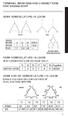 TERMINAL MARKINGS AND CONNECTIONS PART WINDING START NEMA NOMENCLATURE 6 LEADS 7 7 3 9 8 Delta 3 9 8 Wye OPER. 9 MODE L L L3 OPEN 7 START 3 7,8,9 T T T3 T7 T8 T9 RUN,7,8 3,9 3 8 MOTOR LEADS 3 7 Double
DIRECT CURRENT GENERATORS
 DIRECT CURRENT GENERATORS Revision 12:50 14 Nov 05 INTRODUCTION A generator is a machine that converts mechanical energy into electrical energy by using the principle of magnetic induction. This principle
Modelling, Simulation and Performance Analysis of A Variable Frequency Drive in Speed Control Of Induction Motor
 International Journal of Engineering Inventions e-issn: 78-7461, p-issn: 319-6491 Volume 3, Issue 5 (December 013) PP: 36-41 Modelling, Simulation and Performance Analysis of A Variable Frequency Drive
Fundamentals of Inverter Fed Motors
 Fundamentals of Inverter Fed Motors Technical Manual 10/02 MN780 Contents Page The Growing Use Of Inverters.................................................................. 1 How Inverters Affect Motors....................................................................
FREQUENCY CONTROLLED AC MOTOR DRIVE
 FREQUENCY CONTROLLED AC MOTOR DRIVE 1.0 Features of Standard AC Motors The squirrel cage induction motor is the electrical motor motor type most widely used in industry. This leading position results mainly
Inverter technology. bulletin
 Inverter technology application bulletin What is the inverter component? The inverter is an electronic power component that continuously varies the electricity supply frequency of an electric motor. The
VARIABLE FREQUENCY DRIVES THEORY, APPLICATION, AND TROUBLESHOOTING
 VARIABLE FREQUENCY DRIVES THEORY, APPLICATION, AND TROUBLESHOOTING BY HOWARD W. PENROSE UNIVERSITY OF ILLINOIS AT CHICAGO ENERGY RESOURCES CENTER 851 SOUTH MORGAN STREET ROOM 1213, SEO, MC156 CHICAGO,
Rotary Phase Converters
 FACTS from Ronk Electrical Industries, Inc. Bulletin 11981 Rotary Phase Converters ROTOVERTER Pat. No. 3,670,238 ROTO-CON Pat. No. 4,158,225 What are the ROTO-CON and ROTOVERTER power converters? The ROTO-CON
2. A conductor of length 2m moves at 4m/s at 30 to a uniform magnetic field of 0.1T. Which one of the following gives the e.m.f. generated?
 Extra Questions - 2 1. A straight length of wire moves through a uniform magnetic field. The e.m.f. produced across the ends of the wire will be maximum if it moves: a) along the lines of magnetic flux
GE Energy. Motors Product Line
 GE Energy Motors Product Line Expect More We ve manufactured motors for over 125 years. In 1879, GE founder, Thomas Edison constructed the first electric motor ever made for a 110 to 120 Volt line at Menlo
ATTACHMENT F. Electric Utility Contact Information Utility Name. For Office Use Only
 ATTACHMENT F CATEGORY 2 GENERATOR INTERCONNECTION APPLICATION FOR ALL PROJECTS WITH AGGREGATE GENERATOR OUTPUT OF MORE THAN 20 KW BUT LESS THAN OR EQUAL TO 150 KW Also Serves as Application for Category
Basics of Electricity
 Basics of Electricity Generator Theory PJM State & Member Training Dept. PJM 2014 8/6/2013 Objectives The student will be able to: Describe the process of electromagnetic induction Identify the major components
GE Industrial Systems. AC Motor Selection and Application Guide
 apple GE Industrial Systems AC Motor Selection and Application Guide TABLE OF CONTENTS Voltage... 2 Frequency... 3 Phase... 4 Motor Output Rating... 4 Polyphase Motors... 6 Single-phase Motors... 9 Service
DEPARTMENT OF THE AIR FORCE HEADQUARTERS AIR FORCE CIVIL ENGINEER SUPPORT AGENCY
 DEPARTMENT OF THE AIR FORCE HEADQUARTERS AIR FORCE CIVIL ENGINEER SUPPORT AGENCY 18 SEP 2013 FROM: SUBJECT: AFCEC/DD 139 Barnes Drive Suite 1 Tyndall AFB FL 32403-5319 Engineering Technical Letter (ETL)
Lab 14: 3-phase alternator.
 Lab 14: 3-phase alternator. Objective: to obtain the no-load saturation curve of the alternator; to determine the voltage regulation characteristic of the alternator with resistive, capacitive, and inductive
OJ L 191, 23.7.2009, p. 26. OJ L 2, 7.1.2014, p. 1.
 Table of Contents 1. Purpose of the guidelines and disclaimer... 2 1.1. The Regulations... 2 2. Scope... 2 3. Historic developments... 4 4. Scope and Requirements... 5 4.1. Scope... 5 4.2. Requirements...
Basic Nameplate Information
 Basic Nameplate Information General Information: Most equipment nameplates will have some common items of information. Many of these are self explanatory, and include: Manufacturer Manufacturerʼs address
AC Induction Motor Slip What It Is And How To Minimize It
 AC Induction Motor Slip What It Is And How To Minimize It Mauri Peltola, ABB Oy, Helsinki, Finland The alternating current (AC) induction motor is often referred to as the workhorse of the industry because
WIND TURBINE TECHNOLOGY
 Module 2.2-2 WIND TURBINE TECHNOLOGY Electrical System Gerhard J. Gerdes Workshop on Renewable Energies November 14-25, 2005 Nadi, Republic of the Fiji Islands Contents Module 2.2 Types of generator systems
Understanding Energy Efficient Motors
 Understanding Energy Efficient Motors Reliable Solutions Today Introduction For anyone who specifies, buys, operates, or repairs electric motors today, the issue of motor efficiency is of growing concern
What Do All Those Things on an AC Motor Nameplate Mean?
 What Do All Those Things on an AC Motor Nameplate Mean? Introduction: Ever order a motor on power, speed, and enclosure? PO says maybe "5 hp, 1,800 rpm, TEFC." New-motor nameplate says "HP 5, RPM 1748,
*ADVANCED ELECTRIC GENERATOR & CONTROL FOR HIGH SPEED MICRO/MINI TURBINE BASED POWER SYSTEMS
 *ADVANCED ELECTRIC GENERATOR & CONTROL FOR HIGH SPEED MICRO/MINI TURBINE BASED POWER SYSTEMS Jay Vaidya, President Electrodynamics Associates, Inc. 409 Eastbridge Drive, Oviedo, FL 32765 and Earl Gregory,
SYNCHRONOUS MACHINE TESTING WITH MOTOR CIRCUIT ANALYSIS INSTRUMENTATION
 SYNCHRONOUS MACHINE TESTING WITH MOTOR CIRCUIT ANALYSIS INSTRUMENTATION Introduction Howard W. Penrose, Ph.D., CMRP Vice President, Engineering and Reliability Services Dreisilker Electric Motors, Inc.
Baldor Electric ProSPEC MASTERFORMAT SPECIFICATION May 3, 2005. A. This specification covers integral horsepower squirrel cage AC induction motors.
 SECTION 16221 - TEFC AC INDUCTION MOTORS PART 1 - GENERAL 1.1 SUMMARY A. This specification covers integral horsepower squirrel cage AC induction motors. B. This specification is intended to specify superior
Variable Frequency Drives - a Comparison of VSI versus LCI Systems
 Variable Frequency Drives - a Comparison of VSI versus LCI Systems Introduction TMEIC is a leader in the innovative design and manufacture of large ac variable f requency drive systems. TMEIC has been
Synchronous motor. Type. Non-excited motors
 Synchronous motor A synchronous electric motor is an AC motor in which the rotation rate of the shaft is synchronized with the frequency of the AC supply current; the rotation period is exactly equal to
AC Electric Motors best practice
 If you want to learn more about best practice machinery maintenance, or world class mechanical equipment maintenance and installation practices, follow the link to our Online Store and see the Training
DETERMINING ELECTRIC MOTOR LOAD AND EFFICIENCY
 F A C T S H E E T a Program of the U.S. Department of Energy DETERMINING ELECTRIC MOTOR LOAD AND EFFICIENCY Most likely your operation s motors account for a large part of your monthly electric bill. Far
ELECTRICAL ENGINEERING Vol. III - Induction Motor and Self-Excited Induction Generator - Tze-Fun Chan
 INDUCTION MOTOR AND SELFEXCITED INDUCTION GENERATOR TzeFun Chan The Hong Kong Polytechnic University, Hung Hom, Kowloon, Hong Kong, China Keywords: threephase induction motor, singlephase induction motor,
Evaluating Induction Motor Rotor Bars with Electrical Signature Analysis
 Evaluating Induction Motor Rotor Bars with Electrical Signature Analysis Howard W Penrose, Ph.D., CMRP SUCCESS by DESIGN Reliability Services Hello and welcome to our presentation on Evaluating Induction
I hope you find them useful and I would appreciate any comments or thoughts you might have for future improvements, corrections or topics.
 COWERN PAPERS Baldor Electric Company 5711 R.S. Boreham Jr. Street Fort Smith, AR 72901 Phone (479) 646-4711 Fax (479) 648-5792 www.baldor.com Enclosed you will find a set of papers that I have written
DHANALAKSHMI COLLEGE OF ENGINEERING DEPARTMENT OF ELECTRICAL AND ELECTRONICS ENGINEERING EE2302 - ELECTRICAL MACHINES II UNIT-I SYNCHRONOUS GENERATOR
 1 DHANALAKSHMI COLLEGE OF ENGINEERING DEPARTMENT OF ELECTRICAL AND ELECTRONICS ENGINEERING Constructional details Types of rotors EE2302 - ELECTRICAL MACHINES II UNIT-I SYNCHRONOUS GENERATOR PART A 1.
Cable Solutions for Servo and Variable Frequency Drives (VFD)
 Cable Solutions for Servo and Variable Frequency Drives (VFD) Electric drive systems with continuous torque and speed control are widespread today. They allow an optimal adjustment of the drive with respect
INDUCTION MOTOR PERFORMANCE TESTING WITH AN INVERTER POWER SUPPLY, PART 2
 INDUCTION MOTOR PERFORMANCE TESTING WITH AN INVERTER POWER SUPPLY, PART 2 By: R.C. Zowarka T.J. Hotz J.R. Uglum H.E. Jordan 13th Electromagnetic Launch Technology Symposium, Potsdam (Berlin), Germany,
(3) Explosion proof. Designed to prevent ignition of any explosive gases or dust and dirt which may surround the motor.
 ELECTRIC MOTORS Enclosures for Motors Types of motor enclosures generally used in farm applications: (1) Open type; drip proof or splash-proof. A general purpose motor for use in dry locations which are
SYNCHRONOUS MACHINES
 SYNCHRONOUS MACHINES The geometry of a synchronous machine is quite similar to that of the induction machine. The stator core and windings of a three-phase synchronous machine are practically identical
1 Temperature Derating Guide
 VLT HVAC Drive FC 02 Application Note Temperature Derating Guide Temperature Derating Guide.. Abstract This paper provides detailed data regarding the operation of the VLT HVAC Drive FC02 at varying ambient
Single-Phase AC Synchronous Generator
 ST Series Single-Phase AC Synchronous Generator Instructions for Operation and Maintenance English to English translation by R.G. Keen, May 2004. ST Series of Single-Phase AC Synchronous Generators Description
3) What is the difference between "Insulating", "Isolating", and "Shielded Winding" transformers?
 Tyco Electronics Corporation Crompton Instruments 1610 Cobb International Parkway, Unit #4 Kennesaw, GA 30152 Tel. 770-425-8903 Fax. 770-423-7194 1) What is a transformer and how does it work? A transformer
ADJUSTABLE FREQUENCY DRIVES APPLICATION GUIDE
 ADJUSTABLE FREQUENCY DRIVES APPLICATION GUIDE Adjustable Frequency Drives Application Guide Table of Contents Introduction....................................................................................
Unit 33 Three-Phase Motors
 Unit 33 Three-Phase Motors Objectives: Discuss the operation of wound rotor motors. Discuss the operation of selsyn motors. Discuss the operation of synchronous motors. Determine the direction of rotation
Power Plant Electrical Distribution Systems
 PDH Course E184 Power Plant Electrical Distribution Systems Gary W Castleberry, PE 2008 PDH Center 2410 Dakota Lakes Drive Herndon, VA 20171-2995 Phone: 703-478-6833 Fax: 703-481-9535 www.pdhcenter.com
ELECTRIC MOTORS. Energy Efficiency Reference Guide STATOR POLE COMMUTATOR LINE
 ELECTRIC MOTORS Energy Efficiency Reference Guide STATOR POLE N BRUSH COMMUTATOR S LINE DISCLAIMER: Neither CEA Technologies Inc. (CEATI), the authors, nor any of the organizations providing funding support
APPLICATIONS FOR MOTOR CURRENT SIGNATURE ANALYSIS
 APPLICATIONS FOR MOTOR CURRENT SIGNATURE ANALYSIS An ALL-TEST Pro White Paper By Howard W Penrose, Ph.D. General Manager ALL-TEST Pro A Division of BJM Corp 123 Spencer Plain Rd Old Saybrook, CT 06475
DC GENERATOR THEORY. LIST the three conditions necessary to induce a voltage into a conductor.
 DC Generators DC generators are widely used to produce a DC voltage. The amount of voltage produced depends on a variety of factors. EO 1.5 LIST the three conditions necessary to induce a voltage into
At Load Power Factor Correction Phase 2: Refrigerated Vending Machines
 At Load Power Factor Correction Phase 2: Refrigerated Vending Machines A Pilot Project to determine the feasibility and economics of small scale At Load Power Factor Correction Richard Ellenbogen, MEE
ELECTROPUTERE ROTATING ELECTRICAL MACHINES DIVISION
 ELECTROPUTERE ROTATING ELECTRICAL MACHINES DIVISION SC ELECTROPUTERE SA SC ELECTROPUTERE SA 1. Vision, Mission, Values SC ELECTROPUTERE SA 2. LOCATION Craiova: Located in the South West of the country,
Equipment: Power Supply, DAI, Synchronous motor (8241), Electrodynamometer (8960), Tachometer, Timing belt.
 Lab 9: Synchronous motor. Objective: to examine the design of a 3-phase synchronous motor; to learn how to connect it; to obtain its starting characteristic; to determine the full-load characteristic of
SECTION 26 29 23 VARIABLE FREQUENCY DRIVES
 SECTION 26 29 23 VARIABLE FREQUENCY DRIVES PART 1 GENERAL 1.01 SCOPE A. Furnish and install individual freestanding variable frequency AC drives (VFD) as shown on the Drawings and specified herein. 1.02
GENERATOR SELECTION. a. Three phase - 120/208V, 3 phase, 4W wye; 277/408, 3 phase, 4W wye; * 120/240V 3 phase, 4W Delta
 GENERATOR SELECTION Generators must be sized to handle their load based on the continuous KW, kilowatt load, and KVA, kilovoltamp load, and the worst case starting load KW + KVA. They must be derated for
Motor Protection Voltage Unbalance and Single-Phasing
 Motor Protection Voltage Unbalance and Single-Phasing Cooper Bussmann contributes the following information, which is an excerpt from their 190-page handbook SPD Selecting Protective Devices Based on the
Making a world of difference. Turbocor centrifugal compressors for air-conditioning systems
 Making a world of difference Turbocor centrifugal compressors for air-conditioning systems Leading a new era in performance Today, the world is looking for HVAC technology that makes a difference in efficiency,
INSTALLATION AND MAINTENANCE INSTRUCTIONS FOR THREE PHASE INDUCTION MOTORS
 INSTALLATION AND MAINTENANCE INSTRUCTIONS FOR THREE PHASE INDUCTION MOTORS Frames 143T - 449TZ 5100 North IH 35 Round Rock, Texas 78681 Phone: 800-451-8798 512-255-4141 Fax: 512-244-5512 RECEIVING 1. Check
PowerFlex Dynamic Braking Resistor Calculator
 Application Technique PowerFlex Dynamic Braking Resistor Calculator Catalog Numbers 20A, 20B, 20F, 20G, 22A, 22B Important User Information Solid-state equipment has operational characteristics differing
13 common causes of motor failure
 13 common causes of motor failure Application Note What to look for and how to improve asset uptime Motors are used everywhere in industrial environments and they are becoming increasingly complex and
AND8008/D. Solid State Control Solutions for Three Phase 1 HP Motor APPLICATION NOTE
 Solid State Control Solutions for Three Phase 1 HP Motor APPLICATION NOTE INTRODUCTION In all kinds of manufacturing, it is very common to have equipment that has three phase motors for doing different
Documenting Results to Validate Energy Savings Projects: Case Study of Direct Drive Cooling Tower Installations: Before and After
 Documenting Results to Validate Energy Savings Projects: Case Study of Direct Drive Cooling Tower Installations: Before and After Roman Wajda, Baldor Electric Company ABSTRACT Documenting the actual energy
Line Reactors and AC Drives
 Line Reactors and AC Drives Rockwell Automation Mequon Wisconsin Quite often, line and load reactors are installed on AC drives without a solid understanding of why or what the positive and negative consequences
A S Y N C H R O N O U S M O T O R S
 ASYNCHRONOUS M O T O R S S E R I E S INDAR ASYNCHRONOUS MOTORS S E R I E S WHO WE ARE Indar Electric s trajectory is endorsed by the construction of thousands of motors for the different industrial sectors.
Unidrive M Energy Savings
 Unidrive M Energy Savings Why is this important? Some Data: Money, Lots of Money >13.5m electric motors 1Hp or greater installed in US industrial process operations. Industry spends >$33b annually on electricity
Single and Three Phase Transformer Testing Using Static Motor Circuit Analysis Techniques
 Single and Three Phase Transformer Testing Using Static Motor Circuit Analysis Techniques Howard W. Penrose, Ph.D On behalf of ALL-TEST Pro, LLC Old Saybrook, CT Introduction Field and shop testing of
Motor Fundamentals. DC Motor
 Motor Fundamentals Before we can examine the function of a drive, we must understand the basic operation of the motor. It is used to convert the electrical energy, supplied by the controller, to mechanical
Technical Guide No. 100. High Performance Drives -- speed and torque regulation
 Technical Guide No. 100 High Performance Drives -- speed and torque regulation Process Regulator Speed Regulator Torque Regulator Process Technical Guide: The illustrations, charts and examples given in
COOLING TECHNOLOGY INSTITUTE
 PAPER NO: CATEGORY: TP09-18 FANS COOLING TECHNOLOGY INSTITUTE RECENT DEVELOPMENTS IN MOTOR TECHNOLOGY ALLOW DIRECT DRIVE OF LOW SPEED COOLING TOWER FANS ROBBIE MCELVEEN BILL MARTIN RYAN SMITH BALDOR ELECTRIC
ABB drives. Technical guide No. 4 Guide to variable speed drives
 ABB drives Technical guide No. 4 Guide to variable speed drives 2 Guide to variable speed drives Technical guide No. 4 Technical guide No. 4 Guide to variable speed drives Copyright 2011 ABB. All rights
AC Replacement for DC Mill-Duty Motors
 AC Replacement for DC Mill-Duty Motors This article is available online at www.aist.org for 30 days following publication. For many years, DC mill auxiliary motors for steel mill applications such as screwdowns,
Rotating Machinery Diagnostics & Instrumentation Solutions for Maintenance That Matters www.mbesi.com
 13 Aberdeen Way Elgin, SC 29045 Cell (803) 427-0791 VFD Fundamentals & Troubleshooting 19-Feb-2010 By: Timothy S. Irwin, P.E. Sr. Engineer [email protected] Rotating Machinery Diagnostics & Instrumentation
Understanding the Alternator
 http://www.autoshop101.com THIS AUTOMOTIVE SERIES ON ALTERNATORS HAS BEEN DEVELOPED BY KEVIN R. SULLIVAN PROFESSOR OF AUTOMOTIVE TECHNOLOGY AT SKYLINE COLLEGE SAN BRUNO, CALIFORNIA ALL RIGHTS RESERVED
Power-factor testing of rotating machinery is another valuable test
 Feature Power-Factor Testing of Stator Winding Insulation: Understanding the Test Technique and Interpretation of Results Power-factor testing of rotating machinery is another valuable test technique providing
Chapter 4.5: Electric Motors, Variable Speed Drives
 Short type questions Chapter 4.5: Electric Motors, Variable Speed Drives 1. The resistance of a motor stator winding at 30 C is 0.264 ohms per phase. What will be the resistance of the stator winding per
AC-Synchronous Generator
 Design Description AC Generators come in two basic types synchronous and non-synchronous. Synchronous generators lock in with the fundamental line frequency and rotate at a synchronous speed related to
Direct Current Motors
 Direct Current Motors DC MOTORS The DC machine can operate as a generator and as a motor. Chap 5. Electrical Machines by Wildi, 6 e Lecturer: R. Alba-Flores Alfred State College Spring 2008 When a DC machine
VARIABLE FREQUENCY DRIVES. Energy Efficiency Reference Guide
 VARIABLE FREQUENCY DRIVES Energy Efficiency Reference Guide DISCLAIMER: Neither CEATI International, the authors, nor any of the organizations providing funding support for this work (including any persons
UNDERSTANDING YOUR UTILITY BILL A GUIDE FOR BUSINESSES IN INDIANA
 UNDERSTANDING YOUR UTILITY BILL A GUIDE FOR BUSINESSES IN INDIANA TABLE OF CONTENTS Introduction... 5 Basic Billing Concepts... 6 Electric Energy and Demand... 6 Electric Consumption and Charges... 7
8 Speed control of Induction Machines
 8 Speed control of Induction Machines We have seen the speed torque characteristic of the machine. In the stable region of operation in the motoring mode, the curve is rather steep and goes from zero torque
How To Understand And Understand The Electrical Power System
 DOE-HDBK-1011/4-92 JUNE 1992 DOE FUNDAMENTALS HANDBOOK ELECTRICAL SCIENCE Volume 4 of 4 U.S. Department of Energy Washington, D.C. 20585 FSC-6910 Distribution Statement A. Approved for public release;
NEMA Application Guide for AC Adjustable Speed Drive Systems
 Copyright 2001 IEEE. Reprinted from IEEE/PCIC 2001 Conference Record. This material is posted here with permission of the IEEE. Such permission of the IEEE does not in any way imply IEEE endorsement of
TABLE OF CONTENTS INTRODUCTION...3 ADVANTAGES...5 OPERATION CHARACTERISTICS...6 EXCITATION TYPES...8 CONSTRUCTIVE COMPONENTS...9 ACCESSORIES...
 SYNCHRONOUS MOTORS TABLE OF CONTENTS Motores Síncronos INTRODUCTION...3 ADVANTAGES...5 OPERATION CHARACTERISTICS...6 EXCITATION TYPES...8 CONSTRUCTIVE COMPONENTS...9 ACCESSORIES...11 CONSTRUCTIVE CHARACTERISTICS...12
Electric Motor Brake Horsepower Calculations
 Electric Motor Brake Horsepower Calculations By Norm Christopherson These motor calculations are contained here as they apply to the changing conditions of the blower motor when pulley adjustments are
Induction Motor Theory
 PDHonline Course E176 (3 PDH) Induction Motor Theory Instructor: Jerry R. Bednarczyk, P.E. 2012 PDH Online PDH Center 5272 Meadow Estates Drive Fairfax, VA 22030-6658 Phone & Fax: 703-988-0088 www.pdhonline.org
Peak Shaving - A Method to Reduce Utility Costs
 Peak Shaving - A Method to Reduce Utility Costs This material is posted here with permission of the IEEE. Such permission of the IEEE does not in any way imply IEEE endorsement of any of Baldor Electric
Data Sheet. AC Industrial Electric Motors
 Data Pack B Issued ovember 2005 1502325812 Data Sheet AC Industrial Electric Motors Standards organisations The RS-ABB range of ac induction motors is produced to common European standards, these being
Modeling and Simulation of a Large Chipper Drive
 The Open Electrical & Electronic Engineering Journal, 009, 3, 1-8 1 Modeling and Simulation of a Large Chipper Drive Open Access Christian Kral, Anton Haumer, Hansjörg Kapeller and Gert Pascoli Austrian
Fundamentals of Power
 Fundamentals of Power Fundamentals of Power 2008 American Power Conversion Corporation. All rights reserved. All trademarks provided are the property of their respective owners. Learning Objectives At
1150 hp motor design, electromagnetic and thermal analysis
 115 hp motor design, electromagnetic and thermal analysis Qasim Al Akayshee 1, and David A Staton 2 1 Mawdsley s Ltd., The Perry Centre, Davey Close, Waterwells, Gloucester GL2 4AD phone: +44 1452 888311
ENGINEERING BULLETIN No. EB 039 Product: Cooling Towers, Closed Circuit Coolers & Evaporative Condensers Date: June 2003
 For Distribution ENGINEERING BULLETIN No. EB 039 Product: Cooling Towers, Closed Circuit Coolers & Evaporative Condensers Date: June 2003 Purpose: Variable Frequency Drives The purpose of this Engineering
Solving VFD-sourced Bearing Current Problems in AC Motors.
 Solving VFD-sourced Bearing Current Problems in AC Motors. The 2 main sources of motor shaft voltage are: 1. Asymmetric Motor construction The stator and rotor magnetic circuits within the motor itself