
4/27/2010 ALGEBRA 1 CHAPTER 8 FACTORING. PAR Activities Cara Boening
|
|
|
- Meryl Brown
- 10 years ago
- Views:
Transcription
1 4/27/2010 ALGEBRA 1 CHAPTER 8 FACTORING PAR Activities Cara Boening

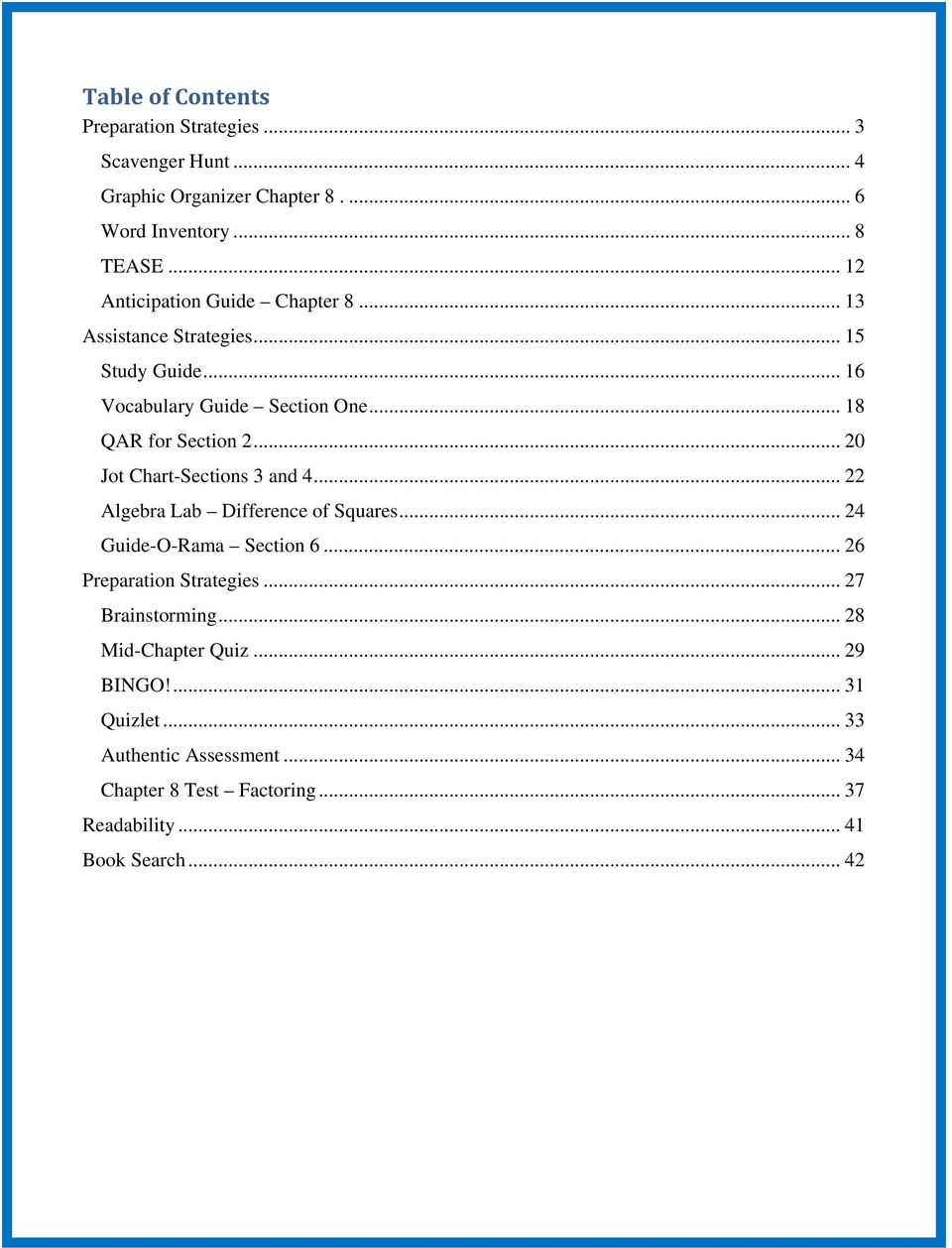
2 Table of Contents Preparation Strategies... 3 Scavenger Hunt... 4 Graphic Organizer Chapter Word Inventory... 8 TEASE Anticipation Guide Chapter Assistance Strategies Study Guide Vocabulary Guide Section One QAR for Section Jot Chart-Sections 3 and Algebra Lab Difference of Squares Guide-O-Rama Section Preparation Strategies Brainstorming Mid-Chapter Quiz BINGO! Quizlet Authentic Assessment Chapter 8 Test Factoring Readability Book Search... 42
3 Preparation Strategies Scavenger Hunt... Error! Bookmark not defined. Graphic Organizer Chapter 8... Error! Bookmark not defined. Word Inventory... Error! Bookmark not defined. K-W-L... Error! Bookmark not defined. TEASE... Error! Bookmark not defined. Anticipation Guide Chapter 8...Error! Bookmark not defined.

4 Scavenger Hunt DIRECTIONS: Answer each question; then identify the part of the book that helped you to find the answer. 1. Where can symbols and formulas be found? 2. At the end of every chapter, what is included to help you prepare for a test? 3. How many chapters are in this textbook? 4. What valuable information can be found at the beginning of each chapter? 5. If you are having trouble with an odd-numbered problem, where can the answer be located? 6. What is the definition of hypotenuse? 7. In what chapter can you find how to factor trinomials? 8. Who are the authors of this book? 9. Where was the picture on the front cover taken? 10. In almost every chapter, there are key concepts included in a box. Find one key concept and list the information and what it is used for (make sure to include the page number.) 11. What are the key vocabulary words for chapter 6?

5 ANSWERS PARTS OF THE BOOK SEARCH: Reading to Learn in the Content Areas 1. Inside the back cover. 2. Study Guide and Review The knowledge and skills that will be covered, key vocabulary, a FOLDABLES Study Organizer, and a Quick Quiz and Quick Review. 5. In the Answer Appendix 6. The side opposite the right angle in a right triangle. 7. Chapter 8 8. Holliday, Luchin, Cuevas, Carter, Marks, Day, Casey, Hayek 9. At the International El Paso Balloon Festival. 10. Can be multiple answers. Check page number given to make sure it is done correctly. 11. Compound Inequality, Intersection, Set-Builder Notation, Union

6 Graphic Organizer Chapter 8 Define the following terms or answer the question. Factoring Monomials & Factoring Distributive Property Factoring Trinomials Factoring Differences of Squares Perfect Squares & Factoring Perfect Sqaures & Factoring -Prime Factorization -Factored Form -Greatest Common Factor -Grouping x^2+bx+c What happens when: -b and c are Positive -b is Negative and c is Postive ax^2+bx+c -Prime Polynomial a^2-b^2 a^2+2ab+b^2 -c is Negative

7 Chapter 8 Define the following terms or answer the question. Factoring Monomials & Factoring Distributive Property Factoring Trinomials Factoring Differences of Squares Perfect Squares & Factoring Perfect Sqaures & Factoring -Prime Factorization Number expressed in prime factors -Factored Form Monomial -Greatest Common Factor The product of the common prime factors -Grouping A way of factoring using the distributive property when a polynomial has 4 or more terms x^2+bx+c What happens when: -b and c are Positive All coefficients are positive -b is Negative and c is Postive Both factors are negative -c is Negative One factor is positive and one is negative ax^2+bx+c -Prime Polynomial A polynomial that cannot be written as a product of two polynomials a^2-b^2 (a+b)(a-b) a^2+2ab+b^2 (a+b)^2 (a-b)^2

8 Word Inventory Directions: Determine which of the following words you are familiar with and you know the definition. Beside the words you do know, indicate this by placing a in the blank. If you are not sure if you know the definition or the meaning of the word, place a in the blank. For those words you have no idea what they mean place a in the blank. 1. Prime Number 2. Composite Number 3. Prime Factorization 4. Factored Form 5. Greatest Common Factor 6. Factoring 7. Factoring By Grouping 8. Zero Products Property 9. Roots 10. Prime Polynomial 11. Difference of Squares 12. Perfect Square Trinomials

9 Word Inventory Determine which of the following words you are familiar with and you know the definition. Beside the words you do know, indicate this by placing a in the blank. If you are not sure if you know the definition or the meaning of the word, place a in the blank. For those words you have no idea what they mean place a in the blank. 1. Prime Number 2. Composite Number 3. Prime Factorization 4. Factored Form 5. Greatest Common Factor 6. Factoring 7. Factoring By Grouping 8. Zero Products Property 9. Roots 10. Prime Polynomial 11. Difference of Squares 12. Perfect Square Trinomials

10 K-W-L Directions: Fill in the columns with what you know about factoring and what you would like to learn about factoring. After the chapter is completed, the forms will be returned and you will fill in what you learned from the unit. What We Know What We Want to Know What We Learned

11 K-W-L Directions: Fill in the columns with what you know about factoring and what you would like to learn about factoring. After the chapter is completed, the forms will be returned and you will fill in what you learned from the unit. What We Know What We Want to Know What We Learned We know how to multiply a polynomial by a monomial. We know how to multiply polynomials. We know FOIL We know how to find squares of polynomials. We know how to use the Distributive Property with polynomials.

12 TEASE Directions: I have completed a video for students to watch before the first day of instruction. It shows a relationship between puzzles and factoring. It is much easier to complete a puzzle if you separate the different pieces first by edge and corner, then by color. It is also much easier if you are able to have someone help you and if you are able to look at the picture you are creating on the box. This short video shows the relationship. Have a short discussion that involves these relationships before beginning the first day of instruction. Puzzles & Factoring

13 Anticipation Guide Chapter 8 Directions: Read each statement before beginning chapter 8. Determine if you agree or disagree by placing an A or a D by each statement. After covering chapter 8, return and read the statements. Repeat the process and see how your opinions have changed or remained the same. If you still disagree with the statements after reading the chapter, correct them at the bottom of this page. Pre- Reading A or D Statement Post- Reading A or D 1. The number 2 is a prime number because the only factors of 2 are 1 and itself. 2. The prime factorization of a number is expressed as a product of factors that are all prime. 3. If the greatest common factor of two numbers is 1, they are said to be relatively prime. 4. If the product of two factors is 0, they must be negative inverses of each other. 5. To find the solution of, you can take the square root of each side. 6. The polynomial is not factorable. 7. The numbers 36,49, 64, and 81 are perfect squares.

14 Anticipation Guide Chapter 8 Directions: Read each statement before beginning chapter 8. Determine if you agree or disagree by placing an A or a D by each statement. After covering chapter 8, return and read the statements. Repeat the process and see how your opinions have changed or remained the same. If you still disagree with the statements after reading the chapter, correct them at the bottom of this page. Pre- Reading A or D Statement Post- Reading A or D 1. The number 2 is a prime number because the only factors of 2 are 1 and itself. A 2. The prime factorization of a number is expressed as a product of factors that are all prime. A 3. If the greatest common factor of two numbers is 1, they are said to be relatively equal. D 4. If the product of two factors is 0, they must be negative inverses of each other. D 5. To find the solution of, you can take the square root of each side. D 6. The polynomial is not factorable. A 7. The numbers 36,49, 64, and 81 are perfect squares. A 3. If the greatest common factor of two numbers is 1, they are said to be relatively prime. 4. If the product of two factors is 0, at least one of them must be To find the solution of, you must first subtract 2x from each side. Then you must factor out an x and solve from there.

15 Assistance Strategies Study Guide... Error! Bookmark not defined. Vocabulary Guide Section One... Error! Bookmark not defined. QAR for Section 2... Error! Bookmark not defined. Jot Chart-Sections 3 and 4... Error! Bookmark not defined. Algebra Lab Difference of Squares... Error! Bookmark not defined. Guide-O-Rama Section 6... Error! Bookmark not defined.

16 Study Guide Directions: Keep this study guide throughout the unit. We will fill in the information as we cover the information in each chapter. DO NOT LOSE THIS PAPER! Number of Terms Factoring Technique Example 2 or more greatest common factor 2 Difference of Squares Perfect Square Trinomial 3 wh en and when and. Then use factoring by grouping 4 or more Factoring by grouping

17 Study Guide Directions: Keep this study guide throughout the unit. We will fill in the information as we cover the information in each chapter. DO NOT LOSE THIS PAPER! Number of Terms Factoring Technique Example 2 or more greatest common factor Difference of Squares Perfect Square Trinomial wh en and when and. Then use factoring by grouping or more Factoring by grouping

18 Vocabulary Guide Section One Directions: Before you read section one, fill in what you believe is a possible definition of each vocabulary word. As you read, locate the vocabulary words, fill in the page number, and write the given definition in the section. Word Page Possible Definition Verified Definition Prime Number Composite Number Prime Factorization Factored Form Greatest Common Factor (GCF)

19 Vocabulary Guide Section One Directions: Before you read section one, fill in what you believe is a possible definition of each vocabulary word. As you read, locate the vocabulary words, fill in the page number, and write the given definition in the section. Word Page Possible Definition Verified Definition Prime Number 414 A number that cannot be divided by any number other than 1 A whole number, greater than 1, for which the only factors are 1 and itself Composite Number 414 Can be divided by numbers other than 1 A whole number, greater than 1, that has more than two factors Prime Factorization 414 The prime numbers of something A whole number expressed as the product of prime factors Factored Form 415 Something in its lowest form A monomial when expressed as the product of prime numbers and variables, and no variable has an exponent greater than 1 Greatest Common Factor (GCF) 415 The biggest number two numbers have in common The greatest number that is a factor of both original numbers

20 QAR for Section 2 Directions: Complete the questions as you begin to think in depth about polynomials and factoring using the Distributive Property and Grouping. Question Answer 1. List the two methods of factoring discussed in Section Why do you think it is important to know the distributive property when x and y are in an equation? 3. Compare and contrast the Distributive Property and Grouping method for factoring. 4. Create an example of an equation in which you would use grouping and explain how you would solve the equation.

21 QAR for Section 2 Directions: Complete the questions as you begin to think in depth about polynomials and factoring using the Distributive Property and Grouping. Question Answer 1. List the two methods of factoring discussed in Section 2. Distributive Property Grouping 2. Why do you think it is important to know the distributive property when x and y are in an equation? When two variables are involved, the values may need to be known in order to solve the equation. If you can isolate some of the variables, you can find the values of them. 3. Compare and contrast the Distributive Property and Grouping method for factoring. Distributive property is used to remove common factors from an equation. The grouping method takes like terms and removes the GCF, then the equations can be solved. 4. Create an example of an equation in which you would use grouping and explain how you would solve the equation
22 Jot Chart-Sections 3 and 4 Directions: As we complete sections 3 and 4, fill in the possible factors when standard form is used in factoring. Standard Form Possible Factors, is prime, is composite
23 Jot Chart-Sections 3 and 4 Directions: As we complete sections 3 and 4, fill in the possible factors when standard form is used in factoring. Standard Form Possible Factors and add to and multiply to and add to and multiply to and add to and multiply to and add to and multiply to, is prime and add to, and multiply to, is composite (,,
24 Algebra Lab Difference of Squares Directions: Follow the instructions given to you step-by-step. Begin by cutting out the large square then wait for directions. When you are done with the lab, answer the following questions on a separate piece of paper. 1. Write an exp ression representing the area of the rectangle. 2. Explain why.
25 Algebra Lab Difference of Squares Directions: 1. Give students the handout without these instructions so students will discover the mystery. 2. Cut out the largest square. This is of length a. The area of the large squar e is and the area of the small square is. 3. Cut the small square from the large square. The area of the new figure is. 4. Cut the remaining figure into two congruent figures (cut on the dotted line.) 5. Arrange the pieces to form a rectangle with lengths and. Have students answer the questions on a separate sheet of paper. 1. Write an expres sion representing the area of the rectangle a. 2. Explain why. a. Students may say something about the fact that when a smaller square is removed from a larger square, the remaining shape forms a rectangle. The area of a rectangle is length times width. If is multiplied out, 0.
26 Guide-O-Rama Section 6 1. Can you list the square roots of 4, 9, 16, 25, 36, etc.? 2. Notice the definition of perfect square trinomials. 3. Look over and make sure you understand the information in the table at the bottom of page 448. The table at the top of the next page is the same information in general form. 4. Make sure you know the three questions you should ask about each trinomial in order to determine if it is a perfect square trinomial. 5. HINT!!! The concept summary is information that will be on the test! 6. See Example 2. Remember on all trinomials to look for a GCF before beginning factoring. 7. The square root property will help save time if there is only an x^2 and an integer in an equation! 8. Do the assigned homework problems to turn in tomorrow!
27 Preparation Strategies Brainstorming... Error! Bookmark not defined. Mid-Chapter Quiz... Error! Bookmark not defined. BINGO!... Error! Bookmark not defined. Quizlet... Error! Bookmark not defined. Authentic Assessment... Error! Bookmark not defined. Chapter 8 Test Factoring... Error! Bookmark not defined.
28 Brainstorming Directions: Students have learned to factor using the Distributive Property and using Grouping. For this brainstorming activity, students will be asked several questions to make them consider how you would solve an equation that involved an equal sign. Students will be split into groups of three or four and will be given the following equations and see what they would do to solve them. Reminder: The students have only covered section one and part of section two. Don t make the questions too advanced for where you are in the chapter. Questions: Students will be given 5-10 minutes to discuss what steps need to be taken to find the answers. At this point, we will discuss in class the correct steps to solving the equations. Each group will be given an opportunity to share their answers and their logic behind them. Answers:
29 Mid-Chapter Quiz Directions: Factor or solve each monomial or polynomial completely. SHOW YOUR WORK! What is the GCF of 15 & 5?
30 Mid-Chapter Quiz Directions: Factor or solve each monomial or polynomial completely. SHOW YOUR WORK! What is the GCF of 15 & 5?
31 BINGO! Directions: Fill in the spaces using the words from the word list. You may want to write equations in different forms or make notes before we start! B I N G O FREE! Word List: 2 2 Square of a Negative Binomial: Roots Composite Number Prime Factorization Factored Form 12, 2 4 terms GCF Factoring 36 Prime Polynomial Square of a Positive Binomial: BINGO! Prime Number Zero Products Property
32 Directions: Give students 5 minutes to fill in the Bingo board and to look over terms. The first 3 times you play, allow students to raise their hand and answer questions on at a time. The next two times, play where students may not talk during play. Make sure to allow time for students to think through the problems. Here are the answers and the clues to be given. Clue A nswer 1. What is the standard form of the difference of squares? 2. What is the expanded form of? 2 3. What is the expanded form of? 2 4. What is the standard form of a trinomial? 5. The solutions are 8 3, The solutions are The factored standard form of where is prime. 8. The factored standard form of where is composite. 9. The prime factorization of The GCF of these two terms is 2. 12, This term describes when a polynomial is expressed as the product of monomials an d polynomials. Factoring 12. Expressed in standard form as 2. Square of a Positive Binomial: 13. Expressed in standard form as 2. Square of a Negative Binomial: 14. The solutions of a quadratic equation. Roots 15. A specific example of factored difference of squares This is the perfect time to use Factoring by Grouping. 4 terms 17. An example of a perfect square trinomial A whole number, greater than 1, with only factors that are 1 and itself. Prime Number 19. A whole number, greater than 1, that has more than two factors. Composite Number 20. A whole number expressed as a product of factors that are all prime numbers. Prime Factorization 21. A monomial expressed as a product of prime numbers and variables and no variable has an exponent Factored Form greater than The product of the prime factors common to two or more integers. GCF 23. A polynomial that cannot be written as a product of two polynomials with integral coefficients. Prime Polynomial 24. This states that if the product of two factors is 0, then at least one of the factors must be 0. Zero Products Property
33 Directions: Quizlet Step 1: Log into Quizlet.com. Username: algebrafactoring Password: factoring Step 2: Click the option "My Dashboard" Step 3: Click on the title "Factoring Trinomials" Step 4: Use the flashcards to practice what we have learned in class. Some of these may appear on the exam. Step 5: Choose the option "Test" and work the problems. Print the graded test sheet. This will be turned in for a quiz grade.
34 Authentic Assessment Directions: Students will be split into groups of three or four. Each group will be given a career to research. The students will find how each profession uses factoring in their workplace. The careers will include, but won't be limited to, engineering, physics, biology, and landscape designer. Students will need to write a paper that explains what the career is, how factoring is used, and how factoring can be used in the students' everyday lives. A graphic representation should be created to show how factoring is used.
35 Authentic Assessment Rubric CATEGORY Explanation Explanation Explanation shows complete shows substantial shows some understanding of understanding of understanding of the mathematical the mathematical the mathematical concepts used to concepts used to concepts needed solve the solve the to solve the problem(s). problem(s). problem(s). Mathematical Concepts Explanation Working with Others Mathematical Terminology and Notation Neatness and Organization Diagrams and Sketches Explanation is detailed and clear. Student was an engaged partner, listening to suggestions of others and working cooperatively throughout lesson. Correct terminology and notation are always used, making it easy to understand what was done. The work is presented in a neat, clear, organized fashion that is easy to read. Diagrams and/or sketches are clear and greatly add to the reader's understanding of the procedure(s). Explanation is clear. Student was an engaged partner but had trouble listening to others and/or working cooperatively. Correct terminology and notation are usually used, making it fairly easy to understand what was done. The work is presented in a neat and organized fashion that is usually easy to read. Diagrams and/or sketches are clear and easy to understand. Explanation is a little difficult to understand, but includes critical components. Student cooperated with others, but needed prompting to stay on task. Correct terminology and notation are used, but it is sometimes not easy to understand what was done. The work is presented in an organized fashion but may be hard to read at times. Diagrams and/or sketches are somewhat difficult to understand. Explanation shows very limited understanding of the underlying concepts needed to solve the problem(s) OR is not written. Explanation is difficult to understand and is missing several components OR was not included. Student did not work effectively with others. There is little use, or a lot of inappropriate use, of terminology and notation. The work appears sloppy and unorganized. It is hard to know what information goes together. Diagrams and/or sketches are difficult to understand or are not used.
36 Completion All problems are completed. All but one of the problems are completed. All but two of the problems are completed. Several of the problems are not completed. Mathematical Errors % of the steps and solutions have no mathematical errors. Almost all (85 89%) of the steps and solutions have no mathematical errors. Most (75 84%) of the steps and solutions have no mathematical errors. More than 75% of the steps and solutions have mathematical errors.
37 Chapter 8 Test Factoring Directions: Complete the following problems. Be sure to show your work. (4.5 pts each) Factor Each Monomial Completely. Factor eac h polynomial Find the GCF of each set of monomials , 18, ,
38 Distribute and Simplify Solve the equation A gymnast jumps on a trampoline traveling at 12 feet per second. Her height in feet above the trampoline after seconds is given by the formula How long is the gymnast in the air before returning to the trampoline? 22. A boulder breaks loose from the face of a mountain and falls toward the water 576 feet below The distance that the boulder falls in seconds is given by the equation 16. How long does it take the boulder to hit the water?
39 Chapter 8 Test Factoring Directions: Complete the following problems. Be sure to show your work. (4.5 pts each) Factor Each Monomial Completely. Factor eac h polynomial Find the GCF of each set of monomials , 18, , Factor each Polynomial
40 Distribute and Simplify Solve the equation , , A gymnast jumps on a trampoline traveling at 12 feet per second. Her height in feet above the trampoline after seconds is given by the formula How long is the gymnast in the air before returning to the trampoline? , A boulder breaks loose from the face of a mountain and falls toward the water 576 feet below The distance that the boulder falls in seconds is given by the equation 16. How long does it take th e boulder to hit the water?
41 Readability Algebra 1 Use the information about sirens at the left. A care and an emergency vehicle are heading toward each other. The car is traveling at a speed of 30 miles per hour or about 44 feet per second. The emergency vehicle is traveling at a speed of 50 miles per hour or about 74 feet per second. If the vehicles are 1000 feet apart and the conditions are ideal, in how many seconds will the driver of the car first hear the siren? Under ideal conditions, a siren can be heard from up to 440 feet. However, under normal conditions, a page 122 Sentences: 6.38 Syllables: 158 The Caverns of Sonora, in Sonora, Texas, is one of the most active caves in the world, with more than 90% of the formations in the cave still "growing." There are two different tours of the caves, as shown in the table. The total length of both tours combines is 3.25 miles. The Crystal Palace tour is twice the distance of the Horseshoe Lake tour minus 0.5 mile. How could you use a system of equations to determine the lengths of the tours? You have learned five methods for solving systems of linear equations. The table summarizes the methods and page 278 Sentences: 6.43 Syllables: 142 The President of the United States is elected every four years, and senators are elected every six years. A certain senator is elected in 2004, the same year as a presidential election, and is reelected in subsequent elections. In what year is the senator's reelection the same year as a presidential election? The least number of years that will pass until the next election for both a specific senator and the President is the least common multiple of 4 and 6. The least common multiple (LCM) is the least number that is a multiple of two or more numbers. You page 606 Sentences: 5.09 Syllables: 164 The book is at a 10th grade reading level so most students should be able to read the text without many modifications.
42 Book Search DIRECTIONS: Answer each question; then identify the part of the book that helped you to find the answer. 12. Where can symbols and formulas be found? 13. At the end of every chapter, what is included to help you prepare for a test? 14. How many chapters are in this textbook? 15. What valuable information can be found at the beginning of each chapter? 16. If you are having trouble with an odd-numbered problem, where can the answer be located? 17. What is the definition of hypotenuse? 18. In what chapter can you find how to factor trinomials? 19. Who are the authors of this book? 20. Where was the picture on the front cover taken? 21. In almost every chapter, there are key concepts included in a box. Find one key concept and list the information and what it is used for (make sure to include the page number.) 22. What are the key vocabulary words for chapter 6?
43 ANSWERS PARTS OF THE BOOK SEARCH: Reading to Learn in the Content Areas 12. Inside the back cover. 13. Study Guide and Review The knowledge and skills that will be covered, key vocabulary, a FOLDABLES Study Organizer, and a Quick Quiz and Quick Review. 16. In the Answer Appendix 17. The side opposite the right angle in a right triangle. 18. Chapter Holliday, Luchin, Cuevas, Carter, Marks, Day, Casey, Hayek 20. At the International El Paso Balloon Festival. 21. Can be multiple answers. Check page number given to make sure it is done correctly. 22. Compound Inequality, Intersection, Set-Builder Notation, Union
NSM100 Introduction to Algebra Chapter 5 Notes Factoring
 Section 5.1 Greatest Common Factor (GCF) and Factoring by Grouping Greatest Common Factor for a polynomial is the largest monomial that divides (is a factor of) each term of the polynomial. GCF is the
Alum Rock Elementary Union School District Algebra I Study Guide for Benchmark III
 Alum Rock Elementary Union School District Algebra I Study Guide for Benchmark III Name Date Adding and Subtracting Polynomials Algebra Standard 10.0 A polynomial is a sum of one ore more monomials. Polynomial
Polynomials and Factoring. Unit Lesson Plan
 Polynomials and Factoring Unit Lesson Plan By: David Harris University of North Carolina Chapel Hill Math 410 Dr. Thomas, M D. 2 Abstract This paper will discuss, and give, lesson plans for all the topics
Factoring and Applications
 Factoring and Applications What is a factor? The Greatest Common Factor (GCF) To factor a number means to write it as a product (multiplication). Therefore, in the problem 48 3, 4 and 8 are called the
Veterans Upward Bound Algebra I Concepts - Honors
 Veterans Upward Bound Algebra I Concepts - Honors Brenda Meery Kaitlyn Spong Say Thanks to the Authors Click http://www.ck12.org/saythanks (No sign in required) www.ck12.org Chapter 6. Factoring CHAPTER
Algebra 1 Course Title
 Algebra 1 Course Title Course- wide 1. What patterns and methods are being used? Course- wide 1. Students will be adept at solving and graphing linear and quadratic equations 2. Students will be adept
Big Bend Community College. Beginning Algebra MPC 095. Lab Notebook
 Big Bend Community College Beginning Algebra MPC 095 Lab Notebook Beginning Algebra Lab Notebook by Tyler Wallace is licensed under a Creative Commons Attribution 3.0 Unported License. Permissions beyond
Learning Objectives 9.2. Media Run Times 9.3
 Unit 9 Table of Contents Unit 9: Factoring Video Overview Learning Objectives 9.2 Media Run Times 9.3 Instructor Notes 9.4 The Mathematics of Factoring Polynomials Teaching Tips: Conceptual Challenges
Name Intro to Algebra 2. Unit 1: Polynomials and Factoring
 Name Intro to Algebra 2 Unit 1: Polynomials and Factoring Date Page Topic Homework 9/3 2 Polynomial Vocabulary No Homework 9/4 x In Class assignment None 9/5 3 Adding and Subtracting Polynomials Pg. 332
How To Factor Quadratic Trinomials
 Factoring Quadratic Trinomials Student Probe Factor Answer: Lesson Description This lesson uses the area model of multiplication to factor quadratic trinomials Part 1 of the lesson consists of circle puzzles
MATH 90 CHAPTER 6 Name:.
 MATH 90 CHAPTER 6 Name:. 6.1 GCF and Factoring by Groups Need To Know Definitions How to factor by GCF How to factor by groups The Greatest Common Factor Factoring means to write a number as product. a
A Concrete Introduction. to the Abstract Concepts. of Integers and Algebra using Algebra Tiles
 A Concrete Introduction to the Abstract Concepts of Integers and Algebra using Algebra Tiles Table of Contents Introduction... 1 page Integers 1: Introduction to Integers... 3 2: Working with Algebra Tiles...
Factoring Polynomials
 UNIT 11 Factoring Polynomials You can use polynomials to describe framing for art. 396 Unit 11 factoring polynomials A polynomial is an expression that has variables that represent numbers. A number can
In this section, you will develop a method to change a quadratic equation written as a sum into its product form (also called its factored form).
 CHAPTER 8 In Chapter 4, you used a web to organize the connections you found between each of the different representations of lines. These connections enabled you to use any representation (such as a graph,
Math 0980 Chapter Objectives. Chapter 1: Introduction to Algebra: The Integers.
 Math 0980 Chapter Objectives Chapter 1: Introduction to Algebra: The Integers. 1. Identify the place value of a digit. 2. Write a number in words or digits. 3. Write positive and negative numbers used
Factoring Quadratic Trinomials
 Factoring Quadratic Trinomials Student Probe Factor x x 3 10. Answer: x 5 x Lesson Description This lesson uses the area model of multiplication to factor quadratic trinomials. Part 1 of the lesson consists
SECTION 0.6: POLYNOMIAL, RATIONAL, AND ALGEBRAIC EXPRESSIONS
 (Section 0.6: Polynomial, Rational, and Algebraic Expressions) 0.6.1 SECTION 0.6: POLYNOMIAL, RATIONAL, AND ALGEBRAIC EXPRESSIONS LEARNING OBJECTIVES Be able to identify polynomial, rational, and algebraic
Vocabulary Words and Definitions for Algebra
 Name: Period: Vocabulary Words and s for Algebra Absolute Value Additive Inverse Algebraic Expression Ascending Order Associative Property Axis of Symmetry Base Binomial Coefficient Combine Like Terms
Anchorage School District/Alaska Sr. High Math Performance Standards Algebra
 Anchorage School District/Alaska Sr. High Math Performance Standards Algebra Algebra 1 2008 STANDARDS PERFORMANCE STANDARDS A1:1 Number Sense.1 Classify numbers as Real, Irrational, Rational, Integer,
The majority of college students hold credit cards. According to the Nellie May
 CHAPTER 6 Factoring Polynomials 6.1 The Greatest Common Factor and Factoring by Grouping 6. Factoring Trinomials of the Form b c 6.3 Factoring Trinomials of the Form a b c and Perfect Square Trinomials
Unit 12: Introduction to Factoring. Learning Objectives 12.2
 Unit 1 Table of Contents Unit 1: Introduction to Factoring Learning Objectives 1. Instructor Notes The Mathematics of Factoring Teaching Tips: Challenges and Approaches Additional Resources Instructor
POLYNOMIALS and FACTORING
 POLYNOMIALS and FACTORING Exponents ( days); 1. Evaluate exponential expressions. Use the product rule for exponents, 1. How do you remember the rules for exponents?. How do you decide which rule to use
MATH 095, College Prep Mathematics: Unit Coverage Pre-algebra topics (arithmetic skills) offered through BSE (Basic Skills Education)
 MATH 095, College Prep Mathematics: Unit Coverage Pre-algebra topics (arithmetic skills) offered through BSE (Basic Skills Education) Accurately add, subtract, multiply, and divide whole numbers, integers,
Definitions 1. A factor of integer is an integer that will divide the given integer evenly (with no remainder).
 Math 50, Chapter 8 (Page 1 of 20) 8.1 Common Factors Definitions 1. A factor of integer is an integer that will divide the given integer evenly (with no remainder). Find all the factors of a. 44 b. 32
expression is written horizontally. The Last terms ((2)( 4)) because they are the last terms of the two polynomials. This is called the FOIL method.
 A polynomial of degree n (in one variable, with real coefficients) is an expression of the form: a n x n + a n 1 x n 1 + a n 2 x n 2 + + a 2 x 2 + a 1 x + a 0 where a n, a n 1, a n 2, a 2, a 1, a 0 are
Greatest Common Factor (GCF) Factoring
 Section 4 4: Greatest Common Factor (GCF) Factoring The last chapter introduced the distributive process. The distributive process takes a product of a monomial and a polynomial and changes the multiplication
1.3 Polynomials and Factoring
 1.3 Polynomials and Factoring Polynomials Constant: a number, such as 5 or 27 Variable: a letter or symbol that represents a value. Term: a constant, variable, or the product or a constant and variable.
FACTORING OUT COMMON FACTORS
 278 (6 2) Chapter 6 Factoring 6.1 FACTORING OUT COMMON FACTORS In this section Prime Factorization of Integers Greatest Common Factor Finding the Greatest Common Factor for Monomials Factoring Out the
Clifton High School Mathematics Summer Workbook Algebra 1
 1 Clifton High School Mathematics Summer Workbook Algebra 1 Completion of this summer work is required on the first day of the school year. Date Received: Date Completed: Student Signature: Parent Signature:
called and explain why it cannot be factored with algebra tiles? and explain why it cannot be factored with algebra tiles?
 Factoring Reporting Category Topic Expressions and Operations Factoring polynomials Primary SOL A.2c The student will perform operations on polynomials, including factoring completely first- and second-degree
Copy in your notebook: Add an example of each term with the symbols used in algebra 2 if there are any.
 Algebra 2 - Chapter Prerequisites Vocabulary Copy in your notebook: Add an example of each term with the symbols used in algebra 2 if there are any. P1 p. 1 1. counting(natural) numbers - {1,2,3,4,...}
Unit 7 Quadratic Relations of the Form y = ax 2 + bx + c
 Unit 7 Quadratic Relations of the Form y = ax 2 + bx + c Lesson Outline BIG PICTURE Students will: manipulate algebraic expressions, as needed to understand quadratic relations; identify characteristics
HIBBING COMMUNITY COLLEGE COURSE OUTLINE
 HIBBING COMMUNITY COLLEGE COURSE OUTLINE COURSE NUMBER & TITLE: - Beginning Algebra CREDITS: 4 (Lec 4 / Lab 0) PREREQUISITES: MATH 0920: Fundamental Mathematics with a grade of C or better, Placement Exam,
Factors and Products
 CHAPTER 3 Factors and Products What You ll Learn use different strategies to find factors and multiples of whole numbers identify prime factors and write the prime factorization of a number find square
A.3. Polynomials and Factoring. Polynomials. What you should learn. Definition of a Polynomial in x. Why you should learn it
 Appendi A.3 Polynomials and Factoring A23 A.3 Polynomials and Factoring What you should learn Write polynomials in standard form. Add,subtract,and multiply polynomials. Use special products to multiply
CRLS Mathematics Department Algebra I Curriculum Map/Pacing Guide
 Curriculum Map/Pacing Guide page 1 of 14 Quarter I start (CP & HN) 170 96 Unit 1: Number Sense and Operations 24 11 Totals Always Include 2 blocks for Review & Test Operating with Real Numbers: How are
Extra Credit Assignment Lesson plan. The following assignment is optional and can be completed to receive up to 5 points on a previously taken exam.
 Extra Credit Assignment Lesson plan The following assignment is optional and can be completed to receive up to 5 points on a previously taken exam. The extra credit assignment is to create a typed up lesson
VISUAL ALGEBRA FOR COLLEGE STUDENTS. Laurie J. Burton Western Oregon University
 VISUAL ALGEBRA FOR COLLEGE STUDENTS Laurie J. Burton Western Oregon University VISUAL ALGEBRA FOR COLLEGE STUDENTS TABLE OF CONTENTS Welcome and Introduction 1 Chapter 1: INTEGERS AND INTEGER OPERATIONS
Factoring Algebra- Chapter 8B Assignment Sheet
 Name: Factoring Algebra- Chapter 8B Assignment Sheet Date Section Learning Targets Assignment Tues 2/17 Find the prime factorization of an integer Find the greatest common factor (GCF) for a set of monomials.
Mathematics Online Instructional Materials Correlation to the 2009 Algebra I Standards of Learning and Curriculum Framework
 Provider York County School Division Course Syllabus URL http://yorkcountyschools.org/virtuallearning/coursecatalog.aspx Course Title Algebra I AB Last Updated 2010 - A.1 The student will represent verbal
Polynomial Degree and Finite Differences
 CONDENSED LESSON 7.1 Polynomial Degree and Finite Differences In this lesson you will learn the terminology associated with polynomials use the finite differences method to determine the degree of a polynomial
Algebra Cheat Sheets
 Sheets Algebra Cheat Sheets provide you with a tool for teaching your students note-taking, problem-solving, and organizational skills in the context of algebra lessons. These sheets teach the concepts
Keystone Exams: Algebra I Assessment Anchors and Eligible Content. Pennsylvania
 Keystone Exams: Algebra I Assessment Anchors and Pennsylvania Algebra 1 2010 STANDARDS MODULE 1 Operations and Linear Equations & Inequalities ASSESSMENT ANCHOR A1.1.1 Operations with Real Numbers and
LAKE ELSINORE UNIFIED SCHOOL DISTRICT
 LAKE ELSINORE UNIFIED SCHOOL DISTRICT Title: PLATO Algebra 1-Semester 2 Grade Level: 10-12 Department: Mathematics Credit: 5 Prerequisite: Letter grade of F and/or N/C in Algebra 1, Semester 2 Course Description:
COMPETENCY TEST SAMPLE TEST. A scientific, non-graphing calculator is required for this test. C = pd or. A = pr 2. A = 1 2 bh
 BASIC MATHEMATICS COMPETENCY TEST SAMPLE TEST 2004 A scientific, non-graphing calculator is required for this test. The following formulas may be used on this test: Circumference of a circle: C = pd or
1.3 Algebraic Expressions
 1.3 Algebraic Expressions A polynomial is an expression of the form: a n x n + a n 1 x n 1 +... + a 2 x 2 + a 1 x + a 0 The numbers a 1, a 2,..., a n are called coefficients. Each of the separate parts,
Polynomials and Factoring
 7.6 Polynomials and Factoring Basic Terminology A term, or monomial, is defined to be a number, a variable, or a product of numbers and variables. A polynomial is a term or a finite sum or difference of
KEANSBURG SCHOOL DISTRICT KEANSBURG HIGH SCHOOL Mathematics Department. HSPA 10 Curriculum. September 2007
 KEANSBURG HIGH SCHOOL Mathematics Department HSPA 10 Curriculum September 2007 Written by: Karen Egan Mathematics Supervisor: Ann Gagliardi 7 days Sample and Display Data (Chapter 1 pp. 4-47) Surveys and
Sect 6.7 - Solving Equations Using the Zero Product Rule
 Sect 6.7 - Solving Equations Using the Zero Product Rule 116 Concept #1: Definition of a Quadratic Equation A quadratic equation is an equation that can be written in the form ax 2 + bx + c = 0 (referred
SUNY ECC. ACCUPLACER Preparation Workshop. Algebra Skills
 SUNY ECC ACCUPLACER Preparation Workshop Algebra Skills Gail A. Butler Ph.D. Evaluating Algebraic Epressions Substitute the value (#) in place of the letter (variable). Follow order of operations!!! E)
This is Factoring and Solving by Factoring, chapter 6 from the book Beginning Algebra (index.html) (v. 1.0).
 This is Factoring and Solving by Factoring, chapter 6 from the book Beginning Algebra (index.html) (v. 1.0). This book is licensed under a Creative Commons by-nc-sa 3.0 (http://creativecommons.org/licenses/by-nc-sa/
Polynomial Operations and Factoring
 Algebra 1, Quarter 4, Unit 4.1 Polynomial Operations and Factoring Overview Number of instructional days: 15 (1 day = 45 60 minutes) Content to be learned Identify terms, coefficients, and degree of polynomials.
The program also provides supplemental modules on topics in geometry and probability and statistics.
 Algebra 1 Course Overview Students develop algebraic fluency by learning the skills needed to solve equations and perform important manipulations with numbers, variables, equations, and inequalities. Students
Prerequisite: MATH 0302, or meet TSI standard for MATH 0305; or equivalent.
 18966.201610 COLLIN COLLEGE COURSE SYLLABUS Course Number: MATH 0305.XS1 Course Title: Beginning Algebra Course Description: With an emphasis on developing critical thinking skills, a study of algebraic
Determinants can be used to solve a linear system of equations using Cramer s Rule.
 2.6.2 Cramer s Rule Determinants can be used to solve a linear system of equations using Cramer s Rule. Cramer s Rule for Two Equations in Two Variables Given the system This system has the unique solution
MATH 60 NOTEBOOK CERTIFICATIONS
 MATH 60 NOTEBOOK CERTIFICATIONS Chapter #1: Integers and Real Numbers 1.1a 1.1b 1.2 1.3 1.4 1.8 Chapter #2: Algebraic Expressions, Linear Equations, and Applications 2.1a 2.1b 2.1c 2.2 2.3a 2.3b 2.4 2.5
Course Outlines. 1. Name of the Course: Algebra I (Standard, College Prep, Honors) Course Description: ALGEBRA I STANDARD (1 Credit)
 Course Outlines 1. Name of the Course: Algebra I (Standard, College Prep, Honors) Course Description: ALGEBRA I STANDARD (1 Credit) This course will cover Algebra I concepts such as algebra as a language,
Unit #3: Investigating Quadratics (9 days + 1 jazz day + 1 summative evaluation day) BIG Ideas:
 Unit #3: Investigating Quadratics (9 days + 1 jazz day + 1 summative evaluation day) BIG Ideas: Developing strategies for determining the zeroes of quadratic functions Making connections between the meaning
Polynomials. Key Terms. quadratic equation parabola conjugates trinomial. polynomial coefficient degree monomial binomial GCF
 Polynomials 5 5.1 Addition and Subtraction of Polynomials and Polynomial Functions 5.2 Multiplication of Polynomials 5.3 Division of Polynomials Problem Recognition Exercises Operations on Polynomials
Review of Intermediate Algebra Content
 Review of Intermediate Algebra Content Table of Contents Page Factoring GCF and Trinomials of the Form + b + c... Factoring Trinomials of the Form a + b + c... Factoring Perfect Square Trinomials... 6
ALGEBRA I (Created 2014) Amherst County Public Schools
 ALGEBRA I (Created 2014) Amherst County Public Schools The 2009 Mathematics Standards of Learning Curriculum Framework is a companion document to the 2009 Mathematics Standards of Learning and amplifies
FACTORING ax 2 bx c WITH a 1
 296 (6 20) Chapter 6 Factoring 6.4 FACTORING a 2 b c WITH a 1 In this section The ac Method Trial and Error Factoring Completely In Section 6.3 we factored trinomials with a leading coefficient of 1. In
Section 5.0A Factoring Part 1
 Section 5.0A Factoring Part 1 I. Work Together A. Multiply the following binomials into trinomials. (Write the final result in descending order, i.e., a + b + c ). ( 7)( + 5) ( + 7)( + ) ( + 7)( + 5) (
Students will be able to simplify and evaluate numerical and variable expressions using appropriate properties and order of operations.
 Outcome 1: (Introduction to Algebra) Skills/Content 1. Simplify numerical expressions: a). Use order of operations b). Use exponents Students will be able to simplify and evaluate numerical and variable
Math 10C. Course: Polynomial Products and Factors. Unit of Study: Step 1: Identify the Outcomes to Address. Guiding Questions:
 Course: Unit of Study: Math 10C Polynomial Products and Factors Step 1: Identify the Outcomes to Address Guiding Questions: What do I want my students to learn? What can they currently understand and do?
CAHSEE on Target UC Davis, School and University Partnerships
 UC Davis, School and University Partnerships CAHSEE on Target Mathematics Curriculum Published by The University of California, Davis, School/University Partnerships Program 006 Director Sarah R. Martinez,
A Systematic Approach to Factoring
 A Systematic Approach to Factoring Step 1 Count the number of terms. (Remember****Knowing the number of terms will allow you to eliminate unnecessary tools.) Step 2 Is there a greatest common factor? Tool
SPECIAL PRODUCTS AND FACTORS
 CHAPTER 442 11 CHAPTER TABLE OF CONTENTS 11-1 Factors and Factoring 11-2 Common Monomial Factors 11-3 The Square of a Monomial 11-4 Multiplying the Sum and the Difference of Two Terms 11-5 Factoring the
Pre-Algebra 2008. Academic Content Standards Grade Eight Ohio. Number, Number Sense and Operations Standard. Number and Number Systems
 Academic Content Standards Grade Eight Ohio Pre-Algebra 2008 STANDARDS Number, Number Sense and Operations Standard Number and Number Systems 1. Use scientific notation to express large numbers and small
Algebra I. In this technological age, mathematics is more important than ever. When students
 In this technological age, mathematics is more important than ever. When students leave school, they are more and more likely to use mathematics in their work and everyday lives operating computer equipment,
Answer Key for California State Standards: Algebra I
 Algebra I: Symbolic reasoning and calculations with symbols are central in algebra. Through the study of algebra, a student develops an understanding of the symbolic language of mathematics and the sciences.
Introduction Assignment
 PRE-CALCULUS 11 Introduction Assignment Welcome to PREC 11! This assignment will help you review some topics from a previous math course and introduce you to some of the topics that you ll be studying
FACTORING POLYNOMIALS
 296 (5-40) Chapter 5 Exponents and Polynomials where a 2 is the area of the square base, b 2 is the area of the square top, and H is the distance from the base to the top. Find the volume of a truncated
Higher Education Math Placement
 Higher Education Math Placement Placement Assessment Problem Types 1. Whole Numbers, Fractions, and Decimals 1.1 Operations with Whole Numbers Addition with carry Subtraction with borrowing Multiplication
SOUTHWEST COLLEGE Department of Mathematics
 SOUTHWEST COLLEGE Department of Mathematics COURSE SYLLABUS MATH 0312: Intermediate Algebra - Online INSTRUCTOR: CONFERENCE TIMES: CONTACT INFORMATION: Emmanuel Usen TBA [email protected] 713-718-8062
CORRELATED TO THE SOUTH CAROLINA COLLEGE AND CAREER-READY FOUNDATIONS IN ALGEBRA
 We Can Early Learning Curriculum PreK Grades 8 12 INSIDE ALGEBRA, GRADES 8 12 CORRELATED TO THE SOUTH CAROLINA COLLEGE AND CAREER-READY FOUNDATIONS IN ALGEBRA April 2016 www.voyagersopris.com Mathematical
5.1 FACTORING OUT COMMON FACTORS
 C H A P T E R 5 Factoring he sport of skydiving was born in the 1930s soon after the military began using parachutes as a means of deploying troops. T Today, skydiving is a popular sport around the world.
Algebra I Vocabulary Cards
 Algebra I Vocabulary Cards Table of Contents Expressions and Operations Natural Numbers Whole Numbers Integers Rational Numbers Irrational Numbers Real Numbers Absolute Value Order of Operations Expression
Mohawk Valley Community College MVCC MA115 Mr. Bauer
 Mohawk Valley Community College MVCC MA115 Course description: This is a dual credit course. Successful completion of the course will give students 1 VVS Credit and 3 MVCC Credit. College credits do have
Algebra II Unit Number 4
 Title Polynomial Functions, Expressions, and Equations Big Ideas/Enduring Understandings Applying the processes of solving equations and simplifying expressions to problems with variables of varying degrees.
6706_PM10SB_C4_CO_pp192-193.qxd 5/8/09 9:53 AM Page 192 192 NEL
 92 NEL Chapter 4 Factoring Algebraic Epressions GOALS You will be able to Determine the greatest common factor in an algebraic epression and use it to write the epression as a product Recognize different
Florida Math for College Readiness
 Core Florida Math for College Readiness Florida Math for College Readiness provides a fourth-year math curriculum focused on developing the mastery of skills identified as critical to postsecondary readiness
When factoring, we look for greatest common factor of each term and reverse the distributive property and take out the GCF.
 Factoring: reversing the distributive property. The distributive property allows us to do the following: When factoring, we look for greatest common factor of each term and reverse the distributive property
Florida Algebra 1 End-of-Course Assessment Item Bank, Polk County School District
 Benchmark: MA.912.A.2.3; Describe the concept of a function, use function notation, determine whether a given relation is a function, and link equations to functions. Also assesses MA.912.A.2.13; Solve
How To Solve Factoring Problems
 05-W4801-AM1.qxd 8/19/08 8:45 PM Page 241 Factoring, Solving Equations, and Problem Solving 5 5.1 Factoring by Using the Distributive Property 5.2 Factoring the Difference of Two Squares 5.3 Factoring
15.1 Factoring Polynomials
 LESSON 15.1 Factoring Polynomials Use the structure of an expression to identify ways to rewrite it. Also A.SSE.3? ESSENTIAL QUESTION How can you use the greatest common factor to factor polynomials? EXPLORE
MTH 092 College Algebra Essex County College Division of Mathematics Sample Review Questions 1 Created January 17, 2006
 MTH 092 College Algebra Essex County College Division of Mathematics Sample Review Questions Created January 7, 2006 Math 092, Elementary Algebra, covers the mathematical content listed below. In order
MATH 10034 Fundamental Mathematics IV
 MATH 0034 Fundamental Mathematics IV http://www.math.kent.edu/ebooks/0034/funmath4.pdf Department of Mathematical Sciences Kent State University January 2, 2009 ii Contents To the Instructor v Polynomials.
Wentzville School District Algebra 1: Unit 8 Stage 1 Desired Results
 Wentzville School District Algebra 1: Unit 8 Stage 1 Desired Results Unit Title: Quadratic Expressions & Equations Course: Algebra I Unit 8 - Quadratic Expressions & Equations Brief Summary of Unit: At
FACTORING QUADRATICS 8.1.1 through 8.1.4
 Chapter 8 FACTORING QUADRATICS 8.. through 8..4 Chapter 8 introduces students to rewriting quadratic epressions and solving quadratic equations. Quadratic functions are any function which can be rewritten
G r a d e 1 0 I n t r o d u c t i o n t o A p p l i e d a n d P r e - C a l c u l u s M a t h e m a t i c s ( 2 0 S ) Final Practice Exam
 G r a d e 1 0 I n t r o d u c t i o n t o A p p l i e d a n d P r e - C a l c u l u s M a t h e m a t i c s ( 2 0 S ) Final Practice Exam G r a d e 1 0 I n t r o d u c t i o n t o A p p l i e d a n d
Prentice Hall Mathematics, Algebra 1 2009
 Prentice Hall Mathematics, Algebra 1 2009 Grades 9-12 C O R R E L A T E D T O Grades 9-12 Prentice Hall Mathematics, Algebra 1 Program Organization Prentice Hall Mathematics supports student comprehension
By reversing the rules for multiplication of binomials from Section 4.6, we get rules for factoring polynomials in certain forms.
 SECTION 5.4 Special Factoring Techniques 317 5.4 Special Factoring Techniques OBJECTIVES 1 Factor a difference of squares. 2 Factor a perfect square trinomial. 3 Factor a difference of cubes. 4 Factor
6.4 Factoring Polynomials
 Name Class Date 6.4 Factoring Polynomials Essential Question: What are some ways to factor a polynomial, and how is factoring useful? Resource Locker Explore Analyzing a Visual Model for Polynomial Factorization
DIVISION OF NATURAL SCIENCES AND MATHEMATICS TIDEWATER COMMUNITY COLLEGE VIRGINIA BEACH CAMPUS COURSE PLAN
 Effective Fall 2011 DIVISION OF NATURAL SCIENCES AND MATHEMATICS TIDEWATER COMMUNITY COLLEGE VIRGINIA BEACH CAMPUS COURSE PLAN Course Number and Title: MTH 158-College Algebra Online Sections Lecture Hours:
6.4 Special Factoring Rules
 6.4 Special Factoring Rules OBJECTIVES 1 Factor a difference of squares. 2 Factor a perfect square trinomial. 3 Factor a difference of cubes. 4 Factor a sum of cubes. By reversing the rules for multiplication
A Quick Algebra Review
 1. Simplifying Epressions. Solving Equations 3. Problem Solving 4. Inequalities 5. Absolute Values 6. Linear Equations 7. Systems of Equations 8. Laws of Eponents 9. Quadratics 10. Rationals 11. Radicals
MATH 0310 Course Document - Revised Spring 2014
 Page 1 of 6 1. Course Title: Intermediate Algebra MATH 0310 Course Document - Revised Spring 2014 2. Prerequisite: Introductory Algebra (Math 0308) or placement by testing 3. Credit: Three (3) Semester