
USER S GUIDE. MegaRAID Configuration Software. February 2003 Version 1.0 DB
|
|
|
- Stanley Gilbert
- 10 years ago
- Views:
Transcription
1 USER S GUIDE MegaRAID Configuration Software February 2003 DB

2 This document contains proprietary information of LSI Logic Corporation. The information contained herein is not to be used by or disclosed to third parties without the express written permission of an officer of LSI Logic Corporation. LSI Logic products are not intended for use in life-support appliances, devices, or systems. Use of any LSI Logic product in such applications without written consent of the appropriate LSI Logic officer is prohibited. Document DB , First Edition (February 2003) This document describes LSI Logic Corporation s MegaRAID software tools and utilities. This document will remain the official reference source for all revisions/releases of these products until rescinded by an update. LSI Logic Corporation reserves the right to make changes to any products herein at any time without notice. LSI Logic does not assume any responsibility or liability arising out of the application or use of any product described herein, except as expressly agreed to in writing by LSI Logic; nor does the purchase or use of a product from LSI Logic convey a license under any patent rights, copyrights, trademark rights, or any other of the intellectual property rights of LSI Logic or third parties. TRADEMARK ACKNOWLEDGMENT LSI Logic, the LSI Logic logo design, FlexRAID, MegaRAID, MegaRAID Manager, Power Console Plus, and WebBIOS are trademarks or registered trademarks of LSI Logic Corporation. All other brand and product names may be trademarks of their respective companies. AP To receive product literature, address your request to: To receive product literature, visit us at For a current list of our distributors, sales offices, and design resource centers, view our web page located at ii
3 Preface This book is the primary reference and user s guide for the MegaRAID software tools and utilities. These include the MegaRAID Configuration Utility (CU), WebBIOS CU, MegaRAID Manager, and Power Console Plus, which enable configuration and management of RAID systems using the MegaRAID controllers. Audience This document assumes that you have familiarity with storage systems, and are knowledgeable about PCI, SCSI, and Serial ATA interfaces. It also assumes that you are familiar with computer systems and know how to use the keyboard, mouse, clipboard functions, toolbars, and drop down menus. The people who benefit from this book are: Users who want to configure, monitor, or manage RAID systems that use MegaRAID controllers Engineers and managers who are evaluating MegaRAID controllers for use in a system Engineers who are designing MegaRAID controllers into a system Organization This document has the following chapters and appendixes: Chapter 1, Overview, introduces the MegaRAID software tools and utilities, and provides operating system information. Chapter 2, MegaRAID BIOS Configuration Utility, describes the MegaRAID BIOS CU. MegaRAID Configuration Software User s Guide iii

4 Chapter 3, WebBIOS Configuration Utility, describes the WebBIOS CU. Chapter 4, MegaRAID Manager, describes the MegaRAID Manager tool. Chapter 5, Power Console Plus, describes the Power Console Plus tool. Chapter 6, Virtual Sizing and Online Capacity Expansion, describes the Virtual Sizing feature for the MegaRAID CU, MegaRAID Manager tool, and Power Console Plus tool. Appendix A, MegaRAID Service Monitor, describes the messages used by the MegaRAID Service Monitor. MegaRAID System Installation Sequences and Document Organization The following table outlines the installation, configuration, and management sequences for a MegaRAID Serial ATA system. Each sequence consists of a series of steps and operations that the reference manual explains. LSI Logic recommends performing the sequences in the order listed when you install and configure your Serial ATA system. Sequence Task Reference Manual 1 Understand RAID system theory and operation. LSI Logic RAID Primer 2 Install the MegaRAID Serial ATA storage adapter and the related hardware. 3 Configure the physical arrays and logical devices using either the MegaRAID Configuration Utility (CU) or the Web- BIOS CU. MegaRAID SATA150 User s Guide MegaRAID Configuration Software User s Guide 4 Install the MegaRAID device drivers. MegaRAID Device Driver Installation User s Guide 5 Manage, monitor, and re-configure the RAID array using either the MegaRAID Manager tool or the Power Console Plus tool. Each tool runs under an operating system and can manage the RAID array while the system is operating. MegaRAID Configuration Software User s Guide iv Preface

5 LSI Logic RAID Primer Document Number: DB This document explains RAID. Refer to this guide for definitions involving RAID and an explanation of RAID implementations. SATA150-6 Quick Installation Guide Document Number: DB This document provides top-level installation instructions, jumper definitions, and connector locations. Use this document as a guide if you are already familiar with MegaRAID RAID Storage Adapter (RSA) installation and feel confident that you can installation a MegaRAID RSA in a PCI system. MegaRAID SATA150 Storage Adapters User s Guide Document Number: DB This document explains how to install your MegaRAID SATA150 storage adapter in the host system. It also provides the electrical and physical specifications, jumper definitions, and connector locations for the storage adapter. MegaRAID Device Driver Installation User s Guide Document Number: DB This document explains how to install the MegaRAID device driver for your operating system. The information in this document is independent of the back-end bus and applies to both MegaRAID SCSI storage adapters and Serial ATA storage adapters. MegaRAID Configuration Software User s Guide Document Number: DB This document explains the various RAID system configuration, monitoring, and management tools that MegaRAID provides. This document provides step-by-step instructions for using the MegaRAID CU and WebBIOS CU BIOS-based utilities, as well as the MegaRAID Manager and Power Console Plus OS-based tools. The information in this document is independent of the back-end bus and applies to both MegaRAID SCSI storage adapters and Serial ATA storage adapters. Preface v

6 Conventions Convention Definition Examples Bold Buttons and tabs within GUIs are listed in bold. Next, Have Disk... Used to indicate a series of selections in a GUI. Start Programs < > Key presses are enclosed in angle brackets. <F6>, <N>, <Enter> Courier Screen Text, filenames, directory paths, and user-entered commands are listed in courier. A:\Windows, Setup could... Revision History Date Version Description February Initial release of document Technical Support LSI Logic provides technical support only for LSI Logic products purchased directly from LSI Logic or from an LSI Logic-authorized reseller. If you purchased the MegaRAID controller from LSI Logic or from a certified LSI Logic reseller, call LSI Logic technical support at (678) Please be prepared to specify the serial number of the product. If the MegaRAID controller was installed as part of a system manufactured by a company other than LSI Logic, or if you purchased an LSI Logic product from an unauthorized reseller, call the technical support department of the computer manufacturer or the unauthorized reseller. LSI Logic does not provide direct technical support in these cases. vi Preface

7 Contents Chapter 1 Overview 1.1 MegaRAID Tool Description MegaRAID Configuration Utility WebBIOS Configuration Utility MegaRAID Manager Power Console Plus Operating System Support 1-3 Chapter 2 MegaRAID BIOS Configuration Utility 2.1 Quick Configuration Steps MegaRAID BIOS Configuration Utility Menu Configure Menu Initialize Option Objects Menu Format Option Rebuild Option Check Consistency Option Select Adapter Menu Detailed Configuration Instructions Starting MegaRAID Configuration Utility Choosing a Configuration Method Designating Hot Spare Drives Configuring Physical Arrays and Logical Drives Initializing Logical Drives Configuration on Disk Description Rebuilding Failed Disks Using a Pre-loaded System Drive 2-18 MegaRAID Configuration Software User s Guide vii
8 2.7 Exiting MegaRAID Configuration Utility 2-19 Chapter 3 WebBIOS Configuration Utility 3.1 General Description Quick Configuration Steps Starting the WebBIOS Utility on the Host Computer Screen and Option Descriptions Toolbar Options Main Screen Adapter Properties Screen Logical Drives Screen Physical Drives Screen Configuration Mismatch Screen Configuration Wizard Option Detailed Configuration Instructions Write Policy Cache Policy 3-9 Chapter 4 MegaRAID Manager 4.1 Quick Configuration Steps Main Menu Options Configure Menu Initialize Option Objects Menu Rebuild Option Check Consistency Option Advanced Menu Reconstruct Logical Drive Select Adapter Menu Detailed Configuration Steps Starting MegaRAID Manager Choosing a Configuration Method Designating Hot Spare Drives Configuring Physical Arrays and Logical Drives Initializing Logical Drives Rebuilding Failed Disk Drives 4-17 viii Contents

9 4.5 Exiting MegaRAID Manager 4-18 Chapter 5 Power Console Plus 5.1 Quick Configuration Steps Power Console Plus Overview Power Console Plus Components Features Client System Requirements MegaService Monitor Installing Power Console Plus Windows Installations De-registering and Re-registering under Power Console Plus Power Console Plus Interface Description Power Console Plus Main Window Description Power Console Plus Menus Physical Drive Menu Logical Drive Menu Progress Menu Configuring Arrays and Logical Drives Starting Power Console Plus Choosing an Adapter Running the Configuration Wizard Defining Logical Drives Saving the Configuration Initialize Logical Drives Check Rebuild Rate Exit Power Console Plus Reclaiming Hot Spare Disks Reconfiguring Existing Arrays Adding a Physical Drive to an Existing Array Removing a Physical Drive from an Array Add Capacity Steps 5-25 Contents ix
10 Chapter 6 Virtual Sizing and Online Capacity Expansion 6.1 General Description Adding Capacity under Windows NT 4.x and Enabling Virtual Sizing Adding Hard Disks Using Power Console Plus Applying Additional Space to Disk Administrator Adding Capacity under Novell NetWare Adding a New Drive to NetWare Adding Capacity to the NetWare Volume 6-5 Appendix A MegaRAID Service Monitor A.1 Power Console Plus Internal Messages A-1 A.2 MegaRAID Service Monitor Event Types A-3 A.3 Event Message IDs A-7 Customer Feedback x Contents

11 Figures 2.1 MegaRAID Configuration Utility Menu Tree MegaRAID Manager Menu Tree 4-2 xi
12 xii

13 Tables 1.1 MegaRAID Tool Operating System Support Configuration Utility Configure Menu Configuration Utility Objects Menu Configuration Utility Adapter Submenu Configuration Utility Logical Drive Submenu Configuration Utility Advance Submenu Configuration Utility Physical Drive Submenu Configuration Utility Channel Submenu Configuration Utility Battery Backup Submenu Configuration Hot Keys Spanning Mode Options WebBIOS Toolbar Icon Descriptions WebBIOS Adapter Properties Menu Options MegaRAID Manager Main Menu MegaRAID Manager Configure Menu Auto Configuration Logical Drive Settings MegaRAID Manager Objects Submenu MegaRAID Manager Adapter Submenu MegaRAID Manager Logical Drive Submenu MegaRAID Manager Physical Drive Submenu MegaRAID Manager Channel Submenu MegaRAID Manager Battery Backup Submenu MegaRAID Manager Configuration Hot Keys Spanning Mode Options Power Console Plus Screen Elements Power Console Plus Toolbar Icons Power Console Plus Configuration Menu Power Console Plus Adapter Properties Menu Power Console Plus Physical Drive Menu Power Console Plus Change Status Submenu Power Console Plus Logical Drive Menu Options Power Console Plus Change Configuration Submenu Read Policy Description Write Policy Description Drive State Description Configuration Wizard Options 5-20 xiii

14 A.1 Power Console Plus Log Messages A-1 A.2 Power Console Plus General Events Types and Log Messages A-3 A.3 Power Console Plus Logical Drive Status Messages A-4 A.4 Physical Drive Status and Error Messages A-4 A.5 Messages for SAF-TE Compliant Boxes A-5 A.6 Battery Status Messages A-6 A.7 General Event Message IDs A-7 A.8 Test-Related Event Message IDs A-7 xiv

15 Chapter 1 Overview This chapter provides an overview of the MegaRAID software tools and explains the intended use of each tool. It consists of the following sections: Section 1.1, MegaRAID Tool Description Section 1.2, Operating System Support 1.1 MegaRAID Tool Description MegaRAID products provide a powerful set of software products for configuring and managing RAID systems. The following subsections provide a summary description of each product. Subsequent chapters provide detailed information concerning each product. You can use any of the listed utilities to configure your RAID system. Or, you can configure your RAID system with one utility and update it later with a different utility. All MegaRAID tools provide a full set of RAID array configuration and monitoring features MegaRAID Configuration Utility The MegaRAID CU provides full-featured, character-based configuration and management of RAID arrays. The MegaRAID CU resides in the BIOS and is independent of the operating system. With the MegaRAID CU, you can: Choose a configuration method for physical arrays and logical disks Create physical arrays Define logical drives Initialize logical drives MegaRAID Configuration Software User s Guide 1-1

16 Access controllers, logical drives, and physical arrays to display their properties Create hot spare drives Rebuild failed drives Verify data redundancy in RAID 1, 5, 10, or 50 logical drives Select a MegaRAID host adapter WebBIOS Configuration Utility MegaRAID Manager Power Console Plus The WebBIOS CU tool provides full-featured, html-based configuration and management of RAID arrays. WebBIOS resides in the system BIOS and is independent of the operating system. The WebBIOS CU provides the same feature set as the MegaRAID CU. The MegaRAID Manager provides full-featured configuration and management of RAID arrays. MegaRAID Manager enables configuration and management of RAID systems while the operating system is running. The MegaRAID Manager provides the same feature set as the MegaRAID CU. Power Console Plus provides on-the-fly RAID migration, creating almost limitless adaptability and expansion of any logical drive while the system remains operational. Power Console Plus is an object-oriented GUI utility that configures and monitors RAID systems locally or over a network. The Power Console Plus manager runs on the Windows NT, Windows 2000, Windows XP, and Windows.NET operating systems. With the Power Console Plus manager, you can perform the same tasks as with the MegaRAID Manger. Power Console Plus also allows you to: Add a drive to a RAID logical drive Convert from a RAID 0 configuration to a RAID 1 or 5 configuration by adding a physical drive 1-2 Overview

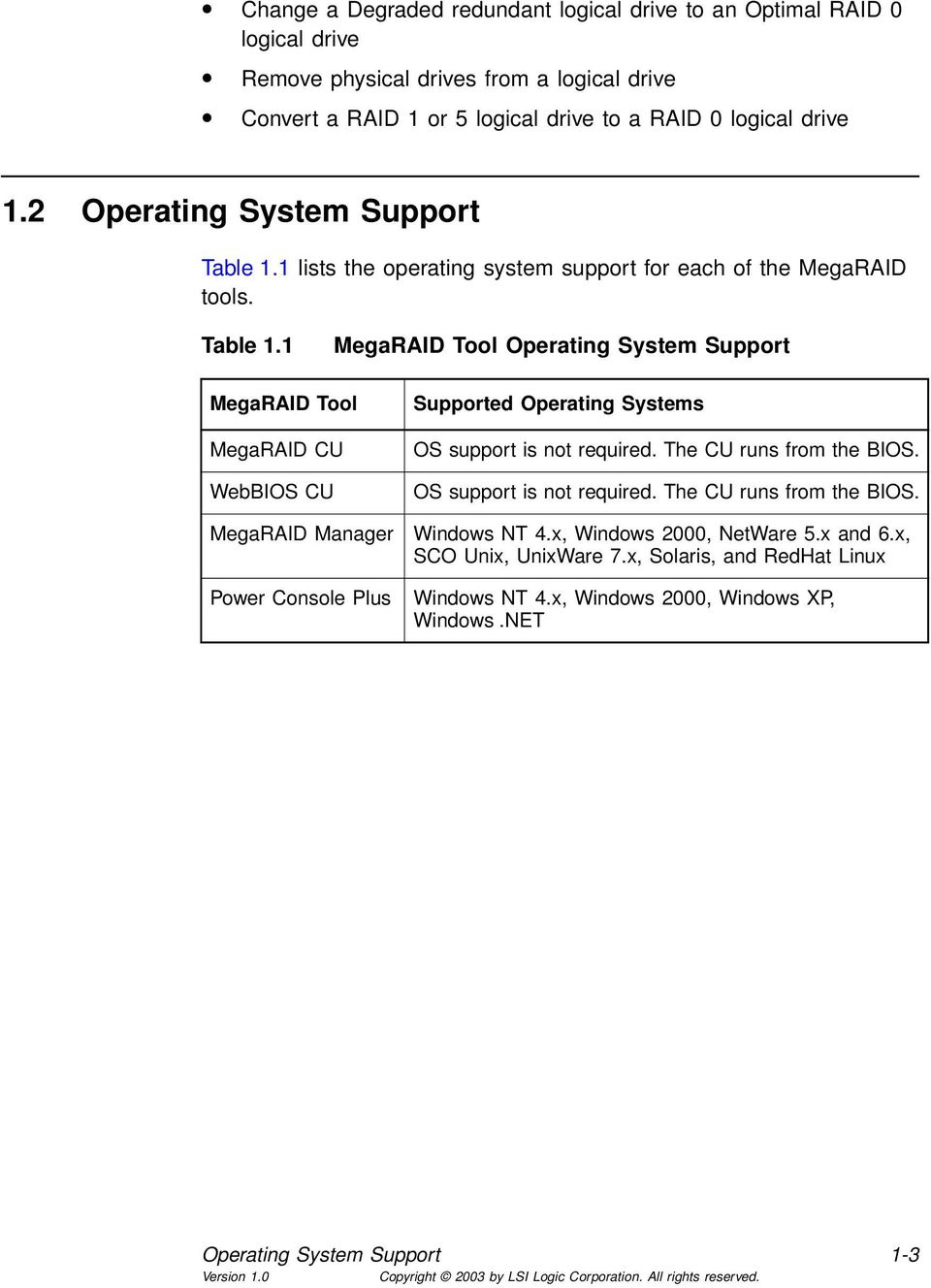
17 Change a Degraded redundant logical drive to an Optimal RAID 0 logical drive Remove physical drives from a logical drive Convert a RAID 1 or 5 logical drive to a RAID 0 logical drive 1.2 Operating System Support Table 1.1 lists the operating system support for each of the MegaRAID tools. Table 1.1 MegaRAID Tool Operating System Support MegaRAID Tool MegaRAID CU WebBIOS CU MegaRAID Manager Power Console Plus Supported Operating Systems OS support is not required. The CU runs from the BIOS. OS support is not required. The CU runs from the BIOS. Windows NT 4.x, Windows 2000, NetWare 5.x and 6.x, SCO Unix, UnixWare 7.x, Solaris, and RedHat Linux Windows NT 4.x, Windows 2000, Windows XP, Windows.NET Operating System Support 1-3
18 1-4 Overview

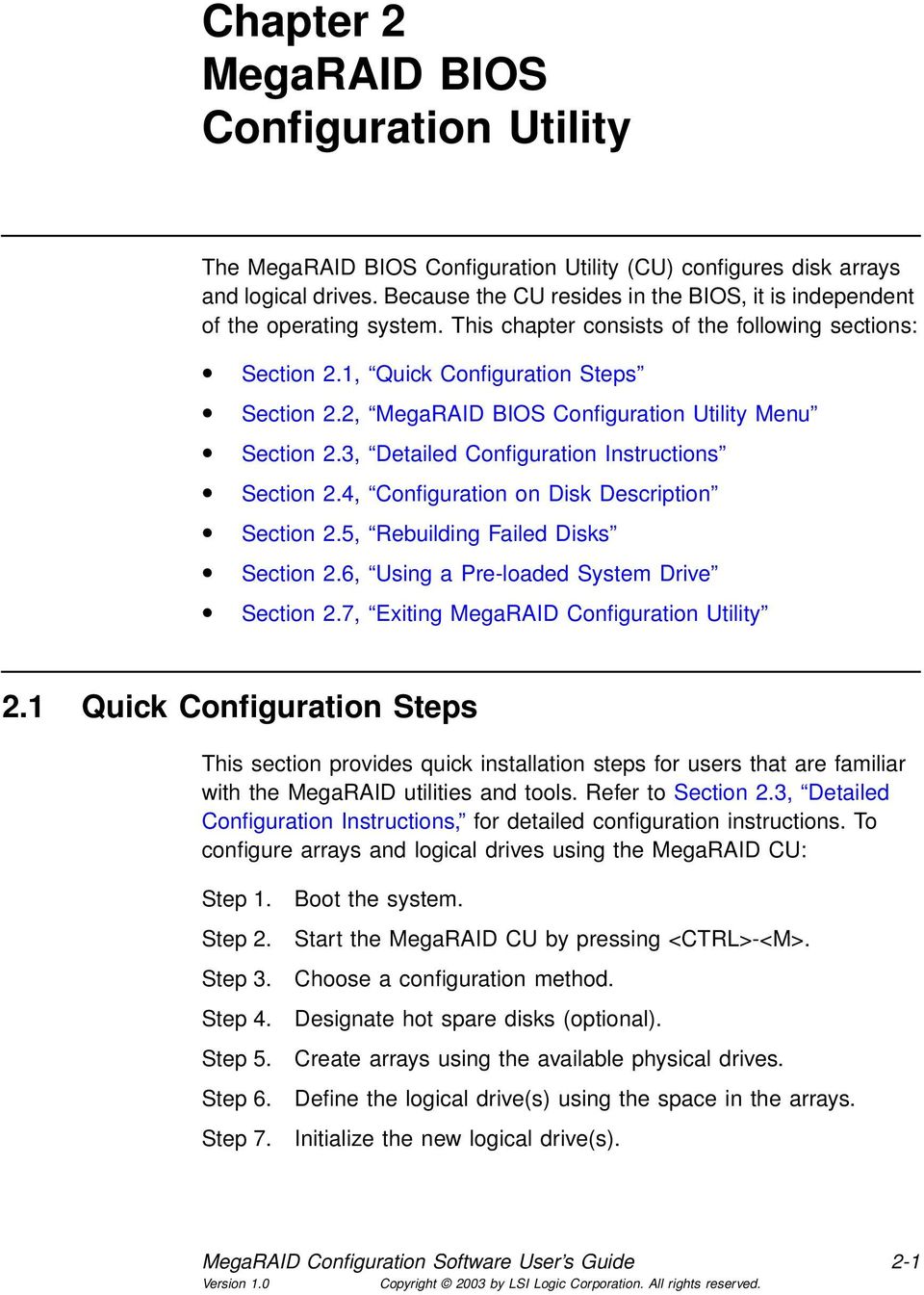
19 Chapter 2 MegaRAID BIOS Configuration Utility The MegaRAID BIOS Configuration Utility (CU) configures disk arrays and logical drives. Because the CU resides in the BIOS, it is independent of the operating system. This chapter consists of the following sections: Section 2.1, Quick Configuration Steps Section 2.2, MegaRAID BIOS Configuration Utility Menu Section 2.3, Detailed Configuration Instructions Section 2.4, Configuration on Disk Description Section 2.5, Rebuilding Failed Disks Section 2.6, Using a Pre-loaded System Drive Section 2.7, Exiting MegaRAID Configuration Utility 2.1 Quick Configuration Steps This section provides quick installation steps for users that are familiar with the MegaRAID utilities and tools. Refer to Section 2.3, Detailed Configuration Instructions, for detailed configuration instructions. To configure arrays and logical drives using the MegaRAID CU: Step 1. Step 2. Step 3. Step 4. Step 5. Step 6. Step 7. Boot the system. Start the MegaRAID CU by pressing <CTRL>-<M>. Choose a configuration method. Designate hot spare disks (optional). Create arrays using the available physical drives. Define the logical drive(s) using the space in the arrays. Initialize the new logical drive(s). MegaRAID Configuration Software User s Guide 2-1
20 2.2 MegaRAID BIOS Configuration Utility Menu Figure 2.1 shows the MegaRAID Manager menu tree. The following subsections describe each menu item. Figure 2.1 MegaRAID Configuration Utility Menu Tree Configure Easy Configuration (Section 2.2.1) New Configuration View/Add Configuration Clear Configuration Specify Bootable Logical Drive Initialize (Section 2.2.2) Objects Adapter (Section 2.2.3) Logical Drive Physical Drive Channel Battery Info Reset Battery Format (Section 2.2.4) Charge Counter Rebuild (Section 2.2.5) Check Consistency (Section 2.2.6) Select Adapter (Section 2.2.7) Clear Configuration FlexRAID PowerFail Fast Initialization Disk Spin Up Timings Chip Set Type Cache Flush Timings Rebuild Rate Alarm Control Other Adapter Information Factory Default Emulation Disable BIOS Auto Rebuild Initiator ID Multiple PCI Delayed Trans Force Boot Coercion Algorithm Initialize Check Consistency View/Update Parameters Rebuild Format Make Online Fail Drive Hot Spare Drive Information Synchronous Negotiation SCSI Command Tagging Termination State Enable Auto Termination SCSI Transfer Rate Backup Module Battery Pack Temperature Voltage Fast Charging Number or Cycles Stripe Size Write Policy Read-Ahead Cache Policy Virtual Sizing Drive State 2-2 MegaRAID BIOS Configuration Utility

21 2.2.1 Configure Menu Choose this option to configure physical arrays and logical drives. This section describes the options of the Configure menu Configuration Menu Options The Configure menu provides four methods to modify and/or create logical disk configuration: Easy Configuration, New Configuration, View/Add Configuration, and Clear Configuration. Table 2.1 provides an overview of these methods. The configuration menu has an Advance submenu that enables you to set specific options. The available options depend upon the configuration method you use. To store the configuration information, the CU reserves 32 bytes on a disk when a hard disk drive is configured. Table 2.1 Option Easy Configuration New Configuration View/Add Configuration Clear Configuration Specify Bootable Logical Disk Configuration Utility Configure Menu Description Easy Configuration automatically associates every physical array with one logical drive. Through the Advance Menu, Easy Configuration allows you to modify the RAID level, stripe size, cache write policy, read policy, and I/O policy. Section , Easy Configuration, provides detailed instructions. New Configuration allows you to modify the RAID level, stripe size, cache write policy, read policy, and I/O policy, logical drive size, and array spanning. If you select New Configuration, the CU deletes the existing configuration information on the selected controller when saving the new configuration. Section , New Configuration and View/Add Configuration, provides detailed instructions. View/Add Configuration allows you to control the same logical drive parameters as New Configuration without disturbing the existing configuration information. The View/Add configuration also allows you to enable the Configuration on Disk feature. Section , New Configuration and View/Add Configuration, provides detailed instructions. This option erases the current configuration information. This option enables the user to specify a boot drive. MegaRAID BIOS Configuration Utility Menu 2-3
22 2.2.2 Initialize Option This option initializes one or more logical drives. Initialize each new logical drive you configure. Refer to Section 2.3.5, Initializing Logical Drives, describes how to initialize drives. Warning: Initializing a logical drive destroys all data on the logical drive Objects Menu Choose Objects from the Configuration Utility main menu to view or change settings for the controller, logical drives, physical drives, and channels. Table 2.2 lists and describes the Objects menu options. Table 2.2 Menu Item Configuration Utility Objects Menu Description Adapter This item enables you to configure the adapter properties. Section , Adapter Submenu Description, provides more information. Logical Drive This item enables you to perform tasks on the logical drives. Section , Logical Drive Submenu Description, provides more information. Physical Drive This item enables you to perform tasks on the physical drives. Section , Physical Drive Submenu Description, provides more information. Channel Battery Info Reset Battery Charge Counter This item enables you to configure channel-related or port-related properties. Section , Channel Submenu Description, provides more information. This menu allows you to configure the battery back-up on your system, if your system supports the battery back-up feature. Section , Battery Info Submenu Description, provides more information. This option resets the battery charge counter Adapter Submenu Description The Adapter submenu allows you to select a MegaRAID controller if your computer has multiple controllers. This submenu also allows you to modify parameters on the selected controller. Choose Adapter from the Objects menu to select a controller and modify its parameters. Table 2.3 provides Adapter submenu options. 2-4 MegaRAID BIOS Configuration Utility
23 Table 2.3 Option Configuration Utility Adapter Submenu Description Clear Configuration FlexRAID PowerFail Fast Initialization Disk Spin up Timings Chip Set Type Cache Flush Timings Rebuild Rate Alarm Control Other Adapter Information Factory Default Disable BIOS Emulation Auto Rebuild Initiator ID Multiple PCI Delayed Trans This option erases the current NVRAM configuration. This option enables the FlexRAID PowerFail feature, which allows drive reconstruction to continue when the system restarts after a power failure. This option initializes the logical drive by writing zeros to the first sector of the logical drive. The fast initialization completes in 3 seconds. This option configures the timing for spinning up the hard disk drives. This option selects the chipset used in the motherboard. This option sets the cache flush interval to 2, 4, 6, 8, or 10 seconds. This option enables you to change the drive rebuild rate. This option configures the onboard audio alarm. This option displays general information about the adapter. This option loads the default MegaRAID Configuration Utility settings. This option disables the BIOS. This option selects the I2O or mass storage mode. This option enables automatic drive rebuilds after a drive failure. This option enables the user to set the initiator ID for the RSA. This option affects the speed of the PCI local bus. The speed depends on the system being used. The default in Enabled. Changing this option to disabled can improve system performance when using Direct I/O. Not all boards support this option. If this feature is not supported, the CU grays it out. Force Boot Enabling this option causes the BIOS not to wait for a key to be pressed when there are errors. MegaRAID BIOS Configuration Utility Menu 2-5
24 Table 2.3 Option Configuration Utility Adapter Submenu (Cont.) Description Coercion Algorithm The coercion algorithm options are: None: The CU does not coerce the drive capacity. 128M: The CU rounds the drive capacity down to the next 128 Mbyte boundary. Then, the CU rounds the drive capacity the nearest 10 Mbyte boundary. If the resulting coerced capacity is larger than the real drive size, the coerced capacity is rounded down to the next 10 Mbyte boundary. 1G: The CU rounds the drive capacity down to the next 1 Gbyte boundary. The CU rounds the drive capacity down to the next 1 Mbyte boundary. The 1 Gbyte boundary correlates with the terms most drive manufacturers use Logical Drive Submenu Description Choose this option from the Configuration Utility Objects menu to select a logical drive and to perform the actions in Table 2.4. Table 2.4 Option Initialize Check Consistency View/Update Parameters Configuration Utility Logical Drive Submenu Description This option initializes the selected logical drive. Initialize every logical drive that you configure. This option verifies the correctness of the redundancy data in the selected logical drive and causes the CU to automatically correct any differences found in the data. This option is available only if you are using RAID level 1 or 5. This option displays the properties of the selected logical drive. This option allows you to modify the cache write policy, read policy, the I/O policy, and virtual sizing. Set the virtual sizing option to Enabled before adding a physical drive to a logical drive. After you create a logical drive set, the partition of the drive is as large as the virtual size of the logical drive. Refer to Chapter 6, Virtual Sizing and Online Capacity Expansion, for more information on Virtual Sizing. You can access the Advance submenu from the View/Update Parameters option. 2-6 MegaRAID BIOS Configuration Utility
25 The Advance submenu is accessible through the View/Update Parameters in the Logical Drive submenu. Table 2.5 describes the Advance submenu. Table 2.5 Option Configuration Utility Advance Submenu Description Stripe Size This parameter specifies the size of the segments written to each disk in a RAID 1, 5, 10, or 50 configuration. The default stripe size is 64 Kbytes. You can set the stripe size to 4, 8, 16, 32, 64, or 128 Kbytes. A larger stripe size improves read performance, especially if your system performs mostly sequential reads. Choose a small stripe size to optimize system performance if your system performs mostly random read requests. Write Policy This option sets the caching method to write-through or write-back. The default setting is write-through caching. In write-through caching, the controller sends a data transfer completion signal to the host after the disk subsystem receives all the data in a transaction. In write-back caching, the controller sends a data transfer completion signal to the host after the controller cache receives all the data in a transaction. Write-through caching has a data security advantage over write-back caching. Write-back caching has a performance advantage over write-through caching. Read-Ahead This option enables the read-ahead cache feature for the logical drive. You can set this parameter to Normal, Read-ahead, or Adaptive. The default setting is Normal. Normal caching specifies that the controller does not use read-ahead caching for the current logical drive. Read-ahead caching specifies that the controller uses readahead caching for the current logical drive. Adaptive specifies that the controller begins using read-ahead caching if the two most recent disk accesses occurred in sequential sectors. Cache Policy This option enables read buffering in cache memory. The default setting is Direct I/O. Cached I/O specifies that the controller buffers all reads in cache memory. Direct I/O specifies that the controller does not buffer reads in cache memory. This parameter applies to reads on a specific logical drive. It does not affect the read-ahead cache. FlexRAID Virtual Sizing Drive State This option enables FlexRAID virtual sizing of logical drives. This option enables the user to set the drive state of a drive. The options are ONLIN, DEGRADED, OFFLINE, and HOTSPARE. MegaRAID BIOS Configuration Utility Menu 2-7
26 Physical Drive Submenu Description Select this option from the Objects menu to select a physical device and to perform the operations listed in Table 2.6. Table 2.6 Option Rebuild Format Make Online Fail Drive Hot Spare Configuration Utility Physical Drive Submenu Description This option rebuilds the selected physical drive. This option performs a low-level format of a disk drive. This option changes the state of the selected disk drive to Online. This option changes the state of the selected disk drive to Fail. This option designates the selected disk drive as a hot spare. Drive Information Synchronous Negotiation SCSI Command Tagging This option displays the drive properties for the selected physical device. This option enables synchronous negotiation with a physical device and is available only for SCSI controllers. This option sets the number of queue tags per command to Disabled, 2, 3, 4, or Enhanced. The default setting is Enhanced. This option is available only for SCSI controllers Channel Submenu Description Select this option from the Configuration Utility Objects menu to choose a channel or port on the currently selected controller. Table 2.7 lists and describes the channel menu options. Table 2.7 Option Configuration Utility Channel Submenu Description Termination State Enable Auto Termination SCSI Transfer Rate This option controls termination on the MegaRAID SCSI controller. The MegaRAID SCSI controller automatically sets this option. Select Yes to enable auto termination. Select No to disable auto termination. This option enables the user to set the SCSI transfer rate as Fast, Ultra, Ultra2, Ultra160, or Ultra320 SCSI. 2-8 MegaRAID BIOS Configuration Utility
27 Battery Info Submenu Description Select this option from the Configuration Utility Objects menu to view information about the battery backup. Table 2.8 lists and describes the options for the Battery Backup submenu. This option is available only on RSAs that support the battery back-up feature. Table 2.8 Option Configuration Utility Battery Backup Submenu Description Backup Module Battery Pack Temperature Voltage Fast Charging Number of Cycles This option Indicates if the battery module is present. This option indicates if the battery module is correctly installed. This option indicates if the temperature is within the normal operating range. This option indicates if the voltage is within the normal operating range. This option indicates if the battery pack is charging, or if the fast charge cycle is complete. This option indicates the number of charge cycles that the battery pack has undergone. The battery pack life is 1100 charge cycles. You must replace the battery pack after it reaches this limit Format Option Select the Format option from the Configuration Utility Management Menu to perform a low-level format on one or more physical drives. Warning: Formatting a hard drive destroys all data on the drive. Since the disk manufacturer often performs a low-level format, this step is usually not necessary. Typically, you format a disk only if: the disk drive was not low-level formatted by the manufacturer, or an excessive number of media errors occur on the disk drive. You do not have to choose Format to erase existing information on your disks, such as a system partition. Initialization of the logical drives erases all the information on the drive. MegaRAID BIOS Configuration Utility Menu 2-9
28 2.2.5 Rebuild Option Choose this option to rebuild failed disk drives. If a disk drive fails that is in a RAID 1, 5, 10, or 50 configuration, you can recover the lost data by rebuilding the drive. The CU can perform an automatic rebuild if hot spare disks are available in the system. If no hot spare disks are available, the data must be manually rebuilt. Refer to Section 2.5, Rebuilding Failed Disks, for information on rebuilding disks Check Consistency Option Select Adapter Menu Choose this option to verify the redundancy data in logical drives that use RAID levels 1, 5, 10, or 50. When you choose Check Consistency, the system displays the parameters of the existing logical drives on the current controller and a selection menu that lists the logical drives by number. The CU automatically corrects any discrepancies with the assumption that the data is correct and that the error exists in the parity information. However, if the failure is a read error on a data drive, the bad data block is reassigned with the generated data. This menu item appears only if the system contains more than one MegaRAID host adapter. The CU lists the adapters present in the system after you choose the Select Adapter option. Select the MegaRAID adapter that you want to configure from this menu MegaRAID BIOS Configuration Utility
29 2.3 Detailed Configuration Instructions This section provides detailed instructions for configuring the logical disks and arrays in a MegaRAID system. MegaRAID provides several hot keys that you can use during the configuration process. Table 2.9 summarizes the hot key definitions. Table 2.9 Configuration Hot Keys Key F2 F3 F4 F10 Function This option displays the manufacturer data and error count for the selected drive. This option displays the configured logical drives. This option designates the selected drive as a hot spare. This option displays the logical drive configuration screen. The option is only available when using New Configuration or View/Add Configuration Starting MegaRAID Configuration Utility While the host computer boots, hold the <Ctrl> key and press the <M> key when the following appears: Press <Ctrl><M> to run MegaRAID BIOS Configuration Utility This causes the CU start-up window to appear. For each MegaRAID adapter in the host system, the CU displays the firmware version, the DRAM size, and the status of logical drives on the adapter. If you do not press <Ctrl>-<M> within a few seconds of the prompt, the system continues the normal boot procedure Choosing a Configuration Method The Configure Menu lets you choose Easy Configuration, New Configuration, View/Add Configuration, or Clear Configuration. Section 2.3.4, Configuring Physical Arrays and Logical Drives, provides detailed instructions for using each configuration method. Caution: When you save the new array configuration, the New Configuration option erases the existing configuration and data. Detailed Configuration Instructions 2-11
30 2.3.3 Designating Hot Spare Drives Hot spare drives are physical drives that power up along with the RAID drives and operate in a standby state. If a physical drive used in a RAID level 1, 5, 10, or 50 configuration fails, the hot spare drive automatically takes its place. The CU reconstructs the lost data from the failed drive onto the hot spare drive. There are two methods for designating physical drives as hot spares: 1. Press <F4> while creating arrays in the Easy, New, or View/Add Configuration mode. Press the arrow keys to choose a disk drive that has a READY indicator; press <F4> to designate the drive as a hot spare. The indicator changes to HOTSP. 2. From the Objects Physical Drive menu, select a physical drive and press <Enter>. Then, select Make HotSpare. The indicator for the selected drive changes to HOTSP Configuring Physical Arrays and Logical Drives Easy Configuration This subsection provides instructions for using the Easy Configuration, New Configuration, and View/Add Configuration. LSI Logic recommends using drives with the same capacity in a specific array. If you use drives with different capacities in an array, the CU treats all these drives as if they have the capacity of the smallest drive. The number of physical drives in a specific array determines the RAID levels that you can implement with the array. RAID 0 requires one or more physical drives. RAID 1 requires exactly two physical drives. RAID 5 requires at least three physical drives. In Easy Configuration, the CU associates each array with a single logical drive. If logical drives have already been configured, the CU does not change their configuration. To create arrays using Easy Configuration: Step 1. Choose Configure Easy Configuration from the MegaRAID CU Main menu. The array selection menu appears MegaRAID BIOS Configuration Utility
31 Step 2. Step 3. Step 4. Step 5. Step 6. Step 7. Step 8. Step 9. Press the arrow keys to choose specific physical drives. Press the spacebar to associate the selected physical drive with the current array. When you select a physical drive, the indicator for the drive changes from READY to ONLIN A[array number]-[drive number]. For example, ONLIN A2-3 indicates disk drive 3 in array 2. Press <Enter> when you are finished creating the current array. The logical drive configuration screen appears. The logical drive configuration screen displays the logical drive number, RAID level, logical drive size, the number of stripes in the physical array, the stripe size, and the state of the logical drive. Set the RAID level for the logical drive. Highlight RAID and press <Enter>. The CU displays the available RAID levels for the current logical drive. Select a RAID level and press <Enter>. Set the stripe size, cache write policy, read policy, and I/O policy through the Advanced menu. When you have defined the current logical drive, choose Accept and press <Enter>. The array selection screen appears if any disk drives remain unconfigured. Repeat these steps to configure additional logical drives. MegaRAID supports up to 40 logical drives per controller. If you are finished configuring logical drives, press <Esc> to exit Easy Configuration. Save the configuration when the CU prompts you to do so. Initialize the logical drives. Refer to Section 2.3.5, Initializing Logical Drives, for detailed instructions. Detailed Configuration Instructions 2-13
32 New Configuration and View/Add Configuration New Configuration and View/Add Configuration associate logical drives with partial and/or multiple physical arrays. New Configuration deletes the existing configuration and replaces it with the configuration that you specify. View/Add Configuration lets you view or modify an existing configuration. To configure a disk array using New Configuration or View/Add Configuration: Step 1. Choose Configure New Configuration or Configure View/Add Configuration from the MegaRAID Configuration Utility Main menu. The CU displays an array selection window. Caution: The New Configuration option erases the existing configuration and its data when you save the new array configuration. Step 2. Select the physical drives to include in the array. Press the arrow keys to choose specific physical drives. Press the spacebar to associate the selected physical drive with the current array. The indicator for the selected drive changes from READY to ONLIN A[array number]-[drive number]. For example, ONLIN A2-3 means disk drive 3 in array 2. Press <Enter> when you are finished creating the current array. Step 3. Press <F10> to configure logical drives. Step 4. Set the RAID level for the logical drive. Highlight RAID and press <Enter>. A list of the available RAID levels for the current logical drive appears. Select a RAID level, and press <Enter>. Step 5. Set the spanning mode for the current logical drive by highlighting Span and pressing <Enter> MegaRAID BIOS Configuration Utility
33 Table 2.10 describes the spanning options. Table 2.10 Spanning Mode Options Spanning Option CanSpan NoSpan Description This option enables array spanning for the current logical drive. The logical drive can occupy space in more than one array. This option disables array spanning for the current logical drive. The logical drive can occupy space in only one array. Step 6. Step 7. For two arrays to be spannable, they must have the same stripe width and must be consecutively numbered. For example, if Array 2 contains four disk drives, you can span it only with Array 1 and/or Array 3, and only if Arrays 1 and 3 each contain four disk drives. If the criteria are not met, the CU ignores the span setting for the current logical drive. Set the logical drive size. Move the cursor to Size and press <Enter>. By default, the logical drive size associates the available space in the array(s) with the current logical drive, accounting for the Span setting and partially used array space. Set the stripe size, cache write policy, read policy, and I/O (cache) policy through the Advanced menu. The stripe size parameter specifies the size of the segment written to each disk in a RAID 1, 5, 10, or 50 configuration. You can set the stripe size to 4, 8, 16, 32, 64, or 128 Kbytes. A larger stripe size produces higher read performance. If your computer regularly performs random read requests, choose a smaller stripe size. The default is 64 Kbytes. The read ahead parameter enables the read-ahead feature for the logical drive. You can set this parameter to Normal, Readahead, or Adaptive. Normal specifies that the controller does not use read-ahead for the current logical drive. Read-ahead specifies that the controller uses read-ahead for the current logical drive. Adaptive specifies that the controller begins using read-ahead if the two most recent disk accesses occurred in sequential sectors. Read-ahead is the default setting. Refer to Detailed Configuration Instructions 2-15
34 Section 3.5.1, Write Policy, for information on the write and cache policy options. Step 8. After you define the current logical drive, choose Accept and press <Enter>. Step 9. Save the configuration when the CU prompts you to do so. Step 10. Initialize the logical drives you configured. Section 2.3.5, Initializing Logical Drives, provides detailed instructions Initializing Logical Drives You can initialize the logical drives using batch initialization or individual initialization. Batch initialization initializes up to 40 logical drives simultaneously. Individual initialization initializes a single logical disk. To initialize logical drives using the batch initialization procedure: Step 1. Step 2. Step 3. Step 4. Step 5. Choose Initialize from the Configuration Utility main menu. A list of the current logical drives appears. Press the spacebar to select the logical drive. You can optionally press <F2> to select or deselect all the logical drives. Press <F10>, and choose Yes from the confirmation prompt. The CU displays a bar graph showing the initialization progress. When initialization completes, press any key to continue. Press <Esc> to display the main menu. To initialize a logical drive using the individual initialization procedure: Step 1. Step 2. Step 3. Step 4. Choose the Configuration Utility Objects Logical Drive submenu. Select the logical drive to initialize. Choose the Initialize option from the action menu. The CU displays a bar graph showing the initialization progress. When initialization completes, press any key to display the previous menu MegaRAID BIOS Configuration Utility
35 2.4 Configuration on Disk Description MegaRAID supports Configuration on Disk, which is also known as drive roaming. Configuration on Disk saves configuration information both in the MegaRAID non-volatile RAM (NVRAM) and on the disk drives attached to MegaRAID. If the MegaRAID controller is replaced with a new MegaRAID controller, the new MegaRAID controller detects the RAID configuration from the attached disk drives. This configuration maintains the integrity of the data on each drive even if the channel or target ID of the drive changes. Note: It is important that the new controller does not have a previous configuration. Be certain to clear the NVRAM configuration when installing the new controller. To add Configuration on Disk support, select Configure View/Add Configuration from the main CU menu. Choose Disk when the system asks to a use Disk or NVRAM. Save the configuration, and reboot the system. 2.5 Rebuilding Failed Disks If hot spare disks are present in the system, the MegaRAID controller automatically uses them to rebuild failed disks. MegaRAID displays the Objects Physical Drive screen while rebuilding a failed drive. The CU changes the drive indicator for the hot spare disk drive to REBLD A[array number]-[drive number], which indicates the disk drive being replaced by the hot spare. A manual rebuild is necessary if hot spare disks of sufficient capacity to rebuild the failed drives are not present. The CU allows manual rebuild for an individual drive or a group of drives. Rebuilding a group of drives is done through the batch mode. To perform a batch rebuild on a group of drives: Step 1. Choose Rebuild from the MegaRAID Configuration Utility main menu. The CU displays a device selection window that marks the failed drives with FAIL indicators. Configuration on Disk Description 2-17
36 Step 2. Step 3. Step 4. Press the arrow keys to select all drives to be rebuilt. Press the spacebar to select the chosen physical drive for rebuild. After selecting the physical drives, press <F10>, and select Yes at the confirmation prompt. The indicators for the selected drives change to REBLD. When rebuild is complete, press any key to continue. Press <Esc> to display the main menu. To perform a manual rebuild on an individual drive: Step 1. Step 2. Step 3. Step 4. Choose the option from the MegaRAID Configuration Utility Objects Physical Drive submenu. Press the arrow keys to select the physical drive to be rebuilt and press <Enter>. Choose the Rebuild option from the action menu and respond to the confirmation prompt. When rebuild completes, press any key to display the previous menu. 2.6 Using a Pre-loaded System Drive Important: Define a pre-loaded system drive as the first logical drive. If the drive is not a boot device, the logical drive number is not critical. You can use the MegaRAID controller as adapter for this drive by performing the following steps: Step 1. Step 2. Step 3. Step 4. Step 5. Step 6. Connect the drive to the channel or port on the MegaRAID controller. Boot the computer. Start the Configuration Utility. Choose Easy Configuration from the Configure menu. Press the cursor keys to select the pre-loaded drive. Press the spacebar. The pre-loaded drive now becomes an array element MegaRAID BIOS Configuration Utility
37 Step 7. Press <Enter>. The pre-loaded drive is a one-disk array. Step 8. Display the logical drive configuration screen. Step 9. Set the read policy and cache option on the Advanced menu. Step 10. Exit the Advanced menu. Highlight Accept, and press <Enter>. Step 11. Press <Esc> and choose Yes at the Save prompt. Step 12. Exit Configuration Utility and reboot. Step 13. Set the host system to boot from the drive. Some operating systems treat RSAs as mass storage devices. 2.7 Exiting MegaRAID Configuration Utility Press <Esc> when the MegaRAID Configuration Utility management menu is displayed to exit MegaRAID Configuration Utility. Exiting MegaRAID Configuration Utility 2-19
38 2-20 MegaRAID BIOS Configuration Utility
39 Chapter 3 WebBIOS Configuration Utility This chapter describes the WebBIOS Configuration Utility and consists of the following sections: Section 3.1, General Description Section 3.2, Quick Configuration Steps Section 3.3, Starting the WebBIOS Utility on the Host Computer Section 3.4, Screen and Option Descriptions Section 3.5, Detailed Configuration Instructions 3.1 General Description The WebBIOS Configuration Utility provides a web-based utility to configure and manage RAID volumes. You can use this utility in place of, or in conjunction with, the MegaRAID BIOS Configuration Utility that is described in Chapter 2, MegaRAID BIOS Configuration Utility. The utility configures disk arrays and logical drives. The operation of the utility is independent of the operating system because the utility resides in the MegaRAID BIOS. The WebBIOS CU: Displays adapter properties Scans devices Defines logical drives Displays logical drive properties Initializes logical drives Checks data for consistency Configures physical arrays MegaRAID Configuration Software User s Guide 3-1
40 Selects adapters Displays the physical properties of devices The WebBIOS CU provides a configuration wizard to guide you through the configuration of logical drives and physical arrays. 3.2 Quick Configuration Steps This section provides the steps to configure arrays and logical drives using the WebBIOS CU. The following sections describe how perform each action using the WebBIOS CU. The steps are: Step 1. Step 2. Step 3. Step 4. Step 5. Step 6. Step 7. Power-on the system. Start the WebBIOS CU by pressing <Ctrl>-<H>. Start the Configuration Wizard. Choose a configuration method. Create arrays using the available physical drives. Define the logical drive(s) using the space in the arrays. Initialize the new logical drives. 3.3 Starting the WebBIOS Utility on the Host Computer When the host computer boots, hold the <Ctrl> key and press the <H> key when the following appears: Copyright AMERICAN MEGATRENDS, INC. Press <Ctrl><M> to Run Configuration Utility Or press <Ctrl><H> for WebBIOS After you press <Ctrl>-<H>, the Adapter Selection screen displays. Select an adapter and press the Start button to begin the configuration. If you want to use the BIOS configuration utility instead of WebBIOS, you can start the MegaRAID BIOS CU from the WebBIOS CU by clicking on the Control-M button. 3-2 WebBIOS Configuration Utility
41 Note: If there is a configuration mismatch between the disks and the NVRAM, the CU displays the Select Configuration screen. 3.4 Screen and Option Descriptions This section describes the various WebBIOS screens and options Toolbar Options Table 3.1 describes the WebBIOS toolbar icons. Table 3.1 Icon WebBIOS Toolbar Icon Descriptions Description Click on this icon to return to the main screen. Click on this icon to return to the page you accessed immediately before the current page. Click on this icon to exit the WebBIOS program. Click on this icon to display the adapters that you can select. Click on this icon to scan for adapters connected to your system. Click on this icon to display the properties of the adapter, such as the firmware version, BIOS version, RAM size, and initiator ID. Click on the icon to access the Configuration Wizard so that you can configure the arrays and logical drives. Screen and Option Descriptions 3-3
42 Table 3.1 Icon WebBIOS Toolbar Icon Descriptions (Cont.) Description Click on this icon to turn off the sound on the alarm. Click on this icon to go from the WebBIOS Configuration Utility to the MegaRAID Configuration Utility Main Screen Scan Devices Option Adapter Selection Option When you press <Ctrl><H> on the host computer, the CU displays the main screen. From the main screen you can scan the devices connected to the controller, select a MegaRAID adapter if multiple adapters are in the system, and alternate between the physical devices view and the logical devices view. The main screen also provides access to the following screens: Adapter Properties, Physical Devices, Logical Devices, Configuration Mismatch, and Configuration Wizard. When you select the Scan Devices option on the Main screen, WebBIOS checks the physical and logical drives for any changes of the drive status. WebBIOS displays the results of the scan in the physical and logical drive descriptions. When you select the Adapter Selection option on the main screen, MegaRAID displays a list of the MegaRAID adapters in the system. You can select an adapter and begin configuration Physical View\Logical View Option This option toggles between Physical View and Logical View Adapter Properties Screen The Adapter Properties screen allows you to view and configure the software and hardware of the selected adapter. You access the Adapter 3-4 WebBIOS Configuration Utility
43 Properties screen from the WebBIOS main screen. Table 3.2 describes the Adapter Properties menu options. Table 3.2 Option WebBIOS Adapter Properties Menu Options Description Firmware Version BIOS Version RAM Size Rebuild Rate FlexRAID PowerFail PCI Delay Transfer Adapter BIOS Set Factory Defaults Auto Rebuild Class Emulation Mode This option displays the firmware version number. This option displays the BIOS version number. This option displays the size of the RAM. This option sets the rebuild rate. This option enables the FlexRAID PowerFail feature, which allows drive reconstruction to continue when the system restarts after a power failure. This option enables PCI delay transfers. This option enables the adapter BIOS. This option loads the default MegaRAID WebBIOS CU settings. This option automatically rebuilds drives when they fail. This option selects I2O or Mass Storage as the class emulation mode Logical Drives Screen You can access the Logical Drives screen by clicking on a logical drive in the logical drive list on the main screen. The upper right section of the screen displays the logical drives that currently exist. The Logical Drives screen provides options to: Initialize the logical drives Check consistency Display the logical drive properties Boot from a logical drive Press Go to perform the selected action. Press Reset to delete any changes. Screen and Option Descriptions 3-5
44 Initialization Check Consistency Properties Physical Drives Screen The Initialize option initializes the selected logical drive by writing zeroes to the entire volume. Initialize each new logical drive that you configure. This option verifies the correctness of the redundancy data and is available for arrays using RAID 1, 5, 10, or 50. If a difference in the data is found, MegaRAID assumes that the data is accurate and automatically corrects the parity value. Through the Properties option you can: Display the logical drive properties (such as RAID level, logical drive size, and stripe size) Display the read, write, and I/O policies Change the read, write, and I/O policies Start initialization Start a consistency check This screen displays the physical drives for each channel or port. From this screen, you can rebuild the physical arrays or view the properties for the physical drive you select. Press Reset to return to the configuration that existed before you made any changes Configuration Mismatch Screen A configuration mismatch occurs when the data in the NVRAM and the hard disk drives are different. The Configuration Mismatch screen allows you to: Select Create New Configuration to delete the previous configuration and create a new configuration Select View Disk Configuration to restore the configuration from the hard disk 3-6 WebBIOS Configuration Utility
45 Select View NVRAM Configuration to restore the configuration from the NVRAM Configuration Wizard Option This option enables you to clear a configuration, create a new configuration, or add a configuration. Section 3.5, Detailed Configuration Instructions, provides detailed steps for using the Configuration Wizard. 3.5 Detailed Configuration Instructions This section provides detailed steps for using the Configuration Wizard to set up a RAID array. Step 1. Step 2. Step 3. Step 4. Start the Configuration Wizard by selecting the Configuration Wizard icon on the WebBIOS main screen. Select the configuration method. You can select Custom configuration, Auto configuration with redundancy, or Auto configuration without redundancy. LSI Logic recommends using Auto configuration with redundancy. Define the logical drive. Use this screen to add drives to an array. Click on Accept Array to add the drives. To undo the changes, press the Reclaim button. Configure the logical drive. The logical drive parameters are the RAID level, stripe size, and read-ahead policy. The stripe size parameter specifies the size of the segment written to each disk in a RAID configuration. You can set the stripe size to 4, 8, 16, 32, 64, or 128 Kbytes. A larger stripe size produces higher read performance. If your computer regularly performs random read requests, choose a smaller stripe size. The default is 64 Kbytes. The read ahead parameter enables the read-ahead feature for the logical drive. You can set this parameter to Normal, Readahead, or Adaptive. Normal specifies that the controller does Detailed Configuration Instructions 3-7
46 Step 5. Step 6. Step 7. Step 8. Step 9. not use read-ahead for the current logical drive. Read-ahead specifies that the controller uses read-ahead for the current logical drive. Adaptive specifies that the controller begins using read-ahead if the two most recent disk accesses occurred in sequential sectors. Read-ahead is the default setting. Select the write policy. Use this screen to select the write and cache policies. Refer to Section 3.5.1, Write Policy, and Section 3.5.2, Cache Policy, for more details. Configure the spanning mode. Enable or disable the spanning mode for the current logical drive. If spanning is enabled, the logical drive can occupy space in more than one array. If spanning is disabled, the logical drive can occupy space in only one array. For two arrays to be spannable, they must have the same stripe width and must be consecutively numbered. If these criteria are not met, CU ignores the Span setting. Set the size of the logical drive in Mbytes. Accept the changes. Click on the Accept button to accept the changes, or click on the Reset button to delete the changes and return to the previous settings. Check the configuration preview. The WebBIOS CU displays a preview of the configuration. Click on Accept to save the configuration, or click on Back to return to the previous screens and change the configuration Write Policy The write policy parameter specifies the cache write policy. You can set the write policy to Write-back or Write-through. In Write-back caching, the controller sends a data transfer completion signal to the host when the controller cache receives all the data in a transaction. In Writethrough caching, the controller sends a data transfer completion signal to the host after the disk subsystem receives all the data in a transaction. Write-through caching is the default setting. Write-through caching has a 3-8 WebBIOS Configuration Utility
47 data security advantage over write-back caching. Write-back caching has a performance advantage over write-through caching. Caution: Do not use write-back caching for any logical drive in a Novell NetWare volume Cache Policy The cache policy applies to reads on a specific logical drive. It does not affect the read ahead cache. The options are Cached I/O or Direct I/O. Cached I/O buffers all reads in cache memory and is the default setting. Direct I/O does not buffer reads in cache memory. Direct I/O does not override the cache policy settings. Direct I/O transfers data to cache and the host concurrently. If the same data block is read again, the host reads it from cache memory. Detailed Configuration Instructions 3-9
48 3-10 WebBIOS Configuration Utility
49 Chapter 4 MegaRAID Manager MegaRAID Manager is a character-based utility that configures and monitors RAID systems. This chapter consists of the following sections: Section 4.1, Quick Configuration Steps Section 4.2, Main Menu Options Section 4.3, Detailed Configuration Steps Section 4.4, Rebuilding Failed Disk Drives Section 4.5, Exiting MegaRAID Manager 4.1 Quick Configuration Steps This section provides quick installation steps for users that are familiar with the MegaRAID utilities and tools. See Section 4.3, Detailed Configuration Steps, for detailed configuration instructions. The steps to configure arrays and logical drives with the MegaRAID CU are: Step 1. Step 2. Step 3. Step 4. Step 5. Step 6. Step 7. Boot the system. Start the MegaRAID Manager. Choose a configuration method. Designate hot spares (optional). Create arrays using the available physical drives. Define logical drives using the space in the arrays. Initialize the logical drives. MegaRAID Configuration Software User s Guide 4-1
50 4.2 Main Menu Options Figure 4.1 shows the MegaRAID Manager menu tree. The following subsections describe each menu item in detail. Figure 4.1 MegaRAID Manager Menu Tree Configure Initialize Automatic Configuration Easy Configuration New Configuration View/Add Configuration Clear Configuration Stripe Size Write Policy Read-Ahead Cache Policy Logical Disk Size Disk Spanning Objects Rebuild Check Consistency Adapter Logical Drive Physical Drive Channel Battery Backup Advanced Menu, Reconstruct Logical Drive Select Adapter Clear Configuration View Adapter Performance FlexRAID PowerFail Disk Spin Up Timing Alarm Control View/Update Parameters Adapter Type Initialize Check Consistency View/Update Parameters Rebuild Make Online Fail Drive Make HotSpare View Drive Information View Rebuild Progress Termination Status Activate Channel Terminate High 8 Bits Terminate Wide Channel Disable Termination View Parameters Backup Module Battery Pack Temperature Voltage Fast Charging Number or Cycles 4-2 MegaRAID Manager
51 Table 4.1 describes the top level of the MegaRAID Manager Main menu. The following subsections provided detailed descriptions of these options and their submenus. Table 4.1 Option Configure Initialize Objects Rebuild Check Consistency MegaRAID Manager Main Menu Description Select this option to configure arrays and logical drives. Section 4.2.1, Configure Menu, provides more information. Select this option to initialize one or more logical drives. Section 4.2.2, Initialize Option, provides more information. Select this option to individually access controllers, logical drives, and physical drives. Section 4.2.3, Objects Menu, provides more information. Select this option to rebuild failed disk drives. Section 4.2.4, Rebuild Option, provides more information. Select this option to verify redundancy data in logical drives using RAID level 1, 5, 10, or 50 configurations. Section 4.2.5, Check Consistency Option, provides more information. Advanced Menu Select Adapter Select this option to run the Enclosure Management and Diagnostics functions. Section 4.2.6, Advanced Menu Reconstruct Logical Drive, provides more information. Select this option to choose the MegaRAID adapter if more than one MegaRAID adapter is present in the system. Section 4.2.7, Select Adapter Menu, provides more information Configure Menu Access the Configure menu from the MegaRAID Manager Main Menu. This menu provides several methods to configure arrays and logical drives, which Table 4.2 summarizes. Each configuration method requires a different level of user input. Table 4.2 Option Auto Configuration Easy Configuration MegaRAID Manager Configure Menu Description Select this method to have the MegaRAID controller automatically configure arrays and logical drives. Select this method to perform a basic logical drive configuration. The MegaRAID manager automatically associates every physical array you define with exactly one logical drive. Main Menu Options 4-3
52 Table 4.2 Option New Configuration View/Add Configuration Clear Configuration MegaRAID Manager Configure Menu (Cont.) Description Select this method to discard the existing configuration information and configure new arrays and logical drives. New Configuration provides the basic logical drive configuration functions and also lets you associate logical drives with multiple or partial arrays. Select this method to examine the existing configuration and/or to specify additional arrays and logical drives. View/Add Configuration provides the same functions as New Configuration. Select this option to erase the current configuration information from the MegaRAID controller non-volatile memory Auto Configuration In Auto Configuration, the MegaRAID Manager examines the physical drives connected to it and automatically configures them into arrays and logical drives. Auto Configuration does not change previously configured logical drives. Auto Configuration scans the attached physical drives and automatically configures them into arrays and logical drives according to the following procedure. 1. Gathers drives with the same capacity into groups of five, four, or three physical disks. 2. Configures these groups as RAID 5 arrays. 3. Groups pairs of drives with the same capacity and configures the pairs as RAID 1 arrays. 4. Configures any remaining single disk drives as RAID 0 logical drives. Table 4.3 lists the Auto Configuration logical drive settings. You can change the write policy, read policy, and cache policy after configuration 4-4 MegaRAID Manager
53 completes. Refer to Section , Auto Configuration, for detailed instructions. Table 4.3 Parameter Stripe Size Write Policy Read Policy Cache Policy Spanning Auto Configuration Logical Drive Settings Setting 64 Kbytes Write-through Read-ahead Direct I/O Off Easy Configuration New Configuration View/Add Configuration In Easy Configuration, the MegaRAID Manager associates each physical array you create with exactly one logical drive. If you have already configured logical drives when you select Easy Configuration, their configuration information is not disturbed. Easy Configuration allows you to modify the RAID level, stripe size, cache write policy, read policy, I/O policy. Refer to Section , Easy Configuration, for detailed instructions. New Configuration deletes the old configuration information and allows you to create a new array or logical disk configuration. The originally existing configuration information on the selected controller is deleted when the new configuration is saved. New Configuration allows you to modify the RAID level, stripe size, cache write policy, read policy, I/O policy, logical drive size, spanning of arrays. Refer to Section , New Configuration and View/Add Configuration, for detailed instructions. View/Add Configuration allows you to control the same logical drive parameters as New Configuration, but does not alter the existing configuration. See Section , New Configuration and View/Add Configuration, for details. Main Menu Options 4-5
54 4.2.2 Initialize Option Objects Menu Choose this option from the MegaRAID Manager Main Menu to initialize one or more logical drives. Initialize each logical drive that you configure. Choose this option from the MegaRAID Manager Main Menu to individually access the adapters, logical drives, physical drives, and bus channels or ports. You can also change certain settings for each object. Table 4.4 presents the Objects submenu. The following subsections describe the Objects submenu options. Table 4.4 Option MegaRAID Manager Objects Submenu Description Adapter This option enables you to configure the adapter properties. Section , Adapter Submenu Description, provides more information. Logical Drive This option enables you to perform tasks on the logical drives. Section , Logical Drive Submenu Description, provides more information. Physical Drive This option enables you to perform tasks on the physical drives. Section , Physical Drive Submenu Description, provides more information. Channel Battery Backup This option enables you to configure channel-related or port-related properties. Section , Channel Submenu Description, provides more information. This menu allows you to configure the battery back-up on your system, if your system supports the battery back-up feature. Section , Battery Backup Submenu Description, provides more information Adapter Submenu Description The Adapter submenu allows you to select a MegaRAID controller if your computer has multiple controllers. This submenu also allows you to modify parameters on the selected controller. Choose Adapter from the Objects menu to select a controller and modify its parameters. Table 4.5 lists and describes the options of the MegaRAID Manager Adapter submenu. 4-6 MegaRAID Manager
55 Table 4.5 Option Clear Configuration View Adapter Performance FlexRAID PowerFail Disk Spin up Timing Alarm Control View/Update Parameters Adapter Type MegaRAID Manager Adapter Submenu Description This option erases the current configuration from the controller NVRAM. This option displays the total write and read performance in Mbytes/s. Not all environments supported this feature. This option enables the FlexRAID PowerFail feature, which allows drive reconstruction to continue when the system restarts after a power failure. This option configures the method and timing for spinning up the hard disk drives. This option configures the onboard audio alarm. This option displays the firmware version number and the cache memory size. This option also allows you to change the rebuild rate for the adapter. This option displays the type of adapter Logical Drive Submenu Description Choose this option from the Objects menu to select a logical drive and to perform the listed actions. Table 4.6 lists and describes the options of the MegaRAID Manager Logical Drive submenu. Table 4.6 Options Initialize Check Consistency View/Update Parameters MegaRAID Manager Logical Drive Submenu Description This option initializes the selected logical drive. Initialize every logical drive that you configure. This option verifies the correctness of the redundancy data in the selected logical drive and causes the CU to automatically correct any differences found in the data. This option is available only if you are using RAID level 1 or 5. This option displays the properties of the selected logical drive. This option allows you to modify the cache write policy, the cache read policy, virtual sizing, and the I/O policy. Set the virtual sizing option to Enabled before adding a physical drive to a logical drive. After you create a logical drive set, the partition of the drive is as large as the virtual size of the logical drive. Refer to Chapter 6, Virtual Sizing and Online Capacity Expansion, for more information on Virtual Sizing. Main Menu Options 4-7
56 Physical Drive Submenu Description Choose this option from the Objects menu to select a physical device and to perform the listed operations. Selecting this option displays the physical drives in the computer Table 4.7 lists and describes the options of the MegaRAID Manager Physical Device submenu. Table 4.7 Options Rebuild Make Online Fail Drive MegaRAID Manager Physical Drive Submenu Description This option rebuilds the selected disk drive. This option changes the state of the selected disk drive to Online. This option changes the state of the selected disk drive to Fail. Make HotSpare View Drive Information View Rebuild Progress This option designates the selected disk drive as a hot spare. This option displays the manufacturer data for the selected physical device. This option displays the progress of the rebuild process for the selected disk drive Channel Submenu Description Select this option from the Configuration Utility Objects menu to choose a channel or port on the currently selected controller. Table 4.8 lists and describes the options of the MegaRAID Manager Channel menu. Table 4.8 MegaRAID Manager Channel Submenu 1 Option Termination Status Activate Channel Terminate High 8 Bits Terminate Wide Channel Description This option changes the type of termination. This option activates the selected channel. Be sure that TermPWR is provided for all active channels. This option enables termination on the selected channel for the upper eight bits and disable termination on the controller for the lower eight bits. Enable this setting if the selected SCSI channel is terminated with Narrow SCSI devices at both ends. This option enables Wide termination for the selected channel. Enable this option if the MegaRAID controller is at one end of the SCSI bus for the selected channel. 4-8 MegaRAID Manager
57 Table 4.8 MegaRAID Manager Channel Submenu (Cont.) 1 Option Disable Termination Description This option disables termination on the MegaRAID controller for the selected channel. Use this option if the selected SCSI channel is terminated with Wide SCSI devices at both ends. View Parameters This option displays the termination status of the selected channel. 1. On some adapters, only the Termination Status is available Battery Backup Submenu Description Select this option from the Configuration Utility Objects menu to view information about the battery backup. Table 4.9 lists and describes the options of the MegaRAID Manager Battery Backup submenu. This option is available only on controllers that support the battery back-up feature. Table 4.9 Option MegaRAID Manager Battery Backup Submenu Description Backup Module Battery Pack Temperature Voltage Fast Charging Number of Cycles This option indicates if the battery module is present. This option indicates if the battery module is correctly installed. This option indicates if the temperature is within the normal operating range. This option indicates if the voltage is within the normal operating range. This option indicates if the battery pack is charging, or if the fast charge cycle is complete. This option indicates the number of charge cycles the battery pack has undergone. The battery pack life is 1100 charge cycles. You must replace the battery pack after it reaches this limit Rebuild Option If a disk drive fails in a RAID 1, 5, 10, or 50 configuration, you can recover the lost data by rebuilding the drive. The CU can perform an automatic rebuild if hot spare disks are in available the system. If no hot spare disks are available, the data must be manually rebuilt. Refer to Section 4.4, Rebuilding Failed Disk Drives, for information on rebuilding disks. Main Menu Options 4-9
58 4.2.5 Check Consistency Option Choose this option to verify the redundancy data in logical drives using RAID levels 1, 5, 10, or 50. When you choose Check Consistency, the parameters of the existing logical drives on the current controller appear. The logical drives are listed by number. If errors are discovered, MegaRAID assumes that the data is correct and that the parity information is in error. MegaRAID automatically corrects the parity information Advanced Menu Reconstruct Logical Drive Select Adapter Menu The option lets you select a logical drive for MegaRAID to recreate. Choose this option before you add or remove a physical drive. This menu item appears only if the system contains more than one MegaRAID host adapter. The CU lists the adapters present in the system after you choose the Select Adapter option. Select the MegaRAID adapter you want to configure from this menu. 4.3 Detailed Configuration Steps This section provides detailed instructions for configuring the logical disks and arrays in a MegaRAID system. MegaRAID provides several hot keys that you can use during the configuration process. Table 4.10 summarizes the hot key definitions. Table 4.10 MegaRAID Manager Configuration Hot Keys Key F2 F3 F4 F10 Function This option displays the manufacturer data and error count for the selected drive. This option displays the configured logical drives. This option designates the selected drive as a hot spare. This option displays the logical drive configuration screen. This option is only available when using New Configuration or View/Add Configuration MegaRAID Manager
59 4.3.1 Starting MegaRAID Manager MegaRAID Manager runs under the follow operating systems: MS-DOS version 6.xx or later Novell NetWare 5.x and 6.x Red Hat Linux, versions 7.3 and 8.0 To start MegaRAID Manager, ensure the program file is in your file path. In DOS, type: MEGACONF In NetWare, type: load megamgr For any other OS, refer to the documentation that accompanied the OS Choosing a Configuration Method Select a configuration from the Configuration Utility Configure Menu. You can choose Auto Configuration, Easy Configuration, New Configuration, View/Add Configuration, or Clear Configuration. Section 4.3.4, Configuring Physical Arrays and Logical Drives, provides detailed instructions for using each configuration method. Caution: The New Configuration option erases the existing configuration and all the data that it holds when you save the new array configuration Designating Hot Spare Drives Hot spare drives are physical drives that power up along with the RAID drives and operate in a standby state. If a physical drive used in a RAID level 1, 5, 10, or 50 configuration fails, the hot spare drive automatically takes its place. The CU reconstructs the lost data from the failed drive onto the hot spare drive. There are two methods for designating physical drives as hot spares: 1. Press <F4> while creating arrays in the Easy, New, or View/Add Configuration mode. Detailed Configuration Steps 4-11
60 Press the arrow keys to choose a disk drive that has a READY indicator and press <F4> to designate the drive as a hot spare. The indicator changes to HOTSP. 2. From the Objects Physical Drive menu, select a physical drive and press <Enter>. Then, select Make HotSpare. The indicator for the selected drive changes to HOTSP Configuring Physical Arrays and Logical Drives Auto Configuration This section provides detailed instructions for using the various array and configuration methods that MegaRAID offers. LSI Logic recommends using drives with the same capacity in a specific array. If you use drives with different capacities in an array, the CU treats all drives in the array as if they have the capacity of the smallest drive in the array. The number of physical drives in a specific array determines the RAID levels that you can implement with the array. RAID 0 requires one or more physical drives. RAID 1 requires exactly two physical drives. RAID 5 requires at least three physical drives. To create arrays using Auto Configuration: Step 1. Step 2. Step 3. Step 4. Step 5. Designate hot spare drives, if any are present, before running Auto Configuration. Choose Configure Auto Configuration from the MegaRAID Manager Main menu. Respond to the confirmation prompt. MegaRAID displays the resulting the logical drives. Choose Yes to save the configuration. Initialize the logical drives. Section 4.3.5, Initializing Logical Drives, provides detailed instructions MegaRAID Manager
61 Easy Configuration MegaRAID Easy Configuration associates each array with one logical drive. To create arrays using Easy Configuration: Step 1. Step 2. Step 3. Step 4. Step 5. Step 6. Step 7. Choose Configure Easy Configuration from the MegaRAID Manager Main menu. The array selection menu appears. Press the arrow keys to select specific physical drives. Press the spacebar to associate the selected physical drive with the current array. The indicator for the selected drive changes from READY to ONLIN A[array number]-[drive number]. For example, ONLIN A2-3 indicates disk drive 3 in array 2. Press <Enter> when you are finished creating the current array. The logical drive configuration screen appears. The window at the top of the screen shows the logical drive the logical drive number, the RAID level, the logical drive size, the number of stripes the associated physical array, the stripe size, and the state of the logical drive. Set the RAID level for the logical drive. Highlight RAID and press <Enter>. MegaRAID displays the available RAID levels for the current logical drive. Select a RAID level and press <Enter>. When you are finished defining the current logical drive, select Accept and press <Enter>. The array selection screen appears if any unconfigured disk drives remain. Repeat these steps to configure additional arrays and logical drives. If you are finished configuring logical drives, press <Esc> to exit Easy Configuration. Save the configuration. Step 8. Initialize the logical drives that you configured. Section 4.3.5, Initializing Logical Drives, provides detailed instructions. Detailed Configuration Steps 4-13
62 New Configuration and View/Add Configuration New Configuration and View/Add Configuration associate logical drives with partial and/or multiple physical arrays. New Configuration deletes the existing configuration and replaces it with the configuration that you specify. View/Add Configuration allows you to view or modify an existing configuration. To configure a disk array using the New Configuration or View/Add Configuration option: Step 1. Choose Configure New Configuration or Configure View/Add Configuration from the MegaRAID Manager Main menu. MegaRAID displays an array selection window showing the devices connected to the current controller. Caution: The New Configuration option erases the existing configuration and its data when you save the new array configuration. Step 2. Select the physical drives to include in the array. Press the arrow keys to select specific physical drives. Press the spacebar to associate the selected physical drive with the current array. The indicator for the selected drive changes from READY to ONLIN A[array number]-[drive number]. For example, ONLIN A2-3 indicates disk drive 3 in array 2. Press <Enter> when you are finished creating the current array. Step 3. Press <F10> to configure logical drives. The logical drive configuration screen appears. The window from the top of the screen shows the logical drive that is currently being configured as well as any existing logical drives. The logical drive options are the logical drive number, the RAID level, the logical drive size, the number of stripes for the associated physical array, the stripe size, and the state of the logical drive. Step 4. Set the RAID level for the logical drive. Highlight RAID and press <Enter>. The available RAID levels for the current logical drive are listed. Select a RAID level MegaRAID Manager
63 Step 5. Set the spanning mode for the current logical drive by highlighting Span and pressing <Enter>. Table 4.11 describes the spanning options. Table 4.11 Spanning Mode Options Spanning Option CanSpan NoSpan Description This option enables array spanning for the current logical drive. The logical drive can occupy space in more than one array. This option disables array spanning for the current logical drive. The logical drive can occupy space in only one array. Step 6. Step 7. For two arrays to be spannable, they must have the same stripe width and must be consecutively numbered. For example, if Array 2 contains four disk drives, you can only span it only with Array 1 and/or Array 3, and only if Arrays 1 and 3 each contain four disk drives. If the criteria are not met, the MegaRAID ignores the span setting for the current logical drive. Set the logical drive size. Move the cursor to Size and press <Enter>. By default, the logical drive size associates all available space in the array(s) with the current logical drive, accounting for the Span setting and for partially used array space. Set the stripe size, cache write policy, read policy, and I/O (cache) policy. The stripe size parameter specifies the size of the segment written to each disk in a RAID 1, 5, 10, or 50 configuration. You can set the stripe size to 4, 8, 16, 32, 64, or 128 Kbytes. A larger stripe size produces higher read performance. If your computer regularly performs random read requests, choose a smaller stripe size. The default is 64 Kbytes. The read ahead parameter enables the read-ahead feature for the logical drive. You can set this parameter to Normal, Readahead, or Adaptive. Normal specifies that the controller does not use read-ahead for the current logical drive. Read-ahead specifies that the controller uses read-ahead for the current logical drive. Adaptive specifies that the controller begins using Detailed Configuration Steps 4-15
64 read-ahead if the two most recent disk accesses occurred in sequential sectors. Read-ahead is the default setting. Refer to Section 3.5.1, Write Policy, for information on the write and cache policy options. Step 8. After you define the current logical drive, choose Accept and press <Enter>. Step 9. Save the configuration. Step 10. Initialize the logical drives you configured. Section 4.3.5, Initializing Logical Drives, provides detailed instructions Initializing Logical Drives You can initialize the logical drives using batch initialization or individual initialization. Batch initialization initializes up to 40 logical drives simultaneously. Individual initialization causes only a single logical disk to be initialized. To initialize logical drives using the batch initialization procedure: Step 1. Step 2. Step 3. Step 4. Step 5. Choose Initialize from the Configuration Utility main menu. A list of the current logical drives appears. Press the spacebar to select the logical drive. You can optionally press <F2> to select or deselect all the logical drives. Press <F10> and choose Yes from the confirmation prompt. MegaRAID displays a bar graph showing the initialization progress. When initialization completes, press any key to continue. Press <Esc> to display the main menu. To initialize a logical drive using the individual initialization procedure: Step 1. Step 2. Step 3. Choose Objects Logical Drive from the MegaRAID Configuration Utility Main menu. Select the logical drive to initialize. Choose the Initialize option from the action menu. MegaRAID displays a bar graph showing the initialization progress MegaRAID Manager
65 Step 4. When initialization completes, press any key to display the previous menu. 4.4 Rebuilding Failed Disk Drives If hot spare disks are present in the system, the MegaRAID controller automatically uses them to rebuild failed disks. MegaRAID displays the Physical Drive screen while rebuilding a failed drive. The CU changes the drive indicator for the hot spare disk drive to REBLD A[array number]-[drive number], which indicates the disk drive being replaced by the hot spare. A manual rebuild is necessary if hot spare disks of sufficient capacity to rebuild the failed drives are not present. The CU allows manual rebuild for an individual drive or a group of drives. Rebuilding a group of drives is done through the batch mode. To perform a batch rebuild on a group of drives: Step 1. Step 2. Step 3. Step 4. Choose Rebuild from the MegaRAID Manager main menu. The CU displays a device selection window that marks the failed drives with FAIL indicators. Press the arrow keys to select all drives to be rebuilt. Press the spacebar to select the chosen physical drive for rebuild. After selecting the physical drives, press <F10> and select Yes at the confirmation prompt. The indicators for the selected drives change to REBLD. When rebuild is complete, press any key to continue. Press <Esc> to display the main menu. To perform a manual rebuild on an individual drive: Step 1. Step 2. Step 3. Choose the Rebuild option from the MegaRAID Manager Objects Physical Drive submenu. Press the arrow keys to select the physical drive to be rebuilt and press <Enter>. Choose the Rebuild option from the action menu and respond to the confirmation prompt. Rebuilding Failed Disk Drives 4-17
66 Step 4. When rebuild completes, press any key to display the previous menu. 4.5 Exiting MegaRAID Manager To exit MegaRAID Manager, press <Esc> from the main menu and choose Yes at the prompt. A message appears if uninitialized logical drives remain in the system MegaRAID Manager
67 Chapter 5 Power Console Plus This chapter describes the installation of the Power Console Plus tool and consists of the following sections: Section 5.1, Quick Configuration Steps Section 5.2, Power Console Plus Overview Section 5.3, Installing Power Console Plus Section 5.4, Power Console Plus Interface Description Section 5.5, Configuring Arrays and Logical Drives Section 5.6, Reclaiming Hot Spare Disks Section 5.7, Reconfiguring Existing Arrays, 5.1 Quick Configuration Steps This section provides quick installation steps for users that are familiar with the MegaRAID utilities and tools. Refer to Section 5.5, Configuring Arrays and Logical Drives for detailed configuration instructions. The steps to configure arrays and logical drives using the Power Console Plus are: Step 1. Step 2. Step 3. Step 4. Step 5. Step 6. Step 7. Boot the system. Start Power Console Plus. Choose a configuration method. Designate hot spare disks (optional). Create arrays using the available physical drives. Define the logical drive(s) using the space in the arrays. Initialize the new logical drives. MegaRAID Configuration Software User s Guide 5-1
68 5.2 Power Console Plus Overview Power Console Plus is an object-oriented GUI utility that lets you efficiently configure and monitor RAID arrays locally or through a network. Power Console Plus runs on Windows NT/XP/.NET/2000 servers that are capable of monitoring and being monitored. Power Console Plus provides an object oriented user interface; the screen picture represents a physical or logical object. You can right-click on an object to display options for that object. Note: Power Console Plus requires at least Internet Explorer 5.5. Be certain to install Service Pack 6 or later when running Windows NT 4.0, or the latest Service Packs for Windows 2000/XP/.NET Power Console Plus Components The Power Console Plus software contains: MegaService Client MegaRAID Registration Server MegaRAID Server SNMP Agent MegaRAID Service Monitor A system running Power Console Plus consists of the client, registration server, and RAID server. The MegaRAID Client monitors the registered MegaRAID Servers. The MegaRAID client does not require a RAID controller. The MegaRAID Server provides the connection from a host device to a RAID array and manages its RAID arrays. The MegaRAID Registration Server contains a database of the computers that have registered as RAID Servers. The MegaRAID Servers register with the MegaRAID Registration Server so they can be monitored by the MegaRAID Client. The SNMP agent supports the TCP/IP connection between the Power Console Plus systems that are running Windows. The MegaService Monitor runs in the background and tracks the events and status of devices connected to the MegaRAID Server. 5-2 Power Console Plus
69 5.2.2 Features The Power Console Plus tool provides: A configuration wizard that guides you through the disk configuration process FlexRAID functionality for seamless online expansion without interrupting server operations RAID level migration A consistency check to ensure parity and mirrored data accuracy A performance monitor Virtual sizing for drive migration under Windows NT The ability to change logical drive write, read, and cache policies after the logical drive configuration The ability to save the configuration The ability to spin down physical drives before their removal The ability to view the current data transfer rate Complete system monitoring capabilities Client System Requirements MegaService Monitor The client systems running Power Console Plus must: Run Windows NT/2000/XP/.NET Use a Pentium grade processor or higher CPU Have at least 8 Mbytes of system memory Have a network interface Have at least 5 Mbytes of free hard disk drive space Use the TCP/IP protocol The MegaRAID Service Monitor is a Windows Service Process and is called the MegaService Monitor. The MegaService Monitor runs in the background and tracks status changes for hardware devices. The Power Console Plus Overview 5-3
70 MegaService Monitor polls the status of the resources connected to the MegaRAID Servers every 10 to 15 seconds. The MegaService Monitor is part of the Power Console Plus installation package. The monitor program installs as a service and loads automatically. This program logs peripheral device activities and status changes to Event Viewer, which update whether or not Power Console Plus is running. The changes are also stored in View Log, which records changes only when Power Console Plus is running. Status changes are stored in the MEGARAID.LOG file. The contents of the activity log include all status changes and device activities. The filename for the MegaService Monitor is: MEGASERV.EXE. 5.3 Installing Power Console Plus Windows Installations This section describes the installation of the Power Console Plus components on systems. Power Console Plus can be installed and registered on Windows NT/2000/XP/.NET systems. If you are familiar with Power Console Plus and the Window operating system, Section , Installation Overview, provides an overview of the installation. For those not familiar with Power Console Plus and Windows-based operating systems, Section , Installing the Power Console Plus Software, through Section , Installing the MegaService Monitor, provide detailed installation instructions. Complete the following system configuration tasks before installing Power Console Plus. Install the proper operating system software and service packs. Power Console Plus requires Microsoft Internet Explorer 5.5 or later, and Service Pack 6 or later for Windows NT 4.0. Be certain to install the latest service packs for Windows 2000/XP/.NET. Install the required network cards. Install a MegaRAID adapter card in the RAID server. Install the TCP/IP Protocol on all the necessary systems. 5-4 Power Console Plus
71 Installation Overview Ping the systems to verify a proper connection. This subsection provides a summary of the installation steps. For more detailed instructions, refer to Section , Installing the Power Console Plus Software, through Section , Installing the MegaService Monitor. Step 1. Step 2. Step 3. Step 4. Step 5. Step 6. Step 7. Step 8. Install the Power Console Plus software on the MegaRAID systems included in the Power Console Plus configuration. During the installation, designate the systems to be MegaRAID Servers, MegaRAID Clients, the MegaRAID Registration Server, or a combination these options. Edit the REGSERV.DAT and HOSTS.DAT file to include the name of the Registration Server. The installation retrieves the files for editing. The REGSERV.DAT file is located at: C:\winnt\system32\drivers\etc. The HOSTS file is located at: C:\winnt\system32\drivers\etc. The HOSTS.DAT file information varies depending on the type of installation. Enter the IP address and name of all the MegaRAID servers, including the Registration Server. For example: MegaRAID Server A MegaRAID Server B MegaRAID Workstation C All specified systems must conform to the TCP/IP specification. Press <Enter> after you type all names of the servers. Reboot the system. Install the Windows SNMP agent. Install the Power Console Plus SNMP agent. Secure Power Console Plus. Install the MegaService Monitor. Reboot the system. Installing Power Console Plus 5-5
72 Installing the Power Console Plus Software The following steps provide detailed instructions for the installation of the Power Console Plus software. Step 1. Step 2. Step 3. Step 4. Insert the Power Console Plus CD in the CD-ROM drive. You can view the files in Windows Explorer. Select the application folder. Double-click on SETUP.EXE to run the program. Click on Next. The license agreement and README screens appear. Click on Next. Choose the installation packages from the following screen. The options are: MegaRAID Registration Server; MegaRAID Server; or MegaRAID Client. Power Console Plus allows any combination of the configuration options. Commonly used configurations are: MegaRAID Server - This option configures the current system as a MegaRAID Server, which allows it to register with the Registration Server for monitoring by the MegaRAID Client. MegaRAID Server and Client - This option configures the current system as a MegaRAID Server and a MegaRAID Client. This configuration allows the current system to register with the Registration Server and to monitor any registered MegaRAID Server, including itself. MegaRAID Registration Server - This option configures the current system as the MegaRAID Registration Server. This option allows other MegaRAID Servers to register on the current system. MegaRAID Registration Server and Client - This option configures the current system as the MegaRAID Registration Server and a MegaRAID Client. In this configuration. This configuration allows MegaRAID Servers to register on the current system and enables the current system to monitor registered MegaRAID Servers. This configuration can monitor any registered MegaRAID Server. MegaRAID Client - This option configures the current system as MegaRAID Client, which allows it to monitor any 5-6 Power Console Plus
73 registered MegaRAID Server. MegaRAID Clients do not require an installed RAID controller to operate. Step 5. Click on Install to begin installation. Step 6. Select the destination directory path. The default destination directory is C:\Program Files\MegaRAID. Step 7. Set and verify the password. Step 8. Edit the REGSERV.DAT and HOSTS.DAT files. The installation retrieves the files for editing. The REGSERV.DAT file is located at: C:\winnt\system32\drivers\etc. The HOSTS.DAT file is located at: C:\winnt\system32\drivers\etc. To edit the files, replace the localhost name with the Registration Server name. The HOSTS.DAT file information varies depending on the type of installation. Enter the IP address and name of all the MegaRAID servers, including the Registration Server. For example: MegaRAID Server A MegaRAID Server B MegaRAID Workstation C All specified systems must conform to the TCP/IP specification. Press <Enter> after you type all names of the servers. Step 9. Save the file and exit. Step 10. Reboot your system. Step 11. Proceed to Section , Installing the Windows SNMP Agent Installing the Windows SNMP Agent After installing the Power Console Plus software, you must install the Windows SNMP agent. This section provides installation steps for the Windows SNMP agent on a Windows NT/2000/XP/.NET system. Before installing the SNMP agent, verify that all LAN cards are configured with TCP/IP and ping all the IP addresses to verify the connections. SNMP Installation on Windows NT 4.0 The following instructions install SNMP services and verify the SNMP services on a Windows NT 4.0 system. You must install SNMP services for the LSI Logic SNMP agent operate properly. Installing Power Console Plus 5-7
74 Step 1. From the Start menu, select Settings Control Panel. Step 2. Select the Services icon. Step 3. Locate SNMP Services. If you do not find the SNMP Services, proceed with the instructions in this section. If SNMP Services exist, you do not need to install them. Go to Section , Installing the Power Console Plus SNMP Agent, and install the Power Console Plus SNMP agent. Step 4. From the Windows NT Start button, select Settings Control Panel Network. Step 5. Select Services from the Network workgroup. Step 6. Select the Add button. Scroll down and select SNMP Services. Step 7. Select OK. Step 8. Insert the Windows NT CD. Step 9. After the files transfer, select the Agent tab. Step 10. Change the contact name to the computer user name. Step 11. Change the location to the IP address of your server. Step 12. Select the Traps tab. Step 13. Change the community name to PUBLIC or to the desired name. Step 14. Change the trap destination to the IP address of the Server. Step 15. Reboot the system. Step 16. Proceed to Section , Installing the Power Console Plus SNMP Agent. SNMP Installation on Windows 2000/XP/.NET The following instructions install SNMP services and verify the SNMP services on a Windows 2000/XP/.NET system. You must install SNMP services for the LSI Logic SNMP agent operate properly. Step 1. Step 2. Select Control Panel Add/Remove Programs Add/Remove Window Components Component. Click on Management and Monitoring Tools to install SNMP services. 5-8 Power Console Plus
75 Step 3. Step 4. Step 5. Insert the CD for your Windows operating system and follow the prompts to install SNMP services. After completing the installation, reboot the system. Proceed to Section , Installing the Power Console Plus SNMP Agent Installing the Power Console Plus SNMP Agent After you install the Windows SNMP agent, follow these steps to install the Power Console Plus SNMP agent: Step 1. Step 2. Step 3. Step 4. Step 5. Step 6. Step 7. Insert the Driver and Documentation CD in the CD-ROM drive. From the Start Menu, select Run. Choose Browse. Select D:\ for the CD-ROM drive. Select SETUP.EXE and click on OK. Select SNMP from the menu. The SNMP agent is now installed. Proceed to Section , Securing Power Console Plus under Windows NT or Windows Securing Power Console Plus under Windows NT or Windows 2000 After installing the Power Console Plus SNMP agent, you must secure Power Console Plus for operation. This subsection provides instructions to secure Power Console Plus utility when running Windows. These instructions allow only users who are part of the selected groups to delete, copy, move, or execute Power Console Plus files. Step 1. Step 2. Step 3. Step 4. Step 5. Log in as the Administrator. Run File Manager. Select the Power Console Plus path. Pull down the Security menu in File Manager and choose PERMISSIONS. When the Permission dialog box appears, assign the LIST permission to all groups except Administrator, Backup Operators, System, and Creator Owner. Installing Power Console Plus 5-9
76 Step 6. In the Permission dialog box, select Replace Permissions On Subdirectories. Step 7. Choose OK. Step 8. Exit File Manager. Step 9. Log in as a guest and verify the permission changes. Step 10. Proceed to Section , Installing the MegaService Monitor Installing the MegaService Monitor The MegaService Monitor installation uses the Power Console Plus Installshield. The following steps provide detailed installation instructions. Step 1. Step 2. Step 3. Step 4. Step 5. Step 6. Insert the first Power Console Plus CD in the CD-ROM drive. From the Start Menu, select Run. Choose Browse. Select D:\ for the CD-ROM drive. Select SETUP.EXE and click on OK. Select MegaService Monitor. The MegaService Monitor is now installed De-registering and Re-registering under Power Console Plus If the registration server fails or shuts down, the other MegaRAID Servers or MegaRAID Clients must log back into the Registration Server after the Registration Server is online. MegaRAID Servers can register into the Registration Servers without resetting. To de-register or re-register in Windows: Step 1. Click on Control Panel Services in Window NT 4.0. Click on Control Panel Administrative Tools Services in Window XP/2000/.NET. Step 2. Click on Stop RAID_Server to de-register. Click on Start RAID_Server to re-register Power Console Plus
77 5.4 Power Console Plus Interface Description This section describes how to use the Power Console Plus tool. To start Power Console Plus, double-click on the Power Console Plus icon in the MegaRAID program group. You cannot change from View Only mode to Full Access mode. You must first exit Power Console Plus, then run Power Console Plus again. You cannot choose a different server or adapter if an operation is in progress. When selecting a new server in the Full Access mode, you must enter the password for the new server. You cannot access the new server if it is already under management by a system in Full Access mode, or if Power Console Plus or MegaRAID Manager is already running on the system Power Console Plus Main Window Description Power Console Plus uses a Windows user interface. Table 5.1 describes the screen elements. Table 5.1 Element Menu Bar Toolbar Adapter Views Power Console Plus Screen Elements Description The menu bar allows you to select from the Configuration, Adapter, Physical Drive, Logical Drive, Progress, or Help menus. Click on a toolbar icon to select an option. Table 5.2 describes the Power Console Plus toolbar options. This option enables you to choose the adapter for configuration. This option enables you to choose the Logical View or Physical View. Physical Devices Logical Devices Status Bar This option displays the physical devices in the system. This option displays the configured logical devices in the system. This option displays the number of physical drives and logical drives for the selected array. Power Console Plus Interface Description 5-11
78 Table 5.2 describes the toolbar icons. Table 5.2 Icon Power Console Plus Toolbar Icons Description The Display Configuration icon displays the current RAID system configuration. The Print icon prints the current configuration. The Wizard Configuration icon starts the configuration wizard, which configures the devices attached to the MegaRAID RSA. The Clear Configuration icon deletes the RAID configuration on the selected controller. Choosing Clear Configuration clears all channels or ports on the MegaRAID RSA and resets the RSA. If the operating system is located on a drive attached to the MegaRAID RSA, the system locks up. The Adapter Properties icon displays the properties of the selected adapter. The Physical Drive Properties icon displays the properties of the selected physical drive. The Logical Drive Properties icon displays the properties of the selected logical drive. The Rebuild Rate icon allows you to set the RAID reconstruction rate, perform a background initialization, and check consistency. The Rescan icon causes the currently selected MegaRAID RSA to scan its channels or ports to update the drive configuration information. The Display Log icon displays a list of MegaRAID activities. When running under Windows NT or Windows 2000, Power Console Plus logs all messages to RAID.LOG, which resides in the same directory as Power Console Plus. Power Console Plus does not log information to the operating system event log Power Console Plus
79 Table 5.2 Icon Power Console Plus Toolbar Icons (Cont.) Description The Exit icon quits Power Console Plus. The Help icon displays information about Power Console Plus Power Console Plus Menus Configuration Menu This section describes the options available from the Power Console Plus menu bar. Table 5.3 describes the Configuration menu options. Table 5.3 Option Wizard Display Print Save Load Power Console Plus Configuration Menu Description This option allows you to configure physical arrays and logical drives. You can choose Custom or Automatic array configuration. If you choose Automatic, the Wizard examines the system and automatically configures an optimal RAID system. If you choose Custom, you determine the RAID configuration. Refer to Section 5.5.3, Running the Configuration Wizard, for details. This option displays the current RAID configuration. This option prints the current RAID configuration. This option saves the current RAID configuration. This option loads a previously saved RAID configuration. Clear Configuration Exit This option erases the current RAID configuration. After choosing this option, you must configure a new RAID array. This option quits Power Console Plus. Power Console Plus Interface Description 5-13
80 Adapter Menu Table 5.4 describes the Power Console Plus Adapter menu. Table 5.4 Option Power Console Plus Adapter Properties Menu Description Update Firmware Flush Cache Performance Monitor On/Off Properties Diagnostics Rebuild Rate Rescan View Log Enclosure Management Alarm Control Reserved. This option sends the contents of cache memory to the logical drives. If the MegaRAID system must be powered down rapidly, you must flush the contents of the cache memory to preserve data integrity. This option displays a graphical representation of the logical drive performance. This option displays the adapter properties, which include the firmware and BIOS version, the rebuild rate, cache memory size, fast initialization, and the logical drive properties. Reserved. This option selects the amount of system resources devoted to rebuilding failed disk drives. A higher percentage rate rebuilds drives faster, but can degrade the system performance. The default rate is 30 percent. This option scans the channels and ports, and updates the status of the attached devices. This option displays the MegaRAID event log. This option displays the fan temperature and voltage levels for the enclosure cabinet. This option is only available on SCSI subsystems that support SAF-TE. This option enables the audio alarm when a drive failure occurs. The alarm generates a beeping sound when a disk fails. The sound continues until you select Silence Alarm. After a rebuild finishes, a beep signals that the rebuild is done. Fast Initialization This option initializes a logical drive by writing zeros to the first sector of the logical drive. Fast initialization occurs in 2 3 seconds Power Console Plus
81 5.4.3 Physical Drive Menu Table 5.5 describes the Power Console Plus Physical Drive menu. The following subsections provide a detailed description of each menu item. Table 5.5 Option Rebuild Update Drive Firmware Power Console Plus Physical Drive Menu Description This option rebuilds one or more failed disk drives. Select Abort Rebuild to stop the rebuild process and revert the drive to its status before the rebuild began. Reserved. Change Status Properties Table 5.6 describes the Change Status options. This option displays the properties of the selected physical drive. Table 5.6 lists and describes the Change Status submenu options. Table 5.6 Option Make Online Fail Drive Spin Up Spin Down Power Console Plus Change Status Submenu Description This option brings the selected physical drive online. This option takes the selected physical drive offline. This option allows several seconds for the selected physical drive to reach operational speed. This option allows several seconds for the selected physical drive to stop spinning before taking the drive offline. Make Hot Spare This option designates the selected drive as a hot spare drive. The hot spare drive must have the same, or greater, capacity than the other drives in the RAID array. Power Console Plus Interface Description 5-15
82 5.4.4 Logical Drive Menu Table 5.7 describes the Logical Drive menu items. Table 5.7 Option Initialize Power Console Plus Logical Drive Menu Options Description This option initializes the selected logical drives. Power Console Plus enables you to initialize a drive at any time. Initializing a drive deletes all its data. Check Consistency Properties Change Config This option verifies the redundancy data in the selected logical drives that use RAID levels 1, 5, 10, or 50. If a discrepancy is found, MegaRAID assumes that the data is correct and corrects the parity value. If the failure is a read error on a data drive, the bad data block is reassigned with the generated data. This option displays the properties of the selected logical drive. A screen such as the following appears. You can display each logical drive by selecting the Previous or Next buttons. Through a submenu, this option enables you to change the cache policy, read policy, write policy, RAID level, and virtual size of the logical drive. You can also add capacity to the logical drive. Table 5.8 summarizes the Change Configuration submenu. Table 5.8 Option Power Console Plus Change Configuration Submenu Description Change Cache Policy Change Read Policy Change Write Policy RAID Level Virtual Size 1 This option changes the cache memory policy. You can choose Direct I/O or Cached I/O. This option changes the cache read policy. You can choose Normal, Read Ahead, or Adaptive Read Ahead. Table 5.9 describe the read policy options. This option changes the cache write policy. You can choose write-back or write-through. Table 5.10 describes the write policy options. This option changes the RAID level of the selected device. This option enables the Virtual Sizing Option. The Enable Virtual Sizing feature does not take effect until a system reboot occurs. Add Capacity This option adds additional drive(s) to the specified logical drive. 1. Windows 2000 does not support virtual sizing Power Console Plus
83 Read Policy Options Table 5.9 describes the read policy options. Table 5.9 Read Policy Normal Read Ahead Adaptive Read Ahead Read Policy Description Description The MegaRAID controller does not use read-ahead caching for the selected logical drive. The MegaRAID controller uses read-ahead caching for the selected logical drive. This is the default setting. The MegaRAID controller uses read-ahead caching if the two most recent disk accesses occurred in sequential sectors. If all read requests are random, the algorithm reverts to Normal. All requests are evaluated for possible sequential operation. Write Policy Options Table 5.10 describes the write policy options. Table 5.10 Write Policy Description Write Policy Setting Write-back Write-through Description The MegaRAID controller sends a data transfer completion signal to the host when the controller cache receives all the data in a transaction. The MegaRAID controller sends a data transfer completion signal to the host when the disk array receives all the data in a transaction. This is the default setting. Important: If running Windows NT, do not use write-back for a logical drive that is to be used in a Novell NetWare volume Progress Menu The Progress menu displays a progress bar for a task. Progress bars are available for rebuilds, initializations, diagnostics tests, consistency checks, or drive reconstructions. The Progress menu also provides a performance monitor that displays the MegaRAID system performance. Power Console Plus Interface Description 5-17
84 5.5 Configuring Arrays and Logical Drives This section summarizes the configuration steps for arrays and logical drives using Power Console Plus. The following subsections provide detailed descriptions of each step. Step 1. Step 2. Step 3. Step 4. Step 5. Step 6. Start Power Console Plus. Choose an adapter. Run the configuration wizard. Save the configuration. Initialize the system. Check the rebuild rate Starting Power Console Plus To start Power Console Plus, double-click on the Power Console Plus icon or click on Start Programs Power Console Plus from the MegaRAID group. The Power Console Plus screen appears. Power Console Plus displays the state of each physical drive to the right of the driver or array ID. Table 5.11 describes the drive states. Table 5.11 Drive State Description Drive State Code Description Online ONLN The drive is online, is part of a configured logical drive, and is functioning normally. Ready READY The drive is functioning normally but is not part of a configured logical drive and is not a hot spare. Hot Spare HOTSP The drive is running as a hot spare drive. Failed FAILED The drive is out of service because it failed. Rebuilding REBUILD The drive is being rebuilt with data from a failed drive. The Logical Device window on the bottom half of the screen displays the current adapter and the global hot spare pool for this adapter Power Console Plus
85 5.5.2 Choosing an Adapter The Logical View button displays the configured logical drives. The Physical View displays the configured physical drives. The physical drive icon displays the properties of the selected physical drive. The logical drive icon displays the properties of the selected logical drive. Click on the Adapter box and select the adapter that you want to configure. Warning: If running Windows NT, the adapter order can be reversed. For example, if you have two MegaRAID adapters installed in the host system, adapter 1 becomes adapter 2, and adapter 2 becomes adapter 1. This is critical if the operating system resides on a drive that is attached to one of the MegaRAID adapters Running the Configuration Wizard Follow these steps if the RAID system is already operating and you would like to reconfigure the adapter. Step 1. Step 2. Step 3. Step 4. Choose Rescan from the Adapter menu to ensure that Power Console Plus recognizes all the physical drives. Choose Wizard from the Configuration menu. The Wizard screen appears as follows. Choose Custom or Automatic. Click on the Next button Automatic Configuration If you chose Automatic Configuration, Power Console Plus displays the proposed RAID configuration in the Logical Devices window. Each logical drive has a label (such as LD1), RAID level, and drive capacity. Spanned arrays use hyphenated array numbers, such as LD1-1. Click on the Redundancy box to instruct the Wizard to configure redundant arrays when possible. Click on Finish to complete the configuration process. You can click on Reclaim to undo the array. Depending on the complexity of the array, clicking on Cancel and repeating the configuration process Configuring Arrays and Logical Drives 5-19
86 might be easier. You can only reclaim an array if there are no logical drives defined. To reclaim an array that has defined logical drives: Step 1. Step 2. Step 3. Step 4. Undo the logical drive on the Logical Drive Definition screen Click on Back to display the Array Definition screen. Select the array to be reclaimed. Click on Reclaim Custom Configuration If you choose Custom Configuration, the Power Console Plus displays the Array Definition Screen with a new array in the Logical Devices window. Each logical drive has a label (such as LD 0), RAID level, and drive capacity. Spanned arrays use hyphenated array numbers such as LD0-1, which indicates disk drive 1 in array 0. Table 5.12 describes the custom array configuration options. The following subsections provide detailed descriptions of these options. Table 5.12 Option Add to Array Add Spare Accept Array Reclaim Configuration Wizard Options Description This option adds the highlighted drives to the configuring array. You can only add drives to an array under configuration. You cannot use this Wizard to add drives to a previously configured array. This option adds the highlighted drive as a hot spare drive. This option approves the array configuration. This option clears the last configured array. Add to Array You can assign physical drives to a new array by selecting any combination of physical drives in the READY status and clicking on the Add to Array button. You cannot add a physical drive to an already existing drive with the Configuration Wizard. Refer to Section 5.7.1, Adding a Physical Drive to an Existing Array, for information on how to add a physical drive to an existing array Power Console Plus
87 Assigning Hot Spares Select the icon for any physical drive in the READY state and click on Add Spare to add the selected drive to the global hot spare pool. Removing a Physical Drive from an Array You can selectively remove hard drives from an existing array only on the main menu. Refer to Section 5.7.2, Removing a Physical Drive from an Array, for more information. Reclaim You can click on Reclaim to undo the array. Depending on the complexity of the array, clicking on Cancel and repeating the configuration process might be easier. You can only reclaim an array if there are no logical drives defined. To reclaim an array that has defined logical drives: Step 1. Step 2. Step 3. Step 4. Undo the logical drive on the Logical Drive Definition screen Click on Back to display the Array Definition screen. Select the array that you want to reclaim. Click on Reclaim. Click on the Accept Array button when the configuration is complete. A new array screen appears. Assign the physical drives. When finished, click on the Next button Defining Logical Drives The Logical Drive Parameter screen appears next, after configuring the physical drives. This screen displays the logical drive(s) for you to define. You can specify the RAID level and size. You can also span arrays and set advanced parameters. The Logical Drive window displays all the arrays on the current adapter and the global hot spare drive pool. Power Console Plus labels logical drives as New or LD1, LD2, LD3, and so forth. You must define all the logical drives to be configured in the new array. Do not create drives that span the current array and another array. Uncheck the Span Array box. The following steps provide instructions for defining logical drives. Configuring Arrays and Logical Drives 5-21
88 Step 1. Step 2. Step 3. Step 4. Step 5. Step 6. Step 7. Specify the RAID level by clicking on the RAID Level dropdown menu and selecting a RAID level. The Wizard does not allow an invalid RAID level configuration. Set the size by accepting the default, or by clicking in the Size box and typing a smaller size. Specify a smaller size to leave room in the array for additional logical drives. Creating multiple logical drives in the same array disables FlexRAID, so you cannot change RAID levels or add capacity. Do not mix redundant and non-redundant logical drives in the same array. Click on the Advanced button to set the stripe size, read policy, write policy, virtual sizing, and cache policy. Click on the respective drop-down menus to display the choices for each parameter. When finished, click on the OK button. If you use Power Console Plus to configure an array on a NetWare server, you cannot use Writeback as the write policy. Click on Accept. If space is still available in the current array, the new logical drive appears in the array. Define any additional logical drives in the current array. The Wizard continues to create logical drives for the same array until there is no more space available in the array, or until there are 40 logical drives in the array. Span the arrays. Click on the Span Arrays box to create a logical drive that spans all defined arrays. An array that encompasses both spanned arrays appears in the Logical Devices window. Power Console Plus labels the array A[array number]-[disk number]. The capacity in the Size box increases to reflect the total capacity of the spanned array. When you have defined all logical drives the selected adapter, click on Next. The Preview Configuration screen displays the arrays, logical drives, and hot spares for the current adapter in the logical devices screen. The Physical Devices window displays the status of the physical drives Power Console Plus
89 Step 8. Step 9. Click on Finish to accept the displayed configuration. You can, instead, click on Back to return to the previous screen and redefine the logical drive parameters. After you click on Finish, a dialog box prompts you to initialize. LSI Logic recommends initializing all newly created logical drives. Warning: Initializing a logical drive deletes all information on the physical drives that compose the logical drive. Step 10. Add newly configured logical drives to the NT Disk Administrator. Refer to the operating system documentation for further instructions. Note: When you are running the Configuration Wizard, you can remove the most recently created logical drive by clicking on the Undo button. You cannot undo an array after you finish running the Configuration Wizard Saving the Configuration Click on OK to save the configuration. The configuration is saved to both the NVRAM and the disks in the array. LSI Logic recommends saving the configuration to a binary file. Choose Save from the Power Console Plus Configuration menu. Type a directory path and filename for the Save file. The file extension is.cfg. LSI Logic recommends printing the configuration. Choose Print from the Power Console Plus Configuration menu. Keep a copy of the configuration for your records. This is information is important if you need to call LSI Logic technical support or replace a failed adapter Initialize Logical Drives Select the adapter from the Adapter box. Select the logical drives you plan to initialize. Choose Initialize from the Logical Drive menu. The Initialize screen has a separate window for each logical drive. A bar graph displays the progress of the initialization. Click on Abort if you want to stop the initialization. Configuring Arrays and Logical Drives 5-23
90 5.5.7 Check Rebuild Rate Repeat this process for each adapter in the system. Choose the correct adapter from the Adapter box. Choose Rebuild Rate from the Adapter menu. If there is more than one adapter in the system, click on each adapter and check the rebuild rate. The rebuild rate is not affected when you clear the configuration Exit Power Console Plus Choose Exit from the Configuration menu to quit Power Console Plus. 5.6 Reclaiming Hot Spare Disks To reclaim a hot spare disk while running the Configuration Wizard, select the hot spare disks you want to reclaim. Click on the Reclaim button on the Array Definition screen. Power Console Plus changes the selected hot spare physical drives to the READY drive status. To reclaim hot spare disks during normal operation, select the drive and click the right mouse button. Choose Tools and choose Fail Drive. Power Console Plus changes the state of the selected drives to the READY state. 5.7 Reconfiguring Existing Arrays This section provides instructions for adding and removing physical drives from existing arrays Adding a Physical Drive to an Existing Array To add a physical drive to an array: Step 1. Step 2. Go to the Power Console Plus main screen. In the logical view, select the physical drive icon of the drive you want to add. The drive must be in the READY state Power Console Plus
91 Step 3. Drag the drive icon to the array that you want to add the drive to. Power Console Plus adds the physical drive to the existing array Removing a Physical Drive from an Array To selectively remove hard drives from an existing array: Step 1. Step 2. Go to the main menu. Right click on the drive you want to remove and select Remove. You may have to change the RAID level to remove the hard drive. While running the Configuration Wizard, you can also remove a physical drive from an array by changing the array configuration, selecting the array, and then clicking on the Reclaim button. If the array has not yet been configured, you can click on the drive icon in the new array and then click on Reclaim. You cannot reclaim an array if a logical drive has already been defined in the array. 5.8 Add Capacity Steps The following steps provide detailed instructions on adding capacity. Step 1. Step 2. Step 3. Step 4. Step 5. Step 6. Click on the drive icon for each physical drive to add. The physical drive must be in the READY state before it can be added to a logical drive. Click on the icon for the logical drive to add to. Select Add Capacity from the Logical Drive menu. Click on OK when prompted to confirm the new logical drive configuration. You can also select a new RAID level for the selected logical drive when the Select RAID Level prompt appears. You can select any RAID level that is not grayed out. Click on OK to complete the operation. Important: MegaRAID cannot add a drive while reconstructing a drive. Add Capacity Steps 5-25
92 5-26 Power Console Plus
93 Chapter 6 Virtual Sizing and Online Capacity Expansion This chapter consists of the following sections: Section 6.1, General Description Section 6.2.1, Enabling Virtual Sizing Section 6.2, Adding Capacity under Windows NT 4.x and 2000 Section 6.3, Adding Capacity under Novell NetWare 6.1 General Description Virtual Sizing is a unique feature offered by MegaRAID RSAs. Virtual Sizing enables the Administrator to use the disk space of a hard drive that was added to an existing disk array, without rebooting the operating system. Virtual Sizing is supported under Windows NT 4.x and Windows Windows 2000 only supports Virtual Sizing for the basic disk. When the operating system boots, it looks for storage devices such as hard disk drives, CD-ROMs, and tape drives. Except for the disk, the controller properly reports these devices to the operating system. For the disk, the controller reports a false disk capacity of 500 Gbytes. Because Disk Administrator recognizes a virtual storage capacity of 500 Gbytes, you can create logical drive partitions up to this limit without rebooting the operating system, anytime that you add physical capacity to the drive system. Mraid35x.sys driver versions 2.19 and above are capable of reporting newly configured logical drives to the Disk Administrator without rebooting the operating system. MegaRAID Configuration Software User s Guide 6-1
94 Make certain of the following items when using Virtual Sizing: If the configuration of the RSA is reset, the operating system (OS) does not properly recognize any logical drives created after the reset. Reboot the operating system. You can only delete the last logical drive that was created. Otherwise, the OS continues to recognize the capacity of the deleted logical drive and does not properly recognize the capacity of the next logical drive that you add. You must reboot the operating system to display the proper capacity of the newly configured logical drive. If you enable Virtual Sizing during the creation of the logical drive, you must reboot the operating system. Virtual Sizing is reported to Disk Administrator by the firmware, not the driver. You can enable Virtual Sizing from the MegaRAID Configuration Utility or Power Console Plus, versions 1.06 and later. When you enable Virtual Sizing in Power Console Plus, you must reboot the OS for the Disk Administrator to recognize the virtual size. The ability to use Virtual Sizing drive depends on the firmware version. Older firmware versions might not support Virtual Sizing. You can download current versions of the firmware from the LSI Logic website at: Adding Capacity under Windows NT 4.x and 2000 This section describes how to add disk capacity to a system running Window NT or You can add capacity or a hard disk drive to an existing Windows NT or 2000 array only if: The Virtual Sizing option is enabled The FlexRAID Power Fail Option is enabled There is only one configured logical drive per array (not per controller) You are adding the drives to RAID levels 0 or 5 arrays 6-2 Virtual Sizing and Online Capacity Expansion
95 6.2.1 Enabling Virtual Sizing Enable Virtual Sizing after you configure a logical drive, but before exiting the MegaRAID tool. Follow these steps to enable Virtual Sizing in the MegaRAID CU. Step 1. Step 2. Step 3. Go to the Objects Logical Drive menu for which you plan to enable Virtual Sizing. Select View/Update Configuration. Change the Virtual Sizing option to Enabled Adding Hard Disks Using Power Console Plus After enabling Virtual Sizing, follow these steps to add hard disks using Power Console Plus. Step 1. Step 2. Step 3. Step 4. Step 5. Step 6. Step 7. Step 8. Step 9. Physically connect your new drive(s) to the system. On the main menu screen, verify that the newly attached drive(s) display on the appropriate channel or port. On the Logical Drive tool bar above the channel or port display, right click on the Logical Drive icon. From the pull down menu select Advanced Menu. Select Add Drive. The Enhanced Logical Drive window appears. Click on the drive(s) that you want to add to the existing array. Each array can hold up to eight physical drives. You cannot change the stripe size, even though a stripe size option displays on this screen. If you want to configure a different RAID level, change the RAID level. Click on the Apply button. The array enters the rebuild state. After the rebuild is complete, add the additional space to the Disk Administrator. Adding Capacity under Windows NT 4.x and
96 6.2.3 Applying Additional Space to Disk Administrator After the array rebuilds, go to the Disk Administrator utility. There are two ways to apply the new space to Disk Administrator: Add a new logical drive using Create or Create Extended Partition. Refer to the Windows documentation for more information. Add a new Logical Drive using Extend Volume Set. This option is available only on operating systems that use the NTFS format and is not available on operating system that use a File Allocation Table (FAT). Follow these steps to add a disk using Extend Volume Set. Step 1. Step 2. Step 3. Step 4. Click on Existing Partition. Hold down the shift key and right click on Available Space. From the pull down menu, select Extend Volume Set. Enter the total space of both partitions, and the total size of the volume. For example, if the first partition is 500 Mbytes, and the new capacity of the array is 1000 Mbytes, then the volume space entered is 1500 Mbytes. Note: Windows NT requires a reboot when exiting Disk Administrator. 6.3 Adding Capacity under Novell NetWare You can add disk capacity when running NetWare by using the NetWare Volume Expansion tool. Do not use the LSI Logic Virtual Sizing tool to add disk capacity when running NetWare. This section explains how to add disk capacity using the NetWare Volume Expansion tool on a NetWare system. You can add capacity or a hard disk drive only under the following conditions: The Virtual Sizing option is disabled The FlexRAID Power Fail option is enabled 6-4 Virtual Sizing and Online Capacity Expansion
97 There is only one configured logical drive per array (not per controller) You are adding the drives to RAID levels 0 or 5 arrays Note: Refer to the readme file on the CD for information about special cases Adding a New Drive to NetWare Follow these steps to add a new drive. Step 1. Step 2. Step 3. Step 4. Step 5. Step 6. Step 7. Step 8. Step 9. Physically connect the new drive(s) to the system. From the NetWare System Console, load MEGAMGR.NLM. On the Main Menu, select Adapter if you have more then one adapter in the system. Select Configure Add/View Configuration from the Main Menu. Check that the drive appears in the View/Add Configuration option. Return to the Main Menu. Select Advanced Menu Reconstruction Of Logical Drive. Select the logical drive that you want to contain the new drive(s). The system scans the channels and ports for the new drive(s), and displays a menu to reconstruct the logical drive. Select the new drive(s) that you want to add to the logical drive. The system reconstructs the new drive into the existing array. Step 10. When the reconstruction completes, exit or change to NetWare System Console Adding Capacity to the NetWare Volume Follow these steps to add capacity to the NetWare Volume. Step 1. Step 2. Step 3. Step 4. Load INSTALL.NLM. Highlight VOLUME OPTIONS. Press <Enter>. Press <Insert>. Adding Capacity under Novell NetWare 6-5
98 Step 5. Highlight the drive that has available space. Step 6. Press <Enter>. Step 7. Highlight the option Make Segment Part of Another Volume or New Volume. Step 8. Press <Enter>. Step 9. Highlight the existing volume to which you want to add, if you are adding to an existing volume. Step 10. Press <Enter>. NetWare displays the remaining FlexRAID free space. Step 11. Press <Enter> to modify the size of the new segment. Step 12. Under Disk Segment Parameters, type the size of the new drive to modify the disk segment size. Step 13. Press <Enter>. Step 14. Press <F10>. Step 15. Press <F10> again, to save the new information. Step 16. Press <Esc>. Step 17. Highlight Yes to save the changes. Step 18. Mount all the volumes. The additional space is ready for use without rebooting the system. 6-6 Virtual Sizing and Online Capacity Expansion
99 Appendix A MegaRAID Service Monitor This appendix describes the messages used by the MegaRAID Service Monitor and consists of the following sections. Section A.1, Power Console Plus Internal Messages Section A.2, MegaRAID Service Monitor Event Types Section A.3, Event Message IDs A.1 Power Console Plus Internal Messages Power Console Plus does not run as a Windows NT Service. The MegaRAID Service Monitor runs as a Windows NT service. It logs events to the Application log (MEGARAID.LOG) under Windows NT. Table A.1 describes the Power Console Plus logs messages. Power Console Plus logs the messages to RAID.LOG. Table A.1 Message Number Power Console Plus Log Messages Message 1 Power Console Plus has started again. 2 An adapter change occurred. 3 Notify messages. 4 Began an operation on a physical or logical drive. 5 An error occurred during an operation on a physical or logical drive. 6 Completed an operation on a physical or logical drive. 7 Successfully aborted an operation on a physical or logical drive. MegaRAID Configuration Software User s Guide A-1
100 Table A.1 Message Number Power Console Plus Log Messages (Cont.) Message 8 An error occurred while attempting to abort an operation on a physical or logical drive. 9 Failure to start an operation on a logical drive. 10 Drive state change for a channel and target. 11 Configuration file written. A-2 MegaRAID Service Monitor
101 A.2 MegaRAID Service Monitor Event Types Table A.2 lists valid general event types and log messages. Table A.2 Power Console Plus General Events Types and Log Messages Event Type Severity Level Log Messages Informational RAID Monitor Service Version number. Month, Day, Year Started Drive Media Errors Warning Informational Warning Adapter # Channel # Target #: Media Error Count= #, Other Error Count= # Initial Check Consistency Schedule: Enable Flag: # Date: MM/DD/YY Day of Week # Hour of Day: # Week(s): # Enable Flag: 0 Sunday; 1 Monday; 2 Tuesday; 3 Wednesday; 4 Thursday; 5 Friday; 6 Saturday Adapter # Logical Drive # is in Checking Consistency Progress Informational Adapter # Logical Drive #: Check Consistency is in PROGRESS % Informational Informational Error Error Error Error Informational Informational Registration Server Alert Message: REG-SERV Service Started Registration Server Alert Message: Register Server Successful Cannot Allocate Memory Spaces. No Adapter Found. Fail to Create Thread megaserv.exe Service Program Ver X.YZ started Initial Check Consistency Schedule is rescheduled as: EnableFlag=0 or 1 Date: MM/DD/YYYY DayOfMonth=x HourOfDay=yy Weeks=zz Check Consistency is rescheduled as: EnableFlag=0 or 1 Date: MM/DD/YYYY DayOfMonth=x HourOfDay=yy Weeks=zz MegaRAID Service Monitor Event Types A-3
102 Table A.3 describes the Logical Drive status messages. Table A.3 Power Console Plus Logical Drive Status Messages Event Type Severity Level Log Messages Logical drive is deleted or added Informational Adapter #: The Number of Logical Drive is changed to # Logical drive is not optimal or the logical drive state changed Logical drive is not optimal or the logical drive state changed Warning Error Adapter #: Logical Drive # is Degraded Adapter #: Logical Drive # is Offline Logical drive initialization status Warning Adapter #:Logical Drive # is in Initialization Progress. Logical drive initialization status Informational Adapter #:Logical Drive #: Initialization is OVER Table A.4 describes the Physical Drive status and error messages. Table A.4 Physical Drive Status and Error Messages Event Type Severity Level Log Messages Physical drive state changed Informational Adapter #: Logical Drive # is Optimal Physical drive state changed Warning Adapter #: Logical Drive # is Degraded Physical drive state changed Error Adapter #: Logical Drive # is Offline Physical drive state changed Informational Physical Drive # is changed to READY Physical drive state changed Error Physical Drive # is changed to FAILED Physical drive state changed Informational Physical Drive # is changed to REBUILD Physical drive state changed Informational Physical Drive # is changed to Hotspare Physical drive state changed Warning Physical Drive # is changed to Absent Physical drive format status Warning Physical Drive # is in Format Progress. Physical drive format status Informational Physical Drive #: Format over Physical drive error or the error count differs from the last check Warning Media Error Count = # Other Error Count =# Warning Display the last seven SenseData structure entries. Each SenseData structure has 14 or 16 bytes. A-4 MegaRAID Service Monitor
103 Table A.5 describes the SAF-TE messages. Table A.5 Messages for SAF-TE Compliant Boxes Event Type Severity Level Log Messages Informational Adapter # Channel # Target # [Fans= #, Power Supplies= #, Slots= # & Temperature Sensors= #] : SAFE-TE Information Temperature is over threshold or back to normal Fan is not operational or its status changed since last check Device slot ID number changed Power supply is not operational or its status changed since last check Warning Warning Informational Warning Warning Warning Warning Informational Warning Warning Warning Warning Warning Warning Warning Temperature Sensor # is?? Degree: Out of Range Temperature Sensor # is Normal Status of Fan # =0x##: Operational Status of Fan # =0x##: Malfunctioning Status of Fan # =0x##: Unknown Status Status of Fan # =0x##: Status Not Reportable Device Slot # ID=#: The associated physical drive ID has changed. Physical Drive # is Removed/Power Off. Physical Drive # is Added/Power On. These messages are not currently available. Status of Power Supply #=0x##: Operational and On Status of Power Supply #=0x##: Operational and Off Status of Power Supply #=0x##: Malfunctioning and Commanded On Status of Power Supply #=0x##: Malfunctioning and commanded Off Status of Power Supply #=0x##: Not Present Status of Power Supply #=0x##: Present Status of Power Supply #=0x##: Unknown Status Status of Power Supply #=0x##: Status Not Reportable MegaRAID Service Monitor Event Types A-5
104 Table A.6 describes the battery status messages. Table A.6 Battery Status Messages Event Type Severity Level Log Messages Battery backup, module/pack, missing or added Battery temperature out of range or back to normal Battery voltage low or normal Battery fast charging in progress/failed/completed Warning Warning Informational Warning Informational Warning Informational Warning Warning Informational Battery Backup Module is Missing Battery Backup Module present but Battery Backup Pack is Missing Battery Backup/Pack present Battery Temperature OUT OF RANGE Battery Temperature GOOD Battery Voltage LOW Battery Voltage GOOD Battery Fast Charging IN PROGRESS. Battery Fast Charging FAILED. Battery Fast Charging COMPLETED. Number of battery charge cycles Informational No of Charge Cycles =?? Since the monitor program scans the bus periodically, it checks for devices and compares with the previous results. If not a match, it logs messages. Warning Warning Physical drive is Removed/Powered Off. Physical drive is Added/Powered On. The Power On/Off feature is not implemented in the current version. A-6 MegaRAID Service Monitor
105 A.3 Event Message IDs Each event log message has its unique ID number. For general events, the event message ID is three digits. Table A.7 describes the general events log message. Table A.7 ID Field First digit General Event Message IDs Definition Test Type ID Status: 1 Logical Drive Status 2 Physical Drive Status 3 Physical Drive Error Count Last two digits Two-digit event code For test-related events, the event message ID is four digits. Table A.8 describes the test-related event message Table A.8 ID Field First digit Second digit Test-Related Event Message IDs Definition Test Type ID Status: 1 Logical Drive Status 2 Physical Drive Status 3 Physical Drive Error Count Severity Level: 1 Informational 2 Warning 3 Error Last two digits Two-digit event code Event Message IDs A-7
106 A-8 MegaRAID Service Monitor
107 Index A abort rebuild 5-15 accept array 5-20 activate channel 4-8 adapter 4-6, 5-11 adapter BIOS 3-5 adapter information 2-5 adapter menu 5-14 Configuration Utility 2-4 adapter properties icon 5-12 adapter properties screen 3-4 adapter selection 2-10, 3-4 adapter status 5-15 adapter type 4-7 adaptive 2-15, 3-8, 4-15 adaptive cache 2-7 adaptive read ahead 5-17 add capacity 5-16 add drives 5-16 add spare 5-20 add to array 5-20 adding capacity to disk administrator 6-4 adding physical drives 5-24 alarm control 2-5, 4-7, 5-14 array configuration guidelines 4-4 configurations 5-6 reconfiguring 5-24 span 5-21 undo configuration 5-19, 5-21, 5-24, 5-25 assigning hot spares 5-21 auto configuration 4-3, 4-4, 4-12 default settings 4-4 auto rebuild 2-5, 3-5 auto termination 2-8 automatic configuration 5-13, 5-19 B backup module 2-9, 4-9 batch initialization 2-16, 4-16 batch rebuild 2-17, 4-17 battery backup 2-9, 4-6, 4-9 battery backup submenu 2-9 battery charge cycles 2-9, 4-9 battery fast charging 2-9, 4-9 battery pack 2-9, 4-9 battery pack life 2-9, 4-9 binary file 5-23 BIOS 2-5 force boot 2-5 version 3-5 bus termination 2-8, 4-8 C cache adaptive 2-7 normal 2-7 policy 2-7, 5-16 read-ahead 2-7, 2-15, 5-16 ready policy 5-17 write policy 3-8, 5-16 write-back 2-7, 3-8 write-through 2-7, 3-8 cache flush timings 2-5 cache memory size 4-7 cache policy default setting 4-5 cache write-back 5-16, 5-17 cache write-through 5-16, 5-17 cached I/O 2-7, 5-16 CanSpan 2-15, 4-15 capacity 5-16 adding 5-25 expansion 6-1 change configuration 5-16 change status 5-15 change status menu 5-15 channel 4-6, 4-8 charge cycles 2-9, 4-9 check consistency 2-6, 2-10, 3-6, 4-7, 4-10, 5-16 chip set type 2-5 choosing a configuration method 4-11 class emulation mode 3-5 clear configuration 2-3, 2-5, 4-4, 4-7, 5-13 clear configuration icon 5-12 client 5-6 requirements 5-3 coercion algorithm 2-6 command tagging 2-8 configurating drives 2-14, 4-14 configuration 5-13 automatic 5-19 change 5-16 custom 5-20 guidelines 4-4 mismatch 3-6 preview 3-8 save 5-23 undo 5-19, 5-21, 5-24, 5-25 configuration menu 5-13 MegaRAID Configuration Software User s Guide IX-1
108 configuration mismatch screen 3-6 configuration on disk 2-17 configuration steps 2-1, 4-1, 5-1 power console plus 5-18 WebBIOS 3-2 detailed 3-7 Configuration Utility 2-1 adapter menu 2-4 alarm control 2-5 auto rebuild 2-5 backup module 2-9 battery backup submenu 2-9 battery pack 2-9 cache flush timing 2-5 cache policy 2-7 check consistency 2-6, 2-10 chip set type 2-5 choosing a configuration method 2-11 clear configuration 2-3, 2-5 coercion algorithm 2-6 configuration steps 2-1 configure menu 2-3 configuring drives 2-12 description 1-1 designating hot spare drives 2-12 disable BIOS 2-5 disk spin-up timing 2-5 drive information 2-8 drive state 2-7 easy configuration 2-3, 2-12 emulation 2-5 enable auto termination 2-8 exiting 2-19 factory default 2-5 fail drive 2-8 fast charging 2-9 fast initialization 2-5 FlexRAID powerfail 2-5 FlexRAID virtual sizing 2-7 force boot 2-5 format 2-8, 2-9 hot keys 2-11 I/O policy 2-6 individual rebuild 2-18 initialize menu 2-4 initialize option 2-6 initializing drives 2-16 initializing logical drives 2-4 initiator ID 2-5 logical drive configuration screen 2-13 logical drive submenu 2-6 make hot spare 2-8 make online 2-8 menu tree 2-2 new configuration 2-3, 2-14 number of cycles 2-9 objects menu 2-4, 2-6 other adapter information 2-5 PCI delayed transactions 2-5 physical drive menu 2-8 read policy 2-6 read-ahead policy 2-7 rebuild drive 2-8 rebuild drives 2-10 rebuild rate 2-5 rebuilding drives 2-17 reserved drive space 2-3 SCSI channel submenu 2-8 SCSI command tagging 2-8 SCSI transfer rate 2-8 select adapter 2-10 specify bootable logical disk 2-3 starting 2-11 steps for configuring drives 2-11 stripe size 2-7 synchronous negotiation 2-8 temperature 2-9 termination state 2-8 view/add configuration 2-3, 2-14 view/update parameters 2-6 virtual sizing 2-6 voltage monitor 2-9 write policy 2-6, 2-7 configuration wizard 3-7, 5-13, 5-20 configure menu 2-3, 4-3 configuring drives Configuration Utility 2-12 easy configuration 2-12, 4-13 MegaRAID Manager 4-10 Power Console Plus 5-18 view/add configuration 2-14, 4-14 create new configuration 3-6 ctrl-m 2-11 custom configuration 5-13, 5-20 D data rate 2-8 default auto configuration settings 4-4 defining logical drives 5-21 delay PCI transfer 3-5 delayed transactions 2-5 de-registering under Power Console Plus 5-10 designating hot spare drives 2-12, 4-11 device 5-11 diagnostics 5-14 direct I/O 2-5, 2-7, 5-16 disable BIOS 2-5 disable termination 4-9 disk administrator 6-4 disk spin-up timings 2-5, 4-7 display Power Console Plus 5-13 display configuration icon 5-12 display log icon 5-12 display the logical drive configuration 2-11, 4-10 display the logical drives 2-11, 4-10 display the manufacturer data 2-11, 4-10 drive adding 5-16 capacity expansion 6-1 choosing a configuration method 2-11 configuration steps using the Configuration Utility 2-11 fail 4-8 formatting 2-8 hot spare 2-8, 2-12, 4-8, 4-11, 5-15 information 2-8 initializing 2-16, 4-6, 4-7, 4-16, 5-23 logical drive size 2-15, 4-15 pre-laoded 2-18 properties icon 5-12 rebuilding 2-8, 2-17, 4-17 IX-2
109 reserved space 2-3 roaming 2-17 spanning 2-15, 4-15 spin down 5-15 spin up interval 5-15 state change 2-8 states 5-18 status 4-8 view information 4-8 drive indicator 5-18 FAILED 5-18 HOTSP 2-12, 4-12, 5-18 ONLIN 2-13, 4-13 ONLN 5-18 READY 2-12, 4-12 REBLD 2-17, 2-18, 4-17 drive information 2-8 drive menu 5-15 drive state 2-7 failed 5-18 hot spare 5-18 online 5-18 ready 5-18 rebuilding 5-18 E easy configuration 2-3, 2-12, 4-3, 4-5, 4-13 emulation 2-5, 3-5 enable auto termination 2-8 enclosure management 5-14 event log 5-14 event message IDs A-7 event types A-3, A-7 event viewer 5-4 exit 5-13 exit icon 5-13 exiting Configuration Utility 2-19 MegaRAID Manger 4-18 extend volume set 6-4 F F , 4-10 F2 2-11, 4-10 F3 2-11, 4-10 F4 2-11, 4-10 factory default 3-5 factory default option 2-5 fail drive 2-8, 4-8, 5-15 FAILED 5-18 fan temperature 5-14 fast charging 2-9, 4-9 fast initialization 2-5, 5-14 features Power Console Plus 5-3 firmware 5-15 firmware version 3-5, 4-7 FlexRAID 2-5, 3-5, 4-7, 5-3, 5-22 FlexRAID virtual sizing 2-7 flush cache 5-14 force boot 2-5 format 2-8 format option 2-9 G groups 5-9 guidelines for configuration 4-4 H help icon 5-13 HOSTS.DAT 5-5, 5-7 hot keys 2-11, 4-10 hot spare 2-11, 2-17, 4-8, 4-10, 4-11, 4-17, 5-15, 5-18, 5-24 assigning 5-21 hot spare drive 2-8 hot spare drives designating 2-12 HOTSP 2-12, 4-12, 5-18 I I/O buffered 2-7 cached 2-7, 5-16 direct 2-7, 5-16 policy 2-6 I2O 2-5, 3-5 icons 5-12 ID 2-5 individual initialization 2-16, 4-16 individual rebuild 2-18, 4-17 initialization 5-14 batch 2-16, 4-16 initialize 2-6, 4-7 drives 2-4 logical drive 5-23 initialize drive 2-16, 4-16 initialize logical drive 5-16 initialize option 2-4, 4-6 initiator ID 2-5 installation configurations 5-6 MegaService Monitor 5-10 overview of Power Console Plus 5-5 Power Console Plus 5-4, 5-6 Power Console Plus SNMP agent 5-9 Windows SNMP agent 5-7 installation packages 5-6 L load 5-13 log icon 5-12 logical device 5-11 logical drive 2-13, 4-6, 4-7 logical drive configuration screen 2-11, 2-13, 4-10, 4-13 logical drive display 2-11, 4-10 logical drive menu 5-16 logical drive properties icon 5-12 logical drive screen 3-5 logical drive size 2-15, 3-8, 4-15 logical drive submenu 2-6 logical drives defining 5-21 initializing 2-4, 2-6, 3-6 logical view 3-4 IX-3
110 M main menu MegaRAID Manager 4-3 main screen 3-4 make hot spare 2-8, 2-11, 4-8, 4-10, 4-12, 5-15 make online 2-8, 4-8, 5-15 manufacturer data 2-11, 4-10 mass storage 2-5, 3-5 MEGACONF 4-11 MegaRAID Client 5-6 MegaRAID Manager 4-1, 4-6, 4-11 activate channel 4-8 adapter submenu 4-6 adapter type 4-7 advanced menu 4-10 alarm control 4-7 auto configuration 4-3, 4-4, 4-12 backup module 4-9 battery backup 4-6, 4-9 battery pack 4-9 channel 4-6, 4-8 check consistency 4-7 check consistency option 4-10 choosing a configuration method 4-11 clear configuration 4-4, 4-7 configuration steps 4-1 configure menu 4-3 configuring drives 4-10 description 1-2 designating hot spare drives 4-11 disable termination 4-9 disk spin-up timings 4-7 drive information 4-8 easy configuration 4-3, 4-5, 4-13 exiting 4-18 fail drive 4-8 fast charging 4-9 FlexRAID PowerFail 4-7 initialize option 4-7 initializing drives 4-16 logical drive 4-6, 4-7 logical drive configuration screen 4-13 main menu 4-3 make hot spare 4-8 make online 4-8 menu tree 4-2 new configuration 4-4, 4-5, 4-14 number of cycles 4-9 objects menu 4-6 physical drive 4-6, 4-8 rebuild 4-8 rebuild option 4-9 rebuild progress 4-8 reconstruct logical drive 4-10 starting 4-11 temperature 4-9 terminate high 8 bits 4-8 terminate wide channel 4-8 termination status 4-8 view adapter performance 4-7 view drive information 4-8 view properties 4-9 view rebuild progress 4-8 view/add configuration 4-4, 4-5, 4-14 view/update parameters 4-7 view/update properties 4-7 voltage monitor 4-9 MegaRAID Manger hot keys 4-10 individual rebuild 4-17 MegaRAID Server 5-2, 5-6 MegaRAID service monitor A-1 MEGARAID.LOG 5-4, A-1 MegaRAID.SYS driver 6-1 MEGASERV.EXE 5-4 MegaService Client 5-2 MegaService Monitor 5-4, 5-5, 5-10 menu bar 5-11 menu tree Configuration Utility 2-2 MegaRAID Manager 4-2 monitor MegaService Monitor 5-10 performance 5-14 multiple PCI delayed transactions 2-5 N narrow SCSI bus 4-8 NetWare cache policy 5-17 virtual sizing 6-4 new configuration 2-3, 2-14, 4-4, 4-5, 4-14 non-volatile RAM 2-17 normal 5-17 normal caching 2-7 NoSpan 2-15, 4-15 number of cycles 2-9, 4-9 number of drives 2-12, 4-12 NVRAM 2-17 O objects menu 2-4, 4-6 Configuration Utility 2-6 ONLIN 2-13, 4-13 online 5-18 online capacity expansion 6-1 online physical drive 5-15 ONLN 5-18 operating system support 1-3 Power Console Plus 5-2 other adapter information 2-5 P packages 5-6 parameters update 2-6 PCI delayed transactions 2-5, 3-5 performance monitor 5-14 permissions 5-9 physical device 5-11 physical drive 4-6, 4-8 adding 5-24 removing 5-25 physical drive menu Configuration Utility 2-8 Power Console Plus 5-15 physical drive properties 5-15 IX-4
111 physical drive properties icon 5-12 physical drive status 5-15 physical drives screen 3-6 physical view 3-4 policy cache 2-6, 2-7 I/O 2-6 read 2-6 write 2-6, 2-7, 3-8 Power Console Plus 6-3 abort rebuild 5-15 accept array 5-20 adapter 5-11 adapter menu 5-14 adapter properties icon 5-12 adapter selection 5-19 add capacity 5-16 add spare 5-20 add to array 5-20 adding capacity 6-3 adding physical drives 5-24 alarm control 5-14 arrays 5-24 automatic configuration 5-19 cache policy 5-16 capacity 5-16 change configuration 5-16 change status 5-15 change status menu 5-15 check consistency 5-16 check rebuild rate 5-24 choosing an adapter 5-19 clear configuration 5-13 clear configuration icon 5-12 client system requirements 5-3 components 5-2 configuration 5-13 configuration menu 5-13 configuration steps quick 5-1 configuration wizard 5-19, 5-20 configurations 5-6 configuring drives 5-18 custom configuration 5-20 defining logical drives 5-21 de-registering 5-10 description 1-2, 5-11 detailed installation 5-6 device 5-11 diagnostics 5-14 display 5-13 display configuration icon 5-12 display log icon 5-12 drive spin up 5-15 enclosure management 5-14 event viewer 5-4 exit 5-13 exit icon 5-13 fail drive 5-15 fast initialization 5-14 features 5-3 firmware update 5-15 flush cache 5-14 group setup 5-9 help icon 5-13 hot spare 5-21, 5-24 icons 5-12 initialization 5-14 initialize drives 5-23 initialize logical drive 5-16 installation packages 5-6 installation requirements 5-4 interface description 5-11 internal messages A-1 load 5-13 log icon 5-12 logical device 5-11 logical drive menu 5-16 logical drive properties icon 5-12 main window 5-11 make hot spare 5-15 make online 5-15 MegaRAID Client 5-6 MegaRAID Server 5-2, 5-6 MegaService Client 5-2 MegaService Monitor 5-4 menu bar 5-11 menus 5-13 operating system support 5-2 overview of installation 5-5 performance monitor 5-14 permissions 5-9 physical device 5-11 physical drive menu 5-15 physical drive properties icon 5-12 print 5-13 print icon 5-12 progress menu 5-17 properties 5-14, 5-15, 5-16 quick configuration steps 5-1 RAID level 5-16 read policy 5-16, 5-17 rebuild 5-15 rebuild rate 5-14, 5-24 rebuild rate icon 5-12 reclaim 5-19, 5-20, 5-21, 5-24, 5-25 reconfiguring arrays 5-24 registering 5-10 Registration Server 5-2, 5-6 removing a physical drive 5-21, 5-25 rescan 5-14 rescan icon 5-12 restrictions 5-11 running the configuration wizard 5-19 save 5-13 save configuration 5-23 scan icon 5-12 securing 5-9 Service Monitor 5-2, 5-3 silence alarm 5-14 SNMP agent 5-2, 5-9 span array 5-21 spin down 5-15 spin up interval 5-15 start screen 5-11 starting 5-18 status bar 5-11 toolbar 5-11 update firmware 5-14, 5-15 view 5-11 view log 5-14 virtual sizing 5-16 IX-5
112 window 5-11 Windows installation 5-4 wizard 5-13 wizard icon 5-12 write policy 5-16 power console plus configuration steps 5-18 powerfail 2-5 pre-loaded drive 2-18 print 5-13 print icon 5-12 properties 3-6, 5-14, 5-15, 5-16 Q quick configuration steps Configuration Utility 2-1 MegaRAID Manager 4-1 Power Console Plus 5-1 WebBIOS 3-2 R RAID 0 number of drives 2-12, 4-12 RAID 1 number of drives 2-12, 4-12 RAID 5 number of drives 2-12, 4-12 RAID level 5-16, 5-22 RAID storage adapter 1-v RAID.LOG A-1 RAM size 3-5 read ahead 5-17 read policy 2-6, 5-16, 5-17 default setting 4-5 read-ahead 2-15, 3-7, 4-15, 5-16 cache 2-7 READY 2-12, 4-12, 5-18 REBLD 2-17, 2-18, 4-17 REBUILD 5-18 rebuild 2-8, 4-8, 5-15 rebuild abort 5-15 rebuild drives 2-10 rebuild option 4-9 rebuild progress 4-8 rebuild rate 2-5, 3-5, 5-14, 5-24 rebuild rate icon 5-12 rebuilding drives 2-17, 5-18 rebuilding drivesmegaraid Manager rebuilding drives 4-17 reclaim 5-20 reclaim array 5-19, 5-21, 5-24, 5-25 reconfiguring arrays 5-24 reconstruct logical drive advanced menu 4-10 redundancy verify 2-6, 5-16 registering under Power Console Plus 5-10 Registration Server 5-2, 5-5, 5-6 REGSERV.DAT 5-5, 5-7 removing a physical drive 5-21, 5-25 requirement Power Console Plus installation 5-4 rescan 5-14 rescan icon 5-12 reserved disk space 2-3 restrictions for Power Console Plus 5-11 roaming 2-17 RSA 1-v running Power Console Plus 5-11 S SAFTE 5-14 save 5-13 save configuration 5-23 scan devices 3-4 scan icon 5-12 SCSI bus termination 2-8, 4-8 channel submenu 2-8 command tagging 2-8 narrow bus 4-8 transfer rate 2-8 wide bus 4-8 securing Power Console Plus 5-9 select adapter menu 2-10 server 5-2, 5-6 service monitor 5-2, 5-3, A-1 event types A-3 service packs 5-4 set factory defaults 3-5 silence alarm 5-14 size logical drive 2-15, 4-15 SNMP agent Power Console Plus 5-2, 5-5, 5-9 Windows 5-5, 5-7 span array 5-21 spannable drives 2-15, 4-15 spanning default setting 4-5 spanning mode 2-14, 3-8, 4-15 specify bootable logical disk 2-3 spin down 5-15 spin up interval 5-15 starting Configuration Utility 2-11 MegaRAID Manager 4-11 Power Console Plus 5-18 WebBIOS 3-2 status drive 4-8 status bar 5-11 stop rebuild 5-15 stripe size 2-7, 2-15, 3-7, 4-15 stripe size default setting 4-5 supported operating systems 1-3, 4-11 MegaRAID Manager 4-11 Power Console Plus 5-2 synchronous negotiation 2-8 system requirements 5-3 T tagging 2-8 TCP/IP 5-4, 5-7 temperature 2-9, 4-9, 5-14 terminate high 8 bits 4-8 terminate wide channel 4-8 termination 2-8 state 2-8 status 4-8 timing cache flush 2-5 IX-6
113 disk spin-up 2-5, 4-7 toolbar 5-11 toolbar options 3-3 transfer rate 2-8 U undoing the array 5-19, 5-21, 5-24, 5-25 update drive firmware 5-15 update firmware 5-14 V verify redundancy 2-6, 3-6, 4-7, 4-10, 5-16 view 5-11 view adapter performance 4-7 view disk configuration 3-6 view drive information 4-8 view log 5-14 view NVRAM configuration 3-7 view properties 4-9 view rebuild progress 4-8 view/add configuration 2-3, 2-14, 4-4, 4-5, 4-14 view/update parameters 2-6, 4-7 view/update properties 4-7 virtual sizing 2-6, 2-7, 5-16, 6-1, 6-3 enabling 6-3 NetWare 6-4 theory of operation 6-1 Windows 6-2 voltage levels 5-14 voltage monitor 2-9, 4-9 W scan devices 3-4 set factory default 3-5 spanning 3-8 starting 3-2 toolbar options 3-3 view disk configuration 3-6 view NVRAM configuration 3-7 write policy 3-8 write-back cache 3-8 write-through cache 3-8 wide termination 4-8 Windows 1-3 Power Console Plus installation 5-4 SNMP agent 5-7 virtual sizing 6-2 wizard icon 5-12 write policy 2-6, 2-7, 3-8, 5-16 write policy default setting 4-5 write-back cache 2-7, 3-8, 5-16, 5-17 write-through cache 2-7, 3-8, 5-16, 5-17 WebBIOS 3-1 adapter BIOS 3-5 adapter properties screen 3-4 adapter selection 3-4 adaptive 3-8 auto rebuild 3-5 BIOS version 3-5 check consistency 3-6 class emulation mode 3-5 configuration mismatch screen 3-6 configuration preview 3-8 configuration steps 3-7 configuration wizard 3-7 create new configuration 3-6 description 1-2 firmware version 3-5 FlexRAID PowerFail 3-5 initializing logical drives 3-6 logical drive size 3-8 logical drives screen 3-5 logical view 3-4 main screen 3-4 PCI delay transfer 3-5 physical drives screen 3-6 physical view 3-4 properties 3-6 quick configuration steps 3-2 RAM size 3-5 read-ahead 3-7 rebuild rate 3-5 IX-7
114 IX-8
115 Customer Feedback We would appreciate your feedback on this document. Please copy the following page, add your comments, and fax it to us at the number shown. If appropriate, please also fax copies of any marked-up pages from this document. Important: Please include your name, phone number, fax number, and company address so that we may contact you directly for clarification or additional information. Thank you for your help in improving the quality of our documents. MegaRAID Configuration Software User s Guide
116 Reader s Comments Fax your comments to: LSI Logic Corporation Technical Publications M/S E-198 Fax: Please tell us how you rate this document: MegaRAID Configuration Software User s Guide. Place a check mark in the appropriate blank for each category. Excellent Good Average Fair Poor Completeness of information Clarity of information Ease of finding information Technical content Usefulness of examples and illustrations Overall manual What could we do to improve this document? If you found errors in this document, please specify the error and page number. If appropriate, please fax a marked-up copy of the page(s). Please complete the information below so that we may contact you directly for clarification or additional information. Name Telephone Title Department Company Name Street City, State, Zip Fax Date Mail Stop Customer Feedback
MegaRAID RAID Controller Configuration Software Guide
 MegaRAID RAID Controller Configuration Software Guide MAN-MR-GENSW 7/20/00 Copyright 2001 LSI Logic Corporation All rights reserved. LSI Logic Corporation 6145-D Northbelt Parkway Norcross, GA 30071 This
WebBIOS Configuration Utility Guide
 Dell PowerEdge Expandable RAID Controller 3/QC, 3/DC, 3/DCL and 3/SC WebBIOS Configuration Utility Guide www.dell.com support.dell.com Information in this document is subject to change without notice.
MegaRAID Configuration Software
 USER S GUIDE MegaRAID Configuration Software March 2006 DB15-000269-01 This document contains proprietary information of LSI Logic Corporation. The information contained herein is not to be used by or
Areas Covered. Chapter 1 Features (Overview/Note) Chapter 2 How to Use WebBIOS. Chapter 3 Installing Global Array Manager (GAM)
 PRIMERGY RX300 S2 Onboard SCSI RAID User s Guide Areas Covered Chapter 1 Features (Overview/Note) This chapter explains the overview of the disk array and features of the SCSI array controller. Chapter
RAID EzAssist Configuration Utility Quick Configuration Guide
 RAID EzAssist Configuration Utility Quick Configuration Guide DB15-000277-00 First Edition 08P5520 Proprietary Rights Notice This document contains proprietary information of LSI Logic Corporation. The
Chapter 2 Array Configuration [SATA Setup Utility] This chapter explains array configurations using this array controller.
![Chapter 2 Array Configuration [SATA Setup Utility] This chapter explains array configurations using this array controller.](/thumbs/21/1077848.jpg "Chapter 2 Array Configuration [SATA Setup Utility] This chapter explains array configurations using this array controller.") Embedded MegaRAID SATA User's Guide Areas Covered Before Reading This Manual This section explains the notes for your safety and conventions used in this manual. Chapter 1 Overview This chapter introduces
Embedded MegaRAID SATA User's Guide Areas Covered Before Reading This Manual This section explains the notes for your safety and conventions used in this manual. Chapter 1 Overview This chapter introduces
User Guide - English. Embedded MegaRAID Software
 User Guide - English Embedded MegaRAID Software April 2015 Comments Suggestions Corrections The User Documentation Department would like to know your opinion of this manual. Your feedback helps us optimize
Configuring ThinkServer RAID 500 and RAID 700 Adapters. Lenovo ThinkServer
 Configuring ThinkServer RAID 500 and RAID 700 Adapters Lenovo ThinkServer October 4, 2011 Contents Overview... 4 RAID 500 features... 4 RAID 700 features... 4 RAID Overview... 4 Choosing the RAID Level...
This chapter explains how to update device drivers and apply hotfix.
 MegaRAID SAS User's Guide Areas Covered Before Reading This Manual This section explains the notes for your safety and conventions used in this manual. Chapter 1 Overview This chapter explains an overview
USER S GUIDE. MegaRAID SAS Software. June 2007 Version 2.0. 80-00156-01, Rev. B
 USER S GUIDE MegaRAID SAS Software June 2007 Version 2.0 80-00156-01, Rev. B This document contains proprietary information of LSI Corporation. The information contained herein is not to be used by or
RAID Array 230/Plus Subsystem RAID Configuration Utility
 RAID Array 230/Plus Subsystem RAID Configuration Utility User's Guide AA-R07GA-TE Digital Equipment Corporation Maynard, Massachusetts First Edition, November 1996 The information in this document is subject
HARDWARE GUIDE. MegaRAID SCSI 320-0 Zero-Channel RAID Controller
 HARDWARE GUIDE MegaRAID SCSI 320-0 Zero-Channel RAID Controller September 2002 This document contains proprietary information of LSI Logic Corporation. The information contained herein is not to be used
USER S GUIDE. MegaRAID SAS Software. April 2008. 80-00156-01, Rev. D
 USER S GUIDE MegaRAID SAS Software April 2008 80-00156-01, Rev. D This document contains proprietary information of LSI Corporation. The information contained herein is not to be used by or disclosed to
Embedded MegaRAID Software
 USER S GUIDE Embedded MegaRAID Software November 2006 Version 2.0 80-00142-01 Rev. A This document contains proprietary information of LSI Logic Corporation. The information contained herein is not to
USER S GUIDE. Embedded MegaRAID Software. July 2006 Version 1.0 DB15-000356-00
 USER S GUIDE Embedded MegaRAID Software July 2006 Version 1.0 DB15-000356-00 This document contains proprietary information of LSI Logic Corporation. The information contained herein is not to be used
HARDWARE GUIDE. MegaRAID SCSI 320-2 RAID Controller
 HARDWARE GUIDE MegaRAID SCSI 320-2 RAID Controller November 2002 This document contains proprietary information of LSI Logic Corporation. The information contained herein is not to be used by or disclosed
The motherboard supports the following SATA RAID solutions:
 Setting up RAID The motherboard supports the following SATA RAID solutions: LSI MegaRAID software RAID Configuration Utility with RAID 0, RAID 1, and RAID 10 support (for both Linux and Windows OS). Intel
Intel Rapid Storage Technology
 Intel Rapid Storage Technology User Guide August 2011 Revision 1.0 1 Document Number: XXXXXX INFORMATION IN THIS DOCUMENT IS PROVIDED IN CONNECTION WITH INTEL PRODUCTS. NO LICENSE, EXPRESS OR IMPLIED,
Configuring ThinkServer RAID 100 on the TS140 and TS440
 Configuring ThinkServer RAID 100 on the TS140 and TS440 Lenovo ThinkServer TS Series Servers Lenovo Enterprise Product Group Version 1.0 September 17, 2013 2013 Lenovo. All rights reserved. LENOVO PROVIDES
LSI Software RAID Configuration Utility
 LSI Software RAID Configuration Utility E8581 First Edition August 2013 Copyright 2013 ASUSTeK COMPUTER INC. All Rights Reserved. No part of this manual, including the products and software described in
RAID installation guide for ITE8212F
 RAID installation guide for ITE8212F Contents Contents 2 1 Introduction 3 1.1 About this Guide 3 1.2 The Basics 3 1.2.1 What is RAID? 3 1.2.2 Advantages of RAID 3 1.2.3 Disadvantages of RAID 3 1.3 Different
Contents. Overview. Drive Policy RAID 500 features. Disable BGI RAID 700 features. Management Tasks Choosing the RAID Level.
 Configuring ThinkServer RAID 500 and RAID 700 Adapters Contents Overview 2 Drive Policy 28 RAID 500 features 2 Disable BGI 28 RAID 700 features 2 Adapter Properties 28 RAID Overview 2 Management Tasks
Dell SAS RAID Storage Manager. User s Guide. www.dell.com support.dell.com
 Dell SAS RAID Storage Manager User s Guide www.dell.com support.dell.com Notes, Notices, and Cautions NOTE: A NOTE indicates important information that helps you make better use of your computer. NOTICE:
LSI MegaRAID User s Manual
 LSI MegaRAID User s Manual Q2143 August 2005 Copyright Information No part of this manual, including the products and software described in it,may be reproduced, transmitted, transcribed, stored in a retrieval
HARDWARE GUIDE. MegaRAID SCSI 320-1 RAID Controller
 HARDWARE GUIDE MegaRAID SCSI 320-1 RAID Controller September 2002 This document contains proprietary information of LSI Logic Corporation. The information contained herein is not to be used by or disclosed
M5281/M5283. Serial ATA and Parallel ATA Host Controller. RAID BIOS/Driver/Utility Manual
 Serial ATA and Parallel ATA Host Controller Rev. 0.96 December 03, 2003 Copyright 2003 ULi Electronics Inc. All rights reserved. COPYRIGHT NOTICE All information in this document is considered ULi Electronics
Intel RAID Software User s Guide:
 Intel RAID Software User s Guide: Intel Embedded Server RAID Technology II Intel Integrated Server RAID Intel RAID Controllers using the Intel RAID Software Stack 3 July, 2007 Intel Order Number: D29305-005
User Manual for SAS RAID 2108
 User Manual for SAS RAID 2108 Dear User of Inspur: Heartfelt thanks to you for your use of Inspur Product. In the user manual for our product, operating system installation adopts the installation method
Intel Embedded Server RAID Technology
 USER S GUIDE Intel Embedded Server RAID Technology December 2005 C96269-002 Disclaimer Information in this document is provided in connection with Intel products. No license, express or implied, by estoppel
SATA+Ultra ATA RAID CONTROLLER RC212. User Manual
 SATA+Ultra ATA RAID CONTROLLER RC212 Contents Feature and benefits Package contents System requirement Magic Switch introduction and jumper setting Hardware installation Important message for user RAID
NEC Express5800 Series MegaRAID Storage Manager User's Guide - Windows Edition -
 NEC Express5800 Series MegaRAID Storage Manager User's Guide - Windows Edition - 7th Edition 12-2006 808-882425-676-G Preface The User's Guide explains the utility MegaRAID Storage Manager to be used for
Onboard-RAID. Onboard-RAID supports striping (RAID 0), mirroring (RAID 1), striping/mirroring (RAID 0+1), or spanning (JBOD) operation, respectively.
 1. Introduction Onboard-RAID IEI s Onboard-RAID is designed with Promise IDE RAID controller to provide a cost-effective, high performance RAID that adds performance and/or reliability to systems using
Promise FastTrak 100-Lite RAID Controller
 Promise FastTrak 100-Lite RAID Controller User s Manual Version 1.3, November 9, 2001 Copyright Copyright by Promise Technology, Inc. ( Promise ), XP. No part of this manual may be reproduced or transmitted
AMD RAID Installation Guide
 AMD RAID Installation Guide 1. AMD BIOS RAID Installation Guide.. 2 1.1 Introduction to RAID.. 2 1.2 RAID Configurations Precautions 3 1.3 Installing Windows XP / XP 64-bit / Vista / Vista 64-bit With
AMD RAID Installation Guide
 AMD RAID Installation Guide 1. AMD BIOS RAID Installation Guide.. 2 1.1 Introduction to RAID.. 2 1.2 RAID Configurations Precautions 3 1.3 Installing Windows 7 / 7 64-bit / Vista / Vista 64-bit / XP /
MSM Software Feature Difference Between the MR Controller and the IR Controller
 MSM Software Feature Difference Between the MR Controller and the IR Controller Systems Engineering Note S11252, Version 1.0 DB05-000341-00 For a comprehensive list of changes to this document, see the
Intel Matrix Storage Manager 8.x
 Intel Matrix Storage Manager 8.x User's Manual January 2009 Revision 1.0 Document Number: XXXXXX INFORMATION IN THIS DOCUMENT IS PROVIDED IN CONNECTION WITH INTEL PRODUCTS. NO LICENSE, EXPRESS OR IMPLIED,
AMD RAID Installation Guide
 AMD RAID Installation Guide 1. AMD BIOS RAID Installation Guide.. 2 1.1 Introduction to RAID.. 2 1.2 RAID Configurations Precautions 3 1.3 Installing Windows 8 / 8 64-bit / 7 / 7 64-bit / Vista TM / Vista
Table of Contents. Configuring IDE RAID Hard Drive(s) (Controller GigaRAID (IT8212))... 2
 Table of Contents Configuring IDE RAID Hard Drive(s) (Controller GigaRAID (IT8212))... 2 (1) Installing IDE hard drive(s) in your system... 2 (2) Configuring GigaRAID controller mode and boot sequence
Adaptec SAS RAID Configuration and the Windows OS Installation Instructions
 Adaptec SAS RAID Confi guration and the Windows OS Installation Instructions Adaptec SAS RAID Configuration and the Windows OS Installation Instructions After all the hardware has been installed, you must
ESATA PCI CARD. User s Manual
 ESATA PCI CARD User s Manual Introduction... 3 System Requirements... 3 RAID Introduction... 3 BIOS Configuration Utility... 5 Configuring Arrays... 5 RAID Mode Definitions... 5 BIOS Configuration Utility...
RAID installation guide for Silicon Image SiI3114
 RAID installation guide for Silicon Image SiI3114 Contents Contents 2 1 Introduction 4 1.1 About this Guide 4 1.2 The Basics 4 1.2.1 What is RAID? 4 1.2.2 Advantages of RAID 4 1.2.3 Disadvantages of RAID
SATA RAID Function (Only for chipset Sil3132 used) User s Manual
 SATA RAID Function (Only for chipset Sil3132 used) User s Manual 12ME-SI3132-001 Table of Contents 1 WELCOME...4 1.1 SATARAID5 FEATURES...4 2 AN INTRODUCTION TO RAID...5 2.1 DISK STRIPING (RAID 0)...5
VT8237 SATA RAID User Manual
 VT8237 SATA RAID User Manual Enter BIOS Configuration Utility When the system powers on, the following information will appear on screen. Press the Tab key to enter BIOS configuration utility. 39 VIA Technologies,Inc.VIA
Configuring ThinkServer RAID 100 on the Lenovo TS430
 Configuring ThinkServer RAID 100 on the Lenovo TS430 Contents Overview 02 Embedded RAID 100 features on TS430 02 RAID Overview 02 Choosing the RAID Level 02 RAID 0 02 RAID 1 02 RAID 5 03 RAID 10 03 Configuring
Serial ATA RAID PCI. User's Manual
 Serial ATA RAID PCI User's Manual Chapter 1 Introduction Table of Contents 1-1 Features and Benefits. 1 1-2 System Requirements. 1 Chapter 2 RAID Arrays 2-1 RAID Overview.. 2 2-1.1 RAID 0 (striping)...
HP dx5150 RAID Installation and Setup Guide Version 1.10. Document Part Number: 403571-001
 HP dx5150 RAID Installation and Setup Guide Version 1.10 Document Part Number: 403571-001 July 2005 Copyright 2005 Hewlett-Packard Development Company, L.P. The information contained herein is subject
USER S GUIDE. Integrated RAID. July 2003 Version 1.0 - Preliminary DB15-000292-00
 USER S GUIDE Integrated RAID July 2003 - Preliminary DB15-000292-00 This document is preliminary. As such, it contains data derived from functional simulations and performance estimates. LSI Logic has
MegaRAID SAS Device Driver Installation
 MegaRAID SAS Device Driver Installation User Guide 80-00163-01, Rev. G Revision History Version and Date Description of Changes 80-00163-01 Rev. G, Added the Microsoft Windows 8 operating system (OS),
SATA1.5G/ATA133 RAID Controller Card RC215 User Manual
 SATA1.5G/ATA133 RAID Controller Card RC215 Features and Benefits Compliant with Serial ATA 1.0 specification Compliant with PCI Specification, revision 2.2 Provides three independent channels to connect
Intel Matrix Storage Console
 Intel Matrix Storage Console Reference Content January 2010 Revision 1.0 INFORMATION IN THIS DOCUMENT IS PROVIDED IN CONNECTION WITH INTEL PRODUCTS. NO LICENSE, EXPRESS OR IMPLIED, BY ESTOPPEL OR OTHERWISE,
SATA RAID SIL 3112 CONTROLLER USER S MANUAL
 SATA RAID SIL 3112 CONTROLLER USER S MANUAL 120410056E1N Copyright Copyright 2003. All rights reserved. No part of this publication may be reproduced, transmitted, transcribed, stored in a retrieval system
SATA II 4 Port PCI RAID Card RC217 User Manual
 SATA II 4 Port PCI RAID Card RC217 SATA II 4 Port PCI RAID Card This Manual is for many Models of SATAII RAID5 HBA that uses Silicon Image SATA II SiI3124 chipset: 1) 32bit PCI bus host card 2) 64bit PCI-X
SATA RAID Controller Command Line Interface
 SATA RAID Controller Command Line Interface USER Guide Version: 2.00 Issue Date: March, 2007 Copyright Statement Areca Technology Corporation ALL RIGHTS RESERVED. First Edition. Copyright 2003-2004 Areca
English. Configuring SATA Hard Drive(s)
 Configuring SATA Hard Drive(s) To configure SATA hard drive(s), follow the steps below: (1) Install SATA hard drive(s) in your system. (2) Configure SATA controller mode and boot sequence in BIOS Setup.
PROMISE ARRAY MANAGEMENT (PAM) for
 PROMISE ARRAY MANAGEMENT (PAM) for FastTrak SX4030, SX4060 and S150 SX4-M User Manual Version 1.1 PAM for FastTrak SX4030, SX4060 and S150 SX4-M User Manual Copyright 2004 Promise Technology, Inc. All
VIA RAID Installation Guide
 VIA RAID Installation Guide 1 VIA BIOS RAID Installation Guide.... 3 1.1 Introduction of RAID... 3 1.2 RAID Configuration Precautions... 3 1.3 BIOS Configuration Utility.. 4 1.3.1 Enter BIOS Configuration
Ultra ATA 133 RAID PCI Pro
 Ultra ATA 133 RAID PCI Pro 1-1 Introduction Quick Installation Guide This ultra high-speed dual channel Ultra ATA/133 RAID controller is designed to support RAID 0, 1, 0+1 and JBOD. RAID configurations
VIA / JMicron RAID Installation Guide
 VIA / JMicron RAID Installation Guide 1. Introduction to VIA / JMicron RAID Installation Guide. 3 2. VIA RAID Installation Guide. 3 2.1 VIA BIOS RAID Installation Guide.. 3 2.1.1 Introduction of RAID.
RAID User Guide. Edition. Trademarks V1.0 P/N: 91-187C51GME0-00
 RAID User Guide Edition V1.0 P/N: 91-187C51GME0-00 Trademarks All brand or product names mentioned are trademarks or registered trademarks of their respective holders. Contents NVIDIA RAID...1 RAID Arrays...1
Encore SATA2 RAID PCIe Card
 Encore SATA2 RAID PCIe Card User Manual Ver. 2.00 All brand names and trademarks are properties of their Respective owners. 1 Features and Benefits Compliant with PCI Express Base Specification 1.0a Compliant
Mylex Online RAID Expansion Enhancement for DACCF Utilities 4.4 and Global Array Manager 2.05. Part Number 771968-D01
 MORE User Guide Mylex Online RAID Expansion Enhancement for DACCF Utilities 4.4 and Global Array Manager 2.05 Part Number 771968-D01 Copyright 1996 Mylex Corporation. All Rights Reserved. All contents
SATARaid Serial ATA RAID Management Software
 SATARaid Serial ATA RAID Management Software 05/12/04 Silicon Image, Inc. 1060 East Arques Ave. Sunnyvale CA 94085 (408) 616-4000 www.siliconimage.com Copyright 2003, Silicon Image, Inc. All rights reserved.
Low Profile Ultra ATA-133 RAID PCI Host
 Low Profile Ultra ATA-133 RAID PCI Host User Manual English LINDY No. 70642 www.lindy.com LINDY ELECTRONICS LIMITED & LINDY-ELEKTRONIK GMBH - FIRST EDITION (November 2004) 1. Introduction This Low Profile
NVIDIA RAID Installation Guide
 NVIDIA RAID Installation Guide 1. NVIDIA BIOS RAID Installation Guide.. 2 1.1 Introduction to RAID. 2 1.2 RAID Configurations Precautions.. 3 1.3 Create Disk Array. 4 2. NVIDIA Windows RAID Installation
ITE RAID Controller USER MANUAL
 ITE RAID Controller USER MANUAL 120410096E1N Copyright Copyright 2004. All rights reserved. No part of this publication may be reproduced, transmitted, transcribed, stored in a retrieval system or translated
SCSI device drivers are provided for the following operating systems: Microsoft Windows NT Server 4.0 Novell NetWare 5.1
 This section describes how to install and configure the Dell small computer system interface (SCSI) device drivers included with your Dell PowerEdge 1400 computer system. These device drivers are designed
Using RAID Admin and Disk Utility
 Using RAID Admin and Disk Utility Xserve RAID Includes instructions for creating RAID arrays and monitoring Xserve RAID systems K Apple Computer, Inc. 2003 Apple Computer, Inc. All rights reserved. Under
Configuring ThinkServer RAID 100 on the Lenovo TS130
 Configuring ThinkServer RAID 100 on the Lenovo TS130 Contents Overview 02 Embedded RAID 100 features on TS130 02 RAID Overview 02 Choosing the RAID Level 02 RAID 0 02 RAID 1 03 Configuring RAID 03 BIOS
RAID configuration and driver installation guide
 Server systems and motherboards RAID configuration and driver installation guide For AP130-E1 5U Rackmount Server AP1720-E2 5U Rackmount Server NCCH-DL Motherboard PSCH-L Motherboard E1600 First edition
Installing and Configuring SAS Hardware RAID on HP Workstations
 Installing and Configuring SAS Hardware RAID on HP Workstations Introduction This document provides an overview of hardware RAID solutions for HP workstations running the Windows and Linux operating systems.
The SATA II PCIe RAID is an ultra high-speed two channel Serial ATA Generation II RAID controller for use in PCI Express enabled systems.
 SATA II PCIe RAID Quick Installation Guide Introducing the SATA II PCIe RAID The SATA II PCIe RAID is an ultra high-speed two channel Serial ATA Generation II RAID controller for use in PCI Express enabled
MegaRAID SAS Device Driver Installation
 MegaRAID SAS Device Driver Installation User Guide 80-00163-01, Rev. K 80-00163-01K Revision History Version and Date Description of Changes 80-00163-01 Rev. K, Updated the supported operating system versions.
Intel RAID Software User s Guide:
 Intel RAID Software User s Guide: Intel Embedded Server RAID Technology II Intel Integrated Server RAID Intel RAID Controllers using the Intel RAID Software Stack 3 Revision 9.0 December, 2008 Intel Order
SiS964 RAID. User s Manual. Edition. Trademarks V1.0 P/N: 91-187-U49-M2-0E
 SiS964 RAID User s Manual Edition V1.0 P/N: 91-187-U49-M2-0E Trademarks All brand or product names mentioned are trademarks or registered trademarks of their respective holders. CONTENTS Introduction...
How To Set Up A Raid On A Hard Disk Drive On A Sasa S964 (Sasa) (Sasa) (Ios) (Tos) And Sas964 S9 64 (Sata) (
 SiS964/SiS180 SATA w/ RAID User s Manual Quick User s Guide Version 0.3 Edition December 2003 Copyright 2003 Silicon Integrated Systems Corp. Trademarks SiS is a registered trademark of Silicon Integrated
SiS964/SiS180 SATA w/ RAID User s Manual. Quick User s Guide. Version 0.3
 SiS964/SiS180 SATA w/ RAID User s Manual Quick User s Guide Version 0.3 Edition December 2003 Copyright 2003 Silicon Integrated Systems Corp. Trademarks SiS is a registered trademark of Silicon Integrated
Manual OS Installation
 CA92276-8158 EN-09 ECONEL 100 S2 / TX120 / TX150 S6 / TX300 S4 / RX100 S5 / RX200 S4 / RX300 S4 / RX600 S4 Manual OS Installation Before Reading This Manual Before Reading This Manual Remarks Symbols Symbols
Beckhoff onboard SATA-RAID
 Installation and operating instructions for Beckhoff onboard SATA-RAID Version: 1.3 Date: 2009-07-24 Table of contents Table of contents 1. 2. 3. 4. 5. 6. 7. General notes 2 Notes on the documentation
Intel RAID Software User s Guide:
 Intel RAID Software User s Guide: Intel Embedded Server RAID Technology II Intel Integrated Server RAID Intel RAID Controllers using the Intel RAID Software Stack 3 Revision 8.0 August, 2008 Intel Order
Intel ESB2 SATA RAID Setup Guidelines
 Intel ESB2 SATA RAID Setup Guidelines Intel ESB2 SATA RAID Setup Guidelines After all the hardware has been installed, you must first configure Intel ESB2 SATA RAID Settings before you install the Windows
Guide to SATA Hard Disks Installation and RAID Configuration
 Guide to SATA Hard Disks Installation and RAID Configuration 1. Guide to SATA Hard Disks Installation... 2 1.1 Serial ATA (SATA) Hard Disks Installation... 2 2. Guide to RAID Configurations... 3 2.1 Introduction
HP Embedded SATA RAID Controller
 HP Embedded SATA RAID Controller User Guide Part number: 433600-001 First Edition: June 2006 Legal notices Copyright 2006 Hewlett-Packard Development Company, L.P. The information contained herein is subject
Storage Management Software User s Guide
 R Adaptec SCSI RAID Storage Management Software User s Guide Copyright 2000 Adaptec, Inc. All rights reserved. No part of this publication may be reproduced, stored in a retrieval system, or transmitted
RAID OPTION ROM USER MANUAL. Version 1.6
 RAID OPTION ROM USER MANUAL Version 1.6 RAID Option ROM User Manual Copyright 2008 Advanced Micro Devices, Inc. All Rights Reserved. Copyright by Advanced Micro Devices, Inc. (AMD). No part of this manual
RAID Manual. Edition. Trademarks V1.0 P/N: 91-187-CK8-A5-0E
 RAID Manual Edition V1.0 P/N: 91-187-CK8-A5-0E Trademarks All brand or product names mentioned are trademarks or registered trademarks of their respective holders. Contents NVIDIA RAID... 1 RAID Arrays...
PCI ATA 133 RAID Controller Card. User Manual
 PCI ATA 133 RAID Controller Card User Manual Features and Benefits Silicon Image SiI 0680 Compliant with UltraDMA6 ATA/133 specifications Compliant with PCI v2.2 Plug-n-Play Provides two independent Ultra
NEC ESMPRO Manager RAID System Management Guide for VMware ESXi 5 or later
 NEC ESMPRO Manager RAID System Management Guide for VMware ESXi 5 or later 856-127900-613-G 7th Edition Jun. 2015 Copyright NEC Corporation 2015. Trademarks NEC EXPRESSBUILDER is trademarks of NEC Corporation.
RocketRAID 1640. User's Manual. Revision: 1.0 Date: Mar. 2003 HighPoint Technologies, Inc.
 RocketRAID 1640 User's Manual Revision: 1.0 Date: Mar. 2003 HighPoint Technologies, Inc. Copyright Copyright 2003 HighPoint Technologies, Inc.. This document contains materials protected by International
Benefits of Intel Matrix Storage Technology
 Benefits of Intel Matrix Storage Technology White Paper December 2005 Document Number: 310855-001 INFORMATION IN THIS DOCUMENT IS PROVIDED IN CONNECTION WITH INTEL PRODUCTS. NO LICENSE, EXPRESS OR IMPLIED,
SiS 180 S-ATA User s Manual. Quick User s Guide. Version 0.1
 SiS 180 S-ATA User s Manual Quick User s Guide Version 0.1 Edition April 2003 Copyright Trademarks SiS is a registered trademark of Silicon Integrated Systems Corp. All brand or product names mentioned
Using ATI Array Management Software (WebPAM)
 Redundant Array of Independent Disks (RAID) on HP Compaq dc5750 Business PCs Using ATI Array Management Software (WebPAM) Introduction............................................................ 2 Mirroring
Sonnet Web Management Tool User s Guide. for Fusion Fibre Channel Storage Systems
 Sonnet Web Management Tool User s Guide for Fusion Fibre Channel Storage Systems Contents 1.0 Getting Started... 1 Discovering the IP address Optional - Setting up Internet Explorer Beginning Initial
StorageWorks RAID Array 200 Subsystems Controller Installation and Standalone Configuration Utility User's Guide. Order Number: EK-SWRA2-IG.
 StorageWorks RAID Array 200 Subsystems Controller Installation and Standalone Configuration Utility User's Guide Order Number: EK-SWRA2-IG. C01 Third Printing, April 1995 The information in this document
6-Port SATA II 150 PCI Host Card w/raid
 6-Port SATA II 150 PCI Host Card w/raid User Manual Model: UGT-ST310R All brand names and trademarks are properties of their respective owners. w w w. v a n t e c u s a. c o m Table of Contents 1. Bus
Bull. Ultra SCSI PCI RAID Adapter Reference Guide ORDER REFERENCE 86 A1 91KX 00
 Bull Ultra SCSI PCI RAID Adapter ORDER REFERENCE 86 A1 91KX 00 Bull Ultra SCSI PCI RAID Adapter Hardware November 1999 BULL ELECTRONICS ANGERS CEDOC 34 Rue du Nid de Pie BP 428 49004 ANGERS CEDEX 01 FRANCE
Serial ATA RAID PCI Card
 Serial ATA RAID PCI Card User Manual 1 Features Silicon Image SiI3512 SATA controller chip Compliant with PCI Specification, Rev. 2.3 Compliant with Serial ATA 1.0 specification Provides two independent
4 Channel 6-Port SATA 6Gb/s PCIe RAID Host Card
 4 Channel 6-Port SATA 6Gb/s PCIe RAID Host Card User Manual Model: UGT-ST644R All brand names and trademarks are properties of their respective owners www.vantecusa.com Contents: Chapter 1: Introduction...