
UNDERSTANDING NOISE PARAMETER MEASUREMENTS (AN )
|
|
|
- Hilda George
- 10 years ago
- Views:
Transcription
1 UNDERSTANDING NOISE PARAMETER MEASUREMENTS (AN Overview This application note reviews noise theory & measurements and S-parameter measurements used to characterize transistors and amplifiers at Modelithics, Inc. Definitions and Theory The formulations in this note were derived from multiple sources, including References [1-3]. The noise figure F of a device or component is described by the following relations: S F = S in out / N / N N a = 1+ GN in in out ( always > 1 with N in = kt (T = 90 0B 0 K (Eq 1 Noise Figure (db = NF(dB =10log(F (Eq Where S in, (N in and S out (N out are the signal (noise levels at the input and output of the device, respectively, and N a is the noise added by the device itself, G is the gain of the device, B is the system bandwidth and k is Boltzman s constant (1.38 x 10⁻³ joule/kelvin. Noise figure is of particular interest to receiver designers as the the minimum detectable signal is dependant on the Noise Figure as follows: MDS ( dbm = Log( B + NF( db + Required SNR db (Eq 3 This approximation assumes the background or ambient (= ktb noise is that due to a passive device held at T = 90K, and the Required SNR db represents the minimum signal to noise ratio for acceptable system performance. Noise parameters describe how the noise figure varies with source reflection coefficient Γ s. Consider Figure 1. There are several formulations for noise figure in terms of noise parameters. One of the popular forms is summarized in (Eq 4. Copyright 009 Modelithics, used with permission AN Rev.: A (08/17/09 M13981 File: AN60040.doc Page 1 OF 8

2 F= [( Γs Γopt ] ( 1 Γs 1+ Γopt Figure 1. Basic two-port device configuration. 4Rn FMin + Eq (4 Zo 4 Noise Parameters: Rn= Equivalent Noise Resistance FMin= Minimum Noise Figure Γ opt : magnitude of optimum noise reflection coefficient Γopt : phase of optimum noise reflection and Zo = Characteristic impedance (50 Ω The above equation provides a description of noise figure in terms of four (4 noise parameters and the source impedance. One common parameter is the minimum noise figure F min which will be achieved at some specific optimum (complex reflection coefficient (Γ opt. So in addition to F min, two of the other parameters magnitude and angle Γ opt, with the fourth parameter being the equivalent noise resistance R n It should also be noted that there are other noise parameter formulations in addition to those listed in (Eq 4. One of the common application for noise parameters is for low noise amplifier (LNA design. Typically a LNA is used at the front end of a receiver to improve the noise figure of the receiver, or essentially boost the signal while adding a low amount of noise to the signal. In addition to its noise figure the gain of the LNA (and correspondingly the transistors used to make up the LNA is also important. To better understand this, the following equation can be used to calculate the total noise figure of a cascade connection of three different two port devices with gains G i and noise figure F i (i= 1,, 3. F TOT F 1 F 1 3 = F1 + + (Eq 5 G1 G1G If an LNA with high Gain G 1 and low noise figure F 1 is the first device then the system noise figure F TOT can remain low even if the second and third devices have a much higher noise figure. The gain used in most noise calculations, including the cascade noise figure equation above is the available gain which can be expressed in terms of S-parameters as follows: Copyright 009 Modelithics, used with permission AN Rev.: A (08/17/09 M13981 File: AN60040.doc Page OF 8

3 G a S 1 S Γ (1 Γs (1 S 1 = (Eq 6 11 s The associated gain assumes that the load port of Fig. 1 is terminated in a conjugate match for a given source reflection coefficient Γ s. The associated gain is often tabulated along with noise parameters and is simply the available gain from (Eq 7 for the particular case of Γ s = Γ sopt. G assoc S 1 S 1 11 Γ (1 Γ sopt sopt = (Eq 7 (1 S Another set of parameters often plotted are the maximum stable gain, MSG, and maximum available gain, MAG. Often amplifiers or transistors are unconditionally stable over a certain frequency range and conditionally stable at other frequencies. For frequencies where the device is potentially unstable (with stability factor K < 1, the maximum stable gain is defined as the highest realizable gain with passive terminations, after the device is stabilized with cascaded resistance to border line stability; that is, to bring about the condition K = 1. MSG is given by: S1 MSG = (Eq 8 S 1 Maximum available gain at frequencies where K>1 (unconditionally stable is given by: S1 MAG = ( K ( K 1 (Eq. 9 S 1 Hence, MSG and MAG numbers in decibels give the amplifier designer a measure of the maximum gain realizable through impedance matching of the amplifier or transistor. Of course the conditions for matching the input for maximum gain and minimum noise figure may be conflicting and a trade-off between these two may be required. While outside the scope of this note, the plotting of noise figure circles and available gain circles can often be used to aid the designer in choosing the best compromise in matching impedance taking noise and gain into consideration (see []. Copyright 009 Modelithics, used with permission AN Rev.: A (08/17/09 M13981 File: AN60040.doc Page 3 OF 8

4 Test Configuration and Calibration A basic test configuration used to perform combined noise parameter and S-parameter testing is shown in Figure. The network analyzer is needed for performing S-parameters of the DUT, which are required for design analysis along with the noise parameters. The network analyzer is also needed to make measurements that are required for calibration of the noise parameter test system. The test system of Figure is referred to as an NP5 system and uses a hardware setup and measurement method originally developed by Adamian [5] and commercialized by ATN Microwave. The system consists of a noise figure measurement system (e.g. HP 8971C/HP8970B combination or alternative, a network analyzer (e.g. HP8510C or alternative, a mismatched noise source (MNS, and a remote receiver module (RRM. The MNS and RRM each contain a switch that is used to select either the S-parameter measurement mode or the noise parameter measurement mode. They each also contain a bias Tee for applying bias to the input and output of the device under test (DUT. The MNS is generally a solid-state tuner capable of presenting multiple different values of Γ s (see Fig. 1 to the DUT, along with the ability to have a 50 ohm thru-state that allows the noise source to be connected to the DUT through essentially a transmission line. With the RRM switch in the noise measurement position, the RRM includes a low-noise amplifier in the path to the noise receiver to improve the measurement receiver noise figure. Maury supplied hardware Figure. Maury Microwave NP5 Noise and S-parameter Test System [4]. In the S-parameter measurement mode the system is calibrated using thru-reflect-line (TRL or alternative high accuracy calibration approaches [6, 7]. To calibrate and operate the noise parameter measurement system, the Maury ATS software [4] is used to perform a series of steps that may be summarized as follows: Copyright 009 Modelithics, used with permission AN Rev.: A (08/17/09 M13981 File: AN60040.doc Page 4 OF 8

5 1. Perform a -port S-parameter calibration to establish measurement reference planes at the input and output of the DUT. Store these calibration coefficients in a selected calibration kit file.. Perform a 1-port short-open-load S-parameter calibration at the position of the noise source, with a thru device connected in place of the DUT. Store these calibration coefficients in a second selected calibration kit file. 3. Calculate the S-parameters of the MNS thru path from the noise source to the DUT. The Maury ATS software does this automatically using the calibration information from steps 1 and, it also measures the noise source reflection coefficient in the hot/biased on state and the cold/biased off state. 4. Perform a tuner characterization. The software uses the calibration information from Step 1 to measure and store hundreds of different Γ s values that can be presented at each frequency to the DUT by the MNS during subsequent measurements. 5. Perform a noise calibration. With a thru connected in place of the DUT and the system switches set to noise measurement position, the ATS software controls the instruments to record the received noise power for the MNS thru state with the noise source diode biased on and off, and for several different Γ s values achieved with the MNS for the case of the diode biased off. 6. The ATS software utilizes the information from the previous steps along with the algorithm developed by Adamian [5] to calculate and store the noise parameters of the receiver along with other system information. 7. Once calibration is complete, the DUT is connected and the S-parameters and noise parameters of the DUT are measured in sequence (usually S-parameters, then noise parameters. Post processing and noise parameter data smoothing is sometimes needed and is provided for in the Maury ATS software. Example Results In the following we will use data taken on samples from the Mini-Circuits SAV amplifier series. Figure 3 shows pictures of a device sample as mounted in a coplanar waveguide test fixture setup for RF wafer probe testing. TRL standards, fabricated with the same ground-signalground test interface were used along with the NIST Multical method [6] to establish measurement reference planes at the locations indicated in Fig. 3. These same reference planes were established for noise parameter measurements using the Maury ATS software. Fig. 4 and Fig. 5 show example S-parameter and noise parameter measurement results made on 3 test samples. Ref. plane Ref. plane Device SAV series-581+ Figure 3. Picture of a mounted SAV series device showing reference planes. Copyright 009 Modelithics, used with permission AN Rev.: A (08/17/09 M13981 File: AN60040.doc Page 5 OF 8

6 Sample #1, S(1,1 Sample #, S(1,1 Sample #3, S(1,1 Sample #1, S(1, Sample #, S(1, Sample #3, S(1, Sample #1, S(,1 Sample #, S(,1 Sample #3, S(,1 Sample #1, S(, Sample #, S(, Sample #3, S(, Output reflection coefficient Figure 4. S-Parameters over 0.1 to 18 GHz. Comparison for 3 samples of model SAV-581+, Vds = V, Id = 40mA, measured on HP8510B using a TRL Calibration. Copyright 009 Modelithics, used with permission AN Rev.: A (08/17/09 M13981 File: AN60040.doc Page 6 OF 8

7 Figure to 6 GHz noise parameters for 3 samples of device SAV-581+ at a bias voltage of V, 40mA. Clockwise from upper left are FMin (db NF50 (db, Γ Opt and Rn. Copyright 009 Modelithics, used with permission AN Rev.: A (08/17/09 M13981 File: AN60040.doc Page 7 OF 8

8 References 1. G. Vendelen, A. Pavio and U. Rohde, Microwave Circuit Design Using Linear and Nonlinear Techniques, nd Ed., John Wiley & Sons Guillermo Gonzalez, Microwave Transistor Amplifiers Analysis and Design, nd edition, Prentice Hall, R. Gilmore and Les Besser, Practical RF Circuit Design for Modern Wireless Systems, Volume II: Active circuits and subsystems, Artech House, Maury Microwave Corporation, 900 Inland Empire Blvd. Ontario, California USA V. Adamian and A. Uhlir, A Novel Procedure for Receiver Noise Characterization, IEEE Trans. on Instr. And Meas., June R. Marks, A multiline method of network analyzer calibration, IEEE Trans. Microw. Theory Tech., vol. 39, no. 7, pp , Jul S. Padmanabhan et. Al, Broadband space conservative on-wafer network analyzer calibrations with more complex load and thru models, IEEE Trans. Microw. Theory Tech., vol. 54, no. 9, pp About this note This note was assembled as a collaboration between Mini-Circuits and Modelithics, Inc. with information and assistance provided by Maury Microwave ( Contact information For information about Mini-Circuits products and support, please contact Mini-Circuits at P.O. Box , Brooklyn, NY 1135 U.S.A. voice fax web For information about Modelithics products and services, please contact Modelithics, Inc., 3650 Spectrum Blvd., Suite 170, Tampa, FL 3361 voice fax [email protected] web Copyright 009 Modelithics, used with permission AN Rev.: A (08/17/09 M13981 File: AN60040.doc Page 8 OF 8

Performing Amplifier Measurements with the Vector Network Analyzer ZVB
 Product: Vector Network Analyzer R&S ZVB Performing Amplifier Measurements with the Vector Network Analyzer ZVB Application Note This document describes typical measurements that are required to be made
Using S-Parameter and Load Pull Measurements to Validate Transistor Large-Signal Fundamental and Harmonic Tuning Performance
 Using S-Parameter and Load Pull Measurements to Validate Transistor Large-Signal Fundamental and Harmonic Tuning Performance R.Varanasi 1,J.Liu 1, J.Paviol 2, L. Dunleavy 1,3, W.Clausen 3 [email protected]
Using ADS to simulate Noise Figure
 Using ADS to simulate Noise Figure ADS can be used to design low noise amplifiers much in the same way you have already used it for MAG or MSG designs. Noise circles and available gain circles are the
Vector Network Analyzer Techniques to Measure WR340 Waveguide Windows
 LS-296 Vector Network Analyzer Techniques to Measure WR340 Waveguide Windows T. L. Smith ASD / RF Group Advanced Photon Source Argonne National Laboratory June 26, 2002 Table of Contents 1) Introduction
Application Note Noise Frequently Asked Questions
 : What is? is a random signal inherent in all physical components. It directly limits the detection and processing of all information. The common form of noise is white Gaussian due to the many random
A New Concept of PTP Vector Network Analyzer
 A New Concept of PTP Vector Network Analyzer Vadim Závodný, Karel Hoffmann and Zbynek Skvor Department of Electromagnetic Field, Faculty of Electrical Engineering, Czech Technical University, Technická,
Agilent PN 8753-1 RF Component Measurements: Amplifier Measurements Using the Agilent 8753 Network Analyzer. Product Note
 Agilent PN 8753-1 RF Component Measurements: Amplifier Measurements Using the Agilent 8753 Network Analyzer Product Note 2 3 4 4 4 4 6 7 8 8 10 10 11 12 12 12 13 15 15 Introduction Table of contents Introduction
1. The Slotted Line. ECE 584 Microwave Engineering Laboratory Experiments. Introduction:
 ECE 584 Microwave Engineering Laboratory Experiments 1. The Slotted Line Introduction: In this experiment we will use a waveguide slotted line to study the basic behavior of standing waves and to measure
A Network Analyzer For Active Components
 A Network Analyzer For Active Components EEEfCom 29-30 Juni ULM Marc Vanden Bossche, NMDG Engineering Remi Tuijtelaars, BSW Copyright 2005 NMDG Engineering Version 2 Outline Review of S-parameters Theory
Six-Port Reflectometer: an Alternative Network Analyzer for THz Region. Guoguang Wu
 Six-Port Reflectometer: an Alternative Network Analyzer for THz Region Guoguang Wu Outline General Background of Network Analyzer Principles of Six-Port Reflectometer WR-15 Six-port Reflectometer Design,
R3765/67 CG Network Analyzer
 R3765/67 CG Network Analyzer RSE 05.03.02 1 R376XG Series Overview R3765 300kHz ~ 3.8 GHz R3767 300kHz ~ 8 GHz AG BG Basic model Built-in Bridge A/R & B/R Transmission Reflection CG Built-in S-parameter
Microwave & RF Device Characterization Solutions
 Microwave & RF Device Characterization Solutions MT1000 Mixed-Signal Active Load Pull System (30.0 MHz to 40.0 GHz) And MT2001 System Software From Powered by Maury Microwave is ISO: 9001:2008/AS9100C
LECTURERS TEAM: Juan M. López González y Pablo Ortega. CONTACT HOURS: 3 hours (2 h concepts + 1 h application)
 NAME: HIGH FREQUENCY AND OPTOELECTRONIC DEVICES LECTURER COORDINATOR: Juan M. López González LECTURERS TEAM: Juan M. López González y Pablo Ortega LANGUAGE OF INSTRUCTION: English/Catalan/Spanish CONTACT
S-Band Low Noise Amplifier Using the ATF-10136. Application Note G004
 S-Band Low Noise Amplifier Using the ATF-10136 Application Note G004 Introduction This application note documents the results of using the ATF-10136 in low noise amplifier applications at S band. The ATF-10136
RF Network Analyzer Basics
 RF Network Analyzer Basics A tutorial, information and overview about the basics of the RF Network Analyzer. What is a Network Analyzer and how to use them, to include the Scalar Network Analyzer (SNA),
MEASUREMENT UNCERTAINTY IN VECTOR NETWORK ANALYZER
 MEASUREMENT UNCERTAINTY IN VECTOR NETWORK ANALYZER W. Li, J. Vandewege Department of Information Technology (INTEC) University of Gent, St.Pietersnieuwstaat 41, B-9000, Gent, Belgium Abstract: Precision
Broadband Push-Pull Power Amplifier Design at Microwave Frequencies
 Broadband Push-Pull Power Amplifier Design at Microwave Frequencies Robert Smith and Prof. Steve Cripps Centre for High Frequency Engineering, Cardiff University [email protected] A broadband, high
ADS Tutorial Stability and Gain Circles ECE145A/218A
 ADS Tutorial Stability and Gain Circles ECE145A/218A The examples in this tutorial can be downloaded from xanadu.ece.ucsb.edu/~long/ece145a as the file: stab_gain.zap The first step in designing the amplifier
Using Simple Calibration Load Models to Improve Accuracy of Vector Network Analyzer Measurements
 Using Simple Calibration Load Models to Improve Accuracy of Vector Network Analyzer Measurements Nick M. Ridler 1 and Nils Nazoa 2 1 National Physical Laboratory, UK (www.npl.co.uk) 2 LA Techniques Ltd,
Applying Error Correction to Network Analyzer Measurements. Application Note 1287-3. Table of Contents. Page
 Applying Error Correction to Network Analyzer Measurements Application Note 287-3 Table of Contents Page Introduction 2 Sources of Errors and Types of Errors 3 Types of Error Correction 4 One-Port 4 The
A 2.4GHz Cascode CMOS Low Noise Amplifier
 A 2.4GHz Cascode CMOS Low Noise Amplifier Gustavo Campos Martins Universidade Federal de Santa Catarina Florianopolis, Brazil [email protected] Fernando Rangel de Sousa Universidade Federal de Santa Catarina
Basic of Load Pull Measurements Active and Passive load pull & Harmonic load pull testbench
 Basic of Load Pull Measurements Active and Passive load pull & Harmonic load pull testbench credits to Prof. Andrea Ferrero, Politecnico di Torino Basics of load-pull Definitions Load-pull Controlling
Experiment 7: Familiarization with the Network Analyzer
 Experiment 7: Familiarization with the Network Analyzer Measurements to characterize networks at high frequencies (RF and microwave frequencies) are usually done in terms of scattering parameters (S parameters).
MAURY. VNA Calibration Kits, Microwave Components & Adapters. Calibrate With Confidence IN THIS CATALOG:
 MAURY VNA Calibration Kits, Microwave Components & Adapters IN THIS CATALOG: VNA Calibration Kits Calibration Standards Coaxial & Waveguide Adapters Connector Gage Kits Air Lines Torque Wrenches Manual
Agilent 8510-13 Measuring Noninsertable Devices
 Agilent 8510-13 Measuring Noninsertable Devices Product Note A new technique for measuring components using the 8510C Network Analyzer Introduction The majority of devices used in real-world microwave
Keysight Technologies Understanding the Fundamental Principles of Vector Network Analysis. Application Note
 Keysight Technologies Understanding the Fundamental Principles of Vector Network Analysis Application Note Introduction Network analysis is the process by which designers and manufacturers measure the
Network Analyzer Basics- EE142 Fall 07
 - EE142 Fall 07 Lightwave Analogy to RF Energy Incident Transmitted Reflected Lightwave DUT RF Why Do We Need to Test Components? Verify specifications of building blocks for more complex RF systems Create
0HDVXULQJWKHHOHFWULFDOSHUIRUPDQFH FKDUDFWHULVWLFVRI5),)DQGPLFURZDYHVLJQDO SURFHVVLQJFRPSRQHQWV
 0HDVXULQJWKHHOHFWULFDOSHUIRUPDQFH FKDUDFWHULVWLFVRI5),)DQGPLFURZDYHVLJQDO SURFHVVLQJFRPSRQHQWV The treatment given here is introductory, and will assist the reader who wishes to consult the standard texts
Agilent De-embedding and Embedding S-Parameter Networks Using a Vector Network Analyzer. Application Note 1364-1
 Agilent De-embedding and Embedding S-Parameter Networks Using a Vector Network Analyzer Application Note 1364-1 Introduction Traditionally RF and microwave components have been designed in packages with
Impedance 50 (75 connectors via adapters)
 VECTOR NETWORK ANALYZER PLANAR TR1300/1 DATA SHEET Frequency range: 300 khz to 1.3 GHz Measured parameters: S11, S21 Dynamic range of transmission measurement magnitude: 130 db Measurement time per point:
S-PARAMETER MEASUREMENTS OF MEMS SWITCHES
 Radant MEMS employs adaptations of the JMicroTechnology test fixture depicted in Figure 1 to measure MEMS switch s-parameters. RF probeable JMicroTechnology microstrip-to-coplanar waveguide adapter substrates
Copyright 1996 IEEE. Reprinted from IEEE MTT-S International Microwave Symposium 1996
 Copyright 1996 IEEE Reprinted from IEEE MTT-S International Microwave Symposium 1996 This material is posted here with permission of the IEEE. Such permission of the IEEE does not in any way imply IEEE
Agilent 8720 Family Microwave Vector Network Analyzers
 Agilent 8720 Family Microwave Vector Network Analyzers Product Overview High-Performance Solutions for Your Measurement Challenges Now more choices for solving your measurement challenges What's new in
Network Analyzer Operation
 Network Analyzer Operation 2004 ITTC Summer Lecture Series John Paden Purposes of a Network Analyzer Network analyzers are not about computer networks! Purposes of a Network Analyzer Measures S-parameters
Validation of On-Wafer Vector Network Analyzer Systems
 Validation of On-Wafer Vector Network Analyzer Systems J. Randy Fenton Cascade Microtech, Inc., Beaverton, 2430 NW 206 th Avenue, Beaverton, OR, 97006, USA Abstract The case study described in this paper
Common-source cold-fet used to validate noise figure measurements and on-wafer FET noise parameters
 INTRUMENTION Revista Mexicana de Física 59 (03) 560 569 NOVEMBER-DECEMBER 03 Common-source cold-fet used to validate noise figure measurements on-wafer FET noise parameters B. E. Figueroa Reséndiz, M.
Probes and Setup for Measuring Power-Plane Impedances with Vector Network Analyzer
 Probes and Setup for Measuring Power-Plane Impedances with Vector Network Analyzer Plane impedance measurement with VNA 1 Outline Introduction, Y, and S parameters Self and transfer impedances VNA One-port
Curriculum and Concept Module Development in RF Engineering
 Introduction Curriculum and Concept Module Development in RF Engineering The increasing number of applications students see that require wireless and other tetherless network solutions has resulted in
MATRIX TECHNICAL NOTES
 200 WOOD AVENUE, MIDDLESEX, NJ 08846 PHONE (732) 469-9510 FAX (732) 469-0418 MATRIX TECHNICAL NOTES MTN-107 TEST SETUP FOR THE MEASUREMENT OF X-MOD, CTB, AND CSO USING A MEAN SQUARE CIRCUIT AS A DETECTOR
Power Amplifier Gain Compression Measurements
 Technical Brief Power Amplifier Gain Compression Measurements GPIB Private Bus Sweep Out Sweep In Pulse In AC Mod Out Blank/Marker Out Blanking In Overview The 1 db gain compression of an amplifier describes
How To Make A Power Amplifier For A Mobile Phone
 A PA for Mobile Terminals Supporting 9 Bands from 7 MHz to 2. GHz Multi-band PA Variable MN A PA for Mobile Terminals Supporting 9 Bands from 7 MHz to 2. GHz Commercially available mobile terminals currently
ATSv5 AUTOMATED TUNER SYSTEM SOFTWARE MT993 Series Introduction
 MAURY MICROWAVE CORPORATION Series MT993 ATSv5 AUTOMATED TUNER SYSTEM SOFTWARE MT993 Series Introduction The Maury Automated Tuner System Software (ATSv5) is the easiest-to-use, yet most advanced, and
Agilent Test Solutions for Multiport and Balanced Devices
 Agilent Test Solutions for Multiport and Balanced Devices Duplexer test solutions 8753ES option H39/006 During design and final alignment of duplexers, it is often necessary to see both the transmit-antenna
Agilent Fundamentals of RF and Microwave Noise Figure Measurements. Application Note 57-1
 Agilent Fundamentals of RF and Microwave Noise Figure Measurements Application Note 57-1 Table of Contents 1. What is Noise Figure?...3 Introduction...3 The importance of noise in communication systems...4
Measurement & Modeling Device Characterization Solutions
 Also Available from Maury Microwave Measurement & Modeling Device Characterization Solutions Featuring The Most Complete Selection of Load Pull Solutions in the Test & Measurement Industry Helping Your
Agilent AN 1315 Optimizing RF and Microwave Spectrum Analyzer Dynamic Range. Application Note
 Agilent AN 1315 Optimizing RF and Microwave Spectrum Analyzer Dynamic Range Application Note Table of Contents 3 3 3 4 4 4 5 6 7 7 7 7 9 10 10 11 11 12 12 13 13 14 15 1. Introduction What is dynamic range?
Analysis on the Balanced Class-E Power Amplifier for the Load Mismatch Condition
 Analysis on the Class-E Power Amplifier for the Load Mismatch Condition Inoh Jung 1,1, Mincheol Seo 1, Jeongbae Jeon 1, Hyungchul Kim 1, Minwoo Cho 1, Hwiseob Lee 1 and Youngoo Yang 1 Sungkyunkwan University,
APN1001: Circuit Models for Plastic Packaged Microwave Diodes
 APPLICATION NOTE APN11: Circuit Models for Plastic Packaged Microwave Diodes Abstract This paper reports on the measurement and establishment of circuit models for SOT-23 and SOD-323 packaged diodes. Results
Understanding the Fundamental Principles of Vector Network Analysis. Application Note 1287-1. Table of Contents. Page
 Understanding the Fundamental Principles of Vector Network Analysis Application Note 1287-1 Table of Contents Page Introduction 2 Measurements in Communications Systems 2 Importance of Vector Measurements
Making Spectrum Measurements with Rohde & Schwarz Network Analyzers
 Making Spectrum Measurements with Rohde & Schwarz Network Analyzers Application Note Products: R&S ZVA R&S ZVB R&S ZVT R&S ZNB This application note describes how to configure a Rohde & Schwarz Network
Automatic compression measurement using network analyzers
 Automatic compression measurement using network analyzers Introduction The dynamic range of an amplifier is determined by noise figure and compression. In multi carrier applications third order intercept
S-parameter Simulation and Optimization
 S-parameter Simulation and Optimization Slide 5-1 S-parameters are Ratios Usually given in db as 20 log of the voltage ratios of the waves at the ports: incident, reflected, or transmitted. S-parameter
Enhancing Second Harmonic Suppression in an Ultra-Broadband RF Push-Pull Amplifier
 Enhancing Second in an Ultra-Broadband RF Push-Pull Amplifier By Gavin T Watkins Abstract By incorporating an An ultra-broadband push-pull amplifier operating over a bandwidth of attenuator and delay line
VCO Phase noise. Characterizing Phase Noise
 VCO Phase noise Characterizing Phase Noise The term phase noise is widely used for describing short term random frequency fluctuations of a signal. Frequency stability is a measure of the degree to which
Technical Datasheet Scalar Network Analyzer Model 8003-10 MHz to 40 GHz
 Technical Datasheet Scalar Network Analyzer Model 8003-10 MHz to 40 GHz The Giga-tronics Model 8003 Precision Scalar Network Analyzer combines a 90 db wide dynamic range with the accuracy and linearity
Michael Hiebel. Fundamentals of Vector Network Analysis
 Michael Hiebel Fundamentals of Vector Network Analysis TABIH OF CONTENTS Table of contents 1 Introduction 12 1.1 What is a network analyzer? 12 1.2 Wave quantities and S-parameters 13 1.3 Why vector network
Optimizing IP3 and ACPR Measurements
 Optimizing IP3 and ACPR Measurements Table of Contents 1. Overview... 2 2. Theory of Intermodulation Distortion... 2 3. Optimizing IP3 Measurements... 4 4. Theory of Adjacent Channel Power Ratio... 9 5.
AT-41486 Up to 6 GHz Low Noise Silicon Bipolar Transistor
 AT- Up to 6 GHz Low Noise Silicon Bipolar Transistor Data Sheet Description Avago s AT- is a general purpose NPN bipolar transistor that offers excellent high frequency performance. The AT- is housed in
Making Accurate Voltage Noise and Current Noise Measurements on Operational Amplifiers Down to 0.1Hz
 Author: Don LaFontaine Making Accurate Voltage Noise and Current Noise Measurements on Operational Amplifiers Down to 0.1Hz Abstract Making accurate voltage and current noise measurements on op amps in
High Power Amplifier Measurements Using Agilent s Nonlinear Vector Network Analyzer
 High Power Amplifier Measurements Using Agilent s Nonlinear Vector Network Analyzer Application Note 1408-19 Table of Contents Introduction...2 PNA-X Performance...3 Hardware Setup...6 Setup Examples...12
ACHIEVING accurate broadband on-wafer calibrations
 IEEE TRANSACTIONS ON MICROWAVE THEORY AND TECHNIQUES, VOL. 54, NO. 9, SEPTEMBER 2006 3583 Broadband Space Conservative On-Wafer Network Analyzer Calibrations With More Complex Load and Thru Models Sathya
RF Communication System. EE 172 Systems Group Presentation
 RF Communication System EE 172 Systems Group Presentation RF System Outline Transmitter Components Receiver Components Noise Figure Link Budget Test Equipment System Success Design Remedy Transmitter Components
Noise Figure Measurement Accuracy The Y-Factor Method. Application Note 57-2
 Noise Figure Measurement Accuracy The Y-Factor Method Application Note 57-2 2 Table of contents 1 Introduction...4 2 Noise figure measurement...5 2.1 Fundamentals...5 2.1.1 What is noise figure?...5 2.1.2
iva Cable & Antenna Analyzer
 iva Cable & Antenna Analyzer VSWR, Return Loss Measurement & Distance to Fault The iva Series Cable & Antenna Analyzer is an exciting new product from Kaelus that enables users to accurately measure VSWR/return
Monolithic Amplifier PMA2-43LN+ Ultra Low Noise, High IP3. 50Ω 1.1 to 4.0 GHz. The Big Deal
 Ultra Low Noise, High IP3 Monolithic Amplifier 50Ω 1.1 to 4.0 GHz The Big Deal Ultra low noise figure, 0.46 db High gain, high IP3 Small size, 2 x 2 x 1mm 2mm x 2mm Product Overview Mini-Circuits is an
Visual System Simulator White Paper
 Visual System Simulator White Paper UNDERSTANDING AND CORRECTLY PREDICTING CRITICAL METRICS FOR WIRELESS RF LINKS Understanding and correctly predicting cellular, radar, or satellite RF link performance
Low Cost, Triple Balanced, LTCC Mixer
 Low Cost, Triple Balanced, LTCC Mixer Introduction Double Balanced Mixers are used widely in frequency translation applications. Some of the advantages of the double balanced mixer are good L-R and L-I
Agilent AN 1287-9 In-Fixture Measurements Using Vector Network Analyzers
 Agilent AN 1287-9 In-Fixture Measurements Using Vector Network Analyzers Application Note Agilent Network Analysis Solutions Table of Contents 3 3 4 4 5 5 6 7 8 12 13 13 13 15 16 17 17 17 17 18 18 19 19
Mobile Phone Testing using Impedance Tuners
 Mobile Phone Testing using Impedance Tuners Roman Meierer and Steve Dudkiewicz Your Complete Measurement & Modeling Solutions Partner 1 We Live in a 50 World The components have been designed for ideal
February 2010 Number 201001. Vector Network Analyzer upgrade to SureCAL Power Sensor and RF Components Packages
 February 2010 Number 201001 Vector Network Analyzer upgrade to SureCAL Power Sensor and RF Components Packages Overview: This Technical Note describes the addition of Vector Network Analyzer (VNA) measurement
ECE 435 INTRODUCTION TO THE MICROWAVE NETWORK ANALYZER
 ECE 435 INTRODUCTION TO THE MICROWAVE NETWORK ANALYZER Latest revision: October 1999 Introduction A vector network analyzer (VNA) is a device capable of measuring both the magnitude and phase of a sinusoidal
One Port Network Analyzer
 99 Washington Street Melrose, MA 02176 Phone 781-665-1400 Toll Free 1-800-517-8431 Visit us at www.testequipmentdepot.com One Port Network Analyzer 5.4GHz Impendance : 50Ω(75Ωconnectors via adapters) Test
Agilent AN 154 S-Parameter Design Application Note
 Agilent AN 154 S-Parameter Design Application Note Introduction The need for new high-frequency, solid-state circuit design techniques has been recognized both by microwave engineers and circuit designers.
Vector Network Analyzer (VNA) Calibration: The Basics
 White Paper Vector Network Analyzer (VNA) Calibration: The Basics By Michael Hiebel Note: VNA calibration has been the subject of hundreds of papers, and when discussed in terms of its mathematical derivation
Simple Broadband Solid-State Power Amplifiers
 Simple Broadband Solid-State Power Amplifiers Paul Wade W1GHZ 2014 [email protected] Recently, I was working on some VHF and UHF solid-state power amplifiers using LDMOS devices. These devices only take a
Improving Network Analyzer Measurements of Frequency-translating Devices Application Note 1287-7
 Improving Network Analyzer Measurements of Frequency-translating Devices Application Note 1287-7 - + - + - + - + Table of Contents Page Introduction......................................................................
Agilent PNA Network Analyzers 10 MHz to 110 GHz
 Agilent PNA Network Analyzers 10 MHz to 110 GHz Meeting your measurement needs today and into the future... Exceptional performance Advanced automation Flexible connectivity Easy-to-use PNA Network Analyzers
Understanding Mixers Terms Defined, and Measuring Performance
 Understanding Mixers Terms Defined, and Measuring Performance Mixer Terms Defined Statistical Processing Applied to Mixers Today's stringent demands for precise electronic systems place a heavy burden
ELEMENTS OF CABLE TELEVISION
 1 ELEMENTS OF CABLE TELEVISION Introduction Cable television, from its inception, developed in western countries into two separate systems called Master Antenna Television (MATV) and Community Cable Television
Basics of RF Amplifier Measurements with the E5072A ENA Series Network Analyzer
 Basics of RF Amplifier Measurements with the E5072A ENA Series Network Analyzer Application Note Introduction The RF power amplifier is a key component used in a wide variety of industries such as wireless
RF measurements, tools and equipment E. B. Boskamp, A. Nabetani, J. Tropp ([email protected])
 RF measurements, tools and equipment E. B. Boskamp, A. Nabetani, J. Tropp ([email protected]) INTRODUCTION I am often asked by researchers what kind of equipment is needed to set up an RF lab. The
Network analyzer and spectrum analyzer two in one
 R&S ZVL Vector Network Analyzer Network analyzer and spectrum analyzer two in one The R&S ZVL is the lightest and smallest vector network analyzer in its class. On top of this, it can be used as a full-featured
A sures the complex scattering parameters of a microwave
 IEEE TRANSACTIONS ON INSTRUMENTATION AND MEASUREMENT, VOL. 31, NO. I, MARCH 1988 95 Elf Computer Automation and Error Correction for a Microwave Network Analyzer A6straet-A microwave measurement system
Introduction to Network Analyzer Measurements
 Introduction to Network Analyzer Measurements Introduction to Network Analyzer Measurements 1 Table of Contents 1. Introduction to Network Analyzer Measurements... 3 VNA Basics...3 Applications for Network
BIASING OF CONSTANT CURRENT MMIC AMPLIFIERS (e.g., ERA SERIES) (AN-60-010)
 BIASING OF CONSTANT CURRENT MMIC AMPLIFIERS (e.g., ERA SERIES) (AN-60-010) Introduction The Mini-Circuits family of microwave monolithic integrated circuit (MMIC) Darlington amplifiers offers the RF designer
HEWLETT PACKARD. HP 8510C Network Analyzer 45 MHz to 110 GHz. Unmatched excellence in microwave network analysis
 HEWLETT PACKARD HP 8510C Network Analyzer 45 MHz to 110 GHz Unmatched excellence in microwave network analysis Excellence in network analysis with unmatched RF performance... The HP 85 IOC Microwave Network
Tire pressure monitoring
 Application Note AN601 Tire pressure monitoring 1 Purpose This document is intended to give hints on how to use the Intersema pressure sensors in a low cost tire pressure monitoring system (TPMS). 2 Introduction
Advanced Calibration Techniques for Vector Network Analyzers
 Advanced Calibration Techniques for Vector Network Analyzers Presented by: Advanced VNA VNA Calibration Agilent Technologies, Inc. Inc. 2006 2006 Welcome to Advanced Calibration Techniques for Vector Network
Agilent Electronic Calibration (ECal) Modules for Vector Network Analyzers
 Agilent Electronic Calibration (ECal) Modules for Vector Network Analyzers N4690 Series, 2-port Microwave ECal 85090 Series, 2-port RF ECal N4430 Series, 4-port ECal Technical Overview Control ECal directly
Millimeter-Wave Low Noise Amplifiers Suitable for Flip-Chip Assembly
 INFOCOMMUNICATIONS Millimeter-Wave Low Noise Amplifiers Suitable for Flip-Chip Assembly Takeshi KAWASAKI*, Akira OTSUKA, Miki KUBOTA, Tsuneo TOKUMITSU and Yuichi HASEGAWA ----------------------------------------------------------------------------------------------------------------------------------------------------------------------------------------------------------------------------------------------------------
Conquering Noise for Accurate RF and Microwave Signal Measurements. Presented by: Ernie Jackson
 Conquering Noise for Accurate RF and Microwave Signal Measurements Presented by: Ernie Jackson The Noise Presentation Review of Basics, Some Advanced & Newer Approaches Noise in Signal Measurements-Summary
Copyright 2000 IEEE. Reprinted from IEEE MTT-S International Microwave Symposium 2000
 Copyright 2000 IEEE Reprinted from IEEE MTT-S International Microwave Symposium 2000 This material is posted here with permission of the IEEE. Such permission of the IEEE does not in any way imply IEEE
Techniques for Precise Cable and Antenna Measurements in the Field
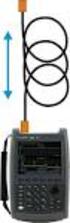 Techniques for Precise Cable and Antenna Measurements in the Field Using FieldFox handheld analyzers Application Note This application note introduces the practical aspects of cable and antenna testing,
Symbol Parameters Units Frequency Min. Typ. Max. 850 MHz 14.8 16.3 17.8
 Product Description Sirenza Microdevices SGC-689Z is a high performance SiGe HBT MMIC amplifier utilizing a Darlington configuration with a patented active-bias network. The active bias network provides
RF and Microwave Accessories. CD-ROM Catalog. Find the right component for your Rohde & Schwarz test & measurement equipment
 RF and Microwave Accessories CD-ROM Catalog Find the right component for your Rohde & Schwarz test & measurement equipment Product group Typical applications Adapters Interchanging of various connector
Politecnico di Torino. Porto Institutional Repository
 Politecnico di Torino Porto Institutional Repository [Proceeding] Multiport network analyzer self-calibration: a new approach and some interesting results Original Citation: G.L. Madonna, A. Ferrero, U.
Application Note SAW-Components
 Application Note SAW-Components Principles of SAWR-stabilized oscillators and transmitters. App: Note #1 This application note describes the physical principle of SAW-stabilized oscillator. Oscillator
Noise Figure Measurement without a Noise Source on a Vector Network Analyzer
 Noise Figure Measurement without a Noise Source on a Vector Network Analyzer Application Note Products: &S ZVA &S ZVT &S ZVAB-K30 &S NP-Z55 This application note describes the noise figure measurement
EE 186 LAB 2 FALL 2004. Network Analyzer Fundamentals and Two Tone Linearity
 Network Analyzer Fundamentals and Two Tone Linearity Name: Name: Name: Objective: To become familiar with the basic operation of a network analyzer To use the network analyzer to characterize the in-band
Heterojunction Bipolar Transistor Technology (InGaP HBT) Broadband High Linearity Amplifier
 Freescale Semiconductor Technical Data Heterojunction Bipolar Transistor Technology (InGaP HBT) Broadband High Linearity Amplifier The is a general purpose amplifier that is input and output internally