
ALIBI Central Management System (ACMS) Software User Manual
|
|
|
- Amberly Montgomery
- 10 years ago
- Views:
Transcription
1 ALIBI Central Management System (ACMS) Software User Manual Products: All ALIBI DVRs, NVRs and IP Cameras PLEASE READ THIS MANUAL BEFORE USING THIS SOFTWARE, and always follow the instructions for safety and proper use. Save this manual for future reference. ALI-CMS_V1_SM 10/24/14

2 LEGAL NOTICE Observint Technologies (Observint) products are designed to meet safety and performance standards with the use of specific Observint authorized accessories. Observint disclaims liability associated with the use of non-observint authorized accessories. The recording, transmission, or broadcast of any person s voice without their consent or a court order is strictly prohibited by law. Observint makes no representations concerning the legality of certain product applications such as the making, transmission, or recording of video and/or audio signals of others without their knowledge and/or consent. We encourage you to check and comply with all applicable local, state, and federal laws and regulations before engaging in any form of surveillance or any transmission of radio frequencies. Alibi and the Alibi logo are trademarks of Observint. Microsoft, Windows, and Internet Explorer are either registered trademarks or trademarks of Microsoft Corporation in the United States and/or other countries. Android is a trademark of Google Inc. Use of this trademark is subject to Google Permissions. Apple, iphone, ipod touch, and ipad are registered trademarks of Apple Inc. Other trademarks and trade names may be used in this document to refer to either the entities claiming the marks and names or their products. Observint disclaims any proprietary interest in trademarks and trade names other than its own. No part of this document may be reproduced or distributed in any form or by any means without the express written permission of Observint, Inc by Observint Technologies. All Rights Reserved N. Mopac Expressway, Building 300, Austin, TX For Sales and Support, contact your distributor. ii
3 TABLE OF CONTENTS Table of Contents SECTION 1 Overview Features General Features ACMS Client functional capabilities ACMS Control Panel Open Menu icon ACMS Modules Window footer icons ACMS Technical capacities...9 SECTION 2 ACMS Installation System requirements ACMS installation ACMS Client initial setup - using the Wizard...14 SECTION 3 ACMS Client Initial System Setup Account management Adding a User Managing a user account System Configuration General system configuration parameters File system configuration parameters Keyboard and joystick shortcuts Alarm Sound settings settings...31 SECTION 4 Using the Stream Media Server Adding the Stream Media Server to the ACMS Client Using the Stream Media Server to forward video streams...35 SECTION 5 Using the Storage Server Adding the Storage Server to the ACMS Client...38 SECTION 6 Live View Basic Operations in Main View Starting and Stopping the Live View Auto-switch in Live View PTZ Control in Live View...51 ALIBI ACMS Software User Manual iii

4 TABLE OF CONTENTS Manual Recording and Capture Instant Playback...59 SECTION 7 Device Management Adding the Encoding Device Adding Online Devices Adding Devices Manually Adding Devices by IP Segment Adding Devices by IP Server Adding Devices by HiDDNS Group Management Importing an Encoding Device to a Group Modifying the Group/Channel Removing Channels from the Group Deleting a Group...75 SECTION 8 Remote Record Schedule and Playback Remote recording Recording on Storage Devices on the DVRs, NVRs, or Network Cameras Recording on Storage Server Remote Playback Normal Playback Event Playback Synchronous Playback...88 SECTION 9 Event Management Configuring Motion Detection Alarm Configuring Tampering alarms Configuring Video Loss Alarm Configuring Alarm Input Linkage Configuring Device Exception Linkage Viewing Alarm and Event Information SECTION 10 e-map Features Adding an E-map The Hot Spot Function Adding Hot Spots Previewing Hot Spots Using the Hot Region function iv

5 TABLE OF CONTENTS Adding a Hot Region Modifying Hot Regions Previewing Hot Regions SECTION 11 Log Management Searching Log Files Filtering Log Files Backing up Log Files APPENDIX A Troubleshooting ALIBI ACMS Software User Manual v

6 vi NOTES

7 SECTION 1: OVERVIEW SECTION 1 Overview The ALIBI Central Management System (ACMS) client software is a versatile video management software for monitoring and control of several ALIBI DVRs, NVRs and IP cameras from a single platform. It provides several features, including real-time live view, video recording, remote search and playback, file backup, etc. With the flexible distributed structure and easy-to-use operations, ACMS can be easily applied to medium and small scale surveillance projects. ACMS includes three major components: ACMS Client: The core component for the software package manages devices and other components of ACMS. It provides the management, playback, preview, E - map function and other functions. ACMS Stream Media Server: The Stream Media Server is used to forward real-time video and audio streams from Alibi devices to multiple clients instead of streaming live view video directly from the device to the clients. This server reduces the processing load on the device. This server can be installed when the ACMS Client is installed. ACMS Storage Server: The storage server is a software application that functions as an NVR installed on the PC. It is used to record files and pictures (captures), and for backup. This server can be installed when the ACMS Client is installed. Typical implementation topologies for the ACMS client in a surveillance system are shown below. Typical surveillance system LAN topology with ACMS ALIBI ACMS Software User Manual 1

8 SECTION 1: OVERVIEW Typical surveillance system WAN topology with ACMS 1.1 Features General Features All Alibi NVRs, DVRs and IP cameras can be managed directly by the ACMS client Modularity servers provide scalable installation for different software modules High-definition devices are supported Friendly GUI for an easy operation Grouping channels for unified management Multi-level user management Easy operation on alarm and event data Configurable live view screen display and multiple screens live view is provided Playback record and pictures easy search and filter ACMS Client functional capabilities Function Live View Description Multi-screens for main view and screen can be separated by dragging the tab Picture capture and real-time recording in live view mode Digital Zoom Channels can be managed by group Cycling live view Easy configuration of brightness, contrast, saturation and hue parameters Record file and captured pictures are easily managed Instant playback function enables the quick switch of the live view and playback Two-way audio Display status of supervisory place 2

9 SECTION 1: OVERVIEW Function PTZ Control Record Video playback User management Device management Log management Alarm E-Map Others Description Full-functional remote PTZ and lens control 3D position Preset setting and calling Flexible patrol and pattern settings Graphically recording schedule configuration Variety of recording types(event and normal) Remote control the recording on the device side Configurable recording schedule template Distributed PC NVR deployment and management Pre-allocate hard disk for recording Record files searching by channel, time and event Fast forward play and single frame play Resume function for disconnected video channels Filter the search result by record types Locate precisely with processing bar Multi-screen playback simultaneously; Capture pictures when playback Download data when playback Clip record file when playback Volume control during playback Smart searching for the event record when playback Client user of management Channel-detailed permission control Three user management levels Supports Alibi DVRs, IP Cameras and NVRs (Alibi Encoding Devices) Adding and deleting device and remote device parameters configuration Search the active on-line devices Device adding by domain name Client log query Remote device log query and backup; Backup client logs View log files Provide multiple alarm types, including HDD full alarm, HDD error alarm, video loss alarm, video tampering alarm, motion detection alarm, I/O alarm, server status abnormal alarm, etc. Provide multiple alarm linkage actions, including linkage like decoding on linkage, etc. Automatically arming for all devices Filter according to alarm type Graphical high-level view of operations Parent map and child map function to link maps; Locate camera position by dragging channel icon. Alarm information and event image display on the map. Multi-screen display; Manual lock screen; Display system status(cpu, time) Configuration files import/export; Display information of channel ALIBI ACMS Software User Manual 3

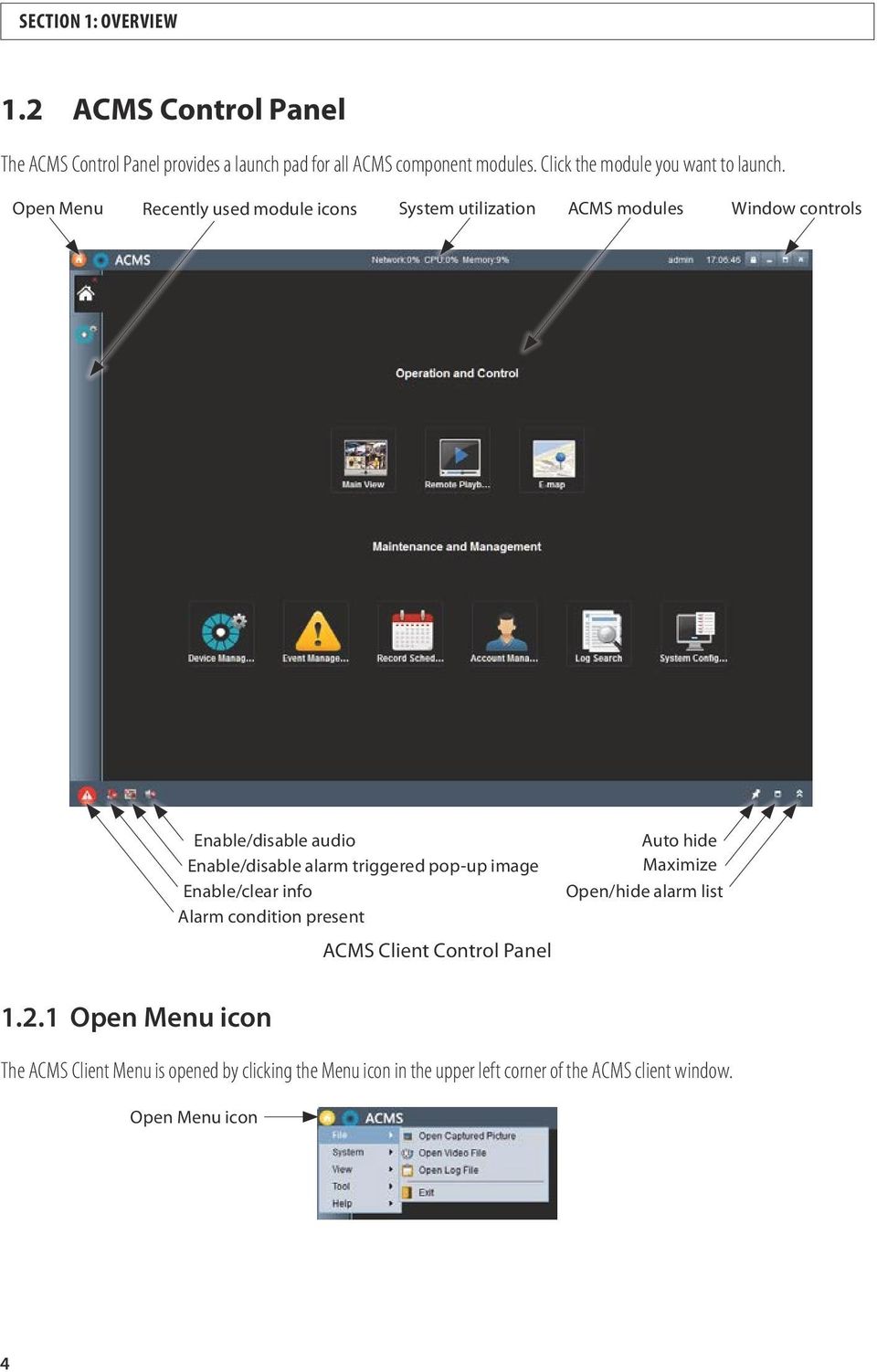
10 SECTION 1: OVERVIEW 1.2 ACMS Control Panel The ACMS Control Panel provides a launch pad for all ACMS component modules. Click the module you want to launch. Open Menu Recently used module icons System utilization ACMS modules Window controls Enable/disable audio Enable/disable alarm triggered pop-up image Enable/clear info Alarm condition present ACMS Client Control Panel Auto hide Maximize Open/hide alarm list Open Menu icon The ACMS Client Menu is opened by clicking the Menu icon in the upper left corner of the ACMS client window. Open Menu icon 4
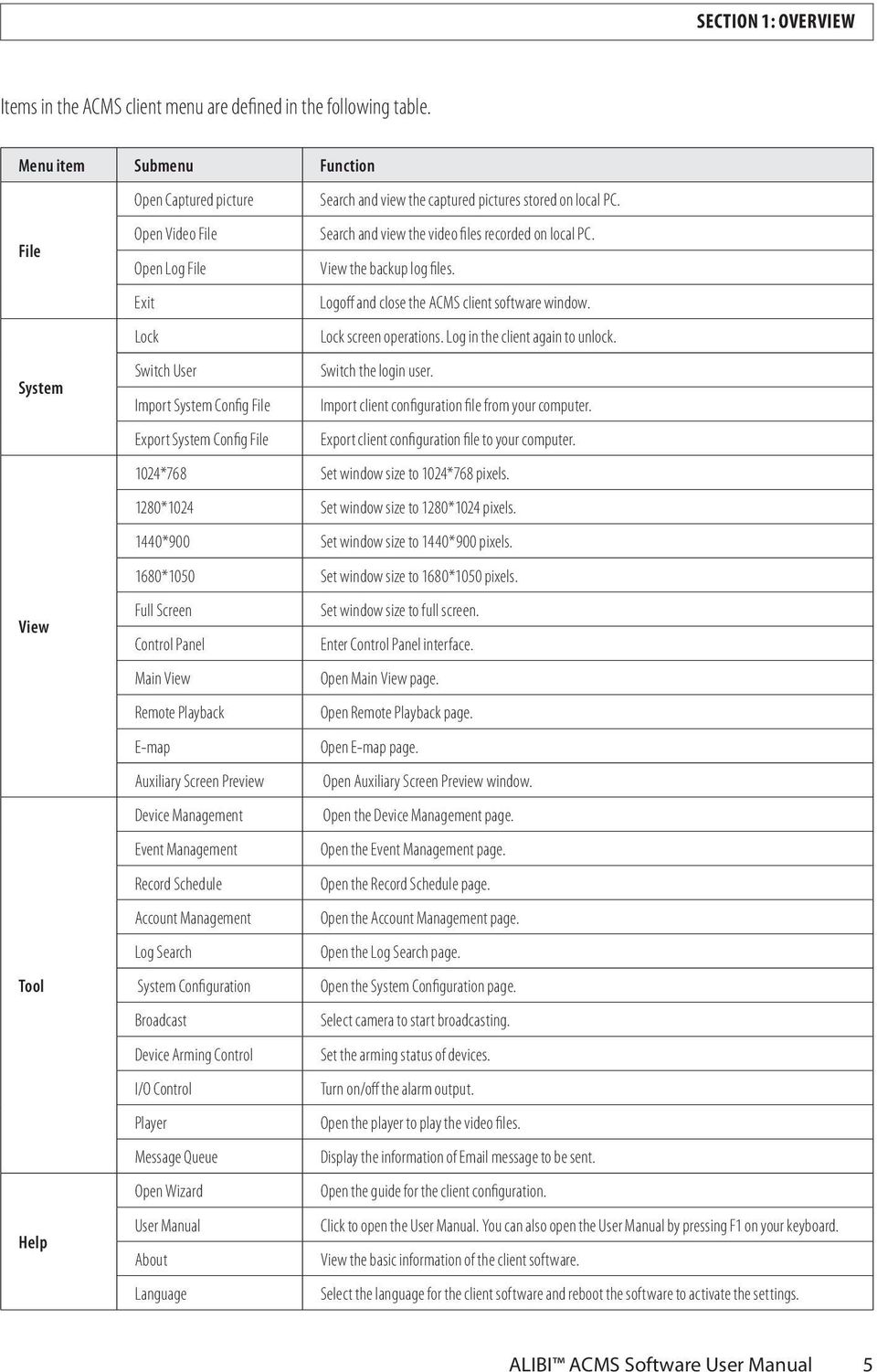
11 SECTION 1: OVERVIEW Items in the ACMS client menu are defined in the following table. Menu item Submenu Function File System View Tool Help Open Captured picture Search and view the captured pictures stored on local PC. Open Video File Search and view the video files recorded on local PC. Open Log File View the backup log files. Exit Logoff and close the ACMS client software window. Lock Lock screen operations. Log in the client again to unlock. Switch User Switch the login user. Import System Config File Import client configuration file from your computer. Export System Config File Export client configuration file to your computer. 1024*768 Set window size to 1024*768 pixels. 1280*1024 Set window size to 1280*1024 pixels. 1440*900 Set window size to 1440*900 pixels. 1680*1050 Set window size to 1680*1050 pixels. Full Screen Set window size to full screen. Control Panel Enter Control Panel interface. Main View Open Main View page. Remote Playback Open Remote Playback page. E-map Open E-map page. Auxiliary Screen Preview Open Auxiliary Screen Preview window. Device Management Open the Device Management page. Event Management Open the Event Management page. Record Schedule Open the Record Schedule page. Account Management Open the Account Management page. Log Search Open the Log Search page. System Configuration Open the System Configuration page. Broadcast Select camera to start broadcasting. Device Arming Control Set the arming status of devices. I/O Control Turn on/off the alarm output. Player Open the player to play the video files. Message Queue Display the information of message to be sent. Open Wizard Open the guide for the client configuration. User Manual Click to open the User Manual. You can also open the User Manual by pressing F1 on your keyboard. About View the basic information of the client software. Language Select the language for the client software and reboot the software to activate the settings. ALIBI ACMS Software User Manual 5
12 SECTION 1: OVERVIEW ACMS Modules The ACMS client software includes the following function modules. These modules are accessible through the ACMS Client control panel, and through the ACMS Client Menu (see ACMS Client Menu on page 123). Module Icon Function Main View This module provides live view of network cameras and video encoders, and supports some basic operations, such as picture capturing, recording, PTZ control, etc. Remote Playback This module provides the search, playback, export of record files. E-map This module provides the display and management of E-maps, alarm inputs, hot regions and hot spots. Device Management Event Management This module provides the adding, modifying and deleting of different devices and the devices can be imported into groups for management. This module provides the settings of arming schedule, alarm linkage actions and other parameters for different events. Record Schedule This module provides the schedule settings for recording. Account Management This module provides the adding, modifying and deleting of user accounts and different permissions can be assigned for different users. Log Search This module provides the query of system log files and the log files can be filtered by different types. System Configuration This module provides the configuration of general parameters, file saving paths, alarm sounds and other system settings. The function modules are easily accessed by clicking the navigation buttons on the control panel or by selecting the function module from the View or Tool menu. You can check the information, including current user, network usage, CPU usage, memory usage and time, in the upper-right corner of the main page Window footer icons Base bar icons appear along the bottom of the Control Panel screen. They function as described in the table below. 6

13 SECTION 1: OVERVIEW Icon Label Function Clear Info Enable/Disable Alarm Triggered Pop-up Image Enable/Disable Audio Auto Hide/Lock Maximize Show/Hide Clear the information of alarms and events displayed on the list. Click to enable/disable image pop-up when alarms occur. Click to enable/disable the audio warning for the alarm. Click to hide automatically/lock the Alarms and Events panel. Maximize the Alarms and Events panel in a new tab page. Click to show/hide the Alarms and Events panel. Show/Hide alarms The Show/Hide alarms icons open/close a log message list that pops up from the bottom of the window. Two kinds of log messages can be displayed: Alarms (see below): Shows the recent alarms detected by the devices monitored by the ACMS. Events: Event information related to ACMS functions. ALIBI ACMS Software User Manual 7

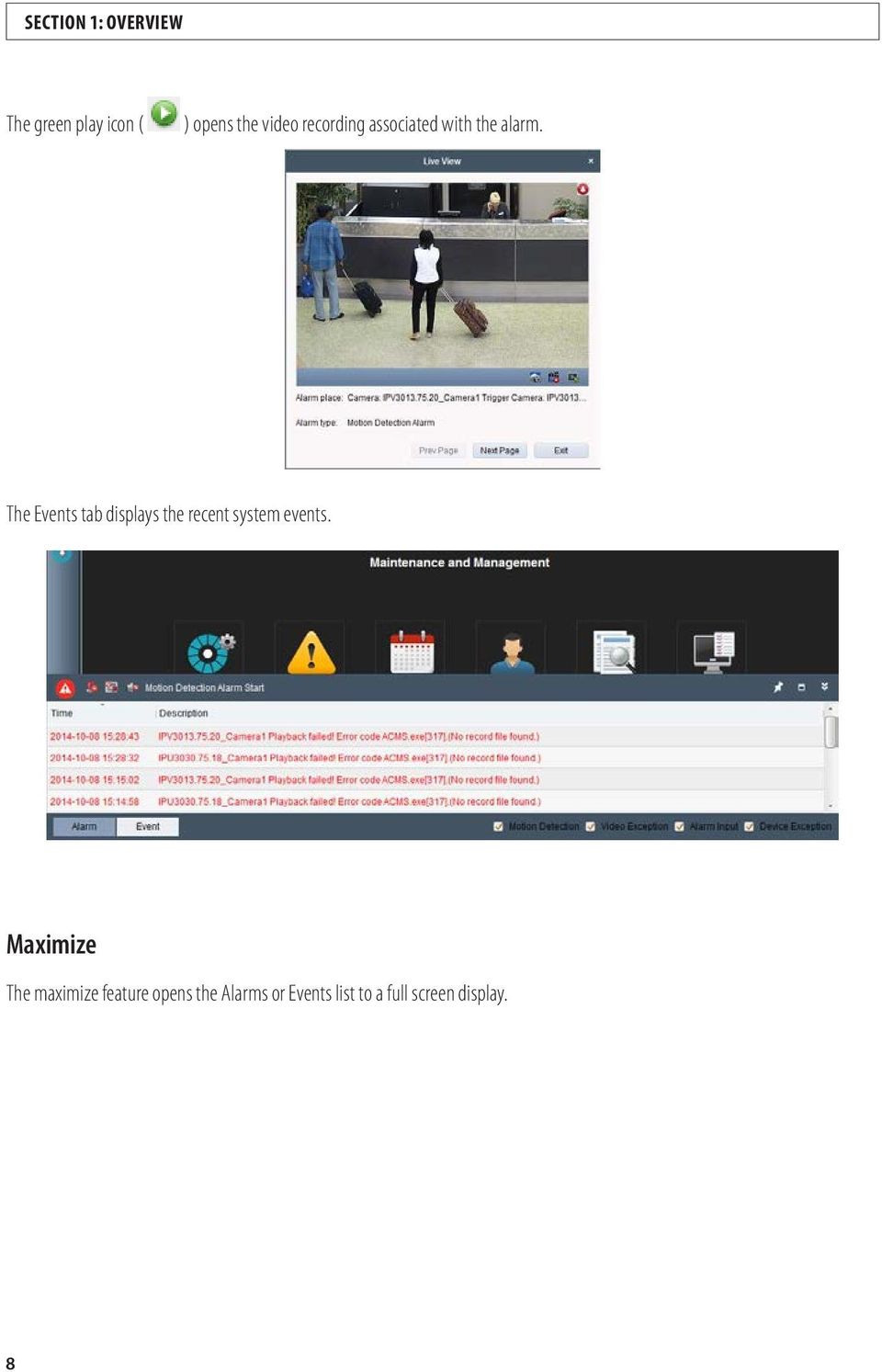
14 SECTION 1: OVERVIEW The green play icon ( ) opens the video recording associated with the alarm. The Events tab displays the recent system events. Maximize The maximize feature opens the Alarms or Events list to a full screen display. 8
15 SECTION 1: OVERVIEW 1.3 ACMS Technical capacities Modules Function Maximum value ACMS Client Connectable devices 256 Camera groups 256 Connectable channels 1024 Connectable NVR servers 8 Users 50 Stream media servers 8 Live view channels 64 Multi-screens for main view 4 Playback channels 16 Synchronized Playback channels 4 Connectable decoders (Including PC decoders) 64 E-maps 256 ALIBI ACMS Software User Manual 9

16 SECTION 1: OVERVIEW Modules Function Maximum value Recording performance 64*2Mbps Storage Server VoD performance 64*2Mbps Users 32 Stream Media Server Stream (Including incoming and outputting stream)

17 SECTION 2: ACMS INSTALLATION SECTION 2 ACMS Installation ACMS is available through the Alibi website, your Alibi provider website, and on the CD provided with your Alibi recorder. 2.1 System requirements For smooth and stable performance, ensure that the computer(s) where you install ACMS and the Storage and Streaming Media servers meet the software and minimum hardware requirements shown in the table below. ACMS component ACMS Client ACMS Storage Server ACMS Stream Media Server System requirement Operating system Microsoft Windows XP / 2003 / 2008 / 7 Database SQLite CPU Intel Pentium IV 3.0 or above Memory 2 GB or more VGA resolution 1024*768 or above Network 100BASE-T or above Operating system Microsoft Windows XP / 2003 / 2008 / 7 Database SQLite CPU Intel Pentium IV 2.4 or above Memory 2 GB or more Network 1000BASE-T or above HDD space 500 GB or more Operating system Microsoft Windows XP / 2003 / 2008 / 7 CPU Intel Pentium IV 3.0 or above Memory 2GB or more Network 1000BASE-T or above HDD space 80 GB or more NOTE The 64-bit operating systems listed above must support 32-bit applications. 2.2 ACMS installation Use the following procedure to install the ACMS components. For medium-scale surveillance systems, each component may must be installed on a different computer to ensure smooth and stable performance of the application. In the example shown here for a very small surveillance system, all three components were installed on the same computer. ALIBI ACMS Software User Manual 11

18 SECTION 2: ACMS INSTALLATION 1. Obtain the ACMS software installation file (ACMS.exe) from the CD provided with your Alibi recorder, or download the file from your Alibi vendor website. 2. Open the ACMS installer file on your computer. An InstallShield Wizard Setup window will open. 3. In the ACMS InstallShield Wizard windows shown below, select the ACMS component(s) you want to install. For medium scale surveillance systems, each component should be installed on a different computer to ensure good performance. NOTE If a Windows Security Alert window opens for StreamServerApp.exe, click Allow access. 4. If you want to install the software in a location other than the default Destination Folder, click the Browse button to select the location you prefer, and then click Next to continue. 5. ACMS requires WinCap to execute properly. If Wincap is not installed on the computer, or the installed version of WinCap is older than the one identified in the window below, check the box to install WinCap, click Next, and then click Next again the WinCap Setup window. 12

19 SECTION 2: ACMS INSTALLATION 6. In the License Agreement window, click I Agree if you will abide by the requirements of the license. Otherwise click Cancel to abort the WinCap installation. 7. If you continued the WinCap installation, check the box in the Installation Options window shown above, click Install, and then click Finish in the Completing.. Setup window. 8. In the Ready to Install window, click Install. ALIBI ACMS Software User Manual 13

20 SECTION 2: ACMS INSTALLATION NOTE When installing the ACMS components, a A Windows Security Alert window may appear. Check the appropriate boxes in the window, and then click Allow access to continue. 9. In the Setup Type window, check the boxes for the components you installed whose startup icons will appear on the desktop, and then click Next to continue. 10. In the InstallShield.. Complete window shown above, click Finish. The icons shown below will appear on the desktop if you chose to install them during the installation. ACMS desktop icons: ACMS Client, ACMS Stream Media Server, ACMS Storage Server ACMS Client initial setup - using the Wizard If you installed ACMS Client, perform the following to initialize the component. 14

21 SECTION 2: ACMS INSTALLATION 1. Startup ACMS client by clicking the desktop icon (if present), or the link in the Start menu. An initialization window will open. 2. Next, the window shown below will open. You must create a Super User ID and Password and register that with the application. a. In the Super User field, enter a username. The username cannot contain any of the following characters: / \ : *? < > b. Enter a password in the Password and Confirm Passw... fields. The Password must be no less than six characters long. Record your username and password for use later.! Record your password and save in a secure place. The Super User password cannot be recovered. WARNING c. Check the box for Enable Auto-login to log in automatically. Use this feature only if the computer is secure (not available for unauthorized use). d. Click Register to create your Super User credentials. A subsequent Super User login will require these credentials. The Wizard window will open. ALIBI ACMS Software User Manual 15
22 SECTION 2: ACMS INSTALLATION 3. In the initial Wizard window, click Configure Device and Record Schedule to continue. (You can also click Closed to close the Wizard.) Wizard Device Management NOTE The following example of using the Wizard provides an abbreviated form of the overall process. Use it as a framework for setting up your system with the Wizard. 16
23 SECTION 2: ACMS INSTALLATION 4. In the Wizard window shown above, you can add devices and servers to the client ACMS Client. Note that the a list of online devices is shown at the bottom of the screen. To add a device, click on the device to highlight it, and then click the Add to Client button. (You can also click Add All to quickly add all on-line devices.) NOTE To modify the network information (IP address, port, subnet mask, or gateway) for a specific device, click the device to highlight it, and then click the Modify Netinfo button. 5. In the Add window, enter the appropriate information in the fields that are empty. Some fields are automatically populated from the device information shown in the list below. Fields in the Add window include: Nickname: Enter a name for the device. Address: Enter the IP address of the device. The IP address of the device is usually obtained automatically in this mode. Port: Enter the port number for the device. The default port number is User Name: Enter the device administrative username. Password: Enter the password associated with the username on the line above. ALIBI ACMS Software User Manual 17
24 SECTION 2: ACMS INSTALLATION a. Check the box for Export to Group to create a group of devices. Devices in a group are easier to manage for live view, playback, and other operations. All the channels of the device will be imported to the corresponding group by default. See Wizard Group Management on page In two examples shown below for cameras, a Nickname, and the administrator User Name and Password for the device were entered. 7. After completing the information in the Add window, click the Add button to add the device to the ACMS Client. In the window below, an additional device (NVR3008) was also added. 18
25 SECTION 2: ACMS INSTALLATION Wizard Group Management The devices added to the ACMS Client can be organized associated in groups for a convenient management. You can get the live view, play back the record files, and do some other operations of the device through the group. 8. After adding devices to the ACMS Client, click the Next button at the bottom of the window to advance the Wizard. The Group Management window will open. 9. To create a group, click the Add Group icon, enter the Group Name in the field, and then click OK. 10. Click the Import button to add devices to the group. ALIBI ACMS Software User Manual 19
26 SECTION 2: ACMS INSTALLATION The Import window includes these icons: Icon Label Function View View the encoding channel in list view. Thumbnail View View the encoding channel in thumbnail view. Refresh Refresh the information of added encoding channels. Import Create a group by device name and import the device to group. Collapse/Expand Collapse/Expand the thumbnails of encoding channels. 11. In the right frame, highlight the group you want to import devices to, and then click a device in the left frame you want to import. After selecting the first device, you can select an additional device by holding down the Ctrl Key and clicking on the device. When a device is selected, it is surrounded by a red frame (see below). In the screen below, the two cameras were selected. You can import up to 64 cameras to one group. 20
27 SECTION 2: ACMS INSTALLATION 12. Click the Import button to add the devices to the group. ALIBI ACMS Software User Manual 21
28 SECTION 2: ACMS INSTALLATION NOTE In the Import window, click the Alarm Input tab to import alarms to a group. 13. Click the T icon in the upper right corner to return to the Group Management window. 14. In the Group Management window, click the Next button at the bottom of the window to open the Record Schedule window. Wizard Record Schedule When the video storage devices are the HDDs, Net HDDs, SD/SDHC cards on the local device, or the remote storage server connected, you can set the record schedule for the cameras for the continuous, alarm triggered or command triggered recording. The record files can be searched for the remote playback. NOTE Newly installed storage devices must be formatted before they can be used. 15. In the Record Schedule window: a. Select (highlight) the device in the left column for which you want to setup a record schedule. In the example above, IPU3030RV_Camera1 was selected. 22
29 SECTION 2: ACMS INSTALLATION b. Click the checkbox for either Local Recording or Storage server Recording. In the example above, Local Recording was checked. c. Open the drop-down list and the select a schedule template during which recordings will be made. Each template provides a 24 7 schedule. Notice that some schedule templates are pre-configured. You can, however, create custom templates with custom names tailored for your system. d. To customize a schedule template, click the Edit button to the right after selecting a schedule. The Template Management window will open. To edit the template: i. In the template list on the left, highlight the name of the template you chose, and then type in a new name. In the example above, Off-shift was entered. ii. Click one of the three buttons at the top (Schedule Recording, or Event Recording) to select the recording mode. NOTE: Command triggered recording is not supported by the ACMS. Using the mouse, drag it across the area of a day timeline where you want to apply that recording mode. If you clicked Schedule Recording in step ii above, the timeline in that area will be marked olive green. If you selected Event ALIBI ACMS Software User Manual 23
30 SECTION 2: ACMS INSTALLATION Recording, the timeline in that area will be colored tan. You can combine different recording modes on the same schedule (see the example above). Timeline segments where recording modes are assigned cannot overlap. NOTES: 1. If you want to delete the template you configured, click the trash can icon at the top of the window. 2. If you want to copy an segment of the timeline where you assigned a recording mode, click the segment to select it (it will be surrounded by a dashed line), and then click the icon to the right of the trash can icon. In the pop-up window, select the days you want to copy the segment to, and click OK. 3. If you want to shift an segment of the timeline where you assigned a recording mode to an earlier or later position, click the segment to select it (it will be surrounded by a dashed line), and then drag the segment left or right to move it. 4. If you want to lengthen or shorten the segment of the timeline where you assigned a recording mode, click the segment to select it (it will be surrounded by a dashed line), and then position the mouse pointer at either end of the segment (the cursor will change to a short line with arrowheads at both ends). Drag the end of the segment left or right to change the length. 5. If you want to delete an area of the timeline where you assigned a recording mode, click the area to select it (it will be surrounded by a dashed line), and then click the icon to the left of the trash can icon. iii. Click the OK button at the bottom of the window to save your customized template. e. Click the Advanced Settings button to the right of the template Edit button. f. In the Advanced Settings window, change the values for each field appropriately, and then click OK. g. Repeat the sub-steps a through f above for other devices. 16. When done assigning a recording schedule to each device or group, click the Finished button at the bottom of the window. A live view window will open. 24
31 SECTION 3: ACMS CLIENT INITIAL SYSTEM SETUP SECTION 3 ACMS Client Initial System Setup 3.1 Account management During the initial login to the ACMS Client, a Super Administrator account is created. Up to 50 user accounts can be added to the ACMS client. These accounts can be one of two types: Administrator: The administrator account has all permissions by default. It can modify the passwords and permissions of all operator accounts, and its own account. Operator: The operator account, by default, has no permissions. Its permissions must be assigned manually. An operator can only modify the password of its own account. All user accounts can be edited. Also, all accounts, except for the Super Administrator account, can be deleted Adding a User 1. Click the In the ACMS Client control panel, click the Account Management ( ) icon, or open the Menu drop down list and then click Tool Account Management. ALIBI ACMS Software User Manual 25
32 SECTION 3: ACMS CLIENT INITIAL SYSTEM SETUP NOTE The user account you registered to initially log in is setup as the super administrator. 3. Click Add User to open the Add User dialog menu, and then do the following: a. Open the User Type drop-down list, and then select either Administrator or Operator. In the window shown above, Operator was selected. b. Enter a username in the User Name field, and then enter a password in the Password and Confirm Password fields. NOTE A user name cannot contain any of the following characters: / \ : *? < >. The password must contain at least 6 characters. c. In the left frame of the window, check (or un-check) the boxes to assign the permissions to the new user. You can click Default Permission to restore the default permissions to this user. For the Operator User Type, no permissions are initially granted. d. In the right frame of the window, check the boxes for the devices the user can see in the Live View screen. 26
33 SECTION 3: ACMS CLIENT INITIAL SYSTEM SETUP e. Click Save to save the settings Managing a user account After a user account is created, you can edit or delete the information of the user accounts. To edit the information of the user: 1. Click the In the ACMS Client control panel, click the Account Management ( ) icon, or open the Menu drop down list and then click Tool Account Management. 2. Click (highlight) the entry in the account list for the user you want to edit, then click the Edit User button at the top of the window. 3. Change the options in the account window as needed, and then click Save. To delete a user account: 1. Click the In the ACMS Client control panel, click the Account Management ( ) icon, or open the Menu drop down list and then click Tool Account Management. 2. Click (highlight) the entry in the account list for the user you want to edit, then click the Delete User button at the top of the window. ALIBI ACMS Software User Manual 27
34 SECTION 3: ACMS CLIENT INITIAL SYSTEM SETUP 3.2 System Configuration The System Configuration module includes four sub-parts: General: The General menu includes frequently-used parameters, including the log expired time, view scale, etc. File: The video files from manual recording, the captured pictures and the system configuration files are stored on the local PC. Location of these files is selected using the File sub-menu. Keyboard and Joystick Shortcuts: You can set the shortcuts of PC keyboard and USB joystick to get quick and convenient access to the commonly used actions. Alarm Sound: When an alarm, such as motion detection, video exception, etc., is triggered, the client can be configured to play an audio file. You can select the audio file that is played. An notification can be sent when a alarm occurs. To send , the settings of the sub-menu must be configured General system configuration parameters 1. In the ACMS Client control panel, click the System Configuration icon ( ), or open the Menu drop down list and then click Tool System Configuration. By default, the General sub-menu opens. 2. Select the options in the General menu as needed, and then click Save. A description of options are shown in the following table. 28
35 SECTION 3: ACMS CLIENT INITIAL SYSTEM SETUP Parameters Log Expired Time View Scale Network Performance Play Performance Enable Screen Toolbar Display Enable Auto-login Prioritize the Playback of Record Files on Storage Server Resume Live View Status Auto-change Stream Type Auto Time Adjustment Descriptions The time for keeping the log files, once exceeded, the files will be deleted. The view scale of the video in live view or playback. It can be set as Full Screen, 4:3, 16:9 or Original Resolution. The current network conditions. You can select either Normal, Better or Best. The play performance of the live video. You can select either Shortest Delay, Real Time, Balanced or Fluency. Show the toolbar on each display window in live view or playback. Log in the client software automatically. Play back the video files recorded on the storage server. Otherwise, play back the video files recorded on the local device. Resume the latest live view status after you log in the client again. Change the stream type automatically in live view according to the size of the display window. Adjust the time automatically at a specified time point File system configuration parameters 1. In the ACMS Client control panel, click the System Configuration icon ( ), or open the Menu drop down list and then click Tool System Configuration. 2. In the left frame, click File. 3. For each file type (Video, Pictures, Configuration), click the ellipsis (browse) icon to the right of each path, and then browse to the location where the associated files should be saved. ALIBI ACMS Software User Manual 29
36 SECTION 3: ACMS CLIENT INITIAL SYSTEM SETUP 4. Click Save to retain your settings Keyboard and joystick shortcuts 1. In the ACMS Client control panel, click the System Configuration icon ( ), or open the Menu drop down list and then click Tool System Configuration. 2. In the left frame, click Keyboard and Joystick Shortcuts. 3. If you are using a PTZ control keyboard (joystick) for PTZ camera control, select the COM port from the drop-down if applicable. 4. To change a keyboard shortcut of USB joystick control, double-click the item field under the PC Keyboard or USB Joystick column. 5. Select the compound keys operation or USB joystick operation from the drop-down list. 6. Click Save to retain your settings Alarm Sound settings 1. In the ACMS Client control panel, click the System Configuration icon ( ), or open the Menu drop down list and then click Tool System Configuration. 30
37 SECTION 3: ACMS CLIENT INITIAL SYSTEM SETUP 2. In the left frame, click Alarm Sound. 3. For each type of alarm (Motion Detection, Video Exception, Alarm input, Device Exception), click the ellipsis (browse) icon to the right, and then select the sound byte you want to play when the alarm occurs. The ACMS Client can only play.wav file types when alarms occur. You can listen to the file play by clicking the play icon (icon to the right of the ellipsis icon). 4. Click Save to retain your settings settings 1. In the ACMS Client control panel, click the System Configuration icon ( ), or open the Menu drop down list and then click Tool System Configuration. 2. In the left frame, click . ALIBI ACMS Software User Manual 31
38 SECTION 3: ACMS CLIENT INITIAL SYSTEM SETUP 3. In the menu, enter the following parameters: SMTP Server: Enter the SMTP Server address. Port: Enter the communication port of service. The default port number is 25 by. User Name: Enter the user name of the sender address. Password: Enter the password of the sender address. Sender Address: Enter the address of the sender. Receiver 1-3: Enter the addresses of the receivers. You can include up to 3 receivers. 4. Check the Enable SSL box if required by your service provider. SSL increases the security of your To test your settings, click Send Test to send an to the our receivers. 6. After your settings are functioning properly, click Save to retain your settings. 32
39 SECTION 4: USING THE STREAM MEDIA SERVER SECTION 4 Using the Stream Media Server To use this procedure, you must first install a Stream Media Server (SMS). The server can be installed on the same PC as the ACMS Client, or on another PC. See SECTION 2 ACMS Installation on page 11 for more information. One stream media server can distribute up to 64 video stream to up to 200 clients (ACMS viewers). The video streams (cameras) you want to stream through the SMS must first be added to the ACMS, and then configured to stream through the SMS. 4.1 Adding the Stream Media Server to the ACMS Client Each ACMS Client can stream video for viewing from up to 16 different stream media servers (SMS). Also, you can forward the video through a Stream Media Server installed on another PC. Before you can activate the SMS in the ACMS client, it must be running on a PC on the network (or the local PC). 1. In the ACMS Client control panel, open the Device Management module (click ), and then click the Server tab. 2. Click Add New Device Type, and then click OK. ALIBI ACMS Software User Manual 33
40 SECTION 4: USING THE STREAM MEDIA SERVER 3. Click Stream Media Server, Add Device. 4. In the Add window (left screen, default), enter an appropriate name in the Nickname field, and then enter the SMS server IP address in the IP address field (see above). The default port number is 554. If the server running on a different port, at the IP address, edit the Port field. To add an SMS by IP range (right screen above), select the IP Segment option on the top line, enter the Start IP and End IP address range where the SMS server(s) are configured. 5. Click Add to add the server to the ACMS client. 6. In the display shown above, click the SMS you added, and then click Configure. 34
41 SECTION 4: USING THE STREAM MEDIA SERVER 7. In the Settings window, check the boxes for the devices you want to monitor through the SMS. In the example above, two cameras in NVR3008 and two additional cameras were selected. 4.2 Using the Stream Media Server to forward video streams You can stream video through the Stream Media Server (SMS) to the ACMS Client to watch in the Live View window. To receive a video stream from a camera through a stream media server, the cameras must first be added to the ACMS and configured to stream through the SMS. 1. On the PC where the SMS is installed, open the Stream Media Server by double-clicking the icon on the desktop icon or link in the Start menu. ALIBI ACMS Software User Manual 35
42 SECTION 4: USING THE STREAM MEDIA SERVER In the SMS window shown above, entries in the data field list indicate clients that opened ( Enter ) and closed ( Exit ) video streaming through the server. 2. Click the Configure icon at the top of the window. 3. In the Configure window, select the startup options for the server. Note that both options autostart the server. If you selected the Auto-login operating system option, enter valid credentials for the computer the SMS server is installed on. 4. Click OK to retain your settings. 5. Open the ACMS Client Live View page and start the live view of the cameras again. You can check the channel number of the video stream forwarded through or sent from the stream media server. 36
43 SECTION 4: USING THE STREAM MEDIA SERVER Note that the SMS now shows 4 video streams opened by the ACMS Client. ALIBI ACMS Software User Manual 37
44 SECTION 5: USING THE STORAGE SERVER SECTION 5 Using the Storage Server To use this procedure, you must first install a Storage Server (SS). The server can be installed on the same PC as the ACMS Client, or on another PC. See SECTION 2 ACMS Installation on page 11 for more information. The storage server performs as a separate storage device installed on the PC. The record files can be searched for remote playback. 5.1 Adding the Storage Server to the ACMS Client The storage space on a storage server should be at least 500 GB. The storage area must be reformatted through the ACMS Client before it can be used. Formatting does erase all data on the storage device. 1. In the ACMS Client control panel, open the Device Management module (click ), and then click the Server tab. 2. Click the Storage Server link in the left frame (see above). The ACMS will automatically discover the Storage Servers available on the network and display them in the lower frame. 3. Click on the Storage Server you want to add to the ACMS, and then click the Add Device button at the top of the window. An Add window will open. 38
45 SECTION 5: USING THE STORAGE SERVER 4. In the Add window: a. Enter an appropriate identifier for the server in the Nickname field. In the example above, the Nickname will be SS b. In the User Name field, enter the username that was configured for the storage server. The default User Name is admin. c. In the Password field, enter the username that was configured for the storage server. The default Password is d. Click Add to add the server to the ACMS. 5. Verify that the Net Status icon in the Devices for Management frame show a for the SS you added. This icon indicates that the addition was successful. If the icon appears as, the addition was not successful. Hover the mouse pointer over the icon to open a balloon window to show reason for the faulty status, and then take appropriate action to resolve the problem. ALIBI ACMS Software User Manual 39
46 SECTION 5: USING THE STORAGE SERVER 6. After a successful addition of the Storage Server, click the entry in the Devices for Management frame to highlight it, and then click the Remote Config button (at the top). A screen similar to that shown below will open. 40
47 SECTION 5: USING THE STORAGE SERVER 7. In the Remote Configuration window, open the Server Time menu, and then select the time zone you prefer to use from the drop-down list. Click Apply to save your settings. You can also use NTP to synchronize the time. of the server. 8. Open the Storage menu, and then select the HDD or NAS where you want to save recordings. I the example below showing the Storage General menu, HDD 4 (a partition of the PC) was selected. ALIBI ACMS Software User Manual 41
48 SECTION 5: USING THE STORAGE SERVER 9. Since HDD 4 is Unformatted, click Format to format the drive for use. When the format operation is complete, the status will change to Normal. See below. Formatting erases all data in the drive (partition). 10. Change other Remote Configuration settings as needed, and then open the System Log menu review the status of the server. Based on the log messages, perform additional procedures to correct any abnormalities if necessary. 42
49 SECTION 6: LIVE VIEW SECTION 6 Live View Live View features include: Multi-screens for main view and screen can be separated by dragging the tab Picture capture and real-time recording in live view mode Instant playback function enables the quick switch of the live view and playback Digital Zoom and cycling live view channels (tour) Channels management by Group Easy configuration of brightness, contrast, saturation and hue parameters Record file and captured picture management Two-way audio Control PTZ cameras Display status of supervisory place Use the Main View module to view live video from cameras added to the ACMS. To open the Main View module, click the icon in the Control Panel, or click the Menu icon in the upper left corner and select System Main View. Menu View list Live view video window PTZ Control Panel Camera list Live View toolbar ALIBI ACMS Software User Manual 43
50 SECTION 6: LIVE VIEW Window header and footer Icons in the Main View header and footer are similar in all ACMS modules. Refer to 1.2 ACMS Control Panel on page 4 for more information. Live View toolbar icons Icon Label Function Set View Stop Live View Previous Next Resume/Pause Auto-switch Show /Hide the Menu Mute/Audio On Full Screen Set the screen layout mode and save the new settings for the current view; save the current view as another new view. The Set View icon in the image above is expanded to show the Layout, Save View, and Save View As icons. Stop the live view of all cameras. Go for live view of the previous page. Go for live view of the next page. Click to resume/pause the auto-switch in live view. Show/Hide the configuration menu of auto-switch. Click again to hide. Turn off/on the audio in live view Display the live view in full screen mode. Press ESC to exit. Live View Management Menu Right-click on live view video to open the Live View Management Menu. This menu provides a list of links to the basic operations available in the Main View window. Live View Management Menu 44
51 SECTION 6: LIVE VIEW Live View Management menu Item Stop Live View Capture Print Captured Picture Send Start/Stop Recording Open Window PTZ Control Open Digital Zoom Switch to Instant Playback Start/Stop Two-way Audio Enable/Disable Audio Camera Status Remote Configuration Synchronization Full Screen Function Stop the live view in the display window. Capture a picture of the live view video frame. Capture the current picture and then print the picture. Capture the current picture and then send an notification to one or more receivers. The captured picture can be attached Start/Stop the manual recording. The record file is stored in the PC. Enable PTZ control function on the display window. Click again to disable the function. Enable the digital zoom function. Click again to disable the function. Switch to instant playback mode. Click to start/stop the two-way audio of the camera in live view frame. Click to enable/disable the audio in live view. Display the status of the camera in live view, including the record status, signal status, connection number, etc. Open the remote configuration page of the camera in live view. Sync the camera in live view with the PC running the client software. Display the live view in full screen mode. Click the icon again to exit. 6.1 Basic Operations in Main View Starting and Stopping the Live View Starting Live View for One Camera 1. Open the Main View module: click the icon in the Control Panel, or click the Menu icon in the upper left corner and select System Main View. 2. Click the Set View icon in live view toolbar, then click the screen Layout icon and select the screen layout mode for live view. See the Live View toolbar icons above. 3. Click-and-drag the camera to the display window, or double-click the camera name after selecting the display window to start the live view. NOTE You can click-and-drag the video of the camera in live view to another display window if needed. ALIBI ACMS Software User Manual 45
52 SECTION 6: LIVE VIEW Starting Live View for Camera Group 1. Open the Main View module: click the icon in the Control Panel, or click the Menu icon in the upper left corner and select System Main View. 2. Click-and-drag the group to the display window, or double-click the group name to start the live view. NOTE The display window will open either 1, 4, 9, or 16 viewing frames to support the number of video channels in the group. Starting Live View in Default View Mode Video of the cameras added to the ACMS can be displayed in single- or multi-view modes. You can select either of the four frequently-used default view modes: 1-Screen, 4-Screen, 9-Screen and 16-Screen. 1. Open the Main View module: click the icon in the Control Panel, or click the Menu icon in the upper left corner and select System Main View. 2. Click the icon plus icon ( ) to expand the Default View list. 3. Click on the default view mode you prefer, and then click the Start Cycle icon associated with the view mode. Video of the cameras channels added to the display will be shown in a sequence in the view mode you selected. Start Cycle icon NOTE Right-click the current default view name on the list and click Save View As, and you can save the default view as a custom view. 46
53 SECTION 6: LIVE VIEW Starting Live View in Custom View Mode The view mode can also be customized for the video live view. 1. Open the Main View module: click the icon in the Control Panel, or click the Menu icon in the upper left corner and select System Main View. 2. Click the icon plus icon ( ) to expand the Default View list. 3. Click New View in the Custom View list to create a new view. 4. In the Add View pop-up window, enter the view name, and then click Add. The new view entry will appear in the list under Custom Views. 5. Click the Set View icon in live view toolbar, then click the Layout icon to select the screen layout mode for the new view. Set View Save View Layout Save View As 6. Click-and-drag the cameras or group to the display window, or double-click the cameras or groups name in custom view mode to start the live view if additional video channels need to be included. 7. Click the Save View icon in the toolbar to save the new view. ALIBI ACMS Software User Manual 47
54 SECTION 6: LIVE VIEW To edit the view, delete the view, save the view, or save the view as a new name, right-click the current default view name and then select the appropriate option. NOTE Stopping the Live View 1. In the Live View display, select the display window. When a window is selected, it has a light blue border. 2. Click the stop icon ( ) that appears in the upper-right corner of the video frame when the mouse pointer is over the display window, or right click on the video frame and then click Stop Live View in the Live View Management Menu Auto-switch in Live View Camera Auto-switch In Auto-switch mode, the video channels in the same group will switch automatically in the selected video frame. 1. Open the Main View module: click the icon in the Control Panel, or click the Menu icon in the upper left corner and select System Main View. 2. Select a display window for camera auto-switch. 3. Click the Set Cycle Time icon on the toolbar, and then select the switching interval you prefer. 48
55 SECTION 6: LIVE VIEW Set Cycle Time 4. Select a group, and then click the Start Cycle icon on the group entry. Start Cycle icon You can click the icon in the same position to pause or resume camera auto-switch. Single View Auto-switch The video of all the cameras on the camera list will switch automatically in a selected default view in single view auto-switch. 1. Open the Main View module: click the icon in the Control Panel, or click the Menu icon in the upper left corner and select System Main View. 2. Click the Set Cycle Time icon on the toolbar, and then select the switching interval you prefer. (See Camera Auto-switch above.) 3. In the Views list, select a default view mode, and then click the Start Cycle icon on the display mode line. ALIBI ACMS Software User Manual 49
56 SECTION 6: LIVE VIEW Start Cycle icon You can click the icon in the same position to pause or resume the single view auto-switch. Multi-view Auto-switch The custom views will switch automatically in multi-view auto-switch. The custom view must be added before proceeding. See Starting Live View in Custom View Mode for more information. 1. Open the Main View module: click the icon in the Control Panel, or click the Menu icon in the upper left corner and select System Main View. 2. Click the Set Cycle Time icon on the toolbar, and then select the switching interval you prefer. (See Camera Auto-switch above.) 3. In the Views list, click Custom Views, and then click the Start Cycle icon on right side of the line. Start Cycle icon You can click the icon in the same position to pause or resume the multi-view auto-switch. 50
57 SECTION 6: LIVE VIEW PTZ Control in Live View The ACMS provides PTZ control for cameras with pan/tilt/zoom functionality. You can set the preset, patrol and pattern for the cameras on the PTZ Control panel. NOTE Due to the large variation of RS-485 protocols and analog PTZ cameras, some features of the PTZ controls in the DVR may not function as expected. To access and use all features of your PTZ camera, Observint Technologies recommends at an external PTZ Controller device, compatible with your camera, be used to perform PTZ operations. 1. Open the Main View module: click the icon in the Control Panel, or click the Menu icon in the upper left corner and select System Main View. 2. Click the Expand icon on the PTZ entry in the left frame to open the PTZ Control panel. PTZ Expand icon Direction buttons Home Zoom Collapse Focus Light 3-D Positioning Iris Wiper Auxiliary focus Lens Initialization Delete Preset Add/Edit Preset Call Preset ALIBI ACMS Software User Manual 51
58 SECTION 6: LIVE VIEW Configuring the Preset A preset is a predefined image position which contains information of pan, tilt, focus and other parameters. To create a preset: 1. On the PTZ Control panel, click the Preset tab. 2. Click the direction buttons on the PTZ control panel to point the camera to the desired view. 3. Click a PTZ preset number from the preset list and click the Add/Edit Preset button. The window shown below will open. 4. Enter the name of the preset in the Name field, and then click OK. To call a preset that was configured, double-click on the preset, or select the preset in the list and then click the Call Preset icon. To modify a preset, select the preset in the list, and then click Add/Edit Preset icon. To delete a preset, select the preset from the list and click the icon Delete icon. Configuring the Pattern A pattern is a memorized, repeating series of pan, tilt, zoom, and preset functions. Only one pattern can be configured. A newlydefined pattern will overwrite the previous one. Perform the following steps to add a pattern: 1. Click the Pattern tab to open the PTZ pattern configuration panel. Pattern number Call Pattern Stop Calling Pattern Stop recording Pattern Start recording Pattern 52
59 SECTION 6: LIVE VIEW 2. Open the Pattern Number drop-down list and select a pattern number. 3. Click the Start Recording Pattern icon to start recording of this pattern path. 4. Use the direction buttons to control the PTZ movement. 5. Click the Stop Recording Pattern icon to stop recording this pattern. Click the Call Pattern icon to command the camera to move in the pattern. To stop the pattern motion, click the Stop Calling Pattern icon. Configuring the Patrol A patrol is a scanning track specified by a group of user-defined Presets, with the scanning speed between two presets and the dwell time at the preset separately configurable. To create a patrol, at least two presets must be configured. Up to 16 patrols can be configured. To configure and call a patrol: 1. Click the Patrol tab to open the PTZ Patrol configuration panel. Path number Edit Patrol Number Add Preset Stop Calling Patrol Call Patrol 2. Select a Path number from the drop-down list. 3. Click the Add Preset icon to add a preset to the patrol and set the dwell time and patrol speed for the preset. The preset dwell time can be set to 1~255 seconds, and the patrol speed can be set to level 1 ~ 40. ALIBI ACMS Software User Manual 53
60 SECTION 6: LIVE VIEW 4. Repeat the above operation to add additional presets to the patrol. 5. Click the Edit Patrol icon to edit or delete a preset in the patrol path. Click the Call Patrol icon to call a patrol. Click the Stop Calling Patrol icon to stop the patrol Manual Recording and Capture Each live view display frame includes icons to perform captures and start and stop recording, and switch to instant playback. Capture Start recording (or Stop Recording) Switch to Instant Playback Manual Recording in Live View Manual Recording function allows you to record live video on the Main View window manually. Recordings are stored in the path specified in the System Configuration interface. 1. In the Main View window, move the mouse pointer to the live video channel display to show the toolbar (see above). 2. Click the Start Recording icon in the toolbar of the video channel display, or right-click on the live video channel to open Live View Management Menu and then select the manual recording option. The Start Recording icon will change to a Stop Recording icon. 54
61 SECTION 6: LIVE VIEW 3. Click the Stop Recording icon to stop the manual recording. If the recording process was successful, a small window will open briefly in the lower right corner of the screen showing path to the file that was recorded. Click the hyperlink in the window to open the directory where the video file is saved. Viewing Local Record Files 1. Click the Menu icon in the upper-left corner of the ACMS window, and then select File Open Video File to open the Browse Record Files window. ALIBI ACMS Software User Manual 55
62 SECTION 6: LIVE VIEW 2. Select the camera to be searched from the Camera Group list. 3. Click the calendar icon in the Start Time field to select the beginning of a time frame when a recording(s) was made. 4. Click the calendar icon in the End Time field to select the end of a time frame when a recording(s) was made. 5. Click Search. The video files recorded between the start time and end time will be displayed. Select the video file, and click Delete. You can delete the video file. Select the video file, and click Linkage. You can send an notification with the selected video file attached. (To send an notification, the settings must be previously configured.) Select the video file, and click Save as. You can save a new copy of the video file. 6. To play a recording, double-click the video file thumbnail. The Player window will open and play the file. Playback motion controls are provided in the window. 56
63 SECTION 6: LIVE VIEW Player window icons Icon Label Function CIF/4CIF Display the video in CIF/4CIF resolution. Full Screen Display the local playback page in full screen mode. Close Close the local playback page of the record files. Pause/Play Pause/Start the playback of the record files. Stop Stop the playback of the record files. Speed Set the playback speed. Single Frame Play back the record files frame by frame. Digital Zoom Enable the digital zoom function. Click again to disable. Enable/Disable Audio Click to enable/disable the audio in the local playback. Capture Capture the picture in the playback process. Capturing a Picture in Live View Use this feature to capture an instantaneous image of the video displayed in a Live View video channel. The captured images are stored in the path specified in the System Configuration interface. 1. In the Main View window, move the mouse pointer to the live video channel display to show the toolbar (see above). 2. Click the Capture icon in the toolbar of the video channel display, or right-click on the live video channel to open Live View Management Menu and then select the Capture option. If the capture process was successful, a small window will open briefly in the lower right corner of the screen showing path to the file that was recorded. Click the hyperlink in the window to open the directory where the capture file is saved. Viewing Captured Pictures The pictures captured in live view are stored in the PC running the software. You can view the captured pictures if needed. ALIBI ACMS Software User Manual 57
64 SECTION 6: LIVE VIEW 1. Click the Menu icon in the upper-left corner of the ACMS window, and then select File Open Captured Picture to open the Open Captured Picture browse window. 2. Select the camera to be searched from the Camera Group list. 3. Click the calendar icon in the Start Time field to select the beginning of a time frame when a recording(s) was made. 4. Click the calendar icon in the End Time field to select the end of a time frame when a recording(s) was made. 5. Click Search. The video files recorded between the start time and end time will be displayed. 58
65 SECTION 6: LIVE VIEW 6. To view the picture, double-click the picture thumbnail. To print the picture, select the captured picture, and then click Print. To delete the picture, select the captured picture, and then click Delete. To send the picture in an notification, select the captured picture, and click Linkage. The configuration must be previously configured. To copy the picture to a different filename, select the captured picture, and then click Save as Instant Playback The Instant Playback feature is used to playback the previous 30 seconds, or 1, 3, 5, 8, or 10 minutes of recorded video for the video channel selected. The recording is played back instantly on the Main View window. The video file must be recorded on the storage devices, such as the SD/SDHC card, HDD in a DVR, NVR, Network Cameras, etc., or on a storage server. The live view display will continue after the instant playback ends or is stopped. 1. In the Main View window, move the mouse pointer to the live video channel display to show the toolbar. ALIBI ACMS Software User Manual 59
66 SECTION 6: LIVE VIEW 2. Click the Switch to Instant Playback icon in the toolbar, and then select either 30 sec, 1 min, 3 min, 5 min, 8 min, and 10 min, the length previous video to playback. For example, if a playback of 3 min is selected and the current time is 09:30:00, the instant playback play the video recorded from 09:27:00 to 09:30:00. You can also start an instant playback through the Playback status Playback controls Click to stop playback 3. Click the Switch to Instant Playback icon again to stop the playback and return to live view. 60
67 SECTION 6: LIVE VIEW Other Functions in Live View There are some other functions supported in the live view, including digital zoom, two-way audio, camera status and synchronization. Auxiliary Screen Preview The live video can be displayed on up to three auxiliary screens for the convenient preview of multiple monitoring scenes. Digital Zoom To use the digital zoom feature, click the Open Digital Zoom from option in the Live View Management Menu, and then hold down the left mouse button and drag diagonally across the video window to form a rectangle. Release the mouse button to expand the selected portion of the video. To close this feature, open the Live View Management Menu and select Close Digital Zoom. Two-way Audio Two-way audio function enables listen to audio from the camera in real time and use the audio out feature of the camera. This feature can be used with only one camera at one time. Camera Status Use this feature to display the camera status, including the recording status, signal status, connection number, etc. for the selected camera. The status information refreshes every 10 seconds. Synchronization The synchronization function provides a way to synchronize the live video clock with the PC which runs the client software. ALIBI ACMS Software User Manual 61
68 SECTION 7: DEVICE MANAGEMENT SECTION 7 Device Management Device Management module features include: Supports Alibi DVRs, IP Cameras and NVRs (Encoding Devices) Adding and deleting device and remote device parameters configuration Search the active on-line devices Device adding by domain name Device Management module is also used to associate Streaming Media Servers and Storage Servers with the ACMS. For information about associating these servers, see the following: For the Streaming Media Server, refer to SECTION 4 Using the Stream Media Server on page 33 For the Storage Server, refer to SECTION 5 Using the Storage Server on page Adding the Encoding Device After installing the ACMS Client, devices including network cameras, video encoders, DVRs, and NVRs can be added to the client for the remote configuration and management. The ACMS Client includes a feature to add offline devices. Check the select box Add Offline Device, and then enter the required information and the device channel count, and then click Add. When the offline device comes online, the ACMS will connect to it automatically. When using this feature: The devices will be displayed on the device list for management after added successfully. You can check the resource usage, HDD status, recording status, etc. of the devices in the list. Click Refresh All to refresh the information of all added devices. You can also search for the device by name. Select the device from the list, click Modify/Delete, and then modify the information of the selected device or delete it. Select device from the list, click Remote Config, and then configure device if needed. Perform the following steps to add an encoding device to the ACMS Client: 1. On the ACMS Control panel, click the icon, or click Tools Device Management to open the Device Management module. 62
69 SECTION 7: DEVICE MANAGEMENT 2. Click the Server tab, and then click the Encoding Device to enter Encoding Device Adding interface (see above). 3. Select the encoding device you want to add in one of the following ways: By detecting the online devices, see Adding Online Devices on page 41. By specifying the device IP address, see Adding Devices Manually on page 65. By specifying an IP segment, see Adding Devices by IP Segment on page 66. By IP Server, see Adding Devices by IP Server on page 67. By HiDDNS, see Adding Devices by HiDDNS on page Adding Online Devices The Device Management Server Encoding Device window lists all active online devices that are in the same local subnet as ACMS Client. Click the Refresh Every 15s button to refresh the list. 1. Select the devices to be added from the list. 2. Click Add to Client to open the device adding dialog box. ALIBI ACMS Software User Manual 63
70 SECTION 7: DEVICE MANAGEMENT 3. Check the Add Offline Device select box if applicable. 4. Enter the required information (see above): Nickname: Edit an appropriate name for the device. Address: Enter the IP address of the device. The IP address of the device is obtained automatically in this mode. Port: Enter the device port number. The default value is User Name: Enter the device administrative user name. Password: Enter the user name password. 5. You can check the select box for Export to Group to create a group by the device name. All the channels of the device will be imported to the corresponding group by default. 6. Click Add to add the device. 64
71 SECTION 7: DEVICE MANAGEMENT NOTE To add all online devices to the ACMS, click Add All, enter the user name and password. Click Modify Net info, to change the network configuration settings of a selected device. Click Restore Default Password to restore the default password to the device selected in the list Adding Devices Manually In the Device Management Server Encoding Device window: 1. Click Add Device to open the device adding dialog box. ALIBI ACMS Software User Manual 65
72 SECTION 7: DEVICE MANAGEMENT 2. Select IP/Domain as the adding mode. 3. Check the Add Offline Device select box if applicable. 4. Enter the following information: Nickname: Edit an appropriate name for the device. Address: Enter the IP address of the device. The IP address of the device is obtained automatically in this mode. Port: Enter the device port number. The default value is User Name: Enter the device administrative user name. Password: Enter the user name password. 5. You can check the select box for Export to Group to create a group by the device name. All the channels of the device will be imported to the corresponding group by default. 6. Click Add to add the device Adding Devices by IP Segment In the Device Management Server Encoding Device window: 1. Click Add Device to open the device adding dialog box. 66
73 SECTION 7: DEVICE MANAGEMENT 2. Select IP Segment as the adding mode. 3. Check the Add Offline Device select box if applicable. 4. Enter the following information: Start IP: Input a start IP address. End IP: Input an end IP address in the same network segment with the start IP. Port: Enter the device port number. The default value is User Name: Enter the device administrative user name. Password: Enter the user name password. 5. You can check the select box for Export to Group to create a group by the device name. All the channels of the device will be imported to the corresponding group by default. 6. Click Add to add the device with an IP address between the start IP and end IP Adding Devices by IP Server In the Device Management Server Encoding Device window: 1. Click Add Device to open the device adding dialog box. ALIBI ACMS Software User Manual 67
74 SECTION 7: DEVICE MANAGEMENT 2. Select IP Server as the adding mode. 3. Check the Add Offline Device select box if applicable. 4. Enter the following information: Nickname: Edit an appropriate name for the device. Server Address: Enter the IP Server address. Device ID: Enter the device ID registered on the IP server. User Name: Enter the device administrative user name. Password: Enter the user name password. 5. You can check the select box for Export to Group to create a group by the device name. All the channels of the device will be imported to the corresponding group by default. 6. Click Add to add the device Adding Devices by HiDDNS In the Device Management Server Encoding Device window: 1. Click Add Device to open the device adding dialog box. 68
75 SECTION 7: DEVICE MANAGEMENT 2. Select HiDDNS as the adding mode. 3. Check the Add Offline Device select box if applicable. 4. Enter the following information: Nickname: Edit an appropriate name for the device. Server Address: Device Domain Name: Enter the device domain name registered on HiDDNS server. User Name: Enter the device user name. The default user name is admin. Password: Enter the user name password. 5. You can check the select box for Export to Group to create a group by the device name. All the channels of the device will be imported to the corresponding group by default. 6. Click Add to add the device. 7.2 Group Management The devices added to the ACMS can be associated in groups for convenient management in Live View, Playback, and other operations. Devices must be added to the ACMS before associating them in a group. Perform the following steps to enter the Group Management interface: 1. Open the Device Management window. 2. Click the Group tab to enter the group management interface. ALIBI ACMS Software User Manual 69
76 SECTION 7: DEVICE MANAGEMENT 3. Click Add Group to open the Add Group dialog box (see above). 4. Enter a group name in the Name field, or check the select box to Create Group by Device Name to use the name of the device for the Group Name. 5. Click OK to add the new group to the group list. Click group name to select (highlight) 70
77 SECTION 7: DEVICE MANAGEMENT Importing an Encoding Device to a Group Up to 64 cameras can be imported to one group. 1. Open the Device Management window. 2. Click the Group tab, and then click the name of the group you want to import devices to. Groups are listed in the left frame. NOTE In the window shown above, you can create a new group by clicking the plus ( + ) icon on the Group list title bar on the right side of the window. 3. Click the Import button to open the Import Encoding Channel window. ALIBI ACMS Software User Manual 71
78 SECTION 7: DEVICE MANAGEMENT Icons in the window shown above are defined in the table below. Icon Label Function View Thumbnail View Refresh Import Collapse/Expand View the encoding channel in list view. View the encoding channel in thumbnail view. Refresh the latest information of added encoding channels. Create a group by device name and import the device to group. Collapse/Expand the thumbnails of encoding channels. 4. Select the thumbnails/names of the encoding channels in the thumbnail/list view. When selected, the thumbnail is bordered by a red box. You can select additional thumbnails using Ctrl + click command. 5. Click Import to import the selected encoding channels to the group. (Click Import All to import all the encoding channels to the group selected). 72
79 SECTION 7: DEVICE MANAGEMENT 6. Click the close icon ( r ) in the upper right corner to close the Import window Modifying the Group/Channel You can easily modify a Group or Encoding Channel name. To modify a Group name: 1. Open the Device Management window. 2. Click the Group tab, and then double-click the name of the group you want to rename. In the example shown below, the group B Gates North was selected. 3. Edit the Name field as needed. 4. Click OK to save the new settings. ALIBI ACMS Software User Manual 73
80 SECTION 7: DEVICE MANAGEMENT Removing Channels from the Group To delete an encoding channel from a group: 1. Open the Device Management window. 2. Click the Group tab, and then click the name of the group from which you want to delete an encoding channel. 3. Click the Import button to open the Import Encoding Channel window. 4. In the right frame, find the group you want to remove the channel from, and then click the + icon before the name to open the list of channels in the group, if necessary (see above). 5. In the group list, click the encoding channel you want to remove, and then click the x icon to the right to remove it. 6. Click the close icon ( r ) in the upper right corner to close the Import window. 74
81 SECTION 7: DEVICE MANAGEMENT Deleting a Group To delete a group: 1. Open the Device Management window. 2. Click the Group tab, and then click, to select the group you want to delete. 3. Click the x icon to the right of the group name delete the group. ALIBI ACMS Software User Manual 75
82 SECTION 8: REMOTE RECORD SCHEDULE AND PLAYBACK SECTION 8 Remote Record Schedule and Playback When the video storage devices are the HDDs, Net HDDs, SD/SDHC cards on the local device, or the remote storage server connected, you can set the record schedule for the cameras for continuous, alarm triggered or command triggered recording. Recordings can be searched for playback through the ACMS. Remote Playback features include: Record files searching by channel, time and event Fast forward play and single frame play Resume function for disconnected video channels Filter the search result by record types Locate precisely with processing bar Multi-screen playback simultaneously; Capture pictures during playback Download data during playback Clip record file during playback Volume control during playback Smart searching for the event recording during playback Typical Remote Playback window 76
83 SECTION 8: REMOTE RECORD SCHEDULE AND PLAYBACK 8.1 Remote recording The video files can be recorded on the HDDs, Net HDDs, SD/SDHC cards on the local device, or the storage server connected. On the ACMS Control panel, click the Record Schedule icon ( Schedule window. ), or click Tools Record Schedule to open the Record Recording on Storage Devices on the DVRs, NVRs, or Network Cameras Some devices, including the DVRs, NVRs, and Network Cameras, can provide their own storage components (such as an HDDs, Net HDDs and SD/SDHC cards) for recordings. These devices can be configured to save recordings to their embedded storage using the Remote Configuration menus. In the Remote Recording menu shown above, Local recording and its recording schedule refers to recordings that are saved on the ACMS PC. The location of these recordings and captures is specified in the System Configuration menus. Storage Server Recording refers to recordings that are saved on a Storage Server (component of ACMS) that is added to the ACMS client. Storage Server devices must be formatted before use. Go to the Remote Config.. menu of the Storage Server, click Storage General, select the HDD or SD/SDHC card, and then click Format to initialize the selected storage device. 1. On the ACMS Control panel, click the Record Schedule icon ( ), or click Tools Record Schedule to open the Record Schedule window. ALIBI ACMS Software User Manual 77
84 SECTION 8: REMOTE RECORD SCHEDULE AND PLAYBACK 2. Select (highlight) the device in the left column for which you want to setup a record schedule. In the example above, IPU3030RV_Camera1 was selected. (See above.) 3. Click the checkbox for either Local Recording or Storage Server Recording. In the example above, Local Recording was checked. 4. Open the drop-down list and the select a schedule template during which recordings will be made. Each template provides a 24 7 schedule. Notice that some schedule templates are pre-configured. You can, however, create custom templates with custom names tailored for your system. Up to 8 time periods can be setup for each day in the record schedule. 78
85 SECTION 8: REMOTE RECORD SCHEDULE AND PLAYBACK a. To customize a schedule template, click the Edit button to the right after selecting a schedule. The Template Management window will open. To edit the template: b. In the template list on the left, highlight the name of the template you chose, and then enter a new name. In the example above, Off-shift was entered. c. Click one of the three buttons at the top (Schedule Recording, or Event Recording) to select the recording mode. NOTE: Command triggered recording is not supported by the ACMS. d. Using the mouse, drag it across the area of a day timeline where you want to apply that recording mode. If you clicked Schedule Recording in step ii above, the timeline in that area will be marked olive green. If you selected Event Recording, the timeline in that area will be colored tan. You can combine different recording modes on the same schedule (see the example above). Timeline segments where recording modes are assigned cannot overlap. NOTES: 1. If you want to delete the template you configured, click the trash can icon at the top of the window. 2. If you want to copy an segment of the timeline where you assigned a recording mode, click the segment to select it (it will be surrounded by a dashed line), and then click the icon to the right of the trash can icon. In the pop-up window, select the days you want to copy the segment to, and click OK. 3. If you want to shift an segment of the timeline where you assigned a recording mode to an earlier or later position, click the segment to select it (it will be surrounded by a dashed line), and then drag the segment left or right to move it. 4. If you want to lengthen or shorten the segment of the timeline where you assigned a recording mode, click the segment to select it (it will be surrounded by a dashed line), and then position the mouse pointer at either end of the segment (the cursor will change to a short line with arrowheads at both ends). Drag the end of the segment left or right to change the length. 5. If you want to delete an area of the timeline where you assigned a recording mode, click the area to select it (it will be surrounded by a dashed line), and then click the icon to the left of the trash can icon. ALIBI ACMS Software User Manual 79
86 SECTION 8: REMOTE RECORD SCHEDULE AND PLAYBACK e. Click the OK button at the bottom of the window to save your customized template. f. Click the Advanced Settings button to the right of the template Edit button. * Pre-record: Normally used for the event triggered recordings, this option specifies the length of video to record before the event happens. * Post-record: Normally used for the event triggered recordings, this option specifies the length of video to after before the event happens. * Video Expired Time: The time for keeping the record files in the storage device, after which the files are deleted. Record files are saved permanently when the value is set as 0. * Redundant Record: Save the video files in the R/W HDD and in the redundant HDD. * Record Audio: Record the video files with audio. g. In the Advanced Settings window, change the values for each field appropriately, and then click OK. h. Repeat the sub-steps 2 through 4g above for other devices. 5. When done assigning a recording schedule to each device or group, click the Finished button at the bottom of the window. A live view window will open Recording on Storage Server A storage server can perform as a NVR installed on the PC. Recordings can be stored on the storage server, and later searched retrieved for remote playback. The storage server application software must be installed on the ACMS PC or another PC accessible though the local LAN. To install a Storage Server, refer to 2.2 ACMS installation on page 11 or 5.1 Adding the Storage Server to the ACMS Client on page 38. Configuring Storage Server Record Schedule On the ACMS Control panel, click the Record Schedule icon ( Schedule window. ), or click Tools Record Schedule to open the Record 80
87 SECTION 8: REMOTE RECORD SCHEDULE AND PLAYBACK 1. Select (highlight) the device in the left column for which you want to setup a record schedule. In the example above, IPU3013R_ was selected. (See above.) 2. Click the checkbox for either Local Recording or Storage Server Recording. In the example above, Storage Server Recording was checked. 3. Open the drop-down list to the right of the Storage Server select entry, and then click the storage server you want to use. 4. Open the drop-down list to the right of the Record Schedule (under Storage Server) select entry, and then click on the schedule you want to use. a. To edit the record schedule, or create a new record schedule, click the Edit button. To edit a record schedule, refer to Recording on Storage Devices on the DVRs, NVRs, or Network Cameras on page 77. ALIBI ACMS Software User Manual 81
88 SECTION 8: REMOTE RECORD SCHEDULE AND PLAYBACK 5. Click the Advanced Settings button to the right of the template Edit button. a. Configure the options in the Advance Settings window as needed, and then click OK. 6. Click Save. * Pre-record: Normally used for the event triggered recordings, this option specifies the length of video to record before the event happens. * Post-record: Normally used for the event triggered recordings, this option specifies the length of video to after before the event happens. * Video Expired Time: The time for keeping the record files in the storage device, after which the files are deleted. Record files are saved permanently when the value is set as Remote Playback Recordings stored on the local device or the storage server can be searched by custom view, camera or triggering event, and then played back. To open the Playback window, open the Control Panel, and then click the Remote Playback icon ( ). 82
89 SECTION 8: REMOTE RECORD SCHEDULE AND PLAYBACK View, Camera and Event lists Calendar Playback display window Click for More Search options Timeline Playback toolbar Normal Playback The record files can be searched by custom view, camera or triggering event for the Normal Playback. Searching Record Files for Normal Playback 1. Open the Control Panel window, and then click the Record Playback icon ( ) to open the Remote Playback window. 2. In the left frame, click the expand icon on the Camera line to open the list devices configured in the ACMS. 3. In the Cameras list, click on the camera(s) you want to view. Up to 16 cameras can be searched simultaneously. The Calendar will be updated to show when recordings for that camera were made. ALIBI ACMS Software User Manual 83
90 SECTION 8: REMOTE RECORD SCHEDULE AND PLAYBACK 4. Click More Search Options to specify a time frame for the search. 5. Click Search. The Search Result list will show a list of recording timestamps will appear under the camera. You can filter the search result list using the Filter option. 84
91 SECTION 8: REMOTE RECORD SCHEDULE AND PLAYBACK Normal Playback After searching the recording files for the normal playback, you can play back the record files in either of the following ways: Playback by File List: Select the recording from the search result list, and then click the icon play icon ( u ) in the toolbar or double-click on the recording to play. Playback by Timeline: The timeline indicates when recordings were made for the camera by using colored blocks. Different types of recordings colored differently. Click on the timeline to play back the video of the specific time. Control the playback using the controls below the toolbar and timeline. Playback rate Synchronous/Asynchronous playback mode Playback controls Capture Start/Stop recording Expand/contract timeline Recording indicator (colored blocks) Timestamp of recording Volume Full screen ALIBI ACMS Software User Manual 85
92 SECTION 8: REMOTE RECORD SCHEDULE AND PLAYBACK Notes: Playback rate: Drag slider right/left to increase/decrease the playback speed. Synchronous/Asynchronous Playback: Click to play back the record files synchronously/asynchronously. Playback controls: Stop Playback Pause/Start Playback, Single Frame (Play back the record files frame by frame) Volume: Click to turn on/off the audio and adjust the audio volume. Full Screen: Display the video playback in full screen mode. Press ESC to exit Event Playback The recordings triggered by motion detection or alarm input can be searched using Event Playback. Searching Recordings for Event Playback 1. Open the Control Panel window, and then click the Record Playback icon ( ) to open the Remote Playback window. 2. In the left frame, click the expand icon on the Events line to open the Events list. 3. In the left frame, click Motion Detection or Alarm Input, and then select the cameras or alarm input sensors. 86
93 SECTION 8: REMOTE RECORD SCHEDULE AND PLAYBACK 4. Select the day to be searched on the calendar. You can also click More Search Options to show more search options, and then click the calendar icon to specify the start time and end time for the search. 5. Click Search. The recordings from the selected cameras and sensors triggered by motion detection or alarm input will be displayed on the Search Result list. Event Playback After searching recordings triggered by an event, you can playback the recordings in either of the following ways: Playback by File List: Select the recording from the search result list, and then click the icon play icon ( u ) in the toolbar or double-click on the recording to play. Playback by Timeline: The timeline indicates when recordings were made for the camera by using colored blocks. Different types of recordings colored differently. Click on the timeline to play back the video of the specific time. The timeline indicates when recordings were made. Click on the timeline to play back the recording at the specific time. See Recording on Storage Devices on the DVRs, NVRs, or Network Cameras on page 77 of use of the timeline and playback toolbar. ALIBI ACMS Software User Manual 87
94 SECTION 8: REMOTE RECORD SCHEDULE AND PLAYBACK Synchronous Playback In synchronous playback of multiple cameras, the video playback of all cameras is synchronized, i.e., all video playback in the display window shows video that occurred at the same time. In asynchronous mode, the video playback of multiple cameras can be controlled such that video playback of individual cameras can be stopped and restarted while the others continue to play (or are stopped). An icon on the playback toolbar controls when camera video is played synchronously or asynchronously (see Recording on Storage Devices on the DVRs, NVRs, or Network Cameras on page 77). Synchronous Playback for Some Searched Cameras 1. Start the normal playback of the searched cameras. See Normal Playback on page Click the Asynchronous Playback icon in the toolbar. The recordings are played back synchronously, and the icon changes to the Synchronous Playback icon. 3. To disable the synchronous playback, click the Synchronous Playback icon again. Synchronous Playback for All Searched Cameras Steps: 1. Start the normal playback of the searched cameras. See Normal Playback on page Click the Asynchronous Playback icon in the toolbar. The recordings are played back synchronously, and the icon changes to the Synchronous Playback icon. 3. Select a recording from the list and then click the Play ( u ) icon or click on the timeline to start the synchronous playback for all searched cameras. 4. To disable the synchronous playback, click the Synchronous Playback icon. 88
95 SECTION 9: EVENT MANAGEMENT SECTION 9 Event Management In ACMS Client client software, rules can be set up to trigger actions. For example, when motion is detected, recording begins, an audible warning appears, or other linkage actions happen. Click the Event Management icon ( Management window. ) on the control panel, or click Menu Tool Event Management to open the Event You can configure linkage actions for devices if they sense any of the following triggers: Motion Detection Tampering Alarm Video Loss Alarm Input Device Exception NOTE PIR (Passive Infrared (heat) sensing) is not supported by ALIBI devices at this time. ALIBI ACMS Software User Manual 89
96 SECTION 9: EVENT MANAGEMENT 9.1 Configuring Motion Detection Alarm A motion detection alarm is triggered when the client software detects motion within its defined area. The linkage actions, including alarm output, channel record and client action can be configured. 1. Open the Event Management window, and then click Camera Event tab. 2. In the Camera Group, select the camera to be configured. 3. Open the Select Event Type drop-down list (at the top of the window), and then select Motion Detection as the event type. 4. Check the select box to Enable to enable the function of motion detection. 5. Select the Arming Schedule template from the drop-down list. All-day Template: for all-day continuous arming. Weekday Template: for working-hours continuous arming from 8:00 AM to 8:00 PM. Template 01-09: fixed templates for special schedules. You can edit the templates if needed. Custom: can be customized as needed. 90
97 SECTION 9: EVENT MANAGEMENT To customize an arming schedule, see Configuring Arming Schedule Template. See Recording on Storage Devices on the DVRs, NVRs, or Network Cameras on page 77. Up to four (4) time periods can be set for each day in an arming schedule template. 6. In the Arming Region, the grid represents a segment that is monitored for motion detection. When the segment appears filled, motion was detected in that segment. Adjust the Sensitivity slider on the right to increase (up) or decrease (down) as needed. 7. Using the mouse, drag a rectangle across the segments where motion sensing is not needed. The grid in those regions will disappear. Click the All Regions icon beneath the Sensitivity slider to reset the motion sensing region to full screen, or click the trash can (Delete All) icon to clear all motion sensing. Deleted Regions All Regions Delete All 8. Check the select boxes below the Arming Region to activate the linkage actions. See the table below. Linkage Actions Alarm Output Channel Record Triggered Client Action Audible Warning Linkage Alarm on E-map Alarm Triggered Pop-up Image Descriptions Enable the alarm output function. Select the alarm output port and the external device connected to the port can be controlled. Start the recording of the selected cameras when alarm is triggered. Select this option to select all linkage actions. The client software gives an audible warning when alarm is triggered. Send an notification of the alarm information to one or more receivers. Display the alarm information on the E-map. The Image with alarm information pops up when alarm is triggered. 9. To coy these linkage options to other devices, click the Copy to.. button, select the items you want to copy and the devices you want to copy them to, and then click OK. ALIBI ACMS Software User Manual 91
98 SECTION 9: EVENT MANAGEMENT 10. Click Save to save the settings. 9.2 Configuring Tampering alarms A tampering alarm is triggered when the camera is covered and the monitoring area cannot be viewed. The linkage actions, including alarm output and client action can be set. 1. Open the Event Management window, and then click Camera Event tab. 2. In the Camera Group, select the camera to be configured. Video from the camera will appear in the Arming Region frame. 3. Open the Select Event Type drop-down list (at the top of the window), and then select Tampering Alarm as the event type. 4. Check the Enable select box to enable tampering detection. 92
99 SECTION 9: EVENT MANAGEMENT 5. Select the Arming Schedule template from the drop-down list. All-day Template: for all-day continuous arming. Weekday Template: for working-hours continuous arming from 8:00 AM to 8:00 PM. Template 01-09: fixed templates for special schedules. You can edit the templates if needed. Custom: can be customized as needed. To customize an arming schedule, see Configuring Arming Schedule Template. See Recording on Storage Devices on the DVRs, NVRs, or Network Cameras on page 77. Up to four (4) time periods can be set for each day in an arming schedule template. 6. In the Arming Region, use the mouse to draw a rectangle across the region where tampering is to be sensed. 7. Check the select boxes below the Arming Region to activate the linkage actions. See the table below. Linkage Actions Alarm Output Triggered Client Action Audible Warning Linkage Descriptions Enable the alarm output function. Select the alarm output port and the external device connected to the port can be controlled. Select this option to select all linkage actions. The client software gives an audible warning when alarm is triggered. Send an notification of the alarm information to one or more receivers. ALIBI ACMS Software User Manual 93
100 SECTION 9: EVENT MANAGEMENT Linkage Actions Alarm on E-map Alarm Triggered Pop-up Image Descriptions Display the alarm information on the E-map. The Image of the triggered camera pops up when alarm is triggered. 8. To copy these linkage options to other devices, click the Copy to.. button, select the items you want to copy and the devices you want to copy them to, and then click OK. 9. Click Save to save the settings. 9.3 Configuring Video Loss Alarm When the video signal from a camera cannot be detected, a video loss alarm will be triggered. The linkage actions, including alarm output and client action can be configured. 1. Open the Event Management window, and then click Camera Event tab. 2. In the Camera Group, select the camera to be configured. 3. Open the Select Event Type drop-down list (at the top of the window), and then select Video Loss as the event type. 4. Check the Enable select box to enable video loss detection. 94
101 SECTION 9: EVENT MANAGEMENT 5. Select the Arming Schedule template from the drop-down list. All-day Template: for all-day continuous arming. Weekday Template: for working-hours continuous arming from 8:00 AM to 8:00 PM. Template 01-09: fixed templates for special schedules. You can edit the templates if needed. Custom: can be customized as needed. To customize an arming schedule, see Configuring Arming Schedule Template. See Recording on Storage Devices on the DVRs, NVRs, or Network Cameras on page 77. Up to four (4) time periods can be set for each day in an arming schedule template. 6. Open the Trigger Camera drop-down list to select the triggered camera. An image or video from the triggered camera will pop up or be displayed on the Video Wall when video loss alarm occurs. 7. Check the select boxes below the Trigger Camera line to activate the linkage actions. See the table below. Linkage Actions Alarm Output Triggered Client Action Audible Warning Descriptions Enable the alarm output function. Select the alarm output port and the external device connected to the port can be controlled. Select this option to select all linkage actions. The client software gives an audible warning when alarm is triggered. ALIBI ACMS Software User Manual 95
102 SECTION 9: EVENT MANAGEMENT Linkage Actions Linkage Alarm on E-map Alarm Triggered Pop-up Image Descriptions Send an notification of the alarm information to one or more receivers. Display the alarm information on the E-map. The Image of the triggered camera pops up when alarm is triggered. 8. To copy these linkage options to other devices, click the Copy to.. button, select the items you want to copy and the devices you want to copy them to, and then click OK. 9. Click Save to save the settings. 9.4 Configuring Alarm Input Linkage When a device s alarm input port receives a signal from an external alarm device, such as smoke detector, doorbell, etc., the alarm input linkage actions are triggered for notification. 1. Open the Event Management window, and then click Alarm Input tab. 2. In the Device Group list, select the alarm input channel to be configured. 3. Check the Enable select box to enable the input alarm. 96
103 SECTION 9: EVENT MANAGEMENT 4. In the Alarm Name field, enter a descriptive name for the alarm. 5. Select the Alarm Status (Normally Open or Normally Closed) according to the alarm input device. 6. Select the Arming Schedule template from the drop-down list. All-day Template: for all-day continuous arming. Weekday Template: for working-hours continuous arming from 8:00 AM to 8:00 PM. Template 01-09: fixed templates for special schedules. You can edit the templates if needed. Custom: can be customized as needed. To customize an arming schedule, see Configuring Arming Schedule Template. See Recording on Storage Devices on the DVRs, NVRs, or Network Cameras on page 77. Up to four (4) time periods can be set for each day in an arming schedule template. 7. Check the select boxes to activate the linkage actions. See the table below. Linkage Actions Alarm Output Trigger Channel Record Descriptions Enable the alarm output function. Select the alarm output port and the external device connected to the port can be controlled. Start the recording of the selected cameras when alarm is triggered. ALIBI ACMS Software User Manual 97
104 SECTION 9: EVENT MANAGEMENT Linkage Actions Triggered Client Action Audible Warning Linkage Alarm on E-map Alarm Triggered Pop-up Image Descriptions Select this option to select all linkage actions. The client software gives an audible warning when alarm is triggered. Send an notification of the alarm information to one or more receivers. Display the alarm information on the E-map. The Image with alarm information pops up when alarm is triggered. 8. To copy these linkage actions to other alarm input configurations, click the Copy to.. button, select the items you want to copy and the alarm inputs you want to copy them to, and then click OK. 9. Click Save to save the settings. 9.5 Configuring Device Exception Linkage 1. Open the Event Management window, and then click Device Exception tab. 2. In the Device Group list, select the device to be configured. 98
105 SECTION 9: EVENT MANAGEMENT 3. Open the Exception Type drop down list and select the device exception type. 4. Check the Enable select box. 5. In the Linkage Actions section, check the select boxes to activate the actions you want to perform. See the table below. Linkage Actions Trigger Alarm Output Triggered Client Action Descriptions Enable the alarm output function. Select the alarm output port and the external device connected to the port can be controlled. Select this option to select all linkage actions. ALIBI ACMS Software User Manual 99
106 SECTION 9: EVENT MANAGEMENT Linkage Actions Audible Warning Linkage Descriptions The client software gives an audible warning when alarm is triggered. Send an notification of the alarm information to one or more receivers. 6. To copy these linkage actions to other devices, click the Copy to.. button, select the items you want to copy and the devices you want to copy them to, and then click OK. 7. Click Save to save the settings Viewing Alarm and Event Information Recent alarms and events information can be displayed on the Control Panel window and in the Alarm Event window. Click the icon in Alarm Event window. In the Control Panel window, click the Show icon in the window footer. For more information about viewing alarms and events, refer to Window footer icons on page
107 SECTION 10: E-MAP FEATURES SECTION 10 e-map Features The E-map function gives a visual overview of the locations and distributions of the installed cameras and alarm input devices. You can get the live view of the cameras on the map, and you will get a notification message from the map when alarm is triggered. E-map features include: Graphical high-level view of operations Parent map and child map function to link maps; Locate camera position by dragging channel icon. Alarm information and event image display on the map. To open the E-map window, click the E-map icon ( ) in the Control Panel window, or click the Menu icon in the upper left corner of the ACMS window, and then select View E-map. Typical E-map display with cameras and alarm sensors 10.1 Adding an E-map To add the parent map to an E-map display do the following. The parent map is used to locate hot spots and hot regions. ALIBI ACMS Software User Manual 101
108 SECTION 10: E-MAP FEATURES 1. Click the E-map icon ( ) in the Control Panel window, or click the Menu icon in the upper left corner of the ACMS window, and then select View E-map to open the E-map page. Group list Add Map icon Map display area E-map toolbar 2. In the right frame, select the group of devices you want to add to the map. 3. Click the Add Map icon in the upper left corner of the Map Display area to open the map adding dialog box. 4. In the E-Map Info window, enter a descriptive name in the Map Name field, and then click the browse button to select the path to the map. The picture file of the map can be in.png,.jpg, or.bmp format, and only one map can be added to a group. 5. Click OK to save the settings. 102
109 SECTION 10: E-MAP FEATURES The map is displayed in the map display area. Use the mouse wheel to zoom in or zoom out on the map. You can click-anddrag the yellow window in the lower-right corner or use the direction buttons and zoom bar to adjust the map area for view. After adding the map, the E-map toolbar shows active icons. Icon Label Definition Modify Map Delete Map Add Camera Add Alarm Input Add Hot Region Modify Delete Clear Alarm Info Back to Parent Map Modify the map information, including the map name and file path. Delete the current map. Add a camera as the hot spot on the map. Add an alarm input sensor as the hot spot on the map. Add a map as the hot region on the current map. Modify the information of the selected hot spot or hot region. Delete the selected hot spot or hot region. Clear the alarm information displayed on the map. (This icon is shown in Map Preview mode.) Go back to the parent map. (This icon is shown in Map Preview mode.) ALIBI ACMS Software User Manual 103
110 SECTION 10: E-MAP FEATURES 6. At the left end of the toolbar, click the Edit Map or Map Preview button to enter the map editing mode or map preview mode, if needed The Hot Spot Function A Hot Spot is a camera video streams and alarm input that is located on the map. They enable you to see the live view and alarm information from those surveillance devices Adding Hot Spots To add a Hot Spot: 1. Click the Edit Map button in the E-map toolbar to enter the map editing mode. 2. Click the Add Camera icon in the toolbar to open the Add Hot Spot dialog box. 3. Check the select boxes of the cameras to be added (see above). 4. Click OK to add the cameras to the map as hot spots and save the settings. Note that the camera icons in the group list change from a camera icon to a checked camera icon. NOTE You can also click-and-drag camera icons from the group list directly to the map to add hot spots. 104
111 SECTION 10: E-MAP FEATURES Camera hot spots added to the map 5. Click-and-drag the camera icons to the locations where they exist on the map. 6. To modify the label on a camera and the camera icon, click on the camera icon, and then click the Modify icon in the toolbar. You can also right-click on the camera icon, and then select Modify from the pop-up list. a. Enter a short descriptive name in the Hot Spot Name field. b. Open the Hot Spot Color drop-down list and select a color for the name. Not that in the example shown above, the default green color was replaced by a more visible black color. c. Open the Hot Spot Icon drop-down list and select an icon for the camera. d. Click OK to save your settings and close the Modify Hot Spot menu. ALIBI ACMS Software User Manual 105
112 SECTION 10: E-MAP FEATURES e. Repeat sub-steps a through d above for other hot spot icons you want to modify. Adding Alarm Inputs as Hot Spots 1. Click the Edit Map button in the E-map toolbar to enter the map editing mode. 2. Click the Add Alarm Input icon in the toolbar to open the Add Hot Spot dialog box. 3. Check the select boxes of the alarm inputs to be added (see above). 4. Click OK to add the alarm inputs to the map as hot spots and save the settings. Note that the alarm input icons in the group list change to a checked alarm input icon. 106
113 SECTION 10: E-MAP FEATURES Alarm input hot spots added to the map NOTE You can also click-and-drag alarm input icons from the group list directly to the map to add hot spots. 5. Click-and-drag the alarm input icons to the locations where they exist on the map. 6. To modify the label on a alarm input and the associated icon, click on the alarm input icon, and then click the Modify icon in the toolbar. You can also right-click on the alarm input icon, and then select Modify from the pop-up list. a. Enter a short descriptive name in the Hot Spot Name field. b. Open the Hot Spot Color drop-down list and select a color for the name. Not that in the example shown above, the default green color was replaced by a more visible black color. c. Open the Hot Spot Icon drop-down list and select an icon for the camera. ALIBI ACMS Software User Manual 107
114 SECTION 10: E-MAP FEATURES d. Click OK to save your settings and close the Modify Hot Spot menu. e. Repeat sub-steps a through d above for other hot spot icons you want to modify Previewing Hot Spots 1. Click the Map Preview button in the E-map toolbar to enter the map preview mode. 2. Double-click the camera hot spot to open a live view of the camera. 108
115 SECTION 10: E-MAP FEATURES 3. If there is any alarm triggered, an blinking alarm icon will appear near the hot spot. Click the alarm icon to show the alarm type and triggering time. Blinking alarm icon and message NOTE To display the alarm information on the map, the Alarm on E-map functional must be set as an alarm linkage action Using the Hot Region function The hot region function links a map to another map. When you add a map to another map as a hot region, an icon of the link to the added map is shown on the main map. The added map is called child map while the map to which you add the hot region is the parent map. A map can only be added as the hot region once Adding a Hot Region The map that will become the child map must be previously added to another device group. Each device can include, at most, one map. 1. Click the Edit Map button in the E-map toolbar to enter the edit map mode. 2. In the left frame, select the parent map. 3. Click the Add Hot Region icon in the toolbar to open the Add Hot Region dialog box. ALIBI ACMS Software User Manual 109
116 SECTION 10: E-MAP FEATURES 4. Select the map in the list to be added as the child map. In this dialog, you can also edit the name for the child map, and select a color for the label and change the icon using the drop-down lists. (See above.) 5. Click OK to save the settings. The child map icons are added on the parent map as the hot regions. 6. Drag the child map icon to the a location on the parent map that is applicable to what it shows Modifying Hot Regions You can modify the information of the hot regions on the parent map, including the name, the color, the icon, etc. 1. Click the Edit Map button in the E-map toolbar to enter the edit map mode. 2. Select the hot region icon on the parent map and then click the Modify icon in the toolbar, or double-click the hot region icon to open the Modify Hot Region dialog box. 110
117 SECTION 10: E-MAP FEATURES a. Enter a short descriptive name in the Hot Region Name field. b. Open the Hot Region Color drop-down list and select a color for the name. Not that in the example shown above, the default green color was replaced by a more visible black color. c. Open the Hot Region Icon drop-down list and select an icon for the camera. d. Click OK to save your settings and close the Modify Hot Region menu. ALIBI ACMS Software User Manual 111
118 SECTION 10: E-MAP FEATURES Previewing Hot Regions Hot spots can also be added to hot regions. 1. Click the Map Preview button in the E-map toolbar to enter the map preview mode. 2. Click the hot region icon to open the linked child map. 3. Click the Edit Map button in the toolbar. 4. Click the Add Camera Hot Spot or the Add Alarm Input Hot Spot icon in the toolbar. 112
119 SECTION 10: E-MAP FEATURES 5. Click OK to add the cameras to the map as hot spots and save the settings. Note that the camera icons in the group list change from a camera icon to a checked camera icon. NOTE You can also click-and-drag camera icons from the group list directly to the map to add hot spots. 6. Click-and-drag the camera icons to the locations where they exist on the map. 7. To modify the label on a camera and the camera icon, click on the camera icon, and then click the Modify icon in the toolbar. You can also right-click on the camera icon, and then select Modify from the pop-up list. a. Enter a short descriptive name in the Hot Spot Name field. b. Open the Hot Spot Color drop-down list and select a color for the name. ALIBI ACMS Software User Manual 113
120 SECTION 10: E-MAP FEATURES c. Open the Hot Spot Icon drop-down list and select an icon for the camera. d. Click OK to save your settings and close the Modify Hot Spot menu. 114
121 SECTION 11: LOG MANAGEMENT SECTION 11 Log Management Log files in ACMS are stored on the local PC. There are two types of log files: Client logs: Client logs refer to the log files of the ACMS client and are stored on the local PC. Server logs: Server logs refer to the log files of the connected devices and are stored on the local device. Log files can be searched for symptom and failure analysis. Log search includes these features: Client log query Remote device log query and backup; Backup client logs View log files To open the Log Search window, click the Log Search icon ( ) in the Control Panel window, or click the Menu icon in the upper left corner of the ACMS window, and then select Tool Log Search. ALIBI ACMS Software User Manual 115
122 SECTION 11: LOG MANAGEMENT 11.1 Searching Log Files 1. Click the Log Search icon ( ) in the Control Panel window, or click the Menu icon in the upper left corner of the ACMS window, and then select Tool Log Search to open the Log Search window (see above). 2. In the upper left corner of the window, select either Client Logs or Server Logs. 3. If you selected Server Logs, click to highlight the item in the Servers list for which you want to search logs. 4. Click the calendar icon in the Start Time field to set the beginning of time range for the search. a. In the calendar display, pick the start date of the search for the log search. Notice that you can change the month displayed by clicking the t and u icons. b. In the time field, click the entry for hours, minutes and seconds, and then select the value from the pop-up menu. c. Click OK to set the start time. 5. Click the calendar icon in the End Time field. Set the end time as described in the previous step. 6. Click Search. The log files between the start time and end time will be displayed on the list. In the example below, not that 1567 Client log entries were found between start time and end time, and these entries are displayed across 112 pages in the Log Search window. 116
123 SECTION 11: LOG MANAGEMENT To display a different page of the search result, enter the page number in the Page field in lower right corner of the window and then click Go, or click the g button. NOTE Up to logs entries can be displayed from a single search. If the search exceeds entries, narrow the time range of the search or filter the search by keyword or condition. See 11.2 Filtering Log Files on page Filtering Log Files After searched out successfully, the log files can be filtered by the keyword or condition, and thus you can find the logs as you want. 1. In the Log Search window, click the Log Filter button, if necessary, to open the log filter criteria menu. By default, the log filter menu is open. You can close the menu by the p icon at the base of the menu. ALIBI ACMS Software User Manual 117
124 SECTION 11: LOG MANAGEMENT 2. In the filter menu, select either Filter by Keyword or Filter by Condition. a. If you selected Filter by Keyword, enter a search keyword in the text field. b. If you selected Filter by Condition,open the drop down lists below to select the filter condition criteria. For additional options, click the More button to open the Search Log Filter window. Note that this window is different for Client logs and Server logs. More Filter Conditions Client Log Filter (left) and Server Log Filter (right) 3. Click Filter to display log entries that match the filtering criterion. Client Log Search with filtering 118
125 SECTION 11: LOG MANAGEMENT Server Log Search with filtering 11.3 Backing up Log Files The log files, including the client logs and server logs, can be exported for backup. Backed up logs are saved in.xml format. 1. Create a search result for the log file entries you want to backup. See 11.1 Searching Log Files on page 116 and 11.2 Filtering Log Files on page 117 above. 2. Click the Backup Log button to open the Backup Log dialog box. 3. In the Backup Log dialog box, click the browse icon to select a path to the directory where the backup file will be saved and specify the file name. 4. Click Backup to write the log file to the directory. ALIBI ACMS Software User Manual 119
126 SECTION 11: LOG MANAGEMENT 5. To open the backed up log file: a. Click the Menu icon i the upper left corner of the window, and then select File Open Log File. b. Click the browse icon in the upper right corner, and then find and select the backed up log file you want to open. c. Click Open. 120
127 APPENDIX A: TROUBLESHOOTING APPENDIX A Troubleshooting Live View Problem: Failed to get the live view of a certain device. Possible Reasons Unstable network or the network performance is not good enough. The device is offline. Too many accesses to the remote device cause the load of the device too high. The current user has no permission for live view. The version of the client software is below the needed version. Solutions Check network status and disable other not in use process on your PC. Check the device network status. Restart the device, or disable other remote access to the device. Log in with admin user credentials and try again. Download and install the latest version of the client software. Playback Problem: Failed to download the record files or the downloading speed is too slow. Possible Reasons Unstable network or the network is slow. The network interface card (NIC) type is not compatible. Too many active connections (accesses) to the remote device. The current user lacks permission to playback video. The client software version is incompatible. Solutions Check network status. Close unnecessary processes on your PC. Connect the PC running the client directly to the device to check the compatibility of the NIC card. Restart the device, or disable other remote access to the device. Log in with admin user credentials and try again. Download and install the latest version of the client software. ALIBI ACMS Software User Manual 121
VMS A1 Client Software. User Manual (V2.0)
 VMS A1 Client Software User Manual (V2.0) Contents Chapter 1 Overview...4 1.1 Description...4 1.2 Running Environment...4 1.3 Function Modules...5 Chapter 2 Live View...7 2.1 User Registration and Login...7
ivms-4200 Client Software User Manual (V2.0.0)
 ivms-4200 Client Software User Manual (V2.0.0) UD.6L0201D1034A01 Contents Chapter 1 Overview... 3 1.1 Description... 3 1.2 Running Environment... 3 1.3 Function Modules... 3 1.4 Updates Instruction...
ivms-4200 Client Software Technical Specification v1.02
 ivms-4200 Client Software Technical Specification v1.02 Introduction ivms-4200 Client Software is a centralized video management software using a distributed structure for surveillance device control and
Multi-Site 4200. Remote Viewing Software. User Guide
 Multi-Site 4200 Remote Viewing Software User Guide Document 800-12064V1 Rev A 09/2012 User Guide Revisions Issue Date Revisions A 07/2012 New document. V1 Rev A 09/2012 Updated the description of the
ivms-4200 Client Software Quick Start Guide V1.02
 ivms-4200 Client Software Quick Start Guide V1.02 Contents 1 Description... 2 1.1 Running Environment... 2 1.2 Surveillance System Architecture with an Performance of ivms-4200... 3 2 Starting ivms-4200...
How To Use Hvs Pc Client Software On A Pc Or Mac Or Ipa (For Acedo) With A Tvc (For Mac) Or Ipc (Fordee) (For An Ipc) (Powerbook) (Windows
 Hills Video Security CCTV PC Client User Manual V1.1 Contents Chapter 1 Overview... 3 1.1 Description... 3 1.2 Running Environment... 3 1.3 Function Modules... 4 1.4 Updates Instruction... 6 Chapter 2
User Manual of CMS. Contents
 CMS User Manual Thank you for purchasing our product. If there is any question or request, please do not hesitate to contact the dealer. This manual applies to CMS. This manual may contain several technically
User Manual (V1.03) UD.6L0201D1056A01
 ivms-4200 PCNVR User Manual (V1.03) UD.6L0201D1056A01 Thank you for purchasing our product. If there is any question or request, please do not hesitate to contact the dealer. This manual applies to ivms-4200
ivms-4200 Client Software Quick Start Guide
 ivms-4200 Client Software Quick Start Guide UD.6L0202B1538A01 Thank you for purchasing our product. If there is any question or request, please do not hesitate to contact the dealer. This manual applies
ivms-4200 Client Software User Manual UD.6L0202D1939A01
 ivms-4200 Client Software User Manual UD.6L0202D1939A01 User Manual COPYRIGHT 2015 Hangzhou Hikvision Digital Technology Co., Ltd. ALL RIGHTS RESERVED. Any and all information, including, among others,
ivms-4200 Client Software User Manual Version 1.02
 ivms-4200 Client Software User Manual Version 1.02 Contents Chapter 1. Overview... 3 1.1 Description... 3 1.2 Running Environment... 3 Chapter 2. Starting ivms-4200... 4 2.1 User Registration... 4 2.2
NVMS-1200. User Manual
 NVMS-1200 User Manual Contents 1 Software Introduction... 1 1.1 Summary... 1 1.2 Install and Uninstall... 1 1.2.1 Install the Software... 1 2 Login Software... 3 2.1 Login... 3 2.2 Control Panel Instruction...
NVMS - 1000 USER MANUAL. Version 2.1.0
 NVMS - 1000 USER MANUAL Version 2.1.0 Contents 1 Software Introduction... 1 1.1 Summary... 1 1.2 Operation Environment... 1 1.3 Install and Uninstall... 2 1.3.1 Install the Software... 2 1.3.2 Uninstall
BlackHawk for MAC Software User Guide
 BlackHawk for MAC Software User Guide Products: BLK-DH2 Series and BLK-HD Series DVRs Please read this manual before using your software, and always follow the instructions for safety and proper use. Save
MAC CMS User Manual 1
 1 TABLE OF CONTENTS Chapter 1. Overview... 4 Chapter 2. Starting CMS Client... 4 2.1 User Registration... 4 2.2 Wizard for Importing Device... 4 2.3 User Login... 9 2.4 Control Panel and Main Menu Bar
User Manual ivms-4200 Client Software. Version 1.02
 User Manual ivms-4200 Client Software Version 1.02 TABLE OF CONTENTS Chapter 1. Overview... 3 Chapter 2. Starting ivms-4200... 3 2.1 User Registration... 3 2.2 Wizard for Importing Device... 3 2.3 User
ImagineWorldClient Client Management Software. User s Manual. (Revision-2)
 ImagineWorldClient Client Management Software User s Manual (Revision-2) (888) 379-2666 US Toll Free (905) 336-9665 Phone (905) 336-9662 Fax www.videotransmitters.com 1 Contents 1. CMS SOFTWARE FEATURES...4
Central Management Software CV3-M1024
 Table of Contents Chapter 1. User Interface Overview...5 Chapter 2. Installation...6 2.1 Beginning Installation...6 2.2 Starting the CMS software...10 2.3 Starting it from the Start menu...10 2.4 Starting
ACS CLIENT SOFTWARE USER MANUAL
 ACS CLIENT SOFTWARE USER MANUAL 1 ACS USER GUIDE 1.1 System Requirement Recommended System Requirement OS CPU VGA RAM HDD WindowXP, Vista Pentium 4, 2Ghz 1024*768, 64MB 24bit color graphic card 1GB 20MB
How To Set Up Flir Cloud Client For Pc Or Mac Or Mac (For Pc Or Ipad) On A Pc Or Pc Or Mouse (For Mac) On An Iphone Or Ipa) On Pc Or Tv (For Ipa
 Instruction Manual FLIR Cloud Services Client Instruction Manual FLIR Cloud Services Client #LX400018; r. 2.0/14567/14568; en-us iii Table of contents 1 Setting up FLIR Cloud Client for PC or Mac...1
ivms-5200 Professional Web Manager User Manual
 ivms-5200 Professional Web Manager User Manual UD.6L0202D1651A01 Hikvision ivms-5200 Professional Web Manager User Manual This manual, as well as the software described in it, is furnished under license
How To Use The Workstation Program On A Pc Or Mac Or Macbook Or Macintosh (Aero) With A Computer Or Ipa (A2) With An Ipa Or Ipad (A3) With The Powerpoint 2.
 Mirasys NVR 6.1 User s Guide CONTENTS Contents... 2 Before you start... 3 Introduction... 6 Logging in... 9 User interface... 13 Navigator... 16 Cameras... 25 Video outputs... 41 Digital outputs... 46
SMS (Server Management Software) Digital Video Recorder. User s Manual
 SMS (Server Management Software) Digital Video Recorder User s Manual Contents 1 - Introduction 2 1.1 About this manual 2 1.2 Configuration 2 1.3 SMS Functions 2 1.4 Product Information 2 1.5 System Requirements
SMS Remote Software User Manual. Pro Series & Contender Series DVRs
 SMS Remote Software User Manual Pro Series & Contender Series DVRs Table of Contents Chapter 1 Overview 1 1.1 In This Manual 1 1.2 Overview 1 1.3 SMS Features 1 1.4 Product Information 1 1.5 System Requirements
ivms-4200 Intelligent Video Management System Quick Start Guide
 ivms-4200 Intelligent Video Management System Quick Start Guide Notices The information in this documentation is subject to change without notice and does not represent any commitment on behalf of HIKVISION.
ivms-4200 Client Software Quick Start Guide
 ivms-4200 Client Software Quick Start Guide Notices The information in this documentation is subject to change without notice and does not represent any commitment on behalf of HIKVISION. HIKVISION disclaims
1. Central Monitoring System Software
 1. Central Monitoring System Software 1-1. General information CMS program is an application with which users not only watch and control remote DVRs, but also receive video/audio data or alarm signals
User Manual V1.0. Remote Software
 User Manual V1.0 Notice: The information in this manual was current when published. The manufacturer reserves the right to revise and improve its products. All specifications are therefore subject to change
User s Manual of DVR DVS Remote Client Software V 4.0.1
 User s Manual of DVR DVS Remote Client Software V 4.0.1 Index Version description...4 1 Introduction...8 2 Software Install, Uninstall and use...9 2.1 Install remote client software ver4.0.1...9 2.2 Uninstall
Access to remote DVR from IE USER S MANUAL CONTENT
 Access to remote DVR from IE CONTENT... 2 Preface... 2 1. Introduction... 2 2. System requirement and executing environment... 2 2.1. Supported operating System:... 2 2.2. Hardware requirement (recommend):...
SMS (Server Management Software) Digital Video Recorder. User s Manual
 SMS (Server Management Software) Digital Video Recorder User s Manual 1 Table of Contents Chapter 1 Overview.....03 1.1 In This Manual..03 1.2 Overview 03 1.3 SMS Features...03 1.4 Product Information..03
KViewCenter Software User Manual 2012 / 04 / 20 Version 2.2.1.0
 KViewCenter Software User Manual 2012 / 04 / 20 Version 2.2.1.0 Table of Contents Chapter 1. KViewCenter Interface... 5 1.1. Log in.... 5 1.2. Log out... 5 1.3. Control Panel... 6 1.4. Control Panel (Preview
Central Management System (CMS) USER MANUAL
 Central Management System (CMS) USER MANUAL LEGAL INFORMATION Reproduction, transfer, distribution or storage of part or all of the contents in this document in any form without the prior written permission
1. Central Monitoring System Software
 1. Central Monitoring System Software 1-1. General information CMS program is an application with which users not only watch and control remote DVRs, but also receive video/audio data or alarm signals
OPERATION MANUAL. MV-410RGB Layout Editor. Version 2.1- higher
 OPERATION MANUAL MV-410RGB Layout Editor Version 2.1- higher Table of Contents 1. Setup... 1 1-1. Overview... 1 1-2. System Requirements... 1 1-3. Operation Flow... 1 1-4. Installing MV-410RGB Layout
DVR4C Remote Viewer Operation Manual Table of Contents EN 3 1. OVERVIEW...5 1.1 MINIMUM PC REQUIREMENTS...5 2. INSTALLING THE PROGRAM...
 DVR4x4RemoteViewer.book Page 3 Tuesday, February 15, 2005 9:19 AM DVR4C Remote Viewer Operation Manual Table of Contents EN 3 1. OVERVIEW...5 1.1 MINIMUM PC REQUIREMENTS...5 2. INSTALLING THE PROGRAM...5
UC2 Video Surveillance Client. User Manual V1.0.6
 UC2 Video Surveillance Client User Manual V1.0.6 MODIFY STEPS VERSION WRITER STATUS DESCRIPTION DATE V1.0.3 BRIAN A Add access mode function 2011-4-11 V1.0.4 BRIAN A Add PTZ and user role and so on 2011-4-23
AXIS Camera Station Quick Installation Guide
 AXIS Camera Station Quick Installation Guide Copyright Axis Communications AB April 2005 Rev. 3.5 Part Number 23997 1 Table of Contents Regulatory Information.................................. 3 AXIS Camera
ivms-4000 (V2.03.07) Client Software User Manual
 ivms-4000 (V2.03.07) Client Software User Manual Table of Contents User Manual... 2 Table of Contents... 1 Chapter 1 Welcome to ivms-4000 (V2.03.04.07)... 4 1.1 Overview... 4 1.2 Computer Disposition Request...
PC-ZViewer User Manual
 PC-ZViewer User Manual For further help, please visit www.zmodo.com Contents Preface... 3 Statement... 3 Intended Reader... 3 Terms in this Manual... 3 Software Introduction... 3 Operating Environment...
Network Video Monitor Software
 Network Video Monitor Software V1.0.0.0 Operation menu Chapter 1 Product Overview 1.1 Performance instruction Network video monitoring software is a centralized management tool for I8 protocol surveillance
Quick Start Guide NVR DS-7104NI-SL/W NVR. www.hikvision.com. First Choice For Security Professionals
 Quick Start Guide NVR DS-7104NI-SL/W NVR NOTE: For more detailed information, refer to the User s Manual on the CD-ROM. You must use your PC or MAC to access the files. www.hikvision.com Quick Start 1.
Professional Surveillance System User s Manual
 Professional Surveillance System User s Manual \ 1 Content Welcome...4 1 Feature...5 2 Installation...6 2.1 Environment...6 2.2 Installation...6 2.3 Un-installation...8 3 Main Window...9 3.1 Interface...9
Client Software-4000(V2.00.02) User Manual
 Client Software-4000(V2.00.02) User Manual Index Chapter 1 Welcome to Client Software-4000 (V2.0)... 1 1.1 Overview... 1 1.2 Computer Disposition Request... 1 1.3 Convention... 1 Chapter 2 Install & Uninstall...
Integrated Intelligent Video Surveillance Management System. User's Manual V2.0
 Integrated Intelligent Video Surveillance Management System User's Manual V2.0 1 Contents 1. Product Description... 4 1.1. General Information... 4 1.2. System Topology... 5 1.3. Operating Environment...
Manual Client Management Software HDR50-CMS
 Manual Client Management Software HDR50-CMS HDR50-CMS (Client Management Software) A-1. Install HDR50-CMS for Windows PC HDR50-CMS is a program for communication between DVR and PC to control signal and
1. Central Monitoring System Software
 1. Central Monitoring System Software 1-1. General information CMS program is an application with which users not only watch and control remote DVRs, but also receive video/audio data or alarm signals
A quick user guide for your LX Apollo DVR
 A quick user guide for your LX Apollo DVR The LX Apollo series of DVR s is designed specially for the security and surveillance field and is an outstanding digital surveillance product. It has an embedded
PowerVideo Plus. EverFocus Central Management Software. for Networked Video Devices Management. User s Manual
 EverFocus Central Management Software for Networked Video Devices Management User s Manual Copyright EverFocus Electronics Corp. Release Date: January, 2013 Copyright 2012 EverFocus Electronics Corp. All
Network Video Recorder Quick Operation Guide
 Network Video Recorder Quick Operation Guide UD.6L0202B1283A01 TABLE OF CONTENTS NVR Pre-Installation... 2 NVR Installation... 2 Hard Disk Installation... 2 Front Panel... 4 Rear Panel... 5 Specifications...
Stand Alone Type. Digital Video Recorder USER S MANUAL. (Real time recording 8 & 16 CH DVR) Revision Date : 2010. 6. 30.
 Stand Alone Type Digital Video Recorder USER S MANUAL (Real time recording 8 & 16 CH DVR) Revision Date : 2010. 6. 30. INDEX 1. Front Panel - - - - - - - - - - - - - - - - - - - - - - - - - - - - - - -
MDMS Multiple Device Monitor System v1.0 User Manual
 MDMS Multiple Device Monitor System v1.0 User Manual Copyright 2014 All rights reserved. No part of this document may be reproduced, republished, or retransmitted in any form or by any means whatsoever,
Digital Sentry DS ControlPoint
 O P E R A T I O N Digital Sentry DS ControlPoint C3674M-I (5/11) 2 C3674M-I (5/11) C3674M-I (5/11) 3 Contents Description...........................................................................................................
LOREX CLIENT Remote Software 4.0
 LOREX CLIENT Remote Software 4.0 Instruction Manual English Version 2.0 MODEL: L20WD800 Series www.lorexcctv.com Copyright 2008 LOREX Technology Inc. Table of Contents Table of Contents Software Installation...
Getting Started with Vision 6
 Getting Started with Vision 6 Version 6.9 Notice Copyright 1981-2009 Netop Business Solutions A/S. All Rights Reserved. Portions used under license from third parties. Please send any comments to: Netop
Network Video Recorder. Operation Manual
 Network Video Recorder Operation Manual Content 1 Product Description... 1 1.1 Product Overview... 1 1.2 Specification... 1 2 Product Structure Introduction... 2 2.1 Back Interface... 2 2.2 Front Panel...
ivms 4000(V2.0) User Manual
 ivms 4000(V2.0) User Manual Table of Contents Chapter 1 Welcome to ivms 4000 (V2.0)...4 1.1 Overview...4 1.2 Computer Disposition Request...4 1.3 Convention...4 Chapter 2 Install & Uninstall...5 2.1 Install
SMS (Server Management Software) Digital Video Recorder. User s Manual
 SMS (Server Management Software) Digital Video Recorder User s Manual 1 SMS User s Guide Table of Contents Chapter 1 Overview.....03 1.1 In This Manual..03 1.2 Overview 03 1.3 SMS Features...03 1.4 Product
SC Mobile App for iphone
 SC Mobile App for iphone For: BLK-DB200400D, BLK-DB200800D, BLK-DB201600D, DMR40DVD, DMR40DVD-2, DMR41DVD, DMR41DVD-2, DMR42DVD, DMR42DVD-2 Please read this manual before using your software, and always
Remote Backup Software User Manual V 2.0
 Remote Backup Software User Manual V 2.0 Table of Contents Chapter 1 Welcome to Remote Backup Software... 2 1.1 Overview... 2 1.2 Computer Disposition Request... 2 1.3 Convention... 2 Chapter 2 Installing
CMS-DH CENTRAL MANAGEMENT SOFTWARE
 CMS-DH CENTRAL MANAGEMENT SOFTWARE CMS-DH is a central management software that allows you to view and manage up to 300 DH200 series DVRs. System Requirements Your system must meet the system requirements
Contents. 1.2 Software Installation... 1
 Software Manual Contents 1 Software Installation... 1 1.1 Overview...1 1.2 Software Installation... 1 2 Introduction To Basic Function...5 2.1 Login System... 5 2.2 CMS Operating Interface...5 2.2.1 Operating
IP Surveillance System. User s manual
 IP Surveillance System User s manual IP Surveillance system Table of Contents TABLE OF CONTENTS TABLE OF CONTENTS...1 SYSTEM REQUIREMENT...3 INSTALLATION...4 1. MAIN CONSOLE...12 1.1 Start...14 1.2 Information
idvr-pro Viewer Software for Mac User Manual ver 0.1
 idvr-pro Viewer Software for Mac User Manual ver 0.1 1 Contents 1. Introduction... Error! Bookmark not defined. 1.1 Summary... Error! Bookmark not defined. 2. Install... Error! Bookmark not defined. 2.1
Network Video Monitor Software
 Network Video Monitor Software V2.0.0.7 Operation menu Chapter 1 Product Overview 1.1 Performance instruction Network video monitoring software is a centralized management software for I8 protocol surveillance
ReadyNAS Surveillance
 ReadyNAS Surveillance Add-on Manual Firmware: RAIDiator 4.2.17 or later 350 East Plumeria Drive San Jose, CA 95134 USA May 2012 202-11009-01 2012 NETGEAR, Inc. All rights reserved No part of this publication
RASplus (Remote Administration System)
 RASplus (Remote Administration System) Digital Video Recorder Software User Guide Document 900.0857 Rev 1.01 Revisions Issue Date Revisions 1.00 New document. 1.01 Minor changes. Rev 1.01 ii Document 900.0857
Quick Start Guide. Plug n Play NVR DS-7604NI-E1/4P DS-7608NI-E2/8P. www.hikvision.com/en/us
 Quick Start Guide Plug n Play NVR DS-7604NI-E1/4P DS-7608NI-E2/8P Note: For more information refer to the complete User Manual located on the CD-ROM OVERVIEW 1. Overview 2. Main Menu Layout 3. Formatting
ivms-4200 Client Software User Manual Hangzhou Hikvision Digital Technology Co., Ltd.
 ivms-4200 Client Software User Manual Hangzhou Hikvision Digital Technology Co., Ltd. Notices The information in this documentation is subject to change without notice and does not represent any commitment
DVS Net (Integration)
 DVS Net (Integration) Installation and User s Guide Ver 11.10.x Digital Video Security System Digital Video Recorder www.tuniss.com PLEASE CALL TUNISS COMPUTER AT: 650-401-6138 FOR ANY QUASTIONS REGARDING
Appendix A. CMS(Client Management Software)
 Appendix A. CMS(Client Management Software) A-1. Install CMS for Windows PC CMS is a program for communication between DVR and PC to control signal and video. Insert the enclosed CD, and go to CD-ROM Drive
Professional Surveillance System User s Manual
 Professional Surveillance System User s Manual Version 4.06 Table of Contents 1 OVERVIEW AND ENVIRONMENT... 1 1.1 Overview...1 1.2 Environment...1 2 INSTALLATION AND UPGRADE... 2 2.1 Installation...2 2.2
<User s Guide> Plus Viewer. monitoring. Web
 Plus Viewer 1 < Plus Viewer (web ) > 1-1 Access Method The user can access the DVR system through the web. 1 Enter the IP for the DVR system in the address field of the web browser. 2 The
User Manual of Web Client
 User Manual of Web Client 1 Index Chapter 1 Software Installation... 3 Chapter 2 Begin to Use... 5 2.1 Login and Exit... 5 2.2 Preview Interface Instruction... 6 2.3 Preview Image... 7 Chapter 3 Playback...
How To Use Senior Systems Cloud Services
 Senior Systems Cloud Services In this guide... Senior Systems Cloud Services 1 Cloud Services User Guide 2 Working In Your Cloud Environment 3 Cloud Profile Management Tool 6 How To Save Files 8 How To
Professional Surveillance System User s Manual
 Professional Surveillance System User s Manual Version 4.06 Table of Contents 1 OVERVIEW AND ENVIRONMENT... 1 1.1 Overview... 1 1.2 Environment... 1 2 INSTALLATION AND UPGRADE... 2 2.1 Installation...
Pro Surveillance System 4.0. Quick Start Reference Guide
 Pro Surveillance System 4.0 Quick Start Reference Guide 1 Table of Contents 1) Overview 3 2) Initial Setup Adding a Connection..4 3) Viewing Live Cameras...6 4) Single or Multi Channel Playback..8 5) Predetermined
CDVS-7000 Series Remote Software Users Guide
 CDVS-7000 Series Remote Software Users Guide Crest Electronics, Inc. Version 12.1005 Remote Surveillance Program The remote surveillance program enables users of the Crest 7000 series DVRs to connect remotely
ACTi Central Management System
 ACTi Central Management System User s Manual Version 1.1.05.06 2012/10/12 Table of Contents 1 Overview 5 Software Architecture... 5 2 Installation 6 Requirements... 6 Operating System... 6 Hardware System
Avalanche Remote Control User Guide. Version 4.1.3
 Avalanche Remote Control User Guide Version 4.1.3 ii Copyright 2012 by Wavelink Corporation. All rights reserved. Wavelink Corporation 10808 South River Front Parkway, Suite 200 South Jordan, Utah 84095
CMS Basic User s Manual
 CMS Basic User s Manual Central Management Solution For Multi-sites Applications V1.0.0 2 CMS Basic User s Manual Table of Contents User Interface Overview... 4 CMS UI Overview... 4 Installation... 6 Begin
IPC Video Surveillance Client. User Manual V1.1.2
 IPC Video Surveillance Client User Manual V1.1.2 Statement Thank you for purchasing our products! If you have any questions or need, please contact the customer department at any time. This manual applies
NetClient software user manual
 NetClient software user manual 1-1. General information Net Client is an application which provides users not only viewing and controling remote DVRs, but also receiving realtime event data or alarm signals
CMS Pro. User`s Manual. Professional Central Monitoring Software. Full-featured Enterprise Class Surveillance Solution MADE IN KOREA
 Professional Central Monitoring Software CMS Pro Full-featured Enterprise Class Surveillance Solution User`s Manual MADE IN KOREA M11131CMSProDR This document contains preliminary information and is subject
User`s Manual. CMS Pro. Professional Central Monitoring Software. Full-featured Enterprise Class Surveillance Solution
 Professional Central Monitoring Software CMS Pro Full-featured Enterprise Class Surveillance Solution User`s Manual This document contains preliminary information and is subject to change without notice.
How To Use A Pew V.V.V (Windows) V.A.1.1 (Windows 8) (Windows 7) (Powerpoint) (For Windows) (Win Xp) (V.A) (Amd)
 VIDEO VIEWER USER MANUAL Please read instructions thoroughly before operation and retain it for future reference. Video_viewer_V1.0 LEGAL INFORMATION Reproduction, transfer, distribution or storage of
User Manual. IP Camera Recorder. www.allthings.com.au
 User Manual IP Camera Recorder I. Preface IP Camera Recorder is a 36 Channel Camera recording software which supports IP Camera, and Camera Server. Users use this software to monitor real-time Camera,
ACTi NVR User s Manual. Version 2.3.01 2011/1/24
 ACTi NVR User s Manual Version 2.3.01 2011/1/24 Table of Contents 1 Overview 9 ACTi NVR Architecture... 9 ACTi NVR Server... 9 ACTi NVR Workstation... 10 NVR Web Client... 10 System Requirements... 11
Quick-Start Guide. Remote Surveillance & Playback SUPER DVR MONITORING SOFTWARE. For use on Q-See s QSDT series of PC Securitiy Surveillance Cards
 Quick-Start Guide SUPER DVR MONITORING SOFTWARE Remote Surveillance & Playback For use on Q-See s QSDT series of PC Securitiy Surveillance Cards 2 CONFIGURING ROUTER FOR REMOTE ACCESS REMOTE SURVEILLANCE
Guarding Expert (Android Tablet) Mobile Client Software User Manual (V3.1)
 Guarding Expert (Android Tablet) Mobile Client Software User Manual (V3.1) UD.6L0202D1080A01 Thank you for purchasing our product. This manual applies to Guarding Expert (Android Tablet) mobile client
User Manual. IP Camera. For further help, please visit www.zmodo.com 1
 User Manual IP Camera For further help, please visit www.zmodo.com 1 Preface Preface Dear customer, Thank you for purchasing our products. If there are any questions, or requests, please do not hesitate
aseries DVR04/DVR08 DIGITAL VIDEO RECORDER Quick Operations Guide
 aseries DVR04/DVR08 DIGITAL VIDEO RECORDER Quick Operations Guide UD.7L0202B1365B01 Thank you for purchasing our product. If there is any question or request, please do not hesitate to contact dealer.
Video Client. Version 1.6. en Software manual
 Video Client Version 1.6 en Software manual Video Client Table of Contents en 3 Table of contents 1 Introduction 5 1.1 System requirements 5 1.2 Software installation 5 1.3 Conventions used in the application
Remote Client Program... 3. Web Client... 39
 Remote Client / Web Client USER MANUAL T Series Digital Video Recorder Remote Client Program... 3 Remote Client Program Installation... 4 Remote Client... 6 Main Window... 6 Site Registration... 7 Group
Avigilon Control Center Web Client User Guide
 Avigilon Control Center Web Client User Guide Version: 4.12 Enterprise OLH-WEBCLIENT-E-E-Rev2 Copyright 2013 Avigilon. All rights reserved. The information presented is subject to change without notice.
CX Series. Video Recording Server. Quick Start Guide CX784 / CX788 / CX7816. Version 1.05.00
 CX Series Video Recording Server CX784 / CX788 / CX7816 Quick Start Guide Version 1.05.00 Contents 1.Introduction...1 1.1.Packages Contents...1 1.2.Hardware Features...2 1.3.Functional Features...4 1.4.Hard
DIGIMobile V2 User Manual
 DIGIMobile V2 User Manual Information in this document is subject to change without notice. 2014 Copyright, DIGIEVER Corporation. All rights reserve 1 Table of Contents CHAPTER1. OVERVIEW... 1 CHAPTER2.
Network Video Recorder
 Network Video Recorder XC-4CH-NVR-1TB and XC-8CH-NVR-2TB Username: admin Password: 12345 Quick Operation Guide XC-4CH-NVR-1TB and XC-8CH-NVR-2TB quick guide TABLE OF CONTENTS NVR Pre-Installation... 2
ADMINISTRATION GUIDE Cisco Small Business
 ADMINISTRATION GUIDE Cisco Small Business Video Monitoring System for SWVMS16 Basic VM 200-32 Basic Plus VM 300-xx Advanced Cisco and the Cisco Logo are trademarks of Cisco Systems, Inc. and/or its affiliates
Network Video Recorder Quick Operation Guide
 Network Video Recorder Quick Operation Guide UD.6L0202B1119A01 Thank you for purchasing our product. If there is any question or request, please do not hesitate to contact dealer. This manual is applicable