
The Global Gender Gap Report
|
|
|
- Lorraine Lloyd
- 10 years ago
- Views:
Transcription
1 Insight Report The Global Gender Gap Report 2012 Ricardo Hausmann, Harvard University Laura D. Tyson, University of California, Berkeley Saadia Zahidi, World Economic Forum
2

3 Insight Report The Global Gender Gap Report 2012 Ricardo Hausmann, Harvard University Laura D. Tyson, University of California, Berkeley Saadia Zahidi, World Economic Forum

4 The Global Gender Gap Report 2012 is published by the World Economic Forum. The Global Gender Gap Index 2012 is the result of collaboration with faculty at Harvard University and the University of California, Berkeley. AT THE WORLD ECONOMIC FORUM Professor Klaus Schwab Founder and Executive Chairman Börge Brende Managing Director Saadia Zahidi Senior Director, Gender Parity and Human Capital Silvia Magnoni Senior Community Manager, Women Leaders and Gender Parity Programme World Economic Forum route de la Capite CH-1223 Cologny/Geneva Switzerland Tel.: +41 (0) Fax: +41 (0) World Economic Forum All rights reserved. No part of this publication may be reproduced or transmitted in any form or by any means, including photocopying and recording, or by any information storage and retrieval system. ISBN ISBN Yasmina Bekhouche Project Manager, Women Leaders and Gender Parity Programme Annabel Guinault Team Coordinator, Constituents AT HARVARD UNIVERSITY Professor Ricardo Hausmann Director, Center for International Development AT THE UNIVERSITY OF CALIFORNIA, BERKELEY Professor Laura D. Tyson S.K. and Angela Chan Professor of Global Management, Haas School of Business Thank you to Michael Fisher for his superb copyediting work and Neil Weinberg for his excellent interior graphic design and layout. We are very grateful to Kamal Kamaoui and the World Economic Forum s Publications team for their invaluable collaboration on the production of this report. The terms country and nation as used in this report do not in all cases refer to a territorial entity that is a state as understood by international law and practice. The term covers well-defined, geographically self-contained economic areas that may not be states but for which statistical data are maintained on a separate and independent basis.
5 Contents Preface by Klaus Schwab and Saadia Zahidi, World Economic Forum v PART 1: MEASURING THE GLOBAL GAP 1 The Global Gender Gap Index By Ricardo Hausmann, Harvard University Laura D. Tyson, University of California, Berkeley Yasmina Bekhouche, World Economic Forum Saadia Zahidi, World Economic Forum Appendix A: Tracking the Gender Gap 37 over Time Appendix B: Regional and Income 41 Group Classifications, 2012 Appendix C: Spread of Minimum and 43 Maximum Values by Indicator, 2012 Appendix D: Rankings by Indicator, Appendix D: Rankings by Indicator, PART 2: COUNTRY PROFILES 83 List of Countries 85 User s Guide: How Country Profiles Work 87 by Yasmina Bekhouche and Saadia Zahidi, World Economic Forum Country Profiles 92 About the Authors and Project Team 363 Acknowledgements 367 The Global Gender Gap Report 2012 iii
6

7 Preface KLAUS SCHWAB Executive Chairman, World Economic Forum The key for the future of any country and any institution is the capability to develop, retain and attract the best talent. Women make up one half of the world s human capital. Empowering and educating girls and women and leveraging their talent and leadership fully in the global economy, politics and society are thus fundamental elements of succeeding and prospering in an ever more competitive world. In particular, with talent shortages projected to become more severe in much of the developed and developing world, maximizing access to female talent is a strategic imperative for business. The World Economic Forum has been among the institutions at the forefront of engaging leaders to close global gender gaps as a key element of our mission to improve the state of the world. Through the Global Gender Gap Report series, the World Economic Forum has been quantifying the magnitude of gender-based disparities and tracking their progress over time. By providing a comprehensive framework for benchmarking global gender gaps, the Report reveals those countries that are role models in dividing their resources equitably between women and men, regardless of the overall level of those resources. In 2008, based on the findings of the Report, we launched the Global Gender Parity Group, a multi-stakeholder community of highly influential leaders 50% women and 50% men that have together committed to strategies to improve the use of female talent. In March 2012, based on the work of this group and to complement the gap analysis in the Report, we released an online repository of information on company best practices that can help close economic participation gaps. Over the course of this year, using the data from the Report to provide the context, we also launched three pilot Gender Parity Taskforces in Mexico, Turkey and Japan to foster public-private collaboration on closing the economic participation gender gap by up to 10% in each country. Outside of the World Economic Forum, the Report is used widely by numerous universities, schools, researchers, media entities, businesses, governments and individuals as a tool for their work. We would like to express our deep appreciation to Ricardo Hausmann, Director, Center for International Development, Harvard University, USA; Laura D. Tyson, S.K. and Angela Chan Professor of Global Management, Haas School of Business, University of California, Berkeley, USA; and Saadia Zahidi, Senior Director and Yasmina Bekhouche, Project Manager, World Economic Forum, for their invaluable contributions to this Report. We would also like to thank Annabel Guinault, Charlotte Harding and Silvia Magnoni for their support of this project at the World Economic Forum. Finally, we are grateful to the Community Partners of the Women Leaders and Gender Parity Programme for their unflagging support and commitment to closing gender gaps. We are proud of the initiatives undertaken at the World Economic Forum and elsewhere on the basis of this Report since its first publication in It is our hope that this latest edition will continue to inspire further research, policy changes and new projects by business, governments, civil society and universities, and serve as a call to action to transform the pace of change on an issue that is fundamental to the growth and stability of the global economy and society. The Global Gender Gap Report 2012 v
8

9 Part 1 Measuring the Global Gender Gap
10

11 Part 1: Measuring the Global Gender Gap The Global Gender Gap Index 2012 RICARDO HAUSMANN, Harvard University LAURA D. TYSON, University of California, Berkeley YASMINA BEKHOUCHE, World Economic Forum SAADIA ZAHIDI, World Economic Forum The Global Gender Gap Index, 1 introduced by the World Economic Forum in 2006, is a framework for capturing the magnitude and scope of gender-based disparities and tracking their progress. The Index benchmarks national gender gaps on economic, political, education and health criteria, and provides country rankings that allow for effective comparisons across regions and income groups, and over time. The rankings are designed to create greater awareness among a global audience of the challenges posed by gender gaps and the opportunities created by reducing them. The methodology and quantitative analysis behind the rankings are intended to serve as a basis for designing effective measures for reducing gender gaps. The first part of Part 1 reviews the underlying concepts employed in creating the Global Gender Gap Index and outlines the methods used to calculate it. The second part presents the 2012 rankings, global patterns and regional performances and calls attention to notable country cases. Next, we provide an overview of the links between gender gaps and the economic performance of countries. In the fourth part, we include information on the trends revealed by the Index in the six years that we have been producing it. The Country Profiles contained in Part 2 of this Report give a more detailed picture of the relative strengths and weaknesses of each country s performance compared with that of other nations. The first page of each profile contains detailed information on the country s performance in The second page shows the trends between 2006 and 2012 on the overall Index and four Subindexes, as well as over 30 gender-related variables that reflect some of the legal and social factors that affect gender disparity in each country. MEASURING THE GLOBAL GENDER GAP Three underlying concepts There are three basic concepts underlying the Global Gender Gap Index. First, it focuses on measuring gaps rather than levels. Second, it captures gaps in outcome variables rather than gaps in means or input variables. Third, it ranks countries according to gender equality rather than women s empowerment. These three concepts are briefly outlined below. For a description of how these concepts are captured by the construction techniques used in the creation of the Index, please see the section below, Construction of the Index. Gaps vs. levels The Index is designed to measure gender-based gaps in access to resources and opportunities in individual countries rather than the actual levels of the available resources and opportunities in those countries. We do this in order to make the Global Gender Gap Index independent from the countries levels of development. In other words, the Index is constructed to rank countries on their gender gaps not on their development level. For example, rich countries, generally speaking, are able to offer more education and health opportunities to all members of society, which is often reflected in measures of education levels (although this is quite independent of the gender-related issues faced by each country at its own level of income). The Global Gender Gap Index, however, rewards countries for smaller gaps in access to these resources, regardless of the overall level of resources. Thus, the Index penalizes or rewards countries based on the size of the gap between male and female enrolment rates, but not for the overall levels of education in the country. Outcomes vs. means The second basic concept underlying the Global Gender Gap Index is that it evaluates countries based on outcomes rather than inputs. Our aim is to provide a snapshot of where men and women stand with regard to some fundamental outcome variables related to basic rights such as health, education, economic participation and political empowerment. Variables related to country-specific policies, culture or customs factors that we consider to be input or means variables are not included in the Index, The Global Gender Gap Index, co-authored by Fiona Greig, Ricardo Hausmann, Laura D. Tyson and Saadia Zahidi, was first introduced in the World Economic Forum s Global Gender Gap Report The authors are deeply grateful to Silvia Magnoni and Marc Cuenod for their excellent support in the production of this year s Part 1. The Global Gender Gap Report
12 Part 1: Measuring the Global Gender Gap but they are displayed in the Country Profiles. For example, the Index includes a variable comparing the gap between men and women in high-skilled jobs such as legislators, senior officials and managers (an outcome variable) but does not include data on length of maternity leave (a policy variable). Gender equality vs. women s empowerment The third distinguishing feature of the Global Gender Gap Index is that it ranks countries according to their proximity to gender equality rather than to women s empowerment. Our aim is to focus on whether the gap between women and men in the chosen variables has declined, rather than whether women are winning the battle of the sexes. Hence, the Index rewards countries that reach the point where outcomes for women equal those for men, but it neither rewards nor penalizes cases in which women are outperforming men in particular variables. The four pillars The Global Gender Gap Index examines the gap between men and women in four fundamental categories (subindexes): economic participation and opportunity, educational attainment, health and survival and political empowerment. Table 1 displays all four of these subindexes and the 14 different variables that compose them, along with the sources of data used for each. Economic participation and opportunity This subindex is captured through three concepts: the participation gap, the remuneration gap and the advancement gap. The participation gap is captured using the difference in labour force participation rates. The remuneration gap is captured through a hard data indicator (ratio of estimated female-to-male earned income) and a qualitative variable calculated through the World Economic Forum s Executive Opinion Survey (wage equality for similar work). Finally, the gap between the advancement of women and men is captured through two hard data statistics (the ratio of women to men among legislators, senior officials and managers, and the ratio of women to men among technical and professional workers). al attainment In this subindex, the gap between women s and men s current access to education is captured through ratios of women to men in primary-, secondary- and tertiary-level education. A longer-term view of the country s ability to educate women and men in equal numbers is captured through the ratio of the female literacy rate to the male literacy rate. Health and survival This subindex provides an overview of the differences between women s and men s health. To do this, we use two variables. The first variable is the sex ratio at birth, which aims specifically to capture the phenomenon of missing women prevalent in many countries with a strong son preference. Second, we use the gap between women s and men s healthy life expectancy, calculated by the World Health Organization. This measure provides an estimate of the number of years that women and men can expect to live in good health by taking into account the years lost to violence, disease, malnutrition or other relevant factors. Political empowerment This subindex measures the gap between men and women at the highest level of political decision-making through the ratio of women to men in minister-level positions and the ratio of women to men in parliamentary positions. In addition, we include the ratio of women to men in terms of years in executive office (prime minister or president) for the last 50 years. A clear drawback in this category is the absence of any variables capturing differences between the participation of women and men at local levels of government. Should such data become available at a global level in future years, they will be considered for inclusion in the Global Gender Gap Index. Construction of the Index The Global Gender Gap Index is constructed using a fourstep process, outlined below. Convert to ratios Initially, all data are converted to female/male ratios. For example, a country with 20% of women in ministerial positions is assigned a ratio of 20 women /80 men, thus a variable of This is to ensure that the Index is capturing gaps between women and men s attainment levels, rather than the levels themselves. Truncate data at equality benchmark As a second step, these ratios are truncated at the equality benchmark. For all variables, except the two health variables, this equality benchmark is considered to be 1, meaning equal numbers of women and men. In the case of the sex ratio at birth variable, the equality benchmark is set to be 0.944, 2 and the healthy life expectancy benchmark is set to be Truncating the data at the equality benchmarks for each variable assigns the same score to a country that has reached parity between women and men and one where women have surpassed men. The type of scale chosen determines whether the Index is rewarding women s empowerment or gender equality. 4 To capture gender equality, two possible scales were considered. One was a negative-positive scale capturing the size and direction of the gender gap. This scale penalizes either men s advantage over women or women s advantage over men, and gives the highest points to absolute equality. The second choice was a one-sided 4 The Global Gender Gap Report 2012

13 Part 1: Measuring the Global Gender Gap Table 1: Structure of the Global Gender Gap Index Subindex Variable Source Economic Participation and Opportunity Ratio: female labour force pariticipation over male value Wage equality between women and men for similar work (converted to female-over-male ratio) Ratio: estimated female earned income over male value International Labour Organisation, Key Indicators of the Labour force Market (KILM), 2009 World Economic Forum, Executive Opinion Survey, 2012 World Economic Forum, calculations based on the United Nations Development Programme methodology (refer to Human Development Report 2009) Ratio: female legislators, senior officials and managers over male value Ratio: female professional and technical workers over male value International Labour Organisation, LABORSTA Internet, online database, 2008 or latest data available; United Nations Development Programme, Human Development Report 2009, the most recent year available between 1999 and 2007 International Labour Organisation, LABORSTA Internet, online database, 2008 or latest data available; United Nations Development Programme, Human Development Report 2009, the most recent year available between 1999 and 2007 al Attainment Ratio: female literacy rate over male value UNESCO Institute for Statistics, Indicators, 2011 or latest data available; World Bank s World Development Indicators & Global Development Finance online Database, 2010 or latest available data; United Nations Development Programme, Human Development Report 2009, the most recent year available between 1997 and 2007 Ratio: female net primary level enrolment over male value Ratio: female net secondary level enrolment over male value UNESCO Institute for Statistics, Indicators, 2011 or latest data available; World Bank s World Development Indicators & Global Development Finance online database, 2011 or latest available data UNESCO Institute for Statistics, Indicators, 2011 or latest data available; World Bank s World Development Indicators & Global Development Finance online database, 2011 or latest available data Ratio: female gross tertiary level enrolment over male value UNESCO Institute for Statistics, Indicators, 2011 or latest data available; World Bank s World Development Indicators & Global development Finance online database, 2011 or latest available data Health and Survival Sex ratio at birth (converted to female-over-male ratio) Central Intelligence Agency, The CIA World Factbook, data updated weekly, 2012 Ratio: female healthy life expectancy over male value World Health Organisation, Global Health Observatory database, data from 2007 Political Empowerment Ratio: females with seats in parliament over male value Inter-Parliamentary Union, Women in Politics: 2012, reflecting eletions/ appointments up to 1 January 2012 Ratio: females at ministerial level over male value Ratio: number of years of a female head of state or government (last 50 years) over male value Inter-Parliamentary Union, Women in Politics: 2012, reflecting appointments up to 1 January 2012 World Economic Forum calculations, 30 June 2012 Note: If there are multiple sources, the first source listed is the primary source, followed by the secondary source if data were not available from the primary source. If data were not available from the primary or secondary sources, the third source listed was used. scale that measures how close women are to reaching parity with men but does not reward or penalize countries for having a gender gap in the other direction. Thus, it does not reward countries for having exceeded the parity benchmark. We find the one-sided scale more appropriate for our purposes. Calculate subindex scores The third step in the process involves calculating the weighted average of the variables within each subindex to create the subindex scores. Averaging the different variables would implicitly give more weight to the measure that exhibits the largest variability or standard deviation. We therefore first normalize the variables by equalizing their standard deviations. For example, within the educational attainment subindex, standard deviations for each of the four variables are calculated. Then we determine what a 1% point change would translate to in terms of standard deviations by dividing 0.01 by the standard deviation for each variable. These four values are then used as weights to calculate the weighted average of the four variables. This way of weighting variables allows us to make sure The Global Gender Gap Report

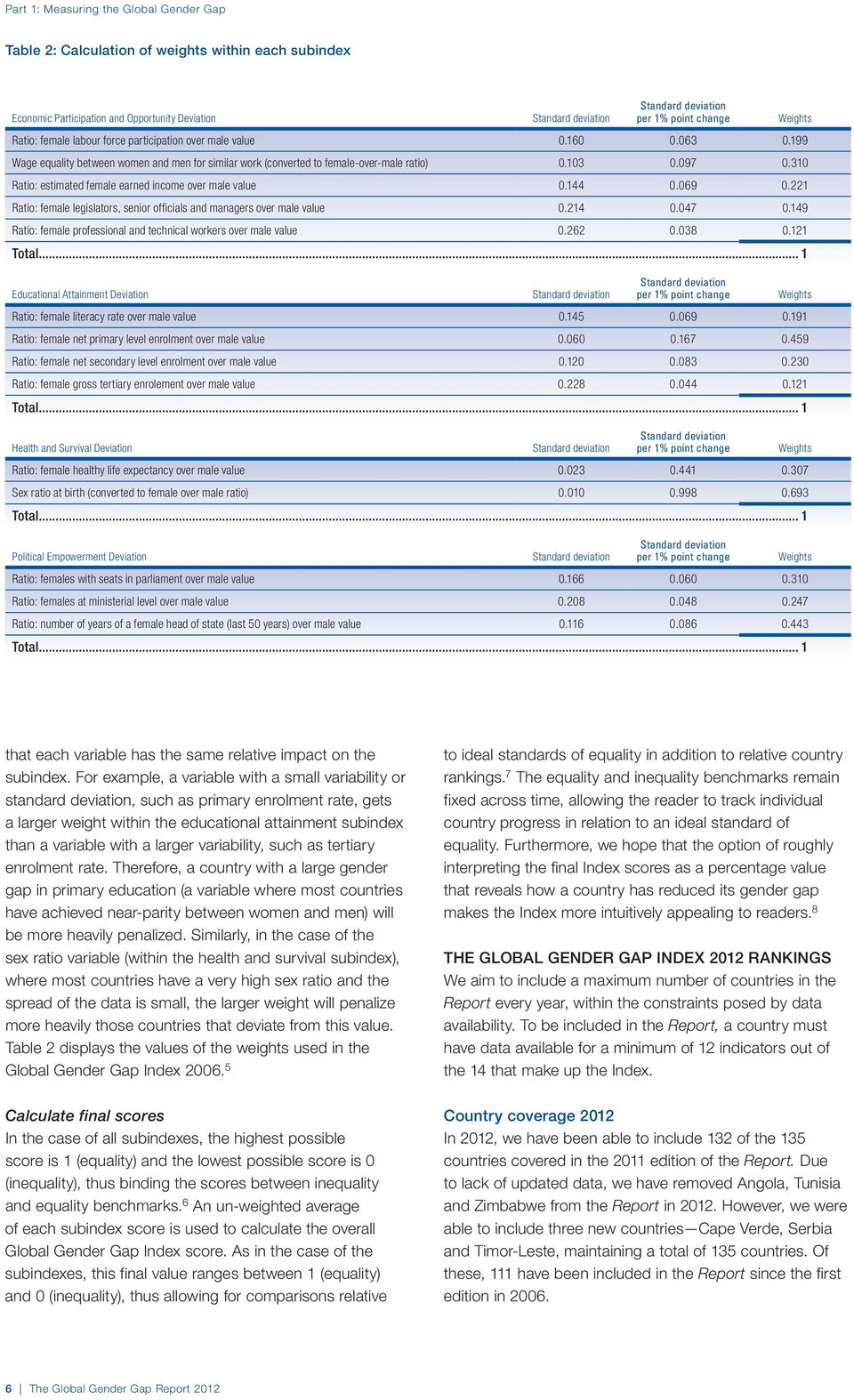
14 Part 1: Measuring the Global Gender Gap Table 2: Calculation of weights within each subindex Economic Participation and Opportunity Deviation Standard deviation Standard deviation per 1% point change Ratio: female labour force participation over male value Wage equality between women and men for similar work (converted to female-over-male ratio) Ratio: estimated female earned income over male value Ratio: female legislators, senior officials and managers over male value Ratio: female professional and technical workers over male value Total... 1 al Attainment Deviation Standard deviation Standard deviation per 1% point change Ratio: female literacy rate over male value Ratio: female net primary level enrolment over male value Ratio: female net secondary level enrolment over male value Ratio: female gross tertiary enrolement over male value Total... 1 Health and Survival Deviation Standard deviation Standard deviation per 1% point change Ratio: female healthy life expectancy over male value Sex ratio at birth (converted to female over male ratio) Total... 1 Political Empowerment Deviation Standard deviation Standard deviation per 1% point change Ratio: females with seats in parliament over male value Ratio: females at ministerial level over male value Ratio: number of years of a female head of state (last 50 years) over male value Total... 1 Weights Weights Weights Weights that each variable has the same relative impact on the subindex. For example, a variable with a small variability or standard deviation, such as primary enrolment rate, gets a larger weight within the educational attainment subindex than a variable with a larger variability, such as tertiary enrolment rate. Therefore, a country with a large gender gap in primary education (a variable where most countries have achieved near-parity between women and men) will be more heavily penalized. Similarly, in the case of the sex ratio variable (within the health and survival subindex), where most countries have a very high sex ratio and the spread of the data is small, the larger weight will penalize more heavily those countries that deviate from this value. Table 2 displays the values of the weights used in the Global Gender Gap Index Calculate final scores In the case of all subindexes, the highest possible score is 1 (equality) and the lowest possible score is 0 (inequality), thus binding the scores between inequality and equality benchmarks. 6 An un-weighted average of each subindex score is used to calculate the overall Global Gender Gap Index score. As in the case of the subindexes, this final value ranges between 1 (equality) and 0 (inequality), thus allowing for comparisons relative to ideal standards of equality in addition to relative country rankings. 7 The equality and inequality benchmarks remain fixed across time, allowing the reader to track individual country progress in relation to an ideal standard of equality. Furthermore, we hope that the option of roughly interpreting the final Index scores as a percentage value that reveals how a country has reduced its gender gap makes the Index more intuitively appealing to readers. 8 THE GLOBAL GENDER GAP INDEX 2012 RANKINGS We aim to include a maximum number of countries in the Report every year, within the constraints posed by data availability. To be included in the Report, a country must have data available for a minimum of 12 indicators out of the 14 that make up the Index. Country coverage 2012 In 2012, we have been able to include 132 of the 135 countries covered in the 2011 edition of the Report. Due to lack of updated data, we have removed Angola, Tunisia and Zimbabwe from the Report in However, we were able to include three new countries Cape Verde, Serbia and Timor-Leste, maintaining a total of 135 countries. Of these, 111 have been included in the Report since the first edition in The Global Gender Gap Report 2012
15 Part 1: Measuring the Global Gender Gap Figure 1: Global patterns, 2012 Health Economy Politics Sample average (0.00 = inequality, 1.00 = equality) Source: Global Gender Gap Index 2012; scores are weighted by population. Nearly 200 countries were considered for inclusion this year. Out of the 135 ultimately covered in this Report, 13 countries had one data point missing: Bahamas (Wage equality for similar work [survey]) Belize (Wage equality for similar work [survey]) Botswana (Women in ministerial positions) Brunei Darussalam (Women in parliament) Ghana (Professional and technical workers); Jamaica (Professional and technical workers) Maldives (Wage equality for similar work [survey]); Russian Federation (Enrolment in secondary education) Serbia (Labour force participation); Singapore (Enrolment in tertiary education) Sri Lanka (Women in ministerial positions) Syria (Wage equality for similar work [survey]) and Vietnam (Enrolment in primary education). Another 24 countries had two variables missing: Albania (Legislators, senior officials and managers; Professional and technical workers), Benin (Legislators, senior officials and managers; Professional and technical workers), Burkina Faso (Legislators, senior officials and managers; Professional and technical workers), Burundi (Legislators, senior officials and managers; Professional and technical workers), Cameroon (Legislators, senior officials and managers; Professional and technical workers), Cape Verde (Legislators, senior officials and managers; Professional and technical workers), Chad (Legislators, senior officials and managers; Professional and technical workers), Côte d Ivoire (Legislators, senior officials and managers; Professional and technical workers), Cuba (Legislators, senior officials and managers; Professional and technical workers), Fiji (Wage equality for similar work [survey] and Women in parliament), Gambia (Legislators, senior officials and managers; Professional and technical workers), Guatemala (Legislators, senior officials and managers; Professional and technical workers), India (Legislators, senior officials and managers; Professional and technical workers), Jordan (Legislators, senior officials and managers; Professional and technical workers), Kenya (Legislators, senior officials and managers; Professional and technical workers), Luxembourg (Legislators, senior officials and managers; Professional and technical workers), Malawi (Legislators, senior officials and managers; Professional and technical workers), Mali (Legislators, senior officials and managers; Professional and technical workers), Mauritania (Legislators, senior officials and managers; Professional and technical workers), Mozambique (Legislators, senior officials and managers; Professional and technical workers), Nigeria (Legislators, senior officials and managers; Professional and technical workers), Senegal (Legislators, senior officials and managers; Professional and technical workers), Tajikistan (Legislators, senior officials and managers; Professional and technical workers) and Timor-Leste (Legislators, senior officials and managers; Professional and technical workers). Global patterns Figure 1 shows a global snapshot of the gender gap in the four subindexes. It shows that the 135 countries covered in the Report, representing over 90% of the world s population, have closed almost 96% of the gap in health outcomes between women and men and almost 93% of the gap in educational attainment. However, the gap between women and men on economic participation The Global Gender Gap Report
![Out of the 135 ultimately covered in this Report, 13 countries had one data point missing: Bahamas (Wage equality for similar work [survey]) Belize (Wage equality for similar work [survey]) Botswana](/docs-images/41/931808/images/page_15.jpg "(Women in ministerial positions) Brunei Darussalam (Women in parliament) Ghana (Professional and technical workers); Jamaica (Professional and technical workers) Maldives (Wage equality for similar")
16 Part 1: Measuring the Global Gender Gap Table 3a: The Global Gender Gap Index 2012 rankings: comparisons with 2011, 2010, 2009, 2008, 2007 and 2006 Country 2012 rank 2012 score 2012 rank among 2011 countries 2011 rank 2011 score 2010 rank Iceland Finland Norway Sweden Ireland New Zealand Denmark Philippines Nicaragua Switzerland Netherlands Belgium Germany Lesotho Latvia South Africa Luxembourg United Kingdom Cuba Austria Canada United States Mozambique Burundi Australia Spain Barbados Uganda Costa Rica Bolivia Kazakhstan Argentina Ecuador Lithuania Cape Verde* Malawi Bahamas Slovenia Sri Lanka Panama Namibia Guyana Trinidad and Tobago Mongolia Moldova Tanzania Portugal Venezuela Croatia Serbia* Jamaica Bulgaria Poland Kyrgyz Republic Singapore Israel France Madagascar Russian Federation Estonia Macedonia, FYR Brazil Colombia Ukraine Thailand Vietnam Romania Timor-Leste* score 2009 rank 2009 score 2008 rank 2008 score 2007 rank 2007 score 2006 rank 2006 score 8 The Global Gender Gap Report 2012
17 Part 1: Measuring the Global Gender Gap Table 3a: The Global Gender Gap Index 2012 rankings: comparisons with 2011, 2010, 2009, 2008, 2007 and 2006 (cont d.) Country 2012 rank 2012 score 2012 rank among 2011 countries 2011 rank 2011 score 2010 rank China Slovak Republic Ghana Kenya Czech Republic Honduras Brunei Darussalam Uruguay Botswana Peru Cyprus Italy Hungary Greece Paraguay Mexico Georgia Bangladesh Chile Malta Dominican Republic Senegal Albania Armenia Gambia, The El Salvador Maldives Tajikistan Indonesia Mauritius Azerbaijan Malaysia Japan Belize Cambodia Burkina Faso India Suriname United Arab Emirates Korea, Rep Kuwait Nigeria Bahrain Cameroon Fiji Zambia Qatar Guatemala Benin Ethiopia Mauritania Algeria Jordan Lebanon Nepal Turkey Oman Egypt Iran, Islamic Rep Mali Morocco Côte d'ivoire Saudi Arabia Syria Chad Pakistan Yemen score 2009 rank 2009 score 2008 rank 2008 score 2007 rank 2007 score 2006 rank 2006 score * New countries 2012 The Global Gender Gap Report

18 Part 1: Measuring the Global Gender Gap Table 3b: Detailed rankings, 2012 OVERALL ECONOMIC PARTICIPATION AND OPPORTUNITY EDUCATIONAL ATTAINMENT HEALTH AND SURVIVAL POLITICAL EMPOWERMENT Country Rank Score Rank Score Rank Score Rank Score Rank Score Iceland Finland Norway Sweden Ireland New Zealand Denmark Philippines Nicaragua Switzerland Netherlands Belgium Germany Lesotho Latvia South Africa Luxembourg United Kingdom Cuba Austria Canada United States Mozambique Burundi Australia Spain Barbados Uganda Costa Rica Bolivia Kazakhstan Argentina Ecuador Lithuania Cape Verde* Malawi Bahamas Slovenia Sri Lanka Panama Namibia Guyana Trinidad and Tobago Mongolia Moldova Tanzania Portugal Venezuela Croatia Serbia* Jamaica Bulgaria Poland Kyrgyz Republic Singapore Israel France Madagascar Russian Federation Estonia Macedonia, FYR Brazil Colombia Ukraine Thailand Vietnam Romania Timor-Leste* The Global Gender Gap Report 2012
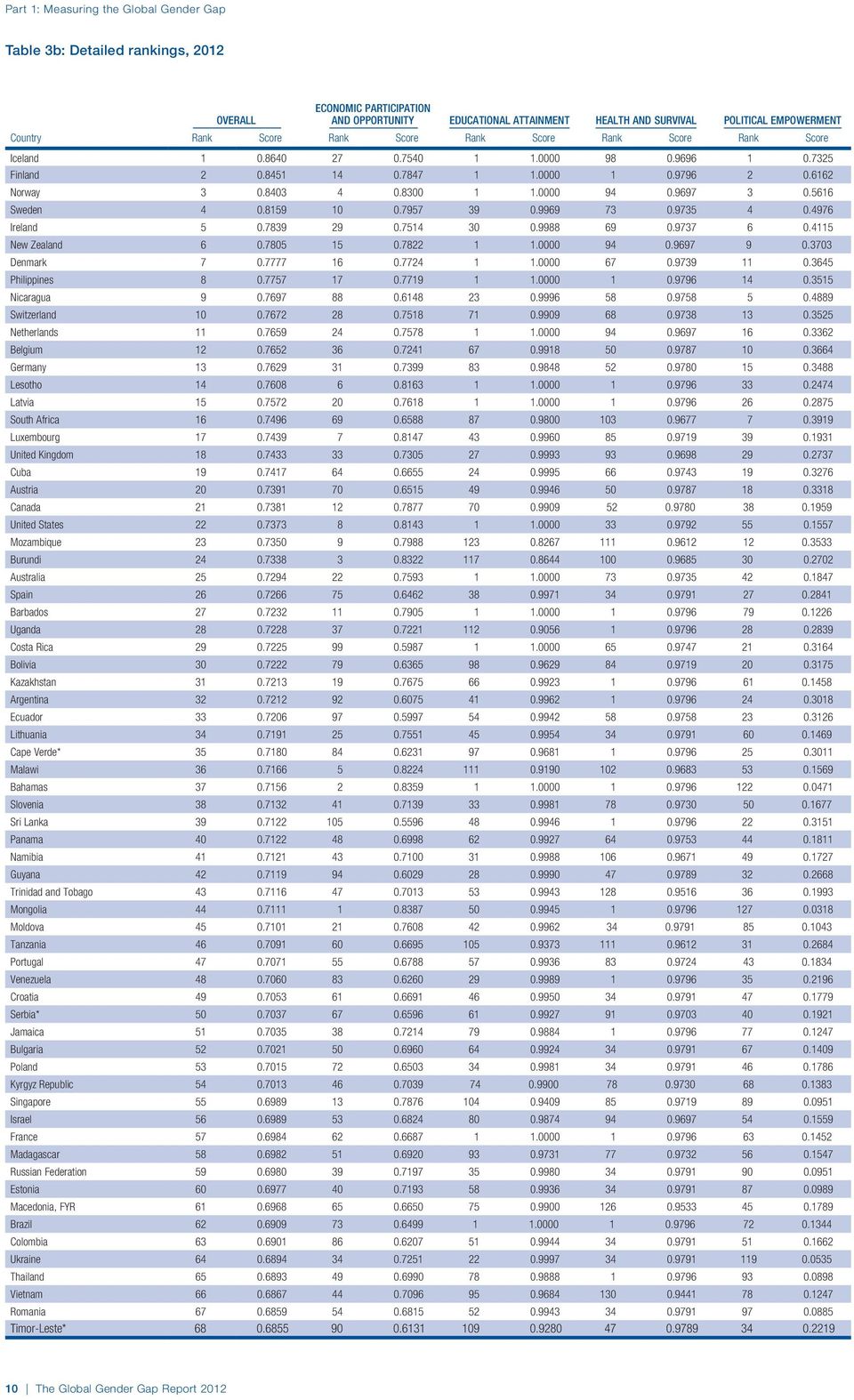
19 Part 1: Measuring the Global Gender Gap Table 3b: Detailed rankings, 2012 (cont d.) OVERALL ECONOMIC PARTICIPATION AND OPPORTUNITY EDUCATIONAL ATTAINMENT HEALTH AND SURVIVAL POLITICAL EMPOWERMENT Country Rank Score Rank Score Rank Score Rank Score Rank Score China Slovak Republic Ghana Kenya Czech Republic Honduras Brunei Darussalam Uruguay Botswana Peru Cyprus Italy Hungary Greece Paraguay Mexico Georgia Bangladesh Chile Malta Dominican Republic Senegal Albania Armenia Gambia, The El Salvador Maldives Tajikistan Indonesia Mauritius Azerbaijan Malaysia Japan Belize Cambodia Burkina Faso India Suriname United Arab Emirates Korea, Rep Kuwait Nigeria Bahrain Cameroon Fiji Zambia Qatar Guatemala Benin Ethiopia Mauritania Algeria Jordan Lebanon Nepal Turkey Oman Egypt Iran, Islamic Rep Mali Morocco Côte d'ivoire Saudi Arabia Syria Chad Pakistan Yemen * New countries 2012 The Global Gender Gap Report
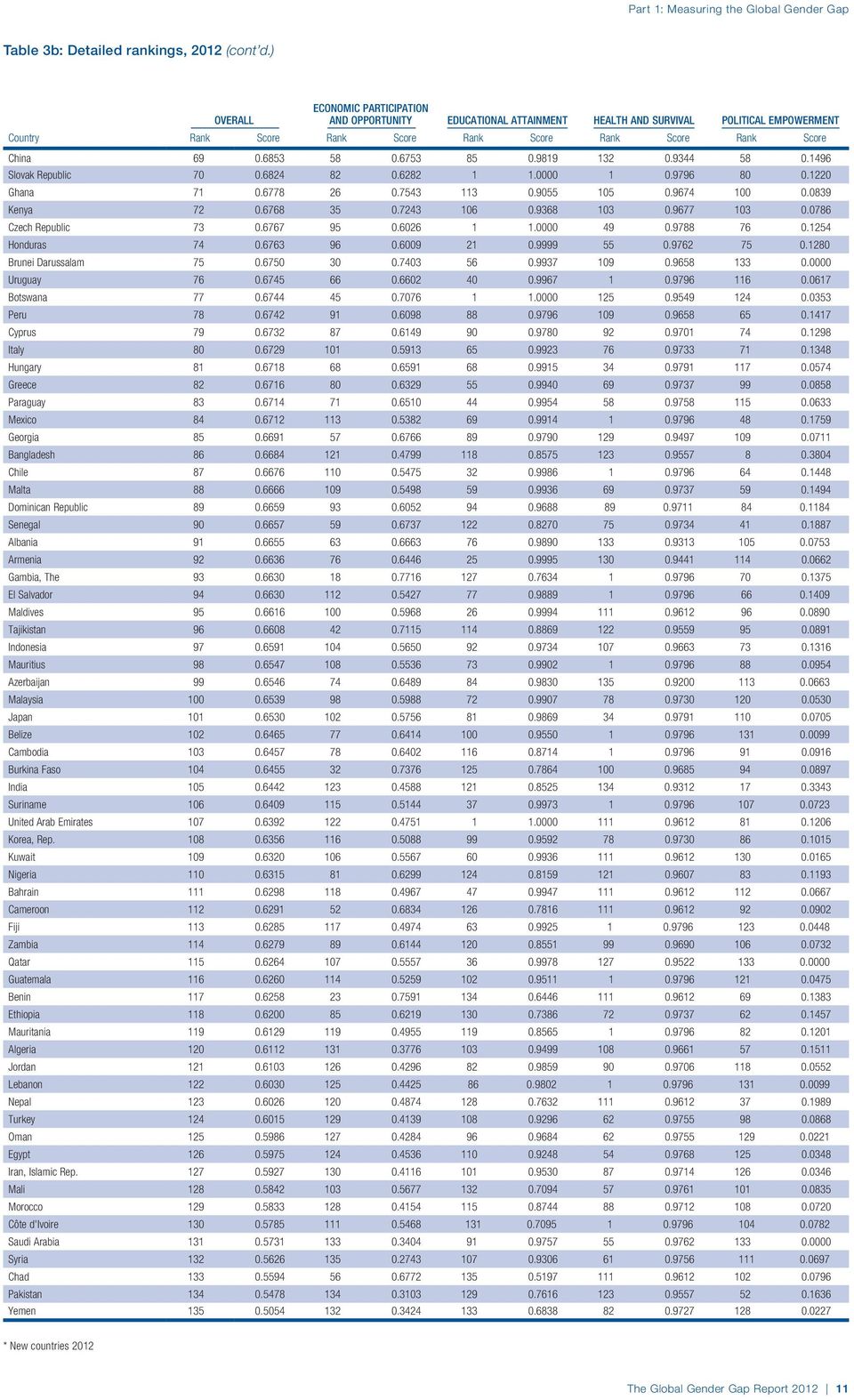
20 Part 1: Measuring the Global Gender Gap Table 3c: The Global Gender Gap Index 2012 rankings: changes in scores (detailed) Country Change in score ( ) Change in score ( ) Change in score ( ) Change in score ( ) Change in score ( ) Change in score ( ) Change in score ( ) Iceland Finland Norway Sweden Ireland New Zealand Denmark Philippines Nicaragua Switzerland Netherlands Belgium Germany Lesotho Latvia South Africa Luxembourg United Kingdom Cuba Austria Canada United States Mozambique Burundi Australia Spain Barbados w Uganda Costa Rica Bolivia Kazakhstan Argentina Ecuador Lithuania Cape Verde* Malawi Bahamas Slovenia Sri Lanka Panama Namibia Guyana Trinidad and Tobago Mongolia Moldova Tanzania Portugal Venezuela Croatia Serbia* Jamaica Bulgaria Poland Kyrgyz Republic Singapore Israel France Madagascar Russian Federation Estonia Macedonia, FYR Brazil Colombia Ukraine Thailand Vietnam Romania Timor Leste* China Slovak Republic The Global Gender Gap Report 2012
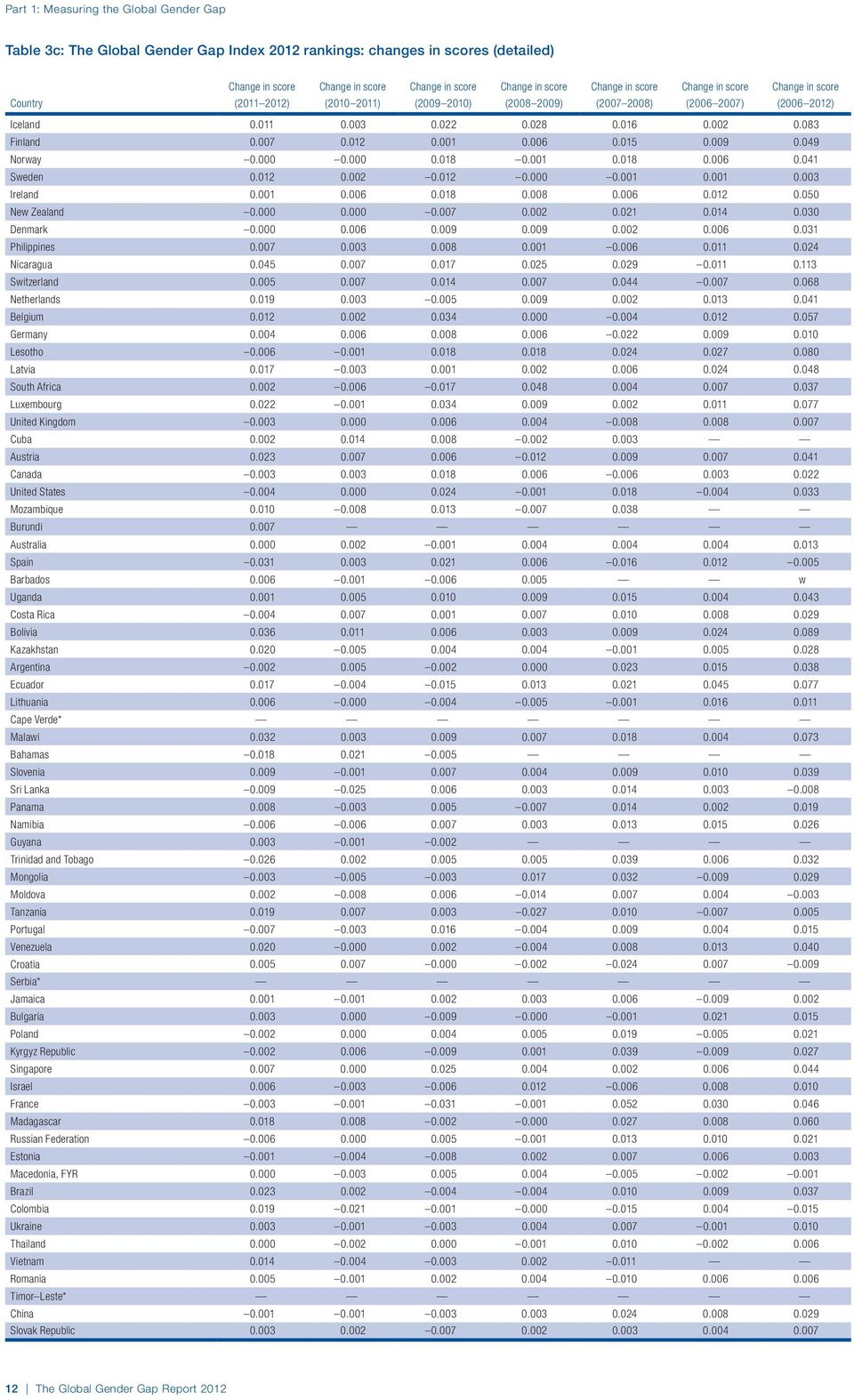
21 Part 1: Measuring the Global Gender Gap Table 3c: The Global Gender Gap Index 2012 rankings: changes in scores (detailed) (cont d.) Country Change in score ( ) Change in score ( ) Change in score ( ) Change in score ( ) Change in score ( ) Change in score ( ) Change in score ( ) Ghana Kenya Czech Republic Honduras Brunei Darussalam Uruguay Botswana Peru Cyprus Italy Hungary Greece Paraguay Mexico Georgia Bangladesh Chile Malta Dominican Republic Senegal Albania Armenia Gambia, The El Salvador Maldives Tajikistan Indonesia Mauritius Azerbaijan Malaysia Japan Belize Cambodia Burkina Faso India Suriname United Arab Emirates Korea, Rep Kuwait Nigeria Bahrain Cameroon Fiji Zambia Qatar Guatemala Benin Ethiopia Mauritania Algeria Jordan Lebanon Nepal Turkey Oman Egypt Iran, Islamic Rep Mali Morocco Côte d Ivoire Saudi Arabia Syria Chad Pakistan Yemen Angola Belarus Tunisia Uzbekistan Zimbabwe * New countries 2012 The Global Gender Gap Report
22 Part 1: Measuring the Global Gender Gap Table 3c: The Global Gender Gap Index 2012 rankings: changes in scores (summary) Number of countries Widening gaps Narrowing gaps Improving (%) 61% 55% 59% 67% 68% 79% 88% Deteriorating (%) 39% 45% 41% 33% 32% 21% 12% TOTAL Table 4: Rankings by income group, 2012 LOW INCOME Overall Overall Country score rank LOWER-MIDDLE INCOME Overall Overall Country score rank UPPER-MIDDLE INCOME Overall Overall Country score rank HIGH INCOME Overall Overall Country score rank Mozambique Burundi Uganda Malawi Tanzania Kyrgyz Republic Madagascar Kenya Bangladesh Gambia, The Tajikistan Cambodia Burkina Faso Benin Ethiopia Mauritania Nepal Mali Chad Philippines Nicaragua Lesotho Bolivia Cape Verde* Sri Lanka Guyana Mongolia Moldova Ukraine Vietnam Timor-Leste* Ghana Honduras Paraguay Georgia Senegal Albania Armenia El Salvador Indonesia Belize India Nigeria Cameroon Fiji Zambia Guatemala Egypt Morocco Côte d Ivoire Syria Pakistan Yemen Latvia South Africa Cuba Costa Rica Kazakhstan Argentina Ecuador Lithuania Panama Namibia Venezuela Serbia* Jamaica Bulgaria Russian Federation Macedonia, FYR Brazil Colombia Thailand Romania China Uruguay Botswana Peru Mexico Chile Dominican Republic Maldives Mauritius Azerbaijan Malaysia Suriname Algeria Jordan Lebanon Turkey Iran, Islamic Rep Iceland Finland Norway Sweden Ireland New Zealand Denmark Switzerland Netherlands Belgium Germany Luxembourg United Kingdom Austria Canada United States Australia Spain Barbados Bahamas Slovenia Trinidad and Tobago Portugal Croatia Poland Singapore Israel France Estonia Slovak Republic Czech Republic Brunei Darussalam Cyprus Italy Hungary Greece Malta Japan United Arab Emirates Korea, Rep Kuwait Bahrain Qatar Oman Saudi Arabia * New countries 2012 Note: Income classifications are taken from the World Bank, which classifies economies into four income categories based on GNI per capita: high income, upper-middle income, lower-middle income and low income. 14 The Global Gender Gap Report 2012
23 Part 1: Measuring the Global Gender Gap Table 5: Rankings by subindex, 2012 ECONOMIC PARTICIPATION AND OPPORTUNITY Country Score Rank Country Score Rank EDUCATIONAL ATTAINMENT Country Score Rank Country Score Rank Mongolia Bahamas Burundi Norway Malawi Lesotho Luxembourg United States Mozambique Sweden Barbados Canada Singapore Finland New Zealand Denmark Philippines Gambia, The Kazakhstan Latvia Moldova Australia Benin Netherlands Lithuania Ghana Iceland Switzerland Ireland Brunei Darussalam Germany Burkina Faso United Kingdom Ukraine Kenya Belgium Uganda Jamaica Russian Federation Estonia Slovenia Tajikistan Namibia Vietnam Botswana Kyrgyz Republic Trinidad and Tobago Panama Thailand Bulgaria Madagascar Cameroon Israel Romania Portugal Chad Georgia China Senegal Tanzania Croatia France Albania Cuba Macedonia, FYR Uruguay Serbia* Hungary South Africa Austria Paraguay Poland Brazil Azerbaijan Spain Armenia Belize Cambodia Bolivia Greece Nigeria Slovakia Venezuela Cape Verde* Ethiopia Colombia Cyprus Nicaragua Zambia Timor-Leste* Peru Argentina Dominican Republic Guyana Czech Republic Honduras Ecuador Malaysia Costa Rica Maldives Italy Japan Mali Indonesia Sri Lanka Kuwait Qatar Mauritius Malta Chile Côte d Ivoire El Salvador Mexico Guatemala Suriname Korea, Rep Fiji Bahrain Mauritania Nepal Bangladesh United Arab Emirates India Egypt Lebanon Jordan Oman Morocco Turkey Iran, Islamic Rep Algeria Yemen Saudi Arabia Pakistan Syria Australia Bahamas Barbados Botswana Brazil Costa Rica Czech Republic Denmark Finland France Iceland Latvia Lesotho Netherlands New Zealand Norway Philippines Slovakia United Arab Emirates United States Honduras Ukraine Nicaragua Cuba Armenia Maldives United Kingdom Guyana Venezuela Ireland Namibia Chile Slovenia Poland Russian Federation Qatar Suriname Spain Sweden Uruguay Argentina Moldova Luxembourg Paraguay Lithuania Croatia Bahrain Sri Lanka Austria Mongolia Colombia Romania Trinidad and Tobago Ecuador Greece Brunei Darussalam Portugal Estonia Malta Kuwait Serbia* Panama Fiji Bulgaria Italy Kazakhstan Belgium Hungary Mexico Canada Switzerland Malaysia Mauritius Kyrgyz Republic Macedonia, FYR Albania El Salvador Thailand Jamaica Israel Japan Jordan Germany Azerbaijan China Lebanon South Africa Peru Georgia Cyprus Saudi Arabia Indonesia Madagascar Dominican Republic Vietnam Oman Cape Verde* Bolivia Korea, Rep Belize Iran, Islamic Rep Guatemala Algeria Singapore Tanzania Kenya Syria Turkey Timor-Leste* Egypt Malawi Uganda Ghana Tajikistan Morocco Cambodia Burundi Bangladesh Mauritania Zambia India Senegal Mozambique Nigeria Burkina Faso Cameroon Gambia, The Nepal Pakistan Ethiopia Côte d Ivoire Mali Yemen Benin Chad The Global Gender Gap Report
24 Part 1: Measuring the Global Gender Gap Table 5: Rankings by subindex, 2012 (cont d.) HEALTH AND SURVIVAL Country Score Rank Country Score Rank POLITICAL EMPOWERMENT Country Score Rank Country Score Rank Argentina Bahamas Barbados Belize Brazil Cambodia Cape Verde* Chile Côte d Ivoire El Salvador Fiji Finland France Gambia, The Guatemala Jamaica Kazakhstan Latvia Lebanon Lesotho Mauritania Mauritius Mexico Mongolia Philippines Slovakia Sri Lanka Suriname Thailand Uganda Uruguay Venezuela United States Bulgaria Colombia Croatia Estonia Hungary Japan Lithuania Moldova Poland Romania Russian Federation Spain Ukraine Guyana Timor-Leste* Czech Republic Austria Belgium Canada Germany Egypt Honduras Saudi Arabia Mali Ecuador Nicaragua Paraguay Syria Oman Turkey Panama Costa Rica Cuba Denmark Switzerland Greece Ireland Malta Ethiopia Australia Sweden Senegal Italy Madagascar Korea, Rep Kyrgyz Republic Malaysia Slovenia Yemen Portugal Bolivia Luxembourg Singapore Iran, Islamic Rep Morocco Dominican Republic Jordan Serbia* Cyprus United Kingdom Israel Netherlands New Zealand Norway Iceland Zambia Burkina Faso Burundi Malawi Kenya South Africa Ghana Namibia Indonesia Algeria Brunei Darussalam Peru Bahrain Benin Cameroon Chad Kuwait Maldives Mozambique Nepal Tanzania United Arab Emirates Nigeria Tajikistan Bangladesh Pakistan Botswana Macedonia, FYR Qatar Trinidad and Tobago Georgia Armenia Vietnam China Albania India Azerbaijan Iceland Finland Norway Sweden Nicaragua Ireland South Africa Bangladesh New Zealand Belgium Denmark Mozambique Switzerland Philippines Germany Netherlands India Austria Cuba Bolivia Costa Rica Sri Lanka Ecuador Argentina Cape Verde* Latvia Spain Uganda United Kingdom Burundi Tanzania Guyana Lesotho Timor-Leste* Venezuela Trinidad and Tobago Nepal Canada Luxembourg Serbia* Senegal Australia Portugal Panama Macedonia, FYR Poland Croatia Mexico Namibia Slovenia Colombia Pakistan Malawi Israel United States Madagascar Algeria China Malta Lithuania Kazakhstan Ethiopia France Chile Peru El Salvador Bulgaria Kyrgyz Republic Benin Gambia, The Italy Brazil Indonesia Cyprus Honduras Czech Republic Jamaica Vietnam Barbados Slovakia United Arab Emirates Mauritania Nigeria Dominican Republic Moldova Korea, Rep Estonia Mauritius Singapore Russian Federation Cambodia Cameroon Thailand Burkina Faso Tajikistan Maldives Romania Turkey Greece Ghana Mali Chad Kenya Côte d Ivoire Albania Zambia Suriname Morocco Georgia Japan Syria Bahrain Azerbaijan Armenia Paraguay Uruguay Hungary Jordan Ukraine Malaysia Guatemala Bahamas Fiji Botswana Egypt Iran, Islamic Rep Mongolia Yemen Oman Kuwait Belize Lebanon Brunei Darussalam Qatar Saudi Arabia * New countries The Global Gender Gap Report 2012
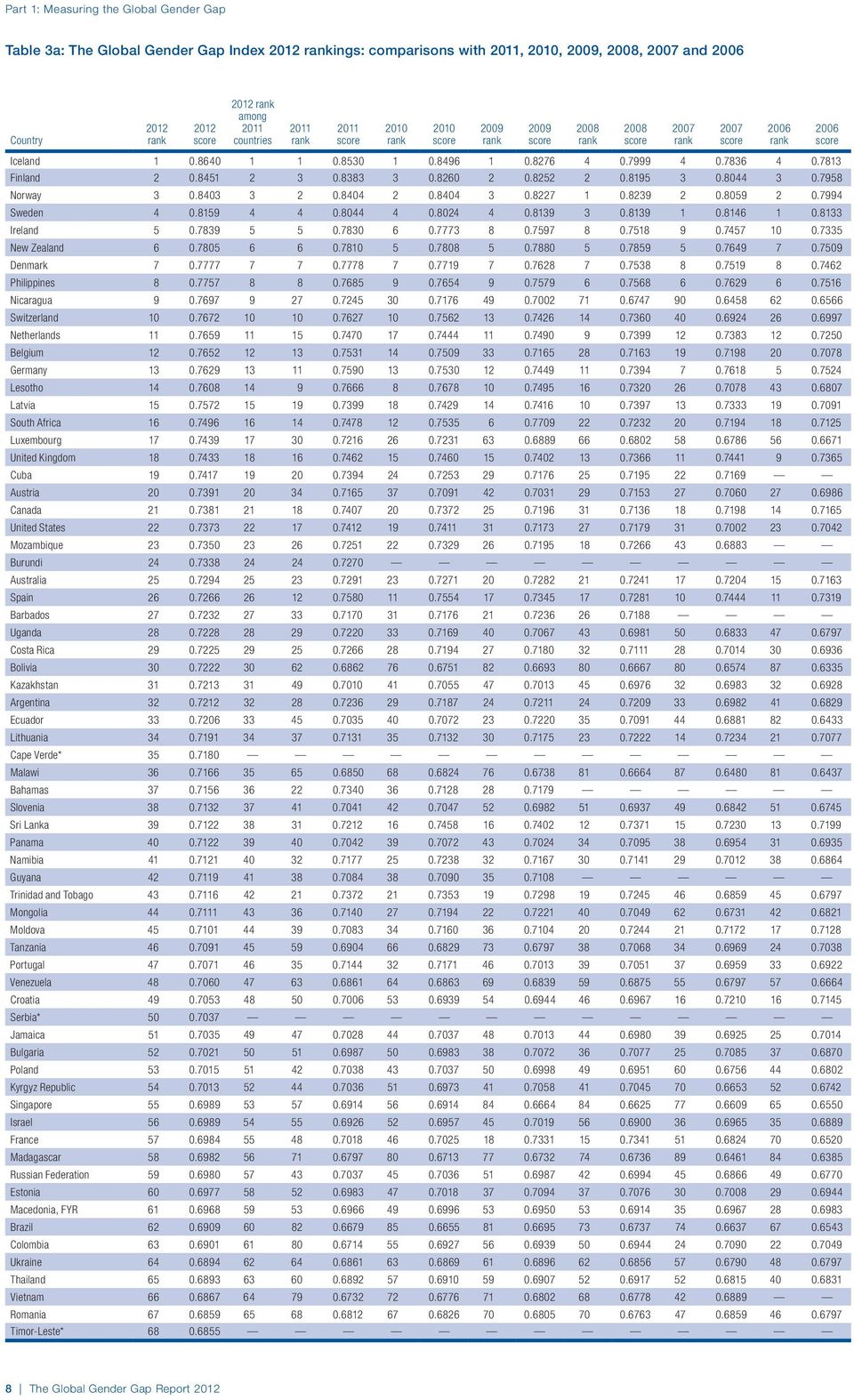
25 Part 1: Measuring the Global Gender Gap Figure 2: Regional performance on the Global Gender Gap Index Global Gender Gap Index score ( ) Middle East and North Africa Asia and the Pacific Sub-Saharan Africa Latin America and the Caribbean Europe and Central Asia North America Source: Global Gender Gap Index 2012; details of regional classifications in Appendix B. Scores are weighted by population; population data from the World Bank s World Development Indicators (WDI) online database 2011, accessed July and political empowerment remains wide: only 60% of the economic outcomes gap and only 20% of the political outcomes gap have been closed. The detailed rankings from this year s Index are shown in Tables 3 through 5. Table 3a displays the 2012 rankings and provides comparisons with rankings in 2011, 2010, 2009, 2008, 2007 and Table 3b displays the complete 2012 rankings, including the four subindex scores and ranks. Table 3c provides the year-to-year score changes over the last seven years. Out of the 111 countries that have been involved every year since 2006, 98 (88%) have improved their performance over the last four years, while 13 (12%) have shown widening gaps. Table 4 shows the rankings of countries by income group (Table B2 in Appendix B displays the income group categories used). In 2012, in the high-income group, the Nordic countries lead the way while Saudi Arabia (131) is the lowest performing country in this category. In the upper-middle income group, Latvia (15) ranks highest while Iran (127) occupies the lowest position. In the lower-middleincome group, the Philippines (8) comes out on top while Yemen (135) holds last position. In the lower-income group, Mozambique (23) is the strongest performer while Chad (133) is in last place. Table 5 shows the rankings of countries by subindex. In 2012, 20 countries have fully closed the gap in educational attainment while Chad, the lowest-ranking country on this subindex, has closed only about 52 percent of its gender gap. Thirty-two countries have closed the gap in health and survival. China, Albania, India and Azerbaijan are the lowest-ranking countries on this subindex. Nine countries have closed the gap on both the health and education subindexes. No country has closed the economic participation gap or the political empowerment gap. On the economic participation and opportunity subindex, the highest-ranking country (Mongolia) has closed over 84% of its gender gap while the lowest ranking country (Syria) has closed only 27% of its economic gender gap. There is similar variation in the political empowerment subindex. The highest-ranking country (Iceland) has closed almost 73% of its gender gap whereas the lowest-ranking country (Saudi Arabia) has closed none of the political empowerment gap according to this measure. Regional trends Figure 2 displays the regional performance on the overall Index score, while Figures 3 through 6 display regional performances on each of the four subindexes. 9 All scores are weighted by population to produce the regional averages. Table B1 in Appendix B displays the regional categories used. 10 In the overall Index scores shown in Figure 2, North America holds the top spot, while the Middle East and North Africa region occupies the last place, having closed almost 59% of its gender gap. Table 6 displays the rankings within each regional category. The Global Gender Gap Report
26 Part 1: Measuring the Global Gender Gap Table 6: Rankings by region, 2012 ASIA AND THE PACIFIC Country Score Rank New Zealand Philippines Australia Sri Lanka Mongolia Singapore Thailand Vietnam Timor-Leste* China Brunei Darussalam Bangladesh Maldives Indonesia Malaysia Japan Cambodia India Korea, Rep Fiji Nepal Iran, Islamic Rep Pakistan LATIN AMERICA AND THE CARIBBEAN Country Score Rank Nicaragua Cuba Barbados Costa Rica Bolivia Argentina Ecuador Bahamas Panama Guyana Trinidad and Tobago Venezula Jamaica Brazil Colombia Honduras Uruguay Peru Paraguay Mexico Chile Dominican Republic El Salvador Belize Suriname Guatemala MIDDLE EAST AND NORTH AFRICA Country Score Rank Israel United Arab Emirates Kuwait Bahrain Qatar Mauritania Algeria Jordan Lebanon Oman Egypt Morocco Saudi Arabia Syria Yemen (Cont d.) In the economic participation and opportunity scores shown in Figure 3, North America holds the top spot while the Middle East and North Africa region is in the last place. In the educational attainment scores shown in Figure 4, North America once again tops the rankings while Sub- Saharan Africa holds last place. In the health and survival scores shown in Figure 5, North America holds the top spot, while Asia and the Pacific occupies the last place as the worst region for women s health and survival relative to that of men. In the political empowerment scores shown in Figure 6, while all regions are well below parity, Asia and the Pacific leads the way, while the Middle East and North Africa region is in last place. Table 6 displays the rankings within each regional category. Top 10 Four Nordic countries that have consistently held the highest positions in previous editions of the Global Gender Gap Index continue to hold these privileged positions. Iceland (1) still holds the top spot, closely followed by Finland (2), Norway (3) and Sweden (4). Finland and Norway exchange spots in the rankings this year. Although no country has yet achieved gender equality, all of the Nordic countries, with the exception of Denmark, have closed over 80% of the gender gap and thus serve as models and useful benchmarks for international 18 The Global Gender Gap Report 2012
27 Part 1: Measuring the Global Gender Gap Table 6: Rankings by region, 2012 (cont d.) NORTH AMERICA Country Score Rank Canada United States SUB-SAHARAN AFRICA Country Score Rank Lesotho South Africa Mozambique Burundi Uganda Cape Verde* Malawi Namibia Tanzania Madagascar Ghana Kenya Botswana Senegal Gambia, The Mauritius Burkina Faso Nigeria Cameroon Zambia Benin Ethiopia Mali Côte d Ivoire Chad EUROPE AND CENTRAL ASIA Country Score Rank Iceland Finland Norway Sweden Ireland Denmark Switzerland Netherlands Belgium Germany Latvia Luxembourg United Kingdom Austria Spain Kazakhstan Lithuania Slovenia Moldova Portugal Croatia Serbia* Bulgaria Poland Kyrgyz Republic France Russian Federation Estonia Macedonia, FYR Ukraine Romania Slovak Republic Czech Republic Cyprus Italy Hungary Greece Georgia Malta Albania Armenia Tajikistan Azerbaijan Turkey comparisons. While many global indexes tend to be tied to income levels, thus providing an advantage to the highincome Nordic economies, the Global Gender Gap Index is disassociated from the income and resource level of an economy and instead seeks to measure how equitably the available income, resources and opportunities are distributed between women and men. Despite this feature of the Index, these countries emerge as top performers and true leaders on gender equality. All Nordic countries reached % literacy for both sexes several decades ago and display gender parity at both primary- and secondary-level education. At the tertiary level, in addition to very high levels of enrolment for both women and men, the gender gap has been reversed and women now make up the majority of the high-skilled workforce. In Norway, Sweden and Iceland there are over 1.5 women for every man enrolled in tertiary education, and in Finland and Denmark women also make up the majority of those in tertiary education. The Nordic countries also exhibit very high healthy life expectancies for both women and men, with women living, on average, three to four healthy years longer than men. While many developed economies have succeeded in closing the gender gap in education, few have succeeded in maximizing the returns from this investment. The Nordic countries are leaders in this area all five countries feature in the top 30 of the economic participation and opportunity subindex. This occurs because of a combination of factors: The Global Gender Gap Report
28 Part 1: Measuring the Global Gender Gap Figure 3: Regional performance on the Economic Participation and Opportunity subindex Subindex score ( ) Middle East and North Africa Asia and the Pacific Latin America and the Caribbean Sub-Saharan Africa Europe and Central Asia North America Source: Global Gender Gap Index 2012; details of regional classifications in Appendix B. Scores are weighted by population; population data from the World Bank s World Development Indicators (WDI) online database 2011, accessed July Figure 4: Regional performance on the al Attainment subindex Subindex score ( ) Sub-Saharan Africa Middle East and North Africa Asia and the Pacific Europe and Central Asia Latin America and the Caribbean North America Source: Global Gender Gap Index 2012; details of regional classifications in Appendix B. Scores are weighted by population; population data from the World Bank s World Development Indicators (WDI) online database 2011, accessed July The Global Gender Gap Report 2012
29 Part 1: Measuring the Global Gender Gap Figure 5: Regional performance on the Health and Survival subindex Subindex score ( ) Asia and the Pacific Sub-Saharan Africa Middle East and North Africa Europe and Central Asia Latin America and the Caribbean North America Source: Global Gender Gap Index 2012; details of regional classifications in Appendix B. Scores are weighted by population; population data from the World Bank s World Development Indicators (WDI) online database 2011, accessed July Figure 6: Regional performance on the Political Empowerment subindex Subindex score ( ) Middle East and North Africa North America Sub-Saharan Africa Latin America and the Caribbean Europe and Central Asia Asia and the Pacific Source: Global Gender Gap Index 2012; details of regional classifications in Appendix B. Scores are weighted by population; population data from the World Bank s World Development Indicators (WDI) online database 2011, accessed July The Global Gender Gap Report
30 Part 1: Measuring the Global Gender Gap the labour force participation rates for women are among the highest in the world; salary gaps between women and men are among the lowest in the world, although not nonexistent; and women have abundant opportunities to rise to positions of leadership. These patterns vary across the Nordic countries, but, on the whole, these economies have made it possible for parents to combine work and family, resulting in high female employment participation rates, more shared participation in childcare, more equitable distribution of labour at home, better work-life balance for both women and men and in some cases a boost to declining fertility rates. Policies in these countries include mandatory paternal leave in combination with maternity leave, generous federally mandated parental leave benefits provided by a combination of social insurance funds and employers, tax incentives and post-maternity re-entry programmes. Together these policies have also led to relatively higher and rising birth rates occurring simultaneously with high female workforce participation in the Nordic countries, compared to other OECD economies such as Germany, Japan, Italy and Spain where both birth rates and participation are lower. The Nordic experience points to fewer problems with ageing in the future, as well as higher labour activity and a more robust economy. Finally there has also been success with a top-down approach to promoting women s leadership. In Norway, since 2008, publicly listed companies have been required to have 40% of each sex on their boards. Other countries are adopting similar measures. The Nordic countries were also early starters in providing women with the right to vote (Sweden in 1919, Norway in 1913, Iceland and Denmark in 1915, Finland in 1906). In Denmark, Sweden and Norway, political parties introduced voluntary gender quotas in the 1970s, resulting in high numbers of female political representatives over the years. In Denmark, in fact, this quota has since been abandoned as no further stimulus is required. Today, Sweden has among the highest percentages of women in parliament in the world (44.7%) while the other Nordic countries are almost as successful. These countries have a similarly strong record on the percentage of women in ministerial level positions. Next in the top ten, Ireland (5), New Zealand (6), Denmark (7) and the Philippines (8) maintain their positions from last year. The Philippines remains the highest-ranking country from Asia in the Index. It ranks 1st on both education and health and is also among the top 20 on economic participation and political empowerment. The Philippines is the only country in Asia this year to have closed the gender gap in both education and health. Nicaragua (9) replaces Lesotho in the top ten this year. Nicaragua s gains in the rankings are driven by changes in political empowerment particularly an increase in the percentage of women in parliament (from 21% to 40%) and an increase of the percentage of women holding ministerial positions (38% to 46%). Switzerland (10) remains among the top 10 for the third consecutive year and continues to show gains in educational attainment, economic participation and political empowerment. Europe and Central Asia Europe and Central Asia has closed 70% of the gender gap and is second only to North America on the overall Global Gender Gap Index 2012 scores. The region ranks third in the health and survival (98% of gender gap closed) and educational attainment (99% of gender gap closed) subindexes. Europe and Central Asia ranks second on the economic participation and opportunity subindex, behind North America, and second on the political empowerment subindex behind Asian and the Pacific. In the overall Index, seven European countries rank among the top 10 and 14 countries rank among the top 20. Four out of the nine countries that have closed both their educational attainment and health and survival gender gaps are from this region. Seven out of the top 20 performing countries on the economic participation and opportunity subindex and 11 out of the top 20 performing countries on the political empowerment subindex are also from the region. Fourteen of the top 20 countries on the professional and technical workers indicator are from the region; specifically, from Eastern Europe and Central Asia. Twelve out of the top 20 countries in healthy life expectancy are from the region; primarily from Eastern Europe and Central Asia. Six countries from the region are among the 10 lowest performing countries on the sex ratio indicator; all six are in Eastern Europe or Central Asia. Iceland (1) ranks first on the overall ranking for the fourth consecutive time this year. Iceland is followed by Finland (2), Norway (3) and Sweden (4). Finland is one of the four countries from the region that has closed both its educational attainment and health and survival gender gaps. Ireland (5) keeps the same place as last year and Denmark (7) ranks seventh for the fifth consecutive year. Switzerland (10) remains in the top 10 for the third consecutive year. Netherlands (11) gains four places, mainly due to improvements in the estimated earned income ratio and women in ministerial positions. Belgium (12) moves up one position this year due to a significant increase in the percentage of women in ministerial positions (33% in 2011 to 42% in 2012). Germany (13) loses two places this year as a result of new data becoming available for tertiary education. Latvia (15) gains four places in the rankings primarily due to an improvement in estimated earned income but also in the percentage of women holding ministerial positions. Additionally, Latvia is one of the four countries from the region that has closed both its educational attainment and health and survival gender gaps, and is the best performing country from the region on the legislators, senior officials and managers indicator, ranking 11th place. 22 The Global Gender Gap Report 2012
31 Part 1: Measuring the Global Gender Gap Latvia is followed by Luxembourg (17), the United Kingdom (18) and Austria (20). Luxembourg shows a significant improvement in its ranking, gaining 13 places. Luxembourg s leap in the rankings is the consequence of a decrease in the wage gap and an increase of the percentage of women in parliament. Data for legislators, senior officials and managers has been discarded due to lack of updated information. Luxembourg s performance over the last seven years puts it among the top climbers of the 111 countries that have been included in the Report since The United Kingdom slips two spots relative to its performance last year. This is mainly the result of a decrease in the percentage of women in ministerial positions, which decreased from 23% to 17%. Austria moves up fourteen places this year due to increases in the economic participation and opportunity and educational attainment and political empowerment subindexes. Next in the rankings are Spain (26), Kazakhstan (31), Lithuania (34) and Slovenia (38). Spain loses fourteen spots this year. The most significant drop for the country is in the percentage of women in ministerial positions. Kazakhstan experiences the largest leap in the region s ranking, moving up eighteen places. This is the consequence of a decrease in the wage gap and increase in the percentage of women in parliament and ministerial positions (5% in 2011 to 16% in 2012). Kazakhstan also holds the top position on the sex ratio at birth indicator. Both Lithuania and Slovenia move up three places in the rankings. Lithuania s gain is due to improvements in the economic participation and opportunity and educational attainment and political empowerment subindexes. Slovenia experiences a small decrease in the economic participation and opportunity and health and survival subindexes as well as in the percentage of women in ministerial positions. However, these losses are offset by a significant improvement in the percentage of women in parliament (from 14% in 2011 to 31% in 2012). The next spots in the region are occupied by Moldova (45), Portugal (47) and Croatia (49). Moldova loses six positions relative to its ranking last year. Moldova s drop is mainly driven by losses in the economic participation and opportunity subindex. Portugal displays a drop of twelve places caused mainly by a decrease in the ratio of primary and tertiary education as well as in the percentage of women in ministerial positions (31% in 2011 to 18% in 2012). Croatia gains one place to reach the 49th position with a minor improvement in the representation of women in ministerial positions. Serbia (50) enters the Index for the first time this year, in fiftieth position. Bulgaria (52) slips one place this year. Poland (53) loses eleven places due to a drop in wage equality, decreases across the education subindex and in the percentage of women holding ministerial positions categories. The Kyrgyz Republic (54) falls ten places this year to take 54th position, primarily due to a drop in the economic participation and opportunity and educational attainment and health and survival subindexes. The Kyrgyz Republic is followed by France (57), the Russian Federation (59), Estonia (60) and Macedonia, FYR (61). France loses nine places relative to last year s ranking, primarily due to a decrease in the percentage of women in ministerial positions. France is one of the four countries from the region that has closed both its educational attainment and health and survival gender gaps but it also ranks last overall on the perceived wage equality survey indicator. The Russian Federation slips down to 59th position this year due to losses in the economic participation and opportunity and political empowerment subindexes. The Russian Federation is the best performing country on the healthy life expectancy indicator. Both Estonia and Macedonia, FYR move down eight places this year. Estonia s ratios in both wage equality and primary and secondary education decrease. Despite this drop, Estonia is the best performing country on the professional and technical workers indicator. Macedonia, FYR s improvement in the percentage of women in ministerial positions is balanced out by decreases in perceived wage equality, estimated earned income, sex ratio and tertiary enrolment ratios categories. Macedonia FYR is one of the four countries from the region that performs below average on the health and survival subindex. Ukraine (64) follows next, holding the same position this year as last, despite a slight overall improvement in score. Ukraine is one of the 20 lowest performing countries on the political empowerment subindex. Romania is next in 67th position, closely followed by the Slovak Republic (70), Czech Republic (73) and Cyprus (79). Romania gains one position due to improvements in the political empowerment subindex. The Slovak Republic and the Czech Republic move up two spots this year. The Slovak Republic s gain is mainly driven by improvements on the three indicators of the political empowerment subindex. Additionally, the Slovak Republic is one of the four countries from the region that has closed both its educational attainment and health and survival gender gaps. For the Czech Republic, the improvement is largely explained by increases in the perceived wage equality and in the estimated earned income. Cyprus improves in the overall rankings, rising from 93rd to 79th in 2012 due to an increase in the number of women in ministerial positions (9% in 2011 to 27% in 2012). The next spots in the region are occupied by Italy (80), Hungary (81), Greece (82), Georgia (85) and Malta (88). Italy slips six places in the rankings this year. The largest losses for the country are in perceived wage equality, secondary and tertiary education, sex ratio at birth and in the number of women in ministerial positions. Hungary gains four places due to improvements in the estimated earned income and percentage of women in ministerial positions (0% in 2011 to 10% in 2012). Hungary is one The Global Gender Gap Report
32 Part 1: Measuring the Global Gender Gap of the 20 lowest performing countries on the political empowerment subindex. Greece experiences the biggest drop in the region, ranking this year in 82nd position. This is primarily the result of a change in the percentage of women holding ministerial positions (31% in 2011 to 6% in 2012). Georgia gains one place this year. Although its educational attainment subindex score has decreased, this is balanced out by improvements in the economic participation and opportunity, health and survival and political empowerment subindexes. Additionally, Georgia is one of the four countries from the region that performs below the global average on the health and survival subindex. Malta moves down five spots this year, primarily as a result of lower primary, secondary and tertiary education enrolment ratios but also due to decreases in the sex ratio at birth and percentage of women in ministerial positions. Albania (91) and Armenia (92) follow. Albania slips down thirteen spots from the combined effect of lower scores in perceived wage equality, estimated earned income, secondary education and the percentage of women parliamentarians. Furthermore, Albania is one of the four countries from the region that performs below the global average on the health and survival subindex. Armenia falls eight places, ranking 91st position this year. This fall is the consequence of a significant decrease in the estimated earned income ratio. Armenia is one of the four countries from the region that performs below average on the health and survival subindex. Next are Tajikistan (96) and Azerbaijan (99). Although Tajikistan s ranking does not change this year, it shows a slight increase in its overall score. Tajikistan ranks 129th on the enrolment in tertiary education indicator. Azerbaijan slips eight spots due to decreases in secondary and tertiary education and in the sex ratio at birth, and is the lowest performing country from the region on the legislators, senior officials and managers indicator. Turkey (124) occupies the last place in the regional rankings, losing two places this year despite a slight increase in score. The country performs above average on the health and survival subindex but lags behind on the other three subindexes. Turkey is the lowest performing country from the region on the economic participation and opportunity subindex. North America The North America region has closed 74% of the gender gap and is first among the different regions on the overall Global Gender Gap Index 2012 scores. The region ranks first on the economic participation and opportunity subindex (81% of gender gap closed), the educational attainment subindex (100% of gender gap closed) and the health and survival subindex (98% of gender gap closed). On the political empowerment subindex, the region ranks fifth, ahead of only the Middle East and North Africa (16% of the gender gap closed). Both Canada and the United States slip out of the top 20 this year. Canada (21) falls three places this year to take the 21st position in the overall ranking. This is the result of a small decrease in the secondary education ratio and in the percentage of women in ministerial positions. Canada is among the top 20 best performing countries on the economic participation and opportunity subindex. Canada ranks 20th on the labour force participation indicator and 21st on the professional and technical workers indicator. The United States (22) loses five places this year. The United States economic participation and opportunity subindex score improves due to increases in the perceived wage equality ratio and the estimated earned income ratio but this is offset by a decrease in the percentage of women in ministerial level positions (33% in 2011 to 27% in 2012). The United States shows no gap in education attainment with very high levels of literacy and women s enrolment in primary, secondary and tertiary education. In particular, women s gross tertiary level enrolment at 111% far outstrips that of men at 79%. The United States places 8th in the world in terms of economic participation and opportunity, a drop of two places compared to last year, although it continues to perform well on the legislators, senior officials and managers indicator, ranking 10th on this category. The United States performs below the global average on the political empowerment subindex, with 17% women parliamentarians. Latin America and the Caribbean The Latin America and Caribbean region has closed 69% of its overall gender gap. The region performs well on the educational attainment and health and survival subindexes, holding for both subindexes the 2nd position just after North America. Thirteen countries have fully closed their gender gaps in the health and survival subindex and four have fully closed gaps in educational attainment. With regard to the latter subindex, no country from the region performs below the global average. On the Economic Participation and Opportunity subindex, the region lies in the fourth place, just ahead of Asia and the Pacific and the Middle East and North Africa, but performs well on certain indicators such as legislators, senior officials and managers, where ten out of the 20 best performers globally are from Latin America and the Caribbean. Finally, the region ranks ahead of Sub-Saharan Africa, North America and the Middle East and North Africa on the political empowerment subindex, having closed 18% of its gender gap. Nicaragua (9) leads the way in Latin America and the Caribbean and is the only country from the region to hold a place in the top 10 of the global rankings. Cuba (19) gains one place this year, with a high proportion of women among professional and technical workers (60%). It is also the country with the highest percentage of women parliamentarians (45.2%) among the 135 countries covered. Cuba is followed by Barbados (27), Costa Rica 24 The Global Gender Gap Report 2012
33 Part 1: Measuring the Global Gender Gap (29) and Bolivia (30). Barbados moves up in the rankings, gaining six places mainly due to an increase in women holding ministerial positions. Barbados is one of the three countries from the region that have closed the gender gap in both the education attainment and health and survival. Barbados is the best performer on literacy rates and holds the region s highest position in the wage equality survey. Costa Rica loses four places this year, whereas Bolivia gains 32 positions the greatest climb in the region. This move is mainly due to a significant increase in the percentage of women in ministerial positions (from 20% to 45%). Argentina (32), Ecuador (33), the Bahamas (37) and Panama (40) occupy the next positions in this region rankings. Argentina slips downs four places, due in part to the decrease in the political empowerment subindex, despite an additional year with a female head of state. Ecuador gains twelve spots from last year. This is the result of an improvement across all subindexes with the exception of Health and Survival. The Bahamas has dropped fifteen places this year. This is partly due to new data on estimated earned income that had previously not been factored into the index calculations for the Bahamas. The Bahamas holds the third position overall on the literacy rate and tertiary education indicators and is one of the three countries from the region that have closed the gender gap in both the educational attainment and health and survival subindexes. Panama maintains its position relative to last year although its overall score slightly improves. Next in the rankings are Guyana (42) and Trinidad and Tobago (43). Guyana slips down four spots relative to its performance last year due to a small decrease in the percentage of women in ministerial positions. Trinidad and Tobago declines in the overall rankings (from 21st to 43rd position). This is the result of a decrease in the healthy life expectancy ratio and in the percentage of women holding ministerial positions. Trinidad and Tobago is the region s lowest performing country on the health and survival subindex. Trinidad and Tobago is followed by Venezuela (48) and Jamaica (51). Venezuela gains fifteen positions due to an improvement in the percentage of women in ministerial positions (26% to 39%). Jamaica slips down four spots due to a decrease in the economic participation and opportunity subindex. Jamaica is overall the best performer on the legislators, senior officials and managers indicator and the second best on the literacy rate indicator. Brazil (62) follows next in the rankings just before Colombia (63), with an increase in the overall ranking (from 82nd to 62nd position). This is the result of improvements in primary education and in the percentage of women in ministerial positions (from 7% to 27%). The tenure of President Dilma Rousseff further boosts Brazil s overall score. Brazil is one of the three countries from the region that have closed the gender gap in both the education attainment and health and survival subindexes. Colombia gains seventeen places this year due to a significant increase in the estimated earned income ratio as well as the percentage of women in ministerial positions. The next spots in the region are occupied by Honduras (74), Uruguay (76), Peru (78), Paraguay (83) and Mexico (84). Honduras falls in the rankings by twenty places. This drop is caused mainly by a decrease in the number of women in ministerial positions, which fell from 36% to 18%. Honduras is the lowest performing country from the region on the labour force participation indicator. Uruguay shows a decline in the overall rankings, dropping from 58th place in 2011 to 76th place in 2012, mainly due to a decrease in the political subindex. Peru slips five places this year compared to last year because of a decrease in the wage equality ratio and in the percentage of women holding ministerial positions. Paraguay loses sixteen positions relative to last year, mainly due to a significant decrease in women holding ministerial positions (21% in 2011 to 7% in 2012). Mexico moves up in the overall ranking, gaining five places. This gain is caused mainly by the increase in the percentage of women in ministerial positions, which rises from 11% to 21% this year, and a small improvement in the perceived wage equality. Mexico is followed by Chile (87), Dominican Republic (89) and El Salvador (94). Chile experiences the biggest drop in the overall ranking of the region (from 46th to 87th position) due to a substantial decrease in the percentage of women holding ministerial positions. Chile is also part of the five lowest performing countries on the perceived wage equality indicator. The Dominican Republic slips down eight places this year due to the decrease in the ratios of primary and secondary education. El Salvador maintains its position relative to last year although its overall score slightly increases this year. The final positions in the region are occupied by Belize (102), Suriname (106) and Guatemala (116). Belize displays a small decline in the overall ranking, dropping from 100th to 102nd place in Belize holds the lowest rank in the region on the primary education indicator. Suriname and Guatemala fall in the rankings by two and four places, respectively. Suriname is the lowest performing country from the region on the economic participation and opportunity subindex. Guatemala remains the lowestranking country in the Latin America and Caribbean region. The Middle East and North Africa The Middle East and North Africa region has closed just over 59% of the overall gender gap. The region ranks lowest on economic participation and opportunity and political empowerment (eight of the ten lowest performing countries on the labour force participation and estimated earned income indicators are from the region, as are the four countries that have no women parliamentarians). The region performs second lowest on the educational attainment subindex, while on health and survival, the Middle East and North Africa region is in third place The Global Gender Gap Report
34 Part 1: Measuring the Global Gender Gap (behind Europe and Central Asia, Latin America and the Caribbean and North America). The highest-ranking economies of the region have made vast investments in increasing women s education levels in the last decades. In Qatar, the United Arab Emirates, Kuwait, Bahrain, Algeria, Oman, Israel, Lebanon, Jordan and Saudi Arabia, the tertiary education enrolment rates for women are higher than those of men. However, these countries have had varying degrees of success at integrating women into the economy in order to reap the benefits of this investment. Israel (56) continues to hold the top spot in the Middle East and North Africa region, supported by a higher-thanaverage performance on the economic participation and opportunity and political empowerment subindexes. Israel slips one despite a slight increase in score due to the relative gains made by other countries in the rankings. The United Arab Emirates (107) continues to hold the top position among the Arab countries and is the only country from the region that has closed the educational attainment gap. However, the UAE falls four places in the overall ranking this year due to a decrease in the estimated earned income and women in parliament indicators. Kuwait (109) and Bahrain (111) follow in the rankings, favoured by higher-than-average performances on the educational attainment and health and survival subindexes. Kuwait loses four places this year. This is due to a significant decrease in women in parliament (from 8% in 2011 to 0% in 2012). Kuwait is part of the top 10 performing countries on the tertiary education enrolment indicator. Bahrain loses one place because of a worsening perception of wage equality between women and men for similar work. Qatar (115) occupies the next position in the overall ranking, slipping down four places this year. Qatar is one of the two countries with a zero score on the political empowerment subindex and the only country from the region that ranks below the global average on the Health and Survival subindex. However, Qatar is among the top three performing countries in enrolment in secondary education and the top country in tertiary education enrolment amongst the 135 countries covered. Next in the rankings are Mauritania (119), Algeria (120), Jordan (121) and Lebanon (122). Mauritania falls five places, mainly due to a decrease in the primary, secondary and tertiary enrolment ratios as well as a decrease in the percentage of women holding ministerial positions. Mauritania is amongst the top 10 countries for the enrolment in primary education indicator. Algeria gains one place, most notably through an increase in the percentage of women in parliamentary positions (from 8% to 32%). Jordan loses four places following a decrease in the scores of the economic, education and political subindexes. Lebanon also moves down four spots, due to a decrease in perceived wage equality and percentage of women in ministerial positions (from 7% to 0%). Lebanon is followed by Oman (125), Egypt (126) and Morocco (129). Oman gains two places due to an improvement in the perceived wage equality but in particular as a result of an increase in secondary and tertiary enrolment ratios. Egypt falls three places this year as a result of a worsening perception of wage equality between women and men for similar work and decrease in enrolment in secondary education. Morocco s ranking does not change this year despite a small overall gain in the score. Saudi Arabia (131), Syria (132) and Yemen (135) are the lowest-ranking Middle East and North African countries in the Index. Saudi Arabia maintains its position relative to last year, although its overall score slightly falls because of a small decrease in the perceived wage equality and estimated earned income. Saudi Arabia is also one of the two countries with a political empowerment subindex score of zero. Syria slips down eight spots relative to its performance last year because of decreases in the estimated earned income. As there is an average lag of two years in the data, the scores represent a situation before the current outbreak of violence. Syria is the lowest performing country on the economic participation and opportunity subindex. 11 Finally, Yemen continues to occupy the last place in the region as well as in the overall ranking of 135 countries, and is the region s lowest performing country on the education attainment subindex. However, Yemen has experienced an absolute increase in its overall score and has closed more than 50% of its gender gap this year, putting Yemen among the top ten climbers of the 111 countries that have been included in the Report since Asia and the Pacific With 66% of the gender gap closed, the Asia and the Pacific region occupies the fifth place out of six regions on the overall score. The region occupies the same place on the economic participation and opportunity subindex and the fourth on the educational attainment subindex. On the Health and Survival subindex, Asia and the Pacific region occupies the last place (three of the five lowest performing countries on the sex ratio at birth indicator are from the region), whereas on the political empowerment subindex Asia and the Pacific occupies the first place. New Zealand (6) and the Philippines (8) continue to lead the way in Asia and the Pacific and are the only two countries from the region to hold places in the top 10 of the global rankings. Both countries rankings do not change this year. New Zealand is present in the top 15 performing countries on the economic participation and opportunity and educational attainment subindexes and is in the top 10 performing countries in the political empowerment subindex. The Philippines is the only country from the region that has closed the educational attainment and health and survival gender gaps. The Philippines also performs in the top 10 of the following indicators: 26 The Global Gender Gap Report 2012
35 Part 1: Measuring the Global Gender Gap legislators, senior officials and managers, literacy rate, enrolment in secondary education and years with female head of state. Australia (25) loses two positions relative to last year due to a small decrease in women at ministerial positions, though it continues to hold a strong position in the rankings due to high levels of education, economic participation and political empowerment. Sri Lanka (39), Mongolia (44) and Singapore (55) follow next. Sri Lanka falls eight spots relative to its performance last year as a result of a decrease in the political empowerment subindex. Sri Lanka is part of the top ten performing countries on the enrolment in tertiary education and years with female head of state. Sri Lanka is also one of the five countries from the region that have closed the health and survival subindex. Mongolia experienced a decline in the overall rankings (from 36th to 44th position). This drop is caused mainly by a decrease in the perceived wage equality between women and men for similar work and in the estimated earned income ratio. Mongolia ranks 6th on the legislators, senior officials and managers indicator and 7th on the literacy rate indicator. Mongolia is also the best performing country on the economic participation and opportunity subindex but one of the lowest performing countries on the political empowerment subindex. Singapore gains two places this year, most notably through an increase in the estimated earned income ratio. Singapore is part of the 20 best performing countries in the economic participation and opportunity subindex but also one of the nine countries without a female minister. Singapore is followed by Thailand (65), Vietnam (66), Timor-Leste (68) and China (69). Thailand loses five places in the ranking, due to decreases in the perceived wage equality and estimated earned income ratios. Thailand is one of five countries from the region that has closed the health and survival subindex. Vietnam gains thirteen places this year, most notably through an increase in the enrolment in tertiary education and in the percentage of female ministers. Unlike the previous year, primary education data is not available this year. Vietnam s improvement in the 2012 rankings is the most significant improvement in the region. Despite this important gain, Vietnam shows a disproportionate sex ratio at birth. Timor- Leste enters the Index for the first time this year. China slips from the 61st to 69th position due to a decrease in the perceived wage equality between women and men for similar work. China is the fourth-lowest ranking country on the health and survival subindex (132), the result of a disproportionate sex ratio at birth, although there have been minor improvements over the last year. The next spots in the region are occupied by Brunei Darussalam (75), Bangladesh (86), the Maldives (95) and Indonesia (97). Brunei Darussalam gains one place relative to its rank in 2011 but continues to be one of the nine countries that have no female ministers. Bangladesh falls seventeen places this year, due to a decrease in the wage equality survey, the estimated earned income and a significant decrease in the ratio of the enrolment rate in primary education. Bangladesh ranks 8th on the political empowerment subindex. The Maldives shows an improvement in the overall rankings, rising from 101st in 2011 to 95th in The Maldives leap in the rankings is boosted by an increase in the primary education ratio and in the percentage of women holding ministerial positions (from 7% in 2011 to 21% in 2012). Indonesia slips down seven places in the ranking due to a decrease of women in ministerial positions. Malaysia (100), Japan (101), Cambodia (103) and India (105) are found in the lower half of the rankings within the region. Both Malaysia and Japan fall in the rankings by three places. Malaysia s decrease is due to the decrease of the sex ratio whereas for Japan it is due to a small decrease in the percentage of women parliamentarians and the decrease of the sex ratio at birth. Malaysia is the second best performing country on the wage equality data. Japan is part of the region s ten lowest performing countries on the legislators, senior officials and managers indicator, which shows that women still make up a fairly low percentage of the senior and highly skilled positions. Cambodia slips relative to its performance last year due to the decrease in women in ministerial positions (10% in 2011 to 5% in 2012). Cambodia is one of the five countries from the region that has closed the gap on the health and survival subindex. India gains eight places as a result of improvements in the education attainment and political empowerment subindexes. India is the lowest ranked of the BRIC economies featured in the Index; it performs above average on the political empowerment of women but lags behind in the other three categories. The persistent health, education and economic participation gaps will be detrimental to India s growth. The disproportionate sex ratio at birth has not changed over the past year. India is followed by Korea Rep. (108) and Fiji (113) Korea Rep. loses a place in the ranking due to a decrease in the sex ratio at birth. Fiji falls four places this year and is one of the five countries from the region that has closed the gap on the health and survival subindex. In both countries, women still make up a fairly low percentage of the senior and highly skilled positions. Nepal (123), Iran, Islamic Rep. (127) and Pakistan (134) occupy the last places in the regional rankings. Nepal moves up in the rankings from the 126th to 123rd position, mainly because of higher perceived wage equality ratio, estimated earned income and women in ministerial positions. Nepal is among the highest climbers of the 111 countries that have been included in the Report since 2006 but also among the ten lowest performing countries on enrolment in tertiary education. Iran, Islamic Rep. slips in the rankings to the 127th position due to a worsening of the estimated earned income ratio. Finally, Pakistan moves down in the rankings from the 133rd to 134th position due to a worsening in the perceived wage equality. Pakistan performs below the The Global Gender Gap Report
36 Part 1: Measuring the Global Gender Gap global average on all four subindexes and now occupies the last spot in the Asia and Pacific region. Sub-Saharan Africa The Sub-Saharan Africa region has closed 66% of its gender gap and performs well on the economic participation and opportunity subindex, ranking just behind Europe and Central Asia and North America. Out of the top 15 overall performers on the labour force participation gender gap indicator, nine countries are from the region. However, regarding the educational attainment subindex, Sub-Saharan Africa is the region with the largest gender gap. On the health and survival subindex, the region lies 5th just before Asia and the Pacific. This is due to poor enrolment rates and low levels of life expectancy. Out of the bottom 10 countries on the literacy rate and on the enrolment rate in tertiary education indicators, seven and six respectively are from sub-saharan Africa. The region ranks ahead of Latin America and the Caribbean and the Middle East and North Africa on the political empowerment subindex having closed 17% of its gender gap. Lesotho (14) continues to hold the top spot in the Sub-Saharan region, despite having lost five places in the ranking due to small deteriorations in the category of wage equality for similar work and estimated earned income. Lesotho scores are above the global average on all subindicators and is the only country from the region that has closed the gender gap in both the education attainment and health and survival subindexes. Lesotho is the third-best performer on the legislators, senior officials and managers indicator and the top performer on the literacy rate and enrolment in secondary education. Lesotho remains among the highest climbers within the 111 countries that have been included in the Report since Next in the region s rankings is South Africa (16) which loses two places compared to last year and is the only other sub-saharan Africa country in the top 20. South Africa maintains the top spot in the region on political empowerment, holding the seventh position on this subindex and the fourth on the women in parliament indicator. Mozambique follows next (23), gaining three places in the ranking due to improvements in the education subindex. Mozambique ranks ninth on the economic participation and opportunity subindex due to high scores on the labour force participation and estimated earned income indicators. Mozambique is also the region s best performer regarding the years with female head of state indicator. Burundi (24) and Uganda (28) follow next. Although Burundi s overall score has improved, it maintains the same position in the ranking. Burundi ranks 1st overall on labour force participation. Uganda moves up one spot due to improvement in the estimated earned income. This gain offsets the loss in secondary education. Uganda is included in the top ten performers on the wage equality survey. The next spot in the ranking is occupied by Cape Verde (35), which is included in the Index for the first time. Cape Verde is among the top twenty countries overall on the enrolment in secondary education and women in ministerial positions indicators. Cape Verde is followed by Malawi (36), Namibia (41) and Tanzania (46). Malawi gains 29 places this year. This is mainly due to the fact that there are no data for the legislators, senior officials and managers indicator this year. Malawi is among the highest climbers of the 111 countries that have been included in the Report since 2006 and ranks fifth on the economic participation and opportunity subindex. Namibia slips from the 32nd to the 41st position this year, primarily due to losses in the economic participation and opportunity subindex. Tanzania moves up thirteen spots, driven by gains in the economic and education subindexes. The next spots in the regions are occupied by Madagascar (58), Ghana (71), Kenya (72) and Botswana (77). Madagascar gains thirteen places. This gain can be attributed to an increase in wage equality, an increase in the percentage of women in parliament and in ministerial positions. Madagascar holds the fifth position overall on the labour force participation indicator. Ghana falls one place in the ranking this year. It holds the eighth overall position on the wage equality indicator, whereas it held the 26th position on that indicator last year. Kenya gains 27 places partially due to the fact that there is no data for the legislators, senior officials and manager indicator. Botswana falls eleven places. This is mainly a result of two factors: legislators, senior officials and managers and professional and technical workers indicators are not present this year for Botswana and that ratios for enrolment in primary, secondary and tertiary education have improved from last year. Senegal (90), The Gambia (93) and Mauritius (98) occupy the next places in the ranking. Senegal is the second highest-ranking country on the enrolment in primary education indicator. The Gambia moves down sixteen places this year due to a significant decrease in the enrolment in secondary education ratio. Mauritius slips down three spots relative to its performance last year partially due to a decrease in women in ministerial positions. Burkina Faso (104) gains eleven places this year, primarily due to an improvement in the education attainment subindex. No data for legislators, senior officials and managers and professional and technical workers have been included this year due to lack of recent statistics. Burkina Faso is among the ten lowest performing countries on literacy rates and enrolment in tertiary education. Burkina Faso is followed by Nigeria (110), Cameroon (112) and Zambia (114). Nigeria has seen an improvement in the overall rankings, rising from the 120th in 2011 to the 110th place in Nigeria s leap in the rankings is boosted by an increase in the estimated earned income ratio and an increase in the number of women in ministerial positions, which rose from 10% to 28%. Cameroon moves 28 The Global Gender Gap Report 2012
37 Part 1: Measuring the Global Gender Gap up in the rankings from the 119th to 112nd place, mainly driven by improvements in the estimated earned income. This important increase offsets the deterioration in the ratio of secondary education enrolment. Zambia loses eight places compared to last year. Next in the rankings are Benin (117) and Ethiopia (118). Benin gains eleven places in the rankings this year, partly as there is no data for legislators, senior officials and managers and partly the result of an improvement in the percentage of women holding ministerial positions (from 13% to 31%). Ethiopia loses two places this year. Mali (128), Côte d Ivoire (130) and Chad (133) remain the lowest-ranking Sub-Saharan Africa countries in the Index. All three countries are part of the five lowest performing group of countries on the education attainment subindex. Mali gains four places and Côte d Ivoire s ranking does not change this year. Finally, Chad is again this year the lowest-ranking country in the sub-saharan Africa region. GENDER GAPS, ECONOMIC PERFORMANCE AND POLICY IMPLICATIONS The most important determinant of a country s competitiveness is its human talent the skills, education and productivity of its workforce and women account for one-half of the potential talent base throughout the world. Closing gender gaps is thus not only a matter of human rights and equity; it is also one of efficiency. Figure 7 shows a plot of the Global Gender Gap Index 2012 scores against the Global Competitiveness Index scores. Figure 8 plots the Global Gender Gap Index 2012 scores against GDP per capita. Figure 9 shows the relationship between the Global Gender Gap Index and the Human Development Index. The graphs confirm a correlation between gender equality and the level of competitiveness, GDP per capita and human development. The correlation among competitiveness, income and development and gender gaps is evident despite the fact that the Global Gender Gap Index (unlike other gender indexes) explicitly eliminates any direct impact of the absolute levels of any of the variables (e.g. life expectancy, educational attainment, labour force participation) used in the Index. While correlation does not prove causality, it is consistent with the theory and mounting evidence that empowering women means a more efficient use of a nation s human talent endowment and that reducing gender inequality enhances productivity and economic growth. Over time, therefore, a nation s competitiveness depends, among other things, on whether and how it educates and utilizes its female talent. In Figure 10, we plot the educational attainment subindex against the economic participation and opportunity subindex. The data in the Global Gender Gap Index reveals four broad groups of countries: (1) countries that are generally closing education gaps and show high levels of women s economic participation, (2) countries that are generally closing education gaps but show low levels of women s economic participation, (3) countries that have large education gaps as well as large gaps in women s economic participation and (4) countries that have large education gaps but display small gaps in women s economic participation. In the first broad group are countries that have made investments in women s health and education and generally see the returns on this investment in terms of women s economic and political participation. These countries include the Nordic countries, the United States and the Philippines. These countries have not, however, fully closed economic and participation gaps in particular, the gaps in senior positions, wages and leadership levels still persist. According to research, the reduction in the male-female employment gap has been an important driver of European economic growth in the last decade and closing this gap would have massive economic implications for developed economies, boosting US GDP by as much as 9% and euro zone GDP by as much as 13%. 12 There are several potential drivers behind this. Innovation requires new, unique ideas and the best ideas flourish in a diverse environment. There is evidence to show that companies benefit by successfully integrating the female half of the available talent pool across their internal leadership structures, 13 that women may have a propensity for making more inclusive, informed decisions and for engaging in less risky behaviour and that gender-equal teams may be more successful. In addition, in many countries women now account for more than half of the college and university graduates. As they begin to take up half of entry-level positions in several industries, as evident in the data from several OECD countries, it is a loss for companies if these highly skilled women are forced to choose between work and family at later stages of their career. 14 Business leaders and policy-makers must therefore ensure that, in addition to removing barriers to women s entry to the workforce, they put in place practices and policies that will provide equal opportunities for rising to positions of leadership within companies. In the second broad group are countries that have made the key investments in women s education but have generally not removed barriers to women s participation in the workforce and are thus not seeing returns on their investments in the development of one half of their human capital. This group includes Japan, Qatar, Mexico and Saudi Arabia. These countries have an untapped but educated talent pool and would have much to gain through women s greater participation in the workforce. A study has shown that closing the gap between male and female employment would boost Japanese GDP by as much as 16%. A report by the United Nations Economic and Social Commission for Asia and the Pacific Countries found that restricting job opportunities for women is costing the region between US$ 42 and US$ 46 billion a year. 15 Research by the World Bank demonstrates that similar restrictions have The Global Gender Gap Report
38 Part 1: Measuring the Global Gender Gap Figure 7: Relationship between the Global Competitiveness Index and the Global Gender Gap Index 2012 Global Competitiveness Index score (1 7 scale) Yemen Saudi Arabia Mexico India Morocco Egypt Pakistan Chad Japan Brazil Singapore United States Sweden Luxembourg China South Africa Philippines Russian Federation Lesotho Burundi Norway Iceland Global Gender Gap Index 2012 score ( scale) Source: Global Gender Gap Index 2012 and Global Competitiveness Index Note: The Global Gender Gap Index and the Global Competitiveness Index scales have been truncated to enhance readability. Figure 8: Relationship between GDP per capita and the Global Gender Gap Index 2012 scores 90,000 GDP per GDP capita per (constant capita (constant 2005 international 2005 international $) $) 80,000 70,000 60,000 50,000 40,000 30,000 20,000 Saudi Arabia Mexico Qatar United States Egypt 10,000 Pakistan South Africa Yemen Philippines 0 Chad India Japan China Brazil Luxembourg Russian Federation Lesotho Sweden Norway Iceland Global Gender Gap Index 2012 score ( scale) Source: Global Gender Gap Index 2012 and the World Bank s World Development Indicators (WDI) online database 2011, accessed June Note: The Global Gender Gap Index has been truncated to enhance readability. 30 The Global Gender Gap Report 2012
39 Part 1: Measuring the Global Gender Gap Figure 9: Relationship between the Human Development Index 2010 and the Global Gender Gap Index Japan Mexico United States Sweden Norway Human Development Index 2011 values Saudi Arabia Pakistan Yemen Chad Qatar Egypt India Brazil China Luxembourg Russian Federation Philippines South Africa Lesotho Iceland Global Gender Gap Index 2012 score ( scale) Source: Global Gender Gap Index 2012 and UNDP, International Human Development Indicators, Online Database 2010 (accessed October 2012). Note: Global Gender Gap Index and Human Development Index scales have been truncated to enhance readability. Figure 10: Relationship between education and economic subindex scores Economic participation and opportunity subindex scores ( ) Chad Benin Mali The Gambia Ethiopia Burkina Faso Cameroon Côte d Ivoire Mozambique Côte d Ivoire Yemen Saudi Arabia Pakistan Syria 1.00 Burundi South Africa Egypt Norway Luxembourg Sweden China Japan Mexico Lesotho United States Philippines Iceland Brazil Qatar Russian Federation al attainment subindex scores ( scale) Source: Global Gender Gap Index 2012 Note: Economic Participation and Opportunity and al Attainment subindex scores have been truncated to enhance readability. The Global Gender Gap Report
40 Part 1: Measuring the Global Gender Gap Figure 11: Relationship between old-age dependency ratio projections for 2030 and the economic participation and opportunity subindex Median score (0.66) Old-age dependency ratio (projections for 2030) Yemen Pakistan Saudi Arabia Egypt India Mexico Qatar Japan South Africa China Brazil Chad Iceland Russian Federation Sweden Norway United States Lesotho Economic participation and opportunity score ( scale) Source: Global Gender Gap Index 2012 and United Nations, Department of Economic and Social Affairs, Population Division, World Population Prospects: The 2010 revision, New York, 2011, accessed October Note: Old-age dependency ratio is population aged 65+ per 100 population aged also imposed massive costs throughout the Middle East, where decades of substantial investment have dramatically reduced the gender gap in education but the gender gap in economic opportunity remains the widest in the world. 16 Furthermore, there is new research showing that the combined impact of growing gender equality, the emerging middle class and women s spending priorities will lead to rising household savings rates and shifting spending patterns. Industry in these countries particularly in sectors such as food, healthcare, education, childcare, apparel, consumer durables and financial services will need to be prepared for these changes. 17 In the third and fourth groups, the most basic investments in girls and women s education still need to be made, and fundamental rights including legal frameworks around inheritance, reproductive rights and violence are often inadequate. Research demonstrates that investment in girls education has significant multiplier effects: it reduces high fertility rates, lowers infant and child mortality rates, lowers maternal mortality rates, increases women s labour force participation rates and earnings and fosters educational investment in children. 18 These outcomes not only improve the quality of life, they also foster faster economic growth and development. A substantial body of literature has shown that investing in girls education is one of the highest-return investments a developing economy can make. The third group contains countries such as Yemen, Pakistan and Nepal, which have both large education gender gaps as well as economic ones. The fourth group contains countries such as Mozambique, Burundi, Gambia and Benin, which have large education gender gaps but small economic ones primarily due to high levels of participation by women in low-skilled work. For these countries, closing education gaps will remain an important factor over time. However, compared with the third group, women in these countries have greater access to income and decision-making. Research has shown that women are more likely to invest a larger proportion of their household income than men in the education and health of their children. There is also some evidence from India to suggest that women in local government roles make decisions with better outcomes for communities than men when charged with budget decisions; 19 they also appear to be more competent representatives than men, obtaining more resources for their constituencies despite having significantly lower education and relevant labor market experience. 20 Many of the 135 economies covered by the Index are faced with rapidly ageing populations. Figure 11 plots the old-age dependency ratio projections for 2030 against the economic participation and opportunity subindex scores of 2011, revealing those countries among the set with high old-age dependency ratios that have low economic participation gaps and those that have high economic participation gaps. In countries where it is relatively easy for women to combine work with having children, female employment and female fertility both tend to be higher. Policies that allow women to combine work and family may 32 The Global Gender Gap Report 2012
41 Part 1: Measuring the Global Gender Gap thus play a role in addressing the future problems posed by ageing populations. 21 The magnitude and particulars of gender gaps in countries around the world are the combined result of various socioeconomic and cultural variables. The closure or continuation of these gaps is intrinsically connected to the framework of national policies in place. New research is required to understand which policies are most effective in closing gender gaps and whether these are transferrable to other replicable and scalable. This year, we have provided supplementary information on policy variables in the Country Profiles. In addition, over the last year, we have conducted a policies survey with ministries responsible for women in the 135 countries covered in this Report. The preliminary results from 74 countries are presented in Appendix E. TRACKING THE GENDER GAP OVER TIME The Global Gender Gap Index was first published in 2006 with a view to creating a comprehensive gender parity index that is able to track gaps over time relative to an equality benchmark, thus providing information on a country s progress relative to itself as well as to other countries. Based on the seven years of data available for the 111 countries that have been part of the Report since its inception, we find that the majority of countries covered have made progress on closing gender gaps. Figure A1 in Appendix A displays changes over time within the four subindexes. In 2006, 14% of the global political empowerment gap had been closed; in 2012, almost 20% of this gap has been closed. In 2006, 56% of the economic participation gap had been closed; in 2012, almost 60% of this gap has been closed. In 2006, almost 92% of the educational attainment gap had been closed; in 2012, almost 93% of this gap has been closed. On health and survival, however, there has been a small deterioration between 2006 and 2012, from 97% to 96%. Figure A2 displays changes over time on the Index score across different regions. All regions have shown improvements over the last seven years except Europe and Central Asia. Table A1 in Appendix A displays the full list of 111 countries covered between 2006 and 2012 and ordered according to the percentage change in their score, relative to their score in Figure A3 displays these countries in a scatter plot divided into four quadrants: countries that were performing above the median score in 2006 and have shown progress between 2006 and 2012, countries that were performing above the median score in 2006 and have regressed between 2006 and 2012, those that were performing below the median score in 2006 and have shown progress between 2006 and 2012 and those that were performing below the median score in 2006 and have regressed between 2006 and Overall, 88% of countries made progress between 2006 and 2012 while 12% have either deteriorated or remain unchanged. However, the pace of change is slow. Only nine countries have improved by 10% or more while 75 have improved less than 5% during this time period. We were able to calculate the Global Gender Gap Index backwards to the year 2000 for a limited set of countries in order to take a longer-term look at trends. Table A2 in Appendix A displays the Global Gender Gap Index for 39 countries where the relevant data were available. In all countries there was a net improvement in scores across the 12 years, with the exception of the Slovak Republic. Switzerland, Belgium, Finland, Ireland and Costa Rica show the largest absolute increases in score, amounting to relative changes of more than 15% when compared with their performance in the year In the Country Profiles section, readers can explore trends over the last seven years on both the overall Index scores and ranks and the four subindex scores and ranks. It is important to note that there are gaps in international databases and not all countries have information available for all variables across all seven years, nor are all data updated on an annual basis for each country by the international organizations that serve as our primary sources of data. CONCLUSION The Global Gender Gap Report 2012 provides a comprehensive overview of current performance and progress over the last six years. On average, over 96% of the gap in health outcomes, 93% of the gap in educational attainment, 60% of the gap in economic participation and 20% of the gap in political empowerment has been closed. No country in the world has achieved gender equality. The four highest ranked countries Iceland, Finland, Norway and Sweden have closed between 80 and 86% of their gender gaps, while the lowest ranked country Yemen has closed a little over half of its gender gap. The Global Gender Gap Index was developed in 2006 partially to address the need for a consistent and comprehensive measure for gender equality that can track a country s progress over time. This edition of The Global Gender Gap Report reveals the trends observed in the data over the past seven years and seeks to call attention to the need for more rapid progress in closing gender gaps. Out of the 111 countries covered in , 88% have improved their performance, while 12% have widening gaps. In some countries, progress is occurring in a relatively short time, regardless of whether they are starting out near the top or the bottom of the rankings, and independent of their income. Countries such as Iceland, Bolivia, Switzerland, Saudi Arabia, Lesotho, Yemen and others have made much progress relative to their own situation in Relatively few countries have regressed relative to their own scores. While some of these are relatively high-ranking countries such as Sweden and Sri Lanka, there has also been significant deterioration in The Global Gender Gap Report
42 Part 1: Measuring the Global Gender Gap countries such as Mali, Jordan, Kuwait and Zambia, which were already at the lower end of the rankings. The Index points to potential role models by revealing those countries that within their region or their income group are leaders in having divided resources more equitably between women and men than other countries have, regardless of the overall level of resources available. The detailed Country Profiles allow users to understand not only how close each country lies relative to the equality benchmark in each of the four critical areas, but also provides a snapshot of the legal and social framework within which these outcomes are produced. The Index continues to track the strong correlation between a country s gender gap and its national competitiveness, income and development. A country s competitiveness depends on its human talent the skills, education and productivity of its workforce. Because women account for one-half of a country s potential talent base, a nation s competitiveness in the long term depends significantly on whether and how it educates and utilizes its women. Four broad groups of countries are evident in the Index: (1) countries that are generally closing education gaps and show high levels of women s economic participation, (2) countries that are generally closing education gaps but show low levels of women s economic participation, (3) countries that have large education gaps as well as large gaps in women s economic participation and (4) countries that have large education gaps but display small gaps in women s economic participation. This Report highlights the message to policymakers that, in order to maximize competitiveness and development potential, each country should strive for gender equality that is, should give women the same rights, responsibilities and opportunities as men. The Index does not seek to set priorities for countries but rather to provide a comprehensive set of data and a clear method for tracking gaps on critical indicators so that countries may set priorities within their own economic, political and cultural contexts. We are hopeful that the information contained in the Global Gender Gap Report series will also serve as a basis for further research that will facilitate a clearer understanding of the policies that are successful and those that are not, particularly as increasing numbers of policy-makers, employers and civil society seek out best practices and role models to incorporate gender equality into their practices and policies. NOTES 1 See Greig et al. The Gender Gap Index This ratio is based on what is considered to be a normal sex ratio at birth: 1.06 males for every female born. See Klasen and Wink, Missing Women: Revisiting the Debate. 3 This ratio is based on the standards used in the UN s Gender-Related Development Index, which uses 87.5 years as the maximum age for women and 82.5 years as the maximum for men. 4 A first attempt to calculate the gender gap was made by the World Economic Forum in 2005; see Lopez-Claros and Zahidi, Women s Empowerment: Measuring the Global Gender Gap. The 2005 Index, which was attempting to capture women s empowerment, used a feminist scale that rewarded women s supremacy over men (highest score is assigned to the country with the biggest gap in favour of women). 5 The weights derived for the 2006 Index were used again this year and will be used in future years to allow for comparisons over time. 6 This is not strictly accurate in the case of the health variable, where the highest possible value a country can achieve is However, for purposes of simplicity we will refer to this value as 1 throughout the chapter and in all tables, figures and Country Profiles. 7 Because of the special equality benchmark value of for the health and survival subindex, it is not strictly accurate that the equality benchmark for the overall index score is 1. This value is in fact ( ) / 4 = However, for purposes of simplicity, we will refer to the overall equality benchmark as 1 throughout this chapter. 8 Since the variables in the subindexes are weighted by the standard deviations, the final scores for the subindexes and the overall Index are not a pure measure of the gap vis-à-vis the equality benchmark and therefore cannot be strictly interpreted as percentage values measuring the closure of the gender gap. However, for ease of interpretation and intuitive appeal, we will be using the percentage concept as a rough interpretation of the final scores. 9 A population-weighted average of all scores within each region was taken to produce these charts. 10 Please note that we have modified our regional classifications from those used in previous editions of the Report. 11 Due to the current situation in Syria the Executive Opinion Survey was not carried out this year and the results thus do not include this variable in See Daly, Gender Inequality, Growth and Global Ageing. 13 Catalyst, The Bottom Line. 14 See Ibarra and Zahidi, The Corporate Gender Gap Report ESCAP, Economic and Social Survey of Asia and the Pacific. 16 See World Bank, Gender and Development in the Middle East and North Africa. 17 Goldman Sachs Global Markets Institute. The Power of the Purse. 18 On the impact of female education on labour force participation and the educational attainment of the next generation, see Hausmann and Székely, Inequality and the Family in Latin America. On educational investment in children, see Summers, The Most Influential Investment, See Beaman et al., Powerful Women. 20 Munshi and Rosensweig, The Efficacy of Parochial Politics. 21 Daly, Gender Inequality, Growth and Global Ageing. REFERENCES Bartlett, L A, Mawji, S, Whitehead, S, Crouse, C, Dalil, S, Ionete, D, Salama, P and the Afghan Mortality Study Team. Where Giving Birth is a Forecast of Death: Maternal Mortality in Four Districts of Afghanistan, In The Lancet, 2005, 365 (9462): Beaman, L, Chattopadhyay, R, Duflo, E, Pande, R, and Topaloya, P. Powerful Women: Does Exposure Reduce Bias? mit.edu/files/3122. Catalyst. The Bottom Line: Connecting Corporate Performance and Gender Diversity the-bottom-line-connecting-corporate-performance-and-genderdiversity. Centre for Work Life Policy. CIA (Central Intelligence Agency). The CIA World Factbook, The Global Gender Gap Report 2012
43 Part 1: Measuring the Global Gender Gap Coale, A J. Excess Female Mortality and the Balance of the Sexes in the Population: An Estimate of the Number of Missing Females. In Population and Development Review, 1991, 17 (3): Daly, K. Gender Inequality, Growth and Global Ageing. Goldman Sachs Global Economics Paper No. 154, April Dervarics, C. Closing the Gap in Male-Female Schooling. Population Reference Bureau, ClosingtheGapinMaleFemaleSchooling.aspx [accessed October 2009]. Duflo, E. Gender Equality in Development. BREAD Policy Paper No. 001, December ESCAP (Economic and Social Commission for Asia and the Pacific). Economic and Social Survey of Asia and the Pacific 2007: Surging Ahead in Uncertain Times. New York: United Nations, Falkingham, J. The Impact of Maternal Health on Poverty. In id21 Health, id21 Research Highlight, 2 August id21zinter.exe?a=0&i=insightshealth11art3&u=4ae Gertler, P, Martinez, S, Levine, D and Bretozzi, S. Lost Presence and Presents: How Parental Death Affects Children. Princeton University, Goldman Sachs Global Markets Institute. The Power of the Purse: Gender Equality and Middle-Class Spending. 5 August Greig, F, Hausmann, R, Tyson, L D and Zahidi, S. The Gender Gap Index 2006: A New Framework for Measuring Equality. In The Global Gender Gap Report Geneva: World Economic Forum, Hausmann, R and Székely, M. Inequality and the Family in Latin America. In Population Matters: Demographic Change, Economic Growth, and Poverty in the Developing World, edited by N. Birdsall, A C Kelley, and S Sinding. New York: Oxford University Press, Ibarra, H and Zahidi, S. The Corporate Gender Gap Report Geneva: World Economic Forum, ILO (International Labour Organization), International programme on the elimination of child labour, World Day Give Girls a Chance: End Child Labour, Available at Campaignandadvocacy/WDACL/WorldDay2009/lang--en/index.htm [accessed October 2009]..LABORSTA Internet, online database, Inter-Parliamentary Union. National Women in Parliaments, July Jütting, J P, Morrisson, C Dayton-Johnson, J and Drechsler, D. Measuring Gender (In)equality: Introducing the Gender, Institutions and Development Data Base (GID). Working Paper No OECD Development Centre, March, dataoecd/17/49/ pdf. Kilpatrick, S J, Crabtree, K E, Kemp, A and Geller, S. Preventability of Maternal Deaths: Comparison between Zambian and American Referral Hospitals. In Obstetrics & Gynecology, 2002, 100: Klasen, S and Wink, C. Missing Women: Revisiting the Debate. In Feminist Economics, 2003, 9 (2 3): Lopez-Claros, A and Zahidi, S. Women s Empowerment: Measuring the Global Gender Gap. Geneva: World Economic Forum, Mathers, C D, Iburg, K M Salomon, J A Tandon, A Chatterji, S Ustün, B and Murray, C J L. Global Patterns of Healthy Life Expectancy in the Year In BioMed Central Public Health, 2004, 4: biomedcentral.com/ /4/66. Matthews, Z. Improving the Health of Mothers and Babies. In id21 insights, health #11, University of Sussex. insights-h11/art00.html/. Munshi, K and Rosensweig, R. The Efficacy of Parochial Politics: Caste, Commitment, and Competence in Indian Local Governments. Center Discussion Paper No Economic Growth Center, Yale University, September Nardo, M, Saisana, M, Saltelli, A, Tarantola, and Hoffmann, A and Giovannini, E. Handbook on Constructing Composite Indicators: Methodology and User Guide, OECD Statistics Working Papers, 2005/3, OECD Publishing. doi: / Nike Foundation. The Girl Effect: Not Just about Girls: Engaging Men and Boys Is Key to Girls Ability to Achieve their Full Potential, [accessed October 2009]. PLAN. Girls in the Global Economy: Adding It All Up, Sen, A. Development as Freedom. Oxford: Oxford University Press, Sen, A. Missing Women. In British Medical Journal, 1992, 7 March, 304 (6827): Sen, G, George, A, and Ostlin, P (eds). Engendering International Health: The Challenge of Equity. Boston: MIT Press, Summers, L. The Most Influential Investment. In Scientific American, 1992, August: 132. Switlick, N, Geeta, K and Lule E. Acceleration Progress Towards Achieving the MDG to Improve Maternal Health: A Collection of Promising Approaches. April, Washington, DC: World Bank. UNAIDS and WHO. AIDS Epidemic Update Joint Annual Report. December, Geneva: Joint United Nations Programme on HIV/ AIDS (UNAIDS) and WHO. report_pdf.asp. UNDP (United Nations Development Programme). Human Development Report Human Development Report Oxford: Oxford University Press, Technical Note: Computing the Indices. In Human Development Report Oxford: Oxford University Press, org/reports/global/2000/en/. UNESCO (United Nations al, Scientific and Cultural Organization). Gender and for All: The Leap to Equality. Summary Report, Paris: UNESCO. UNFPA (United Nations Population Fund). Safe Motherhood: Facts about Safe Motherhood, [accessed October 2009]..State of World Population 2004: Maternal Health. org/swp/2004/english/ch7/page2.htm. UNICEF (United Nations Children s Fund). The State of the World s Children 2009: Maternal and Newborn Health. New York: UNICEF, December pdf..the State of the World s Children sowc04/sowc04_girls_left_out.html [accessed October 2009]. United Nations Foundation. Why Invest in Adolescent Girls. unfoundation.org/global-issues/women-and-population/investingadolescent-girls.html.united Nations Secretariat, Population Division of the Department of Economic and Social Affairs. World Population Prospects: The 2008 Revision. [accessed October 2009]. Varkey, S, Gupta, S S. How Gender (In)Sensitive Are the Gender-Related Indices? In Bulletin of the World Health Organization, 2005, 83 (12): Wessel, H, Reitmaier, P, Dupret, A, Rocha, E, Cnattingius, S, Bergströmm, S. Deaths among Women of Reproductive Age in Cape Verde: Causes and Avoidability. In Acta Obstetricia et Gynecologica Scandinavica, 1999, 78 (3): ; 2009: 2. WHO (World Health Organization). World Health Report: Working Together for Health. April 2006, Geneva: WHO; p.xxiv in Merlin: All Mothers Matter. [accessed October 2009]..The World Health Report Geneva: WHO..Global Health Observatory database, data from The World Health Report 2001, Statistical Annex: Explanatory Notes Geneva: WHO. World Bank. World databank: World Development Indicators & Global Development Finance, online database 2008, accessed July The Global Gender Gap Report
44 Part 1: Measuring the Global Gender Gap.Gender and Development in the Middle East and North Africa: Women in the Public Sphere Washington, DC: World Bank..Engendering Development through Gender Equality in Rights, Resources and Voice. World Bank Policy Research Report No Washington, DC: World Bank..Girl s. Washington, DC: World Bank. worldbank.org/wbsite/external/topics/exteducation/0,,con tentmdk: ~menupk:617572~pagepk:148956~pipk: ~thesitepk:282386,00.html [accessed October 2009].ww.unicef.org/ sowc04/sowc04_girls_left_out.html [accessed October 2009]. World Economic Forum. The Global Competitiveness Report Geneva: World Economic Forum. 36 The Global Gender Gap Report 2012
45 Part 1: Measuring the Global Gender Gap Appendix A: Tracking the Gender Gap over Time The seven-year dataset for the Global Gender Gap Index indicates progress across all subindexes (Figure A1) except Health and Survival, and across regions (Figure A2) except Europe and Central Asia. Table A1 shows the biggest gainers and losers out of the 111 countries covered in the report between 2006 and Figure A1: Global Gender Gap Index by subindex, Subindex score ( ) n 2010 n 2007 n 2011 n 2008 n 2012 n Political Empowerment Economic Participation and Opportunity al Attainment Health and Survival Source: Global Gender Gap Indexes, ; scores are weighted by population. Population data from the World Bank s World Development Indicators (WDI) online database 2011, accessed July Details of regional classifications in Appendix B. Figure A2: Global Gender Gap Index by regions, Global Gender Gap Index score ( ) n 2010 n 2007 n 2011 n 2008 n 2012 n Middle East and North Africa Sub-Saharan Africa Asia and the Pacific Latin America and the Caribbean North America Europe and Central Asia Source: Global Gender Gap Indexes, ; scores are weighted by population. Population data from the World Bank s World Development Indicators (WDI) online database 2011, accessed July Details of regional classifications in Appendix B. The Global Gender Gap Report
46 Part 1: Measuring the Global Gender Gap Appendix A: Tracking the Gender Gap over Time (cont d.) Table A1: Change in score ( ) as a percentage of 2006 Percentage Change change in score relative to Country score score ( ) 2006 score Nicaragua Bolivia Ecuador Lesotho Luxembourg Malawi Iceland Burkina Faso Nepal Yemen Switzerland Madagascar Saudi Arabia Benin Belgium United Arab Emirates Cameroon India France Bahrain Ireland Latvia Singapore Bangladesh Chad Uganda Finland Venezuela Austria Slovenia Netherlands Brazil Argentina South Africa Norway Mauritania Trinidad and Tobago United States Cyprus China Kenya Honduras Ethiopia Denmark Italy Mongolia Costa Rica Kazakhstan New Zealand Kyrgyz Republic Mexico Namibia Mauritius Chile Nigeria Korea, Rep Percentage Change change in score relative to Country score score ( ) 2006 score Philippines Poland Guatemala Egypt Russian Federation Uruguay Canada Gambia, The Greece Turkey Cambodia Panama Paraguay Malta Iran, Islamic Rep Bulgaria Portugal Ghana Peru Australia Lithuania Algeria Israel Germany Ukraine Japan Slovak Republic Romania United Kingdom Czech Republic Thailand Pakistan Indonesia Tanzania Albania Estonia Malaysia Jamaica Sweden Hungary Dominican Republic Morocco Jordan Georgia Macedonia, FYR Kuwait Moldova Spain Sri Lanka Zambia Croatia Colombia Botswana Mali El Salvador The Global Gender Gap Report 2012
47 Part 1: Measuring the Global Gender Gap Appendix A: Tracking the Gender Gap over Time (cont d.) Figure A3 plots the percentage change in score, relative to the actual score in 2006, for the same set of countries. The median score is Finally, Table A2 presents the historical calculation made for the Index between 2000 and 2005, along with calculations from the published Index in recent years for 39 countries for which we were able to find complete data as far back as the year For a more detailed analysis by subindex and the calculation method, please refer to the Global Gender Gap Index Figure A3: Percentage change relative to the Global Gender Gap Index 2006 score Percentage change in score between 2006 and 2012 (%) Countries below median score and improving Brazil China Yemen Saudi Arabia Chad Pakistan India Egypt Median score (0.67) Nicaragua Bolivia Lesotho Switzerland Ireland Countries above median score and improving Finland Philippines Russian Federation Mexico Spain Countries below median score Countries above median score and regressing Mali El Salvador and regressing Sweden Global Gender Gap Index 2006 score ( ) Source: Global Gender Gap Indexes 2006 and Slovak Republic Slovak Republic Slovak Republic Spain Spain Figure A4: Dynamics of the Gender Gap (selected Spaincountries) Turkey Turkey Turkey United Kingdom United Kingdom United Kingdom Slovak Republic Slovak Republic Chile 0.90 Slovak Republic Chile Slovak Republic Chile Spain Spain Finland Spain Finland Spain Finland Turkey Turkey Japan Turkey Japan Turkey Japan United Kingdom 0.80 United Kingdom United Kingdom United Kingdom Chile Chile Chile Chile Finland Finland Finland Finland 0.70 Japan Japan Japan Japan Global Gender Gap Index score ( ) Source: Global Gender Gap Index Note: The Global Gender Gap Index scale has been truncated to enhance readability. The Global Gender Gap Report
48 Part 1: Measuring the Global Gender Gap Appendix A: Tracking the Gender Gap over Time (cont d.) Table A2: Overview of historical data scores, (selected countries) Difference GGG GGG GGG GGG GGG GGG GGG GGG GGG GGG GGG GGG GGG (2012 Index Index Index Index Index Index Index Index Index Index Index Index Index score Country score) Switzerland Belgium Finland Ireland Iceland Costa Rica Netherlands Norway Denmark Spain Sweden Bangladesh Panama Latvia Korea, Rep Turkey New Zealand Mexico Italy Australia Japan Trinidad and Tobago Greece Canada Chile Portugal Slovenia Croatia Malaysia Israel El Salvador Colombia Romania Poland United Kingdom Lithuania Czech Republic Hungary Slovak Republic Notes: Countries are ordered by score difference, in descending order. GGG Index = Global Gender Gap Index. 40 The Global Gender Gap Report 2012
49 Part 1: Measuring the Global Gender Gap Appendix B: Regional and Income Group Classification, 2012 The following regional classifications were used for creating the regional performance tables in the chapter. Table B1: Regional classifications, 2012 Asia and Latin America Middle East North Sub-Saharan Europe and the Pacific and the Caribbean and North Africa America Africa Central Asia Australia Argentina Algeria Canada Benin Albania Bangladesh Bahamas Bahrain United States Botswana Armenia Brunei Darussalam Barbados Egypt Burkina Faso Austria Cambodia Belize Israel Burundi Azerbaijan China Bolivia Jordan Cameroon Belgium Fiji Brazil Kuwait Cape Verde* Bulgaria India Chile Lebanon Chad Croatia Indonesia Colombia Mauritania Côte d Ivoire Cyprus Iran, Islamic Rep. Costa Rica Morocco Ethiopia Czech Republic Japan Cuba Oman Gambia, The Denmark Korea, Rep. Dominican Republic Qatar Ghana Estonia Malaysia Ecuador Saudi Arabia Kenya Finland Maldives El Salvador Syria Lesotho France Mongolia Guatemala United Arab Emirates Madagascar Georgia Nepal Guyana Yemen Malawi Germany New Zealand Honduras Mali Greece Pakistan Jamaica Mauritius Hungary Philippines Mexico Mozambique Iceland Singapore Nicaragua Namibia Ireland Sri Lanka Panama Nigeria Italy Thailand Paraguay Senegal Kazakhstan Timor-Leste* Peru South Africa Kyrgyz Republic Vietnam Suriname Tanzania Latvia Trinidad and Tobago Uganda Lithuania Uruguay Zambia Luxembourg Venezula Macedonia, FYR Malta Moldova Netherlands Norway Poland Portugal Romania Russian Federation Serbia* Slovak Republic Slovenia Spain Sweden Switzerland Tajikistan Turkey Ukraine United Kingdom * New countries 2012 The Global Gender Gap Report
50 Part 1: Measuring the Global Gender Gap Appendix B: Regional and Income Group Classification, 2012 (cont d.) Table B2: Income classifications, 2012 Low Income Lower-Middle Income Upper-Middle Income High Income (US$1,005 or Less) (US$1,006 3,975) (US$3,976 12,275) (US$12,276 or more) Bangladesh Albania Algeria Australia Benin Armenia Argentina Austria Burkina Faso Belize Azerbaijan Bahamas Burundi Bolivia Botswana Bahrain Cambodia Cameroon Brazil Barbados Chad Cape Verde* Bulgaria Belgium Ethiopia Côte d Ivoire Chile Brunei Darussalam Gambia, The Egypt China Canada Kenya El Salvador Colombia Croatia Kyrgyz Republic Fiji Costa Rica Cyprus Madagascar Georgia Cuba Czech Republic Malawi Ghana Dominican Republic Denmark Mali Guatemala Ecuador Estonia Mauritania Guyana Iran, Islamic Rep. Finland Mozambique Honduras Jamaica France Nepal India Jordan Germany Tajikistan Indonesia Kazakhstan Greece Tanzania Lesotho Latvia Hungary Uganda Moldova Lebanon Iceland Mongolia Lithuania Ireland Morocco Macedonia, FYR Israel Nicaragua Malaysia Italy Nigeria Maldives Japan Pakistan Mauritius Korea, Rep. Paraguay Mexico Kuwait Philippines Namibia Luxembourg Senegal Panama Malta Sri Lanka Peru Netherlands Syria Romania New Zealand Timor-Leste* Russian Federation Norway Ukraine Serbia* Oman Vietnam South Africa Poland Yemen Suriname Portugal Zambia Thailand Qatar Turkey Saudi Arabia Uruguay Singapore Venezuela Slovak Republic Slovenia Spain Sweden Switzerland Trinidad and Tobago United Arab Emirates United Kingdom United States Note: Income classifications are taken from the World Bank, which classifies economies into four income categories based on 2011 GNI per capita (current US$), high income, upper-middle income, lower-middle income and low income. * New countries The Global Gender Gap Report 2012
51 Part 1: Measuring the Global Gender Gap Appendix C: Regional and Income Group Classification, 2012 The chart below shows the spread of the minimum and maximum values for each of the 14 variables of the Global Gender Gap Index. Each indicator is presented with its own scale of the minimum possible value and maximum possible value. For wage equality for similar work, this is a scale of 1 (worst value for women) to 7 (best value for women). For estimated earned income, the maximum value is 40,000 US dollars; this is the benchmark used in the calculation of the Index. For sex ratio at birth (f/m), the maximum value is a ratio of 0.944; this is the benchmark used in the calculation of the Index. For healthy life expectancy, the maximum value listed is that of the country with the best performance on this indicator (Japan; 78 years); this is not the benchmark used in the calculation of the Index (which is of 1.06). For years with female head of state, the minimum value is 0 years and the maximum value is 50 years. All other variables are expressed as percentages with a minimum value of 0% and a maximum value of 100%. Male values are represented by black bars; female values, by blue bars. In the case of variables representing a combined measure of male and female situations (wage equality for similar work and sex ratio at birth), a grey bar is used. Figure C1: Female and male ranges for Global Gender Gap Index 2012 indicators Labour force participation Wage equality for similar work Estimated earned income Legislators, senior officials and managers Professional and technical workers Literacy rate Enrolment in primary education Enrolment in secondary education Enrolment in tertiary education Sex ratio at birth (f/m) Healthy life expectancy Women in parliament Women in ministerial positions Years with female head of state , The Global Gender Gap Report
52 Part 1: Measuring the Global Gender Gap Appendix D: Rankings by Indicator, 2012 Table D1: Labour force participation Country Female Male Female-tomale ratio Burundi Ghana Mozambique Tanzania Madagascar Finland Malawi Sweden Norway Moldova Lesotho Botswana Vietnam Denmark Ethiopia Azerbaijan Russian Federation Kazakhstan Lithuania Canada Iceland Bahamas Barbados Estonia Slovenia Uganda Mongolia Latvia Israel Kenya Benin Switzerland Burkina Faso China Cambodia Portugal France Netherlands Germany Ukraine Bulgaria New Zealand United States Australia Austria United Kingdom Namibia Gambia, The Armenia Croatia Thailand Belgium Chad Cyprus Poland Nepal Luxembourg Slovak Republic Peru Hungary Brunei Darussalam Romania Jamaica Ireland Czech Republic Uruguay Bolivia Spain Rank Country Female Male Female-tomale ratio Rank Georgia South Africa Zambia Brazil Maldives Tajikistan Mauritania Singapore Trinidad and Tobago Japan Senegal Albania Timor-Leste* Bangladesh Korea, Rep Kyrgyz Republic Argentina Greece Italy Macedonia, FYR Cape Verde* Paraguay Cameroon Venezuela Dominican Republic Philippines Cuba Côte d'ivoire Panama Nicaragua El Salvador Indonesia Ecuador Belize Chile Suriname Costa Rica Malaysia Mauritius Mali Guyana Guatemala Kuwait Mexico Qatar Colombia Nigeria Honduras Fiji Malta Sri Lanka Algeria United Arab Emirates Iran, Islamic Rep India Bahrain Turkey Morocco Oman Lebanon Jordan Egypt Yemen Saudi Arabia Syria Pakistan Serbia* Note: s are not truncated at the equality benchmark in this Appendix, whereas they are for the calculation of the Global Gender Gap Index. * New countries The Global Gender Gap Report 2012
53 Part 1: Measuring the Global Gender Gap Appendix D: Rankings by Indicator, 2012 (cont d.) Table D2: Wage equality survey Country Survey data* Female-tomale ratio Egypt Malaysia Singapore Gambia, The Uganda Philippines Macedonia, FYR Ghana Mongolia Georgia Kyrgyz Republic Ireland Tajikistan Kazakhstan Finland New Zealand Burundi Malawi Barbados Oman Norway United Arab Emirates Brunei Darussalam Botswana Zambia Benin Thailand Sri Lanka Cameroon Lesotho Denmark Cambodia Nigeria Guyana Canada Qatar Albania Bahrain Tanzania Malta Azerbaijan Moldova Senegal Iceland Timor-Leste* Kuwait Burkina Faso Cape Verde* Sweden Netherlands Luxembourg Armenia Mali Vietnam Belgium Kenya United Kingdom Indonesia Madagascar Mozambique United States China Ukraine Ethiopia Jordan Yemen Suriname Australia Rank Country Survey data* Female-tomale ratio Rank Latvia Greece South Africa Trinidad and Tobago Switzerland Costa Rica Morocco Serbia* Slovenia Mauritius Namibia Venezuela Chad Panama Jamaica Lebanon Turkey Lithuania Iran, Islamic Rep Estonia Russian Federation Germany Argentina India Ecuador Saudi Arabia Romania Honduras Japan Bulgaria Austria Paraguay Cyprus Dominican Republic Nepal Mexico Peru El Salvador Portugal Guatemala Algeria Pakistan Colombia Croatia Israel Côte d'ivoire Bangladesh Spain Korea, Rep Nicaragua Czech Republic Brazil Bolivia Uruguay Poland Slovak Republic Mauritania Italy Chile Hungary France Bahamas Belize Cuba Fiji Maldives Syria * (1 = Not at all significantly below those of men; 7 = Fully equal to those of men) * New countries 2012 The Global Gender Gap Report
54 Part 1: Measuring the Global Gender Gap Appendix D: Rankings by Indicator, 2012 (cont d.) Table D3: Estimated earned income Country Female Male Female (with 40,000 cut-off) Male (with 40,000 cut-off) Female-tomale ratio Luxembourg 62, ,628 40,000 40, Norway 49,850 64,313 40,000 40, Singapore 43,046 78,867 40,000 40, United States 37,376 59,791 37,376 40, Switzerland 36,734 59,269 36,734 40, Sweden 36,503 46,424 36,503 40, Brunei Darussalam 35,963 64,762 35,963 40, Denmark 35,276 46,848 35,276 40, Netherlands 35,247 51,545 35,247 40, Qatar 33, ,587 33,260 40, Australia 32,806 46,169 32,806 40, Bolivia 4,598 5,664 4,598 5, Mozambique 881 1, , Canada 32,241 48,971 32,241 40, Malawi 810 1, , Finland 31,374 44,016 31,374 40, Burundi Mongolia 4,125 5,419 4,125 5, Ireland 29,988 53,273 29,988 40, United Kingdom 29,752 43,478 29,752 40, Germany 29,616 49,595 29,616 40, Iceland 29,280 44,833 29,280 40, Uganda 1,139 1,569 1,139 1, Belgium 28,981 48,668 28,981 40, Madagascar 813 1, , Latvia 14,949 20,909 14,949 20, Lithuania 17,152 24,089 17,152 24, Cambodia 1,974 2,786 1,974 2, New Zealand 25,029 35,368 25,029 35, Ghana 1,550 2,206 1,550 2, Croatia 16,601 23,726 16,601 23, Vietnam 2,809 4,075 2,809 4, Tanzania 1,239 1,804 1,239 1, France 27,294 43,524 27,294 40, Romania 12,364 18,135 12,364 18, Bulgaria 11,903 17,493 11,903 17, Gambia, The 1,724 2,557 1,724 2, Bahamas 25,969 38,705 25,969 38, Burkina Faso 1,051 1,572 1,051 1, Benin 1,306 1,958 1,306 1, Ethiopia 894 1, , Hungary 17,525 26,398 17,525 26, Moldova 2,722 4,134 2,722 4, Israel 22,118 34,047 22,118 34, China 6,592 10,156 6,592 10, Kenya 1,352 2,085 1,352 2, Kuwait 25,940 74,092 25,940 40, Barbados 15,153 23,454 15,153 23, Estonia 17,887 27,688 17,887 27, Zambia 1,270 1,974 1,270 1, Namibia 5,328 8,341 5,328 8, Portugal 18,830 32,480 19,905 31, Cameroon 1,843 2,925 1,843 2, Paraguay 4,146 6,669 4,146 6, Slovenia 21,221 34,194 21,221 34, Russian Federation 16,609 26,877 16,609 26, Colombia 7,746 12,539 7,746 12, Austria 24,671 60,413 24,671 40, Thailand 6,665 10,813 6,665 10, Lesotho 1,309 2,133 1,309 2, Peru 7,833 12,791 7,833 12, Chad 1,163 1,903 1,163 1, Kazakhstan 10,091 16,541 10,091 16, Brazil 8,883 14,648 8,883 14, Ukraine 5,578 9,214 5,578 9, Spain 24,145 41,466 24,145 40, Tajikistan 1,762 2,938 1,762 2, Jamaica 6,069 10,125 6,069 10, Rank Country Female Male Female (with 40,000 cut-off) Male (with 40,000 cut-off) Female-tomale ratio Rank Philippines 3,092 5,181 3,092 5, Cyprus 23,685 40,134 23,685 40, Bahrain 16,289 28,115 16,289 28, Senegal 1,455 2,515 1,455 2, Slovak Republic 17,988 31,243 17,988 31, Nigeria 1,841 3,206 1,841 3, Poland 15,666 27,310 15,666 27, Costa Rica 8,809 15,560 8,809 15, Uruguay 11,076 19,580 11,076 19, Serbia* 8,604 15,302 8,604 15, Maldives 6,362 11,463 6,362 11, Japan 22,096 47,108 22,096 40, South Africa 7,838 14,290 7,838 14, Kyrgyz Republic 1,716 3,151 1,716 3, Panama 11,027 20,295 11,027 20, Trinidad and Tobago 18,378 34,013 18,378 34, Italy 21,465 44,143 21,465 40, Albania 6,226 11,656 6,226 11, Greece 18,617 35,338 18,617 35, Azerbaijan 6,974 13,361 6,974 13, Malta 18,749 35,969 18,749 35, Bangladesh 1,214 2,349 1,214 2, Ecuador 5,701 11,264 5,701 11, Venezuela 8,544 17,100 8,544 17, Dominican Republic 6,538 13,168 6,538 13, Argentina 11,689 23,925 11,689 23, Chile 11,256 23,127 11,256 23, Czech Republic 17,056 35,174 17,056 35, Botswana 9,509 19,897 9,509 19, Macedonia, FYR 7,512 15,804 7,512 15, Côte d'ivoire 1,152 2,432 1,152 2, Cape Verde* 2,624 5,647 2,624 5, United Arab Emirates 18,306 61,370 18,306 40, Nicaragua 1,850 4,056 1,850 4, Suriname 4,909 10,858 4,909 10, Mauritius 9,052 20,133 9,052 20, Mexico 9,516 21,325 9,516 21, Belize 4,157 9,358 4,157 9, Guatemala 3,073 6,947 3,073 6, Armenia 3,642 8,341 3,642 8, Korea, Rep. 17,402 43,088 17,402 40, Malaysia 9,380 21,624 9,380 21, Nepal 757 1, , Indonesia 2,780 6,567 2,780 6, Guyana 2,022 4,856 2,022 4, El Salvador 4,113 9,939 4,113 9, Mali 637 1, , Georgia 3,205 8,084 3,205 8, Honduras 2,306 5,827 2,306 5, Timor-Leste* 885 2, , Fiji 2,593 6,893 2,593 6, Sri Lanka 3,022 8,288 3,022 8, Turkey 7,813 26,005 7,813 26, Mauritania 1,112 4,016 1,112 4, Morocco 2,173 7,915 2,173 7, India 1,530 5,635 1,530 5, Yemen 996 3, , Egypt 2,605 10,012 2,605 10, Lebanon 5,922 23,920 5,922 23, Oman 9,804 42,133 9,804 40, Jordan 2,051 9,745 2,051 9, Iran, Islamic Rep. 3,912 18,834 3,912 18, Pakistan 940 4, , Saudi Arabia 6,652 38,856 6,652 38, Algeria 2,390 14,922 2,390 14, Syria 1,362 9,071 1,362 9, Cuba * New countries The Global Gender Gap Report 2012
55 Part 1: Measuring the Global Gender Gap Appendix D: Rankings by Indicator, 2012 (cont d.) Table D4: Legislators, senior officials and managers Country Female Male Female-tomale ratio Jamaica Philippines Lesotho Fiji Panama Mongolia Bahamas Trinidad and Tobago Barbados United States Latvia Belize Nicaragua Honduras Uruguay Lithuania New Zealand Colombia Ukraine France Kazakhstan Moldova Germany Russian Federation Australia Hungary Estonia Serbia* Poland Brazil Canada Namibia Slovenia Kyrgyz Republic Brunei Darussalam United Kingdom Paraguay Georgia Uganda Italy Iceland Belgium Bulgaria Spain Sweden Israel Ghana Ireland Singapore Norway Portugal Mexico Venezuela Dominican Republic Botswana Cuba Costa Rica Switzerland South Africa Slovak Republic Finland Romania Bolivia Macedonia, FYR Greece Austria Czech Republic Suriname Rank Country Female Male Female-tomale ratio Rank Ecuador Netherlands Croatia Guyana El Salvador Chile Malaysia Sri Lanka Armenia Denmark Thailand Mauritius Argentina Bahrain Vietnam Madagascar Indonesia Peru Zambia Malta China Tanzania Cyprus Ethiopia Maldives Kuwait Nepal Cambodia Iran, Islamic Rep Morocco Egypt Syria United Arab Emirates Bangladesh Turkey Korea, Rep Oman Japan Lebanon Azerbaijan Saudi Arabia Qatar Algeria Pakistan Yemen Benin Burkina Faso Burundi Cameroon Cape Verde* Chad Côte d'ivoire Gambia, The Guatemala India Jordan Kenya Luxembourg Malawi Mali Mauritania Mozambique Nigeria Senegal Tajikistan Timor-Leste* Albania * New countries 2012 The Global Gender Gap Report
56 Part 1: Measuring the Global Gender Gap Appendix D: Rankings by Indicator, 2012 (cont d.) Table D5: Professional and technical workers Country Female Male Female-tomale ratio Rank Estonia Latvia Lithuania Kazakhstan Moldova Armenia Venezuela Russian Federation Ukraine Bahamas Kyrgyz Republic Philippines Georgia Bulgaria Hungary Poland Cuba Slovak Republic Guyana Lesotho Canada Romania Iceland Serbia* Slovenia Thailand New Zealand Botswana Finland United States Mongolia Argentina Azerbaijan Australia Ireland Trinidad and Tobago Uruguay Panama Czech Republic Namibia South Africa Brazil Denmark Barbados Israel China Honduras Portugal Norway Macedonia, FYR Nicaragua Vietnam Croatia Dominican Republic Sweden Chile Paraguay Germany Netherlands Belize Spain Ecuador France Greece Belgium Cyprus Maldives Lebanon Country Female Male Female-tomale ratio Rank Switzerland United Kingdom Sri Lanka Italy Japan Austria Colombia El Salvador Peru Singapore Mauritius Indonesia Costa Rica Madagascar Malaysia Mexico Syria Malta Korea, Rep Bolivia Tanzania Brunei Darussalam Morocco Algeria Turkey Uganda Kuwait Egypt Iran, Islamic Rep Ethiopia Oman Cambodia Zambia Saudi Arabia Suriname Bangladesh Pakistan United Arab Emirates Nepal Qatar Bahrain Yemen Fiji Albania Benin Burkina Faso Burundi Cameroon Cape Verde* Chad Côte d'ivoire Gambia, The Ghana Guatemala India Jamaica Jordan Kenya Luxembourg Malawi Mali Mauritania Mozambique Nigeria Senegal Tajikistan Timor-Leste* * New countries The Global Gender Gap Report 2012
57 Part 1: Measuring the Global Gender Gap Appendix D: Rankings by Indicator, 2012 (cont d.) Table D6: Literacy rate Country Female Male Female-tomale ratio Lesotho Jamaica Malta United Arab Emirates Bahamas Botswana Mongolia Uruguay Philippines Costa Rica Dominican Republic Brazil Colombia Barbados Belize Maldives Argentina Estonia Lithuania Latvia Australia Austria Belgium Canada Czech Republic Denmark Finland France Germany Iceland Ireland Japan Korea, Rep Luxembourg Netherlands New Zealand Norway Slovak Republic Sweden Switzerland United Kingdom United States Cuba Slovenia Honduras Georgia Chile Ukraine Azerbaijan Kazakhstan Tajikistan Nicaragua Russian Federation Hungary Armenia Poland Venezuela Guyana Italy Kyrgyz Republic Namibia Bulgaria Trinidad and Tobago Moldova Qatar Romania Croatia Panama Suriname Rank Country Female Male Female-tomale ratio Rank Spain Cyprus Paraguay Greece Serbia* Mexico Albania Bahrain Sri Lanka Macedonia, FYR Ecuador Brunei Darussalam Portugal Kuwait Fiji South Africa Thailand Singapore Vietnam Malaysia Mauritius El Salvador China Indonesia Israel Jordan Kenya Lebanon Madagascar Bolivia Iran, Islamic Rep Saudi Arabia Oman Peru Cape Verde* Turkey Guatemala Syria Tanzania Bangladesh Burundi Malawi Ghana Timor-Leste* Cameroon Cambodia Egypt Mauritania Algeria Uganda Zambia Côte d'ivoire Nigeria India Gambia, The Nepal Morocco Senegal Mozambique Ethiopia Burkina Faso Pakistan Yemen Benin Chad Mali Albania * New countries 2012 The Global Gender Gap Report
58 Part 1: Measuring the Global Gender Gap Appendix D: Rankings by Indicator, 2012 (cont d.) Table D7: Enrolment in primary education Country Female Male Female-tomale ratio Rank Barbados Senegal Bahamas Namibia Malawi Mauritania Guyana United Arab Emirates Lesotho Gambia, The Brunei Darussalam Armenia Kuwait Uganda Ecuador Zambia Honduras Mauritius Denmark Slovak Republic Brazil Indonesia Luxembourg Philippines Costa Rica Latvia Macedonia, FYR Austria Botswana Kenya Malta Nicaragua Ghana Iran, Islamic Rep Ukraine Qatar Israel Bolivia Australia Sri Lanka Peru Albania Greece Mexico United States Bahrain Madagascar New Zealand Canada China Belgium Portugal Czech Republic France Norway Spain Finland Iceland Japan Suriname Malaysia Bulgaria Netherlands Fiji Venezuela Cuba Maldives El Salvador Country Female Male Female-tomale ratio Rank United Kingdom Paraguay Jordan Russian Federation Ireland Chile Germany Poland Switzerland Cyprus Slovenia South Africa Moldova Serbia* Tanzania Croatia Thailand Sweden Uruguay Romania Argentina Trinidad and Tobago Timor-Leste* Lithuania Lebanon Korea, Rep Panama India Cambodia Saudi Arabia Kazakhstan Mongolia Colombia Morocco Azerbaijan Hungary Estonia Kyrgyz Republic Italy Turkey Syria Georgia Algeria Guatemala Burundi Cape Verde* Jamaica Oman Egypt Tajikistan Mozambique Ethiopia Burkina Faso Dominican Republic Nigeria Belize Mali Cameroon Bangladesh Benin Côte d'ivoire Yemen Nepal Pakistan Chad Singapore Vietnam * New countries The Global Gender Gap Report 2012
59 Part 1: Measuring the Global Gender Gap Appendix D: Rankings by Indicator, 2012 (cont d.) Table D8: Enrolment in secondary education Country Female Male Female-tomale ratio Lesotho Namibia Qatar Suriname Philippines Cape Verde* Botswana Dominican Republic Maldives Nicaragua Bangladesh Timor-Leste* Thailand Lebanon South Africa Venezuela Argentina Fiji Honduras Mongolia Uruguay Portugal Brazil Sri Lanka Barbados Panama Costa Rica Jamaica Kuwait Colombia Malaysia Bahamas Paraguay Guyana Croatia Jordan Saudi Arabia Trinidad and Tobago Bahrain Algeria Madagascar Brunei Darussalam Mexico Chile El Salvador Denmark Armenia Luxembourg Israel United Kingdom Czech Republic Spain Iceland Estonia Serbia* Romania Poland Ireland Bolivia Moldova Australia Ecuador France United States Netherlands Latvia Belize United Arab Emirates Slovenia Rank Country Female Male Female-tomale ratio Rank Mauritius New Zealand Slovak Republic Cyprus Finland Syria Oman Peru Ukraine Lithuania Japan Italy Cuba Norway Germany Sweden Hungary Greece Indonesia Kazakhstan Kyrgyz Republic Korea, Rep Macedonia, FYR Malawi Austria Albania Bulgaria Malta Switzerland China Azerbaijan Belgium Vietnam Egypt Canada Tanzania Georgia Singapore Kenya Guatemala Mozambique Turkey Ghana Nepal Tajikistan Uganda Cambodia Iran, Islamic Rep Mauritania Morocco Zambia Burundi Burkina Faso India Nigeria Senegal Pakistan Mali Ethiopia Yemen Cameroon Côte d'ivoire Benin Gambia, The Chad Russian Federation Albania * New countries 2012 The Global Gender Gap Report
60 Part 1: Measuring the Global Gender Gap Appendix D: Rankings by Indicator, 2012 (cont d.) Table D9: Enrolment in tertiary education Country Female Male Female-tomale ratio Rank Qatar United Arab Emirates Bahamas Guyana Barbados Jamaica Kuwait Sri Lanka Iceland Brunei Darussalam Bahrain Latvia Uruguay Suriname Estonia Venezuela Cuba Norway Slovak Republic Dominican Republic Belize Albania Sweden Mongolia Panama Lithuania Honduras Argentina New Zealand Algeria Denmark Slovenia Kazakhstan Paraguay Poland Italy United States United Kingdom Oman Czech Republic Hungary Malta Canada Australia Russian Federation Romania Moldova Croatia Namibia Thailand Bulgaria Kyrgyz Republic Serbia* Israel Brazil Cape Verde* Malaysia Armenia France Trinidad and Tobago Costa Rica Georgia Belgium Ukraine Philippines Lesotho Mauritius Spain Country Female Male Female-tomale ratio Rank Ireland Finland Fiji Lebanon Portugal Austria Macedonia, FYR Jordan El Salvador Ecuador Botswana Netherlands Saudi Arabia Greece China Colombia Peru Nicaragua Maldives Chile Iran, Islamic Rep Vietnam Guatemala Switzerland Azerbaijan Mexico Luxembourg South Africa Madagascar Egypt Indonesia Japan Germany Morocco Cyprus Bolivia Pakistan Tanzania Cameroon Turkey Uganda India Syria Korea, Rep Nigeria Timor-Leste* Kenya Gambia, The Ghana Malawi Bangladesh Senegal Burundi Cambodia Côte d'ivoire Mozambique Burkina Faso Zambia Mali Yemen Tajikistan Mauritania Nepal Benin Ethiopia Chad Singapore * New countries The Global Gender Gap Report 2012
61 Part 1: Measuring the Global Gender Gap Appendix D: Rankings by Indicator, 2012 (cont d.) Table D10: Sex ratio at birth Country Survey data* Female-tomale ratio Kazakhstan Barbados Malawi Kenya Mozambique Qatar South Africa Bahamas Bahrain Botswana Burkina Faso Burundi Cameroon Cape Verde* Côte d'ivoire Ethiopia Gambia, The Ghana Lesotho Madagascar Mali Mauritania Namibia Senegal Tanzania Trinidad and Tobago Uganda Zambia Bangladesh Belgium Cambodia Chad Chile Dominican Republic Finland Iceland Nepal Panama Sri Lanka Uruguay Algeria Argentina Austria Belize Benin Bolivia Brazil Brunei Darussalam Costa Rica Cyprus Ecuador Egypt El Salvador Fiji France Guatemala Guyana Honduras Indonesia Iran, Islamic Rep Israel Jamaica Kuwait Latvia Lebanon Maldives Mauritius Mexico Rank Country Survey data* Female-tomale ratio Mongolia Morocco Netherlands New Zealand Nicaragua Norway Oman Pakistan Paraguay Peru Philippines Saudi Arabia Slovak Republic Suriname Switzerland Tajikistan Thailand Timor-Leste* Turkey United Arab Emirates United Kingdom United States Venezuela Yemen Australia Bulgaria Canada Colombia Croatia Cuba Czech Republic Denmark Estonia Germany Greece Hungary Ireland Italy Japan Jordan Lithuania Malta Moldova Nigeria Poland Romania Russian Federation Serbia* Spain Sweden Syria Ukraine Korea, Rep Kyrgyz Republic Luxembourg Malaysia Portugal Singapore Slovenia Macedonia, FYR Albania Georgia Armenia India Vietnam China Azerbaijan * New countries 2012 Rank The Global Gender Gap Report
62 Part 1: Measuring the Global Gender Gap Appendix D: Rankings by Indicator, 2012 (cont d.) Table D11: Healthy life expectancy Country Female Male Female-tomale ratio Rank Russian Federation Lithuania Estonia Ukraine Latvia Kazakhstan Mongolia Hungary Belize Suriname Thailand Bulgaria Poland Slovak Republic Uruguay Korea, Rep El Salvador Moldova Cape Verde* Philippines Georgia Bahamas Romania Lesotho Cambodia Argentina Colombia Chile Uganda Kyrgyz Republic Slovenia Finland France Spain Guatemala Japan Armenia Côte d'ivoire Fiji Lebanon Mauritius Sri Lanka Brazil Jamaica Malaysia Vietnam Venezuela Barbados Mexico Mauritania Croatia Gambia, The Czech Republic United States Portugal Guyana Timor-Leste* Austria Belgium Canada Germany Luxembourg Singapore Egypt Honduras Saudi Arabia Mali Syria Country Female Male Female-tomale ratio Rank Ecuador Nicaragua Paraguay Oman Turkey China Panama Costa Rica Cuba Denmark Greece Ireland Malta Australia Sweden Italy Switzerland Ethiopia Senegal Madagascar Yemen Bolivia Iran, Islamic Rep Morocco Dominican Republic Jordan Serbia* Cyprus United Kingdom Israel Netherlands New Zealand Norway Iceland Zambia Burkina Faso Burundi Malawi Kenya South Africa Ghana Namibia India Azerbaijan Indonesia Algeria Macedonia, FYR Brunei Darussalam Peru Albania Bahrain Benin Cameroon Chad Kuwait Maldives Mozambique Nepal Nigeria Tanzania United Arab Emirates Tajikistan Bangladesh Pakistan Botswana Qatar Trinidad and Tobago * New countries The Global Gender Gap Report 2012
63 Part 1: Measuring the Global Gender Gap Appendix D: Rankings by Indicator, 2012 (cont d.) Table D12: Women in parliment Country Female Male Female-tomale ratio Rank Cuba Sweden Finland South Africa Netherlands Nicaragua Iceland Norway Mozambique Denmark Costa Rica Belgium Argentina Spain Tanzania Uganda Nepal Germany Serbia* Ecuador Timor-Leste* New Zealand Slovenia Algeria Guyana Macedonia, FYR Burundi Portugal Trinidad and Tobago Switzerland Austria Ethiopia El Salvador Mexico Bolivia Lesotho Luxembourg Australia Canada Namibia Vietnam Kazakhstan Croatia Poland Singapore Kyrgyz Republic Latvia Philippines Senegal Pakistan Malawi United Kingdom Mauritania Czech Republic Italy Peru China Bulgaria Cape Verde* Dominican Republic Cambodia Israel Estonia Moldova Bangladesh Honduras Lithuania Tajikistan France Country Female Male Female-tomale ratio Rank Mauritius Greece Indonesia Madagascar United Arab Emirates Slovak Republic Morocco Venezuela United States Azerbaijan Thailand Albania Korea, Rep Burkina Faso Ireland Chile Turkey Cameroon Russian Federation Guatemala Bahamas Chad Jamaica Paraguay Colombia Uruguay Syria Suriname Zambia Romania Côte d'ivoire India Japan Jordan Armenia Cyprus Malaysia Mali Bahrain Barbados Kenya Hungary Malta Brazil Panama Benin Ghana Ukraine Botswana Gambia, The Nigeria Georgia Maldives Sri Lanka Mongolia Belize Iran, Islamic Rep Lebanon Egypt Oman Yemen Kuwait Qatar Saudi Arabia Brunei Darussalam Fiji Albania * New countries 2012 The Global Gender Gap Report
64 Part 1: Measuring the Global Gender Gap Appendix D: Rankings by Indicator, 2012 (cont d.) Table D13: Women in ministerial positions Country Female Male Female-tomale ratio Rank Norway Sweden Finland Iceland Cape Verde* Austria Nicaragua Bolivia Switzerland Belgium Ecuador South Africa Denmark Venezuela Lesotho Burundi Colombia Germany Netherlands Uganda Gambia, The Benin Latvia Spain Guyana Panama Costa Rica New Zealand Nigeria Mozambique Tanzania Cyprus United States Brazil Canada Luxembourg Madagascar Senegal Timor-Leste* Namibia Cuba Malta Poland Maldives Malawi Mexico France Australia Jamaica Croatia Bulgaria Ghana Trinidad and Tobago Chile Philippines Portugal United Arab Emirates Argentina Honduras United Kingdom Italy Peru Romania Georgia Kazakhstan Russian Federation Kenya Nepal Country Female Male Female-tomale ratio Rank Serbia* Bangladesh Ireland Lithuania Slovak Republic Cameroon Côte d'ivoire Mali Macedonia, FYR Czech Republic Dominican Republic Korea, Rep Chad Burkina Faso Barbados Japan Zambia Bahrain China Mauritania Indonesia El Salvador Fiji Suriname Armenia Kyrgyz Republic Egypt Israel Hungary Pakistan Syria India Ethiopia Iran, Islamic Rep Vietnam Thailand Estonia Yemen Mauritius Slovenia Mongolia Paraguay Uruguay Oman Albania Jordan Malaysia Kuwait Tajikistan Greece Moldova Cambodia Turkey Morocco Algeria Azerbaijan Bahamas Belize Brunei Darussalam Guatemala Lebanon Qatar Saudi Arabia Singapore Ukraine Botswana Sri Lanka * New countries The Global Gender Gap Report 2012
65 Part 1: Measuring the Global Gender Gap Appendix D: Rankings by Indicator, 2012 (cont d.) Table D14: Years with female head of state Country Female Male Female-tomale ratio Ireland Iceland India Bangladesh Sri Lanka Philippines Finland United Kingdom New Zealand Norway Latvia Germany Nicaragua Argentina Mozambique Barbados Israel Panama Malta Pakistan Switzerland Chile China Lithuania Indonesia Ukraine Turkey Croatia Guyana Costa Rica Trinidad and Tobago Australia Jamaica Slovak Republic Senegal Kyrgyz Republic Brazil Moldova Poland Mali Korea, Rep Thailand France Peru Denmark Bolivia Portugal Canada Georgia Bulgaria Burundi Mauritius Malawi Macedonia, FYR Mongolia Austria Ecuador Albania Algeria Armenia Azerbaijan Bahamas Bahrain Belgium Belize Benin Botswana Brunei Darussalam Burkina Faso Rank Country Female Male Female-tomale ratio Rank Cambodia Cameroon Cape Verde* Chad Colombia Côte d'ivoire Cuba Cyprus Czech Republic Dominican Republic Egypt El Salvador Estonia Ethiopia Fiji Gambia, The Ghana Greece Guatemala Honduras Hungary Iran, Islamic Rep Italy Japan Jordan Kazakhstan Kenya Kuwait Lebanon Lesotho Luxembourg Madagascar Malaysia Maldives Mauritania Mexico Morocco Namibia Nepal Netherlands Nigeria Oman Paraguay Qatar Romania Russian Federation Saudi Arabia Serbia* Singapore Slovenia South Africa Spain Suriname Sweden Syria Tajikistan Tanzania Timor-Leste* Uganda United Arab Emirates United States Uruguay Venezuela Vietnam Yemen Zambia Albania * New countries 2012 The Global Gender Gap Report
66 Part 1: Measuring the Global Gender Gap Appendix E: Policy Frameworks for Gender Equality National policy frameworks play a key role in influencing the magnitude and scope of gender gaps. Most countries around the world have instituted some form of national machinery to promote gender mainstreaming across various policy areas. Regional variations in the size and type of gender gaps correspond to different mechanisms established at country and regional level for addressing these specific gaps. In order to complement the data presented in this Report and to build a more comprehensive picture of the policy environment, in 2011 the World Economic Forum conducted a survey of national policy frameworks relating to parental leave, availability of childcare, type of taxation and workplace equality. In light of the positive feedback received by the survey last year, the World Economic Forum has worked in close collaboration with various ministries around the world to expand the size of the current database for the 2012 edition of the Global Gender Gap Report, reaching a total of 74 surveyed nations. The survey targeted ministries of women s affairs or ministries with similar portfolios (e.g. ministries of social development, ministries of family policies). It was carried out by expert officers within the ministries, who in many cases collaborated with other applicable ministries in the country (e.g. ministries of finance or of welfare) for questions that cut across the domain of responsibility of more than one ministry. This year s edition of the survey replicates the 2011 version and includes approximately 30 questions. Those questions in the 2011 survey that had not received a critical mass of replies from respondents and that were consequently not considered in the 2011 edition of the Appendix were removed from this year s survey. Four relevant themes are covered by the survey: family leave, childcare assistance, taxation system and equality and work. Work-family policies normally cut across these four areas of intervention, with important effects on both women (e.g. participation rates, wages) and employers (e.g. productivity). Family leave: Maternity, paternity and parental leave or any other type of additional shared leave are closely associated with women s economic participation in many parts of the world and are thus an important element of policies aimed at a more efficient use of a country s human capital pool. 1 Childcare assistance: Childcare is an important factor in allowing women to reconcile professional and family obligations because women tend to bear the majority of the caregiving responsibilities in the majority of countries. For example, a well-established daycare system can be a long-term investment that supports women in employment, thereby improving the efficiency of labour markets. In some parts of the developed world, research has shown that daycare assistance may even impact fertility rates. 2 Taxation system: Tax legislation may contain potentially discriminatory provisions that treat men and women differently. 3 For example, gender-biased taxation might alter the disposable income available to men and women in a family and may thus have implications for the economic and social decisionmaking at the household level. Equality and work: Legislative structures may help prevent gender-based discrimination in society and create an ecosystem of support for women through, among other policies, obligatory and voluntary quotas in public and private entities, targeted subsidies to female businesses and supervisory bodies monitoring the implementation of national policies. The full set of survey questions is displayed in Box 1. Given the substantial differences of national policy systems around the world, the survey was designed to present both quantitative and qualitative data. The survey s goal was solely to provide country-level information on national policies with possible gender implications; by no means it aims to benchmark countries on policy-making criteria. In addition to the 59 countries already incorporated in the World Economic Forum database last year, this edition of the Global Gender Gap Report sees the inclusion of 15 additional countries, for a total of 74 countries covered: Albania, Armenia, Australia, Austria, Azerbaijan, Bahamas, Barbados, Belgium, Botswana, Brazil, Brunei Darussalam, Bulgaria, Canada, Chile, Colombia, Costa Rica, Croatia, Cyprus, Czech Republic, Denmark, Dominican Republic, Estonia, Ethiopia, Finland, Germany, Ghana, Greece, Iceland, Ireland, Israel, Jamaica, Japan, Korea, Rep., Kuwait, Latvia, Lebanon, Lesotho, Liberia, Lithuania, Luxembourg, Macedonia FYR, Madagascar, Malaysia, Mali, Malta, Mauritius, Mexico, Moldova, Namibia, Netherlands, New Zealand, Nigeria, Norway, Oman, Paraguay, Peru, Philippines, Portugal, Romania, the Russian Federation, Singapore, the Slovak Republic, Slovenia, Spain, Suriname, Sweden, Switzerland, Turkey, Uganda, the United This appendix was written by Saadia Zahidi and Silvia Magnoni, World Economic Forum. 58 The Global Gender Gap Report 2012
67 Part 1: Measuring the Global Gender Gap Appendix E: Policy Frameworks for Gender Equality (cont d.) Box 1: Survey Questions CONTACT INFORMATION Name of the country Name of the ministry Respondent s name Department name FAMILY LEAVE During the first year after a child s birth: 1 Does your country provide mandatory maternity leave and how long is it? (Mothers only: Leave from work that a woman is entitled to take before, at and after the time that she gives birth) Does your country provide paternity maternity leave and how long is it? (Fathers only: Leave from work that a man is entitled to take after the birth of a child or within a short period thereafter, simultaneously with the mother s leave) Does your country provide any remaining leave (i.e. parental leave) that can be used by either parent to take care of an infant, and how long is it? What is on average the percentage of wage paid during: Maternity leave? Please explain if the payment varies according to specific variables (i.e. length of the period of leave, collective agreements, ceilings). Paternity leave? Please explain if the payment varies according to specific variables (i.e. length of the period of leave, collective agreements, ceilings). Any other additional shared leave (i.e. parental leave, homecare leave, family leave)?is it paid or unpaid? Please explain if there are differences between the mother and the father s pay percentage. Who is the provider (social security and/or employer, other) of the wage/benefits disbursed under maternity and/or paternity and/or shared leave coverage? Are all organizations and/or sectors in your country subjected to these policies (i.e. private sector, public sector, self-employed parents)? If not, please specify which organizations and/or sectors are not impacted by these policies and/or present specific exceptions. When were maternity leave and paternity leave 2 rights introduced in your country? CHILDCARE ASSISTANCE Which of these seven options does your country offer? Public daycare assistance with allowance or subvention Public daycare assistance without allowance or subvention Private daycare assistance with allowance Private daycare assistance without allowance Homecare assistance 3 with allowance Homecare assistance without allowance Informal family assistance 4 with no allowance. Which category of assisting family members is contributing to the majority of day care duties? TAXATION SYSTEM Please indicate the type of tax system available at the national level: individual, income-splitting, 5 joint filing or other tax system. Does your government provide any childcare deductions or childrelated allowances to couples with children? If so, are childcare deductions or any other child-related allowances allocated to the mother, to the father or to both? (Continued on next page) Arab Emirates, the United Kingdom, the United States, Uruguay and Vietnam. The survey collection process was implemented over a three-month period whereby the World Economic Forum worked in close collaboration with relevant ministries for the compilation of data. When surveys were partially completed and when appropriate supplemental information was available through other sources, internal research was carried out to complete the database. For this edition of the Global Gender Gap Report, an additional regional feature has been integrated in the elaboration of data. Country responses are presented following a regional breakdown, when applicable, to provide readers with a clear overview of trends, preferences and potential patterns across six regions in the world. In the backdrop of the profound socio-economic and political transformations that many regions have experienced in the past years, the regional focus hereby portrayed presents a snapshot of the region-by-region status quo of legislative frameworks for gender equality and intends to serve as a tool for further analysis and understanding of regional developments and challenges. Figure E1 displays the accumulated length of time available in the form of leave to the mother, to the father or to either parent. The listing of countries is arranged by six world regions. In order to create this chart we have interpreted some of the data in order to harmonize and compare within countries. However, comparisons should not be made across countries as data are not strictly comparable across countries. All leave available to one specific parent are grouped under one category, independently of the nature of such leave (e.g. only The Global Gender Gap Report
68 Part 1: Measuring the Global Gender Gap Appendix E: Policy Frameworks for Gender Equality (cont d.) Box 1: Survey Questions (cont d.) EQUALITY AND WORK Reply to each of the following questions, indicating, when applicable, the relevant constitutional articles or legislative provisions: Does your country have any legislation which prohibits discrimination on grounds of gender? Does your country have any legislation which stipulates specific gender-neutral practices at the workplace (e.g. equal pay for the same work, equal opportunities for recruitment, training, career advancement)? Does it apply to both the private and public sector? Does your country have any legislation which ensures a minimum mandatory percentage of both genders on corporate boards? If relevant, indicate the mandatory percentage. Does your country have any legislation which ensures a minimum mandatory percentage of both genders in parliament/other political assemblies at national, regional and local level? If relevant, indicate the mandatory percentage. Does your country have an authority specifically deemed to monitor the implementation of the above-mentioned legislation and/or institute legal proceedings for claims and possible compensation? If relevant, indicate the name of the authority. NOTES Does your country have any gender-equality labels available at the national level? If relevant, indicate the type of label. Does your country provide allowances such as taxfree allowances or any sort of subventions to female entrepreneurs? If relevant, indicate the type(s) of allowances/subventions and the number of women entrepreneurs who have benefited from these allowances in 2011 (or any other year, for which statistics are available). Note: The grey highlights indicate those questions in the survey that have not received a critical mass of replies from respondents and that are consequently not considered in this Appendix. 1 If your country has a mandatory offer going beyond the first year after a child s birth, please explain further. 2 The question refers to the year of introduction of maternity and paternity leave legislation in your country, not to the overall (and usually antecedent) introduction of maternity and paternity rights. 3 One parent stays home. The other parent is working. 4 Daycare provided by members of the family. Both parents are working. 5 Income-splitting is a form of family taxation, where income can be transferred to family members with more favourable tax brackets (with limits defined by attribution rules). maternity leave and parental leave available to the mother have been grouped in the same category). Child sick leave, breastfeeding leave, annual leave, vacation leave and other leave of a similar nature are not accounted for in the figure. Both paid and unpaid leave were taken into account. The calculations include ordinary leave only; special cases (e.g. adoption, difficult pregnancy, more than one child) are not considered. When data are provided in days and no specific indication is given by respondents (calendar days vs. working days), we assume that numbers refer to working days. When a country presents different figures for the same leave in the public and in the private sector, the sector with the highest figure is taken into account. In the case of federated states, only federally mandated provisions are included in the computation. Countries without federally mandated legislation for maternity/ paternity/parental leaves are thus not considered (e.g. the United States). When the application of these criteria did not allow for clear interpretation, countries were excluded (e.g. Moldova). Table E1 displays the complete set of responses obtained in relation to family leave, clustered by region. Figures E2 through E8 show the prevalence of different types of childcare systems among the 74 countries covered in the survey. A region-by-region breakdown is also provided. Table E2 displays the responses obtained on questions relating to the country s type of taxation system. Countries are listed by region. Individual taxation tends to be most favourable for women; joint taxation tends to be least favourable. Income-splitting is a form of family taxation where income can be transferred to family members with more favourable tax brackets (with limits defined by attribution rules). Table E3 and Figures E9 through E15 display the results on all equality- and work-related questions in the survey. For Table E3, regional groupings are reported. NOTES 1 World Economic Forum, The Global Gender Gap Report 2011, 2 OECD (2011), Doing Better for Families, doingbetter. 3 For more information on the taxation and gender equality nexus, please see OECD, Gender and Taxation: Why care about Taxation and Gender Equality?, dataoecd/47/39/ pdf.. 60 The Global Gender Gap Report 2012
69 Part 1: Measuring the Global Gender Gap Appendix E: Policy Frameworks for Gender Equality (cont d.) Figure E1: Length of accumulated leave available to parents, by region Asia and the Pacific Australia Brunei Darussalam Japan Korea, Rep. Malaysia New Zealand Philippines Singapore Vietnam Latin America and the Caribbean Bahamas Barbados Brazil Chile Colombia Costa Rica Dominican Republic Jamaica Mexico Paraguay Peru Suriname Uruguay n Leave available to the mother (weeks) n Leave available to the father (weeks) Additional leave available to either the mother or the father (weeks) Middle East and North Africa Israel Kuwait Lebanon Oman United Arab Emirates North America Canada Sub-Saharan Africa Botswana Ethiopia Ghana Lesotho Liberia Madagascar Mali Mauritius Namibia Nigeria Uganda Europe and Central Asia Albania Armenia Austria Azerbaijan Belgium Bulgaria Croatia Cyprus Czech Republic Denmark Estonia Finland Germany Greece Iceland Ireland Latvia Lithuania Luxembourg Macedonia, FYR Malta Netherlands Norway Portugal Romania Russian Federation Slovak Republic Slovenia Spain Sweden Switzerland Turkey United Kingdom Number of weeks The Global Gender Gap Report
70 Part 1: Measuring the Global Gender Gap Appendix E: Policy Frameworks for Gender Equality (cont d.) Table E1: Maternity, paternity and additional shared leaves by region Country Length of maternity leave Maternity leave benefits (% of wages paid) Length of paternity leave ASIA AND THE PACIFIC Australia 52 weeks, 18 weeks at national minimum wage. Industrial instrument entitlement for paid maternity leave: 100% of pre birth earnings. Parental Leave Pay: National Minimum Wage. 3 weeks, concurrent to mother's leave. Brunei Darussalam 15 weeks or 105 days of leave that must be taken two weeks before the expected delivery date. 100 No. Japan Up to 6 weeks before birth, 8 weeks after birth. Minimum 2/3 of working salary (approximately 66%). No. However, spousal maternity leave available at corporate level 50 (minimum). Korea, Rep. 90-day maternity leave before and after birth. The postpartum period shall account for more than 45 days of the entire period of maternity leave. 100, up to a ceiling. 3 days. Malaysia Public sector: 8 weeks up to 12 weeks, private sector: 8 weeks. 100 Public sector: 1 week, private sector: none. New Zealand 14 weeks, 10 days unpaid special leave during pregnancy. 100, up to a ceiling. 2 weeks; eligible male employees may also qualify for 14 weeks paid parental leave. Philippines 8 weeks. Private sector: 100%, public sector: 100% (2 or more years of service) or 50% (1 to 2 years of service). 1 week after legitimate wife s childbirth. Singapore 12 to 16 weeks depending on the employee's social security coverage. The last 4 to 8 weeks can be taken flexibly over a 12-month period from the child s birth. Statutory maternity leave of 12 weeks: 100% for the first 8 weeks, voluntary payment from the employer for the last 4 weeks. Third child and above: for all 12 weeks the maternity payment from the employer is voluntary. Government-Paid Maternity Leave of 16 weeks: 100% for the first 8 weeks (paid by the employer), 100% -capped at a specific amount per 4 weeks- for the remaining 8 weeks (paid by the Government). Third child and above: 100% -capped at a specific amount per 4 weeks- for all 16 weeks (paid by the Government). No statutory entitlement; 3 days for public sector fathers on birth of the first 4 children. Vietnam 4-6 months of paid maternity leave, depending on the nature of the work, to be taken before and after the time of giving birth. As of 1 May 2013, 6 months paid maternity leave Female workers are also entitled to an additional lump sum of 2 times the general minimum wage when giving birth. No. Note: Blank cells mean that data are not available or not applicable. 62 The Global Gender Gap Report 2012
71 Part 1: Measuring the Global Gender Gap Appendix E: Policy Frameworks for Gender Equality (cont d.) Table E1: Maternity, paternity and additional shared leaves (cont d.) Country Paternity leave benefits (% of wages paid) Additional shared leave (i.e., parental leave) Additional shared leave benefits (% of wages paid) ASIA AND THE PACIFIC Australia Industrial instrument entitlement for paid paternity leave: 100% of pre birth earnings. Up to 52 weeks, unpaid, to be shared between the mother and the father. An employee is entitled to request up to an additional 12 months of unpaid parental leave, providing s/he has already taken (or intends to take) 12 months unpaid parental leave. 100 Brunei Darussalam No. However, both parents can take leaves to take care of their infant and a special leave is given to parents to take care of their sick children. Annual paid leave is available to both parents, with a duration ranging from a minimum of 22 days/year to a maximum of 42 days/year (civil servants). Annual leave is paid without differences between mothers and fathers. Japan Minimum 50%. Childcare leave: one year to each parent that can be taken simultaneously. If fathers take childcare leave within 8 weeks after birth, they can take childcare leave again. Minimum 50%. Korea, Rep. Unpaid. Parental leave: 1 year, until the child is 6. In case of a dual income couple, each parent is entitled to a 12-month parental leave before the child enters elementary school. They can opt for the divided use of parental leave once only. 40 Malaysia 100 Public sector: period of leave determined by the officer. Not more than 5 years for the entire service period. Unpaid leave and half paid leave. New Zealand Unpaid. 52 weeks including 14-week paid parental leave, which may be taken by either partner or shared by both partners. Parental leave is paid. Philippines week (solo parents); special leave privileges for government workers. 100 Singapore 100 Various leaves available according to security coverage: 6 days of unpaid infant care leave per year for each parent until the child turns 2 years old; 2 to 6 days of paid childcare leave per year for each parent, regardless of the number of children, until the child turns 7 years old. Public sector: for either parent, up to 5 days of paid childcare sick leave per year for each child below 12 years of age, capped at 15 days per year if the officer has 3 or more children. Infant care leave: unpaid, childcare leave: 100%, with different conditions according to social security coverage. Vietnam Parents can take leave to take care of a sick infant: maximum 20 days if the child is under three years old; 15 working days if the child is between three years old and seven years old. Paid. (Cont d.) The Global Gender Gap Report
72 Part 1: Measuring the Global Gender Gap Appendix E: Policy Frameworks for Gender Equality (cont d.) Table E1: Maternity, paternity and additional shared leaves by region Country Length of maternity leave Maternity leave benefits (% of wages paid) Length of paternity leave LATIN AMERICAN AND THE CARIBBEAN Bahamas Minimum 12 weeks. 33-1/3% of insurable wage payable by the National Insurance Board. 56-2/3% of wages payable by the employer. Barbados 12 weeks. In public service, it is practice for maternity leave to be granted for a period of up to 4 months. Brazil 120 days of maternity leave. In 2008, a law was passed that allows the extension of the period to 180 days. A great part of the employers in the public sector and the larger corporations have adhered to this extension. Breastfeeding leave available until the baby is six months old: two halfhour periods during the work day days. Chile 6 weeks before, 12 weeks after birth. Breastfeeding maternity leave is also available. 100, up to a ceiling. 5 working days. Colombia 14 weeks, of which 2 weeks before birth. Breastfeeding maternity leave is also available days. Costa Rica 4 weeks before, 12 weeks after birth. 100 Dominican Republic 6 weeks before and 6 weeks after birth. 100 Jamaica Up to 8 weeks. Leave without pay for an additional period not exceeding 65 working days. In particular cases, a grant of unpaid leave can be authorized for periods in excess of 65 working days. 100 Mexico 6 weeks before and 6 weeks after birth. 100% (50% in case of leave extension). Federal law does not provide paternity leave though some federal institutions have related provisions. Paraguay Minimum 12 weeks. Breastfeeding leaves are available (two half-hour breaks per day) days. Peru 90 calendar days, 45 days pre-partum and 45 days post-partum. The worker has the possibility of partially or fully deferring her pre-partum leave to accumulate these days for the post-partum period. Special provisions for multiple births and premature childbirth. Breastfeeding leaves are available. 100 (average of daily wages during the last 12 months of affiliation to the social security system). 4 consecutive working days between childbirth and date when mother/newborn are discharged from medical center. Note: Blank cells mean that data are not available or not applicable. 64 The Global Gender Gap Report 2012
73 Part 1: Measuring the Global Gender Gap Appendix E: Policy Frameworks for Gender Equality (cont d.) Table E1: Maternity, paternity and additional shared leaves (cont d.) Country Paternity leave benefits (% of wages paid) Additional shared leave (i.e., parental leave) Additional shared leave benefits (% of wages paid) LATIN AMERICAN AND THE CARIBBEAN Bahamas Family leave, unpaid, for a period not exceeding one week/year. Mothers enjoy an additional leave (six weeks) in case of illness following the birth of the child. Unpaid. Barbados Brazil 100 Public servants (both male and female) are entitled to License due to illness of a family member. The criteria and periods are set by the governing bodies of each federal level. Paid. Chile 100 Mothers and fathers share a paid leave in case of disease of a one-year old or younger child. Breastfeeding and child feeding leave could be used by the father in the case of the mother s death. Colombia 100 Costa Rica Dominican Republic Jamaica Mexico 100, where paternity leave is available. No, but mothers and fathers have 6 working days/ semester for maternal/parental care. Paraguay 100 Peru 100 (Cont d.) The Global Gender Gap Report
74 Part 1: Measuring the Global Gender Gap Appendix E: Policy Frameworks for Gender Equality (cont d.) Table E1: Maternity, paternity and additional shared leaves by region Country Suriname Length of maternity leave Public sector: 6 weeks before and 6 weeks after birth; private sector: no mandatory maternity leave. In general, maternity leave is stipulated in collective labor agreements, in which case employees are bound by the provisions in the agreement. Maternity leave benefits (% of wages paid) Length of paternity leave 100 Uruguay Private sector: 12 weeks; 6 before and 6 after birth. Public sector: 13 weeks; 1 week before and 12 weeks after birth (with the right of anticipating the leave up to 6 weeks before birth). Special conditions apply to select authorized workers and private sector's collective agreements. Private sector: maternity leave pay takes into account the employee s seniority and the last six months remunerations. It cannot be lower than the minimum wage and there are no stipulated maximums. Public sector: working days (public sector), 3 working days (private sector); 2 extra days for special collective agreements. MIDDLE EAST AND NORTH AFRICA Israel 26 weeks (14 weeks paid) for women who have worked with the same employer/at the same place of employment for a period of at least 12 months; 14 weeks (7 weeks paid) for women who have worked for a shorter period. Mothers benefit for extended unpaid maternity leave. 100 Father can take part of maternity leave instead of mother, starting from 6 weeks (up to 14 weeks) after birth. If mother splits maternity leave during an extended period of hospitalization, father may take unpaid leave during that time. Kuwait Paid pre-delivery sickness leave of unspecified period, 8 weeks paid delivery leave, maternity leave for 16 weeks. Full pay delivery leave for 8 weeks, full pay maternity leave for 4 weeks and half pay for 12 weeks. Lebanon 7 weeks. 100 Oman Private sector: 7 weeks, public sector: 50 days. 100 United Arab Emirates Public sector: 60 days, private sector: 45 days. Public sector: 100%. Private sector: 100% (1 year of service), 50% (<1 year of service). Public sector only, 3 consecutive working days after birth. NORTH AMERICA Canada 15 weeks. 55% (excluding Quebec). 5 weeks for biological fathers (Quebec only). United States No federal or state laws mandating maternity leave. However, the federal Family and Medical Leave Act (FMLA) provides for 12 weeks per year of unpaid leave. It is the right of the individual to choose to take FMLA. Some individual states may have laws that set forth broader protections for working mothers than are provided under the FMLA. No paid leave to new parents. Any wages disbursed to a parent on such leave would be set by the mother s individual employer or a state having a paid leave law. Currently, only 6 states have laws providing paid family leave for employees. Payments are less than the employee's usual salary (e.g. CA: 55%; NJ: around 65%). No federal or state laws directing or mandating paternity leave. Note: Blank cells mean that data are not available or not applicable. 66 The Global Gender Gap Report 2012
75 Part 1: Measuring the Global Gender Gap Appendix E: Policy Frameworks for Gender Equality (cont d.) Table E1: Maternity, paternity and additional shared leaves (cont d.) Country Paternity leave benefits (% of wages paid) Additional shared leave (i.e., parental leave) Additional shared leave benefits (% of wages paid) Suriname Uruguay 100 Parental leave is not available. Paid childcare sick leaves are available under various conditions. Paid childcare sick leaves. MIDDLE EAST AND NORTH AFRICA Israel 100 No parental leave. Parents can take leave from their sick or vacation days if the child is sick. Paid absence because of child sickness. Kuwait Mother's leave, minimum 6 months and maximum 3 years. Unpaid. Lebanon Oman After maternity leave, a working mother can take a leave for up to 1 year. Unpaid. United Arab Emirates 100, public sector only. No shared leave, maximum 100-day leave (combined leaves) for mothers (public sector only). Public sector only: 100% (annual leave, sick leave) and unpaid leave. NORTH AMERICA Canada 35 weeks. Biological Parents: fixed monthly benefit. Slightly higher parental benefits apply to adoptive parents. United States No national program; any wages disbursed to a parent on such leave would be set by the father's individual employer or a state having a paid leave law. The federal Family and Medical Leave Act (FMLA) mandates that employers having at least 50 employees must provide eligible employees with up to 12 weeks per year of unpaid, job-protected leave to care for themselves or the employee s spouse, child, or parent who has a serious medical condition. When available, the leave duration changes from state to state. (Cont d.) The Global Gender Gap Report
76 Part 1: Measuring the Global Gender Gap Appendix E: Policy Frameworks for Gender Equality (cont d.) Table E1: Maternity, paternity and additional shared leaves by region Country Length of maternity leave Maternity leave benefits (% of wages paid) Length of paternity leave SUB-SAHARAN AFRICA Botswana 12 weeks. Private sector: 50%, public sector: 100%. Ethiopia 4 weeks before and 8 weeks after birth days after birth. Ghana 12 weeks. Breastfeeding leaves are available (shorter working hours). 100 Lesotho 12 weeks. 100 Liberia 12 weeks, of which 1 month before, 2 months after birth. 100 No, but under consideration. Madagascar Public sector: 12 weeks, private sector: 14 consecutive weeks, of which 8 weeks after birth. 100 Public sector: 15 days from birth, private sector: 3 days from birth. Mali 14 weeks: 6 weeks before, 8 weeks after birth days. Mauritius Generally 12 weeks. 100 Private sector: 5 continuous working days, public sector: normal casual leave plus up to 8 days leave from accumulated vacation. Namibia 12 weeks; 4 weeks before and 8 weeks after birth. 100, up to a ceiling. Nigeria 16 weeks. 100 Uganda 12 weeks days. EUROPE AND CENTRAL ASIA Albania 5 weeks before, 6 weeks after birth. After 6 weeks of postnatal period, the woman might either work or benefit from social insurance scheme (about 52 weeks). 80% for the prenatal period and 150 days after birth; 50% for the remaining period. The maternity benefit for self-employed women is equal to the basic level of retirement pension. Armenia 140 days (70 days of pregnancy and 70 days after birth). Employed mothers who are on maternity leave receive monthly child care allowances, before the child reaches the age of 2. Austria 16 weeks: 8 weeks before and 8 weeks after birth. 100 Note: Blank cells mean that data are not available or not applicable. 68 The Global Gender Gap Report 2012
77 Part 1: Measuring the Global Gender Gap Appendix E: Policy Frameworks for Gender Equality (cont d.) Table E1: Maternity, paternity and additional shared leaves (cont d.) Country Paternity leave benefits (% of wages paid) Additional shared leave (i.e., parental leave) Additional shared leave benefits (% of wages paid) SUB-SAHARAN AFRICA Botswana Ethiopia Unpaid. Ghana Lesotho 2 hours for nursing per day for 6 months (mother only). Both paid and unpaid. Liberia No, but there is provision for general annual leave of 1 month. Madagascar 100 Paid leave: 4 weeks per calendar year of actual service. Mali Mauritius 100 No parental leave provided; however, either parent can take a leave without pay of 9 months. Unpaid, if there is no more vacation leave left in an individual s bank. Namibia Nigeria Uganda 100 Special leave of absence available. Paid. EUROPE AND CENTRAL ASIA Albania The employee who has a child up to three years old has the right to paid leave (maximum 15 days/year when the child is sick), as well as to an additional unpaid leave (maximum 30 days/year). Leave is given to the spouse who effectively cares for the child; otherwise it's given to both of them. Armenia Additional leave is provided until the child reaches the age of 3. The leave is provided to the mother, the father, the stepmother, stepfather or to the legal guardian. The husband of the pregnant woman can take an extra non-paid leave, duration of which cannot surpass 2 months. Austria Parental leave. Employees - women and men - are entitled to parental leave until the second birthday of their child, when they are living with the child in the same household. Childcare allowance: 80% of last income, up to a ceiling. Flat-rate childcare allowance is also provided. (Cont d.) The Global Gender Gap Report
78 Part 1: Measuring the Global Gender Gap Appendix E: Policy Frameworks for Gender Equality (cont d.) Table E1: Maternity, paternity and additional shared leaves by region Country Length of maternity leave Maternity leave benefits (% of wages paid) Length of paternity leave Azerbaijan 10 weeks before, 8 weeks after birth days. Belgium Female employees: 15 weeks; at least 1 week before birth (plus 5 optional weeks), at least 9 weeks after birth (plus a maximum 5 optional weeks). Independent female workers: maximum 8 weeks. Private sector: 82% for first month plus 75% thereafter up to a ceiling. Public sector: statutory civil servants 100%; contracted civil servants, as for private sector. 2 weeks within 4 months after child's birth; not mandatory and not applicable to independent male workers. Bulgaria 58.6 weeks for pregnancy and childbirth, of which 45 weeks before birth. Breastfeeding maternity leave is also available days. Croatia 14 weeks; 4 weeks before and 10 weeks after birth. 100 Cyprus 18 weeks; minimum 2 weeks and maximum 6 weeks before birth. 75 Czech Republic 28 weeks; 6 weeks before birth. Maternal leave cannot be shorter than 14 weeks and cannot be ended earlier than 6 weeks after the birth. 70 Denmark 18 weeks; 4 weeks before and 14 weeks after birth. 2 weeks are mandatory. 100% (or maternity leave benefit equivalent to the unemployment benefit rate). 2 weeks within the first 14 weeks after birth. Estonia 20 weeks; 14 weeks can be taken before birth. Employees who go on pregnancy and maternity leave less than 30 days prior to their due date have their leave reduced by this amount weeks; can be used during the 2 months before or after birth. Finland 105 working days. Approximately 70% minimum allowance. Up to 18 days after birth, taken in up to 4 separate periods; full month of additional paternity leave (daddy month) can be taken by fathers, between 13 and 36 working days (mothers not eligible for maternity or Parental Allowance during daddy month). Note: Blank cells mean that data are not available or not applicable. 70 The Global Gender Gap Report 2012
79 Part 1: Measuring the Global Gender Gap Appendix E: Policy Frameworks for Gender Equality (cont d.) Table E1: Maternity, paternity and additional shared leaves (cont d.) Country Paternity leave benefits (% of wages paid) Additional shared leave (i.e., parental leave) Additional shared leave benefits (% of wages paid) Azerbaijan Unpaid. Parental leave for both mothers and fathers until the child reaches the age of 3. During the first period of parental leave (until the infant reaches the age of 1,5 years old): benefits equal to 2 equivalents of minimum salary; from the age of 1,5 years old until the age of 3 years old: benefits equal to 1 equivalents of minimum salary. Belgium 100 for the first 3 days, 82 thereafter up to a ceiling. Parental leave: 3 months of parental leave for each child from the child s birth until s/he is 12 years old. Valid for both parents. Employees that work full-time can take this parental leave on a part-time regime. Fixed monthly payment. Bulgaria 90 With the agreement of the mother, when the child is 6 months old insured fathers may use the leave for the rest of the 410 calendar days instead of the mother. For the time during which the father uses this leave, the leave of the mother is discontinued. An additional 6-month unpaid leave is granted for raising a child until completion of 8 years of age. Cash compensation is provided for parental leave. An additional 6-month unpaid leave is granted for raising a child until completion of 8 years of age. Croatia Parental leave: 24 weeks for employed or selfemployed parent after 6 months of age of the child or meeting other legal requirements. It can be used individually, simultaneously or alternately. If the father uses the right to parental leave for the duration of at least 12 weeks, parental leave is extended for 8 weeks. 80 Cyprus Parental leave: 13 weeks each parent until the child reaches the age of 8. Fathers can use parental leave right after the birth of the child. Unpaid social security benefits available. Czech Republic Parental leave for both parents until the child reaches age of 3. Parental allowance varies according to the length of the period of leave. Care benefits: 60. Denmark 100 (or paternity leave benefit equivalent to unemployment benefit rate). 32 weeks to each parent. 100% during 10-week parental leave. Estonia Paid on the basis of father s average wages, up to a ceiling. Parental leave: 156,4 weeks until the child reaches the age of 3. One parent at a time. Different types of parental benefits, including 100% benefit. Finland Approximately 70% minimum allowance. Parental leave can be shared between parents, but both cannot be on parental leave at the same time (with exceptions). Up to 2 separate periods of minimum 12 working days each parent. Parental Allowance covers 158 working days. After parental allowance/extended paternity allowance, parents can take childcare leave with full employment security until the child reaches age 3. Minimum length: 1 month. Approximately 70%; minimum allowance. (Cont d.) The Global Gender Gap Report
80 Part 1: Measuring the Global Gender Gap Appendix E: Policy Frameworks for Gender Equality (cont d.) Table E1: Maternity, paternity and additional shared leaves by region Country Germany Length of maternity leave 6 weeks before and 8 weeks after birth. 2 weeks mandatory. Maternity leave benefits (% of wages paid) Length of paternity leave 100 Greece 17 weeks; 8 weeks before and 9 weeks after birth. Public sector: 100; private sector: the employer s obligation to pay remuneration during the maternity leave is limited to the payment of remuneration corresponding to 15 days of work (first year service), 1 month work (after first year of service). Father is entitled to maternity leave if not used by mother. Iceland 2 weeks, mandatory plus additional 11 weeks. 80, up to a ceiling. 13 weeks. Ireland 26 weeks paid; up to 16 weeks unpaid. 100% for public sector and certain private sectors. Latvia 112 calendar days: 2 weeks before and 2 weeks after birth mandatory. 80, up to a ceiling. 10 calendar days. Lithuania 18 weeks; 70 calendar days before, 56 calendar days after birth weeks, from birth until child is 1 month old. Luxembourg 8 weeks before, 8 weeks after birth days. Macedonia, FYR 9 months after birth months (if mother does not use leave for birth and parenthood, father or adoptive parent is entitled to leave). Malta 14 weeks days (varies by sector). Republic of Moldova 70 calendar days before, 56 calendar days after birth. 100 Netherlands 16 weeks (10 weeks mandatory); 4 to 6 weeks before, 10 to 12 weeks after birth. 100, up to a ceiling. Self-employees: loss of earnings; maximum: legal minimum wage. 2 days within 4 weeks after birth. Norway 3 weeks before, 6 weeks after birth weeks after birth for babies born after 1 July 2011 (father s quota). Portugal 30 days before and 6 weeks after birth. 100 Compulsory period of 10 working days after birth; 5 consecutive days must be taken immediately after birth and 5 days within 30 days of birth; 10 additional working days may be added. Romania 126 days; at least 42 days mandatory after delivery (confinement). 85% monthly wages in the last 6 months of the 12 months of contribution period, to the limit of 12 gross minimal monthly wages. 5 working days; up to 15 working days in special cases. Note: Blank cells mean that data are not available or not applicable. 72 The Global Gender Gap Report 2012
81 Part 1: Measuring the Global Gender Gap Appendix E: Policy Frameworks for Gender Equality (cont d.) Table E1: Maternity, paternity and additional shared leaves (cont d.) Country Paternity leave benefits (% of wages paid) Additional shared leave (i.e., parental leave) Additional shared leave benefits (% of wages paid) Germany Parental leave for both father and mother for a period of 3 years each. Unpaid. Financial support in the form of parental allowance for a period of 14 months: 67%. Greece Paid leave, amount depending on earnings. Private sector: insured mothers entitled to a special 24-week leave after maternity leave. Public sector: 104-week unpaid leave to mothers at any time before the child completes 6 years of age. a) Leave to bring up one s child: unpaid, b) Leave to take care of one s child: paid, c) Special provision for the protection of maternity (to which only the mother is entitled), 6 months: minimum wage (social subsidy). Iceland Approximately 80, up to a ceiling. 14 weeks. Unpaid. Ireland Parental Leave: 14 weeks for both mother and father, to be taken before the child is 8 years. Parental Leave unpaid. Latvia 80, up to a ceiling. Parental leave: 1 year and 1/2 for each parent up to the day the child reaches the age of eight years. 70 Lithuania 100 Granted parental leave until the child reaches age % (70%; 40%). Varies according to the chosen duration of the allowance. Luxembourg 100 Parental leave: 6-month full-time leave or 12-month part-time leave. Family leave and sick leave available. Macedonia, FYR month leave allows either the mother or the father to be the beneficiary during the parenthood period. 100 Malta months for both parents. Unpaid. Republic of Moldova Partially paid parental leave for child care until the child reaches the age of 3; additional unpaid leave to care for children aged 3 to 6 years (mothers, fathers and other caregivers in the family). 30% (until the child reaches 3); unpaid (child aged 3-6). Netherlands 100, no ceiling. Parental leave: 26 weeks per parent per child, nontransferable. Emergency and care leaves available. Parental leave: no statutory payment (dependent on collective agreements). Norway weeks or 36 weeks (depending on the received payment). Can be extended to 47/57 weeks. Parental leave: 26 weeks with 100% pay or 36 weeks with 80% pay. Up to one year unpaid leave for each child. Portugal 100 Initial Parental Leave granted to employed mother and father, to be shared. Maximum consecutive days, by the parents joint decision. Extended Parental Leave granted to one or to both parents alternately, maximum 3 months. Initial Parental Leave: 120 days = 100%; 150 days = 80% (mother only). If the father benefits for initial parental leave as well, the payment increases to 100% and 83%, respectively. Extended Parental Leave: 25%. Romania 100 Childcare leaves available for either parent until child reaches age 1, 2 or 3 (for special cases). 75%, with specific conditions for maximum and minimum amounts. (Cont d.) The Global Gender Gap Report
82 Part 1: Measuring the Global Gender Gap Table E1: Maternity, paternity and additional shared leaves by region Country Russian Federation Length of maternity leave 70 calendar days before, 70 calendar days after birth. Maternity leave benefits (% of wages paid) Length of paternity leave 100, up to a ceiling. Slovak Republic 34 weeks. 60 Slovenia 15 weeks. 100; no lower than 55% of minimum wage in Slovenia. 90 days; 15 days paid, 75 days unpaid. Spain 16 weeks weeks. Sweden 2 weeks mandatory leave that can be used before or after confinement. A mother has an optional right to 7-week maternity leave before birth and 7 weeks after birth. Parental benefit: 80%, up to a ceiling, for the first 390 days. Fixed daily compensation for the remaining 90 days. 10 optional nursing days can be used within 2 months from birth. Switzerland Minimum 14 weeks after birth. 80, up to a ceiling. No statutory paternity leave. Turkey 16 weeks: 8 weeks before and 8 weeks after birth. The unused leave prior to birth can be added to the postnatal leave period. Breastfeeding leaves available. 100 Public sector only: 10 days. United Kingdom 2 weeks mandatory after birth. Statutory Maternity Leave is available for 52 weeks. Statutory Maternity Pay (SMP) paid for up to 39 weeks. 90% for the first 6 weeks followed by the lesser of that 90% rate or a flat rate payment for up to 33 weeks. Maternity Allowance is paid to working women who do not qualify for SMP, up to 39 weeks; 90% (with ceiling). 2 weeks within the first 8 weeks after birth; up to 26 weeks of additional paternity leave if mother returns to work before the end of her 52-week maternity leave period. Note: Blank cells mean that data are not available or not applicable. 74 The Global Gender Gap Report 2012
83 Part 1: Measuring the Global Gender Gap Table E1: Maternity, paternity and additional shared leaves (cont d.) Country Paternity leave benefits (% of wages paid) Additional shared leave (i.e., parental leave) Additional shared leave benefits (% of wages paid) Russian Federation Childcare leave available to both mother and father until the child turns 3 years of age. Child care: 40%. Slovak Republic Parental leave up to the age of 3. Monthly Parental Allowance. Slovenia 100 with a minimum value and a ceiling. 260 days. Paid parental leave 100%. Spain weeks. Sweden 80, up to a ceiling. The mother and father are both entitled to 240 optional days of parental benefit (in total, 480 calendar days), of which 60 are reserved to each parent, while the other days can be transferred to the other parent. Other childcare leaves available. 80, up to a ceiling. Collective agreements often provide supplementary pay, raising the payment percentage to 90%. Switzerland Leave for taking care of a sick child: maximum 3 days. Turkey 24 months. Unpaid. United Kingdom 90 capped at a flat rate for 2 weeks. Parental Leave 13 weeks until the child s 5th birthday. Additional Paternity Leave enables the father to take any remaining leave available to the mother after the 20th week of maternity leave as long as she has returned to the workplace. Additional Paternity Leave: 90% capped at a flat rate. The Global Gender Gap Report
84 Part 1: Measuring the Global Gender Gap Appendix E: Policy Frameworks for Gender Equality (cont d.) Figure E2: Childcare options, global overview (percentage of respondents) Figure E3: Childcare options, Asia and the Pacific (percentage of respondents) n Public daycare with allowance (26%) Public daycare without allowance (10%) n Private daycare with allowance (22%) n Private daycare without allowance (19%) n Homecare with allowance (12%) n Homecare without allowance (11%) n Public daycare with allowance (24%) Public daycare without allowance (10%) n Private daycare with allowance (24%) n Private daycare without allowance (19%) n Homecare with allowance (14%) n Homecare without allowance (10%) Notes: Homecare assistance is where one parent stays at home and the other parent is working. Though there are no substantial differences between the 2012 and the 2011 data, one evident difference is in the provision of private daycare assistance services without allowance (19% in 2012, compared to 15% in 2011), which is mainly due to the specific composition of the sample of countries (15 new countries were added as part of the 2012 survey process). Figure E4: Childcare options, Latin America and the Caribbean (percentage of respondents) Figure E5: Childcare options, Middle East and North Africa (percentage of respondents) n Public daycare with allowance (31%) Public daycare without allowance (7%) n Private daycare with allowance (21%) n Private daycare without allowance (24%) n Homecare with allowance (7%) n Homecare without allowance (10%) n Public daycare with allowance (0%) Public daycare without allowance (0%) n Private daycare with allowance (0%) n Private daycare without allowance (100%) n Homecare with allowance (0%) n Homecare without allowance (0%) Note: Five countries responded to this question. 76 The Global Gender Gap Report 2012
85 Part 1: Measuring the Global Gender Gap Appendix E: Policy Frameworks for Gender Equality (cont d.) Figure E6: Childcare options, North America (percentage of respondents) Figure E7: Childcare options, Sub-Saharan Africa (percentage of respondents) n Public daycare with allowance (22%) Public daycare without allowance (11%) n Private daycare with allowance (22%) n Private daycare without allowance (11%) n Homecare with allowance (22%) n Homecare without allowance (11%) n Public daycare with allowance (0%) Public daycare without allowance (33%) n Private daycare with allowance (17%) n Private daycare without allowance (50%) n Homecare with allowance (0%) n Homecare without allowance (0%) Figure E8: Childcare options, Europe and Central Asia (percentage of respondents) n Public daycare with allowance (23%) Public daycare without allowance (16%) n Private daycare with allowance (19%) n Private daycare without allowance (16%) n Homecare with allowance (13%) n Homecare without allowance (13%) The Global Gender Gap Report
86 Part 1: Measuring the Global Gender Gap Appendix E: Policy Frameworks for Gender Equality (cont d.) Table E2: Taxation systems by region ASIA AND THE PACIFIC Income- Joint Country Individual splitting filing LATIN AMERICA AND THE CARIBBEAN Income- Joint Country Individual splitting filing MIDDLE EAST AND NORTH AFRICA Income- Joint Country Individual splitting filing Australia n Brunei Darussalam Japan n Korea, Rep. n Malaysia n n New Zealand n Philippines n n Singapore n Vietnam n Bahamas Barbados n Brazil n n Chile n Colombia n Costa Rica n n Dominican Republic n Jamaica n Mexico n Paraguay n Peru n n Suriname n Uruguay n n Israel Kuwait Lebanon Oman United Arab Emirates n n NORTH AMERICA Income- Joint Country Individual splitting filing Canada n United States n n SUB-SAHARAN AFRICA Income- Joint Country Individual splitting filing Botswana n n Ethiopia n n Ghana n Lesotho n Liberia n Madagascar Mali Mauritius n n Namibia Nigeria Uganda n EUROPE AND CENTRAL ASIA Income- Joint Country Individual splitting filing Albania Armenia Austria n Azerbaijan n n Belgium n Bulgaria n Croatia n Cyprus n Czech Republic n Denmark n n Estonia n n Finland Germany n n Greece n n Iceland n n Ireland n Latvia n Lithuania n Luxembourg Macedonia, FYR n Malta n n Moldova n Netherlands n Norway n Portugal n n Romania Russian Federation n Slovak Republic n Slovenia n Spain n n Sweden n Switzerland n n Turkey United Kingdom n Note: Blank cells mean that data are not available or not applicable. 78 The Global Gender Gap Report 2012
87 Part 1: Measuring the Global Gender Gap Appendix E: Policy Frameworks for Gender Equality (cont d.) Table E3: Legislative support by region ASIA AND THE PACIFIC Legislation Legislation Legislation Legislation imposing for mandatory % for mandatory % Allowances/ prohibiting gender-neutral of both genders of both genders subventions gender-based practices on corporate in political Monitoring Gender-equality to female Country discrimination in the workplace boards assemblies authority labels* entrepreneurs Australia n n n n n Brunei Darussalam Japan n n n Korea, Rep. n n n n n n Malaysia n n n New Zealand n n n Philippines n n n n Singapore n n n n Vietnam n n n n n n n LATIN AMERICA AND THE CARIBBEAN Legislation Legislation Legislation Legislation imposing for mandatory % for mandatory % Allowances/ prohibiting gender-neutral of both genders of both genders subventions gender-based practices on corporate in political Monitoring Gender-equality to female Country discrimination in the workplace boards assemblies authority labels* entrepreneurs Bahamas n n Barbados n Brazil n n n n Chile n n n n Colombia n n n n n n n Costa Rica n n n n n n Dominican Republic n n n n n Jamaica n n Mexico n n n n n Paraguay n n n n Peru n n n n Suriname n n n Uruguay n n n n n n MIDDLE EAST AND NORTH AFRICA Legislation Legislation Legislation Legislation imposing for mandatory % for mandatory % Allowances/ prohibiting gender-neutral of both genders of both genders subventions gender-based practices on corporate in political Monitoring Gender-equality to female Country discrimination in the workplace boards assemblies authority labels* entrepreneurs Israel n n n n Kuwait n n n n Lebanon n n Oman n n n United Arab Emirates n n NORTH AMERICA Legislation Legislation Legislation Legislation imposing for mandatory % for mandatory % Allowances/ prohibiting gender-neutral of both genders of both genders subventions gender-based practices on corporate in political Monitoring Gender-equality to female Country discrimination in the workplace boards assemblies authority labels* entrepreneurs Canada n n n United States n n n n (Cont d.) The Global Gender Gap Report
88 Part 1: Measuring the Global Gender Gap Appendix E: Policy Frameworks for Gender Equality (cont d.) Table E3: Legislative support by region (cont d.) SUB-SAHARAN AFRICA Legislation Legislation Legislation Legislation imposing for mandatory % for mandatory % Allowances/ prohibiting gender-neutral of both genders of both genders subventions gender-based practices on corporate in political Monitoring Gender-equality to female Country discrimination in the workplace boards assemblies authority labels* entrepreneurs Botswana n n n Ethiopia n n n n n n n Ghana n n n n n Lesotho n n n Liberia n n Madagascar n n Mali n n n Mauritius n n n Namibia n n n n n Nigeria n n n Uganda EUROPE AND CENTRAL ASIA Legislation Legislation Legislation Legislation imposing for mandatory % for mandatory % Allowances/ prohibiting gender-neutral of both genders of both genders subventions gender-based practices on corporate in political Monitoring Gender-equality to female Country discrimination in the workplace boards assemblies authority labels* entrepreneurs Albania n n n n Armenia n n n Austria n n n n Azerbaijan n n n n Belgium n n n n n n Bulgaria n n n n n Croatia n n n n n n Cyprus n n n Czech Republic n n n n Denmark n n n Estonia n n n Finland Germany n n n n Greece n n n n n n Iceland n n n n n n n Ireland n n n n n n Latvia n n n n n Lithuania n n n n Luxembourg n n n n Macedonia, FYR n n n n n Malta n n n n n n Moldova n n Netherlands n n n n Norway n n n n n Portugal n n n n n n Romania n n n Russian Federation n Slovak Republic n n n Slovenia n n n n Spain n n n n n Sweden n n n Switzerland n n n n Turkey n n n n United Kingdom n n n Notes: Blank cells indicate where data are not available or not applicable. * Gender-equality labels are labels, awards and initiatives rewarding leading organisations committed to gender equality at work. 80 The Global Gender Gap Report 2012
89 Part 1: Measuring the Global Gender Gap Appendix E: Policy Frameworks for Gender Equality (cont d.) Figure E9: Legislation prohibiting gender-based discrimination Figure E10: Legislation imposing gender-neutral practices in the workplace n Yes (92%) n No (8%) n Yes (88%) n No (12%) Figure E11: Legislation for mandatory percentage of both genders on corporate boards Figure E12: Legislation for mandatory percentage of both genders in political assemblies n Yes (19%) n No (81%) n Yes (35%) n No (65%) The Global Gender Gap Report
90 Part 1: Measuring the Global Gender Gap Appendix E: Policy Frameworks for Gender Equality (cont d.) Figure E13: Monitoring authority Figure E14: Gender-equality labels n Yes (76%) n No (24%) n Yes (39%) n No (61%) Figure E15: Allowances/subventions to female entrepreneurs n Yes (36%) n No (64%) 82 The Global Gender Gap Report 2012
91 Part 2 Country Profiles
92
93 List of Countries Country/Economy Page Albania 92 Algeria 94 Argentina 96 Armenia 98 Australia 100 Austria 102 Azerbaijan 104 Bahamas 106 Bahrain 108 Bangladesh 110 Barbados 112 Belgium 114 Belize 116 Benin 118 Bolivia 120 Botswana 122 Brazil 124 Brunei Darussalam 126 Bulgaria 128 Burkina Faso 130 Burundi 132 Cambodia 134 Cameroon 136 Canada 138 Cape Verde 140 Chad 142 Chile 144 China 146 Colombia 148 Costa Rica 150 Côte d Ivoire 152 Croatia 154 Cuba 156 Cyprus 158 Czech Republic 160 Denmark 162 Dominican Republic 164 Ecuador 166 Egypt 168 El Salvador 170 Estonia 172 Ethiopia 174 Fiji 176 Finland 178 France 180 Country/Economy Page Gambia, The 182 Georgia 184 Germany 186 Ghana 188 Greece 190 Guatemala 192 Guyana 194 Honduras 196 Hungary 198 Iceland 200 India 202 Indonesia 204 Iran, Islamic Rep. 206 Ireland 208 Israel 210 Italy 212 Jamaica 214 Japan 216 Jordan 218 Kazakhstan 220 Kenya 222 Korea, Rep. 224 Kuwait 226 Kyrgyz Republic 228 Latvia 230 Lebanon 232 Lesotho 234 Lithuania 236 Luxembourg 238 Macedonia, FYR 240 Madagascar 242 Malawi 244 Malaysia 246 Maldives 248 Mali 250 Malta 252 Mauritania 254 Mauritius 256 Mexico 258 Moldova 260 Mongolia 262 Morocco 264 Mozambique 266 Namibia 268 Nepal 270 Country/Economy Page Netherlands 272 New Zealand 274 Nicaragua 276 Nigeria 278 Norway 280 Oman 282 Pakistan 284 Panama 286 Paraguay 288 Peru 290 Philippines 292 Poland 294 Portugal 296 Qatar 298 Romania 300 Russian Federation 302 Saudi Arabia 304 Senegal 306 Serbia 308 Singapore 310 Slovak Republic 312 Slovenia 314 South Africa 316 Spain 318 Sri Lanka 320 Suriname 322 Sweden 324 Switzerland 326 Syria 328 Tajikistan 330 Tanzania 332 Thailand 334 Timor-Leste 336 Trinidad and Tobago 338 Turkey 340 Uganda 342 Ukraine 344 United Arab Emirates 346 United Kingdom 348 United States 350 Uruguay 352 Venezuela 354 Vietnam 356 Yemen 358 Zambia 360 The Global Gender Gap Report
94
95 User s Guide: How Country Profiles Work YASMINA BEKHOUCHE SAADIA ZAHIDI World Economic Forum COUNTRY PROFILES: PAGE 1 The first page of each Country Profile displays some key indicators for that country, followed by details of each of the 14 indicators that are used to build the Global Gender Gap Index. Rank Score (out of 135 countries) (0.00 = inequality, 1.00 = equality) Part 2: Country Profiles Albania Gender Gap Index Key Indicators Total population (millions) 3.22 Population growth (%) 0.36 GDP (US$ billions) 6.14 GDP (PPP) per capita 7,658 Economy country score sample average 0.00 = inequality 1.00 = equality Health 0.00 KEY INDICATORS The first section presents the following indicators: Politics Sample Female-to- Rank Score average Female Male male ratio Gender Gap Subindexes The Global Gender Gap Index 2012 gives each country s overall performance in closing the gender gap on a 0-to-1 scale and its rank out of 135 reviewed countries. Total population (in millions of inhabitants): Source is the World Bank s World Development Indicators (WDI) online database (accessed July 2012). Economic Participation and Opportunity Labour force participation Wage equality for similar work (survey) Estimated earned income (PPP US$) ,226 11, Legislators, senior offi cials and managers Professional and technical workers al Attainment Literacy rate Enrolment in primary education Enrolment in secondary education Enrolment in tertiary education Health and Survival Sex ratio at birth (female/male) Healthy life expectancy Political Empowerment Women in parliament Women in ministerial positions Years with female head of state (last 50) Population growth (annual percentage): Source is the World Bank s World Development Indicators (WDI) online database (accessed June 2012). 92 The Global Gender Gap Report 2012 GDP (constant 2000 US$, in billions of US dollars): Source is the World Bank s World Development Indicators (WDI) online database (accessed August 2012). GDP per capita PPP (constant 2005 international dollars): Source is the World Bank s World Development Indicators (WDI) online database (accessed June 2012). The spider chart in the upper right-hand side compares the country s score for each of the four subindexes of The Global Gender Gap Report 2012 with the average score across all 135 countries. The centre of the chart corresponds to the lowest possible score (0), while the outermost corners of the chart correspond to the highest possible score (1), or equality. Please note that the equality benchmark is 1 for all variables, except sex ratio at birth (0.944) and healthy life expectancy (1.06). Therefore, the equality benchmark of 1 for the health and survival subindex is not strictly accurate. GENDER GAP SUBINDEXES This section gives an overview of each country s rankings and the scores on the four subindexes of the Global Gender Gap Report For each of the variables that enter into the Global Gender Gap Index 2012, column one displays the country s rank, column two displays the score, column three displays the population-weighted sample average (135 countries), column four displays the female value, column five displays the male value and, finally, column six displays the female-to-male ratio. To calculate the Index, all ratios were truncated at the equality benchmark of 1 (for more details, please refer to chapter 1) and thus the highest score possible is 1 except for the sex ratio at birth (0.944) and the healthy life expectancy (1.06). In the case of countries where women surpass men on particular variables, the reader can refer to the exact female and male values as well as the female-to-male ratio to understand the magnitude of the female advantage. The Global Gender Gap Report
96 The bar charts visually display the female-to-male ratio for each of the 14 variables, allowing the reader to see clearly when the female-to-male ratio is above or below the equality benchmark. Values above 1 (the equality benchmark) favour women and values below 1 favour men. Please note that the equality benchmark is 1 for all variables except sex ratio at birth (0.944) and healthy life expectancy (1.06). Therefore, the equality benchmark of 1 in the bar charts for these two variables is not strictly accurate. Finally, in the few cases where the ratio exceeds the scale of the bar chart (which ends at 1.50), the reader should refer to the number under the female-to-male ratio column for the actual value. The female and male values are displayed without decimals in order to facilitate reading. For example, the values for women in parliament or women in ministerial positions are on a scale of 0 to 100 and the value of the number of years with a female head of state is on a scale of 0 to 50. Due to rounding, data that represent less than six months are displayed as zero. The reader can refer to the female-over-male ratio in order to see the accurate picture. For purposes of calculating its index, the UNDP scales downward the female and male values to reflect the maximum values of adult literacy (99%), gross enrolment ratios (100%) and the estimated earned income (40,000) (PPP US$). The labour force participation rate refers to the 15-to- 64-year-old age bracket. The estimated earned income value has been calculated using the methodology of the United Nations Development Programme (UNDP) s Human Development Report 2007/2008 (displayed in technical note 1, addendum, p.361). According to the UNDP, because of lack of gender-disaggregated income data, female and male earned income figures are crudely estimated on the basis of data on the ratio of the female non-agricultural wage to the male nonagricultural wage, the female and male percentage share of the economically active population, the total female and male population and the GDP per capita in purchase power parity (PPP) (current international $). The wage ratios used in this calculation are based on data for the most recent year available. Please note that for the purpose of index calculations, the UNDP scales downward the female and male values to reflect the maximum values of adult literacy (99%), gross enrolment ratios (100%) and the estimated earned income (40,000) (PPP US$). For the legislators, senior officials and managers and the professional and technical workers variables, we have previously reported Major Group 1 (Totally and Economically Active Population) and Major- Sub Group 1D (Economically Active Population, by occupation and status in employment) from the ILO s ISCO (88) International Standard Classification of Occupations. We are now continuing to use Major Group Employment and Major Sub-Group 2C (Total Employment, by occupation) (thousands) in order to remain consistent with the data obtained from the UNDP. Estimates for countries that have implemented the International Standard Classification of Occupations (ISCO-88) are not strictly comparable with those for countries using the previous classification (ISCO-68). For estimation purposes, a value of 99% literacy rate is used for developed countries. This is because these countries no longer use the traditional measure of literacy, on which the UIS literacy data are used, which is based on the individual or household response to the question Can you read and write on a national census or household survey. Many countries are now undertaking literacy assessments in order to measure functional levels of literacy. Data updates are not made in all major international databases annually. The labour force participation, legislators, senior officials and managers and professional and technical workers data have not been fully updated this year. Healthy life expectancy data had also not been revised at the time of Index calculations in The abbreviation female head of state is used to describe an elected female head of state or head of government. Some overlap between ministers and heads of states who hold a ministerial position might occur. Egypt s and Tunisia s political empowerment data has been repeated from last year in order to view other changes without the added distortion of missing data or complete removal of a country from the Index. COUNTRY PROFILES: PAGE 2 EVOLUTION The first section of the second page of each Country Profile presents the evolution of that country s overall performance in the Global Gender Gap Index from 2006 to 2012 (or a shorter period if a country was included after 2006) and in the four subindexes (Economic Participation and Opportunity, al Attainment, Health and Survival and Political Empowerment), measured by changes in rank and score (on a 0-to-1 scale). 88 The Global Gender Gap Report 2012
97 Evolution of scores The second section of this page provides a graph depicting the evolution of the country s performance across the overall Gender Gap Index and the four subindexes (on a 0-to-1 scale). ADDITIONAL DATA The last section compiles a selection of internationally available data that provide a more comprehensive overview of the country s gender gap, and includes social and policy indicators. These data were not used to calculate the Global Gender Gap Index The indicators in this section are displayed in five broad categories: Economic Empowerment,, Marriage and Childbearing, Social Institutions and Political Rights and Childcare Ecosystem. Economic Empowerment Female and male adult unemployment rates (% of female labour force and male labour force, respectively): Source is the World Bank s World databank, World Development Indicators online database, 2010 or latest available data (accessed June 2012). Share of women in wage employment in the nonagricultural sector (% of total non-agricultural sector): Source is the United Nations, Department of Economic and Social Affairs, UN Statistics division, Millennium Development Goals Indicators, 2010 or latest available data (accessed July 2012). Inheritance rights of daughters and widows: Source is the OECD s Gender, Institutions and Development Database 2012 (GID-DB) (accessed July 2012). The numbers are on a 0-to-1 scale, where 1 is the worst possible score and 0 the best possible score. Firms with female participation in ownership (% of firms): Source is the World Bank s World databank, World Development Indicators online database, 2010 or latest available data (accessed June 2012). Women s access to land ownership, Women s access to credit, Women s access to property other than land: Source of all these variables is the OECD s Gender, Institutions and Development Database 2012) (GID-DB) (accessed June 2012). The numbers are on a 0-to-1 scale, where 1 is the worst possible score and 0 the best possible score. Women s access to finance programmes: Source is the Economist Intelligence Unit, the Women s Economic Opportunity Index (accessed July 2012). Evolution ECONOMIC EDUCATIONAL HEALTH AND POLITICAL OVERALL PARTICIPATION ATTAINMENT SURVIVAL EMPOWERMENT Rank Score Rank Score Rank Score Rank Score Rank Score Economic Participation and Opportunity al Attainment Health and Survival Political Empowerment Part 2: Country Profiles Albania Gender Gap Index 2012 (out of 135 countries) Gender Gap Index 2011 (out of 135 countries) Gender Gap Index 2010 (out of 134 countries) Gender Gap Index 2009 (out of 134 countries) Gender Gap Index 2008 (out of 130 countries) Gender Gap Index 2007 (out of 128 countries) Gender Gap Index 2006 (out of 115 countries) Additional Data Economic Empowerment Female adult unemployment rate (% of female labour force)...16 Male adult unemployment rate (% of male labour force)...12 Share of women in wage employment in the nonagricultural sector (% of total non-agricultural employment)...33 Inheritance rights of daughters Inheritance rights of widows Firms with female participation in ownership (% of fi rms)...11 Women s access to land ownership Women s access to credit Women s access to property other than land Women s access to fi nance programmes Ability of women to rise to positions of enterprise leadership Female teachers, primary education (%)...82 Female teachers, secondary education (%)...62 Female teachers, tertiary education (%)...41 Female school life expectancy, primary to secondary (years)...10 Male school life expectancy, primary to secondary (years)...11 Marriage and Childbearing Singulate mean age at marriage for women (years)...23 Early marriage (% women, aged 15 19)...10 Fertility rate (births per woman) Adolescent fertility rate (births per 1,000 girls aged 15-19)...20 Antenatal care coverage, at least one visit (%)...97 Births attended by skilled health personnel (%)...99 Maternal mortality ratio (per 100,000 live births) [17-43] Contraceptive prevalence, married women (%, any method)...69 Female HIV prevalence, aged (%)... Male HIV prevalence, aged (%)... Infant mortality rate (probability of dying between birth and age 1 per 1,000 live births)...16 Overall population sex ratio (male/female) Social Institutions and Political Rights Parental authority in marriage Parental authority after divorce Female genital mutilation Existence of legislation punishing acts of violence against women in case of domestic violence Year women received right to vote Quota type... Legislated candidate quotas Existence of legislation prohibiting gender-based discrimination...yes Childcare Ecosystem Length of maternity leave calendar days Maternity leave benefi ts (% of wages paid in covered period)...80 prior to birth and for 150 days after birth; 50 for the rest of the leave period Provider of maternity coverage... Social insurance system Length of paternity leave... Paternity leave benefi ts (% of wages paid in covered period)... Daycare options...public/private day care centres with allowance 1 Survey data, responses on a 1-to-7 scale (1 = worst score, 7 = best score) 2 Data on a 0-to-1 scale (1 = worst score, 0 = best score) 3 Data on a 1-to-5 scale (1 = worst score, 5 = best score) 4 Bracketed numbers show the range between the uncertainties, estimated to contain the true maternal mortality ratio with a 95% probability The Global Gender Gap Report This question assesses three types of programmes: 1) Initiatives to provide financial accounts to women (for example, current accounts, savings accounts and deposit accounts) 2) Outreach efforts aimed at improving women entrepreneurs access to credit/ loans/lines of credit, etc. 3) Provision of financial literacy and/or risk-management programmes to women. The scoring for this indicator is as follows: 1 = None of the three programmes are available. 2 = Only one of the three programmes is available, but it is limited in scope (less than 20% of women in the formal sector have access). 3 = Two of the three programmes are available, but they are modest in scope (about 50% of women in the formal sector have access) or only one of the three programmes is available, but it is reasonably broad in scope (about 70% of women in the formal sector have access). 4 = Two of the three programmes are available, and they are reasonably broad in scope (about 70% of women in the formal sector have access) or women s access to financial services is already very broad, so these programmes are largely unnecessary. 5 = All three programmes are available, they are comprehensive in scope or women s access to financial services is already widespread, so these programmes are unnecessary. The numbers are on a 1-to-5 scale, where 1 is the worst possible score and 5 the best possible score. Ability of women to rise to positions of enterprise leadership: Source is the World Economic Forum s The Global Gender Gap Report
98 Executive Opinion Survey Survey question is as follow: In your country, to what extent do businesses provide women the same opportunities as men to rise to positions of leadership? (1 = not at all, women have no opportunities to rise to positions of leadership; 7 = Extensive, women have equal opportunities of leadership). Female teachers, primary education (%), Female teachers, secondary education (%) and Female teachers, tertiary education (%): Source of all these variables is the UNESCO, Institute for Statistics Statistics online database, 2010 or latest available data (accessed June 2012). Female school life expectancy, primary to secondary (years) and Male school life expectancy, primary to secondary (years): Source of these two variable is the UNESCO, Institute of Statistics Statistics online database, 2011 or latest available data (accessed June 2012). Marriage and Childbearing Singulate mean age at marriage for women (years): Source is the United Nations, Department of Economic and Social Affairs, UN Statistics Division, 2008 or latest available data (accessed June 2012). The singulate mean age at marriage is an estimate of the average number of years lived in the single state among those who marry before age 50. Early marriage (% women, aged 15-19): Source is the OECD s Gender, Institutions and Development Database 2012 (GID-DB) (accessed June 2012). Fertility rate (births per woman): Source is the World Health Organization s Global Health Observatory, World Health Statistics, Demographic and Socioeconomic Statistics, 2010 (accessed June 2012). Adolescent fertility rate (births per 1,000 girls aged15-19): Source is the World Health Organization s Global Health Observatory, Health-related Millennium Development Goals, Maternal health, 2010 or latest available data (accessed June 2012). Antenatal care coverage at least one visit (%): Source is the World Health Organization s Global Health Observatory, Health-related Millennium Development Goals, Maternal Health, 2011 or latest available data (accessed June 2012). Births attended by skilled health personnel (%): Source is the World Health Organization s Global Health Observatory, Health-related Millennium Development Goals, Maternal Health, 2011 or latest available data (accessed June 2012). Maternal mortality ratio (per 100,000 live births): Source is the World Health Organization s Global Health Observatory, Health-related Millennium Development Goals, Maternal Health, 2010 (accessed June 2012). Contraceptive prevalence, married women (%, any method): Source is the United Nations, Department of Economic and Social Affairs, Statistics Division s Statistics and Indicators on Women and Men, 2009/2010 or latest available data (accessed June 2012). Female HIV prevalence aged (%) and Male HIV prevalence, aged (%): Source is UNAIDS, unpublished table based on 2010 UNAIDS Report on the Global AIDS Epidemic (provided by the UNAIDS in September 2011). Infant mortality rate (probability of dying between birth and age 1 per 1,000 live births): Source is the World Health Organization s Global Health Observatory, Health-related Millennium Development Goals, Child Mortality, 2010 (accessed June 2012). Overall population sex ratio (male/female): Source is the United Nations, Department of Economic and Social Affairs, UN Statistics Division, 2011 or latest available data (accessed June 2012). Social Institutions and Political Rights Parental authority in marriage, Parental authority after divorce and Female genital mutilation: Source of all these variables is the OECD s Gender, Institutions and Development Database 2012 (GID-DB) (accessed July 2012). The numbers are on a 0-to-1 scale, where 1 is the worst possible score and 0 the best possible score. Parental authority in marriage refers to legal guardianship of a child during marriage and parental authority after divorce to custody rights over a child after divorce. Existence of legislation punishing acts of violence against women in case of domestic violence: Source is the OECD s Gender, Institutions and Development Database 2012 (GID-DB) (accessed July 2012). The numbers are on a 0-to-1 scale, where 1 is the worst possible score and 0 the best possible score. 90 The Global Gender Gap Report 2012
99 Year women received right to vote: Source is the United Nations Development Programme s Human Development Report 2009 (accessed May 2011). Data refers to the year in which the right to vote or stand for election on a universal and equal basis was recognised. Where two years are shown, the first refers to the first partial recognition of the right to vote or stand for election. Quota type: Source is The International Institute for Democracy and Electoral Assistance, The Stockholm University and The Inter-Parliamentarian Union, quotaproject, Global Database of Quotas for women (accessed in July 2012). ( Existence of legislation prohibiting gender-based discrimination: Source is the World Economic Forum s Survey 2011 and Refer to the Appendix for more details. Childcare Ecosystem Length of paid maternity leave, Maternity leave benefits (% of wages paid in covered period) and provider of maternity coverage: Source is the United Nations, Department of Economic and Social Affairs, Statistics Division s Statistics and Indicators on Women and Men, 2011 (accessed July 2012). The data presented refers to laws and regulations in force at the time of the compilation of the information (between 2004 and 2009). Last update was in December Length of paternity leave, Paternity leave benefits and Day care options: Source of these variables is the World Economic Forum s Survey 2011 and Refer to the Appendix for more details. The Global Gender Gap Report
100 Albania Rank Score (out of 135 countries) (0.00 = inequality, 1.00 = equality) Gender Gap Index Key Indicators Total population (millions) 3.22 Population growth (%) 0.36 GDP (US$ billions) 6.14 GDP (PPP) per capita 7,658 Health Economy country score sample average 0.00 = inequality 1.00 = equality Politics Sample Female-to- Rank Score average Female Male male ratio Gender Gap Subindexes Economic Participation and Opportunity Labour force participation Wage equality for similar work (survey) Estimated earned income (PPP US$) ,226 11, Legislators, senior officials and managers Professional and technical workers al Attainment Literacy rate Enrolment in primary education Enrolment in secondary education Enrolment in tertiary education Health and Survival Sex ratio at birth (female/male) Healthy life expectancy Political Empowerment Women in parliament Women in ministerial positions Years with female head of state (last 50) The Global Gender Gap Report 2012
101 Albania ECONOMIC EDUCATIONAL HEALTH AND POLITICAL OVERALL PARTICIPATION ATTAINMENT SURVIVAL EMPOWERMENT Rank Score Rank Score Rank Score Rank Score Rank Score Gender Gap Index 2012 (out of 135 countries) Gender Gap Index 2011 (out of 135 countries) Gender Gap Index 2010 (out of 134 countries) Gender Gap Index 2009 (out of 134 countries) Gender Gap Index 2008 (out of 130 countries) Gender Gap Index 2007 (out of 128 countries) Gender Gap Index 2006 (out of 115 countries) Evolution Economic Participation and Opportunity al Attainment Health and Survival Political Empowerment Additional Data Economic Empowerment Female adult unemployment rate (% of female labour force)...16 Male adult unemployment rate (% of male labour force)...12 Share of women in wage employment in the nonagricultural sector (% of total non-agricultural employment)...33 Inheritance rights of daughters Inheritance rights of widows Firms with female participation in ownership (% of firms)...11 Women s access to land ownership Women s access to credit Women s access to property other than land Women s access to finance programmes Ability of women to rise to positions of enterprise leadership Female teachers, primary education (%)...82 Female teachers, secondary education (%)...62 Female teachers, tertiary education (%)...41 Female school life expectancy, primary to secondary (years)...10 Male school life expectancy, primary to secondary (years)...11 Marriage and Childbearing Singulate mean age at marriage for women (years)...23 Early marriage (% women, aged 15 19)...10 Fertility rate (births per woman) Adolescent fertility rate (births per 1,000 girls aged 15-19)...20 Antenatal care coverage, at least one visit (%)...97 Births attended by skilled health personnel (%)...99 Maternal mortality ratio (per 100,000 live births) [17-43] Contraceptive prevalence, married women (%, any method)...69 Female HIV prevalence, aged (%)... Male HIV prevalence, aged (%)... Infant mortality rate (probability of dying between birth and age 1 per 1,000 live births)...16 Overall population sex ratio (male/female) Social Institutions and Political Rights Parental authority in marriage Parental authority after divorce Female genital mutilation Existence of legislation punishing acts of violence against women in case of domestic violence Year women received right to vote Quota type... Legislated candidate quotas Existence of legislation prohibiting gender-based discrimination...yes Childcare Ecosystem Length of maternity leave calendar days Maternity leave benefits (% of wages paid in covered period)...80 prior to birth and for 150 days after birth; 50 for the rest of the leave period Provider of maternity coverage... Social insurance system Length of paternity leave... Paternity leave benefits (% of wages paid in covered period)... Daycare options...public/private day care centres with allowance 1 Survey data, responses on a 1-to-7 scale (1 = worst score, 7 = best score) 2 Data on a 0-to-1 scale (1 = worst score, 0 = best score) 3 Data on a 1-to-5 scale (1 = worst score, 5 = best score) 4 Bracketed numbers show the range between the uncertainties, estimated to contain the true maternal mortality ratio with a 95% probability The Global Gender Gap Report
102 Algeria Rank Score (out of 135 countries) (0.00 = inequality, 1.00 = equality) Gender Gap Index Key Indicators Total population (millions) Population growth (%) 1.47 GDP (US$ billions) GDP (PPP) per capita 7,564 Health Economy country score sample average 0.00 = inequality 1.00 = equality Politics Sample Female-to- Rank Score average Female Male male ratio Gender Gap Subindexes Economic Participation and Opportunity Labour force participation Wage equality for similar work (survey) Estimated earned income (PPP US$) ,390 14, Legislators, senior officials and managers Professional and technical workers al Attainment Literacy rate Enrolment in primary education Enrolment in secondary education Enrolment in tertiary education Health and Survival Sex ratio at birth (female/male) Healthy life expectancy Political Empowerment Women in parliament Women in ministerial positions Years with female head of state (last 50) The Global Gender Gap Report 2012
103 Algeria ECONOMIC EDUCATIONAL HEALTH AND POLITICAL OVERALL PARTICIPATION ATTAINMENT SURVIVAL EMPOWERMENT Rank Score Rank Score Rank Score Rank Score Rank Score Gender Gap Index 2012 (out of 135 countries) Gender Gap Index 2011 (out of 135 countries) Gender Gap Index 2010 (out of 134 countries) Gender Gap Index 2009 (out of 134 countries) Gender Gap Index 2008 (out of 130 countries) Gender Gap Index 2007 (out of 128 countries) Gender Gap Index 2006 (out of 115 countries) Evolution Economic Participation and Opportunity al Attainment Health and Survival Political Empowerment Additional Data Economic Empowerment Female adult unemployment rate (% of female labour force)...20 Male adult unemployment rate (% of male labour force)...10 Share of women in wage employment in the nonagricultural sector (% of total non-agricultural employment)...15 Inheritance rights of daughters Inheritance rights of widows Firms with female participation in ownership (% of firms)...15 Women s access to land ownership Women s access to credit Women s access to property other than land Women s access to finance programmes Ability of women to rise to positions of enterprise leadership Female teachers, primary education (%)...53 Female teachers, secondary education (%)...49 Female teachers, tertiary education (%)...38 Female school life expectancy, primary to secondary (years)...12 Male school life expectancy, primary to secondary (years)...12 Marriage and Childbearing Singulate mean age at marriage for women (years)...29 Early marriage (% women, aged 15 19)...2 Fertility rate (births per woman) Adolescent fertility rate (births per 1,000 girls aged 15-19)...4 Antenatal care coverage, at least one visit (%)...89 Births attended by skilled health personnel (%)...95 Maternal mortality ratio (per 100,000 live births) [50-180] Contraceptive prevalence, married women (%, any method)...61 Female HIV prevalence, aged (%)... <0.10 Male HIV prevalence, aged (%) Infant mortality rate (probability of dying between birth and age 1 per 1,000 live births)...31 Overall population sex ratio (male/female) Social Institutions and Political Rights Parental authority in marriage Parental authority after divorce Female genital mutilation Existence of legislation punishing acts of violence against women in case of domestic violence Year women received right to vote Quota type...no legislated Existence of legislation prohibiting gender-based discrimination... Childcare Ecosystem Length of maternity leave...14 weeks Maternity leave benefits (% of wages paid in covered period) Provider of maternity coverage... Social security Length of paternity leave... Paternity leave benefits (% of wages paid in covered period)... Daycare options... 1 Survey data, responses on a 1-to-7 scale (1 = worst score, 7 = best score) 2 Data on a 0-to-1 scale (1 = worst score, 0 = best score) 3 Data on a 1-to-5 scale (1 = worst score, 5 = best score) 4 Bracketed numbers show the range between the uncertainties, estimated to contain the true maternal mortality ratio with a 95% probability The Global Gender Gap Report
104 Argentina Rank Score (out of 135 countries) (0.00 = inequality, 1.00 = equality) Gender Gap Index Key Indicators Total population (millions) Population growth (%) 0.87 GDP (US$ billions) GDP (PPP) per capita 14,363 Health Economy country score sample average 0.00 = inequality 1.00 = equality Politics Sample Female-to- Rank Score average Female Male male ratio Gender Gap Subindexes Economic Participation and Opportunity Labour force participation Wage equality for similar work (survey) Estimated earned income (PPP US$) ,689 23, Legislators, senior officials and managers Professional and technical workers al Attainment Literacy rate Enrolment in primary education Enrolment in secondary education Enrolment in tertiary education Health and Survival Sex ratio at birth (female/male) Healthy life expectancy Political Empowerment Women in parliament Women in ministerial positions Years with female head of state (last 50) The Global Gender Gap Report 2012
105 Argentina ECONOMIC EDUCATIONAL HEALTH AND POLITICAL OVERALL PARTICIPATION ATTAINMENT SURVIVAL EMPOWERMENT Rank Score Rank Score Rank Score Rank Score Rank Score Gender Gap Index 2012 (out of 135 countries) Gender Gap Index 2011 (out of 135 countries) Gender Gap Index 2010 (out of 134 countries) Gender Gap Index 2009 (out of 134 countries) Gender Gap Index 2008 (out of 130 countries) Gender Gap Index 2007 (out of 128 countries) Gender Gap Index 2006 (out of 115 countries) Evolution Economic Participation and Opportunity al Attainment Health and Survival Political Empowerment Additional Data Economic Empowerment Female adult unemployment rate (% of female labour force)...10 Male adult unemployment rate (% of male labour force)...8 Share of women in wage employment in the nonagricultural sector (% of total non-agricultural employment)...45 Inheritance rights of daughters Inheritance rights of widows Firms with female participation in ownership (% of firms)...38 Women s access to land ownership Women s access to credit Women s access to property other than land Women s access to finance programmes Ability of women to rise to positions of enterprise leadership Female teachers, primary education (%)...87 Female teachers, secondary education (%)...68 Female teachers, tertiary education (%)...49 Female school life expectancy, primary to secondary (years)...13 Male school life expectancy, primary to secondary (years)...12 Marriage and Childbearing Singulate mean age at marriage for women (years)...25 Early marriage (% women, aged 15 19)...11 Fertility rate (births per woman) Adolescent fertility rate (births per 1,000 girls aged 15-19)...65 Antenatal care coverage, at least one visit (%)...91 Births attended by skilled health personnel (%)...98 Maternal mortality ratio (per 100,000 live births) [67-87] Contraceptive prevalence, married women (%, any method)...65 Female HIV prevalence, aged (%) Male HIV prevalence, aged (%) Infant mortality rate (probability of dying between birth and age 1 per 1,000 live births)...12 Overall population sex ratio (male/female) Social Institutions and Political Rights Parental authority in marriage Parental authority after divorce Female genital mutilation Existence of legislation punishing acts of violence against women in case of domestic violence Year women received right to vote Quota type... Legislated candidate quotas Existence of legislation prohibiting gender-based discrimination... Childcare Ecosystem Length of maternity leave...90 days Maternity leave benefits (% of wages paid in covered period) plus means-tested birth grant paid in lump sum Provider of maternity coverage...family allowance funds (financed through state/employer contributions) Length of paternity leave... Paternity leave benefits (% of wages paid in covered period)... Daycare options... 1 Survey data, responses on a 1-to-7 scale (1 = worst score, 7 = best score) 2 Data on a 0-to-1 scale (1 = worst score, 0 = best score) 3 Data on a 1-to-5 scale (1 = worst score, 5 = best score) 4 Bracketed numbers show the range between the uncertainties, estimated to contain the true maternal mortality ratio with a 95% probability The Global Gender Gap Report
106 Armenia Rank Score (out of 135 countries) (0.00 = inequality, 1.00 = equality) Gender Gap Index Key Indicators Total population (millions) 3.10 Population growth (%) 0.23 GDP (US$ billions) 4.10 GDP (PPP) per capita 4,901 Health Economy country score sample average 0.00 = inequality 1.00 = equality Politics Sample Female-to- Rank Score average Female Male male ratio Gender Gap Subindexes Economic Participation and Opportunity Labour force participation Wage equality for similar work (survey) Estimated earned income (PPP US$) ,642 8, Legislators, senior officials and managers Professional and technical workers al Attainment Literacy rate Enrolment in primary education Enrolment in secondary education Enrolment in tertiary education Health and Survival Sex ratio at birth (female/male) Healthy life expectancy Political Empowerment Women in parliament Women in ministerial positions Years with female head of state (last 50) The Global Gender Gap Report 2012
107 Armenia ECONOMIC EDUCATIONAL HEALTH AND POLITICAL OVERALL PARTICIPATION ATTAINMENT SURVIVAL EMPOWERMENT Rank Score Rank Score Rank Score Rank Score Rank Score Gender Gap Index 2012 (out of 135 countries) Gender Gap Index 2011 (out of 135 countries) Gender Gap Index 2010 (out of 134 countries) Gender Gap Index 2009 (out of 134 countries) Gender Gap Index 2008 (out of 130 countries) Gender Gap Index 2007 (out of 128 countries) Gender Gap Index 2006 (out of 115 countries) Evolution Economic Participation and Opportunity al Attainment Health and Survival Political Empowerment Additional Data Economic Empowerment Female adult unemployment rate (% of female labour force)...35 Male adult unemployment rate (% of male labour force)...22 Share of women in wage employment in the nonagricultural sector (% of total non-agricultural employment)...43 Inheritance rights of daughters Inheritance rights of widows Firms with female participation in ownership (% of firms)...32 Women s access to land ownership Women s access to credit Women s access to property other than land Women s access to finance programmes Ability of women to rise to positions of enterprise leadership Female teachers, primary education (%) Female teachers, secondary education (%)...84 Female teachers, tertiary education (%)...56 Female school life expectancy, primary to secondary (years)...10 Male school life expectancy, primary to secondary (years)...9 Marriage and Childbearing Singulate mean age at marriage for women (years)...23 Early marriage (% women, aged 15 19)...7 Fertility rate (births per woman) Adolescent fertility rate (births per 1,000 girls aged 15-19)...27 Antenatal care coverage, at least one visit (%)...99 Births attended by skilled health personnel (%) Maternal mortality ratio (per 100,000 live births) [20-46] Contraceptive prevalence, married women (%, any method)...53 Female HIV prevalence, aged (%) Male HIV prevalence, aged (%) Infant mortality rate (probability of dying between birth and age 1 per 1,000 live births)...18 Overall population sex ratio (male/female) Social Institutions and Political Rights Parental authority in marriage Parental authority after divorce Female genital mutilation Existence of legislation punishing acts of violence against women in case of domestic violence Year women received right to vote Quota type... Legislated candidate quotas Existence of legislation prohibiting gender-based discrimination...yes Childcare Ecosystem Length of maternity leave days Maternity leave benefits (% of wages paid in covered period) Provider of maternity coverage... Social insurance Length of paternity leave... Paternity leave benefits (% of wages paid in covered period)... Daycare options...public and private kindergartens; public daycare centres; family benefit system based on family vulnerability 1 Survey data, responses on a 1-to-7 scale (1 = worst score, 7 = best score) 2 Data on a 0-to-1 scale (1 = worst score, 0 = best score) 3 Data on a 1-to-5 scale (1 = worst score, 5 = best score) 4 Bracketed numbers show the range between the uncertainties, estimated to contain the true maternal mortality ratio with a 95% probability The Global Gender Gap Report
108 Australia Rank Score (out of 135 countries) (0.00 = inequality, 1.00 = equality) Gender Gap Index Key Indicators Total population (millions) Population growth (%) 1.57 GDP (US$ billions) GDP (PPP) per capita 34,411 Health Economy country score sample average 0.00 = inequality 1.00 = equality Politics Sample Female-to- Rank Score average Female Male male ratio Gender Gap Subindexes Economic Participation and Opportunity Labour force participation Wage equality for similar work (survey) Estimated earned income (PPP US$) ,806 40, Legislators, senior officials and managers Professional and technical workers al Attainment Literacy rate Enrolment in primary education Enrolment in secondary education Enrolment in tertiary education Health and Survival Sex ratio at birth (female/male) Healthy life expectancy Political Empowerment Women in parliament Women in ministerial positions Years with female head of state (last 50) The Global Gender Gap Report 2012
109 Australia ECONOMIC EDUCATIONAL HEALTH AND POLITICAL OVERALL PARTICIPATION ATTAINMENT SURVIVAL EMPOWERMENT Rank Score Rank Score Rank Score Rank Score Rank Score Gender Gap Index 2012 (out of 135 countries) Gender Gap Index 2011 (out of 135 countries) Gender Gap Index 2010 (out of 134 countries) Gender Gap Index 2009 (out of 134 countries) Gender Gap Index 2008 (out of 130 countries) Gender Gap Index 2007 (out of 128 countries) Gender Gap Index 2006 (out of 115 countries) Evolution Economic Participation and Opportunity al Attainment Health and Survival Political Empowerment Additional Data Economic Empowerment Female adult unemployment rate (% of female labour force)...5 Male adult unemployment rate (% of male labour force)...5 Share of women in wage employment in the nonagricultural sector (% of total non-agricultural employment)...47 Inheritance rights of daughters 2... Inheritance rights of widows 2... Firms with female participation in ownership (% of firms)... Women s access to land ownership 2... Women s access to credit 2... Women s access to property other than land 2... Women s access to finance programmes Ability of women to rise to positions of enterprise leadership Female teachers, primary education (%)... Female teachers, secondary education (%)... Female teachers, tertiary education (%)... Female school life expectancy, primary to secondary (years)...15 Male school life expectancy, primary to secondary (years)...15 Marriage and Childbearing Singulate mean age at marriage for women (years)...30 Early marriage (% women, aged 15 19)... Fertility rate (births per woman) Adolescent fertility rate (births per 1,000 girls aged 15-19)...17 Antenatal care coverage, at least one visit (%)...98 Births attended by skilled health personnel (%)...99 Maternal mortality ratio (per 100,000 live births) [4-12] Contraceptive prevalence, married women (%, any method)...71 Female HIV prevalence, aged (%) Male HIV prevalence, aged (%) Infant mortality rate (probability of dying between birth and age 1 per 1,000 live births)...4 Overall population sex ratio (male/female) Social Institutions and Political Rights Parental authority in marriage 2... Parental authority after divorce 2... Female genital mutilation 2... Existence of legislation punishing acts of violence against women in case of domestic violence 2... Year women received right to vote , 1962 Quota type...no legislated Existence of legislation prohibiting gender-based discrimination...yes Childcare Ecosystem Length of maternity leave...18 weeks Maternity leave benefits (% of wages paid in covered period)... Lump sum payment for each child Provider of maternity coverage... State social assistance system Length of paternity leave...3 weeks, concurrent to mother s leave Paternity leave benefits (% of wages paid in covered period)...industrial instrument entitlement for paid paternity leave: 100% of pre birth earnings Daycare options...public and private daycare with allowance, homecare with allowance 1 Survey data, responses on a 1-to-7 scale (1 = worst score, 7 = best score) 2 Data on a 0-to-1 scale (1 = worst score, 0 = best score) 3 Data on a 1-to-5 scale (1 = worst score, 5 = best score) 4 Bracketed numbers show the range between the uncertainties, estimated to contain the true maternal mortality ratio with a 95% probability The Global Gender Gap Report
110 Austria Rank Score (out of 135 countries) (0.00 = inequality, 1.00 = equality) Gender Gap Index Key Indicators Total population (millions) 8.42 Population growth (%) 0.29 GDP (US$ billions) GDP (PPP) per capita 35,379 Health Economy country score sample average 0.00 = inequality 1.00 = equality Politics Sample Female-to- Rank Score average Female Male male ratio Gender Gap Subindexes Economic Participation and Opportunity Labour force participation Wage equality for similar work (survey) Estimated earned income (PPP US$) ,671 40, Legislators, senior officials and managers Professional and technical workers al Attainment Literacy rate Enrolment in primary education Enrolment in secondary education Enrolment in tertiary education Health and Survival Sex ratio at birth (female/male) Healthy life expectancy Political Empowerment Women in parliament Women in ministerial positions Years with female head of state (last 50) The Global Gender Gap Report 2012
111 Austria ECONOMIC EDUCATIONAL HEALTH AND POLITICAL OVERALL PARTICIPATION ATTAINMENT SURVIVAL EMPOWERMENT Rank Score Rank Score Rank Score Rank Score Rank Score Gender Gap Index 2012 (out of 135 countries) Gender Gap Index 2011 (out of 135 countries) Gender Gap Index 2010 (out of 134 countries) Gender Gap Index 2009 (out of 134 countries) Gender Gap Index 2008 (out of 130 countries) Gender Gap Index 2007 (out of 128 countries) Gender Gap Index 2006 (out of 115 countries) Evolution Economic Participation and Opportunity al Attainment Health and Survival Political Empowerment Additional Data Economic Empowerment Female adult unemployment rate (% of female labour force)...4 Male adult unemployment rate (% of male labour force)...5 Share of women in wage employment in the nonagricultural sector (% of total non-agricultural employment)...48 Inheritance rights of daughters 2... Inheritance rights of widows 2... Firms with female participation in ownership (% of firms)... Women s access to land ownership 2... Women s access to credit 2... Women s access to property other than land 2... Women s access to finance programmes Ability of women to rise to positions of enterprise leadership Female teachers, primary education (%)...90 Female teachers, secondary education (%)...63 Female teachers, tertiary education (%)...33 Female school life expectancy, primary to secondary (years)...12 Male school life expectancy, primary to secondary (years)...12 Marriage and Childbearing Singulate mean age at marriage for women (years)...27 Early marriage (% women, aged 15 19)... Fertility rate (births per woman) Adolescent fertility rate (births per 1,000 girls aged 15-19)...10 Antenatal care coverage, at least one visit (%)... Births attended by skilled health personnel (%)...99 Maternal mortality ratio (per 100,000 live births) [3-7] Contraceptive prevalence, married women (%, any method)...51 Female HIV prevalence, aged (%) Male HIV prevalence, aged (%) Infant mortality rate (probability of dying between birth and age 1 per 1,000 live births)...4 Overall population sex ratio (male/female) Social Institutions and Political Rights Parental authority in marriage 2... Parental authority after divorce 2... Female genital mutilation 2... Existence of legislation punishing acts of violence against women in case of domestic violence 2... Year women received right to vote Quota type...no legislated Existence of legislation prohibiting gender-based discrimination...yes Childcare Ecosystem Length of maternity leave...16 weeks Maternity leave benefits (% of wages paid in covered period) Provider of maternity coverage... Statutory health insurance, family burden equalization fund, or employer Length of paternity leave...no Paternity leave benefits (% of wages paid in covered period)... Daycare options...public and private daycare with allowance, homecare assistance with flat-rate allowances 1 Survey data, responses on a 1-to-7 scale (1 = worst score, 7 = best score) 2 Data on a 0-to-1 scale (1 = worst score, 0 = best score) 3 Data on a 1-to-5 scale (1 = worst score, 5 = best score) 4 Bracketed numbers show the range between the uncertainties, estimated to contain the true maternal mortality ratio with a 95% probability The Global Gender Gap Report
112 Azerbaijan Rank Score (out of 135 countries) (0.00 = inequality, 1.00 = equality) Gender Gap Index Key Indicators Total population (millions) 9.17 Population growth (%) 1.19 GDP (US$ billions) GDP (PPP) per capita 8,913 Health Economy country score sample average 0.00 = inequality 1.00 = equality Politics Sample Female-to- Rank Score average Female Male male ratio Gender Gap Subindexes Economic Participation and Opportunity Labour force participation Wage equality for similar work (survey) Estimated earned income (PPP US$) ,974 13, Legislators, senior officials and managers Professional and technical workers al Attainment Literacy rate Enrolment in primary education Enrolment in secondary education Enrolment in tertiary education Health and Survival Sex ratio at birth (female/male) Healthy life expectancy Political Empowerment Women in parliament Women in ministerial positions Years with female head of state (last 50) The Global Gender Gap Report 2012
113 Azerbaijan ECONOMIC EDUCATIONAL HEALTH AND POLITICAL OVERALL PARTICIPATION ATTAINMENT SURVIVAL EMPOWERMENT Rank Score Rank Score Rank Score Rank Score Rank Score Gender Gap Index 2012 (out of 135 countries) Gender Gap Index 2011 (out of 135 countries) Gender Gap Index 2010 (out of 134 countries) Gender Gap Index 2009 (out of 134 countries) Gender Gap Index 2008 (out of 130 countries) Gender Gap Index 2007 (out of 128 countries) Gender Gap Index 2006 (out of 115 countries) Evolution Economic Participation and Opportunity al Attainment Health and Survival Political Empowerment Additional Data Economic Empowerment Female adult unemployment rate (% of female labour force)...7 Male adult unemployment rate (% of male labour force)...5 Share of women in wage employment in the nonagricultural sector (% of total non-agricultural employment)...44 Inheritance rights of daughters Inheritance rights of widows Firms with female participation in ownership (% of firms)...11 Women s access to land ownership Women s access to credit Women s access to property other than land Women s access to finance programmes Ability of women to rise to positions of enterprise leadership Female teachers, primary education (%)...88 Female teachers, secondary education (%)...66 Female teachers, tertiary education (%)...52 Female school life expectancy, primary to secondary (years)...10 Male school life expectancy, primary to secondary (years)...11 Marriage and Childbearing Singulate mean age at marriage for women (years)...23 Early marriage (% women, aged 15 19)...11 Fertility rate (births per woman) Adolescent fertility rate (births per 1,000 girls aged 15-19)...41 Antenatal care coverage, at least one visit (%)...77 Births attended by skilled health personnel (%)...88 Maternal mortality ratio (per 100,000 live births) [27-67] Contraceptive prevalence, married women (%, any method)...51 Female HIV prevalence, aged (%) Male HIV prevalence, aged (%) Infant mortality rate (probability of dying between birth and age 1 per 1,000 live births)...39 Overall population sex ratio (male/female) Social Institutions and Political Rights Parental authority in marriage Parental authority after divorce Female genital mutilation Existence of legislation punishing acts of violence against women in case of domestic violence Year women received right to vote Quota type... Existence of legislation prohibiting gender-based discrimination...yes Childcare Ecosystem Length of maternity leave calendar days Maternity leave benefits (% of wages paid in covered period) Provider of maternity coverage... Social insurance Length of paternity leave days, unpaid Paternity leave benefits (% of wages paid in covered period)... Unpaid Daycare options...public and private daycare assistance, homecare assistance with allowance 1 Survey data, responses on a 1-to-7 scale (1 = worst score, 7 = best score) 2 Data on a 0-to-1 scale (1 = worst score, 0 = best score) 3 Data on a 1-to-5 scale (1 = worst score, 5 = best score) 4 Bracketed numbers show the range between the uncertainties, estimated to contain the true maternal mortality ratio with a 95% probability The Global Gender Gap Report
114 Bahamas Rank Score (out of 135 countries) (0.00 = inequality, 1.00 = equality) Gender Gap Index Key Indicators Total population (millions) 0.35 Population growth (%) 1.33 GDP (US$ billions) 6.73 GDP (PPP) per capita 28,476 Health Economy country score sample average 0.00 = inequality 1.00 = equality Politics Sample Female-to- Rank Score average Female Male male ratio Gender Gap Subindexes Economic Participation and Opportunity Labour force participation Wage equality for similar work (survey) Estimated earned income (PPP US$) ,969 38, Legislators, senior officials and managers Professional and technical workers al Attainment Literacy rate Enrolment in primary education Enrolment in secondary education Enrolment in tertiary education Health and Survival Sex ratio at birth (female/male) Healthy life expectancy Political Empowerment Women in parliament Women in ministerial positions Years with female head of state (last 50) The Global Gender Gap Report 2012
115 Bahamas ECONOMIC EDUCATIONAL HEALTH AND POLITICAL OVERALL PARTICIPATION ATTAINMENT SURVIVAL EMPOWERMENT Rank Score Rank Score Rank Score Rank Score Rank Score Gender Gap Index 2012 (out of 135 countries) Gender Gap Index 2011 (out of 135 countries) Gender Gap Index 2010 (out of 134 countries) Gender Gap Index 2009 (out of 134 countries) Gender Gap Index 2008 (out of 130 countries) Gender Gap Index 2007 (out of 128 countries) Gender Gap Index 2006 (out of 115 countries) Evolution Economic Participation and Opportunity al Attainment Health and Survival Political Empowerment Additional Data Economic Empowerment Female adult unemployment rate (% of female labour force)...14 Male adult unemployment rate (% of male labour force)...14 Share of women in wage employment in the nonagricultural sector (% of total non-agricultural employment)...50 Inheritance rights of daughters 2... Inheritance rights of widows 2... Firms with female participation in ownership (% of firms)...58 Women s access to land ownership 2... Women s access to credit 2... Women s access to property other than land 2... Women s access to finance programmes 3... Ability of women to rise to positions of enterprise leadership 1... Female teachers, primary education (%)...92 Female teachers, secondary education (%)...76 Female teachers, tertiary education (%)... Female school life expectancy, primary to secondary (years)...13 Male school life expectancy, primary to secondary (years)...12 Marriage and Childbearing Singulate mean age at marriage for women (years)...27 Early marriage (% women, aged 15 19)... Fertility rate (births per woman) Adolescent fertility rate (births per 1,000 girls aged 15-19)...39 Antenatal care coverage, at least one visit (%)...98 Births attended by skilled health personnel (%)...99 Maternal mortality ratio (per 100,000 live births) [28-75] Contraceptive prevalence, married women (%, any method)...62 Female HIV prevalence, aged (%) Male HIV prevalence, aged (%) Infant mortality rate (probability of dying between birth and age 1 per 1,000 live births)...14 Overall population sex ratio (male/female) Social Institutions and Political Rights Parental authority in marriage 2... Parental authority after divorce 2... Female genital mutilation 2... Existence of legislation punishing acts of violence against women in case of domestic violence 2... Year women received right to vote , 1964 Quota type... Existence of legislation prohibiting gender-based discrimination...yes Childcare Ecosystem Length of maternity leave...12 weeks Maternity leave benefits (% of wages paid in covered period) Provider of maternity coverage...national Insurance Board ( 2 /3) and employer ( 1 /3) Length of paternity leave... Paternity leave benefits (% of wages paid in covered)... Daycare options... Public daycare with allowance, private daycare without allowance 1 Survey data, responses on a 1-to-7 scale (1 = worst score, 7 = best score) 2 Data on a 0-to-1 scale (1 = worst score, 0 = best score) 3 Data on a 1-to-5 scale (1 = worst score, 5 = best score) 4 Bracketed numbers show the range between the uncertainties, estimated to contain the true maternal mortality ratio with a 95% probability The Global Gender Gap Report
116 Bahrain Rank Score (out of 135 countries) (0.00 = inequality, 1.00 = equality) Gender Gap Index Key Indicators Total population (millions) 1.32 Population growth (%) 7.59 GDP (US$ billions) GDP (PPP) per capita 23,755 Health Economy country score sample average 0.00 = inequality 1.00 = equality Politics Sample Female-to- Rank Score average Female Male male ratio Gender Gap Subindexes Economic Participation and Opportunity Labour force participation Wage equality for similar work (survey) Estimated earned income (PPP US$) ,289 28, Legislators, senior officials and managers Professional and technical workers al Attainment Literacy rate Enrolment in primary education Enrolment in secondary education Enrolment in tertiary education Health and Survival Sex ratio at birth (female/male) Healthy life expectancy Political Empowerment Women in parliament Women in ministerial positions Years with female head of state (last 50) The Global Gender Gap Report 2012
117 Bahrain ECONOMIC EDUCATIONAL HEALTH AND POLITICAL OVERALL PARTICIPATION ATTAINMENT SURVIVAL EMPOWERMENT Rank Score Rank Score Rank Score Rank Score Rank Score Gender Gap Index 2012 (out of 135 countries) Gender Gap Index 2011 (out of 135 countries) Gender Gap Index 2010 (out of 134 countries) Gender Gap Index 2009 (out of 134 countries) Gender Gap Index 2008 (out of 130 countries) Gender Gap Index 2007 (out of 128 countries) Gender Gap Index 2006 (out of 115 countries) Evolution Economic Participation and Opportunity al Attainment Health and Survival Political Empowerment Additional Data Economic Empowerment Female adult unemployment rate (% of female labour force)...20 Male adult unemployment rate (% of male labour force)...6 Share of women in wage employment in the nonagricultural sector (% of total non-agricultural employment)...10 Inheritance rights of daughters Inheritance rights of widows Firms with female participation in ownership (% of firms)... Women s access to land ownership Women s access to credit Women s access to property other than land Women s access to finance programmes Ability of women to rise to positions of enterprise leadership Female teachers, primary education (%)...76 Female teachers, secondary education (%)...54 Female teachers, tertiary education (%)...33 Female school life expectancy, primary to secondary (years)...13 Male school life expectancy, primary to secondary (years)...13 Marriage and Childbearing Singulate mean age at marriage for women (years)...26 Early marriage (% women, aged 15 19)...4 Fertility rate (births per woman) Adolescent fertility rate (births per 1,000 girls aged 15-19)...13 Antenatal care coverage, at least one visit (%) Births attended by skilled health personnel (%)...97 Maternal mortality ratio (per 100,000 live births) [12-32] Contraceptive prevalence, married women (%, any method)...62 Female HIV prevalence, aged (%)... Male HIV prevalence, aged (%)... Infant mortality rate (probability of dying between birth and age 1 per 1,000 live births)...9 Overall population sex ratio (male/female) Social Institutions and Political Rights Parental authority in marriage Parental authority after divorce Female genital mutilation Existence of legislation punishing acts of violence against women in case of domestic violence Year women received right to vote , 2002 Quota type... Existence of legislation prohibiting gender-based discrimination... Childcare Ecosystem Length of maternity leave...45 days Maternity leave benefits (% of wages paid in covered period) Provider of maternity coverage... Social security Length of paternity leave... Paternity leave benefits (% of wages paid in covered period)... Daycare options... 1 Survey data, responses on a 1-to-7 scale (1 = worst score, 7 = best score) 2 Data on a 0-to-1 scale (1 = worst score, 0 = best score) 3 Data on a 1-to-5 scale (1 = worst score, 5 = best score) 4 Bracketed numbers show the range between the uncertainties, estimated to contain the true maternal mortality ratio with a 95% probability The Global Gender Gap Report
118 Bangladesh Rank Score (out of 135 countries) (0.00 = inequality, 1.00 = equality) Gender Gap Index Key Indicators Total population (millions) Population growth (%) 1.12 GDP (US$ billions) GDP (PPP) per capita 1,488 Health Economy country score sample average 0.00 = inequality 1.00 = equality Politics Sample Female-to- Rank Score average Female Male male ratio Gender Gap Subindexes Economic Participation and Opportunity Labour force participation Wage equality for similar work (survey) Estimated earned income (PPP US$) ,214 2, Legislators, senior officials and managers Professional and technical workers al Attainment Literacy rate Enrolment in primary education Enrolment in secondary education Enrolment in tertiary education Health and Survival Sex ratio at birth (female/male) Healthy life expectancy Political Empowerment Women in parliament Women in ministerial positions Years with female head of state (last 50) The Global Gender Gap Report 2012
119 Bangladesh ECONOMIC EDUCATIONAL HEALTH AND POLITICAL OVERALL PARTICIPATION ATTAINMENT SURVIVAL EMPOWERMENT Rank Score Rank Score Rank Score Rank Score Rank Score Gender Gap Index 2012 (out of 135 countries) Gender Gap Index 2011 (out of 135 countries) Gender Gap Index 2010 (out of 134 countries) Gender Gap Index 2009 (out of 134 countries) Gender Gap Index 2008 (out of 130 countries) Gender Gap Index 2007 (out of 128 countries) Gender Gap Index 2006 (out of 115 countries) Evolution Economic Participation and Opportunity al Attainment Health and Survival Political Empowerment Additional Data Economic Empowerment Female adult unemployment rate (% of female labour force)...7 Male adult unemployment rate (% of male labour force)...4 Share of women in wage employment in the nonagricultural sector (% of total non-agricultural employment)...20 Inheritance rights of daughters Inheritance rights of widows Firms with female participation in ownership (% of firms)...16 Women s access to land ownership Women s access to credit Women s access to property other than land Women s access to finance programmes Ability of women to rise to positions of enterprise leadership Female teachers, primary education (%)...49 Female teachers, secondary education (%)...20 Female teachers, tertiary education (%)...20 Female school life expectancy, primary to secondary (years)... Male school life expectancy, primary to secondary (years)... Marriage and Childbearing Singulate mean age at marriage for women (years)...19 Early marriage (% women, aged 15 19)...48 Fertility rate (births per woman) Adolescent fertility rate (births per 1,000 girls aged 15-19) Antenatal care coverage, at least one visit (%)...54 Births attended by skilled health personnel (%)...27 Maternal mortality ratio (per 100,000 live births) [ ] Contraceptive prevalence, married women (%, any method)...56 Female HIV prevalence, aged (%)... <0.10 Male HIV prevalence, aged (%)... <0.10 Infant mortality rate (probability of dying between birth and age 1 per 1,000 live births)...38 Overall population sex ratio (male/female) Social Institutions and Political Rights Parental authority in marriage Parental authority after divorce Female genital mutilation Existence of legislation punishing acts of violence against women in case of domestic violence Year women received right to vote , 1972 Quota type... Reserved seats Existence of legislation prohibiting gender-based discrimination... Childcare Ecosystem Length of maternity leave...16 weeks Maternity leave benefits (% of wages paid in covered period) Provider of maternity coverage... Employer Length of paternity leave... Paternity leave benefits (% of wages paid in covered period)... Daycare options... 1 Survey data, responses on a 1-to-7 scale (1 = worst score, 7 = best score) 2 Data on a 0-to-1 scale (1 = worst score, 0 = best score) 3 Data on a 1-to-5 scale (1 = worst score, 5 = best score) 4 Bracketed numbers show the range between the uncertainties, estimated to contain the true maternal mortality ratio with a 95% probability The Global Gender Gap Report
120 Barbados Rank Score (out of 135 countries) (0.00 = inequality, 1.00 = equality) Gender Gap Index Key Indicators Total population (millions) 0.27 Population growth (%) 0.21 GDP (US$ billions) 2.52 GDP (PPP) per capita 17,564 Health Economy country score sample average 0.00 = inequality 1.00 = equality Politics Sample Female-to- Rank Score average Female Male male ratio Gender Gap Subindexes Economic Participation and Opportunity Labour force participation Wage equality for similar work (survey) Estimated earned income (PPP US$) ,153 23, Legislators, senior officials and managers Professional and technical workers al Attainment Literacy rate Enrolment in primary education Enrolment in secondary education Enrolment in tertiary education Health and Survival Sex ratio at birth (female/male) Healthy life expectancy Political Empowerment Women in parliament Women in ministerial positions Years with female head of state (last 50) The Global Gender Gap Report 2012
121 Barbados ECONOMIC EDUCATIONAL HEALTH AND POLITICAL OVERALL PARTICIPATION ATTAINMENT SURVIVAL EMPOWERMENT Rank Score Rank Score Rank Score Rank Score Rank Score Gender Gap Index 2012 (out of 135 countries) Gender Gap Index 2011 (out of 135 countries) Gender Gap Index 2010 (out of 134 countries) Gender Gap Index 2009 (out of 134 countries) Gender Gap Index 2008 (out of 130 countries) Gender Gap Index 2007 (out of 128 countries) Gender Gap Index 2006 (out of 115 countries) Evolution Economic Participation and Opportunity al Attainment Health and Survival Political Empowerment Additional Data Economic Empowerment Female adult unemployment rate (% of female labour force)...9 Male adult unemployment rate (% of male labour force)...7 Share of women in wage employment in the nonagricultural sector (% of total non-agricultural employment)...51 Inheritance rights of daughters 2... Inheritance rights of widows 2... Firms with female participation in ownership (% of firms)... Women s access to land ownership 2... Women s access to credit 2... Women s access to property other than land 2... Women s access to finance programmes 3... Ability of women to rise to positions of enterprise leadership Female teachers, primary education (%)...78 Female teachers, secondary education (%)...59 Female teachers, tertiary education (%)...49 Female school life expectancy, primary to secondary (years)...12 Male school life expectancy, primary to secondary (years)...12 Marriage and Childbearing Singulate mean age at marriage for women (years)...32 Early marriage (% women, aged 15 19)... Fertility rate (births per woman) Adolescent fertility rate (births per 1,000 girls aged 15-19)...51 Antenatal care coverage, at least one visit (%) Births attended by skilled health personnel (%) Maternal mortality ratio (per 100,000 live births) [19-140] Contraceptive prevalence, married women (%, any method)...55 Female HIV prevalence, aged (%) Male HIV prevalence, aged (%) Infant mortality rate (probability of dying between birth and age 1 per 1,000 live births)...17 Overall population sex ratio (male/female) Social Institutions and Political Rights Parental authority in marriage 2... Parental authority after divorce 2... Female genital mutilation 2... Existence of legislation punishing acts of violence against women in case of domestic violence 2... Year women received right to vote Quota type... Existence of legislation prohibiting gender-based discrimination...yes Childcare Ecosystem Length of maternity leave...12 weeks Maternity leave benefits (% of wages paid in covered period) Provider of maternity coverage...national insurance system Length of paternity leave...no Paternity leave benefits (% of wages paid in covered period)... Daycare options... 1 Survey data, responses on a 1-to-7 scale (1 = worst score, 7 = best score) 2 Data on a 0-to-1 scale (1 = worst score, 0 = best score) 3 Data on a 1-to-5 scale (1 = worst score, 5 = best score) 4 Bracketed numbers show the range between the uncertainties, estimated to contain the true maternal mortality ratio with a 95% probability The Global Gender Gap Report
122 Belgium Rank Score (out of 135 countries) (0.00 = inequality, 1.00 = equality) Gender Gap Index Key Indicators Total population (millions) Population growth (%) 0.92 GDP (US$ billions) GDP (PPP) per capita 32,808 Health Economy country score sample average 0.00 = inequality 1.00 = equality Politics Sample Female-to- Rank Score average Female Male male ratio Gender Gap Subindexes Economic Participation and Opportunity Labour force participation Wage equality for similar work (survey) Estimated earned income (PPP US$) ,981 40, Legislators, senior officials and managers Professional and technical workers al Attainment Literacy rate Enrolment in primary education Enrolment in secondary education Enrolment in tertiary education Health and Survival Sex ratio at birth (female/male) Healthy life expectancy Political Empowerment Women in parliament Women in ministerial positions Years with female head of state (last 50) The Global Gender Gap Report 2012
123 Belgium ECONOMIC EDUCATIONAL HEALTH AND POLITICAL OVERALL PARTICIPATION ATTAINMENT SURVIVAL EMPOWERMENT Rank Score Rank Score Rank Score Rank Score Rank Score Gender Gap Index 2012 (out of 135 countries) Gender Gap Index 2011 (out of 135 countries) Gender Gap Index 2010 (out of 134 countries) Gender Gap Index 2009 (out of 134 countries) Gender Gap Index 2008 (out of 130 countries) Gender Gap Index 2007 (out of 128 countries) Gender Gap Index 2006 (out of 115 countries) Evolution Economic Participation and Opportunity al Attainment Health and Survival Political Empowerment Additional Data Economic Empowerment Female adult unemployment rate (% of female labour force)...9 Male adult unemployment rate (% of male labour force)...8 Share of women in wage employment in the nonagricultural sector (% of total non-agricultural employment)...47 Inheritance rights of daughters 2... Inheritance rights of widows 2... Firms with female participation in ownership (% of firms)... Women s access to land ownership 2... Women s access to credit 2... Women s access to property other than land 2... Women s access to finance programmes Ability of women to rise to positions of enterprise leadership Female teachers, primary education (%)...81 Female teachers, secondary education (%)...59 Female teachers, tertiary education (%)...43 Female school life expectancy, primary to secondary (years)...13 Male school life expectancy, primary to secondary (years)...13 Marriage and Childbearing Singulate mean age at marriage for women (years)...30 Early marriage (% women, aged 15 19)... Fertility rate (births per woman) Adolescent fertility rate (births per 1,000 girls aged 15-19)...11 Antenatal care coverage, at least one visit (%)... Births attended by skilled health personnel (%)...99 Maternal mortality ratio (per 100,000 live births) [5-12] Contraceptive prevalence, married women (%, any method)...75 Female HIV prevalence, aged (%) Male HIV prevalence, aged (%) Infant mortality rate (probability of dying between birth and age 1 per 1,000 live births)...4 Overall population sex ratio (male/female) Social Institutions and Political Rights Parental authority in marriage 2... Parental authority after divorce 2... Female genital mutilation 2... Existence of legislation punishing acts of violence against women in case of domestic violence 2... Year women received right to vote , 1948 Quota type... Legislated candidate quotas Existence of legislation prohibiting gender-based discrimination...yes Childcare Ecosystem Length of maternity leave...15 weeks Maternity leave benefits (% of wages paid in covered period)...82 for first 30 days, 75 for remaining period up to a ceiling Provider of maternity coverage... Social security Length of paternity leave...2 weeks, within 4 months after child s birth; not mandatory; not applicable to independent male workers Paternity leave benefits (% of wages paid in covered period) for the first 3 days, 82 thereafter up to a ceiling Daycare options... Public daycare with allowance, private daycare with and without allowance 1 Survey data, responses on a 1-to-7 scale (1 = worst score, 7 = best score) 2 Data on a 0-to-1 scale (1 = worst score, 0 = best score) 3 Data on a 1-to-5 scale (1 = worst score, 5 = best score) 4 Bracketed numbers show the range between the uncertainties, estimated to contain the true maternal mortality ratio with a 95% probability The Global Gender Gap Report
124 Belize Rank Score (out of 135 countries) (0.00 = inequality, 1.00 = equality) Gender Gap Index Key Indicators Total population (millions) 0.36 Population growth (%) 3.39 GDP (US$ billions) 1.22 GDP (PPP) per capita 5,983 Health Economy country score sample average 0.00 = inequality 1.00 = equality Politics Sample Female-to- Rank Score average Female Male male ratio Gender Gap Subindexes Economic Participation and Opportunity Labour force participation Wage equality for similar work (survey) Estimated earned income (PPP US$) ,157 9, Legislators, senior officials and managers Professional and technical workers al Attainment Literacy rate Enrolment in primary education Enrolment in secondary education Enrolment in tertiary education Health and Survival Sex ratio at birth (female/male) Healthy life expectancy Political Empowerment Women in parliament Women in ministerial positions Years with female head of state (last 50) The Global Gender Gap Report 2012
125 Belize ECONOMIC EDUCATIONAL HEALTH AND POLITICAL OVERALL PARTICIPATION ATTAINMENT SURVIVAL EMPOWERMENT Rank Score Rank Score Rank Score Rank Score Rank Score Gender Gap Index 2012 (out of 135 countries) Gender Gap Index 2011 (out of 135 countries) Gender Gap Index 2010 (out of 134 countries) Gender Gap Index 2009 (out of 134 countries) Gender Gap Index 2008 (out of 130 countries) Gender Gap Index 2007 (out of 128 countries) Gender Gap Index 2006 (out of 115 countries) Evolution Economic Participation and Opportunity al Attainment Health and Survival Political Empowerment Additional Data Economic Empowerment Female adult unemployment rate (% of female labour force)...13 Male adult unemployment rate (% of male labour force)...6 Share of women in wage employment in the nonagricultural sector (% of total non-agricultural employment)...38 Inheritance rights of daughters 2... Inheritance rights of widows 2... Firms with female participation in ownership (% of firms)... Women s access to land ownership 2... Women s access to credit 2... Women s access to property other than land 2... Women s access to finance programmes 3... Ability of women to rise to positions of enterprise leadership 1... Female teachers, primary education (%)...73 Female teachers, secondary education (%)...60 Female teachers, tertiary education (%)... Female school life expectancy, primary to secondary (years)...11 Male school life expectancy, primary to secondary (years)...12 Marriage and Childbearing Singulate mean age at marriage for women (years)...21 Early marriage (% women, aged 15 19)... Fertility rate (births per woman) Adolescent fertility rate (births per 1,000 girls aged 15-19)...91 Antenatal care coverage, at least one visit (%)...93 Births attended by skilled health personnel (%)...88 Maternal mortality ratio (per 100,000 live births) [33-88] Contraceptive prevalence, married women (%, any method)...34 Female HIV prevalence, aged (%) Male HIV prevalence, aged (%) Infant mortality rate (probability of dying between birth and age 1 per 1,000 live births)...14 Overall population sex ratio (male/female) Social Institutions and Political Rights Parental authority in marriage 2... Parental authority after divorce 2... Female genital mutilation 2... Existence of legislation punishing acts of violence against women in case of domestic violence 2... Year women received right to vote Quota type... Existence of legislation prohibiting gender-based discrimination... Childcare Ecosystem Length of maternity leave...14 weeks Maternity leave benefits (% of wages paid in covered period) Provider of maternity coverage... Social security or employer (if not entitled to receive benefits from social security) Length of paternity leave... Paternity leave benefits (% of wages paid in covered period)... Daycare options... 1 Survey data, responses on a 1-to-7 scale (1 = worst score, 7 = best score) 2 Data on a 0-to-1 scale (1 = worst score, 0 = best score) 3 Data on a 1-to-5 scale (1 = worst score, 5 = best score) 4 Bracketed numbers show the range between the uncertainties, estimated to contain the true maternal mortality ratio with a 95% probability The Global Gender Gap Report
126 Benin Rank Score (out of 135 countries) (0.00 = inequality, 1.00 = equality) Gender Gap Index Key Indicators Total population (millions) 9.10 Population growth (%) 2.84 GDP (US$ billions) 3.34 GDP (PPP) per capita 1,424 Health Economy country score sample average 0.00 = inequality 1.00 = equality Politics Sample Female-to- Rank Score average Female Male male ratio Gender Gap Subindexes Economic Participation and Opportunity Labour force participation Wage equality for similar work (survey) Estimated earned income (PPP US$) ,306 1, Legislators, senior officials and managers Professional and technical workers al Attainment Literacy rate Enrolment in primary education Enrolment in secondary education Enrolment in tertiary education Health and Survival Sex ratio at birth (female/male) Healthy life expectancy Political Empowerment Women in parliament Women in ministerial positions Years with female head of state (last 50) The Global Gender Gap Report 2012
127 Benin ECONOMIC EDUCATIONAL HEALTH AND POLITICAL OVERALL PARTICIPATION ATTAINMENT SURVIVAL EMPOWERMENT Rank Score Rank Score Rank Score Rank Score Rank Score Gender Gap Index 2012 (out of 135 countries) Gender Gap Index 2011 (out of 135 countries) Gender Gap Index 2010 (out of 134 countries) Gender Gap Index 2009 (out of 134 countries) Gender Gap Index 2008 (out of 130 countries) Gender Gap Index 2007 (out of 128 countries) Gender Gap Index 2006 (out of 115 countries) Evolution Economic Participation and Opportunity al Attainment Health and Survival Political Empowerment Additional Data Economic Empowerment Female adult unemployment rate (% of female labour force)...0 Male adult unemployment rate (% of male labour force)...1 Share of women in wage employment in the nonagricultural sector (% of total non-agricultural employment)...24 Inheritance rights of daughters Inheritance rights of widows Firms with female participation in ownership (% of firms)...44 Women s access to land ownership Women s access to credit Women s access to property other than land Women s access to finance programmes Ability of women to rise to positions of enterprise leadership Female teachers, primary education (%)...19 Female teachers, secondary education (%)...12 Female teachers, tertiary education (%)...8 Female school life expectancy, primary to secondary (years)...7 Male school life expectancy, primary to secondary (years)...11 Marriage and Childbearing Singulate mean age at marriage for women (years)...21 Early marriage (% women, aged 15 19)...22 Fertility rate (births per woman) Adolescent fertility rate (births per 1,000 girls aged 15-19) Antenatal care coverage, at least one visit (%)...84 Births attended by skilled health personnel (%)...74 Maternal mortality ratio (per 100,000 live births) [ ] Contraceptive prevalence, married women (%, any method)...17 Female HIV prevalence, aged (%) Male HIV prevalence, aged (%) Infant mortality rate (probability of dying between birth and age 1 per 1,000 live births)...73 Overall population sex ratio (male/female) Social Institutions and Political Rights Parental authority in marriage Parental authority after divorce Female genital mutilation Existence of legislation punishing acts of violence against women in case of domestic violence Year women received right to vote Quota type... Existence of legislation prohibiting gender-based discrimination... Childcare Ecosystem Length of maternity leave...14 weeks Maternity leave benefits (% of wages paid in covered period) Provider of maternity coverage... Social security (½) and employer (½) Length of paternity leave... Paternity leave benefits (% of wages paid in covered period)... Daycare options... 1 Survey data, responses on a 1-to-7 scale (1 = worst score, 7 = best score) 2 Data on a 0-to-1 scale (1 = worst score, 0 = best score) 3 Data on a 1-to-5 scale (1 = worst score, 5 = best score) 4 Bracketed numbers show the range between the uncertainties, estimated to contain the true maternal mortality ratio with a 95% probability The Global Gender Gap Report
128 Bolivia Rank Score (out of 135 countries) (0.00 = inequality, 1.00 = equality) Gender Gap Index Key Indicators Total population (millions) Population growth (%) 1.59 GDP (US$ billions) GDP (PPP) per capita 4,350 Health Economy country score sample average 0.00 = inequality 1.00 = equality Politics Sample Female-to- Rank Score average Female Male male ratio Gender Gap Subindexes Economic Participation and Opportunity Labour force participation Wage equality for similar work (survey) Estimated earned income (PPP US$) ,598 5, Legislators, senior officials and managers Professional and technical workers al Attainment Literacy rate Enrolment in primary education Enrolment in secondary education Enrolment in tertiary education Health and Survival Sex ratio at birth (female/male) Healthy life expectancy Political Empowerment Women in parliament Women in ministerial positions Years with female head of state (last 50) The Global Gender Gap Report 2012
129 Bolivia ECONOMIC EDUCATIONAL HEALTH AND POLITICAL OVERALL PARTICIPATION ATTAINMENT SURVIVAL EMPOWERMENT Rank Score Rank Score Rank Score Rank Score Rank Score Gender Gap Index 2012 (out of 135 countries) Gender Gap Index 2011 (out of 135 countries) Gender Gap Index 2010 (out of 134 countries) Gender Gap Index 2009 (out of 134 countries) Gender Gap Index 2008 (out of 130 countries) Gender Gap Index 2007 (out of 128 countries) Gender Gap Index 2006 (out of 115 countries) Evolution Economic Participation and Opportunity al Attainment Health and Survival Political Empowerment Additional Data Economic Empowerment Female adult unemployment rate (% of female labour force)...6 Male adult unemployment rate (% of male labour force)...5 Share of women in wage employment in the nonagricultural sector (% of total non-agricultural employment)...37 Inheritance rights of daughters Inheritance rights of widows Firms with female participation in ownership (% of firms)...41 Women s access to land ownership Women s access to credit Women s access to property other than land Women s access to finance programmes Ability of women to rise to positions of enterprise leadership Female teachers, primary education (%)...61 Female teachers, secondary education (%)...53 Female teachers, tertiary education (%)...29 Female school life expectancy, primary to secondary (years)...11 Male school life expectancy, primary to secondary (years)...11 Marriage and Childbearing Singulate mean age at marriage for women (years)...23 Early marriage (% women, aged 15 19)...15 Fertility rate (births per woman) Adolescent fertility rate (births per 1,000 girls aged 15-19)...89 Antenatal care coverage, at least one visit (%)...86 Births attended by skilled health personnel (%)...71 Maternal mortality ratio (per 100,000 live births) [ ] Contraceptive prevalence, married women (%, any method)...61 Female HIV prevalence, aged (%) Male HIV prevalence, aged (%) Infant mortality rate (probability of dying between birth and age 1 per 1,000 live births)...42 Overall population sex ratio (male/female) Social Institutions and Political Rights Parental authority in marriage Parental authority after divorce Female genital mutilation Existence of legislation punishing acts of violence against women in case of domestic violence Year women received right to vote , 1952 Quota type... Legislated candidate quotas Existence of legislation prohibiting gender-based discrimination... Childcare Ecosystem Length of maternity leave...12 weeks Maternity leave benefits (% of wages paid in covered period)...75 Provider of maternity coverage... Social insurance Length of paternity leave... Paternity leave benefits (% of wages paid in covered period)... Daycare options... 1 Survey data, responses on a 1-to-7 scale (1 = worst score, 7 = best score) 2 Data on a 0-to-1 scale (1 = worst score, 0 = best score) 3 Data on a 1-to-5 scale (1 = worst score, 5 = best score) 4 Bracketed numbers show the range between the uncertainties, estimated to contain the true maternal mortality ratio with a 95% probability The Global Gender Gap Report
130 Botswana Rank Score (out of 135 countries) (0.00 = inequality, 1.00 = equality) Gender Gap Index Key Indicators Total population (millions) 2.03 Population growth (%) 1.27 GDP (US$ billions) 8.41 GDP (PPP) per capita 12,462 Health Economy country score sample average 0.00 = inequality 1.00 = equality Politics Sample Female-to- Rank Score average Female Male male ratio Gender Gap Subindexes Economic Participation and Opportunity Labour force participation Wage equality for similar work (survey) Estimated earned income (PPP US$) ,509 19, Legislators, senior officials and managers Professional and technical workers al Attainment Literacy rate Enrolment in primary education Enrolment in secondary education Enrolment in tertiary education Health and Survival Sex ratio at birth (female/male) Healthy life expectancy Political Empowerment Women in parliament Women in ministerial positions Years with female head of state (last 50) The Global Gender Gap Report 2012
131 Botswana ECONOMIC EDUCATIONAL HEALTH AND POLITICAL OVERALL PARTICIPATION ATTAINMENT SURVIVAL EMPOWERMENT Rank Score Rank Score Rank Score Rank Score Rank Score Gender Gap Index 2012 (out of 135 countries) Gender Gap Index 2011 (out of 135 countries) Gender Gap Index 2010 (out of 134 countries) Gender Gap Index 2009 (out of 134 countries) Gender Gap Index 2008 (out of 130 countries) Gender Gap Index 2007 (out of 128 countries) Gender Gap Index 2006 (out of 115 countries) Evolution Economic Participation and Opportunity al Attainment Health and Survival Political Empowerment Additional Data Economic Empowerment Female adult unemployment rate (% of female labour force)...20 Male adult unemployment rate (% of male labour force)...15 Share of women in wage employment in the nonagricultural sector (% of total non-agricultural employment)...41 Inheritance rights of daughters Inheritance rights of widows Firms with female participation in ownership (% of firms)...55 Women s access to land ownership Women s access to credit Women s access to property other than land Women s access to finance programmes Ability of women to rise to positions of enterprise leadership Female teachers, primary education (%)...76 Female teachers, secondary education (%)...50 Female teachers, tertiary education (%)...37 Female school life expectancy, primary to secondary (years)...12 Male school life expectancy, primary to secondary (years)...12 Marriage and Childbearing Singulate mean age at marriage for women (years)...27 Early marriage (% women, aged 15 19)...5 Fertility rate (births per woman) Adolescent fertility rate (births per 1,000 girls aged 15-19)...51 Antenatal care coverage, at least one visit (%)...94 Births attended by skilled health personnel (%)...95 Maternal mortality ratio (per 100,000 live births) [81-260] Contraceptive prevalence, married women (%, any method)...44 Female HIV prevalence, aged (%) Male HIV prevalence, aged (%) Infant mortality rate (probability of dying between birth and age 1 per 1,000 live births)...36 Overall population sex ratio (male/female) Social Institutions and Political Rights Parental authority in marriage Parental authority after divorce Female genital mutilation Existence of legislation punishing acts of violence against women in case of domestic violence Year women received right to vote Quota type...no legislated Existence of legislation prohibiting gender-based discrimination...yes Childcare Ecosystem Length of maternity leave...12 weeks Maternity leave benefits (% of wages paid in covered period)...50 Provider of maternity coverage... Employer Length of paternity leave...no Paternity leave benefits (% of wages paid in covered period)... Daycare options...private daycare assistance with and without allowance 1 Survey data, responses on a 1-to-7 scale (1 = worst score, 7 = best score) 2 Data on a 0-to-1 scale (1 = worst score, 0 = best score) 3 Data on a 1-to-5 scale (1 = worst score, 5 = best score) 4 Bracketed numbers show the range between the uncertainties, estimated to contain the true maternal mortality ratio with a 95% probability The Global Gender Gap Report
132 Brazil Rank Score (out of 135 countries) (0.00 = inequality, 1.00 = equality) Gender Gap Index Key Indicators Total population (millions) Population growth (%) 0.88 GDP (US$ billions) GDP (PPP) per capita 10,056 Health Economy country score sample average 0.00 = inequality 1.00 = equality Politics Sample Female-to- Rank Score average Female Male male ratio Gender Gap Subindexes Economic Participation and Opportunity Labour force participation Wage equality for similar work (survey) Estimated earned income (PPP US$) ,883 14, Legislators, senior officials and managers Professional and technical workers al Attainment Literacy rate Enrolment in primary education Enrolment in secondary education Enrolment in tertiary education Health and Survival Sex ratio at birth (female/male) Healthy life expectancy Political Empowerment Women in parliament Women in ministerial positions Years with female head of state (last 50) The Global Gender Gap Report 2012
133 Brazil ECONOMIC EDUCATIONAL HEALTH AND POLITICAL OVERALL PARTICIPATION ATTAINMENT SURVIVAL EMPOWERMENT Rank Score Rank Score Rank Score Rank Score Rank Score Gender Gap Index 2012 (out of 135 countries) Gender Gap Index 2011 (out of 135 countries) Gender Gap Index 2010 (out of 134 countries) Gender Gap Index 2009 (out of 134 countries) Gender Gap Index 2008 (out of 130 countries) Gender Gap Index 2007 (out of 128 countries) Gender Gap Index 2006 (out of 115 countries) Evolution Economic Participation and Opportunity al Attainment Health and Survival Political Empowerment Additional Data Economic Empowerment Female adult unemployment rate (% of female labour force)...11 Male adult unemployment rate (% of male labour force)...6 Share of women in wage employment in the nonagricultural sector (% of total non-agricultural employment)...42 Inheritance rights of daughters Inheritance rights of widows Firms with female participation in ownership (% of firms)...59 Women s access to land ownership Women s access to credit Women s access to property other than land Women s access to finance programmes Ability of women to rise to positions of enterprise leadership Female teachers, primary education (%)...91 Female teachers, secondary education (%)...67 Female teachers, tertiary education (%)...45 Female school life expectancy, primary to secondary (years)...13 Male school life expectancy, primary to secondary (years)...13 Marriage and Childbearing Singulate mean age at marriage for women (years)...23 Early marriage (% women, aged 15 19)...17 Fertility rate (births per woman) Adolescent fertility rate (births per 1,000 girls aged 15-19)...77 Antenatal care coverage, at least one visit (%)...97 Births attended by skilled health personnel (%)...99 Maternal mortality ratio (per 100,000 live births) [36-85] Contraceptive prevalence, married women (%, any method)...80 Female HIV prevalence, aged (%)... Male HIV prevalence, aged (%)... Infant mortality rate (probability of dying between birth and age 1 per 1,000 live births)...17 Overall population sex ratio (male/female) Social Institutions and Political Rights Parental authority in marriage Parental authority after divorce Female genital mutilation Existence of legislation punishing acts of violence against women in case of domestic violence Year women received right to vote Quota type... Legislated candidate quotas Existence of legislation prohibiting gender-based discrimination...yes Childcare Ecosystem Length of maternity leave days Maternity leave benefits (% of wages paid in covered period) Provider of maternity coverage... Social insurance Length of paternity leave...5 days Paternity leave benefits (% of wages paid in covered period) Daycare options...public and private daycare assistance with and without allowance 1 Survey data, responses on a 1-to-7 scale (1 = worst score, 7 = best score) 2 Data on a 0-to-1 scale (1 = worst score, 0 = best score) 3 Data on a 1-to-5 scale (1 = worst score, 5 = best score) 4 Bracketed numbers show the range between the uncertainties, estimated to contain the true maternal mortality ratio with a 95% probability The Global Gender Gap Report
134 Brunei Darussalam Rank Score (out of 135 countries) (0.00 = inequality, 1.00 = equality) Gender Gap Index Key Indicators Total population (millions) 0.41 Population growth (%) 1.79 GDP (US$ billions) 6.70 GDP (PPP) per capita 45,156 Health Economy country score sample average 0.00 = inequality 1.00 = equality Politics Sample Female-to- Rank Score average Female Male male ratio Gender Gap Subindexes Economic Participation and Opportunity Labour force participation Wage equality for similar work (survey) Estimated earned income (PPP US$) ,963 40, Legislators, senior officials and managers Professional and technical workers al Attainment Literacy rate Enrolment in primary education Enrolment in secondary education Enrolment in tertiary education Health and Survival Sex ratio at birth (female/male) Healthy life expectancy Political Empowerment Women in parliament Women in ministerial positions Years with female head of state (last 50) The Global Gender Gap Report 2012
135 Brunei Darussalam ECONOMIC EDUCATIONAL HEALTH AND POLITICAL OVERALL PARTICIPATION ATTAINMENT SURVIVAL EMPOWERMENT Rank Score Rank Score Rank Score Rank Score Rank Score Gender Gap Index 2012 (out of 135 countries) Gender Gap Index 2011 (out of 135 countries) Gender Gap Index 2010 (out of 134 countries) Gender Gap Index 2009 (out of 134 countries) Gender Gap Index 2008 (out of 130 countries) Gender Gap Index 2007 (out of 128 countries) Gender Gap Index 2006 (out of 115 countries) Evolution Economic Participation and Opportunity al Attainment Health and Survival Political Empowerment Additional Data Economic Empowerment Female adult unemployment rate (% of female labour force)...7 Male adult unemployment rate (% of male labour force)...4 Share of women in wage employment in the nonagricultural sector (% of total non-agricultural employment)...30 Inheritance rights of daughters 2... Inheritance rights of widows 2... Firms with female participation in ownership (% of firms)... Women s access to land ownership 2... Women s access to credit 2... Women s access to property other than land 2... Women s access to finance programmes 3... Ability of women to rise to positions of enterprise leadership Female teachers, primary education (%)...76 Female teachers, secondary education (%)...63 Female teachers, tertiary education (%)...45 Female school life expectancy, primary to secondary (years)...14 Male school life expectancy, primary to secondary (years)...14 Marriage and Childbearing Singulate mean age at marriage for women (years)...25 Early marriage (% women, aged 15 19)... Fertility rate (births per woman) Adolescent fertility rate (births per 1,000 girls aged 15-19)...17 Antenatal care coverage, at least one visit (%) Births attended by skilled health personnel (%) Maternal mortality ratio (per 100,000 live births) [15-40] Contraceptive prevalence, married women (%, any method)... Female HIV prevalence, aged (%)... Male HIV prevalence, aged (%)... Infant mortality rate (probability of dying between birth and age 1 per 1,000 live births)...6 Overall population sex ratio (male/female) Social Institutions and Political Rights Parental authority in marriage 2... Parental authority after divorce 2... Female genital mutilation 2... Existence of legislation punishing acts of violence against women in case of domestic violence 2... Year women received right to vote... Quota type... Existence of legislation prohibiting gender-based discrimination...no Childcare Ecosystem Length of maternity leave...9 weeks, the maternity leave benefits only cover 8 weeks Maternity leave benefits (% of wages paid in covered period)...100, the duration of maternity leave benefits is 8 weeks Provider of maternity coverage... Employer Length of paternity leave...no Paternity leave benefits (% of wages paid in covered period)... Daycare options... 1 Survey data, responses on a 1-to-7 scale (1 = worst score, 7 = best score) 2 Data on a 0-to-1 scale (1 = worst score, 0 = best score) 3 Data on a 1-to-5 scale (1 = worst score, 5 = best score) 4 Bracketed numbers show the range between the uncertainties, estimated to contain the true maternal mortality ratio with a 95% probability The Global Gender Gap Report
136 Bulgaria Rank Score (out of 135 countries) (0.00 = inequality, 1.00 = equality) Gender Gap Index Key Indicators Total population (millions) 7.48 Population growth (%) GDP (US$ billions) GDP (PPP) per capita 11,490 Health Economy country score sample average 0.00 = inequality 1.00 = equality Politics Sample Female-to- Rank Score average Female Male male ratio Gender Gap Subindexes Economic Participation and Opportunity Labour force participation Wage equality for similar work (survey) Estimated earned income (PPP US$) ,903 17, Legislators, senior officials and managers Professional and technical workers al Attainment Literacy rate Enrolment in primary education Enrolment in secondary education Enrolment in tertiary education Health and Survival Sex ratio at birth (female/male) Healthy life expectancy Political Empowerment Women in parliament Women in ministerial positions Years with female head of state (last 50) The Global Gender Gap Report 2012
137 Bulgaria ECONOMIC EDUCATIONAL HEALTH AND POLITICAL OVERALL PARTICIPATION ATTAINMENT SURVIVAL EMPOWERMENT Rank Score Rank Score Rank Score Rank Score Rank Score Gender Gap Index 2012 (out of 135 countries) Gender Gap Index 2011 (out of 135 countries) Gender Gap Index 2010 (out of 134 countries) Gender Gap Index 2009 (out of 134 countries) Gender Gap Index 2008 (out of 130 countries) Gender Gap Index 2007 (out of 128 countries) Gender Gap Index 2006 (out of 115 countries) Evolution Economic Participation and Opportunity al Attainment Health and Survival Political Empowerment Additional Data Economic Empowerment Female adult unemployment rate (% of female labour force)...10 Male adult unemployment rate (% of male labour force)...11 Share of women in wage employment in the nonagricultural sector (% of total non-agricultural employment)...49 Inheritance rights of daughters 2... Inheritance rights of widows 2... Firms with female participation in ownership (% of firms)...34 Women s access to land ownership 2... Women s access to credit 2... Women s access to property other than land 2... Women s access to finance programmes Ability of women to rise to positions of enterprise leadership Female teachers, primary education (%)...94 Female teachers, secondary education (%)...79 Female teachers, tertiary education (%)...49 Female school life expectancy, primary to secondary (years)...11 Male school life expectancy, primary to secondary (years)...11 Marriage and Childbearing Singulate mean age at marriage for women (years)...24 Early marriage (% women, aged 15 19)... Fertility rate (births per woman) Adolescent fertility rate (births per 1,000 girls aged 15-19)...44 Antenatal care coverage, at least one visit (%)... Births attended by skilled health personnel (%) Maternal mortality ratio (per 100,000 live births) [8-15] Contraceptive prevalence, married women (%, any method)...63 Female HIV prevalence, aged (%)... <0.10 Male HIV prevalence, aged (%) Infant mortality rate (probability of dying between birth and age 1 per 1,000 live births)...11 Overall population sex ratio (male/female) Social Institutions and Political Rights Parental authority in marriage 2... Parental authority after divorce 2... Female genital mutilation 2... Existence of legislation punishing acts of violence against women in case of domestic violence 2... Year women received right to vote , 1945 Quota type... Existence of legislation prohibiting gender-based discrimination...yes Childcare Ecosystem Length of maternity leave days Maternity leave benefits (% of wages paid in covered period)...90 Provider of maternity coverage... Public social insurance (the General Sickness and Maternity Fund) Length of paternity leave...15 days Paternity leave benefits (% of wages paid in covered period)...90 Daycare options...public and private daycare and homecare assistance with and without allowance 1 Survey data, responses on a 1-to-7 scale (1 = worst score, 7 = best score) 2 Data on a 0-to-1 scale (1 = worst score, 0 = best score) 3 Data on a 1-to-5 scale (1 = worst score, 5 = best score) 4 Bracketed numbers show the range between the uncertainties, estimated to contain the true maternal mortality ratio with a 95% probability The Global Gender Gap Report
138 Burkina Faso Rank Score (out of 135 countries) (0.00 = inequality, 1.00 = equality) Gender Gap Index Key Indicators Total population (millions) Population growth (%) 2.98 GDP (US$ billions) 4.55 GDP (PPP) per capita 1,127 Health Economy country score sample average 0.00 = inequality 1.00 = equality Politics Sample Female-to- Rank Score average Female Male male ratio Gender Gap Subindexes Economic Participation and Opportunity Labour force participation Wage equality for similar work (survey) Estimated earned income (PPP US$) ,051 1, Legislators, senior officials and managers Professional and technical workers al Attainment Literacy rate Enrolment in primary education Enrolment in secondary education Enrolment in tertiary education Health and Survival Sex ratio at birth (female/male) Healthy life expectancy Political Empowerment Women in parliament Women in ministerial positions Years with female head of state (last 50) The Global Gender Gap Report 2012
139 Burkina Faso ECONOMIC EDUCATIONAL HEALTH AND POLITICAL OVERALL PARTICIPATION ATTAINMENT SURVIVAL EMPOWERMENT Rank Score Rank Score Rank Score Rank Score Rank Score Gender Gap Index 2012 (out of 135 countries) Gender Gap Index 2011 (out of 135 countries) Gender Gap Index 2010 (out of 134 countries) Gender Gap Index 2009 (out of 134 countries) Gender Gap Index 2008 (out of 130 countries) Gender Gap Index 2007 (out of 128 countries) Gender Gap Index 2006 (out of 115 countries) Evolution Economic Participation and Opportunity al Attainment Health and Survival Political Empowerment Additional Data Economic Empowerment Female adult unemployment rate (% of female labour force)...2 Male adult unemployment rate (% of male labour force)...3 Share of women in wage employment in the nonagricultural sector (% of total non-agricultural employment)...27 Inheritance rights of daughters Inheritance rights of widows Firms with female participation in ownership (% of firms)...19 Women s access to land ownership Women s access to credit Women s access to property other than land Women s access to finance programmes Ability of women to rise to positions of enterprise leadership Female teachers, primary education (%)...36 Female teachers, secondary education (%)...17 Female teachers, tertiary education (%)...8 Female school life expectancy, primary to secondary (years)...6 Male school life expectancy, primary to secondary (years)...7 Marriage and Childbearing Singulate mean age at marriage for women (years)...19 Early marriage (% women, aged 15 19)...32 Fertility rate (births per woman) Adolescent fertility rate (births per 1,000 girls aged 15-19) Antenatal care coverage, at least one visit (%)...95 Births attended by skilled health personnel (%)...67 Maternal mortality ratio (per 100,000 live births) [ ] Contraceptive prevalence, married women (%, any method)...17 Female HIV prevalence, aged (%) Male HIV prevalence, aged (%) Infant mortality rate (probability of dying between birth and age 1 per 1,000 live births)...93 Overall population sex ratio (male/female) Social Institutions and Political Rights Parental authority in marriage Parental authority after divorce Female genital mutilation Existence of legislation punishing acts of violence against women in case of domestic violence Year women received right to vote Quota type... Legislated candidate quotas Existence of legislation prohibiting gender-based discrimination... Childcare Ecosystem Length of maternity leave...14 weeks Maternity leave benefits (% of wages paid in covered period) Provider of maternity coverage... Social security and employer (if necessary) Length of paternity leave... Paternity leave benefits (% of wages paid in covered period)... Daycare options... 1 Survey data, responses on a 1-to-7 scale (1 = worst score, 7 = best score) 2 Data on a 0-to-1 scale (1 = worst score, 0 = best score) 3 Data on a 1-to-5 scale (1 = worst score, 5 = best score) 4 Bracketed numbers show the range between the uncertainties, estimated to contain the true maternal mortality ratio with a 95% probability The Global Gender Gap Report
140 Burundi Rank Score (out of 135 countries) (0.00 = inequality, 1.00 = equality) Gender Gap Index Key Indicators Total population (millions) 8.58 Population growth (%) 2.56 GDP (US$ billions) 0.97 GDP (PPP) per capita 366 Health Economy country score sample average 0.00 = inequality 1.00 = equality Politics Sample Female-to- Rank Score average Female Male male ratio Gender Gap Subindexes Economic Participation and Opportunity Labour force participation Wage equality for similar work (survey) Estimated earned income (PPP US$) Legislators, senior officials and managers Professional and technical workers al Attainment Literacy rate Enrolment in primary education Enrolment in secondary education Enrolment in tertiary education Health and Survival Sex ratio at birth (female/male) Healthy life expectancy Political Empowerment Women in parliament Women in ministerial positions Years with female head of state (last 50) The Global Gender Gap Report 2012
141 Burundi ECONOMIC EDUCATIONAL HEALTH AND POLITICAL OVERALL PARTICIPATION ATTAINMENT SURVIVAL EMPOWERMENT Rank Score Rank Score Rank Score Rank Score Rank Score Gender Gap Index 2012 (out of 135 countries) Gender Gap Index 2011 (out of 135 countries) Gender Gap Index 2010 (out of 134 countries) Gender Gap Index 2009 (out of 134 countries) Gender Gap Index 2008 (out of 130 countries) Gender Gap Index 2007 (out of 128 countries) Gender Gap Index 2006 (out of 115 countries) Evolution Economic Participation and Opportunity al Attainment Health and Survival Political Empowerment Additional Data Economic Empowerment Female adult unemployment rate (% of female labour force)...0 Male adult unemployment rate (% of male labour force)...1 Share of women in wage employment in the nonagricultural sector (% of total non-agricultural employment)...14 Inheritance rights of daughters Inheritance rights of widows Firms with female participation in ownership (% of firms)...35 Women s access to land ownership Women s access to credit Women s access to property other than land Women s access to finance programmes 3... Ability of women to rise to positions of enterprise leadership Female teachers, primary education (%)...53 Female teachers, secondary education (%)...20 Female teachers, tertiary education (%)...12 Female school life expectancy, primary to secondary (years)...11 Male school life expectancy, primary to secondary (years)...12 Marriage and Childbearing Singulate mean age at marriage for women (years)...24 Early marriage (% women, aged 15 19)...7 Fertility rate (births per woman) Adolescent fertility rate (births per 1,000 girls aged 15-19)...30 Antenatal care coverage, at least one visit (%)...99 Births attended by skilled health personnel (%)...60 Maternal mortality ratio (per 100,000 live births) [ ] Contraceptive prevalence, married women (%, any method)...9 Female HIV prevalence, aged (%) Male HIV prevalence, aged (%) Infant mortality rate (probability of dying between birth and age 1 per 1,000 live births)...88 Overall population sex ratio (male/female) Social Institutions and Political Rights Parental authority in marriage Parental authority after divorce 2... Female genital mutilation Existence of legislation punishing acts of violence against women in case of domestic violence Year women received right to vote Quota type... Reserved seats Existence of legislation prohibiting gender-based discrimination... Childcare Ecosystem Length of maternity leave...12 weeks Maternity leave benefits (% of wages paid in covered period) Provider of maternity coverage... Employer (50%) and social security (50%) Length of paternity leave... Paternity leave benefits (% of wages paid in covered period)... Daycare options... 1 Survey data, responses on a 1-to-7 scale (1 = worst score, 7 = best score) 2 Data on a 0-to-1 scale (1 = worst score, 0 = best score) 3 Data on a 1-to-5 scale (1 = worst score, 5 = best score) 4 Bracketed numbers show the range between the uncertainties, estimated to contain the true maternal mortality ratio with a 95% probability The Global Gender Gap Report
142 Cambodia Rank Score (out of 135 countries) (0.00 = inequality, 1.00 = equality) Gender Gap Index Key Indicators Total population (millions) Population growth (%) 1.14 GDP (US$ billions) 7.89 GDP (PPP) per capita 1,968 Health Economy country score sample average 0.00 = inequality 1.00 = equality Politics Sample Female-to- Rank Score average Female Male male ratio Gender Gap Subindexes Economic Participation and Opportunity Labour force participation Wage equality for similar work (survey) Estimated earned income (PPP US$) ,974 2, Legislators, senior officials and managers Professional and technical workers al Attainment Literacy rate Enrolment in primary education Enrolment in secondary education Enrolment in tertiary education Health and Survival Sex ratio at birth (female/male) Healthy life expectancy Political Empowerment Women in parliament Women in ministerial positions Years with female head of state (last 50) The Global Gender Gap Report 2012
143 Cambodia ECONOMIC EDUCATIONAL HEALTH AND POLITICAL OVERALL PARTICIPATION ATTAINMENT SURVIVAL EMPOWERMENT Rank Score Rank Score Rank Score Rank Score Rank Score Gender Gap Index 2012 (out of 135 countries) Gender Gap Index 2011 (out of 135 countries) Gender Gap Index 2010 (out of 134 countries) Gender Gap Index 2009 (out of 134 countries) Gender Gap Index 2008 (out of 130 countries) Gender Gap Index 2007 (out of 128 countries) Gender Gap Index 2006 (out of 115 countries) Evolution Economic Participation and Opportunity al Attainment Health and Survival Political Empowerment Additional Data Economic Empowerment Female adult unemployment rate (% of female labour force)...2 Male adult unemployment rate (% of male labour force)...2 Share of women in wage employment in the nonagricultural sector (% of total non-agricultural employment)...44 Inheritance rights of daughters Inheritance rights of widows Firms with female participation in ownership (% of firms)... Women s access to land ownership Women s access to credit Women s access to property other than land Women s access to finance programmes Ability of women to rise to positions of enterprise leadership Female teachers, primary education (%)...46 Female teachers, secondary education (%)...32 Female teachers, tertiary education (%)...11 Female school life expectancy, primary to secondary (years)...10 Male school life expectancy, primary to secondary (years)...11 Marriage and Childbearing Singulate mean age at marriage for women (years)...23 Early marriage (% women, aged 15 19)...11 Fertility rate (births per woman) Adolescent fertility rate (births per 1,000 girls aged 15-19)...52 Antenatal care coverage, at least one visit (%)...89 Births attended by skilled health personnel (%)...71 Maternal mortality ratio (per 100,000 live births) [ ] Contraceptive prevalence, married women (%, any method)...40 Female HIV prevalence, aged (%) Male HIV prevalence, aged (%) Infant mortality rate (probability of dying between birth and age 1 per 1,000 live births)...43 Overall population sex ratio (male/female) Social Institutions and Political Rights Parental authority in marriage Parental authority after divorce Female genital mutilation Existence of legislation punishing acts of violence against women in case of domestic violence Year women received right to vote Quota type... Existence of legislation prohibiting gender-based discrimination... Childcare Ecosystem Length of maternity leave...90 days Maternity leave benefits (% of wages paid in covered period)...50 Provider of maternity coverage... Employer Length of paternity leave... Paternity leave benefits (% of wages paid in covered period)... Daycare options... 1 Survey data, responses on a 1-to-7 scale (1 = worst score, 7 = best score) 2 Data on a 0-to-1 scale (1 = worst score, 0 = best score) 3 Data on a 1-to-5 scale (1 = worst score, 5 = best score) 4 Bracketed numbers show the range between the uncertainties, estimated to contain the true maternal mortality ratio with a 95% probability The Global Gender Gap Report
144 Cameroon Rank Score (out of 135 countries) (0.00 = inequality, 1.00 = equality) Gender Gap Index Key Indicators Total population (millions) Population growth (%) 2.19 GDP (US$ billions) GDP (PPP) per capita 2,058 Health Economy country score sample average 0.00 = inequality 1.00 = equality Politics Sample Female-to- Rank Score average Female Male male ratio Gender Gap Subindexes Economic Participation and Opportunity Labour force participation Wage equality for similar work (survey) Estimated earned income (PPP US$) ,843 2, Legislators, senior officials and managers Professional and technical workers al Attainment Literacy rate Enrolment in primary education Enrolment in secondary education Enrolment in tertiary education Health and Survival Sex ratio at birth (female/male) Healthy life expectancy Political Empowerment Women in parliament Women in ministerial positions Years with female head of state (last 50) The Global Gender Gap Report 2012
145 Cameroon ECONOMIC EDUCATIONAL HEALTH AND POLITICAL OVERALL PARTICIPATION ATTAINMENT SURVIVAL EMPOWERMENT Rank Score Rank Score Rank Score Rank Score Rank Score Gender Gap Index 2012 (out of 135 countries) Gender Gap Index 2011 (out of 135 countries) Gender Gap Index 2010 (out of 134 countries) Gender Gap Index 2009 (out of 134 countries) Gender Gap Index 2008 (out of 130 countries) Gender Gap Index 2007 (out of 128 countries) Gender Gap Index 2006 (out of 115 countries) Evolution Economic Participation and Opportunity al Attainment Health and Survival Political Empowerment Additional Data Economic Empowerment Female adult unemployment rate (% of female labour force)...3 Male adult unemployment rate (% of male labour force)...3 Share of women in wage employment in the nonagricultural sector (% of total non-agricultural employment)...26 Inheritance rights of daughters Inheritance rights of widows Firms with female participation in ownership (% of firms)...16 Women s access to land ownership Women s access to credit Women s access to property other than land Women s access to finance programmes Ability of women to rise to positions of enterprise leadership Female teachers, primary education (%)...48 Female teachers, secondary education (%)...26 Female teachers, tertiary education (%)...19 Female school life expectancy, primary to secondary (years)...9 Male school life expectancy, primary to secondary (years)...11 Marriage and Childbearing Singulate mean age at marriage for women (years)...20 Early marriage (% women, aged 15 19)...33 Fertility rate (births per woman) Adolescent fertility rate (births per 1,000 girls aged 15-19) Antenatal care coverage, at least one visit (%)...85 Births attended by skilled health personnel (%)...64 Maternal mortality ratio (per 100,000 live births) [ ] Contraceptive prevalence, married women (%, any method)...29 Female HIV prevalence, aged (%) Male HIV prevalence, aged (%) Infant mortality rate (probability of dying between birth and age 1 per 1,000 live births)...84 Overall population sex ratio (male/female) Social Institutions and Political Rights Parental authority in marriage Parental authority after divorce Female genital mutilation Existence of legislation punishing acts of violence against women in case of domestic violence Year women received right to vote Quota type...no legislated Existence of legislation prohibiting gender-based discrimination... Childcare Ecosystem Length of maternity leave...14 weeks Maternity leave benefits (% of wages paid in covered period) Provider of maternity coverage... National Social Insurance Fund Length of paternity leave... Paternity leave benefits (% of wages paid in covered period)... Daycare options... 1 Survey data, responses on a 1-to-7 scale (1 = worst score, 7 = best score) 2 Data on a 0-to-1 scale (1 = worst score, 0 = best score) 3 Data on a 1-to-5 scale (1 = worst score, 5 = best score) 4 Bracketed numbers show the range between the uncertainties, estimated to contain the true maternal mortality ratio with a 95% probability The Global Gender Gap Report
146 Canada Rank Score (out of 135 countries) (0.00 = inequality, 1.00 = equality) Gender Gap Index Key Indicators Total population (millions) Population growth (%) 1.17 GDP (US$ billions) GDP (PPP) per capita 35,223 Health Economy country score sample average 0.00 = inequality 1.00 = equality Politics Sample Female-to- Rank Score average Female Male male ratio Gender Gap Subindexes Economic Participation and Opportunity Labour force participation Wage equality for similar work (survey) Estimated earned income (PPP US$) ,241 40, Legislators, senior officials and managers Professional and technical workers al Attainment Literacy rate Enrolment in primary education Enrolment in secondary education Enrolment in tertiary education Health and Survival Sex ratio at birth (female/male) Healthy life expectancy Political Empowerment Women in parliament Women in ministerial positions Years with female head of state (last 50) The Global Gender Gap Report 2012
147 Canada ECONOMIC EDUCATIONAL HEALTH AND POLITICAL OVERALL PARTICIPATION ATTAINMENT SURVIVAL EMPOWERMENT Rank Score Rank Score Rank Score Rank Score Rank Score Gender Gap Index 2012 (out of 135 countries) Gender Gap Index 2011 (out of 135 countries) Gender Gap Index 2010 (out of 134 countries) Gender Gap Index 2009 (out of 134 countries) Gender Gap Index 2008 (out of 130 countries) Gender Gap Index 2007 (out of 128 countries) Gender Gap Index 2006 (out of 115 countries) Evolution Economic Participation and Opportunity al Attainment Health and Survival Political Empowerment Additional Data Economic Empowerment Female adult unemployment rate (% of female labour force)...7 Male adult unemployment rate (% of male labour force)...9 Share of women in wage employment in the nonagricultural sector (% of total non-agricultural employment)...50 Inheritance rights of daughters 2... Inheritance rights of widows 2... Firms with female participation in ownership (% of firms)... Women s access to land ownership 2... Women s access to credit 2... Women s access to property other than land 2... Women s access to finance programmes Ability of women to rise to positions of enterprise leadership Female teachers, primary education (%)...68 Female teachers, secondary education (%)...68 Female teachers, tertiary education (%)...41 Female school life expectancy, primary to secondary (years)...12 Male school life expectancy, primary to secondary (years)...12 Marriage and Childbearing Singulate mean age at marriage for women (years)...27 Early marriage (% women, aged 15 19)... Fertility rate (births per woman) Adolescent fertility rate (births per 1,000 girls aged 15-19)...14 Antenatal care coverage, at least one visit (%) Births attended by skilled health personnel (%)...99 Maternal mortality ratio (per 100,000 live births) [9-16] Contraceptive prevalence, married women (%, any method)...74 Female HIV prevalence, aged (%) Male HIV prevalence, aged (%) Infant mortality rate (probability of dying between birth and age 1 per 1,000 live births)...5 Overall population sex ratio (male/female) Social Institutions and Political Rights Parental authority in marriage 2... Parental authority after divorce 2... Female genital mutilation 2... Existence of legislation punishing acts of violence against women in case of domestic violence 2... Year women received right to vote , 1960 Quota type...no legislated Existence of legislation prohibiting gender-based discrimination...yes Childcare Ecosystem Length of maternity leave...17 weeks depending upon the province Maternity leave benefits (% of wages paid in covered period)...55 up to ceiling; benefits paid vary by province and jurisdiction Provider of maternity coverage...federal and state employment insurance Length of paternity leave...5 weeks for biological fathers (Quebec only) Paternity leave benefits (% of wages paid in covered period)... Daycare options...public and private daycare with allowance, homecare with allowance 1 Survey data, responses on a 1-to-7 scale (1 = worst score, 7 = best score) 2 Data on a 0-to-1 scale (1 = worst score, 0 = best score) 3 Data on a 1-to-5 scale (1 = worst score, 5 = best score) 4 Bracketed numbers show the range between the uncertainties, estimated to contain the true maternal mortality ratio with a 95% probability The Global Gender Gap Report
148 Cape Verde Rank Score (out of 135 countries) (0.00 = inequality, 1.00 = equality) Gender Gap Index Key Indicators Total population (millions) 0.50 Population growth (%) 0.89 GDP (US$ billions) 0.97 GDP (PPP) per capita 3,476 Health Economy country score sample average 0.00 = inequality 1.00 = equality Politics Sample Female-to- Rank Score average Female Male male ratio Gender Gap Subindexes Economic Participation and Opportunity Labour force participation Wage equality for similar work (survey) Estimated earned income (PPP US$) ,624 5, Legislators, senior officials and managers Professional and technical workers al Attainment Literacy rate Enrolment in primary education Enrolment in secondary education Enrolment in tertiary education Health and Survival Sex ratio at birth (female/male) Healthy life expectancy Political Empowerment Women in parliament Women in ministerial positions Years with female head of state (last 50) The Global Gender Gap Report 2012
149 Cape Verde ECONOMIC EDUCATIONAL HEALTH AND POLITICAL OVERALL PARTICIPATION ATTAINMENT SURVIVAL EMPOWERMENT Rank Score Rank Score Rank Score Rank Score Rank Score Gender Gap Index 2012 (out of 135 countries) Gender Gap Index 2011 (out of 135 countries) Gender Gap Index 2010 (out of 134 countries) Gender Gap Index 2009 (out of 134 countries) Gender Gap Index 2008 (out of 130 countries) Gender Gap Index 2007 (out of 128 countries) Gender Gap Index 2006 (out of 115 countries) Evolution Economic Participation and Opportunity al Attainment Health and Survival Political Empowerment Additional Data Economic Empowerment Female adult unemployment rate (% of female labour force)...23 Male adult unemployment rate (% of male labour force)...23 Share of women in wage employment in the nonagricultural sector (% of total non-agricultural employment)...39 Inheritance rights of daughters 2... Inheritance rights of widows 2... Firms with female participation in ownership (% of firms)...33 Women s access to land ownership 2... Women s access to credit 2... Women s access to property other than land 2... Women s access to finance programmes 3... Ability of women to rise to positions of enterprise leadership Female teachers, primary education (%)...68 Female teachers, secondary education (%)...41 Female teachers, tertiary education (%)...42 Female school life expectancy, primary to secondary (years)...12 Male school life expectancy, primary to secondary (years)...12 Marriage and Childbearing Singulate mean age at marriage for women (years)...25 Early marriage (% women, aged 15 19)... Fertility rate (births per woman) Adolescent fertility rate (births per 1,000 girls aged 15-19)...92 Antenatal care coverage, at least one visit (%)...95 Births attended by skilled health personnel (%)...76 Maternal mortality ratio (per 100,000 live births) [33-190] Contraceptive prevalence, married women (%, any method)...61 Female HIV prevalence, aged (%)... Male HIV prevalence, aged (%)... Infant mortality rate (probability of dying between birth and age 1 per 1,000 live births)...29 Overall population sex ratio (male/female) Social Institutions and Political Rights Parental authority in marriage 2... Parental authority after divorce 2... Female genital mutilation 2... Existence of legislation punishing acts of violence against women in case of domestic violence 2... Year women received right to vote Quota type... Existence of legislation prohibiting gender-based discrimination... Childcare Ecosystem Length of maternity leave...60 days Maternity leave benefits (% of wages paid in covered period)...90 (employer adds up to 90% of salary if necessary) Provider of maternity coverage... Social security Length of paternity leave... Paternity leave benefits (% of wages paid in covered period)... Daycare options... 1 Survey data, responses on a 1-to-7 scale (1 = worst score, 7 = best score) 2 Data on a 0-to-1 scale (1 = worst score, 0 = best score) 3 Data on a 1-to-5 scale (1 = worst score, 5 = best score) 4 Bracketed numbers show the range between the uncertainties, estimated to contain the true maternal mortality ratio with a 95% probability The Global Gender Gap Report
150 Chad Rank Score (out of 135 countries) (0.00 = inequality, 1.00 = equality) Gender Gap Index Key Indicators Total population (millions) Population growth (%) 2.62 GDP (US$ billions) 3.10 GDP (PPP) per capita 1,229 Health Economy country score sample average 0.00 = inequality 1.00 = equality Politics Sample Female-to- Rank Score average Female Male male ratio Gender Gap Subindexes Economic Participation and Opportunity Labour force participation Wage equality for similar work (survey) Estimated earned income (PPP US$) ,163 1, Legislators, senior officials and managers Professional and technical workers al Attainment Literacy rate Enrolment in primary education Enrolment in secondary education Enrolment in tertiary education Health and Survival Sex ratio at birth (female/male) Healthy life expectancy Political Empowerment Women in parliament Women in ministerial positions Years with female head of state (last 50) The Global Gender Gap Report 2012
151 Chad ECONOMIC EDUCATIONAL HEALTH AND POLITICAL OVERALL PARTICIPATION ATTAINMENT SURVIVAL EMPOWERMENT Rank Score Rank Score Rank Score Rank Score Rank Score Gender Gap Index 2012 (out of 135 countries) Gender Gap Index 2011 (out of 135 countries) Gender Gap Index 2010 (out of 134 countries) Gender Gap Index 2009 (out of 134 countries) Gender Gap Index 2008 (out of 130 countries) Gender Gap Index 2007 (out of 128 countries) Gender Gap Index 2006 (out of 115 countries) Evolution Economic Participation and Opportunity al Attainment Health and Survival Political Empowerment Additional Data Economic Empowerment Female adult unemployment rate (% of female labour force)...0 Male adult unemployment rate (% of male labour force)...1 Share of women in wage employment in the nonagricultural sector (% of total non-agricultural employment)...6 Inheritance rights of daughters Inheritance rights of widows Firms with female participation in ownership (% of firms)...40 Women s access to land ownership Women s access to credit Women s access to property other than land Women s access to finance programmes Ability of women to rise to positions of enterprise leadership Female teachers, primary education (%)...14 Female teachers, secondary education (%)...6 Female teachers, tertiary education (%)...4 Female school life expectancy, primary to secondary (years)...6 Male school life expectancy, primary to secondary (years)...9 Marriage and Childbearing Singulate mean age at marriage for women (years)...18 Early marriage (% women, aged 15 19)...45 Fertility rate (births per woman) Adolescent fertility rate (births per 1,000 girls aged 15-19) Antenatal care coverage, at least one visit (%)...39 Births attended by skilled health personnel (%)...21 Maternal mortality ratio (per 100,000 live births) [ ] Contraceptive prevalence, married women (%, any method)...3 Female HIV prevalence, aged (%) Male HIV prevalence, aged (%) Infant mortality rate (probability of dying between birth and age 1 per 1,000 live births)...99 Overall population sex ratio (male/female) Social Institutions and Political Rights Parental authority in marriage Parental authority after divorce Female genital mutilation Existence of legislation punishing acts of violence against women in case of domestic violence Year women received right to vote Quota type... Existence of legislation prohibiting gender-based discrimination... Childcare Ecosystem Length of maternity leave...14 weeks Maternity leave benefits (% of wages paid in covered period)...50 Provider of maternity coverage... Social security Length of paternity leave... Paternity leave benefits (% of wages paid in covered period)... Daycare options... 1 Survey data, responses on a 1-to-7 scale (1 = worst score, 7 = best score) 2 Data on a 0-to-1 scale (1 = worst score, 0 = best score) 3 Data on a 1-to-5 scale (1 = worst score, 5 = best score) 4 Bracketed numbers show the range between the uncertainties, estimated to contain the true maternal mortality ratio with a 95% probability The Global Gender Gap Report
152 Chile Rank Score (out of 135 countries) (0.00 = inequality, 1.00 = equality) Gender Gap Index Key Indicators Total population (millions) Population growth (%) 0.93 GDP (US$ billions) GDP (PPP) per capita 13,596 Health Economy country score sample average 0.00 = inequality 1.00 = equality Politics Sample Female-to- Rank Score average Female Male male ratio Gender Gap Subindexes Economic Participation and Opportunity Labour force participation Wage equality for similar work (survey) Estimated earned income (PPP US$) ,256 23, Legislators, senior officials and managers Professional and technical workers al Attainment Literacy rate Enrolment in primary education Enrolment in secondary education Enrolment in tertiary education Health and Survival Sex ratio at birth (female/male) Healthy life expectancy Political Empowerment Women in parliament Women in ministerial positions Years with female head of state (last 50) The Global Gender Gap Report 2012
153 Chile ECONOMIC EDUCATIONAL HEALTH AND POLITICAL OVERALL PARTICIPATION ATTAINMENT SURVIVAL EMPOWERMENT Rank Score Rank Score Rank Score Rank Score Rank Score Gender Gap Index 2012 (out of 135 countries) Gender Gap Index 2011 (out of 135 countries) Gender Gap Index 2010 (out of 134 countries) Gender Gap Index 2009 (out of 134 countries) Gender Gap Index 2008 (out of 130 countries) Gender Gap Index 2007 (out of 128 countries) Gender Gap Index 2006 (out of 115 countries) Evolution Economic Participation and Opportunity al Attainment Health and Survival Political Empowerment Additional Data Economic Empowerment Female adult unemployment rate (% of female labour force)...10 Male adult unemployment rate (% of male labour force)...7 Share of women in wage employment in the nonagricultural sector (% of total non-agricultural employment)...38 Inheritance rights of daughters 2... Inheritance rights of widows 2... Firms with female participation in ownership (% of firms)...30 Women s access to land ownership 2... Women s access to credit 2... Women s access to property other than land 2... Women s access to finance programmes Ability of women to rise to positions of enterprise leadership Female teachers, primary education (%)...78 Female teachers, secondary education (%)...63 Female teachers, tertiary education (%)...40 Female school life expectancy, primary to secondary (years)...12 Male school life expectancy, primary to secondary (years)...12 Marriage and Childbearing Singulate mean at of marriage for women (years)...25 Early marriage (% women, aged 15 19)... Fertility rate (births per woman) Adolescent fertility rate (births per 1,000 girls aged 15-19)...53 Antenatal care coverage, at least one visit (%)... Births attended by skilled health personnel (%) Maternal mortality ratio (per 100,000 live births) [21-29] Contraceptive prevalence, married women (%, any method)...64 Female HIV prevalence, aged (%) Male HIV prevalence, aged (%) Infant mortality rate (probability of dying between birth and age 1 per 1,000 live births)...8 Overall population sex ratio (male/female) Social Institutions and Political Rights Parental authority in marriage 2... Parental authority after divorce 2... Female genital mutilation 2... Existence of legislation punishing acts of violence against women in case of domestic violence 2... Year women received right to vote Quota type...no legislated Existence of legislation prohibiting gender-based discrimination...yes Childcare Ecosystem Length of maternity leave...18 weeks Maternity leave benefits (% of wages paid in covered period) Provider of maternity coverage... Social security Length of paternity leave... 5 working days Paternity leave benefits (% of wages paid in covered period) Daycare options... 1 Survey data, responses on a 1-to-7 scale (1 = worst score, 7 = best score) 2 Data on a 0-to-1 scale (1 = worst score, 0 = best score) 3 Data on a 1-to-5 scale (1 = worst score, 5 = best score) 4 Bracketed numbers show the range between the uncertainties, estimated to contain the true maternal mortality ratio with a 95% probability The Global Gender Gap Report
154 China Rank Score (out of 135 countries) (0.00 = inequality, 1.00 = equality) Gender Gap Index Key Indicators Total population (millions) 1, Population growth (%) 0.52 GDP (US$ billions) 3, GDP (PPP) per capita 6,816 Health Economy country score sample average 0.00 = inequality 1.00 = equality Politics Sample Female-to- Rank Score average Female Male male ratio Gender Gap Subindexes Economic Participation and Opportunity Labour force participation Wage equality for similar work (survey) Estimated earned income (PPP US$) ,592 10, Legislators, senior officials and managers Professional and technical workers al Attainment Literacy rate Enrolment in primary education Enrolment in secondary education Enrolment in tertiary education Health and Survival Sex ratio at birth (female/male) Healthy life expectancy Political Empowerment Women in parliament Women in ministerial positions Years with female head of state (last 50) The Global Gender Gap Report 2012
155 China ECONOMIC EDUCATIONAL HEALTH AND POLITICAL OVERALL PARTICIPATION ATTAINMENT SURVIVAL EMPOWERMENT Rank Score Rank Score Rank Score Rank Score Rank Score Gender Gap Index 2012 (out of 135 countries) Gender Gap Index 2011 (out of 135 countries) Gender Gap Index 2010 (out of 134 countries) Gender Gap Index 2009 (out of 134 countries) Gender Gap Index 2008 (out of 130 countries) Gender Gap Index 2007 (out of 128 countries) Gender Gap Index 2006 (out of 115 countries) Evolution Economic Participation and Opportunity al Attainment Health and Survival Political Empowerment Additional Data Economic Empowerment Female adult unemployment rate (% of female labour force)... Male adult unemployment rate (% of male labour force)... Share of women in wage employment in the nonagricultural sector (% of total non-agricultural employment)...39 Inheritance rights of daughters Inheritance rights of widows Firms with female participation in ownership (% of firms)... Women s access to land ownership Women s access to credit Women s access to property other than land Women s access to finance programmes Ability of women to rise to positions of enterprise leadership Female teachers, primary education (%)...58 Female teachers, secondary education (%)...48 Female teachers, tertiary education (%)...45 Female school life expectancy, primary to secondary (years)...11 Male school life expectancy, primary to secondary (years)...10 Marriage and Childbearing Singulate mean age at marriage for women (years)...23 Early marriage (% women, aged 15 19)...1 Fertility rate (births per woman) Adolescent fertility rate (births per 1,000 girls aged 15-19)...6 Antenatal care coverage, at least one visit (%)...94 Births attended by skilled health personnel (%)...96 Maternal mortality ratio (per 100,000 live births) [23-58] Contraceptive prevalence, married women (%, any method)...85 Female HIV prevalence, aged (%)... <0.10 Male HIV prevalence, aged (%) Infant mortality rate (probability of dying between birth and age 1 per 1,000 live births)...16 Overall population sex ratio (male/female) Social Institutions and Political Rights Parental authority in marriage Parental authority after divorce Female genital mutilation Existence of legislation punishing acts of violence against women in case of domestic violence Year women received right to vote Quota type... Reserved seats Existence of legislation prohibiting gender-based discrimination... Childcare Ecosystem Length of maternity leave...90 days Maternity leave benefits (% of wages paid in covered period) (social insurance program applies to urban areas; however, maternity insurance program covers all employees in urban enterprises, including all state-owned enterprises, regardless of their location) Provider of maternity coverage... Social insurance Length of paternity leave... Paternity leave benefits (% of wages paid in covered period)... Daycare options... 1 Survey data, responses on a 1-to-7 scale (1 = worst score, 7 = best score) 2 Data on a 0-to-1 scale (1 = worst score, 0 = best score) 3 Data on a 1-to-5 scale (1 = worst score, 5 = best score) 4 Bracketed numbers show the range between the uncertainties, estimated to contain the true maternal mortality ratio with a 95% probability The Global Gender Gap Report
156 Colombia Rank Score (out of 135 countries) (0.00 = inequality, 1.00 = equality) Gender Gap Index Key Indicators Total population (millions) Population growth (%) 1.39 GDP (US$ billions) GDP (PPP) per capita 8,479 Health Economy country score sample average 0.00 = inequality 1.00 = equality Politics Sample Female-to- Rank Score average Female Male male ratio Gender Gap Subindexes Economic Participation and Opportunity Labour force participation Wage equality for similar work (survey) Estimated earned income (PPP US$) ,746 12, Legislators, senior officials and managers Professional and technical workers al Attainment Literacy rate Enrolment in primary education Enrolment in secondary education Enrolment in tertiary education Health and Survival Sex ratio at birth (female/male) Healthy life expectancy Political Empowerment Women in parliament Women in ministerial positions Years with female head of state (last 50) The Global Gender Gap Report 2012
157 Colombia ECONOMIC EDUCATIONAL HEALTH AND POLITICAL OVERALL PARTICIPATION ATTAINMENT SURVIVAL EMPOWERMENT Rank Score Rank Score Rank Score Rank Score Rank Score Gender Gap Index 2012 (out of 135 countries) Gender Gap Index 2011 (out of 135 countries) Gender Gap Index 2010 (out of 134 countries) Gender Gap Index 2009 (out of 134 countries) Gender Gap Index 2008 (out of 130 countries) Gender Gap Index 2007 (out of 128 countries) Gender Gap Index 2006 (out of 115 countries) Evolution Economic Participation and Opportunity al Attainment Health and Survival Political Empowerment Additional Data Economic Empowerment Female adult unemployment rate (% of female labour force)...15 Male adult unemployment rate (% of male labour force)...9 Share of women in wage employment in the nonagricultural sector (% of total non-agricultural employment)...46 Inheritance rights of daughters Inheritance rights of widows Firms with female participation in ownership (% of firms)...35 Women s access to land ownership Women s access to credit Women s access to property other than land Women s access to finance programmes Ability of women to rise to positions of enterprise leadership Female teachers, primary education (%)...78 Female teachers, secondary education (%)...50 Female teachers, tertiary education (%)...66 Female school life expectancy, primary to secondary (years)...12 Male school life expectancy, primary to secondary (years)...11 Marriage and Childbearing Singulate mean age at marriage for women (years)...28 Early marriage (% women, aged 15 19)...15 Fertility rate (births per woman) Adolescent fertility rate (births per 1,000 girls aged 15-19)...84 Antenatal care coverage, at least one visit (%)...97 Births attended by skilled health personnel (%)...95 Maternal mortality ratio (per 100,000 live births) [80-100] Contraceptive prevalence, married women (%, any method)...78 Female HIV prevalence, aged (%) Male HIV prevalence, aged (%) Infant mortality rate (probability of dying between birth and age 1 per 1,000 live births)...17 Overall population sex ratio (male/female) Social Institutions and Political Rights Parental authority in marriage Parental authority after divorce Female genital mutilation Existence of legislation punishing acts of violence against women in case of domestic violence Year women received right to vote Quota type... Legislated candidate quotas Existence of legislation prohibiting gender-based discrimination...yes Childcare Ecosystem Length of maternity leave...12 weeks Maternity leave benefits (% of wages paid in covered period) Provider of maternity coverage... Social security Length of paternity leave...8 days Paternity leave benefits (% of wages paid in covered period) Daycare options...public daycare with allowance 1 Survey data, responses on a 1-to-7 scale (1 = worst score, 7 = best score) 2 Data on a 0-to-1 scale (1 = worst score, 0 = best score) 3 Data on a 1-to-5 scale (1 = worst score, 5 = best score) 4 Bracketed numbers show the range between the uncertainties, estimated to contain the true maternal mortality ratio with a 95% probability The Global Gender Gap Report
158 Costa Rica Rank Score (out of 135 countries) (0.00 = inequality, 1.00 = equality) Gender Gap Index Key Indicators Total population (millions) 4.73 Population growth (%) 1.47 GDP (US$ billions) GDP (PPP) per capita 10,377 Health Economy country score sample average 0.00 = inequality 1.00 = equality Politics Sample Female-to- Rank Score average Female Male male ratio Gender Gap Subindexes Economic Participation and Opportunity Labour force participation Wage equality for similar work (survey) Estimated earned income (PPP US$) ,809 15, Legislators, senior officials and managers Professional and technical workers al Attainment Literacy rate Enrolment in primary education Enrolment in secondary education Enrolment in tertiary education Health and Survival Sex ratio at birth (female/male) Healthy life expectancy Political Empowerment Women in parliament Women in ministerial positions Years with female head of state (last 50) The Global Gender Gap Report 2012
159 Costa Rica ECONOMIC EDUCATIONAL HEALTH AND POLITICAL OVERALL PARTICIPATION ATTAINMENT SURVIVAL EMPOWERMENT Rank Score Rank Score Rank Score Rank Score Rank Score Gender Gap Index 2012 (out of 135 countries) Gender Gap Index 2011 (out of 135 countries) Gender Gap Index 2010 (out of 134 countries) Gender Gap Index 2009 (out of 134 countries) Gender Gap Index 2008 (out of 130 countries) Gender Gap Index 2007 (out of 128 countries) Gender Gap Index 2006 (out of 115 countries) Evolution Economic Participation and Opportunity al Attainment Health and Survival Political Empowerment Additional Data Economic Empowerment Female adult unemployment rate (% of female labour force)...10 Male adult unemployment rate (% of male labour force)...7 Share of women in wage employment in the nonagricultural sector (% of total non-agricultural employment)...43 Inheritance rights of daughters Inheritance rights of widows Firms with female participation in ownership (% of firms)...44 Women s access to land ownership Women s access to credit Women s access to property other than land Women s access to finance programmes Ability of women to rise to positions of enterprise leadership Female teachers, primary education (%)...80 Female teachers, secondary education (%)...59 Female teachers, tertiary education (%)... Female school life expectancy, primary to secondary (years)...12 Male school life expectancy, primary to secondary (years)...11 Marriage and Childbearing Singulate mean age at marriage for women (years)...24 Early marriage (% women, aged 15 19)...11 Fertility rate (births per woman) Adolescent fertility rate (births per 1,000 girls aged 15-19)...67 Antenatal care coverage, at least one visit (%)...99 Births attended by skilled health personnel (%)...95 Maternal mortality ratio (per 100,000 live births) [31-50] Contraceptive prevalence, married women (%, any method)...80 Female HIV prevalence, aged (%) Male HIV prevalence, aged (%) Infant mortality rate (probability of dying between birth and age 1 per 1,000 live births)...9 Overall population sex ratio (male/female) Social Institutions and Political Rights Parental authority in marriage Parental authority after divorce Female genital mutilation Existence of legislation punishing acts of violence against women in case of domestic violence Year women received right to vote Quota type... Legislated candidate quotas Existence of legislation prohibiting gender-based discrimination...yes Childcare Ecosystem Length of maternity leave... 4 months Maternity leave benefits (% of wages paid in covered period)...50 from 3 to 6 months of contribution to the Social Security Fund; 75 from 6 to 9 months; 100 for 9 months or more Provider of maternity coverage... 50% social security, 50% employer Length of paternity leave...no Paternity leave benefits (% of wages paid in covered period)... Daycare options...public daycare with allowance (amount depending on child s age), private daycare, homecare with allowance 1 Survey data, responses on a 1-to-7 scale (1 = worst score, 7 = best score) 2 Data on a 0-to-1 scale (1 = worst score, 0 = best score) 3 Data on a 1-to-5 scale (1 = worst score, 5 = best score) 4 Bracketed numbers show the range between the uncertainties, estimated to contain the true maternal mortality ratio with a 95% probability The Global Gender Gap Report
160 Côte d Ivoire Rank Score (out of 135 countries) (0.00 = inequality, 1.00 = equality) Gender Gap Index Key Indicators Total population (millions) Population growth (%) 1.98 GDP (US$ billions) GDP (PPP) per capita 1,704 Health Economy country score sample average 0.00 = inequality 1.00 = equality Politics Sample Female-to- Rank Score average Female Male male ratio Gender Gap Subindexes Economic Participation and Opportunity Labour force participation Wage equality for similar work (survey) Estimated earned income (PPP US$) ,152 2, Legislators, senior officials and managers Professional and technical workers al Attainment Literacy rate Enrolment in primary education Enrolment in secondary education Enrolment in tertiary education Health and Survival Sex ratio at birth (female/male) Healthy life expectancy Political Empowerment Women in parliament Women in ministerial positions Years with female head of state (last 50) The Global Gender Gap Report 2012
161 Côte d Ivoire ECONOMIC EDUCATIONAL HEALTH AND POLITICAL OVERALL PARTICIPATION ATTAINMENT SURVIVAL EMPOWERMENT Rank Score Rank Score Rank Score Rank Score Rank Score Gender Gap Index 2012 (out of 135 countries) Gender Gap Index 2011 (out of 135 countries) Gender Gap Index 2010 (out of 134 countries) Gender Gap Index 2009 (out of 134 countries) Gender Gap Index 2008 (out of 130 countries) Gender Gap Index 2007 (out of 128 countries) Gender Gap Index 2006 (out of 115 countries) Evolution Economic Participation and Opportunity al Attainment Health and Survival Political Empowerment Additional Data Economic Empowerment Female adult unemployment rate (% of female labour force)... Male adult unemployment rate (% of male labour force)... Share of women in wage employment in the nonagricultural sector (% of total non-agricultural employment)...21 Inheritance rights of daughters Inheritance rights of widows Firms with female participation in ownership (% of firms)...62 Women s access to land ownership Women s access to credit Women s access to property other than land Women s access to finance programmes Ability of women to rise to positions of enterprise leadership Female teachers, primary education (%)...23 Female teachers, secondary education (%)... Female teachers, tertiary education (%)... Female school life expectancy, primary to secondary (years)...5 Male school life expectancy, primary to secondary (years)...8 Marriage and Childbearing Singulate mean age at marriage for women (years)...22 Early marriage (% women, aged 15 19)...25 Fertility rate (births per woman) Adolescent fertility rate (births per 1,000 girls aged 15-19) Antenatal care coverage, at least one visit (%)...85 Births attended by skilled health personnel (%)...57 Maternal mortality ratio (per 100,000 live births) [ ] Contraceptive prevalence, married women (%, any method)...13 Female HIV prevalence, aged (%) Male HIV prevalence, aged (%) Infant mortality rate (probability of dying between birth and age 1 per 1,000 live births)...86 Overall population sex ratio (male/female) Social Institutions and Political Rights Parental authority in marriage Parental authority after divorce Female genital mutilation Existence of legislation punishing acts of violence against women in case of domestic violence Year women received right to vote Quota type...no legislated Existence of legislation prohibiting gender-based discrimination... Childcare Ecosystem Length of maternity leave...14 weeks Maternity leave benefits (% of wages paid in covered period) Provider of maternity coverage... Social insurance Length of paternity leave... Paternity leave benefits (% of wages paid in covered period)... Daycare options... 1 Survey data, responses on a 1-to-7 scale (1 = worst score, 7 = best score) 2 Data on a 0-to-1 scale (1 = worst score, 0 = best score) 3 Data on a 1-to-5 scale (1 = worst score, 5 = best score) 4 Bracketed numbers show the range between the uncertainties, estimated to contain the true maternal mortality ratio with a 95% probability The Global Gender Gap Report
162 Croatia Rank Score (out of 135 countries) (0.00 = inequality, 1.00 = equality) Gender Gap Index Key Indicators Total population (millions) 4.41 Population growth (%) GDP (US$ billions) GDP (PPP) per capita 16,128 Health Economy country score sample average 0.00 = inequality 1.00 = equality Politics Sample Female-to- Rank Score average Female Male male ratio Gender Gap Subindexes Economic Participation and Opportunity Labour force participation Wage equality for similar work (survey) Estimated earned income (PPP US$) ,601 23, Legislators, senior officials and managers Professional and technical workers al Attainment Literacy rate Enrolment in primary education Enrolment in secondary education Enrolment in tertiary education Health and Survival Sex ratio at birth (female/male) Healthy life expectancy Political Empowerment Women in parliament Women in ministerial positions Years with female head of state (last 50) The Global Gender Gap Report 2012
163 Croatia ECONOMIC EDUCATIONAL HEALTH AND POLITICAL OVERALL PARTICIPATION ATTAINMENT SURVIVAL EMPOWERMENT Rank Score Rank Score Rank Score Rank Score Rank Score Gender Gap Index 2012 (out of 135 countries) Gender Gap Index 2011 (out of 135 countries) Gender Gap Index 2010 (out of 134 countries) Gender Gap Index 2009 (out of 134 countries) Gender Gap Index 2008 (out of 130 countries) Gender Gap Index 2007 (out of 128 countries) Gender Gap Index 2006 (out of 115 countries) Evolution Economic Participation and Opportunity al Attainment Health and Survival Political Empowerment Additional Data Economic Empowerment Female adult unemployment rate (% of female labour force)...12 Male adult unemployment rate (% of male labour force)...11 Share of women in wage employment in the nonagricultural sector (% of total non-agricultural employment)...47 Inheritance rights of daughters Inheritance rights of widows Firms with female participation in ownership (% of firms)...34 Women s access to land ownership Women s access to credit Women s access to property other than land Women s access to finance programmes Ability of women to rise to positions of enterprise leadership Female teachers, primary education (%)...92 Female teachers, secondary education (%)...69 Female teachers, tertiary education (%)...44 Female school life expectancy, primary to secondary (years)...12 Male school life expectancy, primary to secondary (years)...11 Marriage and Childbearing Singulate mean age at marriage for women (years)...26 Early marriage (% women, aged 15 19)...2 Fertility rate (births per woman) Adolescent fertility rate (births per 1,000 girls aged 15-19)...14 Antenatal care coverage, at least one visit (%)... Births attended by skilled health personnel (%) Maternal mortality ratio (per 100,000 live births) [10-29] Contraceptive prevalence, married women (%, any method)...58 Female HIV prevalence, aged (%)... <0.10 Male HIV prevalence, aged (%)... <0.10 Infant mortality rate (probability of dying between birth and age 1 per 1,000 live births)...5 Overall population sex ratio (male/female) Social Institutions and Political Rights Parental authority in marriage Parental authority after divorce Female genital mutilation Existence of legislation punishing acts of violence against women in case of domestic violence Year women received right to vote Quota type...no legislated Existence of legislation prohibiting gender-based discrimination...yes Childcare Ecosystem Length of maternity leave days before delivery, 1 year after Maternity leave benefits (% of wages paid in covered period) until child reaches 6 months, flat rate for the remaining period Provider of maternity coverage... Health Insurance Fund (until child reaches 6 months), remainder paid from state budget Length of paternity leave... Paternity leave benefits (% of wages paid in covered period)... Daycare options... Public daycare with and without allowance/subvention to kindergarten; homecare assistance 1 Survey data, responses on a 1-to-7 scale (1 = worst score, 7 = best score) 2 Data on a 0-to-1 scale (1 = worst score, 0 = best score) 3 Data on a 1-to-5 scale (1 = worst score, 5 = best score) 4 Bracketed numbers show the range between the uncertainties, estimated to contain the true maternal mortality ratio with a 95% probability The Global Gender Gap Report
164 Cuba Rank Score (out of 135 countries) (0.00 = inequality, 1.00 = equality) Gender Gap Index Key Indicators Total population (millions) Population growth (%) GDP (US$ billions) GDP (PPP) per capita Health Economy country score sample average 0.00 = inequality 1.00 = equality Politics Sample Female-to- Rank Score average Female Male male ratio Gender Gap Subindexes Economic Participation and Opportunity Labour force participation Wage equality for similar work (survey) Estimated earned income (PPP US$) Legislators, senior officials and managers Professional and technical workers al Attainment Literacy rate Enrolment in primary education Enrolment in secondary education Enrolment in tertiary education Health and Survival Sex ratio at birth (female/male) Healthy life expectancy Political Empowerment Women in parliament Women in ministerial positions Years with female head of state (last 50) The Global Gender Gap Report 2012
165 Cuba ECONOMIC EDUCATIONAL HEALTH AND POLITICAL OVERALL PARTICIPATION ATTAINMENT SURVIVAL EMPOWERMENT Rank Score Rank Score Rank Score Rank Score Rank Score Gender Gap Index 2012 (out of 135 countries) Gender Gap Index 2011 (out of 135 countries) Gender Gap Index 2010 (out of 134 countries) Gender Gap Index 2009 (out of 134 countries) Gender Gap Index 2008 (out of 130 countries) Gender Gap Index 2007 (out of 128 countries) Gender Gap Index 2006 (out of 115 countries) Evolution Economic Participation and Opportunity al Attainment Health and Survival Political Empowerment Additional Data Economic Empowerment Female adult unemployment rate (% of female labour force)...2 Male adult unemployment rate (% of male labour force)...1 Share of women in wage employment in the nonagricultural sector (% of total non-agricultural employment)...45 Inheritance rights of daughters Inheritance rights of widows Firms with female participation in ownership (% of firms)... Women s access to land ownership Women s access to credit Women s access to property other than land Women s access to finance programmes 3... Ability of women to rise to positions of enterprise leadership 1... Female teachers, primary education (%)...78 Female teachers, secondary education (%)...55 Female teachers, tertiary education (%)...60 Female school life expectancy, primary to secondary (years)...11 Male school life expectancy, primary to secondary (years)...12 Marriage and Childbearing Singulate mean age at marriage for women (years)...21 Early marriage (% women, aged 15 19)...23 Fertility rate (births per woman) Adolescent fertility rate (births per 1,000 girls aged 15-19)...50 Antenatal care coverage, at least one visit (%) Births attended by skilled health personnel (%) Maternal mortality ratio (per 100,000 live births) [60-87] Contraceptive prevalence, married women (%, any method)...73 Female HIV prevalence, aged (%) Male HIV prevalence, aged (%) Infant mortality rate (probability of dying between birth and age 1 per 1,000 live births)...5 Overall population sex ratio (male/female) Social Institutions and Political Rights Parental authority in marriage Parental authority after divorce Female genital mutilation Existence of legislation punishing acts of violence against women in case of domestic violence Year women received right to vote Quota type... Existence of legislation prohibiting gender-based discrimination... Childcare Ecosystem Length of maternity leave...18 weeks Maternity leave benefits (% of wages paid in covered period) Provider of maternity coverage... Social security Length of paternity leave... Paternity leave benefits (% of wages paid in covered period)... Daycare options... 1 Survey data, responses on a 1-to-7 scale (1 = worst score, 7 = best score) 2 Data on a 0-to-1 scale (1 = worst score, 0 = best score) 3 Data on a 1-to-5 scale (1 = worst score, 5 = best score) 4 Bracketed numbers show the range between the uncertainties, estimated to contain the true maternal mortality ratio with a 95% probability The Global Gender Gap Report
166 Cyprus Rank Score (out of 135 countries) (0.00 = inequality, 1.00 = equality) Gender Gap Index Key Indicators Total population (millions) 1.12 Population growth (%) 1.20 GDP (US$ billions) GDP (PPP) per capita 25,937 Health Economy country score sample average 0.00 = inequality 1.00 = equality Politics Sample Female-to- Rank Score average Female Male male ratio Gender Gap Subindexes Economic Participation and Opportunity Labour force participation Wage equality for similar work (survey) Estimated earned income (PPP US$) ,685 40, Legislators, senior officials and managers Professional and technical workers al Attainment Literacy rate Enrolment in primary education Enrolment in secondary education Enrolment in tertiary education Health and Survival Sex ratio at birth (female/male) Healthy life expectancy Political Empowerment Women in parliament Women in ministerial positions Years with female head of state (last 50) The Global Gender Gap Report 2012
167 Cyprus ECONOMIC EDUCATIONAL HEALTH AND POLITICAL OVERALL PARTICIPATION ATTAINMENT SURVIVAL EMPOWERMENT Rank Score Rank Score Rank Score Rank Score Rank Score Gender Gap Index 2012 (out of 135 countries) Gender Gap Index 2011 (out of 135 countries) Gender Gap Index 2010 (out of 134 countries) Gender Gap Index 2009 (out of 134 countries) Gender Gap Index 2008 (out of 130 countries) Gender Gap Index 2007 (out of 128 countries) Gender Gap Index 2006 (out of 115 countries) Evolution Economic Participation and Opportunity al Attainment Health and Survival Political Empowerment Additional Data Economic Empowerment Female adult unemployment rate (% of female labour force)...6 Male adult unemployment rate (% of male labour force)...6 Share of women in wage employment in the nonagricultural sector (% of total non-agricultural employment)...49 Inheritance rights of daughters 2... Inheritance rights of widows 2... Firms with female participation in ownership (% of firms)... Women s access to land ownership 2... Women s access to credit 2... Women s access to property other than land 2... Women s access to finance programmes 3... Ability of women to rise to positions of enterprise leadership Female teachers, primary education (%)...83 Female teachers, secondary education (%)...64 Female teachers, tertiary education (%)...39 Female school life expectancy, primary to secondary (years)...12 Male school life expectancy, primary to secondary (years)...12 Marriage and Childbearing Singulate mean age at marriage for women (years)...25 Early marriage (% women, aged 15 19)... Fertility rate (births per woman) Adolescent fertility rate (births per 1,000 girls aged 15-19)...6 Antenatal care coverage, at least one visit (%)...99 Births attended by skilled health personnel (%)...98 Maternal mortality ratio (per 100,000 live births) [4-23] Contraceptive prevalence, married women (%, any method)... Female HIV prevalence, aged (%)... Male HIV prevalence, aged (%)... Infant mortality rate (probability of dying between birth and age 1 per 1,000 live births)...3 Overall population sex ratio (male/female) Social Institutions and Political Rights Parental authority in marriage 2... Parental authority after divorce 2... Female genital mutilation 2... Existence of legislation punishing acts of violence against women in case of domestic violence 2... Year women received right to vote Quota type...no legislated Existence of legislation prohibiting gender-based discrimination...yes Childcare Ecosystem Length of maternity leave...18 weeks Maternity leave benefits (% of wages paid in covered period)...75; rate increases to 80 if claimant has one dependant, to 90 if she has two dependants, to 100 if she has three dependants Provider of maternity coverage... Social security Length of paternity leave... Paternity leave benefits (% of wages paid in covered period)... Daycare options...public and private daycare with allowance, homecare with and without allowance 1 Survey data, responses on a 1-to-7 scale (1 = worst score, 7 = best score) 2 Data on a 0-to-1 scale (1 = worst score, 0 = best score) 3 Data on a 1-to-5 scale (1 = worst score, 5 = best score) 4 Bracketed numbers show the range between the uncertainties, estimated to contain the true maternal mortality ratio with a 95% probability The Global Gender Gap Report
168 Czech Republic Rank Score (out of 135 countries) (0.00 = inequality, 1.00 = equality) Gender Gap Index Key Indicators Total population (millions) Population growth (%) 0.31 GDP (US$ billions) GDP (PPP) per capita 22,575 Health Economy country score sample average 0.00 = inequality 1.00 = equality Politics Sample Female-to- Rank Score average Female Male male ratio Gender Gap Subindexes Economic Participation and Opportunity Labour force participation Wage equality for similar work (survey) Estimated earned income (PPP US$) ,056 35, Legislators, senior officials and managers Professional and technical workers al Attainment Literacy rate Enrolment in primary education Enrolment in secondary education Enrolment in tertiary education Health and Survival Sex ratio at birth (female/male) Healthy life expectancy Political Empowerment Women in parliament Women in ministerial positions Years with female head of state (last 50) The Global Gender Gap Report 2012
169 Czech Republic ECONOMIC EDUCATIONAL HEALTH AND POLITICAL OVERALL PARTICIPATION ATTAINMENT SURVIVAL EMPOWERMENT Rank Score Rank Score Rank Score Rank Score Rank Score Gender Gap Index 2012 (out of 135 countries) Gender Gap Index 2011 (out of 135 countries) Gender Gap Index 2010 (out of 134 countries) Gender Gap Index 2009 (out of 134 countries) Gender Gap Index 2008 (out of 130 countries) Gender Gap Index 2007 (out of 128 countries) Gender Gap Index 2006 (out of 115 countries) Evolution Economic Participation and Opportunity al Attainment Health and Survival Political Empowerment Additional Data Economic Empowerment Female adult unemployment rate (% of female labour force)...9 Male adult unemployment rate (% of male labour force)...6 Share of women in wage employment in the nonagricultural sector (% of total non-agricultural employment)...46 Inheritance rights of daughters 2... Inheritance rights of widows 2... Firms with female participation in ownership (% of firms)...25 Women s access to land ownership 2... Women s access to credit 2... Women s access to property other than land 2... Women s access to finance programmes Ability of women to rise to positions of enterprise leadership Female teachers, primary education (%)...98 Female teachers, secondary education (%)...66 Female teachers, tertiary education (%)...38 Female school life expectancy, primary to secondary (years)...12 Male school life expectancy, primary to secondary (years)...12 Marriage and Childbearing Singulate mean age at marriage for women (years)...29 Early marriage (% women, aged 15 19)... Fertility rate (births per woman) Adolescent fertility rate (births per 1,000 girls aged 15-19)...12 Antenatal care coverage, at least one visit (%)...98 Births attended by skilled health personnel (%) Maternal mortality ratio (per 100,000 live births) [4-8] Contraceptive prevalence, married women (%, any method)...72 Female HIV prevalence, aged (%)... <0.10 Male HIV prevalence, aged (%)... <0.10 Infant mortality rate (probability of dying between birth and age 1 per 1,000 live births)...3 Overall population sex ratio (male/female) Social Institutions and Political Rights Parental authority in marriage 2... Parental authority after divorce 2... Female genital mutilation 2... Existence of legislation punishing acts of violence against women in case of domestic violence 2... Year women received right to vote Quota type...no legislated Existence of legislation prohibiting gender-based discrimination...yes Childcare Ecosystem Length of maternity leave...28 weeks Maternity leave benefits (% of wages paid in covered period)...69 Provider of maternity coverage... Social security Length of paternity leave... Paternity leave benefits (% of wages paid in covered period)... Daycare options... Public daycare with allowance, private daycare with and without allowance, homecare assistance without allowance 1 Survey data, responses on a 1-to-7 scale (1 = worst score, 7 = best score) 2 Data on a 0-to-1 scale (1 = worst score, 0 = best score) 3 Data on a 1-to-5 scale (1 = worst score, 5 = best score) 4 Bracketed numbers show the range between the uncertainties, estimated to contain the true maternal mortality ratio with a 95% probability The Global Gender Gap Report
170 Denmark Rank Score (out of 135 countries) (0.00 = inequality, 1.00 = equality) Gender Gap Index Key Indicators Total population (millions) 5.57 Population growth (%) 0.44 GDP (US$ billions) GDP (PPP) per capita 32,235 Health Economy country score sample average 0.00 = inequality 1.00 = equality Politics Sample Female-to- Rank Score average Female Male male ratio Gender Gap Subindexes Economic Participation and Opportunity Labour force participation Wage equality for similar work (survey) Estimated earned income (PPP US$) ,276 40, Legislators, senior officials and managers Professional and technical workers al Attainment Literacy rate Enrolment in primary education Enrolment in secondary education Enrolment in tertiary education Health and Survival Sex ratio at birth (female/male) Healthy life expectancy Political Empowerment Women in parliament Women in ministerial positions Years with female head of state (last 50) The Global Gender Gap Report 2012
171 Denmark ECONOMIC EDUCATIONAL HEALTH AND POLITICAL OVERALL PARTICIPATION ATTAINMENT SURVIVAL EMPOWERMENT Rank Score Rank Score Rank Score Rank Score Rank Score Gender Gap Index 2012 (out of 135 countries) Gender Gap Index 2011 (out of 135 countries) Gender Gap Index 2010 (out of 134 countries) Gender Gap Index 2009 (out of 134 countries) Gender Gap Index 2008 (out of 130 countries) Gender Gap Index 2007 (out of 128 countries) Gender Gap Index 2006 (out of 115 countries) Evolution Economic Participation and Opportunity al Attainment Health and Survival Political Empowerment Additional Data Economic Empowerment Female adult unemployment rate (% of female labour force)...7 Male adult unemployment rate (% of male labour force)...8 Share of women in wage employment in the nonagricultural sector (% of total non-agricultural employment)...50 Inheritance rights of daughters 2... Inheritance rights of widows 2... Firms with female participation in ownership (% of firms)... Women s access to land ownership 2... Women s access to credit 2... Women s access to property other than land 2... Women s access to finance programmes Ability of women to rise to positions of enterprise leadership Female teachers, primary education (%)...64 Female teachers, secondary education (%)...48 Female teachers, tertiary education (%)... Female school life expectancy, primary to secondary (years)...13 Male school life expectancy, primary to secondary (years)...13 Marriage and Childbearing Singulate mean age at marriage for women (years)...31 Early marriage (% women, aged 15 19)... Fertility rate (births per woman) Adolescent fertility rate (births per 1,000 girls aged 15-19)...6 Antenatal care coverage, at least one visit (%)... Births attended by skilled health personnel (%)...98 Maternal mortality ratio (per 100,000 live births) [7-23] Contraceptive prevalence, married women (%, any method)...78 Female HIV prevalence, aged (%) Male HIV prevalence, aged (%) Infant mortality rate (probability of dying between birth and age 1 per 1,000 live births)...3 Overall population sex ratio (male/female) Social Institutions and Political Rights Parental authority in marriage 2... Parental authority after divorce 2... Female genital mutilation 2... Existence of legislation punishing acts of violence against women in case of domestic violence 2... Year women received right to vote Quota type...no legislated Existence of legislation prohibiting gender-based discrimination...yes Childcare Ecosystem Length of maternity leave...52 weeks; up to 32 weeks may be divided freely between both parents Maternity leave benefits (% of wages paid in covered period)...100, up to ceiling Provider of maternity coverage... Municipality and employer Length of paternity leave...2 weeks within first 14 weeks after birth Paternity leave benefits (% of wages paid in covered period) (or paternity leave benefit equivalent to unemployment benefit rate) Daycare options...public and private daycare with allowance, homecare with allowance 1 Survey data, responses on a 1-to-7 scale (1 = worst score, 7 = best score) 2 Data on a 0-to-1 scale (1 = worst score, 0 = best score) 3 Data on a 1-to-5 scale (1 = worst score, 5 = best score) 4 Bracketed numbers show the range between the uncertainties, estimated to contain the true maternal mortality ratio with a 95% probability The Global Gender Gap Report
172 Dominican Republic Rank Score (out of 135 countries) (0.00 = inequality, 1.00 = equality) Gender Gap Index Key Indicators Total population (millions) Population growth (%) 1.32 GDP (US$ billions) GDP (PPP) per capita 8,387 Health Economy country score sample average 0.00 = inequality 1.00 = equality Politics Sample Female-to- Rank Score average Female Male male ratio Gender Gap Subindexes Economic Participation and Opportunity Labour force participation Wage equality for similar work (survey) Estimated earned income (PPP US$) ,538 13, Legislators, senior officials and managers Professional and technical workers al Attainment Literacy rate Enrolment in primary education Enrolment in secondary education Enrolment in tertiary education Health and Survival Sex ratio at birth (female/male) Healthy life expectancy Political Empowerment Women in parliament Women in ministerial positions Years with female head of state (last 50) The Global Gender Gap Report 2012
173 Dominican Republic ECONOMIC EDUCATIONAL HEALTH AND POLITICAL OVERALL PARTICIPATION ATTAINMENT SURVIVAL EMPOWERMENT Rank Score Rank Score Rank Score Rank Score Rank Score Gender Gap Index 2012 (out of 135 countries) Gender Gap Index 2011 (out of 135 countries) Gender Gap Index 2010 (out of 134 countries) Gender Gap Index 2009 (out of 134 countries) Gender Gap Index 2008 (out of 130 countries) Gender Gap Index 2007 (out of 128 countries) Gender Gap Index 2006 (out of 115 countries) Evolution Economic Participation and Opportunity al Attainment Health and Survival Political Empowerment Additional Data Economic Empowerment Female adult unemployment rate (% of female labour force)...21 Male adult unemployment rate (% of male labour force)...10 Share of women in wage employment in the nonagricultural sector (% of total non-agricultural employment)...42 Inheritance rights of daughters Inheritance rights of widows Firms with female participation in ownership (% of firms)... Women s access to land ownership Women s access to credit Women s access to property other than land Women s access to finance programmes Ability of women to rise to positions of enterprise leadership Female teachers, primary education (%)...76 Female teachers, secondary education (%)...66 Female teachers, tertiary education (%)...41 Female school life expectancy, primary to secondary (years)...11 Male school life expectancy, primary to secondary (years)...11 Marriage and Childbearing Singulate mean age at marriage for women (years)...22 Early marriage (% women, aged 15 19)...27 Fertility rate (births per woman) Adolescent fertility rate (births per 1,000 girls aged 15-19)...98 Antenatal care coverage, at least one visit (%)...99 Births attended by skilled health personnel (%)...94 Maternal mortality ratio (per 100,000 live births) [ ] Contraceptive prevalence, married women (%, any method)...73 Female HIV prevalence, aged (%) Male HIV prevalence, aged (%) Infant mortality rate (probability of dying between birth and age 1 per 1,000 live births)...22 Overall population sex ratio (male/female) Social Institutions and Political Rights Parental authority in marriage Parental authority after divorce Female genital mutilation Existence of legislation punishing acts of violence against women in case of domestic violence Year women received right to vote Quota type... Legislated candidate quotas Existence of legislation prohibiting gender-based discrimination...yes Childcare Ecosystem Length of maternity leave...12 weeks Maternity leave benefits (% of wages paid in covered period) (if worker is not entitled to social security benefits, employer covers 100%) Provider of maternity coverage... 50% social security, 50% employer Length of paternity leave... Paternity leave benefits (% of wages paid in covered period)... Daycare options... 1 Survey data, responses on a 1-to-7 scale (1 = worst score, 7 = best score) 2 Data on a 0-to-1 scale (1 = worst score, 0 = best score) 3 Data on a 1-to-5 scale (1 = worst score, 5 = best score) 4 Bracketed numbers show the range between the uncertainties, estimated to contain the true maternal mortality ratio with a 95% probability The Global Gender Gap Report
174 Ecuador Rank Score (out of 135 countries) (0.00 = inequality, 1.00 = equality) Gender Gap Index Key Indicators Total population (millions) Population growth (%) 1.41 GDP (US$ billions) GDP (PPP) per capita 7,201 Health Economy country score sample average 0.00 = inequality 1.00 = equality Politics Sample Female-to- Rank Score average Female Male male ratio Gender Gap Subindexes Economic Participation and Opportunity Labour force participation Wage equality for similar work (survey) Estimated earned income (PPP US$) ,701 11, Legislators, senior officials and managers Professional and technical workers al Attainment Literacy rate Enrolment in primary education Enrolment in secondary education Enrolment in tertiary education Health and Survival Sex ratio at birth (female/male) Healthy life expectancy Political Empowerment Women in parliament Women in ministerial positions Years with female head of state (last 50) The Global Gender Gap Report 2012
175 Ecuador ECONOMIC EDUCATIONAL HEALTH AND POLITICAL OVERALL PARTICIPATION ATTAINMENT SURVIVAL EMPOWERMENT Rank Score Rank Score Rank Score Rank Score Rank Score Gender Gap Index 2012 (out of 135 countries) Gender Gap Index 2011 (out of 135 countries) Gender Gap Index 2010 (out of 134 countries) Gender Gap Index 2009 (out of 134 countries) Gender Gap Index 2008 (out of 130 countries) Gender Gap Index 2007 (out of 128 countries) Gender Gap Index 2006 (out of 115 countries) Evolution Economic Participation and Opportunity al Attainment Health and Survival Political Empowerment Additional Data Economic Empowerment Female adult unemployment rate (% of female labour force)...8 Male adult unemployment rate (% of male labour force)...5 Share of women in wage employment in the nonagricultural sector (% of total non-agricultural employment)...39 Inheritance rights of daughters Inheritance rights of widows Firms with female participation in ownership (% of firms)...24 Women s access to land ownership Women s access to credit Women s access to property other than land Women s access to finance programmes Ability of women to rise to positions of enterprise leadership Female teachers, primary education (%)...63 Female teachers, secondary education (%)...50 Female teachers, tertiary education (%)...31 Female school life expectancy, primary to secondary (years)...12 Male school life expectancy, primary to secondary (years)...12 Marriage and Childbearing Singulate mean age at marriage for women (years)...22 Early marriage (% women, aged 15 19)...22 Fertility rate (births per woman) Adolescent fertility rate (births per 1,000 girls aged 15-19) Antenatal care coverage, at least one visit (%)...84 Births attended by skilled health personnel (%)...89 Maternal mortality ratio (per 100,000 live births) [62-180] Contraceptive prevalence, married women (%, any method)...73 Female HIV prevalence, aged (%) Male HIV prevalence, aged (%) Infant mortality rate (probability of dying between birth and age 1 per 1,000 live births)...18 Overall population sex ratio (male/female) Social Institutions and Political Rights Parental authority in marriage Parental authority after divorce Female genital mutilation Existence of legislation punishing acts of violence against women in case of domestic violence Year women received right to vote Quota type... Legislated candidate quotas Existence of legislation prohibiting gender-based discrimination... Childcare Ecosystem Length of maternity leave...12 weeks Maternity leave benefits (% of wages paid in covered period) Provider of maternity coverage...75% Social security, 25% employer Length of paternity leave... Paternity leave benefits (% of wages paid in covered period)... Daycare options... 1 Survey data, responses on a 1-to-7 scale (1 = worst score, 7 = best score) 2 Data on a 0-to-1 scale (1 = worst score, 0 = best score) 3 Data on a 1-to-5 scale (1 = worst score, 5 = best score) 4 Bracketed numbers show the range between the uncertainties, estimated to contain the true maternal mortality ratio with a 95% probability The Global Gender Gap Report
176 Egypt Rank Score (out of 135 countries) (0.00 = inequality, 1.00 = equality) Gender Gap Index Key Indicators Total population (millions) Population growth (%) 1.75 GDP (US$ billions) GDP (PPP) per capita 5,544 Health Economy country score sample average 0.00 = inequality 1.00 = equality Politics Sample Female-to- Rank Score average Female Male male ratio Gender Gap Subindexes Economic Participation and Opportunity Labour force participation Wage equality for similar work (survey) Estimated earned income (PPP US$) ,605 10, Legislators, senior officials and managers Professional and technical workers al Attainment Literacy rate Enrolment in primary education Enrolment in secondary education Enrolment in tertiary education Health and Survival Sex ratio at birth (female/male) Healthy life expectancy Political Empowerment Women in parliament Women in ministerial positions Years with female head of state (last 50) The Global Gender Gap Report 2012
177 Egypt ECONOMIC EDUCATIONAL HEALTH AND POLITICAL OVERALL PARTICIPATION ATTAINMENT SURVIVAL EMPOWERMENT Rank Score Rank Score Rank Score Rank Score Rank Score Gender Gap Index 2012 (out of 135 countries) Gender Gap Index 2011 (out of 135 countries) Gender Gap Index 2010 (out of 134 countries) Gender Gap Index 2009 (out of 134 countries) Gender Gap Index 2008 (out of 130 countries) Gender Gap Index 2007 (out of 128 countries) Gender Gap Index 2006 (out of 115 countries) Evolution Economic Participation and Opportunity al Attainment Health and Survival Political Empowerment Additional Data Economic Empowerment Female adult unemployment rate (% of female labour force)...23 Male adult unemployment rate (% of male labour force)...5 Share of women in wage employment in the nonagricultural sector (% of total non-agricultural employment)...18 Inheritance rights of daughters Inheritance rights of widows Firms with female participation in ownership (% of firms)...34 Women s access to land ownership Women s access to credit Women s access to property other than land Women s access to finance programmes Ability of women to rise to positions of enterprise leadership Female teachers, primary education (%)...53 Female teachers, secondary education (%)...42 Female teachers, tertiary education (%)... Female school life expectancy, primary to secondary (years)...10 Male school life expectancy, primary to secondary (years)...11 Marriage and Childbearing Singulate mean age at marriage for women (years)...23 Early marriage (% women, aged 15 19)...14 Fertility rate (births per woman) Adolescent fertility rate (births per 1,000 girls aged 15-19)...50 Antenatal care coverage, at least one visit (%)...73 Births attended by skilled health personnel (%)...79 Maternal mortality ratio (per 100,000 live births) [40-100] Contraceptive prevalence, married women (%, any method)...60 Female HIV prevalence, aged (%)... <0.10 Male HIV prevalence, aged (%)... <0.10 Infant mortality rate (probability of dying between birth and age 1 per 1,000 live births)...19 Overall population sex ratio (male/female) Social Institutions and Political Rights Parental authority in marriage Parental authority after divorce Female genital mutilation Existence of legislation punishing acts of violence against women in case of domestic violence Year women received right to vote Quota type... Legislated candidate quotas Existence of legislation prohibiting gender-based discrimination... Childcare Ecosystem Length of maternity leave...90 days Maternity leave benefits (% of wages paid in covered period) Provider of maternity coverage...social insurance 75%, employer 25% Length of paternity leave... Paternity leave benefits (% of wages paid in covered period)... Daycare options... 1 Survey data, responses on a 1-to-7 scale (1 = worst score, 7 = best score) 2 Data on a 0-to-1 scale (1 = worst score, 0 = best score) 3 Data on a 1-to-5 scale (1 = worst score, 5 = best score) 4 Bracketed numbers show the range between the uncertainties, estimated to contain the true maternal mortality ratio with a 95% probability The Global Gender Gap Report
178 El Salvador Rank Score (out of 135 countries) (0.00 = inequality, 1.00 = equality) Gender Gap Index Key Indicators Total population (millions) 6.23 Population growth (%) 0.53 GDP (US$ billions) GDP (PPP) per capita 5,981 Health Economy country score sample average 0.00 = inequality 1.00 = equality Politics Sample Female-to- Rank Score average Female Male male ratio Gender Gap Subindexes Economic Participation and Opportunity Labour force participation Wage equality for similar work (survey) Estimated earned income (PPP US$) ,113 9, Legislators, senior officials and managers Professional and technical workers al Attainment Literacy rate Enrolment in primary education Enrolment in secondary education Enrolment in tertiary education Health and Survival Sex ratio at birth (female/male) Healthy life expectancy Political Empowerment Women in parliament Women in ministerial positions Years with female head of state (last 50) The Global Gender Gap Report 2012
179 El Salvador ECONOMIC EDUCATIONAL HEALTH AND POLITICAL OVERALL PARTICIPATION ATTAINMENT SURVIVAL EMPOWERMENT Rank Score Rank Score Rank Score Rank Score Rank Score Gender Gap Index 2012 (out of 135 countries) Gender Gap Index 2011 (out of 135 countries) Gender Gap Index 2010 (out of 134 countries) Gender Gap Index 2009 (out of 134 countries) Gender Gap Index 2008 (out of 130 countries) Gender Gap Index 2007 (out of 128 countries) Gender Gap Index 2006 (out of 115 countries) Evolution Economic Participation and Opportunity al Attainment Health and Survival Political Empowerment Additional Data Economic Empowerment Female adult unemployment rate (% of female labour force)...5 Male adult unemployment rate (% of male labour force)...9 Share of women in wage employment in the nonagricultural sector (% of total non-agricultural employment)...48 Inheritance rights of daughters Inheritance rights of widows Firms with female participation in ownership (% of firms)...40 Women s access to land ownership Women s access to credit Women s access to property other than land Women s access to finance programmes Ability of women to rise to positions of enterprise leadership Female teachers, primary education (%)...68 Female teachers, secondary education (%)...68 Female teachers, tertiary education (%)...35 Female school life expectancy, primary to secondary (years)...11 Male school life expectancy, primary to secondary (years)...11 Marriage and Childbearing Singulate mean age at marriage for women (years)...23 Early marriage (% women, aged 15 19)...17 Fertility rate (births per woman) Adolescent fertility rate (births per 1,000 girls aged 15-19)...68 Antenatal care coverage, at least one visit (%)...94 Births attended by skilled health personnel (%)...85 Maternal mortality ratio (per 100,000 live births) [55-120] Contraceptive prevalence, married women (%, any method)...73 Female HIV prevalence, aged (%) Male HIV prevalence, aged (%) Infant mortality rate (probability of dying between birth and age 1 per 1,000 live births)...14 Overall population sex ratio (male/female) Social Institutions and Political Rights Parental authority in marriage Parental authority after divorce 2... Female genital mutilation Existence of legislation punishing acts of violence against women in case of domestic violence Year women received right to vote Quota type...no legislated Existence of legislation prohibiting gender-based discrimination... Childcare Ecosystem Length of maternity leave...12 weeks Maternity leave benefits (% of wages paid in covered period)...75 Provider of maternity coverage... Social security for insured workers, employer for un-insured Length of paternity leave... Paternity leave benefits (% of wages paid in covered period)... Daycare options... 1 Survey data, responses on a 1-to-7 scale (1 = worst score, 7 = best score) 2 Data on a 0-to-1 scale (1 = worst score, 0 = best score) 3 Data on a 1-to-5 scale (1 = worst score, 5 = best score) 4 Bracketed numbers show the range between the uncertainties, estimated to contain the true maternal mortality ratio with a 95% probability The Global Gender Gap Report
180 Estonia Rank Score (out of 135 countries) (0.00 = inequality, 1.00 = equality) Gender Gap Index Key Indicators Total population (millions) 1.34 Population growth (%) GDP (US$ billions) 8.36 GDP (PPP) per capita 16,561 Health Economy country score sample average 0.00 = inequality 1.00 = equality Politics Sample Female-to- Rank Score average Female Male male ratio Gender Gap Subindexes Economic Participation and Opportunity Labour force participation Wage equality for similar work (survey) Estimated earned income (PPP US$) ,887 27, Legislators, senior officials and managers Professional and technical workers al Attainment Literacy rate Enrolment in primary education Enrolment in secondary education Enrolment in tertiary education Health and Survival Sex ratio at birth (female/male) Healthy life expectancy Political Empowerment Women in parliament Women in ministerial positions Years with female head of state (last 50) The Global Gender Gap Report 2012
181 Estonia ECONOMIC EDUCATIONAL HEALTH AND POLITICAL OVERALL PARTICIPATION ATTAINMENT SURVIVAL EMPOWERMENT Rank Score Rank Score Rank Score Rank Score Rank Score Gender Gap Index 2012 (out of 135 countries) Gender Gap Index 2011 (out of 135 countries) Gender Gap Index 2010 (out of 134 countries) Gender Gap Index 2009 (out of 134 countries) Gender Gap Index 2008 (out of 130 countries) Gender Gap Index 2007 (out of 128 countries) Gender Gap Index 2006 (out of 115 countries) Evolution Economic Participation and Opportunity al Attainment Health and Survival Political Empowerment Additional Data Economic Empowerment Female adult unemployment rate (% of female labour force)...14 Male adult unemployment rate (% of male labour force)...20 Share of women in wage employment in the nonagricultural sector (% of total non-agricultural employment)...54 Inheritance rights of daughters 2... Inheritance rights of widows 2... Firms with female participation in ownership (% of firms)...36 Women s access to land ownership 2... Women s access to credit 2... Women s access to property other than land 2... Women s access to finance programmes Ability of women to rise to positions of enterprise leadership Female teachers, primary education (%)...93 Female teachers, secondary education (%)...77 Female teachers, tertiary education (%)...48 Female school life expectancy, primary to secondary (years)...12 Male school life expectancy, primary to secondary (years)...12 Marriage and Childbearing Singulate mean age at marriage for women (years)...24 Early marriage (% women, aged 15 19)... Fertility rate (births per woman) Adolescent fertility rate (births per 1,000 girls aged 15-19)...24 Antenatal care coverage, at least one visit (%)... Births attended by skilled health personnel (%)...99 Maternal mortality ratio (per 100,000 live births) [1-4] Contraceptive prevalence, married women (%, any method)...70 Female HIV prevalence, aged (%) Male HIV prevalence, aged (%) Infant mortality rate (probability of dying between birth and age 1 per 1,000 live births)...4 Overall population sex ratio (male/female) Social Institutions and Political Rights Parental authority in marriage 2... Parental authority after divorce 2... Female genital mutilation 2... Existence of legislation punishing acts of violence against women in case of domestic violence 2... Year women received right to vote Quota type... Existence of legislation prohibiting gender-based discrimination...yes Childcare Ecosystem Length of maternity leave calendar days Maternity leave benefits (% of wages paid in covered period) Provider of maternity coverage... Social security Length of paternity leave...2 weeks; can be used during the 2 months before or after birth Paternity leave benefits (% of wages paid in covered period)...paid on the basis of father s average wages, up to a ceiling Daycare options... Public daycare with allowance, private daycare with and without allowance, homecare without allowance 1 Survey data, responses on a 1-to-7 scale (1 = worst score, 7 = best score) 2 Data on a 0-to-1 scale (1 = worst score, 0 = best score) 3 Data on a 1-to-5 scale (1 = worst score, 5 = best score) 4 Bracketed numbers show the range between the uncertainties, estimated to contain the true maternal mortality ratio with a 95% probability The Global Gender Gap Report
182 Ethiopia Rank Score (out of 135 countries) (0.00 = inequality, 1.00 = equality) Gender Gap Index Key Indicators Total population (millions) Population growth (%) 2.15 GDP (US$ billions) GDP (PPP) per capita 934 Health Economy country score sample average 0.00 = inequality 1.00 = equality Politics Sample Female-to- Rank Score average Female Male male ratio Gender Gap Subindexes Economic Participation and Opportunity Labour force participation Wage equality for similar work (survey) Estimated earned income (PPP US$) , Legislators, senior officials and managers Professional and technical workers al Attainment Literacy rate Enrolment in primary education Enrolment in secondary education Enrolment in tertiary education Health and Survival Sex ratio at birth (female/male) Healthy life expectancy Political Empowerment Women in parliament Women in ministerial positions Years with female head of state (last 50) The Global Gender Gap Report 2012
183 Ethiopia ECONOMIC EDUCATIONAL HEALTH AND POLITICAL OVERALL PARTICIPATION ATTAINMENT SURVIVAL EMPOWERMENT Rank Score Rank Score Rank Score Rank Score Rank Score Gender Gap Index 2012 (out of 135 countries) Gender Gap Index 2011 (out of 135 countries) Gender Gap Index 2010 (out of 134 countries) Gender Gap Index 2009 (out of 134 countries) Gender Gap Index 2008 (out of 130 countries) Gender Gap Index 2007 (out of 128 countries) Gender Gap Index 2006 (out of 115 countries) Evolution Economic Participation and Opportunity al Attainment Health and Survival Political Empowerment Additional Data Economic Empowerment Female adult unemployment rate (% of female labour force)...30 Male adult unemployment rate (% of male labour force)...12 Share of women in wage employment in the nonagricultural sector (% of total non-agricultural employment)...42 Inheritance rights of daughters Inheritance rights of widows Firms with female participation in ownership (% of firms)...31 Women s access to land ownership Women s access to credit Women s access to property other than land Women s access to finance programmes Ability of women to rise to positions of enterprise leadership Female teachers, primary education (%)...36 Female teachers, secondary education (%)...21 Female teachers, tertiary education (%)...11 Female school life expectancy, primary to secondary (years)...8 Male school life expectancy, primary to secondary (years)...9 Marriage and Childbearing Singulate mean age at marriage for women (years)...21 Early marriage (% women, aged 15 19)...27 Fertility rate (births per woman) Adolescent fertility rate (births per 1,000 girls aged 15-19) Antenatal care coverage, at least one visit (%)...34 Births attended by skilled health personnel (%)...10 Maternal mortality ratio (per 100,000 live births) [ ] Contraceptive prevalence, married women (%, any method)...15 Female HIV prevalence, aged (%)... Male HIV prevalence, aged (%)... Infant mortality rate (probability of dying between birth and age 1 per 1,000 live births)...68 Overall population sex ratio (male/female) Social Institutions and Political Rights Parental authority in marriage Parental authority after divorce Female genital mutilation Existence of legislation punishing acts of violence against women in case of domestic violence Year women received right to vote Quota type... Existence of legislation prohibiting gender-based discrimination...yes Childcare Ecosystem Length of maternity leave...90 days Maternity leave benefits (% of wages paid in covered period) Provider of maternity coverage... Employer (up to 45 days) Length of paternity leave... 5 days after birth Paternity leave benefits (% of wages paid in covered period)... Unpaid Daycare options... 1 Survey data, responses on a 1-to-7 scale (1 = worst score, 7 = best score) 2 Data on a 0-to-1 scale (1 = worst score, 0 = best score) 3 Data on a 1-to-5 scale (1 = worst score, 5 = best score) 4 Bracketed numbers show the range between the uncertainties, estimated to contain the true maternal mortality ratio with a 95% probability The Global Gender Gap Report
184 Fiji Rank Score (out of 135 countries) (0.00 = inequality, 1.00 = equality) Gender Gap Index Key Indicators Total population (millions) 0.87 Population growth (%) 0.97 GDP (US$ billions) 1.92 GDP (PPP) per capita 4,178 Health Economy country score sample average 0.00 = inequality 1.00 = equality Politics Sample Female-to- Rank Score average Female Male male ratio Gender Gap Subindexes Economic Participation and Opportunity Labour force participation Wage equality for similar work (survey) Estimated earned income (PPP US$) ,593 6, Legislators, senior officials and managers Professional and technical workers al Attainment Literacy rate Enrolment in primary education Enrolment in secondary education Enrolment in tertiary education Health and Survival Sex ratio at birth (female/male) Healthy life expectancy Political Empowerment Women in parliament Women in ministerial positions Years with female head of state (last 50) The Global Gender Gap Report 2012
185 Fiji ECONOMIC EDUCATIONAL HEALTH AND POLITICAL OVERALL PARTICIPATION ATTAINMENT SURVIVAL EMPOWERMENT Rank Score Rank Score Rank Score Rank Score Rank Score Gender Gap Index 2012 (out of 135 countries) Gender Gap Index 2011 (out of 135 countries) Gender Gap Index 2010 (out of 134 countries) Gender Gap Index 2009 (out of 134 countries) Gender Gap Index 2008 (out of 130 countries) Gender Gap Index 2007 (out of 128 countries) Gender Gap Index 2006 (out of 115 countries) Evolution Economic Participation and Opportunity al Attainment Health and Survival Political Empowerment Additional Data Economic Empowerment Female adult unemployment rate (% of female labour force)...13 Male adult unemployment rate (% of male labour force)...6 Share of women in wage employment in the nonagricultural sector (% of total non-agricultural employment)...30 Inheritance rights of daughters Inheritance rights of widows Firms with female participation in ownership (% of firms)...49 Women s access to land ownership Women s access to credit Women s access to property other than land Women s access to finance programmes Ability of women to rise to positions of enterprise leadership 1... Female teachers, primary education (%)...55 Female teachers, secondary education (%)...71 Female teachers, tertiary education (%)...36 Female school life expectancy, primary to secondary (years)...13 Male school life expectancy, primary to secondary (years)...12 Marriage and Childbearing Singulate mean age at marriage for women (years)...23 Early marriage (% women, aged 15 19)...10 Fertility rate (births per woman) Adolescent fertility rate (births per 1,000 girls aged 15-19)...30 Antenatal care coverage, at least one visit (%) Births attended by skilled health personnel (%) Maternal mortality ratio (per 100,000 live births) [15-48] Contraceptive prevalence, married women (%, any method)...41 Female HIV prevalence, aged (%) Male HIV prevalence, aged (%) Infant mortality rate (probability of dying between birth and age 1 per 1,000 live births)...15 Overall population sex ratio (male/female) Social Institutions and Political Rights Parental authority in marriage Parental authority after divorce Female genital mutilation Existence of legislation punishing acts of violence against women in case of domestic violence Year women received right to vote Quota type... Existence of legislation prohibiting gender-based discrimination... Childcare Ecosystem Length of maternity leave...84 days Maternity leave benefits (% of wages paid in covered period)...100; 50 beginning with fourth birth Provider of maternity coverage... Employer Length of paternity leave... Paternity leave benefits (% of wages paid in covered period)... Daycare options... 1 Survey data, responses on a 1-to-7 scale (1 = worst score, 7 = best score) 2 Data on a 0-to-1 scale (1 = worst score, 0 = best score) 3 Data on a 1-to-5 scale (1 = worst score, 5 = best score) 4 Bracketed numbers show the range between the uncertainties, estimated to contain the true maternal mortality ratio with a 95% probability The Global Gender Gap Report
186 Finland Rank Score (out of 135 countries) (0.00 = inequality, 1.00 = equality) Gender Gap Index Key Indicators Total population (millions) 5.39 Population growth (%) 0.46 GDP (US$ billions) GDP (PPP) per capita 31,493 Health Economy country score sample average 0.00 = inequality 1.00 = equality Politics Sample Female-to- Rank Score average Female Male male ratio Gender Gap Subindexes Economic Participation and Opportunity Labour force participation Wage equality for similar work (survey) Estimated earned income (PPP US$) ,374 40, Legislators, senior officials and managers Professional and technical workers al Attainment Literacy rate Enrolment in primary education Enrolment in secondary education Enrolment in tertiary education Health and Survival Sex ratio at birth (female/male) Healthy life expectancy Political Empowerment Women in parliament Women in ministerial positions Years with female head of state (last 50) The Global Gender Gap Report 2012
187 Finland ECONOMIC EDUCATIONAL HEALTH AND POLITICAL OVERALL PARTICIPATION ATTAINMENT SURVIVAL EMPOWERMENT Rank Score Rank Score Rank Score Rank Score Rank Score Gender Gap Index 2012 (out of 135 countries) Gender Gap Index 2011 (out of 135 countries) Gender Gap Index 2010 (out of 134 countries) Gender Gap Index 2009 (out of 134 countries) Gender Gap Index 2008 (out of 130 countries) Gender Gap Index 2007 (out of 128 countries) Gender Gap Index 2006 (out of 115 countries) Evolution Economic Participation and Opportunity al Attainment Health and Survival Political Empowerment Additional Data Economic Empowerment Female adult unemployment rate (% of female labour force)...8 Male adult unemployment rate (% of male labour force)...9 Share of women in wage employment in the nonagricultural sector (% of total non-agricultural employment)...51 Inheritance rights of daughters 2... Inheritance rights of widows 2... Firms with female participation in ownership (% of firms)... Women s access to land ownership 2... Women s access to credit 2... Women s access to property other than land 2... Women s access to finance programmes Ability of women to rise to positions of enterprise leadership Female teachers, primary education (%)...79 Female teachers, secondary education (%)...64 Female teachers, tertiary education (%)...51 Female school life expectancy, primary to secondary (years)...13 Male school life expectancy, primary to secondary (years)...12 Marriage and Childbearing Singulate mean age at marriage for women (years)...30 Early marriage (% women, aged 15 19)... Fertility rate (births per woman) Adolescent fertility rate (births per 1,000 girls aged 15-19)...9 Antenatal care coverage, at least one visit (%) Births attended by skilled health personnel (%)...99 Maternal mortality ratio (per 100,000 live births) [3-8] Contraceptive prevalence, married women (%, any method)...77 Female HIV prevalence, aged (%) Male HIV prevalence, aged (%) Infant mortality rate (probability of dying between birth and age 1 per 1,000 live births)...2 Overall population sex ratio (male/female) Social Institutions and Political Rights Parental authority in marriage 2... Parental authority after divorce 2... Female genital mutilation 2... Existence of legislation punishing acts of violence against women in case of domestic violence 2... Year women received right to vote Quota type... Existence of legislation prohibiting gender-based discrimination... Childcare Ecosystem Length of maternity leave working days Maternity leave benefits (% of wages paid in covered period)...70 up to a ceiling, plus 40 of the additional amount up to a ceiling, plus 25 of additional amount Provider of maternity coverage... Social insurance system Length of paternity leave...up to 18 days after birth, taken in up to 4 separate periods; full month of additional paternity leave (daddy month) can be taken by fathers, between 13 and 36 working days (mothers not eligible for maternity or Parental Allowance during daddy month) Paternity leave benefits (% of wages paid in covered period)...approximately 70, minimum allowance Daycare options...public and private daycare, homecare with and without allowance 1 Survey data, responses on a 1-to-7 scale (1 = worst score, 7 = best score) 2 Data on a 0-to-1 scale (1 = worst score, 0 = best score) 3 Data on a 1-to-5 scale (1 = worst score, 5 = best score) 4 Bracketed numbers show the range between the uncertainties, estimated to contain the true maternal mortality ratio with a 95% probability The Global Gender Gap Report
188 France Rank Score (out of 135 countries) (0.00 = inequality, 1.00 = equality) Gender Gap Index Key Indicators Total population (millions) Population growth (%) 0.55 GDP (US$ billions) 1, GDP (PPP) per capita 29,640 Health Economy country score sample average 0.00 = inequality 1.00 = equality Politics Sample Female-to- Rank Score average Female Male male ratio Gender Gap Subindexes Economic Participation and Opportunity Labour force participation Wage equality for similar work (survey) Estimated earned income (PPP US$) ,294 40, Legislators, senior officials and managers Professional and technical workers al Attainment Literacy rate Enrolment in primary education Enrolment in secondary education Enrolment in tertiary education Health and Survival Sex ratio at birth (female/male) Healthy life expectancy Political Empowerment Women in parliament Women in ministerial positions Years with female head of state (last 50) The Global Gender Gap Report 2012
189 France ECONOMIC EDUCATIONAL HEALTH AND POLITICAL OVERALL PARTICIPATION ATTAINMENT SURVIVAL EMPOWERMENT Rank Score Rank Score Rank Score Rank Score Rank Score Gender Gap Index 2012 (out of 135 countries) Gender Gap Index 2011 (out of 135 countries) Gender Gap Index 2010 (out of 134 countries) Gender Gap Index 2009 (out of 134 countries) Gender Gap Index 2008 (out of 130 countries) Gender Gap Index 2007 (out of 128 countries) Gender Gap Index 2006 (out of 115 countries) Evolution Economic Participation and Opportunity al Attainment Health and Survival Political Empowerment Additional Data Economic Empowerment Female adult unemployment rate (% of female labour force)...10 Male adult unemployment rate (% of male labour force)...9 Share of women in wage employment in the nonagricultural sector (% of total non-agricultural employment)...50 Inheritance rights of daughters 2... Inheritance rights of widows 2... Firms with female participation in ownership (% of firms)... Women s access to land ownership 2... Women s access to credit 2... Women s access to property other than land 2... Women s access to finance programmes Ability of women to rise to positions of enterprise leadership Female teachers, primary education (%)...83 Female teachers, secondary education (%)...59 Female teachers, tertiary education (%)...39 Female school life expectancy, primary to secondary (years)...13 Male school life expectancy, primary to secondary (years)...13 Marriage and Childbearing Singulate mean age at marriage for women (years)...32 Early marriage (% women, aged 15 19)... Fertility rate (births per woman) Adolescent fertility rate (births per 1,000 girls aged 15-19)...11 Antenatal care coverage, at least one visit (%) Births attended by skilled health personnel (%)...98 Maternal mortality ratio (per 100,000 live births) [7-10] Contraceptive prevalence, married women (%, any method)...77 Female HIV prevalence, aged (%) Male HIV prevalence, aged (%) Infant mortality rate (probability of dying between birth and age 1 per 1,000 live births)...3 Overall population sex ratio (male/female) Social Institutions and Political Rights Parental authority in marriage 2... Parental authority after divorce 2... Female genital mutilation 2... Existence of legislation punishing acts of violence against women in case of domestic violence 2... Year women received right to vote Quota type... Legislated candidate quotas Existence of legislation prohibiting gender-based discrimination... Childcare Ecosystem Length of maternity leave...16 weeks Maternity leave benefits (% of wages paid in covered period)...100, up to ceiling Provider of maternity coverage... Social security Length of paternity leave... Paternity leave benefits (% of wages paid in covered period)... Daycare options... 1 Survey data, responses on a 1-to-7 scale (1 = worst score, 7 = best score) 2 Data on a 0-to-1 scale (1 = worst score, 0 = best score) 3 Data on a 1-to-5 scale (1 = worst score, 5 = best score) 4 Bracketed numbers show the range between the uncertainties, estimated to contain the true maternal mortality ratio with a 95% probability The Global Gender Gap Report
190 Gambia, The Rank Score (out of 135 countries) (0.00 = inequality, 1.00 = equality) Gender Gap Index Key Indicators Total population (millions) 1.78 Population growth (%) 2.74 GDP (US$ billions) 0.61 GDP (PPP) per capita 1,265 Health Economy country score sample average 0.00 = inequality 1.00 = equality Politics Sample Female-to- Rank Score average Female Male male ratio Gender Gap Subindexes Economic Participation and Opportunity Labour force participation Wage equality for similar work (survey) Estimated earned income (PPP US$) ,724 2, Legislators, senior officials and managers Professional and technical workers al Attainment Literacy rate Enrolment in primary education Enrolment in secondary education Enrolment in tertiary education Health and Survival Sex ratio at birth (female/male) Healthy life expectancy Political Empowerment Women in parliament Women in ministerial positions Years with female head of state (last 50) The Global Gender Gap Report 2012
191 Gambia, The ECONOMIC EDUCATIONAL HEALTH AND POLITICAL OVERALL PARTICIPATION ATTAINMENT SURVIVAL EMPOWERMENT Rank Score Rank Score Rank Score Rank Score Rank Score Gender Gap Index 2012 (out of 135 countries) Gender Gap Index 2011 (out of 135 countries) Gender Gap Index 2010 (out of 134 countries) Gender Gap Index 2009 (out of 134 countries) Gender Gap Index 2008 (out of 130 countries) Gender Gap Index 2007 (out of 128 countries) Gender Gap Index 2006 (out of 115 countries) Evolution Economic Participation and Opportunity al Attainment Health and Survival Political Empowerment Additional Data Economic Empowerment Female adult unemployment rate (% of female labour force)... Male adult unemployment rate (% of male labour force)... Share of women in wage employment in the nonagricultural sector (% of total non-agricultural employment)...32 Inheritance rights of daughters Inheritance rights of widows Firms with female participation in ownership (% of firms)...21 Women s access to land ownership Women s access to credit Women s access to property other than land Women s access to finance programmes 3... Ability of women to rise to positions of enterprise leadership Female teachers, primary education (%)...33 Female teachers, secondary education (%)... Female teachers, tertiary education (%)...16 Female school life expectancy, primary to secondary (years)...8 Male school life expectancy, primary to secondary (years)...8 Marriage and Childbearing Singulate mean age at marriage for women (years)...20 Early marriage (% women, aged 15 19)...25 Fertility rate (births per woman) Adolescent fertility rate (births per 1,000 girls aged 15-19) Antenatal care coverage, at least one visit (%)...85 Births attended by skilled health personnel (%)...52 Maternal mortality ratio (per 100,000 live births) [ ] Contraceptive prevalence, married women (%, any method)...18 Female HIV prevalence, aged (%) Male HIV prevalence, aged (%) Infant mortality rate (probability of dying between birth and age 1 per 1,000 live births)...57 Overall population sex ratio (male/female) Social Institutions and Political Rights Parental authority in marriage Parental authority after divorce Female genital mutilation Existence of legislation punishing acts of violence against women in case of domestic violence Year women received right to vote Quota type... Existence of legislation prohibiting gender-based discrimination... Childcare Ecosystem Length of maternity leave...12 weeks Maternity leave benefits (% of wages paid in covered period) Provider of maternity coverage... Employer Length of paternity leave... Paternity leave benefits (% of wages paid in covered period)... Daycare options... 1 Survey data, responses on a 1-to-7 scale (1 = worst score, 7 = best score) 2 Data on a 0-to-1 scale (1 = worst score, 0 = best score) 3 Data on a 1-to-5 scale (1 = worst score, 5 = best score) 4 Bracketed numbers show the range between the uncertainties, estimated to contain the true maternal mortality ratio with a 95% probability The Global Gender Gap Report
192 Georgia Rank Score (out of 135 countries) (0.00 = inequality, 1.00 = equality) Gender Gap Index Key Indicators Total population (millions) 4.49 Population growth (%) 0.95 GDP (US$ billions) 5.60 GDP (PPP) per capita 4,552 Health Economy country score sample average 0.00 = inequality 1.00 = equality Politics Sample Female-to- Rank Score average Female Male male ratio Gender Gap Subindexes Economic Participation and Opportunity Labour force participation Wage equality for similar work (survey) Estimated earned income (PPP US$) ,205 8, Legislators, senior officials and managers Professional and technical workers al Attainment Literacy rate Enrolment in primary education Enrolment in secondary education Enrolment in tertiary education Health and Survival Sex ratio at birth (female/male) Healthy life expectancy Political Empowerment Women in parliament Women in ministerial positions Years with female head of state (last 50) The Global Gender Gap Report 2012
193 Georgia ECONOMIC EDUCATIONAL HEALTH AND POLITICAL OVERALL PARTICIPATION ATTAINMENT SURVIVAL EMPOWERMENT Rank Score Rank Score Rank Score Rank Score Rank Score Gender Gap Index 2012 (out of 135 countries) Gender Gap Index 2011 (out of 135 countries) Gender Gap Index 2010 (out of 134 countries) Gender Gap Index 2009 (out of 134 countries) Gender Gap Index 2008 (out of 130 countries) Gender Gap Index 2007 (out of 128 countries) Gender Gap Index 2006 (out of 115 countries) Evolution Economic Participation and Opportunity al Attainment Health and Survival Political Empowerment Additional Data Economic Empowerment Female adult unemployment rate (% of female labour force)...16 Male adult unemployment rate (% of male labour force)...17 Share of women in wage employment in the nonagricultural sector (% of total non-agricultural employment)...49 Inheritance rights of daughters Inheritance rights of widows Firms with female participation in ownership (% of firms)...41 Women s access to land ownership Women s access to credit Women s access to property other than land Women s access to finance programmes Ability of women to rise to positions of enterprise leadership Female teachers, primary education (%)...86 Female teachers, secondary education (%)...86 Female teachers, tertiary education (%)...52 Female school life expectancy, primary to secondary (years)...11 Male school life expectancy, primary to secondary (years)...11 Marriage and Childbearing Singulate mean age at marriage for women (years)... Early marriage (% women, aged 15 19)...14 Fertility rate (births per woman) Adolescent fertility rate (births per 1,000 girls aged 15-19)...44 Antenatal care coverage, at least one visit (%)...96 Births attended by skilled health personnel (%) Maternal mortality ratio (per 100,000 live births) [43-110] Contraceptive prevalence, married women (%, any method)...47 Female HIV prevalence, aged (%) Male HIV prevalence, aged (%) Infant mortality rate (probability of dying between birth and age 1 per 1,000 live births)...20 Overall population sex ratio (male/female) Social Institutions and Political Rights Parental authority in marriage Parental authority after divorce Female genital mutilation Existence of legislation punishing acts of violence against women in case of domestic violence Year women received right to vote , 1921 Quota type...no legislated Existence of legislation prohibiting gender-based discrimination... Childcare Ecosystem Length of maternity leave... Maternity leave benefits (% of wages paid in covered period)... Provider of maternity coverage... Length of paternity leave... Paternity leave benefits (% of wages paid in covered period)... Daycare options... 1 Survey data, responses on a 1-to-7 scale (1 = worst score, 7 = best score) 2 Data on a 0-to-1 scale (1 = worst score, 0 = best score) 3 Data on a 1-to-5 scale (1 = worst score, 5 = best score) 4 Bracketed numbers show the range between the uncertainties, estimated to contain the true maternal mortality ratio with a 95% probability The Global Gender Gap Report
194 Germany Rank Score (out of 135 countries) (0.00 = inequality, 1.00 = equality) Gender Gap Index Key Indicators Total population (millions) Population growth (%) GDP (US$ billions) 2, GDP (PPP) per capita 33,414 Health Economy country score sample average 0.00 = inequality 1.00 = equality Politics Sample Female-to- Rank Score average Female Male male ratio Gender Gap Subindexes Economic Participation and Opportunity Labour force participation Wage equality for similar work (survey) Estimated earned income (PPP US$) ,616 40, Legislators, senior officials and managers Professional and technical workers al Attainment Literacy rate Enrolment in primary education Enrolment in secondary education Enrolment in tertiary education Health and Survival Sex ratio at birth (female/male) Healthy life expectancy Political Empowerment Women in parliament Women in ministerial positions Years with female head of state (last 50) The Global Gender Gap Report 2012
195 Germany ECONOMIC EDUCATIONAL HEALTH AND POLITICAL OVERALL PARTICIPATION ATTAINMENT SURVIVAL EMPOWERMENT Rank Score Rank Score Rank Score Rank Score Rank Score Gender Gap Index 2012 (out of 135 countries) Gender Gap Index 2011 (out of 135 countries) Gender Gap Index 2010 (out of 134 countries) Gender Gap Index 2009 (out of 134 countries) Gender Gap Index 2008 (out of 130 countries) Gender Gap Index 2007 (out of 128 countries) Gender Gap Index 2006 (out of 115 countries) Evolution Economic Participation and Opportunity al Attainment Health and Survival Political Empowerment Additional Data Economic Empowerment Female adult unemployment rate (% of female labour force)...7 Male adult unemployment rate (% of male labour force)...8 Share of women in wage employment in the nonagricultural sector (% of total non-agricultural employment)...48 Inheritance rights of daughters 2... Inheritance rights of widows 2... Firms with female participation in ownership (% of firms)...20 Women s access to land ownership 2... Women s access to credit 2... Women s access to property other than land 2... Women s access to finance programmes Ability of women to rise to positions of enterprise leadership Female teachers, primary education (%)...86 Female teachers, secondary education (%)...59 Female teachers, tertiary education (%)...39 Female school life expectancy, primary to secondary (years)...13 Male school life expectancy, primary to secondary (years)...13 Marriage and Childbearing Singulate mean age at marriage for women (years)...31 Early marriage (% women, aged 15 19)... Fertility rate (births per woman) Adolescent fertility rate (births per 1,000 girls aged 15-19)...10 Antenatal care coverage, at least one visit (%) Births attended by skilled health personnel (%)...99 Maternal mortality ratio (per 100,000 live births) [6-9] Contraceptive prevalence, married women (%, any method)...70 Female HIV prevalence, aged (%) Male HIV prevalence, aged (%) Infant mortality rate (probability of dying between birth and age 1 per 1,000 live births)...3 Overall population sex ratio (male/female) Social Institutions and Political Rights Parental authority in marriage 2... Parental authority after divorce 2... Female genital mutilation 2... Existence of legislation punishing acts of violence against women in case of domestic violence 2... Year women received right to vote Quota type...no legislated Existence of legislation prohibiting gender-based discrimination...yes Childcare Ecosystem Length of maternity leave...14 weeks Maternity leave benefits (% of wages paid in covered period)...100, up to ceiling Provider of maternity coverage... Statutory health insurance scheme, state, employer Length of paternity leave... Paternity leave benefits (% of wages paid in covered period)... Daycare options...public and private daycare with allowance 1 Survey data, responses on a 1-to-7 scale (1 = worst score, 7 = best score) 2 Data on a 0-to-1 scale (1 = worst score, 0 = best score) 3 Data on a 1-to-5 scale (1 = worst score, 5 = best score) 4 Bracketed numbers show the range between the uncertainties, estimated to contain the true maternal mortality ratio with a 95% probability The Global Gender Gap Report
196 Ghana Rank Score (out of 135 countries) (0.00 = inequality, 1.00 = equality) Gender Gap Index Key Indicators Total population (millions) Population growth (%) 2.35 GDP (US$ billions) 8.76 GDP (PPP) per capita 1,475 Health Economy country score sample average 0.00 = inequality 1.00 = equality Politics Sample Female-to- Rank Score average Female Male male ratio Gender Gap Subindexes Economic Participation and Opportunity Labour force participation Wage equality for similar work (survey) Estimated earned income (PPP US$) ,550 2, Legislators, senior officials and managers Professional and technical workers al Attainment Literacy rate Enrolment in primary education Enrolment in secondary education Enrolment in tertiary education Health and Survival Sex ratio at birth (female/male) Healthy life expectancy Political Empowerment Women in parliament Women in ministerial positions Years with female head of state (last 50) The Global Gender Gap Report 2012
197 Ghana ECONOMIC EDUCATIONAL HEALTH AND POLITICAL OVERALL PARTICIPATION ATTAINMENT SURVIVAL EMPOWERMENT Rank Score Rank Score Rank Score Rank Score Rank Score Gender Gap Index 2012 (out of 135 countries) Gender Gap Index 2011 (out of 135 countries) Gender Gap Index 2010 (out of 134 countries) Gender Gap Index 2009 (out of 134 countries) Gender Gap Index 2008 (out of 130 countries) Gender Gap Index 2007 (out of 128 countries) Gender Gap Index 2006 (out of 115 countries) Evolution Economic Participation and Opportunity al Attainment Health and Survival Political Empowerment Additional Data Economic Empowerment Female adult unemployment rate (% of female labour force)...4 Male adult unemployment rate (% of male labour force)...4 Share of women in wage employment in the nonagricultural sector (% of total non-agricultural employment)...32 Inheritance rights of daughters Inheritance rights of widows Firms with female participation in ownership (% of firms)...44 Women s access to land ownership Women s access to credit Women s access to property other than land Women s access to finance programmes Ability of women to rise to positions of enterprise leadership Female teachers, primary education (%)...34 Female teachers, secondary education (%)...22 Female teachers, tertiary education (%)...18 Female school life expectancy, primary to secondary (years)...11 Male school life expectancy, primary to secondary (years)...11 Marriage and Childbearing Singulate mean age at marriage for women (years)...22 Early marriage (% women, aged 15 19)...14 Fertility rate (births per woman) Adolescent fertility rate (births per 1,000 girls aged 15-19)...70 Antenatal care coverage, at least one visit (%)...90 Births attended by skilled health personnel (%)...55 Maternal mortality ratio (per 100,000 live births) [ ] Contraceptive prevalence, married women (%, any method)...24 Female HIV prevalence, aged (%) Male HIV prevalence, aged (%) Infant mortality rate (probability of dying between birth and age 1 per 1,000 live births)...50 Overall population sex ratio (male/female) Social Institutions and Political Rights Parental authority in marriage Parental authority after divorce Female genital mutilation Existence of legislation punishing acts of violence against women in case of domestic violence Year women received right to vote Quota type...no legislated Existence of legislation prohibiting gender-based discrimination...no Childcare Ecosystem Length of maternity leave...12 weeks Maternity leave benefits (% of wages paid in covered period) Provider of maternity coverage... Employer Length of paternity leave...no Paternity leave benefits (% of wages paid in covered period)... Daycare options... 1 Survey data, responses on a 1-to-7 scale (1 = worst score, 7 = best score) 2 Data on a 0-to-1 scale (1 = worst score, 0 = best score) 3 Data on a 1-to-5 scale (1 = worst score, 5 = best score) 4 Bracketed numbers show the range between the uncertainties, estimated to contain the true maternal mortality ratio with a 95% probability The Global Gender Gap Report
198 Greece Rank Score (out of 135 countries) (0.00 = inequality, 1.00 = equality) Gender Gap Index Key Indicators Total population (millions) Population growth (%) 0.29 GDP (US$ billions) GDP (PPP) per capita 24,206 Health Economy country score sample average 0.00 = inequality 1.00 = equality Politics Sample Female-to- Rank Score average Female Male male ratio Gender Gap Subindexes Economic Participation and Opportunity Labour force participation Wage equality for similar work (survey) Estimated earned income (PPP US$) ,617 35, Legislators, senior officials and managers Professional and technical workers al Attainment Literacy rate Enrolment in primary education Enrolment in secondary education Enrolment in tertiary education Health and Survival Sex ratio at birth (female/male) Healthy life expectancy Political Empowerment Women in parliament Women in ministerial positions Years with female head of state (last 50) The Global Gender Gap Report 2012
199 Greece ECONOMIC EDUCATIONAL HEALTH AND POLITICAL OVERALL PARTICIPATION ATTAINMENT SURVIVAL EMPOWERMENT Rank Score Rank Score Rank Score Rank Score Rank Score Gender Gap Index 2012 (out of 135 countries) Gender Gap Index 2011 (out of 135 countries) Gender Gap Index 2010 (out of 134 countries) Gender Gap Index 2009 (out of 134 countries) Gender Gap Index 2008 (out of 130 countries) Gender Gap Index 2007 (out of 128 countries) Gender Gap Index 2006 (out of 115 countries) Evolution Economic Participation and Opportunity al Attainment Health and Survival Political Empowerment Additional Data Economic Empowerment Female adult unemployment rate (% of female labour force)...16 Male adult unemployment rate (% of male labour force)...10 Share of women in wage employment in the nonagricultural sector (% of total non-agricultural employment)...43 Inheritance rights of daughters 2... Inheritance rights of widows 2... Firms with female participation in ownership (% of firms)...24 Women s access to land ownership 2... Women s access to credit 2... Women s access to property other than land 2... Women s access to finance programmes Ability of women to rise to positions of enterprise leadership Female teachers, primary education (%)...65 Female teachers, secondary education (%)...58 Female teachers, tertiary education (%)...35 Female school life expectancy, primary to secondary (years)...12 Male school life expectancy, primary to secondary (years)...12 Marriage and Childbearing Singulate mean age at marriage for women (years)...27 Early marriage (% women, aged 15 19)... Fertility rate (births per woman) Adolescent fertility rate (births per 1,000 girls aged 15-19)...12 Antenatal care coverage, at least one visit (%)... Births attended by skilled health personnel (%)... Maternal mortality ratio (per 100,000 live births) [2-5] Contraceptive prevalence, married women (%, any method)...76 Female HIV prevalence, aged (%) Male HIV prevalence, aged (%) Infant mortality rate (probability of dying between birth and age 1 per 1,000 live births)...3 Overall population sex ratio (male/female) Social Institutions and Political Rights Parental authority in marriage 2... Parental authority after divorce 2... Female genital mutilation 2... Existence of legislation punishing acts of violence against women in case of domestic violence 2... Year women received right to vote Quota type...no legislated Existence of legislation prohibiting gender-based discrimination...yes Childcare Ecosystem Length of maternity leave days Maternity leave benefits (% of wages paid in covered period)...50 plus a 10% supplement for each dependent (40% maximum); birth grant paid as lump sum Provider of maternity coverage... Social security, employer Length of paternity leave...father is entitled to maternity leave if not used by mother Paternity leave benefits (% of wages paid in covered period)... Paid leave, amount depending on earnings Daycare options...public and private daycare with allowance (civil servants) 1 Survey data, responses on a 1-to-7 scale (1 = worst score, 7 = best score) 2 Data on a 0-to-1 scale (1 = worst score, 0 = best score) 3 Data on a 1-to-5 scale (1 = worst score, 5 = best score) 4 Bracketed numbers show the range between the uncertainties, estimated to contain the true maternal mortality ratio with a 95% probability The Global Gender Gap Report
200 Guatemala Rank Score (out of 135 countries) (0.00 = inequality, 1.00 = equality) Gender Gap Index Key Indicators Total population (millions) Population growth (%) 2.50 GDP (US$ billions) GDP (PPP) per capita 4,292 Health Economy country score sample average 0.00 = inequality 1.00 = equality Politics Sample Female-to- Rank Score average Female Male male ratio Gender Gap Subindexes Economic Participation and Opportunity Labour force participation Wage equality for similar work (survey) Estimated earned income (PPP US$) ,073 6, Legislators, senior officials and managers Professional and technical workers al Attainment Literacy rate Enrolment in primary education Enrolment in secondary education Enrolment in tertiary education Health and Survival Sex ratio at birth (female/male) Healthy life expectancy Political Empowerment Women in parliament Women in ministerial positions Years with female head of state (last 50) The Global Gender Gap Report 2012
201 Guatemala ECONOMIC EDUCATIONAL HEALTH AND POLITICAL OVERALL PARTICIPATION ATTAINMENT SURVIVAL EMPOWERMENT Rank Score Rank Score Rank Score Rank Score Rank Score Gender Gap Index 2012 (out of 135 countries) Gender Gap Index 2011 (out of 135 countries) Gender Gap Index 2010 (out of 134 countries) Gender Gap Index 2009 (out of 134 countries) Gender Gap Index 2008 (out of 130 countries) Gender Gap Index 2007 (out of 128 countries) Gender Gap Index 2006 (out of 115 countries) Evolution Economic Participation and Opportunity al Attainment Health and Survival Political Empowerment Additional Data Economic Empowerment Female adult unemployment rate (% of female labour force)...2 Male adult unemployment rate (% of male labour force)...2 Share of women in wage employment in the nonagricultural sector (% of total non-agricultural employment)...30 Inheritance rights of daughters Inheritance rights of widows Firms with female participation in ownership (% of firms)...44 Women s access to land ownership Women s access to credit Women s access to property other than land Women s access to finance programmes 3... Ability of women to rise to positions of enterprise leadership Female teachers, primary education (%)...65 Female teachers, secondary education (%)...45 Female teachers, tertiary education (%)... Female school life expectancy, primary to secondary (years)...10 Male school life expectancy, primary to secondary (years)...10 Marriage and Childbearing Singulate mean age at marriage for women (years)...20 Early marriage (% women, aged 15 19)...26 Fertility rate (births per woman) Adolescent fertility rate (births per 1,000 girls aged 15-19)...92 Antenatal care coverage, at least one visit (%)...93 Births attended by skilled health personnel (%)...51 Maternal mortality ratio (per 100,000 live births) [ ] Contraceptive prevalence, married women (%, any method)...43 Female HIV prevalence, aged (%) Male HIV prevalence, aged (%) Infant mortality rate (probability of dying between birth and age 1 per 1,000 live births)...25 Overall population sex ratio (male/female) Social Institutions and Political Rights Parental authority in marriage Parental authority after divorce 2... Female genital mutilation Existence of legislation punishing acts of violence against women in case of domestic violence Year women received right to vote Quota type...no legislated Existence of legislation prohibiting gender-based discrimination... Childcare Ecosystem Length of maternity leave...84 days Maternity leave benefits (% of wages paid in covered period) Provider of maternity coverage...social security ( 2 /3), employer ( 1 /3; 100% if mother not entitled to social security) Length of paternity leave... Paternity leave benefits (% of wages paid in covered period)... Daycare options... 1 Survey data, responses on a 1-to-7 scale (1 = worst score, 7 = best score) 2 Data on a 0-to-1 scale (1 = worst score, 0 = best score) 3 Data on a 1-to-5 scale (1 = worst score, 5 = best score) 4 Bracketed numbers show the range between the uncertainties, estimated to contain the true maternal mortality ratio with a 95% probability The Global Gender Gap Report
202 Guyana Rank Score (out of 135 countries) (0.00 = inequality, 1.00 = equality) Gender Gap Index Key Indicators Total population (millions) 0.76 Population growth (%) 0.20 GDP (US$ billions) 0.91 GDP (PPP) per capita 3,078 Health Economy country score sample average 0.00 = inequality 1.00 = equality Politics Sample Female-to- Rank Score average Female Male male ratio Gender Gap Subindexes Economic Participation and Opportunity Labour force participation Wage equality for similar work (survey) Estimated earned income (PPP US$) ,022 4, Legislators, senior officials and managers Professional and technical workers al Attainment Literacy rate Enrolment in primary education Enrolment in secondary education Enrolment in tertiary education Health and Survival Sex ratio at birth (female/male) Healthy life expectancy Political Empowerment Women in parliament Women in ministerial positions Years with female head of state (last 50) The Global Gender Gap Report 2012
203 Guyana ECONOMIC EDUCATIONAL HEALTH AND POLITICAL OVERALL PARTICIPATION ATTAINMENT SURVIVAL EMPOWERMENT Rank Score Rank Score Rank Score Rank Score Rank Score Gender Gap Index 2012 (out of 135 countries) Gender Gap Index 2011 (out of 135 countries) Gender Gap Index 2010 (out of 134 countries) Gender Gap Index 2009 (out of 134 countries) Gender Gap Index 2008 (out of 130 countries) Gender Gap Index 2007 (out of 128 countries) Gender Gap Index 2006 (out of 115 countries) Evolution Economic Participation and Opportunity al Attainment Health and Survival Political Empowerment Additional Data Economic Empowerment Female adult unemployment rate (% of female labour force)...15 Male adult unemployment rate (% of male labour force)...10 Share of women in wage employment in the nonagricultural sector (% of total non-agricultural employment)...35 Inheritance rights of daughters 2... Inheritance rights of widows 2... Firms with female participation in ownership (% of firms)...58 Women s access to land ownership 2... Women s access to credit 2... Women s access to property other than land 2... Women s access to finance programmes 3... Ability of women to rise to positions of enterprise leadership Female teachers, primary education (%)...89 Female teachers, secondary education (%)...68 Female teachers, tertiary education (%)...55 Female school life expectancy, primary to secondary (years)...10 Male school life expectancy, primary to secondary (years)...9 Marriage and Childbearing Singulate mean age at marriage for women (years)...20 Early marriage (% women, aged 15 19)... Fertility rate (births per woman) Adolescent fertility rate (births per 1,000 girls aged 15-19) Antenatal care coverage, at least one visit (%)...86 Births attended by skilled health personnel (%)...87 Maternal mortality ratio (per 100,000 live births) [ ] Contraceptive prevalence, married women (%, any method)...43 Female HIV prevalence, aged (%) Male HIV prevalence, aged (%) Infant mortality rate (probability of dying between birth and age 1 per 1,000 live births)...25 Overall population sex ratio (male/female) Social Institutions and Political Rights Parental authority in marriage 2... Parental authority after divorce 2... Female genital mutilation 2... Existence of legislation punishing acts of violence against women in case of domestic violence 2... Year women received right to vote Quota type... Legislated candidate quotas Existence of legislation prohibiting gender-based discrimination... Childcare Ecosystem Length of maternity leave...13 weeks Maternity leave benefits (% of wages paid in covered period)...70 plus lump sum grant Provider of maternity coverage... Social security Length of paternity leave... Paternity leave benefits (% of wages paid in covered period)... Daycare options... 1 Survey data, responses on a 1-to-7 scale (1 = worst score, 7 = best score) 2 Data on a 0-to-1 scale (1 = worst score, 0 = best score) 3 Data on a 1-to-5 scale (1 = worst score, 5 = best score) 4 Bracketed numbers show the range between the uncertainties, estimated to contain the true maternal mortality ratio with a 95% probability The Global Gender Gap Report
204 Honduras Rank Score (out of 135 countries) (0.00 = inequality, 1.00 = equality) Gender Gap Index Key Indicators Total population (millions) 7.75 Population growth (%) 2.00 GDP (US$ billions) GDP (PPP) per capita 3,519 Health Economy country score sample average 0.00 = inequality 1.00 = equality Politics Sample Female-to- Rank Score average Female Male male ratio Gender Gap Subindexes Economic Participation and Opportunity Labour force participation Wage equality for similar work (survey) Estimated earned income (PPP US$) ,306 5, Legislators, senior officials and managers Professional and technical workers al Attainment Literacy rate Enrolment in primary education Enrolment in secondary education Enrolment in tertiary education Health and Survival Sex ratio at birth (female/male) Healthy life expectancy Political Empowerment Women in parliament Women in ministerial positions Years with female head of state (last 50) The Global Gender Gap Report 2012
205 Honduras ECONOMIC EDUCATIONAL HEALTH AND POLITICAL OVERALL PARTICIPATION ATTAINMENT SURVIVAL EMPOWERMENT Rank Score Rank Score Rank Score Rank Score Rank Score Gender Gap Index 2012 (out of 135 countries) Gender Gap Index 2011 (out of 135 countries) Gender Gap Index 2010 (out of 134 countries) Gender Gap Index 2009 (out of 134 countries) Gender Gap Index 2008 (out of 130 countries) Gender Gap Index 2007 (out of 128 countries) Gender Gap Index 2006 (out of 115 countries) Evolution Economic Participation and Opportunity al Attainment Health and Survival Political Empowerment Additional Data Economic Empowerment Female adult unemployment rate (% of female labour force)...3 Male adult unemployment rate (% of male labour force)...3 Share of women in wage employment in the nonagricultural sector (% of total non-agricultural employment)...42 Inheritance rights of daughters Inheritance rights of widows Firms with female participation in ownership (% of firms)...43 Women s access to land ownership Women s access to credit Women s access to property other than land Women s access to finance programmes Ability of women to rise to positions of enterprise leadership Female teachers, primary education (%)...75 Female teachers, secondary education (%)...55 Female teachers, tertiary education (%)...38 Female school life expectancy, primary to secondary (years)...11 Male school life expectancy, primary to secondary (years)...10 Marriage and Childbearing Singulate mean age at marriage for women (years)...21 Early marriage (% women, aged 15 19)...25 Fertility rate (births per woman) Adolescent fertility rate (births per 1,000 girls aged 15-19) Antenatal care coverage, at least one visit (%)...84 Births attended by skilled health personnel (%)...66 Maternal mortality ratio (per 100,000 live births) [64-160] Contraceptive prevalence, married women (%, any method)...65 Female HIV prevalence, aged (%) Male HIV prevalence, aged (%) Infant mortality rate (probability of dying between birth and age 1 per 1,000 live births)...20 Overall population sex ratio (male/female) Social Institutions and Political Rights Parental authority in marriage Parental authority after divorce Female genital mutilation Existence of legislation punishing acts of violence against women in case of domestic violence Year women received right to vote Quota type... Legislated candidate quotas Existence of legislation prohibiting gender-based discrimination... Childcare Ecosystem Length of maternity leave...12 weeks Maternity leave benefits (% of wages paid in covered period) Provider of maternity coverage...social security ( 2 /3), employer ( 1 /3; 100% if mother not entitled to social security) Length of paternity leave... Paternity leave benefits (% of wages paid in covered period)... Daycare options... 1 Survey data, responses on a 1-to-7 scale (1 = worst score, 7 = best score) 2 Data on a 0-to-1 scale (1 = worst score, 0 = best score) 3 Data on a 1-to-5 scale (1 = worst score, 5 = best score) 4 Bracketed numbers show the range between the uncertainties, estimated to contain the true maternal mortality ratio with a 95% probability The Global Gender Gap Report
206 Hungary Rank Score (out of 135 countries) (0.00 = inequality, 1.00 = equality) Gender Gap Index Key Indicators Total population (millions) 9.97 Population growth (%) GDP (US$ billions) GDP (PPP) per capita 16,958 Health Economy country score sample average 0.00 = inequality 1.00 = equality Politics Sample Female-to- Rank Score average Female Male male ratio Gender Gap Subindexes Economic Participation and Opportunity Labour force participation Wage equality for similar work (survey) Estimated earned income (PPP US$) ,525 26, Legislators, senior officials and managers Professional and technical workers al Attainment Literacy rate Enrolment in primary education Enrolment in secondary education Enrolment in tertiary education Health and Survival Sex ratio at birth (female/male) Healthy life expectancy Political Empowerment Women in parliament Women in ministerial positions Years with female head of state (last 50) The Global Gender Gap Report 2012
207 Hungary ECONOMIC EDUCATIONAL HEALTH AND POLITICAL OVERALL PARTICIPATION ATTAINMENT SURVIVAL EMPOWERMENT Rank Score Rank Score Rank Score Rank Score Rank Score Gender Gap Index 2012 (out of 135 countries) Gender Gap Index 2011 (out of 135 countries) Gender Gap Index 2010 (out of 134 countries) Gender Gap Index 2009 (out of 134 countries) Gender Gap Index 2008 (out of 130 countries) Gender Gap Index 2007 (out of 128 countries) Gender Gap Index 2006 (out of 115 countries) Evolution Economic Participation and Opportunity al Attainment Health and Survival Political Empowerment Additional Data Economic Empowerment Female adult unemployment rate (% of female labour force)...11 Male adult unemployment rate (% of male labour force)...12 Share of women in wage employment in the nonagricultural sector (% of total non-agricultural employment)...49 Inheritance rights of daughters 2... Inheritance rights of widows 2... Firms with female participation in ownership (% of firms)...42 Women s access to land ownership 2... Women s access to credit 2... Women s access to property other than land 2... Women s access to finance programmes Ability of women to rise to positions of enterprise leadership Female teachers, primary education (%)...96 Female teachers, secondary education (%)...71 Female teachers, tertiary education (%)...38 Female school life expectancy, primary to secondary (years)...12 Male school life expectancy, primary to secondary (years)...12 Marriage and Childbearing Singulate mean age at marriage for women (years)...30 Early marriage (% women, aged 15 19)... Fertility rate (births per woman) Adolescent fertility rate (births per 1,000 girls aged 15-19)...20 Antenatal care coverage, at least one visit (%)... Births attended by skilled health personnel (%) Maternal mortality ratio (per 100,000 live births) [15-31] Contraceptive prevalence, married women (%, any method)...81 Female HIV prevalence, aged (%)... <0.10 Male HIV prevalence, aged (%) Infant mortality rate (probability of dying between birth and age 1 per 1,000 live births)...5 Overall population sex ratio (male/female) Social Institutions and Political Rights Parental authority in marriage 2... Parental authority after divorce 2... Female genital mutilation 2... Existence of legislation punishing acts of violence against women in case of domestic violence 2... Year women received right to vote , 1945 Quota type...no legislated Existence of legislation prohibiting gender-based discrimination... Childcare Ecosystem Length of maternity leave...24 weeks Maternity leave benefits (% of wages paid in covered period)...70 Provider of maternity coverage... Social insurance Length of paternity leave... Paternity leave benefits (% of wages paid in covered period)... Daycare options... 1 Survey data, responses on a 1-to-7 scale (1 = worst score, 7 = best score) 2 Data on a 0-to-1 scale (1 = worst score, 0 = best score) 3 Data on a 1-to-5 scale (1 = worst score, 5 = best score) 4 Bracketed numbers show the range between the uncertainties, estimated to contain the true maternal mortality ratio with a 95% probability The Global Gender Gap Report
208 Iceland Rank Score (out of 135 countries) (0.00 = inequality, 1.00 = equality) Gender Gap Index Key Indicators Total population (millions) 0.32 Population growth (%) GDP (US$ billions) GDP (PPP) per capita 32,781 Health Economy country score sample average 0.00 = inequality 1.00 = equality Politics Sample Female-to- Rank Score average Female Male male ratio Gender Gap Subindexes Economic Participation and Opportunity Labour force participation Wage equality for similar work (survey) Estimated earned income (PPP US$) ,280 40, Legislators, senior officials and managers Professional and technical workers al Attainment Literacy rate Enrolment in primary education Enrolment in secondary education Enrolment in tertiary education Health and Survival Sex ratio at birth (female/male) Healthy life expectancy Political Empowerment Women in parliament Women in ministerial positions Years with female head of state (last 50) The Global Gender Gap Report 2012
209 Iceland ECONOMIC EDUCATIONAL HEALTH AND POLITICAL OVERALL PARTICIPATION ATTAINMENT SURVIVAL EMPOWERMENT Rank Score Rank Score Rank Score Rank Score Rank Score Gender Gap Index 2012 (out of 135 countries) Gender Gap Index 2011 (out of 135 countries) Gender Gap Index 2010 (out of 134 countries) Gender Gap Index 2009 (out of 134 countries) Gender Gap Index 2008 (out of 130 countries) Gender Gap Index 2007 (out of 128 countries) Gender Gap Index 2006 (out of 115 countries) Evolution Economic Participation and Opportunity al Attainment Health and Survival Political Empowerment Additional Data Economic Empowerment Female adult unemployment rate (% of female labour force)...7 Male adult unemployment rate (% of male labour force)...8 Share of women in wage employment in the nonagricultural sector (% of total non-agricultural employment)...52 Inheritance rights of daughters 2... Inheritance rights of widows 2... Firms with female participation in ownership (% of firms)... Women s access to land ownership 2... Women s access to credit 2... Women s access to property other than land 2... Women s access to finance programmes Ability of women to rise to positions of enterprise leadership Female teachers, primary education (%)... Female teachers, secondary education (%)... Female teachers, tertiary education (%)...49 Female school life expectancy, primary to secondary (years)...15 Male school life expectancy, primary to secondary (years)...14 Marriage and Childbearing Singulate mean age at marriage for women (years)...28 Early marriage (% women, aged 15 19)... Fertility rate (births per woman) Adolescent fertility rate (births per 1,000 girls aged 15-19)...15 Antenatal care coverage, at least one visit (%)... Births attended by skilled health personnel (%)... Maternal mortality ratio (per 100,000 live births) [3-9] Contraceptive prevalence, married women (%, any method)... Female HIV prevalence, aged (%) Male HIV prevalence, aged (%) Infant mortality rate (probability of dying between birth and age 1 per 1,000 live births)...2 Overall population sex ratio (male/female) Social Institutions and Political Rights Parental authority in marriage 2... Parental authority after divorce 2... Female genital mutilation 2... Existence of legislation punishing acts of violence against women in case of domestic violence 2... Year women received right to vote , 1920 Quota type...no legislated Existence of legislation prohibiting gender-based discrimination...yes Childcare Ecosystem Length of maternity leave... 3 months, may be freely split between parents Maternity leave benefits (% of wages paid in covered period)...80 Provider of maternity coverage... Social security Length of paternity leave...13 weeks Paternity leave benefits (% of wages paid in covered period)...approximately 80 up to a ceiling Daycare options...public and private daycare with allowance, homecare with allowance 1 Survey data, responses on a 1-to-7 scale (1 = worst score, 7 = best score) 2 Data on a 0-to-1 scale (1 = worst score, 0 = best score) 3 Data on a 1-to-5 scale (1 = worst score, 5 = best score) 4 Bracketed numbers show the range between the uncertainties, estimated to contain the true maternal mortality ratio with a 95% probability The Global Gender Gap Report
210 India Rank Score (out of 135 countries) (0.00 = inequality, 1.00 = equality) Gender Gap Index Key Indicators Total population (millions) 1, Population growth (%) 1.39 GDP (US$ billions) GDP (PPP) per capita 3,073 Health Economy country score sample average 0.00 = inequality 1.00 = equality Politics Sample Female-to- Rank Score average Female Male male ratio Gender Gap Subindexes Economic Participation and Opportunity Labour force participation Wage equality for similar work (survey) Estimated earned income (PPP US$) ,530 5, Legislators, senior officials and managers Professional and technical workers al Attainment Literacy rate Enrolment in primary education Enrolment in secondary education Enrolment in tertiary education Health and Survival Sex ratio at birth (female/male) Healthy life expectancy Political Empowerment Women in parliament Women in ministerial positions Years with female head of state (last 50) The Global Gender Gap Report 2012
211 India ECONOMIC EDUCATIONAL HEALTH AND POLITICAL OVERALL PARTICIPATION ATTAINMENT SURVIVAL EMPOWERMENT Rank Score Rank Score Rank Score Rank Score Rank Score Gender Gap Index 2012 (out of 135 countries) Gender Gap Index 2011 (out of 135 countries) Gender Gap Index 2010 (out of 134 countries) Gender Gap Index 2009 (out of 134 countries) Gender Gap Index 2008 (out of 130 countries) Gender Gap Index 2007 (out of 128 countries) Gender Gap Index 2006 (out of 115 countries) Evolution Economic Participation and Opportunity al Attainment Health and Survival Political Empowerment Additional Data Economic Empowerment Female adult unemployment rate (% of female labour force)...5 Male adult unemployment rate (% of male labour force)...4 Share of women in wage employment in the nonagricultural sector (% of total non-agricultural employment)...18 Inheritance rights of daughters Inheritance rights of widows Firms with female participation in ownership (% of firms)...9 Women s access to land ownership Women s access to credit Women s access to property other than land Women s access to finance programmes Ability of women to rise to positions of enterprise leadership Female teachers, primary education (%)...44 Female teachers, secondary education (%)...40 Female teachers, tertiary education (%)...40 Female school life expectancy, primary to secondary (years)...10 Male school life expectancy, primary to secondary (years)...10 Marriage and Childbearing Singulate mean age at marriage for women (years)...20 Early marriage (% women, aged 15 19)...28 Fertility rate (births per woman) Adolescent fertility rate (births per 1,000 girls aged 15-19)...45 Antenatal care coverage, at least one visit (%)...75 Births attended by skilled health personnel (%)...58 Maternal mortality ratio (per 100,000 live births) [ ] Contraceptive prevalence, married women (%, any method)...56 Female HIV prevalence, aged (%) Male HIV prevalence, aged (%) Infant mortality rate (probability of dying between birth and age 1 per 1,000 live births)...48 Overall population sex ratio (male/female) Social Institutions and Political Rights Parental authority in marriage Parental authority after divorce Female genital mutilation Existence of legislation punishing acts of violence against women in case of domestic violence Year women received right to vote , 1950 Quota type...no legislated Existence of legislation prohibiting gender-based discrimination... Childcare Ecosystem Length of maternity leave...12 weeks Maternity leave benefits (% of wages paid in covered period) Provider of maternity coverage... Employer Length of paternity leave... Paternity leave benefits (% of wages paid in covered period)... Daycare options... 1 Survey data, responses on a 1-to-7 scale (1 = worst score, 7 = best score) 2 Data on a 0-to-1 scale (1 = worst score, 0 = best score) 3 Data on a 1-to-5 scale (1 = worst score, 5 = best score) 4 Bracketed numbers show the range between the uncertainties, estimated to contain the true maternal mortality ratio with a 95% probability The Global Gender Gap Report
212 Indonesia Rank Score (out of 135 countries) (0.00 = inequality, 1.00 = equality) Gender Gap Index Key Indicators Total population (millions) Population growth (%) 1.03 GDP (US$ billions) GDP (PPP) per capita 3,880 Health Economy country score sample average 0.00 = inequality 1.00 = equality Politics Sample Female-to- Rank Score average Female Male male ratio Gender Gap Subindexes Economic Participation and Opportunity Labour force participation Wage equality for similar work (survey) Estimated earned income (PPP US$) ,780 6, Legislators, senior officials and managers Professional and technical workers al Attainment Literacy rate Enrolment in primary education Enrolment in secondary education Enrolment in tertiary education Health and Survival Sex ratio at birth (female/male) Healthy life expectancy Political Empowerment Women in parliament Women in ministerial positions Years with female head of state (last 50) The Global Gender Gap Report 2012
213 Indonesia ECONOMIC EDUCATIONAL HEALTH AND POLITICAL OVERALL PARTICIPATION ATTAINMENT SURVIVAL EMPOWERMENT Rank Score Rank Score Rank Score Rank Score Rank Score Gender Gap Index 2012 (out of 135 countries) Gender Gap Index 2011 (out of 135 countries) Gender Gap Index 2010 (out of 134 countries) Gender Gap Index 2009 (out of 134 countries) Gender Gap Index 2008 (out of 130 countries) Gender Gap Index 2007 (out of 128 countries) Gender Gap Index 2006 (out of 115 countries) Evolution Economic Participation and Opportunity al Attainment Health and Survival Political Empowerment Additional Data Economic Empowerment Female adult unemployment rate (% of female labour force)...9 Male adult unemployment rate (% of male labour force)...6 Share of women in wage employment in the nonagricultural sector (% of total non-agricultural employment)...32 Inheritance rights of daughters Inheritance rights of widows Firms with female participation in ownership (% of firms)...43 Women s access to land ownership Women s access to credit Women s access to property other than land Women s access to finance programmes Ability of women to rise to positions of enterprise leadership Female teachers, primary education (%)...60 Female teachers, secondary education (%)...48 Female teachers, tertiary education (%)...41 Female school life expectancy, primary to secondary (years)...12 Male school life expectancy, primary to secondary (years)...12 Marriage and Childbearing Singulate mean age at marriage for women (years)...23 Early marriage (% women, aged 15 19)...9 Fertility rate (births per woman) Adolescent fertility rate (births per 1,000 girls aged 15-19)...52 Antenatal care coverage, at least one visit (%)...93 Births attended by skilled health personnel (%)...77 Maternal mortality ratio (per 100,000 live births) [ ] Contraceptive prevalence, married women (%, any method)...61 Female HIV prevalence, aged (%) Male HIV prevalence, aged (%) Infant mortality rate (probability of dying between birth and age 1 per 1,000 live births)...27 Overall population sex ratio (male/female) Social Institutions and Political Rights Parental authority in marriage Parental authority after divorce Female genital mutilation Existence of legislation punishing acts of violence against women in case of domestic violence Year women received right to vote , 2003 Quota type... Legislated candidate quotas Existence of legislation prohibiting gender-based discrimination... Childcare Ecosystem Length of maternity leave... 3 months Maternity leave benefits (% of wages paid in covered period) Provider of maternity coverage... Employer Length of paternity leave... Paternity leave benefits (% of wages paid in covered period)... Daycare options... 1 Survey data, responses on a 1-to-7 scale (1 = worst score, 7 = best score) 2 Data on a 0-to-1 scale (1 = worst score, 0 = best score) 3 Data on a 1-to-5 scale (1 = worst score, 5 = best score) 4 Bracketed numbers show the range between the uncertainties, estimated to contain the true maternal mortality ratio with a 95% probability The Global Gender Gap Report
214 Iran, Islamic Rep. Rank Score (out of 135 countries) (0.00 = inequality, 1.00 = equality) Gender Gap Index Key Indicators Total population (millions) Population growth (%) 1.14 GDP (US$ billions) GDP (PPP) per capita 10,462 Health Economy country score sample average 0.00 = inequality 1.00 = equality Politics Sample Female-to- Rank Score average Female Male male ratio Gender Gap Subindexes Economic Participation and Opportunity Labour force participation Wage equality for similar work (survey) Estimated earned income (PPP US$) ,912 18, Legislators, senior officials and managers Professional and technical workers al Attainment Literacy rate Enrolment in primary education Enrolment in secondary education Enrolment in tertiary education Health and Survival Sex ratio at birth (female/male) Healthy life expectancy Political Empowerment Women in parliament Women in ministerial positions Years with female head of state (last 50) The Global Gender Gap Report 2012
215 Iran, Islamic Rep. ECONOMIC EDUCATIONAL HEALTH AND POLITICAL OVERALL PARTICIPATION ATTAINMENT SURVIVAL EMPOWERMENT Rank Score Rank Score Rank Score Rank Score Rank Score Gender Gap Index 2012 (out of 135 countries) Gender Gap Index 2011 (out of 135 countries) Gender Gap Index 2010 (out of 134 countries) Gender Gap Index 2009 (out of 134 countries) Gender Gap Index 2008 (out of 130 countries) Gender Gap Index 2007 (out of 128 countries) Gender Gap Index 2006 (out of 115 countries) Evolution Economic Participation and Opportunity al Attainment Health and Survival Political Empowerment Additional Data Economic Empowerment Female adult unemployment rate (% of female labour force)...17 Male adult unemployment rate (% of male labour force)...9 Share of women in wage employment in the nonagricultural sector (% of total non-agricultural employment)...15 Inheritance rights of daughters Inheritance rights of widows Firms with female participation in ownership (% of firms)... Women s access to land ownership Women s access to credit Women s access to property other than land Women s access to finance programmes Ability of women to rise to positions of enterprise leadership Female teachers, primary education (%)...57 Female teachers, secondary education (%)... Female teachers, tertiary education (%)...22 Female school life expectancy, primary to secondary (years)...12 Male school life expectancy, primary to secondary (years)...13 Marriage and Childbearing Singulate mean age at marriage for women (years)...24 Early marriage (% women, aged 15 19)...17 Fertility rate (births per woman) Adolescent fertility rate (births per 1,000 girls aged 15-19)...31 Antenatal care coverage, at least one visit (%)...99 Births attended by skilled health personnel (%)...99 Maternal mortality ratio (per 100,000 live births) [15-30] Contraceptive prevalence, married women (%, any method)...73 Female HIV prevalence, aged (%) Male HIV prevalence, aged (%) Infant mortality rate (probability of dying between birth and age 1 per 1,000 live births)...22 Overall population sex ratio (male/female) Social Institutions and Political Rights Parental authority in marriage Parental authority after divorce Female genital mutilation Existence of legislation punishing acts of violence against women in case of domestic violence Year women received right to vote Quota type... Existence of legislation prohibiting gender-based discrimination... Childcare Ecosystem Length of maternity leave...90 days Maternity leave benefits (% of wages paid in covered period)...67 Provider of maternity coverage... Social security Length of paternity leave... Paternity leave benefits (% of wages paid in covered period)... Daycare options... 1 Survey data, responses on a 1-to-7 scale (1 = worst score, 7 = best score) 2 Data on a 0-to-1 scale (1 = worst score, 0 = best score) 3 Data on a 1-to-5 scale (1 = worst score, 5 = best score) 4 Bracketed numbers show the range between the uncertainties, estimated to contain the true maternal mortality ratio with a 95% probability The Global Gender Gap Report
216 Ireland Rank Score (out of 135 countries) (0.00 = inequality, 1.00 = equality) Gender Gap Index Key Indicators Total population (millions) 4.49 Population growth (%) 0.35 GDP (US$ billions) GDP (PPP) per capita 35,988 Health Economy country score sample average 0.00 = inequality 1.00 = equality Politics Sample Female-to- Rank Score average Female Male male ratio Gender Gap Subindexes Economic Participation and Opportunity Labour force participation Wage equality for similar work (survey) Estimated earned income (PPP US$) ,988 40, Legislators, senior officials and managers Professional and technical workers al Attainment Literacy rate Enrolment in primary education Enrolment in secondary education Enrolment in tertiary education Health and Survival Sex ratio at birth (female/male) Healthy life expectancy Political Empowerment Women in parliament Women in ministerial positions Years with female head of state (last 50) The Global Gender Gap Report 2012
217 Ireland ECONOMIC EDUCATIONAL HEALTH AND POLITICAL OVERALL PARTICIPATION ATTAINMENT SURVIVAL EMPOWERMENT Rank Score Rank Score Rank Score Rank Score Rank Score Gender Gap Index 2012 (out of 135 countries) Gender Gap Index 2011 (out of 135 countries) Gender Gap Index 2010 (out of 134 countries) Gender Gap Index 2009 (out of 134 countries) Gender Gap Index 2008 (out of 130 countries) Gender Gap Index 2007 (out of 128 countries) Gender Gap Index 2006 (out of 115 countries) Evolution Economic Participation and Opportunity al Attainment Health and Survival Political Empowerment Additional Data Economic Empowerment Female adult unemployment rate (% of female labour force)...10 Male adult unemployment rate (% of male labour force)...17 Share of women in wage employment in the nonagricultural sector (% of total non-agricultural employment)...52 Inheritance rights of daughters 2... Inheritance rights of widows 2... Firms with female participation in ownership (% of firms)...42 Women s access to land ownership 2... Women s access to credit 2... Women s access to property other than land 2... Women s access to finance programmes Ability of women to rise to positions of enterprise leadership Female teachers, primary education (%)...85 Female teachers, secondary education (%)... Female teachers, tertiary education (%)...38 Female school life expectancy, primary to secondary (years)...15 Male school life expectancy, primary to secondary (years)...14 Marriage and Childbearing Singulate mean age at marriage for women (years)...31 Early marriage (% women, aged 15 19)... Fertility rate (births per woman) Adolescent fertility rate (births per 1,000 girls aged 15-19)...17 Antenatal care coverage, at least one visit (%) Births attended by skilled health personnel (%) Maternal mortality ratio (per 100,000 live births) [3-12] Contraceptive prevalence, married women (%, any method)...65 Female HIV prevalence, aged (%) Male HIV prevalence, aged (%) Infant mortality rate (probability of dying between birth and age 1 per 1,000 live births)...3 Overall population sex ratio (male/female) Social Institutions and Political Rights Parental authority in marriage 2... Parental authority after divorce 2... Female genital mutilation 2... Existence of legislation punishing acts of violence against women in case of domestic violence 2... Year women received right to vote , 1928 Quota type... Legislated candidate quotas Existence of legislation prohibiting gender-based discrimination...yes Childcare Ecosystem Length of maternity leave...26 weeks Maternity leave benefits (% of wages paid in covered period)... 80, subject to minimum and maximum amount Provider of maternity coverage... Social insurance Length of paternity leave... Paternity leave benefits (% of wages paid in covered period)... Daycare options...private daycare with allowance 1 Survey data, responses on a 1-to-7 scale (1 = worst score, 7 = best score) 2 Data on a 0-to-1 scale (1 = worst score, 0 = best score) 3 Data on a 1-to-5 scale (1 = worst score, 5 = best score) 4 Bracketed numbers show the range between the uncertainties, estimated to contain the true maternal mortality ratio with a 95% probability The Global Gender Gap Report
218 Israel Rank Score (out of 135 countries) (0.00 = inequality, 1.00 = equality) Gender Gap Index Key Indicators Total population (millions) 7.77 Population growth (%) 1.83 GDP (US$ billions) GDP (PPP) per capita 26,023 Health Economy country score sample average 0.00 = inequality 1.00 = equality Politics Sample Female-to- Rank Score average Female Male male ratio Gender Gap Subindexes Economic Participation and Opportunity Labour force participation Wage equality for similar work (survey) Estimated earned income (PPP US$) ,118 34, Legislators, senior officials and managers Professional and technical workers al Attainment Literacy rate Enrolment in primary education Enrolment in secondary education Enrolment in tertiary education Health and Survival Sex ratio at birth (female/male) Healthy life expectancy Political Empowerment Women in parliament Women in ministerial positions Years with female head of state (last 50) The Global Gender Gap Report 2012
219 Israel ECONOMIC EDUCATIONAL HEALTH AND POLITICAL OVERALL PARTICIPATION ATTAINMENT SURVIVAL EMPOWERMENT Rank Score Rank Score Rank Score Rank Score Rank Score Gender Gap Index 2012 (out of 135 countries) Gender Gap Index 2011 (out of 135 countries) Gender Gap Index 2010 (out of 134 countries) Gender Gap Index 2009 (out of 134 countries) Gender Gap Index 2008 (out of 130 countries) Gender Gap Index 2007 (out of 128 countries) Gender Gap Index 2006 (out of 115 countries) Evolution Economic Participation and Opportunity al Attainment Health and Survival Political Empowerment Additional Data Economic Empowerment Female adult unemployment rate (% of female labour force)...7 Male adult unemployment rate (% of male labour force)...7 Share of women in wage employment in the nonagricultural sector (% of total non-agricultural employment)...50 Inheritance rights of daughters 2... Inheritance rights of widows 2... Firms with female participation in ownership (% of firms)... Women s access to land ownership 2... Women s access to credit 2... Women s access to property other than land 2... Women s access to finance programmes Ability of women to rise to positions of enterprise leadership Female teachers, primary education (%)...84 Female teachers, secondary education (%)...73 Female teachers, tertiary education (%)... Female school life expectancy, primary to secondary (years)...12 Male school life expectancy, primary to secondary (years)...12 Marriage and Childbearing Singulate mean age at marriage for women (years)...26 Early marriage (% women, aged 15 19)... Fertility rate (births per woman) Adolescent fertility rate (births per 1,000 girls aged 15-19)...15 Antenatal care coverage, at least one visit (%)... Births attended by skilled health personnel (%)... Maternal mortality ratio (per 100,000 live births) [5-10] Contraceptive prevalence, married women (%, any method)...68 Female HIV prevalence, aged (%) Male HIV prevalence, aged (%) Infant mortality rate (probability of dying between birth and age 1 per 1,000 live births)...4 Overall population sex ratio (male/female) Social Institutions and Political Rights Parental authority in marriage 2... Parental authority after divorce 2... Female genital mutilation 2... Existence of legislation punishing acts of violence against women in case of domestic violence 2... Year women received right to vote Quota type...no legislated Existence of legislation prohibiting gender-based discrimination...yes Childcare Ecosystem Length of maternity leave...14 weeks Maternity leave benefits (% of wages paid in covered period)...100, up to ceiling Provider of maternity coverage... Social security Length of paternity leave...father can take part of maternity leave instead of mother, starting from 6 weeks (up to 14 weeks) after birth; if mother splits maternity leave during an extended period of hospitalization, father may take unpaid leave during that time Paternity leave benefits (% of wages paid in covered period) Daycare options... 1 Survey data, responses on a 1-to-7 scale (1 = worst score, 7 = best score) 2 Data on a 0-to-1 scale (1 = worst score, 0 = best score) 3 Data on a 1-to-5 scale (1 = worst score, 5 = best score) 4 Bracketed numbers show the range between the uncertainties, estimated to contain the true maternal mortality ratio with a 95% probability The Global Gender Gap Report
220 Italy Rank Score (out of 135 countries) (0.00 = inequality, 1.00 = equality) Gender Gap Index Key Indicators Total population (millions) Population growth (%) 0.48 GDP (US$ billions) 1, GDP (PPP) per capita 27,137 Health Economy country score sample average 0.00 = inequality 1.00 = equality Politics Sample Female-to- Rank Score average Female Male male ratio Gender Gap Subindexes Economic Participation and Opportunity Labour force participation Wage equality for similar work (survey) Estimated earned income (PPP US$) ,465 40, Legislators, senior officials and managers Professional and technical workers al Attainment Literacy rate Enrolment in primary education Enrolment in secondary education Enrolment in tertiary education Health and Survival Sex ratio at birth (female/male) Healthy life expectancy Political Empowerment Women in parliament Women in ministerial positions Years with female head of state (last 50) The Global Gender Gap Report 2012
221 Italy ECONOMIC EDUCATIONAL HEALTH AND POLITICAL OVERALL PARTICIPATION ATTAINMENT SURVIVAL EMPOWERMENT Rank Score Rank Score Rank Score Rank Score Rank Score Gender Gap Index 2012 (out of 135 countries) Gender Gap Index 2011 (out of 135 countries) Gender Gap Index 2010 (out of 134 countries) Gender Gap Index 2009 (out of 134 countries) Gender Gap Index 2008 (out of 130 countries) Gender Gap Index 2007 (out of 128 countries) Gender Gap Index 2006 (out of 115 countries) Evolution Economic Participation and Opportunity al Attainment Health and Survival Political Empowerment Additional Data Economic Empowerment Female adult unemployment rate (% of female labour force)...10 Male adult unemployment rate (% of male labour force)...8 Share of women in wage employment in the nonagricultural sector (% of total non-agricultural employment)...44 Inheritance rights of daughters 2... Inheritance rights of widows 2... Firms with female participation in ownership (% of firms)... Women s access to land ownership 2... Women s access to credit 2... Women s access to property other than land 2... Women s access to finance programmes Ability of women to rise to positions of enterprise leadership Female teachers, primary education (%)...95 Female teachers, secondary education (%)...67 Female teachers, tertiary education (%)...36 Female school life expectancy, primary to secondary (years)...13 Male school life expectancy, primary to secondary (years)...13 Marriage and Childbearing Singulate mean age at marriage for women (years)...30 Early marriage (% women, aged 15 19)... Fertility rate (births per woman) Adolescent fertility rate (births per 1,000 girls aged 15-19)...7 Antenatal care coverage, at least one visit (%)...98 Births attended by skilled health personnel (%) Maternal mortality ratio (per 100,000 live births) [3-5] Contraceptive prevalence, married women (%, any method)...63 Female HIV prevalence, aged (%) Male HIV prevalence, aged (%) Infant mortality rate (probability of dying between birth and age 1 per 1,000 live births)...3 Overall population sex ratio (male/female) Social Institutions and Political Rights Parental authority in marriage 2... Parental authority after divorce 2... Female genital mutilation 2... Existence of legislation punishing acts of violence against women in case of domestic violence 2... Year women received right to vote Quota type...no legislated Existence of legislation prohibiting gender-based discrimination... Childcare Ecosystem Length of maternity leave... 5 months Maternity leave benefits (% of wages paid in covered period)...80 Provider of maternity coverage... Social insurance Length of paternity leave... Paternity leave benefits (% of wages paid in covered period)... Daycare options... 1 Survey data, responses on a 1-to-7 scale (1 = worst score, 7 = best score) 2 Data on a 0-to-1 scale (1 = worst score, 0 = best score) 3 Data on a 1-to-5 scale (1 = worst score, 5 = best score) 4 Bracketed numbers show the range between the uncertainties, estimated to contain the true maternal mortality ratio with a 95% probability The Global Gender Gap Report
222 Jamaica Rank Score (out of 135 countries) (0.00 = inequality, 1.00 = equality) Gender Gap Index Key Indicators Total population (millions) 2.71 Population growth (%) 0.25 GDP (US$ billions) 9.90 GDP (PPP) per capita 6,883 Health Economy country score sample average 0.00 = inequality 1.00 = equality Politics Sample Female-to- Rank Score average Female Male male ratio Gender Gap Subindexes Economic Participation and Opportunity Labour force participation Wage equality for similar work (survey) Estimated earned income (PPP US$) ,069 10, Legislators, senior officials and managers Professional and technical workers al Attainment Literacy rate Enrolment in primary education Enrolment in secondary education Enrolment in tertiary education Health and Survival Sex ratio at birth (female/male) Healthy life expectancy Political Empowerment Women in parliament Women in ministerial positions Years with female head of state (last 50) The Global Gender Gap Report 2012
223 Jamaica ECONOMIC EDUCATIONAL HEALTH AND POLITICAL OVERALL PARTICIPATION ATTAINMENT SURVIVAL EMPOWERMENT Rank Score Rank Score Rank Score Rank Score Rank Score Gender Gap Index 2012 (out of 135 countries) Gender Gap Index 2011 (out of 135 countries) Gender Gap Index 2010 (out of 134 countries) Gender Gap Index 2009 (out of 134 countries) Gender Gap Index 2008 (out of 130 countries) Gender Gap Index 2007 (out of 128 countries) Gender Gap Index 2006 (out of 115 countries) Evolution Economic Participation and Opportunity al Attainment Health and Survival Political Empowerment Additional Data Economic Empowerment Female adult unemployment rate (% of female labour force)...15 Male adult unemployment rate (% of male labour force)...9 Share of women in wage employment in the nonagricultural sector (% of total non-agricultural employment)...48 Inheritance rights of daughters Inheritance rights of widows Firms with female participation in ownership (% of firms)...38 Women s access to land ownership Women s access to credit Women s access to property other than land Women s access to finance programmes 3... Ability of women to rise to positions of enterprise leadership Female teachers, primary education (%)...91 Female teachers, secondary education (%)...73 Female teachers, tertiary education (%)...60 Female school life expectancy, primary to secondary (years)...10 Male school life expectancy, primary to secondary (years)...10 Marriage and Childbearing Singulate mean age at marriage for women (years)...33 Early marriage (% women, aged 15 19)...1 Fertility rate (births per woman) Adolescent fertility rate (births per 1,000 girls aged 15-19)...60 Antenatal care coverage, at least one visit (%)...99 Births attended by skilled health personnel (%)...98 Maternal mortality ratio (per 100,000 live births) [77-170] Contraceptive prevalence, married women (%, any method)...69 Female HIV prevalence, aged (%) Male HIV prevalence, aged (%) Infant mortality rate (probability of dying between birth and age 1 per 1,000 live births)...20 Overall population sex ratio (male/female) Social Institutions and Political Rights Parental authority in marriage Parental authority after divorce Female genital mutilation Existence of legislation punishing acts of violence against women in case of domestic violence Year women received right to vote Quota type... Existence of legislation prohibiting gender-based discrimination...yes Childcare Ecosystem Length of maternity leave...8 weeks Maternity leave benefits (% of wages paid in covered period)...100; domestic workers paid national minimum weekly wage for 8 weeks Provider of maternity coverage...employer, social security for domestic worker Length of paternity leave... Paternity leave benefits (% of wages paid in covered period)... Daycare options... 1 Survey data, responses on a 1-to-7 scale (1 = worst score, 7 = best score) 2 Data on a 0-to-1 scale (1 = worst score, 0 = best score) 3 Data on a 1-to-5 scale (1 = worst score, 5 = best score) 4 Bracketed numbers show the range between the uncertainties, estimated to contain the true maternal mortality ratio with a 95% probability The Global Gender Gap Report
224 Japan Rank Score (out of 135 countries) (0.00 = inequality, 1.00 = equality) Gender Gap Index Key Indicators Total population (millions) Population growth (%) GDP (US$ billions) 5, GDP (PPP) per capita 30,573 Health Economy country score sample average 0.00 = inequality 1.00 = equality Politics Sample Female-to- Rank Score average Female Male male ratio Gender Gap Subindexes Economic Participation and Opportunity Labour force participation Wage equality for similar work (survey) Estimated earned income (PPP US$) ,096 40, Legislators, senior officials and managers Professional and technical workers al Attainment Literacy rate Enrolment in primary education Enrolment in secondary education Enrolment in tertiary education Health and Survival Sex ratio at birth (female/male) Healthy life expectancy Political Empowerment Women in parliament Women in ministerial positions Years with female head of state (last 50) The Global Gender Gap Report 2012
225 Japan ECONOMIC EDUCATIONAL HEALTH AND POLITICAL OVERALL PARTICIPATION ATTAINMENT SURVIVAL EMPOWERMENT Rank Score Rank Score Rank Score Rank Score Rank Score Gender Gap Index 2012 (out of 135 countries) Gender Gap Index 2011 (out of 135 countries) Gender Gap Index 2010 (out of 134 countries) Gender Gap Index 2009 (out of 134 countries) Gender Gap Index 2008 (out of 130 countries) Gender Gap Index 2007 (out of 128 countries) Gender Gap Index 2006 (out of 115 countries) Evolution Economic Participation and Opportunity al Attainment Health and Survival Political Empowerment Additional Data Economic Empowerment Female adult unemployment rate (% of female labour force)...5 Male adult unemployment rate (% of male labour force)...5 Share of women in wage employment in the nonagricultural sector (% of total non-agricultural employment)...43 Inheritance rights of daughters 2... Inheritance rights of widows 2... Firms with female participation in ownership (% of firms)... Women s access to land ownership 2... Women s access to credit 2... Women s access to property other than land 2... Women s access to finance programmes Ability of women to rise to positions of enterprise leadership Female teachers, primary education (%)...65 Female teachers, secondary education (%)... Female teachers, tertiary education (%)...18 Female school life expectancy, primary to secondary (years)...12 Male school life expectancy, primary to secondary (years)...12 Marriage and Childbearing Singulate mean age at marriage for women (years)...29 Early marriage (% women, aged 15 19)... Fertility rate (births per woman) Adolescent fertility rate (births per 1,000 girls aged 15-19)...5 Antenatal care coverage, at least one visit (%)... Births attended by skilled health personnel (%) Maternal mortality ratio (per 100,000 live births) [5-6] Contraceptive prevalence, married women (%, any method)...54 Female HIV prevalence, aged (%)... <0.10 Male HIV prevalence, aged (%)... <0.10 Infant mortality rate (probability of dying between birth and age 1 per 1,000 live births)...2 Overall population sex ratio (male/female) Social Institutions and Political Rights Parental authority in marriage 2... Parental authority after divorce 2... Female genital mutilation 2... Existence of legislation punishing acts of violence against women in case of domestic violence 2... Year women received right to vote , 1947 Quota type... Existence of legislation prohibiting gender-based discrimination...no Childcare Ecosystem Length of maternity leave...14 weeks Maternity leave benefits (% of wages paid in covered period)...30; upon return to work mother receives a further 10% of pre-leave wage for duration of leave taken as a re-engagement benefit Provider of maternity coverage... 1 /8 National Treasury, 7/8 Employment Insurance Fund Length of paternity leave...no; however, spousal maternity leave available at corporate level Paternity leave benefits (% of wages paid in covered period) (minimum) Daycare options...public and private daycare, with and without allowance 1 Survey data, responses on a 1-to-7 scale (1 = worst score, 7 = best score) 2 Data on a 0-to-1 scale (1 = worst score, 0 = best score) 3 Data on a 1-to-5 scale (1 = worst score, 5 = best score) 4 Bracketed numbers show the range between the uncertainties, estimated to contain the true maternal mortality ratio with a 95% probability The Global Gender Gap Report
226 Jordan Rank Score (out of 135 countries) (0.00 = inequality, 1.00 = equality) Gender Gap Index Key Indicators Total population (millions) 6.18 Population growth (%) 2.21 GDP (US$ billions) GDP (PPP) per capita 5,157 Health Economy country score sample average 0.00 = inequality 1.00 = equality Politics Sample Female-to- Rank Score average Female Male male ratio Gender Gap Subindexes Economic Participation and Opportunity Labour force participation Wage equality for similar work (survey) Estimated earned income (PPP US$) ,051 9, Legislators, senior officials and managers Professional and technical workers al Attainment Literacy rate Enrolment in primary education Enrolment in secondary education Enrolment in tertiary education Health and Survival Sex ratio at birth (female/male) Healthy life expectancy Political Empowerment Women in parliament Women in ministerial positions Years with female head of state (last 50) The Global Gender Gap Report 2012
227 Jordan ECONOMIC EDUCATIONAL HEALTH AND POLITICAL OVERALL PARTICIPATION ATTAINMENT SURVIVAL EMPOWERMENT Rank Score Rank Score Rank Score Rank Score Rank Score Gender Gap Index 2012 (out of 135 countries) Gender Gap Index 2011 (out of 135 countries) Gender Gap Index 2010 (out of 134 countries) Gender Gap Index 2009 (out of 134 countries) Gender Gap Index 2008 (out of 130 countries) Gender Gap Index 2007 (out of 128 countries) Gender Gap Index 2006 (out of 115 countries) Evolution Economic Participation and Opportunity al Attainment Health and Survival Political Empowerment Additional Data Economic Empowerment Female adult unemployment rate (% of female labour force)...24 Male adult unemployment rate (% of male labour force)...10 Share of women in wage employment in the nonagricultural sector (% of total non-agricultural employment)...16 Inheritance rights of daughters Inheritance rights of widows Firms with female participation in ownership (% of firms)...13 Women s access to land ownership Women s access to credit Women s access to property other than land Women s access to finance programmes Ability of women to rise to positions of enterprise leadership Female teachers, primary education (%)...64 Female teachers, secondary education (%)...58 Female teachers, tertiary education (%)...25 Female school life expectancy, primary to secondary (years)...11 Male school life expectancy, primary to secondary (years)...11 Marriage and Childbearing Singulate mean age at marriage for women (years)...25 Early marriage (% women, aged 15 19)...6 Fertility rate (births per woman) Adolescent fertility rate (births per 1,000 girls aged 15-19)...32 Antenatal care coverage, at least one visit (%)...99 Births attended by skilled health personnel (%)...99 Maternal mortality ratio (per 100,000 live births) [37-110] Contraceptive prevalence, married women (%, any method)...59 Female HIV prevalence, aged (%)... Male HIV prevalence, aged (%)... Infant mortality rate (probability of dying between birth and age 1 per 1,000 live births)...18 Overall population sex ratio (male/female) Social Institutions and Political Rights Parental authority in marriage Parental authority after divorce Female genital mutilation 2... Existence of legislation punishing acts of violence against women in case of domestic violence Year women received right to vote Quota type... Reserved seats Existence of legislation prohibiting gender-based discrimination... Childcare Ecosystem Length of maternity leave...10 weeks Maternity leave benefits (% of wages paid in covered period) Provider of maternity coverage...social Security Length of paternity leave... Paternity leave benefits (% of wages paid in covered period)... Daycare options... 1 Survey data, responses on a 1-to-7 scale (1 = worst score, 7 = best score) 2 Data on a 0-to-1 scale (1 = worst score, 0 = best score) 3 Data on a 1-to-5 scale (1 = worst score, 5 = best score) 4 Bracketed numbers show the range between the uncertainties, estimated to contain the true maternal mortality ratio with a 95% probability The Global Gender Gap Report
228 Kazakhstan Rank Score (out of 135 countries) (0.00 = inequality, 1.00 = equality) Gender Gap Index Key Indicators Total population (millions) Population growth (%) 1.42 GDP (US$ billions) GDP (PPP) per capita 10,916 Health Economy country score sample average 0.00 = inequality 1.00 = equality Politics Sample Female-to- Rank Score average Female Male male ratio Gender Gap Subindexes Economic Participation and Opportunity Labour force participation Wage equality for similar work (survey) Estimated earned income (PPP US$) ,091 16, Legislators, senior officials and managers Professional and technical workers al Attainment Literacy rate Enrolment in primary education Enrolment in secondary education Enrolment in tertiary education Health and Survival Sex ratio at birth (female/male) Healthy life expectancy Political Empowerment Women in parliament Women in ministerial positions Years with female head of state (last 50) The Global Gender Gap Report 2012
229 Kazakhstan ECONOMIC EDUCATIONAL HEALTH AND POLITICAL OVERALL PARTICIPATION ATTAINMENT SURVIVAL EMPOWERMENT Rank Score Rank Score Rank Score Rank Score Rank Score Gender Gap Index 2012 (out of 135 countries) Gender Gap Index 2011 (out of 135 countries) Gender Gap Index 2010 (out of 134 countries) Gender Gap Index 2009 (out of 134 countries) Gender Gap Index 2008 (out of 130 countries) Gender Gap Index 2007 (out of 128 countries) Gender Gap Index 2006 (out of 115 countries) Evolution Economic Participation and Opportunity al Attainment Health and Survival Political Empowerment Additional Data Economic Empowerment Female adult unemployment rate (% of female labour force)...8 Male adult unemployment rate (% of male labour force)...6 Share of women in wage employment in the nonagricultural sector (% of total non-agricultural employment)...50 Inheritance rights of daughters Inheritance rights of widows Firms with female participation in ownership (% of firms)...34 Women s access to land ownership Women s access to credit Women s access to property other than land Women s access to finance programmes Ability of women to rise to positions of enterprise leadership Female teachers, primary education (%)...98 Female teachers, secondary education (%)...86 Female teachers, tertiary education (%)...63 Female school life expectancy, primary to secondary (years)...11 Male school life expectancy, primary to secondary (years)...12 Marriage and Childbearing Singulate mean age at marriage for women (years)...23 Early marriage (% women, aged 15 19)...5 Fertility rate (births per woman) Adolescent fertility rate (births per 1,000 girls aged 15-19)...31 Antenatal care coverage, at least one visit (%)...98 Births attended by skilled health personnel (%)...99 Maternal mortality ratio (per 100,000 live births) [44-58] Contraceptive prevalence, married women (%, any method)...51 Female HIV prevalence, aged (%) Male HIV prevalence, aged (%) Infant mortality rate (probability of dying between birth and age 1 per 1,000 live births)...29 Overall population sex ratio (male/female) Social Institutions and Political Rights Parental authority in marriage Parental authority after divorce Female genital mutilation Existence of legislation punishing acts of violence against women in case of domestic violence Year women received right to vote , 1993 Quota type...no legislated Existence of legislation prohibiting gender-based discrimination... Childcare Ecosystem Length of maternity leave calendar days Maternity leave benefits (% of wages paid in covered period) Provider of maternity coverage... Employer Length of paternity leave... Paternity leave benefits (% of wages paid in covered period)... Daycare options... 1 Survey data, responses on a 1-to-7 scale (1 = worst score, 7 = best score) 2 Data on a 0-to-1 scale (1 = worst score, 0 = best score) 3 Data on a 1-to-5 scale (1 = worst score, 5 = best score) 4 Bracketed numbers show the range between the uncertainties, estimated to contain the true maternal mortality ratio with a 95% probability The Global Gender Gap Report
230 Kenya Rank Score (out of 135 countries) (0.00 = inequality, 1.00 = equality) Gender Gap Index Key Indicators Total population (millions) Population growth (%) 2.63 GDP (US$ billions) GDP (PPP) per capita 1,481 Health Economy country score sample average 0.00 = inequality 1.00 = equality Politics Sample Female-to- Rank Score average Female Male male ratio Gender Gap Subindexes Economic Participation and Opportunity Labour force participation Wage equality for similar work (survey) Estimated earned income (PPP US$) ,352 2, Legislators, senior officials and managers Professional and technical workers al Attainment Literacy rate Enrolment in primary education Enrolment in secondary education Enrolment in tertiary education Health and Survival Sex ratio at birth (female/male) Healthy life expectancy Political Empowerment Women in parliament Women in ministerial positions Years with female head of state (last 50) The Global Gender Gap Report 2012
231 Kenya ECONOMIC EDUCATIONAL HEALTH AND POLITICAL OVERALL PARTICIPATION ATTAINMENT SURVIVAL EMPOWERMENT Rank Score Rank Score Rank Score Rank Score Rank Score Gender Gap Index 2012 (out of 135 countries) Gender Gap Index 2011 (out of 135 countries) Gender Gap Index 2010 (out of 134 countries) Gender Gap Index 2009 (out of 134 countries) Gender Gap Index 2008 (out of 130 countries) Gender Gap Index 2007 (out of 128 countries) Gender Gap Index 2006 (out of 115 countries) Evolution Economic Participation and Opportunity al Attainment Health and Survival Political Empowerment Additional Data Economic Empowerment Female adult unemployment rate (% of female labour force)... Male adult unemployment rate (% of male labour force)... Share of women in wage employment in the nonagricultural sector (% of total non-agricultural employment)...32 Inheritance rights of daughters Inheritance rights of widows Firms with female participation in ownership (% of firms)...37 Women s access to land ownership Women s access to credit Women s access to property other than land Women s access to finance programmes Ability of women to rise to positions of enterprise leadership Female teachers, primary education (%)...44 Female teachers, secondary education (%)...41 Female teachers, tertiary education (%)... Female school life expectancy, primary to secondary (years)...10 Male school life expectancy, primary to secondary (years)...11 Marriage and Childbearing Singulate mean age at marriage for women (years)...21 Early marriage (% women, aged 15 19)...20 Fertility rate (births per woman) Adolescent fertility rate (births per 1,000 girls aged 15-19) Antenatal care coverage, at least one visit (%)...92 Births attended by skilled health personnel (%)...44 Maternal mortality ratio (per 100,000 live births) [ ] Contraceptive prevalence, married women (%, any method)...46 Female HIV prevalence, aged (%) Male HIV prevalence, aged (%) Infant mortality rate (probability of dying between birth and age 1 per 1,000 live births)...55 Overall population sex ratio (male/female) Social Institutions and Political Rights Parental authority in marriage Parental authority after divorce Female genital mutilation Existence of legislation punishing acts of violence against women in case of domestic violence Year women received right to vote , 1963 Quota type... Reserved seats Existence of legislation prohibiting gender-based discrimination... Childcare Ecosystem Length of maternity leave... 3 months Maternity leave benefits (% of wages paid in covered period) Provider of maternity coverage... Employer Length of paternity leave... Paternity leave benefits (% of wages paid in covered period)... Daycare options... 1 Survey data, responses on a 1-to-7 scale (1 = worst score, 7 = best score) 2 Data on a 0-to-1 scale (1 = worst score, 0 = best score) 3 Data on a 1-to-5 scale (1 = worst score, 5 = best score) 4 Bracketed numbers show the range between the uncertainties, estimated to contain the true maternal mortality ratio with a 95% probability The Global Gender Gap Report
232 Korea, Rep. Rank Score (out of 135 countries) (0.00 = inequality, 1.00 = equality) Gender Gap Index Key Indicators Total population (millions) Population growth (%) 0.26 GDP (US$ billions) GDP (PPP) per capita 27,027 Health Economy country score sample average 0.00 = inequality 1.00 = equality Politics Sample Female-to- Rank Score average Female Male male ratio Gender Gap Subindexes Economic Participation and Opportunity Labour force participation Wage equality for similar work (survey) Estimated earned income (PPP US$) ,402 40, Legislators, senior officials and managers Professional and technical workers al Attainment Literacy rate Enrolment in primary education Enrolment in secondary education Enrolment in tertiary education Health and Survival Sex ratio at birth (female/male) Healthy life expectancy Political Empowerment Women in parliament Women in ministerial positions Years with female head of state (last 50) The Global Gender Gap Report 2012
233 Korea, Rep. ECONOMIC EDUCATIONAL HEALTH AND POLITICAL OVERALL PARTICIPATION ATTAINMENT SURVIVAL EMPOWERMENT Rank Score Rank Score Rank Score Rank Score Rank Score Gender Gap Index 2012 (out of 135 countries) Gender Gap Index 2011 (out of 135 countries) Gender Gap Index 2010 (out of 134 countries) Gender Gap Index 2009 (out of 134 countries) Gender Gap Index 2008 (out of 130 countries) Gender Gap Index 2007 (out of 128 countries) Gender Gap Index 2006 (out of 115 countries) Evolution Economic Participation and Opportunity al Attainment Health and Survival Political Empowerment Additional Data Economic Empowerment Female adult unemployment rate (% of female labour force)...3 Male adult unemployment rate (% of male labour force)...4 Share of women in wage employment in the nonagricultural sector (% of total non-agricultural employment)...43 Inheritance rights of daughters 2... Inheritance rights of widows 2... Firms with female participation in ownership (% of firms)...19 Women s access to land ownership 2... Women s access to credit 2... Women s access to property other than land 2... Women s access to finance programmes Ability of women to rise to positions of enterprise leadership Female teachers, primary education (%)...78 Female teachers, secondary education (%)...55 Female teachers, tertiary education (%)...34 Female school life expectancy, primary to secondary (years)...12 Male school life expectancy, primary to secondary (years)...12 Marriage and Childbearing Singulate mean age at marriage for women (years)...29 Early marriage (% women, aged 15 19)... Fertility rate (births per woman) Adolescent fertility rate (births per 1,000 girls aged 15-19)...2 Antenatal care coverage, at least one visit (%) Births attended by skilled health personnel (%) Maternal mortality ratio (per 100,000 live births) [13-19] Contraceptive prevalence, married women (%, any method)...80 Female HIV prevalence, aged (%)... <0.10 Male HIV prevalence, aged (%)... <0.10 Infant mortality rate (probability of dying between birth and age 1 per 1,000 live births)... Overall population sex ratio (male/female) Social Institutions and Political Rights Parental authority in marriage 2... Parental authority after divorce 2... Female genital mutilation 2... Existence of legislation punishing acts of violence against women in case of domestic violence 2... Year women received right to vote Quota type... Legislated candidate quotas Existence of legislation prohibiting gender-based discrimination...yes Childcare Ecosystem Length of maternity leave...90 days Maternity leave benefits (% of wages paid in covered period)...100; employer pays first 60 days of leave for enterprises which do not meet certain criteria Provider of maternity coverage...employment Insurance Fund Length of paternity leave...3 days Paternity leave benefits (% of wages paid in covered period)... Unpaid Daycare options...public and private daycare with allowance, homecare with allowance 1 Survey data, responses on a 1-to-7 scale (1 = worst score, 7 = best score) 2 Data on a 0-to-1 scale (1 = worst score, 0 = best score) 3 Data on a 1-to-5 scale (1 = worst score, 5 = best score) 4 Bracketed numbers show the range between the uncertainties, estimated to contain the true maternal mortality ratio with a 95% probability The Global Gender Gap Report
234 Kuwait Rank Score (out of 135 countries) (0.00 = inequality, 1.00 = equality) Gender Gap Index Key Indicators Total population (millions) 2.82 Population growth (%) 3.36 GDP (US$ billions) GDP (PPP) per capita 49,542 Health Economy country score sample average 0.00 = inequality 1.00 = equality Politics Sample Female-to- Rank Score average Female Male male ratio Gender Gap Subindexes Economic Participation and Opportunity Labour force participation Wage equality for similar work (survey) Estimated earned income (PPP US$) ,940 40, Legislators, senior officials and managers Professional and technical workers al Attainment Literacy rate Enrolment in primary education Enrolment in secondary education Enrolment in tertiary education Health and Survival Sex ratio at birth (female/male) Healthy life expectancy Political Empowerment Women in parliament Women in ministerial positions Years with female head of state (last 50) The Global Gender Gap Report 2012
235 Kuwait ECONOMIC EDUCATIONAL HEALTH AND POLITICAL OVERALL PARTICIPATION ATTAINMENT SURVIVAL EMPOWERMENT Rank Score Rank Score Rank Score Rank Score Rank Score Gender Gap Index 2012 (out of 135 countries) Gender Gap Index 2011 (out of 135 countries) Gender Gap Index 2010 (out of 134 countries) Gender Gap Index 2009 (out of 134 countries) Gender Gap Index 2008 (out of 130 countries) Gender Gap Index 2007 (out of 128 countries) Gender Gap Index 2006 (out of 115 countries) Evolution Economic Participation and Opportunity al Attainment Health and Survival Political Empowerment Additional Data Economic Empowerment Female adult unemployment rate (% of female labour force)...2 Male adult unemployment rate (% of male labour force)...2 Share of women in wage employment in the nonagricultural sector (% of total non-agricultural employment)...23 Inheritance rights of daughters Inheritance rights of widows Firms with female participation in ownership (% of firms)... Women s access to land ownership Women s access to credit Women s access to property other than land Women s access to finance programmes Ability of women to rise to positions of enterprise leadership Female teachers, primary education (%)...90 Female teachers, secondary education (%)...55 Female teachers, tertiary education (%)...27 Female school life expectancy, primary to secondary (years)...13 Male school life expectancy, primary to secondary (years)...12 Marriage and Childbearing Singulate mean age at marriage for women (years)...27 Early marriage (% women, aged 15 19)...5 Fertility rate (births per woman) Adolescent fertility rate (births per 1,000 girls aged 15-19)...12 Antenatal care coverage, at least one visit (%)...93 Births attended by skilled health personnel (%)...99 Maternal mortality ratio (per 100,000 live births) [8-23] Contraceptive prevalence, married women (%, any method)...52 Female HIV prevalence, aged (%)... Male HIV prevalence, aged (%)... Infant mortality rate (probability of dying between birth and age 1 per 1,000 live births)...10 Overall population sex ratio (male/female) Social Institutions and Political Rights Parental authority in marriage Parental authority after divorce Female genital mutilation Existence of legislation punishing acts of violence against women in case of domestic violence Year women received right to vote Quota type... Existence of legislation prohibiting gender-based discrimination...yes Childcare Ecosystem Length of maternity leave...70 days Maternity leave benefits (% of wages paid in covered period) Provider of maternity coverage... Employer Length of paternity leave... Paternity leave benefits (% of wages paid in covered period)... Daycare options... Private 1 Survey data, responses on a 1-to-7 scale (1 = worst score, 7 = best score) 2 Data on a 0-to-1 scale (1 = worst score, 0 = best score) 3 Data on a 1-to-5 scale (1 = worst score, 5 = best score) 4 Bracketed numbers show the range between the uncertainties, estimated to contain the true maternal mortality ratio with a 95% probability The Global Gender Gap Report
236 Kyrgyz Republic Rank Score (out of 135 countries) (0.00 = inequality, 1.00 = equality) Gender Gap Index Key Indicators Total population (millions) 5.51 Population growth (%) 1.19 GDP (US$ billions) 2.03 GDP (PPP) per capita 2,008 Health Economy country score sample average 0.00 = inequality 1.00 = equality Politics Sample Female-to- Rank Score average Female Male male ratio Gender Gap Subindexes Economic Participation and Opportunity Labour force participation Wage equality for similar work (survey) Estimated earned income (PPP US$) ,716 3, Legislators, senior officials and managers Professional and technical workers al Attainment Literacy rate Enrolment in primary education Enrolment in secondary education Enrolment in tertiary education Health and Survival Sex ratio at birth (female/male) Healthy life expectancy Political Empowerment Women in parliament Women in ministerial positions Years with female head of state (last 50) The Global Gender Gap Report 2012
237 Kyrgyz Republic ECONOMIC EDUCATIONAL HEALTH AND POLITICAL OVERALL PARTICIPATION ATTAINMENT SURVIVAL EMPOWERMENT Rank Score Rank Score Rank Score Rank Score Rank Score Gender Gap Index 2012 (out of 135 countries) Gender Gap Index 2011 (out of 135 countries) Gender Gap Index 2010 (out of 134 countries) Gender Gap Index 2009 (out of 134 countries) Gender Gap Index 2008 (out of 130 countries) Gender Gap Index 2007 (out of 128 countries) Gender Gap Index 2006 (out of 115 countries) Evolution Economic Participation and Opportunity al Attainment Health and Survival Political Empowerment Additional Data Economic Empowerment Female adult unemployment rate (% of female labour force)...9 Male adult unemployment rate (% of male labour force)...7 Share of women in wage employment in the nonagricultural sector (% of total non-agricultural employment)...51 Inheritance rights of daughters Inheritance rights of widows Firms with female participation in ownership (% of firms)...60 Women s access to land ownership Women s access to credit Women s access to property other than land Women s access to finance programmes Ability of women to rise to positions of enterprise leadership Female teachers, primary education (%)...98 Female teachers, secondary education (%)...83 Female teachers, tertiary education (%)...59 Female school life expectancy, primary to secondary (years)...10 Male school life expectancy, primary to secondary (years)...10 Marriage and Childbearing Singulate mean age at marriage for women (years)...22 Early marriage (% women, aged 15 19)...8 Fertility rate (births per woman) Adolescent fertility rate (births per 1,000 girls aged 15-19)...30 Antenatal care coverage, at least one visit (%)...97 Births attended by skilled health personnel (%)...97 Maternal mortality ratio (per 100,000 live births) [44-110] Contraceptive prevalence, married women (%, any method)...48 Female HIV prevalence, aged (%) Male HIV prevalence, aged (%) Infant mortality rate (probability of dying between birth and age 1 per 1,000 live births)...33 Overall population sex ratio (male/female) Social Institutions and Political Rights Parental authority in marriage Parental authority after divorce Female genital mutilation Existence of legislation punishing acts of violence against women in case of domestic violence Year women received right to vote Quota type... Reserved seats Existence of legislation prohibiting gender-based discrimination... Childcare Ecosystem Length of maternity leave calendar days Maternity leave benefits (% of wages paid in covered period) ; benefits are adjusted periodically according to changes in cost of living Provider of maternity coverage Employer covers first 10 working days; for the remainder, 10 times the benchmark amount is paid from social security fund Length of paternity leave... Paternity leave benefits (% of wages paid in covered period)... Daycare options... 1 Survey data, responses on a 1-to-7 scale (1 = worst score, 7 = best score) 2 Data on a 0-to-1 scale (1 = worst score, 0 = best score) 3 Data on a 1-to-5 scale (1 = worst score, 5 = best score) 4 Bracketed numbers show the range between the uncertainties, estimated to contain the true maternal mortality ratio with a 95% probability The Global Gender Gap Report
238 Latvia Rank Score (out of 135 countries) (0.00 = inequality, 1.00 = equality) Gender Gap Index Key Indicators Total population (millions) 2.22 Population growth (%) GDP (US$ billions) GDP (PPP) per capita 12,948 Health Economy country score sample average 0.00 = inequality 1.00 = equality Politics Sample Female-to- Rank Score average Female Male male ratio Gender Gap Subindexes Economic Participation and Opportunity Labour force participation Wage equality for similar work (survey) Estimated earned income (PPP US$) ,949 20, Legislators, senior officials and managers Professional and technical workers al Attainment Literacy rate Enrolment in primary education Enrolment in secondary education Enrolment in tertiary education Health and Survival Sex ratio at birth (female/male) Healthy life expectancy Political Empowerment Women in parliament Women in ministerial positions Years with female head of state (last 50) The Global Gender Gap Report 2012
239 Latvia ECONOMIC EDUCATIONAL HEALTH AND POLITICAL OVERALL PARTICIPATION ATTAINMENT SURVIVAL EMPOWERMENT Rank Score Rank Score Rank Score Rank Score Rank Score Gender Gap Index 2012 (out of 135 countries) Gender Gap Index 2011 (out of 135 countries) Gender Gap Index 2010 (out of 134 countries) Gender Gap Index 2009 (out of 134 countries) Gender Gap Index 2008 (out of 130 countries) Gender Gap Index 2007 (out of 128 countries) Gender Gap Index 2006 (out of 115 countries) Evolution Economic Participation and Opportunity al Attainment Health and Survival Political Empowerment Additional Data Economic Empowerment Female adult unemployment rate (% of female labour force)...16 Male adult unemployment rate (% of male labour force)...22 Share of women in wage employment in the nonagricultural sector (% of total non-agricultural employment)...54 Inheritance rights of daughters 2... Inheritance rights of widows 2... Firms with female participation in ownership (% of firms)...46 Women s access to land ownership 2... Women s access to credit 2... Women s access to property other than land 2... Women s access to finance programmes Ability of women to rise to positions of enterprise leadership Female teachers, primary education (%)...94 Female teachers, secondary education (%)...83 Female teachers, tertiary education (%)...58 Female school life expectancy, primary to secondary (years)...11 Male school life expectancy, primary to secondary (years)...12 Marriage and Childbearing Singulate mean age at marriage for women (years)...29 Early marriage (% women, aged 15 19)... Fertility rate (births per woman) Adolescent fertility rate (births per 1,000 girls aged 15-19)...15 Antenatal care coverage, at least one visit (%)...97 Births attended by skilled health personnel (%)...99 Maternal mortality ratio (per 100,000 live births) [22-55] Contraceptive prevalence, married women (%, any method)...68 Female HIV prevalence, aged (%) Male HIV prevalence, aged (%) Infant mortality rate (probability of dying between birth and age 1 per 1,000 live births)...8 Overall population sex ratio (male/female) Social Institutions and Political Rights Parental authority in marriage 2... Parental authority after divorce 2... Female genital mutilation 2... Existence of legislation punishing acts of violence against women in case of domestic violence 2... Year women received right to vote Quota type... Existence of legislation prohibiting gender-based discrimination...yes Childcare Ecosystem Length of maternity leave calendar days Maternity leave benefits (% of wages paid in covered period) Provider of maternity coverage... State Social Insurance Agency Length of paternity leave calendar days Paternity leave benefits (% of wages paid in covered period)...80, up to a ceiling Daycare options... Public daycare with allowance, private daycare without allowance, homecare with and without allowance 1 Survey data, responses on a 1-to-7 scale (1 = worst score, 7 = best score) 2 Data on a 0-to-1 scale (1 = worst score, 0 = best score) 3 Data on a 1-to-5 scale (1 = worst score, 5 = best score) 4 Bracketed numbers show the range between the uncertainties, estimated to contain the true maternal mortality ratio with a 95% probability The Global Gender Gap Report
240 Lebanon Rank Score (out of 135 countries) (0.00 = inequality, 1.00 = equality) Gender Gap Index Key Indicators Total population (millions) 4.26 Population growth (%) 0.73 GDP (US$ billions) GDP (PPP) per capita 12,621 Health Economy country score sample average 0.00 = inequality 1.00 = equality Politics Sample Female-to- Rank Score average Female Male male ratio Gender Gap Subindexes Economic Participation and Opportunity Labour force participation Wage equality for similar work (survey) Estimated earned income (PPP US$) ,922 23, Legislators, senior officials and managers Professional and technical workers al Attainment Literacy rate Enrolment in primary education Enrolment in secondary education Enrolment in tertiary education Health and Survival Sex ratio at birth (female/male) Healthy life expectancy Political Empowerment Women in parliament Women in ministerial positions Years with female head of state (last 50) The Global Gender Gap Report 2012
241 Lebanon ECONOMIC EDUCATIONAL HEALTH AND POLITICAL OVERALL PARTICIPATION ATTAINMENT SURVIVAL EMPOWERMENT Rank Score Rank Score Rank Score Rank Score Rank Score Gender Gap Index 2012 (out of 135 countries) Gender Gap Index 2011 (out of 135 countries) Gender Gap Index 2010 (out of 134 countries) Gender Gap Index 2009 (out of 134 countries) Gender Gap Index 2008 (out of 130 countries) Gender Gap Index 2007 (out of 128 countries) Gender Gap Index 2006 (out of 115 countries) Evolution Economic Participation and Opportunity al Attainment Health and Survival Political Empowerment Additional Data Economic Empowerment Female adult unemployment rate (% of female labour force)...10 Male adult unemployment rate (% of male labour force)...9 Share of women in wage employment in the nonagricultural sector (% of total non-agricultural employment)...14 Inheritance rights of daughters Inheritance rights of widows Firms with female participation in ownership (% of firms)...34 Women s access to land ownership Women s access to credit Women s access to property other than land Women s access to finance programmes Ability of women to rise to positions of enterprise leadership Female teachers, primary education (%)...86 Female teachers, secondary education (%)...57 Female teachers, tertiary education (%)...41 Female school life expectancy, primary to secondary (years)...11 Male school life expectancy, primary to secondary (years)...11 Marriage and Childbearing Singulate mean age at marriage for women (years)...27 Early marriage (% women, aged 15 19)...5 Fertility rate (births per woman) Adolescent fertility rate (births per 1,000 girls aged 15-19)...18 Antenatal care coverage, at least one visit (%)...95 Births attended by skilled health personnel (%)...98 Maternal mortality ratio (per 100,000 live births) [14-45] Contraceptive prevalence, married women (%, any method)...58 Female HIV prevalence, aged (%) Male HIV prevalence, aged (%) Infant mortality rate (probability of dying between birth and age 1 per 1,000 live births)...19 Overall population sex ratio (male/female) Social Institutions and Political Rights Parental authority in marriage Parental authority after divorce Female genital mutilation Existence of legislation punishing acts of violence against women in case of domestic violence Year women received right to vote Quota type...no legislated Existence of legislation prohibiting gender-based discrimination...yes Childcare Ecosystem Length of maternity leave...7 weeks Maternity leave benefits (% of wages paid in covered period) Provider of maternity coverage... Employer Length of paternity leave...no Paternity leave benefits (% of wages paid in covered period)... Daycare options...private daycare without allowance 1 Survey data, responses on a 1-to-7 scale (1 = worst score, 7 = best score) 2 Data on a 0-to-1 scale (1 = worst score, 0 = best score) 3 Data on a 1-to-5 scale (1 = worst score, 5 = best score) 4 Bracketed numbers show the range between the uncertainties, estimated to contain the true maternal mortality ratio with a 95% probability The Global Gender Gap Report
242 Lesotho Rank Score (out of 135 countries) (0.00 = inequality, 1.00 = equality) Gender Gap Index Key Indicators Total population (millions) 2.19 Population growth (%) 1.02 GDP (US$ billions) 1.08 GDP (PPP) per capita 1,437 Health Economy country score sample average 0.00 = inequality 1.00 = equality Politics Sample Female-to- Rank Score average Female Male male ratio Gender Gap Subindexes Economic Participation and Opportunity Labour force participation Wage equality for similar work (survey) Estimated earned income (PPP US$) ,309 2, Legislators, senior officials and managers Professional and technical workers al Attainment Literacy rate Enrolment in primary education Enrolment in secondary education Enrolment in tertiary education Health and Survival Sex ratio at birth (female/male) Healthy life expectancy Political Empowerment Women in parliament Women in ministerial positions Years with female head of state (last 50) The Global Gender Gap Report 2012
243 Lesotho ECONOMIC EDUCATIONAL HEALTH AND POLITICAL OVERALL PARTICIPATION ATTAINMENT SURVIVAL EMPOWERMENT Rank Score Rank Score Rank Score Rank Score Rank Score Gender Gap Index 2012 (out of 135 countries) Gender Gap Index 2011 (out of 135 countries) Gender Gap Index 2010 (out of 134 countries) Gender Gap Index 2009 (out of 134 countries) Gender Gap Index 2008 (out of 130 countries) Gender Gap Index 2007 (out of 128 countries) Gender Gap Index 2006 (out of 115 countries) Evolution Economic Participation and Opportunity al Attainment Health and Survival Political Empowerment Additional Data Economic Empowerment Female adult unemployment rate (% of female labour force)...28 Male adult unemployment rate (% of male labour force)...23 Share of women in wage employment in the nonagricultural sector (% of total non-agricultural employment)...51 Inheritance rights of daughters Inheritance rights of widows Firms with female participation in ownership (% of firms)...18 Women s access to land ownership Women s access to credit Women s access to property other than land Women s access to finance programmes 3... Ability of women to rise to positions of enterprise leadership Female teachers, primary education (%)...77 Female teachers, secondary education (%)...64 Female teachers, tertiary education (%)...47 Female school life expectancy, primary to secondary (years)...10 Male school life expectancy, primary to secondary (years)...9 Marriage and Childbearing Singulate mean age at marriage for women (years)...22 Early marriage (% women, aged 15 19)...18 Fertility rate (births per woman) Adolescent fertility rate (births per 1,000 girls aged 15-19)...92 Antenatal care coverage, at least one visit (%)...92 Births attended by skilled health personnel (%)...62 Maternal mortality ratio (per 100,000 live births) [ ] Contraceptive prevalence, married women (%, any method)...47 Female HIV prevalence, aged (%) Male HIV prevalence, aged (%) Infant mortality rate (probability of dying between birth and age 1 per 1,000 live births)...65 Overall population sex ratio (male/female) Social Institutions and Political Rights Parental authority in marriage Parental authority after divorce 2... Female genital mutilation 2... Existence of legislation punishing acts of violence against women in case of domestic violence Year women received right to vote Quota type...no legislated Existence of legislation prohibiting gender-based discrimination...no Childcare Ecosystem Length of maternity leave...12 weeks Maternity leave benefits (% of wages paid in covered period)... No legal obligation for paid leave but some employment contracts have provisions Provider of maternity coverage... Employer Length of paternity leave...no Paternity leave benefits (% of wages paid in covered period)... Daycare options...private daycare without allowance 1 Survey data, responses on a 1-to-7 scale (1 = worst score, 7 = best score) 2 Data on a 0-to-1 scale (1 = worst score, 0 = best score) 3 Data on a 1-to-5 scale (1 = worst score, 5 = best score) 4 Bracketed numbers show the range between the uncertainties, estimated to contain the true maternal mortality ratio with a 95% probability The Global Gender Gap Report
244 Lithuania Rank Score (out of 135 countries) (0.00 = inequality, 1.00 = equality) Gender Gap Index Key Indicators Total population (millions) 3.20 Population growth (%) GDP (US$ billions) GDP (PPP) per capita 15,534 Health Economy country score sample average 0.00 = inequality 1.00 = equality Politics Sample Female-to- Rank Score average Female Male male ratio Gender Gap Subindexes Economic Participation and Opportunity Labour force participation Wage equality for similar work (survey) Estimated earned income (PPP US$) ,152 24, Legislators, senior officials and managers Professional and technical workers al Attainment Literacy rate Enrolment in primary education Enrolment in secondary education Enrolment in tertiary education Health and Survival Sex ratio at birth (female/male) Healthy life expectancy Political Empowerment Women in parliament Women in ministerial positions Years with female head of state (last 50) The Global Gender Gap Report 2012
245 Lithuania ECONOMIC EDUCATIONAL HEALTH AND POLITICAL OVERALL PARTICIPATION ATTAINMENT SURVIVAL EMPOWERMENT Rank Score Rank Score Rank Score Rank Score Rank Score Gender Gap Index 2012 (out of 135 countries) Gender Gap Index 2011 (out of 135 countries) Gender Gap Index 2010 (out of 134 countries) Gender Gap Index 2009 (out of 134 countries) Gender Gap Index 2008 (out of 130 countries) Gender Gap Index 2007 (out of 128 countries) Gender Gap Index 2006 (out of 115 countries) Evolution Economic Participation and Opportunity al Attainment Health and Survival Political Empowerment Additional Data Economic Empowerment Female adult unemployment rate (% of female labour force)...14 Male adult unemployment rate (% of male labour force)...21 Share of women in wage employment in the nonagricultural sector (% of total non-agricultural employment)...54 Inheritance rights of daughters 2... Inheritance rights of widows 2... Firms with female participation in ownership (% of firms)...39 Women s access to land ownership 2... Women s access to credit 2... Women s access to property other than land 2... Women s access to finance programmes Ability of women to rise to positions of enterprise leadership Female teachers, primary education (%)...97 Female teachers, secondary education (%)...81 Female teachers, tertiary education (%)...55 Female school life expectancy, primary to secondary (years)...12 Male school life expectancy, primary to secondary (years)...12 Marriage and Childbearing Singulate mean age at marriage for women (years)...27 Early marriage (% women, aged 15 19)... Fertility rate (births per woman) Adolescent fertility rate (births per 1,000 girls aged 15-19)...20 Antenatal care coverage, at least one visit (%) Births attended by skilled health personnel (%) Maternal mortality ratio (per 100,000 live births) [5-12] Contraceptive prevalence, married women (%, any method)...51 Female HIV prevalence, aged (%)... <0.10 Male HIV prevalence, aged (%) Infant mortality rate (probability of dying between birth and age 1 per 1,000 live births)...5 Overall population sex ratio (male/female) Social Institutions and Political Rights Parental authority in marriage 2... Parental authority after divorce 2... Female genital mutilation 2... Existence of legislation punishing acts of violence against women in case of domestic violence 2... Year women received right to vote Quota type...no legislated Existence of legislation prohibiting gender-based discrimination...yes Childcare Ecosystem Length of maternity leave calendar days Maternity leave benefits (% of wages paid in covered period) Provider of maternity coverage...state Social Insurance Fund Length of paternity leave...4 weeks, from birth until child is 1 month old Paternity leave benefits (% of wages paid in covered period) Daycare options... 1 Survey data, responses on a 1-to-7 scale (1 = worst score, 7 = best score) 2 Data on a 0-to-1 scale (1 = worst score, 0 = best score) 3 Data on a 1-to-5 scale (1 = worst score, 5 = best score) 4 Bracketed numbers show the range between the uncertainties, estimated to contain the true maternal mortality ratio with a 95% probability The Global Gender Gap Report
246 Luxembourg Rank Score (out of 135 countries) (0.00 = inequality, 1.00 = equality) Gender Gap Index Key Indicators Total population (millions) 0.52 Population growth (%) 1.83 GDP (US$ billions) GDP (PPP) per capita 68,742 Health Economy country score sample average 0.00 = inequality 1.00 = equality Politics Sample Female-to- Rank Score average Female Male male ratio Gender Gap Subindexes Economic Participation and Opportunity Labour force participation Wage equality for similar work (survey) Estimated earned income (PPP US$) ,000 40, Legislators, senior officials and managers Professional and technical workers al Attainment Literacy rate Enrolment in primary education Enrolment in secondary education Enrolment in tertiary education Health and Survival Sex ratio at birth (female/male) Healthy life expectancy Political Empowerment Women in parliament Women in ministerial positions Years with female head of state (last 50) The Global Gender Gap Report 2012
247 Luxembourg ECONOMIC EDUCATIONAL HEALTH AND POLITICAL OVERALL PARTICIPATION ATTAINMENT SURVIVAL EMPOWERMENT Rank Score Rank Score Rank Score Rank Score Rank Score Gender Gap Index 2012 (out of 135 countries) Gender Gap Index 2011 (out of 135 countries) Gender Gap Index 2010 (out of 134 countries) Gender Gap Index 2009 (out of 134 countries) Gender Gap Index 2008 (out of 130 countries) Gender Gap Index 2007 (out of 128 countries) Gender Gap Index 2006 (out of 115 countries) Evolution Economic Participation and Opportunity al Attainment Health and Survival Political Empowerment Additional Data Economic Empowerment Female adult unemployment rate (% of female labour force)...5 Male adult unemployment rate (% of male labour force)...4 Share of women in wage employment in the nonagricultural sector (% of total non-agricultural employment)...44 Inheritance rights of daughters 2... Inheritance rights of widows 2... Firms with female participation in ownership (% of firms)... Women s access to land ownership 2... Women s access to credit 2... Women s access to property other than land 2... Women s access to finance programmes Ability of women to rise to positions of enterprise leadership Female teachers, primary education (%)...72 Female teachers, secondary education (%)...48 Female teachers, tertiary education (%)... Female school life expectancy, primary to secondary (years)...13 Male school life expectancy, primary to secondary (years)...13 Marriage and Childbearing Singulate mean age at marriage for women (years)...28 Early marriage (% women, aged 15 19)... Fertility rate (births per woman) Adolescent fertility rate (births per 1,000 girls aged 15-19)...9 Antenatal care coverage, at least one visit (%)... Births attended by skilled health personnel (%) Maternal mortality ratio (per 100,000 live births) [4-93] Contraceptive prevalence, married women (%, any method)... Female HIV prevalence, aged (%) Male HIV prevalence, aged (%) Infant mortality rate (probability of dying between birth and age 1 per 1,000 live births)...2 Overall population sex ratio (male/female) Social Institutions and Political Rights Parental authority in marriage 2... Parental authority after divorce 2... Female genital mutilation 2... Existence of legislation punishing acts of violence against women in case of domestic violence 2... Year women received right to vote Quota type...no legislated Existence of legislation prohibiting gender-based discrimination...yes Childcare Ecosystem Length of maternity leave...16 weeks Maternity leave benefits (% of wages paid in covered period) Provider of maternity coverage... Social insurance Length of paternity leave...2 days Paternity leave benefits (% of wages paid in covered period) Daycare options...public and private daycare with allowance, homecare with and without allowance 1 Survey data, responses on a 1-to-7 scale (1 = worst score, 7 = best score) 2 Data on a 0-to-1 scale (1 = worst score, 0 = best score) 3 Data on a 1-to-5 scale (1 = worst score, 5 = best score) 4 Bracketed numbers show the range between the uncertainties, estimated to contain the true maternal mortality ratio with a 95% probability The Global Gender Gap Report
248 Macedonia, FYR Rank Score (out of 135 countries) (0.00 = inequality, 1.00 = equality) Gender Gap Index Key Indicators Total population (millions) 2.06 Population growth (%) 0.18 GDP (US$ billions) 4.58 GDP (PPP) per capita 9,192 Health Economy country score sample average 0.00 = inequality 1.00 = equality Politics Sample Female-to- Rank Score average Female Male male ratio Gender Gap Subindexes Economic Participation and Opportunity Labour force participation Wage equality for similar work (survey) Estimated earned income (PPP US$) ,512 15, Legislators, senior officials and managers Professional and technical workers al Attainment Literacy rate Enrolment in primary education Enrolment in secondary education Enrolment in tertiary education Health and Survival Sex ratio at birth (female/male) Healthy life expectancy Political Empowerment Women in parliament Women in ministerial positions Years with female head of state (last 50) The Global Gender Gap Report 2012
249 Macedonia, FYR ECONOMIC EDUCATIONAL HEALTH AND POLITICAL OVERALL PARTICIPATION ATTAINMENT SURVIVAL EMPOWERMENT Rank Score Rank Score Rank Score Rank Score Rank Score Gender Gap Index 2012 (out of 135 countries) Gender Gap Index 2011 (out of 135 countries) Gender Gap Index 2010 (out of 134 countries) Gender Gap Index 2009 (out of 134 countries) Gender Gap Index 2008 (out of 130 countries) Gender Gap Index 2007 (out of 128 countries) Gender Gap Index 2006 (out of 115 countries) Evolution Economic Participation and Opportunity al Attainment Health and Survival Political Empowerment Additional Data Economic Empowerment Female adult unemployment rate (% of female labour force)...32 Male adult unemployment rate (% of male labour force)...32 Share of women in wage employment in the nonagricultural sector (% of total non-agricultural employment)...42 Inheritance rights of daughters Inheritance rights of widows Firms with female participation in ownership (% of firms)...36 Women s access to land ownership Women s access to credit Women s access to property other than land Women s access to finance programmes Ability of women to rise to positions of enterprise leadership Female teachers, primary education (%)...79 Female teachers, secondary education (%)...56 Female teachers, tertiary education (%)...48 Female school life expectancy, primary to secondary (years)...11 Male school life expectancy, primary to secondary (years)...11 Marriage and Childbearing Singulate mean age at marriage for women (years)...23 Early marriage (% women, aged 15 19)...2 Fertility rate (births per woman) Adolescent fertility rate (births per 1,000 girls aged 15-19)...20 Antenatal care coverage, at least one visit (%)...94 Births attended by skilled health personnel (%) Maternal mortality ratio (per 100,000 live births) [3-31] Contraceptive prevalence, married women (%, any method)...14 Female HIV prevalence, aged (%)... Male HIV prevalence, aged (%)... Infant mortality rate (probability of dying between birth and age 1 per 1,000 live births)... Overall population sex ratio (male/female) Social Institutions and Political Rights Parental authority in marriage Parental authority after divorce Female genital mutilation Existence of legislation punishing acts of violence against women in case of domestic violence Year women received right to vote Quota type... Legislated candidate quotas Existence of legislation prohibiting gender-based discrimination...yes Childcare Ecosystem Length of maternity leave... 9 months Maternity leave benefits (% of wages paid in covered period)...paid amount not specified Provider of maternity coverage... Health Insurance Fund Length of paternity leave... 9 months (If mother does not use leave for birth and parenthood, father or adoptive parent is entitled to leave) Paternity leave benefits (% of wages paid in covered period) Daycare options...public daycare assistance with and without allowance, private daycare assistance without allowance, homecare assistance without allowance 1 Survey data, responses on a 1-to-7 scale (1 = worst score, 7 = best score) 2 Data on a 0-to-1 scale (1 = worst score, 0 = best score) 3 Data on a 1-to-5 scale (1 = worst score, 5 = best score) 4 Bracketed numbers show the range between the uncertainties, estimated to contain the true maternal mortality ratio with a 95% probability The Global Gender Gap Report
250 Madagascar Rank Score (out of 135 countries) (0.00 = inequality, 1.00 = equality) Gender Gap Index Key Indicators Total population (millions) Population growth (%) 2.89 GDP (US$ billions) 5.03 GDP (PPP) per capita 869 Health Economy country score sample average 0.00 = inequality 1.00 = equality Politics Sample Female-to- Rank Score average Female Male male ratio Gender Gap Subindexes Economic Participation and Opportunity Labour force participation Wage equality for similar work (survey) Estimated earned income (PPP US$) , Legislators, senior officials and managers Professional and technical workers al Attainment Literacy rate Enrolment in primary education Enrolment in secondary education Enrolment in tertiary education Health and Survival Sex ratio at birth (female/male) Healthy life expectancy Political Empowerment Women in parliament Women in ministerial positions Years with female head of state (last 50) The Global Gender Gap Report 2012
251 Madagascar ECONOMIC EDUCATIONAL HEALTH AND POLITICAL OVERALL PARTICIPATION ATTAINMENT SURVIVAL EMPOWERMENT Rank Score Rank Score Rank Score Rank Score Rank Score Gender Gap Index 2012 (out of 135 countries) Gender Gap Index 2011 (out of 135 countries) Gender Gap Index 2010 (out of 134 countries) Gender Gap Index 2009 (out of 134 countries) Gender Gap Index 2008 (out of 130 countries) Gender Gap Index 2007 (out of 128 countries) Gender Gap Index 2006 (out of 115 countries) Evolution Economic Participation and Opportunity al Attainment Health and Survival Political Empowerment Additional Data Economic Empowerment Female adult unemployment rate (% of female labour force)...4 Male adult unemployment rate (% of male labour force)...2 Share of women in wage employment in the nonagricultural sector (% of total non-agricultural employment)...38 Inheritance rights of daughters Inheritance rights of widows Firms with female participation in ownership (% of firms)...50 Women s access to land ownership Women s access to credit Women s access to property other than land Women s access to finance programmes Ability of women to rise to positions of enterprise leadership Female teachers, primary education (%)...56 Female teachers, secondary education (%)...45 Female teachers, tertiary education (%)...30 Female school life expectancy, primary to secondary (years)...10 Male school life expectancy, primary to secondary (years)...10 Marriage and Childbearing Singulate mean age at marriage for women (years)...20 Early marriage (% women, aged 15 19)...33 Fertility rate (births per woman) Adolescent fertility rate (births per 1,000 girls aged 15-19) Antenatal care coverage, at least one visit (%)...86 Births attended by skilled health personnel (%)...44 Maternal mortality ratio (per 100,000 live births) [ ] Contraceptive prevalence, married women (%, any method)...40 Female HIV prevalence, aged (%) Male HIV prevalence, aged (%) Infant mortality rate (probability of dying between birth and age 1 per 1,000 live births)...43 Overall population sex ratio (male/female) Social Institutions and Political Rights Parental authority in marriage Parental authority after divorce Female genital mutilation Existence of legislation punishing acts of violence against women in case of domestic violence Year women received right to vote Quota type... Existence of legislation prohibiting gender-based discrimination...yes Childcare Ecosystem Length of maternity leave...14 weeks Maternity leave benefits (% of wages paid in covered period) Provider of maternity coverage...50% social insurance, 50% employer Length of paternity leave... Public sector, 15 days from birth; private sector, 3 days from birth Paternity leave benefits (% of wages paid in covered period) Daycare options... 1 Survey data, responses on a 1-to-7 scale (1 = worst score, 7 = best score) 2 Data on a 0-to-1 scale (1 = worst score, 0 = best score) 3 Data on a 1-to-5 scale (1 = worst score, 5 = best score) 4 Bracketed numbers show the range between the uncertainties, estimated to contain the true maternal mortality ratio with a 95% probability The Global Gender Gap Report
252 Malawi Rank Score (out of 135 countries) (0.00 = inequality, 1.00 = equality) Gender Gap Index Key Indicators Total population (millions) Population growth (%) 3.13 GDP (US$ billions) 2.74 GDP (PPP) per capita 791 Health Economy country score sample average 0.00 = inequality 1.00 = equality Politics Sample Female-to- Rank Score average Female Male male ratio Gender Gap Subindexes Economic Participation and Opportunity Labour force participation Wage equality for similar work (survey) Estimated earned income (PPP US$) , Legislators, senior officials and managers Professional and technical workers al Attainment Literacy rate Enrolment in primary education Enrolment in secondary education Enrolment in tertiary education Health and Survival Sex ratio at birth (female/male) Healthy life expectancy Political Empowerment Women in parliament Women in ministerial positions Years with female head of state (last 50) The Global Gender Gap Report 2012
253 Malawi ECONOMIC EDUCATIONAL HEALTH AND POLITICAL OVERALL PARTICIPATION ATTAINMENT SURVIVAL EMPOWERMENT Rank Score Rank Score Rank Score Rank Score Rank Score Gender Gap Index 2012 (out of 135 countries) Gender Gap Index 2011 (out of 135 countries) Gender Gap Index 2010 (out of 134 countries) Gender Gap Index 2009 (out of 134 countries) Gender Gap Index 2008 (out of 130 countries) Gender Gap Index 2007 (out of 128 countries) Gender Gap Index 2006 (out of 115 countries) Evolution Economic Participation and Opportunity al Attainment Health and Survival Political Empowerment Additional Data Economic Empowerment Female adult unemployment rate (% of female labour force)...10 Male adult unemployment rate (% of male labour force)...5 Share of women in wage employment in the nonagricultural sector (% of total non-agricultural employment)...11 Inheritance rights of daughters Inheritance rights of widows Firms with female participation in ownership (% of firms)...24 Women s access to land ownership Women s access to credit Women s access to property other than land Women s access to finance programmes Ability of women to rise to positions of enterprise leadership Female teachers, primary education (%)...40 Female teachers, secondary education (%)... Female teachers, tertiary education (%)...30 Female school life expectancy, primary to secondary (years)...10 Male school life expectancy, primary to secondary (years)...10 Marriage and Childbearing Singulate mean age at marriage for women (years)...19 Early marriage (% women, aged 15 19)...36 Fertility rate (births per woman) Adolescent fertility rate (births per 1,000 girls aged 15-19) Antenatal care coverage, at least one visit (%)...95 Births attended by skilled health personnel (%)...71 Maternal mortality ratio (per 100,000 live births) [ ] Contraceptive prevalence, married women (%, any method)...41 Female HIV prevalence, aged (%) Male HIV prevalence, aged (%) Infant mortality rate (probability of dying between birth and age 1 per 1,000 live births)...58 Overall population sex ratio (male/female) Social Institutions and Political Rights Parental authority in marriage Parental authority after divorce Female genital mutilation Existence of legislation punishing acts of violence against women in case of domestic violence Year women received right to vote Quota type... Existence of legislation prohibiting gender-based discrimination... Childcare Ecosystem Length of maternity leave...8 weeks, every three years Maternity leave benefits (% of wages paid in covered period) Provider of maternity coverage... Employer Length of paternity leave... Paternity leave benefits (% of wages paid in covered period)... Daycare options... 1 Survey data, responses on a 1-to-7 scale (1 = worst score, 7 = best score) 2 Data on a 0-to-1 scale (1 = worst score, 0 = best score) 3 Data on a 1-to-5 scale (1 = worst score, 5 = best score) 4 Bracketed numbers show the range between the uncertainties, estimated to contain the true maternal mortality ratio with a 95% probability The Global Gender Gap Report
254 Malaysia Rank Score (out of 135 countries) (0.00 = inequality, 1.00 = equality) Gender Gap Index Key Indicators Total population (millions) Population growth (%) 1.60 GDP (US$ billions) GDP (PPP) per capita 13,214 Health Economy country score sample average 0.00 = inequality 1.00 = equality Politics Sample Female-to- Rank Score average Female Male male ratio Gender Gap Subindexes Economic Participation and Opportunity Labour force participation Wage equality for similar work (survey) Estimated earned income (PPP US$) ,380 21, Legislators, senior officials and managers Professional and technical workers al Attainment Literacy rate Enrolment in primary education Enrolment in secondary education Enrolment in tertiary education Health and Survival Sex ratio at birth (female/male) Healthy life expectancy Political Empowerment Women in parliament Women in ministerial positions Years with female head of state (last 50) The Global Gender Gap Report 2012
255 Malaysia ECONOMIC EDUCATIONAL HEALTH AND POLITICAL OVERALL PARTICIPATION ATTAINMENT SURVIVAL EMPOWERMENT Rank Score Rank Score Rank Score Rank Score Rank Score Gender Gap Index 2012 (out of 135 countries) Gender Gap Index 2011 (out of 135 countries) Gender Gap Index 2010 (out of 134 countries) Gender Gap Index 2009 (out of 134 countries) Gender Gap Index 2008 (out of 130 countries) Gender Gap Index 2007 (out of 128 countries) Gender Gap Index 2006 (out of 115 countries) Evolution Economic Participation and Opportunity al Attainment Health and Survival Political Empowerment Additional Data Economic Empowerment Female adult unemployment rate (% of female labour force)...4 Male adult unemployment rate (% of male labour force)...4 Share of women in wage employment in the nonagricultural sector (% of total non-agricultural employment)...39 Inheritance rights of daughters Inheritance rights of widows Firms with female participation in ownership (% of firms)...13 Women s access to land ownership Women s access to credit Women s access to property other than land Women s access to finance programmes Ability of women to rise to positions of enterprise leadership Female teachers, primary education (%)...69 Female teachers, secondary education (%)...67 Female teachers, tertiary education (%)...50 Female school life expectancy, primary to secondary (years)...11 Male school life expectancy, primary to secondary (years)...10 Marriage and Childbearing Singulate mean age at marriage for women (years)...25 Early marriage (% women, aged 15 19)...5 Fertility rate (births per woman) Adolescent fertility rate (births per 1,000 girls aged 15-19)...12 Antenatal care coverage, at least one visit (%)...83 Births attended by skilled health personnel (%)...99 Maternal mortality ratio (per 100,000 live births) [12-64] Contraceptive prevalence, married women (%, any method)...55 Female HIV prevalence, aged (%) Male HIV prevalence, aged (%) Infant mortality rate (probability of dying between birth and age 1 per 1,000 live births)...5 Overall population sex ratio (male/female) Social Institutions and Political Rights Parental authority in marriage Parental authority after divorce Female genital mutilation Existence of legislation punishing acts of violence against women in case of domestic violence Year women received right to vote Quota type... Existence of legislation prohibiting gender-based discrimination...yes Childcare Ecosystem Length of maternity leave...60 days Maternity leave benefits (% of wages paid in covered period) Provider of maternity coverage... Employer Length of paternity leave...public sector, 1 week; private sector, none Paternity leave benefits (% of wages paid in covered period) Daycare options... Public daycare with allowance, private daycare without allowance, homecare without allowance 1 Survey data, responses on a 1-to-7 scale (1 = worst score, 7 = best score) 2 Data on a 0-to-1 scale (1 = worst score, 0 = best score) 3 Data on a 1-to-5 scale (1 = worst score, 5 = best score) 4 Bracketed numbers show the range between the uncertainties, estimated to contain the true maternal mortality ratio with a 95% probability The Global Gender Gap Report
256 Maldives Rank Score (out of 135 countries) (0.00 = inequality, 1.00 = equality) Gender Gap Index Key Indicators Total population (millions) 0.32 Population growth (%) 1.32 GDP (US$ billions) 1.28 GDP (PPP) per capita 7,642 Health Economy country score sample average 0.00 = inequality 1.00 = equality Politics Sample Female-to- Rank Score average Female Male male ratio Gender Gap Subindexes Economic Participation and Opportunity Labour force participation Wage equality for similar work (survey) Estimated earned income (PPP US$) ,362 11, Legislators, senior officials and managers Professional and technical workers al Attainment Literacy rate Enrolment in primary education Enrolment in secondary education Enrolment in tertiary education Health and Survival Sex ratio at birth (female/male) Healthy life expectancy Political Empowerment Women in parliament Women in ministerial positions Years with female head of state (last 50) The Global Gender Gap Report 2012
257 Maldives ECONOMIC EDUCATIONAL HEALTH AND POLITICAL OVERALL PARTICIPATION ATTAINMENT SURVIVAL EMPOWERMENT Rank Score Rank Score Rank Score Rank Score Rank Score Gender Gap Index 2012 (out of 135 countries) Gender Gap Index 2011 (out of 135 countries) Gender Gap Index 2010 (out of 134 countries) Gender Gap Index 2009 (out of 134 countries) Gender Gap Index 2008 (out of 130 countries) Gender Gap Index 2007 (out of 128 countries) Gender Gap Index 2006 (out of 115 countries) Evolution Economic Participation and Opportunity al Attainment Health and Survival Political Empowerment Additional Data Economic Empowerment Female adult unemployment rate (% of female labour force)...24 Male adult unemployment rate (% of male labour force)...8 Share of women in wage employment in the nonagricultural sector (% of total non-agricultural employment)...30 Inheritance rights of daughters 2... Inheritance rights of widows 2... Firms with female participation in ownership (% of firms)... Women s access to land ownership 2... Women s access to credit 2... Women s access to property other than land 2... Women s access to finance programmes 3... Ability of women to rise to positions of enterprise leadership 1... Female teachers, primary education (%)...74 Female teachers, secondary education (%)...35 Female teachers, tertiary education (%)...67 Female school life expectancy, primary to secondary (years)...12 Male school life expectancy, primary to secondary (years)...12 Marriage and Childbearing Singulate mean age at marriage for women (years)...23 Early marriage (% women, aged 15 19)... Fertility rate (births per woman) Adolescent fertility rate (births per 1,000 girls aged 15-19)...15 Antenatal care coverage, at least one visit (%)...99 Births attended by skilled health personnel (%)...95 Maternal mortality ratio (per 100,000 live births) [35-99] Contraceptive prevalence, married women (%, any method)...35 Female HIV prevalence, aged (%)... <0.10 Male HIV prevalence, aged (%)... <0.10 Infant mortality rate (probability of dying between birth and age 1 per 1,000 live births)...14 Overall population sex ratio (male/female) Social Institutions and Political Rights Parental authority in marriage 2... Parental authority after divorce 2... Female genital mutilation 2... Existence of legislation punishing acts of violence against women in case of domestic violence 2... Year women received right to vote Quota type... Existence of legislation prohibiting gender-based discrimination... Childcare Ecosystem Length of maternity leave... Maternity leave benefits (% of wages paid in covered period)... Provider of maternity coverage... Length of paternity leave... Paternity leave benefits (% of wages paid in covered period)... Daycare options... 1 Survey data, responses on a 1-to-7 scale (1 = worst score, 7 = best score) 2 Data on a 0-to-1 scale (1 = worst score, 0 = best score) 3 Data on a 1-to-5 scale (1 = worst score, 5 = best score) 4 Bracketed numbers show the range between the uncertainties, estimated to contain the true maternal mortality ratio with a 95% probability The Global Gender Gap Report
258 Mali Rank Score (out of 135 countries) (0.00 = inequality, 1.00 = equality) Gender Gap Index Key Indicators Total population (millions) Population growth (%) 3.04 GDP (US$ billions) 4.15 GDP (PPP) per capita 955 Health Economy country score sample average 0.00 = inequality 1.00 = equality Politics Sample Female-to- Rank Score average Female Male male ratio Gender Gap Subindexes Economic Participation and Opportunity Labour force participation Wage equality for similar work (survey) Estimated earned income (PPP US$) , Legislators, senior officials and managers Professional and technical workers al Attainment Literacy rate Enrolment in primary education Enrolment in secondary education Enrolment in tertiary education Health and Survival Sex ratio at birth (female/male) Healthy life expectancy Political Empowerment Women in parliament Women in ministerial positions Years with female head of state (last 50) The Global Gender Gap Report 2012
259 Mali ECONOMIC EDUCATIONAL HEALTH AND POLITICAL OVERALL PARTICIPATION ATTAINMENT SURVIVAL EMPOWERMENT Rank Score Rank Score Rank Score Rank Score Rank Score Gender Gap Index 2012 (out of 135 countries) Gender Gap Index 2011 (out of 135 countries) Gender Gap Index 2010 (out of 134 countries) Gender Gap Index 2009 (out of 134 countries) Gender Gap Index 2008 (out of 130 countries) Gender Gap Index 2007 (out of 128 countries) Gender Gap Index 2006 (out of 115 countries) Evolution Economic Participation and Opportunity al Attainment Health and Survival Political Empowerment Additional Data Economic Empowerment Female adult unemployment rate (% of female labour force)...11 Male adult unemployment rate (% of male labour force)...7 Share of women in wage employment in the nonagricultural sector (% of total non-agricultural employment)...35 Inheritance rights of daughters Inheritance rights of widows Firms with female participation in ownership (% of firms)...58 Women s access to land ownership Women s access to credit Women s access to property other than land Women s access to finance programmes 3... Ability of women to rise to positions of enterprise leadership Female teachers, primary education (%)...28 Female teachers, secondary education (%)...10 Female teachers, tertiary education (%)... Female school life expectancy, primary to secondary (years)...6 Male school life expectancy, primary to secondary (years)...8 Marriage and Childbearing Singulate mean age at marriage for women (years)...18 Early marriage (% women, aged 15 19)...53 Fertility rate (births per woman) Adolescent fertility rate (births per 1,000 girls aged 15-19) Antenatal care coverage, at least one visit (%)...70 Births attended by skilled health personnel (%)...49 Maternal mortality ratio (per 100,000 live births) [ ] Contraceptive prevalence, married women (%, any method)...8 Female HIV prevalence, aged (%) Male HIV prevalence, aged (%) Infant mortality rate (probability of dying between birth and age 1 per 1,000 live births)...99 Overall population sex ratio (male/female) Social Institutions and Political Rights Parental authority in marriage Parental authority after divorce Female genital mutilation Existence of legislation punishing acts of violence against women in case of domestic violence Year women received right to vote Quota type...no legislated Existence of legislation prohibiting gender-based discrimination...yes Childcare Ecosystem Length of maternity leave...14 weeks Maternity leave benefits (% of wages paid in covered period) Provider of maternity coverage... Social security Length of paternity leave...3 days Paternity leave benefits (% of wages paid in covered period)... Daycare options... 1 Survey data, responses on a 1-to-7 scale (1 = worst score, 7 = best score) 2 Data on a 0-to-1 scale (1 = worst score, 0 = best score) 3 Data on a 1-to-5 scale (1 = worst score, 5 = best score) 4 Bracketed numbers show the range between the uncertainties, estimated to contain the true maternal mortality ratio with a 95% probability The Global Gender Gap Report
260 Malta Rank Score (out of 135 countries) (0.00 = inequality, 1.00 = equality) Gender Gap Index Key Indicators Total population (millions) 0.42 Population growth (%) 0.48 GDP (US$ billions) 4.60 GDP (PPP) per capita 22,761 Health Economy country score sample average 0.00 = inequality 1.00 = equality Politics Sample Female-to- Rank Score average Female Male male ratio Gender Gap Subindexes Economic Participation and Opportunity Labour force participation Wage equality for similar work (survey) Estimated earned income (PPP US$) ,749 35, Legislators, senior officials and managers Professional and technical workers al Attainment Literacy rate Enrolment in primary education Enrolment in secondary education Enrolment in tertiary education Health and Survival Sex ratio at birth (female/male) Healthy life expectancy Political Empowerment Women in parliament Women in ministerial positions Years with female head of state (last 50) The Global Gender Gap Report 2012
261 Malta ECONOMIC EDUCATIONAL HEALTH AND POLITICAL OVERALL PARTICIPATION ATTAINMENT SURVIVAL EMPOWERMENT Rank Score Rank Score Rank Score Rank Score Rank Score Gender Gap Index 2012 (out of 135 countries) Gender Gap Index 2011 (out of 135 countries) Gender Gap Index 2010 (out of 134 countries) Gender Gap Index 2009 (out of 134 countries) Gender Gap Index 2008 (out of 130 countries) Gender Gap Index 2007 (out of 128 countries) Gender Gap Index 2006 (out of 115 countries) Evolution Economic Participation and Opportunity al Attainment Health and Survival Political Empowerment Additional Data Economic Empowerment Female adult unemployment rate (% of female labour force)...7 Male adult unemployment rate (% of male labour force)...7 Share of women in wage employment in the nonagricultural sector (% of total non-agricultural employment)...36 Inheritance rights of daughters 2... Inheritance rights of widows 2... Firms with female participation in ownership (% of firms)... Women s access to land ownership 2... Women s access to credit 2... Women s access to property other than land 2... Women s access to finance programmes 3... Ability of women to rise to positions of enterprise leadership Female teachers, primary education (%)...85 Female teachers, secondary education (%)...60 Female teachers, tertiary education (%)...30 Female school life expectancy, primary to secondary (years)...13 Male school life expectancy, primary to secondary (years)...13 Marriage and Childbearing Singulate mean age at marriage for women (years)...22 Early marriage (% women, aged 15 19)... Fertility rate (births per woman) Adolescent fertility rate (births per 1,000 girls aged 15-19)...20 Antenatal care coverage, at least one visit (%) Births attended by skilled health personnel (%) Maternal mortality ratio (per 100,000 live births) [5-14] Contraceptive prevalence, married women (%, any method)...86 Female HIV prevalence, aged (%) Male HIV prevalence, aged (%) Infant mortality rate (probability of dying between birth and age 1 per 1,000 live births)...5 Overall population sex ratio (male/female) Social Institutions and Political Rights Parental authority in marriage 2... Parental authority after divorce 2... Female genital mutilation 2... Existence of legislation punishing acts of violence against women in case of domestic violence 2... Year women received right to vote Quota type...no legislated Existence of legislation prohibiting gender-based discrimination...yes Childcare Ecosystem Length of maternity leave...14 weeks Maternity leave benefits (% of wages paid in covered period) for the first 13 weeks; 14th week is unpaid Provider of maternity coverage... Employer; social security (at a flat rate) for those not covered under the Employment and Industrial Relations Act Length of paternity leave days (variable upon sectors) Paternity leave benefits (% of wages paid in covered period) Daycare options...public and private daycare with allowance 1 Survey data, responses on a 1-to-7 scale (1 = worst score, 7 = best score) 2 Data on a 0-to-1 scale (1 = worst score, 0 = best score) 3 Data on a 1-to-5 scale (1 = worst score, 5 = best score) 4 Bracketed numbers show the range between the uncertainties, estimated to contain the true maternal mortality ratio with a 95% probability The Global Gender Gap Report
262 Mauritania Rank Score (out of 135 countries) (0.00 = inequality, 1.00 = equality) Gender Gap Index Key Indicators Total population (millions) 3.54 Population growth (%) 2.40 GDP (US$ billions) 2.11 GDP (PPP) per capita 2,203 Health Economy country score sample average 0.00 = inequality 1.00 = equality Politics Sample Female-to- Rank Score average Female Male male ratio Gender Gap Subindexes Economic Participation and Opportunity Labour force participation Wage equality for similar work (survey) Estimated earned income (PPP US$) ,112 4, Legislators, senior officials and managers Professional and technical workers al Attainment Literacy rate Enrolment in primary education Enrolment in secondary education Enrolment in tertiary education Health and Survival Sex ratio at birth (female/male) Healthy life expectancy Political Empowerment Women in parliament Women in ministerial positions Years with female head of state (last 50) The Global Gender Gap Report 2012
263 Mauritania ECONOMIC EDUCATIONAL HEALTH AND POLITICAL OVERALL PARTICIPATION ATTAINMENT SURVIVAL EMPOWERMENT Rank Score Rank Score Rank Score Rank Score Rank Score Gender Gap Index 2012 (out of 135 countries) Gender Gap Index 2011 (out of 135 countries) Gender Gap Index 2010 (out of 134 countries) Gender Gap Index 2009 (out of 134 countries) Gender Gap Index 2008 (out of 130 countries) Gender Gap Index 2007 (out of 128 countries) Gender Gap Index 2006 (out of 115 countries) Evolution Economic Participation and Opportunity al Attainment Health and Survival Political Empowerment Additional Data Economic Empowerment Female adult unemployment rate (% of female labour force)...41 Male adult unemployment rate (% of male labour force)...9 Share of women in wage employment in the nonagricultural sector (% of total non-agricultural employment)...36 Inheritance rights of daughters Inheritance rights of widows Firms with female participation in ownership (% of firms)...17 Women s access to land ownership Women s access to credit Women s access to property other than land Women s access to finance programmes 3... Ability of women to rise to positions of enterprise leadership Female teachers, primary education (%)...36 Female teachers, secondary education (%)...10 Female teachers, tertiary education (%)...7 Female school life expectancy, primary to secondary (years)...8 Male school life expectancy, primary to secondary (years)...8 Marriage and Childbearing Singulate mean age at marriage for women (years)...22 Early marriage (% women, aged 15 19)...28 Fertility rate (births per woman) Adolescent fertility rate (births per 1,000 girls aged 15-19)...88 Antenatal care coverage, at least one visit (%)...72 Births attended by skilled health personnel (%)...57 Maternal mortality ratio (per 100,000 live births) [ ] Contraceptive prevalence, married women (%, any method)...9 Female HIV prevalence, aged (%) Male HIV prevalence, aged (%) Infant mortality rate (probability of dying between birth and age 1 per 1,000 live births)...75 Overall population sex ratio (male/female) Social Institutions and Political Rights Parental authority in marriage Parental authority after divorce Female genital mutilation Existence of legislation punishing acts of violence against women in case of domestic violence Year women received right to vote Quota type... Legislated candidate quotas Existence of legislation prohibiting gender-based discrimination... Childcare Ecosystem Length of maternity leave...14 weeks Maternity leave benefits (% of wages paid in covered period) Provider of maternity coverage...national Social Security Fund Length of paternity leave... Paternity leave benefits (% of wages paid in covered period)... Daycare options... 1 Survey data, responses on a 1-to-7 scale (1 = worst score, 7 = best score) 2 Data on a 0-to-1 scale (1 = worst score, 0 = best score) 3 Data on a 1-to-5 scale (1 = worst score, 5 = best score) 4 Bracketed numbers show the range between the uncertainties, estimated to contain the true maternal mortality ratio with a 95% probability The Global Gender Gap Report
264 Mauritius Rank Score (out of 135 countries) (0.00 = inequality, 1.00 = equality) Gender Gap Index Key Indicators Total population (millions) 1.29 Population growth (%) 0.46 GDP (US$ billions) 6.64 GDP (PPP) per capita 12,286 Health Economy country score sample average 0.00 = inequality 1.00 = equality Politics Sample Female-to- Rank Score average Female Male male ratio Gender Gap Subindexes Economic Participation and Opportunity Labour force participation Wage equality for similar work (survey) Estimated earned income (PPP US$) ,052 20, Legislators, senior officials and managers Professional and technical workers al Attainment Literacy rate Enrolment in primary education Enrolment in secondary education Enrolment in tertiary education Health and Survival Sex ratio at birth (female/male) Healthy life expectancy Political Empowerment Women in parliament Women in ministerial positions Years with female head of state (last 50) The Global Gender Gap Report 2012
265 Mauritius ECONOMIC EDUCATIONAL HEALTH AND POLITICAL OVERALL PARTICIPATION ATTAINMENT SURVIVAL EMPOWERMENT Rank Score Rank Score Rank Score Rank Score Rank Score Gender Gap Index 2012 (out of 135 countries) Gender Gap Index 2011 (out of 135 countries) Gender Gap Index 2010 (out of 134 countries) Gender Gap Index 2009 (out of 134 countries) Gender Gap Index 2008 (out of 130 countries) Gender Gap Index 2007 (out of 128 countries) Gender Gap Index 2006 (out of 115 countries) Evolution Economic Participation and Opportunity al Attainment Health and Survival Political Empowerment Additional Data Economic Empowerment Female adult unemployment rate (% of female labour force)...13 Male adult unemployment rate (% of male labour force)...5 Share of women in wage employment in the nonagricultural sector (% of total non-agricultural employment)...38 Inheritance rights of daughters Inheritance rights of widows Firms with female participation in ownership (% of firms)...17 Women s access to land ownership Women s access to credit Women s access to property other than land Women s access to finance programmes Ability of women to rise to positions of enterprise leadership Female teachers, primary education (%)...70 Female teachers, secondary education (%)...58 Female teachers, tertiary education (%)... Female school life expectancy, primary to secondary (years)...12 Male school life expectancy, primary to secondary (years)...12 Marriage and Childbearing Singulate mean age at marriage for women (years)...23 Early marriage (% women, aged 15 19)...10 Fertility rate (births per woman) Adolescent fertility rate (births per 1,000 girls aged 15-19)...34 Antenatal care coverage, at least one visit (%)... Births attended by skilled health personnel (%) Maternal mortality ratio (per 100,000 live births) [39-91] Contraceptive prevalence, married women (%, any method)...76 Female HIV prevalence, aged (%) Male HIV prevalence, aged (%) Infant mortality rate (probability of dying between birth and age 1 per 1,000 live births)...13 Overall population sex ratio (male/female) Social Institutions and Political Rights Parental authority in marriage Parental authority after divorce Female genital mutilation Existence of legislation punishing acts of violence against women in case of domestic violence Year women received right to vote Quota type... Existence of legislation prohibiting gender-based discrimination...yes Childcare Ecosystem Length of maternity leave...12 weeks Maternity leave benefits (% of wages paid in covered period) Provider of maternity coverage... Employer Length of paternity leave... Private sector, 5 continuous working days; public sector, normal casual leave plus up to 8 days leave from accumulated vacation Paternity leave benefits (% of wages paid in covered period) Daycare options... Public daycare without allowance; daycare centres are free of charge or apply nominal fees for needy households 1 Survey data, responses on a 1-to-7 scale (1 = worst score, 7 = best score) 2 Data on a 0-to-1 scale (1 = worst score, 0 = best score) 3 Data on a 1-to-5 scale (1 = worst score, 5 = best score) 4 Bracketed numbers show the range between the uncertainties, estimated to contain the true maternal mortality ratio with a 95% probability The Global Gender Gap Report
266 Mexico Rank Score (out of 135 countries) (0.00 = inequality, 1.00 = equality) Gender Gap Index Key Indicators Total population (millions) Population growth (%) 1.23 GDP (US$ billions) GDP (PPP) per capita 12,441 Health Economy country score sample average 0.00 = inequality 1.00 = equality Politics Sample Female-to- Rank Score average Female Male male ratio Gender Gap Subindexes Economic Participation and Opportunity Labour force participation Wage equality for similar work (survey) Estimated earned income (PPP US$) ,516 21, Legislators, senior officials and managers Professional and technical workers al Attainment Literacy rate Enrolment in primary education Enrolment in secondary education Enrolment in tertiary education Health and Survival Sex ratio at birth (female/male) Healthy life expectancy Political Empowerment Women in parliament Women in ministerial positions Years with female head of state (last 50) The Global Gender Gap Report 2012
267 Mexico ECONOMIC EDUCATIONAL HEALTH AND POLITICAL OVERALL PARTICIPATION ATTAINMENT SURVIVAL EMPOWERMENT Rank Score Rank Score Rank Score Rank Score Rank Score Gender Gap Index 2012 (out of 135 countries) Gender Gap Index 2011 (out of 135 countries) Gender Gap Index 2010 (out of 134 countries) Gender Gap Index 2009 (out of 134 countries) Gender Gap Index 2008 (out of 130 countries) Gender Gap Index 2007 (out of 128 countries) Gender Gap Index 2006 (out of 115 countries) Evolution Economic Participation and Opportunity al Attainment Health and Survival Political Empowerment Additional Data Economic Empowerment Female adult unemployment rate (% of female labour force)...5 Male adult unemployment rate (% of male labour force)...5 Share of women in wage employment in the nonagricultural sector (% of total non-agricultural employment)...39 Inheritance rights of daughters 2... Inheritance rights of widows 2... Firms with female participation in ownership (% of firms)...26 Women s access to land ownership 2... Women s access to credit 2... Women s access to property other than land 2... Women s access to finance programmes Ability of women to rise to positions of enterprise leadership Female teachers, primary education (%)...67 Female teachers, secondary education (%)...49 Female teachers, tertiary education (%)... Female school life expectancy, primary to secondary (years)...12 Male school life expectancy, primary to secondary (years)...12 Marriage and Childbearing Singulate mean age at marriage for women (years)...23 Early marriage (% women, aged 15 19)... Fertility rate (births per woman) Adolescent fertility rate (births per 1,000 girls aged 15-19)...90 Antenatal care coverage, at least one visit (%)...96 Births attended by skilled health personnel (%)...95 Maternal mortality ratio (per 100,000 live births) [44-56] Contraceptive prevalence, married women (%, any method)...71 Female HIV prevalence, aged (%) Male HIV prevalence, aged (%) Infant mortality rate (probability of dying between birth and age 1 per 1,000 live births)...14 Overall population sex ratio (male/female) Social Institutions and Political Rights Parental authority in marriage 2... Parental authority after divorce 2... Female genital mutilation 2... Existence of legislation punishing acts of violence against women in case of domestic violence 2... Year women received right to vote Quota type... Legislated candidate quotas Existence of legislation prohibiting gender-based discrimination...yes Childcare Ecosystem Length of maternity leave...12 weeks Maternity leave benefits (% of wages paid in covered period) Provider of maternity coverage... Social security Length of paternity leave...federal law does not provide paternity leave though some federal institutions have related provisions Paternity leave benefits (% of wages paid in covered period) (where paternity leave is available) Daycare options... Public daycare with allowance, private daycare with and without allowance, homecare without allowance 1 Survey data, responses on a 1-to-7 scale (1 = worst score, 7 = best score) 2 Data on a 0-to-1 scale (1 = worst score, 0 = best score) 3 Data on a 1-to-5 scale (1 = worst score, 5 = best score) 4 Bracketed numbers show the range between the uncertainties, estimated to contain the true maternal mortality ratio with a 95% probability The Global Gender Gap Report
268 Moldova Rank Score (out of 135 countries) (0.00 = inequality, 1.00 = equality) Gender Gap Index Key Indicators Total population (millions) 3.56 Population growth (%) GDP (US$ billions) 2.12 GDP (PPP) per capita 2,790 Health Economy country score sample average 0.00 = inequality 1.00 = equality Politics Sample Female-to- Rank Score average Female Male male ratio Gender Gap Subindexes Economic Participation and Opportunity Labour force participation Wage equality for similar work (survey) Estimated earned income (PPP US$) ,722 4, Legislators, senior officials and managers Professional and technical workers al Attainment Literacy rate Enrolment in primary education Enrolment in secondary education Enrolment in tertiary education Health and Survival Sex ratio at birth (female/male) Healthy life expectancy Political Empowerment Women in parliament Women in ministerial positions Years with female head of state (last 50) The Global Gender Gap Report 2012
269 Moldova ECONOMIC EDUCATIONAL HEALTH AND POLITICAL OVERALL PARTICIPATION ATTAINMENT SURVIVAL EMPOWERMENT Rank Score Rank Score Rank Score Rank Score Rank Score Gender Gap Index 2012 (out of 135 countries) Gender Gap Index 2011 (out of 135 countries) Gender Gap Index 2010 (out of 134 countries) Gender Gap Index 2009 (out of 134 countries) Gender Gap Index 2008 (out of 130 countries) Gender Gap Index 2007 (out of 128 countries) Gender Gap Index 2006 (out of 115 countries) Evolution Economic Participation and Opportunity al Attainment Health and Survival Political Empowerment Additional Data Economic Empowerment Female adult unemployment rate (% of female labour force)...5 Male adult unemployment rate (% of male labour force)...8 Share of women in wage employment in the nonagricultural sector (% of total non-agricultural employment)...55 Inheritance rights of daughters Inheritance rights of widows Firms with female participation in ownership (% of firms)...53 Women s access to land ownership Women s access to credit Women s access to property other than land Women s access to finance programmes Ability of women to rise to positions of enterprise leadership Female teachers, primary education (%)...98 Female teachers, secondary education (%)...77 Female teachers, tertiary education (%)...57 Female school life expectancy, primary to secondary (years)...10 Male school life expectancy, primary to secondary (years)...10 Marriage and Childbearing Singulate mean age at marriage for women (years)...22 Early marriage (% women, aged 15 19)...11 Fertility rate (births per woman) Adolescent fertility rate (births per 1,000 girls aged 15-19)...24 Antenatal care coverage, at least one visit (%)...98 Births attended by skilled health personnel (%) Maternal mortality ratio (per 100,000 live births) [32-55] Contraceptive prevalence, married women (%, any method)...68 Female HIV prevalence, aged (%) Male HIV prevalence, aged (%) Infant mortality rate (probability of dying between birth and age 1 per 1,000 live births)...16 Overall population sex ratio (male/female) Social Institutions and Political Rights Parental authority in marriage Parental authority after divorce Female genital mutilation Existence of legislation punishing acts of violence against women in case of domestic violence Year women received right to vote , 1993 Quota type...no legislated Existence of legislation prohibiting gender-based discrimination...yes Childcare Ecosystem Length of maternity leave calendar days Maternity leave benefits (% of wages paid in covered period) Provider of maternity coverage... Social insurance Length of paternity leave... Paternity leave benefits (% of wages paid in covered period)... Daycare options... Public daycare with and without allowance, homecare with and without allowance 1 Survey data, responses on a 1-to-7 scale (1 = worst score, 7 = best score) 2 Data on a 0-to-1 scale (1 = worst score, 0 = best score) 3 Data on a 1-to-5 scale (1 = worst score, 5 = best score) 4 Bracketed numbers show the range between the uncertainties, estimated to contain the true maternal mortality ratio with a 95% probability The Global Gender Gap Report
270 Mongolia Rank Score (out of 135 countries) (0.00 = inequality, 1.00 = equality) Gender Gap Index Key Indicators Total population (millions) 2.80 Population growth (%) 1.62 GDP (US$ billions) 2.13 GDP (PPP) per capita 3,620 Health Economy country score sample average 0.00 = inequality 1.00 = equality Politics Sample Female-to- Rank Score average Female Male male ratio Gender Gap Subindexes Economic Participation and Opportunity Labour force participation Wage equality for similar work (survey) Estimated earned income (PPP US$) ,125 5, Legislators, senior officials and managers Professional and technical workers al Attainment Literacy rate Enrolment in primary education Enrolment in secondary education Enrolment in tertiary education Health and Survival Sex ratio at birth (female/male) Healthy life expectancy Political Empowerment Women in parliament Women in ministerial positions Years with female head of state (last 50) The Global Gender Gap Report 2012
271 Mongolia ECONOMIC EDUCATIONAL HEALTH AND POLITICAL OVERALL PARTICIPATION ATTAINMENT SURVIVAL EMPOWERMENT Rank Score Rank Score Rank Score Rank Score Rank Score Gender Gap Index 2012 (out of 135 countries) Gender Gap Index 2011 (out of 135 countries) Gender Gap Index 2010 (out of 134 countries) Gender Gap Index 2009 (out of 134 countries) Gender Gap Index 2008 (out of 130 countries) Gender Gap Index 2007 (out of 128 countries) Gender Gap Index 2006 (out of 115 countries) Evolution Economic Participation and Opportunity al Attainment Health and Survival Political Empowerment Additional Data Economic Empowerment Female adult unemployment rate (% of female labour force)...4 Male adult unemployment rate (% of male labour force)...3 Share of women in wage employment in the nonagricultural sector (% of total non-agricultural employment)...53 Inheritance rights of daughters Inheritance rights of widows Firms with female participation in ownership (% of firms)...52 Women s access to land ownership Women s access to credit Women s access to property other than land Women s access to finance programmes Ability of women to rise to positions of enterprise leadership Female teachers, primary education (%)...96 Female teachers, secondary education (%)...73 Female teachers, tertiary education (%)...57 Female school life expectancy, primary to secondary (years)...11 Male school life expectancy, primary to secondary (years)...11 Marriage and Childbearing Singulate mean age at marriage for women (years)...24 Early marriage (% women, aged 15 19)...6 Fertility rate (births per woman) Adolescent fertility rate (births per 1,000 girls aged 15-19)...20 Antenatal care coverage, at least one visit (%)...99 Births attended by skilled health personnel (%)...99 Maternal mortality ratio (per 100,000 live births) [27-140] Contraceptive prevalence, married women (%, any method)...66 Female HIV prevalence, aged (%)... <0.10 Male HIV prevalence, aged (%)... <0.10 Infant mortality rate (probability of dying between birth and age 1 per 1,000 live births)...26 Overall population sex ratio (male/female) Social Institutions and Political Rights Parental authority in marriage Parental authority after divorce Female genital mutilation Existence of legislation punishing acts of violence against women in case of domestic violence Year women received right to vote Quota type... Existence of legislation prohibiting gender-based discrimination... Childcare Ecosystem Length of maternity leave days Maternity leave benefits (% of wages paid in covered period)...70 Provider of maternity coverage...social Insurance Fund Length of paternity leave... Paternity leave benefits (% of wages paid in covered period)... Daycare options... 1 Survey data, responses on a 1-to-7 scale (1 = worst score, 7 = best score) 2 Data on a 0-to-1 scale (1 = worst score, 0 = best score) 3 Data on a 1-to-5 scale (1 = worst score, 5 = best score) 4 Bracketed numbers show the range between the uncertainties, estimated to contain the true maternal mortality ratio with a 95% probability The Global Gender Gap Report
272 Morocco Rank Score (out of 135 countries) (0.00 = inequality, 1.00 = equality) Gender Gap Index Key Indicators Total population (millions) Population growth (%) 1.00 GDP (US$ billions) GDP (PPP) per capita 4,227 Health Economy country score sample average 0.00 = inequality 1.00 = equality Politics Sample Female-to- Rank Score average Female Male male ratio Gender Gap Subindexes Economic Participation and Opportunity Labour force participation Wage equality for similar work (survey) Estimated earned income (PPP US$) ,173 7, Legislators, senior officials and managers Professional and technical workers al Attainment Literacy rate Enrolment in primary education Enrolment in secondary education Enrolment in tertiary education Health and Survival Sex ratio at birth (female/male) Healthy life expectancy Political Empowerment Women in parliament Women in ministerial positions Years with female head of state (last 50) The Global Gender Gap Report 2012
273 Morocco ECONOMIC EDUCATIONAL HEALTH AND POLITICAL OVERALL PARTICIPATION ATTAINMENT SURVIVAL EMPOWERMENT Rank Score Rank Score Rank Score Rank Score Rank Score Gender Gap Index 2012 (out of 135 countries) Gender Gap Index 2011 (out of 135 countries) Gender Gap Index 2010 (out of 134 countries) Gender Gap Index 2009 (out of 134 countries) Gender Gap Index 2008 (out of 130 countries) Gender Gap Index 2007 (out of 128 countries) Gender Gap Index 2006 (out of 115 countries) Evolution Economic Participation and Opportunity al Attainment Health and Survival Political Empowerment Additional Data Economic Empowerment Female adult unemployment rate (% of female labour force)...11 Male adult unemployment rate (% of male labour force)...10 Share of women in wage employment in the nonagricultural sector (% of total non-agricultural employment)...21 Inheritance rights of daughters Inheritance rights of widows 2... Firms with female participation in ownership (% of firms)...13 Women s access to land ownership Women s access to credit Women s access to property other than land Women s access to finance programmes Ability of women to rise to positions of enterprise leadership Female teachers, primary education (%)...50 Female teachers, secondary education (%)...33 Female teachers, tertiary education (%)...17 Female school life expectancy, primary to secondary (years)...9 Male school life expectancy, primary to secondary (years)...10 Marriage and Childbearing Singulate mean age at marriage for women (years)...26 Early marriage (% women, aged 15 19)...11 Fertility rate (births per woman) Adolescent fertility rate (births per 1,000 girls aged 15-19)...18 Antenatal care coverage, at least one visit (%)...80 Births attended by skilled health personnel (%)...74 Maternal mortality ratio (per 100,000 live births) [62-170] Contraceptive prevalence, married women (%, any method)...63 Female HIV prevalence, aged (%) Male HIV prevalence, aged (%) Infant mortality rate (probability of dying between birth and age 1 per 1,000 live births)...30 Overall population sex ratio (male/female) Social Institutions and Political Rights Parental authority in marriage Parental authority after divorce Female genital mutilation Existence of legislation punishing acts of violence against women in case of domestic violence Year women received right to vote Quota type... Reserved seats Existence of legislation prohibiting gender-based discrimination... Childcare Ecosystem Length of maternity leave...14 weeks Maternity leave benefits (% of wages paid in covered period) Provider of maternity coverage... Social security Length of paternity leave... Paternity leave benefits (% of wages paid in covered period)... Daycare options... 1 Survey data, responses on a 1-to-7 scale (1 = worst score, 7 = best score) 2 Data on a 0-to-1 scale (1 = worst score, 0 = best score) 3 Data on a 1-to-5 scale (1 = worst score, 5 = best score) 4 Bracketed numbers show the range between the uncertainties, estimated to contain the true maternal mortality ratio with a 95% probability The Global Gender Gap Report
274 Mozambique Rank Score (out of 135 countries) (0.00 = inequality, 1.00 = equality) Gender Gap Index Key Indicators Total population (millions) Population growth (%) 2.30 GDP (US$ billions) 9.12 GDP (PPP) per capita 845 Health Economy country score sample average 0.00 = inequality 1.00 = equality Politics Sample Female-to- Rank Score average Female Male male ratio Gender Gap Subindexes Economic Participation and Opportunity Labour force participation Wage equality for similar work (survey) Estimated earned income (PPP US$) , Legislators, senior officials and managers Professional and technical workers al Attainment Literacy rate Enrolment in primary education Enrolment in secondary education Enrolment in tertiary education Health and Survival Sex ratio at birth (female/male) Healthy life expectancy Political Empowerment Women in parliament Women in ministerial positions Years with female head of state (last 50) The Global Gender Gap Report 2012
275 Mozambique ECONOMIC EDUCATIONAL HEALTH AND POLITICAL OVERALL PARTICIPATION ATTAINMENT SURVIVAL EMPOWERMENT Rank Score Rank Score Rank Score Rank Score Rank Score Gender Gap Index 2012 (out of 135 countries) Gender Gap Index 2011 (out of 135 countries) Gender Gap Index 2010 (out of 134 countries) Gender Gap Index 2009 (out of 134 countries) Gender Gap Index 2008 (out of 130 countries) Gender Gap Index 2007 (out of 128 countries) Gender Gap Index 2006 (out of 115 countries) Evolution Economic Participation and Opportunity al Attainment Health and Survival Political Empowerment Additional Data Economic Empowerment Female adult unemployment rate (% of female labour force)...1 Male adult unemployment rate (% of male labour force)...3 Share of women in wage employment in the nonagricultural sector (% of total non-agricultural employment)...11 Inheritance rights of daughters Inheritance rights of widows Firms with female participation in ownership (% of firms)...24 Women s access to land ownership Women s access to credit Women s access to property other than land Women s access to finance programmes 3... Ability of women to rise to positions of enterprise leadership Female teachers, primary education (%)...39 Female teachers, secondary education (%)...18 Female teachers, tertiary education (%)...21 Female school life expectancy, primary to secondary (years)...9 Male school life expectancy, primary to secondary (years)...10 Marriage and Childbearing Singulate mean age at marriage for women (years)...19 Early marriage (% women, aged 15 19)...43 Fertility rate (births per woman) Adolescent fertility rate (births per 1,000 girls aged 15-19) Antenatal care coverage, at least one visit (%)...89 Births attended by skilled health personnel (%)...55 Maternal mortality ratio (per 100,000 live births) [ ] Contraceptive prevalence, married women (%, any method)...17 Female HIV prevalence, aged (%) Male HIV prevalence, aged (%) Infant mortality rate (probability of dying between birth and age 1 per 1,000 live births)...92 Overall population sex ratio (male/female) Social Institutions and Political Rights Parental authority in marriage Parental authority after divorce Female genital mutilation Existence of legislation punishing acts of violence against women in case of domestic violence Year women received right to vote Quota type...no legislated Existence of legislation prohibiting gender-based discrimination... Childcare Ecosystem Length of maternity leave...60 days Maternity leave benefits (% of wages paid in covered period) Provider of maternity coverage... Social security Length of paternity leave... Paternity leave benefits (% of wages paid in covered period)... Daycare options... 1 Survey data, responses on a 1-to-7 scale (1 = worst score, 7 = best score) 2 Data on a 0-to-1 scale (1 = worst score, 0 = best score) 3 Data on a 1-to-5 scale (1 = worst score, 5 = best score) 4 Bracketed numbers show the range between the uncertainties, estimated to contain the true maternal mortality ratio with a 95% probability The Global Gender Gap Report
276 Namibia Rank Score (out of 135 countries) (0.00 = inequality, 1.00 = equality) Gender Gap Index Key Indicators Total population (millions) 2.32 Population growth (%) 1.82 GDP (US$ billions) 6.09 GDP (PPP) per capita 5,808 Health Economy country score sample average 0.00 = inequality 1.00 = equality Politics Sample Female-to- Rank Score average Female Male male ratio Gender Gap Subindexes Economic Participation and Opportunity Labour force participation Wage equality for similar work (survey) Estimated earned income (PPP US$) ,328 8, Legislators, senior officials and managers Professional and technical workers al Attainment Literacy rate Enrolment in primary education Enrolment in secondary education Enrolment in tertiary education Health and Survival Sex ratio at birth (female/male) Healthy life expectancy Political Empowerment Women in parliament Women in ministerial positions Years with female head of state (last 50) The Global Gender Gap Report 2012
277 Namibia ECONOMIC EDUCATIONAL HEALTH AND POLITICAL OVERALL PARTICIPATION ATTAINMENT SURVIVAL EMPOWERMENT Rank Score Rank Score Rank Score Rank Score Rank Score Gender Gap Index 2012 (out of 135 countries) Gender Gap Index 2011 (out of 135 countries) Gender Gap Index 2010 (out of 134 countries) Gender Gap Index 2009 (out of 134 countries) Gender Gap Index 2008 (out of 130 countries) Gender Gap Index 2007 (out of 128 countries) Gender Gap Index 2006 (out of 115 countries) Evolution Economic Participation and Opportunity al Attainment Health and Survival Political Empowerment Additional Data Economic Empowerment Female adult unemployment rate (% of female labour force)...43 Male adult unemployment rate (% of male labour force)...33 Share of women in wage employment in the nonagricultural sector (% of total non-agricultural employment)...41 Inheritance rights of daughters Inheritance rights of widows Firms with female participation in ownership (% of firms)...33 Women s access to land ownership Women s access to credit Women s access to property other than land Women s access to finance programmes Ability of women to rise to positions of enterprise leadership Female teachers, primary education (%)...68 Female teachers, secondary education (%)...50 Female teachers, tertiary education (%)...41 Female school life expectancy, primary to secondary (years)...11 Male school life expectancy, primary to secondary (years)...11 Marriage and Childbearing Singulate mean age at marriage for women (years)...28 Early marriage (% women, aged 15 19)...5 Fertility rate (births per woman) Adolescent fertility rate (births per 1,000 girls aged 15-19)...74 Antenatal care coverage, at least one visit (%)...95 Births attended by skilled health personnel (%)...81 Maternal mortality ratio (per 100,000 live births) [ ] Contraceptive prevalence, married women (%, any method)...55 Female HIV prevalence, aged (%) Male HIV prevalence, aged (%) Infant mortality rate (probability of dying between birth and age 1 per 1,000 live births)...29 Overall population sex ratio (male/female) Social Institutions and Political Rights Parental authority in marriage Parental authority after divorce Female genital mutilation Existence of legislation punishing acts of violence against women in case of domestic violence Year women received right to vote Quota type...legislated candidate quotas at the sub-national level Existence of legislation prohibiting gender-based discrimination...yes Childcare Ecosystem Length of maternity leave...12 weeks Maternity leave benefits (% of wages paid in covered period) Provider of maternity coverage... Employer and social security Length of paternity leave...no Paternity leave benefits (% of wages paid in covered period)... Daycare options... 1 Survey data, responses on a 1-to-7 scale (1 = worst score, 7 = best score) 2 Data on a 0-to-1 scale (1 = worst score, 0 = best score) 3 Data on a 1-to-5 scale (1 = worst score, 5 = best score) 4 Bracketed numbers show the range between the uncertainties, estimated to contain the true maternal mortality ratio with a 95% probability The Global Gender Gap Report
278 Nepal Rank Score (out of 135 countries) (0.00 = inequality, 1.00 = equality) Gender Gap Index Key Indicators Total population (millions) Population growth (%) 1.77 GDP (US$ billions) 8.04 GDP (PPP) per capita 1,075 Health Economy country score sample average 0.00 = inequality 1.00 = equality Politics Sample Female-to- Rank Score average Female Male male ratio Gender Gap Subindexes Economic Participation and Opportunity Labour force participation Wage equality for similar work (survey) Estimated earned income (PPP US$) , Legislators, senior officials and managers Professional and technical workers al Attainment Literacy rate Enrolment in primary education Enrolment in secondary education Enrolment in tertiary education Health and Survival Sex ratio at birth (female/male) Healthy life expectancy Political Empowerment Women in parliament Women in ministerial positions Years with female head of state (last 50) The Global Gender Gap Report 2012
279 Nepal ECONOMIC EDUCATIONAL HEALTH AND POLITICAL OVERALL PARTICIPATION ATTAINMENT SURVIVAL EMPOWERMENT Rank Score Rank Score Rank Score Rank Score Rank Score Gender Gap Index 2012 (out of 135 countries) Gender Gap Index 2011 (out of 135 countries) Gender Gap Index 2010 (out of 134 countries) Gender Gap Index 2009 (out of 134 countries) Gender Gap Index 2008 (out of 130 countries) Gender Gap Index 2007 (out of 128 countries) Gender Gap Index 2006 (out of 115 countries) Evolution Economic Participation and Opportunity al Attainment Health and Survival Political Empowerment Additional Data Economic Empowerment Female adult unemployment rate (% of female labour force)...2 Male adult unemployment rate (% of male labour force)...3 Share of women in wage employment in the nonagricultural sector (% of total non-agricultural employment)...14 Inheritance rights of daughters Inheritance rights of widows Firms with female participation in ownership (% of firms)...27 Women s access to land ownership Women s access to credit Women s access to property other than land Women s access to finance programmes 3... Ability of women to rise to positions of enterprise leadership Female teachers, primary education (%)...40 Female teachers, secondary education (%)...15 Female teachers, tertiary education (%)... Female school life expectancy, primary to secondary (years)...8 Male school life expectancy, primary to secondary (years)...10 Marriage and Childbearing Singulate mean age at marriage for women (years)...19 Early marriage (% women, aged 15 19)...32 Fertility rate (births per woman) Adolescent fertility rate (births per 1,000 girls aged 15-19) Antenatal care coverage, at least one visit (%)...58 Births attended by skilled health personnel (%)...36 Maternal mortality ratio (per 100,000 live births) [ ] Contraceptive prevalence, married women (%, any method)...48 Female HIV prevalence, aged (%) Male HIV prevalence, aged (%) Infant mortality rate (probability of dying between birth and age 1 per 1,000 live births)...41 Overall population sex ratio (male/female) Social Institutions and Political Rights Parental authority in marriage Parental authority after divorce Female genital mutilation Existence of legislation punishing acts of violence against women in case of domestic violence Year women received right to vote Quota type... Legislated candidate quotas Existence of legislation prohibiting gender-based discrimination... Childcare Ecosystem Length of maternity leave...52 days Maternity leave benefits (% of wages paid in covered period) Provider of maternity coverage... Employer Length of paternity leave... Paternity leave benefits (% of wages paid in covered period)... Daycare options... 1 Survey data, responses on a 1-to-7 scale (1 = worst score, 7 = best score) 2 Data on a 0-to-1 scale (1 = worst score, 0 = best score) 3 Data on a 1-to-5 scale (1 = worst score, 5 = best score) 4 Bracketed numbers show the range between the uncertainties, estimated to contain the true maternal mortality ratio with a 95% probability The Global Gender Gap Report
280 Netherlands Rank Score (out of 135 countries) (0.00 = inequality, 1.00 = equality) Gender Gap Index Key Indicators Total population (millions) Population growth (%) 0.51 GDP (US$ billions) GDP (PPP) per capita 36,996 Health Economy country score sample average 0.00 = inequality 1.00 = equality Politics Sample Female-to- Rank Score average Female Male male ratio Gender Gap Subindexes Economic Participation and Opportunity Labour force participation Wage equality for similar work (survey) Estimated earned income (PPP US$) ,247 40, Legislators, senior officials and managers Professional and technical workers al Attainment Literacy rate Enrolment in primary education Enrolment in secondary education Enrolment in tertiary education Health and Survival Sex ratio at birth (female/male) Healthy life expectancy Political Empowerment Women in parliament Women in ministerial positions Years with female head of state (last 50) The Global Gender Gap Report 2012
281 Netherlands ECONOMIC EDUCATIONAL HEALTH AND POLITICAL OVERALL PARTICIPATION ATTAINMENT SURVIVAL EMPOWERMENT Rank Score Rank Score Rank Score Rank Score Rank Score Gender Gap Index 2012 (out of 135 countries) Gender Gap Index 2011 (out of 135 countries) Gender Gap Index 2010 (out of 134 countries) Gender Gap Index 2009 (out of 134 countries) Gender Gap Index 2008 (out of 130 countries) Gender Gap Index 2007 (out of 128 countries) Gender Gap Index 2006 (out of 115 countries) Evolution Economic Participation and Opportunity al Attainment Health and Survival Political Empowerment Additional Data Economic Empowerment Female adult unemployment rate (% of female labour force)...5 Male adult unemployment rate (% of male labour force)...4 Share of women in wage employment in the nonagricultural sector (% of total non-agricultural employment)...48 Inheritance rights of daughters 2... Inheritance rights of widows 2... Firms with female participation in ownership (% of firms)... Women s access to land ownership 2... Women s access to credit 2... Women s access to property other than land 2... Women s access to finance programmes Ability of women to rise to positions of enterprise leadership Female teachers, primary education (%)... Female teachers, secondary education (%)...49 Female teachers, tertiary education (%)...39 Female school life expectancy, primary to secondary (years)...14 Male school life expectancy, primary to secondary (years)...14 Marriage and Childbearing Singulate mean age at marriage for women (years)...31 Early marriage (% women, aged 15 19)... Fertility rate (births per woman) Adolescent fertility rate (births per 1,000 girls aged 15-19)...5 Antenatal care coverage, at least one visit (%)... Births attended by skilled health personnel (%) Maternal mortality ratio (per 100,000 live births) [4-7] Contraceptive prevalence, married women (%, any method)...69 Female HIV prevalence, aged (%) Male HIV prevalence, aged (%) Infant mortality rate (probability of dying between birth and age 1 per 1,000 live births)...4 Overall population sex ratio (male/female) Social Institutions and Political Rights Parental authority in marriage 2... Parental authority after divorce 2... Female genital mutilation 2... Existence of legislation punishing acts of violence against women in case of domestic violence 2... Year women received right to vote Quota type...no legislated Existence of legislation prohibiting gender-based discrimination...yes Childcare Ecosystem Length of maternity leave...16 weeks Maternity leave benefits (% of wages paid in covered period)...100, up to ceiling Provider of maternity coverage... Social insurance Length of paternity leave...2 days, within 4 weeks after birth Paternity leave benefits (% of wages paid in covered period)...100, no ceiling Daycare options...private daycare with and without allowance, homecare without allowance 1 Survey data, responses on a 1-to-7 scale (1 = worst score, 7 = best score) 2 Data on a 0-to-1 scale (1 = worst score, 0 = best score) 3 Data on a 1-to-5 scale (1 = worst score, 5 = best score) 4 Bracketed numbers show the range between the uncertainties, estimated to contain the true maternal mortality ratio with a 95% probability The Global Gender Gap Report
282 New Zealand Rank Score (out of 135 countries) (0.00 = inequality, 1.00 = equality) Gender Gap Index Key Indicators Total population (millions) 4.41 Population growth (%) 1.20 GDP (US$ billions) GDP (PPP) per capita 24,649 Health Economy country score sample average 0.00 = inequality 1.00 = equality Politics Sample Female-to- Rank Score average Female Male male ratio Gender Gap Subindexes Economic Participation and Opportunity Labour force participation Wage equality for similar work (survey) Estimated earned income (PPP US$) ,029 35, Legislators, senior officials and managers Professional and technical workers al Attainment Literacy rate Enrolment in primary education Enrolment in secondary education Enrolment in tertiary education Health and Survival Sex ratio at birth (female/male) Healthy life expectancy Political Empowerment Women in parliament Women in ministerial positions Years with female head of state (last 50) The Global Gender Gap Report 2012
283 New Zealand ECONOMIC EDUCATIONAL HEALTH AND POLITICAL OVERALL PARTICIPATION ATTAINMENT SURVIVAL EMPOWERMENT Rank Score Rank Score Rank Score Rank Score Rank Score Gender Gap Index 2012 (out of 135 countries) Gender Gap Index 2011 (out of 135 countries) Gender Gap Index 2010 (out of 134 countries) Gender Gap Index 2009 (out of 134 countries) Gender Gap Index 2008 (out of 130 countries) Gender Gap Index 2007 (out of 128 countries) Gender Gap Index 2006 (out of 115 countries) Evolution Economic Participation and Opportunity al Attainment Health and Survival Political Empowerment Additional Data Economic Empowerment Female adult unemployment rate (% of female labour force)...7 Male adult unemployment rate (% of male labour force)...6 Share of women in wage employment in the nonagricultural sector (% of total non-agricultural employment)...51 Inheritance rights of daughters 2... Inheritance rights of widows 2... Firms with female participation in ownership (% of firms)... Women s access to land ownership 2... Women s access to credit 2... Women s access to property other than land 2... Women s access to finance programmes Ability of women to rise to positions of enterprise leadership Female teachers, primary education (%)...84 Female teachers, secondary education (%)...62 Female teachers, tertiary education (%)...51 Female school life expectancy, primary to secondary (years)...15 Male school life expectancy, primary to secondary (years)...14 Marriage and Childbearing Singulate mean age at marriage for women (years)...26 Early marriage (% women, aged 15 19)... Fertility rate (births per woman) Adolescent fertility rate (births per 1,000 girls aged 15-19)...34 Antenatal care coverage, at least one visit (%)... Births attended by skilled health personnel (%)...96 Maternal mortality ratio (per 100,000 live births) [9-26] Contraceptive prevalence, married women (%, any method)...75 Female HIV prevalence, aged (%) Male HIV prevalence, aged (%) Infant mortality rate (probability of dying between birth and age 1 per 1,000 live births)...5 Overall population sex ratio (male/female) Social Institutions and Political Rights Parental authority in marriage 2... Parental authority after divorce 2... Female genital mutilation 2... Existence of legislation punishing acts of violence against women in case of domestic violence 2... Year women received right to vote Quota type... Existence of legislation prohibiting gender-based discrimination...yes Childcare Ecosystem Length of maternity leave...14 weeks Maternity leave benefits (% of wages paid in covered period)...100, up to ceiling Provider of maternity coverage... State funds (universal and social assistance system) Length of paternity leave...2 weeks; eligible male employees may also qualify for 14 weeks paid parental leave Paternity leave benefits (% of wages paid in covered period)... Unpaid Daycare options...private daycare with allowance to ECE service and parents 1 Survey data, responses on a 1-to-7 scale (1 = worst score, 7 = best score) 2 Data on a 0-to-1 scale (1 = worst score, 0 = best score) 3 Data on a 1-to-5 scale (1 = worst score, 5 = best score) 4 Bracketed numbers show the range between the uncertainties, estimated to contain the true maternal mortality ratio with a 95% probability The Global Gender Gap Report
284 Nicaragua Rank Score (out of 135 countries) (0.00 = inequality, 1.00 = equality) Gender Gap Index Key Indicators Total population (millions) 5.87 Population growth (%) 1.36 GDP (US$ billions) 5.49 GDP (PPP) per capita 2,613 Health Economy country score sample average 0.00 = inequality 1.00 = equality Politics Sample Female-to- Rank Score average Female Male male ratio Gender Gap Subindexes Economic Participation and Opportunity Labour force participation Wage equality for similar work (survey) Estimated earned income (PPP US$) ,850 4, Legislators, senior officials and managers Professional and technical workers al Attainment Literacy rate Enrolment in primary education Enrolment in secondary education Enrolment in tertiary education Health and Survival Sex ratio at birth (female/male) Healthy life expectancy Political Empowerment Women in parliament Women in ministerial positions Years with female head of state (last 50) The Global Gender Gap Report 2012
285 Nicaragua ECONOMIC EDUCATIONAL HEALTH AND POLITICAL OVERALL PARTICIPATION ATTAINMENT SURVIVAL EMPOWERMENT Rank Score Rank Score Rank Score Rank Score Rank Score Gender Gap Index 2012 (out of 135 countries) Gender Gap Index 2011 (out of 135 countries) Gender Gap Index 2010 (out of 134 countries) Gender Gap Index 2009 (out of 134 countries) Gender Gap Index 2008 (out of 130 countries) Gender Gap Index 2007 (out of 128 countries) Gender Gap Index 2006 (out of 115 countries) Evolution Economic Participation and Opportunity al Attainment Health and Survival Political Empowerment Additional Data Economic Empowerment Female adult unemployment rate (% of female labour force)...5 Male adult unemployment rate (% of male labour force)...5 Share of women in wage employment in the nonagricultural sector (% of total non-agricultural employment)...38 Inheritance rights of daughters Inheritance rights of widows Firms with female participation in ownership (% of firms)...62 Women s access to land ownership Women s access to credit Women s access to property other than land Women s access to finance programmes Ability of women to rise to positions of enterprise leadership Female teachers, primary education (%)...77 Female teachers, secondary education (%)...55 Female teachers, tertiary education (%)...46 Female school life expectancy, primary to secondary (years)...11 Male school life expectancy, primary to secondary (years)...11 Marriage and Childbearing Singulate mean age at marriage for women (years)...21 Early marriage (% women, aged 15 19)...28 Fertility rate (births per woman) Adolescent fertility rate (births per 1,000 girls aged 15-19) Antenatal care coverage, at least one visit (%)...90 Births attended by skilled health personnel (%)...74 Maternal mortality ratio (per 100,000 live births) [54-170] Contraceptive prevalence, married women (%, any method)...72 Female HIV prevalence, aged (%) Male HIV prevalence, aged (%) Infant mortality rate (probability of dying between birth and age 1 per 1,000 live births)...23 Overall population sex ratio (male/female) Social Institutions and Political Rights Parental authority in marriage Parental authority after divorce 2... Female genital mutilation Existence of legislation punishing acts of violence against women in case of domestic violence Year women received right to vote Quota type...no legislated Existence of legislation prohibiting gender-based discrimination... Childcare Ecosystem Length of maternity leave...12 weeks Maternity leave benefits (% of wages paid in covered period)...60 Provider of maternity coverage... Social security; employer, if mother not entitled to social security benefits Length of paternity leave... Paternity leave benefits (% of wages paid in covered period)... Daycare options... 1 Survey data, responses on a 1-to-7 scale (1 = worst score, 7 = best score) 2 Data on a 0-to-1 scale (1 = worst score, 0 = best score) 3 Data on a 1-to-5 scale (1 = worst score, 5 = best score) 4 Bracketed numbers show the range between the uncertainties, estimated to contain the true maternal mortality ratio with a 95% probability The Global Gender Gap Report
286 Nigeria Rank Score (out of 135 countries) (0.00 = inequality, 1.00 = equality) Gender Gap Index Key Indicators Total population (millions) Population growth (%) 2.52 GDP (US$ billions) GDP (PPP) per capita 2,152 Health Economy country score sample average 0.00 = inequality 1.00 = equality Politics Sample Female-to- Rank Score average Female Male male ratio Gender Gap Subindexes Economic Participation and Opportunity Labour force participation Wage equality for similar work (survey) Estimated earned income (PPP US$) ,841 3, Legislators, senior officials and managers Professional and technical workers al Attainment Literacy rate Enrolment in primary education Enrolment in secondary education Enrolment in tertiary education Health and Survival Sex ratio at birth (female/male) Healthy life expectancy Political Empowerment Women in parliament Women in ministerial positions Years with female head of state (last 50) The Global Gender Gap Report 2012
287 Nigeria ECONOMIC EDUCATIONAL HEALTH AND POLITICAL OVERALL PARTICIPATION ATTAINMENT SURVIVAL EMPOWERMENT Rank Score Rank Score Rank Score Rank Score Rank Score Gender Gap Index 2012 (out of 135 countries) Gender Gap Index 2011 (out of 135 countries) Gender Gap Index 2010 (out of 134 countries) Gender Gap Index 2009 (out of 134 countries) Gender Gap Index 2008 (out of 130 countries) Gender Gap Index 2007 (out of 128 countries) Gender Gap Index 2006 (out of 115 countries) Evolution Economic Participation and Opportunity al Attainment Health and Survival Political Empowerment Additional Data Economic Empowerment Female adult unemployment rate (% of female labour force)...4 Male adult unemployment rate (% of male labour force)...4 Share of women in wage employment in the nonagricultural sector (% of total non-agricultural employment)...21 Inheritance rights of daughters Inheritance rights of widows Firms with female participation in ownership (% of firms)...20 Women s access to land ownership Women s access to credit Women s access to property other than land Women s access to finance programmes Ability of women to rise to positions of enterprise leadership Female teachers, primary education (%)...48 Female teachers, secondary education (%)...46 Female teachers, tertiary education (%)...17 Female school life expectancy, primary to secondary (years)...7 Male school life expectancy, primary to secondary (years)...8 Marriage and Childbearing Singulate mean age at marriage for women (years)...21 Early marriage (% women, aged 15 19)...33 Fertility rate (births per woman) Adolescent fertility rate (births per 1,000 girls aged 15-19) Antenatal care coverage, at least one visit (%)...53 Births attended by skilled health personnel (%)...34 Maternal mortality ratio (per 100,000 live births) [ ] Contraceptive prevalence, married women (%, any method)...15 Female HIV prevalence, aged (%) Male HIV prevalence, aged (%) Infant mortality rate (probability of dying between birth and age 1 per 1,000 live births)...88 Overall population sex ratio (male/female) Social Institutions and Political Rights Parental authority in marriage Parental authority after divorce Female genital mutilation Existence of legislation punishing acts of violence against women in case of domestic violence Year women received right to vote Quota type... Existence of legislation prohibiting gender-based discrimination...yes Childcare Ecosystem Length of maternity leave...12 weeks Maternity leave benefits (% of wages paid in covered period)...50 Provider of maternity coverage... Employer Length of paternity leave...no Paternity leave benefits (% of wages paid in covered period)... Daycare options...public and private daycare assistance without allowance 1 Survey data, responses on a 1-to-7 scale (1 = worst score, 7 = best score) 2 Data on a 0-to-1 scale (1 = worst score, 0 = best score) 3 Data on a 1-to-5 scale (1 = worst score, 5 = best score) 4 Bracketed numbers show the range between the uncertainties, estimated to contain the true maternal mortality ratio with a 95% probability The Global Gender Gap Report
288 Norway Rank Score (out of 135 countries) (0.00 = inequality, 1.00 = equality) Gender Gap Index Key Indicators Total population (millions) 4.95 Population growth (%) 1.25 GDP (US$ billions) GDP (PPP) per capita 46,908 Health Economy country score sample average 0.00 = inequality 1.00 = equality Politics Sample Female-to- Rank Score average Female Male male ratio Gender Gap Subindexes Economic Participation and Opportunity Labour force participation Wage equality for similar work (survey) Estimated earned income (PPP US$) ,000 40, Legislators, senior officials and managers Professional and technical workers al Attainment Literacy rate Enrolment in primary education Enrolment in secondary education Enrolment in tertiary education Health and Survival Sex ratio at birth (female/male) Healthy life expectancy Political Empowerment Women in parliament Women in ministerial positions Years with female head of state (last 50) The Global Gender Gap Report 2012
289 Norway ECONOMIC EDUCATIONAL HEALTH AND POLITICAL OVERALL PARTICIPATION ATTAINMENT SURVIVAL EMPOWERMENT Rank Score Rank Score Rank Score Rank Score Rank Score Gender Gap Index 2012 (out of 135 countries) Gender Gap Index 2011 (out of 135 countries) Gender Gap Index 2010 (out of 134 countries) Gender Gap Index 2009 (out of 134 countries) Gender Gap Index 2008 (out of 130 countries) Gender Gap Index 2007 (out of 128 countries) Gender Gap Index 2006 (out of 115 countries) Evolution Economic Participation and Opportunity al Attainment Health and Survival Political Empowerment Additional Data Economic Empowerment Female adult unemployment rate (% of female labour force)...3 Male adult unemployment rate (% of male labour force)...4 Share of women in wage employment in the nonagricultural sector (% of total non-agricultural employment)...49 Inheritance rights of daughters 2... Inheritance rights of widows 2... Firms with female participation in ownership (% of firms)... Women s access to land ownership 2... Women s access to credit 2... Women s access to property other than land 2... Women s access to finance programmes Ability of women to rise to positions of enterprise leadership Female teachers, primary education (%)... Female teachers, secondary education (%)... Female teachers, tertiary education (%)...36 Female school life expectancy, primary to secondary (years)...14 Male school life expectancy, primary to secondary (years)...14 Marriage and Childbearing Singulate mean age at marriage for women (years)...32 Early marriage (% women, aged 15 19)... Fertility rate (births per woman) Adolescent fertility rate (births per 1,000 girls aged 15-19)...9 Antenatal care coverage, at least one visit (%)... Births attended by skilled health personnel (%)...99 Maternal mortality ratio (per 100,000 live births) [4-12] Contraceptive prevalence, married women (%, any method)...88 Female HIV prevalence, aged (%) Male HIV prevalence, aged (%) Infant mortality rate (probability of dying between birth and age 1 per 1,000 live births)...3 Overall population sex ratio (male/female) Social Institutions and Political Rights Parental authority in marriage 2... Parental authority after divorce 2... Female genital mutilation 2... Existence of legislation punishing acts of violence against women in case of domestic violence 2... Year women received right to vote Quota type...no legislated Existence of legislation prohibiting gender-based discrimination...yes Childcare Ecosystem Length of maternity leave...46 or 56 weeks; mother must take at least 3 weeks immediately before birth and 9 weeks immediately after birth Maternity leave benefits (% of wages paid in covered period)...parental benefits are paid either at 100 for 46 weeks or at 80 for 56 weeks Provider of maternity coverage... Social insurance Length of paternity leave...12 weeks after birth for babies born after 1 July 2011 (father s quota) Paternity leave benefits (% of wages paid in covered period) Daycare options...public daycare with allowance 1 Survey data, responses on a 1-to-7 scale (1 = worst score, 7 = best score) 2 Data on a 0-to-1 scale (1 = worst score, 0 = best score) 3 Data on a 1-to-5 scale (1 = worst score, 5 = best score) 4 Bracketed numbers show the range between the uncertainties, estimated to contain the true maternal mortality ratio with a 95% probability The Global Gender Gap Report
290 Oman Rank Score (out of 135 countries) (0.00 = inequality, 1.00 = equality) Gender Gap Index Key Indicators Total population (millions) 2.85 Population growth (%) 2.56 GDP (US$ billions) GDP (PPP) per capita 24,226 Health Economy country score sample average 0.00 = inequality 1.00 = equality Politics Sample Female-to- Rank Score average Female Male male ratio Gender Gap Subindexes Economic Participation and Opportunity Labour force participation Wage equality for similar work (survey) Estimated earned income (PPP US$) ,804 40, Legislators, senior officials and managers Professional and technical workers al Attainment Literacy rate Enrolment in primary education Enrolment in secondary education Enrolment in tertiary education Health and Survival Sex ratio at birth (female/male) Healthy life expectancy Political Empowerment Women in parliament Women in ministerial positions Years with female head of state (last 50) The Global Gender Gap Report 2012
291 Oman ECONOMIC EDUCATIONAL HEALTH AND POLITICAL OVERALL PARTICIPATION ATTAINMENT SURVIVAL EMPOWERMENT Rank Score Rank Score Rank Score Rank Score Rank Score Gender Gap Index 2012 (out of 135 countries) Gender Gap Index 2011 (out of 135 countries) Gender Gap Index 2010 (out of 134 countries) Gender Gap Index 2009 (out of 134 countries) Gender Gap Index 2008 (out of 130 countries) Gender Gap Index 2007 (out of 128 countries) Gender Gap Index 2006 (out of 115 countries) Evolution Economic Participation and Opportunity al Attainment Health and Survival Political Empowerment Additional Data Economic Empowerment Female adult unemployment rate (% of female labour force)... Male adult unemployment rate (% of male labour force)... Share of women in wage employment in the nonagricultural sector (% of total non-agricultural employment)...22 Inheritance rights of daughters Inheritance rights of widows Firms with female participation in ownership (% of firms)... Women s access to land ownership Women s access to credit Women s access to property other than land Women s access to finance programmes Ability of women to rise to positions of enterprise leadership Female teachers, primary education (%)...64 Female teachers, secondary education (%)...58 Female teachers, tertiary education (%)...37 Female school life expectancy, primary to secondary (years)...12 Male school life expectancy, primary to secondary (years)...12 Marriage and Childbearing Singulate mean age at marriage for women (years)...25 Early marriage (% women, aged 15 19)...4 Fertility rate (births per woman) Adolescent fertility rate (births per 1,000 girls aged 15-19)...14 Antenatal care coverage, at least one visit (%)...99 Births attended by skilled health personnel (%) Maternal mortality ratio (per 100,000 live births) [19-51] Contraceptive prevalence, married women (%, any method)...32 Female HIV prevalence, aged (%)... <0.10 Male HIV prevalence, aged (%) Infant mortality rate (probability of dying between birth and age 1 per 1,000 live births)...8 Overall population sex ratio (male/female) Social Institutions and Political Rights Parental authority in marriage Parental authority after divorce Female genital mutilation 2... Existence of legislation punishing acts of violence against women in case of domestic violence Year women received right to vote , 2003 Quota type... Existence of legislation prohibiting gender-based discrimination...yes Childcare Ecosystem Length of maternity leave... Maternity leave benefits (% of wages paid in covered period)... Provider of maternity coverage... Length of paternity leave...no Paternity leave benefits (% of wages paid in covered period)... Daycare options...private daycare assistance without allowance 1 Survey data, responses on a 1-to-7 scale (1 = worst score, 7 = best score) 2 Data on a 0-to-1 scale (1 = worst score, 0 = best score) 3 Data on a 1-to-5 scale (1 = worst score, 5 = best score) 4 Bracketed numbers show the range between the uncertainties, estimated to contain the true maternal mortality ratio with a 95% probability The Global Gender Gap Report
292 Pakistan Rank Score (out of 135 countries) (0.00 = inequality, 1.00 = equality) Gender Gap Index Key Indicators Total population (millions) Population growth (%) 1.80 GDP (US$ billions) GDP (PPP) per capita 2,411 Health Economy country score sample average 0.00 = inequality 1.00 = equality Politics Sample Female-to- Rank Score average Female Male male ratio Gender Gap Subindexes Economic Participation and Opportunity Labour force participation Wage equality for similar work (survey) Estimated earned income (PPP US$) , Legislators, senior officials and managers Professional and technical workers al Attainment Literacy rate Enrolment in primary education Enrolment in secondary education Enrolment in tertiary education Health and Survival Sex ratio at birth (female/male) Healthy life expectancy Political Empowerment Women in parliament Women in ministerial positions Years with female head of state (last 50) The Global Gender Gap Report 2012
293 Pakistan ECONOMIC EDUCATIONAL HEALTH AND POLITICAL OVERALL PARTICIPATION ATTAINMENT SURVIVAL EMPOWERMENT Rank Score Rank Score Rank Score Rank Score Rank Score Gender Gap Index 2012 (out of 135 countries) Gender Gap Index 2011 (out of 135 countries) Gender Gap Index 2010 (out of 134 countries) Gender Gap Index 2009 (out of 134 countries) Gender Gap Index 2008 (out of 130 countries) Gender Gap Index 2007 (out of 128 countries) Gender Gap Index 2006 (out of 115 countries) Evolution Economic Participation and Opportunity al Attainment Health and Survival Political Empowerment Additional Data Economic Empowerment Female adult unemployment rate (% of female labour force)...9 Male adult unemployment rate (% of male labour force)...4 Share of women in wage employment in the nonagricultural sector (% of total non-agricultural employment)...13 Inheritance rights of daughters Inheritance rights of widows Firms with female participation in ownership (% of firms)...7 Women s access to land ownership Women s access to credit Women s access to property other than land Women s access to finance programmes Ability of women to rise to positions of enterprise leadership Female teachers, primary education (%)...48 Female teachers, secondary education (%)...51 Female teachers, tertiary education (%)...37 Female school life expectancy, primary to secondary (years)...6 Male school life expectancy, primary to secondary (years)...8 Marriage and Childbearing Singulate mean age at marriage for women (years)...23 Early marriage (% women, aged 15 19)...16 Fertility rate (births per woman) Adolescent fertility rate (births per 1,000 girls aged 15-19)...16 Antenatal care coverage, at least one visit (%)...64 Births attended by skilled health personnel (%)...45 Maternal mortality ratio (per 100,000 live births) [ ] Contraceptive prevalence, married women (%, any method)...27 Female HIV prevalence, aged (%) Male HIV prevalence, aged (%) Infant mortality rate (probability of dying between birth and age 1 per 1,000 live births)...70 Overall population sex ratio (male/female) Social Institutions and Political Rights Parental authority in marriage Parental authority after divorce Female genital mutilation Existence of legislation punishing acts of violence against women in case of domestic violence Year women received right to vote Quota type... Reserved seats Existence of legislation prohibiting gender-based discrimination... Childcare Ecosystem Length of maternity leave...12 weeks Maternity leave benefits (% of wages paid in covered period) Provider of maternity coverage... Employer Length of paternity leave... Paternity leave benefits (% of wages paid in covered period)... Daycare options... 1 Survey data, responses on a 1-to-7 scale (1 = worst score, 7 = best score) 2 Data on a 0-to-1 scale (1 = worst score, 0 = best score) 3 Data on a 1-to-5 scale (1 = worst score, 5 = best score) 4 Bracketed numbers show the range between the uncertainties, estimated to contain the true maternal mortality ratio with a 95% probability The Global Gender Gap Report
294 Panama Rank Score (out of 135 countries) (0.00 = inequality, 1.00 = equality) Gender Gap Index Key Indicators Total population (millions) 3.57 Population growth (%) 1.57 GDP (US$ billions) GDP (PPP) per capita 12,206 Health Economy country score sample average 0.00 = inequality 1.00 = equality Politics Sample Female-to- Rank Score average Female Male male ratio Gender Gap Subindexes Economic Participation and Opportunity Labour force participation Wage equality for similar work (survey) Estimated earned income (PPP US$) ,027 20, Legislators, senior officials and managers Professional and technical workers al Attainment Literacy rate Enrolment in primary education Enrolment in secondary education Enrolment in tertiary education Health and Survival Sex ratio at birth (female/male) Healthy life expectancy Political Empowerment Women in parliament Women in ministerial positions Years with female head of state (last 50) The Global Gender Gap Report 2012
295 Panama ECONOMIC EDUCATIONAL HEALTH AND POLITICAL OVERALL PARTICIPATION ATTAINMENT SURVIVAL EMPOWERMENT Rank Score Rank Score Rank Score Rank Score Rank Score Gender Gap Index 2012 (out of 135 countries) Gender Gap Index 2011 (out of 135 countries) Gender Gap Index 2010 (out of 134 countries) Gender Gap Index 2009 (out of 134 countries) Gender Gap Index 2008 (out of 130 countries) Gender Gap Index 2007 (out of 128 countries) Gender Gap Index 2006 (out of 115 countries) Evolution Economic Participation and Opportunity al Attainment Health and Survival Political Empowerment Additional Data Economic Empowerment Female adult unemployment rate (% of female labour force)...9 Male adult unemployment rate (% of male labour force)...5 Share of women in wage employment in the nonagricultural sector (% of total non-agricultural employment)...43 Inheritance rights of daughters Inheritance rights of widows Firms with female participation in ownership (% of firms)...25 Women s access to land ownership Women s access to credit Women s access to property other than land Women s access to finance programmes Ability of women to rise to positions of enterprise leadership Female teachers, primary education (%)...76 Female teachers, secondary education (%)...59 Female teachers, tertiary education (%)...47 Female school life expectancy, primary to secondary (years)...11 Male school life expectancy, primary to secondary (years)...11 Marriage and Childbearing Singulate mean age at marriage for women (years)...22 Early marriage (% women, aged 15 19)...22 Fertility rate (births per woman) Adolescent fertility rate (births per 1,000 girls aged 15-19)...87 Antenatal care coverage, at least one visit (%)...96 Births attended by skilled health personnel (%)...89 Maternal mortality ratio (per 100,000 live births) [75-110] Contraceptive prevalence, married women (%, any method)...58 Female HIV prevalence, aged (%) Male HIV prevalence, aged (%) Infant mortality rate (probability of dying between birth and age 1 per 1,000 live births)...17 Overall population sex ratio (male/female) Social Institutions and Political Rights Parental authority in marriage 2... Parental authority after divorce 2... Female genital mutilation 2... Existence of legislation punishing acts of violence against women in case of domestic violence Year women received right to vote , 1946 Quota type... Legislated candidate quotas Existence of legislation prohibiting gender-based discrimination... Childcare Ecosystem Length of maternity leave...14 weeks Maternity leave benefits (% of wages paid in covered period) Provider of maternity coverage...social Insurance Fund, employer if mother not entitled to social security benefits Length of paternity leave... Paternity leave benefits (% of wages paid in covered period)... Daycare options... 1 Survey data, responses on a 1-to-7 scale (1 = worst score, 7 = best score) 2 Data on a 0-to-1 scale (1 = worst score, 0 = best score) 3 Data on a 1-to-5 scale (1 = worst score, 5 = best score) 4 Bracketed numbers show the range between the uncertainties, estimated to contain the true maternal mortality ratio with a 95% probability The Global Gender Gap Report
296 Paraguay Rank Score (out of 135 countries) (0.00 = inequality, 1.00 = equality) Gender Gap Index Key Indicators Total population (millions) 6.57 Population growth (%) 1.76 GDP (US$ billions) GDP (PPP) per capita 4,648 Health Economy country score sample average 0.00 = inequality 1.00 = equality Politics Sample Female-to- Rank Score average Female Male male ratio Gender Gap Subindexes Economic Participation and Opportunity Labour force participation Wage equality for similar work (survey) Estimated earned income (PPP US$) ,146 6, Legislators, senior officials and managers Professional and technical workers al Attainment Literacy rate Enrolment in primary education Enrolment in secondary education Enrolment in tertiary education Health and Survival Sex ratio at birth (female/male) Healthy life expectancy Political Empowerment Women in parliament Women in ministerial positions Years with female head of state (last 50) The Global Gender Gap Report 2012
297 Paraguay ECONOMIC EDUCATIONAL HEALTH AND POLITICAL OVERALL PARTICIPATION ATTAINMENT SURVIVAL EMPOWERMENT Rank Score Rank Score Rank Score Rank Score Rank Score Gender Gap Index 2012 (out of 135 countries) Gender Gap Index 2011 (out of 135 countries) Gender Gap Index 2010 (out of 134 countries) Gender Gap Index 2009 (out of 134 countries) Gender Gap Index 2008 (out of 130 countries) Gender Gap Index 2007 (out of 128 countries) Gender Gap Index 2006 (out of 115 countries) Evolution Economic Participation and Opportunity al Attainment Health and Survival Political Empowerment Additional Data Economic Empowerment Female adult unemployment rate (% of female labour force)...8 Male adult unemployment rate (% of male labour force)...4 Share of women in wage employment in the nonagricultural sector (% of total non-agricultural employment)...40 Inheritance rights of daughters Inheritance rights of widows Firms with female participation in ownership (% of firms)...52 Women s access to land ownership Women s access to credit Women s access to property other than land Women s access to finance programmes Ability of women to rise to positions of enterprise leadership Female teachers, primary education (%)...72 Female teachers, secondary education (%)...62 Female teachers, tertiary education (%)... Female school life expectancy, primary to secondary (years)...10 Male school life expectancy, primary to secondary (years)...10 Marriage and Childbearing Singulate mean age at marriage for women (years)...23 Early marriage (% women, aged 15 19)...12 Fertility rate (births per woman) Adolescent fertility rate (births per 1,000 girls aged 15-19)...65 Antenatal care coverage, at least one visit (%)...96 Births attended by skilled health personnel (%)...85 Maternal mortality ratio (per 100,000 live births) [60-160] Contraceptive prevalence, married women (%, any method)...79 Female HIV prevalence, aged (%) Male HIV prevalence, aged (%) Infant mortality rate (probability of dying between birth and age 1 per 1,000 live births)...21 Overall population sex ratio (male/female) Social Institutions and Political Rights Parental authority in marriage Parental authority after divorce Female genital mutilation Existence of legislation punishing acts of violence against women in case of domestic violence Year women received right to vote Quota type... Legislated candidate quotas Existence of legislation prohibiting gender-based discrimination...yes Childcare Ecosystem Length of maternity leave...12 weeks Maternity leave benefits (% of wages paid in covered period) for 9 weeks coverage Provider of maternity coverage... Social security Length of paternity leave...3 days Paternity leave benefits (% of wages paid in covered period) Daycare options...public and private daycare assistance with allowance, private daycare assistance without allowance 1 Survey data, responses on a 1-to-7 scale (1 = worst score, 7 = best score) 2 Data on a 0-to-1 scale (1 = worst score, 0 = best score) 3 Data on a 1-to-5 scale (1 = worst score, 5 = best score) 4 Bracketed numbers show the range between the uncertainties, estimated to contain the true maternal mortality ratio with a 95% probability The Global Gender Gap Report
298 Peru Rank Score (out of 135 countries) (0.00 = inequality, 1.00 = equality) Gender Gap Index Key Indicators Total population (millions) Population growth (%) 1.08 GDP (US$ billions) GDP (PPP) per capita 8,555 Health Economy country score sample average 0.00 = inequality 1.00 = equality Politics Sample Female-to- Rank Score average Female Male male ratio Gender Gap Subindexes Economic Participation and Opportunity Labour force participation Wage equality for similar work (survey) Estimated earned income (PPP US$) ,833 12, Legislators, senior officials and managers Professional and technical workers al Attainment Literacy rate Enrolment in primary education Enrolment in secondary education Enrolment in tertiary education Health and Survival Sex ratio at birth (female/male) Healthy life expectancy Political Empowerment Women in parliament Women in ministerial positions Years with female head of state (last 50) The Global Gender Gap Report 2012
299 Peru ECONOMIC EDUCATIONAL HEALTH AND POLITICAL OVERALL PARTICIPATION ATTAINMENT SURVIVAL EMPOWERMENT Rank Score Rank Score Rank Score Rank Score Rank Score Gender Gap Index 2012 (out of 135 countries) Gender Gap Index 2011 (out of 135 countries) Gender Gap Index 2010 (out of 134 countries) Gender Gap Index 2009 (out of 134 countries) Gender Gap Index 2008 (out of 130 countries) Gender Gap Index 2007 (out of 128 countries) Gender Gap Index 2006 (out of 115 countries) Evolution Economic Participation and Opportunity al Attainment Health and Survival Political Empowerment Additional Data Economic Empowerment Female adult unemployment rate (% of female labour force)...9 Male adult unemployment rate (% of male labour force)...4 Share of women in wage employment in the nonagricultural sector (% of total non-agricultural employment)...38 Inheritance rights of daughters Inheritance rights of widows Firms with female participation in ownership (% of firms)...29 Women s access to land ownership Women s access to credit Women s access to property other than land Women s access to finance programmes Ability of women to rise to positions of enterprise leadership Female teachers, primary education (%)...66 Female teachers, secondary education (%)...44 Female teachers, tertiary education (%)... Female school life expectancy, primary to secondary (years)...11 Male school life expectancy, primary to secondary (years)...11 Marriage and Childbearing Singulate mean age at marriage for women (years)...25 Early marriage (% women, aged 15 19)...12 Fertility rate (births per woman) Adolescent fertility rate (births per 1,000 girls aged 15-19)...69 Antenatal care coverage, at least one visit (%)...95 Births attended by skilled health personnel (%)...84 Maternal mortality ratio (per 100,000 live births) [42-110] Contraceptive prevalence, married women (%, any method)...73 Female HIV prevalence, aged (%) Male HIV prevalence, aged (%) Infant mortality rate (probability of dying between birth and age 1 per 1,000 live births)...15 Overall population sex ratio (male/female) Social Institutions and Political Rights Parental authority in marriage Parental authority after divorce Female genital mutilation 2... Existence of legislation punishing acts of violence against women in case of domestic violence Year women received right to vote Quota type... Legislated candidate quotas Existence of legislation prohibiting gender-based discrimination... Childcare Ecosystem Length of maternity leave...90 days Maternity leave benefits (% of wages paid in covered period) Provider of maternity coverage... Social security system Length of paternity leave...4 consecutive working days between childbirth and date when mother/newborn are discharged from medical center Paternity leave benefits (% of wages paid in covered period) Daycare options... Public daycare assistance with allowance, private daycare assistance with and without allowance 1 Survey data, responses on a 1-to-7 scale (1 = worst score, 7 = best score) 2 Data on a 0-to-1 scale (1 = worst score, 0 = best score) 3 Data on a 1-to-5 scale (1 = worst score, 5 = best score) 4 Bracketed numbers show the range between the uncertainties, estimated to contain the true maternal mortality ratio with a 95% probability The Global Gender Gap Report
300 Philippines Rank Score (out of 135 countries) (0.00 = inequality, 1.00 = equality) Gender Gap Index Key Indicators Total population (millions) Population growth (%) 1.68 GDP (US$ billions) GDP (PPP) per capita 3,560 Health Economy country score sample average 0.00 = inequality 1.00 = equality Politics Sample Female-to- Rank Score average Female Male male ratio Gender Gap Subindexes Economic Participation and Opportunity Labour force participation Wage equality for similar work (survey) Estimated earned income (PPP US$) ,092 5, Legislators, senior officials and managers Professional and technical workers al Attainment Literacy rate Enrolment in primary education Enrolment in secondary education Enrolment in tertiary education Health and Survival Sex ratio at birth (female/male) Healthy life expectancy Political Empowerment Women in parliament Women in ministerial positions Years with female head of state (last 50) The Global Gender Gap Report 2012
301 Philippines ECONOMIC EDUCATIONAL HEALTH AND POLITICAL OVERALL PARTICIPATION ATTAINMENT SURVIVAL EMPOWERMENT Rank Score Rank Score Rank Score Rank Score Rank Score Gender Gap Index 2012 (out of 135 countries) Gender Gap Index 2011 (out of 135 countries) Gender Gap Index 2010 (out of 134 countries) Gender Gap Index 2009 (out of 134 countries) Gender Gap Index 2008 (out of 130 countries) Gender Gap Index 2007 (out of 128 countries) Gender Gap Index 2006 (out of 115 countries) Evolution Economic Participation and Opportunity al Attainment Health and Survival Political Empowerment Additional Data Economic Empowerment Female adult unemployment rate (% of female labour force)...7 Male adult unemployment rate (% of male labour force)...8 Share of women in wage employment in the nonagricultural sector (% of total non-agricultural employment)...42 Inheritance rights of daughters Inheritance rights of widows Firms with female participation in ownership (% of firms)...69 Women s access to land ownership Women s access to credit Women s access to property other than land Women s access to finance programmes Ability of women to rise to positions of enterprise leadership Female teachers, primary education (%)...90 Female teachers, secondary education (%)...76 Female teachers, tertiary education (%)...56 Female school life expectancy, primary to secondary (years)...10 Male school life expectancy, primary to secondary (years)...10 Marriage and Childbearing Singulate mean age at marriage for women (years)...23 Early marriage (% women, aged 15 19)...9 Fertility rate (births per woman) Adolescent fertility rate (births per 1,000 girls aged 15-19)...53 Antenatal care coverage, at least one visit (%)...91 Births attended by skilled health personnel (%)...62 Maternal mortality ratio (per 100,000 live births) [66-140] Contraceptive prevalence, married women (%, any method)...51 Female HIV prevalence, aged (%)... <0.10 Male HIV prevalence, aged (%)... <0.10 Infant mortality rate (probability of dying between birth and age 1 per 1,000 live births)...23 Overall population sex ratio (male/female) Social Institutions and Political Rights Parental authority in marriage Parental authority after divorce Female genital mutilation Existence of legislation punishing acts of violence against women in case of domestic violence Year women received right to vote Quota type...no legislated Existence of legislation prohibiting gender-based discrimination...yes Childcare Ecosystem Length of maternity leave...6 weeks Maternity leave benefits (% of wages paid in covered period) Provider of maternity coverage...social security or employer Length of paternity leave... 1 week after legitimate wife s childbirth Paternity leave benefits (% of wages paid in covered period) Daycare options... Public daycare without allowance 1 Survey data, responses on a 1-to-7 scale (1 = worst score, 7 = best score) 2 Data on a 0-to-1 scale (1 = worst score, 0 = best score) 3 Data on a 1-to-5 scale (1 = worst score, 5 = best score) 4 Bracketed numbers show the range between the uncertainties, estimated to contain the true maternal mortality ratio with a 95% probability The Global Gender Gap Report
302 Poland Rank Score (out of 135 countries) (0.00 = inequality, 1.00 = equality) Gender Gap Index Key Indicators Total population (millions) Population growth (%) 0.08 GDP (US$ billions) GDP (PPP) per capita 17,352 Health Economy country score sample average 0.00 = inequality 1.00 = equality Politics Sample Female-to- Rank Score average Female Male male ratio Gender Gap Subindexes Economic Participation and Opportunity Labour force participation Wage equality for similar work (survey) Estimated earned income (PPP US$) ,666 27, Legislators, senior officials and managers Professional and technical workers al Attainment Literacy rate Enrolment in primary education Enrolment in secondary education Enrolment in tertiary education Health and Survival Sex ratio at birth (female/male) Healthy life expectancy Political Empowerment Women in parliament Women in ministerial positions Years with female head of state (last 50) The Global Gender Gap Report 2012
303 Poland ECONOMIC EDUCATIONAL HEALTH AND POLITICAL OVERALL PARTICIPATION ATTAINMENT SURVIVAL EMPOWERMENT Rank Score Rank Score Rank Score Rank Score Rank Score Gender Gap Index 2012 (out of 135 countries) Gender Gap Index 2011 (out of 135 countries) Gender Gap Index 2010 (out of 134 countries) Gender Gap Index 2009 (out of 134 countries) Gender Gap Index 2008 (out of 130 countries) Gender Gap Index 2007 (out of 128 countries) Gender Gap Index 2006 (out of 115 countries) Evolution Economic Participation and Opportunity al Attainment Health and Survival Political Empowerment Additional Data Economic Empowerment Female adult unemployment rate (% of female labour force)...10 Male adult unemployment rate (% of male labour force)...9 Share of women in wage employment in the nonagricultural sector (% of total non-agricultural employment)...48 Inheritance rights of daughters 2... Inheritance rights of widows 2... Firms with female participation in ownership (% of firms)...48 Women s access to land ownership 2... Women s access to credit 2... Women s access to property other than land 2... Women s access to finance programmes Ability of women to rise to positions of enterprise leadership Female teachers, primary education (%)...84 Female teachers, secondary education (%)...70 Female teachers, tertiary education (%)...43 Female school life expectancy, primary to secondary (years)...12 Male school life expectancy, primary to secondary (years)...12 Marriage and Childbearing Singulate mean age at marriage for women (years)...25 Early marriage (% women, aged 15 19)... Fertility rate (births per woman) Adolescent fertility rate (births per 1,000 girls aged 15-19)...16 Antenatal care coverage, at least one visit (%)... Births attended by skilled health personnel (%) Maternal mortality ratio (per 100,000 live births) [4-6] Contraceptive prevalence, married women (%, any method)...73 Female HIV prevalence, aged (%) Male HIV prevalence, aged (%) Infant mortality rate (probability of dying between birth and age 1 per 1,000 live births)...5 Overall population sex ratio (male/female) Social Institutions and Political Rights Parental authority in marriage 2... Parental authority after divorce 2... Female genital mutilation 2... Existence of legislation punishing acts of violence against women in case of domestic violence 2... Year women received right to vote Quota type... Legislated candidate quotas Existence of legislation prohibiting gender-based discrimination... Childcare Ecosystem Length of maternity leave...16 weeks Maternity leave benefits (% of wages paid in covered period) Provider of maternity coverage...social Insurance Fund Length of paternity leave... Paternity leave benefits (% of wages paid in covered period)... Daycare options... 1 Survey data, responses on a 1-to-7 scale (1 = worst score, 7 = best score) 2 Data on a 0-to-1 scale (1 = worst score, 0 = best score) 3 Data on a 1-to-5 scale (1 = worst score, 5 = best score) 4 Bracketed numbers show the range between the uncertainties, estimated to contain the true maternal mortality ratio with a 95% probability The Global Gender Gap Report
304 Portugal Rank Score (out of 135 countries) (0.00 = inequality, 1.00 = equality) Gender Gap Index Key Indicators Total population (millions) Population growth (%) 0.05 GDP (US$ billions) GDP (PPP) per capita 21,660 Health Economy country score sample average 0.00 = inequality 1.00 = equality Politics Sample Female-to- Rank Score average Female Male male ratio Gender Gap Subindexes Economic Participation and Opportunity Labour force participation Wage equality for similar work (survey) Estimated earned income (PPP US$) ,905 31, Legislators, senior officials and managers Professional and technical workers al Attainment Literacy rate Enrolment in primary education Enrolment in secondary education Enrolment in tertiary education Health and Survival Sex ratio at birth (female/male) Healthy life expectancy Political Empowerment Women in parliament Women in ministerial positions Years with female head of state (last 50) The Global Gender Gap Report 2012
305 Portugal ECONOMIC EDUCATIONAL HEALTH AND POLITICAL OVERALL PARTICIPATION ATTAINMENT SURVIVAL EMPOWERMENT Rank Score Rank Score Rank Score Rank Score Rank Score Gender Gap Index 2012 (out of 135 countries) Gender Gap Index 2011 (out of 135 countries) Gender Gap Index 2010 (out of 134 countries) Gender Gap Index 2009 (out of 134 countries) Gender Gap Index 2008 (out of 130 countries) Gender Gap Index 2007 (out of 128 countries) Gender Gap Index 2006 (out of 115 countries) Evolution Economic Participation and Opportunity al Attainment Health and Survival Political Empowerment Additional Data Economic Empowerment Female adult unemployment rate (% of female labour force)...12 Male adult unemployment rate (% of male labour force)...10 Share of women in wage employment in the nonagricultural sector (% of total non-agricultural employment)...49 Inheritance rights of daughters 2... Inheritance rights of widows 2... Firms with female participation in ownership (% of firms)...51 Women s access to land ownership 2... Women s access to credit 2... Women s access to property other than land 2... Women s access to finance programmes Ability of women to rise to positions of enterprise leadership Female teachers, primary education (%)...80 Female teachers, secondary education (%)...69 Female teachers, tertiary education (%)...43 Female school life expectancy, primary to secondary (years)...13 Male school life expectancy, primary to secondary (years)...13 Marriage and Childbearing Singulate mean age at marriage for women (years)...26 Early marriage (% women, aged 15 19)... Fertility rate (births per woman) Adolescent fertility rate (births per 1,000 girls aged 15-19)...16 Antenatal care coverage, at least one visit (%) Births attended by skilled health personnel (%) Maternal mortality ratio (per 100,000 live births) [5-11] Contraceptive prevalence, married women (%, any method)...87 Female HIV prevalence, aged (%) Male HIV prevalence, aged (%) Infant mortality rate (probability of dying between birth and age 1 per 1,000 live births)...3 Overall population sex ratio (male/female) Social Institutions and Political Rights Parental authority in marriage 2... Parental authority after divorce 2... Female genital mutilation 2... Existence of legislation punishing acts of violence against women in case of domestic violence 2... Year women received right to vote , 1976 Quota type... Legislated candidate quotas Existence of legislation prohibiting gender-based discrimination...yes Childcare Ecosystem Length of maternity leave or 150 days Maternity leave benefits (% of wages paid in covered period) of average daily wages for 120-day option, 80 for 150-day option Provider of maternity coverage... Social insurance Length of paternity leave..compulsory period of 10 working days after birth; 5 consecutive days must be taken immediately after birth and 5 days within 30 days of birth; 10 additional working days may be added Paternity leave benefits (% of wages paid in covered period) Daycare options... Public daycare with allowance, private daycare with and without allowance 1 Survey data, responses on a 1-to-7 scale (1 = worst score, 7 = best score) 2 Data on a 0-to-1 scale (1 = worst score, 0 = best score) 3 Data on a 1-to-5 scale (1 = worst score, 5 = best score) 4 Bracketed numbers show the range between the uncertainties, estimated to contain the true maternal mortality ratio with a 95% probability The Global Gender Gap Report
306 Qatar Rank Score (out of 135 countries) (0.00 = inequality, 1.00 = equality) Gender Gap Index Key Indicators Total population (millions) 1.87 Population growth (%) 9.60 GDP (US$ billions) GDP (PPP) per capita 73,196 Health Economy country score sample average 0.00 = inequality 1.00 = equality Politics Sample Female-to- Rank Score average Female Male male ratio Gender Gap Subindexes Economic Participation and Opportunity Labour force participation Wage equality for similar work (survey) Estimated earned income (PPP US$) ,260 40, Legislators, senior officials and managers Professional and technical workers al Attainment Literacy rate Enrolment in primary education Enrolment in secondary education Enrolment in tertiary education Health and Survival Sex ratio at birth (female/male) Healthy life expectancy Political Empowerment Women in parliament Women in ministerial positions Years with female head of state (last 50) The Global Gender Gap Report 2012
307 Qatar ECONOMIC EDUCATIONAL HEALTH AND POLITICAL OVERALL PARTICIPATION ATTAINMENT SURVIVAL EMPOWERMENT Rank Score Rank Score Rank Score Rank Score Rank Score Gender Gap Index 2012 (out of 135 countries) Gender Gap Index 2011 (out of 135 countries) Gender Gap Index 2010 (out of 134 countries) Gender Gap Index 2009 (out of 134 countries) Gender Gap Index 2008 (out of 130 countries) Gender Gap Index 2007 (out of 128 countries) Gender Gap Index 2006 (out of 115 countries) Evolution Economic Participation and Opportunity al Attainment Health and Survival Political Empowerment Additional Data Economic Empowerment Female adult unemployment rate (% of female labour force)...3 Male adult unemployment rate (% of male labour force)...0 Share of women in wage employment in the nonagricultural sector (% of total non-agricultural employment)...12 Inheritance rights of daughters 2... Inheritance rights of widows 2... Firms with female participation in ownership (% of firms)... Women s access to land ownership 2... Women s access to credit 2... Women s access to property other than land 2... Women s access to finance programmes 3... Ability of women to rise to positions of enterprise leadership Female teachers, primary education (%)...89 Female teachers, secondary education (%)...55 Female teachers, tertiary education (%)...38 Female school life expectancy, primary to secondary (years)...12 Male school life expectancy, primary to secondary (years)...11 Marriage and Childbearing Singulate mean age at marriage for women (years)...26 Early marriage (% women, aged 15 19)... Fertility rate (births per woman) Adolescent fertility rate (births per 1,000 girls aged 15-19)...15 Antenatal care coverage, at least one visit (%) Births attended by skilled health personnel (%) Maternal mortality ratio (per 100,000 live births) [3-16] Contraceptive prevalence, married women (%, any method)...43 Female HIV prevalence, aged (%)... <0.10 Male HIV prevalence, aged (%)... <0.10 Infant mortality rate (probability of dying between birth and age 1 per 1,000 live births)...7 Overall population sex ratio (male/female) Social Institutions and Political Rights Parental authority in marriage 2... Parental authority after divorce 2... Female genital mutilation 2... Existence of legislation punishing acts of violence against women in case of domestic violence 2... Year women received right to vote Quota type... Existence of legislation prohibiting gender-based discrimination... Childcare Ecosystem Length of maternity leave...50 days Maternity leave benefits (% of wages paid in covered period) Provider of maternity coverage... Employer Length of paternity leave... Paternity leave benefits (% of wages paid in covered period)... Daycare options... 1 Survey data, responses on a 1-to-7 scale (1 = worst score, 7 = best score) 2 Data on a 0-to-1 scale (1 = worst score, 0 = best score) 3 Data on a 1-to-5 scale (1 = worst score, 5 = best score) 4 Bracketed numbers show the range between the uncertainties, estimated to contain the true maternal mortality ratio with a 95% probability The Global Gender Gap Report
308 Romania Rank Score (out of 135 countries) (0.00 = inequality, 1.00 = equality) Gender Gap Index Key Indicators Total population (millions) Population growth (%) GDP (US$ billions) GDP (PPP) per capita 10,921 Health Economy country score sample average 0.00 = inequality 1.00 = equality Politics Sample Female-to- Rank Score average Female Male male ratio Gender Gap Subindexes Economic Participation and Opportunity Labour force participation Wage equality for similar work (survey) Estimated earned income (PPP US$) ,364 18, Legislators, senior officials and managers Professional and technical workers al Attainment Literacy rate Enrolment in primary education Enrolment in secondary education Enrolment in tertiary education Health and Survival Sex ratio at birth (female/male) Healthy life expectancy Political Empowerment Women in parliament Women in ministerial positions Years with female head of state (last 50) The Global Gender Gap Report 2012
309 Romania ECONOMIC EDUCATIONAL HEALTH AND POLITICAL OVERALL PARTICIPATION ATTAINMENT SURVIVAL EMPOWERMENT Rank Score Rank Score Rank Score Rank Score Rank Score Gender Gap Index 2012 (out of 135 countries) Gender Gap Index 2011 (out of 135 countries) Gender Gap Index 2010 (out of 134 countries) Gender Gap Index 2009 (out of 134 countries) Gender Gap Index 2008 (out of 130 countries) Gender Gap Index 2007 (out of 128 countries) Gender Gap Index 2006 (out of 115 countries) Evolution Economic Participation and Opportunity al Attainment Health and Survival Political Empowerment Additional Data Economic Empowerment Female adult unemployment rate (% of female labour force)...7 Male adult unemployment rate (% of male labour force)...8 Share of women in wage employment in the nonagricultural sector (% of total non-agricultural employment)...46 Inheritance rights of daughters 2... Inheritance rights of widows 2... Firms with female participation in ownership (% of firms)...48 Women s access to land ownership 2... Women s access to credit 2... Women s access to property other than land 2... Women s access to finance programmes Ability of women to rise to positions of enterprise leadership Female teachers, primary education (%)...86 Female teachers, secondary education (%)...68 Female teachers, tertiary education (%)...46 Female school life expectancy, primary to secondary (years)...11 Male school life expectancy, primary to secondary (years)...11 Marriage and Childbearing Singulate mean age at marriage for women (years)...26 Early marriage (% women, aged 15 19)... Fertility rate (births per woman) Adolescent fertility rate (births per 1,000 girls aged 15-19)...39 Antenatal care coverage, at least one visit (%)...94 Births attended by skilled health personnel (%)...99 Maternal mortality ratio (per 100,000 live births) [23-32] Contraceptive prevalence, married women (%, any method)...70 Female HIV prevalence, aged (%) Male HIV prevalence, aged (%) Infant mortality rate (probability of dying between birth and age 1 per 1,000 live births)...11 Overall population sex ratio (male/female) Social Institutions and Political Rights Parental authority in marriage 2... Parental authority after divorce 2... Female genital mutilation 2... Existence of legislation punishing acts of violence against women in case of domestic violence 2... Year women received right to vote , 1946 Quota type...no legislated Existence of legislation prohibiting gender-based discrimination...yes Childcare Ecosystem Length of maternity leave calendar days Maternity leave benefits (% of wages paid in covered period)...85 Provider of maternity coverage...social Insurance Fund Length of paternity leave... 5 working days; up to 15 working days in special cases Paternity leave benefits (% of wages paid in covered period) Daycare options...public and private daycare assistance with allowance, homecare assistance with and without allowance 1 Survey data, responses on a 1-to-7 scale (1 = worst score, 7 = best score) 2 Data on a 0-to-1 scale (1 = worst score, 0 = best score) 3 Data on a 1-to-5 scale (1 = worst score, 5 = best score) 4 Bracketed numbers show the range between the uncertainties, estimated to contain the true maternal mortality ratio with a 95% probability The Global Gender Gap Report
310 Russian Federation Rank Score (out of 135 countries) (0.00 = inequality, 1.00 = equality) Gender Gap Index Key Indicators Total population (millions) Population growth (%) GDP (US$ billions) GDP (PPP) per capita 14,183 Health Economy country score sample average 0.00 = inequality 1.00 = equality Politics Sample Female-to- Rank Score average Female Male male ratio Gender Gap Subindexes Economic Participation and Opportunity Labour force participation Wage equality for similar work (survey) Estimated earned income (PPP US$) ,609 26, Legislators, senior officials and managers Professional and technical workers al Attainment Literacy rate Enrolment in primary education Enrolment in secondary education Enrolment in tertiary education Health and Survival Sex ratio at birth (female/male) Healthy life expectancy Political Empowerment Women in parliament Women in ministerial positions Years with female head of state (last 50) The Global Gender Gap Report 2012
311 Russian Federation ECONOMIC EDUCATIONAL HEALTH AND POLITICAL OVERALL PARTICIPATION ATTAINMENT SURVIVAL EMPOWERMENT Rank Score Rank Score Rank Score Rank Score Rank Score Gender Gap Index 2012 (out of 135 countries) Gender Gap Index 2011 (out of 135 countries) Gender Gap Index 2010 (out of 134 countries) Gender Gap Index 2009 (out of 134 countries) Gender Gap Index 2008 (out of 130 countries) Gender Gap Index 2007 (out of 128 countries) Gender Gap Index 2006 (out of 115 countries) Evolution Economic Participation and Opportunity al Attainment Health and Survival Political Empowerment Additional Data Economic Empowerment Female adult unemployment rate (% of female labour force)...7 Male adult unemployment rate (% of male labour force)...8 Share of women in wage employment in the nonagricultural sector (% of total non-agricultural employment)...51 Inheritance rights of daughters Inheritance rights of widows Firms with female participation in ownership (% of firms)...33 Women s access to land ownership Women s access to credit Women s access to property other than land Women s access to finance programmes Ability of women to rise to positions of enterprise leadership Female teachers, primary education (%)...98 Female teachers, secondary education (%)...81 Female teachers, tertiary education (%)...56 Female school life expectancy, primary to secondary (years)...10 Male school life expectancy, primary to secondary (years)...10 Marriage and Childbearing Singulate mean age at marriage for women (years)...24 Early marriage (% women, aged 15 19)...8 Fertility rate (births per woman) Adolescent fertility rate (births per 1,000 girls aged 15-19)...30 Antenatal care coverage, at least one visit (%)... Births attended by skilled health personnel (%) Maternal mortality ratio (per 100,000 live births) [26-42] Contraceptive prevalence, married women (%, any method)...80 Female HIV prevalence, aged (%) Male HIV prevalence, aged (%) Infant mortality rate (probability of dying between birth and age 1 per 1,000 live births)...9 Overall population sex ratio (male/female) Social Institutions and Political Rights Parental authority in marriage Parental authority after divorce Female genital mutilation Existence of legislation punishing acts of violence against women in case of domestic violence Year women received right to vote Quota type... Existence of legislation prohibiting gender-based discrimination...yes Childcare Ecosystem Length of maternity leave calendar days Maternity leave benefits (% of wages paid in covered period) up to ceiling, plus lump sum birth grant Provider of maternity coverage...social Insurance Fund Length of paternity leave... Paternity leave benefits (% of wages paid in covered period)...100, up to a ceiling Daycare options... Public daycare with and without allowance, homecare with allowance 1 Survey data, responses on a 1-to-7 scale (1 = worst score, 7 = best score) 2 Data on a 0-to-1 scale (1 = worst score, 0 = best score) 3 Data on a 1-to-5 scale (1 = worst score, 5 = best score) 4 Bracketed numbers show the range between the uncertainties, estimated to contain the true maternal mortality ratio with a 95% probability The Global Gender Gap Report
312 Saudi Arabia Rank Score (out of 135 countries) (0.00 = inequality, 1.00 = equality) Gender Gap Index Key Indicators Total population (millions) Population growth (%) 2.36 GDP (US$ billions) GDP (PPP) per capita 20,374 Health Economy country score sample average 0.00 = inequality 1.00 = equality Politics Sample Female-to- Rank Score average Female Male male ratio Gender Gap Subindexes Economic Participation and Opportunity Labour force participation Wage equality for similar work (survey) Estimated earned income (PPP US$) ,652 38, Legislators, senior officials and managers Professional and technical workers al Attainment Literacy rate Enrolment in primary education Enrolment in secondary education Enrolment in tertiary education Health and Survival Sex ratio at birth (female/male) Healthy life expectancy Political Empowerment Women in parliament Women in ministerial positions Years with female head of state (last 50) The Global Gender Gap Report 2012
313 Saudi Arabia ECONOMIC EDUCATIONAL HEALTH AND POLITICAL OVERALL PARTICIPATION ATTAINMENT SURVIVAL EMPOWERMENT Rank Score Rank Score Rank Score Rank Score Rank Score Gender Gap Index 2012 (out of 135 countries) Gender Gap Index 2011 (out of 135 countries) Gender Gap Index 2010 (out of 134 countries) Gender Gap Index 2009 (out of 134 countries) Gender Gap Index 2008 (out of 130 countries) Gender Gap Index 2007 (out of 128 countries) Gender Gap Index 2006 (out of 115 countries) Evolution Economic Participation and Opportunity al Attainment Health and Survival Political Empowerment Additional Data Economic Empowerment Female adult unemployment rate (% of female labour force)...16 Male adult unemployment rate (% of male labour force)...4 Share of women in wage employment in the nonagricultural sector (% of total non-agricultural employment)...16 Inheritance rights of daughters Inheritance rights of widows Firms with female participation in ownership (% of firms)... Women s access to land ownership Women s access to credit Women s access to property other than land Women s access to finance programmes Ability of women to rise to positions of enterprise leadership Female teachers, primary education (%)...50 Female teachers, secondary education (%)...52 Female teachers, tertiary education (%)...37 Female school life expectancy, primary to secondary (years)...12 Male school life expectancy, primary to secondary (years)...13 Marriage and Childbearing Singulate mean age at marriage for women (years)...25 Early marriage (% women, aged 15 19)...4 Fertility rate (births per woman) Adolescent fertility rate (births per 1,000 girls aged 15-19)...7 Antenatal care coverage, at least one visit (%)...97 Births attended by skilled health personnel (%) Maternal mortality ratio (per 100,000 live births) [13-45] Contraceptive prevalence, married women (%, any method)...24 Female HIV prevalence, aged (%)... Male HIV prevalence, aged (%)... Infant mortality rate (probability of dying between birth and age 1 per 1,000 live births)...15 Overall population sex ratio (male/female) Social Institutions and Political Rights Parental authority in marriage Parental authority after divorce Female genital mutilation 2... Existence of legislation punishing acts of violence against women in case of domestic violence Year women received right to vote... Quota type... Existence of legislation prohibiting gender-based discrimination... Childcare Ecosystem Length of maternity leave...10 weeks Maternity leave benefits (% of wages paid in covered period) if working for one to three years, 100 if working for three or more years Provider of maternity coverage... Employer Length of paternity leave... Paternity leave benefits (% of wages paid in covered period)... Daycare options... 1 Survey data, responses on a 1-to-7 scale (1 = worst score, 7 = best score) 2 Data on a 0-to-1 scale (1 = worst score, 0 = best score) 3 Data on a 1-to-5 scale (1 = worst score, 5 = best score) 4 Bracketed numbers show the range between the uncertainties, estimated to contain the true maternal mortality ratio with a 95% probability The Global Gender Gap Report
314 Senegal Rank Score (out of 135 countries) (0.00 = inequality, 1.00 = equality) Gender Gap Index Key Indicators Total population (millions) Population growth (%) 2.66 GDP (US$ billions) 6.98 GDP (PPP) per capita 1,736 Health Economy country score sample average 0.00 = inequality 1.00 = equality Politics Sample Female-to- Rank Score average Female Male male ratio Gender Gap Subindexes Economic Participation and Opportunity Labour force participation Wage equality for similar work (survey) Estimated earned income (PPP US$) ,455 2, Legislators, senior officials and managers Professional and technical workers al Attainment Literacy rate Enrolment in primary education Enrolment in secondary education Enrolment in tertiary education Health and Survival Sex ratio at birth (female/male) Healthy life expectancy Political Empowerment Women in parliament Women in ministerial positions Years with female head of state (last 50) The Global Gender Gap Report 2012
315 Senegal ECONOMIC EDUCATIONAL HEALTH AND POLITICAL OVERALL PARTICIPATION ATTAINMENT SURVIVAL EMPOWERMENT Rank Score Rank Score Rank Score Rank Score Rank Score Gender Gap Index 2012 (out of 135 countries) Gender Gap Index 2011 (out of 135 countries) Gender Gap Index 2010 (out of 134 countries) Gender Gap Index 2009 (out of 134 countries) Gender Gap Index 2008 (out of 130 countries) Gender Gap Index 2007 (out of 128 countries) Gender Gap Index 2006 (out of 115 countries) Evolution Economic Participation and Opportunity al Attainment Health and Survival Political Empowerment Additional Data Economic Empowerment Female adult unemployment rate (% of female labour force)...14 Male adult unemployment rate (% of male labour force)...8 Share of women in wage employment in the nonagricultural sector (% of total non-agricultural employment)...11 Inheritance rights of daughters Inheritance rights of widows Firms with female participation in ownership (% of firms)...26 Women s access to land ownership Women s access to credit Women s access to property other than land Women s access to finance programmes Ability of women to rise to positions of enterprise leadership Female teachers, primary education (%)...31 Female teachers, secondary education (%)...17 Female teachers, tertiary education (%)... Female school life expectancy, primary to secondary (years)...8 Male school life expectancy, primary to secondary (years)...8 Marriage and Childbearing Singulate mean age at marriage for women (years)...21 Early marriage (% women, aged 15 19)...30 Fertility rate (births per woman) Adolescent fertility rate (births per 1,000 girls aged 15-19)...96 Antenatal care coverage, at least one visit (%)...93 Births attended by skilled health personnel (%)...65 Maternal mortality ratio (per 100,000 live births) [ ] Contraceptive prevalence, married women (%, any method)...12 Female HIV prevalence, aged (%) Male HIV prevalence, aged (%) Infant mortality rate (probability of dying between birth and age 1 per 1,000 live births)...50 Overall population sex ratio (male/female) Social Institutions and Political Rights Parental authority in marriage Parental authority after divorce Female genital mutilation Existence of legislation punishing acts of violence against women in case of domestic violence Year women received right to vote Quota type... Legislated candidate quotas Existence of legislation prohibiting gender-based discrimination... Childcare Ecosystem Length of maternity leave...14 weeks Maternity leave benefits (% of wages paid in covered period) Provider of maternity coverage... Social security Length of paternity leave... Paternity leave benefits (% of wages paid in covered period)... Daycare options... 1 Survey data, responses on a 1-to-7 scale (1 = worst score, 7 = best score) 2 Data on a 0-to-1 scale (1 = worst score, 0 = best score) 3 Data on a 1-to-5 scale (1 = worst score, 5 = best score) 4 Bracketed numbers show the range between the uncertainties, estimated to contain the true maternal mortality ratio with a 95% probability The Global Gender Gap Report
316 Serbia Rank Score (out of 135 countries) (0.00 = inequality, 1.00 = equality) Gender Gap Index Key Indicators Total population (millions) 7.26 Population growth (%) GDP (US$ billions) 8.71 GDP (PPP) per capita 9,598 Health Economy country score sample average 0.00 = inequality 1.00 = equality Politics Sample Female-to- Rank Score average Female Male male ratio Gender Gap Subindexes Economic Participation and Opportunity Labour force participation Wage equality for similar work (survey) Estimated earned income (PPP US$) ,604 15, Legislators, senior officials and managers Professional and technical workers al Attainment Literacy rate Enrolment in primary education Enrolment in secondary education Enrolment in tertiary education Health and Survival Sex ratio at birth (female/male) Healthy life expectancy Political Empowerment Women in parliament Women in ministerial positions Years with female head of state (last 50) The Global Gender Gap Report 2012
317 Serbia ECONOMIC EDUCATIONAL HEALTH AND POLITICAL OVERALL PARTICIPATION ATTAINMENT SURVIVAL EMPOWERMENT Rank Score Rank Score Rank Score Rank Score Rank Score Gender Gap Index 2012 (out of 135 countries) Gender Gap Index 2011 (out of 135 countries) Gender Gap Index 2010 (out of 134 countries) Gender Gap Index 2009 (out of 134 countries) Gender Gap Index 2008 (out of 130 countries) Gender Gap Index 2007 (out of 128 countries) Gender Gap Index 2006 (out of 115 countries) Evolution Economic Participation and Opportunity al Attainment Health and Survival Political Empowerment Additional Data Economic Empowerment Female adult unemployment rate (% of female labour force)...20 Male adult unemployment rate (% of male labour force)...18 Share of women in wage employment in the nonagricultural sector (% of total non-agricultural employment)...44 Inheritance rights of daughters Inheritance rights of widows 2... Firms with female participation in ownership (% of firms)...29 Women s access to land ownership Women s access to credit Women s access to property other than land Women s access to finance programmes Ability of women to rise to positions of enterprise leadership Female teachers, primary education (%)...90 Female teachers, secondary education (%)...64 Female teachers, tertiary education (%)...46 Female school life expectancy, primary to secondary (years)...11 Male school life expectancy, primary to secondary (years)...11 Marriage and Childbearing Singulate mean age at marriage for women (years)...26 Early marriage (% women, aged 15 19)...5 Fertility rate (births per woman) Adolescent fertility rate (births per 1,000 girls aged 15-19)...22 Antenatal care coverage, at least one visit (%)...98 Births attended by skilled health personnel (%) Maternal mortality ratio (per 100,000 live births) [9-17] Contraceptive prevalence, married women (%, any method)...41 Female HIV prevalence, aged (%)... Male HIV prevalence, aged (%)... Infant mortality rate (probability of dying between birth and age 1 per 1,000 live births)...6 Overall population sex ratio (male/female) Social Institutions and Political Rights Parental authority in marriage Parental authority after divorce Female genital mutilation Existence of legislation punishing acts of violence against women in case of domestic violence Year women received right to vote Quota type... Legislated candidate quotas Existence of legislation prohibiting gender-based discrimination... Childcare Ecosystem Length of maternity leave days Maternity leave benefits (% of wages paid in covered period) for first 6 months, 60 from 6th to 9th month, 30 for last 3 months Provider of maternity coverage... Social insurance Length of paternity leave... Paternity leave benefits (% of wages paid in covered period)... Daycare options... 1 Survey data, responses on a 1-to-7 scale (1 = worst score, 7 = best score) 2 Data on a 0-to-1 scale (1 = worst score, 0 = best score) 3 Data on a 1-to-5 scale (1 = worst score, 5 = best score) 4 Bracketed numbers show the range between the uncertainties, estimated to contain the true maternal mortality ratio with a 95% probability The Global Gender Gap Report
318 Singapore Rank Score (out of 135 countries) (0.00 = inequality, 1.00 = equality) Gender Gap Index Key Indicators Total population (millions) 5.18 Population growth (%) 1.77 GDP (US$ billions) GDP (PPP) per capita 51,966 Health Economy country score sample average 0.00 = inequality 1.00 = equality Politics Sample Female-to- Rank Score average Female Male male ratio Gender Gap Subindexes Economic Participation and Opportunity Labour force participation Wage equality for similar work (survey) Estimated earned income (PPP US$) ,000 40, Legislators, senior officials and managers Professional and technical workers al Attainment Literacy rate Enrolment in primary education Enrolment in secondary education Enrolment in tertiary education Health and Survival Sex ratio at birth (female/male) Healthy life expectancy Political Empowerment Women in parliament Women in ministerial positions Years with female head of state (last 50) The Global Gender Gap Report 2012
319 Singapore ECONOMIC EDUCATIONAL HEALTH AND POLITICAL OVERALL PARTICIPATION ATTAINMENT SURVIVAL EMPOWERMENT Rank Score Rank Score Rank Score Rank Score Rank Score Gender Gap Index 2012 (out of 135 countries) Gender Gap Index 2011 (out of 135 countries) Gender Gap Index 2010 (out of 134 countries) Gender Gap Index 2009 (out of 134 countries) Gender Gap Index 2008 (out of 130 countries) Gender Gap Index 2007 (out of 128 countries) Gender Gap Index 2006 (out of 115 countries) Evolution Economic Participation and Opportunity al Attainment Health and Survival Political Empowerment Additional Data Economic Empowerment Female adult unemployment rate (% of female labour force)...7 Male adult unemployment rate (% of male labour force)...5 Share of women in wage employment in the nonagricultural sector (% of total non-agricultural employment)...45 Inheritance rights of daughters Inheritance rights of widows Firms with female participation in ownership (% of firms)... Women s access to land ownership Women s access to credit Women s access to property other than land Women s access to finance programmes Ability of women to rise to positions of enterprise leadership Female teachers, primary education (%)...81 Female teachers, secondary education (%)...66 Female teachers, tertiary education (%)...35 Female school life expectancy, primary to secondary (years)... Male school life expectancy, primary to secondary (years)... Marriage and Childbearing Singulate mean age at marriage for women (years)...27 Early marriage (% women, aged 15 19)...1 Fertility rate (births per woman) Adolescent fertility rate (births per 1,000 girls aged 15-19)...5 Antenatal care coverage, at least one visit (%) Births attended by skilled health personnel (%) Maternal mortality ratio (per 100,000 live births) [2-7] Contraceptive prevalence, married women (%, any method)...62 Female HIV prevalence, aged (%) Male HIV prevalence, aged (%) Infant mortality rate (probability of dying between birth and age 1 per 1,000 live births)...2 Overall population sex ratio (male/female) Social Institutions and Political Rights Parental authority in marriage Parental authority after divorce Female genital mutilation Existence of legislation punishing acts of violence against women in case of domestic violence Year women received right to vote Quota type... Existence of legislation prohibiting gender-based discrimination...no Childcare Ecosystem Length of maternity leave...12 weeks Maternity leave benefits (% of wages paid in covered period) Provider of maternity coverage... Employer and government (first 8 weeks paid by employer, last 4 weeks by government up to a ceiling; for the third and subsequent births, full 12 weeks paid by government up to a ceiling) Length of paternity leave...no statutory entitlement; 3 days for public sector fathers on birth of the first 4 children Paternity leave benefits (% of wages paid in covered period) , public sector Daycare options...private daycare assistance with and without allowance 1 Survey data, responses on a 1-to-7 scale (1 = worst score, 7 = best score) 2 Data on a 0-to-1 scale (1 = worst score, 0 = best score) 3 Data on a 1-to-5 scale (1 = worst score, 5 = best score) 4 Bracketed numbers show the range between the uncertainties, estimated to contain the true maternal mortality ratio with a 95% probability The Global Gender Gap Report
320 Slovak Republic Rank Score (out of 135 countries) (0.00 = inequality, 1.00 = equality) Gender Gap Index Key Indicators Total population (millions) 5.44 Population growth (%) 0.21 GDP (US$ billions) GDP (PPP) per capita 20,164 Health Economy country score sample average 0.00 = inequality 1.00 = equality Politics Sample Female-to- Rank Score average Female Male male ratio Gender Gap Subindexes Economic Participation and Opportunity Labour force participation Wage equality for similar work (survey) Estimated earned income (PPP US$) ,988 31, Legislators, senior officials and managers Professional and technical workers al Attainment Literacy rate Enrolment in primary education Enrolment in secondary education Enrolment in tertiary education Health and Survival Sex ratio at birth (female/male) Healthy life expectancy Political Empowerment Women in parliament Women in ministerial positions Years with female head of state (last 50) The Global Gender Gap Report 2012
321 Slovak Republic ECONOMIC EDUCATIONAL HEALTH AND POLITICAL OVERALL PARTICIPATION ATTAINMENT SURVIVAL EMPOWERMENT Rank Score Rank Score Rank Score Rank Score Rank Score Gender Gap Index 2012 (out of 135 countries) Gender Gap Index 2011 (out of 135 countries) Gender Gap Index 2010 (out of 134 countries) Gender Gap Index 2009 (out of 134 countries) Gender Gap Index 2008 (out of 130 countries) Gender Gap Index 2007 (out of 128 countries) Gender Gap Index 2006 (out of 115 countries) Evolution Economic Participation and Opportunity al Attainment Health and Survival Political Empowerment Additional Data Economic Empowerment Female adult unemployment rate (% of female labour force)...15 Male adult unemployment rate (% of male labour force)...14 Share of women in wage employment in the nonagricultural sector (% of total non-agricultural employment)...49 Inheritance rights of daughters 2... Inheritance rights of widows 2... Firms with female participation in ownership (% of firms)...30 Women s access to land ownership 2... Women s access to credit 2... Women s access to property other than land 2... Women s access to finance programmes Ability of women to rise to positions of enterprise leadership Female teachers, primary education (%)...89 Female teachers, secondary education (%)...75 Female teachers, tertiary education (%)...44 Female school life expectancy, primary to secondary (years)...12 Male school life expectancy, primary to secondary (years)...12 Marriage and Childbearing Singulate mean age at marriage for women (years)...28 Early marriage (% women, aged 15 19)... Fertility rate (births per woman) Adolescent fertility rate (births per 1,000 girls aged 15-19)...22 Antenatal care coverage, at least one visit (%)...97 Births attended by skilled health personnel (%) Maternal mortality ratio (per 100,000 live births) [4-10] Contraceptive prevalence, married women (%, any method)...80 Female HIV prevalence, aged (%)... <0.10 Male HIV prevalence, aged (%)... <0.10 Infant mortality rate (probability of dying between birth and age 1 per 1,000 live births)...7 Overall population sex ratio (male/female) Social Institutions and Political Rights Parental authority in marriage 2... Parental authority after divorce 2... Female genital mutilation 2... Existence of legislation punishing acts of violence against women in case of domestic violence 2... Year women received right to vote Quota type...no legislated Existence of legislation prohibiting gender-based discrimination...yes Childcare Ecosystem Length of maternity leave...28 weeks Maternity leave benefits (% of wages paid in covered period)...55 Provider of maternity coverage...social Insurance Fund Length of paternity leave... Paternity leave benefits (% of wages paid in covered period)... Daycare options...public and private daycare with and without allowance, homecare without allowance 1 Survey data, responses on a 1-to-7 scale (1 = worst score, 7 = best score) 2 Data on a 0-to-1 scale (1 = worst score, 0 = best score) 3 Data on a 1-to-5 scale (1 = worst score, 5 = best score) 4 Bracketed numbers show the range between the uncertainties, estimated to contain the true maternal mortality ratio with a 95% probability The Global Gender Gap Report
322 Slovenia Rank Score (out of 135 countries) (0.00 = inequality, 1.00 = equality) Gender Gap Index Key Indicators Total population (millions) 2.05 Population growth (%) 0.44 GDP (US$ billions) GDP (PPP) per capita 25,048 Health Economy country score sample average 0.00 = inequality 1.00 = equality Politics Sample Female-to- Rank Score average Female Male male ratio Gender Gap Subindexes Economic Participation and Opportunity Labour force participation Wage equality for similar work (survey) Estimated earned income (PPP US$) ,221 34, Legislators, senior officials and managers Professional and technical workers al Attainment Literacy rate Enrolment in primary education Enrolment in secondary education Enrolment in tertiary education Health and Survival Sex ratio at birth (female/male) Healthy life expectancy Political Empowerment Women in parliament Women in ministerial positions Years with female head of state (last 50) The Global Gender Gap Report 2012
323 Slovenia ECONOMIC EDUCATIONAL HEALTH AND POLITICAL OVERALL PARTICIPATION ATTAINMENT SURVIVAL EMPOWERMENT Rank Score Rank Score Rank Score Rank Score Rank Score Gender Gap Index 2012 (out of 135 countries) Gender Gap Index 2011 (out of 135 countries) Gender Gap Index 2010 (out of 134 countries) Gender Gap Index 2009 (out of 134 countries) Gender Gap Index 2008 (out of 130 countries) Gender Gap Index 2007 (out of 128 countries) Gender Gap Index 2006 (out of 115 countries) Evolution Economic Participation and Opportunity al Attainment Health and Survival Political Empowerment Additional Data Economic Empowerment Female adult unemployment rate (% of female labour force)...7 Male adult unemployment rate (% of male labour force)...7 Share of women in wage employment in the nonagricultural sector (% of total non-agricultural employment)...48 Inheritance rights of daughters 2... Inheritance rights of widows 2... Firms with female participation in ownership (% of firms)...42 Women s access to land ownership 2... Women s access to credit 2... Women s access to property other than land 2... Women s access to finance programmes Ability of women to rise to positions of enterprise leadership Female teachers, primary education (%)...98 Female teachers, secondary education (%)...72 Female teachers, tertiary education (%)...37 Female school life expectancy, primary to secondary (years)...13 Male school life expectancy, primary to secondary (years)...13 Marriage and Childbearing Singulate mean age at marriage for women (years)...31 Early marriage (% women, aged 15 19)... Fertility rate (births per woman) Adolescent fertility rate (births per 1,000 girls aged 15-19)...5 Antenatal care coverage, at least one visit (%) Births attended by skilled health personnel (%) Maternal mortality ratio (per 100,000 live births) [5-30] Contraceptive prevalence, married women (%, any method)...79 Female HIV prevalence, aged (%)... <0.10 Male HIV prevalence, aged (%) Infant mortality rate (probability of dying between birth and age 1 per 1,000 live births)...2 Overall population sex ratio (male/female) Social Institutions and Political Rights Parental authority in marriage 2... Parental authority after divorce 2... Female genital mutilation 2... Existence of legislation punishing acts of violence against women in case of domestic violence 2... Year women received right to vote Quota type... Legislated candidate quotas Existence of legislation prohibiting gender-based discrimination...yes Childcare Ecosystem Length of maternity leave calendar days Maternity leave benefits (% of wages paid in covered period) Provider of maternity coverage...state Length of paternity leave...90 days; 15 days paid, 75 days unpaid Paternity leave benefits (% of wages paid in covered period) with a minimum value and a ceiling Daycare options... Public daycare with allowance, private daycare with and without allowance, homecare without allowance 1 Survey data, responses on a 1-to-7 scale (1 = worst score, 7 = best score) 2 Data on a 0-to-1 scale (1 = worst score, 0 = best score) 3 Data on a 1-to-5 scale (1 = worst score, 5 = best score) 4 Bracketed numbers show the range between the uncertainties, estimated to contain the true maternal mortality ratio with a 95% probability The Global Gender Gap Report
324 South Africa Rank Score (out of 135 countries) (0.00 = inequality, 1.00 = equality) Gender Gap Index Key Indicators Total population (millions) Population growth (%) 1.35 GDP (US$ billions) GDP (PPP) per capita 9,477 Health Economy country score sample average 0.00 = inequality 1.00 = equality Politics Sample Female-to- Rank Score average Female Male male ratio Gender Gap Subindexes Economic Participation and Opportunity Labour force participation Wage equality for similar work (survey) Estimated earned income (PPP US$) ,838 14, Legislators, senior officials and managers Professional and technical workers al Attainment Literacy rate Enrolment in primary education Enrolment in secondary education Enrolment in tertiary education Health and Survival Sex ratio at birth (female/male) Healthy life expectancy Political Empowerment Women in parliament Women in ministerial positions Years with female head of state (last 50) The Global Gender Gap Report 2012
325 South Africa ECONOMIC EDUCATIONAL HEALTH AND POLITICAL OVERALL PARTICIPATION ATTAINMENT SURVIVAL EMPOWERMENT Rank Score Rank Score Rank Score Rank Score Rank Score Gender Gap Index 2012 (out of 135 countries) Gender Gap Index 2011 (out of 135 countries) Gender Gap Index 2010 (out of 134 countries) Gender Gap Index 2009 (out of 134 countries) Gender Gap Index 2008 (out of 130 countries) Gender Gap Index 2007 (out of 128 countries) Gender Gap Index 2006 (out of 115 countries) Evolution Economic Participation and Opportunity al Attainment Health and Survival Political Empowerment Additional Data Economic Empowerment Female adult unemployment rate (% of female labour force)...26 Male adult unemployment rate (% of male labour force)...22 Share of women in wage employment in the nonagricultural sector (% of total non-agricultural employment)...45 Inheritance rights of daughters Inheritance rights of widows Firms with female participation in ownership (% of firms)...23 Women s access to land ownership Women s access to credit Women s access to property other than land Women s access to finance programmes Ability of women to rise to positions of enterprise leadership Female teachers, primary education (%)...77 Female teachers, secondary education (%)...55 Female teachers, tertiary education (%)... Female school life expectancy, primary to secondary (years)...12 Male school life expectancy, primary to secondary (years)...12 Marriage and Childbearing Singulate mean age at marriage for women (years)...28 Early marriage (% women, aged 15 19)...4 Fertility rate (births per woman) Adolescent fertility rate (births per 1,000 girls aged 15-19)...54 Antenatal care coverage, at least one visit (%)...92 Births attended by skilled health personnel (%)...91 Maternal mortality ratio (per 100,000 live births) [ ] Contraceptive prevalence, married women (%, any method)...60 Female HIV prevalence, aged (%) Male HIV prevalence, aged (%) Infant mortality rate (probability of dying between birth and age 1 per 1,000 live births)...41 Overall population sex ratio (male/female) Social Institutions and Political Rights Parental authority in marriage Parental authority after divorce Female genital mutilation Existence of legislation punishing acts of violence against women in case of domestic violence Year women received right to vote , 1994 Quota type...no legislated Existence of legislation prohibiting gender-based discrimination... Childcare Ecosystem Length of maternity leave... 4 months Maternity leave benefits (% of wages paid in covered period)...up to 60 depending on level of income Provider of maternity coverage...unemployment Insurance Fund Length of paternity leave... Paternity leave benefits (% of wages paid in covered period)... Daycare options... 1 Survey data, responses on a 1-to-7 scale (1 = worst score, 7 = best score) 2 Data on a 0-to-1 scale (1 = worst score, 0 = best score) 3 Data on a 1-to-5 scale (1 = worst score, 5 = best score) 4 Bracketed numbers show the range between the uncertainties, estimated to contain the true maternal mortality ratio with a 95% probability The Global Gender Gap Report
326 Spain Rank Score (out of 135 countries) (0.00 = inequality, 1.00 = equality) Gender Gap Index Key Indicators Total population (millions) Population growth (%) 0.35 GDP (US$ billions) GDP (PPP) per capita 26,941 Health Economy country score sample average 0.00 = inequality 1.00 = equality Politics Sample Female-to- Rank Score average Female Male male ratio Gender Gap Subindexes Economic Participation and Opportunity Labour force participation Wage equality for similar work (survey) Estimated earned income (PPP US$) ,145 40, Legislators, senior officials and managers Professional and technical workers al Attainment Literacy rate Enrolment in primary education Enrolment in secondary education Enrolment in tertiary education Health and Survival Sex ratio at birth (female/male) Healthy life expectancy Political Empowerment Women in parliament Women in ministerial positions Years with female head of state (last 50) The Global Gender Gap Report 2012
327 Spain ECONOMIC EDUCATIONAL HEALTH AND POLITICAL OVERALL PARTICIPATION ATTAINMENT SURVIVAL EMPOWERMENT Rank Score Rank Score Rank Score Rank Score Rank Score Gender Gap Index 2012 (out of 135 countries) Gender Gap Index 2011 (out of 135 countries) Gender Gap Index 2010 (out of 134 countries) Gender Gap Index 2009 (out of 134 countries) Gender Gap Index 2008 (out of 130 countries) Gender Gap Index 2007 (out of 128 countries) Gender Gap Index 2006 (out of 115 countries) Evolution Economic Participation and Opportunity al Attainment Health and Survival Political Empowerment Additional Data Economic Empowerment Female adult unemployment rate (% of female labour force)...21 Male adult unemployment rate (% of male labour force)...20 Share of women in wage employment in the nonagricultural sector (% of total non-agricultural employment)...47 Inheritance rights of daughters 2... Inheritance rights of widows 2... Firms with female participation in ownership (% of firms)...34 Women s access to land ownership 2... Women s access to credit 2... Women s access to property other than land 2... Women s access to finance programmes Ability of women to rise to positions of enterprise leadership Female teachers, primary education (%)...75 Female teachers, secondary education (%)...55 Female teachers, tertiary education (%)...39 Female school life expectancy, primary to secondary (years)...14 Male school life expectancy, primary to secondary (years)...14 Marriage and Childbearing Singulate mean age at marriage for women (years)...29 Early marriage (% women, aged 15 19)... Fertility rate (births per woman) Adolescent fertility rate (births per 1,000 girls aged 15-19)...13 Antenatal care coverage, at least one visit (%)... Births attended by skilled health personnel (%)... Maternal mortality ratio (per 100,000 live births) [4-7] Contraceptive prevalence, married women (%, any method)...66 Female HIV prevalence, aged (%) Male HIV prevalence, aged (%) Infant mortality rate (probability of dying between birth and age 1 per 1,000 live births)...4 Overall population sex ratio (male/female) Social Institutions and Political Rights Parental authority in marriage 2... Parental authority after divorce 2... Female genital mutilation 2... Existence of legislation punishing acts of violence against women in case of domestic violence 2... Year women received right to vote Quota type... Legislated candidate quotas Existence of legislation prohibiting gender-based discrimination...yes Childcare Ecosystem Length of maternity leave...16 weeks Maternity leave benefits (% of wages paid in covered period) Provider of maternity coverage... Social security Length of paternity leave...2 weeks Paternity leave benefits (% of wages paid in covered period) Daycare options... Public and private daycare with and without allowance 1 Survey data, responses on a 1-to-7 scale (1 = worst score, 7 = best score) 2 Data on a 0-to-1 scale (1 = worst score, 0 = best score) 3 Data on a 1-to-5 scale (1 = worst score, 5 = best score) 4 Bracketed numbers show the range between the uncertainties, estimated to contain the true maternal mortality ratio with a 95% probability The Global Gender Gap Report
328 Sri Lanka Rank Score (out of 135 countries) (0.00 = inequality, 1.00 = equality) Gender Gap Index Key Indicators Total population (millions) Population growth (%) 0.92 GDP (US$ billions) GDP (PPP) per capita 4,555 Health Economy country score sample average 0.00 = inequality 1.00 = equality Politics Sample Female-to- Rank Score average Female Male male ratio Gender Gap Subindexes Economic Participation and Opportunity Labour force participation Wage equality for similar work (survey) Estimated earned income (PPP US$) ,022 8, Legislators, senior officials and managers Professional and technical workers al Attainment Literacy rate Enrolment in primary education Enrolment in secondary education Enrolment in tertiary education Health and Survival Sex ratio at birth (female/male) Healthy life expectancy Political Empowerment Women in parliament Women in ministerial positions Years with female head of state (last 50) The Global Gender Gap Report 2012
329 Sri Lanka ECONOMIC EDUCATIONAL HEALTH AND POLITICAL OVERALL PARTICIPATION ATTAINMENT SURVIVAL EMPOWERMENT Rank Score Rank Score Rank Score Rank Score Rank Score Gender Gap Index 2012 (out of 135 countries) Gender Gap Index 2011 (out of 135 countries) Gender Gap Index 2010 (out of 134 countries) Gender Gap Index 2009 (out of 134 countries) Gender Gap Index 2008 (out of 130 countries) Gender Gap Index 2007 (out of 128 countries) Gender Gap Index 2006 (out of 115 countries) Evolution Economic Participation and Opportunity al Attainment Health and Survival Political Empowerment Additional Data Economic Empowerment Female adult unemployment rate (% of female labour force)...8 Male adult unemployment rate (% of male labour force)...4 Share of women in wage employment in the nonagricultural sector (% of total non-agricultural employment)...31 Inheritance rights of daughters Inheritance rights of widows Firms with female participation in ownership (% of firms)... Women s access to land ownership Women s access to credit Women s access to property other than land Women s access to finance programmes Ability of women to rise to positions of enterprise leadership Female teachers, primary education (%)...85 Female teachers, secondary education (%)...63 Female teachers, tertiary education (%)... Female school life expectancy, primary to secondary (years)...12 Male school life expectancy, primary to secondary (years)...12 Marriage and Childbearing Singulate mean age at marriage for women (years)...24 Early marriage (% women, aged 15 19)...11 Fertility rate (births per woman) Adolescent fertility rate (births per 1,000 girls aged 15-19)...23 Antenatal care coverage, at least one visit (%)...99 Births attended by skilled health personnel (%)...99 Maternal mortality ratio (per 100,000 live births) [25-49] Contraceptive prevalence, married women (%, any method)...68 Female HIV prevalence, aged (%)... <0.10 Male HIV prevalence, aged (%)... <0.10 Infant mortality rate (probability of dying between birth and age 1 per 1,000 live births)...14 Overall population sex ratio (male/female) Social Institutions and Political Rights Parental authority in marriage Parental authority after divorce Female genital mutilation Existence of legislation punishing acts of violence against women in case of domestic violence Year women received right to vote Quota type...no legislated Existence of legislation prohibiting gender-based discrimination... Childcare Ecosystem Length of maternity leave...12 weeks Maternity leave benefits (% of wages paid in covered period)...86 for mothers paid at a time-rate or piece-rate, 100 for mothers covered by the Shop and Offices Employees Act Provider of maternity coverage... Employer Length of paternity leave... Paternity leave benefits (% of wages paid in covered period)... Daycare options... 1 Survey data, responses on a 1-to-7 scale (1 = worst score, 7 = best score) 2 Data on a 0-to-1 scale (1 = worst score, 0 = best score) 3 Data on a 1-to-5 scale (1 = worst score, 5 = best score) 4 Bracketed numbers show the range between the uncertainties, estimated to contain the true maternal mortality ratio with a 95% probability The Global Gender Gap Report
330 Suriname Rank Score (out of 135 countries) (0.00 = inequality, 1.00 = equality) Gender Gap Index Key Indicators Total population (millions) 0.53 Population growth (%) 0.91 GDP (US$ billions) 1.39 GDP (PPP) per capita 6,930 Health Economy country score sample average 0.00 = inequality 1.00 = equality Politics Sample Female-to- Rank Score average Female Male male ratio Gender Gap Subindexes Economic Participation and Opportunity Labour force participation Wage equality for similar work (survey) Estimated earned income (PPP US$) ,909 10, Legislators, senior officials and managers Professional and technical workers al Attainment Literacy rate Enrolment in primary education Enrolment in secondary education Enrolment in tertiary education Health and Survival Sex ratio at birth (female/male) Healthy life expectancy Political Empowerment Women in parliament Women in ministerial positions Years with female head of state (last 50) The Global Gender Gap Report 2012
331 Suriname ECONOMIC EDUCATIONAL HEALTH AND POLITICAL OVERALL PARTICIPATION ATTAINMENT SURVIVAL EMPOWERMENT Rank Score Rank Score Rank Score Rank Score Rank Score Gender Gap Index 2012 (out of 135 countries) Gender Gap Index 2011 (out of 135 countries) Gender Gap Index 2010 (out of 134 countries) Gender Gap Index 2009 (out of 134 countries) Gender Gap Index 2008 (out of 130 countries) Gender Gap Index 2007 (out of 128 countries) Gender Gap Index 2006 (out of 115 countries) Evolution Economic Participation and Opportunity al Attainment Health and Survival Political Empowerment Additional Data Economic Empowerment Female adult unemployment rate (% of female labour force)...14 Male adult unemployment rate (% of male labour force)...7 Share of women in wage employment in the nonagricultural sector (% of total non-agricultural employment)...36 Inheritance rights of daughters 2... Inheritance rights of widows 2... Firms with female participation in ownership (% of firms)... Women s access to land ownership 2... Women s access to credit 2... Women s access to property other than land 2... Women s access to finance programmes 3... Ability of women to rise to positions of enterprise leadership Female teachers, primary education (%)...93 Female teachers, secondary education (%)...69 Female teachers, tertiary education (%)...48 Female school life expectancy, primary to secondary (years)...13 Male school life expectancy, primary to secondary (years)...12 Marriage and Childbearing Singulate mean age at marriage for women (years)...19 Early marriage (% women, aged 15 19)... Fertility rate (births per woman) Adolescent fertility rate (births per 1,000 girls aged 15-19)...66 Antenatal care coverage, at least one visit (%)...89 Births attended by skilled health personnel (%)...87 Maternal mortality ratio (per 100,000 live births) [89-190] Contraceptive prevalence, married women (%, any method)...46 Female HIV prevalence, aged (%) Male HIV prevalence, aged (%) Infant mortality rate (probability of dying between birth and age 1 per 1,000 live births)...27 Overall population sex ratio (male/female) Social Institutions and Political Rights Parental authority in marriage 2... Parental authority after divorce 2... Female genital mutilation 2... Existence of legislation punishing acts of violence against women in case of domestic violence 2... Year women received right to vote Quota type... Existence of legislation prohibiting gender-based discrimination...yes Childcare Ecosystem Length of maternity leave... Maternity leave benefits (% of wages paid in covered period)... Provider of maternity coverage... Length of paternity leave... Paternity leave benefits (% of wages paid in covered period)... Daycare options... Public daycare with allowance, private daycare, homecare with and without allowance 1 Survey data, responses on a 1-to-7 scale (1 = worst score, 7 = best score) 2 Data on a 0-to-1 scale (1 = worst score, 0 = best score) 3 Data on a 1-to-5 scale (1 = worst score, 5 = best score) 4 Bracketed numbers show the range between the uncertainties, estimated to contain the true maternal mortality ratio with a 95% probability The Global Gender Gap Report
332 Sweden Rank Score (out of 135 countries) (0.00 = inequality, 1.00 = equality) Gender Gap Index Key Indicators Total population (millions) 9.45 Population growth (%) 0.85 GDP (US$ billions) GDP (PPP) per capita 33,771 Health Economy country score sample average 0.00 = inequality 1.00 = equality Politics Sample Female-to- Rank Score average Female Male male ratio Gender Gap Subindexes Economic Participation and Opportunity Labour force participation Wage equality for similar work (survey) Estimated earned income (PPP US$) ,503 40, Legislators, senior officials and managers Professional and technical workers al Attainment Literacy rate Enrolment in primary education Enrolment in secondary education Enrolment in tertiary education Health and Survival Sex ratio at birth (female/male) Healthy life expectancy Political Empowerment Women in parliament Women in ministerial positions Years with female head of state (last 50) The Global Gender Gap Report 2012
333 Sweden ECONOMIC EDUCATIONAL HEALTH AND POLITICAL OVERALL PARTICIPATION ATTAINMENT SURVIVAL EMPOWERMENT Rank Score Rank Score Rank Score Rank Score Rank Score Gender Gap Index 2012 (out of 135 countries) Gender Gap Index 2011 (out of 135 countries) Gender Gap Index 2010 (out of 134 countries) Gender Gap Index 2009 (out of 134 countries) Gender Gap Index 2008 (out of 130 countries) Gender Gap Index 2007 (out of 128 countries) Gender Gap Index 2006 (out of 115 countries) Evolution Economic Participation and Opportunity al Attainment Health and Survival Political Empowerment Additional Data Economic Empowerment Female adult unemployment rate (% of female labour force)...8 Male adult unemployment rate (% of male labour force)...9 Share of women in wage employment in the nonagricultural sector (% of total non-agricultural employment)...50 Inheritance rights of daughters 2... Inheritance rights of widows 2... Firms with female participation in ownership (% of firms)... Women s access to land ownership 2... Women s access to credit 2... Women s access to property other than land 2... Women s access to finance programmes Ability of women to rise to positions of enterprise leadership Female teachers, primary education (%)...81 Female teachers, secondary education (%)...59 Female teachers, tertiary education (%)...43 Female school life expectancy, primary to secondary (years)...12 Male school life expectancy, primary to secondary (years)...12 Marriage and Childbearing Singulate mean age at marriage for women (years)...32 Early marriage (% women, aged 15 19)... Fertility rate (births per woman) Adolescent fertility rate (births per 1,000 girls aged 15-19)...6 Antenatal care coverage, at least one visit (%) Births attended by skilled health personnel (%)... Maternal mortality ratio (per 100,000 live births) [2-7] Contraceptive prevalence, married women (%, any method)...75 Female HIV prevalence, aged (%) Male HIV prevalence, aged (%) Infant mortality rate (probability of dying between birth and age 1 per 1,000 live births)...2 Overall population sex ratio (male/female) Social Institutions and Political Rights Parental authority in marriage 2... Parental authority after divorce 2... Female genital mutilation 2... Existence of legislation punishing acts of violence against women in case of domestic violence 2... Year women received right to vote , 1921 Quota type...no legislated Existence of legislation prohibiting gender-based discrimination...yes Childcare Ecosystem Length of maternity leave days shared between both parents; 60 reserved for each parent, the rest freely transferable between both parents (with sole custody, all 480 days accrue to custodial parent) Maternity leave benefits (% of wages paid in covered period) for 390 days, up to a ceiling, flat rate for remaining 90 days Provider of maternity coverage... Social insurance Length of paternity leave...10 optional nursing days can be used within 2 months from birth Paternity leave benefits (% of wages paid in covered period)...80 up to a ceiling Daycare options...public and private daycare with allowance, homecare with allowance 1 Survey data, responses on a 1-to-7 scale (1 = worst score, 7 = best score) 2 Data on a 0-to-1 scale (1 = worst score, 0 = best score) 3 Data on a 1-to-5 scale (1 = worst score, 5 = best score) 4 Bracketed numbers show the range between the uncertainties, estimated to contain the true maternal mortality ratio with a 95% probability The Global Gender Gap Report
334 Switzerland Rank Score (out of 135 countries) (0.00 = inequality, 1.00 = equality) Gender Gap Index Key Indicators Total population (millions) 7.91 Population growth (%) 1.06 GDP (US$ billions) GDP (PPP) per capita 37,583 Health Economy country score sample average 0.00 = inequality 1.00 = equality Politics Sample Female-to- Rank Score average Female Male male ratio Gender Gap Subindexes Economic Participation and Opportunity Labour force participation Wage equality for similar work (survey) Estimated earned income (PPP US$) ,734 40, Legislators, senior officials and managers Professional and technical workers al Attainment Literacy rate Enrolment in primary education Enrolment in secondary education Enrolment in tertiary education Health and Survival Sex ratio at birth (female/male) Healthy life expectancy Political Empowerment Women in parliament Women in ministerial positions Years with female head of state (last 50) The Global Gender Gap Report 2012
335 Switzerland ECONOMIC EDUCATIONAL HEALTH AND POLITICAL OVERALL PARTICIPATION ATTAINMENT SURVIVAL EMPOWERMENT Rank Score Rank Score Rank Score Rank Score Rank Score Gender Gap Index 2012 (out of 135 countries) Gender Gap Index 2011 (out of 135 countries) Gender Gap Index 2010 (out of 134 countries) Gender Gap Index 2009 (out of 134 countries) Gender Gap Index 2008 (out of 130 countries) Gender Gap Index 2007 (out of 128 countries) Gender Gap Index 2006 (out of 115 countries) Evolution Economic Participation and Opportunity al Attainment Health and Survival Political Empowerment Additional Data Economic Empowerment Female adult unemployment rate (% of female labour force)...5 Male adult unemployment rate (% of male labour force)...4 Share of women in wage employment in the nonagricultural sector (% of total non-agricultural employment)...47 Inheritance rights of daughters 2... Inheritance rights of widows 2... Firms with female participation in ownership (% of firms)... Women s access to land ownership 2... Women s access to credit 2... Women s access to property other than land 2... Women s access to finance programmes Ability of women to rise to positions of enterprise leadership Female teachers, primary education (%)... Female teachers, secondary education (%)... Female teachers, tertiary education (%)...36 Female school life expectancy, primary to secondary (years)...13 Male school life expectancy, primary to secondary (years)...13 Marriage and Childbearing Singulate mean age at marriage for women (years)...29 Early marriage (% women, aged 15 19)... Fertility rate (births per woman) Adolescent fertility rate (births per 1,000 girls aged 15-19)...4 Antenatal care coverage, at least one visit (%)... Births attended by skilled health personnel (%) Maternal mortality ratio (per 100,000 live births) [4-15] Contraceptive prevalence, married women (%, any method)...82 Female HIV prevalence, aged (%) Male HIV prevalence, aged (%) Infant mortality rate (probability of dying between birth and age 1 per 1,000 live births)...4 Overall population sex ratio (male/female) Social Institutions and Political Rights Parental authority in marriage 2... Parental authority after divorce 2... Female genital mutilation 2... Existence of legislation punishing acts of violence against women in case of domestic violence 2... Year women received right to vote Quota type...no legislated Existence of legislation prohibiting gender-based discrimination...yes Childcare Ecosystem Length of maternity leave...14 weeks (some cantons provide longer leaves) Maternity leave benefits (% of wages paid in covered period)...80 up to ceiling Provider of maternity coverage... Social insurance Length of paternity leave... No statutory paternity leave Paternity leave benefits (% of wages paid in covered period)... Daycare options...public and private daycare with and without allowance, homecare with and without allowance; 26 different cantonal systems 1 Survey data, responses on a 1-to-7 scale (1 = worst score, 7 = best score) 2 Data on a 0-to-1 scale (1 = worst score, 0 = best score) 3 Data on a 1-to-5 scale (1 = worst score, 5 = best score) 4 Bracketed numbers show the range between the uncertainties, estimated to contain the true maternal mortality ratio with a 95% probability The Global Gender Gap Report
336 Syria Rank Score (out of 135 countries) (0.00 = inequality, 1.00 = equality) Gender Gap Index Key Indicators Total population (millions) Population growth (%) 2.04 GDP (US$ billions) GDP (PPP) per capita 4,741 Health Economy country score sample average 0.00 = inequality 1.00 = equality Politics Sample Female-to- Rank Score average Female Male male ratio Gender Gap Subindexes Economic Participation and Opportunity Labour force participation Wage equality for similar work (survey) Estimated earned income (PPP US$) ,362 9, Legislators, senior officials and managers Professional and technical workers al Attainment Literacy rate Enrolment in primary education Enrolment in secondary education Enrolment in tertiary education Health and Survival Sex ratio at birth (female/male) Healthy life expectancy Political Empowerment Women in parliament Women in ministerial positions Years with female head of state (last 50) The Global Gender Gap Report 2012
337 Syria ECONOMIC EDUCATIONAL HEALTH AND POLITICAL OVERALL PARTICIPATION ATTAINMENT SURVIVAL EMPOWERMENT Rank Score Rank Score Rank Score Rank Score Rank Score Gender Gap Index 2012 (out of 135 countries) Gender Gap Index 2011 (out of 135 countries) Gender Gap Index 2010 (out of 134 countries) Gender Gap Index 2009 (out of 134 countries) Gender Gap Index 2008 (out of 130 countries) Gender Gap Index 2007 (out of 128 countries) Gender Gap Index 2006 (out of 115 countries) Evolution Economic Participation and Opportunity al Attainment Health and Survival Political Empowerment Additional Data Economic Empowerment Female adult unemployment rate (% of female labour force)...23 Male adult unemployment rate (% of male labour force)...6 Share of women in wage employment in the nonagricultural sector (% of total non-agricultural employment)...15 Inheritance rights of daughters Inheritance rights of widows Firms with female participation in ownership (% of firms)...14 Women s access to land ownership Women s access to credit Women s access to property other than land Women s access to finance programmes Ability of women to rise to positions of enterprise leadership 1... Female teachers, primary education (%)...66 Female teachers, secondary education (%)...51 Female teachers, tertiary education (%)... Female school life expectancy, primary to secondary (years)...10 Male school life expectancy, primary to secondary (years)...10 Marriage and Childbearing Singulate mean age at marriage for women (years)...25 Early marriage (% women, aged 15 19)...11 Fertility rate (births per woman) Adolescent fertility rate (births per 1,000 girls aged 15-19)...75 Antenatal care coverage, at least one visit (%)...88 Births attended by skilled health personnel (%)...96 Maternal mortality ratio (per 100,000 live births) [41-110] Contraceptive prevalence, married women (%, any method)...58 Female HIV prevalence, aged (%)... Male HIV prevalence, aged (%)... Infant mortality rate (probability of dying between birth and age 1 per 1,000 live births)...14 Overall population sex ratio (male/female) Social Institutions and Political Rights Parental authority in marriage Parental authority after divorce Female genital mutilation Existence of legislation punishing acts of violence against women in case of domestic violence Year women received right to vote , 1953 Quota type... Existence of legislation prohibiting gender-based discrimination... Childcare Ecosystem Length of maternity leave days for first child, 90 days for second, 75 days for third Maternity leave benefits (% of wages paid in covered period) Provider of maternity coverage... Employer Length of paternity leave... Paternity leave benefits (% of wages paid in covered period)... Daycare options... 1 Survey data, responses on a 1-to-7 scale (1 = worst score, 7 = best score) 2 Data on a 0-to-1 scale (1 = worst score, 0 = best score) 3 Data on a 1-to-5 scale (1 = worst score, 5 = best score) 4 Bracketed numbers show the range between the uncertainties, estimated to contain the true maternal mortality ratio with a 95% probability The Global Gender Gap Report
338 Tajikistan Rank Score (out of 135 countries) (0.00 = inequality, 1.00 = equality) Gender Gap Index Key Indicators Total population (millions) 6.98 Population growth (%) 1.39 GDP (US$ billions) 1.92 GDP (PPP) per capita 1,940 Health Economy country score sample average 0.00 = inequality 1.00 = equality Politics Sample Female-to- Rank Score average Female Male male ratio Gender Gap Subindexes Economic Participation and Opportunity Labour force participation Wage equality for similar work (survey) Estimated earned income (PPP US$) ,762 2, Legislators, senior officials and managers Professional and technical workers al Attainment Literacy rate Enrolment in primary education Enrolment in secondary education Enrolment in tertiary education Health and Survival Sex ratio at birth (female/male) Healthy life expectancy Political Empowerment Women in parliament Women in ministerial positions Years with female head of state (last 50) The Global Gender Gap Report 2012
339 Tajikistan ECONOMIC EDUCATIONAL HEALTH AND POLITICAL OVERALL PARTICIPATION ATTAINMENT SURVIVAL EMPOWERMENT Rank Score Rank Score Rank Score Rank Score Rank Score Gender Gap Index 2012 (out of 135 countries) Gender Gap Index 2011 (out of 135 countries) Gender Gap Index 2010 (out of 134 countries) Gender Gap Index 2009 (out of 134 countries) Gender Gap Index 2008 (out of 130 countries) Gender Gap Index 2007 (out of 128 countries) Gender Gap Index 2006 (out of 115 countries) Evolution Economic Participation and Opportunity al Attainment Health and Survival Political Empowerment Additional Data Economic Empowerment Female adult unemployment rate (% of female labour force)... Male adult unemployment rate (% of male labour force)... Share of women in wage employment in the nonagricultural sector (% of total non-agricultural employment)...37 Inheritance rights of daughters Inheritance rights of widows Firms with female participation in ownership (% of firms)...34 Women s access to land ownership Women s access to credit Women s access to property other than land Women s access to finance programmes Ability of women to rise to positions of enterprise leadership Female teachers, primary education (%)...64 Female teachers, secondary education (%)...59 Female teachers, tertiary education (%)...34 Female school life expectancy, primary to secondary (years)...10 Male school life expectancy, primary to secondary (years)...11 Marriage and Childbearing Singulate mean age at marriage for women (years)...21 Early marriage (% women, aged 15 19)...14 Fertility rate (births per woman) Adolescent fertility rate (births per 1,000 girls aged 15-19)...27 Antenatal care coverage, at least one visit (%)...89 Births attended by skilled health personnel (%)...88 Maternal mortality ratio (per 100,000 live births) [29-150] Contraceptive prevalence, married women (%, any method)...37 Female HIV prevalence, aged (%) Male HIV prevalence, aged (%) Infant mortality rate (probability of dying between birth and age 1 per 1,000 live births)...52 Overall population sex ratio (male/female) Social Institutions and Political Rights Parental authority in marriage Parental authority after divorce Female genital mutilation Existence of legislation punishing acts of violence against women in case of domestic violence Year women received right to vote Quota type... Existence of legislation prohibiting gender-based discrimination... Childcare Ecosystem Length of maternity leave calendar days Maternity leave benefits (% of wages paid in covered period)...paid amount not specified Provider of maternity coverage... Social security Length of paternity leave... Paternity leave benefits (% of wages paid in covered period)... Daycare options... 1 Survey data, responses on a 1-to-7 scale (1 = worst score, 7 = best score) 2 Data on a 0-to-1 scale (1 = worst score, 0 = best score) 3 Data on a 1-to-5 scale (1 = worst score, 5 = best score) 4 Bracketed numbers show the range between the uncertainties, estimated to contain the true maternal mortality ratio with a 95% probability The Global Gender Gap Report
340 Tanzania Rank Score (out of 135 countries) (0.00 = inequality, 1.00 = equality) Gender Gap Index Key Indicators Total population (millions) Population growth (%) 2.98 GDP (US$ billions) GDP (PPP) per capita 1,286 Health Economy country score sample average 0.00 = inequality 1.00 = equality Politics Sample Female-to- Rank Score average Female Male male ratio Gender Gap Subindexes Economic Participation and Opportunity Labour force participation Wage equality for similar work (survey) Estimated earned income (PPP US$) ,239 1, Legislators, senior officials and managers Professional and technical workers al Attainment Literacy rate Enrolment in primary education Enrolment in secondary education Enrolment in tertiary education Health and Survival Sex ratio at birth (female/male) Healthy life expectancy Political Empowerment Women in parliament Women in ministerial positions Years with female head of state (last 50) The Global Gender Gap Report 2012
341 Tanzania ECONOMIC EDUCATIONAL HEALTH AND POLITICAL OVERALL PARTICIPATION ATTAINMENT SURVIVAL EMPOWERMENT Rank Score Rank Score Rank Score Rank Score Rank Score Gender Gap Index 2012 (out of 135 countries) Gender Gap Index 2011 (out of 135 countries) Gender Gap Index 2010 (out of 134 countries) Gender Gap Index 2009 (out of 134 countries) Gender Gap Index 2008 (out of 130 countries) Gender Gap Index 2007 (out of 128 countries) Gender Gap Index 2006 (out of 115 countries) Evolution Economic Participation and Opportunity al Attainment Health and Survival Political Empowerment Additional Data Economic Empowerment Female adult unemployment rate (% of female labour force)...6 Male adult unemployment rate (% of male labour force)...3 Share of women in wage employment in the nonagricultural sector (% of total non-agricultural employment)...31 Inheritance rights of daughters Inheritance rights of widows Firms with female participation in ownership (% of firms)...31 Women s access to land ownership Women s access to credit Women s access to property other than land Women s access to finance programmes Ability of women to rise to positions of enterprise leadership Female teachers, primary education (%)...50 Female teachers, secondary education (%)... Female teachers, tertiary education (%)...24 Female school life expectancy, primary to secondary (years)... Male school life expectancy, primary to secondary (years)... Marriage and Childbearing Singulate mean age at marriage for women (years)...20 Early marriage (% women, aged 15 19)...28 Fertility rate (births per woman) Adolescent fertility rate (births per 1,000 girls aged 15-19) Antenatal care coverage, at least one visit (%)...88 Births attended by skilled health personnel (%)...49 Maternal mortality ratio (per 100,000 live births) [ ] Contraceptive prevalence, married women (%, any method)...34 Female HIV prevalence, aged (%) Male HIV prevalence, aged (%) Infant mortality rate (probability of dying between birth and age 1 per 1,000 live births)...50 Overall population sex ratio (male/female) Social Institutions and Political Rights Parental authority in marriage Parental authority after divorce Female genital mutilation Existence of legislation punishing acts of violence against women in case of domestic violence Year women received right to vote Quota type... Reserved seats Existence of legislation prohibiting gender-based discrimination... Childcare Ecosystem Length of maternity leave...12 weeks Maternity leave benefits (% of wages paid in covered period) Provider of maternity coverage...national Social Security Fund Length of paternity leave... Paternity leave benefits (% of wages paid in covered period)... Daycare options... 1 Survey data, responses on a 1-to-7 scale (1 = worst score, 7 = best score) 2 Data on a 0-to-1 scale (1 = worst score, 0 = best score) 3 Data on a 1-to-5 scale (1 = worst score, 5 = best score) 4 Bracketed numbers show the range between the uncertainties, estimated to contain the true maternal mortality ratio with a 95% probability The Global Gender Gap Report
342 Thailand Rank Score (out of 135 countries) (0.00 = inequality, 1.00 = equality) Gender Gap Index Key Indicators Total population (millions) Population growth (%) 0.60 GDP (US$ billions) GDP (PPP) per capita 7,673 Health Economy country score sample average 0.00 = inequality 1.00 = equality Politics Sample Female-to- Rank Score average Female Male male ratio Gender Gap Subindexes Economic Participation and Opportunity Labour force participation Wage equality for similar work (survey) Estimated earned income (PPP US$) ,665 10, Legislators, senior officials and managers Professional and technical workers al Attainment Literacy rate Enrolment in primary education Enrolment in secondary education Enrolment in tertiary education Health and Survival Sex ratio at birth (female/male) Healthy life expectancy Political Empowerment Women in parliament Women in ministerial positions Years with female head of state (last 50) The Global Gender Gap Report 2012
343 Thailand ECONOMIC EDUCATIONAL HEALTH AND POLITICAL OVERALL PARTICIPATION ATTAINMENT SURVIVAL EMPOWERMENT Rank Score Rank Score Rank Score Rank Score Rank Score Gender Gap Index 2012 (out of 135 countries) Gender Gap Index 2011 (out of 135 countries) Gender Gap Index 2010 (out of 134 countries) Gender Gap Index 2009 (out of 134 countries) Gender Gap Index 2008 (out of 130 countries) Gender Gap Index 2007 (out of 128 countries) Gender Gap Index 2006 (out of 115 countries) Evolution Economic Participation and Opportunity al Attainment Health and Survival Political Empowerment Additional Data Economic Empowerment Female adult unemployment rate (% of female labour force)...1 Male adult unemployment rate (% of male labour force)...1 Share of women in wage employment in the nonagricultural sector (% of total non-agricultural employment)...46 Inheritance rights of daughters Inheritance rights of widows Firms with female participation in ownership (% of firms)... Women s access to land ownership Women s access to credit Women s access to property other than land Women s access to finance programmes Ability of women to rise to positions of enterprise leadership Female teachers, primary education (%)...60 Female teachers, secondary education (%)...55 Female teachers, tertiary education (%)...69 Female school life expectancy, primary to secondary (years)...10 Male school life expectancy, primary to secondary (years)...10 Marriage and Childbearing Singulate mean age at marriage for women (years)...24 Early marriage (% women, aged 15 19)...11 Fertility rate (births per woman) Adolescent fertility rate (births per 1,000 girls aged 15-19)...43 Antenatal care coverage, at least one visit (%)...99 Births attended by skilled health personnel (%)...99 Maternal mortality ratio (per 100,000 live births) [33-70] Contraceptive prevalence, married women (%, any method)...81 Female HIV prevalence, aged (%)... Male HIV prevalence, aged (%)... Infant mortality rate (probability of dying between birth and age 1 per 1,000 live births)...11 Overall population sex ratio (male/female) Social Institutions and Political Rights Parental authority in marriage Parental authority after divorce Female genital mutilation Existence of legislation punishing acts of violence against women in case of domestic violence Year women received right to vote Quota type...no legislated Existence of legislation prohibiting gender-based discrimination... Childcare Ecosystem Length of maternity leave...90 days Maternity leave benefits (% of wages paid in covered period) Provider of maternity coverage... Employer (up to 45 days per the Labor Protection Act) and social insurance system Length of paternity leave... Paternity leave benefits (% of wages paid in covered period)... Daycare options... 1 Survey data, responses on a 1-to-7 scale (1 = worst score, 7 = best score) 2 Data on a 0-to-1 scale (1 = worst score, 0 = best score) 3 Data on a 1-to-5 scale (1 = worst score, 5 = best score) 4 Bracketed numbers show the range between the uncertainties, estimated to contain the true maternal mortality ratio with a 95% probability The Global Gender Gap Report
344 Timor-Leste Rank Score (out of 135 countries) (0.00 = inequality, 1.00 = equality) Gender Gap Index Key Indicators Total population (millions) 1.18 Population growth (%) 2.20 GDP (US$ billions) 0.42 GDP (PPP) per capita 832 Health Economy country score sample average 0.00 = inequality 1.00 = equality Politics Sample Female-to- Rank Score average Female Male male ratio Gender Gap Subindexes Economic Participation and Opportunity Labour force participation Wage equality for similar work (survey) Estimated earned income (PPP US$) , Legislators, senior officials and managers Professional and technical workers al Attainment Literacy rate Enrolment in primary education Enrolment in secondary education Enrolment in tertiary education Health and Survival Sex ratio at birth (female/male) Healthy life expectancy Political Empowerment Women in parliament Women in ministerial positions Years with female head of state (last 50) The Global Gender Gap Report 2012
345 Timor-Leste ECONOMIC EDUCATIONAL HEALTH AND POLITICAL OVERALL PARTICIPATION ATTAINMENT SURVIVAL EMPOWERMENT Rank Score Rank Score Rank Score Rank Score Rank Score Gender Gap Index 2012 (out of 135 countries) Gender Gap Index 2011 (out of 135 countries) Gender Gap Index 2010 (out of 134 countries) Gender Gap Index 2009 (out of 134 countries) Gender Gap Index 2008 (out of 130 countries) Gender Gap Index 2007 (out of 128 countries) Gender Gap Index 2006 (out of 115 countries) Evolution Economic Participation and Opportunity al Attainment Health and Survival Political Empowerment Additional Data Economic Empowerment Female adult unemployment rate (% of female labour force)... Male adult unemployment rate (% of male labour force)... Share of women in wage employment in the nonagricultural sector (% of total non-agricultural employment)...35 Inheritance rights of daughters Inheritance rights of widows Firms with female participation in ownership (% of firms)...43 Women s access to land ownership 2... Women s access to credit Women s access to property other than land 2... Women s access to finance programmes Ability of women to rise to positions of enterprise leadership Female teachers, primary education (%)...40 Female teachers, secondary education (%)...29 Female teachers, tertiary education (%)...25 Female school life expectancy, primary to secondary (years)...11 Male school life expectancy, primary to secondary (years)...11 Marriage and Childbearing Singulate mean age at marriage for women (years)...23 Early marriage (% women, aged 15 19)...11 Fertility rate (births per woman) Adolescent fertility rate (births per 1,000 girls aged 15-19)...54 Antenatal care coverage, at least one visit (%)...84 Births attended by skilled health personnel (%)...30 Maternal mortality ratio (per 100,000 live births) [ ] Contraceptive prevalence, married women (%, any method)...22 Female HIV prevalence, aged (%)... Male HIV prevalence, aged (%)... Infant mortality rate (probability of dying between birth and age 1 per 1,000 live births)...46 Overall population sex ratio (male/female) Social Institutions and Political Rights Parental authority in marriage Parental authority after divorce 2... Female genital mutilation Existence of legislation punishing acts of violence against women in case of domestic violence Year women received right to vote... Quota type... Existence of legislation prohibiting gender-based discrimination... Childcare Ecosystem Length of maternity leave... Maternity leave benefits (% of wages paid in covered period)... Provider of maternity coverage... Length of paternity leave... Paternity leave benefits (% of wages paid in covered period)... Daycare options... 1 Survey data, responses on a 1-to-7 scale (1 = worst score, 7 = best score) 2 Data on a 0-to-1 scale (1 = worst score, 0 = best score) 3 Data on a 1-to-5 scale (1 = worst score, 5 = best score) 4 Bracketed numbers show the range between the uncertainties, estimated to contain the true maternal mortality ratio with a 95% probability The Global Gender Gap Report
346 Trinidad and Tobago Rank Score (out of 135 countries) (0.00 = inequality, 1.00 = equality) Gender Gap Index Key Indicators Total population (millions) 1.35 Population growth (%) 0.38 GDP (US$ billions) GDP (PPP) per capita 23,088 Health Economy country score sample average 0.00 = inequality 1.00 = equality Politics Sample Female-to- Rank Score average Female Male male ratio Gender Gap Subindexes Economic Participation and Opportunity Labour force participation Wage equality for similar work (survey) Estimated earned income (PPP US$) ,378 34, Legislators, senior officials and managers Professional and technical workers al Attainment Literacy rate Enrolment in primary education Enrolment in secondary education Enrolment in tertiary education Health and Survival Sex ratio at birth (female/male) Healthy life expectancy Political Empowerment Women in parliament Women in ministerial positions Years with female head of state (last 50) The Global Gender Gap Report 2012
347 Trinidad and Tobago ECONOMIC EDUCATIONAL HEALTH AND POLITICAL OVERALL PARTICIPATION ATTAINMENT SURVIVAL EMPOWERMENT Rank Score Rank Score Rank Score Rank Score Rank Score Gender Gap Index 2012 (out of 135 countries) Gender Gap Index 2011 (out of 135 countries) Gender Gap Index 2010 (out of 134 countries) Gender Gap Index 2009 (out of 134 countries) Gender Gap Index 2008 (out of 130 countries) Gender Gap Index 2007 (out of 128 countries) Gender Gap Index 2006 (out of 115 countries) Evolution Economic Participation and Opportunity al Attainment Health and Survival Political Empowerment Additional Data Economic Empowerment Female adult unemployment rate (% of female labour force)...6 Male adult unemployment rate (% of male labour force)...4 Share of women in wage employment in the nonagricultural sector (% of total non-agricultural employment)...44 Inheritance rights of daughters Inheritance rights of widows Firms with female participation in ownership (% of firms)... Women s access to land ownership Women s access to credit Women s access to property other than land Women s access to finance programmes 3... Ability of women to rise to positions of enterprise leadership Female teachers, primary education (%)...79 Female teachers, secondary education (%)...63 Female teachers, tertiary education (%)...33 Female school life expectancy, primary to secondary (years)...12 Male school life expectancy, primary to secondary (years)...12 Marriage and Childbearing Singulate mean age at marriage for women (years)...27 Early marriage (% women, aged 15 19)...6 Fertility rate (births per woman) Adolescent fertility rate (births per 1,000 girls aged 15-19)...33 Antenatal care coverage, at least one visit (%)...95 Births attended by skilled health personnel (%)...97 Maternal mortality ratio (per 100,000 live births) [26-84] Contraceptive prevalence, married women (%, any method)...43 Female HIV prevalence, aged (%) Male HIV prevalence, aged (%) Infant mortality rate (probability of dying between birth and age 1 per 1,000 live births)...24 Overall population sex ratio (male/female) Social Institutions and Political Rights Parental authority in marriage Parental authority after divorce Female genital mutilation Existence of legislation punishing acts of violence against women in case of domestic violence Year women received right to vote Quota type...no legislated Existence of legislation prohibiting gender-based discrimination... Childcare Ecosystem Length of maternity leave...13 weeks Maternity leave benefits (% of wages paid in covered period) for 1 month and 50 for 2 months (employer) plus a sum depending on earnings (social insurance); when total paid under the Maternity Protection Act and social insurance is less than full pay, employer pays difference Provider of maternity coverage...employer and National Insurance Board Length of paternity leave... Paternity leave benefits (% of wages paid in covered period)... Daycare options... 1 Survey data, responses on a 1-to-7 scale (1 = worst score, 7 = best score) 2 Data on a 0-to-1 scale (1 = worst score, 0 = best score) 3 Data on a 1-to-5 scale (1 = worst score, 5 = best score) 4 Bracketed numbers show the range between the uncertainties, estimated to contain the true maternal mortality ratio with a 95% probability The Global Gender Gap Report
348 Turkey Rank Score (out of 135 countries) (0.00 = inequality, 1.00 = equality) Gender Gap Index Key Indicators Total population (millions) Population growth (%) 1.25 GDP (US$ billions) GDP (PPP) per capita 12,547 Health Economy country score sample average 0.00 = inequality 1.00 = equality Politics Sample Female-to- Rank Score average Female Male male ratio Gender Gap Subindexes Economic Participation and Opportunity Labour force participation Wage equality for similar work (survey) Estimated earned income (PPP US$) ,813 26, Legislators, senior officials and managers Professional and technical workers al Attainment Literacy rate Enrolment in primary education Enrolment in secondary education Enrolment in tertiary education Health and Survival Sex ratio at birth (female/male) Healthy life expectancy Political Empowerment Women in parliament Women in ministerial positions Years with female head of state (last 50) The Global Gender Gap Report 2012
349 Turkey ECONOMIC EDUCATIONAL HEALTH AND POLITICAL OVERALL PARTICIPATION ATTAINMENT SURVIVAL EMPOWERMENT Rank Score Rank Score Rank Score Rank Score Rank Score Gender Gap Index 2012 (out of 135 countries) Gender Gap Index 2011 (out of 135 countries) Gender Gap Index 2010 (out of 134 countries) Gender Gap Index 2009 (out of 134 countries) Gender Gap Index 2008 (out of 130 countries) Gender Gap Index 2007 (out of 128 countries) Gender Gap Index 2006 (out of 115 countries) Evolution Economic Participation and Opportunity al Attainment Health and Survival Political Empowerment Additional Data Economic Empowerment Female adult unemployment rate (% of female labour force)...13 Male adult unemployment rate (% of male labour force)...11 Share of women in wage employment in the nonagricultural sector (% of total non-agricultural employment)...23 Inheritance rights of daughters 2... Inheritance rights of widows 2... Firms with female participation in ownership (% of firms)...41 Women s access to land ownership 2... Women s access to credit 2... Women s access to property other than land 2... Women s access to finance programmes Ability of women to rise to positions of enterprise leadership Female teachers, primary education (%)... Female teachers, secondary education (%)... Female teachers, tertiary education (%)...41 Female school life expectancy, primary to secondary (years)...10 Male school life expectancy, primary to secondary (years)...11 Marriage and Childbearing Singulate mean age at marriage for women (years)...23 Early marriage (% women, aged 15 19)... Fertility rate (births per woman) Adolescent fertility rate (births per 1,000 girls aged 15-19)...51 Antenatal care coverage, at least one visit (%)...92 Births attended by skilled health personnel (%)...91 Maternal mortality ratio (per 100,000 live births) [13-32] Contraceptive prevalence, married women (%, any method)...73 Female HIV prevalence, aged (%)... <0.10 Male HIV prevalence, aged (%)... <0.10 Infant mortality rate (probability of dying between birth and age 1 per 1,000 live births)...12 Overall population sex ratio (male/female) Social Institutions and Political Rights Parental authority in marriage 2... Parental authority after divorce 2... Female genital mutilation 2... Existence of legislation punishing acts of violence against women in case of domestic violence 2... Year women received right to vote Quota type... Existence of legislation prohibiting gender-based discrimination...yes Childcare Ecosystem Length of maternity leave...16 weeks Maternity leave benefits (% of wages paid in covered period) for 12 weeks Provider of maternity coverage... Social security Length of paternity leave...public sector only, 10 days Paternity leave benefits (% of wages paid in covered period)... Daycare options... 1 Survey data, responses on a 1-to-7 scale (1 = worst score, 7 = best score) 2 Data on a 0-to-1 scale (1 = worst score, 0 = best score) 3 Data on a 1-to-5 scale (1 = worst score, 5 = best score) 4 Bracketed numbers show the range between the uncertainties, estimated to contain the true maternal mortality ratio with a 95% probability The Global Gender Gap Report
350 Uganda Rank Score (out of 135 countries) (0.00 = inequality, 1.00 = equality) Gender Gap Index Key Indicators Total population (millions) Population growth (%) 3.21 GDP (US$ billions) GDP (PPP) per capita 1,141 Health Economy country score sample average 0.00 = inequality 1.00 = equality Politics Sample Female-to- Rank Score average Female Male male ratio Gender Gap Subindexes Economic Participation and Opportunity Labour force participation Wage equality for similar work (survey) Estimated earned income (PPP US$) ,139 1, Legislators, senior officials and managers Professional and technical workers al Attainment Literacy rate Enrolment in primary education Enrolment in secondary education Enrolment in tertiary education Health and Survival Sex ratio at birth (female/male) Healthy life expectancy Political Empowerment Women in parliament Women in ministerial positions Years with female head of state (last 50) The Global Gender Gap Report 2012
351 Uganda ECONOMIC EDUCATIONAL HEALTH AND POLITICAL OVERALL PARTICIPATION ATTAINMENT SURVIVAL EMPOWERMENT Rank Score Rank Score Rank Score Rank Score Rank Score Gender Gap Index 2012 (out of 135 countries) Gender Gap Index 2011 (out of 135 countries) Gender Gap Index 2010 (out of 134 countries) Gender Gap Index 2009 (out of 134 countries) Gender Gap Index 2008 (out of 130 countries) Gender Gap Index 2007 (out of 128 countries) Gender Gap Index 2006 (out of 115 countries) Evolution Economic Participation and Opportunity al Attainment Health and Survival Political Empowerment Additional Data Economic Empowerment Female adult unemployment rate (% of female labour force)...5 Male adult unemployment rate (% of male labour force)...3 Share of women in wage employment in the nonagricultural sector (% of total non-agricultural employment)...39 Inheritance rights of daughters Inheritance rights of widows Firms with female participation in ownership (% of firms)...35 Women s access to land ownership Women s access to credit Women s access to property other than land Women s access to finance programmes Ability of women to rise to positions of enterprise leadership Female teachers, primary education (%)...41 Female teachers, secondary education (%)...23 Female teachers, tertiary education (%)...20 Female school life expectancy, primary to secondary (years)...10 Male school life expectancy, primary to secondary (years)...11 Marriage and Childbearing Singulate mean age at marriage for women (years)...20 Early marriage (% women, aged 15 19)...22 Fertility rate (births per woman) Adolescent fertility rate (births per 1,000 girls aged 15-19) Antenatal care coverage, at least one visit (%)...94 Births attended by skilled health personnel (%)...42 Maternal mortality ratio (per 100,000 live births) [ ] Contraceptive prevalence, married women (%, any method)...24 Female HIV prevalence, aged (%) Male HIV prevalence, aged (%) Infant mortality rate (probability of dying between birth and age 1 per 1,000 live births)...63 Overall population sex ratio (male/female) Social Institutions and Political Rights Parental authority in marriage Parental authority after divorce Female genital mutilation Existence of legislation punishing acts of violence against women in case of domestic violence Year women received right to vote Quota type... Reserved seats Existence of legislation prohibiting gender-based discrimination...no Childcare Ecosystem Length of maternity leave working days Maternity leave benefits (% of wages paid in covered period) Provider of maternity coverage... Employer Length of paternity leave...4 days Paternity leave benefits (% of wages paid in covered period) Daycare options... 1 Survey data, responses on a 1-to-7 scale (1 = worst score, 7 = best score) 2 Data on a 0-to-1 scale (1 = worst score, 0 = best score) 3 Data on a 1-to-5 scale (1 = worst score, 5 = best score) 4 Bracketed numbers show the range between the uncertainties, estimated to contain the true maternal mortality ratio with a 95% probability The Global Gender Gap Report
352 Ukraine Rank Score (out of 135 countries) (0.00 = inequality, 1.00 = equality) Gender Gap Index Key Indicators Total population (millions) Population growth (%) GDP (US$ billions) GDP (PPP) per capita 6,029 Health Economy country score sample average 0.00 = inequality 1.00 = equality Politics Sample Female-to- Rank Score average Female Male male ratio Gender Gap Subindexes Economic Participation and Opportunity Labour force participation Wage equality for similar work (survey) Estimated earned income (PPP US$) ,578 9, Legislators, senior officials and managers Professional and technical workers al Attainment Literacy rate Enrolment in primary education Enrolment in secondary education Enrolment in tertiary education Health and Survival Sex ratio at birth (female/male) Healthy life expectancy Political Empowerment Women in parliament Women in ministerial positions Years with female head of state (last 50) The Global Gender Gap Report 2012
353 Ukraine ECONOMIC EDUCATIONAL HEALTH AND POLITICAL OVERALL PARTICIPATION ATTAINMENT SURVIVAL EMPOWERMENT Rank Score Rank Score Rank Score Rank Score Rank Score Gender Gap Index 2012 (out of 135 countries) Gender Gap Index 2011 (out of 135 countries) Gender Gap Index 2010 (out of 134 countries) Gender Gap Index 2009 (out of 134 countries) Gender Gap Index 2008 (out of 130 countries) Gender Gap Index 2007 (out of 128 countries) Gender Gap Index 2006 (out of 115 countries) Evolution Economic Participation and Opportunity al Attainment Health and Survival Political Empowerment Additional Data Economic Empowerment Female adult unemployment rate (% of female labour force)...6 Male adult unemployment rate (% of male labour force)...7 Share of women in wage employment in the nonagricultural sector (% of total non-agricultural employment)...55 Inheritance rights of daughters Inheritance rights of widows Firms with female participation in ownership (% of firms)...47 Women s access to land ownership Women s access to credit Women s access to property other than land Women s access to finance programmes Ability of women to rise to positions of enterprise leadership Female teachers, primary education (%)...99 Female teachers, secondary education (%)...76 Female teachers, tertiary education (%)... Female school life expectancy, primary to secondary (years)...10 Male school life expectancy, primary to secondary (years)...11 Marriage and Childbearing Singulate mean age at marriage for women (years)...23 Early marriage (% women, aged 15 19)...7 Fertility rate (births per woman) Adolescent fertility rate (births per 1,000 girls aged 15-19)...30 Antenatal care coverage, at least one visit (%)...99 Births attended by skilled health personnel (%)...99 Maternal mortality ratio (per 100,000 live births) [24-43] Contraceptive prevalence, married women (%, any method)...67 Female HIV prevalence, aged (%) Male HIV prevalence, aged (%) Infant mortality rate (probability of dying between birth and age 1 per 1,000 live births)...11 Overall population sex ratio (male/female) Social Institutions and Political Rights Parental authority in marriage Parental authority after divorce Female genital mutilation Existence of legislation punishing acts of violence against women in case of domestic violence Year women received right to vote Quota type... Existence of legislation prohibiting gender-based discrimination... Childcare Ecosystem Length of maternity leave days Maternity leave benefits (% of wages paid in covered period) Provider of maternity coverage... Social security Length of paternity leave... Paternity leave benefits (% of wages paid in covered period)... Daycare options... 1 Survey data, responses on a 1-to-7 scale (1 = worst score, 7 = best score) 2 Data on a 0-to-1 scale (1 = worst score, 0 = best score) 3 Data on a 1-to-5 scale (1 = worst score, 5 = best score) 4 Bracketed numbers show the range between the uncertainties, estimated to contain the true maternal mortality ratio with a 95% probability The Global Gender Gap Report
354 United Arab Emirates Rank Score (out of 135 countries) (0.00 = inequality, 1.00 = equality) Gender Gap Index Key Indicators Total population (millions) 7.89 Population growth (%) 7.93 GDP (US$ billions) GDP (PPP) per capita 42,351 Health Economy country score sample average 0.00 = inequality 1.00 = equality Politics Sample Female-to- Rank Score average Female Male male ratio Gender Gap Subindexes Economic Participation and Opportunity Labour force participation Wage equality for similar work (survey) Estimated earned income (PPP US$) ,306 40, Legislators, senior officials and managers Professional and technical workers al Attainment Literacy rate Enrolment in primary education Enrolment in secondary education Enrolment in tertiary education Health and Survival Sex ratio at birth (female/male) Healthy life expectancy Political Empowerment Women in parliament Women in ministerial positions Years with female head of state (last 50) The Global Gender Gap Report 2012
355 United Arab Emirates ECONOMIC EDUCATIONAL HEALTH AND POLITICAL OVERALL PARTICIPATION ATTAINMENT SURVIVAL EMPOWERMENT Rank Score Rank Score Rank Score Rank Score Rank Score Gender Gap Index 2012 (out of 135 countries) Gender Gap Index 2011 (out of 135 countries) Gender Gap Index 2010 (out of 134 countries) Gender Gap Index 2009 (out of 134 countries) Gender Gap Index 2008 (out of 130 countries) Gender Gap Index 2007 (out of 128 countries) Gender Gap Index 2006 (out of 115 countries) Evolution Economic Participation and Opportunity al Attainment Health and Survival Political Empowerment Additional Data Economic Empowerment Female adult unemployment rate (% of female labour force)...12 Male adult unemployment rate (% of male labour force)...2 Share of women in wage employment in the nonagricultural sector (% of total non-agricultural employment)...20 Inheritance rights of daughters Inheritance rights of widows Firms with female participation in ownership (% of firms)... Women s access to land ownership Women s access to credit Women s access to property other than land Women s access to finance programmes Ability of women to rise to positions of enterprise leadership Female teachers, primary education (%)...86 Female teachers, secondary education (%)...65 Female teachers, tertiary education (%)...31 Female school life expectancy, primary to secondary (years)...12 Male school life expectancy, primary to secondary (years)...11 Marriage and Childbearing Singulate mean age at marriage for women (years)...24 Early marriage (% women, aged 15 19)...8 Fertility rate (births per woman) Adolescent fertility rate (births per 1,000 girls aged 15-19)...22 Antenatal care coverage, at least one visit (%) Births attended by skilled health personnel (%) Maternal mortality ratio (per 100,000 live births) [5-27] Contraceptive prevalence, married women (%, any method)...28 Female HIV prevalence, aged (%)... Male HIV prevalence, aged (%)... Infant mortality rate (probability of dying between birth and age 1 per 1,000 live births)...6 Overall population sex ratio (male/female) Social Institutions and Political Rights Parental authority in marriage Parental authority after divorce Female genital mutilation 2... Existence of legislation punishing acts of violence against women in case of domestic violence Year women received right to vote Quota type... Existence of legislation prohibiting gender-based discrimination...yes Childcare Ecosystem Length of maternity leave...45 days Maternity leave benefits (% of wages paid in covered period) after one continuous year of employment, 50 for employment less than one year Provider of maternity coverage... Employer Length of paternity leave...public sector only, 3 consecutive working days after birth Paternity leave benefits (% of wages paid in covered period)...public sector only, 100 Daycare options... 1 Survey data, responses on a 1-to-7 scale (1 = worst score, 7 = best score) 2 Data on a 0-to-1 scale (1 = worst score, 0 = best score) 3 Data on a 1-to-5 scale (1 = worst score, 5 = best score) 4 Bracketed numbers show the range between the uncertainties, estimated to contain the true maternal mortality ratio with a 95% probability The Global Gender Gap Report
356 United Kingdom Rank Score (out of 135 countries) (0.00 = inequality, 1.00 = equality) Gender Gap Index Key Indicators Total population (millions) Population growth (%) 0.68 GDP (US$ billions) 1, GDP (PPP) per capita 32,474 Health Economy country score sample average 0.00 = inequality 1.00 = equality Politics Sample Female-to- Rank Score average Female Male male ratio Gender Gap Subindexes Economic Participation and Opportunity Labour force participation Wage equality for similar work (survey) Estimated earned income (PPP US$) ,752 40, Legislators, senior officials and managers Professional and technical workers al Attainment Literacy rate Enrolment in primary education Enrolment in secondary education Enrolment in tertiary education Health and Survival Sex ratio at birth (female/male) Healthy life expectancy Political Empowerment Women in parliament Women in ministerial positions Years with female head of state (last 50) The Global Gender Gap Report 2012
357 United Kingdom ECONOMIC EDUCATIONAL HEALTH AND POLITICAL OVERALL PARTICIPATION ATTAINMENT SURVIVAL EMPOWERMENT Rank Score Rank Score Rank Score Rank Score Rank Score Gender Gap Index 2012 (out of 135 countries) Gender Gap Index 2011 (out of 135 countries) Gender Gap Index 2010 (out of 134 countries) Gender Gap Index 2009 (out of 134 countries) Gender Gap Index 2008 (out of 130 countries) Gender Gap Index 2007 (out of 128 countries) Gender Gap Index 2006 (out of 115 countries) Evolution Economic Participation and Opportunity al Attainment Health and Survival Political Empowerment Additional Data Economic Empowerment Female adult unemployment rate (% of female labour force)...7 Male adult unemployment rate (% of male labour force)...9 Share of women in wage employment in the nonagricultural sector (% of total non-agricultural employment)...47 Inheritance rights of daughters 2... Inheritance rights of widows 2... Firms with female participation in ownership (% of firms)... Women s access to land ownership 2... Women s access to credit 2... Women s access to property other than land 2... Women s access to finance programmes Ability of women to rise to positions of enterprise leadership Female teachers, primary education (%)...81 Female teachers, secondary education (%)...62 Female teachers, tertiary education (%)...43 Female school life expectancy, primary to secondary (years)...14 Male school life expectancy, primary to secondary (years)...13 Marriage and Childbearing Singulate mean age at marriage for women (years)...26 Early marriage (% women, aged 15 19)... Fertility rate (births per woman) Adolescent fertility rate (births per 1,000 girls aged 15-19)...26 Antenatal care coverage, at least one visit (%)... Births attended by skilled health personnel (%)...99 Maternal mortality ratio (per 100,000 live births) [10-14] Contraceptive prevalence, married women (%, any method)...84 Female HIV prevalence, aged (%) Male HIV prevalence, aged (%) Infant mortality rate (probability of dying between birth and age 1 per 1,000 live births)...5 Overall population sex ratio (male/female) Social Institutions and Political Rights Parental authority in marriage 2... Parental authority after divorce 2... Female genital mutilation 2... Existence of legislation punishing acts of violence against women in case of domestic violence 2... Year women received right to vote , 1928 Quota type...no legislated Existence of legislation prohibiting gender-based discrimination...yes Childcare Ecosystem Length of maternity leave weeks of ordinary maternity leave and 26 weeks of additional maternity leave Maternity leave benefits (% of wages paid in covered period) for first 6 weeks, flat rate for remaining weeks Provider of maternity coverage... Employer (92% refunded by public funds) Length of paternity leave...2 weeks within the first 8 weeks after birth; up to 26 weeks of additional paternity leave if mother returns to work before the end of her 52-week maternity leave period Paternity leave benefits (% of wages paid in covered period)...90 capped at a flat rate for 2 weeks Daycare options...public and private daycare without family allowance 1 Survey data, responses on a 1-to-7 scale (1 = worst score, 7 = best score) 2 Data on a 0-to-1 scale (1 = worst score, 0 = best score) 3 Data on a 1-to-5 scale (1 = worst score, 5 = best score) 4 Bracketed numbers show the range between the uncertainties, estimated to contain the true maternal mortality ratio with a 95% probability The Global Gender Gap Report
358 United States Rank Score (out of 135 countries) (0.00 = inequality, 1.00 = equality) Gender Gap Index Key Indicators Total population (millions) Population growth (%) 0.84 GDP (US$ billions) 11, GDP (PPP) per capita 42,297 Health Economy country score sample average 0.00 = inequality 1.00 = equality Politics Sample Female-to- Rank Score average Female Male male ratio Gender Gap Subindexes Economic Participation and Opportunity Labour force participation Wage equality for similar work (survey) Estimated earned income (PPP US$) ,376 40, Legislators, senior officials and managers Professional and technical workers al Attainment Literacy rate Enrolment in primary education Enrolment in secondary education Enrolment in tertiary education Health and Survival Sex ratio at birth (female/male) Healthy life expectancy Political Empowerment Women in parliament Women in ministerial positions Years with female head of state (last 50) The Global Gender Gap Report 2012
359 United States ECONOMIC EDUCATIONAL HEALTH AND POLITICAL OVERALL PARTICIPATION ATTAINMENT SURVIVAL EMPOWERMENT Rank Score Rank Score Rank Score Rank Score Rank Score Gender Gap Index 2012 (out of 135 countries) Gender Gap Index 2011 (out of 135 countries) Gender Gap Index 2010 (out of 134 countries) Gender Gap Index 2009 (out of 134 countries) Gender Gap Index 2008 (out of 130 countries) Gender Gap Index 2007 (out of 128 countries) Gender Gap Index 2006 (out of 115 countries) Evolution Economic Participation and Opportunity al Attainment Health and Survival Political Empowerment Additional Data Economic Empowerment Female adult unemployment rate (% of female labour force)...9 Male adult unemployment rate (% of male labour force)...11 Share of women in wage employment in the nonagricultural sector (% of total non-agricultural employment)...48 Inheritance rights of daughters 2... Inheritance rights of widows 2... Firms with female participation in ownership (% of firms)... Women s access to land ownership 2... Women s access to credit 2... Women s access to property other than land 2... Women s access to finance programmes Ability of women to rise to positions of enterprise leadership Female teachers, primary education (%)...87 Female teachers, secondary education (%)...61 Female teachers, tertiary education (%)...47 Female school life expectancy, primary to secondary (years)...12 Male school life expectancy, primary to secondary (years)...12 Marriage and Childbearing Singulate mean age at marriage for women (years)...26 Early marriage (% women, aged 15 19)... Fertility rate (births per woman) Adolescent fertility rate (births per 1,000 girls aged 15-19)...40 Antenatal care coverage, at least one visit (%)... Births attended by skilled health personnel (%)...99 Maternal mortality ratio (per 100,000 live births) [18-23] Contraceptive prevalence, married women (%, any method)...79 Female HIV prevalence, aged (%) Male HIV prevalence, aged (%) Infant mortality rate (probability of dying between birth and age 1 per 1,000 live births)...7 Overall population sex ratio (male/female) Social Institutions and Political Rights Parental authority in marriage 2... Parental authority after divorce 2... Female genital mutilation 2... Existence of legislation punishing acts of violence against women in case of domestic violence 2... Year women received right to vote , 1965 Quota type... Existence of legislation prohibiting gender-based discrimination...yes Childcare Ecosystem Length of maternity leave...12 weeks Maternity leave benefits (% of wages paid in covered period)... No national program; cash benefits may be provided at state level Provider of maternity coverage... Length of paternity leave...no federal nor state laws directing or mandating paternity leave Paternity leave benefits (% of wages paid in covered period)... There is no national program; any wages disbursed to a parent on such leave would be set by the father s individual employer or a state having a paid leave law Daycare options...public and private daycare with and without allowance, homecare with and without allowance 1 Survey data, responses on a 1-to-7 scale (1 = worst score, 7 = best score) 2 Data on a 0-to-1 scale (1 = worst score, 0 = best score) 3 Data on a 1-to-5 scale (1 = worst score, 5 = best score) 4 Bracketed numbers show the range between the uncertainties, estimated to contain the true maternal mortality ratio with a 95% probability The Global Gender Gap Report
360 Uruguay Rank Score (out of 135 countries) (0.00 = inequality, 1.00 = equality) Gender Gap Index Key Indicators Total population (millions) 3.37 Population growth (%) 0.35 GDP (US$ billions) GDP (PPP) per capita 12,655 Health Economy country score sample average 0.00 = inequality 1.00 = equality Politics Sample Female-to- Rank Score average Female Male male ratio Gender Gap Subindexes Economic Participation and Opportunity Labour force participation Wage equality for similar work (survey) Estimated earned income (PPP US$) ,076 19, Legislators, senior officials and managers Professional and technical workers al Attainment Literacy rate Enrolment in primary education Enrolment in secondary education Enrolment in tertiary education Health and Survival Sex ratio at birth (female/male) Healthy life expectancy Political Empowerment Women in parliament Women in ministerial positions Years with female head of state (last 50) The Global Gender Gap Report 2012
361 Uruguay ECONOMIC EDUCATIONAL HEALTH AND POLITICAL OVERALL PARTICIPATION ATTAINMENT SURVIVAL EMPOWERMENT Rank Score Rank Score Rank Score Rank Score Rank Score Gender Gap Index 2012 (out of 135 countries) Gender Gap Index 2011 (out of 135 countries) Gender Gap Index 2010 (out of 134 countries) Gender Gap Index 2009 (out of 134 countries) Gender Gap Index 2008 (out of 130 countries) Gender Gap Index 2007 (out of 128 countries) Gender Gap Index 2006 (out of 115 countries) Evolution Economic Participation and Opportunity al Attainment Health and Survival Political Empowerment Additional Data Economic Empowerment Female adult unemployment rate (% of female labour force)...10 Male adult unemployment rate (% of male labour force)...5 Share of women in wage employment in the nonagricultural sector (% of total non-agricultural employment)...46 Inheritance rights of daughters Inheritance rights of widows Firms with female participation in ownership (% of firms)...23 Women s access to land ownership Women s access to credit Women s access to property other than land Women s access to finance programmes Ability of women to rise to positions of enterprise leadership Female teachers, primary education (%)...92 Female teachers, secondary education (%)...72 Female teachers, tertiary education (%)...50 Female school life expectancy, primary to secondary (years)...12 Male school life expectancy, primary to secondary (years)...12 Marriage and Childbearing Singulate mean age at marriage for women (years)...23 Early marriage (% women, aged 15 19)...13 Fertility rate (births per woman) Adolescent fertility rate (births per 1,000 girls aged 15-19)...60 Antenatal care coverage, at least one visit (%)...96 Births attended by skilled health personnel (%) Maternal mortality ratio (per 100,000 live births) [21-39] Contraceptive prevalence, married women (%, any method)...77 Female HIV prevalence, aged (%) Male HIV prevalence, aged (%) Infant mortality rate (probability of dying between birth and age 1 per 1,000 live births)...9 Overall population sex ratio (male/female) Social Institutions and Political Rights Parental authority in marriage Parental authority after divorce Female genital mutilation Existence of legislation punishing acts of violence against women in case of domestic violence Year women received right to vote Quota type... Legislated candidate quotas Existence of legislation prohibiting gender-based discrimination...yes Childcare Ecosystem Length of maternity leave...12 weeks Maternity leave benefits (% of wages paid in covered period) for private sector employees, special system for civil servants Provider of maternity coverage... Social security system Length of paternity leave.. 10 workings days (public sector), 3 working days (private sector); 2 extra days for special collective agreements Paternity leave benefits (% of wages paid in covered period) Daycare options...public and private daycare assistance with and without allowance, homecare assistance without allowance 1 Survey data, responses on a 1-to-7 scale (1 = worst score, 7 = best score) 2 Data on a 0-to-1 scale (1 = worst score, 0 = best score) 3 Data on a 1-to-5 scale (1 = worst score, 5 = best score) 4 Bracketed numbers show the range between the uncertainties, estimated to contain the true maternal mortality ratio with a 95% probability The Global Gender Gap Report
362 Venezuela Rank Score (out of 135 countries) (0.00 = inequality, 1.00 = equality) Gender Gap Index Key Indicators Total population (millions) Population growth (%) 1.57 GDP (US$ billions) GDP (PPP) per capita 10,973 Health Economy country score sample average 0.00 = inequality 1.00 = equality Politics Sample Female-to- Rank Score average Female Male male ratio Gender Gap Subindexes Economic Participation and Opportunity Labour force participation Wage equality for similar work (survey) Estimated earned income (PPP US$) ,544 17, Legislators, senior officials and managers Professional and technical workers al Attainment Literacy rate Enrolment in primary education Enrolment in secondary education Enrolment in tertiary education Health and Survival Sex ratio at birth (female/male) Healthy life expectancy Political Empowerment Women in parliament Women in ministerial positions Years with female head of state (last 50) The Global Gender Gap Report 2012
363 Venezuela ECONOMIC EDUCATIONAL HEALTH AND POLITICAL OVERALL PARTICIPATION ATTAINMENT SURVIVAL EMPOWERMENT Rank Score Rank Score Rank Score Rank Score Rank Score Gender Gap Index 2012 (out of 135 countries) Gender Gap Index 2011 (out of 135 countries) Gender Gap Index 2010 (out of 134 countries) Gender Gap Index 2009 (out of 134 countries) Gender Gap Index 2008 (out of 130 countries) Gender Gap Index 2007 (out of 128 countries) Gender Gap Index 2006 (out of 115 countries) Evolution Economic Participation and Opportunity al Attainment Health and Survival Political Empowerment Additional Data Economic Empowerment Female adult unemployment rate (% of female labour force)...8 Male adult unemployment rate (% of male labour force)...7 Share of women in wage employment in the nonagricultural sector (% of total non-agricultural employment)...42 Inheritance rights of daughters Inheritance rights of widows Firms with female participation in ownership (% of firms)...31 Women s access to land ownership Women s access to credit Women s access to property other than land Women s access to finance programmes Ability of women to rise to positions of enterprise leadership Female teachers, primary education (%)... Female teachers, secondary education (%)... Female teachers, tertiary education (%)...34 Female school life expectancy, primary to secondary (years)...10 Male school life expectancy, primary to secondary (years)...10 Marriage and Childbearing Singulate mean age at marriage for women (years)...23 Early marriage (% women, aged 15 19)...17 Fertility rate (births per woman) Adolescent fertility rate (births per 1,000 girls aged 15-19) Antenatal care coverage, at least one visit (%)...94 Births attended by skilled health personnel (%)...95 Maternal mortality ratio (per 100,000 live births) [78-110] Contraceptive prevalence, married women (%, any method)...70 Female HIV prevalence, aged (%)... Male HIV prevalence, aged (%)... Infant mortality rate (probability of dying between birth and age 1 per 1,000 live births)...16 Overall population sex ratio (male/female) Social Institutions and Political Rights Parental authority in marriage Parental authority after divorce Female genital mutilation Existence of legislation punishing acts of violence against women in case of domestic violence Year women received right to vote Quota type...no legislated Existence of legislation prohibiting gender-based discrimination... Childcare Ecosystem Length of maternity leave...18 weeks Maternity leave benefits (% of wages paid in covered period) Provider of maternity coverage... Social security Length of paternity leave... Paternity leave benefits (% of wages paid in covered period)... Daycare options... 1 Survey data, responses on a 1-to-7 scale (1 = worst score, 7 = best score) 2 Data on a 0-to-1 scale (1 = worst score, 0 = best score) 3 Data on a 1-to-5 scale (1 = worst score, 5 = best score) 4 Bracketed numbers show the range between the uncertainties, estimated to contain the true maternal mortality ratio with a 95% probability The Global Gender Gap Report
364 Vietnam Rank Score (out of 135 countries) (0.00 = inequality, 1.00 = equality) Gender Gap Index Key Indicators Total population (millions) Population growth (%) 1.04 GDP (US$ billions) GDP (PPP) per capita 2,875 Health Economy country score sample average 0.00 = inequality 1.00 = equality Politics Sample Female-to- Rank Score average Female Male male ratio Gender Gap Subindexes Economic Participation and Opportunity Labour force participation Wage equality for similar work (survey) Estimated earned income (PPP US$) ,809 4, Legislators, senior officials and managers Professional and technical workers al Attainment Literacy rate Enrolment in primary education Enrolment in secondary education Enrolment in tertiary education Health and Survival Sex ratio at birth (female/male) Healthy life expectancy Political Empowerment Women in parliament Women in ministerial positions Years with female head of state (last 50) The Global Gender Gap Report 2012
365 Vietnam ECONOMIC EDUCATIONAL HEALTH AND POLITICAL OVERALL PARTICIPATION ATTAINMENT SURVIVAL EMPOWERMENT Rank Score Rank Score Rank Score Rank Score Rank Score Gender Gap Index 2012 (out of 135 countries) Gender Gap Index 2011 (out of 135 countries) Gender Gap Index 2010 (out of 134 countries) Gender Gap Index 2009 (out of 134 countries) Gender Gap Index 2008 (out of 130 countries) Gender Gap Index 2007 (out of 128 countries) Gender Gap Index 2006 (out of 115 countries) Evolution Economic Participation and Opportunity al Attainment Health and Survival Political Empowerment Additional Data Economic Empowerment Female adult unemployment rate (% of female labour force)...2 Male adult unemployment rate (% of male labour force)...2 Share of women in wage employment in the nonagricultural sector (% of total non-agricultural employment)...40 Inheritance rights of daughters Inheritance rights of widows 2... Firms with female participation in ownership (% of firms)...59 Women s access to land ownership Women s access to credit Women s access to property other than land Women s access to finance programmes Ability of women to rise to positions of enterprise leadership Female teachers, primary education (%)...78 Female teachers, secondary education (%)...64 Female teachers, tertiary education (%)...47 Female school life expectancy, primary to secondary (years)...11 Male school life expectancy, primary to secondary (years)...11 Marriage and Childbearing Singulate mean age at marriage for women (years)...23 Early marriage (% women, aged 15 19)...6 Fertility rate (births per woman) Adolescent fertility rate (births per 1,000 girls aged 15-19)...35 Antenatal care coverage, at least one visit (%)...88 Births attended by skilled health personnel (%)...84 Maternal mortality ratio (per 100,000 live births) [27-130] Contraceptive prevalence, married women (%, any method)...80 Female HIV prevalence, aged (%) Male HIV prevalence, aged (%) Infant mortality rate (probability of dying between birth and age 1 per 1,000 live births)...19 Overall population sex ratio (male/female) Social Institutions and Political Rights Parental authority in marriage Parental authority after divorce Female genital mutilation Existence of legislation punishing acts of violence against women in case of domestic violence Year women received right to vote Quota type... Existence of legislation prohibiting gender-based discrimination...yes Childcare Ecosystem Length of maternity leave months Maternity leave benefits (% of wages paid in covered period) Provider of maternity coverage... Social insurance fund Length of paternity leave...no Paternity leave benefits (% of wages paid in covered period)... Daycare options... Public daycare with allowance, private daycare without allowance, homecare assistance with and without allowance 1 Survey data, responses on a 1-to-7 scale (1 = worst score, 7 = best score) 2 Data on a 0-to-1 scale (1 = worst score, 0 = best score) 3 Data on a 1-to-5 scale (1 = worst score, 5 = best score) 4 Bracketed numbers show the range between the uncertainties, estimated to contain the true maternal mortality ratio with a 95% probability The Global Gender Gap Report
366 Yemen Rank Score (out of 135 countries) (0.00 = inequality, 1.00 = equality) Gender Gap Index Key Indicators Total population (millions) Population growth (%) 3.06 GDP (US$ billions) GDP (PPP) per capita 2,380 Health Economy country score sample average 0.00 = inequality 1.00 = equality Politics Sample Female-to- Rank Score average Female Male male ratio Gender Gap Subindexes Economic Participation and Opportunity Labour force participation Wage equality for similar work (survey) Estimated earned income (PPP US$) , Legislators, senior officials and managers Professional and technical workers al Attainment Literacy rate Enrolment in primary education Enrolment in secondary education Enrolment in tertiary education Health and Survival Sex ratio at birth (female/male) Healthy life expectancy Political Empowerment Women in parliament Women in ministerial positions Years with female head of state (last 50) The Global Gender Gap Report 2012
367 Yemen ECONOMIC EDUCATIONAL HEALTH AND POLITICAL OVERALL PARTICIPATION ATTAINMENT SURVIVAL EMPOWERMENT Rank Score Rank Score Rank Score Rank Score Rank Score Gender Gap Index 2012 (out of 135 countries) Gender Gap Index 2011 (out of 135 countries) Gender Gap Index 2010 (out of 134 countries) Gender Gap Index 2009 (out of 134 countries) Gender Gap Index 2008 (out of 130 countries) Gender Gap Index 2007 (out of 128 countries) Gender Gap Index 2006 (out of 115 countries) Evolution Economic Participation and Opportunity al Attainment Health and Survival Political Empowerment Additional Data Economic Empowerment Female adult unemployment rate (% of female labour force)...41 Male adult unemployment rate (% of male labour force)...12 Share of women in wage employment in the nonagricultural sector (% of total non-agricultural employment)...6 Inheritance rights of daughters Inheritance rights of widows Firms with female participation in ownership (% of firms)...6 Women s access to land ownership Women s access to credit Women s access to property other than land Women s access to finance programmes Ability of women to rise to positions of enterprise leadership Female teachers, primary education (%)...25 Female teachers, secondary education (%)...21 Female teachers, tertiary education (%)...17 Female school life expectancy, primary to secondary (years)...7 Male school life expectancy, primary to secondary (years)...9 Marriage and Childbearing Singulate mean age at marriage for women (years)...22 Early marriage (% women, aged 15 19)...17 Fertility rate (births per woman) Adolescent fertility rate (births per 1,000 girls aged 15-19)...80 Antenatal care coverage, at least one visit (%)...47 Births attended by skilled health personnel (%)...36 Maternal mortality ratio (per 100,000 live births) [ ] Contraceptive prevalence, married women (%, any method)...28 Female HIV prevalence, aged (%)... Male HIV prevalence, aged (%)... Infant mortality rate (probability of dying between birth and age 1 per 1,000 live births)...57 Overall population sex ratio (male/female) Social Institutions and Political Rights Parental authority in marriage Parental authority after divorce Female genital mutilation Existence of legislation punishing acts of violence against women in case of domestic violence Year women received right to vote , 1970 Quota type... Existence of legislation prohibiting gender-based discrimination... Childcare Ecosystem Length of maternity leave...60 days Maternity leave benefits (% of wages paid in covered period) Provider of maternity coverage... Employer Length of paternity leave... Paternity leave benefits (% of wages paid in covered period)... Daycare options... 1 Survey data, responses on a 1-to-7 scale (1 = worst score, 7 = best score) 2 Data on a 0-to-1 scale (1 = worst score, 0 = best score) 3 Data on a 1-to-5 scale (1 = worst score, 5 = best score) 4 Bracketed numbers show the range between the uncertainties, estimated to contain the true maternal mortality ratio with a 95% probability The Global Gender Gap Report
368 Zambia Rank Score (out of 135 countries) (0.00 = inequality, 1.00 = equality) Gender Gap Index Key Indicators Total population (millions) Population growth (%) 1.58 GDP (US$ billions) 5.59 GDP (PPP) per capita 1,401 Health Economy country score sample average 0.00 = inequality 1.00 = equality Politics Sample Female-to- Rank Score average Female Male male ratio Gender Gap Subindexes Economic Participation and Opportunity Labour force participation Wage equality for similar work (survey) Estimated earned income (PPP US$) ,270 1, Legislators, senior officials and managers Professional and technical workers al Attainment Literacy rate Enrolment in primary education Enrolment in secondary education Enrolment in tertiary education Health and Survival Sex ratio at birth (female/male) Healthy life expectancy Political Empowerment Women in parliament Women in ministerial positions Years with female head of state (last 50) The Global Gender Gap Report 2012
369 Zambia ECONOMIC EDUCATIONAL HEALTH AND POLITICAL OVERALL PARTICIPATION ATTAINMENT SURVIVAL EMPOWERMENT Rank Score Rank Score Rank Score Rank Score Rank Score Gender Gap Index 2012 (out of 135 countries) Gender Gap Index 2011 (out of 135 countries) Gender Gap Index 2010 (out of 134 countries) Gender Gap Index 2009 (out of 134 countries) Gender Gap Index 2008 (out of 130 countries) Gender Gap Index 2007 (out of 128 countries) Gender Gap Index 2006 (out of 115 countries) Evolution Economic Participation and Opportunity al Attainment Health and Survival Political Empowerment Additional Data Economic Empowerment Female adult unemployment rate (% of female labour force)...11 Male adult unemployment rate (% of male labour force)...14 Share of women in wage employment in the nonagricultural sector (% of total non-agricultural employment)...22 Inheritance rights of daughters Inheritance rights of widows Firms with female participation in ownership (% of firms)...37 Women s access to land ownership Women s access to credit Women s access to property other than land Women s access to finance programmes Ability of women to rise to positions of enterprise leadership Female teachers, primary education (%)...51 Female teachers, secondary education (%)... Female teachers, tertiary education (%)... Female school life expectancy, primary to secondary (years)... Male school life expectancy, primary to secondary (years)... Marriage and Childbearing Singulate mean age at marriage for women (years)...21 Early marriage (% women, aged 15 19)...27 Fertility rate (births per woman) Adolescent fertility rate (births per 1,000 girls aged 15-19) Antenatal care coverage, at least one visit (%)...94 Births attended by skilled health personnel (%)...47 Maternal mortality ratio (per 100,000 live births) [ ] Contraceptive prevalence, married women (%, any method)...41 Female HIV prevalence, aged (%) Male HIV prevalence, aged (%) Infant mortality rate (probability of dying between birth and age 1 per 1,000 live births)...69 Overall population sex ratio (male/female) Social Institutions and Political Rights Parental authority in marriage Parental authority after divorce Female genital mutilation Existence of legislation punishing acts of violence against women in case of domestic violence Year women received right to vote Quota type... Existence of legislation prohibiting gender-based discrimination... Childcare Ecosystem Length of maternity leave...12 weeks Maternity leave benefits (% of wages paid in covered period) Provider of maternity coverage... Employer Length of paternity leave... Paternity leave benefits (% of wages paid in covered period)... Daycare options... 1 Survey data, responses on a 1-to-7 scale (1 = worst score, 7 = best score) 2 Data on a 0-to-1 scale (1 = worst score, 0 = best score) 3 Data on a 1-to-5 scale (1 = worst score, 5 = best score) 4 Bracketed numbers show the range between the uncertainties, estimated to contain the true maternal mortality ratio with a 95% probability The Global Gender Gap Report
370
371 About the Authors Ricardo Hausmann is Director of the Center for International Development (CID) and Professor of the Practice of Economic Development at Harvard University and is one of the foremost thinkers on how regions and countries can accelerate growth. His research includes issues of growth, macroeconomic stability, international finance and the social dimensions of development. Professor Hausmann has published widely in leading economic journals and has advised governments in over 80 developing countries on creating effective growth strategies and development policies. He holds a degree in physics and a PhD in economics from Cornell University. Previously, he was Professor of Economics at the Instituto de Estudios Superiores de Administración (IESA) ( ) in Caracas, where he founded the Center for Public Policy. Professor Hausmann served as the first Chief Economist of the Inter-American Development Bank ( ), where he created its Research Department, and served as Minister of Planning of Venezuela ( ) and as a member of the Board of the Central Bank of Venezuela. He also served as Chair of the IMF-World Bank Development Committee. As Director of CID he guides the Center s focus on solving global challenges with breakthrough research at the cutting edge of the hard sciences, social sciences, ethics and politics. Under Professor Hausmann s leadership, CID s Growth Lab has developed innovative theories and their practical applications. Recently, his research team published the Atlas of Economic Complexity: Mapping Paths to Prosperity, a new methodology that predicts countries growth potential by measuring their productive capabilities and knowhow. Professor Hausmann developed the methodology of the World Economic Forum Global Gender Gap Index, which looks into areas of health, education, economic participation and political power; he is also the co-author of the annual Global Gender Gap Report. Laura D Andrea Tyson is the S.K. and Angela Chan Professor of Global Management at the Haas School of Business, at the University of California Berkeley. She served as Dean of London Business School from , and as Dean of the Berkeley Haas School of Business from Tyson is a member of President Barack Obama s Council of Jobs and Competitiveness and a member of Secretary Hillary Clinton s Foreign Affairs Policy Board. From , she was a member of President Obama s Economic Recovery Advisory Board. She served in the Clinton Administration and was the Chair of the Council of Economic Advisers ( ) and the President s National Economic Adviser ( ). Tyson is a Senior Advisor at the McKinsey Global Institute, Credit Suisse Research Institute and The Rock Creek Group. She is a Senior Fellow at the Center for American Progress and is on the Advisory Council of the Brookings Institution Hamilton Project. She also serves on the Advisory Board of Newman s Own, Generation Investment Management, H&Q Asia Pacific and Tykoon. Tyson is the chair of the Board of Trustees for the Blum Center for Development Economies and the Bay Area Council Economic Institute. She is an Advisor to Samsung SDS and a Special Advisor at the Berkeley Research Group. She is a Commissioner at the Committee for Responsible Federal Budget and is a member of The MIT Corporation, Committee on Capital Markets Regulation, Henry Jackson Initiative Task Force, Jacobs Foundation Board of Trustees, Think Long Committee for California and 21st Century Council. She is a member of the National Academies Board on Science, Technology and Economic Policy and a co-chair of the World Economic Forum Global Agenda Council on Women s Empowerment. Tyson serves on the Boards of Directors of Morgan Stanley, AT&T, Silver Spring Networks, CBRE Group Inc. and the Peter G. Peterson Institute of International Economics. Tyson has written books and articles on industrial competitiveness and trade. She has also written opinion columns for many publications, including Businessweek, the New York Times and the Financial Times, and she has made numerous television appearances on economic issues. She is an Economics Editor of Current TV and is on the editorial board of the International Economy. She contributes to the New York Times Economix blog, Project Syndicate and the Financial Times A-list. The Global Gender Gap Report
372 About the Authors Saadia Zahidi is a Senior Director at the World Economic Forum. Under her leadership, the Women Leaders and Gender Parity Programme aims to benchmark global gender gaps, create awareness of the economic incentives for gender parity and promote collaboration among leaders women and men to address gender gaps. Zahidi is co-author and editor of the Global Gender Gap Report series since its inception in 2006, co-author and editor of the Corporate Gender Gap Report, and responsible for the Forum s initial study in this field, Women s Empowerment: Measuring the Global Gender Gap, in Zahidi frequently serves as an expert and spokesperson in the media and at international conferences on issues of gender parity. She also serves as an advisor on gender gap issues for several institutions, including as a member of the Scientific Advisory Council of the Gender Equality Project, the Women in Public Service Initiative and the Wall Street Journal, Women in the Economy Taskforce, among other initiatives. She was previously Head of Constituents at the World Economic Forum, responsible for the engagement of labour leaders, religious leaders, international organizations, NGOs and other civil society actors. She has also been an Economist with the Forum s Global Competitiveness Programme. Her research interests include issues of education, gender, skills, employment and human capital. Zahidi holds a cum laude B.A. degree in Economics from Smith College, Massachusetts, USA and an M.Phil degree in International Economics from the Graduate Institute of International Studies in Geneva, Switzerland. She is currently a candidate for a mid-career Master s in Public Administration at Harvard University s Kennedy School of Government. 364 The Global Gender Gap Report 2012
373 Project Team Yasmina Bekhouche is Project Manager for the Women Leaders and Gender Parity Programme at the World Economic Forum. Her responsibilities include the production of the Global Gender Gap Report, which encompasses the production of the Index and co-authoring of the main chapter. She is also responsible for the production of regional studies and organizing community activities at the World Economic Forum s Annual Meetings and regional summits. She previously worked at the Foreign Affairs Division of the Swiss Federal Administration. Bekhouche holds a master s degree in International Relations from the Graduate Institute of International Studies in Geneva, Switzerland. Her interests include social issues, human capital management, diversity and geopolitics. Annabel Guinault is Team Coordinator for Constituents at the World Economic Forum. Her responsibilities include coordinating among the following communities at the Forum: women leaders, gender parity groups, religious leaders, NGOs and labour leaders. She is also responsible for organising the launch of the Global Gender Gap Report. She formerly worked at the Foreign Affairs Division of the Swiss Federal Administration, the International AIDS Society and the Global Benchmarking Network of the World Economic Forum. Guinault holds a master s degree in Advanced European and International Studies from the European Institute in Nice, France. Her interests include sustainable development, health, gender issues and global competitiveness. Silvia Magnoni is Senior Community Manager for the Women Leaders and Gender Parity Programme at the World Economic Forum, where she coordinates a community of leaders committed to gender equality. Prior to joining the Forum, Silvia worked for Green Center in Denmark, where she delivered research and corporate programs for sustainable development. Previous to this, Silvia held various positions for private companies and international organisations, including Deutsche Bank, the European Central Bank and the Food and Agriculture Organization of the United Nations. Silvia holds an honors degree in Business Economics from LIUC University, Italy and an advanced postgraduate degree in European Studies and Global Affairs from the Postgraduate School of Economics and International Relations in Milan and Pázmány Péter University in Budapest. She is completing a master s program in African Studies at the University of Copenhagen with a focus on gender and environment. Her interests include public policy, corporate accountability and gender mainstreaming. The Global Gender Gap Report
374
375 The World Economic Forum would like to thank Aetna, Alcatel-Lucent, Mumtalakat, Clifford Chance, the Coca-Cola Company, Ernst & Young, HCL Technologies, Heidrick & Struggles, Hubert Burda Media, ManpowerGroup, McKinsey & Company, NYSE Euronext, Nomura, the Olayan Group, Omnicom, Renault-Nissan Alliance and Takeda Pharmaceutical for their invaluable support of the Women Leaders and Gender Parity Programme and this report. Aetna is a leading diversified healthcare benefits company that serves approximately 36.5 million people around the world with information and resources to help them make better informed healthcare decisions. With a workforce of approximately 33,000, Aetna promotes the use of information technology to improve healthcare delivery and build more effective healthcare systems. An innovative leader in the US healthcare services industry, Aetna applies its expertise globally to collaborate with healthcare systems, government entities and plan sponsors to design locally appropriate solutions to measure and manage wellness, as well as improve health, quality and cost outcomes in Asia, Europe, the Middle East and North America. Aetna s expatriate business is one of the industry s largest international health benefits providers, supporting more than 400,000 members worldwide. Alcatel-Lucent is the long-trusted partner of service providers, enterprises, strategic industries and governments around the world. The company is a leader in mobile, fixed, IP and optics technologies, as well as a pioneer in applications and services. Alcatel-Lucent includes Bell Labs, one of the world s foremost centres of research and innovation in communications technology. With operations in more than 130 countries and one of the most experienced global services organizations in the industry, Alcatel-Lucent is a local partner with global reach. The company achieved revenues of 16 billion euros in 2010 and is incorporated in France and headquartered in Paris. Mumtalakat is the investment company for the Kingdom of Bahrain, established in June 2006 by Royal Decree as an independent holding company for the government of Bahrain s strategic nonoil and gas-related assets. Mumtalakat was created to pursue value-enhancing opportunities, demonstrate transparency and achieve operational excellence for its state-owned non-oil and gasrelated assets. Mumtalakat holds stakes in over 35 commercial enterprises spanning a variety of sectors, including aluminium production, financial services, telecommunications, real estate, tourism, transportation and food production. The Global Gender Gap Report
376 Acknowledgments An ambition to be the world s premier law firm underpins Clifford Chance s business strategy. The firm aims to achieve this goal through sustained investment in managing knowledge and information and by creating a working culture in all its offices that enables its people to offer consistently high standards of client service. Combining pragmatism and creativity, Clifford Chance offers practical solutions, a down-to-earth approach to complex cases, in-depth industry knowledge and market-leading expertise to address clients day-to-day business issues. Clifford Chance builds long-term relationships with clients and is proud of the trust they place in the firm, as it works to develop and implement strategies to take clients business further. As one of the world s largest law firms, Clifford Chance embraces responsibilities that extend beyond its clients work. Through an active programme of pro bono, arts and charitable initiatives, all its people are encouraged to develop strong links with the communities in which they work. The Coca-Cola Company (NYSE: KO) is the world s largest beverage company, refreshing consumers with nearly 500 sparkling and still brands. Along with Coca-Cola, recognized as the world s most valuable brand, the Company s portfolio includes 12 other billion dollar brands, including Diet Coke, Fanta, Sprite, Coca-Cola Zero, vitaminwater, Powerade, Minute Maid, Simply and Georgia Coffee. Globally, the Company is the number one provider of sparkling beverages, juices and juice drinks and ready-to-drink teas and coffees. Through the world s largest beverage distribution system, consumers in more than 200 countries enjoy the Company s beverages at a rate of nearly 1.6 billion servings a day. With an enduring commitment to building sustainable communities, the Company is focused on initiatives that protect the environment, conserve resources and enhance the economic development of the communities where it operates. Ernst & Young is a global leader in assurance, tax, transaction and advisory services. Its 152,000 people are united by shared values and a commitment to quality. The company s staff work together to help each other develop and succeed personally and professionally, to help clients deliver on their promises to their markets and stakeholders and to make a difference in the communities in which they live and work. HCL Technologies is a leading global IT services company, working with clients in the areas that impact and redefine the core of their businesses. Since its inception into the global landscape after its IPO in 1999, HCL focuses on transformational outsourcing, underlined by innovation and value creation, and offers an integrated portfolio of services including software-led IT solutions, remote infrastructure management, engineering and R&D services and BPO. HCL leverages its extensive global offshore infrastructure and network of offices in 26 countries to provide holistic, multi-service delivery in key industry verticals including financial services, manufacturing, consumer services, public services and healthcare. HCL takes pride in its philosophy of Employees First, Customers Second, which empowers its 80,520 transformers to create real value for customers. HCL Technologies, along with its subsidiaries, reported consolidated revenues of US$ 3.7 billion (Rs 16,977 crores) on 30 September 2011 (on an LTM basis) The Global Gender Gap Report 2012
377 Acknowledgments Leadership advisory firm Heidrick & Struggles provides senior-level executive search and leadership consulting services, including succession planning, executive assessment, talent retention management, executive development, transition consulting for newly appointed executives, and M&A human capital integration consulting. For almost 60 years the firm has focused on quality service, building strong leadership teams through relationships with clients and individuals worldwide. Today, Heidrick & Struggles leadership experts operate from principal business centres globally. Hubert Burda Media is one of Germany s biggest media companies, with 100 years of family tradition. The divisions Domestic Publishing, Foreign Publishing, Digital and Printing (Burda Druck) with around 8,000 employees achieved a consolidated group turnover (external sales) of 2.17 million euros in The group sold around 350 million magazines domestically and reached 80.4% of the German population over 14 years. The company hosts BAMBI, the most popular media award in Europe. Burda Digital, with its businesses Burda ConsumerTech Group (Cyberport, computeruniverse.net, CHIP Communications and CHIP Xonio Online), Tomorrow Focus AG, Xing AG, DLD Ventures, Burda Direkt Services and Zooplus, is a leading European Internet company. It pools successful growth companies with a focus on business-to-consumer operations. ManpowerGroup (NYSE: MAN), the world leader in innovative workforce solutions, creates and delivers high-impact solutions that enable its clients to achieve their business goals and enhance their competitiveness. With over 60 years of experience, the US$ 22 billion company creates unique time to value through a comprehensive suite of innovative solutions that help clients win in the Human Age. These solutions cover an entire range of talent-driven needs from recruitment and assessment, training and development, and career management, to outsourcing and workforce consulting. ManpowerGroup maintains the world s largest and industry-leading network of nearly 3,900 offices in over 80 countries and territories, generating a dynamic mix of an unmatched global footprint with valuable insight and local expertise to meet the needs of its 400,000 clients per year, across all industry sectors, small and medium-sized enterprises, local, multinational and global companies. By connecting its deep understanding of human potential to the ambitions of clients, ManpowerGroup helps the organizations and individuals it serves achieve more than they imagined because their success leads to ManpowerGroup s success. McKinsey & Company is a management consulting firm that helps leading corporations and organizations make distinctive, lasting and substantial improvements in their performance. Over the past eight decades, the firm s primary objective has remained constant: to serve as an organization s most trusted external adviser on critical issues facing senior management. With consultants deployed from more than 90 offices in more than 50 countries, McKinsey advises companies on strategic, operational, organizational and technological issues. The firm has extensive experience in all major industry sectors and primary functional areas as well as in-depth expertise in high priority areas for today s business. The Global Gender Gap Report
378 Acknowledgments NYSE Euronext (NYX) is a leading global operator of financial markets and provider of innovative trading technologies. The company s exchanges in Europe and the United States trade equities, futures, options, and fixed-income and exchange-traded products. With more than 8,000 listed issues (excluding European Structured Products), NYSE Euronext s equities markets the New York Stock Exchange, NYSE Euronext, NYSE Amex, NYSE Alternext and NYSE Arca represent nearly 40% of the world s equities trading, the most liquidity of any global exchange group. NYSE Euronext also operates NYSE Liffe, the leading European derivatives business and the world s secondlargest derivatives business by value of trading. The company offers comprehensive commercial technology, connectivity and market data products and services through NYSE Technologies. NYSE Euronext is in the S&P 500 index and is the only exchange operator in the Fortune Nomura is a leading financial services group and the pre-eminent Asia-based investment bank with worldwide reach. Nomura provides a broad range of innovative solutions tailored to the specific requirements of individual, institutional, corporate and government clients through an international network in over 30 countries. Based in Tokyo and with regional headquarters in Hong Kong, London, and New York, Nomura employs over 27,000 staff worldwide. Nomura s unique understanding of Asia enables the company to make a difference for clients through three business divisions: retail, asset management and wholesale (fixed income, equities and investment banking). The Olayan Group is a private, multinational enterprise comprising more than 50 companies and affiliated businesses. It was founded in 1947 by Suliman S. Olayan, a self-made Saudi entrepreneur who rose to international prominence as a business leader, investor and philanthropist. Today, in its 65th year, the Group continues to build its reputation upon the bedrock values of its founder: dedication, integrity, teamwork and continual improvement. This applies across the board to the Group s activities as both a global investor and a diversified commercial and industrial enterprise in Saudi Arabia and the wider Middle East. The Group frequently partners with leading multinational or regional companies, and it represents top international brands. The Group has principal offices in Riyadh, Athens, Vienna, London and New York. Omnicom is a strategic holding company headquartered in New York. It manages a portfolio of global market leaders in the disciplines of advertising, marketing services, specialty communications, interactive/digital media and media buying services. Omnicom Group companies cover more than 30 marketing communications disciplines across more than 200 strategic brand platforms, comprising three global advertising agency networks, leading national advertising agencies, a global network of more than 175 marketing services companies and a media group that includes two of the world s premier providers of media planning and buying services. Omnicom s commitment to excellence, quality and client satisfaction is a primary reason why its record of new business wins and longevity of major client relationships are the best in the business. Its agency brands are consistently acknowledged as having the best creative talent in the world in all disciplines. A leader in digital media, Omnicom Group has been ranked number one in digital share of revenue among all holding companies The Global Gender Gap Report 2012
379 Acknowledgments Created in 1999, the Renault-Nissan Alliance is a unique partnership of five brands that sold 8 million units in 2011 and more than one in 10 cars worldwide. Renault and Nissan employ nearly 350,000 people in almost 200 countries worldwide. Renault and Nissan are run as separate companies but united through cross-shareholding, a shared focus on results-driven synergies, cross-cultural management and respect for individual brand and corporate identities. The Alliance has a flexible business platform and has expanded to include collaborations with Germany s Daimler, China s Dong Feng and Russia s AvtoVAZ, among others. Renault and Nissan are the only automakers mass-producing and selling zero-emission vehicles, including the Nissan LEAF and Renault Kangoo ZE van, which are both 100% electric. The Alliance is helping to build a zero-emission infrastructure around the world and has agreements with over 100 cities, states and countries that are working to establish the infrastructure and market conditions that will help make electric vehicles affordable and convenient. Takeda Pharmaceutical is a global pharmaceutical company with a presence in more than 70 regions and territories around the world, committed to striving for patients better health worldwide. The company has a dynamic 231-year history and is currently the top pharmaceutical company in Japan and Asia, as well as one of the top 20 pharmaceutical firms globally. Takeda pursues its mission through intensive innovation in R&D and in-licensing opportunities in four strategic areas: metabolic and CV, oncology, CNS diseases, and immunology and inflammation. In pursuit of its vision of sustainable growth and greater contribution to all stakeholders, Takeda is passionate in its commitment to its three strategic pillars Innovation, Culture and Growth in order to adapt to the world s rapidly changing landscape. With the addition of Nycomed to the Takeda family in 2011, the company is dedicated to increasingly providing leading medicines to ever more patients around the world. The Global Gender Gap Report
380
381 The World Economic Forum is an independent international organization committed to improving the state of the world by engaging business, political, academic and other leaders of society to shape global, regional and industry agendas. Incorporated as a not-for-profit foundation in 1971 and headquartered in Geneva, Switzerland, the Forum is tied to no political, partisan or national interests World Economic Forum route de la Capite CH-1223 Cologny/Geneva Switzerland Tel +41 (0) Fax +41 (0) [email protected]
The Global Gender Gap Index 2012
 The Global Gender Gap Index 2012 RICARDO HAUSMANN, Harvard University LAURA D. TYSON, University of California, Berkeley YASMINA BEKHOUCHE, World Economic Forum SAADIA ZAHIDI, World Economic Forum The
The Global Gender Gap Report
 Insight Report The Global Gender Gap Report 2011 Ricardo Hausmann, Harvard University Laura D. Tyson, University of California, Berkeley Saadia Zahidi, World Economic Forum World Economic Forum Geneva,
FDI performance and potential rankings. Astrit Sulstarova Division on Investment and Enterprise UNCTAD
 FDI performance and potential rankings Astrit Sulstarova Division on Investment and Enterprise UNCTAD FDI perfomance index The Inward FDI Performance Index ranks countries by the FDI they receive relative
Proforma Cost for international UN Volunteers for UN Partner Agencies for 2016. International UN Volunteers (12 months)
 Proforma Cost for international UN Volunteers for UN Partner Agencies for 2016 Country Of Assignment International UN Volunteers (12 months) International UN Youth Volunteers (12 months) University Volunteers
Bangladesh Visa fees for foreign nationals
 Bangladesh Visa fees for foreign nationals No. All fees in US $ 1. Afghanistan 5.00 5.00 10.00 2. Albania 2.00 2.00 3.00 3. Algeria 1.00 1.00 2.00 4. Angola 11.00 11.00 22.00 5. Argentina 21.00 21.00 42.00
Cisco Global Cloud Index Supplement: Cloud Readiness Regional Details
 White Paper Cisco Global Cloud Index Supplement: Cloud Readiness Regional Details What You Will Learn The Cisco Global Cloud Index is an ongoing effort to forecast the growth of global data center and
The World Market for Medical, Surgical, or Laboratory Sterilizers: A 2013 Global Trade Perspective
 Brochure More information from http://www.researchandmarkets.com/reports/2389480/ The World Market for Medical, Surgical, or Laboratory Sterilizers: A 2013 Global Trade Perspective Description: This report
Consolidated International Banking Statistics in Japan
 Total (Transfer Consolidated cross-border claims in all currencies and local claims in non-local currencies Up to and including one year Maturities Over one year up to two years Over two years Public Sector
Insight Report. The Global Gender Gap Report
 Insight Report The Global Gender Gap Report 2014 Insight Report The Global Gender Gap Report 2014 The Global Gender Gap Report 2014 is published by the World Economic Forum. AT THE WORLD ECONOMIC FORUM
GLOBAL. 2014 Country Well-Being Rankings. D Social (% thriving) E Financial (% thriving) F Community (% thriving) G Physical (% thriving)
 0 0 GLOBAL 0 Country Rankings 0 0 0 0 0 0 0 0 0 0 0 0 0 0 0 0 0 : >0.0% 0.% 0.0% 0.% 0.0% 0.% 0.0% 0.0% A Country s global rank B in three or more elements of well-being C (% thriving) D (% thriving) E
Fall 2015 International Student Enrollment
 Fall 2015 International Student Enrollment Prepared by The Office of International Affairs Nova Southeastern University Nova Southeastern University International Student Statistics Fall 2015 International
Mineral Industry Surveys
 4 Mineral Industry Surveys For information contact: Robert L. Virta, Asbestos Commodity Specialist U.S. Geological Survey 989 National Center Reston, VA 20192 Telephone: 703-648-7726, Fax: (703) 648-7757
Senate Committee: Education and Employment. QUESTION ON NOTICE Budget Estimates 2015-2016
 Senate Committee: Education and Employment QUESTION ON NOTICE Budget Estimates 2015-2016 Outcome: Higher Education Research and International Department of Education and Training Question No. SQ15-000549
HEALTHIEST COUNTRIES 1 to 40
 BLOOMBERG RANKINGS THE WORLD'S HEALTHIEST COUNTRIES HEALTHIEST COUNTRIES 1 to 40 1 Singapore 89.45% 92.52% 3.07% 2 Italy 89.07 94.61 5.54 3 Australia 88.33 93.19 4.86 4 Switzerland 88.29 93.47 5.17 5 Japan
INTERNATIONAL AIR SERVICES TRANSIT AGREEMENT SIGNED AT CHICAGO ON 7 DECEMBER 1944
 State INTERNATIONAL AIR SERVICES TRANSIT AGREEMENT SIGNED AT CHICAGO ON 7 DECEMBER 1944 Entry into force: The Agreement entered into force on 30 January 1945. Status: 130 Parties. This list is based on
Appendix 1: Full Country Rankings
 Appendix 1: Full Country Rankings Below please find the complete rankings of all 75 markets considered in the analysis. Rankings are broken into overall rankings and subsector rankings. Overall Renewable
How To Calculate The Lorenz Curve
 FACT SHEET 1. Overview 1.1 Developed by an Italian statistician Corrado in the 1910s, is commonly used to indicate income inequality in a society. is a number which has a value between zero and one. As
ISO is the world s largest developer of voluntary international
 The ISO Survey 2005 ISO and The ISO Survey ISO is the world s largest developer of voluntary international standards for business, government and society. Its portfolio at the beginning of June 2006 comprised
Action required The Committee is requested to take note of the position of 2010 11 income and expenditure as of 30 September 2010.
 INTERNATIONAL LABOUR OFFICE Governing Body 309th Session, Geneva, November 2010 Programme, Financial and Administrative Committee GB.309/PFA/1 PFA FOR INFORMATION FIRST ITEM ON THE AGENDA Programme and
UNHCR, United Nations High Commissioner for Refugees
 Belgium 22 Jul 1953 r 08 Apr 1969 a Belize 27 Jun 1990 a 27 Jun 1990 a Benin 04 Apr 1962 s 06 Jul 1970 a Bolivia 09 Feb 1982 a 09 Feb 1982 a Bosnia and Herzegovina 01 Sep 1993 s 01 Sep 1993 s Botswana
Migration and Remittances: Top Countries
 Migration and Remittances: Top Countries Top Immigration Countries a, 010 number of immigrants, millions United States b Russian Federation b Germany b Saudi Arabia b Canada b United Kingdom b Spain b
OFFICIAL NAMES OF THE UNITED NATIONS MEMBERSHIP
 OFFICIAL NAMES OF THE UNITED NATIONS MEMBERSHIP Islamic Republic of Afghanistan Republic of Albania People s Democratic Republic of Algeria Principality of Andorra Republic of Angola Antigua and Barbuda
Global Dialing Comment. Telephone Type. AT&T Direct Number. Access Type. Dial-In Number. Country. Albania Toll-Free 00-800-0010 888-426-6840
 Below is a list of Global Access Numbers, in order by country. If a Country has an AT&T Direct Number, the audio conference requires two-stage dialing. First, dial the AT&T Direct Number. Second, dial
States Parties to the 1951 Convention relating to the Status of Refugees and the 1967 Protocol
 States Parties to the 1951 Convention relating to the Status of Refugees and the 1967 Protocol Date of entry into force: 22 April 1954 (Convention) 4 October 1967 (Protocol) As of 1 October 2008 Total
Guidelines for DBA Coverage for Direct and Host Country Contracts
 Guidelines for DBA Coverage for Direct and Host Country Contracts An Additional Help document for ADS Chapter 302 New Reference: 06/14/2007 Responsible Office: OAA/P File Name: 302sap_061407_cd48 BACKGROUND:
Global Education Office University of New Mexico MSC06 3850, Mesa Vista Hall, Rm. 2120 Tel. 505 277 4032, Fax 505 277 1867, geo@unm.
 Global Education Office University of New Mexico MSC06 3850, Mesa Vista Hall, Rm. 220 Tel. 505 277 4032, Fax 505 277 867, [email protected] Report on International Students, Scholars and Study Abroad Programs
Fiscal Rules and Fiscal Responsibility Frameworks for Growth in Emerging and Low-Income Countries
 Fiscal Affairs Department Effects of Good Government, by Ambrogio Lorenzetti, Siena, Italy, 1338-39 Fiscal Rules and Fiscal Responsibility Frameworks for Growth in Emerging and Low-Income Countries Martine
EMEA BENEFITS BENCHMARKING OFFERING
 EMEA BENEFITS BENCHMARKING OFFERING COVERED COUNTRIES SWEDEN FINLAND NORWAY ESTONIA R U S S I A DENMARK LITHUANIA LATVIA IRELAND PORTUGAL U. K. NETHERLANDS POLAND BELARUS GERMANY BELGIUM CZECH REP. UKRAINE
Dial 00-800-0010, when prompted to enter calling number, enter 800-544-6666 American Samoa 1-800-544-6666 Number can be dialed directly Angola 0199
 National Financial Services International Calling Instructions Albania 00-800-0010 Dial 00-800-0010, when prompted to enter American Samoa 1-800-544-6666 Number can be dialed directly Angola 0199 Dial
Population below the poverty line Rural % Population below $1 a day % Urban % Urban % Survey year. National %
 2.7 International the the Afghanistan.................... Albania 2002 29.6 19.8 25.4...... 2002 a
LIST OF RESOLUTIONS ADOPTED BY THE GENERAL ASSEMBLY AT ITS SIXTY-EIGHTH SESSION ON THE RECOMMENDATION OF THE THIRD COMMITTEE
 LIST OF AT THE LEVEL OF THE THIRD COMMITTEE ITEM 27: SOCIAL DEVELOPMENT ITEM 27 (a) Implementation of the outcome of the World Summit for Social Development and of the twenty-fourth special session of
Outsource International Ltd
 Providing global technology solutions for: Carriers Systems Integrators Resellers Outsource Manufacturers International Ltd Government agencies Financial sector Global Technology Solutions Providing global
Brandeis University. International Student & Scholar Statistics
 1 Brandeis University International Student & Scholar Statistics 2014 2 TABLE OF CONTENTS OVERVIEW OF INTERNATIONAL STUDENT & SCHOLAR POPULATION 3 DETAILED INFORMATION ON INTERNATIONAL STUDENT POPULATION
Countries Ranked by Per Capita Income A. IBRD Only 1 Category iv (over $7,185)
 Page 1 of 5 Note: This OP 3.10, Annex C replaces the version dated September 2013. The revised terms are effective for all loans that are approved on or after July 1, 2014. Countries Ranked by Per Capita
Contact Centers Worldwide
 A Contact Centers Worldwide Country Tel.no. Supported lang. Contact Center Albania Algeria 852 665 00 +46 10 71 66160 Angola 89900 +34 91 339 2121 (Port) and Portuguese +34 913394044 +34 913394023 (Por)
Ninth United Nations Survey of Crime Trends and Operations of Criminal Justice Systems POLICE
 Indicators as defined by the (- ) POLICE 2. Crimes recorded in criminal (police) statistics, by type of crime including attempts to commit crimes 2.2 Total recorded intentional homicide, completed (c)
מדינת ישראל. Tourist Visa Table
 Updated 22/06/2016 מדינת ישראל Tourist Visa Table Tourist visa exemption is applied to national and official passports only, and not to other travel documents. Exe = exempted Req = required Press the first
INSTRUCTIONS FOR COMPLETING THE USAID/TDA DEFENSE BASE ACT (DBA) APPLICATION
 INSTRUCTIONS FOR COMPLETING THE USAID/TDA DEFENSE BASE ACT (DBA) APPLICATION Full Name of Insured or Company and Complete Mailing Address: This is whoever has the contract with USAID. Generally, it is
Digital TV Research. http://www.marketresearch.com/digital-tv- Research-v3873/ Publisher Sample
 Digital TV Research http://www.marketresearch.com/digital-tv- Research-v3873/ Publisher Sample Phone: 800.298.5699 (US) or +1.240.747.3093 or +1.240.747.3093 (Int'l) Hours: Monday - Thursday: 5:30am -
Technical & Trade School Lines World Report
 Brochure More information from http://www.researchandmarkets.com/reports/1836899/ Technical & Trade School Lines World Report Description: TECHNICAL & TRADE SCHOOL LINES WORLD REPORT The Technical & Trade
Cities THE GLOBAL CREATIVITY INDEX 2015
 Cities THE GLOBAL CREATIVITY INDEX 2015 The Cities Project at the Martin Prosperity Institute focuses on the role of cities as the key economic and social organizing unit of global capitalism. It explores
Introducing Clinical Trials Insurance Services Ltd
 Introducing Clinical Trials Insurance Services Ltd Important Staff Richard Kelly Managing Director Richard joined CTIS in 2006 having previously managed the Pharmaceutical wholesale division at Heath Lambert
PAY MONTHLY ADDITIONAL SERVICES TERMS AND CONDITIONS
 4GEE PHONE PLANS ADDITIONAL SERVICES (ALL STANDARD 12 & 24 MONTH PLANS INCLUDING SIM ONLY PLANS) The following add-ons are available on your plan. We reserve the right to change the add-ons available to
INDEX FOR RISK MANAGEMENT RESULTS 2015
 INDEX FOR RISK MANAGEMENT RESULTS 2015 INFORM 2015 INFORM MEASURES THE RISK OF HUMANITARIAN CRISES AND DISASTERS IN 191 COUNTRIES COUNTRY RISK 3 YR TREND Afghanistan 7.88 æ Albania 2.61 à Algeria 4.64
Directory & Mailing List Publisher Lines World Report
 Brochure More information from http://www.researchandmarkets.com/reports/1836438/ Directory & Mailing List Publisher Lines World Report Description: DIRECTORY & MAILING LIST PUBLISHER LINES WORLD REPORT
Praise for Directory of Global Professional Accounting and Business Certifications
 Brochure More information from http://www.researchandmarkets.com/reports/2214904/ Directory of Global Professional Accounting and Business Certifications Description: Praise for Directory of Global Professional
89% 96% 94% 100% 54% Williams 93% financial aid at Williams. completion statistics $44,753 76% class of 2013 average four-year debt: $12,749
 financial aid at Average - $, financial aid is comprehensive, covering books, health insurance, study abroad costs, travel, and personal expenses % % % % cost met by average % of with demonstrated need
Eligibility List 2015
 The Global Fund adopted an allocation-based approach for funding programs against HIV/AIDS, TB and malaria in 2013. The Global Fund policy states that countries can receive allocation only if their components
Know the Facts. Aon Hewitt Country Profiles can help: Support a decision to establish or not establish operations in a specific country.
 Aon Hewitt Country Profiles Your eguide to employment requirements and practices Profiles for nearly 90 countries worldwide Risk. Reinsurance. Human Resources. Know the Facts Whether you are a newcomer
Insight Report. The Human Capital Report 2016
 Insight Report The Human Capital Report 2016 Insight Report The Human Capital Report 2016 TERMS OF USE AND DISCLAIMER The Human Capital Report 2016 (herein: Report ) presents information and data that
Entrance Visas in Brazil (Updated on July 08, 2014)
 Ministry of External Relations Immigration Division Padip Holders of diplomatic passports Pasof Holders of official or service passports Entrance Visas in Brazil (Updated on July 08, 2014) Caption Vitem
List of Agreements on Mutual Visa Exemption. Between the People s Republic of China and Foreign Countries
 List of Agreements on Mutual Visa Exemption Between the People s Republic of China and Foreign Countries (In alphabetical order of foreign countries) Last Update: May 9, 2015 No. Foreign Country Passport
Global Online Business Intelligence Masterfile
 Size of Universe Cost Source Min Order Quantity 5,000 Update Frequency 6,074,363 Names USD 150.00 /M Addresses (Business Addresses Only) USD 175.00 /M Addresses (Named Executives) USD 150.00 /M Addresses
International Fuel Prices 2012/2013
 International Fuel Prices 212/213 8 th Edition Published by International Fuel Prices 212/213 8 th Edition Disclaimer Findings, interpretation and conclusions expressed in this document are based on the
Raveh Ravid & Co. CPA. November 2015
 Raveh Ravid & Co. CPA November 2015 About Us Established in 1986 by Abir Raveh, CPA & Itzhak Ravid, CPA 6 Partners, 80 employees Located in Tel Aviv, Israel wide range of professional services highly experienced
New Technologies and services - Cable Television
 New Technologies and services - Cable Television WORLD: AFRICA provide service Angola Benin Botswana Burkina Faso Burundi applications. Cameroon The relevant licence must be obtained. Cape Verde Central
AFR EUR MENA NAC SACA SEA WP
 250000 200000 Millions (USD) 150000 100000 50000 0 AFR EUR MENA NAC SACA SEA WP India China USA Russian Federation Brazil Germany Pakistan Japan Indonesia Mexico Bangladesh Egypt France Italy Turkey Thailand
Appendix A. Crisis Indicators and Infrastructure Lending
 Appendix A. Crisis Indicators and Infrastructure Lending APPENDIX A Table A.1. Crisis Indicators (Case Study Countries) Country % as Share of GDP Share of in Bank Crisis Severity Score (principal factor
KYOTO PROTOCOL STATUS OF RATIFICATION
 KYOTO PROTOCOL STATUS OF RATIFICATION Notes: R = Ratification At = Acceptance Ap = Approval Ac = Accession 1. ALBANIA ----- 01/04/05 (Ac) 30/06/05 2. ALGERIA ---- 16/02/05 (Ac) 17/05/05 3. ANTIGUA AND
ADVOC. the international network of independent law firms
 ADVOC the international network of independent law firms About ADVOC ADVOC is an international network of independent law firms, sharing international expertise in jurisdictions across the globe Our member
World Consumer Income and Expenditure Patterns
 World Consumer Income and Expenditure Patterns 2014 14th edi tion Euromonitor International Ltd. 60-61 Britton Street, EC1M 5UX TableTypeID: 30010; ITtableID: 22914 Income Algeria Income Algeria Income
THE ADVANTAGES OF A UK INTERNATIONAL HOLDING COMPANY
 THE ADVANTAGES OF A UK INTERNATIONAL HOLDING COMPANY Ideal Characteristics for the Location of an International Holding Company Laurence Binge +44 (0)1372 471117 [email protected] www.woolford.co.uk
CORRELATES OF CORRUPTION
 CORRELATES OF CORRUPTION BO ROTHSTEIN SÖREN HOLMBERG WORKING PAPER SERIES 2011:12 QOG THE QUALITY OF GOVERNMENT INSTITUTE Department of Political Science University of Gothenburg Box 711, SE 405 30 GÖTEBORG
The big pay turnaround: Eurozone recovering, emerging markets falter in 2015
 The big pay turnaround: Eurozone recovering, emerging markets falter in 2015 Global salary rises up compared to last year But workers in key emerging markets will experience real wage cuts Increase in
2015 Global Feed Survey
 2015 Global Feed Survey 2015 ALLTECH GLOBAL FEED EXECUTIVE SUMMARY 2015 marks the fourth consecutive year that Alltech has conducted this global feed survey. This undertaking has required a significant
Global Education Office MSC06 3850, 1 University of New Mexico Albuquerque, NM 87131-0001 Phone: (505) 277-4032, FAX: (505) 277-1867
 Global Education Office MSC06 3850, 1 University of New Mexico Albuquerque, NM 87131-0001 Phone: (505) 277-4032, FAX: (505) 277-1867 NEW INTERNATIONAL STUDENT ENROLLMENT FALL 2014 The following charts
Poorest Countries of the World: Projections upto 2018
 Poorest Countries of the World: Projections upto 2018 By Dunya News http://www.dunyanews.tv Author: Anis uddin Shiekh ([email protected]) December 2013 Copyright Dunya News 1 Introduction Poverty
Executive Opinion Survey: Capturing the Voice of the Business Community
 CHAPTER.1 Executive Opinion Survey: Capturing the Voice of the Business Community CIARA BROWE, World Economic Forum RICHARD BRYDE, Institute for Strategy and Competitiveness, Harvard Business School MERCEDES
LOCAL: INTRALATA RATES: COLLECT: PER CALL SERVICE CHARGE: $.75; PER MINUTE CHARGE: $.07 DEBIT: PER CALL SERVICE CHARGE: $.60; PER MINUTE CHARGE: $.
 RATE INFORMATION SHEET LOCAL: (COLLECT: PER CALL SERVICE CHARGE: $.75; CALL RATE $.25 unlimited (~otal $1.00) DEBIT: $.80 INTRALATA RATES: COLLECT: PER CALL SERVICE CHARGE: $.75; PER MINUTE CHARGE: $.07
Company Overview. Global Recovery Alliance AG specializes in international credit management & medical debt collection.
 Company Overview Global Recovery Alliance AG specializes in international credit management & medical debt collection. Global Recovery Alliance provides a single point of contact for American, Canadian
Citizens of the following nationalities are exempted from holding a visa when crossing the external borders of the SCHENGEN area:
 WEB SUMMIT BULLETIN VISA The VISA requirement to cross the external borders of the SCHENGEN area it is one of the most important procedural steps for all those participants in the next Web Summit that
CONVENTION FOR THE UNIFICATION OF CERTAIN RULES FOR INTERNATIONAL CARRIAGE BY AIR DONE AT MONTREAL ON 28 MAY 1999
 State CONVENTION FOR THE UNIFICATION OF CERTAIN RULES FOR INTERNATIONAL CARRIAGE BY AIR DONE AT MONTREAL ON 28 MAY 1999 Entry into force: The Convention entered into force on 4 November 2003*. Status:
Region Country AT&T Direct Access Code(s) HelpLine Number. Telstra: 1 800 881 011 Optus: 1 800 551 155
 Mondelēz International HelpLine Numbers March 22, 2013 There are many ways to report a concern or suspected misconduct, including discussing it with your supervisor, your supervisor s supervisor, another
EMERGENCIES 911 ABROAD
 EMERGENCIES 911 ABROAD If you re in an emergency situation abroad, you ll need to know how to contact the police, an ambulance, or even the fire department. Not every county uses 911 as its emergency contact
What Can I Do With the Data?
 Profile of GMAT Testing: Report Five-Year Summary, TY2011 TY2015 November 2015 Globally, nearly 1.3 million Graduate Management Admission Test (GMAT ) exams have been taken over the past five years by
VoIP Phone Calling Rates
 Afghanistan Default $0.52 Albania Default $0.24 Albania Mobile $0.71 Algeria Default $0.17 Algeria Mobile $0.86 Andorra Default $0.09 Andorra Mobile $0.48 Angola Default $0.21 Angola Mobile $0.24 Anguilla
Shell Global Helpline - Telephone Numbers
 Shell Global Helpline - Telephone Numbers The Shell Global Helpline allows reports to be submitted by either a web-based form at https://shell.alertline.eu or by utilising one of a number of telephone
Business Phone. Product solutions. Key features
 Product solutions Enjoy free calls and significant savings on your business landline bills with from International. Set-up is simple and you don t need to change your existing telephone numbers, plus there
Faster voice/data integration for global mergers and acquisitions
 Global agility in technology solutions. sm Faster voice/data integration for global mergers and acquisitions >The InTech Group, Inc. Worldwide in-country technical resources for newly merged companies
Withholding Tax Rates 2016*
 Withholding Tax Rates 2016* International Tax Updated March 2016 Jurisdiction Dividends Interest Royalties Notes Albania 15% 15% 15% Algeria 15% 10% 24% Andorra 0% 0% 5% Angola 10% 15% 10% Anguilla 0%
New Zealand =============================== Standard Courier NZD$5.00 Rural Delivery Courier NZD $5.00 + $4.50 = $9.50. Australia (Zona A)
 New Zealand =============================== Standard Courier NZD$5.00 Rural Delivery Courier NZD $5.00 + $4.50 = $9.50 Australia (Zona A) Option 1: Airmail economy - 2-6 working days, no tracking NZD $11.50
Per Minute Rate Unlimited North America
 AT&T U-verse Calling Calling Rates Rates do not include taxes, fees, surcharges. Call destinations and rates are subject to change. An additional per minute rate for international calls terminating on
Dealing with construction permits
 60 Dealing with construction permits Dealing with construction permits is easiest in Hong Kong, where it takes 6 procedures and 67 days to complete this process. From June 2011 to June 2012 Doing Business
INDEX FOR RISK MANAGEMENT
 INDEX FOR RISK MANAGEMENT RESULTS 2016 WELCOME Welcome to the INFORM (Index for Risk Management) 2016 global results report. INFORM is a way to understand and measure the risk of humanitarian crises and
Taxation Determination
 Page status: legally binding Page 1 of 8 Taxation Determination Fringe benefits tax: reasonable amounts under section 31G of the Fringe Benefits Tax Assessment Act 1986 for food and drink expenses incurred
Culture in the Cockpit Collision or Cooperation?
 Culture in the Cockpit Collision or Cooperation? Dr. Nicklas Dahlstrom Human Factors Manager Understanding Safety - The Changing Nature of Safety 1 Lives lost per year How safe is flying? 100 000 10 000
Triple-play subscriptions to rocket to 400 mil.
 Triple-play criptions to rocket to 400 mil. Global triple-play criptions will reach 400 million by 2017; up by nearly 300 million on the end-2011 total and up by 380 million on the 2007 total, according
International Talk & Text
 International Talk & Text Use your voice plan minutes to call landlines in over 50 countries, including Mexico, Canada and the Dominican Republic Unlimited text messaging to any cell phone in over 200
MAGNITUDE OF COUNTERFEITING AND PIRACY OF TANGIBLE PRODUCTS: AN UPDATE. November 2009
 MAGNITUDE OF COUNTERFEITING AND PIRACY OF TANGIBLE PRODUCTS: AN UPDATE November 2009 The growing importance of intellectual property (IP) in knowledge-based economies has generated concerns about the potential
Expression of Interest in Research Grant Applications
 INTERNATIONAL CENTRE FOR GENETIC ENGINEERING AND BIOTECHNOLOGY THE ACADEMY OF SCIENCES FOR THE DEVELOPING WORLD UNITED NATIONS EDUCATIONAL, SCIENTIFIC AND CULTURAL ORGANIZATION ICGEB-TWAS-UNESCO/IBSP Joint
Entrance Visas in Brazil (Updated on November, 24, 2015)
 Ministry of External Relations Immigration Division Padip Holders of diplomatic passports Pasof Holders of official or service passports Entrance Visas in Brazil (Updated on November, 24, 2015) Caption
LIST OF PAYMENT FOR VISA AND SECURITY BOND PAYMENT FOR VISA ( RM )
 LIST OF AND COUNTRY FOR Afghanistan 20 2000 Albania 20 2000 Algeria 20 2000 Angola 20 1500 Antigua and Bermuda - 2000 Argentina 20 2700 Armenia 20 2000 Australia - 1500 Austria ( Vienna ) 20 1500 Azerbaijan*
List of tables. I. World Trade Developments
 List of tables I. World Trade Developments 1. Overview Table I.1 Growth in the volume of world merchandise exports and production, 2010-2014 39 Table I.2 Growth in the volume of world merchandise trade
Standard Virgin Mobile Rates
 Standard Virgin Mobile National Out of Bundle * National Landlines National Mobiles National Texts Data per MB Calls to UPC Customer Care (1908) Voicemail 10c per text 1c per MB International ** UK Landlines
TRANSFERS FROM AN OVERSEAS PENSION SCHEME
 PENSIONS PROFILE DECEMBER 2011 TRANSFERS FROM AN OVERSEAS PENSION SCHEME = Summary A simplified guide to the process: 1. Individual requests transfer from their overseas pension scheme to their UK registered
How To Get A Passport From A Country You'Ve Never Been To
 The ISO Survey of Certifications ISO and international standardization ISO is the International Organization for Standardization. It has a membership of 162* national standards bodies from countries large
Lebara Unlimited Plan
 AFGHANISTAN $0.05 $0.19 ALBANIA $0.35 $0.43 ALGERIA $0.28 $0.38 AMERICAN SAMOA $0.15 $0.15 ANDORRA $0.07 $0.44 ANGOLA $0.25 $0.35 ANGUILLA $0.33 $0.33 ANTARCTICA $1.39 $0.00 ANTIGUA AND BARBUDA $0.25 $0.25
UIS INFORMATION PAPER JUNE 2013. ADULT AND YOUTH LITERACY National, regional and global trends, 1985-2015
 UIS INFORMATION PAPER JUNE 213 ADULT AND YOUTH LITERACY National, regional and global trends, 1985-215 UNESCO The constitution of the United Nations Educational, Scientific and Cultural Organization (UNESCO)
UIS METHODOLOGY FOR ESTIMATION OF MEAN YEARS OF SCHOOLING
 DECEMBER 2013 UIS METHODOLOGY FOR ESTIMATION OF MEAN YEARS OF SCHOOLING http://www.uis.unesco.org Email: [email protected] 1. Introduction Mean years of schooling (MYS) have been used by the Human