
Copyright 2007 by Oklahoma History Press
|
|
|
- Justin Cunningham
- 10 years ago
- Views:
Transcription
1 Chapter 1 EARLIEST OKLAHOMANS Lesson Plans for Oklahoma History Teacher Date Common Core Content Standard 1: The student will describe the state s geography and the historic foundations laid by Native American, European, and American cultures. 1.1 Integrate visual information to identify and describe the significant physical and human features including major trails, railway lines, waterways, cities, ecological regions, natural resources, highways, and landforms. 1.2 Summarize the accomplishments of prehistoric cultures including the Spiro Mound Builders. ASSIGNMENTS: Read Earliest Oklahomans, Chapter 1, pages Be prepared to participate in class discussion using the questions on page 16. Complete the following in Student Activity Book: Vocabulary Identifying time of events Fill in statements related to early people Compare and contrast lifestyles of early people Map possible migration routes from Beringia Choose from Activities on next page, Section II. Copy and distribute, or project them for group work. Read Feature: Oklahoma s Climate and Geography, pages Complete the worksheets. I. Discussion Questions: See Teacher s Edition of textbook for answers. The following questions may be used for classroom oral discussion, independent practice, or essay tests. Each question should be discussed fully, orally or in writing. 1. Explain the most commonly accepted theory of Indian origin in North America. 2. How did living conditions differ between eastern and western tribes during the early prehistoric era? 3. How did Thor Heyerdahl prove the possibility of Egyptian origin of American Indians? 4. Describe the oldest archeological find in the area that would become the state of Oklahoma. 5. Discuss the advanced state of civilization reached by the Spiro people as evidenced by artifacts found in the Spiro Mound. 6. What modern technology tells us the age of artifacts? 7. What is the American Vegetable Triad? Outside of Oklahoma, where is it found? 8. Why are the Triad foods so crucial? 7

2 9. Anthropologists see physical and cultural similarities between early Native Americans and other native peoples around the world. Give examples from the text. 10. Why was salt important in so many cultures and for such a long time? How have civilizations used it, besides for flavor?.ii. Activities: 1. Time Line of Oklahoma - Students develop a time line that includes the earliest evidence of the presence of humans in Oklahoma. Use historical evidence from archeology digs to support recordings on the time line. Continue the time line through the entire course. Students may make notes, drawings, and even collect clippings for more recent events. (If you post the time line in the classroom, remove or cover it for tests.) 2. Plan three dinner menus consisting of wild game which might have been available to Spiro people composed of the American Vegetable Triad prepared only in ways which can be achieved on open fires or in clay ovens. 3. Crossword Puzzle - Early Oklahoma This is printed on next page. 4. Field Trip Visit the Spiro Mounds on a field trip if you are located close enough to the site. Information available at: III. Internet Research: IV. Suggested Reading: Menzies Gavin, 1421: The Year China Discovered America. (New York: William Morrow, 2003) Helen Roney Sattler. The Earliest Americans (New York: Clarion Books, 1993) Phil Wilkinson. Early Humans (New York. Alfred A. Knopf, 1989) Thor Heyerdahl, Early Man and the Ocean: A Search for the Beginnings of Navigation and Seaborn Civilizations (Garden City, New York: Doubleday, Ron Carter, Early Civilizations (Morristown, New Jersey: Silver Burdett, 1979) 8

3 CROSSWORD PUZZLE, CHAPTER 1 Using the key below the crossword puzzle, fill in the squares with the appropriate letters to complete the puzzle. Early Oklahoma ACROSS: 1. A mound found in eastern Oklahoma that contained artworks and artifacts 4. A stick-like spear-thrower 5. Hunters who are believed to have lived in the Oklahoma area 12,000 years ago DOWN: 1. The oldest archeological find in Oklahoma known as the Domebo mammoth kill 2. A time when huge glaciers covered much of the Northern Hemisphere (2 words) 3. The second known inhabitants of the area believed to have lived in the area 10,000 years ago 9

4 Student Activity Book Chapter 1 - EARLIEST OKLAHOMANS I. VOCABULARY. Give a short definition for each of the following words, according to how the word is used in Chapter papyrus 5. obsidian 2. migration 6. atlatl 3. phenomenon 7. velocity 4. archeologist 8. artifact II. MATCHING. Match the correct date to the event. A. 1930s B C B.C. D E F Folsom man lived in Western Oklahoma. 2. Spiro mound culture existed in Eastern Oklahoma. 3. Thor Heyerdahl sailed from Africa to North America in a papyrus boat. 4. Sculpted pieces were found in Mexico and identified as Roman on this date. 5. Spiro Mounds unearthed. 6. Recorded history began in Oklahoma III. COMPLETION. Fill in each blank with a word that best completes each statement. 1. Indian legends about Indian origins were stories about. 2. The land bridge thought to exist between Siberia and Alaska was called. 3. Scholars of Indian history have divided Indians into classifications according to differences in,, and. 4. The land area now called Oklahoma measures some square miles. 5. The land area is divided geographically by the. 6. The three main crops planted by Indians were,,, and and were called the. 7. The most important item for trade was. 8. The only records of the early dwellers are the and uncovered in archeological digs. 10

5 IV. On the following chart, compare the lifestyles of the Folsom people, the Clovis people, and the Spiro people according to the column headings. Housing Food Communities Commerce Social Programs FOLSOM CLOVIS SPIRO V. Fill in each blank with the word that would complete the sentence correctly. 1. A Norwegian explorer named sailed from Africa to North America in a papyrus boat. 2. He may have proved that ancient people could have come to North America from. 3. Life was much more difficult for people who lived in the half of the state. 4. A purple stone traded by ancient merchants in eastern Oklahoma was the. 5. Most scientists believe that the first Indians came during the age. 6. The economic system was advanced for the time. 7. People who lived in Oklahoma 12,000 years ago were the people. 8. An early archeological discovery in Oklahoma is the mammoth kill site. 9. Along with the mammoth, a small horse, the ground sloth, and the large bison, an ancient animal once used for food here but no longer found to roam in Oklahoma, is the camel. 10. Items used by ancient societies which tell archeologists about these people are called. 11. People who lived in Oklahoma 10,000 years ago were the people. 12. Evidence of an advanced ancient tribe was found at Mound. 13. The mass of forest and thickets dividing the state was the. 14. was the most valuable trade item in ancient Oklahoma. 11

6 VI. On the following map identify the major geographic areas and the possible migration routes from Beringia. 12

7 Chapter 2 THE FIRST WHITE VISITORS Lesson Plans for Oklahoma History Teacher Date Common Core Content Standard 1: The student will describe the state s geography and the historic foundations laid by Native American, European, and American cultures. 1.1 Integrate visual information to identify and describe the significant physical and human features including major trails, railway lines, waterways, cities, ecological regions, natural resources, highways, and landforms. 1.3 Compare and contrast the goals and significance of early Spanish, French, and American expeditions including the impact of disease, interactions with Native Americans, and the arrival of the horse and new technologies. 1.4 Compare and contrast cultural perspectives of Native Americans and European Americans regarding land ownership and trading practices. ASSIGNMENTS: Read First White Visitors, Chapter 2, pages Be prepared to participate in class discussion using the questions on page 25. Complete the following in Student Activity Book: Vocabulary Identifying explorers Identifying dates related to historical events Fill in statements Problem solving and reasoning related to Coronado and his exploration Map routes of European explorers Choose from Activities on next page, Section II. Copy and distribute, or project them for group work. Read Feature: Indigenous Tribes, pages Complete the worksheets. I. Discussion Questions: See Teacher s Edition of textbook for answers. The following questions may be used for classroom discussion, reading checks, independent practice, or essay tests. Each question should be discussed fully whether in oral presentation or in writing. 1. Explain the purpose of the Coronado expedition and describe the results of the expedition. 2. What advantages did the Conquistadors have over the Indians and how did they use their advantage? 3. How did European and American Indian cultures learn from one another? 4. What are two theories of Scandinavian expeditions into the area that is now eastern Oklahoma? 5. How did the attitude of the Conquistadors, toward themselves and toward strangers, affect the outcome of the Spanish expedition? 6. Briefly describe Padilla s expedition. 13

8 7. How did the things left behind by the Spanish affect the lifestyles of the Indians? 8. How did the French hope to succeed in their explorations and trade? 9. How did the Spanish and French explorers differ in their purposes and actions as explorers? 10. How did the explorers and the Indians make cultural contributions to one another s lifestyles? II. Activities: 1. Coronado s Map Activity 2. Time Line-Add to the following to the time line. Francisco Vasquez Coronado, 1540 (visited Oklahoma) Vikings, 1012, (visited Oklahoma) Hernando De Soto (visited eastern Oklahoma in 1541) III. Internet Research Suggested Reading: Matthew G. Grant, Coronado, Explorer of the Southwest (Chicago: Children s Press, 1974) Henry Ira Kurtz, John and Sebastian Cabot (New York: F. Watts, 1973) Claude Hurwicz, Francisco Vasquez de Coronado (New York: PowerKids Press, 2001) 14


9 IV. Map Activity: The map below represents the possible route of Francisco Vasquez Coronado in his search for gold and other valuables during his explorations for Spain. Using library resources, including a world atlas, identify the modern-day cities or towns on the map below. 1 Denver, Colorado 2 Little Rock, Arkansas 3 Dallas, Texas 4 Santa Fe, New Mexico 5 Dodge City, Kansas 6 Springfield, Missouri CORONADO S JOURNEY On a separate sheet of paper, write a report describing the terrain that Coronado and his men crossed in their long journey. 15

10 Student Activity Book Chapter 2 - THE FIRST WHITE VISITORS I. VOCABULARY. Give short definitions according to use in Chapter runes 5. artillery 2. viceroy 6. mission 3. gypsum 7. Teutonic 4. memoirs 8. invincible II. MATCHING. Match the identification to the correct name. 1. Padilla 2. LaHarpe 3. Onate 4. Quivira 5. LaSalle 6. Ranjel 7. Coronado 8. Mendoza 9. DeSoto 10. Cortez A. first white explorer to cross Oklahoma B. explorer sent to conquer Florida C. the good viceroy D. captured Montezuma E. leader of the last major Spanish expedition into Oklahoma F. a Spanish chaplain who wanted to establish a mission for the tattooed people G. DeSoto s private secretary H. the tattooed people I. a French trader who traded along the Arkansas and Red Rivers J. never saw Oklahoma but claimed the area for France III. MATCHING. Match the correct date to the event. 1. Oklahoma was claimed for France. 2. Swedish leader of a German colony may have made the Runestones. 3. Last Spanish expedition crossed Oklahoma. 4. Vikings may have made the Runestones. 5. A French trader traded along the Red and the Arkansas rivers. 6. Conquistadors crossed Oklahoma for the first time. 7. A French explorer may have come into Eastern Oklahoma. A B C D E F s G

11 IV. COMPLETION. Write the word or words in the blanks that would best complete the statement. 1. The most important contribution by, and influence of, the Spaniards to the Indians was. 2. DeSoto s expedition originated in. 3. The French expeditions were primarily interested in and. 4. The Indians could not advance in technology because they had no knowledge of the. 5. (TRUE or FALSE): It is that the Spaniards found that each tribe had its own government. V. PROBLEM SOLVING. In working this activity, use problem-solving skills to make your decisions: identify the problem, gather information, analyze the problem, identify alternative solutions, select a solution, and reach tentative decisions. You are a conquistador who will accompany Coronado on his exploration of the area that is now the southwestern United States. It is your responsibility to chart the way and to keep the expedition from getting lost. You will march through a rough, arid country for much of your journey and cannot take all your possessions with you. You must decide what you will take. After you have listed your possessions, you must rank them to determine what is most important to take. Below is the list you have compiled; write a number 1 beside the article you think is most important. Continue to rank the items until you have written the number 20 in front of the item of least importance. Be prepared to defend your choices. compass trinkets for trade animal traps guns lumber horse star chart gold and silver blanket water cooking utensils flag spices food rope canteen sextant ammunition knife pieces of flint VI. On the following map of Oklahoma, trace the routes of the European explorers who crossed this area. 17

12 Chapter 3 AMERICAN EXPLORERS Lesson Plans for Oklahoma History Teacher Date Common Core Content Standard 1: The student will describe the state s geography and the historic foundations laid by Native American, European, and American cultures. 1.1 Integrate visual information to identify and describe the significant physical and human features including major trails, railway lines, waterways, cities, ecological regions, natural resources, highways, and landforms. 1.3 Compare and contrast the goals and significance of early Spanish, French, and American expeditions including the impact of disease, interactions with Native Americans, and the arrival of the horse and new technologies. 1.4 Compare and contrast cultural perspectives of Native Americans and European Americans regarding land ownership and trading practices. Content Standard 2: The student will evaluate the major political and economic events that transformed the land and its people prior to statehood. 2.1 Summarize and analyze the role of river transportation to early trade and mercantile settlements including Chouteau s Trading Post at Three Forks. ASSIGNMENTS: Read American Explorers, Chapter 3, pages Be prepared to participate in class discussion using the questions on page 32. Complete the following in Student Activity Book: Vocabulary Identifying dates of events Map study trace the route of explorers, note the location of rivers and other natural resources Identifying and completing facts related to the lesson Use the information learned to write about an imagined experience Choose from Activities on next page, Section II. Copy and distribute, or project them for group work. Read Feature: Blending Cultures, pages Complete the worksheets. (If time is short, you may opt to assign this in the next chapter.) I. Discussion Questions: See Teacher s Edition of textbook for answers. 1. Explain how the United States came to own the Louisiana Territory. 2. If you were exploring a wilderness 300 years ago, what items would you bring to survive? To trade? 3. Expeditions consisted of people in various occupations. Name occupations that were important to the immediate and long-term success of expeditions. 4. What names of traders are still used in Oklahoma as place names? (Chouteau, Pryor, etc.) List place names of Spanish, French, and Indian origins across the state. 5. Consider place names in your own area. What do they remind you about local history? Tell about each expedition below. 18

13 6. Zebulon Pike Expedition. 7. James B. Wilkinson Expedition 8. Richard Sparks Expedition 9. Stephen H. Long Expedition 10. Hugh Glenn Expedition I. Activities 1. Time Line Include the explorers and expeditions including the Lewis and Clark Expedition, Wilkinson and Pike Expedition, and Sparks Expedition. 2. Science Connection-Plant Identification This is printed on next page. 3. American Explorers Crossword Puzzle This is printed on following pages. III. Internet Research: (on-line game) IV. Suggested Reading: Howard Frank Mosher, The True Account: Concerning a Vermont Gentleman s Race to the Pacific Against and Exploration of the Western American Continent Coincident to the Expedition of Captains Meriwether Lewis and William Clark (Boston: Houghton Mifflin, 2003) Rebecca Stefoff, Westward Expansion (San Diego: Greenhaven Press, 2001) Stephen E Ambrose, Undaunted Courage: Meriwether Lewis, Thomas Jefferson, and the Opening of the American West (New York: Simon & Schuster, 1996) 19

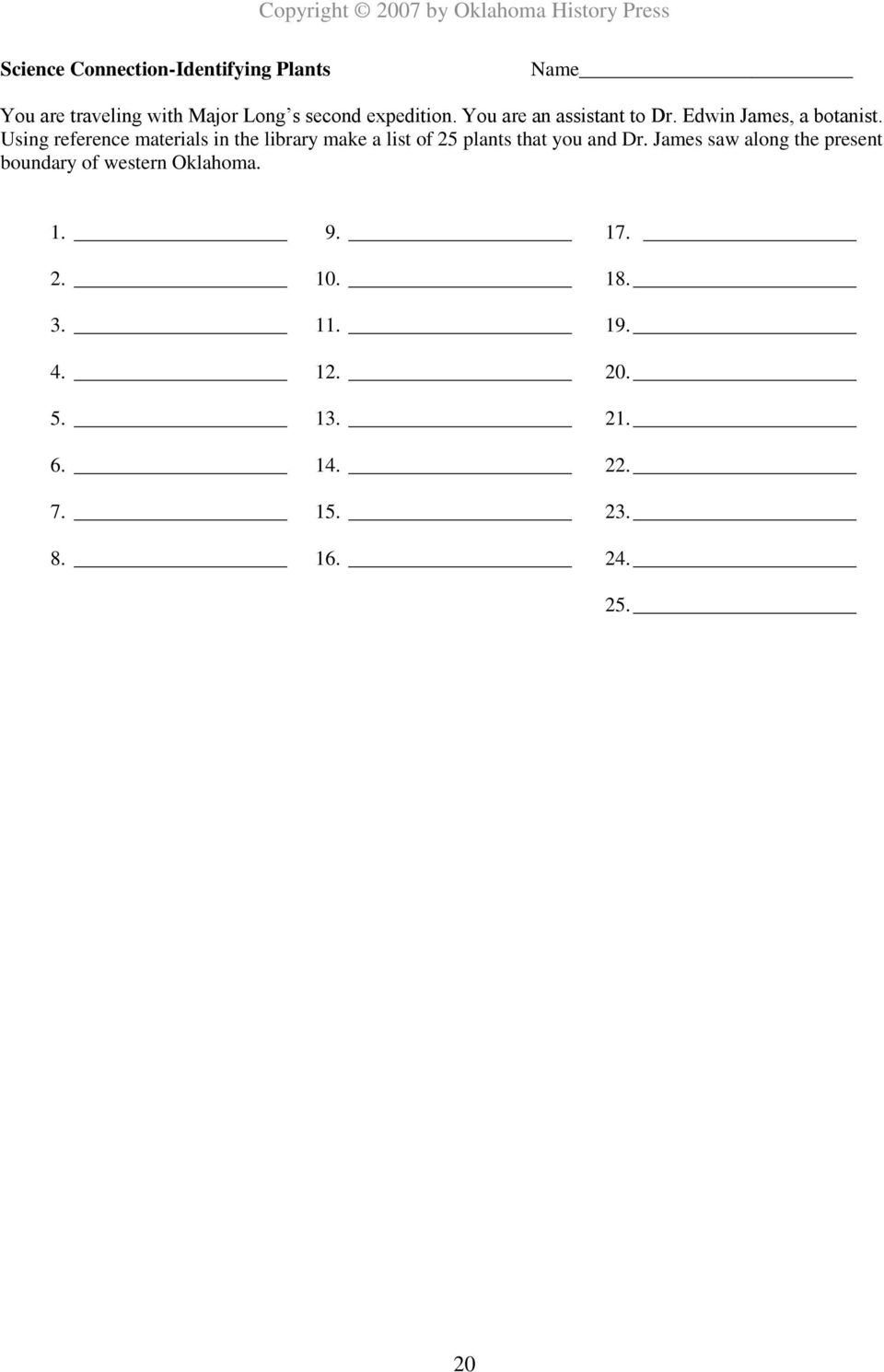
14 Science Connection-Identifying Plants Name You are traveling with Major Long s second expedition. You are an assistant to Dr. Edwin James, a botanist. Using reference materials in the library make a list of 25 plants that you and Dr. James saw along the present boundary of western Oklahoma
15 CROSSWORD PUZZLE: American Explorers 21

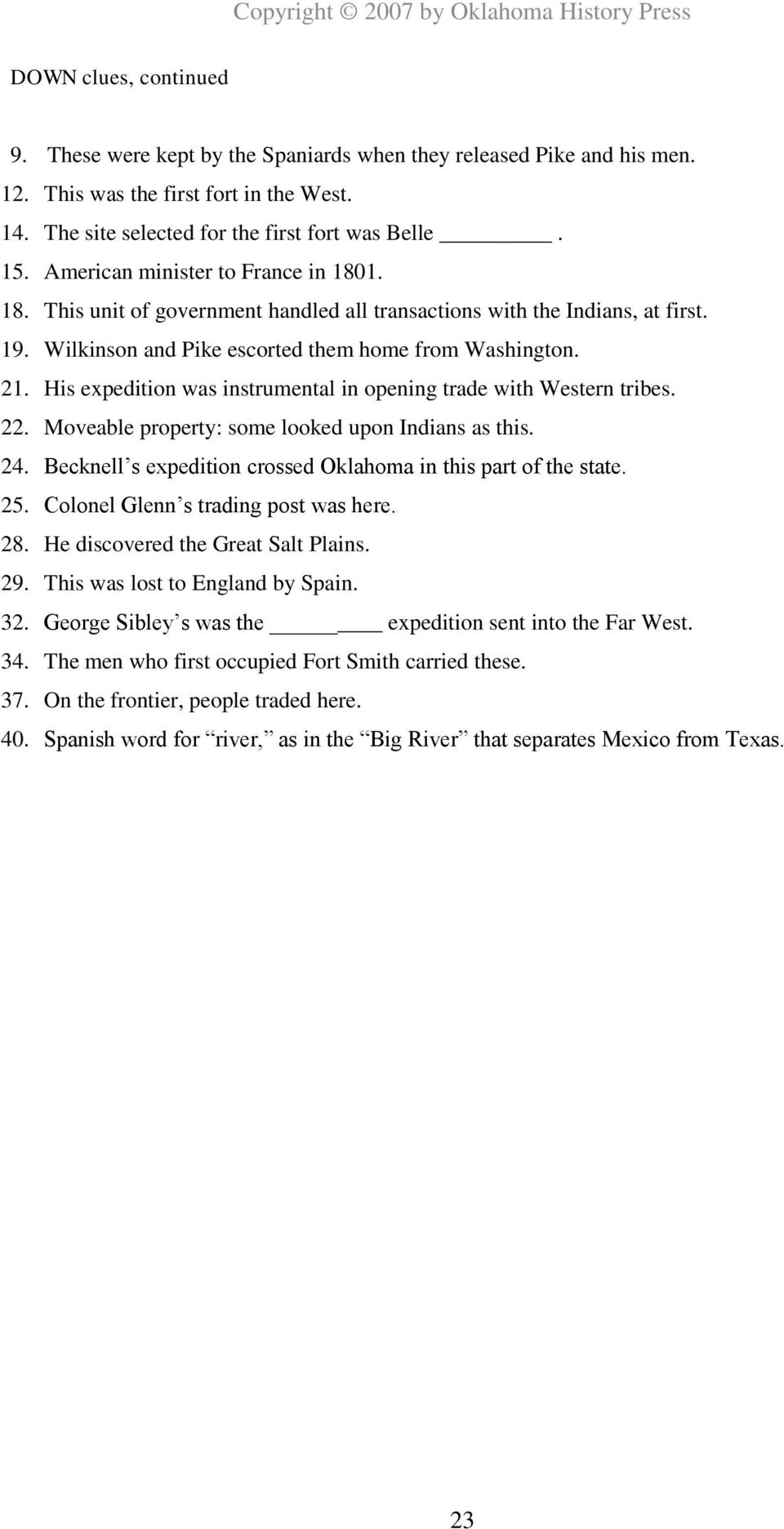
16 CLUES FOR THE AMERICAN EXPLORERS CROSSWORD PUZZLE ACROSS 1. France acquired Louisiana from Spain by the Treaty of San. 4. Western tribes exchanged these with the Explorers for various items of interest. 10. Frontier forts created a of defense. 11. This tangled mass clogged the Red River for miles. 13. The ruler of France who sold Louisiana to the United States. 16. The Pike-Wilkinson Expedition was to follow this river to its source. 17. The French-Indian War lasted years. 18. People believed the tribes who lived here were hostile. 20. He led an expedition to the edge of Oklahoma when he was turned back by Spanish soldiers. 21. Some believed this to be an accurate description of the Indian tribes in the North. 22. To give up something, as the Indians did with their land. 23. Outer coverings of corn used for many things by Indian tribes. 26. Long s second expedition arrived back at the fort (before, after) Bell s party. 27. They began to move west as soon as Lewis and Clark returned. 30. The place where a river begins. 31. On his second expedition, Major Long sent this man to explore the Arkansas River. 33. Another word for purpose. Major Long s was to complete Captain Sparks mission. 35. Land which is owned by the government but is not yet a state. 36. Meriweather was William s partner. 38. Major Long missed it and explored the Canadian instead. 39. The Chief Minister of France under Napoleon Bonaparte. 41. Sparks and his men returned here without completing their mission. 42. A poor speller who owned a slave. DOWN 1. People who live in a region are its. 2. Americans worried that the French might close this port. 3. The Wilkinson party spent Christmas with these people. 5. This was a valued item on the prairie. 6. An unusual, observable fact, such as the Great Raft. 7. Fort Smith was located near the mouth of this river. 8. This major selected the site for Fort Smith. (continued) 22

17 DOWN clues, continued 9. These were kept by the Spaniards when they released Pike and his men. 12. This was the first fort in the West. 14. The site selected for the first fort was Belle. 15. American minister to France in This unit of government handled all transactions with the Indians, at first. 19. Wilkinson and Pike escorted them home from Washington. 21. His expedition was instrumental in opening trade with Western tribes. 22. Moveable property: some looked upon Indians as this. 24. Becknell s expedition crossed Oklahoma in this part of the state. 25. Colonel Glenn s trading post was here. 28. He discovered the Great Salt Plains. 29. This was lost to England by Spain. 32. George Sibley s was the expedition sent into the Far West. 34. The men who first occupied Fort Smith carried these. 37. On the frontier, people traded here. 40. Spanish word for river, as in the Big River that separates Mexico from Texas. 23
18 Student Activity Book Chapter 3 - AMERICAN EXPLORERS I. VOCABULARY. Give a short definition of each word below as it is used in the textbook. 1. chattel 6. geologist 2. remuneration 7. stockade 3. compensation 8. tributary 4. imperialism 9. pelt 5. expedition 10. thwart II. MATCHING. Match the correct date for each event described below. 1. The Glenn-Fowler Expedition opened trade with the Western Tribes. 2. Louisiana came under Spanish rule. 3. George Sibley discovered the Great Salt Plains. 4. Louisiana was purchased by the United States. 5. The Treaty of San Ildefonso gave Louisiana to France. 6. LaSalle claimed Oklahoma for France. 7. Wilkinson and Pike Expedition set out to explore Louisiana, including Oklahoma. 8. Major Stephen H. Long established Fort Smith. A B C D E F G H III. MAP ACTIVITY. On the blank map of Oklahoma below, use colored pencils to color-code your map work. Trace the expeditions of the American explorers in the state. 24

19 IV. COMPLETION. Write the word or words in the blanks that would best complete each statement. 1. France acquired Louisiana from Spain by the Treaty of. 2. Western tribes exchanged with explorers for various other items. 3. Frontier forts created a of defense. 4. The ruler of France who sold Louisiana to the United States was. 5. The Pike-Wilkinson Expedition was to follow the River to its source. 6. The French and Indian Wars lasted for years. 7. led an expedition to the edge of Oklahoma where he was turned back by Spanish soldiers. 8. On his second expedition, Major Long sent to explore the Arkansas River. 9. A is land owned by the government that is not yet a state. 10. Americans worried that the French would close the port of. 11. Ft. Smith was located near the mouth of the River. 12. The first fort in the West was Fort. 13. was the American Minister to France in was the Chief Minister of France under Napoleon. 15. s expedition was instrumental in opening trade with Western tribes. 16. Colonel Glenn s trading post was located at. 17. discovered the Great Salt Plains. 18. is the Spanish word for river. 19. Lewis and Clark explored the Louisiana Territory. 20. were kept by the Spaniards when Pike and his men were released from captivity. V. THINKING ACTIVITY. Imagine that you are the first Spanish explorer to see one of the early inhabitants of the Oklahoma Plains. Describe the person. 25

20 Chapter 4 EARLY GOVERNMENT Lesson Plans for Oklahoma History Teacher Date Content Standard 1: The student will describe the state s geography and the historic foundations laid by Native American, European, and American cultures. 1.1 Integrate visual information to identify and describe the significant physical and human features including major trails, railway lines, waterways, cities, ecological regions, natural resources, highways, and landforms. 1.3 Compare and contrast the goals and significance of early Spanish, French, and American expeditions including the impact of disease, interactions with Native Americans, and the arrival of the horse and new technologies. Content Standard 2: The student will evaluate the major political and economic events that transformed the land and its people prior to statehood. 2.1 Summarize and analyze the role of river transportation to early trade and mercantile settlements including Chouteau s Trading Post at Three Forks. 2.2 Describe the major trading and peacekeeping goals of early military posts including Fort Gibson. ASSIGNMENTS: Read Early Government, Chapter 4, pages Be prepared to participate in class discussion using the questions on page 37. Complete the following in Student Activity Book: Vocabulary Complete statements related to facts of the time period with emphasis on trading and Indian Tribes Examine the terms of the Adams-Onis Treaty. Identify the dates for major events during this time period. Identify important people of this time period. Complete the map related to the Louisiana Purchase. Choose from Activities on next page, Section II. Copy and distribute, or project them for group work. Read Feature: Blending Cultures, pages Complete the worksheets. (This is if you have not already completed it in the previous chapter.) I. Discussion Questions: 1. Give four important facts about the Adams- Onis Treaty. 2. What does Adams-Onis mean in the name of the treaty? Who/what were Adams and Onis? 3. Locate the national boundary defined by the Adams-Onis Treaty. Is it still the same? 4. Name the son of an early family of traders and what he accomplished in Oklahoma. 5. Why was Glenn s trade with Santa Fe important? 6. You learned about the importance of salt in Chapter 1. How was salt important in Oklahoma s growth? 26

21 7. How did a Mexican revolution affect the U.S.? 8. Discuss the establishment of forts (names and dates). Which is nearest? 9. What effect did forts have on the exploration of Oklahoma? 10. Describe the ceremonies that took place when the Louisiana Territory was transferred from France to the United States. II. Activities 1. Using library resources, gather information about the status of the following: The Three Forks Area Fort Gibson Osage Tribe 2. Oklahoma Map labeling rivers and forts This is printed on next page. 3. Puzzle, Time of the Louisiana Purchase This is on following two pages. 4. Time Line add the following: establishment of the Chouteau Trading Post, Fort Smith, Fort Towson, Fort Gibson, Fort Coffee, Fort Holmes, Fort Washita. III. Internet Research: IV. Suggested Reading: Vine Deloria, Jr., Native American Testimony: An Anthology of Indian and White Relations (New York: Crowell, 1978) Jennifer S.H. Brown, Strangers in Blood: Fur Trade Company Families in Indian Country (Norman, Oklahoma: University of Oklahoma Press, 1996) Kathleen Duval, The Native Ground: Indians and Colonists in the Heart of the Continent (Philadelphia: University of Pennsylvania Press, 2006) 27
22 Name Date 2. Oklahoma Map Study On the map of Oklahoma below, draw in and locate the following: Fort Gibson, Illinois River, Verdigris River, Arkansas River, Grand River, Fort Towson. 28
23 Name Date 3. PUZZLE: THE TIME OF THE LOUISIANA PURCHASE The answers to the 20 questions below the puzzle are hidden in the letter-jumble. Some are horizontal, some vertical, and some diagonal; but all run from left to right or top to bottom. Circle the words in the puzzle and fill in the blanks below. C L A I B O R N E X H I K L M U C T P O S P R Y N R I E O S A G E I P H H A N M A M E I C A N W I C H I T A O X B G I W T H S P A I N O F T H U M U E A R T N M E R I D I A N R B R A M T G N E H G T A S D O F R J F L A G S E L D S W I L H L I A U M V C B E A N A E O S G I B S O N T O X S I R H A Y U N N I N D I A N A F Y R T P N B I N U N E L O U I S I A N A N E Q P G Z V S R D 1. He became governor of Louisiana on December 20, They passed an act creating two territories in the west. 3. The largest territory the United States ever owned: 4. This territory became the state of Louisiana: 5. They waved side by side, symbolizing brotherhood: 6. The District of Louisiana was attached to this territory: 7. William Henry Harrison became the President of the United States. 8. The Adams- Treaty set the boundaries of the Louisiana Purchase. 9. ceded Florida to the United States. 10. Part of that boundary, the 100th became an Oklahoma boundary. 11. He was one of the founders of St. Louis: 12. He owned a salt works business in Indian country: (continued) 29
24 13. He was a writer who was entertained at Three Forks: 14. He opened trade with Santa Fe: 15. One of the tribes indigenous to Oklahoma: 16. The Quapaws were relatives of this northern warlike tribe: 17. This powerful nation was also related to the same tribe: 18. This was the first fort established in the west (1817): 19. This fort was built between the Arkansas and Grand Rivers: 20. Fort Smith was twice before the Civil War. 30
25 Student Activity Book Chapter 4 - EARLY GOVERNMENT 1. VOCABULARY. Give short definitions to the following words. Define them as they are used in the textbook. 1. vigorous 6. subsistence 2. parallel 7. ammunition 3. meridian 8. interim 4. relinquish 9. luxurious 5. hospitality 10. established II. COMPLETION. Fill in the blanks with the word or words that best complete each statement. 1. protested the sale of Louisiana to the United States. 2. The first American governor of the Louisiana Territory was. 3. The governor over the territory who later became the ninth President of the United States was. 4. The territory of New Orleans was admitted to the Union as the state of. 5. As the territories divided and changed, the area now known as Oklahoma was included in the territories of,, and. 6. Spain gave up all claims to Florida and Oregon as a result of the Treaty. 7. As a result of that treaty, the United States gave up claims to. 8. A favorite tourist spot in the Oklahoma region was the. 9. The two tribes of Indians considered to be indigenous to Oklahoma are the and the. 10. Bean s Salt Works was established on the River. 11. The and the were relative tribes to the Sioux. 12. Kiowas and Comanches came from the and moved into the western part of the state. 13. The Western Cherokees found themselves at war with the. 14. The first fort established was. 15. The first roads were constructed to connect the. 31
26 III. Give four important facts about the Adams-Onis Treaty IV. MATCHING. Match the date to the event; dates may be used more than once. A The Adams-Onis Treaty was signed. 1. B The Territory of New Orleans was admitted to the Union as a state. 2. C A trading post was established near Salina. 3. D Arkansas Territory was created. 4. E Missouri Territory was created Ft. Gibson was built Ft. Towson was built Bean s Salt Works was established. 8. V. MATCHING. Match the name to the description. A. Washington Irving 1. First settlers in Oklahoma 1. B. William Henry Harrison 2. Member of a famous trading family 2. C. William Clark 3. Man from Indiana Territory who was governor of Upper Louisiana 3. D. Western Cherokees 4. A co-founder of St. Louis 4. E. Auguste Chouteau 5. A famous literary visitor to the log palace 5. F. traders 6. People who removed themselves from the East 6. G. Pierre Laclede Liguest 7. A famous explorer who became governor of Missouri Territory 7. VI. MAP. On the map of the United States below, using colored pencils and color-coding, outline the Louisiana Purchase and the area effected by the Adams-Onis boundary. 32
27 Chapter 5 CULTURAL AND RELIGIOUS CONFLICTS Lesson Plans for Oklahoma History Teacher Date Common Core Content Standard 1: The student will describe the state s geography and the historic foundations laid by Native American, European, and American cultures. 1.3 Compare and contrast the goals and significance of early Spanish, French, and American expeditions including the impact of disease, interactions with Native Americans, and the arrival of the horse and new technologies. 1.4 Compare and contrast cultural perspectives of Native Americans and European Americans regarding land ownership and trading practices. Content Standard 2: The student will evaluate the major political and economic events that transformed the land and its people prior to statehood. 2.3 Integrate visual and textual evidence to explain the reasons for and trace the migrations of Native American peoples including the Five Tribes into present-day Oklahoma, the Indian Removal Act of 1830, and tribal resistance to the forced relocations. ASSIGNMENTS: Read Cultural and Religious Conflicts, Chapter 5, pages Be prepared to participate in class discussion using the questions on page 66. Complete the following in Student Activity Book: Vocabulary Compare and contrast the beliefs and attitudes of the Indians, whites and government officials Identify dates of important events Compare the beliefs of New England Puritans, Pennsylvania Quakers and Jeffersonian farmers. Complete the map assignment on identifying states and the original homelands of the Five Civilized Tribes. Choose from Activities on next page, Section II. Copy and distribute, or project them for group work. Read Feature: Cherokee Almanac (pp ). Complete assigned worksheets. I. Discussion Questions 1. How did the government officials justify confiscating Indian lands? 2. How did the purchase of the Louisiana Territory affect the problem of taking Indian lands? 3. How did the European doctrine of discovery influence government and Indian relationships? 4. How did whites and Indians view one another? 5. What three ways did governmental policies encourage acculturation and assimilation of Indians? 33
28 6. How did the War of 1812 intensify problems between Native Americans and Euro-Americans? 7. Which were the civilized Indian tribes of the Southeast? 8. Why were these tribes considered civilized? 9. Consider what you know about the weather and geography of Florida and Oklahoma. What changes did the Seminoles have to adapt to? 10. In the presidential election of 1828, who had voting rights? II. Activities: 1. Time Line Add information related to War of 1812, King Phillip s War and William Penn s treaty with the Indians. 2. Map states and homelands of the Five Civilized Tribes. 3. Puzzle Word Maze III. Internet Search: IV. Suggested Reading: Virginia Pounds Brown and Laurella Owens, Southern Indian Myths and Legends. (Birmingham, Alabama. Beechwood Books, 1985) Virginia Hamilton. In the Beginning. (Orlando, Florida: Pennyroyal Press, Inc., 1988) Mildred D Ladner, O.C. Seltzer, Painter of the Old West. (Norman, Oklahoma: University of Oklahoma Press,
29 Name Date MAP WORK On the map below, identify the states by their current names and draw in the homelands of the Five Civilized Tribes. 3. As a writing activity, ask the students to pretend that they are members of the Cherokee tribe living in Georgia in the early 1700s. The tribe has been approached by a representative of the British government about selling part of their land. The students are to explain their beliefs, as Cherokees, about the land and about selling it. 35
30 Name Date PUZZLE: WORD MAZE Doctrine of Discovery Moving your pencil from box to box in any direction, connect the letters to form the words which correctly complete the statements below. In forming a single word you may not use the same box twice, but one box may be used in several words. (1) Between 1778 and 1871 the U.S. government negotiated over 400 legal with the Indians. (2) All of these agreements recognized the Indians as the rightful of the land. (3) One of the main effects of the belief that the Indians had land rights was that the governments could not try to the Indians. (4) The belief that the Indians had certain rights to the land, but that the land belonged to the government of the discovered was called the of Discovery. (5) Each of the 400 agreements made between the Indian tribes and the U.S. government was a separate. 36
31 Student Activity Book Chapter 5 - CULTURAL AND RELIGIOUS CONFLICTS I. VOCABULARY. Write a short definition of each word below. 1. assimilation 7. coffers 2. protectorate 8. acculturation 3. acquisition 9. expostulate 4. interdependence 10. mollify 5. desecration 11. agrarian 6. extended family 12. cede II. Use the following key to identify the beliefs or attitudes listed below. A= Indians B=White Men C=Government Officials 1. The land belongs to God or the Great Spirit. 2. Farming is honorable work for a man. 3. Land ownership is a sign of success. 4. Plowing the land is an assault on Mother Earth. 5. Land ownership is impossible. 6. Land can be acquired by right of conquest. 7. Land ownership is a sign of industry and hard work. 8. Services can be exchanged for land. 9. Plowing and harvesting from the land pleases God or the Great Spirit. 10. Land can be confiscated as reparations of war. III. MATCHING. Match the date to the event. 1. Andrew Jackson was elected President. A The Quakers lost control of the Pennsylvania government and the treaty signed by B William Penn was abolished. C Chief Justice Marshall declared the states anti-tribal laws unconstitutional. D New Haven Christian Plantation was established. E
32 5. Northwest Ordinance was signed. F William Penn signed a treaty recognizing Indian ownership of land. G The Government set up the Federal Factory System. H King Phillip s War occurred. IV. Compare the beliefs of the following people by writing in the spaces below how the people felt about the land and about land ownership. New England Pennsylvania Jeffersonian Puritan-1630 Quaker-1690 Farmer-1800 V. MAP: Pre-territorial tribal locations. On the map of the Southeastern United States below, identify the states by their current names and then draw in the homelands of the Five Civilized Tribes. 38
33 Chapter 6 CHOCTAW AND CREEK REMOVALS Lesson Plans for Oklahoma History Teacher Date Common Core Content Standard 1: The student will describe the state s geography and the historic foundations laid by Native American, European, and American cultures. 1.4 Compare and contrast cultural perspectives of Native Americans and European Americans regarding land ownership and trading practices. Content Standard 2: The student will evaluate the major political and economic events that transformed the land and its people prior to statehood. 2.3 Integrate visual and textual evidence to explain the reasons for and trace the migrations of Native American peoples including the Five Tribes into present-day Oklahoma, the Indian Removal Act of 1830, and tribal resistance to the forced relocations. Content Standard 4: The student will examine the transformation of Oklahoma during times of boom and bust of the 1920s through the 1940s. 4.1 Compare and contrast the successes and failures of the United States policy of assimilation of the Native Americans in Oklahoma including the passage of the Indian Citizenship Act of 1924 and the effects of the Indian boarding schools (1880s-1940s) upon Native Americans identity, culture, traditions, and tribal government and sovereignty. ASSIGNMENTS: Read Choctaw and Creek Removals, Chapter 6, pages Be prepared to participate in class discussion using the discussion questions on page 77. Complete the following in Student Activity Book: Vocabulary Matching events and important dates Matching events with the name of the person involved Writing: Reporting on causes of death during the removal trips Map Study-Color coding and tracing the removal routes of the Choctaws and Creeks. Choose from Activities on next page, Section II. Copy and distribute, or project them for group work. Read Feature: The Trail of Tears section on Choctaws (pp ) and/or section on Creeks (pp ). 39
34 I. DISCUSSION QUESTIONS 1. What was the Georgia Compact and what was its effect on Indian lands? 2. What did the Choctaws promise to do, in the 1830 Treaty of Dancing Rabbit Creek? 3. What did the government promise to do, in the same treaty? 4. Why was the Treaty of Indian Springs declared not valid? 5. What effects did the election of Andrew Jackson have on removal? 6. How did the Indian Removal Act affect the Indians? 7. How did Jackson differ from Jefferson and Calhoun? 8. How did the Choctaws react to removal proposals? 9. What resolution did the Creek Council of 1811 pass? 10. What did Tecumseh propose to do? II. ACTIVITIES 1. Compare and Contrast-Pro-removal vs. Anti-Removal of the Choctaws 2. Puzzle Letter Scramble 3. Time Line-Add the following to the time line. Treaty of Doak s Stand Treaty of Dancing Rabbit Creek First and second removal of Choctaws War of 1812 and the Red Sticks Forced removal of the Creeks Internet Research
35 IV. Selected Reading: Shirlee P Newman, The Creek (Indians of the Americas). (Newman. 1997) Robbie Ethridge, Creek Country: The Creek Indians and Their World, (Chapel Hill: University of North Carolina Press, 2003) H. B. Cushman and Angie Debo, History of the Choctaw, Chickasaw, and Natchez Indians (Norman, Oklahoma: University of Oklahoma Press, 1999) Peter C. Mancall, and James H. Merrell, American Encounters: Natives and Newcomers from European Contact to Indian Removal, (United Kingdom: Routledge. 1999) II. ACTIVITIES 1. Compare and Contrast-Pro-removal vs. Anti-Removal of the Choctaws The student is to pretend that he/she is an Indian Commissioner dealing with the Choctaws in The tribe is divided and the student must make a report to Washington about it. The student will describe the contrasting views by using a chart similar to the one given below: PRO-REMOVAL ANTI-REMOVAL 41
36 2. PUZZLE: LETTER-SCRAMBLE In each puzzle below fit the letters in each column onto the lines directly above them. They may or may not go onto the lines in the same order in which they are listed. When the letters are written in the proper order, they will make a statement which can be verified in Chapter 6 in the textbook. 3. Time Line - add information on the Choctaw and Creek Removal, treaties and other important events. 42
37 Student Activity Book Chapter 6 - CHOCTAW AND CREEK REMOVALS 1. VOCABULARY. Write a short definition of each word below. 1. abolish 7. intrusion 2. confiscate 8. impractical 3. civilized 9. annuity 4. volunteer 10. restrained 5. inevitable 11. demand 6. dissension 12. concession II. MATCHING. Match the date to the event. A date may be used more than once. 1. Indian removal was mentioned for the first time as a government obligation. A A spring when 3,500 Creeks died from exposure and disease. B War with Britain began and involved many Indian tribes. C General Scott ended the Creek War and moved the Creeks west. D Congress passed the Indian Removal Act. E Tecumseh, a Shawnee, asked for a tribal alliance with the Creeks. F Treaty of Doak s Stand was signed. G Creek warriors surrounded the home of William McIntosh to carry H out his death sentence. I Treaty of Dancing Rabbit Creek was signed. J Creek warriors attacked Fort Mims. K Creeks ceded lands in the East for lands in the West in a new agreement with the government. L The first party of Choctaws removed by the government left the East for their new home in the West. 13. William McIntosh and others signed the Treaty of Indian Springs. 14. Mississippi passed laws revoking special privileges of Choctaws and restricting tribal functions. 15. Creeks passed a resolution demanding the death sentence for anyone who signed away tribal lands. 43
38 III. MATCHING IDENTIFICATIONS. Match the name to the identification. 1. the primary instigator of Indian removal 2. government leader who decided to concentrate on the Choctaws for the first removal 3. leader of the Upper Creeks 4. A Shawnee chief who visited the Creeks 5. President who declared Treaty of Indian Springs invalid 6. A Creek who was the victim of a death penalty clause he had helped to pass A. Pushmataha B. Tecumseh C. John C. Calhoun D. Andrew Jackson E. McIntosh F. Opothleyahola G. John Adams 7. Principal Chief of the Choctaws who believed Andrew Jackson and persuaded others to believe Jackson IV. You are a reporter following the removal of the Choctaws and Creeks. List the main causes of death among the Indians on the removal trips. 44
39 V. On the map of the Southeastern United States below, using colored pencils and color-coding, trace the removal routes of the Choctaws and Creeks. 45
40 Chapter 7 TRAIL OF TEARS Removals of Choctaws and Cherokees Lesson Plans for Oklahoma History Teacher Date Common Core Content Standard 1: The student will describe the state s geography and the historic foundations laid by Native American, European, and American cultures. 1.4 Compare and contrast cultural perspectives of Native Americans and European Americans regarding land ownership and trading practices. Content Standard 2: The student will evaluate the major political and economic events that transformed the land and its people prior to statehood. 2.3 Integrate visual and textual evidence to explain the reasons for and trace the migrations of Native American peoples including the Five Tribes into present-day Oklahoma, the Indian Removal Act of 1830, and tribal resistance to the forced relocations. Content Standard 4: The student will examine the transformation of Oklahoma during times of boom and bust of the 1920s through the 1940s. 4.1 Compare and contrast the successes and failures of the United States policy of assimilation of the Native Americans in Oklahoma including the passage of the Indian Citizenship Act of 1924 and the effects of the Indian boarding schools (1880s-1940s) upon Native Americans identity, culture, traditions, and tribal government and sovereignty. ASSIGNMENTS: Read Trail of Tears, Chapter 7, page Be prepared to participate in class discussion using the questions on page 89. Complete the following in Student Activity Book: Vocabulary Complete factual statement worksheet Matching dates and important events Diary Writing Map Study: Routes of the Chickasaw and Cherokee removal Choose from Activities on next page, Section II. Copy and distribute, or project them for group work. Read Feature: Assign The Trail of Tears sections on Chickasaws (pp ) and Cherokees (pp ). Students write a paragraph for each, giving details of removal. Alternate assignment: Read From the Cherokee Almanac pp ) and Sequoyah and Stand Watie (pp ). Complete the worksheets. I. Discussion Questions: 46
41 1. What actions did the Chickasaws take to avoid removal? 2. What actions did the Cherokees take to avoid removal? 3. Why did the Chickasaws cede their lands north of the Tennessee River? 4. How did the early removal of the Chickasaws compare with the early removal of the Choctaws? 5. Describe the most successful of the Chickasaw removals. 6. What problems did the Chickasaws encounter in Indian Territory? 7. Discuss the early, voluntary removal of the Western Cherokees. 8. What laws passed by the state of Georgia were oppressive to the Cherokees? 9. Who were the leaders of the Eastern Cherokees and how did the signing of the Treaty of New Echota affect the leadership? 10. Discuss the removal of the Cherokees under the command of General Winfield Scott. II. Activities 1. Crossword Puzzle 2. Time Line - Enter the removal dates for the Five Civilized Tribes. Enter the following treaties: Treaty of Pontotoc, treaty of Doaksville, and dates related to the Old Settlers. 3. ESSAY Assign an essay to be written outside of class on the subject: discuss the political, economic, and social reasons for the removals of the Chickasaw and Cherokee tribes to Indian Territory. Encourage the students to use the library resources or any other primary source in the writing of the essay III. Internet Resources:
42 IV. Suggested Reading: Michael Burgan, The Trail of Tears (Minneapolis, MN: Compass Point Books, 2001) Robert J. Conley, The Peace Chief: a Novel of the Real People. (New York: St. Martin s Press, 1998) Virginia Driving Hawk Sneve, The Cherokees. (New York: Holiday, 1996) Jeremiah Evarts, Cherokee Removal: the William Penn Essays and Other Writings (Knoxville, TN: University of Tennessee Press, 1981) James Mooney, Myths of the Cherokee and Sacred Formulas of the Cherokees (Fairview, NC: Bright Mountain Books, 1992) Cherokee Culture (videorecording), (Tulsa, Oklahoma: Chief Production. 1996) Cherokee: Indians of North America (videorecording). (Wynnewood, PA: Schlessinger Video Production, 1993) 48
43 CHAPTER 7 CROSSWORD PUZZLE ACROSS 1. Whites wanted Indians to move west of the River. 6. In the west Chickasaws submitted to government. 8. Chickasaws and Cherokees both succeeded in. 9. Federal aided in taking Indian lands for whites. 10. The family helped move their neighbors to the west. 12. The Cherokee alphabet was called a. 13. This children s disease killed many. 14. developed the Cherokee method of writing. 15. In the Treaty of, Choctaws agreed to sell part of western land to Chickasaws. 16. Like whites, many Indians purchased to do their labor. DOWN 1. Chickasaws were very successful in the business. 2. Chickasaws were paid in. 3. Whites thought Indians were. 4. Chickasaws ceded their lands in the Treaty of in was a missionary arrested for refusing to take a loyalty oath. 7. Federal factories were posts. 9. The turned to old customs for comfort and to the mixed bloods for leadership. 11. Another missionary arrested for not taking an oath. 49
44 Student Activity Book Chapter 7 TRAIL OF TEARS Name I. VOCABULARY. Write a brief definition of each word listed below. 1. tactic 7. menial 2. subsequent 8. inevitability 3. unscrupulous 9. rations 4. commerce 10. indomitable 5. specie 11. enforcement 6. expertise 12. emigrate II. COMPLETION. Fill in the blank with the word or words that would best complete each statement. 1. Before removal, the most prosperous of the five tribes was the. 2. The tribe that gave the name Trail of Tears to the removals was the. 3. The tribe that first adapted to the ways of white men was the. 4. The treaty containing provisions for Chickasaw removal was the Treaty of. 5. Ttreaty of Doaksville was a treaty between the and the. 6. The Western Cherokees became known as the Old. 7. The principal chief of the Cherokees who opposed removal was. 8. The treaty that resulted in the removal of the Cherokee Nation was the Treaty of. 9. The general who commanded the removal of the Cherokees was General. 10. The Chickasaws purchased their land in Indian Territory from the. 11. The most successful of the Chickasaw removals was led by the,, and families. 12. The signers of the Treaty of New Echota were,, and. 13. The tribe that suffered the most economically in the removals was the. 14. The state of arrested and imprisoned missionaries who were thought to be working against removal. 15. The last of the five tribes to recover from the removals was the. 50
45 III. MATCHING. Match the date to the event; a date may be used twice. 1. Chickasaws ceded all land north of the Tennessee River. A Andrew Jackson called for Indian removal. B Assassination of the Ridge brothers and Elias Boudinot took place. C Treaty of Pontotoc was signed. 5. Cherokees were removed. 6. First treaty signed that referred to removal (with Cherokees). 7. First group of Chickasaws left for their new home in Indian Territory. 8. A unity agreement was signed, bringing peace to the Cherokee Nation. 9. The last of the Chickasaws moved west. 10. Treaty of Doaksville signed. D. Winter of E F G H I IV. You are a white farmer living in Georgia in You have witnessed the mistreatment of the Cherokees by members of the Georgia Guard. Pretend you are writing in a diary. Describe what has happened and make suggestions for solutions. V. MAP: Using colored pencils and color-coding, mark the routes of the Chickasaw and Cherokee removals from the Southeast to their lands in Indian Territory. 51
46 Chapter 8 SEMINOLES AND OTHER SETTLERS Lesson Plans for Oklahoma History Teacher Date Common Core Content Standard 1: The student will describe the state s geography and the historic foundations laid by Native American, European, and American cultures. 1.1 Compare and contrast cultural perspectives of Native Americans and European Americans regarding land ownership and trading practices. Content Standard 2: The student will evaluate the major political and economic events that transformed the land and its people prior to statehood. 2.3 Integrate visual and textual evidence to explain the reasons for and trace the migrations of Native American peoples including the Five Tribes into present-day Oklahoma, the Indian Removal Act of 1830, and tribal resistance to the forced relocations. Content Standard 4: The student will examine the transformation of Oklahoma during times of boom and bust of the 1920s through the 1940s. 4.1 Compare and contrast the successes and failures of the United States policy of assimilation of the Native Americans in Oklahoma including the passage of the Indian Citizenship Act of 1924 and the effects of the Indian boarding schools (1880s-1940s) upon Native Americans identity, culture, traditions, and tribal government and sovereignty. ASSIGNMENTS: Read Seminoles and Other Settlers, Chapter 8, page Be prepared to participate in class discussion using the questions on page 99. Complete the following in Student Activity Book: Vocabulary Matching dates and events in Oklahoma History Completing historical statements correctly Discussion: How did the issue of slavery play a role in the demands to remove the Seminoles? Map Study - mark the routes of the Seminole removal Choose from Activities on next page, Section II. Copy and distribute, or project them for group work. Read Feature: The Trail of Tears section on the Seminoles (pp ) Write a paragraph giving details of the removal of the Seminole tribe and/or complete the assigned worksheet. May assign the worksheet as a jigsaw activity, have students works in pairs etc. I. Discussion Questions 1. How did the issue of slavery play a role in the demands to remove the Seminoles? 2. Explain the separation of the Seminoles from the Creeks and conclude with an explanation of why the Seminoles rejected the government s idea of rejoining the two tribes for removal. 3. Describe Osceola s leadership and tell how he was arrested and died. 52
47 4. What were the provisions of the Treaty of Camp Moultrie? 5. What was the Treaty of Fort Gibson? 6. Briefly describe the removal of the Seminoles. 7. When was Andrew Jackson elected President? 8. Why was No Man s Land not popular with frontier farmers? 9. What is the American Indian population of Oklahoma now? 10. What is the capital of the Seminole Nation? II. Activities 1. ESSAY TOPICS. Encourage students to use library resources. - Discuss the political, economic, and social reasons for the removal of the Seminoles. - What were the conditions in No Man s Land and how did those circumstances come about? 2. Time Line Add the information related to Seminole removal (Fist Seminole War, Treaty of Camp Moultrie, Treaty of Payne s Landing, Treaty of Ft. Gibson, The Great Seminole War). III. Internet Resources: (contains Teacher Guide) IV. Suggested Reading: Daniel F. Littlefield, Africans and Seminoles, From Removal to Emancipation (Jackson, Mississippi: University Press of Mississippi, 2001) Jane F. Lancaster, Removal Aftershock: The Seminoles Struggles to Survive in the West, (Knoxville: University of Tennessee Press, 1994) Bill Lund and Tom Gallaher, The Seminole Indians (Mankato, Minnesota: Bridgestone Books, 1997) Kathleen V. Kudlinski, Night Bird: A story of the Seminole Indians (New York: Viking, 1993) Angela Shelf Medearis, Dancing with the Indians (New York: Holiday House, 1991) Seminole: Indians of North America (videorecording). Adapted by book from Chelsea House Publishers. InVision Communications, Inc. (Bala Cynwyd, PA: Schlessinger, 1993) Seminole (Muskogee): Indians of North America (Bala Cynwyd, PA: Schlessinger Video Productions, 1993) 53
48 Name Date PUZZLE: The Seminoles In the following letter-jumble find the words which complete the statements below. Circle or draw a line through those words and fill in the blanks on the corresponding questions. Words may be vertical, horizontal, or diagonal, but all will be top-to-bottom and/or left-to-right. A S D F S T U A R T J K L C O N F E D E R A C Y K L M N P Q W E R R W O R T H X Z N M H R U I P L M N Y T R E W Q Y U I O P M N B V C X O I L G E X U E T O P M Q W T R I O P G A D S Q E V E R G L A D E S N Y L E V E R G L M A E D W A T H O K L A S H A P I W U H O M I P S X G A D S D E N X P I L L O T S P R E A K M A Y S V I N T E L U M E T E N N C E S M I S A M I O S C E O L A M I O F A R L A K I P W Q X Y O U T J A K L M O M I C A N O P Y J U M Y T E R W X W I T T I P I J K U Y B A T I N N O P I T T H Z X E U E M A T H L A A P O K L A C E P A Y N E S L A N D I N G A S D F G H M J K L A E I Y O U A B C L S W A T E G A L M I N F A L C O R J A C L P I M E G R S A K L I G I U M I N I S T R A K I N K L P U M E L I K J E M O U L T R I E K U N P H I T C H C O C K U Y T R E W G F D S A L K R J H G V B N C B E C G R E A T S E M I N O L E W A R T Y I P A R L M I E T Y G F E C I H 1. A group of several tribes united together, such as Creeks,. 2. The first person to call the Oconees Seminoles was British Agent John. 3. American commissioners and former slave owners went into Seminole country to look for. 4. The Seminoles lived in a swampland today known as the. 5. The first treaty with the Seminoles was the Treaty of Camp. 6. Colonel James met with the Seminoles in A treaty was signed in 1832 at. 8. Chief said his mark was forged to sign the treaty. 9. Chief Charley said he was forced to sign the treaty. 10. Indian Agent Wiley tried to oust Seminole leaders who were against removal to the west. 11., who was not a chief, led the Seminoles in a war with white soldiers who wanted to remove the tribe. 12. This was the Second Seminole War, also known as the. 13. was another Seminole leader who stood against removal and who met with whites to talk peace. 14. Captain Ethan Allen believed the Seminoles really wanted peace and he met with them to discuss terms. 15. Colonel attacked the Seminoles in the peace talks. 16. Brigadier General Thomas was sent to Florida to end the Seminole wars. 17. Colonel William J. was sent to Florida to subdue the Seminoles. 18. was the most formidable leader of the Seminoles. 54
49 Student Activity Book Chapter 8 SEMINOLES AND OTHER SETTLERS Name I. VOCABULARY. Write a short definition of each word below, as it is used in the textbook. 1. skirmish 5. evict 2. forge (verb) 6. alliance 3. staunch 7. formidable 4. numerous 8. census II. MATCHING. Match the date to the event. 1. The Treaty of Camp Moultrie A The Mexican War B The beginning of the Great Seminole War C The ending of the Seminole Wars in Florida D Spain ceded Florida to the United States E III. COMPLETION. Fill in the blanks with words that complete the statements correctly. 1. The Seminoles lived in the present state of. 2. They inhabited a swampland known today as the. 3. Government officials tried to attach the Seminole tribe to the Tribe. 4. White people came into the Seminole villages looking for. 5. The first signed agreement or treaty with the Seminoles was the Treaty of. 6. The Seminoles had to violate the boundaries set by the treaty because they were. 7. Demands were made to remove the Seminoles, even though the land they inhabited was unfit for. 8. The Seminoles rejected being rejoined with the Creeks because (1) and (2). 9. Colonel met with the Seminoles at Payne s Landing. 10. The two Seminole chiefs who signed the Treaty of Payne s Landing were Chief and Chief. (continued) 11. The Treaty of Ft. Gibson contained an agreement that the Seminoles would move west as part 55
50 of the Nation. 12. Though not a chief, the most powerful leader of the Seminoles during the Great Seminole War was 13. In 1837, General was sent into Florida to stop the Great Seminole War. 14. After the death of their great leader, the most formidable Seminole leader was 15. During the Seminole Removals, more than per cent of their number died. 16. The Seminoles were given a portion of land in Indian Territory. 17. The dollar cost for removing each Seminole to Indian Territory was $. 18. The two events that escalated the westward movement of whites were the and the. 19. The most lawless area of the region of Indian Territory was called. 20. Soon after the removals, the nation was facing the War. IV. DISCUSSION. Answer the question below in paragraph form. How did the issue of slavery play a role in the demands to remove the Seminoles? V. MAP: Using colored pencils and color-coding, mark the routes of the Seminole removals from the Southeast to their lands in Indian Territory. 56
51 Chapter 9 CIVIL WAR AND RECONSTRUCTION Lesson Plans for Oklahoma History Teacher Date Common Core Content Standard 1: The student will describe the state s geography and the historic foundations laid by Native American, European, and American cultures. 1.4 Compare and contrast cultural perspectives of Native Americans and European Americans regarding land ownership and trading practices. Content Standard 2: The student will evaluate the major political and economic events that transformed the land and its people prior to statehood. 2.4 Summarize the impact of the Civil War and Reconstruction Treaties on Native American peoples, territories, and tribal sovereignty including the a) Required enrollment of the Freedmen, b) Second Indian Removal and the role of the Buffalo Soldiers, c) Significance of the Massacre at the Washita, d) Reasons for the reservation system, and e) Establishment of the western military posts of Fort Sill, Fort Supply, and Fort Reno. ASSIGNMENTS: Read Civil War and Reconstruction, Chapter 9, pages Be prepared to participate in class discussion using the questions on page 144. Complete the following in Student Activity Book: Vocabulary. Complete the statements to make them correct Matching dates to historical events Identification of people and events Map study - Identify the areas of Indian Territory using color-coding Choose from Activities on next page, Section II. Copy and distribute, or project them for group work. Read Feature: Missionaries, pages Complete related worksheets. I. Discussion Questions 1. What role did geography play in the alignment of Indian Territory with the South in the Civil War? 2. What were the major reasons why Indian Territory joined with the Confederacy? 3. How did the tribes settle into a society similar to that of the Old South? 4. How did the Seminoles differ in their attitude toward slavery from that of the Cherokees? 5. Tell about the slave rebellion in
52 6. How was the Cherokee leadership divided over the issue of taking sides during the Civil War? 7. Why was the Confederacy interested in Indian Territory? 8. What actions did the Plains Tribes take in choosing sides during the Civil War? 9. How did Reconstruction affect Indian Territory? 10. Discuss the role of John Ross in the Civil War as it was conducted in Indian Territory. II. Activities 1. Time Line of Oklahoma Add the following information to the time line: the date for the beginning of the Civil War, the entrance of various tribes into the conflict and the side they supported, neutral tribes, Battle of Round Mountain, Battle of Honey Springs, and the official end to the war. 2. Map Study-color coding Indian Territory III. Internet Research: IV. Suggested Reading Frank Cunningham General Stand Watie's Confederate Indians (Norman, OK: University of Oklahoma Press, 1998) Jeffery Burton, Indian Territory and the United States, : Courts, Government, and the Movement for Oklahoma Statehood (Norman, OK: University of Oklahoma Press, 1995) Roxanne Rhoades, Breaking Ground: the Story of Oklahoma Settlement: a Teachers Guide. (Oklahoma City, OK: Oklahoma Foundation for the Humanities (Teacher Reference) 58
53 Name Date MAP ACTIVITIES On the outline maps of Oklahoma below, on Map A, trace the internal boundaries of Indian Territory as they were from On Map B, trace the internal boundaries as they were after 1866 until the time of the land openings, Label each area. MAP A MAP B 59
54 Student Activity Book CHAPTER 9 CIVIL WAR AND RECONSTRUCTION Name I. VOCABULARY. Write a short definition of each word below. 1. supplement 5. abolition 2. plantation 6. defected 3. dragoon 7. reconstruction 4. blockade 8. subsidize Define the following words as they relate to Chapter alignment 10. Golden Years 11. freedmen 12. overseer II. COMPLETION. Fill in the blanks below with the word or words that would make each statement correct. 1. The only state bordering Oklahoma that was a Union state was. 2. Most tribal agents favored the side of the. 3. The first battle of the Civil War in Indian Territory was the Battle of. 4. The battle that was fought on the same day as the Battle of Gettysburg was the Battle of. 5. The battle that was a turning point for the war in Indian Territory was the Battle of. 6. Tribal schools were supported financially by. 7. The Confederacy looked at Indian Territory as a source of supply for grain, meat, and. 8. The regiment where most Indians served in the Union army was called the. 9. Plains tribes who refused to sign alliance agreements with the South were the and. 10. After the war, the severity of the treaties between the tribes and the government depended largely upon their. 60
55 III. MATCHING. Match the date to the event. Name 1. Creeks signed treaty with the South A Seminoles signed treaty with the South B. July 10, Cherokees signed treaty with the South C. July 12, Choctaws signed treaty with the South D. August 1, Plains Comanches signed treaty with the South E. August 12, The Battle of Cabin Creek F. November 19, Last Confederate general surrendered G. July 17, Civil War declared H. September, General Robert E. Lee surrendered I. April 9, The Battle of Honey Springs J. June 23, The Battle of Round Mountain K. January, Reconstruction treaties signed in Washington between L. October 7, 1861 the Federal Government and the Five Civilized Tribes IV. MATCHING. Match the names to the identification. Some may be used more than once. 1. Last chief of the Five Civilized Tribes to sign a treaty with the South 2. The last Confederate general to surrender 3. A Creek leader who led tribal neutrals and Union sympathizers 4. A slave who lent money to buy provisions for hungry people 5. The only tribe to treat slaves as freedmen 6. The only tribe that didn t adopt slaves into the tribe after the war. 7. The only tribe to remain completely loyal to the South 8. Leaders of this tribe were the first to make official contact with the Union A. Seminoles B. Creeks C. Choctaws D. Cherokees E. Chickasaws F. John Ross G. Stand Watie H. Opothleyahola I. Albert Pike J. Gopher John 9. Military leader of the Mounted Cherokee Rifles 10. The most influential Indian leader who favored neutrality 61
56 V. Using colored pencils and color-coding, mark the major areas of Indian Territory from
57 Chapter 10 THE WESTERN INDIANS Lesson Plan for Oklahoma History Teacher Date Common Core Content Standard 2: The student will evaluate the major political and economic events that transformed the land and its people prior to statehood. 2.4 Summarize the impact of the Civil War and Reconstruction Treaties on Native American peoples, territories, and tribal sovereignty including the a) Required enrollment of the Freedmen, b) Second Indian Removal and the role of the Buffalo Soldiers, c) Significance of the Massacre at the Washita, d) Reasons for the reservation system, and e) Establishment of the western military posts of Fort Sill, Fort Supply, and Fort Reno. 2.5 Cite specific visual and textual evidence to assess the impact of the cattle and coal mining industries on the location of railroad lines, transportation routes, and the development of communities. Content Standard 4: The student will examine the transformation of Oklahoma during times of boom and bust of the 1920s through the 1940s. 4.1 Compare and contrast the successes and failures of the United States policy of assimilation of the Native Americans in Oklahoma including the passage of the Indian Citizenship Act of 1924 and the effects of the Indian boarding schools (1880s-1940s) upon Native Americans identity, culture, traditions, and tribal government and sovereignty. ASSIGNMENTS: Read The Western Indians, chapter 10 (pages ). Complete the following in Student Activity Book: Vocabulary Match important dates with events Complete historical statements Writing on government compensation Thinking Activity - Writing that requires using the facts to draw a logical conclusion. Map Study - Label the areas of Indian Territory Choose from Activities on next page, Section II. Copy and distribute, or project them for group work. Read Feature: Men of Peace on the Southern Plains (pages ). Complete the assigned worksheet. Option: Divide class and reading into sections, then work in pairs or groups on worksheet. I. Discussion Questions 1. Discuss the attempts of the Nez Perce to avoid removal. 63
58 2. What did the United States Government do to compensate the tribes for the large parcels of land ceded to the government? 3. What was the leased district and how was it used? 4. How did the buffalo play a role in the hostilities between the Indians and the white men? 5. Who were the signing parties to the Treaty of Medicine Lodge Creek and what was the treaty to accomplish? 6. Describe the Sand Creek Massacre. Give the names of the leaders in the event. 7. Why did the government move the Nez Perce back to the Northwest? 8. Tell about the Battle of the Washita; be sure to include the names of the leaders in the event. II. Activities 1. Puzzle of the Iroquois and Peoria Confederacies 2. Create an Imaginary Indian Nation III. Internet Research VI. Suggested Reading Great Western Indian Fights Lincoln, Nebraska University of Nebraska Press, 1960) Patricia Willis, Danger Along the Ohio (New York: Clarion.1997) Ible Ann Rinaldi, The Second Bend in the River (New York: Scholastic, 1997) Russell Shorto, Tecumseh and the Dream of an American Indian Nation (Englewood Cliffs, N.J: Silver Burdett, 1989) 64
59 Name Date Unscramble the tribal names of the Indian Confederacies above each column below: IROQUOIS CONFEDERACY PEORIA CONFEDERACY (1) YUCAGA (1) ISASKAKKA (2) GANODANA (2) AWE (3) AMKWHO (3) WAKIPANASH (4) NACESE (4) ARATOMA (5) ENADOI (5) AMIMI (6) AKIOCHA (7) VIELERRE (8) GIMOWANEN (9) OPIRAE (10) HAMEGICIMA 65
60 Name Date Create an imaginary Indian nation. Name the following things in your nation. An example is given on the right of a real Indian nation. EXAMPLE Tribal name Chippewa Meaning of tribal name Puckered up (Refers to their moccasins) Ancestral home Michigan Terrain Forests Means of earning a living Fishing, trapping, trading, farming Housing Birchbark wigwam Hairstyles Both men and women wore hair long and loose Language group Algonquian System of government Chief and Council (both men and women in council - male chief) Head of government Principal chief Famous person from your tribe Henry Schoolworth (intermarried citizen) Famous for Ethnology Family structure Patrilineal. After marriage, the bride s family moved in with the groom and he supported them. Brief tribal history Once a very powerful nation, they traded with the French for guns and drove the Sioux out of the Great Lakes region. They allied with France in the French-Indian War and the English in the Revolutionary War. In the winter they made long migrations in birchbark canoes. They started fires by using a bow to spin a stick placed in punk on a board. 66
61 Student Activity Book Chapter 10 - THE WESTERN INDIANS I. VOCABULARY. Write a short definition of each word below. 1. devastating 9. misnomer 2. reservation 10. disastrous 3. agitation 11. shackle 4. tenure 12. retaliate 5. latitude 13. destitute 6. bombard 14. exile 7. proposition 15. covet 8. massacre 16. marauding II. IMPORTANT DATES AND EVENTS. Give the year when each of the following events occurred. 1. Sandusky Senecas, Mixed Senecas, and Shawnees arrived in Indian Territory to find their assigned land belonging to someone else. 2. The Quapaws were moved and settled on the wrong land. 3. The Quapaws had to move again. 4. The Nez Percé signed a treaty in which the government promised them perpetual tenure of their lands. 5. The Sac and Fox tribe was moved to Indian Territory. 6. The Nez Percé were moved to Indian Territory. (Give year.) 7. The Sand Creek Massacre occurred. 8. The Medicine Lodge Creek Treaty was signed. 9. The Battle of the Washita occurred. 10. The government declared that it would no longer deal with Indian tribes through treaties. III. COMPLETION. Fill in the blanks with answers that would best complete the statements. 1. The Sandusky Senecas were remnants of the original. 2. The Stokes Commission was appointed by President. 67
62 3., Chief of the Modocs, moved his tribe back to its homeland without government permission. 4. Chief led the Nez Percé in a futile attempt to escape to Canada. 5. made several trips to Washington to plead for the return of his people to their homeland. 6. The three things that government commissioners were to accomplish were (1) (2) and (3). 7. The leader of the troops at the Sand Creek Massacre was. 8. The leader of the troops at the Battle of the Washita was. 9. The leader of the Southern Cheyennes at Sand Creek and the Washita was. 10. The Wichitas, Caddoes, and Delawares, with four other tribes, were settled in the IV. What did the United States Government do to compensate the tribes for the large parcels of land ceded to the government? V. THINKING ACTIVITY. In the space below, write a paragraph predicting what would have happened if all the tribes that had been removed to Oklahoma had united into a single nation of Native Americans. 68
63 VI. Identify the areas of Indian Territory
64 Chapter 11 CATTLE TRAILS AND RAILROADS Lesson Plans for Oklahoma History Teacher Date Common Core Content Standard 1: The student will describe the state s geography and the historic foundations laid by Native American, European, and American cultures. 1.4 Compare and contrast cultural perspectives of Native Americans and European American regarding land ownership and trading practices. Content Standard 2: The student will evaluate the major political and economic events that transformed the land and its people prior to statehood. 2.5 Cite specific visual and textual evidence to assess the impact of the cattle and coal mining industries on the location of railroad lines, transportation routes, and the development of communities. ASSIGNMENTS: Read Cattle Trails and Railroads, Chapter 11, pages Be prepared to participate in class discussion using the questions on page 169 and map on Complete the following in Student Activity Book: Vocabulary True/False study of historical facts Sequencing of Events Identifying use of items in a time period Identifying cattle trails in Oklahoma Choose from Activities on next page, Section II. Copy and distribute, or project them for group work. Read Feature: The Cowboy: The Great American Myth, pp Option: Assign only first third (pp ) or assign two-thirds, from page 191, The most famous ranch was the 101 Ranch I. Discussion Questions These include using 1. Why were cattle trails founded and why did they decline? 2. How did the Reconstruction treaties between Indian tribes and the United States government bring about the growth of railroads across Indian Territory? 3. How did the Civil War affect tribal livestock raising? 4 How did the first cattle trail improve the economy of eastern Indian Territory? 5. Why was the Cherokee Livestock Association formed? 6. How did the government obtain rights to Cherokee lands? 70
65 7. Estimate the mileage of the train tracks from Caldwell, KS, to Colbert s Ferry, TX. What benefits did the railroad give to the cattle drivers? 8. Use the Events Timeline to discuss the role of Chinese laborers in the American West, particularly the railroad. 9. What was J.J. McAlester s background and what became of him? 10. Find lyrics of cowboy songs at Why do you think they were so long? II. ACTIVITIES 1. POSTERS Have the students pretend that they are farmers living near the Chisholm Trail. They should pretend that their homes, bunk-houses, and barns have become stopping places for cattle drovers during the trailherd season. Students will make signs advertising the services offered by their farms. Posters should be neat, decorative, and informative. 2. JOURNAL WRITING Have the students pretend that they are cowboys or cowgirls on a cattle drive. Have them write one day s events in a journal. Entries will be read aloud in class. 3. Puzzle: Message Boxes 4. Biographical writing (Jesse Chisholm) III. INTERNET RESEARCH IV. SUGGESTED READINGS Clive Scott Chisholm, Following the Wrong God Home: Footloose in an American Dream (Norman, OK: University of Oklahoma Press, 2003) Rosalyn Schanzer, The Old Chisholm Trail: A Cowboy Song (Washington, D.C.: National Geographic Society, 2001) William R Sanford, The Chisholm Trail in American History (Berkeley Heights, NJ: Enslow Publishers, 2000) Baylis John Fletcher, Up the Trail in '79 (Norman, OK: University of Oklahoma Press, 1968) 71
66 Taylor, Ross McLaury. We Were There on the Chisholm Trail (New York: Grosset & Dunlap, 1957) Ryan P. Randolph, Black Cowboys (New York: PowerKids Press, 2003) John Steinbeck, Of Mice and Men (New York: Penguin Books, 2002) The Cherokee Strip Adventure, [videorecording] (Shawnee Brittan, 1993) 72
67 Name Date 3. PUZZLE: MESSAGE BOXES Below are 4 statements about characters in this chapter and how they earned a living. Using the clues below each grid, solve the puzzles and write the solutions on the blank lines. Start in the upper left-hand square of each grid and proceed square by square (horizontally or vertically, but NOT diagonally) to spell the answer. DO NOT cross your path or enter a single square twice. Not all the letters in any grid are used. (1) Q U A H E L E (3) J B L A Z R A N A T K R T E E M L D E T I A L P E D T L S S O A L E L H R K K O A M C E H C T X L P A E R F C O H I S A T E Y CLUE: This Comanche chief had 500 in his. CLUE: He led the way for others to go to market. (2) P H I H E S X (4) J J M X M I N I N L T N A N M A C I L A E C H O T D B O O L E S T O R O S L L R A O A E L R E C C R B U I S A L S E D H I S D CLUE: This enterprising settler built and re-built and re-built... CLUE: This miner let someone else do the work. 4. BIOGRAPHICAL WRITING. Have the students research the life and times of Jesse Chisholm. Assign a report to be written on Jesse Chisholm s life and accomplishments. 73
68 Student Activity Book Chapter 11 - CATTLE TRAILS AND RAILROADS I. VOCABULARY. Write a short definition of each word below. 1. subsidize 5. antebellum 2. bovine 6. quarantine 3. dwindle 7. wet 4. railhead 8. dry II. TRUE or FALSE. In each blank, write T for true and F for false. 1. Numbers of cattle in Indian Territory increased during the Civil War. 2. The first major cattle drive was up the Dodge City Trail. 3. Cattle railheads were located only in Kansas. 4. There were no taxes placed on the cattle by citizens of Indian Territory. 5. Indian Territory was wet. 6. No cattle trails crossed lands owned by Comanches or Pawnees. 7. Local landowners refused to rent their pastures to trail bosses for grazing lands. 8. Towns along the trails suffered economically from the cattle drives. 9. The Chisholm Trail ran across eastern Indian Territory. 10. Most stockyards were owned by railroad companies. 11. Most cattle on the cattle drives were Herefords. 12. There was never a railhead in Indian Territory. 13. The Sand Bar Saloon was located in the middle of the Red River. 14. After the Civil War, no Indians were involved in raising cattle. 15. Cherokees owned the land in the Cherokee Outlet. 16. The Cherokee Strip Livestock Association cheated the Cherokees of their lands. 17. The Cherokee Strip Livestock Association wanted to improve the grade of cattle.in the herds. 18. The first railroad to cross Indian Territory was the Rock Island. 19. Jackson McCurtain fought building railroads through the territory. 20. Gold and coal were discovered in Indian Territory. 74
69 III. SEQUENCING. Arrange the following events in chronological order. Place a number 1 beside the event that occurred first and continue through number 10 for the last occurring event. 1. Purcell, Indian Territory, became a railhead. 2. Coal was discovered by J. J. McAlester. 3. The first major cattle drive crossed Indian Territory. 4. States quarantined Texas cattle. 5. The Cherokee Strip Livestock Association leased the Cherokee Outlet. 6. Cattle drives began up the Chisholm Trail. 7. The deadline date for cattlemen was established to move their herds out of the Cherokee Outlet. 8. President Cleveland signed a bill to open Unassigned Lands to white settlement. 9. The grazing fee was doubled for the Cherokee Outlet. 10. The Atlantic and Pacific Railway was built as an east-west line through Indian Territory. IV. THINKING ACTIVITY. You ve been hired as a cook on an 1890 cattle drive from Texas to Purcell, Indian Territory. Of the 20 items listed below, check the Yes column for the 10 items you will take and the No column for the 10 you will not take. Beside the No answers write the letter (a, b, or c) corresponding with one of the following reasons: a) not in general use at that time; b) luxury item for a cattle drive; c) useless on this kind of trip. ITEM Yes No Reason ITEM Yes No Reason 1. 5 iron cooking pots 11. animal traps bedrolls 12. small fishing net 3. 1 aluminum skillet 13. plastic strainer 4. kerosene 14. toiletries 5. hatchet 15. wooden spoons pillows 16. horseshoes 7. gasoline 17. horseshoe nails 8. electric saw 18. rat poison 9. skinning knife 19. leather strips 10. nylon rope 20. coal 75

70 V. MAP. On the following map of Oklahoma, identify the 19th century cattle trails that crossed the state. Identify each trail and major geographical location by name. 76
71 Chapter 12 BOOMER SOONER Lesson Plans for Oklahoma History Teacher Date Common Core Content Standard 2: The student will evaluate the major political and economic events that transformed the land and its people prior to statehood. 2.6 Analyze the influence of the idea of Manifest Destiny on the Boomer Movement including the official closing of the frontier in Compare and contrast multiple points of view to evaluate the impact of the Dawes Act which resulted in the loss of tribal communal lands and the redistribution of lands by various means including land runs as typified by the Unassigned Lands and the Cherokee Outlet, lotteries, and tribal allotments. ASSIGNMENT: Read Boomer Sooner, Chapter 12, pages Complete the following in Student Activity Book: Vocabulary Identification of people and terms Matching dates to events Complete historical statements Choose from Activities on next page, Section II. Copy and distribute, or project them for group work. Read Feature: Early Settlers and the Run of 1889, page (or assign this during next chapter) I. Discussion questions 1. Discuss the Boomer efforts to settle in the Unassigned Lands before the lands were opened for settlement. 2. Identify: a. Buffalo soldiers b. Boomers c. Sooners d. Colonization Association e. Unassigned Lands 3. How were Indian leaders divided on the issue of opening their unoccupied lands for settlement? 4. Tell about the attempt of William L. Couch and his followers to settle in the Unassigned Lands. 5. Who were the groups who lobbied for opening the lands for settlement and what were their special interests? 6. Who were the groups who lobbied against opening the lands and what were their special interests? 77
72 7. Who was qualified to establish a land claim and then how would the homesteader hold the claim? 8. How many people participated in the Land Run of 1889? 9. Why do both Cleveland and Harrison get credit for the Land Run? 10. On a map with county names, identify three counties named for presidents and three named for tribes. II. Activities 2. Time Line-Add the dates for Indian Appropriations Act and the April 22, 1889 Land Run. 3. Puzzle Letter Scramble III. Internet Research IV. Suggested Reading Stan Hoig, The Oklahoma Land Rush of 1889 (Oklahoma City, OK: Oklahoma Historical Society, 1984) 78
73 Name Date PUZZLE: LETTER-SCRAMBLE In each puzzle below fit the letters in each column onto the lines directly above them. They may or may not go onto the lines in the same order in which they are listed. When the letters are written in the proper order, they will make a statement which can be verified in Chapter 12 in the textbook. 79
74 Student Activity Book Chapter 12 - BOOMER SOONER I. VOCABULARY. Write a short definition of each word listed below. 1. Allotment in Severalty 6. discrimination 2. public domain 7. entrant 3. excursion 8. proclamation 4. tentative 9. disgruntle 5. militant 10. restriction II. IDENTIFICATIONS. Write a sentence identification of each item below. 1. Elias C. Boudinot. 2. David L. Payne. 3. William L. Couch. 4. Buffalo soldiers. 5. Boomers. 6. Sooners. III. MATCHING. Match the date to the event. 1. Couch became leader of the Boomers. A. November, Creeks offered to sell their unoccupied lands. B. March, Payne led the Boomers into Indian Territory. C Unassigned Lands were opened to settlement. D. January, The President signed a bill authorizing a president to open E. March, 1889 land for settlement. F. December, Couch led the Boomers into Indian Territory and defied the military for a time. G. April, Payne organized the Boomer Movement. H. February, Congress passed the Indian Appropriations Act. 80
75 IV. COMPLETION. Fill in the blanks with the words that would best complete each statement. 1. encouraged the tribes to abandon old tribal customs of property ownership. 2. was the founder of the Colonization Association. 3. The first Civilized Tribe to offer to sell unoccupied lands was the. 4. President signed a bill authorizing a president to open unoccupied lands for settlement. 5. President announced that lands would be opened in Indian Territory. 6. People who tried to settle the land before it was legally open were called. 7. People who slipped into the land early to stake a claim illegally were called. 8. The estimated number of participants in the race for land was. 9. Land claims were usually parcels containing acres. 10. Town sites were restricted to acres. 11. The Run of 1889 was called President Race. 12. The run started at (time of day). 13. The town of was on the southern border of the land to be opened for settlement. 14. Of the 14,000 Boomers, only about obtained claims. 15. All claims were subject to the Act. 81
76 Chapter 13 THE FINAL CONQUEST Lesson Plans for Oklahoma History Teacher Date Common Core Content Standard 1: The student will describe the state s geography and the historic foundations laid by Native American, European, and American cultures. 1.4 Compare and contrast cultural perspectives of Native Americans and European Americans regarding land ownership and trading practices. 2: The student will evaluate the major political and economic events that transformed the land and its people prior to statehood. 2.2 Describe the major trading and peacekeeping goals of early military posts including Fort Gibson. 2.7 Compare and contrast multiple points of view to evaluate the impact of the Dawes Act which resulted in the loss of tribal communal lands and the redistribution of lands by various means including land runs as typified by the Unassigned Lands and the Cherokee Outlet, lotteries, and tribal allotments. 4: The student will examine the transformation of Oklahoma during times of boom and bust of the 1920s through the 1940s. 4.1 Compare and contrast the successes and failures of the United States policy of assimilation of the Native Americans in Oklahoma including the passage of the Indian Citizenship Act of 1924 and the effects of the Indian boarding schools (1880s-1940s) upon Native Americans identity, culture, traditions, and tribal government and sovereignty. ASSIGNMENTS: Read The Final Conquest, Chapter 13, pages Be prepared to participate in class discussion using the question on page 206. Complete the following in Student Activity Book: Vocabulary Complete the statement using facts from the chapter. True/False-determine if the facts are correct or incorrect. Map Study-Locate and mark the federal courts that had jurisdiction over Indian Territory. Choose from Activities on next page, Section II. Copy and distribute, or project them for group work. Read Feature: Early Settlers (pp ), if not used in previous chapter, and complete worksheets. I. Discussion Questions 1. What were the major problems in the earliest judiciary system for Indian Territory and how were the problems solved? 2. Why did the Indians request the establishment of a federal court in Indian Territory? 3. Why did outlaws take refuge in Indian Territory? 4. Trace the right of whites to own property in Indian Territory, from the time of Indian settlement to the opening of unoccupied lands for white settlement. 82
77 5. Trace the movement from land ownership by the Indian tribes to allotments by severalty. 6. Can you compare the status of illegal settlers (according to page 123) to any modern-day group? 7. When was oil first produced as a business? 8. Why did Indian tribes oppose individual ownership of land? 9. Why was Congress dissatisfied with the Dawes Commission in 1898? 10. In what ways did Indians resist the division of their property? II. ACTIVITIES 1. Identifying people, places, and historical events 2. Time Line Record the following on the time line with a short explanation: Major Crimes Act, Organic Act, Dawes Commission forcible enrollment, Atoka Agreement, Curtis Act, Crazy Snake Rebellion 3. Crossword Puzzle (short) III. Internet Search: IV. Suggested Reading: Arthur T. Burton, Black, Red, and Deadly: Black and Indian Gunfighters of the Indian Territory, (Austin, Texas: Eakin Press, 1991) Indians, Outlaws & Angie Debo [videorecording] (PBS Video, 1988) 83
78 Name Date People, Places and Events Circle the three words or phrases on the right which relate to the subject on the left. (1) ISAAC PARKER: Congress; General; Judge; Confederacy; 88; notorious (2) FORT SMITH: federal court; navy port; army post; C.C. Curtis; Isaac Parker; John Thomas (3) DAWES COMMISSION: enrollment; removal; Myrtle Dawes; trade; Seminole Agreement; Indian Appropriations Act (4) ATOKA AGREEMENT: coal; asphalt; railroads; 8 years; cattle trails (5) CRAZY SNAKE : Pleasant Porter; Isaac Parker; Creek; Chitto Harjo; rebellion; Choctaw 84
79 CROSSWORD PUZZLE Name Date DOWN 1. One of the West s most famous bank robbers and gang leader 3. Belle Starr s first husband 4. A farm and outlaw haven 5. The outlaw for whom Belle Starr named her farm ACROSS 2. An outlaw family 6. Bill, the leader of an outlaw gang 7. A famous female outlaw 85
80 Student Activity Book Chapter 13 - THE FINAL CONQUEST I. VOCABULARY. Write a short definition of each word below. 1. incarceration 7. alien 2. jurisdiction 8. speculation 3. refuge 9. vigorously 4. preside 10. penalize 5. larceny 11. subsequent 6. manslaughter 12. reprimand II. COMPLETION. Fill in the blanks in the sentences below with the word or words that would complete the sentence correctly. 1. The U.S. District Court that had authority over white people in Indian Territory was located at. 2. Prisoners from Indian Territory were incarcerated at the federal prison in. 3. The federal judge who became known as the Hanging Judge was Judge. 4. Indians repeatedly requested the establishment of a federal court in Indian Territory. 5. No other federal agency was so hated or distrusted by the Indians as the. 6. The law in Indian Territory was enforced by two hundred appointed by Judge. 7. The act that limited the authority of the Indian tribal courts was the Act. 8. The Atoka Agreement involved the and tribes. 9. The tribe rejected the Atoka Agreement, despite the fact that the tribal leaders had approved it. 10. At the advice of, the Creek Council rejected the 1897 Creek Agreement. 11. The Tribe was the first of the Five Tribes to accept land allotments. 12. Under the allotment system, tribesmen could not sell their land for a period of years. 13. A leader of the full-blood Creeks was Crazy Snake or. 86
81 III. TRUE or FALSE. Write the word true in the blank if the statement is true; write the word false if the statement is false. 1. The major problem with the locations of the court and prison for Indian Territory was distance. 2. After 1885, all cases involving murder, manslaughter, etc., were tried in state courts rather than Federal courts. 3. In the 1890 Census, Indians outnumbered non-indians three to one. 4. Some gold was discovered in Oklahoma in the early 1890 s. 5. When non-indians first came into Indian Territory, they could not own land. 6. Allotments in Severalty freed lands for white ownership. 7. After March 2, 1889, all Indian tribes in Indian Territory were affected by the Dawes Act. 8. Most Indians vigorously protested the work of the Dawes Commission. 9. The Dawes Commission did not begin enrollments until tribal governments approved. 10. The Atoka Agreement preserved the tribal citizenship and tribal judicial system for the Indians. 11. If Indians refused to select a land allotment, selections were made for them. 12. The Crazy Snake Rebellion was a successful Creek rebellion. IV. MAP. The federal courts that had jurisdiction at various times over Indian Territory were located at Van Buren and Fort Smith, Arkansas: Wichita and Topeka, Kansas; Paris, Texas; and Muskogee, Ardmore, and McAlester, Indian Territory. Mark and identify each of these courts on the map below. 87
82 Chapter 14 OKLAHOMA TERRITORY Lesson Plans for Oklahoma History Teacher Date Common Core Content Standard 2: The student will evaluate the major political and economic events that transformed the land and its people prior to statehood. 2.7 Compare and contrast multiple points of view to evaluate the impact of the Dawes Act which resulted in the loss of tribal communal lands and the redistribution of lands by various means including land runs as typified by the Unassigned Lands and the Cherokee Outlet, lotteries, and tribal allotments. ASSIGNMENTS: Read Oklahoma Territory, chapter 14, pages Be prepared to participate in class discussion using the questions on page 217. Complete the following in Student Activity Book: Vocabulary Map identify the Oklahoma counties and county seats that were in Oklahoma territory. Complete the statements related to the history of this period. Match the dates and events of this period Identify events or places with the correct person, group, or place. Choose from Activities on next page, Section II. Copy and distribute, or project them for group work. Read Feature: Outlaws and Lawmen, pp Assign worksheet if time allows. I. DISCUSSION QUESTIONS 1. Trace the status of No Man s Land from the time that Indian tribes were removed to Indian Territory to the time of statehood. 2. (a) How do provisional governments work? Why they are not completely effective? (b) How does government by the consent of the people (provisional government) compare with government by consent of the people in the present United States? 3. Compare and contrast the nine territorial governors and their accomplishments. 4. How did the Organic Act of May 2, 1890, affect Oklahoma? 5. What is another name for the Public Land Strip and where was it located? 6. How did the settlers in the Public Land Strip protect themselves from outlaws? 7. What are school lands? 8. Which town did the Organic Act name as territory capital? 9. Discuss reasons that Barnes may have vetoed the public building bill. 10. When allotments left no school lands for a tribe, where did its students go? 88
83 II. Activities Arbitration Committee and Land Disputes Crossword Puzzle (long) Time Line - Place the names of territorial governors and their terms on the time line. List any information of importance for each man s term. III. Internet Search: IV. Suggested Reading: Nancy Antle, Beautiful Land: A Story of the Oklahoma Land Rush (New York: Viking, 1994) Joyce Carol Thomas, I Have Heard of a Land (New York: Harper Collins, 1997) 89
84 Arbitration Committee and Land Disputes Name Set up an arbitration committee to settle land disputes. A. In one dispute, two settlers claim the same parcel of land. Each claims that the other is a sooner. There are no witnesses on either side to support or disclaim the allegation. The committee must arbitrate a settlement. SUGGESTIONS: Divide the land equally; draw lots; effect a partnership; question the parties to determine if one of them is Iying; look at any physical evidence such as claim stakes, times of claim filings, description of the parcel of land for accuracy; examine qualifications; ask each party what he expects to contribute to the community if he stays; how each expects to improve the land. B. In another dispute, a man who had filed a claim as the head of the household died before he could move onto the claim. His widow alleges that the claim is hers as the surviving head of household. A male settler says that the death of the male claimant released the parcel of land and he has now filed a claim on the land as the new owner. SUGGESTION: Obtain a copy of homesteading rules and determine the rightful owner. 90
85 CROSSWORD FOR CHAPTER 14 Name Date 91
86 CROSSWORD FOR CHAPTER 14 ACROSS 2. The President signed this on May 2, A county in Oklahoma Territory. 7. The Cherokee was a strip of land. 8. President who signed the Organic Act. 10. A person who takes the law into his own hands. 12. The real Cherokee Strip was in. 13. The cattle stealers who lived in No Man s Land were called. 16. Gov. Frantz was a Rider. 18. He was the first territorial governor. 20. President appointed Gov. Jenkins. 21. He was the only Democrat among the territorial governors. DOWN 1. Some people called Governor Seay this name, meaning someone from the North who took advantage of the South. 2. Means Land of the Red Man 3. Initials of the fifth territorial governor. 4. Provisional governments were. 5. The President had the power to governors to the territory. 9. Another name for the Public Land Strip. 11. This school was established at Edmond. 12. Town nominated as territorial capital. 14. A college for blacks was here. 15. Strip was a strip of land in Kansas. 17. He took office on Feb. 1, Ferguson was a/an outside the territory. 92

87 Student Activity Book Chapter 14 - OKLAHOMA TERRITORY I. VOCABULARY. Write a definition of each word or term below. 1. Oklahoma 7. soddie 2. implement (verb) 8. bicameral 3. provisional 9. endowment 4. vigilante 10. subscription 5. dugout 11. carpetbagger 6. school lands 12. indemnity lands II. MAP. Identity the Oklahoma counties and county seats that were in Oklahoma territory. III. COMPLETION. Fill in the blanks with the word or words that would best complete the sentence. 1. Oklahoma Territory was the half of Indian Territory. 2. Official government for Oklahoma Territory was not established until the Oklahoma Act was passed. 3. Schools were supported by. 4. There were counties named in the act establishing a government for Oklahoma Territory. 5. No Man s Land became County. 93
88 6. The capital of Oklahoma Territory was located in. 7. The act also established a Supreme Court made up of judges. 8. The act established a legislature. 9. Eight of the territorial governors belonged to the party. 10. The least controversial of the territorial govenors was Govenor. 11. The last territorial governor was Governor. 12. The last territorial governor was appointed by President. 13. The sections of land set aside for school lands were Sections and. 14. In the Cherokee Outlet, Sections and were set aside for endowments for higher education. 15. When the First Territorial Legislature met, they spent much of their time arguing about the location of the. IV. MATCHING. Match the date to the event. 1. When meetings were held to elect the first public officials A. August 5, 1890 and to set up a temporary government B. April 23, When the President signed a bill to establish a government C. May 2, 1890 of Oklahoma Territory D. December 23, When the election was held to select the first legislative assembly 4. When the act passed that established the public school system V. MATCHING. Match the name to the identification; some may be used more than once and some may not be used at all. 1. A Choctaw chief who coined the word Oklahoma 2. Public Land Strip 3. Cimarron Territory 4. Robber s Roost 5. First Territorial Governor A. George W. Steele B. Chitto Harjo C. No Man s Land D. Chickasaw Nation E. Allen Wright F. Pushmataha G. William Cary Renfrow H. The Cookson Hills 6. A Creek who led a rebellion 94
89 Chapter 15 LAND OPENINGS AND THE SETTLERS Lesson Plans for Oklahoma History Teacher Date Common Core Content Standard 2: The student will evaluate the major political and economic events that transformed the land and its people prior to statehood. 2.7 Compare and contrast multiple points of view to evaluate the impact of the Dawes Act which resulted in the loss of tribal communal lands and the redistribution of lands by various means including land runs as typified by the Unassigned Lands and the Cherokee Outlet, lotteries, and tribal allotments. ASSIGNMENTS: Read Land Opening and Settlers, chapter 16, pages Be prepared to participate in class discussion using the questions on page Complete the following in Student Activity Book: Vocabulary Fill in the facts Compare and contrast the Oklahoma Constitution Match dates with events Match names to identifications Choose from Activities on next page, Section II. Copy and distribute, or project them for group work. Features (optional): Read Early Settlers and Land Run of 1889 (p. 238) or Outlaws and Lawmen (p. 245), if not used with previous chapters. I. Discussion Questions 1. Tell about the most famous photograph taken of the land runs. 2. Describe the living conditions of homesteaders in Oklahoma Territory. 3. How did the runs for land in the Cherokee Outlet and in the Cheyenne-Arapaho reservation differ from previous land runs? 4. What was the Jerome Act? 5. How was the Big Pasture area made available for settlement? 6. Write a brief paragraph describing the various ethnic groups that settled in the early days of territorial Oklahoma. 7. What were some of the risks of racing in a land run? 8. Why did one Indian agent encourage wheat farming? 9. In the Cherokee Outlet run, were the chances of staking a claim better or worse than 50%? 10. How did it happen that Oklahoma had several entirely African-American towns? 95
90 II. Activities Ethnic Viewpoint Puzzle Word Maze Time Line-Add the following to the time line: Jerome Commission (Cherokee Commission) Opening of Unassigned Lands on Sept. 22, 1891 Land run in Cherokee Outlet Land runs in Kiowa-Comanche and Wichita lands, Big Pasture III. Internet Search: (Use the alphabetical order finder, and check this site for all land runs.) IV. Suggested Readings: Oklahoma Biographical Dictionary; People of all times and places who have been important to the history and life of the state (Somerset Publishers, Inc., 1999) Encyclopedia of Oklahoma (Somerset Publishers, Inc., 1999) Tim Tingle, Walking the Choctaw Road. (El Paso, Texas: Cinco Puntos Press, 2003) Chris Wheeler, How the West Was Lost II: Volume 2 (Bethesda, Md.: Discovery Networks and 9K*USA. [videorecording], 1995) 96
91 ETHNIC VIEWPOINT Name Date You are an immigrant from Germany, Russia, Mexico, or China, and you are participating in the race for land in the Cherokee Outlet. Answer the following questions about yourself and write a brief description of the land opening as you saw it. (If possible, use library reference materials to learn about your country before answering these questions.) Name Age M F Country of Origin Children (names and ages) Other dependents Type of employment before you came here Why did you come to the United States? Describe the Cherokee Outlet opening: Marital Status 97
92 PUZZLE: WORD MAZE Moving your pencil from box to box in any direction, connect the letters to form the words which correctly complete the statements below. In forming a single word, you may not use the same box twice; but one box may be used in several words. (1) The Arapaho tribe favored allotments in severalty, but the tribe did not. (2) The lands were the first lands in the territory to be opened to non- Indian settlement. (3) Several ethnic groups settled in Oklahoma Territory, including the. (4) Some of the lands opened to settlement had been Indian. (5) Because of the arid condition of the Cheyenne-Arapaho lands, few participated in the opening. 98
93 Student Activity Book Chapter 15 - THE LAND OPENINGS AND THE SETTLERS I. VOCABULARY. Write short definitions of each word below. 1. negotiate 7. cistern 2. extract 8. retain 3. conveyance 9. invalid 4. ethnic 10. deliberation 5. arid 11. candid 6. gyp water 12. clamor II. MATCHING. Match the date to the event. 1. Jerome Commission appointed A. April 19, A run for 900,000 acres in Lincoln and B Pottawatomie Counties C. May 4, Cheyenne-Arapaho lands opened D. September 16, Cherokee Outlet opened E Kickapoo lands opened F. June 30, The Big Pasture and wood reserve sold at public auction G. July, Congress ruled Greer County in Oklahoma Territory H. September 22, Governor Seay estimated that 7,600 people settled Cheyenne-Arapahos Lands III. COMPLETION. In the blanks, fill in the word or words that would complete each sentence correctly. 1. The Jerome Commission was also known as the Commission. 2. The Jerome Commission was to negotiate with the tribes in the half of Indian Territory. 3. Most early land holders lived in. (kind of shelter) 4. Farmers found that the most suitable crop for the Cheyenne-Arapaho lands was. 5. When land openings began, many people waited for land to be opened in the 6. The most famous of all the land openings was the opening of the. 7. was a frontier photographer who took famous photographs of the land run. 8. The last area opened by a land run was the Reservation. 99

94 9. The Kiowa-Comanche-Wichita lands were opened and settled by. 10. Nearly 500,000 acres of Kiowa-Comanche-Wichita lands were reserved for. 11. More than 50,000 acres were reserved for. 12. In the land auctions, land sold for an average of dollars per acre. 13. County was in dispute between Oklahoma and Texas. 14. The Act ordered a lawsuit to determine the actual boundary between Oklahoma and Texas. 15. The largest ethnic group settling in Oklahoma was. 16. The county that was abolished and became a part of Roger Mills and Ellis Counties was County. IV. MAP. Complete the following map to show the land openings in Oklahoma, naming each area. 100
95 Chapter 16 STATEHOOD Lesson Plans for Oklahoma History Teacher Date Common Core Content Standard 3: The student will analyze the formation and development of constitutional government in Oklahoma. 3.1 Compare and contrast the development of governments among the Native American tribes, the movement for the state of Sequoyah, the proposal for an all-black state, and the impact of the Enabling Act on single statehood. 3.2 Describe and summarize attempts to create a state constitution joining Indian and Oklahoma Territories including the impact of the Progressive and Labor Movements resulting in statehood on Nov.16, Compare and contrast Oklahoma s state government to the United States national system of government including the branches of government, their functions, and powers. 3.4 Describe the division, function, and sharing of powers among levels of government including city, county, tribal, and state. 3.5 Identify major sources of local and state revenues and the services provided including education, infrastructure, courts, and public safety. 3.6 Describe state constitutional provisions including the direct primary, initiative petition, referendum, and recall. Content Standard 4: The student will examine the transformation of Oklahoma during times of boom and bust of the 1920s through the 1940s. 4.2 Examine multiple points of view regarding the historic evolution of race relations in Oklahoma including Senate Bill 1 establishing Jim Crow laws, the growth of all-black towns, the Tulsa Race Riot, and the resurgence of the Ku Klux Klan. ASSIGNMENTS: Read Statehood, Chapter 16, pages Be prepared to participate in class discussion using the questions on page 237. Complete the following in Student Activity Book: Vocabulary Complete the statements Compare and Contrast views of the State Constitution Match dates to historical events Identify important people in Oklahoma history Choose from Activities on next page, Section II. Copy and distribute, or project them for group work. Read Feature: A section of African-American Experience, p top of p (The rest of the feature is assigned, with the worksheet, in Chapter 18. Students may begin worksheet now or wait till then.) 101
96 I. Discussion Question 1. Name four proposals for statehood. 2. When did Congress pass the Hamilton Act, and what was its other name? 3. Who was E.P. McCabe? 4. Describe when and where the Sequoyah Convention happened. Who was its president? 5. Define Jim Crowism. 6. Why was the Oklahoma Constitution considered progressive? 7. When did Oklahoma become a state? 8. Who was President of the United States in 1907? 9. Who was the first governor of the state of Oklahoma? 10. Contrast the voting rights of Oklahoma women in 1907 with those of other American women at that time. II. Activities Choose symbols for State of Sequoyah Map Study-locating cities and towns in Oklahoma Puzzle: Unscramble the Names Time Line - On the class time line mark the following important people and events: First Statehood Convention Sequoyah Convention Hamilton Bill (Oklahoma Enabling Act) Constitutional Convention of Oklahoma Approval of the State Constitution by voters Date of Statehood III. Internet Research:
97 IV. Suggested Reading: Jeffrey Burton, Indian Territory and the United States, : Courts, Government, and the Movement for Oklahoma Statehood (Norman OK: University of Oklahoma Press, 1995) Fischer, LeRoy H., Oklahoma's Governors, : Turbulent Politics (Oklahoma City, Oklahoma: Oklahoma Historical Society, 1981) Activities STATE OF SEQUOYAH Let the students pretend that they are members of the Sequoyah Convention and expect Indian Territory to become the state of Sequoyah. Students are to select state symbols for the new state. They may not use any of Oklahoma s state symbols. They should use symbols fitting for the eastern half of the state. They are to select a state bird, flower, rock, tree, reptile, fish, animal, and grass. 103
98 MAP STUDY Name On the following blank map, locate these towns which are important in this chapter: Oklahoma City; Guthrie; Kingfisher; Eufaula; Fort Gibson. Use a wall map or a road map for reference, and mark each town with an x and its name. 104
99 PUZZLE: USCRAMBLE THE NAMES The letters in the answers to the following identifications are scrambled. Put the letters in the proper order for the correct answers. (No middle initials are used.) (1) RYAM WORNB MAILSIWLON A black woman who came from Tennessee (2) EJAMS NANMOR A Cherokee lobbyist (3) NIMNEJAB KINFLARN TEFTELAYA First territorial settler to be nominated for a national office (4) LARCHES SLELHAK Creek Representative at the Sequoyah Convention (5) LIWMAIL YUMRAR President of the Constitutional Convention (6) RENEG RUCNIR First black legislator (7) DENIW BECCAM Former Kansas State Auditor 105
100 Student Activity Book Chapter 16 - STATEHOOD I. VOCABULARY. Write a short definition of each word below. 1. allotment 5. suffrage 2. thwart 6. progressive 3. initiative 7. contingent 4. referendum 8. constitute II. COMPLETION. In the blanks, write the word or words that would complete each sentence correctly. 1. The first territorial settler to be nominated for a national office was. 2. The first nomination was for the office of. 3. The founder of Langston University was. 4. A leader who hoped to make Oklahoma Territory a black state was. 5. The man elected as president of the Sequoyah Convention was. 6. The five vice presidents of the convention were representatives from the. 7. The proposed name for a state composed of Indian Territory was. 8. The capital of this state was to have been located at. 9. The Hamilton Bill was also known as the. 10. The Congressional act combining the twin territories into the state of Oklahoma was the Act. 11. The constitution for the new state of Oklahoma was declared legal by President. 12. A man appointed head of a committee to prepare an enabling act was. III. STATE CONSTITUTION. Oklahoma s Constitution was both modern and restrictive when it was passed in In the column on the left give three reasons why the Constitution was considered Progressive. In the column on the right give three reasons why some groups did not like it. (1) (2) (3) (1) (2) (3) 106
101 IV. MATCHING. Match the date to the event below. 1. Oklahoma Enabling Act passed A. January 25, Enrollment of Indians began B. November 20, First statehood convention in Oklahoma City held C. September 17, Oklahoma became a state D. November 16, Constitutional Convention in Guthrie held E. June 16, First state officials elected F First statehood bill introduced G. December 16, Five bills introduced into Congress to make twin H. June 10, 1896 territories one state V. MATCHING. Match names to identifications. Some may be used more than once. 1. A Cherokee lobbyist 2. An attorney and builder of railroads 3. A Creek chief 4. Cherokee representative at Sequoyah Convention 5. Choctaw representative 6. Seminole representative 7. Creek representative 8. Chickasaw representative A. James Norman B. William H. Murray C. W. C. Rogers D. Pleasant Porter E. Green I. Currin F. Charles N. Haskell G. John F. Brown H. Green McCurtain 9. First African American elected to political office 10. President of Constitutional Convention at Guthrie 11. The first governor of the state of Oklahoma 12. Legislator who introduced first civil rights bill into the Oklahoma legislature 107
102 Chapter 17 EARLY GOVERNMENT Lesson Plans for Oklahoma History Teacher Date Common Core Content Standard 4: The student will examine the transformation of Oklahoma during times of boom and bust of the 1920s through the 1940s. 4.2 Examine multiple points of view regarding the historic evolution of race relations in Oklahoma including Senate Bill 1 establishing Jim Crow laws, the growth of all-black towns, the Tulsa Race Riot, and the resurgence of the Ku Klux Klan. 4.3 Summarize the impact of the national Socialist movement and organized labor on various segments of Oklahoma society including agriculture, mining, and state politics. 4.4 Examine how the economic cycles of boom and bust of the oil industry affected major sectors of employment, mining, and the subsequent development of communities, as well as the role of entrepreneurs including J.J. McAlester, Frank Phillips, E.W. Marland, and Robert S. Kerr. ASSIGNMENTS: Read Early Government, Chapter 17, pages Be prepared to participate in class discussion using the questions on page 270. Complete the following assignments: Vocabulary Complete the statement Identification of dates and events, matching Optional research and writing on Green Corn Rebellion Choose from Activities on next page, Section II. Copy and distribute, or project them for group work. Read Feature: The Greatest Athlete, pages Complete the worksheets. I. Discussion Questions 1. Discuss the removal of the capital from its first site as the state capital to the new site in Oklahoma City (Include the role played by Charles N. Haskell and the different legends about the transporting of the seal). 2. Tell about the problems and the growth of the oil industry in Oklahoma. 3. What was the Green Corn Rebellion? 4. Explain why a governor might call out the militia to stop horse races and prize fights. 5. Identify Joseph Oklahombi and tell what he accomplished. 6. Explain whether you think the capitol dome should have been built and tell why. 7. The towns of Stillwater, Edmond, and Norman competed to be the capital city, but received other honors instead. What were they? 108
103 8. Name the first three governors of the state, in order. 9. Why does the state concern itself with care for the mentally ill? 10. Describe the tactics of the WCU to recruit members. II. Activities Match Oklahoma towns with a description found in chapter 17. Puzzle: Charles N. Haskell Add the following to the classroom time line: Kate Barnard Governor Charles N. Haskell The movement of the state capital from Guthrie to Oklahoma City Information on discovery of oil and the Corporation Commission 1908 Elections Governor Lee Cruce Governor Robert L. Williams Construction of the Capital building Green Corn Rebellion World War I III. Internet Research IV. Suggested Reading: The Glenn Pool Story: A Documentary (Tulsa, Oklahoma: Schnake Turnbo Frank Inc., 2005) [videorecording] Betty Crow, A History of the Oklahoma Governor's Mansion (Oklahoma City, Oklahoma, Oklahoma Heritage Association, 2004) Encyclopedia of Oklahoma (Somerset Publishers, Inc., 1999) LeRoy H. Fischer, Oklahoma's Governors, : Turbulent Politics (Oklahoma City, Oklahoma: Oklahoma Historical Society, 1981) 109
104 TOWNS Name Match each Oklahoma town with its description, as found in Chapter 17. Some descriptions may be used more than once. (1) Ardmore (8) Korn a. an oil boom town (2) Bismark (9) Martha b. first state capital (3) Cushing (10) McAlester c. present state capital (4) Dewey (11) Okarche d. state penitentiary location (5) Guthrie (12) Oklahoma City e. a governor s home (6) Kiefer (13) Sapulpa f. militia was sent here (7) Kiel (14) Tulsa g. changed its name h. home of a war hero 110
105 PUZZLE: CHARLES N. HASKELL Name In the following letter-jumble are 20 words relating to the life and administration of Governor Charles N. Haskell. Find them and write them on the lines below. M U S K O G E E R T R E S T L I A G O I L A K I E G E S T I R K E Y S P A U B I P L A Q W Y L E X I N G U W M A P E A N E S B J O N T O Q L A S I G O J K L G I A U Q E P G U T H R I E I W E G O V A M I L P T L H S S L I L L I A N O Z A Z M E X I C O E E D Z P U B L I S H E R N E L N X R J O H Q L A I N C A P I T A L Z R A T T O R N E Y W A I C N O M I L I T I A S I I M O N S O T E R T N H G P U R C E S T W O O R Y A S T R W O O W E E R A I L R O A D S T E E P E N I T E N T I A R Y F A T H E R L E S S 111
106 Student Activity Book Chapter 17 - EARLY GOVERNMENT I. VOCABULARY. Write a short definition of each word below. 1. certified 6. conclusive 2. grandfather clause 7. Jim Crowism 3. contending 8. sedition 4. incorporate 9. profound 5. proclamation 10. controversy II. COMPLETION. In the blank, write in the word or words that would complete each sentence correctly. 1. The temporary state capital in Oklahoma City was housed in the. 2. The first official act of the first governor was to prevent. 3. Haskell s administration is best known for the removal of the. 4. Oklahoma City was ratified as the official state capital by the legislature on. 5. The greatest problem of early oil producers was. 6. The average cost of drilling the first oil wells in Oklahoma was dollars. 7. The Commission was given authority to regulate and govern the oil industry. 8. became one of Oklahoma s biggest contributions to the war effort in World War I. 9. The grandfather clause was declared unconstitutional because of the Amendment. 10. War was declared on Germany on. 11. World War I ended on. 12. Oklahoma women were given the right to vote in (year). 112
107 III. MATCHING. Match the name to the identification; some may be used more than once. 1. First governor of Oklahoma 2. First Commissioner of Charities and Corrections 3. Congressional delegate who prevented moving the capital to Oklahoma City 4. One of the first senators from Oklahoma 5. Second governor of Oklahoma 6. First woman to be elected to state office 7. A socialist leader 8. The governor s secretary who removed the state seal to Oklahoma City 9. World War I s Most Decorated Soldier A. Dennis T. Flynn B. Thomas P. Gore C. W. B. Anthony D. H. H. Munson E. Kate Barnard F. Joseph Oklahombi G. Lee Cruce H. Charles N. Haskell 10. Governor when capital was moved Optional Note: Student book does not indicate this is optional. IV. GREEN CORN REBELLION. Using library reference materials, read about the Cuban Bay of Pigs invasion in 1961, and then write a paragraph explaining the ways in which the Bay of Pigs invasion was like the Green Corn Rebellion, 113
108 Chapter 18 THE ROARING TWENTIES Lesson Plans for Oklahoma History Teacher Date Common Core Content Standard 4: The student will examine the transformation of Oklahoma during times of boom and bust of the 1920s through the 1940s. 4.1 Compare and contrast the successes and failures of the United States policy of assimilation of the Native Americans in Oklahoma including the passage of the Indian Citizenship Act of 1924 and the effects of the Indian boarding schools (1880s-1940s) upon Native Americans identity, culture, traditions, and tribal government and sovereignty. 4.2 Examine multiple points of view regarding the historic evolution of race relations in Oklahoma including Senate Bill 1 establishing Jim Crow laws, the growth of all-black towns, the Tulsa Race Riot, and the resurgence of the Ku Klux Klan. 4.3 Summarize the impact of the national Socialist movement and organized labor on various segments of Oklahoma society including agriculture, mining, and state politics. 4.4 Examine how the economic cycles of boom and bust of the oil industry affected major sectors of employment, mining, and the subsequent development of communities, as well as the role of entrepreneurs including J.J. McAlester, Frank Phillips, E.W. Marland, and Robert S. Kerr. 4.7 Describe the contributions of Oklahomans in 1920s and 1930s including Deep Deuce and African- American jazz musicians, Will Rogers s and Woody Guthrie s political and social commentaries, Wiley Post s aviation milestones, and the artwork of the Kiowa Six (formerly the Kiowa Five). ASSIGNMENTS: Read The Roaring Twenties, Chapter 18, pages Be prepared to participate in class discussion using the questions on page 286. Complete the following assignments: Vocabulary Complete the statements using correct facts. Matching identify each person with a statement. Identify the statements as True or False. Tulsa Race Riot Choose from Activities on next page, Section II. Copy and distribute, or project them for group work. Read more of Feature: African American Experience: Days of Segregation, pages 413 through half of page 418. Complete worksheets as much as possible. I. Discussion Questions 1. Give the accomplishments of the Robertson administration, including social and labor reforms. 2. Describe the period of social, economic, and racial unrest in Oklahoma during the twenties. 3. Describe what you think it would be like to live in Oklahoma today if the Ku Klux Klan had remained as powerful as it was in the 1920s. 4. Describe the loss of lives and property during the Tulsa Race Riot. 114
109 5. List five outlaws who lived in Oklahoma. 6. Look up the word impeachment. Is it an accusation or a conviction of guilt? 7. Make a list of governors from 1908 to How many governors were impeached? 8. Visit for a list of governors. Do you think their controversies influence the public s perception of state government? 9. What did the 19th Amendment legalize nationally? 10. What was the Russell Amendment? II. Activities Ku Klux Klan - Identify their beliefs. Puzzle Letter Scramble Time Line- Add the following events and identifications to the class time line: Alice Mary Robertson Governor J. B. A. Robertson Indian Citizenship- When and why was it granted? Boundary dispute with Texas - When was it final? Where was the southern Okla. boundary? Tulsa Race Riot Pretty Boy Floyd Governor John Walton, Martin Trapp, Henry Johnston, and W. J. Holloway III. Internet Research: 1_0146.html (Indian Citizenship Act) IV. Suggested Reading: Joan Lowery Nixon, David's Search (New York: Delacorte, 1998) Anthony Walton, Mississippi: An American Journey (New York: Knopf, Distributed by Random House, 1996) V. Video recordings - Teacher Preview Recommended The Birth of a Nation (Chatsworth, California: Image Entertainment, 1998) Once Upon a Time When We Were Colored (Los Angeles, California: Republic Entertainment, 1996) Susan Green, Witness to History: The Roaring 20s ( 115
110 Student Activity Book Chapter 18 - THE ROARING TWENTIES I. VOCABULARY. Write a short definition for each word listed below. 1. incur 9. Bolshevism 2. nomination 10. evolution 3. perimeter 11. atheism 4. refugee 12. fundamental 5. jurisdiction 13. infiltrate 6. impudent 14. subversive 7. hysterical 15. indictment 8. yellow journalism 16. workman s compensation II. COMPLETION. In the blank, write in the word that would complete the sentence correctly. 1. The Amendment to the Constitution of the United States gave women the right to vote. 2. The first woman elected to Congress from Oklahoma was a member of the Party. 3. Minerva Place later became. 4. The last states to grant full citizenship privileges to Indians were and. 5. The treaty that set the boundary of Texas at the south bank of the Red River was the Treaty. III. MATCHING. Match the name to the identification; some may be used more than once. 1. First American woman to earn a doctor of philosophy degree 2. Governor who broke the hold of the Ku Klux Klan on state government 3. First woman to preside over the U.S. House of Representatives 4. A governor impeached and removed from office A. Sawakla B. Martin E. Trapp C. Alice Mary Robertson D. Alice Brown Davis E. Jack Walton F. E. K. Gaylord G. Ann Eliza Worcester Robertson 5. A governor who couldn t succeed himself because he had served more than half of his predecessor s term 6. An orphanage for Creek Indian girls 7. Publisher of the Daily Oklahoman. 116
111 8. First governor under whose administration Klansmen were convicted of crimes 9. Second woman ever to be elected to the U.S. Congress 10. Chief of the Seminole tribe IV. TRUE or FALSE. Write true for true statements and false for false statements. 1. The first woman to be elected to Congress from Oklahoma was opposed to Women s Suffrage. 2. Governor Robertson escaped impeachment by a single vote. 3. The two houses of the legislature worked in harmony during the Robertson administration. 4. Indians throughout the country were granted full citizenship as a result of their participation in World War I. 5. Unlike the rest of the nation, there was little unrest in Oklahoma after World War I. 6. The first Oklahoma woman representative to Congress was a Democrat elected from a strong Republican district. 7. Many social and labor reforms were enacted in the post-world War I period. 8. Economically, Oklahoma was thrust into a major depression in the 1920 s. 9. Although the southern bank of the Red River was established as the state boundary between Oklahoma and Texas, Texas was given the mineral rights of the southern half of the river. 10. By 1920, the lynchings of African Americans by angry mobs had ceased in Oklahoma. V. TULSA RACE RIOT. Of the following items, check the 15 which relate to the Tulsa Race Riot. 1. Oklahoma National Guard 11. detention camps 21. Greenwood 2. Col. W. J. Simmons 12. church 22. Sarah Page 3. amps 8 ammunition 13. elevator 23. impeachment 4. Indian problems 14. labor strikes 24. bootleggers 5. Dick Rambo 15. Bolshevism 25. Democrats 6. Alice Mary Robertson 16. Thanksgiving 26. Claremore 7. Tulsa Post-Dispatch 17. Hollywood 27. maids 8. racial prejudice 18. Dick Rowland 28. Tulsa Tribune 9. concentration camps 19. Sarah Parker 29. Col. L.J.F. Rooney 10. telephone operators 20. Convention Hall 30. mob violence 117
112 Chapter 19 THE DIRTY THIRTIES Lesson Plans for Oklahoma History Teacher Date Common Core Content Standard 4: The student will examine the transformation of Oklahoma during times of boom and bust of the 1920s through the 1940s. 4.5 Cite specific textual and visual evidence to evaluate the impact of the boom and bust cycle of Oklahoma s agricultural production as a response to the needs of World War I, and its effect as a precursor of the Great Depression. 4.6 Cite specific textual and visual evidence of the environmental conditions and the impact of human mismanagement of resources resulting in the Dust Bowl including the migration of the Okies, the national perceptions of Oklahomans as shaped by The Grapes of Wrath, and the New Deal policies regarding conservation of natural resources. 4.7 Describe the contributions of Oklahomans in 1920s and 1930s including Deep Deuce and African- American jazz musicians, Will Rogers s and Woody Guthrie s political and social commentaries, Wiley Post s aviation milestones, and the artwork of the Kiowa Six (formerly the Kiowa Five). ASSIGNMENTS: Read Dirty Thirties, Chapter 19, pages Be prepared to participate in class discussion using the questions on page 297. Complete the following in Student Activity Book: Vocabulary Complete the statements of facts How was Oklahoma agriculture affected by the Great Depression? Match the dates with historical events True or False Writing a personal opinion Choose from Activities on next page, Section II. Copy and distribute, or project them for group work. Read Features: The Humor of Will Rogers, pages , and Oklahoma s Favorite Son, pages Consider assigning the second reading in jigsaw fashion and have students collaborate on the worksheet. Read Wiley Post and Other Aviation Pioneers, pages Consider assigning this in jigsaw fashion and have students report to each other. Assign the worksheet only if you assign the section after Wiley Post, Oklahoma Astronauts. The worksheet covers pages I. Discussion Questions 1. Identify Wild Mary Sudik and tell why the word wild was attached to the name. 2. Explain how William H. Murray s personality, beliefs, and actions affected his administration as governor. 3. What was the Great Depression? 4. What were some of the causes of the depression? Consider (1) the stock market, (2) agriculture, and (3) the Dust Bowl. 5. Who were two famous Oklahomans who died in a plane crash in August, 1935? 118
113 6. Which state industries were hit hard by the Great Depression? 7. What were the state s two most important crops in 1931? 8. Go to State Resources at and find the chart on the Civilian Conservation Corps. Locate the CCC camp nearest you. 9. What is a bank run? How was it prevented in the 1930s? 10. What does relief mean in relation to the Great Depression? II. Activities Map Study - Locate the important towns in Oklahoma in this time period. Study of William H. Murray Time Line - Add the following: Beginning of the Great Depression Election of W. H. Bill Murray as Governor Red River Bridge War The Dust Bowl Deaths of Will Rogers and Wiley Post III. Internet Research: IV. Suggested Reading: LeRoy H. Fischer, Oklahoma's Governors, , Depression to Prosperity (Oklahoma City, Oklahoma: Oklahoma Historical Society, 1983) Bob Burke, From Oklahoma to Eternity: the Life of Wiley Post and the Winnie Mae (Oklahoma City: Oklahoma Heritage Association, 1998) Will Rogers, The Papers of Will Rogers (Norman, Oklahoma: University of Oklahoma Press, 1995) Francis Anthony Keating, Will Rogers: An American Legend (San Diego, California: Silver Whistle Harcourt, 2002) Ben Yagoda, Will Rogers: A Biography (Norman, Oklahoma: University of Oklahoma Press, 2000) 119
114 MAP Name On the blank map of Oklahoma below locate these towns which were important in Chapter 19: Oklahoma City; Durant; Atoka; McAlester; Oologah. Use an atlas, a wall map, or a roadmap for reference. 120
115 WILLIAM H. MURRAY Name A controversial figure in Oklahoma History, Murray not only did some rather outrageous things, but he accomplished some great things as well. In the 4 columns below, list 5 of his more bizarre actions, 5 of his accomplishments, types of jobs he held, and 5 beliefs on which he based his life. (One answer is provided in each column.) BELIEFS Believed in the family farm BIZARRE ACTIONS Had guard collect tickets at football game Between OU and Nebraska JOB EXPERIENCE Politician ACCOMPLISHMENTS Income tax reform 121
116 Student Activity Book Chapter 19 - THE DIRTY THIRTIES I. VOCABULARY. Write a short definition for each word below. 1. prolific 6. ad valorem 2. spewed 7. gusher 3. revenue 8. stringent 4. yeoman 9. debilitating 5. unkempt 10. barricade II. COMPLETION. Fill in the blanks in the sentences below with the word or words that would make each sentence correct. 1. The crash of the is the day used to mark the plunge of the United States into the. 2. During the first two years of the Depression, farm prices fell percent. 3. The oil well that spewed more gas and oil into the air than any other well in the state s history was called. 4. William H. Murray believed that the only lasting society was a/an society. 5. William H. Murray took a group of followers to to establish the kind of society that he thought would last. 6. reform was the foundation of Murray s campaign for governor. 7. The State Commission was created during Murray s term as governor. 8. Migrants traveling from the dust bowls of Arkansas, Kansas, Texas, and Oklahoma were called. III. How was Oklahoma agriculture affected by the Great Depression? 122
117 IV. MATCHING. Match the date to the event. 1. The day the stock market fell. A. August 4, The date of the Great Red River Bridge War B Governor Murray ordered the National Guard C. January, 1931 to stop oil production. 4. Two days after Oklahoma s banks were closed, D. October 29, 1929 President Roosevelt ordered a national bank closing for more than two weeks. E. July, The date the Governor closed all Oklahoma banks. 6. The date severe drought hit Western Oklahoma. 7. The date Will Rogers and Wiley Post were killed. F G. August, The date William H. Murray became Governor. 9. The date Wiley Post became the first man to fly solo around the world. 10. The date Steinbeck s The Grapes of Wrath published. V. TRUE or FALSE. Write True for true and False for false in the blanks. 1. The Depression arrived in Oklahoma after it did in the rest of the nation. 2. Thousands of farms went bankrupt and were foreclosed during the first half of the 1930 s. 3. Except for the oil industry, all major industries were hit hard by the Depression. 4. By opening the free bridge between Durant and Denison, Governor Murray defied a Federal Court order. 5. The Texas governor agreed with Governor Murray about the free bridge. 6. Murray strongly supported Franklin Roosevelt s New Deal policies. 7. Murray succeeded in making the state government financially sound during the worst economic crisis in American history to that time. VI. In this age of television and Internet, do you think that Alfalfa Bill Murray could be elected Governor of Oklahoma? Give reasons for your answer. 123
118 Chapter 20 WORLD WAR ll Lesson Plans for Oklahoma History Teacher Date Common Core Content Standard 4: The student will examine the transformation of Oklahoma during times of boom and bust of the 1920s through the 1940s. 4.7 Describe the contributions of Oklahomans in 1920s and 1930s including Deep Deuce and African- American jazz musicians, Will Rogers s and Woody Guthrie s political and social commentaries, Wiley Post s aviation milestones, and the artwork of the Kiowa Six (formerly the Kiowa Five). 4.8 Summarize and analyze the impact of mobilization for World War II including the establishment of military bases and prisoner of war installations and the contributions of Oklahomans to the war effort including the Native American code talkers and the 45th Infantry Division. Content Standard 5: The student will investigate how post-war social, political, and economic events continued to transform the state of Oklahoma during the 1950s through the present. 5.2 Analyze the impact of economic growth in various sectors including the a) Impact of rural to urban migration, e) Improvement of the state s transportation infrastructures and the Kerr-McClellan Navigation System. ASSIGNMENTS: Read World War II, pages Be prepared to participate in class discussion using the questions on page 307. Complete the following in Student Activity Book: Vocabulary Complete the statements. True and False statements Map Study - locate 7 military institutions There is no Feature assigned for this chapter. I. Discussion Questions 1. Discuss the accomplishments of Robert S. Kerr as governor and as the United States Senator from Oklahoma. 2. Why was Woody Guthrie s work significant? 3. Discuss the controversy between Leon Phillips and Ernest Marland. 4. What roles did women play in World War II? 5. Identify: Woody Guthrie E. W. Marland Code talkers Willie and Joe Charles Chibitty Robert S. Kerr 124
119 6. Use the governors page at to find Marland s importance to Ponca City. 7. Define economy and solvency, named as priorities of Phillips. 8. Where did the U.S. house its prisoners of war? How did the U.S. make use of them? 9. Why is Oklahoma a good location for military bases? 10. What was the purpose of the Geneva Convention of 1929? Research its name. II. Activities: Using library sources, the textbook, and other sources (see below), research Senator Josh Lee and his contributions. Write a 500-word report. Timelines for 45th Infantry Division and for Robert S. Kerr Puzzle Letter Scramble Time Line- Add the following information to the time line. Woody Guthrie Governor E. W. Marland Governor Leon Red Phillips Governor Robert S. Kerr Service of the 45 th Infantry Division in WWII and the Korean War III. Internet Research IV. Suggested Reading: Anne Hodges Morgan, Robert S. Kerr: The Senate Years (Norman: University of Oklahoma Press, 1977) Elizabeth Partridge, This Land Was Made For You and Me: The Life and Songs of Woody Guthrie (New York: Viking, 2002) Bonnie Christensen, Woody Guthrie: Poet of the People (New York: Alfred A. Knopf, 2001) Woody Guthrie, This Land is Your Land (Boston, MA: Little, Brown, 1998) Joe Klein, Woody Guthrie: A Life (New York : Alfred A. Knopf : distributed by Random House, 1980) Woody Guthrie Bound for Glory (New York: E.P. Dutton, 1968) 125
120 45th INFANTRY DIVISION TIMELINE Name Listed below are 5 important dates in the history of the 45th Infantry Division. On the blank lines to the right, list the important events which match the dates by V.E. Day
121 PUZZLE: LETTER SCRAMBLE Name Alongside the names of the following 8 figures are phrases describing them at some phase in their lives, but the letters are scrambled. Put the letters in their proper orders to learn what these people did. Woody Guthrie LICOSA DARBORTROU (1) Ernest W. Marland LAMINO (2) Josh Lee TAGER TARROO (3) Leon Phillips AFLOTOLB YELPAR (4) Bill Mauldin DRUTHERBIND ROTACINTSO (5) George Tapscott BRINTURHEDD GOHOPTPHERAR (6) Robert S. Kerr LOI YACMOPN ROFUNED (7) Mrs. Claude Hill CEDROTADE ZIETNIC (8) 127
122 ROBERT S. KERR TIMELINE Listed below are 5 important dates related to Robert S. Kerr. On the blank lines on the right, fill in the important events which occurred in those years
123 Student Activity Book Chapter 20 - WORLD WAR II I. VOCABULARY. Write a short definition of each word below. 1. hindered 5. emigrate 2. avid 6. infamous 3. notorious 7. proficient 4. patronage 8. indomitable II. COMPLETION. Fill in the blanks in the sentences below with the correct word or words. 1. One of the migrants from the Dust Bowl in the thirties was an Oklahoma balladeer named. 2. William H. Murray was succeeded as governor by. 3. William H. Murray s nickname was Murray. 4. Murray s successor devised a state relief aid plan that was known as the Little. 5. Because of their handling of state finances, the 16th Legislature was known as the Sixteenth. 6. The agreement among several states to organize a council to provide guidance in regulating and stabilizing the oil industry was called the. 7. The Senator known as the great orator from Norman was Senator. 8. The constitutional amendment prohibiting the state from spending more money than it takes in was passed during the administration of Governor. 9. Most political limitations against women holding office were removed during the administration of Governor. 10. The Oklahoma National Guard changed its insignia because the original symbol resembled the insignia of the. 11. The Germans called the men of the 45th Division the 12. Two cartoon characters who helped make the 45th famous were and. 13. The U.S. Navy s only inland base was located at. 14. The first governor born within what is now Oklahoma was. 15. The governor who improved the state s image nationwide and left a surplus in the state treasury was. 16. The Oklahoman who was known as the King of the Senate was. 129
124 III. TRUE or FALSE. Write True for true and False for false. 1. Governor Marland served with a friendly legislature which was ready to pass any bill he sent to it. 2. Many state relief programs were successful, despite the problems and abuses. 3. An Oklahoma law prohibited a governor succeeding himself. 4. Military communication for the 45th was not broken by the Germans because communications were in Indian languages. 5. In Oklahoma, there were several training facilities for the Army and Air Force but none for the Navy. 6. Some Prisoners of War were imprisoned in Oklahoma. 7. According to the Geneva Convention, Prisoners of War could not be used as a labor force. 8. Leon Phillips defeated several candidates, including Robert S. Kerr, for the office of governor. 9. The greatest problem in getting to use Prisoners of War as farm labor was government red tape. 10. Robert S. Kerr believed in and supported big government. 11. Kerrs interests were more national and international than local so he did little for Oklahoma when he was senator. 12. Kerr died while in office as Senator. IV. MAP. Using a wall map, a roadmap, or an atlas, locate the following seven military installation sites which were active in Oklahoma during World War II: Midwest City; Muskogee; Lawton; Clinton; Norman; Miami; El Reno. 130
125 Chapter 21 JUST A LITTLE POLICE ACTION Lesson Plans for Oklahoma History Teacher Date Common Core Content Standard 4: The student will examine the transformation of Oklahoma during times of boom and bust of the 1920s through the 1940s. 4.8 Summarize and analyze the impact of mobilization for World War II including the establishment of military bases and prisoner of war installations and the contributions of Oklahomans to the war effort including the Native American code talkers and the 45th Infantry Division. Content Standard 5: The student will investigate how post-war social, political, and economic events continued to transform the state of Oklahoma during the 1950s through the present. 5.1 Cite specific textual and visual evidence to evaluate the progress of race relations and actions of civil disobedience in the state including the b) Landmark Supreme Court cases of Sipuel v. Board of Regents of the University of Oklahoma (1948) and McLaurin v. Oklahoma Board of Regents for Higher Education (1950) 5.2 Analyze the impact of economic growth in various sectors including the a) Impact of rural to urban migration, e) Improvement of the state s transportation infrastructures and the Kerr-McClellan Navigation System. 5.4 Summarize the impact of Oklahoma s leadership on state and national politics including the rise of viable two party elections; Gov. Henry Bellmon; and U.S. Representative Carl Albert. ASSIGNMENT: Read Just a Little Police Action, Chapter 21, pages Be prepared to participate in class discussion using the questions on page 351. Complete the following written assignments. Vocabulary Completion-Complete the statement correctly Identifying phrases that describe historical figures or events Wartime Improvising-Personal interviews to collect information Choose from Activities on next page, Section II. Copy and distribute, or project them for group work. Read Feature: Oklahoma Women with the Pioneer Spirit, pages Assign all students to read the introduction (page 424 and top of 425). Divide students into groups and assign each group a section: Social Reform, Civil Rights, The Arts, Sports, or Government. Most sections are about 2 pages. The Government section is longer, about 6 pages. Students report to each other or collaborate on worksheets. 131
126 I. Discussion Questions 1. When Oklahoma veterans of World War II returned to their native state, what major changes had taken place? 2. Tell about the polio epidemics of the 1940s. 3. What were the accomplishments of the Turner Administration? 4. What products were scarce nationally during World War II and how were the sales of these products handled? 5. Identify: Ada Lois Sipuel Fisher and Major General Patrick J. Hurley 6. Who was Governor at the end of World War II? 7. Who was President at the end of World War II? 8. Why did the U.S. not manufacture cars during the war? 9. Why does the state have an Air Force base named Tinker? Where is it? 10. Explain how Sipuel and McLaurin changed higher education. II. Activities Time Line-Add the following to the time line including accomplishment and date: Dr. Jonas Salk Roy J. Turner 45 th Infantry Division Korean Conflict Segregation-Creative writing journal entry Crossword Puzzle -Military Officers III. Internet Search:
127 IV. Suggested Reading: Edward F Dolan, America in the Korean War (Brookfield, Conn.: Millbrook, 1998) T. R Fehrenbach, This Kind of War: The Classic Korean War History (Washington: Brassey s, 1994) Encyclopedia of Oklahoma (Somerset Publishers, Inc., 1999) Betty Crow, A History of the Oklahoma Governor's Mansion (Oklahoma City: Oklahoma Heritage Association, Leroy Fischer, Oklahoma's Governors, : Growth and Reform (Oklahoma City: Oklahoma Historical Society, 1985) 133
128 SEGREGATION Name You are George W. McLaurin. You have been admitted to the Oklahoma University School of Education, but you are required to be segregated from the white students. It is the end of your first day of classes. Record the events of the day in your journal, and describe your feelings about those events. JOURNAL OF GEORGE W. McLAURlN DATE:
129 Student Activity Book Chapter 21 - JUST A LITTLE POLICE ACTION I. VOCABULARY. Write a short definition for each word below. 1. ration 5. epidemic 2. diplomatic 6. factor 3. envoy 7. influx 4. convert 8. subside II. COMPLETION. Fill in the blanks in the sentences below with the correct word or words. 1. The name of the airplane that dropped the atomic bomb on Hiroshima was. 2. The number of Oklahomans killed in World War II was. 3. The number of Oklahomans killed in the Korean Conflict was. 4. General Clarence L. Tinker was a member of the Tribe. 5. The only man in the army during World War II who rose from civilian status to the rank of general was Lt. Gen.. 6. Educational benefits for veterans were called the. 7. The President of the U.S. at the close of World War II was 8. The first bull to sire offspring worth $2 million belonged to the Ranch. 9. The Korean Conflict occurred years after the end of World War II. 10. The Chinese Jeri Hai, or, engaged the 45th Division in combat in Korea. III. Circle the 3 words or phrases on the right which describe or relate to the subjects on the left. 1. ROY J. TURNER rancher, war hero, TR Zato Heir, 4-H, senator 2. ADA LOIS SIPUEL Chicano, Chickasha, law school, segregation, OSU 3. GEORGE W. MCLAURIN separate table, Chickasha, OU, ECSU, law school 4. MAURICE AHEARN fire, OSU, sacrifice, reward, dormitory, ECSU 5. 45TH INFANTRY DIVISION Japanese Jeri Hai, T-Bone Hill, Thunderbirds, navy, Kuwait, music teacher 6. TOM ANGLIN governor, senator, congressman, gunplay, Scott 135
130 7. POLIOMYELITIS Infantile Paralysis, tuberculosis, iron lung, Crippled Children s Hospital, influenza, aging 8. ENOLA GAY Hiroshima, Tokyo, atom bomb, hydrogen bomb, neutron bomb, surrender IV. WARTIME IMPROVISING. During World War II, numerous items were rationed and others were scarce, so that citizens who remained at home often found even the most menial daily chores difficult to accomplish. Daily menus had to be planned to include only foods which were readily available. Walking became a normal means of transportation because of the scarcity of gas, oil, and rubber. Paper products were extremely hard to obtain. Soap was nearly impossible to find. Boxes of detergent were in short supply, and once a consumer obtained one, the powdered substance inside was carefully doled out. Talk with the older people in your family or in your neighborhood who might remember the war. Library references may be used, also. Then, on the lines below, record two alternatives to soap which may be used for cleaning in the specified situations. WASHING DISHES DOING LAUNDRY BATHING V. Interview a senior citizen and ask him or her how to make lye soap. In the space below, explain how lye soap is made. 136
131 Chapter 22 ROADS AND ROCKETS Lesson Plans for Oklahoma History Teacher Date Common Core Content Standard 5: The student will investigate how post-war social, political, and economic events continued to transform the state of Oklahoma during the 1950s through the present. 5.1 Cite specific textual and visual evidence to evaluate the progress of race relations and actions of civil disobedience in the state including the a) Judicial interpretation of the equal protection clause of the 14th Amendment which ultimately resulted in the desegregation of public facilities, and public schools and universities, b) Landmark Supreme Court cases of Sipuel v. Board of Regents of University of Oklahoma (1948) and McLaurin v. Oklahoma Board of Regents for Higher Education (1950), c) Lunch counter sit-ins organized by Clara Luper and the NAACP, and d) Leadership of Governor Gary in the peaceful integration of the public common and higher education systems. 5.2 Analyze the impact of economic growth in various sectors including the a) Impact of rural to urban migration, b) Development of water and timber resources, c) Emergence of the tourism as an industry, d) Discovery of new fossil fuel resources, Tulsa s designation as Oil Capital of the World, and the opening of the Anadarko Basin, and e) Improvement of the state s transportation infrastructures and the Kerr-McClellan Navigation System. 5.9 Examine major cultural and ethnic groups contributions to the social and economic transformation of the modern state of Oklahoma. ASSIGNMENT: Read Roads and Rockets, pages Be prepared to participate in class discussion using the questions on page 358. Complete the following in Student Activity Book: Vocabulary Complete the statements correctly Matching people and events with historical dates True and False Statements Choose from Activities on next page, Section II. Copy and distribute, or project them for group work. Read Features: Diversity in Oklahoma, pages It can be assigned in sections, e.g. European Immigrants, Hispanic Heritage, and Religious Diversity (including half of page 448). Then students can report to each other and/or complete worksheets collaboratively. If time allows, read Native Americans in the 20 th Century, pages , divided into two or three sections as needed. Have students report or work collaboratively. (As an alternative, this second reading is also assigned with Chapter 24.) 137
132 I. Discussion Questions 1. What were major accomplishments of Raymond Gary s administration? 2. How was Johnston Murray related to William H. Murray? 3. What was the Better Schools Amendment? 4. Identify Dean A. McGee. 5. Compare and contrast the two governors named Murray. 6. How did Governor Gary show his own commitment to integration? 7. What special anniversary occurred during the Gary term? 8. What was the Federal-Aid Highway Act? 9. Thirty years after getting the vote (nationally), women won another right of citizenship. What was it? 10. How does the OCAW case against Kerr-McGee represent a common relationship between unions and company management? II. Activities: Time Line - Add the following people and events, include accomplishment and dates. Governor Johnston Murray Governor Raymond Gary Better Schools Amendment Dean A. McGee Research on First Ladies Puzzle: Letter Jumble - Dean A. McGee Compare and Contrast: The Governors Murray III. Internet Search:
133 IV. Suggested Reading: Bellmon Henry, The Life and Times of Henry Bellmon (Tulsa, Oklahoma: Council Oaks Books, 1992) Reporting Vietnam (New York: Library of America, 1998) Murray, Stuart. Vietnam (New York: DK Publishing, 2005) Philip Caputo, Ten Thousand Days of Thunder: A History of the Vietnam War (New York: Atheneum Books for Young Readers, 2005) Warren, Andrea. Escape from Saigon: A Vietnam War Orphan Becomes an American Boy (New York: Farrar, Straus and Giroux, 2004) Taylor Branch, At Canaan's Edge: America in the King years, (New York: Simon & Schuster, 2006) Martin Luther King, Jr. Day [videorecording] (Schlessinger Media, 2004) Diane McWhorter, A Dream of Freedom: the Civil Rights Movement From 1954 to 1968 (New York: Scholastic, 2004) Activities RESEARCH ON FIRST LADIES Using library resources, research wives of Oklahoma governors in the 20th Century and compare Willie Murray s activities with activities of others. Write a 500-word report explaining how Willie Murray was unique among women of her time. 139
134 PUZZLE: LETTER JUMBLE - DEAN A. McGEE Name In the following letter-jumble are 20 items relating to the life and career of Dean A. McGee. Find them and circle them in the puzzle, and then write them in the spaces provided below. Items may run horizontally, vertically, or diagonally, but will run from left to right and/or top to bottom. R O B E R T S K E R R A T N U C L E A R F U E L S E A E I Y A S D F G J K L Z X I O F F S H O R E X T S W P R E S B Y T E R I A N M F O R T U L O M B I I K L U C R E T I M O P R E M S B Y J M A B X U N L G U E O L E O G Y Q L U R B A N L E A G U E S A K B T U S I N S Y M P H O N Y C R E S N U C L I P W F O R T U N E E P A W B G R X I Z V I J P Q N O O K N L A H O R T A D R I L I P A M X T I O U E X O D I R E C T O R X R Z A P A S M L A A X P A S T D R U R A N I U M Y W C R O U W T T I R F I L S Z O J M C R E S C E N T Y H I E C R E S I R N T M C H A M B E R O F C O M M E R C E N U C A R O B A O K L A H O M A A R T S C O U N C I L Z N X Y N N 140
135 THE GOVERNORS MURRAY Name In this exercise, some items are listed about William H. Murray and his son Johnston Murray, both of whom were governors of the state of Oklahoma. Although they were father and son, they had very different personalities and served in very different times. In the exercise below, several traits and facts are given about each of the two governors. Wherever a trait or fact is given about one of them, fill in the corresponding or contrasting information about the other on the blank lines provided. The first item in each column is filled in as an example. WILLIAM H. ALFALFA BILL MURRAY JOHNSTON MURRAY (1) took office in Jan., 1931 took office in Jan., 1951 (2) professional politician (3) first Oklahoma governor of Indian descent (4) the common man (5) quick-tempered (6) attorney (7) sent to Latin America by the State Department (8) used National Guard only once (9) wife stayed in background 141
136 Student Activity Book Chapter 22 - ROADS AND ROCKETS I. VOCABULARY. Write a short definition of each word below. 1. disenfranchise 6. terminated 2. unscrupulous 7. regulation 3. confrontation 8. generosity 4. assignment 9. journalism 5. extensively 10. anti-nuclear II. COMPLETION. Fill in the blanks in the sentences below with the word or words that complete each sentence correctly. 1. Major accomplishments in Roy J. Turner s term as governor were,, and. 2. Things that Turner wanted to accomplish but was unable to were to,, and. 3. Turner was succeeded by. 4. The new governor was sworn into office by his 81-year-old father,. 5. The first woman to run for the office of Governor of Oklahoma was. 6. The first governor born in Oklahoma after statehood was. 7. The Federal-Aid Highway Act provided for a/an system. 8. The Supreme Court decision that ruled that all types of educational segregation was unconstitutional was vs.. 9. Raymond Gary campaigned on issues. 10. Interstate 44 included the Turnpike, the Turnpike, and the Turnpike. 11.Gary s first step toward complying with laws on segregation was a constitutional amendment reorganizing. 12. The biggest state celebration during Gary s administration was in celebration of. 13. Gary felt that Oklahoma s economy relied too heavily on and. 14. The founder of a nationally known institute for eye treatment and research was. 142
137 III. MATCHING. Match the date to the event. 1. Turner s term as governor ended.. A Roy J. Turner died. B The Turner Turnpike opened. C. October 4, Swearing a court-approved Loyalty Oath became D. October 11, 1955 a requirement for state officials and employees. E The National Guard was called out to guard polling places in some counties. F Raymond Gary became governor. G The Federal-Aid Highway Act passed. H. June 11, The Brown v. Board of Education of Topeka. Kansas, decision became law. I. January 10, The Better Schools Amendment was passed by the people of Oklahoma. J. January, Oklahoma premiered on Broadway in New York. 11. Oklahoma s International Exposition was held. 12. Out of sight of land, an Oklahoma oil company drilled the first successful offshore oil well. IV. TRUE or FALSE. Write T for true and F for false. 1. Johnston Murray had never held a state office before being elected governor. 2. Johnston Murray was the first Oklahoma governor of Indian descent. 3. It was during Johnston Murray s term that legislation was passed permitting women to serve on juries. 4. Raymond Gary did not succeed in building 2500 miles of highways as he had promised, 5. Gary said that he intended to comply with laws on segregation in education. 6. The Better Schools Amendment abolished separate funding systems for African-American and white schools. 7. Russia was the only major nation that did not have an exhibit at Oklahoma s International Exposition. 8. Gary was unable to balance the state budget without increasing taxes. 9. Raymond Gary refused to attend meetings where there was racial discrimination. 10. Gary later ran for governor again and for the U.S. Senate but was defeated. 143
138 Chapter 23 PROHIBITION, PROTESTS, AND POLITICS Lesson Plans for Oklahoma History Teacher Date Common Core Content Standard 3: The student will analyze the formation and development of constitutional government in Oklahoma. 3.5 Identify major sources of local and state revenues and the services provided including education, infrastructure, courts, and public safety. 3.6 Describe state constitutional provisions including the direct primary, initiative petition, referendum, and recall. Content Standard 5: The student will investigate how post-war social, political, and economic events continued to transform the state of Oklahoma during the 1950s through the present. 5.1 Cite specific textual and visual evidence to evaluate the progress of race relations and actions of civil disobedience in the state including the a) Judicial interpretation of the equal protection clause of the 14th Amendment which ultimately resulted in the desegregation of public facilities, and public schools and universities 5.4 Summarize the impact of Oklahoma s leadership on state and national politics including the rise of viable two party elections, Governor Henry Bellmon, and United States Representative Carl Albert. 5.8 Explain the leadership of Oklahoma and its people in the field of aeronautics including the Federal Aviation Administration, NASA space program, and the influence of weather research on national disaster preparedness. ASSIGNMENT: Read Prohibition, Protests, and Politics, pages Be prepared to participate in class discussion using the questions on page 367. Complete the following in Student Activity Book: Vocabulary Completion of statements with historical facts Matching historical names and events with dates True and False statements related to this time in history Choose from Activities on next page, Section II. Copy and distribute, or project them for group work. Read Feature: Inventors, pages , and complete the worksheet. Read Astronauts, pages 324 through top of 327. The worksheet is optional. It covers Wiley Post and Other Aviation Pioneers, including astronauts. I. Discussion Questions 1. What were the major accomplishments of J. Howard Edmondson s term as governor? 2. Describe the working relationships between Oklahoma s Republican governors and their Democratic legislatures and tell what the accomplishments were of each administration. 3. How was Oklahoma significant in the Civil Rights movement? 4. Considering Oklahoma s Democratic background, explain the changes leading to the election of two Republican governors in the 1970s. 144
139 5. Explain why Carl Albert was close to the Presidency of the United States. 6. Which animals are symbols for Democrats and Republicans? 7. Who were the first Republican governors? 8. Discuss the advantage and disadvantages of youthful government leaders. 9. What is legislative reapportionment? Identify your own congressional district. 10. How long did Mike Monroney serve in the U.S. Senate and which industry did he advance? II. III. Activities: Timeline: Add these names, with events and dates, to the classroom timeline. Governors J. Howard Edmondson, Henry Bellmon, George Nigh, Dewey Bartlett Dr. Martin Luther King, Jr. Carl Albert Timeline: Fill in the blanks Puzzle: J. Howard Edmondson Internet Search: IV. Suggested Reading: Henry Bellmon, The Life and Times of Henry Bellmon (Tulsa, Oklahoma: Council Oaks Books, 1992) Reporting Vietnam (New York: Library of America, 1998) Murray, Stuart. Vietnam (New York: DK Publishing, 2005) Philip Caputo, Ten Thousand Days of Thunder: A History of the Vietnam War (New York: Atheneum Books for Young Readers, 2005) Warren, Andrea. Escape from Saigon: A Vietnam War Orphan Becomes an American Boy (New York: Farrar, Straus and Giroux, 2004) Taylor Branch, At Canaan's Edge: America in the King years, (New York: Simon & Schuster, 2006) Martin Luther King, Jr. Day [videorecording] (Schlessinger Media, 2004) Diane McWhorter, A Dream of Freedom: the Civil Rights Movement From 1954 to 1968 (New York: Scholastic, 2004) 145
140 ACTIVITIES Name TIMELINE In the following items, supply the necessary information (either the date or the event) in the blank spaces to show a sequence of events in Oklahoma history during the decade from 1958 to (1) August 19, 1958 (2) April 7, 1959 (3) Charlton Heston, a famous actor, helped to demonstrate for Civil Rights in Oklahoma City. (4) October 31, 1961 (5) Political torchlight parade a fight occurred and three elephants were arrested. (6) First Republican governor inaugurated. (7) July 11,
141 PUZZLE: MESSAGE BOXES - J. HOWARD EDMONDSON Name Below are 4 statements relating to Governor J. Howard Edmondson and his term of office. Using the clues on the right, solve the puzzles and write the solutions on the blank lines. Start in the upper left-hand square of each grid and proceed square by square (horizontally and vertically, but NOT diagonally) to spell the answer. DO NOT cross your path or enter a single square twice. Not all letters in any grid are used. (1) CLUE: His record still stands. E D M O E S A H O X S D N G T L Y M Y O N U N G K E A S A W O V O O F O T H E Y E R N O R (2) CLUE: How Dry I Am was no longer the theme song of many Oklahomans. P L E U R I N G E R A D D Y Z S N D O E X M R E T O M H P E R S A W S O I B I T I O N D N (3) CLUE: He was appointed by the governor for this job. G D M O N D S O N O E T O E R R S F V R A R K R E T I E O N E X M A B N R N Z S D E H S I (4) CLUE: He made a senatorial appointment during this time. G E O T E R M O F H G R S C I F F O C I G R E J K O G O N E O N R E V E M P L E T E D T H 147
142 Student Activity Book Chapter 23 - PROHIBITION, PROTESTS, AND POLITICS I. VOCABULARY. Write a short definition for each word below. 1. accustom. 2. stalemate. 3. inconvenient. 4. referendum. 5. reapportionment 6. expenditure. II. COMPLETION. Fill in the blanks in the sentences below with the word or words that would complete each sentence correctly. 1. Edmondson s very effective Attorney General was. 2. Repeal of prohibition became the Amendment to Oklahoma s constitution. 3. A federal court ordered to equalize state voting. 4. The youngest person to be elected governor of Oklahoma was. 5. Edmondson was succeeded by, who was governor for days. 6. Presently, Oklahoma City is the largest city in the U.S. 7. The state s first Republican governor was Governor. 8. The most controversial issue during Bellmon s first administration was in the area of. 9. The State Merit System was established during Governor s administration. 10. Edmondson resigned as governor so that he could be appointed to the office of. 11. The young teenage protestors who began the sit-ins in Oklahoma City were led by. 12. Henry Bellmon was succeeded as governor by. 13. The state s first Republican Attorney General was. 14. The person who achieved the highest political office attained by an Oklahoman was. 15. The highest political office held by an Oklahoman is the office of. 16. Dewey Bartlett was succeeded by. 148
143 Ill. MATCHING. Match the date to the event. 1. Prohibition was repealed in Oklahoma. A. January, Oklahoma City became the largest city in land area in the U.S. B. November 5, Henry Bellmon was inaugurated. C. April 7, Civil rights protests began in Oklahoma City. D The Justice of the Peace system was eliminated in Oklahoma. E. January 14, The first Republican Attorney General was elected to office. F. July 11, Stores began to sell liquor legally. G. October 31, The first Republican governor of Oklahoma was elected H. September 1, 1959 to office. 9. Edmondson inaugurated as governor. I Republicans and Democrats involved in near-riot in J. August 19, 1958 Oklahoma City. IV. TRUE or FALSE. Write T for true and F for false. 1. Edmondson was elected governor by largest voting majority ever given a gubernatorial candidate. 2. Edmondson was determined to prevent the repeal of prohibition in Oklahoma. 3. Edmondson s programs grew increasingly popular with the people near the end of his administration. 4. Edmondson resigned as governor only days before his term of office ended. 5. Edmondson was re-elected to the U.S. Senate in Henry Bellmon favored an increase in the state sales tax. 7. Oklahoma experienced a scandal in the Oklahoma Supreme Court during Bellmon s first term in office. 8. Although a Republican working with a Democratic legislature, Bellmon was able to get more bills passed through the legislature than any of his three predecessors had. 9. Professional sanctions against Oklahoma because of the low salaries of teachers and the poor educational conditions were opposed by the Oklahoma Education Association. 10. The county attorney system was replaced by a district attorney system during Bellmon s administration. 149
144 Chapter 24 Highlights of the 1970s and 1980s Lesson Plans for Oklahoma History Teacher Date Common Core Content Standard 3: The student will analyze the formation and development of constitutional government in Oklahoma. 3.5 Identify major sources of local and state revenues and the services provided including education, infrastructure, courts, and public safety. Content Standard 5: The student will investigate how post-war social, political, and economic events continued to transform the state of Oklahoma during the 1950s through the present. 5.2 Analyze the impact of economic growth in various sectors including the c) Emergence of the tourism as an industry 5.3 Cite specific textual and visual evidence to describe the artistic contributions of Oklahomans in the fields of music, art, literature, theater and dance including Ralph Ellison and the Five Indian Ballerinas as well as the perceptions of Oklahoma by the rest of the nation because of the musical Oklahoma! 5.5 Analyze the evolving relationship between state and tribal governments impacting tribal selfdetermination and control over Native American lands and resources including issues of joint jurisdiction, taxation, and gaming. 5.6 Cite specific textual and visual evidence to analyze the oil and gas boom of the 1970s and the subsequent bust of the energy industry during the 1980s including the impact of the Penn Square Bank Collapse on the state s economy, employment, and banking. 5.7 Describe the contemporary role the state s agriculture plays in feeding the nation and the world including the wheat, corn, cattle, pork, and chicken industries. ASSIGNMENTS: Read Highlights of the 1970s and 1980s, Chapter 24, pages Be prepared to participate in class discussion using the questions on page 244. Complete the following written assignments. Vocabulary You said it! Oklahoma in the 1970s and 1980s (fill in the blank) Identifying phrases that describe historical figures or events Choose from Activities on next page, Section II. Copy and distribute, or project them for group work. Read Feature: Native Americans in the 20 th Century, pages , if time allows. Divide it into two or three sections as needed. Have students report to each other or work collaboratively on worksheet. I. Discussion Questions 1. What did Governor David Hall do to improve the financial condition of the state? 2. What were the results of the McAlester Prison riot? 3. What are some of the major accomplishments of George Nigh s first term as governor? 4. What political scandals made news in Oklahoma during the 1970s and 1980s? 150
145 5. What problems did the Department of Corrections encounter in the 1970s? 6. What is a women s liberationist? Why did Mayor Latting not want the label? 7. What did a grand jury charge Hall with in 1975? 8. Describe Bellmon s career from the 1960s to When did the Vietnam War end on paper, and when did it actually end? 10. Summarize the boom and bust of the 1980s, including the effects on petroleum companies. II. Activities: 1. Time Line - add the following people, events and dates to the time line. 2. Vocabulary Governors David Hall, David L. Boren, George Nigh, David Walters, Henry Bellmon McAlestor Prison Riot Vietnam War The Gulf War 3. Interview a veteran of the Vietnam War concerning his feelings about his service experiences and about the anti-war activities that occurred in the U.S. during the war. Ask about his treatment by other Americans after he returned home. Write a 500-word report about the veteran s views. 4. Make a bar graph showing Oklahoma's percentage of national or world markets in at least four product areas. 5. Write a short essay describing Oklahoma s place in the world community. Explain how Oklahoma affects the nation and the world and how the nation and the world impact Oklahoma. III. Internet Sources: also... /wiki/george_nigh also.../wiki/gulf_ IV. Suggested Readings: Betty Crow, A History of the Oklahoma Governor's Mansion (Oklahoma City: Oklahoma Heritage Association, 2004) Encyclopedia of Oklahoma (Somerset Publishers, Inc., 1999) Henry Bellmon, The Life and Times of Henry Bellmon (Tulsa, Oklahoma: Council Oaks Books, 1992) Leroy H. Fischer, Oklahoma's Governors, : Growth and Reform (Oklahoma City: Oklahoma Historical Society, 1985) 151
146 Chapter 24 Vocabulary Name Write a short definition of the following vocabulary and/or give an example that explains the meaning in relation to the study of Oklahoma. 1. cronyism 2. loan sharking 3. phenomenon 4. pari-mutuel betting 5. escalation 6. extortion 7. indictment 8. collateral 9. corporate takeover 10. right of sovereignty 11. prison riot 12. incarceration 13. bribery 14. inheritance tax 152
147 Chapter 24 Vocabulary Key 1. cronyism the employment of friends or relatives by an elected official 2. loan sharking lending money at excessive rates of interest 3. phenomenon any state or process known through the senses rather than intuition or reasoning 4. pari-mutuel betting a law which allows wagering on horse races 5. escalation to increase rapidly 6. extortion felonious act of extorting money of officials for doing their sworn duty 7. indictment formal document charging a person with a criminal offense 8. collateral a security pledged for the repayment of a loan 9. corporate takeover using a targeted company s own assets to buy or take over the company and to pay off the debt incurred 10. right of sovereignty the right a country or nation to exist independently 11. prison riot wild or violet confusion within a prison by inmates 12. incarceration the state of being imprisoned 13. bribery anything given to induce someone to do something wrong 14. inheritance tax the tax on the estate of a deceased person 153
148 YOU SAID IT! Name Match the statement to the person in Chapter 24 who said it. (1) Please don t make me out a A. Government spokesman women s liberationist. B. Patience Latting (2) Running against a woman is the most impossible thing I ever had to do. C. Unknown prison inmate (3) This is a revolution! D. Idabel citizen (4) I was left to mind the store. E. Bill Bishop (5) Arrest the killer by 7 p.m. or face F. Joe Bailey Cobb violence in the streets. (6) Rumors and a lack of communication are responsible for this isolated incident. 154
149 Oklahoma in the 1970s and 1980s Name Complete the following statements. 1. David Walters was elected governor in. 2. Walters had run for governor in 1986 but was defeated by. 3. During Walter s tenure in office, he developed and promoted a. 4. Walters s successful efforts resulted in the first measure of its kind to be approved in years. 5. On October 21, 1993, Governor Walters became the first Oklahoma governor to plead guilty to a while in office. 6. An Oklahoman who served as Chairman of the Joint Chiefs of Staff in the mid-1980s is. 7. In 1994, was appointed to serve as ambassador to the Court of St. James (Britain). 8. Oklahoma enjoyed a boom in its economy in the early 1980 s because of the market. 9. The failure of in 1982 caused financial problems for many banks. 10. The largest number of bank failures occurred in. 11. By the oil boom slid all the way to bust. 12., an Oklahoman from Holdenville, became well known as a corporate raider in the 1980s. 155
150 Student Activity Book Chapter 24 - HIGHLIGHTS OF THE 1970s AND 1980s I. VOCABULARY. Write a short definition for each word below. 1. women s liberation 5. collateral 2. extortion 6. loan shark 3. allege 7. inheritance tax 4. expenditure 8. ultimatum II. COMPLETION. Fill in the blanks. 1. The reapportionment plan adopted by the legislature was written mostly by. 2. The most serious, acute state problem faced by Governor David Hall was the. 3. David Hall was defeated in his bid for reelection by. 4. David Hall was indicted by a Federal Grand Jury on the charges of. 5. The first governor to have more than 500,000 votes in a general election was. 6. Some of David Boren s most important work as governor was in and. 7. Boren resigned as governor days before the end of his term so that he could be appointed. 8. The governor of Oklahoma during the remaining days of Boren s term was. 9. David Boren was succeeded by. 10. The youngest person to be elected state representative was. 11. The first Oklahoma governor to succeed himself was. 12. The biggest news stories in the state in were the scandals. III. MATCHING. Match the date to the event. 1. Patience Latting was sworn in as mayor. A. July 27, David Hall was elected governor. B McAlester Prison riot occurred. C. September 28, A double celling ruling was ruled illegal by a Federal judge D. April 13, The double celling was court-approved. E. January, A former governor was indicted by a Grand Jury F. March 14,
151 7. A former governor convicted on charges G. May 30, 1974 and sent to Federal prison. H David Boren was inaugurated as governor. I. August 29, The Idabel race riot occurred. J. January 13, The Connors Prison riot occurred. K. July 5, Voters approved pari-mutuel betting. L. September 21, The Penn Square Bank failed. IV. TRUE or FALSE. Write T for true and F for false. 1. Patience Latting was the only woman mayor of cities with more than 30,000.people. 2. Latting was the first woman to be mayor of a city with more than 200,000 people. 3. David Hall inherited a state with financial problems. 4. Most of the state s increased revenue during Hall s administration went to fund and improve education. 5. Despite personal efforts, few industries came into the state during Hall s administration. 6. David Boren was the youngest man to serve as governor of Oklahoma. 7. Boren was responsible for eliminating inheritance tax between husbands and wives. 8. Oklahoma produces more race horses per capita than any other state. 9. Penn Square Bank s failure had no effect on banks in other states. 10. The county commissioner scandals were largely confined to Oklahoma and Tulsa counties. V. FOR GROUP ACTIVITY, PANEL DISCUSSIONS, OR ESSAYS. 1. Explain the Boom and Bust cycles that cause severe problems in Oklahoma s economy. 2. Explain the interrelationships of Boom and Bust on various sectors of the economy, including energy, industry, financial, and real estate sectors. 3. What were the results of the grand jury investigation into Gov. Walters campaign of 1990? 4. What were some of the positive accomplishments of the Walters administration? 5. Discuss the role of Oklahomans in the Gulf War; include military involvement of Oklahomans who helped to extinguish the oil well fires in Kuwait. 6. Discuss the accomplishments of William J. Crowe. 157
152 Chapter 25 THE NEW CENTURY Lesson Plans for Oklahoma History Teacher Date Common Core Content Standard 3: The student will analyze the formation and development of constitutional government in Oklahoma. 3.4 Describe the division, function, and sharing of powers among levels of government including city, county, tribal, and state. 3.5 Identify major sources of local and state revenues and the services provided including education, infrastructure, courts, and public safety. Content Standard 5: The student will investigate how post-war social, political, and economic events continued to transform the state of Oklahoma during the 1950s through the present. 5.5 Analyze the evolving relationship between state and tribal governments impacting tribal selfdetermination and control over Native American lands and resources including issues of joint jurisdiction, taxation, and gaming. 5.7 Describe the contemporary role the state s agriculture plays in feeding the nation and the world including the wheat, corn, cattle, pork, and chicken industries Cite specific textual and visual evidence to analyze the causes and effects of the domestic terrorist attack on the Murrah Federal Building in Oklahoma City including the responses of Oklahomans to the event, the concept of the Oklahoma Standard and the creation of the Oklahoma City National Memorial and Museum. ASSIGNMENTS: Read The New Century, Chapter 25, pages Be prepared to participate in class discussion using the questions on page 405. Complete the following written assignments. Vocabulary Lists Take a Closer Look Matching I. Discussion Questions 1. Why was the bombing of the Alfred P. Murrah Building called the worst act of terrorism in history? 2. Identify: Timothy McVeigh Terry Nichols Branch Davidians Stephen Jones Michael Tigar Michael Fortier Richard Matsch 158
153 3. Describe the tragedy that occurred on May 3, Describe the major change in corrections in the 1990s. 5. What are pros and cons of the large number of tribal gaming facilities here? 6. Give examples of renewal projects developed with public funding. 7. List animals raised as an industry in the state. 8. List cash crops that thrive in the state. 9. Describe the length of the first Persian Gulf War and Oklahoma s role in it (refer to previous chapter). 10. Describe the length of the second Gulf War and Oklahoma s role in it. II. Activities: 1. Time Line - add the following people, events and dates to the classroom time line. Oklahoma City Bombing Governor Frank Keating May 3, 1999 Tornado Governor Brad Henry September 11, 2001 War with Iraq 2. End of the Century Vocabulary 3. Matching/Current News 4. Research a terrorist attack in the United States. Find out where it happened, who did it, why, how many were killed or injured, and what changes were made afterward to prevent similar occurrences. 5. Debate: State funds should be spent on prevention programs like education, job training, and drug rehabilitation more than on prisons. 6. What three things would you want to save if your home were threatened by a tornado? Why these things? 7. Why might attorneys refuse to defend Timothy McVeigh? Why would others agree to represent him? 159
154 END OF THE CENTURY VOCABULARY Name I. Identify: 1.century 2. millennium 3. Y2K bug 4. heartland 5. extensive 6. encouragement 7. expectation 8. mourning 9. devastation 10. renovation 160
155 Name LISTS: a. List at least 3 fears that people had about the turn of the century/millennium: b. List at least 3 ways in which Oklahoma responded to the emergencies caused by the bombing of the Alfred P. Murrah Federal Building: c. List 3 facts about the fence that was erected around the bombing site: d. List 3 problems identified by people who object to the large hog farms in northwestern Oklahoma: 161
156 e. List 3 items said to be needed for success in a project such as MAPS: 162
157 TAKE A CLOSER LOOK Name Complete the following statements or identify as directed. 1. What was the exact time of the bombing of the Alfred P. Murrah Building? 2. Why was it called the worst act of terrorism in history?. 3. Identify: a. Timothy McVeigh. b. TerryNichols. c. Branch Davidians. d. Stephen Jones. e. Michael Tigar. f. Michael Fortier. g. Richard Matsch. 4. What major tragedy occurred on May 3, 1999?. 5. How many people died in this event?. 6. What is a safe room?. 7. In the elections of 1996, who was elected to be a United States Senator?. 8. What political party won all of the Congressional district representative positions?. 9. In 1998, who was elected: a. Governor b. Lieutenant Governor c. United States Senator 10. How many farmers are operating in the state? 163
158 11. What is the most notable change in farm production in the last five years of the century?. 12. What is the controversy about hog production?. 13. What is the number-one cash crop in Oklahoma?. 14. What was the major change in corrections in the last five years of the century? 15. Where are the private prisons located?. 16. Where is the first private city/county jail located? 17. What was the unemployment rate in non-farm jobs as of November, 1999?. 18. What is the MAPS Project? 19. What new facilities were to be built? 20. What facilities were to be renovated? 164
159 Match the following: Name Brad Henry Republican Party Casinoes 1. Leader of al-qaeda 2. Terrorist group led by Osama bin Laden. 3. A location that suffers from a natural disaster. September 11, Sworn in as Governor on January 13, Osama bin Laden 5. Headquarters of U.S. Defense Department Saddam Hussein 6. Gained a majority in House of Representatives in al-qaeda Afghanistan disaster area Pentagon 7. Date of terrorist attack on World Trade Center and the Pentagon. 8. Gaming centers owned and operated by Indian tribes. 9. President of Iraq before the invasion by the U.S. 10. Country where al-qaeda conducted training and possible hiding place of Osama bin Laden. Using the current news as a resource, evaluate the state of the Iraq war at this time. 165
160 Student Activity Book Chapter 25 - END OF THE CENTURY I. Identify: 1. century 2. millenium 3.Y2K bug 4. heartland 5. extensive 6. encouragement 7. expectation 8. mourning 9. devastation 10. renovation 11. terrorists II. COMPLETION. Fill in the blanks. 1. What was the exact time of the bombing of the Alfred P. Murrah Building? 2. Why was it called the worst act of terrorism in history up to that time? 3. Identify: a. Timothy McVeigh b. Terry Nichols c. Branch Davidians d. Stephen Jones e. Michael Tigar f. Michael Fortier h. Osama bin Laden 4. What major tragedy occurred on May 3, 1999?. 5. How many people died in this event?. 166
161 6. What is a safe room?. 7. In the elections of 1996, who was elected to be a United States Senator?. 8. What political party won all the congressional district representative positions in 1996? 9. In 1998, who was elected? a. Governor. b. Lieutenant Governor. c. United States Senator. 10. How many farmers are operating in the state?. 11. What is the most notable change in farm production in the last five years of the century?. 12. What is the controversy about hog production?. 13. What is the No. 1 cash crop in Oklahoma?. 14. What was the major change in corrections in the last five years of the century?. 15. Where are the private prisons located?. 16. How many American Indian tribes are recognized in the state of Oklahoma? 17. What industry do the American Indian tribes operate in the state? 18. What are some advantages and disadvantages to the tribes and the people of the state? 19. Who was elected governor and took office in 2003? What was his party affiliation? 20. What is the MAPS Project?. 167
162 21. What new facilities were to be built or renovated? 22. What event happened on September 11, 2001?. 23. What reason did the terrorists give for attacking the United States on September 11, 2001? 24. What were some of the problems that resulted from the attacks?. 25. How did the United States respond to the attack? 168
Teacher s Resource Book
 Teacher s Resource Book Chapter 1 - EARLIEST OKLAHOMANS I. DISCUSSION QUESTIONS The following questions may be used for classroom oral discussion, independent practice, or essay tests. Each question should
#20 in notebook WHAT EVENTS LED TO THE CHEROKEE REMOVAL?
 #20 in notebook WHAT EVENTS LED TO THE CHEROKEE REMOVAL? I. BACKGROUND 1733 Georgia was founded. Colonists were welcomed by Tomochichi, a Yamacraw Indian. Most of Georgia was inhabited by Indians. 1838
Chapter 10: How Americans Settled the Frontier. The white settlers moving west into land that Native Americans lived : westward expansion.
 Chapter 10: How Americans Settled the Frontier Multiple Perspectives and the Idea of a Frontier Frontier : The land west of where most white settlers lived. Native Americans lived on the frontier. The
Indian Removal: The Cherokees, Jackson, and the Trail of Tears
 Indian Removal: The Cherokees, Jackson, and the Trail of Tears President Andrew Jackson pursued a policy of removing the Cherokees and other Southeastern tribes from their homelands to the unsettled West.
Chapter 8, Section 2 The Louisiana Purchase. Pages 272-277
 Chapter 8, Section 2 The Louisiana Purchase Pages 272-277 American Settlers Move West By the early 1800s, thousands of Americans settle in the area between the Appalachians and the Mississippi River. Kentucky,
Content: The student describes the experiences of early-day explorers in Kansas.
 Fourth Grade Explorers in Kansas No. I-4 Overview This lesson is designed to teach students about four early and influential expeditions in Kansas. Students will read cards about the explorers (Coronado,
Standard 2 Moving West!
 Standard 2 Moving West! The student will demonstrate an understanding of how economic developments and the westward movement impacted regional differences and democracy in the early nineteenth century
SOCIAL STUDIES Geography/United States History Grade 8 The Oregon Country
 Lesson Components: Benchmarks SOCIAL STUDIES Geography/United States History Grade 8 The Oregon Country G-1A-M2 G-1B-M1 G-1B-M2 G-1C-M7 G-1D-M1 G-1D-M2 C-1B-M4 C-1C-M1 E-1B-M7 H-1A-M1 H-1A-M2 H-1A-M3 interpreting
Exploring South Carolina
 Exploring South Carolina Rose Capell Lander University [email protected] Overview This lesson is based on South Carolina: An Atlas. Students will use the atlas to compare the regions in which the
Appalachian American Indians A Timeline of the Historic Period
 Appalachian American Indians A Timeline of the Historic Period Prior to 1700 Shawnee and Mingo colonies claimed the eastern panhandle of what is now WV and the south eastern area- including the areas that
Chapter 9: The Policies of Alexander Hamilton and Thomas Jefferson
 Chapter 9: The Policies of Alexander Hamilton and Thomas Jefferson Department of State, Department of Treasury, Department of War, Attorney General, Postmaster General : 5 government departments established
Structured Academic Controversy Lesson on the Removal of Cherokee Indians: Should the United States forcefully remove Cherokee Indians from Georgia?
 Sara Leonard December 14, 2008 Dr. Stoddard SAC Lesson Plan Structured Academic Controversy Lesson on the Removal of Cherokee Indians: Should the United States forcefully remove Cherokee Indians from Georgia?
Indian Removal Lesson Plan. Central Historical Question: Why did people in the 1830s support Indian Removal?
 Lesson Plan Central Historical Question: Why did people in the 1830s support? Materials: PPT United Streaming Video Segment: Forced Westward (from The West: Empire Upon the Trails 1806-1848): http://player.discoveryeducation.com/index.cfm?guidassetid=cb1a416
Chapter 3: European Exploration and Colonization
 Chapter 3: European Exploration and Colonization Trade Route to Asia in the 1400s European Trade With Asia Traders - people who get wealth by buying items from a group of people at a low price and selling
Survey of the Louisiana Purchase in 1815
 Lesson Strategy for the Louisiana Purchase Bicentennial Instructor Copy Survey of the Louisiana Purchase in 1815 Grades: 4-12 Suggested Time Frame: Two, 50-minute class periods Objectives: To understand
FLORIDA BECOMES A U.S. TERITORY By Laura Harder and Toni Migliore
 FLORIDA BECOMES A U.S. TERITORY By Laura Harder and Toni Migliore Summary: After the British returned Florida to Spain, Florida came under Spanish rule for a second time. During this second period, which
Westward Expansion Test
 Westward Expansion Test 1. Name four famous pioneers of the Westward Expansion. (4) 2. Daniel Boone was an early pioneer of what state? (1) 3. What were the names of the road Daniel Boone forged and his
Native Plants, Native People
 American Indian Tribes of North Carolina and Their Relationship to the Land General Notes About this Program This is an outdoor program. Participants should dress for the weather, and be aware that, at
The Causes of the French and Indian War
 The Causes of the French and Indian War The End of the French Threat 1. relations between England & the colonies had been positive until the 1760s 2. England & France were the two main rivals for leadership
Fifth Grade Native American History. Lesson Plans
 Lesson Plans This unit is an introduction to Native American history in the 19 th and 20 th centuries. The lessons focus on U.S. government policies that have determined the official relationship between
Centers of Excellence
 Centers of Excellence A program of the NMSDC to enhance corporate minority supplier development through knowledge sharing and excellence in implementing NMSDC best practices. Centers of Excellence enhances
No. 7 Early Settlers
 No. 7 Early Settlers Many different groups of people have settled in Nebraska. The very first were Indians who came here more than 10,000 years ago. They were nomadic hunters who were looking for an area
Take this Test! 1. The Aztec Empire was located in Canada or Central America?
 Take this Test! Round One 1. The Aztec Empire was located in Canada or Central America? 2. Where did Roger Williams eventually settle?...maryland or Rhode Island? 3. During the European settlement of the
CHAPTER ONE: A CONTINENT OF VILLAGES, TO 1500
 CHAPTER ONE: A CONTINENT OF VILLAGES, TO 1500 SETTLING THE CONTINENT Who Are the Indian People? Migration from Asia Clovis: The First American Technology NEW WAYS OF LIVING ON THE LAND Hunting Traditions
STANDARD 3.1 Greece & Rome. STANDARD 3.2 - Mali
 2008 Curriculum Framework Grade Three Social Studies Standards Condensed format created by SOLpass. www.solpass.org Key: red text highlights NEW (2008 revision) content; crossout indicates content cut
Social 7 Ch 3 Study Guide /63 Name: Any goods being brought into the country
 Social 7 Ch 3 Study Guide /63 Name: Define the following terms. Use the glossary to help you. /13 Mercantilism- Sovereignty- Monopoly- Factories- allowed an imperial country to become rich in gold and
Trail of Tears. Grade 4 Social Studies Online
 Trail of Tears Grade 4 Social Studies Online Blueprint Skill: Era 4 - Expansion and Reform (1801-1861) Read and interpret a passage about the Trail of Tears. Cherokee culture Before contact, Cherokee culture
Remember the Alamo. The Changing Border of the Southwest
 Remember the Alamo The Changing Border of the Southwest Interact: What do you think this picture shows? In the year 1820, the new country of the United States and the newer country of Mexico had a lot
The War of 1812 broke out to settle many issues left unresolved since the American Revolution.
 War of 1812 The War of 1812 broke out to settle many issues left unresolved since the American Revolution. Key Issues Leading to the War of 1812 1. Neutral Rights the United States as an independent nation
Indiana Survey Townships
 Page 46 IN-GENious! The Rectangular Survey System in Indiana and Using the GIS Atlas by Annette Harper You ve found a wonderful deed or land patent and now you d like to pinpoint exactly where your ancestor
Brief Historical Overview
 Brief Historical Overview U. S. Indian Removal Act passed in 1830 Gold found on Cherokee land in Georgia same year Georgia passed law that no Cherokee business could be conducted in the state. Cherokee
Send all inquiries to: Glencoe/McGraw-Hill 8787 Orion Place Columbus, Ohio 43240-4027 ISBN 0-07-824996-1. Printed in the United States of America
 Copyright by The McGraw-Hill Companies, Inc. All rights reserved. Permission is granted to reproduce the material contained herein on the condition that such material be reproduced only for classroom use;
Native People in Early Virginia
 Name: Date: Native People in Early Virginia When the Jamestown settlers arrived in Virginia in 1607, there were already thousands of Native Americans, or First Americans, living on the land they called
SOCIAL STUDIES UNIT OUTLINES FOURTH GRADE
 SOCIAL STUDIES UNIT OUTLINES FOURTH GRADE In fourth grade, students use their understanding of social studies concepts and skills to explore Washington State in the past and present. Students learn about
Cherokee Women and Education
 Cherokee Women and Education Before 1877 By Laura Page European Treatment of Cherokee Women In the early 16th Century Native American women were treated with high respect and held positions of authority
Cherokee Genealogy Today we will learn Start at the beginning! must
 Cherokee Genealogy A Primer for Genealogists Today we will learn Some basic steps for doing Indian genealogy Who are the Cherokee? The removal Trail of Tears Records existing as a result of the removal
Chapter 2: Europe Looks Outward. Chapter 2.4: France and the Netherlands in North America
 Chapter 2: Europe Looks Outward Chapter 2.4: France and the Netherlands in North America Section Focus Question What impact did the establishment of French and Dutch colonies in North America have on Native
Overview. Mission Gate, ca. late 1700s Courtesy Texas Archeological Research Labs. Photo by Hunt Wellborn
 H C H A P T E R t h r e e H immigration Overview Chapter 3: Immigration covers many groups involved in the early colonization of Texas: farmers, ranchers, soldiers, missionaries, and slaves. Exhibits in
The Southern Colonies
 The Southern Colonies About 100 men and boys sailed to Virginia in 1607. They set up a settlement. They named their new home Jamestown. They did not plant crops. They looked for gold. Just a few of the
State Land States vs. Public Land States
 Public Lands Survey System Rectangular Survey System Sections, Ranges, Townships Roberta Bobbi King Lakewood, Colorado State Land States vs. Public Land States State Land States: Metes and bounds twenty
2d Session 109 239 TRAIL OF TEARS NATIONAL HISTORIC TRAIL. Filed, under authority of the Senate of April 7, 2006
 109TH CONGRESS Calendar No. 401 REPORT " SENATE! 2d Session 109 239 TRAIL OF TEARS NATIONAL HISTORIC TRAIL APRIL 20, 2006. Ordered to be printed Filed, under authority of the Senate of April 7, 2006 Mr.
Virginia Standards of Learning & Essential Historical Skills Taught
 Title The Africans Arrive: A History Mystery! Lesson Author Donna Shifflett Key Words Negro, victual, indentured servant, slave Grade Level Grade 4 or 5, Virginia Studies Time Allotted 60 minutes Lesson
Prairie Pages The French in Illinois Father Claude Allouez
 Prairie Pages Vol. 3 # 2 Education Services Illinois Historic Preservation Agency The French in Illinois Father Claude Allouez Glossary Chippewa a northern Indian tribe missionary a person who persuades
Working Effectively with American Indian Populations: A Brief Overview of Federal Indian Policy
 Fact Sheet-11-34 Working Effectively with American Indian Populations: A Brief Overview of Federal Indian Policy Loretta Singletary, Extension Educator Staci Emm, Extension Educator Introduction An understanding
Fourth Grade Social Studies Content Standards and Objectives
 Fourth Grade Social Studies Content Standards and Objectives Standard 1: Citizenship characterize and good citizenship by building social networks of reciprocity and trustworthiness (Civic Dispositions).
FAQ. Chickasaw and Choctaw Timber, Mineral Rights and Tribal Lands. Q. What is the case currently before the Federal Court?
 FAQ Chickasaw and Choctaw Timber, Mineral Rights and Tribal Lands Q. What is the case currently before the Federal Court? In 2005, the Chickasaw and Choctaw Nations brought suit against the U.S. Government
Chapter 16: The Economy of the West after the Civil War
 Chapter 16: The Economy of the West after the Civil War Labor Most people thought the West would be poor farmland, with extreme temperatures and little rain. They imagined the land had few trees. The West
Louisiana Purchase Lesson Plan
 Materials: Lesson Plan Central Historical Question: Why did Federalists oppose the? Copies of Timeline Copies of Documents A and B Transparency of Document A Graphic Organizer Plan of Instruction: 1. Introduction:
DBQ: Indian Removal Act and the Trail of Tears Bill Woolwine Winter Haven Senior High
 DBQ: Indian Removal Act and the Trail of Tears Bill Woolwine Winter Haven Senior High Directions: The following question is based on the accompanying documents (1-9). Some of these documents have been
Georgia. Georgia and the American Experience. Georgia. Georgia and the American Experience Chapter 4: Settlement of the Thirteenth Colony Study Guide
 Slide 1 2005 Clairmont Press and the American Experience Chapter 4: 1477-1752 1752 Settlement of the Thirteenth Colony Study Presentation Slide 2 2005 Clairmont Press and the American Experience Section
American Presidents. Author: Dr. Michael Libbee, Michigan Geographic Alliance
 American Presidents Author: Dr. Michael Libbee, Michigan Geographic Alliance Lesson Overview: Students will understand how the political geography of the country has changed. This lesson helps summarize
Public Land Survey System - Definition
 Public Land Survey System - Definition The Public Land Survey System (PLSS) is a method used in the United States to locate and identify land, particularly for titles and deeds of farm or rural land. The
17. WHO BECOMES PRESIDENT OF THE UNITED STATES IF THE PRESIDENT SHOULD DIE? 22. HOW MANY CHANGES OR AMENDMENTS ARE THERE TO THE CONSTITUTION?
 DEPARTMENT OF JUSTICE Immigration & Naturalization Service 100 Typical Questions 1. WHAT ARE THE COLORS OF OUR FLAG? 2. HOW MANY STARS ARE THERE IN OUR FLAG? 3. WHAT COLOR ARE THE STARS ON OUR FLAG? 4.
Unit One Study Guide
 Unit One Study Guide Terms BCE: Before the Common Era. Referring to the time before Christ s birth. CE: Common Era. Referring to the time after Christ s birth. BC: Before Christ. Referring to the time
Lesson 5. Spanish Missions of Texas TEXAS ALMANAC TEACHERS GUIDE
 Lesson 5 TEXAS ALMANAC TEACHERS GUIDE Spanish Missions of Texas The Spanish Explorations Spanish Rule The Demise of Spain See Special Lesson 1 for More on Missions Social Studies TEKS 4-2, 8, 9, 19, 21,
Sam Houston, 1793-1863: An Early Leader of Texas
 12 November 2011 voaspecialenglish.com Sam Houston, 1793-1863: An Early Leader of Texas Cavalry soldiers line up at Fort Sam Houston, Texas loc.gov (You can download an MP3 of this story at voaspecialenglish.com)
HISTORY AT YOUR FINGERTIPS & SPIRIT OF THE NATION FEDERAL RESERVE BANK OF BOSTON
 HISTORY AT YOUR FINGERTIPS & SPIRIT OF THE NATION FEDERAL RESERVE BANK OF BOSTON "HISTORY AT YOUR FINGERTIPS" AND "SPIRIT OF THE NATION" Four panels displayed at the Federal Reserve Bank of Boston exhibit
Grade 4 Social Studies Standards And Curriculum Alignment
 Dates Social Studies Standards LCS Adopted Resource Chapter and pg # Additional Resources 17 Days 1. Compare historical and current economic, political, and geographic information about Alabama on thematic
Addendum: American History I: The Founding Principles
 Addendum: American History I: The Founding Principles On June 23, 2011, the North Carolina General Assembly passed The Founding (SL 2011-273). This act calls for local boards of education to require, as
Jamestown Settlement Family Gallery Guide From Africa to Virginia
 Jamestown Settlement Family Gallery Guide From Africa to Virginia Not long after the English settled Jamestown in 1607, the first Africans were brought to Virginia. They arrived in 1619 from the Kongo/Angola
Chapter 6 Spanish Settlement
 Chapter 6 Spanish Settlement Spain Responds to a French Retreat Texas lay between French Louisiana and Spanish Texas French Explorer La Salle built Fort St. Louis in 1685. The fort was not successful.
Paleoindians arrive in Texas (When?) Chp. 3-4 TEKS- 7.1AB, 7.2AB, 7.10AB, 7.22. Texas History Second Semester Textbook: Glencoe - Texas and Texans
 Texas History - Scope and Sequence - Year at a Glance Texas History First Semester Textbook: - Texans Three Weeks 1 st 3 weeks 2 nd 3 weeks 3 rd 3 weeks 4 th 3 weeks 5 th 3 weeks 6 th 3 weeks Topics/ Concepts
Bernardo de Galvez - Revolutionary War
 Bernardo de Galvez - Revolutionary War Standards: 1. History. The student understands the impact of significant national and international decisions and conflicts during the American Revolutionary War.
Jamestown Questions and Answers
 Jamestown Questions and Answers Why is Jamestown important? Jamestown was the first permanent English settlement in North America. It is America s birthplace. Who were the first Europeans to explore Virginia?
Ch.1. Name: Class: Date: Matching
 Name: Class: Date: Ch.1 Matching Match each item with the correct statement below. a. technology e. democracy b. diffusion f. extended family c. exports g. interdependence d. climate 1. goods sent to markets
One Stop Shop For Educators. Grade Four
 Grade Four UNITED STATES HISTORY TO 1860 In fourth grade, students begin the formal study of United States history. At this grade, the four strands of history, geography, civics, and economics are fully
Grade 4. Alabama Studies
 Grade 4 Alabama Studies Fourth-grade students apply geographic concepts obtained in Grade 3 to a study of their own state and relate geography to history, economics, and politics in Alabama. They examine
Pacemaker World Geography and Cultures. correlated to. Florida Sunshine State Standards Social Studies Grades 6-8
 Pacemaker World Geography and Cultures correlated to Florida Sunshine State Standards Social Studies Grades 6-8 Pacemaker World Geography and Cultures Pearson Learning Group correlated to Sunshine State
United States History/Geography Integrated Lesson Plan On the Move: The Importance of Naming
 Name: Jennifer Curtis School: San Jacinto College South Name: Mary Curtis School: Clear Brook HS District: Clear Creek ISD Description of Lesson: Class Time Required: 90 Minutes United States History/Geography
GEORGIA AMERICAN REVOLUTION
 GEORGIA in the AMERICAN REVOLUTION AMERICA HEADS TOWARD INDEPENDENCE: Until 1763, independence was unthinkable!!! Great Britain was the greatest, most powerful nation on earth, and the American colonists
The Election of 1860 By Ron Miller - Jewett Academy
 The Election of 1860 By Ron Miller - Jewett Academy I. Lesson Summary Summary The Election of 1860 demonstrated the divisions within the United States just before the Civil War. The election was unusual
EXAMPLE: "Reading Passages" from: EDU108 - "Alamo Chocolate Pot" Art InHistory's Lesson Plans all feature thematic reading passages which contain
 EXAMPLE: "Reading Passages" from: EDU108 - "Alamo Chocolate Pot" Art InHistory's Lesson Plans all feature thematic reading passages which contain content on the time period, key people, historical events,
SOCIAL STUDIES UNIT OUTLINES FIFTH GRADE
 SOCIAL STUDIES UNIT OUTLINES FIFTH GRADE In fifth grade, students use their understanding of social studies concepts and cause-and-effect relationships to study the development of the United States up
Chapter One. Introduction
 Chapter One. Introduction The early settlement of the United States of America began in 1606 when King James I of England issued a charter authorizing a group of investors, known as the Virginia Company
Teacher s Guide For. Ancient History: Ancient Pueblo People: The Anasazi
 Teacher s Guide For Ancient History: Ancient Pueblo People: The Anasazi For grade 7 - College Programs produced by Centre Communications, Inc. for Ambrose Video Publishing, Inc. Executive Producer William
Using Primary Historical Resources to Discover the Location of an Archaeological Site: The Search for the French Fort sur la Rivière aux Boeufs
 Using Primary Historical Resources to Discover the Location of an Archaeological Site: The Search for the French Fort sur la Rivière aux Boeufs Modified From 2003 PA Archaeology Month Lesson Plan by: Renata
Chapter 2 Democracy in the colonies
 Chapter 2 Democracy in the colonies Learning Objectives Explain how self-government got its start in the colonies Explain the purpose of the Mayflower Compact. Describe the ways the Pilgrims practiced
Grade 6 Social Studies (Master) Content Skills Learning Targets Assessment Resources & Technology MN History CEQ: * What is the impact of
 St. Michael-Albertville Middle School Teacher: Lori Autio Grade 6 Social Studies (Master) September 2014 MN History CEQ: * What is the impact of Mapping Minnesota 1. Map rivers and lakes 1. I can identify
Chapter 3: The English Colonies
 Chapter 3: The English Colonies Section 1: The Southern Colonies Settlement in Jamestown In 1605 a company of English merchants asked King James I for the right to found, or establish, a settlement. In
State Trivia. You found a shortcut! Board Game. Super Teacher Worksheets - www.superteacherworksheets.com
 Super Teacher Worksheets - www.superteacherworksheets.com If a player lands on Lose a turn, they skip their next turn. A player can only cross the Route 66 shortcut if they land on the square that says,
Real Progress in Food Code Adoption
 Real Progress in Food Code Adoption August 27, 2013 The Association of Food and Drug Officials (AFDO), under contract to the Food and Drug Administration, is gathering data on the progress of FDA Food
Foreign Affairs in the Young Nation 1
 Foreign Affairs in the Young Nation To what extent should the United States have become involved in world affairs in the early 1800s? P R E V I E W Examine the map your teacher has projected, or look at
6 th Grade Vocabulary-ALL CAMPUSES
 6 th Grade Vocabulary-ALL CAMPUSES 6.1 History. The student understands that historical events influence contemporary events. (B) analyze the historical background of the United States to evaluate relationships
www.texasalmanac.com/topics/history/spanish-missions-texas Using pages 16 18, they will complete the Graphic Organizer Student Activity Sheet.
 SPECIAL Lesson 1 TEXAS ALMANAC TEACHERS GUIDE Spanish Missions of Texas From the Texas Almanac 2006 2007 See Lesson 5 for More on Missions Instructional Suggestions Social Studies TEKS 4-2, 8, 9, 19, 21,
Types of Businesses. For each event explain the cause, the actual event, and then the effects of each. Before During After Bacon s Rebellion-
 SSUSH1 The student will describe European settlement in North America during the 17th century. a. Explain Virginia s development; include the Virginia Company, tobacco cultivation, relationships with Native
SCHEDULE. Medical College of Alabama, Birmingham. University of Arkansas School, Little Rock. Loma Linda University School, Loma Linda.
 MEDICAL PRACTITIONERS ORDINANCE () Applied to Ascension by Chapter 5 of the 1950 Revised Edition of the Laws MEDICAL PRACTITIONERS (ASCENSION) REGULATIONS In exercise of the powers conferred upon the Governor
The South feared that the North would take control of Congress, and Southerners began to proclaim states rights as a means of self-protection.
 U.S. History to 1865 Study Guide HISTORY AND SOCIAL SCIENCE STANDARDS OF LEARNING CURRICULUM FRAMEWORK 2008 (NEW) Reformatted version created by SOLpass www.solpass.org STANDARD USI.9A ISSUES DIVIDING
About Fact Sheets Contact Us Partners Products Site Map FAQ Help
 About Fact Sheets Contact Us Partners Products Site Map FAQ Help Home Articles PLSS Article The Public Land Survey System (PLSS) What is the PLSS? History Commonly Used Terms Related Links What is the
US Department of Health and Human Services Exclusion Program. Thomas Sowinski Special Agent in Charge/ Reviewing Official
 US Department of Health and Human Services Exclusion Program Thomas Sowinski Special Agent in Charge/ Reviewing Official Overview Authority to exclude individuals and entities from Federal Health Care
Gold Coast s Elmina Castle, a Dutch-Ghanaian monument Text and photographs by drs (Msc) Dirk Teeuwen
 Gold Coast s Elmina Castle, a Dutch-Ghanaian monument Text and photographs by drs (Msc) Dirk Teeuwen Photographs are not available. See text on page 6 and 10 P.1 Elmina Castle from the east; Elmina Castle
Chapter 2, Section 4: Launching the New Nation
 Chapter 2, Section 4: Launching the New Nation With George Washington the first president, the United States begins creating a working government for its new nation. Opening Activity: In a paragraph discuss
A Correlation of. Pearson myworld Social Studies Grade 2 Florida Edition. To the Monroe County Curriculum Guide
 A Correlation of Pearson myworld Social Studies Grade 2 Florida Edition To the Monroe County Curriculum Guide Table of Contents HISTORICAL THINKING SKILLS... 3 Unit 1- Rules and Laws... 4 Unit 2: Citizenship:
Causes of the Revolution War Test. (Do not write on this Test)
 Causes of the Revolution War Test (Do not write on this Test) 1) Which group supported Patrick Henry, a famous American colonist who said, Give me liberty or give me death? a) Loyalist b) Patriots c) Tories
Civics (History and Government) Questions for the Naturalization Test
 (rev. 03/11) Civics (History and Government) Questions for the Naturalization Test The 100 civics (history and government) questions and answers for the naturalization test are listed below. The civics
National Bureau for Academic Accreditation And Education Quality Assurance PUBLIC HEALTH
 1 GEORGE WASHINGTON UNIVERSITY WASHINGTON DC B Athletic Training 1 MA B 1 BROWN UNIVERSITY PROVIDENCE RI B EAST TENNESSEE STATE UNIVERSITY JOHNSON CITY TN B 3 HUNTER COLLEGE NEW YORK NY B 4 UNIVERSITY
The Campbell Family. Chapter 1 9 th and 8 th generations featuring Adam and son Alexander. Late 1700s and early 1800s
 The Campbell Family Chapter 1 9 th and 8 th generations featuring Adam and son Alexander Late 1700s and early 1800s 4/4/2012 2:08 PM Many relatives have provided information and photos for the Campbell