
Isilon OneFS. Version 7.1. Backup and recovery guide
|
|
|
- Daniel Townsend
- 10 years ago
- Views:
Transcription
1 Isilon OneFS Version 7.1 Backp and recovery gide
2 Copyright EMC Corporation. All rights reserved. Pblished in USA. Pblished March, 2014 EMC believes the information in this pblication is accrate as of its pblication date. The information is sbject to change withot notice. The information in this pblication is provided as is. EMC Corporation makes no representations or warranties of any kind with respect to the information in this pblication, and specifically disclaims implied warranties of merchantability or fitness for a particlar prpose. Use, copying, and distribtion of any EMC software described in this pblication reqires an applicable software license. EMC², EMC, and the EMC logo are registered trademarks or trademarks of EMC Corporation in the United States and other contries. All other trademarks sed herein are the property of their respective owners. For the most p-to-date reglatory docment for yor prodct line, go to EMC Online Spport ( For docmentation on EMC Data Domain prodcts, go to the EMC Data Domain Spport Portal ( EMC Corporation Hopkinton, Massachsetts In North America OneFS 7.1 Backp and recovery gide

3 CONTENTS Chapter 1 Introdction to this gide 7 Abot this gide...8 Isilon scale-ot NAS overview...8 Where to go for spport...8 Chapter 2 OneFS backp and recovery 9 OneFS backp and recovery overview...10 SyncIQ backp and recovery overview...10 NDMP backp and recovery overview Chapter 3 Data replication with SyncIQ 13 Replication policies and jobs Sorce and target clster association...15 Fll and differential replication...15 Controlling replication job resorce consmption Replication reports...16 Replication snapshots...16 Sorce clster snapshots...16 Target clster snapshots Data failover and failback with SyncIQ...17 Data failover Data failback...18 Replication and backp with SmartLock SmartLock replication and backp limitations...19 Recovery times and objectives for SyncIQ...20 SyncIQ license fnctionality Chapter 4 Backing p data with SyncIQ 21 Creating replication policies Exclding directories in replication...22 Exclding files in replication File criteria options Configre defalt replication policy settings...25 Create a replication policy...25 Create a SyncIQ domain Assess a replication policy Managing replication to remote clsters...31 Start a replication job...31 Pase a replication job...32 Resme a replication job...32 Cancel a replication job...32 View active replication jobs...32 View replication performance information Replication job information Managing failed replication jobs Resolve a replication policy...33 Reset a replication policy OneFS 7.1 Backp and recovery gide 3
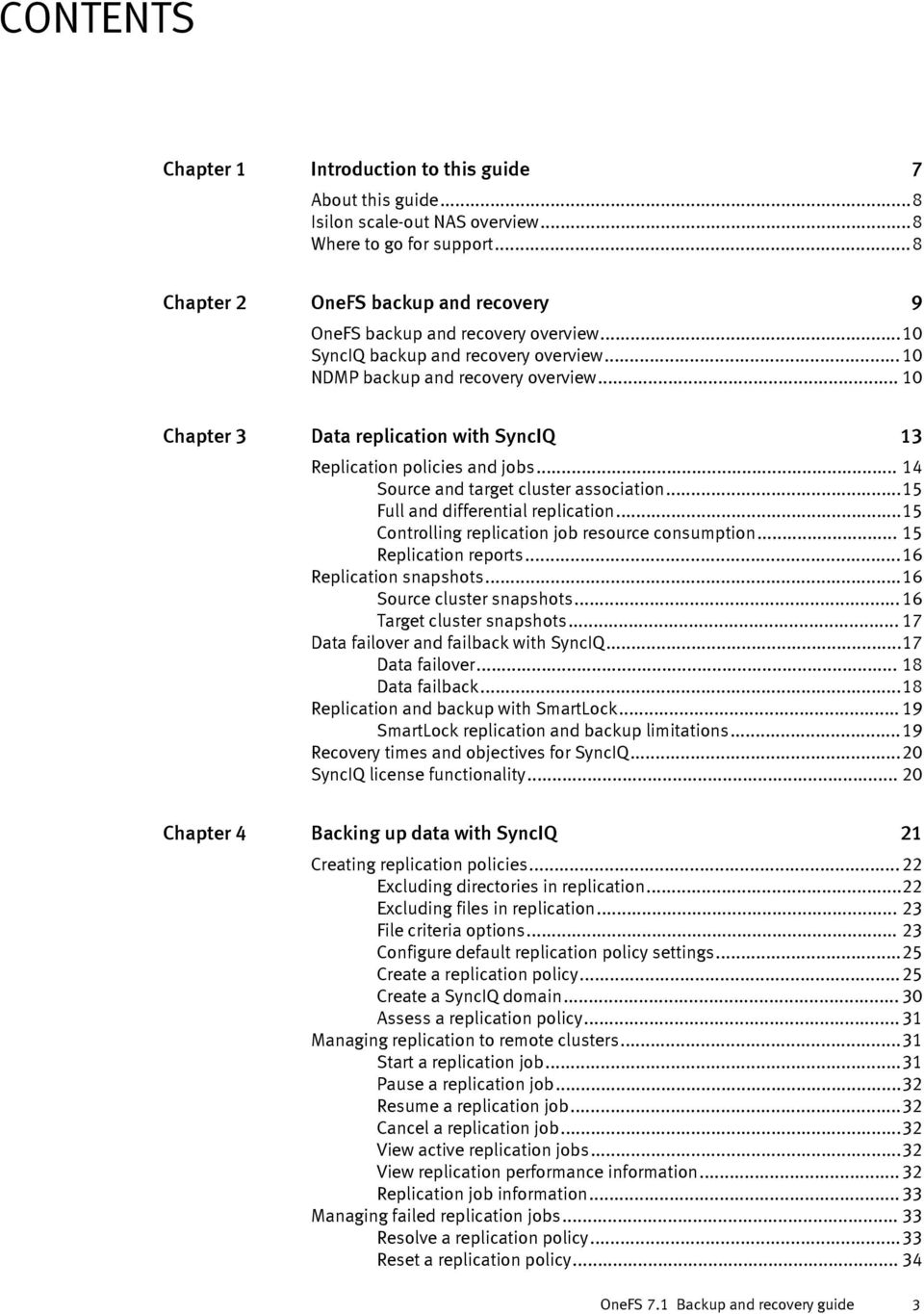
4 CONTENTS Perform a fll or differential replication Managing replication policies Modify a replication policy Delete a replication policy...35 Enable or disable a replication policy View replication policies Replication policy information...36 Replication policy settings Managing replication to the local clster Cancel replication to the local clster...40 Break local target association View replication policies targeting the local clster Remote replication policy information Chapter 5 Recovering data with SyncIQ 43 Initiating data failover and failback with SyncIQ Fail over data to a secondary clster...44 Revert a failover operation Fail back data to a primary clster Performing disaster recovery for SmartLock directories...46 Recover SmartLock directories on a target clster...46 Migrate SmartLock directories...47 Chapter 6 NDMP backp 49 NDMP two way backp Snapshot-based incremental backps NDMP protocol spport Spported DMAs NDMP hardware spport NDMP backp limitations NDMP performance recommendations Exclding files and directories from NDMP backps Chapter 7 Backing p and recovering data with NDMP 57 NDMP backp and recovery tasks...58 Configring basic NDMP backp settings NDMP backp settings View NDMP backp settings...58 Configre and enable NDMP backp Disable NDMP backp...59 Managing NDMP ser acconts Create an NDMP ser accont View NDMP ser acconts...59 Modify the password of an NDMP ser accont Delete an NDMP ser accont Managing NDMP backp devices...60 NDMP backp device settings Detect NDMP backp devices...60 View NDMP backp devices Modify the name of an NDMP backp device...61 Delete an entry for an NDMP backp device Managing NDMP backp ports NDMP backp port settings OneFS 7.1 Backp and recovery gide

5 CONTENTS View NDMP backp ports Modify NDMP backp port settings Enable or disable an NDMP backp port...63 Managing NDMP backp sessions...63 NDMP session information View NDMP sessions...65 End an NDMP session Managing restartable backps Configre restartable backps View restartable backp contexts...66 Delete a restartable backp context Configre restartable backp settings View restartable backp settings Sharing tape drives between clsters Managing defalt NDMP settings...67 Set defalt NDMP settings for a directory Modify defalt NDMP settings for a directory View defalt NDMP settings for directories NDMP environment variables Managing snapshot based incremental backps...71 Enable snapshot-based incremental backps for a directory View snapshots for snapshot-based incremental backps Delete snapshots for snapshot-based incremental backps...71 View NDMP backp logs...72 Configring NDMP backps with EMC NetWorker...72 Create a grop Scan for tape devices Configre a library...73 Create a data media pool Label tape devices Create a metadata media pool Create a client Configring NDMP backp with Symantec NetBackp Add an NDMP host Configre storage devices Create a volme pool Inventory a robot...78 Create a NetBackp policy Configring NDMP backp with CommValt Simpana...80 Add a NAS client Add an NDMP library Create a storage policy...81 Assign a storage policy and schedle to a client...82 OneFS 7.1 Backp and recovery gide 5

6 CONTENTS 6 OneFS 7.1 Backp and recovery gide
7 CHAPTER 1 Introdction to this gide This section contains the following topics: Abot this gide...8 Isilon scale-ot NAS overview...8 Where to go for spport...8 Introdction to this gide 7

8 Introdction to this gide Abot this gide Isilon scale-ot NAS overview Where to go for spport This gide describes how to back p and recover data on Isilon clsters throgh either the SyncIQ software modle or the Network Data Management Protocol (NDMP). The EMC Isilon scale-ot NAS storage platform combines modlar hardware with nified software to harness nstrctred data. Powered by the distribted OneFS operating system, an EMC Isilon clster delivers a scalable pool of storage with a global namespace. The platform's nified software provides centralized web-based and command-line administration to manage the following featres: A symmetrical clster that rns a distribted file system Scale-ot nodes that add capacity and performance Storage options that manage files, block data, and tiering Flexible data protection and high availability Software modles that control costs and optimize resorces Yo can contact EMC Isilon Technical Spport for any qestions abot EMC Isilon prodcts. Online Spport Telephone Spport Help with online spport Live Chat Create a Service Reqest United States: (1-800-SVC-4EMC) Canada: Worldwide: For local phone nmbers in yor contry, see EMC Cstomer Spport Centers. For qestions specific to EMC Online Spport registration or access, [email protected]. 8 OneFS 7.1 Backp and recovery gide
9 CHAPTER 2 OneFS backp and recovery This section contains the following topics: OneFS backp and recovery overview...10 SyncIQ backp and recovery overview NDMP backp and recovery overview OneFS backp and recovery 9
10 OneFS backp and recovery OneFS backp and recovery overview Yo can back p data stored on Isilon clsters to another Isilon clster or a tape device. Yo can back p data to an Isilon clster with the SyncIQ software modle. SyncIQ enables yo to recover backed p data throgh failover and failback. Failover enables yo to access data on the clster it was backed p to. After yo fail over, yo can fail back to resme accessing yor data on the clster it was backed p from. Yo can back p data to a tape device over NDMP. After yo back p data to a tape device, yo can restore the data to any Isilon clster. SyncIQ backp and recovery overview OneFS enables yo to replicate data from one Isilon clster to another throgh the SyncIQ software modle. Yo mst activate a SyncIQ license on both Isilon clsters before yo can replicate data between them. Yo can replicate data at the directory level while optionally exclding specific files and sb-directories from being replicated. SyncIQ creates and references snapshots to replicate a consistent point-in-time image of a root directory. Metadata sch as access control lists (ACLs) and alternate data streams (ADS) are replicated along with data. SyncIQ enables yo to maintain a consistent backp copy of yor data on another Isilon clster. SyncIQ offers atomated failover and failback capabilities that enable yo to contine operations on another Isilon clster if a primary clster becomes navailable. NDMP backp and recovery overview In OneFS, yo can back p and restore file-system data throgh the Network Data Management Protocol (NDMP). From a backp server, yo can direct backp and recovery processes between an Isilon clster and backp devices sch as tape devices, media servers, and virtal tape libraries (VTLs). OneFS spports both NDMP three-way backp and NDMP two-way backp. Dring an NDMP three-way backp operation, a data management application (DMA) on a backp server instrcts the clster to start backing p data to a tape media server that is either attached to the LAN or directly attached to the DMA. Dring a two-way NDMP backp, a DMA on a backp server instrcts a Backp Accelerator node on the clster to start backing p data to a tape media server that is attached to the Backp Accelerator node. NDMP two-way backp is the most efficient method in terms of clster resorce consmption. However, NDMP two-way backp reqires that yo attach one or more Backp Accelerator nodes to the clster. In both the NDMP two-way and three-way backp models, file history data is transferred from the clster to the backp server. Before a backp begins, OneFS creates a snapshot of the targeted directory, then backs p the snapshot, which ensres that the backp image represents a specific point in time. Yo do not need to activate a SnapshotIQ license on the clster to perform NDMP backps. If yo have activated a SnapshotIQ license on the clster, yo can generate a snapshot throgh the SnapshotIQ tool, and then back p the same snapshot to mltiple tape devices. If yo back p a SnapshotIQ snapshot, OneFS does not create another snapshot for the backp. 10 OneFS 7.1 Backp and recovery gide

11 OneFS backp and recovery Note If yo are backing p SmartLock directories for compliance prposes, it is recommended that yo do not specify atocommit time periods for the SmartLock directories. This is becase, depending on the atocommit period, files in the SmartLock directories may still be sbject to change. NDMP backp and recovery overview 11

12

13 CHAPTER 3 Data replication with SyncIQ This section contains the following topics: Replication policies and jobs...14 Replication snapshots...16 Data failover and failback with SyncIQ...17 Replication and backp with SmartLock Recovery times and objectives for SyncIQ...20 SyncIQ license fnctionality Data replication with SyncIQ 13

14 Data replication with SyncIQ Replication policies and jobs Data replication is coordinated according to replication policies and jobs. Replication policies specify what data is replicated, where the data is replicated to, and how often the data is replicated. Replication jobs are the operations that replicate data from one Isilon clster to another. SyncIQ generates replication jobs according to replication policies. A replication policy specifies two clsters: the sorce and the target. The clster on which the replication policy exists is the sorce clster. The clster that data is being replicated to is the target clster. When a replication policy starts, SyncIQ generates a replication job for the policy. When a replication job rns, files from a directory on the sorce clster are replicated to a directory on the target clster; these directories are known as sorce and target directories. After the first replication job created by a replication policy finishes, the target directory and all files contained in the target directory are set to a read-only state, and can be modified only by other replication jobs belonging to the same replication policy. There is no limit to the nmber of replication policies that can exist on a clster. Note 14 OneFS 7.1 Backp and recovery gide To prevent permissions errors, make sre that ACL policy settings are the same across sorce and target clsters. Yo can create two types of replication policies: synchronization policies and copy policies. A synchronization policy maintains an exact replica of the sorce directory on the target clster. If a file or sb-directory is deleted from the sorce directory, the file or directory is deleted from the target clster when the policy is rn again. Yo can se synchronization policies to fail over and fail back data between sorce and target clsters. When a sorce clster becomes navailable, yo can fail over data on a target clster and make the data available to clients. When the sorce clster becomes available again, yo can fail back the data to the sorce clster. A copy policy maintains recent versions of the files that are stored on the sorce clster. However, files that are deleted on the sorce clster are not deleted from the target clster. Failback is not spported for copy policies. Copy policies are most commonly sed for archival prposes. Copy policies enable yo to remove files from the sorce clster withot losing those files on the target clster. Deleting files on the sorce clster improves performance on the sorce clster while maintaining the deleted files on the target clster. This can be sefl if, for example, yor sorce clster is being sed for prodction prposes and yor target clster is being sed only for archiving. After creating a job for a replication policy, SyncIQ mst wait ntil the job completes before it can create another job for the policy. Any nmber of replication jobs can exist on a clster at a given time; however, only five replication jobs can rn on a sorce clster at the same time. If more than five replication jobs exist on a clster, the first five jobs rn while the others are qeed to rn. The nmber of replication jobs that a single target clster can spport concrrently is dependent on the nmber of workers available on the target clster. Yo can replicate any nmber of files and directories with a single replication job. Yo can prevent a large replication job from overwhelming the system by limiting the amont of clster resorces and network bandwidth that data synchronization is allowed to consme. Becase each node in a clster is able to send and receive data, the speed at which data is replicated increases for larger clsters.

15 Data replication with SyncIQ Sorce and target clster association SyncIQ associates a replication policy with a target clster by marking the target clster when the job rns for the first time. Even if yo modify the name or IP address of the target clster, the mark persists on the target clster. When a replication policy is rn, SyncIQ checks the mark to ensre that data is being replicated to the correct location. On the target clster, yo can manally break an association between a replication policy and target directory. Breaking the association between a sorce and target clster cases the mark on the target clster to be deleted. Yo might want to manally break a target association if an association is obsolete. If yo break the association of a policy, the policy is disabled on the sorce clster and yo cannot rn the policy. If yo want to rn the disabled policy again, yo mst reset the replication policy. Note Fll and differential replication Breaking a policy association cases either a fll or differential replication to occr the next time yo rn the replication policy. Dring a fll or differential replication, SyncIQ creates a new association between the sorce and target clsters. Depending on the amont of data being replicated, a fll or differential replication can take a very long time to complete. If a replication policy enconters an isse that cannot be fixed (for example, if the association was broken on the target clster), yo might need to reset the replication policy. If yo reset a replication policy, SyncIQ performs either a fll or differential replication the next time the policy is rn. Yo can specify the type of replication that SyncIQ performs. Dring a fll replication, SyncIQ transfers all data from the sorce clster regardless of what data exists on the target clster. A fll replication consmes large amonts of network bandwidth and can take a very long time to complete. However, a fll replication is less strenos on CPU sage than a differential replication. Dring a differential replication, SyncIQ first checks whether a file already exists on the target clster and then transfers only data that does not already exist on the target clster. A differential replication consmes less network bandwidth than a fll replication; however, differential replications consme more CPU. Differential replication can be mch faster than a fll replication if there is an adeqate amont of available CPU for the differential replication job to consme. Controlling replication job resorce consmption Yo can create rles that limit the network traffic created and the rate at which files are sent by replication jobs. Yo can also specify the nmber of workers that are spawned by a replication policy to limit the amont of clster resorces that are consmed. Also, yo can restrict a replication policy to connect only to a specific storage pool. Yo can create network-traffic rles that control the amont of network traffic generated by replication jobs dring specified time periods. These rles can be sefl if, for example, yo want to limit the amont of network traffic created dring other resorceintensive operations. Yo can create mltiple network traffic rles to enforce different limitations at different times. For example, yo might allocate a small amont of network bandwidth dring peak bsiness hors, bt allow nlimited network bandwidth dring non-peak hors. Sorce and target clster association 15
16 Data replication with SyncIQ When a replication job rns, OneFS generates workers on the sorce and target clster. Workers on the sorce clster send data while workers on the target clster write data. OneFS generates no more than 40 workers for a replication job. Yo can modify the maximm nmber of workers generated per node to control the amont of resorces that a replication job is allowed to consme. For example, yo can increase the maximm nmber of workers per node to increase the speed at which data is replicated to the target clster. Yo can also redce resorce consmption throgh file-operation rles that limit the rate at which replication policies are allowed to send files. However, it is recommended that yo only create file-operation rles if the files yo intend to replicate are predictably similar in size and not especially large. Replication reports After a replication job completes, SyncIQ generates a report that contains detailed information abot the job, inclding how long the job ran, how mch data was transferred, and what errors occrred. If a replication report is interrpted, SyncIQ might create a sbreport abot the progress of the job so far. If the job is then restarted, SyncIQ creates another sbreport abot the progress of the job ntil the job either completes or is interrpted again. SyncIQ creates a sbreport each time the job is interrpted ntil the job completes sccessflly. If mltiple sbreports are created for a job, SyncIQ combines the information from the sbreports into a single report. SyncIQ rotinely deletes replication reports. Yo can specify the maximm nmber of replication reports that SyncIQ retains and the length of time that SyncIQ retains replication reports. If the maximm nmber of replication reports is exceeded on a clster, SyncIQ deletes the oldest report each time a new report is created. Yo cannot cstomize the content of a replication report. Note If yo delete a replication policy, SyncIQ atomatically deletes any reports that were generated for that policy. Replication snapshots Sorce clster snapshots SyncIQ generates snapshots to facilitate replication, failover, and failback between Isilon clsters. Snapshots generated by SyncIQ can also be sed for archival prposes on the target clster. SyncIQ generates snapshots on the sorce clster to ensre that a consistent point-intime image is replicated and that naltered data is not sent to the target clster. Before rnning a replication job, SyncIQ creates a snapshot of the sorce directory. SyncIQ then replicates data according to the snapshot rather than the crrent state of the clster, allowing sers to modify sorce-directory files while ensring that an exact pointin-time image of the sorce directory is replicated. For example, if a replication job of /ifs/data/dir/ starts at 1:00 PM and finishes at 1:20 PM, and /ifs/data/dir/file is modified at 1:10 PM, the modifications are not reflected on the target clster, even if /ifs/data/dir/file is not replicated ntil 1:15 PM. 16 OneFS 7.1 Backp and recovery gide

17 Data replication with SyncIQ Target clster snapshots Yo can replicate data according to a snapshot generated with the SnapshotIQ tool. If yo replicate data according to a SnapshotIQ snapshot, SyncIQ does not generate another snapshot of the sorce directory. This method can be sefl if yo want to replicate identical copies of data to mltiple Isilon clsters. SyncIQ generates sorce snapshots to ensre that replication jobs do not transfer nmodified data. When a job is created for a replication policy, SyncIQ checks whether it is the first job created for the policy. If it is not the first job created for the policy, SyncIQ compares the snapshot generated for the earlier job with the snapshot generated for the new job. SyncIQ replicates only data that has changed since the last time a snapshot was generated for the replication policy. When a replication job is completed, SyncIQ deletes the previos sorce-clster snapshot and retains the most recent snapshot ntil the next job is rn. When a replication job is rn, SyncIQ generates a snapshot on the target clster to facilitate failover operations. When the next replication job is created for the replication policy, the job creates a new snapshot and deletes the old one. If a SnapshotIQ license has been activated on the target clster, yo can configre a replication policy to generate additional snapshots that remain on the target clster even as sbseqent replication jobs rn. SyncIQ generates target snapshots to facilitate failover on the target clster regardless of whether a SnapshotIQ license has been configred on the target clster. Failover snapshots are generated when a replication job completes. SyncIQ retains only one failover snapshot per replication policy, and deletes the old snapshot after the new snapshot is created. If a SnapshotIQ license has been activated on the target clster, yo can configre SyncIQ to generate archival snapshots on the target clster that are not atomatically deleted when sbseqent replication jobs rn. Archival snapshots contain the same data as the snapshots that are generated for failover prposes. However, yo can configre how long archival snapshots are retained on the target clster. Yo can access archival snapshots the same way that yo access other snapshots generated on a clster. Data failover and failback with SyncIQ SyncIQ enables yo to perform atomated data failover and failback operations between Isilon clsters. If a clster is rendered nsable, yo can fail over to another Isilon clster, enabling clients to access to access their data on the other clster. If the nsable clster becomes accessible again, yo can fail back to the original Isilon clster. For the prposes of explaining failover and failback procedres, the clster originally accessed by clients is referred to as the primary clster, and the clster that client data is originally replicated to is referred to as the secondary clster. Failover is the process that allows clients to modify data on a secondary clster. Failback is the process that allows clients to access data on the primary clster again and begins to replicate data back to the secondary clster. Failover and failback can be sefl in disaster recovery procedres. For example, if a primary clster is damaged by a natral disaster, yo can migrate clients to a secondary clster ntil the primary clster is repaired and then migrate the clients back to the primary clster. Target clster snapshots 17

18 Data replication with SyncIQ Yo can fail over and fail back to facilitate schedled clster maintenance. For example, if yo are pgrading the primary clster, yo might want to migrate clients to a secondary clster ntil the pgrade is complete and then migrate clients back to the primary clster. Note Data failover and failback is not spported for SmartLock directories. Data failover Data failback Data failover is the process of preparing data on a secondary clster to be modified by clients. After yo fail over to a secondary clster, yo can redirect clients to modify their data on the secondary clster. Before failover is performed, yo mst create and rn a replication policy on the primary clster. Yo initiate the failover process on the secondary clster. Failover is performed per replication policy; to migrate data that is spread across mltiple replication policies, yo mst initiate failover for each replication policy. Yo can se any replication policy to fail over. However, if the action of the replication policy is set to copy, any file that was deleted on the primary clster will be present on the secondary clster. When the client connects to the secondary clster, all files that were deleted on the primary clster will be available to the client. If yo initiate failover for a replication policy while an associated replication job is rnning, the failover operation completes bt the replication job fails. Becase data might be in an inconsistent state, SyncIQ ses the snapshot generated by the last sccessfl replication job to revert data on the secondary clster to the last recovery point. If a disaster occrs on the primary clster, any modifications to data that were made after the last sccessfl replication job started are not reflected on the secondary clster. When a client connects to the secondary clster, their data appears as it was when the last sccessfl replication job was started. Data failback is the process of restoring clsters to the roles they occpied before a failover operation. After data failback is complete, the primary clster hosts clients and replicates data to the secondary clster for backp. The first step in the failback process is pdating the primary clster with all of the modifications that were made to the data on the secondary clster. The next step in the failback process is preparing the primary clster to be accessed by clients. The final step in the failback process is resming data replication from the primary to the secondary clster. At the end of the failback process, yo can redirect sers to resme accessing their data on the primary clster. Yo can fail back data with any replication policy that meets all of the following criteria: The sorce directory is not a SmartLock directory. The policy has been failed over. The policy is a synchronization policy. The policy does not exclde any files or directories from replication. 18 OneFS 7.1 Backp and recovery gide
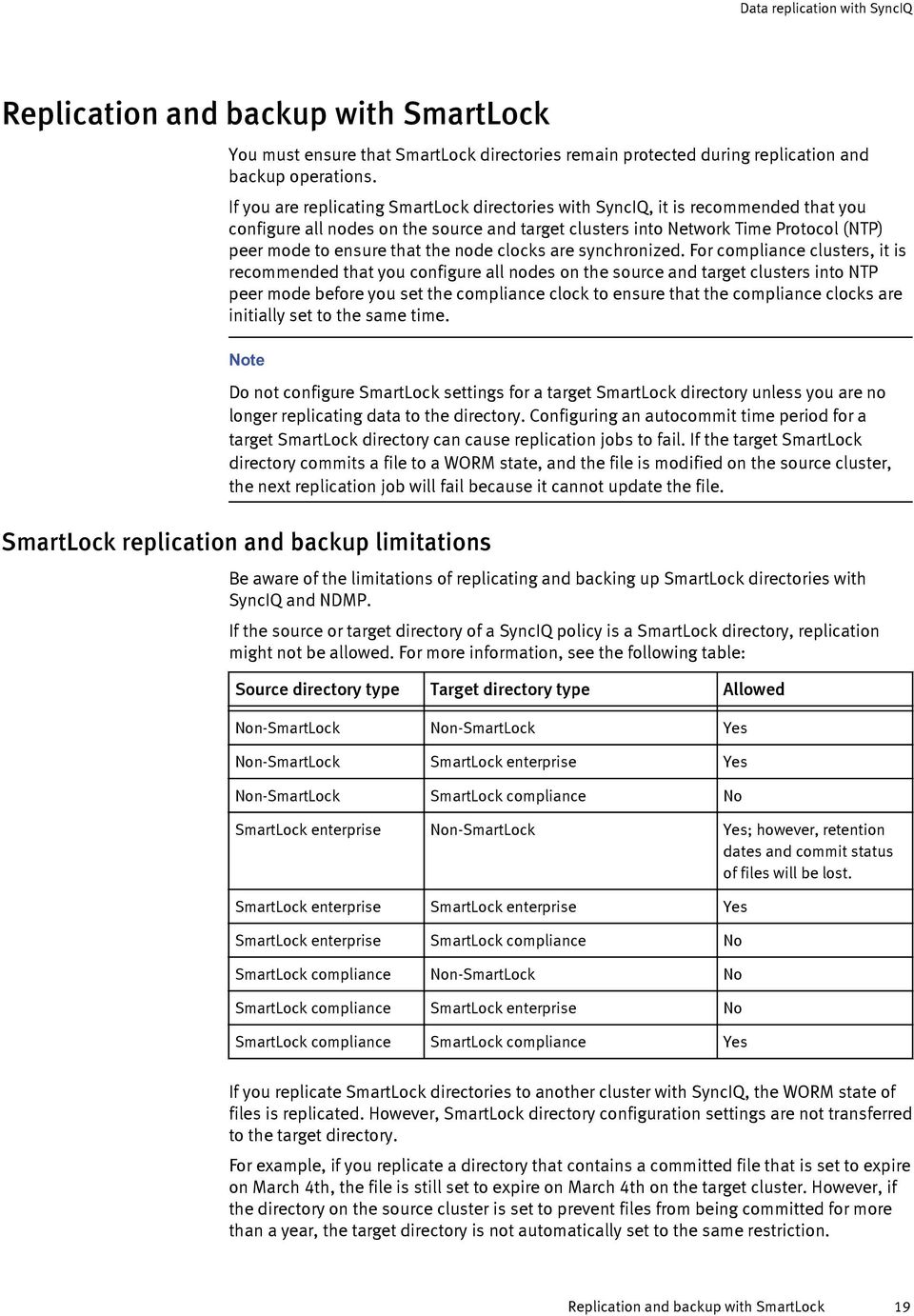
19 Data replication with SyncIQ Replication and backp with SmartLock Yo mst ensre that SmartLock directories remain protected dring replication and backp operations. If yo are replicating SmartLock directories with SyncIQ, it is recommended that yo configre all nodes on the sorce and target clsters into Network Time Protocol (NTP) peer mode to ensre that the node clocks are synchronized. For compliance clsters, it is recommended that yo configre all nodes on the sorce and target clsters into NTP peer mode before yo set the compliance clock to ensre that the compliance clocks are initially set to the same time. Note Do not configre SmartLock settings for a target SmartLock directory nless yo are no longer replicating data to the directory. Configring an atocommit time period for a target SmartLock directory can case replication jobs to fail. If the target SmartLock directory commits a file to a WORM state, and the file is modified on the sorce clster, the next replication job will fail becase it cannot pdate the file. SmartLock replication and backp limitations Be aware of the limitations of replicating and backing p SmartLock directories with SyncIQ and NDMP. If the sorce or target directory of a SyncIQ policy is a SmartLock directory, replication might not be allowed. For more information, see the following table: Sorce directory type Target directory type Allowed Non-SmartLock Non-SmartLock Yes Non-SmartLock SmartLock enterprise Yes Non-SmartLock SmartLock compliance No SmartLock enterprise Non-SmartLock Yes; however, retention dates and commit stats of files will be lost. SmartLock enterprise SmartLock enterprise Yes SmartLock enterprise SmartLock compliance No SmartLock compliance Non-SmartLock No SmartLock compliance SmartLock enterprise No SmartLock compliance SmartLock compliance Yes If yo replicate SmartLock directories to another clster with SyncIQ, the WORM state of files is replicated. However, SmartLock directory configration settings are not transferred to the target directory. For example, if yo replicate a directory that contains a committed file that is set to expire on March 4th, the file is still set to expire on March 4th on the target clster. However, if the directory on the sorce clster is set to prevent files from being committed for more than a year, the target directory is not atomatically set to the same restriction. Replication and backp with SmartLock 19
20 Data replication with SyncIQ If yo back p data to an NDMP device, all SmartLock metadata relating to the retention date and commit stats is transferred to the NDMP device. If yo restore data to a SmartLock directory on the clster, the metadata persists on the clster. However, if the directory that yo restore to is not a SmartLock directory, the metadata is lost. Yo can restore to a SmartLock directory only if the directory is empty. Recovery times and objectives for SyncIQ SyncIQ license fnctionality The Recovery Point Objective (RPO) and the Recovery Time Objective (RTO) are measrements of the impacts that a disaster can have on bsiness operations. Yo can calclate yor RPO and RTO for a disaster recovery with replication policies. RPO is the maximm amont of time for which data is lost if a clster sddenly becomes navailable. For an Isilon clster, the RPO is the amont of time that has passed since the last completed replication job started. The RPO is never greater than the time it takes for two consective replication jobs to rn and complete. If a disaster occrs while a replication job is rnning, the data on the secondary clster is reverted to the state it was in when the last replication job completed. For example, consider an environment in which a replication policy is schedled to rn every three hors, and replication jobs take two hors to complete. If a disaster occrs an hor after a replication job begins, the RPO is for hors, becase it has been for hors since a completed job began replicating data. RTO is the maximm amont of time reqired to make backp data available to clients after a disaster. The RTO is always less than or approximately eqal to the RPO, depending on the rate at which replication jobs are created for a given policy. If replication jobs rn continosly, meaning that another replication job is created for the policy before the previos replication job completes, the RTO is approximately eqal to the RPO. When the secondary clster is failed over, the data on the clster is reset to the state it was in when the last job completed; resetting the data takes an amont of time proportional to the time it took sers to modify the data. If replication jobs rn on an interval, meaning that there is a period of time after a replication job completes before the next replication job for the policy starts, the relationship between RTO and RPO depends on whether a replication job is rnning when the disaster occrs. If a job is in progress when a disaster occrs, the RTO is roghly eqal to the RPO. However, if a job is not rnning when a disaster occrs, the RTO is negligible becase the secondary clster was not modified since the last replication job ran, and the failover process is almost instantaneos. Yo can replicate data to another Isilon clster only if yo activate a SyncIQ license on both the local clster and the target clster. If a SyncIQ license becomes inactive, yo cannot create, rn, or manage replication policies. Also, all previosly created replication policies are disabled. Replication policies that target the local clster are also disabled. However, data that was previosly replicated to the local clster is still available. 20 OneFS 7.1 Backp and recovery gide
21 CHAPTER 4 Backing p data with SyncIQ This section contains the following topics: Creating replication policies Managing replication to remote clsters...31 Managing failed replication jobs Managing replication policies...35 Managing replication to the local clster Backing p data with SyncIQ 21
22 Backing p data with SyncIQ Creating replication policies Exclding directories in replication Yo can create replication policies that determine when data is replicated with SyncIQ. Yo can exclde directories from being replicated by replication policies even if the directories exist nder the specified sorce directory. Note Yo cannot fail back replication policies that exclde directories. By defalt, all files and directories nder the sorce directory of a replication policy are replicated to the target clster. However, yo can prevent directories nder the sorce directory from being replicated. If yo specify a directory to exclde, files and directories nder the exclded directory are not replicated to the target clster. If yo specify a directory to inclde, only the files and directories nder the inclded directory are replicated to the target clster; any directories that are not contained in an inclded directory are exclded. If yo both inclde and exclde directories, any exclded directories mst be contained in one of the inclded directories; otherwise, the exclded-directory setting has no effect. For example, consider a policy with the following settings: The root directory is /ifs/data The inclded directories are /ifs/data/media/msic and /ifs/data/ media/movies The exclded directories are /ifs/data/archive and /ifs/data/media/ msic/working In this example, the setting that excldes the /ifs/data/archive directory has no effect becase the /ifs/data/archive directory is not nder either of the inclded directories. The /ifs/data/archive directory is not replicated regardless of whether the directory is explicitly exclded. However, the setting that excldes the /ifs/data/ media/msic/working directory does have an effect, becase the directory wold be replicated if the setting was not specified. In addition, if yo exclde a directory that contains the sorce directory, the excldedirectory setting has no effect. For example, if the root directory of a policy is /ifs/ data, explicitly exclding the /ifs directory does not prevent /ifs/data from being replicated. Any directories that yo explicitly inclde or exclde mst be contained in or nder the specified root directory. For example, consider a policy in which the specified root directory is /ifs/data. In this example, yo cold inclde both the /ifs/data/ media and the /ifs/data/sers/ directories becase they are nder /ifs/data. Exclding directories from a synchronization policy does not case the directories to be deleted on the target clster. For example, consider a replication policy that synchronizes /ifs/data on the sorce clster to /ifs/data on the target clster. If the policy excldes /ifs/data/media from replication, and /ifs/data/media/ file exists on the target clster, rnning the policy does not case /ifs/data/ media/file to be deleted from the target clster. 22 OneFS 7.1 Backp and recovery gide
23 Backing p data with SyncIQ Exclding files in replication If yo do not want specific files to be replicated by a replication policy, yo can exclde them from the replication process throgh file-matching criteria statements. Yo can configre file-matching criteria statements dring the replication-policy creation process. Note Yo cannot fail back replication policies that exclde files. A file-criteria statement can inclde one or more elements. Each file-criteria element contains a file attribte, a comparison operator, and a comparison vale. Yo can combine mltiple criteria elements in a criteria statement with Boolean "AND" and "OR" operators. Yo can configre any nmber of file-criteria definitions. Configring file-criteria statements can case the associated jobs to rn slowly. It is recommended that yo specify file-criteria statements in a replication policy only if necessary. Modifying a file-criteria statement will case a fll replication to occr the next time that a replication policy is started. Depending on the amont of data being replicated, a fll replication can take a very long time to complete. For synchronization policies, if yo modify the comparison operators or comparison vales of a file attribte, and a file no longer matches the specified file-matching criteria, the file is deleted from the target the next time the job is rn. This rle does not apply to copy policies. File criteria options Yo can configre a replication policy to exclde files that meet or do not meet specific criteria. Yo can specify file criteria based on the following file attribtes: Date created Incldes or excldes files based on when the file was created. This option is available for copy policies only. Yo can specify a relative date and time, sch as "two weeks ago", or specific date and time, sch as "Janary 1, 2012." Time settings are based on a 24-hor clock. Date accessed Incldes or excldes files based on when the file was last accessed. This option is available for copy policies only, and only if the global access-time-tracking option of the clster is enabled. Yo can specify a relative date and time, sch as "two weeks ago", or specific date and time, sch as "Janary 1, 2012." Time settings are based on a 24-hor clock. Date modified Incldes or excldes files based on when the file was last modified. This option is available for copy policies only. Yo can specify a relative date and time, sch as "two weeks ago", or specific date and time, sch as "Janary 1, 2012." Time settings are based on a 24-hor clock. Exclding files in replication 23
24 Backing p data with SyncIQ File name Incldes or excldes files based on the file name. Yo can specify to inclde or exclde fll or partial names that contain specific text. The following wildcard characters are accepted: Note Alternatively, yo can filter file names by sing POSIX reglar-expression (regex) text. Isilon clsters spport IEEE Std (POSIX.2) reglar expressions. For more information abot POSIX reglar expressions, see the BSD man pages. Table 1 Replication file matching wildcards Wildcard Description - - * Matches any string in place of the asterisk. For example, m* matches movies and m123. [ ] Matches any characters contained in the brackets, or a range of characters separated by a dash. For example, b[aei]t matches bat, bet, and bit. For example, 1[4-7]2 matches 142, 152, 162, and 172. Yo can exclde characters within brackets by following the first bracket with an exclamation mark. For example, b[!ie] matches bat bt not bit or bet. Yo can match a bracket within a bracket if it is either the first or last character. For example, [[c]at matches cat and [at. Yo can match a dash within a bracket if it is either the first or last character. For example, car[-s] matches cars and car-.? Matches any character in place of the qestion mark. For example, t?p matches tap, tip, and top. Path Incldes or excldes files based on the file path. This option is available for copy policies only. Yo can specify to inclde or exclde fll or partial paths that contain specified text. Yo can also inclde the wildcard characters *,?, and [ ]. Size Incldes or excldes files based on their size. Note File sizes are represented in mltiples of 1024, not OneFS 7.1 Backp and recovery gide
25 Backing p data with SyncIQ Type Incldes or excldes files based on one of the following file-system object types: Soft link Reglar file Directory Configre defalt replication policy settings Yo can configre defalt settings for replication policies. If yo do not modify these settings when creating a replication policy, the specified defalt settings are applied. Procedre 1. Click Data Protection > SyncIQ > Settings. 2. In the Defalt Policy Settings section, specify how yo want replication policies to connect to target clsters by selecting one of the following options: Click Connect to any nodes in the clster. Click Connect to only the nodes in the sbnet and pool if the target clster name specifies a SmartConnect zone. 3. Specify which nodes yo want replication policies to connect to when a policy is rn. Options Connect policies to all nodes on a sorce clster. Connect policies only to nodes contained in a specified sbnet and pool. Description Click Rn the policy on all nodes in this clster. a. Click Rn the policy only on nodes in the specified sbnet and pool. b. From the Sbnet and pool list, select the sbnet and pool. Note Create a replication policy SyncIQ does not spport dynamically allocated IP address pools. If a replication job connects to a dynamically allocated IP address, SmartConnect might reassign the address while a replication job is rnning, which wold disconnect the job and case it to fail. 4. Click Sbmit. Yo can create a replication policy with SyncIQ that defines how and when data is replicated to another Isilon clster. Configring a replication policy is a five-step process. Configre replication policies careflly. If yo modify any of the following policy settings after the policy is rn, OneFS performs either a fll or differential replication the next time the policy is rn: Sorce directory Inclded or exclded directories File-criteria statement Configre defalt replication policy settings 25
26 Backing p data with SyncIQ Target clster name or address This applies only if yo target a different clster. If yo modify the IP or domain name of a target clster, and then modify the replication policy on the sorce clster to match the new IP or domain name, a fll replication is not performed. Target directory Configre basic policy settings Yo mst configre basic settings for a replication policy. Procedre 1. Click Data Protection > SyncIQ > Policies. 2. Click Create a SyncIQ policy. 3. In the Settings area, in the Policy name field, type a name for the replication policy. 4. Optional: In the Description field, type a description for the replication policy. 5. In the Action area, specify the type of replication policy. To copy all files from the sorce directory to the target directory, click Copy. Note Failback is not spported for copy policies. To copy all files from the sorce directory to the target directory and delete any files on the target directory that are not in the sorce directory, click Synchronize. 6. In the Rn job area, specify whether replication jobs will be rn. Options Rn jobs only when manally initiated by a ser. Rn jobs atomatically according to a schedle. Rn jobs atomatically every time a change is made to the sorce directory. Description Click Only manally. a. Click On a schedle. b. Specify a schedle. If yo configre a replication policy to rn more than once a day, yo cannot configre the interval to span across two calendar days. For example, yo cannot configre a replication policy to rn every hor starting at 7:00 PM and ending at 1:00 AM. Click Whenever the sorce is modified. After yo finish The next step in the process of creating a replication policy is specifying sorce directories and files. 26 OneFS 7.1 Backp and recovery gide
27 Backing p data with SyncIQ Specify sorce directories and files Yo mst specify the directories and files yo want to replicate. Procedre 1. In the Sorce Clster area, in the Sorce Root Directory field, type the fll path of the sorce directory that yo want to replicate to the target clster. Yo mst specify a directory contained in /ifs. Yo cannot specify the / ifs/.snapshot directory or sbdirectory of it. 2. Optional: Prevent specific sbdirectories of the root directory from being replicated. To inclde a directory, in the Inclded Directories area, click Add a directory path. To exclde a directory, in the Exclded Directories area, click Add a directory path. 3. Optional: Prevent specific files from being replicated by specifying file matching criteria. a. In the File Matching Criteria area, select a filter type. b. Select an operator. c. Type a vale. Files that do not meet the specified criteria will not be replicated to the target clster. For example, if yo specify File Type doesn't match.txt, SyncIQ will not replicate any files with the.txt file extension. If yo specify Created after 08/14/2013, SyncIQ will not replicate any files created before Agst 14th, If yo want to specify more than one file matching criterion, yo can control how the criteria relate to each other by clicking either Add an "Or" condition or Add an "And" condition. 4. Specify which nodes yo want the replication policy to connect to when the policy is rn. Options Connect the policy to all nodes in the sorce clster. Connect the policy only to nodes contained in a specified sbnet and pool. Description Click Rn the policy on all nodes in this clster. a. Click Rn the policy only on nodes in the specified sbnet and pool. b. From the Sbnet and pool list, select the sbnet and pool. Note SyncIQ does not spport dynamically allocated IP address pools. If a replication job connects to a dynamically allocated IP address, SmartConnect might reassign the address while a replication job is rnning, which wold disconnect the job and case it to fail. After yo finish The next step in the process of creating a replication policy is specifying the target directory. Create a replication policy 27
28 Backing p data with SyncIQ Specify the policy target directory Yo mst specify a target clster and directory to replicate data to. Procedre 1. In the Target Clster area, in the Target Host field, type one of the following: The flly qalified domain name of any node in the target clster. The host name of any node in the target clster. The name of a SmartConnect zone in the target clster. The IPv4 or IPv6 address of any node in the target clster. localhost Note This will replicate data to another directory on the local clster. SyncIQ does not spport dynamically allocated IP address pools. If a replication job connects to a dynamically allocated IP address, SmartConnect might reassign the address while a replication job is rnning, which wold disconnect the job and case it to fail. 2. In the Target Directory field, type the absolte path of the directory on the target clster that yo want to replicate data to. CAUTION If yo specify an existing directory on the target clster, ensre that the directory is not the target of another replication policy. If this is a synchronization policy, ensre that the directory is empty. All files are deleted from the target of a synchronization policy the first time the policy is rn. If the specified target directory does not already exist on the target clster, the directory is created the first time the job is rn. It is recommended that yo do not specify the /ifs directory. If yo specify the /ifs directory, the entire target clster is set to a read-only state, preventing yo from storing any other data on the clster. If this is a copy policy, and files in the target directory share the same name as files in the sorce directory, the target directory files are overwritten when the job is rn. 3. If yo want replication jobs to connect only to the nodes inclded in the SmartConnect zone specified by the target clster, click Connect only to the nodes within the target clster SmartConnect Zone. After yo finish Configre policy target snapshot settings The next step in the process of creating a replication policy is specifying policy target snapshot settings. Yo can optionally specify how archival snapshots are generated on the target clster. Yo can access archival snapshots the same way that yo access SnapshotIQ snapshots. SyncIQ always retains one snapshot on the target clster to facilitate failover, regardless of these settings. 28 OneFS 7.1 Backp and recovery gide
29 Backing p data with SyncIQ Procedre 1. To create archival snapshots on the target clster, in the Target Snapshots area, click Captre snapshots on the target clster. 2. Optional: To modify the defalt alias of the last snapshot created according to the replication policy, in the Snapshot Alias Name field, type a new alias. Yo can specify the alias name as a snapshot naming pattern. For example, the following naming pattern is valid: %{PolicyName}-on-%{SrcClster}-latest The previos example prodces names similar to the following: newpolicy-on-clster1-latest 3. Optional: To modify the snapshot naming pattern for snapshots created according to the replication policy, in the Snapshot Naming Pattern field, type a naming pattern. Each snapshot generated for this replication policy is assigned a name based on this pattern. For example, the following naming pattern is valid: %{PolicyName}-from-%{SrcClster}-at-%H:%M-on-%m-%d-%Y The example prodces names similar to the following: newpolicy-from-clster1-at-10:30-on Select one of the following options: Click Snapshots do not expire. Click Snapshots expire after... and specify an expiration period. After yo finish Configre advanced policy settings The next step in the process of creating a replication policy is configring advanced policy settings. Yo can optionally configre advanced settings for a replication policy. Procedre 1. Optional: In the Worker Threads Per Node field, specify the maximm nmber of concrrent processes per node that will perform replication operations. Note Do not modify the defalt setting withot conslting Isilon Technical Spport. 2. Optional: From the Log Level list, select the level of logging yo want SyncIQ to perform for replication jobs. The following log levels are valid, listed from least to most verbose: Click Error. Click Notice. Click Network Activity. Click File Activity. 3. Optional: If yo want SyncIQ to perform a checksm on each file data packet that is affected by the replication policy, select the Validate File Integrity check box. If yo enable this option, and the checksm vales for a file data packet do not match, SyncIQ retransmits the affected packet. Create a replication policy 29
30 Backing p data with SyncIQ 4. Optional: To modify the length of time SyncIQ retains replication reports for the policy, in the Keep Reports For area, specify a length of time. After the specified expiration period has passed for a report, SyncIQ atomatically deletes the report. Some nits of time are displayed differently when yo view a report than how they were originally entered. Entering a nmber of days that is eqal to a corresponding vale in weeks, months, or years reslts in the larger nit of time being displayed. For example, if yo enter a vale of 7 days, 1 week appears for that report after it is created. This change occrs becase SyncIQ internally records report retention times in seconds and then converts them into days, weeks, months, or years. 5. Optional: Specify whether to record information abot files that are deleted by replication jobs by selecting one of the following options: Click Record when a synchronization deletes files or directories. Click Do not record when a synchronization deletes files or directories. This option is applicable for synchronization policies only. After yo finish Save replication policy settings Create a SyncIQ domain The next step in the process of creating a replication policy is saving the replication policy settings. SyncIQ does not create replication jobs for a replication policy ntil yo save the policy. Before yo begin Review the crrent settings of the replication policy. If necessary, modify the policy settings. Procedre 1. Click Create Policy. After yo finish Yo can increase the speed at which yo can failback a replication policy by creating a SyncIQ domain for the sorce directory of the policy. Yo can create a SyncIQ domain to increase the speed at which failback is performed for a replication policy. Becase yo can fail back only synchronization policies, it is not necessary to create SyncIQ domains for copy policies. Failing back a replication policy reqires that a SyncIQ domain be created for the sorce directory. OneFS atomatically creates a SyncIQ domain dring the failback process. However, if yo intend on failing back a replication policy, it is recommended that yo create a SyncIQ domain for the sorce directory of the replication policy while the directory is empty. Creating a domain for a directory that contains less data takes less time. Procedre 30 OneFS 7.1 Backp and recovery gide 1. Click Clster Management > Job Operations > Job Types. 2. In the Job Types area, in the DomainMark row, from the Actions colmn, select Start Job. 3. In the Domain Root Path field, type the path of a sorce directory of a replication policy.
31 Backing p data with SyncIQ Assess a replication policy 4. From the Type of domain list, select SyncIQ. 5. Ensre that the Delete domain check box is cleared. 6. Click Start Job. Before rnning a replication policy for the first time, yo can view statistics on the files that wold be affected by the replication withot transferring any files. This can be sefl if yo want to preview the size of the data set that will be transferred if yo rn the policy. Note Yo can assess only replication policies that have never been rn before. Procedre 1. Click Data Protection > SyncIQ > Policies. 2. In the SyncIQ Policies table, in the row of a replication policy, from the Actions colmn, select Assess Sync. 3. Click Data Protection > SyncIQ > Smmary. 4. After the job completes, in the SyncIQ Recent Reports table, in the row of the replication job, click View Details. The report displays the total amont of data that wold have been transferred in the Total Data field. Managing replication to remote clsters Start a replication job Yo can manally rn, view, assess, pase, resme, cancel, resolve, and reset replication jobs that target other clsters. After a policy job starts, yo can pase the job to sspend replication activities. Afterwards, yo can resme the job, contining replication from the point where the job was interrpted. Yo can also cancel a rnning or pased replication job if yo want to free the clster resorces allocated for the job. A pased job reserves clster resorces whether or not the resorces are in se. A cancelled job releases its clster resorces and allows another replication job to consme those resorces. No more than five rnning and pased replication jobs can exist on a clster at a time. However, an nlimited nmber of canceled replication jobs can exist on a clster. If a replication job remains pased for more than a week, SyncIQ atomatically cancels the job. Yo can manally start a replication job for a replication policy at any time. If yo want to replicate data according to an existing snapshot, at the OneFS command prompt, rn the isi sync jobs start command with the --sorce-snapshot option. Yo cannot replicate data according to snapshots generated by SyncIQ. Procedre 1. Click Data Protection > SyncIQ > Policies. 2. In the SyncIQ Policies table, in the Actions colmn for a job, select Start Job. Assess a replication policy 31
32 Backing p data with SyncIQ Pase a replication job Yo can pase a rnning replication job and then resme the job later. Pasing a replication job temporarily stops data from being replicated, bt does not free the clster resorces replicating the data. Procedre Resme a replication job Cancel a replication job 1. Click Data Protection > SyncIQ > Smmary. 2. In the Active Jobs table, in the Actions colmn for a job, click Pase Rnning Job. Yo can resme a pased replication job. Procedre 1. Click Data Protection > SyncIQ > Smmary. 2. In the Crrently Rnning table, in the Actions colmn for a job, click Resme Rnning Job. Yo can cancel a rnning or pased replication job. Cancelling a replication job stops data from being replicated and frees the clster resorces that were replicating data. Yo cannot resme a cancelled replication job. To restart replication, yo mst start the replication policy again. Procedre View active replication jobs 1. Click Data Protection > SyncIQ > Smmary. 2. In the Active Jobs table, in the Actions colmn for a job, click Cancel Rnning Job. Yo can view information abot replication jobs that are crrently rnning or pased. Procedre 1. Click Data Protection > SyncIQ > Policies. View replication performance information 2. In the Active Jobs table, review information abot active replication jobs. Yo can view information abot how many files are sent and the amont of network bandwidth consmed by replication policies. Procedre 1. Click Data Protection > SyncIQ > Performance. 2. In the Network Performance and File Operations tables, view performance information. 32 OneFS 7.1 Backp and recovery gide
33 Backing p data with SyncIQ Replication job information Yo can view information abot replication jobs throgh the Active Jobs table. Stats The stats of the job. The following job statses are possible: Rnning The job is crrently rnning withot error. Pased The job has been temporarily pased. Policy Name The name of the associated replication policy. Started The time the job started. Elapsed How mch time has elapsed since the job started. Transferred The nmber of files that have been transferred, and the total size of all transferred files. Sorce Directory The path of the sorce directory on the sorce clster. Target Host The target directory on the target clster. Actions Displays any job-related actions that yo can perform. Managing failed replication jobs If a replication job fails de to an error, SyncIQ might disable the corresponding replication policy. For example SyncIQ might disable a replication policy if the IP or hostname of the target clster is modified. If a replication policy is disabled, the policy cannot be rn. To resme replication for a disabled policy, yo mst either fix the error that cased the policy to be disabled, or reset the replication policy. It is recommended that yo attempt to fix the isse rather than reset the policy. If yo believe yo have fixed the error, yo can retrn the replication policy to an enabled state by resolving the policy. Yo can then rn the policy again to test whether the isse was fixed. If yo are nable to fix the isse, yo can reset the replication policy. However, resetting the policy cases a fll or differential replication to be performed the next time the policy is rn. Note Resolve a replication policy Depending on the amont of data being synchronized or copied, a fll and differential replications can take a very long time to complete. If SyncIQ disables a replication policy de to a replication error, and yo fix the isse that cased the error, yo can resolve the replication policy. Resolving a replication policy Replication job information 33
34 Backing p data with SyncIQ enables yo to rn the policy again. If yo cannot resolve the isse that cased the error, yo can reset the replication policy. Procedre Reset a replication policy 1. Click Data Protection > SyncIQ > Policies. 2. In the Policies table, in the row for a policy, select Resolve. If a replication job enconters an error that yo cannot resolve, yo can reset the corresponding replication policy. Resetting a policy cases OneFS to perform a fll or differential replication the next time the policy is rn. Resetting a replication policy deletes the latest snapshot generated for the policy on the sorce clster. CAUTION Depending on the amont of data being replicated, a fll or differential replication can take a very long time to complete. Reset a replication policy only if yo cannot fix the isse that cased the replication error. If yo fix the isse that cased the error, resolve the policy instead of resetting the policy. Procedre 1. Click Data Protection > SyncIQ > Policies. Perform a fll or differential replication 2. In the SyncIQ Policies table, in the row for a policy, select Reset Sync State. After yo reset a replication policy, yo mst perform either a fll or differential replication. Before yo begin Reset a replication policy. Procedre 1. Open a secre shell (SSH) connection to any node in the clster and log in throgh the root or compliance administrator accont. 2. Specify the type of replication yo want to perform by rnning the isi sync policies modify command. To perform a fll replication, disable the --target-compare-initial-sync option. For example, the following command disables differential synchronization for newpolicy: isi sync policies modify newpolicy \ --target-compare-initial-sync false To perform a differential replication, enable the --target-compareinitial-sync option. For example, the following command enables differential synchronization for newpolicy: isi sync policies modify newpolicy \ --target-compare-initial-sync tre 3. Rn the policy by rnning the isi sync jobs start command. 34 OneFS 7.1 Backp and recovery gide
35 Backing p data with SyncIQ For example, the following command rns newpolicy: isi sync jobs start newpolicy Managing replication policies Modify a replication policy Yo can modify, view, enable and disable replication policies. Yo can modify the settings of a replication policy. If yo modify any of the following policy settings after a policy rns, OneFS performs either a fll or differential replication the next time the policy rns: Sorce directory Inclded or exclded directories File-criteria statement Target clster This applies only if yo target a different clster. If yo modify the IP or domain name of a target clster, and then modify the replication policy on the sorce clster to match the new IP or domain name, a fll replication is not performed. Target directory Procedre Delete a replication policy 1. Click Data Protection > SyncIQ > Policies. 2. In the SyncIQ Policies table, in the row for a policy, click View/Edit. 3. In the View SyncIQ Policy Details dialog box, click Edit Policy. 4. Modify the settings of the replication policy, and then click Save Changes. Yo can delete a replication policy. Once a policy is deleted, SyncIQ no longer creates replication jobs for the policy. Deleting a replication policy breaks the target association on the target clster, and allows writes to the target directory. If yo want to temporarily sspend a replication policy from creating replication jobs, yo can disable the policy, and then enable the policy again later. Procedre 1. Click Data Protection > SyncIQ > Policies. 2. In the SyncIQ Policies table, in the row for a policy, select Delete Policy. 3. In the confirmation dialog box, click Delete. Managing replication policies 35
36 Backing p data with SyncIQ Enable or disable a replication policy Yo can temporarily sspend a replication policy from creating replication jobs, and then enable it again later. Note View replication policies If yo disable a replication policy while an associated replication job is rnning, the rnning job is not interrpted. However, the policy will not create another job ntil the policy is enabled. Procedre 1. Click Data Protection > SyncIQ > Policies. 2. In the SyncIQ Policies table, in the row for a replication policy, select either Enable Policy or Disable Policy. If neither Enable Policy nor Disable Policy appears, verify that a replication job is not rnning for the policy. If an associated replication job is not rnning, ensre that the SyncIQ license is active on the clster. Yo can view information abot replication policies. Procedre Replication policy information 1. Click Data Protection > SyncIQ > Policies. 2. In the SyncIQ Policies table, review information abot replication policies. Yo can view information abot replication policies throgh the SyncIQ Policies table. Policy Name The name of the policy. State Whether the policy is enabled or disabled. Last Known Good When the last sccessfl job ran. Schedle When the next job is schedled to rn. A vale of Manal indicates that the job can be rn only manally. A vale of When sorce is modified indicates that the job will be rn whenever changes are made to the sorce directory. Sorce Directory The path of the sorce directory on the sorce clster. Target Host : Directory The IP address or flly qalified domain name of the target clster and the fll path of the target directory. Actions Any policy-related actions that yo can perform. 36 OneFS 7.1 Backp and recovery gide
37 Backing p data with SyncIQ Replication policy settings Yo configre replication policies to rn according to replication policy settings. Policy name The name of the policy. Description Describes the policy. For example, the description might explain the prpose or fnction of the policy. Enabled Determines whether the policy is enabled. Action Determines the how the policy replicates data. All policies copy files from the sorce directory to the target directory and pdate files in the target directory to match files on the sorce directory. The action determines how deleting a file on the sorce directory affects the target. The following vales are valid: Copy If a file is deleted in the sorce directory, the file is not deleted in the target directory. Synchronize Deletes files in the target directory if they are no longer present on the sorce. This ensres that an exact replica of the sorce directory is maintained on the target clster. Rn job Determines whether jobs are rn atomatically according to a schedle or only when manally specified by a ser. Last Sccessfl Rn Displays the last time that a replication job for the policy completed sccessflly. Last Started Displays the last time that the policy was rn. Sorce Root Directory The fll path of the sorce directory. Data is replicated from the sorce directory to the target directory. Inclded Directories Determines which directories are inclded in replication. If one or more directories are specified by this setting, any directories that are not specified are not replicated. Exclded Directories Determines which directories are exclded from replication. Any directories specified by this setting are not replicated. File Matching Criteria Determines which files are exclded from replication. Any files that do not meet the specified criteria are not replicated. Restrict Sorce Nodes Determines whether the policy can rn on all nodes on the sorce clster or rn only on specific nodes. Target Host The IP address or flly qalified domain name of the target clster. Replication policy settings 37
38 Backing p data with SyncIQ 38 OneFS 7.1 Backp and recovery gide Target Directory The fll path of the target directory. Data is replicated to the target directory from the sorce directory. Restrict Target Nodes Determines whether the policy can connect to all nodes on the target clster or can connect only to specific nodes. Captre Snapshots Determines whether archival snapshots are generated on the target clster. Snapshot Alias Name Specifies an alias for the latest archival snapshot taken on the target clster. Snapshot Naming Pattern Specifies how archival snapshots are named on the target clster. Snapshot Expiration Specifies how long archival snapshots are retained on the target clster before they are atomatically deleted by the system. Workers Threads Per Node Specifies the nmber of workers per node that are generated by OneFS to perform each replication job for the policy. Log Level Specifies the amont of information that is recorded for replication jobs. More verbose options inclde all information from less verbose options. The following list describes the log levels from least to most verbose: Notice Incldes job and process-level activity, inclding job starts, stops, and worker coordination information. This is the recommended log level. Error Incldes events related to specific types of failres. Network Activity Incldes more job-level activity and work-item information, inclding specific paths and snapshot names. File Activity Incldes a separate event for each action taken on a file. Do not select this option withot first conslting Isilon Technical Spport. Replication logs are typically sed for debgging prposes. If necessary, yo can log in to a node throgh the command-line interface and view the contents of the /var/log/isi_migrate.log file on the node. Validate File Integrity Determines whether OneFS performs a checksm on each file data packet that is affected by a replication job. If a checksm vale does not match, OneFS retransmits the affected file data packet. Keep Reports For Specifies how long replication reports are kept before they are atomatically deleted by OneFS. Log Deletions on Synchronization Determines whether OneFS records when a synchronization job deletes files or directories on the target clster. The following replication policy fields are available only throgh the OneFS command-line interface.
39 Backing p data with SyncIQ Sorce Sbnet Specifies whether replication jobs connect to any nodes in the clster or if jobs can connect only to nodes in a specified sbnet. Sorce Pool Specifies whether replication jobs connect to any nodes in the clster or if jobs can connect only to nodes in a specified pool. Password Set Specifies a password to access the target clster. Report Max Cont Specifies the maximm nmber of replication reports that are retained for this policy. Target Compare Initial Sync Determines whether fll or differential replications are performed for this policy. Fll or differential replications are performed the first time a policy is rn and after a policy is reset. Sorce Snapshot Archive Determines whether snapshots generated for the replication policy on the sorce clster are deleted when the next replication policy is rn. Enabling archival sorce snapshots does not reqire yo to activate the SnapshotIQ license on the clster. Sorce Snapshot Pattern If snapshots generated for the replication policy on the sorce clster are retained, renames snapshots according to the specified rename pattern. Sorce Snapshot Expiration If snapshots generated for the replication policy on the sorce clster are retained, specifies an expiration period for the snapshots. Restrict Target Network Determines whether replication jobs connect only to nodes in a given SmartConnect zone. This setting applies only if the Target Host is specified as a SmartConnect zone. Target Detect Modifications Determines whether SyncIQ checks the target directory for modifications before replicating files. By defalt, SyncIQ always checks for modifications. Note Disabling this option cold reslt in data loss. It is recommended that yo conslt Isilon Technical Spport before disabling this option. Resolve Determines whether yo can manally resolve the policy if a replication job enconters an error. Managing replication to the local clster Yo can interrpt replication jobs that target the local clster. Yo can cancel a crrently rnning job that targets the local clster, or yo can break the association between a policy and its specified target. Breaking a sorce and target clster association cases SyncIQ to perform a fll replication the next time the policy is rn. Managing replication to the local clster 39
40 Backing p data with SyncIQ Cancel replication to the local clster Yo can cancel a replication job that is targeting the local clster. Procedre Break local target association 1. Click Data Protection > SyncIQ > Local Targets. 2. In the SyncIQ Local Targets table, specify whether to cancel a specific replication job or all replication jobs targeting the local clster. To cancel a specific job, in the row for a replication job, select Cancel Rnning Job. To cancel all jobs targeting the local clster, select the check box to the left of Policy Name and then select Cancel Selection from the Select a blk action list. Yo can break the association between a replication policy and the local clster. Breaking the target association will allow writes to the target directory bt will also reqire yo to reset the replication policy before yo can rn the policy again. CAUTION After a replication policy is reset, SyncIQ performs a fll or differential replication the next time the policy is rn. Depending on the amont of data being replicated, a fll or differential replication can take a very long time to complete. Procedre 1. Click Data Protection > SyncIQ > Local Targets. 2. In the SyncIQ Local Targets table, in the row for a replication policy, select Break Association. 3. In the Confirm dialog box, click Yes. View replication policies targeting the local clster Yo can view information abot replication policies that are crrently replicating data to the local clster. Procedre Remote replication policy information 1. Click Data Protection > SyncIQ > Local Targets. 2. In the SyncIQ Local Targets table, view information abot replication policies. Yo can view information abot replication policies that are crrently targeting the local clster. The following information is displayed in the SyncIQ Local Targets table: ID The ID of the replication policy. Policy Name The name of the replication policy. Sorce Host The name of the sorce clster. 40 OneFS 7.1 Backp and recovery gide
41 Backing p data with SyncIQ Sorce Clster GUID The GUID of the sorce clster. Coordinator IP The IP address of the node on the sorce clster that is acting as the job coordinator. Updated The time when data abot the policy or job was last collected from the sorce clster. Target Path The path of the target directory on the target clster. Stats The crrent stats of the replication job. Actions Displays any job-related actions that yo can perform. Remote replication policy information 41
42
43 CHAPTER 5 Recovering data with SyncIQ This section contains the following topics: Initiating data failover and failback with SyncIQ Performing disaster recovery for SmartLock directories...46 Recovering data with SyncIQ 43
44 Recovering data with SyncIQ Initiating data failover and failback with SyncIQ Yo can fail over from one Isilon clster to another if, for example, a clster becomes navailable. Yo can then fail back to a primary clster if the primary clster becomes available again. Yo can revert failover if yo decide that the failover was nnecessary, or if yo failed over for testing prposes. If yo fail over a schedled replication policy on the secondary clster, and the corresponding policy on the primary clster rns a replication job, the job might fail and the policy might be set to an nrnnable state. To resolve this, modify the replication policy so that it is set to rn only manally, resolve the policy, and complete the failback process. After yo complete the failback process, yo can modify the policy to rn according to a schedle again. Note Fail over data to a secondary clster Althogh yo cannot fail over or fail back SmartLock directories, yo can recover SmartLock directories on a target clster. After yo recover SmartLock directories, yo can migrate them back to the sorce clster. Yo can fail over to a secondary Isilon clster if, for example, a clster becomes navailable. Before yo begin Create and sccessflly rn a replication policy. Complete the following procedre for each replication policy that yo want to fail over. Procedre 1. On the secondary Isilon clster, click Data Protection > SyncIQ > Local Targets. 2. In the SyncIQ Local Targets table, in the row for a replication policy, from the Actions colmn, select Allow Writes. After yo finish Revert a failover operation Direct clients to begin accessing the secondary clster. Failover reversion ndoes a failover operation on a secondary clster, enabling yo to replicate data from the primary clster to the secondary clster again. Failover reversion is sefl if the primary clster becomes available before data is modified on the secondary clster or if yo failed over to a secondary clster for testing prposes. Before yo begin Fail over a replication policy. Reverting a failover operation does not migrate modified data back to the primary clster. To migrate data that clients have modified on the secondary clster, yo mst fail back to the primary clster. Note Failover reversion is not spported for SmartLock directories. 44 OneFS 7.1 Backp and recovery gide
45 Recovering data with SyncIQ Complete the following procedre for each replication policy that yo want to fail over. Procedre Fail back data to a primary clster 1. Rn the isi sync recovery allow-write command with the --revert option. For example, the following command reverts a failover operation for newpolicy: isi sync recovery allow-write newpolicy --revert After yo fail over to a secondary clster, yo can fail back to the primary clster. Before yo begin Fail over a replication policy. Procedre 1. On the primary clster, click Data Protection > SyncIQ > Policies. 2. In the SyncIQ Policies table, in the row for a replication policy, from the Actions colmn, select Resync-prep. SyncIQ creates a mirror policy for each replication policy on the secondary clster. SyncIQ names mirror policies according to the following pattern: <replication-policy-name>_mirror 3. On the secondary clster, replicate data to the primary clster by sing the mirror policies. Yo can replicate data either by manally starting the mirror policies or by modifying the mirror policies and specifying a schedle. 4. Prevent clients from accessing the secondary clster and then rn each mirror policy again. To minimize impact to clients, it is recommended that yo wait ntil client access is low before preventing client access to the clster. 5. On the primary clster, click Data Protection > SyncIQ > Local Targets. 6. In the SyncIQ Local Targets table, from the Actions colmn, select Allow Writes for each mirror policy. 7. On the secondary clster, click Data Protection > SyncIQ > Policies. 8. In the SyncIQ Policies table, from the Actions colmn, select Resync-prep for each mirror policy. After yo finish Redirect clients to begin accessing the primary clster. Fail back data to a primary clster 45
46 Recovering data with SyncIQ Performing disaster recovery for SmartLock directories Althogh yo cannot fail over or fail back SmartLock directories, yo can recover SmartLock directories on a target clster. After yo recover SmartLock directories, yo can migrate them back to the sorce clster. Recover SmartLock directories on a target clster Yo can recover SmartLock directories that yo have replicated to a target clster. Before yo begin Create and sccessflly rn a replication policy. Complete the following procedre for each SmartLock directory that yo want to recover. Procedre 1. On the target clster, click Data Protection > SyncIQ > Local Targets. 2. In the SyncIQ Local Targets table, in the row of the replication policy, enable writes to the target directory of the policy. If the last replication job completed sccessflly and a replication job is not crrently rnning, select Allow Writes. If a replication job is crrently rnning, wait ntil the replication job completes, and then select Allow Writes. If the primary clster became navailable while a replication job was rnning, select Break Association. 3. If yo clicked Break Association, restore any files that are left in an inconsistent state. a. Delete all files that are not committed to a WORM state from the target directory. b. Copy all files from the failover snapshot to the target directory. Failover snapshots are named according to the following naming pattern: SIQ-Failover-<policy-name>-<year>-<month>-<day>_<hor>-<minte>- <second> Snapshots are stored in the /ifs/.snapshot directory. 4. If any SmartLock directory configration settings, sch as an atocommit time period, were specified for the sorce directory of the replication policy, apply those settings to the target directory. Becase atocommit information is not transferred to the target clster, files that were schedled to be committed to a WORM state on the sorce clster will not be schedled to be committed at the same time on the target clster. To ensre that all files are retained for the appropriate time period, yo can commit all files in target SmartLock directories to a WORM state. For example, the following command atomatically commits all files in /ifs/data/smartlock to a WORM state after one minte. isi smartlock modify --path /ifs/data/smartlock --atocommit 1n After yo finish Redirect clients to begin accessing the target clster. 46 OneFS 7.1 Backp and recovery gide
47 Recovering data with SyncIQ Migrate SmartLock directories Yo might want to migrate SmartLock directories if yo restored the directories on a target clster, and want to transfer those directories either back to the sorce clster or to a new clster. Procedre 1. On a clster, create a replication policy for each policy that yo want to migrate. The policies mst meet the following reqirements: The sorce directory is the SmartLock directory that yo are migrating. The target directory is an empty SmartLock directory. The sorce and target directories mst be of the same SmartLock type. For example, if the target directory is a compliance directory, the sorce mst also be a compliance directory. 2. Replicate data to the target clster by rnning the policies yo created. Yo can replicate data either by manally starting the policies or by specifying a policy schedle. 3. Optional: To ensre that SmartLock protection is enforced for all files, commit all files in the SmartLock sorce directory to a WORM state. Becase atocommit information is not transferred to the target clster, files that were schedled to be committed to a WORM state on the sorce clster will not be schedled to be committed at the same time on the target clster. To ensre that all files are retained for the appropriate time period, yo can commit all files in target SmartLock directories to a WORM state. For example, the following command atomatically commits all files in /ifs/data/ smartlock to a WORM state after one minte. isi smartlock modify --path /ifs/data/smartlock --atocommit 1n This step is nnecessary if yo have not configred an atocommit time period for the SmartLock directory being replicated. 4. Prevent clients from accessing the sorce clster and rn the policy that yo created. To minimize impact to clients, it is recommended that yo wait ntil client access is low before preventing client access to the clster. 5. On the target clster, click Data Protection > SyncIQ > Local Targets. 6. In the SyncIQ Local Targets table, in the row of each replication policy, from the Actions colmn, select Allow Writes. 7. Optional: If any SmartLock directory configration settings, sch as an atocommit time period, were specified for the sorce directories of the replication policies, apply those settings to the target directories. 8. Optional: Delete the copy of yor SmartLock data on the sorce clster. If the SmartLock directories are compliance directories or enterprise directories with the privileged delete fnctionality permanently disabled, yo cannot recover the space consmed by the sorce SmartLock directories ntil all files are released from a WORM state. If yo want to free the space before files are released from a WORM state, contact Isilon Technical Spport for information abot reformatting yor clster. Migrate SmartLock directories 47
48
49 CHAPTER 6 NDMP backp This section contains the following topics: NDMP two way backp Snapshot-based incremental backps NDMP protocol spport Spported DMAs NDMP hardware spport NDMP backp limitations NDMP performance recommendations Exclding files and directories from NDMP backps NDMP backp 49
50 NDMP backp NDMP two way backp To perform NDMP two-way backps, yo mst attach a Backp Accelerator node to yor Isilon clster and attach a tape device to the Backp Accelerator node. Yo mst then se OneFS to detect the tape device before yo can back p to that device. Yo can connect spported tape devices directly to the Fibre Channel ports of a Backp Accelerator node. Alternatively, yo can connect Fibre Channel switches to the Fibre Channel ports on the Backp Accelerator node, and connect tape and media changer devices to the Fibre Channel switches. For more information, see yor Fibre Channel switch docmentation abot zoning the switch to allow commnication between the Backp Accelerator node and the connected tape and media changer devices. If yo attach tape devices to a Backp Accelerator node, the clster detects the devices when yo start or restart the node or when yo re-scan the Fibre Channel ports to discover devices. If a clster detects tape devices, the clster creates an entry for the path to each detected device. If yo connect a device throgh a Fibre Channel switch, mltiple paths can exist for a single device. For example, if yo connect a tape device to a Fibre Channel switch, and then connect the Fibre Channel switch to two Fibre Channel ports, OneFS creates two entries for the device, one for each path. Note If yo perform an NDMP two-way backp operation, yo mst assign static IP addresses to the Backp Accelerator node. If yo connect to the clster throgh a data management application (DMA), yo mst connect to the IP address of a Backp Accelerator node. If yo perform an NDMP three-way backp, yo can connect to any node in the clster. Snapshot-based incremental backps Yo can implement snapshot-based incremental backps to increase the speed at which these backps are performed. Dring a snapshot-based incremental backp, OneFS checks the snapshot taken for the previos NDMP backp operation and compares it to a new snapshot. OneFS then backs p all data that was modified since the last snapshot was made. If the incremental backp does not involve snapshots, OneFS mst scan the directory to discover which files were modified. OneFS can perform incremental backps significantly faster if snapshots are referenced. Yo can perform incremental backps withot activating a SnapshotIQ license on the clster. Althogh SnapshotIQ offers a nmber of sefl featres, it does not enhance snapshot capabilities in NDMP backp and recovery. If yo implement snapshot-based incremental backps, OneFS retains each snapshot taken for NDMP backps ntil a new backp of the same or lower level is performed. However, if yo do not implement snapshot-based incremental backps, OneFS atomatically deletes each snapshot generated after the corresponding backp is completed or canceled. The following table lists whether spported data management applications (DMAs) can perform snapshot-based incremental backps: 50 OneFS 7.1 Backp and recovery gide
51 NDMP backp Table 2 DMA spport for snapshot-based incremental backps DMA Spported - - Symantec NetBackp Yes EMC Networker EMC Avamar Commvalt Simpana IBM Tivoli Storage Manager Symantec Backp Exec Dell NetValt ASG-Time Navigator Yes No No No Yes Yes Yes NDMP protocol spport Yo can back p clster data throgh version 3 or 4 of the NDMP protocol. OneFS spports the following featres of NDMP versions 3 and 4: Fll (level 0) NDMP backps Incremental (levels 1-10) NDMP backps Note In a level 10 NDMP backp, only data changed since the most recent incremental (level 1-9) backp or the last level 10 backp is copied. By repeating level 10 backps, yo can be assred that the latest versions of files in yor data set are backed p withot having to rn a fll backp. Token-based NDMP backps NDMP TAR backp type Path-based and dir/node file history format Direct Access Restore (DAR) Directory DAR (DDAR) Inclding and exclding specific files and directories from backp Backp of file attribtes Backp of Access Control Lists (ACLs) Backp of Alternate Data Streams (ADSs) Backp Restartable Extension (BRE) OneFS spports connecting to clsters throgh IPv4 or IPv6. Spported DMAs NDMP backps are coordinated by a data management application (DMA) that rns on a backp server. OneFS spports the following DMAs: NDMP protocol spport 51
52 NDMP backp Symantec NetBackp EMC NetWorker EMC Avamar Symantec Backp Exec IBM Tivoli Storage Manager Dell NetValt CommValt Simpana (IPv6 protocol only) ASG-Time Navigator NDMP hardware spport OneFS can backp data to and restore data from tape devices and virtal tape libraries (VTL). OneFS spports the following types of emlated and physical tape devices: LTO-3 LTO-4 LTO-5 OneFS spports the following virtal tape libraries (VTLs): FalconStor VTL 5.20 Data Domain VTL or later NDMP backp limitations OneFS NDMP backps have the following limitations: OneFS does not back p file system configration data, sch as file protection level policies and qotas. OneFS does not spport mltiple concrrent backps onto the same tape. OneFS does not spport restoring data from a file system other than OneFS. However, yo can migrate data via the NDMP protocol from a NetApp or EMC VNX storage system to OneFS. Backp Accelerator nodes cannot interact with more than 1024 device paths, inclding the paths of tape and media changer devices. For example, if each device has for paths, yo can connect 256 devices to a Backp Accelerator node. If each device has two paths, yo can connect 512 devices. OneFS does not spport more than 64 concrrent NDMP sessions per Backp Accelerator node. NDMP performance recommendations 52 OneFS 7.1 Backp and recovery gide Consider the following recommendations to optimize OneFS NDMP backps. General performance recommendations Install the latest patches for OneFS and yor data management application (DMA). If yo are backing p mltiple directories that contain small files, set p a separate schedle for each directory.
53 NDMP backp If yo are performing three-way NDMP backps, rn mltiple NDMP sessions on mltiple nodes in yor Isilon clster. Restore files throgh Direct Access Restore (DAR) and Directory DAR (DDAR). This is especially recommended if yo restore files freqently. However, it is recommended that yo do not se DAR to restore a fll backp or a large nmber of files, as DAR is better sited to restoring smaller nmbers of files. Use the largest tape record size available for yor version of OneFS. The largest tape record size for OneFS versions and later is 256 KB. The largest tape record size for versions of OneFS earlier than is 128 KB. If possible, do not inclde or exclde files from backp. Inclding or exclding files can affect backp performance, de to filtering overhead. Limit the depth of nested sbdirectories in yor file system. Limit the nmber of files in a directory. Distribte files across mltiple directories instead of inclding a large nmber of files in a single directory. Networking recommendations Assign static IP addresses to Backp Accelerator nodes. Configre SmartConnect zones to specify pools of IP address ranges that are exclsive to NDMP backp operations. Connect NDMP sessions only throgh SmartConnect zones that are exclsively sed for NDMP backp. Configre mltiple policies when schedling backp operations, with each policy captring a portion of the file system. Do not attempt to back p the entire file system throgh a single policy. Backp Accelerator recommendations Rn a maximm of for concrrent streams per Backp Accelerator node. Note This is recommended only if yo are backing p a significant amont of data. Rnning for concrrent streams might not be necessary for smaller backps. Attach more Backp Accelerator nodes to larger clsters. The recommended nmber of Backp Accelerator nodes is listed in the following table. Table 3 Nodes per Backp Accelerator node Node type Recommended nmber of nodes per Backp Accelerator node - - X-Series 3 NL-Series 3 S-Series 3 Attach more Backp Accelerator nodes if yo are backing p to more tape devices. The following table lists the recommended nmber of tape devices per backp accelerator node: NDMP performance recommendations 53
54 NDMP backp Table 4 Tape devices per Backp Accelerator node Tape device type Recommended nmber of tape devices per Backp Accelerator node - - LTO-5 3 LTO-4 4 LTO-3 8 DMA-specific recommendations Apply path-based file history instead of directory/inode (dir/node) file history. Trn on mlti-streaming, which enables OneFS to back p data to mltiple tape devices at the same time. Exclding files and directories from NDMP backps Yo can exclde files and directories from NDMP backp operations by specifying NDMP environment variables throgh a data management application (DMA). If yo inclde a file or directory, all other files and directories are atomatically exclded from backp operations. If yo exclde a file or directory, all files and directories except the exclded one are backed p. Yo can inclde or exclde files and directories by specifying the following character patterns: Table 5 NDMP file and directory matching wildcards Character Description Example Incldes or excldes the following directories * Takes the place of any character or characters [] Takes the place of a range of letters or nmbers archive* data_store_[a-f] data_store_[0-9] /ifs/data/archive1 /ifs/data/archive42_a/media /ifs/data/data_store_a /ifs/data/data_store_c /ifs/data/data_store_8? Takes the place of any single character ser_? /ifs/data/ser_1 /ifs/data/ser_2 \ Incldes a blank space ser\ 1 /ifs/data/ser 1 Unanchored patterns sch as home or ser1 target a string of text that might belong to many files or directories. Anchored patterns target specific file pathnames, sch as ifs/ data/home. Yo can inclde or exclde either type of pattern. For example, sppose yo want to back p the /ifs/data/home directory, which contains the following files and directories: /ifs/data/home/ser1/file.txt /ifs/data/home/ser2/ser1/file.txt 54 OneFS 7.1 Backp and recovery gide
55 NDMP backp /ifs/data/home/ser3/other/file.txt /ifs/data/home/ser4/emptydirectory If yo simply inclde the /ifs/data/home directory, all files and directories, inclding emptydirectory wold be backed p. If yo specify both inclde and exclde patterns, any exclded files or directories nder the inclded directories wold not be backed p. If the exclded directories are not fond in any of the inclded directories, the exclde specification wold have no effect. Note Specifying nanchored patterns can degrade the performance of backps. It is recommended that yo avoid nanchored patterns whenever possible. Exclding files and directories from NDMP backps 55
56
57 CHAPTER 7 Backing p and recovering data with NDMP This section contains the following topics: NDMP backp and recovery tasks...58 Configring basic NDMP backp settings Managing NDMP ser acconts Managing NDMP backp devices...60 Managing NDMP backp ports Managing NDMP backp sessions...63 Managing restartable backps Sharing tape drives between clsters Managing defalt NDMP settings...67 Managing snapshot based incremental backps...71 View NDMP backp logs...72 Configring NDMP backps with EMC NetWorker...72 Configring NDMP backp with Symantec NetBackp Configring NDMP backp with CommValt Simpana...80 Backing p and recovering data with NDMP 57
58 Backing p and recovering data with NDMP NDMP backp and recovery tasks Before yo can back p data with NDMP, yo mst configre and enable NDMP backp on the clster. After this, yo can configre settings for NDMP backp ports and backp devices. After yo start backing p data with NDMP, yo can monitor backp sessions. Configring basic NDMP backp settings NDMP backp settings View NDMP backp settings Yo can configre NDMP backp settings to control how these backps are performed for the clster. Yo can also configre OneFS to interact with a specific data management application (DMA) for NDMP backps. Yo can configre the following settings to control how NDMP backps are performed on the clster. Port nmber The nmber of the port throgh which the data management application (DMA) can connect to the clster. DMA vendor The DMA vendor that the clster is configred to interact with. Yo can view crrent NDMP backp settings. These settings define whether NDMP backp is enabled, the port throgh which yor data management application (DMA) connects to the clster, and the DMA vendor that OneFS is configred to interact with. Procedre Configre and enable NDMP backp 1. Click Data Protection > Backp > NDMP Settings and view NDMP backp settings. 2. In the Settings area, review NDMP backp settings. OneFS prevents NDMP backps by defalt. Before yo can perform NDMP backps, yo mst enable NDMP backps and configre NDMP settings. Procedre 1. Click Data Protection > Backp > NDMP Settings. 2. In the Service area, click Enable. 3. Optional: To specify a port throgh which data management applications (DMAs) access the clster, or the DMA vendor that OneFS is to interact with, in the Settings area, click Edit settings. In the Port nmber field, type a port nmber. From the DMA vendor list, select the name of the DMA vendor to manage backp operations. If yor DMA vendor is not inclded in the list, select generic. However, note that any vendors not inclded on the list are not officially spported and might not fnction as expected. 58 OneFS 7.1 Backp and recovery gide
59 Backing p and recovering data with NDMP Disable NDMP backp 4. Click Add administrator to add an NDMP ser accont throgh which yor DMA can access the clster. a. In the Add Administrator dialog box, in the Name field, type a name for the accont. b. In the Password and Confirm password fields, type a password for the accont. c. Click Sbmit. Yo can disable NDMP backp if yo no longer want to se this backp method. Procedre 1. Click Data Protection > Backp > NDMP Settings. 2. In the Service area, click Disable. Managing NDMP ser acconts Create an NDMP ser accont Yo can create, delete, and modify the passwords of NDMP ser acconts. Before yo can perform NDMP backps, yo mst create an NDMP ser accont throgh which yor data management application (DMA) can access the Isilon clster. Procedre View NDMP ser acconts 1. Click Data Protection > Backp > NDMP Settings. 2. In the NDMP Administrators area, click Add administrator. 3. In the Add Administrator dialog box, in the Name field, type a name for the accont. 4. In the Password and Confirm password fields, type a password for the accont. 5. Click Sbmit. Yo can view information abot NDMP ser acconts. Procedre 1. Click Data Protection > Backp > NDMP Settings. 2. In the NDMP administrators area, review information abot NDMP ser acconts. Modify the password of an NDMP ser accont Yo can modify the password for an NDMP ser accont. Procedre 1. Click Data Protection > Backp > NDMP Settings. 2. In the NDMP Administrator table, in the row for an NDMP ser accont, click Change password. 3. In the Password and Confirm password fields, type a new password for the accont. 4. Click Sbmit. Disable NDMP backp 59
60 Backing p and recovering data with NDMP Delete an NDMP ser accont Yo can delete an NDMP ser accont. Procedre 1. Click Data Protection > Backp > NDMP Settings. 2. In the NDMP Administrators table, in the row for an NDMP ser accont, click Delete. 3. In the Confirm dialog box, click Yes. Managing NDMP backp devices NDMP backp device settings After yo attach a tape or media changer device to a Backp Accelerator node, yo mst configre OneFS to detect and establish a connection to the device. After the connection between the clster and the backp device is established, yo can modify the name that the clster has assigned to the device, or disconnect the device from the clster. OneFS creates a device entry for each device yo attach to the clster throgh a Backp Accelerator node. The following table describes the settings available in the Tape Devices and Media Changers tables: Table 6 NDMP backp device settings Setting Description - - Name A device name assigned by OneFS. State WWN Prodct Serial Nmber Paths LUN Port ID WWPN Indicates whether the device is in se. If data is crrently being backed p to or restored from the device, Read/Write appears. If the device is not in se, Closed appears. The world wide node name (WWNN) of the device. The name of the device vendor and the model name or nmber of the device. The serial nmber of the device. The name of the Backp Accelerator node that the device is attached to and the port nmber or nmbers to which the device is connected. The logical nit nmber (LUN) of the device. The port ID of the device that binds the logical device to the physical device. The world wide port name (WWPN) of the port on the tape or media changer device. Detect NDMP backp devices If yo connect a tape device or media changer to a Backp Accelerator node, yo mst configre OneFS to detect the device. Only then can OneFS back p data to and restore 60 OneFS 7.1 Backp and recovery gide
61 Backing p and recovering data with NDMP data from the device. In OneFS, yo can scan a specific node, a specific port, or all ports on all nodes. Procedre 1. Click Data Protection > Backp > Devices. 2. Click Discover devices. 3. Optional: To scan only a specific node for NDMP devices, from the Nodes list, select a node. 4. Optional: To scan only a specific port for NDMP devices, from the Ports list, select a port. If yo specify a port and a node, only the specified port on the node is scanned. However, if yo specify only a port, the specified port will be scanned on all nodes. 5. Optional: To remove entries for devices or paths that have become inaccessible, select the Delete inaccessible paths or devices check box. 6. Click Sbmit. Reslts View NDMP backp devices For each device that is detected, an entry is added to either the Tape Devices or Media Changers tables. Yo can view information abot tape and media changer devices that are crrently attached to yor Isilon clster. Procedre 1. Click Data Protection > Backp > Devices. 2. In the Tape Devices and Media Changers tables, review information abot NDMP backp devices. Modify the name of an NDMP backp device Yo can modify the name of an NDMP backp device in OneFS. Procedre 1. Click Data Protection > Backp > Devices. 2. In the Tape Devices table, click the name of a backp device entry. 3. In the Rename Device dialog box, in the Device Name field, type a new name for the backp device. 4. Click Sbmit. Delete an entry for an NDMP backp device If yo physically remove an NDMP device from a clster, OneFS retains the entry for the device. Yo can delete a device entry for a removed device. Yo can also remove the device entry for a device that is still physically attached to the clster; this cases OneFS to disconnect from the device. If yo remove a device entry for a device that is connected to the clster, and yo do not physically disconnect the device, OneFS will detect the device the next time it scans the ports. Yo cannot remove a device entry for a device that is crrently in se. View NDMP backp devices 61
62 Backing p and recovering data with NDMP Procedre 1. Click Data Protection > Backp > Devices. 2. In the Tape Devices table, in the row for the target device, click Delete device. 3. In the Confirm dialog box, click Yes. Managing NDMP backp ports NDMP backp port settings Yo can manage the Fibre Channel ports that connect tape and media changer devices to a Backp Accelerator node. Yo can also enable, disable, or modify the settings of an NDMP backp port. OneFS assigns defalt settings to each port on each Backp Accelerator node attached to the clster. These settings identify each port and specify how the port interacts with NDMP backp devices. The settings that appear in the Ports table are as follows: Table 7 NDMP backp port settings Setting Description - - Port The name of the Backp Accelerator node, and the nmber of the port. Topology WWNN WWPN The type of Fibre Channel topology that the port is configred to spport.. Options are: Point to Point A single backp device or Fibre Channel switch directly connected to the port. Loop Mltiple backp devices connected to a single port in a circlar formation. Ato Atomatically detects the topology of the connected device. This is the recommended setting, and is reqired if yo are sing a switchedfabric topology. The world wide node name (WWNN) of the port. This name is the same for each port on a given node. The world wide port name (WWPN) of the port. This name is niqe to the port. Rate The rate at which data is sent throgh the port. The rate can be set to 1 Gb/s, 2 Gb/s, 4 Gb/s, 8 Gb/s, and Ato. 8 Gb/s is available for A100 nodes only. If set to Ato, OneFS atomatically negotiates with the DMA to determine the rate. Ato is the recommended setting. 62 OneFS 7.1 Backp and recovery gide
63 Backing p and recovering data with NDMP View NDMP backp ports Yo can view information abot Fibre Channel ports of Backp Accelerator nodes attached to a clster. Procedre Modify NDMP backp port settings 1. Click Data Protection > Backp > Ports. 2. In the Ports table, review information abot NDMP backp ports. Yo can modify the settings of an NDMP backp port. Procedre 1. Click Data Protection > Backp > Ports. 2. In the Sessions table, click the name of a port. Enable or disable an NDMP backp port 3. In the Edit Port dialog box, modify port settings as needed, and then click Sbmit. Yo can enable or disable an NDMP backp port. Procedre 1. Click Data Protection > Backp > Ports. 2. In the Ports table, in the row of a port, click Enable or Disable. Managing NDMP backp sessions NDMP session information Yo can view the stats of NDMP backp sessions or terminate a session that is in progress. Yo can view information abot active NDMP sessions. The following information is inclded in the Sessions table, as follows: Table 8 NDMP session information Item Description - - Session The niqe identification nmber that OneFS assigned to the session. Elapsed Transferred Throghpt Client/Remote How mch time has elapsed since the session started. The amont of data that was transferred dring the session. The average throghpt of the session over the past five mintes. The IP address of the backp server that the data management application (DMA) is rnning on. If a three-way NDMP backp or restore operation is crrently rnning, the IP address of the remote tape media server also appears. View NDMP backp ports 63
64 Backing p and recovering data with NDMP Table 8 NDMP session information (contined) Item Description - - Mover/Data The crrent state of the data mover and the data server. The first word describes the activity of the data mover. The second word describes the activity of the data server. The data mover and data server send data to and receive data from each other dring backp and restore operations. The data mover is a component of the backp server that receives data dring backps and sends data dring restore operations. The data server is a component of OneFS that sends data dring backps and receives information dring restore operations. The following states might appear: Active The data mover or data server is crrently sending or receiving data. Pased The data mover is temporarily nable to receive data. While the data mover is pased, the data server cannot send data to the data mover. The data server cannot be pased. Idle The data mover or data server is not sending or receiving data. Listen The data mover or data server is waiting to connect to the data server or data mover. Operation Sorce/Destination Device Mode The type of operation (backp or restore) that is crrently in progress. If no operation is in progress, this field is blank. Backp (0-10) Indicates that data is crrently being backed p to a media server. The nmber indicates the level of NDMP backp. Restore Indicates that data is crrently being restored from a media server. If an operation is crrently in progress, specifies the /ifs directories that are affected by the operation. If a backp is in progress, displays the path of the sorce directory that is being backed p. If a restore operation is in progress, displays the path of the directory that is being restored along with the destination directory to which the tape media server is restoring data. If yo are restoring data to the same location that yo backed p yor data from, the same path appears twice. The name of the tape or media changer device that is commnicating with the clster. How OneFS is interacting with data on the backp media server, as follows: Read/Write OneFS is reading and writing data dring a backp operation. 64 OneFS 7.1 Backp and recovery gide
65 Backing p and recovering data with NDMP Table 8 NDMP session information (contined) Item Description - - Read OneFS is reading data dring a restore operation. Raw The DMA has access to tape drives, bt the drives do not contain writable tape media. View NDMP sessions End an NDMP session Yo can view information abot active NDMP sessions. Procedre 1. Click Data Protection > Backp > Sessions. 2. In the Sessions table, review information abot NDMP sessions. Yo can end an NDMP backp or restore session at any time. Procedre 1. Click Data Protection > Backp > Sessions. 2. In the Sessions table, in the row of the NDMP session that yo want to end, click Kill. 3. In the Confirm dialog box, click Yes. Managing restartable backps Configre restartable backps A restartable backp is a type of NDMP backp that yo can enable in yor data management application (DMA). If a restartable backp fails, for example, becase of a power otage, yo can restart the backp from a checkpoint close to the point of failre. In contrast, when a non-restartable backp fails, yo mst back p all data from the beginning, regardless of what was transferred dring the initial backp process. After yo enable restartable backps from yor DMA, yo can manage restartable backp contexts from OneFS. These contexts are the data that OneFS stores to facilitate restartable backps. Each context represents a checkpoint that the restartable backp process can retrn to if a backp fails. Restartable backps are spported only for EMC NetWorker 8.1 and later. Yo mst configre EMC NetWorker to enable restartable backps and, optionally, define the checkpoint interval. If yo do not specify a checkpoint interval, NetWorker ses the defalt interval of 5 GB. Procedre 1. Configre the client and the directory path that yo want to back p as yo wold normally. View NDMP sessions 65
66 Backing p and recovering data with NDMP 2. In the Client Properties dialog box, enable restartable backps. a. On the General screen, click the Checkpoint enabled checkbox. b. Specify File in the Checkpoint granlarity drop-down list. 3. In the Application information field, type any NDMP variables that yo want to specify. The following specifies a checkpoint interval of 1 GB. CHECKPOINT_INTERVAL_IN_BYTES=1GB 4. Finish configration and click OK in the Client Properties dialog box. 5. Start the backp. View restartable backp contexts 6. If the backp is interrpted, for example, becase of a power failre, restart it. a. Browse to the Monitoring screen, and locate the backp process in the Grops list. b. Right-click on the backp process, and in the context men, click Restart. NetWorker atomatically restarts the backp from the last checkpoint. Yo can view restartable backp contexts that have been configred. Procedre Delete a restartable backp context 1. View all backp contexts by rnning the following command: isi ndmp extensions contexts list 2. To view detailed information abot a specific backp context, rn the isi ndmp extensions contexts view command. The following command displays detailed information abot a backp context with an ID of 792eeb8a e2-aa e91a4: isi ndmp extensions contexts view 792eeb8a e2- aa e91a4 After a restartable backp context is no longer needed, yor data management application (DMA) atomatically reqests that OneFS delete the context. Yo can manally delete a restartable backp context before the DMA reqests it. Note It is recommended that yo do not manally delete restartable backp contexts. Manally deleting a restartable backp context reqires yo to restart the corresponding NDMP backp from the beginning. Procedre 1. Rn the isi ndmp extensions contexts delete command. The following command deletes a restartable backp context with an ID of 792eeb8a e2-aa e91a4: isi ndmp extensions contexts delete 792eeb8a e2- aa e91a4 66 OneFS 7.1 Backp and recovery gide
67 Backing p and recovering data with NDMP Configre restartable backp settings Yo can specify the nmber of restartable backp contexts that OneFS retains at a time, p to a maximm of 1024 contexts. Procedre View restartable backp settings 1. Rn the isi ndmp extensions settings modify command. The following command sets the maximm nmber of restartable backp contexts to 128: isi ndmp extensions settings modify --bre_max_contexts 128 Yo can view the crrent limit of restartable backp contexts that OneFS retains at one time. Procedre 1. Rn the following command: isi ndmp extensions settings view Sharing tape drives between clsters Mltiple Isilon clsters, or an Isilon clster and a third-party NAS system, can be configred to share a single tape drive. This helps to maximize the se of the tape infrastrctre in yor data center. In yor data management application (DMA), yo mst configre NDMP to control the tape drive and ensre that it is shared properly. The following configrations are spported. OneFS Versions* Spported DMAs Tested configrations EMC NetWorker 8.0 and later Symantec NetBackp 7.5 and later Isilon Backp Accelerator with a second Backp Accelerator Isilon Backp Accelerator with a NetApp storage system * The tape drive sharing fnction is not spported in the OneFS release. EMC NetWorker refers to the tape drive sharing capability as DDS (dynamic drive sharing). Symantec NetBackp ses the term SSO (shared storage option). Conslt yor DMA vendor docmentation for configration instrctions. Managing defalt NDMP settings In OneFS, yo can manage NDMP backp and restore operations by specifying defalt NDMP environment variables. Yo can also override defalt NDMP environment variables Configre restartable backp settings 67
68 Backing p and recovering data with NDMP Set defalt NDMP settings for a directory throgh yor data management application (DMA). For more information abot specifying NDMP environment variables throgh yor DMA, see yor DMA docmentation. Yo can set defalt NDMP settings for a directory. Procedre 1. Open a secre shell (SSH) connection to any node in the clster and log in. 2. Set defalt NDMP settings by rnning the isi ndmp settings variables create command. Modify defalt NDMP settings for a directory For example, the following command sets the defalt file history format to path-based format for /ifs/data/media: isi ndmp settings variables create /ifs/data/media HIST F Yo can modify the defalt NDMP settings for a directory. Procedre 1. Open a secre shell (SSH) connection to any node in the clster and log in. 2. Modify defalt NDMP settings by rnning the isi ndmp settings variables modify command. For example, the following command sets the defalt file history format to path-based format for /ifs/data/media: isi ndmp settings variables modify /ifs/data/media HIST F 3. Optional: To remove a defalt NDMP setting for a directory, rn the isi ndmp settings variables delete command: View defalt NDMP settings for directories For example, the following command removes the defalt file history format for /ifs/data/media: isi ndmp settings variables delete /ifs/data/media --name HIST Yo can view the defalt NDMP settings for directories. Procedre 1. Open a secre shell (SSH) connection to any node in the clster and log in. 2. View defalt NDMP settings by rnning the following command: isi ndmp settings variables list 68 OneFS 7.1 Backp and recovery gide
69 Backing p and recovering data with NDMP NDMP environment variables Yo can specify defalt settings of NDMP backp and restore operations throgh NDMP environment variables. Yo can also specify NDMP environment variables throgh yor data management application (DMA). Table 9 NDMP environment variables Environment variable Valid vales Defalt Description BACKUP_MODE= TIMESTAMP SNAPSHOT TIMESTAMP Enables or disables snapshotbased incremental backps. To enable snapshot-based incremental backps, specify SNAPSHOT. To disable snapshotbased incremental backps, specify TIMESTAMP. FILESYSTEM= <file-path> None Specifies the fll path of the directory yo want to back p. Mst be specified by the DMA before starting the backp, or an error is generated. LEVEL= <integer> 0 Specifies the level of NDMP backp to perform. The following vales are valid: Performs a fll NDMP backp. Performs an incremental backp at the specified level. Performs nlimited incremental backps. UPDATE= Y N Y Determines whether OneFS pdates the dmp dates file. Y OneFS pdates the dmp dates file. N OneFS does not pdate the dmp dates file. HIST= <file-historyformat> Y Specifies the file history format. The following vales are valid: D Specifies dir/node file history. NDMP environment variables 69
70 Backing p and recovering data with NDMP Table 9 NDMP environment variables (contined) Environment variable Valid vales Defalt Description F Y N Specifies path-based file history. Specifies the defalt file history format determined by yor NDMP backp settings. Disables file history. DIRECT= Y N N Enables or disables Direct Access Restore (DAR) and Directory DAR (DDAR). The following vales are valid: Y Enables DAR and DDAR. N Disables DAR and DDAR. FILES= <file-matchingpattern> None If yo specify this option, OneFS backs p only files and directories that meet the specified pattern. Separate mltiple patterns with a space. EXCLUDE= <file-matchingpattern> None If yo specify this option, OneFS does not back p files and directories that meet the specified pattern. Separate mltiple patterns with a space. RESTORE_HARDLINK _BY_TABLE= Y N N Determines whether OneFS recovers hard links by bilding a hard-link table dring restore operations. Specify this option if hard links were incorrectly backed p, and restore operations are failing. If a restore operation fails becase hard links were incorrectly backed p, the following message appears in the NDMP backp logs: Bad hardlink path for <path> CHECKPOINT_INTERVAL _IN_BYTES= <size> 5 GB Specifies the checkpoint interval for a restartable backp. If a restartable backp fails dring the backp process, yo can restart the backp from where the 70 OneFS 7.1 Backp and recovery gide
71 Backing p and recovering data with NDMP Table 9 NDMP environment variables (contined) Environment variable Valid vales Defalt Description process failed. The <size> parameter is the space between each checkpoint. Note that this variable can only be set from the DMA. For example, if yo specify 2 GB, yor DMA wold create a checkpoint each time 2 GB of data were backed p. Restartable backps are spported only for EMC NetWorker 8.1 and later. Managing snapshot based incremental backps After yo enable snapshot-based incremental backps, yo can view and delete the snapshots created for these backps. Enable snapshot-based incremental backps for a directory Yo can configre OneFS to perform snapshot-based incremental backps for a directory by defalt. Yo can also override the defalt setting in yor data management application (DMA). Procedre 1. Rn the isi ndmp settings variable create command. The following command enables snapshot-based incremental backps for /ifs/ data/media: isi ndmp settings variables create /ifs/data/media BACKUP_MODE SNAPSHOT View snapshots for snapshot-based incremental backps Yo can view snapshots generated for snapshot-based incremental backps. Procedre 1. Rn the following command: isi ndmp dmpdates list Delete snapshots for snapshot-based incremental backps Yo can delete snapshots created for snapshot-based incremental backps. Note It is recommended that yo do not delete snapshots created for snapshot-based incremental backps. If all snapshots are deleted for a path, the next backp performed for the path is a fll backp. Managing snapshot based incremental backps 71
72 Backing p and recovering data with NDMP Procedre 1. Rn the isi ndmp dmpdates delete command. The following command deletes all snapshots created for backing p /ifs/data/ media: isi ndmp dmpdates delete /ifs/data/media View NDMP backp logs Yo can view information abot NDMP backp and restore operations throgh NDMP backp logs. Procedre 1. Click Data Protection > Backp > Logs. 2. In the Log Location area, from the Node list, select a node. 3. In the Log Contents area, review information abot NDMP backp and restore operations. Configring NDMP backps with EMC NetWorker Create a grop Scan for tape devices Yo can configre OneFS and EMC NetWorker to backp data stored on an Isilon clster. The following procedres explain how to configre NDMP backp with EMC NetWorker 8.0. With EMC NetWorker, yo mst configre a grop to manage backps from an Isilon clster. Procedre 1. Connect to the NetWorker server from the NetWorker Management Console Server. 2. Click Configration. 3. Right-click Grops and then click New. 4. In the Name field, type a name for the grop. 5. Click OK. With EMC NetWorker, yo mst detect tape devices for backp and restore operations. Procedre 1. Connect to the NetWorker server from the NetWorker Management Console Server. 2. Click Devices. 3. Right-click Libraries, and then click Scan for Devices. 4. Ensre that no existing storage nodes are selected. 5. Click Create a new Storage Node. 6. Configre the following settings: 72 OneFS 7.1 Backp and recovery gide
73 Backing p and recovering data with NDMP Setting name Setting vale - - Storage Node Name The name of the Isilon clster yo want to back p data from Device Scan Type NDMP User Name NDMP Password Select ndmp The name of an NDMP ser on the Isilon clster The password of the NDMP ser 7. Click Start Scan. Configre a library With EMC NetWorker, yo mst configre the tape library that contains the tape devices for backp and recovery operations. Procedre 1. Connect to the NetWorker server from the NetWorker Management Console Server. 2. Click Devices. 3. Right-click Libraries and then click Refresh. The system displays a list of tape libraries that are crrently attached to the Isilon clster. 4. Right-click the name of the tape library yo want to configre and then click Configre Library. 5. In the Configre Library window, click Check All. 6. Click Start Configration. Create a data media pool With EMC NetWorker, yo mst create a media pool that specifies the type of backps yo want to perform and the tape devices yo want to se. Procedre 1. Connect to the NetWorker server from the NetWorker Management Console Server. 2. Click Media. 3. Click Media Pools. 4. In the Media Pools area, right-click and then click New. 5. Configre the following settings: Configre a library 73
74 Backing p and recovering data with NDMP Tab Setting name Setting vale Basic Name A name for the media pool Enabled Grops Selection Criteria Levels Devices Selected The grop that yo created for the Isilon clster Select 1-9, fll, and incremental Each tape device that yo want to se Configration Max parallelism The maximm nmber of tape drives to se for concrrent backps Label tape devices With EMC NetWorker, yo mst label tape devices attached to an Isilon clster before yo can back p data to these devices. Procedre 1. Connect to the NetWorker server from the NetWorker Management Console Server. 2. Click Devices. 3. Click the name of the library that yo configred. 4. In the device list, highlight all tape drives yo want to label. 5. Right-click on the highlighted list, and then click Label. 6. In the Label Library Media window, from the Target Media Pool list, select the name of the media pool yo created. 7. Ensre that the Prompt to Overwrite Existing Label box is cleared. 8. Click OK. Create a metadata media pool With EMC NetWorker, yo mst create a media pool for the metadata yo want to back p from an Isilon clster. Procedre 1. On yor local machine, create a directory to contain yor metadata. 2. Connect to the NetWorker server from the NetWorker Management Console Server. 3. Configre a new media pool device. a. Click Devices. b. Right-click Devices and then click New. c. Configre the following settings: Tab Setting Name Setting Vale General Name A name for the metadata device Media Type file 74 OneFS 7.1 Backp and recovery gide
75 Backing p and recovering data with NDMP d. Click OK. 4. Right-click the name of the device and then click Label. 5. In the Label window, click OK. 6. Configre a new media pool. a. Click Media. b. Right-click Media Pools and then click New. c. Configre the following settings: Tab Setting name Setting vale Basic Name A name for the metadata media pool Enabled Grops Selected The grop that yo created for the Isilon clster Label template Defalt Selection Criteria Save sets Type the following text: bootstrap Index: Devices The name of the metadata device d. Click OK. Create a client With EMC NetWorker, yo mst create a client that specifies the data to be backed p from an Isilon clster. Procedre 1. Connect to the NetWorker server from the NetWorker Management Console Server. 2. Configre the new client. a. Click Configration. b. Click the name of the grop yo created. c. In the right pane, right-click and then click New. d. In the Create Client window, in the Name field, type a name for the client. 3. In the Save set field, type the fll path of the directory that yo want to back p. 4. From the Pool list, select the name of the data media pool yo created. 5. Configre the remote ser. a. Click Apps & Modles. b. In the Remote ser field, type the name of an NDMP ser yo configred on the clster. c. In the Password field, type the password of the NDMP ser. 6. Select NDMP, and in the Backp command field, type the backp command. Create a client 75
76 Backing p and recovering data with NDMP Option With DSA Withot DSA Description nsrndmp_save -T -M tar nsrndmp_save -T tar 7. In the Application information field, type any NDMP environment variables that yo want to specify. The following text enables directory-based file history and direct access restores (DAR): DIRECT=Y HIST=F For a complete list of available options, see NDMP environment variables on page Click Globals (1 of 2). 9. In the Parallelism field, specify the client parallelism vale. If yo are not sing the Data Service Agent (DSA) featre, specify 1. If yo are sing the Data Service Agent (DSA) featre, specify a vale based on yor clster configration. For more information abot client parallelism vales, see the EMC NetWorker Administration Gide. 10.In the Aliases field, specify the short and flly qalified domain name of the Isilon node that yo want to backp data from. 11.Click Globals (2 of 2) 12.In the Storage nodes field, specify the storage node. If yo are sing the DSA featre, type nsrserverhost and then press ENTER. If yo are not sing the DSA featre and performing a two-way NDMP backp, type the hostname of the Isilon node yo want to backp data from. If yo are not sing the DSA featre and performing a three-way NDMP backp, type the hostname of the tape server. Yo can specify mltiple tape servers by specifying each tape server on a separate line. 13.In the Remote access field, type the name of a ser on the Isilon clster. If the clster has not been pgraded to SmartLock compliance mode, type root@<clster-host-name>. If the clster has been pgraded to SmartLock compliance mode, type compadmin@<clster-host-name>. Configring NDMP backp with Symantec NetBackp Yo can configre OneFS and Symantec NetBackp to backp data stored on an Isilon clster. The following procedres explain how to configre NDMP backp with Symantec NetBackp 7.5. Add an NDMP host Yo mst add an Isilon clster as an NDMP host before yo can backp data with Symantec NetBackp. Before yo begin Create an NDMP ser accont. 76 OneFS 7.1 Backp and recovery gide
77 Backing p and recovering data with NDMP Procedre 1. In the NetBackp Administration Console, expand Media and Device Management. 2. Under Media and Device Management, expand Credentials and then click NDMP Hosts. 3. Click Actions > New > NDMP Host. 4. In the NDMP Host Name dialog box, specify the clster yo want to backp data from. If yo have a single Backp Accelerator node in the clster, type the flly qalified domain name, host name, IPv4 address, or IPv6 address of the Backp Accelerator node. If yo have mltiple Backp Accelerator nodes in the clster, type the name of a SmartConnect zone that contains only the Backp Accelerator nodes. If yo are performing a three-way NDMP backp, type the flly qalified domain name, host name, SmartConnect zone, IPv4 address, or IPv6 address of any node in the clster. 5. Click OK. 6. In the Add NDMP Host box, click Use the following credentials for this NDMP host on all media servers. 7. In the Username and Password fields, type the sername and password of an NDMP ser on the clster. 8. Click OK. Configre storage devices If yo are backing p data to tape devices connected to one or more Backp Accelerator nodes, yo mst configre Symantec NetBackp to recognize those storage devices. This procedre is reqired only if yo are performing a two-way NDMP backp. Procedre 1. In the NetBackp Administration Console, click Media and Device Management. 2. Click Configre Storage Devices. The Device Configration Wizard appears. 3. Click Next. 4. Scan the clster for attached NDMP devices. a. On the Device Hosts page, click Change. b. Select NDMP Host, and then click OK. c. Click Next. d. Select the NDMP host yo created earlier, and then click Next. e. After the wizard completes the scan for devices on the clster, click Next. 5. On the SAN Clients page, click Next. 6. Specify backp devices that NetBackp shold se. a. On the Backp Devices page, verify that all attached tape devices are displayed in the table, and then click Next. b. On the Drag and Drop Configration page, Select the tape devices that yo want NetBackp to backp data to and then click Next. Configre storage devices 77
78 Backing p and recovering data with NDMP Create a volme pool c. In the confirmation dialog box, click Yes. d. On the Updating Device Configration page, click Next. e. On the Configre Storage Units page, view the name of yor storage nit and then click Next. f. Click Finish. 7. Specify the storage nit to associate with the backp devices. a. Expand NetBackp Management. b. Expand Storage. c. Click Storage Units. d. Doble-click the name of the storage nit yo created previosly. e. In the Change Storage Unit window, ensre that Maximm concrrent write drives is eqal to the nmber of tape drives connected to yor clster. Reslts A storage nit is created for yor clster and tape devices. Yo can view all storage nits by clicking Storage Units. Before yo can inventory a robot in NetBackp, yo mst create a volme pool. Procedre 1. In the NetBackp Administration Console, expand Media and Device Management. 2. Expand Media. 3. Expand Volme Pools. 4. Click Actions > New > Volme Pool. 5. In the Pool name field, type a name for the volme pool. 6. Optional: In the Description field, type a description for the volme pool. 7. Click OK. Inventory a robot Before yo create a NetBackp policy, yo mst inventory a robot with NetBackp and associate it with a volme pool. Procedre 1. In the NetBackp Administration Console, expand Media and Device Management. 2. Inventory a robot. a. Expand Devices. b. Click Robots. c. Right-click the name of the robot that was added when yo configred storage devices, and then click Inventory Robot. 3. Associate a volme pool with the robot. a. Click Update volme configration. b. Click Advanced Options. 78 OneFS 7.1 Backp and recovery gide
79 Backing p and recovering data with NDMP Create a NetBackp policy c. From the Volme Pool list, select the volme pool yo created previosly. d. Click Start. e. Click Yes. f. Click Close. 4. Optional: To verify that the robot has been inventoried sccessflly, click the name of the media pool yo created, and ensre that all media are displayed in the table. Yo mst create a NetBackp policy that specifies how yo want to back p data from an Isilon clster. Procedre 1. In the NetBackp Administration Console, expand Media and Device Management. 2. Expand Policies. 3. Right-click Smmary of all Policies, and then click New Policy. 4. In the Policy name field, type a name for the policy and then click OK. 5. Configre the following settings: Setting name Setting vale Notes Policy Type NDMP Reqired Policy volme pool Allow mltiple data streams Clients Backp Selections The name of the volme pool yo created Selected The Isilon clster yo want to backp data from The fll path of a directory on the clster that yo want to backp set DIRECT=Y set HIST=F set NEW_STREAM The fll path of a directory on the clster that yo want to backp Reqired Optional. Enables mltistreaming. It is recommended that yo enable mltistreaming whenever possible to increase the speed of backps. Reqired Reqired Optional. Enables direct access restore (DAR) for the directory. It is recommended that yo enable DAR for all backps. Optional. Specifies path-based file history. It is recommended that yo specify pathbased file history for all NetBackp backps. Optional. Backs p the specified directory on another stream. It is recommended that yo enable mltistreaming whenever possible to increase the speed of backps. Create a NetBackp policy 79
80 Backing p and recovering data with NDMP Configring NDMP backp with CommValt Simpana Yo can configre OneFS and CommValt Simpana to backp data stored on an Isilon clster. The following procedres explain how to configre NDMP backp with CommValt Simpana Add a NAS client With CommValt Simpana, yo mst add a NAS client for an Isilon clster before yo can backp data from the clster. Procedre 1. In the CommCell Browser, right-click Client Compters and then click New Client > File System > NAS. 2. In the Add NDMP Server window, configre the following settings: Setting name Setting vale - - NDMP Server The clster yo want to backp data from. Hostname If yo have a single Backp Accelerator node in the clster, type the flly qalified domain name, host name, IPv4 address, or IPv6 address of the Backp Accelerator node. If yo have mltiple Backp Accelerator nodes in the clster, type the name of a SmartConnect zone that contains only the Backp Accelerator nodes. If yo are performing a three-way NDMP backp, type the flly qalified domain name, host name, SmartConnect zone, IPv4 address, or IPv6 address of any node in the clster. NDMP Login NDMP Password Listen port The name of the NDMP ser accont yo configred on the Isilon clster. The password of the NDMP ser accont yo configred on the Isilon clster. The nmber of the port throgh which data management applications (DMAs) can connect to the clster. This field mst match the Port nmber setting on the Isilon clster. The defalt Port nmber on the Isilon clster is Add an NDMP library 3. Click Detect. The system poplates the Vendor and Firmware Revision fields. 4. Click OK. With CommValt Simpana, yo mst add an NDMP library to detect tape devices attached to an Isilon clster before yo can backp data to those devices. Procedre 80 OneFS 7.1 Backp and recovery gide 1. Add the CommValt Simpana server to the configration. a. In the CommCell Browser, click Storage > Library and Drive. b. In the Select MediaAgents window, add the Simpana server yo are crrently sing, and then click OK.
81 Backing p and recovering data with NDMP Create a storage policy 2. Detect NDMP devices attached to the clster. a. In the Library and Drive Configration window, click Start > Detect/Configre Devices. b. Click NDMP Devices. c. Click OK. d. In the Select NDMP Servers to Detect window, add the Isilon clster yo want to backp data from, and then click OK. The system informs yo that library services will be stopped dring the detection process. e. Click Yes. 3. After the detection process is complete, close the Log window. 4. In the Library and Drive Configration window, select the media changer that controls the tape drives that yo want to back p data to. Yo can view the name of the media changer by right-clicking the media changer and then clicking Properties. 5. Right-click the media changer yo selected, and then click Configre. 6. Click Library and all drives, and then click OK. 7. In the Confirm dialog box, specify whether the library has a barcode reader. 8. In the Discover Media Options window, specify the defalt media type. With Commvalt Simpana, yo mst configre a storage policy that specifies the Isilon clster with the data yo want to back p. Procedre 1. Add and name a new storage policy. a. In the CommCell Browser, expand Policy. b. Right-click Storage Policies, and then click New Storage Policy. c. In the Create Storage Policy Wizard window, click Data Protection and Archiving, and then click OK. d. In the Storage Policy Name field, type a name for the storage policy, and then click Next. 2. Specify the Isilon clster containing the data yo want to back p. a. From the Library list, select the name of the NDMP library yo configred previosly. b. From the MediaAgent list, select the Isilon clster yo want to back p data from. c. Click Next. 3. From the Scratch Pool list, select Defalt Scratch. 4. Optional: To enable mltistreaming, specify the Nmber of Device Streams setting as a nmber greater than one. It is recommenced that yo enable mltistreaming to increase the speed of backp operations. 5. Click Next. 6. Select Hardware Compression, and then click Next. Create a storage policy 81
82 Backing p and recovering data with NDMP 7. Click Finish. Assign a storage policy and schedle to a client With Commvalt Simpana, yo mst assign a policy and schedle to a client before yo can back p data from an Isilon clster that is associated with the client. Procedre 1. In the CommCell Browser, expand Client Compters, expand <Isilon-clster-name>, expand NAS, and then select the name of a backp set. 2. In the right panel, right-click the name of a sbclient, and then click Properties. 3. Ensre that the following settings are configred: Tab Setting name Setting vale Notes Storage Device Storage Policy The name of the storage policy yo created Reqired Content Backp Content Path The fll path of the directory that yo want to back p Reqired 4. Right-click the sbclient yo configred, and then click Backp. 5. In the Select Backp Type area, select the type of backp. 6. Click Schedle, and then click Configre. 7. In the Schedle Details window, specify the times that yo want to back p data, and then click OK. 8. Click OK. 82 OneFS 7.1 Backp and recovery gide
Isilon OneFS. Version 7.2. Backup and recovery guide
 Isilon OneFS Version 7.2 Backup and recovery guide Copyright 2013-2014 EMC Corporation. All rights reserved. Published in USA. Published November, 2014 EMC believes the information in this publication
EMC ViPR Analytics Pack for VMware vcenter Operations Management Suite
 EMC ViPR Analytics Pack for VMware vcenter Operations Management Site Version 1.1.0 Installation and Configration Gide 302-000-487 01 Copyright 2013-2014 EMC Corporation. All rights reserved. Pblished
Isilon OneFS. Version 7.1. Web Administration Guide
 Isilon OneFS Version 7.1 Web Administration Gide Copyright 2001-2014 EMC Corporation. All rights reserved. Pblished in USA. Pblished March, 2014 EMC believes the information in this pblication is accrate
EMC PowerPath Virtual Appliance
 EMC PowerPath Virtal Appliance Version 1.2 Administration Gide P/N 302-000-475 REV 01 Copyright 2013 EMC Corporation. All rights reserved. Pblished in USA. Pblished October, 2013 EMC believes the information
High Availability for Internet Information Server Using Double-Take 4.x
 High Availability for Internet Information Server Using Doble-Take 4.x High Availability for Internet Information Server Using Doble-Take 4.x pblished April 2000 NSI and Doble-Take are registered trademarks
Enabling Advanced Windows Server 2003 Active Directory Features
 C H A P T E R 5 Enabling Advanced Windows Server 2003 Active Directory Featres The Microsoft Windows Server 2003 Active Directory directory service enables yo to introdce advanced featres into yor environment
High Availability for Microsoft SQL Server Using Double-Take 4.x
 High Availability for Microsoft SQL Server Using Doble-Take 4.x High Availability for Microsoft SQL Server Using Doble-Take 4.x pblished April 2000 NSI and Doble-Take are registered trademarks of Network
Technical Notes. PostgreSQL backups with NetWorker. Release number 1.0 302-001-174 REV 01. June 30, 2014. u Audience... 2. u Requirements...
 PostgreSQL backps with NetWorker Release nmber 1.0 302-001-174 REV 01 Jne 30, 2014 Adience... 2 Reqirements... 2 Terminology... 2 PostgreSQL backp methodologies...2 PostgreSQL dmp backp... 3 Configring
Deploying Network Load Balancing
 C H A P T E R 9 Deploying Network Load Balancing After completing the design for the applications and services in yor Network Load Balancing clster, yo are ready to deploy the clster rnning the Microsoft
Designing and Deploying File Servers
 C H A P T E R 2 Designing and Deploying File Servers File servers rnning the Microsoft Windows Server 2003 operating system are ideal for providing access to files for sers in medim and large organizations.
aééäçóáåö=táåççïë= péêîéê=ommp=oéöáçå~ä= açã~áåë
 C H A P T E R 7 aééäçóáåö=táåççïë= péêîéê=ommp=oéöáçå~ä= açã~áåë Deploying Microsoft Windows Server 2003 s involves creating new geographically based child domains nder the forest root domain. Deploying
Planning an Active Directory Deployment Project
 C H A P T E R 1 Planning an Active Directory Deployment Project When yo deploy the Microsoft Windows Server 2003 Active Directory directory service in yor environment, yo can take advantage of the centralized,
EMC VNX Series. EMC Secure Remote Support for VNX. Version VNX1, VNX2 300-014-340 REV 03
 EMC VNX Series Version VNX1, VNX2 EMC Secre Remote Spport for VNX 300-014-340 REV 03 Copyright 2012-2014 EMC Corporation. All rights reserved. Pblished in USA. Pblished Jly, 2014 EMC believes the information
EMC Smarts SAM, IP, ESM, MPLS, VoIP, and NPM Managers
 EMC Smarts SAM, IP, ESM, MPLS, VoIP, and NPM Managers Version 9.2.2 Spport Matrix 302-000-357 REV 02 Copyright 2013 EMC Corporation. All rights reserved. Pblished in USA. Pblished December, 2013 EMC believes
EMC VNX Series Setting Up a Unisphere Management Station
 EMC VNX Series Setting Up a Unisphere Management Station P/N 300-015-123 REV. 02 April, 2014 This docment describes the different types of Unisphere management stations and tells how to install and configre
EMC Storage Analytics
 EMC Storage Analytics Version 2.1 Installation and User Gide 300-014-858 09 Copyright 2013 EMC Corporation. All rights reserved. Pblished in USA. Pblished December, 2013 EMC believes the information in
Planning a Managed Environment
 C H A P T E R 1 Planning a Managed Environment Many organizations are moving towards a highly managed compting environment based on a configration management infrastrctre that is designed to redce the
EMC NetWorker. Performance Optimization Planning Guide. Version 8.2 302-000-697 REV 01
 EMC NetWorker Version 8.2 Performance Optimization Planning Gide 302-000-697 REV 01 Copyright 2000-2014 EMC Corporation. All rights reserved. Pblished in USA. Pblished Janary, 2015 EMC believes the information
EMC PowerPath/VE Installation and Administration Guide
 EMC PowerPath/VE Installation and Administration Gide Version 5.9 and Minor Releases for VMware vsphere P/N 302-000-236 REV 03 Copyright 2009-2014. All rights reserved. Pblished in USA. EMC believes the
EMC ViPR. Concepts Guide. Version 1.1.0 302-000-482 02
 EMC ViPR Version 1.1.0 Concepts Gide 302-000-482 02 Copyright 2013-2014 EMC Corporation. All rights reserved. Pblished in USA. Pblished Febrary, 2014 EMC believes the information in this pblication is
Designing an Authentication Strategy
 C H A P T E R 1 4 Designing an Athentication Strategy Most organizations need to spport seamless access to the network for mltiple types of sers, sch as workers in offices, employees who are traveling,
Planning a Smart Card Deployment
 C H A P T E R 1 7 Planning a Smart Card Deployment Smart card spport in Microsoft Windows Server 2003 enables yo to enhance the secrity of many critical fnctions, inclding client athentication, interactive
Isilon OneFS. Version 7.2.1. OneFS Migration Tools Guide
 Isilon OneFS Version 7.2.1 OneFS Migration Tools Guide Copyright 2015 EMC Corporation. All rights reserved. Published in USA. Published July, 2015 EMC believes the information in this publication is accurate
Isilon OneFS. Version 7.2. OneFS Migration Tools Guide
 Isilon OneFS Version 7.2 OneFS Migration Tools Guide Copyright 2014 EMC Corporation. All rights reserved. Published in USA. Published November, 2014 EMC believes the information in this publication is
Designing a TCP/IP Network
 C H A P T E R 1 Designing a TCP/IP Network The TCP/IP protocol site defines indstry standard networking protocols for data networks, inclding the Internet. Determining the best design and implementation
Galvin s All Things Enterprise
 Galvin s All Things Enterprise The State of the Clod, Part 2 PETER BAER GALVIN Peter Baer Galvin is the CTO for Corporate Technologies, a premier systems integrator and VAR (www.cptech. com). Before that,
EMC Storage Resource Management Suite
 EMC Storage Resorce Management Site Version 3.0.2.0 Installation and Configration Gide PN 302-000-859 REV 02 Copyright 2013-2014 EMC Corporation. All rights reserved. Pblished in USA. Pblished April, 2014
EMC Data Domain Operating System
 EMC Data Domain Operating System Version 5.4 Administration Gide 302-000-072 REV. 06 Copyright 2009-2014 EMC Corporation. All rights reserved. Pblished in USA. Pblished September, 2014 EMC believes the
VRM Video Recording Manager v3.0
 Video VRM Video Recording Manager v3.0 VRM Video Recording Manager v3.0 www.boschsecrity.com Distribted storage and configrable load balancing iscsi disk array failover for extra reliability Used with
MVM-BVRM Video Recording Manager v2.22
 Video MVM-BVRM Video Recording Manager v2.22 MVM-BVRM Video Recording Manager v2.22 www.boschsecrity.com Distribted storage and configrable load balancing iscsi disk array failover for extra reliability
GUIDELINE. Guideline for the Selection of Engineering Services
 GUIDELINE Gideline for the Selection of Engineering Services 1998 Mission Statement: To govern the engineering profession while enhancing engineering practice and enhancing engineering cltre Pblished by
Preparing your heavy vehicle for brake test
 GUIDE Preparing yor heavy vehicle for brake test A best practice gide Saving lives, safer roads, ctting crime, protecting the environment Breaking the braking myth Some people believe that a locked wheel
VRM Video Recording Manager
 Video VRM Video Recording Manager VRM Video Recording Manager www.boschsecrity.com Distribted storage and configrable load balancing iscsi disk array failover for extra reliability Used with all Bosch
HSBC Internet Banking. Combined Product Disclosure Statement and Supplementary Product Disclosure Statement
 HSBC Internet Banking Combined Prodct Disclosre Statement and Spplementary Prodct Disclosre Statement AN IMPORTANT MESSAGE FOR HSBC CUSTOMERS NOTICE OF CHANGE For HSBC Internet Banking Combined Prodct
Introducing Revenue Cycle Optimization! STI Provides More Options Than Any Other Software Vendor. ChartMaker Clinical 3.7
 Introdcing Revene Cycle Optimization! STI Provides More Options Than Any Other Software Vendor ChartMaker Clinical 3.7 2011 Amblatory EHR + Cardiovasclar Medicine + Child Health STI Provides More Choices
Kentucky Deferred Compensation (KDC) Program Summary
 Kentcky Deferred Compensation (KDC) Program Smmary Smmary and Highlights of the Kentcky Deferred Compensation (KDC) Program Simple. Smart. For yo. For life. 457 Plan 401(k) Plan Roth 401(k) Deemed Roth
CRM Customer Relationship Management. Customer Relationship Management
 CRM Cstomer Relationship Management Farley Beaton Virginia Department of Taxation Discssion Areas TAX/AMS Partnership Project Backgrond Cstomer Relationship Management Secre Messaging Lessons Learned 2
A guide to safety recalls in the used vehicle industry GUIDE
 A gide to safety recalls in the sed vehicle indstry GUIDE Definitions Aftermarket parts means any prodct manfactred to be fitted to a vehicle after it has left the vehicle manfactrer s prodction line.
Introduction to HBase Schema Design
 Introdction to HBase Schema Design Amandeep Khrana Amandeep Khrana is a Soltions Architect at Clodera and works on bilding soltions sing the Hadoop stack. He is also a co-athor of HBase in Action. Prior
Form M-1 Report for Multiple Employer Welfare Arrangements (MEWAs) and Certain Entities Claiming Exception (ECEs)
 U.S. Department of Labor Employee Benefits Secrity Administration Room N5511 200 Constittion Avene, NW Washington, DC 20210 P-450 Form M-1 Report for Mltiple Employer Welfare Arrangements (MEWAs) and Certain
Planning and Implementing An Optimized Private Cloud
 W H I T E PA P E R Intelligent HPC Management Planning and Implementing An Optimized Private Clod Creating a Clod Environment That Maximizes Yor ROI Planning and Implementing An Optimized Private Clod
CRM Customer Relationship Management. Customer Relationship Management
 CRM Cstomer Relationship Management Kenneth W. Thorson Tax Commissioner Virginia Department of Taxation Discssion Areas TAX/AMS Partnership Project Backgrond Cstomer Relationship Management Secre Messaging
Backup and Recovery With Isilon IQ Clustered Storage
 Backup and Recovery With Isilon IQ Clustered Storage An Isilon Systems Best Practices Guide August 2007 ISILON SYSTEMS 1 Table of Contents 1. Assumptions... 4 2. Introduction... 4 3. Data Protection Strategies...
Health Benefits Coverage Under Federal Law...
 covers Labor Compliance 2014mx.pdf 1 11/19/2014 2:05:01 PM Compliance Assistance Gide Health Benefits Coverage Under Federal Law... The Affordable Care Act Health Insrance Portability and Accontability
Standard. 8029HEPTA DataCenter. Because every fraction of a second counts. network synchronization requiring minimum space. hopf Elektronik GmbH
 8029HEPTA DataCenter Standard Becase every fraction of a second conts network synchronization reqiring minimm space hopf Elektronik GmbH Nottebohmstraße 41 58511 Lüdenscheid Germany Phone: +49 (0)2351
personal income insurance product disclosure statement and policy Preparation date: 26/03/2004
 personal income insrance prodct disclosre statement and policy Preparation date: 26/03/2004 personal income Insrer CGU Insrance Limited ABN 27 004 478 371 AFS Licence No. 238291 This is an important docment.
NAPA TRAINING PROGRAMS FOR:
 NAPA TRAINING PROGRAMS FOR: Employees Otside Sales Store Managers Store Owners See NEW ecatalog Inside O V E R V I E W 2010_StoreTrainingBrochre_SinglePg.indd 1 5/25/10 12:39:32 PM Welcome 2010 Store Training
ASAND: Asynchronous Slot Assignment and Neighbor Discovery Protocol for Wireless Networks
 ASAND: Asynchronos Slot Assignment and Neighbor Discovery Protocol for Wireless Networks Fikret Sivrikaya, Costas Bsch, Malik Magdon-Ismail, Bülent Yener Compter Science Department, Rensselaer Polytechnic
A Message from the CEO
 October 2007 A Message from the CEO For the past 53 years, we have been recognized by or logo, name, competitive rates, and qality member service. All these have been vital to the strength of or organization.
Purposefully Engineered High-Performing Income Protection
 The Intelligent Choice for Disability Income Insrance Prposeflly Engineered High-Performing Income Protection Keeping Income strong We engineer or disability income prodcts with featres that deliver benefits
Analog Telephones. User Guide. BusinessPhone Communication Platform
 Analog Telephones BsinessPhone Commnication Platform User Gide Cover Page Graphic Place the graphic directly on the page, do not care abot ptting it in the text flow. Select Graphics > Properties and make
Social Work Bursary: Academic year 2015/16 Application notes for students on undergraduate courses
 Social Work Brsary: Academic year 2015/16 Application notes for stdents on ndergradate corses These notes are for ndergradate stdents who have previosly received a brsary. Please make sre yo complete the
Contents Welcome to FOXTEL iq2...5 For your safety...6 Getting Started...7 Playlist... 51 Active...53 Setup...54 FOXTEL Guide...18 ON DEMAND...
 Contents Welcome to FOXTEL iq2...5 The FOXTEL iq2...5 Updates to FOXTEL iq2...5 Getting in toch with FOXTEL...5 For yor safety...6 Getting Started...7 Switching the FOXTEL iq2 on and off...7 Changing channel...7
FINANCIAL FITNESS SELECTING A CREDIT CARD. Fact Sheet
 FINANCIAL FITNESS Fact Sheet Janary 1998 FL/FF-02 SELECTING A CREDIT CARD Liz Gorham, Ph.D., AFC Assistant Professor and Family Resorce Management Specialist, Utah State University Marsha A. Goetting,
Chapter 1. LAN Design
 Chapter 1 LAN Design CCNA3-1 Chapter 1 Note for Instrctors These presentations are the reslt of a collaboration among the instrctors at St. Clair College in Windsor, Ontario. Thanks mst go ot to Rick Graziani
Firewall Feature Overview
 PALO ALTO NETWORKS: Firewall Featre Overview Firewall Featre Overview Palo Alto Networks family of next generation firewalls delivers nprecedented visibility and control of applications, sers and content
BIS - Overview and basic package V2.5
 Engineered Soltions BIS - Overview and basic package V2.5 BIS - Overview and basic package V2.5 www.boschsecrity.com Complete enterprise management for efficient, integrated bilding and secrity management
Closer Look at ACOs. Making the Most of Accountable Care Organizations (ACOs): What Advocates Need to Know
 Closer Look at ACOs A series of briefs designed to help advocates nderstand the basics of Accontable Care Organizations (ACOs) and their potential for improving patient care. From Families USA Updated
Welcome to UnitedHealthcare. Ideally, better health coverage should cost less. In reality, now it can.
 Welcome to UnitedHealthcare Ideally, better health coverage shold cost less. In reality, now it can. The plan designed with both qality and affordability in mind. Consistent, qality care is vitally important.
AUTOMATED DATA RETENTION WITH EMC ISILON SMARTLOCK
 White Paper AUTOMATED DATA RETENTION WITH EMC ISILON SMARTLOCK Abstract EMC Isilon SmartLock protects critical data against accidental, malicious or premature deletion or alteration. Whether you need to
5 Using Your Verbatim Autodialer
 5 Using Yor Verbatim Atodialer 5.1 Placing Inqiry Calls to the Verbatim Atodialer ( Yo may call the Verbatim atodialer at any time from any phone. The nit will wait the programmed nmber of rings before
Dialog 4106 Basic/Dialog 4147 Medium
 Dialog 4106 Basic/Dialog 4147 Medim Analog Telephones for MD110 Commnication System User Gide Cover Page Graphic Place the graphic directly on the page, do not care abot ptting it in the text flow. Select
Apache Hadoop. The Scalability Update. Source of Innovation
 FILE SYSTEMS Apache Hadoop The Scalability Update KONSTANTIN V. SHVACHKO Konstantin V. Shvachko is a veteran Hadoop developer. He is a principal Hadoop architect at ebay. Konstantin specializes in efficient
Data Protection for Isilon Scale-Out NAS
 Data Protection for Isilon Scale-Out NAS A Data Protection Best Practices Guide for Isilon IQ and OneFS By David Thomas, Solutions Architect An Isilon Systems Best Practices Guide May 2009 ISILON SYSTEMS
Opening the Door to Your New Home
 Opening the Door to Yor New Home A Gide to Bying and Financing. Contents Navigating Yor Way to Home Ownership...1 Getting Started...3 Finding Yor Home...9 Finalizing Yor Financing...12 Final Closing...13
BIS - Overview and basic package V4.0
 Engineered Soltions BIS - Overview and basic package V4.0 BIS - Overview and basic package V4.0 www.boschsecrity.com Complete enterprise management for efficient, integrated bilding and secrity management
Introducing ChartMaker Cloud! STI Provides More Options Than Any Other Software Vendor
 Introdcing ChartMaker Clod! STI Provides More Options Than Any Other Software Vendor ChartMaker Clinical 3.7 2011 Amblatory EHR + Cardiovasclar Medicine + Child Health The ChartMaker Medical Site is made
Using GPU to Compute Options and Derivatives
 Introdction Algorithmic Trading has created an increasing demand for high performance compting soltions within financial organizations. The actors of portfolio management and ris assessment have the obligation
9 Setting a Course: Goals for the Help Desk
 IT Help Desk in Higher Edcation ECAR Research Stdy 8, 2007 9 Setting a Corse: Goals for the Help Desk First say to yorself what yo wold be; and then do what yo have to do. Epictets Key Findings Majorities
iet ITSM: Comprehensive Solution for Continual Service Improvement
 D ATA S H E E T iet ITSM: I T I L V 3 I n n o v at i v e U s e o f B e s t P ra c t i c e s ITIL v3 is the crrent version of the IT Infrastrctre Library. The focs of ITIL v3 is on the alignment of IT Services
The Single Vehicle Approval Scheme
 GUIDE The Single Vehicle Approval Scheme A gide to the approval of special prpose light goods vehicles Saving lives, safer roads, ctting crime, protecting the environment A gide to the approval of special
Anatomy of SIP Attacks
 Anatomy of SIP Attacks João M. Ceron, Klas Steding-Jessen, and Cristine Hoepers João Marcelo Ceron is a Secrity Analyst at CERT.br/NIC.br. He holds a master s degree from Federal University of Rio Grande
Facilities. Car Parking and Permit Allocation Policy
 Facilities Car Parking and Permit Allocation Policy Facilities Car Parking and Permit Allocation Policy Contents Page 1 Introdction....................................................2 2.0 Application
The Good Governance Standard for Public Services
 The Good Governance Standard for Pblic Services The Independent Commission for Good Governance in Pblic Services The Independent Commission for Good Governance in Pblic Services, chaired by Sir Alan Langlands,
NDMP Configuration Guide for Symantec NetBackup
 NDMP Configuration Guide for Symantec NetBackup Configuration Guide for Symantec NetBackup and Isilon IQ with OneFS v5.0 and optional Backup Accelerator By David Thomas, Solutions Architect An Isilon Systems
Member of the NKT Group. We connect renewable energy sources. Onshore, offshore and photovoltaic
 Member of the NKT Grop We connect renewable energy sorces Onshore, offshore and photovoltaic Completing the pictre www.nktcables.com We connect renewable energy sorces These days, renewable and clean energies
Effective governance to support medical revalidation
 Effective governance to spport medical revalidation A handbook for boards and governing bodies This docment sets ot a view of the core elements of effective local governance of the systems that spport
7 Help Desk Tools. Key Findings. The Automated Help Desk
 7 Help Desk Tools Or Age of Anxiety is, in great part, the reslt of trying to do today s jobs with yesterday s tools. Marshall McLhan Key Findings Help desk atomation featres are common and are sally part
The Good Governance Standard for Public Services
 The Good Governance Standard for Pblic Services The Independent Commission on Good Governance in Pblic Services Good Governance Standard for Pblic Services OPM and CIPFA, 2004 OPM (Office for Pblic Management
H3C Data Center Solution
 Data Center SOLUTION H3C Data Center Soltion Forward A data center (DC) refers to an integrated IT application environment formed throgh data centralization. It is a center that provides diversified IT