
DEVELOPING LITERACY TOOLS IN INDUSTRIAL ROBOTICS
|
|
|
- Cori Sanders
- 10 years ago
- Views:
Transcription
1 DEVELOPING LITERACY TOOLS IN INDUSTRIAL ROBOTICS Claudio Urrea, Manuel Vega Departamento de Ingeniería Eléctrica, Universidad de Santiago de Chile, Santiago, Chile ABSTRACT Tools for acquiring literacy in industrial robotics by means of active, collaborative and interactive learning are developed and presented in this paper. It describes the design and implementation of new materials which, because of their great versatility, will serve as virtual didactic materials that are truly intuitive and simple to use due to their strong multimedia components. The development of this work will provide excellent learning tools for students from various careers, specialties, majors and levels of university studies. Those students will get to know the foundations of industrial robotics in general, various methodologies for making their mathematical representations and modelling, the main control systems, in addition to diverse topics related to the future applicability and perspectives of that discipline. That is why, among other resources, the new didactic material includes computer simulations whose general purpose is to serve for the practical analysis, validation and implementation of control schemes in industrial robots, 3D computer animations, and a variety of original experimental videos that include qualitative and practical aspects of control algorithms for industrial robots. KEYWORDS Conceive, Design, Implement, Industrial Robotics, Operate, Standard: 8 1. INTRODUCTION Robotics is a science or branch of technology that studies the design and construction of machines capable of doing tasks performed by human beings or that require the use of intelligence. As a multidisciplinary science (automation, informatics, electronics, mechanics, physics, mathematics, etc.) it is continually subjected to new approaches and treatments, so it is a technical discipline present in different types of engineering that have different curriculum objectives. The industrial robot that is known and used in our days did not arise as a consequence of the tendency or desire to reproduce living beings, but from the need to improve productivity, quality, safety and flexibility in manufacturing processes. Until the 1980s the use of industrial robots was concentrated on repetitive tasks that did not require high precision. These were relatively simple tasks, such as machine maintenance, transfer of materials, painting, and welding. As time has gone by, industrial robots have become increasingly viable in applications that require greater precision and sensory sophistication, such as assembly tasks, for example. However, it is in the automotive industry where robots have been economically justified since the 1970s, and it continues to be the leading user. What is characteristic of industrial robots is their structure in the shape of a mechanical arm, and their adaptability in terms of different holders or tools. At present, thanks to the incorporation of robotized systems, the development of industrial processes has caused a large increase in productivity, performance and product quality. However, insofar as technological advances allow a greater degree of automation, the

2 complexity of robotized systems also increases because of the greater number of components and therefore so does the ever increasing degree of professional training required by this discipline, which is reflected in the professional demands at the level of workers, technicians, design, simulation, implementation, etc. It is in this context that the teachers must care not only for the expected learning, identifying the students' styles and learning rhythms, but also for the way in which they get to learn them, which invariably demands the development of abilities, while promoting in parallel the values and attitudes toward the topics that are studied. Within this context, at present it is necessary to make a proposal like the one established in this paper, because even though it is true that there is a large number of study texts in robotics, like some of those included in the bibliographic references of this paper, unfortunately many of them are conceived to deliver very superficial or very deep contents, but in a very tedious manner due to the high analytical-mathematical complexity that the study of robotics implies, oriented at a universe of students who have already acquired a rather specialized language in the technical-scientific field, leaving aside and segregating students who require this kind of knowledge delivered in a simple and not encrypted manner, as usually is the case. There are several companies that disclose issues related to robotics through the Internet, but unfortunately, as shown by the literature references cited in this paper, those companies are basically business-oriented and their objective by spreading robotics is only to sell their products. There is other work that promotes robotics through the Internet, aimed at organizing tournaments and competitions between some kinds of educational robots only as entertainment. It is not easy to find multimedia platforms beyond simple web pages that allow considering various levels for learning robotics, because in general these platforms deal only with rather specific issues of this discipline. In view of this need that has been detected, the new didactic material that is currently being developed and implemented in a multimedia platform is not simply the accumulation of sentences, but it has its own organization, allowing the students to go deeper, thanks to its multimedia design, into the basic, intermediate and advanced knowledge levels. This diversity of knowledge levels is necessary because the students will require, as they advance in their university studies aimed at getting a professional degree, the vision of robotics from very diverse perspectives depending on the chosen specialty major. This is possible thanks to the design of hyperlinks, image galleries, footnotes, interactive images, 3D animations, and other multidimensional links that enrich the understanding and comprehension of the contents of the new didactic material under development; allowing great versatility and specificity in the acquisition of knowledge. 2. LITERACY IN INDUSTRIAL ROBOTICS Going over the literature on teaching robotics in the classroom, international experience shows that the insertion of educational robotics in pedagogical practice by university research centers has started from "literacy in robotics", which has to do with knowledge of the basic concepts, to the more sophisticated uses referring to mathematical representations of machines, computer simulations of equipment, archetypes of robots, or basic models for assembly in industry, etc. That is why this paper presents the development of tools for active, collaborative and interactive learning of industrial robotics that allows going, in a personalized and intuitive manner, over various levels in the learning of this area of robotics. 3. METHODOLOGY The methodology for the development of tools that will facilitate achieving literacy in industrial robotics by the students includes the design and implementation of new didactic

3 materials for active, collaborative, and interactive learning of industrial robotics in the field of industrial robotics, its present applications, and future perspectives. The following is therefore proposed: To develop a new study text that will deliver knowledge and tools in a simple and intuitive manner. To design and implement multimedia resources with original contents, using hyperlinks, 3D animations, etc., that enriches the understanding and comprehension of the contents of the new study text. To acquire theoretical and practical tools that allow the students to distinguish among situations in which industrial robotics is applied. To implement the newly created study material and the newly designed multimedia tools in a multimedia platform. The methodology that describes a set of procedures for the development of tools that can facilitate acquiring literacy in industrial robotics is presented below. 3.1 Planning Definition of the kind of study materials to be developed. Selection of the multimedia materials to be developed. Selection of the type of multimedia platform to be used. Consideration of scalability. Definition of the design. 3.2 Production Visual design and inclusion of the new information (new study text + multimedia material) that will be implemented. Carrying out tests and validations of the implementation made. Positioning with respect to other works of this kind. Applicability by the students. 3.3 Maintenance Upgrading and improvement. Maintenance over time. Local and national positioning. 4. DEVELOPMENT STAGES OF THE WORK Stage 1: Creation of a new study text in the area of industrial robotics that will include the following topics: Description of industrial robots. Kinematics of manipulators. Dynamics of manipulators. Planning and generation of trajectories. Control of industrial robots. Stage 2: Design of: hyperlinks, image gallery, footnotes, interactive images, 3D animations, and multidimensional links that enrich the understanding and comprehension of the contents of the new study text.
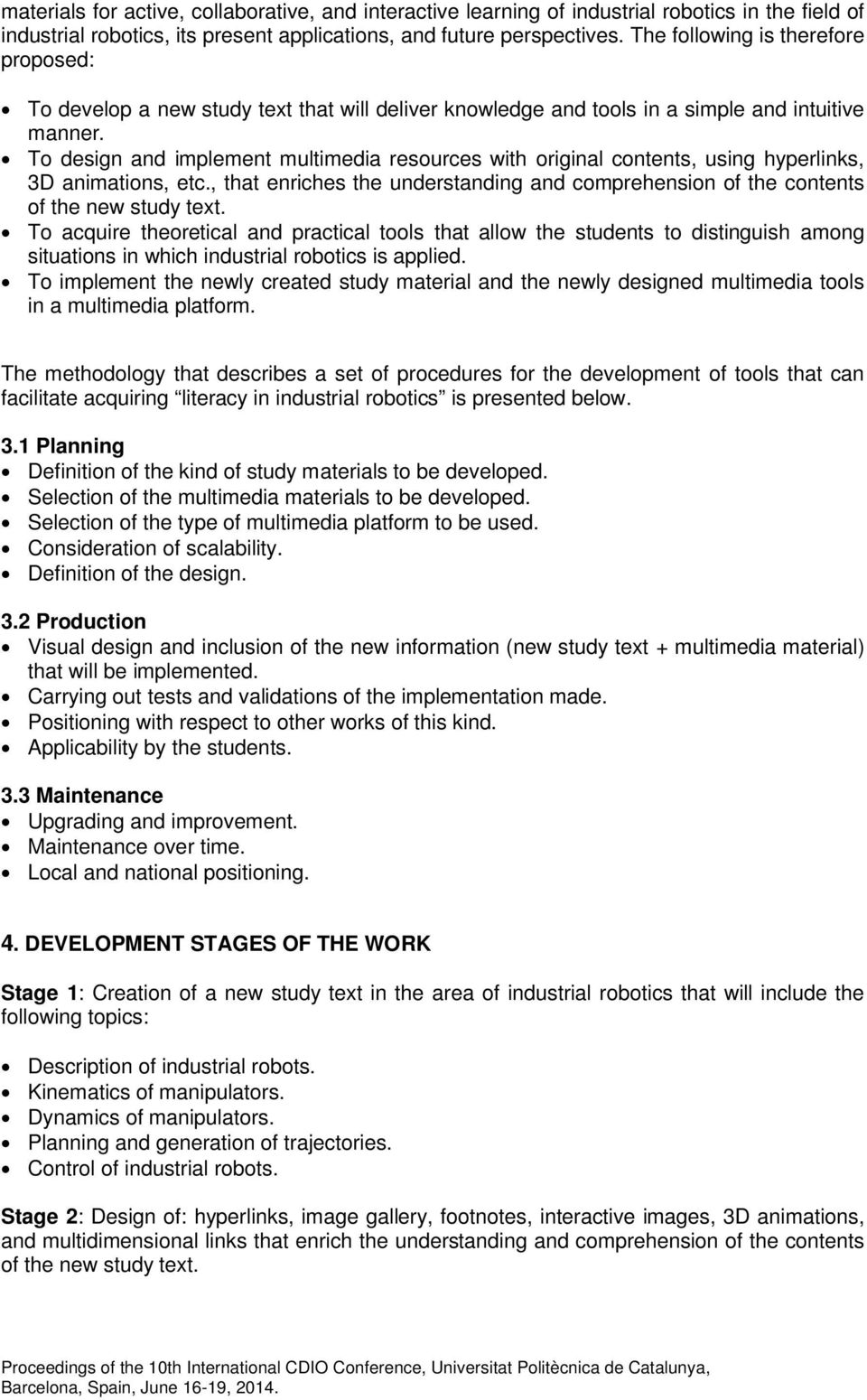
4 Stage 3: From the new study text created in Stage 1 and from all the multimedia material developed in Stage 2, the process needed to implement these contributions takes place in this stage, uploading its contents to a multimedia platform. Stage 4: Make tests and validations of the results of the implementations. 5. ADVANCES OF THE IMPLEMENTATIONS According to the tool development methodology presented in section 3 of this paper, the advances of the implementations carried out to date are presented below. After the creation of a new study text that includes the topics of the industrial robotics area described in Stage 1, a multimedia work platform called MOODLE 2.0 (Modular Object- Oriented Dynamic Learning Environment) was selected, corresponding to a web application of the virtual educational environment type, with free distribution, that helps educators to create online learning communities. The reason for choosing this multimedia platform is that its design is based on constructivist pedagogy, in which knowledge is constructed in the mind of the student instead of being transmitted without changes from books or through teaching, and on collaborative learning. The teacher that uses this multimedia platform creates a student-centered environment that helps the students build knowledge based on their own skills and knowledge -but considering the contributions delivered by the educator- instead of the teacher simply publishing and transmitting the information which he considers that the students must know. Another advantage of using this multimedia platform is that it allows group interaction and at the same time it allows private conversation between the students. This tool can be accessed at where the students registered in this course must enter their own user name and password. After entering, the student will see the following screen: Figure 1. Entry screen to the learning tool. As seen in Figure 1, the student can choose either links of academic interest, wikis on robotics (information relevant to the diversity of robotics, including history, technology, etc.), chapters with course contents, etc.
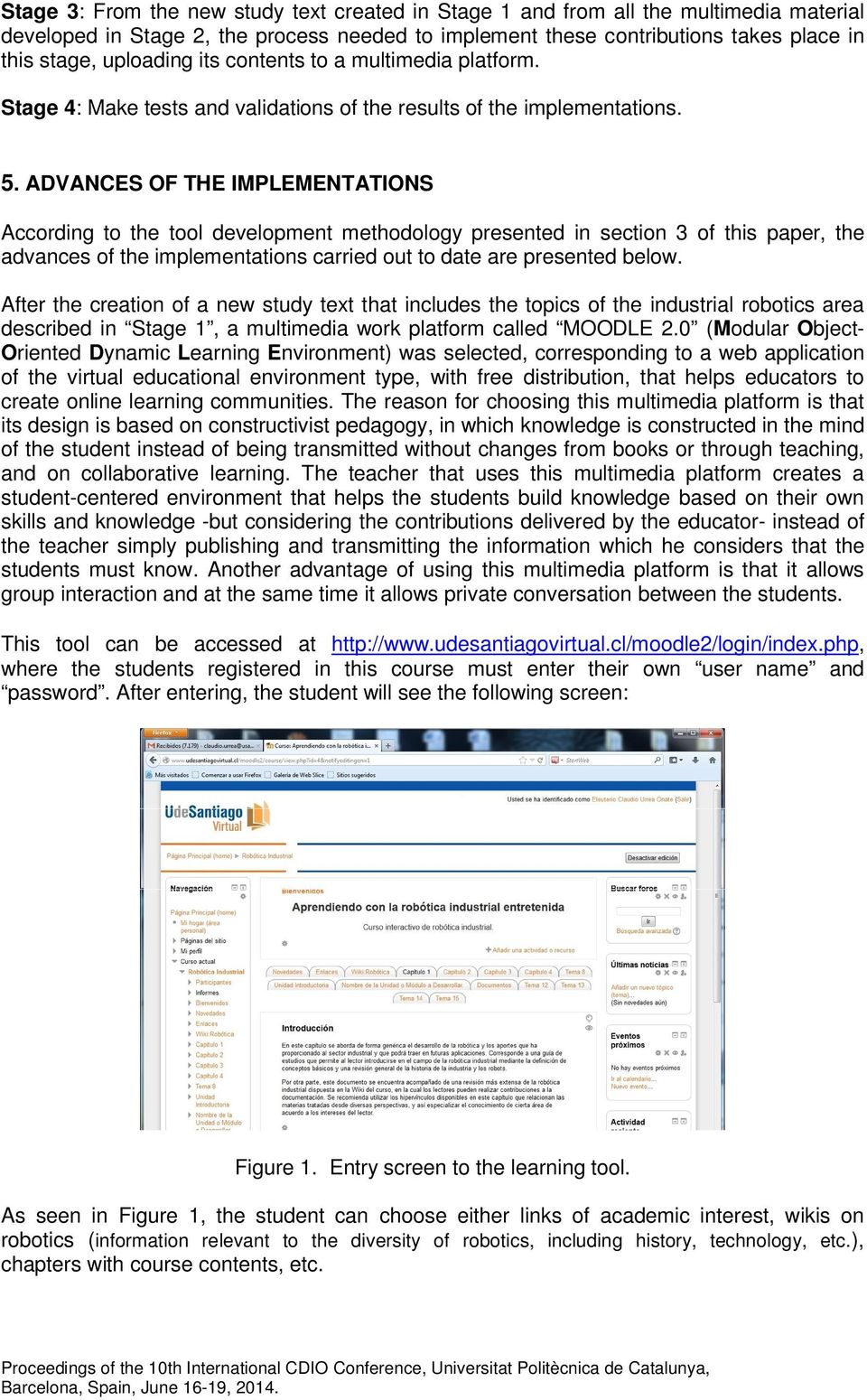
5 Once the student has selected to visit the course contents, if he chooses the first chapter the screen shown in Figure 2 will appear, where the information can be read directly from the screen or it can be downloaded in pdf format to be studied later. Every chapter has hyperlinks that will let him go more deeply into every stage of the study, but this will depend on the emphasis that it is desired to give to each topic within the vast range of knowledge considered in this tool for literacy in industrial robotics. Figure 2. Screen: The concept behind the term robotics. Figure 3 shows hyperlinks related to other robotics settings that allow the students to achieve learning beyond industrial robotics itself. Figure 3. Screen with hyperlinks to kinds of android robots.

6 Following the methodology for the development of this tool, work is currently being done on: Complementing its visual design, i.e., hyperlinks, image gallery, footnotes, interactive images, 3D animations, and multidimensional links that will enrich the understanding and comprehension of the contents of the newly implemented interactive study text. Making tests and validations of the implementation. Positioning with respect to other works of this kind. Applicability by the students. Once this production is ended, maintenance of this tool over time will be performed, considering upgrades and improvements according to suggestions that may be delivered by the users (students) themselves. 6. EXPECTED RESULTS To have new interactive study materials that stimulate active, collaborative and interactive learning in the setting of industrial robotics, its present applications and future perspectives, in a simple, intuitive and non-encrypted manner, that will have a significant impact on the formative process of the students thanks to the acquisition of theoretical and practical tools that will allow them to distinguish among situations in which industrial robotics participates in national reality. 7. EXPECTED IMPACTS Consolidation of a teaching-learning process related to the integral training approach of graduate and undergraduate students. Increasing student retention rates thanks to the active, collaborative and interactive learning process. Graduates with the best labor insertion. Contributing to the continuous strengthening of the institutional activities of the Universidad de Santiago de Chile. 8. CONCLUSIONS The teaching of robotics in classrooms, as presented in this paper is a pertinent and contemporary resource with didactic rather than technological purposes that allows following the road of pedagogical renewal. This, like any change, requires effort and dedication, and whose ultimate purpose is to improve the quality of education in the local and national settings, because it will be providing knowledge and developing the skills needed for performing well in the study of this discipline, facilitating the understanding of written matter and the comprehension of knowledge. A significant impact on professional, academic, and labor success and on the students' personal development is expected. In general, students can behave very early as young scientists and engineers if they are given the proper tools and they are allowed to apply basic principles of scientific research such as observing, testing, comparing and contrasting phenomena related to robotics, predict their operation, and record their individual and collaborative experience. That is why this paper offers an improvement of the institution's ability to generate effective learning in graduate and undergraduate students in the industrial robotics setting, considering all its transverse and multidisciplinary character.
7 BIBLIOGRAPHIC REFERENCES Acuña, A. (2004). Robótica y aprendizaje por Diseño. EDUCACIÓN AÑO XLVIII- XLIX, , I-II. Alimisis, D. (2012). Robotics in Education & Education in Robotics: Shifting Focus from Technology to Pedagogy, In Proceedings of the 3rd international conference on Robotics in Education, RiE2012. September 2012, pp MatfyzPress, Czech Republic. Angulo, J. M. (1985). Curso de Robótica, 2 nd edition, Paraninfo, Madrid, Spain. Angulo, J. M. (1996). Robótica Práctica: Tecnología y Aplicaciones, 4 th edition, Paraninfo, Madrid, Spain. Andeen, G. (1988). Robot Design Handbook, McGraw Hill, New York, USA. Ángeles, J. (1997). Fundamentals of Robotics: Mechanical System, Theory, Methods and Algoritms, Springer, New York, USA. Arratia, J. (1985). Introducción a la Robótica industrial, Instituto Profesional de Valdivia, Departamento de Electricidad, Valdivia, Chile. Asada, H. (1986). Robot Analysis and Control, John Willey, New York, USA. Asociación de Robótica Educativa Complubot (2014). Complubot, EducaMadrid, Madrid, Spain. Barrientos, A. (1997). Fundamentos de Robótica, 1 st edition, McGraw Hill, Madrid, Spain. Brady, M. (1982). Robot Motion: Planning and Control, MIT Press, Cambridge, England. CEAR (2014). Robótica Educativa, Centro de Estudios de Argumentación y Razonamiento, Universidad Diego Portales, Santiago, Chile. Craig, J. (1988). Adaptive Control of Mechanical Manipulators, Addison-Wesley, New York, USA. Craig, J. (1989). Introduction to Robotics Mechanics and Control, Addison-Wesley, New York, USA. Critchlow, A. (1985). Introduction to Robotics, McMillan, New York, USA. Engelberger, J. (1985). Los Robots Industriales en la Práctica, Deusto, Bilbao, Spain. Ferrada, P. (2014). Robótica Educativa, Universidad de Concepción, Concepción, Chile. Fu, K. (1988). Robótica: Control, Detección, Visión e Inteligencia, 1 st edition, McGraw Hill, Madrid, Spain. Fulle, J. (1991). Robotics: Introduction, Programming, and Projects, 3 rd edition, Macmillan, New York, USA. Gatica, N.; Ripoll, M. and Valdivia, J. (2005). La Robótica Educativa como Herramienta de Apoyo Pedagógico. Las TIC en el Aula, Madrid: Anaya, Spain. Groover, M. (1989). Robótica industrial: Tecnología, Programación y Aplicaciones, McGraw Hill, Madrid, Spain. Grupo SIRP (2014). Robótica el Descubierto, Licencia Creative Commons 3.0. Plantilla Picture Window.

8 Harrison, D. (1986). Robots: Su Estudio con Ayuda del Ordenador, Anaya, Madrid, Spain. IRE (2014). Taller de Robótica Escolar, Interescolar de Robótica Educativa, Chile. Kelly, R. (2005). Control of Robot Manipulators in Joint Space, 1 st edition, Springer Verlag, London. Klafter, R. (1989). Robotic Engineering: An Integrated Approach, Engledwood Cliffs, New York, USA. McComb, G. (2001). The Robot Builder s Bonanza, 2 nd edition, McGraw Hill, New York, USA. Merino, E. (2014). Robot educativo moway, EDUTEKA, Portal Educativo gratuito de la Fundación Gabriel Piedrahita Uribe (FGPU), Cali, Colombia. ivoox (2014). Robótica Educativa como herramienta para desarrollo de competencias, ivoox audiokiosko, Barcelona, Spain. Minsky, M. (1985). Robotics, Ovni Press, Garden City, New York, USA. Murray, R. (1994). A Mathematical Introduction to Robotic Manipulation, CRC Press, Boca Raton. National Aeronautics and Space Administration (2014). Educational Robotics Matrix, National Aeronautics and Space Administration (NASA), USA. Nehmzow, U. (2000). Mobile Robotics: a Practical Introduction, Springer-Verlag, London. Niku, S. (2001). Introduction to Robotics: Analysis, Systems, Applications, Prentice Hall, New Jersey, USA. Pawson, R. (1986). El Libro del Robot, Gustavo Gili, Barcelona, Spain. PerúEduca (2014). Robótica Educativa, Ministerio de Educación, Peru. Pires, J. (2006). Welding Robots: Technology, System Issues and Applications, Springer Verlag, London. Pires J. (2007). Industrial Robots Programming: Building Applications for the Factories of the Future, Springer Verlag, New York, USA. Rentaría, A. (2000). Robótica industrial: Fundamentos y Aplicaciones, 1 st edition, McGraw Hill, Madrid. Reyes, F. (2011). Robótica: Control de Robots Manipuladores, Marcombo, S.A. Alfaomega. Robotero RO-BOTICA (2014). Robótica educativa para educadores y pedagogos, ROBOTEROS.com La Red Social de Robótica Personal, Barcelona, Spain. Robótica Educativa de México S.A. (2014). Róbo-Ed, Escuelas Róbo-Ed, Mexico. Sánchez, M. (2004). Ambientes de Aprendizaje con Robótica Pedagógica. Tecnologías de Información y Comunicaciones para la Enseñanza Básica y Media. Sandler, B. (1999). Robotics: Designing the Mechanism for Automated Machinery, 2 nd Academic Press, San Diego, USA. edition,
9 Schilling, R. (1990). Fundamentals of Robotics: Analysis and Control, Prentice-Hall, New York, USA. Schmitt, N. (1988). A Fondo: Robótica y Sistemas Automáticos, Anaya Multimedia, Madrid, Spain. Sharon, D. (1987). Robotics and Automated Manufacturing, 1 st edition, Pitman Publishing, London. Silva, M. (1983). Inteligencia Artificial y Robótica Industrial, Zaragoza, Secretariado de Publicaciones, Universidad de Zaragoza, Spain. Skowronski, J. (1989). Control Theory of Robotic Systems, World Scientific, Singapore. Spong, M. (1993). Robot Control: Dynamics, Motion Planning, and Analysis, Institute of Electrical and Electronics Engineers, New York, USA. Spong, M. (1989). Robot Dynamics and Control, John Wiley & Sons, New York, USA. Spong, M. (1989). Robot Modeling and Control, John Wiley & sons, New York, USA. RobotShop (2014). Robotics Education, RobotShop, USA, Canada & Europe. Thomas, D. (1991). Planning and Control, M. Kaufmann Publishers, California, USA. The Robotics Academy (2014). LEGO, the LEGO logo and MINDSTORMS, The National Robotics Engineering Center, Carnegie Mellon University, Pittsburgh, USA. The Robotics Education & Competition Foundation (2014). Inspiring students, one robot at a time, The Robotics Education & Competition Foundation (REC), Rockwall, Texas, USA. BIOGRAPHICAL INFORMATION Claudio Urrea, Ph.D. is currently Professor at the Electrical Engineering Department, Universidad de Santiago de Chile, from He has developed and implemented a Robotics Laboratory, where intelligent robotic systems are development and investigated. He is currently Director of the Doctorate in Engineering Sciences, Major in Automation, at the Universidad de Santiago de Chile. Manuel Vega, M.Sc. is a Senior Lecturer at the Electrical Engineering Department of the Universidad de Santiago de Chile. He got his Master Degree at Mc Gill University, Canada. His teaching interests include digital electronics, microcomputers and robots. He has been actively involved in the design and development of introduction to engineering courses. Corresponding author Dr. Claudio Urrea Universidad de Santiago de Chile Avenida Ecuador 3519 Estación Central, Santiago, Chile [email protected] This work is licensed under a Creative Commons Attribution-NonCommercial- NoDerivs 3.0 Unported License.
Curriculum Reform in Computing in Spain
 Curriculum Reform in Computing in Spain Sergio Luján Mora Deparment of Software and Computing Systems Content Introduction Computing Disciplines i Computer Engineering Computer Science Information Systems
La educación virtual como herramienta en la orientación educativa
 La educación virtual como herramienta en la orientación educativa Virtual education as a tool in educational guidance Ma. Guadalupe Medina Zúñiga Colegio de Bachilleres del Estado de Querétaro. [email protected]
Economic- Management. None. None
 ANTIOQUIA SCHOOL OF ENGINEERING General Management ACADEMIC DOMAIN CURRICULUM FIELD (POSTGRADUATE AND MASTERS) PREREQUISITE(S) COREQUISITE(S) SUBJECT CREDITS - COLOMBIANS - ECTS (COLOM x1.8) DIRECT TEACHING
Implementation of kalman filter for the indoor location system of a lego nxt mobile robot. Abstract
 Implementation of kalman filter for the indoor location system of a lego nxt mobile robot Leidy López Osorio * Giovanni Bermúdez Bohórquez ** Miguel Pérez Pereira *** submitted date: March 2013 received
Towards a Methodology for the Design of Intelligent Tutoring Systems
 Research in Computing Science Journal, 20: 181-189 ISSN 1665-9899 Towards a Methodology for the Design of Intelligent Tutoring Systems Enrique Sierra, Ramón García-Martínez, Zulma Cataldi, Paola Britos
THE STUDENT S PERSPECTIVE: TEACHING USAGES OF MOODLE AT UNIVERSITY
 THE STUDENT S PERSPECTIVE: TEACHING USAGES OF MOODLE AT UNIVERSITY José Sánchez-Santamaría, Francisco Javier Ramos, Pablo Sánchez-Antolín University of Castilla-La Mancha (SPAIN) [email protected],
Active methodology in the Audiovisual communication degree
 Available online at www.sciencedirect.com Procedia Social and Behavioral Sciences 2 (2010) 4487 4491 WCES-2010 Active methodology in the Audiovisual communication degree J.L Gimenez-Lopez a *, T. Magal
DOCUSCHEMAS: EXPERIENCING WITH A MULTIMEDIA TOOL FOR SUPPORTING HIGHER EDUCATION
 DOCUSCHEMAS: EXPERIENCING WITH A MULTIMEDIA TOOL FOR SUPPORTING HIGHER EDUCATION Carolina Franco Espinosa, Jose Jesus García Rueda, Rebeca Román Julián Departamento de Ingeniería Telemática, Universidad
Methodologies development and software quality metrics in educational applications
 Methodologies development and software quality metrics in educational applications JOAN F. CHIPIA LOBO Maestría en Educación mención Informática y Diseño Instruccional Universidad de Los Andes La Liria,
Curriculum Vitae Lic. José Rafael Pino Rusconi Chio +52 (998) 119 40 78 http://www.joserafaelpinorusconichio.com/ rpino67@hotmail.
 Curriculum Vitae Lic. José Rafael Pino Rusconi Chio +52 (998) 119 40 78 http://www.joserafaelpinorusconichio.com/ [email protected] Content 1) Professional summary... 1 2) Professional Experience....
of knowledge that is characteristic of the profession and is taught at professional schools. An important author in establishing this notion was
 Mathematics teacher education and professional development João Pedro da Ponte [email protected] Grupo de Investigação DIFMAT Centro de Investigação em Educação e Departamento de Educação Faculdade de Ciências
the task- Based Approach: a way to improve the didactic competence of pre-service teachers in Colombia using technology
 ABSTRACT the task- Based Approach: a way to improve the didactic competence of pre-service teachers in Colombia using technology This article focuses its attention on an innovative application of the Task-Based
Mario Quintanilla Gatica
 Development of Teacher Students Thinking Skills and Its Relation to Acquisition of Pedagogical Content Knowledge for Science Teaching in High School Mario Quintanilla Gatica Laboratorio de Investigación
1.- NAME OF THE SUBJECT 2.- KEY OF MATTER. None 3.- PREREQUISITES. None 4.- SERIALIZATION. Particular compulsory 5.- TRAINING AREA.
 UNIVERSIDAD DE GUADALAJARA CENTRO UNIVERSITARIO DE CIENCIAS ECONÓMICO ADMINISTRATIVAS MAESTRÍA EN ADMINISTRACIÓN DE NEGOCIOS 1.- NAME OF THE SUBJECT Selected Topics in Management 2.- KEY OF MATTER D0863
Graphic design in bachelor's degree in industrial design engineering and product development
 Available online at www.sciencedirect.com Procedia - Social and Behavioral Sciences 51 ( 2012 ) 4 9 ARTSEDU 2012 Graphic design in bachelor's degree in industrial design engineering and product development
Teaching guide for the course: HUMAN RESOURCE MANAGEMENT. Degree program: Degree in Business Administration and Management
 Teaching guide for the course: HUMAN RESOURCE MANAGEMENT Degree program: Degree in Business Administration and Management Year 2012-2013 Teaching Guide 1. Information about the course Name Subject Module
Curriculum Vitae: Maria-Jose Vieira
 León (Spain), June 2010 Curriculum Vitae: Maria-Jose Vieira Personal details First Name: Maria-Jose Family Name: Vieira Nationality: Spanish Current Position: Associate Professor in Educational Sciences
Diploma course ICT and informational advanced competences for in-service primary and secondary teachers in Mexico
 ISSN 1989-9572 Diploma course ICT and informational advanced competences for in-service primary and secondary teachers in Mexico Diplomado de TIC y competencias informacionales avanzadas para maestros
Sthephanny Moncada Linares (Universidad La Gran Colombia) Andrea Carolina Díaz Romero 1/17
 A Model for Evaluating Spanish Language Learning Websites Coherent with the Communicative Language Approach: Towards the Strengthen of the Teachers' Knowing-Howto-Do Knowledge in Digital Competence Sthephanny
MATHEMATICS KNOWLEDGE FOR TEACHING WITHIN A FUNCTIONAL PERSPECTIVE OF PRESERVICE TEACHER TRAINING
 MATHEMATICS KNOWLEDGE FOR TEACHING WITHIN A FUNCTIONAL PERSPECTIVE OF PRESERVICE TEACHER TRAINING Pedro Gómez Universidad de Granada C/. Alisios 17, Albolote 18820, Spain Phone/Fax: (34)958537304 [email protected]
Evaluation of an exercise for measuring impact in e-learning: Case study of learning a second language
 Evaluation of an exercise for measuring impact in e-learning: Case study of learning a second language J.M. Sánchez-Torres Universidad Nacional de Colombia Bogotá D.C., Colombia [email protected]
EXECUTIVE MASTER IN BUSINESS MANAGEMENT International Edition
 MASTER Department of Business Economics EXECUTIVE MASTER IN BUSINESS MANAGEMENT International Edition 2013-2014 Edition October 2013 September 2014 60 ECTS (European Transfer System) Universitat Autònoma
Data Science & Engineering Consortium Initiative
 Data Science & Engineering Consortium Initiative A vision from the University of Santiago de Compostela Alberto Bugarín Affiliated Researcher Centro Singular de Investigación en Tecnoloxías da Información
TEACHING AND LEARNING JURIDICAL SCIENCES BY MEANS OF CONCEPTUAL MAPS. A TRIAL WITH CMAPTOOLS
 TEACHING AND LEARNING JURIDICAL SCIENCES BY MEANS OF CONCEPTUAL MAPS. A TRIAL WITH CMAPTOOLS María de la Sierra Flores Doña y Marta Blanco Carrasco Facultad de Derecho, Universidad Complutense Madrid,
ACCESSIBLE AND INCLUSIVE HIGHER EDUCATION: THE ESVI-AL PROJECT
 ACCESSIBLE AND INCLUSIVE HIGHER EDUCATION: THE ESVI-AL PROJECT Markku Karhu Helsinki Metropolia University of Applied Sciences Concha Batanero, Antonio García-Cabot, Eva García-López Universidad de Alcalá
Learning about the influence of certain strategies and communication structures in the organizational effectiveness
 Learning about the influence of certain strategies and communication structures in the organizational effectiveness Ricardo Barros 1, Catalina Ramírez 2, Katherine Stradaioli 3 1 Universidad de los Andes,
A self-directed Virtual Learning Environment: Mi propio jefe (My own boss)
 A self-directed Virtual Learning Environment: Mi propio jefe (My own boss) Diego Ernesto Leal Fonseca, Gerardo Tibaná Herrera ([email protected], [email protected]) LIDIE Research and Development
Full professor and 6 assistant professors of IT A new school in IT Cameroon
 We are pleased to present our selection of the academic vacancies at Computeroxy.com - your academic website exclusively dedicated to careers in schools of computer, electrical and mathematical sciences
Bachelor Degree in Informatics Engineering Master courses
 Bachelor Degree in Informatics Engineering Master courses Donostia School of Informatics The University of the Basque Country, UPV/EHU For more information: Universidad del País Vasco / Euskal Herriko
The documentation in support of the museum management and knowledge management
 The documentation in support of the museum management and knowledge management 1 INTRODUCTION 1.1 The science, technology and knowledge The use of new technologies in Latin American countries, has profoundly
Curriculum Vitae. Transport Engineer (Bsc.), Pontificia Universidad Católica de Valparaíso, 1998.
 Curriculum Vitae 1 Personal Information Name : Miguel Ángel Vargas Román. Date of Birth : 27th October 1971. Citizenship: Chilean. Address : 253 Manuel Rodríguez Sur, Santiago, Chile Fone : +56-2-6762252.
Software Development Emphasis in Informatics Engineering Curriculum
 CREATIVE MATH. 13 (2004), 127-132 Software Development Emphasis in Informatics Engineering Curriculum Cristian Rusu and Jorge Bozo Abstract. A six-year undergraduate program in Informatics Engineering
Europass Curriculum Vitae
 Europass Curriculum Vitae Personal information First name(s) / Surname(s) Germán Ros-Sánchez Address(es) (1) Prat de la Riba, #33, 3 rd floor (3 rd door). Cerdanyola del Vallès 08290, Barcelona (Spain).
Higher Education in Business Administration in Spain: Adapting to the European Area of Higher Education *
 Higher Education in Business Administration in Spain: Adapting to the European Area of Higher Education * Leandro Cañibano Professor of Financial Economics and Accounting Autonomous University of Madrid
MANUFACTURING PROCESSES II
 SUBJECT: MANUFACTURING PROCESSES II CÓDE: IP0247 EFFECTIVE FROM: 2009-2 TIMES A WEEK: 80 HOURS BY SEMESTER METHOD UNION COURSE CHARACTERISTICS LECTURE INTEGRATED WITH LAB PREREQUISITES MANUFACTURING PROCESSES
YEARS. Engineering and Innovation for the Industry and Mining.
 Cursos de riesgos control ambienta Cursos de riesgos control ambiental Cursos de riesgos control ambienta Cursos de riesgos control ambiental Cursos de Cursos de riesgos, Cursos de cursos de riesgos Cursos
Game - based learning in education
 4 th International Conference "Education Facing Contemporary World Issues", Piteşti, Romania, 2010, October, 8 th 9 th Procedia Edu -World 2010 Game - based learning in education Michaela Logofatu a, Anisoara
Training in Cartography: e-learning Courses in Thematic Cartography
 Training in Cartography: e-learning Courses in Thematic Cartography Concepción Romera and Judith Sánchez National Atlas and Thematic Cartography Department ([email protected], [email protected]) National
COURSE GUIDE: Ubiquitous Computing and Ambient Intelligence (UCAMI)
 COURSE GUIDE: Ubiquitous Computing and Ambient Intelligence (UCAMI) Academic year: 2013-2014 Program: Center: University: Communication Technologies (i 2 -CIT) Universidad Autónoma de Madrid Last modified:
Spain: ICT R&D and participation to FP7
 Spain: ICT R&D and participation to FP7 Research & Development expenditure in ICT In 2011, public support for ICT R&D (ICT GBAORD) in Spain was 686.7M, roughly 9% of total public funding for R&D, which
LUIS VALENTÍN FERRADA WALKER [email protected], [email protected] Av. Suecia Nº 695, Dpto. 507, Providencia, Santiago, Chile +56-9-9-243.69.
 LUIS VALENTÍN FERRADA WALKER [email protected], [email protected] Av. Suecia Nº 695, Dpto. 507, Providencia, Santiago, Chile +56-9-9-243.69.21 Education Universidad de Chile, Santiago PhD Candidate
New educational approach based on the use of wiki platforms in university environments
 New educational approach based on the use of wiki platforms in university environments Juan Ortega Valiente Departamento de Ingenierías TIC Alfonso X el Sabio Madrid, Spain [email protected] Antonio J.
DEVELOPMENT AND ASSESSMENT OF COMPETENCES THROUGH PARTICIPATIVE LEARNING METHODOLOGIES FOR CORPORATE ACCOUNTING (OPERACIONES SOCIETARIAS)
 DEVELOPMENT AND ASSESSMENT OF COMPETENCES THROUGH PARTICIPATIVE LEARNING METHODOLOGIES FOR CORPORATE ACCOUNTING (OPERACIONES SOCIETARIAS) Carretié Arangüena, Héctor Business Management Department Faculty
José Antonio Casares González
 PERSONAL INFORMATION José Antonio Casares González Avda. Profesor Domínguez Ortiz 4, portal 4, 3ºA, 18014 Granada (España) 625171862 [email protected] Sex Male Date of birth 17/05/1975 Nationality
ADMINISTRATION OR MANAGEMENT; A TERM DILEMMA. ABSTRACT
 ADMINISTRATION OR MANAGEMENT; A TERM DILEMMA. ARMANDO SANCHEZ MACIAS UNIVERSIDAD DE ESTUDIOS AVANZANZADOS, CAMPUS SAN LUIS POTOSÍ, MÉXICO. ABSTRACT The present paper deals with the task of revising two
COLOMBIAN LINGUISTIC POLICY: THE TEACHER PROFESSIONAL DEVOLOPMENT AND THE CHALLENGES TO IMPLEMEN IT
 COLOMBIAN LINGUISTIC POLICY: THE TEACHER PROFESSIONAL DEVOLOPMENT AND THE CHALLENGES TO IMPLEMEN IT INGRID RODRIGUEZ-MONTAÑO University of Bordeaux LACES [email protected] 1. The Colombian Language
The Art of Computer Graphics Programming: Translating Pioneer Programs
 The Art of Computer Graphics Programming: Translating Pioneer Programs Viviane Alencar State University of Campinas, Brazil [email protected] Gabriela Celani State University of Campinas, Brazil [email protected]
Doctor of Philosophy in Computer Science
 Doctor of Philosophy in Computer Science Background/Rationale The program aims to develop computer scientists who are armed with methods, tools and techniques from both theoretical and systems aspects
Integration of WebLab Systems in Engineering Studies
 Integration of WebLab Systems in Engineering Studies Authors: Juan Ignacio Larrauri, Department of Control and Industrial Electronics, Faculty of Engineering, University of Deusto, Avda. Universidades,24.
Universidad de Alcalá
 Circuit Electronics Degree in Electronic Communications Engineering Degree in Telecommunications Systems Degree in Technology Telecommunication Telematics Engineering Universidad de Alcalá Academic Year
Sales Management and Techniques
 Sales Management and Techniques CODE 9987001403 COURSE DESCRIPTION The course takes a theoretical and practical route for the main concepts and sales tools, applied to the market reality. All this with
Prof. CARLOS A. ORTIZ, PhD(c), MBA, BS, LATG
 CURRICULUM VITAE Prof. CARLOS A. ORTIZ, PhD(c), MBA, BS, LATG OFFICE ADDRESS Office of Informatics and Educational Resources School of Health Professions University of Puerto Rico Medical Sciences Campus
DEGREE CURRICULUM SOFTWARE ARCHITECTURES Degree in Computer Engineering. Teaching staff: GIL IRANZO, ROSA MARIA GARCIA GONZALEZ, ROBERTO
 Academic year 2014-15 DEGREE CURRICULUM SOFTWARE ARCHITECTURES Degree in Computer Engineering Teaching staff: GIL IRANZO, ROSA MARIA GARCIA GONZALEZ, ROBERTO Subject's general information Subject name
Blogs, Webinars and Significant Learning: A Case Report on a Teacher Training Program for College Teachers 1
 Blogs, Webinars and Significant Learning: A Case Report on a Teacher Training 1 Rodrigo Polanco-Bueno Universidad del Valle de México, México ([email protected]) Abstract This paper reports on
Universidad Autónoma de Guadalajara Unidad Académica de Educación Secundaria y Media Superior Middle School Guide of classes for the student
 Universidad Autónoma de Guadalajara Unidad Académica de Educación Secundaria y Media Superior Middle School Guide of classes for the student Department Computing and Computer Technology. Time for homework
María Laura Mosqueda Tablante
 María Laura Mosqueda Tablante Strategy consultant at Rooter and Co-Founder LeKAdvisor.com Summary Thinking big and focus on key inputs for successful business outcomes and social impact projects related
Link. Links. Links. Links. Network. Links. Currículum - Portafolio. Content. Community. Community. Online. Feedback. Feedback. Twitter.
 Username manager Facebook Currículum - Portafolio manager Facebook Comunication CV Username manager Facebook manager Facebook Comunication Facebook Comunication Información Personal Soy Periodista y Comunicador
Causes of desertion in the English teaching and translation bachelors degree programs and prevention mechanisms 2002-1-2005-2
 Causes of desertion in the English teaching and translation bachelors degree programs and prevention mechanisms 2002-1-2005-2 Martha E. Guzmán O. - Responsible for the Coordination of Educative and Psychological
NEW TRENDS IN HIGHER EDUCATION MANAGEMENT: TEACHERS' PERCEPTION OF THE INCLUSION OF LIBRARIES' E-SERVICES INTO LMS
 NEW TRENDS IN HIGHER EDUCATION MANAGEMENT: TEACHERS' PERCEPTION OF THE INCLUSION OF LIBRARIES' E-SERVICES INTO LMS Anita Papić J. J. Strossmayer University of Osijek, Croatia [email protected] Ivanka Stričević
PAPER TO PRESENT AT THE Education and Research Technology (ERT) Forum May 26-28, 2010 California, USA. Sponsored by University of Southern California
 Referencia: Mortera, F. J., y Burgos, V. (2010). Innovative Applications Using New Technology: The Case of the Knowledge Hub Search Engine and Open Educational Resources Building Communities of Practice.
240EI032 - Human Resources Management
 Coordinating unit: Teaching unit: Academic year: Degree: ECTS credits: 2015 240 - ETSEIB - Barcelona School of Industrial Engineering 732 - OE - Department of Management MASTER'S DEGREE IN MATERIALS SCIENCE
Speech understanding in dialogue systems
 Speech understanding in dialogue systems Sergio Grau Puerto [email protected] Departament de Sistemes Informàtics i Computació Universitat Politècnica de València Sergio Grau Puerto. Carnegie Mellon: June
Memorias del XI Encuentro Nacional de Estudios en Lenguas (2010) ISBN: 978-607-7698-32-6 JCLIC A PLATFORM TO DEVELOP MULTIMEDIA MATERIAL
 JCLIC A PLATFORM TO DEVELOP MULTIMEDIA MATERIAL Abstract Bianca Socorro García Mendoza Eduardo Almeida del Castillo Tecnológico de Estudios Superiores de Ecatepec Facultad de Estudios Superiores Acatlàn,
Project-Based Learning of Scientific Writing and Communication Skills for Postgraduate Students
 Project-Based Learning of Scientific Writing and Communication Skills for Postgraduate Students Anthony Mandow, Jorge L. Martínez, and Alfonso García-Cerezo Universidad de Málaga Andalucía Tech Departamento
Online Computer Science Degree Programs. Bachelor s and Associate s Degree Programs for Computer Science
 Online Computer Science Degree Programs EDIT Online computer science degree programs are typically offered as blended programs, due to the internship requirements for this field. Blended programs will
Prof. Giulio GIUNTA. Professor of Scientific Computing (01/A5) Department of Applied Science Parthenope University Naples, 80143, Italy
 Prof. Giulio GIUNTA Professor of Scientific Computing (01/A5) Department of Applied Science Parthenope University Naples, 80143, Italy [email protected] http://dsa.uniparthenope.it/giulio.giunta
Dave Rojas. Summary. Experience. Software Engineer - Web Developer & Web Designer [email protected]
 Dave Rojas Software Engineer - Web Developer & Web Designer [email protected] Summary Software Engineer with humanistic tendencies. Passionated about Web development and Web design with a critical and
Intelligent Systems to Assist in Cytological Diagnosis and to Train Cytotechnics TIN2004-07236
 Jornadas de Seguimiento de Proyectos, 2007 Programa Nacional de Tecnologías Informáticas Intelligent Systems to Assist in Cytological Diagnosis and to Train Cytotechnics TIN2004-07236 Jose Manuel Zurita
Undergraduate education part of the development plan of KTH CSC June 2008
 Undergraduate education part of the development plan of KTH CSC June 2008 Programmes The aim of the Master of Science in Engineering program in Computer Science and Engineering is to give graduate engineers