
Annual Report 2013 / 2014
|
|
|
- Kerry Stephens
- 10 years ago
- Views:
Transcription
1 Annual Report 2013 / 2014
2 Key figures of the SinnerSchrader group 2013/ /2013 change Net revenues 000s 48,601 36, % EBITA 000s 3, % Relation of the EBITA to net revenues (Operating margin) % % Net income attributable to the shareholders of SinnerSchrader AG 000s 1,843 1 > +1,000 % Earnings per share, fully diluted > +1,000 % Cash flows from operating activities 000s 1,517 2, % Employees, full-time equivalents number % change Liquid funds and securities 000s 5,833 5,949 2 % Shareholders equity 000s 14,062 12, % Shareholders equity rate % % Employees, end of period number % Sinnerschrader share price performance 2013/ % XETRA closing prices in % +/ compared to price on (= 100 %) SinneR Schrader DAX 0 % 20 % 09/13 10/13 11/13 12/13 01/14 02/14 03/14 04/14 05/14 06/14 07/14 08/14

3 Annual Report 2013 / 2014

4 #NE XT YEAR! 2015 RETHINK DIGITAL STRATEGY. HOW THE LATEST INNOVATIONS WILL SHAPE MARKETING IN 2015.

5

6 #in DE X#CONNECTION Everything is connected and things are starting to speak. Brands are creating new uses through the Internet of Things. Page 16 #intro Four paths to the NEXT Experience. How winning brands will be managed in Page 4 #COmmerce Challenge and opportunity meet head-on. Amazon and Apple are turning retailing on its head. Page 8 #CAMPAIGN The key to campaign success is data. But only if you can unlock their value. Page 30 #COnTENT The perfect path to new customers. Brands are carrying content for themselves. Page 24 #OUTRO What s NEXT? Digitalisation is triggering leadership transformation. Page 34

7 #In TR O NEXT Experience By NILS WOLLNY

8 NEXT EXPERIENCE No more marketing routine. Brands need digital user experiences with vision B 5 #INTRO next Experience

9 #INTRO next Experience Digitalisation marches on, changing everything in its path. It impacts on every single individual as well as on society as a whole, on business models and on entire industries. This change sets new challenges for companies as well as opening up new opportunities at the same time... with one prerequisite: an unconditional focus on the user and his or her needs. Services such as UBER or Netflix are showing how it is done. They combine commerce with connection, content and campaign to create an outstanding offering. NILS WOLLNY MANAGING DIRECTOR STRATEGY SINNERSCHRADER D B 6 NEXT GENERATION: I want it all, now Together with the rheingold institute, Sinner- Schrader carried out a qualitative study of young people between the ages of 6 and 29, asking about their digital life. The main finding: no one in this age group can imagine life without the smartphone or the services that come with it. Intensive and masterly interaction with digital technologies is the norm. They distinguish less between online and offline, and more between onscreen and offscreen although this boundary, too, is becoming increasingly blurred. Young people confront the daily torrent of offers and information with an out-andout digital mind-set: quick decisions based on a like or dislike logic, declining anything that does not promise immediate utility. The expectations of the digital experience that a brand can offer are based on its user value and on the criterion of maximum simplicity. Established players like Apple, Google or Facebook set the standards in terms of functionality, look and feel, and design. Everything in the digital space is compared with them. To continue to be perceived as a brand in this context requires focusing on the design of digital experiences. NEXT EXPERIENCE: the four elements of a digital brand Commerce Transactions of goods and services. Companies like Amazon have altered the buying behaviour of people enormously in the last two decades. The next wave of innovations, which will again revolutionise user behaviour, is imminent: mobile payment, intelligent logistics and beacon technology.

10 Connection connecting the physical and virtual worlds. Products such as the Apple Watch or Google Glass are raising the opportunities for wearables to a new level. At the same time, technologies like beacons and NFC are bringing about new types of services. In addition, private 3D printers are creating entirely new product categories. Content material which is of great interest to the user. Traditional advertising campaigns leave the NEXT GENERATION baffled. At the same time the auction models of the network giants are reducing the effectiveness of marketing spend. And aggregators are becoming the gatekeepers for digital offerings. For brands, therefore, developing a content strategy that offers genuine added value to the user is essential for survival. Campaign communication between a brand and its public. Campaigns are currently undergoing a twofold evolution: a change that is both systemic and contentbased. Thanks to new technologies, the distribution side of campaigns and content has become more effective, with message and content becoming both personalisable and adaptable in real time. A well-conceived and integrated NEXT EXPERIENCE can combine these four elements into a novel and convincing offering. Services like UBER and Netflix are already transforming the transportation and entertainment industries respectively, using: connection (vehicle tracking via smartphone or device-agnostic distribution), content (liberalisation of the travel business or Netflix own programs) and campaigns (affiliate marketing or social media) to create outstanding commercial propositions. NEXT AGENCY: The agency for a new age Developing such outstanding offerings and overseeing their realisation is only possible with a new type of agency: one that assists companies to keep pace with the speed of technologies and users because this is what they do themselves. One that analyses people s behaviour, gets to the bottom of it, and is in a position to alter it with its ideas. One that thinks in terms of holistically conceived, living systems, which are designed to grow and constantly change. SinnerSchrader interfaces with technology, people and brands, developing and implementing products and services that add value, and always with the user at heart. As the initiator of the international conference NEXT, we have been influencing digital trends for years. We fuse creative ideas and technology to develop solutions that make our clients successful. That is our claim. That s what makes us the NEXT AGENCY. B 7 Nils Wollny is Managing Director Strategy at Sinner- Schrader. Working and thinking usercentrically, he helps companies in diverse sectors to accelerate innovation and digitalisation. #INTRO next Experience

11 #co mm erce THE Amazon challenge by Olaf Kolbrück Mobile Payment by Meike Schreiber

12 the Amazon CHALLENGE What Amazon s dominant position means for costumers and marketers B 9 W When Amazon chief Jeff Bezos stopped off with friends at Mount Rushmore in 2001, he was himself something of a tourist attraction not as the CEO of a company that was powerful even back then but as the guy from the Taco bell TV ads, at the time for cheese tortillas. Perhaps Bezos has harboured an ambivalent relationship with advertising since then. For years Amazon ran a mile from TV spots. Before the digital giant did eventually book TV time for the #commerce AMAZON Challenge

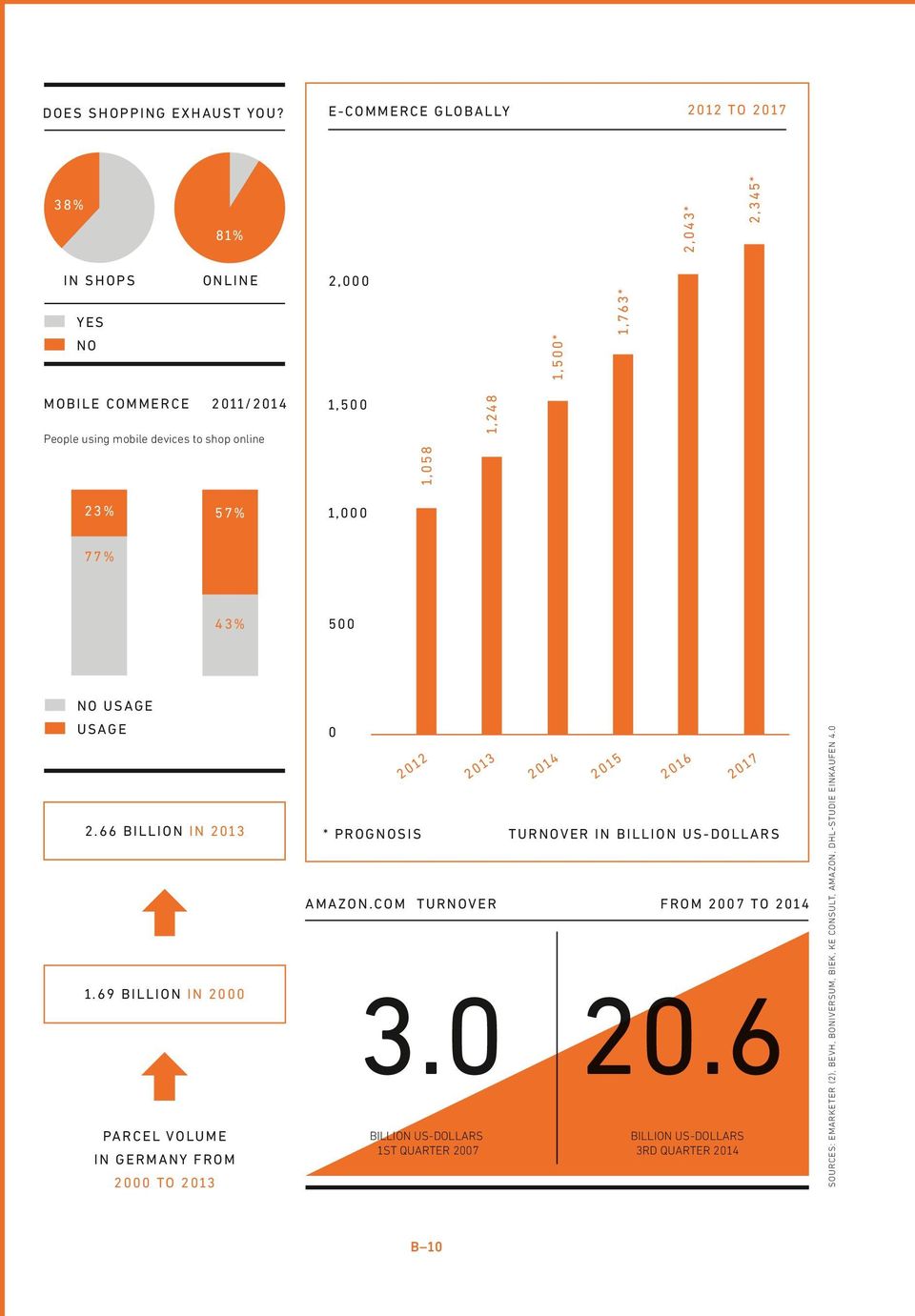
13 DOES SHOPPING EXHAUST YOU? E-COMMERCE GLOBALLY to % 8 1 % 2,043* 2,345* IN SHOPS ONLINE 2,000 YES NO 1,500* 1,500 1,058 1,763* MOBILE COMMERCE 2011/2014 People using mobile devices to shop online 1,248 23% 57% 1,000 77% 43% 500 NO USAGE USAGE 2.66 BILLION IN BILLION IN 2000 PARCEL VOLUME IN GERMANY FROM 2000 TO * PROGNOSIS TURNOVER IN BILLION US-DOLLARS AMAZON.COM TURNOVER FROM 2007 TO BILLION US-DOLLARS 1ST QUARTER 2007 BILLION US-DOLLARS 3RD QUARTER 2014 sources: emarketer (2), bevh, boniversum, BIEK, KE Consult, Amazon, DHL-Studie Einkaufen 4.0 B 10
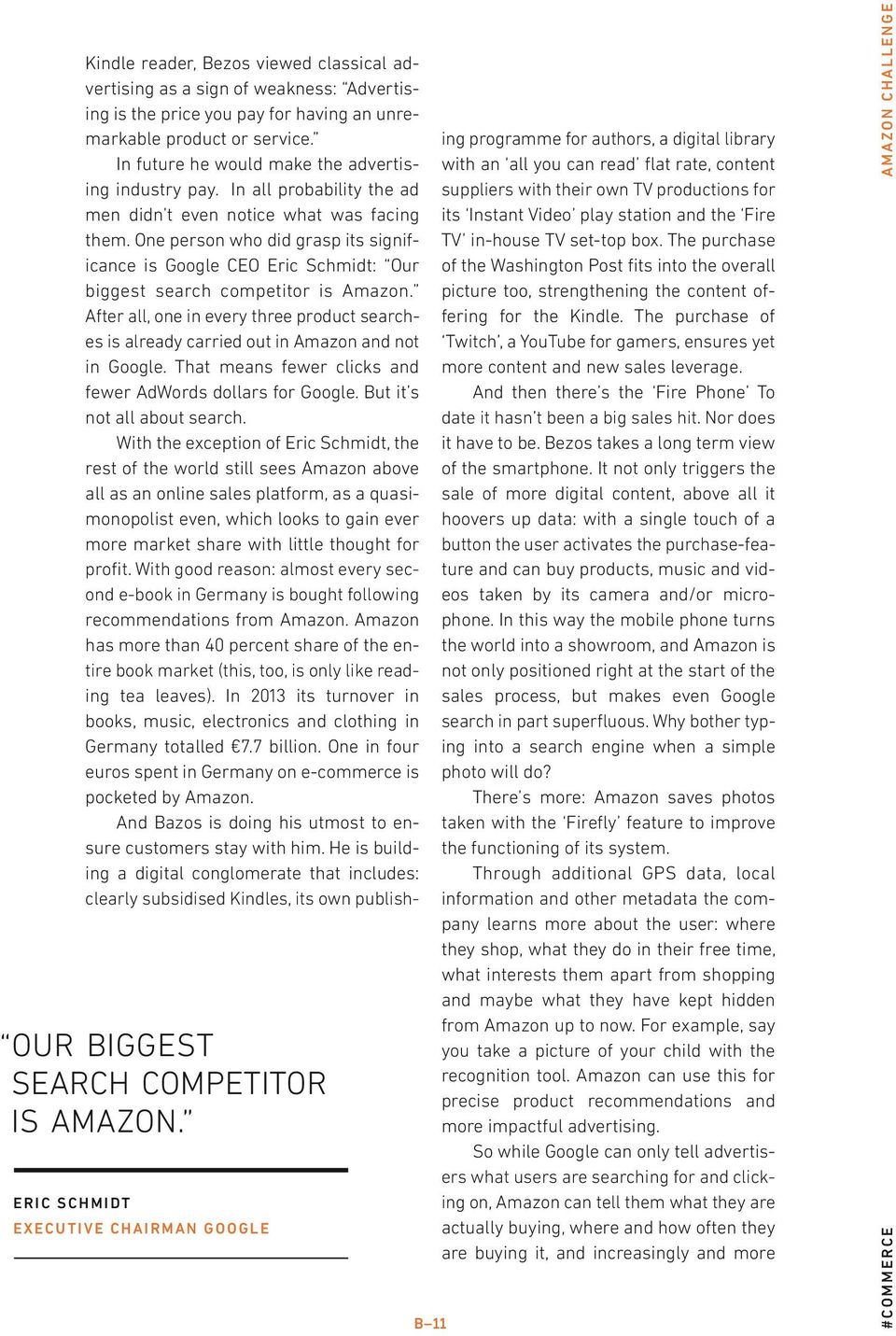
14 Our biggest search competitor IS Amazon. Eric Schmidt Executive Chairman Google B 11 Kindle reader, Bezos viewed classical advertising as a sign of weakness: Advertising is the price you pay for having an unremarkable product or service. In future he would make the advertising industry pay. In all probability the ad men didn t even notice what was facing them. One person who did grasp its significance is Google CEO Eric Schmidt: Our biggest search competitor is Amazon. After all, one in every three product searches is already carried out in Amazon and not in Google. That means fewer clicks and fewer AdWords dollars for Google. But it s not all about search. With the exception of Eric Schmidt, the rest of the world still sees Amazon above all as an online sales platform, as a quasimonopolist even, which looks to gain ever more market share with little thought for profit. With good reason: almost every second e-book in Germany is bought following recommendations from Amazon. Amazon has more than 40 percent share of the entire book market (this, too, is only like reading tea leaves). In 2013 its turnover in books, music, electronics and clothing in Germany totalled 7.7 billion. One in four euros spent in Germany on e-commerce is pocketed by Amazon. And Bazos is doing his utmost to ensure customers stay with him. He is building a digital conglomerate that includes: clearly subsidised Kindles, its own publishing programme for authors, a digital library with an all you can read flat rate, content suppliers with their own TV productions for its Instant Video play station and the Fire TV in-house TV set-top box. The purchase of the Washington Post fits into the overall picture too, strengthening the content offering for the Kindle. The purchase of Twitch, a YouTube for gamers, ensures yet more content and new sales leverage. And then there s the Fire Phone To date it hasn t been a big sales hit. Nor does it have to be. Bezos takes a long term view of the smartphone. It not only triggers the sale of more digital content, above all it hoovers up data: with a single touch of a button the user activates the purchase-feature and can buy products, music and videos taken by its camera and/or microphone. In this way the mobile phone turns the world into a showroom, and Amazon is not only positioned right at the start of the sales process, but makes even Google search in part superfluous. Why bother typing into a search engine when a simple photo will do? There s more: Amazon saves photos taken with the Firefly feature to improve the functioning of its system. Through additional GPS data, local information and other metadata the company learns more about the user: where they shop, what they do in their free time, what interests them apart from shopping and maybe what they have kept hidden from Amazon up to now. For example, say you take a picture of your child with the recognition tool. Amazon can use this for precise product recommendations and more impactful advertising. So while Google can only tell advertisers what users are searching for and clicking on, Amazon can tell them what they are actually buying, where and how often they are buying it, and increasingly and more #commerce AMAZON Challenge
15 #commerce AMAZON Challenge How to deal with amazon # Exploit presentation options such as product descriptions, product images, videos. # utilise Amazon advertising packages such as the Brand Store to expand your own channels. # offer only certain product lines on Amazon. # Strengthen and/or diversify through other sales channels. # Sell private labels and new products initially through your own channels only. precisely with an ever closer eye on the Customer Journey why they are buying it. Amazon has only really been a competitor for Schmidt since the company has been accused of going after more advertising spend and utilising its data goldmine to this end. Amazon already wants to start its own display advertising network in 2015 and to place advertising space similar to AdWords. Firstly the advertising will appear on its own website, and then later also on other publishers sites. In doing so Amazon is entering into direct competition with Google. And not just Google. The targeting goldmine impacts equally on marketers, technology providers and agencies. If Amazon starts to peddle its own personalisation algorithm and its data power, it will make these service providers superfluous to some extent. It is not just a case of Amazon being able to achieve outstanding conversion rates due to its data and its reach. With each single click Amazon enhances its know-how to improve its own products, its own content and its own services. B 12 There is a lesson in how this online giant deals with its partners: if the data shows that a new product is selling particularly well in a seller s marketplace, that is often a cue for Amazon to sell it directly undercutting all other prices in the process. If a consumer goods manufacturer comes to enjoy double-digit market share on Amazon, Amazon puts on a real squeeze for rebates and new terms, as book publishers in particular have found out, with corresponding impact on sales too. For Amazon is interested above all in low prices and cross-subsidisation of the manufacturer s and trader s advertising monies suits that goal perfectly. Charges (effectively tolls ) could work one day to the detriment of these brands, if Amazon were to support predatory pricing with marketing monies, to force through its own brands against the competition, for example. Or to undercut in the trader s marketplace. Ultimately, Amazon can always be cheaper, because it alone can avoid the Amazon charge. Olaf Kolbrück is founder and director of specialist e-commerce portal etailment.de and author of the book Erfolgsfaktor Online-Marketing. From 2000 to 2013 he was a reporter with HORIZONT magazine, with responsibility for internet and e-business.

16 Mobile Payment When your smartphone becomes your wallet B 13 W When Apple chief Tim Cook revealed the iphone 6 in autumn 2014, one new feature in particular caused lively debate especially among the brand s aficionados: the Apple Pay mobile payment function. Cook announced presumptuously: Apple Pay will forever change the way we buy. Time will tell. Owners of the new iphone have only been able to pay with it since october 2014 and so far only at 220,000 contact points in the US. At its heart is Near Field Communications (NFC) technology, which transmits data by a radio signal from mobile phone to a station. For security, users must identify themselves by fingerprint. In Europe, where NFC technology is actually more widespread than in the United States, the service is expected to be available to iphone users from 2015, by which time wearers of the Apple Watch in the US will also be able to use it. One thing is clear: paying is getting easier. A new technical revolution is around the corner. With the introduction of itunes, Apple has already proven that people s purchasing behaviour can be radically altered. For each Apple-Pay transaction of 100 dollars, the Americans pocket a 15 cent charge from participating banks and card providers which Apple claims makes it cheaper than other payment methods. #commerce mobile payment

17 #commerce mobile payment Up to now no technology has been able to establish itself on the mass market. The latest push from Apple with various credit card providers could change this in the medium term, however, wrote Deutsche Bank in a study of the FinTech sector. The trend is clear: in 2013 the volume of cashless payments globally rose by 9.4% to 366 billion transactions, compared to According to the latest Payment Report by consultancy firm Capgemini, this was due to the strong growth in emerging markets as well as increased use of credit and debit cards, especially in electronic and mobile payments. With more and more people using tablets and smartphones, the lines between online and mobile payments are becoming increasingly blurred, according to Capgemini. The consultancy anticipates an increase in mobile payments worldwide of around 60% per year from 2011 to For online payments, on the other hand, Capgemini has forecast a yearly rise of only 16% over the same period. Even in Germany, long a mecca for notes and coins, many more people are likely to pay without cash in the near future. Annual growth of mobile payments from 2011 to % B 14 The auditing and consulting firm PwC estimates that the 176,000 end users in Germany who currently pay by mobile will rise to 11 million by And Apple isn t necessarily the trailblazer. Many start-ups, banks and mobile phone operators already offer mobile payment options. And even the Ebay subsidiary PayPal is currently testing an app for mobile payments in Germany. However, thus far, no system has established itself. At present only 40,000 of the more than 740,000 payment terminals in Germany can communicate with mobile devices or special cards. That may change: MasterCard recently compelled all its German retail partners to convert their terminals to NFC technology by 2018 at the latest. A survey by the EHI Retail Institute of 55 retailers with a total of 58,300 outlets found that 81 per cent want to upgrade their cashier systems. But what about the banks, whose core business is, after all, payments? For the time being they are relieved that Apple continues to cooperate with them. The German Sparkassen (savings banks), for example, have already announced that they Shops planning to adjust to mobile payment by % source: EHI RETAIL INSTITUTE

18 Most of our spending right now happens offline, and that s starting to shift. All of our payments are moving online. John Collison CEO OF THE PAYMENT START-UP STRIPE wish to work together with Apple. As a payment is only completed when the customer s account has been debited. The cake has not yet been divided up, contends Deutsche Bank in its latest FinTech study. Banks will not give up the commissions that go along with payments without a fight. Nor should they: experts at Deutsche Bank believe that, in the current test phase, the traditional finance providers have the opportunity to play a part in formulating digital payment solutions. In marketing departments, too, especially those of manufacturers of consumer goods, experts are musing over how Apple Pay will influence purchase decisions. The widely held view is that opportunities lie in particular with Apple s Passbook app for loyalty programmes, which in all probability will be linked to its payment system. Marketing decision-makers need to ensure that users can easily deposit their loyalty programmes or coupons with the app. The app can then advise the customer how many points their current purchase is worth or automatically pay for a product with the appropriate coupon. B 15 Anneke Neuhaus, marketing expert at the Frankfurt University of Applied Sciences, says: Marketing decision-makers need to ask what benefits the customer can draw from it. Further information on the product can be provided via smartphone, for example. In the case of higher value products, why not offer an explanatory video or an alternative model in a different price category? The customer can acquaint himself or herself with the product or take advantage of a discount scheme or bonus points by using the payment function. Moreover, manufacturers will understand their customers better and utilise this insight for product development or for improving communications. The opportunity to interact with the customer this way can lead to some displacement in the market, but equally to a genuine win-win, says Neuhaus. The delicate issue surrounding data protection raised by the NSA affair remains. At Apple they are at least attuned to the sensitivities of Europeans in particular. Apple doesn t know what you have bought, where you bought it, or how much you have paid for it, swore the management at the reveal of Apple Pay. Meike schreiber Meike Schreiber is a Frankfurt-based journalist who has been reporting for many years on the banking sector. She founded the journalist agency SchreiberDohms along with Heinz-Roger Dohms. Both write for Capital, manager magazin online and DIE ZEIT, among other titles. #commerce mobile payment

19 #co nn ect ion Internet of things by Peter Bihr Beacons by Axel Averdung Mobile connections by Laurent Burdin

20 internet o f things INTERNET OF THINGS B 17 # c onne c tion Connecting things for fun and profit

21 #connection internet of things I If everyday objects could talk, what would they say? That is the question we should ask ourselves when thinking about the opportunities offered by the Internet of Things, or IoT for short. The IoT is what you get by connecting physical objects TVs, cargo containers, bracelets, coffee makers, cars or thermostats to the internet: A connected world, studded with sensors, permanently exchanging data with both machines and humans. And it is one of the most influential trends in technology we have seen since the advent of the consumer internet itself. How can IoT be beneficial in the context of marketing? Data and deep engagement Over the last few years, we have witnessed a wide range of experiments around the IoT. Many of the more widely known ones were driven by advertising. To name one well-respected example, Budweiser built a big red light that connected to the web and checked a feed for ice hockey results. Whenever the user s favorite team scored a goal, the light would flash, and a loud horn would sound. It was a cute, well-executed and playful way to engage with fans around a topic they were passionate about. Hundreds of these lamps were sold as these fans paid money for an advertisement in their living rooms. As advertising ideas go, this one was very smart. And it just scratched the surface of what is possible. B 18 The IoT allows for a much deeper engagement and has the advantage of allowing us to collect and analyse data to build services that are valuable to both the audience as well as marketers. Two areas offer particularly huge opportunities for fast movers who overcome the (sometimes thorny) challenge of balancing value-add versus data collection creepiness : Wearable technology and connected driving. Wonderful Wearables What happens if you strap a smart watch to your wrist or place a fitness tracker in your pocket? By putting on wearable technology (Wearables for short) you allow a computer complete with sensors and internet connectivity into your life. Most of us don t think much about it, after all we carry a connected computer almost constantly anyway: Our smartphone. As sensors and chips get both smaller and cheaper, Wearables evolve. Rather than bulky smart watches, we see stylish accessories: Jewellery and fashion are increasingly connected, too. A ring that subtly notifies you of a text message from your spouse? New York startup Ringly has created one. Clothing that tracks your vital signs? Look no further than the sports bras and running shirts that San Francisco-based Sensilk is currently developing. What today may sound like gadgets for early adopters will be a normal part of life within just a few years. If we build services today that are so good, valuable or interesting that users let them into their everyday lives, it allows for huge engagement opportunities.
22 Crowdshaping With new technologies at hand, data captured from people in the physical world can be used to reshape experiences. Wearable bracelets like the Lightwave, an invention by Silicon Valley technologist Rana June, can measure physical engagement and energy levels of the people wearing them like in this case allowing the DJ to play with the information and to show the most active dancers on a leader board. This kind of innovation cannot only be applied to performances, it can also reshape the way we shop. Just imagine, for example, advertisements that adjust in real-time to the emotions of a TV-audience or in-store offers reshaped by the energy level of the shopping crowd. Connected driving Along with data, cars move into the cloud or rather, the cloud moves into the car. Automobiles become another media surface, another interface. As cars owned or shared get connected to the internet, the car stops being a mere means of transportation. By combining navigational data (where you are now and where you want to go), intentional information (your calendar knows where you want to go, why and with whom) and external data sources (weather, traffic, event information) we have a treasure trove of data points to work with. We can build true context-aware services. This could range from subtle reminders to more complex offerings. Two examples: Shopping reminders: Your fridge says that you need milk. We are passing by a supermarket with milk on offer in two minutes. Do you want me to recalculate your route? Media recommendations: Based on current traffic information, your drive is estimated to last about 28 minutes. Should I read you a few chapters of your audio book? The key: respecting privacy The key to success is, as always, to be sensible. With the tools provided by the Internet of Things, companies are tempted to collect as much data as possible just to be safe: Collect first, analyse later. In Germany, more than anywhere, consumers are highly sensitive to data collection and the implications for their privacy. As such, we will see consumers reward those companies who find the best balance between marketing that offers added value based on data analytics on the one side and respect for privacy on the other. Don t be a creep, and consumers might allow you into their lives. If they do, both sides will benefit. B 19 peter bihr Peter Bihr is the founder of The Waving Cat, where he explores the impact of emerging technologies and helps apply the insights of innovators through consulting and conferences like Things- Con and NEXT Berlin. #connection internet of things
23 #connection beacons BEACONS The invisible keys to new services S Software Is Eating The World explained the entrepreneur, investor and developer Marc Andreessen in a famous essay of How come? one may ask: Sure, doesn t the physical world still consist mainly of atoms, even if bits are taking over in the digital sphere? Part of the answer lies in beacons (or ibeacons, as Apple calls them), which connect the physical and digital worlds. Beacons are nothing more than small transmitters with low energy consumption and limited local reach. Mobile phones, for example, can receive and react to their signals. It is thanks to beacons that an app knows the location of its user and can offer him or her a relevant user experience B 20 in that context. Among the earliest adopters are retailers no surprise that Apple quickly equipped its own stores and upgraded the Apple Store app accordingly. But the possibilities go well beyond the retail space. Interactive museum guides converse with visitors via beacons, explaining all about the latest exhibitions. In the US, fans inside baseball stadiums receive background information on the game that is taking place. The ticket inspector on the train makes his presence known to the railway app via a beacon, as a result of which the app on the passenger s smartphone automatically displays his or her digital ticket. All kinds of new interfaces can be created. In place of cumbersome ATMs, as we know them, bank customers can avail themselves of an elegant app which, thanks to beacons, knows which customer is at the ATM. After a minimum of interaction the machine dispenses the desired amount. The scope for innovative services is practically limitless. But here, too, success will depend on how well the user s requirements are considered and how the content and user experience is suited to the location and context. For marketers, beacons become valuable, when indiviual interactions with the brand or its products are beautifully designed to create real benefits for the consumers. The most important thing is to stay relevant: If it isn t relevant, the user will ignore it. Creativity, too, is called for. After all, to just send out pushy messages flagging the latest special offers is to ignore the opportunities which beacons provide. Dr. Axel Averdung is Head of Strategy at SinnerSchrader und developes innovative solutions for digital products and services.
24 Mobile connections Dawn of a magical times B 21 T The watch on your wrist has long stopped ticking. Instead, you can talk to it, read the news on it, or pay for a coffee with it. It s likely, in the coming year, that every early adopter will wear one, and so get to experience all the wonder of mobile connectivity: new technologies, new applications and new customers. With the smartwatch and other innovations, the Age of Connected Devices is dawning. So what will the world be like, when everything is connected with everything else? And what consequences will that bring for the mobile sector? #connection mobile connections
25 #connection mobile connections A torrent sweeping through the sector Experts are predicting that the number of connected devices will increase one hundred fold within the next five years. The mobile sector will become the mobile connectivity sector. Everyone will be affected developers, start-ups, agencies, providers of mobile products, marketers and big brands. A look at Berlin, where the mobile sector in Germany is particularly wellrepresented, reveals the magnitude of the upheaval that is currently taking place. The technological revolution Behind this trend are three technological drivers: the devices, the connectivity and the cloud. Every few months the device manufacturers introduce new features such as mobile payment or smart objects more memory, more performance, more screen. The connectivity options are also becoming greater: mobile communications, Wi-Fi, NFC, Bluetooth Low Energy and proprietary in-car connectivity such as CarPlay or Android Auto. Behind them lie the cloud services, which gather and analyse all the data. Working wonders with everyday stuff! Coffee lovers, for example, can connect via an app with the Espresso machine in the coffee shop, which then brews the desired coffee. Payment for the cappuccino then takes place automatically with the smartphone. This is already a reality at TopBrewer in Copenhagen. It s child s play for the customer and extremely time-saving for the coffee shop. Powering the market Consumers are ready. And so are electrical retailers: MediaMarkt recently created a large department for digital wristbands and smartwatches and wants to expand it further. Remember the headphone market? Small and unexciting only three years ago, it now features lots of interesting products and retailers offer a large range of them. It will be the same with Connected Devices. B 22 From mobile marketing to connectivity strategy in 6 steps today: 1. Dedicate far greater resources to managing mobile assets (app and web). 2. raise activity levels to achieve greater frequency and higher numbers of app downloads. 3. Improve those neglected mobile web portals. tomorrow: 4. Create a user case related to a device (e.g. smartwatch). 5. Connect web applications with the physical world (e.g. in stores). 6. Develop your own proprietary connected device.
26 Personalised stimuli Opportunities to reach customers and prospective customers at just the right moment have increased enormously. Personalised stimuli allow for a completely new form of Customer Relationship Management, which in retail can make all the difference. A new shopping centre in Marseilles, fitted out with 240 beacons, illustrates just how it works: if the customer has the relevant app, he or she receives location-based promotions from the stores, and the shopping centre can analyse in detail the resulting customer traffic. The end of isolation An app here, an app there, maybe a mobile website, a customer app, then a banner and a mobile landing page... the mobile sector has long offered only additions to isolated applications. Now stand-alone solutions are being connected with the physical world: with a smartwatch, with a beacon in a shop, stadium or museum, with a checkout, a door, a piece of packaging or a car and all of it based on technologies and code languages from the mobile sector. Pressing ahead with no standards The biggest mistake here is to do nothing. Despite the absence of technical standards, all the big players are already active in the game. Google is positioning itself with Nest in the area of home automation for house and office. Behind the ibeacon lies an Apple protocol. And all players are developing in-car platforms. The biggest mistake is to do nothing. B 23 The area of mobile connectivity holds huge opportunities, but considerable risks at the same time. The biggest risk is to do nothing. We can see that currently in the retail industry, where we are talking about the likes of Amazon and other giants such as Alibaba, with a market capitalisation of over $200 billion. Many of those involved are banking seriously on innovative mobile solutions: Tesco, for example, with connected price signage, the rolling out of a beacon network and push notifications in store. Or Amazon with its own Dash device, a barcode reader with a microphone, which helps to draw up household shopping lists and connects automatically with the app, thus enabling One- Click-Shopping. Imagine if every brand were to bring its own device onto the market to connect with its customers in its own charming way. That would be the stuff of dreams in my book. Laurent Burdin is Managing Director of SinnerSchrader Mobile in Berlin, right in the heart of Germany s mobile ecosystem. #connection mobile connections
27 #co nt ent Best Practice by Nils Jacobsen Entertainment by Adam Tinworth
28 Best practice curved.de The Michelin Guide for the mobile generation A An ipod. A phone. An internet mobile communicator. Eight years ago Apple s founder presented his invention to the world. The gadget would influence the culture of the 21st century like no other, and pave the way for the triumph of the smartphone. Within the past few years our usage habits have changed fundamentally away from the desk, and over to the smartphone or tablet. Mobile first is being increasingly replaced by Mobile only, especially among the young generation. Mobile has won out. B 25 But what does this younger revolution mean for telecommunications and mobile phone providers, who connect millions of customers around the world with their networks? Above all, it means a complete rethink. The telephony and SMS business model is the stuff of yesterday. In the near future it is data volume which will make up the lion s share of revenue. But how and where can (potential) customers be reached most efficiently? This is something which E-Plus, for example (now number one in the German mobile phone market following its merger with O2) has to address. In this broadly saturated market, the key is to develop points of differentiation. Traditional TV and print advertising have long been able to reach the target market only marginally and for a short time-span. The internet would appear to be the natural way to go. With ban- #content Best Practice
29 #content Best Practice ner advertising and initiatives to acquire new customers through online and social media seemingly exhausted, CURVED creates a new route. Content for Generation Touch On behalf of the E-Plus Group, Sinner- Schrader launched the CURVED platform at the beginning of 2014 providing the Generation Touch with a tech portal for the mobile era, something which had been previously lacking. CURVED reports on the human side of the mobile revolution, telling us what the gadgets are doing for our lives, how they are making our everyday easier and driving social progress. The concept draws on a successful 100-year-old recipe: content marketing. John Deere, the American agricultural machinery manufacturer, has been talking to its customers in The Furrow magazine since Another fine example of successful content marketing comes from 1900: the Michelin Guide. The brainchild of tyre manufacturer Michelin, the restaurant guide has long given motorists good reasons to go that extra mile and to use more tyres, thus contributing to increased sales in the process. Since the very beginning, the success of this model is based on two pillars: the quality of the content itself and the integrity achieved by separating the brand from that content. Reach rules More than a century later, CURVED is adapting this principle for the digital age. The editorial team, made up of experienced tech journalists, offers smartphone users round-the-clock support and help, orientation, analysis, background pieces and advice. Over 25 new articles appear each day on the site, which reaches 1.3 million unique users per month. Independent editorial content which, from a quality perspective, is journalistically the match of any traditional media title is the foundation of this sustained growth. The rapid rise in reach has been possible due to a steep learning curve and constant monitoring of the traffic generated per article. SEO experts help to priorise subjects and keywords and ensure the website is optimised technically for Google. Visibility on Google is a critical determinant of success, as being on the Google News Index leads to an explosion in traffic: Presence on organic search delivers sustained traffic for CURVED, even for older articles. So what direct benefits does E-Plus draw from CURVED? Leads generated by content enjoy better conversion in our Shops than do leads from advertising, according to Jürgen Rösger, who, as Chief Digital Officer (CDO) at E-Plus, supervised the introduction of CURVED. In other words, the more often a page is read, the higher the conversion rate. The articles concerned are linked to appropriate products in the Shop, with additional banners and advertorials including offers developed specifically for readers of CURVED. CURVED s success formula can serve as a blueprint for other sectors: why let manager magazin or Rolling Stone do what a bank or music portal with suitable product links can do just as well? Nils Jacobsen Nils Jacobsen is a financial and tech journalist with 15 years of experience. Apart from being the editor-in-chief for CURVED, he writes among others for the media portal MEEDIA and Yahoo. B 26
30 Leads generated by content enjoy better conversion in our Shops than do leads from advertising. Jürgen Rösger CO-FOUNDER OF CURVED Interview with CURVED editors-in-chief Nils Jacobsen and Felix Disselhoff B 27 How are things at CURVED one year on? Nils Jacobsen: Very positive. SinnerSchrader has managed to create a tech portal that works, in just 100 days. With over 1.3 million users visiting CURVED each month, we already have twice as many as the online offerings of Neon, Computerwoche or Horizont. Editorial independence is clearly the basis for sustained growth. What are your key success factors? Felix Disselhoff: The technical foundation, which SinnerSchrader brings to the table as one of Europe s leading digital agencies, is extremely important. The interface between editorial and programming allows problems to be solved very rapidly and in an integrated way. Above all, though, contemporay content is the key in the mobile tech space. What can marketers in other sectors learn from CURVED? Nils Jacobsen: These days innovative projects are taking place almost exclusively online. The learning effects occur practically on a daily basis even in the interaction with our readers in the form of comments or social media. CURVED s success as a content provider can certainly be transferred to other sector portals in the music, lifestyle, food or finance space, but not without adapting it. The tech space has its own particular target group. In your opinion, what are the prerequisites for a successful content portal? Felix Disselhoff: An absolute commitment to editorial independence and lots of patience. We were not expecting CURVED to be the rapid success it has been, but in the fast-moving tech scene no two months are the same. Every day is a new challenge. #content Best Practce
31 #content entertainment entertainment The Superseding of the Goggle-Box T TV used to be such a simple medium. You checked the schedule, you switched it on and watched it. Or you missed it. All very simple. Those days are very long gone. Television has been going through the same digital disruption as other forms of content but in slow motion. A decade ago people were talking actively about the end of linear TV and yet, it endures. There hasn t YOUTUBE-STAR PEWDIEPIE Earning millions with funny gamer videos B 28 been a single device-based disruption to change things, or a single service that upended the business. Instead, disruption is coming from all angles, in a multitude of forms. On one extreme you have the rise of paid streaming services. The last couple of years has seen a proliferation of streaming boxes to attach to your TV. Apple s hobby, the Apple TV, has long been a front-end for itunes content, but now serves as a streamer for Netflix and an ever increasing number of other services. Google has two offerings in the fray: the Chromecast stick a tiny budget device, which allows video to be cast from other devices, and the new Android TV-based Nexus Player. Amazon released its Fire TV earlier in the year, primarily as a front-end for its Prime Streaming service. What started as peripheral services have now become proto-tv studios in their
32 own right. Netflix has been creating original series for a while and extending the life of cancelled series like Arrested Development. However, it s now going even bigger by expanding the vastly successful Marvel Comics movie franchise. Five interlinked series are being shot now, introducing a group of street-level superheroes, who will eventually come together as a team. Amazon has also dipped its toes into the original content production world, with three rounds of pilot productions, many of which have gone to series including the well-reviewed Transparent. And, unlike traditional broadcasting, these series are usually released simultaneously, rather than serialised across weeks or months. This is no longer appointment TV, but storytelling for the post DVD boxset age. This changes the relationship with marketers and advertisers. For one, this new breed of television series does not carry advertising. In effect, the series is, itself, advertising for the streaming subscription. For those looking to ride on the back of their success, the only opportunities seem to lie in product placement. Perhaps the most interesting development, though, has been the rise of the You- Tube celebrity to the point where they have become viable media brands in their own right. YouTube has been heavily promoting its biggest celebrities because of the advertising revenue they can draw. PewDie- Pie real name Felix Arvid Ulf Kjellberg is the biggest celebrity they have right now. He produces videos for gaming fans which rapidly cruise past the 2m to 3m views mark, from 30 million followers. According to The Atlantic, ads on those videos net him between $140,000 and $1.4m a month. His current contract with Maker Studios ends now. It ll be interesting to see what he does next. Michelle Phan, Bethany Mota and Rosanna Pansino, the stars featured in You- Tube s advertising campaigns, cover fashion, beauty and cooking. They re one person lifestyle brands, talking direct to huge audiences in a way that traditional TV would have rejected as unprofessional. A new medium is emerging, one with very different content rules from the old one. There s a new vocabulary of video content that makes sense in a digital world. BuzzFeed, that content powerhouse, has invested a significant amount of money in both hiring top-flight talent renowned online video pioneer Ze Frank and building a studio to produce its video work. The studio has a large number of standing sets of classic locations homes, offices, cafés, and the like which allow them to quickly go from drawing up an idea to shooting the video on the set. BuzzFeed s funding is expected to grow so that they can offer everything from animated GIFs to motion picture-length productions. This is the new dynamic of online video content fast, personal, with smart use of technology and standing sets to bring ideas to life fast. And they re consumed, on demand, on any one of a huge range of devices a range that continues to grow year on year. This quiet, slow revolution is still rolling on, but it s far too advanced to ignore now. If you re looking to take advantage of it, the traditional media buying route is looking ever less relevant. Will you support emerging media, shown mainly online? Or will you enter the cheap, smart and personal content production game yourself? B 29 Adam Tinworth Adam Tinworth is a business journalist, publishing strategist and lecturer in digital journalism. For over a decade he s been studying media, tech an business topics and writes about them on the NEXT blog. #content entertainment
33 #ca mp aig n Private Programmatic Interview with Matthias Schrader 33 Culture of Testing TIPPS by AMELIA SHOWALTER B 30
34 private programmatic o Online advertising is being automated at a rapid rate and has been able to target, based on user profiles, for some time. Key to this is the data which firms now possess, but which they often don t use effectively. NEXT AUDIENCE delivers improved results with its Private Programmatic offering, linking advertisers own exclusive data with individually tailored algorithms. Matthias Schrader explains how it all works. Maintaining sovereignty over customer data B 31 How do companies manage to get data that can help them in their campaigns? Matthias Schrader: Amazingly, most already have access to it. Advertisers own exclusive data, so-called First-Party data, is extremely valuable. Examples would be data illuminating how customers use their website, as well as CRM data. Their value lies in the fact that these days a significant portion of display advertising in programmatic buying is based on user profiling. In reality this takes place in milliseconds, in high speed. And as with every auction, he who possesses the best information makes the best deal, in this case reaching the relevant users on the most favourable commercial terms. #campaign PRIVATE PROGRAMMATIC
35 #campaign PRIVATE PROGRAMMATIC Matthias Schrader CEO SINNERSCHRADER SCRATCH BENEATH THE SURFACE AND YOU LL FIND AN EPOCHAL WAR IS GOING ON AT THE MOMENT AROUND ADVERTISER DATA. B 32 That sounds a bit like the age-old retargeting. Matthias Schrader: Retargeting is in actual fact a special case in the process, which we at NEXT AUDIENCE call Private Programmatic. It differs from conventional retargeting in three main ways. Firstly, we don t just look at the buying funnel, such as cancellations at the shopping cart stage, for example. We analyse a user s Customer Journey, delivering relevant messages in every phase of the customer cycle. That s the only way to scale display advertising for advertisers in the entire process. Secondly, we don t depend on cookies, we save the profiles on our own server, enabling us to enrich them at any time with other information, such as CRM data, or using statistical methods to divide the market into segments, which can be addressed individually. Thirdly, with our solutions, advertisers can define with great precision the quantity and quality of contact for each user. This is something which will become ever more important for the short-term success of campaigns and the longterm acceptance of online advertising. So what is Private Programmatic exactly? Matthias Schrader: Scratch beneath the surface and you ll find an epochal war is going on at the moment around advertiser data. On the field of battle there are three parties, whose future business model lies in monetising this data. In one corner you have the large platforms such as Google and Facebook, in another the ad networks (retargeting providers of a sort) and then again you have the international media agency networks. The latter two are losing their purchasing advantage through auction models with Real Time Bidding under the hammer, more of the same becomes dearer, not cheaper. And so they are trying to maintain their very comfortable margins using their own technology. Here s the hitch: in this game advertisers can t really exploit the potential that Programmatic Buying offers them. Very few advertisers will want to share their CRM data with Google and Facebook, for example. Media agencies are awkward bedfellows for them too, because a
36 Culture of Testing As Director of Digital Analytics Amelia Showalter participated in President Obama s successful re-election campaign. Her new mission is to bring the Obama campaign s culture of rigorous testing and analysis to progressive organisations, campaigns, and companies. Here are some of her tips about testing: # rely on data, rather than gut instinct. If you ve got ideas about which marketing messages will work on your audience, you should test them out and let the data prove you right or wrong. # Start small! If you have an newsletter, you can divide your audience randomly in half and test out some new messages and formats. Or you can run a test on your website, and try out new ways of getting people to make purchases or sign up for your list. To build up the culture of testing, you just have to start somewhere and keep testing out new ways to improve. B 33 near-lock-in occurs through their own proprietary technology. User profiles can t be transferred to a new agency partner, and so advertisers have great difficulty in switching agency partners without suffering massive losses in performance. At NEXT AUDIENCE we work exclusively for the fourth party at the table: the advertisers who, as hosts, pay for the entire show at the end of the day. We operate an exclusive Data Management Platform (DMP) for them on their own hardware. This guarantees complete control over their data and allows them to enrich user profiles without having to release information, such as CRM data, for example, to third parties. As the only costs involved are technical, the entire efficiency gains in programmatic media buying go to the advertiser, who doesn t have to share them with third parties. We call this principle Private Programmatic. It s important to test out lots of messages and images, and to use every opportunity to learn more about your audience s preferences. # Implementing this culture of testing means that people will need to do a little more work, to come up with different versions of each , banner or webpage. It is important to plan ahead. And, of course, the leaders of a company will need to approve the process. It s very hard to have a culture of testing if the people at the top aren t on board. # To amend campaigns, it is important to have the right data at hand. The most useful information about people is the information they voluntarily give you. AMELIA showalter CONSULTANT AND DIGITAL STRATEGIST #campaign PRIVATE PROGRAMMATIC
37 #o utr O WHAT S NEXT by MArtin recke
38 T What s NEXT? The digital transformation reaches top management The impact of most inventions is overestimated in the short-term, but dramatically underestimated in the long run. Truism though that may be, it happens over and over again. With such predictability, in fact, that Gartner s IT consultants have managed to plot it in some detail in their hype cycle for each new technology. Hype surrounding the digital transformation probably reached the peak of exaggerated expectation in Just like the New Economy fifteen years earlier, it arrived at the floor of top management, who quickly delegated it to interns back in 2001, prior to its gradual reemergence in the middle of the last decade. With the NEXT conference alongside other events, SinnerSchrader has been overseeing the digital revolution since 2006 from its beginning and initial successes through to the transition to its next phase, the digital transformation. This revolution has shifted the balance of power to the benefit of the consumer and the detriment of the corporation. Today, digital consumers expect the same standards in their analogue world as they have come to know from the network or their smartphones. In the first instance this has consequences for interfaces, communication and interaction with customers. And subsequently for products and services themselves, as well as for the entire production process including the supply chain, as described by terms such as Industry 4.0 and Industrial Internet. In this way the digital transformation transcends traditional departmental boundaries. Where the matter becomes the remit of the Chief Marketing Officer, the experience of recent years has shown that few CMOs on their own can put companies NEXT BERLIN Since 2006 SinnerSchrader has been introducing digital business trends at its annual conference NEXT Berlin. B 35 #outro What s next
39
40 with an analogue mindset onto a digital footing. It needs a clear commitment on the part of the CEO. Many firms, especially in the US, react to this realisation by appointing a Chief Digital Officer (CDO). Atif Rafiq, for example formerly of Amazon has been advancing digital at McDonalds for the past year, seeking to extend the fast food chain into an e-commerce enterprise. Around a quarter of US firms will have a CDO by 2015, according to Gartner. In the first instance this is a clear signal both internally and externally that the subject has made it to the top management rung, and now has a voice on the board of management. That CDOs are sometimes also positioned in the second tier of management is only a limitation of sorts, as other CXOs are in the same boat. It is the best of times and it is the worst of times. Technology has never been more amazing, but at the same time, we feel the challenges for our organisations. Peter Hinssen Author and speaker at NEXT1 4 B 37 Another approach is to include the subject area within the remit of the COO, who, well used to tasks which transcend departments, tends to view the digital transformation more from a procedural and process perspective as a result. Deutsche Bank opted for this approach in autumn 2014 when its COO, Henry Ritchotte, took over responsibility for digital. Other potential candidates for the role of the digital transformation in management are the CIO and CTO, of late the latter tends to be sometimes written out as Chief Transformation Officer. They are already responsible for the digital platforms and processes within the organisation, which gives them a gatekeeper role. At the end of the day it is not what the management position is called, or whether it is newly created or not, that determines success. What is critical is the support of the CEO, in order to overcome resistance within the firm that the digital transformation, being a topic of much strategic import, resides with top management, a clear focus on the consumer and his or her needs, as consumers are further advanced in the digital space than most companies. From the very start the NEXT set itself the task of providing a level of orientation in what is a confusing environment, and to put relevant trends and subjects onto the decision maker s agenda. Alongside the yearly conference, a rich video archive and a constantly updated blog also serve this end. With the NEXT Generation study, #outro What s next
41 NEXT EXECUTIVE CIRCLE Marketing decision makers gathering: CMOs and CDOs discuss topics of the digital transformation. Anyone who calls HImself an expert in this space, is an expert for 15 seconds. Tony Douglas Innovations Manager BMW and speaker at NEXT1 4 carried out for the first time this year by SinnerSchrader and the rheingold institute, we are taking a qualitative glance at the behaviour of the young user segments. In addition, we have started to develop the NEXT Executive Circle, as a forum for decision makers who wish to face the challenge of the digital revolution. Having kicked off in Berlin, further meetings took place in Hamburg and Paris. Upcoming meetings are planned for March 2015 in Barcelona and May 2015, again in Berlin. Participation in these regular events is by invitation only. If you are interested in taking part, please contact [email protected]. Martin Recke Martin Recke is the Head of Conference Management for SinnerSchrader and organises the NEXT conferences and other events since He blogs at nextberlin.eu, among other sites. #outro B 38
42 Imprint Publisher SinnerSchrader Group, Völckersstraße 38, Hamburg, Deutschland Contributors Axel Averdung, Peter Bihr, Anni Brück, Laurent Burdin, Nils Jacobsen, Olaf Kolbrück, Martin Recke, Matthias Schrader, Meike Schreiber, Amelia Showalter, Adam Tinworth and Nils Wollny Editorial Team Ina Feistritzer, Benjamin Nickel, Martin Recke, Niko Timm (CD), Nils Wollny Translation and Proofreading Tim Gill, Conor Horgan, David Thompson Illustration Christian Schupp Picture Credits Thomas Fedra, Nils Hasenau, Katrin Saalfrank, Dan Taylor Design ringzwei, Hamburg separation Johannes Bauer in der Printarena, Hamburg print Eurodruck in der Printarena, Hamburg Copyright 2014 SinnerSchrader Group Despite careful scrutiny of the publication by the editorial board the publisher accepts no liability for its accuracy. Prior permission must be obtained in writing from the publishers for any use that is not explicitly permissible under copyright law.
43 #CO NT ENTs
44 006 Letter to the Shareholders 008 The Share 012 Corporate Governance 016 Report of the Supervisory Board 01 Joint Status Report 022 General 022 Group Business and Structure 025 Market and Competitive Environment 026 Business Development and Group Situation 042 Business Development and Group Situation of the AG 045 Corporate Governance 048 Major Events after the Balance Sheet Date 048 Forecast 051 Risks and Opportunities of Future Business Development 02 Consolidated Financial Statements 060 Balance Sheets 062 Consolidated Statements of Operations 063 Consolidated Statements of Comprehensive Income 064 Consolidated Statements of Shareholders Equity 066 Consolidated Statements of Cash Flows 068 Notes 112 Auditor s Report 113 Responsibility Statement 03 Annual Financial Statements 116 Balance Sheets of SinnerSchrader AG 118 Statements of Operations of SinnerSchrader AG 120 Notes of SinnerSchrader AG 138 Auditor s Report 139 Responsibility Statement 04 Further Information 142 Key Figures 143 Events & Contact Information
45 sinnerschrader group annual report 201 3/201 4L letter to the shareholders Letter to the Shareholders Dear Shareholders, Rock n roll is important for an agency. This is the title of a recent interview published in Horizont, one of the two leading weekly journals for the German marketing industry. In the interview, the Fantastische Vier (Fantastic Four) report on their cooperation with Sinner Schrader on the occasion of the digital staging of the band s 25th anniversary in In the context of the talk, the sentence refers to the fruitful exchange between agencies and the world of culture and music. On its own, it fits well with the 2013/2014 financial year of our Company just completed, and with what the agency group will be facing in the coming few years. 2013/2014 was a period of rock n roll for Sinner Schrader, indeed. With organic revenue growth of 33.5 %, or 12.2 million, in comparison to the 2012/2013 financial year, the agency group has shown the potential inherent in its organisation, in the market position it has achieved in the 18 years since its foundation and the advancing digital shift in many companies and the economy in general. This was important especially since Sinner Schrader was hardly able to report progress in its revenue in the previous year. New clients account for 5.6 million of this growth in revenue clients which Sinner Schrader convinced in the year of the report that the agency was the right partner for them in the face of current and future digital challenges. These clients included a company operating in the German automobile industry, with which Sinner Schrader concluded the biggest contract in the history of the Company in the middle of the financial year. Two factors were decisive for Sinner Schrader winning the competition against other suppliers in the agency and IT service industry. On the one hand, we have a deep understanding of the perspectives of today s clients and users concerning the 6 offers made by companies, and the ability to consistently derive ideas for designing front ends, interfaces and new services as well as the underlying processes from the point of view of clients and users. On the other hand, Sinner Schrader is most competent in technically implementing these ideas in respect of the growing number of digital touchpoints as well as in interactions with the complex IT structures of major companies. Bringing together technical, process-related expertise and creative, communicative excellence this is one of the greatest challenges for agencies wishing to play a leading role in the digital age. In the 2013/2014 financial year Sinner Schrader made considerable progress in meeting this challenge starting from its more technical historical focus and initial success with communicative tasks under the sub brand of Haasenstein. Evidence of this is not least of all the fact that the international brewery group Anheuser-Busch InBev entrusted Sinner Schrader with the digital communication for Beck s, its most important brand on the German market at the end of Successful rock n roll with the Fantastische Vier is another example of the extended opportunities and perspectives of Sinner Schrader as shown in the 2013/2014 financial year. They were likewise repeatedly recognised and used by long-term existing clients: In this sense, Sinner Schrader developed for the first time in its history a TV advertisement for the mobile communication brand Simyo and designed a new brand image for the Base brand. The communication team integrated and expanded by the Sinner Schrader Agency during the course of the financial year, thus played a role in the revenue growth generated from business with existing clients exceeded the growth achieved with new client relationships, at 1 million.
46 Matthias Schrader This success in business with existing clients would not have been possible if Sinner Schrader had not repeatedly expanded its service portfolio, given the dynamic development of the comparatively new field of digital marketing. Sinner Schrader established a unit for content marketing earlier and more forcefully than others. With CURVED for the E-Plus Group, the first successful project has been initiated, implemented and put into regular operation. The potential of a content marketing strategy is especially high if it can be linked to the comprehensive control of media expenditure. At present, only a few companies which invest a considerable amount of financial resources in advertising their brand and their products are prepared to do that. With its investment in the development of the NEXT AUDIENCE Platform, an audience or data management platform (DMP), Sinner Schrader is focusing on advertisers closing this gap in the near future. With the completion of the NEXT AUDIENCE platform even if with a delay of more than six months in the 2013/2014 financial year, the interlinkage between the content-marketing platform CURVED and the DMP is currently being tested in a pilot run. The example shows how we are focusing the development of Sinner Schrader on the aggregate of tasks relating to marketing in the digital age. The distinction between online and offline and between platform, communication and product is rapidly disappearing. The differentiations of agency models along those distinctions are thus becoming less important. Those responsible for marketing need agencies able to develop and implement integrated strategies in view of the challenges of the digital age. We call this NEXT AGENCY. The widespread expansion of business in the 2013/2014 year of the report, covering all the units in the Sinner Schrader Group, Thomas Dyckhoff 7 has made it possible to improve the operating results for the Group, to more than 3 million. A good net income on the bottom line, 1.8 million, was achieved after two weak years. The pace of growth and the expenses for the establishment of NEXT AUDIENCE business, however, made it impossible to achieve an optimal margin. Nevertheless, we believe that it is appropriate to resume a dividend payment, with a dividend of 0,12 per share. Experience gained in the previous year has made us aware that the rock n roll would not have been possible for Sinner- Schrader in 2013/2014 without the extremely positive general economic environment in Germany to stimulate companies investment decisions. Against the background of the clearly bleaker forecasts for the economy in 2015 in the past few months, and persistent uncertainty from political crises not least of all as a result of the conflicts in Ukraine we are exercising caution in terms of the coming 2014/2015 financial year. We forecast growth in revenue of 5 %, and plan to improve the EBITA and the net income to figures in the range of 3.5 million to 4 million, and 2.2 million and 2.5 million, respectively. In this scenario, Sinner Schrader will have grown by 15.4 % a year on average since the 2004/2005 financial year. We expect the doubledigit growth in revenue to continue in the 2015/2016 financial year. There s still a lot of rock n roll in the digital transformation. Hamburg, November 2014 Matthias Schrader Thomas Dyckhoff sinnerschrader group annual report 201 3/201 4L letter to the shareholders
47 sinnerschrader group annual report 201 3/201 4T the Share The Share Stock Market From 1 September 2013 to 31 August 2014, the German stock market continued impressively with its positive development of the two previous years. The DAX share index, which shows the direction of the market, rose again by 16.9 % during the course of the 2013/2014 SinnerSchrader financial year, after rising by 20.5 % in the period from September 2011 to August 2012 and by 16.2 % from September 2012 to August 2013, with the highest level reached during the course of the year even clearly exceeding the closing price on the final trading day of the period of the financial year. On 3 July 2014, the DAX reached its highest end of day trading rate of 10, points, an increase of 23.8 % in comparison to the previous year s closing level The DAX rose most dynamically in the first six months of the SinnerSchrader financial year, borne by the positive economic situation in Germany, high expectations for economic development in the period up to 2015 and a continuation of the declining trend in interest rates. The upward momentum of the DAX slowed down in spring 2014 and the trend became more volatile, not least because of the incipient crisis in Ukraine and the renewed deterioration of the political situation in the Middle East. The upward trend nevertheless continued until the beginning of July, only reversing when it gradually became clear that it would not be possible for the economic trend in Germany to remain completely unaffected by the consequences of the political crises worldwide and weak growth in the EU. When this was confirmed in reports from the Federal Statistical Office on the economy in the second calendar quarter of 2014, in mid- August and the beginning of September, the index had already plunged well below its annual high at the beginning of July. On 29 August 2014, at the end of the period of the Sinner- Schrader financial year, the DAX was at 9, points. 8 Broader market indices such as the CDAX and Prime All Share generally followed the DAX trend, with both of them showing increases in the index values of 16.2 % and peaks of 23.4 % during the period of the financial year. According to the Technology All Share index, technology shares developed better than average, to reach 20.2 % on 29 August 2014 and peak at 28.9 % above the level of 30 August The indices focusing on information technology, on which Sinner Schrader is also listed the DAXsubsector IT-Services index and the DAXsector Software index also developed positively in the period of the 2013/2014 Sinner Schrader financial year, but with clearly varying dynamics. While the DAXsubsector IT-Services index reported another year of above-average increases, of 32.8 %, the trend on the DAXsector Software index, with an increase of 10.4 %, was worse than the market overall. Sinner Schrader share After two financial years, in which the share price fell by 19.8 % and 8.5 %, respectively, the Sinner Schrader share was able to regain more than its lost ground in the 2013/2014 year of the report. The Xetra closing price, at on 29 August 2014, was % above the closing price on 30 August The strong development of the share price was based on the positive development of Sinner Schrader business, which enabled the Company to publish positive information, and the lifting of the annual forecast for revenue and the operating result after the end of the first half of he financial. This was also furthered by the fact that analysts and investors became more interested in the establishment of the audience management business of NEXT AUDIENCE GmbH during the course of the first half oft he financial, recognising the potential in connection with the strong digital agency position of the Sinner Schrader Group in Germany in the development of the NEXT AUDIENCE Platform as a data management platform (DMP). The positive news about the development of business and the NEXT AUDIENCE potential met with the increased interest of foreign investors, notably investors in London, in German micro caps and mini caps, small caps with low market capitalisation.
48 Sinnerschrader share price performance 2013/2014 (INDEX-linked) 140 % 0 % 20 % SinneR Schrader DAX DAXsector Software DAXsubsector IT-Services Technology All Share 09/13 10/13 11/13 12/13 01/14 02/14 03/14 04/14 05/14 06/14 07/14 08/14 share price Performance data 2013/2014 1) volume data for 2013/2014 1) Price on Price on Price performance in 2013/ in % of price on % Dividend in 2013/ Total performance in 2013/ ) In relation to Xetra prices in % of price on % Peak price 3.69 Lowest price 1.56 Shares outstanding as at ,235,858 Market capitalisation as at Million SinnerSchrader share sales volume 2013/2014 in number of shares in all relevant stock exchanges 09/13 10/13 11/13 12/13 01/14 02/14 03/14 04/14 05/14 06/14 9 Average volume per day in number of shares 22,295 Average volume per day in 162,929 Peak daily volume in number of shares 321,663 Peak daily volume in 1,004,875 1) In all relevant stock exchanges sinnerschrader group annual report 201 3/201 4T the Share
49 sinnerschrader group annual report 201 3/201 4T the Share The significant increase in interest in the Sinner Schrader share and the broadening of its investor base again resulted in a considerable improvement to the liquidity of the share. Every day 22,295 shares with a current value of 62,929 were sold on average across all the trading centres on the trading days. Last year the average trading volume dropped to 6,213 shares with a current value of 10,199. On 30 trading days the trading volume was more than 50,000 and on ten trading days it was even more than 100,000 shares. Shareholder Structure The Sinner Schrader AG shareholder structure remained comparatively stable in the 2013/2014 financial year as far as is known to the Company. During the course of the financial year, Sinner Schrader AG received a mandatory notification pursuant to Article 21 of the German Securities Trading Act ( Wertpapierhandelsgesetz ) from CLEF Trading AG, Switzerland, in which the company reports a share in the voting rights shareholder structure on 17 november ) in % 3.0 % Pre-IPO shareholding employees of SinnerSchrader 2) 4.4 % Clef holding AG 10.7 % Sstrategic Investor 1) To the best of the Company s knowledge 2) If Board or consortium member 2013/ of %. According to a notification received from the CLEF Group after the balance sheet date on 5 November 2014, the share had risen to 4.43 % and a share each will now be owned by CLEF Holding AG and CLEF Trading AG. As a result of the exercising of employee options and the transfer of treasury stock in order to finance the options, the volume of Sinner Schrader AG treasury stock decreased to 306,906 shares, or 2.66 % of all the voting rights as at 17 November 2014, during the course of the financial year and subsequently. The proportion of shares held by the founders of the Sinner Schrader Group and their families, the strategic investors who joined when the Company went public in 1999, the Management Board, former and current employees and managers from shares held before or in connection with the initial public offering or those held by the Company itself, was approximately 48.4 % as at 31 August 2014, and at approximately 0.6 percentage points below this share on 31 August 2013, due to a reduction in the share of treasury stock % Free Float 2.7 % Treasury Stock 32.1 % Matthias schrader, Oliver sinner, And families
50 Investor Relations Sinner Schrader AG increased its investor relations work in the 2013/2014 financial year, a major step being the mandating of a second research company with the covering the Sinner Schrader share. With a view to the internationalisation of the investor base, Edison Investment Research Limited in London was chosen and commenced with reporting on their share analyses on 20 February Warburg Research GmbH ( formerly SES Research GmbH) in Hamburg continued to accompany the Sinner Schrader share with analyses and reports in the 2013/2014 financial year. Sinner Schrader AG has commissioned Close Brothers Seydler Bank AG with the function of a designated sponsor since April The company has performed its task according to the liquidity of the Sinner Schrader share in Xetra trading on the Frankfurt Stock Exchange. Due to the increased interest in the share, there has been a significant rise in the number of occasions at which Sinner Schrader Key share figures presents itself to the investor public at major functions, such as the analysts conference as part of the equity forum, in personal individual talks or on the telephone. In this context, Sinner Schrader carried out one-day road shows in London, Frankfurt am Main and Hamburg in the 2013/2014 financial year. Over and above this, the comprehensive, transparent information given on the development of business in the financial reports remained an important element of investor relations work at Sinner Schrader. Confidence, transparency, and consistency are the guidelines of investor relations work at Sinner Schrader, and investor relations represent a major element of good and transparent company management within the meaning of the standards laid down in the Corporate Governance Code. All relevant inform ation on the Sinner Schrader share can be found at any time by all shareholders and interested parties on the website German Securities Code no. (WKN) ISIN DE Symbol SZZ Reuters symbol SZZG.DE Bloomberg symbol SZZ.GR Segment Regulated Market, Prime Standard Stock exchanges Xetra, Frankfurt, Hamburg, Stuttgart, Munich, Düsseldorf, Berlin Indices DAXsector Software, DAXsubsector IT-Services, CDAX, Prime All Share, Technology All Share Designated Sponsor Close Brothers Seydler Bank AG Analysts Felix Ellmann, Warburg Research, Bridie Barrett, Edison Research Issued shares 11,542,764 Outstanding shares 11,235, sinnerschrader group annual report 201 3/201 4T the Share
51 sinnerschrader group annual report 201 3/201 4 corporate governance corporate governance Corporate Governance comprises all the values, principles, and rules governing corporate management and control. Since 2002, the Government Commission on the German Corporate Governance Code has published principles and standards which characterise good, responsible Corporate Governance. The Code is regularly further developed by the Government Commission on the basis of current findings and requirements. It was last adjusted on 24 June The Supervisory Board and the Management Board of Sinner- Schrader AG welcome the development of Corporate Governance in Germany and are committed to the principles established in the German Corporate Governance Code which aim at good, transparent, value-oriented corporate management. 12 DECLARATION OF COMPLIANCE Under Article 161 of the German Stock Corporation Act ( AktG ), all German companies quoted on the stock exchange must comment on compliance with the principles and norms laid down in the German Corporate Governance Code ( DCGK ), once a year, in a Declaration of Conformity. On 18 December 2013, the Supervisory Board and the Management Board of Sinner- Schrader AG duly submitted a Declaration of Conformity on the basis of the German Corporate Governance Code in its version of 13 May Its wording is printed at the end of these comments on Corporate Governance and is always available for viewing to all shareholders and interested parties on the website under Corporate Governance, together with the wording of the Code. The declaration confirms that, with just a few exceptions, Sinner Schrader complied with the recommendations of the German Corporate Governance Code. In December 2014 the Management Board and Supervisory Board will deal in turn with the subject of Corporate Governance and renew the annual declaration on the basis of the current status of the Code as of May this year.
52 Declaration on Corporate Governance Since the entry into force of the German Accounting Law Modernisation Act ( BilMoG ), companies quoted on the stock exchange have had to submit a declaration on corporate governance, which, in addition to the Declaration of Conformity, is to provide relevant information on its corporate governance practices applied over and above the legal requirements, and a description of the functioning of the Management Board and the Supervisory Board as well as of the composition and functioning of its committees. This declaration is also always available for viewing on the website under Corporate Governance. Company Boards The management board of a stock corporation is appointed by the supervisory board and is independently responsible for managing the enterprise. It carries out business following the law, the statutes of the company, and the rules of procedure decreed by the supervisory board for the management board. Under these rules, the management board is required to seek approval from the supervisory board prior to undertaking certain business transactions. The Management Board of Sinner Schrader AG still consists of two members. The appointment of the Chairman of the Management Board, Matthias Schrader, will continue until 31 December 2015; the Chief Financial Officer, Thomas Dyckhoff, has been appointed until 31 December Conflicts of interest according to Section 4.3 of the German Corporate Governance Code did not arise in the 2013/2014 financial year. 13 The Supervisory Board monitors the Management Board and advises it on the management of the Company. The key tasks of the Supervisory Board include acting as the representative of Sinner Schrader AG to the Management Board, appointing members of the Management Board, establishing the compensation for these members, monitoring the work of the Management Board and the Company, particularly as regards accounting processes, the effectiveness of the internal monitoring system, and the effectiveness of the risk management system, commissioning the financial auditors and monitoring the financial audit, approving the Annual Financial Statements and Consolidated Financial Statements, and making decisions regarding the business transactions of the Management Board which require approval under the law, the Statutes of the Company, or the rules of procedure. The Supervisory Board of Sinner Schrader AG consists of three members elected by the Annual General Meeting. The Supervisory Board currently comprises Mr Dieter Heyde, Chairman, Prof. Cyrus D. Khazaeli, Deputy Chairman, and Mr Philip W. Seitz. With the financial year of the Company unchanged (1 September to 31 August), the members of the Supervisory Board have been appointed until the end of the Annual General Meeting that decides on discharge for the financial year ending on 31 August In deviation of this, under Article 9 para. 2 of the Statutes, the term of office of Mr Heyde will end at the close of the first Annual General Meeting following his reaching the age of 70, i.e. probably at the end of the Annual General Meeting that decides on discharge for the financial year ending on 31 August sinnerschrader group annual report 201 3/201 4 corporate governance
53 sinnerschrader group annual report 201 3/201 4 corporate governance Conflicts of interest according to Section 5.5 of the German Corporate Governance Code did not arise in the 2013/2014 financial year. Sinner Schrader AG has no direct or indirect business relationships with members of the Supervisory Board. In particular, there are no consultancy or other service or work contracts between the AG and individual members of the Supervisory Board. Compensation Report for the Management Board and Supervisory Board In accordance with the German Management Board Compensation Disclosure Act, detailed information on the compensation of the Board members can be found in Section 6.2 of the Consolidated Status Report and the Group Status Report as well as in the Sections 5.3 and 5.4 of the Notes to the Annual Financial Statements of Sinner Schrader AG in this Annual Report. The current stock option plans are also explained there and in the Notes to the Consolidated Financial Statements. Shares Held by Board Members An overview in Section 5.10 of the Notes to the Annual Financial Statements of Sinner Schrader AG in this Annual Report provides information on the Sinner Schrader shares and derivatives based on Sinner Schrader shares held by members of the Supervisory Board and Management Board as at 31 August 2014 as well as any changes to these in the 2013/2014 financial year. As at 31 August 2014, the shares held by the Management Board comprised around 23.0 % of the shares issued by Sinner Schrader. The Supervisory Board still did not hold any Sinner Schrader shares as at 31 August Directors Dealings According to Article 15a of the German Securities Trading Act, the Board members, other individuals in management positions, and persons closely connected to the Board members or individuals in management positions are obliged to disclose the purchase or sale of Sinner Schrader shares or derivatives related to these shares to Sinner Schrader AG if their equivalent value during the year exceeds a total of 5,000. In the 2013/2014 financial year Mr Schrader announced that he had taken over 121,114 shares, which had until then been held by members of his family. Accounting Principles Following EU Regulation 1606/2002, the accounting of the Sinner Schrader Group has been carried out according to International Financial Reporting Standards since the 2005/2006 financial year. Prior to this, United States Generally Accepted Accounting Principles ( US-GAAP ) were used. The Annual Financial Statements of Sinner Schrader AG continue to be prepared in accordance with the accounting regulations of the German Commercial Code. The Annual and Consolidated Financial Statements were audited by an auditing firm which declared its independence to the Supervisory Board and which was chosen for this task by the Annual General Meeting on 29 January 2014.
54 Declaration by the Management Board and Supervisory Board of Conformity with the Recommendations of the Government Commission on the German corporate Governance Code Required by Article 161 of the German Stock Corporation Act The Management Board and Supervisory Board of Sinner- Schrader AG declare that in the reporting period since the last compliance declaration on 15 December 2012, Sinner Schrader AG has complied with the recommendations of the Government Commission on the German Corporate Governance Code in the version of 13 May 2013, with the exception of the following deviations and will continue to comply with them in future with the exception of the following deviations: 15 Supervisory Board Section 3.8: D&O insurance with no excess has been taken out for the members of the Supervisory Board. The recommendations according to No. 3.8 of the German Corporate Governance Code (excess in D&O insurance also for the Supervisory Board) have not been complied with and will not be complied with because an excess is considered inappropriate in view of the low levels of Super visory Board compensation and, in the view of the Company, is not appropriate for increasing the motivation and responsibility with which the members of the Supervisory Board perform their tasks. Section ff.: The Supervisory Board has not formed any committees because it only comprises three members. Hamburg, 18 December 2013 SinnerSchrader Aktiengesellschaft For the Supervisory Board Dieter Heyde For the Management Board Matthias Schrader sinnerschrader group annual report 201 3/201 4 corporate governance
55 sinnerschrader group annual report 201 3/201 4 report OF THE SUPERVISORY BOARD REPORT OF THE SUPERVISORY BOARD FOR THE 2013/2014 FINANCIAL YEAR The Supervisory Board has once again intensively followed the business development of Sinner Schrader Aktiengesellschaft and its subsidiaries in the 2013/2014 financial year. In doing so, it cooperated with the Management Board openly and in a spirit of trust. At regular Supervisory Board meetings, in monthly reports, and through written, telephone, and personal exchanges, the Management Board kept the Supervisory Board informed of business developments and the current situation of the Group, its strategic development, risk management, important business incidents, and investment plans. The Management Board promptly included the Supervisory Board in business transactions and decisions which were significant to the Company or the Group. Furthermore, the Supervisory Board continued its talks with key employees in the Sinner Schrader Group. In particular, these concerned talks with the managements of the subsidiaries and the heads of the central divisions of the AG. On this basis, the Supervisory Board discharged its duties as required by law and the Statutes, supervised the business conduct of the Management Board, and advised the Management Board on the management of the Company. The yardsticks for monitoring were the legality, correctness, practicality and efficiency of the Management Board s actions. In view of the continuing small number of its members, the Supervisory Board decided not to form any committees and performed all of its tasks in the body as a whole. 16 THE BOARDS The composition of the Supervisory Board did not change in the 2013/2014 financial year. The Annual General Meeting of 29 January 2014 appointed the members of the Supervisory Board, Mr Dieter Heyde, Prof. Cyrus D. Khazaeli and Mr Philip W. Seitz, whose term of office expired at the end of the Annual General Meeting, as members of the Supervisory Board of Sinner- Schrader AG for another term of office up to the end of the Annual General Meeting that decides on discharge for the financial year ending on 31 August At its constituent meeting, the Supervisory Board appointed Mr Heyde Chairman and Mr Khazaeli his Deputy Chairman. Mr Seitz acts as the independent financial expert within the meaning of Article 100 para. 5 of the Joint Stock Corporation Act (Aktiengesetz). There were also no changes to the composition of the Management Board in the 2013/2014 financial year. The members of the Management Board are still Mr Matthias Schrader as Chairman and Mr Thomas Dyckhoff as Finance Director. Mr Schrader has been appointed to the Management Board until 31 December 2015, and Mr Dyckhoff until 31 December The Management Board and Supervisory Board were discharged for the 2012/2013 financial year at the Annual General Meeting on 29 January 2014.
56 Dieter Heyde Prof. Cyrus D. Khazaeli Philip W. Seitz SUPERVISORY BOARD MEETINGS During the 2013/2014 financial year, the Supervisory Board met for six ordinary meetings on 9 October 2013, 7 November 2013, 18 December 2013, 29 January 2014, 11 April 2014 and on 10 July Furthermore, the Supervisory Board passed resolutions in telephone conferences on 8 and 22 November The meetings all took place in the presence of the Management Board. If needed and for the talks with key employees, the Supervisory Board met without the Management Board being present before it concerned itself with the individual items on the agenda of a meeting. In all of the ordinary meetings, the Supervisory Board considered the course of business and the situation of the Group up to or on each cut-off date, the forthcoming quarterly report where appropriate and an updated revenue and profit forecast for the whole financial year, in each case on the basis of the current status of monthly reporting. Key focuses during the course of the year as a whole were the development of NEXT AUDIENCE GmbH business and the assessment of the opportunities and risks relating to the establishment of audience management business. Furthermore, the Supervisory Board dealt with the following issues in the individual meetings: In the ordinary meeting on 9 October 2013, the Supervisory Board mainly concerned itself with the provisional status of the Consolidated Financial Statements for 2012/2013 and with setting priorities for the upcoming auditing of the Consolidated Financial Statements and the Annual Report of Sinner Schrader AG in the presence of the auditors. 17 In the ordinary meeting on 7 November 2013, the Supervisory Board, in the presence of the auditors and on the basis of drafts of the audit reports, explanations of the audit including the audit of the internal control and risk management system and the results of the audit reports, discussed the Consolidated Financial Statements, the Annual Report and the combined Status Report and Consolidated Status Report of Sinner Schrader Aktiengesellschaft for the 2012/2013 financial year in detail. The Supervisory Board also dealt with the agenda of the upcoming Annual General Meeting. On the basis of information in the meeting of 7 November 2013, the Supervisory Board, in a telephone conference on 8 November 2013, endorsed the Consolidated Financial Statements, the Annual Report and the combined Status Report, and approved the proposal of the Management Board to report a balanced profit in the Consolidated Financial Statements of the AG through a withdrawal from revenue reserves. In the telephone conference of 22 November 2013, the Supervisory Board decided to postpone the Annual General Meeting from the date originally scheduled, 18 December 2013, to 29 January 2014 as proposed by the Management Board, and adopted the agenda for the Annual General Meeting. In the meeting of 18 December 2013, the Supervisory Board dealt with matters concerning the compensation of the Management Board in particular the achievement of goals for variable compensation in the 2012/2013 financial year and the three-year period of 2010/2011 to 2012/2013, the Corporate Governance declaration, potential acquisitions and the share buy-back programme. The Supervisory Board Meeting on 29 January 2014 following the Annual General Meeting was the constituent meeting of the newly elected Supervisory Board, with no changes in its composition. The Chairman, his Deputy Chairman and the independent financial expert were appointed. Furthermore, the dates of the ordinary Supervisory Board meetings until the end of the financial year were specified. In the Supervisory Board meeting on 11 April 2014, the Board focused on the current business development, the full-year forecast and the development of NEXT AUDIENCE. Furthermore, an acquisition option was discussed and the aims for the current financial year and the medium-term period until the 2016/2017 financial year were conclusively laid down. sinnerschrader group annual report 201 3/201 4 report OF THE SUPERVISORY BOARD
57 sinnerschrader group annual report 201 3/201 4 report OF THE SUPERVISORY BOARD Finally, on 10 July 2014, the Supervisory Board dealt with the compliance management system of the Sinner Schrader Group and restructuring in the Interactive Media segment, in particular the transfer of shares in Sinner Schrader Content GmbH to NEXT AUDIENCE GmbH. CORPORATE GOVERNANCE Dealing with Corporate Governance, especially with the German Corporate Governance Code in the currently valid version, is a permanent part of the work of the Management Board and the Supervisory Board. The Company makes every effort to ensure that it meets the requirements of good corporate governance as laid down in the Code as far as possible and that it implements the required measures to do so. On 18 December 2013, the Supervisory Board and the Management Board submitted the Declaration of Conformity with the Corporate Governance Code, in its version of 13 May 2013, which is required by Article 161 of the German Stock Corporation Act and which documents general compliance with the courses of action recommended by the Code. The Declaration is always accessible on the Company s website, under Corporate Governance. Furthermore, it is printed in the Corporate Governance Report in the Company s Annual Report. 18 CONSOLIDATED ACCOUNTS AND ANNUAL REPORT The accounts and the Annual Financial Statements of Sinner- Schrader AG as well as the Consolidated Financial Statements including the Joint Status Report of the Group and of Sinner- Schrader AG for the 2013/2014 financial year as at 31 August 2014, drawn up pursuant to Article 315a para. 1 of the German Commercial Code according to the international accounting standards (IFRS), were audited by BDO AG Wirtschaftsprüfungsgesellschaft, Hamburg, at the request of the Supervisory Board and have been given an unqualified audit opinion. BDO AG was appointed auditor for the Annual and Consolidated Financial Statements by the Annual General Meeting on 29 January 2014 upon the proposal of the Supervisory Board. The Supervisory Board has not identified any circumstances to doubt the impartiality of BDO AG. BDO AG had itself submitted a declaration of independence about the proposal to the Annual General Meeting prior to the Supervisory Board s decision. After preliminary discussion on the commencement of the audit between the auditor and the Supervisory Board, in the presence of the Management Board, as part of an ordinary Supervisory Board meeting on 8 October 2014, the Supervisory Board, in the presence of the auditor and the Management Board, discussed the Annual Report, the Consolidated Financial Statements, the summarised Status Report and the Consolidated Status Report in detail at its meeting on 24 November The financial statements, status report and draft audit reports were forwarded to the members of the Supervisory Board in plenty of time before the meeting. In the meeting, the auditors verbally presented the main themes and results of their audit, including the audit of the internal control and risk management system, and answered the Supervisory Board s questions to its satisfaction. The Supervisory Board raised no objections and followed the results of the auditors. It approved the Consolidated Accounts and the Annual Report. The Annual Report is thus established. Furthermore, the Supervisory Board decided to suggest the payment of a dividend of 0.12 per share from the balanced profit of Sinner Schrader AG, as proposed by the Management Board.
58 BUSINESS DEVELOPMENT As forecast a year ago, Sinner Schrader successfully reversed the negative earnings trend of the two previous years in the 2013/2014 financial year. Expectations based on the sustained high dynamics of digital change, a good sales pipeline and favourable conditions in the economic environment proved to be realistic. The opportunities presenting themselves even clearly exceeded the expectations, and Sinner Schrader very successfully put these opportunities to effective use for the Company. The growth in revenue was more than twice as high as originally forecast, and the operating result and net income improved more than planned. The consequences of a delay of more than six months in the completion of the NEXT AUDIENCE Platform decreased contributions to revenue and increased losses in this business segment were offset. At the end of the 2013/2014 financial year, version 1.0 of the software was, however, completed and implemented in a successful pilot run. Interest on the market has continued to increase. Embedded in a comprehensive programmatic media offer and supported by the merger of NEXT AUDIENCE GmbH and mediaby GmbH at the beginning of the new financial year, initial success on the market should be achieved for the the NEXT AUDIENCE Platform in the 2014/2015 financial year. After the dynamic increase in business in 2013/2014, 2014/2015 will generally be more influenced by the aspect of consolidation and a moderate expansion of achievements already made. This expectation is reinforced by clearly bleaker economic prospects and corresponding adjustments to the propensity to invest currently prevailing in German industry. The success achieved in the year of the report and the outlook for the 2014/2015 financial year provide a sound foundation for resuming dividend payments. 19 THANKS The Supervisory Board thanks the Management Board and all the employees in the Sinner Schrader Group for their commitment in performing their work most successfully in the 2013/2014 financial year. It is and will remain the key foundation of the development of Sinner Schrader in the new 2014/2015 financial year and beyond. Hamburg, 24 November 2014 Dieter Heyde Chairman of the Supervisory Board sinnerschrader group annual report 201 3/201 4 report OF THE SUPERVISORY BOARD
59
60 SINNERSCHRADERGROUP 2013 / Joint Status Report Consolidated Financial Statements Annual Financial Statements Further Information
61 sinnerschrader group Annual report 201 3/201 4 Joint Status Report 1 general The following Status Report is the joint Consolidated Status Report and Group Status Report of Sinner Schrader Aktiengesellschaft ( Sinner Schrader AG or AG ) for the 2013/2014 financial year, which covered the period from 1 September 2013 to 31 August In particular, it shows the development of the income, financial, and asset status of the Sinner- Schrader Group ( Sinner Schrader or Group ) and the AG in the 2012/2013 financial year and addresses the key risks and opportunities and the probable future development of business. Unless explicit reference is made to the AG, the statements refer to the Group. The Consolidated Financial Statements for 2013/2014 were drawn up according to International Financial Reporting Standards ( IFRS ) as they are to be applied in the EU and the additional regulations under commercial law pertaining to Article 315a para. 1 of the German Civil Code (HGB).The Annual Financial Statements of Sinner Schrader AG for 2013/2014 follow German accounting regulations. The Status Report and the Group Status Report, particularly Section 8, contain statements and information aimed at the future. These can be recognised by the use of words such as expect, anticipate, forecast, intend, plan, strive, estimate, become, or should. Such forward-looking statements are based on current knowledge, estimates, and assumptions. They therefore entail a number of risks and uncertainties. A variety of factors, many of which are outside Sinner Schrader s sphere of influence, have an impact on business development and its results. These factors mean that the actual future business development of Sinner Schrader and the actual results achieved may differ significantly from the explicit or implicit information in the forward-looking statements. 2 group BUSINESS AND STRUCTURE 2.1 BUSINESS ACTIVITIES With more than 500 employees as at 31 August 2014, the Sinner Schrader Group, managed by Sinner Schrader AG, is one of the biggest independent digital agency groups in Germany. The Group offers companies in Germany and abroad a comprehensive portfolio of services for the use of digital technologies to further develop and optimise their business. The emphasis is on the use of the Internet for the sale of goods and services (e-commerce), for marketing and communication, and for the acquisition and retention of customers. Sinner Schrader s range of services mainly comprises advice about and development of strategies for the use of digital technology for marketing, sales and communication as well as the establishment of digital business models, the customised conception, design and technical development of websites, Internet applications and mobile apps, content-related and technical maintenance, performance measurement and optimisation as well as technical operations, including the provision of the technical infrastructure of websites and Internet applications, the development, implementation and execution of digital marketing and communication measures, the planning and implementation of online advertising measures with a focus on performance-oriented display advertising (online media), the delivery and performance measurements of advertising media (adserving) using modern targeting and retargeting methods which are compatible with data protection legislation on the basis of an adserving solution developed in-house using a software-as-a-service model, the assumption of overall responsibility for setting up and managing sales channels on the Internet, including logistics, payment processing and shop management (e-commerce outsourcing). In the 2013/2014 financial year, Sinner Schrader expanded its service portfolio by an offer for the planning and drafting of concepts for marketing strategies in the Internet based on editorial content, and their implementation in daily editing operations ( content marketing ). The portfolio thus remained largely unchanged in the 2013/2014 financial year. 22
62 In adserving business, Sinner Schrader pressed ahead with the development of the NEXT AUDIENCE Platform as planned, completing a first release of the software, albeit with some delays, and implementing it in pilot operation with one client. The NEXT AUDIENCE Platform is a data management platform (DMP) with an integrated adserver that puts advertisers in a position to safely manage and optimise their online advertising expenditure in a new, integrated form in accordance with the stringent German standards for data protection. Sinner Schrader is convinced that software solutions such as the NEXT AUDIENCE Platform will be used by all the advertisers with large and medium-sized (online) advertising budgets. Sinner Schrader primarily works for major SMEs based in Germany, but in the 2013/2014 year of the report, the Company also worked for reputable companies based in Switzerland, the UK, the Netherlands, the Czech Republic and France. Sinner Schrader rendered its services from offices in Hamburg, Frankfurt am Main, Berlin, Hanover, Munich and Prague. Its headquarters are in Hamburg, where Sinner Schrader was founded in Sinner Schrader aims for long-term client relationships and has been working for several major clients for more than ten years. The majority of the clients can be assigned to the Retail & Consumer Goods, Financial Services, Telecommunications & Technology and Transport & Tourism sectors. 2.2 STRUCTURE OF THE GROUP Sinner Schrader operates its business from various operating companies, which are headed by Sinner Schrader AG as the parent company of the Group. Sinner Schrader Content GmbH, based in Hamburg, was newly founded in the 2013/2014 financial year to expand the service portfolio with content marketing. After business was commenced and a first content marketing project developed, Sinner Schrader Content GmbH was merged with the non-operative newtention services GmbH, a subsidiary of NEXT AUDIENCE GmbH; newtention services GmbH was renamed SinnerSchrader Content GmbH. There were no other changes in terms of the composition of the Group in the 2013/2014 financial year. The following operative companies were thus included in the Sinner Schrader Group in addition to Sinner Schrader AG in the years of the report: Sinner Schrader Deutschland GmbH, based in Hamburg, Germany, and with offices Frankfurt am Main, Germany, and Munich, Germany, Sinner Schrader Praha s.r.o., based in Prague, Czech Republic, Sinner Schrader Benelux B.V., based in Rotterdam, Netherlands, Sinner Schrader UK Ltd., based in London, Great Britain, Sinner Schrader Mobile GmbH, based in Berlin, Germany, NEXT AUDIENCE GmbH and its subsidiary Sinner Schrader Content GmbH, based in Hamburg, Germany, mediaby GmbH, based in Hamburg, Germany, Commerce Plus GmbH and its subsidiary Commerce Plus Consulting GmbH, based in Hamburg, Germany, and with an office in Hanover, Germany. Two companies abroad, Sinner Schrader UK Ltd. and Sinner Schrader Benelux B.V., remained inoperative in the year of the report. 23 sinnerschrader group Annual report 201 3/201 4 Joint Status Report
63 sinnerschrader group Annual report 201 3/201 4 Joint Status Report Sinner Schrader Deutschland GmbH and its predecessors have been part of the agency group since it was founded in It is the biggest subsidiary and is responsible for the digital agency business under the Sinner Schrader brand. Together with Sinner Schrader Praha s.r.o. it forms the Sinner Schrader agency. With the exception of online media, adserving and content marketing business, e-commerce outsourcing and the development of native mobile apps, the Sinner Schrader agency renders the full range of services of the Group, mainly for companies with annual budgets of more than 500,000. The Haasenstein brand, established by the Sinner Schrader agency in 2010 for services relating to branding and brand communications, was abandoned during the course of the year of the report and the services integrated under the brand umbrella of the Sinner Schrader agency. The Sinner Schrader agency is represented in Germany with offices in Hamburg, Frankfurt am Main and Munich. It is represented abroad with an office in Prague. The agency and Sinner Schrader Mobile GmbH, based in Berlin, which focuses on apps for mobile terminal equipment such as smartphones and tables, and now also on smart watches and a wide variety of embedded devices, have been brought together in the Interactive Marketing segment. Under the Commerce Plus brand, the Commerce Plus Group, which resulted when the spot-media Group and next commerce GmbH merged in the 2012/2013 financial year, offers the full range of services, from consulting to the drafting of concepts and their development through to the operation of digital sales channels and their integration in a comprehensive multi-channel sales system. The Commerce Plus Group renders its services either within the framework of service and work contracts or on the basis of e-commerce operator models. In the case of the latter, Commerce Plus takes responsibility for the development, management and operation of the online sales channel for companies on the basis of contracts lasting several years in return for revenue-related and/or other success-related remuneration. Commerce Plus focuses on PHP-based technologies, without being restricted to them. The Commerce Plus Group constitutes the Interactive Commerce segment. mediaby GmbH, which emerged in 2009 by being hived off from Sinner Schrader Deutschland GmbH, NEXT AUDIENCE GmbH and Sinner Schrader Content GmbH, which was newly established in the financial year, form the Interactive Media segment. mediaby GmbH performs the business of an online media agency and primarily positions itself as a specialist for performance-oriented display advertising. NEXT AUDIENCE GmbH, which emerged when newtention technologies GmbH, acquired by Sinner Schrader in 2009, was rebranded, uses a software-as-a-service model to develop and market technologies to implement, control and optimise online advertising campaigns. The significant components of NEXT AUDIENCE technology are a data management platform and an adserver which are closely linked in making available state-of-the-art methods which comply with the stringent German standards for data protection for profiling advertising recipients and for concentrating profile data from various data sources and, building on this, for segmenting, targeting and retargeting campaigns with dynamically generated advertising media. With its offer, NEXT AUDIENCE mainly targets advertising companies. In the 2013/2014 year of the report, the Interactive Media segment was expanded with Sinner Schrader Content GmbH, which develops and operates content-based marketing strategies for companies. As part of these strategies and with the help of editorial contents, extending far beyond the scope of brand and advertising messages, readers/listeners/ audiences i.e. a range is being established which companies can access more specifically with offers and advertising messages. Sinner Schrader AG acts as the managing holding company in the Group and is responsible for the strategic control and further development of the Group, financing the operating business, administering the liquidity reserves and communicating with the capital market. Furthermore, Sinner Schrader AG centrally provides the subsidiaries with infrastructure and administrative services. 24
64 3 market AND COMPETITIVE ENVIRONMENT For large parts of the Sinner Schrader 2013/2014 financial year from 1 September 2013 to 31 August 2014, the general economic environment was marked by the excellent state of the German economy and positive expectations for the coming 12 to 24 months. In particular the first six months of the financial year until the end of February 2014 were characterised by high growth dynamics and a positive mood in the German economy. The economy had gained momentum perceptibly in the last calendar quarter of 2013 after a lean period lasting six quarters, and the real gross domestic product had reached a figure exceeding that of the comparable quarter of the previous year by 1.0 %. In the following first calendar quarter of 2014, the same quarter of the previous year was exceeded by 2.6 %, one of the reasons being a boost resulting from mild weather conditions. This prompted many experts and institutions to raise their forecast for the development of the German economy in the first few months of 2014, with leading German research institutes lifting their forecast for growth in the real gross domestic product to 1.9 % for 2014 and 2.0 % for 2015 in their spring 2014 joint diagnosis, which was published at the beginning of April. The positive development was also reflected in the trends for the ifo business climate index and the GfK consumer climate index. The ifo business climate index rose almost continuously in the period from August 2013 to April 2014, equally driven by improving assessments of the situation and by expectations, from index points to index points, showing an economic boom phase in the ifo Institute classification system. The general economic situation thus presented a positive environment for investment decisions in Germany. At the end of February 2014, the ifo Institute confirmed this assessment in a study on the results of its investment test, and reported that the processing industry in Germany would probably increase its investments in real terms by 8 % in 2014, after an increase of 3 % in An increase of this scale has only been exceeded twice in 2007 and 2011, in response to the 20 % slump in the financial crisis year of The GfK consumer climate index completed the positive picture of the economy in Germany. The index rose from 7.0 points in August 2013 to 8.5 points in April 2014, suggesting that domestic demand in 2014 would strongly support the economic trend in Germany. This picture of the economy sharply contrasted with the situation in the first few months of 2013 after the gross domestic product had not grown in the fourth calendar quarter of 2012 over the comparable quarter of the previous year, and had even fallen by 1.6 % in the first calendar quarter of Statements on the development of the digital economy were also positive, following the good economic development at the end of 2013/beginning of In February, the German Distance Selling Trade Association (bvh), which was renamed the Federal E-Commerce and Distance Selling Trade Association of Germany e.v. (bevh) during the course of the year, forecast growth of 24.8 % for online trading in goods for 2014, in comparison to 2013, to a volume of 48.8 billion, after the volume in 2013 had actually grown by 41.7 % over the previous year. In its annual press conference held at the end of January 2014, the German Retail Federation (HDE), using a different basis, forecast growth of 17 % for online trading in 2014, and for the second time in succession referred to online trading as the theme that concerned German retailing most. The German Online Vermarkterkreis (OVK, Circle of Online Marketers) in the Federal Association of the Digital Economy (BVDW) published expectations of an 8.4 % increase in the net expenditure for online and mobile display advertising in its spring report. The following graphs and tables are not components of the audited Status Report. 25 sinnerschrader group Annual report 201 3/201 4 Joint Status Report
65 sinnerschrader group Annual report 201 3/201 4 Joint Status Report DEVELOPMENT OF GROSS DOMESTIC PRODUCT adjusted for price by quarter and year, change to same quarter of previous year and to previous year in % /2011: /2012: /2013: /2014: Q4 Q1 Q2 Q3 Q4 Q1 Q2 Q3 Q4 Q1 Q2 Q3 Q4 Q1 Q2 Q3 Q4e 2011: : : E: +1.3 Source: German Federal Statistical Office; previous year s figures adjusted on the basis of 2014 national account general audit, Q4E and 2014E based on Joint Economic Forecast Autumn 2014 The annual ranking of leading German digital agencies, published by the Federal Association of the Digital Economy (BVDW) at the end of April 2014, also reported on a healthy development of German digital agencies, with average growth at 14 %. In 2013, the revenue volume of all the reporting agencies exceeded the one billion euro mark for the first time. The ranking showed a comparatively stable competitive environment. There were hardly any changes in the list of Top Ten ranked agencies. Sinner Schrader was able to maintain its fourth place again, and was the leader in the e-commerce and mobile areas. The positive mood in spring 2014 lasted until summer 2014, when it became clear that international trouble spots, such as the conflict in Ukraine and the economic sanctions imposed in consequence, would have a significant negative impact on economic development in Germany. 4 BUSINESS DEVELOPMENT AND GROUP SITUATION SUMMARY OF GENERAL STATEMENTS Sinner Schrader expanded dynamically in the 2013/2014 financial year, far exceeding its own forecasts against the background of the favourable general economic situation in Germany and the fact that German companies now consider the question of digitisation to be highly significant for their development. After weak growth in the previous year, Sinner Schrader undertook to generate double-digit growth of more than 12.5 %, or around 4.5 million, on revenue of more than 41 million in the year of the report. In fact, the Sinner Schrader Group reported net revenue of 48.6 million. The business volume in the 2013/2014 financial year increased by 33.5 %, a good 2 1/2 times more than forecast. The increase in revenue of 12.2 million was achieved through organic development in all three segments, with the greatest growth dynamism coming from regular business transacted by the Sinner Schrader agency in the Interactive Marketing segment and from the project-related reconstruction of a unit for content marketing in the Interactive Media segment
66 development of E-Commerce revenues value of goods, purchased online by German consumers in million change over previous year in % Source: German E-Commerce and Distance Selling Trade Association (bvh) Sinner Schrader was successful in developing an above-average volume of business for the Company on the basis of the high demand for digital expertise. The acquisition of new clients accounted for 5.6 million, or just under 45 %, of the overall increase in net revenue. The new client rate, at 11.4 %, was well above the rate for the previous years. At the end of the first financial half-year, the Sinner Schrader agency reported the biggest single order so far in the eighteen-year history of the Company, from the automobile industry. Only NEXT AUDIENCE GmbH did not increase its net revenue in the year of the report. The marketing of the newly developed NEXT AUDIENCE Platform only began more than six months later than scheduled in the current financial year of 2014/2015 due to considerable delays in the pilot phase. The results of the Sinner Schrader Group also developed positively, in line with the development of revenue. At just under 3.1 million, the EBITA the operating benchmark for Sinner Schrader was at a record level, as was the net revenue. The original forecast of an EBITA in the range of 2.5 million and 3.0 million was exceeded. The difference to the forecast was, however, far less than for the revenue. More than anything else, growth-related inefficiencies and the costs relating to the delay in the pilot phase of the NEXT AUDIENCE Platform, which considerably exceeded those planned, resulted in an operating margin only at the lower end of the projection interval for the year of the report. The Group EBITA was more than quadrupled in comparison to the previous year. The good operative development was reflected in the net income in the 2013/2014 financial year. The successful establishment of the content marketing business in the Interactive Media segment enabled the Group to improve its tax structures. Sinner Schrader thus concluded the 2013/2014 financial year with net income of a good 1.8 million, corresponding to earnings per share of The Sinner Schrader net income was only just over zero in the previous year; a clearly positive development of the operating profit was announced for the year of the report. The operating cash flow reached 1.5 million in the financial year and, unlike the revenue and income, it was around 0.9 million lower than in the previous year due to the growth-related increase in the need for working capital, which meant that funds required for investments could not be quite covered. The liquidity reserve of the Sinner Schrader Group, at 5.8 million at the end of the year of the report, 31 August 2014, was thus lower than that of the previous year by around 0.1 million E sinnerschrader group Annual report 201 3/201 4 Joint Status Report
67 sinnerschrader group Annual report 201 3/201 4 Joint Status Report DEVELOPMENT OF NET REVENUEs AND NET REVENUE MARGIN in million and % for the 2009/2010 to 2013/2014 financial years 14.4 % 1) 9.1 % /2010 1) Before costs for expansion of service portfolio The strong increase in the business volume resulted in a considerable increase in the assets in particular in the items comprising billed and unbilled revenues of altogether 5.6 million. Since the rise in shareholders equity remained below this increase, the shareholders equity rate decreased from around 52 % to around 49 % as at 31 August The increase in the number of employees did not keep pace with the growth in revenue. In the 2013/2014 financial year, the average available capacity was 444 full-time employees, i.e. only a good 9 % more than in the previous financial year. However, with 521 employees in the Sinner Schrader Group, there were as many as 70 employees, or almost 16 %, more than one year earlier. The following describes in more detail the business development and the situation of the Sinner Schrader Group and its segments in comparison to the previous year and to its own forecasts. 4.1 revenues 13.3 % 1) 8.5 % / % 1) 4.5 % / % 1) 1.9 % 2012/2013 Sinner Schrader achieved net revenues of 48.6 million in the 2013/2014 financial year, in comparison to 36.4 million in the previous 2012/2013 financial year. The revenue growth of 12.2 million is equivalent to a growth rate of 33.5 %. The course of the financial year showed a steady increase in the business volume, from 10.8 million in the first quarter to 11.3 million and 13.0 million in the second and third quarters, respectively, to just under 13.5 million in the final fourth quarter of 2013/2014. The business development thus differed from that of the previous years, in which revenues in the second and/or third quarters had been below those of the first and fourth quarters due to seasonal factors, in particular the regularly lower number of working days. However, in the year of the report, Sinner Schrader was successful in continuously acquiring new clients and in gaining new budgets in existing client relations. While the increase in the first quarter of the report, at 17.6 % against that of the previous year, was still comparatively slow, the sales dynamism picked up to a plus of 35.8 % in the second quarter of the report in comparison to the previous year. The growth dynamism continued to gain momentum after Sinner Schrader successfully secured the biggest order in the history of the Company in the final month of the second quarter. In the third and fourth quarters of 2013/2014, net revenues exceeded those of the respective previous year s figures by 43.9 % and 37.0 %, respectively % 1) 6.3 % /2014
68 DEVELOPMENT OF NET REVENUEs AND NET REVENUE MARGIN BY QUARTER in million and % for the 2012/2013 and 2013/2014 financial years 6.6 % 1) 2.4 % 9.2 Q1 2012/ % 1) 4.9 % 8.3 Q2 2012/2013 1) Before costs for expansion of service portfolio 5.6 % 1) 2.9 % 9.1 Q3 2012/ % 1) 6.2 % 9.8 Q4 2012/ % 1) 5.7 % Q1 2013/ % 1) 4.9 % Q3 2013/2014 q4 2013/2014 INTERACTIVE MARKETING The growth driver in the 2013/2014 financial year was once again the regular business transacted in the Interactive Marketing segment. A good three quarters of the Group s growth in revenue was from this segment, in which the Sinner- Schrader agency and Sinner Schrader Mobile are brought together. The increase in revenue of just 9.4 million over that of the previous year was equivalent to a growth rate of 35.8 %. The segment as a whole thus exceeded the original expectations for growth of between 11 % and 12 % several times. What was surprising was the strong development of the Sinner Schrader agency, with a growth rate of 37.8 %, while Sinner Schrader Mobile, at 11.3 %, was within the projection interval for the segment, although it fell significantly short of its own planning. The fact that the high demand met with an agency which had been strengthened in the previous years in respect of its broad service portfolio and its structures and which continues to enjoy a good reputation on the market was decisive in the successful development of the Sinner Schrader agency. On the one hand, the development in the strategy and communication/campaign areas and the establishment of the operations in Munich and Prague were decisive. Added to this was the establishment of the system of client relationship managers and the equally important development of creative and technical disciplines and their inter-disciplinary cooperation. All in all, this makes it possible to considerably expand some significant client relationships, particularly in the telecommunications sector, and at the same time acquire other new client relationships. Slightly more than a third, or a good 3.3 million, of the Sinner Schrader agency increase in revenue in the 2013/2014 financial year was generated with clients who had been acquired in the year of the report, including the Beck s brand of brewery group Anheuser-Busch InBev, Commerzbank and a significant company operating in the German automobile industry, with which the biggest contract in the history of Sinner Schrader in the mid single-digit million range was won. Although Sinner Schrader had to phase out its commitment to ŠKODA in connection with this contract, the development with other important existing clients easily more than compensated for this. Thus, for example, the Sinner Schrader agency was entrusted by UnityMedia KabelBW with the further development and support of all the digital customer channels, and it is also working on Europe-wide projects of the Liberty Global Group, to which UnityMedia KabelBW belongs. The relationship with the E-Plus Group also developed most dynamically. The development of Sinner Schrader Mobile was more restrained, mainly because client relationships in the area of mobile applications are more project-based than those in digital agency business. This is expressed in growth which fell % 1) 7.6 % 11.3 Q2 2013/ % 1) 7.1 % 13.5 sinnerschrader group Annual report 201 3/201 4 Joint Status Report
69 sinnerschrader group Annual report 201 3/201 4 Joint Status Report Net revenues by Segment in million for the 2013/2014 and 2012/2013 financial years % 35.7 Interactive marketing % Interactive media 5.9 Interactive commerce marginally short of the double-digit mark, with the rate of new business at a good 53 %. Furthermore, the pricing pressure for Sinner Schrader Mobile is greater than in the broader context of digital business. INTERACTIVE MEDIA The Interactive Media segment also contributed markedly to the growth of the Group. The revenue for the segment slightly more than doubled to 5.9 million, mainly thanks to the new establishment of Sinner Schrader Content GmbH and the implementation and supervision of initial content-based online marketing projects. The original forecast of an increase in the range of 50 % was thus clearly exceeded, although an improvement in the revenue was prevented by another delay of around six months in the completion of the NEXT AUDIENCE Platform in NEXT AUDIENCE business, which is currently being established, and even resulted in a fall in revenue. In contrast Sinner Schrader has grown again, albeit only slightly, in the online media business transacted by mediaby GmbH. It was not possible to achieve the ambitiously planned increases in revenue due to the comparatively slow development with the current business model. INTERACTIVE COMMERCE After a financial year of adjusting to the decision of two major clients to significantly reduce their business volume, the Commerce Plus Group, which constitutes the Interactive Commerce segment, planned to return to growth in the 2013/2014 financial year. This has clearly been successfully achieved, with an increase in revenue of 0.35 million over that of the previous year. However, the dynamics, at 4.6 %, remained behind the plan of around 8 %. Commerce Plus has definitely been very successful in acquiring new clients. At just under 1.3 million, business with new clients was at a high level and accounted for a good 16 % of the total revenue. Considerable success was also achieved in business with existing clients: Commerce Plus increased its cooperation with simyo, for which it bears responsibility for the hardware shop as an operator model, and with the chain of chemist shops Müller, for which online shops were designed and implemented. Losses were nevertheless reported for business generated with existing clients in the segment in general, and these dampened overall growth. As the business volume in all the segments grew, so too did the business activities requiring consolidation which were conducted among the segments. The clear rise in inter-segmental revenues of just under 0.35 million in the previous year, to 0.9 million in the 2013/2014 financial year was also the result of the establishment of the content marketing business in the Interactive Media segment, for which the technical platform of the Interactive Marketing segment has been set up and been technically maintained, further developed and operated from this time on % % HOlding/ Consolid.
70 Revenue development by new and existing clients in million for the 2009/2010 to 2013/2014 financial years / / The net revenue generated with newly acquired clients totalled 5.6 million across all the units in the Sinner Schrader Group in the year of the report. Business with new clients in the Group thus accounted for just under 45 % of the increase in the revenue for the 2013/2014 financial year over that of the previous year. The share in the total net revenue of the Sinner Schrader Group, the new-client rate, was 11.4 % in the year of the report, and was thus higher than in the past five financial years. The fact that business with new clients was faring well and was accompanied by an even better development in business with existing clients was decisive for the high growth rate of the Sinner Schrader Group in the 2013/2014 financial year. The units in the Sinner Schrader Group increased their business transacted in existing client relationships by a total of 6.6 million, with growth being concentrated on a few of the ten largest clients of the last year, some of which use the services of several Sinner Schrader units. The positive development in the individual client relationships, which shows that Sinner Schrader is in a position to achieve a high level of client satisfaction over a period lasting many years, nevertheless resulted in a significantly stronger dependence on individual major clients in the year of the report. The ten largest client relationships accounted for a share of 71.0 % of the net revenue in the 2013/2014 financial year. In the 2011/2012 financial year, the share had reached its lowest level so far, at 58.6 %, and in 2012/2013 it rose again slightly to 62.0 %. Net revenues of 50.1 % and 21.0 %, respectively, were achieved in the Sinner Schrader Group with the five largest clients and the largest client in the year of the report. The comparative figures for the previous year were 41.5 % and 10.0%, respectively. The dynamic development of business in the year of the report led to significant changes in the sector mix of the Sinner- Schrader Group. Since existing clients in the Telecommunications & Technology sector developed particularly strongly in the 2013/2014 financial year, the share of this sector in the Group s total net revenue rose to 33.6 %. In the previous year the share adjusted by the reallocation of UnityMedia KabelBW from the Media & Entertainment sector, to which it had been allocated in 2006/2007 when the client relationship commenced was 16.3 %. Reallocation meant that the figure for the previous year had to be adjusted upwards by 3.7 percentage points at the expense of the Media & Entertainment sector / /2013 Existing clients New clients /2014 sinnerschrader group Annual report 201 3/201 4 Joint Status Report
71 sinnerschrader group Annual report 201 3/201 4 Joint Status Report net revenues by sector in % for the 2013/2014 financial year 5.2 (previous year: 5.4 1) ) Media & entertainment 20.2 (previous year: 27.1) Retail & consumer goods 20.1 (previous year: 26.0) Financial services 1) After re-classification of UnityMedia KabelBW to the Telecommunications & Technology sector 33.6 (previous year: ) ) Telecommunications & Technology 17.3 (previous year: 17.4) Transport & Tourism 3.6 (previous year: 7.2) other The strong increase in the share of the Telecommunications & Technology sector resulted in a decrease in the percentages of the other four sectors, reported separately by Sinner Schrader, in spite of an increase in revenue generated with all the other sectors with the exception of the Retail & Consumer Goods sector. After Telecommunications & Technology, the Transport & Tourism sector increased in absolute terms more than any other due to the significant order from the German automobile industry. The Transport & Tourism share remained almost stable, at 17.3 % in comparison to 17.4 %. With slight growth from clients in the Financial Services sector and a slight decrease in the Retail & Consumer Goods sector, revenues generated with clients from these two sectors were at approximately the same level as in the previous year. However, their share in the net revenue of the Group thus decreased quite clearly, by 5.9 and 6.9 percentage points, to 20.1 % and 20.2 %, respectively. The Media & Entertainment segment remained the smallest separate group of clients in the Sinner Schrader Group. Compared with the share of 6 % in the total revenue for last year, which had been adjusted by the re-classification of Unity- Media KabelBW, the share in the year of the report was maintained at a relatively good level, at 5.2 %. Revenues generated with clients which were not to be allocated to one of the five listed sectors became less important, accounting for 3.6 % of the total revenue, after 7.2 % in the previous year. The two largest unallocated clients are from franchised convenience catering facilities and the Pharmaceuticals & Chemicals sector. 4.2 operating RESULT (EBITA) 2013/2014 Sinner Schrader also achieved the planned marked improvement in earnings before interest, taxes and depreciation effects from acquisitions (EBITA) in the 2013/2014 financial year, on the basis of the considerable increase in the volume of business. The EBITA of 3.1 million in the year of the report was more than four times as high as in the previous year, and slightly higher than the earnings corridor of 2.5 million to 3.0 million published in the annual forecast. Sinner Schrader was, however, not able to raise the overall earnings potential of the significantly increased business volume throughout. The main reasons for this are the following: 32
72 EBITA by Segment in million for the 2013/2014 and 2012/2013 financial years Interactive marketing Interactive media The high growth rate in the Sinner Schrader agency was only possible with the extensive use of freelancers and by accepting inefficiencies in the project execution. A delay in the completion of the NEXT AUDIENCE Platform lasting more than six months postponed the commencement of marketing the audience management software to the following year, so that, contrary to expectations, the operating loss situation in the year of the report had not yet improved against the previous year. The operating margin, the ratio of EBITA to net revenue, at 6.3 % in the 2013/2014 financial year, only reached a figure in the lower range of the projection interval of 6.1 % to 7.3 %. The margin would have been 9.5 % without the other NEXT AUDIENCE losses. It amounted to 1.9 % in the previous year. The three segments all contributed to the positive development of the operating profit, with the Interactive Media segment achieving the biggest improvement in the operating profit in spite of the negative impact from the development of NEXT AUDIENCE. The newly established content marketing business contributed most to the improvement in the operating profit, but mediaby GmbH, which returned to operating profits, also played a role in the positive development of the operating profit of the segment, despite the fact that the earnings target was not reached, one of the reasons being the need for allowances resulting from the insolvency of a client. Although the operating result in general continued to be negative in the 2013/2014 financial year as well, at around 0.3 million it did improve considerably over the figure of 1.6 million in the previous year. In the Interactive Marketing segment, the EBITA rose by just under 0.7 million, to 4.05 million, in the year of the report. The strong growth in revenue, particularly in the Sinner Schrader agency, was accompanied by a decrease in the operating margin of 1.5 percentage points, to 11.4 %. The necessity to use more freelancers and the enhanced complexity of management due to the growth in the business volume cost margin points. Furthermore, the development at Sinner Schrader Mobile contributed to the decrease in the margin, since the development of revenue and the capacity expansion diverged. The targeted improvement in the margin was thus not achieved. The operating result of the Interactive Marketing segment would have been around 4.6 million if the margin had remained constant. The Interactive Commerce segment contributed 0.5 million to the improvement in the operating profit of the Group in the 2013/2014 financial year. The aim of returning to operating profits was achieved with an EBITA of 0.15 million in the year of the report. The operating margin, however, fell short of the forecast of 4 % to 5 %. The failure of the margin to exceed 1.9 % was not least due to an above-average need for allowances as a result of two insolvencies in the group of clients Interactive commerce HOlding/ Consolid. sinnerschrader group Annual report 201 3/201 4 Joint Status Report
73 sinnerschrader group Annual report 201 3/201 4 Joint Status Report Development of costs by function 2013/ /2013 change IN 000s IN % 1) IN 000s IN % 1) IN % Cost of revenues 37, , thereof amortisation expenditure Costs of marketing 3, , thereof amortisation expenditure General and administrative costs 4, , Research and development costs ) As a percentage of net revenues DEVELOPMENT OF COSTS BY FUNCTION The cost of revenues rose slightly disproportionately higher to the revenue in comparison to the previous year by 34.4 %, mainly due to the increased use of freelancers and inefficiencies in project management. This caused the gross margin to fall by another 0.5 percentage points, to 23.5 %. The gross profit nevertheless increased by 2.7 million in absolute terms, corresponding to an increase of 30.8 % in comparison to the previous year. The considerable increase in the business volume in the 2013/2014 financial year was achieved without any increased sales efforts. Sales costs in the year of the report even fell by almost 0.5 million, or 12.1 %, against those of the previous year. In the Interactive Marketing segment, the extensive demand volume and the high capacity utilisation of resources meant that around 0.2 million less was spent on sales and marketing in 2013/2014 than in the previous year. Sales costs in the Interactive Media segment were reduced by 0.3 million, mainly due to the delay in the completion of the NEXT AUDIENCE Platform, which suggested that a temporary cut-back in the marketing and sales efforts would be appropriate. The sales costs remained unchanged in the Interactive Commerce segment. The sales costs in the 2013/2014 financial year still accounted for 7.1 % of the revenue, 3.7 percentage points fewer than one year earlier. The general and administrative costs increased by a good 0.6 million, or 15.3 %, in the year of the report. The increase was thus much less than the increase in revenue and was mainly due to reinforcing the administrative infrastructure. The disproportionately lower increase increase in costs caused the share in the revenue to decrease from 11.4 % in the previous year to 9.8 %. When viewing the cost development by function, it must be noted that the amortisation costs in the financial year were just less than 0.2 million lower than in the previous year. The amortisation costs costs for depreciation on intangible assets, such as existing clients and software developed by the Company itself, which were to be capitalised separately from goodwill as part of purchase price allocations are not included in EBITA, but are to be allocated to function costs under IFRS. These costs fell by 0.5 percentage points in relation to revenue. Since the amortisation costs are to be allocated to the functions, their fall has somewhat contained the rise in revenue costs and enhanced the reduction in sales costs. Without these costs, the worsening of the gross margin would have been 0.8 percentage points and the marketing costs would have fallen by only 3.3 percentage points in relation to revenue. The expenditure for research and development remained unchanged at 0.35 million in the 2013/2014 financial year in comparison to the figure for the previous year. In relation to the revenue, the research and development costs decreased by 0.3 percentage points to 0.7 % in the year of the report. Insofar as the work performed by the NEXT AUDIENCE team of developers in the 2013/2014 financial year related to the completion of the first version of the NEXT AUDIENCE Platform, the relevant costs incurred were capitalised as in the two previous years. This amounted to 0.45 million in the year of the report, after 0.3 million in the previous year. Capitalised development services performed on the NEXT AUDIENCE Platform in the past three years totalled a good 0.9 million at the end of the 2013/2014 financial year. 34
74 Development of costs by cost type 2013/ /2013 change IN 000s IN % 1) IN 000s IN % 1) IN % Personnel expenses 27, , Costs of materials and services 11, , Other operating expenses 6, , Depreciation Amortisation expenses ) As a percentage of net revenues The balance of other expenses and income mainly from out-of-period transactions was 0.1 million in the 2013/2014 financial year and in the previous year. DEVELOPMENT OF COSTS BY COST TYPE The development of costs by cost type illustrates the extent to which the high growth rate in the 2013/2014 financial year was made possible by the increased use of freelancers. The cost of purchased goods and services was more than doubled at 6.1 million. The expenses in all the other cost types developed extremely disproportionately to the 33.5 % growth rate for revenue. The personnel expenditure increased by 13.5 % in comparison to the previous year, with the personnel capacity, measured in terms of the average number of full-time employees, only increasing by 38.5 to in the 2013/2014 financial year. More than anything else, the limited resources on the relevant human resources market have restricted the pace of the increase in capacity. In the year of the report, personnel costs exceeded the figure for the previous year by 3.7 %.The productivity measured in terms of the real net output per full-time employee developed far more dynamically and increased by 9.3 %, thus contributing significantly in total to the improvement of the operating result. The net revenue per full-time employee reached a good 109,500 in the year of the report, which exceeds the figure for the previous year by 22.0%. Other operating expenses increased by 8.5 %. Cost increases, mainly in the areas of occupancy costs, IT infrastructure and connection costs, software rent and advanced and further education were curbed through lower expenses, particularly in the marketing costs in connection with holding the NEXT conference in Berlin and cautious NEXT AUDIENCE marketing. The more considerable increase in expenses for depreciation in the previous financial year (excluding amortisation costs) stabilised at a high level in the 2013/2014 financial year in view of the level of investments in property and equipment and intangible assets, which was lower than in the previous year, without taking the capitalisation of own development costs into account, in the amount of 1.0 million (previous year: 1.2 million) with a slight increase of 5.9 %. Reconciliation of operating income according to statement of operations and EBITA 2013/2014 IN 000s 2012/2013 IN 000s Operating income 2, Add-back amortisation expenditure 1) EBITA 3, ) Amortisation of intangible assets from acquisitions 35 change IN % sinnerschrader group Annual report 201 3/201 4 Joint Status Report
75 sinnerschrader group Annual report 201 3/201 4 Joint Status Report reconciliation of ebita to consolidated income in million for the 2013/2014 financial year EBITA Amortisation of intangible assets from Acquisitions income from investing the liquidity reserve taxes on income consolidated income 4.3 net INCOME The Sinner Schrader net income increased from just above zero to a good 1.8 million in the 2013/2014 financial year, thanks to the positive operating development, the continued reduction in amortisation costs and an improved tax structure. Amortisation costs in the amount of just under 0.1 million were incurred for the last time in the 2013/2014 financial year from the acquisitions made in the period from 2009 to They covered the full amortisation of the existing clients acquired when Maris Consulting GmbH was taken over in January 2011 and the software developed by the Company itself that was accepted as part of the takeover of Sinner Schrader Mobile in May In the previous year, the amortisation costs still amounted to just under 0.3 million, which resulted in a reduction in the amount of 0.2 million to the development of the net income. The financial result, from which no significant contribution to profits had been generated in the past few financial years due to a shrinking liquidity reserve and continued low interest rates at the short end of the yield curve, worsened slightly again to just above zero in the year of the report. The income before taxes increased by 0.2 million more than the EBITA in the year of the report as a result of the effect from the amortisation costs, and increased by 2.55 million to 3.0 million in comparison to the previous year. The tax account for the 2013/2014 financial year resulted in a negative effect from current and deferred taxes on income in the amount of a good 1.15 million. In view of the considerably higher amount of earnings before taxes, these taxes on income significantly exceeded those of the previous year in the amount of 0.45 million. However, the fact that the tax rate had clearly returned to normal, from almost 100 % in the previous year to around 38.3 %, was decisive for the positive development of net income. The improvement in the tax rate was to a large extent due to Sinner Schrader being able to successfully supplement the Interactive Media segment with content marketing business, which was set up in a new company and now constitutes a fiscal unit, NEXT AUDIENCE GmbH. Although an excess loss remains on the whole, this will not result in any tax-related effect due to the continued absence of a profit history for NEXT AUDIENCE GmbH in the 2013/2014 financial year. The excess is, however, far lower than in the
76 Development of net income and tax rate in million for the 2009/2010 to 2013/2014 financial years 33 % /2010 previous year. This loss in the NEXT AUDIENCE Group and a loss in the Prague subsidiary of the Sinner Schrader agency, which is currently being reconstructed after the client relationship to ŠKODA had been phased out after around half of the year of the report, meant that the tax rate in the 2013/2014 financial year did not reach the statutory rate of around 32.3 %. The resulting net income of a good 1.8 million corresponds to earnings per share of 0.16 on a diluted basis. As already published in the annual forecast, this net income is a good basis to recommence the dividend payments which had been suspended in the past two financial years. 4.4 cash FLOWS 40 % / % /2012 The cash flow statement for the 2013/2014 financial year is characterised by a clear increase in the funds tied up in working capital as a direct result of the strong increase in the business volume. The inflow of funds from operational activities was thus only 1.5 million in the year of the report, 0.9 million below that of the previous year. This inflow was not sufficient to cover the investments made in 2013/2014, in the amount of 1.8 million. A part of the excess of 0.3 million was offset with a capital inflow from financing activities in the amount of 0.2 million. The total liquidity reserve from cash funds, fixed-term deposits and securities was reduced in the amount of the remaining 0.1 million. 2013/2014 The liquidity reserve had been increased by 0.75 million in the previous year. This was matched by inflows of funds from operational activities in the amount of 2.45 million, outflows of funds for investments of 1.6 million (without additions and disposals of fixed-term deposits and securities), and 0.1 million for buying back treasury stock. The rise in funds tied up in working capital is mainly the result of significant increases in receivables from clients from outstanding billed revenues and unsettled revenues. As at the balance sheet date on 31 August 2014, funds tied up in these two positions amounted to 5.0 million more than a year earlier. On the one hand this results from the increase in the business volume and from the fact that the final quarter of the financial year was the quarter with the strongest sales. On the other hand, the rise in receivables positions from clients is also the result of particularly strong growth in these client relationships in which comparatively long payment periods are agreed, with the collection periods having been extended from 86 to 103 days. The ratio between the total of outstanding billed revenues and unsettled revenues and the gross revenue has worsened by 5 percentage points in comparison to the previous year, mainly for these reasons % / % 1.8 sinnerschrader group Annual report 201 3/201 4 Joint Status Report
77 sinnerschrader group Annual report 201 3/201 4 Joint Status Report consolidated statements of cash flows in million for the 2013/2014 and 2012/2013 financial years Cash flows from operating activities Cash flows from investing activities 1) Cash flows from financing activities change in funds and securities 1) 1) Without investment of liquid funds in securities and long-term fixed deposits In addition to the increased cash requirement for financing receivables from clients there was a 0.5 million increase in other assets. A part of this increased amount of funds tied up was offset by the release of funds on the basis of increased trade accounts payable, advance payments received and other liabilities (totalling 2.2 million), the positive development of the operating result in the 2013/2014 financial year, resulting in reduced tax reimbursement claims and increased tax liabilities ( 0.7 million), and through increased other revenue reserves ( 1.2 million), also used for payments of bonuses and royalties. The funds used for investments in the amount of 1.8 million (without the inflows and outflows of funds from the use of liquidity investments) comprised what was probably the last earn-out payment from the acquisition of TIC Mobile GmbH (now Sinner Schrader Mobile GmbH) in the amount of 0.3 million, capitalised expenses for the development of the NEXT AUDIENCE Platform in the amount of 0.5 million, and replacement and expansion investments for the office and IT infrastructure and equipment for work stations. The comparative figures for the previous year were 1.0 million, 0.3 million and 1.15 million, respectively. In the field of financing activities in the year of the report, outflows of funds of a good 0.07 million went into repurchasing 36,754 shares of treasury stock, and inflows of funds of 0.25 million to issuing shares of treasury stock to employees, who exercised 150,000 employee options in the 2013/2014 financial year. On balance this resulted in a positive cash flow from financing activities in the amount of just under 0.2 million. 4.5 asset AND FINANCIAL SITUATION The considerable increase in the volume of business resulted in a clear increase in the balance sheet total in the 2013/2014 financial year. On 31 August 2014 the balance sheet comprised assets totalling million, which is 5.55 million more than one year earlier. Current assets increased by 4.95 million and non-current assets by 0.6 million. The increase in current assets, of which only the trade receivables for services already billed accounted for 3.15 million, is a direct consequence of the
78 development of consolidated balance sheet in million assets liquid funds and cash equivalents current accounts receivable and assets non-current asseets liabilities current liabilities and accrued expenses non-current liabilities and accrued expenses shareholders equity gross revenues, which increased by more than 10 million. The impact of the growth in turnover was intensified because relationships with existing clients with comparatively long payment terms have grown at an above-average rate. The growth in fixed assets, at just under 0.5 million, mainly resulted from the continued capitalisation of the development costs for the NEXT AUDIENCE Platform in the 2013/2014 financial year. Software was reported in other intangible assets at a good 0.9 million as at the balance sheet date on 31 August The recoverability of recognition was confirmed in an impairment test carried out on the basis of a three-year business plan for NEXT AUDIENCE and various scenario calculations. The development of the first version of the NEXT AUDIENCE Platform was completed in August 2014, so recognition in the balance sheet will be depreciated according to schedule in the coming three years, from the beginning of the 2014/2015 financial year. The remaining increase of 0.1 million in the fixed assets concerned property and equipment, which has thus increased disproportionately lower than corporate growth. There is no change in goodwill in the amount of 4.0 million in the fixed assets of the Sinner Schrader Group. The goodwill results from the acquisition of spot-media AG in 2007 (now incorporated in Commerce Plus GmbH), and from subsequent expansion acquisitions made by the AG, and the takeover of TIC-mobile GmbH (now Sinner Schrader Mobile GmbH). Goodwill was subjected to impairment tests as part of preparing the annual financial statements. The tests confirmed its recoverability. From a financing viewpoint, the increase in assets is matched by an increase of 3.55 million in current liabilities and an increase of 2.0 million in equity. In the current liabilities, trade accounts payable, which increased by 1.25 million, and reserves, at 1.2 million, reported considerable increases. However, the other short-term liability items also increased. The long-term liabilities only comprised deferred tax liabilities as at 31 August 2014, the same as at 31 August The volume, at just under 0.7 million in comparison to the figure as at the reporting date in the previous year, had hardly changed sinnerschrader group Annual report 201 3/201 4 Joint Status Report
79 sinnerschrader group Annual report 201 3/201 4 Joint Status Report The significant increase in the shareholders equity comes from the net income of a good 1.8 million achieved in the year of the report. The remaining increase of just under 0.2 million is the result of issuing treasury stock for servicing the exercise of 150,000 employee options, which was matched by marginal expenditure for buying back more shares of treasury stock on the market in the amount of 36,754 shares in the year of the report. The increase of 2.0 million in the shareholders equity corresponds to a growth rate of 16.8 % in comparison to the previous year. Since the assets increased overall by 24.2 %, the shareholders equity rate decreased by 3.1 percentage points, from 52.4 % on 31 August 2013 to 49.3 % on 31 August In spite of this reduction, the Sinner Schrader Group remained and will remain soundly financed, without employing any financial liabilities. Sinner Schrader is able to meet existing payment obligations at any time. 4.6 employees On 31 August 2014, 521 employees (including apprentices, interns, students/post-graduate students and management bodies) worked in the Sinner Schrader Group. The number of employees rose by 70, or 15.5 %, in comparison to the status on 31 August The increase in the workforce thus remained significantly behind the growth in the business volume. With a view to the development of the average available personnel capacity measured in terms of full-time employees during the financial year, the difference to the growth in revenue becomes even clearer. In the 2013/2014 financial year, the personnel capacity was 444 full-time employees in comparison to the average number of 406 full-time employees in the 2012/2013 financial year. The personnel capacity in the year of the report thus only exceeded that of the previous year by 9.5 %. The gap between the increase in business and the personnel capacity was closed by significantly raising the level of capacity utilisation of productive employees and by intensifying the use of freelancers. The costs for freelancers for the Group accounted for 15.0 % of the net revenue in the year of the report. The share was only 7.6 % in the previous year. An excessively high proportion of freelancers has a negative impact on the project performance, despite the fact that the rendering of some of the services by freelancers is acceptable even under risk aspects and frequently even indispensable, given their special expertise and because they are sometimes only taken on for short periods when new client teams need to be established. This is why Sinner Schrader, in keeping pace with the sales dynamism, intensified its recruitment efforts during the course of the financial year, which meant that the final personnel status exceeded the annual average of available capacities. Employee Structure According to Areas as at 31 August (previous year: 136) consultancy 195 (previous year: 184) Technology 521 (previous year: 451) (previous year: 74) Creation 58 (previous year: 57) Administration
80 Employee Structure According to location as at 31 August (previous year: 13) Prague 24 (previous year: 25) Hannover 41 (previous year: 41) Berlin 27 (previous year: 13) Munich 41 (previous year: 29) Frankfurt 521 (previous year: 451) 378 (previous year: 330) hamburg Of the 521 Sinner Schrader employees at the end of the financial year, 328 worked in the Interactive Marketing segment. The number of employees in this segment thus increased by 69 employees, or 26.6 %, during the course of the 2013/2014 financial year. Of these employees, 62 worked in the Sinner Schrader agency operations in Germany, while the staff in the office in Prague was reduced by 3 employees following the termination of cooperation with ŠKODA. Sinner Schrader Mobile gained 10 employees. On the balance sheet date, the units in the Interactive Media segment had 53 employees, 13 more than a year earlier. The increase was solely the result of the establishment of Sinner Schrader Content GmbH. When combined, the number of staff with mediaby and with NEXT AUDIENCE was virtually stable, having been reduced by one employee as at 31 August The staff in the Interactive Commerce segment was reduced by 15 employees during the course of the financial year, mainly because the location in Berlin was given up as at the end of the 2013 calendar year. Sinner Schrader AG grew in line with the development of business, increasing the number of its employees by 3, to 43 employees on 31 August 2014, thus remaining significantly below a proportional increase in the number of employees. Of the total number of staff on 31 August 2014, 435 were permanent employees, 11 were apprentices and 75 were interns, post-graduate students and students working on a temporary basis. In the previous year, the total number of staff was distributed across these three groups with 365, 14 and 72 employees, respectively. Only the number of permanent employees was increased. Between the two other groups there was a shift in the number of employees by three due to successfully completed vocational training. Broken down according to locations, the workforce was distributed as follows as at 31 August 2014: 378 employees in Hamburg, 41 employees in Frankfurt am Main, likewise 41 employees in Berlin, 24 employees in Hanover, 27 employees in Munich and 10 employees in Prague. The comparative figures against the reporting date for the previous year were 330, 29, 41, 25, 13 and 13 employees, respectively. The increase in the number of employees was thus concentrated on the operations of the Sinner Schrader agency in Hamburg (+ 48 employees), Munich (+ 14 employees) and Frankfurt am Main (+ 12 employees). The allocation of the staff to the areas or disciplines of consulting, technology, creation and administration shows that Sinner Schrader increased the number of staff in all the disciplines in the 2013/2014 financial year. There was, however, a clear focus on creation, including the establishment of the content marketing business of Sinner Schrader Content GmbH. At 116 employees, creation had 42 employees more on 31 August 2013 than on 31 August This corresponds to an increase of 56.8 %. 41 sinnerschrader group Annual report 201 3/201 4 Joint Status Report
81 sinnerschrader group Annual report 201 3/201 4 Joint Status Report In the 2013/2014 financial year, technology continued to be the discipline with the highest number of employees in the Sinner Schrader Group, with 195 employees on 31 August 2014, 11 employees more than on the reporting date of the previous year. Sinner Schrader thus grew by 6.0 % in this respect. A bigger increase would certainly have been preferable, but extremely limited resources on the human resources markets considerably slow the rate of expansion down, particularly in the technical area. The consulting discipline, in which employees assigned to the strategy, analysis, client and project management and media planning are pooled, had 152 employees on the reporting date. The number was increased by 16 employees, or 11.8 %, during the course of the 2013/2014 financial year. The number of employees working in an administrative function increased by only one employee, to 58, from one reporting date to the next. In terms of the available annual average personnel capacity of full-time employees in the financial year, the challenge relating to increasing technical resources becomes even more obvious, since the available capacity in this discipline was even slightly reduced in comparison to the 2012/2013 financial year, with a decrease from to full-time employees in the 2013/2014 financial year. In contrast, the capacity in consulting and creation developed in line with the number of people employed, from 117 and 68.9 to and 92.8 full-time employees, respectively. An examination of the capacity showed that administration, with 46.5 full-time employees in 2013/2014, exceeded the previous year with 43.5 full-time employees by more than the number of persons working in development would show on the respective reporting date. With respect to the development of the personnel capacity, the development of existing employees becomes very important, not least in view of the tight situation on the personnel market. In this case, Sinner Schrader has pooled and increased its efforts under the name of Sinner Schrader Campus. The costs for advanced and further education were accordingly raised by 31 % to more than 0.3 million in the 2013/2014 financial year in comparison to the previous year. 5 BUSINESS DEVELOPMENT AND SITUATION OF THE AG Sinner Schrader AG is the managing holding company of the Sinner Schrader Group. Its business activity comprises develop ing and implementing the Group s strategy, expanding of the business portfolio, controlling, monitoring and financing the operating Group companies, administrating and controlling Group liquidity, managing the domestic companies liable for tax, performing central Group tasks, such as Investor Relations work, providing and administering the infrastructure used jointly by the Group companies, in particular the office premises, as well as rendering central administrative services. DEVELOPMENT OF THE INCOME SITUATION The positive overall development of business transacted by the operative subsidiaries in the 2013/2014 financial year also resulted in a marked improvement in the income situation of the AG in comparison to the previous year. The result of ordinary business activities was just under 0.9 million in the year of the report, thus exceeding the figure for the previous year by 1.8 million. A decisive factor in this improvement was the increase of 3.25 million in contributions to profits made by the subsidiaries, which are affiliated with the AG by way of a profit and loss transfer agreement, so their profits and losses have a direct impact on the Statement of Operations of the AG, to amount to just under 4.75 million in comparison to the previous year. In addition to this income from profit and loss transfer agreements, Sinner Schrader AG also received an amount of 0.8 million from mediaby GmbH as part of the distribution of cumulative profits generated in the media business. There were no comparable payments in the previous year. The contributions to profits made by the subsidiaries totalled 5.55 million in the 2013/2014 financial year. This figure only amounted to 1.5 million in the 2012/2013 financial year. 42
82 These contributions to profits were, however, matched by 3.5 million in depreciation on financial assets, which had not been forecast, and concerned the participating interests in NEXT AUDIENCE GmbH ( 1.5 million) and mediaby GmbH ( 2.0 million). As in the previous year, the AG financed the establishment of the audience management business of NEXT AUDIENCE GmbH with payments of just under 2.0 million into the capital reserve. This amount was more than had been planned since there were delays in the completion of the NEXT AUDIENCE Platform in the 2013/2014 financial year, and as a result it has not yet been possible to generate any notable revenues with the new platform. As at the balance sheet date on 31 August 2014, relatively high uncertainty remained in terms of the success of the developed technology on the market from an objective point of view; this uncertainty was, however, alleviated by the completion of the NEXT AUDIENCE Platform in August 2014 against the status on 31 August Sinner Schrader AG took account of the uncertainty by carrying out non-scheduled depreciation in the amount of 1.5 million on a part of the capital contribution, following which NEXT AUDIENCE GmbH was reported at 1.0 million as at 31 August The book value in the previous year was 0.5 million, after depreciation of 1.3 million on the value of the shares of NEXT AUDIENCE GmbH in the capital reserve. The unscheduled depreciation on the value of the shares of mediaby GmbH was undertaken in connection with the slow development of the Company in the current business model in comparison to previous plans, and the strategic decision to merge mediaby GmbH and NEXT AUDIENCE GmbH in the 2014/2015 financial year. In this context, accumulated profits from mediaby GmbH in the amount of 0.8 million were also paid out in August The value of mediaby GmbH shares after the non-scheduled depreciation was still 1.3 million as at 31 August The AG achieved 4.4 million in revenues from the rendering of administrative services and the provision of infrastructure in the 2013/2014 financial year. This was just under 0.7 million higher than in the previous year. The rise was related to the growth in the volume of business conducted by the subsidiaries of the AG, notably Sinner Schrader Deutschland GmbH, which operates the Sinner Schrader agency business. The other operating income, which was mainly generated from the resolution of reserves, non-cash benefits for employees, and out-of-period transactions, was slightly reduced, at 0.04 million in the year of the report, in comparison to just under 0.07 million in the previous year. The rise in the operating costs of the AG was approximately proportional to the total revenues. The personnel expenses exceeded those of the previous year by 0.5 million, reaching a volume of 2.7 million. Other operating expenses increased by 0.3 million, likewise to 2.7 million. The depreciation of intangible assets, property and equipment increased only slightly by 0.02 million, to just under 0.2 million. Against the trend, the cost of purchased services was reduced by just under 0.2 million, mainly due to the transfer of internal IT administration responsibilities from the AG to the internal IT support and purchasing unit at Sinner Schrader Deutschland GmbH. The resulting positive amount of income before taxes was matched by a tax liability of 1.1 million due to the considerable share of non-taxable depreciation on investments, to result in another loss of 0.2 million in the 2013/2014 financial year. In the previous year the annual loss was 1.3 million, with negative income before taxes of 0.9 million. The balance of interest decreased slightly again and remained just negative in the year of the report. The resulting positive amount of income before taxes was matched by a tax liability of 1.1 million due to the considerable share of non-taxable depreciation on investments, to result in another loss of 0.2 million in the 2013/2014 financial year. In the previous year the annual loss was 1.3 million, with negative income before taxes of 0.9 million. 43 sinnerschrader group Annual report 201 3/201 4 Joint Status Report
83 sinnerschrader group Annual report 201 3/201 4 Joint Status Report The forecast annual profit could not be achieved due to depreciation on investments. Since the value of mediaby GmbH shares mainly originated from appreciation in value in the period from 2004 to 2007, for which Sinner Schrader undertook postings to other revenue reserves according to Article 58 para. 2a of the German Stock Corporation Act (AktG) in each respective year, an amount of 2.0 million, corresponding to the amount of depreciation on investments in mediaby GmbH, was taken from these reserves. The balance sheet profit of the AG amounts to 1.8 million. In the previous year the Statement of Operations of the AG reported a zero balance sheet profit as a result of the withdrawal from the other revenue reserves in the amount of the annual loss. DEVELOPMENT OF THE ASSET AND FINANCIAL SITUATION The balance sheet total of the AG was reduced by 1.3 million in the 2013/2014 financial year, mainly due to nonscheduled depreciation on the value of shares. As at 31 August 2014, the balance sheet total was 34.1 million in comparison to 35.4 million on 31 August Since depreciation was covered by the generally positive operating development of the subsidiaries, the shareholders equity was only reduced by 0.05 million as at 31 August 2014, to million. This increased the shareholders equity rate by 3.1 percentage points from the one reporting date to the next, from 89.1 % to 92.2 %. This made it possible to recover the percentage points in the year of the report that had been lost in the previous year. The depreciation on investments reduced the reported value of the shares in affiliated companies by 1.5 million to 27.7 million. The considerable improvement in the operating result of all the subsidiaries together was clearly apparent in the change in the items for receivables from and liabilities to the subsidiaries. Whereas the balance sheet as at 31 August 2013 had reported a liability item of 1.4 million in net terms for all the subsidiaries together, it showed accounts receivable of 3.2 million as at 31 August The main drivers of this change are significantly raised profit transfers and the distribution of mediaby GmbH profits. The increase in current asset receivables totalling 2.7 million was matched by a reduction in liquid funds in the same amount as at 31 August In addition to the substantial reduction in the liabilities to affiliated companies, the liabilities side shows a considerable change, particularly in the tax accruals item. As at 31 August 2014, tax accruals were to be recognised in the amount of 0.5 million, resulting from the positive operating result development of the consolidated fiscal unit. The change in equity also reflects changes in the shares of treasury stock in the 2013/2014 financial year. Sinner Schrader AG had bought back 36,754 shares of treasury stock on the market by 31 December In the following months, the AG issued 150,000 shares from the shares of treasury stock for the exercising of employee options. The balance of the calculated face values of the shares in the amount of 113,246 reduced the corresponding deduction item in the subscribed capital, thus increasing the shareholders equity. The capital reserve was increased slightly by the positive balance of prices paid or received in excess of the face value of the shares. The two factors both contributed to increasing the shareholders equity rate. On the balance sheet date, Sinner Schrader AG remained soundly financed without the use of financial liabilities and was able to meet all its payment obligations at any time. EMPLOYEES On the balance sheet date of 31 August 2014, Sinner Schrader AG had 43 employees, including members of the Management Board, interns and students, which was three employees more than one year earlier. On average, 41 employees worked for Sinner Schrader AG in the 2013/2014 financial year. There were 36 employees in the previous year. The staff of the AG has thus grown disproportionately less than the Group. 44
84 6. corporate GOVERNANCE 6.1 declaration ON CORPORATE GOVERNANCE Under Article 289a of the German Commercial Code, companies quoted on the stock exchange must either include a declaration on corporate governance in their status report or make one accessible to the public on their website. The Management Board of Sinner Schrader AG submitted the declaration on 17 November 2014 and published it on the Sinner Schrader Investor Relations website at under the heading Corporate Governance. 6.2 compensation REPORT compensation SYSTEM FOR THE MANAGEMENT BOARD The compensation system for the Management Board has not changed in comparison to the situation reported in the combined 2012/2013 Status Report and Consolidated Status Report. Specifying the structure and level of the Management Board compensation is the duty of the Supervisory Board. The compensation system for the Management Board is aimed at paying the individual members appropriately according to their areas of activity and responsibility while taking adequate account of individual performance, company success, and the development of the share price by means of a substantial variable portion. It is made up of the following components: a non performance-related salary to be paid in twelve equal monthly instalments performance-related variable compensation related to one year, partially on the basis of achieving individual goals and corporate goals laid out in the annual plan and partially as a percentage of the net income performance-related variable compensation related to three years, depending on achieving specific minimum values for the average growth rate of net revenues and for the average net income margin over the three financial years share-based compensation component with a medium-to-long-term incentive effect other benefits (mainly a company car, accident insurance, D&O insurance with an excess, and the reimbursement of expenses) The individual weighting of each component takes account of the fact that the Management Board members hold varying stakes in the Company. As at 31 August 2014, Matthias Schrader, co-founder of Sinner Schrader AG, held 2,579,289 shares or % of all shares issued. As at 31 August 2014, Thomas Dyckhoff held 74,950 shares. The salary package of Mr Schrader therefore still does not contain any option allocations. In connection with Mr Dyckhoff s reappointment for the period from 1 January 2008 to 31 December 2012, Mr Dyckhoff was promised 75,000 share options and, as at 1 August 2011, a further 45,000 share options from the 2007 Stock Option Plan which was adopted by the Annual General Meeting of 23 January No further share options were granted in connection with Mr Dyckhoff s reappointment for the period from 1 January 2013 to 31 December The 2007 Stock Option Plan provides for an exercise price in the amount of the average closing price of the Sinner Schrader share on the five trading days before allocation, exercise thresholds of 30 %, 40 %, and 50 % above the exercise price, and waiting periods of three, four, and five years for one-third each of the allocated options. The average exercise price for the options allocated to Mr Dyckhoff is 1.87 per share. Since 1 July 2010, the D&O insurance concluded for the Management Board members as part of the other benefits has made provision for an excess in the level prescribed according to Article 93 para. 2 sentence 3 of the German Stock Corporation Act ( AktG ). 45 sinnerschrader group Annual report 201 3/201 4 Joint Status Report
85 sinnerschrader group Annual report 201 3/201 4 Joint Status Report The members of the Management Board are subject to a post-contractual ban on competition which provides for remuneration for observing this period in the amount of 50 % of the most recent non performance-related annual compensation payment received. With respect to the compensation payments, it was agreed with the members of the Management Board that they must fulfil the recommendations of the Corporate Governance Code No An individualised Management Board compensation overview broken down according to its components for the 2013/2014 financial year is listed in the Notes to the Consolidated Financial Statements and in the Notes to the Sinner Schrader AG Annual Report compensation SYSTEM FOR THE SUPERVISORY BOARD The compensation system for the Supervisory Board has not changed against the compensation system of 31 August The structure and amount of the remuneration paid to the Supervisory Board is specified by the Annual General Meeting. Under the Annual General Meeting resolution of 15 December 2011, remuneration for the regular Supervisory Board members is as follows: basic compensation of 12,500 per year expenses D&O insurance without excess reimbursement of the turnover tax to be paid on the Supervisory Board compensation and the expenses Unlike the other members, the Chairman of the Supervisory Board receives fixed compensation of 20,000 a year. An individualised Supervisory Board compensation overview broken down according to its components for the 2013/2014 financial year is listed in the Notes to the Consolidated Financial Statements and in the Notes to the Sinner Schrader AG Annual Report. 6.3 information RELEVANT TO TAKEOVERS ACCORDING TO ARTICLE 315 PARA. 4 OF THE GERMAN COMMERCIAL CODE The subscribed capital of Sinner Schrader AG is divided into 11,542,764 individual no-par value share certificates with a calculated face value of 1 issued in the name of the owner. Different classes of shares have not been formed. The members of the Management Board are underwriters of a consortium agreement in which the pre-ipo investors in Sinner Schrader AG are obligated to the pooling of voting rights in the event of exercising rights and to standard prepurchase and co-sale rights. On 31 August 2014 Sinner Schrader held 306,906 shares of treasury stock, which give it no voting rights or other rights. Several shareholders have notified Sinner Schrader AG pursuant to Article 21 of the Securities Trading Act ( WpHG ) in conjunction with Article 22 WpHG that over 10 % of the votes can be assigned to them. The most recent notification for each shareholder is listed in the Notes to the Consolidated Financial Statements an the Annual Financial Statements of Sinner Schrader AG as at 31 August According to the information there, as well as the presentation of the shares held by the Board members in the Notes to the Annual Financial Statements of the AG, Matthias Schrader, co-founder of Sinner Schrader and Chairman of the Management Board of the AG, directly held 2,576,289 shares as at 31 August 2014, corresponding to % of all voting rights. None of the shares issued in Sinner Schrader AG are granted special rights. 46
86 The AG does not initiate voting controls for employees holding a share of the capital if these employees do not fall under the cited consortium agreement. The appointment and dismissal of the members of the Management Board is based on Article 84 AktG. In addition, the Statutes of Sinner Schrader AG make provisions for the Management Board to be made up of at least two people and for the Supervisory Board to be able to appoint deputy members of the Management Board. According to Article 119 para. 1 No. 5 AktG, amendments to the Statutes are subject to the Annual General Meeting. According to the Statutes, the Supervisory Board is furthermore authorised to adopt amendments to the Statute that affect only the wording. The Annual General Meeting of 20 December 2012 authorised the Management Board to increase the share capital of the AG once or repeatedly by up to a total of 5,770,000 until 19 December 2017 with the approval of the Supervisory Board by issuing new no-par-value shares in return for a contribution in cash or a contribution in kind ( Approved Capital 2012 ). The Annual General Meeting of 23 January 2007 authorised the Management Board to increase the share capital of the AG, once or several times, with the approval of the Supervisory Board by 31 December 2011 by issuing a total of up to 600,000 option rights to no-par-value share certificates of the AG with a term of seven years to employees and members of the management of the AG and affiliated companies, conditionally by up to 600,000 ( Conditional Capital III ). By a resolution adopted at the Annual General Meeting of 20 December 2012, the Management Board was also authorised to increase the share capital of the AG with the approval of the Supervisory Board by 19 December 2017 by issuing altogether up to 550,000 option rights for one no-value bearer share in the AG with a term of seven years to employees and members of the management of the AG and affiliated companies conditionally by up to 550,000 ( Conditional Capital 2012 ). According to the Annual General Meeting of 29 January 2014, the Management Board is furthermore entitled to buy back treasury stock up to a total share in the AG of 10 % of the share capital via the stock exchange or a public purchase offer addressed to all shareholders by 17 December The Management Board may not take advantage of this authorisation to trade treasury stock. As at 31 August 2014, there were no major agreements of the AG that are subject to the condition of a change of control. No compensation agreements made by the AG in the event of a takeover offer have been made with members of the Management Board or employees. 47 sinnerschrader group Annual report 201 3/201 4 Joint Status Report
87 sinnerschrader group Annual report 201 3/201 4 Joint Status Report 7 major EVENTS AFTER THE BALANCE SHEET DATE On 4 November 2014 resolutions and contracts concerning a merger of mediaby GmbH and NEXT AUDIENCE GmbH were all notarised with retroactive effect as at 1 September 2014 and reported for entry in the Commercial Register. There were no other major events after the end of the 2013/2014 financial year that should be reported. 8 forecast Sinner Schrader developed positively in the 2013/2014 financial year and exceeded the forecasts made a year ago on the development of revenue and results. With a leap in revenue to 48.6 million, Sinner Schrader more than compensated for the weak growth of the previous year. The average growth rate over the 2012/2013 and 2013/2014 financial years was 16.2 %, and thus well into the double-digit range announced two years ago. This pleasing development is mainly based on the regular business transacted by the Interactive Marketing segment and from expanding the offer in the Interactive Media segment with content-based marketing solutions involving setting up an editorial team and an editorial infrastructure. But Sinner Schrader also made progress in business development in all other areas, albeit not to the extent expected. In particular, the completion of the NEXT AUDIENCE Platform was delayed by about six months over the course of the financial year. Although the software was completed at the end of August 2014 and has been running stably in pilot operation since then, the delay has had a negative impact on the Group s development, both on the revenue side and on the cost side. In spite of these effects, SinnerSchrader exceeded the original earnings forecast in the year of the report, once again crossed the 3-million threshold with the EBITA for the first time since the boom year of 1999/2000 and earned net income of just under 1.84 million. DEVELOPMENT OF THE MARKET ENVIRONMENT The good development of business at Sinner Schrader was not least made possible by the positive economic situation and future expectations in Germany in the period of the 2013/2014 financial year. One conclusion from the difficult 2012/2013 financial year was that the development of the digital economy has become more dependent on the general economy as it increasingly matures. The economic high at the end of 2013 and in the first months of 2014 as well as the resulting high tendency among German companies to invest also pushed forward demand for services from digital agencies. However, after the Federal Statistical Office announced in mid-august 2014 that the gross domestic product in the second calendar quarter of 2014 had fallen by 0.2 % adjusted by price, seasonal and calendar effects in comparison to the first calendar quarter, the economic mood and expectations in Germany shifted. Negative news from the German economy, such as the biggest monthly fall in industrial production since January 2009 by 4 % in August 2014, mounted up. As a consequence, the forecasts for growth of the German gross domestic product in 2014 and the prospect for 2015, which had only been raised in spring 2014, were scaled back. In their autumn 2014 joint diagnosis, leading economic institutes reduced their growth expectations for 2014 from 1.9 % to 1.3 % in spring 2014 and for 2015 from 2.0 % to just 1.2 %. After their highs in April and June 2014, the ifo business climate index and the GfK consumer climate index have also indicated a marked downturn in the economic situation in recent months. Against this background, the report from the Federal Statistical Office on the first figures for the third calendar quarter of 2014 brought about a degree of stabilisation; prior to publication a further fall in the gross domestic product adjusted by price, seasonal and calendar effects had been deemed to be possible. According to these figures, the gross domestic product in the third quarter of 2014 rose again slightly by 0.1 % in comparison to the previous quarter. In comparison to the same quarter of the previous year, this means growth of 1.2 %, without taking account of seasonal and calendar effects. The figures for the second quarter were also adjusted slightly upwards to a negative of only 0.1 % from one quarter to the next. 48
88 The development of the forecasts of the Circle of Online Marketers (OVK) in the German Association of the Digital Economy for net investments in digital display advertising and the German Distance Selling Trade Association (bvh) for the online trade in goods for 2014 shows that the development of the economy in general is also affecting the digital economy. In the first half of September 2014 the OVK reduced its growth forecast from the spring for digital display advertising by 1.6 percentage points to 6.8 %. The forecast adjustment from the bvh was even more marked: Whereas the Association had assumed growth in the online trade of goods of 24.8 % at the start of the year, according to a press release from the end of October 2014 it now foresees only a single-digit growth rate for Furthermore, at the end of October 2014, the magazine ibusiness reported the autumn figures of the interactive business climate survey that it conducts and estimated that growth in the interactive agency sector would fall sharply. BUSINESS FORECAST FOR 2014/2015 Against this background, Sinner Schrader is assuming a difficult market environment for the 2014/2015 financial year in its forecast, especially since, at the time of reporting, no clear solutions are emerging to the international political crises that are one of the main causes for the deterioration of economic development in Germany. In Sinner Schrader s estimation this market environment will have a noticeable negative impact on the growth dynamism of the Group in the 2014/2015 financial year, even though no strong downwards trend in the budgets of existing clients has become noticeable in the first weeks of the financial year and the sales pipeline is well filled. However, Sinner Schrader still sees less economically sensitive subject areas, for example digital transformation, i.e. orienting a whole company for the world that has been changed completely by the Internet, mobile communication and related technical innovations. Company managements are currently paying a great deal of attention to this subject. In its article on the interactive business climate, ibusiness also referred to digital transformation as an interesting field of growth. By staffing the strategic department at management level and expanding the strategy unit in the Sinner Schrader agency, Sinner Schrader became active in this field as early as the 2012/2013 financial year and has already attracted renowned major clients with its offer. Furthermore, Sinner Schrader sees development fields that are less vulnerable to changes in the economy in the field of new mobile technologies, such as wearables and ibeacons, and in the challenge faced by all companies to make their advertising budgets as efficient as possible with the use of intelligent technologies. Overall, Sinner Schrader is expecting a clear weakening in growth dynamism for the 2014/2015 financial year and is currently assuming that it will safely pass the 50-million threshold in revenue due to organic development of the segments and achieve net revenue of more than 51 million. This would correspond to a growth rate of at least 5 %. The operating result, EBITA, should improve disproportionately more and be between 3.5 million and 4.0 million, which corresponds to growth of between 14 % and 30 % over the EBITA achieved in 2013/2014. The operating margin will thus improve to a value between 6.9 % and 7.8 %. This forecast for the Sinner Schrader Group assumes growth in the order of 6.5 % for the Interactive Marketing segment. After the brilliant growth in the 2013/2014 financial year, the plan assumes a consolidation of revenues at the level achieved with a slight increase of a good 5 % in the Sinner Schrader agency. In addition to continuing good business with new clients, Sinner Schrader is expecting a slight fall in business with existing clients since some large initial projects will pass over into ongoing maintenance as scheduled. On the basis of a market campaign on Connected Services and increased cross-selling efforts across the Group s client portfolio, a markedly stronger growth in the order of 19 % is expected for Sinner Schrader Mobile. Following the slight fall in 2013/2014 due to growth, in the 2014/2015 financial year the operating margin in this segment should rise back to over 12 %, mainly as a result of a margin improvement in the Sinner Schrader agency brought about by reducing the number of freelancers, among other things. 49 sinnerschrader group Annual report 201 3/201 4 Joint Status Report
89 sinnerschrader group Annual report 201 3/201 4 Joint Status Report A fall in revenue of between 15 % and 20 % is assumed for the Interactive Media segment in the overall forecast. Thanks to the establishment of the content marketing business, a strong rise in revenue was achieved in the 2013/2014 financial year. Because of the innovativeness of the approach pursued by Sinner Schrader Content GmbH, revenue planning broadly starts from the assumption of the current binding, fixed business volumes even if promising sales approaches are being pursued. By contrast, revenue growth in the order of 28 % on the basis of the initial success in the marketing of the NEXT AUDIENCE Platform is expected in the business of mediaby GmbH and NEXT AUDIENCE GmbH, which have been merged since the start of the 2014/2015 financial year. Because of the assumed elimination of contribution to earnings from content marketing business, the operating result of the segment has contributed a negative development to the overall forecast. It must be borne in mind that the capitalised development costs for the NEXT AUDIENCE Platform of 0.9 million, starting with the 2014/2015 financial year are depreciated over three years, which alone accounts for more than the forecast decline in income of the segment of approx million. Break-even will not yet be achieved in the 2014/2015 financial year by NEXT AUDIENCE GmbH newly formed through the merger with mediaby GmbH. In the Interactive Commerce segment Sinner Schrader is aiming for revenue growth of between 10.5 % and 11 % in the 2014/2015 financial year, assuming stable business with existing clients and revenues with new clients at around the level achieved in 2013/2014. As far as the margin is concerned, improvement to just under 7 %, which in particular is to be brought about by increasing the real net output per employee, is planned. The overall positive operating development in the 2014/2015 financial year will be fully reflected in the development of the net income. There will be no amortisation charges with the assumed solely organic development in the 2014/2015 financial year, the financial result is expected to still be neutral and the tax rate is predicted to be constant. As a result, for 2014/2015 Sinner Schrader is expecting net income between 2.2 million and 2.5 million or between 0.19 and 0.22 per share. Even in the event that the establishment of audience management business fails, Sinner Schrader expects that the revenue and operating result of the Group will not fall below the level achieved in the 2013/2014 financial year. The development of revenue and income planned for the Group will also have a positive effect on the development of the annual profit of the AG. The planned development of earnings in the Sinner Schrader agency and in the Interactive Commerce segment will have a direct effect on the AG by way of the existing profit and loss transfer agreements. Provided that the results achieved in the 2014/2015 financial year do not deviate too far downwards from the plans, the valuations of AG s shares in subsidiaries are unlikely to give rise to further depreciations. Based on these assumptions, Sinner- Schrader is expecting an annual profit of more than 2.0 million for the 2014/2015 financial year. In the event that the audience management business fails, an equity interest value in NEXT AUDIENCE GmbH of 1.0 million as at 31 August 2014 would need to be depreciated. Sinner Schrader is planning to pay a dividend for 2014/2015 from the annual profit expected in the 2014/2015 financial year. For the following year of 2015/2016, Sinner Schrader is aiming for revenue growth of 10 % or more again as well as an operating margin in the order of 10 % assuming that there is a conducive economic climate in Germany. The break-even point should be achieved in the NEXT AUDIENCE GmbH before depreciation of the software. 50
90 9 risks AND OPPORTUNITIES OF FUTURE BUSINESS DEVELOPMENT In its business, Sinner Schrader is subject to many risks which could have a negative impact on the Group s and the AG s asset, financial, and income situation or could result in Sinner Schrader failing to meet the goals it has set for future business development. It is necessary to take risks when engaged in entrepreneurial activity aimed at earning profits. To ensure that the success is sustainable, it is important to manage these risks. On the one hand, this means evaluating them for probability of occurrence and the possible impact on the asset, financial, and income situation and continuously monitoring them. On the other hand, it means identifying measures with which risks can be limited or avoided and with regard to the Group s own core expertise, financial strength, and the costs of the relevant measures defining which limitation or avoidance measures can be taken and to what extent for which risks. 9.1 KEY FEATURES OF THE INTERNAL CONTROL AND RISK MANAGEMENT SYSTEM WITH RESPECT TO THE (GROUP) ACCOUNTING PROCESS PURSUANT TO ARTICLES 289 PARA. 5 AND 315 PARA. 2 NO. 5 OF THE GERMAN COMMERCIAL CODE In managing the Group, it is one of the key tasks of the Management Board to define general conditions and processes for risk management for the Sinner Schrader Group, to monitor compliance with them, and to regularly analyse the development of the risks in each division with the managers of the operating units and administrative divisions. In principle, Sinner Schrader s risk management system also aims to secure the shareholders equity base for the long term and achieve an appropriate return on invested capital. The Group strives for a high shareholders equity rate in order to guarantee the independence and competitiveness of the Company and the continued existence of the operative companies, and to finance both organic and inorganic growth. The Sinner Schrader Group s risk management system and the risk profiles of the individual divisions are documented in a risk manual. An employee from the financial division of the AG has been appointed the Group s risk commissioner and has been commissioned to subject the specified risk management system to regular internal evaluation and to document the results in a risk report to the Management Board at least once a year. Furthermore, it is the task of the risk commissioner to randomly analyse individual divisions on behalf of the Management Board with regard to how far the specified measures to limit or avoid risks are being implemented. It is the responsibility of the managers of the individual divisions to continuously monitor and manage the risks in their own divisions. If there is a significant increase in the degree of individual risks above a specified threshold, they are required to report it immediately to the Management Board. Good risk management depends on quickly and reliably providing information to the management about the course of business. To this end, Sinner Schrader has set up a controlling and reporting system which reports on a monthly basis on the development of key business data in the individual divisions and on the financial results. The risk management system of the Sinner Schrader Group also comprises the accounting-related processes in the managing AG and in the subsidiaries included in the Consolidated Financial Statements. The aim is to use principles, procedures and controls to ensure financial statements that conform with the rules and to prevent major misstatements within the context of external reporting. Risk management in the accounting process is based on uniform balance sheet rules across the Group, compliance with which is regularly monitored by the central controlling and accounting divisions located within Sinner Schrader AG. Furthermore, a central bookkeeping system based on Microsoft Dynamics NAV has been implemented and is managed and posted to by the central accounting department. As at 31 August 2014, all operatively active companies were incorporated in this central bookkeeping system. 51 sinnerschrader group Annual report 201 3/201 4 Joint Status Report
91 sinnerschrader group Annual report 201 3/201 4 Joint Status Report 9.2 risks Another key aspect of the accounting-related risk management system is the drawing up of monthly financial statements that are the basis for a monthly reporting system across all business units and companies. In addition to a representation of the monthly figures and the cumulative figures for the current financial year, the monthly reports include an updated forecast for the year as a whole. Furthermore, they include comparisons to the plan and the previous year and the most recent forecast with respect to the key figures in the Statements of Operations and to the key operative indicators. The reports are the starting point for review talks taking place once a month between the Management Board of Sinner- Schrader AG and the heads of the relevant unit and/or company. These talks are prepared by the central Controlling department and are used for the explanation of the key developments in the course of business and thus for validating the monthly figures. Close interaction between central controlling and the accounting system is also a factor in risk management in the accounting process. Figures for the individual companies, parts of the Group and the Group as a whole must correspond to the figures posted in each case. In order to ensure that the accounting system always complies with statutory requirements, the employees in the accounting department regularly take part in internal or external training. Furthermore, complex and new states of affairs and processes of major importance are subjected to an audit by the official auditors during the year with respect to correct representation in the books of the Company concerned and the Group; if necessary, Sinner Schrader AG will also avail itself of the expertise of other specialists. The cornerstones of the accounting-related control system are appropriate access rules and booking authorisations for the bookkeeping system and the application of a strict dual-control principle as the most important control instrument. Furthermore, internal guidelines are used to instigate payments and to invest liquid funds to ensure the company assets. The following shows significant risks affecting the future development of the income, financial and assets status of the Sinner Schrader Group. They also have a direct effect on Sinner Schrader AG by way of the profit and loss transfer agreements and the participating interests. The risk profile of the Sinner Schrader Group as at 31 August 2014 had not changed fundamentally with respect to the major risk fields against the status as at 31 August With regard to the 2014/2015 financial year, Sinner Schrader estimates that the following risk fields have become relevant: The dimension of the projects and budgets for which the services of Sinner Schrader are required has increased perceptibly. The risk of delivering and supervising required services in a good quality for a reasonable margin, despite possible commitments to fixed prices, increases with the scale of projects. The risk of dependence on major individual clients will be higher when these clients are involved in a merger process or are currently undergoing a process of reconstruction. The takeover of one of Sinner Schrader s major clients was completed in October In view of the growth and the continued expansion of the business activities, other risks remain highly significant. These are the risks associated with the management of acquired subsidiaries, the management of locations with the location in Prague this has included a country abroad and the management of complexity. Furthermore, NEXT AUDIENCE GmbH remains a business segment with opportunities and risks which are especially challenging for Sinner Schrader due to its business model of a software product company unlike one that is based on an agency. The decision to develop new audience management software on the basis of the existing n7 adserving software is an opportunity to make NEXT AUDIENCE GmbH profitable in the long term. However, it does bear the risk of the software program failing to meet the expectations placed on it and/or of success on the market not materialising. In the event of the risk arising, investments made in the development of NEXT AUDIENCE GmbH will have essentially been lost. However, 52
92 since the investments at Group level and in the separate financial statements of the AG had all been processed in recognition of profit or loss, apart from around 1.0 million as of 31 August 2014, the consequences of failure for the income and assets status would be limited. Other risks could, however, lie in damage to the reputation of the Sinner Schrader brand or in the dissatisfaction of existing NEXT AUDIENCE GmbH clients, with whom Sinner Schrader also does business elsewhere. In the following, individual risk areas identified as being important will be explained in more detail. This selection of risks does not mean that there can be no significant impact on the asset, financial, and economic situation of Sinner Schrader from other risks that have not been mentioned. ECONOMIC RISKS The general economic development influences the volume of investments in IT and Internet services as well as expenditure on online marketing and supporting services. A deterioration in the economic situation could reduce the market volume addressed by Sinner Schrader with regard to quantity and price. The measures for capacity adjustment which are necessary as a reaction to such a development may be effective only with a time lag and would lead to costs for restructuring measures. From the development of the 2012/2013 financial year, Sinner Schrader has concluded that demand for its services has become more sensitive to the economic situation. COMPETITION Competition in the market for Internet services is still intensive. The market is fragmented and the number of competitors high. Furthermore, new providers with a wider service portfolio and international business activities are crowding onto the market. Besides, major international advertising networks and major system integrators and IT consulting firms have intensified their activities on the market on which Sinner Schrader sells its services. The future development of Sinner- Schrader largely depends on how well the Company succeeds in holding its own on the market with adequate prices for its services. The extent to which the procurement of programming services in emerging nations becomes more important for competitiveness in relation to the individual developments offered by Sinner Schrader is also significant in this context. At its office in Prague, Sinner Schrader currently only has limited access to relevant sources and would only be able to establish or expand these, if required, with a delay. Bigger competitors with an international market presence already have relevant structures or would be able to establish them more quickly. OPERATIONAL RISKS In the 2013/2014 financial year, Sinner Schrader earned around 21 % of its net revenues with one client; the ten biggest clients together accounted for around 71 % (previous year: 62 %) of the net revenues. It would only be possible to compensate for the loss of the business of these important clients after a considerable period of time, if at all, during which it would not be possible to reduce costs correspondingly. Since the revenues of the Group are not usually secured by long-term contracts, but instead largely come about on the basis of individual orders for a limited period, revenue plans are subject to a high degree of uncertainty. The orders on hand generally do not significantly exceed a quarterly revenue. Sinner Schrader processes a major part of its revenues within the framework of fixed price agreements. Because of the complexity and the high technical demands, costs originally calculated may be exceeded, resulting in unplanned losses. Furthermore, Sinner Schrader assumes standard guarantee and liability stipulations within the framework of project contracts which can result in considerable follow-up costs for individual projects. Some of the projects that Sinner Schrader has completed for renowned clients are associated with a considerable effect on the public. Quality deficits in the provision of services, especially those that enable unauthorised access to personal data, can result in a negative external impact that would greatly impair the sale of services and thus the future development of the business. The measures taken to reduce the risk include internal programming standards, not least those concerning security matters, reviews of software and system architectures by an IT security specialist, and penetration tests carried out by external service providers as part of quality management. 53 sinnerschrader group Annual report 201 3/201 4 Joint Status Report
93 sinnerschrader group Annual report 201 3/201 4 Joint Status Report Within the context of providing its services, Sinner Schrader sometimes has access to the personal data of its clients customers. This data could be abused as a result of deliberate or negligent acts by its employees. In addition to the directly resultant damage, if such an incident were to become known, the associated loss of confidence in Sinner Schrader would make the sale of its services much more difficult. Sinner Schrader addresses this risk with appropriate access restrictions and operating and authorisation concepts, which are subject to regular review by the internal IT security commissioner and the data protection commissioner. In the Interactive Commerce segment, Sinner Schrader offers to develop, maintain, and operate online sales channels for companies in return for a share of the revenues; this service includes fulfilment, payment transactions, customer care, and, where appropriate, online marketing. Since development and start-up costs are at least partly to be borne by Sinner- Schrader, contracts lasting several years are concluded with clients, so that Sinner Schrader can cover its initial investment and generate a positive total return from the project during the course of the contract. Negative developments on the part of the client, e.g. a deterioration in the perception of the brand, a deterioration in the relative competitive position of the client in its industry or a bankruptcy can mean that Sinner Schrader cannot earn back its initial investment with an adequate return. PERSONNEL RISKS The success of Sinner Schrader is heavily dependent on the qualification and motivation of its staff. Particular importance is attached to some employees in key positions. If Sinner Schrader does not succeed in attracting and retaining enough qualified specialists and talented young staff at adequate costs, its further growth and success could be severely impaired. TECHNOLOGICAL RISKS The market for IT and Internet services is characterised by rapid change in the basic technologies used and by a level of standardisation which remains low. The future market success of Sinner Schrader depends on the extent to which the breadth and depth of the technological expertise can be kept at an adequate level and technological dead-ends can be avoided in view of the high employee orientation costs, with limited resources. In the business segment of NEXT AUDIENCE GmbH and with the NEXT AUDIENCE Platform, Sinner Schrader has developed a product for audience management, which is still only just beginning to establish itself in Germany. There is a risk of the software not being accepted on the market or not being accepted at reasonable prices for NEXT AUDIENCE GmbH. Even though the core development of the software was completed in the 2013/2014 financial year, and the software is in the pilot operation phase, the risk remains that it will ultimately prove not to be effective or efficient in terms of its intended purposes. In either case, the investments in developing software, in establishing the brand and in the current NEXT AUDI- ENCE client base, which have in fact mostly already been recognised in the profit or loss, would be lost. Sinner Schrader focuses the NEXT AUDIENCE offer on advertisers, who become more independent in the control of their online media expenses with the help of the software. The software thus offers advertisers the possibility to review their relationship with media agencies. This strategy could result in media agencies considering market success for the NEXT AUDIENCE Platform to be a risk that they must seek to prevent. Keeping this product competitive in the long term requires annual development expenditure of a considerable level. It is decisive to the success of the product on the market that these further developments satisfy market needs in terms of content and time. If this is not successful, the preliminary development work could no longer be covered by income from marketing. Competitors in this market have bigger development teams, more financial resources, and maybe also the opportunity to position their product with an attractive price due to cross-subsidies. If Sinner Schrader does not succeed in establishing an adequate cost-benefit ratio by means of differentiation, preliminary development work may not be covered. 54
94 RISKS FROM ACQUISITIONS Sinner Schrader is also interested in expanding its market position in Germany through targeted acquisitions. The success of acquisitions will depend on whether it is possible to integrate the acquired companies into the Group structure, and achieve intended strategic goals and synergies. In this context, acquisitions in the field of professional services entail the particular risk that the expertise, market knowledge, and client relations which are being acquired are rarely permanently tied to the acquired company. Unsuccessful integration can therefore quickly lead to the need for considerable depreciation or even a total loss of the investment. COMPLEXITY RISKS In recent years Sinner Schrader has grown rapidly both organically and through acquisitions. Although the administrative structures have also been expanded, there is a risk that the Sinner Schrader Group will not promptly recognise undesirable developments in an area or will underestimate them because of the increased size and complexity of the Group. The undesirable development itself or the subsequent effort to remedy it can lead to considerable unplanned expenses. DEFAULT AND LIQUIDITY RISKS Liquidity risks exist in the case of potential shortages of financial resources and the resulting increase in refinancing costs. The aim of liquidity management at Sinner Schrader is to secure its ability to pay at all times, in compliance with agreed terms of payment, by means of a sufficient amount of liquid funds. The Group monitors this amount of liquid funds, and only the available liquidity which is not considered to be necessary to balance fluctuation in the cash flow is invested on a somewhat longer term basis. Furthermore, when making a more long-term investment, it is ensured that the investment is made in securities than can be sold again at any time. Credit lines of 2 million and 2.5 million, respectively, were agreed with two banks in order to avoid shortages of liquidity in the short term; they had, however, not been utilised on the reporting date. On the one hand, credit risks arise for Sinner Schrader because services are generally billed after the rendering of a service with clients being granted the agreed as payment terms, and subsequently failing to meet the resulting payment obligations. Sinner Schrader limits this risk by subjecting new clients to a regular credit assessment and by regularly monitoring clients outstanding payment obligations. On the other hand Sinner Schrader is subject to credit risks through holding liquid funds available as credits with banks and investing these liquid funds on the capital market. Sinner Schrader limits this risk by its choice of banking partners, doing business with several banks and restricting the credit rating of the investment instruments to a minimum credit rating of BBB or A3 for short-term investments. The maximum failure rate results from the book values of the financial assets posted in the balance sheet or from the current values of the securities posted. Sinner Schrader held no securities as at 31 August RISK OF CHANGES IN MARKET PRICES Currency risks: Sinner Schrader invoices almost all its revenues in euros, its suppliers mainly issue their invoices in euros, and the Company does not hold any notable assets in foreign currencies, so there are no significant foreign-currency risks for the Group. Interest-rate risks: Sinner Schrader currently has no substantial interest-bearing financial liabilities and nor had the Company made any interest-bearing investments on the balance sheet date. There are thus no significant interestrate risks. Exchange-rate risks: Sinner Schrader holds no shares in other listed companies. Neither does SinnerSchrader purchase any raw materials on markets with formations of the market price. There are thus no exchange-rate risks at SinnerSchrader. 55 sinnerschrader group Annual report 201 3/201 4 Joint Status Report
95 sinnerschrader group Annual report 201 3/201 4 Joint Status Report 9.3 opportunities The risks are countered by opportunities, and Sinner Schrader could exceed its goals if they occur. The main opportunities lie with existing clients, the Sinner Schrader brand name, the positive signals for the development of the companies taken over, and the performance of some key members of staff, especially those with sales and customer-care tasks. Above and beyond what is assumed in the plans, these factors could result in the acquisition of large new high-potential clients or currently unforeseeable individual orders from existing clients. A special opportunity lies in the development of the position of digital agencies in the market for marketing and advertising services. Because of their growing importance, digital agencies could take on a leading role among companies with respect to their marketing and advertising services and replace the service providers currently established there in the coming years. As a result, higher order volumes, longer-term client relationships, and overall higher margins could be possible for Sinner Schrader. The consistently pursued expansion of the business portfolio in the past few years could result in sales synergies in excess of the scope currently assumed in planning, and contribute towards extending the client base. Sinner Schrader reconstructed the content marketing business segment in the 2013/2014 financial year, giving it its own editorial team and its own infrastructure. The team has already made an appreciable contribution to the revenue and profits of the Group in its first year. Plans for the Group to date contain only very limited forecasts for the development of this new segment. A response from the market to the range of services developed by Sinner Schrader would create opportunities for the Group to increase its revenue and profit. A rising demand for the services offered by Sinner Schrader alone could result in Sinner Schrader being able to achieve higher prices on the market than assumed in the plans. If Sinner Schrader achieves a faster breakthrough than assumed on the relatively new audience management market with the NEXT AUDIENCE Platform, NEXT AUDIENCE could reach the break-even point faster and develop to become sustainably profitable. The success of the technology on the market would generate value for the Group as a whole, since this could have a positive effect on margin ratios. Moreover, successful acquisitions could bring about considerable positive change to the planned development, since the forecasts are based only on an organic development of the companies in the Sinner Schrader Group. The past two financial years 2012/2013 and 2013/2014 have shown that risks and opportunities can occur and cause considerable negative and positive deviations from planned assets, income and financial targets. Generally, on the basis of available information, at present no risks can be discerned which would put the continued existence of the Sinner Schrader Group or Sinner Schrader AG at risk. The asset and financial situation of the Group remains stable. The speed at which the digitisation of companies, particularly in the marketing sector, is progressing, and at which companies and their range of products and services are changing is still high. This will also result in many opportunities in future, in spite of all the risks. Sinner Schrader continues to see itself as being well-positioned and well-equipped to use these opportunities with a focus on the positive development of the Company. Hamburg, 17 November 2014 The Management Board Matthias Schrader Thomas Dyckhoff 56
96 57 sinnerschrader group Annual report 201 3/201 4 Joint Status Report
97
98 SINNERSCHRADERGROUP 2013 / Joint Status Report Consolidated Financial Statements Annual Financial Statements Further Information
99 sinnerschrader group annual report 201 3/201 4C consolidated Financial Statements Balance Sheets as at 31 August 2014 Assets in Notes Current assets: Liquid funds ,832,597 4,949,325 Marketable securities 4.6 1,000,000 Cash and cash equivalents 5,832,597 5,949,325 Accounts receivable, net of allowances for doubtful accounts of 55,625 and 59,290 as at and , respectively 2.9 / 4.3 9,904,203 6,751,167 Unbilled revenues 4.3 4,556,459 2,919,564 Tax receivables , ,610 Other current assets and prepaid expenses 4.5 1,113, ,256 Total current assets 21,422,522 16,465,922 Non-current assets: Goodwill 4.1 4,028,740 4,028,740 Other intangible assets 4.1 1,107, ,808 Property and equipment 4.1 1,902,187 1,770,872 Tax receivables , ,488 Total non-current assets 7,128,623 6,530,908 Total assets 28,551,145 22,996,830 60
100 Liabilities and shareholders equity in notes Current liabilities: Trade accounts payable ,547,841 3,290,956 Advance payments received 4.3 1,660,965 1,538,112 Accrued expenses ,520,738 3,330,828 Tax liabilities , ,851 Other current liabilities and deferred income ,502,083 1,957,842 Total current liabilities 13,776,891 10,230,589 Non-current liabilities: Deferred tax liabilities , ,018 Total non-current liabilities 698, ,018 Shareholders equity: Subscribed capital Common stock, stated value 1, issued: 11,542,764 and 11,542,764, outstanding: 11,235,858 and 11,122,612 as at and , respectively ,542,764 11,542,764 Treasury stock, 306,906 and 420,152 as at and , respectively , ,252 Additional paid-in capital 4.8 3,654,636 3,669,974 Reserves for share-based compensation , ,271 Accumulated deficit (incl. revenue reserves) ,487 2,712,724 Changes in shareholders equity not affecting net income ,162 25,190 Total shareholders equity 14,075,374 12,047,223 Total liabilities and shareholders equity 28,551,145 22,996,830 The accompanying notes are an integral part of these Consolidated Financial Statements. 61 sinnerschrader group annual report 201 3/201 4C consolidated Financial Statements
101 sinnerschrader group annual report 201 3/201 4C consolidated Financial Statements Consolidated Statements of Operations from 1 September 2013 to 31 August 2014 in Notes 2013/ /2013 Gross revenues ,355,139 41,262,826 Media costs 2,754,566 4,861,608 Total revenues, net 48,600,573 36,401,218 Cost of revenues 37,168,010 27,659,004 Gross profit 11,432,563 8,742,214 Selling and marketing expenses 3,457,660 3,932,315 General and administrative expenses 4,771,114 4,137,408 Research and development expenses , ,240 Other income and expenses, net ,037 97,464 Operating income 2,982, ,715 Financial income ,660 51,740 Financial expenses 5.4 9,107 22,187 Income before provision for income tax 2,989, ,268 Income tax 5.5 1,146, ,981 Net income 1,843,237 1,287 Net income attributable to the shareholders of Sinner Schrader AG 1,843,237 1,287 Net income per share (basic) Net income per share (diluted) Weighted average shares outstanding (basic) 11,140,220 11,137,972 Weighted average shares outstanding (diluted) 11,254,075 11,137,972 The accompanying notes are an integral part of these Consolidated Financial Statements. 62
102 Consolidated Statements of Comprehensive Income from 1 September 2013 to 31 August 2014 in Notes 2013/ /2013 Net income 1,843,237 1,287 Other comprehensive income Items that may be reclassified to profit or loss in future periods Adjustment of balancing item from currency conversion of foreign subsidiaries thereof taxes on income recognised directly in shareholders equity Changes in shareholders equity not affecting net income Consolidated comprehensive income 1,843,209 1,409 Comprehensive income attributable to the shareholders of Sinner Schrader AG 1,843,209 1,409 The accompanying notes are an integral part of these Consolidated Financial Statements. 63 sinnerschrader group annual report 201 3/201 4C consolidated Financial Statements
103 sinnerschrader group annual report 201 3/201 4C consolidated Financial Statements Consolidated Statements of Shareholders Equity from 1 September 2013 to 31 August 2014 in notes Number of shares outstanding Common stock Balance as at ,195,358 11,542,764 Comprehensive income Deferred compensation 4.8 Purchase of treasury stock ,746 Balance as at ,122,612 11,542,764 Comprehensive income Deferred compensation 4.8 Purchase of treasury stock ,754 Re-issuance of treasury stock ,000 Balance as at ,235,858 11,542,764 The accompanying notes are an integral part of these Consolidated Financial Statements. 64
104 Treasury stock Additional paid-in capital Reserves for share-based compensation Retained earnings/losses Other comprehensive income Total shareholders equity 604,927 3,669, ,768 2,714,011 25,068 12,132,636 1, ,409 38,503 38, , , ,252 3,669, ,271 2,712,724 25,190 12,047,223 1,843, ,843,209 7,806 7,806 70,364 70, ,838 15, , ,778 3,654, , ,487 25,162 14,075, sinnerschrader group annual report 201 3/201 4C consolidated Financial Statements
105 sinnerschrader group annual report 201 3/201 4C consolidated Financial Statements Consolidated Statements of Cash Flows from 1 September 2013 to 31 August 2014 in notes 2013/ /2013 Cash flows from operating activities: Net income 1,843,237 1,287 Adjustments to reconcile net income to net cash used in operating activities: Amortisation of intangible assets from first consolidation , ,234 Depreciation of property and equipment , ,440 Share-based compensation 7 7,806 38,503 Bad debt expenses , Gains/losses on the disposal of fixed assets ,045 31,145 Deferred tax provision , ,670 Changes in assets and liabilities: Accounts receivable 2.9 3,379, ,630 Unbilled revenues 4.3 1,636, ,809 Tax receivables , ,413 Other current assets ,142 64,400 Accounts payable, deferred revenues and other liabilities ,230,325 2,391,937 Tax liabilities , ,195 Other accrued expenses ,189, ,704 Net cash provided by (used in) operating activities 1,516,628 2,439,170 66
106 in notes 2013/ /2013 Cash flows from investing activities: Purchase price payments for acquisition of subsidiary companies in previous years ,346 92,557 Purchase of property and equipment 4.1 1,513,491 1,489,027 Proceeds from the sale of equipment 4.1 9,373 20,345 Acquisition of capital investments in the context of cash management 4.6 1,000, ,000 Net cash provided by (used in) investing activities 810,464 1,061,239 Cash flows from financing activities: Payment for treasury stock , ,325 Incoming payment for treasury stock ,500 Net cash provided by (used in) financing activities 177, ,325 Net effect of rate changes on cash and cash equivalents Net increase/decrease in cash and cash equivalents 883,272 1,252,728 Cash and cash equivalents at beginning of period 4.7 4,949,325 3,696,597 Cash and cash equivalents at end of period 4.7 5,832,597 4,949,325 thereof back-up of bank guarantees , ,575 The accompanying notes are an integral part of these Consolidated Financial Statements. 67 sinnerschrader group annual report 201 3/201 4C consolidated Financial Statements
107 sinnerschrader group annual report 201 3/201 4C consolidated Financial Statements Notes on the 2013/2014 financial year 68
108 1 general FOUNDATIONS AND BUSINESS ACTIVITIES OF THE COMPANY The Consolidated Financial Statements of Sinner Schrader Aktiengesellschaft (hereinafter referred to as Sinner Schrader AG or AG ) and its subsidiaries (hereinafter referred to as Sinner Schrader Group, Sinner Schrader or Group ) for the 2013/2014 financial year were completed according to the International Accounting Standards ( IAS ) and the International Financial Reporting Standards ( IFRS ) of the International Accounting Standards Board ( IASB ) in force in the European Union (EU) on the reporting date of 31 August 2014, taking account of the interpretations of the International Financial Reporting Interpretations Committee ( IFRIC ) and correspond to the supplementary requirements of Article 315a of the German Commercial Code ( HGB ). The financial statements were prepared on a going concern basis. The Consolidated Financial Statements as at 31 August 2014 were released by the Management Board for submission to the Supervisory Board on 17 November The Consolidated Financial Statements will probably be approved at the balance sheet meeting of the Supervisory Board on 24 November 2014; until the time of approval it is possible for the Supervisory Board to amend the Consolidated Financial Statements. The Sinner Schrader Group is a service company mainly active in Germany with its headquarters in Hamburg. With its services, Sinner Schrader supports its clients in the use of digital technologies for marketing, especially the Internet. In particular, Sinner Schrader provides the following services: Development, design, implementation and management of customised digital sales and marketing platforms and other interactive IT systems Consulting on and the development, design and technical implementation of digital advertising, communication and other marketing measures as well as measures for brand management Development, design and implementation of applications for mobile devices Technical operation and administration of digital marketing platforms and Internet-based IT systems Structuring, analysis, and preparation of data on the behaviour of users of interactive systems Planning and management of online marketing campaigns Provision and performance measurement of online advertising media via a software-as-a-service model Complete handling of set-up and management of online sales channels Planning and drafting concepts for marketing strategies on the Internet based on editorial content, and their implementation in daily editing operations ( content marketing ) The Sinner Schrader Group started its work in Sinner Schrader AG was founded in 1999 as a new managing parent company and went public in the same year. The 11,542,764 shares issued in Sinner Schrader AG have all been approved for trade in the regulated market s Prime Standard segment of the Frankfurt Stock Exchange. 69 sinnerschrader group annual report 201 3/201 4C consolidated Financial Statements
109 sinnerschrader group annual report 201 3/201 4C consolidated Financial Statements 2 presentation OF THE MAIN EVALUATION AND BALANCING METHODS 2.1 financial YEAR The Consolidated Financial Statements of the Sinner Schrader Group refer to the financial years covering 1 September 2013 to 31 August 2014 ( 2013/2014 ) and from 1 September 2012 to 31 August 2013 ( 2012/2013 ) as well as the reporting dates of 31 August 2014 and 31 August 2013, respectively. 2.2 new ACCOUNTING PRINCIPLES The following new standards and interpretations or amendments to existing standards and interpretations were applic able for the first time in the 2013/2014 financial year: IAS/IFRS/IFRIC New/Amendment content Application date 1) IFRS 1 Amendment First-time Adoption of IFRS Government Loans 1 January 2013 IFRS 1 Amendment First-time Adoption of IFRS Severe Hyperinflation and Removal of Fixed Dates 1 January 2013 IFRS 7 Amendment Disclosures Offsetting Financial Assets and Liabilities 1 January 2013 IFRS 13 New Fair Value Measurement 1 January 2013 IAS 12 Amendment Deferred Taxes Recovery of Underlying Assets 1 January 2013 IAS 19 Amendment Employee Benefits 1 January 2013 IFRIC 20 New Stripping Costs in the Production Phase of a Surface Mine 1 January 2013 IFRS 1, IAS 1, IAS 16, IAS 32, IAS 34 Amendment Annual Improvement Project January ) The new or adapted standards must be applied for financial years beginning on or after the application date. The first-time application of amendments to IFRS 1, IFRS 7, IAS 12, IAS 19 and the new IFRS 13 and IFRIC 20 had no effects, or no significant effects on the representation of the income, financial and assets status of the Group, nor were amendments as part of the Annual Improvement Project relevant for Sinner Schrader accounting and reporting. 70
110 In previous years and in the 2013/2014 financial year, the IASB issued new standards and interpretations as well as amendments to existing standards and interpretations, the adoption of which was, however, not mandatory in the Consolidated Financial Statements for the 2013/2014 financial year: IAS/IFRS/IFRIC New/Amendment content Application date 1) Published before the 2013/2014 financial year IFRS 9 New Financial Instruments: Revising and Replacing all the Existing Standards Classification and Measurement 1 January 2015 IFRS 10 New Consolidated Financial Statements 1 January 2014 IFRS 11 New Joint Arrangements 1 January 2014 IFRS 12 New Disclosure of Interests in Other Entities 1 January 2014 IFRS 10, IFRS 11, IFRS 12 Amendment Transition Guidance 1 January 2014 IAS 27 New Equity Method in Separate Financial Statements 1 January 2014 IAS 28 (2011) New Investments in Associates and Joint Ventures 1 January 2014 IAS 32 Amendment Offsetting Financial Assets and Liabilities 1 January 2014 IFRS 10, IFRS 12, IAS 27 Amendment Investment Entities 1 January 2014 IAS 36 Amendment Recoverable Amount Disclosures for Non-financial Assets 1 January 2014 IAS 39 Amendment Novation of Derivatives and Continuation of Hedge Accounting 1 January 2014 IFRIC 21 New Levies 1 January 2014 Published in the 2013/2014 financial year IFRS 9 Amendment Financial Instruments Revising and Replacing all the Existing Standards 1 January 2018 IFRS 11 Amendment Accounting for Acquisitions of Interests in Joint Operations 1 January 2016 IFRS 14 New Deferral Accounts 1 January 2016 IFRS 15 New Revenue from Contracts with Customers 1 January 2017 IFRS 10, IAS 28 Amendment Sale or Contribution of Assets between an Investor and its Associate or Joint Venture 1 January 2016 IAS 16, IAS 38 Amendment Clarification of Acceptable Methods of Depreciation and Amortisation 1 January 2016 IAS 16, IAS 41 Amendment Bearer Plants 1 January 2016 IAS 19 Amendment Defined Benefit Plans Employee Contributions 1 July 2014 IFRS 2, IFRS 3, IFRS 8, IFRS 13, IAS 16, IAS 24, IAS 38 Amendment Annual Improvement Project July 2014 IFRS 1, IFRS 3, IFRS 13, IAS 40 Amendment Annual Improvement Project July 2014 IFRS 5, IFRS 7, IAS 19, IAS 34 Amendment Annual Improvement Project January ) The new or adapted standards must be applied for financial years beginning on or after the application date. The application of some of the new standards/interpretations or their amendments presumes that they have been adopted within the context of the EU s IFRS endorsement procedure. New standards/interpretations or amendments to existing standards/interpretations that have already been adopted by the EU but are not yet mandatory are fundamentally not used prematurely by Sinner Schrader, even if the standard allows for this. The effects of the first-time adoption of the regulations mentioned above on the consolidated asset, financial and income situation of Sinner Schrader are currently being reviewed. Sinner Schrader does not, however, expect any resulting significant effects on the representation of the income, financial and assets status of the Group. 71 sinnerschrader group annual report 201 3/201 4C consolidated Financial Statements
111 sinnerschrader group annual report 201 3/201 4C consolidated Financial Statements 2.3 consolidation GROUP The consolidation group as at 31 August 2014 consisted of the AG as well as the following direct or indirect subsidiaries of the AG, each of which was fully consolidated: 1. Sinner Schrader Deutschland GmbH, Hamburg, Germany 2. Commerce Plus GmbH, Hamburg (formerly next commerce GmbH), Germany 3. Commerce Plus Consulting GmbH, Hamburg, Germany 4. NEXT AUDIENCE GmbH, Hamburg, Germany 5. Sinner Schrader Content GmbH, Hamburg, Germany (formerly newtention services GmbH) 6. mediaby GmbH, Hamburg, Germany 7. Sinner Schrader Mobile GmbH, Berlin, Germany 8. Sinner Schrader Praha s.r.o., Prague, Czech Republic 9. Sinner Schrader UK Ltd., London, Great Britain 10. Sinner Schrader Benelux BV, Rotterdam, Netherlands The consolidation group has changed as follows in comparison to the status on 31 August 2013: Sinner Schrader Content GmbH Sinner Schrader Content GmbH resulted from the merger of Sinner Schrader Content GmbH, which was newly founded in the financial year, and newtention services GmbH with a retroactive effect as at 20 November 2013 and a subsequent change in the name of newtention services GmbH to Sinner Schrader Content GmbH. The shareholders meeting duly decided on this on 16 July On 16 July 2014, the resolutions and contracts concerning a merger were notarised. The merger was entered in the Commercial Register on 7 August consolidation PRINCIPLES All transactions and balances within the Group between affiliated companies were eliminated. The Consolidated Financial Statements were prepared on the basis of the individual financial statements of the above-mentioned Group companies, which are compiled according to the relevant local accounting regulations, in particular the regulations of the German Commercial Code, with any necessary adjustments to IFRS being made. For the Consolidated Financial Statements, the same balancing and evaluation principles were used as a basis for the same business incidents and events under similar conditions. For Sinner Schrader Benelux BV, interim financial statements were drawn up as at the reporting date of the parent company because it has a different financial year from its parent company. The financial statements of all other companies included in the consolidation group are prepared according to the reporting date of the parent company. This is the same as the Group reporting date. 2.5 report CURRENCY AND CURRENCY CONVERSION The euro ( ) is the functional currency of Sinner Schrader AG; it is also the Group s report currency. The report is cited in full euro amounts. The functional currency of the foreign subsidiaries outside the euro zone the group of European countries that have introduced the euro as their currency is the relevant national currency for legally and commercially independent companies. The functional currency of legally independent but commercially dependent companies included in the Consolidated Financial Statements is the euro. 72
112 The financial statements of the foreign subsidiaries are converted into euros, with the assets and debts of the legally and commercially independent subsidiaries being converted at the conversion rate of the balance sheet date and the sales revenues, cost of sales revenues, expenditure and income being converted at the average rate for the financial year in question as an approximation of the transaction rate. Accumulated currency profits and currency losses from foreign currency conversion for the Annual Financial Statements are reported as other profit. Monetary items in the financial statements of companies considered to be economically dependent are converted as at the reporting date and non-monetary items at the historic exchange rate. Items in the Statement of Operations are converted at the average rate as an approximation of the transaction rate. Exchange differences are recognised in the profit or loss. Where relevant, currency profits and losses from foreign currency transactions are treated with an effect on profits. 2.6 estimates AND ASSUMPTIONS Drawing up consolidated financial statements according to IFRS requires the management to make estimates and assumptions that have an influence on the values posted for assets and liabilities and the information on contingent claims and contingent liabilities on the balance sheet date and on the posted income and expenses for the period covered by the report. The actual results may deviate from these estimates. Major estimates concern the application of the percentageof-completion (POC) method, the posting of accrued expenses, and the purchase price instalments which depend on the future results of acquired business operations and companies. An estimation of the degree of completion is particularly significant in the case of the POC method. In order to determine the progress made, the costs for the contract as a whole, the remaining costs of completion, total contract revenues and the contract risks must be estimated. Estimations in connection with such production orders are continuously verified and adjusted if necessary. Determining reserves for contingent liabilities is to a large extent based on estimations. The management bases estimations of amounts for reserves on empirical values from similar transactions, taking account of all the indications from the period up to the preparation of the Consolidated Financial Statements. Contractually defined criteria are taken into account when purchase price obligations resulting from earn-out agreements are valued. The corporate planning of the respective company is generally taken into account in this case. The actual development of acquired companies may deviate from these estimations. The amount of earn-out obligations is thus regularly checked and adjusted if necessary. Estimates are also made in connection with determining the reduction in the value of fixed assets and intangible assets. Indications of a reduction in value, the estimates of future cash flows, and the determination of the current value to be ascribed to assets (or groups of assets) are associated with major estimates which the management must make regarding the identification and review of signs of a reduction in value, of the expected cash flows, the applicable discount rates, the respective usage periods, and the residual value. To determine the amount achievable by a cash-generating unit ( CGU ), assumptions are also made regarding the development of revenues and markets which have a significant effect on the amount of the current value to be ascribed to goodwill. Please see the individual items in the Annual Financial Statements for information on the book values of the assets and liabilities affected by estimation uncertainties on the reporting date. 73 sinnerschrader group annual report 201 3/201 4C consolidated Financial Statements
113 sinnerschrader group annual report 201 3/201 4C consolidated Financial Statements 2.7 non-current ASSETS GOODWILL The active difference between the procurement costs and the fair value of the identifiable assets and liabilities should be assumed to be the goodwill from a company purchase. Goodwill is not depreciated according to schedule, but subjected to an annual impairment test in accordance with IAS INTANGIBLE ASSETS Intangible assets comprise software and client relationships and are subject to the balancing regulations of IAS 38. Intangible assets are evaluated on receipt at their production or procurement costs. They are identified if it is probable that the future economic benefit to be assigned to the assets will come to the company and if the procurement costs of the assets can be reliably assessed. Costs for the procurement of software should be activated under intangible assets if they are not to be considered a component of the associated hardware. After initial reporting, intangible assets are evaluated at their procurement costs minus the accumulated regular depreciation and the accumulated costs for impairment of value. The planned depreciation is linear over estimated usage periods. The depreciation period and method are reviewed annually at the end of each financial year. Software Software acquired directly against payment is depreciated linearly over an estimated usage period of at least three years. The costs that are incurred to reinstate or maintain the future economic benefit that a company can expect from the origin ally assessed performance of existing software should be recorded as an expense. INTERNALLY GENERATED SOFTWARE Under IAS 38, internally generated software is capitalised at its production cost (development cost) if it is probable that the expected future economic benefits that are attributable to the asset will flow to the entity; and that the cost of pro ducing the asset can be measured reliably. Other requirements for capitalisation are the technical feasibility of completing the asset and the intention of the company to complete the intangible asset and use or sell it. Internally gener ated software is depreciated using the straight-line method over an estimated usage period of three to five years if its development has been completed on the balance sheet reporting date. INTANGIBLE ASSETS ACQUIRED IN THE COURSE OF A COMPANY MERGER Other intangible assets which are acquired in the course of a company merger are identified and reported separately from goodwill in accordance with IFRS 3 as long as they meet the definition of intangible assets and the current value to be ascribed to them can be determined reliably. The procurement costs correspond to the current value to be ascribed to them at the time of acquisition. The scheduled depreciation of intangible assets is assigned to revenue costs or marketing costs depending on the type of asset. After being reported for the first time, other intangible assets that were acquired in the context of a company merger are evaluated the same as directly acquired intangible assets with their procurement costs minus accumulated planned depreciation over the estimated usage period and minus accumulated unscheduled reductions in value if the estimated usage period is determined to be limited. 74
114 2.7.3 TANGIBLE ASSETS In accordance with IAS 16, tangible assets are posted as assets if it is probable that the future economic benefit associated with them will come to the company and if the procurement costs of the assets can be reliably assessed. The tangible assets shall be evaluated at the procurement costs minus accumulated regular and non-scheduled depreciation. The acquisition costs include all services rendered in return for acquiring an asset and returning it to an operational state. The property and equipment of Sinner Schrader comprises objects of company and business equipment, computer hardware, and leasehold improvements. Depreciation is linear. A usage period of three years is usually assumed for computer hardware, four to eight years for other electronic and electrical devices and equipment, and eight to thirteen years for office furniture. Improvements to rented premises are depreciated over the estimated usage period or the residual term to the end of the tenancy, if this is shorter. The cost of depreciation is included in the costs of sales revenues and operating expenses. The costs of repair and maintenance work are recorded with an effect on expenses. In the event of the sale or decommissioning of tangible asset items, the relevant procurement costs and the accumulated depreciation are debited and any profit or loss posted in the Statements of Operations as other revenues or other expenses REDUCTIONS IN VALUE OF NON-CURRENT ASSETS The posted value of asset items is reviewed if there are signs of non-scheduled reduction of value. Irrespective of whether there are indications of a reduction in value, the reporting of intangible assets which have not yet been completed or have an indefinite usage period, or of the goodwill resulting from company mergers, must be checked for recoverability. If the posted value of an asset exceeds its achievable amount, non-scheduled depreciation is made according to IAS 36. The achievable amount is the net sale price or commercial value, whichever is higher. The net sale price is the amount that can be achieved from a sale under standard market conditions minus the sales costs; commercial value is the cash value of the expected income from further use of the asset and the sale value at the end of the usage period. The commercial value is determined individually for every asset or for the corresponding CGU. If the reasons for non-scheduled depreciation are no longer in place, the original value will be reinstated, except in the case of goodwill. 75 sinnerschrader group annual report 201 3/201 4C consolidated Financial Statements
115 sinnerschrader group annual report 201 3/201 4C consolidated Financial Statements 2.8 financial INSTRUMENTS According to IAS 39, a financial instrument is a contract which leads to the creation of a financial asset for one company and the creation of a financial liability or an equity capital instrument for another. In accordance with IAS 39, when they are first reported, financial instruments are to be posted with the current value to be ascribed to them, which usually corresponds to the procurement costs at the time of acquisition. Transaction costs are included in the first evaluation if no evaluation for fair value with an effect on profits takes place. Purchases and sales of financial instruments should be posted as at the trading day. With respect to the subsequent evaluation, a distinction is made between various categories of financial instruments, including financial instruments held for trading purposes, financial instruments to be held until they are finally due, financial instruments available for sale, and credits and claims submitted by the company. Financial instruments held for trading purposes and financial assets available for sale are evaluated at the current value without deduction of transaction costs in the subsequent evaluation. The current values are usually found from reporting date prices on financial markets. Profits and losses from the evaluation of financial instruments held for trading purposes shall be reported with an effect on profits. Profits and losses from the valuation of financial instruments available for sale shall be recorded directly as other income with no effect on profits until the financial instrument is sold, withdrawn or otherwise disposed of, or as soon as a permanent value reduction has been identified for it. Where necessary, profits and losses recorded directly in the shareholders equity are posted under Changes in shareholders equity not affecting net income. Financial instruments held for trading purposes and available for sale are posted in current assets if their sale is planned in the next twelve months. Financial instruments to be held to maturity shall be assessed at their amortised cost using the effective interest method. If the remaining period is up to twelve months, they are reported in current assets. A financial asset is debited if the company economically or contractually loses the power of disposition over the financial asset. A financial liability is debited if the obligation upon which this liability is based is fulfilled, terminated or deleted. IFRS 7 requires information on how fair values are determined and on liquidity risk. Fair value is the price that would be accepted between market participants on the measurement date for the sale of an asset, or that would be paid for the transfer of a debt. This applies irrespective of whether or not the price is directly observable or whether it has been estimated by application of a valuation method. Fair value is not always available as a market price. It frequently needs to be determined on the basis of various valuation parameters. Depending on the avail ability of observable parameters and their significance for ascertaining a fair value, the fair value is allocated to levels 1, 2 or 3. Sub-dividing is carried out according to the following specification: Level 1: On the first level of the fair value hierarchy, the fair value is determined on the basis of publicly quoted market prices since the most objective indicators of the fair value of a financial asset or financial liability can be observed in an active market. Level 2: If there is no active market for an instrument, a company must determine the fair value with the help of valuation models. These valuation models include the use of the latest business transactions between independent business partners who are experts and willing to enter into a contract, a comparison with the current fair value of other largely identical financial instruments, the use of the discounted cash flow (DCF) method or option price models. The fair value is estimated on the basis of the results of a valuation method which uses the largest amount of data possible from the market and relies as little as possible on company-specific data. Level 3: The valuation models on this level are based on parameters that cannot be observed in the market. 76
116 2.9 accounts RECEIVABLE AND UNBILLED SERVICES Accounts receivable are posted at their nominal value minus appropriate value adjustments. The value of the claims is regularly checked on an individual basis. Value adjustments are formed in the case of identifiable individual risks. The receivable is debited if it is irrecoverable. Services rendered for which no bills had been issued on the balance sheet date are reported as unbilled revenues. The items both contain amounts from production orders, which are measured according to their progress (POC method) other FINANCIAL ASSETS 2.11 funds Other financial assets are entered in the balance sheet at their nominal value or the recoverable amount, whichever is lower. Funds comprise cash flows, bank credits available on a daily basis and fixed deposits with a term of less than three months. They are posted at their nominal value STATEMENTS OF CASH FLOWS The Statements of Cash Flows are prepared in accordance with IAS 7 using the indirect method (cash flows from oper ating activity) or the direct method (cash flows from investment or financing activity). The financial funds whose change is reported in the Statement of Cash Flows comprise the funds defined under trade ACCOUNTS PAYABLE, FINANCIAL LIABILITIES AND OTHER LIABILITIES Trade accounts payable and other liabilities are posted at the amount to be paid accrued EXPENSES According to IAS 37, accrued expenses are formed for legal and actual obligations that were incurred economically by the reporting date if it is probable that fulfilment of the obligation will lead to the Group funds being depleted and a reliable estimate of the level of the obligation can be made. Reserves are reviewed on every balance sheet date and adjusted to the best estimate in each case. The amount of reserves corresponds to the value of the expenses probably needed to fulfil the obligation. The accrued expenses take account of all recognisable obligations vis-à-vis third parties according to IAS treasury STOCK Under IAS 32, treasury stock is posted at its procurement cost as a deducted item within the shareholders equity. If treas ury stock is re-issued, the deducted item is reduced and any difference between the value at the time of issue and the purchase costs may raise or lower the capital reserve. 77 sinnerschrader group annual report 201 3/201 4C consolidated Financial Statements
117 sinnerschrader group annual report 201 3/201 4C consolidated Financial Statements 2.16 deferred TAXES Under IAS 12, deferred tax claims or liabilities are to be posted in the balance sheet if there are differences between the posted values of assets and liabilities in the balance sheet under IFRS and those in the tax balance sheet that will reverse in future years ( temporary differences ). Furthermore, deferred tax claims must also be formed for the future use of tax loss carry-forwards. Deferred tax claims and liabilities are to be determined on the basis of the liability method. Deferred tax claims and liabilities from temporary differences must be determined separately for every tax subject. Tax claims should be posted only if or to the extent to which they are countered by tax liabilities or to which their realisation can be classified as probable through future taxable profits. Tax claims and liabilities are posted in a balanced form for a tax subject. For the evaluation of the temporary differences or loss carry-forwards, the tax rates valid on the balance sheet date or, for a future reversal of temporary differences, the tax rates legally entered into force on the balance sheet date shall be used. Deferred tax expenditures or revenues are to be settled with no effect on profits if they relate to differences that do not have an impact on the Statements of Operations, such as valuation changes to financial assets available for sale. De ferred tax claims and tax debts are reported as non-current assets or debts in the balance sheet. They are not discounted revenue REALISATION Sinner Schrader provides services of various kinds that are treated differently with respect to revenue realisation. In principle, Sinner Schrader realises revenues once the service has been performed according to the underlying contractual agreements and opportunities and risks have been transferred to the recipient of the service or the purchaser, if it is prob able that the economic benefit from the business will flow into the company and the level of sales revenues can be reliably determined. The revenues are posted net, without turnover tax, discounts, client bonuses or deductions. They contain reimbursable expenses, such as travel expenses, if the client has been invoiced for them. PROJECT AND CONSULTANCY SERVICES Project and consultancy services are billed either according to actual expenditure or on the basis of a fixed price. If the result of a production order can be reliably assessed, the revenues and costs relating to the production order will be entered according to progress made on the balance sheet date. Progress made is determined on the basis of order costs incurred for work performed in relation to anticipated order costs. If it is not possible to reliably determine the result of a production order, revenues relating to the production order are only entered in the amount of the order costs incurred which are likely to be recovered. Order costs are reported as expenditure in the period in which they arise. If it is likely that the total order costs will exceed the total order revenues, the expected loss is immediately reported as expenditure. Insofar as the order costs incurred up to the reporting date, plus reported profits and less reported losses, exceed the partial settlements, the excess amount is shown in the Unbilled revenues item. Amounts received prior to rendering production work are reported under deposits received. Amounts billed for services already rendered which have not yet been paid by a client are included in Accounts receivable. 78
118 MEDIA SERVICES Sinner Schrader performs services for its clients for planning and implementing advertising campaigns on the Internet (media services). In the context of implementing advertising campaigns, Sinner Schrader buys advertising space at its own expense. In the course of billing for these media services, the costs for buying advertising space (media costs) are passed on to the clients together with a fixed payment or a payment calculated on the basis of the actual media costs. In principle, revenues for media services are realised with or after the appearance of the advertising. In this connection, the entire amount to be charged to the client is recorded as gross revenues, and the amount reduced by the media costs that have been passed on to clients comprises the net revenues. Realised revenues that have not yet been billed are posted as unbilled services in the balance sheet, reduced by deposits received for the advertising campaigns and including deposits paid for purchasing advertising space as part of advertising campaigns. OPERATING SERVICES Sinner Schrader performs operating services for its clients, which in particular also include the 24-hour monitoring and management of Internet applications with an on-call service. Payment for these services usually comprises a fixed monthly service fee plus variable, performance-related components, and the clients are billed for them on a monthly or quarterly basis. If the IT system monitored by Sinner Schrader is operated in Sinner Schrader s own computer centre, fixed usage fees are also charged monthly. Revenues resulting in connection with performance-based operating and handling services are generally recognised on a monthly basis in accordance with the expenditure incurred. SALE OF HARDWARE AND SOFTWARE In addition to other services, Sinner Schrader supplies its clients with hardware and standard software on request that Sinner Schrader itself buys on the market. The revenues from this are realised after billing or after the transfer of opportunities and risks. Software as a Service With its subsidiary NEXT AUDIENCE GmbH (formerly newtention technologies GmbH), Sinner Schrader offers the use of internally generated software as an additional service in the context of a software-as-a-service model. Depending on the actual usage, users are generally invoiced monthly for the fees in accordance with the agreed usage parameters. Rev enues are realised in the amount of the fees invoiced. 79 sinnerschrader group annual report 201 3/201 4C consolidated Financial Statements
119 sinnerschrader group annual report 201 3/201 4C consolidated Financial Statements 2.18 advertising COSTS In principle, Sinner Schrader takes the expenditure for advertising and promotional campaigns into account under the marketing costs in the Statements of Operations at the time the expenditure is incurred. In the 2013/2014 and 2012/2013 financial years, these expenses amounted to 456,369 and 624,414, respectively research AND DEVELOPMENT EXPENDITURE Expenditure for research and development is recorded as an expense in the period in which it is incurred. Development costs that can be activated are an exception if they completely meet the criteria according to IAS 38. In 2013/2014, research and development costs in the amount of 355,624 were reported as expenditure, in comparison to 357,240 in the 2012/2013 financial year. NEXT AUDIENCE GmbH recognised costs for the development of a new audience management software, the NEXT AUDIENCE Platform, in the amount of 488,391 (previous year: 327,146) as assets. Furthermore, the criteria for recognising research and development costs as assets in accordance with IAS 38 were not met, as in the previous financial year, since in this respect research and development costs cannot be separated Leasing Leasing payments should be recorded as an expense in the Statements of Operations using a linear method over the term of the leasing contract if they are incurred within an operating leasing relationship where all of the risks remain with the lessor. Sinner Schrader has concluded only operating leasing contracts. They mainly concern automobiles made available as company cars SHARE-BASED COMPENSATION IFRS 2 calls for costs resulting from the issue of employee options to be entered in the balance sheet on the basis of their current value with an effect on income. In this connection, the market value of the option on the issue date should be distributed over the waiting period for exercising the option and then proportionately entered in the Statements of Operations as personnel costs for the relevant period. The costs are recorded against the shareholders equity in the reserve for share-based compensation. As at 31 August 2014 and 31 August 2013, Sinner Schrader had two respective stock option plans, the structure of which is described in more detail in Section earnings PER SHARE Sinner Schrader calculates the earnings per share in agreement with IAS 33. The undiluted earnings per share are determined on the basis of the weighted average of the outstanding common stock. According to this, treasury stock is not considered in the calculation of the basis for the earnings per share on the date these shares were bought back. The weighted average of the outstanding shares is increased by the dilution effect from the potential exercise of outstanding options, calculated according to the Treasury Stock Method, in order to determine the diluted earnings per share. As part of its employee option programmes, Sinner Schrader issued options to employees, managing directors, and members of the Management Boards to buy common stock. The outstanding options in the 2013/2014 and 2012/2013 financial years were considered accordingly in the calculation of the dilution effect. 80
120 3 SEGMENT REPORTING In the Consolidated Financial Statements for the 2013/2014 financial year, Sinner Schrader used the management approach to report on the Interactive Marketing, Interactive Media and Interactive Commerce segments. The segments are controlled on the basis of net revenues and EBITA. The Interactive Marketing segment develops Internet strategies, drafts, designs and produces digital communication campaigns, handles the customised conception, design, and technical development of websites, Internet applications and mobile applications, the maintenance of content and technologies, performance measurements and optimisation as well as technical operations, including the provision of the technical infrastructure for websites and Internet applications. The Interactive Media segment plans and implements advertising campaigns on the Internet with a focus on performance-driven display advertising (e.g. banner ads) and provides and measures the performance of advertising media (adserving). The Interactive Commerce segment offers companies a comprehensive range of services for the set-up, development and operation of digital sales channels, and assumes overall responsibility for the management of these channels, including purchasing, logistics and payment transactions (e-commerce outsourcing). The Interactive Marketing segment has been formed by Sinner Schrader Deutschland GmbH, Sinner Schrader Praha s.r.o. and Sinner Schrader Mobile GmbH. In the period of the report, Sinner Schrader Content GmbH was allocated to the Interactive Media segment, which also includes mediaby GmbH and the NEXT AUDIENCE Group. The Commerce Plus Group forms the Interactive Commerce segment. All of Sinner Schrader s revenues were earned by Group companies based in Germany. Sinner Schrader Praha s.r.o. has until now rendered its project services only for Sinner Schrader Deutschland GmbH. In the Interactive Marketing segment, net revenue in the amount of 10,212,000, which accounts for around 21 % of the consolidated net revenue for the Group, was achieved with one group of companies in the year of the report. Net revenue in the amount of 5,201,000, which just exceeded 10 % of the consolidated net revenue for the Group, was achieved with another group of companies. In the previous year, 3,643,000 was achieved in the Interactive Marketing segment with one group of companies. This just exceeds 10 % of the consolidated net revenue for the Group. Tables 1a and 1b show the segment figures for the 2013/2014 and 2012/2013 financial years: Table 1a Segment information for the 2013/2014 financial year in and number Interactive Marketing Interactive Media Interactive Commerce Sum Segments Holding/ Consolidation External revenues 34,962,491 8,495,038 7,897,610 51,355,139 51,355,139 Internal revenues 719, ,845 70, , ,010 Gross revenues 35,682,001 8,641,883 7,968,265 52,292, ,010 51,355,139 Media costs 2,754,788 2,754, ,754,566 Total revenues, net 35,682,001 5,887,095 7,968,265 49,537, ,788 48,600,573 Segment income (EBITA) 4,052, , ,546 3,914, ,306 3,064,383 Employees, end of period group sinnerschrader group annual report 201 3/201 4C consolidated Financial Statements
121 sinnerschrader group annual report 201 3/201 4C consolidated Financial Statements Table 1b Segment information for the 2012/2013 financial year in and number Interactive Marketing Interactive Media Interactive Commerce Sum Segments Holding/ Consolidation External revenues 26,183,295 7,616,374 7,463,157 41,262,826 41,262,826 Internal revenues 84, , , , ,117 Gross revenues 26,268,136 7,901,392 7,617,415 41,786, ,117 41,262,826 Media costs 5,041,124 5,041, ,516 4,861,608 Total revenues, net 26,268,136 2,860,268 7,617,415 36,745, ,601 36,401,218 Segment income (EBITA) 3,380,086 1,603, ,588 1,398, , ,949 Employees, end of period Internal revenues were all achieved under the usual market conditions. Accounting for the individual segments follows the accounting principles that are also used in the Group. Administrative costs incurred by Sinner Schrader AG are charged to the operative segments, where they can be assigned. Costs that cannot be assigned primarily costs for original holding tasks, such as investor relations work are not distributed to the segments. Table 1c explains the reconciliation of the total of the segment earnings to the earnings before tax in the Group for the period from 1 September 2013 to 31 August 2014 and for the comparable period in the previous year: Table 1c Reconciliation of segment income to income before taxes of the Group in group 2013/ /2013 Segment income (EBITA) all reporting segments 3,914,689 1,398,635 Central costs not passed on to segments 850, ,686 EBITA of the Group 3,064, ,949 Amortisation of intangible assets from first consolidation and of goodwill 82, ,234 Financial income of the Group 7,553 29,553 Income before taxes of the Group 2,989, ,268 82
122 4 information ON THE BALANCE SHEET 4.1 goodwill, INTANGIBLE ASSETS, PROPERTY AND EQUIPMENT The development of goodwill, other intangible assets, and property and equipment in the 2013/2014 and 2012/2013 financial year is shown in Table 2a and 2b, respectively: Table 2a development of goodwill, intangible assets, and property and equipment in the 2013/2014 financial year in Acquisition and production costs: Additions Disposals Goodwill 4,381,513 4,381,513 Internally generated software 433, , ,712 Other intangible assets 3,796, ,271 7,065 3,956,333 Computer hardware 3,330, ,934 80,115 3,868,560 Furniture and fixtures 1,763, ,893 24,456 1,978,534 Leasehold improvements 843, ,259 Total fixed assets 14,548,056 1,513, ,636 15,949,911 Accumulated depreciation, amortisation, and writedowns: Additions Disposals Goodwill 352, ,773 Internally generated software Other intangible assets 3,608, ,367 5,718 3,770,287 Computer hardware 2,680, ,757 68,755 3,065,859 Furniture and fixtures 947, ,384 17,746 1,089,971 Leasehold improvements 538,035 94, ,336 Total fixed assets 8,127, ,809 92,219 8,911,226 Net book value: Goodwill 4,028,740 4,028,740 Internally generated software 433, ,712 Other intangible assets 187, ,046 Computer hardware 649, ,701 Furniture and fixtures 815, ,563 Leasehold improvements 305, ,923 Total fixed assets 6,420,420 7,038, sinnerschrader group annual report 201 3/201 4C consolidated Financial Statements
123 sinnerschrader group annual report 201 3/201 4C consolidated Financial Statements Table 2b development of goodwill, intangible assets, and property and equipment in the 2012/2013 financial year in Acquisition and production costs: Additions Disposals Goodwill 4,381,513 4,381,513 Internally generated software 106, , ,319 Other intangible assets 3,751,973 47,321 3,167 3,796,127 Computer hardware 2,910, ,463 20,630 3,330,741 Furniture and fixtures 1,540, , ,196 1,763,097 Leasehold improvements 678, ,873 12, ,259 Total fixed assets 13,369,029 1,489, ,000 14,548,056 Accumulated depreciation, amortisation, and writedowns: Additions Disposals Goodwill 352, ,773 Internally generated software Other intangible assets 3,247, , ,608,638 Computer hardware 2,275, ,180 12,144 2,680,857 Furniture and fixtures 1,021, , , ,333 Leasehold improvements 471,038 76,711 9, ,035 Total fixed assets 7,368,472 1,017, ,510 8,127,636 Net book value: Goodwill 4,028,740 4,028,740 Internally generated software 106, ,319 Other intangible assets 504, ,489 Computer hardware 635, ,884 Furniture and fixtures 518, ,764 Leasehold improvements 207, ,224 Total fixed assets 6,000,557 6,420,420 84
124 4.1.1 GOODWILL Table 3 Cash generating unit (CGU) The consolidated balance sheets as at 31 August 2014 and 31 August 2013 show goodwill in the amount of 4,029,000, resulting as part of the initial consolidation of the following takeovers of companies and business operations carried out by various Group companies in the previous years: Acquisition of spot-media AG by Sinner Schrader AG in February 2008 Acquisition of the business operations of Maris Consulting GmbH by spot-media consulting GmbH in January 2011 Acquisition of the business operations of Visions new media GmbH by next commerce GmbH in February 2011 Acquisition of TIC-mobile GmbH by Sinner Schrader AG in May 2011 For the impairment test, goodwill resulting from the takeover of companies was allocated as a cash-generating unit ( CGU ) to the respective company (or group of companies) taken over. Goodwill from the takeover of business operations will in each case be allocated to the company (or the group of companies) taking over the business operations. Table 3 gives an overview of the goodwill, its allocation to CGUs, the valuation methods used for the impairment test and the significant valuation parameters: Overview of goodwill and the assumptions for goodwill impairment tests Goodwill in 000s Commerce Plus Group 2,782 2,782 SinnerSchrader Mobile GmbH 1,247 1,247 SinnerSchrader Group 4,029 4,029 Evaluation concept Growth rate in terminal value in % Discount factor (Weighted Average Cost of Capital) in% 2013/ / / / / / / /2013 Fair Value less Cost to Sell Fair Value less Cost to Sell Fair Value less Cost to Sell Fair Value less Cost to Sell For the purpose of reviewing the recoverability of goodwill, recoverable amounts were ascertained for the CGUs as at 31 August A DCF model (fair value less cost to sell) was used to ascertain the amounts for the Commerce Plus Group and Sinner Schrader Mobile GmbH on the basis of the fair value less disposal costs. Achievable amounts are ascertained on the basis of the business plans including cash flow forecasts prepared annually by the management of the CGU for a period of three years and approved by the Management Board. The business plans are based on historical data, and take account of the expectations for the future development of relevant markets. Revenues and earnings are forecast on a client basis, wherever possible. Due to the application of internal planning assumptions, the ascertained fair values are to be allocated to level 3 in the fair value hierarchy. 85 sinnerschrader group annual report 201 3/201 4C consolidated Financial Statements
125 sinnerschrader group annual report 201 3/201 4C consolidated Financial Statements goodwill AND IMPAIRMENT TEST IN THE COMMERCE PLUS GROUP CGU Goodwill in the total amount 2,782,000, unchanged against the figure as at 31 August 2013, was allocated to the Commerce Plus Group as at 31 August The impairment test was carried out on the basis of a three-year financial plan for the Commerce Plus Group for the 2014/2015 to 2016/2017 financial years. In the 2013/2014 financial year, the Commerce Plus Group achieved its targets of returning to growth and generating positive results. However, with the growth in revenue at just under 5 %, the Group fell short of the growth target of 8 %. At 1.9 %, the targeted operating margin (EBITA in relation to net revenue) of 4.5 % was not quite achieved, one of the reasons being a comparatively high need for depreciation on receivables. In its business planning, the Commerce Plus Group presumes that the net revenue annual growth rate will average 10 %. In the first planning year, the operating margin is to increase to a level of just under 7 % and improve to around 11 % during the course of the plan. Stable relationships with existing clients, success in business with new clients to approximately the same extent as in the 2013/2014 financial year just completed and a sustainable improvement in the efficiency of staff deployment are essential for achieving revenue and profit targets. The cash flows were carried forward beyond the three-year planning period, taking into account a steady growth rate of 0.5 %. The interest rate after taxes used for discounting the cash flow forecasts was determined on the basis of the concept of the weighted average cost of capital (WACC). On the basis of a risk-free base interest rate of 2.25 % (previous year: 2.5 %), a market risk premium of 6.25 % (previous year: 6.25 %) and a beta factor of 1.01 for the sector (previous year: 1.16), a value of 8.07 % (previous year: 8.46 %) resulted for the WACC. The recoverable amount determined for this CGU on this basis surpasses the book value of the CGU which encompasses the goodwill. There was thus no need to reduce the value as at 31 August This would also apply if a growth revenue of only 5 % a year in the planning period and operating margins in the range of 5 % to 5.5 % were to be assumed. The recov erable amount would just exceed the book value of the CGU even if the development in revenue was flat, if the operating margin were to gradually improve by around 2 % to 4.7 %, and the growth rate for development outside the planning horizon eliminated. However, if the development of the margin was assumed to be even weaker, with the margin improving from 2.2 % in the first planning year to 3 % and only 4 % in the final year of the plan, a need for impairment in the amount of 446,000 would result. In terms of the planning oft he Commerce Plus Group on which the impairment test is based, an increase in the market risk premium included in the calculation of weighted capital costs of 75 basis points would reduce the achievable value by 2,473,000. There would be no need for impairment as at 31 August 2014 in a scenario of this kind. GOODWILL AND IMPAIRMENT TEST IN THE SINNERSCHRADER MOBILE GMBH CGU The goodwill allocated to the Sinner Schrader Mobile GmbH CGU did not change in the 2013/2014 financial year against the amount as at 31 August 2013, remaining at 1,247,000. The impairment test was carried out on the basis of a three-year financial plan for Sinner Schrader Mobile GmbH for the 2014/2015 to 2016/2017 financial years. After the 2013/2014 financial year, in which the growth in revenue, at 11 %, fell short of expectations, the the planning assumes, on the basis of a market offensive on Connected Services and increased cross-selling efforts across the breadth of the Group s customer portfolio, growth in net revenue to amount to a good 19 % in the first planning year and to average just under 17 % in the three-year planning period. In terms of the operating margin, the plan foresees that the margin will decrease again in the first planning year after 2014/2015 to just under 5 %, and will subsequently improve again to reach around 8 %. The cash flows were carried forward beyond the planning period, taking into account a steady growth rate of 0.5 %. The interest rate after taxes used for discounting the cash flow forecasts was determined on the basis of the concept of the weighted average cost of capital (WACC). On the basis of a risk-free base interest rate of 2.25 % (previous year: 2.5 %), a market risk premium of 6.25 % (previous year: 6.25 %) and a beta factor of 1.01 for the sector (previous year: 1.16), a value of 8.07 % (previous year: 8.46 %) resulted for the WACC. 86
126 The recoverable amount determined for this CGU on this basis surpasses the book value of the CGU which encompasses the goodwill. There was thus no need to reduce the value as at 31 August This would also apply if the margin assumptions remained unchanged and the revenue development flattened on the basis of the level reached in 2013/2014 and if the consistent growth rate no longer applied for the time after the planning period. However, should the operating margin also fall short of the planning on which the impairment test is based by 2 percentage points, a need for impairment in the amount of 69,000 would result. An increase of 75 basis points in the market risk premium included in the calculation of weighted capital costs would reduce the achievable value by 245,000. There would be no need for impairment as at 31 August 2014 in a scenario of this kind INTERNALLY GENERATED SOFTWARE The non-current assets item in the consolidated balance sheets of 31 August 2014 and 31 August 2013 contains capital ised development costs of 922,000 and 433,000, respectively, as internally generated software. The capitalised costs refer to the development of the NEXT AUDIENCE Platform, a new audience management software program, the development of which was commenced by NEXT AUDIENCE GmbH in the Interactive Media segment in the 2011/2012 financial year. Under IAS 36, capitalised development costs are to be tested for impairment on an annual basis for as long as the de veloped asset is not available for use. To this end, the capitalised development costs were allocated to the NEXT AUDIENCE GmbH CGU. For the purpose of testing the value of the capitalised development costs, the recoverable amount of the NEXT AUDIENCE GmbH CGU was ascertained as at 31 August The amount was calculated on the basis of the value in use on application of the business plans drafted by the management of the NEXT AUDIENCE GmbH for a period of three years, including cash flow forecasts approved by the Management Board of the AG after reductions had been made. The business plans are based on historical data, and take account of the expectations for the future development of relevant markets. Revenues and earnings were forecast on a client basis, wherever possible. NEXT AUDIENCE GmbH completed the development of the first version of the NEXT AUDIENCE Platform in August 2014 with a delay of around six months. This delay meant that the increase in revenue planned for the year of the report was not achieved, and that the operating losses significantly exceeded the plan. The planning used as a basis for ascertaining a value as at 31 August 2014 assumes that NEXT AUDIENCE GmbH, after completion of the NEXT AUDIENCE Platform, will now gradually be able to connect existing clients and new clients to the platform in the 2014/2015 financial year and the following years, and that it will be able to generate inflows of revenue from the audience management business made possible with this platform. Growth rates in the years of the three-year planning horizon have thus been set at above-average values, which, on average, will result in an average annual growth rate of 55 % over the planning years. After completion of the software in August 2014, the planning allows for the depreciation of the software in the three planning years in the period from 2014/2015 to 2016/2017, and that work on further development and maintenance will be charged to the current account in each case. The planning provides for another clear general loss in 2014/2015. An investment in software supplementing the NEXT AUDIENCE Platform has also been provided for in the first planning year. In the second planning year without taking account of the scheduled depreciation to the capitalised software in the amount of 0.3 million the break-even point is to have been reached and an operating margin (before depreciation of the capitalised software) of a good 8 % achieved. The cash flows were carried forward beyond the planning period, taking into account a growth rate of 0.5 %. In order to discount the cash flow, on the basis of an after-tax rate of 8.07 % (previous year: 8.46 %), an iteratively calculated interest rate before taxes appropriate for the value-in-use concept in the amount of 9.75 % (previous year: %) was used. The after-tax interest rate was calculated on the basis of the concept of a weighted average cost of capital at a risk-free basic interest rate of 2.25 % (previous year: 2.5 %), a market risk premium of 6.25 % (previous year: 6.25 %) and a beta factor of 1.01 for the sector (previous year: 1.16). 87 sinnerschrader group annual report 201 3/201 4C consolidated Financial Statements
127 sinnerschrader group annual report 201 3/201 4C consolidated Financial Statements The recoverable amount determined for the CGU on this basis surpasses the book value of the CGU which encompasses capitalised development costs. There was thus no need to reduce the value as at 31 August There would still be no need for impairment in a scenario in the average growth rate in the planning period only reaches 44 %, so that the revenue earned in the final planning year falls short of the planned level by around 20 % and the yield planning for the final planning year before depreciation of the software by around 8 % is missed by around one percentage point, but all the other relevant factors remain unaltered. The recoverable amount and the book value for NEXT AUDIENCE GmbH would approximately correspond if the growth rate of 0.5 % were also to be eliminated after the planning period. A need for impairment would result if a decrease in the anticipated return (prior to depreciation of the software) had also been assumed in the final planning year. In the event of a decrease of 2.8 percentage points, the development costs, which have been activated, would need to be fully depreciated In terms of the basic scenario on which the impairment test is based, an increase of 75 basis points in the capital costs applied in the calculation would reduce the achievable value by 355,000. There would be no need for impairment as at 31 August 2014 in a scenario of this kind OTHER INTANGIBLE ASSETS The other intangible assets in the amount of 186,000 (previous year: 187,000) no longer included intangible assets from the first-time consolidation as at 31 August There were still capitalised intangible assets with a net book value of 82,000 on 31 August 2013; these assets were fully depreciated in the financial year. Of the depreciation of other intangible assets from first consolidation in the amount of 82,000 (previous year: 268,000), 71,000 (previous year: 188,000) was attributed to revenue costs and 11,000 (previous year: 80,000) to marketing costs. 4.2 deferred TAXES Both in the 2013/2014 and the 2012/2013 financial years, deferred taxes had to be posted in the Group because of differences in the postings for assets and liabilities according to IFRS and according to the relevant tax regulations. Section 5.5 contains more details on this. 4.3 poc Receivables and Liabilities As at 31 August 2014, POC receivables amounted to 3,496,311 (previous year: 1,635,459). They included advance payments received which were offset in the amount of 3,225,810 (previous year: 2,674,363) in the period up to the balance sheet date. Advance payments received in the amount of 717,836 exceeded corresponding POC receivables in the total amount of 582,596. The difference of 135,290 is reported under advance payments received in the balance sheet. 4.4 tax REIMBURSEMENT CLAIMS As at 31 August 2014 and 31 August 2013, the tax reimbursement claims to be reported on the asset side amounted to 105,803 and 351,098, respectively. Of these, 89,938 (previous year: 110,488) comprised discounted payment claims from identified corporation tax credits which were to be capitalised in full by virtue of the introduction of the Act on Accompanying Tax Measures on the Introduction of the European Company and Amending other Tax Regulations ( SEStEG ). Upon introduction of the SEStEG, the payment in instalments starts independent of any dividends, beginning in September 2008 with a term of 10 years. The 88
128 cash value was recognised because the claims for reimbursement cannot bear interest. Discounting was effected at a risk-free interest rate. The current tax reimbursement claims in the amount of 15,865 (previous year: 240,610) result from creditable taxes collected at source. In the previous year, advance tax payments for corporation tax and commercial tax which exceeded the actual tax expenditure calculated for the financial year were reported in current tax reimbursement claims. As at 31 August 2014, tax accruals for the current financial year were balanced against these receivables. 4.5 other CURRENT ASSETS The other current assets and prepaid expenses largely contain payment for Investor Relations payments relating to the year, insurance policies, maintenance agreements and contributions fixed-term DEPOSITS AND SECURITIES 4.7 funds There were no fixed-term deposits and securities in the Sinner Schrader stock as at 31 August The item Fixed-term deposits and securities as at 31 August 2013 comprised a term deposit in the amount of 1,000,000 with a remaining term of seven months at the balance sheet date. Cash flows and bank balances resulted in funds of 5,832,597 as at 31 August 2014 (previous year: 4,949,325). As at 31 August 2014, funds in the amount of 451,575 (previous year: 451,575) were used as cash deposits for bank guarantees (see Section 4.13). Furthermore, Sinner Schrader AG received open-end loan commitments from two banks for cash and surety loans totalling altogether 4.5 million in the 2013/2014 financial year which were valid as at 31 August With the exception of the defined bank guarantees, which remained unchanged against the status as at 31 August 2013, the credit lines had not been used as at 31 August SHAREHOLDERS EQUITY Subscribed Capital As at 31 August 2014 and 31 August 2013, the share capital of Sinner Schrader AG was 11,542,764 and was divided into 11,542,764 no-par-value share certificates in the names of the bearers, each with a calculated value of 1 per share. On 31 August 2014 and 31 August 2013, 11,160,858 and 11,122,612 shares, respectively, of all issued outstanding shares were in circulation. The remaining 306,906 and 420,152 shares, respectively, were held as Sinner Schrader AG treasury stock. Approved Capital The Annual General Meeting of 20 December 2012 authorised the Management Board to increase the share capital once or repeatedly by up to a total of 5,770,000 until 19 December 2019 with the approval of the Supervisory Board by issuing new individual share certificates in return for a contribution in cash or a contribution in kind ( Approved Capital 2012 ). The shareholders shall be granted a subscription right with restrictions. The Approved Capital 2008 was cancelled upon entry of the new approved capital. 89 sinnerschrader group annual report 201 3/201 4C consolidated Financial Statements
129 sinnerschrader group annual report 201 3/201 4C consolidated Financial Statements Conditional Capital As at 31 August 2014, Sinner Schrader AG had conditional capital in the amount of 1,150,000, which was created in 2007 ( Conditional Capital III ) and 2012 ( Conditional Capital 2012 ) for the issue of stock options to employees. Until 31 December 2011, options could be issued to employees and Board members of Sinner Schrader AG and its subsidiaries from Conditional Capital III in the amount of 600,000, created by the Annual General Meeting resolution of 23 January In a resolution of the Annual General Meeting of 20 December 2012, Sinner Schrader AG created new conditional capital in the amount of 550,000 ( Conditional Capital 2012 ) and adopted the 2012 Sinner Schrader Stock Option Plan to grant stock options to members of the Management Board of Sinner Schrader AG, members of the management of the companies affiliated with Sinner Schrader AG, as well as selected employees with management functions in Sinner Schrader AG and the companies affiliated with Sinner Schrader AG. Details on the option programmes and outstanding options are provided in section 7. Treasury Stock As at 31 August 2014 treasury stock amounted to 306,906 shares. The average acquisition cost on 31 August 2014 was 1.75 per share. 306,906 treasury stock shares represent 2.66 % of the share capital. A deduction entry in the amount of the acquisition costs has been formed for treasury stock in accordance with IFRS. As at 31 August 2013, there were 420,152 treasury stock shares with average acquisition costs of 1.74 per share. In the 2013/2014 financial year, 36,754 shares of treasury stock were purchased on the stock exchange at an average price of 1.91, and 150,000 shares of treasury stock were issued in the context of the exercising of employee options. Capital Reserve As at 31 August 2014 and 31 August 2013, the capital reserve amounted to 3,654,636 and 3,669,974, respectively. In particular, the amount of the capital reserve comprises the premium resulting from the launch on the stock market minus removals as well as the results from the issuing/sale of treasury stock. The 15,338 decrease in the capital reserve in the financial year resulted from the use of treasury stock to service employee options, if exercised. Reserve for Share-based Compensation The reserve comprises the accumulated costs from issuing share-based compensation. As at 31 August 2014 and 31 August 2013, they reached a value of 260,077 and 252,271, respectively. Accumulated Deficit (incl. Revenue Reserves) The balance sheet loss was reduced by net income in the amount of 1,843,237 in the 2013/2014 financial year. As at 31 August 2014 it was 869,487, after 2,712,724 on 31 August
130 Changes in Shareholders Equity not Affecting Net Income The shareholders equity item not affecting net income in the amount of 25,162 as at 31 August 2014 comes from the currency conversion as part of the consolidation of the companies in the consolidation group to be included on the balance sheet in a foreign currency but whose functional currency is the national currency. As at 31 August 2013, the item amounted to 25,190 and also resulted in the full amount from the currency conversion. The changes to these items are shown in Table 4: Table 4 Changes in shareholders equity not affecting net income in Foreign currency translation Available-for-sale valuation ,190 25,190 Change ,162 25, tax LIABILITIES As at 31 August 2014 tax liabilites amounted to 545,264 (previous year: 112,851). As at the balance sheet date they comprised reserves for corporation tax of 272,902 and reserves for commercial tax of 272,362. Tax receivables resulting from tax declared for the previous year and comprising corporation tax and commercial tax were balanced in the amount of 119,560 and 126,562, respectively accrued EXPENSES Accrued expenses are all due within one year. Table 5 shows the composition of the accrued expenses as at 31 August 2014 and the development in the 2013/2014 financial year: Table 5 Accrued expenses in Utilised Allocated Dissolved Accrued compensation 2,080,516 1,906,568 2,956,309 3,253 3,127,004 Accrued project-oriented expenses for warranties and allowances 478, , ,192 30, ,488 Accrued rent and related expenses 279, ,551 58, ,103 Reporting and auditing expenses 114,630 95,031 84, ,175 Other accruals 377, , ,800 25, ,968 Total 3,330,828 2,511,559 3,760,168 58,699 4,520, Sum sinnerschrader group annual report 201 3/201 4C consolidated Financial Statements
131 sinnerschrader group annual report 201 3/201 4C consolidated Financial Statements 4.11 current FINANCIAL LIABILITIES AND OTHER LIABILITIES As at 31 August 2014 current financial liabilities and other liabilities had a remaining term of less than one year and were broken down into the major components listed in Table 6: Table 6 Financial liabilities and other liabilities in Liabilities from income tax and church tax 438, ,390 Liabilities from value-added tax 511, ,202 Other current liabilities 1,074, ,443 Deferred revenues and deferred income 477, ,807 Total 2,502,083 1,957,842 After the payment of 306,346 in the financial year, the other current liabilities no longer contain liabilities for future purchase price payments from company mergers or from the takeover of business operations. This item contains ac cruals for volume-related discounts in the amount of 994,072 as at 31 August financial LIABILITIES AND CONTINGENT LIABILITIES Sinner Schrader rents its office premises at the Hamburg, Frankfurt am Main, Berlin, Hanover, Munich, and Prague locations as well as company vehicles as part of rental and operating leasing contracts. The minimum remaining term of the rental contracts for the offices in Hamburg and Frankfurt am Main was between 1 and 44 months as at 31 August Some of the rental agreements contain clauses which provide for price adjustments under certain conditions, such as graduated rents and index adjustments. The leasing contracts for the company vehicles had a remaining term of between 1 and 36 months on the balance sheet date. In the years ahead, the rental and leasing contracts will result in financial li abilities in the amount shown in Table 7: Table 7 Financial liabilities in leasing Renting ,019 1,713, ,205 46,452 1,767,076 1,674, ,141 16,235 1,645,436 1,588, , , , ,882 75,740 76, After Total 175, ,706 4,020,250 5,566,821 Future rental payments for the 2014/2015 financial year contain an offset in the amount of 37,660, which is earned by way of a sub-tenancy. All of these expenses from rents including the operating costs amounted to 1,856,557 and 1,739,704 in the 2013/2014 and 2012/2013 financial years, respectively. Income from a sub-tenancy in the amount of 96,588 (previous year: 80,912) has been offset against rental payments for the financial year. The expenses arising from leasing agreements amounted to 117,680 and 111,798 in the 2013/2014 and 2012/2013 financial years, respectively. 92
132 In addition, Sinner Schrader has certain regular liabilities that arise in the ordinary course of business activities. The Company will form accrued expenses for these if there is an over-50 % chance that future expenditures will have to be made in this regard and that such expenditures can be estimated with sufficient reliability. In the course of renting office space at the Hamburg, Frankfurt am Main, Hanover, and Munich locations, the landlords each demanded securities, which were provided in the form of bank guarantees. As at 31 August 2014, the volume of this guarantee was 451,575 (previous year: 451,575). With a guarantee of this scope, Sinner Schrader can dispose of its liquid funds only with the explicit approval of the guaranteeing bank financial INSTRUMENTS INFORMATION ACCORDING TO IFRS 7 Cash and cash equivalents, accounts receivable and other financial assets are mainly short-term (remaining terms of less than three months or less than one year). The book value of the financial assets as at 31 August 2014 almost corresponds to the current value to be ascribed. Trade accounts payable and other current liabilities are also due within one year. The book values correspond to the current values to be ascribed. Summarised according to categories pursuant to IAS 39, Table 8a shows the results for the financial instruments reported in the Sinner Schrader AG Consolidated Financial Statements as at 31 August 2014: Table 8a Financial instruments acc. to IFRS 7 in 000s Category of measurement acc. to IAS Book value Fair value Book value Fair value Funds LaR 5,833 5,833 4,949 4,949 Marketable securities LaR 1,000 1,000 Accounts receivable and unbilled services 1) LaR 14,461 14,461 9,671 9,671 Other current assets LaR Funds and current assets 21,186 21,186 16,001 16,001 Trade accounts payable FLaC 4,548 4,548 3,291 3,291 Accrued expenses for reporting and auditing FLaC Other current liabilities FLaC 1,513 1, Other non-current liabilities FLaC Financial liabilities 6,165 6,165 4,108 4,108 1) including accounts receivable from PoC LaR 3,496 3,496 1,635 1,635 FLaC Financial Liabilities at Amortised Cost LaR Loans and Receivables All of the financial instruments are to be assigned to the evaluation category Level 1 in line with the IFRS 7 fair value hierarchy. 93 sinnerschrader group annual report 201 3/201 4C consolidated Financial Statements
133 sinnerschrader group annual report 201 3/201 4C consolidated Financial Statements The net profits and losses from financial instruments arising in the financial year are shown in Table 8b: Table 8b Net income from financial instruments acc. to IFRS 7 in Effective interest method From interests From subsequent measurement From disposals Net gains/losses Other interests From fair-value measurement From amortisation of acquisition costs 2013/ /2013 LaR 16,660 16,660 51,740 FLaC 3,778 Total 16,660 16,660 47,962 FLaC Financial Liabilities at Amortised Cost LaR Loans and Receivables Table 8c shows the age structure of the trade accounts receivable after value adjustments: Table 8c Maturity of accounts receivable after adjustments in 000s Accounts receivable not due Days overdue 1 90 days days days more than 360 days As at 31 August , As at 31 August ,374 1, There are no grounds for any value impairments to financial assets that are not due. The development of value adjustments on accounts receivable is shown in Table 8d: Table 8d Development of allowances for doubtful accounts receivable in Utilised Allocated Dissolved Allowances for doubtful accounts receivable 59,290 23,095 19,430 55,625 Reference is made to Section 8 of these Notes for the representation of market risks with respect to financial instruments. 94
134 5 elements OF THE STATEMENTS OF OPERATIONS 5.1 revenues The revenues (gross) of 51,355,139 (previous year: 41,262,826) include revenue from the passing on of costs incurred for the purchase of advertising spaces in online media business ( media costs ) in the amount of 2,754,566 (previous year: 4,861,608). After deduction of the media costs, revenues (net) in the amount of 48,600,573 (previous year: 36,401,218) result. These net revenues are used by Sinner Schrader as a reference value for revenue. Of the net revenues, 19,823,445 are order revenues, of which an amount of 7,382,028 (previous year: 4,309,822) is from commissioned projects which had not been completed as at 31 August The accumulated costs for these commissioned projects amounted to 6,583,587 (previous year: 3,133,025) on the reporting date. 5.2 BREAKDOWN OF EXPENSES ACCORDING TO THE TOTAL COST METHOD The total revenues, marketing, administrative, and research and development costs of the 2013/2014 and 2012/2013 financial years was broken down according to cost types, as shown in Table 9: Table 9 Operating costs by cost type in 2013/ /2013 Personnel expenses 27,338,017 24,081,146 Costs of materials and services 11,112,950 5,064,061 Depreciation of property and equipment, as far as not from first consolidation 793, ,440 Other operating expenses 6,425,632 5,923,087 Amortisation of intangible assets from first consolidation 82, ,234 Total 45,752,408 36,085,968 The personnel expenditure refers to an average personnel capacity of 4446 full-time employees in the 2013/2014 finan cial year and 406 full-time employees in the 2012/2013 financial year. The Group paid contributions to statutory pension insurers. In 2013/2014 these expenses in connection with contributionbased pension plans were 1,822,734 (previous year: 1,642,504). The costs of materials and services item mainly comprises costs resulting from using freelancers and sub-contractors and from the purchase of hosting, housing and computer centre services. It furthermore includes marginal costs for the purchase of hardware and software acquired by Sinner Schrader to sell on to its clients. Within the other operating expenses, 1,856,557 and 1,739,704 were incurred for renting and operating the office space in the 2013/2014 and 2012/2013 financial years, respectively. Additionally, within the other operating expenses, 207,030 was apportionable to bad debt losses in the 2013/2014 financial year. In the comparable period of the previous year, bad debt losses arose in the amount of 70,777. In the 2013/2014 financial year Sinner Schrader received a grant for hosting the next Congress in Berlin in May The grant total of around 10,000 (previous year: 12,500) was posted on the balance sheet in the full amount with other oper ating expenses. 95 sinnerschrader group annual report 201 3/201 4C consolidated Financial Statements
135 sinnerschrader group annual report 201 3/201 4C consolidated Financial Statements 5.3 other INCOME AND EXPENSES Table 10 shows the composition of the other income and expenses: Table 10 Other income and expenses in 2013/ /2013 Income from dissolving of accrued expenses 92, ,533 Income from written-off receivables 32,833 3,657 Compensation for damages 22,613 19,968 Other income 8,071 21,003 Other income, total 156, ,161 Expenses from disposal of fixed assets 10,045 31,145 Other expenses 12,105 20,552 Other expenses, total 22,150 51, financial RESULT The financial result is made up as shown in Table 11: Table 11 Financial income in 2013/ /2013 Interest income 16,660 51,740 Interest expenses 9,107 22,187 Total 7,553 29,553 Interest income was earned from investing free liquid funds on the capital market. Interest expenses and similar expenses largely arose from providing bank guarantees. 96
136 5.5 income TAXES The income taxes posted in the 2013/2014 and 2012/2013 financial years are made up of current and deferred components, as shown in Table 12a: Table 12a Income tax in 2013/ /2013 Current 1,166, ,311 Deferred 20, ,670 Total 1,146, ,981 Deferred taxes had to be formed because of the evaluation differences between the balance sheet items according to IFRS and the postings in the relevant tax balances as well as on the basis of the remaining loss carry-forwards that can be used for tax purposes. Table 12b shows the composition of the deferred tax items as at 31 August 2014 and 31 August 2013, broken down according to the items for which there was an evaluation difference: Table 12b Deferred tax items in Deferred tax assets: Loss carry-forwards 1,629,364 1,365,799 Valuation of accrued expenses 51,946 80,650 Valuation of intangible assets 122,477 Valuation allowance 1,284,957 1,206,966 Total deferred tax assets 518, ,483 Deferred tax liabilities: Valuation of unfinished/unbilled services 877, ,763 Valuation of intangible assets 315,760 40,470 Valuation of fixed assets 254 Valuation of current assets 23,957 11,522 Total deferred tax liabilities 1,217, ,501 Total deferred tax assets/liabilities, net 698, ,018 thereof: deferred tax assets/liabilities formed with an effect on net income 698, ,018 As at 31 August 2014 and 31 August 2013, the calculation of deferrals was based on tax loss carry-forwards in Germany, the UK, the Netherlands, and the Czech Republic. In Germany and Great Britain, the relevant loss carry-forwards could be brought forward without limitation. Unlimited loss carry-forwards in the Netherlands have no longer been permissible since legislation was amended in Losses from 2004 in the amount of 7,000 were thus not eligible for carrying forward in the 2013/2014 financial year. As at the 2014/2015 financial year, loss carry-forwards in the amount of around 9,000 p.a. will expire. In the Czech Republic, loss carry-forwards can be brought forward for five years. 97 sinnerschrader group annual report 201 3/201 4C consolidated Financial Statements
137 sinnerschrader group annual report 201 3/201 4C consolidated Financial Statements Deferred tax assets may be posted only to the extent that the future realisation of the relevant advantage is sufficiently probable or if they are countered by deferred tax liabilities. Correspondingly, as at 31 August 2014 and 31 August 2013, the value of the tax claims arising from loss carry-forwards, which Sinner Schrader assumes it will not be able to realise in the foreseeable future, was adjusted. The value of the loss carry-forwards in the United Kingdom and the Netherlands was also adjusted because the operating business in these countries continues to be on hold. The same applies to tax claims from loss carry-forwards of a German subsidiary predating consolidation because realisation cannot be predicted with adequate probability. The deferred tax claims are to be calculated according to IAS on the basis of the currently valid tax rates. A statutory tax rate of 32.3 % thus applied for calculating the deferred tax assets and liabilities of the companies located in Hamburg as at 31 August 2014 and at 31 August It was made up of the trade tax rate of 16.5 %, the corporation tax rate of 15 %, and the solidarity surcharge of 5.5 % on the corporation tax. Tax rates of 23 % and 25 %, respectively, were valid for the companies in the UK and the Netherlands as at 31 August 2014 and 31 August A tax rate of 19 % applies for the company in the Czech Republic. The amounts of the loss carry-forwards and the tax rates applied for their valuation are listed in Table 12c: Table 12c Loss carry-forwards and statutory income tax rates in For corporate tax Loss carry-forwards Tax rate Loss carry-forwards Germany 3,660, % 1) 2,893, % 1) Great Britain 1,305, % 1,271, % Netherlands 88, % 86, % Czech Republic 179, % 23, % For municipal trade tax Loss carry-forwards Tax rate Tax rate Loss carry-forwards Germany 4,254, % 3,593, % Great Britain Netherlands Czech Republic 1) 15 % corporate tax plus 5.5 % solidarity surcharge on the corporation tax The deferred tax assets and liabilities were posted separately for every tax subject for identification on the Consolidated Balance Sheets 98 Tax rate
138 The tax expenditure or income identified in the Consolidated Statements of Operations deviates from the value that would result from the use of the statutory tax rates on the pre-tax profits. Table 12d explains the difference between the calcu lated tax expenditure or income on the basis of the statutory tax rate and the tax expenditure or income recorded in the Consolidated Statements of Operations for the 2013/2014 and 2012/2013 financial years: Table 12d Tax reconciliation in 2013/ /2013 Income before income taxes 2,989, ,268 Statutory tax rate in Germany % % Tax provision (+), tax credit ( ) 964, ,742 Non-deductible expenses for share-based compensation 7,806 12,427 Other non-deductible expenses/non-taxable income 50,007 37,793 Recognition of previously unrecognised tax losses carried forward 125,562 Change in valuation allowances for deferred tax assets in domestic Group companies 32, ,812 Change in valuation allowances for deferred tax assets in foreign Group companies 45,248 17,089 Differences in tax rates 36,116 3,798 Taxes for previous years 9,519 36,499 Other 19,174 5,381 Income tax corresponding to income statement 1,146, , earnings PER SHARE The derivation of the undiluted and diluted earnings per share for the 2013/2014 and 2012/2013 financial years is shown in Table 13: Table 13 Earnings per share in and number 2013/ /2013 Net income 1,843,237 1,287 Basis weighted average shares of common stock outstanding 11,140,220 11,137,972 Basic earnings per share Weighted average shares of common stock outstanding 11,140,220 11,137,972 add: stock option grant 113,854 Diluted average share of common stock outstanding 11,254,075 11,137,972 Diluted earnings per share sinnerschrader group annual report 201 3/201 4C consolidated Financial Statements
139 sinnerschrader group annual report 201 3/201 4C consolidated Financial Statements 6 additional INFORMATION ON THE STATEMENTS OF CASH FLOW 6.1 interest RECEIVED AND INTEREST PAID In the 2013/2014 financial year, Sinner Schrader received interest in the amount of 13,467 (previous year: 47,833) and paid 9,106 (previous year: 18,409) in interest and similar expenses. 6.2 tax PAYMENTS In the 2013/2014 financial year, 8,054 (previous year: 8,244) were paid in investment income tax. Advance payments of corporation tax and commercial tax in the amount of 178,822 (previous year: 202,599) and 211,066 (previous year: 220,014), respectively, were made for the current financial year. Retroactive advance payments of corporation tax for the 2012/2013 financial year were incurred in the amount of 15,381. Furthermore, in the 2013/2014 financial year, corporation tax in the amount of 47,575 and commercial tax in the amount of 59,013 were paid from tax liabilities for the 2011/2012 financial year. Tax reimbursements in the amount of 10,442 resulted from the corporation tax assessment for the 2011/2012 financial year. The corresponding tax receivables were adjusted as at 31 August
140 7 SHARE-BASED COMPENSATION 7.1 STOCK OPTION PLANS Sinner Schrader Stock Option Plan 2007 In January 2007, the Annual General Meeting of Sinner Schrader AG approved the Sinner Schrader Stock Option Plan 2007 ( 2007 Plan ), which provides for the granting of stock options to allocate a total of 600,000 shares to the members of the Management Board of Sinner Schrader AG and to the members of the management of the affiliated companies as well as to selected employees performing managerial tasks within Sinner Schrader AG and affiliated companies. The options had been allocated by 31 December Options granted under the 2007 Plan have an exercise price of at least the mean value of the closing price of Sinner- Schrader AG shares in the Xetra trading system of Deutsche Börse AG (or an equivalent successor system) during the five trading days prior to the allocation date. The options can be exercised in equal instalments of one-third each three, four, and five years, respectively, after allocation at the earliest. The options of the first third may be exercised only if the mean value of the closing price of Sinner Schrader AG shares in the Xetra trading system of Deutsche Börse AG (or an equivalent successor system) during the five trading days before the day of exercise (reference price) is 30 % above the exercise price. The options of the second third may be exercised only if the reference price is 40 % above the exercise price. The options of the last third may be exercised only if the reference price is 50 % above the exercise price. The latest exercise period is seven years after the allocation date. In the 2013/2014 financial year, 150,000 options were exercised at an aver age exercise price of 1.65, and 75,000 options with an average exercise price of 2.42 were annulled. In the preceding financial years, 545,000 options at an average exercise price of 1.95 were allocated, of which 75,000 options were annulled in the 2012/2013 financial year. Sinner Schrader Stock Option Plan 2012 In a resolution of 20 December 2012, the Annual General Meeting of Sinner Schrader AG adopted the 2012 Sinner Schrader Stock Option Plan to grant stock options for the sale of a total of 550,000 shares to members of the Management Board of Sinner Schrader AG (100,000 options) and members of the management of the companies affiliated with Sinner Schrader AG (300,000 options) as well as selected employees with management functions in Sinner Schrader AG and the companies affiliated with Sinner Schrader AG (150,000 options). The exercise price for options granted as part of the 2012 Plan may not be less than the average of the closing prices of the shares in Sinner Schrader AG in the Xetra trading system of Deutsche Börse AG (or a corresponding successor system) on the twenty trading days prior to the date of allocation, but not less than the lowest issue price within the meaning of Article 9 para. 1 of the German Stock Corporation Act (AktG). The options may be exercised at the earliest four years after their allocation. The options may not be exercised until the average of the closing prices of the shares in Sinner Schrader AG in the Xetra trading system of Deutsche Börse AG (or a corresponding successor system) exceeds the exercise price by not less than 40 % on the twenty trading days prior to the exercise date (reference price). In addition to the absolute earnings target, another relative earnings target has been specified for exercising the subscription rights granted to members of the Management Board. This target requires that the share price of Sinner Schrader AG develops better than the TecDAX. The latest exercise period for options granted in the 2012 Plan is seven years after their date of allocation. In the 2013/2014 financial year, 40,000 options from the 2012 Stock Option Plan were allocated at an average exercise price of 2.43, and 15,000 options for an average exercise price of 1.65 were to be cancelled. In the previous financial year, 125,000 employee options had been issued at an average exercise price of The total expenditure for share-based compensation where the return is recorded immediately with an effect on expenditure is 7,806 (previous year: 38,503) and results entirely from compensation with shareholders equity instruments. 101 sinnerschrader group annual report 201 3/201 4C consolidated Financial Statements
141 sinnerschrader group annual report 201 3/201 4C consolidated Financial Statements Table 14a shows the parameters used to assess the newly allocated options in the 2013/2014 and 2012/2013 financial years on the basis of a binomial model according to Cox/Ross/Rubenstein: Table 14a Parameters for valuation of stock options at the date of issue 2013/ /2013 Expected life of option 4.5 Years 4.5 Years Risk-free interest rate 0.89 % 0.77 % Expected dividend yield 5 % 5 % Expected volatility 39 % 38 % Exercise price Price at valuation date The earliest possible exercising of the options was assumed when the options were assessed. The volatility was determined by the closing prices of the last 840, 1,080, and 1,320 trading days before the date of issue. Table 14b summarises the changes in the number of options outstanding in the 2013/2014 and 2012/2013 financial years: Table 14b Outstanding stock options in and number number of options Weighted average exercise price Weighted average grant date fair value Outstanding at 31 August , Granted 125, Exercised Cancelled 75, Expired Outstanding at 31 August , Granted 40, Exercised 150, Cancelled 90, Expired Outstanding at 31 August , Additional information on all options outstanding on 31 August 2014 is listed in Table 14c: Table 14c Outstanding stock options according to exercise price in, number and years Range of exercise price in Number Weighted average remaining contractual life in years Options outstanding Weighted average exercise price in Number Options exercisable Weighted average exercise price in , , , ,
142 8 risk AND CAPITAL MANAGEMENT 8.1 liquidity RISK Liquidity risks result from potential financial bottlenecks and the increased refinancing costs caused by them. The goal of liquidity management at Sinner Schrader is to ensure continual solvency within the agreed payment terms through sufficient liquid funds. The Group monitors these liquid funds, and only the free liquidity not considered necessary to balance out fluctuations in cash flows is invested for longer terms. Furthermore, when longer-term investments are made, the Group ensures that these investments are only made in securities that can be sold at any time. Credit lines of 2 million and 2.5 million, respectively, were agreed with two banks in order to avoid shortages of liquidity in the short term; they had, however, not been utilised on the reporting date. 8.2 credit RISK Credit risks arise for Sinner Schrader in that, after services have been provided, the services are invoiced with the payment terms agreed with the client, but clients do not always meet the resulting payment obligations. Sinner Schrader reduces this risk by carrying out regular credit checks on new clients and by regularly monitoring its clients outstanding payment obligations. In the 2013/2014 financial year, as in past years, Sinner Schrader had no major bad debt losses to report or reserves for bad debt to form, despite the financial and economic crisis. Furthermore, Sinner Schrader faces credit risks from holding free liquid funds in bank balances and from investing this liquidity in the capital market. Sinner Schrader reduces this risk through the selection of its bank partners and cooperation with several different banks and by restricting the credit rating of the investment instruments to a minimum rating of BBB, or A3 for short-term investments. The maximum failure rate results from the book values of the financial assets posted in the balance sheet and from the current values of the securities posted. Sinner Schrader held no securities as at 31 August market RISKS currency Risks Since Sinner Schrader calculates its revenues exclusively in euros, its suppliers primarily issue invoices in euros, and the Company holds no notable assets in foreign currencies, the Group faces no major foreign currency risks. Sinner Schrader incurred currency losses in the amount of 5,248 in the 2013/2014 financial year as part of the founding of Sinner- Schrader Praha s.r.o. in Prague as an economically dependent unit, and as part of the qualification of the euro as the functional currency of this subsidiary. Interest Risks The Company had no substantial interest-bearing financial liabilities and nor had it made any interest-bearing investments on the balance sheet date. There were thus no interest-rate risks as at 31 August However, due to the investment policy based on security and the quick convertibility into cash with short terms, the financial crisis of recent years resulting in the fall in interest rates continued to have a negative impact on the financial result of the 2013/2014 financial year because re-investment of liquidity that became available was only possible at lower interest rates. 103 sinnerschrader group annual report 201 3/201 4C consolidated Financial Statements
143 sinnerschrader group annual report 201 3/201 4C consolidated Financial Statements Exchange Risks As at 31 August 2014, Sinner Schrader did not hold any shares in other companies listed on the stock exchange. The Group therefore faced no exchange risks. 8.4 capital MANAGEMENT Sinner Schrader fundamentally pursues the goal of securing its shareholders equity base for the long term and achieving a suitable return on its capital. A high level of shareholders equity is also aimed at because it supports the independence and competitiveness of the Company. Sinner Schrader s capital management also aims to ensure that the operating companies will continue to operate and to finance organic and inorganic growth. On 31 August 2014, the Sinner Schrader shareholders equity rate was 51.6 % (previous year: 52.4 %). The shareholders equity return the ratio of the net profit to shareholders equity on the balance sheet date was 17.5 % and 0.0 % for the 2013/2014 and 2012/2013 financial years, respectively. Reference is made to the Consolidated Statement of Changes in Shareholders Equity and section 4.8 (Shareholders Equity) in these Notes for the composition of the shareholders equity. 9 related PARTY TRANSACTIONS In the 2013/2014 and 2012/2013 financial years, subsidiaries of Sinner Schrader AG earned revenue in the amount of 2,340,353 and 4,526,404, respectively, with companies of a group of companies in which members of the Supervisory Board of Sinner Schrader held positions relevant to decision-making. The total of unbilled services and accounts receiv able vis-à-vis these companies was 466,473 and 556,301, respectively, on 31 August 2014 and 31 August The related party transactions were carried out under the usual market conditions. 9.1 management BOARD In the 2013/2014 financial year, the following people were appointed to the Management Board: Matthias Schrader Businessman, Hamburg, Germany, Chairman Thomas Dyckhoff, Businessman, Hamburg, Germany, Finance Director 104
144 The Management Board members conducted their activities as their principal profession. Table 15a shows the compensation for the members of the Management Board in the 2013/2014 financial year; the comparative data of the previous year can be seen in Table 15b: Table 15a Compensation of the Management Board members 2013/2014 in Non performancerelated compensation Performancerelated compensation Fixed salary Other benefits Short-term objectives Medium-term objectives Compensation components with a long-term incentive effect Share-based compensation Matthias Schrader 190,000 6,650 77,274 Thomas Dyckhoff 160,000 9,679 69,641 Total 350,000 16, ,914 Table 15b Compensation of the Management Board members 2012/2013 in Non performancerelated compensation Performancerelated compensation Fixed salary Other benefits Short-term objectives Medium-term objectives Compensation components with a long-term incentive effect Share-based compensation Matthias Schrader 190,000 7,010 25,000 Thomas Dyckhoff 153,333 5,746 18,000 Total 343,333 12,756 43,000 The total compensation of the Management Board in the 2013/2014 financial year was 513,243 (previous year: 399,089). Expenses for the D&O insurance are not reported under other benefits in accordance with the rules specified by DRS 17 of the German Accounting Standards. Premiums in the 2013/2014 financial year were 16,669, unchanged from the previous year. In the 2013/2014 financial year, reserves in the amount of 25,000 and 15,000, respectively, were accumulated in the personnel costs for Mr Schrader and Mr Dyckhoff for variable compensation on the basis of medium-term goals. The reserves will not be shown as compensation for the Management Board until all the conditions relating to payment are met. Due to the development of business conducted by the Sinner Schrader Group, no compensation on the basis of medium-term goals became due in the previous financial year. The members of the Management Board are subject to a post-contractual ban on competition that makes provision for compensation in the amount of 50 % of the most recently received non performance-related compensation. With respect to the severance payments, it has been agreed with the members of the Management Board that they must comply with the recommendations of the Corporate Governance Code No sinnerschrader group annual report 201 3/201 4C consolidated Financial Statements
145 sinnerschrader group annual report 201 3/201 4C consolidated Financial Statements 9.2 SUPERVISORY BOARD In the 2013/2014 financial year, the Supervisory Board had the following members: Dieter Heyde, Chairman MBA, Bad Nauheim, Germany Managing Partner of SALT Solutions GmbH, Würzburg, Germany Member of the Advisory Board of CCP Software GmbH, Marburg, Germany Prof. Cyrus D. Khazaeli, Deputy Chairman Communications Designer, Berlin, Germany Professor of Communication and Interaction Design at Berliner Technische Kunsthochschule [Berlin Technical Academy of Art], Berlin, Germany Philip W. Seitz Lawyer, Hamburg, Germany General Counsel & Director of Government Affairs of Tchibo GmbH, Hamburg, Germany Table 16a shows the compensation of the Supervisory Board members in the 2013/2014 financial year; the comparative data of the previous year can be seen in Table 16b: Table 16a Compensation of the Supervisory Board members 2013/2014 in Fixed salary Variable components Dieter Heyde 20,000 Prof. Cyrus D. Khazaeli 12,500 Philip W. Seitz 12,500 Total 45,000 Table 16b Compensation of the Supervisory Board members 2012/2013 in Fixed salary Variable components Dieter Heyde 20,000 Prof. Cyrus D. Khazaeli 12,500 Philip W. Seitz 12,500 Total 45,000 In line with the rules of DRS 17, the premium for the D&O insurance is not to be posted as compensation for the Super visory Board either. In the 2013/2014 financial year, the share of the premium accounted for by the Supervisory Board was unchanged over the previous year at major EVENTS AFTER THE BALANCE SHEET DATE On 4 November 2014 resolutions and contracts concerning a merger of mediaby GmbH and NEXT AUDIENCE GmbH were all notarised with retroactive effect as at 1 September 2014 and reported for entry in the Commercial Register. There were no other major events after the end of the 2013/2014 financial year that should be reported. 106
146 11 SUPPLEMENTARY INFORMATION REQUIRED BY THE GERMAN COMMERCIAL CODE 11.1 participations The participations held by Sinner Schrader Aktiengesellschaft are broken down as follows: Table 17 Participations of Sinner Schrader AG Company share in % Currency Nominal capital Shareholders capital Last annual result Profit/loss transfer agreement Reporting period SinnerSchrader Deutschland GmbH, Hamburg, Germany EUR 75,000 75,000 4,610,383 1) yes mediaby GmbH, Hamburg, Germany EUR 25, ,433 70,412 no Commerce Plus GmbH, Hamburg, Germany EUR 25,000 1,490, ,986 1) yes Commerce Plus Consulting GmbH, Hamburg, Germany 2) EUR 25,000 25,000 46,207 1) yes SinnerSchrader UK Ltd., London, Great Britain 3) GBP 100, ,548 28,336 no SinnerSchrader Benelux BV, Rotterdam, Netherlands 3) EUR 18, ,235 10,217 no NEXT AUDIENCE GmbH, Hamburg, Germany EUR 765, , ,016 no SinnerSchrader Content GmbH, Hamburg, Germany (formerly newtention services GmbH) 4) EUR 25,000 54,759 1,282,897 1) yes SinnerSchrader Mobile GmbH, Berlin, Germany EUR 25, , ,497 no SinnerSchrader Praha s.r.o., Prague, Czech Republic CZK 200,000 5,424,746 2,965,448 no ) Before profit-transfer 2) The company is a 100 % subsidiary of the Commerce Plus GmbH. 3) The company s activities have currently been temporarily discontinued; respective shares were written off in the year the activity was discontinued. Audited financial statements of the company are not available. 4) The company is a 100 % subsidiary of the NEXT AUDIENCE GmbH use OF ARTICLE 264 PARA. 3 HGB Sinner Schrader Deutschland GmbH, Hamburg, Commerce Plus GmbH, Hamburg, and Commerce Plus Consulting GmbH, Hamburg, will each make use of the exemption provision of Article 264 para. 3 HGB for the Annual Report of 31 August EMPLOYEES In the 2013/2014 financial year, the Sinner Schrader Group had an average 489 employees, 12 of which were members of the Management Board or managing directors of Group companies and 122 were apprentices, students or interns. In the previous year, there was an average of 444 employees in the Group. 107 sinnerschrader group annual report 201 3/201 4C consolidated Financial Statements
147 sinnerschrader group annual report 201 3/201 4C consolidated Financial Statements 11.4 auditors FEE 101,500 were spent on the auditing of the Annual Report and the Consolidated Financial Statements as at 31 August 2014, thereof 20,000 for certification services in the previous year. BDO AG Wirtschaftsprüfungsgesellschaft received a further 1,000 for other certification services directors HOLDINGS OF SHARES AND SUBSCRIPTION RIGHTS TO SHARES (DIRECTORS DEALINGS) Table 18 shows the number of shares in Sinner Schrader AG and the number of subscription rights to shares held by directors of Sinner Schrader AG as at 31 August 2013 and any changes in the 2013/2014 financial year: Table 18 Shares and options of the Board members in number Shares Additions Disposals Management Board: Matthias Schrader 2,455, ,114 2,576,289 Thomas Dyckhoff 74,950 74,950 Total shares of the Management Board 2,530, ,114 2,651,239 Supervisory Board: Dieter Heyde Prof. Cyrus D. Khazaeli Philip W. Seitz Total shares of the Supervisory Board Total shares of the Board members 2,530, ,114 2,651,239 Options Additions Disposals Current value of each subscription right on the date of granting Management Board: Matthias Schrader Thomas Dyckhoff 120, , Total options of the Management Board 120, ,000 Supervisory Board: Dieter Heyde Prof. Cyrus D. Khazaeli Philip W. Seitz Total options of the Supervisory Board Total options of the Board members 120, ,
148 11.6 information ACCORDING TO ARTICLE 160 PARA. 1 NO. 8 OF THE GERMAN STOCK CORPORATION ACT As at 31 August 2014, the participating interests in the Company, which have been notified according to Article 21 para. 1 of the German Securities Trading Act ( WpHG ) and published below according to Article 26 para. 1 of the German Securities Trading Act, were as follows: 1. CLEF Trading AG, Beckenried, Switzerland, notified us on 25 May 2014 pursuant to Article 21 para. 1 of the German Securities Trading Act that its share of the voting rights in Sinner Schrader AG, Hamburg, Germany, had exceeded the threshold of 3 % of the voting rights on 22 May 2014 and had amounted to % on this date (equivalent to 400,767 voting rights). 2. Mr Alexander Spohr, Germany, notified us on 2 December 2013 pursuant to Article 21 para. 1 of the German Securities Trading Act that his share of the voting rights in Sinner Schrader AG, Hamburg, Germany, fell below the thresholds of 30 %, 25 %, 20 %, 15 %, 10 %, 5 % and 3 % of the voting rights on 28 November 2013 and had amounted to % on this date (equivalent to 17,165 voting rights). 3. On 29 August 2012, Sinner Schrader Aktiengesellschaft, Völckersstraße 38, Hamburg, Germany, announced in accordance with Article 26 para. 1 sentence 2 of the German Securities Trading Act that its share of treasury stock had exceeded the threshold of 3 % on 28 August 2012, and that as at this date it held a share of % (corresponding to 346,539 no-par value shares) of all the shares issued by Sinner Schrader Aktiengesellschaft. 4. Debby Vermögensverwaltung GmbH, Munich, Germany, notified us on 11 December 2008 pursuant to Article 21 para. 1 of the German Securities Trading Act that on 12 September 2008, its share of voting rights in Sinner Schrader AG, Völckersstraße 38, Hamburg, Germany, WKN , ISIN DE , fell below the thresholds of 30 %, 25 %, 20 %, 15 %, 10 %, 5 %, and 3 % and was 0.00 % (0 voting rights) as at this date. Debby Vermögensverwaltung GmbH, Germany, acting on its own behalf and on behalf of the persons mentioned under letters b. to e., notified us on 20 January 2005, pursuant to Article 21 para. 1 of the German Securities Trading Act, of the following: a. Debby Vermögensverwaltung GmbH, Germany, received notification on 20 January 2005 that its share of voting rights in Sinner Schrader AG fell below the threshold of 50 % on 12 January 2005 due to sales in the syndicate and now amounts to %, whereby it has a share of voting rights of % under the terms of Article 22 para. 2 of the German Securities Trading Act. b. Mr Wolfgang Herz, Germany, received notification on 17 January 2005 that his share of voting rights in Sinner- Schrader AG fell below the threshold of 50 % on 12 January 2005 and now amounts to %, whereby he has a share of voting rights of % under the terms of Article 22 para. 1 No. 2 of the German Securities Trading Act and a share of voting rights of % under the terms of Article 22 para. 2 of the German Securities Trading Act. c. Ms Agneta Peleback-Herz, Germany, received notification on 17 January 2005 that her share of voting rights in Sinner Schrader AG fell below the threshold of 50 % on 12 January 2005 and now amounts to %, whereby she has a share of voting rights of % under the terms of Article 22 para. 1 No. 2 of the German Securities Trading Act and a share of voting rights of % under the terms of Article 22 para. 2 of the German Securities Trading Act. d. Mr Michael Herz, Germany, received notification on 17 January 2005 that his share of voting rights in Sinner- Schrader AG fell below the threshold of 50 % on 12 January 2005 and now amounts to %, whereby he has a share of voting rights of % under the terms of Article 22 para. 1 No. 2 of the German Securities Trading Act and a share of voting rights of % under the terms of Article 22 para. 2 of the German Securities Trading Act. e. Ms Cornelia Herz, Germany, received notification on 17 January 2005 that her share of voting rights in Sinner- Schrader AG fell below the threshold of 50 % on 12 January 2005 and now amounts to %, whereby she has a share of voting rights of % under the terms of Article 22 para. 1 No. 2 of the German Securities Trading Act and a share of voting rights of % under the terms of Article 22 para. 2 of the German Securities Trading Act. 109 sinnerschrader group annual report 201 3/201 4C consolidated Financial Statements
149 sinnerschrader group annual report 201 3/201 4C consolidated Financial Statements 5. Thomas Dyckhoff, Germany, informed us of the following as at 9 February 2007, as a correction to his notifications of 18 January 2007 made on the basis of the state of knowledge as at 15 January 2007, on his own behalf and as an agent and by proxy for the persons mentioned under letters b. to e., pursuant to Article 21 para. 1 of the German Securities Trading Act: a. The share of voting rights of Mr Thomas Dyckhoff, Germany, in Sinner Schrader AG, Völckersstraße 38, Hamburg, fell below the threshold of 50 % on 13 February 2006 and now amounts to % (corresponding to 5,761,106 shares). Of this, % of the voting rights (5,711,156 shares) were assigned to him pursuant to Article 22 para. 2 sentence 1 of the German Securities Trading Act. Among other things, the shares of voting rights of the following shareholders, whose shares of voting rights were 3 % or more each, were added to this pursuant to Article 22 para. 2 sentence 1 of the German Securities Trading Act: Matthias Schrader, Oliver Sinner, and Debby Vermögensverwaltung GmbH. b. The share of voting rights of Mr Matthias Schrader, Germany, in Sinner Schrader AG, Völckersstraße 38, Hamburg, fell below the threshold of 50 % on 13 February 2006 and now amounts to % (corresponding to 5,761,106 shares). Of this, % of the voting rights (3,418,431 shares) were assigned to him pursuant to Article 22 para. 2 sentence 1 of the German Securities Trading Act. Among other things, the shares of voting rights of the following shareholders, whose shares of voting rights were 3 % or more each, were added to this pursuant to Article 22 para. 2 sentence 1 of the German Securities Trading Act: Oliver Sinner and Debby Vermögensverwaltung GmbH. c. The share of voting rights of Mr Oliver Sinner, Germany, in Sinner Schrader AG, Völckersstraße 38, Hamburg, fell below the threshold of 50 % on 13 February 2006 and now amounts to % (corresponding to 5,761,106 shares). Of this, % of the voting rights (4,711,879 shares) were assigned to him pursuant to Article 22 para. 2 sentence 1 of the German Securities Trading Act. Among other things, the shares of voting rights of the following shareholders, whose shares of voting rights were 3 % or more each, were added to this pursuant to Article 22 para. 2 sentence 1 of the German Securities Trading Act: Matthias Schrader and Debby Vermögensverwaltung GmbH. d. The share of voting rights of Mr Detlef Wichmann, Germany, in Sinner Schrader AG, Völckersstraße 38, Hamburg, fell below the threshold of 50 % on 13 February 2006 and now amounts to % (corresponding to 5,761,106 shares). Of this, % of the voting rights (5,646,106 shares) were assigned to him pursuant to Article 22 para. 2 sentence 1 of the German Securities Trading Act. Among other things, the shares of voting rights of the following shareholders, whose shares of voting rights were 3 % or more each, were added to this pursuant to Article 22 para. 2 sentence 1 of the German Securities Trading Act: Matthias Schrader, Oliver Sinner, and Debby Vermögensverwaltung GmbH. e. The share of voting rights of Mr Sebastian Dröber, Germany, in Sinner Schrader AG, Völckersstraße 38, Hamburg, fell below the threshold of 50 % on 13 February 2006 and now amounts to % (corresponding to 5,761,106 shares). Of this, % of the voting rights (5,691,106 shares) were assigned to him pursuant to Article 22 para. 2 sentence 1 of the German Securities Trading Act. Among other things, the shares of voting rights of the following shareholders, whose shares of voting rights were 3 % or more each, were added to this pursuant to Article 22 para. 2 sentence 1 of the German Securities Trading Act: Matthias Schrader, Oliver Sinner, and Debby Vermögensverwaltung GmbH. 6. Mr Holger Blank, Germany, notified us on 19 January 2005, pursuant to Article 21 para. 1 of the German Securities Trading Act and in conjunction with Article 22 of the German Securities Trading Act, that his share of voting rights in Sinner Schrader AG fell below the threshold of 50 % on 12 January 2005 and now amounts to %, whereby he has a share of voting rights of % under the terms of Article 22 para. 2 of the German Securities Trading Act. 7. Mr Bernward Beuleke, Germany, notified us on 19 January 2005, pursuant to Article 21 para. 1 of the German Securities Trading Act and in conjunction with Article 22 of the German Securities Trading Act, that his share of voting rights in Sinner Schrader AG fell below the threshold of 50 % on 12 January 2005 and now amounts to %, whereby he has a share of voting rights of % under the terms of Article 22 para. 2 of the German Securities Trading Act. 110
150 8. Mr Dirk Lehmann, Germany, notified us on 19 January 2005, pursuant to Article 21 para. 1 of the German Securities Trading Act and in conjunction with Article 22 of the German Securities Trading Act, that his share of voting rights in Sinner Schrader AG fell below the threshold of 50 % on 12 January 2005 and now amounts to %, whereby he has a share of voting rights of % under the terms of Article 22 para. 2 of the German Securities Trading Act. 9. Ms Marion Sinner, Germany, notified us on 19 January 2005, pursuant to Article 21 para. 1 of the German Securities Trading Act and in conjunction with Article 22 of the German Securities Trading Act, that her share of voting rights in Sinner Schrader AG fell below the threshold of 50 % on 12 January 2005 and now amounts to %, whereby she has a share of voting rights of % under the terms of Article 22 para. 2 of the German Securities Trading Act. 10. Ms Jessica Schmidt, Germany, notified us on 19 January 2005, amended on 4 February 2005, pursuant to Article 21 para. 1 of the German Securities Trading Act and in conjunction with Article 22 of the German Securities Trading Act, that her share of voting rights in Sinner Schrader AG fell below the threshold of 50 % on 12 January 2005 and now amounts to %, whereby she has a share of voting rights of % under the terms of Article 22 para. 2 of the German Securities Trading Act. 11. Dr Markus Conrad, Germany, notified us on 20 January 2005, pursuant to Article 21 para. 1 of the German Securities Trading Act and in conjunction with Article 22 of the German Securities Trading Act, that he received notification on 17 January 2005 to the effect that his share of voting rights in Sinner Schrader AG fell below the threshold of 50 % on 12 January 2005 due to sales in the syndicate and now amounts to %, whereby he has a share of voting rights of % under the terms of Article 22 para. 2 of the German Securities Trading Act. 12. Mr Gerd Stahl, Germany, notified us on 4 July 2003, amended on 10 July 2003, pursuant to Article 21 para. 1 of the German Securities Trading Act in conjunction with Article 22 of the German Securities Trading Act, in accordance with the obligation on his part and as an agent and by proxy for the persons mentioned under letters b. to c., that: a. On 30 June 2003, the share of voting rights of Mr Gerd Stahl, Germany, fell below the threshold of 50 % of the voting rights in Sinner Schrader AG. He is now entitled to % of the voting rights in Sinner Schrader AG pursuant to Article 21 para. 1 of the German Securities Trading Act, of which % of the voting rights are to be assigned under the terms of Article 22 para. 2 of the German Securities Trading Act. b. On 30 June 2003, the share of voting rights of Mr Alexander Spohr, Germany, fell below the threshold of 50 % of the voting rights in Sinner Schrader AG. He is now entitled to % of the voting rights in Sinner Schrader AG pursuant to Article 21 para. 1 of the German Securities Trading Act, of which % of the voting rights are to be assigned under the terms of Article 22 para. 2 of the German Securities Trading Act. c. On 30 June 2003, the share of voting rights of Mr Matthias Fricke, USA, fell below the threshold of 50 % of the voting rights in Sinner Schrader AG. He is now entitled to % of the voting rights in Sinner Schrader AG pursuant to Article 21 para. 1 of the German Securities Trading Act, of which % of the voting rights are to be assigned under the terms of Article 22 para. 2 of the German Securities Trading Act declaration OF CONFORMITY ON THE ACCEPTANCE OF RECOMMENDATION OF THE GOVERNMENT COMMISSION ON THE GERMAN CORPORATE GOVERNANCE CODE On 18 December 2013 the Management Board and Supervisory Board submitted the Declaration of Conformity with the Corporate Governance Code required under Article 161 of the German Stock Corporation Act and made it permanently available to shareholders on the Company s website. Hamburg, 17 November 2014 The Management Board Matthias Schrader Thomas Dyckhoff 111 sinnerschrader group annual report 201 3/201 4C consolidated Financial Statements
151 sinnerschrader group annual report 201 3/201 4C consolidated Financial Statements Auditor s Report We have audited the consolidated financial statements prepared by the SinnerSchrader Aktiengesellschaft, Hamburg, comprising the statement of financial position, the statement of comprehensive income, the statement of changes in equity, the statement of cash flows and the notes to the consolidated financial statements, together with the group management report for the financial year from September 1, 2013 to August 31, The preparation of the consolidated financial statements and the group management report in accordance with IFRSs as adopted by the EU, and the additional requirements of German commercial law pursuant to 315a(1) of the HGB and the supplementary provisions of the articles of association are the responsibility of the legal representatives of the parent company. Our responsibility is to express an opinion on the consolidated financial statements and on the group management report based on our audit. We conducted our audit of the consolidated financial statements in accordance with 317 of the HGB and the German generally accepted standards for the audit of financial statements promulgated by the Institut der Wirtschaftsprüfer [Institute of Public Auditors in Germany] (IDW). Those standards require that we plan and perform the audit such that misstatements materially affecting the presentation of the net assets, financial position and results of operations in the consolidated financial statements in accor dance with the applicable financial reporting framework and in the group management report are detected with reasonable assurance. Knowledge of the business activities and the economic and legal environment of the group and expectations as to possible misstatements are taken into account in the determination of audit procedures. The effectiveness of the accounting-related internal control system and the evidence supporting the disclosures in the consolidated financial statements and the group management report are examined primarily on a test basis within the framework of the audit. The audit includes assessing the financial information of those components consolidated, the scope of the consolidation, the accounting and consolidation principles used and the significant estimates made by management, as well as evaluating the overall presentation of the consolidated financial statements and the group management report. We believe that our audit provides a reasonable basis for our opinion. Our audit has not led to any reservations. In our opinion, based on the findings of our audit, the consolidated financial statements comply with IFRSs as adopted by the EU, the additional requirements of German commercial law pursuant to 315a(1) of the HGB and the supplementary provisions of the articles of association and give a true and fair view of the net assets, financial position and results of operations of the group in accordance with these requirements. The group management report is consistent with the consolidated financial statements and as a whole provides a suitable view of the group s position and suitably presents the opportunities and risks of future development. Hamburg, 21 November 2014 BDO AG Wirtschaftsprüfungsgesellschaft signed Glaser (German Public Auditor) signed ppa. Reisener (German Public Auditor) 112
152 Responsibility Statement To the best of our knowledge, and in accordance with the applicable reporting principles, the consolidated financial statements of the SinnerSchrader Group and the annual financial statements of SinnerSchrader Aktiengesellschaft give a true and fair view of the assets, liabilities, financial position and profit or loss of the Group an the AG, and the joint consolidated status report and group status report includes a fair review of the development and performance of the business and the position of the Group an the AG, together with a description of the principal opportunities and risks associated with the expected development of the Group an the AG. Hamburg, 17 November 2014 The Management Board Matthias Schrader Thomas Dyckhoff 113 sinnerschrader group annual report 201 3/201 4C consolidated Financial Statements
153
154 Joint Status Report Consolidated Financial Statements Annual Financial Statements Further Information
155 sinnerschrader group Annual report 201 3/201 4 annual Financial Statements balance sheets as at 31 August 2014 Assets in Fixed assets Intangible assets: Concessions, industrial property rights and similar rights, and assets, as well as licences in such rights and assets 146,760 49,791 Tangible assets: Other equipment, plant, and office equipment 669, ,499 Leasehold improvements 65,205 58,727 Total tangible assets 734, ,226 Financial assets: Shares in affiliated companies 27,713,487 29,213,487 Total financial assets 27,713,487 29,213,487 Total fixed assets 28,595,113 29,882,504 Current assets Receivables and other assets: Trade receivables 1,547 20,630 Receivables from affiliated companies 3,376, ,427 Other assets 228, ,079 Total receivables and other assets 3,606, ,136 Cash on hand and in banks 1,800,861 4,474,960 Total current assets 5,407,646 5,411,096 Prepaid expenses 97,680 86,492 Total assets 34,100,439 35,380,
156 Liabilities and shareholders equity in Total shareholders equity Subscribed capital (conditional capital: 896,538; previous year: 896,538) 11,542,764 11,542,764 Treasury stock 306, ,152 Issued share capital 11,235,858 11,122,612 Capital surplus 2,690,465 2,674,203 Reserves: Other reserves 15,758,120 17,710,143 Retained earnings/accumulated deficit 1,772,406 Total shareholders equity 31,456,849 31,506,958 Accruals Accrued taxes 532,121 Other accrued liabilities 952, ,079 Total accrued liabilities 1,484, ,079 Liabilities Trade payables 178, ,630 thereof with a remaining term up to one year: 178,870 (previous year: 113,587) Liabilities to affiliated companies 197,995 1,954,860 thereof with a remaining term up to one year: 197,995 (previous year: 1,954,860) Other liabilities 665, ,218 thereof with a remaining term up to one year: 665,207 (previous year: 758,218) thereof taxes: 665,207 (previous year: 758,218) Total liabilities 1,042,072 2,826,708 Prepaid expenses 24,412 Deferred taxes 116, ,935 Total liabilities and shareholders equity 34,100,439 35,380, sinnerschrader group Annual report 201 3/201 4 annual Financial Statements
157 sinnerschrader group Annual report 201 3/201 4 annual Financial Statements Statements of Operations For the 2013/2014 financial year in 2013/ /2013 Revenues 4,429,771 3,764,479 Other operating income 42,260 72,355 Material expenses: Expenses for purchased services 3, ,049 Total material expenses 3, ,049 Personnel expenses: Wages and salaries 2,317,361 1,852,790 Social security 396, ,661 Total personnel expenses 2,713,567 2,192,451 Depreciation of intangible assets, property, and equipment 186, ,026 Other operating expenses 2,735,930 2,418,940 Income from participations 800,000 thereof from affiliated companies: 800,000 (previous year: 0) Income from profit/loss transfer agreement 4,738,369 2,200,993 Other interest and similar income 26,406 67,129 thereof from affiliated companies: 12,668 (previous year: 27,584) Writedowns on investments 3,480,000 1,300,000 Expense from profit/loss transfer agreement 721,106 Interest and similar expenses 51,533 75,857 thereof from affiliated companies: 43,508 (previous year: 44,152) Income from ordinary activities 865, ,
158 in 2013/ /2013 Income tax 1,092, ,730 thereof deferred taxes: 77,234 (previous year: 193,935) Other taxes Net income 227,594 1,296,532 Withdrawal from revenue reserves: from other revenue reserves 2,000,000 1,296,532 Net income 1,772, sinnerschrader group Annual report 201 3/201 4 annual Financial Statements
159 sinnerschrader group Annual report 201 3/201 4 annual Financial Statements Notes 1 STATUTORY FOUNDATIONS The annual report of Sinner Schrader Aktiengesellschaft ( Sinner Schrader AG or Company ) has been compiled in accordance with the regulations of the German Commercial Code ( Handelsgesetzbuch ) and the German Stock Corporation Act ( Aktiengesetz ) as well as the additional provisions of the Statutes. The company is deemed to be a large corporation within the meaning of Article 267 para. 3 sentence 2 of the German Commercial Code ( HGB ) in conjunction with Article 264d of the HGB. The Statement of Operations was prepared using the total-cost method according to Article 275 para. 2 of the HGB. The assessment is carried out on the basis of a going concern assumption. 120
160 2 accounting AND VALUATION PRINCIPLES The report has been compiled in euros ( ). The intangible assets and the property and equipment are reported at acquisition costs, minus regular depreciation. Depreciation is linear in accordance with the usage period. Depreciation for purchased software is linear over an estimated usage period of three years. A usage period of three years is generally assumed for computer hardware, four to eight years for other electronic and electrical devices and equipment and eight to thirteen years for office furniture. Low-value assets are fully depreciated in the year of acquisition. Depreciation of leasehold improvements is linear over the remaining term of the rental contract. The financial assets are reported at the acquisition costs or the lower fair value on the balance sheet date if a permanent reduction in value is anticipated. If the value of the fixed assets determined according to the principles above is higher than the value to be ascribed to them on the report date, this shall be taken account of by means of non-scheduled depreciation. If the reasons for depreciation implemented in previous financial years no longer pertain, the original value will be reinstated. Receivables and other assets are reported at their face value. Long-term, non-interest bearing accounts receivable with a remaining term of more than one year will be subject to interest according to the average market rate of interest corresponding to the remaining term and published by the Deutsche Bundesbank. Foreign currency receivables are all valued at the original rate. Valuation is carried out at the average spot exchange rate on the balance sheet date for a remaining term of up to one year. For a remaining term of more than one year, the valuation at the average spot exchange rate takes account of the imparity principle as well as the principles of acquisition cost and of realisation. Marketable securities are included on the balance sheet either at acquisition costs or at a value to be ascribed to them, whichever is lower. Cash on hand and credit with banks are recognised at their face value. Other accrued expenses cover all identifiable risks and uncertain liabilities. Valuation is at the level of the amount to be paid that is deemed necessary according to sound business judgement. Future increases in prices and costs were taken into account when the obligation was assessed. Long-term reserves with anticipated settlement dates after one year will be subject to interest according to the average market rate of interest corresponding to the remaining term and published by the Deutsche Bundesbank. Liabilities are reported at the amount to be paid. Long-term, non-interest bearing liabilities with a remaining term of more than one year will be subject to interest according to the average market rate of interest corresponding to the remaining term and published by the Deutsche Bundesbank. Foreign currency liabilities are all valued at the exchange rate on the date of acquisition. Valuation is carried out at an average spot exchange rate on the balance sheet date for a remaining term of up to one year. For a remaining term of more than one year, the valuation at the average spot exchange rate takes account of the imparity principle as well as the principles of acquisition cost and of realisation. Deferred taxes are formed in accordance with Article 274 para. 1 of the HGB for differences between the commercial law valuation of assets, liabilities and deferred income and the tax law valuation of assets, which will probably diminish in subsequent financial years. Tax loss carry-forwards are taken into account when calculating deferred tax assets in the amount of the offsetting to be expected within the next five years. Deferred taxes are balanced in the balance sheet (Article 274 para. 1 sentence 2 of the HGB). If there is a tax reduction overall (asset surplus), capitalisation pursuant to Article 274 para. 1 sentence 2 of the HGB will not be exercised. Any tax burden is posted as a deferred tax liability in the balance sheet. In the Statement of Accounts, a change in deferred taxes is posted separately under the item Income tax. 121 sinnerschrader group Annual report 201 3/201 4 annual Financial Statements
161 sinnerschrader group Annual report 201 3/201 4 annual Financial Statements 3 explanations OF BALANCE SHEET ITEMS 3.1 fixed ASSETS The development of the Company s fixed assets is shown in the following assets table: Table 1 Assets table Acquisition costs in Additions disposals Intangible assets: Concessions, industrial property rights and similar rights and assets, as well as licences for such rights and assets 612, , ,926 Tangible assets: Other equipment, plant and office equipment 1,445, ,935 18,056 1,650,865 Leasehold improvements 463,039 37, ,401 Total 1,909, ,297 18,056 2,151,266 Financial assets: Shares in affiliated companies 31,291,087 1,980,000 33,271,087 Total 33,812,286 2,384,049 18,056 36,178,279 Accumulated depreciation in Additions disposals Intangible assets: Concessions, industrial property rights and similar rights and assets, as well as licences for such rights and assets 562,383 46, ,166 Tangible assets: Other equipment, plant and office equipment 885, ,218 13, ,204 Leasehold improvements 404,312 30, ,196 Total 1,289, ,102 13,501 1,416,400 Financial assets: Shares in affiliated companies 2,077,600 3,480,000 5,557,600 Total 3,929,782 3,666,885 13,501 7,583,166 Net book values in Intangible assets: Concessions, industrial property rights and similar rights and assets, as well as licences for such rights and assets 49, ,760 Tangible assets: Other equipment, plant and office equipment 560, ,661 Leasehold improvements 58,727 65,205 Total 619, ,866 Financial assets: Shares in affiliated companies 29,213,487 27,713,487 Total 29,882,504 28,595,
162 3.2 receivables AND OTHER ASSETS As at 31 August 2014 receivables and other assets amounted to 3,606,785 (previous year: 936,136); of these, receiv ables in the amount of 86,685 (previous year: 106,492) had a remaining term of more than one year. All other receiv ables and other assets in the amount of 3,520,100 (previous year: 829,644) had a remaining term of up to one year. The receivables from affiliated companies in the amount of 3,376,274 (previous year: 523,427) included liabilities of 7,659,700 (previous year: 0) which were to be balanced as at 31 August The gross item comprises trade accounts receivable in the amount of 5,303,338 (previous year: 156,621), receivables from the transfer of profits and dividends in the amount of 5,538,369, current loan receivables in the amount of 192,051 (previous year: 366,737), and interest receivables in the amount of 2,216 (previous year: 69). The net liabilities to affiliated companies as at the balance sheet date comprised the subsidiaries investment of liquid funds in Sinner Schrader AG as part of central liquidity management in the amount of 7,125,803, short-term loans in the amount of 530,967, and trade accounts payable ( 2,168) and interest ( 762). In the previous year, no liabilities were balanced in the reported receivables from affiliated companies. The other assets as at 31 August 2014, on the one hand, comprised receivables from members of the management of subsidiaries in the amount of 119,250 resulting from the exercising of employee options and, on the other hand, a dis counted reimbursement claim for corporation tax credits on the basis of the Act on Tax Measures accompanying the Introduction of the European Company and for the Modification of Other Tax Regulations ( SEStEG ) in the amount of 86,685, and deposits made, transitory items and claims for continued payment of remuneration in the total amount of 23,029. In the previous year, in addition to the reimbursement claim for corporation tax credits in the amount of 106,492, the other assets mainly included receivables from the Revenue Office resulting from creditable taxes collected at source and advance tax payments for corporation tax and commercial tax in the amount of 224,706, and transitory items and deposits made in the amount of 60, prepaid EXPENSES The prepaid expenses in the amount of 97,680 (previous year: 86,492) largely consist of payments relating to the year for investor relations services, insurance policies, maintenance contracts, contributions and a contingency for job advertisements. 123 sinnerschrader group Annual report 201 3/201 4 annual Financial Statements
163 sinnerschrader group Annual report 201 3/201 4 annual Financial Statements 3.4 SHAREHOLDERS EQUITY Table 2 The development of shareholders equity in the 2013/2014 financial year is summarised in the table below: Shareholders equity in Purchase of treasury stock Re-issuance of treasury stock Withdrawal 2013/2014 Net income 2013/ Subscribed capital 11,542,764 11,542,764 Treasury stock 420,152 36, , ,906 Capital surplus 2,674,203 16,262 2,690,465 Reserves: Other reserves 17,710,143 33,260 81,237 2,000,000 15,758,120 Retained earnings 2,000, ,594 1,772,406 Total shareholders equity 31,506,958 70, , ,594 31,456, SUBSCRIBED CAPITAL As at 31 August 2014, the Company s subscribed capital amounted to 11,542,764. It was made up of 11,542,764 individual no-par-value share certificates with a calculated face value of 1 issued in the name of the owner. The Annual General Meeting of 20 December 2012 authorised the Management Board to increase the share capital once or repeatedly by up to a total of 5,770,000 until 19 December 2017 with the approval of the Supervisory Board by issuing new individual share certificates in return for a contribution in cash or a contribution in kind ( Approved Capital 2012 ). The shareholders shall be granted a subscription right with restrictions. The Annual General Meeting Resolution of 23 January 2007 created conditional capital in the amount of 600,000 ( Conditional Capital III ) to grant rights to employees and Board members of the Company or affiliated companies to draw 600,000 no-par value share certificates ( 2007 Stock Option Plan ). A total of 545,000 options were granted from the 2007 Stock Option Plan, from which options were available for allocation until 31 December Of the issued options, 8,332 options were cancelled in the period up to 31 August In the 2013/2014 financial year, 150,000 options were exercised at an average exercise price of 1.65, and 65,000 options for an average exercise price of 2.42 were to be cancelled. As at 31 August 2014, 236,668 options from the 2007 Stock Option Plan with an average exercise price of 1.92 were thus still outstanding. In an Annual General Meeting resolution of 20 December 2012, Sinner Schrader AG created new conditional capital in the amount of 550,000 ( Conditional Capital 2012 ) and adopted the 2012 Sinner Schrader Stock Option Plan to grant share options for the sale of a total of 550,000 shares to members of the Management Board of Sinner Schrader AG (100,000 options) and members of the management of the companies affiliated with Sinner Schrader AG (300,000 options) as well as selected employees with management functions in Sinner Schrader AG and the companies affiliated with Sinner- Schrader AG (150,000 options). The exercise price for options granted as part of the 2012 Plan may not be less than the average of the closing prices of the shares in Sinner Schrader AG in the Xetra trading system of Deutsche Börse AG (or a corresponding successor system) on the twenty trading days prior to the date of allocation, but not less than the lowest issue price within the meaning of Article 9 para. 1 of the German Stock Corporation Act (AktG). The options can be exercised at the earliest four years after their allocation. The options may not be exercised until the average of the closing prices of the shares in Sinner Schrader AG in the Xetra trading system of Deutsche Börse AG (or a corresponding successor system) exceeds the exercise price by not less than 40 % on the twenty trading days prior to the exercise date (reference price). In addition to the absolute earnings target, a relative earnings target requiring that the share price of Sinner Schrader AG must have developed 124
164 better than the TecDAX has been specified for exercising the subscription rights granted to members of the Management Board. The options in the 2012 plan must have been exercised not later than seven years after their date of allocation. In the period up to 31 August 2013, 125,000 employee options with an average exercise price of 1.65 had been issued from the 2012 Stock Option Plan. A total of 40,000 share options with an average exercise price of 2.43 were allocated in the 2013/2014 financial year. Of the options awarded in the previous year, 15,000 had to be cancelled. As at 31 August 2014, 150,000 options with an average exercise price of 1.86 were thus outstanding TREASURY STOCK As at 31 August 2014 the number of shares of treasury stock amounted to 306,906, with a calculated face value of 306,906. On the basis of the 420,152 shares of treasury stock purchased at an average acquisition price of 1.73 per share as at 31 August 2013, another 36,754 shares of treasury stock were bought back on the market for an average acquisition price of 1.90 per share in the 2013/2014 financial year. The exercising of employee options meant that 150,000 shares of treasury stock, which had been acquired for an average price of 1.54, were issued to employees in the year of the report. The average acquisition price for the 306,906 shares as at 31 August 2014 was thus The stock comprised 33,462, 90,289, 73,655, 72,746 and 36,754 shares which were bought back in the 2008/2009, 2009/2010, 2011/2012 and 2012/2013 financial years and in the 2013/2014 reporting year. The stock of treasury shares as at 31 August 2014 represented 2.66 % of the share capital. The shares are held with respect to use for the purposes named in the relevant Annual General Meeting resolutions. The 36,745 shares bought back in the 2013/2014 financial year resulted in the use of other revenue reserves in the amount of the difference between the acquisition costs and the calculated face value of the shares in the total amount of 33,260. Incidental acquisition costs in the amount of 350 incurred for buying back the shares were reported in other operating expenses in recognition of profit and loss. On the other hand, the difference between the original acquisition costs and the calculated face value of the 150,000 shares of treasury stock issued in the financial year resulted in 81,237 being posted to other revenue reserves. The issuing of the shares also resulted in the posting of 16,262 to the capital reserve CAPITAL RESERVE The capital reserve increased in the 2013/2014 financial year due to the issuing of treasury stock as part of the exercising of employee options, since the average exercise price of the options in the amount of around 1.65 exceeded the average acquisition price of the shares of around The capital reserve rose by a total of 16,262 in the year of the report, from 2,674,203 on 31 August 2013 to 2,690,465 on 31 August Table 3a Capital reserve in As at ,674,203 Allocation to capital reserve 16,262 As at ,690, sinnerschrader group Annual report 201 3/201 4 annual Financial Statements
165 sinnerschrader group Annual report 201 3/201 4 annual Financial Statements OTHER REVENUE RESERVES Table 3b Other revenue reserves in As at ,710,143 Purchase of treasury stock Re-issuance of treasury stock Withdrawal from allocation to other revenue reserves acc. to Art. 58 para. 2a AktG As at ,758,120 thereof: from allocation to other revenue reserves acc. to Art. 58 para. 2a AktG 13,030,658 from remaining allocation to other revenue reserves acc. to Art. 58 para. 2 AktG 2,988,217 difference between nominal value and acquisition costs of treasury stock 260,755 In the 2013/2014 financial year, other revenue reserves decreased by a total of 1,952,023 to a value of 15,758,120 as at 31 August Following a decision taken by the Management Board and the Supervisory Board, an amount of 2,000,000 was withdrawn from the other revenue reserves created pursuant to Article 58 para. 2a of the AktG in order to cover the same amount of unscheduled depreciation on the value of the shares of mediaby GmbH. The total amount of other revenue reserves as at 31 August 2014 comprised revenue reserves acc. to Article 58 para. 2a of the AktG in the amount of 13,030,658 (previous year: 15,030,658), revenue reserves acc. to Article 58 para. 2 of the AktG in the amount of 2,988,217 (previous year: 2,988,217) and revenue reserves from the difference between the acquisition costs and the calculated face value of the treasury stock in the amount of 260,755 (previous year: 308,732). 3.5 accrued EXPENSES accrued TAXES As at 31 August 2014 accrued taxes amounted to 532,121 (previous year: 0). This included tax receivables resulting from tax declared for the previous year and comprising corporation tax and commercial tax which were balanced in the amount of 119,560 and 126,562, respectively. As at the balance sheet date, tax accruals for the 2013/2014 financial year comprised reserves for corporation tax of 379,319 and reserves for commercial tax of 398, OTHER ACCRUED EXPENSES Other accrued expenses in the amount of 952,696 (previous year: 828,079) were formed for outstanding invoices, financial reporting and auditing costs and for personnel costs (holiday, fees, variable and overtime pay). The accrued expenses included in the previous year for earn-out payments from the acquisition of TIC-mobile GmbH (now Sinner Schrader Mobile GmbH) were utilised in the financial year. 126
166 3.6 liabilities The liabilities as at 31 August 2014 in the amount of 1,042,072 (previous year: 2,826,708) all had a remaining term of less than a year. They comprised trade accounts payable in the amount of 178,870 (previous year: 113,630), income tax and church tax levies and turnover tax liabilities that are not yet due and have been combined in other liabilities in the amount of 665,207 (previous year: 758,218) and liabilities to affiliated companies in the amount of 197,995 (previous year: 1,954,860). The liabilities to affiliated companies included receivables from affiliated companies offset in the amount of 138,665 (previous year: 10,254,234). The gross liability item comprised the funds ceded to Sinner Schrader AG for investment as part of central liquidity management in the Group in the amount of 292,000 (previous year: 11,483,483) and trade accounts payable in the total amount of 44,660 (previous year: 4,505). The receivables set off comprised a short-term loan receivable in the amount of 136,915 and interest receivables in the amount of 1, deferred TAX LIABILITIES As part of calculating deferred taxes, deferred tax liabilities resulted from taxable, quasi-permanent differences in the shares in affiliated companies. The resulting deferred tax liabilities in the amount of 316,460 (previous year: 284,508) were used to offset deferred tax assets from the incorporated companies in the amount of 199,759 (previous year: 90,573), which mainly result from valuation differences for reserves and acquired goodwill. The statutory tax rate of 32.3 % was used for the calculation of the deferred tax assets and liabilities as at 31 August It is made up of the commercial tax rate of 16.5 %, the corporation tax rate of 15 % and the solidarity surcharge of 5.5 % on the corporation tax rate. 127 sinnerschrader group Annual report 201 3/201 4 annual Financial Statements
167 sinnerschrader group Annual report 201 3/201 4 annual Financial Statements 4 explanations OF STATEMENTS OF OPERATIONS ITEMS 4.1 revenues Sinner Schrader AG earned revenues in the amount of 4,429,771 almost solely by providing services for subsidiary companies. 4.2 other OPERATING INCOME Other operating income in the amount of 42,260 contains out-of-period income from the resolution of reserves and the write-off of liabilities barred by the statute of limitations and insurance benefits as well as income from the granting of non-cash benefits to employees and the costs passed on to lessors. 4.3 income FROM PARTICIPATIONS On 29 August 2014 the shareholders meeting of mediaby GmbH decided to pay out part of the accumulated profit of mediaby GmbH in the amount of 800,000 to Sinner Schrader AG as the sole partner. 4.4 income FROM PROFIT/LOSS TRANSFER AGREEMENT In December 2003, Sinner Schrader AG and its 100 % subsidiary Sinner Schrader Deutschland GmbH concluded a profit and loss transfer agreement with effect from 1 September 2003, which the Annual General Meeting agreed to on 28 January Income of 4,610,383 was earned from the profit and loss transfer agreement in the 2013/2014 financial year. The control and profit and loss transfer agreement concluded between Sinner Schrader AG and next commerce GmbH on 7 November 2011, which was approved by the Company s Annual General Meeting of 15 December 2011, remains valid after the change in the name to Commerce Plus GmbH in the previous financial year. Income of 127,986 was earned from the profit and loss transfer agreement in the 2013/2014 financial year. 4.5 writedowns ON INVESTMENTS In the financial year, unscheduled depreciation on the book value of participating interests amounted to 3,480,000. Depreciation concerned the value of the shares in mediaby GmbH in the amount of 2,000,000 and in NEXT AUDIENCE GmbH in the amount of 1,480, other OPERATING EXPENSES Other operating expenses in the amount of 2,735,930 mainly consist of office space costs, communication costs, advertising costs, and legal and consulting costs. 4.7 interest INCOME AND EXPENSES Interest income comes from investment of the Company s liquid funds and from the granting of loans to affiliated com panies and from interest earned on the corporation tax credit according to Article 37 of the Corporation Tax Act ( KStG ). The interest expenses mainly arose within the central liquidity management that the company operates for the domestic group. 128
168 5 other INFORMATION 5.1 contingencies AND OTHER FINANCIAL OBLIGATIONS The other financial obligations concern fixed-term rental agreements for the office premises at the locations in Hamburg, Frankfurt am Main, and Munich, with minimum remaining terms of 2 to 44 months. The other financial obligations concern leasing contracts for company vehicles with remaining terms of 2 to 15 months. In the years ahead, rent contracts and leasing agreements will result in other financial obligations in the total amount shown in Table 4: Table 4 Obligations from rent and lease contracts in ,032, , , , After Total 2,153,741 Sinner Schrader AG has taken over a limited joint and several guarantee for one of its subsidiaries in the amount of 27,000 to secure the claims of a service provider from a service contract. In order to secure the claims of a client from a long-term contractual relationship with a subsidiary, Sinner Schrader AG took over another guarantee for the client covering all the liabilities from the contract. Taking into account what it has learned up to the time of compilation, Sinner Schrader AG currently assumes that the obligations on which the contingencies are based can be fulfilled by the main creditors concerned. Sinner Schrader AG therefore assesses the risk of either of these guarantees being used as improbable. 5.2 employees On average over the 2013/2014 financial year, there were 41 (previous year: 36) employees in the Company. 129 sinnerschrader group Annual report 201 3/201 4 annual Financial Statements
169 sinnerschrader group Annual report 201 3/201 4 annual Financial Statements 5.3 management BOARD In the 2013/2014 financial year, the following people were appointed to the Management Board: Matthias Schrader, Chairman Businessman, Hamburg, Germany Thomas Dyckhoff, Finance Director Businessman, Hamburg, Germany The Management Board members conducted their activities as their principal profession. The compensation of the Management Board members is made up as follows: Table 5 Compensation of the Management Board members 2013/2014 in Non performancerelated compensation Performancerelated compensation Fixed salary Other benefits Short-term objectives Medium-term objectives Compensation components with a long-term incentive effect Share-based compensation Matthias Schrader 190,000 6,650 77,274 Thomas Dyckhoff 160,000 9,679 69,641 Total 350,000 16, ,914 The total compensation of the Management Board in the 2013/2014 financial year was 513,243. Premiums for the D&O insurance for members of the Management Board were 16,999, unchanged from the previous year. In the 2013/2014 financial year, reserves in the amount of 25,000 and 15,000, respectively, were formed in the personnel expenses for Mr Schrader and Mr Dyckhoff for variable compensation on the basis of medium-term goals. The reserves will not be shown as compensation for the Management Board until all the conditions relating to payment are given. The members of the Management Board are subject to a post-contractual ban on competition that makes provision for compensation in the amount of 50 % of the most recently received non performance-related annual pay. With respect to the severance payments, it has been agreed with the members of the Management Board that they must comply with the recommendations of the Corporate Governance Code No
170 5.4 SUPERVISORY BOARD In the financial year, the Supervisory Board had the following members: Dieter Heyde, Chairman MBA, Bad Nauheim, Germany Managing Partner of SALT Solutions GmbH, Würzburg, Germany Member of the Advisory Board of CCP Software GmbH, Marburg, Germany Prof. Cyrus D. Khazaeli, Deputy Chairman Communications Designer, Berlin, Germany Professor of Communication and Interaction Design at Berliner Technische Kunsthochschule [Berlin Technical Academy of Art], Berlin, Germany Philip W. Seitz Lawyer, Hamburg, Germany General Counsel & Director of Government Affairs of Tchibo GmbH, Hamburg, Germany The compensation for Supervisory Board members in the total amount of 45,000 was made up as follows in the 2013/2014 financial year: Table 6 Compensation of the Supervisory Board members 2013/2014 in Fixed salary Variable components Dieter Heyde 20,000 Prof. Cyrus D. Khazaeli 12,500 Philip W. Seitz 12,500 Total 45,000 In the 2013/2014 financial year, the share of the premium for D&O insurance accounted for by the Supervisory Board was unchanged over the previous year at sinnerschrader group Annual report 201 3/201 4 annual Financial Statements
171 sinnerschrader group Annual report 201 3/201 4 annual Financial Statements 5.5 participations Table 7 The participations held by Sinner Schrader Aktiengesellschaft as at 31 August 2014 are broken down as follows: Participations of Sinner Schrader AG Company share in % Currency Nominal capital Shareholders capital Last annual result Profit/loss transfer agreement Reporting period SinnerSchrader Deutschland GmbH, Hamburg, Germany EUR 75,000 75,000 4,610,383 1) yes mediaby GmbH, Hamburg, Germany EUR 25, ,433 70,412 no Commerce Plus GmbH, Hamburg, Germany EUR 25,000 1,490, ,986 1) yes Commerce Plus Consulting GmbH, Hamburg, Germany 2) EUR 25,000 25,000 46,207 1) yes SinnerSchrader UK Ltd., London, Great Britain 3) GBP 100, ,548 28,336 no SinnerSchrader Benelux BV, Rotterdam, Netherlands 3) EUR 18, ,235 10,217 no NEXT AUDIENCE GmbH, Hamburg, Germany EUR 765, , ,016 no Sinner Schrader Content GmbH, Hamburg, Germany (formerly newtention services GmbH) 4) EUR 25,000 54,759 1,282,897 1) yes SinnerSchrader Mobile GmbH, Berlin, Germany EUR 25, , ,497 no SinnerSchrader Praha s.r.o., Prague, Czech Republic CZK 200,000 5,424,746 2,965,448 no ) Before profit-transfer 2) The company is a 100 % subsidiary of the Commerce Plus GmbH. 3) The company s activities have currently been temporarily discontinued; respective shares were written off in the year the activity was discontinued. Audited financial statements of the company are not available. 4) The company is a 100 % subsidiary of the NEXT AUDIENCE GmbH. 5.6 major Events after the Balance Sheet Date On 4 November 2014 resolutions and contracts concerning a merger of mediaby GmbH and NEXT AUDIENCE GmbH were all notarised with retroactive effect as at 1 September 2014 and reported for entry in the Commercial Register. There were no other major events after the end of the 2013/2014 financial year that should be reported. 5.7 declaration OF COMPLIANCE UNDER ARTICLE 161 OF THE GERMAN STOCK CORPORATION ACT On 18 December 2013, the Management Board and the Supervisory Board submitted the Declaration of Compliance with the Corporate Governance Code required by Article 161 of the German Stock Corporation Act and made it permanently accessible to the shareholders on the Company s website. 132
172 5.8 information ACCORDING TO ARTICLE 160 PARA. 1 NO. 8 OF THE GERMAN STOCK CORPORATION ACT As at 31 August 2014, the participating interests in the Company, which have been notified according to Article 21 para. 1 of the German Securities Trading Act ( WpHG ) and published below according to Article 26 para. 1 of the German Securities Trading Act, were as follows: 1. CLEF Trading AG, Beckenried, Switzerland, notified us on 25 May 2014 pursuant to Article 21 para. 1 of the German Securities Trading Act that its share of the voting rights in Sinner Schrader AG, Hamburg, Germany, had exceeded the threshold of 3 % of the voting rights on 22 May 2014 and had amounted to % on this date (equivalent to 400,767 voting rights). 2. Mr Alexander Spohr, Germany, notified us on 2 December 2013 pursuant to Article 21 para. 1 of the German Securities Trading Act that his share of the voting rights in Sinner Schrader AG, Hamburg, Germany, fell below the thresholds of 30 %, 25 %, 20 %, 15 %, 10 %, 5 % and 3 % of the voting rights on 28 November 2013 and had amounted to % on this date (equivalent to 17,165 voting rights). 3. On 29 August 2012, Sinner Schrader Aktiengesellschaft, Völckersstraße 38, Hamburg, Germany, announced in accordance with Article 26 para. 1 sentence 2 of the German Securities Trading Act that its share of treasury stock had exceeded the threshold of 3 % on 28 August 2012, and that as at this date it held a share of % (corresponding to 346,539 no-par value shares) of all the shares issued by Sinner Schrader Aktiengesellschaft. 4. Debby Vermögensverwaltung GmbH, Munich, Germany, notified us on 11 December 2008 pursuant to Article 21 para. 1 of the German Securities Trading Act that on 12 September 2008, its share of voting rights in Sinner Schrader AG, Völckersstraße 38, Hamburg, Germany, WKN , ISIN DE , fell below the thresholds of 30 %, 25 %, 20 %, 15 %, 10 %, 5 %, and 3 % and was 0.00 % (0 voting rights) as at this date. Debby Vermögensverwaltung GmbH, Germany, acting on its own behalf and on behalf of the persons mentioned under letters b. to e., notified us on 20 January 2005, pursuant to Article 21 para. 1 of the German Securities Trading Act, of the following: a. Debby Vermögensverwaltung GmbH, Germany, received notification on 20 January 2005 that its share of voting rights in Sinner Schrader AG fell below the threshold of 50 % on 12 January 2005 due to sales in the syndicate and now amounts to %, whereby it has a share of voting rights of % under the terms of Article 22 para. 2 of the German Securities Trading Act. b. Mr Wolfgang Herz, Germany, received notification on 17 January 2005 that his share of voting rights in Sinner Schrader AG fell below the threshold of 50 % on 12 January 2005 and now amounts to %, whereby he has a share of voting rights of % under the terms of Article 22 para. 1 No. 2 of the German Securities Trading Act and a share of voting rights of % under the terms of Article 22 para. 2 of the German Securities Trading Act. c. Ms Agneta Peleback-Herz, Germany, received notification on 17 January 2005 that her share of voting rights in Sinner Schrader AG fell below the threshold of 50 % on 12 January 2005 and now amounts to %, whereby she has a share of voting rights of % under the terms of Article 22 para. 1 No. 2 of the German Securities Trading Act and a share of voting rights of % under the terms of Article 22 para. 2 of the German Securities Trading Act. d. Mr Michael Herz, Germany, received notification on 17 January 2005 that his share of voting rights in Sinner Schrader AG fell below the threshold of 50 % on 12 January 2005 and now amounts to %, whereby he has a share of voting rights of % under the terms of Article 22 para. 1 No. 2 of the German Securities Trading Act and a share of voting rights of % under the terms of Article 22 para. 2 of the German Securities Trading Act. e. Ms Cornelia Herz, Germany, received notification on 17 January 2005 that her share of voting rights in Sinner Schrader AG fell below the threshold of 50 % on 12 January 2005 and now amounts to %, whereby she has a share of voting rights of % under the terms of Article 22 para. 1 No. 2 of the German Securities Trading Act and a share of voting rights of % under the terms of Article 22 para. 2 of the German Securities Trading Act. 133 sinnerschrader group Annual report 201 3/201 4 annual Financial Statements
173 sinnerschrader group Annual report 201 3/201 4 annual Financial Statements 5. Thomas Dyckhoff, Germany, informed us of the following as at 9 February 2007, as a correction to his notifications of 18 January 2007 made on the basis of the state of knowledge as at 15 January 2007, on his own behalf and as an agent and by proxy for the persons mentioned under letters b. to e., pursuant to Article 21 para. 1 of the German Securities Trading Act: a. The share of voting rights of Mr Thomas Dyckhoff, Germany, in Sinner Schrader AG, Völckersstraße 38, Hamburg, fell below the threshold of 50 % on 13 February 2006 and now amounts to % (corresponding to 5,761,106 shares). Of this, % of the voting rights (5,711,156 shares) were assigned to him pursuant to Article 22 para. 2 sentence 1 of the German Securities Trading Act. Among other things, the shares of voting rights of the following shareholders, whose shares of voting rights were 3 % or more each, were added to this pursuant to Article 22 para. 2 sentence 1 of the German Securities Trading Act: Matthias Schrader, Oliver Sinner, and Debby Vermögensverwaltung GmbH. b. The share of voting rights of Mr Matthias Schrader, Germany, in Sinner Schrader AG, Völckersstraße 38, Hamburg, fell below the threshold of 50 % on 13 February 2006 and now amounts to % (corresponding to 5,761,106 shares). Of this, % of the voting rights (3,418,431 shares) were assigned to him pursuant to Art icle 22 para. 2 sentence 1 of the German Securities Trading Act. Among other things, the shares of voting rights of the following shareholders, whose shares of voting rights were 3 % or more each, were added to this pursuant to Article 22 para. 2 sentence 1 of the German Securities Trading Act: Oliver Sinner and Debby Vermögensverwaltung GmbH. c. The share of voting rights of Mr Oliver Sinner, Germany, in Sinner Schrader AG, Völckersstraße 38, Hamburg, fell below the threshold of 50 % on 13 February 2006 and now amounts to % (corresponding to 5,761,106 shares). Of this, % of the voting rights (4,711,879 shares) were assigned to him pursuant to Article 22 para. 2 sentence 1 of the German Securities Trading Act. Among other things, the shares of voting rights of the following shareholders, whose shares of voting rights were 3 % or more each, were added to this pursuant to Article 22 para. 2 sentence 1 of the German Securities Trading Act: Matthias Schrader and Debby Vermögensverwaltung GmbH. d. The share of voting rights of Mr Detlef Wichmann, Germany, in Sinner Schrader AG, Völckersstraße 38, Hamburg, fell below the threshold of 50 % on 13 February 2006 and now amounts to % (corresponding to 5,761,106 shares). Of this, % of the voting rights (5,646,106 shares) were assigned to him pursuant to Art icle 22 para. 2 sentence 1 of the German Securities Trading Act. Among other things, the shares of voting rights of the following shareholders, whose shares of voting rights were 3 % or more each, were added to this pursuant to Article 22 para. 2 sentence 1 of the German Securities Trading Act: Matthias Schrader, Oliver Sinner, and Debby Vermögens verwaltung GmbH. e. The share of voting rights of Mr Sebastian Dröber, Germany, in Sinner Schrader AG, Völckersstraße 38, Hamburg, fell below the threshold of 50 % on 13 February 2006 and now amounts to % (corresponding to 5,761,106 shares). Of this, % of the voting rights (5,691,106 shares) were assigned to him pursuant to Art icle 22 para. 2 sentence 1 of the German Securities Trading Act. Among other things, the shares of voting rights of the following shareholders, whose shares of voting rights were 3 % or more each, were added to this pursuant to Article 22 para. 2 sentence 1 of the German Securities Trading Act: Matthias Schrader, Oliver Sinner, and Debby Vermögensverwaltung GmbH. 6. Mr Holger Blank, Germany, notified us on 19 January 2005, pursuant to Article 21 para. 1 of the German Securities Trading Act and in conjunction with Article 22 of the German Securities Trading Act, that his share of voting rights in Sinner Schrader AG fell below the threshold of 50 % on 12 January 2005 and now amounts to %, whereby he has a share of voting rights of % under the terms of Article 22 para. 2 of the German Securities Trading Act. 7. Mr Bernward Beuleke, Germany, notified us on 19 January 2005, pursuant to Article 21 para. 1 of the German Secur ities Trading Act and in conjunction with Article 22 of the German Securities Trading Act, that his share of voting rights in Sinner Schrader AG fell below the threshold of 50 % on 12 January 2005 and now amounts to %, whereby he has a share of voting rights of % under the terms of Article 22 para. 2 of the German Securities Trading Act. 134
174 8. Mr Dirk Lehmann, Germany, notified us on 19 January 2005, pursuant to Article 21 para. 1 of the German Securities Trading Act and in conjunction with Article 22 of the German Securities Trading Act, that his share of voting rights in Sinner Schrader AG fell below the threshold of 50 % on 12 January 2005 and now amounts to %, whereby he has a share of voting rights of % under the terms of Article 22 para. 2 of the German Securities Trading Act. 9. Ms Marion Sinner, Germany, notified us on 19 January 2005, pursuant to Article 21 para. 1 of the German Securities Trading Act and in conjunction with Article 22 of the German Securities Trading Act, that her share of voting rights in Sinner Schrader AG fell below the threshold of 50 % on 12 January 2005 and now amounts to %, whereby she has a share of voting rights of % under the terms of Article 22 para. 2 of the German Securities Trading Act. 10. Ms Jessica Schmidt, Germany, notified us on 19 January 2005, amended on 4 February 2005, pursuant to Article 21 para. 1 of the German Securities Trading Act and in conjunction with Article 22 of the German Securities Trading Act, that her share of voting rights in Sinner Schrader AG fell below the threshold of 50 % on 12 January 2005 and now amounts to %, whereby she has a share of voting rights of % under the terms of Article 22 para. 2 of the German Securities Trading Act. 11. Dr Markus Conrad, Germany, notified us on 20 January 2005, pursuant to Article 21 para. 1 of the German Securities Trading Act and in conjunction with Article 22 of the German Securities Trading Act, that he received notification on 17 January 2005 to the effect that his share of voting rights in Sinner Schrader AG fell below the threshold of 50 % on 12 January 2005 due to sales in the syndicate and now amounts to %, whereby he has a share of voting rights of % under the terms of Article 22 para. 2 of the German Securities Trading Act. 12. Mr Gerd Stahl, Germany, notified us on 4 July 2003, amended on 10 July 2003, pursuant to Article 21 para. 1 of the German Securities Trading Act in conjunction with Article 22 of the German Securities Trading Act, in accordance with the obligation on his part and as an agent and by proxy for the persons mentioned under letters b. to c., that: a. On 30 June 2003, the share of voting rights of Mr Gerd Stahl, Germany, fell below the threshold of 50 % of the voting rights in Sinner Schrader AG. He is now entitled to % of the voting rights in Sinner Schrader AG pursuant to Article 21 para. 1 of the German Securities Trading Act, of which % of the voting rights are to be assigned under the terms of Article 22 para. 2 of the German Securities Trading Act. b. On 30 June 2003, the share of voting rights of Mr Alexander Spohr, Germany, fell below the threshold of 50 % of the voting rights in Sinner Schrader AG. He is now entitled to % of the voting rights in Sinner Schrader AG pursuant to Article 21 para. 1 of the German Securities Trading Act, of which % of the voting rights are to be assigned under the terms of Article 22 para. 2 of the German Securities Trading Act. c. On 30 June 2003, the share of voting rights of Mr Matthias Fricke, USA, fell below the threshold of 50 % of the voting rights in Sinner Schrader AG. He is now entitled to % of the voting rights in Sinner Schrader AG pursuant to Article 21 para. 1 of the German Securities Trading Act, of which % of the voting rights are to be assigned under the terms of Article 22 para. 2 of the German Securities Trading Act. 135 sinnerschrader group Annual report 201 3/201 4 annual Financial Statements
175 sinnerschrader group Annual report 201 3/201 4 annual Financial Statements 5.9 fee FOR THE STATUTORY AUDIT The Annual General Meeting on 29 January 2014 elected BDO AG, Wirtschaftsprüfungsgesellschaft, Hamburg, Germany, as the auditor for the 2013/2014 financial year. With respect to the fees, we refer to the Consolidated Financial Statements of Sinner Schrader AG for the 2013/2014 financial year in accordance with Article 285 sentence 1 indent 17 of the German Commercial Code additional INFORMATION directors HOLDINGS OF SHARES AND SUBSCRIPTION RIGHTS TO SHARES (DIRECTORS DEALINGS) Table 8 The following table shows the number of shares in Sinner Schrader AG and the number of subscription rights to shares held by directors of Sinner Schrader AG as at 31 August 2014 and any changes in the 2013/2014 financial year: Shares and options of the Board members in number Shares Additions Disposals Management Board: Matthias Schrader 2,455, ,114 2,576,289 Thomas Dyckhoff 74,950 74,950 Total shares of the Management Board 2,530, ,114 2,651,239 Supervisory Board: Dieter Heyde Prof. Cyrus D. Khazaeli Philip W. Seitz Total shares of the Supervisory Board Total shares of the Board members 2,530, ,114 2,651,239 Options Additions Disposals Current value of each subscription right on the date of granting Management Board: Matthias Schrader Thomas Dyckhoff 120, , Total options of the Management Board 120, ,000 Supervisory Board: Dieter Heyde Prof. Cyrus D. Khazaeli Philip W. Seitz Total options of the Supervisory Board Total options of the Board members 120, ,000 Hamburg, 17 November 2014 The Management Board Matthias Schrader Thomas Dyckhoff 136
176 137 sinnerschrader group Annual report 201 3/201 4 annual Financial Statements
177 sinnerschrader group Annual report 201 3/201 4 annual Financial Statements Auditor s Report We have audited the annual financial statements, comprising the balance sheet, the income statement and the notes to the financial statements, together with the bookkeeping system, and the management report of SinnerSchrader Aktiengesellschaft, Hamburg, for the business year from September 1, 2013 to August 31, The maintenance of the books and records and the preparation of the annual financial statements and the management report in accordance with German commercial law and supplementary provisions of the articles of association are the responsibility of the company s management. Our responsibility is to express an opinion on the annual financial statements, together with the bookkeeping system, and the management report based on our audit. We conducted our audit of the annual financial statements in accordance with 317 of the HGB [ Handelsgesetzbuch : German Commercial Code ] and German generally accepted standards for the audit of financial statements promulgated by the Institut der Wirtschaftsprüfer [Institute of Public Auditors in Germany] (IDW). Those standards require that we plan and perform the audit such that misstatements materially affecting the presentation of the net assets, financial position and results of operations in the annual financial statements in accordance with German principles of proper accounting and in the management report are detected with reasonable assurance. Knowledge of the business activities and the economic and legal environment of the company and expectations as to possible misstatements are taken into account in the determination of audit procedures. The effectiveness of the accounting-related internal control system and the evidence supporting the disclosures in the books and records, the annual financial statements and the management report are examined primarily on a test basis within the framework of the audit. The audit includes assessing the accounting principles used and significant estimates made by management, as well as evaluating the overall presentation of the annual financial statements and the management report. We believe that our audit provides a reasonable basis for our opinion. Our audit has not led to any reservations. In our opinion, based on the findings of our audit, the annual financial statements comply with the legal requirements and supplementary provisions of the articles of association and give a true and fair view of the net assets, financial position and results of operations of the company in accordance with German principles of proper accounting. The management report is consistent with the annual financial statements and as a whole provides a suitable view of the company s position and suitably presents the opportunities and risks of future development. Hamburg, 21 November 2014 BDO AG Wirtschaftsprüfungsgesellschaft signed Glaser (German Public Auditor) signed ppa. Reisener (German Public Auditor) 138
178 Responsibility Statement To the best of our knowledge, and in accordance with the applicable reporting principles, the consolidated financial statements of the SinnerSchrader Group and the annual financial statements of SinnerSchrader Aktiengesellschaft give a true and fair view of the assets, liabilities, financial position and profit or loss of the Group an the AG, and the joint consolidated status report and group status report includes a fair review of the development and performance of the business and the position of the Group an the AG, together with a description of the principal opportunities and risks associated with the expected development of the Group an the AG. Hamburg, 17 November 2014 The Management Board Matthias Schrader Thomas Dyckhoff 139 sinnerschrader group Annual report 201 3/201 4 annual Financial Statements
179
180 SINNERSCHRADERGROUP 2013 / Joint Status Report Consolidated Financial Statements Annual Financial Statements Further Information
181 Key figures of the SinnerSchrader Group, four quarters 2013/2014 Q4 Q3 Q2 Q1 Gross revenues 000s 14,067 13,479 12,096 11,712 Net revenues 000s 13,460 13,027 11,292 10,822 EBITDA 000s 1, , EBITA 000s EBIT 000s Net income 000s Earnings per share, fully diluted Cash flows from operating activities 000s 5,060 2, ,837 Employees, full-time equivalents number Key Figures of the SinnerSchrader Group, Five Years Gross revenues 000s 51,355 41,263 41,664 36,714 28,718 Net revenues 000s 48,601 36,401 35,984 30,909 23,935 EBITDA 000s 3,858 1,430 2,297 3,193 2,717 EBITA 000s 3, ,627 2,612 2,185 Relation of the EBITA to net revenues (Operating margin) % EBIT 000s 2, ,054 1,567 Net income 000s 1, ,278 1,103 Earnings per share, fully diluted Shares outstanding number 11,140 11,138 11,245 11,211 11,254 Cash flows from operating activities 000s 1,517 2,439 2, ,343 Employees, full-time equivalents number Liquid funds and securities 000s 5,833 5,949 5,197 5,743 8,290 Shareholders equity 000s 14,075 12,047 12,133 13,203 12,576 Balance sheet total 000s 28,551 22,997 21,325 22,247 20,981 Shareholders equity rate % Employees, end of period number
182 events & contact information Financial Calendar 2014/2015 Annual General Meeting 2013/ January st Quarterly Report 2014/2015 (September 2014 November 2014) 15 January nd Quarterly Report 2014/2015 (December 2014 February 2015) 15 April rd Quarterly Report 2014/2015 (March 2015 May 2015) 15 July 2015 Announcement of preliminary figures for the 2014/2015 financial year October 2015 Annual Report 2014/2015 November 2015 Annual General Meeting 2014/2015 January 2016 Our previous reports are available online and for download on our website Contact SinnerSchrader AG, Investor Relations Völckersstraße 38, Hamburg, Germany T , F Editorial Information Published by Concept and design Printing SinnerSchrader Aktiengesellschaft, Hamburg, Germany ringzwei, Hamburg, Germany eurodruck, Hamburg, Germany Date of publication: 25. November 2014
183 SinnerSchrader Aktiengesellschaft VölckersstraSSe Hamburg Germany
How To Be A Digital Brand
 #NE XT YEAR! 2015 RETHINK DIGITAL STRATEGY. HOW THE LATEST INNOVATIONS WILL SHAPE MARKETING IN 2015. #in DE X#CONNECTION Everything is connected and things are starting to speak. Brands are creating new
Leveraging the Internet of Things in Marketing
 Leveraging the Internet of Things in Marketing Index 3 3 4 4 5 5 6 6 Introduction The Internet of Things outlook IoT and marketing Wearables: Reaching customers anywhere Location-based marketing RFID tags
How Local Businesses Can Use Mobile Applications to Attract and Retain More Customers
 How Local Businesses Can Use Mobile Applications to Attract and Retain More Customers Contents 1. Why not going mobile is unthinkable, for any business 2. How mobile apps can attract more customers 3.
Understand how PPC can help you achieve your marketing objectives at every stage of the sales funnel.
 1 Understand how PPC can help you achieve your marketing objectives at every stage of the sales funnel. 2 WHO IS THIS GUIDE FOR? This guide is written for marketers who want to get more from their digital
Measuring the Effectiveness of Your Content Marketing
 Measuring the Effectiveness of Your Content Marketing 1 Measuring the Effectiveness of Your Content Marketing A 5-Step Process to Prove Value and Grow Your Business Measuring the Effectiveness of Your
The. biddible. Guide to AdWords at Christmas
 The biddible. Guide to AdWords at Christmas CONTENTS. Page 2 Important Dates Page 3 & 4 Search Campaigns Page 5 Shopping Campaigns Page 6 Display Campaigns Page 7 & 8 Remarketing Campaigns Page 9 About
RBTE: Big themes from Europe s biggest Retail show
 RBTE: Big themes from Europe s biggest Retail show The Pierhouse team joined thousands of visitors, retailers and exhibitors at the Retail Business Technology Expo in London to discuss the challenges and
Personalized User Journeys. By Kevin Jackson Global Sales Director Gravity R&D 12/15/14
 Personalized User Journeys By Kevin Jackson Global Sales Director Gravity R&D 12/15/14 Table of Contents Omnichannel and Retail 2.0... 3 Moments of Truth (MOTs)... 4 ibeacons, MOTs, and Big Data... 5 Personalized
GfK 2016 Tech Trends 2016
 1 Contents 1 2 3 Evolving behavior today s connected consumers Driving you forward 10 tech trends for 2016 Growth from knowledge turning research into smart business decisions 2 Evolving behavior today
THE NEXT NORMAL Five reasons why e-invoicing is fast becoming business as usual
 WHITE PAPER THE NEXT NORMAL Five reasons why e-invoicing is fast becoming business as usual October 2014 TABLE OF CONTENTS 1. E-INVOICING AND TODAY S BUSINESS NORMS 2. WHERE WE ARE TODAY 3. HOW WE GOT
Travel agents guide to SMS messaging. How to use SMS messaging for marketing, booking, and customer support
 Travel agents guide to SMS messaging How to use SMS messaging for marketing, booking, and customer support Why should you use SMS messaging? When was the last time you didn t have your mobile? Chances
The changing face of the mobile phone and its implication for marketing
 The changing face of the mobile phone and its implication for marketing The ubiquitous mobile phone The Irish love affair with the mobile phone is a well documented story. The most recent report from the
THE EVOLUTION OF TV. Reaching Audiences Across Screens
 2 THE EVOLUTION OF TV Reaching Audiences Across Screens Part one of our Evolution of TV series, 7 Dynamics Transforming TV, introduced the increasing shift of TV to delivery over the internet. Here we
White Paper on Mobile Digital Wallets For Restaurants and Retailers
 Since the launch of the iphone in 2005, over one million apps have been launched in the Apple s app-store. While the app market is still growing, new research indicates that only a small portion of apps
The Essential Guide to Native Advertising. The Rise of a Digital Ad Format and Best Practices for Commanding Audience Attention
 INSIGHT SERIES The Essential Guide to Native Advertising The Rise of a Digital Ad Format and Best Practices for Commanding Audience Attention In digital advertising, ad formats have always fallen into
Your FREE Report The Ultimate Guide To SEO Success In 2015 How To Maximise Your Leads, Sales And Profits Via Google
 Your FREE Report The Ultimate Guide To SEO Success In 2015 How To Maximise Your Leads, Sales And Profits Via Google By Katina Beveridge 1 INTRODUCTION Imagine having a flood of highly targeted, ready to
Mobile Consumers. & You. How to use mobile to your advantage. tradedoubler.com
 Mobile Consumers & You How to use mobile to your advantage Driving value from the mobile consumer In the age of the smartphone, brands and retailers cannot succeed without persuading mobile researchers
So what s this session all about?
 1 So what s this session all about? It provides an introduction to digital marketing it s benefits and how organisations can use it to effectively support it s business operations It considers the main
MOBILE MARKETING. A guide to how you can market your business to mobile phone users. 2 April 2012 Version 1.0
 MOBILE MARKETING A guide to how you can market your business to mobile phone users 2 April 2012 Version 1.0 Contents Contents 2 Introduction 3 Skill Level 3 Terminology 3 Video Tutorials 4 What is Mobile
Website Planning Questionnaire. Introduction. Thank you for your interest in the services of The Ultimate Answer!
 Website Planning Questionnaire Colleen Rice Nelson Introduction Thank you for your interest in the services of The Ultimate Answer! Every choice and decision you make concerning your website may or may
5 - Low Cost Ways to Increase Your
 - 5 - Low Cost Ways to Increase Your DIGITAL MARKETING Presence Contents Introduction Social Media Email Marketing Blogging Video Marketing Website Optimization Final Note 3 4 7 9 11 12 14 2 Taking a Digital
A conversation with Scott Chappell, CMO, Sessions Online Schools of Art and Design
 A conversation with Scott Chappell, CMO, Sessions Online Schools of Interviewed by: Steven Groves, StevenGroves.com Guy R. Powell, DemandROMI Can you talk to us a little bit about Sessions and what Sessions
WELCOME! LETS BEGIN. James Marchant Founder of Diligence Digital [email protected] 01424 447858
 James Marchant Founder of Diligence Digital [email protected] 01424 447858 Over 15 years of experience in the digital industry. Hello and congratulations on taking the time out to read our booklet.
Getting ahead online. your guide to. GOL412_GBBO brochure_aw5.indd 1 10/2/10 10:10:01
 1 Getting ahead online your guide to GOL412_GBBO brochure_aw5.indd 1 10/2/10 10:10:01 2 Welcome to Getting British Business Online Whether you re totally new to the Internet or already have a website,
Google Lead Generation for Attorneys
 1 Google Lead Generation For Attorneys Leverage The Power Of AdWords To Grow Your Law Business FAST You re about to discover the secrets of fast legal practice success with Google AdWords. Google AdWords
Working Together for a Better NightOut, Ron Boeringa President, Optimal Media Group, LLC
 Hello and thank you for your interest in owning and operating a NightOut site in your community. My name is Ron Boeringa, the CEO and one of the owners of Optimal Media Group, the parent company of the
More Enquiries, Same Budget: Solving the B2B Marketer s Challenge
 More Enquiries, Same Budget: Solving the B2B Marketer s Challenge You need to increase inbound enquiries, both in volume and quality, but your budget is restricted. Sound familiar? Prospect Analytics offers
Internet Marketing for Local Businesses Online
 Dear Business Owner, I know you get calls from all sorts of media outlets and organizations looking to get a piece of your advertising budget. Today I am not pitching you anything. I would just like to
How To Go Omni Channel Using Beacons
 Beaconstac How Retailers can go Omni channel using Beacons 1 Contents Why beacons are the key to omni channel retail 3 What is omni channel and why it is a must have for retailers 3 How retail stores can
Successful Steps and Simple Ideas to Maximise your Direct Marketing Return On Investment
 Successful Steps and Simple Ideas to Maximise your Direct Marketing Return On Investment By German Sacristan, X1 Head of Marketing and Customer Experience, UK and author of The Digital & Direct Marketing
THE EVOLUTION OF TV. The Promise of Programmatic TV
 3 THE EVOLUTION OF TV The Promise of Programmatic TV Our Evolution of TV series explores how TV is shifting to internet delivery. Programmatic TV is one dynamic driving the shift and potentially transforming
Paid Search: What Marketers Should Focus on in 2014
 [Type text] Paid Search: What Marketers Should Focus on in 2014 NETBOOSTER.COM Sergio Borzillo, Head of PPC (UK) Paid Search: What Marketers The 4 main areas to focus on for your Paid Search strategy in
Colleen s Interview With Ivan Kolev
 Colleen s Interview With Ivan Kolev COLLEEN: [TO MY READERS] Hello, everyone, today I d like to welcome you to my interview with Ivan Kolev (affectionately known as Coolice). Hi there, Ivan, and thank
Today s Presentation
 Today s Presentation Lesson 1. What's the big deal?- Understand how your prospective student customer communicates- The digital native Lesson 2. Internet marketing- Improve your organisations website Lesson
Outlook insights Hot Topics
 Outlook insights Hot Topics Four forces reshaping the digital advertising landscape: mobile, video, native and programmatic www.pwc.com/outlook Four forces reshaping the digital advertising landscape:
Location marketing made easy
 Location marketing made easy Learn how to get your products, services and location seen by people shopping locally. 75% of consumers look for local information Local marketing made easy Why is location
Inbound Marketing vs. Outbound A Guide to Effective Inbound Marketing
 Inbound Marketing vs. Outbound A Guide to Effective Inbound Marketing There s a new, yet not so new way to market your business these days, and it s a term called Inbound Marketing. Inbound marketing may
TURN YOUR WEBSITE INTO A PROFIT ENGINE
 TURN YOUR WEBSITE INTO A PROFIT ENGINE Turning your website into a profit engine: where to start In a competitive market, generating more leads from your website traffic has become crucial to maximising
5 Key Mobile Trends For 2016 What s changing, and how to get ready
 5 Key Mobile Trends For 2016 What s changing, and how to get ready [email protected] INTRODUCTION As 2016 approaches, we re long past needing to point out how totally the smartphone has changed our lives.
For More Free Marketing Information, Tips & Advice, visit www.lgx.im
 For More Free Marketing Information, Tips & Advice, visit www.lgx.im DISCLAIMER AND/OR LEGAL NOTICES The information presented in this E Book represents the views of the publisher as of the date of publication.
The Evolving Internet of Things Market
 The Evolving Internet of Things Market Key Trends and Implications By Kevin Foley, Todd Bricker and Syed Raza The phrase Internet of Things (IoT) is firmly established in today s business lexicon but no
Website Promotion for Voice Actors: How to get the Search Engines to give you Top Billing! By Jodi Krangle http://www.voiceoversandvocals.
 Website Promotion for Voice Actors: How to get the Search Engines to give you Top Billing! By Jodi Krangle http://www.voiceoversandvocals.com Why have a website? If you re busier than you d like to be
How To Use Marketing Automation
 The Missing Piece of Marketing Automation: Your Phone What matters most is the strategy and skill with which you use it. It s an ambition for businesses all over the globe: discover a way to market your
News in a Mobile World
 News in a Mobile World About This Series The business of news continues to change at an astonishingly rapid pace. Like our local news partners, CNN must stay ahead of evolving consumer preferences, new
OVERVIEW OF INTERNET MARKETING
 OVERVIEW OF INTERNET MARKETING Introduction to the various ways in which you can market your business online 2 April 2012 Version 1.0 Contents Contents 2 Introduction 4 Skill Level 4 Terminology 4 What
Future Trends in Retail Marketing: 2015 Event report SPOTLIGHT. Thursday 18th September 2014. Powered by
 SPOTLIGHT Future Trends in Retail Marketing: 2015 Event report Thursday 18th September 2014 Powered by London s Century Club was the unique venue for the latest Tag Spotlight forum. After our successful
Preparing for The Fourth Pillar of Mobile Payments: Payments to Merchants and Retailers
 Point of View Preparing for The Fourth Pillar of Mobile Payments: Payments to Merchants and Retailers After years of hearing that the era of the mobile wallet has arrived, bankers have become weary of
7 Secrets To Websites That Sell. By Alex Nelson
 7 Secrets To Websites That Sell By Alex Nelson Website Secret #1 Create a Direct Response Website Did you know there are two different types of websites? It s true. There are branding websites and there
Why Modern B2B Marketers Need Predictive Marketing
 Why Modern B2B Marketers Need Predictive Marketing Sponsored by www.raabassociatesinc.com [email protected] www.mintigo.com [email protected] Introduction Marketers have used predictive modeling
1. Link Building 2. Site Content 3. Advertising 4. Email Marketing 5. Viral Marketing 6. Affiliate Marketing 7. Search Engine Optimization 8.
 1. Link Building 2. Site Content 3. Advertising 4. Email Marketing 5. Viral Marketing 6. Affiliate Marketing 7. Search Engine Optimization 8. Landing Page Optimization LINK BUILDING & SITE CONTENT I m
MILLENNIALS EXPECTATIONS VS RETAILERS PRIORITIES BRIDGING THE OMNI-CHANNEL REALITY GAP TO DRIVE GROWTH A CHASE PAYMENTECH BLUEPRINT
 MILLENNIALS EXPECTATIONS VS RETAILERS PRIORITIES BRIDGING THE OMNI-CHANNEL REALITY GAP TO DRIVE GROWTH A CHASE PAYMENTECH BLUEPRINT AT A GLANCE 2015 is the Year of the socalled Millennial (18-34 year olds)
Best Practices for Growing your Mobile App Business. Proven ways to increase your ROI and get your app in the hands of loyal users
 Best Practices for Growing your Mobile App Business Proven ways to increase your ROI and get your app in the hands of loyal users Competing For Users With more than a million mobile apps competing for
4.5% 2014 Digital Marketing Optimization Survey results > 4.5% Top lessons learned from the leaders
 2014 Digital Marketing Optimization Survey results Top lessons learned from the leaders Table of contents 1: Introduction 2: Five lessons from the top 20% #1: They test to make decisions 3: #2: They put
Tapping into Mobile App Installs. Building a Valuable User Base for Your App
 Tapping into Mobile App Installs Building a Valuable User Base for Your App Introduction If your business has an app, or you re planning to launch one, you ve probably spent a lot of time thinking about
THE ECOMMERCE MARKETING GUIDE TO FACEBOOK
 ADVANCED THE ECOMMERCE MARKETING GUIDE TO FACEBOOK A publication of 2 IS THIS BOOK RIGHT FOR ME? Not quite sure if this ebook is right for you? See the below description to determine if your level matches
The Explosion of Mobile Technology; What s the Impact on the Financial Services Industry?
 The Explosion of Mobile Technology; What s the Impact on the Financial Services Industry? Presented by: on Financial Services 1 A look at the state of mobile technology in 2012 on Financial Services 2
app design & development
 FOR MOBILE BUSINESS app design & development SMARTPHONES AND TABLETS App Market Revolution $9B $8B $7B $6B $5B $4B News and Business $3B $2B $1B $0B 2008 2009 2010 2011 2012 2013 2014 From Apple s App
Banner Ad Strategy. A Brief Overview. Prepared by Frank Johnson. Internet Strategist & Webmaster [email protected] 831.430.1753
 Banner Ad Strategy A Brief Overview Prepared by Frank Johnson Internet Strategist & Webmaster [email protected] 831.430.1753 Purpose of Document The purpose of this summary is to describe the current state
BUILDING LIFETIME VALUE WITH SEGMENTATION
 PRESENTS DATA DRIVEN BRAND MARKETING PART ONE YOUR DEFINITIVE GUIDE TO BUILDING LIFETIME VALUE WITH SEGMENTATION WHAT YOU D KNOW IF WE COULD TALK TO YOU Proving the Value of Marketing 1 2 3 4 5 6 SEE YOUR
Bigfork Present: Planning for Relevant Traffic
 Bigfork Present: Planning for Relevant Traffic Part of our successful website planning process is to look at driving relevant traffic to the new website. This article looks at why and how we decide to
What is Prospect Analytics?
 What is Prospect Analytics? Everything you need to know about this new sphere of sales and marketing technology and how it can improve your business Table of Contents Executive Summary... 2 The Power of
Marketing Online SEO Facebook Google Twitter YouTube
 Marketing Online SEO Facebook Google Twitter YouTube What is Internet Marketing? Internet marketing is considered to be broad in scope[1] because it not only refers to marketing on the Internet, but also
The butterfly effect. How smart technology is set to completely transform utilities
 How smart technology is set to completely transform utilities An era of unprecedented change Utility companies operate in one of the most complex, high profile, regulated and politically charged sectors.
Louis Gudema: Founder and President of Revenue + Associates
 The Interview Series - Presented by SmartFunnel Interviews of Sales + Marketing Industry Leaders Louis Gudema: Founder and President of Revenue + Associates PETER: Hello folks this is Peter Fillmore speaking.
Google Lead Generation For Attorneys - Leverage The Power Of Adwords To Grow Your Law Business FAST. The Foundation of Google AdWords
 Google Lead Generation For Attorneys - Leverage The Power Of Adwords To Grow Your Law Business FAST You re about to discover the secrets of fast legal practice success with Google AdWords. Google AdWords
BIG DATA: IT MAY BE BIG BUT IS IT SMART?
 BIG DATA: IT MAY BE BIG BUT IS IT SMART? Turning Big Data into winning strategies A GfK Point-of-view 1 Big Data is complex Typical Big Data characteristics?#! %& Variety (data in many forms) Data in different
Twitter for Small Business
 Twitter for Small Business A GUIDE TO GET STARTED business.twitter.com @TwitterSmallBiz CASE STUDY A Twitter success story And it all started with that one little Tweet, said Roberta Dyer, whose independent
Sizzling Website Copy
 Sizzling Website Copy FOR: Gavin Sloan www.whitelabelseo.com.au Home Page: An SEO Partner You Can Trust. Pure Results. Experience the Power of our White Label SEO.
A Future Without Secrets. A NetPay Whitepaper. www.netpay.co.uk www.netpay.ie. more for your money
 A Future Without Secrets A NetPay Whitepaper A Future Without Secrets The new business buzz word is Big Data - everyone who is anyone in business is talking about it, but is this terminology just another
White Paper. Growing your business with APIs.
 White Paper Growing your business with APIs. Mobile and digital technologies have changed the way we live. Consumers are doing business with all kinds of companies via apps and mobile devices. We expect
Digital Asset Management: Three Tickets To The Blockbuster Content Marketing Show
 Digital Asset Management: Three Tickets To The Blockbuster Content Marketing Show By RobeRt Rose, Chief Strategist, Content Marketing Institute welcome North Plains are delighted to sponsor Digital Asset
Marketing Director s Guide to Selecting CRM
 The Marketing Director s Guide to Selecting CRM A Publication www.collierpickard.co.uk Ltd 2014 Forging the Future As Marketing Director the responsibility for deciding the future direction of your organisation
THE ULTIMATE GUIDE TO DESIGNING YOUR (DIGITAL) BRANDING STRATEGY SAMPLE INSPIRATIONAL IDEAS FROM THE BEST BRANDS IN THE WORLD
 THE ULTIMATE GUIDE TO DESIGNING YOUR (DIGITAL) BRANDING STRATEGY SAMPLE INSPIRATIONAL IDEAS FROM THE BEST BRANDS IN THE WORLD ONLINE BRAND IDENTITY THE ULTIMATE GUIDE TO DESIGNING YOUR (DIGITAL) BRANDING
GUIDE Social Media Strategy Guide. How to build your strategy from start to finish
 GUIDE Social Media Strategy Guide How to build your strategy from start to finish Social Media Strategy Guide How to build your strategy from start to finish Whether you re a social media coordinator for
A Forrester Consulting Thought Leadership Paper Commissioned By Group Commerce Using ecommerce To Monetize Digital Content In The Media Industry
 A Forrester Consulting Thought Leadership Paper Commissioned By Group Commerce Using ecommerce To Monetize Digital Content In The Media Industry December 2012 Table Of Contents Executive Summary... 2 To
POWER YOUR ECOMMERCE BUSINESS
 ebook POWER YOUR ECOMMERCE BUSINESS With Referral Marketing Did you know that customers are 4 times more likely to buy when referred by a friend? Learn how to launch a successful ecommerce referral marketing
Conferences Going Mobile: 2012 Trends
 Conferences Going Mobile: 2012 Trends White Paper Conferences Going Mobile: 2012 Trends 2012 CrowdCompass All rights reserved. www.crowdcompass.com 1 of 8 smartphones than PCs. In 2010, more people bought
Best Practices of Mobile Marketing
 Best Practices of Mobile Marketing With the advent of iphone, Android phones, and tablets, adoption of the mobile is contagious, and will continue in the coming years as well. The market penetration of
Email + Social = Success
 How to grow your business and attract new customers with an email + social strategy 2014 Copyright Constant Contact, Inc. 14-3931 v1.0 Helping Small Business Do More Business Email and social media have
The Future of Customer Experience
 The Future of Customer Experience The Evolution of CRM across multiple touch points and channels in a consistent manner. The past 20 years have seen an evolution in how we view, analyse and manage our
How Top Home Improvement Pros Boost their Bottom Line:
 How Top Home Improvement Pros Boost their Bottom Line: Manage and Track Your Leads to Win More Deals and Earn More Profit CONTENTS PART I: MISSING PUZZLE PIECES PART II: HOW TO NURTURE YOUR LEADS CONCLUSION
Strategy Guide: Using Mobile Marketing Automation to Optimize the Customer Lifecycle
 Strategy Guide: Using Mobile Marketing Automation to Optimize the Customer Lifecycle Why should I read this guide? The Mobile Era has changed everything. The Internet-connected computers in our pockets
Digital Commerce in Retail: Supporting a Common Mobile Customer Journey RETAILER SURVEY - CONDUCTED NOVEMBER 2014
 Digital Commerce in Retail: Supporting a Common Mobile Customer Journey RETAILER SURVEY - CONDUCTED NOVEMBER 2014 Digital Commerce in Retail: Supporting a Common Mobile Customer Journey CONTENTS 1. Background
Content creation remains important as ever. Lead generation is still important, but lead nurturing is growing
 Introduction As consumers flock to the internet, the marketing industry continues to evolve and expand. As this happens, traditional models of marketing begin to lose efficiency and new types of marketing
Business Success Blueprints Choosing and using a CRM
 Business Success Blueprints Choosing and using a CRM YOUR BLUEPRINT TO SUPER SUCCESS The definitive Entrepreneurs Circle Guide to managing your customer data. Choosing and Using a CRM Still trying to
Profitable vs. Profit-Draining Local Business Websites
 By: Peter Slegg (01206) 433886 07919 921263 www.besmartmedia.com [email protected] Phone: 01206 433886 www.besmartmedia.com Page 1 What is the Difference Between a Profitable and a Profit-Draining
INBOUNDMARKETING. For Beginners. Everything you need to know to get started.
 INBOUNDMARKETING For Beginners Everything you need to know to get started. 2 Bill is a Certified Inbound Marketing Specialist with Honors with 18 years of marketing experience. Not only is Bill an Inbound
Key Marketing Trends & Developments in 2015
 Key Marketing Trends & Developments in 2015 Markos Fragoulopoulos INTERAMERICAN Marketing Director Chairman of Hellenic Institute of Marketing Athens, 09/10/2014 Markets are moving faster than Marketing
DIGITAL MARKETING AN INTEGRATED APPROACH
 DIGITAL MARKETING AN INTEGRATED APPROACH OCTOBER 2015 Theme Group 2015 themegroup.co.uk WHAT IS DIGITAL MARKETING? The key objective of digital marketing is to promote brands, build preferences and increase