
Preparing for the WorkKeys Assessments
|
|
|
- Catherine Roberts
- 10 years ago
- Views:
Transcription
1 Preparing for the WorkKeys Assessments 2008 by ACT, Inc. All rights reserved. NOTE: This booklet is covered by Federal copyright laws that prohibit the reproduction of the test questions without the express, written permission of ACT, Inc.
2 ACT endorses the Code of Fair Testing Practices in Education and the Code of Professional Responsibilities in Educational Measurement, guides to the conduct of those involved in educational testing. ACT is committed to ensuring that each of its testing programs upholds the guidelines in each Code. A copy of each Code may be obtained free of charge from ACT Customer Services (68), P.O. Box 1008, Iowa City, IA , 319/ by ACT, Inc. All rights reserved.
3 Some Basic Information What is WorkKeys? The WorkKeys system from ACT is designed to help you develop better workplace skills. Better skills mean better-paying jobs in any career field. The WorkKeys system consists of job analysis (finding out which skills are needed on the job), assessments (the tests you ll be taking plus several others), reporting (telling you how your skills match job requirements), and instructional support (guidance to educators related to improving students skill levels). Why is WorkKeys important? In many places throughout the United States, employers find that students are not adequately trained even for entrylevel jobs. WorkKeys helps businesses and educators work together to ensure that you leave school prepared for real jobs in the real world. What types of skills are needed? WorkKeys measures skills that employers believe are critical to job success skills such as reading, math, listening, locating information, and teamwork. These skills are valuable for any type of occupation skilled or professional and at any level of education. How does the system work? WorkKeys helps you figure out how prepared you are for jobs that interest you and guides you to the education and training you need. The system documents your work skills in key areas, giving you an edge with employers when you apply for jobs. Isn t it easy to find a job in today s economy? There are plenty of jobs available, but employers are having a great deal of trouble finding workers with adequate skills. With the right training and experience, people can move from low-skill, low-pay jobs to high-skill, high-pay jobs. So are these tests designed for only low-level, blue-collar jobs? Not at all. WorkKeys has analyzed the job skills needed for almost 5000 unique job titles, ranging from accountant to automotive technician and from welder to webmaster. In fact, the fastest growing types of WorkKeys job profiles are being done for professional, technical, and managerial jobs that require at least a bachelor s degree. The abilities to learn, listen, communicate, work in teams, and solve problems all areas addressed by WorkKeys are important assets for any employee, regardless of career choice. Do higher skills mean higher salaries? Studies show that jobs requiring higher skills in math, locating information, and reading pay higher entry-level salaries. By increasing your skills while you are still in school, you increase your opportunities for higher salaries both now and in the future. Preparing for the WorkKeys Assessments 1
4 Why should I care about these tests? Since WorkKeys tests aren t the college entrance exam that many high school students focus on, some students don t see the purpose in trying to do their best on them. You need to remember, however, that everyone enters the workforce eventually whether you get a job right out of high school, work part time while continuing your education, or go through extensive postsecondary training. WorkKeys stresses skills development important for every type of employment. Why do some of the test questions seem irrelevant to my career choice? Since WorkKeys questions relate to a variety of real-life experiences, the situations sometimes deal with work environments that do not interest particular students. Even very difficult exams, such as the Law School Admission Test or the Graduate Record Examination, routinely contain analytical reasoning questions that feature taxi drivers, executives, carpet sellers, professors, bellhops, architects, and numerous other workers. The basic skills needed to solve a legal question, configure a computer, or schedule employee vacations may be similar for all these tests. And while some WorkKeys test questions can be fairly easy, others are quite difficult to measure the widest possible range of skills. Can I study for the tests? Since WorkKeys measures applied skills, you can t cram to memorize answers for the tests. However, you can use these practice sets to see and work with typical WorkKeys test questions. What happens to the test results? You can use your WorkKeys results to get a better picture of jobs you are ready for and to improve areas where your skills are weak. Employers can use the results to determine your qualifications for positions in their organizations. And schools can use the information along with input from employers to ensure that their curriculum provides adequate work skills training to meet business needs. Preparing for the WorkKeys Assessments08 2

5 Test Taking Tips You will be taking the Applied Mathematics, Reading for Information and Locating Information tests. A description of each follows. Each test contains multiple-choice items followed by five possible answers from which you are to choose the best one. The following suggestions apply to all three tests. Pace yourself. The time limits set for each WorkKeys test give nearly everyone enough time to finish all the questions. However, it is important to pace yourself. Don t spend too much time on one problem or reading section; go on to the other questions and come back if there is time. Listen to and read the directions for each test carefully. Before you begin taking one of the WorkKeys tests, pay careful attention to the directions. These tests ask for the best answer. It is important to keep this in mind when answering the questions, since it will sometimes be possible to think of responses that would be better than any of those offered or to defend a choice as not entirely wrong. Best-response formats are consistent with the real world, where choosing among less-than-perfect alternatives is routine. You may want to work out the answer you feel is correct and look for it among the choices given. If your answer is not among the choices provided, reread the question and consider all of the answer choices again to find the best one. Read each question carefully. It is important that you understand what each question asks. Some questions will require you to go through several steps to find the best answer, while others can be answered more quickly. Answer the easy questions first. The best strategy for taking a test is to answer the easy questions and skip the ones you find difficult. After answering all of the easy questions, go back and try to answer the more difficult ones. Use logic in more difficult questions. When you return to the more difficult questions, try to use logic to eliminate incorrect answers to a question. Compare the answer choices to each other and note how they differ. Such differences may provide clues as to what the question requires. Eliminate as many incorrect answers as you can, then make an educated guess from the remaining answers. Answer every question. Your score on the WorkKeys tests will be based on the number of questions that you answer correctly; there is no penalty for guessing. Thus, you should answer every question within the time allowed for each test, even if you have to guess. The test administrator will announce when there are five minutes remaining on each test. Review your work. If there is time left after you have answered every question on a test, go back and check your work on that test. Check to be sure that you marked only one answer to each question. You may not mark answers to a test after time has been called on that test. You may not go back to any other test. Preparing for the WorkKeys Assessments08 3
6 Be precise in marking your answer document. Be sure that you fill in the correct circles on your answer document. Check to be sure that the number for the line of circles on your answer document is the same as the number for the question you are answering. Position your answer document next to your test booklet so you can mark your answers quickly and completely. Erase completely. If you want to change an answer on your answer document, be sure to erase the unintended mark completely. Preparing for the WorkKeys Assessments08 4

7 WorkKeys Applied Mathematics Assessment Applied Mathematics is skill in applying mathematical reasoning and problem-solving techniques to work-related problems. Solving mathematical problems in the workplace can differ from solving problems in the classroom. While the math skills needed are the same, math problems in the workplace are not usually laid out neatly in a textbook format. Instead, the employee may be responsible for locating and identifying the necessary information (e.g., on a cash register, price tag, or catalog) and for knowing what to do with that information. It is, therefore, critical to strengthen your core mathematics skills and to develop your problem-solving strategies. Individuals possessing these Applied Mathematics skills will be able to successfully tackle new situations involving mathematics problems in the workplace. Because an employee would have access to a variety of resources for problem solving, a formula sheet that includes all formulas required for the assessment is provided. There are five levels in the Applied Mathematics skill scale, ranging from Level 3, the least complex, to Level 7, the most complex. These levels were developed based on two main criteria: the types of mathematical operations employees must perform, and the form and order in which employees receive the information; that is, the presentation of the information. The skills at the lowest level involve using whole numbers and some decimals in basic math operations: addition, subtraction, multiplication, and division. As the levels progress, the math operations involve more steps. Higher levels include decimals and fractions, conversion of units, averaging, calculating area and volume, and ratios. As the complexity of the levels increases, the presentation of the information becomes more of a barrier to problem solving. The wording becomes ambiguous, the presence of unnecessary information is more likely, and pertinent information is less obvious. Regardless of skill level, most of these problems will involve one or more of the following applications: Quantity Employees often need to determine the number of items sold, produced, or purchased, or to figure totals on a per unit basis. Money Working with monetary units is a central part of business and relates to virtually every job, if in no other way than to understand a paycheck. Tasks involving monetary units include figuring sales, costs, wages, and expenses. Time Some tasks involve figuring elapsed time. Other problems frequently involve time as it relates to production, sales, costs, distance or area. In many of these tasks, employees must be familiar with conversion of time units. Measurement Calculating distance, area, weight, and volume is crucial to most work situations. Again, employees must be familiar with conversions within and between English and metric measures, as well as the appropriate degree of accuracy needed for different situations. Preparing for the WorkKeys Assessments08 5
8 Proportions and Percentages Proportions can be used in many tasks that require making predictions (e.g., if this is the amount needed for X units, how much is needed for Y units). Percentages are used in the workplace to calculate commissions, discounts, taxes, price increases, changes in sales, and wage changes. Averages Many records in the workplace are expressed in terms of averages (e.g., those involving sales records, wages, costs, hours worked). These averages become tools in the decision-making processes of the business. Many math problems found in the workplace combine two or more applications: What quantity can be produced in a specified time? What distance can be traveled in a particular time? What is the average cost in terms of money? A common combination of applications is finding the best deal, which requires employees to perform various calculations and then compare the results in terms of relative cost. Examples of typical problems are found in the WorkKeys Applied Mathematics Practice Set. Calculators WorkKeys recommends the use of calculators for the Applied Mathematics test. No problem on the test requires the use of a calculator; however, it is generally to your advantage to use one. You decide whether to use a calculator on the Applied Mathematics test. If you regularly use one in class or when doing your homework, it makes sense to use one on the test. But if you aren t comfortable using a calculator, you may decide not to use one on the test. You can always bring one and decide not to use it. Pack it the night before so you won t forget it in the morning. We recommend that you use a calculator that you are used to as long as it is not one of the kinds that are not permitted. Using a more powerful calculator that you are not familiar with is unlikely to give you an advantage over the kind you normally use. Permitted Calculators You may use any four-function, scientific, or graphing calculator, unless it has features described in the Prohibited Calculators list. For models on the Calculators Permitted with Modification list, you will be required to modify some of the calculator's features. Prohibited Calculators The following types of calculators are prohibited: calculators with built-in computer algebra systems Prohibited calculators in this category include: Texas Instruments: All model numbers that begin with TI-89 or TI-92 and the TI-Nspire CAS Note: The TI-Nspire (non-cas) is permitted. Hewlett-Packard: HP 48GII and all model numbers that begin with HP 40G, HP 49G, or HP 50G Casio: Algebra fx 2.0, ClassPad 300, and all model numbers that begin with CFX-9970G handheld, tablet, or laptop computers, including PDAs electronic writing pads or pen-input devices Note: The Sharp EL 9600 is permitted. calculators built into cell phones or any other electronic communication devices calculators with a typewriter keypad (letter keys in QWERTY format) Note: Letter keys not in QWERTY format are permitted. Preparing for the WorkKeys Assessments08 6

9 Calculators Permitted with Modification The following types of calculators are permitted, but only after they are modified as noted: calculators with paper tape Remove the tape. calculators that make noise Turn off the sound. calculators with an infrared data port Completely cover the infrared data port with heavy opaque material such as duct tape or electrician's tape (includes Hewlett-Packard HP 38G and HP 39G series, and HP 48G). calculators that have power cords Remove all power/electrical cords. On Test Day Be sure your calculator is working and has reliable batteries. You may bring a backup calculator and extra batteries to the test center. Testing staff will not supply batteries or calculators. You will not be allowed to share calculators during testing. Testing staff will check your calculator to verify it is permitted, and they will monitor your use of your calculator to ensure that you: use it only during the Applied Mathematics Test; use your backup calculator only after it has been checked by a member of the testing staff do not share your calculator; and do not store test materials in your calculator s memory. If your calculator has characters one inch high or larger, or a raised display, testing staff may seat you where no other examinee can see your calculator. Preparing for the WorkKeys Assessments08 7
10 Preparing for the WorkKeys Assessments08 8

11 WorkKeys Applied Mathematics Practice Set This practice set can help you understand the WorkKeys Applied Mathematics skill levels and give you practice for the actual WorkKeys assessment. However, remember that this practice set is not a full-length test and your score is not a substitute for the actual WorkKeys test score. The actual test consists of 33 problems and has a time limit of 45 minutes. The WorkKeys Applied Mathematics assessment measures skill in applying mathematical reasoning to workrelated problems. The test involves setting up and solving the types of problems and doing the types of calculations that actually occur in the workplace. It is designed to be taken with a calculator and a formula sheet, as both would be available on the job. There are five skill levels, ranging from Level 3 to Level 7. As you move from Level 3 to Level 7, the mathematical concepts and calculations become more complex. Preparing for the WorkKeys Assessments08 9

12 Applied Mathematics Formula Sheet Distance 1 foot = 12 inches 1 yard = 3 feet 1 mile = 5,280 feet 1 mile 1.61 kilometers 1 inch = 2.54 centimeters 1 foot = meters 1 meter = 1,000 millimeters 1 meter = 100 centimeters 1 kilometer = 1,000 meters 1 kilometer 0.62 miles Area 1 square foot = 144 square inches 1 square yard = 9 square feet 1 acre = 43,560 square feet Volume 1 cup = 8 fluid ounces 1 quart = 4 cups 1 gallon = 4 quarts 1 gallon = 231 cubic inches 1 liter gallons 1 cubic foot = 1,728 cubic inches 1 cubic yard = 27 cubic feet 1 board foot = 1 inch by 12 inches by 12 inches Weight/Mass 1 ounce grams 1 pound = 16 ounces 1 pound grams 1 milligram = grams 1 kilogram = 1,000 grams 1 kilogram 2.2 pounds 1 ton = 2,000 pounds Rectangle perimeter = 2(length + width) area = length width Rectangular Solid (Box) volume = length width height Cube volume = (length of side) 3 Triangle sum of angles = area = ( base height) 2 Circle number of degrees in a circle = 360 circumference diameter 2 area ( radius) Cylinder 2 volume ( radius) height Cone volume Sphere (Ball) volume 314. ( radius) height ( radius ) 3 Electricity 1 kilowatt-hour = 1,000 watt-hours amps = watts volts 2 Temperature C = 0.56 ( F- 32) or 5 9 ( F- 32) F =1.8 ( C) + 32 or C) + 32 ( 5 9 NOTE: Problems on the WorkKeys Applied Mathematics assessment should be worked using the formulas and conversions on this formula sheet. Preparing for the WorkKeys Assessments08 10

13 Applied Mathematics Level 3 Individuals with Level 3 skills can set up and solve problems with a single type of mathematical operation (addition, subtraction, multiplication, or division) on whole numbers, fractions, decimals, or percentages. 1. You are a circus equipment manager. You need to know the combined weight of the performers on the high-wire act. The performers weigh 175 pounds, 154 pounds, and 118 pounds. What is the total weight of the performers, in pounds? A. 211 B. 293 C. 329 D. 447 E The fraternity house you manage has 6,270 square feet of lot space. City ordinance allows one student for every 330 square feet of lot space. How many students can live in this house? A. 0,019 B. 0,033 C. 0,297 D. 0,594 E. 5, A grocer takes delivery of beverages from your truck at $6 per case. You unloaded 53 cases for the grocer today. How much does the grocer owe you? A. $009 B. $047 C. $059 D. $318 E. $653 Preparing for the WorkKeys Assessments08 11

14 Applied Mathematics Level 4 Individuals with Level 4 skills can set up and solve problems with one or two different mathematical operations (addition, subtraction, multiplication, or division) on whole numbers, fractions, decimals, or percentages. 1. At the greenhouse where you work you need to make soil and vermiculite mixtures for potting plants. Flowering bushes need a mixture of 70% soil and 30% vermiculite by volume. About how many buckets of vermiculite should you add to 5 buckets of soil? A B C D E The Zippy Lube business where you work printed coupons offering $8.00 off any oil change this month. An oil change costs $19.95 and a new oil filter costs $4.95. A customer comes in with a coupon and has you change the oil and filter. Before adding the tax, how much should you charge the customer? A. $11.95 B. $16.90 C. $24.90 D. $27.95 E. $ You are repairing an engine and need to loosen a bolt that fastens the alternator bracket to the engine. You tried a 3 -inch wrench, which was too large, and a 5 8 -inch wrench, which was too small. Which of the following wrenches 4 is between these two sizes? A inch B inch C inch 11 D. 16 -inch E inch Preparing for the WorkKeys Assessments08 12
15 Applied Mathematics Level 5 Individuals with Level 5 skills can set up and solve problems with several steps of logic and calculation involving a mixture of whole numbers, fractions, decimals, or percentages. 1. A refrigeration system at your company uses temperature sensors fixed to read Celsius ( C) values, but the system operators in your control room understand only the Fahrenheit scale. You have been asked to make a Fahrenheit ( F) label for the high temperature alarm, which is set to ring whenever the system temperature rises above 10 C. What Fahrenheit value should you write on the label? A. 50 F B. 23 F C. 18 F D. 14 F E. 26 F 2. Pictured below is a piece of steel with six holes drilled in it. As inspector for your machine shop, it is your duty to check the part. TYP is short for typical, and it means all holes are 1 3 inches from the center of one hole to the 8 center of the next. What is dimension A? 7 16 A TYP A B C D E At your hardware store, you buy hammers for $30.00 a dozen and sell them for $3.50 each. What is the percent markup for the hammers? A. 29% B. 40% C. 42% D. 58% E. 71% Preparing for the WorkKeys Assessments08 13

16 Applied Mathematics Level 6 Individuals with Level 6 skills can set up and solve problems containing unnecessary information and requiring multiple steps. Calculations involve a mixture of whole numbers, fractions, decimals, or percentages. 1. You plan to attend night school in 3 months so you can qualify for a promotion at work. You need to earn an additional $1,140 for tuition within that time. You take a second job, which pays $8 per hour. The work schedule is flexible, and you can work as many hours as you want. Taxes take 15% of your wages and you save the rest. Over the next 3 months, what is the minimum number of hours you could work each month to earn the money for tuition? A. 014 B. 048 C. 056 D. 084 E You work for a landscaper that has a customer needing to seed an area of land 80 feet by 40 feet in size. The garden center has 5-pound bags of grass seed. Each bag of seed can cover 25 square yards of land. Based on your calculations, how many bags of grass seed do you need to cover the lot? A. 014 B. 015 C. 025 D. 043 E You work at a bridal shop. You need to find out how much satin you will need to make four bridesmaids dresses and two flower girls dresses. Each bridesmaid s dress requires 4 3 yards of satin, and each flower girl s dress requires 8 yards of satin. How many yards of satin do you need in all? A B C D E Preparing for the WorkKeys Assessments08 14
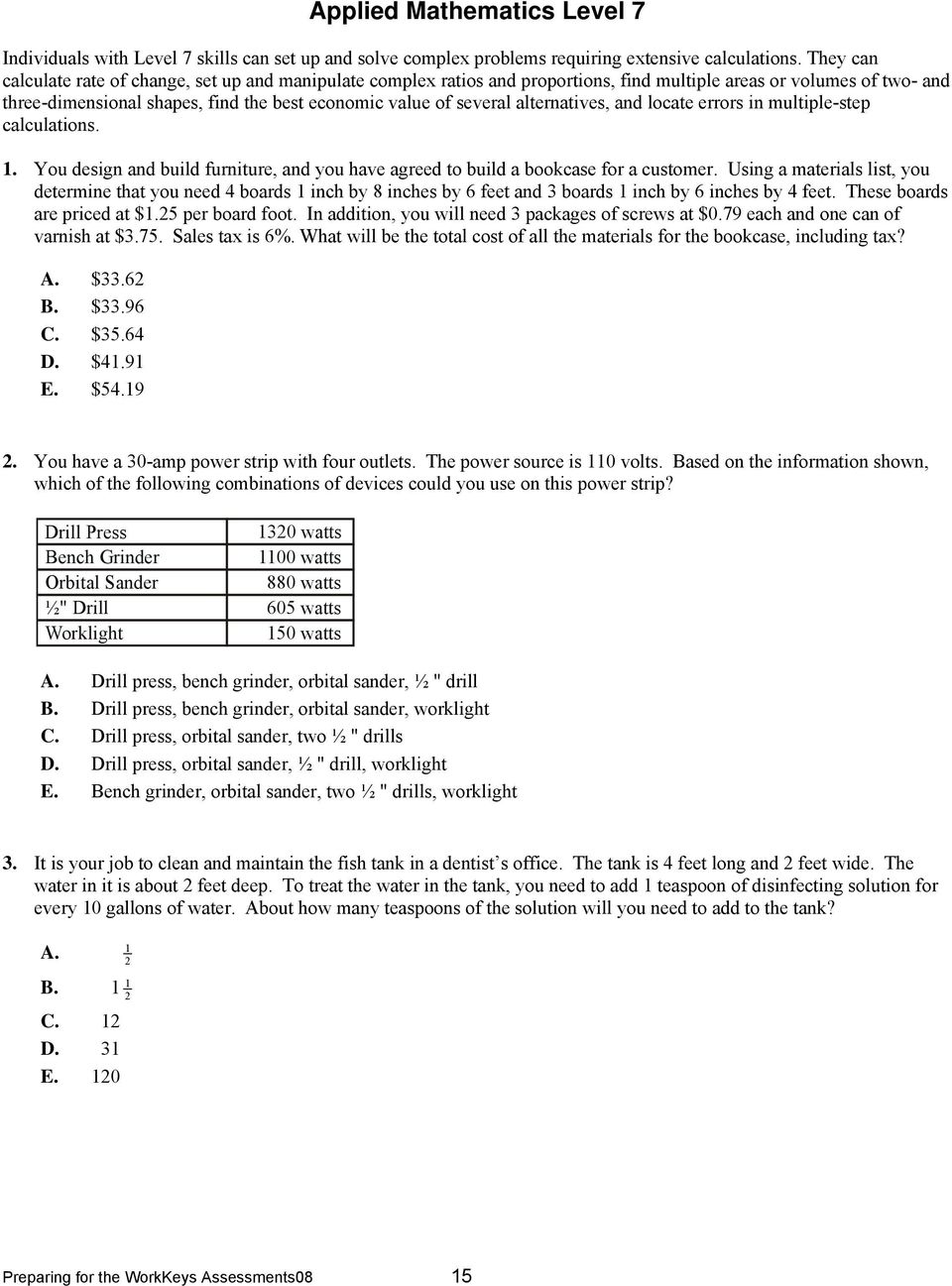
17 Applied Mathematics Level 7 Individuals with Level 7 skills can set up and solve complex problems requiring extensive calculations. They can calculate rate of change, set up and manipulate complex ratios and proportions, find multiple areas or volumes of two- and three-dimensional shapes, find the best economic value of several alternatives, and locate errors in multiple-step calculations. 1. You design and build furniture, and you have agreed to build a bookcase for a customer. Using a materials list, you determine that you need 4 boards 1 inch by 8 inches by 6 feet and 3 boards 1 inch by 6 inches by 4 feet. These boards are priced at $1.25 per board foot. In addition, you will need 3 packages of screws at $0.79 each and one can of varnish at $3.75. Sales tax is 6%. What will be the total cost of all the materials for the bookcase, including tax? A. $33.62 B. $33.96 C. $35.64 D. $41.91 E. $ You have a 30-amp power strip with four outlets. The power source is 110 volts. Based on the information shown, which of the following combinations of devices could you use on this power strip? Drill Press Bench Grinder Orbital Sander ½" Drill Worklight 1320 watts 1100 watts 880 watts 605 watts 150 watts A. Drill press, bench grinder, orbital sander, ½ " drill B. Drill press, bench grinder, orbital sander, worklight C. Drill press, orbital sander, two ½ " drills D. Drill press, orbital sander, ½ " drill, worklight E. Bench grinder, orbital sander, two ½ " drills, worklight 3. It is your job to clean and maintain the fish tank in a dentist s office. The tank is 4 feet long and 2 feet wide. The water in it is about 2 feet deep. To treat the water in the tank, you need to add 1 teaspoon of disinfecting solution for every 10 gallons of water. About how many teaspoons of the solution will you need to add to the tank? A B C. 012 D. 031 E. 120 Preparing for the WorkKeys Assessments08 15
18 An Important Consideration about the Answers to the Practice Sets Some WorkKeys questions have a response choice (the key ) that can be clearly defined as right or correct and other response choices (the distractors or foils ) that can be identified as wrong or incorrect. Many WorkKeys questions, however, are in a best-response format: the keyed response is simply the best of those available. It is important to keep this in mind when discussing such questions, since it will sometimes be possible to think of responses that would be better than any of those offered, or to defend a distractor as not entirely wrong. Best-response formats are consistent with the real world, where choices among less-than-perfect alternatives are routinely the case. Note: The solutions shown indicate one or two ways to solve each problem. There may be other, equally valid methods of solving the problems. Answers to Applied Mathematics Level 3 Practice Set Answer to Level 3 Sample Item 1: A. Incorrect: = 211. Subtracted weight of third performer instead of adding it. B. Incorrect: = 293. Neglected to add weight of 2nd performer. C. Incorrect: = 329. Neglected to add weight of 3rd performer. D. Correct: Add all the individual weights to find the total weight: 175 lbs lbs lbs. = 447 lbs. total weight. E. Incorrect: = 500. Rounded weight of each performer up or down to nearest 100, then added. Answer to Level 3 Sample Item 2: A. Correct: Divide the total area by the area needed for each student: 6,270 square feet 330 square feet/student = 19 students. B. Incorrect: 33 is taken from the number 330 in the problem. No calculation was attempted. C. Incorrect: = 297. Used subtraction rather than division and dropped the zero from 6,270. D. Incorrect: = 594. Used subtraction rather than division and dropped the zeros from both numbers. E. Incorrect: 6, = 5,940. Used subtraction rather than division. Answer to Level 3 Sample Item 3: A. Incorrect: 53 6 = 8.83, rounded to $9. Used division instead of multiplication. B. Incorrect: 53 6 = $47. Used subtraction instead of multiplication. C. Incorrect: = $59. Used addition instead of multiplication. D. Correct: Multiply the cost per case by the number of cases: $6/case 53 cases = $318 owed. E. Incorrect: 6, 53 $653. Simply combined numbers. Preparing for the WorkKeys Assessments08 16

19 Answer to Level 4 Sample Item 1: Answers to Applied Mathematics Level 4 Practice Set A. Incorrect: = 1.5. Amount of vermiculite needed for five buckets of mixed soil. B. Correct: Set up a ratio and proportion using the percent of vermiculite to the percent of soil and the amount of vermiculite (x) to the amount of soil: x divided by 5 buckets = 30 vermiculite divided by 70 soil; x = = 2.14, rounded to the nearest half bucket = 2.0. C. Incorrect: = 3.5. Soil content for five buckets of finished mix. D. Incorrect: 30 5 = 6.0. Divided vermiculite percent by number of buckets of soil. E. Incorrect: = 11.7, rounded to the nearest half bucket = Inverted the right side of the proportion and solved for the amount of soil to add to 5 buckets vermiculite. Answer to Level 4 Sample Item 2: A. Incorrect: = $ Subtracted the coupon from the oil change without adding the cost of the filter. B. Correct: Add the cost of the oil change to the cost of the oil filter, then subtract the amount of the coupon: $ $4.95 $8.00 = $ C. Incorrect: = $ Added cost of the new oil filter to the cost of the oil change without subtracting the coupon. D. Incorrect: = $ Added amount of the coupon to the cost of the oil change without the new oil filter. E. Incorrect: = $ Added amount of the coupon to the cost of the oil change and the new oil filter. Answer to Level 4 Sample Item 3: A. Incorrect: = inch. Divided small wrench size by 2. B. Incorrect: = 8 3 -inch. Divided large wrench size by 2. C. Incorrect: inch is less than 8 5 and also less than 4 3 ; therefore, it is not between the two given sizes. D. Correct: Find the size between the small and large wrench by finding the average add the small size and the large size and divide by two: ( ) 2 = ( ) 2 = = inch. E. Incorrect: 8 7 -inch is greater than 8 5 and also greater than 4 3 ; therefore, it is not between the two given sizes. Preparing for the WorkKeys Assessments08 17

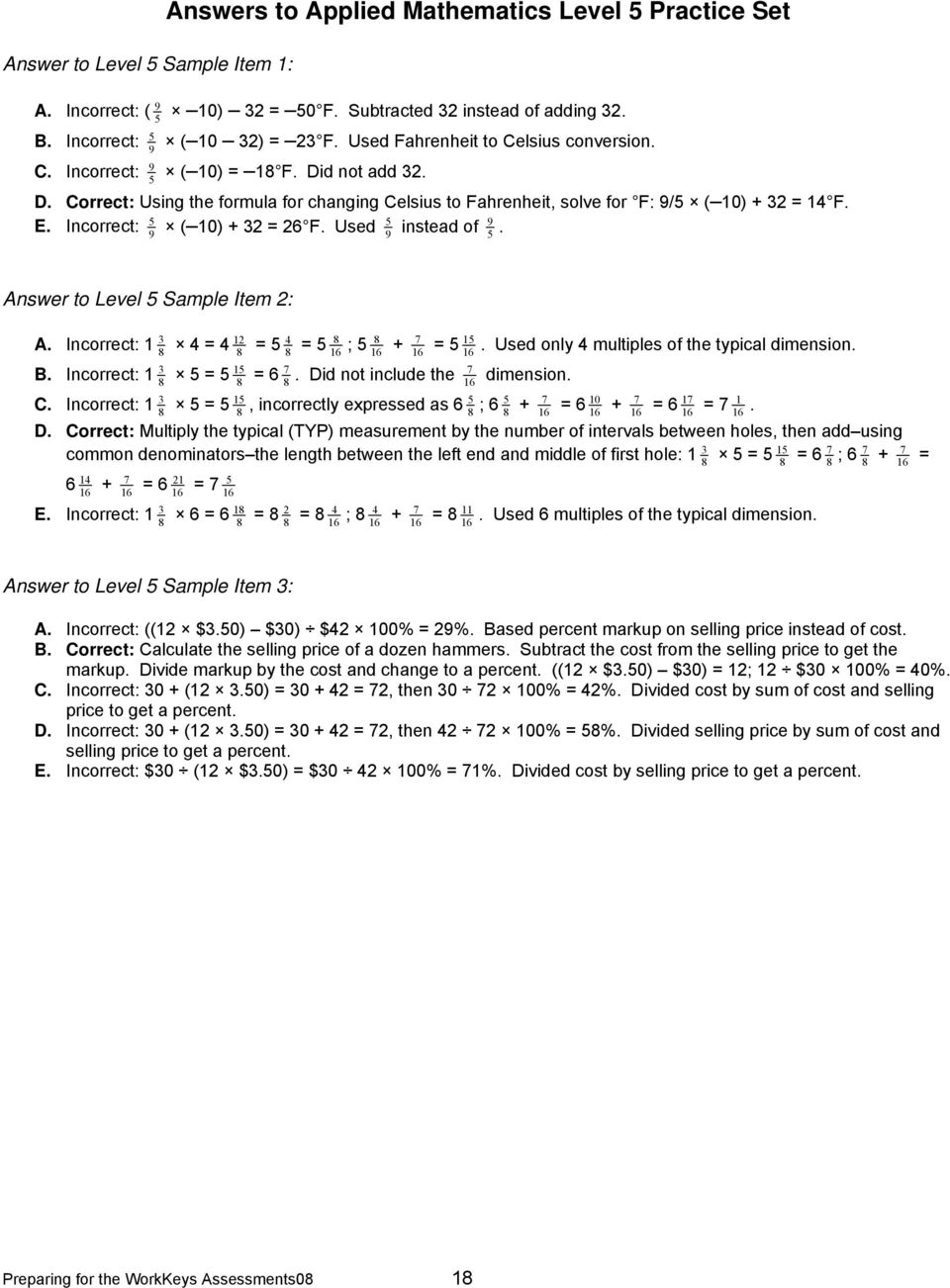
20 Answers to Applied Mathematics Level 5 Practice Set Answer to Level 5 Sample Item 1: A. Incorrect: ( 9 5 B. Incorrect: 5 9 C. Incorrect: ) 32 = 50 F. Subtracted 32 instead of adding 32. ( 10 32) = 23 F. Used Fahrenheit to Celsius conversion. ( 10) = 18 F. Did not add 32. D. Correct: Using the formula for changing Celsius to Fahrenheit, solve for F: 9/5 ( 10) + 32 = 14 F. E. Incorrect: 5 9 ( 10) + 32 = 26 F. Used 5 9 instead of 9 5. Answer to Level 5 Sample Item 2: A. Incorrect: = 4 12 = 5 4 = 5 8 ; = Used only 4 multiples of the typical dimension B. Incorrect: = 5 15 = Did not include the dimension C. Incorrect: = 5 15, incorrectly expressed as 6 5 ; = = 6 17 = D. Correct: Multiply the typical (TYP) measurement by the number of intervals between holes, then add using common denominators the length between the left end and middle of first hole: = 5 15 = 6 7 ; = = 6 21 = E. Incorrect: = 6 18 = 8 2 = 8 4 ; = Used 6 multiples of the typical dimension Answer to Level 5 Sample Item 3: A. Incorrect: ((12 $3.50) $30) $42 100% = 29%. Based percent markup on selling price instead of cost. B. Correct: Calculate the selling price of a dozen hammers. Subtract the cost from the selling price to get the markup. Divide markup by the cost and change to a percent. ((12 $3.50) $30) = 12; 12 $30 100% = 40%. C. Incorrect: 30 + ( ) = = 72, then % = 42%. Divided cost by sum of cost and selling price to get a percent. D. Incorrect: 30 + ( ) = = 72, then % = 58%. Divided selling price by sum of cost and selling price to get a percent. E. Incorrect: $30 (12 $3.50) = $ % = 71%. Divided cost by selling price to get a percent. Preparing for the WorkKeys Assessments08 18
21 Answer to Level 6 Sample Item 1: Answers to Applied Mathematics Level 6 Practice Set A. Incorrect: 1140 (8.85) 3 4 = 13.97, rounded up to 14. Minimum hours needed to work each week. B. Incorrect: (1140 8) 3 = 47.5, rounded up to 48. Did not figure tax deductions from wages. C. Correct: Divide the amount of tuition needed by the net earnings (85% of the pay) per hour. Then divide by the number of months to get the hours needed per month. [$1,140 (.85 $8.00)] 3 = hours/month, rounded up to 56. D. Incorrect: [$1,140 (.85 $8.00)] 2 = 83.8, rounded up to 84. Calculated for 2 months instead of 3. E. Incorrect: 1140 (8.85) = , rounded up to 168. Forgot to divide by 3 months; total number of hours needed. Answer to Level 6 Sample Item 2: A. Incorrect: 80 feet 40 feet (25 square yards/bag 9 square feet/square yard) = 14.22, rounded down to 14. Leaves some ground not covered. B. Correct: Find the area of the yard in square feet. Convert the square yards per bag to square feet per bag. Divide the area by the area per bag and round up to the next whole number of bags to ensure complete coverage. 80 feet 40 feet = 3200 square feet; 25 square yards/bag 9 square feet/square yard = 225 square feet/bag; 3200 square feet 225 square feet/bag = bags, rounded up to 15 bags so that all the ground is covered. C. Incorrect: Straight conversion of 25 yd 2 to 25 bags needed. D. Incorrect: 80 feet 40 feet (25 square yards/bag 3 square feet/square yard) = 42.67, rounded up to 43. Improper conversion (1 square yard = 3 square feet). E. Incorrect: 80 feet 40 feet 25 square yards/bag = 128. Failed to convert square yards to square feet. Answer to Level 6 Sample Item 3: A. Incorrect: = = = = yards. Added whole number factors to fractions rather than multiplying. B. Incorrect: = 17 4 = 17 1 yards. Only found the amount for the bridesmaid s dresses C. Incorrect: (4 4 3 ) + ( ) = = = = 22 = 23 1 yards. Multiplied whole number times both the numerator and the denominator of the fractions. D. Incorrect: (4 4 3 ) + (2 3 2 ) = = = 24 2 yards. Added the denominators together rather than finding the lowest common denominator. E. Correct: Multiply the number of bridesmaids dresses by the amount of material needed for each dress. Then multiply the number of flower girls dresses by the amount of material needed per dress. Add the two amounts together after finding the lowest common denominator. (4 4 3 ) + (2 3 2 ) = = = yards. Preparing for the WorkKeys Assessments08 19
22 Answer to Level 7 Sample Item 1: Answers to Applied Mathematics Level 7 Practice Set A. Incorrect: {[(1 8 72) 4] + [(1 6 48) 3]} 144 in 3 /bd. ft. = 22 board feet; ( ) + (3 0.79) + (1 3.75) = $ Did not calculate tax. B. Incorrect: {[(1 8 72) 4] + [(1 6 48) 3]} 144 in 3 /bd. ft. = 22 board feet; [( ) + (1 0.79) + (1 3.75)] 1.06 = $ Included only one package of screws. C. Correct: Calculate the volume of boards in cubic inches and convert to board feet. Calculate the cost of the boards by multiplying board feet and the price per board foot. Calculate the cost of the screws and varnish by multiplying the number of units and the price per unit. Add all the costs and multiply by 1.06 (sales tax). {[(1 inch 8 inches 72 inches) 4 boards] + [(1 inch 6 inches 48 inches) 3 boards]} 144 cubic inches/board foot = 22 board feet; [(22 board feet $1.25/board foot) + (3 $0.79) + (1 $3.75)] 1.06 = $ D. Incorrect: {[(1 8 72) 4] + [(1 6 48) 3]} 144 in 3 /bd. ft. = 22 board feet; [( ) + (1 0.79) + (3 3.75)] 1.06 = $ Included 3 cans of varnish and 1 packet of screws. E. Incorrect: = 36 linear feet; [( ) + (3 0.79) + (1 3.75)] 1.06 = $ Used linear feet of boards instead of board feet. Answer to Level 7 Sample Item 2: A. Incorrect: 1, , = 3,905 watts. The wattage is too high. B. Incorrect: 1, , = 3,450 watts. The wattage is too high. C. Incorrect: 1, = 3,410 watts. The wattage is too high. D. Correct: Find the maximum power available by multiplying the volts and the current in amps. Then add the power ratings of the devices being used to determine if they can all be used at the same time. The maximum power available is 110 volts 30 amps = 3,300 watts; (Drill press, orbital sander, ½ drill, worklight.) = 1, = 2,955 watts; 2,955 is less than 3,300 watts. E. Incorrect: 1, = 3,340 watts. The wattage is too high. Answer to Level 7 Sample Item 3: A. Incorrect: [(48 24) 231] 10 = 0.498, rounded up to 0.5 or 1. Did not include depth to calculate volume of 2 water in tank. B. Incorrect: (4 2 2) 10 = 1.6, rounded down to 1 1. Did not convert feet to inches and did not convert to 2 gallons. C. Correct: Find the volume of the tank in cubic inches by converting the dimensions from feet to inches and multiplying length by width and depth. Convert from cubic inches to gallons. Find the amount of solution needed by dividing the number of gallons by the gallons per teaspoon. Round to the nearest half-teaspoon. (4 feet 2 feet 2 feet) = (48 inches 24 inches 24 inches) = 27,648 cubic inches; 27,648 cubic inches 231 cubic inches/gallon 10 gallons/teaspoon = teaspoons, rounded up to 12. D. Incorrect: (4 2 2) = 16; = 19.25; = 308; = 30.8, rounded up to 31. Calculated volume of tank in cubic feet; then divided cubic inches/gallon by inches/foot; then multiplied results and divided by 10. E. Incorrect: ( ) 231 = 119.7, rounded up to 120. Did not divide by 10 gallons/teaspoon. Preparing for the WorkKeys Assessments08 20
23 WorkKeys Reading for Information Assessment Reading for Information is skill in reading and understanding work-related instructions and policies. Such material, known as procedural text, differs from the explanatory and narrative text on which most reading programs are based. In addition, unlike reading and content-area texts, which are usually organized to make the reading easy to understand, workplace communication is not necessarily designed to be easy to read. It may even be poorly or unclearly written. These differences can affect the skills employees need when they encounter job-related reading tasks. Reading for Information skills included can be loosely grouped into the following four categories: Choosing Main Ideas or Details This skill requires selecting the important information and supporting details from a written document. Looking for main ideas and details is a common reading task. But, as mentioned previously, reading texts encountered in the workplace differ from the selections most often used in reading programs. In such programs, the main idea is generally found in the topic sentence at the beginning of a paragraph or occasionally in a concluding sentence. However, written communication found in the workplace is often not constructed in such an organized manner. Consequently, the employee needs to be able to use clues other than placement to identify the main ideas and important details. Understanding Word Meanings Although some basic vocabulary is involved in this skill area, the emphasis is on using context to determine specific word meanings. The demands of the workplace progress from the need to know simple words and identify definitions clearly stated in the reading to the need to use the context to determine the meanings of more difficult words. Jargon, technical terminology, and words with multiple meanings are used increasingly as the contexts become more complex. Applying Instructions Conveying instructions is the principal purpose of a great deal of workplace communication. Skill in applying instructions involves sequencing and generalizing. As in the other skill areas, the workplace requirements range from the simple to the more complex. As the levels increase, the instructions contain more steps and conditionals are added. At the lower levels, employees need only apply instructions to clearly described situations; at the higher levels, employees must apply instructions to less similar and, eventually, to new situations. Applying Information and Reasoning Often, for effective performance of a task, it is necessary for employees to apply information given in workplace communications to similar or new situations, to predict consequences of certain actions, and to understand the reasoning, which may or may not be stated, behind a policy. As in the previous category, employees may be asked to apply information and reasoning to clearly described situations at the lower levels, while, at higher levels, they must apply information and reasoning to similar and then to new situations. Preparing for the WorkKeys Assessments08 21
24 WorkKeys Reading for Information Practice Set This practice set gives examples of the reading materials and questions on the WorkKeys Reading for Information assessment. It can help you understand the WorkKeys skill levels and give you practice for the actual WorkKeys assessment. However, remember that this practice set is not a full-length test and your score is not a substitute for the actual WorkKeys test score. The actual test consists of 33 questions and has a time limit of 45 minutes. Several questions may be grouped together and relate to a single piece of reading material. WorkKeys Reading for Information is the skill people use when they read and use written text in order to do a job. The written texts include memos, letters, directions, signs, notices, bulletins, policies, and regulations. It is often the case that workplace communications are not necessarily well-written or targeted to the appropriate audience. Reading for Information materials do not include information that is presented graphically, such as in charts, forms, or blueprints. There are five skill levels, from Level 3 to Level 7. As you move from Level 3 to Level 7, both the materials and the tasks become more complex. Preparing for the WorkKeys Assessments08 22
25 Reading for Information Level 3 Individuals with Level 3 skills understand basic words and can identify main ideas. They understand how and when to follow each step in a set of instructions and can use the instructions in situations that are the same as the one they are reading about. Level 3 materials include simple instructions, company policies, and announcements. They are short and straightforward, and contain basic vocabulary. Memorandum TO: FROM: SUBJECT: All Production Employees John Logan, Production Manager New Tool Policy We will be changing from the 5-piece tool kits you each have to a standard set of all 8 tools. Each employee will no longer have a set of tools. Instead, one new tool set will be placed in each workstation's toolbox. The new tool sets will be put at each station on the 3rd of next month. You must turn in the old tool kit that you have been using to the tool room at that time. You must pay for any tools missing from your tool kit when you turn it in. You must report any missing tools from the new tool set. Get replacements if necessary. Tools will be sharpened four times a month by maintenance. At other times, take dull tools to the tool room and exchange them for new ones. 1. According to the memo shown, who must report any missing tools? A. Maintenance employees B. Production employees C. The production manager D. The tool room supervisor E. The workstation manager Preparing for the WorkKeys Assessments08 23
26 To: All Dietary Staff From: Supervisor RE: ITEMS TO MAKE WORK A BETTER PLACE When throwing away empty boxes, please make sure all of them are broken down. Flatten them before throwing them in the dumpster. Our back parking lot was just resurfaced last Friday. It looks very tacky if trash is all over it. Please stack the milk crates neatly by the back door instead of just throwing them on the ground. Please check in the dish room area for late trays. Break down all trays before going home. Put the napkins in the trash and the silverware in the dishwasher baskets. Put the plates and glasses to be washed in the dishwasher racks. You do not need to turn the dishwasher back on. 2. You work in the kitchen of a hospital. According to the memo shown, where should you put empty milk crates? A. By the back door B. In the dish room C. In the dumpster D. In the milk truck E. Next to the dishwasher 3. As part of your job in the hospital kitchen, you must clean the trays. According to the memo shown, where should you put the silverware from the trays? A. In the dish room B. In the dishwasher baskets C. In the dishwasher racks D. In the drawer E. In the trash Preparing for the WorkKeys Assessments08 24
27 Reading for Information Level 4 Individuals with Level 4 skills can apply instructions to situations that are the same as the situations in the reading materials. They can identify cause-effect relationships and understand words that are not defined for them, based on the context. Level 4 materials may include several details or describe processes involving several steps. Chadwick Senior High School Fire Drill Schedule Notice After the occurrence of a fire drill on any regular school day, there will be schedule changes to allow the school day to end at its normal time of 3:00 p.m. Fire drills normally last a duration of minutes. The period in which the fire drill began is considered finished at the end of the fire drill. When the fire drill is over, an announcement will be made over the P.A. system informing all faculty, staff, and students what period is about to commence, so everyone knows where he or she is supposed to be. If the fire drill takes place during period 1, then all subsequent periods are 42 minutes long, rather than 45, and bells will ring accordingly. If the fire drill takes place any time during periods 2 through 6, then all subsequent periods will be 40 minutes long and bells will ring accordingly. If the fire drill takes place during the second to last period (7), then the last period (8) will be 38 minutes long and bells will ring accordingly. 1. You are a teacher s assistant at Chadwick Senior High School. According to the notice shown, if a fire drill takes place during period 1, each of the remaining periods will last: A. 20 minutes. B. 38 minutes. C. 40 minutes. D. 42 minutes. E. 45 minutes. Preparing for the WorkKeys Assessments08 25
28 High Plains Insurance FROM: TO: James R. Whitney, Chief Executive Officer Sales Division You are encouraged to attend a seminar titled Techniques for Customer Retention on July 14. It is from 9:00 A.M. to 4:00 P.M. at the Hotel DeMeers. During the noon break, lunch will be served. If you want to eat at the seminar luncheon, bring $8.50 that day to purchase your meal. You must make that lunch reservation by 3:00 P.M. on July 10. Just contact the Human Resources Division s Victor Luchetti or Gloria Rogers. We expect a lot of traffic in our building that morning. Therefore, departments will be released to leave for the seminar at different times. Check your department bulletin board. Limited parking at the hotel prevents employees from driving individually. Employees attending the seminar should ride the city bus unless they travel in a carpool. We recommend the bus. If you need to carpool, check your department bulletin board. It will have a sign-up sheet for volunteer drivers. The city bus schedule for that day is as follows: Leaves Tremont St. at 8:22; arrives at the Hotel DeMeers at 8:43. Leaves Tremont St. at 8:32; arrives at the Hotel DeMeers at 8:51. Notify your supervisor of any problem that would prevent you from attending. Preparing for the WorkKeys Assessments08 26
29 2. You are planning to carpool to the seminar. According to this memo, how should you determine when to leave? A. Ask Gloria Rogers. B. Ask James R. Whitney. C. Ask your supervisor. D. Check the department bulletin board. E. Look at the carpool sign-up sheet. 3. You work in the sales division and will be on a business trip on July 14. According to the memo shown, you should: A. check the bulletin board for information about the next seminar. B. tell Gloria Rogers about your business trip. C. tell Victor Luchetti that you will be out of town then. D. tell your supervisor about your travel plans. E. use the sign-up sheet to volunteer for the next seminar. Preparing for the WorkKeys Assessments08 27
30 Reading for Information Level 5 Individuals with Level 5 skills can apply information from reading materials to new situations that are similar to those described in the materials and they can understand words and phrases with specialized or multiple meanings. Level 5 materials include company policies, procedures, and announcements. All the information in them is stated clearly and directly, but there are many details. Message From: To: ford.kris at PO3 hartman.matt at PO3 Sent: Tuesday, 10:43 AM Attachments: Subject: login Recent security upgrades to network servers have resulted in some confusion regarding login screens. A procedure for handling the most common occurrence is described below. You may want to print this out so you can refer to it when logged out of the network. To prevent your network login from creating a second login screen, follow this procedure: At startup, your machine will present your server login screen (how you log in to the network). Click the More button in the lower right corner of the dialog box. Four tabs will appear in the extended area of the dialog box. Choose the System tab by clicking on it. The options in this tab will include one for local username. Enter the username that matches your server account (same as your , I would expect). Then enter your password in the main dialog box, where it always goes, and log in. - Kris Preparing for the WorkKeys Assessments08 28
31 1. If you follow the steps of this procedure, what situation will you correct? A. Being logged out of the network B. Having a second login screen appear C. Having to enter a password D. Logging into an unmatched server account E. Receiving unnecessary attachments Preparing for the WorkKeys Assessments08 29
32 Vision Plus Program All employees and their dependents are entitled to eye care under the Vision Plus Program. Members may visit a participating optometrist or ophthalmologist without getting a referral from your primary care physician. Members should see the Participating Physician Directory for participating optometrists and ophthalmologists in their area. The Vision Plus Program covers routine eye examinations, though there will be a copayment for each exam. Plan members 50 years of age and over or plan members who wear eyeglasses or contact lenses are eligible to have an eye examination once in every 24-month period, unless they are under the age of 21, in which case the plan covers an eye examination once in every 12-month period. Members who do not wear eyeglasses or contact lenses and who are under the age of 50 are covered once in every 36-month period. Members 50 years of age and over who wear eyeglasses or contact lenses may receive an eye exam once in every 12-month period. Any time you experience eye problems or difficulties, see your primary care physician, who will refer you to an ophthalmologist if deemed medically appropriate. For emergency eye care outside of your primary care physician's regular office hours, follow the guidelines for emergency care as outlined in your Orion Healthcare Benefits Program booklet. Prescription eyeglasses or contact lenses may be purchased anywhere. Mail your paid receipt to Orion Healthcare to receive up to $100 in reimbursement. This reimbursement is available once in any 24-month period. Preparing for the WorkKeys Assessments08 30
33 2. You answer the hotline for plan members who have questions about the Vision Plus Program. A 38-year-old plan member calls because she suspects that she has a slight infection in her eye. She does not wear eyeglasses or contact lenses. Based on the policy shown, you should advise the plan member to: A. consult her Participating Physician Directory for the name of an ophthalmologist. B. determine how many months have passed since her last eye exam. C. go to the hospital emergency room, as outlined in the benefits program booklet. D. see an ophthalmologist, and expect to make a copayment at that time. E. see her primary care physician. 3. You are a Vision Plus Program member. You have not had your eyes checked in several years. During a routine eye exam, you are told that you need eyeglasses. According to the policy, you should: A. apply for reimbursement in 24 months. B. consult the Participating Physician Directory to find an approved vision center. C. find glasses with the correct prescription for no more than $100. D. mail a request for the $100 reimbursement to Orion Healthcare. E. purchase the glasses and mail the receipt to Orion Healthcare. Preparing for the WorkKeys Assessments08 31
34 Reading for Information Level 6 Individuals with Level 6 skills can read and understand complex documents and generalize from the materials to new situations. They can correctly apply complex instructions from these materials and understand the rationale behind policies and procedures described in the materials. Level 6 materials may include complex regulatory and legal documents, and rental agreements. Section (1) A multiple lift shall only be performed if the following criteria are met: (i) A multiple lift rigging assembly is used; (ii) A maximum of five members are hoisted per lift; (iii) Only beams and similar steel structural members are lifted; and (iv) All employees engaged in the multiple lift have been trained in these procedures. (v) No crane is permitted to be used for a multiple lift where such use is contrary to the manufacturer's specifications and limitations. (2) Components of the multiple lift rigging assembly shall be specifically designed and assembled with a maximum capacity for total assembly and for each individual attachment point. This capacity, certified by the manufacturer or a qualified rigger, shall be based on the manufacturer's specifications with a 5-to-1 safety factor for all components. (3) The total load shall not exceed: (i) The rated capacity of the hoisting equipment specified in the hoisting equipment load charts; (ii) The rigging capacity specified in the rigging rating chart. (4) The multiple lift rigging assembly shall be rigged with members: (i) Attached at their center of gravity and maintained reasonably level; (ii) Rigged from top down; and (iii) Rigged at least 7 feet apart. (5) The members on the multiple lift rigging assembly shall be set from the bottom up. (6) Controlled load lowering shall be used whenever the load is over the connectors. Preparing for the WorkKeys Assessments08 32
35 1. In Section , as shown, the term members refers to: A. beams and similar steel structures. B. components of the rigging assembly. C. cranes used to perform multiple lifts. D. employees who perform multiple lifts. E. the rigging manufacturers. 2. As a construction worker, you are assisting with a multiple lift of five steel beams. The multiple lift rigging assembly is rigged with the beams attached at their center of gravity and kept level, rigged from the top down, and 6 feet apart. This multiple lift is NOT lawful under Section , as shown, because: A. it has too few beams. B. it has too many beams. C. the beams are rigged too close together. D. the beams are rigged too far apart. E. the beams should be rigged from the bottom up. 3. As specified in Section , a qualified rigger is responsible for: A. certifying the maximum capacity of multiple lift rigging assembly components. B. designing and assembling components of the multiple lift rigging assembly. C. operating a crane for a multiple lift according to the manufacturer s specifications and limitations. D. supervising controlled load lowering whenever the load is over the connectors. E. training employees engaged in multiple lifts when a multiple lift rigging assembly is used. Preparing for the WorkKeys Assessments08 33
36 Reading for Information Level 7 Individuals with Level 7 skills can figure out the underlying principles in complex documents and apply them to situations that are quite different from any described in the materials. They can understand unfamiliar terms from the context. Level 7 materials are densely detailed passages, such as excerpts from complex regulatory and legal documents. They contain complicated concepts and procedures. The language includes jargon and technical terms. Section 342f. Unfair Practices A debt collector may not use unfair or excessive means to collect or attempt to collect any debt, and such unfair or excessive means would constitute grounds for punishment under the statutes of this commonwealth. The following conduct is a violation of this section: 1) The false representation that any debt collector is affiliated with or employed by the United States Government or any relevant state or local government; 2) The collection of any amount (including any interest, fee, charge, or expense incidental to the principal obligation) from any indebted consumer unless such amount is expressly authorized by the agreement creating the original debt; 3) The publication of a list of consumers who allegedly refuse to pay debts; 4) The solicitation by a debt collector of any postdated check for the purpose of threatening criminal prosecution; 5) Causing charges to be made to any person by concealing the true purpose of the communication. Such charges include, but are not limited to, collect telephone calls and telegrams; 6) Engaging any person in telephone conversation repeatedly or continuously with intent to annoy, abuse, or harass; 7) Communicating with a consumer via a postcard, or other unsealed, indiscreet mail device, regarding a debt; 8) Using any language or symbol, other than the debt collector s address, on any envelope when communicating with a consumer by use of the mails, except that a debt collector may use his or her business name in the return address if that name does not indicate that he or she is in the debt collection business. Preparing for the WorkKeys Assessments08 34
37 1. As a debt collector you send a letter with no return address, asking a man for full payment of a medical bill by the end of the following week. When he does not pay, you phone him and ask for payment. He claims that you are harassing him. Based on Section 342f, is he correct? A. No, because there was no violation with either the letter or the phone call. B. No, because your letter did not threaten criminal prosecution. C. Yes, because the telephone call constitutes intentional harassment. D. Yes, because you contacted him repeatedly. E. Yes, because you misrepresented yourself on the envelope. 2. You work for a private company and you are trying to contact an indebted consumer who hangs up the phone as soon as you identify yourself. Based on Section 342f, to contact this person, you should: A. call once more and say that you work for the U.S. government. B. continue to call until the consumer stays on the phone. C. hire a messenger to deliver the information at the consumer s expense. D. leave an unsealed note with the consumer s employer. E. mail the information to the consumer in a plain white envelope. 3. You contacted an indebted consumer who agrees to pay off the original debt, but refuses to pay your company s fee of $30. Will you violate Section 342f if you demand payment of this charge? A. No; the consumer is liable for all expenses incidental to the principal obligation. B. No; this fee must be paid if it was agreed upon during the origination of the debt. C. Yes; solicitation by a debt collector for any amount, including a fee, is not permitted. D. Yes; the fee charged to the consumer by your company is excessive and unfair. E. Yes; your attempts to collect your company s fee would be considered harassing. Preparing for the WorkKeys Assessments08 35
38 An Important Consideration about the Answers to the Practice Sets Some WorkKeys questions have a response choice (the key ) that can be clearly defined as right or correct and other response choices (the distractors or foils ) that can be identified as wrong or incorrect. Many WorkKeys questions, however, are in a best-response format: the keyed response is simply the best of those available. It is important to keep this in mind when discussing such questions, since it will sometimes be possible to think of responses that would be better than any of those offered, or to defend a distractor as not entirely wrong. Best-response formats are consistent with the real world, where choices among less-than-perfect alternatives are routinely the case. Answer to Level 3 Sample Item 1 Answers to Reading for Information Level 3 Practice Set A. Incorrect. Maintenance employees. Maintenance employees sharpen the tools; they do not report missing tools. B. Correct. Production employees. The memo is written to All Production Employees and states, You must report any missing tools. C. Incorrect. The Production Manager. Since the Production Manager is the author of the policy, the reader might assume this person is responsible for these tasks. D. Incorrect. The tool room supervisor. There is no mention of a tool room supervisor. The tool room is mentioned as a place to take dull tools, but the tool room supervisor is not who will report missing tools. E. Incorrect. The workstation manager. Although workstations are mentioned, there is no indication of a workstation manager or of a workstation manager s duties. Answer to Level 3 Sample Item 2 A. Correct. By the back door. The memo states, Please stack the milk crates neatly by the back door. B. Incorrect. In the dish room. The dish room area is where late trays, dishes, glasses, and silverware go, not the milk crates. C. Incorrect. In the dumpster. The dumpster is where the trash and boxes are to be placed, not the milk crates. D. Incorrect. In the milk truck. Although it is likely that a milk truck drops off and picks up the milk crates, this is never discussed in the memo. E. Incorrect. Next to the dishwasher. The memo specifically states to stack the milk crates by the back door. Answer to Level 3 Sample Item 3 A. Incorrect. In the dish room. The dish room is where an employee may find late trays. The dishwasher and baskets are not necessarily in the dish room and the specific instructions in the memo are to put the silverware in the dishwasher baskets. B. Correct. In the dishwasher baskets. The memo states, Put the napkins in the trash and the silverware in the dishwasher baskets. C. Incorrect. In the dishwasher racks. The plates and glasses are to be put in the dishwasher racks, not the silverware. D. Incorrect. In the drawer. A drawer is a common location for silverware, but the memo does not say to put the silverware there. E. Incorrect. In the trash. Napkins are to be put in the trash but not the silverware. Preparing for the WorkKeys Assessments08 36
39 Answer to Level 4 Sample Item 1 Answers to Reading for Information Level 4 Practice Set A. Incorrect. 20 minutes. Twenty minutes is a typical length of time for a fire drill; it is not the length of any class period. B. Incorrect. 38 minutes. Thirty-eight minutes is the length of the last class period if a fire drill takes place during period 7. C. Incorrect. 40 minutes. Forty minutes is the length of the remaining class periods if a fire drill takes place any time during periods 2 through 6. D. Correct. 42 minutes. Forty-two minutes is the length of the remaining class periods if a fire drill takes place during period 1. The notice states, If the fire drill takes place during period 1, then all subsequent periods are 42 minutes long, rather than 45, and bells will ring accordingly. E. Incorrect. 45 minutes. Forty-five minutes is the normal length of class periods without any fire drills. Answer to Level 4 Sample Item 2 A. Incorrect. Ask Gloria Rogers. According to the memo, you should contact Gloria Rogers in Human Resources if you want to eat lunch at the hotel, not to ask when to leave. B. Incorrect. Ask James R. Whitney. James R. Whitney is the Chief Executive Officer who wrote the memo. C. Incorrect. Ask your supervisor. According to the memo, you should Notify your supervisor of any problem that would prevent you from attending. It says to notify, not ask. D. Correct. Check the department bulletin board. According to the second paragraph, Therefore, departments will be released to leave...at different times. Check your department bulletin board. E. Incorrect. Look at the carpool sign-up sheet. Although the memo states that the carpool sign-up sheet will be posted on the department bulletin board, this sheet is not where one will find release times. Answer to Level 4 Sample Item 3 A. Incorrect. Check the bulletin board for information about the next seminar. You should check the bulletin board for the times that different departments will leave for the seminar. There is no mention in the memo of the next seminar or if there is one. B. Incorrect. Tell Gloria Rogers about your business trip. Victor Luchetti or Gloria Rogers should be contacted regarding reservations for lunch. C. Incorrect. Tell Victor Luchetti that you will be out of town then. Victor Luchetti or Gloria Rogers should be contacted regarding reservations for lunch. D. Correct. Tell your supervisor about your travel plans. The memo conveys that attendance at the seminar is encouraged and that you should Notify your supervisor of any problem that would prevent you from attending. E. Incorrect. Use the sign-up sheet to volunteer for the next seminar. The sign-up sheet is only for those who are willing to drive the carpool vehicles. Preparing for the WorkKeys Assessments08 37
40 Answer to Level 5 Sample Item 1 Answers to Reading for Information Level 5 Practice Set A. Incorrect. Being logged out of the network. There is no indication that being logged out of the network is a problem that needs correcting. B. Correct. Having a second login screen appear. The fourth sentence states, To prevent your network login from creating a second login screen, follow this procedure. C. Incorrect. Having to enter a password. You must still enter a password at the end of the procedure. It is not indicated as a problem. D. Incorrect. Logging into an unmatched server account. No procedures are mentioned for logging into an unmatched server account. E. Incorrect. Receiving unnecessary attachments. No mention of unnecessary attachments is made, although there is an attachment label in the heading. Answer to Level 5 Sample Item 2 A. Incorrect. Consult her Participating Physician Directory for the name of an ophthalmologist. Members should consult the directory for an optometrist or ophthalmologist whom they can see without a referral. The same paragraph says that the Vision Plus program partially covers routine eye exams, thus implying that these are the type of exams you would need the directory for. Later, however, the policy says, Any time you experience eye problems or difficulties, see your primary care physician, who will refer you to an ophthalmologist if deemed medically appropriate. B. Incorrect. Determine how many months have passed since her last eye exam. The time limits refer to routine eye exams, not to treatment of eye problems or difficulties. C. Incorrect. Go to the hospital emergency room as outlined in the benefits program booklet. The policy states that members who experience eye problems should see their primary care physician for a referral. The plan member only suspects a slight infection which does not indicate a need for emergency care. D. Incorrect. See an ophthalmologist and expect to make a copayment at that time. Members should see their primary care physician when they experience eye problems. Although the policy states that copayments are necessary for routine eye exams, the policy says nothing about copayments for nonroutine eye care. E. Correct. See her primary care physician. The policy says, Any time you experience eye problems or difficulties, see your primary care physician, who will refer you to an opthalmologist if deemed medically appropriate. Answer to Level 5 Sample Item 3 A. Incorrect. Apply for reimbursement in 24 months. The policy states that reimbursement for glasses or contacts is available once in any 24-month period. However, a person who has never submitted a reimbursement for eyeglasses would not have to wait 24 months to receive reimbursement. The person should buy the glasses, then mail the receipt to Orion Healthcare. B. Incorrect. Consult the Participating Physician Directory to find an approved vision center. Plan members should use the Directory to find participating ophthalmologists or optometrists. They can buy glasses or contacts anywhere (e.g., at an optician s office). C. Incorrect. Find glasses with the correct prescription for no more than $100. The policy says, Mail your paid receipt to Orion Healthcare to receive up to $100 in reimbursement. Up to $100 means that the program will cover no more than $100 toward glasses or contacts. The member can spend more than $100, but only $100 will be reimbursed. A member who spends $75 on glasses or contacts will be reimbursed $75. D. Incorrect. Mail a request for the $100 reimbursement to Orion Healthcare. Plan members must first purchase their glasses, and then mail the receipt to Orion. E. Correct. Purchase the glasses and mail the receipt to Orion Healthcare. Plan members may purchase their glasses anywhere and then mail the paid receipt to Orion for reimbursement. Preparing for the WorkKeys Assessments08 38
41 Answer to Level 6 Sample Item 1 Answers to Reading for Information Level 6 Practice Set A. Correct. Beams and similar steel structures. The Section uses this term once early in the passage ( Only beams and similar steel structural members are lifted ) to refer to such items, then uses the term members alone thereafter in the regulations. B. Incorrect. Components of the rigging assembly. The term members refers to items being lifted ( A maximum of five members are hoisted per lift, and Only beams and similar steel structural members are lifted ) whereas the components of the rigging assembly are part of the apparatus doing the lifting. C. Incorrect. Cranes used to perform multiple lifts. The term members refers to items being lifted, whereas a crane is used to perform lifts. D. Incorrect. Employees who perform multiple lifts. The term members refers to items being lifted, not to workers doing the lifting, even though one common use of the word member is an individual working as part of a team. E. Incorrect. The rigging manufacturers. The rigging manufacturers determine the specifications for the assembly, but the term members refers to items being lifted. Answer to Level 6 Sample Item 2 A. Incorrect. It has too few beams. No minimum number of beams is given. The section does state, A maximum of five members are hoisted per lift, the number of beams in the multiple lift described in the problem. No minimum is given. B. Incorrect. It has too many beams. The section states, A maximum of five members are hoisted per lift, which is the number described in this problem. C. Correct. The beams are rigged too close together. The beams in the multiple lift described are rigged 6 feet apart, and the section specifies that they must be rigged at least 7 feet apart. Therefore, the multiple lift is unlawful because the beams are rigged too close together. D. Incorrect. The beams are rigged too far apart. The beams in the multiple lift described are rigged 6 feet apart, and the section specifies that they must be rigged at least 7 feet apart. Therefore, the multiple lift is unlawful because the beams are rigged too close together, not too far apart. E. Incorrect. The beams should be rigged from bottom up. The section specifies that the beams in the multiple lift rigging assembly must be rigged from top down, as they are in the lift described. They should be set (not rigged), from the bottom up (See part #5). Answer to Level 6 Sample Item 3 A. Correct. Certifying the maximum capacity of multiple lift rigging assembly components. Part (2) of Section states, Components of the multiple lift rigging assembly shall be specifically designed and assembled with a maximum capacity for total assembly and for each individual attachment point. This capacity, certified by the manufacturer or a qualified rigger, shall be based on the manufacturer s specifications with a 5-to-1 safety factor for all components. Thus, a qualified rigger (or the manufacturer) must certify the maximum capacity of multiple lift rigging assembly components. B. Incorrect. Designing and assembling components of the multiple lift rigging assembly. Although the multiple lift rigging assembly components need to be specifically designed and assembled with a maximum capacity for total assembly and for each individual attachment point, the responsibility for that design and assembly is not assigned to anyone in this section of the regulations. C. Incorrect. Operating a crane for a multiple lift according to the manufacturer s specifications and limitations. The use of a crane for multiple lifts is mentioned in part (1), but the regulations say only that cranes must be operated within the manufacturer s specifications and limitations, not who is responsible for operating them. D. Incorrect. Supervising controlled load lowering whenever the load is over the connectors. Controlled load lowering is mentioned in part (6), but the responsibility for supervising that task is not assigned to anyone by this section of the regulations. E. Incorrect. Training employees engaged in multiple lifts when a multiple lift rigging assembly is used. Training of employees engaged in multiple lifts is mentioned in part (1), but there is no specific training responsibility given to a qualified rigger. Preparing for the WorkKeys Assessments08 39
42 Answer to Level 7 Sample Item 1 Answers to Reading for Information Level 7 Practice Set A. Correct. No, because there was no violation with either the letter or the phone call. There is no mention of misrepresentation, publishing of the debt, or extra charges; there is no return address on the envelope so you are not identified publicly as a collection agency; and one phone call asking for payment does not constitute harassment. B. Incorrect. No, because your letter did not threaten criminal prosecution. There is no requirement to threaten prosecution in these circumstances. C. Incorrect. Yes, because the telephone call constitutes intentional harassment. Since the debt collector only phoned once and asked for payment, this would not constitute harassment. D. Incorrect. Yes, because you contacted him repeatedly. This is true but, based on the rules, neither of the two means were excessive. E. Incorrect. Yes, because you misrepresented yourself on the envelope. There is no indication of any misrepresentation, and failing to include a return address is not a violation. In fact, the envelope must not include any indication of the sender being a debt collector. Answer to Level 7 Sample Item 2 A. Incorrect. Call once more and say that you work for the U.S. government. The first point states that false representation of the collector as a government employee is not allowed. This collector works for a private company. B. Incorrect. Continue to call until the consumer stays on the phone. This would be considered harassment, which is not allowed according to point 6. C. Incorrect. Hire a messenger to deliver the information at the consumer s expense. Point 5 states that causing the consumer to pay charges and concealing the true purpose of the communication is not allowed. D. Incorrect. Leave an unsealed note with the consumer s employer. Although not directly addressed, this would be an unsealed, indiscreet device even though it is not sent by mail. It is evident from the whole passage that publicly displaying the debt in any way is considered unfair and excessive. E. Correct. Mail the information to the consumer in a plain white envelope. Point 8 prohibits Using any language or symbol, other than the debt collector s address, on any envelope when communicating with a consumer by the use of the mails. It does not prohibit the omission of a return address. Answer to Level 7 Sample Item 3 A. Incorrect. No; the consumer is liable for all expenses incidental to the principal obligation. One of the practices prohibited by Section 342f is The collection of any amount (including any interest, fee, charge, or expense incidental to the principal obligation). Unless agreed upon in the original agreement of the debt, the consumer is not liable for any expenses incurred by trying to get payment of the original amount. B. Correct. No; this fee must be paid if it was agreed upon during the origination of the debt. The regulation prohibits The collection of any amount (including any interest, fee, charge, or expense incidental to the principal obligation) from any indebted consumer unless such amount is expressly authorized by the agreement creating the original debt. If the fee was agreed to, you can demand payment. C. Incorrect. Yes; solicitation by a debt collector for any amount, including a fee, is not permitted. Point 2 allows these fees if they are described in the original agreement. D. Incorrect. Yes; the fee charged to the consumer by your company is excessive and unfair. Although the subject of Section 342f is excessive and unfair practices, there is no limit placed on fees as long as they are in the original agreement. E. Incorrect. Yes; your attempts to collect your company s fee would be considered harassing. Harassment is mentioned in these regulations in connection with repeated phone calls and the intent to annoy someone. The question asks only if you can demand payment of this fee. Preparing for the WorkKeys Assessments08 40
43 WorkKeys Locating Information Assessment Locating Information is skill in dealing with workplace graphics such as charts, graphs, tables, forms, flowcharts, diagrams, floor plans, maps, and instrument gauges. Workers use this skill when they find information in a graphic or add information to a graphic. They also use it when they compare, summarize, and analyze information found in related graphics. While Locating Information is extremely important in the workplace, it is not usually taught as a standalone skill in the classroom. It is, therefore, critical to strengthen your Locating Information skills and to develop your problemsolving strategies. Individuals possessing these Locating Information skills will be able to successfully tackle new situations involving graphics problems in the workplace. There are four levels in the Locating Information skill scale, and the skills included can be loosely grouped into five categories: Finding information This requires looking for information in simple graphics and filling in information that is missing from simple graphics. Employees may be asked to find basic information in a pie chart, or add missing information to a basic order form. Summarizing and/or comparing information Employees must often understand how graphics are related to each other and be able to summarize information from graphics. They might use a parts table and shipping ticket together or an inventory table to find which maple trees are taller than four feet, are less than $50, and are in a particular sales region. Drawing conclusions Workers must often draw conclusions based on one complicated graphic or several related graphics. They might use a detailed line graph to find how sales of five separate products changed from March to July. Applying information This requires sorting through distracting information to apply information from one or more complicated graphics to specific situations. Employees may use multiple schedule forms and clinic maps to schedule appointments for several people to visit doctors, clinicians, and labs in various parts of a large hospital. Making decisions and/or predictions Employees must identify trends shown in one or more detailed or complicated graphics, and use the information to make decisions. They might use handling forms, facility maps, and storage guidelines to figure out where to put a product that is highly flammable and/or corrosive. Preparing for the WorkKeys Assessments08 41
44 WorkKeys Locating Information Practice Set This practice set can help you understand the WorkKeys skill levels and give you practice for the actual WorkKeys assessment. However, remember that this practice set is not a full-length test and your score is not a substitute for an actual WorkKeys test score. The actual test consists of 38 questions and has a time limit of 45 minutes. Two questions may be grouped together and relate to a single graphic or set of graphics. WorkKeys Locating Information is the skill people use when they deal with workplace graphics such as charts, graphs, tables, forms, flowcharts, diagrams, floor plans, maps, and instrument gauges. Employees use this skill when they find information in a graphic or add information to a graphic. They also use it when they compare, summarize, and analyze information found in related graphics. There are four skill levels, from Level 3 to Level 6. As you move from Level 3 to Level 7, both the graphics and the tasks become more complex. Preparing for the WorkKeys Assessments08 42
45 Locating Information Level 3 Level 3 workplace graphics are elementary. They may be simple order forms, bar graphs, tables, flowcharts, maps, instrument gauges, or floor plans. At Level 3, examinees use one graphic at a time. When examinees have Level 3 Locating Information skills: They can find one or two pieces of information in a graphic. They can fill in one or two pieces of information that are missing from a graphic. 1. Your job is to insert the Moon phase symbols into the calendars your company produces. According to the table, which Moon phase symbol, if any, should you paste on March 28? A. B. C. D. E. No Moon phase symbol should be inserted on March 28. Preparing for the WorkKeys Assessments08 43
46 2. As a cashier, you close out your register by completing a closing form and putting the drawer contents into a bank bag. According to the closing form shown, what is the amount in checks? A. $0, B. $0, C. $0, D. $0, E. $2, Preparing for the WorkKeys Assessments08 44
47 3. You work in the head office of a large company. A client calls from New York and wants to talk to the account executive for that region. Who should the client talk to? A. Alice Anderson B. Lars Larson C. Kelly Carney D. Thurmond Salkick E. Dan Elizondo Preparing for the WorkKeys Assessments08 45
48 4. A customer has returned a rental car. What damages, as indicated on the form shown, were present before the car was rented? A. A ding on the hood and a scratch on the driver s side B. A ding on the hood and a scratch on the passenger s side C. A ding on the hood only D. A scratch on the hood and a ding on the driver s side E. A scratch on the hood only Preparing for the WorkKeys Assessments08 46
49 Locating Information Level 4 Level 4 workplace graphics are straightforward. They may be basic order forms, diagrams, line graphs, tables, flowcharts, instrument gauges, or maps. At Level 4, examinees may work with one or two graphics at a time. When examinees have Level 4 Locating Information skills: They can find several pieces of information in graphics. They can notice how graphics are related to each other. They can sum up information shown in straightforward graphics. They can identify trends shown in straightforward graphics. They can compare information and trends shown in straightforward graphics. 1. As a clerk in the warranty department, you enter information from warranty cards into a computer. According to the warranty card shown, what type and model of appliance was purchased? A. Microwave #4692 B. Microwave #62987 C. Microwave # D. Refrigerator #4692 E. Refrigerator # Preparing for the WorkKeys Assessments08 47
50 2. You work in the information booth at a mall. A mall customer asks where the entrance of the Public Library is located. You tell the customer that the library entrance is at the corner of: A. B Street and 2 nd Avenue. B. D Street and 6 th Avenue. C. E Street and 6 th Avenue. D. F Street and 7 th Avenue. E. H Street and 5 th Avenue. Preparing for the WorkKeys Assessments08 48
51 3. As a medical assistant, you must plot patients growth on a growth chart. You have just measured a 14-year-old girl who has grown four centimeters in the last year. According to the chart shown, this patient s growth rate is: A. equal to the average rate of boys her age. B. equal to the average rate of girls her age. C. off the chart for growth rate. D. slightly less than the average rate of girls her age. E. slightly more than the average rate of girls her age. Preparing for the WorkKeys Assessments08 49
52 4. You work in the classified ad department. A customer wants to place a 5-line ad for as long as possible, but he does not want to spend more than $ Based on the tables shown, you should tell the customer that he should place his ad using: A. Package 1 for 3 days. B. Package 1 for 5 days. C. Package 1 for 7 days. D. Package 2 for 5 days. E. Package 2 for 7 days. Preparing for the WorkKeys Assessments08 50
53 Locating Information Level 5 Level 5 workplace graphics are complicated. The graphics are sometimes in an unusual format. They may be detailed forms, tables, graphs, diagrams, maps, or instrument gauges. At Level 5, examinees may work with one or more graphics at a time. When examinees have Level 5 Locating Information skills: They can sort through distracting information. They can sum up information shown in detailed graphics. They can identify trends shown in detailed graphics. They can compare information and trends shown in detailed graphics. 1. You are a sportswriter and are writing about the World League Mushball Tournament. You are doing an article on the two wild-card teams the two teams with the best record who are not division leaders. According to the table shown, which two teams are the wild-card teams? A. Algiers and Honolulu B. Berlin and Mexico City C. Buenos Aires and Madrid D. Mexico City and Rio de Janeiro E. Rio de Janeiro and Algiers Preparing for the WorkKeys Assessments08 51
54 2. You are a laboratory supervisor and are checking the work of a new tech assistant. Which test has an incorrect color/type interpretation? A. 1 B. 2 C. 3 D. 4 E. 5 Preparing for the WorkKeys Assessments08 52
55 3. As a county watershed control assistant, you must examine monthly discharge rates for creeks, rivers, and streams in your county. For the date of June 19 th, which creek had the highest discharge and what was that discharge? A. Blue View Creek, 185 B. Middle Creek, 800 C. Middle Creek, 1000 D. Sandy Creek, 195 E. Sandy Creek, 950 Preparing for the WorkKeys Assessments08 53
56 4. As a wellness center technician, you perform Bone Mineral Density (BMD) screenings in order to determine a client s risk for osteoporotic fracture. According to the form and graph shown, this client should be advised that she is at: A. low risk and the results should be reported at her next checkup. B. low risk and she should make an appointment with her doctor later this month. C. moderate risk and the results should be reported at her next checkup. D. moderate risk and she should make an appointment with her doctor later this month. E. high risk and she should see the doctor immediately. Preparing for the WorkKeys Assessments08 54
57 Preparing for the WorkKeys Assessments08 55
58 Locating Information Level 6 Level 6 workplace graphics are complicated. They contain large amounts of information and may have challenging formats. Sometimes they involve technical terms or symbols. They may be very detailed graphs, charts, tables, forms, maps, or diagrams. At Level 6, examinees may work with one or more graphics at a time. When examinees have Level 6 Locating Information skills: They can analyze data in one complicated graphic or several related graphics. They can apply the information to specific situations. They can use the information to make decisions. They can use the information to draw conclusions. 1. You schedule appointments for Dr. Wahl following the guidelines shown. It is Monday morning, and Dr. Wahl finds out that the afternoon meeting she was scheduled to attend has been canceled, so you can schedule call-in patients for this afternoon. After this afternoon, Dr. Wahl s next available appointment is in three weeks. Based on the charts shown, the first two patients you should try to schedule for this afternoon are: A. Allan and Ambili. B. Ambili and Tally. C. Ambili and Wessel. D. Floyd and LaPlante. E. Kapy and Lopez. 2. You have just scheduled Tito Brooks for Friday afternoon, and he calls back to ask how long his appointment will take. After looking at the information shown, you know that he should be in the office for: A. 30 minutes. B. 30 minutes + 15 minutes. C. 30 minutes + 15 minutes + 15 minutes. D. 1 hour + 30 minutes. E. all of Friday afternoon. Preparing for the WorkKeys Assessments08 56
59 Preparing for the WorkKeys Assessments08 57
60 3. You are a finance research assistant with a company that purchases smaller companies. You use the chart and table shown to compare prospective buys with current companies. Your company only purchases companies in the 90 th percentile. Which company fits that prerequisite for purchase? A. JMO Clothiers B. Kenai Kampgoods C. Northmann Cookies D. Pierre s E. Wolfware Software 4. You work for a business that purchases smaller companies. You use the information shown to compare prospective buys with current companies. Your supervisor wants you to look at Office Bytes, a 6-year-old computer company that earned a $723,000 profit last year. Using the chart and information shown, how does Office Bytes compare to Wolfware Software? A. Both Office Bytes and Wolfware Software are in the Median percentile. B. Both Office Bytes and Wolfware Software are in the 75 th percentile. C. Office Bytes is in the 25 th percentile, and Wolfware Software is in the Median percentile. D. Office Bytes is in the Median percentile, and Wolfware Software is in the 75 th percentile. E. Office Bytes is in the 75 th percentile, and Wolfware Software is in the Median percentile. Preparing for the WorkKeys Assessments08 58
61 Preparing for the WorkKeys Assessments08 59
62 An Important Consideration about the Answers to the Practice Sets Some WorkKeys questions have a response choice (the key ) that can be clearly defined as right or correct and other response choices (the distractors or foils ) that can be identified as wrong or incorrect. Many WorkKeys questions, however, are in a best-response format: the keyed response is simply the best of those available. It is important to keep this in mind when discussing such questions, since it will sometimes be possible to think of responses that would be better than any of those offered, or to defend a distractor as not entirely wrong. Best-response formats are consistent with the real world, where choices among less-than-perfect alternatives are routinely the case. Answer to Level 3 Sample Item 1 Answers to Locating Information Level 3 Practice Set A. Incorrect. Although this First Quarter Moon phase symbol is indicated for January 6, February 4, March 6, and April 4, it is not the correct Moon phase symbol for March 28. B. Incorrect. Although this Full Moon phase symbol is indicated for January 13, February 11, March 13, and April 11, it is not the correct Moon phase symbol for March 28. C. Incorrect. Although this Last Quarter Moon phase symbol is indicated for January 20, February 18, March 20, and April 18, it is not the correct Moon phase symbol for March 28. D. Correct. First follow the March column down to find 28 in the bottom row. Then follow that row to the left to see that the correct Moon phase symbol for March 28 is New. E. Incorrect. No Moon phase symbol should be inserted on March 28. March 28 is listed on the form as a New Moon. Answer to Level 3 Sample Item 2 A. Incorrect. $ According to the closing form shown, $100 is the amount in hundreds. B. Correct. $ Follow the form down to find Checks on the left, then move to the right to see that the amount in checks is $ C. Incorrect. $ According to the closing form shown, $ is the amount charged on VCharge. D. Incorrect. $ According to the closing form shown, $ is the amount charged on CardMaster. E. Incorrect. $2, According to the closing form shown, $2, is the total amount. Answer to Level 3 Sample Item 3 A. Incorrect. Alice Anderson. Although Alice Anderson represents the East Central region, New York is in the Northeast region. B. Incorrect. Lars Larson. Although Lars Larson represents the Great Lakes region, New York is in the Northeast region. C. Incorrect. Kelly Carney. Although Kelly Carney represents the Midwest region, New York is in the Northeast region. D. Correct. Thurmond Salkick. First locate New York in the States Assigned column. It is in the fourth row that begins with Connecticut, Maine... Then follow that row to the left to see that Thurmond Salkick is the Account Executive for the Northeast region. E. Incorrect. Dan Elizondo. Although Dan Elizondo represents the Southeast region, New York is in the Northeast region. Preparing for the WorkKeys Assessments08 60
63 Answer to Level 3 Sample Item 4 A. Correct. A ding on the hood and a scratch on the driver s side. The form graphically indicates this damage. The handwritten text ding has a line pointing to the hood, and the handwritten text scratch has a line pointing to the driver s side. B. Incorrect. A ding on the hood and a scratch on the passenger s side. The form does show a ding on the hood, but the scratch is on the driver s side rather than on the passenger s side. C. Incorrect. A ding on the hood only. The form does show a ding on the hood, but this is not the only damage indicated; there is also a scratch on the driver s side. D. Incorrect. A scratch on the hood and a ding on the driver s side. This is the reverse of what is shown on the form. The ding is on the hood and the scratch is on the driver s side. E. Incorrect. A scratch on the hood only. While a scratch and the hood are present in the graphic, a ding is on the hood and a scratch is on the driver s side. Answer to Level 4 Sample Item 1 Answers to Locating Information Level 4 Practice Set A. Correct. Microwave #4692. The microwave box is checked and the model number is B. Incorrect. Microwave # Although the microwave box is checked, is the dealer zip code. C. Incorrect. Microwave # Although the microwave box is checked, is the serial number, not the model number. D. Incorrect. Refrigerator #4692. Although the model number is correct and the checked box is close to Refrigerator, that box belongs to Microwave. E. Incorrect. Refrigerator # The checked box is close to Refrigerator, but that box belongs to Microwave. Also, is the serial number, not the model number. Answer to Level 4 Sample Item 2 A. Incorrect. B Street and 2 nd Avenue. This is where the Shopping Mall entrance is located, not the Library entrance. B. Incorrect. D Street and 6 th Avenue. While the Library is near here, the entrance is not on D Street. C. Correct. E Street and 6 th Avenue. The legend explains that the star shows the location of the main entrance. The entrance of the Library is found at the corner of E Street and 6 th Avenue. D. Incorrect. F Street and 7 th Avenue. Although F Street and 7 th Avenue is near the entrance and below the words Public Library, it is one block away from the entrance. E. Incorrect. H Street and 5 th Avenue. H Street and 5 th Avenue is the location of the City Hall entrance. Answer to Level 4 Sample Item 3 A. Incorrect. equal to the average rate of boys her age. The chart indicates that the average growth rate of 14-yearold boys would be closer to 6.5 centimeters. This patient s growth rate (4 centimeters) is slightly less than the average height gain of girls her age (4.7 centimeters), as indicated by the dotted line. B. Incorrect. equal to the average rate of girls her age. Although this patient s growth rate comes close to the dotted line for girls, it is slightly less than the average, not equal to it. C. Incorrect. off the chart for growth rate. This patient s growth rate is slightly less than the average (indicated by the dotted line), not off the chart. D. Correct. slightly less than the average rate of girls her age. Locate the 4 on the axis labeled Average height gain per year in centimeters and follow the line until it reaches the 14 on the Age in years axis. Four cm is slightly below the dotted line that the key indicates represents Girls. This means that the patient s growth rate is slightly below, or less than, the average rate for 14-year-old girls, which the table shows as 4.7 centimeters per year. E. Incorrect. slightly more than the average rate of girls her age. This patient s growth rate is slightly less than the average (indicated by the dotted line), not above/more than the average. Preparing for the WorkKeys Assessments08 61
64 Answer to Level 4 Sample Item 4 A. Incorrect. Package 1 for 3 days. Although $40.85 is within the $45.00 budget for a 5-line ad, the ad will run for only 3 days. There is a better answer the same package for 5 days which meets the customer s request for as long as possible and is still under $ B. Correct. Package 1 for 5 days. The dollar amount closest to but not exceeding the $45.00 amount given for 5 lines in Package 1 is for 5 days ($44.80). The dollar amount closest to but not exceeding $45.00 for 5 lines in Package 2 runs for only 1 day ($38.55). Because the ad will run much longer under Package 1, Package 1 for 5 days is the best answer. C. Incorrect. Package 1 for 7 days. Although the ad would run for the longest number of days shown on the table (7 days), five lines of text for 7 days in Package 1 is $50.70, which exceeds the customer s budget of $ D. Incorrect. Package 2 for 5 days. Although the ad would run for 5 days, 5 lines of text in Package 2 is $50.00, which exceeds the customer s budget of $ E. Incorrect. Package 2 for 7 days. Although the ad would run for the longest number of days shown on the table (7 days), the price located on the table ($55.90) exceeds the customer s budget of $ Answer to Level 5 Sample Item 1 Answers to Locating Information Level 5 Practice Set A. Incorrect. Algiers and Honolulu. Although Algiers is considered a wild-card team, Honolulu has only won 29 games compared to Rio de Janeiro s 31. B. Incorrect. Berlin and Mexico City. Although Berlin and Mexico City are in second place in their respective divisions, Algiers and Rio de Janeiro have more wins. C. Incorrect. Buenos Aires and Madrid. Madrid and Buenos Aires are the two teams with the best records, but they are division leaders and therefore not wild-card teams. D. Incorrect. Mexico City and Rio de Janeiro. Although Rio de Janeiro is considered a wild-card team, Mexico City has only won 28 games compared to Algiers s 30. E. Correct. Rio de Janeiro and Algiers. Since each team at the top of its division would be a division leader, these teams are not included in the comparison. Compare the win records of each of the remaining teams to find that Rio de Janeiro and Algiers have the most wins, and would be considered the wild-card teams. Answer to Level 5 Sample Item 2 A. Incorrect. 1. These readings fit within the correct wavelength category for blue. B. Incorrect. 2. These readings fit within the correct wavelength category for green. C. Incorrect. 3. Because these readings are less than 400 nm, they fall within the UV range. D. Correct. 4. Compare the nm readings in the columns labeled Trial A and Trial B to the wavelength chart shown above the table. Then compare the colors in the chart to what was entered in the column labeled Color/Type. The readings under Test 4, which are 610 and 615, fall into the orange section on the chart, but they are listed as red in the table. This is an incorrect color/type interpretation. E. Incorrect. 5. These readings fit within the correct wavelength category for blue. Answer to Level 5 Sample Item 3 A. Incorrect. Blue View Creek, 185. The chart shows a peak for Blue View Creek on about the 18 th. By the 19 th, the read for this creek is at about 500, not 185. B. Incorrect. Middle Creek, 800. Although 800 is Middle Creek s reading for the 19 th, this is not the highest discharge for that date. C. Incorrect. Middle Creek, Although 1000 is the highest discharge for the entire month of June, it not the highest discharge for the 19 th. D. Incorrect. Sandy Creek, 195. Although Sandy Creek was the creek with the highest discharge on the 19 th, the reading for the discharge is 950, not 195. E. Correct. Sandy Creek, 950. Look just left of the 20 mark (where 19 would be) on the axis labeled June. The line representing Sandy Creek (as indicated by the legend) is the highest on the graph for this date, and it is between the marks indicating discharge rates of 900 and Answer to Level 5 Sample Item 4 Preparing for the WorkKeys Assessments08 62
65 A. Correct. low risk and the results should be reported at her next checkup. Look at the graph s axes to determine which pieces of data must be taken from the Patient Data form to be plotted on the graph. The y-axis is a BUA reading, and the x-axis is the client s age. On the Patient Data form, these two numbers are 86 and 55, respectively. Plot this point on the BUA graph to find that it falls in the shaded zone identified as Low. On the bottom of the Patient Data sheet, the recommendation for clients at Low Risk is to report the results to the doctor at the client s next regular checkup. B. Incorrect. low risk and she should make an appointment with her doctor later this month. Although her risk is low, the recommendation is to report the results at her next checkup, not make an appointment for later this month. C. Incorrect. moderate risk and the results should be reported at her next checkup. Although the recommendation to report results at her next checkup is correct, her risk level is low, not moderate. D. Incorrect. moderate risk and she should make an appointment with her doctor later this month. Although this is the correct recommendation for a client at moderate risk for fracture, the correct risk level for this client is Low. E. Incorrect. high risk and she should see the doctor immediately. Although this is the correct recommendation for a client at high risk for fracture, the correct risk level for this client is Low. Preparing for the WorkKeys Assessments08 63
66 Answer to Level 6 Sample Item 1 Answers to Locating Information Level 6 Practice Set A. Incorrect. Allan and Ambili. Although these patients are the first two call-ins available on Monday afternoons, Allan s procedure (filling) is much lower on the office priority list. B. Correct. Ambili and Tally. Ambili and Tally are available Monday afternoon, don t need follow-up for 3 weeks, and their procedures have the highest office priority, so they are the first two patients you should call. C. Incorrect. Ambili and Wessel. These two patients have called in first, so at first glance, one might assume that they should be scheduled first in the event of an open appointment time. Ambili is a good choice to call because her procedure is a high priority; however, Wessel is not available Monday afternoon. D. Incorrect. Floyd and LaPlante. Although Floyd and LaPlante are available Monday afternoons and the procedure they need (Extractions) has two diamonds next to it, the two diamonds refer to the need for staff doctors to be on call, not office priority. Ambili and Tally are available and their procedures are top priority, so they are the best choice. E. Incorrect. Kapy and Lopez. Although Kapy and Lopez need root canals, which are fairly high on the office priority list, root canals require 4-day follow-ups, which Dr. Wahl is not available for. In addition, Kapy and Lopez are not available Monday afternoons. Answer to Level 6 Sample Item 2 A. Incorrect. 30 minutes. Although Tito Brooks is scheduled for a filling (30 minutes), his filling is for 4 tooth surfaces on a lower molar, which requires more than 30 minutes. B. Incorrect. 30 minutes + 15 minutes. Although Tito Brooks is scheduled for a filling for 4 tooth surfaces, which would be , his #18 lower molar requires an extra 15 minutes, or C. Correct. 30 minutes + 15 minutes + 15 minutes. The Patient Call-In List shows Tito Brooks is scheduled for a #18 MODL filling. Although at first glance, fillings are shown as taking 30 minutes for First Appt. Time, the right column of the table specifies that (1) any work done on more than 3 tooth surfaces requires Add 15 minutes to appointment time and (2) For lower molars (#17, 18, 19, 30, 31, 32), schedule patient to arrive 15 minutes early. Therefore, Tito would be in the office 30 minutes + 15 minutes + 15 minutes. D. Incorrect. 1 hour + 30 minutes. Although a crown or bridge would take 1 hour 30 minutes for the first appointment, Tito Brooks is scheduled for a filling. E. Incorrect. All of Friday afternoon. Although the question specifies that his appointment is scheduled for Friday afternoon, Tito Brooks is not available all of Friday afternoon, and the tables do not indicate that his procedure would last all of Friday afternoon. Answer to Level 6 Sample Item 3 A. Incorrect. JMO Clothiers. This company lies in the 75 th percentile. B. Incorrect. Kenai Kampgoods. This company lies in the 25 th percentile. C. Incorrect. Northmann Cookies. This company lies in the Median percentile. D. Correct. Pierre s. On the Prospective Purchases table, locate each company s age and last year s profit in those columns. Choose the bar in the bar chart with the appropriate company age range, then find where along the bar the company s profits lie. If the company s profits fall within the top band on the bar, it scores within the 90 th percentile and fits the prerequisite for purchase. According to the chart, Pierre s is the only company that fits the prerequisite for purchase. E. Incorrect. Wolfware Software. This company lies in the Median percentile. Preparing for the WorkKeys Assessments08 64
67 Answer to Level 6 Sample Item 4 A. Incorrect. Both Office Bytes and Wolfware Software are in the Median percentile. Wolfware Software is in the Median percentile; Office Bytes is in the 25 th percentile. B. Incorrect. Both Office Bytes and Wolfware Software are in the 75 th percentile. Office Bytes is in the 25 th percentile and Wolfware Software is in the Median percentile. C. Correct. Office Bytes is in the 25 th percentile, and Wolfware Software is in the Median percentile. Under Last Year Profit, Wolfware Software shows a $514,000 profit. Under Age, Wolfware Software is 1 year old. Using the first bar in the floating bar chart ( 0-2 years), $514,000 falls in the middle white section, or Median percentile, according to the Percentile Key. We know from the question that Office Bytes is 6 years old and last year s profit was $723,000. On the floating bar chart for 6-8 years, $723,000 falls in the lowest black bar, or the 25 th percentile. D. Incorrect. Office Bytes is in the Median percentile, and Wolfware Software is in the 75 th percentile. Wolfware Software falls in the Median percentile; Office Bytes is in the 25 th percentile. E. Incorrect. Office Bytes is in the 75 th percentile, and Wolfware Software is in the Median percentile. Wolfware Software falls in the Median percentile; Office Bytes is in the 25 th percentile. Preparing for the WorkKeys Assessments08 65
68
Preparing for the WorkKeys Assessments
 Preparing for the WorkKeys Assessments 2006 by ACT, Inc. All rights reserved. NOTE: This booklet is covered by Federal copyright laws that prohibit the reproduction of the test questions without the express,
One basic concept in math is that if we multiply a number by 1, the result is equal to the original number. For example,
 MA 35 Lecture - Introduction to Unit Conversions Tuesday, March 24, 205. Objectives: Introduce the concept of doing algebra on units. One basic concept in math is that if we multiply a number by, the result
Perimeter, Area, and Volume
 Perimeter, Area, and Volume Perimeter of Common Geometric Figures The perimeter of a geometric figure is defined as the distance around the outside of the figure. Perimeter is calculated by adding all
End-of-Course Assessments. Teacher Manual
 End-of-Course Assessments Teacher Manual Dear Educator: This manual contains the instructions for administering the ACT QualityCore End-of-Course Assessments, and it includes information applicable to
SAMPLE TEST MATHEMATICS. 2007 Oregon Content Standards Grades 3-8 GRADE 5
 SAMPLE TEST MATHEMATICS GRADE 5 2007 Oregon Content Standards Grades 3-8 It is the policy of the State Board of Education and a priority of the that there will be no discrimination or harassment on the
Grade 6 FCAT 2.0 Mathematics Sample Questions
 Grade FCAT. Mathematics Sample Questions The intent of these sample test materials is to orient teachers and students to the types of questions on FCAT. tests. By using these materials, students will become
Calculating Area and Volume of Ponds and Tanks
 SRAC Publication No. 103 Southern Regional Aquaculture Center August 1991 Calculating Area and Volume of Ponds and Tanks Michael P. Masser and John W. Jensen* Good fish farm managers must know the area
FCAT FLORIDA COMPREHENSIVE ASSESSMENT TEST. Mathematics Reference Sheets. Copyright Statement for this Assessment and Evaluation Services Publication
 FCAT FLORIDA COMPREHENSIVE ASSESSMENT TEST Mathematics Reference Sheets Copyright Statement for this Assessment and Evaluation Services Publication Authorization for reproduction of this document is hereby
SHELL INDUSTRIAL APTITUDE BATTERY PREPARATION GUIDE
 SHELL INDUSTRIAL APTITUDE BATTERY PREPARATION GUIDE 2011 Valtera Corporation. All rights reserved. TABLE OF CONTENTS OPERATIONS AND MAINTENANCE JOB REQUIREMENTS... 1 TEST PREPARATION... 2 USE OF INDUSTRIAL
Scope and Sequence KA KB 1A 1B 2A 2B 3A 3B 4A 4B 5A 5B 6A 6B
 Scope and Sequence Earlybird Kindergarten, Standards Edition Primary Mathematics, Standards Edition Copyright 2008 [SingaporeMath.com Inc.] The check mark indicates where the topic is first introduced
Solving Geometric Applications
 1.8 Solving Geometric Applications 1.8 OBJECTIVES 1. Find a perimeter 2. Solve applications that involve perimeter 3. Find the area of a rectangular figure 4. Apply area formulas 5. Apply volume formulas
Grade 8 FCAT 2.0 Mathematics Sample Questions
 Grade FCAT. Mathematics Sample Questions The intent of these sample test materials is to orient teachers and students to the types of questions on FCAT. tests. By using these materials, students will become
SAMPLE TEST MATHEMATICS. 2009 Oregon Content Standards High School HIGH SCHOOL
 SAMPLE TEST MATHEMATICS HIGH SCHOOL 2009 Oregon Content Standards High School It is the policy of the State Board of Education and a priority of the that there will be no discrimination or harassment on
Appendix C: Conversions and Calculations
 Appendix C: Conversions and Calculations Effective application of pesticides depends on many factors. One of the more important is to correctly calculate the amount of material needed. Unless you have
ALGEBRA I (Common Core) Thursday, January 28, 2016 1:15 to 4:15 p.m., only
 ALGEBRA I (COMMON CORE) The University of the State of New York REGENTS HIGH SCHOOL EXAMINATION ALGEBRA I (Common Core) Thursday, January 28, 2016 1:15 to 4:15 p.m., only Student Name: School Name: The
Converting Units of Measure Measurement
 Converting Units of Measure Measurement Outcome (lesson objective) Given a unit of measurement, students will be able to convert it to other units of measurement and will be able to use it to solve contextual
Measurement. Customary Units of Measure
 Chapter 7 Measurement There are two main systems for measuring distance, weight, and liquid capacity. The United States and parts of the former British Empire use customary, or standard, units of measure.
Objective To introduce a formula to calculate the area. Family Letters. Assessment Management
 Area of a Circle Objective To introduce a formula to calculate the area of a circle. www.everydaymathonline.com epresentations etoolkit Algorithms Practice EM Facts Workshop Game Family Letters Assessment
Cylinder Volume Lesson Plan
 Cylinder Volume Lesson Plan Concept/principle to be demonstrated: This lesson will demonstrate the relationship between the diameter of a circle and its circumference, and impact on area. The simplest
Revision Notes Adult Numeracy Level 2
 Revision Notes Adult Numeracy Level 2 Place Value The use of place value from earlier levels applies but is extended to all sizes of numbers. The values of columns are: Millions Hundred thousands Ten thousands
1) (-3) + (-6) = 2) (2) + (-5) = 3) (-7) + (-1) = 4) (-3) - (-6) = 5) (+2) - (+5) = 6) (-7) - (-4) = 7) (5)(-4) = 8) (-3)(-6) = 9) (-1)(2) =
 Extra Practice for Lesson Add or subtract. ) (-3) + (-6) = 2) (2) + (-5) = 3) (-7) + (-) = 4) (-3) - (-6) = 5) (+2) - (+5) = 6) (-7) - (-4) = Multiply. 7) (5)(-4) = 8) (-3)(-6) = 9) (-)(2) = Division is
Area is a measure of how much space is occupied by a figure. 1cm 1cm
 Area Area is a measure of how much space is occupied by a figure. Area is measured in square units. For example, one square centimeter (cm ) is 1cm wide and 1cm tall. 1cm 1cm A figure s area is the number
Applied Mathematics. Level 7. Worldwide Interactive Network, Inc. 1000 Waterford Place, Kingston, TN 37763 888.717.9461
 Applied Mathematics Level 7 Worldwide Interactive Network, Inc. 1000 Waterford Place, Kingston, TN 37763 888.717.9461 2008 Worldwide Interactive Network, Inc. All rights reserved. Copyright 1998 by Worldwide
MEASUREMENT. Historical records indicate that the first units of length were based on people s hands, feet and arms. The measurements were:
 MEASUREMENT Introduction: People created systems of measurement to address practical problems such as finding the distance between two places, finding the length, width or height of a building, finding
MATH 110 Landscape Horticulture Worksheet #4
 MATH 110 Landscape Horticulture Worksheet #4 Ratios The math name for a fraction is ratio. It is just a comparison of one quantity with another quantity that is similar. As a Landscape Horticulturist,
How do you compare numbers? On a number line, larger numbers are to the right and smaller numbers are to the left.
 The verbal answers to all of the following questions should be memorized before completion of pre-algebra. Answers that are not memorized will hinder your ability to succeed in algebra 1. Number Basics
DIMENSIONAL ANALYSIS #2
 DIMENSIONAL ANALYSIS #2 Area is measured in square units, such as square feet or square centimeters. These units can be abbreviated as ft 2 (square feet) and cm 2 (square centimeters). For example, we
The GED math test gives you a page of math formulas that
 Math Smart 643 The GED Math Formulas The GED math test gives you a page of math formulas that you can use on the test, but just seeing the formulas doesn t do you any good. The important thing is understanding
Indicator 2: Use a variety of algebraic concepts and methods to solve equations and inequalities.
 3 rd Grade Math Learning Targets Algebra: Indicator 1: Use procedures to transform algebraic expressions. 3.A.1.1. Students are able to explain the relationship between repeated addition and multiplication.
MEASUREMENTS. U.S. CUSTOMARY SYSTEM OF MEASUREMENT LENGTH The standard U.S. Customary System units of length are inch, foot, yard, and mile.
 MEASUREMENTS A measurement includes a number and a unit. 3 feet 7 minutes 12 gallons Standard units of measurement have been established to simplify trade and commerce. TIME Equivalences between units
NEW MEXICO Grade 6 MATHEMATICS STANDARDS
 PROCESS STANDARDS To help New Mexico students achieve the Content Standards enumerated below, teachers are encouraged to base instruction on the following Process Standards: Problem Solving Build new mathematical
Characteristics of the Four Main Geometrical Figures
 Math 40 9.7 & 9.8: The Big Four Square, Rectangle, Triangle, Circle Pre Algebra We will be focusing our attention on the formulas for the area and perimeter of a square, rectangle, triangle, and a circle.
ALGEBRA I (Common Core) Tuesday, June 3, 2014 9:15 a.m. to 12:15 p.m., only
 ALGEBRA I (COMMON CORE) The University of the State of New York REGENTS HIGH SCHOOL EXAMINATION ALGEBRA I (Common Core) Tuesday, June 3, 2014 9:15 a.m. to 12:15 p.m., only Student Name: School Name: The
ISAT Mathematics Performance Definitions Grade 4
 ISAT Mathematics Performance Definitions Grade 4 EXCEEDS STANDARDS Fourth-grade students whose measured performance exceeds standards are able to identify, read, write, represent, and model whole numbers
ModuMath Basic Math Basic Math 1.1 - Naming Whole Numbers Basic Math 1.2 - The Number Line Basic Math 1.3 - Addition of Whole Numbers, Part I
 ModuMath Basic Math Basic Math 1.1 - Naming Whole Numbers 1) Read whole numbers. 2) Write whole numbers in words. 3) Change whole numbers stated in words into decimal numeral form. 4) Write numerals in
High Flying Balloons
 Second Grade Science Design Brief High Flying Balloons Background: In our study of science we have been investigating the three stages of matter: solids, liquids and gases. You will use your knowledge
7.2 Quadratic Equations
 476 CHAPTER 7 Graphs, Equations, and Inequalities 7. Quadratic Equations Now Work the Are You Prepared? problems on page 48. OBJECTIVES 1 Solve Quadratic Equations by Factoring (p. 476) Solve Quadratic
To Multiply Decimals
 4.3 Multiplying Decimals 4.3 OBJECTIVES 1. Multiply two or more decimals 2. Use multiplication of decimals to solve application problems 3. Multiply a decimal by a power of ten 4. Use multiplication by
Measurement/Volume and Surface Area Long-Term Memory Review Grade 7, Standard 3.0 Review 1
 Review 1 1. Explain how to convert from a larger unit of measurement to a smaller unit of measurement. Include what operation(s) would be used to make the conversion. 2. What basic metric unit would be
College and Career Readiness (660) 596-7379 www.sfccmo.edu/dualcredit
 College and Career Readiness (660) 596-7379 www.sfccmo.edu/dualcredit Table of Contents Introduction...3 Planning for Success in College Math...4 The Math Placement Exam...5 Sample SFCC Math Placement
ACTIVITY: Finding a Formula Experimentally. Work with a partner. Use a paper cup that is shaped like a cone.
 8. Volumes of Cones How can you find the volume of a cone? You already know how the volume of a pyramid relates to the volume of a prism. In this activity, you will discover how the volume of a cone relates
PLANT TECHNICIAN SKILLS AND ABILITIES PRACTICE TEST
 PLANT TECHNICIAN SKILLS AND ABILITIES PRACTICE TEST OVERVIEW Welcome to the Plant Technician Skills and Abilities Practice Test. The purpose of this Practice Test is to help you get used to the questions
MATH REVIEW SHEETS BEGINNING ALGEBRA MATH 60
 MATH REVIEW SHEETS BEGINNING ALGEBRA MATH 60 A Summar of Concepts Needed to be Successful in Mathematics The following sheets list the ke concepts which are taught in the specified math course. The sheets
Area of Parallelograms, Triangles, and Trapezoids (pages 314 318)
 Area of Parallelograms, Triangles, and Trapezoids (pages 34 38) Any side of a parallelogram or triangle can be used as a base. The altitude of a parallelogram is a line segment perpendicular to the base
Math Questions & Answers
 What five coins add up to a nickel? five pennies (1 + 1 + 1 + 1 + 1 = 5) Which is longest: a foot, a yard or an inch? a yard (3 feet = 1 yard; 12 inches = 1 foot) What do you call the answer to a multiplication
Solving Equations With Fractional Coefficients
 Solving Equations With Fractional Coefficients Some equations include a variable with a fractional coefficient. Solve this kind of equation by multiplying both sides of the equation by the reciprocal of
REVIEW SHEETS INTRODUCTORY PHYSICAL SCIENCE MATH 52
 REVIEW SHEETS INTRODUCTORY PHYSICAL SCIENCE MATH 52 A Summary of Concepts Needed to be Successful in Mathematics The following sheets list the key concepts which are taught in the specified math course.
N Q.3 Choose a level of accuracy appropriate to limitations on measurement when reporting quantities.
 Performance Assessment Task Swimming Pool Grade 9 The task challenges a student to demonstrate understanding of the concept of quantities. A student must understand the attributes of trapezoids, how to
Mathematics Scope and Sequence, K-8
 Standard 1: Number and Operation Goal 1.1: Understands and uses numbers (number sense) Mathematics Scope and Sequence, K-8 Grade Counting Read, Write, Order, Compare Place Value Money Number Theory K Count
ALGEBRA I (Common Core) Wednesday, August 13, 2014 8:30 to 11:30 a.m., only
 ALGEBRA I (COMMON CORE) The University of the State of New York REGENTS HIGH SCHOOL EXAMINATION ALGEBRA I (Common Core) Wednesday, August 13, 2014 8:30 to 11:30 a.m., only Student Name: School Name: The
Quick Reference ebook
 This file is distributed FREE OF CHARGE by the publisher Quick Reference Handbooks and the author. Quick Reference ebook Click on Contents or Index in the left panel to locate a topic. The math facts listed
Assessor s Booklet: Numeracy Level 1
 Assessor s Booklet: Numeracy Level 1 This Assessor s Booklet is divided into two parts. Part One includes: Assessor s instructions for administering the Numeracy Level 1: Client Assessment Booklet. Part
Show that when a circle is inscribed inside a square the diameter of the circle is the same length as the side of the square.
 Week & Day Week 6 Day 1 Concept/Skill Perimeter of a square when given the radius of an inscribed circle Standard 7.MG:2.1 Use formulas routinely for finding the perimeter and area of basic twodimensional
Math 0980 Chapter Objectives. Chapter 1: Introduction to Algebra: The Integers.
 Math 0980 Chapter Objectives Chapter 1: Introduction to Algebra: The Integers. 1. Identify the place value of a digit. 2. Write a number in words or digits. 3. Write positive and negative numbers used
Lesson 18 Pythagorean Triples & Special Right Triangles
 Student Name: Date: Contact Person Name: Phone Number: Teas Assessment of Knowledge and Skills Eit Level Math Review Lesson 18 Pythagorean Triples & Special Right Triangles TAKS Objective 6 Demonstrate
VOLUME of Rectangular Prisms Volume is the measure of occupied by a solid region.
 Math 6 NOTES 7.5 Name VOLUME of Rectangular Prisms Volume is the measure of occupied by a solid region. **The formula for the volume of a rectangular prism is:** l = length w = width h = height Study Tip:
Geometry Notes VOLUME AND SURFACE AREA
 Volume and Surface Area Page 1 of 19 VOLUME AND SURFACE AREA Objectives: After completing this section, you should be able to do the following: Calculate the volume of given geometric figures. Calculate
Mathematics as Reasoning Students will use reasoning skills to determine the best method for maximizing area.
 Title: A Pen for Penny Brief Overview: This unit is a reinforcement of the concepts of area and perimeter of rectangles. Methods for maximizing area while perimeter remains the same are also included.
Music Makers. paper clips
 Fifth Grade Science Design Brief Music Makers Background: We know that sound is a form of energy produced and transmitted by vibrating matter and that pitch is determined by the frequency of a vibrating
Warm-Up 1. 1. What is the least common multiple of 6, 8 and 10?
 Warm-Up 1 1. What is the least common multiple of 6, 8 and 10? 2. A 16-page booklet is made from a stack of four sheets of paper that is folded in half and then joined along the common fold. The 16 pages
What to Expect on the Compass
 What to Expect on the Compass What is the Compass? COMPASS is a set of untimed computer adaptive tests created by the American College Test (ACT) Program. Because COMPASS tests are "computer adaptive,"
Summer Math Exercises. For students who are entering. Pre-Calculus
 Summer Math Eercises For students who are entering Pre-Calculus It has been discovered that idle students lose learning over the summer months. To help you succeed net fall and perhaps to help you learn
Healthcare Math: Using the Metric System
 Healthcare Math: Using the Metric System Industry: Healthcare Content Area: Mathematics Core Topics: Using the metric system, converting measurements within and between the metric and US customary systems,
Fractional Part of a Set
 Addition and Subtraction Basic Facts... Subtraction Basic Facts... Order in Addition...7 Adding Three Numbers...8 Inverses: Addition and Subtraction... Problem Solving: Two-Step Problems... 0 Multiplication
Illinois State Standards Alignments Grades Three through Eleven
 Illinois State Standards Alignments Grades Three through Eleven Trademark of Renaissance Learning, Inc., and its subsidiaries, registered, common law, or pending registration in the United States and other
Keystone National Middle School Math Level 8 Placement Exam
 Keystone National Middle School Math Level 8 Placement Exam 1) A cookie recipe calls for the following ingredients: 2) In the quadrilateral below, find the measurement in degrees for x? 1 ¼ cups flour
NASA Explorer Schools Pre-Algebra Unit Lesson 2 Student Workbook. Solar System Math. Comparing Mass, Gravity, Composition, & Density
 National Aeronautics and Space Administration NASA Explorer Schools Pre-Algebra Unit Lesson 2 Student Workbook Solar System Math Comparing Mass, Gravity, Composition, & Density What interval of values
ALGEBRA I (Common Core) Monday, January 26, 2015 1:15 to 4:15 p.m., only
 ALGEBRA I (COMMON CORE) The University of the State of New York REGENTS HIGH SCHOOL EXAMINATION ALGEBRA I (Common Core) Monday, January 26, 2015 1:15 to 4:15 p.m., only Student Name: School Name: The possession
Mathematics Common Core Sample Questions
 New York State Testing Program Mathematics Common Core Sample Questions Grade7 The materials contained herein are intended for use by New York State teachers. Permission is hereby granted to teachers and
CCSS Mathematics Implementation Guide Grade 5 2012 2013. First Nine Weeks
 First Nine Weeks s The value of a digit is based on its place value. What changes the value of a digit? 5.NBT.1 RECOGNIZE that in a multi-digit number, a digit in one place represents 10 times as much
MD5-26 Stacking Blocks Pages 115 116
 MD5-26 Stacking Blocks Pages 115 116 STANDARDS 5.MD.C.4 Goals Students will find the number of cubes in a rectangular stack and develop the formula length width height for the number of cubes in a stack.
Math Review. for the Quantitative Reasoning Measure of the GRE revised General Test
 Math Review for the Quantitative Reasoning Measure of the GRE revised General Test www.ets.org Overview This Math Review will familiarize you with the mathematical skills and concepts that are important
Prentice Hall Mathematics: Course 1 2008 Correlated to: Arizona Academic Standards for Mathematics (Grades 6)
 PO 1. Express fractions as ratios, comparing two whole numbers (e.g., ¾ is equivalent to 3:4 and 3 to 4). Strand 1: Number Sense and Operations Every student should understand and use all concepts and
Assessment For The California Mathematics Standards Grade 3
 Introduction: Summary of Goals GRADE THREE By the end of grade three, students deepen their understanding of place value and their understanding of and skill with addition, subtraction, multiplication,
Mathematics. What to expect Resources Study Strategies Helpful Preparation Tips Problem Solving Strategies and Hints Test taking strategies
 Mathematics Before reading this section, make sure you have read the appropriate description of the mathematics section test (computerized or paper) to understand what is expected of you in the mathematics
.001.01.1 1 10 100 1000. milli centi deci deci hecto kilo. Explain that the same procedure is used for all metric units (meters, grams, and liters).
 Week & ay Week 15 ay 1 oncept/skill ompare metric measurements. Standard 7 MG: 1.1ompare weights, capacities, geometric measures, times, and temperatures within and between measurement systems (e.g., miles
2015 Official Application Announcement
 2015 Official Application Announcement The Loyd E. Williams Pipe Trades Training Center 780 Commercial Street San Jose California 95112 (408) 453-6330 Applications for Apprenticeship in PLUMBING, STEAMFITTING-PIPEFITTING
1.1 Practice Worksheet
 Math 1 MPS Instructor: Cheryl Jaeger Balm 1 1.1 Practice Worksheet 1. Write each English phrase as a mathematical expression. (a) Three less than twice a number (b) Four more than half of a number (c)
GENERAL MATH PROBLEM CATEGORIES AND ILLUSTRATED SOLUTIONS MEASUREMENT STANDARDS WHICH MUST BE MEMORIZED FOR THE BROKER TEST
 Chapter 17 Math Problem Solutions CHAPTER 17 GENERAL MATH PROBLEM CATEGORIES AND ILLUSTRATED SOLUTIONS MEASUREMENT STANDARDS WHICH MUST BE MEMORIZED FOR THE BROKER TEST Linear Measure 12 inches = 1 ft
1. Metric system- developed in Europe (France) in 1700's, offered as an alternative to the British or English system of measurement.
 GS104 Basics Review of Math I. MATHEMATICS REVIEW A. Decimal Fractions, basics and definitions 1. Decimal Fractions - a fraction whose deonominator is 10 or some multiple of 10 such as 100, 1000, 10000,
VCE VET ENGINEERING STUDIES
 Victorian Certificate of Education 2013 SUPERVISOR TO ATTACH PROCESSING LABEL HERE STUDENT NUMBER Letter Figures Words VCE VET ENGINEERING STUDIES Written examination Section Wednesday 20 November 2013
$566.30. What is the monthly interest rate on the account? (Round to the nearest hundredth of a percent.) 4 = x 12. 7)
 Exam Name SHORT ANSWER. Write the word or phrase that best completes each statement or answers the question. 1)What percent of 6 is 27? 1) 2)64.288 is 28.7% of what number? 2) 3)112% of what number is
Exercise Worksheets. Copyright. 2002 Susan D. Phillips
 Exercise Worksheets Copyright 00 Susan D. Phillips Contents WHOLE NUMBERS. Adding. Subtracting. Multiplying. Dividing. Order of Operations FRACTIONS. Mixed Numbers. Prime Factorization. Least Common Multiple.
of surface, 569-571, 576-577, 578-581 of triangle, 548 Associative Property of addition, 12, 331 of multiplication, 18, 433
 Absolute Value and arithmetic, 730-733 defined, 730 Acute angle, 477 Acute triangle, 497 Addend, 12 Addition associative property of, (see Commutative Property) carrying in, 11, 92 commutative property
COMPETENCY TEST SAMPLE TEST. A scientific, non-graphing calculator is required for this test. C = pd or. A = pr 2. A = 1 2 bh
 BASIC MATHEMATICS COMPETENCY TEST SAMPLE TEST 2004 A scientific, non-graphing calculator is required for this test. The following formulas may be used on this test: Circumference of a circle: C = pd or
Linear, Square and Cubic Units Grade Five
 Ohio Standards Connection Measurement Benchmark F Analyze and explain what happens to area and perimeter or surface area and volume when the dimensions of an object are changed. Indicator 4 Demonstrate
2. A painted 2 x 2 x 2 cube is cut into 8 unit cubes. What fraction of the total surface area of the 8 small cubes is painted?
 Black Surface Area and Volume (Note: when converting between length, volume, and mass, 1 cm 3 equals 1 ml 3, and 1 ml 3 equals 1 gram) 1. A rectangular container, 25 cm long, 18 cm wide, and 10 cm high,
Ratios (pages 288 291)
 A Ratios (pages 2 29) A ratio is a comparison of two numbers by division. Ratio Arithmetic: to : Algebra: a to b a:b a b When you write a ratio as a fraction, write it in simplest form. Two ratios that
Task: Representing the National Debt 7 th grade
 Tennessee Department of Education Task: Representing the National Debt 7 th grade Rachel s economics class has been studying the national debt. The day her class discussed it, the national debt was $16,743,576,637,802.93.
Basic Math for the Small Public Water Systems Operator
 Basic Math for the Small Public Water Systems Operator Small Public Water Systems Technology Assistance Center Penn State Harrisburg Introduction Area In this module we will learn how to calculate the
Imperial Length Measurements
 Unit I Measuring Length 1 Section 2.1 Imperial Length Measurements Goals Reading Fractions Reading Halves on a Measuring Tape Reading Quarters on a Measuring Tape Reading Eights on a Measuring Tape Reading
222 2016 The College Board. Visit the College Board on the Web: www.collegeboard.org.
 AP Physics C: Mechanics Exam Regularly Scheduled Exam Date: Monday afternoon, May 9, 2016 Late-Testing Exam Date: Friday afternoon, May 20, 2016 Section I Total Time: 45 min. Section II Total Time: 45
Tallahassee Community College PERIMETER
 Tallahassee Community College 47 PERIMETER The perimeter of a plane figure is the distance around it. Perimeter is measured in linear units because we are finding the total of the lengths of the sides
Geometry and Measurement
 The student will be able to: Geometry and Measurement 1. Demonstrate an understanding of the principles of geometry and measurement and operations using measurements Use the US system of measurement for
Course 2 Summer Packet For students entering 8th grade in the fall
 Course 2 Summer Packet For students entering 8th grade in the fall The summer packet is comprised of important topics upcoming eighth graders should know upon entering math in the fall. Please use your
Open-Ended Problem-Solving Projections
 MATHEMATICS Open-Ended Problem-Solving Projections Organized by TEKS Categories TEKSING TOWARD STAAR 2014 GRADE 7 PROJECTION MASTERS for PROBLEM-SOLVING OVERVIEW The Projection Masters for Problem-Solving
FP1. HiSET TM Mathematics Practice Test
 FP1 HiSET TM Mathematics Practice Test Copyright 013 Educational Testing Service. All rights reserved. E T S and the E T S logo are registered trademarks of Educational Testing Service (E T S) in the United
MATH 100 PRACTICE FINAL EXAM
 MATH 100 PRACTICE FINAL EXAM Lecture Version Name: ID Number: Instructor: Section: Do not open this booklet until told to do so! On the separate answer sheet, fill in your name and identification number
If A is divided by B the result is 2/3. If B is divided by C the result is 4/7. What is the result if A is divided by C?
 Problem 3 If A is divided by B the result is 2/3. If B is divided by C the result is 4/7. What is the result if A is divided by C? Suggested Questions to ask students about Problem 3 The key to this question
EVALUAT ING ACADEMIC READINESS FOR APPRENTICESHIP TRAINING Revised for ACCESS TO APPRENTICESHIP
 EVALUAT ING ACADEMIC READINESS FOR APPRENTICESHIP TRAINING for ACCESS TO APPRENTICESHIP SCIENCE SKILLS SIMPLE MACHINES & MECHANICAL ADVANTAGE AN ACADEMIC SKILLS MANUAL for The Construction Trades: Mechanical