
BlackBerry Business Cloud Services. Administration Guide
|
|
|
- Constance Terry
- 10 years ago
- Views:
Transcription
1 BlackBerry Business Cloud Services Administration Guide

2 Published: SWD

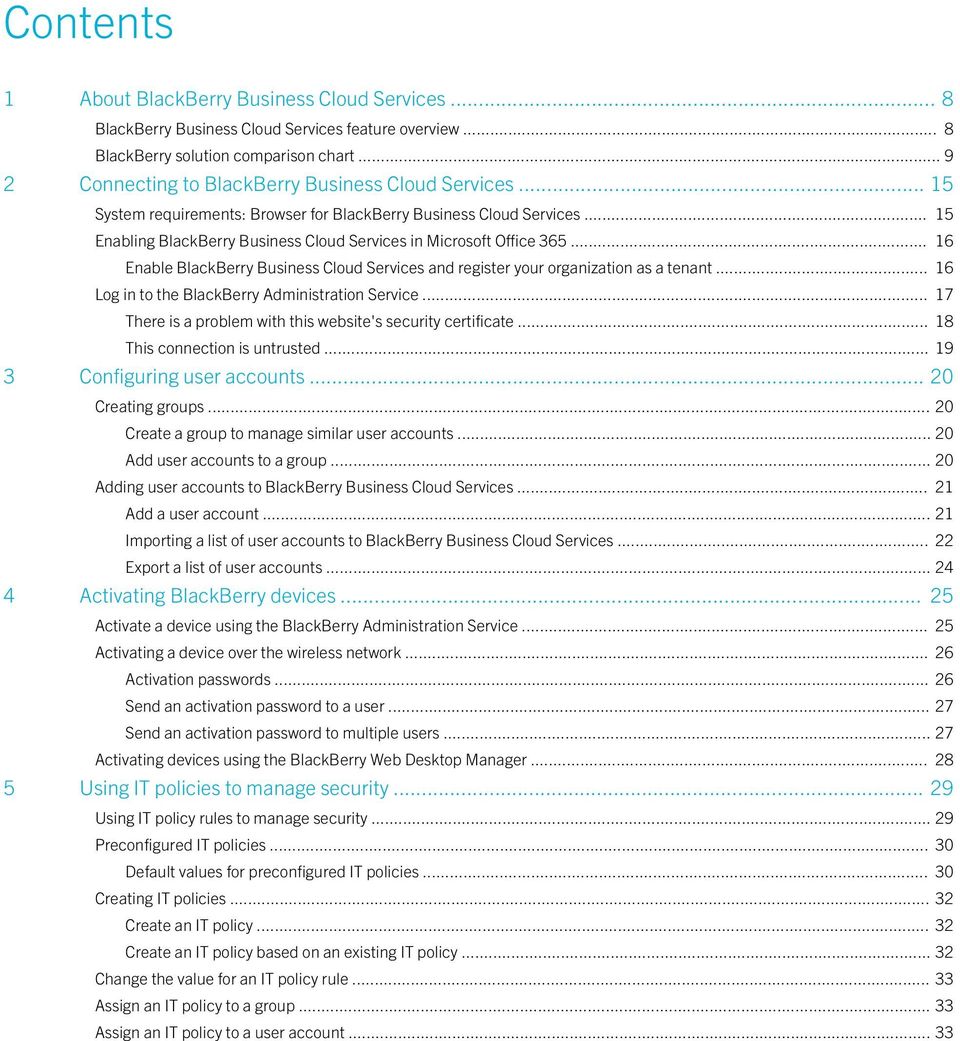
3 Contents 1 About BlackBerry Business Cloud Services... 8 BlackBerry Business Cloud Services feature overview... 8 BlackBerry solution comparison chart Connecting to BlackBerry Business Cloud Services System requirements: Browser for BlackBerry Business Cloud Services Enabling BlackBerry Business Cloud Services in Microsoft Office Enable BlackBerry Business Cloud Services and register your organization as a tenant Log in to the BlackBerry Administration Service There is a problem with this website's security certificate This connection is untrusted Configuring user accounts Creating groups Create a group to manage similar user accounts Add user accounts to a group Adding user accounts to BlackBerry Business Cloud Services Add a user account Importing a list of user accounts to BlackBerry Business Cloud Services Export a list of user accounts Activating BlackBerry devices Activate a device using the BlackBerry Administration Service Activating a device over the wireless network Activation passwords Send an activation password to a user Send an activation password to multiple users Activating devices using the BlackBerry Web Desktop Manager Using IT policies to manage security Using IT policy rules to manage security Preconfigured IT policies Default values for preconfigured IT policies Creating IT policies Create an IT policy Create an IT policy based on an existing IT policy Change the value for an IT policy rule Assign an IT policy to a group Assign an IT policy to a user account... 33
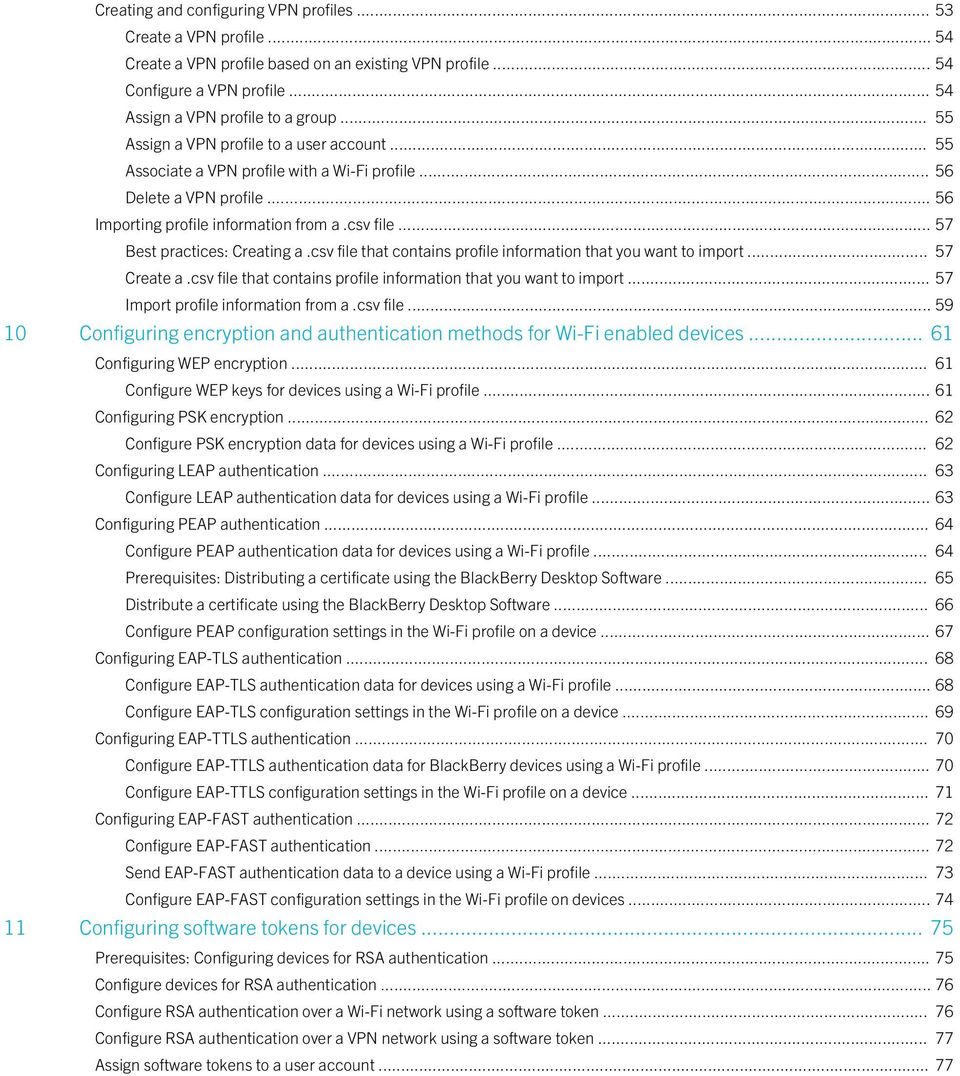
4 Resolving IT policy conflicts How conflicting IT policies are resolved Rank IT policies Preview how BlackBerry Business Cloud Services resolves IT policy conflicts View the resolved IT policy rules that are assigned to a user account Sending an IT policy over the wireless network Resend an IT policy to a device manually Export all IT policy data to a data file Delete an IT policy Setting up cloud messaging services Creating message filters Create an message filter Turn on an message filter that applies to a specific user account Copying existing message filters to user accounts Export message filters for a user account Import message filters for a user account Mapping contact-information fields for synchronization and contact lookups Map a contact list field to a contact list field on a device Map a contact list field from an account to a contact list field on a device Configuring the BlackBerry Web Desktop Manager Installing the client components of the BlackBerry Web Desktop Manager on users' computers Allow users to activate devices using the BlackBerry Web Desktop Manager Allow users to perform self service tasks using the BlackBerry Web Desktop Manager Allow users to back up and restore data using the BlackBerry Web Desktop Manager Configure the domains for backing up data using the BlackBerry Web Desktop Manager Installing applications on devices Installing applications using the BlackBerry Desktop Software Make an application available for download from the BlackBerry Desktop Software Installing applications using a web browser on devices Make an application available on a web server Install an application using a web browser on the device Creating and configuring Wi-Fi profiles and VPN profiles Creating and configuring Wi-Fi profiles Prerequisites: Creating Wi-Fi profiles and VPN profiles Create a Wi-Fi profile Create a Wi-Fi profile based on an existing Wi-Fi profile Configure a Wi-Fi profile Assign a Wi-Fi profile to a group Assign a Wi-Fi profile to a user account Delete a Wi-Fi profile... 53

5 Creating and configuring VPN profiles Create a VPN profile Create a VPN profile based on an existing VPN profile Configure a VPN profile Assign a VPN profile to a group Assign a VPN profile to a user account Associate a VPN profile with a Wi-Fi profile Delete a VPN profile Importing profile information from a.csv file Best practices: Creating a.csv file that contains profile information that you want to import Create a.csv file that contains profile information that you want to import Import profile information from a.csv file Configuring encryption and authentication methods for Wi-Fi enabled devices Configuring WEP encryption Configure WEP keys for devices using a Wi-Fi profile Configuring PSK encryption Configure PSK encryption data for devices using a Wi-Fi profile Configuring LEAP authentication Configure LEAP authentication data for devices using a Wi-Fi profile Configuring PEAP authentication Configure PEAP authentication data for devices using a Wi-Fi profile Prerequisites: Distributing a certificate using the BlackBerry Desktop Software Distribute a certificate using the BlackBerry Desktop Software Configure PEAP configuration settings in the Wi-Fi profile on a device Configuring EAP-TLS authentication Configure EAP-TLS authentication data for devices using a Wi-Fi profile Configure EAP-TLS configuration settings in the Wi-Fi profile on a device Configuring EAP-TTLS authentication Configure EAP-TTLS authentication data for BlackBerry devices using a Wi-Fi profile Configure EAP-TTLS configuration settings in the Wi-Fi profile on a device Configuring EAP-FAST authentication Configure EAP-FAST authentication Send EAP-FAST authentication data to a device using a Wi-Fi profile Configure EAP-FAST configuration settings in the Wi-Fi profile on devices Configuring software tokens for devices Prerequisites: Configuring devices for RSA authentication Configure devices for RSA authentication Configure RSA authentication over a Wi-Fi network using a software token Configure RSA authentication over a VPN network using a software token Assign software tokens to a user account... 77
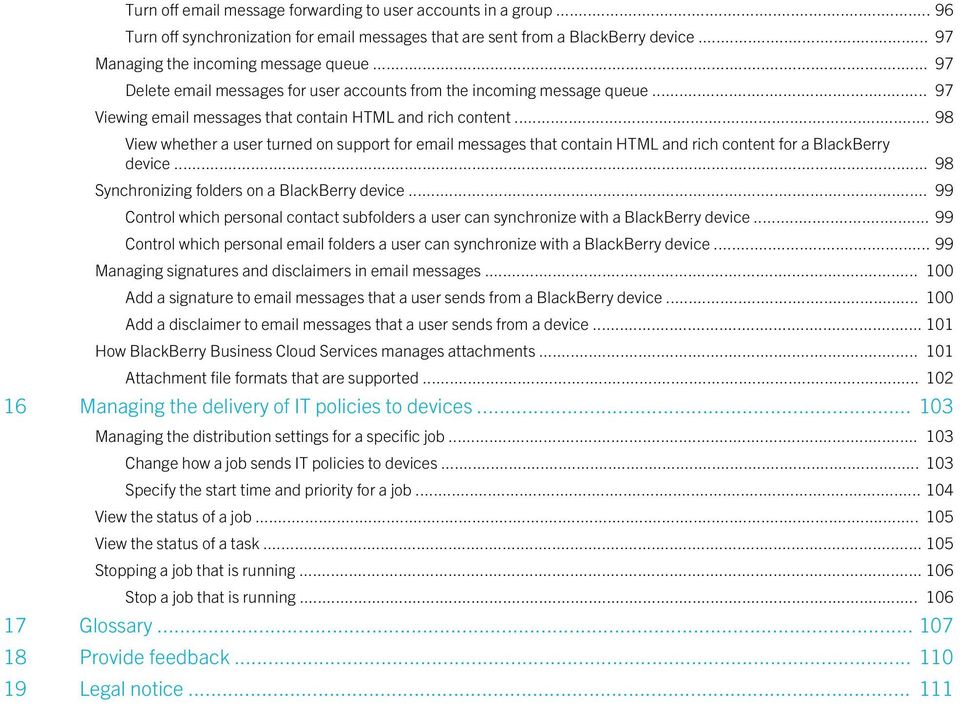
6 12 Protecting and redistributing devices Using IT administration commands to protect a lost or stolen device Protect a lost or stolen device by locking it Protect a lost or stolen device by deleting all data Protect a lost device that a user might recover Preparing a device for redistribution to a new user Delete user data and assign a device to a new user Delete user data and device data and assign a device to a new user Managing groups and user accounts Managing groups Using default groups to manage user accounts Remove a user account from a group Change the properties of a group Rename a group Delete a group Managing user accounts Move a user account to a different group Delete a user account from BlackBerry Business Cloud Services Update a user account manually Resend service books to a BlackBerry device Managing organizer data synchronization Managing the wireless backup and recovery of organizer data Turn off the wireless backup of organizer data for a user account Delete a user's organizer data from BlackBerry Business Cloud Services Delete organizer data for members of a user group from BlackBerry Business Cloud Services Changing how organizer data synchronizes Turn off organizer data synchronization for a user account Change the direction of organizer data synchronization for a user account Change how the BlackBerry Administration Service resolves conflicts for a specific user account during organizer data synchronization Synchronizing contact pictures Turn off synchronization of contact pictures for a user account Synchronizing calendars Start corrective calendar synchronization manually for a user account Managing your organization's cloud messaging services Managing message forwarding Forward messages to a device when filter rules do not apply Do not deliver messages to a BlackBerry device when no filter rules apply Forward messages from inbox subfolders to a BlackBerry device Turn off message forwarding to a user account... 96

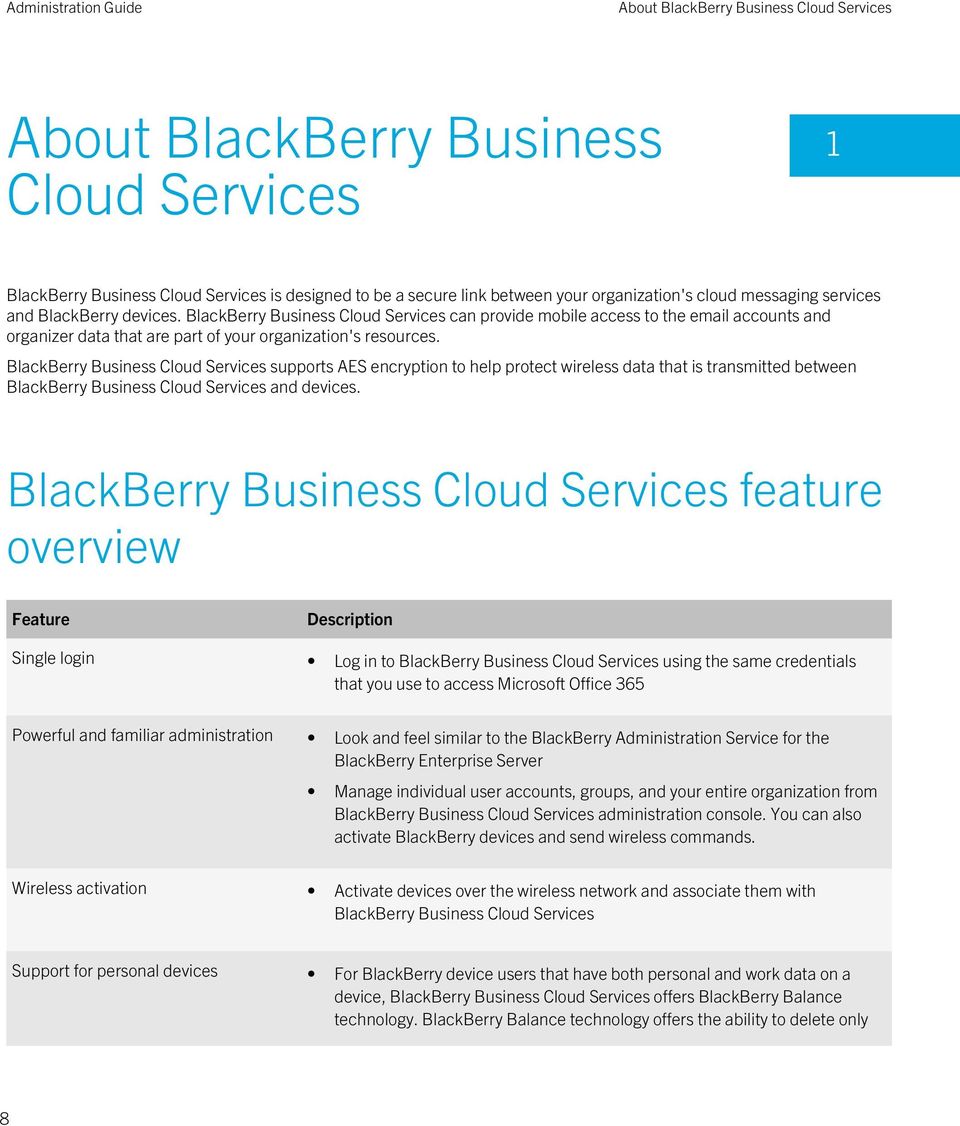
7 Turn off message forwarding to user accounts in a group Turn off synchronization for messages that are sent from a BlackBerry device Managing the incoming message queue Delete messages for user accounts from the incoming message queue Viewing messages that contain HTML and rich content View whether a user turned on support for messages that contain HTML and rich content for a BlackBerry device Synchronizing folders on a BlackBerry device Control which personal contact subfolders a user can synchronize with a BlackBerry device Control which personal folders a user can synchronize with a BlackBerry device Managing signatures and disclaimers in messages Add a signature to messages that a user sends from a BlackBerry device Add a disclaimer to messages that a user sends from a device How BlackBerry Business Cloud Services manages attachments Attachment file formats that are supported Managing the delivery of IT policies to devices Managing the distribution settings for a specific job Change how a job sends IT policies to devices Specify the start time and priority for a job View the status of a job View the status of a task Stopping a job that is running Stop a job that is running Glossary Provide feedback Legal notice
8 About BlackBerry Business Cloud Services About BlackBerry Business Cloud Services 1 BlackBerry Business Cloud Services is designed to be a secure link between your organization's cloud messaging services and BlackBerry devices. BlackBerry Business Cloud Services can provide mobile access to the accounts and organizer data that are part of your organization's resources. BlackBerry Business Cloud Services supports AES encryption to help protect wireless data that is transmitted between BlackBerry Business Cloud Services and devices. BlackBerry Business Cloud Services feature overview Feature Description Single login Log in to BlackBerry Business Cloud Services using the same credentials that you use to access Microsoft Office 365 Powerful and familiar administration Look and feel similar to the BlackBerry Administration Service for the BlackBerry Enterprise Server Manage individual user accounts, groups, and your entire organization from BlackBerry Business Cloud Services administration console. You can also activate BlackBerry devices and send wireless commands. Wireless activation Activate devices over the wireless network and associate them with BlackBerry Business Cloud Services Support for personal devices For BlackBerry device users that have both personal and work data on a device, BlackBerry Business Cloud Services offers BlackBerry Balance technology. BlackBerry Balance technology offers the ability to delete only 8
9 About BlackBerry Business Cloud Services Feature Description work data from the device (for example, you might want to delete work data if a user leaves the organization). You can use this feature on devices that are running BlackBerry 6 or later. Instant messaging Supports BlackBerry Messenger and consumer instant messaging applications available from the BlackBerry App World storefront Data protection Uses AES encryption to protect data that is in transit between BlackBerry Business Cloud Services and devices Protects the connection between BlackBerry Business Cloud Services and the BlackBerry Administration Service using HTTPS Provides IT policies and IT administration commands to control the behavior of the device Web-based self-service Allows users to switch devices, back up and restore data on devices, set their own activation passwords, or send wireless commands to lock or delete the data on devices User features Supports all of the messaging features that users expect with BlackBerry devices, including wireless reconciliation, filters, forwarding, signatures, out-of-office reply, contact lookup and updates, attachment viewing and downloading, personal distribution lists, personal folders and subfolders, follow-up flags, calendar event forwarding, availability viewing in meeting invitations, and so on BlackBerry solution comparison chart Messaging features Feature BlackBerry Enterprise Server BlackBerry Enterprise Server Express BlackBerry Internet Service BlackBerry Business Cloud Services Supported messaging environments Microsoft Exchange, Lotus Microsoft Exchange and Lotus Domino IMAP and POP (for example, Google Mail, Microsoft Office 365 9

10 About BlackBerry Business Cloud Services Feature BlackBerry Enterprise Server BlackBerry Enterprise Server Express BlackBerry Internet Service BlackBerry Business Cloud Services Domino, and Novell GroupWise Yahoo! Mail, Microsoft Outlook Web Access) Wireless messaging reconciliation Contact lookup Sent message reconciliation Reconciliation of permanently deleted messages (hard delete) Some messaging environments messages with HTML and rich content Remote message lookup Google Mail only message filters Global filters and user filters Global filters and user filters User filters User filters Separate inboxes for work and personal accounts Synchronization of published public contact folders Synchronization of personal contact folders Synchronization of personal mail folders Synchronization of organizer data (memos and tasks) With limitations Calendar features 10

11 About BlackBerry Business Cloud Services Feature BlackBerry Enterprise Server BlackBerry Enterprise Server Express BlackBerry Internet Service BlackBerry Business Cloud Services Calendar synchronization Google Mail only Ability to check the availability of meeting participants Ability to forward calendar entries Calendar attachments Enterprise instant messaging features Feature BlackBerry Enterprise Server BlackBerry Enterprise Server Express BlackBerry Internet Service BlackBerry Business Cloud Services Supported enterprise instant messaging environments IBM Lotus Sametime, Microsoft Office Communications Server, Microsoft Lync Server, and Novell GroupWise Messenger None None None Console support features Feature BlackBerry Enterprise Server BlackBerry Enterprise Server Express BlackBerry Internet Service BlackBerry Business Cloud Services Administration console With limitations Administrative roles With limitations Limited to Microsoft Office 365 administrative roles Self-service console Languages English, Brazilian Portuguese, French, German, English, Brazilian Portuguese, French, German, Italian, For a list of supported languages, visit English, Brazilian Portuguese, French, German, Italian, 11
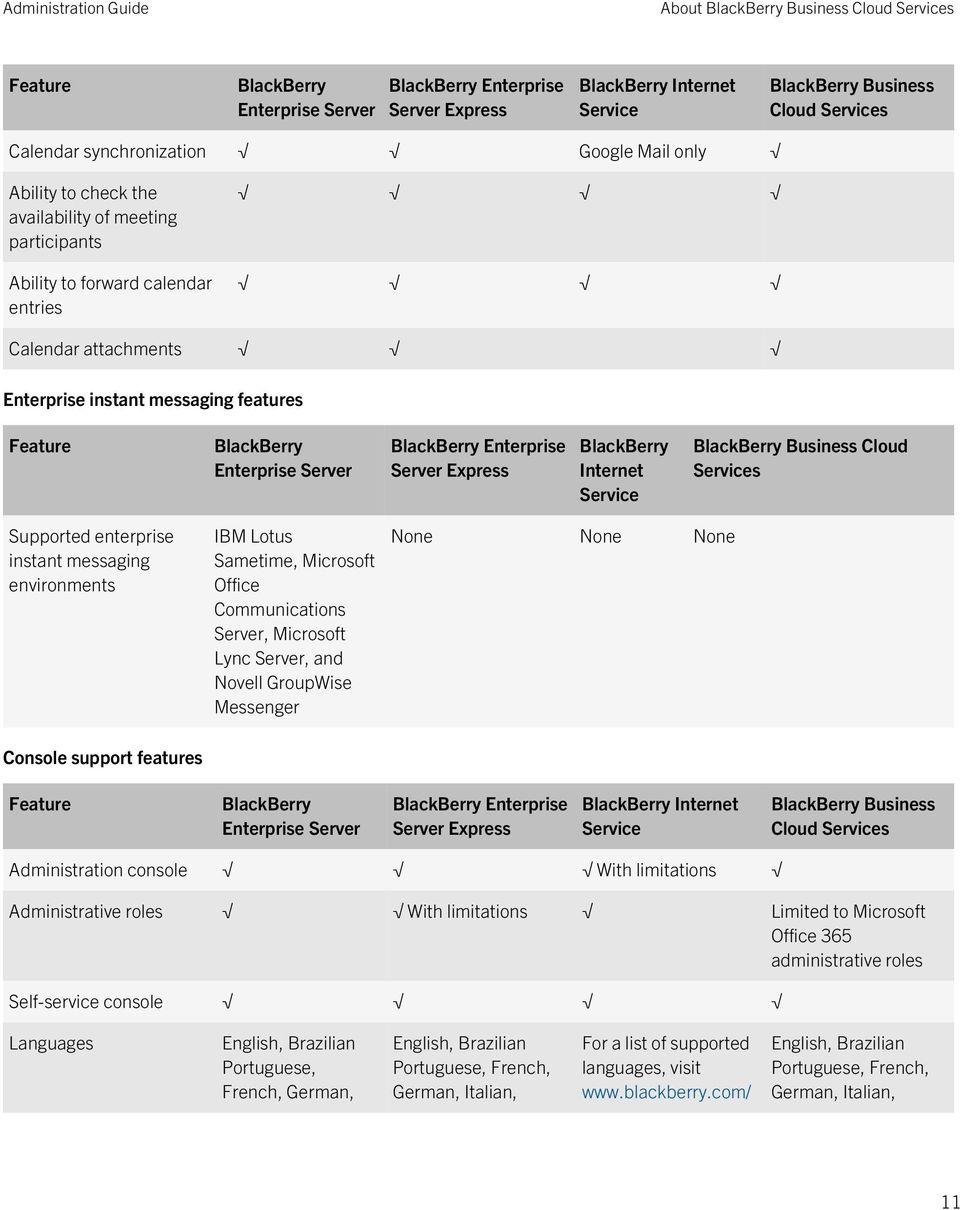
12 About BlackBerry Business Cloud Services Feature BlackBerry Enterprise Server BlackBerry Enterprise Server Express BlackBerry Internet Service BlackBerry Business Cloud Services Italian, Japanese, and Spanish Japanese, and Spanish support to read article KB Japanese, and Spanish Activation features Feature BlackBerry Enterprise Server BlackBerry Enterprise Server Express BlackBerry Internet Service BlackBerry Business Cloud Services Supported activation methods BlackBerry Administration Service BlackBerry Administration Service BlackBerry Administration Service Over the wireless network BlackBerry Desktop Software BlackBerry Web Desktop Manager Over your organization's Wi-Fi network Over the wireless network (requires app or specific data plan) BlackBerry Desktop Software BlackBerry Web Desktop Manager Over your organization's Wi-Fi network Over the wireless network BlackBerry Web Desktop Manager Security features Feature BlackBerry Enterprise Server BlackBerry Enterprise Server Express BlackBerry Internet Service BlackBerry Business Cloud Services Transport layer encryption (AES and Triple DES) (AES and Triple DES) (AES) Enhanced encryption (S/MIME and PGP) (S/MIME and PGP) (SSL) BlackBerry Balance technology IT administration commands Supports: Supports: Supports: Supports: 12

13 About BlackBerry Business Cloud Services Feature BlackBerry Enterprise Server BlackBerry Enterprise Server Express BlackBerry Internet Service BlackBerry Business Cloud Services Specify new device password and lock device Specify new device password and lock device Specify new device password and lock device Specify new device password and lock device Delete only work data and remove device Delete only work data and remove device Delete all device data and remove device Delete only work data and remove device Delete all device data and remove device Delete all device data and remove device Delete all device data and remove device IT policy rules All Subset Subset Two-factor authentication Application and browsing features Feature BlackBerry Enterprise Server BlackBerry Enterprise Server Express BlackBerry Internet Service BlackBerry Business Cloud Services Web browsing Intranet browsing Methods for installing applications Supports: Over the wireless network BlackBerry Administration Service BlackBerry Desktop Software BlackBerry Web Desktop Manager Supports: Over the wireless network BlackBerry Administration Service BlackBerry Desktop Software BlackBerry Web Desktop Manager Supports: BlackBerry Desktop Software Web browser on BlackBerry devices BlackBerry App World Supports: BlackBerry Desktop Software Web browser on BlackBerry devices BlackBerry App World Standalone application loader tool Standalone application loader tool 13
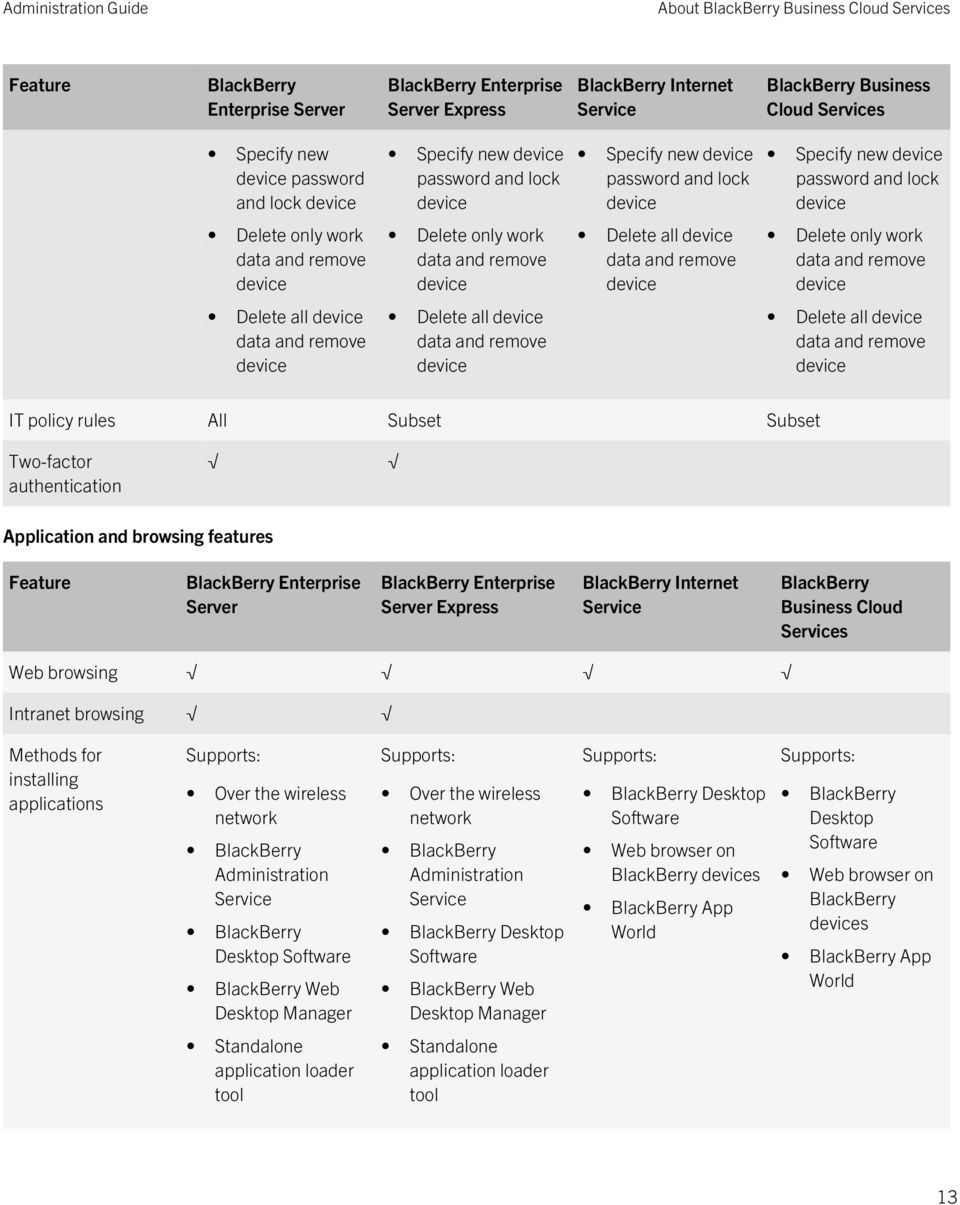
14 About BlackBerry Business Cloud Services Feature BlackBerry Enterprise Server BlackBerry Enterprise Server Express BlackBerry Internet Service BlackBerry Business Cloud Services Web browser on BlackBerry devices BlackBerry App World Web browser on BlackBerry devices BlackBerry App World Ability to push applications to devices Application control policies Methods for updating BlackBerry Device Software Supports: Over the wireless network Supports: Over the wireless network Supports: Over the wireless network Supports: Over the wireless network BlackBerry Administration Service BlackBerry Administration Service BlackBerry Desktop Software BlackBerry Desktop Software BlackBerry Desktop Software BlackBerry Desktop Software BlackBerry Web Desktop Manager BlackBerry Web Desktop Manager Standalone application loader tool Standalone application loader tool BlackBerry Desktop Software update sites BlackBerry Desktop Software update sites 14

15 Connecting to BlackBerry Business Cloud Services Connecting to BlackBerry Business Cloud Services 2 System requirements: Browser for BlackBerry Business Cloud Services Item Requirement Browser Windows Internet Explorer 8.0 Mozilla Firefox 3.6 Safari 4 for Mac Google Chrome 4 Browser settings for Windows Internet Explorer To support browser access, configure the following settings: Language preferences configured to display encoded web pages Microsoft hotfix installed on the users' computers to make sure the correct time zones are displayed The following settings turned on to support Microsoft ActiveX: Automatic prompting for Microsoft ActiveX controls Download signed Microsoft ActiveX controls Run Microsoft ActiveX controls and plug-ins Script Microsoft ActiveX controls marked safe for scripting Support for JavaScript Cookies turned on 15

16 Connecting to BlackBerry Business Cloud Services Item Requirement Support for TLS or SSL The SSL certificate installed to permit trusted connections to the BlackBerry Administration Service If using Windows Vista, the BlackBerry Administration Service web address added as a trusted website and Enable protected mode cleared Browser settings for Firefox, Safari, and Google Chrome To support browser access, configure the following settings: Support for JavaScript Cookies turned on Support for TLS or SSL To permit trusted connections to the BlackBerry Administration Service, the SSL certificate installed Enabling BlackBerry Business Cloud Services in Microsoft Office 365 You must be a Microsoft Office 365 global administrator with a tenant organization or a Microsoft Partner providing Microsoft Office 365 administration services to enable BlackBerry Business Cloud Services in Microsoft Office 365 and register as a tenant with BlackBerry Business Cloud Services. Enable BlackBerry Business Cloud Services and register your organization as a tenant You must be a Microsoft Office 365 global administrator to complete this task. You only need to complete this task one time for your organization. 1. Log in to Microsoft Office On the Resources menu, click Setting up on mobile phones. 3. Click Enable BlackBerry Business Cloud Services. 4. Read the associated services information. 16

17 Connecting to BlackBerry Business Cloud Services 5. Authorize access by selecting the Yes, I have read and understand the associated services information check box and click OK. 6. After approximately 15 minutes, in the Authorized Services section, click Manage. Microsoft Office 365 redirects you to the BlackBerry Business Cloud Services console. 7. In the BlackBerry Business Cloud Services console, click Sign up now. 8. Select a language. 9. Read the license agreement and select the I Agree check box. 10. Click Continue. 11. Read the additional terms and select the I Agree check box. 12. Click Login to BlackBerry Administration Service. BlackBerry Business Cloud Services redirects you to the BlackBerry Administration Service console. Log in to the BlackBerry Administration Service Before you begin: Microsoft Office 365 global administrator enabled BlackBerry Business Cloud Services and registered your organization as a tenant. The browser must permit Microsoft ActiveX controls to manage a BlackBerry device that is connected to your computer. 1. Log in to Microsoft Office In the Authorized Services section, click Manage. You are redirected to the BlackBerry Administration Service. You are also logged into BlackBerry Web Desktop Manager. After you finish: If you use Windows Internet Explorer and the browser displays an error when you try to access BlackBerry Administration Service, see There is a problem with this website's security certificate. If you use Mozilla Firefox and the browser displays an error when you try to access BlackBerry Administration Service, see This connection is untrusted. 17
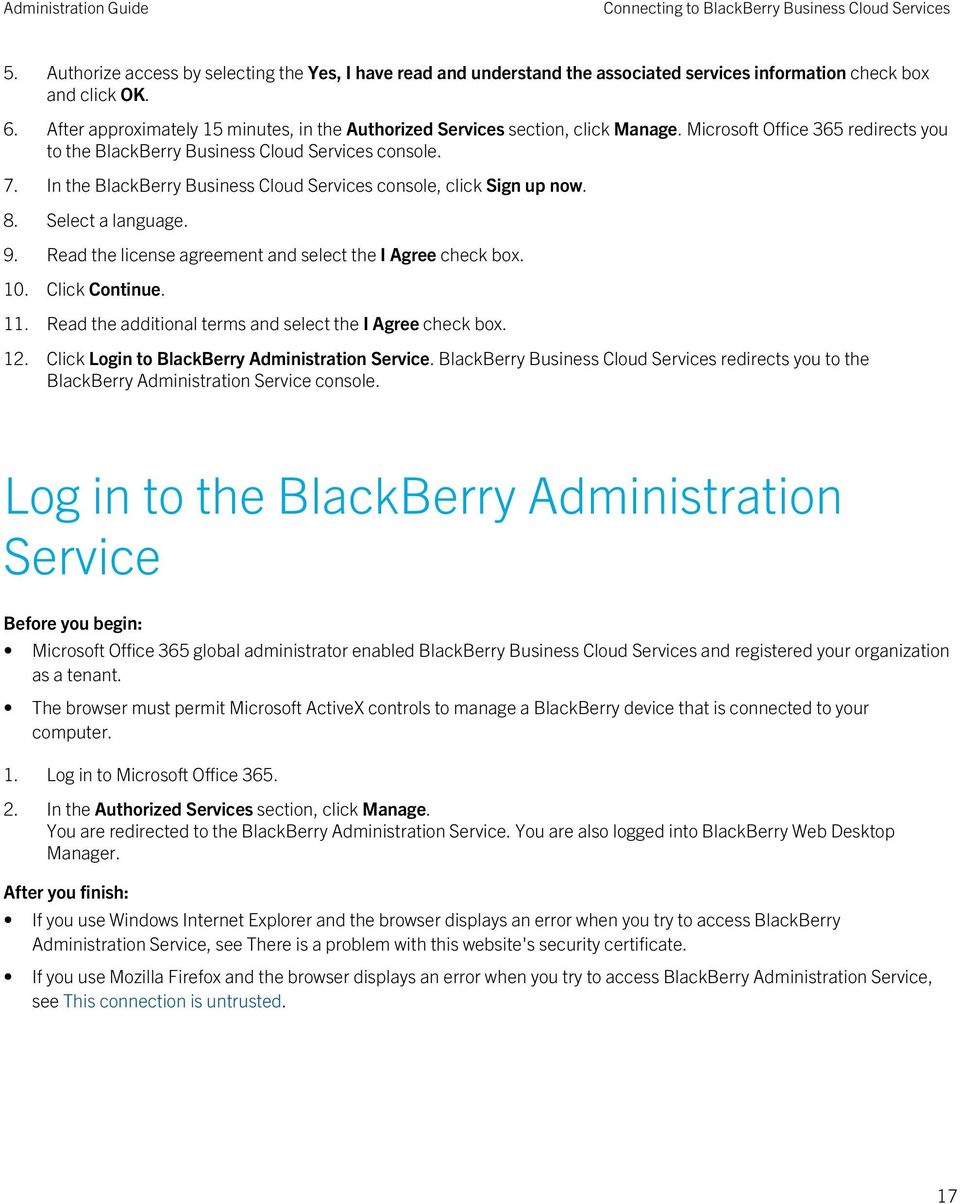
18 Connecting to BlackBerry Business Cloud Services There is a problem with this website's security certificate Possible cause The browser displays this error message when you try to navigate to the BlackBerry Administration Service using Windows Internet Explorer 8 or later. Possible solution Add the web address for the BlackBerry Administration Service to the list of trusted web sites in Windows Internet Explorer, and install the certificate for the BlackBerry Administration Service in the certificate store of your computer. 1. In Windows Internet Explorer, navigate to the BlackBerry Administration Service console. 2. Click Continue to this website (not recommended). 3. On the Tools menu, click Internet Options. 4. On the Security tab, click Local Intranet. 5. Click Sites. 6. Click Add to add the console to the list of trusted websites. 7. Click Close. 8. Click OK. 9. In the browser window, on the toolbar, click Certificate Error. 10. Click View certificates. 11. Click Install certificate. The Certificate Import Wizard opens. a b c d In the Certificate Store dialog box, click Place all certificates in the following store. Click Browse. Click Trusted Root Certification Authorities. Click OK. 12. Close and reopen the browser. 18
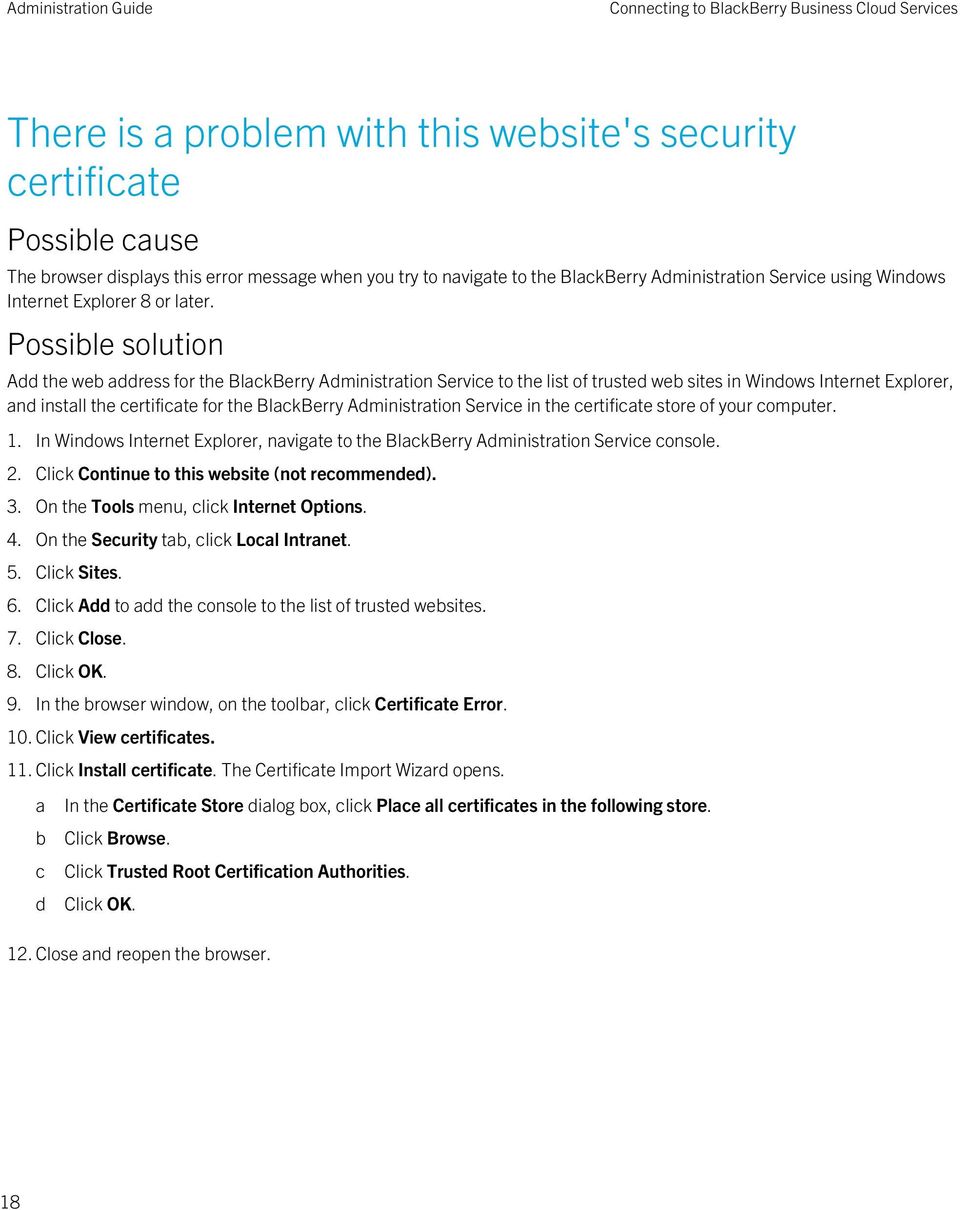
19 Connecting to BlackBerry Business Cloud Services This connection is untrusted Possible cause The browser displays this error message when you try to navigate to the BlackBerry Administration Service using Mozilla Firefox 3.6. Possible solution Install the certificate for the BlackBerry Administration Service in the certificate store of your computer. 1. In Firefox, navigate to the BlackBerry Administration Service console. 2. Click I Understand the Risks. 3. Click Add Exception. 4. Click Confirm Security Exception. 5. Close and reopen the browser. 19
20 Configuring user accounts Configuring user accounts 3 Creating groups You can create groups and assign user accounts to groups based on custom criteria, such as user location, organizational group, or device model. Create a group to manage similar user accounts You can reduce the time that you spend managing user accounts by adding similar user accounts to a group, and assigning shared properties, such as IT policies, to the group. Properties that you assign to a group are assigned to all user accounts in the group. 1. In the BlackBerry Administration Service, on the BlackBerry solution management menu, expand Group. 2. Click Create a group. 3. In the Group information section, type a name and description for the group. 4. Click Save. Related information Add user accounts to a group, 20 Managing groups, 84 Add user accounts to a group You can add user accounts to a group to assign the properties of the group to user accounts automatically. 1. In the BlackBerry Administration Service, on the BlackBerry solution management menu, expand User. 2. Click Manage users. 3. Search for the user accounts. 4. Select the user accounts. 20
21 Configuring user accounts 5. In the Add to user configuration list, click Add group. 6. In the Available groups list, click the group that you want to add the user accounts to. 7. Click Add. 8. Click Save. Adding user accounts to BlackBerry Business Cloud Services Add a user account You can add a user account to BlackBerry Business Cloud Services, assign a BlackBerry device to a user account, and activate the device. The user account must exist in Microsoft Office 365. Before you begin: If required, create a group so that you can manage user accounts that are similar. 1. In the BlackBerry Administration Service, on the BlackBerry solution management menu, expand User. 2. Click Create a user. 3. Type the search criteria in the appropriate fields to search for a user account (for example, a partial name or address). Click Search. 4. Select the check box beside the display name for the user account. 5. Click Continue. 6. If groups exist in the Available groups list, click at least one group that you want to add the user account to. 7. Click Add. 8. To select an activation option, perform one of the following actions: Option Specify an activation password for the user account. Step 1. Click Create a user with activation password. 2. In the Set activation password, section, type and confirm an activation password. 3. In the Password expiration (hours) field, type the amount of time, in hours, that you want to elapse before the activation password expires. 4. Click Create user. 21
22 Configuring user accounts Option Generate an activation password for the user account automatically. Activate the user account without using an activation password. Step Click Create a user with generated activation password. Click Create a user without activation password. After you finish: After you create new user accounts, Microsoft Office 365 must give BlackBerry Business Cloud Services access to the users' accounts. You need to wait approximately 20 minutes after adding user accounts before users can activate their devices. Related information Managing user accounts, 86 Activating BlackBerry devices, 25 Importing a list of user accounts to BlackBerry Business Cloud Services You can add multiple user accounts to BlackBerry Business Cloud Services by importing a.csv file that contains a list of user accounts and the required information to activate the user accounts on BlackBerry Business Cloud Services. The maximum number of user accounts in the.csv file is 100. If you have more than 100 user accounts that you want to import, create multiple.csv files. The.csv file can include the following information: User accounts that you want to add Names of the groups you want to add the user accounts to Activation passwords that you want to assign to the user accounts The BlackBerry Administration Service processes actions in the order that they appear in the.csv file. If the BlackBerry Administration Service encounters an error that is specific to an action during the import process (for example, an action is incorrectly formatted in the.csv file), the BlackBerry Administration Service continues to process the remaining actions that are listed in the file and displays an error message for the action that the BlackBerry Administration Service could not process. Fields in a.csv file that contain user account information The BlackBerry Administration Service uses a.csv file to add user account information to BlackBerry Business Cloud Services. The following table lists the fields in the.csv file that might be populated when you import user account information. 22
23 Configuring user accounts Field Address Group Names Activation Password Operation Activation Password Activation Password Expiry Description The field is required and specifies the address for the user account. This field specifies the names of groups that you want to add the user account to. This field specifies whether an activation password is required to activate the user account and whether that password should be specified by the administrator or the BlackBerry Administration Service. The activation password value specified in this field can either be "specify", "none", or "generate" in lower case only. The activation password operation must be the same on each line in the.csv file. If the field is set to "specify", the activation password and the expiry time (in hours) are optional fields in the.csv file. If the activation password and the expiry time values are not included in the.csv file, you are prompted to specify these values the after uploading the.csv file. If you specify the activation password and the expiry time for the user accounts, the values must be provided on every line of the csv file. If the field is set to "generate", the password is automatically generated by the BlackBerry Administration Service and the final two fields of each.csv line must be empty. The activation password expires if the user does not activate the BlackBerry device on BlackBerry Business Cloud Services before the password timeout elapses. The default value is 48 hours. If the field is set to "none", the user account is created without an activation password and the final two fields of each.csv line must be empty. To activate a device on BlackBerry Business Cloud Services over the wireless network, an activation password is required. This field specifies the activation password for the user account if an activation password is required. This field specifies the amount of time, in hours, that can elapse before the activation password expires if an activation password is required. The activation password will expire if the user does not activate the device on BlackBerry Business Cloud Services before a default value of 48 hours elapses. Example: Importing user accounts to BlackBerry Business Cloud Services " Address","Group Names","Activation Password Operation","Activation Password","Activation Password Expiry" 23
24 Configuring user accounts "asdf","24" "asdf","24" Create multiple user accounts by importing the user accounts from a.csv file You can import a list of user accounts from a.csv file and add them to BlackBerry Business Cloud Services. The user accounts must exist in Microsoft Office 365. Before you begin: Prepare a.csv file of user accounts that you want to import into BlackBerry Business Cloud Services. If you want to import more than 100 user accounts, create multiple.csv files of less than 100 user accounts in each file. 1. In BlackBerry Administration Service, on the BlackBerry solution management menu, expand User. 2. Click Create a user. 3. Click Import new users. 4. In the Import users from a list section, click Browse. 5. Navigate to the.csv file that contains the user accounts that you want to import. 6. Click Continue. 7. Perform the appropriate actions for the user accounts. After you finish: After you create new user accounts, Microsoft Office 365 must give BlackBerry Business Cloud Services access to the users' accounts. You need to wait approximately 20 minutes after adding user accounts before users can activate their devices. Export a list of user accounts You can export a list of user accounts from BlackBerry Business Cloud Services to a.csv file. The.csv file contains information about the user accounts, such as the user ID, display name, PIN and address. 1. In the BlackBerry Administration Service, on the BlackBerry solution management menu, expand User. 2. Click Manage users. 3. Select the check boxes beside the display names of the appropriate user accounts. 4. In the Export users list, click Export selected users. 5. Click Download file. 6. Save the.csv file. 24
25 Activating BlackBerry devices Activating BlackBerry devices 4 To assign BlackBerry devices to user accounts and activate the devices, you can use any of the following methods: Method BlackBerry Administration Service Over the wireless network BlackBerry Web Desktop Manager Description You can activate devices before you distribute them to users by connecting the devices to a computer and logging in to the BlackBerry Administration Service. New users and users that are receiving replacement devices can activate the devices without requiring a physical connection to your organization's network. Devices that are associated with the BlackBerry Internet Service cannot be activated over the wireless network. New users and users that are receiving replacement devices can activate the devices by connecting the devices to a computer that hosts the BlackBerry Web Desktop Manager. Activate a device using the BlackBerry Administration Service Before you begin: For activation to complete, you need wireless connectivity or Wi-Fi connectivity to the BlackBerry Infrastructure. If necessary, prepare a BlackBerry device so that you can distribute it to a user. 1. Connect the device to a computer that can access the BlackBerry Administration Service. 2. On the Devices menu, expand Attached devices. 3. Click Manage current device. 4. Click Assign current device. 5. Search for a user account. 6. In the search results, click the display name for a user account. 7. Click Associate user. 25
26 Activating BlackBerry devices 8. Click Assign current device. Related information Protecting and redistributing devices, 79 Activating a device over the wireless network To activate a BlackBerry device over the wireless network, you assign an activation password to a user account. The user receives the activation password in an message and associates the device with the account by typing the password on the device. The wireless activation process activates devices on BlackBerry Business Cloud Services over the wireless network. Neither you nor the users are required to connect the devices to a computer to complete the activation process. You can use the wireless activation process to activate a large number of devices over the wireless network. When users want to activate devices on BlackBerry Business Cloud Services over the wireless network, they must notify you. You can use the BlackBerry Administration Service to configure activation passwords and distribute the passwords to the users. The wireless activation process can begin automatically or when users open the activation application on the devices and type an activation password and address. When the activation process completes, users can send messages from and receive messages on their devices. When you initiate the wireless activation process, BlackBerry Business Cloud Services sends an message with an etp.dat attachment from the blackberry.net domain to the cloud messaging services. To make sure that the message is not blocked or changed, add the blackberry.net domain to the whitelist in your organization's cloud messaging services. Activation passwords BlackBerry Business Cloud Services activates a BlackBerry device over the wireless network using the wireless activation authentication protocol and an activation password that is specific to the user account that is associated with the device. Item character support security Description Activation passwords can include any type of character. Wireless activation is designed so that short activation passwords do not compromise the security of the protocol. You must distribute the activation password to the authenticated user securely. If the user receives the activation password, but does not activate the device on BlackBerry Business Cloud Services, a potentially malicious user who can access the activation password can connect another device to BlackBerry Business Cloud Services and assume the identity of the intended user. 26
27 Activating BlackBerry devices Item Description When a user activates a device on BlackBerry Business Cloud Services, the activation password becomes inactive and a potentially malicious user cannot reuse it to activate another device. If a user receives an activation password, you cannot generate a new activation password for the user until the activation password expires. An activation password expires after 48 hours by default. You can configure an activation to password expire earlier than the default value of 48 hours. password validity An activation password is no longer valid if any of the following events occur: the user does not activate the device on BlackBerry Business Cloud Services before the password expires the user types the activation password incorrectly five consecutive times BlackBerry Business Cloud Services activates a device using the activation password Send an activation password to a user 1. In the BlackBerry Administration Service, on the BlackBerry solution management menu, expand User. 2. Click Manage users. 3. Search for a user account. 4. In the search results, click the display name for the user account. 5. In the Device activation list, click Specify an activation password. 6. In the Activation password field and Confirm password field, type an activation password. The password should not contain special characters. Some BlackBerry devices do not support special characters and do not unlock when a user types a password that contains special characters. 7. In the Password expiration (hours) field, type the amount of time that can elapse before the activation password expires. 8. Click Specify an activation password. Send an activation password to multiple users 1. In the BlackBerry Administration Service, on the BlackBerry solution management menu, expand User. 2. Click Manage users. 3. Search for one or more user accounts. 27
28 Activating BlackBerry devices 4. Select the check boxes beside the display names for the appropriate user accounts. 5. In the Device activation list, click Specify an activation password. 6. In the Activation password field and Confirm password field, type an activation password. The password should not contain special characters. Some BlackBerry devices do not support special characters and do not unlock when a user types a password that contains special characters. 7. In the Password expiration (hours) field, type the amount of time, in hours, that can elapse before the activation password expires. 8. Click Specify an activation password. Activating devices using the BlackBerry Web Desktop Manager Users can activate BlackBerry devices by connecting the devices to computers using a USB cable and logging in to the BlackBerry Web Desktop Manager. For activation to complete, devices need a wireless connection or Wi-Fi connection to the BlackBerry Infrastructure. During the activation process, the BlackBerry Web Desktop Manager prompts users to associate the devices with their accounts and generate encryption keys. When users complete the activation process, BlackBerry Business Cloud Services synchronizes messages and organizer data to devices. For more information, see the BlackBerry Web Desktop Manager for BlackBerry Business Cloud Services User Guide, or the hosted help files at docs.blackberry.com/hlp/bbcs/wdt/1.0/en. 28
29 Using IT policies to manage security Using IT policies to manage security 5 You can use IT policies to control and manage BlackBerry devices in your organization's environment. An IT policy consists of multiple IT policy rules that manage the security and behavior of BlackBerry Business Cloud Services. For example, you can use IT policy rules to manage the following device behaviors and security features: Use of a password or pass phrase Protection of user data on the device Control of device resources, such as the camera Control personal devices using BlackBerry Balance BlackBerry Business Cloud Services includes preconfigured IT policies that you can use. The Default IT policy includes IT policy rules that are configured to indicate the default behavior of the device. After a user activates a device, BlackBerry Business Cloud Services automatically sends the IT policy that you assigned to the user account or group to the device. By default, if you do not assign an IT policy to the user account or group, BlackBerry Business Cloud Services sends the Default IT policy. If you delete an IT policy that you assigned to the user account or group, BlackBerry Business Cloud Services automatically re-assigns the Default IT policy to the user account and resends the Default IT policy to the device. For more information, see the BlackBerry Business Cloud Services Policy Reference Guide. Using IT policy rules to manage security You can use IT policy rules to customize and control the actions that users can perform. To use an IT policy rule on a BlackBerry device, you must verify that the BlackBerry Device Software version supports the IT policy rule. For example, you cannot use the Enable Separation of Work Content IT policy rule to control whether a device distinguishes between work data and personal data if the BlackBerry Device Software version does not support the IT policy rule. For information about the BlackBerry Device Software version that is required for a specific IT policy rule, see the BlackBerry Business Cloud Services Policy Reference Guide. The BlackBerry Administration Service groups the IT policy rules by common properties or by application. Most IT policy rules are designed so that you can assign them to multiple user accounts and groups. 29
30 Using IT policies to manage security Preconfigured IT policies BlackBerry Business Cloud Services includes the following preconfigured IT policies that you can use to meet the requirements of your organization. Preconfigured IT policy Default Basic Password Security Description This policy includes all the standard IT policy rules that are set in BlackBerry Business Cloud Services. This policy requires a basic password that users can use to unlock their BlackBerry devices. Users must change the passwords regularly. The IT policy includes a password timeout that locks devices. Default values for preconfigured IT policies You can configure additional IT policy rules in the preconfigured IT policies or change any of the following values: IT policy rule Default IT policy Basic Password Security IT Policy Device-Only Items Enable Long-Term Timeout Maximum Security Timeout 30 minutes Maximum Password Age 60 days Minimum Password Length Password Pattern Checks No restriction No restriction Password Required No Yes User Can Change Timeout Yes Yes User Can Disable Password Yes No Password policy group Forbidden Passwords Maximum Password History 30
31 Using IT policies to manage security IT policy rule Default IT policy Basic Password Security IT Policy Periodic Challenge Time Set Maximum Password Attempts Set Password Timeout Suppress Password Echo Personal devices policy group Enable Separation of Work Content Disable Forwarding of Work Content Using Personal Channels Require Work Resources for Conducting Work Activities Work Domains Security policy group Content Protection Strength Disable External Memory No External File System Encryption level Not required Required Password Pattern No BlackBerry App World policy group Enable Wireless Service Provider Billing Camera policy group Disable Photo Camera Disable Video Camera PIM Synchronization policy group Disable All Wireless Synchronization Wired Software Updates policy group Allow Web-Based Software Loading 31
32 Using IT policies to manage security Creating IT policies Create an IT policy 1. In the BlackBerry Administration Service, on the BlackBerry solution management menu, expand Policy. 2. Click Create an IT policy. 3. Type a name and description for the IT policy. 4. Click Save. 5. To configure the IT policy, perform the following actions: a. In the IT policy information section, click the IT policy. b. Click Edit IT policy. c. On a tab for an IT policy group, configure values for the IT policy rules. d. Click Save All. After you finish: For more information, see the BlackBerry Business Cloud Services Policy Reference Guide. Create an IT policy based on an existing IT policy 1. In the BlackBerry Administration Service, on the BlackBerry solution management menu, expand Policy. 2. Click Manage IT policies. 3. In the list of IT policies, click the IT policy that you want to copy. 4. Click Copy IT policy. 5. Type a name and description for the new IT policy. 6. Click Save. 7. To change the IT policy settings, perform the following actions: a. In the IT policy information section, click the IT policy. b. Click Edit IT policy. c. On a tab for an IT policy group, change the appropriate values for the IT policy rules. d. Click Save all. 32
33 Using IT policies to manage security After you finish: For more information, see the BlackBerry Business Cloud Services Policy Reference Guide. Related information Preconfigured IT policies, 30 Change the value for an IT policy rule 1. In the BlackBerry Administration Service, on the BlackBerry solution management menu, expand Policy. 2. Click Manage IT policies. 3. In the IT policy information section, click the IT policy. 4. Click Edit IT policy. 5. On a tab for an IT policy group, change the appropriate values for the IT policy rules. 6. Click Save all. Assign an IT policy to a group 1. In the BlackBerry Administration Service, on the BlackBerry solution management menu, expand Group. 2. Click Manage groups. 3. In the Manage groups section, click the group that you want to assign an IT policy to. 4. On the Policies tab, click Edit group. 5. In the drop-down list, click an IT policy. 6. Click Save all. Related information Resolving IT policy conflicts, 34 Create a group to manage similar user accounts, 20 Assign an IT policy to a user account 1. In the BlackBerry Administration Service, on the BlackBerry solution management menu, expand User. 33
34 Using IT policies to manage security 2. Click Manage users. 3. Search for a user account. 4. In the search results, click the display name of the user account. 5. On the Policies tab, click Edit user. 6. In the drop-down list, click an IT policy. 7. Click Save all. Related information Resolving IT policy conflicts, 34 Add a user account, 21 Resolving IT policy conflicts You can assign IT policies directly to a user account or to a group. If you do not assign an IT policy to a user account or a group that the user is a member of, BlackBerry Business Cloud Services applies the Default IT policy to the user account. If you assign an IT policy to a group that a user account is a member of, BlackBerry Business Cloud Services applies the group IT policy to the user account. If you assign an IT policy to the user account directly, BlackBerry Business Cloud Services applies this IT policy to the user account instead of the group IT policy or Default IT policy. If a user account is a member of multiple groups that have different IT policies, BlackBerry Business Cloud Services applies all of the group IT policies to the user account, resulting in a combined IT policy that has a unique ID. BlackBerry Business Cloud Services resolves conflicting IT policy rules using the ranking of the available IT policies that you specified using the BlackBerry Administration Service. If an IT policy rule is different in the multiple IT policies, BlackBerry Business Cloud Services applies the rule setting from the IT policy that you ranked the highest. How conflicting IT policies are resolved BlackBerry Business Cloud Services can apply multiple IT policies to a user account if the user account is a member of multiple groups that are assigned different IT policies. The BlackBerry Administration Service uses predefined rules to apply an IT policy to a user account. The BlackBerry Administration Service might have to resolve conflicting IT policies if you perform any of the following actions: Add an IT policy to or remove an IT policy from a user account or group Change an IT policy Change the ranking of IT policies Delete an IT policy 34
35 Using IT policies to manage security Scenario You add a new user account to BlackBerry Business Cloud Services. You do not assign an IT policy directly to the user account and you do not add the user account to a group. You assign an IT policy to a user account and different IT policies to the groups that the user account belongs to. A user account belongs to multiple groups. You assign different IT policies to the groups but you do not assign an IT policy to the user account. Rule The Default IT policy is assigned to the user account. The IT policy that you assign to a user account takes precedence over the IT policies that you assign to the groups that the user belongs to. If you assign different IT policies to the groups that the user account belongs to, BlackBerry Business Cloud Services resolves the IT policy rule settings in the multiple IT policies and assigns a combined IT policy that has a unique ID to the user account. BlackBerry Business Cloud Services resolves conflicting settings for IT policy rules by applying the rule setting from the IT policy that you ranked the highest in the BlackBerry Administration Service. For example, you configure the Disable Photo Camera IT policy rule to Yes in IT policy A and to No in IT policy B. If you rank IT policy A higher than IT policy B, the Yes setting is applied for this rule. A user account belongs to two groups. You assign the first group IT policy A, which has the Disable Photo Camera IT policy rule as blank (which means that it uses the default value of No). You assign the second group IT policy B, which has the Disable Photo Camera IT policy rule set to Yes. You ranked IT policy A higher than IT policy B in the BlackBerry Administration Service. When BlackBerry Business Cloud Services resolves conflicting rule settings, any rule settings that have been explicitly configured to a value take precedence over IT policy rule settings that are blank (these rules revert to the default value). For example, in this scenario, the Disable Photo Camera IT policy rule setting from IT policy B, Yes, is applied to the user account even though IT policy A is ranked higher than IT policy B, because the Disable Photo Camera IT policy rule is blank in IT policy A. If the Disable Photo Camera IT policy rule was configured to No in IT policy A, the No value would be applied to the user account. Rank IT policies You must rank the IT policies that you create so that BlackBerry Business Cloud Services can resolve IT policy conflicts when a user account is a member of multiple groups that have different IT policies. 1. In the BlackBerry Administration Service, on the BlackBerry solution management menu, expand Policy. 2. Click Manage IT policies. 3. Click Set priority of IT policies. 4. To move the IT policies higher or lower in the list, click the up arrow icon or down arrow icon. 5. Click Save. 35
36 Using IT policies to manage security Preview how BlackBerry Business Cloud Services resolves IT policy conflicts You can preview how BlackBerry Business Cloud Services resolves conflicting settings for IT policy rules for multiple IT policies that you select. You can use this feature to determine which IT policies have conflicting IT policy rules and how BlackBerry Business Cloud Services resolves the conflicting rules. The preview displays the conflicting IT policy rules and the resolved settings for each rule. If an IT policy rule is not conflicting in the multiple IT policies that you selected, the preview does not display the policy rule in the results. 1. In the BlackBerry Administration Service, on the BlackBerry solution management menu, expand Policy. 2. Click Manage IT policies. 3. Click Preview resolved IT policies. 4. Select two or more IT policies. 5. Click Preview. View the resolved IT policy rules that are assigned to a user account If a user account belongs to multiple groups and you assign a different IT policy to each group, BlackBerry Business Cloud Services resolves the conflicting IT policy rule settings. You can view the resolved settings for each rule in the BlackBerry Administration Service. If an IT policy rule is not conflicting in the multiple IT policies that were applied to the user account, the resolved IT policy does not display the IT policy rule. 1. In the BlackBerry Administration Service, on the BlackBerry solution management menu, expand User. 2. Click Manage users. 3. Search for a user account. 4. In the search results, click the display name for a user account. 5. On the Policies tab, in the Resolved IT Policy name section, click the name of the IT policy. 36
37 Using IT policies to manage security Sending an IT policy over the wireless network BlackBerry Business Cloud Services sends changes to an IT policy to a BlackBerry device over the wireless network automatically. BlackBerry Business Cloud Services resends an IT policy to the device within a short period of time after you update the IT policy using the BlackBerry Administration Service. You can also resend an IT policy to a specific device manually. When the device receives an updated IT policy or a new IT policy, the device applies the configuration changes in near real-time. Related information Resolving IT policy conflicts, 34 Using IT policy rules to manage security, 29 Using IT policies to manage security, 29 Preconfigured IT policies, 30 Resend an IT policy to a device manually 1. In the BlackBerry Administration Service, on the BlackBerry solution management menu, expand User. 2. Click Manage users. 3. Search for a user account. 4. In the search results, click the display name for the user account. 5. On the Policies tab, in the Resolved IT policy name section, click the name of the policy. 6. Click Resend IT policy to a device. Export all IT policy data to a data file If you export all IT policy data to a data file, you must create an encryption password for the data file that you can use to protect the data file. 1. In the BlackBerry Administration Service, on the BlackBerry solution management menu, expand Policy. 2. Click Manage IT policies. 37
38 Using IT policies to manage security 3. Click Export IT policy list. 4. In the File encryption password field and Confirm file encryption password field, type a password so that the BlackBerry Enterprise Server can encrypt the IT policy data file. 5. Click Export. 6. Click Download file. 7. Click Save. 8. Browse to a location on a local or network drive where you want to save the data file. 9. Click Save. 10. Click Close. Delete an IT policy You can only delete policies that you or another administrator created. The preconfigured IT policies cannot be deleted. If you delete an IT policy, the BlackBerry Administration Service identifies the users or groups that used the IT policy and determines what IT policy to apply to the users or groups instead. For example, when an IT policy is assigned to a user account and the user account is not a member of a group, if you delete the IT policy, the BlackBerry Administration Service applies the default IT policy to the user account. 1. In the BlackBerry Administration Service, on the BlackBerry solution management menu, expand Policy. 2. Click Manage IT policies. 3. In the list of IT policies, click an IT policy. 4. Click Delete IT policy. 5. Click Yes Delete the IT policy. 38
39 Setting up cloud messaging services Setting up cloud messaging services 6 Creating message filters You can create message filters to define which messages BlackBerry Business Cloud Services forwards to a BlackBerry device. When users receive messages in the incoming message queue, BlackBerry Business Cloud Services applies message filters to determine how to direct the messages: forward, forward with priority, or do not forward to the devices. message filters that you create and apply to a user account override the message filters that the user creates on the device or using the BlackBerry Web Desktop Manager. You can specify the order that BlackBerry Business Cloud Services applies the message filters in. Create an message filter 1. In the BlackBerry Administration Service, on the BlackBerry solution management menu, expand User. 2. Click Manage users. 3. Search for a user account. 4. In the search results, click the name of the user account. 5. Click Edit user. 6. In the Messaging configuration section, click Default configuration. 7. On the tab, in the message filter name field, type a name for the message filter. 8. In the message filter rules section, configure the options for the message filter. Use semicolons (;) to separate multiple items that you specify. If you specify multiple users in the From field or Sent to field, or multiple subject terms in the Subject field, the message filter is applied to messages that contain any of the users or terms that you specify. All of the users or terms that you specify do not have to be satisfied for the message filter to be applied. 9. Perform one of the following tasks: 39
40 Setting up cloud messaging services To create an message filter that does not deliver messages that match the filter criteria to BlackBerry devices, select Do not forward messages to the device. To create an message filter that forwards messages that match the filter criteria to devices, select Forward messages to the device. 10. Click the Add icon. 11. To move the message filter higher or lower in the list, click the Up or Down icons. BlackBerry Business Cloud Services applies message filters in the order that they are listed in. Organize the message filters from the least restrictive to the most restrictive. 12. Click Continue to user information edit. 13. Click Save all. Turn on an message filter that applies to a specific user account 1. In the BlackBerry Administration Service, on the BlackBerry solution management menu, expand User. 2. Click Manage users. 3. Search for a user account. 4. In the search results, click the name of the user account. 5. Click Edit user. 6. In the Messaging configuration section, click Default configuration. 7. On the tab, click the Edit icon beside the message filter that you want to turn on. 8. In the Enabled drop-down list, click Yes. 9. Click Continue to user information edit. 10. Click Save all. The BlackBerry Administration Service applies message filters in the order that they are listed. 40
41 Setting up cloud messaging services Copying existing message filters to user accounts You can copy the existing message filters for a user account and apply them to other user accounts so that you can easily apply the same set of filters to multiple user accounts. To create a copy of existing message filters, you must export the existing message filters for a user account as an.xml file. You can then import the.xml file to other user accounts. Export message filters for a user account 1. In the BlackBerry Administration Service, on the BlackBerry solution management menu, expand User. 2. Click Manage users. 3. Search for a user account. 4. In the search results, click the name of the user account. 5. In the Messaging configuration section, click Default configuration. 6. On the tab, click Export message filters. 7. Click Download file. 8. Save the.xml file. Import message filters for a user account Before you begin: Export message filters for a user account. 1. In the BlackBerry Administration Service, on the BlackBerry solution management menu, expand User. 2. Click Manage users. 3. Search for the user account. 4. In the search results, click the name of the user account. 5. Click Edit user. 6. In the Messaging configuration section, click Default configuration. 7. On the tab, at the bottom of the screen, click Import filters. 41
42 Setting up cloud messaging services 8. In the Import message filters section, click Browse. Navigate to the.xml file that contains the message filters that you want to import. 9. Click Import message filters. 10. Click Continue to user information edit. 11. Click Save all. Mapping contact-information fields for synchronization and contact lookups You can map contact-information fields from accounts to the contact list fields on devices. The information in the fields in the account synchronizes to the fields on the device. You can map up to four fields that users define in the contact information in their accounts to their devices. When users request a remote contact lookup, the fields that you configure display on devices. Map a contact list field to a contact list field on a device 1. In the BlackBerry Administration Service, on the BlackBerry solution management menu, expand User. 2. Click Manage users. 3. Search for a user account. 4. In the search results, click the display name for the user account. 5. Click Edit user. 6. In the Messaging configuration section, click Default configuration. 7. On the Mappings for organizer data synchronization tab, in the Mappings for organizer data synchronization section, select the Turned on option. 8. In the appropriate drop-down lists, select the fields on the device that you want to map the information to. 9. Click Continue to user information edit. 10. Click Save all. 42
43 Setting up cloud messaging services Map a contact list field from an account to a contact list field on a device You can map up to four contact list fields that users define in their account to a device. 1. In the BlackBerry Administration Service, on the BlackBerry solution management menu, expand User. 2. Click Manage users. 3. Search for a user account. 4. In the search results, click the display name for the user account. 5. Click Edit user. 6. In the Messaging configuration section, click Default configuration. 7. On the Mappings for organizer data synchronization tab, in the Mappings for organizer data synchronization section, select the Turned on option. 8. In the Other mappings section, in each User defined string drop-down list, select the contact field that you want to map to the device. 9. Click Continue to user information edit. 10. Click Save all. 43
44 Configuring the BlackBerry Web Desktop Manager Configuring the BlackBerry Web Desktop Manager 7 You can configure the BlackBerry Web Desktop Manager to permit users to perform certain self service tasks such as creating a password for wireless activation, locking a lost or stolen BlackBerry device, deleting data from a device, or backing up device data. For more information about the BlackBerry Web Desktop Manager, see the BlackBerry Web Desktop Manager User Guide. Installing the client components of the BlackBerry Web Desktop Manager on users' computers By default, when device users open the BlackBerry Web Desktop Manager for the first time, the browser prompts them to accept a client authentication certificate and install the required RIMWebComponents.cab file. The RIMWebComponents.cab file provides the BlackBerry Device Manager and USB drivers that users require to use the BlackBerry Web Desktop Manager. To install these RIMWebComponents.cab file, users must log in to their computers as a local administrator. Allow users to activate devices using the BlackBerry Web Desktop Manager You can specify whether users can use the BlackBerry Web Desktop Manager to activate BlackBerry devices using a wired connection to a computer. 1. In the BlackBerry Administration Service, in the Tenant administration menu, expand Organization. 2. Click My organization. 44
45 Configuring the BlackBerry Web Desktop Manager 3. Click the BlackBerry Web Desktop Manager information tab. 4. Click Edit organization and perform one of the following actions: To allow users to activate or re-activate devices, change Allow user wireline activation to Activate Any PIN. To permit users to activate new devices only, change Allow user wireline activation to Activate Unused PIN only. To prevent users from activating devices, change Allow user wireline activation to No. 5. Click Save all. Allow users to perform self service tasks using the BlackBerry Web Desktop Manager You can allow users to perform all of the following self service tasks using the BlackBerry Web Desktop Manager: specify an enterprise activation password for a BlackBerry device specify a new device password and lock a device delete all device data and deactivate a device switch services and data from their current device to a new device 1. In the BlackBerry Administration Service, on the Tenant administration menu, expand Organization. 2. Click My organization. 3. Click the BlackBerry Web Desktop Manager information tab. 4. Click Edit organization. 5. Change Allow users to perform self service tasks to Yes. 6. Click Save all. Allow users to back up and restore data using the BlackBerry Web Desktop Manager You can specify whether users can back up and restore data on BlackBerry devices using the BlackBerry Web Desktop Manager. 45
46 Configuring the BlackBerry Web Desktop Manager 1. In the BlackBerry Administration Service, in the Tenant administration menu, expand Organization. 2. Click My organization. 3. Click the BlackBerry Web Desktop Manager information tab. 4. Click Edit organization. 5. Change Allow users to back up and restore data to Yes. 6. Click Save all. Configure the domains for backing up data using the BlackBerry Web Desktop Manager You can specify the domains that users' computers are located in so that you can limit which users can back up data on their devices using the BlackBerry Web Desktop Manager. 1. In the BlackBerry Administration Service, in the Tenant administration menu, expand Organization. 2. Click My organization. 3. Click the BlackBerry Web Desktop Manager information tab. 4. Click Edit organization. 5. In the Device backup domains field, type a domain that permits the user to back up data. 6. Click the Add icon. 7. Repeat steps 5 and 6 for each domain that you want to add. 8. Click Save all. 46
47 Installing applications on devices Installing applications on devices 8 You can provide applications for users to install on devices. You can use the following methods to provide applications to users: Method Using the BlackBerry Desktop Software Using the web browser on devices Description You can install an application on a device by instructing the user to use the application loader tool that is part of the BlackBerry Desktop Software. An automated application installer installs the application files on the computer. The user uses the BlackBerry Desktop Manager to navigate to the application files and install the application on a device that the user connects to the computer. You can install an application on a device by installing the files for the application on a web server and instructing the user to browse to the appropriate web address using a web browser on the device. Users can download the application from the web server using the web browser. This method does not require the user to connect the device to the computer. Installing applications using the BlackBerry Desktop Software You can use the automated installer for a BlackBerry Java Application to install the application files (such as the.alx identifier file and the application's.cod files) on computers. You can then instruct users to use the BlackBerry Desktop Software to install the BlackBerry Java Application on BlackBerry devices. Users must connect the devices to their computers to install the application. If users do not have the BlackBerry Desktop Software 4.0 or later installed on the computers, they can download it from 47
48 Installing applications on devices Make an application available for download from the BlackBerry Desktop Software To allow users to install an application on BlackBerry devices using the BlackBerry Desktop Software, you must first make the application available to the BlackBerry Desktop Software. 1. Obtain the application installer for the application from the application developer, vendor, or wireless service provider. The application installer is usually an.exe file. 2. Run the application installer on the user's computer to install the.alx identifier file and.cod file in an installation folder. You can also run the application installer to install the.alx identifier file and.cod file in a shared network folder that users can access from their computers. After you finish: When the application is available, users can install it on their devices. For more information about installing an application using the BlackBerry Desktop Software, visit to find the required version of the BlackBerry Desktop Software User Guide. Installing applications using a web browser on devices You can install applications on devices over the wireless network. This method does not require users to connect the devices to their computers. You can add the required files for the application to a web server, and instruct users to navigate to the web address for the web server using a browser on the devices. The files that the user requires are a.jad file and the application.cod files or.jar files. Users can use the BlackBerry Browser or the wireless service provider s WAP Browser to download the files. When users access the web address, they can click a download option to install the application on their devices. Make an application available on a web server Before you begin: Verify that the following MIME types are configured on the web server so that users can download and install applications on devices:.cod files: application/vnd.rim.cod.jad files: text/vnd.sun.j2me.app-descriptor 48
49 Installing applications on devices.jar files (optional): application/java-archive Obtain the.jad files and.cod files or.jar files for the application from the application developer, vendor, or wireless service provider. 1. Create a web page that you can use to install the application on devices. 2. Copy the.jad files and.cod files or.jar files to the web server that hosts the web page. 3. Send an message to users to provide them with the web address for the web page that you created. Install an application using a web browser on the device Send the following instructions for installing an application to users. 1. Open a web browser on the device. 2. Navigate to the web address that your administrator provided you with. 3. Click Download. 49
50 Creating and configuring Wi-Fi profiles and VPN profiles Creating and configuring Wi-Fi profiles and VPN profiles 9 Creating and configuring Wi-Fi profiles You can use Wi-Fi configuration settings and optional VPN configuration settings to manage BlackBerry devices that can operate on both mobile and Wi-Fi networks. You can manage the configuration settings for user accounts that are associated with BlackBerry Business Cloud Services by creating Wi-Fi profiles. You can create and assign one or more Wi-Fi profiles to a user account or to a group using a process that is similar to the process you use to create an IT policy and assign it to a user account. Prerequisites: Creating Wi-Fi profiles and VPN profiles Before you create Wi-Fi and VPN profiles, you must appropriately install, configure, and secure your organization's Wi-Fi network. If your organization s environment requires a VPN concentrator, you must also configure a VPN concentrator for VPN access security using IPsec VPN. To configure firewall settings, perform the following actions: If your organization use a proxy firewall, configure the proxy server so that it is transparent to users. Verify that the IP addresses for BlackBerry Business Cloud Services that are relevant to your organization s environment are permitted addresses. Verify that the Wi-Fi network can connect to BlackBerry Business Cloud Services. Verify that you add the IP address of BlackBerry Business Cloud Services to the DNS server. To configure access to the DHCP server and DNS server, you must perform the following actions: If necessary, configure your organization s enterprise Wi-Fi network to access the DHCP server. If you do not use static IT addresses, use the DNS lookup tool on a Wi-Fi enabled BlackBerry device to verify that the device can access the DHCP server. Use the DNS lookup tool on a Wi-Fi enabled device to verify that the device can access one or more DNS servers. 50
51 Creating and configuring Wi-Fi profiles and VPN profiles To configure user accounts in your organization's environment, perform the following actions: Create authentication credentials for the user accounts. If your organization uses EAP-TLS, EAP-TTLS, or PEAP authentication methods, permit BlackBerry Business Cloud Services to access to the PKI infrastructure and certificates. To permit or restrict access to a specific enterprise Wi-Fi network, do one of the following: Add the MAC addresses of every permitted device on a specific enterprise Wi-Fi network to an allowed list for the controller for each access point. Add the MAC addresses of every device that is not permitted on a specific enterprise Wi-Fi network to a restricted list list for the controller for each access point. Create a Wi-Fi profile 1. In the BlackBerry Administration Service, on the BlackBerry solution management menu, expand Policy > Wi-Fi configuration. 2. Click Create Wi-Fi profile. 3. In the Name field, type a name for the Wi-Fi profile. 4. Click Save. After you finish: Configure the Wi-Fi profile. Create a Wi-Fi profile based on an existing Wi-Fi profile 1. In the BlackBerry Administration Service, on the BlackBerry solution management menu, expand Policy > Wi-Fi configuration. 2. Click Manage Wi-Fi profiles. 3. Click the name of the Wi-Fi profile that you want to copy. 4. Click Copy profile. 5. Type a name for the new Wi-Fi profile. 6. Click Save. After you finish: Configure the Wi-Fi profile. 51
52 Creating and configuring Wi-Fi profiles and VPN profiles Configure a Wi-Fi profile 1. In the BlackBerry Administration Service, on the BlackBerry solution management menu, expand Policy > Wi-Fi configuration. 2. Click Manage Wi-Fi profiles. 3. Click a Wi-Fi profile. 4. Click Edit profile. 5. On the Wi-Fi profile settings tab, change the values for the configuration settings. 6. Click Save All. After you finish: If the Wi-Fi network includes a captive portal, verify that you change the WLAN Enable Authentication Page option to True to permit users to access the captive portal using the WLAN Login browser on their BlackBerry devices. To update the device information immediately, resend the IT policy to the device. For information about the Wi-Fi configuration settings, see the BlackBerry Business Cloud Services Policy Reference Guide. Assign a Wi-Fi profile to a group You can assign one or more Wi-Fi profiles to a group. Before you begin: Create and configure a Wi-Fi profile. 1. In the BlackBerry Administration Service, on the BlackBerry solution management menu, expand Group. 2. Click Manage groups. 3. In the Manage groups section, click the group that you want to assign a Wi-Fi profile to. 4. On the Wi-Fi profiles tab, click Edit group. 5. In the Available Wi-Fi profiles list, click the profile that you want to assign to the group and click Add. Repeat for any additional profiles that you want to assign to the group. 6. Click Save all. When you assign a Wi-Fi profile to a group that has at least one user account assigned to it, the BlackBerry Administration Service creates jobs to deliver the resulting objects to BlackBerry devices. 52
53 Creating and configuring Wi-Fi profiles and VPN profiles Assign a Wi-Fi profile to a user account You can assign more than one Wi-Fi profile to a user account. Before you begin: Create and configure a Wi-Fi profile. 1. In the BlackBerry Administration Service, on the BlackBerry solution management menu, expand User. 2. Click Manage users. 3. Search for one or more user accounts. 4. Click the name of the user account that you want to assign a Wi-Fi profile to. 5. Click Edit user. 6. On the Wi-Fi profiles tab, in the Wi-Fi profile name section, in the drop-down list, click the Wi-Fi profile. 7. If required, in the Wi-Fi user specific settings section, specify the login information for the Wi-Fi profile. 8. Click the Add icon. 9. Click Save all. When you assign a Wi-Fi profile to a user account, the BlackBerry Administration Service creates a job to deliver the resulting object to the BlackBerry device. Delete a Wi-Fi profile Before you begin: Verify that the Wi-Fi profile is not assigned to a user account. 1. In the BlackBerry Administration Service, on the BlackBerry solution management menu, expand Policy > Wi-Fi configuration. 2. Click Manage Wi-Fi profiles. 3. Click the name of a Wi-Fi profile. 4. Click Delete profile. 5. Click Yes - Delete the profile. Creating and configuring VPN profiles Wi-Fi enabled BlackBerry devices have built-in VPN clients that supports several types of VPN concentrators. 53
54 Creating and configuring Wi-Fi profiles and VPN profiles To create a VPN profile, you configure the VPN configuration settings, such as the IP address of the VPN concentrator, user names and passwords, and cryptographic methods that BlackBerry Business Cloud Services uses, on a device or in the BlackBerry Administration Service using a VPN profile or IT policy. You can assign one or more VPN profiles to a user account or to a group. If a user account has a VPN profile, you can associate the VPN profile with the Wi-Fi profile for the user account. Depending on your organization's security policy, you can save a user name and password to a device to prevent the device from prompting the user for the login information the first time, or each time the device connects to the enterprise Wi-Fi network. Create a VPN profile 1. In the BlackBerry Administration Service, on the BlackBerry solution management menu, expand Policy > Wi-Fi configuration. 2. Click Create VPN profile. 3. In the Name field, type a name for the VPN profile. 4. Click Save. After you finish: Configure the VPN profile. Create a VPN profile based on an existing VPN profile 1. In the BlackBerry Administration Service, on the BlackBerry solution management menu, expand Policy > Wi-Fi configuration. 2. Click Manage VPN profiles. 3. Click the name of the VPN profile that you want to copy. 4. Click Copy profile. 5. Type a name for the new VPN profile. 6. Click Save. After you finish: Configure the VPN profile. Configure a VPN profile 1. In the BlackBerry Administration Service, on the BlackBerry solution management menu, expand Policy > Wi-Fi configuration. 2. Click Manage VPN profiles. 54
55 Creating and configuring Wi-Fi profiles and VPN profiles 3. Click the name of the VPN profile. 4. Click Edit profile. 5. On the VPN profile settings tab, change the values for the configuration settings. 6. Click Save All. After you finish: For information about VPN configuration settings, see the BlackBerry Business Cloud Services Policy Reference Guide. To update BlackBerry device information immediately, resend the IT policy to the device. Assign a VPN profile to a group You can assign one or more VPN profiles to a group. Before you begin: Create and configure a VPN profile. 1. In the BlackBerry Administration Service, on the BlackBerry solution management menu, expand Group. 2. Click Manage groups. 3. In the Manage groups section, click the group that you want to assign a VPN profile to. 4. On the VPN profiles tab, click Edit group. 5. In the Available VPN profiles list, click the profile that you want to assign to the group and click Add. Repeat for any additional profiles that you want to assign to the group. 6. Click Save. When you assign a VPN profile to a group that has at least one user account assigned to it, the BlackBerry Administration Service creates jobs to deliver the resulting objects to BlackBerry devices. Assign a VPN profile to a user account You can assign one or more VPN profiles to a user account. Before you begin: Create and configure a VPN profile. 1. In the BlackBerry Administration Service, expand User. 2. Click Manage users. 3. Search for a user account. 4. Click the display name for the user account. 5. Click Edit user. 6. On the VPN profiles tab, in the VPN profile name section, in the drop-down list, click the appropriate VPN profile. 55
56 Creating and configuring Wi-Fi profiles and VPN profiles 7. If required, in the VPN user specific settings section, specify the login information that you want to associate with the VPN profile. 8. Click the Add icon. 9. Click Save All. When you assign a VPN profile to a user account, the BlackBerry Administration Service creates a job to deliver the resulting object to the BlackBerry device. Associate a VPN profile with a Wi-Fi profile To permit a device to connect to a Wi-Fi network using a VPN session, you must associate a VPN profile with a Wi-Fi profile that you assigned to the user account. 1. In the BlackBerry Administration Service, on the BlackBerry solution management menu, expand Policy > Wi-Fi configuration. 2. Click Manage Wi-Fi profiles. 3. Click the name of the Wi-Fi profile. 4. Click Edit profile. 5. On the Wi-Fi profile settings tab, in the Wi-Fi associations section, in the Associated VPN Profile drop-down list, click the VPN profile that you want to associate with the Wi-Fi profile. 6. Click Save All. After you finish: To update the BlackBerry device information immediately, resend the IT policy to the device. Delete a VPN profile Before you begin: Verify that the VPN profile is not assigned to a user account or associated with a Wi-Fi profile. 1. In the BlackBerry Administration Service, on the BlackBerry solution management menu, expand Policy > Wi-Fi configuration. 2. Click Manage VPN profiles. 3. Click the name of a VPN profile. 4. Click Delete profile. 5. Click Yes - Delete the profile. 56
57 Creating and configuring Wi-Fi profiles and VPN profiles Importing profile information from a.csv file You can update the Wi-Fi profiles and VPN profiles that you want to assign to user accounts and the user names and passwords for the profiles by importing a.csv file using the BlackBerry Administration Service. When you import profile information from a file, you can configure the profile information for multiple user accounts at the same time. The.csv file must contain the following information: user accounts that you want to update names of profiles that you want to change whether you want to add, remove, or change the profiles Best practices: Creating a.csv file that contains profile information that you want to import Consider the following guidelines: Specify only one action that you want BlackBerry Business Cloud Services to perform in each row of the file. To assign more than one action to a user account, create multiple rows for the user account. If you are using a text editor to create the.csv file, include a comma (,) after the value that appears in each field in each row. If a field does not contain a value, include only a comma in the field. If you are using a text editor to create the.csv file, include a character return at the end of each row. If you are using a text editor to create the.csv file, use quotation marks (" ") if the value for a field contains a space (for example, "Westlee Barichak"). Add no more than 2000 actions to a file. Assign a maximum of 64 profiles to BlackBerry devices. Create a.csv file that contains profile information that you want to import Before you begin: Using the BlackBerry Administration Service, create profiles and specify the configuration settings for the profiles. 1. Using the BlackBerry Administration Service, export user information for the user accounts that you want to update profile information for to a.csv file. 57
58 Creating and configuring Wi-Fi profiles and VPN profiles 2. In any application that permits you to update.csv files, add the following fields to the.csv file that you exported in step 1: Attribute Name Attribute Type Action User Name Password 3. Configure the fields for each user account in the file. 4. Save the changes. Example: Adding profile information to user accounts "User Id","Display Name","PIN"," Address","Logon Name","Attribute Name","Attribute Type","Action","User Name","Password" "16","Westlee user","test password" "17","Jovanka "8","Sherisse Da ser","wlan_pass" "8","Sherisse Da Example: Changing profile information that you assigned to user accounts "User Id","Display Name","PIN"," Address","Logon Name","Attribute Name","Attribute Type","Action","User Name","Password" "16","Westlee name","update_password" "8","Sherisse Da _username","update_password" Example: Removing profile information from user accounts "User Id","Display Name","PIN"," Address","Logon Name","Attribute Name","Attribute Type","Action","User Name","Password" "8","Lou "9","Sarah "16","Westlee 58
59 Creating and configuring Wi-Fi profiles and VPN profiles "16","Westlee Fields in the.csv file that contains profile information The following table describes the fields that you can configure in a.csv file. The BlackBerry Administration Service uses the fields in the.csv file to update profile information that you assigned to user accounts. Field User Id Display Name PIN Logon Name Attribute Name Attribute Type Action User Name Password Description This field specifies the user identifier that BlackBerry Business Cloud Services creates for each user account. You must specify a value in this field. This field specifies the user name for the user account. This field specifies the BlackBerry device PIN. This field specifies the name that the user can use to log in to the BlackBerry Administration Service or BlackBerry Web Desktop Manager. This field specifies the name of the Wi-Fi profile or VPN profile. You must specify a value in this field. This field specifies whether the profile is a Wi-Fi profile or VPN profile. You must specify either WLAN or VPN as the value in this field. This field specifies whether you want to add, remove, or update the profile. You must specify ADD, DELETE, or UPDATE as the value in this field. This field specifies the user name that the device can use to access the enterprise Wi-Fi network or VPN, if a user name is required. This field specifies the password that the device can use to access the enterprise Wi-Fi network or VPN, if a password is required. You can include quotation marks (" ") in the password. Import profile information from a.csv file The BlackBerry Administration Service processes actions in the order that they appear in the.csv file. If two actions that you listed in the file contradict each other, the action that appears closer to the end of the file is the action that the BlackBerry Administration Service processes. If the BlackBerry Administration Service notices an error that is specific to an action during the import process (for example, you formatted an action incorrectly in the.csv file), the BlackBerry Administration Service continues to process the remaining actions in the file and displays an error message for the action that the BlackBerry Administration Service could not process. 59
60 Creating and configuring Wi-Fi profiles and VPN profiles 1. In the BlackBerry Administration Service, expand User > Manage users. 2. In the Search for users section, click Update Wi-Fi Information for users from a list. 3. Click Browse. 4. Navigate to the.csv file that you want to import. 5. Click Open. 6. Click Save. 60
61 Configuring encryption and authentication methods for Wi-Fi enabled devices Configuring encryption and authentication methods for Wi- Fi enabled devices 10 Configuring WEP encryption WEP encryption uses wireless clients and matching encryption keys that are located at wireless access points to secure wireless communication. To configure WEP encryption, you must distribute the WEP keys in the Wi-Fi profiles that you assign to user accounts. BlackBerry Business Cloud Services sends the WEP key information when users activate Wi-Fi enabled BlackBerry devices. The WEP keys on devices must match the WEP keys that are located at the access points. You can configure four WEP keys and a default key ID. The WEP key numbering on devices does not match the WEP key numbering in the configuration settings of the Wi-Fi profile for the enterprise Wi-Fi network. For example, WEP key 1 on the device is WEP key 0 in the configuration settings, and WEP key 2 on the device is WEP key 1 in the configuration settings. You type or copy the WEP keys for the access points as a string of hexadecimal digits. BlackBerry devices do not support a WEP passphrase. Configure WEP keys for devices using a Wi-Fi profile Before you begin: Obtain the WEP keys for the wireless access point. For more information, see the documentation for the access point. 1. In the BlackBerry Administration Service, on the BlackBerry solution management menu, expand Policy > Wi-Fi configuration. 2. Click Manage Wi-Fi profiles. 3. Click the name of the Wi-Fi profile that you want to change. 4. Click Edit profile. 5. On the Wi-Fi profile settings tab, configure the values for the following configuration settings: 61
62 Configuring encryption and authentication methods for Wi-Fi enabled devices Wi-Fi WEP Key 1 Wi-Fi WEP Key 2 Wi-Fi WEP Key 3 Wi-Fi WEP Key 4 6. Click Save All. After you finish: For more information about configuration settings, see the BlackBerry Business Cloud Services Policy Reference Guide. Assign the Wi-Fi profile to the user accounts. Resend the IT policy that you assign to the user accounts to Wi-Fi enabled devices. Related information Creating and configuring Wi-Fi profiles, 50 Configuring PSK encryption The IEEE 802.1X standard specifies PSK encryption as an access control method for enterprise Wi-Fi networks. You can use PSK encryption in small office and home environments where it is not feasible to configure server-based authentication. To configure PSK encryption, you must distribute a passphrase to Wi-Fi enabled BlackBerry devices that matches the key or passphrase for the wireless access points. You must distribute the passphrase using the Wi-Fi profiles that you assign to user accounts. BlackBerry Business Cloud Services sends the passphrase when users activate the BlackBerry devices. Configure PSK encryption data for devices using a Wi- Fi profile Before you begin: Obtain the passphrase for the wireless access point. For more information, see the documentation for the access point. 1. In the BlackBerry Administration Service, on the BlackBerry solution management menu, expand Policy > Wi-Fi configuration. 2. Click Manage Wi-Fi profiles. 3. Click the name of the Wi-Fi profile that you want to change. 4. Click Edit profile. 5. On the Wi-Fi profile settings tab, in the Wi-Fi Preshared Key field, type the passphrase. 62
63 Configuring encryption and authentication methods for Wi-Fi enabled devices 6. Click Save All. After you finish: For more information about configuration settings, see the BlackBerry Business Cloud Services Policy Reference Guide. Assign the Wi-Fi profile to the user accounts. Resend the IT policy that you assign to the user accounts to Wi-Fi enabled devices. Related information Creating and configuring Wi-Fi profiles, 50 Configuring LEAP authentication LEAP authentication is a proprietary authentication method that was developed by Cisco Systems. LEAP authentication provides one-side, server-based authentication between an enterprise Wi-Fi network and Wi-Fi enabled devices and provides per-client dynamic generation of WEP keys and automatic WEP key updates during a session. BlackBerry devices support LEAP authentication that uses a user name and password. You must distribute the user name and password using a Wi-Fi profile that you assign to user accounts. Devices use a one-way function to encrypt passwords before they send the passwords to the authentication server. Configure LEAP authentication data for devices using a Wi-Fi profile Before you begin: Using the wireless access point, configure the LEAP settings to accept SSID association requests from users that have the credentials that you specify or to identify the authentication server that the Wi-Fi enabled devices use to verify user credentials. For more information, see the documentation for your organization's access points. Configure strong password policies if Wi-Fi network authentication uses LEAP authentication. 1. In the BlackBerry Administration Service, on the BlackBerry solution management menu, expand Policy > Wi-Fi configuration. 2. Click Manage Wi-Fi profiles. 3. Click the name of the Wi-Fi profile that you want to change. 4. Click Edit profile. 5. On the Wi-Fi profile settings tab, perform the following actions: In the Wi-Fi User Name field, type the user name for LEAP authentication. 63
64 Configuring encryption and authentication methods for Wi-Fi enabled devices In the Wi-Fi User Password field, type the password for LEAP authentication. 6. Click Save All. After you finish: For more information about configuration settings, see the BlackBerry Business Cloud Services Policy Reference Guide. Assign the Wi-Fi profile to the user accounts. Resend the IT policy that you assign to the user accounts to devices. Related information Creating and configuring Wi-Fi profiles, 50 Configuring PEAP authentication If your organization implements PEAP authentication, Wi-Fi enabled devices must authenticate to an authentication server before they can connect to the enterprise Wi-Fi network. PEAP authentication requires that BlackBerry devices trust the authentication server certificate. To trust the authentication server certificate, devices must trust the certification authority that issued the certificate. A certification authority that the devices and the authentication server trust mutually must generate the certificate for the authentication server. Each device stores a list of explicitly trusted certification authority certificates. Devices that use PEAP authentication require the root certificate for the certification authority that issued the certificate. To distribute the root certificate to devices, you can use the certificate synchronization tool in the BlackBerry Desktop Software. You must configure a Wi-Fi profile to provide the user name and password for authentication. Configure PEAP authentication data for devices using a Wi-Fi profile 1. In the BlackBerry Administration Service, on the BlackBerry solution management menu, expand Policy > Wi-Fi configuration. 2. Click Manage Wi-Fi profiles. 3. Click the name of the Wi-Fi profile that you want to configure. 4. Click Edit profile. 5. On the Wi-Fi profile settings tab, perform the following actions: In the Wi-Fi User Name field, type the user name for PEAP authentication. 64
65 Configuring encryption and authentication methods for Wi-Fi enabled devices In the Wi-Fi User Password field, type the password for PEAP authentication. 6. If necessary, on the Wi-Fi profile settings tab, configure the following configuration settings: Wi-Fi Link Security Wi-Fi Hard Token Required Wi-Fi Server Subject Wi-Fi Server SAN Wi-Fi Disable Server Certificate Validation 7. Click Save All. After you finish: For more information about configuration settings, see the BlackBerry Business Cloud Services Policy Reference Guide. Resend the IT policy that you assign to the user accounts to devices. Distribute the certificates. Related information Creating and configuring Wi-Fi profiles, 50 Prerequisites: Distributing a certificate using the BlackBerry Desktop Software Using a public or private certification authority, obtain or generate a digital certificate for the authentication server. The root.der certificate file is stored in the location where the certificate was created. For example, the authentication server stores a self-signed certificate locally. Configure each wireless access point as a client of the authentication server. You must use the same authentication version on clients and servers. For more information, see the documentation for the access points. Use the certificate management features of Microsoft Active Directory to download the root certificate from the certification authority server to the computer. 65
66 Configuring encryption and authentication methods for Wi-Fi enabled devices Distribute a certificate using the BlackBerry Desktop Software If a device requires the root certificate for the certification authority, a client certificate, or both, you can distribute the certificates using the BlackBerry Desktop Software. The device can add the certificates to the list of explicitly trusted certification authority certificates or the list of client certificates. 1. On the user s computer, right-click the certificate. Click Install certificate. 2. Click Next. 3. Click Place all certificates in the following store. 4. Click Browse. 5. Perform one of the following actions: If you are distributing a root certificate, click Trusted Root Certification Authorities. If you are distributing a client certificate, click Personal 6. Click OK. 7. Click Finish. 8. In the Security Warning dialog box, click Yes. 9. Connect the device to the BlackBerry Desktop Software. 10. In the BlackBerry Desktop Software, select the Certificate Synch tool. 11. Type a password that you can use as the keystore password. 12. Perform one of the following actions: If you are distributing a root certificate, on the Root Certificates tab, select the certificate that you add to the certificate list on the device. If you are distributing a client certificate, on the Personal tab, select the certificate that you want to add to the certificate list on the device. Users cannot find the certificate synchronization tool in the BlackBerry Desktop Software Possible cause The certificate synchronization tool was not installed when the user installed the BlackBerry Desktop Software. 66
67 Configuring encryption and authentication methods for Wi-Fi enabled devices Possible solution Instruct the user to re-install the BlackBerry Desktop Software using the custom installation option. During the custom installation process, the user can install the certificate synchronization tool. Configure PEAP configuration settings in the Wi-Fi profile on a device If you do not configure the PEAP configuration settings using the BlackBerry Administration Service, instruct users to configure the settings in the Wi-Fi profile on the BlackBerry device. 1. On the device, in the device options, click Wi-Fi Connections. 2. Click the Wi-Fi profile that you want to configure. 3. Click Edit. 4. In the Security Type list, select PEAP. 5. Type the user name and password for the messaging server. 6. In the CA certificate list, click the certificate for the authentication server. 7. Select the Inner link security type. 8. If your organization does not use EAP-MS-CHAPv2, if necessary, in the Token list, select the token type. 9. If necessary, in the Server subject field, type the server name in the server certificate, in URL format (for example, server1.domain.com or server1.domain.net). If you leave the field blank, the device skips over it during server authentication. 10. If necessary, in the Server SAN field, type the alternative name for the server, in URL format (for example, server1.domain.com or server1.domain.net). If you leave the field blank, the device skips over it during server authentication. 11. If your organization uses dynamic IP addresses, verify that the Automatically obtain IP address and DNS option is selected. 12. Verify that the Allow inter-access point handover option is selected. 13. If necessary, select the Prompt before connection check box. If you do not select the check box, the device connects to an available wireless access point automatically. 14. If necessary, select the Notify on authentication failure check box. 15. If necessary, select the VPN profile. 67
68 Configuring encryption and authentication methods for Wi-Fi enabled devices Configuring EAP-TLS authentication If your organization implements EAP-TLS authentication, Wi-Fi enabled devices must authenticate to an authentication server so that they can connect to the enterprise Wi-Fi network. EAP-TLS authentication requires that devices trust the authentication server certificate and use a client-side certificate as the supplicant credentials. To trust the authentication server certificate, devices must trust the certificate authority that issued the certificate. A certificate authority that the devices and the authentication server trust mutually must generate the certificate for the authentication server and the certificate for each device. Devices that use EAP-TLS authentication require a client certificate and the root certificate for the certificate authority server that created the certificate for the authentication server. You can obtain and install both certificates using the same distribution method. To distribute the certificates to devices, you can use the certificate synchronization tool in the BlackBerry Desktop Software, or you can enroll the certificate over the wireless network. You must configure a Wi-Fi profile to provide the user name and password for authentication. Configure EAP-TLS authentication data for devices using a Wi-Fi profile 1. In the BlackBerry Administration Service, on the BlackBerry solution management menu, expand Policy > Wi-Fi configuration. 2. Click Manage Wi-Fi profiles. 3. Click the name of the Wi-Fi profile that you want to change. 4. Click Edit profile. 5. On the Wi-Fi profile settings tab, perform the following actions: In the Wi-Fi User Name field, type the user name for EAP-TLS authentication. In the Wi-Fi User Password field, type the password for EAP-TLS authentication. 6. If required, configure the following configuration settings: Wi-Fi Link Security Wi-Fi Hard Token Required Wi-Fi Server Subject Wi-Fi Server SAN 68
69 Configuring encryption and authentication methods for Wi-Fi enabled devices Wi-Fi Disable Server Certificate Validation 7. Click Save All. After you finish: For more information about configuration settings, see the BlackBerry Business Cloud Services Policy Reference Guide. Resend the IT policy that you assign to the user accounts to Wi-Fi enabled devices. Distribute the certificates. Related information Creating and configuring Wi-Fi profiles, 50 Prerequisites: Distributing a certificate using the BlackBerry Desktop Software, 65 Configure EAP-TLS configuration settings in the Wi-Fi profile on a device If you do not configure the EAP-TLS configuration settings using the BlackBerry Administration Service, instruct the users to configure the settings in the Wi-Fi profile on the Wi-Fi enabled BlackBerry device. 1. On the device, in the device options, click Wi-Fi Connections. 2. Click the Wi-Fi profile that you want to change. 3. Click Edit. 4. If a warning about a VPN profile appears, click OK. EAP-TLS does not require a VPN profile. 5. In the Security Type list, select EAP-TLS. 6. Type the user name and password for the messaging server. 7. In the CA certificate list, click the root certificate for the certification authority that created the authentication server certificate. 8. In the Client certificate list, click the user certificate. 9. If necessary, in the Server subject field, type the server name in the server certificate, in URL format (for example, server1.domain.com or server1.domain.net). If you leave the field blank, the device skips over it during server authentication. 10. If necessary, in the Server SAN field, type the alternative name for the server, in URL format (for example, server1.domain.com or server1.domain.net). If you leave the field blank, the device skips over it during server authentication. 11. If your organization uses dynamic IP addresses, verify that the Automatically obtain IP address and DNS option is selected. 12. Verify that the Allow inter-access point handover option is selected. 69
70 Configuring encryption and authentication methods for Wi-Fi enabled devices 13. If necessary, select the Prompt before connection check box. If you do not select the check box, the device connects to an available wireless access point automatically. 14. If necessary, select the Notify on authentication failure check box. Configuring EAP-TTLS authentication If your organization implements EAP-TTLS authentication, Wi-Fi enabled devices must authenticate to an authentication server so that they can connect to the enterprise Wi-Fi network. EAP-TTLS authentication requires that devices trust the authentication server certificate. To trust the authentication server certificate, devices must trust the certification authority that issued the certificate. A certification authority that the devices and the authentication server trust mutually must generate the authentication server certificate. Each device stores a list of explicitly trusted certification authority certificates. Devices that use EAP-TTLS authentication require the root certificate for the certification authority that created the authentication server certificate. To distribute the root certificate to devices, you can use the certificate synchronization tool in BlackBerry Desktop Software or you can enroll the certificate over the wireless network. Configure EAP-TTLS authentication data for BlackBerry devices using a Wi-Fi profile 1. In the BlackBerry Administration Service, on the BlackBerry solution management menu, expand Policy > Wi-Fi configuration. 2. Click Manage Wi-Fi profiles. 3. Click the name of the Wi-Fi profile that you want to change. 4. Click Edit profile. 5. On the Wi-Fi profile settings tab, perform the following actions: In the Wi-Fi User Name field, type the user name for EAP-TTLS authentication. In the Wi-Fi User Password field, type the password for EAP-TTLS authentication. 6. If required, configure the following configuration settings: Wi-Fi Link Security Wi-Fi Hard Token Required Wi-Fi Server Subject Wi-Fi Server SAN 70
71 Configuring encryption and authentication methods for Wi-Fi enabled devices Wi-Fi Disable Server Certificate Validation 7. Click Save All. After you finish: For more information about configuration settings, see the BlackBerry Business Cloud Services Policy Reference Guide. Resend the IT policy that you assign to the user accounts to Wi-Fi enabled devices. Distribute the certificates. Related information Creating and configuring Wi-Fi profiles, 50 Prerequisites: Distributing a certificate using the BlackBerry Desktop Software, 65 Configure EAP-TTLS configuration settings in the Wi-Fi profile on a device If you do not configure the EAP-TTLS configuration settings using the BlackBerry Administration Service, instruct a user to configure the settings in the Wi-Fi profile on the Wi-Fi enabled BlackBerry device. 1. On the device, in the device options, click Wi-Fi Connections. 2. Click the Wi-Fi profile that you want to change. 3. Click Edit. 4. In the Security Type list, select EAP-TTLS. 5. Type the user name and password for the messaging server. 6. In the CA certificate list, click the root certificate for the certification authority that created the authentication server certificate. 7. In the Inner link security type list, select EAP-MS-CHAPv2. 8. If necessary, in the Server subject field, type the server name in the server certificate, in URL format (for example, server1.domain.com or server1.domain.net). If you leave the field blank, the device skips over it during server authentication. 9. If necessary, in the Server SAN field, type the alternative name for the server, in URL format (for example, server1.domain.com or server1.domain.net). If you leave the field blank, the device skips over it during server authentication. 10. If your organization use dynamic IP addresses, verify that the Automatically obtain IP address and DNS option is selected. 11. Verify that the Allow inter-access point handover option is selected. 12. If necessary, select the Prompt before connection check box. If you do not select the check box, the device connects to an available wireless access point automatically. 71
72 Configuring encryption and authentication methods for Wi-Fi enabled devices 13. Verify that the Allow inter-access point handover option is selected. 14. If necessary, select the Notify on authentication failure check box. Configuring EAP-FAST authentication EAP-FAST is an authentication method that was developed by Cisco Systems. Similar to PEAP authentication, EAP-FAST authentication encrypts EAP transactions within a TLS tunnel. Although PEAP uses a server-side digital certificate to configure the TLS tunnel, EAP-FAST uses a.pac file. The.pac file that the devices and the authentication server share contains secret keys that are unique to the BlackBerry devices. The EAP-FAST master key on the authentication server generates the.pac file. EAP-FAST uses the.pac file to open the TLS tunnel and authenticates the user credentials through the TLS tunnel. Configure EAP-FAST authentication 1. Distribute the.pac file to the wireless client over a network connection that is designed to be secure using automatic PAC provisioning. 2. Configure each wireless access point to connect to the access control server and a DHCP server. 3. Verify that the DHCP server can provide the following information to the wireless client: IP address or network default gateway IP address of the DNS server 4. Configure the access control server. After you finish: For information about the automatic provisioning process, see the documentation for your organization s authentication server. For information about configuring wireless access points, see the documentation for the access points. For information about configuring the access control server, see the documentation for the access control server. Related information Creating and configuring Wi-Fi profiles, 50 Prerequisites: Distributing a certificate using the BlackBerry Desktop Software, 65 72
73 Configuring encryption and authentication methods for Wi-Fi enabled devices Send EAP-FAST authentication data to a device using a Wi-Fi profile 1. In the BlackBerry Administration Service, on the BlackBerry solution management menu, expand Policy > Wi-Fi configuration. 2. Click Manage Wi-Fi profiles. 3. Click the name of the Wi-Fi profile that you want to configure. 4. Click Edit profile. 5. In the Wi-Fi profile settings tab, perform the following actions: In the Wi-Fi User Name field, type the user name for PEAP authentication. In the Wi-Fi User Password field, type the password for PEAP authentication. 6. If required, configure the following configuration settings: Wi-Fi Link Security Wi-Fi Inner Authentication Mode Wi-Fi Hard Token Required Wi-Fi Server Subject Wi-Fi Server SAN Wi-Fi EAP-FAST Provisioning method Wi-Fi Disable Server Certificate Validation 7. Click Save All. After you finish: For more information about configuration settings, see the BlackBerry Business Cloud Services Policy Reference Guide. Resend the IT policy that you assign to the user accounts to devices. Distribute the certificates. 73
74 Configuring encryption and authentication methods for Wi-Fi enabled devices Configure EAP-FAST configuration settings in the Wi-Fi profile on devices If you do not configure the EAP-FAST configuration settings using the BlackBerry Administration Service, instruct users to configure the settings in the Wi-Fi profile on the Wi-Fi enabled BlackBerry device. 1. On the device, in the device options, click Wi-Fi Connections. 2. Click the Wi-Fi profile that you want to change. 3. Click Edit. 4. In the Security Type list, select EAP-FAST. 5. Type the user name and password for the messaging server. 6. In the Inner link security list, click the security type. 7. If necessary, in the Token list, select the token type. 8. If your organization uses dynamic IP addresses, verify that the Automatically obtain IP address and DNS option is selected. 9. If necessary, select the Prompt before connection check box. If you do not select the check box, the device connects to an available wireless access point automatically. 10. If necessary, select the Notify on authentication failure check box. 74
75 Configuring software tokens for devices Configuring software tokens for devices 11 BlackBerry Business Cloud Services is designed to work with the RSA Authentication Manager to provide software token support for use with layer 2 and layer 3 Wi-Fi authentication on Wi-Fi enabled BlackBerry devices. When you configure a software token for users, devices use the passcode to authenticate the users to the Wi-Fi network and VPNs automatically using the PEAPv1, EAP-GTC, and EAP-TTLS or EAP-GTC authentication methods. You can configure multiple software tokens for each user. For example, you can configure one software token that a user can use with Wi-Fi authentication and a second software token that a user can use with VPN authentication. When users try to open a Wi-Fi or VPN connection that requires two-factor authentication on the devices, the devices prompt the users to type the software token PIN and submit the current tokencode for the connection type to create the passcode for twofactor authentication. Prerequisites: Configuring devices for RSA authentication To perform tasks in the RSA Authentication Manager, see the RSA Authentication Manager documentation, and the documentation for the RSA SecurID token. In the RSA Authentication Manager, configure the following policies for the PINs of the software tokens in your organization's environment: whether a PIN is required for authentication whether a PIN is defined by the user or generated by the RSA Authentication Manager whether a PIN is alphanumeric or numeric only whether a PIN has a fixed length or a variable length, with a minimum of four characters and a maximum of eight characters Import the token seed file (also known as the *.sdtid file) that contains the UID for each software token into the RSA Authentication Manager Database. In the RSA Authentication Manager Database, create a user record for each software token holder. 75
76 Configuring software tokens for devices In the RSA Authentication Manager Administration application, configure the following parameters for the software token seed file: serial number cryptographic algorithm user account that you can assign the software token to password to protect the software token seed file Communicate the password to the user. Configure devices for RSA authentication Software tokens use the UID and current time to authenticate the Wi-Fi enabled devices to the RSA Authentication Manager. To permit devices to authenticate to the RSA Authentication Manager, users must synchronize the time and date on the devices with the time and date on the computer that hosts the RSA Authentication Manager, even though the RSA Authentication Manager is designed to accommodate time differences of up to three minutes. Instruct users to synchronize the date, time, and time zone settings on their devices with the RSA Authentication Manager by adjusting the time on the device using the Date/Time option. After you finish: Assign the Wi-Fi profile to the user accounts. Resend the IT policy to the devices. Configure RSA authentication over a Wi-Fi network using a software token You must add the serial number of the software token that the Wi-Fi enabled devices can use to a Wi-Fi profile so that RSA authentication can occur over Wi-Fi connections. 1. In the BlackBerry Administration Service, on the BlackBerry solution management menu, expand Policy > Wi-Fi configuration. 2. Click Manage Wi-Fi profiles. 3. Click the name of the Wi-Fi profile that you want to change. 4. Click Edit profile. 76
77 Configuring software tokens for devices 5. On the Wi-Fi profile settings tab, in the Wi-Fi Token Serial Number field, type the serial number of the software token. 6. Click Save All. After you finish: Assign the Wi-Fi profile to the user accounts. Resend the IT policy that you assign to the user accounts to BlackBerry devices. Configure RSA authentication over a VPN network using a software token You must add the serial number of the software token that the Wi-Fi enabled device can use to a VPN profile so that RSA authentication can occur over VPN connections. 1. In the BlackBerry Administration Service, on the BlackBerry solution management menu, expand Policy > Wi-Fi configuration. 2. Click Manage VPN profiles. 3. Click the name of the VPN profile that you want to change. 4. Click Edit profile. 5. On the VPN profile settings tab, in the VPN Token Serial Number field, type the serial number of the software token. 6. Click Save All. After you finish: Assign the VPN profile to the user accounts. Resend the IT policy that you assign to the user accounts to BlackBerry devices. Assign software tokens to a user account You must assign the software tokens that users can use to authenticate their devices to a Wi-Fi network or VPN network to the user accounts. Depending on the number of software token records that are available to you, you can assign up to three software tokens to each user account. 1. In the BlackBerry Administration Service, on the BlackBerry solution management menu, expand User. 2. Click Manage users. 77
78 Configuring software tokens for devices 3. Search for a user account. 4. Click the display name for the user account. 5. Click Edit user. 6. On the Software tokens tab, type the serial number of the software token. 7. To import the software token seed file for the user account, perform the following actions: a. Click Browse. b. Navigate to the software token seed file for the user account. c. Click Open. 8. If you configured a password in the RSA Authentication Manager so that you can encrypt the.sdtid file, type and confirm the password. 9. In the Timeout (minutes) field, type the length of time, in minutes, that the Wi-Fi enabled device takes to cache the PIN. 10. Click the Add icon. 11. Click Save all. 78
79 Protecting and redistributing devices Protecting and redistributing devices 12 Using IT administration commands to protect a lost or stolen device BlackBerry Business Cloud Services includes IT administration commands that you can send over the wireless network to protect sensitive data on a BlackBerry device. You can use the commands to lock the device, permanently delete work data, permanently delete user information and application data, or return the device settings to the default values. IT administration command Specify new device password and lock device Delete only the organization data and remove device Delete all device data and remove device Description This command creates a new password and locks a device over the wireless network. You can communicate the new password to the user verbally when the user locates the device. When the user unlocks the device, the device prompts the user to accept or reject the new password. This command permanently deletes all work data that the device stores and removes the device from BlackBerry Business Cloud Services. All personal data remains on the device. You can send this command to a personal device when a user no longer works at your organization and you want to delete work data from the device. You can also specify whether you want to delete or disable a user account from BlackBerry Business Cloud Services after the device deletes all work data. This command is only available for devices that support BlackBerry Balance. This command permanently deletes all user information and application data that the device stores. You can configure the following options when you use this command: Specify a delay, in hours, that must occur before the device starts to delete all the user information and application data 79
80 Protecting and redistributing devices IT administration command Description Specify whether the user can stop the device from permanently deleting data if the device is recovered during the delay period You can send this command to a device that you want to distribute to another user in your organization, or to a device that is lost and that the user might not recover. You can also specify whether you want to delete or disable a user account from BlackBerry Business Cloud Services after the device deletes all user information and application data. Protect a lost or stolen device by locking it If a user misplaces a device or if a device is stolen, you can protect the data on the device by changing the password and locking the device so that it cannot be used. 1. In the BlackBerry Administration Service, on the BlackBerry solution management menu, expand User. 2. Click Manage users. 3. Search for a user account. 4. In the search results, click the PIN for the user account. 5. In the Device activation section, click Specify new device password and lock device. 6. Type and confirm an activation password. 7. Click Specify new device password and lock device. Protect a lost or stolen device by deleting all data 1. In the BlackBerry Administration Service, on the BlackBerry solution management menu, expand User. 2. Click Manage users. 3. Search for a user account. 4. In the search results, click the PIN for the user account. 5. In the Device activation list, click Delete all device data and remove device. 6. Click Yes - Delete all device data and remove device. 7. Optionally, in the Removing users and devices section, in the Actions drop-down list, perform one of the following actions: 80
81 Protecting and redistributing devices To delete a user account from BlackBerry Business Cloud Services but retain the BlackBerry Business Cloud Services information in the user's account, click Delete the user. To disable a user account from BlackBerry Business Cloud Services but retain the BlackBerry Business Cloud Services information in the user's account, click Disable as BlackBerry user. After you finish: Verify that the BlackBerry device received the command. Contact your organization's wireless service provider to turn off the service for a device after you send the IT administration command that deletes all of the device data and deactivates the device. Protect a lost device that a user might recover If a BlackBerry device is lost but the user might recover it, you can protect the information on the device by scheduling it to start deleting all user information and application data and to become unavailable after a period of time that you specify. You can also specify whether the user can cancel the scheduled command if the user recovers the device before the data is deleted. 1. In the BlackBerry Administration Service, on the BlackBerry solution management menu, expand User. 2. Click Manage users. 3. Search for a user account. 4. In the search results, click the PIN for the user account. 5. In the Device activation section, click Delete all device data and remove device. 6. In the Erase Data Settings section, perform the following actions: In the Erase Data Delay (hours) field, type the number of hours that must elapse before the device starts deleting user information and application data. In the Allow User Override drop-down list, click Yes to permit the user to cancel the scheduled command on the device if the user recovers it. 7. Optionally, in the Removing users and devices section, in the Actions drop-down list, perform one of the following actions: To delete a user account from BlackBerry Business Cloud Services but retain the BlackBerry Business Cloud Services information in the user's account, click Delete the user. To disable a user account from BlackBerry Business Cloud Services but retain the BlackBerry Business Cloud Services information in the user's account, click Disable as BlackBerry user. 8. Click Yes - Delete all device data and remove device. 81
82 Protecting and redistributing devices Preparing a device for redistribution to a new user You can prepare a device for redistribution to a new user by performing one of the following actions: Use the security options on the device to permanently delete all user data Connect the device to the BlackBerry Administration Service and delete all user data from the device permanently Connect the device to the BlackBerry Administration Service and delete all user and device data from the device permanently For more information about using the security options on the device to permanently delete all user data, see the user guide for the device. After the user receives the device, you must activate it. Related information Activating BlackBerry devices, 25 Delete user data and assign a device to a new user 1. Connect the device to the computer that you used to log in to the BlackBerry Administration Service. 2. If you receive a prompt, type the device password. 3. In the BlackBerry Administration Service, on the Devices menu, click Attached devices > Manage current device. 4. Click Remove user data from current device. 5. Click Yes Remove user data. 6. Click Assign current device. 7. Search for the user account that you want to assign the device to. 8. Select the user name. 9. Click Associate user. After you assign the user account to the device, the activation process begins automatically. 10. On the Devices menu, click Attached devices > Device software. 11. Install the applications that the user requires on the device. 82
83 Protecting and redistributing devices Delete user data and device data and assign a device to a new user If you perform this task, you are deleting user data and device data permanently. You must reinstall the BlackBerry Device Software before you assign the BlackBerry device to a new user. 1. Connect the device to the computer that you used to log in to the BlackBerry Administration Service. 2. If you receive a prompt, type the device password. 3. In the BlackBerry Administration Service, on the Devices menu, click Attached devices > Manage current device. 4. Click Delete all device data and remove device. 5. Click Yes Delete all device data and remove device. 6. Reinstall the BlackBerry Device Software using the BlackBerry Administration Service, BlackBerry Desktop Manager, or BlackBerry Web Desktop Manager. 7. Activate the device. Related information Activating BlackBerry devices, 25 83
84 Managing groups and user accounts Managing groups and user accounts 13 Managing groups You can reduce the time that you spend managing user accounts by creating groups of similar user accounts and assigning IT policies, to the group. Properties that you assign to a group are assigned to all user accounts in the group. You can assign properties to user accounts at the individual level or group level. The properties at the individual level override the properties at the group level. After you add a user account to a group, you can override the properties that you configured for the account at the group level by changing the properties at the user account level. If you remove a user account from a group, the account name remains in the global users list but it does not appear in the group list. Using default groups to manage user accounts BlackBerry Business Cloud Services includes preconfigured default groups that you can use in your organization's environment instead of creating groups. Default group Default Password required Description of the default group This group assigns the Default IT policy to group members. This group assigns members the Password Required IT policy to group members. Remove a user account from a group 1. In the BlackBerry Administration Service, on the BlackBerry solution management menu, expand Group. 84
85 Managing groups and user accounts 2. Click Manage groups. 3. Click the group name. 4. In the Manage users in group membership list, click Remove users from group membership. 5. Search for a user account. 6. Select the check boxes beside the display names for the user accounts that you want to remove. 7. Click Remove from group membership. Change the properties of a group After you create a group, specify the properties that you want to apply to all user accounts that are in the group. You can copy the properties from one group to another. When you add user accounts to a group, the group properties are applied to the new accounts automatically. 1. In the BlackBerry Administration Service, on the BlackBerry solution management menu, expand Group. 2. Click Manage groups. 3. Click the group name. 4. Click Edit group. 5. Switch between the appropriate tabs and make the appropriate changes. 6. Click Save all. Rename a group 1. In the BlackBerry Administration Service, on the BlackBerry solution management menu, expand Group. 2. Click Manage groups. 3. Click the group name. 4. Click Edit group. 5. In the Group information section, in the Name field, type a new name for the group. 6. Click Save all. Delete a group 1. In the BlackBerry Administration Service, on the BlackBerry solution management menu, expand Group. 2. Click Manage groups. 85
86 Managing groups and user accounts 3. Click the group name. 4. Click Delete group. 5. Click Yes - Delete the group. Managing user accounts You can move user accounts from one group to another and you can delete user accounts from BlackBerry Business Cloud Services. If you change a user's display name in their account, BlackBerry Business Cloud Services should update the user account within 15 minutes of when the change occurs. If you move a hidden account that does not appear in the contact list, you must update the user account that is associated with BlackBerry Business Cloud Services manually. You can reload the user account information to display the most up-to-date information on the screen. When you delete a user account, all of the user account information is deleted from BlackBerry Business Cloud Services. Move a user account to a different group 1. In the BlackBerry Administration Service, on the BlackBerry solution management menu, expand User. 2. Click Manage users. 3. Search for a user account. 4. In the search results, click the display name for the user account. 5. Click Edit user. 6. On the Groups tab, in the Current groups list, click the group that you want to remove the user from. 7. Click Remove. 8. In the Available groups list, click the group that you want to move the user account to. 9. Click Add. 10. Click Save all. Delete a user account from BlackBerry Business Cloud Services If you delete a user account, you also delete all user account information from BlackBerry Business Cloud Services. 86
87 Managing groups and user accounts 1. In the BlackBerry Administration Service, on the BlackBerry solution management menu, expand User. 2. Click Manage users. 3. Search for a user account. 4. In the search results, click the display name for the user account. 5. Click Disable as BlackBerry user. 6. Click Yes - Disable as BlackBerry user. 7. Click Back to search. 8. In the Search users > User criteria section, type the display name for the user account. 9. Click the display name for the user account. 10. In the Status list, click Yes - Delete user. Update a user account manually You can reload user account information to display the latest information on the screen without searching for a user account again. 1. In the BlackBerry Administration Service, on the BlackBerry solution management menu, expand User. 2. Click Manage users. 3. Search for a user account. 4. In the search results, click the display name for the user account. 5. In the Status list, click Reload user. Resend service books to a BlackBerry device 1. In the BlackBerry Administration Service, on the BlackBerry solution management menu, expand User. 2. Click Manage users. 3. Search for a user account. 4. In the search results, click the BlackBerry device PIN. 5. In the Communications list, click Resend service books to a device. 87
88 Managing organizer data synchronization Managing organizer data synchronization 14 Managing the wireless backup and recovery of organizer data The wireless backup feature backs up user account settings and data from BlackBerry devices to BlackBerry Business Cloud Services automatically. You can use the wireless backup feature to synchronize organizer data to devices without affecting the performance of Microsoft Office 365. You can also use the wireless backup feature to restore data from BlackBerry Business Cloud Services to the device. By default, wireless backup is turned on when you activate BlackBerry devices. Turn off the wireless backup of organizer data for a user account 1. In the BlackBerry Administration Service, on the BlackBerry solution management menu, expand User. 2. Click Manage users. 3. Search for a user account. 4. In the search results, click the display name for the user account. 5. Click Edit user. 6. In the Messaging configuration section, click Default configuration. 7. On the Organizer data synchronization tab, in the General section, in the Automatic wireless backup turned on drop-down list, click No. 8. Click Continue to user information edit. 9. Click Save all. 88
89 Managing organizer data synchronization Delete a user's organizer data from BlackBerry Business Cloud Services If BlackBerry Business Cloud Services writes a user s organizer data from a BlackBerry device to BlackBerry Business Cloud Services incorrectly, the organizer data on BlackBerry Business Cloud Services might become corrupt. In this case, you can delete the organizer data from BlackBerry Business Cloud Services. 1. In the BlackBerry Administration Service, on the BlackBerry solution management menu, expand User. 2. Click Manage users. 3. Search for one or more user accounts. 4. Select the check boxes beside the display names of the appropriate user accounts. 5. In the Organizer data synchronization list, click Clear backed up data for organizer data synchronization. Delete organizer data for members of a user group from BlackBerry Business Cloud Services If BlackBerry Business Cloud Services is not writing organizer data for members of a user group from their BlackBerry devices to BlackBerry Business Cloud Services correctly, the organizer data in BlackBerry Business Cloud Services might be corrupted. You can delete the organizer data from BlackBerry Business Cloud Services. This action forces the devices to synchronize the current organizer data with BlackBerry Business Cloud Services over the wireless network. 1. In the BlackBerry Administration Service, on the BlackBerry solution management menu, expand User. 2. Click Manage users. 3. Click View more criteria. 4. In the Group criteria section, in the Specific group drop-down list, click the appropriate group. 5. Click Search. 6. Select all users. 7. In the Organizer data synchronization list, click Clear backed up data for organizer data synchronization. Changing how organizer data synchronizes 89
90 Managing organizer data synchronization Turn off organizer data synchronization for a user account 1. In the BlackBerry Administration Service, on the BlackBerry solution management menu, expand User. 2. Click Manage users. 3. Search for a user account. 4. In the search results, click the display name for the user account. 5. Click Edit user. 6. In the Messaging configuration section, click Default configuration. 7. On the Organizer data synchronization tab, in the General section, perform one of the following actions: To prevent the synchronization of organizer data, in the General section, in the Wireless synchronization turned on drop-down list, click No. To prevent the synchronization of specific types of organizer data, in the General section, in the Wireless synchronization turned on drop-down list, click Yes. In the Synchronization turned on drop-down list, click No for each type of organizer data that you do not want to synchronize. 8. Click Continue to user information edit. 9. Click Save all. Change the direction of organizer data synchronization for a user account 1. In the BlackBerry Administration Service, on the BlackBerry solution management menu, expand User. 2. Click Manage users. 3. Search for a user account. 4. In the search results, click the display name of the user account. 5. Click Edit user. 6. In the Message configuration section, click Default configuration. 7. On the Organizer data synchronization tab, for each type of organizer data, in the Synchronization type drop-down list, perform one of the following actions: To synchronize data from BlackBerry Business Cloud Services to a BlackBerry device only, click Server to Device. 90
91 Managing organizer data synchronization To synchronize data from the device to BlackBerry Business Cloud Services only, click Device to Server. To synchronize data from the device to BlackBerry Business Cloud Services and from BlackBerry Business Cloud Services to the device, click Bidirectional. 8. Click Continue to user information edit. 9. Click Save all. Change how the BlackBerry Administration Service resolves conflicts for a specific user account during organizer data synchronization 1. In the BlackBerry Administration Service, on the BlackBerry solution management menu, expand User. 2. Click Manage users. 3. Search for a user account. 4. In the search results, click the display name for the user account. 5. Click Edit user. 6. In the Messaging configuration section, click Default configuration. 7. On the Organizer data synchronization tab, for each type of organizer data, in the Conflict resolution drop-down list, perform one of the following actions: To specify that the BlackBerry Business Cloud Services data overrides the BlackBerry device data, click Server Wins. To specify that the device data overrides the BlackBerry Business Cloud Services data, click Device Wins. 8. Click Continue to user information edit. 9. Click Save all. Synchronizing contact pictures By default, BlackBerry Business Cloud Services synchronizes pictures that users add to contact list entries between the BlackBerry device and their account. A user can add, delete, and change pictures in the account or on the device. 91
92 Managing organizer data synchronization If a picture is larger than 32 KB, BlackBerry Business Cloud Services cannot synchronize the contact picture with a device from the account. Turn off synchronization of contact pictures for a user account Before you begin: Verify that you turned on the mappings for organizer data synchronization for a specific user account. 1. In the BlackBerry Administration Service, on the BlackBerry solution management menu, expand User. 2. Click Manage users. 3. Search for a user account. 4. In the search results, click the display name for the user account. 5. Click Edit user. 6. In the Messaging configuration section, click Default configuration. 7. On the Mappings for organizer data synchronization tab, in the Additional mappings section, in the Picture dropdown list, click None. 8. Click Continue to user information edit. 9. Click Save all. Synchronizing calendars Start corrective calendar synchronization manually for a user account By default, BlackBerry Business Cloud Services synchronizes the calendar on each BlackBerry device user's computer with the calendar on each BlackBerry device at a regular interval. You can use the BlackBerry Administration Service to start corrective calendar synchronization manually for a user account. 1. In the BlackBerry Administration Service, on the BlackBerry solution management menu, expand User. 2. Click Manage users. 3. Search for a user account. 92
93 Managing organizer data synchronization 4. In the search results, click the PIN for the user account. 5. In the Communications list, click Synchronize calendar. 93
94 Managing your organization's cloud messaging services Managing your organization's cloud messaging services 15 Managing message forwarding You can define the message forwarding settings for user accounts and groups that are associated with BlackBerry Business Cloud Services. The settings control how BlackBerry Business Cloud Services forwards messages to BlackBerry devices. By default, message forwarding is turned on when you add a user account to BlackBerry Business Cloud Services. Users can configure message forwarding settings on their devices, or by using the BlackBerry Web Desktop Manager. The settings that you define override the settings that users define. Forward messages to a device when filter rules do not apply You can configure BlackBerry Business Cloud Services to deliver messages to a user s BlackBerry device when filters do not apply. 1. In the BlackBerry Administration Service, on the BlackBerry solution management menu, expand User. 2. Click Manage users. 3. Search for a user account. 4. In the search results, click the name of a user account. 5. In the Messaging configuration section, click Default configuration. 6. Click Edit user. 7. On the tab, in the message filter rules section, click Forward messages to the device. 8. Click Continue to user information edit. 9. Click Save all. 94
95 Managing your organization's cloud messaging services Do not deliver messages to a BlackBerry device when no filter rules apply You can configure BlackBerry Business Cloud Services to prevent the delivery of messages to a BlackBerry device when message filters do not apply to the messages. 1. In the BlackBerry Administration Service, on the BlackBerry solution management menu, expand User. 2. Click Manage users. 3. Search for a user account. 4. In the search results, click the name of a user account. 5. In the Messaging configuration section, click Default configuration. 6. Click Edit user. 7. On the tab, in the message filter rules section, click Do not forward messages to the device. 8. Click Continue to user information edit. 9. Click Save all. Forward messages from inbox subfolders to a BlackBerry device You can specify which subfolders BlackBerry Business Cloud Services can forward messages from. By default, BlackBerry Business Cloud Services forwards messages from the inbox only. 1. In the BlackBerry Administration Service, on the BlackBerry solution management menu, expand User. 2. Click Manage users. 3. Search for a user account. 4. In the search results, click the name of the user account. 5. Click Edit user. 6. In the Messaging configuration section, click Default configuration. 7. On the tab, in the Redirection settings section, select the folders that you want BlackBerry Business Cloud Services to forward messages from. 8. Click Continue to user information edit. 9. Click Save all. 95
96 Managing your organization's cloud messaging services Turn off message forwarding to a user account You can temporarily stop BlackBerry Business Cloud Services from forwarding messages to a BlackBerry device (for example, if a user is out of a wireless coverage area and does not want to receive messages during that time). When you turn off message forwarding for a user account, the user can send messages from the device, but cannot receive messages. 1. In the BlackBerry Administration Service, on the BlackBerry solution management menu, expand User. 2. Click Manage users. 3. Search for a user account. 4. Click Edit user. 5. In the Messaging configuration section, click Default configuration. 6. In the services settings section, in the Redirect to BlackBerry device drop-down list, click No. 7. Click Continue to user information edit. 8. Click Save all. After you finish: The user can turn on message forwarding on the device manually. Turn off message forwarding to user accounts in a group You can temporarily stop BlackBerry Business Cloud Services from forwarding messages to user accounts that belong to a user group (for example, if the members of the user group are out of a wireless coverage area and do not want to receive messages during that time). When you turn off message forwarding for user accounts, users can send messages from their BlackBerry devices, but cannot receive messages. Users can turn on message forwarding on the device manually. 1. In the BlackBerry Administration Service, on the BlackBerry Solution management menu, expand User. 2. Click Manage users. 3. Click View more criteria. 4. In the Group criteria section, in the Specific group drop-down list, click the group you want to turn off message forwarding for. 5. Click Search. 6. Select all users. 7. In the Device services list, click Turn off redirection for selected devices. 96
97 Managing your organization's cloud messaging services Turn off synchronization for messages that are sent from a BlackBerry device If you do not want the Sent Items folder on a BlackBerry device to receive a copy of messages that a user sends from the device, you can turn off synchronization for messages that the user sends from the device. 1. In the BlackBerry Administration Service, on the BlackBerry solution management menu, expand User. 2. Click Manage users. 3. Search for a user account. 4. In the search results, click the name of the user account. 5. Click Edit user. 6. In the Messaging configuration section, click Default configuration. 7. On the Services tab, in the services settings section, in the Save copy in sent folder drop-down list, click No. 8. Click Continue to user information edit. 9. Click Save all. Managing the incoming message queue The incoming message queue stores messages from the cloud messaging services until BlackBerry Business Cloud Services processes the messages and sends them to BlackBerry devices. Delete messages for user accounts from the incoming message queue You can delete messages for one or more user accounts from the incoming message queue. This permits you to manage the size of the queue and to manage user accounts that have a high number of pending messages. When you delete pending messages from the incoming message queue, BlackBerry Business Cloud Services does not send the messages to the user s BlackBerry device but the messages are not deleted from the user's Inbox. 1. In the BlackBerry Administration Service, on the BlackBerry solution management menu, expand User. 2. Click Manage users. 97
98 Managing your organization's cloud messaging services 3. Search for one or more user accounts. 4. Select the user accounts that you want to delete incoming messages for. 5. In the Pending data packets list, click Purge pending data packets for selected devices. If wireless calendar synchronization for a user account is turned on, BlackBerry Business Cloud Services deletes pending meeting invitations or updates from the incoming message queue and sends them at a later time. BlackBerry Business Cloud Services does not delete IT policies and IT administration commands from the incoming message queue. Viewing messages that contain HTML and rich content BlackBerry Business Cloud Services supports messages that contain HTML and rich content. View whether a user turned on support for messages that contain HTML and rich content for a BlackBerry device You can view whether a user turned on support for messages with HTML and rich content and whether a user can download images to a BlackBerry device automatically. A user can choose whether to turn off support on the device. 1. In the BlackBerry Administration Service, on the BlackBerry solution management menu, expand User. 2. Click Manage users. 3. Search for the user account that you assigned the device to. 4. In the search results, click the user name. 5. In the Messaging configuration section, click Default configuration. 6. In the Services Settings section, check if Rich content turned on and Automatic downloading of inline images turned on are configured to Yes. 98
99 Managing your organization's cloud messaging services Synchronizing folders on a BlackBerry device Control which personal contact subfolders a user can synchronize with a BlackBerry device By default, a user can synchronize all of the personal contact subfolders on the cloud messaging services with the contact lists on a BlackBerry device. To help manage network resources, you can select the personal contact subfolders that a user can synchronize. 1. In the BlackBerry Administration Service, on the BlackBerry solution management menu, expand User. 2. Click Manage users. 3. Search for a user account. 4. Click the display name for the user account. 5. Click Edit User. 6. In the Messaging configuration section, click Device configuration. 7. On the tab, in the Private contact folders section, select the private contact subfolders that you want to permit the user to synchronize with the contact lists on the device. 8. Click Continue to user information edit. 9. Click Save all. Control which personal folders a user can synchronize with a BlackBerry device To help manage network resources, you can select the personal folders that a user can synchronize with a BlackBerry device. 1. In the BlackBerry Administration Service, on the BlackBerry solution management menu, expand User. 2. Click Manage users. 3. Search for the user account. 99
100 Managing your organization's cloud messaging services 4. In the search results, click the display name for a user account. 5. Click Edit User. 6. In the Messaging configuration section, click Device configuration. 7. On the tab, in the Redirection settings section, select the folders that you want to permit the user to synchronize with the device. 8. Click Continue to user information edit. 9. Click Save all. After you finish: To permit the user to select which folders that the user can synchronize, instruct the user to select folders using the BlackBerry Web Desktop Manager. Managing signatures and disclaimers in messages Add a signature to messages that a user sends from a BlackBerry device To enforce a signature format policy in your organization, you can add a standard signature to the messages that users send from their BlackBerry devices. 1. In the BlackBerry Administration Service, on the BlackBerry solution management menu, expand User. 2. Click Manage users. 3. Search for a user account. 4. In the search results, click the name of the user account. 5. Click Edit user. 6. In the Messaging configuration section, click Default configuration. 7. On the tab, in the Mail options section, in the Auto signature field, type the signature that you want to appear in the messages that the user sends from the device. 8. Click Continue to user information edit. 9. Click Save all. 100
101 Managing your organization's cloud messaging services Add a disclaimer to messages that a user sends from a device You can add a disclaimer to all messages that a user sends. A user cannot change the disclaimer that you define. 1. In the BlackBerry Administration Service, on the BlackBerry solution management menu, expand User. 2. Click Manage users. 3. Search for the user account. 4. In the search results, click the name of the user account. 5. Click Edit user. 6. In the Messaging configuration section, click Default configuration. 7. On the tab, in the Mail options section, perform one of the following actions: To add a disclaimer before the body of the message, in the Prepended disclaimer text field, type the disclaimer. To add a disclaimer after the user signature, in the Appended disclaimer text field, type the disclaimer. 8. Click Continue to user information edit. 9. Click Save all. How BlackBerry Business Cloud Services manages attachments BlackBerry Business Cloud Services receives message attachments from supported BlackBerry devices and reconciles the attachments with the cloud messaging services. BlackBerry Business Cloud Services limits the file size of attachments that it can receive from a device to a maximum of 3 MB. If BlackBerry Business Cloud Services receives more than one attachment at a time, it limits the total file size of all of the attachments to a maximum of 5 MB. Users can download attachments in any format to their devices. Users can open and make changes to file formats using an appropriate third-party application on their devices. Users might be able to open specific file formats using the media application on the devices. 101
102 Managing your organization's cloud messaging services Attachment file formats that are supported Format Adobe Acrobat ASCII text Audio Corel WordPerfect 7 to 10 HTML Images Microsoft Excel 97 to 2003, 2007, 2010, and XP Microsoft PowerPoint 97 to 2003, 2007, 2010, and XP Microsoft Word 97 to 2003, 2007, 2010, and XP OpenOffice.org 1.1 RTF ZIP archives Extension.pdf.txt.amr,.mp3,.wav,.wma.wpd.htm,.html.bmp,.gif,.jpeg,.jpg,.png,.ppm,.tif,.tiff,.wmf.xls,.xlsx.pps,.ppsx,.ppt,.pptx.doc,.dot,.dotx,.docx.odp,.ods,.odt,.ott.rtf.zip 102
103 Managing the delivery of IT policies to devices Managing the delivery of IT policies to devices 16 Managing the distribution settings for a specific job When you assign or change an IT policy, the BlackBerry Administration Service creates jobs to deliver the resulting settings to devices. Before the BlackBerry Administration Service delivers a specific job, you can change the delivery schedule of the job, priority of the job, and how the job delivers IT policies to devices. If you do not change the schedule, priority, or distribution settings for a job, the job uses the default schedule and distribution settings. Change how a job sends IT policies to devices You can change how the BlackBerry Administration Service sends IT policy settings and changes that are part of a specific job to BlackBerry devices. You can change a job's distribution settings for IT policies only if the job is not running. If you change the distribution settings for a job, your organization's environment might experience an effect on performance. 1. In the BlackBerry Administration Service, on the Devices menu, expand Deployment jobs. 2. Click Manage deployment jobs. 3. Search for the job that you want to change. 4. In the search results, click the ID of the job that you want to change. 5. Click Edit job. 6. On the IT Policy Distribution tab, perform any of the following tasks: Task Change the default recurrence day for sending IT policy changes. Steps 1. Click the Edit icon for the default recurrence day. 103
104 Managing the delivery of IT policies to devices Task Steps 2. In the Scheduled deployment day(s) drop-down list, click the appropriate recurrence option. If necessary, select the appropriate days of the week. 3. In the Start time drop-down list, click the appropriate option. If necessary, change the start time and end time. 4. Click the Update icon. By default, the recurrence day is Every day and the start time is All day. Add a new recurrence day for sending IT policy changes. If you want to add more than one recurrence day for sending IT policy changes, the schedules for the separate recurrence days cannot overlap. 1. In the Scheduled deployment day(s) drop-down list, click the appropriate recurrence option. If necessary, select the appropriate days of the week. 2. In the Start time drop-down list, click the appropriate option. If necessary, change the start time and end time. 3. Click the Add icon. 7. To turn on throttling for all IT policy tasks in the job, in the Default throttling enablement for all IT policy tasks in each job in a time window section, select Enabled to reduce load on system. 8. If necessary, in the Default throttling for all IT policy tasks in each job in a time window section, in the Maximum number of simultaneous tasks per BlackBerry Administration Service instance field, type the maximum number of IT policy tasks in the job that you want BlackBerry Business Cloud Services to process at the same time. The default value is If necessary, in the Total number of tasks per time window per BlackBerry Administration Service instance field, type the total number of IT policy tasks in the job that you want BlackBerry Business Cloud Services to process during each processing interval. The default value is Click Save all. Specify the start time and priority for a job If a job has not started running, you can specify when you want the job to start. If you do not specify the start time for a job, the job starts according to the distribution settings that you configured in the BlackBerry Administration Service. You can also change the priority of a job. By default, all jobs have a medium priority. If you change the priority of a job to low, BlackBerry Business Cloud Services processes it after the jobs with a medium or high priority. BlackBerry Business Cloud Services processes jobs with a high priority before it processes jobs with a medium or low priority. 1. In the BlackBerry Administration Service, on the Devices menu, expand Deployment jobs. 104
105 Managing the delivery of IT policies to devices 2. Click Manage deployment jobs. 3. Search for the job that you want to change. 4. In the search results, click the ID of the job that you want to change. 5. Click Edit job. 6. In the Priority drop-down list, click the appropriate priority for the job. 7. In the Job Schedule section, in the Effective Date field, select the start date for the job. 8. Click Save all. View the status of a job After you assign an IT policy to user accounts or change an existing IT policy, a job sends the IT policy changes to BlackBerry devices. You can view the status of a job to determine if it is ready to run, currently running, completed, or completed with task failures. 1. In the BlackBerry Administration Service, on the Devices menu, expand Deployment jobs. 2. Click Manage deployment jobs. 3. Search for a job. 4. In the search results, in the Status column, view the status of the job. 5. To view more information about a job or to change a job, click the ID of the job. Related information Stopping a job that is running, 106 View the status of a task Each deployment job consists of multiple tasks. Each task delivers a specific object or setting that performs an action on the device, such as applying updated IT policy settings. 1. In the BlackBerry Administration Service, on the Devices menu, expand Deployment jobs. 2. Click Manage deployment job tasks. 3. Search for a task. 4. In the search results, in the Status column, view the status of the task. 5. To view more information about a task, click More. 105
106 Managing the delivery of IT policies to devices Stopping a job that is running After you assign an IT policy to user accounts or change an existing IT policy, a job sends the IT policy changes to BlackBerry devices. If you want to make changes to a job that is running, you can stop a job. When you stop a job, BlackBerry Business Cloud Services does not process the remaining tasks in the job, and the BlackBerry Administration Service changes the scheduled start time for the job to the following day. The job returns to a ready to run status. You can make changes to the start time, priority, and distribution settings of the job. If you do not change the start time for the job, BlackBerry Business Cloud Services delivers the job on the following day using the default job schedule settings. When the job starts again, BlackBerry Business Cloud Services processes the remaining tasks in the job. If you want to delete a job, change the start date of the job to a date that exceeds the job failure period that you configured in the job schedule settings. The default job failure period is 30 days. Stop a job that is running 1. In the BlackBerry Administration Service, on the Devices menu, expand Deployment jobs. 2. Click Manage deployment jobs. 3. Search for the job that you want to stop. 4. In the search results, click the ID of the job that you want to stop. You can only stop jobs with a Running status. 5. Click Stop Current Execution. 6. Click Yes - Stop Current Execution. Related information View the status of a job, 105 Managing the distribution settings for a specific job,
107 Glossary Glossary 17 AES API DES DHCP DNS EAP-FAST EAP-GTC EAP-TLS EAP-TTLS EAP ETP GPO GPS HTML HTTP HTTPS IP address IPsec IT administration command IT policy Advanced Encryption Standard application programming interface Data Encryption Standard Dynamic Host Configuration Protocol A Domain Name System (DNS) is an Internet database that translates domain names that are meaningful and recognizable by people into the numeric IP addresses that the Internet uses. Extensible Authentication Protocol Flexible Authentication via Secure Tunneling Extensible Authentication Protocol Generic Token Card Extensible Authentication Protocol Transport Layer Security Extensible Authentication Protocol Tunneled Transport Layer Security Extensible Authentication Protocol Transfer Protocol Group Policy Object Global Positioning System Hypertext Markup Language Hypertext Transfer Protocol Hypertext Transfer Protocol over Secure Sockets Layer An Internet Protocol (IP) address is an identification number that each computer or mobile device uses when it sends or receives information over a network, such as the Internet. This identification number identifies the specific computer or mobile device on the network. Internet Protocol Security An IT administration command is a command that you can send over the wireless network to protect sensitive information on a BlackBerry device or delete all BlackBerry device data. An IT policy consists of various IT policy rules that control the security features and behavior of BlackBerry smartphones, BlackBerry PlayBook tablets, the BlackBerry Desktop Software, and the BlackBerry Web Desktop Manager. 107
108 Glossary IT policy rule LEAP MAC messaging server MIME PAC PEAP PIN PKI PSK RTF SAN S/MIME SMS SQL SSID SSL TCP TCP/IP TLS Triple DES UID USB VPN WAP WEP WLAN An IT policy rule permits you to customize and control the actions that BlackBerry smartphones, BlackBerry PlayBook tablets, the BlackBerry Desktop Software, and the BlackBerry Web Desktop Manager can perform. Lightweight Extensible Authentication Protocol message authentication code A messaging server sends and processes messages and provides collaboration services, such as updating and communicating calendar and address book information. Multipurpose Internet Mail Extensions proxy auto-configuration Protected Extensible Authentication Protocol personal identification number Public Key Infrastructure pre-shared key Rich Text Format subject alternative name Secure Multipurpose Internet Mail Extensions Short Message Service Structured Query Language service set identifier Secure Sockets Layer Transmission Control Protocol Transmission Control Protocol/Internet Protocol (TCP/IP) is a set of communication protocols that is used to transmit data over networks, such as the Internet. Transport Layer Security Triple Data Encryption Standard unique identifier Universal Serial Bus virtual private network Wireless Application Protocol Wired Equivalent Privacy wireless local area network 108
109 Glossary XML Extensible Markup Language 109
110 Provide feedback Provide feedback 18 To provide feedback on this deliverable, visit 110
111 Legal notice Legal notice Research In Motion Limited. All rights reserved. BlackBerry, RIM, Research In Motion, and related trademarks, names, and logos are the property of Research In Motion Limited and are registered and/or used in the U.S. and countries around the world. Adobe and Acrobat are trademarks of Adobe Systems Incorporated. Alt-N Technologies is a trademark of Alt-N Technologies, Ltd. AOL is a trademark of AOL LLC. Bluetooth is a trademark of Bluetooth SIG. Cisco is a trademark of Cisco Systems, Inc. and/or its affiliates in the United States and certain other countries. Corel and WordPerfect are trademarks of Corel Corporation. Google Mail is a trademark of Google Inc. IEEE and 802.1X are trademarks of the Institute of Electrical and Electronics Engineers, Inc. IBM, Domino, Lotus, and Sametime are trademarks of International Business Machines Corporation. Microsoft, Active Directory, ActiveX, Excel, Internet Explorer, Outlook, Lync, MSN, PowerPoint, Windows, Windows Vista, and Windows XP are trademarks of Microsoft Corporation. Firefox is a trademark of Mozilla Foundation. Novell and GroupWise are trademarks of Novell, Inc. PGP is a trademark of PGP Corporation. Java and JavaScript are trademarks of Oracle and/or its affiliates. RSA and RSA SecurID are trademarks of RSA Security. Wi-Fi is a trademark of the Wi-Fi Alliance. Yahoo! is a trademark of Yahoo! Inc. All other trademarks are the property of their respective owners. This documentation including all documentation incorporated by reference herein such as documentation provided or made available at is provided or made accessible "AS IS" and "AS AVAILABLE" and without condition, endorsement, guarantee, representation, or warranty of any kind by Research In Motion Limited and its affiliated companies ("RIM") and RIM assumes no responsibility for any typographical, technical, or other inaccuracies, errors, or omissions in this documentation. In order to protect RIM proprietary and confidential information and/or trade secrets, this documentation may describe some aspects of RIM technology in generalized terms. RIM reserves the right to periodically change information that is contained in this documentation; however, RIM makes no commitment to provide any such changes, updates, enhancements, or other additions to this documentation to you in a timely manner or at all. This documentation might contain references to third-party sources of information, hardware or software, products or services including components and content such as content protected by copyright and/or third-party web sites (collectively the "Third Party Products and Services"). RIM does not control, and is not responsible for, any Third Party Products and Services including, without limitation the content, accuracy, copyright compliance, compatibility, performance, trustworthiness, legality, decency, links, or any other aspect of Third Party Products and Services. The inclusion of a reference to Third Party Products and Services in this documentation does not imply endorsement by RIM of the Third Party Products and Services or the third party in any way. EXCEPT TO THE EXTENT SPECIFICALLY PROHIBITED BY APPLICABLE LAW IN YOUR JURISDICTION, ALL CONDITIONS, ENDORSEMENTS, GUARANTEES, REPRESENTATIONS, OR WARRANTIES OF ANY KIND, EXPRESS OR IMPLIED, INCLUDING WITHOUT LIMITATION, ANY CONDITIONS, ENDORSEMENTS, GUARANTEES, REPRESENTATIONS OR WARRANTIES OF DURABILITY, FITNESS FOR A PARTICULAR PURPOSE OR USE, MERCHANTABILITY, MERCHANTABLE QUALITY, NON-INFRINGEMENT, SATISFACTORY QUALITY, OR TITLE, OR ARISING FROM A STATUTE OR CUSTOM OR A COURSE OF DEALING OR USAGE OF TRADE, OR RELATED TO THE DOCUMENTATION OR ITS USE, OR PERFORMANCE OR NON-PERFORMANCE OF ANY SOFTWARE, HARDWARE, SERVICE, OR ANY THIRD PARTY PRODUCTS AND SERVICES REFERENCED HEREIN, ARE HEREBY EXCLUDED. YOU MAY ALSO HAVE OTHER RIGHTS THAT VARY BY STATE OR PROVINCE. SOME JURISDICTIONS MAY NOT ALLOW THE EXCLUSION OR LIMITATION OF IMPLIED WARRANTIES AND 111
112 Legal notice CONDITIONS. TO THE EXTENT PERMITTED BY LAW, ANY IMPLIED WARRANTIES OR CONDITIONS RELATING TO THE DOCUMENTATION TO THE EXTENT THEY CANNOT BE EXCLUDED AS SET OUT ABOVE, BUT CAN BE LIMITED, ARE HEREBY LIMITED TO NINETY (90) DAYS FROM THE DATE YOU FIRST ACQUIRED THE DOCUMENTATION OR THE ITEM THAT IS THE SUBJECT OF THE CLAIM. TO THE MAXIMUM EXTENT PERMITTED BY APPLICABLE LAW IN YOUR JURISDICTION, IN NO EVENT SHALL RIM BE LIABLE FOR ANY TYPE OF DAMAGES RELATED TO THIS DOCUMENTATION OR ITS USE, OR PERFORMANCE OR NON- PERFORMANCE OF ANY SOFTWARE, HARDWARE, SERVICE, OR ANY THIRD PARTY PRODUCTS AND SERVICES REFERENCED HEREIN INCLUDING WITHOUT LIMITATION ANY OF THE FOLLOWING DAMAGES: DIRECT, CONSEQUENTIAL, EXEMPLARY, INCIDENTAL, INDIRECT, SPECIAL, PUNITIVE, OR AGGRAVATED DAMAGES, DAMAGES FOR LOSS OF PROFITS OR REVENUES, FAILURE TO REALIZE ANY EXPECTED SAVINGS, BUSINESS INTERRUPTION, LOSS OF BUSINESS INFORMATION, LOSS OF BUSINESS OPPORTUNITY, OR CORRUPTION OR LOSS OF DATA, FAILURES TO TRANSMIT OR RECEIVE ANY DATA, PROBLEMS ASSOCIATED WITH ANY APPLICATIONS USED IN CONJUNCTION WITH RIM PRODUCTS OR SERVICES, DOWNTIME COSTS, LOSS OF THE USE OF RIM PRODUCTS OR SERVICES OR ANY PORTION THEREOF OR OF ANY AIRTIME SERVICES, COST OF SUBSTITUTE GOODS, COSTS OF COVER, FACILITIES OR SERVICES, COST OF CAPITAL, OR OTHER SIMILAR PECUNIARY LOSSES, WHETHER OR NOT SUCH DAMAGES WERE FORESEEN OR UNFORESEEN, AND EVEN IF RIM HAS BEEN ADVISED OF THE POSSIBILITY OF SUCH DAMAGES. TO THE MAXIMUM EXTENT PERMITTED BY APPLICABLE LAW IN YOUR JURISDICTION, RIM SHALL HAVE NO OTHER OBLIGATION, DUTY, OR LIABILITY WHATSOEVER IN CONTRACT, TORT, OR OTHERWISE TO YOU INCLUDING ANY LIABILITY FOR NEGLIGENCE OR STRICT LIABILITY. THE LIMITATIONS, EXCLUSIONS, AND DISCLAIMERS HEREIN SHALL APPLY: (A) IRRESPECTIVE OF THE NATURE OF THE CAUSE OF ACTION, DEMAND, OR ACTION BY YOU INCLUDING BUT NOT LIMITED TO BREACH OF CONTRACT, NEGLIGENCE, TORT, STRICT LIABILITY OR ANY OTHER LEGAL THEORY AND SHALL SURVIVE A FUNDAMENTAL BREACH OR BREACHES OR THE FAILURE OF THE ESSENTIAL PURPOSE OF THIS AGREEMENT OR OF ANY REMEDY CONTAINED HEREIN; AND (B) TO RIM AND ITS AFFILIATED COMPANIES, THEIR SUCCESSORS, ASSIGNS, AGENTS, SUPPLIERS (INCLUDING AIRTIME SERVICE PROVIDERS), AUTHORIZED RIM DISTRIBUTORS (ALSO INCLUDING AIRTIME SERVICE PROVIDERS) AND THEIR RESPECTIVE DIRECTORS, EMPLOYEES, AND INDEPENDENT CONTRACTORS. IN ADDITION TO THE LIMITATIONS AND EXCLUSIONS SET OUT ABOVE, IN NO EVENT SHALL ANY DIRECTOR, EMPLOYEE, AGENT, DISTRIBUTOR, SUPPLIER, INDEPENDENT CONTRACTOR OF RIM OR ANY AFFILIATES OF RIM HAVE ANY LIABILITY ARISING FROM OR RELATED TO THE DOCUMENTATION. Prior to subscribing for, installing, or using any Third Party Products and Services, it is your responsibility to ensure that your airtime service provider has agreed to support all of their features. Some airtime service providers might not offer Internet browsing functionality with a subscription to the BlackBerry Internet Service. Check with your service provider for availability, roaming arrangements, service plans and features. Installation or use of Third Party Products and Services with RIM's products and services may require one or more patent, trademark, copyright, or other licenses in order to avoid infringement or violation of third party rights. You are solely responsible for determining whether to use Third Party Products and Services and if any third party licenses are required to do so. If required you are responsible for acquiring them. You should not install or use Third Party Products and Services until all necessary licenses have been acquired. Any Third Party Products and Services that are provided with RIM's products and services are provided as a convenience to you and are provided "AS IS" with no express or implied conditions, endorsements, guarantees, representations, or warranties of any kind by RIM and RIM assumes no liability whatsoever, in relation thereto. Your use of Third Party Products and 112
113 Legal notice Services shall be governed by and subject to you agreeing to the terms of separate licenses and other agreements applicable thereto with third parties, except to the extent expressly covered by a license or other agreement with RIM. The terms of use of any RIM product or service are set out in a separate license or other agreement with RIM applicable thereto. NOTHING IN THIS DOCUMENTATION IS INTENDED TO SUPERSEDE ANY EXPRESS WRITTEN AGREEMENTS OR WARRANTIES PROVIDED BY RIM FOR PORTIONS OF ANY RIM PRODUCT OR SERVICE OTHER THAN THIS DOCUMENTATION. This product contains a modified version of HTML Tidy. Copyright World Wide Web Consortium (Massachusetts Institute of Technology, European Research Consortium for Informatics and Mathematics, Keio University). All Rights Reserved. Research In Motion Limited 295 Phillip Street Waterloo, ON N2L 3W8 Canada Research In Motion UK Limited 200 Bath Road Slough, Berkshire SL1 3XE United Kingdom Published in Canada 113
BlackBerry Enterprise Server for Microsoft Exchange Version: 5.0 Service Pack: 2. Administration Guide
 BlackBerry Enterprise Server for Microsoft Exchange Version: 5.0 Service Pack: 2 Administration Guide Published: 2010-06-16 SWDT487521-1041691-0616023638-001 Contents 1 Overview: BlackBerry Enterprise
BlackBerry Enterprise Server for Microsoft Exchange Version: 5.0 Service Pack: 2. Feature and Technical Overview
 BlackBerry Enterprise Server for Microsoft Exchange Version: 5.0 Service Pack: 2 Feature and Technical Overview Published: 2010-06-16 SWDT305802-1108946-0615123042-001 Contents 1 Overview: BlackBerry Enterprise
How To Use Blackberry Cloud Services On A Blackberry Device
 BlackBerry Business Cloud Services Feature and Technical Overview Published: 2012-06-13 SWD-20120613163433714 Contents 1 About BlackBerry Business Cloud Services... 4 BlackBerry solution comparison chart...
Feature and Technical
 BlackBerry Enterprise Server for Microsoft Exchange Version: 5.0 Service Pack: 4 Feature and Technical Overview Published: 2013-11-07 SWD-20131107160132924 Contents 1 Document revision history...6 2 What's
Enterprise solution comparison chart
 Enterprise solution comparison chart This quick reference compares supported devices and features across,, and Server. For the latest OS compatibility information visit www.blackberry.com/go/serverdocs
BlackBerry Internet Service. Version: 4.5.1. Administration Guide
 BlackBerry Internet Service Version: 4.5.1 Administration Guide Published: 2014-01-22 SWD-20140122155744258 Contents 1 Getting started...6 Administrative feature availability... 6 Availability of features
Administration Guide. BlackBerry Enterprise Service 12. Version 12.0
 Administration Guide BlackBerry Enterprise Service 12 Version 12.0 Published: 2015-01-16 SWD-20150116150104141 Contents Introduction... 9 About this guide...10 What is BES12?...11 Key features of BES12...
What's New in BlackBerry Enterprise Server 5.0 SP4 for Novell GroupWise
 What's New in BlackBerry Enterprise Server 5.0 SP4 for Novell GroupWise Upgrade paths Enhancements to the setup application Administrators can upgrade to BlackBerry Enterprise Server 5.0 SP4 for Novell
BlackBerry Enterprise Server for Microsoft Exchange. Version: 5.0 Service Pack: 4. Upgrade Guide
 BlackBerry Enterprise Server for Microsoft Exchange Version: 5.0 Service Pack: 4 Upgrade Guide Published: 2014-01-16 SWD-20140116175501016 Contents 1 Overview: BlackBerry Enterprise Server...7 2 Planning
BlackBerry Enterprise Server for Microsoft Office 365 preinstallation checklist
 BlackBerry Enterprise Server for Microsoft Office 365 preinstallation checklist This document lists the preinstallation requirements that must be met before you install the BlackBerry Enterprise Server
Technical Note. BlackBerry Business Cloud Services
 BlackBerry Business Cloud Services Migrating User Accounts from the Hosted BlackBerry for Microsoft Exchange Online to BlackBerry Business Cloud Services Technical Note Published: 2012-07-20 SWD-20120720144649963
Sophos Mobile Control SaaS startup guide. Product version: 6
 Sophos Mobile Control SaaS startup guide Product version: 6 Document date: January 2016 Contents 1 About this guide...4 2 About Sophos Mobile Control...5 3 What are the key steps?...7 4 Change your password...8
Advanced Administration
 BlackBerry Enterprise Service 10 BlackBerry Device Service Version: 10.2 Advanced Administration Guide Published: 2014-09-10 SWD-20140909133530796 Contents 1 Introduction...11 About this guide...12 What
Configuring, Customizing, and Troubleshooting Outlook Express
 3 Configuring, Customizing, and Troubleshooting Outlook Express............................................... Terms you ll need to understand: Outlook Express Newsgroups Address book Email Preview pane
BlackBerry Desktop Software User Guide
 BlackBerry Desktop Software User Guide Version: 2.4 SWD-1905381-0426093716-001 Contents Basics... 3 About the BlackBerry Desktop Software... 3 Set up your smartphone with the BlackBerry Desktop Software...
Security Guide. BlackBerry Enterprise Service 12. for ios, Android, and Windows Phone. Version 12.0
 Security Guide BlackBerry Enterprise Service 12 for ios, Android, and Windows Phone Version 12.0 Published: 2015-02-06 SWD-20150206130210406 Contents About this guide... 6 What is BES12?... 7 Key features
Configuration Guide. Installation and. BlackBerry Enterprise Server for Microsoft Exchange. Version: 5.0 Service Pack: 4
 BlackBerry Enterprise Server for Microsoft Exchange Version: 5.0 Service Pack: 4 Installation and Configuration Guide Published: 2014-01-14 SWD-20140114180405595 Contents 1 Overview: BlackBerry Enterprise
BlackBerry Enterprise Server Express for Microsoft Exchange. Version: 5.0 Service Pack: 4. Upgrade Guide
 BlackBerry Enterprise Server Express for Microsoft Exchange Version: 5.0 Service Pack: 4 Upgrade Guide Published: 2013-02-21 SWD-20130221113643226 Contents 1 Overview: BlackBerry Enterprise Server Express...
GO!Enterprise MDM Device Application User Guide Installation and Configuration for BlackBerry
 GO!Enterprise MDM Device Application User Guide Installation and Configuration for BlackBerry GO!Enterprise MDM Version 4.11.x GO!Enterprise MDM for BlackBerry 1 Table of Contents GO!Enterprise MDM for
BlackBerry Enterprise Service 10. Universal Device Service Version: 10.2. Administration Guide
 BlackBerry Enterprise Service 10 Universal Service Version: 10.2 Administration Guide Published: 2015-02-24 SWD-20150223125016631 Contents 1 Introduction...9 About this guide...10 What is BlackBerry
BlackBerry Link for Windows. Version: 1.2.3. User Guide
 BlackBerry Link for Windows Version: 1.2.3 User Guide Published: 2014-01-20 SWD-20140120093847797 Contents Related resources...5 Getting started...6 About BlackBerry Link... 6 Getting to know BlackBerry
Policy and Profile Reference Guide
 BlackBerry Enterprise Service 10 BlackBerry Device Service Version: 10.2 Policy and Profile Reference Guide Published: 2014-06-16 SWD-20140616165002982 Contents 1 About this guide... 10 2 New IT policy
BlackBerry Internet Service. Version: 4.5.1. User Guide
 BlackBerry Internet Service Version: 4.5.1 User Guide Published: 2014-05-22 SWD-20140522173857703 Contents 1 Getting started...7 About the messaging service plans for the BlackBerry Internet Service...7
BlackBerry Internet Service Using the Browser on Your BlackBerry Smartphone Version: 2.8
 BlackBerry Internet Service Using the Browser on Your BlackBerry Smartphone Version: 2.8 User Guide SWDT653811-793266-0827104650-001 Contents Getting started... 3 About messaging service plans for BlackBerry
Amazon WorkMail. User Guide Version 1.0
 Amazon WorkMail User Guide Amazon WorkMail: User Guide Copyright 2016 Amazon Web Services, Inc. and/or its affiliates. All rights reserved. Amazon's trademarks and trade dress may not be used in connection
Installation and Administration Guide
 Installation and Administration Guide BlackBerry Enterprise Transporter for BlackBerry Enterprise Service 12 Version 12.0 Published: 2014-11-06 SWD-20141106165936643 Contents What is BES12?... 6 Key features
BlackBerry Business Cloud Services. Policy Reference Guide
 BlackBerry Business Cloud Services Policy Reference Guide Published: 2012-01-30 SWD-1710801-0125055002-001 Contents 1 IT policy rules... 5 Preconfigured IT policies... 5 Default for preconfigured IT policies...
Sophos Mobile Control Startup guide. Product version: 3
 Sophos Mobile Control Startup guide Product version: 3 Document date: January 2013 Contents 1 About this guide...3 2 What are the key steps?...5 3 Log in as a super administrator...6 4 Activate Sophos
BlackBerry Enterprise Server for Microsoft Exchange Version: 4.1 Service Pack: 7. Upgrade Guide
 BlackBerry Enterprise Server for Microsoft Exchange Version: 4.1 Service Pack: 7 Upgrade Guide Published: 2009-10-18 SWD-905156-1018090704-001 Contents 1 Choosing a BlackBerry Enterprise Server upgrade
Sophos Mobile Control Startup guide. Product version: 3.5
 Sophos Mobile Control Startup guide Product version: 3.5 Document date: July 2013 Contents 1 About this guide...3 2 What are the key steps?...5 3 Log in as a super administrator...6 4 Activate Sophos Mobile
Setting Up Email. on Your Sprint Power Vision SM Mogul by HTC
 Setting Up Email on Your Sprint Power Vision SM Mogul by HTC Intellectual Property Notices 2007 Sprint Nextel. All rights reserved. No reproduction in whole or in part without prior written approval. SPRINT
Architecture and Data Flow Overview. BlackBerry Enterprise Service 10 721-08877-123 Version: 10.2. Quick Reference
 Architecture and Data Flow Overview BlackBerry Enterprise Service 10 721-08877-123 Version: Quick Reference Published: 2013-11-28 SWD-20131128130321045 Contents Key components of BlackBerry Enterprise
BlackBerry Enterprise Server 5.0 SP3 and BlackBerry 7.1
 BlackBerry Enterprise Server 5.0 SP3 and BlackBerry 7.1 Version: 5.0 Service Pack: 3 Security Technical Overview Published: 2012-01-17 SWD-1936256-0117012253-001 Contents 1 Document revision history...
BlackBerry Enterprise Server Express. Why upgrade from your current BlackBerry experience?
 BlackBerry Enterprise Server Express Why upgrade from your current BlackBerry experience? Introducing BlackBerry Enterprise Server Express BlackBerry software transforms your smartphone into a productivity
Security Technical. Overview. BlackBerry Enterprise Server for Microsoft Exchange. Version: 5.0 Service Pack: 4
 BlackBerry Enterprise Server for Microsoft Exchange Version: 5.0 Service Pack: 4 Security Technical Overview Published: 2014-01-17 SWD-20140117135425071 Contents 1 New in this release...10 2 Overview...
Clientless SSL VPN Users
 Manage Passwords, page 1 Username and Password Requirements, page 3 Communicate Security Tips, page 3 Configure Remote Systems to Use Clientless SSL VPN Features, page 3 Manage Passwords Optionally, you
BlackBerry Enterprise Service 10. Version: 10.2. Configuration Guide
 BlackBerry Enterprise Service 10 Version: 10.2 Configuration Guide Published: 2015-02-27 SWD-20150227164548686 Contents 1 Introduction...7 About this guide...8 What is BlackBerry Enterprise Service 10?...9
Installation and Configuration Guide
 Installation and Configuration Guide BlackBerry Resource Kit for BlackBerry Enterprise Service 10 Version 10.2 Published: 2015-11-12 SWD-20151112124827386 Contents Overview: BlackBerry Enterprise Service
Secure Email Client Guide
 PRESIDIO BANK 33 Secure Email Client Guide THE BUSINESS BANK THAT WORKS 8/2013 Table of Contents Introduction.....3 Our Responsibility to Protect Confidential Information....4 Registering and Accessing
Administration Guide BES12. Version 12.3
 Administration Guide BES12 Version 12.3 Published: 2015-10-30 SWD-20151028105551254 Contents Introduction... 11 About this guide...12 How to use this guide... 13 Steps to administer BES12... 13 Examples
Setting Up Email. on Your Touch by HTC
 Setting Up Email on Your Touch by HTC Intellectual Property Notices 2007 Sprint Nextel. All rights reserved. No reproduction in whole or in part without prior written approval. SPRINT and other trademarks
Novell Filr. Mobile Client
 Novell Filr Mobile Client 0 Table of Contents Quick Start 3 Supported Mobile Devices 3 Supported Languages 4 File Viewing Support 4 FILES THAT CANNOT BE VIEWED IN THE FILR APP 4 FILES THAT GIVE A WARNING
NotifyMDM Device Application User Guide Installation and Configuration for Windows Mobile 6 Devices
 NotifyMDM Device Application User Guide Installation and Configuration for Windows Mobile 6 Devices End-of-Life Notice Please note that GO!Enterprise MDM server version 3.6.3 is the last to officially
AT&T Toggle. 4/23/2014 Page i
 Page i Go Ahead Bring Your Own Device to Work... 1 Requirements... 1 1: AT&T Toggle Overview... 1 Personal Icon... 2 ToggleHub... 2 AT&T Toggle Browser... 2 Downloads... 2 Data Usage App... 3 Media...
Configuration Guide. BES12 Cloud
 Configuration Guide BES12 Cloud Published: 2016-04-08 SWD-20160408113328879 Contents About this guide... 6 Getting started... 7 Configuring BES12 for the first time...7 Administrator permissions you need
BlackBerry Device Software. Protecting BlackBerry Smartphones Against Malware. Security Note
 BlackBerry Device Software Protecting BlackBerry Smartphones Against Malware Security Note Published: 2012-05-14 SWD-20120514091746191 Contents 1 Protecting smartphones from malware... 4 2 System requirements...
CONNECT-TO-CHOP USER GUIDE
 CONNECT-TO-CHOP USER GUIDE VERSION V8 Table of Contents 1 Overview... 3 2 Requirements... 3 2.1 Security... 3 2.2 Computer... 3 2.3 Application... 3 2.3.1 Web Browser... 3 2.3.2 Prerequisites... 3 3 Logon...
Setting Up Email on Your Palm. Treo 700wx Smartphone
 Setting Up Email on Your Palm Treo 700wx Smartphone Intellectual property notices 2006 Palm, Inc. All rights reserved. Trademark, copyright, patent, and other intellectual property notices are set forth
Outlook Web Access Tipsheets
 You can use a Web browser to access your Outlook mailbox from any computer with an Internet connection. You can use Outlook Web Access with Microsoft Internet Explorer, Mozilla Firefox and many other browsers.
BlackBerry Web Desktop Manager. Version: 5.0 Service Pack: 4. User Guide
 BlackBerry Web Desktop Manager Version: 5.0 Service Pack: 4 User Guide Published: 2012-10-03 SWD-20121003174218242 Contents 1 Basics... 5 Log in to the BlackBerry Web Desktop Manager... 5 Connect your
Table of Contents. Welcome... 2. Login... 3. Password Assistance... 4. Self Registration... 5. Secure Mail... 7. Compose... 8. Drafts...
 Table of Contents Welcome... 2 Login... 3 Password Assistance... 4 Self Registration... 5 Secure Mail... 7 Compose... 8 Drafts... 10 Outbox... 11 Sent Items... 12 View Package Details... 12 File Manager...
BlackBerry Link for Windows. Version: 1.1.1. User Guide
 BlackBerry Link for Windows Version: 1.1.1 User Guide Published: 2013-07-22 SWD-20130722144723525 Contents Getting started...5 About BlackBerry Link... 5 Getting to know BlackBerry Link...5 Connecting
BlackBerry Enterprise Server Express for Microsoft Exchange Version: 5.0 Service Pack: 1. Installation and Configuration Guide
 BlackBerry Enterprise Server Express for Microsoft Exchange Version: 5.0 Service Pack: 1 Installation and Configuration Guide Published: 2010-03-17 SWD-984521-0317024918-001 Contents 1 Overview: BlackBerry
BlackBerry Enterprise Service 10. Secure Work Space for ios and Android Version: 10.1.1. Security Note
 BlackBerry Enterprise Service 10 Secure Work Space for ios and Android Version: 10.1.1 Security Note Published: 2013-06-21 SWD-20130621110651069 Contents 1 About this guide...4 2 What is BlackBerry Enterprise
What browsers can I use to view my mail?
 How to use webmail. This tutorial is our how-to guide for using Webmail. It does not cover every aspect of Webmail; What browsers can I use to view my mail? Webmail supports the following browsers: Microsoft
Configuration Guide. BlackBerry Enterprise Service 12. Version 12.0
 Configuration Guide BlackBerry Enterprise Service 12 Version 12.0 Published: 2014-12-19 SWD-20141219132902639 Contents Introduction... 7 About this guide...7 What is BES12?...7 Key features of BES12...
GO!Enterprise MDM Device Application User Guide Installation and Configuration for Android
 GO!Enterprise MDM Device Application User Guide Installation and Configuration for Android GO!Enterprise MDM for Android, Version 3.x GO!Enterprise MDM for Android 1 Table of Contents GO!Enterprise MDM
BTC STUDENT EMAIL GUIDE
 BTC STUDENT EMAIL GUIDE All students have a BTC email account. If you are unable to access your account, please contact your instructor. Student Email Each student has an email account. Your email address
Policy Based Encryption E. Administrator Guide
 Policy Based Encryption E Administrator Guide Policy Based Encryption E Administrator Guide Documentation version: 1.2 Legal Notice Legal Notice Copyright 2012 Symantec Corporation. All rights reserved.
Policy Based Encryption E. Administrator Guide
 Policy Based Encryption E Administrator Guide Policy Based Encryption E Administrator Guide Documentation version: 1.2 Legal Notice Legal Notice Copyright 2012 Symantec Corporation. All rights reserved.
Sophos Mobile Control Super administrator guide. Product version: 3
 Sophos Mobile Control Super administrator guide Product version: 3 Document date: January 2013 Contents 1 About Sophos Mobile Control...3 2 Super administrator accounts...4 3 The super administrator customer...5
Law School Computing Services User Memo
 Law School Computing Services User Memo Accessing and Using Shared No. 37 7/28/2015 Email Accounts in Outlook Overview: Many Law School departments and organizations use shared email accounts. Shared email
BlackBerry Enterprise Server for IBM Lotus Domino Version: 4.1 Service Pack: 7. Installation Guide
 BlackBerry Enterprise Server for IBM Lotus Domino Version: 4.1 Service Pack: 7 Installation Guide SWD-906306-1018091231-001 Contents 1 Planning a BlackBerry Enterprise Server installation... 4 Installing
iphone in Business Security Overview
 iphone in Business Security Overview iphone can securely access corporate services and protect data on the device. It provides strong encryption for data in transmission, proven authentication methods
ipad in Business Security
 ipad in Business Security Device protection Strong passcodes Passcode expiration Passcode reuse history Maximum failed attempts Over-the-air passcode enforcement Progressive passcode timeout Data security
Windows and MAC User Handbook Remote and Secure Connection Version 1.01 09/19/2013. User Handbook
 Windows and MAC User Handbook How to Connect Your PC or MAC Remotely and Securely to Your U.S. Department of Commerce Account Developed for You by the Office of IT Services (OITS)/IT Service Desk *** For
SafeGuard Enterprise Web Helpdesk. Product version: 6 Document date: February 2012
 SafeGuard Enterprise Web Helpdesk Product version: 6 Document date: February 2012 Contents 1 SafeGuard web-based Challenge/Response...3 2 Installation...5 3 Authentication...8 4 Select the Web Helpdesk
User Guide. Time Warner Cable Business Class Cloud Solutions Control Panel. Hosted Microsoft Exchange 2007 Hosted Microsoft SharePoint 2007
 Chapter Title Time Warner Cable Business Class Cloud Solutions Control Panel User Guide Hosted Microsoft Exchange 2007 Hosted Microsoft SharePoint 2007 Version 1.1 Table of Contents Table of Contents...
Audit Management Reference
 www.novell.com/documentation Audit Management Reference ZENworks 11 Support Pack 3 February 2014 Legal Notices Novell, Inc., makes no representations or warranties with respect to the contents or use of
Cisco WebEx Mail User's Guide
 Cisco WebEx Mail User's Guide Copyright 1997-2009 Cisco Systems, Inc. and/or its affiliated entities. All rights reserved. WEBEX, CISCO, Cisco WebEx, the CISCO logo, and the Cisco WebEx logo are trademarks
Novell Filr. Windows Client
 Novell Filr Windows Client 0 Table of Contents Supported Environments 2 Supported Languages 2 Getting Started 3 Which Folders Are Synchronized 3 What Actions Are Supported 4 Configuring Folders to Synchronize
Live@edu User Guide. Please visit the Helpdesk website for more information: http://www.smu.edu.sg/iits/helpdesk_support/index.asp
 IITS Main Office SINGAPORE MANAGEMENT UNIVERSITY Administration Building, Level 11 81, Victoria Street Singapore 188065 Phone: 65-6828 1930 Email: [email protected] Please visit the Helpdesk website for
Configuration Guide BES12. Version 12.2
 Configuration Guide BES12 Version 12.2 Published: 2015-07-07 SWD-20150630131852557 Contents About this guide... 8 Getting started... 9 Administrator permissions you need to configure BES12... 9 Obtaining
BlackBerry Web Desktop Manager. User Guide
 BlackBerry Web Desktop Manager User Guide Published: 2012-01-26 SWD-1952106-0126040849-001 Contents 1 About the BlackBerry Web Desktop Manager... 3 About the BlackBerry Business Cloud Services... 3 2 Getting
Android App User Guide
 www.novell.com/documentation Android App User Guide ZENworks Mobile Management 2.7.x August 2013 Legal Notices Novell, Inc., makes no representations or warranties with respect to the contents or use of
Getting Started with Microsoft Outlook with Exchange Online Software from Time Warner Cable Business Class
 Getting Started with Microsoft Outlook with Exchange Online Software from Time Warner Cable Business Class A Guide for Administrators Table of Contents Requirements... 3 1. Activate & Setup Online Software
Getting Started Guide
 BlackBerry Web Services For Microsoft.NET developers Version: 10.2 Getting Started Guide Published: 2013-12-02 SWD-20131202165812789 Contents 1 Overview: BlackBerry Enterprise Service 10... 5 2 Overview:
Sophos Mobile Control Installation guide
 Sophos Mobile Control Installation guide Product version: 2.5 Document date: July 2012 Contents 1 Introduction... 3 2 The Sophos Mobile Control server... 4 3 Set up Sophos Mobile Control... 13 4 Running
Deploying iphone and ipad Security Overview
 Deploying iphone and ipad Security Overview ios, the operating system at the core of iphone and ipad, is built upon layers of security. This enables iphone and ipad to securely access corporate services
Abila Grant Management. Document Management
 Abila Grant Management This is a publication of Abila, Inc. Version 2014 2014 Abila, Inc. and its affiliated entities. All rights reserved. Abila, the Abila logos, and the Abila product and service names
Parallels Panel. Parallels Small Business Panel 10.2: User's Guide. Revision 1.0
 Parallels Panel Parallels Small Business Panel 10.2: User's Guide Revision 1.0 Copyright Notice ISBN: N/A Parallels 660 SW 39 th Street Suite 205 Renton, Washington 98057 USA Phone: +1 (425) 282 6400 Fax:
SafeGuard Enterprise Web Helpdesk. Product version: 6.1
 SafeGuard Enterprise Web Helpdesk Product version: 6.1 Document date: February 2014 Contents 1 SafeGuard web-based Challenge/Response...3 2 Scope of Web Helpdesk...4 3 Installation...5 4 Allow Web Helpdesk
SonicWALL SSL VPN 3.0 HTTP(S) Reverse Proxy Support
 SonicWALL SSL VPN 3.0 HTTP(S) Reverse Proxy Support Document Scope This document describes the implementation of reverse proxy to provide HTTP and HTTPS access to Microsoft Outlook Web Access (OWA) Premium
User Guide. BlackBerry Storm 9530 Smartphone. Version: 4.7
 BlackBerry Storm 9530 Smartphone Version: 4.7 SWD-490426-0909090640-001 Contents Shortcuts... 9 BlackBerry basics shortcuts... 9 Phone shortcuts... 9 Camera shortcuts... 9 Media shortcuts... 9 Typing shortcuts...
SafeGuard Enterprise Web Helpdesk
 SafeGuard Enterprise Web Helpdesk Product version: 5.60 Document date: April 2011 Contents 1 SafeGuard web-based Challenge/Response...3 2 Installation...5 3 Authentication...8 4 Select the Web Help Desk
GO!Enterprise MDM Device Application User Guide Installation and Configuration for ios with TouchDown
 GO!Enterprise MDM Device Application User Guide Installation and Configuration for ios with TouchDown GO!Enterprise MDM for ios Devices, Version 3.x GO!Enterprise MDM for ios with TouchDown 1 Table of
GO!Enterprise MDM Device Application User Guide Installation and Configuration for Android with TouchDown
 GO!Enterprise MDM Device Application User Guide Installation and Configuration for Android with TouchDown GO!Enterprise MDM for Android, Version 3.x GO!Enterprise MDM for Android with TouchDown 1 Table
BlackBerry Enterprise Service 10 version 10.2 preinstallation and preupgrade checklist
 BlackBerry Enterprise Service version.2 preinstallation and preupgrade checklist Verify that the following requirements are met before you install or upgrade to BlackBerry Enterprise Service version.2.
Kerio Connect. Kerio Connect Client. Kerio Technologies
 Kerio Connect Kerio Connect Client Kerio Technologies 2015 Kerio Technologies s.r.o. Contents Kerio Connect Client.......................................................... 10 Kerio Connect Client.....................................................
Reading an email sent with Voltage SecureMail. Using the Voltage SecureMail Zero Download Messenger (ZDM)
 Reading an email sent with Voltage SecureMail Using the Voltage SecureMail Zero Download Messenger (ZDM) SecureMail is an email protection service developed by Voltage Security, Inc. that provides email
Initial Setup of Microsoft Outlook 2011 with IMAP for OS X Lion
 Initial Setup of Microsoft Outlook Concept This document describes the procedures for setting up the Microsoft Outlook email client to download messages from Google Mail using Internet Message Access Protocol
Licensing Guide BES12. Version 12.1
 Licensing Guide BES12 Version 12.1 Published: 2015-04-02 SWD-20150402115554403 Contents Introduction... 5 About this guide...5 What is BES12?...5 Key features of BES12... 5 About licensing...7 Steps to
Wavecrest Certificate
 Wavecrest InstallationGuide Wavecrest Certificate www.wavecrest.net Copyright Copyright 1996-2015, Wavecrest Computing, Inc. All rights reserved. Use of this product and this manual is subject to license.
USING OUTLOOK WITH ENTERGROUP. Microsoft Outlook
 USING OUTLOOK WITH ENTERGROUP In this tutorial you will learn how to use Outlook with your EnterGroup account. You will learn how to setup an IMAP or POP account, and also how to move your emails and contacts
Configuration Guide BES12. Version 12.1
 Configuration Guide BES12 Version 12.1 Published: 2015-04-22 SWD-20150422113638568 Contents Introduction... 7 About this guide...7 What is BES12?...7 Key features of BES12... 8 Product documentation...
Personal Archive User Guide
 Personal Archive User Guide Personal Archive gives you an unlimited mailbox and helps you quickly and easily access your archived email directly from Microsoft Outlook or Lotus Notes. Since Personal Archive
Configuring your email client to connect to your Exchange mailbox
 Configuring your email client to connect to your Exchange mailbox Contents Use Outlook Web Access (OWA) to access your Exchange mailbox... 2 Use Outlook 2003 to connect to your Exchange mailbox... 3 Add