
Annual Report
|
|
|
- Abraham Riley
- 10 years ago
- Views:
Transcription
1 Annual Report

2 Copyright Gold Coast Drug Council Annual Report Published by the Gold Coast Drug Council, December This document is licensed under a Creative Commons Attribution 3 Australia licence. The Gold Coast Drug Council, 2012 In essence, you are free to copy, communicate and adapt the work, as long as you attribute The Gold Coast Drug Council and abide by the licence terms. To view a copy of this licence, visit Attribution Content from this report should be attributed as: The Gold Coast Drug Council, Gold Coast Drug Council Annual Report For a copy of this report go to or contact Marketing & Communications Manager Live Life Well PO BOX 332 Spring Hill Q 4004 t: (07) e: [email protected] ISSN

3 Contents Chairman s report CEO s report At a glance Our Board and governance Our executive team Our history Our story Our services Our achievements Community services Diversion services Residential services Banjara medical centre Our corporate services Our people Our funders, partners and supporters Our financial report Table of figures Figure 1: GCDC Board Members as at 30 June, Figure 2: Number of clients seen by clinicians at Banjara Medical Centre Figure 3: Number of volunteers by specific areas of service

4 Over the past year the Gold Coast Drug Council has continued its grand tradition of delivering quality programs for young people across south east Queensland The need for these services remains high with levels of personal distress and community concern associated with alcohol and other drug use showing no signs of decline. However, gains have been made in some areas such as tobacco smoking. In May this year, the Gold Coast Drug Council and the Queensland Drug and Alcohol Council merged with the Alcohol and Drug Foundation Queensland, under the corporate umbrella of Live Life Well. With a combined history of service provision spanning nearly 80 years, the Live Life Well group is now a leading non-government provider of alcohol and other drug focussed services in Queensland. As a group, we are able to take advantage of internal efficiencies that come with resource and knowledge sharing. Externally, we are better positioned to exercise leverage in our funding negotiations with governments or corporate sponsors and donors. Under the merger arrangement, Life Live Well, Alcohol and Drug Foundation Queensland, Gold Coast Drug Council and Queensland Drug and Alcohol Council maintain their status as separate entities while sharing a common Board. Collectively the Board brings an impressive depth and breadth of governance experience to their deliberations. I wish to acknowledge and thank my fellow current Board members - David Tapsall, Raylee Taylor, Amelia Callaghan, Cheryl Herbert, Damian Wright, Allan Barbeler, Dr Michael Bolton and Dr Jeremy Hayllar. I also wish to acknowledge Andrew Maloney, previous Chair of the Gold Coast Drug Council and Queensland Drug and Alcohol Council boards for the leadership and diligence he so evidently displayed during the premerger negotiations. Additionally to those other Gold Coast Drug Council Board members who have vacated their positions during the year, I extend thanks to Dr Peita Melville and Don Eyre. In June this year, Mary Alcorn resigned as Executive Director of the Gold Coast Drug Council. For the past twenty five years Mary has dedicated herself to nurturing 2 GCDC Annual Report

5 Chairman s report and growing her beloved Mirikai from very humble beginnings to the preeminent position it currently holds within the sector. Mary s contribution to the community extends well beyond her involvement with the Gold Coast Drug Council, and after a lifetime of service to others, we wish her well in her retirement. The past year has presented the organization with more than its fair share of challenges. A competent and committed Gold Coast Drug Council management team have led from the front and it is fair to say that the whole of staff group have risen to every challenge, dealt with it and moved on. Their efforts have been truly praiseworthy. Barry Scott Chairman

6 2012 will stand as a watershed year for the Gold Coast Drug Council 2012 will stand as a watershed year for the Gold Coast Drug Council (GCDC) and the Alcohol and Drug Foundation Queensland (ADFQ) as these two iconic service providers, together with the Queensland Drug and Alcohol Council (QDAC) merged under the corporate umbrella of Live Life Well (LLW). It has been my privilege to be a part of this historic event. I was fortunate to work closely with GCDC s Executive Director Mary Alcorn (retired) who was a driving force in the merger and whose contribution to the sector over 25 years is unparalleled. While the merger process has not been without its challenges, I am confident that we will look back and view the emergence of LLWA as a positive and strategically sound initiative one that positions us favourable to respond to both the opportunities and challenges that we might encounter in the future. The merging of three organisations under a single entity is not a simple process. In addition to the legal and governance matters, there is a raft of corporate and operational issues that need to be addressed for example, integrating human resource and accounting and payroll systems, corporate branding activities, designing and deploying an ICT system to support the group s operations. My thanks to all those who have contributed in these areas for without their time, effort, knowledge-base and commitment, we would not be in the sound position we are today. I would also like to extend my appreciation to all staff for their patience and continued strong work ethic during a period that was not without a degree of uncertainty and understandable anxiety for some. I also thank the previous GCDC Board, who presided over the organisation s operations for the majority of the year, for their admirable dedication and service. I must thank members of the executive team for their support and the tremendous amount of time and effort 4 GCDC Annual Report

7 CEO s report they have put in towards bringing about a relatively smooth transition. There is little doubt that we are currently experiencing significant change in our service delivery landscape and that change, per se, is likely to be a constant in any future operating environment we might envision. The challenge for organisations in the non-government sector is the same how do we optimally fashion ourselves to thrive in such an environment? In part the answer lies in establishing ourselves as an efficient, high quality service provider connected to our consumers and community; responsive and resourceful in our approach and judged by our service purchasers and partners to be a low risk, resilient, reliable and accountable organisation. I believe that we are better placed than we were this time last year to deal with the future, no matter what it brings. I believe that over the coming year we will continue to consolidate and develop. Together, as Live Life Well, we are that much more than the sum of our parts. Mitchell Giles Chief Executive Officer
8 At a glance highlights 14 May 2012 Live Life Well was established CNAPIS provided intensive case support to 32 consumers with multiple and complex needs. Outcomes for clients included better health, education and a reduction in homelessness As at June 30, 2012, the Youth Out client Program (YOP) was servicing 23 young people and meeting all deliverables Student Program assisted in the further education of 44 students from a wide range of educational institutions through work placements with GCDC Mirikai s Therapeutic Community supported 179 residents with approximately 35 per cent completing their first 90 days of treatment CLAIS continued to grow, seeing 40 clients 21 of whom were entered into the Mirikai Therapeutic Community. It also held 16 educational workshops, in conjunction with YODA, in Gold Coast high schools The OASIS Halfway House program supported 38 residents with outcomes for clients, including education and employment. On average, over 70 per cent of OASIS clients, who finished the program, exited to work, training or further education options Stop Pot continues to be a popular choice of intervention for cannabis users with 64 clients participating in Stop Pot groups Young Families Support Program, which provides education and support around parents with substance use issues and aims to reduce the harms to their children, assisted 16 families Youth Dual Diagnosis Program resulted in demonstrable clinical change for clients with evaluation showing a high satisfaction with service provided The Kids in Focus program had 185 clients all with multiple and complex needs 6 GCDC Annual Report

9

10 How we are governed The Gold Coast Drug Council (GCDC) is incorporated under the Associations Incorporation Act Ultimate responsibility for the governance of GCDC rests with its Board of Directors. Our Board The GCDC Board ensures compliance with the organisation s vision, mission and objectives, and guides the development, execution and modification of our organisation s strategy. Our Board consists of nine Directors who are independent Non-Executive Directors who bring a wealth of experience and expertise, including corporate stewardship. Role of our Board The Board is ultimately responsible for the strategic direction and operations of GCDC to achieve its objectives and for the sound management of its business and assets, now and into the future. The role of the Board is outlined in a Board and Governance policy, which is regularly reviewed and updated as necessary. The Board must ensure that our mission is achieved in the most efficient and effective way possible, while preserving and promoting GCDC s reputation. 8 GCDC Annual Report

11 Our Board and governance The key roles of the GCDC Board are to: be custodians of the assets of the GCDC establish a strategic plan for the GCDC appoint, evaluate the performance, establish the remuneration, and terminate the services of the CEO establish policies and approve procedures for the effective operations of the GCDC approve financial budgets and non-financial business targets monitor organisational performance and take action to achieve strategies and the financial and non-financial targets determine that the GCDC s accounts are true and fair, and are in conformity with Australian Accounting Standards determine that satisfactory arrangements are in place for auditing the GCDC financial affairs and that the scope of the external audit is adequate Select and recommend Auditors to shareholders at general meetings review its own processes and effectiveness, and the balance of competence on the Board

12 Board oversight The Board oversees and monitors management s performance by establishing an annual program of meetings and sub-committee meetings that is coordinated with management tasks and statutory requirements. This is also designed to provide a framework for recurring matters to ensure that they are properly sequenced and not neglected. In the Board met 10 times receiving detailed financial and other reports at these meetings and additional information and input from management when necessary. Chair s Role In addition to performing the duties of a Director, the role of GCDC s Chair is to: chair meetings of the Board of Directors chair General Meetings of GCDC ensure the timely and efficient conduct of meetings provide leadership to the Board of Directors act as an official spokesperson and representative of the Board of Directors and the GCDC maintain close contact with the CEO on strategic and operational matters hold an ex officio position on all Committees of the Board. Directors Role The role of GCDC s Board of Directors is to: understand and apply the GCDC vision and values attend all meetings of the Board of Directors; or seek leave through the Chair attend all meetings of Committees to which appointed act to fulfil the key roles of the Board undertake Board agreed activities and tasks to further GCDC s objectives observe the Director Code of Conduct maintain communication with stakeholders. How are Directors selected The Board should have a diverse range of qualities and experience amongst its members. Among the specific qualities that should exist are: a will to pursue the objects of the GCDC the capacity to work effectively on a Board a ready observance of the Director Code of Conduct. Directors should provide the skills and experience required to adequately direct the GCDC range of business drivers, and its operations generally. These will include: charitable operations health care service delivery human relations government relations legal finance and accounting external board experience. How are Directors appointed Directors are appointed either by election at a General Meeting of Members, or by resolution of the Board to fill a casual vacancy. The Board reserves the right to make a short-term Director appointment to fulfil a specific need. Management s responsibility The Board delegates responsibility for the day-to-day operations and administration of GCDC to the CEO and Executive management. GCDC s Executive management team comprises the CEO, the Chief Financial Officer, the Chief Operating Officer and the Clinical Director. The CEO provides the leadership of the Executive Management Team and the organisation. 10 GCDC Annual Report

13 The CEO is also responsible for achieving the results set out in the strategic plan and is authorised by the Board to put in place policies and practices, take decisions and actions and initiate activities to achieve those results. Risk management The Board and CEO identify and assess the risks associated with the operations of GCDC and take appropriate steps to reduce and mitigate the risks. The CEO is responsible for with the monitoring of risk in GCDC and reporting on a regular basis to the Board of the incidence of any new risks, or changes in existing risks. Committees The Board may establish Committees to assist in the governance of GCDC under Section 32 of the Rules of Association. Audit In GCDC engaged Grant Thornton, an independent external auditor under Rule 35.2 (d) of the Rules of Association. Director Code of Conduct The Directors voluntarily and individually adopt a Board Code of Conduct. This is specific to their activities when meeting as a Board and acting as a director; and is in addition to their observance of the GCDC Code of Conduct and the Values adopted in the Strategic Plan. Board and its members are made aware of GCDC code of conduct and conflicts of interest policy during their induction to the organisation. Figure 1: GCDC Board Members as at 30 June 2012 Name Position Tenure Barry Scott Chairman Appointed 27 April 2012 David Tapsall Vice Chairman Damian Wright Treasurer Appointed 27 April 2012 Cheryl Herbert Director Appointed 27 April 2012 Allan Barbeler Director Appointed 27 April 2012 Dr Michael Bolton Director Appointed 27 April 2012 Dr Jeremy Hayllar Director Appointed 1 April 2012 Amelia Callaghan Raylee Taylor Director Director Mary Alcorn Director Resigned 27 April 2012 Peita Melville Director Resigned 27 April 2012 Andrew Moloney Director Resigned 27 April 2012 Mitchell Giles LLW CEO acted as Secretary Independent advice The Board and Board committees have access to advice on legal, investment and taxation matters. In the Board engaged Hall Payne to advise on various matters including on the merger of GCDC with the Alcohol and Drug Foundation Queensland and Queensland Drug and Alcohol Council to form Live Life Well

14 Meet our Board Barry Scott Chairman Barry has more than 40 years retail experience predominantly in senior or general manager positions with both the Coles, Myer and Woolworths groups, prior to being appointed Chief Executive Officer of both public and private companies. He currently acts as Chairman for another significant Australian company- Crest Electronics, Australia s dominant importer and distributor of consumer electronic accessories and acts as an executive coach for senior executives and CEOs. In recent times he has also chaired several other companies on both Management and Advisory Boards. These include the Vac Group, Bubs Baby Shops and Far Pavilions. Prior to his appointment as Chairman of Live Life Well, he was president of ADFQ for four years. David Tapsall Deputy Chairman David has worked in senior management with Qantas for more than 33 years and brings a diverse range of experience to the Board in the areas of human resources, industrial relations and finance. Prior to being appointed to the board of Live Life Well, he was a member of the GCDC board for two years. Appointed as Chief Executive of Freedom Furniture in 1997, he was seen by many to be the driving force in transforming the logistics, IT, and stores presentation of this public company over the next two years. He left Freedom in 2000 and was approached to develop and ultimately head Cyberlynx as Chief Executive. Since that time, he has acted as Chairman of an e-commerce company in the hospitality industry and acted as Joint Venture Director for Lion Nathan and as Chair of TEC 23 (The Executive Connection) for three years, coaching and mentoring CEOs to enhance their lifestyle. He was awarded in two of those three years for excellence. Barry has a rare combination of experience from grass roots retailer, to CEO of public and private companies. He has broad as well as specific experience in logistics, IT, ecommerce and hospitality. A capable facilitator and team leader, he is driven to producing positive outcomes in large and small businesses. He is a member of the Australian Institute of Company Directors as well as Past President of the Rotary Club of Logan (Queensland). Damian Wright Treasurer Damian is a chartered accountant and Audit Partner with BDO Chartered Accountants. He has been working in the accounting profession for some 20 years and provides services for a wide range of businesses in a variety of industries. He also provides professional services for a large number of not for profit organisations. 12 GCDC Annual Report

15 Previously, he was Chair of Holyoake an organisation that provides counselling services to family members affected by drug and alcohol issues. Prior to being appointed to the board of Live Life Well, he was Treasurer of the ADFQ board. He was a member of the ADFQ board for six years. Prior to being appointed to the Live Life Well board, he was a member of the ADFQ board for five years. His qualifications/awards are: AM; MBBS; FAChPM; FAChAM. Prior to being appointed to the Live Life Well board, he was a member of the ADFQ board for six years. Allan Barbeler Director Allan has recently retired after more than 40 years experience as a practising lawyer. His interest in alcohol-related issues commenced with his membership of the St Vincent de Paul Society, initially in connection with the operation of a hostel for homeless persons in Margaret Street, Brisbane and, subsequently, at a new premises at South Brisbane. In his capacity as chair of a committee that established and managed a half-way house for recovering alcoholics at Auchenflower, Brisbane, he was a participant in the consultation process relating to the overhaul of the strategies and facilities for the prevention and treatment of alcohol-related illnesses in Queensland. Dr Michael Bolton Director Michael s involvement in health care commenced almost 50 years ago when he graduated in medicine from the University of Queensland. He worked as a GP in Chinchilla Western QLD from 1967 to After that, he became a Medical Officer and subsequently Director of Alcohol and Drug Dependence Services in the Queensland Department of Health until Staying with the Department, he took up the role of Director of Rural Health from 1989 to 1991 then became Assistant Regional Director of the Brisbane North Regional Health Authority from 1991 to He was a Medical Officer and subsequently palliative care physician at Mt Olivet Community Services, Brisbane, and the Medical Adviser at Damascus Alcohol and Drug Unit, Holy Spirit Hospital (later Brisbane Private Hospital) from 1995 to He is a specialist palliative care physician and has been doing palliative medicine locums in Australasia since Amelia Callaghan Director Amelia is the State Manager, Queensland, Western Australia and Northern Territory at headspace National Youth Mental Health Foundation Ltd, which is funded by the Department of Health and Ageing under the Youth Mental Health Initiative Program. She worked as manager at headspace Gold Coast from December 2009 until she took up the state management position in July She was General Manager of headspace services from 2008 to Amelia has acquired a Masters of Social Administration from The University of Queensland, a Graduate Diploma in Psychology from the University of England and a Bachelor of Social Science Psychology from the Queensland University of Technology
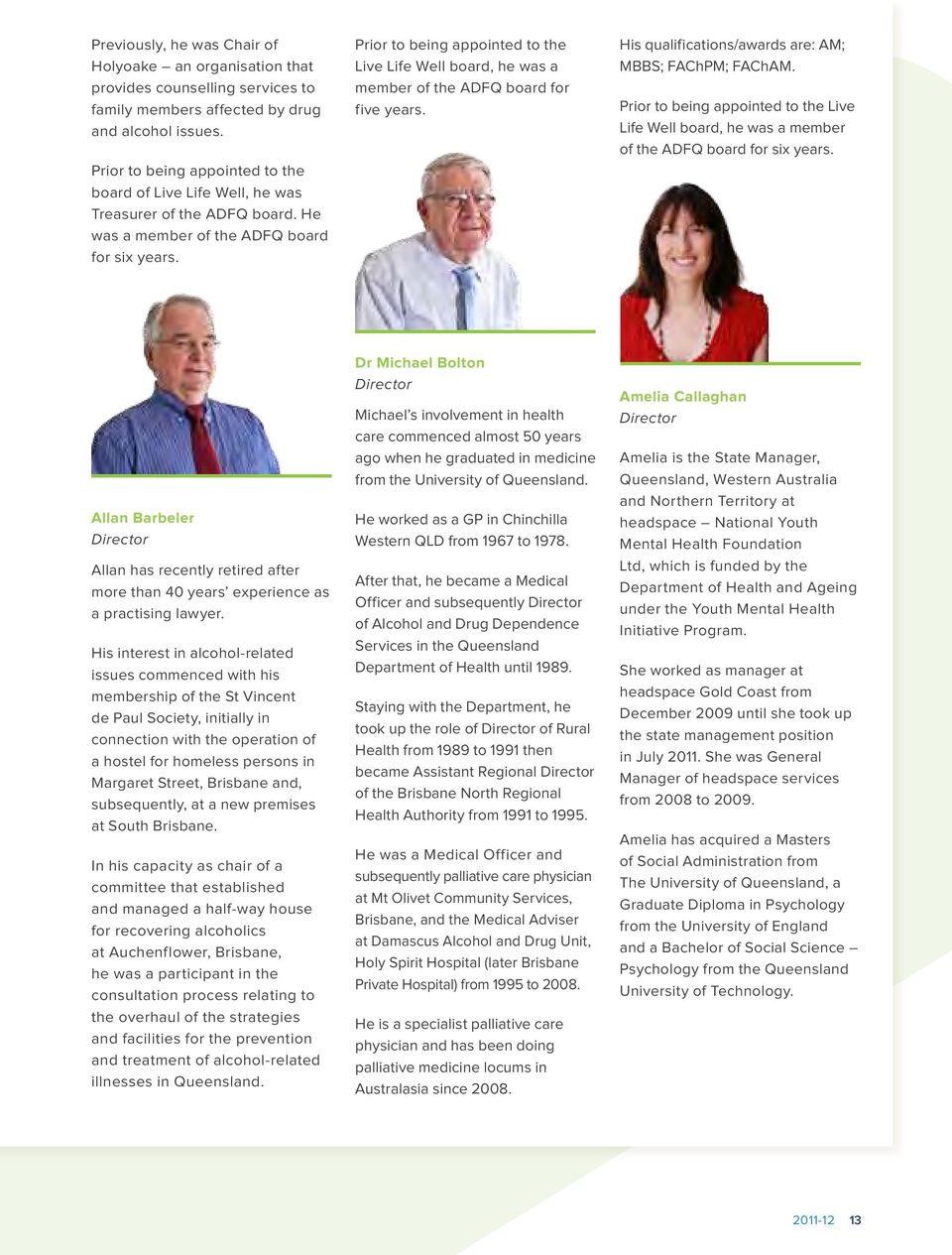
16 Dr Jeremy Hayllar Director Jeremy is the Clinical Director of the Metro North Mental Health - Alcohol and Drug Service. His interests include dual diagnosis and the growing prevalence of pharmaceutical opioid dependence. Jeremy took up membership of the Live Life Well Board in April He grew up in the UK, completing a degree in law before he studied medicine, working for three years in Birmingham and four years at Northwick Park Hospital NW London. He came to Queensland with his wife in 1992, planning to spend a year working at Mt Isa Hospital before returning home. Instead he became Director of Medical Services and remained in Mt Isa for 10 years. In 2002, he relocated to Brisbane where he undertook a one-year, full-time course in professional photography, and also began part-time work at The Prince Charles Hospital. He was appointed as Clinical Director of the Alcohol and Drug Service in He has had a range of other roles including Government Medical Officer in Mt Isa ( ), Member of the West Moreton Community Corrections Board ( ), Deputy Chair of the State Recognised Practice Committee (2006- ongoing) and Chair of the Primary and Community Clinical Council, Metro North Health Service District ( ). Qualifications/awards: BA(Oxon), MB (Hons), MSc, MD(Bham), FRACP, FRCP, FAChAM, DTM&H; Centenary Medal Cheryl Herbert Director Cheryl was appointed as Chief Executive Officer of the Health Quality and Complaints Commission in September 2006 and has extensive health leadership and management experience. Prior to that leading role, Cheryl had 10 years CEO experience as Executive Director of Spiritus Care Services, which comprised the merged St Luke s Nursing Service, Anglicare and the Anglican Care of the Aged and was previously the CEO of St Luke s Nursing Service. Cheryl has qualifications in nursing and midwifery and is a Fellow of the Royal Australian College of Nurses Australia, Associate Fellow of the Australian College of Health Care Executives and an adjunct Associate Professor of University of Queensland. Cheryl has been noted as an innovative and collaborative industry leader. She has worked closely with some of Australia s near neighbours to share skills and expertise, and has served on the following panels/boards: Queensland Health Reform Panel, Forster Inquiry into Queensland Health, Australian Pharmaceutical Advisory Council, National Nursing Workforce and Education planning, Anglicare Australia, Anglicare NT, Bayside District Health Service Council, ACQI, and has accompanied the Australian Ministers for Ageing and Foreign Affairs in 1998, 2000 and 2002 to Hong Kong, Singapore, Malaysia and Japan to showcase Australian aged care. She presently retains membership on the board of the External Advisory Council, School of Nursing & Midwifery, University of Queensland and ACHS State Advisory Committee. Prior to being appointed to the board of Live Life Well, she was Vice President of the ADFQ board. 14 GCDC Annual Report
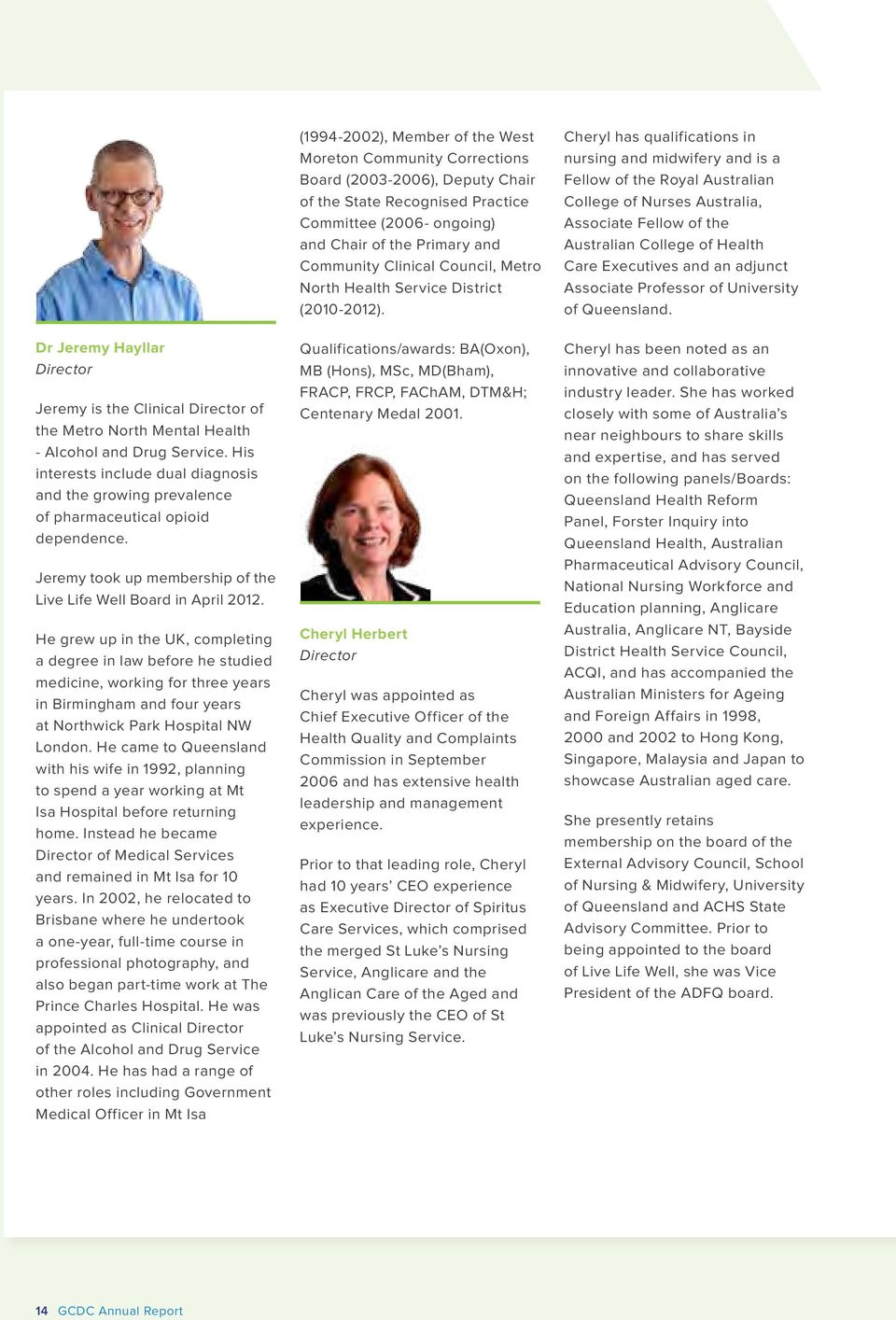
17 Raylee Taylor Director Raylee is the Chair and founding member of Care For Life: Suicide Prevention Association. This association aims to equip people with the ability to assist in the prevention of suicide. It produces resources for young people and service providers and provides training to organisations and others in the community. Raylee has been a dedicated volunteer for suicide prevention for 17 years. She also volunteers as Chair of the Gold Coast Youth Network, Advisory member on the Gold Coast Family Relationship Committee, a member of the Reference Group for the Expanded Horizons program and a member of the Heads Up Mental Health and Drug and Alcohol Consortia on the Gold Coast. Raylee has overcome the tragedy of losing her son to suicide to work hard at suicide prevention and assisting families to work through their grief of losing loved ones. She was a facilitator of the Bereaved By Suicide support group with the Salvation Army for 14 years and is a support person for The Compassionate Friends. Some of her achievements include producing the Youth Suicide Prevention Program for Queensland TAFE, which has since been distributed throughout Australia and New Zealand. In 2000, Raylee was invited by the World Health Organisation (WHO) to prepare a paper entitled Preventing suicide: How to Start a Survivors Group, she was subsequently invited to present a paper for the IASP international conference in India. Raylee received a LIFE Award from Suicide Prevention Australia and a Premiers Award for Queensland Seniors, is an Honorary Rotarian and Paul Harris Fellow in recognition of her work in suicide prevention. She is also a member of Suicide Prevention Australia and the International Association for Suicide Prevention. She was a board member for GCDC and QDAC for three years. Retirement of the Executive Director Mary Alcorn Mary Alcorn retired from her position as Executive Director of the Gold Coast Drug Council in May 2012 after 25 years of dedication and commitment in that role. As Executive Director, she led the growth of the GCDC, into a dynamic and innovative organisation, developing a wide range of new services. During that time she also served a 13-year term on the Gold Coast District Health Council, two as Chair, and sat on the board of the Australian Therapeutic Communities association for 16 years. She was a member of the QNADA board since its inception in Since taking over the reins in 1987, Mary was the driving force behind GCDC, which became the first community alcohol and drug service to gain accreditation nationally. Mary s vision and drive saw the service grow to what it is today. The Gold Coast Drug Council is now recognised, as one of south-east Queensland s premier alcohol and drug services. Throughout her long career, Mary has been consistently recognised for her commitment and excellence. In 2009, she was the Queensland winner of the Pride of Australia Medal in the Care and Compassion category for her dedication to GCDC. She has also received the Centenary Medal awarded by Prime Minister, John Howard for distinguished service as a Director of a Drug Rehabilitation Centre and the Australia Day Achievement Medallion from the Alcohol and Other Drugs Council of Australia in She was nominated for Australian of the Year Award 2003 (Gold Coast Local Hero). The Board, management, staff and clients of GCDC are proud of Mary s achievement and appreciate her tireless efforts over the years

18 Our Executive team The Gold Coast Drug Council Alcohol (GCDC) is led by a team of executive managers with expertise in the broad range of skills needed to effectively manage a peak non-government organisation. In May 2012 GCDC merged with the Alcohol and Drug Foundation Queensland and the Queensland Drug and Alcohol Council to form Live Life Well. As part of the merger three new executive positions were established - Chief Operating Officer, Chief Financial Officer and Clinical Director. The team is led by the CEO, Mitchell Giles. 16 GCDC Annual Report

19

20 Meet our executive team Mitchell Giles Chief Executive Officer Mitchell is the Chief Executive Officer of Live Life Well, incorporating the Alcohol and Drug Foundation Queensland, the Gold Coast Drug Council and The Queensland Drug and Alcohol Council. He was previously the CEO of the Alcohol and Drug Foundation Queensland for six years. He is a Registered Nurse, holding a Bachelor of Business and a Master of Health Science (majoring in Mental Health). It was, as a nurse in 1988 that he commenced work in the alcohol and other drugs sector within an inpatient Detox Unit. He later went on to manage another hospitalbased drug and alcohol service for 12 years and has also managed services in the community. Helen Barrie Chief Operating Officer (Acting) Helen is a Certified Practicing Accountant with more than 17 years experience working in the not-for-profit sector in accounting and management roles. Helen commenced with the Alcohol and Drug Foundation Queensland in May 2008 her role encompassed finance and accounting, quality assurance, workplace health and safety, human resources, information systems and communications systems. Since May 2012, she has been in the role of Acting Chief Operating Officer for Live Life Well. Prior to this she was Corporate Services Manager for the Alcohol and Drug Foundation Queensland. Mark Walsh Chief Financial Officer (Acting) Mark Walsh held the role of Acting Chief Financial Officer from May 2012 to 30 June 2012 following the creation of the new position. A permanent recruit process will be conducted in the next reporting period. Ivor Shaw Clinical Director (Acting) Ivor completed his training at the University of Queensland and was registered as a psychologist in Originally employed by the Alcohol and Drugs Programs Association of Queensland (now ADFQ) to establish and manage the first Interlock EAP in Townsville, Ivor returned to the Alcohol and Drug Foundation Queensland in early 2008 as a Clinical Consultant for Logan House. In 1983, he was invited to become the Clinical Director of Mancare a 40-bed residential alcohol and drug treatment facility operated by the Salvation Army. In 1985, he worked within Queensland Health s Alcohol and Drug Dependence Service. For the next 12 years, Ivor worked in clinical, evaluation and research and policy areas within Queensland Health alcohol and drug services the last eight of these in the Alcohol Tobacco and Other Drugs Branch. 18 GCDC Annual Report

21 Our organisational structure Board of Directors chief Executive Officer Advocacy Business Growth Marketing and Communications clinical director chief operating Officer Chief Financial Officer Programs Treatment Services Community Services GCDC QDAC HR WH&S Quality Information Communications Technology Corporate Services Budgeting Financial Management Accounts Payroll ADFQ
22 Our History In May 2012, the Gold Coast Drug Council, Alcohol and Drug Foundation Queensland and the Queensland Drug and Alcohol Council merged to establish Live Life Well (LLW). LLW s services extend across Queensland and include both residential and nonresidential programs. With a collective history of service provision spanning nearly 80 years, the LLW Group is a collection of well credentialed and experienced service providers, with over 130 staff and 40 volunteers working with clients throughout Queensland. Throughout our history we have shared a purpose of delivering services to individuals and their families who experience difficulties arising from drug and alcohol use and/or mental health issues. A bit about our founding entities Gold Coast Drug Council The Gold Coast Drug Council Inc. (GCDC) had its beginnings as a voluntary organisation known as the Drug Referral Centre. It was established in 1971 as the first alcohol and drug service on the Gold Coast. In 1981 land was granted by the Gold Coast City Council at 191 West Burleigh Road to establish a centre for education, prevention, assessment, referral and detoxification this was called Mirikai (or place of peace ). In the 1980 s the GCDC focused on developing professional standards for treatment and education and in 1987 adopted a Therapeutic Community approach to treatment services for young people. Since that time the organisation has developed community services which assist young people and their families and include residential services and a wide range of out-client services. Alcohol and Drug Foundation Queensland The Alcohol and Drug Foundation Queensland (ADFQ) has been providing services for those affected by alcohol and other 20 GCDC Annual Report
23 Our history who we are drug use, their families, and the wider Queensland community since A non-government organisation, ADFQ is dedicated to reducing the individual and social harms associated with alcohol and drug use and promoting health enhancing behaviour change. ADFQ s extensive experience and expertise means that it has the ability to develop and conduct dedicated programs for, and on behalf of, a variety of stakeholders including state and federal government departments, as well as large and small organisational clients. Queensland Drug and Alcohol Council Commencing service in 2010, the Queensland Drug and Alcohol Council (QDAC) is the youngest member of the LLW group, and was established to expand drug and alcohol services throughout Queensland. QDAC established an assessment and referral Shop Front in Cairns in 2010, and in May 2012 opened a Therapeutic Community in Mareeba which provides residential treatment services for Aboriginal and Torres Strait Islander people from Cairns and the surrounding regions
24 Our story... our mission, values and strategic goals Our shared vision Lives lived well by promoting and supporting health and wellbeing 22 GCDC Annual Report
25
26 Our united mission We are united in our mission to provide services in the community that reduce individual and social harms by: addressing addictive behaviours building individual and community capacity advocating and supporting healthy lifestyles. The values we live by Our values are at core of who we are and about which we hold dear we strive so that our decisions and actions reflect these values. We believe that by putting our values into practice, guided by our vision and strategic plan, we can create significant and meaningful benefits for our consumers, communities, staff and other stakeholders, not the least of which are our funders. We act with integrity in all we do Integrity is a consistency of actions, values, methods, principles and expectations. Integrity is the cement that binds our values together. We provide leadership as an organisation and as individuals Leadership is a process of social influence in which we enlist the aid and support of others in the accomplishment of a common task, including advocating for better outcomes around issues that fall within our sphere of concern. We value the trust that is placed in us Trust is placed in us by individuals and government; we strive to build confidence based on our work with our consumers, colleagues, partners and suppliers. We accept accountability for all our actions and decisions Accountability is reflected in our commitment to exercising sound stewardship over our reputation and resources and acting with diligence, honesty, reliability and transparency. 24 GCDC Annual Report
27 We are setting our goals high what we plan to achieve We have identified five important goals which will support the achievement of our vision, realise the opportunities and address some of the challenges that will arise in the next three years. We aim to: Provide evidence supported services that match or exceed consumer and other stakeholder expectations Build engagement and collaboration with the community Grow and build our capability Support commitment and engagement in our people Develop integrated corporate systems that demonstrate a high level of commercial efficiency and client satisfaction
28 26 GCDC Annual Report
29 Our services an overview of what we do
30 Outreach Accommodation Support and Integrated Services OASIS delivers safe and supported accommodation to young people in crisis, who have a history of illicit drug dependence, and sometimes with additional mental health problems. Residents are required to collaborate on a treatment plan designed to achieve their goals and exit the program within a six month period. However, length of stay is determined on an individual basis and may be extended in cases of complex needs. Drug Court Program This program is part of the Queensland Drug Court Program and helps drug dependent offenders to deal with their addiction(s) by combining treatment services, correctional programs, and frequent drug testing, with supervision by the Courts. This program provides case management; medical support; counselling; advocacy; court support; crisis intervention and social activities. Participants of the program are initially required to attend a regular living skills group with a gradual reduction in attendance as the participant progresses through the threestage program. Complex Needs Assessment Panel and Integrated Services Complex needs assessment panel and integrated services (CNAPIS) brings government and community representatives in partnership to provide a coordinated approach when assessing and planning the needs of clients with complex needs, especially with regards to the complexities inherent in co-morbidity (AOD and Mental Illness). The CNAPIS function is to address identified issues and barriers by planning, implementing and reviewing the strategies and interventions required to support young lives at risk alongside their families/significant other. Queensland Illicit Drug Diversion Initiative The program offers health interventions as an alternative to the criminal justice system. It affords clients an opportunity to address their illicit substance use through an early intervention that diverts eligible minor illicit drug offenders utilising the Police and Court diversion programs, in many cases, before incurring a criminal record. Youth Outreach Program This program promotes the well-being and health of young people who are experiencing interpersonal and social functioning problems related to drug use. The service includes counselling, psycho-education and arts-based therapeutic groups, all within a harm-minimisation model. It provides early interventions e.g. anger management, problemsolving, goal-setting and stress management) and psychoeducation for young people around alcohol and drug misuse. The Program also embraces a solution orientation, where a young person s strengths are recognized and encouraged. Youth Outreach Drug and Alcohol Team YODA provides a flexible alcohol and drug outreach service in partnership with local youth agencies and programs. These services include 6 to 8 individual counselling sessions and educational early intervention programs. This service offers 6 to 8 individual counselling sessions focusing on education and counselling. Additionally, YODA will provide group educational programs designed to increase knowledge and insight into substance abuse issues. Interurban Arts Interurban Arts is an arts and life skills program with a focus on young people and mixed gender with complexities including AOD, Justice and social disengagement. The program creatively coordinates, develops and produces sustainable opportunities and experiences for individuals and groups to make positive changes and promote good health in their lives and communities. Through the Inter Urban Arts program GCDC deliver therapeutic arts workshops, youth peer support programs, training workshops, public art projects, community consultation and Community Cultural Development Projects. The principles of social justice underpin all the work that is delivered through Inter Urban Arts. 28 GCDC Annual Report
31 Dual Diagnosis Support Program This program supports young people who have substance abuse and mental health problems (known as dual diagnosis ). The dual diagnosis support program operates by assessment, specialist intervention and treatment planning. Family Therapy Program The Family Support Program assists family members, couples and partners as well as friends of young people with alcohol and drug-related problems. The aim of the program is two-fold: to help the clients support the troubled young person and to assist clients in self-care. The service offers individual, couple, family and group counselling sessions. The family therapy program also facilitates the Family and Friends Support Group. This group runs once a week and is facilitated by an external provider. This group provides support for family/ friends of those with drug and/or alcohol problems. Young Families The Young Family Support Program assists any parents (with younger children, whose ages may range from newborn up to early teens) experiencing alcohol and/or drug related problems, or a dual diagnosis (both drug/alcohol and mental health problems). The aim of the program is to provide these parents with individualised support (treatment / counselling) and group education, focusing on the addiction/mental health problem, as well as the impact this problem has on their families. Kids in Focus The Gold Coast Drug Council leads a collaborative partnership with the Benevolent Society Early Years Centre and Wesley Mission Brisbane. This provides Kids in Focus with specialist wraparound services for families impacted by problematic substance use. Healthy attachment, resilience and adolescence issues can all be addressed while supporting parents within a dual diagnosis framework. Clinical Liaison Aboriginal and Torres Strait Islanders CLAIS (Clinical Liaison Aboriginal & Torres Strait Islanders) provides culturally competent counselling/ mentoring for clients, as well as other GCDC services, to Aboriginal & Torres Strait Islander young people and their families where a need has been identified. Aboriginal & Torres Strait Islander young people and their families, within the Gold Coast region, who are experiencing problems with drug and alcohol and may be experiencing mental health disorders. Diversion Services - Stop Pot The Stop Pot course is an educational and supportive group for current cannabis users, with clients accessing the service from across the community. The course takes place on a weekly basis, running for five weeks. On average, ten people attend each Stop Pot group, so the groups are quite small, allowing participants to interact and develop social support within the group. Typical Stop Pot clients can include individuals or couples where cannabis has contributed to the dysfunction of their interpersonal relationships. Mirikai Therapeutic Community Mirikai is a specialist alcohol and other drug treatment program that works on a therapeutic community model. It s goal is to enhance the capacity and commitment of clients to achieve, as well as maintain an optimal level of personal and social functioning free from harmful drug use. Mirikai s goal is to assist residents to achieve and maintain a personally satisfying and socially responsible lifestyle free from harmful drug use. Banjara Medical Centre Banjara Medical Centre offers medical and psychological interventions that help reduce the anxiety of clients with more complex needs. It is a one stop shop venue, providing a familiar and friendly atmosphere for consumers. Banjara is open daily for medical and allied health services. It also houses the Early Psychosis Unit of Queensland Health
32 Outreach Programs and Services The Gold Coast Drug Council has numerous Outreach Programs and Services that address a wide range of needs in the community. These programs are vital to the health and wellbeing of people on the Gold Coast who are experiencing adversity in their lives either on a personal level or with someone they are close to. Outreach provides flexible service delivery that meets the consumer on their turf in a safe environment. Outreach on the Gold Coast is unique this comes from our many stakeholder partnerships and collaborative working relationships in the sector. The following are great examples of how Outreach works with many and varied agencies working for improvement in the health and wellbeing of our community. Complex Needs Assessment Panel and Integrated Services (CNAPIS) has been a busy year for the Complex Needs Assessment Panel & Integrated Services program. The CNAPIS team have provided case management support and advocacy for consumers with multiple and complex needs - consumers that no one service could assist. The It Takes a Village statement is very true for these people. CNAPIS is a stakeholder-driven program with a core group of 15 community members over the past year. These members came from a range of diverse NGO s and government agencies that came together for the common purpose of adding value to the primary agency that makes the referral to CNAPIS. The CNAPIS team consists of two full-time support workers Adam Dreyer and Tristan Abba and Tara Piggins who worked two days per week. Suzi Morris is the program s coordinator. 30 GCDC Annual Report
33 Our achievements Community Services CNAPIS provided intensive case support to 32 consumers during It built capacity in the community to continue to support these consumers and, through the Advisory Committee, set up by CNAP through the Youth At Risk Program of Wesley Mission Brisbane, was able to identify service gaps and report back to Queensland Health through the Primary Care partnership Council and Medicare Local. Outcomes for our clients included better health, educational gains and a reduction in homelessness by supporting clients to retain their tenancy in the social housing sector. Clients are referred through agencies who remain the primary case managers for that person. The added value of CNAPIS to this case management process by providing practical support, enabled case managers to assist their client in achieving their goals. As at June 30, 2012, CNAPIS was supporting 29 clients, all with multiple and complex needs, in the age group and of mixed gender. Of these, 40 per cent were Aboriginal or Torres Strait Islander. CNAPIS is funded by Queensland Health through the Primary Care Partnership Council
34 Young Families Support Program The Young Families Support Program is funded by the Queensland Department of Communities to add value to the Act for Kids program s Rapid Assessment Intervention (RAI). It is a clinical role and has one clinician working 10.5 hours per week. This role is crucial to the Act for Kids program as it provides the education and support around parents with substance use issues and aims to reduce the harms to their children. This program works closely with other family programs of GCDC. In , the program assisted 16 families. I would have lost my kids if I didn t have someone like A advocating for me she never lost faith in me that I could turn my life around. Family Therapy and Support Program The Family Therapy and Support Program is a therapeutic program that provides family therapy to parents, partners, friends and carers of young people with substance use issues. This is achieved through individual counselling sessions and a Family and Friends Support Group. During , the group ran over 10 weeks and was a closed support/educational forum for those people who had a loved one experiencing substance use issues. The program ran two days per week and the group ran in the evenings one day per week. It had a part-time clinician, Matt McGregor, and a group facilitator. Funded by the Department of Health and Ageing the program works with a number of other GCDC programs and services to help create a supportive environment for families, especially those family members who have a loved one in Mirikai, GCDC s therapeutic community. In particular in it worked with Kids in Focus, which offers intensive case support and counselling to the residents of Mirikai while they are in treatment and follows up with them on transition. Youth Outreach Drug and Alcohol The Youth Outreach Drug and Alcohol (YODA) program operates as a mobile outreach service, with three dedicated specialist AOD youth counsellors who work closely with youth stakeholders on the Gold Coast. The program offers early and brief interventions as well as a longer term flexible service delivery for young people aged between 12 and 25 years and of mixed gender. YODA has partnership agreements with Youth Justice, Scisco Career Pathways for Youth, Youth At Risk Alliance (YARA) as well as Education Queensland. During YODA ran a series of workshops and educational groups that educated young people on the risks associated with substance use. It used a client-centred approach and assisted young people in building resilience as well as capacity building in the community. YODA works under the Harm Reduction Framework and No Wrong Door Policy. Over the past year, the team actively engaged in community development within the youth sector and worked alongside other youth-centred programs in the area. Feedback included this positive comment: I always know that C will listen and not judge me or tell me what to do it s nice to have someone who cares YODA offers a range of activities all aimed at young people aged between 12 and 25 years, of mixed genders and ethnicity. During , the mobile service was seen to be a user friendly option for these young people, many of whom were homeless or in care. Meeting these young people on their turf allowed GCDC counsellors to engage quickly and, in turn, were more effective in gaining rapport. YODA worked collaboratively with key stakeholders in the sector, including Youth Justice and YARA. The YODA staff also provided a training program called MAPS Mentor & Peer Support for young people to be skilled in being mentors for other young people experiencing adversity. This was in partnership with Creative Inclusive (formerly Inter Urban Arts). Since the last report, this program has assisted more than 100 young people. The YODA team consisted of a team leader, and one full-time and one 0.8 counsellors. The program is funded by Queensland Health. 32 GCDC Annual Report
35 Kids in Focus The Kids in Focus (KIF) program is an initiative of the Commonwealth Government with the aim to reduce the harms associated with substance to parents and their children. Gold Coast Drug Council has had a KIF since During , it had 185 clients come through the program all with multiple and complex needs. The KIF program is a collaboration between GCDC, The Benevolent Society and Wesley Mission Brisbane. GCDC heads the program, which employs two full-time staff to provide support and advocacy to clients in need. There are a number of stakeholders including but not exclusive to Child Safety, Youth Justice, Queensland Health s Child and Youth Mental Health Service and Corrections. The team is led by Jo Haitana- Evans and has three other support staff from across the three agencies. During , KIF ran groups and workshops that educated and supported carers of children and focussed on the health and wellbeing of the family system. A comment: If J and S hadn t advocated for me to reunite my kids and help me with housing, I don t know what would have happened to me but I know it would have been bad. This program is funded through FaCHSIA and is a member of Family Relationships Services Australia. Youth Outreach Program The Youth Outreach Program (YOP) runs an in-house counselling service as well as being mobile. It works closely with the other youth program YODA in being able to provide flexible and creative activities for young people. The program is run by senior Social Worker, Erin Hardie who has many years experience in working with this client group. As of June 30, 2012, the program was servicing 23 young people and running a group for communitybased clients called Early Birds which is an open didactic group that covers topics on relapse prevention, anger management and communication strategies. YOP has numerous partners in the youth sector and belongs to several youth networks. It provides advice to family members and friends if necessary as well as running educational workshops at Gold Coast schools. Over the past year, YOP s flexible approach to service delivery meant that this program exceeded client expectations. It continues to use creative ways in assisting young people on the Gold Coast. A comment: E is great, she really gets me always encouraging me to be assertive, and even when I mess up she still keeps helping me, and she s really cool This program is funded by the Department of Health and Ageing. Drug Awareness Course The Drug Awareness Course (DAC) is a 10-week educational program that educates community members on the issues relating to drug effects, lifestyle; theories of treatment and resources available. During , the program ran three times throughout the year and featured guest presenters that facilitated informative sessions once a week for 10 weeks. Evaluations only highlight the need for this service and show that the program is meeting the expectations of its participants. DAC is part of the GCDC culture and, while there have been a few changes in relation to speakers/presenters, DAC will continue next year. This program is not funded. CLAIS Program Since the last annual report, CLAIS has continued to grow, seeing a total of 40 clients engage with the program, 21 of those were entered into the Mirikai Therapeutic Community. We had four clients graduate two were being co-case managed alongside the Court Program. CLAIS delivered a presentation at the SEWB Workforce State Gathering and Regional Forum and World Suicide Prevention Day, and also provided Cultural Awareness Workshops for the Developing Partnerships with Aboriginal and/ or Torres Strait Islander people for the Beenleigh region
36 Over the past year, 16 educational workshops, in conjunction with YODA, were delivered in various Gold Coast high schools and this continues to be of high demand. CLAIS worked alongside Yan-Coorara to deliver Reclaim Your Spirit, which is a relapse prevention and drug education workshop. CLAIS has and continues to provide cultural awareness information sessions and yarning circles to various organisations. CLAIS continues to be a part of Karulbo Aboriginal and Torres Strait Islander Partnerships and has established the Aboriginal and Torres Strait Islander DRASTIC in collaboration with Inter Urban Arts and Indigenous Health. The Aboriginal and Torres Strait Islander DRASTIC is an initiative established to provide support to youth aged between years who are disengaging from school. CLAIS is also working in partnership with the Department of Communities on the Homes for Life project, which is a panel of Indigenous and non- Indigenous Stakeholders who assist Aboriginal and Torres Strait Islander clients with complex needs to sustain tenancy through intensive case management. Cairns Drug Court Supported Accommodation Program In July 2011, the Gold Coast Drug Council, through its involvement with the Far North Queensland Department of Health and Ageing Project, was invited to assist with the facilitating of the Cairns Drug Court Supported Accommodation Program (CDCSAP) due to the closure of Lyons House in Cairns. At the request of the Department of Communities, and in an initial care takers role, GCDC recruited two workers (Carla Wallace, Coordinator) and Maria Bridgeman (Support Worker) to fill the roles in facilitating a program that involved the management 34 GCDC Annual Report
37 of five houses in the Cairns community to support up to 12 clients (including families) through an Intensive Drug Rehabilitation Order (IDRO). Eventually the program went to open tender which GCDC won. The program design ensures that an intensive outreach support model is coordinated and facilitated with the provision of practical and housing support to the clients by the CDCSAP workers. The workers also provided intensive support to the clients in assisting with negotiating criminal and drug-related issues that have had clients incarcerated for periods of their lives - a significant challenge for a somewhat stigmatised and marginalised population. During , the program supported clients to attend appointments and provided counselling, advocacy and housing support and assistance with court matters among other initiatives
38 Our achievements Diversion Services Drug Court Program and Supported Accommodation Program The Drug Court Program was developed within southeast Queensland to help substance dependent offenders deal with issues related to addiction, criminal behaviour and mental health by combining treatment services, correctional programs and frequent drug screening with supervision through the Courts. During , eight of the 40 beds at Mirikai were reserved for Drug Court participants. GCDC staff, who managed the Drug Court Programs, worked closely with Queensland Health and Queensland Corrective Services in the treatment planning and case management of these clients. The Mirikai Intensive Supportive Outreach (MISO) Program is a supported accommodation program facilitated in the community. MISO provides intensive support for clients referred through the Drug Court in support arrangements that include daily house visits; treatment planning and case management; medical support; counselling and advocacy; court support; crisis intervention and social activity. Drug Court participants, who have access to their own safe and stable accommodation and the necessary social support in the community, participate in the Drug Court Out-client Program. This is also a three-phase program where participants are required to attend three days per week for group and/or individual therapy. Queensland Illicit Drug Initiative Program The QIDDI Program offers health interventions as an alternative to the criminal justice system. The program design affords clients an opportunity to address their illicit substance use through an early intervention that diverts eligible minor illicit drug offenders utilising the Police and Court diversion programs, in many cases, before incurring a criminal record. Police Diversions divert cannabis offenders (possession of 50gm or less or possessing cannabis utensils) and Court Diversions divert other illicit substance users (one gram or less or possess drug using utensil) from the criminal justice system with referrals to health assessments and education and further intervention if appropriate. During , QIDDI appointments and support were offered at the Southport office each weekday and at the West Burleigh site on a Thursday, Saturday and Sunday. Weekend appointments were made available in order to increase accessibility to the service. QIDDI is funded through the Queensland Health Department. Clients were encouraged to access a wide range of services in respect of their presenting needs. Some QIDDI clients accessed Stop Pot among other GCDC programs. Stop Pot The Stop Pot Service is an educational and supportive harm reduction group for current cannabis users, with clients accessing the service from across the community. Over the past year, Stop Pot was held on a weekly basis and ran for five weeks. On average, 10 people attended each Stop Pot group, so the groups were quite small and trust developed quickly, allowing participants to build relationships and develop social support within the group. Typical clients included individuals or couples who had found cannabis had contributed to dysfunction in their daily lives. The group continues to be a popular choice of intervention for cannabis users. In all, 64 clients participated in Stop Pot groups during GCDC Annual Report
39 Stop pot is run as part of the Dual Diagnosis clinician s initiative funded by Queensland Health under Chronic Diseases funding. It is a free service that accepts self-referrals and referrals from various government and nongovernment Services. Youth Dual Diagnosis Program The Youth Dual Diagnosis Program at GCDC provides specialist, individual psychological support for young people aged years, who experience substance abuse and concurrent mental health issues. The program is also responsible for community education and up-skilling the local workforce in Dual Diagnosis issues. A further aspect of the program is the need for networking and developing effective partnerships with other agencies to aid in the management of young people with Dual Diagnosis. During , services were provided to a vast variance of clientele with complex needs and innovative measures were incorporated to engage the client group. There was demonstrable clinical change for clients as well as a high satisfaction with service provided. The service regularly collected standardised outcome measures to assess both of these areas in the work it does with individuals. The program provided community education to non-aod specific services including lectures to both local universities and training for non-government and government organisations. This year in particular, the program worked with Queensland Health staff to facilitate six free sessions of training for workers across the district. All training sessions evaluated highly for both satisfaction and knowledge change. The outcomes were reported in the QNADA State Newsletter for June To aid in the networking and building of effective partnerships, the program s coordinator Kim Wood chaired an Australian Psychological Society Peer Supervision Group focussed on CBT approaches to therapy (which meets monthly) and facilitated monthly meetings between GCDC psychological staff and private psychology providers (who work out of the Banjara Medical Centre). As part of workforce development initiatives, Kim Wood supervised Clinical Masters and Doctorate psychology externship students who worked part time within the therapeutic community for a placement period of about four months. During , this expanded to Forensic Psychology students taking a placement in the GCDC Drug Court Program. This year, to June 30, Kim supervised 11 students in total. She also (for the second year running) supported four Griffith University fourth-year psychology students who did a week-long observational placement (trying to answer the question what does a real psychologist do? ) as part of their work integration learning module. The service benefitted a lot from the student placements as each of them had to do an organisational project. Therefore, as a rolling piece of research, an evaluation plan for the GCDC Drug Court program was started. Residents were interviewed about their expectations of treatment and family members of residents were interviewed about their expectation of treatment for their loved ones; a pathway was mapped for Dual Diagnosis services across the Gold Coast (this will hopefully be rolled out to all services across the District in 2013); the psychology referral form was evaluated and, as a result, changes have been implemented to this form; and the latest literature was reviewed on prognostic factors for dual diagnosis treatment. Not only this, a review was undertaken of the best practice for doing in-school alcohol and drug education and managing chronic pain and insomnia in addiction as well as the latest literature on addiction as a brain disease. These projects obviously help our staff to provide the best possible clinical practice they can to our clients. All in all, year was a very successful one for the service
40 Our achievements Residential Services Mirikai Mirikai is a residential Therapeutic Community Program that supports young people aged 17 to 35 towards achieving a personally satisfying and socially responsible lifestyle free from harmful substance use. Mirikai is unique in its ability to provide specialist services to comorbid and complex needs clients by providing wrap around, holistic service delivery with input from various in-house GCDC programs and community based stakeholders. Those suffering from a coexisting substance use disorder and mental illness are more often the rule than the exception these days. Mirikai specialises in providing effective treatment to such individuals. The Therapeutic Community approach enables residents to increase personal awareness and develop life skills, which assist them to reintegrate with the wider community. The program is comprehensive by design and includes education, group therapy, counselling, work crews, art & drama, physical activity, and an IT job skills course in addition to comprehensive medical assessment and treatment, and welfare assistance for legal, financial and family matters. Mirikai experienced another busy year in , with the program supporting 179 residents, with approximately 35 per cent of clients completing their first 90 days of treatment. The Mirikai program was staffed by a dedicated team which included Grant Robin (Program Director), Kim Lappin (Credentialed Mental Health Nurse), Mikel Gellatly, Kevin Donovan, Bronwyn Schlesinger (Case Managers), Janet Rutter (Welfare/ Admissions Officer), Kelly Milne, Ross Baddiley, Michael Burton, and Jodie Blake (Night/ Weekend Supervisors), Carolyn Pourloula (Kitchen Coordinator) as well as a variety of program support staff, volunteers and students. Mirikai was able to provide specialised services for comorbid clients thanks to our Medical Team which included sessions provided by Dr Vicki Satchwell (Consultant Psychiatrist), Dr Michelle Davis, and Dr Elizabeth Colebourne (General Practitioners). We continue to strive and seek to achieve exceptional outcomes with complex needs clients and clients with a comorbid disorder thanks largely to our in-house expertise of our Mental Health Nurse Kim Lappin, our Dual Diagnosis Coordinator Kim Wood, and Dual Diagnosis Clinician - Murray Sutton. Thanks must also be given to the outstanding work provided to our residents from Private Psychologists Pejman Hoviatdoost and Patricia Grant. Acknowledgement needs to be expressed to our Psychiatric Registrar and sincere thanks to a partnership with Gold Coast Health Service District, and funding from Department of Health and Ageing administered through Royal Australian/New Zealand College of Psychiatrists in providing a unique program in delivering services in addiction, psychiatry and mental health. Mirikai staff continue to work tirelessly. In a year that saw the retirement of Mary Alcorn, Libby Newcombe, James McGregor, and Colleen McGregor, we also witnessed the end of Murray Sutton s industrious and devoted contribution to the Mirikai TC, after he had spent the past seven years as TC Team Leader. The Mirikai Therapeutic Community is both the brand and the success it is today largely due to the contributions of these five incredible individuals. Mirikai continues to provide specialist services to its residents. Its primary focus is to achieve outstanding results and assist with the changing of lives for the many that arrive at our doorstep looking for support and salvation. 38 GCDC Annual Report
41 OASIS Program The OASIS Program (Outreach Accommodation Support and Integrated Services) offers transitional housing, which supports young people preparing to re-enter the wider community after graduating from Mirikai; and also supports dual diagnosis clients through a step up step down for whom the Mirikai program may not be suitable. OASIS also provides services to community entry clients. The main program of OASIS is the Halfway House (Transitional Houses) program which includes three halfway houses with a maximum of 11 residents at any time. This year, the Halfway House program was downsized with two houses being closed due to restrictions in funding. To overcome the loss of beds, an OASIS In-house program was created, whereby clients graduate from the TC, but continue to reside in an allocated OASIS space within the TC, allowing for an additional four clients to be accommodated. The Halfway House program includes daily house meetings and monitoring, weekly support groups, regular groups such as Relapse Prevention and provides residents with access to a wide range of support services. Over 70 per cent of OASIS clients, who completed the program, exited to work, training or further education options. During , the Halfway House program supported 38 residents. It actively promoted wider outcomes for these clients, including education and employment. Over 70 per cent of OASIS clients, who completed the program, exited to work, training or further education options. All the residents participated in volunteer work as part of their treatment. Two other programs exist within OASIS, including an additional six houses, through the Same House Different Landlord (SHDL) program and Our HOME s (Housing Options Made Easy) program which are resourced through the Gold Coast Drug Council s (GCDC0 collaborative partnering agreement with Department of Communities Housing and Public Works Service at Robina. The model is underpinned through goodwill and within a Local Community Agreement. Again, the focus is on transitioning long-term complex clients of GCDC to sustainable community living with the support of OASIS and links with other GCDC services in addressing treatment goals centred on abstinence and enhanced quality of life. The OASIS program is jointly funded by the Department of Health and Ageing, with housing part-funded by Department of Communities Housing & Homelessness Programs
42 Banjara Medical Centre Banjara Medical Centre was built by the Gold Coast Drug Council using Amphetamine Type Stimulant grant funds from the Department of Health and Ageing, in order to expand treatment and service capacity. It was opened in July Banjara was initiated to house a growth in GCDC program staff and to provide a medical centre space for private providers to provide onsite services to GCDC program clients. In addition, the Banjara building has enabled GCDC the opportunity to offer some space to the Queensland Health Gold Coast Health Service District Early Psychosis Team. This helps to build collaborative relationships with mental health services and the program value adds to the programs already available on site. During , Banjara offered medical and psychological interventions that helped reduce the level of anxiety of our more complex clients. This one stop shop venue alleviated the anxiety for consumers with a familiar and friendly atmosphere. Some of our consumers have experienced stigmatisation and lack of understanding from main stream services; however, the staff in Banjara are welcoming. Both of the GPs, Dr Michelle Davis and Dr Elizabeth Colebourne, are very experienced and have provided an exceptional service to our consumers. The two private psychologists, Patricia Grant and Perjman Hovestad, have both worked in Mirikai and have firsthand knowledge of the issues relating to substance use. In , Banjara offered collaboration between psychiatry and psychology headed up by Dr Vicky Satchwell and the rest of the medical team. 40 GCDC Annual Report
43 Some of our consumers have experienced stigmatisation and lack of understanding from main stream services; however, the staff in Banjara are welcoming. Banjara was open each day for medical and allied health services, as well as housing the Early Psychosis Unit of Queensland Health. Over the past 12 months, there have been a number of referrals from the Early Psychosis Unit to other GCDC programs and services which highlights the good working relationships between all the stakeholders. Figure 2: Number of clients seen by clinicians at Banjara Medical Centre 1 July June 2012 Clinician Type Number of Clients Psychiatrist 350 GP 2005 Dietician 121 Physiotherapist 269 Psychologist 755 Immunisation Clinics x Total 3,
44 Our corporate services In May 2012 the Gold Coast Drug Council, Alcohol and Drug Foundation Queensland and the Queensland Drug and Alcohol Council merged to form Live Life Well. The merger provided an opportunity for the Board and Management to review how and what the focus of our corporate services should be to ensure that the best possible support would be provided. This saw the realignment of our corporate services. The Corporate Service area support the Live Life Well Group, including the Gold Coast Drug Council (GCDC), providing professional services to support the delivery of broad range of GCDC services and programs in Queensland. The Finance Team provides services in financial and management accounting, audit and risk management, financial analysis, reporting and compliance. They manage and coordinate GCDC s budget monitor and report on our financial position, including preparation of the financial statements. They also manage our payroll and leave management and oversee the organisation s salary sacrificing program was a busy year for the Finance Team. This was primarily driven by the merger process which began in late In there were a number of significant achievements including: merging all finances functions across the Live Life Well Group starting with the due diligence process in October 2011 review of the Finance System creation of the CFO position restructure and expansion of the team to meet the new demands of the merged group of integration of payroll across the group. Human Resources (HR) provides a suite of HR management and advisory services to GCDC s managers and staff. This includes HR policy development, performance management, professional development, recruitment and selection, reward and recognition and industrial and employee relations. Information and Communication Technology (ICT) is responsible for managing our central IT capability and delivering IT services to staff across sites. ICT provides the support, maintenance and management of information systems and computing infrastructure. GCDC s day-to-day IT support is provided by Centra Networks. During , several significant technology initiatives occurred including: Replacement of old and outdated hardware Introduction of ipads to assist Outreach staff delivering services in the community Finalisation of the introduction of the MIMASO electronic client record and data collection system. This system supports efficiency of client record keeping by all staff involved in the care of a client, collects data to assist in fulfilling reporting requirements and aids the analysis of data for service improvement. The ICT projects undertaken in will support integration of systems in the merged environment in the future. Quality Assurance works with managers and staff to develop policies and procedures that underpin the achievements of quality improvement and quality assurance objectives. They lead and coordinate the development and implementation of processes that ensure the continued accreditation status. 42 GCDC Annual Report
45 GCDC undertook extensive evaluation of client outcomes and satisfaction across all programs and two six-monthly reports were produced during These reports provided the basis for quality improvement activities. Work continued on the Quality Improvement Plan which flowed from the successful Quality Improvement Council accreditation review conducted in September Work Place Health and Safety aims to ensure all of GCDC s staff, volunteers, students and contractors are working in, or utilising a safe environment that is free from harm. ADFQ is committed to ensuring that all our people understand their rights and responsibilities in regard to Workplace Health and Safety. The Workplace Health and Safety Officer works with staff to implement, monitor and evaluate a range programs and systems. During , GCDC achieved good results from external audits conducted by Workplace Health and Safety Queensland and Queensland Fire Services. There was a strong focus on the implementation of changes to meet compliance with the new Workplace Health and Safety Act 2011 which commenced in January A WHS plan and management system was developed from existing systems and identified gaps, particularly relating to the new legislation. Training was held for managers in December to develop an awareness of the obligations under the new legislation. Another area of focus was the general condition of the buildings on the West Burleigh site and a plan to improve the buildings was commenced in June The plan utilises the results of building reports prepared as part of the merger process. The Marketing and Communications team works to enhance GCDC s reputation and brand by managing key communication channels. Broad responsibilities include brand development and management; public relations, media enquiries and corporate communications; corporate print and digital media; promotions and sponsorships; corporate events and workshops; online marketing, web content and design; and social media. Established in January 2012 with the appointment of Sharon Broadley as manager, the marketing and communication area have had a busy six months up to June 2012 with a strong focus on internal communications to ensure that staff from the three founding entities of Live Life Well were kept informed and involved in the merger process. Another focus was engagement with our key stakeholders, including our local partners and funding bodies. The most significant achievements in included: a publication audit of GCDC communication materials development of new brand for Live Life Well
46 As at 30 June 2012 GCDC had 49 staff and 26 volunteers with most located at the West Burleigh site, with two staff located in Southport and two in Cairns. These staff directly and indirectly supported the delivery of services for programs related to the improvement of the lives of clients. 44 GCDC Annual Report
47 Our people
48 The professional delivery of services to clients is made possible through the quality and skills of staff. Staff participated in learning and development opportunities throughout the year and 11 staff attained recognised qualifications. The time, effort, generosity and commitment of the volunteers who contributed so much to the success of our programs over the past year is greatly appreciated. At June 30, 2012, volunteers were participating in seven areas of activity to assist staff in serving our clients. Figure 3: Number of volunteers by specific areas of service Area of Volunteer Activity Mirikai Therapeutic Community 15 Family Support Group 2 Administration: General 2 Therapeutic Community 1 Family Therapy 1 Reception 3 Vegetable Garden 2 Total 26 Student Program Number The Student Program involves a relationship between GCDC, Bond and Griffith universities, sending their externship Masters students to get practical and clinical hours towards their qualification. Since the Workforce Development Plan and the invitation from other RTO s, the program has expanded to offer placement hours to a range of candidates wishing to expand their knowledge around AOD and Mental Health. Feedback from students and their placement coordinators has been glowing and our reputation within the educational sector is extremely high and, as expected, from this we have more student offers than we can place. The program has produced great outcomes. It is managed by Suzi Morris, Outreach Manager. Student comments: My time here at GCDC and especially Mirikai has been the best learning experience of my career so far nothing at TAFE prepares you for the hands on work that the staff here do. I can only hope to be as good someday myself. I would recommend placement here to anyone Being part of the YODA team on placement was fantastic. I learnt so much about young people from the team and how drugs affect them and how to engage them without being preachy I didn t want to leave This program is not funded. Since 2011, we have been able to assist in the education of 44 students from the following educational institutions: Bond, Griffith, Australian College of Applied Psychology (ACAP), Australian Institute of Psychological Counselling (AIPC), GCIT, MSIT, Byron College, OTEN; SCU, UQ, Charles Darwin University and, from overseas Norway University College. 46 GCDC Annual Report
49 Our funders, partners and supporters Our funders Queensland Health Department of Communities Department of Housing and Public Works Department of Education, Training and Employment Department of Health and Ageing Department of Department of Families, Housing, Community Services and Indigenous Affairs Project funding Gambling Community Benefit Fund Consortium partners Wesley Mission Brisbane (Gold Coast) Benevolent Society (Early Years) Partners and stakeholders Ace Community College Act for Kids ANNEX Aftercare PHAMS Alternate Learning Centres Amend Pregnancy Support ATODS Gold Coast Australian College of Applied Psychology Australian Institute of Professional Counselors Byron College Blair Athol Accommodation & Support Program. Blue Care support Services Bond University Brisbane Youth Service Care for Life Suicide Prevention Centacare Employment Group Centacare-Catholic Family & Community Services Centrelink Community Services Team Child Youth Mental Health Services CYHMS Classic Way Family Practice Commonwealth Respite & Carelink Centre Community Corrections Community Transport Options (Volunteering G C) CROSSING DIVIDES CSIT Cultural Healing Team CYMHS Charles Darwin University Darwin NT Central Queensland University Department of Communities Child Safety, Disability Department of Justice Youth Justice Department of Communities Evidence & Modeling Unit Department Housing & Public Works Diversion Coordination Service. Domestic violence crisis centre Dovetail - supporting youth D & A service Education Qld EPIC (Employment, Education & Training Services) Evolve (Therapeutic Services) Fairhaven FSG FRSA (Family Relationships Services Australia peak) General Practice Gold Coast Gold Coast City Council Gold Coast Employment Support Service INC. Gold Coast Homelessness Network
50 Gold Coast Project for Homeless Youth Gold Coast Sexual assault Centre Gold Coast Youth Service Gold Coast Institute of TAFE Goldbridge (Rehabilitation Services) Griffith University HAADS headspace Gold Coast Heads Up Primary Care Partnership Council Horizon Housing HHOT Indigenous Health Service - P B Community Health Institute of Healthy Communities Integrated Mental Health Services Interurban Arts Kalwun Health (Indigenous Support Services) Krurungal Karalbo Network Legal Aid Queensland LifeLine Max Employment Services Medicare Local Gold Coast Miami High School Mibbinbah- Indigenous Services Moonya Multicultural Communities Council Queensland Drug Court Team Queensland Police Service Nerang High School (Special Ed Unit) Nerang Neighbourhood Centre Office of the Adult Guardian OZCARE Palm Beach Community Mental Health Palm Beach Neighbourhood Centre Pregnancy and Family Support Prison Mental Health Service Public Trustee of Queensland Queensland Civil and Administrative Tribunal (Q.C.A.T) Qld Disability Services Qld Gambling Service - Relations Australia QuIHN QNADA QAIHC Reconnect - Mission Australia Robina Hospital - Young Adult Mental Health, Extended Care & Acute Care SAILS Program Save the Children s Fund SCISCO Youth Connections Smith Family St Josephs Youth Service Salvation Army (Still Water s ) Southbank Institute of TAFE Southern Cross University Tenant Advice & Advocacy Services Thrower House Transformation Ministries University of Queensland Wesley Mission Brisbane (Gold Coast) YARA YHES House - Youth health & education service Young Carers Project (YCP) Donors Foodbank Qld Gold Coast City Council Princess Fabricare Services Australian Communities Foundation AGL Stacey Surfboards Poolwerx Fire 2000 Jack Jacobs Charitable Trust Aust. Workplace Drug Testing J. McGuiggan W & L Wright C. Smith S. McGrath M & J Irwin S & P McIntyre L. Elizabeth M. O Brien T & M Watts K. Davis A. Kelly U. Wehling H. White D. Winchester L. Webber 48 GCDC Annual Report
51 Financial Report for the year ended 30 june 2012 Management Comittee s Report...50 Statement of Comprehensive Income Statement of Financial Position Statement of Changes in Equity Statement of Cash Flows...55 Notes to the Financial Statements Statement by the Management Committee Auditor s Report
52 Management Committee s Report 50 GCDC Annual Report
53
54 Statement of Comprehensive Income for the year ended 30 june 2012 The above Statement of Comprehensive Income should be read in conjunction with the accompanying notes. 52 GCDC Annual Report
55 Statement of Financial Position As at 30 june 2012 The above Statement of Financial Position should be read in conjunction with the accompanying notes
56 Statement of Changes in Equity for the year ended 30 june 2012 The above Statement of Changes in Equity should be read in conjunction with the accompanying notes. 54 GCDC Annual Report
57 Statement of Cash Flows for the year ended 30 june 2012 The above Statement of Cash Flows should be read in conjunction with the accompanying notes
58 Notes to the Financial Statements for the year ended 30 june GCDC Annual Report
59
60 Notes to the Financial Statements for the year ended 30 june GCDC Annual Report
61
62 Notes to the Financial Statements for the year ended 30 june GCDC Annual Report
63
64 Notes to the Financial Statements for the year ended 30 june GCDC Annual Report
65
66 Notes to the Financial Statements for the year ended 30 june GCDC Annual Report
67
68 Notes to the Financial Statements for the year ended 30 june GCDC Annual Report
69
70 Notes to the Financial Statements for the year ended 30 june GCDC Annual Report
71 Statement by the Management Committee
72 70 GCDC Annual Report
73
74 Our contact details Contact us Gold Coast Drug Council 191 West Burleigh Road Burleigh Heads QLD 4220 p: f: e: 72 GCDC Annual Report
75
76
2011-12. Annual Report
 2011-12 Annual Report Copyright Queensland Drug and Alcohol Council Annual Report 2011-12 Published by the Queensland Drug and Alcohol Council, December 2012. This document is licensed under a Creative
Any day is a. good day. to tackle addiction DRUG & ALCOHOL PROGRAMS & SERVICES. Passionate about the possibilities
 Any day is a good day to tackle addiction DRUG & ALCOHOL PROGRAMS & SERVICES Passionate about the possibilities How can we help? We help people who are experiencing problems with alcohol or other drugs
Alcohol and Other Drug Youth Clinician. Fixed Term (until 30 June 2015) Part time (0.6 EFT) Negotiable. From $57,500 $63,400
 Position Details Position Title Mode of Employment Time Fraction Award/EBA Classification Remuneration Salary Packaging Unit Location Reports to Direct Reports Probationary Period Working with Children
Submission to the Tasmanian Government. Rethink Mental Health Project Discussion Paper
 Submission to the Tasmanian Government Rethink Mental Health Project Discussion Paper February 2015 Alcohol, Tobacco and other Drugs Council of Tas Inc. (ATDC) www.atdc.org.au ABN: 91 912 070 942 Phone:
The National Health Plan for Young Australians An action plan to protect and promote the health of children and young people
 The National Health Plan for Young Australians An action plan to protect and promote the health of children and young people Copyright 1997 ISBN 0 642 27200 X This work is copyright. It may be reproduced
Senior AOD Clinician - Counselling & Assessment POSCS3029
 POSITION DESCRIPTION Senior AOD Clinician - Counselling & Assessment POSCS3029 ISO9001 Approved by Neos Zavrou Next Revision: 02/09/15 Hours: Location: Classification: Reports To: Reports: 1 EFT Northern
CHC30112 Certificate III in Community Services Work
 CHC30112 Certificate III in Community Services Work Course information and vocational outcomes This nationally accredited qualification applies to community work that is delivered through a broad range
About CatholicCare. Serving the whole community... CatholicCare
 About CatholicCare Serving the whole community... CatholicCare 2 About CatholicCare Contents About CatholicCare...5 Ageing, Dementia and Disability...7 Employment, Training and Support Services...8 Family
Administrator Position Description. About the Drug Foundation
 Administrator Position Description Approved by Executive Director, April 2013 Next review at annual staff appraisal About the Drug Foundation New Zealanders use drugs. That use can cause harms and add
Binjang Marrang-Billa Project: a Culturally Effective Drug Treatment Program in the Macquarie Region
 David Kelly Binjang Marrang-Billa Project: a Culturally Effective Drug Treatment Program in the Macquarie Region David Kelly, Royden Griffen Royden Griffen Canberra, Australian Capital Territory, 4-7 March
Department of Human Services Standards
 Department of Human Services Standards Department of Human Service Standards June 2011 Department of Human Services Standards If you would like to receive this publication in an accessible format, please
South Eastern Melbourne Partners in Recovery Service System Reform Implementation Plan
 South Eastern Melbourne Partners in Recovery Service System Reform Implementation Plan Introduction Partners in Recovery (PIR) is a national program that aims to support people with enduring mental illness
School Focused Youth Service Supporting the engagement and re-engagement of at risk young people in learning. Guidelines 2013 2015
 School Focused Youth Service Supporting the engagement and re-engagement of at risk young people in learning Guidelines 2013 2015 Published by the Communications Division for Student Inclusion and Engagement
Master of Counselling with nested Graduate Diploma of Counselling
 Master of Counselling with nested Graduate Diploma of Counselling Transforming lives through excellence in Christian higher education Master of Counselling with nested Graduate Diploma of Counselling The
Restoring Hope...Rebuilding Lives
 CONTENTS From The Executive Director 3 Who We Are 4 The Teen Challenge Story 5 Our Services 6 Drug & Alcohol Facts 7 Projects 8 Other Sponsorship Opportunities 9 2 FROM THE EXECUTIVE DIRECTOR It is an
Guideline for social work assistant training. Allied Health Professions Office of Queensland
 Guideline for social work assistant training Allied Health Professions Office of Queensland August 2014 Guideline for social work assistant training Published by the State of Queensland (Queensland Health),
The Florence Nightingale Foundation Chair in Clinical Nursing Practice Research
 The University of Manchester The Florence Nightingale Foundation Chair in Clinical Nursing Practice Research A joint post between The School of Nursing, Midwifery and Social Work and Central Manchester
Gold Coast Health provides public health care services to more than 500,000 people living in one of Australia s most desired lifestyle destinations.
 Role description Job ad reference Role title Status Unit/Branch/Division Hospital and Health Service GC146412 Social Worker - Senior Recurring vacancies may become available in other work units Permanent
Health and Community Services Industry Workforce Action Plan 2010-2014
 Health and Community Services Industry Workforce Action Plan 2010-2014 Together, supporting South Australians health and wellbeing through a skilled and innovative health and community services workforce.
Job Description. BRANCH Integrated Services GRADE JM2
 DIRECTORATE People and Communities JOB TITLE Consultant Social Work Practitioner Job Description BRANCH Integrated Services GRADE JM2 SECTION Community Family Service Main Purpose of the Job To operate
Human Resource Change Management Plan
 Structural Reform in Western Australian Local Governments Human Resource Change Management Plan A resource for the progression of your workforce through the structural reform process Contents Human Resource
Community Rehabilitation and Support Worker
 Position Description September 2015 Position description Community Rehabilitation and Support Worker Section A: position details Position title: Employment Status: Classification and Salary: Location:
Scope of Social Work Practice Social Work in Child Protection
 Scope of Social Work Practice Social Work in Child Protection 1 December 2015 Australian Association of Social Workers National Office - Melbourne Level 7, 14-20 Blackwood St, North Melbourne, VIC 3051
AOD Support Services Classification Level: 7.1 Aboriginal Community Organisation Award. 004 Supervisor AOD Support Services
 ABORIGINAL ALCOHOL AND DRUG SERVICE POSITION DESCRIPTION SECTION 1: OFFICE IDENTIFICATION EFFECTIVE DATE OF DOCUMENT: SEPTEMBER 2012 Position Description Number: 006 Job Title: AOD Counsellor/Educator
Scope of Social Work Practice in Health
 in Health Section 1 The unique contribution of social work practice in the health context The social work profession operates at the interface between people and their social, cultural, physical and natural
Community Rehabilitation and Support Worker - Crisis Respite (SA)
 Position Description May 2015 Position description Community Rehabilitation and Support Worker Crisis Respite (SA) Section A: position details Position title: Employment Status Classification and Salary
Australian Nursing Federation (Victorian Branch)
 Australian Nursing Federation (Victorian Branch) 17 th February 2012 Lisa Fitzpatrick State Secretary Box 12600 A Beckett Street PO Melbourne Victoria Telephone: 03 9275 9333 Fax: 03 9275 9344 www.anfvic.asn.au
OPERATIONAL GUIDELINES FOR ACCESS TO ALLIED PSYCHOLOGICAL SERVICES (ATAPS) TIER 2 ABORIGINAL AND TORRES STRAIT ISLANDERS MENTAL HEALTH SERVICES
 DRAFT OPERATIONAL GUIDELINES FOR ACCESS TO ALLIED PSYCHOLOGICAL SERVICES (ATAPS) TIER 2 ABORIGINAL AND TORRES STRAIT ISLANDERS MENTAL HEALTH SERVICES APRIL 2012 Mental Health Services Branch Mental Health
TAFE SA Student Alcohol and Other Drug Policy Under the umbrella of Drugs and Alcohol Policy (DFEEST OHS&IM 026)
 TAFE SA Student Alcohol and Other Drug Policy Under the umbrella of Drugs and Alcohol Policy (DFEEST OHS&IM 026) 1. Purpose of the policy The purpose of the Student Alcohol and Other Drug Policy is to
Human Services Quality Framework. User Guide
 Human Services Quality Framework User Guide Purpose The purpose of the user guide is to assist in interpreting and applying the Human Services Quality Standards and associated indicators across all service
Customers first Ideas into action Unleash potential Be courageous Empower people
 Role Description Job ad reference: RK6B204896 Hospital and Health Service: Role title: Allied Health Senior (Clinical Intake Officer) Status: Permanent Part Time (38 hrs p.f.) Unit: Child Development Services
OPPORTUNITY INTERNATIONAL AUSTRALIA BOARD CHARTER
 OPPORTUNITY INTERNATIONAL AUSTRALIA BOARD CHARTER July 2015 INTRODUCTION This Board Charter sets out the corporate governance policy of Opportunity International Australia (Opportunity or the Company)
NOTES FOR ALLIED HEALTH PROVIDERS
 NOTES FOR ALLIED HEALTH PROVIDERS SECTION 2(a) NOTES FOR ALLIED MENTAL HEALTH CARE PROVIDERS Notes for Allied Mental Health Care Providers February 2011 1 Introduction...3 Eligibility to provide allied
JOB DESCRIPTION PALLIATIVE CARE REGISTERED NURSE
 JOB DESCRIPTION PALLIATIVE CARE REGISTERED NURSE Reporting to: Employment Status: In-patient Unit Nurse Manager Full-time, Part-time or On-call Date Prepared: 11 April 2014 POSITION PURPOSE To work within
07 Our people and our corporate governance
 07 Our people and our corporate governance The department is committed to creating a capable, agile and innovative workforce to meet current and future business needs. To achieve this, the department has
Ramsay Health Care Limited ACN 001 288 768 Board Charter. Charter
 Ramsay Health Care Limited ACN 001 288 768 Board Charter Charter Approved by the Board of Ramsay Health Care Limited on 23 October 2012 Ramsay Health Care Limited ABN 57 001 288 768 Board Charter Contents
POSITION DESCRIPTION:
 POSITION DESCRIPTION: SECTION A: POSITION CONTEXT Position Title Community Mental Health Practitioner COPES Carer Peer Practitioner Position Reference 11916 Position Type Part time 15.2 hours per week
CHC50612 Diploma of Community Services Work
 CHC50612 Diploma of Community Services Work Release: 1 CHC50612 Diploma of Community Services Work Modification History CHC08 Version 3 CHC08 Version 4 Comments CHC50608 Diploma of Community Services work
CHC42015 Certificate IV in Community Services
 CHC42015 Certificate IV in Community Services Release 1 CHC42015 Certificate IV in Community Services Modification History Release Release 1 Comments This version was released in CHC Community Services
NORTHERN TERRITORY OF AUSTRALIA HEALTH SERVICES ACT 2014. As in force at 1 July 2014. Table of provisions
 NORTHERN TERRITORY OF AUSTRALIA HEALTH SERVICES ACT 2014 As in force at 1 July 2014 Table of provisions Part 1 Preliminary matters 1 Short title... 1 2 Commencement... 1 3 Principles and objectives of
POSITION DESCRIPTION. Classification: Job and Person Specification Approval JOB SPECIFICATION
 POSITION DESCRIPTION POSITION DETAILS Position Title: Central Adelaide Director of Psychology Classification: Administrative Unit: Allied Health Term: Type of Appointment: Ongoing Date Created: November
National Standards for Disability Services. DSS 1504.02.15 Version 0.1. December 2013
 National Standards for Disability Services DSS 1504.02.15 Version 0.1. December 2013 National Standards for Disability Services Copyright statement All material is provided under a Creative Commons Attribution-NonCommercial-
Call for Applications Chief Paramedic
 Call for Applications Chief Paramedic Applications are now invited from people with appropriate experience for the position of Chief Paramedic with St John Ambulance Australia. The Position The Chief Paramedic
Clinical Service Plan. Addiction Services Academic Clinical Unit
 Clinical Service Plan Addiction Services Academic Clinical Unit Addiction Services The misuse of alcohol and other drugs has profound impacts on the lives of many Queenslanders. Substance use can damage
COURSE GUIDE DIPLOMA TO MASTERS 2016. Sydney, Melbourne, Brisbane, Adelaide, Online
 COURSE GUIDE DIPLOMA TO MASTERS 2016 Sydney, Melbourne, Brisbane, Adelaide, Online 2 ACAP VET, UNDERGRADUATE POSTGRADUATE STUDENT GUIDE 2015 Why study with ACAP? The Australian College of Applied Psychology
HEALTH AND COMMUNITY EMPLOYEES PSYCHOLOGISTS (STATE) AWARD
 IRC No 423 of 2015 Walton P New Award effective 1 July 2015 IRC IIIRCSCC HEALTH AND COMMUNITY EMPLOYEES PSYCHOLOGISTS (STATE) AWARD INDUSTRIAL RELATIONS COMMISSION OF NEW SOUTH WALES Arrangement Clause
Position Description: Services Manager
 Position Description: Services Manager Position Details Position Title: Location: Classification: Time Fraction: Contract Detail: Services Manager Mentis Assist, Mornington (or as directed) SCHCADS Level
Professional Capability Framework Social Work Level Capabilities:
 Professional Capability Framework Social Work Level Capabilities: This document presents the Social Work level Professional capabilities. The capabilities should be read in conjunction with the level descriptor
Simon Community Northern Ireland welcomes the opportunity to respond to the Alcohol and Drug Commissioning Framework for Northern Ireland 2013-2016
 Simon Community Northern Ireland welcomes the opportunity to respond to the Alcohol and Drug Commissioning Framework for Northern Ireland 2013-2016 About the Simon Community Simon Community Northern Ireland
Notion VTec Berhad (Company No. 637546-D) Board Charter
 1. Introduction In achieving the objectives of transparency, accountability and effective performance for Notion VTec Berhad ( Notion or the Company ) and its subsidiaries ( the Group ), the enhancement
How To Become An Executive Assistant At Neami National
 Position Description December 2014 Position description Executive Assistant Section A: Position details Position title: Employment Status Classification and Salary Location: Hours: Contract details: Executive
corporategovernance twothousandfourteen
 corporategovernance twothousandfourteen 2014 1 Corporate governance This Corporate Governance Statement for IOOF Holdings Limited (IOOF) sets out as required by the ASX Listing Rules details of IOOF s
Seeing double: meeting the challenge of dual diagnosis. Introduction
 briefing september 2009 ISSUE 189 Seeing double: meeting the challenge of dual diagnosis Key points Dual diagnosis affects a third of mental health service users, half of substance misuse service users
CHILDREN, YOUTH AND WOMEN S HEALTH SERVICE JOB AND PERSON SPECIFICATION
 CHILDREN, YOUTH AND WOMEN S HEALTH SERVICE JOB AND PERSON SPECIFICATION POSITION DETAILS Position Title: Senior Clinical Psychologist Classification: PO2 Position No: WC 1067 Cost centre: 451 Reports to:
Council of Financial Regulators: Review of Financial Market Infrastructure Regulation
 1 December 2011 Manager, Financial Markets Unit Corporations and Capital Markets Division The Treasury Langton Crescent PARKES ACT 2600 By email: [email protected] Dear Treasury Council of
Team Leader, Ingleburn Child and Family
 Position Description Position: Program: Location: Responsible To: Key Relationships: Terms & Conditions: Caseworker Child and Family Ingleburn Team Leader, Ingleburn Child and Family Children and families
Community Rehabilitation and Support Worker
 Position Description April 2014 Position description Community Rehabilitation and Support Worker Section A: position details Position title: Employment Status: Classification and Salary: Location: Hours:
CANADIAN NATIONAL RAILWAY COMPANY CORPORATE GOVERNANCE MANUAL. Approved by the Board of Directors. on March 2, 2004. and last updated as at
 CANADIAN NATIONAL RAILWAY COMPANY CORPORATE GOVERNANCE MANUAL Approved by the Board of Directors on March 2, 2004 and last updated as at March 10, 2015 DOCSMTL: 118334\63 TABLE OF CONTENTS 1. OVERVIEW...
BUILDING A HIGH PERFORMING SYSTEM. A business improvement plan for the Department for Education and Child Development
 BUILDING A HIGH PERFORMING SYSTEM A business improvement plan for the Department for Education and Child Development BUILDING A HIGH PERFORMING SYSTEM 1 Contents Executive summary 3 Increasing local decision-making
Queensland Health Policy
 Queensland Health Policy Service delivery for people with dual diagnosis (co-occurring mental health and alcohol and other drug problems) September 2008 Policy statement Individuals experiencing dual diagnosis
About McGrath Foundation
 POSITION: LEVEL: GROUP: SYNOPSIS: REPORTS TO: McGrath Clinical Nurse Educator Equivalent to Clinical Nurse Consultant Grade 3 or Nursing Educator Grade 3 Co-located at Head Office and Westmead Breast Cancer
CHC52015 Diploma of Community Services
 CHC52015 Diploma of Community Services Release 1 CHC52015 Diploma of Community Services Modification History Release Release 1 Comments This version was released in CHC Community Services Training Package
Standard 1. Governance for Safety and Quality in Health Service Organisations. Safety and Quality Improvement Guide
 Standard 1 Governance for Safety and Quality in Health Service Organisations Safety and Quality Improvement Guide 1 1 1October 1 2012 ISBN: Print: 978-1-921983-27-6 Electronic: 978-1-921983-28-3 Suggested
JOB AND PERSON SPECIFICATION
 Coober Pedy Hospital & Health Services JOB AND PERSON SPECIFICATION Position Title: Director of Nursing or Midwifery Classification Code: Registered Nurse/Midwife (Level 6.2) Division: Far North Health
POSITION DESCRIPTION. CLOSING DATE FOR APPLICANTS: 2 nd January 2015. Salary Range $95,000 - $105,000 including Super and Salary Packaging benefits
 POSITION DESCRIPTION CLOSING DATE FOR APPLICANTS: 2 nd January 2015 Salary Range $95,000 - $105,000 including Super and Salary Packaging benefits GPcare Practice Manager: 0.8 1.0FTE (negotiable), 2 year
Professional Qualification Courses
 Professional Qualification Courses INSTITUTE OF FAMILY PRACTICE PROFESSIONAL QUALIFICATION COURSES Contents 2 WHY STUDY AT THE INSTITUTE OF FAMILY PRACTICE? 4 OVERVIEW OF RELATIONSHIP EDUCATION COURSES
CHILDREN, YOUTH AND WOMEN S HEALTH SERVICE JOB AND PERSON SPECIFICATION
 CHILDREN, YOUTH AND WOMEN S HEALTH SERVICE JOB AND PERSON SPECIFICATION POSITION DETAILS Position Title: Senior Clinical Psychologist Classification: PO2 Position No: WC0469 Cost Centre: 02811 Reports
Operations & Business Development Director
 POSITION DESCRIPTION Position: Reports to: EFT: Role Purpose: Internal Relationships: External Relationships: Remuneration: Location Base: Operations & Business Development Director CEO Initial twelve
Community Rehabilitation Support Worker - Aboriginal Communities
 Position Description August 2015 Position description Community Rehabilitation Support Worker - Aboriginal Communities Section A: position details Position title: Employment Status: Classification and
Consultation Paper: Standards for Effectively Managing Mental Health Complaints
 What is the purpose of this paper? The purpose of this paper is to encourage discussion and feedback from people who access, or work in, Western Australia s mental health sector. The paper proposes a draft
Child protection in schools, early childhood education and care
 Policy Child protection in schools, early childhood education and care Summary This policy describes the scope of obligations that must be met to maintain child safe environments in DECD schools, early
Corporate governance statement
 Corporate governance statement Compliance with the UK Corporate Governance Code In the period to 30 March 2013, as detailed below and in the risk and risk management report and the remuneration report
Home and Community Care Aboriginal and Torres Strait Islander Service Development Plan 2009 12
 Home and Community Care Aboriginal and Torres Strait Islander Service Development Plan 2009 12 Contents Setting the scene...3 Aims...3 Key issues from statewide consultation...4 Priority areas, outcomes
1.2 The conduct of the Board is also governed by the Company's Constitution (Constitution).
 1. Purpose of the Charter 1.1 This Board Charter (Charter) sets out the role, composition and responsibilities of the Board of Directors of Atlantic Ltd (Atlantic or Company) within the governance structure
NATIONAL FRAMEWORK FOR RURAL AND REMOTE EDUCATION
 NATIONAL FRAMEWORK FOR RURAL AND REMOTE EDUCATION DEVELOPED BY THE MCEETYA TASK FORCE ON RURAL AND REMOTE EDUCATION, TRAINING, EMPLOYMENT AND CHILDREN S SERVICES 1 CONTENTS Introduction... 3 Purpose...
COMPANIES LIMITED BY GUARANTEE
 COMPANIES LIMITED BY GUARANTEE Directors Duties Factsheets for Board Members Factsheet 1: Directors and companies limited by guarantee (The law is as stated at August 2012) The Australian Centre for Philanthropy
Victorian Purchasing Guide. for. CHC Community Services Training Package. Release 2.1
 Victorian Purchasing Guide for CHC Community Services Training Package Release 2.1 December 2015 State of Victoria (Department of Education and Training) 2015. Copyright of this material is reserved to
Reconciliation action plan 2010 13
 Reconciliation action plan 2010 13 COMMONWEALTH OF AUSTRALIA 2010 This work is copyright. Apart from any use as permitted under the Copyright Act 1968, no part may be reproduced by any process without
POSITION DESCRIPTION
 POSITION DESCRIPTION POSITION TITLE REPORTS TO AWARD/AGREEMENT/CONTRACT POSITION TYPE HOURS PER WEEK Nurse Unit Manager Business Director of Ambulatory and Continuing Care Professional Executive Director
NOTTINGHAM UNIVERSITY HOSPITALS NHS TRUST POLICIES AND PROCEDURES MANAGEMENT OF ATTENDANCE AND SICKNESS ABSENCE POLICY. Documentation Control
 NOTTINGHAM UNIVERSITY HOSPITALS NHS TRUST POLICIES AND PROCEDURES MANAGEMENT OF ATTENDANCE AND SICKNESS ABSENCE POLICY Documentation Control Reference HR/P&C/003 Date approved 4 Approving Body Trust Board
Accreditation standards for training providers
 PREVOCATIONAL MEDICAL TRAINING FOR DOCTORS IN NEW ZEALAND Accreditation standards for training providers Introduction Prevocational medical training (the intern training programme) spans the two years
POSITION DESCRIPTION: NURSING IN GENERAL PRACTICE (NiGP) PROGRAM DIRECTOR
 POSITION DESCRIPTION: NURSING IN GENERAL PRACTICE (NiGP) PROGRAM DIRECTOR About APNA The Australian Primary Health Care Nurses Association (APNA) is the peak national body for nurses working in primary
Aboriginal and Torres Strait Islander Health Workers / Practitioners in focus
 Aboriginal and Torres Strait Islander Health Workers / Practitioners in focus i Contents Introduction... 1 What is an Aboriginal and Torres Strait Islander Health Worker?... 2 How are Aboriginal and Torres
South Australian Women s Health Policy
 South Australian Women s Health Policy 1 2 South Australian Women s Health Policy To order copies of this publication, please contact: Department of Health PO Box 287 Rundle Mall Adelaide SA 5000 Telephone:
CHC40512 Certificate IV in Mental Health
 CHC40512 Certificate IV in Mental Health Release: 1 CHC40512 Certificate IV in Mental Health Modification History CHC08 Version 3 CHC08 Version 4 Comments CHC40508 Certificate IV in Mental Health CHC40512