
Health and Community Services Industry Workforce Action Plan
|
|
|
- Linda Harrington
- 10 years ago
- Views:
Transcription
1 Health and Community Services Industry Workforce Action Plan Together, supporting South Australians health and wellbeing through a skilled and innovative health and community services workforce.
2 Purpose This document is a call to action and provides a framework to guide individual and collective action by the health and community services sectors, government and other workforce development stakeholders. Implementing its high-level strategies will increase the ability of health and community services to attract, retain and develop the workforce required to meet current and emerging needs. There has never been a more important time to plan for the future of our workforce. Where will we get people from? How will we ensure they have the capabilities we need? How will we retain, develop and reward them? Jo Hoiles, A/Executive Director, Workforce, SA Health Health and community services employ over 13% of the total South Australian workforce. Introduction The South Australian Government has initiated the development of Industry Workforce Action Plans in six priority industries as one element of the state s approach to establishing a skilled and sustainable workforce. The SA Health and Community Services Skills Board Inc has led the development of the plan for health and community services, with the assistance of the South Australian Government and health and community services partners. High quality health and community services, delivered by a skilled and innovative workforce, are critical to achieving South Australia s social and economic objectives and building our social capital. They are fundamental to supporting the health and wellbeing of all industries workforces. The sectors support the development, health, wellbeing, participation and safety of individuals, families and communities across our state. From responding to physical needs to strengthening community capacity or helping people find a sense of meaning, workers in the sectors touch the lives of all our state s residents, including those often excluded or marginalised. Health and community services (including correctional services) employ nearly 106,000 people or over 13% of the total South Australian workforce and employ more people than any other industry (ABS February 2010). There is also a complementary workforce of many thousands more volunteers and unpaid carers. Over the next five years the South Australian health and community services sectors will experience high levels of growth to meet community needs and demands. Fuelling this growth are our state s increasing population, our growing proportion of older people, and the complexity of client needs (including the increase of chronic disease, mental illness and alcohol and other drug dependency).

3 Drivers, challenges and opportunities Drivers In addition to having one of the highest industry workforce growth rates, the health and community services sectors have an older age profile than the state s workforce as a whole. The Training and Skills Commission estimates that over the next five years there will be 15,000 20,000 job openings (both new and replacement jobs) in the sectors, with over 40% of these at the degree or higher level (Skills for Jobs, Nov 2009). Government policy, regulation and funding, substantially shapes structures and activities within the health and community services sectors. The Council of Australian Governments (CoAG), the Australian Government and the South Australian Government have embarked on key reform agendas with significant workforce implications, in areas such as: health, mental health, early childhood development, Aboriginal health and wellbeing, housing and homelessness services, aged care and disability services. Changing models of service provision are contributing to the need for different workforce skills and arrangements. Significant drivers of change include an increased emphasis on: Provision of services in community and home settings Provision of flexible, individualised service responses Prevention and early intervention. Technology is also driving and enabling change in health and community services. Challenges Growth, in conjunction with unevenness in the availability of skilled workers and the lack of clear career and learning pathways within and across the sectors, creates many workforce development challenges. Many services, particularly those in rural and remote areas, are experiencing difficulties in attracting and retaining skilled staff, and these challenges are likely to increase. The health system is being challenged and undergoing considerable change in governance arrangements, funding and models of care. The long lead time required for preparation of many health professionals, including the time required in supervised clinical placements, means it is critical that mechanisms for workforce planning are effective. Changing models of care and increased emphasis on preventative and primary health care highlight a need to do things differently, including through changing scope of practice, establishing new roles and redesigning education pathways. There is likely to be an increased need for workers with vocational education and training (VET) qualifications and skill sets. Community services, critical to the preventative and primary health care landscape, are also under pressure due to increased demand for services and the need to respond to increasingly complex social conditions and individual needs. The ability of the non-government community services sectors in particular to attract and retain a skilled workforce is affected by factors such as: the historical undervaluing of the work undertaken, increases in the range of services government contracts out, and the structure of funding contracts with government. A long-standing disparity in wages and conditions between the government and non-government workforces has also affected recruitment and retention in the non-government sector. A national equal remuneration case for community services workers being heard by the full bench of Fair Work Australia may provide a way to address such disparities over time. For the correctional services sector, the public policy emphasis on law and order and community safety creates additional demand on services. With offender profiles being increasingly complex and budget constraint forcing resources to be targeted to those presenting greatest risk of re-offending, an integrated offender management model is being developed, with implications for staff recruitment and development. Non-government community services also provide vital support for those in or exiting the justice system as well as their families and supporters. Opportunities The increasing emphasis on population based approaches to improving the health and wellbeing of the South Australian community will continue to drive greater integration of service provision across traditional boundaries within and between health and community services. This provides considerable opportunity for the sectors to collaborate and find new ways of connecting with the community. For example, the CoAG agreement to establish the National Early Childhood Development Strategy seeks to improve educational and developmental outcomes for Australian children through a population based integrated service framework, which has new service quality standards, regulatory and qualification requirements. The workforce implications for integrated (not co-located) services across education, care, health and welfare will entail: developing new ways of working across these sectors and disciplines; up-skilling existing workers; defining career and learning pathways and addressing aspects such as wages, employment conditions and underemployment. Adversity and challenging situations can generate innovative responses and the opportunity to implement new approaches and arrangements. A considerable amount is already being done to tackle critical workforce issues across health and community services. There are many workforce challenges for rural services. Working together is vital and is the foundation for generating innovative solutions. Anthea Pavy, CEO, UnitingCare Wesley Port Pirie Whilst new workers are important, the key source of opportunity for meeting the workforce challenges is through current workers, the majority of whom will still be employed in the sectors in five years time. They understand the workplace contexts and will be instrumental in developing and implementing effective responses to changed service delivery arrangements. This will only occur through their effective engagement and involvement in the change process; which will require sound and inclusive leadership. Health and community services are experiencing considerable challenges in attracting, retaining and developing their existing and prospective workforces. The current focus on reform to service delivery provides opportunities for implementing more effective approaches to how skills are acquired, used and developed in the workplace.
4 Vision: Together, supporting South Australians health and wellbeing through a skilled and innovative health and community services workforce. Goal: Systems, processes, partnerships and practices in health and community services support the attraction, retention and development of a skilled and innovative workforce.

5 1 Workforce Action Plan Strategies and Outcomes workforce planning Desired Outcome Industry structures, practices and funding models support effective workforce development in all sectors, types and sizes of organisations Effective workforce planning meets the sectors needs and responds to changing policy, regulatory, technological and service environments Clear, flexible and accessible learning and career pathways Well managed and led workplaces, in which workers thrive, performance and effectiveness improve, and informed risk taking/ innovation moves services towards a transformed future Workforce innovation, driven through effective partnerships, facilitates sustainable service delivery and new models of service to meet diverse and changing community needs Key Strategies / Activities 1. Strengthen workplace cultures so workers have pride in themselves and their professionalism and skill, and are active advocates for workforce and sector development. 2. Advocate for funding models that support: a. Workforce development while policy and new service models are developed and implemented b. Workforce development for the provision of culturally appropriate services c. Workforce development associated with the introduction of new technologies d. The use of technologies for learning e. Continual deepening and broadening of the skills of existing workers through education, training and other developmental activities (eg mentoring) f. The development of skills for environmental, economic and social sustainability g. Responses to the emotional impact of challenging work. 3. Advocate for the removal of structural and industrial barriers to recruitment and retention, including barriers to the introduction of competitive pay and conditions within some sectors and occupations. 4. Identify structural barriers to mobility within and between sectors (eg lack of portability of long service leave entitlements) and develop mechanisms to overcome these. 5. Identify, coordinate and disseminate information on skill and workforce requirements including any critical gaps in information. 6. Identify, promote and facilitate good practice and innovation in workforce planning. 7. Develop an agreed workforce planning and development research agenda. 8. Advocate for the sectors workforce needs to: a. Government, the Training and Skills Commission, Skills Australia and other bodies with policy responsibility for supporting the development of a skilled workforce b. Education and training systems c. The immigration system. 9. Establish and promote pathways that link school, community education, vocational education and training, and higher education. 10. Identify and promote successful employment based training arrangements, including use of traineeships, cadetships, group training and other brokerage models. 11. Identify/develop and promote successful clinical placement and industry placement/ work experience models. 12. Identify and promote successful models of recognition of prior learning. 13. Develop/adopt and promote capability frameworks within sectors where this is seen to be of value. 14. Identify and promote examples of organisational policies and practices that support the development of leadership and cultures that recognise that leadership is everyone s business. 15. Increase provision and take-up of relevant developmental programs and activities to support current and future managers and leaders, including: a. Strengthening leadership capabilities required for transforming services and organisations (eg articulating the vision for future services, setting direction, enabling and leading change, working collaboratively, creating innovative and inclusive cultures, and empowering others) b. Strengthening management capabilities required to deliver efficient and effective services (including strategic resource management, human resource management and program evaluation). 16. Strengthen managers expertise in: a. Aligning workforce planning to business planning b. Developing and utilising workers skills c. Working with training providers, employment services and workforce development services. 17. Establish/maintain collaborative partnerships to: a. Identify, scope, resource, trial and evaluate emerging and re-designed work roles b. Lead the work of integrating successful pilots into ongoing practice. 18. Establish/maintain collaborative partnerships to lead workforce innovation and embed change/reform to support: a. Effective service responses in rural and remote South Australia b. Aboriginal health and wellbeing c. Service providers that are small and/or have limited resources and capacity to collaborate.

6 2 Workforce Action Plan Strategies and Outcomes workforce attraction Desired Outcome New and transitioning workers are attracted to health and community services and supported in their transitions Education and training better meets industry needs Key Strategies / Activities 19. Develop and promote strong, positive brands for all the sectors, being mindful of the diversity of the existing and prospective workforce and the need to promote career pathways. 20. Build on existing activities to provide attractive, comprehensive and relevant career information and advice, easily accessible via multiple media/pathways. 21. Strengthen transition arrangements through stronger collaboration between health and community services sectors and: a. Education and training sectors b. Employment services providers and programs. 22. Review and strengthen vocational education and training in schools and develop and pilot new programs, including for Aboriginal students. 23. Develop, promote and evaluate sector-specific attraction, orientation and transition resources and programs, targeted to a variety of population groups (eg older men, younger men, women returning to work, people from culturally and linguistically diverse backgrounds (CALD), Aboriginal people, people with disability). 24. Strengthen collaboration between health and community services sectors and education and training sectors to increase consistency, responsiveness, accessibility and flexibility of educational provision that result in: a. Strong foundational skills of those seeking entry to the health and community services workforce b. Supported transitions from training to work, including ensuring those awarded vocational qualifications have appropriate workplace experience and are work ready c. Effective orientation for new workers regarding sector services and cultures. To thrive in these testing times we need to focus on building effective leadership Leigh Garrett, CEO, OARS SA (Offenders Aid & Rehabilitation Services SA) How do we need to change so that we use and develop the skills and passion of all our people? Denice Wharldall, CEO, CARA (Community Accommodation & Respite Agency)

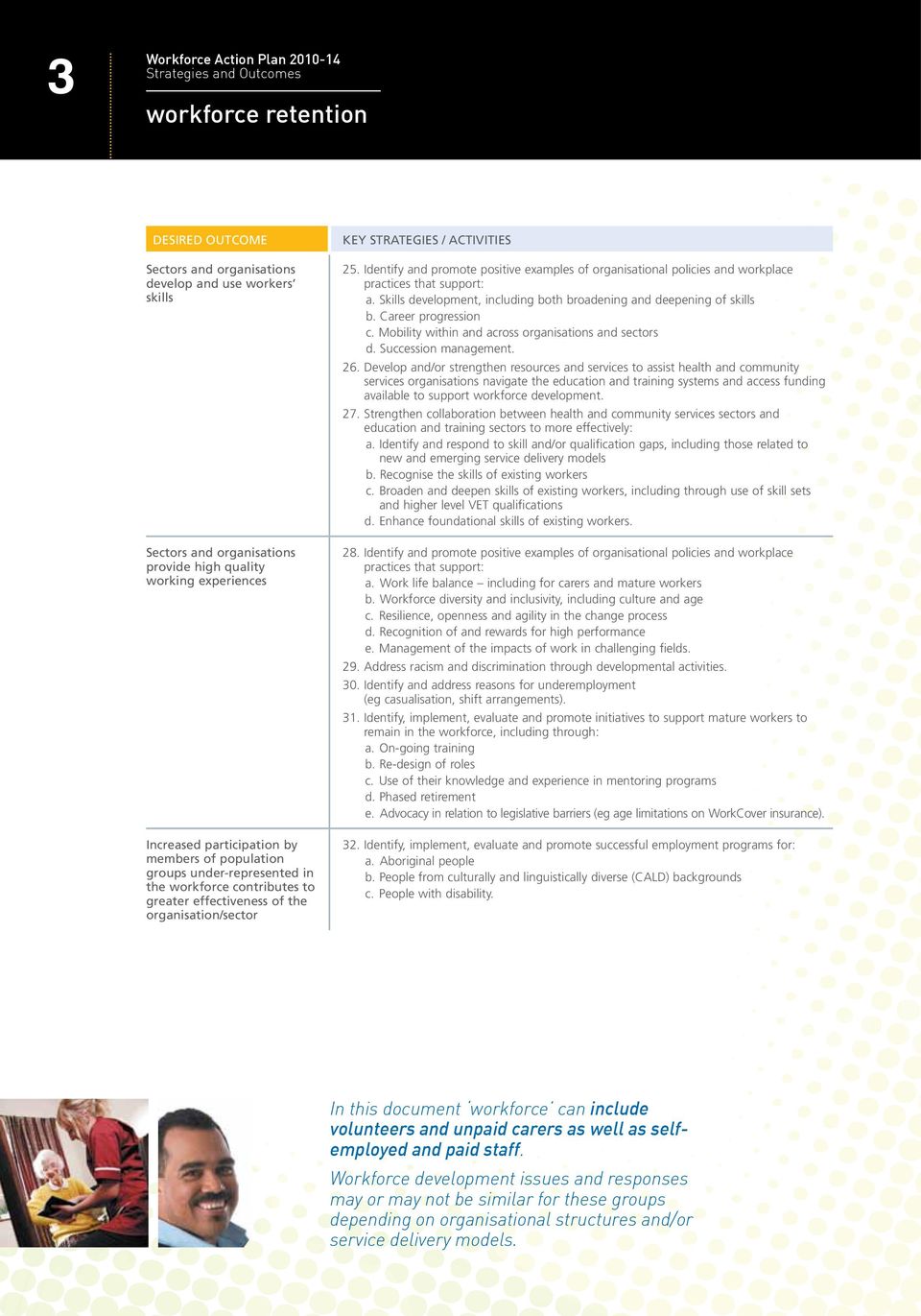
7 3 Workforce Action Plan Strategies and Outcomes workforce retention Desired Outcome Sectors and organisations develop and use workers skills Sectors and organisations provide high quality working experiences Increased participation by members of population groups under-represented in the workforce contributes to greater effectiveness of the organisation/sector Key Strategies / Activities 25. Identify and promote positive examples of organisational policies and workplace practices that support: a. Skills development, including both broadening and deepening of skills b. Career progression c. Mobility within and across organisations and sectors d. Succession management. 26. Develop and/or strengthen resources and services to assist health and community services organisations navigate the education and training systems and access funding available to support workforce development. 27. Strengthen collaboration between health and community services sectors and education and training sectors to more effectively: a. Identify and respond to skill and/or qualification gaps, including those related to new and emerging service delivery models b. Recognise the skills of existing workers c. Broaden and deepen skills of existing workers, including through use of skill sets and higher level VET qualifications d. Enhance foundational skills of existing workers. 28. Identify and promote positive examples of organisational policies and workplace practices that support: a. Work life balance including for carers and mature workers b. Workforce diversity and inclusivity, including culture and age c. Resilience, openness and agility in the change process d. Recognition of and rewards for high performance e. Management of the impacts of work in challenging fields. 29. Address racism and discrimination through developmental activities. 30. Identify and address reasons for underemployment (eg casualisation, shift arrangements). 31. Identify, implement, evaluate and promote initiatives to support mature workers to remain in the workforce, including through: a. On-going training b. Re-design of roles c. Use of their knowledge and experience in mentoring programs d. Phased retirement e. Advocacy in relation to legislative barriers (eg age limitations on WorkCover insurance). 32. Identify, implement, evaluate and promote successful employment programs for: a. Aboriginal people b. People from culturally and linguistically diverse (CALD) backgrounds c. People with disability. In this document workforce can include volunteers and unpaid carers as well as selfemployed and paid staff. Workforce development issues and responses may or may not be similar for these groups depending on organisational structures and/or service delivery models.
8 Taking Action This plan provides a framework for an ambitious and challenging agenda for change, and invites all health and community services stakeholders to take individual and collective action to help our workforce and our sectors to thrive. Each sector and organisation will choose how to work with the plan, influenced by their own workforce development priorities and plans and building on existing work. In many instances, work will be informed by national and state policies and by associated workforce strategies. Achieving the outcomes identified in the plan is a shared responsibility and will require action on the part of health and community services organisations, government, and skills and workforce development providers. In many cases collaborating through sharing ideas, approaches and resources will provide opportunities to implement strategies and build a skilled and innovative workforce. The SA Health & Community Services Skills Board will provide a point of contact with stakeholders and link with government regarding initiatives that will assist with implementation of the plan. The Board will also bring people together to identify indicative progress measures and scope projects in priority areas, encourage sectors to establish implementation plans and act as a catalyst for change. The Department of Further Education, Employment, Science & Technology will establish a senior coordination group of relevant SA Government agencies to liaise with the industry groups leading the implementation of this and other industry workforce action plans. Employer, employee and professional associations, sector peak bodies and individual employers, depending on their circumstances and requirements, may wish to link their work to the strategies identified and/or join with others to implement strategies important to them. Providers of education and training, employment services and other workforce development stakeholders may also wish to use the plan to guide or support their work. Get Involved Where are the points of relevance for your organisation and sector in this plan? What are the priorities and opportunities for your organisation and sector? What will it take to create the changes needed to achieve the desired outcomes? What opportunities are there to work collaboratively to achieve outcomes? What are you going to do? For more information and to get involved contact the SA Health & Community Services Skills Board T: (08) E: [email protected] W:

South Australian Women s Health Policy
 South Australian Women s Health Policy 1 2 South Australian Women s Health Policy To order copies of this publication, please contact: Department of Health PO Box 287 Rundle Mall Adelaide SA 5000 Telephone:
Foreword. Closing the Gap in Indigenous Health Outcomes. Indigenous Early Childhood Development. Indigenous Economic Participation.
 National Aboriginal and Torres Strait Islander Health Workforce Strategic Framework 2011 2015 Prepared for The Australian Health Ministers Advisory Council by the Aboriginal and Torres Strait Islander
Leadership in public education
 Leadership in public education Policy direction overview Discussion paper three Great educational leaders transform the lives of young people and enrich our whole community. They are the exceptional men
CAREER AND TRANSITION SERVICES FRAMEWORK: an effective national approach to youth transitions
 CAREER AND TRANSITION SERVICES FRAMEWORK: an effective national approach to youth transitions PREAMBLE The Career and Transition Services (CTS) Framework will help young people to make successful transitions
The National Health Plan for Young Australians An action plan to protect and promote the health of children and young people
 The National Health Plan for Young Australians An action plan to protect and promote the health of children and young people Copyright 1997 ISBN 0 642 27200 X This work is copyright. It may be reproduced
Rural and remote health workforce innovation and reform strategy
 Submission Rural and remote health workforce innovation and reform strategy October 2011 beyondblue PO Box 6100 HAWTHORN WEST VIC 3122 Tel: (03) 9810 6100 Fax: (03) 9810 6111 www.beyondblue.org.au Rural
Position Paper. Allied Health Assistants in Rural and Remote Australia
 Position Paper Allied Health Assistants in Rural and Remote Australia December 2011 Allied Health Assistants in Rural and Remote Australia i Table of Contents DISCLAIMER... II GLOSSARY OF TERMS... III
NATIONAL FRAMEWORK FOR RURAL AND REMOTE EDUCATION
 NATIONAL FRAMEWORK FOR RURAL AND REMOTE EDUCATION DEVELOPED BY THE MCEETYA TASK FORCE ON RURAL AND REMOTE EDUCATION, TRAINING, EMPLOYMENT AND CHILDREN S SERVICES 1 CONTENTS Introduction... 3 Purpose...
Position Statement #37 POLICY ON MENTAL HEALTH SERVICES
 THE ROYAL AUSTRALIAN AND NEW ZEALAND COLLEGE OF PSYCHIATRISTS Position Statement #37 POLICY ON MENTAL HEALTH SERVICES Mental disorder is a major cause of distress in the community. It is one of the remaining
An outline of National Standards for Out of home Care
 Department of Families, Housing, Community Services and Indigenous Affairs together with the National Framework Implementation Working Group An outline of National Standards for Out of home Care A Priority
STRATEGIC PLAN 2016-2018
 STRATEGIC PLAN 2016-2018 INTRODUCTION FROM MANAGING DIRECTOR The importance of a strategic approach to improving young men s health remains strong and relevant as ever. I am pleased to introduce this three
Workforce Management Plan 2013-2017
 Workforce Management Plan 2013-2017 Adopted on Wednesday 19 June 2013 Contents Message from the General Manager 5 city Plan: Cascade of Plans 6 our Vision, Mission and Community Outcomes 7 Introduction
Submission by SDN Children s Services Early Childhood Development Workforce Productivity Commission Issues Paper
 Submission by SDN Children s Services Early Childhood Development Workforce Productivity Commission Issues Paper SDN was established in 1905 and is one of Australia s most experienced and trusted leaders
NSW Public Service Commissioner NSW Health Good Health Great Jobs Stepping Up Forum 2015
 NSW Public Service Commissioner NSW Health Good Health Great Jobs Stepping Up Forum 2015 Our Aboriginal workforce The Australian Bureau of Statistics figures from 2011 estimate that 2.9% of the NSW population
South Eastern Melbourne Partners in Recovery Service System Reform Implementation Plan
 South Eastern Melbourne Partners in Recovery Service System Reform Implementation Plan Introduction Partners in Recovery (PIR) is a national program that aims to support people with enduring mental illness
Submission to the Tasmanian Government. Rethink Mental Health Project Discussion Paper
 Submission to the Tasmanian Government Rethink Mental Health Project Discussion Paper February 2015 Alcohol, Tobacco and other Drugs Council of Tas Inc. (ATDC) www.atdc.org.au ABN: 91 912 070 942 Phone:
POSITION DESCRIPTION. Classification: Job and Person Specification Approval JOB SPECIFICATION
 POSITION DESCRIPTION POSITION DETAILS Position Title: Central Adelaide Director of Psychology Classification: Administrative Unit: Allied Health Term: Type of Appointment: Ongoing Date Created: November
Victorian Purchasing Guide. for. CHC Community Services Training Package. Release 2.1
 Victorian Purchasing Guide for CHC Community Services Training Package Release 2.1 December 2015 State of Victoria (Department of Education and Training) 2015. Copyright of this material is reserved to
CHC42015 Certificate IV in Community Services
 CHC42015 Certificate IV in Community Services Release 1 CHC42015 Certificate IV in Community Services Modification History Release Release 1 Comments This version was released in CHC Community Services
Social Work and the Human Services. Open Day 2008. Make Yourself at Home.
 Social Work and the Human Services Open Day 2008. Make Yourself at Home. Is Social Work and the Human Services for you? Do you have a passion to work for a better world and to have a rich and rewarding
Strategic Plan 2013 17
 Department of Education, Training and Employment Department of Education, Training and Employment Strategic Plan 2013 17 Engaging minds. Empowering futures. 1300046 Department of Education, Training and
Policy Paper: Enhancing aged care services through allied health
 Policy Paper: Enhancing aged care services through allied health March 2013 Contents Contents... 2 AHPA s call to action... 3 Position Statement... 4 Background... 6 Enhancing outcomes for older Australians...
Approach to Community Impact Grant Guidelines
 Approach to Community Impact Grant Guidelines 2015 TABLE OF CONTENTS ABOUT THE MINNEAPOLIS FOUNDATION 2 GRANTS TO NONPROFITS 3 IMPACT PRIORITIES FOR GRANTMAKING 3-8 EDUCATION 4-5 ECONOMIC VITALITY 6-7
Talent Management Framework
 Introduction 1 The Council has agreed an Organisational Development (OD) Strategy with an overall aim to help the Council achieve its vision of building a world class city for everyone, with an ambition
Section 6. Strategic & Service Planning
 Section 6 Strategic & Service Planning 6 Strategic & Service Planning 6.1 Strategic Planning Responsibilities Section 6 Strategic & Service Planning 6.1.1 Role of Local Health Districts and Specialty
D2N2 Procurement Charter. For Economic, Social & Environmental Impact
 D2N2 Procurement Charter For Economic, Social & Environmental Impact July 2015 D2N2 Procurement Charter For Economic, Social & Environmental Impact Foreword D2N2 is the Local Enterprise Partnership for
National Disability Insurance Scheme
 A Framework for Information, Linkages and Capacity Building Overview This paper sets out policy parameters for Information, Linkages and Capacity Building (ILC), formerly known as Tier 2, in the National
Position Description NDCO Team Leader
 Position Description NDCO Team Leader The Inner Melbourne VET Cluster (IMVC) is a not-for-profit incorporated association established in 1998. Throughout its history, the IMVC has been at the forefront
Overview. Early Childhood Education and Care Grants Program
 Overview Early Program The Early Program Overview is intended to inform the NSW early childhood education and care sector about the funding assistance that is available from the NSW Department of Education
CARDIFF COUNCIL. Equality Impact Assessment Corporate Assessment Template
 Policy/Strategy/Project/Procedure/Service/Function Title: Proposed Council budget reductions to grant funding to the Third Sector Infrastructure Partners New Who is responsible for developing and implementing
School Focused Youth Service Supporting the engagement and re-engagement of at risk young people in learning. Guidelines 2013 2015
 School Focused Youth Service Supporting the engagement and re-engagement of at risk young people in learning Guidelines 2013 2015 Published by the Communications Division for Student Inclusion and Engagement
Karibu Aged Care Services. Workforce Plan
 Karibu Aged Care Services Workforce Plan July 2013 June 2016 Approved by Senior Management Team: 29/05/2013 V1.1 - May 2013 Review date: to be determined This is a hypothetical workforce plan, developed
DEPARTMENT OF TRAINING AND WORKFORCE DEVELOPMENT
 DEPARTMENT OF TRAINING AND WORKFORCE DEVELOPMENT STRATEGIC PLAN 2014-2018 STRATEGIC PLAN 2014-2018 OUR VISION All Western Australians can be part of a skilled workforce to meet the economic and community
Suite Overview...2. Glossary...8. Functional Map.11. List of Standards..15. Youth Work Standards 16. Signposting to other Standards...
 LSI YW00 Youth Work National Occupational Standards Introduction Youth Work National Occupational Standards Introduction Contents: Suite Overview...2 Glossary......8 Functional Map.11 List of Standards..15
Policy Paper: Accessible allied health primary care services for all Australians
 Policy Paper: Accessible allied health primary care services for all Australians March 2013 Contents Contents... 2 AHPA s call to action... 3 Position Statement... 4 Background... 6 Healthier Australians
Guideline for social work assistant training. Allied Health Professions Office of Queensland
 Guideline for social work assistant training Allied Health Professions Office of Queensland August 2014 Guideline for social work assistant training Published by the State of Queensland (Queensland Health),
A strategy to develop the capacity, impact and profile of allied health professionals in public health 2015-2018
 A strategy to develop the capacity, impact and profile of allied health professionals in public health 2015-2018 Strategy from the Allied Health Professionals Federation supported by Public Health England
Health Consumers Queensland...your voice in health. Consumer and Community Engagement Framework
 Health Consumers Queensland...your voice in health Consumer and Community Engagement Framework February 2012 Definitions In this Framework, Health Consumers Queensland utilises the following definitions
Leicestershire Partnership Trust. Leadership Development Framework
 Leicestershire Partnership Trust Leadership Development Framework 1 Leadership Development Framework Introduction The NHS in England is facing a period of substantial change in light of the recent Government
Key Priority Area 1: Key Direction for Change
 Key Priority Areas Key Priority Area 1: Improving access and reducing inequity Key Direction for Change Primary health care is delivered through an integrated service system which provides more uniform
Vocational Education and Training in Schools Guidelines
 Vocational Education and Training in Schools Guidelines Department of Training and Workforce Development Department of Education 1. Introduction These guidelines support the implementation of the Joint
Universal access to early childhood education Overview
 Universal access to early childhood education Overview 1. Background The Council of Australian Government s National Partnership Agreement on Early Childhood Education was signed in November 2008, with
Operations & Business Development Director
 POSITION DESCRIPTION Position: Reports to: EFT: Role Purpose: Internal Relationships: External Relationships: Remuneration: Location Base: Operations & Business Development Director CEO Initial twelve
CHC52015 Diploma of Community Services
 CHC52015 Diploma of Community Services Release 1 CHC52015 Diploma of Community Services Modification History Release Release 1 Comments This version was released in CHC Community Services Training Package
Blueprint for Education and Early Childhood Development
 Blueprint for Education and Early Childhood Development Every child, every opportunity Every child, every opportunity 02 03 Blueprint for Education and Early Childhood Development Blueprint for Education
Aboriginal Human Resources Development Plan. A message from the Director-General
 DRAFT Aboriginal Human Resources Development Plan 2012-2017 Our priorities The priorities outlined in the Plan provide a framework for committed action and innovative responses from our workforce to meet
Terms of Reference Greater Sydney Family Law Pathways Network
 Terms of Reference Greater Sydney Family Law Pathways Network Greater Sydney Family Law Pathways Network Terms of Reference 1.0 Introduction The Greater Sydney Family Law Pathways Network (the Network)
Choice, flexibility and control
 Framework: Transitioning NSW to the National Disability Insurance Scheme Choice, flexibility and control There will be expanded opportunities for people to exercise choice, flexibility and control over
Trade Training Centres in Schools Programme
 Trade Training Centres in Schools Programme Discussion Paper for Stakeholder Consultations February 2007 1 Contents Introduction...3 Overview...3 Programme objectives...4 Priorities...4 A partnership approach...5
Productivity Commission Draft Research Report Vocational Education and Training Workforce
 Productivity Commission Draft Research Report Vocational Education and Training Workforce Submission by the Department of Education, Employment and Workplace Relations March, 2011 1 The Department of Education,
Home and Community Care Aboriginal and Torres Strait Islander Service Development Plan 2009 12
 Home and Community Care Aboriginal and Torres Strait Islander Service Development Plan 2009 12 Contents Setting the scene...3 Aims...3 Key issues from statewide consultation...4 Priority areas, outcomes
Aboriginal and Torres Strait Islander Health Workers / Practitioners in focus
 Aboriginal and Torres Strait Islander Health Workers / Practitioners in focus i Contents Introduction... 1 What is an Aboriginal and Torres Strait Islander Health Worker?... 2 How are Aboriginal and Torres
Putting People First A shared vision and commitment to the transformation of Adult Social Care
 Putting People First A shared vision and commitment to the transformation of Adult Social Care Putting People First A shared vision and commitment to the transformation of Adult Social Care 1 Introduction
NORTH EAST SCOTLAND COLLEGE HUMAN RESOURCES STRATEGY. Version Date: 18 November 2014 Approved by: Human Resources Committee
 NORTH EAST SCOTLAND COLLEGE HUMAN RESOURCES STRATEGY Version Date: 18 November 2014 Approved by: Human Resources Committee HUMAN RESOURCES STRATEGY 1.0 Introduction 1.1 The merger of Aberdeen and Banff
CHC50612 Diploma of Community Services Work
 CHC50612 Diploma of Community Services Work Release: 1 CHC50612 Diploma of Community Services Work Modification History CHC08 Version 3 CHC08 Version 4 Comments CHC50608 Diploma of Community Services work
Early childhood education and care
 Early childhood education and care Introduction This policy brief provides an overview of the national policy and advocacy priorities on early childhood education and care. These include: access to services
CHARLES STURT UNIVERSITY WORKFORCE PLANNING FRAMEWORK 2007 2011
 CHARLES STURT UNIVERSITY WORKFORCE PLANNING FRAMEWORK 2007 2011 1. DEFINITION... 1 2. CONTEXT... 1 3. STRATEGIC ALIGNMENT AND DRIVERS... 1 4. VALUES... 2 5. PRINCIPLES OF PRACTICE... 2 6. PERFORMANCE INDICATORS...
BOOSTING THE COMMERCIAL RETURNS FROM RESEARCH
 BOOSTING THE COMMERCIAL RETURNS FROM RESEARCH Submission in response to the Discussion Paper November 2014 Page 1 ABOUT RESEARCH AUSTRALIA is an alliance of 160 members and supporters advocating for health
Submission to the NSW Ministry of Health on the discussion paper: Towards an Aboriginal Health Plan for NSW
 Submission to the NSW Ministry of Health on the discussion paper: Towards an Aboriginal Health Plan for NSW June 2012 Council of Social Service of NSW (NCOSS) 66 Albion Street, Surry Hills 2010 Ph: 02
AOD Support Services Classification Level: 7.1 Aboriginal Community Organisation Award. 004 Supervisor AOD Support Services
 ABORIGINAL ALCOHOL AND DRUG SERVICE POSITION DESCRIPTION SECTION 1: OFFICE IDENTIFICATION EFFECTIVE DATE OF DOCUMENT: SEPTEMBER 2012 Position Description Number: 006 Job Title: AOD Counsellor/Educator
Strategic Guidance for Community Planning Partnerships: Community Learning and Development
 Strategic Guidance for Community Planning Partnerships: Community Learning and Development COMMUNITY LEARNING AND DEVELOPMENT: STRATEGIC GUIDANCE FOR COMMUNITY PLANNING PARTNERSHIPS EXECUTIVE SUMMARY This
Welfare Reform Submission SCOA submission:
 Welfare Reform Submission SCOA submission: The Settlement Council of Australia (SCOA) appreciates the opportunity to make a submission on the Interim Report of the Reference Group on Welfare Reform. SCOA
Australian Nursing Federation (Victorian Branch)
 Australian Nursing Federation (Victorian Branch) 17 th February 2012 Lisa Fitzpatrick State Secretary Box 12600 A Beckett Street PO Melbourne Victoria Telephone: 03 9275 9333 Fax: 03 9275 9344 www.anfvic.asn.au
National Trade Cadetships
 Schools Vocational Pathways National Trade Cadetships Discussion paper National Trade Cadetships Background Paper National Trade Cadetships Introduction The National Trade Cadetship offers the potential
Statewide Education and Training Services. Position Paper. Draft for Consultation 1 July 2013
 Statewide Education and Training Services Position Paper Draft for Consultation 1 July 2013 This paper establishes the position for an SA Health Statewide Education and Training Service following the initial
NORTHERN TERRITORY GOVERNMENT TRAINEESHIP AND INDIGENOUS TRAINEESHIP PROGRAMS
 Office of the Commissioner for Public Employment www.ocpe.nt.gov.a u NORTHERN TERRITORY GOVERNMENT TRAINEESHIP AND INDIGENOUS TRAINEESHIP PROGRAMS Guidelines for Traineeships in the NTPS November 2015
We are a full service law firm and our areas of practice are:
 HHL Group comprises Hampson Hughes Solicitors, a personal injury law firm and Cassell Moore, a professional services law firm. We operate out of Edward Pavilion, Albert Dock and provide legal services
chisholmonline.edu.au Apply yourself A quick guide to Chisholm Online chisholmonline.edu.au 1
 chisholmonline.edu.au Apply yourself A quick guide to Chisholm Online chisholmonline.edu.au 1 The 5 key benefits to studying with Chisholm Online 51 Study anywhere, anytime 2 A nationally accredited qualification
CSC Correctional Services Training Package. Version 1 WA NOMINAL HOURS GUIDE
 CSC Correctional Services Training Package Version 1 WA NOMINAL HOURS GUIDE Department of Training and Workforce Development Page 1 Introduction This Guide has been generated to enable the stakeholders
POSITION DESCRIPTION:
 POSITION DESCRIPTION: SECTION A: POSITION CONTEXT Position Title Community Mental Health Practitioner COPES Carer Peer Practitioner Position Reference 11916 Position Type Part time 15.2 hours per week
Breaking Bad: Improving relationships between the Community Alcohol and Drug (AOD) sector and Government Mental Health (MH) sector in Tasmania
 Breaking Bad: Improving relationships between the Community Alcohol and Drug (AOD) sector and Government Mental Health (MH) sector in Tasmania 14 November 2014 Hobart, Tasmania Amanda Street Sector Capacity
FINAL REPORT DISCIPLINE OF OCCUPATIONAL THERAPY
 FINAL REPORT QUEENSLAND REGIONAL TRAINING NETWORK HEALTH DISCIPLINE GROUPS 2014 DISCIPLINE OF OCCUPATIONAL THERAPY A collaboration between The Queensland Occupational Therapy Fieldwork Collaborative (QOTFC),
Mental Health In Multicultural Australia (MHiMA) Strategic Directions 2012-2014 Building Capacity & Supporting Inclusion
 Mental Health In Multicultural Australia (MHiMA) Strategic Directions 2012-2014 Building Capacity & Supporting Inclusion Speaker Disclosures Member, Minister Chris Bowen s Council for Asylum Seekers and
COUNCIL OF AUSTRALIAN GOVERNMENTS
 COUNCIL OF AUSTRALIAN GOVERNMENTS High-level Principles for a National Disability Insurance Scheme A National Disability Insurance Scheme 1. The Council of Australian Governments (COAG) has welcomed the
Learning & Development Strategic Plan
 Learning & Development Strategic Plan 2006 Preamble The Business Model Review of the Department of Corrective Services in 2004 identified that: Continuous workforce improvement through structured initial
Chapter 7 Outcome 5: Workforce development and support
 Chapter 7 Outcome 5: Workforce development and support 1) Consultation with stakeholders identified increasing the capacity of the people who work in the corrections system, both within and outside of
About CatholicCare. Serving the whole community... CatholicCare
 About CatholicCare Serving the whole community... CatholicCare 2 About CatholicCare Contents About CatholicCare...5 Ageing, Dementia and Disability...7 Employment, Training and Support Services...8 Family
HR Enabling Strategy 2012-2017
 This document is yet to be put into corporate format but this interim version can be referred to for the time being. Should you have any queries, please refer to Sally Hartley, University Secretary, x
CHC40512 Certificate IV in Mental Health
 CHC40512 Certificate IV in Mental Health Release: 1 CHC40512 Certificate IV in Mental Health Modification History CHC08 Version 3 CHC08 Version 4 Comments CHC40508 Certificate IV in Mental Health CHC40512
DRAFT. Strategic Human Resources Plan. Our priorities 2012-2017. Students and communities at the centre of what we do.
 DRAFT Strategic Human Resources Plan 2012-2017 Students and communities at the centre of what we do World class education and training and strong, sustainable communities are what students and communities
Young Workers. A guide to rights and responsibilities at work for young people and employers. safe, fair, productive working lives
 Young Workers A guide to rights and responsibilities at work for young people and employers safe, fair, productive working lives If you are a young person thinking about starting work, or you are thinking
Early Childhood Development Workforce
 Early Childhood Development Workforce This submission to the Early Childhood Development Workforce Productivity Commission Issues Paper is made on behalf of GoodStart Childcare and specifically seeks to
Middlesbrough Manager Competency Framework. Behaviours Business Skills Middlesbrough Manager
 Middlesbrough Manager Competency Framework + = Behaviours Business Skills Middlesbrough Manager Middlesbrough Manager Competency Framework Background Middlesbrough Council is going through significant
Child protection in schools, early childhood education and care
 Policy Child protection in schools, early childhood education and care Summary This policy describes the scope of obligations that must be met to maintain child safe environments in DECD schools, early