
Lecture Notes on Actuarial Mathematics
|
|
|
- Polly Wilkinson
- 10 years ago
- Views:
Transcription
1 Lecture Notes on Actuarial Mathematics Jerry Alan Veeh May 1, 2006 Copyright 2006 Jerry Alan Veeh. All rights reserved.

2 0. Introduction The objective of these notes is to present the basic aspects of the theory of insurance, concentrating on the part of this theory related to life insurance. An understanding of the basic principles underlying this part of the subject will form a solid foundation for further study of the theory in a more general setting. Throughout these notes are various exercises and problems. The reader should attempt to work all of these. Also, problem sets consisting of multiple choice problems similar to those found on examinations given by the Society of Actuaries are provided. The reader should work these problem sets in the suggested time allocation after the material has been mastered. The Tables for Exam M provided by the Society of Actuaries can be used as an aid in solving any of the problems given here. The Illustrative Life Table included here is a copy of the life table portion of these tables. The full set of tables can be downloaded from the Society s web site. Familiarity with these tables is an essential part of preparation for the examination. Readers using these notes as preparation for the Society of Actuaries examination should master the material to the extent of being able to deliver a course on this subject matter. A calculator, such as the one allowed on the Society of Actuaries examinations, will be useful in solving many of the problems here. Familiarity with this calculator and its capabilities is an essential part of preparation for the examination. Copyright 2006 Jerry Alan Veeh. All rights reserved.
3 1. Overview The central theme of these notes is embodied in the question, What is the value today of a random sum of money which will be paid at a random time in the future? Such a random payment is called a contingent payment. The theory of insurance can be viewed as the theory of contingent payments. The insurance company makes payments to its insureds contingent upon the occurrence of some event, such as the death of the insured, an auto accident by an insured, and so on. The insured makes premium payments to the insurance company contingent upon being alive, having sufficient funds, and so on. A natural way to model these contingencies mathematically is to use probability theory. Probabilistic considerations will, therefore, play an important role in the discussion that follows. The other central consideration in the theory of insurance is the time value of money. Both claims and premium payments occur at various, possibly random, points of time in the future. Since the value of a sum of money depends on the point in time at which the funds are available, a method of comparing the value of sums of money which become available at different points of time is needed. This methodology is provided by the theory of interest. The theory of interest will be studied first in a non-random setting in which all payments are assumed to be sure to be made. Then the theory will be developed in a random environment, and will be seen to provide a complete framework for the understanding of contingent payments. Copyright 2006 Jerry Alan Veeh. All rights reserved.
4 2. Elements of the Theory of Interest A typical part of most insurance contracts is that the insured pays the insurer a fixed premium on a periodic (usually annual or semi annual) basis. Money has time value, that is, $1 in hand today is more valuable than $1 to be received one year hence. A careful analysis of insurance problems must take this effect into account. The purpose of this section is to examine the basic aspects of the theory of interest. A thorough understanding of the concepts discussed here is essential. To begin, remember the way in which compound interest works. Suppose an amount A is invested at interest rate i per year and this interest is compounded annually. After 1 year, the amount in the account will be A + ia = A(1 + i), and this total amount will earn interest the second year. Thus, after n years the amount will be A(1 + i) n. The factor (1 + i) n is sometimes called the accumulation factor. If interest is compounded daily after the same n years the amount will be A(1+ i 365 )365n. In this last context the interest rate i is called the nominal annual rate of interest. The effective annual rate of interest is the amount of money that one unit invested at the beginning of the year will earn during the year, when the amount earned is paid at the end of the year. In the daily compounding example the effective annual rate of interest is (1 + i 365 ) This is the rate of interest which compounded annually would provide the same return. When the time period is not specified, both nominal and effective interest rates are assumed to be annual rates. Also, the terminology convertible daily is sometimes used instead of compounded daily. This serves as a reminder that at the end of a conversion period (compounding period) the interest that has just been earned is treated as principal for the subsequent period. Exercise 2 1. What is the effective rate of interest corresponding to an interest rate of 5% compounded quarterly? Two different investment schemes with two different nominal annual rates of interest may in fact be equivalent, that is, may have equal dollar value at any fixed date in the future. This possibility is illustrated by means of an example. Example 2 1. Suppose I have the opportunity to invest $1 in Bank A which pays 5% interest compounded monthly. What interest rate does Bank B have to pay, compounded daily, to provide an equivalent investment? At any time t in years the amount in the two banks is given by ( ) 12t ( ) 365t and 1 + i 365 respectively. Finding the nominal interest rate i which makes these two functions equal is now an easy exercise. Exercise 2 2. Find the interest rate i. What is the effective rate of interest? Situations in which interest is compounded more often than annually will arise Copyright 2006 Jerry Alan Veeh. All rights reserved.
5 2: Elements of the Theory of Interest 5 frequently. Some notation is needed to discuss these situations conveniently. Denote by i (m) the nominal annual interest rate compounded m times per year which is equivalent to the interest rate i compounded annually. This means that ( 1 + i(m) m ) m = 1 + i. Exercise 2 3. Compute 0.05 (12). An important abstraction of the idea of compound interest is the idea of continuous compounding. If interest is compounded n times per year the amount after t years is given by ( 1 + i n) nt. Letting n in this expression produces e it, and this corresponds to the notion of instantaneous compounding of interest. In this context denote by δ the rate of instantaneous compounding which is equivalent to interest rate i. Here δ is called the force of interest. The force of interest is extremely important from a theoretical standpoint and also provides some useful quick approximations. Exercise 2 4. Show that δ = ln(1 + i). Exercise 2 5. Find the force of interest which is equivalent to 5% compounded daily. The converse of the problem of finding the amount after n years at compound interest is as follows. Suppose the objective is to have an amount A n years hence. If money can be invested at interest rate i, how much should be deposited today in order to achieve this objective? The amount required is A(1 + i) n. This quantity is called the present value of A. The factor (1+i) 1 is often called the discount factor and is denoted by v. The notation v i is used if the value of i needs to be specified. Example 2 2. Suppose the annual interest rate is 5%. What is the present value of a payment of $2000 payable 10 years from now? The present value is $2000( ) 10 = $ The notion of present value is used to move payments of money through time in order to simplify the analysis of a complex sequence of payments. In the simple case of the last example the important idea is this. Suppose you were given the following choice. You may either receive $ today or you may receive $ years from now. If you can earn 5% on your money (compounded annually) you should be indifferent between these two choices. Under the assumption of an interest rate of 5%, the payment of $2000 in 10 years can be replaced by a payment of $ today. Thus the payment of $2000 can be moved through time using the idea of present value. A visual aid that is often used is that of a time diagram which

6 2: Elements of the Theory of Interest 6 shows the time and amounts that are paid. Under the assumption of an interest rate of 5%, the following two diagrams are equivalent time (years) Two Equivalent Cash Flows $2000 $ time (years) The advantage of moving amounts of money through time is that once all amounts are paid at the same point in time, the most favorable option is readily apparent. Exercise 2 6. What happens in comparing these cash flows if the interest rate is 6% rather than 5%? Notice too that a payment amount can be easily moved either forward or backward in time. A positive power of v is used to move an amount backward in time; a negative power of v is used to move an amount forward in time. In an interest payment setting, the payment of interest of i at the end of the period is equivalent to the payment of d at the beginning of the period. Such a payment at the beginning of a period is called a discount. Formally, the effective annual rate of discount is the amount of discount paid at the beginning of a year when the amount invested at the end of the year is a unit amount. What relationship between i and d must hold for a discount payment to be equivalent to the interest payment? The time diagram is as follows. Equivalence of Interest and Discount i d.. The relationship is d = iv follows by moving the interest payment back in time to the equivalent payment of iv at time 0. Exercise 2 7. Denote by d (m) the rate of discount payable m times per year that is equivalent to a nominal annual rate of interest i. What is the relationship between d (m) and i? Between d (m) and i (m)? Hint: Draw the time diagram illustrating the two payments made at time 0 and 1/m. Exercise 2 8. Treasury bills (United States debt obligations) pay discount rather than interest. At a recent sale the discount rate for a 3 month bill was 5%. What is the equivalent rate of interest?
7 2: Elements of the Theory of Interest 7 The notation and the relationships thus far are summarized in the string of equalities ( ) m ( ) m 1 + i = 1 + i(m) = 1 d(m) = v 1 = e δ. m m Another notion that is sometimes used is that of simple interest. If an amount A is deposited at interest rate i per period for t time units and earns simple interst, the amount at the end of the period is A(1 + it). Simple interest is often used over short time intervals, since the computations are easier than with compound interest. The most important facts are these. (1) Once an interest rate is specified, a dollar amount payable at one time can be exchanged for an equivalent dollar amount payable at another time by multiplying the original dollar amount by an appropriate power of v. (2) The five sided equality above allows interest rates to be expressed relative to a convenient time scale for computation. These two ideas will be used repeatedly in what follows.

8 2: Elements of the Theory of Interest 8 Problem 2 1. Show that if i > 0 then Problems d < d (2) < d (3) < < δ < < i (3) < i (2) < i. Problem 2 2. Show that lim m d (m) = lim m i (m) = δ. Problem 2 3. Calculate the nominal rate of interest convertible once every 4 years that is equivalent to a nominal rate of discount convertible quarterly. Problem 2 4. Interest rates are not always the same throughout time. In theoretical studies such scenarios are usually modelled by allowing the force of interest to depend on time. Consider the situation in which $1 is invested at time 0 in an account which pays interest at a constant force of interest δ. What is the amount A(t) in the account at time t? What is the relationship between A (t) and A(t)? More generally, suppose the force of interest at time t is δ(t). Argue that A (t) = δ(t)a(t), and solve this equation to find an explicit formula for A(t) in terms of δ(t) alone. Problem 2 5. Suppose that a fund initially containing $1000 accumulates with a force of interest δ(t) = 1/(1 + t), for t > 0. What is the value of the fund after 5 years? Problem 2 6. Suppose a fund accumulates at an annual rate of simple interest of i. What force of interest δ(t) provides an equivalent return? Problem 2 7. Show that d = 1 v. Is there a similar equation involving d (m)? Problem 2 8. Show that d = iv. Is there a similar equation involving d (m) and i (m)? Problem 2 9. Show that if interest is paid at rate i, the amount at time t under simple interest is more than the amount at time t under compound interest provided t < 1. Show that the reverse inequality holds if t > 1. Problem Compute the derivatives d di d and d dv δ.
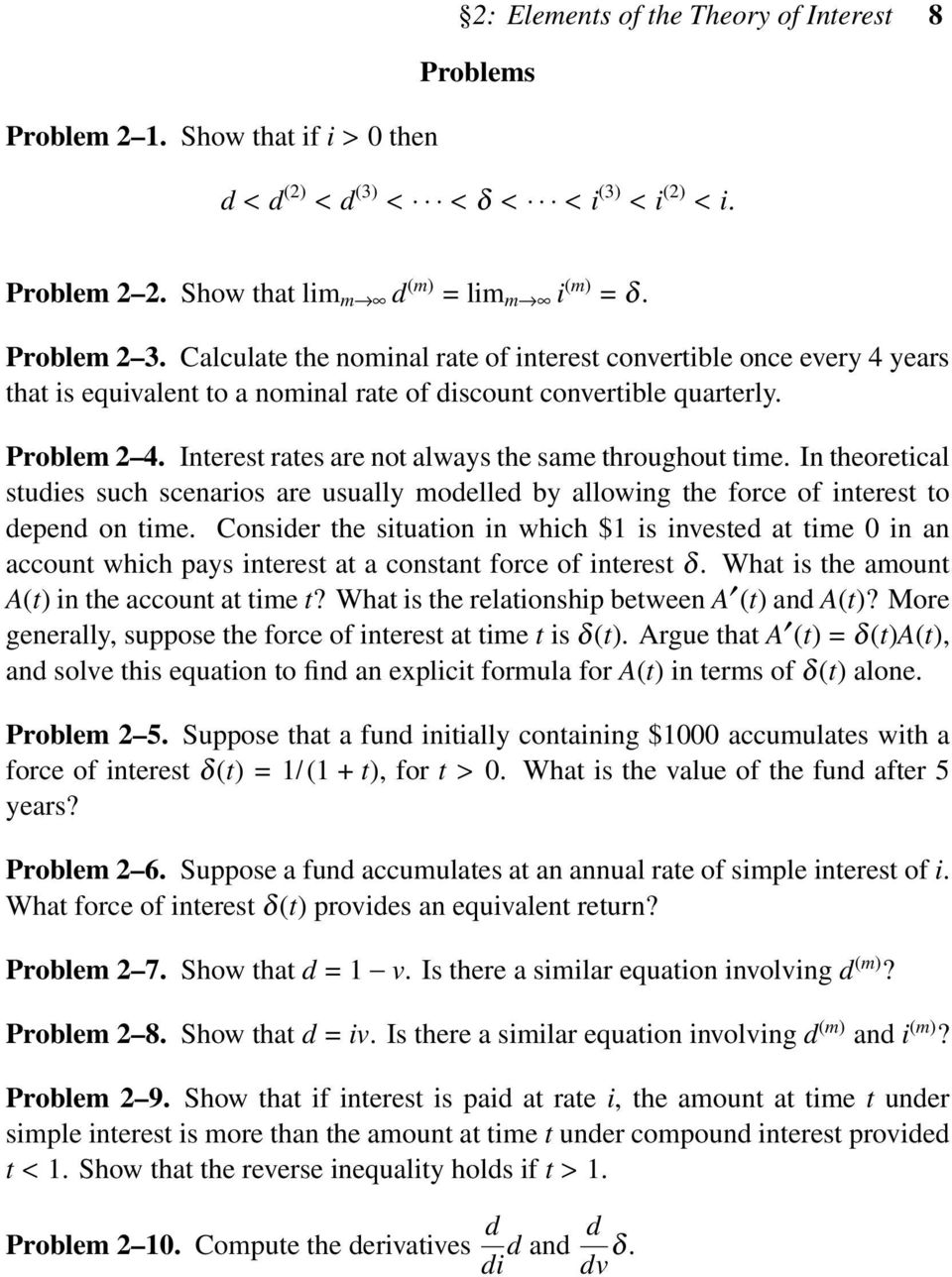
9 2: Elements of the Theory of Interest 9 Solutions to Problems Problem 2 1. An analytic argument is possible directly from the formulas. For example, (1 + i (m) /m) m = 1 + i = e δ so i (m) = m(e δ/m 1). Consider m as a continuous variable and show that the right hand side is a decreasing function of m for fixed i. Can you give a purely verbal argument? Hint: How does an investment with nominal rate i (2) compounded annually compare with an investment at nominal rate i (2) compounded twice a year? Problem 2 2. Since i (m) = m((1 + i) 1/m 1) the limit can be evaluated directly using L Hopitals rule, Maclaurin expansions, or the definition of derivative. Problem 2 3. The relevant equation is ( 1 + 4i (1/4)) 1/4 = ( 1 d (4) /4 ) 4. Problem 2 4. In the constant force setting A(t) = e δt and A (t) = δa(t). The equation A (t) = δ(t)a(t) can be solved by separation of variables to give A(t) = A(0)e t 0 δ(s) ds. Problem The amount in the fund after 5 years is 1000e 0 = 1000e ln(6) ln(1) = Problem 2 6. Thus t 0 t The force of interest must satisfy 1 + it = e δ(s) ds 0 for all t > 0. δ(s) ds = ln(1 + it), and differentiation using the Fundamental Theorem of Calculus shows that this implies δ(t) = i/(1 + it), for t > 0. Problem d (m) /m = v 1/m. Problem 2 8. d (m) /m = v 1/m i (m) /m. Problem 2 9. The problem is to show that 1 + it > (1 + i) t if t < 1, with the reverse inequality for t > 1. The function 1 + it is a linear function of t taking the value 1 when t = 0 and the value 1 + i when t = 1. The function (1 + i) t is a convex function which takes the value 1 when t = 0 and 1 + i when t = 1. Problem d di d = d di (1 1/(1+i)) = (1+i) 2, and d dv δ = d dv ( ln(v)) = v 1.
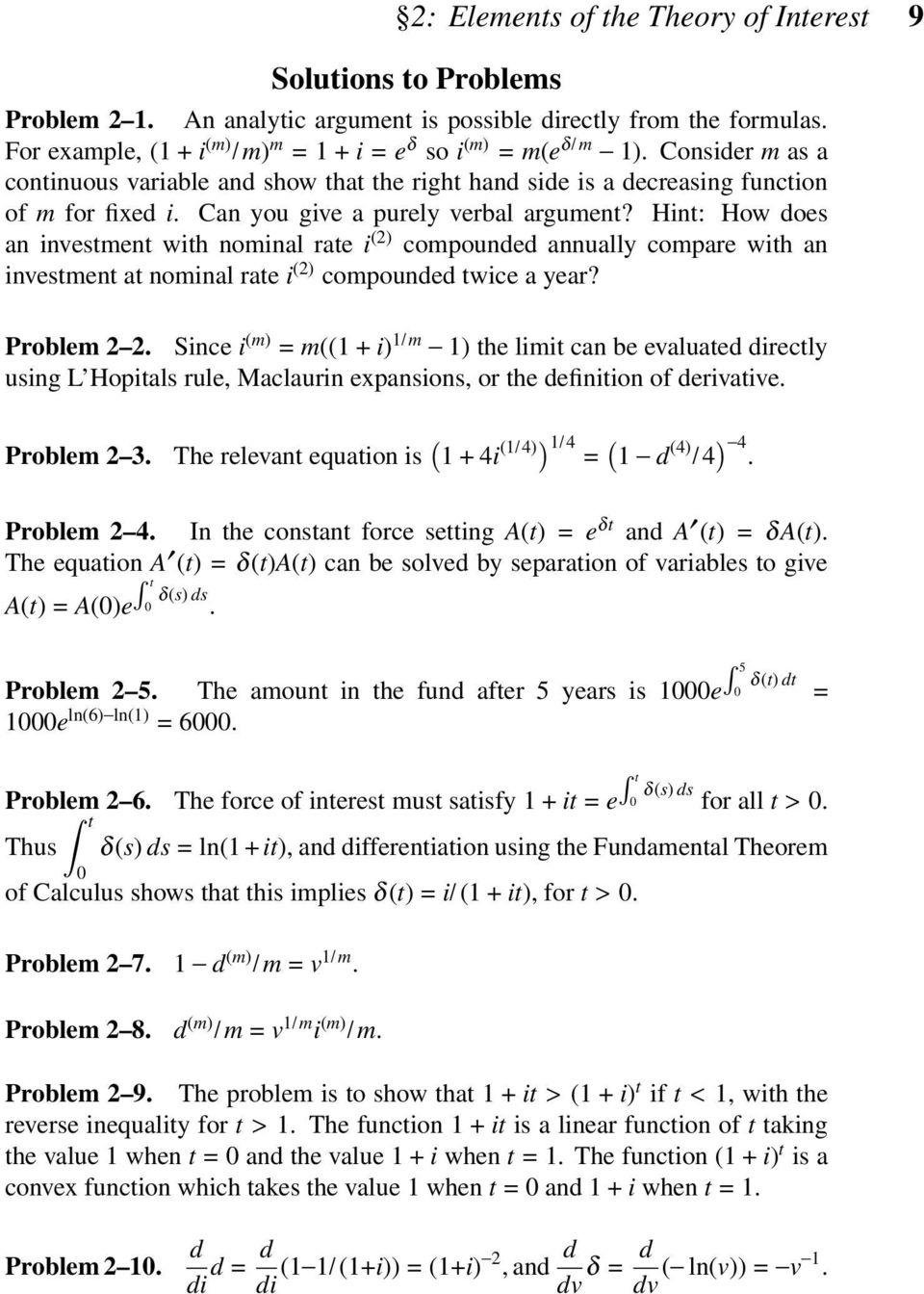
10 2: Elements of the Theory of Interest 10 Solutions to Exercises Exercise 2 1. The equation to be solved is ( /4) 4 = 1 + i, where i is the effective rate of interest. Exercise 2 2. Taking t th roots of both sides of the equation shows that t plays no role in determining i and leads to the equation i = 365((1+0.05/12) 12/365 1) = Exercise (12) = 12(( ) 1/12 1) = Exercise 2 4. The requirement for equivalence is that e δ = 1 + i. Exercise 2 5. Here e δ = ( /365) 365, so that δ = So as a rough approximation when compounding daily the force of interest is the same as the nominal interest rate. Exercise 2 6. The present value in this case is $2000( ) 10 = $ Exercise 2 7. A payment of d (m) /m made at time 0 is required to be equivalent to a payment of i (m) /m made at time 1/m. Hence d (m) /m = v 1/m i (m) /m. Since v 1/m = (1+i) 1/m = 1+i (m) /m this gives d (m) /m = 1 v 1/m or 1+i = (1 d (m) /m) m. Another relation is that d (m) /m i (m) /m = (d (m) /m)(i (m) /m). Exercise 2 8. The given information is d (4) = 0.05, from which i can be obtained using the formula of the previous exercise as i = (1 0.05/4) 4 1 =
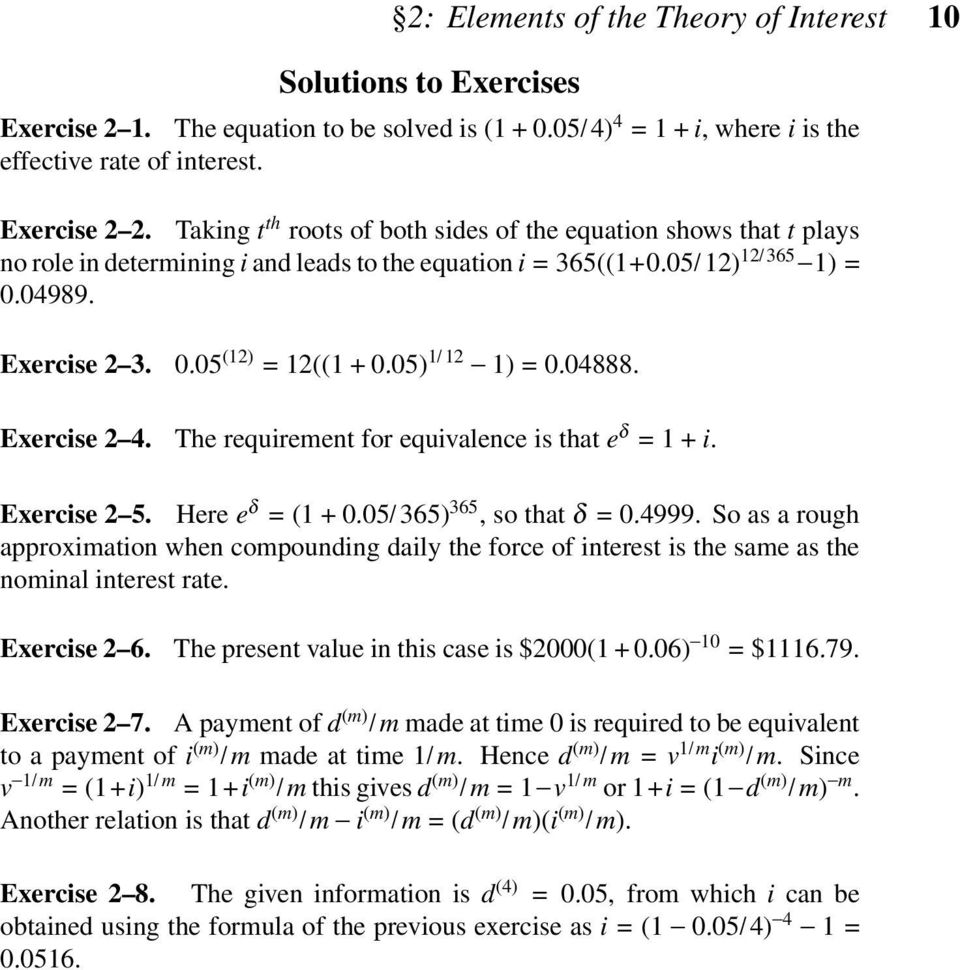
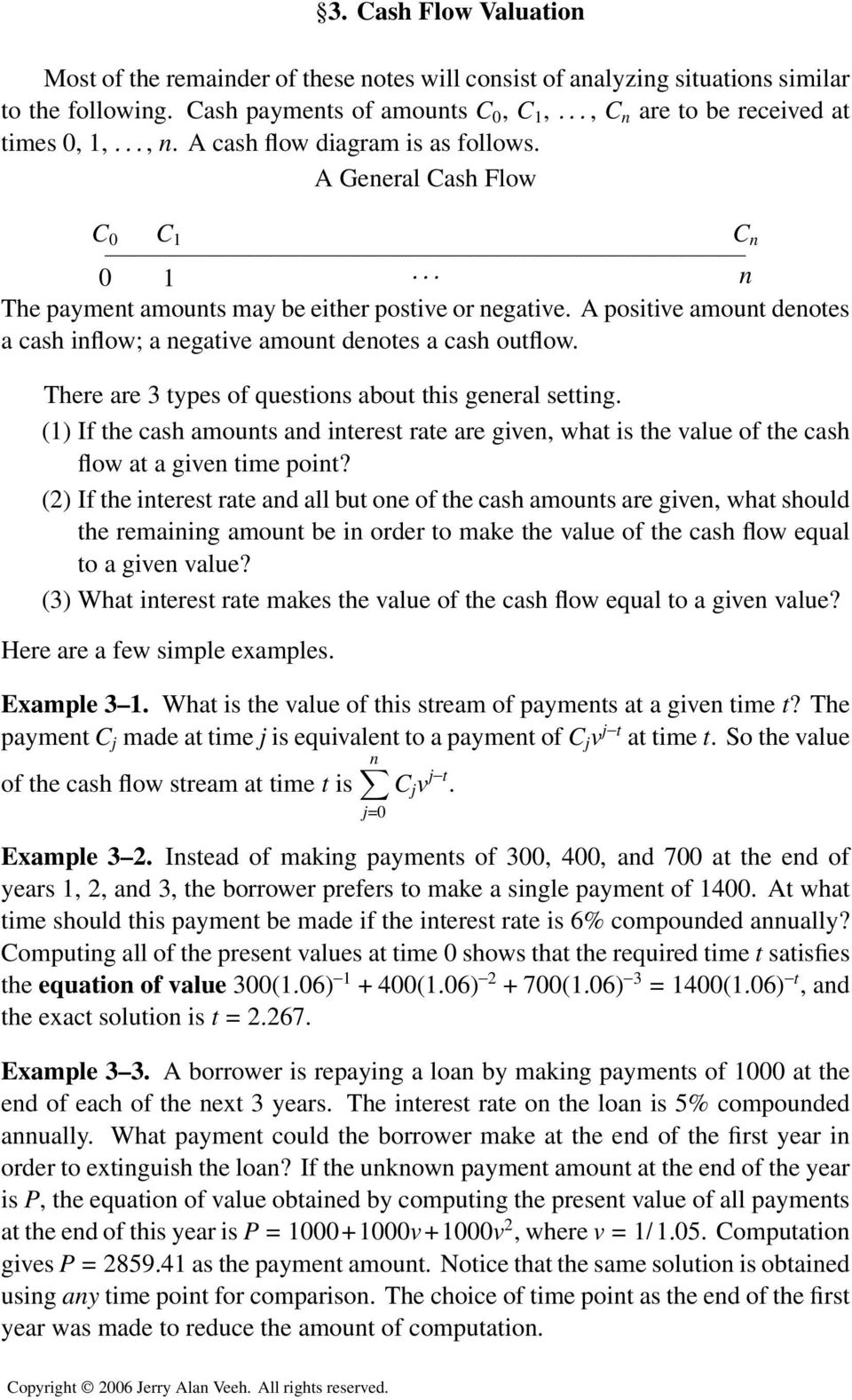
11 3. Cash Flow Valuation Most of the remainder of these notes will consist of analyzing situations similar to the following. Cash payments of amounts C 0, C 1,..., C n are to be received at times 0, 1,..., n. A cash flow diagram is as follows. A General Cash Flow C 0 C 1 C n n The payment amounts may be either postive or negative. A positive amount denotes a cash inflow; a negative amount denotes a cash outflow. There are 3 types of questions about this general setting. (1) If the cash amounts and interest rate are given, what is the value of the cash flow at a given time point? (2) If the interest rate and all but one of the cash amounts are given, what should the remaining amount be in order to make the value of the cash flow equal to a given value? (3) What interest rate makes the value of the cash flow equal to a given value? Here are a few simple examples. Example 3 1. What is the value of this stream of payments at a given time t? The payment C j made at time j is equivalent to a payment of C j v j t at time t. So the value n of the cash flow stream at time t is C j v j t. j=0 Example 3 2. Instead of making payments of 300, 400, and 700 at the end of years 1, 2, and 3, the borrower prefers to make a single payment of At what time should this payment be made if the interest rate is 6% compounded annually? Computing all of the present values at time 0 shows that the required time t satisfies the equation of value 300(1.06) (1.06) (1.06) 3 = 1400(1.06) t, and the exact solution is t = Example 3 3. A borrower is repaying a loan by making payments of 1000 at the end of each of the next 3 years. The interest rate on the loan is 5% compounded annually. What payment could the borrower make at the end of the first year in order to extinguish the loan? If the unknown payment amount at the end of the year is P, the equation of value obtained by computing the present value of all payments at the end of this year is P = v+1000v 2, where v = 1/1.05. Computation gives P = as the payment amount. Notice that the same solution is obtained using any time point for comparison. The choice of time point as the end of the first year was made to reduce the amount of computation. Copyright 2006 Jerry Alan Veeh. All rights reserved.
12 3: Cash Flow Valuation 12 Problems Problem 3 1. What rate of interest compounded quarterly is required for a deposit of 5000 today to accumulate to 10,000 after 10 years? Problem 3 2. An investor purchases an investment which will pay 2000 at the end of one year and 5000 at the end of four years. The investor pays 1000 now and agrees to pay X at the end of the third year. If the investor uses an interest rate of 7% compounded annually, what is X? Problem 3 3. A loan requires the borrower to repay 1000 after 1 year, 2000 after 2 years, 3000 after 3 years, and 4000 after 4 years. At what time could the borrower make a single payment of to repay the loan? Assume the interest rate is 4% effective. Problem 3 4. A note that pays 10,000 3 months from now is purchased by an investor for What is the effective annual rate of interest earned by the investor?

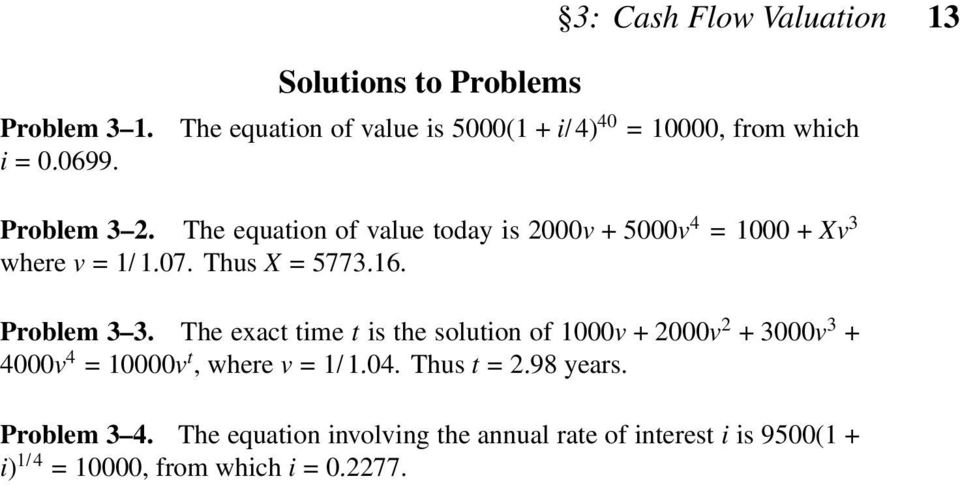
13 3: Cash Flow Valuation 13 Problem 3 1. i = Solutions to Problems The equation of value is 5000(1 + i/4) 40 = 10000, from which Problem 3 2. The equation of value today is 2000v v 4 = Xv 3 where v = 1/1.07. Thus X = Problem 3 3. The exact time t is the solution of 1000v v v v 4 = 10000v t, where v = 1/1.04. Thus t = 2.98 years. Problem 3 4. The equation involving the annual rate of interest i is 9500(1 + i) 1/4 = 10000, from which i =
14 4. Sample Question Set 1 Solve the following 6 problems in no more than 30 minutes Question 4 1. Fund A accumulates at a force of interest at time t (t 0) t Fund B accumulates at a force of interest You are given that the amount in Fund A at time zero is 1,000, the amount in Fund B at time zero is 500, and that the amount in Fund C at any time t is equal to the sum of the amount in Fund A and Fund B. Fund C accumulates at force of interest δ t. Find δ A. 660 B D. 2 + e e 0.1 C. 1 + e e 0.1 E. 2 + e e 0.1 Question 4 2. Gertrude deposits 10,000 in a bank. During the first year the bank credits an annual effective rate of interest i. During the second year the bank credits an annual effective rate of interest (i 5%). At the end of two years she has 12, in the bank. What would Gertrude have in the bank at the end of three years if the annual effective rate of interest were (i + 9%) for each of the three years? A. 16,851 B. 17,196 C. 17,499 D. 17,936 E. 18,113 Question 4 3. Fund X starts with 1,000 and accumulates with a force of interest 1 δ t = for 0 t < 15. Fund Y starts with 1,000 and accumulates with an 15 t interest rate of 8% per annum compounded semi-annually for the first three years and an effective interest rate of i per annum thereafter. Fund X equals Fund Y at the end of four years. Calculate i. A B C D E Copyright 2006 Jerry Alan Veeh. All rights reserved.

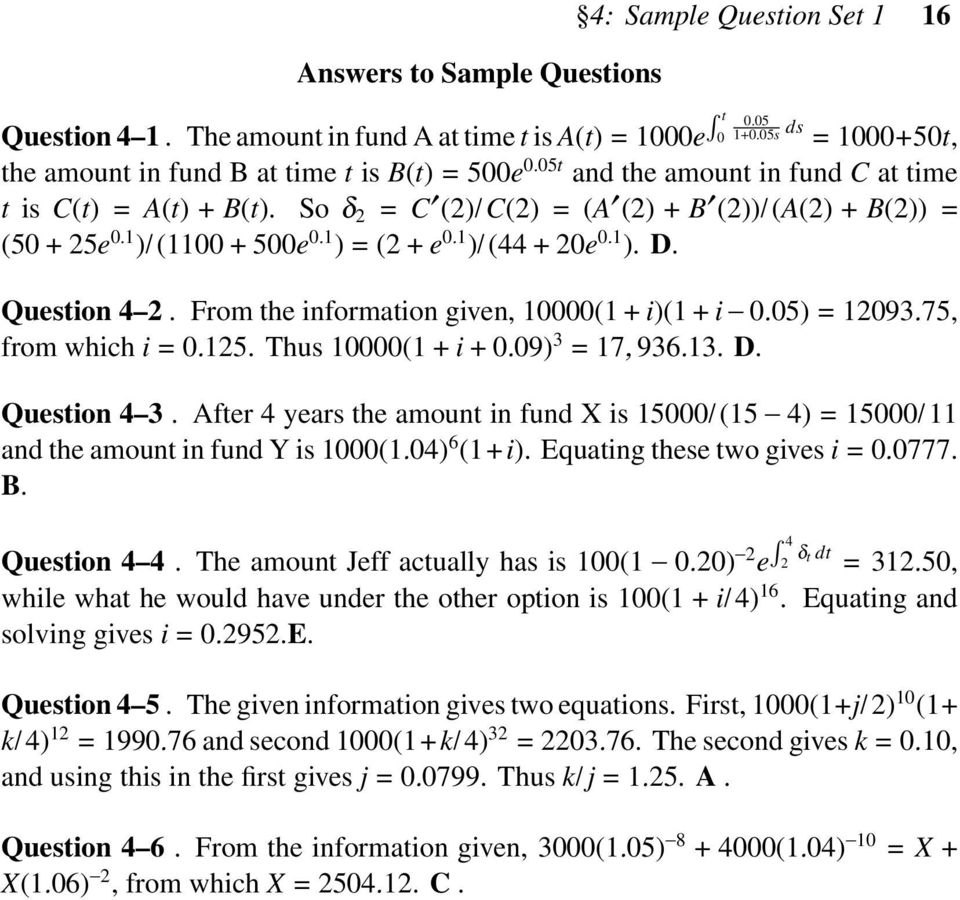
15 4: Sample Question Set 1 15 Question 4 4. Jeff puts 100 into a fund that pays an effective annual rate of discount of 20% for the first two years and a force of interest of rate δ t = 2t t 2 + 8, 2 t 4, for the next two years. At the end of four years, the amount in Jeff s account is the same as what it would have been if he had put 100 into an account paying interest at the nominal rate of i per annum compounded quarterly for four years. Calculate i. A B C D E Question 4 5. On January 1, 1980, Jack deposited 1,000 into Bank X to earn interest at the rate of j per annum compounded semi-annually. On January 1, 1985, he transferred his account to Bank Y to earn interest at the rate of k per annum compounded quarterly. On January 1, 1988, the balance at Bank Y is 1, If Jack could have earned interest at the rate of k per annum compounded quarterly from January 1, 1980 through January 1, 1988, his balance would have been 2, Calculate the ratio k/j. A B C D E Question 4 6. You are given two loans, with each loan to be repaid by a single payment in the future. Each payment includes both principal and interest. The first loan is repaid by a 3,000 payment at the end of four years. The interest is accrued at 10% per annum compounded semi-annually. The second loan is repaid by a 4,000 payment at the end of five years. The interest is accrued at 8% per annum compounded semi-annually. These two loans are to be consolidated. The consolidated loan is to be repaid by two equal installments of X, with interest at 12% per annum compounded semi-annually. The first payment is due immediately and the second payment is due one year from now. Calculate X. A. 2,459 B. 2,485 C. 2,504 D. 2,521 E. 2,537
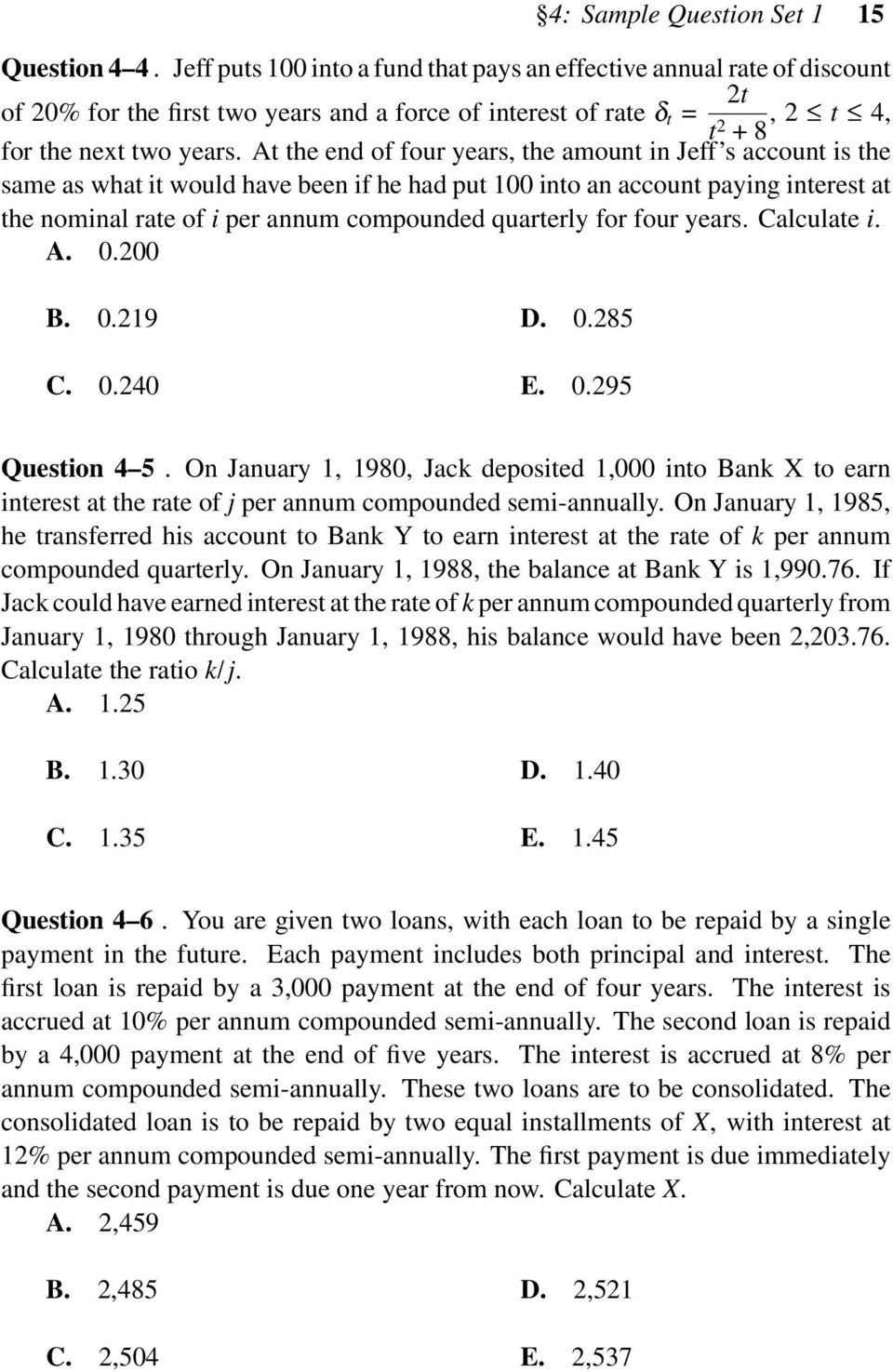
16 4: Sample Question Set 1 16 Answers to Sample Questions t Question 4 1. The amount in fund A at time t is A(t) = 1000e s ds = t, the amount in fund B at time t is B(t) = 500e 0.05t and the amount in fund C at time t is C(t) = A(t) + B(t). So δ 2 = C (2)/C(2) = (A (2) + B (2))/(A(2) + B(2)) = ( e 0.1 )/( e 0.1 ) = (2 + e 0.1 )/( e 0.1 ). D. Question 4 2. From the information given, 10000(1 + i)(1 + i 0.05) = , from which i = Thus 10000(1 + i ) 3 = 17, D. Question 4 3. After 4 years the amount in fund X is 15000/(15 4) = 15000/11 and the amount in fund Y is 1000(1.04) 6 (1+i). Equating these two gives i = B. 4 Question 4 4. The amount Jeff actually has is 100(1 0.20) 2 e 2 δ t dt = , while what he would have under the other option is 100(1 + i/4) 16. Equating and solving gives i = E. Question 4 5. The given information gives two equations. First, 1000(1+j/2) 10 (1+ k/4) 12 = and second 1000(1+k/4) 32 = The second gives k = 0.10, and using this in the first gives j = Thus k/j = A. Question 4 6. From the information given, 3000(1.05) (1.04) 10 = X + X(1.06) 2, from which X = C.
17 5. Annuities, Amortization, and Sinking Funds Many different types of financial transactions involve the payment of a fixed amount of money at regularly spaced intervals of time for a predetermined period. Such a sequence of payments is called an annuity certain or, more simply, an annuity. A common example is loan payments. The concept of present value is easily used to evaluate the worth of such a cash stream at any point in time. Here is an example. Example 5 1. Suppose you have the opportunity to buy an annuity, that is, for a certain amount A > 0 paid by you today you will receive monthly payments of $400, say, for the next 20 years. How much is this annuity worth to you? Suppose that the payments are to begin one month from today. Such an annuity is called an annuity immediate (a truly unfortunate choice of terminology). The cash stream represented by the annuity can be visualized on a time diagram. An Annuity Immediate $400 $ $400 $ Clearly you would be willing to pay today no more than the present value of the total payments made by the annuity. Assume that you are able to earn 5% interest (nominal annual rate) compounded monthly. The present value of the payments is 240 j=1 ( ) j 400. This sum is simply the sum of the present value of each of the payments using the indicated interest rate. This sum is easily found since it involves a very simple geometric series. Exercise 5 1. Evaluate the sum. Since expressions of this sort occur rather often, actuaries have developed some special notation for this sum. Write a n for the present value of an annuity which pays $1 at the end of each period for n periods. The Standard Annuity Immediate Then n 1 n. n + 1 a n = n j=1 v j = 1 vn i Copyright 2006 Jerry Alan Veeh. All rights reserved.

18 5: Annuities, Amortization, and Sinking Funds 18 where the last equality follows from the summation formula for a geometric series. The interest rate per period is usually not included in this notation, but when such information is necessary the notation is a n i. The present value of the annuity in the previous example may thus be expressed as 400a /12. A slightly different annuity is the annuity due which is an annuity in which the payments are made starting immediately. The notation ä n denotes the present value of an annuity which pays $1 at the beginning of each period for n periods. The Standard Annuity Due n 1 n. n + 1 Clearly n 1 ä n = v j = 1 vn d j=0 where again the last equality follows by summing the geometric series. Note that n still refers to the number of payments. If the present time is denoted by time 0, then for an annuity immediate the last payment is made at time n, while for an annuity due the last payment is made at time n 1, that is, the beginning of the nth period. Evidently, a n = v ä n, and there are many other similar relationships. Exercise 5 2. Show that a n = v ä n. The connection between an annuity due and an annuity immediate can be viewed in the following way. In an annuity due the payment for the period is made at the beginning of the period, whereas for an annuity immediate the payment for the period is made at the end of the period. Clearly a payment of 1 at the end of the period is equivalent to the payment of v = 1/(1 + i) at the beginning of the period. This gives an intuitive description of the equality of the previous exercise. Annuity payments need not all be equal. Here are a couple of important special modifications. Example 5 2. An increasing annuity immediate with a term of n periods pays 1 at the end of the first period, 2 at the end of the second period, 3 at the end of the third period,..., n at the end of the nth period. What is (Ia) n, the present value of such an annuity? From the definition, (Ia) n = n j=1 jv j. Although this is not a geometric series, the same technique can be used. This procedure gives (Ia) n v(ia) n = v + v v n nv n+1 which gives (Ia) n = (a n nv n+1 )/(1 v) = (ä n nv n )/i. Exercise 5 3. A decreasing annuity immediate with a term of n periods pays n at the end of the first period, n 1 at the end of the second period, n 2 at the end

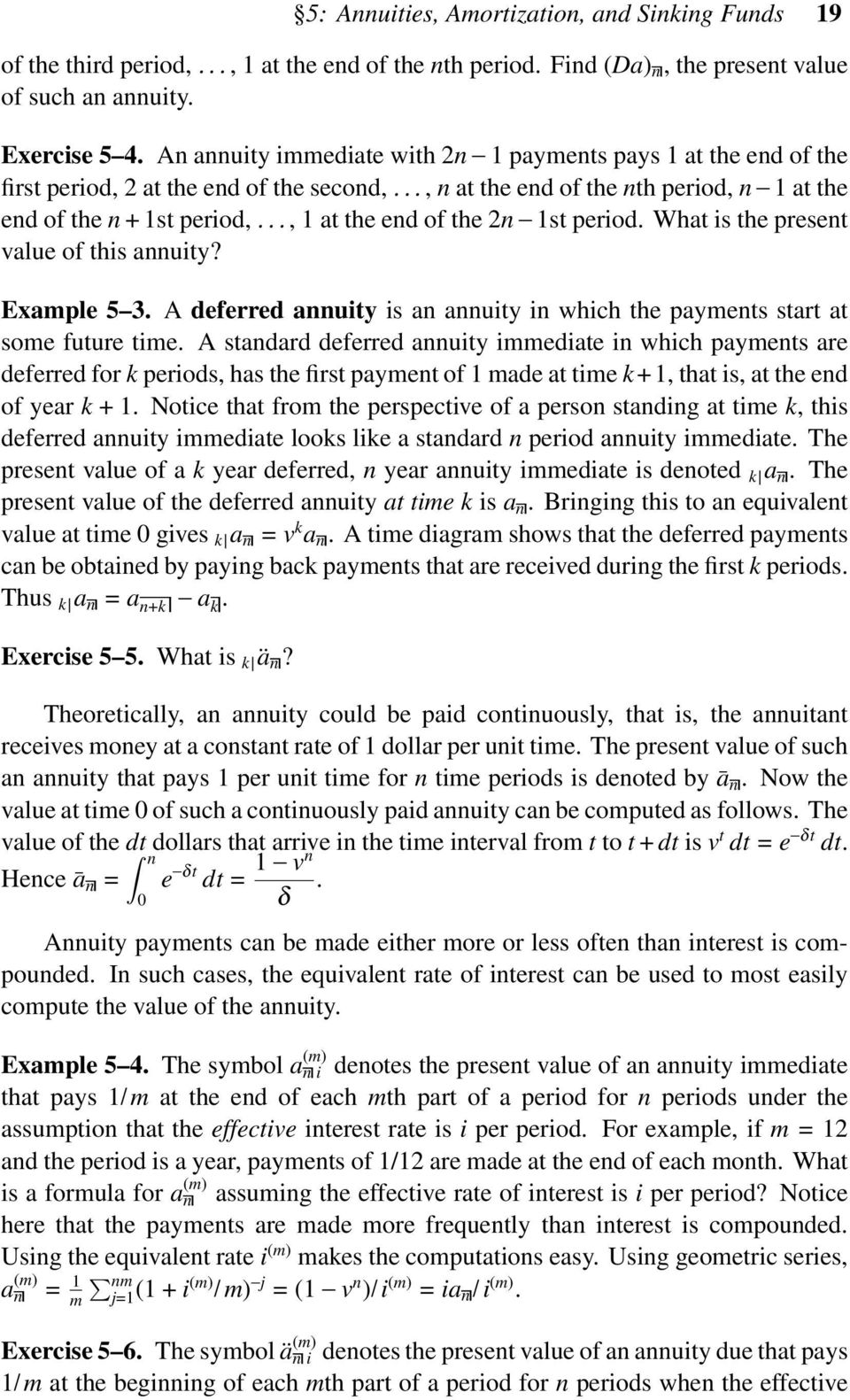
19 5: Annuities, Amortization, and Sinking Funds 19 of the third period,..., 1 at the end of the nth period. Find (Da) n, the present value of such an annuity. Exercise 5 4. An annuity immediate with 2n 1 payments pays 1 at the end of the first period, 2 at the end of the second,..., n at the end of the nth period, n 1 at the end of the n + 1st period,..., 1 at the end of the 2n 1st period. What is the present value of this annuity? Example 5 3. A deferred annuity is an annuity in which the payments start at some future time. A standard deferred annuity immediate in which payments are deferred for k periods, has the first payment of 1 made at time k +1, that is, at the end of year k + 1. Notice that from the perspective of a person standing at time k, this deferred annuity immediate looks like a standard n period annuity immediate. The present value of a k year deferred, n year annuity immediate is denoted k a n. The present value of the deferred annuity at time k is a n. Bringing this to an equivalent value at time 0 gives k a n = v k a n. A time diagram shows that the deferred payments can be obtained by paying back payments that are received during the first k periods. Thus k a n = a n+k a k. Exercise 5 5. What is k ä n? Theoretically, an annuity could be paid continuously, that is, the annuitant receives money at a constant rate of 1 dollar per unit time. The present value of such an annuity that pays 1 per unit time for n time periods is denoted by a n. Now the value at time 0 of such a continuously paid annuity can be computed as follows. The value of the dt dollars that arrive in the time interval from t to t + dt is v t dt = e δt dt. n Hence a n = e δt dt = 1 vn. 0 δ Annuity payments can be made either more or less often than interest is compounded. In such cases, the equivalent rate of interest can be used to most easily compute the value of the annuity. Example 5 4. The symbol a (m) n i denotes the present value of an annuity immediate that pays 1/m at the end of each mth part of a period for n periods under the assumption that the effective interest rate is i per period. For example, if m = 12 and the period is a year, payments of 1/12 are made at the end of each month. What is a formula for a (m) n assuming the effective rate of interest is i per period? Notice here that the payments are made more frequently than interest is compounded. Using the equivalent rate i (m) makes the computations easy. Using geometric series, a (m) nm n j=1 (1 + i (m) /m) j = (1 v n )/i (m) = ia n /i (m). = 1 m Exercise 5 6. The symbol ä (m) n i denotes the present value of an annuity due that pays 1/m at the beginning of each mth part of a period for n periods when the effective
20 5: Annuities, Amortization, and Sinking Funds 20 periodic interest rate is i. Find a formula for ä (m) n rate of interest is i. assuming the effective periodic Exercise 5 7. The symbol (Ia) (m) n is the present value of an annuity that pays 1/m at the end of each mth part of the first period, 2/m at the end of each mth part of the second period,..., n/m at the end of each mth part of the nth period when the effective annual interest rate is i. Find a computational formula for (Ia) (m) n. Thus far the value of an annuity has been computed at time 0. Another common time point at which the value of an annuity consisting of n payments of 1 is computed is time n. Denote by s n the value of an annuity immediate at time n, that is, immediately after the nth payment. Then s n = (1 + i) n a n from the time diagram. The value s n is called the accumulated value of the annuity immediate. Similarly s n is the accumulated value of an annuity due at time n and s n = (1 + i) n ä n. Exercise 5 8. Similarly, s (m) n, s (m) n, and s n are the values of the corresponding annuities just after time n. Find a formula for each of these in terms of s n. Exercise 5 9. What do the symbols (Is) n and (I s) n represent? Now a common use of annuities will be examined. Example 5 5. You are going to buy a house for which the purchase price is $100,000 and the downpayment is $20,000. You will finance the $80,000 by borrowing this amount from a bank at 10% interest with a 30 year term. What is your monthly payment? Typically such a loan is amortized, that is, you will make equal monthly payments for the life of the loan and each payment consists partially of interest and partially of principal. From the banks point of view this transaction represents the purchase by the bank of an annuity immediate. The monthly payment, p, is thus the solution of the equation = pa /12. In this setting the quoted interest rate on the loan is assumed to be compounded at the same frequency as the payment period unless stated otherwise. Exercise Find the monthly payment. What is the total amount of the payments made? An amortization table is a table which lists the principal and interest portions of each payment for a loan which is being amortized. An amortization table can be constructed from first principles. Denote by b k the loan balance immediately after the kth payment and write b 0 for the original loan amount. Then the interest part of the kth payment is ib k 1 and the principal amount of the kth payment is P ib k 1 where P is the periodic payment amount. Notice too that b k+1 = (1 + i)b k P. These relations allow the rows of the amortization table to be constructed sequentially.
21 5: Annuities, Amortization, and Sinking Funds 21 Taking a more sophisticated viewpoint will exhibit a method of constructing any single row of the amortization table that is desired, without constructing the whole table. In the prospective method the loan balance at any point in time is seen to be the present value of the remaining loan payments. The prospective method gives the loan balance immediately after the kth payment as b k = Pa n k. In the retrospective method the loan balance at any point in time is seen to be the accumulated original loan amount less the accumulated value of the past loan payments. The retrospective method gives the loan balance immediately after the kth payment as b k = b 0 (1 + i) k Ps k. Either method can be used to find the loan balance at an arbitrary time point. With this information, any given row of the amortization table can be constructed. Exercise Show that for the retrospective method, b 0 (1 + i) k Ps k = b 0 + (ib 0 P)s k. Exercise Show that the prospective and retrospective methods give the same value. A further bit of insight is obtained by examining the case in which the loan amount is a n, so that each loan payment is 1. In this case the interest part of the kth payment is ia n k+1 = 1 v n k+1 and the principal part of the kth payment is v n k+1. This shows that the principal payments form a geometric series. Finally observe that the prospective and retrospective method apply to any series of loan payments. The formulas obtained when the payments are not all equal will just be messier. A second way of paying off a loan is by means of a sinking fund. Example 5 6. As in the previous example, $80,000 is borrowed at 10% annual interest. But this time, only the interest is required to be paid each month. The principal amount is to be repaid in full at the end of 30 years. Of course, the borrower wants to accumulate a separate fund, called a sinking fund, which will accumulate to $80,000 in 30 years. The borrower can only earn 5% interest compounded monthly. In this scenario, the monthly interest payment is 80000(0.10/ 12) = The contribution c each month into the sinking fund must satisfy cs /12 = 80000, from which c = As expected, the combined payment is higher, since the interest rate earned on the sinking fund is lower than 10%. Here is a summary of the most useful formulas thus far. a n = 1 v n i s n = v n 1 i = v n a n
22 1 v n ä n = d (Ia) n = än nv n i 5: Annuities, Amortization, and Sinking Funds 22 s n = v n 1 d (Is) n = s n n i = v n ä n = v n (Ia) n (Da) n = n a n i (Ds) n = nv n s n i = v n (Da) n vä n = a n The reader should have firmly in mind the time diagram for each of the basic annuities, as well as these computational formulas.
23 5: Annuities, Amortization, and Sinking Funds 23 Problems Problem 5 1. Show that a n < a n < ä n. Hint: This should be obvious from the picture. Problem 5 2. True or False: For any two interest rates i and i, (1 + i) n (1 + i s n i ) = 1 + (i i)a n i. Problem 5 3. True or False: 1 a n = 1 s n + i. ( i Problem 5 4. True or False: ä (m) n = i + i ) a (m) n. m Problem 5 5. Show that a 2n = a n (1 + v n ). Problem 5 6. Show that a 3n = a n + v n a 2n = a 2n + v 2n a n. Problem 5 7. Suppose an annuity immediate pays p at the end of the first period, pr at the end of the second period, pr 2 at the end of the third period, and so on, until a final payment of pr n 1 is made at the end of the nth period. What is the present value of this annuity? Problem 5 8. John borrows $1,000 from Jane at an annual effective rate of interest i. He agrees to pay back $1,000 after six years and $1, after another 6 years. Three years after his first payment, John repays the outstanding balance. What is the amount of John s second payment? Problem 5 9. A loan of 10,000 carries an interest rate of 9% compounded quarterly. Equal loan payments are to be made monthly for 36 months. What is the size of each payment? Problem An annuity immediate pays an initial benefit of one per year, increasing by 10.25% every four years. The annuity is payable for 40 years. If the effective interest rate is 5% find an expression for the present value of this annuity. Problem Humphrey purchases a home with a $100,000 mortgage. Mortgage payments are to be made monthly for 30 years, with the first payment to be made one month from now. The rate of interest is 10%. After 10 years, Humphrey increases the amount of each monthly payment by $325 in order to repay the mortgage more quickly. What amount of interest is paid over the life of the loan? Problem On January 1, an insurance company has $100,000 which is due to Linden as a life insurance death benefit. He chooses to receive the benefit annually over a period of 15 years, with the first payment made immediately. The benefit
24 5: Annuities, Amortization, and Sinking Funds 24 he receives is based on an effective interest rate of 4% per annum. The insurance company earns interest at an effective rate of 5% per annum. Every July 1 the company pays $100 in expenses and taxes to maintain the policy. How much money does the company have remaining after 9 years? Problem A loan of 10,000 is to be repaid with equal monthly payments of p. The interest rate for the first year is 1.9%, while the interest rate for the remaining 2 years is 10.9%. What is p? What is the balance after the 6th payment? After the 15th payment? What are the principal and interest components of the 7th payment? Of the 16th payment? Problem A loan of 10,000 is to be repaid as follows. Payments of p are to be made at the end of each month for 36 months and a balloon payment of 2500 is to be made at the end of the 36th month as well. If the interest rate is 5%, what is p? What is the loan balance at the end of the 12th month? What part of the 13th payment is interest? Principal? Problem A loan is being amortized with a series of 20 annual payments. If the amount of principal in the third payment is 200, what is the amount of principal in the last 3 payments? The interest rate is 4%. Problem A loan is amortized with 10 annual installments. The principal part of the fifth payment is 20 and the interest part is 5. What is the rate of interest on the loan? Problem A loan is amortized with payments of 1 at the end of each year for 20 years. Along with the fifth payment the borrower sends the amount of principal which would have been paid with the sixth payment. At the time of the sixth payment, the borrower resumes payment of 1 until the loan is repaid. How much interest is saved by this single modified payment? Problem A loan of 1000 is being repaid by equal annual installments of 100 together with a smaller final payment at the end of 10 years. If the interest rate is 4%, show that the balance immediately after the fifth payment is s Problem A loan of 1200 is to be repaid over 20 years. The borrower is to make annual payments of 100 at the end of each year. The lender receives 5% on the loan for the first 10 years and 6% on the loan balance for the remaining years. After accounting for the interest to be paid, the remainder of the payment of 100 is deposited in a sinking fund earning 3%. What is the loan balance still due at the end of 20 years? Problem A loan is being repaid with 10 payments. The first payment is 10, the second payment is 9, and so on. What is the amount of interest in the fourth
25 5: Annuities, Amortization, and Sinking Funds 25 payment? Problem A standard perpetuity immediate is an annuity which pays 1 at the end of each period forever. What is a, the present value of a standard perpetuity immediate? A standard perpetuity due pays 1 at the beginning of each period forever. What is ä, the present value of a standard perpetuity due? Problem A standard perpetuity due has a present value of 20, and will be exchanged for a perpetuity immediate which pays R per period. What is the value of R that makes these two perpetuities of equal value? Problem You are given an annuity immediate paying $10 for 10 years, then decreasing by $1 per year for nine years and paying $1 per year thereafter, forever. If the annual effective rate of interest is 5%, find the present value of this annuity. Problem A loan is being repaid with a payment of 200 at the end of the first year, 190 at the end of the second year, and so on, until the final payment of 110 at the end of the tenth year. If the interest rate is 6%, what was the original loan amount? Problem A loan is being repaid with a payment of 200 at the end of the first year, 190 at the end of the second year, and so on, until the final payment of 110 at the end of the tenth year. The borrower pays interest on the original loan amount at a rate of 7%, and contributes the balance of each payment to a sinking fund that earns 4%. If the amount in the sinking fund at the end of the tenth year is equal to the orginal loan amount, what was the original loan amount? Problem A loan of 1 was to be repaid with 25 equal payments at the end of the year. An extra payment of K was made in addition to the sixth through tenth payments, and these extra payments enabled the loan to be repaid five years early. Show that K = (a 20 a 15 )/a 25 a 5. Problem A loan is being repaid with quarterly payments of 500 at the end of each quarter for seven years at an interest rate of 8% compounded quarterly. What is the amount of principal in the fifth payment? Problem A borrower is repaying a loan with 20 annual payments of 500 made at the end of each year. Half of the loan is repaid by the amortization method at 6% effective. The other half of the loan is repaid by the sinking fund method in which the interest rate is 6% effective and the sinking fund accumulates at 5% effective. What is the amount of the loan? Problem A loan of is made for 12 years in which the lender receives 6% compounded semiannually for the first six years and 4% compounded semiannually
26 5: Annuities, Amortization, and Sinking Funds 26 for the last six years. The borrower makes seminannual payments of 1000, and the balance after paying interest is deposited into a sinking fund which pays 3% compounded semiannually. What is the net amount remaining on the loan after 12 years? Problem The interest on an inheritance invested at 4% effective would have been just sufficient to pay at the end of each year for 15 years. Payments were made as planned for the first five years, even though the actual interest earned on the inheritance for years 3 through 5 was 6% effective instead of 4% effective. How much excess interest had accumulated at the end of the fifth year?
27 5: Annuities, Amortization, and Sinking Funds 27 Solutions to Problems Problem 5 1. Isn t the chain of inequalities simply expressing the fact that getting a given amount of money sooner makes it worth more? An analytic proof should be easy to give too. Problem 5 2. True, since v n (1 + i s n i ) = v n + i a n i = 1 ia n i + i a n i. Problem 5 3. True. Write 1/(1 v n ) = v n /(v n 1) = (v n 1 + 1)/(v n 1) = 1 + 1/(v n 1), multiply by i and use the definitions. This also has a verbal explanation. 1/a n is the periodic payment to amortize a loan of 1 with n payments. The loan can also be paid off by paying i per period and contributing 1/s n to a sinking fund. Similar reasoning shows that 1/a (m) n = d (m) + 1/ s (m) 1/ä (m) n n. = i (m) + 1/s (m) n and Problem 5 4. True, since ä (m) n = (1 + i) 1/m a (m) n = (1 + i (m) /m)(i/i (m) )a n. Problem 5 5. Breaking the period of length 2n into two periods of length n gives a 2n = a n + v n a n, and the result follows. Problem 5 6. Just break the period of length 3n into two pieces, one of length n and the other of length 2n. Problem 5 7. Direct computation gives the present value as (pv pv n+1 r n )/(1 vr) = p(1 v n r n )/(1 + i r), provided vr 1. n pr j 1 v j = j=1 Problem 5 8. From Jane s point of view the equation 1000 = 1000(1 + i) (1 + i) 12 must hold. The outstanding balance at the indicated time is (1 + i) 3, which is the amount of the second payment. Problem 5 9. An interest rate of 9% compounded quarterly is equivalent to an interest rate of 8.933% compounded monthly. The monthly payment is therefore 10000/a /12 = 10000/31.47 = Problem Each 4 year chunk is a simple annuity immediate. Taking the present value of these chunks forms an annuity due with payments every 4 years that are increasing. Problem The initial monthly payment P is the solution of 100, 000 = Pa 360. The balance after 10 years is Pa 240 so the interest paid in the first 10 years is 120P (100, 000 Pa 240 ). To determine the number of new monthly payments required to repay the loan the equation Pa 240 = (P + 325)a x should be solved for x. Since after x payments the loan balance is 0 the amount of interest paid in the second stage can then be easily determined. Problem Since the effective rate of interest for the insurance company is 5%, the factor (1.05) 1/2 should be used to move the insurance company s expenses from July 1 to January 1. Problem The present value of the monthly payments must equal the
28 5: Annuities, Amortization, and Sinking Funds 28 original loan amount. Thus = pa /12 + ( /12) 12 pa /12, from which p = The balance after the sixth payment is most easily found by the retrospective method. The balance is 10000( /12) s /12 = The balance after the 15th payment is most easily found by the prospective method. The balance is a /12 = The interest portion of the 7th payment is (0.0109/ 12)( ) = and the principal portion is = Similar computations give the interest portion of the 16th payment as and the principal portion as Problem The payment p = since = pa 36.05/12 + (1 +.05/12) Using the retrospective method, the loan balance at the end of the 12th month is 10000(1 +.05/12) 12 ps 12.05/12 = The interest part of the 13th payment is Problem If p is the annual payment amount, the principal part of the third payment is pv 18 = 200. Thus p = , and the loan balance after the seventeenth payment is pa = Problem Let p denote the annual payment amount. Then pv 6 = 20 and p(1 v 6 ) = 5. Adding these two equations gives p = 25, so v 6 = 0.8, from which i = Problem The borrower saves the interest on the sixth payment, which is 1 v = 1 v 15. Problem The retrospective method gives the balance as 1000v 5 100s 5.04, which re-arranges to the stated quantity using the identity v n = 1 + is n. Problem The amount in the sinking fund at the end of 20 years is 40s 10 (1.03) s 10 = , so the loan balance is = Problem The loan balance immediately after the third payment is (Da) 7 = (7 a 7 )/i, so the interest paid with the fourth payment is 7 a 7. Problem Summing the geometric series gives a = 1/i and ä = 1/d. These results can also be obtained by letting n in the formulas for a n and ä n. Problem From the information given, 1/d = 20 (and so d = 1/20) and Rv/d = 20. Since v = 1 d = 19/20, R = 20/19. Problem What is the present value of an annuity immediate paying $1 per year forever? What is the present value of such an annuity that begins payments k years from now? The annuity described here is the difference of a few of these. Problem The payments consist of a level payment of 100 together with a decreasing annuity. The present value of these payments at the date of issue of the loan is the loan amount, which is therefore 100a (Da) = Problem Let A be the original loan amount. The contribution to the sinking fund at the end of year j is then (11 j).07a, and these
29 5: Annuities, Amortization, and Sinking Funds 29 contributions must accumulate to A. Thus 100s (Ds) As = A, from which A = Problem Denote the original payment amount by p. Then p = 1/a 25. The fact that the additional payments extinguish the loan after 20 years means 1 = pa 20 + v 5 Ka 5. Thus K = (a 25 a 20 )/v 5 a 5 a 25. The result follows since v 5 (a 25 a 20 ) = a 20 a 15. Problem Using i = 0.02, the loan balance immediately after the fourth payment is 500a 24, so the principal part of the fifth payment is a 24 = Problem Denote by L the loan amount. From the information given, (500 L/(2a ) 0.03L)s = L/2, so that L = 500/(1/2s /2a ) = Problem The semiannual contributions to the sinking fund are 460 for the first six years and 640 for the last six years. The sinking fund balance at the end of 12 years is (1.015) s s = So the net loan balance is = Problem The accumulated interest is ( )s 3.06 =
30 5: Annuities, Amortization, and Sinking Funds 30 Solutions to Exercises Exercise 5 1. The sum is the sum of the terms of a geometric series. So j=1 (1+ 12 ) j 400 = 400((1+0.05/12) 1 (1+0.05/12) 241 )/(1 (1+0.05/12) 1 ) = 60, Exercise 5 2. This follows from the formulas for the present value of the two annuities and the fact that d = iv. Exercise 5 3. The method of the example could be used again, but the formula can also be obtained from (Ia) n + (Da) n = (n + 1)a n, which gives (Da) n = (n a n )/i. Exercise 5 4. The present value is (Ia) n + v n (Da) n 1 = (1 + a n 1 v n v n a n 1 )/i = (1 v n )(1 + a n 1 )/i = ä n a n. Exercise 5 5. This is the present value of an annuity with payments of 1 which start at the beginning of period k + 1 (that is, at time k) and continue for a total of n payments. Thus k ä n = v k ä n = ä k+n ä k. Exercise 5 6. As in the previous example, ä (m) n = (1 v n )/d (m) = dä n /d (m). Exercise 5 7. Proceeding as in the derivation of the formula for (Ia) n gives (Ia) (m) n = än nv n i (m). Exercise 5 8. Direct computation using the parallel facts for the values at time 0 give s (m) n = is n /i (m), s (m) n = is n /d (m), and s n = is n /δ. Exercise 5 9. The symbol (Is) n is the value of an increasing annuity immediate computed at time n; (I s) n is the value of an increasing annuity due at time n. Exercise Using the earlier formula gives a /12 = from which p = and the total amount of the payments is 360p = Exercise Simply use the identity v n = 1 + is n. Exercise Direct computation using the formulas gives a n k = v k (a n a k ) and P = b 0 /a n gives Pa n k = b 0 v k (a n a k )/a n = b 0 (1 + i) k Ps k.
31 6. Sample Question Set 2 Solve the following 12 problems in no more than 60 minutes. Question 6 1. The present value of a series of payments of 2 at the end of every eight years, forever, is equal to 5. Calculate the effective rate of interest. A B C D E Question 6 2. An annuity immediate pays an initial benefit of one per year, increasing by 10.25% every four years. The annuity is payable for 40 years. Using an annual effective interest rate of 5%, determine an expression for the present value of this annuity. A. (1 + v 2 )ä 20 B. (1 + v 2 )a 20 C. 2 a 20 D. E. a 20 s 2 a 40 a 2 Question 6 3. Determine an expression for a 5. a 6 a A. 2 + a 3 2 a 3 B. a 2 + s a 3 + s 2 D. 1 + a 2 + s 2 a 3 + s 3 C. a 2 + s 3 a 3 + s 3 E. 1 + a 2 + s a 3 + s 2 Copyright 2006 Jerry Alan Veeh. All rights reserved.
32 6: Sample Question Set 2 32 Question 6 4. Which of the following are true? I. (a n d )(1 + i) = a δ n 1 II. The present value of a 10 year temporary annuity immediate paying 10 per month for the first eight months of each year is 120a 10 a (12). 8/12 III. The present value of a perpetuity paying one at the end of each year, except paying nothing every fourth year, is s 3. i s 4 A. I and II only B. I and III only C. II and III only D. I, II, and III E. The correct answer is not given by A, B, C, or D Question 6 5. Warren has a loan with an effective interest rate of 5% per annum. He makes payments at the end of each year for 10 years. The first payment is 200, and each subsequent payment increases by 10 per year. Calculate the interest portion in the fifth payment. A. 58 B. 60 C. 62 D. 65 E. 67 Question 6 6. An investment fund accrues interest with force of interest δ t = K for 0 t 1. At time zero, there is 100,000 in the fund. At time one 1 + (1 t)k there is 110,000 in the fund. The only two transactions during the year are a deposit of 15,000 at time 0.25 and a withdrawal of 20,000 at time Calculate K. A B C D E
33 6: Sample Question Set 2 33 Question 6 7. You are given an annuity immediate with 11 annual payments of 100 and a final balloon payment at the end of 12 years. At an annual effective interest rate of 3.5%, the present value at time 0 of all the payments is 1,000. Using an annual effective interest rate of 1%, calculate the present value at the beginning of the ninth year of all remaining payments. A. 412 B. 419 C. 432 D. 439 E. 446 Question 6 8. Using an annual effective interest rate j > 0, you are given (1) The present value of 2 at the end of each year for 2n years, plus an additional 1 at the end of each of the first n years, is 36 (2) The present value of an n-year deferred annuity immediate paying 2 per year for n years is 6 Calculate j. A B C D E Question 6 9. An 11 year annuity has a series of payments 1, 2, 3, 4, 5, 6, 5, 4, 3, 2, 1, with the first payment made at the end of the second year. The present value of this annuity is 25 at interest rate i. A 12 year annuity has a series of payments 1, 2, 3, 4, 5, 6, 6, 5, 4, 3, 2, 1, with the first payment made at the end of the first year. Calculate the present value of the 12 year annuity at interest rate i. A B C D E. 31.5
34 6: Sample Question Set 2 34 Question Joan has won a lottery that pays 1,000 per month in the first year, 1,100 per month in the second year, 1,200 per month in the third year, etc. Payments are made at the end of each month for 10 years. Using an effective interest rate of 3% per annum, calculate the present value of this prize. A. 107,000 B. 114,000 C. 123,000 D. 135,000 E. 148,000 Question A 5% 10 year loan of 10,000 is to be repaid by the sinking fund method, with interest and sinking fund payments made at the end of each year. The effective rate of interest earned in the sinking fund is 3% per annum. Immediately before the fifth year s payment would have fallen due, the lender requests that the outstanding principal be repaid in one lump sum. Calculate the amount that must be paid, including interest, to extinguish the debt. A. 6,350 B. 6,460 C. 6,740 D. 6,850 E. 7,000 Question A company agrees to repay a loan over five years. Interest payments are made annually and a sinking fund is built up with five equal annual payments made at the end of each year. Interest on the sinking fund is compounded annually. You are given (1) The amount in the sinking fund immediately after the first payment is X (2) The amount in the sinking fund immediately after the second payment is Y (3) Y/X = 2.09 (4) The net amount of the loan immediately after the fourth payment is 3, Calculate the amount of the sinking fund payment. A. 1,931 B. 2,031 C. 2,131 D. 2,231 E. 2,431
35 6: Sample Question Set 2 35 Answers to Sample Questions Question 6 1. The information given is that 2 j=1 v 8j = 5. Using geometric series gives this equation as v 8 /(1 v 8 ) = 5/2, from which v = (5/7) 1/8 and i = D. Question 6 2. Note that (1.05) 2 = , so that the quadrennial increase is v 2. Writing out directly the present value of the payments gives (v + v 2 + v 3 + v 4 ) + (v 3 + v 4 + v 5 + v 6 ) + (v 5 + v 6 + v 7 + v 8 ) (v 19 + v 20 + v 21 + v 22 ) which re-arranges to a 20 + v 2 a 20, or B. Question 6 3. Write a 5 = v + v 2 + v 3 + v 4 + v 5, and to likewise for a 6. Multiply top and bottom by v 3 to get answer C. Question 6 4. That I is true follows from (a n d/δ)(1 + i) = (1 d e nδ )e δ /δ = (ve δ e (n 1)δ )/δ = a n 1. II is false, since the middle factor should be ä 10. III is also false. The correct value is s 3 /ds 4. E. Question 6 5. The loan balance at the beginning of the fifth year is 240v + 250v v 6 = , where v = 1/(1.05). The interest for the fifth year is therefore 0.05( ) = E. 1 Question 6 6. The equation of value is 100e 0 δ t dt e 1/4 δ t dt 1 20e 3/4 δ t dt = 110. Simplifying gives (425/ 4)K + 95 = 110 from which K = 12/ 85 = C. Question 6 7. From the given information, 1000 = 100a (1.035) 12 B, where B is the amount of the balloon payment. Thus B = The present value at the beginning of the ninth year is 100a (1.01) 4 B = D. Question 6 8. Looking at the first annuity as paying 3 for 2n years and taking back 1 in each of the last n years shows that 36 = 3a 2n 6/2, from which a 2n = 13. Similarly, 6 = 2a 2n 2a n, so a n = 10. But 6 = 2v n a n also, so that v n = 6/20 Finally, 10 = a n = (1 v n )/i = (1 (6/20))/i, from which i = 7/100. E. Question 6 9. Write T for the present value of the twelve year annuity and E for the present value of the eleven year annuity. Looking at a time diagram shows that T E = a 6, and direct computation gives E = vä 6 a 6 = (a 6 ) 2. Thus T = E + a 6 = = 30. B. Question By breaking off the increasing part from a constant payment of 1000 per month for the life of the payments, the present value is 1000s 12 (.03) (12)a (1.03) 1 100s 12 (.03) (12)(Ia) 9 = E. Question The annual sinking fund contribution is 10000/s = The amount in the sinking fund just before the fifth payment is s 4.03 (1.03) =
36 6: Sample Question Set The amount due is = C. Question The sinking fund payment is X. Let the loan amount be A. Then X = A/s 5. Also Y = X(1 + i) + X = (2 + i)x = 2.09X. Thus i =.09. Finally A Xs 4 = So X = /(s 5 s 4 ) = C.
37 7. Brief Review of Probability Theory Another aspect of insurance is that money is paid by the company only if some event, which may be considered random, occurs within a specific time frame. For example, an automobile insurance policy will experience a claim only if there is an accident involving the insured auto. In this section a brief outline of the essential material from the theory of probability is given. Almost all of the material presented here should be familiar to the reader. The concepts presented here will play a crucial role in the rest of these notes. The underlying object in probability theory is a sample space S, which is simply a set. This set is sometimes thought of as the collection of all possible outcomes of a random experiment. Certain subsets of the sample space, called events, are assigned probabilities by the probability measure (or probability set function) which is usually denoted by P. This function has a few defining properties. (1) For any event E S, 0 P[E] 1. (2) P[ ] = 0 and P[S] = 1. (3) If E 1, E 2,... are events and E i E j = for i j then P[ i=1 E i ] = i=1 P[E i ]. From these basic facts one can deduce all manner of useful computational formulas. Exercise 7 1. Show that if A B are events, then P[A] P[B]. Another of the basic concepts is that of a random variable. A random variable is a function whose domain is the sample space of a random experiment and whose range is the real numbers. In practice, the sample space of the experiment fades into the background and one simply identifies the random variables of interest. Once a random variable has been identified, one may ask about its values and their associated probabilities. All of the interesting probability information is bound up in the distribution function of the random variable. The distribution function of the random variable X, denoted F X (t), is defined by the formula F X (t) = P[X t]. Two types of random variables are quite common. A random variable X with distribution function F X is discrete if F X is constant except at at most countably many jumps. A random variable X with distribution function F X is absolutely t d continuous if F X (t) = ds F X(s) ds holds for all real numbers t. If X is a discrete random variable, the density of X, denoted f X (t) is defined by the formula f X (t) = P[X = t]. There are only countably many values of t for which the density of a discrete random variable is not 0. If X is an absolutely continuous random variable, the density of X is defined by the formula f X (t) = d dt F X(t). Copyright 2006 Jerry Alan Veeh. All rights reserved.
38 7: Brief Review of Probability Theory 38 Example 7 1. A Bernoulli random variable is a random variable which takes on exactly two values, 0 and 1. Such random variables commonly arise to indicate the success or failure of some operation. A Bernoulli random variable is discrete. Exercise 7 2. Sketch the distribution function of a Bernoulli random variable with P[X = 1] = 1/3. Example 7 2. An exponentially distributed random variable Y with parameter λ > 0 is a non-negative random variable for which P[Y t] = e λt for t 0. Such a random variable is often used to model the waiting time until a certain event occurs. An exponential random variable is absolutely continuous. Exercise 7 3. Sketch the distribution function of an exponential random variable with parameter λ = 1. Sketch its density function also. Exercise 7 4. A random variable X is uniformly distributed on an interval (a, b) if X represents the result of selecting a number at random from (a, b). Find the density and distribution function of a random variable which is uniformly distributed on the interval (0, 1). Exercise 7 5. Draw a picture of a distribution function of a random variable which is neither discrete nor absolutely continuous. Another useful tool is the indicator function. Suppose A is a set. The indicator function of the set A, denoted 1 A (t), is defined by the equation { 1 if t A 1 A (t) = 0 if t A. Exercise 7 6. Graph the function 1 [0,1) (t). Exercise 7 7. Verify that the density of a random variable which is exponential with parameter λ may be written λe λx 1 (0, ) (x). Example 7 3. Random variables which are neither of the discrete nor absolutely continuous type will arise frequently. As an example, suppose that a person has a fire insurance policy on a house. The amount of insurance is $50,000 and there is a $250 deductible. Suppose that if there is a fire the amount of damage may be represented by a random variable D which has the uniform distribution on the interval (0, 70000). (This assumption means that the person is underinsured.) Suppose further that in the time period under consideration there is a probability p = that a fire will occur. Let F denote the random variable which is 1 if a fire occurs and is 0 otherwise. The size X of the claim to the insurer in this setting is given by X = F [ (D 250)1 [250,50000] (D) + ( )1 (50000, ) (D) ].
39 7: Brief Review of Probability Theory 39 This random variable X is neither discrete nor absolutely continuous. Exercise 7 8. Verify the correctness of the formula for X. Find the distribution function of the random variable X. Often only the average value of a random variable and the spread of the values around this average are all that are needed. The expectation (or mean) of a discrete random variable X is defined by E[X] = t f X (t), while the expectation of an absolutely continuous random variable X is defined by E[X] = t t f X (t) dt. Notice that in both cases the sum (or integral) involves terms of the form (possible value of X) (probability X takes on that value). When X is neither discrete nor absolutely continuous, the expectation is defined by the Riemann Stieltjes integral E[X] = t df X (t), which again has the same form. Exercise 7 9. Find the mean of a Bernoulli random variable Z with P[Z = 1] = 1/3. Exercise Find the mean of an exponential random variable with parameter λ = 3. Exercise Find the mean and variance of the random variable in the fire insurance example given above. (The variance of a random variable X is defined by Var(X) = E[(X E[X]) 2 ] and is often computed using the alternate formula Var(X) = E[X 2 ] (E[X]) 2.) The percentiles of a distribution (or random variable) are also sometimes used. A pth percentile π p of a random variable X is a number for which P[X π p ] 1 p and P[X π p ] p. When X has an absolutely continuous distribution, these two conditions can be replaced by the single condition P[X π p ] = p. When p = 1/2, a pth percentile is called a median of X. Example 7 4. The median of the uniform distribution on the interval (0, 1) is 1/2. The median of an exponential distribution with parameter λ is ln(1/2)/λ. Notice that this differs from the mean of the exponential distribution. An important computational fact is that E[X + Y] = E[X] + E[Y] for any random variables X and Y for which the expectations exist. Computation of conditional probabilities will play an important role. If A and B are events, the conditional probability of A given B, denoted P[A B], is defined by P[A B] = P[A B]/P[B] as long as P[B] 0. The intuition captured by the formula is that the conditional probability of A given B is the probability of A recomputed assuming that B has occured. This intuitive understanding is often the means by which conditional probabilities are computed. The formal defintion is only used to derive ways of manipulating these conditional probabilities.
40 7: Brief Review of Probability Theory 40 Example 7 5. Two cards are drawn from a deck of 52 cards without replacement. Suppose A is the event that the second card drawn is red and B is the event that the first card drawn is red. The (unconditional) probability of A is 26/52, since half of the cards are red. The conditional probability P[A B] = 25/ 51, since knowing that the first card is red leaves a deck of 51 cards of which 25 are red. The events A and B are independent if P[A B] = P[A]. The intuition underlying the notion of independent events is that the occurance of one of the events does not alter the probability that the other event occurs. Similar definitions can be given in the case of random variables. Intuitively, the random variables X and Y are independent if knowledge of the value of one of them does not effect the probabilities of events involving the other. Independence of random variables is usually assumed based on this intuition. One important fact is that if X and Y are independent random variables then E[XY] = E[X] E[Y]. A second important computational fact is that for independent random variables X and Y, Var(X + Y) = Var(X) + Var(Y). The conditional expectation of X given Y, denoted E[X Y], is the random variable which intuitively represents the expectation of X recomputed assuming the value of Y is known. For independent random variables E[X Y] = E[X]. A general fact, known as the theorem of total expectation, is that for any random variables X and Y, E[E[X Y ]] = E[X]. This fact is often used to simplify the computation of expectations. A guiding principal in the application of this formula is that if in attempting to compute E[X] the computation would be easy if the value of another random variable Y were known, then compute E[X Y] first and use the theorem of total expectation. Example 7 6. One iteration of an experiment is conducted as follows. A single six sided die is rolled and the number D of spots up is noted. Then D coins are tossed and the number H of heads observed is noted. In this case, E[H D] = D/2, and E[H] = E[D]/ 2 = 3.5/ 2. Direct computation would be quite involved. When two or more random variables are studied at the same time, the probabilistic behavior of all the random variables as a group is usually of interest. The joint distribution function of the random variables X and Y is defined by F X,Y (s, t) = P[X s, Y t]. A similar definition is made for the joint distribution function of more than two random variables. The joint distribution is discrete if F X,Y is constant except for countably many jumps; the joint distribution is absolutely continuous if F X,Y (s, t) = s t 2 u v F X,Y(u, v) du dv for all s and t. If X and Y are jointly discrete, the joint density of X and Y is f X,Y (s, t) = P[X = s, Y = t]; if X and Y are jointly absolutely continuous the joint density of X and Y is f X,Y (s, t) = 2 s t F X,Y(s, t). If X and Y are independent, f X,Y (s, t) = f X (s)f Y (t).
41 7: Brief Review of Probability Theory 41 Problems Problem 7 1. Suppose X has the uniform distribution on the interval (0, a) where a > 0 is given. What is the mean and variance of X? Problem 7 2. The moment generating function of a random variable X, denoted M X (t), is defined by the formula M X (t) = E[e tx ]. What is the relationship between M X(0) and E[X]? Find a formula for Var(X) in terms of the moment generating function of X and its derivatives at t = 0. Problem 7 3. Express the Maclaurin expansion of M X (t) in terms of the moments E[X], E[X 2 ], E[X 3 ],... of X. Hint: What is the Maclaurin expansion of e x? Problem 7 4. Find the moment generating function of a Bernoulli random variable Y for which P[Y = 1] = 1/4. Problem 7 5. A random variable X has the binomial distribution with parameters n and p if X counts the number of successes in n independent Bernoulli trials n each with success probability p. Use the fact that X = B j where B 1,..., B n are independent Bernoulli random variables to compute the mean and variance of X. What is the moment generating function of X? Problem 7 6. A random variable G has the geometric distribution with parameter p if G is the trial number of the first success in an infinite sequence of independent Bernoulli trials each with success probability p. Let B denote the Bernoulli random variable which is 1 if the first trial is a success and zero otherwise. Argue that E[G B] = B + (1 B)E[1 + G], and use this to compute E[G]. Also find the moment generating function of G and Var(G) Problem 7 7. A random variable N has the negative binomial distribution with parameters r and p if N is the trial number of the first success in an infinite sequence of independent Bernoulli trials each with success probability p. Find the mean, variance, and moment generating function of N. Hint: Isn t N the sum of r independent geometric random variables? Problem 7 8. Show that d dt ln M X(t) = E[X] and d2 t=0 dt ln M X(t) 2 = Var(X). This t=0 is useful when the moment generating function has a certain form. Problem 7 9. Find the moment generating function of a random variable Z which has the exponential distribution with parameter λ. Use the moment generating function to find the mean and variance of Z. j=1
42 7: Brief Review of Probability Theory 42 Problem The probability generating function of a random variable X, denoted P X (z), is defined by P X (z) = E[z X ], for z > 0. Probability generating functions are often used instead of moment generating functions when the random variable X is discrete. What is the relationship between the probability generating function and the moment generating function? Problem A double indemnity life insurance policy has been issued to a person aged 30. This policy pays $100,000 in the event of non-accidental death and $200,000 in the event of accidental death. The probability of death during the next year is 0.002, and if death occurs there is a 70% chance that it was due to an accident. Write a random variable X which represents the size of the claim filed in the next year. Find the distribution function, mean, and variance of X. Problem In the preceding problem suppose that if death occurs the day of the year on which it occurs is uniformly distributed. Assume also that the claim will be paid immediately at death and the interest rate is 5%. What is the expected present value of the size of the claim during the next year? Problem Suppose X and Y are independent random variables with X having the exponential distribution with parameter λ and Y having the exponential distribution with parameter µ. Find the distribution of the random variable X Y = min{x, Y}. Hint: Compute P[X Y > t]. Problem Property insurance typically only pays the amount by which the loss exceeds a deductible amount. Suppose the random variable L denotes the size of the loss and d > 0 is the deductible. The insurance payment would then be L d if L > d and zero otherwise. For convenience, the function x + = x if x > 0 and 0 otherwise. Compute E[(L d) + ] when L has an exponential distribution with parameter λ. Problem Property insurance typically also has a limit on the maximum amount that will be paid. If L is the random amount of the loss, and the maximum paid by the insurance is a > 0, then the amount paid by the insurance company is L a. Compute E[L a] when L has an exponential distribution with parameter λ. Problem True or False: For any number a and any number x, (x a) + +(x a) = x. Problem Show that for a random variable Y which is discrete and takes non negative integer values, E[Y] = P[Y i]. Find a similar alternate expression for E[Y 2 ]. i=1
43 7: Brief Review of Probability Theory 43 Problem Suppose Y is a non-negative, absolutely continuous random variable. Show that E[Y] = 0 P[Y > t] dt.
44 7: Brief Review of Probability Theory 44 Solutions to Problems Problem 7 1. E[X] = a/2 and Var(X) = a 2 /12. Problem 7 2. M X (0) = E[X]. Problem 7 3. Since e x = x k /k!, k=0 M X (t) = E[e tx ] = E[ (tx) k /k!] = k=0 E[X k ]t k /k!. k=0 Thus the coefficient of t k in the Maclaurin expansion of M X (t) is E[X k ]/k!. Problem 7 4. M Y (t) = 3/4 + e t /4. Problem 7 5. Since E[B j ] = p, E[X] = np. Since Var(B j ) = p(1 p), Var(X) = np(1 p). Now M X (t) = E[e tx ] = E[e t n B j=1 j ] = E[e tb 1... e tb n ] = E[e tb 1 ]... E[e tb n ] = (1 p + pe t ) n. Problem 7 6. If the first trial is a success, then G = 1, while if the first trial is a failure, the average waiting time until the first success will be 1 plus E[G], since the trials are independent. The theorem of total expectation gives E[G] = 1 + (1 p)e[g], from which E[G] = 1/p. A similar argument shows that E[e tg B] = e t B + (1 B)M G+1 (t), from which M G (t) = pe t /(1 (1 p)e t ). From this, Var(G) = (1 p)/p 2. Problem 7 7. Since N is the sum of r independent geometric random variables, E[N] = r/p, Var(N) = r(1 p)/p 2, and M N (t) = (pe t /(1 (1 p)e t )) r. Problem 7 9. M Z (t) = λ/(λ t) for 0 t < λ. Problem M X (t) = P X (e t ). From the definition, P X (z) = M X (ln(z)), or equivalently, Problem Let D be a random variable which is 1 if the insured dies in the next year and 0 otherwise. Let A be a random variable which is 2 if death is due to an accident and 1 otherwise. Then X = AD. Problem If U is uniformly distributed on the integers from 1 to 365 then E[100000ADv U ] is the desired expectation. Here v = 1/( (365) /365). Problem Since X and Y are independent, P[X Y > t] = P[X > t] P[Y > t] = e (λ+µ)t for t > 0. Thus X Y is exponential with parameter λ + µ. Problem Here E[(L d) + ] = e λd /λ.
45 7: Brief Review of Probability Theory 45 Problem Here E[L a] = (1 e λa )/λ Problem True. What does this have to do with the preceding two problems? Problem Hint: In the usual formula for the expectation of Y write i = i j=1 1 and then interchange the order of summation. Problem anyone? Use a trick like that of the previous problem. Double integrals
46 7: Brief Review of Probability Theory 46 Solutions to Exercises Exercise 7 1. Using the fact that B = A (B \ A) and property (3) gives P[B] = P[A] + P[B \ A]. By property (1), P[B \ A] 0, so the inequality P[B] P[A] follows. Exercise 7 2. The distribution function F(t) takes the value 0 for t < 0, the value 2/3 for 0 t < 1 and the value 1 for t 1. Exercise 7 3. The distribution function F(t) is 0 if t < 0 and 1 e t for t 0. The density function is 0 for t < 0 and e t for t 0. Exercise 7 4. The distribution function F(t) takes the value 0 for t < 0, the value t for 0 t 1 and the value 1 for t > 1. The density function takes the value 1 for 0 < t < 1 and 0 otherwise. Exercise 7 5. portion. The picture should have a jump and also a smoothly increasing Exercise 7 6. This function takes the value 1 for 0 t < 1 and the value 0 otherwise. Exercise 7 8. The distribution function F(t) takes the value 0 if t < 0, the value ( ) (250/70000) for t = 0 (because X = 0 if either there is no fire or the loss caused by a fire is less than 250), the value (t +250)/ for 0 t < and the value 1 for t Exercise 7 9. E[Z] = 0 (2/3) + 1 (1/3) = 1/3. Exercise The expectation is 0 tf (t) dt = 0 t3e 3t dt = 1/3 using integration by parts. Exercise Notice that the loss random variable X is neither discrete nor absolutely continuous. The distribution function of X has two jumps: one at t = 0 of size /70000 and another at of size / So E[X] = 0 ( /70000) t0.001/70000 dt ( /70000). The quantity E[X 2 ] can be computed similarly.
47 8. Survival Distributions An insurance policy can embody two different types of risk. For some types of insurance (such as life insurance) the variability in the claim is only the time at which the claim is made, since the amount of the claim is specified by the policy. In other types of insurance (such as auto or casualty) there is variability in both the time and amount of the claim. The problems associated with life insurance will be studied first, since this is both an important type of insurance and also relatively simple in some of its aspects. The central difficulty in issuing life insurance is that of determining the length of the future life of the insured. Denote by X the random variable which represents the future lifetime of a newborn. For mathematical simplicity, assume that the distribution function of X is absolutely continuous. The survival function of X, denoted by s(x) is defined by the formula s(x) = P[X > x] = P[X x] where the last equality follows from the continuity assumption. The assumption that s(0) = 1 will always be made. Example 8 1. In the past there has been some interest in modelling survival functions in an analytic way. The simplest model is that due to Abraham DeMoivre. He assumed that s(x) = 1 x for 0 < x < ω where ω is the limiting age by which ω all have died. The DeMoivre law is simply the assertion that X has the uniform distribution on the interval (0, ω). Life insurance is usually issued on a person who has already attained a certain age x. For notational convenience denote such a life aged x by (x), and denote the future lifetime of a life aged x by T(x). What is the survival function for (x)? From the discussion above, the survival function for (x) is P[T(x) > t]. Some standard notation is now introduced. Set and tp x = P[T(x) > t] tq x = P[T(x) t]. When t = 1 the prefix is ommitted and one just writes p x and q x respectively. Generally speaking, having observed (x) some additional information about the survival of (x) can be inferred. For example, (x) may have just passed a physical exam given as a requirement for obtaining life insurance. For now this type of possibility is disregarded. Operating under this assumption tp x = P[T(x) > t] = P[X > x + t X > x] = Copyright 2006 Jerry Alan Veeh. All rights reserved. s(x + t). s(x)
48 8: Survival Distributions 48 Exercise 8 1. Write a similar expression for t q x. Exercise 8 2. Show that for t s, t p x = t s p x+s s p x. There is one more special symbol. Set t uq x = P[t < T(x) t + u] which represents the probability that (x) survives at least t and no more than t + u years. Again, if u = 1 one writes t q x. The relations t u q x = t+u q x t q x = t p x t+u p x follow immediately from the definition. Exercise 8 3. Prove these two equalitites. Show that t u q x = t p x u q x+t. Exercise 8 4. Compute t p x for the DeMoivre law of mortality. Conclude that under the DeMoivre law T(x) has the uniform distribution on the interval (0, ω x). Under the assumption that X is absolutely continuous the random variable T(x) will be absolutely continuous as well. Indeed P[T(x) t] = P[x X x + t X > x] = 1 so the density of T(x) is given by f T(x) (t) = s (x + t) s(x) = f X(x + t) 1 F X (x). s(x + t) s(x) Intuitively this density represents the rate of death of (x) at time t. Exercise 8 5. Use integration by parts to show that E[T(x)] = tp x dt. This 0 expectation is called the complete expectation of life and is denoted by e x. Show also that E[T(x) 2 ] = 2 0 t t p x dt. Exercise 8 6. If X follows DeMoivre s law, what is e x? The quantity f X (x) µ x = 1 F X (x) = s (x) s(x) represents the death rate per unit age per unit survivor for those attaining age x, and is called the force of mortality. Intuitively the force of mortality is the instantaneous probability that someone exactly age x dies at age x. (In component reliability theory this function is often referred to as the hazard rate.) Integrating both sides of this equality gives the useful relation { x } s(x) = exp µ t dt. 0
49 8: Survival Distributions 49 Exercise 8 7. Derive this last expression. Exercise 8 8. Show that t p x = e x+t µ x s ds. Exercise 8 9. What properties must a force of mortality have? Exercise Show that the density of T(x) can be written f T(x) (t) = t p x µ x+t. If the force of mortality is constant the life random variable X has an exponential distribution. This is directly in accord with the memoryless property of exponential random variables. This memoryless property also has the interpretation that a used article is as good as a new one. For human lives (and most manufactured components) this is a fairly poor assumption, at least over the long term. The force of mortality usually is increasing, although this is not always so. Exercise Find the force of mortality for DeMoivre s law. The curtate future lifetime of (x), denoted by K(x), is defined by the relation K(x) = [T(x)]. Here [t] is the greatest integer function. Note that K(x) is a discrete random variable with density P[K(x) = k] = P[k T(x) < k + 1]. The curtate lifetime, K(x), represents the number of complete future years lived by (x). Exercise Show that P[K(x) = k] = k p x q x+k. Exercise Show that the curtate expectation of life e x = E[K(x)] is given by the formula e x = i=0 i+1p x. Hint: E[Y] = i=1 P[Y i].
50 8: Survival Distributions 50 Problems Problem 8 1. Suppose µ x+t = t for t 0. Calculate t p x µ x+t and e x. Problem 8 2. Calculate x t p x and d dx e x. Problem 8 3. A life aged (40) is subject to an extra risk for the next year only. Suppose the normal probability of death is 0.004, and that the extra risk may be expressed by adding the function 0.03(1 t) to the normal force of mortality for this year. What is the probability of survival to age 41? Problem 8 4. Suppose q x is computed using force of mortality µ x, and that q x is computed using force of mortality 2µ x. What is the relationship between q x and q x? Problem 8 5. Show that the conditional distribution of K(x) given that K(x) k is the same as the unconditional distribution of K(x + k) + k. Problem 8 6. Show that the conditional distribution of T(x) given that T(x) t is the same as the unconditional distribution of T(x + t) + t. Problem 8 7. The Gompertz law of mortality is defined by the requirement that µ t = Ac t for some constants A and c. What restrictions are there on A and c for this to be a force of mortality? Write an expression for t p x under Gompertz law. Problem 8 8. Makeham s law of mortality is defined by the requirement that µ t = A + Bc t for some constants A, B, and c. What restrictions are there on A, B and c for this to be a force of mortality? Write an expression for t p x under Makeham s law.
51 8: Survival Distributions 51 Problem 8 1. Problem 8 2. Here t p x = e t Solutions to Problems 0 µ x+s ds = e t2 /2 and e x = 0 tp x dt = 2π/2. x t p x = t p x (µ x µ x+t ) and d dx e x = 0 x t p x dt = µ x e x 1. Problem 8 3. If µ t is the usual force of mortality then p 40 = e 1 0 µ 40+s+0.03(1 s) ds. Problem 8 4. The relation p x = (p x ) 2 holds, which gives a relation for the death probability. Problem 8 5. P[K(x) k + l K(x) k] = P[k K(x) k + l]/p[k(x) k] = lq x+k = P[K(x + k) + k l + k]. Problem 8 6. Proceed as in the previous problem. Problem 8 7. A force of mortality must always be non-negative and have infinite integral. Thus A > 0 and c 1 are required here. Direct substitution gives t p x = exp{ A(c x c x+t )/ ln c}. Problem 8 8. If c < 1 then A > 0 is required, while if c 1 then A + B > 0 is required. Substitution gives t p x = exp{ At B(c x c x+t )/ ln c}.
52 8: Survival Distributions 52 Solutions to Exercises Exercise 8 1. tq x = P[T(x) t] = P[X x + t X > x] = P[x < X x + t]/p[x > x] = (s(x) s(x + t))/s(x). Exercise 8 2. tp x = s(x + t)/s(x) = s(x + s + (t s))/s(x) = (s(x + s + (t s))/s(x + s))(s(x + s)/s(x)) = t s p x+ss p x. What does this mean in words? Exercise 8 3. For the first one, t u q x = P[t < T(x) t + u] = P[x + t < X t+u+x X > x] = (s(x+t) s(t+u+x))/ s(x) = (s(x+t) s(x)+s(x) s(t+u+x))/ s(x) = t+uq x t q x. The second identity follows from the fourth term by simplifying (s(x + t) s(t + u + x))/s(x) = t p x t+u p x. For the last one, t u q x = P[t < T(x) t + u] = P[x + t < X t + u + x X > x] = (s(x + t) s(t + u + x))/s(x) = (s(x + t)/s(x))(s(t + x) s(t + u + x))/s(x + t) = t p x u q x+t. Exercise 8 4. Under the DeMoivre law, s(x) = (ω x)/ω so that t p x = (ω x t)/(ω x) for 0 < t < ω x. Thus the distribution function of T(x) is t/(ω x) for 0 < t < ω x, which is the distribution function of a uniformly distributed random variable. Exercise 8 5. E[T(x)] = 0 tf T(x)(t) dt = 0 ts (x + t)/s(x) dt = 0 s(x + t)/s(x) dt = 0 t p x dt. The fact the lim t s(x + t) = 0 is assumed, since everyone eventually dies. The other expectation is computed similarly. Exercise 8 6. Under DeMoivre s law, e x = (ω x)/2, since T(x) is uniform on the interval (0, ω x). x Exercise µ t dt = x 0 s (t)/s(t) dt = ln(s(x)) + ln(s(0)) = ln(s(x)), since s(0) = 1. Exponentiating both sides to solve for s(x) gives the result. Exercise 8 8. From the previous exercise, s(x + t) = e x+t µ s ds 0. Using this fact, the previous exercise, and the fact that t p x = s(x + t)/s(x) gives the formula. Exercise 8 9. The force of mortality must satisfy µ x 0 for all x, and 0 µ x dx =. This last condition is needed to make lim x s(x) = 0. Exercise Since f T(x) (t) = s (x + t)/s(x) and s (x + t) = s(x + t)µ x+t by the previous exercise, the result follows. Exercise From the earlier expression for the survival function under DeMoivre s law s(x) = (ω x)/ω, so that µ x = s (x)/s(x) = 1/(ω x), for 0 < x < ω. Exercise P[K(x) = k] = P[k T(x) < k+1] = (s(x+k) s(x+k+1))/s(x) = ((s(x + k) s(x + k + 1))/s(x + k))(s(x + k)/s(x)) = k p x q x+k. Exercise j=0 j+1p x. E[K(x)] = i=1 P[K(x) i] = i=1 P[T(x) i] = i=1 ip x =
53 9. Life Tables In practice the survival distribution is estimated by compiling mortality data in the form of a life table. An example of a life table appears later in these notes. The conceptual model behind the entries in a life table is this. Imagine that at time 0 there are l 0 newborns. Here l 0 is called the radix of the life table and is usually taken to be some large number such as 10,000,000. These newborns are observed and l x is the number of the original newborns who are still alive at age x. Similarly n d x denotes the number of the group of newborns alive at age x who die before reaching age x + n. As usual, when n = 1 it is supressed in the notation. Exercise 9 1. Show that n d x = l x l x+n. The ratio l x l 0 is an estimate of s(x) based on the collected data. Assume that in fact s(x) = l x l 0 for non-negative integer values of x. Since earlier the assumption was made that the life random variable X is absolutely continuous, the question arises as to how the values of the survival function will be computed at non-integer values of x. Under the assumption of the uniform distribution of deaths in the year of death, denoted UDD, the number alive at age x + t, where x is an integer and 0 < t < 1, is given by l x+t = l x td x. The UDD assumption means that the age at death of those who will die at curtate age x is uniformly distributed between the ages x and x + 1. In terms of the survival function the UDD assumption means s(x + t) = (1 t)s(x) + ts(x + 1) where x is an integer and 0 t 1. The UDD assumption is the one most commonly made. Direct application of the UDD assumption and the earlier definitions shows that under UDD tq x = tq x, and tp x = 1 tq x, µ x+t = whenever x is an integer and 0 < t < 1. Copyright 2006 Jerry Alan Veeh. All rights reserved. q x 1 tq x
54 9: Life Tables 54 The assumption of a constant force of mortality in each year of age means that µ x+t = µ x for each integer age x and 0 < t < 1. This is equivalent to the formula tp x = (p x ) t and also to s(x + t) = s(x) e µt where µ = ln p x. The constant force assumption is less widely used than UDD. Having observed (x) may mean more than simply having seen a person aged x. For example, (x) may have just passed a physical exam in preparation for buying a life insurance policy. One would expect that the survival distribution of such a person could be different from s(x). If this is believed to be the case the survival function is actually dependent on two variables: the age at selection (application for insurance) and the amount of time passed after the time of selection. A life table which takes this effect into account is called a select table. A family of survival functions indexed by both the age at selection and time are then required and notation such as q [x]+i denotes the probability that a person dies between years x+i and x+i+1 given that selection ocurred at age x. As one might expect, after a certain period of time the effect of selection on mortality is negligable. The length of time until the selection effect becomes negligable is called the select period. The Society of Actuaries (based in Illinois) uses a 15 year select period in its mortality tables. The Institute of Actuaries in Britain uses a 2 year select period. The implication of the select period of 15 years in computations is that for each j 0, l [x]+15+j = l x+15+j. A life table in which the survival functions are tabulated for attained ages only is called an aggregrate table. Generally, a select life table contains a final column which constitutes an aggregate table. The whole table is then referred to as a select and ultimate table and the last column is usually called an ultimate table. With these observations in mind the select life tables can be used in computations. Exercise 9 2. You are given the following extract from a 3 year select and ultimate mortality table. x l [x] l [x]+1 l [x]+2 l x+3 x Assume that the ultimate table follows DeMoivre s law and that d [x] = d [x]+1 = d [x]+2 for all x. Find 1000( 2 2 q [71] ).
55 9: Life Tables 55 Problems Problem 9 1. Use the life table to compute 1/2 p 20 under each of the assumptions for fractional years. Problem 9 2. Show that under the assumption of uniform distribution of deaths in the year of death that K(x) and T(x) K(x) are independent and that T(x) K(x) has the uniform distribution on the interval (0, 1). Problem 9 3. Show that under UDD e x = e x
56 9: Life Tables 56 Solutions to Problems Problem 9 1. Under UDD, t p x = (1 t) + tp x so 1/2 p 20 = 1/2 + 1/2p 20 = ,607, ,617,802. Under constant force, tp x = (p x ) t so 1/2 p 20 = p 20. Problem 9 2. For 0 t < 1, P[K(x) = k, T(x) K(x) t] = P[k T(x) k + t] = k p x t q x+k = k p x (t tp x+k ) = tp[k(x) = k]. Problem 9 3. Use the previous problem to see that e x = E[T(x)] = E[K(x) + (T(x) K(x))] = e x + E[T(x) K(x)] = e x + 1/2, since T(x) K(x) has the uniform distribution on the unit interval.
57 9: Life Tables 57 Solutions to Exercises Exercise 9 1. Since n d x is the number alive at age x who die by age x + n, this is simply the number alive at age x, which is l x, minus the number alive at age x + n, which is l x+n. Exercise 9 2. The objective is to compute q [71] = 1000( 2 p [71] 4 p [71] ) = 1000(l [71]+2 l [71]+4 )/l [71] = 1000(l [71]+2 l 75 )/l [71], where the effect of the selection period has been used. To find the required entries in the table proceed as follows. Since = 424 and using the assumption about the number of deaths, l [72]+1 = = 7804 and l 72+3 = = Since the ultimate table follows DeMoivre s Law, l 71+3 = ( )/2 = Again using the assumption about the number of deaths, l [71]+2 = ( )/2 = 7737 and l [71] = = So q [71] = 1000( )/8231 =
58 10. Sample Question Set 3 Solve the following 6 problems in no more than 30 minutes. You should have the Tables for Exam M available for these problems. Question You are given s(x) = 1. Determine the median future lifetime 1 + x of (y). A. y D. B. y y C. 1 E y Question You are given µ x = 0.1 for all ages x > 0. The probability that (30) and (50) will die within 10 years of each other is p. Calculate p. A. 0.1e 1 B. 0.5e 1 C. e 1 D. 0.5(1 e 1 ) E. 1 e 1 Question Given e 0 = 25, l x = ω x, 0 x ω, and T(x) is the future lifetime random variable, calculate Var(T(10)). A. 65 B. 93 C. 133 D. 178 E. 333 Question For a certain mortality table you are given µ(80.5) = , µ(81.5) = , µ(82.5) = , and that deaths are uniformly distributed between integral ages. Calculate the probability that a person age 80.5 will die within two years. A B C D E Copyright 2006 Jerry Alan Veeh. All rights reserved.
59 10: Sample Question Set 3 59 Question The future lifetimes of a certain population can be modeled as follows. Each individual s future lifetime is exponentially distributed with constant hazard rate θ. Over the population, θ is uniformly distributed over (1, 11). Calculate the probability of surviving to time 0.5 for an individual randomly selected at time 0. A B C D E Question An insurance agent will receive a bonus if his loss ratio is less than 70%. You are given that his loss ratio is calculated as incurred losses divided by earned premium on his block of business. The agent will receive a percentage of earned premium equal to 1/3 of the difference between 70% and his loss ratio. The agent receives no bonus if his loss ratio is greater than 70%. His earned premium is 500,000. His incurred losses are distributed according to the Pareto distribution ( ) 600, F(x) = 1, x > 0. Calculate the expected value of his bonus. x + 600, 000 A. 16,700 B. 31,500 C. 48,300 D. 50,000 E. 56,600
60 10: Sample Question Set 3 60 Answers to Sample Questions Question From the information given, P[T(y) > t] = s(y + t)/s(y) = (1 + y)/(1 + y + t), and this is equal to 1/2 when t = 1 + y. A. Question Since the force of mortality is constant, both lives have the same exponential distribution. Thus p = P[T(30) < T(50) < T(30) + 10] + P[T(50) < T(30) < T(50) + 10] = 2 0 (e µx e µ(x+10) )µe µx dx = 1 e 10µ = 1 e 1. E. Question From the form of l x, mortality follows DeMoivre s law. Thus ω = 50 since e 0 = 25. The random variable T(10) is therefore uniformly distributed on the interval (0, 40) and Var(T(10)) = C. Question Under UDD, µ x+t = q x /(1 tq x ) so that q x = µ x+0.5 /( µ x+0.5 ). p Now 2 p 80.5 = 0.5 p 80.5 p p 82 = q 80 (1 q 81 )(1 0.5q 82 ). The expression for.5p 80.5 comes from the fact that p 80 = 0.5 p p Using the information gives the survival probability as and the death probability as A. Question The desired probability is E[e 0.5θ ] = 11 1 e 0.5t dt/10 = E. Question If L is the incurred loss, the expected bonus is (500000/3)E[(.7 L/500000) + ], using the given information. Now (a x) + +(x a) = a, so the expected bonus can be written as (1/ 3)( E[L ]) = (1/ 3)( (1 (600000/950000) 2 )) = 56, 555 using the formula on the supplied tables. E.
61 11. Status A life insurance policy is sometimes issued which pays a benefit at a time which depends on the survival characteristics of two or more people. A status is an artificially constructed life form for which the notion of life and death can be well defined. Example A common artificial life form is the status which is denoted n. This is the life form which survives for exactly n time units and then dies. Example Another common status is the joint life status which is constructed as follows. Given two life forms (x) and (y) the joint life status, denoted x : y, dies exactly at the time of death of the first to die of (x) and (y). Exercise If (x) and (y) are independent lives, what is the survival function of the status x : y? Exercise What is survival function of x : n? Occasionally, even the order in which death occurs is important. The status 1 x : n is a status which dies at the time of death of (x) if the death of (x) occurs before time n. Otherwise, this status never dies. Exercise Under what circumstances does x : n 1 die? A final status that is commonly used is the last survivor status, x : y, which is alive as long as either (x) or (y) is alive. Copyright 2006 Jerry Alan Veeh. All rights reserved.
62 11: Status 62 Problems Problem Use the life table to compute p 40:50 and p 40:50 assuming (40) and (50) are independent lives. Problem Find a formula for the survival function of x 1 : n in terms of the survival function of (x). Problem If the UDD assumption is valid for (x), does UDD hold for x 1 : n? Problem Find a formula for the survival function of x : n 1. Problem If the UDD assumption is valid for (x), does UDD hold for x : n 1? Problem If the UDD assumption is valid for (x), does UDD hold for x : n? Problem If the UDD assumption is valid for each of (x) and (y) and if (x) and (y) are independent lives, does UDD hold for x : y?
63 11: Status 63 Solutions to Problems Problem From independence, p 40:50 = p 40 p 50 = 9,287,264 8,897,913 9,313,166 8,950,901. Also p 40:50 = 1 q 40 q 50, by independence. Problem for t n. P[T(x 1 : n) t] = t p x for 0 t < n and P[T(x 1 : n) t] = n p x Problem The UDD assuption holds for x 1 : n if and only if P[T(x 1 : n) k + t] = (1 t)p[t(x 1 : n) k] + tp[t(x 1 : n) k + 1] for all integers k and all 0 t 1. Now use the formula for the survival function found in the previous problem to see that UDD does hold for the joint status. Problem Here P[T(x : n 1 ) t] = 1 if t < n and is equal to n q x if t n. Problem Using the previous formula for the survival function shows that UDD fails to hold on the interval (n 1, n). Problem The survival function for x : n is S(t) = t p x for t < n and zero for t n. So again the UDD condition will fail to hold on the interval (n 1, n). Problem The survival function for the joint status is S(t) = t p x t p y, and in general UDD will not hold for the joint status.
64 11: Status 64 Solutions to Exercises Exercise The joint life status survives t time units if and only if both (x) and (y) survive t time units. Using the independence gives s(t) = t p x t p y. Exercise Since a constant random variable is independent of any other random variable, s(t) = t p x t p n = t p x if t n and 0 if t > n, by using the previous exercise. Exercise The status x : n 1 dies at time n if (x) is still alive at time n, otherwise this status never dies.
65 12. Valuing Contingent Payments The central theme of these notes is embodied in the question, What is the value today of a random sum of money which will be paid at a random time in the future? This question can now be answered. Suppose the random amount A of money is to be paid at the random time T. The value of this payment today is computed in two steps. First, the present value of this payment Av T is computed. Then the expectation of this present value random variable is computed. This expectation, E[Av T ], is the value today of the random future payment. The interpretation of this amount, E[Av T ], is as the average present value of the actual payment. Averages are reasonable in the insurance context since, from the company s point of view, there are many probabilistically similar policies for which the company is obliged to pay benefits. The average cost (and income) per policy is therefore a reasonable starting point from which to determine the premium. The expected present value is usually referred to as the actuarial present value in the insurance context. In the next few sections the actuarial present value of certain standard parts of insurance contracts are computed. Insurance contracts generally consist of two parts: benefit payments and premium payments. A life insurance policy paying benefit b t if death occurs at time t has actuarial present value E[b T v T ]. In this context the actuarial present value is also called the net single premium. The net single premium is the average value of the benefit payments, in todays dollars. The net single premium is the amount of the single premium payment which would be required on the policy issue date by an insurer with no expenses (and no profit requirement). The actuarial present value of the premium payments must be at least equal to the actuarial present value of the benefit payments, or the company would go bankrupt. In the next section methods are developed for computing the net single premium for commonly issued life insurances. The following section develops methods for computing the actuarial present value of the premium payments. These two sets of methods are then combined to enable the computation of insurance premiums. Copyright 2006 Jerry Alan Veeh. All rights reserved.
66 13. Life Insurance In the case of life insurance, the amount that is paid at the time of death is usually fixed by the policy and is non-random. Assume that the force of interest is constant and known to be equal to δ. Also simply write T = T(x) whenever clarity does not demand the full notation. The net single premium for an insurance which pays 1 at the time of death is then E[v T ] by the principle above. The net single premium would be the idealized amount an insured would pay as a lump sum (single premium) at the time that the policy is issued. The case of periodic premium payments will be discussed later. A catalog of the various standard types of life insurance policies and the standard notation for the associated net single premium follows. In most cases the benefit amount is assumed to be $1, and in all cases the benefit is assumed to be paid at the time of death. Keep in mind that a fixed constant force of interest is also assumed and that v = 1/(1 + i) = e δ. Type n-year pure endowment n-year term Insurances Payable at the Time of Death Net Single Premium A x:n 1 = n E x = E[v n 1 (n, ) (T)] A x 1 :n = E[v T 1 [0,n] (T)] whole life A x = E[v T ] n-year endowment A x:n = E[v T n ] m-year deferred n-year term whole life increasing mthly n-year term increasing annually n-year term decreasing annually m na x = E[v T 1 (m,n+m] (T)] = E[v T [Tm + 1]/m] (IA) (m) x (IA) x 1 :n = E[v T [T + 1]1 [0,n) (T)] (DA) x 1 :n = E[v T (n [T])1 [0,n) (T)] The bar is indicative of an insurance paid at the time of death, while the subscripts denote the status whose death causes the insurance to be paid. These insurances are now reviewed on a case-by-case basis. The first type of insurance is n-year pure endowment insurance which pays the full benefit amount at the end of the nth year if the insured survives at least n years. The notation for the net single premium for a benefit amount of 1 is A x:n 1 (or occasionally in this context n E x ). The net single premium for a pure endowment is just the actuarial present value of a lump sum payment made at a future date. This differs from the ordinary present value simply because it also takes into account the mortality characteristics of the recipient. Exercise Show that n E x = v n np x. Copyright 2006 Jerry Alan Veeh. All rights reserved.
67 13: Life Insurance 67 The second type of insurance is n-year term insurance. The net single premium for a benefit of 1 payable at the time of death for an insured (x) is denoted A x 1 :n. This type insurance provides for a benefit payment only if the insured dies within n years of policy inception, that is, at the time of death of the status x 1 : n. The third type of insurance is whole life in which the full benefit is paid no matter when the insured dies in the future. The whole life benefit can be obtained by taking the limit as n in the n-year term insurance setting. The notation for the net single premium for a benefit of 1 is A x. Exercise Suppose that T(x) has an exponential distribution with mean 50. If the force of interest is 5%, find the net single premium for a whole life policy for (x), if the benefit of $1000 is payable at the moment of death. Exercise Show that A x = A1 x:n + v n np x A x+n by conditioning on the event T(x) n and also by direct reasoning from a time diagram by looking at the difference of two policies. The fourth type of insurance, n-year endowment insurance, provides for the payment of the full benefit at the time of death of the insured if this occurs before time n and for the payment of the full benefit at time n otherwise. The net single premium for a benefit of 1 is denoted A x:n. Exercise Show that A x:n = A x 1 :n + A x:n 1. Exercise Use the life table to find the net single premium for a 5 year pure endowment policy for (30) assuming an interest rate of 6%. The m-year deferred n-year term insurance policy provides provides the same benefits as n year term insurance between times m and m + n provided the insured lives m years. All of the insurances discussed thus far have a fixed constant benefit. Increasing whole life insurance provides a benefit which increase linearly in time. Similarly, increasing and decreasing n-year term insurance provides for linearly increasing (decreasing) benefit over the term of the insurance. Direct computation of the net single premium for an insurance payable at the time of death is impossible using only the life table. For example, A x = v t tp x µ x+t dt. As will be seen below, under the UDD assumption, all of these net 0 single premiums can be easily related to the net single premium for an insurance that is payable at the end of the year of death. The definition and notation for these net single premiums will now be introduced. The only difference between
68 13: Life Insurance 68 these insurances and those already described is that these insurances depend on the distribution of the curtate life variable K = K(x) instead of T. The following table introduces the notation. Type n-year term Insurances Payable the End of the Year of Death Net Single Premium A x 1 :n = E[v K+1 1 [0,n) (K)] whole life A x = E[v K+1 ] n-year endowment A x:n = E[v (K+1) n ] m-year deferred n-year term m na x = E[v K+1 1 [m,n+m) (K)] whole life increasing annually (IA) x = E[v K+1 (K + 1)] n-year term increasing annually n-year term decreasing annually (IA) x 1 :n = E[v K+1 (K + 1)1 [0,n) (K)] (DA) x 1 :n = E[v K+1 (n K)1 [0,n) (K)] These policies have net single premiums which can be easily computed from the information in the life table. To illustrate the ease of computation when using a life table observe that from the definition A x = v k+1 kp x q x+k = v k+1 d x+k. k=0 k=0 l x In practice, of course, the sum is finite. Similar computational formulas are readily obtained in the other cases. Exercise Show that A x:n 1 = A x:n 1 and interpret the result verbally. How would you compute A x:n 1 using the life table? Under the UDD assumption formulas relating the net single premium for insurance payable at the time of death to the corresponding net single premium for insurance payable at the end of the year of death can be easily found. For example, in the case of a whole life policy A x = E[e δt(x) ] = E[e δ(t(x) K(x)+K(x)) ] = E[e δ(t(x) K(x)) ] E[e δk(x) ] = 1 δ (1 e δ )e δ E[e δ(k(x)+1) ] = i δ A x where the third equality springs from the independence of K(x) and T(x) K(x) under UDD, and the fourth equality comes from the fact that under UDD the random variable T(x) K(x) has the uniform distribution on the interval (0,1).
69 13: Life Insurance 69 Exercise Can similar relationships be established for term and endowment policies? Exercise Use the life table to find the net single premium for a 5 year endowment policy for (30), with death benefit paid at the moment of death, assuming an interest rate of 6%. Exercise An insurance which pays a benefit amount of 1 at the end of the mth part of the year in which death occurs has net single premium denoted by A (m) x. Show that under UDD i (m) A (m) x = δ A x. One consequence of the exercise above is that only the net single premiums for insurances payable at the end of the year of death need to be tabulated, if the UDD assumption is made. This leads to a certain amount of computational simplicity.
70 13: Life Insurance 70 Problems Problem Write expressions for all of the net single premiums in terms of either integrals or sums. Hint: Recall the form of the density of T(x) and K(x). Problem Show that δa x 1 :n = ia x 1 :n, but that δa x:n ia x:n, in general. Problem Use the life table and UDD assumption (if necessary) to compute A 21, A 21:5, and A1. 21:5 Problem Show that da x di = v(ia) x. Problem Assume that DeMoivre s law holds with ω = 100 and i = Find A 30 and A 30. Which is larger? Why? Problem Suppose µ x+t = µ and i = Compute A x and A x 1 :n. Do your answers depend on x? Why? Problem Suppose A x = 0.25, A x+20 = 0.40, and A x:20 = Compute A and A x 1 :20. Problem Show that (IA) x = vq x + v[a x+1 + (IA) x+1 ]p x. What assumptions (if any) did you make? Problem What change in A x results if for some fixed n the quantity q x+n is replaced with q x+n + c? 1 x:20
71 13: Life Insurance 71 Solutions to Problems Problem The densities required are f T(x) (t) = t p x µ x+t and f K(x) (k) = kp x q x+k respectively. Problem δa x 1 :n = δ(a x e δn np x A x+n ) = ia x iv n np x A x+n = ia x 1 :n. Problem Use δa 21 = ia 21, A 21:5 = A1 + 5 E 21 and the previous problem. 21 :5 Problem Just differentiate under the expectation in the definition of A x. Problem Clearly A 30 > A 30 since the insurance is paid sooner in the continuous case. Under DeMoivre s law the UDD assumption is automatic and A 30 = e δt dt. Problem Using the form of µ gives A x = 0 e δt e µt µ dt = µ/(µ + δ). Similarly, A x 1 :n = µ(1 e n(µ+δ) )/(µ + δ). The answers do not depend on x since the lifetime is exponential and therefore ageless. Problem The two relations A x = A1 + v 20 x:20 np x A x+20 and A x:20 = A1 + x:20 v n np x along with the fact that A 1 = v n np x give two equations in the two sought after unknowns. x:20 Problem Either the person dies in the first year, or doesn t. If she doesn t buy an increasing annually policy for (x + 1) and a whole life policy to make up for the increasing part the original policy would provide. Problem The new benefit is the old benefit plus a pure endowment benefit of cv at time n.
72 13: Life Insurance 72 Solutions to Exercises Exercise Since if the benefit is paid, the benefit payment occurs at time n, n E x = E[v n 1 [n, ) (T(x))] = v n P[T(x) n] = v n np x. Exercise Under the assumptions given the net single premium is E[1000v T(x) ] = e 0.05t (1/50)e t/50 dt = Exercise For the conditioning argument, break the expectation into two pieces by writing A x = E[v T ] = E[v T 1 [0,n] (T)]+E[v T 1 (n, ) (T)]. The first expectation is exactly A1. For the second expectation, using the Theorem of Total Expectation gives E[v T 1 (n, ) (T)] = E[E[v T 1 (n, ) (T) T n]]. Now the conditional x:n distribution of T given that T n is the same as the unconditional distribution of T(x+n)+n. Using this fact gives the conditional expectation as E[v T 1 (n, ) (T) T n] = E[v T(x+n)+n 1 (n, ) (T(x + n) + n)]1 (n, ) (T) = v n A x+n 1 (n, ) (T). Taking expectations gives the result. To use the time diagram, imagine that instead of buying a whole life policy now, the insured pledges to buy an n year term policy now, and if alive after n years, to buy a whole life policy at time n (at age x + n). This will produce the same result. The premium for the term policy paid now is A1 x:n and the premium for the whole life policy at time n is A x+n. This latter premium is only paid if the insured survives, so the present value of this premium is the second term in the solution. Exercise Using the definition and properties of expectation gives A x:n = E[v T 1 [0,n] (T) + v n 1 (n, ) (T)] = E[v T 1 [0,n] (T)] + E[v n 1 (n, ) (T)] = A x 1 :n + A x:n 1. Exercise The net single premium for the pure endowment policy is v 5 5p 30 = 5 E 30 == Exercise A 1 x:n = E[v n 1 [n, ) (T)] = E[v n 1 [n, ) (K)] = A 1 x:n = v n np x = v n l x+n /l x. Exercise Since term policies can be expressed as a difference of premiums for whole life policies, the answer is yes. Exercise The net single premium for a pure endowment policy is 5E 30 = For the endowment policy, the net single premium for a 5 year term policy must be added to this amount. From the relation given earlier, A1 = A 30 5 E 30 A 35. The relationship between insurances payable at the time 30 :5 of death and insurances payable at the end of the year of death is used to complete the calculation. This gives A 30:5 = (i/δ)( ) (i/δ)( )( ) Exercise Notice that [mt(x)] is the number of full mths of a year that (x) lives before dying. (Here [a] is the greatest integer function.) So the number of mths of a year that pass until the benefit for the insurance is paid is [mt(x)] + 1, that is, the benefit is paid at time ([mt(x)] + 1)/m. From here the derivation proceeds as above. A (m) x = E[v ([mt]+1)/m ] = E[v ([m(t K+K)]+1)/m ] = E[v K ]E[v ([m(t K)]+1)/m ]. Now T K has the uniform distribution on the interval (0, 1) under UDD, so [m(t K)] has the uniform distribution over the integers 0,..., m 1. So E[v ([m(t K)]/m ] = m 1 j=0 vj/m (1/m) = (1/m)(1 v)/(1 v 1/m )
73 13: Life Insurance 73 from the geometric series formula. Substituting this in the earlier expression gives A (m) x = A x v 1 v 1/m (1/m)(1 v)/(1 v 1/m ) = A x δ/i (m) since i (m) = m(v 1/m 1).
74 14. Life Annuities The premium payment part of the insurance contract is examined by developing techniques for understanding what happens when premiums are paid monthly or annually instead of just when the insurance is issued. In the non random setting a sequence of equal payments made at equal intervals in time was referred to as an annuity. Here interest centers on annuities in which the payments are made (or received) only as long as the insured survives. An annuity in which the payments are made for a non random period of time is called an annuity certain. From the earlier discussion, the present value of an annuity immediate (payments begin one period in the future) with a payment of 1 in each period is a n = n j=1 v j = 1 vn i while the present value of an annuity due (payments begin immediately) with a payment of 1 in each period is n 1 ä n = v j = 1 vn 1 v = 1 vn. d j=0 These formulas will now be adapted to the case of contingent annuities in which payments are made for a random time interval. Suppose that (x) wishes to buy a life insurance policy. Then (x) will pay a premium at the beginning of each year until (x) dies. Thus the premium payments represent a life annuity due for (x). Consider the case in which the payment amount is 1. Since the premiums are only paid annually the term of this life annuity depends only on the curtate life of (x). There will be a total of K(x) + 1 payments, so the actuarial present value of the payments is ä x = E[ä K(x)+1 ] where the left member is a notational convention. This formula gives ä x = E[ä K(x)+1 ] = E[ 1 vk(x)+1 ] = 1 A x d d as the relationship between this life annuity due and the net single premium for a whole life policy. A similar analysis holds for life annuities immediate. Exercise Compute the actuarial present value of a life annuity immediate. What is the connection with a whole life policy? Exercise A life annuity due in which payments are made m times per year and each payment is 1/m has actuarial present value denoted by ä (m) x. Show that A (m) x + d (m) ä (m) x = 1. Copyright 2006 Jerry Alan Veeh. All rights reserved.
75 14: Life Annuities 75 Example The Mathematical Association of America offers the following alternative to members aged 60. You can pay the annual dues and subscription rate of $90, or you can become a life member for a single fee of $675. Life members are entitled to all the benefits of ordinary members, including subscriptions. Should one become a life member? To answer this question, assume that the interest rate is 6% so that the Life Table at the end of the notes can be used. The actuarial present value of a life annuity due of $90 per year is 90 1 A 60 1 v = /1.06 = Thus one should definitely consider becoming a life member. Exercise What is the probability that you will get at least your money s worth if you become a life member? What assumptions have you made? Pension benefits often take the form of a life annuity immediate. Sometimes one has the option of receiving a higher benefit, but only for a fixed number of years or until death occurs, whichever comes first. Such an annuity is called a temporary life annuity. Example Suppose a life annuity immediate pays a benefit of 1 each year for n years or until (x) dies, whichever comes first. The symbol for the actuarial present value of such a policy is a x:n. How does one compute the actuarial present value of such a policy? Remember that for a life annuity immediate, payments are made at the end of each year, provided the annuitant is alive. So there will be a total of K(x) n payments, and a x:n = E[ K(x) n j=1 v j ]. A similar argument applies in the case of an n year temporary life annuity due. In this case, payments are made at the beginning of each of n years, provided the annuitant is alive. In this case ä x:n = E[ K(x) (n 1) j=0 v j ] = E[ 1 v(k(x)+1) n ] where the left member of this equality d introduces the notation. Exercise Show that A x:n = 1 d ä x:n. Find a similar relationship for a x:n. Especially in the case of pension benefits assuming that the payments are made monthly is more realistic. Suppose payments are made m times per year. In this case each payment is 1/m. One could begin from first principles (this makes a good exercise), but instead the previously established facts for insurances together with the relationships between insurances and annuities given above will be used. Using
76 14: Life Annuities 76 the obvious notation gives ä (m) x = 1 A(m) x d (m) = 1 i i (m) A x d (m) = 1 i i (m) (1 dä x ) = d (m) id i (m) d (m) äx + i(m) i i (m) d (m) where at the second equality the UDD assumption was used. Since this relationship id is very useful, the actuarial symbols α(m) = and β(m) = i i(m) are i (m) d (m) i (m) d (m) introduced. The value of these functions for selected values of m are included in the Tables for Exam M. The above relationship is then written as ä (m) x = α(m)ä x β(m) using these symbols. Exercise Find a similar relationship for an annuity immediate which pays 1/m m times per year. Exercise An m year deferred n year temporary life annuity due pays 1 at the beginning of each year for n years starting m years from now, provided (x) is alive at the time the payment is to be made. Find a formula for m n ä x, the present value of this annuity. (When n =, the present value is denoted m ä x.) A useful idealization of annuities payable at discrete times is an annuity payable continuously. Such an annuity does not exist in the real world, but serves as a useful connecting bridge between certain types of discrete annuities. Suppose that the rate at which the benefit is paid is constant and is 1 per unit time. Then during the time interval (t, t + dt) the amount paid is dt and the present value of this amount is e δt dt. Thus the present value of such a continuously paid annuity over a period of n years is n a n = e δt dt = 1 e δn. 0 δ A life annuity which is payable continuously will thus have actuarial present value a x = E[a T(x) ] = E[ 1 e δt(x) ]. δ Exercise Show that A x = 1 δa x. Find a similar relationship for a x:n. There is one other idea of importance. In the annuity certain setting one may be interested in the accumulated value of the annuity at a certain time. For an annuity
77 14: Life Annuities 77 due for a period of n years the accumulated value of the annuity at time n, denoted by s n, is given by s n = (1 + i) n ä n = (1+i)n 1. The present value of s d n is the same as the present value of the annuity. Thus the cash stream represented by the annuity is equivalent to the single payment of the amount s n at time n. This last notion has an analog in the case of life annuities. In the life annuity context ne x s x:n = ä x:n where n E x = v n np x is the actuarial present value (net single premium) of a pure endowment of $1 payable at time n. Thus s x:n represents the amount of pure endowment payable at time n which is actuarially equivalent to the annuity.
78 14: Life Annuities 78 Problems Problem Show that under UDD a x < a (2) x < a (3) x < < a x < < ä (3) x < ä (2) x < ä x. Give an example to show that without the UDD assumption some of the inequalities may fail. Problem True or false: A x 1 :n = 1 d ä x 1 :n. Hint: When does x 1 : n die? Problem True or false: s x:n s n. Problem Use the life table to calculate the actuarial present value of $1000 due in 30 years if (40) survives. Problem Use the life table to compute a 21. Problem Find a general formula for m n ä x and use it together with the life table to compute 5 10 ä 20. Problem Prove a x:n = 1 E x ä x+1:n. Problem Show that δ(ia) T + Tv T = a T. Problem Use the previous problem to show that δ(ia) x + (IA) x = a x. Here (Ia) x is the actuarial present value of an annuity in which payments are made at rate t at time t. Is there a similar formula in discrete time? Problem Show that ä x = 1 + a x and that 1 + m a(m) x:n = ä (m) x:n + 1 m vn np x. Problem Show that ä x:n = ä x v n np x ä x+n and use this to compute ä 21:5.
79 14: Life Annuities 79 Solutions to Problems Problem Intuitively, as the type of annuity varies from left to right, the annuitant receives funds sooner and thus the present value is higher. A direct argument begins with ä (m) x = (1 A (m) x )/d (m). Now d (m) increases with m, while under UDD A (m) x = (i/i (m) )A x also increases with m. So the numerator of the expression for ä (m) x decreases with m and the denominator increases with m, so the value decreases with m. A similar argument works for a (m) x = (1 (i/d (m) )A x )/i (m). If (x) must die 5 months through the year, ä (2) x = 1/2 < 1/3 + v 1/3 (1/3) = ä (3) x, at least for some values of v. Problem The status dies only if (x) dies before time n. The result is true. Problem False, since s x:n = ä x:n / n E x = v n / n p x + v n+1 p x / n p x v 1 n 1p x / n p x v n + v n v 1 = s n. 30 6,616,155 Problem The value is E 40 = 1000v 9,313,166. Problem Here a 21 = α( )ä 21 β( ), under UDD. Problem m nä x = m E x ä x+m m+n E x ä x+m+n. Problem The payment made at the end of the first year is only made if (x) survives the year. From the point of view of the end of the first year, the annuity immediate looks like an annuity due for (x + 1). Problem Use integration by parts starting with the formula δ(ia) T = δ T 0 t e δt dt. Problem The annuity due pays 1 now for sure, and the remaining payments look like an annuity immediate. For the temporary annuity due, the payment of 1/m now is certain, and the last payment of the annuity immediate is only made upon survival. The rest of the payments are the same. Problem To buy a life annuity due, buy an n year temporary annuity due today, and if you are still alive n years from now buy a life annuity due.
80 14: Life Annuities 80 Exercise Solutions to Exercises In this case, E[a K(x) ] = E[ 1 vk(x) i ] = 1 v 1 A x i. Exercise Here there are [mt] + 1 payments, so using the geometric series formula gives ä (m) x = E[ [mt] j=0 (1/m)vj/m ] = E[(1/m)(1 v ([mt]+1)/m )/(1 v 1/m )]. Now m(1 v 1/m ) = d (m), which gives the result. Exercise To get your money s worth, you must live long enough so that the present value of the annual dues you would pay if you were not a life member will exceed $675. This gives a condition that K(60) must satisfy if you are to get your moneys worth. Exercise For the first one ä x:n = E[ 1 v(k+1) n d ] = E[ 1 v(k+1) n d 1 [0,n 1] (K)] + E[ 1 v(k+1) n d 1 [n, ) (K)] = E[ 1 v(k+1) d 1 [0,n 1] (K)] + E[ 1 vn d 1 [n, )(K)] = (1/d)(1 A x:n ). A similar argument shows that a x:n = (1/i)(A1 + n p x v n+1 ). x:n Exercise The argument proceeds in a similar way, beginning with the relation a (m) x = 1 v 1/m A (m) x i. (m) Exercise Direct reasoning gives m n ä x = ä x:n+m ä x:m. Exercise The first relationship follows directly from the given equation and the fact that A x = E[e δt(x) ]. Since T(x : n) = T(x) n a similar argument gives a x:n = (1/δ)(1 A x:n ).
81 15. Sample Question Set 4 Solve the following 6 problems in no more than 30 minutes. Question You are given q 60 = 0.020, q 61 = 0.022, and the fact that deaths are uniformly distributed over each year of age. Calculate e 60:1.5. A B C D E Question Simplify (IA) x A x 1 :1 (IA) x+1 + A x+1. A. A x B. A x+1 C. A x:1 D. A x 1 :1 E. A 1 x:1 Question Z 1 is the present value random variable for an n-year continuous endowment insurance of 1 issued to (x). Z 2 is the present value random variable for an n-year continuous term insurance of 1 issued to (x). Calculate Var(Z 1 ), given that Var(Z 2 ) = 0.01, v n = 0.30, n p x = 0.80, and E[Z 2 ] = A B C D E Question You are given δ = 0, 0 t t p x dt = g, and Var(a T ) = h where T is the future lifetime random variable for (x). Express e x in terms of g and h. A. h g B. C. h g g h D. E. 2g h 2h g Copyright 2006 Jerry Alan Veeh. All rights reserved.
82 15: Sample Question Set 4 82 Question An insurance company has agreed to make payments to a worker age x who was injured at work. The payments are 150,000 per year, paid annually, starting immediately and continuing for the remainder of the worker s life. After the first 500,000 is paid by the insurance company, the remainder will be paid by a reinsurance company. The interest rate i = 0.05 and t p x = (0.7) t, for 0 t 5.5 and tp x = 0 for t > 5.5. Calculate the actuarial present value of the payments to be made by the reinsurer. A. Less than 50,000 B. At least 50,000 but less than 100,000 C. At least 100,000 but less than 150,000 D. At least 150,000 but less than 200,000 E. At least 200,000 Question For a two year term insurance on a randomly chosen member of a population you are given that 1/3 of the population are smokers and 2/3 are nonsmokers. The future lifetimes follow a Weibull distribution with τ = 2 and θ = 1.5 for smokers, and τ = 2 and θ = 2.0 for nonsmokers. The death benefit is 100,000 payable at the end of the year of death, and i = Calculate the actuarial present value of this insurance. A. 64,100 B. 64,300 C. 64,600 D. 64,900 E. 65,100
83 15: Sample Question Set 4 83 Question Here Answers to Sample Questions e 60:1.5 = E[T(60) 1.5] = t t p 60 µ 60+t dt + 1.5P[T(60) > 1.5] 1.5 = q 60 /2 + p 60 q 61 t dt + 1.5p 601/2 p 61 = D. Question The numerator is the actuarial present value of an insurance which pays nothing for death in the first year, 2 for death in the second year, and so on. Thus (IA) x A1 x:1 = vp x (A x+1 + (IA) x+1 ) and the ratio is vp x = A 1. E. x:1 Question Here Z 2 = v T(x) 1 [0,n] (T(x)) and Z 1 = v n 1 [n, ) (T(x)) + Z 2. Since the indicators multiply to zero, E[Z 2 1] = v 2n np x + E[Z 2 2] = (.30) 2 (.80) (.04) 2 = , and by additivity of expectation, E[Z 1 ] = v n np x + E[Z 2 ] = (.30)(.80) +.04 =.28. Thus Var(Z 2 ) =.0836 (.28) 2 = B. Question Since δ = 0, a T = T and thus h = Var(T). Also since E[T 2 ] = tp x dt, 2g = E[T 2 ]. Hence e x = E[T] = 2g h. D. 0 Question The actuarial present value is approximately. B / e δt tp x dt = , Question The actuarial present value is (1/3(vF S (1) + v 2 (F S (2) F S (1))) + 2/3(vF N (1) + v 2 (F N (2) F N (1))) where F S (t) = 1 e (t/1.5)2 is the lifetime distribution for smokers and F N (t) = 1 e (t/2)2 is the lifetime distribution for nonsmokers. Plugging in gives the value as 64, C.
84 16. Net Premiums The techniques developed for analyzing the value of benefit payments and premium payments are now combined to compute the size of the premium payment needed to pay for the benefit. To develop the ideas consider the case of an insurer who wishes to sell a fully discrete whole life policy which will be paid for by equal annual premium payments during the life of the insured. The terminology fully discrete refers to the fact that the benefit is to be paid at the end of the year of death and the premiums are to paid on a discrete basis as well. How should the insurer set the premium? A first approximation yields the net premium, which is found by using the equivalence principle: the premium should be set so that actuarial present value of the benefits paid is equal to the actuarial present value of the premiums received. Using the equivalence principle the net premium P for a fully discrete whole life policy should satisfy E[v K(x)+1 ] = PE[ä K(x)+1 ] or A x Pä x = 0. From here the net premium, which in this case is denoted P x, is easily determined. Exercise Use the life table to find the net premium, P 30, for (30) if i = The notation for other net premiums for fully discrete insurances parallel the notation for the insurance policies themselves. For example, the net annual premium for an n year term policy with premiums payable monthly is denoted P (12) Exercise Use the life table to find P1. What is P (12) 30:10 1? 30 :10 1. x :n Exercise An h payment whole life policy is one in which the premiums are paid for h years, beginnning immediately. Find a formula for h P x, the net annual premium for an h payment whole life policy. Example As a more complicated example consider a recent insurance advertisement which I received. For a fixed monthly premium payment (which is constant over time) one may receive a death benefit defined as follows: [0,65) (K(x)) [65,75) (K(x)) [75,80) (K(x)) [80,85) (K(x)). What is the net premium for such a policy? Assume that the interest rate is 5% so that the life table can be used for computations. Using the equivalence principle, Copyright 2006 Jerry Alan Veeh. All rights reserved.
85 16: Net Premiums 85 the net annual premium P is the solution of the equation Pä (12) x:85 x = A x 1 :65 x x 10 A x x 5 A x x 5 A x in terms of certain term and deferred term insurances. Exercise Compute the actual net monthly premium for (21). The methodology for finding the net premium for other types of insurance is exactly the same. The notation in the other cases is now briefly discussed. The most common type of insurance policy is one issued on a semi-continuous basis. Here the benefit is paid at the time of death, but the premiums are paid on a discrete basis. The notation for the net annual premium in the case of a whole life policy is P(A x ). The net annual premium for a semi-continuous term policy with premiums payable mthly is P (m) (A x 1 :n ). The notation for other semi-continuous policies is similar. Policies issued on a fully continuous basis pay the benefit amount at the time of death and collect premiums in the form of a continuous annuity. Obviously, such policies are of theoretical interest only. The notation here is similar to that of the semi-continuous case, with a bar placed over the P. Thus P(A x ) is the premium rate for a fully continuous whole life policy. The equivalence principle can also be viewed in a slightly different way that is more useful for a probabilistic analysis of the insurance process. For concreteness consider the case of a fully discrete whole life policy with benefit 1 and annual premiums. The prospective loss on such a policy when the annual premium is P is the loss random variable L = v K(x)+1 Pä K(x)+1. Notice that L is nothing more than the present value, at the time the policy is issued, of the difference between the policy benefit expense and the premium income. The equivalence principle sets the premium P so that E[L] = 0, that is, the expected loss on the policy is zero. A more detailed probabilistic analysis of the policy can be made by studying how the random variable L deviates from its mean. This will be discussed in more detail later. Exercise For the fully discrete whole life policy with premium P, what is Var(L)?
86 16: Net Premiums 86 Problems Problem Show that if δ = 0 then P(A x ) = 1/ e x. Problem Arrange in increasing order of magnitude: P (2) (A 40:25 ), P(A 40:25 ), P(A 40:25 ). Problem If 15 P 45 = 0.038, P 45:15 = and A 60 = find P1. 45 :15 Problem Use the equivalence principle to find the net annual premium for a fully discrete 10 year term policy with benefit equal to $10,000 plus the return, with interest, of the premiums paid. Assume that the interest rate earned on the premiums is the same as the interest rate used in determining the premium. Use the life table to compute the premium for this policy for (21). How does this premium compare with 10000P1? 21:10 Problem A level premium whole life insurance of 1, payable at the end of the year of death, is issued to (x). A premium of G is due at the beginning of each year provided (x) survives. Suppose L denotes the insurer s loss when G = P x, L denotes the insurer s loss when G is chosen so that E[L ] = 0.20, and Var(L) = Compute Var(L ). Problem A policy issued to (x) has the following features. (1) Premiums are payable annually. (2) The first premium is twice the renewal premium. (3) Term insurance coverage for $100,000 plus the difference between the first and second premium is provided for 10 years. (4) An endowment equal to the first year premium is paid at the end of 10 years. (5) Death claims are paid at the moment of death. Use the equivalence principle to find an expression for the renewal net annual premium. Problem A $1000 whole life policy is issued to (50). The premiums are payable twice a year. The benefit is payable at the moment of death. Calculate the semi-annual net premium given that A 50 = 0.3 and i = Problem Polly, aged 25, wishes to provide cash for her son Tad, currently aged 5, to go to college. Polly buys a policy which will provide a benefit in the form of a temporary life annuity due (contingent on Tad s survival) in the amount of $25,000 per year for 4 years commencing on Tad s 18th birthday. Polly will make 10 equal annual premium payments beginning today. The 10 premium payments take the form of a temporary life annuity due (contingent on Polly s survival). According
87 16: Net Premiums 87 to the equivalence principle, what is the amount of each premium payment? Use the life table and UDD assumption (if necessary). Problem Snow White, presently aged 21, wishes to provide for the welfare of the 7 dwarfs in the event of her premature demise. She buys a whole life policy which will pay $7,000,000 at the moment of her death. The premium payments for the first 5 years will be $5,000 per year. According to the equivalence principle, what should her net level annual premium payment be thereafter? Use the life table and UDD assumption (if necessary). Problem The Ponce de Leon Insurance Company computes premiums for its policies under the assumptions that i = 0.05 and µ x = 0.01 for all x > 0. What is the net annual premium for a whole life policy for (21) which pays a benefit of $100,000 at the moment of death and has level premiums payable annually?
88 16: Net Premiums 88 Problem If δ = 0, A x = Solutions to Problems 0 tp x µ x+t dt = 1 and a x = 0 tp x dt = e x. Problem This is really a question about the present value of annuities, since the insurance is the same in all cases. The ordering follows from a 40:25 < ä (2) < ä 40:25 40:25. Problem Use the two equations P 45:15 = P E 45 /ä 45:15 and 4 5:15 P1 = A E 45 A 60 = 15 P E 45 A 60 /ä 45 :15 ä 45:15 with the given information. 45:15 Problem The present value of the benefit is 10000v K+1 1 [0,10) (K) + pv K+1 s K+1 1 [0,10) (K) where p is the premium. The actuarial present value of the benefit is 10000A x 1 :10 + pä x:10 p 10 E x ä 10. The equivalence principle gives the premium as 10000A x 1 :10 /ä 10. Problem The loss random variable is (1 + G/d)v K+1 G/d from which the mean and variance in the two cases can be computed and compared. In particular Var(L) = (1 + P x /d) 2 Var(v K(x)+1 ) and Var(L ) = (1 + G/d) 2 Var(v K(x)+1 ). Also (1 + P x /d)e[v K+1 ] P x /d = 0, from which 1 + P x /d = 1/(A x 1), while (1 + G/d)E[v K+1 ] G/d = 0.20, from which 1 + G/d = 1.2/(A x 1). This gives (1 + G/d)/(1 + P x /d) = 1.2 and Var(L ) = (1.2) 2 (0.30). Problem If P is the renewal premium then ( P)A x:10 + 2P 10 E x = P + Pä x:10. Problem The annual premium p satisfies pä (2) 50 = 1000A 50. UDD gives A 50 = (δ/i)a 50, from which ä 50 is obtained. Finally, ä (2) 50 = α(2)ä 50 β(2), and the values of α and β can be obtained from the interest rate function table. Problem The premium p satisfies pä 25:10 = ä 5. Also ä 25:10 = ä E 25 ä 35 and 13 4 ä 5 = ä 5 17 E 4 ä 22. Problem The premium p satisfies A 21 = 5000ä 21:5 + p 5 E 21 ä 26. Problem Here A 21 = Pä 21. Now since the force of mortality is constant, the future lifetime random variable is exponentially distributed so that A 21 = 0 e δt 0.01e 0.01t dt = 0.01/(δ ). Under the UDD approximation, ä 21 = (1 A 21 )/d = (1 (δ/i)a 21 )/d.
89 16: Net Premiums 89 Solutions to Exercises Exercise From the table, P 30 = A 30 /ä 30 = / Exercise Now P1 = A1 /ä 30:10. Also A1 = A E 30 A :10 30 :10 30 :10 Similarly, ä 30:10 = ä E 30 ä The other premium differs only in the denominator, since P (12) 1 = A1 /ä (12). Now ä(12) = 30 :10 30 :10 30:10 30:10 ä(12) 30 10E 30 ä (12) 40. Since ä (12) 30 = α(12)ä 30 β(12) and a similar expression holds for ä (12) 40, the value of the annuity can be computed from the life table using the interest rate function table as well. Note that the UDD assumption has been used here. Exercise hp x = A x /ä x:h. Exercise The net monthly premium is P/12 where P = (100000A : v 44 44p 21 A v 54 54p 21 A v 59 59p 21 A1 )/ä (12). These 65 :10 75 :5 80 :5 21:64 values can be computed from the life table using the techniques of an earlier exercise. Exercise Using ä n = (1 v n )/d and a little algebra gives L = (1 + P/d)v K(x)+1 P/d, so that Var(L) = (1 + P/d) 2 Var(v K(x)+1 ).
90 17. Insurance Models Including Expenses A more realistic view of the insurance business includes provisions for expenses. The profit for the company can also be included here as an expense. The common method used for the determination of the expense loaded premium (or the gross premium) is a modification of the equivalence principle. According to the modified equivalence principle the gross premium G is set so that on the policy issue date the actuarial present value of the benefit plus expenses is equal to the actuarial present value of the premium income. The premium is usually assumed to be constant. Under these assumptions a formula to determine G can be easily written. Assume that the expenses in policy year k are e k 1 and are paid at time k 1, that is, at the beginning of the year. The actuarial present value of the expenses is then given by K(x) E[ k=0 v k e k ] = v k e k k p x. k=0 Typically expenses are dependent on the premium. Also the sales commission is usually dependent on the policy size. Example Suppose that the first year expenses for a $100,000 semi-continuous whole life policy are 20% of premiums plus a sales commission equal to 0.5% of the policy amount, and that the expenses for subsequent years are 10% of premium plus $5. The gross premium G for such a policy satisfies A x + (0.20G + 500) + (0.10G + 5)a x = Gä x. An important, and realistic, feature of the above example is the large amount of first year expense. Expenses are now examined in greater detail. Example Let s look at the previous example in the case of a policy for a person aged 21. Assume that the interest rate is 6% and that the life table applies. Then G = 100, 000A ä ä = $ From this gross premium the company must pay $500 in fixed expenses plus 20% of the gross premium in expenses ($120.85), plus provide term insurance coverage for the first year, for which the net single premium is 100, 000A1 = $ Thus 21:1 there is a severe expected cash flow strain in the first policy year! The interested reader may wish to examine the article Surplus Loophole in Forbes, September 4, 1989, pages Copyright 2006 Jerry Alan Veeh. All rights reserved.
91 17: Insurance Models Including Expenses 91 Expenses typically consist of two parts. The first part of the expenses can be expressed as a fraction of gross premium. These are expenses which depend on policy amount, such as sales commission, taxes, licenses, and fees. The other part of expenses consist of those items which are independent of policy amount such as data processing fees, printing of actual policy documents, clerical salaries, and mailing expenses. Studying the gross premium as a function of the benefit provided can be useful. Denote by G(b) the gross premium for a policy with benefit amount b. The value G(0) represents the overhead involved in providing the policy and is called the policy fee. Typically the policy fee is not zero. The ratio R(b) = G(b)/b is called the premium rate for a policy of benefit b and reflects (approximately) the premium change per dollar of benefit change when the benefit amount is b. Exercise In the example above find R(b), the premium rate for a policy of benefit b.
92 17: Insurance Models Including Expenses 92 Problems Problem The expense loaded annual premium for an 35 year endowment policy of $10,000 issued to (30) is computed under the assumptions that (1) sales commission is 40% of the gross premium in the first year (2) renewal commissions are 5% of the gross premium in year 2 through 10 (3) taxes are 2% of the gross premium each year (4) per policy expenses are $12.50 per 1000 in the first year and $2.50 per 1000 thereafter (5) i = 0.06 Find the gross premium using the life table. Problem A semi-continuous whole life policy issued to (21) has the following expense structure. The first year expense is 0.4% of the policy amount plus $50. The expenses in years 2 through 10 are 0.2% of the policy amount plus $25. Expenses in the remaining years are $25, and at the time of death there is an additional expense of $100. Find a formula for G(b). Compute G(1) and compare it to A 21. Problem Your company sells supplemental retirement annuity plans. The benefit under such a plan takes the form of an annuity immediate, payable monthly, beginning on the annuitant s 65th birthday. Let the amount of the monthly benefit payment be b. The premiums for this annuity are collected via payroll deduction at the end of each month during the annuitant s working life. Set up expenses for such a plan are $100. Subsequent expenses are $5 each month during the premium collection period, $100 at the time of the first annuity payment, and $5 per month thereafter. Find G(b) for a person buying the plan at age x. What is R(b)? Problem A single premium life insurance policy with benefits payable at the end of the year of death is issued to (x). Suppose that (1) A x = 0.25 (2) d = 0.05 (3) Sales commission is 18% of gross premium (4) Taxes are 2% of gross premium (5) per policy expenses are $40 the first year and $5 per year thereafter Calculate the policy fee that should be charged.
93 17: Insurance Models Including Expenses 93 Solutions to Problems Problem A 30: G+0.05Gä 30:10 +(0.02G+25)ä 30: = Gä 30:35. Problem ba b bä 21: ä A 21 = G(b)ä 21. Problem b 65 x a (12) x +5 12ä (12) x xe x = G(b) 12a (12) x:65 x. Problem G(b) = ba x G(b) G(b) ä x.
94 17: Insurance Models Including Expenses 94 Solutions to Exercises Exercise Since the premium is br(b) when the benefit is b, the modified equivalence principle gives ba x + (0.20bR(b) b) + (0.20bR(b) + 5)ä x = br(b)ä x from which R(b) = (ba x b + 5ä x )/b(0.9ä x 0.20).
95 18. Sample Question Set 5 Solve the following 8 problems in no more than 40 minutes. Question Simplify ( s 40:20 ä 40:20 ) 20 E 40 (ä40:20 ) 2 d. A. 0 B. P1 40:20 D. ä 40:20 A 1 40:20 C. A 40:20 E. P 40:20 20E 40 Question A fully discrete 20 year endowment insurance of 1 is issued to (40). The insurance also provides for the refund of all net premiums paid accumulated at interest rate i if death occurs within 10 years of issue. Present values are calculated at the same interest rate i. Using the equivalence principle, the net annual premium payable for 20 years for this policy is A 40:20. Determine k. k A. 10p 40 ä 10 B. ä 40:20 (IA) 1 40:10 C. ä 40:10 + s 10 10E 40 D. ä 40:20 ä 40: E 40 ä 10 E. 10E 40 (ä 50:10 + s 10 ) Question A 20 payment whole life insurance with annual premiums has the following expenses: First Years Years Year and after Per Policy Percent of Premium 110% 10% 5% You are given ä x = 16.25, ä x:10 = 8.00, and ä x:20 = Gross premiums are equal to the expense loaded premium and are expressed as f g + h where f is the rate per $1 of face amount, g is the face amount, and h is the policy fee. Calculate h. A B C D E Copyright 2006 Jerry Alan Veeh. All rights reserved.
96 18: Sample Question Set 5 96 Question For a continuous whole life annuity of 1 on (x), T(x), the future lifetime of (x), follows a constant force of mortality of The force of interest is Calculate Pr(a T(x) > a x ). A B C D E Question The distribution of Jack s future lifetime is a two point mixture. With probability 0.60, Jack s future lifetime follows the Illustrative Life Table, with deaths uniformly distributed over each year of age. With probability 0.40, Jack s future lifetime follows a constant force of mortality µ = A fully continuous whole life insurance of 1000 is issued on Jack at age 62. Calculate the benefit premium for this insurance at i = A. 31 B. 32 C. 33 D. 34 E. 35 Question For a whole life annuity due of 1 on (x), payable annually q x = 0.01, q x+1 = 0.05, i = 0.05, and ä x+1 = Calculate the change in the actuarial present value of this annuity due if p x+1 is increased by A B C D E. 0.20
97 18: Sample Question Set 5 97 Question Company ABC issued a fully discrete three year term insurance of 1000 on Pat whose stated age at issue was 30. You are given q 30 = 0.01, q 31 = 0.02, q 32 = 0.03, q 33 = 0.04, and i = Premiums are determined using the equivalence principle. During year 3 Company ABC discovers that Pat was really age 31 when the insurance was issued. Using the equivalence principle, Company ABC adjusts the death benefit to the level death benefit it should have been at issue, given the premium charged. Calculate the adjusted death benefit. A. 646 B. 664 C. 712 D. 750 E. 963 Question The pricing actuary at Company XYZ sets the premium for a fully continuous whole life insurance of 1000 on (80) using the equivalence principle and the assumptions that the force of mortality is 0.15 and i = The pricing actuary s supervisor believes that the Illustrative Life Table with deaths uniformly distributed over each year of age is a better mortality assumption. Calculate the insurer s expected loss at issue if the premium is not changed and the supervisor is right. A. 124 B. 26 C. 0 D. 37 E. 220
98 18: Sample Question Set 5 98 Answers to Sample Questions Question Using 20 E 40 s 40:20 = ä 40:20 and dä 40:20 = 1 A 40:20 gives ( s 40:20 ä 40:20 ) 20 E 40 (ä40:20 ) 2 d = (1 20 E 40 )/ä 40:20 d = (1 20 E 40 dä 40:20 )/ä 40:20 = (A 40:20 20 E 40 )/ä 40:20 = A1 /ä 40:20 40:20 = P1. 40:20 B. Question The equivalence principle gives Pä 40:20 = A 40:20 + E[P s K(40)+1 v K(40)+1 1 [0,9] (K(40))]. Now the expectation is equal to P(ä 40:10 ä 10 10p 40. Thus E. k = ä 40:20 ä 40:10 + ä 10 10p 40 = v 10 10p 40 ä 50:10 + ä 10 10p 40 = 10 E 40 (ä 50:10 + s 10 ). Question The equation for the gross premium P is ga x ä x +0.05Pä x: ä x:10 +P = Pä x:20, from which h = (30+20ä x )/(ä x: ä x: ä x:20 ) = D. Question Here and a x = e.06 ln(.6)/.04 = C. 0 a T = T 0 e 0.04t dt = (1 e 0.04T )/0.04, e 0.04t e 0.06t dt = 10. Thus P[a T > 10] = P[T > ln(0.6)/0.04] = Question Here the premium P satisfies 0.6(1000)(i/δ)A (1000) 0.02e δt 0.02t dt 0 ( = P 0.6(1 (i/δ)a 62 )/δ from which P = 31. A. 0 ) e (δ+0.02)t dt,
99 18: Sample Question Set 5 99 Question Since ä x = 1 + vp x ä x+1 = 1 + vp x + v 2 p x p x+1 ä x+2 and ä x+1 = 1 + vp x+1 ä x+2, the given information shows ä x+2 = The original value is ä x = while the modified value is The difference is C. Question Using the information and direct computation gives the original premium as The adjusted benefit is therefore 664, again by direct computation. B. Question For the original calculations, a = 1/(µ + δ) and A = 1 δa, so the premium charged is 150. Using the Illustrative Life Table gives the loss at issue with this premium as 1000A 150a = 124. A.
100 19. Multiple Lives The study of the basic aspects of life insurance is now complete. Two different but similar directions will now be followed in the ensuing sections. On the one hand, types of insurance in which the benefit is paid contingent on the death or survival of more than one life will be examined. On the other hand, the effects of competing risks on the cost of insurance will be studied. The first area of study will be insurance in which the time of the benefit payment depends on more than one life. Recall that a status is an artificially constructed life form for which there is a definition of survival and death (or decrement). The simplest type of status is the single life status. The single life status (x) dies exactly when (x) does. Another simple status is the certain status n. This status dies at the end of n years. The joint life status for the n lives (x 1 ),... (x n ) is the status which survives until the first member of the group dies. This status is denoted by (x 1 x 2... x n ). The last survivor status, denoted by (x 1 x 2... x n ) is the status which survives until the last member of the group dies. When discussing a given status the question naturally arises as to how one would issue insurance to such a status. If the constituents of the status are assumed to die independently this problem can be easily solved in terms of what is already known. Example Consider a fully discrete whole life policy issued to the joint status (xy). The net annual premium to be paid for such a policy is computed as follows. Using the obvious notation, the premium, P, must satisfy A xy = Pä xy. Using the definition of the joint life status gives A xy = E[v K(x) K(y)+1 ] and which are obtained as previously. ä xy = 1 A xy d Exercise Obtain an expression for A xy in terms that can be computed from the life table. Exercise Is A xy + A xy = A x + A y? A useful technique for writing computational formulas directly is to ask the question Under what conditions is a payment made at time t? The answer will usually provide a computational formula. Copyright 2006 Jerry Alan Veeh. All rights reserved.
101 19: Multiple Lives 101 Example What is ä xy? This annuity makes a payment of 1 at time k if and only if both (x) and (y) are alive at time k, and the probability of this is k p xy = k p x k p y. Thus ä xy = v k kp x k p y. k=0 If one is willing to assume an analytical law of mortality computations involving joint lives can be simplified. Recall that two of the common analytical laws of mortality are the Gompertz and Makeham laws. The Gompertz law has force of mortality µ x = Bc x. The joint survival of two independent lives (x) and (y) is probabilistically identical with the survival of a single life (w) if and only if µ (xy)+s = µ x+s + µ y+s = µ w+s. When (x) and (y) have mortality which follows Gompertz Law this relation holds if w satisfies c x + c y = c w. A similar observation applies to Makeham s law for which the force of mortality is µ x = A + Bc x. In this case, however, mimicing the joint life (xy) requires the use of a joint life (ww) at equal ages. Here w is the solution of 2c w = c x + c y. Exercise Verify these assertions. A status can also be determined by the order in which death occurs. The idea here is similar to that used for term insurance earlier in which the status x 1 : n fails at the time of death of (x) provided (x) dies first. As a more complicated example the status (x : y 2 ) dies at the time of death of (y) provided (y) is the second to die. Hence this status lives forever if (y) dies before (x). An insurance for such a status is a simple case of what is known as a contingent insurance. Again, if the lives are assumed to fail independently the computations can be reduced to those involving cases already considered. Exercise Show that if X and Y are independent random variables and one of them is absolutely continuous then P[X = Y] = 0. Hence under the standard assumptions of this section no two people can die simultaneously. One model for joint lives which allows for simultaneous death is the common shock model. The intuition is that the two lives behave almost independently except for the possibility of death by a common cause. The model is as follows. Let T (x), T (y), and Z be independent random variables. Assume that T (x) and T (y) have the distribution of the remaining lifetimes of (x) and (y) as given by the life table. The random variable Z represents the time of occurrence of the common catastrophe which will kill any survivors. The common shock model is that the true remaining lifetimes of (x) and (y) are given as T(x) = min{t (x), Z} and T(y) = min{t (y), Z} respectively. The key computational fact is that under the common shock model tp xy = t p x t p y P[Z t].
102 19: Multiple Lives 102 Exercise What is the probability that (x) and (y) die simultaneously in this model? For the special case in which T (x), T (y), and Z have exponential distributions with parameters µ x, µ y, and µ z respectively, computations for the common shock model are relatively easy, and will be explored in the problems.
103 19: Multiple Lives 103 Problems Problem Show tp xy = t p xy + t p x (1 t p y ) + t p y (1 t p x ). Problem Suppose µ x = 1/(110 x) for 0 x < 110. Find 10 p 20:30, 10 p 20:30, and e 20:30. Problem Find an expression for the actuarial present value of a deferred annuity of $1 payable at the end of any year as long as either (20) or (25) is living after age 50. Problem Find the actuarial present value of a 20 year annuity due which provides annual payments of $50,000 while both (x) and (y) survive, reducing by 25,000 on the death of (x) and by 12,500 on the death of (y). Problem Show that n q x 1 y = n q xy 2 + n q x n p y. Problem Show that A x 1 y A xy 2 = A xy A y. Problem If µ x = 1/(100 x) for 0 x < 100, calculate 25 q 25:50 2. Problem If the probability that (35) will survive for 10 years is a and the probability that (35) will die before (45) is b, what is the probability that (35) will die within 10 years after the death of (45)? Assume the lives are independent. Problem Suppose that in the common shock model T (x), T (y), and Z have exponential distributions with parameters µ x, µ y, and µ z respectively. Find the net single premium for a continuous whole life policy of 1 on the joint life (xy). Assume the force of interest is δ > 0. Problem Find an expression for the net single premium for a continuous whole life policy of 1 issued to (x 1 y), a status which fails when (x) dies if T(x) < T(y). Problem Find an expression for the net single premium for a continuous whole life policy issued to (xy 2 ), where the benefit is paid on the death of (y) if T(x) < T(y).
104 19: Multiple Lives 104 Solutions to Problems Problem tp xy = P[[T(x) t] [T(y) t]] = P[T(x) t, T(y) t] + P[T(x) t, T(y) t] + P[T(x) t, T(y) t]. Problem From the form of the force of mortality, DeMoivre s Law holds, so 10 p 20:30 = 10 p p 30 = (80/90)(70/80). Also, 10 p 20:30 = 1 10 q q 30, and t 80 t e 20:30 = tp 20:30 dt = dt. 0 Problem a a a 20:25. 0 Problem The annuity pays 12,500 for 20 years no matter what so the actuarial present value consists of 3 layers giving 25, 000ä x: , 5000ä y: , 500ä 20. Problem The event that (x) dies first and within n years occurs if (y) dies second within n years (so that both die) or (x) dies within n years and (y) survives n years. Problem If (x) dies before (y), the insurance on the left side pays 1 at the death of (x) and takes back 1 at the death of (y); the insurance on the right side does the same. If (y) dies before (x) the insurance on the left side pays nothing, and neither does the insurance on the right side. Problem DeMoivre s Law holds and a picture shows that the probability is the area of a triangle, which is (1/2)25 2 /(50)(75) = 1/12. Problem P[T(35) > T(45) + 10] = 0 P[T(35) > t + 10] tp 45 µ 45+t dt = 0 P[T(35) > t+10 T(35) 10]P[T(35) 10] tp 45 µ 45+t dt = a 0 P[T(45)+10 > t + 10] t p 45 µ 45+t dt = a 0 ( tp 45 ) 2 µ 45+t dt = 0 d tp 45 dt t p 45 dt = a/2. Thus the desired probability is 1 a/ 2 b. Problem In this case T(xy) has an exponential distribution with parameter µ x + µ y + µ z, so the net single premium is (µ x + µ y + µ z )/(µ x + µ y + µ z + δ). Problem Problem The net single premium is The premium is 0 0 v t tq xt p y µ y+t dt. v t tp x µ x+tt p y dt.
105 19: Multiple Lives 105 Solutions to Exercises Exercise Using the independence gives t p xy = t p xt p y, so that A xy = E[v K(xy)+1 ] = k=0 vk+1 ( k p xy k+1 p xy ) = k=0 vk+1 ( k p xk p y k+1 p xk+1 p y ). Exercise Intuitively, either (x) dies first or (y) dies first, so the equation is true. This can be verified by writing the expectations in terms of indicators. Exercise Under Makeham the requirement is that (A+Bc x+s )+(A+Bc y+s ) = (A + Bc w+s ) + (A + Bc w+s ) for all s, and this holds if c x + c y = 2c w. Exercise If X is absolutely continuous, P[X = Y] = P[Y = x] f X (x) dx. This probability is zero since P[Y = x] is non zero for at most countably many values of x. Exercise In the common shock model, (x) and (y) die simultaneously if T (x) > Z and T (y) > Z. By conditioning on the value of Z the probability of simultaneous death is P[T (x) > z]p[t (y) > z]f Z (z) dz when Z is absolutely continuous. Here the independence of T (x) and T (y) was used.
106 20. Multiple Decrement Models In contrast to the case in which a status is defined in terms of multiple lives, the way in which a single life fails can be studied. This point of view is particularly important in the context of the analysis of pension plans. In such a setting a person may withdraw from the workforce (a death ) due to accident, death, or retirement. Different benefits may be payable in each of these cases. A common type of insurance in which a multiple decrement model is appropriate is in the double indemnity life policy. Here the benefit is twice the face amount of the policy if the death is accidental. In actuarial parlance the termination of a status is called a decrement and multiple decrement models will now be developed. These models also go by the name of competing risk models in other contexts. To analyze the new situation, introduce the random variable J = J(x) which is a discrete random variable denoting the cause of decrement of the status (x). Assume that J(x) has as possible values the integers 1,..., m. All of the information of interest is contained in the joint distribution of the random variables T(x) and J(x). Note that this joint distribution is of mixed type since (as always) T(x) is assumed to be absolutely continuous while J(x) is discrete. The earlier notation is modified in a fairly obvious way to take into account the new model. For example, and tq (j) x tp (j) x = P[0 < T(x) t, J(x) = j]. = P[T(x) > t, J(x) = j]. Here q (j) x gives the marginal density of J(x). To discuss the probability of death due to all causes the superscript (τ) is used. For example, tq (τ) x = P[T(x) t] = and a similar expression for the survival probability holds. Although t q (τ) x m j=1 tq (j) x + t p (τ) x = 1 a similar equation for the individual causes of death fails unless m = 1. For the force of mortality from all causes µ (τ) x+t = f T(x) (t) P[T(x) > t], as before, and the force of mortality due to cause j is µ (j) x+t = f T(x) J(x)(t, j) P[T(x) > t]. The force of mortality due to cause j represents the instantaneous death rate in an imaginary world in which cause j is the only possible cause of death. For this reason, m and also directly from the defining formula, µ x (τ) = µ x (j). Copyright 2006 Jerry Alan Veeh. All rights reserved. j=1
107 20: Multiple Decrement Models 107 Care must be exercised in the use of these formulas. In particular, while the inequality tp (τ) x tp (j) x t = exp{ µ x+s (τ) ds} 0 t exp{ µ x+s (j) ds} 0 is generally true. This latter integral does have an important use which is explored below. An important practical problem is that of constructing a multiple decrement life table. To see how such a problem arises consider the case of a double indemnity whole life policy. Assume that the policy will pay an amount $1 at the end of the year of death if death occurs due to non-accidental causes and an amount of $2 if the death is accidental. Denote the type of decrement as 1 and 2 respectively. The present value of the benefit is then v K(x)+1 1 {1} (J(x)) + 2v K(x)+1 1 {2} (J(x)) = J(x)v K(x)+1. To compute the net premium the expectation of this quantity must be computed. This computation can only be completed if p (j) x is known. How are these probabilities calculated? There are two basic methodologies used. If a large group of people for which extensive records are maintained is available the actual survival data with the deaths in each year of age broken down by cause would also be known. The multiple decrement table can then be easily constructed. This is seldom the case. Example An insurance company has a thriving business issuing life insurance to coal miners. There are three causes of decrement (death): mining accidents, lung disease, and other causes. From the company s vast experience with coal miners a decrement (life) table for these three causes of decrement is available. The company now wants to enter the life insurance business for salt miners. Here the two causes of decrement (death) are mining accidents and other. How can the information about mining accidents for coal miners be used to get useful information about mining accidents for salt miners? A simple-minded answer to the question raised in the example would be to simply lift the appropriate column from the coal miners life table and use it for the salt miners. Such an approach fails, because it does not take into account the fact that there are competing risks, that is, the accident rate for coal miners is affected by the fact that some miners die from lung disease and thus are denied the opportunity to die from an accident. The death rate for each cause in the absence of competing risk is needed.
108 20: Multiple Decrement Models 108 To see how to proceed the multiple decrement process is examined in a bit more detail. As mentioned earlier, µ x (j), the instantaneous death rate due to cause j, is the death rate in an imaginary world in which cause j is the only cause of decrement. Intuitively, this is because a person can not simultaneously die of 2 causes. Thus on an instantaneous basis, there is no competing risk. This fact leads to the introduction of the quantities t tp x (j) = exp{ µ x+s (j) ds} 0 and tq x (j) = 1 t p (j) x. The probability t q x (j) is called the net probability of decrement (or absolute rate of decrement). The absolute rate of decrement t q x (j) is the probability of decrement for (x) within t years in the imaginary world in which cause j is the only cause of decrement. These probabilities may be used to obtain the desired entries in a multiple decrement table as follows. First since, as remarked earlier, µ (τ) x = tp (τ) x = m j=1 m j=1 tp x (j) µ (j) x. This shows how one can pass from the absolute rate of decrement to total survival probabilities. Note that this relationship implies that the rates are generally larger than the total survival probability. Connecting the rates of decrement to the entries in the multiple decrement table can be accomplished under several differnet types of assumptions. As a first illustration, suppose that the force of mortality for each decrement over each year of age in the multiple decrement table is constant. This means that µ x+t (j) = µ x (j) for 0 < t < 1 and 1 j m. Consequently, µ x+t (τ) = µ x (τ) too. So 1 q x (j) = = 0 s p (τ) x 1 0 s p (τ) x 1 = µ(j) x µ x (τ) = µ(j) x µ x (τ) q (τ) x µ (j) x+s ds µ x (j) ds 0 s p (τ) x = ln p x (j) ln p (τ) q (τ) x x µ x (τ) ds
109 20: Multiple Decrement Models 109 or briefly, p (j) x = ( ) p (τ) q (j) x /q x (τ) x. From this relation the rates of decrement can be found if the multiple decrement table is given. Conversely, if all of the rates of decrement are known, the multiple decrement table can be constructed by using this relation and the fact that 1 q (τ) p (τ) x = m j=1 p (j) x. This solves the problem of computing the entries in a multiple decrement table under the stated assumption about the structure of the causes of decrement in that table. Exercise What happens if p (τ) x = 1? Exercise Show that the same formula results if one assumes instead that the time of decrement due to each cause of decrement in the multiple decrement table has the uniform distribution over the year of decrement. (This assumption means that t q (j) x = t q (j) x.) Exercise Assume that two thirds of all deaths at any age are due to accident. What is the net single premium for (30) for a double indemnity whole life policy? How does this premium compare with that of a conventional whole life policy? The previous computations were based on assumptions about the causes of decrement within the multiple decrement table. In some contexts it is more sensible to make assumptions about the structure of the individual causes of decrement as if each were acting independently, that is, to make assumptions about the absolute rate of decrement in the single decrement tables. Example Suppose we are designing a pension plan and that there are two causes of decrement: death and retirement. In many contexts (such as teaching) retirements might be assumed to all occur at the end of a year, while deaths can occur at any time. How could we construct a multiple decrement table which reflects this assumption? The key observation here is that the force of mortality due to cause j can be computed in two ways: within the multiple decrement table, and within the imaginary world in which cause j is the only cause of decrement. The results of these two computations must be equal, since on an instantaneous basis there are no competing risks. Thus d ds s q (j) x sp (τ) x = µ (j) x+s = d ds s q x (j) (j). sp x x =
110 20: Multiple Decrement Models 110 This key relationship, together with assumptions about mortality within the single decrement table, is sufficient to find the connection between the rates of decrement and the multiple decrement table. One common assumption about a single decrement is the assumption of uniform distribution of deaths in the year of death. In the multiple decrement context this translates into the statement that for 0 t 1 tq x (j) = t q (j) x. Using this assumption together with the key relationship above permits the following type of computation. The computations are illustrated for the case of 2 causes of decrement. In this setting 1 q (1) x = 0 s p (τ) x µ (1) = = 1 x+s ds 0 s p (1) x sp (2) x µ (1) x+s ds 1 = q (1) x = q (1) x p 0 s x (1) sp x (2) 1 p 0 s x (2) 1 0 d ds s q x (1) ds (1 sq (2) x = q (1) x (1 1 2 q (2) x ) (1) ds sp x with a similar formula for q (2) x. This procedure could be modified for different assumptions about the decrement in each single decrement table. Exercise Construct a multiple decrement table in which the first cause of decrement is uniformly distributed and the second cause has all decrements occur at the end of the year. The pension plan described in the example above illustrates the utility of this technique. Another approximation which is used to connect single and multiple decrement tables makes use of the life table functions L x = 1 0 l x+t dt m x = l x l x+1 L x which are sometimes used in the single decrement case. Intuitively, L x is the number of person years lived by those dying with age between x and x + 1. Hence L x is a ) ds
111 20: Multiple Decrement Models 111 weighted average of l x and l x+1 with the weights determined by the pattern of death in that year of age. So m x = d x /L x is perhaps a more reasonable estimate of q x than some other measures which have been used. The function m x is called the central death rate at age x. In the context of a multiple decrement table the central rate of death is used in a special technique, called the central rate bridge. This technique is now briefly described. Define and and m (τ) x = m (j) x = m (j) x = 1 0 t p (τ) x µ x+t (τ) dt 1 0 t p (τ) x dt 1 0 t p (τ) x µ x+t (j) dt 1 0 t p (τ) x dt 1 p 0 t x (j) µ x+t (j) dt 1 p 0 t x (j) dt = = = q (τ) x 1 0 t p (τ) x q (j) x 1 0 t p x (τ) q (j) x 1 p 0 t x (j) The central rate bridge is based on the following approximation. First, under the UDD assumption in each single decrement table m (j) x = q (j) x q (j) x Second, under the UDD assumption in the multiple decrement table m (j) x = q (j) x q(τ) x Thirdly, under the constant force assumption in the multiple decrement table m (j) x = µ (j) x.. = m (j) x. Now assume that all of these equalities are good approximations in any case. This assumption provides a way of connecting the single and multiple decrement tables. There is no guarantee of the internal consistency of the quantities computed in this way, since, in general, the three assumptions made are not consistent with each other. The advantage of this method is that the computations are usually simpler than for any of the exact methods. Exercise Show that each of the above equalities hold under the stated assumptions. dt dt. dt
112 20: Multiple Decrement Models 112 Problems Problem Assume that each decrement has a uniform distribution over each year of age in the multiple decrement table to construct a multiple decrement table from the following data. Age q x (1) q x (2) q x (3) Problem Rework the preceding exercise using the central rate bridge. How different is the multiple decrement table? Problem In a double decrement table where cause 1 is death and cause 2 is withdrawal it is assumed that deaths are uniformly distributed over each year of age while withdrawals between ages h and h + 1 occur immediately after attainment of age h. In this table one sees that l (τ) 50 = 1000, q(2) 50 = 0.24, and d(1) 50 = 0.06d(2) 50. What is q (1) 50? How does your answer change if all withdrawals occur at midyear? At the end of the year? Problem The following data was collected from independent samples at various stages of the development of the apple maggot. Number of Deaths by Cause Development Number 1 (predator) 2 (parasite) 3 (disease) 4 (other) Stage x Observed 0 (egg) (early larvae) (late larvae) (early pupae) (late pupae) Use the given data to construct a multiple decrement life table using l 0 = 10, 000. Problem Refer to the preceding problem and find the absolute rate of decrement for each stage of development and each cause of decrement. Problem Refer to the previous problem and construct the multiple decrement table that would hold if death by disease were completely eliminated. Problem How would you construct a multiple decrement table if you were given q x (1), q x (2), and q (3) x? What assumptions would you make, and what formulas would you use? What if you were given q (1) x, q (2) x, and q (3) x?
113 20: Multiple Decrement Models 113 Problem First, p (τ) 62 1 q (j) 62. From the relation q(j) table can be found. Solutions to Problems = (.98)(.97)(.80) and q(τ) 62 = 1 p(τ) 62. Also p (j) 62 = 62 = ln p (j) 62 q (τ) 62 the first row of the multiple decrement ln p (τ) 62 Problem From the information d (2) 50 = 240 and d(1) 50 = 14. Since withdrawals occur at the beginning of the year there are = 760 people under observation of whom 14 die. So q (1) 50 = 14/760. If withdrawals occur at year end all 1000 had a chance to die so q (1) 50 = 14/ Problem follows. The life table constructed from the given information is as x l x d x d x (1) d x (2) d x (3) d x (4) 0 (egg) (early larvae) (late larvae) (early pupae) (late pupae) (adult) This can also be given as follows. x p x q x q (1) x q (2) x q (3) x q (4) x 0 (egg) (early larvae) (late larvae) (early pupae) (late pupae) Problem Under the UDD assumption in the multiple decrement table, the absolute rates of decrement are as follows. x p x q x q (1) x q (2) x q (3) x q (4) x 0 (egg) (early larvae) (late larvae) (early pupae) (late pupae) Problem Under UDD in the multiple decrement table, after setting the absolute rate of decrement for disease to zero, the multiple decrement table would be as follows. x p x q x q (1) x q (2) x q (3) x q (4) x 0 (egg) (early larvae) (late larvae) (early pupae) (late pupae) Problem available? The central rate bridge could be used. Is there an exact method
114 20: Multiple Decrement Models 114 Exercise Solutions to Exercises What would this mean for µ (τ) x and the derivation? Exercise tq (τ) x p (j) x = e 1 0 µ(j) substitution. The assumption is that t q (j) x = q (j) x / s p (τ) and µ (j) x+s = d ds s q (j) x / s p (τ) x x+s ds = (1 q (τ) x ) q(j) x /q (τ) x x. Since p (τ) x = tq (j) x for all j. Hence t p (τ). Substitution and integration gives x = = 1 q (τ) x, the result follows by Exercise The actuarial present value of the benefit is (1/3) 1 A x + (2/3) 2 A x = (5/3)A x, from which the premium is easily calculated. Exercise Since cause 1 obeys UDD, q (1) x = q x (1) 1 ds as in the derivation above. For cause 2, s p x (2) = 1 for s < 1, so q (1) x = q x (1). For cause 2 proceed as in the derivation above to get q (2) x = 1 0 p s x (1) d ds q s x (2) ds. Now s q x (2) is 0 except for a jump of size q x (2) at s = 1. Hence q (2) x = q x (2) p x (1) = q x (2) (1 q x (1) ). Notice that the integral has been interpreted as a Stieltjes integral in order to take the jump into account. 0 p s x (2) Exercise Under UDD in the single decrement table t p x (j) = 1 tq x (j) and tp x (j) µ x+t (j) = q x (j) so m x (j) = 1 0 q x (j) dt/ 1 0 (1 tq x (j) ) dt = q x (j) /(1 1 2 q x (j) ). Under UDD in the multiple decrement table µ x+s (j) = q (j) x / s p (τ) x so that substitution gives the result. Under the constant force assumption in the multiple decrement table, µ x+s (j) = µ x (j) for all j and m (i) x = µ x (j) = m x (j) by substitution.
115 21. Sample Question Set 6 Solve the following 9 problems in no more than 45 minutes. Question A life insurance on John and Paul pays (1) 1 at the death of John if Paul is alive (2) 2 at the death of Paul if John is alive (3) 3 at the death of John if Paul is dead (4) 4 at the death of Paul if John is dead. John and Paul are independent risks, both age x. Calculate the actuarial present value of the insurance provided. A. 7A x 2A xx B. 7A x 4A xx D. 10A x 4A xx C. 10A x 2A xx E. 10A x 5A xx Question You are given l xy = l x l y and d xy = l xy l x+1:y+1. Which of the following is equivalent to d xy d x d y? [ ] px q y + q x p y A. l x+1 l y+1 p x p y [ ] px q y + q x p y B. l x+1 l y+1 q x q y [ ] px q y + q x p y C. l x l y p x p y [ ] px q y + q x p y D. l x l y q x q y E. l x l y [ px q x + q y p y ] Copyright 2006 Jerry Alan Veeh. All rights reserved.
116 21: Sample Question Set Question In a double decrement table you are given x q (1) x q (2) x ,400 Calculate the effect on d (1) 26 if q (2) 25 changes from 0.15 to A. decrease by 10 l (τ) x B. decrease by 5 C. increase by 5 D. increase by 10 E. increase by 15 Question Given the following data from a double decrement table, calculate d (2) 65. (1) l (τ) 63 = 500 (2) q (1) 63 = (3) q (2) 63 = (4) 1 q (1) 63 = (5) 2 q (1) 63 = (6) 2 q (2) 63 = (7) l (τ) 66 = 0 A. 100 B. 105 C. 109 D. 114 E. 119 Question A multiple decrement table has 2 decrements, death (d) and withdrawal (w). Withdrawals occur once a year three-fourths of the way through the year of age. Deaths in the associated single decrement table are uniformly distributed over each year of age. You are given l x (τ) = 1000, q x (w) = 0.2, and l (τ) x+1 = 720. Calculate d x (d). A. 80 B. 83 C. 90 D. 93 E. 95
117 21: Sample Question Set Question In a triple decrement table, lives are subject to decrements of death (d), disability (i), and withdrawal (w). The total decrement is uniformly distributed over each year of age, l x (τ) = 25, 000, l (τ) x+1 = 23, 000, m (d) x = 0.02, and m x (w) = Calculate q (i) x, the probability of decrement by disability at age x. A B C D E Question In a double decrement table, l (τ) 30 = 1000, q (1) 30 = 0.100, q (2) 0.300, 1 q (1) 30 = 0.075, and l (τ) 32 = 472. Calculate q (2) 31. A = B C D E Question For a last survivor insurance of 10,000 on independent lives (70) and (80) you are given that the benefit, payable at the end of the year of death, is paid only if the second death occurs during year 5. Mortality follows the Illustrative Life Table, and i = Calculate the actuarial present value of this insurance. A. 235 B. 245 C. 255 D. 265 E. 275 Question For a last survivor whole life insurance of 1000 on (x) and (y) the death benefit is payable at the moment of the second death. The independent random variables T (x), T (y), and Z are the components of a common shock model. T (x) has an exponential distribution with µ T (x) x (t) = 0.03 for t > 0. T (y) has an exponential distribution with µ T (y) y (t) = 0.05 for t > 0. Z the common shock random variable, has an exponential distribution with µ Z (t) = 0.02 for t > 0. The force of interest is δ = Calculate the actuarial present value of this insurance. A B C D E
118 21: Sample Question Set Answers to Sample Questions Question The present value of benefit random variable is v J 1 J<P + 2v P 1 P<J + 3v J 1 P<J +4v P 1 J<P = 3v J +4v P 2v J 1 J<P 2v P 1 P<J. The expectation is thus 7A x 2A xx. A. Question From the given information, d xy d x d y = l x l y l x+1 l y+1 d x d y = (l x+1 +d x )(l y+1 +d y ) l x+1 l y+1 d x d y = l x+1 d y +l y+1 d x = l x+1 l y q y +l y+1 l x q x = l x+1 l y+1 (q y /p y + q x /p x ).A. Question With the current table d (1) 26 = 84, and l (τ) 25 ( ) = 8400 so l (τ) 25 = With the change, l(τ) 26 = 10000( ) = 7400 giving the new value of d (1) 26 = 74. A. Question The first 3 facts give l (τ) 64 = = 225. The fourth fact gives 0.07 = p (τ) 63 q (1) 64, so d (1) 64 = 35. The sixth fact gives 0.60 = q (τ) 63 + p (τ) 63 q (2) 64 and using what has been determined, d (2) 64 = 50 so that l 65 = 140. The fifth fact gives = q (1) 65 p(τ) 64 p (τ) 63, from which d (1) 65 = 21, from which the last fact gives = = 119. E. d (2) 65 p x (w) Question Since p (τ) x = p x (d), the information given yields p x (d) =.9. Thus under the UDD assumption, there are 75 deaths in the first three-fourths of the year, leaving 925 alive of which 20% withdraw. Thus there are 740 left alive after the withdrawals, of which 20 must die since l x+1 = 720. Thus there were 95 deaths. E. Question Under the UDD assumption, m (j) x 2000/25000 = 0.08, q (i) x D. = q (τ) x q (d) x q (w) = q (j) x /(1 0.5q (τ) x ). Since q (τ) x = (0.02) 0.96(0.05) = x = Question From the information, p (τ) 30 = (.9)(.7) =.63 so that l (τ) 31 = 630. Now 1 q (1) 30 = p (τ) 30 q (1) 31 so that q (1) 31 =.075/.63. Thus d (1) 31 = 75 and d (2) 31 = 83. Hence q (2) 31 = 83/630 = B. Question The benefit is paid if (70) dies in year 5 and (80) dies in year 4 or before, or if (80) dies in year 5 and (70) dies in year 5 or before. This probability is ( ) ( ) = Multiplication of the probability by 10, 000v 5 gives the value as A. Question The value of a last survivor policy is the sum of the individual policies minus the value of a joint survivor policy. Now T(x) has an exponential distribution with parameter.05; T(y) is exponential with parameter 0.07; and the joint life is exponential with parameter The desired value is thus.05/ /.13.1/.16 = D.
119 22. Insurance Company Operations The discussion thus far has been about individual policies. In the next few sections the operations of the company as a whole are examined. This examination begins with an overview of the accounting practices of an insurance company. This is followed by a study of the behavior of the loss characteristics of groups of similar policies. This last study leads to another method of setting premiums for a policy. Copyright 2006 Jerry Alan Veeh. All rights reserved.
120 23. Net Premium Reserves A realistic model for both insurance policies and the method and amount of premium payment is now in hand. The next question is how accounting principles are applied to the financial operations of insurance companies. A basic review of accounting principles is given first. There are three broad categories of items for accounting purposes: assets, liabilities, and equity. Assets include everything which is owned by the business. Liabilities include everything which is owed by the business. Equity consists of the difference in the value of the assets and liabilities. Equity could be negative. In the insurance context liabilities are referred to as reserve and equity as surplus. When an insurance policy is issued the insurance company is accepting certain financial obligations in return for the premium income. The basic question is how this information is reflected in the accounting statements of the company. Keep in mind that this discussion only concerns how the insurance company prepares accounting statements reflecting transactions which have occurred. The method by which gross (or net) premiums are calculated is not being changed! Example Suppose the following data for an insurance company is given. Income for Year Ending December 31, 1990 Premiums 341,000 Investment Income 108,000 Expenses 112,000 Claims and Maturities 93,000 Increases in Reserves Net Income Balance Sheet December 31, 1989 December 31, 1990 Assets 1,725,000 Reserves 1,433,000 Surplus 500,000 The missing entries in the tables can be filled in as follows (amounts in thousands). Total income is = 449 while total expenses are = 205, so net income (before reserve contributions) is = 244. Now the reserves at the end of 1989 are 1, = 1, 225, so the increase in reserves must be 1, 433 1, 225 = 208. The net income is = 36. Hence the 1990 surplus is 536 and the 1990 assets are 1,969. The central question in insurance accounting is How are liabilities measured? Copyright 2006 Jerry Alan Veeh. All rights reserved.
121 23: Net Premium Reserves 121 The answer to this question has some very important consequences for the operation of the company, as well as for the financial soundness of the company. The general equation is Reserve at time t = Actuarial Present Value at time t of future benefits Actuarial Present Value at time t of future premiums. The only accounting assumption required is one regarding the premium to be used in this formula. Is it the net premium, gross premium, or??? The only point of view adopted here is that liabilities are measured as the net level premium reserves. This is the reserve computed under the accounting assumption that the premium charged for the policy is the net level premium. To see that this might be a reasonable approach, recall that the equivalence principle sets the premium so that the actuarial present value of the benefit is equal to the actuarial present value of the premiums collected. However, after the policy is issued the present value of the benefits and of the un-collected premiums will no longer be equal, but will diverge in time. This is because the present value of the unpaid benefits will be increasing in time and the present value of the uncollected premiums will decrease in time. The discrepency between these two amounts at any time represents an unrealized liability to the company. To avoid a negative surplus (technical bankruptcy), this liability must be offset in the accounting statements of the company by a corresponding asset. Assume (for simplicity) that this asset takes the form of cash on hand of the insurance company at that time. How does one compute the amount of the reserve at any time t under this accounting assumption? This computation is illustrated in the context of an example. Example Consider a fully discrete whole life policy issued to (x) in which the premium is payable annually and is equal to the net premium. What is the reserve at time k, where k is an integer? To compute the reserve simply note that if (x) has survived until time k then the (curtate) remaining life of x has the same distribution as K(x + k). The outstanding benefit has present value v K(x+k)+1 while the present value of the remaining premium income is ä K(x+k)+1 times the annual premium payment. Denote by k L the random variable which denotes the size of the future loss at time k. Then kl = v K(x+k)+1 P x ä K(x+k)+1. The reserve, denoted in this case by k V x, is the expectation of this loss variable. Hence kv x = E[ k L] = A x+k P x ä x+k. This is called the prospective reserve formula, since it is based on a look at the future performance of the insurance portfolio. The prospective reserve formula is
122 23: Net Premium Reserves 122 the statement that the reserve at the end of policy year k is the expected future loss on the policy. A word about notation. In the example above the reserve has been computed for a discrete whole life policy. The notation for the reserves for other types of policies parallel the notation for the premiums for the policy. Thus k V x 1 :n is the reserve at time k for a fully discrete n year term policy. When discussing general principles the notation k V is used to denote the reserve at time k for a general policy. Exercise What types of policies have reserves t V(A x 1 :n ), k V(A x 1 :n ), and k V(ä x )? Certain timing assumptions regarding disbursements and receipts have been made in the previous computation. Such assumptions are always necessary, so they are now made explicit. Assume that a premium payment which is due at time t is paid at time t+; an endowment benefit due at time t is paid at time t+; a death benefit payment due at time t is assumed to be paid at time t, that is, just before time t. Interest earned for the period is received at time t. Thus t V x includes any interest earned and also the effects of any non-endowment benefit payments but excludes any premium income payable at time t and any endowment payments to be made at time t. Also assume that the premium charged is the net level premium. Therefore the full technical description of what has been computed is the net level premium terminal reserve. One can also compute the net level premium initial reserve which is the reserve computed right at time t. This initial reserve differs from the terminal reserve by the amount of premium received at time t and the amount of the endowment benefit paid at time t. Ordinarily one is interested only in the terminal reserve. In the remainder of this section methods of computing the net level premium terminal reserve are discussed. For succintness, the term reserve is always taken to mean the net level premium terminal reserve unless there is an explicit statement to the contrary. Exercise Show that k V x = 1 äx+k. From this lim ä x k kv x = 1. Why is this reasonable? Exercise Use the Life Table to compute the reserve for the first five years after policy issue for a fully discrete whole life policy to (20). Assume the policy amount is equal to $100,000 and the premium is the net premium. The reserve can be viewed in a different way. Typically an insurance company has many identical policies in force. One may benefit by studying the cash flow associated with this group of policies on the average. Here is an example. Example Let us examine the expected cash flow associated with a whole life
123 23: Net Premium Reserves 123 policy issued to (x). Assume the premium is the net level premium and that the policy is fully discrete. In policy year k + 1 (that is in the time interval [k, k + 1)) there are the following expected cash flows. Time Income Cash on Hand k (benefits just paid, interest just received) kv x k P x k V x + P x k + 1 q x+k k V x + P x q x+k k + 1 i( k V x + P x ) (1 + i)( k V x + P x ) q x+k This final cash on hand at time k+1 must be equal to the reserve for the policies of the survivors. Thus p x+k k+1 V x = (1 + i)( k V x + P x ) q x+k. This provides an important formula connecting successive reserves. Exercise Show that 1 E x+k k+1 V x = k V x + P x vq x+k. The analysis of the previous example illustrates a general argument connecting the reserves at successive time points. kv = Actuarial Present Value at time k of benefits payable in [k, k + 1) Actuarial Present Value at time k of premiums payable in [k, k + 1) + Actuarial Present Value at time k of the reserves at time k + 1. Such recursive formulas for reserves are especially useful for computational purposes. Example As a more concrete illustration of the cash flow analysis, consider a fully discrete 1,000,000 5 year term insurance issued to (21). Using the Illustrative Life Table, this policy has net annual premium The expected cash flow analysis is as follows. Expected Expected Expected Expected Expected Expected Premium Benefit Reserve Total Interest Net Year k Income Payments Contributions Reserves Income Cash Flow Notice that the reserves build up in the earlier, low mortality years in order to compensate for the higher mortality rate in the later years. Example In contrast to the previous example, consider the same policy with expenses of 400 at policy inception, sales commission of 20% of gross premium for
124 23: Net Premium Reserves 124 each of the first 2 years and 10% of the premium for each year thereafter, and an annual profit of 35% of the premium. The gross premium is , and the cash flow analysis is as follows. Expected Expected Expected Expected Expected Expected Expected Expected Expected Premium Benefit Reserve Total Interest Policy Commission Policy Net Year k Income Payments Contributions Reserves Income Expenses Payments Profits Cash Flow Because of the expenses, the cash flow in the early years is negative. Exercise What is the expected total cash flow over the life of the policy? There are other ways to compute the reserve. First the reserve may be viewed as maintaining the balance between income and expenses. Since at time 0 the reserve is 0 (because of the equivalence principle) the reserve can also be viewed as balancing past income and expenses. This leads to the retrospective reserve formula for a fully discrete whole life policy as ke x k V x = P x ä x:k A x 1 :k. This formula is derived as follows. Recall that and Since the reserve at time 0 is zero, A x = A x 1 :k + v k kp x A x+k ä x = ä x:k + v k kp x ä x+k. 0 = A x P x ä x = ( A x 1 :k + v k kp x A x+k ) Px (äx:k + v k kp x ä x+k ) where k is an arbitrary positive integer. Rearranging terms and using the prospective formula for the reserve given above produces the retrospective reserve formula. Exercise Sometimes the retrospective reserve formula is written as hv x = P x ä x:h / h E x h k x = P x s x:h h k x where h k x is called the accumulated cost of insurance. Find an expression for h k x. How would t k x be computed? Example The retrospective formula can also be written entirely in terms of premiums. In the case of the whole life policy, k V x = (P x P1 x:k )/P 1. x:k
125 23: Net Premium Reserves 125 Exercise Verify the formula given in the example. A retrospective reserve formula can be written for any type of policy. Obtaining expressions for the reserve for any of the many possible types of insurance policy is now relatively straightforward. Doing this is left as an exercise for the reader. One should keep in mind that the important point here is to be able to (ultimately) write a formula for the reserve which one can compute with the data available in the life table. Hence continuous and/or mthly payment schemes need to be reduced to their equivalent annual forms. Recursive formulas are also often used.
126 23: Net Premium Reserves 126 Problems Problem True or False: For 0 k < n, k V x:n = 1 äx+k:n k k = n? ä x:n. What happens at Problem Find a formula for the reserve at the end of 5 years for a 10 year term policy with benefit $1 issued to (30) on a net single premium basis. Problem Show that for 0 t n tv(a x:n ) = ( P(A x+t:n t ) P(A x:n ) ) a x+t:n t. This is called the premium difference formula for reserves. Find similar formulas for the other types of insurance. Problem Show that for 0 t n ( tv(a x:n ) = 1 P(A ) x:n) A x+t:n t. P(A x+t:n t ) This is called the paid up insurance formula for reserves. Find similar formulas for the other types of insurance. Problem Find P x 1 :n if n V x = 0.080, P x = and P x:n 1 = 0.2. Problem Given that 10 V 35 = and that 20 V 35 = find 10 V 45. Problem Write prospective and retrospective formulas for 40 20V(A 20 ), the reserve at time 20 for a semi-continuous 40 payment whole life policy issued to (20). Problem For a general fully discrete insurance let us suppose that the benefit payable if death occurs in the time interval (h 1, h] is b h and that this benefit is paid at time h, that is, at the end of the year of death. Suppose also that the premium paid for this policy at time h is π h. Show that for 0 t 1 tp x+k k+t V + v 1 t tq x+k b k+1 = (1 + i) t ( k V + π k ). This gives a correct way to interpolate reserves at fractional years. Problem In the notation of the preceding problem show that for 0 t 1 k+tv = v 1 t ( 1 t q x+k+t b k t p x+k+t k+1 V). Problem Show that under UDD, h kv(a x:n ) = (i/δ) h kv x 1 :n + h kv x:n 1.
127 23: Net Premium Reserves 127 Problem Show that under UDD, h kv (m) x:n = h kv x:n + β(m) h P (m) x:n kv x 1 :n. This gives the reserves for a policy with mthly premium payments in terms of the reserves for a policy with annual premium payments. Problem Show that h kv (m) (A x:n ) = h kv(a x:n ) + β(m) h P (m) (A x:n ) k V1 x:n UDD. under Problem The amount at risk in year k for a discrete insurance is the difference between the benefit payment payable at the end of year k and k V. Find the mean and variance of the amount at risk in year 3 of a 5 year term policy issued to (30) which pays a benefit of 1 at the end of the year of death and has net level premiums. Problem Suppose that 1000 t V(A x ) = 100, 1000P(A x ) = 10.50, and δ = Find a x+t. Problem Calculate 20 V 45 given that P 45 = 0.014, P :20 1 = 0.022, and P 45:20 = Problem A fully discrete life insurance issued to (35) has a death benefit of $2500 in year 10. Reserves are calculated at i = 0.10 and the net annual premium P. Calculate q 44 given that 9 V + P = 10 V = 500.
128 23: Net Premium Reserves 128 Solutions to Problems Problem Use the prospective formula and A x:n + dä x:n = 1 to see the formula is true. When k = n the reserve is 1 by the timing assumptions. Problem Problem Problem divide by ä x:n. Prospectively the reserve is A1. 3 5:5 Use the prospective formula and the premium definitions. From the retrospective formula n E xn V x = P x ä x:n A x 1 :n. Now Problem Use the prospective formula and the relation A x + dä x = 1 to obtain k V x = 1 ä x+k /ä x. Problem The prospective and retrospective formulas are V(A 20) = A 40 Pä 40:20 and V(A 20) = (Pä 20:20 A1 )/ 20 E 20. :20 Problem The value of the reserve, given survival, plus the present value of the benefit, given death, must equal the accumulated value of the prior reserve and premium. 20 Problem Problem A x + δa x = 1. Problem The amount at risk random variable is 1 {2} (K(30)) 3 V1. 30 :5 Use the prospective reserve formula and the relationship Use the retrospective formula. Problem By the general recursion formula 1 E 4410 V = 9 V +P 2500vq 44.
129 23: Net Premium Reserves 129 Solutions to Exercises Exercise tv(a1 ) is the reserve at time t for a fully continuous n year x:n term insurance policy, k V(A1 ) is the reserve at time k for a semi-continuous n x:n year term policy, and k V(ä x ) is the reserve at time k for a life annuity. Exercise Since A x + dä x = 1, k V x = A x+k (A x /ä x )ä x+k = 1 dä x+k (1 dä x )ä x+k /ä x = 1 ä x+k /ä x. Exercise The reserve amounts are easily computed using the previous exercise as V 20 = ( / ) = , V 20 = , V 20 = , V 20 = , and V 20 = Exercise Just multiply the previous equation by v = (1 + i) 1. Exercise The expected total cash flow over the life of the policy is zero, since that is the requirement used in determining the gross premium. Exercise hk x = A1 / k E x, which can be easily computed from the life x:k table using previous identities. Exercise Divide the retrospective formula by k E x to isolate the reserve term. Then use the fact that k E x /ä x:k = P 1. x:k
130 24. Asset Shares An alternate methodology used to study an insurance portfolio is to examine the progress of the asset share, or contribution to the company assets, associated with a given group of identical policies. Formally, the asset share for a group of policies at time k is the ratio of total company assets generated by these policies at time k to the number of such policies in force at time k. Asset share computations can be most easily visualized in a situation in which the company sold, at time 0, l 0 policies of the given type issued to a group of insureds aged x and to assume that the results in each period will be the probabilistically expected amounts. Let k AS denote the asset share at time k (on a terminal basis), l (τ) x+k denote the number of original policy holders surviving to age x + k, G denote the gross premium, c k denote the fraction of the gross premium paid at time k for expenses, e k denote the per policy expenses at time k, d (1) x+k denote the number of policy holders dying at age (x + k), b k+1 denote the benefit paid at time k + 1 for a death at age x + k, and d (2) x+k the number of policy holders withdrawing at age (x + k). Standard cash flow analysis gives the fundamental relationship k+1as l (τ) x+k+1 = ( k AS + G c k G e k ) (1 + i)l (τ) x+k b k+1 d (1) x+k k+1 CV d (2) x+k where k+1 CV is the cash value, or withdrawal benefit, paid to those insureds who cancel their policy at age x + k. Typically, k+1 CV = k+1 V, the reserve for the policy at time k + 1. The insurance is assumed to be on a fully discrete basis and the cash value is paid at the end of the year of withdrawal. Dividing both sides of this equation by l (τ) x+k produces a second useful recursion formula connecting successive asset shares k+1as p (τ) x+k = ( k AS + G(1 c k ) e k ) (1 + i) b k+1 q (1) x+k k+1 CV q (2) x+k. Some of the uses of this idea are now illustrated. One natural use of the idea of asset shares is to determine the gross premium G required in order to achieve a certain asset goal at a future time. To do this, note that multiplying the first equation above by v k+1 gives k+1as v k+1 l (τ) x+k+1 k AS v k l (τ) x+k = (G(1 c k ) e k ) v k l (τ) x+k (b k+1 d (1) x+k + k+1 CV d (2) x+k)v k+1. Copyright 2006 Jerry Alan Veeh. All rights reserved.
131 24: Asset Shares 131 Using the fact that 0 AS = 0 and summing this telescoping series gives nas v n l x+n (τ) n 1 = k=0 n 1 = G ( ) k+1as v k+1 l (τ) x+k+1 k AS v k l (τ) x+k k=0 n 1 (1 c k )v k l (τ) x+k k=0 n 1 k=0 e k v k l (τ) x+k One can now easily solve for the gross premium G. ( bk+1 d (1) x+k + k+1 CV d (2) x+k) v k+1. A technique similar to the asset share computation can be used for a different purpose. Suppose the asset requirement for the kth year of policy life, k F, is set so that with this amount on hand there is a high probability of meeting all expenses. Then as before k+1f p (τ) x+k = ( k F + G c k G e k ) (1 + i) b k+1 q (1) x+k k+1 CV q (2) x+k. If these computations were done under conservative assumptions the company may wish to return part of the excess to the insured in the form of dividends. Let k D denote the amount available for dividends at the end of the kth period. Also denote with a hat the values of the respective quantities which were observed in practice. Then ( k+1 F + k+1 D) ˆp (τ) x+k = ( k F + G ĉ k G ê k ) (1 + î) b k+1 ˆq (1) x+k k+1 CV ˆq (2) x+k. Subtracting the first equation from the second gives k+1d ˆp (τ) x+k =( k F + G)(î i) + [(Gc k + e k )(1 + i) (Gĉ k + ê k )(1 + î)] + (1 k+1 F)b k+1 (q (1) x+k ˆq (1) x+k) + ( k+1 CV k+1 F)(q (2) x+k ˆq (2) x+k). Exercise Write a formula for k+1 D under the additional assumptions that k+1cv = k+1 F and that dividends are paid to insureds who die or withdraw. Computations similar to the above can be used to compare the predicted asset share with that obtained in experience.
132 24: Asset Shares 132 Problems Problem If 10 AS 1 is the asset share at the end of 10 years based on premium G 1 and 10 AS 2 is the asset share at the end of 10 years based on premium G 2, find a formula for 10 AS 1 10 AS 2. Problem A policy providing death benefit of $1000 at the end of the year of death has a gross premium of $25. Suppose we are given i = 0.05, 10 AS = 160, c 10 = 0.1, e 10 = 2.50, q (1) x+10 = (decrement 1 is death), q (2) x+10 = 0.1 (decrement 2 is withdrawal), and 11 CV = 170. What is 11 AS?
133 24: Asset Shares 133 Solutions to Problems Problem AS 1 10 AS 2 = (G 1 G 2 ) 9 k=0 (1 c k)v k 9 l (τ) x+k /l(τ) x+10. Problem Use the relation k+1 AS p (τ) x+k = ( kas + G(1 c k ) e k ) (1 + i) b k+1 q (1) x+k + k+1cv q (2) x+k.
134 25. Sample Question Set 7 Solve the following 8 problems in no more than 40 minutes. Question You are given the following values calculated at δ = 0.08 for two fully continuous whole life policies issued to (x): Death Variance Benefit Premium of Loss Policy # Policy # Calculate the variance of the loss for policy #2. A B C D E Question Which of the following are correct expressions for h t V(A x:n ) for t h? I. [ hp(a x+t:n t ) h P(A x:n ) ] a [ ] x+t:h t II. 1 h P(A x:n ) A x+t:n t hp(a x+t:n t ) III. h P(A x:n )s x:t t k x A. I and II B. I and III C. II and III D. All E. None of A, B, C, or D Copyright 2006 Jerry Alan Veeh. All rights reserved.
135 25: Sample Question Set Question A fully discrete whole life insurance provides for payment of its net level reserve in addition to the face amount of 1. tṽx is the reserve for this insurance, and ω x Ṽ x = 0. Which of the following are expressions for the net annual premium? ω x 1 t=0 v t+1 q x+t I. ä ω x II. 2P x III. ω x 1 t=0 v t+1 t q x (1 + t+1 Ṽ x ) ä x A. I and II B. I and III C. II and III D. All E. None of A, B, C, or D Question A fully discrete whole life insurance is issued to (x). You are given that P x = 4 11, tv x = 0.5, and ä x+t = 1.1. Calculate i. A. 0 B C D E Question For a fully discrete two year term insurance of 400 on (x), i = 0.1, 400P x 1 :2 = 74.33, V x 1 :2 = 16.58, and the contract premium equals the benefit premium. Calculate the variance of loss at issue. A. 21,615 B. 23,125 C. 27,450 D. 31,175 E. 34,150
136 25: Sample Question Set Question For a 10 year deferred whole life annuity of 1 on (35) payable continuously mortality follows DeMoivre s law with ω = 85. The interest rate i = 0 and level benefit premiums are payable continuously for 10 years. Calculate the benefit reserve at the end of five years. A B C D E Question For a fully discrete whole life insurance with non-level benefits on (70) the level benefit premium for this insurance is equal to P 50. Also, q 70+k = q 50+k for k = 0, 1,..., 19, q 60 = , k V = k V 50 for k = 0, 1,..., 19, and 11V 50 = Calculate b 11, the death benefit in year 11. A B C D E Question For a fully discrete 3 year endowment insurance of 1000 on (x), q x = q x+1 = 0.20, i = 0.06, and 1000P x:3 = Calculate 1000( 2 V x:3 1 V x:3 ). A. 320 B. 325 C. 330 D. 335 E. 340
137 25: Sample Question Set Answers to Sample Questions Question If L 1 is the loss for Policy #1 then L 1 = 4v T 0.18a T = (4 +.18/.08)v T 0.18/.08 and similarly L 2 = ( /0.08)v T.22/.08. Thus Var(L 2 ) = (8.75) 2 Var(v T ) = (8.75/6.25) 2 Var(L 1 ) = C. Question The prospective formula would give I except that the first term should be for an h t payment premium. So I is incorrect. Similarly in II the denominator factor should have a left subscript of h t. Only III is correct. E. Question Direct application of the equivalence principle shows that III is correct. The general reserve formula gives k Ṽ = vq x+k (1 + k+1 Ṽ) P + vp x+kk+1 Ṽ. Multiply this by v k and sum to see that P = ω x 1 k=0 v k+1 q x+k /ä 10 x, and I holds. Considering the special case in which x = ω 1 shows that II fails. B. Question Here 0.5 = t V x = A x+t P x ä x+t = 1 (d + P x )ä x+t, from which d = 1/11 and i = 1/10. D. Question The information about the reserve and premium give q x+1 = Using this and the premium information gives q x = The loss at issue random variable L = (400v P)1 {0} (K(x)) + (400v 2 Pv P)1 {1} (K(x)) (Pv + P)1 [2, ) (K(x)), and these terms are disjoint. Since E[L] = 0, Var(L) = E[L 2 ] = (400v P) 2 q x + (400v 2 Pv P) 2 p x q x+1 + (Pv + P) 2 2p x = E. Question P 10 t p 35 dt = P t p 40 dt = A. 0 Here t p 35 = 1 t/50 for 0 < t < 50. The premium P satisfies tp 35 dt giving P = 16/9. The reserve at time 5 is then 45 5 tp 40 dt Question Using the formula connecting successive reserves gives p 6011 V 50 = ( 10 V 50 +P 50 )(1+i) q 60 and also p 8011 V = ( 10 V+P 50 )(1+i) q 80 b 11, since the premiums are the same. The first term on the right side of each equation is the same, so using the first equation the value of this common term is q 60 + p 6011 V 50 = Using this in the second equation gives b 11 = D. Question Since this is an endowment, ( V P)(1 + i) = 1000, from which V = Using the retrospective reserve formula, p x V = 1000P(1 + i) 1000q x, giving V = Thus 1000( 2 V 1 V) = B.
138 26. The Individual Risk Model An insurance company has a large number of policies in force at any given time. This creates a financial risk for the company. There are two aspects to the problem of analyzing this risk. First, one must be able to estimate the amount of risk. Secondly, one must be able to model the times at which claims will occur in order to avoid cash flow difficulties. The problem of modeling the amount of risk will be studied first. In the individual risk model the insurers total risk S is assumed to be expressable in the form S = X X n where X 1,..., X n are independent random variables with X i representing the loss to the insurer on insured unit i. Here X i may be quite different than the actual damages suffered by insured unit i. In the closed model the number of insured units n is assumed to be known and fixed. A model in which migration in and out of the insurance system is allowed is called an open model. The individual risk model is appropriate when the analysis does not require the effect of time to be taken into account. The first difficulty is to find at least a reasonable approximation to the probabilistic properties of the loss random variables X i. This can often be done using data from the past experience of the company. Example For short term disability insurance the amount paid by the insurance company can often be modeled as X = cy where c is a constant representing the daily rate of disability payments and Y is the number of days a person is disabled. One then is simply interested in modelling the random variable Y. Historical data can be used to estimate P[Y > y]. In this context P[Y > y], which was previously called the survival function, is referred to as the continuance function. The same notion can be used for the daily costs of a hospitalization policy. The second difficulty is to uncover the probabilistic properties of the random variable S. In theoretical discussions the idea of conditioning can be used to find an explicit formula for the distribution function of a sum of independent random varibles. Example Suppose X and Y are independent random variables each having the exponential distribution with parameter 1. By conditioning P[X + Y t] = = t 0 t Copyright 2006 Jerry Alan Veeh. All rights reserved. = 0 P[X + Y t Y = y] f Y (y) dy P[X t y] f Y (y) dy ( 1 e (t y) ) f Y (y) dy = 1 e t te t
139 26: The Individual Risk Model 139 for t 0. This argument has actually shown that if X and Y are independent and absolutely continuous then F X+Y (t) = F X (t y) f Y (y) dy. This last integral is called the convolution of the two distribution functions and is often denoted F X F Y. Exercise If X and Y are absolutely continuous random variables show that X + Y is also absolutely continuous and find a formula for the density function of X + Y. Exercise Find a similar formula if X and Y are both discrete. Use this formula to find the density of X + Y if X and Y are independent Bernoulli random variables with the same success probability. An approach which requires less detailed computation is to appeal to the Central Limit Theorem. Central Limit Theorem. If X 1,..., X n are independent random variables then the n n distribution of X i is approximately the normal distribution with mean E[X i ] and variance i=1 n i=1 Var(X i ). The importance of this theorem lies in the fact that the approximating normal distribution does not depend on the detailed nature of the original distribution but only on the first two moments. Example You are a claims adjuster for the Good Driver Insurance Company of Auburn. Based on past experience the chance of one of your 1000 insureds being involved in an accident on any given day is Your typical claim is $500. What is the probability that there are no claims made today? If you have $1000 cash on hand with which to pay claims, what is the probability you will be able to pay all of todays claims? How much cash should you have on hand in order to have a 99% chance of being able to pay all of todays claims? What assumptions have you made? How reasonable are they? What does this say about the solvency of your company? Using the Central Limit Theorem, if an insurance company sold insurance at the pure premium not only would the company only break even (in the long run) but due to random fluctuations of the amount of claims the company would likely go bankrupt. Thus insurance companies charge an amount greater than the pure premium. A common methodology is for the company to charge (1 + θ) times i=1
140 26: The Individual Risk Model 140 the pure premium. When this scheme is followed θ is called the relative security loading and the amount θ (pure premium) is called the security loading. This is a reasonable procedure since the insureds with larger expected claims pay a proportionate share of the loading. The relative loading θ is usually adjusted to achieve a certain measure of protection for the company. Example Suppose that a company is going to issue 1,000 fire insurance policies each having a $250 deductible, and a policy limit of $50,000. Denote by F i the Bernoulli random variable which is 1 if the ith insured suffers a loss, and by D i the amount of damage to the ith insureds property. Suppose F i has success probability and that the actual damage D i is uniformly distributed on the interval (0,70000)). What is the relative loading so that the premium income will be 95% certain to cover the claims made? Using the obvious notation, the total amount of claims made is given by the formula S = 1000 i=1 F i [ (Di 250)1 [250,50000] (D i ) (50000, ) (D i ) ] where the F s and the D s are independent (why?) and for each i the conditional distribution of D i given F i = 1 is uniform on the interval (0,70000). The relative security loading is determined so that P[S (1 + θ) E[S]] = This is easily accomplished by using the Central Limit Theorem. Exercise Compute E[S] and Var(S) and then use the Central Limit Theorem to find θ. What is the probability of bankruptcy when θ = 0? Another illustration is in connection with reinsurance. Good practice dictates that an insurance company should not have all of its policy holders homogeneous, such as all located in one geographical area, or all of the same physical type. A moments reflection on the effect of a hurricane on an insurance company with all of its property insurance business located in one geographic area makes this point clear. An insurance company may diversify its portfolio of policies (or just protect itself from such a concentration of business) by buying or selling reinsurance. The company seeking reinsurance (the ceding company) buys an insurance policy from the reinsurer which will reimburse the company for claims above the retention limit. For stop loss reinsurance, the retention limit applies on a policy-by-policy basis to those policies covered by the reinsurance. The retention limit plays the same role here as a deductible limit in a stop loss policy. Usually there is one reinsurance policy which covers an entire package of original policies. For excess of loss reinsurance, the retention limit is applied to the total amount of claims for the package of policies covered by the insurance, not the claims of individual policies.
141 26: The Individual Risk Model 141 Example You operate a life insurance company which has insured 2, year olds. These policies are issued in varying amounts: 1,000 people with $100,000 policies, 500 people with $500,000 policies, and 500 people with $1,000,000 policies. The probability that any one of the policy holders will die in the next year is Stop loss reinsurance may be purchased at the rate of per dollar of coverage. How should the retention limit be set in order to minimize the probability that the total expenses (claims plus reinsurance expense) exceed $1,000,000 is minimized? Let X, Y, and Z denote the number of policy holders in the 3 catagories dying in the next year. Then X has the binomial distribution based on 1000 trials each with success probability 0.001, Y has the binomial distribution based on 500 trials each with success probability 0.001, and Z has the binomial distribution based on 500 trials each with success probability If the retention limit is set at r then the cost C of claims and reinsurance is given by C = ( r)x + ( r)y + ( r)z [ 1000( r) ( r) ( r) +]. Straightforward, computations using the central limit theorem provides an estimate of P[C 1, 000, 000]. Exercise Verify the validity of the above formula. Use the central limit theorem to estimate P[C 1, 000, 000] as a function of r. Find the value(s) of r which minimize this probability.
142 26: The Individual Risk Model 142 Problems Problem The probability of an automobile accident in a given time period is If an accident occurs the amount of damage is uniformly distibuted on the interval (0,15000). Find the expectation and variance of the amount of damage. Problem Find the distribution and density for the sum of three independent random variables each uniformly distributed on the interval (0,1). Compare the exact value of the distribution function at a few selected points (say 0.25, 1, 2.25) with the approximation obtained from the central limit theorem. Problem Repeat the previous problem for 3 independent exponential random variables each having mean 1. It may help to recall the gamma distribution here. Problem A company insures 1000 essentially identical cars. The probability that any one car is in an accident in any given year is The damage to a car that is involved in an accident is uniformly distributed on the interval (0,15000). What relative security loading θ should be used if the company wishes to be 99% sure that it does not lose money?
143 26: The Individual Risk Model 143 Solutions to Problems Problem The amount of damage is BU where B is a Bernoulli variable with success probability and U has the uniform distribution. Problem The loss random variable is of the form B i U i. i=1
144 26: The Individual Risk Model 144 Solutions to Exercises Exercise Differentiation of the general distribution function formula above gives f X+Y (t) = f X(t y)f Y (y) dy. Exercise In the discrete case the same line of reasoning gives f X+Y (t) = y f X(t y)f Y (y). Applying this in the Bernoulli case, f X+Y (t) = m ( n y=0 t y) p t y (1 p) n t+y( ) m y p y (1 p) m y = p t (1 p) n+m t m ( n m ) ( y=0 t y)( y = n+m ) t p t (1 p) m+n t. Exercise The loading θ is chosen so that θe[s]/ Var(S) = 1.645, from the normal table. When θ = 0 the bankruptcy probability is about 1/2. Exercise Direct computation using properties of the binomial distribution gives E[C] = ( r) 1 + ( r) (1/2) + ( r) (1/2) [ 1000( r) ( r) ( r) +] and also Var(C) = ( r) ( r) /2+( r) /2. The probability can now be investigated numerically using the Central Limit Theorem approximation.
145 27. The Collective Risk Model and Ruin Probabilities Some of the consequences of the collective risk model will now be examined. In the collective risk model the time at which claims are made is taken to account. Here the aggregate claims up to time t is assumed to be given by N(t) k=1 X k where X 1, X 2,... are independent identically distributed random variables representing the sizes of the respective claims, N(t) is a stochastic process representing the number of claims up to time t, and N and the X s are independent. The object of interest is the insurer s surplus at time t, denoted by U(t), which is assumed to be of the form N(t) X k k=1 U(t) = u + ct where u is the surplus at time t = 0, and c represents the rate of premium income. Special attention will be given to the problem of estimating the probability that the insurance company has negative surplus at some time t since this would mean that the company is ruined. To gain familiarity with some of the ideas involved, the simpler classical gambler s ruin problem will be studied first. Copyright 2006 Jerry Alan Veeh. All rights reserved.
146 28. Stopping Times and Martingales A discrete time version of the collective risk model will be studied and some important new concepts will be introduced. Suppose that a gambler enters a casino with z dollars and plays a game of chance in which the gambler wins $1 with probability p and loses $1 with probability q = 1 p. Suppose also that the gambler will quit playing if his fortune ever reaches a > z and will be forced to quit by being ruined if his fortune reaches 0. The main interest is in finding the probability that the gambler is ultimately ruined and the expected number of the plays in the game. In order to keep details to a minimum, the case in which p = q = 1/2 will be examined first. Denote by X j the amount won or lost on the j th play of the game. These random variables are all independent and have the same underlying distribution function. Absent any restrictions about having to quit the game, the fortune of the gambler after k plays of the game is z + k X j. j=1 Now in the actual game being played the gambler either reaches his goal or is ruined. Introduce a random variable, T, which marks the play of the game on which this occurs. Technically T = inf{k : z + k j=1 X j = 0 or a}. Such a random variable is called a random time. Observe that for this specific random variable the event [T k] depends only on the random variables X 1,..., X k. That is, in order to decide at time k whether or not the game has ended it is not necessary to look into the future. Such special random times are called stopping times. The precise definition is as follows. If X 1, X 2,... are random variables and T is a nonnegative integer valued random variable with the property that for each integer k the event [T k] depends only on X 1,..., X k then T is said to be a stopping time (relative to the sequence X 1, X 2,...). The random variable z + T j=1 X j is the gambler s fortune when he leaves the casino, which is either a or 0. Denote by ψ(z) the probability that the gambler leaves the casino with 0. Then by direct computation E[z + T j=1 X j ] = a(1 ψ(z)). A formula for the ruin probability ψ(z) will be obtained by computing this same expectation in a second way. Each of the random variables X j takes values 1 and 1 with equal probability, so E[X j ] = 0. Hence for any integer k, E[ k j=1 X j ] = 0 too. So it is at least plausible that E[ T j=1 X j ] = 0 as well. Using this fact, E[z + T j=1 X j ] = z, and equating this Copyright 2006 Jerry Alan Veeh. All rights reserved.
147 28: Stopping Times and Martingales 147 with the expression above gives z = a(1 ψ(z)). Thus ψ(z) = 1 z/a for 0 z a are the ruin probabilities. There are two important technical ingredients behind this computation. The first is the fact that T is a stopping time. The second is the fact that the gambling game with p = q = 1/2 is a fair game. The notion of a fair game motivates the definition of a martingale. Suppose M 0, M 1, M 2,... are random variables. The sequence is a martingale if E[M k M k 1,..., M 0 ] = M k 1 for all k 1. In the gambling context, if M k is the gambler s fortune after k plays of a fair game then given M k 1 the expected fortune after one more play is still M k 1. Exercise Show that M k = z + k j=1 X j (with M 0 = z) is a martingale. Example The sequence M 0 = z 2 and M k = ( z + k j=1 X j ) 2 k for k 1 is also a martingale. This follows from the fact that knowing M 0,..., M k 1 is the same as knowing X 1,..., X k 1 and the fact that the X s are independent. Exercise Fill in the details behind this example. The important computational fact is the Optional Stopping Theorem which states that if {M k } is a martingale and T is a stopping time then E[M T ] = E[M 0 ]. In the gambling context this says that no gambling strategy T can make a fair game biased. Example Using the martingale M 0 = z 2 and M k = ( z + k j=1 X j ) 2 k for k 1 along with the same stopping time T as before can provide information about the duration of the gambler s stay in the casino. The random variable M T = ( z + Tj=1 X j ) 2 T has an expectation which is easily computed directly to be E[MT ] = a 2 (1 ψ(z)) E[T]. By the optional stopping theorem, E[M T ] = E[M 0 ] = z 2. Comparing these two expressions gives E[T] = a 2 (1 ψ(z)) z 2 = az z 2 as the expected duration of the game. The preceding example illustrates the general method. To analyze a particular problem identify a martingale M k and stopping time T. Then compute E[M T ] in two ways, directly from the definition and by using the optional stopping theorem. The resulting equation will often reveal useful information. Uncovering the appropriate martingale is often the most difficult part of the process. One standard method is the following. If X 1, X 2,... are independent and identically distributed random variables define W k = et k j=1 X j E[e t k. j=1 X j ]
148 28: Stopping Times and Martingales 148 Notice that the denominator is nothing more than the moment generating function of the sum evaluated at t. For each fixed t the sequence W k is a martingale (here W 0 = 1). This follows easily from the fact that if X and Y are independent then E[e t(x+y) ] = E[e tx ] E[e ty ]. This martingale is called Wald s martingale (or the exponential martingale) for the X sequence. Exercise Show that {W k : k 0} is a martingale no matter what the fixed value of t is. In many important cases a non-zero value of t can be found so that the denominator part of the Wald martingale is 1. Using this particular value of t then makes application of the optional stopping theorem neat and easy. To illustrate the technique consider the following situation which is closer to that of the collective risk model. Suppose the insurer has initial reserve z and that premium income is collected at the rate of c per unit time. Also, X k denotes the claims that are payable at time k, and the X s are independent and identically distributed random variables. The insurers reserve at time k is then z + ck k j=1 X j = z + k j=1 (c X j ). Denote by T the time of ruin, so that T = min{k : z + ck k X j 0}. j=1 The objective is to study the probability ψ(z) that ruin occurs in this setting. As a first step, notice that if E[c X j ] 0, ruin is guaranteed since premium income in each period is not adequate to balance the average amount of claims in the period. So to continue, assume that E[c X j ] > 0. Under this assumption, suppose there is a number τ so that E[e τ(c Xj) ] = 1. This choice of τ in Wald s martingale makes the denominator 1, and shows that M k = e τ(z+ck k j=1 Xj) is a martingale. Computing the expectation of M T using the Optional Stopping Theorem gives E[M T ] = E[M 0 ] = e τz. Computing directly gives E[M T ] = E[e τ(z+ct T j=1 Xj) T < ] ψ(z). Hence ψ(z) = e τz /E[e τ(z+ct T j=1 X j) T < ]. A problem below will show that τ < 0, so the denominator of this fraction is larger than 1. Hence ψ(z) e τz. The ruin probability decays exponentially as the initial reserve increases. The usual terminology defines the adjustment coefficient R = τ. Thus ψ(z) e Rz. A large adjustment coefficient implies that the ruin probability declines rapidly as the initial reserve increases.
149 28: Stopping Times and Martingales 149 Problems Problem By conditioning on the outcome of the first play of the game show that in the gambler s ruin problem ψ(z) = pψ(z + 1) + qψ(z 1). Show that if p = q there is a solution of this equation of the form ψ(z) = C 1 + C 2 z and find C 1 and C 2 by using the natural definitions ψ(0) = 1 and ψ(a) = 0. Show that if p q there is a solution of the form ψ(z) = C 1 + C 2 (q/p) z and find the two constants. This provides a solution to the gambler s ruin problem by using difference equations instead of probabilistic reasoning. Problem In the gambler s ruin problem, show that if p q the choice t = ln(q/p) makes the denominator of Wald s martingale 1. Use this choice of t and the optional stopping theorem to find the ruin probability in this case. Problem Suppose p q in the gambler s ruin problem. Define M 0 = z and M k = z + k j=1 X j k(p q) for k 1. Show that the sequence M k is a martingale and use it to compute E[T] in this case. Problem Suppose that c > 0 is a number and X is a random variable which takes on only non-negative values. Suppose also that E[c X] > 0. Show that if c X takes on positive and negative values then there is a number τ < 0 so that E[e τ(c X) ] = 1.
150 28: Stopping Times and Martingales 150 Problem Solutions to Problems ψ(z) = (q/p)a (q/p) z (q/p) a 1. Problem E[T] = z q p a q p 1 (q/p) z 1 (q/p). a Problem Define a function f (v) = E[e v(c X) ]. Then f (v) = E[(c X)e v(c X) ] and f (v) = E[(c X) 2 e v(c X) ] > 0. Thus f is a convex function and the graph of f is concave up. Now f (0) = 1 and f (0) = E[(c X)] > 0. Thus the graph of f is above 1 to the right of 0, and below 1 (initially) to the left of 0. Since c X takes on negative values, lim v f (v) =, so there is a negative value of v at which f (v) = 1, by continuity.
151 28: Stopping Times and Martingales 151 Solutions to Exercises Exercise Knowing M 0,..., M k 1 is the same as knowing X 1,..., X k 1. So E[M k M 0,..., M k 1 ] = E[M k X 0,..., X k 1 ] = z + k 1 j=1 X j + E[X k X 0,..., X k 1 ] = M k 1 since the last expectation is 0 by independence. ( Exercise First write M k = z + ) 2 ( k 1 j=1 X j + X k k = z + 2 k 1 j=1 j) X + 2X k (z + k 1 j=1 X j) + Xk 2 k. Take conditional expectations using the fact that X k is independent of the other X s and E[X k ] = 0 and E[Xk 2 ] = 1 to obtain the result. Exercise Independence gives E[e t k X j=1 j ] = E[e t k 1 X j=1 j ] E[e tx k ]. Direct computation of the conditional expectation gives the result.
152 29. The Collective Risk Model Revisited The ideas developed in connection with the gambler s ruin problem will now be used to compute the ruin probability in the collective risk model. Since the processes are now operating in continuous time the details are more complicated and not every step of the arguments will be fully justified. In this setting the claims process is N(t) k=1 X k where X 1, X 2,... are independent identically distributed random variables representing the sizes of the respective claims, N(t) is a stochastic process representing the number of claims up to time t, and N and the X s are assumed to be independent. The insurer s surplus is given by U(t) = u + ct N(t) k=1 X k, where u > 0 is the surplus at time t = 0 and c > 0 is the rate at which premium income arrives per unit time. The probability of ruin with initial surplus u will be denoted by ψ(u). As in the discrete time setting, the Wald martingale will be used together with the Optional Stopping Theorem in order to obtain information about the ruin probability. Here the denominator of the Wald martingale is E[e νu(t) ], and the first step is to find a ν 0 so that E[e ν(ct N(t) k=1 Xk) ] = 1 no matter the value of t. The new element in this analysis is the random sum N(t) k=1 X k. Now for each fixed t, N(t) is a random variable which is independent of the X s. The moment generating function of this sum can be easily computed by conditioning on the value of the discrete random variable N(t). E[e ν N(t) k=1 X k ] = E[E[e ν N(t) k=1 X k N(t)]] = E[e ν N(t) k=1 X k N(t) = j] P[N(t) = j] = = = j=0 j=0 j=0 j=0 E[e ν j k=1 X k ] P[N(t) = j] ( E[e νx ] ) j P[N(t) = j] e j ln(e[eνx ]) P[N(t) = j] = M N(t) (ln(m X (ν))). Hence there is a ν 0 so that E[e ν(ct N(t) k=1 X k) ] = 1 if and only if e νct M N(t) (ln(m X ( ν))) = 1 for all t. Suppose for now that there is a number R > 0 so that e Rct M N(t) (ln(m X (R))) = 1 for all t. This number R is called the adjustment coefficient. The existence of an adjustment coefficient will be investigated a bit later. Using R as the value of ν in Copyright 2006 Jerry Alan Veeh. All rights reserved.
153 29: The Collective Risk Model Revisited 153 Wald s martingale shows that W t = e R(u+ct N(t) k=1 X k) is a martingale. Define a stopping time T a by T a = inf{s : u + cs N(s) k=1 X k 0 or a} where a is an arbitrary but fixed positive number. Intuitively, T a is a stopping time in an appropriate sense in the new continuous time setting. Now by the Optional Stopping Theorem, E[W Ta ] = e Ru. Direct computation gives E[W Ta ] = E[e N(T R(u+cT N(Ta) a X k=1 k ) a ) u + ct a X k 0] P[u + ct a k=1 + E[e R(u+ct N(T N(t) k=1 Xk) a ) u + ct a k=1 X k a] P[u + ct a N(T a ) k=1 N(T a ) X k 0] k=1 X k a]. Since this equation is valid for any fixed positive a, and since R > 0, limits can be taken as a. Since lim a P[u+cT a N(T a ) k=1 X k ) 0] = ψ(u) and lim a e Ra = 0 the following result is obtained. Theorem. Suppose that in the collective risk model the adjustment coefficient R > 0 satisfies e Rct M N(t) (ln(m X (R))) = 1 for all t. Let T = inf{s : u + cs N(s) k=1 X k 0} be the random time at which ruin occurs. Then ψ(u) = e Ru E[e R(u+cT N(T) k=1 X k) T < ] e Ru. Exercise Why is the last inequality true? As in the discrete time model, the existence of an adjustment coefficient guarantees that the ruin probability decreases exponentially as the initial surplus u increases. In general there is no guarantee that an adjustment coefficient will exist. For certain particular types of models the adjustment coefficient can explicitly be found. Moreover, a more detailed analysis of the claims process can be made in these special cases. The more restrictive discussion begins by examining the nature of the process N(t), the total number of claims up to time t. A common assumption is that this process is a Poisson process with constant intensity λ > 0. What this assumption means is the following. Suppose W 1, W 2,... are independent identically distributed exponential random variables with mean 1/λ and common density λe λx 1 (0, ) (x).
154 29: The Collective Risk Model Revisited 154 The W s are the waiting times between claims. The Poisson process can then be viewed as the number of claims that arrive up to time t. This means that N(t) = inf{k : k+1 j=1 W j > t}. It can be shown that for any fixed t the random variable N(t) has the Poisson distribution with parameter λ t and that the stochastic process {N(t) : t 0} has independent increments, that is, whenever t 1 < t 2 <... < t n are fixed real numbers then the random variables N(t 2 ) N(t 1 ),..., N(t n ) N(t n 1 ) are independent. Using this, direct computation gives E[e νn(t) ] = e νj P[N(t) = j] j=0 = e νj e λt (λt) j /j! j=0 = e λt (e ν λt) j /j! j=0 = e λt(eν 1). This simple formula for the moment generating function of N(t) leads to a simple formula for the adjustment coefficient in this case. The general equation for the adjustment coefficient was earlier found to be e Rct M N(t) (ln(m X (R))) = 1. Taking logarithms and using the form of the moment generating function of N(t) shows that the adjustment coefficient is the positive solution of the equation λ + cr = λm X (R). An argument similar to that given in the discrete time case can be used to show that there is a unique adjustment coefficient in this setting. Exercise Verify that the adjustment coefficient, if it exists, must satisfy this equation. Example Suppose all claims are for a unit amount. Then M X (ν) = e ν so the adjustment coefficient is the positive solution of λ + cr = λe R. Note that there is no solution if c λ. But in this case the ruin probability is clearly 1. Exercise Show that if c λe[x] the ruin probability is 1. Show that if c > λ E[X] the adjustment coefficient always exists and hence the ruin probability is less than 1. The previous exercises suggest that only the case in which c > λe[x] is of interest. Henceforth write c = (1 + θ)λ E[X] for some θ > 0. Here θ is the relative security loading. Even more detailed information can be obtained when N(t) is a Poisson process. To do this define a stopping time T u = inf{s : U(s) < u} to be the first time that
155 29: The Collective Risk Model Revisited 155 the surplus falls below its initial level and denote by L 1 = u U(T u ) the amount by which the surplus falls below its initial level. Then P[T u <, L 1 y] = The proof of this fact is rather technical. 1 (1 F X (x)) dx. (1 + θ)e[x] y proof : Let h > 0 be small. Then P[N(h) = 0] = e λh 1, P[N(h) = 1] = λhe λh λh and P[N(h) 2] 0. Denote by R(u, y) the probability that with an initial surplus of u the first time the surplus drops below 0, the surplus actually drops below y. Conditioning on the value of N(h) gives ( u ) R(u, y) (1 λh)r(u + ch, y) + λh R(u x, y)f X (x) dx + f X (x) dx. 0 u+ch+y Re-arranging gives R(u, y) R(u + ch, y) ch = λ c R(u + ch, y) + λ c Now take limits as h 0 to obtain R (u, y) = λ c R(u, y) + λ c u 0 u 0 R(u x, y)f X (x) dx + λ c R(u x, y)f X (x) dx + λ c u+y u+ch+y f X (x) dx. f X (x) dx. Since R(u, y) ψ(u) e Ru, both sides can be integrated with respect to u from 0 to. Doing this gives R(0, y) = λ c 0 R(u, y) du + λ c u 0 0 R(u x, y)f X (x) dx du + λ c 0 u+y f X (x) dx du. Interchanging the order of integration in the double integrals shows that the first double integral is equal to 0 x y y 0 R(u, y) du, while the second double integral is equal to f X (x) du dx = = = y y y (x y)f X (x) dx xf X (x) dx yp[x y] (1 F X (x)) dx after integration by parts. Substitution now completes the proof after using c = (1+θ)λ E[X]. This formula has two useful consequences. First, by taking y = 0, the probability that the surplus ever drops below its initial level is 1/(1 + θ). Second, an explicit formula for the size of the drop below the initial level is obtained as P[L 1 y T u < ] = 1 y (1 F X (x)) dx. E[X] 0
156 29: The Collective Risk Model Revisited 156 This expression can be evaluated in certain cases. Exercise Derive this expression for P[L 1 y T u < ]. Exercise What is the conditional distribution of L 1 given T u < if the claim size has an exponential distribution with mean 1/δ? Exercise Show that the conditional moment generating function of L 1 given T u < is (M X (t) 1)/(tE[X]). This information can also be used to study the random variable L which represents the maximum aggregrate loss and is defined by L = max t 0 { N(t) k=1 X k ct}. Note that P[L u] = 1 ψ(u) from which the distribution of L has a discontinuity at the origin of size 1 ψ(0) = θ/(1 + θ), and is continuous otherwise. In fact a reasonably explicit formula for the moment generating function of L can be obtained. Theorem. If N(t) is a Poisson process and L = max t 0 { N(t) k=1 X k ct} then M L (ν) = θe[x]ν 1 + (1 + θ)e[x]ν M X (ν). proof : Note from above that the size of each new deficit does not depend on the initial starting point of the surplus process. Thus L = D j=1 A j where A 1, A 2,... are independent identically distributed random variables each having the same distribution as the conditional distribution of L 1 given T u <, and D is a random variable independent of the A s which counts the number of times a new deficit level is reached. From here the moment generating function of L can be computed using the same methodology as earlier to obtain M L (t) = M D (ln M A (t)). Since D is geometric with success probability 1/(1 + θ) and A has the same distribution as L 1, the computations can be completed by substitution and simplification. Exercise Complete the details of the proof. This formula for the moment generating function of L can sometimes be used to find an explicit formula for the distribution function of L, and hence ψ(u) = 1 P[L u]. Example Suppose X is exponential with mean 1 and that θ = 1. Then substitution gives M L (t) = , after using long division (or partial fractions) t The second term is half of the moment generating function of an exponential random variable with mean 1/2, while the first term is half the moment generating function
157 29: The Collective Risk Model Revisited 157 of a random variable that is degenerate at zero. The ruin probability is therefore ψ(u) = P[L > u] = e 2u /2 for u > 0. Notice that ψ(0) = 1/2. N The analysis of random sums of the form X j in which the X s are independent and identically distributed has played a key role in the preceding anal- j=1 ysis. The distribution of such a sum is called a compound distribution, with N as the compounding variable and X as the compounded variable. The conditioning method used earlier shows that the moment generating function of such N a sum is M N (ln M X (t)). The first two moments are E[ X j ] = E[N]E[X] and j=1 Var( N j=1 X j ) = E[N] Var(X) + (E[X]) 2 Var(N). These formulas are very useful computationally. The case in which the compounding variable is Poisson is especially interesting. A random variable S has the compound Poisson distribution with Poisson parameter λ and mixing distribution F(x), denoted CP(λ, F), if S has the same distribution as N j=1 X j where X 1, X 2,... are independent identically distributed random variables with common distribution function F and N is a random variable which is independent of the X s and has a Poisson distribution with parameter λ. Example For each fixed t, the aggregate claims process CP(λt, F X ). Example If S has the CP(λ, F) distribution then the moment generating function of S is M S (ν) = exp{λ (e uν 1) df(u)}. This follows from the earlier general derivation of the moment generating function of a random sum. Exercise Suppose that S has the CP(λ, F) distribution and T has the CP(δ, G) distribution and that S and T are independent. Show that S + T has the CP(λ + λ δ, F + δ G) distribution. λ+δ λ+δ This last property is very useful in the insurance context. Because of this property the results of the analysis of different policy types can be easily combined into one grand analysis of the company s prospects as a whole. A compound Poisson distribution can also be decomposed. Example Suppose each claim is either for $1 or $2, each event having probability 0.5. If the number of claims is Poisson with parameter λ then the amount of total claims, S, is compound Poisson distributed with moment generating function M S (ν) = exp{0.5λ(e ν 1) + 0.5λ(e 2ν 1)}.
158 29: The Collective Risk Model Revisited 158 Hence S has the same distribution as Y 1 + 2Y 2 where Y 1 and Y 2 are independent Poisson random variables with mean λ/2. Thus the number of claims of each size are independent! Example The collective risk model can be used as an approximation to the individual risk model. In the individual risk model the claim amount is often represented by a product B j X j in which B is a Bernoulli random variable which represents whether a claim is paid or not and X is the amount of the claim. Then BX = B j=1 X j N j=1 X j where N has a Poisson distribution with parameter P[B = 1] and X 1, X 2,... are independent random variables each having the same distribution as X. Thus the distribution of BX may be approximated by the CP(P[B = 1], F X ) distribution. The analysis of the aggregate loss random variable L introduced the idea of mixing. A mixture of distributions often arises when the outcome of an experiment is the result of a two step process. Example A student is selected at random from the student population and given an examination. The score S of the student could be modeled as the result of a two stage process. The selection of the student from the student population could be considered as the selection of an observation from a normal population with mean 70 and variance 100. This is a statement about the distribution of student abilities. Such a model is stating that the average student score is 70. Let the random variable M denote the result of this selection. The selected student then takes a particular exam, and the score on the exam depends on the ability M and the variability caused by the examination itself. So the final score might have the normal distribution with mean M and variance 16. Conditioning on M shows that the moment generating function of the score S on the examination is M S (t) = E[E[e ts M]] = E[e tm+8t2 ] = e 70t+58t2, making use of the form of the moment generating function of the normal distribution. So the score S is normally distributed with mean 70 and variance 116. Example In an earlier example the distribution of L was computed. The distribution could be interpreted as the result of a two stage experiment. In the first stage, the surplus either drops below its initial level or it doesn t. In the second stage, the amount by which the surplus drops below the initial level is determined. In the particluar case consider, with θ = 1, there is a 50% chance the surplus doesn t drop below its initial level. So L = 0 with probability 1/2. If the surplus does drop below its initial level, the size of the drop has an exponential distribution with mean 1/2. Some additional examples of mixing are given in the problems.
159 29: The Collective Risk Model Revisited 159 Problems Problem If N has a Poisson distribution with parameter λ express P[N = k] in terms of P[N = k 1]. This gives a recursive method of computing Poisson probabilities. Problem Show that if X takes positive integer values and S has the CP(λ, F X ) distribution then x P[S = x] = k=1 λkp[x = k]p[s = x k] for x > 0. This is called Panjer s recursion formula. Hint: First show, using symmetry, that E[X j S = x, N = n] = x/n for 1 j n and then write out what this means. Problem Suppose in the previous problem that λ = 3 and that X takes on the values 1, 2, 3, and 4 with probabilities 0.3, 0.2, 0.1, and 0.4 respectively. Calculate P[S = k] for 0 k 40. Problem Suppose S 1 has a compound Poisson distribution with λ = 2 and that the compounded variable takes on the values 1, 2, or 3 with probabilities 0.2, 0.6, and 0.2 respectively. Suppose S 2 has a compound Poisson distribution with parameter λ = 6 and the compounded variable takes on the values 3 or 4 with probabilities 1/2 each. If S 1 and S 2 are independent, what is the distribution of S 1 + S 2? Problem The compound Poisson distribution is not symmetric about its mean, as the normal distribution is. One might therefore consider approximation of the compound Poisson distribution by some other skewed distribution. A random variable G is said to have the Gamma distribution with parameters α and β if G has density function f G (x) = β α Γ(α) xα 1 e βx 1 (0, ) (x). It is useful to recall the definition and basic properties of the Gamma function in this connection. One easily computes the moments of such a random variable. In fact the moment generating function is M G (ν) = (β/β ν) α. The case in which β = 1/2 and 2α is a positive integer corresponds to the chi square distribution with 2α degrees of freedom. Also the distribution of the sum of n independent exponential random variables with mean 1/β is a gamma distribution with parameters n and β. For approximation purposes the shifted gamma distribution is used to approximate the compound Poisson distribution. This means that an α, β, and x is found so that x + G has approximately the same distribution as the compound Poisson variate. The quantities x, α, and β are found by using the method of moments. The first three central moments of both random variables are equated, and the equations are then solved. Show that when approximating the distribution of a compound Poisson
160 29: The Collective Risk Model Revisited 160 random variable S the method of moments leads to α = β = 4[Var(S)] 3 [E[(S E[S]) 3 ]] = 4λ ( E[X 2 ] ) 3 2 ( E[X3 ] ) 2 2Var(S) E[(S E[S]) 3 ] = 2E[X2 ] E[X 3 ] x = E[S] 2[Var(S)]2 E[(S E[S]) 3 ] ( 2λ E[X 2 ] ) 2 = λe[x]. E[X 3 ] Problem A random variable X is a mixture of exponential random variables if the value of X is determined in the following way. Fix a number 0 < p < 1. Perform a two stage experiment. In the first stage, select a number U at random in the interval (0, 1). For the second stage, proceed as follows. If U < p select the value of X to be the value of an exponential random variable with parameter λ 1. If U > p select the value of X to be the value of an exponential random variable with parameter λ 2. Show that the density of X is f X (x) = pλ 1 e λ1x + (1 p)λ 2 e λ2x for x 0. Show that the moment generating function of X is E[e tx ] = p + 1 p. λ 1 t λ 2 t Problem What is the density of a random variable X with moment generating function E[e tx ] = (30 9t)/2(5 t)(3 t) for 0 < t < 3? Problem In the continuous time model, if the individual claims X have density f X (x) = (3e 3x + 7e 7x )/2 for x > 0 and θ = 1, find the adjustment coefficient and ψ(u). Problem In the continuous time model, if the individual claims X are discrete with possible values 1 or 2 with probabilities 1/4 and 3/4 respectively, and if the adjustment coefficient is ln(2), find the relative security loading. Problem Use integration by parts to show that the adjustment coefficient in the continuous time model is the solution of the equation 0 e rx (1 F X (x)) dx = c/λ. Problem In the continuous time model, use integration by parts to find M L1 (t). Find expressions for E[L 1 ], E[L 2 1] and Var(L 1 ). Here L 1 is the random variable which is the amount by which the surplus first falls below its initial level, given that this occurs. Problem Find the moment generating function of the maximum aggregate loss random variable in the case in which all claims are of size 5. What is E[L]? Hint: Use the Maclaurin expansion of M X (t) to find the Maclaurin expansion of M L (t).
161 29: The Collective Risk Model Revisited 161 Problem If ψ(u) = 0.3e 2u + 0.2e 4u + 0.1e 7u, what is the relative security loading? Problem If L is the maximum aggregate loss random variable, find expressions for E[L], E[L 2 ], and Var(L) in terms of moments of X. Problem In the compound Poisson continous time model suppose that λ = 3, c = 1, and X has density f X (x) = (e 3x + 16e 6x )/3 for x > 0. Find the relative security loading, the adjustment coefficient, and an explicit formula for the ruin probability. Problem In the compound Poisson continous time model suppose that λ = 3, c = 1, and X has density f X (x) = 9x 25 e 3x/5 for x > 0. Find the relative security loading, the adjustment coefficient, and an explicit formula for the ruin probability. What happens if c = 20? Problem The claim number random variable is sometimes assumed to have the negative binomial distribution. A random variable N is said to have the n egative binomial distribution with parameters p and r if N counts the number of failures before the rth success in a sequence of independent Bernoulli trials, each having success probability p. Find the density and moment generating function of a random variable N with the negative binomial distribution. Define the compound negative binomial distribution and find the moment generating function, mean, and variance of a random variable with the compound negative binomial distribution. Problem In the case of fire insurance the amount of damage may be quite large. Three common assumptions are made about the nature of the loss variables in this case. One is that X has a lognormal distribution. This means that X = e Z where Z is N(µ, σ 2 ). A second possible assumption is that X has a Pareto distribution. This means that X has a density of the form αx 0 /x α+1 1 [x0, )(x) for some α > 0. Note that a Pareto distribution has very heavy tails, and the mean and/or variance may not exist. A final assumption which is sometimes made is that the density of X is a mixture of exponentials, that is, f X (t) = (0.7)λ 1 e λ 1t + (0.3)λ 2 e λ 2t for example. After an assumption is made about the nature of the underlying distribution one may use actual data to estimate the unknown parameters. For each of the three models find the maximum likelihood estimators and the method of moments estimators of the unknown parameters. Problem For automobile physical damage a gamma distribution is often postulated. Find the maximum likelihood and method of moments estimators of the unknown parameters in this case.
162 29: The Collective Risk Model Revisited 162 Problem One may also examine the benefits, in terms of risk reduction, of using reinsurance. Begin by noting the possible types of reinsurance available. First there is proportional reinsurance. Here the reinsurer agrees to pay a fraction α, 0 α 1, of each individual claim amount. Secondly, there is stop loss reinsurance, in which the reinsurer pays the amount of the individual claim in excess of the deductible amount. Finally, there is excess of loss reinsurance in which the reinsurer pays the amount by which the claims of a portfolio of policies exceeds the deductible amount. As an example, the effect of stop loss reinsurance with deductible d on an insurer s risk will be analyzed. The amount of insurer s risk will be measured by the ruin probability. In fact, since the ruin probability is so difficult to compute, the effect of reinsurance on the adjustment coefficient will be measured. Recall that the larger the adjustment coefficient, the smaller the ruin probability. Initially (before the purchase of reinsurance) the insurer s surplus at time t is N(t) U(t) = u + ct X j j=1 where c = (1 + θ)λe[x] and N(t) is a Poisson process with intensity λ. The adjustment coefficient before the purchase of reinsurance is the positive solution of λ + cr = λm X (r). After the purchase of stop loss reinsurance with deductible d the insurer s surplus is N(t) U (t) = u + c t (X j d) where c = c reinsurance premium. Note that this process has the same structure as the original one. The new adjustment coefficient is therefore the solution of j=1 λ + c r = λm X d (r). By examining the reinsurance procedure from the reinsurer s standpoint the reinsurer s premium is given by (1 + θ )λe[(x d)1 [d, ) (X)] where θ is the reinsurer s relative security loading. With this information the new adjustment coefficient can be computed. Carry out these computations when λ = 2, θ = 0.50, θ = 0.25, d = 750, and X has a exponential distribution with mean 500. Problem Repeat the previous problem for the case of proportional reinsurance. Problem The case of excess of loss reinsurance leads to a discrete time model, since the reinsurance is applied to a portfolio of policies and the reinsurance
163 29: The Collective Risk Model Revisited 163 is paid annually (say). The details here a similar to those in the discussion of the discrete time gamblers ruin problem. Analyze the situation described in the previous problem if the deductible for an excess of loss policy is 1500 and the rest of the assumptions are the same. Which type of reinsurance is better? Problem In the discrete time model, suppose the X s have the N(10, 4) distribution and the relative security loading is 25%. A reinsurer will reinsure a fraction f of the total portfolio on a proportional basis for a premium which is 140% of the expected claim amount. Find the insurers adjustment coefficient as a function of f. What value of f maximizes the security of the ceding company?
164 29: The Collective Risk Model Revisited 164 Solutions to Problems Problem By symmetry, E[X 1 S = x, N = n] = x/n while direct computation gives E[X 1 S = x, N = n] = k=1 k P[X 1 = k S = x, N = n]. Now P[X 1 = k, S = x, N = n] = P[X 1 = k, n j=1 X j = x, N = n] = P[X 1 = k] P[ n j=2 X j = x k] P[N = n] = P[X 1 = k] P[ n j=2 X j = x k] P[N = n 1]λ/n = P[X 1 = k] P[S = x k, N = n 1]λ/n. Making this substitution gives xp[s = x, N = n] = k=1 λkp[x 1 = k] P[S = x k, N = n 1]. Summing both sides on n from 0 to gives the result. Problem The sum has a compound Poisson distribution with λ = 8. Problem Compute the distribution function of X by conditioning on U to obtain F X (x) = P[X 1 x] p + P[X 2 x] (1 p) for x 0 where X 1 and X 2 are exponentially distributed random variables with parameters λ 1 and λ 2 respectively. Problem Use partial fractions and the previous problem to see that X is a mixture of two exponentially distributed random variables with parameters λ 1 = 3 and λ 2 = 5 and p = 1/4. Problem Here M X (t) = (5t 21)/(t 3)(t 7) and E[X] = 5/21. This leads to R = Also M L (t) = 1/ /(t 1.69) 0.280/(t 6.20) using partial fractions. Hence the density of L is f L (t) = 0.769e 1.69t e 6.20t together with a jump of size 1/2 at t = 0. (Recall that L has both a discrete and absolutely continuous part.) Thus ψ(u) = 0.454e 1.69u e 6.20u. Problem Here θ = 10/7 ln(2) 1 = Problem The density of L 1 is f L1 (t) = (1 F X (t))/e[x] for t 0. Integration by parts then gives M L1 (t) = (M X (t) 1)/tE[X]. Using the Maclaurin expansion of M X (t) = 1+tE[X]+t 2 E[X 2 ]/2+... then gives M L1 (t) = 1+ E[X2 ] 2E[X] t+ E[X 3 ] 6E[X] t2 +..., from which the first two moments of L 1 can be read off. Problem M L (t) = 5θt/(1 + 5(1 + θ)t e 5t ) = 1 + t E[X2 ] 2θE[X] Problem Here θ = 2/3 since ψ(0) = 1/(1 + θ). Problem Substitute the Maclaurin expansion of M X (t) into the expression for moment generating function of L in order to get the Macluarin expansion of M L (t). Problem Here θ = 4/5 and R = 2. Also M L (t) = 4/9+(8/9) 1 2 t +(4/9) 1 so that ψ(u) = (4/9)e 2u + (1/9)e 4u. Problem Here M X (t) = 9 25 (3/5 t) 2 so that E[X] = 10/3 and θ = 9/10 when c = 1. Since θ < 0, there is no adjustment coefficient and the ruin probability is 1. When c = 20, θ = 1 and R = Also M L (t) = /(t 4 t
165 29: The Collective Risk Model Revisited ) /(t 0.834) by partial fractions. The density of the absolutely continuous part of L is f L (t) = 0.119e.0.215t 0.044e 0.834t, and the distribution of L has a jump of size 1/2 at the origin. So ψ(u) = 0.553e 0.215u 0.053e 0.834u. Problem The compound negative binomial distribution is the distribution of the random sum X i where N and the X s are independent, N has N the i=1 negative binomial distribution, and the X s all have the same distribution. Now P[N = k] = ( ) k+r 1 r 1 p r (1 p) k for k 0 and M N (t) = p r (1 (1 p)e t ) r. Now use the general result about the moment generating function of a random sum. Problem Here M X (t) = (1 500t) 1 for t < 1/500. The adjustment coefficient before reinsurance is then R = 1/ The reinsurance premium is ( )2E[(X 750)1 (750, ) (X)] = and the insurer s new adjustment coefficient is the solution of 2 + ( )R = M X 750 (R) which gives R = Problem As in the preceding problem, R = 1/ 1500 before reinsurance. Suppose the insurer retains 100(1 α)% of the liability. The reinsurance premium is then (1 + θ )λ αe[x] = 1250α. The adjustment coefficient after reinsurance is then the solution of 2 + ( α)R = 2M (1 α)x (R) = 2M X ((1 α)r). So R = (2 α)/500(5α 2 11α +6) which is always at least 1/1500. Notice that since θ < θ here, the insurer should pass off all of the risk to the reinsurer. By using α = 1 the insurer collects the difference between the original and reinsurance premiums, and has no risk of paying a claim. Problem The computational details here are quite complicated. In a time interval of unit length the total claims are C = N j=1 X j where N is a Poisson random variable with parameter λ. Now recall that in the discrete time setting the adjustment coefficient is the solution of the equation E[e R(c C) ] = 1. As before c = Also M C (t) = e λ(mx(t) 1). So the adjustment coefficient before reinsurance is 1/ The reinsurance premium with deductible 1500 is λ(1 + θ )E[(C 1500)1 (1500, ) (C)] = This is obtained numerically by conditioning on the value of N and using the fact that conditional on N = k, C has a gamma distribution with parameters α = k and β = 1/500. The new adjustment coefficient solves E[e R( C 1500) ] = 1. Problem Here M X (t) = e 10t+2t2, the premium income is 12.5 for each time period, and the adjustment coefficient is the solution of e 12.5t M X (t) = 1 which gives R = The reinsurance premium is 14f so that after reinsurance the adjustment coefficient satisfies e ( f )t M X ((1 f )t) = 1, which gives R = (5 8f )/4(1 2f + f 2 ). The value f = 1/4 produces the maximum value of R, namely 4/3.
166 29: The Collective Risk Model Revisited 166 Solutions to Exercises Exercise Since R > 0 and u + ct N(T) k=1 X k 0 when T < the denominator expectation is at least 1. Exercise M U(t) u ( R) = 1 holds if and only if ctr λt(m X (R) 1) = 0, which translates into the given condition. Exercise If c λe[x] premium income is less than or equal to the average rate of the claim process. So eventually the company will be ruined by a run of above average size claims. By Maclaurin expansion, M X (R) = 1 + E[X]R + E[X 2 ]R 2 / and all of the coefficients are positive since X is a positive random variable. So λ + cr λm X (R) = (c λe[x])r E[X 2 ]R 2 /2... is a function which is positive for R near 0 and negative for large values of R. Thus there is some positive value of R for which this function is zero. Exercise From the definition of conditional probability, P[L 1 y T u < ] = P[L 1 y, T u < ]/P[T u < ] and the result follows from the previous formula and the fact that P[T u < ] = 1/(1 + θ). Exercise Since in this case F X (t) = 1 e δt for t > 0, direct substitution gives P[L 1 y T u < ] = 1 e δy for y > 0. Exercise Given T u < the density of L 1 is (1 F X (y))/e[x] for y > 0. Using integration by parts then gives the conditional moment generating function of L 1 as 0 ety (1 F X (y))/e[x] dy = e ty (1 F X (y))/te[x] ety f X (y)/te[x] dy = (M X (t) 1)/tE[X]. Notice that the unconditional distribution of L 1 has a jump of size θ/(1 + θ) at the origin. The unconditional moment generating function of L 1 is θ/(1 + θ) + (M X (t) 1)/(1 + θ)te[x]. Exercise Since P[D = k] = (θ/(1 + θ))(1/(1 + θ)) k for k = 0, 1, 2,..., conditioning gives M L (t) = E[e t D A j=1 j ] = E[M A (t) D ] = k=0 M A(t) k (θ/(1 + θ))(1/(1 + θ)) k = (θ/(1 + θ))/(1 M A (t)/(1 + θ)) = θ/(1 + θ M A (t)) and this simplifies to the desired result using the formula of the previous exercise. Exercise Using the independence, M S+T (ν) = M S (ν)m T (ν) and the result follows by substituion and algebraic rearrangement.
167 30. Sample Question Set 8 Solve the following 13 problems in no more than 65 minutes. Question Lucky Tom finds coins on his way to work at a Poisson rate of 0.5 coins/minute. The denominations are randomly distributed with 60% of the coins worth 1, 20% of the coins worth 5, and 20% of the coins worth 10. Calculate the conditional expected value of the coins Tom found during his one-hour walk today, given that among the coins he found exactly ten were worth 5 each. A. 108 B. 115 C. 128 D. 165 E. 180 Question You are given that the claim count N has a Poisson distribution with mean Λ, and that Λ has a gamma distribution with mean 1 and variance 2. Calculate the probability that N = 1. A B C D E Question A special purpose insurance company is set up to insure one single life. The risk consists of a single possible claim. The claim is 100 with probability 0.60, and 200 with probability The probability that the claim does not occur by time t is 1/(1 + t). The insurer s surplus at time t is U(t) = t S(t), where S(t) is the aggregate claim amount paid by time t. The claim is payable immediately. Calculate the probability of ruin. A. 4/7 B. 3/5 C. 2/3 D. 3/4 E. 7/8 Copyright 2006 Jerry Alan Veeh. All rights reserved.
168 30: Sample Question Set Question Taxicabs leave a hotel with a group of passengers at a Poisson rate of λ = 10 per hour. The number of people in each group taking a cab is independent and is 1 with probability 0.60, 2 with probability 0.30, and 3 with probability Using the normal approximation, calculate the probability that at least 1050 people leave the hotel in a cab during a 72 hour period. A B C D E Question A company provides insurance to a concert hall for losses due to power failure. You are given that the number of power failures in a year has a Poisson distribution with mean 1, the ground up loss due to a single power failure is 10 with probability 0.3, 20 with probability 0.3, and 50 with probability 0.4. The number of power failures and the amounts of losses are independent. There is an annual deductible of 30. Calculate the expected amount of claims paid by the insurer in one year. A. 5 B. 8 C. 10 D. 12 E. 14 Question An investment fund is established to provide benefits on 400 independent lives age x. On January 1, 2001, each life is issued a 10 year deferred whole life insurance of 1000 payable at the moment of death. Each life is subject to a constant force of mortality of The force of interest is Calculate the amount needed in the investment fund on January 1, 2001, so that the probability, as determined by the normal approximation, is 0.95 that the fund will be sufficient to provide these benefits. A. 55,300 B. 56,400 C. 58,500 D. 59,300 E. 60,100
169 30: Sample Question Set Question You are given that the number of claims has mean 8 and standard deviation 3, while the individual losses have a mean of 10,000 and a standard deviation of 3,937. Using the normal approximation, determine the probability that the aggregate loss will exceed 150% of the expected loss. A. Φ(1.25) B. Φ(1.5) C. 1 Φ(1.25) D. 1 Φ(1.5) E. 1.5Φ(1) Question An insurance company sold 300 fire insurance policies. One hundred of the policies had a policy maximum of 400 and probability of claim per policy of Two hundred of the policies had a policy maximum of 300 and a probability of claim per policy of You are given that the claim amount for each policy is uniformly distributed between 0 and the policy maximum, the probability of more than one claim per policy is 0, and that claim occurrences are independent. Calculate the variance of the aggregate claims. A. 150,000 B. 300,000 C. 450,000 D. 600,000 E. 750,000 Question A risky investment with a constant rate of default will pay principal and accumulated interest at 16% compounded annually at the end of 20 years if it does not default, and zero if it defaults. A risk free investment will pay principal and accumulated interest at 10% compounded annually at the end of 20 years. The principal amounts of the two investments are equal. The actuarial present values of the two investments are equal at time zero. Calculate the median time until default or maturity of the risky investment. A. 9 B. 10 C. 11 D. 12 E. 13
170 30: Sample Question Set Question For an insurer with initial surplus of 2 the annual aggregate claim amount is 0 with probability 0.6, 3 with probability 0.3, and 8 with probability 0.1. Claims are paid at the end of the year. A total premium of 2 is collected at the beginning of each year. The interest rate is i = Calculate the probability that the insurer is surviving at the end of year 3. A B C D E Question X is a random variable for a loss. Losses in the year 2000 have a distribution such that E[X d] = 0.025d d 2.25 for d = 10, 11,..., 26. Losses are uniformly 10% higher in An insurance policy reimburses 100% of losses subject ot a deductible of 11 up to a maximum reimbursement of 11. Calculate the ratio of expected reimbursements in 2001 over expected reimbursements in the year A % B % C % D % E % Question Insurance for a city s snow removal costs covers four winter months. There is a deductible of 10,000 per month. The insurer assumes that the city s monthly costs are independent and normally distributed with mean 15,000 and standard deviation 2,000. To simulate four months of claim costs, the insurer uses the Inverse Transform Method where small random numbers correspond to low costs. The four numbers drawn from the uniform distribution on [0, 1] are , , , and Calculate the insurer s simulated claim cost. A. 13,400 B. 14,400 C. 17,800 D. 20,000 E. 26,600
171 30: Sample Question Set Question A new insurance salesperson has 10 friends, each of whom is considering buying a policy. Each policy is a whole life insurance of 1000 payable at the end of the year of death. The friends are all age 22 and make their purchase decisions independently. Each friend has a probability of 0.10 of buying a policy. The 10 future lifetimes are independent. S is the random variable for the present value at issue of the total payments to those who purchase the insurance. Mortality follows the Illustrative Life Table and i = Calculate the variance of S. A. 9,200 B. 10,800 C. 12,300 D. 13,800 E. 15,400
172 30: Sample Question Set Answers to Sample Questions Question If A, B, and C are the number of coins of the respective denominations found by Tom, then A, B, and C are independent Poisson random variables with parameters 18, 6, and 6 (per hour). Thus E[A + 5B + 10C B] = = 128. C. Question Here P[N = 1 Λ] = Λe Λ, so P[N = 1] = E[Λe Λ ]. Since M Λ (t) = E[e tλ ] = (0.5/0.5 t) 0.5 from the given information, the desired probability is the derivative of the moment generating function at t = 1. Thus P[N = 1] = A. Question The company is ruined if there is a claim of 100 before time 2 or a claim of 200 before time 7. So ruin occurs if there is any claim before time 2, or a claim of 200 between times 2 and 7. The ruin probability is therefore 2/3 + (7/8 2/3)(0.40) = 3/4. D. Question The number N of cabs leaving the hotel in a 72 hour period is Poisson with parameter 720. If A, B, and C are the number of 1, 2, and 3 person cabs then these random variables are independent Poisson random variables with parameters 432, 216, and 72. The mean number of people leaving is then (216) + 3(72) = 1080 and the variance is (216) + 9(72) = 1944, and the approximate probability is P[Z >= ( )/ 1944] = P[Z >= 0.680] = D. Question The expected amount is E[(L 30) + ] = E[L 30] E[(L 30)1 [0,30) (L)], where L is the loss due to power failure. Now P[L = 0] = e 1, P[L = 10] = 0.3e 1 and P[L = 20] = 0.3e 1 + (0.3) 2 e 1 /2. So the last expectation is 30e 1 (20)0.3e 1 10(0.3e 1 + (0.3) 2 e 1 /2) = Using this gives E[(L 30) + ] = = E. Question The loss random variable for the ith policy is L i = 1000e δt i 1 [10, ) (T i ), where T i is the future lifetime of the ith policy holder. Thus and E[L i ] = 1000 e δt.05e.05t dt = E[Li 2 ] = e 2δt.05e.05t dt = 39, 300, 10 from which Var(L i ) = 23, 610. For the total loss S, E[S] = 50, 199 and Var(S) = The amount required is = 55, 253. A.
173 30: Sample Question Set Question The total loss T has E[T] = 8(10, 000) = 80, 000 and Var(T) = 8(3937) (10, 000) 2 = Thus C. P[T ] P[Z 40000/ Var(T)] = P[Z 1.25]. Question Each of the one hundred policies has expected loss 200(0.05) = 10 and mean square loss (400) 2 (.05)/3, giving the per policy variance as For each of the two hundred policies the mean loss is 150(0.06) = 9 and the mean square loss is (300) 2 (0.06)/3, giving the per policy variance as The total variance is therefore 100( ) + 200(1719) = 600, 466. D. Question The time T until default has an exponential distribution with parameter µ. Hence (1.16) 20 e 20µ = (1.10) 20 and µ = The median of the distribution of T is ln(1/2)/µ = (If this had turned out to be larger than 20, the median of T 20, which is what is sought, would be 20.)E. Question Making a tree diagram with i = 0 shows that the survival probability is This follows because the initial cash on hand is = 4, so the possible cash at the end of the first year is either 4, 1, or 4. The first two of these cases lead to cash at the end of year 2 of 6, 3, or 2, or 3, 0, and 5. From here, the probability of ruin in year 3 is easily determined. The only change using i = 0.08 is to make the reserve strictly positive at a node where the reserve is 0 using i = 0. A. Question First note that (x a) + a = x (2a) x a. For 2000, the expectation is E[(X 11) + 11] = E[X 22] E[X 11] = For 2001 the expectation is E[(1.1X 11) + 11] = 1.1E[(X 10) + 10] = 1.1(E[X 20] E[X 10]) = The ratio is 7.975/ 7.15 = D. Question The corresponding z values are 0.10, 1.2, 3.0, and 0.80, from the normal table. The corresponding costs are 15200, 12600, 9000, and 16600, and the costs after the deductible are 5200, 2600, 0, and 6600, giving a total cost of 14,400. B. Question The mean of each policy is 0.1(1000)A 22 and the second moment is 0.1(1000) 22 A 22 from which the variance of each policy is , using the values from the table. The variance for all of the policies is therefore E.
174 31. Related Probability Models In the next section a probability model is discussed which can be used for transactions other than life insurance. Discrete time Markov chains are often used as models for a sequence of random variables which are dependent. One application of such stochastic processes is as a model for the length of stay of a patient in a nursing home. Copyright 2006 Jerry Alan Veeh. All rights reserved.
175 32. Discrete Time Markov Chains In many situations the random variables which serve naturally as a model are not independent. The simplest kind of dependence allows future behavior to depend on the present situation. Example Patients in a nursing home fall into 3 categories, and each category of patient has a differing expense level. Patients who can care for themselves with minimal assistance are in the lowest expense category. Other patients require some skilled nursing assistance on a regular basis and are in the next higher expense category. Finally, some patients require continuous skilled nursing assistance and are in the highest expense category. One way of modeling the level of care a particular patient requires on a given day is as follows. Denote by X i the level of care this patient requires on day i. Here the value of X i would be either 1, 2, or 3 depending on which of the 3 expense categories is appropriate for day i. The random variables {X i } are not independent. Possibly the simplest type of dependence structure for a sequence of random variables is that in which the future probabilistic behavior of the sequence depends only on the present value of the sequence and not on the entire history of the sequence. A sequence of random variables {X n : n = 0, 1,...} is a Markov chain if (1) P[X n {0, 1, 2, 3,...}] = 1 for all n and (2) for any real numbers a < b and any finite sequence of non-negative integers t 1 < t 2 < < t n < t n+1, P[a < X tn+1 b X t1,..., X tn ] = P[a < X tn+1 b X tn ]. The second requirement is referred to as the Markov property. Intuitively, the Markov property means that the future behavior of the chain depends only on the present and not on the more distant past. The possible values of the chain are called states. Exercise Show that any sequence of independent discrete random variables is a Markov chain. Because of the simple dependence structure a vital role is played by the transition probabilities P[X n+1 = j X n = i]. In principle, this probability depends not only on the two states i and j, but also on n. A Markov chain is said to have stationary transition probabilities if the transition probabilities P[X n+1 = j X n = i] do not depend on n. In the examples here, the transition probabilities will always be assumed to be stationary, and the notation P i,j = P[X n+1 = j X n = i] will be used. Copyright 2006 Jerry Alan Veeh. All rights reserved.
176 32: Discrete Time Markov Chains 176 If the chain has non-stationary transition probabilities the notation P (i,j) n needed. would be The transition probabilities are collected into the transition matrix of the chain. When the transition probabilities are stationary, the transition matrix is P = [P i,j ]. When the transition probabilities are not stationary the matrix P n = [P n (i,j) ] holds the transition probabilities from the state occupied at time n. Exercise Show that if P is a transition matrix then j P i,j = 1 for each i. The transition probabilities together with the distribution of X 0 determine completely the probabilistic behavior of the Markov chain. Example In the previous nursing home example, suppose the transition matrix is P = The probability that a patient who enters at time 0 in state 1 is in state 1 at time 1 and state 2 at time 2 is then , using the first two entries in the first row of the transition matrix. Example In many cases, costs are associated with each state. In the nursing home example, suppose the cost of being in state i for one day is i, and that this expense must be paid at the end of the day. The expected present value of the costs for the first two days of care for a patient entering in state 1 at time 0 would be 1v + ( )v 2. Here v is based on the daily interest rate. This computation again uses the first row of the transition matrix. Example In more complicated models, costs may be associated with the transitions between states. The typical convention is that the transitions occur at the end of each time period and the transition costs are incurred at that time point. The transition costs are typically collected into a matrix, with the (i, j) entry of the matrix n C being the cost of a transition from state i to state j at time n Suppose in the nursing home example the transition costs are n C = for n 1. Such a matrix indicates a cost of 1 for any day the patient changes care level. Suppose the costs of being in a particular state are as before. The actuarial present value of the expenses for the first 2 days for a patient entering in state 1 is ( )v+( )v 2. The last terms in each case represent the expenses for state transitions at the end of the day. Example The gambler s ruin problem illustrates many of the features of a Markov chain. A gambler enters a casino with $z available for wagering and sits
177 32: Discrete Time Markov Chains 177 down at her favorite game. On each play of the game, the gambler wins $1 with probability p and loses $1 with probability q = 1 p. She will happily leave the casino if her fortune reaches $a > 0, and will definitely leave, rather unhappily, if her fortune reaches $0. Denote by X n the gambler s fortune after the nth play. Clearly {X n } is a Markov chain with P[X 0 = z] = 1. The natural state space here is {0, 1,..., a}. Exercise Find the (a + 1) (a + 1) transition matrix. Even with the simplifying assumption of stationary transition probabilities the formula for the joint distribution of the values of the chain is unwieldy, especially since in most cases the long term behavior of the chain is the item of interest. Fortunately, relatively simple answers can be given to the following central questions. (1) If {X n } is a Markov chain with stationary transition probabilities, what is the limiting distribution of X n? (2) If s is a state of a Markov chain with stationary transition probabilities how often is the process in state s? As a warm up exercise for studying these questions the n step transition probabilities defined by P n i,j = P[X n+m = j X m = i] and the corresponding n step transition probability matrix P (n) will now be computed. Exercise Show that P[X n+m = j X m = i] does not depend on m. Theorem. The n step transition probability matrix is given by P (n) = P n where P is the transition probability matrix. proof : The case n = 1 being clear, the induction step is supplied. P n i,j = P[X n+m = j X m = i] ( ) = P[[X n+m = j] [X n+m 1 = k] ] X m = i] = = = = k=0 P[[X n+m = j, X n+m 1 = k] X m = i] k=0 P[X n+m = j X n+m 1 = k, X m = i] P[X n+m 1 = k X m = i] k=0 P[X n+m = j X n+m 1 = k] P[X n+m 1 = k X m = i] k=0 k=0 P k,j P (n 1) i,k. The induction hypothesis together with the formula for the multiplication of matrices conclude the proof.
178 32: Discrete Time Markov Chains 178 kp (i,j) n When the transition probabilities are not stationary the matrix of probabilities = P[X n+k = j X n = i] is obtained by k P n = [ k P (i,j) n ] = P n P n+1... P n+k 1. Using this lemma gives the following formula for the density of X n in terms of the density of X 0. ( P[X n = 0] P[X n = 1]... ) = ( P[X 0 = 0] P[X 0 = 1]... )P n. If the transition probabilites are not stationary, the matrix P n must be replaced by matrix product P 0 P 1... P n 1. Exercise Verify that this formula is correct. Consequently, if X n converges in distribution to Y as n then ( P[Y = 0] P[Y = 1]... ) = lim n ( P[X n = 0] P[X n = 1]... ) = lim ( P[X 0 = 0] n P[X 0 = 1]... )P n = n lim ( P[X 0 = 0] P[X 0 = 1]... )P n+1 = ( P[Y = 0] P[Y = 1]... )P which gives a necessary condition for Y to be a distributional limit for the chain, namely, the density of Y must be a left eigenvector of P corresponding to the eigenvalue 1. Example For the nursing home chain given earlier there is a unique left eigenvector of P corresponding to the eigenvalue 1, after normalizing so that the sum of the coordinates is 1. That eigenvector is (0.1202, , ). Thus a patient will, in the long run, spend about 12% of the time in each of categories 1 and 2 and about 76% of the time in category 3. Exercise Find the left eigenvectors corresponding to the eigenvalue 1 of the transition matrix for the gambler s ruin chain. ( ) 0 1 Example Consider the Markov chain with transition matrix P =. 1 0 This chain will be called the oscillating chain. The left eigenvector of P corresponding to the eigenvalue 1 is ( 1/2 1/2 ). If the chain starts in one of the states there is clearly no limiting distribution. Exercise Show that this last chain does not have a limiting distribution. The oscillating chain example shows that a Markov chain need not have a limiting distribution. Even so, this chain does spend half the time in each state, so the entries in the left eigenvector do have an intuitive interpretation as long run fraction of the time the chain spends in each state.
179 32: Discrete Time Markov Chains 179 The nursing home chain is an example in which the limiting behavior of the chain does not depend on initial state of the chain. For the gambler s ruin chain, the limiting behavior does depend on the initial state of the chain, as is intuitively reasonable. The distinction between these two types of behavior can be understood with a bit of effort. For each state i define the random variable N i to be the total number of visits of the Markov chain to the state i. Possibly, N i =. A state i for which P[N i = X 0 = i] = 1 is a state which is sure to be revisited infinitely many times. Such a state is said to be recurrent. A non-recurrent state, that is, a state i for which P[N i = X 0 = i] < 1 is said to be transient. Amazingly, for a transient state i, P[N i = X 0 = i] = 0. Thus for each state i the random variable N i is either always infinite or never infinite. Exercise Show that if i is a transient state then N i is a geometric random variable, given that the chain starts at i. Checking each state to see whether that state is transient or recurrent is clearly a difficult task with only the tools available now. Another useful notion can greatly simplify the job. The state j is accessible from the state i if there is a positive probability that the chain can start in state i and reach state j. Two states i and j are said to communicate, denoted i j, if each is accessible from the other. Example Consider the coin tossing Markov chain X in which X n denotes the outcome of the nth toss of a fair coin in which 1 corresponds to a head and 0 to a tail. Clearly 0 1. Example In the gambler s ruin problem intuition suggests that the states 0 and a are accessible from any other state but do not communicate with any state except themselves. Such states are absorbing. The other states all communicate with each other. Exercise Prove that the intuition of the preceding example is correct. Example In the nursing home example, all states communicate with each other. Importantly, if i j then i is recurrent if and only if j is recurrent. Exercise For the coin tossing chain, is the state 1 recurrent? Exercise What are the recurrent states for the gambler s ruin chain? The existence of transient states in the gambler s ruin chain forced the limiting
180 32: Discrete Time Markov Chains 180 distribution to depend on the initial state. The fact that all states of the nursing home chain communicate caused the limiting behavior to not depend on the initial state. In order to described completely the behavior of the limiting relative frequency of the occupation time of a given state, some additional notation is required. Denote by f i,j the probability that the chain ever enters state j given that the chain is currently in state i. Denote by µ i,i the expected number of time steps between visits to state i. (For a transient state, µ i,i = and it is possible for µ i,i = even for a recurrent state.) The central result in the theory of Markov chains says that for any two states i and j, given that the chain begins at time zero in state i, total number of visits to state j by time n lim n n = f i,j µ j,j. This is the result that was anticipated based on previous examples. For the gambler s ruin chain, the expectations µ j,j only when j is one of the absorbing states, and the limiting relative frequencies always depend on the initial state i. For the nursing home and oscillating chains the probabilities f i,j = 1 for all i and j since all states communicate and are recurrent. The limiting relative frequency does not depend on the initial state in such cases. The distinction between the existence of this limiting relative frequency and a limiting distribution depends on the notion of the period of a state, and will not be explored here.
181 32: Discrete Time Markov Chains 181 Problems Problem Suppose the chain has only finitely many states all of which communicate with each other. Are any of the states transient? Problem Suppose N i,j is the total number of visits of the chain to state j given that the chain begins in state i. Show that for i j, E[N i,j ] = E[N k,j ] P i,k. What happens if i = j? Problem Suppose the chain has both transient and recurrent states. Relabel the states so that ( the transient ) states are listed first. Partition the transition matrix in PT Q to blocks P =. Explain why the lower left block is a zero matrix. Show 0 P R that the T T matrix of expectations E[N i,j ] as i and j range over the transient states is (I P T ) 1. Problem In addition to the 3 categories of expenses in the nursing home example, consider also the possibilities of withdrawal from the home and death. Suppose the corresponding transition matrix is P = where the states are the 3 expense categories in order followed by withdrawal and death. Find the limiting distribution(s) of the chain. Which states communicate, which states are transient, and what are the absorption probabilities given the initial state? Problem An auto insurance company classifies insureds in 2 classes: (1) preferred, and (2) standard. Preferred customers have an expected loss of $400 in any one year, while standard customers have an expected loss of $900 in any one year. A driver who is classified as preferred this year has an 85% chance of being classified as preferred next year; a driver classified as standard this year has a 40% chance of being classified as standard next year. Losses are paid at the end of each year and i = 5%. What is the net single premium for a 3 year term policy for an entering standard driver? k=0
182 32: Discrete Time Markov Chains 182 Solutions to Problems Problem No. Since all states communicate, either all are transient or all are recurrent. Since there are only finitely many states they can not all be transient. Hence all states are recurrent. Problem The formula follows by conditioning on the first step leaving state i. When i = j the formula is E[N i,i ] = 1 + E[N k,i ] P i,k, by the same argument. Problem Going from a recurrent state to a transient state is not possible. Express the equations of the previous problem in matrix form and solve. Problem The 3 expense category states communicate with each other and are transient. The other 2 states are recurrent and absorbing. The probabilities f i,j satisfy f 0,4 = 0.8f 0, f 1, f 2, and 2 other similar equations, from which f 0,4 = 0.382, f 1,4 = 0.409, and f 2,4 = Problem ( ) From the given information the transition matrix is P = The two year transition probabilities for an entering standard.6.4 driver are found from the second row of P 2 to be ( ). The premium is 900v + ( )v 2 + ( )v 3 = k=0
183 32: Discrete Time Markov Chains 183 Solutions to Exercises Exercise Because of the independence both of the conditional probabilities in the definition are equal to the unconditional probability P[a < X tn+1 < b]. Exercise Exercise j P i,j = j P[X 1 = j X 0 = i] = P[X 1 R X 0 = i] = q 0 p q 0 p q 0 p Exercise Use induction on n. The case n = 1 is true from the definition of stationarity. For the induction step assume the result holds when n = k. Then P[X k+1+m = j X m = i] = b P[X k+1+m = j, X k+m = b X m = i] = b P[X k+1+m = j X k+m = b]p[x k+m = b X m = i] = b P[X k+1 = j X k = b]p[x k = b X 0 = i] = P[X k+1 = j X 0 = i], as desired. Exercise P[X n = k] = i P[X n = k X 0 = i]p[x 0 = i] = i Pn i,k P[X 0 = i] which agrees with the matrix multiplication. Exercise Matrix multiplication shows that the left eigenvector condition implies that the left eigenvector x = (x 0,..., x a ) has coordinates that satisfy x 0 + qx 1 = x 0, qx 2 = x 1, px k 1 + qx k+1 = x k for 2 k a 2, px a 2 = x a 1 and px a 1 + x a = x a. From these equations, only x 0 and x a can be non-zero, and these two values can be arbitrary. Hence all left eigenvectors corresponding to the eigenvalue 1 are of the form (c, 0, 0,..., 0, 1 c) for some 0 c 1. Exercise P[X n = 1] is 0 or 1 depending on whether n is odd or even, so this probability has no limit. Exercise Let p be the probability that the chain ever returns to state i given that the chain starts in state i. Since i is transient, p < 1. Then P[N i = k X 0 = i] = p k (1 p) for k = 0, 1,..., since once that chain returns to i it forgets it ever left. Exercise If the current fortune is i, and i is not 0 or a, then the fortune j can be obtained in j i plays of the game by having j i wins (or losses) in a row. Exercise often. Yes, 1 is recurrent since state 1 is sure to be visited infinitely Exercise The only recurrent states are 0 and a.
184 33. Sample Question Set 9 Solve the following 3 problems in no more than 15 minutes. Question In the state of Elbonia all adults are drivers. It is illegal to drive drunk. If you are caught, your driver s license is suspended for the following year. Driver s licenses are suspended only for drunk driving. If you are caught driving with a suspended license, your license is revoked and you are imprisoned for one year. Licenses are reinstated upon release from prison. Every year, 5% of adults with an active license have their license suspended for drunk driving. Every year, 40% of drivers with suspended licenses are caught driving. Assume that all changes in driving status take place on January 1, all drivers act independently, and the adult population does not change. Calculate the limiting probability of an Elbonian adult having a suspended license. A B C D E Question For the Shoestring Swim Club, with three possible financial states at the end of each year, State 0 means cash of If in state 0, aggregate member charges for the next year are set equal to operating expenses. State 1 means cash of 500. If in state 1, aggregate member charges for the next year are set equal to operating expenses plus 1000, hoping to return the club to state 0. State 2 means cash less than 0. If in state 2, the club is bankrupt and remains in state 2. The club is subject to four risks each year. These risks are independent. Each of the four risks occurs at most once per year, but may recur in a subsequent year. Three of the four risks each have a cost of 1000 and a probability of occurrence 0.25 per year. The fourth risk has a cost of 2000 and a probability of occurrence 0.10 per year. Aggregate member charges are received at the beginning of the year, and i = 0. Calculate the probability that the club is in state 2 at the end of three years, given that it is in state 0 at time 0. A B C D E Copyright 2006 Jerry Alan Veeh. All rights reserved.
185 33: Sample Question Set Question Rain is modeled as a Markov process with two states. If it rains today, the probability that it rains tomorrow is If it does not rain today, the probability that it rains tomorrow is Calculate the limiting probability that it rains on two consecutive days. A B C D E. 0.22
186 33: Sample Question Set Answers to Sample Questions Question If the states are D(riving), S(uspended), and J(ailed) the transition matrix is The last column shows that 0.4π S = π J while the second column shows that 0.05π D = π S. Combining these with the requirement that π D + π S + π J = 1 gives π S = 1/21.4 = E. Question ( ) The transition probabilities are P 00 = 0.9(0.75) 3 = , P 01 = (0.25)(0.75) 3 = , P 02 = , P 10 = P 00, P 11 = P 01, and P 12 = P The desired probability is P 02 +P 00 P 02 +P 00 P 00 P 02 +P 00 P 01 P 12 +P 01 P 12 +P 01 P 11 P 12 + P 01 P 10 P 02 = E. Question Using the four states RR, RS, SR, and SS for the occurrence of R(ain) or S(un) on pairs of days gives the transition matrix The first two stationary equations show that π RR = π RS = π SR while the last two equations show that 0.7π SR = 0.3π SS. Thus π RR = 3/16 = D.
187 34. Life Table at 6% Interest x l x 1000q x ä x 1000A x A x E x E x E x 0 10,000, ,749, ,705, ,663, ,617, ,607, ,597, ,587, ,576, ,565, ,553, ,541, ,528, ,515, ,501, ,486, ,471, ,455, ,438, ,420, ,401, ,381, ,360, ,337, ,313, ,287, ,259, ,229, ,198, ,164, ,127, ,088, ,045, ,000, ,950, ,897, ,840, ,779, ,712, ,640, ,563, ,479, ,389, ,292, ,188, ,075, ,954, ,823, ,683, ,533, Copyright 2006 Jerry Alan Veeh. All rights reserved.
188 34: Life Table at 6% Interest 188 x l x 1000q x ä x 1000A x A x E x E x E x 66 7,373, ,201, ,018, ,823, ,616, ,396, ,164, ,920, ,664, ,396, ,117, ,828, ,530, ,225, ,914, ,600, ,284, ,970, ,660, ,358, ,066, ,787, ,524, ,281, ,058, , , , , , , , , , , , , , , ,
189 34: Life Table at 6% Interest 189 x ä xx 1000A xx A xx ä x:x A x:x A x:x
190 34: Life Table at 6% Interest 190 x ä xx 1000A xx A xx ä x:x A x:x A x:x
191 35. Interest Rate Functions at 6% m i (m) d (m) i/i (m) d/d (m) α(m) β(m) Copyright 2006 Jerry Alan Veeh. All rights reserved.
192 36. Practice Examinations The remaining sections contain practice examinations. These were constructed from old Course 150 examinations of the Society of Actuaries and also some of the relevant parts of Course 3 examinations. Each practice examination consists of 8 questions and should be completed in no more than 40 minutes. Copyright 2006 Jerry Alan Veeh. All rights reserved.
193 37. Practice Examination 1 1. For an insurance company you are given (1) Surplus at time t 1 is 1,220,000 (2) Reserves at time t are 4,805,000 (3) Premiums for year t are 850,000 (4) Expenses for year t are 350,000 (5) Investment Income for year t is 512,000 (6) Claims for year t are 335,000 (7) Net Income for year t is 552,000 Premiums and expenses are paid at the beginning of the year. Claims and investment income are paid at the end of the year. Calculate the interest rate earned on assets for year t. A B C D E Copyright 2006 Jerry Alan Veeh. All rights reserved.
194 37: Practice Examination Upon payment of a death benefit a beneficiary age 40 is given the following options: (1) a lump sum payment of 10,000 or (2) an annual payment of K at the beginning of each year guaranteed for 10 years and continuing as long as the beneficiary is alive. The two options are actuarially equivalent. You are given i = 0.04, A 40 = 0.30, A 50 = 0.35, and A1 = Calculate the value of K. 40:10 A. 538 B. 543 C. 545 D. 548 E A continuous whole life insurance is issued to (50). Z is the present value random variable for this insurance. You are given (1) Mortality follows DeMoivre s Law with ω = 100 (2) Simple interest with i = 0.01 (3) b t = t 2 Calculate E[Z] A. 250 B. 375 C. 500 D. 625 E. 750
195 37: Practice Examination A 25 year mortgage of 100,000 issued to (40) is to be repaid with equal annual payments at the end of each year. A 25 year term insurance has a death benefit which will pay off the mortgage at the end of the year of death including the payment then due. You are given i = 0.05, ä 40:25 = 14, and 25 q 40 = 0.2. Calculate the net annual premium for this term insurance. A. 405 B. 414 C. 435 D. 528 E Which of the following are true? I. t+u q x u q x+t for t 0 and u 0 II. u q x+t t u q x for t 0 and u 0 III. If mortality follows DeMoivre s Law, the median future lifetime of (x) equals the mean future lifetime of (x). A. I and II B. I and III C. II and III D. All E. None of A, B, C, or D
196 37: Practice Examination A fully continuous insurance policy is issued to (x) and (y). A death benefit of 10,000 is payable upon the second death. The premium is payable continuously until the last death. The rate of annual premium is K while (x) is alive and reduces to 0.5K upon the death of (x) if (x) dies before (y). Calculate K given that δ = 0.05, a x = 12, a y = 15, and a xy = 10. A B C D E You are given (1) v 2 = 0.75 (2) q x+t = 0.2 (3) A x+t+1 = 0.5 (4) 2 A x+t+1 = 0.3 (5) k L is the random variable representing the prospective loss at the end of k years for a fully discrete whole life insurance issued to (x) Calculate Var( tl) Var( t+1 L). A. 0.9 B. 1.0 C. 1.1 D. 1.2 E. 1.3
197 37: Practice Examination You are given that mortality follows DeMoivre s Law with ω = 100 and that x and y are independent lives both aged 90. Calculate the probability that the last survivor of x and y will die between ages 95 and 96. A B C D E. 0.20
198 37: Practice Examination Solutions to Practice Examination 1 1. Since Net Income is Premiums plus Investment Income minus Expenses, Claims, and change in Reserves, the change in reserves is 125,000. So the reserves at time t 1 are 4,680,000. Thus the assets at time t 1 are 5,900,000. The return on assets is 512/( ) = B. 2. The equation of value is = K(ä 10 + v 10 10p 40 ä 50 ). Since A 50 = 1 dä 50, ä 50 = Since A 40 = A1 + v 10 10p 40 A 50, v 10 10p 40 = Finally, ä 10 = :10 Using these values gives K = A. 3. The discount factor for an amount paid at time t under simple interest is 1/(1+it). Thus E[Z] = (1/50) E ( t)/( t) dt = (1/50) t dt = The present value of the benefit is Pa 25 K(40) v 1 v K(40)+1 1 [0,25) (K(40)), where P = /a = is the annual mortgage payment. The expected value of this benefit is (P/d)(A1 v 26 25q 40 ). Now A1 = A 40:25 v 25 25p 40 = 40:25 40:25 1 dä 40:25 v 25 25p 40 = Plugging in and dividing the expected value of the benefit by ä 40:25 gives the annual premium as C. 5. I is true since t+u q x = t q x + t p xu q x+t t q xu q x+t + t p xu q x+t = u q x+t. II is true since t uq x = t p xu q x+t. III is true since under DeMoivre s law, T(x) is uniformly distributed. D. 6. Here A xy = A x + A y A xy = 1 δa x + 1 δa y (1 δa xy ) = The annuity for the premium has present value (K/2)a xy + (K/2)a x. Thus 10000(0.15) = (29/2)K and K = E. 7. Here t L = v K(x+t)+1 P((1 v K(x+t)+1 )/d) = (1 + P/d)v K(x+t)+1 P/d. Similarly, t+1l = (1 + P/d)v K(x+t+1)+1 P/d. The ratio of the variances is therefore ( 2 A x+t A 2 x+t)/( 2 A x+t+1 A 2 x+t+1). Now A x+t = q x+t v + p x+t va x+t+1 = , and 2 A x+t = q x+t v 2 + p x+t v 22 A x+t+1 = Hence the variance ratio is 1.2. D. 8. The joint distribution of T(x) and T(y) is uniform over a square of side length 10. The event in question only occurs if the pair (T(x), T(y)) lies in an L shaped strip with vertices at (0, 5), (5, 5), (5, 0), (6, 0), (6, 6), and (0, 6). Since the area of this strip is 11, the probability is 11/100. D.
199 38. Practice Examination 2 1. From a life table with a one year select period you are given x l [x] d [x] e [x] Assume that deaths are uniformly distributed over each year of age. Calculate e [86]. A B C D E L is the loss random variable for a fully continuous whole life insurance of 1 issued to (x). You are given that the premium has been determined by the equivalence principle, that Var(v T ) = , and that E[v T ] = Calculate Var(L). A B C D E Copyright 2006 Jerry Alan Veeh. All rights reserved.
200 38: Practice Examination For a double decrement table you are given (1) Each decrement is uniformly distributed within each year of age in the associated single decrement table. (2) l (τ) 60 = 1000 (3) q (2) 60 = 0.20 (4) d (1) 60 = 81 Calculate µ (1) A B C D E For a continuous whole life insurance (Z = v T, T 0), we have E[Z] = Assume the forces of mortality and interest are each constant. Calculate Var(Z). A B C D E. 0.19
201 38: Practice Examination For a fully continuous whole life insurance of 1 issued to (x) the expense augmented loss variable is given as L e = L + X where (1) L = v T P(A x )a T (2) X = I + (g e)a T (3) I is the initial expenses (4) g is the annual rate of continuous maintenance expense (5) e is the annual expense loading in the premium (6) δ = 0.05 (7) a x = 12 (8) Var(v T ) = 0.1 (9) g = (10) e = Net and expense loaded premiums are calculated according to the equivalence principle. Calculate Var(L e ). A B C D E
202 38: Practice Examination An insurance company decides to waive all future premiums on a fully continuous whole life insurance policy of 1000 issued to (x). The variance of the loss random variable after the change is 81% of the variance of the loss random variable before the change. The force of interest is Calculate 1000P(A x ). A B C D E (I n a) x is equal to E[Y] where { (Ia)T if 0 T < n Y = (Ia) n + n( n a T n ) if T n. You are given that µ x = 0.04 for all x and that δ = Calculate d dn (I n a) x. A. ne 0.1n B. 10e 0.1n C. e 0.1n D. e 0.1n E Calculate 15 V 45:20 given that P 45:20 = 0.03, A1 = 0.06, d = 0.054, and 45 :15 15k 45 = A B C D E. 0.75
203 38: Practice Examination Solutions to Practice Examination 2 1. From the given table, l 86 = 900 and l 87 = 750. Also, e [85] = (1/2) + e [85] = (1/2)+p [85] (1+e 86 ), e [86] = (1/2)+e [86] = (1/2)+p [86] (1+e 87 ) and e 86 = p 86 (1+e 87 ). The first equation gives e 86 = , using this value in the third gives (1+e 87 ) = , and using this in the second gives e [86] = E. 2. Here L = (1 + P/δ)v T P/δ. Since E[L] = 0 by the equivalence principle, P/δ = E[v T ]/(1 E[v T ]) = So Var(L) = (1 + P/δ) 2 Var(v T ) = B. 3. From the UDD assumption in the single decrement table, q (1) = q (1) (1 0.5q (2) ), so q (1) = 0.09 from the given information. Again by UDD, µ (1) x+t = q (1) x /(1 tq (1) giving µ (1) 60.5 = D. 4. Using the given information, E[Z] = 3µ = δ. Also E[Z 2 ] = 1/7 1/16 = 9/112 = B. 0 0 x ) e δt µe µt dt = µ/(µ + δ) = 1/4. Thus e 2δt µe µt dt = µ/(µ + 2δ) = 1/7. So Var(Z) = 5. Here L e = v T P(A x )a T + I + (g e)a T = v T (1 + P(A x )/δ + (e g)/δ) + constants. So Var(L e ) = Var(v T )(1 + P(A x )/δ + (e g)/δ) 2 = D. 6. Here writing P for 1000P(A x ), L original = (1000+P/δ)v T P/δ and L af ter = 1000v T. So the ratio of the variances is /( P/δ) 2 = Thus P = B. 7. The random variable Y is the expected present value of a cash stream which is t if t n and n if t n. Computing directly using the given information yields E[Y] = n 0 10e 0.1n. B. te 0.1t dt + n n e 0.1t dt = e 0.1n. The derivative is therefore 8. Here 15 k 45 = A1 / 15 E 45, so 15 E 45 = 0.40 and A 45:15 = Thus ä 45:15 = :15 The retrospective method gives 15 V 45:20 = (P 45:20 ä 45:15 A1 )/ 15 E 45 = B. 45 :15
204 39. Practice Examination 3 1. You are given that (1) d x = k for x = 0, 1, 2,... ω 1 (2) e 20:20 = 18 (3) Deaths are uniformly distributed over each year of age. Calculate q 30. A B C D E A whole life insurance pays a death benefit of 1 upon the second death of (x) and (y). In addition, if (x) dies first a payment of 0.5 is payable at the time of his death. Mortality follows Gompertz law. Calculate the net single premium for this insurance. A. A w (1 + cx 2c w ) where c w = c x+y B. 2(A x + A y ) A w (2 + cx 2c w ) where c w = c x+y C. A w (1 + cx 2c w ) where c w = c x + c y D. 2(A x + A y ) A w (2 + cx 2c w ) where c w = c x + c y E. A x + A y A w (1 cx 2c w ) where c w = c x + c y Copyright 2006 Jerry Alan Veeh. All rights reserved.
205 39: Practice Examination P A x is the net annual premium for a fully discrete whole life insurance of 1 calculated using mortality table A and interest rate i. P B x is the net annual premium for a fully discrete whole life insurance of 1 calculated using mortality table B and interest rate i. For all ages the probability of survival from age x to age x + 1 has the relationship p A x = (1 + c)p B x, where the superscript identifies the table. Determine an expression for P A x P B x in terms of functions based on table B. A. A x (at interest rate i) A x (at interest rate i c 1+c ) B. A x (at interest rate i c 1+c ) A x (at interest rate i) C. D. 1 ä x (at interest rate i) 1 ä x (at interest rate i c 1+c ) 1 ä x (at interest rate i c 1+c ) 1 ä x (at interest rate i) E. P x (at interest rate i) P x (at interest rate i c 1+c ) 4. For a multiple decrement table with 3 decrements you are given that each decrement is uniformly distributed within each year of age in the associated single decrement table. Also you are given q x (1) = 1 20, q x (2) = 1 10, and q x (3) = Calculate q (2) x. A B C D E
206 39: Practice Examination A whole life insurance has annual premiums payable at the beginning of the year and death benefits payable at the moment of death. The following expenses are allocated to this policy at the beginning of each year: % of Premium Per 1000 of Insurance Per Policy First Year 30% Renewal 10% You are given that A x = and that ä x = 13. A level policy fee is used to recognize per policy expenses in the expense loaded premium formula. Calculate the minimum face amount such that the policy fee does not exceed 50% of the expense loaded premium. A. 2,650 B. 3,000 C. 3,450 D. 5,300 E. 6, For a select and ultimate mortality table with a one year select period q [x] = 0.5q x. Determine A x A [x]. A. 2A 1 (1 A [x] ) [x]:1 B. A 1 (1 A x+1 ) [x]:1 C. A 1 (1 A [x+1] ) [x]:1 D. 0.5 A 1 (1 A x+1 ) [x]:1 E. 0.5 A 1 (1 A x ) [x]:1
207 39: Practice Examination A multiple decrement table has two causes of decrement: (1) accident; (2) other than accident. You are given (1) µ (1) y = A for some A > 0 (2) µ (2) y = Bc y for some B > 0, c > 1 What is the probability that (x) dies due to accident? A. B. A e x e x A C. A e x D. 1 A e x E. 1 Å e x 8. You are given that 10 E 30 = 0.35, a 30:9 = 5.6, and i = Calculate A1. 30:10 A B C D E. 0.25
208 39: Practice Examination Solutions to Practice Examination 3 1. The first and third assumptions imply that lifetimes obey DeMoivre s law. Since 30 10q 30 = P[30 T(30) 40], evidently ω > 60 since none of the answers are zero. Now F T(20:20 ) (t) = t q 20:20 = t/(ω 20) for 0 t < 20 and is 1 for larger t. Thus the distribution has a jump at t = 20, so that 18 = e 20:20 = (1/(ω 20)) 20 0 t dt + 20(1 20/(ω 20)) = /(ω 20). Thus ω = 120 and the desired probability is 10/(ω 30) = 1/9 = A. 2. Choose w so that c w = c x + c y. Then t p xy = t p w under Gompertz law, and A x 1 y = 0 e δt tp xy µ x+t dt = A w (c x /c w ). The premium is A xy + (1/2)A x 1 y = A x + A y A xy + (1/2)A w (c x /c w ) = A x + A y A w + (1/2)A w (c x /c w ) = A x + A y A w (1 c x /c w ). E. 3. Here P A P B = (1 dä A x )/ä A x ( (1 dä B x )/ä B ) x = 1/ä A x 1/ä B x. Now ä A x = v k kp A x = k=0 v k (1 + c) k kp B x = ä B x at interest rate i where 1/(1 + i ) = (1 + c)/(1 + i), that is k=0 i = (i c)/(1 + c). D Here q (2) = 0 t p (τ) µ x+t (2) dt = p (1) 0 t tp (3) tp (2) µ (2) (1 t/20)(1 0 t/ 19) dt = , upon computing the integral by multiplying out the integrand. D. 5. B. x+t dt = q (2) 1 6. Here A x = vq x + vp x A x+1 and A [x] = vq [x] + vp [x] A x+1 since the select period is 1 year. Thus A x A [x] = (1/2)vq x (1 A x+1 ) = vq [x] (1 A x+1 ) = A 1 (1 A x+1 ). B. [x]:1 7. The probability is 0 tp (τ) x+tµ (1) x+t dt = A e x. C. 8. Here ä 30:10 = 1+a 30:9 = 6.6. So A 30 1 :10 = A 30:10 10 E 30 = 1 dä 30: = A.
209 40. Practice Examination 4 1. You are given the following extract from a 3 year select and ultimate mortality table: x l [x] l [x]+1 l [x]+2 l x+3 x Assume that the ultimate table follows DeMoivre s Law and that d [x] = d [x]+1 = d [x]+2 for x = 70, 71, 72. Calculate 1000( 2 2 q [71] ). A B C D E You are given 20 P 25 = 0.046, P 25:20 = 0.064, and A 45 = Calculate P1. 25 :20 A B C D E Copyright 2006 Jerry Alan Veeh. All rights reserved.
210 40: Practice Examination You are given that L is the loss random variable for a fully continuous whole life insurance issued to (25), and that Var(L) = 0.2, A 45 = 0.7, and 2 A 25 = 0.3. Calculate 20V(A 25 ). A. 0.3 B. 0.4 C. 0.5 D. 0.6 E (x) and (y) purchase a joint-and-survivor annuity due with an initial monthly benefit amount equal to 500. You are given (1) If (x) predeceases (y) the benefit amount changes to 300 per month (2) If (y) predeceases (x) the benefit changes to B per month (3) The annuity is actuarially equivalent to a single life annuity due on (x) with a monthly benefit amount equal to B (4) ä (12) x = 10 (5) ä (12) y = 14 (6) ä (12) xy = 8 Calculate B A. 520 B. 680 C. 725 D. 800 E. 1025
211 40: Practice Examination You are given the following for a double decrement table: µ (1) x+0.5 = 2 199, q(2) x = 0.01, and each decrement is uniformly distributed over each year of age in its associated single decrement table. Calculate 1000q (1) x. A B C D E For a single premium, continuous whole life insurance issued to (x) with face amount f you are given (1) A x = 0.2 (2) Percent of premium expenses are 8% of the expense loaded premium (3) Per policy expenses are 75 at the beginning of the first year and 25 at the beginning of each subsequent year (4) Claim expenses are 15 at the moment of death (5) i = 5% (6) Deaths are uniformly distributed over each year of age (7) The expense loaded premium is expressed as gf + h Calculate h. A. 505 B. 508 C. 511 D. 514 E. 517
212 40: Practice Examination An individual age 30 purchases a fully continuous 50, year endowment policy. At the end of 10 years she surrenders the policy in return for reduced paid up insurance. You are given A 40:10 = 0.538, a 45:5 = 4.18, P(A 30:20 ) = 0.027, δ = 0.06, and cash values are equal to the net level premium reserves. Calculate the reserve on this reduced amount of insurance five years after the origianal policy was surrendered. A. 17,600 B. 19,500 C. 23,000 D. 24,100 E. 26, You are given that mortality follows DeMoivre s Law and that Var(T(50)) = 192. Calculate ω. A. 98 B. 100 C. 107 D. 110 E. 114
213 40: Practice Examination Solutions to Practice Examination 4 1. The given facts imply in order l 75 = 7380, l 74 = 7490, l [71]+2 = 7737, and l [71] = The desired probability is (l [71]+2 l 75 )/l [71] = 43.37/1000. C. 2. Here A 25 = 20 P 25 ä 25:20 and A 25:20 = P 25:20 ä 25:20. Also A 25 = A E 25 A :20 Equating this to the first expression for A 25 gives 20 P 25 = P E 25 A 45 /ä 25: :20 Since A 25:20 = A E 25, P 25:20 = P E 25 /ä 25:20. Using these two equations 25 :20 25 :20 involving P1 to eliminate the term involving E gives P1 = B. 25 :20 25 :20 3. Here L = (1 + P/δ)v T P/δ, so Var(L) = (1 + P/δ) 2 Var(v T ). From E[L] = 0, A 25 = (P/δ)/(1 + P/δ). Using these two facts gives a quadratic equation in P/δ, from which P/δ = 1. Finally, 20 V(A 25 ) = A 45 (P/δ)(1 A 45 ) = 2A 45 1 = B. 4. The equation of value is 12Bä (12) x = 3600ä (12) y + 12Bä (12) x + ( B)ä (12) xy, from which the given information yields B = 725. C. 5. Here µ (1) x+0.5 = q (1) x /(1 0.5q (1) x ), from which q (1) x = Also q (2) = q (2) (1 0.5q (1) ) from which q (2) = 2/199 and q (1) = q (1) (1 0.5q (2) ) = 198/(199)(100) = 9.949/ 1000.A. 6. The equation of value is f A x P ä x + 15A x = P, from which h = ( ä x + 15A x )/0.92. Since 1 dä x = A x = (δ/i)a x, computation gives h = E. 7. C. 8. Since T(50) is uniform on the interval (0, ω 50), Var(T(50)) = (ω 50) 2 /12, Thus ω = 98. A.
214 41. Practice Examination 5 1. Y is the present value random variable for a 30 year temporary life annuity of 1 payable at the beginning of each year while (x) survives. You are given i = 0.05, 30p x = 0.7, 2 A x 1 :30 = , and A x 1 :30 = Calculate E[Y 2 ]. A B C D. 218 E You are given 10 V 25 = 0.1 and 10 V 35 = 0.2. Calculate 20 V 25. A B C D E A multiple decrement table has two causes of decrement: (1) death by accident and (2) death other than by accident. You are given that a fully continuous whole life insurance issued to (x) pays 1 on a non-accidental death and 2 if death results by accident and that µ x+t (1) = δ, the force of interest. Calculate the net single premium for this insurance. A. (1 + δ)a x B. (2 + δ)a x C. A x + 1 D. 2 A x E. 1 Copyright 2006 Jerry Alan Veeh. All rights reserved.
215 41: Practice Examination The expense loaded premium, G, for a fully discrete 3 year endowment insurance of 1000 issued to (x) is calculated using the equivalence principle. Expenses are paid at the beginning of each year. You are given (1) 1000P x:3 = (2) G = (3) q x = 1 8 (4) q x+1 = 1 7 (5) i = 0.10 (6) Expenses Percentage of Premium Per Policy First Year 30% 8 Renewal 10% 4 Calculate the expense reserve at the end of the first year. A. 40 B. 54 C. 62 D. 65 E You are given that A x 1 :n = , δ = 0.055, and µ x+t = for all t. Calculate A x:n. A B C D E
216 41: Practice Examination L is the loss random variable for a fully discrete 2 year term insurance of 1 issued to (x). The net level annual premium is calculated using the equivalence principle. You are given q x = 0.1, q x+1 = 0.2, and v = 0.9. Calculate Var(L). A B C D E You are given that male mortality is based on a constant force of mortality with µ = 0.04, and that female mortality follows DeMoivre s Law with ω = 100. Calculate the probability that a male age 50 dies after a female age 50. A. 0.5(1 3e 2 ) B. 0.5(1 e 2 ) C. 0.5 D. 0.5(1 + e 2 ) E. 0.5(1 + 3e 2 )
217 41: Practice Examination For a fully discrete participating whole life insurance of 1000 issued to (35) you are given (1) The fund share is equal to the cash value (2) Dividends are paid at the end of each year, up to and including the year of death or withdrawal (3) The cash value at the end of 20 years is 304 (4) i = 0.04 (5) q (d) 54 = 0.010; ˆq(d) 54 = (6) e 19 = 4.00; ê 19 = 3.00 (7) G = (8) 20 D = Calculate î. A. 7.5% B. 7.7% C. 7.9% D. 8.1% E. 8.3%
218 41: Practice Examination Solutions to Practice Examination 5 1. Here Y = (1/d)(1 v K+1 1 [0,30) (K) v 30 1 [30, ) (K)), so that d 2 E[Y 2 ] = 1 2(A x 1 :30 + v 30 30p x ) + 2 A x 1 :30 + v 60 30p x, which gives E[Y 2 ] = D. 2. Notice that P 25 = A 25 /ä 25 = (1 dä 25 )/ä 25, so that P 25 + d = 1/ä 25. Thus 10V 25 = A 35 P 25 ä 25 = 1 (P 25 + d)ä 25 = 1 ä 35 /ä 25. Similarly, 10 V 35 = 1 ä 45 /ä 35 and 20 V 25 = 1 ä 45 /ä 25. Hence 20 V 25 = 1 ä 45 /ä 25 = 1 (1 10 V 35 )(1 10 V 25 ) = 1 (.9)(.8) =.28. D. 3. The net single premium is A x + 4. C. 0 e δt tp (τ) x µ (1) x+t dt = A x + δa x = 1. E. 5. On one hand A x:n = A x 1 :n + v n np x = A x 1 :n + e 0.1n. Also A x 1 :n = n 0 e δt e µt (µ) dt = (µ/µ + δ)(1 e 0.1n ). Solving this last equation gives e 0.1n = 0.05, and using this in the first equation gives A x:n = B. 6. Here L = v1 {0} (K) + v 2 1 {1} (K) P Pv1 [1, ) (K). Since E[L] = 0, P = Then squaring gives Var(L) = E[L 2 ] = v 2 q x + v 4 p x q x+1 + P 2 + P 2 v 2 p x 2PVq x 2Pv 3 p x q x+1 + 2P 2 vp x = C. 7. Conditioning on the time of death of the female gives e 2 )/2. B. 8. A (1/50)e 0.4t dt = (1
219 42. Practice Examination 6 1. Assume mortality follows DeMoivre s Law for 0 x < ω. Which of the following expression equal µ x? m x I., for x ω m x II. n q x for 0 n ω x 1 III. 1 e x A. I and II only B. I and III only C. II and III only D. I, II, and III E. None of A, B, C, or D 2. For a double decrement table where cause 1 is death and cause 2 is withdrawal you are given (1) Deaths are uniformly distributed over each year of age in the associated single decrement table (2) Withdrawals occur at the beginning of each year (3) l (τ) 20 = 1000 (4) q (2) 20 = 0.25 (5) d (1) 20 = 0.04 d (2) 20 Calculate q (1) 20. A B C D E Copyright 2006 Jerry Alan Veeh. All rights reserved.
220 42: Practice Examination Z is the present value random variable for a special continuous whole life insurance issued to (x). You are given for all t that µ x+t = 0.01, δ t = 0.06, and b t = e 0.05t. Calculate Var(Z). A B C D E An insurance benefit pays 1 at the later of n years or the failure of the status xy. Which of the following correctly express the net single premium for this benefit? I. v n nq xy + v n np xy A x+n:y+n II. A xy A xy:n III. v n ( np x A x+n + n p y A y+n n p xy A x+n:y+n + n q xy ) A. None B. I only C. II only D. III only E. None of A, B, C, or D 5. You are given 5 p 50 = 0.9, 5 p 60 = 0.8, q 55 = 0.03, and q 65 = Calculate 5 q 50:60. A B C D E
221 42: Practice Examination A whole life insurance issued to (25) provides the following benefits. (1) the death benefit, payable at the end of the year of death, is equal to 20,000 up to age 65 and 10,000 thereafter (2) the net single premium is refunded at age 65 if the insured is still alive You are given (1) A 25 = 0.1 (2) A 65 = 0.2 (3) 40 p 25 = 0.8 (4) v 40 = 0.2 Calculate the net single premium for this insurance. A. 2,000 B. 2,400 C. 3,000 D. 4,000 E. 4, L is the loss at issue random variable for a fully continuous whole life insurance of 1 with premiums based on the equivalence principle. You are given (1) E[v 2T ] = 0.34 (2) E[v T ] = Calculate Var(L). A B C D E
222 42: Practice Examination You are given (1) Z is the present value random variable for an insurance on the lives of (x) and (y) where { v T(y) T(x) T(y) Z = 0 T(x) > T(y) (2) (x) is subject to a constant force of mortality 0.07 (3) (y) is subject to a constant force of mortality 0.09 (4) (x) and (y) are independent lives (5) δ = Calculate E[Z]. A B C D E
223 42: Practice Examination Solutions to Practice Examination 6 1. Since m x = q x / 0 t p x dt = 2q x /(2 q x ), m x /( m x ) = q x = µ x under UDD, and I is ok. Also, n q x = 1/(ω x) = q x = µ x, so II holds. III fails since e x = (ω x)/2 under DeMoivre. A. 2. Here t p (2) 20 = 750/1000 for t > 0 since withdrawals occur at the beginning of each year and q (2) 20 = Using this gives q (1) 20 = 1 0 t p (τ) 20 µ (1) 20+t dt = 1 0 t p (1) µ (1) 20+ttp (2) 20 dt = 0.75q (1) 20. Since d (2) 20 = 250, d (1) 20 = 10 and q (1) 20 = Using this gives q (1) 0.01/0.75 = D. 3. Using the given information E[Z] = 0 e 0.1t 0.13t 0.01 dt = 1/3, so that Var(Z) = 1/12 = E = e 0.07t+0.05t 0.01 dt = 1/2 and E[Z 2 ] = 4. I fails because n p xy should be n p xy. II fails since the formula does not account for the case in which xy dies before n. III holds since it is equivalent to the corrected form of I. D. 5. Direct reasoning gives P[5 T(50 : 60) 6] = P[T(50) 5]P[5 T(60) 6] + P[T(60) 5]P[5 T(50) 6] + P[5 T(50) 6]P[5 T(60) 6] = (0.1)(0.8)(0.05) + (0.2)(0.9)(0.03) + (0.9)(0.03)(0.8)(0.05) = C. 6. The equation for the premium P is P = 20000A v 40 40p 25 A 65 + Pv 40 40p 25, from which P = 2000 using the given information. A. 7. Here L = v T Pa T = (1 + P/δ)v T P/δ. Since E[L] = 0, P/δ = A/(1 A) = 2/3. Thus Var(L) = (1 + P/δ) 2 Var(v T ) = (1 + 2/3) 2 (0.34 (0.40) 2 ) = D. 8. The given information and definition of Z gives A. E[Z] = 0 x e 0.06y (0.07)e 0.07x (0.09)e 0.09y dy dx = (0.07)(0.09)/(0.15)(0.22) =
224 43. Practice Examination 7 1. Which of the following functions can serve as a force of mortality? (1) Bc x where B > 0, 0 < c < 1, x 0 (2) B(x + 1) 0.5 where B > 0, x 0 (3) k(x + 1) n where k > 0, n > 0, x 0 A. 1 and 2 only B. 1 and 3 only C. 2 and 3 only D. 1, 2, and 3 E. The correct answer is not given by A, B, C, or D. 2. Z is the present value random variable for an n year endowment insurance of 1 issued to (x). The death benefit is payable at the end of the year of death. Y is the present value random variable for a special n year temporary life annuity issued to (x). A payment of 1 is made at the end of each year for n years if (x) is alive at the beginning of that year. You are given (1) Var(Z) = 0.02 (2) i = 0.05 Calculate Var(Y). A. 8.0 B. 8.4 C. 8.8 D. 9.2 E. 9.6 Copyright 2006 Jerry Alan Veeh. All rights reserved.
225 43: Practice Examination You are given (1) P x = (2) 20 P x = (3) P 1 = x:10 (4) 10 V x = Calculate 20 10V x. A B C D E For a double decrement table you are given Calculate 3 q (1) 30. A B C D E x q (1) x q (2) x q (τ) x l x (τ) d x (1) d x (2)
226 43: Practice Examination You are given (1) 1000(IA) 50 = (2) 1000A1 = :1 (3) 1000A 51 = (4) i = 0.06 Calculate 1000(IA) 51. A. 5,042 B. 5,073 C. 5,270 D. 5,540 E. 5, A fully discrete whole life insurance of 1 with a level annual premium is issued to (x). You are given (1) L is the loss at issue random variable if the premium is determined in accordance with the equivalence principle. (2) Var(L) = 0.75 (3) L is the loss at issue random variable if the premium is determined such that E[L ] = 0.5. Calculate Var(L ). A B C D E
227 43: Practice Examination You are given (1) Mortality follows Makeham s law. (2) (ww) is the equivalent equal age status for the joint life status (xy). (3) (x) and (y) are independent lives and x y. Which of the following are true? (1) t p w = ( t p x )( t p y ) (2) t p x + t p y 2 t p w (3) a xy a ww A. None B. 1 only C. 2 only D. 3 only E. The correct answer is not given by A, B, C, or D. 8. You are given F X (x) = 1 1 for x 0. Which of the following are true? x + 1 (1) x p 0 = 1 x + 1 (2) µ 49 = 0.02 (3) 10 p 39 = 0.80 A. 1 and 2 only B. 1 and 3 only C. 2 and 3 only D. 1,2, and 3 E. The correct answer is not given by A, B, C, or D
228 43: Practice Examination Since 0 < c < 1, Solutions to Practice Examination 7 0 Bc x dx <, so (1) does not work. (2) and (3) both give non-negative functions with infinite integral, and so both work. C. 2. Here Z = v K+1 1 [0,n) (K) + v n 1 [n, ) (K) and Y = a K+1 1 [0,n) (K) + a n 1 [n, ) (K) = (1/i) (v K+1 /i)1 [0,n) (K) (v n /i)1 [n, ) (K) = (1 Z)/i. Thus Var(Y) = Var(Z)/i 2 = 8. A. 3. Now 20 10V x = A x P x ä x+10:10 and 10 V x = A x+10 P x ä x+10. Also, A x = P x ä x and A x = 20 P x ä x:20, and equating these gives P x ä x = 20 P x ä x:10. Using the relations ä x = ä x:10 + v 10 10p x ä x+10 and ä x:20 = ä x:10 + v 10 10p x ä x+10:10 together with the fact that P 1 = v 10 10p x /ä x:10 allows the previous equality to be rewritten as P x ä x+10 = x:10 20P x ä x+10:10 + ( 20 P x P x )/P 1. Using this in the expression for 10 V x gives 10 V x = x: V x ( 20 P x P x )/P 1 from which 20 10V x = C. x:10 4. Direct computation using the given table entries gives l (τ) 30 = 2000, d (1) 30 = 20 and q (1) 30 = Also q (τ) 31 = 0.07 so that l (τ) 32 = Thus 3 q (1) 30 = q (1) 30 + p (τ) 30 q (1) 31 + p (τ) 30 p (τ) 31 q (1) 32 = (0.925)(0.02) + (0.925)(0.93)(54/ ) = A. 5. Now (IA) 50 = A 50 + vp 50 (IA) 51 and A 50 = A1 + vp 50 A 51 = Since 50 :1 vq 50 = 5.58/1000, vp 50 = (1.06)(0.9941). Plugging in gives (IA) 51 = B. 6. Here L = (1 + P/d)v K+1 P/d and L = (1 + P /d)v K+1 P /d. The equivalence principle gives E[L] = 0, from which P/d = A x /(1 A x ) and 1 + P/d = 1/(1 A x ). Since E[L ] = 1/2, (1 + P /d) = (3/2)/(1 A x ). So Var(L )/Var(L) = 9/4, giving Var(L ) = 27/16 = E. 7. Here ( t p w ) 2 = t p x t p y, so (1) is false. Using the fact that t p w = tp x t p y and squaring the proposed inequality (2) shows that (2) holds if and only if ( t p x t p y ) 2 0. So (2) is false. Using the fact that a xy = a x + a y a xy, and a similar fact for a ww shows that (3) holds if and only if a x + a y 2a w, and this holds since t p x + t p y 2 t p w, as was shown in disproving (2). D. 8. (1) is true since x p 0 = s(x) = 1 F X (x). (2) is true since µ 49 = s (49)/s(49) = (1/(x + 1) 2 )/(1/(x + 1)) = 1/50. (3) holds since 10 p 39 = s(49)/s(39) = D. x=49
229 44. Practice Examination 8 1. For a fully discrete whole life insurance of 10,000 issued to (x) the asset share goal at the end of 20 years is K. A trial gross premium, H, results in an asset share at the end of 20 years equal to 20 AS 1. You are given (1) H = 100 (2) K 20 AS 1 = 500 (3) c k = 0.5 for k = 0 and c k = 0.1 for 1 k 19 where c k denotes the fraction of the gross premium paid at time k for expenses. (4) i = 0.05 (5) 20 p (τ) x = 0.5 (6) 19 k=0 v k kp (τ) x = 9. G is the gross premium that produces an asset share at the end of 20 years equal to K. Calculate G. A B C D E You are given (1) A x and a x are based on force of interest δ and force of mortality µ x+t. (2) A x and a x are based on force of interest k + δ and force of mortality µ x+t. (3) A x is based on force of interest δ and force of mortality k + µ x+t. Determine A x A x. A. ka x B. A x A x C. A x + ka x D. (k δ)a x + δa x E. δ(a x a x) Copyright 2006 Jerry Alan Veeh. All rights reserved.
230 44: Practice Examination For a fully continuous continuously decreasing 25 year term insurance issued to (40) you are given (1) b t = 1000a 25 t for 0 t 25 (2) Fully continuous net annual premium is 200 (3) A 50:15 = 0.6 (4) i = 0.05 and δ = Calculate the net premium reserve at the end of 10 years for this insurance. A. 600 B. 650 C. 700 D. 750 E For a triple decrement table you are given (1) q (1) 50 = q(3) 50 (2) q (2) 50 = 2q(1) 50 (3) µ (1) 50+t = log 2, 0 < t < 1 Assume a constant force of decrement for each decrement over each year of age. Calculate 1000q (2) 50. A. 531 B. 630 C. 750 D. 766 E. 794
231 44: Practice Examination You are given (1) Mortality follows DeMoivre s Law. (2) q 1 = :98 (3) (80) and (98) are independent lives. Calculate ω. A. 100 B. 102 C. 105 D. 107 E A 10 year deferred fully discrete whole life insurance is issued to (x). The death benefit during the deferral period is the return of the net level annual premiums accumulated with interest at the rate used to calculate the premium. The death benefit after the deferral period is 10,000. Premiums are payable only during the deferral period. You are given (1) i = 0.03 (2) 10 p x = 0.88 (3) ä x+10 = (4) ä x = Calculate the net level annual premium. A. 350 B. 433 C. 522 D. 536 E. 633
232 44: Practice Examination You are given (1) A x = 0.25 (2) A x+20 = 0.40 (3) A x:20 = 0.55 (4) i = 0.03 and δ = Assume deaths are uniformly distributed over each year of age. Calculate 1000A x:20. A. 550 B. 551 C. 552 D. 553 E For a fully discrete whole life insurance you are given (1) Gross annual premium is 10.0 (2) Net annual premium is 9.0 (3) Expenses, incurred at the beginning of each year, are 0.5 in the first year and increase at a compound rate of 10% each year. (4) p x = 0.9 for all x (5) i = Calculate the expected surplus at the end of year 3 for each initial insured. A. 0.4 B. 0.7 C. 1.0 D. 1.4 E. 1.9
233 44: Practice Examination B. Solutions to Practice Examination 8 2. Here A x = e δt (µ x+t +k)e t 0 k+µ x+s ds dt = A x +ka x = 1 (δ +k)a x +ka x = 1 δa x. 0 Thus A x A x = 1 δa x (1 δa x ) = δ(a x a x). E. 3. The prospective formula gives 10 V = b t v t 10 t 10p 50 µ 50+t 10 dt 200a 50:15. Writing b t = 1000(1 v 25 t )/δ and breaking the integral as the sum of two terms shows that 10 V = (1000/δ)A1 (1000/δ)v 15 15q a 50:15 = (1000/δ)(A 50:15 50 :15 v 15 ) 200a 50:15 = E. 4. Generally q (j) = ln(p (j) )q (τ) / ln p (τ). This and (2) gives 2 ln(p (1) ) = ln(p (2) ). Now (3) gives p (1) = 1/2. Thus p (2) = 1/4 and q (2) = 3/4. C. 5. The joint distribution of T(80) and T(98) is uniform over a rectangle with side lengths ω 80 and ω 98. The region in which (98) dies first consists of a triangle with both legs of length ω 98 and a rectangle with sides of length ω 98 ( and ω 80 (ω 98) = 18. The probability that (98) dies first is therefore (1/2)(ω 98) (ω 98) ) /(ω 98)(ω 80) = (ω/2 31)/(ω 80). Setting this equal to 0.8 and solving gives ω = 110. E. 6. The equation of value is Pä x:10 = 10000v 10 10p x A x+10 + E[P s K+1 v K+1 1 [0,10) (K)] = 10000v 10 10p x A x+10 + Pä x:10 Pä 10 10p x. Rearranging and solving gives P = D. 7. A x:20 = A x v 20 20p x (A x+20 1), which gives v 20 20p x = 1/2. Similarly, A x:20 = A x v 20 20p x (A x+20 1) = /1000, using the usual relationship between A x and A x. B. 8. The net premium can not contribute to the surplus nor cover expenses. So the extra 1 in gross premium over net premium must cover expenses and contribute to the surplus. The accumulated expected surplus is therefore (1.5)(1.06) 3 +(0.9)(1.5(1.1))(1.06) 2 + (0.9) 2 (1.5(1.1) 2 )(1.06) = D.
234 45. Practice Examination 9 1. For a double decrement table you are given (1) q (1) 71 = 0.02 (2) q (2) 71 = 0.06 (3) Each decrement is uniformly distributed over each year of age in the double decrement table. Calculate 1000q (1) 71. A B C D E For a fully continuous 20 year deferred life annuity of 1 issued to (35) you are given (1) Mortality follows DeMoivre s law with ω = 75 (2) i = 0 (3) Premiums are payable continously for 20 years. Calculate the net premium reserve at the end of 10 years for this annuity. A B C D E Copyright 2006 Jerry Alan Veeh. All rights reserved.
235 45: Practice Examination You are given (1) 10 ä x = 4.0 (2) ä x = 10.0 (3) s x:10 = 15.0 (4) v = Calculate A1 x:10. A B C D E Z is the present value random variable for an n year term insurance payable at the moment of death of (x) with b t = (1 + i) t. Determine Var(Z). A. 0 B. nq x C. A x n q x D. nq x n p x E. 2 A x ( n q x ) 2
236 45: Practice Examination You are given (1) (70) and (75) are independent lives. (2) Mortality follows DeMoivre s law with ω = 100. (3) a 75 = Calculate A1. 70:75 A B C D E Assume mortality follows DeMoivre s law for 0 x < ω. The median future lifetime of (x) is denoted by m(x). Which of the following are equal to µ x for 1 x ω 1? I. q x 1 p x 1 1 II. 2m(x) m x III m x A. I and II only B. I and III only C. II and III only D. I, II, and III E. The correct answer is not given by A, B, C, or D.
237 45: Practice Examination A special fully discrete 2 year endowment insurance with a maturity value of 1000 is issued to (x). The death benefit in each year is 1000 plus the net premium reserve at the end of that year. You are given (1) i = 0.10 (2) q x+k = (0.1)(1.1) k, for k = 0, 1. Calculate the net level annual premium. A. 508 B. 528 C. 548 D. 568 E A fully discrete three year endowment insurance of 1000 issued to (x) has a level expense loaded premium, G, equal to the net level premium plus an expense loading e. You are given (1) Expenses incurred at the beginning of the year are 18% of G plus 13 in the first year and 7% of G plus 5 in the renewal years. (2) The expense reserve two years after issue equals (3) G = Calculate 1000P x:3. A B C D E
238 45: Practice Examination Solutions to Practice Examination 9 1. Here q (1) = q (τ) ln(p (1) )/ ln p (τ), and q (τ) = 0.08 from the given information. So p (1) = ( p (τ)) 0.02/0.08 = , which gives 1000q (1) = D. 2. Here t p 35:20 = 1 t/40 for 0 t 20 and is zero otherwise. Using i = 0 then gives a 35:20 = t/40 dt = 15. Similarly, a 55 = 10, and from the equation Pa 35:20 = v 20 20p 35 a 55, P = 1/3. Using the retrospective reserve method, the reserve after 10 years is (1/3)a 35:10 / 10 p 35 = B. 3. Since ä x = ä x:10 + v 10 10p x ä x+10 and 10 ä x = v 10 10p x ä x, ä x:10 = 6. Now 15 = s x:10 = ä x:10 /v 10 10p x, so v 10 10p x = 6/15. Finally, A x 1 :10 = A x:10 v 10 10p x = 1 dä x:10 6/15 = A. 4. Here Z is Bernoulli, with success corresponding to death before time n. Thus Var(Z) = n q xn p x. D. 5. Here A1 = v t tp 70t p 75 µ 70+t dt = (1/30) v t tp 75 dt = a 75 /30 = B. 70: Here q x 1 = 1/(ω x + 1), so q x 1 /p x 1 = 1/(ω x), and I holds. II holds since m(x) = (ω x)/2. III holds since m x = 2q x /(2 q x ). D. 7. The equation of value for the premium P is 1000v 2 p x p x+1 + ( V)v 2 p x q x+1 + ( V)vq x = P(1 + p x v). Now 2 V = 1000, and the general formula connecting successive reserves gives p x+12 V = (1 + i)( 1 V + P) q x+1 ( V). Using these gives 1009 = 1 V + P. Using these two facts and the given values in the equation of value gives P = B. 8. C.
239 46. Practice Examination You are given (1) 15 P 30 = (2) P 30:15 = (3) P1 = :15 Calculate A 45. A B C D E Z is the present value random variable for a special increasing whole life insurance with benefits payable at the moment of death of (50). You are given (1) b t = t (2) v t = ( t) 2 (3) t p 50 µ 50+t = 0.02 for 0 t < 50 (4) log 2 = 0.7, log 3 = 1.1 Calculate Var(Z). A B C D E Copyright 2006 Jerry Alan Veeh. All rights reserved.
240 46: Practice Examination For a double decrement table you are given (1) q x (2) = 2q x (1) (2) q x (1) + q x (2) Calculate q (2) x. A. 0.2 B. 0.3 C. 0.4 D. 0.6 E. 0.7 = q (τ) x You are given (1) Deaths are uniformly distributed over each year of age (2) i = 0.04 and δ = (3) n E x = (4) A x:n = Calculate 1000P(A x:n ). A. 153 B. 155 C. 157 D. 159 E. 161
241 46: Practice Examination You are given (1) Deaths are uniformly distributed over each year of age (2) x l x Which of the following are true? I. 1 2 q 36 = II. m 37 = III q 38.5 = A. I and II only B. I and III only C. II and III only D. I, II, and III E. The correct answer is not given by A, B, C, or D 6. You are given (1) t k x = 0.30 (2) t E x = 0.45 (3) A x+t = 0.52 Calculate t V(A x ). A B C D E. 0.49
242 46: Practice Examination In the SOA Company s rate manual, the expense loaded annual premium for a fully discrete whole life insurance issued to (x) has a premium rate per 1000 of insurance equal to 12. You are given (1) Expenses incurred at the beginning of the year are 70% of the expense loaded premium plus a per policy expense of 17 in the first year, 10% of the expense loaded premium plus a per policy expense of 8 in the renewal years. (2) A x = (3) d = 0.05 S is the assumed average policy size used by the SOA Company to derive the expense loaded premium. Calculate S. A. 410 B C D E You are given (1) Var(a T ) = (2) µ x+t = k for all t (3) δ = 4k Calculate k. A B C D E
243 46: Practice Examination Solutions to Practice Examination Since A 30 = A E 30 A 45, 15 P 30 = P1 + A 45 ( 15 E 30 /ä 30:15 ). Similarly, 30:15 30:15 P 30:15 = P E 30 /ä 30:15. Combining gives A 45 = ( 15 P 30 P1 )/(P 30:15 30:15 30:15 P1 ) = B. 30: Direct computation gives E[Z] = t (0.02) dt = 0.2 ln 6. Also E[Z2 ] = 1 (0.02) dt = 0.2(5/6). Thus Var(Z) = D. 0 ( t) 2 3. Now q (τ) = 1 p (τ) = 1 (1 q (1) )(1 q (2) ) = q (1) + q (2) q (1) q (2). Substituting this expression in (2) and using (1) gives q (2) = D. 4. Now 1000P(A x:n ) = 804/ä x:n. Since A x 1 :n = = 0.204, A x 1 :n = (δ/i)(0.204), giving ä x:n = Thus the premium is B. 5. Since 1 2 q 36 = (96 87)/99 = , I holds. Since m 37 = q 37 /(1 q 37 /2) = 4/(96 2) = , II holds. Since 0.33 q 38.5 = 5(0.33)/(92 2.5) = , III fails. A. 6. Here P = A x /a x = 1/a x δ, so P/δ = 1/(1 A x ) = , since A x = A x 1 :t + t E x A x+t = te x ( t k x + A x+t ) = Hence the reserve is A x+t Pa x+t = (1 + P/δ)A x+t (P/δ) = B. 7. The given data yield ä x = The equation of value is SA x + 8ä x Gä x + 0.6G = Gä x, where G is the gross premium. Now G = (S/1000)12 from the rate table information. Using this and solving for S gives S = (8ä x + 9)((0.012)(0.9ä x 0.6) A x ) = E. 8. Since a T = (1 v T )/δ, Var(a T ) = Var(v T )/δ 2. Now E[v T ] = 0 0 e δt tp x µ x+t dt = e δt e kt k dt = k/(δ + k) = 1/5. Similarly, E[(v T ) 2 ] = k/(2δ + k) = 1/9. So Var(v T ) = 1/9 1/25 = Thus from the first equation here, k = D.
244 47. Practice Examination Y is the present value random variable for an annual life annuity due of 1 issued on the lives of (x) and (y). For the first 15 years a payment is made if at least one of (x) and (y) is alive. Thereafter, a payment is made only if exactly one of (x) and (y) is alive. You are given (1) ä xy = 7.6 (2) ä x = 9.8 (3) ä y = 11.6 (4) 15 ä xy = 3.7 Calculate E[Y]. A. 9.7 B. 9.9 C D E For a double decrement table you are given (1) l x (1) = 105v x (2) l x (2) = 105 x Calculate µ (2) x for x = 1. A. B. C. D. E ä ä 2 1 Copyright 2006 Jerry Alan Veeh. All rights reserved.
245 47: Practice Examination You are given (1) 1000A x:n = 563 (2) 1000A x = 129 (3) d = (4) 1000 n E x = 543 Calculate n a x. A B C D E You are given (1) Deaths are uniformly distributed over each year of age (2) µ 45.5 = 0.5 Calculate e 45:1. A. 0.4 B. 0.5 C. 0.6 D. 0.7 E. 0.8
246 47: Practice Examination For a double decrement table you are given x l x (τ) d x (1) d x (2) Assume each decrement is uniformly distributed over each year of age in the double decrement table. Calculate the absolute rate of decrement due to cause 1 for age 36. A B C D E You are given (1) A x+1 A x = (2) i = 0.06 (3) q x = 0.05 Calculate A x + A x+1. A B C D E. 1.56
247 47: Practice Examination You are given (1) Fully continuous whole life insurances of 1 are issued to both Matthew and Zachary. (2) Fully continuous net level annual premiums for each insurance are determined in accordance with the equivalence principle. (3) Matthew is subject to a constant force of mortality µ 1. (4) Because of his hang gliding hobby, Zachery is subject to a constant force of mortality µ 1 + µ 2. (5) The force of interest is δ for both insurances. Determine the excess of Zachary s premium over Matthew s premium. A. µ 1 B. µ 2 C. µ 1 µ 2 D. E. δµ 2 (µ 1 + µ 2 + δ)(µ 1 + δ) µ 1 µ 2 + µ 2 2 δµ 1 (µ 1 + µ 2 )(µ 1 + µ 2 + δ) 8. Z is the present value random variable for a discrete whole life insurance of 1 issued to (x) and (y) which pays 1 at the first death and 1 at the second death. You are given (1) a x = 9 (2) a y = 13 (3) i = 0.04 Calculate E[Z]. A B C D E. 1.15
248 47: Practice Examination Solutions to Practice Examination Here E[Y] = ä xy 15 ä xy = ä x + ä y ä xy 15 ä xy = C. 2. Here µ x (2) = d dx l(2) x /l x (τ) = 1/(l x (1) + l x (2) ). Now l (1) 1 + l (2) 1 = 105v = 105ä 2 1, which gives the value of µ (2) 1 = 1/(105ä 2 1). E. 3. First note that n a x = n E x a x+n. Since A x = A x 1 :n + n E x A x+n and A x:n = A x 1 :n + n E x, the given information yields A x+n = 109/543. Thus 1 + a x+n = ä x+n = (1 A x+n )/d = , and using this in the first equation gives n a x = A. 4. By UDD, 1/2 = µ 45.5 = q 45 /(1 0.5q 45 ), from which q 45 = Thus e 45:1 = 1 0 t p 45 dt = t(0.40) dt = E. 5. Using the table gives l (τ) 36 = 920 and d (1) 36 = 23. Since q (1) = ln(p (1) )q (τ) / ln(p (τ) ), p (1) = (p (τ) ) q(1) /q (τ) = (828/920) 23/92 = , from which q (1) = A. 6. Since A x = vq x + vp x A x+1, the given information yields A x = , giving A x + A x+1 = C. 7. For Matthew, a = 0 e δt e µ 1t dt = 1/(δ + µ 1 ), from which the premium is A/a = (1 δa)/a = 1/a δ = µ 1. Similarly, the premium for Zachery is µ 1 + µ 2, giving the difference as µ 2. B. 8. Here E[Z] = A x + A y = 1 dä x + 1 dä y = 2 d(2 + a x + a y ) = D.
249 48. Practice Examination You are given k ä k k 1 q x Calculate ä x:4. A. 1.6 B. 1.8 C. 2.0 D. 2.2 E You are given (1) Mortality follows de Moivre s law (2) Var(T(15)) = 675 Calculate e 25. A B C D E Copyright 2006 Jerry Alan Veeh. All rights reserved.
250 48: Practice Examination L 1 is the loss at issue random variable for a fully continuous whole life insurance of 1 on the life of (x) with a net level annual premium determined by the equivalence principle. You are given (1) a x = 5.0 (2) δ = (3) Var(L 1 ) = L 2 is the loss at issue random variable for this insurance with a premium which is 4/3 times the net level annual premium. Calculate the sum of the expected value of L 2 and the standard deviation of L 2. A. 0.3 B. 0.4 C. 0.6 D. 0.7 E A fully discrete last survivor insurance of 1 is issued on two independent lives each age x. Net annual premiums are reduced by 25% after the first death. You are given (1) A x = 0.4 (2) A xx = 0.55 (3) ä x = 10.0 Calculate the initial net annual premium. A B C D E
251 48: Practice Examination G is the expense loaded level annual premium for a fully discrete 20 payment whole life insurance of 1000 on the life of (x). You are given (1) G = 21 (2) 1000A x = 202 (3) ä x:20 = 11.6 (4) d = 0.06 (5) Expenses are incurred at the beginning of the year (6) Percent of premium expenses are 12% in the first year and 3% thereafter (7) Per policy expenses are k in the first year and 2 in each year thereafter Calculate k. A. 5.8 B. 6.8 C. 7.8 D. 8.9 E For a multiple decrement table you are given (1) t p (τ) x = t, 0 t 1 (2) µ x+t (1) = 0.02t, 0 t 1 Calculate m (1) x. A B C D E
252 48: Practice Examination An increasing whole life insurance pays k + 1 at the end of year k + 1 if (80) dies in year k + 1, k = 0, 1, 2,.... You are given (1) v = (2) The net single premium for this insurance is 4 if q 80 = 0.1. P is the net single premium for this insurance if q 80 = 0.2 and q x is unchanged for all other ages. Calculate P. A B C D E You are given (1) k < 0.5n, where k and n are integers (2) k V x:n = 0.2 (3) ä x:n + ä x+2k:n 2k = 2ä x+k:n k Calculate k V x+k:n k. A B C D E. 0.40
253 48: Practice Examination Solutions to Practice Examination Direct computation gives ä x:4 = 1(0.33) (0.24) (0.16) (0.11) ( ) = D. 2. From the variance information (ω 15) 2 /12 = 675, so ω = 105. Thus T(25) is uniform on (0, 80) and e 25 = 40. B. 3. Here P 1 = A/a = (1 δa)/a = Since Var(L 1 ) = (1 + P 1 /δ) 2 Var(v T ), Var(v T ) = Now E[L 2 ] = (P 1 /3)a = 0.20 by using the premium information. Also, Var(L 2 ) = (1+P 2 /δ) 2 Var(v T ) = The required sum is = D. 4. The equation of value is A xx = P((1/4)ä xx +(3/4)ä xx ). Now A xx = 2A x A xx = Also ä xx = 2ä x ä xx. From (1) and (3), d = 0.06, and from (2), ä xx = 7.5. Plugging in gives P = C. 5. The equation of value is 1000A x Gä x: G + 2ä x + k 2 = Gä x:20. The given information yields ä x = 13.3, and plugging in then gives k = C Here m (1) x = 0 t p (τ) x µ x+t (1) dt/ 0 t p (τ) x dt = C. 7. For the original mortality, 4 = vq 80 + vp 80 S = v(0.1) + v(0.9)s, from which S = Now P = v(0.2) + v(.8)s = B. 8. Here k V x:n = A x+k:n k P x:n ä x+k:n k = 1 ä x+k:n k /ä x:n since P x:n = A x:n /ä x:n = 1/ä x:n d. Similarly, k V x+k:n k = 1 ä x+2k:n 2k /ä x+k:n k. From this and (3), (1 kv x:n ) 1 = ä x:n /ä x+k:n k = 2 (1 k V x+k:n k ), and solving gives k V x+k:n k = 1/4. B.
254 49. Practice Examination You are given (1) (x) and (y) are independent lives (2) (ww) is the equivalent joint equal age status for (xy) assuming Makehams s law with c = 2 (3) (z) is the equivalent single life status for (xy) assuming Gompertz s law with c = 2 Calculate z w. A. 2 B. 1 C. 0 D. 1 E T is the random variable for the future lifetime of (x). Determine Cov(a T, v T ). A. (A 2 x 2 A x )/δ B. (A 2 x 2 A x ) C. 0 D. ( 2 A x A 2 x) E. ( 2 A x A 2 x)/δ Copyright 2006 Jerry Alan Veeh. All rights reserved.
255 49: Practice Examination You are given n A1 (IA) 1 65 :n 65 :n Calculate (DA) :5 A B C D E For a special fully discrete whole life insurance of 1000 issued on the life of (75) increasing premiums π k are payable at time k for k = 0, 1, 2,.... You are given (1) π k = π 0 (1 + i) k (2) Mortality follows de Moivre s law with ω = 105 (3) i = 0.05 (4) Premiums are calculated in accordance with the equivalence principle. Calculate π 0. A B C D E. 56.4
256 49: Practice Examination For a fully discrete whole life insurance with level annual premiums on the life of (x) you are given (1) i = 0.05 (2) q x+h 1 = (3) The initial reserve for policy year h is 200 (4) The net amount at risk for policy year h is 1,295 (5) ä x = 16.2 Calculate the terminal reserve for policy year h 1. A. 179 B. 188 C. 192 D. 200 E For a double decrement table where cause 1 is death and cause 2 is disability you assume (1) Disabilities occur at the beginning of each year (2) Deaths occur at the end of each year (3) q (1) 64 = (4) i = 0.04 H is the net single premium for a one year term insurance issued to (64) which refunds the net single premium at the moment of disability and pays 1000 at the moment of death if disability has not occurred. Calculate H. A B C D E
257 49: Practice Examination You are given (1) q 70 = (2) q 71 = (3) Deaths are uniformly distributed over each year of age. Calculate e 70:1.5. A B C D E Z is the present value random variable for an insurance on the lives of Bill and John. This insurance provides the following benefits. (1) 500 at the moment of Bill s death if John is alive at that time, and (2) 1000 at the moment of John s death if Bill is dead at that time. You are given (1) Bill s survival function follows de Moivre s law with ω = 85 (2) John s survival function follows de Moivre s law with ω = 84 (3) Bill and John are both age 80 (4) Bill and John are independent lives (5) i = 0 Calculate E[Z]. A. 600 B. 650 C. 700 D. 750 E. 800
258 49: Practice Examination Solutions to Practice Examination From the given information 2 x + 2 y = 2 2 w and 2 x + 2 y = 2 z, so that 2 z w = 2 from which z w = 1. D. 2. Since a T = (1 v T )/δ, E[a T v T ] = (A 2 A)/δ. Thus Cov(a T, v T ) = E[a T v T ] E[a T ] E[v T ] = (A 2 A)/δ A(1 A)/δ = (A 2 2 A)/δ. A. 3. Here (DA) 1 = 6A1 (IA) 1 = D. 65 :5 65 :5 65 :5 4. Since T(75) is uniform on (0, 30), A 75 = 29 k=0 v k+1 /30 = a 30 /30 = The 29 actuarial present value of the premiums is π kk p 75 v k 29 = π 0 (30 k)/30 = π 0 (30 k=0 14.5). Thus π 0 = 1000A 75 /( ) = A. 5. From (3), 200 = h 1 V + π and from (4), 1295 = b h V. The general reserve relation p h V = (1+i)( h 1 V +π) bq then gives h V = , from which b = Since ba x = πä x, using the value of b and (5) gives π = 21.16, which from (3) gives h 1V = A. 6. Here H = 1000q (1) v = B. 7. Here e 70:1.5 = tp 70 dt = 1 0 k= tq 70 dt + p 70 1 tq 71 dt = C. 8. Here E[Z] = 500P[Bill dies before John] P[John dies after Bill]. Now the joint distribution of John and Bill s remaining lives is uniform over a rectangle of area 20. The part of this region in which John dies after Bill is a triangle of area (0.5)(4)(4) = 8, giving the probabilities as 0.4. Thus E[Z] = 1500(0.4) = 600. A. 0
259 50. Practice Examination For a special decreasing term insurance on the life of (x) you are given (1) Z is the present value random variable and (2) i = 0.05 (3) P x:5 = 0.19 Z = v K+1 äk+1 0 K < 5 s 5 0 K 5 Calculate the net level annual premium for this insurance. A B C D E Copyright 2006 Jerry Alan Veeh. All rights reserved.
260 50: Practice Examination Z 1 is the present value random variable for an n year term insurance of 1 on the life of (x). Z 2 is the present value random variable for an n year endowment insurance of 1 on the life of (x). You are given (1) v n = 0.20 (2) n p x = 0.50 (3) E[Z 1 ] = 0.23 (4) Var(Z 1 ) = 0.08 (5) Death benefits are payable at the moment of death Calculate Var(Z 2 ). A B C D E For a fully discrete life insurance on the life of (x) you are given (1) 1 AS = 39 (2) 1 CV = 0 (3) The probability of decrement by death, q (1) x, equals 0 (4) The probability of decrement by withdrawal, q (2) x, equals 0.1 (5) ˆq (2) x = 0.2; all other experience factors equal the assumptions Calculate 1ÂS. A B C D E. 43.9
261 50: Practice Examination You are given s x:n = a x:n / n E x. Which of the following are true? I. n A x n+1 A x = v q x+n n E x II. A x:n A x:n+1 = d n E x 1 III. s x:n+1 s x:n = n+1e x A. I and II only B. I and III only C. II and III only D. I, II, and III E. The correct answer is not given by A, B, C, or D 5. You are given (1) q x = 0.25 (2) ln(4/ 3) = Based on the constant force of mortality assumption, the force of mortality is µ A x+s, 0 < s < 1. Based on the uniform distribution of deaths assumption the force of mortality is µ B x+s, 0 < s < 1. Calculate the smallest s such that µ B x+s µ A x+s. A B C D E
262 50: Practice Examination Y is the present value random variable for a benefit based on (x) such that Determine E[Y]. { an 0 T(x) n Y = T(x) > n a T A. a x:n B. a x:n + n a x C. a n + n a x D. a n + v n a x+n E. nq x a n + n a x 7. You are given that q y = 0.25, q2 xy = 0.12, and q xy = Calculate q xy 1. A B C D E You are given that A x:n = 0.20 and d = Calculate n 1 V x:n. A B C D E. 0.98
263 50: Practice Examination Solutions to Practice Examination Simplification gives Z = (v K+1 v 5 )/(1 v 5 ) for K < 5. Thus E[Z] = (A x 1 :5 v 5 5q x )/(1 v 5 ) = (A x:5 v 5 )/(1 v 5 ). From (3), ä x:5 = 1/(P x:5 + d) = The desired premium solves E[Z] = Pä x:5, and plugging in gives P = E. 2. Here Z 2 = Z 1 +v n 1 [n, ) (T) and Z 2 2 = Z 2 1 +v 2n 1 [n, ) (T). Using the given information produces E[Z 2 ] = (.2)(.5) = 0.33, and E[Z 2 2] = (0.23) 2 + (0.2) 2 (0.5) =.1529, giving Var(Z 2 ) = B. 3. E. 4. I is true since n A x n+1 A x = n E x A x+n n+1 E x A x+n+1 = n E x (A x+n vp x+n A x+n+1 ) = ne x vq x+n. II is true since A x:n+1 = A1 x:n + n E x A x+n:1 = A x:n = A1 x:n + n E x v = A x:n + n E x (v 1). III fails since s x:n+1 s x:n = ä x:n+1 / n+1 E x a x:n / n E x = (1 + a x:n )/ n+1 E x a x:n / n E x = 1/ n+1 E x + a x:n (1/ n+1 E x 1/ n E x ), and this last term is not zero. A. 5. Here µ A x+s = ln(.75) = ln(4/3) while µ B x+s = 0.25/(1 0.25s) = 1/(4 s). Thus µ B x+s µ A x+s if and only if 1/(4 s) ln(4/3) or s 4 1/ ln(4/3) = D. 6. Here Y = a n 1 [0,n) (T) + a T 1 [n, ) (T) = a n 1 [0,n) (T) + (1 v T )1 [n, ) (T)/δ. Thus E[Y] = a n n q x + (1/δ) n p x (1/δ) n A x. Now n A x = n E x A x+n = n E x (1 δa x+n ) = n E x δ n a x. Making this substitution and simplifying gives E[Y] = a n + n a x. C. 7. The desired probability is the probability that (y) dies during the next year while (x) is still alive. This can occur if (y) dies and (x) doesn t, or if both die with (x) dying after (y). The associated probabilities are q y q xy = 0.11 and q x 2 y = 0.12, giving the total probability as E. 8. Here n V x:n = 1 because of the endowment part. So the standard recursion gives p = (1 + i)( n 1 V x:n + π) q so that n 1 V x:n = v π. The premium π = A x:n /ä x:n = da x:n /(1 A x:n ) = Using this gives the reserve as 0.90.A.
264 51. Practice Examination Z is the present value random variable for a whole life insurance of 1 payable at the moment of death of (x). You are given µ x+t = 0.05 for t 0 and that δ = Which of the following are true? I. d dx A x = 0 II. E[Z] = 1 3 III. Var(Z) = 1 5 A. I and II only B. I and III only C. II and III only D. I, II, and III E. The correct answer is not given by A, B, C, or D Copyright 2006 Jerry Alan Veeh. All rights reserved.
265 51: Practice Examination For a 30 year deferred, annual life annuity due of 1 on (35) you are given that R is the net single premium for this annuity if the net single premium is refunded at the end of the year of death for death during the deferral period, and N is the net single premium for this annuity if the net single premium is not refunded. Which of the following correctly expresses R N?. I. A 35:30 30 ä 35 1 A A :30 1 :30 (A 35:30 A 35 ) II. d(1 A1 ) 35 :30 III. (1 dä 35:30 ) 30 ä 35 dä 35:30 A. None B. I only C. II only D. III only E. The correct answer is not given by A, B, C, or D 3. Which of the following are true? I. t+r p x r p x+t for t 0 and r 0 II. r q x+t t r q x for t 0 and r 0 III. If s(x) follows DeMoivre s Law, the median future lifetime of (x) equals the mean future lifetime of (x) A. I and II only B. I and III only C. II and III only D. I, II, and III E. The correct answer is not given by A, B, C, or D
266 51: Practice Examination An insurance company issues a fully discrete whole life insurance on (x). You are given (1) The level expense loading, c, is 5 (2) Expenses e k 1 incurred at the beginning of policy year k are Policy Year k e k (3) i = 0.05 (4) k p x = (1.08) k for k = 1, 2,... (5) Net premium reserves are recognized as the measure of liabilities For this policy, the company plans to establish initial surplus, u(0), such that expected assets equal expected liabilities at the end of 3 years. Calculate u(0). A B C D E
267 51: Practice Examination You are given that T(x) and T(y) are independent, that the survival function for (x) follows DeMoivre s Law with ω = 95, and that the survival function for (y) is based on a constant force of mortality µ y+t = µ for t 0. Assume that n < 95 x. Determine the probability that (x) dies within n years and predeceases (y). A. B. C. D. e µn 95 x ne µn 95 x 1 e µn µ(95 x) 1 e µn 95 x E. 1 e µn + e µn 95 x 6. You are given µ x = A + e x for x 0, and that 0.5 p 0 = Calculate A. A B C D E. 0.26
268 51: Practice Examination You are given (1) X is the present value random variable for a 25 year term insurance of 7 on (35) (2) Y is the present value random variable for a 25 year deferred, 10 year term insurance of 4 on the same life (3) E[X] = 2.80, E[Y] = 0.12 (4) Var(X) = 5.76, Var(Y) = 0.10 Calculate Var(X + Y). A B C D E For a double decrement table you are given q x (2) = 1, 8 1 q (1) x Calculate q x (1). A. 1/4 B. 1/5 C. 1/6 D. 1/7 E. 1/8 = 1, and q(1) 4 x+1 = 1. 3
269 51: Practice Examination Solutions to Practice Examination Because of the constant force of mortality, A x does not depend on x and I holds. Now E[Z] = / 0.25 = 1/ 5. Thus II holds and III fails. A. e 0.1t e 0.05t 0.05 dt = 0.05/0.15 = 1/3, and similarly E[Z 2 ] = 2. First 30 ä 35 + RA1 = R, so R = 30 ä 35 /(1 A1 ). Also N = 30 ä 35, so 35 :30 35 :30 R N = A1 30 ä 35 /(1 A1 ), and I fails. Now A 35 = A E 35 A 65 and :30 :30 : E 35 A 65 = 30 E 35 (1 dä 65 ) = 30 E 35 d 30 ä 35. Making this substitution shows that II holds. III fails since III has endowment insurances where the correct formula has term insurances. C. 3. I fails since t+r p x = t p xr p x+t. II holds since t r q x = t p xt q x+r. III holds since T(x) has a uniform distribution. C. 4. B. n 1 5. Conditioning on the time of death of (x) gives 0 95 x e µx dx = (1 e µn )/µ(95 x). C. 6. Here 0.5 = 1/2 p 0 = e A+e x dx = e A/2 (e0.5 1). Solving gives A = D. 7. Here XY = 0 since their dependence on T is supported in disjoint intervals. Thus E[(X + Y) 2 ] = E[X 2 ] + E[Y 2 ] = Var(X) + (E[X]) 2 + Var(Y) + (E[Y]) 2. The given information and this formula gives Var(X + Y) = B. 8. Since 1 q (1) x = p (τ) x q (1) x+1, the given information yields p (τ) x q (2) ) = p (τ), the given information gives q (1) = 1/7. D. 35 = 3/4. Since (1 q (1) )(1
270 52. Practice Examination Which of the following are true? I. x n E x = n E x (µ x µ x+n ) II. n n E x = n E x (µ x+n + δ) III. t E x 1 = for t n ne x t ne x+n A. I and II only B. I and III only C. II and III only D. I, II, and III E. The correct answer is not given by A, B, C, or D 2. For a 10 year term insurance of 10,000 with death benefits payable at the end of the year of death of (30) you are given (1) A1 = :10 (2) ä 30:10 = 8 (3) 10 E 30 = (4) i = 0.05 (5) Deaths are uniformly distributed over each year of age (6) Level true fractional premiums are determined in accordance with the equivalence principle Calculate the additional annual premium for this insurance if premiums are paid in monthly rather than semi-annual installments. A B C D E Copyright 2006 Jerry Alan Veeh. All rights reserved.
271 52: Practice Examination For a 2 year select and ultimate mortality table you are given (1) Ultimate mortality follows the Illustrative Life Table: x l x d x , , , , ,988 84, ,982 74, ,088 66, ,021 49, ,732 23,732 (2) q [x] = 0.5q x for all x (3) q [x]+1 = 0.5q x+1 for all x (4) l [96] = 10, 000 Calculate l [97]. A B C D E. 4158
272 52: Practice Examination You are given (1) Mortality follows Gompertz law for both (35) and (40) (2) c 10 = 4 (3) A 35:40 = 0.6 (4) T(35) and T(40) are independent Calculate A1. 35 :40 A B C D E A whole life insurance of 10,000 payable at the moment of death of (x) includes a double indemnity provision. This provision pays an additional death benefit of 10,000 during the first 20 years if death is by accidental means. You are given δ = 0.05, µ x+t (τ) = for t 0, and µ x+t (1) = for t 0, where µ x+t (1) is the force of decrement due to death by accidental means. Calculate the net single premium for this insurance. A. 910 B. 970 C D E. 1150
273 52: Practice Examination A 10 year deferred life annuity due on (x) includes a refund feature during the deferral period providing for return of the net single premium with interest at the end of the year of death. Interest is credited at rate i. You are given i = 0.05 and the terminal reserve at the end of 9 years equals Calculate the net single premium for this annuity. A B C D E You are given that mortality follows the Illustrative Life Table: x l x 1000q x 1000A x 1000( 2 A x ) 54 8,712, ,640, ,563, ,684, ,534, ,373, and that i = Calculate 2 A 55:10. A B C D E
274 52: Practice Examination G is the gross annual premium for a fully discrete whole life insurance. You are given (1) No deaths or withdrawals are expected during the first two policy years (2) i = 0.1 (3) Expenses are incurred at the beginning of each policy year (4) Percent of premium expenses are 7% of G each year (5) Per policy expenses are 10 for year 1 and 2 for year 2 (6) The expected asset share at the end of year 2, 2 AS, equals Calculate G. A B C D E
275 52: Practice Examination Solutions to Practice Examination Note that n E x = e δn e x+n µ x s ds. The Fundamental Theorem of Calculus then gives x n E x = n E x (µ x µ x+n ) and I holds. Similarly, n n E x = n E x (µ x+n + δ) and II fails. The ratio in III simplifies to t n E x+n and III fails. E. 2. The equations for the two annual premium rates are 10000A1 = P (2) ä (2) 30:10 30:10 and 10000A1 = P (12) ä (12). Now ä(m) 30:10 30:10 x = α(m)ä x β(m), so from ä (m) 30 = ä (m) 30: E 30 ä (m) 40, making this substitution and solving gives ä (m) 30:10 = α(m)ä 30:10 β(m)( 10 E 30 1). Now α(2) = 1.000, β(2) = , α(12) = and β(12) = Making these substitutions gives P (2) = and P (12) = for a difference of D. 3. Since the ultimate table is given, l [96] = l 98 /p [96] p [96]+1 = using the given information. Similarly, l [97] = l 99 /p [97] p [97]+1 = Since by (4) l [96] is renormalized to 10000, the renormalized value of is l [97] = 10000(46979/116079) = A. 4. Because of Gompertz law, µ(35 : 40) t = µ 35+t + µ 40+t = Bc 35+t (1 + c 5 ) = 3µ 35+t by (2). Thus A 35:40 = 3A1, and A1 = 0.60/3 = A. 35 :40 35 :40 5. Here A x = e 0.05t e 0.005t dt = 0.005/0.055 = 1/11, and also A x 1 :20 = e 0.05t e 0.005t dt = (1 e 0.055(20) )/55 = The sum of these two times 10,000 gives the premium as C. 6. The retrospective method gives 9 E x 9 V = P P E[v (K+1) v K+1 1 [0,9) (K)] since the premium P is refunded with interest if death occurs in the deferral period. The expectation is 9 q x, and making this substitution gives v 9 9V = P = 9.822, using the given information. B. 7. Here 2 A 55 = 2 A 55: E E 55 2 A 65, where 10 2 E 55 = v 20 l 65 /l 55. Rearranging and using the table gives 2 A 55:10 = B. 8. D.
276 53. Practice Examination A fully discrete whole life insurance with annual premiums payable for 10 years is issued on (30). You are given the death benefit is equal to 1000 plus the refund of the net level annual premiums paid without interest, and that premiums are calculated in accordance with the equivalence principle. Determine the net annual premium for this insurance. A. B. C. 1000A 30 ä 30: A A 30 ä 30: A A 30 ä 30:10 (IA) 1 30:10 D. 1000A 30 ä 30:10 (IA) A 30 30:10 E. 1000A 30 ä 30:10 (IA) A 30 30:10 2. A multiple decrement table has two causes of decrement: (1) accident and (2) other than accident. You are given µ y (1) = and µ y (2) = ( ) y. Determine the probability of death by accident for (x) in terms of e x. A e x B e x C e x D v e x E e x Copyright 2006 Jerry Alan Veeh. All rights reserved.
277 53: Practice Examination You are given that deaths are uniformly distributed over each year of age, i = 0.05, q 35 = 0.01, and that A 36 = Calculate A 35. A B C D E For a special fully discrete whole life insurance on (55) you are given (1) Initial net annual premiums are level for 10 years. Thereafter, net annual premiums equal one-half of initial net annual premiums. (2) Death benefits equal 1000 during the first 10 years, and 500 thereafter (3) A 55 = , A 65 = , ä 55 = , ä 65 = , l 55 = 8, 640, 918, l 65 = 7, 534, 074 (4) i = 0.05, v 10 = Calculate the initial net premium. A B C D E
278 5. Which of the following are correct expressions for t V(A x )? I. A x+t A x 1 A x+t II. P(A x )s x:t P(A x 1 :t ) a x:t te x III. [ P(A x+t ) P(A x ) ] a x 53: Practice Examination A. I and II only B. I and III only C. II and III only D. I, II, and III E. The correct answer is not given by A, B, C, or D 6. You are given q x = 0.04, µ x+t = t for 0 t 1, and µ y+t = t for 0 t 1. Calculate q y. A B C D E
279 53: Practice Examination A whole life insurance of 1 with benefits payable at the moment of death of (x) includes a double indemnity provision. This provision pays an additional death benefit of 1 for death by accidental means. S is the net single premium for this insurance. A second whole life insurance of 1 with benefits payable at the moment of death of (x) includes a triple indemnity provision. This provision pays an additional death benefit of 2 for death by accidental means. T is the net single premium for this insurance. You are given (1) The force of decrement for death by accidental means is constant and equal to µ (2) The force of decrement for death by other means is constant and equal to 5µ (3) There are no other decrements Determine T S. A. B. C. D. E. S 12 S 8 S 7 S 4 S 2 8. For (x) you are given µ x+t = ln(0.4) probability that a T(x) will exceed 20. for t 0, and δ = Calculate the A B C D E. 0.82
280 53: Practice Examination Solutions to Practice Examination Here 1000A 30 + PE[v K+1 (K + 1)1 [0,10) (K)] + 10PE[v K+1 1 [10, ) (K)] = Pä 30:10, from which P = 1000A 30 /(ä 30:10 (IA) A 30 ). E. 30:10 2. Here q (1) x = tp (τ) x µ x+t (1) dt = e x. B Here A 35 = A1 +vp 35 A 36 = (iv/δ)q 35 +vp 35 A 36 = Now A 35 = (δ/i)a 35 = 35 : A. 4. Here 1000A E 55 A 65 = P(ä 55 (1/2) 10 E 55 ä 65 ). The given information yields 10 E 55 = v 10 l 65 /l 55 = , and using this and the other given values yields P = D. 5. The prospective formula gives t V(A x ) = A x+t P(A x )a x+t = A x+t (A x /a x )a x+t = (A x+t A x )/(1 A x ) using a x = (1 A x )/δ. This shows that I fails. The retrospective formula gives II directly. III rearranges to be equal to I after inserting the definitions of the premiums, so III fails too. E. 6. Since µ y+t = 2µ x+t, p y = (p x ) 2, from which q y = 1 (1 q x ) 2 = A. 7. Now µ x (τ) = 6µ so that S = v t tp (τ) x µ x+t (τ) dt + v t tp (τ) x µ dt = 6µ/(δ + 6µ) µ/(δ + 6µ) = 7µ/(δ + 6µ). Similarly, direct computation gives T = 8µ/(δ + 6µ). So T S = µ/(δ + 6µ) = S/7. C. 8. Here P[a T > 20] = P[(1 v T )/δ > 20] = P[T > ln(1 20δ)/ ln(v)] = exp( µ ln(1 20δ)/ ln(v)) = A.
281 54. Practice Examination A company issues fully discrete level premium whole life insurances of 1000 on each of 1000 independent lives age 90. You are given (1) Premiums are determined by the equivalence principle (2) There are no expenses or taxes (3) x l x ä x 1000A x 90 1,058, , , , (4) i = 0.05 (5) Death is the only decrement Calculate the expected total fund the company will have at the end of 3 years. A. 95,800 B. 107,500 C. 113,300 D. 121,400 E. 135,200 Copyright 2006 Jerry Alan Veeh. All rights reserved.
282 54: Practice Examination L is the loss at issue random variable for a fully discrete whole life insurance of 1 on (x). The annual premium charged for this insurance is You are given A x = 0.40, ä x = 10, and Var(L) = An insurer has a portfolio of 100 such insurances on 100 independent lives. Eighty of these insurances have death benefits of 4 and 20 have death benefits of 1. Assume that the total loss for this portfolio is distributed normally. Calculate the probability that the present value of the gain for this portfolio is greater than 22. A B C D E Two independent lives, both age x, are subject to the same mortality table. Calculate the maximum possible value of t p xx t p x. A B. 1 8 C. 1 4 D. 1 2 E. 1
283 54: Practice Examination For a two year select and ultimate mortality table you are given [x] l [x] l [x]+1 l x+2 x Which of the following are true? I. 2 p [31] > 2 p [30]+1 II. 1 q [31] > 1 q [30]+1 III. 2 q [33] > 2 q [31]+2 A. None B. I only C. II only D. III only E. The correct answer is not given by A, B, C, or D 5. You are given that 1000q 60 = 13.76, A 60 = , and A 61 = Calculate i. A B C D E
284 54: Practice Examination For a triple decrement table you are given (1) Each decrement has a constant force of decrement over each year of age (2) The following table of values j Calculate q (2) x. A B C D E µ (j) x Z is the present value random variable for an insurance on (x) defined by { Z = (6 K)v K+1 K = 0, 1, 2, 3, 4, 5 0 K 6 where v K+1 is calculated at force of interest δ. Which of the following are true? I. Z is the present value random variable for a 5 year decreasing term insurance payable at the end of the year of death of (x). II. E[Z] = 5 k=0 (6 k) k A x 1 :1 III. E[Z 2 ] calculated at force of interest δ equals E[Z] calculated at force of interest 2δ A. I and II only B. I and III only C. II and III only D. I, II, and III E. The correct answer is not given by A, B, C, or D
285 54: Practice Examination L is the loss at issue random variable for a fully continuous whole life insurance of 2 on (x). This insurance has a total level annual premium rate of You are given µ x+t = 0.04 for t 0 and δ = Calculate Var(L). A B C D E. 1.10
286 54: Practice Examination Solutions to Practice Examination Direct computation gives 3 V = 1000A 93 Pä 93 = , since P = 1000A 90 /ä 90 = Now the reserve only exists for the survivors, so the amount the company will have, on average, is 1000(l 93 /l 90 ) = 95, 885. A. 2. Now E[L] = A x 0.044ä x = 0.04, and for the total portfolio the loss, T, has E[T] = 80(4)( 0.04) + 20( 0.04) = 12.8 and Var(T) = (80)(16)Var(L) + 20Var(L) = 156. Using the normal approximation gives P[T < 22] = P[Z < ( 22 ( 12.8))/ 156] = P[Z < ] = = E. 3. Since t p xx = 1 (1 t p x ) 2, the maximum value of the difference is the same as the maximum value of the quadratic x x 2 on the interval 0 x 1, which is 1/4. C. 4. Direct computation gives 2 p [31] = 988/996 = and 2 p [30]+1 = 988/998 = so I holds. Also 1 q [31] = (994/996)( )/994 = and 1 q [30]+1 = (995/998)( )/995 = , so II fails. Finally, 2 q [33] = 17/987 = while 2 q [31]+2 = 18/988 = and III fails. B. 5. Since A 60 = vq 60 + vp 60 A 61, 1 + i = (q 60 + p 60 A 61 )/A 60 = D. 6. Here p (τ) = e 1.2 and p (2) = e 0.4, so that q (2) x e 1.2 )/1.2 = B. = q (τ) ln(q (2) )/ ln(p (τ) ) = 0.4(1 7. I fails since the factor given is (6 K) and not (5 K). II holds by direct computation, and III fails due to the presence of the (6 K) term. E. 8. Since L = 2v T 0.09a T = (2+0.09/δ)v T 0.09/δ, Var(L) = (2+0.09/δ) 2 Var(v T ). Now E[v T ] = 0 e δt e µt µ dt = µ/(µ + δ) and E[v 2T ] = µ/(µ + 2δ) by similar computations. So Var(v T ) = 0.09 and Var(L) = E.
287 55. Practice Examination S is the actuarial present value of a continuous annuity of 1 per annum payable while at least one of (30) and (45) is living, but not if (30) is alive and under age 40. Which of the following is equal to S? I. a 45 + a 30 a 30:45:10 II. a a 30 a 30:45 III. a a a 30:45 IV. a a 30 a 30:45:10 A. None B. I only C. II only D. III only E. IV only 2. Assume mortality follows DeMoivre s Law for 0 x ω. Which of the following expressions equal µ x? 1 I. 2 e x II. n q x, 0 n ω x 1 m x III., x ω m x A. I and II only B. I and III only C. II and III only D. I, II, and III E. The correct answer is not given by A, B, C, or D Copyright 2006 Jerry Alan Veeh. All rights reserved.
288 55: Practice Examination You are given (1) A 35 = ,A 40 = (2) ä 35 = , ä 40 = (3) i = 0.05 (4) Deaths are uniformly distributed over each year of age (5) α(4) = , β(4) = (6) V 35 = (7) ä (4) 35 = Calculate 1000( 5 V (4) 35 5V 35 ). A B C D E. 3.81
289 55: Practice Examination For a fully discrete level benefit whole life insurance you are given (1) Expenses, incurred at the beginning of each year, are Type of Expense Expense Fraction of premium 0.25 Per 1000 of Insurance 2.00 Per Policy (2) The assumed average policy size is 20,000 (3) S is the expense loaded level annual premium for an insurance of 25,000 if the approximate premium rate method is used for per policy expenses (4) T is the expense loaded level annual premium for an insurance of 25,000 if the policy fee method is used for per policy expenses Calculate S T. A B C D E Which of the following can serve as survival functions for x 0? I. s(x) = exp(x 0.7(2 x 1)) 1 II. s(x) = (1 + x) 2 III. s(x) = exp( x 2 ) A. I and II only B. I and III only C. II and III only D. I, II, and III E. The correct answer is not given by A, B, C, or D
290 55: Practice Examination Z is the present value random variable for a special whole life insurance with death benefits payable at the moment of death of (x). You are given (for t 0) b t = e 0.05t, δ t = 0.06, and µ x+t = Calculate Var(Z). A B C D E You are given q x = 0.5, q x+1 = 0.5, q x+2 = 1.0, and d diäx = ( 3.5) 2 E x. Calculate i. A. 1 4 B. 1 3 C. 1 2 D. 2 3 E For a triple decrement table you are given (1) Each decrement is uniformly distributed over each year of age in its associated single decrement table (2) q (1) x = (3) q (2) x = (4) q (3) x = Calculate 1000q (1) x. A B C D E
291 55: Practice Examination Solutions to Practice Examination Direct reasoning gives the value of the annuity as a 30:45 a 30:10 = a 30 + a 45 a 30:45 a 30:10 = 10 a 30 + a 45 a 30:45, and II holds. III and IV fails since the last term in each expression is not equal to a 30:45. I fails since the difference of I and II is easily seen to be non-zero. C. 2. Since µ x = 1/(ω x) and e x = (ω x)/2, I holds. II also holds since n q x = ((ω x n)/(ω x)) (1/(ω n x)) = µ x. III also holds by algebraic manipulation from m x = q x / 1 0 (1 tq x ) dt) = 2q x /(2 q x ). D. 3. Since ä (4) 35 = α(4)ä 35 β(4) = and similarly ä (4) 40 = , 1000P (4) 1000A 35 /ä (4) 35 = Thus the reserve is V (4) 35 = 1000A P (4) 35 ä(4) 35 = 40 = Subtracting the given value for V 35 gives the difference as A. 4. E. 5. A survival function must have s(0) = 1 and be non-increasing. I fails since s (x) = s(x)(1 0.7(2 x ln 2)) > 0 for x near 0. II and III both work. C. 6. Direct computation gives E[Z] = 0 e 0.05t e 0.06t e 0.01t 0.01 dt = 1/2 while E[Z 2 ] = 1/3 by similar direct computation. So Var(Z) = 1/3 1/4 = 1/12 = D. 7. Since q x+2 = 1, ä x = 1 + vp x + v 2 2p x = 1 + v/2 + v 2 /4 since p x = 1/2 and 2 p x = 1/4. Since d di v = d di (1 + i) 1 = v 2, the given information becomes v 2 /2 v 3 /2 = 3.5v 2 /4, from which v = 2(3.5/4 1/2) = 3/4 and i = 1/3.B. 8. From the given information q (1) = tq (2) ) dt = C. 1 0 t p (τ) x µ (1) x+t dt = 1 0 q (1) (1 tq (2) )(1
292 56. Practice Examination You are given (1) (x) is subject to a uniform distribution of deaths over each year of age (2) (y) is subject to a constant force of mortality of 0.3 (3) q x 1 y = (4) T(x) and T(y) are independent Calculate q x. A B C D E For a fully discrete 3-year endowment insurance of 1000 on (x) you are given (1) k L is the prospective loss random variable at time k (2) i = 0.10 (3) ä x:3 = (4) Premiums are determined by the equivalence principle. Calculate 1 L given that (x) dies in the second year from issue. A. 540 B. 630 C. 655 D. 720 E. 910 Copyright 2006 Jerry Alan Veeh. All rights reserved.
293 56: Practice Examination For a double decrement model (1) t p (1) 40 = 1 t/60, for 0 t 60 (2) t p (2) 40 = 1 t/40, for 0 t 40 Calculate µ (τ) 40 (20). A B C D E For independent lives (35) and (45) (1) 5 p 35 = 0.90 (2) 5 p 45 = 0.80 (3) q 40 = 0.03 (4) q 50 = 0.05 Calculate the probablity that the last death of (35) and (45) occurs in the 6th year. A B C D E
294 56: Practice Examination For a fully discrete whole life insurance of 100,000 on (35) you are given (1) Percent of premium expenses are 10% per year (2) Per policy expenses are 25 per year (3) Per thousand expenses are 2.50 per year (4) All expenses are paid at the beginning of the year (5) 1000P 35 = 8.36 Calculate the level annual expense loaded premium using the equivalence principle. A. 930 B C D E Kings of Fredonia drink glasses of wine at a Poisson rate of 2 glasses per day. Assassins attempt to poison the king s wine glasses. There is a 0.01 probability that any given glass is poisoned. Drinking poisoned wine is always fatal instantly and is the only cause of death. The occurences of poison in the glasses and the number of glasses drunk are independent events. Calculate the probability that the current king survives at least 30 days. A B C D E. 0.60
295 56: Practice Examination Insurance losses are a compound Poisson process where (1) The approvals of insurance applications arise in accordance with a Poisson process at a rate of 1000 per day. (2) Each approved application has a 20% chance of being from a smoker and an 80% chance of being from a non-smoker. (3) The insurances are priced so that the expected loss on each approval is 100. (4) The variance of the loss amount is 5000 for a smoker and is 8000 for a non-smoker. Calculate the variance for the total losses on one day s approvals. A. 13,000,000 B. 14,100,000 C. 15,200,000 D. 16,300,000 E. 17,400, Z is the present value random variable for a whole life insurance of b payable at the moment of death of (x). You are given (1) δ = 0.04 (2) µ x (t) = 0.02 for t 0 (3) The single benefit premium for this insurance is equal to Var(Z). Calculate b. A B C D E. 3.75
296 56: Practice Examination Solutions to Practice Examination Direct computation gives q1 xy = 0 t p x µ x+tt p y dy = q x q x (1 e 0.3 )/0.3, from which q x = A. 1 0 t p y dt = q x 1 0 e 0.3t dt = 2. The premium is 1000A x:3 /ä x:3 = 1000(1 dä x:3 )/ä x:3 = The loss is 1000v = B. 3. Since µ (j) 40(t) = d dt t p (j) 40/ t p (j) 40 the given information yields µ (τ) 40 (20) = µ (1) 40 (20) + µ (2) 40 (20) = 1/40 + 1/20 = E. 4. Direct reasoning gives the probability as (0.90)(0.03)(1 0.80) + (0.80)(0.05)(1 0.90) + (0.90)(0.80)(0.03)(0.05) = B. 5. The gross premium G satisfies 100, 000A Gä ä ä 35 = Gä 35, from which G = (100, 000P )/0.90 = D. 6. Poisoned glasses appear at a Poisson rate of 0.02 per day or 0.60 per 30 days. So the probability of survival is e 0.60 = D. 7. The smokers and non-smokers arrive according to independent Poisson processes with rates of 200 and 800 per day respectively. The total variance is thus 200Var(S)+ (E[S]) Var(N) + (E[N]) where S and N are the loss variables for an individual smoker and non-smoker. Substitution gives this value as 17, 400, 000. E. 8. Here E[Z] = 0 be δt e 0.02t 0.02 dt = b/3, and similarly E[Z 2 ] = b 2 /5. Since the premium is equal to the variance, b/3 = b 2 /5 b 2 /9 from which b = E.
297 57. Practice Examination For a special 3 year term insurance on (30) you are given (1) Premiums are payable semiannually. (2) Premiums are payable only in the first year. (3) Benefits, payable at the end of the year of death, are k b k (4) Mortality follows the Illustrative Life Table. (5) Deaths are uniformly distributed within each year of age. (6) i = Calculate the amount of each semiannual benefit premium for this insurance. A. 1.3 B. 1.4 C. 1.5 D. 1.6 E A loss X follows a 2-parameter Pareto distribution with α = 2 and unspecified parameter θ. You are given E[X 100 X > 100] = 5 E[X 50 X > 50]. Calculate 3 E[X 150 X > 150]. A. 150 B. 175 C. 200 D. 225 E. 250 Copyright 2006 Jerry Alan Veeh. All rights reserved.
298 57: Practice Examination The scores on the final exam in Ms. B s Latin class have a normal distribution with mean θ and standard deviation equal to 8. θ is a random variable with a normal distribution with mean equal to 75 and standard deviation equal to 6. Each year Ms. B chooses a student at random and pays the student 1 times the student s score. However, if the student fails the exam (score 65) then there is no payment. Calculate the conditional probability that the payment is less than 90 given that there is a payment. A B C D E For a Markov model with three states, Healthy (0), Disabled (1), and Dead (2) (1) The annual transition matrix is given by with the states listed vertically and horizontally in the order 0, 1, 2. (2) There are 100 lives at the start, all Healthy. Their future states are independent. Calculate the variance of the number of the original 100 lives who die within the first two years. A. 11 B. 14 C. 17 D. 20 E. 23
299 57: Practice Examination An insurance company issues a special 3 year insurance to a high risk individual. You are given the following homogeneous Markov chain model. (1) State 1 active State 2 disabled State 3 withdrawn State 4 dead The transition probability matrix is with the states listed vertically and horizontally in the order 1, 2, 3, (2) Changes in state occur at the end of the year. (3) The death benefit is 1000, payable at the end of the year of death. (4) i = 0.05 (5) The insured is disabled at the end of year 1. Calculate the actuarial present value of the prospective death benefits at the beginning of year 2. A. 440 B. 528 C. 634 D. 712 E. 803
300 57: Practice Examination For a fully discrete whole life insurance of b on (x) you are given (1) q x+9 = (2) i = 0.03 (3) The initial benefit reserve for policy year 10 is 343. (4) The net amount at risk for policy year 10 is 872. (5) ä x = Calculate the terminal benefit reserve for policy year 9. A. 280 B. 288 C. 296 D. 304 E For a special fully discrete 2 year endowment insurance of 1000 on (x) you are given (1) The first year benefit premium is 668. (2) The second year benefit premium is 258. (3) d = Calculate the level annual premium using the equivalence principle. A. 469 B. 479 C. 489 D. 499 E. 509
301 57: Practice Examination For an increasing 10 year term insurance you are given (1) b k+1 = 100, 000(1 + k) for k = 0, 1,..., 9 (2) Benefits are payable at the end of the year of death. (3) Mortality follows the Illustrative Life Table. (4) i = 0.06 (5) The single benefit premium for this insurance on (41) is 16,736. Calculate the single benefit premium for this insurance on (40). A. 12,700 B. 13,600 C. 14,500 D. 15,500 E. 16,300
302 57: Practice Examination Solutions to Practice Examination The semiannual premium P satisfies the equation 1000vq v 2 p 30 q v 3 2p 30 q 32 = P + Pv 1/2 1/2p 30. The life table gives P = A. 2. Since X = (X x) + +X x, E[X x X > x]p[x > x] = E[(X x) + ] = E[X] E[X x]. Using the formulas for the Pareto distribution found in the tables for exam M shows that E[X x X > x] = x + θ. The given information implies θ = (5/3)(50 + θ), from which θ = 25 and E[X 150 X > 150] = = 175. B. 3. Since E[e ts ] = E[E[e ts θ]] = E[e tθ+64t2 /2 ] = e 75t+100t2 /2, the student score S has a normal distribution with mean 75 and variance 100. The desired probability is P[S < 90 S > 65] = P[ 1 < N(0, 1) < 1.5]/P[N(0, 1) > 1] = D. 4. The probability that a single individual goes from healthy to dead in 2 years or less is (0.7)(0.10) + (0.2)(0.25) = So the number dying within 2 years is binomial with parameters 100 and 0.22, giving the variance as 100(0.22)(0.78) = C. 5. To collect, the insured must die in either 1 or 2 years, giving the value as 1000(0.30v + v 2 ((0.2)(0.1) + (0.5)(0.3))) = A. 6. The premium P = ba x /ä x = b(1 dä x )/ä x = b. Also 343 = 9 V + P, 872 = b 10 V, and ( 9 V + P)(1.03) = bq x+9 + p x+910 V = q x+9 (b 10 V) + 10 V. Using the earlier information in the last equation gives 10 V = , from which b = , P = and 9 V = C. 7. On the one hand 1000A x:2 = vp x, while also 1000A x:2 = 1000vq x v 2 p x, since this is endowment insurance. Equating these two expressions gives p x = 0.91 and A x:2 = from which the premium is 1000dA x:2 /(1 A x:2 ) = B. 8. Here 100, 000(IA) 1 = 16, 736. Now by reasoning from the time line diagram, 41:10 ( 100, 000(IA) 1 = 100, 000A1 +100, 000vp 40 (IA) 1 10v 10 9p 41 q 50 ). Using 40:10 40:10 41:10 the relation A1 = A E 40 A 50 and the life table gives the value as 15, 513. D. 40:10
303 58. Practice Examination For a fully discrete whole life insurance of 1000 on (x) (1) Death is the only decrement. (2) The annual benefit premium is 80. (3) The annual contract premium is 100. (4) Expenses in year 1, payable at the start of the year, are 40% of contract premiums. (5) i = 0.10 (6) V x = 40 Calculate the asset share at the end of the first year. A. 17 B. 18 C. 19 D. 20 E. 21 Copyright 2006 Jerry Alan Veeh. All rights reserved.
304 58: Practice Examination For a collective risk model the number of losses, N, has a Poisson distribution with λ = 20. The common distribution of the individual losses has the following characteristics. (1) E[X] = 70 (2) E[X 30] = 25 (3) P[X > 30] = 0.75 (4) E[X 2 X > 30] = 9000 An insurance covers aggregate losses subject to an ordinary deductible of 30 per loss. Calculate the variance of the aggregate payments of the insurance. A. 54,000 B. 67,500 C. 81,000 D. 94,500 E. 108, For a collective risk model (1) The number of losses has a Poisson distribution with λ = 2. (2) The common distribution of the individual losses is x f X (x) An insurance covers aggregate losses subject to a deductible of 3. Calculate the expected aggregate payments of the insurance. A B C D E. 0.94
305 58: Practice Examination A discrete probability distribution has the following properties: (1) p k = c(1 + 1 k )p k 1 for k = 1, 2,... (2) p 0 = 0.5 Calculate c. A B C D E A fully discrete 3 year term insurance of 10,000 on (40) is based on a double decrement model, death and withdrawal: (1) Decrement 1 is death. (2) µ (1) 40 (t) = 0.02, t 0 (3) Decrement 2 is withdrawal, which occurs at the end of the year. (4) q (2) 40+k = 0.04, k = 0, 1, 2 (5) v = 0.95 Calculate the actuarial present value of the death benefits for this insurance. A. 487 B. 497 C. 507 D. 517 E. 527
306 58: Practice Examination You are given (1) e 30:40 = (2) s(x) = 1 x ω, 0 x ω (3) T(x) is the future lifetime random variable for (x). Calculate Var(T(30)). A. 332 B. 352 C. 372 D. 392 E For a fully discrete 5 payment 10 year decreasing term insurance on (60) you are given (1) b k+1 = 1000(10 k) for k = 0, 1,..., 9 (2) Level benefit premiums are payable for five years and equal each. (3) q 60+k = k, k = 0, 1,..., 9. (4) i = 0.06 Calculate 2 V, the benefit reserve at the end of year 2. A. 70 B. 72 C. 74 D. 76 E. 78
307 58: Practice Examination You are given (1) T(x) and T(y) are not independent. (2) q x+k = q y+k = 0.05, k = 0, 1, 2,... (3) k p xy = 1.02 k p x k p y, k = 1, 2,... Into which of the following ranges does e x:y, the curtate expectation of life of the last survivor status, fall? A. e x:y 25.7 B < e x:y 26.7 C < e x:y 27.7 D < e x:y 28.7 E < e x:y
308 58: Practice Examination Solutions to Practice Examination In terms of the gross premium G, 1 AS p x = (G expenses)(1 + i) 1000q x. Using (6), p x 1 V x = 80(1 + i) 1000q x, from which q x = 48/960, and thus 1 AS = A. 2. The problem is to compute Var( N j=1 (X j 30) + ). By the usual conditioning argument, this variance is E[N]Var((X 30) + ) + (E[(X 30) + ]) 2 Var(N). Using the relation X = (X 30) + (X 30) + together with (1) and (2) gives E[(X 30) + ] = = 45. Now E[(X 30) 2 +] = E[(X 30) 2 X > 30] P[X > 30]. Squaring out and using (3) and (4) gives this value as 3,375. Thus the variance sought is 20(1, 350) + (2, 025)(20) = 67, 500. B. 3. The objective is to compute E[( N j=1 X j 3) + ]. The relation W = W 3 + (W 3) + allows the computation of E[ ( Nj=1 X j ) 3] to be made instead. A table of values yields this last expectation as , and the original expectation as 2(1.4) = A. 4. This is an (a, b, 0) distribution, from which the probabilities are negative binomial probabilities. C. 5. Since withdrawal is always at the end of the year, p (τ) x = e 0.02 (0.96) = for all x. The actuarial present value is 10, 000(v(1 e 0.02 ) + v 2 p (τ) x (1 e 0.02 ) + v 3 (p (τ) x ) 2 (1 e 0.02 ) = C. 6. Here T(30) is uniform on the interval (0, ω 30), so e 30:40 = tp 30 dt = 1 t/(ω 30) dt = /(ω 30). Equating this to the given value yields ω = 95, and Var(T(30)) = (65) 2 /12 = B. 7. Since 0 V = 0 the recursive reserve formula gives ( 0 V )(1+i) 10, 000q x = p x 1 V, from which 1 V = Using the recursion again gives ( 1 V )(1 + i) 9, 000q x+1 = p x+1 2 V, from which 2 V = E. 8. Since e xy = e x + e y e xy, and e x = e y = kp x = (0.95) k = 19, and e xy = k=1 k=1 (1.02)(0.95) 2k = (1.02)(0.95) 2 /(1 (0.95) 2 ) = , e xy = D. k=1
309 59. Practice Examination Subway trains arrive at your station at a Poisson rate of 20 per hour. 25% of the trains are express and 75% are local. The types and number of trains arriving are independent. An express gets you to work in 16 minutes and a local gets you there in 28 minutes. You always take the first train to arrive. Your co-worker always takes the first express. You are both waiting at the same station. Calculate the conditional probability that you arrive at work before your co-worker, given that a local arrives first. A. 37% B. 40% C. 43% D. 46% E. 49% 2. Beginning with the first full moon in October deer are hit by cars at a Poisson rate of 20 per day. The time between when a deer is hit and when it is discovered by highway maintenance has an exponential distribution with a mean of 7 days. The number hit and the times until they are discovered are independent. Calculate the expected number of deer that will be discovered in the first 10 days following the first full moon in October. A. 78 B. 82 C. 86 D. 90 E. 94 Copyright 2006 Jerry Alan Veeh. All rights reserved.
310 59: Practice Examination You are given (1) µ x (t) = 0.03, t 0 (2) δ = 0.05 (3) T(x) is the future lifetime random variable. (4) g is the standard deviation of a T(x). Calculate P[a T(x) > a x g]. A B C D E (50) is an employee of XYZ Corporation. Future employment with XYZ follows a double decrement model. (1) Decrement 1 is retirement. (2) µ (1) 50 (t) = 0 for 0 t < 5 and µ(1) 50 (t) = 0.02 for t 5. (3) Decrement 2 is leaving employment with XYZ for all other causes. (4) µ (2) 50 (t) = 0.05 for 0 t < 5 and µ(2) 50 (t) = 0.03 for t 5. (5) If (50) leaves employment with XYZ he will never rejoin XYZ. Calculate the probability that (50) will retire from XYZ before age 60. A B C D E
311 59: Practice Examination For a life table with a one year select period, you are given (1) x l [x] d [x] l x+1 e [x] (2) Deaths are uniformly distributed over each year of age. Calculate e [81]. A. 8.0 B. 8.1 C. 8.2 D. 8.3 E For a fully discrete 3 year endowment insurance of 1000 on (x), i = 0.05 and p x = p x+1 = 0.7. Calculate the second year terminal benefit reserve. A. 526 B. 632 C. 739 D. 845 E. 952
312 59: Practice Examination For a fully discrete whole life insurance of 1000 on (50) you are given (1) The annual per policy expense is 1. (2) There is an additional first year expense of 15. (3) The claim settlement expense of 50 is payable when the claim is paid. (4) All expenses, except the claim settlement expense, are paid at the beginning of the year. (5) Mortality follows DeMoivre s law with ω = 100. (6) i = 0.05 Calculate the level expense loaded premium using the equivalence principle. A. 27 B. 28 C. 29 D. 30 E The repair costs for boats in a marina have the following characteristics. Boat Type Number Repair Probability Mean Repair Cost Repair Cost Variance Power boat ,000 Sailboat ,000 Luxury yachts ,000,000 At most one repair is required per boat each year. The marina budgets an amount Y equal to the aggregate mean repair costs plus the standard deviaton of the aggregate repair costs. Calculate Y. A. 200,000 B. 210,000 C. 220,000 D. 230,000 E. 240,000
313 59: Practice Examination Solutions to Practice Examination If an express arrives within = 12 minutes, the co-worker will arrive first. Since 12 minutes is 1/5 hour, and since the times between express trains is exponential with mean 1/ 5, the probability the co-worker does not arrive first is e 5(1/5) = A. 2. The probability that a deer hit at time t is discovered by time 10 is 1 e (10 t)/7. Given the number of deer hit, the times at which they were hit are each uniform on the interval from 0 to 10. So the probability that a deer that is hit in the first 10 days is discovered in the first 10 days is (1/10) e (10 t)/7 dt = Since there are 200 hits on the average in 10 days and each hit is discovered with probability , the expected number of discoveries is 200(0.4677) = E. 3. Under the exponential life model, A x = µ/(µ + δ) = 3/8 and 2 A x = µ/(µ + 2δ) = 3/13, by direct computation. Thus a x = (1 A x )/δ = Also, since a T(x) = (1 v T(x) )/δ, Var(a T(x) ) = ( 2 A x A 2 x)/δ 2, so g = The desired probability is P[a T(x) > 6.5] = P[v T < ] = P[T > ] = e = E. 4. In order to retire at age 50+t the employee must survive all causes to this age and then instantly retire. So the probability is tp (τ) 50 µ(1) 50+t dt = 10 5 e t e t (0.02) dt = 2 5 (e 0.25 e 0.50 ) = A. 0 5 tp (1) 50 tp (2) 50 µ (1) 50+t dt = 5. Direct computation from the table gives p [80] = 910/1000, p [81] = 830/920, and p 81 = 830/910. By UDD, e [80] = 1/2 + e [80] = 1/2 + p [80] (1 + e 81 ) = 1/2 + p [80] (1 + p 81 (1 + e 82 )), from which 1 + e 82 = Similarly, e [81] = 1/2 + e [82] = 1/2 + p [81] (1 + e 82 ) = C. 6. Using the given information yields ä x:3 = 1+vp x +v 2 p x p x+1 = So using the prospective method, V = 1000(A x+2:1 P x:3 ä x+2:1 ) = 1000(v (1 dä x:3 )/ä x:3 ) = A. 7. The equivalence principle gives 1000A ä A 50 = Gä 50. Using DeMoivre, A 50 = 49 k=0 kp x q x+k v k+1 = 49 k=0 50 k k vk+1 = a 50 /50 = Then ä 50 = and G = E. B 8. The repair cost for each category is of the form X j where B is a binomial j=1 random variable counting the number of boats of that type which need repair and X j is the repair cost for the jth boat. The expected cost is thus 30(300) + 30(1000) + 30(5000) = 189, 000, and the variance is ( (300) 2 (21) + 30(10, 000) ) + ( (27) + 30(400, 000) ) + ( (12) + 30(2, 000, 000) ) = 401, 190, 000. Thus
314 Y = 189, , 029 = 209, 029. B. 59: Practice Examination
315 60. Practice Examination For an insurance (1) Losses can be 100, 200, or 300 with respective probabilities 0.2, 0.2, and 0.6. (2) The insurance has an ordinary deductible of 150 per loss. (3) Y P is the claim payment per payment random variable. Calculate Var(Y P ). A B C D E You are given µ x = 0.05 for 50 x < 60 and µ x = 0.04 for 60 x < 70. Calculate 4 14q 50. A B C D E Copyright 2006 Jerry Alan Veeh. All rights reserved.
316 60: Practice Examination The distribution of a loss X is a two point mixture. With probability 0.8, X has a two parameter Pareto distribution with α = 2 and θ = 100. With probability 0.2, X has a two parameter Pareto distribution with α = 4 and θ = Calculate P[X 200]. A B C D E For a special fully discrete 5 year deferred whole life insurance of 100,000 on (40) you are given (1) The death benefit during the 5 year deferral period is return of benefit premiums paid without interest. (2) Annual benefit premiums are payable only during the deferral period. (3) Mortality follows the Illustrative Life Table. (4) i = 0.06 (5) (IA) 1 = :5 Calculate the annual benefit premiums. A B C D E. 3380
317 60: Practice Examination You are pricing a special 3 year annuity due on two idependent lives, both age 80. The annuity pays 30,000 if both persons are alive and 20,000 if only one person is alive. You are given k kp and that i = Calculate the actuarial present value of this annuity. A. 78,300 B. 80,400 C. 82,500 D. 84,700 E. 86, Company ABC sets the contract premium for a continuous life annuity of 1 per year on (x) equal to the single benefit premium calculated using δ = 0.03 and µ x (t) = 0.02, for t 0. However, a revised mortality assumption reflects future mortality improvement and is given by µ x (t) = 0.02 for t 10 but µ x (t) = 0.01 for t > 10. Calculate the expected loss at issue for ABC (using the revised mortality assumption) as a percentage of contract premium. A. 2% B. 8% C. 15% D. 20% E. 23%
318 60: Practice Examination A group of 1000 lives each age 30 sets up a fund to pay 1000 at the end of the first year for each member who dies in the first year, and 500 at the end of the second year for each member who dies in the second year. Each member pays into the fund an amount equal to the single benefit premium for a special 2 year term insurance with (1) Benefits b 1 = 1000 and b 2 = 500 (2) Mortality follows the Illustrative Life Table. (3) i = 0.06 The actual experience of the fund is as follows. k Interest Rate Earned Number of Deaths Calculate the difference, at the end of the second year, between the expected size of the fund as projected at time 0 and the actual fund. A. 840 B. 870 C. 900 D. 930 E. 960
319 60: Practice Examination In a certain town the number of common colds an individual will get in a year follows a Poisson distribution that depends on the individual s age and smoking status. The distribution of population and the mean number of colds are as follows. Proportion of Population Mean number of colds Children Adult non-smokers Adult smokers Calculate the conditional probability that a person with exactly 3 common colds in a year is an adult smoker. A B C D E. 0.28
320 60: Practice Examination Solutions to Practice Examination The definition of Y P means that it is the conditional distribution of the claim size given that a claim is made. Since the deductible is 150, a loss of 100 will not generate a claim. So the values of Y P are 50 with probability 0.2/0.8 = 0.25 and 150 with probability 0.6/0.8. The variance is directly computed to be B. 2. Using the given information gives 4 p 50 = e (0.05)(4) and 14 p 54 = e (0.05)6 (0.04)8 = e So 4 14 q 50 = 4 p 50 (1 14 p 50 ) = e 0.20 (1 e 0.62 ) = A. 3. Using the information in table A of the tables for exam M gives the probability as 0.8(1 (100/300) 2 ) + 0.2(1 (3000/3200) 4 ) = A. 4. The premium G satisfies 100, E 40 A 45 + G(IA) 1 = Gä 40:5. Since ä 40:5 = 40:5 ä 40 5 E 40 ä 45, direct use of the tables gives G = D. 5. The probability that exactly one of the two is alive at time k is the complement of the probability that either both are alive or both are dead, that is, 1 ( k p 80 ) 2 (1 kp 80 ) 2. Using this and direct reasoning gives the value as 30, , 000v(0.91) , 000v(1 (0.91) 2 (1 0.91) 2 ) + 30, 000v 2 (0.82) , 000v 2 (1 (0.82) 2 (1 0.82) 2 ) = B Originally, a x = e 0.03t e 0.02t dt = 20. The revised value is e 0.03t e 0.02t dt+ 0 0 e 0.03t e (t 10) dt = (1 e 0.5 )/ e 0.5 /0.04 = The loss is thus 3, 10 or 300/20 = 15% of the original premium. C. 7. The expected balance is 0, since the premium is the net premium. The net premium is 1000vq v 2 p 30 q 31 = The fund starts with 2, , earns interest at the given rates and pays one claim at the end of each year, leaving 900 at the end of 2 years. C. 8. The probability of exactly 3 colds for a single person of each group is e 3 e 3 /3! = , e /3! = , and e /3! = respectively. Baye s theorem (or direct reasoning) gives the desired probability as 0.1(0.1954)/((0.1)(0.1954) + (0.6)(0.0613) + (0.3)(0.2240)) = B.
Lecture Notes on the Mathematics of Finance
 Lecture Notes on the Mathematics of Finance Jerry Alan Veeh February 20, 2006 Copyright 2006 Jerry Alan Veeh. All rights reserved. 0. Introduction The objective of these notes is to present the basic aspects
MATHEMATICS OF FINANCE AND INVESTMENT
 MATHEMATICS OF FINANCE AND INVESTMENT G. I. FALIN Department of Probability Theory Faculty of Mechanics & Mathematics Moscow State Lomonosov University Moscow 119992 [email protected] 2 G.I.Falin. Mathematics
Introduction to Real Estate Investment Appraisal
 Introduction to Real Estate Investment Appraisal Maths of Finance Present and Future Values Pat McAllister INVESTMENT APPRAISAL: INTEREST Interest is a reward or rent paid to a lender or investor who has
2. Annuities. 1. Basic Annuities 1.1 Introduction. Annuity: A series of payments made at equal intervals of time.
 2. Annuities 1. Basic Annuities 1.1 Introduction Annuity: A series of payments made at equal intervals of time. Examples: House rents, mortgage payments, installment payments on automobiles, and interest
The Basics of Interest Theory
 Contents Preface 3 The Basics of Interest Theory 9 1 The Meaning of Interest................................... 10 2 Accumulation and Amount Functions............................ 14 3 Effective Interest
Annuity is defined as a sequence of n periodical payments, where n can be either finite or infinite.
 1 Annuity Annuity is defined as a sequence of n periodical payments, where n can be either finite or infinite. In order to evaluate an annuity or compare annuities, we need to calculate their present value
5. Time value of money
 1 Simple interest 2 5. Time value of money With simple interest, the amount earned each period is always the same: i = rp o We will review some tools for discounting cash flows. where i = interest earned
Financial Mathematics for Actuaries. Chapter 2 Annuities
 Financial Mathematics for Actuaries Chapter 2 Annuities Learning Objectives 1. Annuity-immediate and annuity-due 2. Present and future values of annuities 3. Perpetuities and deferred annuities 4. Other
Vilnius University. Faculty of Mathematics and Informatics. Gintautas Bareikis
 Vilnius University Faculty of Mathematics and Informatics Gintautas Bareikis CONTENT Chapter 1. SIMPLE AND COMPOUND INTEREST 1.1 Simple interest......................................................................
Financial Mathematics for Actuaries. Chapter 1 Interest Accumulation and Time Value of Money
 Financial Mathematics for Actuaries Chapter 1 Interest Accumulation and Time Value of Money 1 Learning Objectives 1. Basic principles in calculation of interest accumulation 2. Simple and compound interest
The Institute of Chartered Accountants of India
 CHAPTER 4 SIMPLE AND COMPOUND INTEREST INCLUDING ANNUITY APPLICATIONS SIMPLE AND COMPOUND INTEREST INCLUDING ANNUITY- APPLICATIONS LEARNING OBJECTIVES After studying this chapter students will be able
n(n + 1) 2 1 + 2 + + n = 1 r (iii) infinite geometric series: if r < 1 then 1 + 2r + 3r 2 1 e x = 1 + x + x2 3! + for x < 1 ln(1 + x) = x x2 2 + x3 3
 ACTS 4308 FORMULA SUMMARY Section 1: Calculus review and effective rates of interest and discount 1 Some useful finite and infinite series: (i) sum of the first n positive integers: (ii) finite geometric
CHAPTER 1. Compound Interest
 CHAPTER 1 Compound Interest 1. Compound Interest The simplest example of interest is a loan agreement two children might make: I will lend you a dollar, but every day you keep it, you owe me one more penny.
Nominal rates of interest and discount
 1 Nominal rates of interest and discount i (m) : The nominal rate of interest payable m times per period, where m is a positive integer > 1. By a nominal rate of interest i (m), we mean a rate payable
Chapter 03 - Basic Annuities
 3-1 Chapter 03 - Basic Annuities Section 7.0 - Sum of a Geometric Sequence The form for the sum of a geometric sequence is: Sum(n) a + ar + ar 2 + ar 3 + + ar n 1 Here a = (the first term) n = (the number
Chapter 1. Theory of Interest 1. The measurement of interest 1.1 Introduction
 Chapter 1. Theory of Interest 1. The measurement of interest 1.1 Introduction Interest may be defined as the compensation that a borrower of capital pays to lender of capital for its use. Thus, interest
Chapter 6. Learning Objectives Principles Used in This Chapter 1. Annuities 2. Perpetuities 3. Complex Cash Flow Streams
 Chapter 6 Learning Objectives Principles Used in This Chapter 1. Annuities 2. Perpetuities 3. Complex Cash Flow Streams 1. Distinguish between an ordinary annuity and an annuity due, and calculate present
Introduction to the Hewlett-Packard (HP) 10BII Calculator and Review of Mortgage Finance Calculations
 Introduction to the Hewlett-Packard (HP) 10BII Calculator and Review of Mortgage Finance Calculations Real Estate Division Sauder School of Business University of British Columbia Introduction to the Hewlett-Packard
1 Cash-flows, discounting, interest rate models
 Assignment 1 BS4a Actuarial Science Oxford MT 2014 1 1 Cash-flows, discounting, interest rate models Please hand in your answers to questions 3, 4, 5 and 8 for marking. The rest are for further practice.
ST334 ACTUARIAL METHODS
 ST334 ACTUARIAL METHODS version 214/3 These notes are for ST334 Actuarial Methods. The course covers Actuarial CT1 and some related financial topics. Actuarial CT1 which is called Financial Mathematics
Payment streams and variable interest rates
 Chapter 4 Payment streams and variable interest rates In this chapter we consider two extensions of the theory Firstly, we look at payment streams A payment stream is a payment that occurs continuously,
Statistical Models for Forecasting and Planning
 Part 5 Statistical Models for Forecasting and Planning Chapter 16 Financial Calculations: Interest, Annuities and NPV chapter 16 Financial Calculations: Interest, Annuities and NPV Outcomes Financial information
Financial Mathematics for Actuaries. Chapter 5 LoansandCostsofBorrowing
 Financial Mathematics for Actuaries Chapter 5 LoansandCostsofBorrowing 1 Learning Objectives 1. Loan balance: prospective method and retrospective method 2. Amortization schedule 3. Sinking fund 4. Varying
Chapter 2. CASH FLOW Objectives: To calculate the values of cash flows using the standard methods.. To evaluate alternatives and make reasonable
 Chapter 2 CASH FLOW Objectives: To calculate the values of cash flows using the standard methods To evaluate alternatives and make reasonable suggestions To simulate mathematical and real content situations
Chapter 6. Discounted Cash Flow Valuation. Key Concepts and Skills. Multiple Cash Flows Future Value Example 6.1. Answer 6.1
 Chapter 6 Key Concepts and Skills Be able to compute: the future value of multiple cash flows the present value of multiple cash flows the future and present value of annuities Discounted Cash Flow Valuation
3. Time value of money. We will review some tools for discounting cash flows.
 1 3. Time value of money We will review some tools for discounting cash flows. Simple interest 2 With simple interest, the amount earned each period is always the same: i = rp o where i = interest earned
SOCIETY OF ACTUARIES FINANCIAL MATHEMATICS. EXAM FM SAMPLE QUESTIONS Interest Theory
 SOCIETY OF ACTUARIES EXAM FM FINANCIAL MATHEMATICS EXAM FM SAMPLE QUESTIONS Interest Theory This page indicates changes made to Study Note FM-09-05. January 14, 2014: Questions and solutions 58 60 were
Module 5: Interest concepts of future and present value
 Page 1 of 23 Module 5: Interest concepts of future and present value Overview In this module, you learn about the fundamental concepts of interest and present and future values, as well as ordinary annuities
9.2 Summation Notation
 9. Summation Notation 66 9. Summation Notation In the previous section, we introduced sequences and now we shall present notation and theorems concerning the sum of terms of a sequence. We begin with a
Bank: The bank's deposit pays 8 % per year with annual compounding. Bond: The price of the bond is $75. You will receive $100 five years later.
 ü 4.4 lternative Discounted Cash Flow Decision Rules ü Three Decision Rules (1) Net Present Value (2) Future Value (3) Internal Rate of Return, IRR ü (3) Internal Rate of Return, IRR Internal Rate of Return
Time Value of Money. Work book Section I True, False type questions. State whether the following statements are true (T) or False (F)
 Time Value of Money Work book Section I True, False type questions State whether the following statements are true (T) or False (F) 1.1 Money has time value because you forgo something certain today for
Chapter 04 - More General Annuities
 Chapter 04 - More General Annuities 4-1 Section 4.3 - Annuities Payable Less Frequently Than Interest Conversion Payment 0 1 0 1.. k.. 2k... n Time k = interest conversion periods before each payment n
SOCIETY OF ACTUARIES FINANCIAL MATHEMATICS EXAM FM SAMPLE QUESTIONS
 SOCIETY OF ACTUARIES EXAM FM FINANCIAL MATHEMATICS EXAM FM SAMPLE QUESTIONS This page indicates changes made to Study Note FM-09-05. April 28, 2014: Question and solutions 61 were added. January 14, 2014:
CALCULATOR TUTORIAL. Because most students that use Understanding Healthcare Financial Management will be conducting time
 CALCULATOR TUTORIAL INTRODUCTION Because most students that use Understanding Healthcare Financial Management will be conducting time value analyses on spreadsheets, most of the text discussion focuses
Chapter 6 Contents. Principles Used in Chapter 6 Principle 1: Money Has a Time Value.
 Chapter 6 The Time Value of Money: Annuities and Other Topics Chapter 6 Contents Learning Objectives 1. Distinguish between an ordinary annuity and an annuity due, and calculate present and future values
MATH1510 Financial Mathematics I. Jitse Niesen University of Leeds
 MATH1510 Financial Mathematics I Jitse Niesen University of Leeds January May 2012 Description of the module This is the description of the module as it appears in the module catalogue. Objectives Introduction
Finding the Payment $20,000 = C[1 1 / 1.0066667 48 ] /.0066667 C = $488.26
![Finding the Payment $20,000 = C[1 1 / 1.0066667 48 ] /.0066667 C = $488.26](/thumbs/17/134163.jpg "Finding the Payment $20,000 = C[1 1 / 1.0066667 48 ] /.0066667 C = $488.26") Quick Quiz: Part 2 You know the payment amount for a loan and you want to know how much was borrowed. Do you compute a present value or a future value? You want to receive $5,000 per month in retirement.
Quick Quiz: Part 2 You know the payment amount for a loan and you want to know how much was borrowed. Do you compute a present value or a future value? You want to receive $5,000 per month in retirement.
Module 5: Interest concepts of future and present value
 file:///f /Courses/2010-11/CGA/FA2/06course/m05intro.htm Module 5: Interest concepts of future and present value Overview In this module, you learn about the fundamental concepts of interest and present
DISCOUNTED CASH FLOW VALUATION and MULTIPLE CASH FLOWS
 Chapter 5 DISCOUNTED CASH FLOW VALUATION and MULTIPLE CASH FLOWS The basic PV and FV techniques can be extended to handle any number of cash flows. PV with multiple cash flows: Suppose you need $500 one
CHAPTER 6 DISCOUNTED CASH FLOW VALUATION
 CHAPTER 6 DISCOUNTED CASH FLOW VALUATION Answers to Concepts Review and Critical Thinking Questions 1. The four pieces are the present value (PV), the periodic cash flow (C), the discount rate (r), and
Finance CHAPTER OUTLINE. 5.1 Interest 5.2 Compound Interest 5.3 Annuities; Sinking Funds 5.4 Present Value of an Annuity; Amortization
 CHAPTER 5 Finance OUTLINE Even though you re in college now, at some time, probably not too far in the future, you will be thinking of buying a house. And, unless you ve won the lottery, you will need
How To Read The Book \"Financial Planning\"
 Time Value of Money Reading 5 IFT Notes for the 2015 Level 1 CFA exam Contents 1. Introduction... 2 2. Interest Rates: Interpretation... 2 3. The Future Value of a Single Cash Flow... 4 4. The Future Value
Annuities Certain. 1 Introduction. 2 Annuities-immediate. 3 Annuities-due
 Annuities Certain 1 Introduction 2 Annuities-immediate 3 Annuities-due Annuities Certain 1 Introduction 2 Annuities-immediate 3 Annuities-due General terminology An annuity is a series of payments made
E INV 1 AM 11 Name: INTEREST. There are two types of Interest : and. The formula is. I is. P is. r is. t is
 E INV 1 AM 11 Name: INTEREST There are two types of Interest : and. SIMPLE INTEREST The formula is I is P is r is t is NOTE: For 8% use r =, for 12% use r =, for 2.5% use r = NOTE: For 6 months use t =
Bond Price Arithmetic
 1 Bond Price Arithmetic The purpose of this chapter is: To review the basics of the time value of money. This involves reviewing discounting guaranteed future cash flows at annual, semiannual and continuously
REVIEW MATERIALS FOR REAL ESTATE ANALYSIS
 REVIEW MATERIALS FOR REAL ESTATE ANALYSIS 1997, Roy T. Black REAE 5311, Fall 2005 University of Texas at Arlington J. Andrew Hansz, Ph.D., CFA CONTENTS ITEM ANNUAL COMPOUND INTEREST TABLES AT 10% MATERIALS
The Time Value of Money
 The Time Value of Money Time Value Terminology 0 1 2 3 4 PV FV Future value (FV) is the amount an investment is worth after one or more periods. Present value (PV) is the current value of one or more future
4 Annuities and Loans
 4 Annuities and Loans 4.1 Introduction In previous section, we discussed different methods for crediting interest, and we claimed that compound interest is the correct way to credit interest. This section
Time Value of Money. 2014 Level I Quantitative Methods. IFT Notes for the CFA exam
 Time Value of Money 2014 Level I Quantitative Methods IFT Notes for the CFA exam Contents 1. Introduction... 2 2. Interest Rates: Interpretation... 2 3. The Future Value of a Single Cash Flow... 4 4. The
Discounted Cash Flow Valuation
 6 Formulas Discounted Cash Flow Valuation McGraw-Hill/Irwin Copyright 2008 by The McGraw-Hill Companies, Inc. All rights reserved. Chapter Outline Future and Present Values of Multiple Cash Flows Valuing
Chapter 4 Time Value of Money ANSWERS TO END-OF-CHAPTER QUESTIONS
 Chapter 4 Time Value of Money ANSWERS TO END-OF-CHAPTER QUESTIONS 4-1 a. PV (present value) is the value today of a future payment, or stream of payments, discounted at the appropriate rate of interest.
Chapter 6. Time Value of Money Concepts. Simple Interest 6-1. Interest amount = P i n. Assume you invest $1,000 at 6% simple interest for 3 years.
 6-1 Chapter 6 Time Value of Money Concepts 6-2 Time Value of Money Interest is the rent paid for the use of money over time. That s right! A dollar today is more valuable than a dollar to be received in
The time value of money: Part II
 The time value of money: Part II A reading prepared by Pamela Peterson Drake O U T L I E 1. Introduction 2. Annuities 3. Determining the unknown interest rate 4. Determining the number of compounding periods
CHAPTER 5 INTRODUCTION TO VALUATION: THE TIME VALUE OF MONEY
 CHAPTER 5 INTRODUCTION TO VALUATION: THE TIME VALUE OF MONEY 1. The simple interest per year is: $5,000.08 = $400 So after 10 years you will have: $400 10 = $4,000 in interest. The total balance will be
CHAPTER 6. Accounting and the Time Value of Money. 2. Use of tables. 13, 14 8 1. a. Unknown future amount. 7, 19 1, 5, 13 2, 3, 4, 6
 CHAPTER 6 Accounting and the Time Value of Money ASSIGNMENT CLASSIFICATION TABLE (BY TOPIC) Topics Questions Brief Exercises Exercises Problems 1. Present value concepts. 1, 2, 3, 4, 5, 9, 17, 19 2. Use
Risk-Free Assets. Case 2. 2.1 Time Value of Money
 2 Risk-Free Assets Case 2 Consider a do-it-yourself pension fund based on regular savings invested in a bank account attracting interest at 5% per annum. When you retire after 40 years, you want to receive
CHAPTER 5 INTRODUCTION TO VALUATION: THE TIME VALUE OF MONEY
 CHAPTER 5 INTRODUCTION TO VALUATION: THE TIME VALUE OF MONEY Answers to Concepts Review and Critical Thinking Questions 1. The four parts are the present value (PV), the future value (FV), the discount
FIN 3000. Chapter 6. Annuities. Liuren Wu
 FIN 3000 Chapter 6 Annuities Liuren Wu Overview 1. Annuities 2. Perpetuities 3. Complex Cash Flow Streams Learning objectives 1. Distinguish between an ordinary annuity and an annuity due, and calculate
1. If you wish to accumulate $140,000 in 13 years, how much must you deposit today in an account that pays an annual interest rate of 14%?
 Chapter 2 - Sample Problems 1. If you wish to accumulate $140,000 in 13 years, how much must you deposit today in an account that pays an annual interest rate of 14%? 2. What will $247,000 grow to be in
CHAPTER 4. The Time Value of Money. Chapter Synopsis
 CHAPTER 4 The Time Value of Money Chapter Synopsis Many financial problems require the valuation of cash flows occurring at different times. However, money received in the future is worth less than money
Week 4. Chonga Zangpo, DFB
 Week 4 Time Value of Money Chonga Zangpo, DFB What is time value of money? It is based on the belief that people have a positive time preference for consumption. It reflects the notion that people prefer
Discounted Cash Flow Valuation
 Discounted Cash Flow Valuation Chapter 5 Key Concepts and Skills Be able to compute the future value of multiple cash flows Be able to compute the present value of multiple cash flows Be able to compute
The Time Value of Money
 The following is a review of the Quantitative Methods: Basic Concepts principles designed to address the learning outcome statements set forth by CFA Institute. This topic is also covered in: The Time
Present Value Concepts
 Present Value Concepts Present value concepts are widely used by accountants in the preparation of financial statements. In fact, under International Financial Reporting Standards (IFRS), these concepts
Present Value (PV) Tutorial
 EYK 15-1 Present Value (PV) Tutorial The concepts of present value are described and applied in Chapter 15. This supplement provides added explanations, illustrations, calculations, present value tables,
Calculations for Time Value of Money
 KEATMX01_p001-008.qxd 11/4/05 4:47 PM Page 1 Calculations for Time Value of Money In this appendix, a brief explanation of the computation of the time value of money is given for readers not familiar with
Chapter 1: Time Value of Money
 1 Chapter 1: Time Value of Money Study Unit 1: Time Value of Money Concepts Basic Concepts Cash Flows A cash flow has 2 components: 1. The receipt or payment of money: This differs from the accounting
Ing. Tomáš Rábek, PhD Department of finance
 Ing. Tomáš Rábek, PhD Department of finance For financial managers to have a clear understanding of the time value of money and its impact on stock prices. These concepts are discussed in this lesson,
1 Interest rates, and risk-free investments
 Interest rates, and risk-free investments Copyright c 2005 by Karl Sigman. Interest and compounded interest Suppose that you place x 0 ($) in an account that offers a fixed (never to change over time)
COMPOUND INTEREST AND ANNUITY TABLES
 COMPOUND INTEREST AND ANNUITY TABLES COMPOUND INTEREST AND ANNUITY TABLES 8 Percent VALUE OF AN NO. OF PRESENT PRESENT VALUE OF AN COM- AMORTIZ ANNUITY - ONE PER YEARS VALUE OF ANNUITY POUND ATION YEAR
PRESENT VALUE ANALYSIS. Time value of money equal dollar amounts have different values at different points in time.
 PRESENT VALUE ANALYSIS Time value of money equal dollar amounts have different values at different points in time. Present value analysis tool to convert CFs at different points in time to comparable values
Solutions to Supplementary Questions for HP Chapter 5 and Sections 1 and 2 of the Supplementary Material. i = 0.75 1 for six months.
 Solutions to Supplementary Questions for HP Chapter 5 and Sections 1 and 2 of the Supplementary Material 1. a) Let P be the recommended retail price of the toy. Then the retailer may purchase the toy at
, plus the present value of the $1,000 received in 15 years, which is 1, 000(1 + i) 30. Hence the present value of the bond is = 1000 ;
 2 Bond Prices A bond is a security which offers semi-annual* interest payments, at a rate r, for a fixed period of time, followed by a return of capital Suppose you purchase a $,000 utility bond, freshly
Integrated Case. 5-42 First National Bank Time Value of Money Analysis
 Integrated Case 5-42 First National Bank Time Value of Money Analysis You have applied for a job with a local bank. As part of its evaluation process, you must take an examination on time value of money
Bond valuation. Present value of a bond = present value of interest payments + present value of maturity value
 Bond valuation A reading prepared by Pamela Peterson Drake O U T L I N E 1. Valuation of long-term debt securities 2. Issues 3. Summary 1. Valuation of long-term debt securities Debt securities are obligations
This is Time Value of Money: Multiple Flows, chapter 7 from the book Finance for Managers (index.html) (v. 0.1).
 This is Time Value of Money: Multiple Flows, chapter 7 from the book Finance for Managers (index.html) (v. 0.1). This book is licensed under a Creative Commons by-nc-sa 3.0 (http://creativecommons.org/licenses/by-nc-sa/
The Time Value of Money
 C H A P T E R6 The Time Value of Money When plumbers or carpenters tackle a job, they begin by opening their toolboxes, which hold a variety of specialized tools to help them perform their jobs. The financial
Mathematics. Rosella Castellano. Rome, University of Tor Vergata
 and Loans Mathematics Rome, University of Tor Vergata and Loans Future Value for Simple Interest Present Value for Simple Interest You deposit E. 1,000, called the principal or present value, into a savings
substantially more powerful. The internal rate of return feature is one of the most useful of the additions. Using the TI BA II Plus
 for Actuarial Finance Calculations Introduction. This manual is being written to help actuarial students become more efficient problem solvers for the Part II examination of the Casualty Actuarial Society
Chapter The Time Value of Money
 Chapter The Time Value of Money PPT 9-2 Chapter 9 - Outline Time Value of Money Future Value and Present Value Annuities Time-Value-of-Money Formulas Adjusting for Non-Annual Compounding Compound Interest
SHORT ANSWER. Write the word or phrase that best completes each statement or answers the question.
 Ch. 5 Mathematics of Finance 5.1 Compound Interest SHORT ANSWER. Write the word or phrase that best completes each statement or answers the question. Provide an appropriate response. 1) What is the effective
Chapter 4. The Time Value of Money
 Chapter 4 The Time Value of Money 1 Learning Outcomes Chapter 4 Identify various types of cash flow patterns Compute the future value and the present value of different cash flow streams Compute the return
1.3.2015 г. D. Dimov. Year Cash flow 1 $3,000 2 $5,000 3 $4,000 4 $3,000 5 $2,000
 D. Dimov Most financial decisions involve costs and benefits that are spread out over time Time value of money allows comparison of cash flows from different periods Question: You have to choose one of
Chapter 4. Time Value of Money. Copyright 2009 Pearson Prentice Hall. All rights reserved.
 Chapter 4 Time Value of Money Learning Goals 1. Discuss the role of time value in finance, the use of computational aids, and the basic patterns of cash flow. 2. Understand the concept of future value
Chapter 4. Time Value of Money. Learning Goals. Learning Goals (cont.)
 Chapter 4 Time Value of Money Learning Goals 1. Discuss the role of time value in finance, the use of computational aids, and the basic patterns of cash flow. 2. Understand the concept of future value
300 Chapter 5 Finance
 300 Chapter 5 Finance 17. House Mortgage A couple wish to purchase a house for $200,000 with a down payment of $40,000. They can amortize the balance either at 8% for 20 years or at 9% for 25 years. Which
ICASL - Business School Programme
 ICASL - Business School Programme Quantitative Techniques for Business (Module 3) Financial Mathematics TUTORIAL 2A This chapter deals with problems related to investing money or capital in a business
chapter Compound Interest: Future Value and Present Value CHAPTER OUTLINE LEARNING OBJECTIVES
 chapter Compound Interest: Future Value and Present Value LEARNING OBJECTIVES After completing this chapter, you will be able to: Calculate maturity value, future value, and present value in compound interest
Compound Interest Formula
 Mathematics of Finance Interest is the rental fee charged by a lender to a business or individual for the use of money. charged is determined by Principle, rate and time Interest Formula I = Prt $100 At
TIME VALUE OF MONEY. In following we will introduce one of the most important and powerful concepts you will learn in your study of finance;
 In following we will introduce one of the most important and powerful concepts you will learn in your study of finance; the time value of money. It is generally acknowledged that money has a time value.
Hewlett-Packard 10BII Tutorial
 This tutorial has been developed to be used in conjunction with Brigham and Houston s Fundamentals of Financial Management 11 th edition and Fundamentals of Financial Management: Concise Edition. In particular,
Important Financial Concepts
 Part 2 Important Financial Concepts Chapter 4 Time Value of Money Chapter 5 Risk and Return Chapter 6 Interest Rates and Bond Valuation Chapter 7 Stock Valuation 130 LG1 LG2 LG3 LG4 LG5 LG6 Chapter 4 Time
SOCIETY OF ACTUARIES/CASUALTY ACTUARIAL SOCIETY EXAM FM SAMPLE QUESTIONS
 SOCIETY OF ACTUARIES/CASUALTY ACTUARIAL SOCIETY EXAM FM FINANCIAL MATHEMATICS EXAM FM SAMPLE QUESTIONS Copyright 2005 by the Society of Actuaries and the Casualty Actuarial Society Some of the questions
Level Annuities with Payments More Frequent than Each Interest Period
 Level Annuities with Payments More Frequent than Each Interest Period 1 Examples 2 Annuity-immediate 3 Annuity-due Level Annuities with Payments More Frequent than Each Interest Period 1 Examples 2 Annuity-immediate
CHAPTER 4 DISCOUNTED CASH FLOW VALUATION
 CHAPTER 4 DISCOUNTED CASH FLOW VALUATION Answers to Concepts Review and Critical Thinking Questions 1. Assuming positive cash flows and interest rates, the future value increases and the present value
CHAPTER 17 ENGINEERING COST ANALYSIS
 CHAPTER 17 ENGINEERING COST ANALYSIS Charles V. Higbee Geo-Heat Center Klamath Falls, OR 97601 17.1 INTRODUCTION In the early 1970s, life cycle costing (LCC) was adopted by the federal government. LCC
3 More on Accumulation and Discount Functions
 3 More on Accumulation and Discount Functions 3.1 Introduction In previous section, we used 1.03) # of years as the accumulation factor. This section looks at other accumulation factors, including various
Time Value of Money. Background
 Time Value of Money (Text reference: Chapter 4) Topics Background One period case - single cash flow Multi-period case - single cash flow Multi-period case - compounding periods Multi-period case - multiple
LOS 56.a: Explain steps in the bond valuation process.
 The following is a review of the Analysis of Fixed Income Investments principles designed to address the learning outcome statements set forth by CFA Institute. This topic is also covered in: Introduction
INSTITUTE OF ACTUARIES OF INDIA
 INSTITUTE OF ACTUARIES OF INDIA EXAMINATIONS 15 th November 2010 Subject CT1 Financial Mathematics Time allowed: Three Hours (15.00 18.00 Hrs) Total Marks: 100 INSTRUCTIONS TO THE CANDIDATES 1. Please