
An Introduction to Flow Analysis Applications with SolidWorks Flow Simulation, Student Guide
|
|
|
- Cory Byrd
- 9 years ago
- Views:
Transcription
1 Engineering Design and Technology Series An Introduction to Flow Analysis Applications with SolidWorks Flow Simulation, Student Guide Dassault Systèmes SolidWorks Corporation 300 Baker Avenue Concord, Massachusetts USA Phone: Outside the U.S.: Fax: Web:
2 , Dassault Systèmes SolidWorks Corporation, a Dassault Systèmes S.A. company, 300 Baker Avenue, Concord, Mass USA. All Rights Reserved. The information and the software discussed in this document are subject to change without notice and are not commitments by Dassault Systèmes SolidWorks Corporation (DS SolidWorks). No material may be reproduced or transmitted in any form or by any means, electronic or mechanical, for any purpose without the express written permission of DS SolidWorks. The software discussed in this document is furnished under a license and may be used or copied only in accordance with the terms of this license. All warranties given by DS SolidWorks as to the software and documentation are set forth in the SolidWorks Corporation License and Subscription Service Agreement, and nothing stated in, or implied by, this document or its contents shall be considered or deemed a modification or amendment of such warranties. Patent Notices for SolidWorks Standard, Premium, and Professional Products U.S. Patents 5,815,154; 6,219,049; 6,219,055; 6,603,486; 6,611,725; 6,844,877; 6,898,560; 6,906,712; 7,079,990; 7,184,044; 7,477,262; 7,502,027; 7,558,705; 7,571,079; 7,643,027 and foreign patents, (e.g., EP 1,116,190 and JP 3,517,643). U.S. and foreign patents pending. Trademarks and Other Notices for All SolidWorks Products SolidWorks, 3D PartStream.NET, 3D ContentCentral, PDMWorks, edrawings, and the edrawings logo are registered trademarks and FeatureManager is a jointly owned registered trademark of DS SolidWorks. SolidWorks Enterprise PDM, SolidWorks Simulation, SolidWorks Flow Simulation, and SolidWorks 2010 are product names of DS SolidWorks. CircuitWorks, Feature Palette, FloXpress, PhotoWorks, TolAnalyst, and XchangeWorks are trademarks of DS SolidWorks. FeatureWorks is a registered trademark of Geometric Ltd. Other brand or product names are trademarks or registered trademarks of their respective holders. COMMERCIAL COMPUTER SOFTWARE - PROPRIETARY U.S. Government Restricted Rights. Use, duplication, or disclosure by the government is subject to restrictions as set forth in FAR (Commercial Computer Software - Restricted Rights), DFARS (Commercial Computer Software and Commercial Computer Software Documentation), and in the license agreement, as applicable. Contractor/Manufacturer: Dassault Systèmes SolidWorks Corporation, 300 Baker Avenue, Concord, Massachusetts USA Copyright Notices for SolidWorks Standard, Premium, and Professional Products Portions of this software Siemens Product Lifecycle Management Software III (GB) Ltd. Portions of this software Geometric Ltd. Portions of this software mental images GmbH & Co. KG. Portions of this software Microsoft Corporation. All rights reserved. Portions of this software Tech Soft 3D. Portions of this software Dconnexion. This software is based in part on the work of the Independent JPEG Group. All Rights Reserved. Portions of this software incorporate PhysX by NVIDIA Portions of this software are copyrighted by and are the property of UGS Corp Portions of this software Luxology, Inc. All Rights Reserved, Patents Pending. Portions of this software DriveWorks Ltd Copyright Adobe Systems Inc. and its licensors. All rights reserved. Protected by U.S. Patents 5,929,866; 5,943,063; 6,289,364; 6,563,502; 6,639,593; 6,754,382; Patents Pending. Adobe, the Adobe logo, Acrobat, the Adobe PDF logo, Distiller and Reader are registered trademarks or trademarks of Adobe Systems Inc. in the U.S. and other countries. For more copyright information, in SolidWorks see Help > About SolidWorks. Other portions of SolidWorks 2010 are licensed from DS SolidWorks licensors. Copyright Notices for SolidWorks Simulation Portions of this software 2008 Solversoft Corporation. PCGLSS Computational Applications and System Integration, Inc. All rights reserved. Portions of this product are distributed under license from DC Micro Development, Copyright DC Micro Development, Inc. All rights reserved. Document Number: PME0417-ENG
3 i Introduction About This Course The Introduction to Flow Analysis Applications with SolidWorks Flow Simulation and its supporting materials is designed to assist you in learning SolidWorks Flow Simulation in an academic setting. Online Tutorials The Introduction to Flow Analysis Applications with SolidWorks Flow Simulation is a companion resource and is supplemented by the SolidWorks Flow Simulation Online Tutorials. Accessing the Tutorials To start the Online Tutorials, click Help, SolidWorks Simulation, Flow Simulation Online Tutorial. A document will open with the Flow Simulation Tutorials. SolidWorks Simulation Product Line While this course focuses on the introduction to the rigid body dynamics using SolidWorks Motion Simulation, the full product line covers a wide range of analysis areas to consider. The paragraphs below lists the full offering of the SolidWorks Simulation packages and modules. Static studies provide tools for the linear stress analysis of parts and assemblies loaded by static loads. Typical questions that will be answered using this study type are: Will my part break under normal operating loads? Is the model over-designed? Can my design be modified to increase the safety factor? SolidWorks Flow Simulation Student Workbook 1
4 SolidWorks Engineering Design and Technology Series Buckling studies analyze performance of the thin parts loaded in compression. Typical questions that will be answered using this study type are: Legs of my vessel are strong enough not to fail in yielding; but are they strong enough not to collapse due to loss of stability? Can my design be modified to ensure stability of the thin components in my assembly? Introduction Frequency studies offer tools for the analysis of the natural modes and frequencies. This is essential in the design or many components loaded in both static and dynamic ways. Typical questions that will be answered using this study type are: Will my part resonate under normal operating loads? Are the frequency characteristics of my components suitable for the given application? Can my design be modified to improve the frequency characteristics? Thermal studies offer tools for the analysis of the heat transfer by means of conduction, convection, and radiation. Typical questions that will be answered using this study type are: Will the temperatures changes effect my model? How does my model operate in an environment with temperature fluctuation? How long does it take for my model to cool down or overheat? Does temperature change cause my model to expand? Will the stresses caused by the temperature change cause my product failure (static studies, coupled with thermal studies would be used to answer this question)? Drop test studies are used to analyze the stress of moving parts or assemblies impacting an obstacle. Typical questions that will be answered using this study type are: What will happen if my product is mishandled during transportation or dropped? How does my product behave when dropped on hard wood floor, carpet or concrete? Optimization studies are applied to improve (optimize) your initial design based on a set of selected criteria such as maximum stress, weight, optimum frequency, etc. Typical questions that will be answered using this study type are: Can the shape of my model be changed while maintaining the design intent? Can my design be made lighter, smaller, cheaper without compromising strength of performance? SolidWorks Flow Simulation Student Workbook 2
5 SolidWorks Engineering Design and Technology Series Fatigue studies analyze the resistance of parts and assemblies loaded repetitively over long periods of time. Typical questions that will be answered using this study type are: Can the life span of my product be estimated accurately? Will modifying my current design help extend the product life? Is my model safe when exposed to fluctuating force or temperature loads over long periods of time? Will redesigning my model help minimize damage caused by fluctuating forces or temperature? Nonlinear studies provide tools for analyzing stress in parts and assemblies that experience severe loadings and/or large deformations. Typical questions that will be answered using this study type are: Will parts made of rubber (o-rings for example) or foam perform well under given load? Does my model experience excessive bending during normal operating conditions? Introduction Dynamics studies analyze objects forced by loads that vary in time. Typical examples could be shock loads of components mounted in vehicles, turbines loaded by oscillatory forces, aircraft components loaded in random fashion, etc. Both linear (small structural deformations, basic material models) and nonlinear (large structural deformations, severe loadings and advanced materials) are available. Typical questions that will be answered using this study type are: Are my mounts loaded by shock loading when vehicle hits a large pothole on the road designed safely? How much does it deform under such circumstances? Motion Simulation enables user to analyze the kinematic and dynamic behavior of the mechanisns. Joint and inertial forces can subsequently be transferred into SolidWorks Simulation studies to continue with the stress analysis. Typical questions that will be answered using this modulus are: What is the correct size of motor or actuator for my design? Is the design of the linkages, gears or latch mechanisms optimal? What are the displacemements, velocities and accelerations of the mechanism components? Is the mechanism efficient? Can it be improved? Composites modulus allows users to simulate structures manufactured from laminated composite materials. Typical questions that will be answered using this modulus are: Is the composite model failing under the given loading? Can the structure be made lighter using composite materials while not compromising with the strength and safety? Will my layered composite delaminate? SolidWorks Flow Simulation Student Workbook 3
6 1 Goals of This Lesson Upon successful completion of this lesson, you will be able to understand the basic functionality of SolidWorks Flow Simulation and perform hydraulic analysis to the following part. SolidWorks Flow Simulation Student Workbook 5
7 Active Learning Exercise Determination of Hydraulic Loss Use SolidWorks Flow Simulation to perform fluid internal analysis on the Valve.SLDPRT part shown to the right. The step-by-step instructions are given below. Opening the Valve.SLDPRT Document 1 Click File, Open. In the Open dialog box, browse to the Valve.SLDPRT part located in the corresponding subfolder of the SolidWorks Curriculum_and_Courseware_2010 folder and click Open (or double-click the part). Checking the SolidWorks Flow Simulation Menu If SolidWorks Flow Simulation is properly installed, the Flow Simulation menu appears on the SolidWorks menu bar. If SolidWorks Flow Simulation not: 1 Click Tools, Add-Ins. The Add-Ins dialog box appears. 2 Check the checkboxes next to SolidWorks Flow Simulation. If SolidWorks Flow Simulation is not in the list, you need to install SolidWorks Flow Simulation first. 3 Click OK. The Flow Simulation menu appears on the SolidWorks menu bar. Model Description This is a ball valve. Turning the handle closes or opens the valve. The local hydraulic loss (or resistance) produced by a ball valve installed in a piping system depends on the valve design dimensions and on the handle turning angle. The ball-to-pipe diameter ratio governs the handle turning angle at which the valve becomes closed. handle Inlet Outlet SolidWorks Flow Simulation Student Workbook 6
8 The standard engineering definition of a hydraulic resistance of an obstacle in a pipe is the difference between the total pressures (i.e. where a stream is not disturbed by the obstacle) upstream and downstream of the obstacle (the valve in our case) divided by the incoming dynamic head, from which the hydraulic resistance due to the friction over the pipe section is subtracted. In this example we will obtain the local hydraulic resistance of the ball valve whose handle is turned by an angle of 40 o. The Valve analysis represents a typical SolidWorks Flow Simulation internal analysis. Note: Internal flow analyses are analyses where fluid enters a model at the inlets and exits the model through the outlets. The exception are some natural convection problems that may not have openings. To perform an internal analysis all the model openings must be closed with lids, which are needed to specify inlet and outlet flow boundary conditions on them. In any case, the internal model space filled with a fluid must be fully closed. The lids are simply additional extrusions covering the openings. They can be created both manually and automacially; both of the procedures are shown below. Creating Lids Manually Creating Inlet Lid 1 Select the face shown in the picture. 2 Click Sketch on the Sketch toolbar. 3 Select the tube s inner edge. 4 Click Convert Entities on the Sketch toolbar. 5 Complete the sketch by clicking OK button in the confirmation corner of the graphics area. 6 Click Extruded Boss/Base on the Features toolbar. 7 In the Extrude Feature PropertyManager change the settings as shown. End Condition = Mid Plane Depth = 0.005m 8 Click to create the inlet lid. Next, in the same manner we will create the outlet lid. SolidWorks Flow Simulation Student Workbook 7
9 Creating Outlet Lid 9 Select the face shown in the picture. 10 Click Sketch on the Sketch toolbar. 11 Select the tube s inner edge. 12 Repeat the steps 3 to 8 to create the lid at outlet. 13 Rename the new extrusions Extrude1 and Extrude2 to Inlet Lid and Outlet Lid, correspondingly. Not sure you have created the lids properly? SolidWorks Flow Simulation can easily check your model for possible geometry problems. Checking the Geometry 1 To ensure the model is fully closed, click Flow Simulation, Tools, Check Geometry. 2 Click Check to calculate the fluid volume of the model. If the fluid volume is equal to zero, the model is not closed properly. Note: This Check Geometry tool allows you to calculate the total fluid and solid volumes, check bodies for possible geometry problems (i.e. tangent contact) and visualize the fluid area and solid body as separate models. Creating Lids Automatically The previous step showed the manual lid creation. In the next step you will practice the SolidWorks Flow Simulation automatic lid creation tool. This tool can save considerable amount of time if multiple lids are needed to close the internal volume. Deleting manually created lids Delete Inlet Lid and Outlet Lid features. Creating Inlet and Outlet Lids 1 Click Flow Simulation, Tools, Create Lids. The Create Lids dialog box appears. SolidWorks Flow Simulation Student Workbook 8
10 2 Select the two inlet and outlet faces shown in the figure. 3 Click to complete the lid definitions. 4 Rename the newly created features LID1 and LID2 to Inlet Lid and Outlet Lid, respectively. Note: In the assembly mode, each newly created lid forms a new part saved in the assembly folder. The first step in performing flow analysis is to create a SolidWorks Flow Simulation project. Creating a Project 1 Click Flow Simulation, Project, Wizard. The project wizard guides you through the definition of a new SolidWorks Flow Simulation project. 2 In the Project Configuration dialog box, click Use current (40 degrees). Each SolidWorks Flow Simulation project is associated with a SolidWorks configuration. You can attach the project either to the current SolidWorks configuration or create a new SolidWorks configuration based on the current one. Click Next. 3 In the Unit System dialog box you can select the desired system of units for both input and output (results). For this project we accept the default selection of SI (International System). Click Next. SolidWorks Flow Simulation Student Workbook 9
11 4 In the Analysis Type dialog box you can select either Internal or External type of the flow analysis. This dialog also allows you to specify advanced physical features you want to take into account: heat transfer in solids, surface-to-surface radiation, time-dependent effects, gravity and rotation. Specify Internal type and accept the default values for the other settings. Click Next. 5 In the Default Fluid dialog box you can select the fluid type. The selected fluid type is assigned by default for all fluids in the analysis. Click Liquids and then double-click the Water item in the Liquids list. Leave defaults under Flow Characteristics and click Next. Note: The SolidWorks Flow Simulation Engineering Database contains physical properties of predefined and user-defined gases, real gases, incompressible liquids, non-newtonian liquids, compressible liquids, solid substances and porous materials. It includes both constant values and tabular dependencies of various physical parameters on temperature and pressure. The Engineering Database also contains unit systems, values of thermal contact resistance for various solid materials, properties of radiative surfaces and integral physical characteristics of some technical devices, namely, fans, heat sinks, and thermoelectric coolers. You can easily create your own substances, units, fan curves or specify a custom parameter you want to visualize. 6 In the Wall Conditions dialog box you can specify the wall roughness value and the wall thermal condition. In this project we will not deal with the rough walls and heat conduction through the walls, so leave the default settings and click Next. SolidWorks Flow Simulation Student Workbook 10
12 7 In the Initial Conditions dialog box specify initial values of the flow parameters. For steady internal problems, the values specified closer to the expected flow field will reduce the analysis time. For this project use the default values. Click Next. Note: For steady flow problems SolidWorks Flow Simulation iterates until the solution converges. For unsteady (transient, or time-dependent) problems SolidWorks Flow Simulation marches in time for a period you specify. 8 In the Results and Geometry Resolution dialog box you can control the analysis accuracy as well as the mesh settings and, by this, the required computer resources (CPU time and memory). For this project accept the default Result resolution level 3. Result resolution governs the solution accuracy that can be interpreted as resolution of calculation results. You specify result resolution in accordance with the desired solution accuracy, available CPU time and computer memory. Because this setting has an influence on the number of generated mesh cells, a more accurate solution requires longer CPU time and more computer memory. Geometry Resolution (specified through the Minimum gap size and the Minimum wall thickness) governs proper resolution of geometrical model features by the computational mesh. Naturally, finer geometry resolution requires more computer resources. SolidWorks Flow Simulation Student Workbook 11
13 Select the Manual specification of the minimum gap size check box and enter 0.04 m for the minimum flow passage m Note: SolidWorks Flow Simulation calculates the default minimum gap size and minimum wall thickness using information about the overall model dimensions, the computational domain, and faces on which you specify conditions and goals. However, this information may be insufficient to recognize relatively small gaps and thin model walls. This may cause inaccurate results. In these cases, the Minimum gap size and Minimum wall thickness must be specified manually. Click Finish. SolidWorks Flow Simulation Analysis Tree After the basic part of the project has been created, a new SolidWorks Flow Simulation design tree tab appears on the right side of the Configuration Manager tab. Note: The SolidWorks Flow Simulation Design Tree provides a convenient specification of project data and view of results. You also can use the SolidWorks Flow Simulation design tree to modify or delete the various SolidWorks Flow Simulation features. At the same time, in the SolidWorks graphics area a computational domain wireframe box appears. The flow and heat transfer calculations are performed inside the computational domain. The computational domain is a rectangular prism for both the 3D and 2D analyses. The computational domain boundaries are parallel to the global coordinate system planes. Now let us specify the other parts of the project. computational domain The next step is the specifycation of the boundary conditions. Boundary conditions are used to specify the fluid characteristics at the model inlets and outlets in an internal flow analysis or on model surfaces in an external flow analysis. SolidWorks Flow Simulation Student Workbook 12
14 Specifying Boundary Conditions 1 Click Flow Simulation, Insert, Boundary Condition. 2 Select the Inlet Lid inner face (in contact with the fluid). To access the inner face, right-click the lid s outer face and choose Select Other. Right-click the mouse to cycle through the faces under the cursor until the inner face is highlighted, then click the left mouse button. The selected face appears in the Faces to Apply the Boundary Condition list. 3 In the Type group box, click Flow Openings and select the Inlet Velocity item. 4 In the Flow Parameters group box, click Normal to Face item and set the Velocity Normal to Face to 1 m/s (just type the value, the units will appear automatically). Accept all other parameters and click. By specifying this condition we define that the water enters the valve at the ball valve pipe inlet with the velocity of 1.0 m/s. 5 Select the Outlet Lid inner face. In the graphics area, right-click outside the model and select Insert Boundary Condition. The Boundary Condition PropertyManager appears with the selected face in the Faces to Apply the Boundary Condition list. Let us specify pressure on this boundary, otherwise the problem specification is deficient. Before the calculation starts, SolidWorks Flow Simulation checks the specified boundary conditions for mass flow rate balance. The specification of boundary conditions is incorrect if the total mass flow rate on the inlets is not equal to the total mass flow rate on the outlets. In such case the calculation will not start. Also, note that the mass flow rate value is recalculated from the velocity or volume flow rate value specified on an opening. Specifying at least one Pressure opening condition allow us to avoid problems with mass flow rate balance, since the mass flow rate on a Pressure opening is not specified but calculated during the problem solution. SolidWorks Flow Simulation Student Workbook 13
15 6 Click Pressure Openings and in the Type of Boundary Condition list select the Static Pressure item. 7 Accept the default values for all of the other parameters ( Pa for Static Pressure, K for the Temperature, for example). 8 Click. By specifying this condition we define that the water has a static pressure of 1 atm at the ball valve pipe exit. The model s hydraulic loss ξ is calculated as the difference between the model s inlet total pressure and the outlet total pressure, ΔP, divided by the dynamic pressure (dynamic head) determined at the model inlet: ρv 2 ξ = ( dp) = ( dp) P 2 dyn where ρ is water density, V is water inlet velocity, P dyn is the dynamic pressure at inlet. Since we already know the specified water velocity (1 --- ) and the water density ( kg m 3 for the specified temperature of K), our goal is to determine the total pressure value at the valve s inlet and outlet. The easiest and fastest way to find the parameter of interest is to specify the corresponding engineering goal. Engineering goals are the parameters which the user is interested in. Setting goals is essentially a way of conveying to SolidWorks Flow Simulation what you are trying to get out of the analysis, as well as means of reducing the time SolidWorks Flow Simulation takes to reach a solution. By only selecting the variable which the user desires accurate values for, SolidWorks Flow Simulation knows which variables are important to converge upon (the variables selected as goals) and which can be less accurate (the variables not selected as goals) in the interest of time. Goals can be defined over the entire domain (Global Goals), within a selected volume (Volume Goal), on a selected area (Surface Goal) or at a specific point of the model (Point Goal). Furthermore, SolidWorks Flow Simulation can consider either average, minimum or maximum parameter value to define the goal. You can also define an Equation Goal that is a goal defined by an equation (involving basic mathematical functions) with the existing goals as variables. The equation goal allows you to calculate the parameter of interest (i.e., pressure drop) and keeps this information in the project for later reference. m s SolidWorks Flow Simulation Student Workbook 14
16 Specifying Surface Goals 1 In the SolidWorks Flow Simulation design tree, rightclick the Goals icon and select Insert Surface Goal. 2 Select the inner face of the Inlet Lid. To easily select a face, simply click the Inlet Velocity 1 item in the SolidWorks Flow Simulation design tree. The face related to the specified boundary condition is automatically selected and appears in the Faces to Apply the Surface Goal list. 3 In the Parameter list, find Total Pressure. Click in the Av column to use the average value and keep selected Use for conv. to use this goal for the convergence control. Note: To see the parameter names more clearly, you will probably find useful to enlarge the PropertyManager area by dragging the vertical bar to the right. 4 Click. 5 In the SolidWorks Flow Simulation design tree click-pause-click the new SG Av Total Pressure 1 item and rename it to SG Average Total Pressure Inlet. Note: Another way to rename an item is to right-click the item and select Properties. 6 Right-click the Goals icon again and select Insert Surface Goal. 7 Click the Static Pressure 1 item in the SolidWorks Flow Simulation design tree to select the inner face of the Outlet Lid. 8 In the Parameter list, find Total Pressure. 9 Click in the Av column and then click. 10 Click-pause-click the new SG Av Total Pressure 1 item and rename it to SG Average Total Pressure Outlet. 11 Right-click the Goals icon again and select Insert Surface Goal. 12 Click the Inlet Velocity 1 item to select the inner face of the Inlet Lid. 13 In the Parameter list, find Dynamic Pressure. 14 Click in the Av column and then click. 15 Click-pause-click the new SG Average Dynamic Pressure1 item and rename it to SG Average Dynamic Pressure Inlet. SolidWorks Flow Simulation Student Workbook 15
17 The value of the dynamic pressure at the inlet can be calculated manually. We have specified the dynamic pressure goal just for the convenience of the further calculation of hydraulic losses. After finishing the calculation you will need to manually calculate the hydraulic loss ξ from the obtained total pressures values. Instead, let SolidWorks Flow Simulation make all the necessary calculations for you by specifying an Equation Goal. Specifying the Equation Goal Equation Goal is a goal defined by an analytical function of the existing goals. This goal can be monitored during the calculation and while displaying results in the same way as the other goals. Any of the existing goals can be used as variables, including other equation goals, except those that are dependent on other equation goals. You can also use constants in the definition of the equation goal. 1 Right-click the Goals icon and select Insert Equation Goal. The Equation Goal dialog box appears. 2 Click the left bracket button or type (. 3 In the Goals list select the SG Average Total Pressure Inlet goal. The goal is then automatically added in the Expression field. 4 Click the minus button or type "-". 5 In the Goals list select the SG Average Total Pressure Outlet goal. 6 Click the right bracket and the forward slash buttons, or type ")/". 7 In the Goals list select the SG Average Dynamic Pressure Inlet goal name. 8 In the Dimensionality list select No units. Note: To set an Equation Goal you can use only existing goals (including previously specified Equation Goals) and constants. If constants signify some physical parameters (i.e. length, area etc.) make sure of using the project s system of units. SolidWorks Flow Simulation has no information about the physical meaning of the specified constants so you need to specify the displayed dimensionality manually. 9 Click OK. The Equation Goal 1 item appears in the tree. 10 Rename it to Hydraulic Loss. SolidWorks Flow Simulation Student Workbook 16
18 Now the SolidWorks Flow Simulation project is ready for the calculation. SolidWorks Flow Simulation will finish the calculation when the steady-state average value of total pressure calculated at the valve inlet and outlet are reached. Running the Calculation 1 Click Flow Simulation, Solve, Run. The Run dialog box appears. 2 Click Run to start the calculation. The calculation should take about 2 minutes to run on a 2.26 GHz Pentium M computer. SolidWorks Flow Simulation automatically generates a computational mesh in accordance with your settings of Result resolution and Geometry resolution. The mesh is created by dividing the computational domain into cells, i.e. elementary rectangular volumes. The cells are further subdivided as necessary to resolve properly the model geometry and flow features. This process is called mesh refinement. During the mesh generation procedure, you can see the current step and the mesh information in the Mesh Generation dialog box. Monitoring the Solver This is the solution monitor dialog box. To the left you may see the stepwise log of the solution process. The information dialog box arranged to the right contains summary information on the mesh and any warnings on different issues that may arise during the analysis. During the calculation you can monitor the convergence behavior of your goals (Goal Plot), view the current results in the specified plane (Preview) and display the minimum and maximum parameter values at the current iteration (Min/Max table). SolidWorks Flow Simulation Student Workbook 17
19 Creating Goal Plot 1 Click Insert Goal Plot on the Solver toolbar. The Add/Remove Goals dialog box appears. 2 Click Add All to check all goals and click OK. This is the Goal Plot dialog box. All added goals together with their current values are listed at the top part of the window, as well as the current progress towards completion given as a percentage. The progress value is only an estimate and generally (but not necessarily) increases with time. Below you can see the graph of all goals. Convergence is an iterative process. The discretization of the flow field imposes conditions on each parameter and each parameter cannot reach an absolutely stable value but will oscillate near this value from iteration to iteration. When SolidWorks Flow Simulation analyzes the goal's convergence, it calculates the goal's dispersion defined as the difference between the goal's maximum and minimum values over the analysis interval reckoned from the last iteration and compares this dispersion with the goal's convergence criterion dispersion, either specified by you or automatically determined by SolidWorks Flow Simulation. Once the oscillations are less than the convergence criterion the goal becomes converged. Preview Results 1 While the calculation is still running, click Insert Preview on the Solver toolbar. The Preview Settings dialog box appears. 2 Click the FeatureManager tab. 3 Select Plane 2. For this model Plane 2 is a good choice to use as the preview plane. The preview plane can be chosen anytime from the Feature Manager. SolidWorks Flow Simulation Student Workbook 18
20 4 Click OK to display the preview plot of the static pressure distribution. Note: You can specify a parameter you want to display in the preview plane, the parameter range and display options for velocity vectors at the Setting tab of the Preview Settings dialog box. The preview allows one to look at the results while the calculation is still running. This helps to determine if all the boundary conditions are correctly defined and gives the user idea of how the solution will look even at this early stage. At the start of the run the results might look odd or change abruptly. However, as the run progresses these changes will lessen and the results will settle in on a converged solution. The result can be displayed either in contours, isolines or vector representation. Note: Why does the static pressure increase at the local region inside the valve? This is due to a deceleration (up to stagnation within a small region) of the stream impacting the valve s wall in this region, so the stream s dynamic pressure is partly transformed into the static pressure while the stream s total pressure is nearly constant in this region, so the static pressure rises. 5 When the solver is finished, close the monitor by clicking File, Close. Accessing the Results Expand the Results folder in the project tree by clicking the corresponding (+) sign. Note: When the solver is finished, the results are loaded automatically (unless the Load results check box in the Run window has been unchecked). However, when working with a previously calculated project, you need to load the results manually by clicking Flow Simulation, Results, Load/Unload Results. Once the calculation finishes, you can view the saved calculation results in numerous ways and in a customized manner directly within the graphics area. The Result folder features functions that may be used to view your results: Cut Plots (section views of parameter distribution), 3D-Profile Plots (section views in relief representation), Surface Plots (distribution of a parameter on a selected surface), Isosurfaces, Flow Trajectories, Particle Studies (particle trajectories), XY Plots (diagrams of parameter behavior along a curve or sketch), Point Parameters (getting parameters at specified points), Surface Parameters (getting parameters at specified surfaces), Volume Parameters (getting parameters within specified volumes), Goals (behavior of the specified goals during the calculation), Reports (export of project report output into MS Word) and Animation of results. SolidWorks Flow Simulation Student Workbook 19
21 Creating a Cut Plot 1 Right-click the Cut Plots icon and select Insert. The Cut Plot dialog box appears. The Cut Plot displays results of a selected parameter in a selected view section. To define the view section, you can use SolidWorks planes or model planar faces (with the additional shift if necessary). The parameter values can be represented as a contour plot, isolines, vectors, or in a combination (e.g. contours with overlaid vectors). 2 Click the SolidWorks FeatureManager and select Plane2. Its name appears in the Section Plane or Planar Face list on the Selection tab. 3 In the Cut Plot PropertyManager window, in addition to displaying Contours, click Vectors. 4 In the Vectors group box, using the slider set the Vector Spacing to approximately m. 5 Click View Settings in order to specify the parameter which will be shown in the contour plot. Note: The settings made in the View Settings dialog box refer to all cut plots, surface plots, isosurfaces and flow trajectories specific features. These settings are only applied for the active pane of the SolidWorks graphics area. For example, the contours in all cut and surface plots will show the same physical parameter selected in the View Settings dialog box. So, in the View Settings dialog box for each of the displaying options (contours, isolines, vectors, flow trajectories, isosurfaces) you specify the displayed physical parameter and the settings required for displaying it through this option. The contour settings can also be applied to isolines, vectors, flow trajectories and isosurfaces. 6 On the Contours tab, in the Parameter box select X-Component of Velocity. 7 Click OK to save changes and close the View Settings dialog box. 8 Click to create the cut plot. The new Cut Plot 1 item appears in the SolidWorks Flow Simulation design tree. However, the cut plot is not seen through the model. In order to see the plot, you can hide the model by clicking Flow Simulation, Results, Display, Geometry (alternatively, you can use the standard SolidWorks Section View option) or change the model transparency (as is done in the next step below). SolidWorks Flow Simulation Student Workbook 20
22 9 Click the Flow Simulation, Results, Display, Geometry to show the model. Click Flow Simulation, Results, Display, Transparency and drag the slider to set the value of approximately Click. 10 In the SolidWorks Flow Simulation design tree, right-click the Computational Domain icon and select Hide. Now you can see a contour plot of the velocity and the velocity vectors projected on the plot. For better visualization of the vortex you can scale small vectors: 11 In the SolidWorks Flow Simulation design tree, rightclick the Results icon and select View Settings. 12 In the View Settings dialog, click the Vectors tab and type 0.02 m in the Arrow size box. 13 Change the Min value to 2 m/s. By specifying the custom Min we change the vector length so the vectors whose velocity is less than the specified Min value will have the same length as the vectors whose velocity is equal to the Min. This allows us to visualize the low velocity area in more details. SolidWorks Flow Simulation Student Workbook 21
23 14 Click OK to save the changes and exit the View Settings dialog box. Immediately the cut plot is updated. Displaying Flow Trajectories With the use of Flow trajectories you can show the flow streamlines. Flow streamlines provide a very clear and comprehensible representation of the flow peculiarities. You can also see how parameters change along each trajectory by exporting data into Excel. Additionally, you can save trajectories as SolidWorks reference curves. Right-click the Cut Plot 1 icon and select Hide. 1 Right-click the Flow Trajectories icon and select Insert. The Flow Trajectories dialog box appears. 2 In the SolidWorks Flow Simulation Design Tree, click the Static Pressure 1 item to select the inner face of the Outlet Lid. Trajectories launched from the outlet opening will better visualize the vortex occurring downstream the valve s obstacle. 3 Set the Number of trajectories to Click the Settings tab and decrease the Maximum length of trajectories to 2 m. 5 Click OK to display trajectories. 6 Some may prefer to display the flow trajectories with the help of a section plot. Use Plane2 to define a section plot to show the flow trajectories. SolidWorks Flow Simulation Student Workbook 22
24 Rotate the model to examine the 3D structure of the vortices in more detail. Creating a Goal Plot The Goal Plot allows you to study the goal changes in the course of the calculation. SolidWorks Flow Simulation uses Microsoft Excel to display the goal plot data. Each goal plot is displayed in a separate sheet. The converged values of all project goals are displayed in the Summary sheet of an automatically created Excel workbook. 1 In the SolidWorks Flow Simulation design tree, under Results, right-click the Goals icon and select Insert. The Goals dialog box appears. 2 Click Add All. 3 Click OK. The goals1 Excel workbook is created. This workbook displays how the goal values had changed during the calculation. You can take the total pressure value presented in the Summary sheet. Cloning Project The current calculation yields the total hydraulic resistance ξ including both valve's hydraulic resistance ξν (due to the obstacle) and the tubes' hydraulic resistance due to friction ξ f : ξ = ξν + ξ f. To obtain the valve s resistance, it is necessary to subtract from the obtained data the total pressure loss due to friction in a straight pipe of the same length and diameter. To do that, we will perform the same calculations in the ball valve model whose handle is turned by an angle of 0 o. SolidWorks Flow Simulation Student Workbook 23
25 You can create a new SolidWorks Flow Simulation project in three ways: The Project Wizard is the most straightforward way of creating a SolidWorks Flow Simulation project. It guides you step-by-step through the analysis set-up process. To analyze different flow or model variations, the most efficient method is to clone (copy) your current project. The new project will have all the settings of the cloned project, optionally including the results settings. You can create a SolidWorks Flow Simulation project by using a Template, either a default template or custom template created from a previous SolidWorks Flow Simulation project. Template contains only general project settings (the settings you specify in the Wizard and General Settings only) and does not contain the other project features like boundary conditions, goals, etc. The easiest way to create a new SolidWorks configuration for 0 o angle and specify the same condition as the 40 o angle project is to clone the existing 40 project. 1 Click Flow Simulation, Project, Clone Project. 2 Click Create New. 3 In the Configuration name box, type 00 degrees. 4 Click OK. Now the new SolidWorks Flow SimulationSolidWorks Flow Simulation project is attached to the new 00 degrees configuration and has inherited all the settings from the 40 degrees project. All our input data are copied, so we do not need to redefine them. All changes will only be applied to this new configuration, not affecting the old project and its results. Changing the Valve Angle 1 In the SolidWorks FeatureManager, right-click the Angle Definition feature and select Edit Feature. 2 In the At angle box, type Click OK. After clicking OK, two warning messages appear asking you to rebuild the computational mesh and to reset the computational domain. SolidWorks Flow Simulation Student Workbook 24
26 4 Answer Yes to the both messages. Changing the Geometry Resolution Since at the zero angle the ball valve becomes a simple straight pipe, there is no need to set the Minimum gap size value smaller than the default gap size which, in our case, is automatically set equal to the pipe s diameter (the automatic minimum gap size depends on the characteristic size of the faces on which the boundary conditions are set). Note that using a smaller gap size will result in a finer mesh which, in turn, will require more CPU time and memory. To solve your task in the most effective way you should choose the optimal settings for the task. 1 Click Flow Simulation, Initial Mesh. 2 Clear the Manual specification of the minimum gap size check box. 3 Click OK. Changing the Computational Domain You can take advantage of the symmetry of the straight pipe to reduce the CPU time and memory requirements for the computation. Since the flow is symmetric at two directions (Y and Z), it is possible to cut the model in one fourth and use a symmetry boundary condition on the planes of symmetry. This procedure is not required but is recommended for efficient analyses. Symmetry Note: The symmetric conditions can be applied only if you are sure that the flow is symmetric. Note that sometimes symmetry of both the model and the incoming flow does not guarantee symmetry in other flow regions, e.g. a von Karman vortex street behind a cylinder. In our case, the flow in the straight pipe is symmetric so we can reduce the computational domain. 1 In the SolidWorks Flow Simulation design tree right-click the Computational Domain icon and select Edit Definition. The Computational Domain dialog box appears. In the Computational Domain dialog box you can perform the following: Resize the Computational Domain. Apply the Symmetry boundary condition. The flow symmetry planes can be utilized as computational domain boundaries with specified Symmetry conditions on them. SolidWorks Flow Simulation Student Workbook 25
27 In this case, the computational domain boundaries must coincide with the flow symmetry planes. Specify a 2D plane flow. If you are fully confident that the flow is a 2D plane flow, you can redefine the computational domain from the default 3D analysis to a 2D plane flow analysis that results in decreases in memory and CPU time requirements. To activate a 2D planar analysis, select 2D plane flow on the Boundary Condition tab. 2 In the Y min box type 0. 3 In the Z min box type 0. 4 Click the Boundary Condition tab. 5 In the At Y min and At Z min lists select Symmetry. 6 Click OK. 7 Click Flow Simulation, Solve, Run. Then click Run to start the calculation. Getting the Valve s Hydraulic Loss After the calculation is finished, close the monitor dialog box and create the goal plot with the newly obtained results. Now you can calculate the valve s hydraulic loss in the ball valve whose handle is turned by 40 o. To determine the parameter's steady-state value more accurately, it would be more accurate to use the values averaged over the analysis interval, which are shown in the Averaged Value column. Total hydraulic losses (40 deg) Friction losses (0 deg) Valve s loss Save Your Work and Exit SolidWorks Click on the Standard toolbar or click File, Save. 2 Click File, Exit on the Main menu. SolidWorks Flow Simulation Student Workbook 26
28 5 Minute Assessment 1 What is SolidWorks Flow Simulation? 2 How do you start a SolidWorks Flow Simulation session? 3 What is a fluid flow analysis? 4 Why analysis is important? 5 What kind of analyses is typical for SolidWorks Flow Simulation internal flow analyses? 6 What is the specific requirement of SolidWorks Flow Simulation internal analyses? 7 How can you ensure the model is closed? 8 Why is it necessary to add lids to the ball valve model openings? 9 What is the first step to start a SolidWorks Flow Simulation analysis? 10 In what ways can a SolidWorks Flow Simulation project be created? 11 How do you specify a fluid for a project? SolidWorks Flow Simulation Student Workbook 27
29 12 How does a user define a fluid entering the model with a velocity of 1 m/s? 13 The model has a mirror symmetry. Is it OK then to use the Symmetry boundary condition at the model s symmetry plane? 14 How do you define a 2D XY plane flow analysis? 15 Is it necessary to specify project goals to start the calculation? 16 How do you start a calculation? 17 In the case when you are working with the previously calculated project, what needs to be done first before viewing the result information? 18 What display features are available in SolidWorks Flow Simulation to view the calculation results? 19 How can you calculate the total pressure value for a steady state incompressible fluid? 20 What is the definition of the total hydraulic resistance (loss) of an obstacle in a pipe? SolidWorks Flow Simulation Student Workbook 28
30 Project Hydraulic Loss Due to Sudden Expansion When the fluid passes through ball valve it undergoes two sudden contractions and two sudden expansions. Let us employ SolidWorks Flow Simulation to calculate the hydraulic loss in the simple 2D channel with the sudden expansion. Tasks 1 Open the Bilateral expansion channel.sldprt file in the part located in the corresponding subfolder of the SolidWorks Curriculum_and_Courseware_2010 folder. The model is a shell so it is fully closed (the front face on the picture at the right is made transparent to view the results). Therefore, inlet there is no need to create lids. For easy selection, check that the Enable outlet selection through transparency option is enabled under the Display/Selection page of the System Options dialog box, accessible by clicking Tools, Options. 2 Using the Wizard, create the SolidWorks Flow Simulation project for internal water analysis with the Result resolution level set to 5 (all other settings are default). Answer: Do the following: 3 Specify that water with the velocity of 1 m/s enters the model through the inlet opening. What is the mass flow rate of the incoming water in this case? Specify inlet velocity of 1 m/s on this face. 4 Specify that water exits the model through the outlet opening to an area of static atmosphere pressure. What is the value of the ambient static atmosphere pressure in Pa? Specify static atmosphere pressure at this SolidWorks Flow Simulation Student Workbook 29
31 5 Specify 2D XY plane flow analysis. 2D computational domain It is known from hydrodynamics that channels with a sudden expansion generate hydraulic resistance to the flow due to a loss of flow energy caused by vortices in the vortex region downstream of the sudden expansion. Naturally, these regions add to the hydraulic resistance caused by the wall friction as well. To consider the hydraulic resistance due to the sudden expansion only, let us replace in the calculations the channel's real walls by the "Ideal Walls" boundary condition option in SolidWorks Flow Simulation, which applies adiabatic frictionless walls. As a result, any wall friction will be absent (of course, this can be done in calculations only and it is impossible in physical experiments). The wall friction's influence on the generated vortices, and therefore on the sudden expansion hydraulic resistance, will be neglected for this analysis. 6 Specify the Ideal Wall boundary Make these walls ideal. condition at the channel s walls (colored in green). Make these walls ideal. 7 Specify the Total Pressure and Dynamic Pressure surface goals at inlet. 8 Specify the Total Pressure surface goal at outlet. 9 Specify the Equation goal calculating the total hydraulic loss. 10 Run the calculation. SolidWorks Flow Simulation Student Workbook 30
32 11 Plot the velocity distribution along the channel. 12 Obtain the hydraulic loss caused by the model s sudden expansion by viewing the equation goal average value. SolidWorks Flow Simulation Student Workbook 31
33 Lesson 1 Vocabulary Worksheet Name Class: Date: Fill in the blanks with the proper words. 1 The fluid flow equations solved by SolidWorks Flow Simulation: 2 The method used for solving these equations with SolidWorks Flow Simulation: 3 The method used for solving time-independent problems with SolidWorks Flow Simulation: 4 The process of subdividing the model into small pieces: 5 Splitting mesh cells into smaller ones to better resolve a solid/fluid interface or solution behavior: 6 The feature that allows users to track the convergence of a flow parameter(s) in a SolidWorks Flow Simulation project: 7 The physical feature which must be selected in SolidWorks Flow Simulation to initiate temperature calculation in solids: 8 The physical feature which must be selected in SolidWorks Flow Simulation to obtain a time-dependent solution: 9 The physical feature which must be selected in SolidWorks Flow Simulation to calculate a flow with significant supersonic regions: 10 The physical feature which must be selected in SolidWorks Flow Simulation to properly calculate a heat convection and/or mixing fluids in low-velocity flows not in weightlessness: 11 The physical feature which must be selected in SolidWorks Flow Simulation to fully suppress any flow turbulence in the computational domain: 12 The SolidWorks Flow Simulation approach of specifying a distributed resistance to a fluid flow: 13 Liquids whose viscosity depends on flow velocity gradients: SolidWorks Flow Simulation Student Workbook 32
34 SolidWorks Flow Simulation Student Workbook 33
35 Lesson 1 Quiz Name: Class: Date: Directions: Answer each question by writing the correct answer or answers in the space provided. 1 What is the specific requirement in SolidWorks Flow Simulation for internal analyses? 2 What if the fluid used in my design is not defined in the Engineering Database? 3 What is the reason for specifying goals in a project? 4 Why is it important to specify the proper minimum gap size? 5 How does a user define a fluid exiting the model at static atmospheric pressure? 6 After obtaining the results you intend to recalculate after changing a boundary condition's value. Do you have to regenerate the computational mesh? 7 Can you obtain intermediate results during the calculation? 8 How do you load results? 9 You have specified a goal. How can you see the goal value after finishing the calculation? 10 When can the symmetry condition be applied? 11 What causes hydraulic losses in a pipeline? SolidWorks Flow Simulation Student Workbook 34
SolidWorks Tutorial 5
 SolidWorks Tutorial 5 Tic-Tac-Toe Preparatory Vocational Training and Advanced Vocational Training Dassault Systèmes SolidWorks Corporation, 75 Wyman Street Waltham, Massachusetts 05 USA Phone: +-800-69-9000
Contents. First Steps - Ball Valve Design
 Sol i dwor ksfl ow Si mul at i on 2009 Tut or i al Contents First Steps - Ball Valve Design Open the SolidWorks Model........................................... 1-1 Create a Flow Simulation Project.......................................
Learning Module 4 - Thermal Fluid Analysis Note: LM4 is still in progress. This version contains only 3 tutorials.
 Learning Module 4 - Thermal Fluid Analysis Note: LM4 is still in progress. This version contains only 3 tutorials. Attachment C1. SolidWorks-Specific FEM Tutorial 1... 2 Attachment C2. SolidWorks-Specific
An Introduction to Stress Analysis Applications with SolidWorks Simulation, Instructor Guide
 Engineering Design and Technology Series An Introduction to Stress Analysis Applications with SolidWorks Simulation, Instructor Guide Dassault Systèmes SolidWorks Corporation 300 Baker Avenue Concord,
SolidWorks. SolidWorks Teacher Guide. and Student Courseware
 SolidWorks SolidWorks Teacher Guide and Student Courseware SolidWorks Corporation Outside the U.S.: +1-978-371-5011 300 Baker Avenue Fax: +1-978-371-7303 Concord, Massachusetts 01742 USA Email: [email protected]
An Introduction to Stress Analysis Applications with SolidWorks Simulation, Student Guide
 Engineering Design and Technology Series An Introduction to Stress Analysis Applications with SolidWorks Simulation, Student Guide Dassault Systèmes SolidWorks Corporation 300 Baker Avenue Concord, Massachusetts
SolidWorks Lego Mindstorm
 Engineering Design and Technology Series SolidWorks Lego Mindstorm Dassault Systèmes SolidWorks Corporation, 175 Wyman Street Waltham, Massachusetts 02451 USA Phone: +1-800-693-9000 Outside the U.S.: +1-781-810-5011
Steady Flow: Laminar and Turbulent in an S-Bend
 STAR-CCM+ User Guide 6663 Steady Flow: Laminar and Turbulent in an S-Bend This tutorial demonstrates the flow of an incompressible gas through an s-bend of constant diameter (2 cm), for both laminar and
Finding Drag Coefficient using Solidworks Flow Simulation
 Finding Drag Coefficient using Solidworks Flow Simulation Using solidworks to find the drag coefficient of shapes is a very useful way to cut down on the design time of a project, as it can remove tests.
CO 2 Car Design Project with SolidWorks Software
 Engineering Design and Technology Series CO 2 Car Design Project with SolidWorks Software Dassault Systèmes - SolidWorks Corporation 300 Baker Avenue Concord, Massachusetts 01742 USA Phone: +1-800-693-9000
SolidWorks tutorial 13-5 Exciting. Includes SolidWorks SustainabilityXpress
 SolidWorks tutorial 13-5 Exciting Includes SolidWorks SustainabilityXpress A better world for our children and grandchildren Pre-vocational Secondary Education and Senior Secondary Vocational Education
Chapter 9. Editing Features. Learning Objectives
 Chapter 9 Editing Features Learning Objectives After completing this chapter, you will be able to: Edit features. Edit sketches of the sketch based features. Edit the sketch plane of the sketch based features.
PUTTING THE SPIN IN CFD
 W H I T E PA P E R PUTTING THE SPIN IN CFD Overview Engineers who design equipment with rotating components need to analyze and understand the behavior of those components if they want to improve performance.
Design Better Products. SolidWorks 2008. What s New for PDMWorks Enterprise
 Design Better Products SolidWorks 2008 What s New for PDMWorks Enterprise 1995-2007, Dassault Systèmes SolidWorks Corporation is a Dassault Systèmes S.A. (Nasdaq:DASTY) company. 300 Baker Avenue Concord,
SolidWorks tutorial 13 Exciting
 SolidWorks tutorial 13 Exciting Pre-vocational Secondary Education and Senior Secondary Vocational Education For use with SolidWorks Educational Release 2009-2010 1995-2005, SolidWorks Corporation 300
Getting Started with ANSYS ANSYS Workbench Environment
 Getting Started with ANSYS ANSYS Workbench Environment Overview The purpose of this tutorial is to get you started with the ANSYS Workbench environment. We will use a simple, static analysis of a single
SolidWorks Tutorial 3 MAGNETIC BLOCK
 SolidWorks Tutorial 3 MAGNETIC BLOCK Magnetic Block In this exercise you will make a magnetic block. To do so, you will create a few parts, which you will assemble. You will learn the following new applications
. Address the following issues in your solution:
 CM 3110 COMSOL INSTRUCTIONS Faith Morrison and Maria Tafur Department of Chemical Engineering Michigan Technological University, Houghton, MI USA 22 November 2012 Zhichao Wang edits 21 November 2013 revised
SolidWorks Implementation Guides. Sketching Concepts
 SolidWorks Implementation Guides Sketching Concepts Sketching in SolidWorks is the basis for creating features. Features are the basis for creating parts, which can be put together into assemblies. Sketch
INSTALLATION GUIDE SOLIDWORKS ENTERPRISE PDM 2015
 INSTALLATION GUIDE SOLIDWORKS ENTERPRISE PDM 2015 Contents Legal Notices...7 1 SOLIDWORKS Enterprise PDM Installation Guide...10 2 Installation Overview...11 Required Installation Components...11 Optional
Introduction to Autodesk Inventor for F1 in Schools
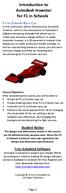 Introduction to Autodesk Inventor for F1 in Schools F1 in Schools Race Car In this course you will be introduced to Autodesk Inventor, which is the centerpiece of Autodesk s digital prototyping strategy
Introduction to COMSOL. The Navier-Stokes Equations
 Flow Between Parallel Plates Modified from the COMSOL ChE Library module rev 10/13/08 Modified by Robert P. Hesketh, Chemical Engineering, Rowan University Fall 2008 Introduction to COMSOL The following
Laminar Flow in a Baffled Stirred Mixer
 Laminar Flow in a Baffled Stirred Mixer Introduction This exercise exemplifies the use of the rotating machinery feature in the CFD Module. The Rotating Machinery interface allows you to model moving rotating
INSTALLATION AND ADMINISTRATION SOLIDWORKS 2015
 INSTALLATION AND ADMINISTRATION SOLIDWORKS 2015 Contents Legal Notices...5 1 SOLIDWORKS Installation and Administration...8 Individual Installation or Administrative Image...9 Initiating SOLIDWORKS Installation...10
CAD Student Guide. Engineering Design and Technology Series
 Engineering Design and Technology Series CAD Student Guide Dassault Systèmes SolidWorks Corporation, 175 Wyman Street, Waltham, Massachusetts 02451 USA Phone: +1-800-693-9000 Outside the U.S.: +1-781-810-5011
Bridge Design Project with SolidWorks Software. Put Picture Here
 Engineering Design and Technology Series Bridge Design Project with SolidWorks Software Put Picture Here Dassault Systèmes SolidWorks Corporation 300 Baker Avenue Concord, Massachusetts 01742 USA Phone:
Contents. Features List... FL-1 First Steps. Ball Valve Design
 Contents Features List................................... FL-1 First Steps Ball Valve Design Opening the SolidWorks Model................................ A1-1 Creating a Flow Simulation Project.............................
ABAQUS Tutorial. 3D Modeling
 Spring 2011 01/21/11 ABAQUS Tutorial 3D Modeling This exercise intends to demonstrate the steps you would follow in creating and analyzing a simple solid model using ABAQUS CAE. Introduction A solid undergoes
INSTALLATION AND ADMINISTRATION SOLIDWORKS 2014
 INSTALLATION AND ADMINISTRATION SOLIDWORKS 2014 Contents Legal Notices...5 1 SolidWorks Installation and Administration...8 Individual Installation or Administrative Image...9 Initiating SolidWorks Installation...10
Essay 5 Tutorial for a Three-Dimensional Heat Conduction Problem Using ANSYS Workbench
 Essay 5 Tutorial for a Three-Dimensional Heat Conduction Problem Using ANSYS Workbench 5.1 Introduction The problem selected to illustrate the use of ANSYS software for a three-dimensional steadystate
This tutorial provides a recipe for simulating L
 Pipe Flow Tutorial for STAR-CCM+ ME 448/548 February 5, 2014 Gerald Recktenwald [email protected] 1 Overview This tutorial provides a recipe for simulating laminar flow in a pipe with STAR- L CCM+. The
Multiphase Flow - Appendices
 Discovery Laboratory Multiphase Flow - Appendices 1. Creating a Mesh 1.1. What is a geometry? The geometry used in a CFD simulation defines the problem domain and boundaries; it is the area (2D) or volume
Tutorial for laboratory project #2 Using ANSYS Workbench. For Double Pipe Heat Exchanger
 Tutorial for laboratory project #2 Using ANSYS Workbench For Double Pipe Heat Exchanger 1. Preparing ANSYS Workbench Go to Start Menu/All Programs/Simulation/ANSYS 12.1/Workbench. In the toolbox menu in
INSTALLATION GUIDE SOLIDWORKS PDM 2016
 INSTALLATION GUIDE SOLIDWORKS PDM 2016 Contents Legal Notices...7 1 SOLIDWORKS PDM Installation Guide...10 2 Installation Overview...12 Required Installation Components...13 Optional Installation Components
ME 24-688 Week 11 Introduction to Dynamic Simulation
 The purpose of this introduction to dynamic simulation project is to explorer the dynamic simulation environment of Autodesk Inventor Professional. This environment allows you to perform rigid body dynamic
Pro/ENGINEER Wildfire 4.0 Basic Design
 Introduction Datum features are non-solid features used during the construction of other features. The most common datum features include planes, axes, coordinate systems, and curves. Datum features do
Lecture 6 - Boundary Conditions. Applied Computational Fluid Dynamics
 Lecture 6 - Boundary Conditions Applied Computational Fluid Dynamics Instructor: André Bakker http://www.bakker.org André Bakker (2002-2006) Fluent Inc. (2002) 1 Outline Overview. Inlet and outlet boundaries.
Introduction to Autodesk Inventor for F1 in Schools
 F1 in Schools race car Introduction to Autodesk Inventor for F1 in Schools In this course you will be introduced to Autodesk Inventor, which is the centerpiece of Autodesk s Digital Prototyping strategy
INSTALLATION GUIDE SOLIDWORKS ENTERPRISE PDM 2014
 INSTALLATION GUIDE SOLIDWORKS ENTERPRISE PDM 2014 Contents Legal Notices...7 1 SolidWorks Enterprise PDM Installation Guide...10 2 Installation Overview...11 Required Installation Components...11 Optional
MET 306. Activity 8a. Mechanism Design Creo 2.0 Level 7 POINT A GROUND LINK LINK 1 LINK 2 LINK 3 POINT B 10/15/2010 1
 Mechanism Design Creo 2.0 Level 7 POINT A LINK 1 GROUND LINK LINK 2 LINK 3 POINT B 10/15/2010 1 Download parts ground, key, link_1, link_2, link_3 and pulley from the V:/MET_306/Activity_8_Creo drive.
Tutorial 1. Introduction to Using ANSYS FLUENT in ANSYS Workbench: Fluid Flow and Heat Transfer in a Mixing Elbow
 Tutorial 1. Introduction to Using ANSYS FLUENT in ANSYS Workbench: Fluid Flow and Heat Transfer in a Mixing Elbow Introduction This tutorial illustrates using ANSYS Workbench to set up and solve a three-dimensional
Learning Module 6 Linear Dynamic Analysis
 Learning Module 6 Linear Dynamic Analysis What is a Learning Module? Title Page Guide A Learning Module (LM) is a structured, concise, and self-sufficient learning resource. An LM provides the learner
CHEG 3128 Heat, Mass, & Kinetics Laboratory Diffusion in Laminar Flow Regimes Modeling and COMSOL Tutorial Tutorial by Andrea Kadilak
 CHEG 3128 Heat, Mass, & Kinetics Laboratory Diffusion in Laminar Flow Regimes Modeling and COMSOL Tutorial Tutorial by Andrea Kadilak Introduction COMSOL is a computer modeling software package that will
Applying a circular load. Immediate and consolidation settlement. Deformed contours. Query points and query lines. Graph query.
 Quick Start Tutorial 1-1 Quick Start Tutorial This quick start tutorial will cover some of the basic features of Settle3D. A circular load is applied to a single soil layer and settlements are examined.
Set up and solve a transient problem using the pressure-based solver and VOF model.
 Tutorial 18. Using the VOF Model This tutorial was run using ANSYS FLUENT 12.1. The results have been updated to reflect the change in the default setting of node-based smoothing for the surface tension
Instructor s Guide to Teaching SolidWorks Software
 Engineering Design and Technology Series Instructor s Guide to Teaching SolidWorks Software Dassault Systèmes - SolidWorks Corporation 300 Baker Avenue Concord, Massachusetts 01742 USA Phone: +1-800-693-9000
Introduction to Solid Modeling Using SolidWorks 2012 SolidWorks Simulation Tutorial Page 1
 Introduction to Solid Modeling Using SolidWorks 2012 SolidWorks Simulation Tutorial Page 1 In this tutorial, we will use the SolidWorks Simulation finite element analysis (FEA) program to analyze the response
Understand the Sketcher workbench of CATIA V5.
 Chapter 1 Drawing Sketches in Learning Objectives the Sketcher Workbench-I After completing this chapter you will be able to: Understand the Sketcher workbench of CATIA V5. Start a new file in the Part
SolidWorks Tutorial 4 CANDLESTICK
 SolidWorks Tutorial 4 CANDLESTICK Candlestick In this tutorial you will make a simple container and a candlestick out of sheetmetal. You will learn about working with sheet metal in SolidWorks. We will
CFD SIMULATION OF SDHW STORAGE TANK WITH AND WITHOUT HEATER
 International Journal of Advancements in Research & Technology, Volume 1, Issue2, July-2012 1 CFD SIMULATION OF SDHW STORAGE TANK WITH AND WITHOUT HEATER ABSTRACT (1) Mr. Mainak Bhaumik M.E. (Thermal Engg.)
Wireframe and Surface
 Wireframe and Surface Preface What's New Getting Started Basic Tasks Workbench Description Glossary Index Dassault Systèmes 1994-99. All rights reserved. Preface CATIA Version 5 Wireframe and Surface allows
SOLIDWORKS SIMULATION GET DESIGN INSIGHTS TO DRIVE MARKET WINNING INNOVATION
 SOLIDWORKS SIMULATION GET DESIGN INSIGHTS TO DRIVE MARKET WINNING INNOVATION SOPHISTICATED SIMULATION IS NO LONGER JUST FOR SPECIALISTS What if? It s the inspiration that fuels innovation and with SolidWorks
ANSYS CFD-Post Tutorials
 ANSYS CFD-Post Tutorials ANSYS, Inc. Southpointe 275 Technology Drive Canonsburg, PA 15317 [email protected] http://www.ansys.com (T) 724-746-3304 (F) 724-514-9494 Release 15.0 November 2013 ANSYS, Inc.
Introduction to ANSYS ICEM CFD
 Workshop 8.2 3D Pipe Junction 14.5 Release Introduction to ANSYS ICEM CFD 2012 ANSYS, Inc. April 1, 2013 1 Release 14.5 3D Pipe Junction 3D Pipe Junction This is a simple 4-way pipe intersection with two
ANSYS CFD-Post Standalone: Tutorials
 ANSYS CFD-Post Standalone: Tutorials ANSYS, Inc. Release 12.1 Southpointe November 2009 275 Technology Drive ANSYS, Inc. is Canonsburg, PA 15317 certified to ISO [email protected] 9001:2008. http://www.ansys.com
TABLE OF CONTENTS. INTRODUCTION... 5 Advance Concrete... 5 Where to find information?... 6 INSTALLATION... 7 STARTING ADVANCE CONCRETE...
 Starting Guide TABLE OF CONTENTS INTRODUCTION... 5 Advance Concrete... 5 Where to find information?... 6 INSTALLATION... 7 STARTING ADVANCE CONCRETE... 7 ADVANCE CONCRETE USER INTERFACE... 7 Other important
CATIA V5 Tutorials. Mechanism Design & Animation. Release 18. Nader G. Zamani. University of Windsor. Jonathan M. Weaver. University of Detroit Mercy
 CATIA V5 Tutorials Mechanism Design & Animation Release 18 Nader G. Zamani University of Windsor Jonathan M. Weaver University of Detroit Mercy SDC PUBLICATIONS Schroff Development Corporation www.schroff.com
Symantec Enterprise Vault
 Symantec Enterprise Vault Guide for Microsoft Outlook 2003/2007 Users 10.0 Light Outlook Add-In Symantec Enterprise Vault: Guide for Microsoft Outlook 2003/2007 Users The software described in this book
Sheet Metal Design. Preface What's New? Getting Started Basic Tasks Workbench Description Customizing Glossary Index
 Sheet Metal Design Preface What's New? Getting Started Basic Tasks Workbench Description Customizing Glossary Index Dassault Systèmes 1994-99. All rights reserved. Preface The V5 CATIA - Sheet Metal Design
Creating Drawings in Pro/ENGINEER
 6 Creating Drawings in Pro/ENGINEER This chapter shows you how to bring the cell phone models and the assembly you ve created into the Pro/ENGINEER Drawing mode to create a drawing. A mechanical drawing
version 3.0 tutorial - Turbulent mixing in a T-junction with CFDSTUDY in SALOME contact: [email protected]
 EDF R&D Fluid Dynamics, Power Generation and Environment Department Single Phase Thermal-Hydraulics Group 6, quai Watier F-78401 Chatou Cedex Tel: 33 1 30 87 75 40 Fax: 33 1 30 87 79 16 MAY 2013 documentation
SolidWorks 2006 What s New
 SolidWorks 2006 What s New 1995-2005, SolidWorks Corporation 300 Baker Avenue Concord, Massachusetts 01742 USA All Rights Reserved U.S. Patents 5,815,154; 6,219,049; 6,219,055; 6,603,486; 6,611,725; and
O.F.Wind Wind Site Assessment Simulation in complex terrain based on OpenFOAM. Darmstadt, 27.06.2012
 O.F.Wind Wind Site Assessment Simulation in complex terrain based on OpenFOAM Darmstadt, 27.06.2012 Michael Ehlen IB Fischer CFD+engineering GmbH Lipowskystr. 12 81373 München Tel. 089/74118743 Fax 089/74118749
Embankment Consolidation
 Embankment Consolidation 36-1 Embankment Consolidation In this tutorial, RS2 is used for a coupled analysis of a road embankment subject to loading from typical daily traffic. Model Start the RS2 9.0 Model
How SolidWorks Speeds Consumer Product Design
 white paper How SolidWorks Speeds Consumer Product Design inspiration SUMMARY SolidWorks Premium bridges the gap between industrial design and engineering by providing powerful surfacing capabilities,
CONCEPT-II. Overview of demo examples
 CONCEPT-II CONCEPT-II is a frequency domain method of moment (MoM) code, under development at the Institute of Electromagnetic Theory at the Technische Universität Hamburg-Harburg (www.tet.tuhh.de). Overview
Workshop. Tennis Racket Simulation using Abaqus
 Introduction Workshop Tennis Racket Simulation using Abaqus In this workshop you will become familiar with the process of creating a model interactively by using Abaqus/CAE. You will create the tennis
Trace Layer Import for Printed Circuit Boards Under Icepak
 Tutorial 13. Trace Layer Import for Printed Circuit Boards Under Icepak Introduction: A printed circuit board (PCB) is generally a multi-layered board made of dielectric material and several layers of
Part Design. Page 1 1997 2001 DASSAULT SYSTEMES. IBM Product Lifecycle Management Solutions / Dassault Systemes
 Part Design Page 1 Tutorial Objectives Description This tutorial is an introduction to Part Design. Message This tutorial illustrates how CATIA can Design precise 3D mechanical parts with an intuitive
Jump Start: Aspen HYSYS Dynamics V7.3
 A Brief Tutorial (and supplement to training and online documentation) Glenn Dissinger, Product Director, Aspen Technology, Inc. Julie Levine, Associate Product Marketing Professional, Aspen Technology,
Microsoft Excel 2010 Charts and Graphs
 Microsoft Excel 2010 Charts and Graphs Email: [email protected] Web Page: http://training.health.ufl.edu Microsoft Excel 2010: Charts and Graphs 2.0 hours Topics include data groupings; creating
Abaqus/CFD Sample Problems. Abaqus 6.10
 Abaqus/CFD Sample Problems Abaqus 6.10 Contents 1. Oscillatory Laminar Plane Poiseuille Flow 2. Flow in Shear Driven Cavities 3. Buoyancy Driven Flow in Cavities 4. Turbulent Flow in a Rectangular Channel
Creating Forms With Adobe LiveCycle Designer 8.2
 Creating Forms With Adobe LiveCycle Designer 8.2 Instructional Media Center HCC Version 2 Modified Date 1/20/10 Learning Objectives: At the end of this training session the student will be able to use
NUMERICAL ANALYSIS OF THE EFFECTS OF WIND ON BUILDING STRUCTURES
 Vol. XX 2012 No. 4 28 34 J. ŠIMIČEK O. HUBOVÁ NUMERICAL ANALYSIS OF THE EFFECTS OF WIND ON BUILDING STRUCTURES Jozef ŠIMIČEK email: [email protected] Research field: Statics and Dynamics Fluids mechanics
Software Application Tutorial
 Software Application Tutorial Copyright 2005, Software Application Training Unit, West Chester University. No Portion of this document may be reproduced without the written permission of the authors. For
CATIA Wireframe & Surfaces TABLE OF CONTENTS
 TABLE OF CONTENTS Introduction... 1 Wireframe & Surfaces... 2 Pull Down Menus... 3 Edit... 3 Insert... 4 Tools... 6 Generative Shape Design Workbench... 7 Bottom Toolbar... 9 Tools... 9 Analysis... 10
Figure 1 - Delta Theta Input Selection
 Creating Cams in Pro/Engineer Wildfire Using DYNACAM Mechanical Engineering Mechanical Design Created by: David E. Yamartino M.S. Mechanical Engineering May 2004 April 12, 2004 Objective: The objective
Welcome to CorelDRAW, a comprehensive vector-based drawing and graphic-design program for the graphics professional.
 Workspace tour Welcome to CorelDRAW, a comprehensive vector-based drawing and graphic-design program for the graphics professional. In this tutorial, you will become familiar with the terminology and workspace
AB3080 L. Learning Objectives: About the Speaker:
 AB3080 L While architects have tested their designs in wind tunnels for many years, the process is typically outsourced to engineering firms and not easily accessible to architects during the conceptual
Excel -- Creating Charts
 Excel -- Creating Charts The saying goes, A picture is worth a thousand words, and so true. Professional looking charts give visual enhancement to your statistics, fiscal reports or presentation. Excel
The following is an overview of lessons included in the tutorial.
 Chapter 2 Tutorial Tutorial Introduction This tutorial is designed to introduce you to some of Surfer's basic features. After you have completed the tutorial, you should be able to begin creating your
SIMATIC. WinCC V7.0. Getting started. Getting started. Welcome 2. Icons 3. Creating a project 4. Configure communication 5
 SIMATIC WinCC V7.0 SIMATIC WinCC V7.0 Printout of the Online Help 1 Welcome 2 Icons 3 Creating a project 4 Configure communication 5 Configuring the Process Screens 6 Archiving and displaying values 7
Heat Transfer by Free Convection
 Heat Transfer by Free Convection Introduction This example describes a fluid flow problem with heat transfer in the fluid. An array of heating tubes is submerged in a vessel with fluid flow entering at
MICROSOFT OFFICE ACCESS 2007 - NEW FEATURES
 MICROSOFT OFFICE 2007 MICROSOFT OFFICE ACCESS 2007 - NEW FEATURES Exploring Access Creating and Working with Tables Finding and Filtering Data Working with Queries and Recordsets Working with Forms Working
Introduction to ANSYS
 Lecture 3 Introduction to ANSYS Meshing 14. 5 Release Introduction to ANSYS Meshing 2012 ANSYS, Inc. March 27, 2014 1 Release 14.5 Introduction to ANSYS Meshing What you will learn from this presentation
Structure Design. Preface What's New? Getting Started Basic Tasks Advanced Tasks Workbench Description Customizing Glossary Index
 Structure Design Preface What's New? Getting Started Basic Tasks Advanced Tasks Workbench Description Customizing Glossary Index Dassault Systèmes 1994-2000. All rights reserved. Preface CATIA Version
CO 2 41.2 MPa (abs) 20 C
 comp_02 A CO 2 cartridge is used to propel a small rocket cart. Compressed CO 2, stored at a pressure of 41.2 MPa (abs) and a temperature of 20 C, is expanded through a smoothly contoured converging nozzle
Introduction to CATIA V5
 Introduction to CATIA V5 Release 16 (A Hands-On Tutorial Approach) Kirstie Plantenberg University of Detroit Mercy SDC PUBLICATIONS Schroff Development Corporation www.schroff.com www.schroff-europe.com
Embroidery Fonts Plus ( EFP ) Tutorial Guide Version 1.0505
 Embroidery Fonts Plus ( EFP ) Tutorial Guide Version 1.0505 1 Contents Chapter 1 System Requirements.................. 3 Chapter 2 Quick Start Installation.................. 4 System Requirements................
A LAMINAR FLOW ELEMENT WITH A LINEAR PRESSURE DROP VERSUS VOLUMETRIC FLOW. 1998 ASME Fluids Engineering Division Summer Meeting
 TELEDYNE HASTINGS TECHNICAL PAPERS INSTRUMENTS A LAMINAR FLOW ELEMENT WITH A LINEAR PRESSURE DROP VERSUS VOLUMETRIC FLOW Proceedings of FEDSM 98: June -5, 998, Washington, DC FEDSM98 49 ABSTRACT The pressure
Part Number: PMT1080-ENG Rev. 1
 2010 Dassault Systèmes, All Rights Reserved DraftSight and the DraftSight logos are trademarks of Dassault Systèmes or its subsidiaries in the US and/or other countries. Other brand or product names are
du u U 0 U dy y b 0 b
 BASIC CONCEPTS/DEFINITIONS OF FLUID MECHANICS (by Marios M. Fyrillas) 1. Density (πυκνότητα) Symbol: 3 Units of measure: kg / m Equation: m ( m mass, V volume) V. Pressure (πίεση) Alternative definition:
CATIA Functional Tolerancing & Annotation TABLE OF CONTENTS
 TABLE OF CONTENTS Introduction...1 Functional Tolerancing and Annotation...2 Pull-down Menus...3 Insert...3 Functional Tolerancing and Annotation Workbench...4 Bottom Toolbar Changes...5 3D Grid Toolbar...5
Symantec Enterprise Vault
 Symantec Enterprise Vault Guide for Microsoft Outlook 2003/2007 Users 10.0 Full Outlook Add-In Symantec Enterprise Vault: Guide for Microsoft Outlook 2003/2007 Users The software described in this book
AutoCAD Structural Detailing 2011. Getting Started with AutoCAD Structural Detailing, Reinforcement module
 AutoCAD Structural Detailing 2011 Getting Started with AutoCAD Structural Detailing, Reinforcement module 2010 Autodesk, Inc. All Rights Reserved. Except as otherwise permitted by Autodesk, Inc., this
Microsoft PowerPoint 2010
 Microsoft PowerPoint 2010 Starting PowerPoint... 2 PowerPoint Window Properties... 2 The Ribbon... 3 Default Tabs... 3 Contextual Tabs... 3 Minimizing and Restoring the Ribbon... 4 The Backstage View...
Content Author's Reference and Cookbook
 Sitecore CMS 6.5 Content Author's Reference and Cookbook Rev. 110621 Sitecore CMS 6.5 Content Author's Reference and Cookbook A Conceptual Overview and Practical Guide to Using Sitecore Table of Contents
Microsoft PowerPoint 2008
 Microsoft PowerPoint 2008 Starting PowerPoint... 2 Creating Slides in Your Presentation... 3 Beginning with the Title Slide... 3 Inserting a New Slide... 3 Slide Layouts... 3 Adding an Image to a Slide...
Smart Board Notebook Software A guide for new Smart Board users
 Smart Board Notebook Software A guide for new Smart Board users This guide will address the following tasks in Notebook: 1. Adding shapes, text, and pictures. 2. Searching the Gallery. 3. Arranging objects