
5.3 Multiplying Polynomials: Special Products. Copyright Cengage Learning. All rights reserved.
|
|
|
- Leslie Jacobs
- 9 years ago
- Views:
Transcription
1 5.3 Multiplying Polynomials: Special Products Copyright Cengage Learning. All rights reserved. 1
2 What You Will Learn Find products with monomial multipliers Multiplying binomials using the Distributive Property and the FOIL Method Multiply polynomials using a horizontal or vertical format Identify and use special binomial products 2
3 Monomial Multipliers 3
4 Monomial Multipliers To multiply polynomials, you use many of the rules for simplifying algebraic expressions. 1. The Distributive Property 2. Combining like terms 3. Removing symbols of grouping 4. Rules of exponents The simplest type of polynomial multiplication involves a monomial multiplier. The product is obtained by direct application of the Distributive Property. 4
5 Monomial Multipliers For instance, to multiply the monomial x by the polynomial (2x + 5), multiply each term of the polynomial by x. (x)(2x + 5) = (x)(2x) + (x)(5) = 2x 2 + 5x 5
6 Example 1 Finding Products with Monomial Multipliers Find each product. a. (3x 7)( 2x) b. 3x 2 (5x x 3 + 2) c. ( x)(2x 2 3x) Solution: a. (3x 7)( 2x) = 3x( 2x) 7( 2x) = 6x x Distributive Property Write in standard form. 6
7 Example 1 Finding Products with Monomial Multipliers b. 3x 2 (5x x 3 + 2) = (3x 2 )(5x) (3x 2 )(x 3 ) + (3x 2 )(2) cont d Distributive Property = 15x 3 3x 5 + 6x 2 = 3x x 3 + 6x 2 Rules of exponents Write in standard form. c. ( x)(2x 2 3x) = ( x)(2x 2 ) ( x)(3x) = 2x 3 + 3x 2 Distributive Property Write in standard form. 7
8 Multiplying Binomials 8

9 Multiplying Binomials To multiply two binomials, you can use both (left and right) forms of the Distributive Property. For example, if you treat the binomial (5x + 7) as a single quantity, you can multiply (3x 2) by (5x + 7) as follows. (3x 2)(5x + 7) = 3x(5x + 7) 2(5x + 7) = (3x)(5x) + (3x)(7) (2)(5x) 2(7) = 15x x 10x 14 = 15x x 14 9
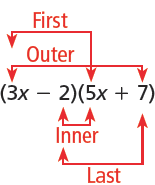
10 Multiplying Binomials With practice, you should be able to multiply two binomials without writing out all of the steps above. In fact, the four products in the boxes above suggest that you can write the product of two binomials in just one step. This is called the FOIL Method. Note that the words first, outer, inner, and last refer to the positions of the terms in the original product. 10
11 Example 2 Multiplying Binomials with the Distributive Property Use the Distributive Property to find each product. a. (x 1)(x + 5) b. (2x + 3) (x 2) Solution: a. (x 1)(x + 5) = x(x + 5) 1(x + 5) = x 2 + 5x x 5 = x 2 + (5x x) 5 = x 2 + 4x 5 Right Distributive Property Left Distributive Property Group like terms. Combine like terms. 11
12 Example 2 Multiplying Binomials with the Distributive Property b. (2x + 3)(x 2) = 2x(x 2) + 3(x 2) cont d Right Distributive Property = 2x 2 4x + 3x 6 = 2x 2 + ( 4x + 3x) 6 = 2x 2 x 6 Left Distributive Property Group like terms. Combine like terms. 12
13 Example 3 Multiplying Binomials using the FOIL Method Use the FOIL Method to find each product. a. (x + 4)(x 4) b. (3x + 5)(2x + 1) Solution: F O I L a. (x + 4)(x 4) = x 2 4x + 4x 16 = x 2 16 Combine like terms. Note that the outer and inner products add up to zero. 13
14 Example 3 Multiplying Binomials using the FOIL Method F O I L b. (3x + 5)(2x + 1) = 6x 2 + 3x + 10x + 5 cont d = 6x x + 5 Combine like terms. 14

15 Example 4 A Geometric Model of a Polynomial Product Use the geometric model to show that x 2 + 3x + 2 = (x + 1)(x + 2) 15
16 Example 4 A Geometric Model of a Polynomial Product Solution The left part of the model shows that the sum of the areas of the six rectangle is x 2 + (x + x + x) + (1 + 1) = x 2 + 3x + 2 cont d The right part of the model shows that the area of the rectangle is (x + 1)(x + 2) = x 2 + 2x + x + 2 = x 2 + 3x + 2 So, x 2 + 3x + 2 = (x + 1)(x + 2) 16
17 Example 5 Simplifying a Polynomial Expression Simplify the expression and write the result in standard form (4x + 5) 2 Solution (4x + 5) 2 = (4x + 5)(4x + 5) Repeated multiplication = 16x x + 20x + 25 Use FOIL Method = 16x x + 25 Combine like terms 17
18 Example 6 Simplifying a Polynomial Expression Simplify the expression and write the result in standard form (3x 2 2)(4x + 7) (4x) 2 Solution (3x 2 2)(4x + 7) (4x) 2 = 12x x 2 8x 14 (4x) 2 Use FOIL Method = 12x x 2 8x 14 16x 2 Square monomial = 12x 3 + 5x 2 8x 14 Combine like terms 18
19 Multiplying Polynomials 19
20 Multiplying Polynomials The FOIL Method for multiplying two binomials is simply a device for guaranteeing that each term of one binomial is multiplied by each term of the other binomial. (ax + b)(cx + d) = ax(cx) + ax(d) + b(cx) + b(d) F O I L This same rule applies to the product of any two polynomials: each term of one polynomial must be multiplied by each term of the other polynomial. This can be accomplished using either a horizontal or a vertical format. 20
21 Example 7 Multiplying Polynomials Horizontally Use a horizontal format to find each product. a. (x 4)(x 2 4x + 2) b. (2x 2 7x + 1)(4x + 3) Solution: a. (x 4)(x 2 4x + 2) = x(x 2 4x + 2) 4(x 2 4x + 2) = x 3 4x 2 + 2x 4x x 8 Distributive Property Distributive Property = x 3 8x x 8 Combine like terms. 21
22 Example 7 Multiplying Polynomials Horizontally b. (2x 2 7x + 1)(4x + 3) cont d = (2x 2 7x + 1)(4x) + (2x 2 7x + 1)(3) = 8x 3 28x 2 + 4x + 6x 2 21x + 3 Distributive Property Distributive Property = 8x 3 22x 2 17x + 3 Combine like terms. 22
23 Example 10 Raising a Polynomial to a Power Use two steps to expand (x 3) 3 Solution: Step 1: (x 3) 2 = (x 3)(x 3) = x 2 3x 3x + 9 = x 2 6x + 9 Repeated multiplication Use FOIL Method Combine like terms Step 2: (x 2 6x + 9)(x 3) = (x 2 6x + 9)(x) (x 2 6x + 9)(3) = x 3 6x 2 + 9x 3x x 27 = x 3 9x x 27 So, (x 3) 3 = x 3 9x x 27 23
24 Special Products 24
25 Special Products Some binomial products, such as those in Example 3(a), has special forms that occur frequently in algebra. The product (x + 4)(x 4) is called a product of the sum and difference of two terms. With such products, the two middle terms cancel, as follows. (x + 4)(x 4) = x 2 4x + 4x 16 Sum and difference of two terms = x 2 16 Product has no middle term. 25
26 Special Products Another common type of product is the square of a binomial. (4x + 5) 2 = (4x + 5)(4x + 5) = 16x x + 20x + 25 = 16x x + 25 Square of a binomial Use FOIL Method. Middle term is twice the product of the terms of the binomial. 26

27 Special Products In general, when a binomial is squared, the resulting middle term is always twice the product of the two terms. (a + b) 2 = a 2 + 2(ab) + b 2 Be sure to include the middle term. For instance, (a + b) 2 is not equal to a 2 + b 2. 27
28 Special Products 28
29 Example 11 Finding Special Products a. (5x 6)(5x + 6) = (5x) 2 (6) 2 = 25x 2 36 b. (3x + 7) 2 = (3x) 2 + 2(3x)(7) + (7) 2 = 9x x + 14 c. (4x + 9) 2 = (4x) 2 + 2(4x)(9) + (9) 2 = 16x x + 81 d. (6 + 5x 2 ) 2 = (4) 2 2(6)(5x 2 ) + (5x 2 ) 2 = 36 60x 2 + (5) 2 (x 2 ) 2 = 36 60x x 4 29

30 Example 12 Finding the Dimensions of a Golf Tee A landscaper wants to reshape a square tee area for the ninth hole of a golf course. The new tee area will have one side 2 feet longer and the adjacent side 6 feet longer than the original tee. The area of the new tee will be 204 square feet greater than the area of the original tee. What are the dimensions of the original tee? 30
31 Example 12 Finding the Dimensions of a Golf Tee Solution Verbal Model: cont d Labels: Original length = original width = x (feet) Original area = x2 New length = x + 6 New width = x + 2 Equation: (x + 6)(x + 2) = x Write equation x 2 + 8x + 12 = x x + 12 = 204 8x = 192 (square feet) (feet) (feet) Multiply factors Subtract x 2 from each side Subtract 12 from each side x = 24 Divide each side by 8 31
32 Homework: Page 244 # s 1 10 down the column Page 245 # s 19 & 23 Page 247 # s down the column Page 248 # s down the column Page 249 # s 55 & 59 Page 251 # s 77 & 78 32
Operations with Algebraic Expressions: Multiplication of Polynomials
 Operations with Algebraic Expressions: Multiplication of Polynomials The product of a monomial x monomial To multiply a monomial times a monomial, multiply the coefficients and add the on powers with the
expression is written horizontally. The Last terms ((2)( 4)) because they are the last terms of the two polynomials. This is called the FOIL method.
 A polynomial of degree n (in one variable, with real coefficients) is an expression of the form: a n x n + a n 1 x n 1 + a n 2 x n 2 + + a 2 x 2 + a 1 x + a 0 where a n, a n 1, a n 2, a 2, a 1, a 0 are
1.3 Polynomials and Factoring
 1.3 Polynomials and Factoring Polynomials Constant: a number, such as 5 or 27 Variable: a letter or symbol that represents a value. Term: a constant, variable, or the product or a constant and variable.
Polynomials and Factoring
 7.6 Polynomials and Factoring Basic Terminology A term, or monomial, is defined to be a number, a variable, or a product of numbers and variables. A polynomial is a term or a finite sum or difference of
Pre-Calculus II Factoring and Operations on Polynomials
 Factoring... 1 Polynomials...1 Addition of Polynomials... 1 Subtraction of Polynomials...1 Multiplication of Polynomials... Multiplying a monomial by a monomial... Multiplying a monomial by a polynomial...
MATH 90 CHAPTER 6 Name:.
 MATH 90 CHAPTER 6 Name:. 6.1 GCF and Factoring by Groups Need To Know Definitions How to factor by GCF How to factor by groups The Greatest Common Factor Factoring means to write a number as product. a
How To Factor By Gcf In Algebra 1.5
 7-2 Factoring by GCF Warm Up Lesson Presentation Lesson Quiz Algebra 1 Warm Up Simplify. 1. 2(w + 1) 2. 3x(x 2 4) 2w + 2 3x 3 12x Find the GCF of each pair of monomials. 3. 4h 2 and 6h 2h 4. 13p and 26p
1.3 Algebraic Expressions
 1.3 Algebraic Expressions A polynomial is an expression of the form: a n x n + a n 1 x n 1 +... + a 2 x 2 + a 1 x + a 0 The numbers a 1, a 2,..., a n are called coefficients. Each of the separate parts,
NSM100 Introduction to Algebra Chapter 5 Notes Factoring
 Section 5.1 Greatest Common Factor (GCF) and Factoring by Grouping Greatest Common Factor for a polynomial is the largest monomial that divides (is a factor of) each term of the polynomial. GCF is the
Alum Rock Elementary Union School District Algebra I Study Guide for Benchmark III
 Alum Rock Elementary Union School District Algebra I Study Guide for Benchmark III Name Date Adding and Subtracting Polynomials Algebra Standard 10.0 A polynomial is a sum of one ore more monomials. Polynomial
Algebra Cheat Sheets
 Sheets Algebra Cheat Sheets provide you with a tool for teaching your students note-taking, problem-solving, and organizational skills in the context of algebra lessons. These sheets teach the concepts
ALGEBRA 2: 4.1 Graph Quadratic Functions in Standard Form
 ALGEBRA 2: 4.1 Graph Quadratic Functions in Standard Form Goal Graph quadratic functions. VOCABULARY Quadratic function A function that can be written in the standard form y = ax 2 + bx+ c where a 0 Parabola
SOL Warm-Up Graphing Calculator Active
 A.2a (a) Using laws of exponents to simplify monomial expressions and ratios of monomial expressions 1. Which expression is equivalent to (5x 2 )(4x 5 )? A 9x 7 B 9x 10 C 20x 7 D 20x 10 2. Which expression
15.1 Factoring Polynomials
 LESSON 15.1 Factoring Polynomials Use the structure of an expression to identify ways to rewrite it. Also A.SSE.3? ESSENTIAL QUESTION How can you use the greatest common factor to factor polynomials? EXPLORE
A. Factoring out the Greatest Common Factor.
 DETAILED SOLUTIONS AND CONCEPTS - FACTORING POLYNOMIAL EXPRESSIONS Prepared by Ingrid Stewart, Ph.D., College of Southern Nevada Please Send Questions and Comments to [email protected]. Thank you!
Polynomial Expression
 DETAILED SOLUTIONS AND CONCEPTS - POLYNOMIAL EXPRESSIONS Prepared by Ingrid Stewart, Ph.D., College of Southern Nevada Please Send Questions and Comments to [email protected]. Thank you! PLEASE NOTE
Definitions 1. A factor of integer is an integer that will divide the given integer evenly (with no remainder).
 Math 50, Chapter 8 (Page 1 of 20) 8.1 Common Factors Definitions 1. A factor of integer is an integer that will divide the given integer evenly (with no remainder). Find all the factors of a. 44 b. 32
A.3. Polynomials and Factoring. Polynomials. What you should learn. Definition of a Polynomial in x. Why you should learn it
 Appendi A.3 Polynomials and Factoring A23 A.3 Polynomials and Factoring What you should learn Write polynomials in standard form. Add,subtract,and multiply polynomials. Use special products to multiply
A Systematic Approach to Factoring
 A Systematic Approach to Factoring Step 1 Count the number of terms. (Remember****Knowing the number of terms will allow you to eliminate unnecessary tools.) Step 2 Is there a greatest common factor? Tool
APPLICATIONS AND MODELING WITH QUADRATIC EQUATIONS
 APPLICATIONS AND MODELING WITH QUADRATIC EQUATIONS Now that we are starting to feel comfortable with the factoring process, the question becomes what do we use factoring to do? There are a variety of classic
MATH 60 NOTEBOOK CERTIFICATIONS
 MATH 60 NOTEBOOK CERTIFICATIONS Chapter #1: Integers and Real Numbers 1.1a 1.1b 1.2 1.3 1.4 1.8 Chapter #2: Algebraic Expressions, Linear Equations, and Applications 2.1a 2.1b 2.1c 2.2 2.3a 2.3b 2.4 2.5
Factoring. Factoring Monomials Monomials can often be factored in more than one way.
 Factoring Factoring is the reverse of multiplying. When we multiplied monomials or polynomials together, we got a new monomial or a string of monomials that were added (or subtracted) together. For example,
Greatest Common Factor (GCF) Factoring
 Section 4 4: Greatest Common Factor (GCF) Factoring The last chapter introduced the distributive process. The distributive process takes a product of a monomial and a polynomial and changes the multiplication
SUNY ECC. ACCUPLACER Preparation Workshop. Algebra Skills
 SUNY ECC ACCUPLACER Preparation Workshop Algebra Skills Gail A. Butler Ph.D. Evaluating Algebraic Epressions Substitute the value (#) in place of the letter (variable). Follow order of operations!!! E)
called and explain why it cannot be factored with algebra tiles? and explain why it cannot be factored with algebra tiles?
 Factoring Reporting Category Topic Expressions and Operations Factoring polynomials Primary SOL A.2c The student will perform operations on polynomials, including factoring completely first- and second-degree
6.1 The Greatest Common Factor; Factoring by Grouping
 386 CHAPTER 6 Factoring and Applications 6.1 The Greatest Common Factor; Factoring by Grouping OBJECTIVES 1 Find the greatest common factor of a list of terms. 2 Factor out the greatest common factor.
6.1 Add & Subtract Polynomial Expression & Functions
 6.1 Add & Subtract Polynomial Expression & Functions Objectives 1. Know the meaning of the words term, monomial, binomial, trinomial, polynomial, degree, coefficient, like terms, polynomial funciton, quardrtic
Algebra 2 PreAP. Name Period
 Algebra 2 PreAP Name Period IMPORTANT INSTRUCTIONS FOR STUDENTS!!! We understand that students come to Algebra II with different strengths and needs. For this reason, students have options for completing
Polynomials. Key Terms. quadratic equation parabola conjugates trinomial. polynomial coefficient degree monomial binomial GCF
 Polynomials 5 5.1 Addition and Subtraction of Polynomials and Polynomial Functions 5.2 Multiplication of Polynomials 5.3 Division of Polynomials Problem Recognition Exercises Operations on Polynomials
Radicals - Rationalize Denominators
 8. Radicals - Rationalize Denominators Objective: Rationalize the denominators of radical expressions. It is considered bad practice to have a radical in the denominator of a fraction. When this happens
Definition 8.1 Two inequalities are equivalent if they have the same solution set. Add or Subtract the same value on both sides of the inequality.
 8 Inequalities Concepts: Equivalent Inequalities Linear and Nonlinear Inequalities Absolute Value Inequalities (Sections 4.6 and 1.1) 8.1 Equivalent Inequalities Definition 8.1 Two inequalities are equivalent
A Concrete Introduction. to the Abstract Concepts. of Integers and Algebra using Algebra Tiles
 A Concrete Introduction to the Abstract Concepts of Integers and Algebra using Algebra Tiles Table of Contents Introduction... 1 page Integers 1: Introduction to Integers... 3 2: Working with Algebra Tiles...
Mathematics Online Instructional Materials Correlation to the 2009 Algebra I Standards of Learning and Curriculum Framework
 Provider York County School Division Course Syllabus URL http://yorkcountyschools.org/virtuallearning/coursecatalog.aspx Course Title Algebra I AB Last Updated 2010 - A.1 The student will represent verbal
Factors and Products
 CHAPTER 3 Factors and Products What You ll Learn use different strategies to find factors and multiples of whole numbers identify prime factors and write the prime factorization of a number find square
How To Solve Factoring Problems
 05-W4801-AM1.qxd 8/19/08 8:45 PM Page 241 Factoring, Solving Equations, and Problem Solving 5 5.1 Factoring by Using the Distributive Property 5.2 Factoring the Difference of Two Squares 5.3 Factoring
Factor Polynomials Completely
 9.8 Factor Polynomials Completely Before You factored polynomials. Now You will factor polynomials completely. Why? So you can model the height of a projectile, as in Ex. 71. Key Vocabulary factor by grouping
SPECIAL PRODUCTS AND FACTORS
 CHAPTER 442 11 CHAPTER TABLE OF CONTENTS 11-1 Factors and Factoring 11-2 Common Monomial Factors 11-3 The Square of a Monomial 11-4 Multiplying the Sum and the Difference of Two Terms 11-5 Factoring the
Factoring Guidelines. Greatest Common Factor Two Terms Three Terms Four Terms. 2008 Shirley Radai
 Factoring Guidelines Greatest Common Factor Two Terms Three Terms Four Terms 008 Shirley Radai Greatest Common Factor 008 Shirley Radai Factoring by Finding the Greatest Common Factor Always check for
Copy in your notebook: Add an example of each term with the symbols used in algebra 2 if there are any.
 Algebra 2 - Chapter Prerequisites Vocabulary Copy in your notebook: Add an example of each term with the symbols used in algebra 2 if there are any. P1 p. 1 1. counting(natural) numbers - {1,2,3,4,...}
Wentzville School District Algebra 1: Unit 8 Stage 1 Desired Results
 Wentzville School District Algebra 1: Unit 8 Stage 1 Desired Results Unit Title: Quadratic Expressions & Equations Course: Algebra I Unit 8 - Quadratic Expressions & Equations Brief Summary of Unit: At
Polynomials and Quadratics
 Polynomials and Quadratics Want to be an environmental scientist? Better be ready to get your hands dirty!.1 Controlling the Population Adding and Subtracting Polynomials............703.2 They re Multiplying
Algebra 1 Chapter 08 review
 Name: Class: Date: ID: A Algebra 1 Chapter 08 review Multiple Choice Identify the choice that best completes the statement or answers the question. Simplify the difference. 1. (4w 2 4w 8) (2w 2 + 3w 6)
Math Common Core Sampler Test
 High School Algebra Core Curriculum Math Test Math Common Core Sampler Test Our High School Algebra sampler covers the twenty most common questions that we see targeted for this level. For complete tests
Factoring and Applications
 Factoring and Applications What is a factor? The Greatest Common Factor (GCF) To factor a number means to write it as a product (multiplication). Therefore, in the problem 48 3, 4 and 8 are called the
Factoring Special Polynomials
 6.6 Factoring Special Polynomials 6.6 OBJECTIVES 1. Factor the difference of two squares 2. Factor the sum or difference of two cubes In this section, we will look at several special polynomials. These
Sect 6.7 - Solving Equations Using the Zero Product Rule
 Sect 6.7 - Solving Equations Using the Zero Product Rule 116 Concept #1: Definition of a Quadratic Equation A quadratic equation is an equation that can be written in the form ax 2 + bx + c = 0 (referred
Algebra Practice Problems for Precalculus and Calculus
 Algebra Practice Problems for Precalculus and Calculus Solve the following equations for the unknown x: 1. 5 = 7x 16 2. 2x 3 = 5 x 3. 4. 1 2 (x 3) + x = 17 + 3(4 x) 5 x = 2 x 3 Multiply the indicated polynomials
Factoring Trinomials using Algebra Tiles Student Activity
 Factoring Trinomials using Algebra Tiles Student Activity Materials: Algebra Tiles (student set) Worksheet: Factoring Trinomials using Algebra Tiles Algebra Tiles: Each algebra tile kits should contain
CAHSEE on Target UC Davis, School and University Partnerships
 UC Davis, School and University Partnerships CAHSEE on Target Mathematics Curriculum Published by The University of California, Davis, School/University Partnerships Program 006 Director Sarah R. Martinez,
HIBBING COMMUNITY COLLEGE COURSE OUTLINE
 HIBBING COMMUNITY COLLEGE COURSE OUTLINE COURSE NUMBER & TITLE: - Beginning Algebra CREDITS: 4 (Lec 4 / Lab 0) PREREQUISITES: MATH 0920: Fundamental Mathematics with a grade of C or better, Placement Exam,
Veterans Upward Bound Algebra I Concepts - Honors
 Veterans Upward Bound Algebra I Concepts - Honors Brenda Meery Kaitlyn Spong Say Thanks to the Authors Click http://www.ck12.org/saythanks (No sign in required) www.ck12.org Chapter 6. Factoring CHAPTER
POLYNOMIALS and FACTORING
 POLYNOMIALS and FACTORING Exponents ( days); 1. Evaluate exponential expressions. Use the product rule for exponents, 1. How do you remember the rules for exponents?. How do you decide which rule to use
Factoring Polynomials
 UNIT 11 Factoring Polynomials You can use polynomials to describe framing for art. 396 Unit 11 factoring polynomials A polynomial is an expression that has variables that represent numbers. A number can
This is Factoring and Solving by Factoring, chapter 6 from the book Beginning Algebra (index.html) (v. 1.0).
 This is Factoring and Solving by Factoring, chapter 6 from the book Beginning Algebra (index.html) (v. 1.0). This book is licensed under a Creative Commons by-nc-sa 3.0 (http://creativecommons.org/licenses/by-nc-sa/
Math 10C. Course: Polynomial Products and Factors. Unit of Study: Step 1: Identify the Outcomes to Address. Guiding Questions:
 Course: Unit of Study: Math 10C Polynomial Products and Factors Step 1: Identify the Outcomes to Address Guiding Questions: What do I want my students to learn? What can they currently understand and do?
FACTORING QUADRATICS 8.1.1 and 8.1.2
 FACTORING QUADRATICS 8.1.1 and 8.1.2 Chapter 8 introduces students to quadratic equations. These equations can be written in the form of y = ax 2 + bx + c and, when graphed, produce a curve called a parabola.
Mathematics Placement
 Mathematics Placement The ACT COMPASS math test is a self-adaptive test, which potentially tests students within four different levels of math including pre-algebra, algebra, college algebra, and trigonometry.
Examples of Tasks from CCSS Edition Course 3, Unit 5
 Examples of Tasks from CCSS Edition Course 3, Unit 5 Getting Started The tasks below are selected with the intent of presenting key ideas and skills. Not every answer is complete, so that teachers can
Topic: Special Products and Factors Subtopic: Rules on finding factors of polynomials
 Quarter I: Special Products and Factors and Quadratic Equations Topic: Special Products and Factors Subtopic: Rules on finding factors of polynomials Time Frame: 20 days Time Frame: 3 days Content Standard:
9.3 OPERATIONS WITH RADICALS
 9. Operations with Radicals (9 1) 87 9. OPERATIONS WITH RADICALS In this section Adding and Subtracting Radicals Multiplying Radicals Conjugates In this section we will use the ideas of Section 9.1 in
SIMPLIFYING ALGEBRAIC FRACTIONS
 Tallahassee Community College 5 SIMPLIFYING ALGEBRAIC FRACTIONS In arithmetic, you learned that a fraction is in simplest form if the Greatest Common Factor (GCF) of the numerator and the denominator is
Properties of Real Numbers
 16 Chapter P Prerequisites P.2 Properties of Real Numbers What you should learn: Identify and use the basic properties of real numbers Develop and use additional properties of real numbers Why you should
MTH 092 College Algebra Essex County College Division of Mathematics Sample Review Questions 1 Created January 17, 2006
 MTH 092 College Algebra Essex County College Division of Mathematics Sample Review Questions Created January 7, 2006 Math 092, Elementary Algebra, covers the mathematical content listed below. In order
When factoring, we look for greatest common factor of each term and reverse the distributive property and take out the GCF.
 Factoring: reversing the distributive property. The distributive property allows us to do the following: When factoring, we look for greatest common factor of each term and reverse the distributive property
( ) FACTORING. x In this polynomial the only variable in common to all is x.
 FACTORING Factoring is similar to breaking up a number into its multiples. For example, 10=5*. The multiples are 5 and. In a polynomial it is the same way, however, the procedure is somewhat more complicated
Answer Key for California State Standards: Algebra I
 Algebra I: Symbolic reasoning and calculations with symbols are central in algebra. Through the study of algebra, a student develops an understanding of the symbolic language of mathematics and the sciences.
Vocabulary Words and Definitions for Algebra
 Name: Period: Vocabulary Words and s for Algebra Absolute Value Additive Inverse Algebraic Expression Ascending Order Associative Property Axis of Symmetry Base Binomial Coefficient Combine Like Terms
What are the place values to the left of the decimal point and their associated powers of ten?
 The verbal answers to all of the following questions should be memorized before completion of algebra. Answers that are not memorized will hinder your ability to succeed in geometry and algebra. (Everything
MATH 21. College Algebra 1 Lecture Notes
 MATH 21 College Algebra 1 Lecture Notes MATH 21 3.6 Factoring Review College Algebra 1 Factoring and Foiling 1. (a + b) 2 = a 2 + 2ab + b 2. 2. (a b) 2 = a 2 2ab + b 2. 3. (a + b)(a b) = a 2 b 2. 4. (a
Factor and Solve Polynomial Equations. In Chapter 4, you learned how to factor the following types of quadratic expressions.
 5.4 Factor and Solve Polynomial Equations Before You factored and solved quadratic equations. Now You will factor and solve other polynomial equations. Why? So you can find dimensions of archaeological
Big Bend Community College. Beginning Algebra MPC 095. Lab Notebook
 Big Bend Community College Beginning Algebra MPC 095 Lab Notebook Beginning Algebra Lab Notebook by Tyler Wallace is licensed under a Creative Commons Attribution 3.0 Unported License. Permissions beyond
By reversing the rules for multiplication of binomials from Section 4.6, we get rules for factoring polynomials in certain forms.
 SECTION 5.4 Special Factoring Techniques 317 5.4 Special Factoring Techniques OBJECTIVES 1 Factor a difference of squares. 2 Factor a perfect square trinomial. 3 Factor a difference of cubes. 4 Factor
Polynomial Operations and Factoring
 Algebra 1, Quarter 4, Unit 4.1 Polynomial Operations and Factoring Overview Number of instructional days: 15 (1 day = 45 60 minutes) Content to be learned Identify terms, coefficients, and degree of polynomials.
Name Intro to Algebra 2. Unit 1: Polynomials and Factoring
 Name Intro to Algebra 2 Unit 1: Polynomials and Factoring Date Page Topic Homework 9/3 2 Polynomial Vocabulary No Homework 9/4 x In Class assignment None 9/5 3 Adding and Subtracting Polynomials Pg. 332
Multiplying and Dividing Radicals
 9.4 Multiplying and Dividing Radicals 9.4 OBJECTIVES 1. Multiply and divide expressions involving numeric radicals 2. Multiply and divide expressions involving algebraic radicals In Section 9.2 we stated
Unit 7 Quadratic Relations of the Form y = ax 2 + bx + c
 Unit 7 Quadratic Relations of the Form y = ax 2 + bx + c Lesson Outline BIG PICTURE Students will: manipulate algebraic expressions, as needed to understand quadratic relations; identify characteristics
MTH 086 College Algebra Essex County College Division of Mathematics Sample Review Questions 1 Created January 20, 2006
 MTH 06 College Algebra Essex County College Division of Mathematics Sample Review Questions 1 Created January 0, 006 Math 06, Introductory Algebra, covers the mathematical content listed below. In order
Gouvernement du Québec Ministère de l Éducation, 2004 04-00813 ISBN 2-550-43545-1
 Gouvernement du Québec Ministère de l Éducation, 004 04-00813 ISBN -550-43545-1 Legal deposit Bibliothèque nationale du Québec, 004 1. INTRODUCTION This Definition of the Domain for Summative Evaluation
Algebra 2 Year-at-a-Glance Leander ISD 2007-08. 1st Six Weeks 2nd Six Weeks 3rd Six Weeks 4th Six Weeks 5th Six Weeks 6th Six Weeks
 Algebra 2 Year-at-a-Glance Leander ISD 2007-08 1st Six Weeks 2nd Six Weeks 3rd Six Weeks 4th Six Weeks 5th Six Weeks 6th Six Weeks Essential Unit of Study 6 weeks 3 weeks 3 weeks 6 weeks 3 weeks 3 weeks
Simplifying Algebraic Fractions
 5. Simplifying Algebraic Fractions 5. OBJECTIVES. Find the GCF for two monomials and simplify a fraction 2. Find the GCF for two polynomials and simplify a fraction Much of our work with algebraic fractions
Math 0980 Chapter Objectives. Chapter 1: Introduction to Algebra: The Integers.
 Math 0980 Chapter Objectives Chapter 1: Introduction to Algebra: The Integers. 1. Identify the place value of a digit. 2. Write a number in words or digits. 3. Write positive and negative numbers used
Polynomial Equations and Factoring
 7 Polynomial Equations and Factoring 7.1 Adding and Subtracting Polynomials 7.2 Multiplying Polynomials 7.3 Special Products of Polynomials 7.4 Dividing Polynomials 7.5 Solving Polynomial Equations in
A Quick Algebra Review
 1. Simplifying Epressions. Solving Equations 3. Problem Solving 4. Inequalities 5. Absolute Values 6. Linear Equations 7. Systems of Equations 8. Laws of Eponents 9. Quadratics 10. Rationals 11. Radicals
Chapter R.4 Factoring Polynomials
 Chapter R.4 Factoring Polynomials Introduction to Factoring To factor an expression means to write the expression as a product of two or more factors. Sample Problem: Factor each expression. a. 15 b. x
Rational Expressions - Least Common Denominators
 7.3 Rational Expressions - Least Common Denominators Objective: Idenfity the least common denominator and build up denominators to match this common denominator. As with fractions, the least common denominator
Learning Objectives 9.2. Media Run Times 9.3
 Unit 9 Table of Contents Unit 9: Factoring Video Overview Learning Objectives 9.2 Media Run Times 9.3 Instructor Notes 9.4 The Mathematics of Factoring Polynomials Teaching Tips: Conceptual Challenges
BEGINNING ALGEBRA ACKNOWLEDMENTS
 BEGINNING ALGEBRA The Nursing Department of Labouré College requested the Department of Academic Planning and Support Services to help with mathematics preparatory materials for its Bachelor of Science
Mathematics Curriculum
 Common Core Mathematics Curriculum Table of Contents 1 Polynomial and Quadratic Expressions, Equations, and Functions MODULE 4 Module Overview... 3 Topic A: Quadratic Expressions, Equations, Functions,
Florida Math 0028. Correlation of the ALEKS course Florida Math 0028 to the Florida Mathematics Competencies - Upper
 Florida Math 0028 Correlation of the ALEKS course Florida Math 0028 to the Florida Mathematics Competencies - Upper Exponents & Polynomials MDECU1: Applies the order of operations to evaluate algebraic
Algebraic expressions are a combination of numbers and variables. Here are examples of some basic algebraic expressions.
 Page 1 of 13 Review of Linear Expressions and Equations Skills involving linear equations can be divided into the following groups: Simplifying algebraic expressions. Linear expressions. Solving linear
POLYNOMIAL FUNCTIONS
 POLYNOMIAL FUNCTIONS Polynomial Division.. 314 The Rational Zero Test.....317 Descarte s Rule of Signs... 319 The Remainder Theorem.....31 Finding all Zeros of a Polynomial Function.......33 Writing a
Florida Algebra 1 End-of-Course Assessment Item Bank, Polk County School District
 Benchmark: MA.912.A.2.3; Describe the concept of a function, use function notation, determine whether a given relation is a function, and link equations to functions. Also assesses MA.912.A.2.13; Solve
Factoring Polynomials
 Factoring Polynomials Factoring Factoring is the process of writing a polynomial as the product of two or more polynomials. The factors of 6x 2 x 2 are 2x + 1 and 3x 2. In this section, we will be factoring
Algebra II A Final Exam
 Algebra II A Final Exam Multiple Choice Identify the choice that best completes the statement or answers the question. Evaluate the expression for the given value of the variable(s). 1. ; x = 4 a. 34 b.
UNIT 5 VOCABULARY: POLYNOMIALS
 2º ESO Bilingüe Page 1 UNIT 5 VOCABULARY: POLYNOMIALS 1.1. Algebraic Language Algebra is a part of mathematics in which symbols, usually letters of the alphabet, represent numbers. Letters are used to
SECTION 1-6 Quadratic Equations and Applications
 58 Equations and Inequalities Supply the reasons in the proofs for the theorems stated in Problems 65 and 66. 65. Theorem: The complex numbers are commutative under addition. Proof: Let a bi and c di be
Answers to Basic Algebra Review
 Answers to Basic Algebra Review 1. -1.1 Follow the sign rules when adding and subtracting: If the numbers have the same sign, add them together and keep the sign. If the numbers have different signs, subtract