
MSc PROGRAMS. Sophia Antipolis SPRING SEMESTER COURSE CATALOGUE
|
|
|
- Cassandra Blankenship
- 10 years ago
- Views:
Transcription
1 MSc PROGRAMS Sophia Antipolis SPRING SEMESTER COURSE CATALOGUE JANUARY 2014 APRIL

2 M2-MSc courses Research Methods and Critical Thinking (various programs) Advanced Strategy Cultural Awareness French as a Foreign Language MSc in Corporate Financial Management Project: Value Creation and Performance Management Financial Modelling with Excel Intangible Assets Valuation Corporate Risk Management Reporting and Financial Communication Banking Relations Governance and Risk Management Cross-Border Mergers MSc in Entrepreneurship and Innovation for a Sustainable World Doing Business in High Tech Solution-based Selling Negotiation Skills Executive Consulting Entrepreneurial Skills and Leadership Innovation and New Product Development Intellectual Property Project Management Start-up Support Strategic Management of Innovation Strategies for High Growth Business MSc in Financial Markets and Investments Macro economic Indicators Asset Valuation (M& A) Technical Analysis

3 4. Financial Analysis Fixed Income Management Volatility Analysis Portfolio Management Equity & FX Structured Products Fixed Income Structured Products Credits (CDS) MSc in International Business International Business Law Marketing Communication in Europe Sustainable Finance International HR Management Negotiation and SkemaSim CAPM Preparation Doing Business in High Tech Industry MSc in International Marketing and Business Development Sustainable marketing strategies Business development Product management Internationalisation of markets and organizations Corporate communication Managing the service experience Sales, negotiation & Key Account Management Innovation & New Product Development Luxury goods management Corporate/NGO partnerships Communicating in a crisis Consumption emotions Managing knowledge and creativity CRM Decision Making Models in Marketing Mastering data analyses with SPSS Information Goods and E-commerce MSc in Luxury and Fashion Management Value management and marketing Pricing, distribution and retail in luxury and fashion

4 3. Finance and accountability in luxury and fashion How to build a brand MSc in Supply Chain Management and Purchasing Sustainable SCM and ethical Purchasing Finance in the value chain MSc in Strategic Events Management and Tourism Management IT in Events IT in Tourism Event Marketing Distribution in Tourism Service Design in Tourism and Events MSc in Strategic Human Resources Management French training law Advanced Organizational Behaviors Contemporary societal evolutions Strategy for HRM Human Resources Development Social Networks within companies Human Resource Management Systems HRM in the supply chain HRM within mergers and acquisitions Social negotiations practices MSc in Web-Marketing and International Project Management Google Adwords and Analytics Corporate Communication CAPM Preparation

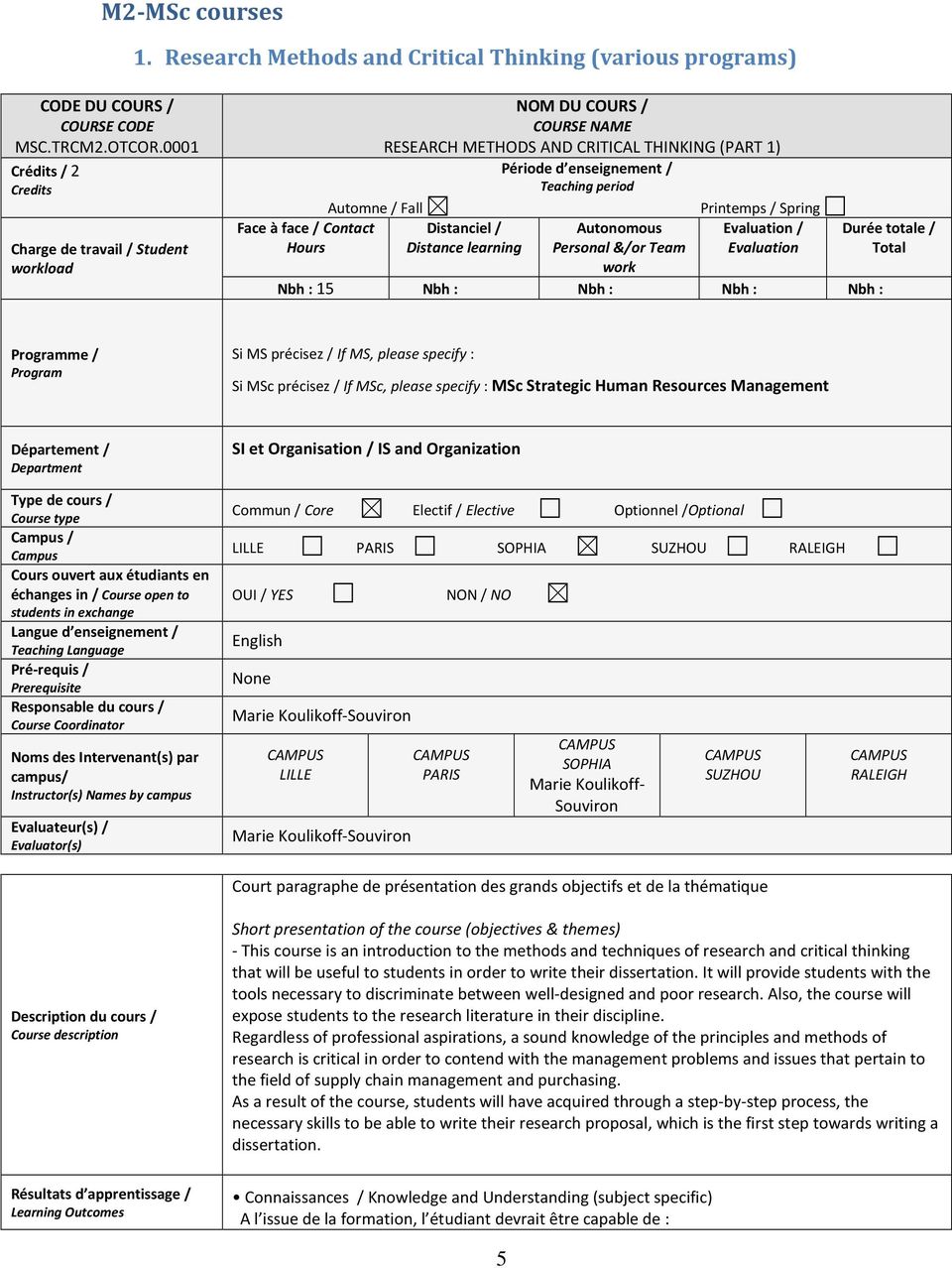
5 M2-MSc courses 1. Research Methods and Critical Thinking (various programs) CODE DU COURS / COURSE CODE MSC.TRCM2.OTCOR.0001 Crédits / 2 Credits Charge de travail / Student workload Face à face / Contact Hours NOM DU COURS / COURSE NAME RESEARCH METHODS AND CRITICAL THINKING (PART 1) Période d enseignement / Teaching period Automne / Fall Printemps / Spring Distanciel / Distance learning Autonomous Personal &/or Team work Evaluation / Evaluation Nbh : 15 Nbh : Nbh : Nbh : Nbh : Durée totale / Total Programme / Program Si MS précisez / If MS, please specify : Si MSc précisez / If MSc, please specify : MSc Strategic Human Resources Management Département / Department Type de cours / Course type Campus / Campus Cours ouvert aux étudiants en échanges in / Course open to students in exchange Langue d enseignement / Teaching Language Pré-requis / Prerequisite Responsable du cours / Course Coordinator Noms des Intervenant(s) par campus/ Instructor(s) Names by campus Evaluateur(s) / Evaluator(s) SI et Organisation / IS and Organization Commun / Core Electif / Elective Optionnel /Optional SUZHOU OUI / YES English None Marie Koulikoff-Souviron Marie Koulikoff-Souviron NON / NO Marie Koulikoff- Souviron SUZHOU Court paragraphe de présentation des grands objectifs et de la thématique Description du cours / Course description Short presentation of the course (objectives & themes) - This course is an introduction to the methods and techniques of research and critical thinking that will be useful to students in order to write their dissertation. It will provide students with the tools necessary to discriminate between well-designed and poor research. Also, the course will expose students to the research literature in their discipline. Regardless of professional aspirations, a sound knowledge of the principles and methods of research is critical in order to contend with the management problems and issues that pertain to the field of supply chain management and purchasing. As a result of the course, students will have acquired through a step-by-step process, the necessary skills to be able to write their research proposal, which is the first step towards writing a dissertation. Résultats d apprentissage / Learning Outcomes Connaissances / Knowledge and Understanding (subject specific) 5
6 The student is expected to: - Understand what are the SKEMA requirements for writing a good dissertation - realize how useful research is in order to develop new insights about their discipline - identify a research topic for their dissertation - formulate a clear research problem and develop related research question(s) - understand and apply the basics of critically reviewing the literature on their discipline and the related ethical considerations. - Build a conceptual framework to guide methodology - Get an overview of available methods for data collection and analysis and the link to theory Aptitudes cognitives / Cognitive/Intellectual skills (generic) The student is expected to: - Turn research ideas into a research project that has a clear research question(s) and objectives - be able to adopt a critical perspective in their reading; Contribution aux objectifs pédagogiques du programme / Contribution to learning objectives Attitudes / Key transferable skills (generic) The student is expected to: -Link managerial issues and their practical implications to theoretical concepts presented in the literature Compétences pratiques / Practical skills (subject specific) A l issue de la formation, l étudiant devrait être capable : The student is expected to: -Search electronic databases in order to investigate and build up a research topic -use quote, summarize and paraphrase -identify and document a clear problem that establishes the need for the paper - be able to reference the literature found accurately; - understand what is meant by plagiarism write a problem statement and a short review of the literature that will serve as first stage in the writing up of the dissertation Indiquer les learning objectives auxquels contribue le cours (en se basant sur le curriculum mapping du programme) / Indicate which learning objectives the course contributes to (based on the program curriculum mapping) LO3.2 To produce clear, well organized written communication LO5.1 To analyze and apply advanced concepts in a specialized discipline Evaluation finale (DS) / Final examination Evaluation des étudiants / Student Assessment Etude de cas (Case study) % Questions (Questions) % Exercices (Exercises) % Autre (Other) 50%% Précisez / Specify: Full research proposal Contrôle continu / Continuous Assessment Présentation orale (oral presentation) % Dossier (file) % Etude de cas (case study) % Autre (other) 50% Précisez / Specify: Problem statement Méthodes d enseignement / Teaching Methods Format de cours / Course format 6

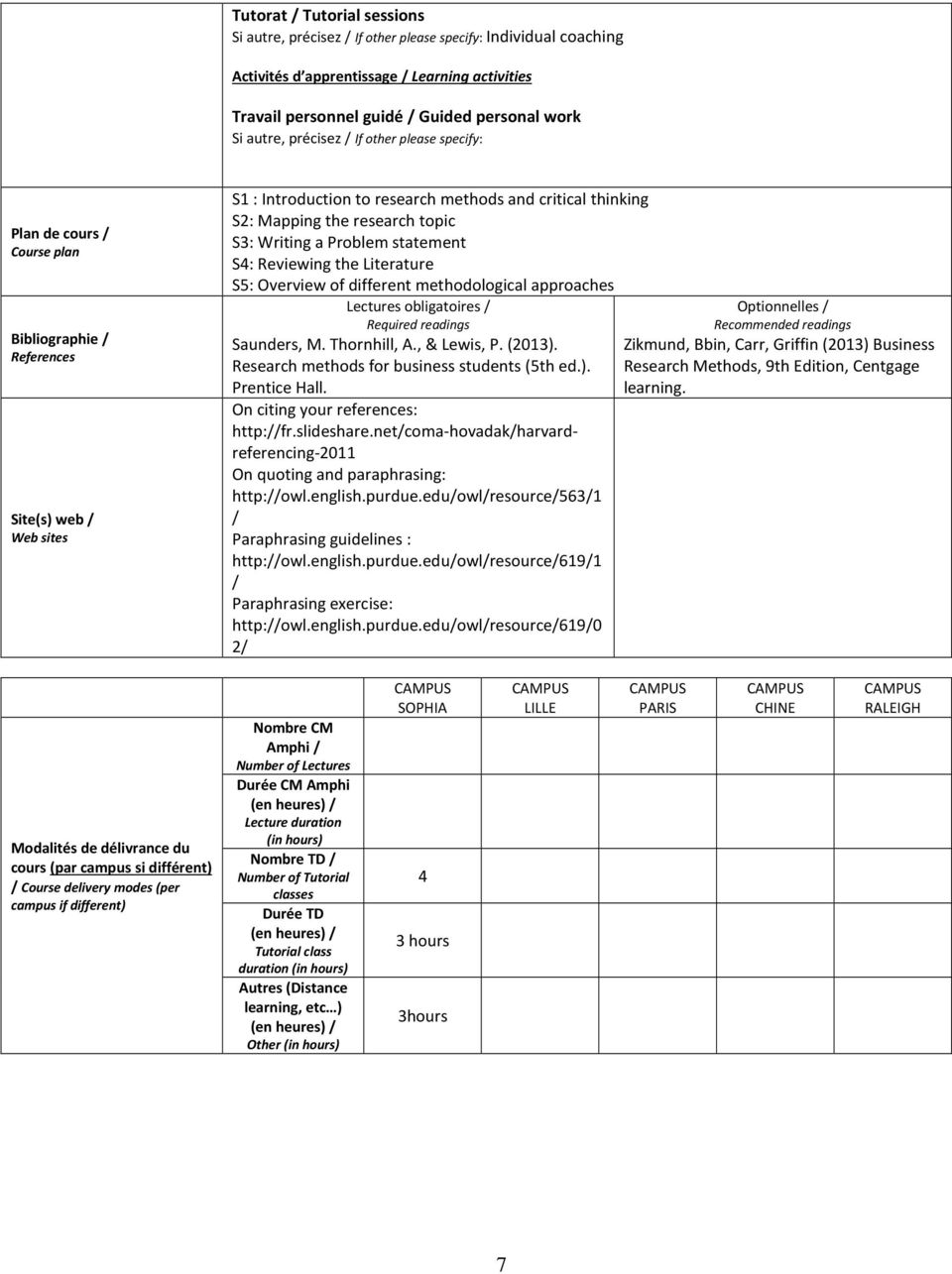
7 Tutorat / Tutorial sessions Si autre, précisez / If other please specify: Individual coaching Activités d apprentissage / Learning activities Travail personnel guidé / Guided personal work Si autre, précisez / If other please specify: Plan de cours / Course plan Bibliographie / References Site(s) web / Web sites S1 : Introduction to research methods and critical thinking S2: Mapping the research topic S3: Writing a Problem statement S4: Reviewing the Literature S5: Overview of different methodological approaches Lectures obligatoires / Required readings Saunders, M. Thornhill, A., & Lewis, P. (2013). Research methods for business students (5th ed.). Prentice Hall. On citing your references: On quoting and paraphrasing: / Paraphrasing guidelines : / Paraphrasing exercise: 2/ Optionnelles / Recommended readings Zikmund, Bbin, Carr, Griffin (2013) Business Research Methods, 9th Edition, Centgage learning. Modalités de délivrance du cours (par campus si différent) / Course delivery modes (per campus if different) Nombre CM Amphi / Number of Lectures Durée CM Amphi Lecture duration (in hours) Nombre TD / Number of Tutorial classes Durée TD Tutorial class duration (in hours) Autres (Distance learning, etc ) Other (in hours) 4 3 hours 3hours CHINE 7
8 Préciser les spécificités de programmation (TD journée, cadencement spécifique des séances) / Specify if full-day tutorial class, different schedules It varies 2. Advanced Strategy CODE DU COURS / COURSE CODE MSC.TRCM2.STCOR.0001 Crédits / 3 Credits Charge de travail / Student workload Programme / Program Face à face / Contact Hours MSc Automne / Fall Distanciel / Distance learning Nbh : 13.5 Nbh : 1.5 Si MS précisez / If MS, please specify : Si MSc précisez / If MSc, please specify : NOM DU COURS / COURSE NAME ADVANCED STRATEGY Période d enseignement / Teaching period Autonomous Personal &/or Team work Printemps / Spring Evaluation / Evaluation Nbh : 15 Nbh : 2 Durée totale / Total Nbh : 32 Département / Department Stratégie et Entrepreneuriat / Strategy and Entre. Type de cours / Course type Campus / Campus Cours ouvert aux étudiants en échanges in / Course open to students in exchange Langue d enseignement / Teaching Language Pré-requis / Prerequisite Responsable du cours / Course Coordinator Noms des Intervenant(s) par campus/ Instructor(s) Names by campus Evaluateur(s) / Evaluator(s) Description du cours / Course description Commun / Core Electif / Elective Optionnel /Optional SUZHOU OUI / YES English Philippe CHEREAU O. Ammar M. Uhrish J. Bayle-Cordier NON / NO S. Borzillo M. Uhrish G. Gentina R. Kaminska A. Barraquier B. Cirillo P. Chereau SUZHOU A. Barraquier O. Ammar, M. Uhrish, J. Bayle-Cordier, S. Borzillo, M. Uhrish, G. Gentina, R. Kaminska, A. Barraquier, B. Cirillo, P. Chereau, P.X. Meschi Court paragraphe de présentation des grands objectifs et de la thématique Short presentation of the course (objectives & themes) P.X. Meschi 8

9 Advanced strategy course aims at preparing students to strategy formulation and implementation through the use of concept, methods and tools of strategic management focused on the following issues: - internationalization strategy - Innovation and entrepreneurship - Strategic choices: formulation and evaluation Résultats d apprentissage / Learning Outcomes Contribution aux objectifs pédagogiques du programme / Contribution to learning objectives Connaissances / Knowledge and Understanding (subject specific) The student is expected to: - Identify internationalization strategy drivers and entry modes - Identify and respond to different types of innovation dilemmas - Manage the process of identification of entrepreneurial opportunities - Use non-financial and financial criteria and tools for evaluating strategic options Aptitudes cognitives / Cognitive/Intellectual skills (generic) The student is expected to: Master the strategic management process in organizations with regards to internationalization, strategic management of innovation, and strategy evaluation. Attitudes / Key transferable skills (generic) The student is expected to: - Understand the need for a methodological approach of strategic options as regards firms' internationalization and innovation and - the need to evaluate options as well as their implementation Compétences pratiques / Practical skills (subject specific) A l issue de la formation, l étudiant devrait être capable : The student is expected to: - Formalize strategic options for internationalization and innovation - Evaluate feasibility of business and corporate strategic options and their effective implementation Indiquer les learning objectives auxquels contribue le cours (en se basant sur le curriculum mapping du programme) / Indicate which learning objectives the course contributes to (based on the program curriculum mapping) LO5.2 To analyze how integration of input from various functional areas of business act to influence the formulation of strategy at the organizational level Evaluation finale (DS) / Final examination Evaluation des étudiants / Student Assessment QCM (quizz) 50% Etude de cas (Case study) % Questions (Questions) % Exercices (Exercises) % Autre (Other) % Précisez / Specify: Contrôle continu / Continuous Assessment Présentation orale (oral presentation) % Dossier (file) % Etude de cas (case study) 50% Autre (other) % Précisez / Specify: 9

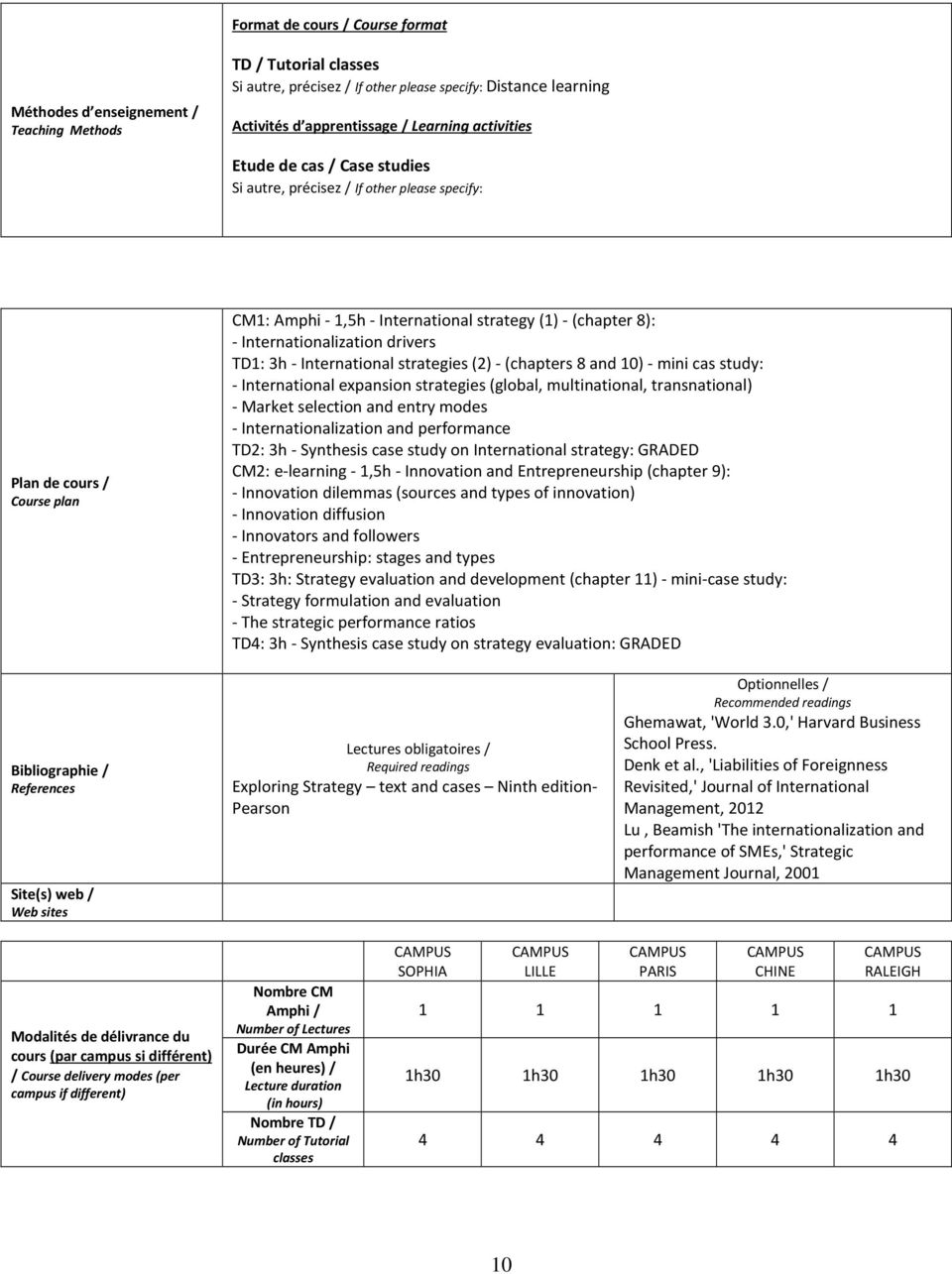
10 Format de cours / Course format Méthodes d enseignement / Teaching Methods TD / Tutorial classes Si autre, précisez / If other please specify: Distance learning Activités d apprentissage / Learning activities Etude de cas / Case studies Si autre, précisez / If other please specify: Plan de cours / Course plan CM1: Amphi - 1,5h - International strategy (1) - (chapter 8): - Internationalization drivers TD1: 3h - International strategies (2) - (chapters 8 and 10) - mini cas study: - International expansion strategies (global, multinational, transnational) - Market selection and entry modes - Internationalization and performance TD2: 3h - Synthesis case study on International strategy: GRADED CM2: e-learning - 1,5h - Innovation and Entrepreneurship (chapter 9): - Innovation dilemmas (sources and types of innovation) - Innovation diffusion - Innovators and followers - Entrepreneurship: stages and types TD3: 3h: Strategy evaluation and development (chapter 11) - mini-case study: - Strategy formulation and evaluation - The strategic performance ratios TD4: 3h - Synthesis case study on strategy evaluation: GRADED Bibliographie / References Site(s) web / Web sites Lectures obligatoires / Required readings Exploring Strategy text and cases Ninth edition- Pearson Optionnelles / Recommended readings Ghemawat, 'World 3.0,' Harvard Business School Press. Denk et al., 'Liabilities of Foreignness Revisited,' Journal of International Management, 2012 Lu, Beamish 'The internationalization and performance of SMEs,' Strategic Management Journal, 2001 Modalités de délivrance du cours (par campus si différent) / Course delivery modes (per campus if different) Nombre CM Amphi / Number of Lectures Durée CM Amphi Lecture duration (in hours) Nombre TD / Number of Tutorial classes CHINE h30 1h30 1h30 1h30 1h
11 Durée TD Tutorial class duration (in hours) Autres (Distance learning, etc ) Other (in hours) Préciser les spécificités de programmation (TD journée, cadencement spécifique des séances) / Specify if full-day tutorial class, different schedules h30 1h30 1h30 1h30 1h30 3. Cultural Awareness CODE DU COURS / COURSE CODE CULTURAL AWARESS:LIVING & WORKING IN FRANCE Crédits / Credits Nombre / Number : 3 Charge de travail / Student workload Face à face / Contact Hours Distanciel / Distance learning Autonomous Personal &/or Team work Evaluation / Evaluation Durée Nbh : 15 Nbh : 0 Nbh : 24 Nbh : 6 Nbh : PGE x MS Programme / Program PGE FC MSc x PGE COOP Bachelor DDA ESDHEM CCA PhD Département / Department Droit et Fiscalité / Law and Taxation Economie / Economics Finance, comptabilité, contrôle / Accounting and Finance Management de Projets / Project Management Marketing Vente / Marketing Management Ressources Humaines et Comportement Organisationnel / Human Resource Management & Organizational Behaviour Stratégie et Entrepreneuriat / Strategy & Entrepreneurship Systèmes d information et Organisation / Information System & Organization Langues / Languages Type de cours / Course type Commun / Core Electif / Elective Optionnel /Optional Année / Year 2013/2014 Campus / Campus SUZHOU Cours ouvert aux étudiants en échanges in / Course open to students in exchange Langue d enseignement / Teaching Language Pré-requis / Prerequisite Période d enseignement / Teaching period English None :open to exchange students only S1 & S2 11

12 Responsable du cours / Course Coordinator Noms des Intervenant(s) par campus/ Instructor(s) Names by campus Evaluateur(s) / Evaluator(s) Description du cours / Course description Anke MIDDELMANN Tracy Jones Tracy Jones & Anke Middelmann Anke Middelmann SUZHOU TBA This course is specifically designed for Exchange students, to help their integration in France. It will introduce them to cultural, business and institutional factors affecting France today. The course will explore intercultural issues and will equip exchange students with the means to better understand and analyse France and the French. The course will move beyond stereotypical views and perspectives to enable students to gain deeper cultural awareness, thereby preparing them to make the most of their French educational, social and business experience. Connaissances / Knowledge and Understanding (subject specific) The student is expected to - have a basic knowledge of major features of issues of contemporary France - better understand the values, customs and attitudes of the French. Aptitudes cognitives / Cognitive/Intellectual skills (generic) Résultats d apprentissage / Learning Outcomes The student is expected to : - have acquired an understanding of cultural differences and to have become award of the impact this can have on business and other transactions. Attitudes / Key transferable skills (generic) The student is expected to : - have enhanced his/her multicultural skills and knowledge - be able to observe, analyse and compare another culture with that of their own Compétences pratiques / Practical skills (subject specific) A l issue de la formation, l étudiant devrait être capable : The student is expected to : - be able to approach life in France with increased cultural awareness and sensitivity and thus be more successful in both business and non-business situations. Contribution aux objectifs pédagogiques du programme / Contribution to learning objectives Indiquer les learning objectives auxquels contribue le cours (en se basant sur le curriculum mapping du programme) Evaluation finale (DS) / Final examination Evaluation des étudiants / Student Assessment QCM (quizz) % Etude de cas (case study) % Questions (questions) 50% Exercices (exercises) % Autre (other) % Précisez (precise): Contrôle continu / Continuous Assessment Présentation orale (oral presentation) 50% QCM (quizz) % Dossier % Etude de cas (case study) % Autre (other) % Précisez (precise): Participation in class discussions Méthodes d enseignement / Teaching Methods Format de cours / Course format Cours / Lectures Séminaire / Seminar Tutorat / Tutorial sessions 12

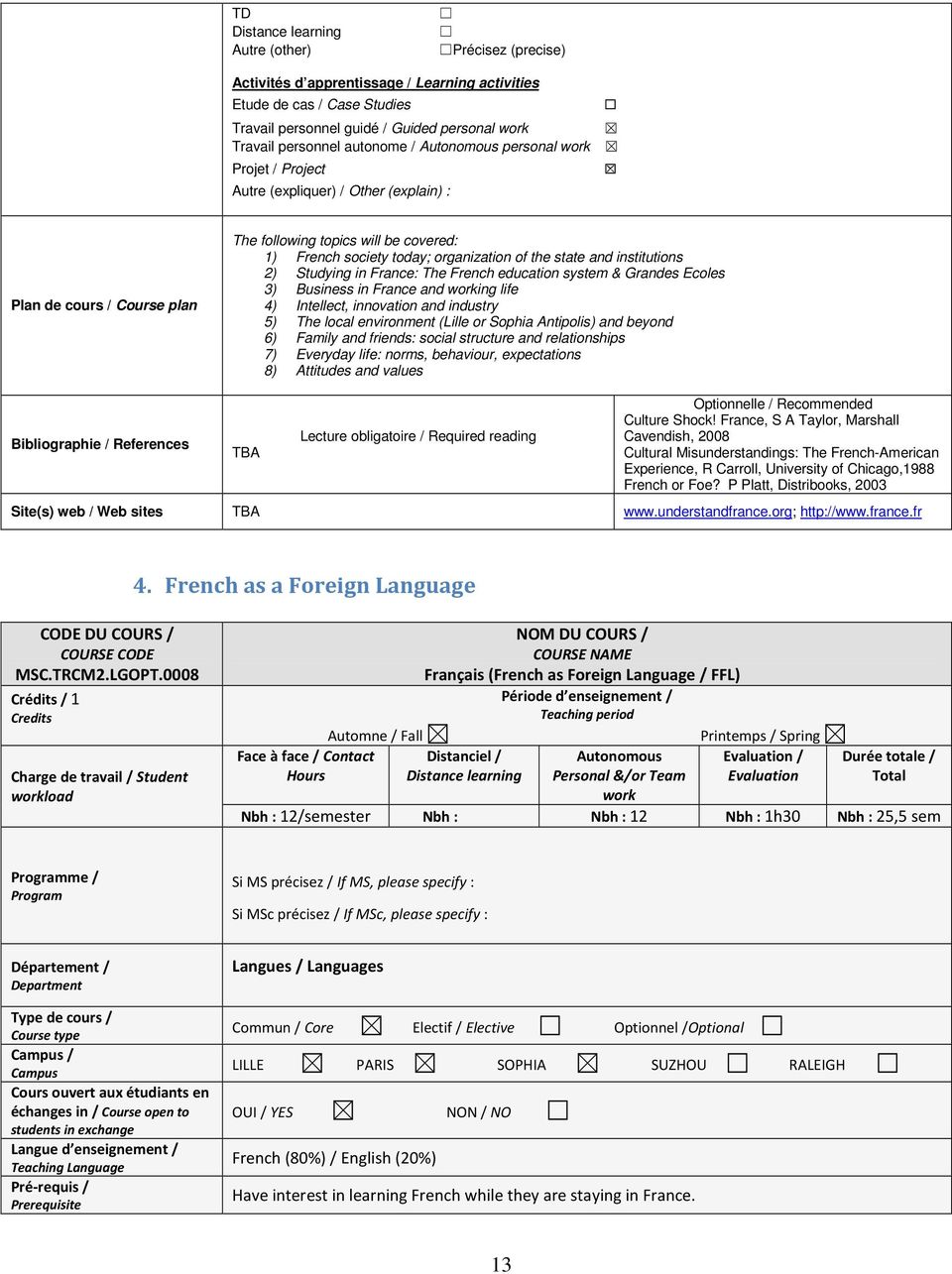
13 TD Distance learning Autre (other) Précisez (precise) Activités d apprentissage / Learning activities Etude de cas / Case Studies Travail personnel guidé / Guided personal work Travail personnel autonome / Autonomous personal work Projet / Project Autre (expliquer) / Other (explain) : Plan de cours / Course plan The following topics will be covered: 1) French society today; organization of the state and institutions 2) Studying in France: The French education system & Grandes Ecoles 3) Business in France and working life 4) Intellect, innovation and industry 5) The local environment (Lille or Sophia Antipolis) and beyond 6) Family and friends: social structure and relationships 7) Everyday life: norms, behaviour, expectations 8) Attitudes and values Bibliographie / References TBA Lecture obligatoire / Required reading Optionnelle / Recommended Culture Shock! France, S A Taylor, Marshall Cavendish, 2008 Cultural Misunderstandings: The French-American Experience, R Carroll, University of Chicago,1988 French or Foe? P Platt, Distribooks, 2003 Site(s) web / Web sites TBA French as a Foreign Language CODE DU COURS / COURSE CODE MSC.TRCM2.LGOPT.0008 Crédits / 1 Credits Charge de travail / Student workload NOM DU COURS / COURSE NAME Français (French as Foreign Language / FFL) Période d enseignement / Teaching period Automne / Fall Printemps / Spring Face à face / Contact Distanciel / Autonomous Evaluation / Hours Distance learning Personal &/or Team Evaluation work Durée totale / Total Nbh : 12/semester Nbh : Nbh : 12 Nbh : 1h30 Nbh : 25,5 sem Programme / Program Si MS précisez / If MS, please specify : Si MSc précisez / If MSc, please specify : Département / Department Type de cours / Course type Campus / Campus Cours ouvert aux étudiants en échanges in / Course open to students in exchange Langue d enseignement / Teaching Language Pré-requis / Prerequisite Langues / Languages Commun / Core Electif / Elective Optionnel /Optional SUZHOU OUI / YES NON / NO French (80%)/ English (20%) Have interest in learning French while they are staying in France. 13
14 Responsable du cours / Course Coordinator Noms des Intervenant(s) par campus/ Instructor(s) Names by campus JPPommier Pascale Bazin ou Karine Sbihi Oanh Chieuto Christine Develey SUZHOU Evaluateur(s) / Evaluator(s) Pascale Bazin ou Karine Sbihi, Oanh Chieuto, Christine Develey Court paragraphe de présentation des grands objectifs et de la thématique Description du cours / Course description Short presentation of the course (objectives & themes) This course invites students without prior knowledge of French to explore the basic features of the French language. Students will receive intensive practice in spoken and written French through interactive class work, homework. They will become familiar with the basic concepts of French grammar and learn how to interact in some simple everyday situations. It prepares students for the A1 level, focusing on speaking skills. Résultats d apprentissage / Learning Outcomes Contribution aux objectifs pédagogiques du programme / Contribution to learning objectives Connaissances / Knowledge and Understanding (subject specific) The student is expected to: Can introduce him/herself and others and can ask and answer questions about personal details such as where he/she lives, people he/she knows and things he/she has. Better understand French culture. Aptitudes cognitives / Cognitive/Intellectual skills (generic) The student is expected to: Understand and use familiar everyday expressions and very basic phrases aimed at the satisfaction of needs of a concrete type. Attitudes / Key transferable skills (generic) The student is expected to: Communicate in everyday or familiar situations. Compétences pratiques / Practical skills (subject specific) A l issue de la formation, l étudiant devrait être capable : The student is expected to: Can interact in a simple way provided the other person talks slowly and clearly and is prepared to help. Indiquer les learning objectives auxquels contribue le cours (en se basant sur le curriculum mapping du programme) / Indicate which learning objectives the course contributes to (based on the program curriculum mapping) None, related to the curriculum mapping of the program, at the beginner's level Evaluation finale (DS) / Final examination Evaluation des étudiants / Student Assessment Etude de cas (Case study) % Questions (Questions) % Exercices (Exercises) % Autre (Other) 30% Précisez / Specify: Includes: grammar, reading comprehension & written expression Contrôle continu / Continuous Assessment Présentation orale (oral presentation) % 14

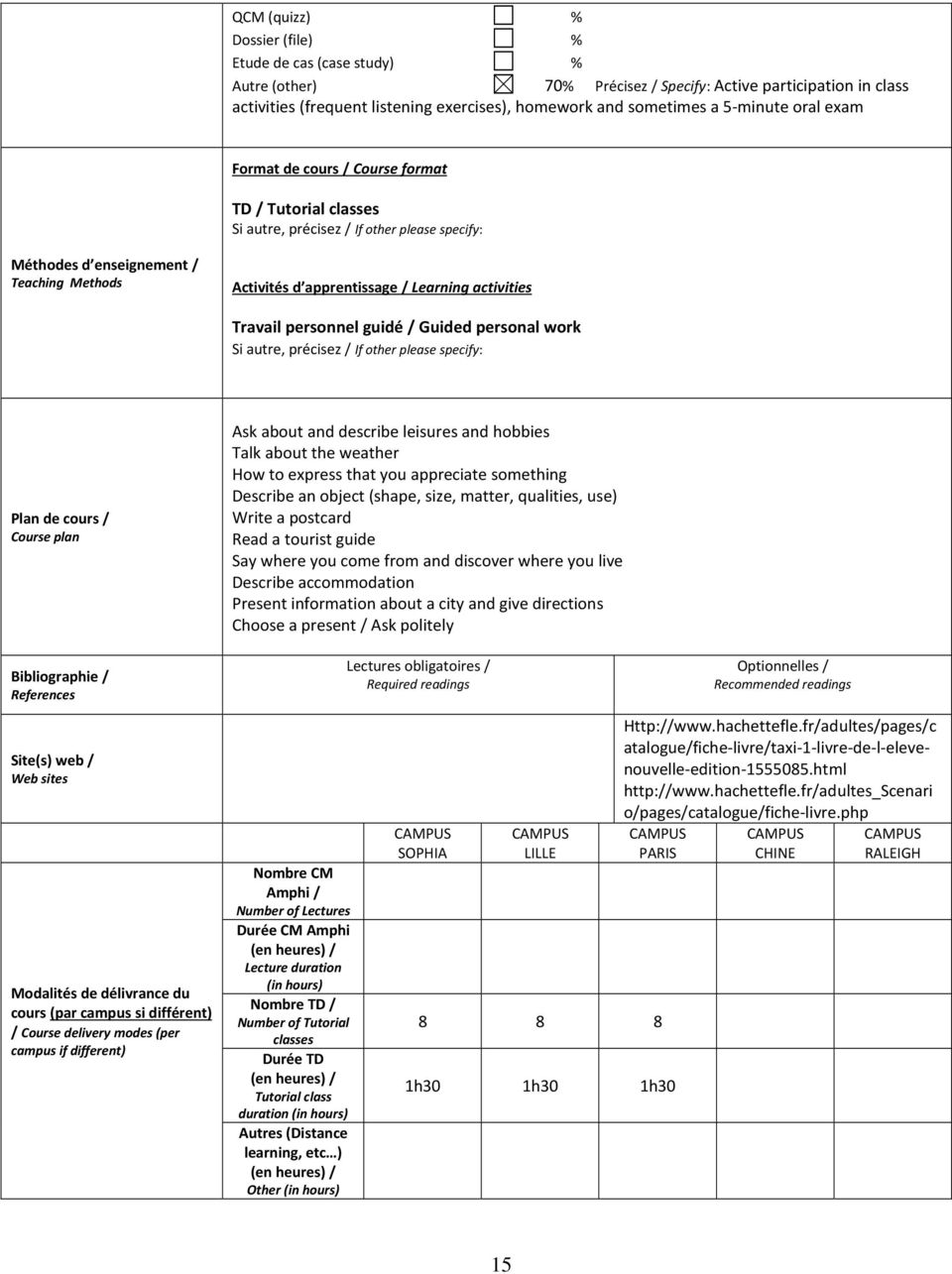
15 Dossier (file) % Etude de cas (case study) % Autre (other) 70% Précisez / Specify: Active participation in class activities (frequent listening exercises), homework and sometimes a 5-minute oral exam Format de cours / Course format TD / Tutorial classes Si autre, précisez / If other please specify: Méthodes d enseignement / Teaching Methods Activités d apprentissage / Learning activities Travail personnel guidé / Guided personal work Si autre, précisez / If other please specify: Plan de cours / Course plan Bibliographie / References Ask about and describe leisures and hobbies Talk about the weather How to express that you appreciate something Describe an object (shape, size, matter, qualities, use) Write a postcard Read a tourist guide Say where you come from and discover where you live Describe accommodation Present information about a city and give directions Choose a present / Ask politely Lectures obligatoires / Required readings Optionnelles / Recommended readings Site(s) web / Web sites Modalités de délivrance du cours (par campus si différent) / Course delivery modes (per campus if different) Nombre CM Amphi / Number of Lectures Durée CM Amphi Lecture duration (in hours) Nombre TD / Number of Tutorial classes Durée TD Tutorial class duration (in hours) Autres (Distance learning, etc ) Other (in hours) atalogue/fiche-livre/taxi-1-livre-de-l-elevenouvelle-edition html o/pages/catalogue/fiche-livre.php h30 1h30 1h30 CHINE 15
16 Préciser les spécificités de programmation (TD journée, cadencement spécifique des séances) / Specify if full-day tutorial class, different schedules MSc in Corporate Financial Management 1. Project: Value Creation and Performance Management CODE DU COURS / COURSE CODE MSC.CFMM2.FICOR.0023 Crédits / 4 Credits Charge de travail / Student workload Programme / Program Face à face / Contact Hours MSc Automne / Fall NOM DU COURS / COURSE NAME Project Value Creation and Performance Management Distanciel / Distance learning Période d enseignement / Teaching period Autonomous Personal &/or Team work Printemps / Spring Evaluation / Evaluation Durée totale / Total Nbh : 27 Nbh : Nbh : 54 Nbh : 27 Nbh : 108 Si MS précisez / If MS, please specify : Si MSc précisez / If MSc, please specify : MSc Corporate Financial Management Département / Department Type de cours / Course type Campus / Campus Cours ouvert aux étudiants en échanges in / Course open to students in exchange Langue d enseignement / Teaching Language Pré-requis / Prerequisite Responsable du cours / Course Coordinator Noms des Intervenant(s) par campus/ Instructor(s) Names by campus Evaluateur(s) / Evaluator(s) Description du cours / Course description Finance, compta, contrôle / Finance and Accounting Commun / Core Electif / Elective Optionnel /Optional SUZHOU OUI / YES English NON / NO Good understanding of Corporate Finance from Fall Semester Torben SOMMER Torben SOMMER Torben SOMMER Torben SOMMER, Arnaud HOFFSTETTER Arnaud HOFFSTETTER SUZHOU Court paragraphe de présentation des grands objectifs et de la thématique 16

17 Short presentation of the course (objectives & themes) Students as future managers will quickly learn the practical aspect of their jobs. From experience you will learn how to cope with routine problems. However in the fast changing global world students need to understand how to cope with CHANGE more than time-honored rules of thumb. You must understand why companies behave the way they do. You need theory of finance to understand what financial managers should do to increase company value and Project Value Creation is fundamental for you to learn how to select projects that creates value for the firm's shareholders that you in the future will be responsible for. Résultats d apprentissage / Learning Outcomes Contribution aux objectifs pédagogiques du programme / Contribution to learning objectives Connaissances / Knowledge and Understanding (subject specific) The student is expected to: PARTICIPATE IN MATURE DISCUSSION ON PROJECT VALUATION Aptitudes cognitives / Cognitive/Intellectual skills (generic) The student is expected to: UNDERSTAND FINANCE AT MSc 2 level Attitudes / Key transferable skills (generic) The student is expected to: MODEL CAPACITY IN EXCEL Compétences pratiques / Practical skills (subject specific) A l issue de la formation, l étudiant devrait être capable : The student is expected to: BE ABLE TO BUILT OWN PROJECT Indiquer les learning objectives auxquels contribue le cours (en se basant sur le curriculum mapping du programme) / Indicate which learning objectives the course contributes to (based on the program curriculum mapping) LO1.2 To select the best course of action to follow in order to behave as responsible managers LO3.1 To produce clear, well organized verbal presentations LO3.2 To produce clear, well organized written communication LO5.2 To assess a business issue and formulate solutions in a specialized discipline Evaluation finale (DS) / Final examination Evaluation des étudiants / Student Assessment Etude de cas (Case study) % Questions (Questions) % Exercices (Exercises) % Autre (Other) 60% Précisez / Specify: PROJECT Contrôle continu / Continuous Assessment Présentation orale (oral presentation) 30% Dossier (file) % Etude de cas (case study) % Autre (other) 10% Précisez / Specify: PARTICIPATION Format de cours / Course format Méthodes d enseignement / Teaching Methods TD/tutorial sessions Si autre, précisez / If other please specify: Activités d apprentissage / Learning activities 17

18 Projet / Project Si autre, précisez / If other please specify: Plan de cours / Course plan Bibliographie / References Site(s) web / Web sites 1. Introduction to the clean energy industry. Building wind project off shore. Case study. Solar and 2. Wind industry boom and bust. 3. Project initiation, Strategic management and Project selection 4. The Project Manager, Case study: The Channel Tunnel 5. The project Activity and Risk Planning, Case study Caprico 6. Budgeting: Estimation Costs and Risks, Oresund Bridge, Nuclear Facility. 7. Project Execution: Monitoring (IT), Project control. 8. Project Auditing and Project Termination 9. Presentation of individual case project of Wind or Solar Plant Lectures obligatoires / Required readings Required reading Mantel, Meredith, (2012), Project Management, A Managerial Approach, 8th Edition, Wiley & Co Principles of Corporate Finance - Global Edition by Richard A.Brealey, Stewart C Myers, and Franklin Allen (Paperback -10th Edition, 2011) McGrawHill, Damodaran, A, (2012), Investment Analysis, Tools and Techniques for Determining the Value of Any Assets. 3rd edition, Wiley & Co. Optionnelles / Recommended readings Modalités de délivrance du cours (par campus si différent) / Course delivery modes (per campus if different) Nombre CM Amphi / Number of Lectures Durée CM Amphi Lecture duration (in hours) Nombre TD / Number of Tutorial classes Durée TD Tutorial class duration (in hours) Autres (Distance learning, etc ) Other (in hours) Préciser les spécificités de programmation (TD journée, cadencement spécifique des séances) / Specify if full-day tutorial class, different schedules CHINE 18

19 2. Financial Modelling with Excel CODE DU COURS / COURSE CODE MSC.CFMM2.FICOR.0024 Crédits / 4 Credits Charge de travail / Student workload Face à face / Contact Hours Automne / Fall Distanciel / Distance learning NOM DU COURS / COURSE NAME Financial Modeling with Excel Période d enseignement / Teaching period Autonomous Personal &/or Team work Printemps / Spring Evaluation / Evaluation Nbh : Nbh : Nbh : Nbh : Nbh : Durée totale / Total Programme / Program Si MS précisez / If MS, please specify : Si MSc précisez / If MSc, please specify : MSc Corporate Financial Management Département / Department Type de cours / Course type Campus / Campus Cours ouvert aux étudiants en échanges in / Course open to students in exchange Langue d enseignement / Teaching Language Pré-requis / Prerequisite Responsable du cours / Course Coordinator Noms des Intervenant(s) par campus/ Instructor(s) Names by campus Evaluateur(s) / Evaluator(s) Finance, compta, contrôle / Finance and Accounting Commun / Core Electif / Elective Optionnel /Optional SUZHOU OUI / YES English Torben SOMMER Marieke DELANGHE NON / NO Torben SOMMER Torben SOMMER, Marieke DELANGHE Torben SOMMER SUZHOU Court paragraphe de présentation des grands objectifs et de la thématique Description du cours / Course description Short presentation of the course (objectives & themes) The course is intended to strengthen financial techniques in corporate finance and develop your analytical skills. It brings together many of the concepts and techniques taught in many of the first semester courses. Résultats d apprentissage / Learning Outcomes Connaissances / Knowledge and Understanding (subject specific) The student is expected to: The course is intended to strengthen financial techniques in corporate finance and develop your analytical skills. Aptitudes cognitives / Cognitive/Intellectual skills (generic) The student is expected to: Implement financial models using Excel Attitudes / Key transferable skills (generic) 19

20 Contribution aux objectifs pédagogiques du programme / Contribution to learning objectives The student is expected to: Acquire a good knowledge of Excel, VBA programming Have practical experience of applications in corporate finance Compétences pratiques / Practical skills (subject specific) A l issue de la formation, l étudiant devrait être capable : The student is expected to: Be able to do DCF and company valuations as well as capital budgeting and financial forecasting using Excel Indiquer les learning objectives auxquels contribue le cours (en se basant sur le curriculum mapping du programme) / Indicate which learning objectives the course contributes to (based on the program curriculum mapping) LO3.2 To produce clear, well organized written communication LO3.3 To understand in detail extended speech and complex texts in English LO5.1 To analyze and apply advanced concepts in finance Evaluation finale (DS) / Final examination Evaluation des étudiants / Student Assessment Etude de cas (Case study) 100% Questions (Questions) % Exercices (Exercises) % Autre (Other) % Précisez / Specify: Contrôle continu / Continuous Assessment Présentation orale (oral presentation) % Dossier (file) % Etude de cas (case study) % Autre (other) % Précisez / Specify: Format de cours / Course format Méthodes d enseignement / Teaching Methods Cours magistral / Lecture Si autre, précisez / If other please specify: Activités d apprentissage / Learning activities Si autre, précisez / If other please specify: Plan de cours / Course plan Bibliographie / References This course is designed to simulate a business working environment. You will be given problem solving assignments where you are instructed to take an issue and come back with a solution. Lectures obligatoires / Optionnelles / Required readings Recommended readings Site(s) web / Web sites CHINE 20

21 Modalités de délivrance du cours (par campus si différent) / Course delivery modes (per campus if different) Nombre CM Amphi / Number of Lectures Durée CM Amphi Lecture duration (in hours) Nombre TD / Number of Tutorial classes Durée TD Tutorial class duration (in hours) Autres (Distance learning, etc ) Other (in hours) Préciser les spécificités de programmation (TD journée, cadencement spécifique des séances) / Specify if full-day tutorial class, different schedules Intangible Assets Valuation CODE DU COURS / COURSE CODE MSC.CFMM2.FICOR.0025 Crédits / 2 Credits Charge de travail / Student workload Face à face / Contact Hours Automne / Fall Distanciel / Distance learning NOM DU COURS / COURSE NAME Intangible Asset Valuation Période d enseignement / Teaching period Autonomous Personal &/or Team work Printemps / Spring Evaluation / Evaluation Nbh : 12 Nbh : Nbh : Nbh : Nbh : Durée totale / Total Programme / Program Si MS précisez / If MS, please specify : Si MSc précisez / If MSc, please specify : MSc Corporate Financial Management Département / Department Type de cours / Course type Campus / Campus Cours ouvert aux étudiants en échanges in / Course open to students in exchange Langue d enseignement / Teaching Language Finance, compta, contrôle / Finance and Accounting Commun / Core Electif / Elective Optionnel /Optional Lille and Sophia Paris SUZHOU OUI / YES English NON / NO 21
22 Pré-requis / Prerequisite Responsable du cours / Course Coordinator Noms des Intervenant(s) par campus/ Instructor(s) Names by campus Evaluateur(s) / Evaluator(s) Danny LEIWY Saqib AZIZ Danny LEIWY Danny LEIWY, Saqib AZIZ, Krishna PAUDYAL Krishna Paudyal SUZHOU Court paragraphe de présentation des grands objectifs et de la thématique Description du cours / Course description Short presentation of the course (objectives & themes) This course examines the meaning of intangible assets, when and how they arise and are accounted for in published company financial statements, their implications for the analysis of the performance of company financial statements. Résultats d apprentissage / Learning Outcomes Contribution aux objectifs pédagogiques du programme / Contribution to learning objectives Connaissances / Knowledge and Understanding (subject specific) The student is expected to: Have worked through examples of how to value intangible assets Aptitudes cognitives / Cognitive/Intellectual skills (generic) The student is expected to: Understand how to evaluate Brands, Intellectual Capital, Information on databases, Efficient processes, Product innovation, Customer loyalty and Societal and political approval. Attitudes / Key transferable skills (generic) The student is expected to: Understand accounting and other issues underlying intangible asset valuation Compétences pratiques / Practical skills (subject specific) A l issue de la formation, l étudiant devrait être capable : The student is expected to: Understand the importance of and techniques for valuing intangible assets. Indiquer les learning objectives auxquels contribue le cours (en se basant sur le curriculum mapping du programme) / Indicate which learning objectives the course contributes to (based on the program curriculum mapping) LO4.2 To apply theories and key concepts in the field of the management of knowledge assets, technological progress and innovation LO5.2 To assess a business issue and formulate solutions in a specialized discipline Evaluation finale (DS) / Final examination Evaluation des étudiants / Student Assessment Etude de cas (Case study) 100% Questions (Questions) % Exercices (Exercises) % Autre (Other) % Précisez / Specify: Contrôle continu / Continuous Assessment Présentation orale (oral presentation) % Dossier (file) % Etude de cas (case study) % Autre (other) % Précisez / Specify: 22
23 Format de cours / Course format Méthodes d enseignement / Teaching Methods Cours magistral / Lecture Si autre, précisez / If other please specify: Activités d apprentissage / Learning activities Si autre, précisez / If other please specify: Sessions 1 and 2: Revision of the two main financial statements : the statement of financial position The income statement Plan de cours / Course plan The purpose and production of group accounts Sessions 3 and 4 : Accounting for intangible assets, including goodwill, brands, research and development costs, impairment of intangible assets Session 5 : examination Bibliographie / References Site(s) web / Web sites Lectures obligatoires / Required readings Main text : Melville A "International Financial Reporting: A Practical Guide" 3rd edition FT Prentice Hall, Harlow, 2011 ISBN Chapters 6, 7, 9, 18 and 19 Introductory text: Leiwy D and Perks R Accounting: Understanding & Practice 4th edition McGraw-Hill, Maidenhead, 2013 ISBN: Chapters 1-10 Optionnelles / Recommended readings IFRS 3, IAS 16, 17, 27, 36, 38 Annual Report for Shareholders Modalités de délivrance du cours (par campus si différent) / Course delivery modes (per campus if different) Nombre CM Amphi / Number of Lectures Durée CM Amphi Lecture duration (in hours) Nombre TD / Number of Tutorial classes Durée TD Tutorial class duration (in hours) Autres (Distance learning, etc ) Other (in hours) CHINE 23
24 Préciser les spécificités de programmation (TD journée, cadencement spécifique des séances) / Specify if full-day tutorial class, different schedules 4. Corporate Risk Management CODE DU COURS / COURSE CODE MSC.CFMM2.FICOR.0026 Crédits / Credits Charge de travail / Student workload Programme / Program Face à face / Contact Hours MSc Automne / Fall NOM DU COURS / COURSE NAME Corporate Financial Risk Management Distanciel / Distance learning Période d enseignement / Teaching period Autonomous Personal &/or Team work Printemps / Spring Evaluation / Evaluation Durée totale / Total Nbh : Nbh : Nbh : 27 Nbh : 2 Nbh : 56 Si MS précisez / If MS, please specify : Si MSc précisez / If MSc, please specify : MSc Corporate Financial Management Département / Department Type de cours / Course type Campus / Campus Cours ouvert aux étudiants en échanges in / Course open to students in exchange Langue d enseignement / Teaching Language Pré-requis / Prerequisite Responsable du cours / Course Coordinator Noms des Intervenant(s) par campus/ Instructor(s) Names by campus Evaluateur(s) / Evaluator(s) Finance, compta, contrôle / Finance and Accounting Commun / Core Electif / Elective Optionnel /Optional SUZHOU OUI / YES English NON / NO International financial economics, Financial mathematics Roberto J. Santillán-Salgado Roberto J. Santillán-Salgado Roberto J. Santillán-Salgado Roberto J. Santillán-Salgado, Devraj BASU Devraj BASU and Andrew MARSHALL SUZHOU Court paragraphe de présentation des grands objectifs et de la thématique Description du cours / Course description Short presentation of the course (objectives & themes) The most frequent users of risk management techniques are trading operations and the treasury office. But many other areas of the firm are also involved in risk management; e.g., the marketing 24
25 department designs types of contracts for customers that share risk; business unit managers evaluate projects with different risk characteristics, and decide on ways to alter projects so as to minimize risk without sacrificing return, etc. The tax, legal, and accounting departments are also concerned with risk, with hedging, and with corporate governance. At the highest level of the company key questions about the firm's strategy and its ability to fund its operations must be answered with an eye on the risks of each alternative and strategic decisions that can secure the greatest value for shareholders. Résultats d apprentissage / Learning Outcomes Contribution aux objectifs pédagogiques du programme / Contribution to learning objectives Connaissances / Knowledge and Understanding (subject specific) The student is expected to: Understand the nature of a company's exposure to different risk drivers, as well as the principles that underlie the important decision of whether to hedge those risks or not. Aptitudes cognitives / Cognitive/Intellectual skills (generic) The student is expected to: Understand why risk cannot be totally eliminated, but that it can be appropriately managed. Attitudes / Key transferable skills (generic) The student is expected to: Get a clear awareness of the importance to manage the exposure to different types of risk. Compétences pratiques / Practical skills (subject specific) A l issue de la formation, l étudiant devrait être capable : The student is expected to: Dentify and quantify a firm's exposure to different types of Market, Operating and Credit risks; decide when to hedge an how to do it. Indiquer les learning objectives auxquels contribue le cours (en se basant sur le curriculum mapping du programme) / Indicate which learning objectives the course contributes to (based on the program curriculum mapping) LO1.2 To select the best course of action to follow in order to behave as responsible managers LO5.1 To analyze and apply advanced concepts in a specialized discipline LO5.2 To assess a business issue and formulate solutions in a specialized discipline Evaluation finale (DS) / Final examination Evaluation des étudiants / Student Assessment Etude de cas (Case study) 40% Questions (Questions) % Exercices (Exercises) % Autre (Other) % Précisez / Specify: Contrôle continu / Continuous Assessment Présentation orale (oral presentation) % Dossier (file) % Etude de cas (case study) 60% Autre (other) % Précisez / Specify: Méthodes d enseignement / Teaching Methods Format de cours / Course format Cours magistral / Lecture Si autre, précisez / If other please specify: 25
26 Activités d apprentissage / Learning activities Travail perso. autonome / Autonomous personal work Si autre, précisez / If other please specify: Plan de cours / Course plan I. Introductory ideas on Financial Risk Management in the Corporation a. Brief antecedents of the Risk Management discipline. b. What is Risk Management in the Corporation? c. When should managers consider using risk management strategies? d. What are the Corporate Governance implications of risk management and how can they be sorted out? II. Different types of Risk Management 1. Market Risk Management a. Introduction to Financial Market Risk b. VAR as downside risk c. VAR and CAR definitions d. Other measures of risk (betas, spreads, agency ratings) e. Portfolio positions and the identification of risk factors 2. Credit Risk Management a. Measurement of Credit Risk b. Settlement Risk c. Joint Events d. Risk diversification in credit portfolios 3. Operating Risk Management a. Detection of risk sources b. Measurement of risk exposures c. Protection against different types of risks d. A comprehensive view of operating risk management III. Risk Management in Practice 4. Derivatives and Risk Management a. Overview of Derivatives b. Forwards c. Futures d. Swaps e. Options 5. Futures, Forwards and Swaps markets, uses and limitations a. Marking to market b. Trading in futures c. Fine tuning of positions: the hedge ratio d. Similarities and differences between Futures and Forwards contracts. e. Swaps as a bundle of forwards, their operation, uses, limitations and conventions. 6. Options Contracts and utilization a. Basic Options: calls and puts b. Put-Call parity c. Combinations of Options (options strategies) d. Valuation of Options: analytical solution and numerical methods 7. Currencies and Commodities markets a. Currency markets: the present international monetary system b. Exchange rate determination: is it possible to predict the exchange rate? c. Transaction exposure to exchange rates d. Economic exposure to exchange rates e. Commodities markets f. Pricing of futures in commodities markets Bibliographie / References Lectures obligatoires / Required readings Optionnelles / Recommended readings 26
27 Required book: John Marthinsen, Risk Takers: Uses and Abuses of Financial Derivatives, Pearson-Addison Wesley, (real-world cases on risk management) Additional Readings (copies are available for the student) 1. Brief antecedents of the Risk Management discipline. Recommended reading: Bernstein, Peter L. (1996), The new religion of Risk Management, HBR, March-April. OK 2. What is Risk Management in the Corporation? Recommended reading: Smithson, Charles W. (1999), Managing Risk in the Industrial Company, in Risk Management: Principles and Practices, AIMR Conference Proceedings. OK 3. When should managers consider using risk management strategies? Recommended readings: Graham, John R. and Clifford W. Smith, Jr. (1999) Tax Incentives to Hedge, The Journal of Finance, Vol. 54, No. 6, pp OK 4. What are the Corporate Governance implications of risk management and how can they be sorted out? Recommended Reading: Tufano, Peter (1998), Agency Costs of Corporate Risk Management, Financial Management, Spring, pp OK Recommended reference textbook: John Hull, Options, Futures and Other Derivatives, Eighth Edition, Pearson-Prentice Hall. Site(s) web / Web sites Modalités de délivrance du cours (par campus si différent) / Course delivery modes (per campus if different) Nombre CM Amphi / Number of Lectures Durée CM Amphi Lecture duration (in hours) Nombre TD / Number of Tutorial classes Durée TD Tutorial class duration (in hours) Autres (Distance learning, etc ) Other (in hours) CHINE 27
28 Préciser les spécificités de programmation (TD journée, cadencement spécifique des séances) / Specify if full-day tutorial class, different schedules 5. Reporting and Financial Communication CODE DU COURS / COURSE CODE MSC.CFMM2.FICOR.0027 Crédits / 4 Credits Charge de travail / Student workload Face à face / Contact Hours NOM DU COURS / COURSE NAME REPORTING & FINANCIAL COMMUNICATION AND Automne / Fall Distanciel / Distance learning Période d enseignement / Teaching period Autonomous Personal &/or Team work Printemps / Spring Evaluation / Evaluation Nbh : Nbh : Nbh : Nbh : Nbh : Durée totale / Total Programme / Program Si MS précisez / If MS, please specify : Si MSc précisez / If MSc, please specify : MSc Corporate Financial Management Département / Department Type de cours / Course type Campus / Campus Cours ouvert aux étudiants en échanges in / Course open to students in exchange Langue d enseignement / Teaching Language Pré-requis / Prerequisite Responsable du cours / Course Coordinator Noms des Intervenant(s) par campus/ Instructor(s) Names by campus Evaluateur(s) / Evaluator(s) Finance, compta, contrôle / Finance and Accounting Commun / Core Electif / Elective Optionnel /Optional SUZHOU OUI / YES English Céline BOUQUEREL Céline BOUQUEREL Céline BOUQUEREL NON / NO Céline BOUQUEREL SUZHOU Court paragraphe de présentation des grands objectifs et de la thématique Description du cours / Course description Short presentation of the course (objectives & themes) Accurate, transparent and up-to-date information toward financial markets is becoming increasingly key for companies as soon as they seek new financing resources on the market, via either equity or debt issuance. 28
29 This module will review the process of financial communication inside corporations, from operational reporting to investors and analysts relations. Based on real cases, the course will review the regulatory framework, the main topics of financial communication (accounting, financial forecasts, corporate governance, strategy and business models, corporate responsibility ) and the key events in the life of publicly traded companies (IPO, M&A, profit warning ). The main aim of this module is to raise students awareness of how going public not only impacts day-to-day activity of corporate financial teams, but also raises specific strategic and outbound communication issues. Résultats d apprentissage / Learning Outcomes Contribution aux objectifs pédagogiques du programme / Contribution to learning objectives Connaissances / Knowledge and Understanding (subject specific) The student is expected to: Understand the strategic issues raised by the position of publicly traded company and the communication with financial markets Distinguish the various targets of financial communications and their expectations Identify the value chain of financial communication inside and outside the company Be aware of the specific regulatory framework of financial communication Aptitudes cognitives / Cognitive/Intellectual skills (generic) The student is expected to: Seek and analyze financial information disclosed by corporations Identify the point from where the information is issued and the biases induced. Attitudes / Key transferable skills (generic) The student is expected to: Have improved ability to speak in public. Compétences pratiques / Practical skills (subject specific) A l issue de la formation, l étudiant devrait être capable : The student is expected to: Conceptualize and perform a corporate presentation for a financial audience Indiquer les learning objectives auxquels contribue le cours (en se basant sur le curriculum mapping du programme) / Indicate which learning objectives the course contributes to (based on the program curriculum mapping) LO1.1: To recognize potential ethical dilemmas LO1.2 To select the best course of action to follow in order to behave as responsible managers LO2.1 To contribute substantively to the product of a group and demonstrate leadership skill LO3.1 To produce clear, well organized verbal presentations LO3.2 To produce clear, well organized written communication Evaluation finale (DS) / Final examination Evaluation des étudiants / Student Assessment QCM (quizz) 40% Etude de cas (Case study) % Questions (Questions) % Exercices (Exercises) % Autre (Other) % Précisez / Specify: Contrôle continu / Continuous Assessment Présentation orale (oral presentation) 50% 29
30 Dossier (file) % Etude de cas (case study) % Autre (other) 10% Précisez / Specify: Course attendance Oral presentation : Having established teams of 3, students will have to prepare and make an oral presentation of a listed company. This presentation is targeting Financial investors and shall provide any key information required to understand the company, its activities, financial performance, strategic issues and governance. Evaluation will take into account content, graphic presentation, oral performance and group cohesion. Format de cours / Course format Méthodes d enseignement / Teaching Methods Tutorat / Tutorial sessions Si autre, précisez / If other please specify: Activités d apprentissage / Learning activities Etude de cas / Case studies Si autre, précisez / If other please specify: 1- Introduction: definition of financial communication, strategic issues for corporations 2- The position of financial communication inside corporations Ethical principles, corporate organisation, job description of an Investor Relations Officer (IRO) Internal processes for information production, certification and release; risks and responsibilities Global view of relationships between the company and the financial market 3- Relationship between financial communication and valuation of the firm General organisation of the Stock Exchange Financial regulation and specific laws applying to publicly traded companies Main target of financial communication: retail investors, asset managers, brokers, media Plan de cours / Course plan 4- Key events of financial communication Disclose financial data Disclose non-financial data Key information materials Market operations 5- Daily organisation of financial communication Manage relationships with the top executives and the Board Manage relationships with analysts, investors, shareholders Manage the consensus Identify and target investors Establish a financial communication plan 6- CSR and financial communication CSR Communication: key issues and current evolution Who is concerned by CSR communication and how they use it 30
31 Bibliographie / References Site(s) web / Web sites Specific issues of CSR Communication : build-up and secure an extra-financial reporting Legal and corporate risks related to CSR Communication Optionnelles / Recommended readings Cadre et pratiques de la communication financière Ouvrage collectif, Observatoire de la Communication Financière Lexique de la communication financière Ouvrage collectif, Observatoire de la Communication Financière La communication financière Anne Guimard - Economica Communication financière Jean-Christophe Vidal, Pierre Mudet - Lefebvre Françis 2011 Gouvernement d entreprise et communication financière Bernard Marois, Patrick Bompoint - Lectures obligatoires / Economica Required readings Gouvernance et communication financière A. Mourot, Y. Brissy, D.Guigou - Ed. d organisation La communication financière Jean-Yves Léger - Dunod Les clés d un parcours boursier réussi Catherine Kablé - Gualino Middlenext guides La gestion de l information privilégiée et la prévention des manquements d initiés - déc L ISR et le Développement Durable pour les valeurs moyennes - Mars 2011 Code de gouvernement des entreprises pour les valeurs moyennes et petites - déc Sociétés cotées : comment organiser l information financière sur votre site Internet? nov Modalités de délivrance du cours (par campus si différent) / Course delivery modes (per campus if different) Nombre CM Amphi / Number of Lectures Durée CM Amphi Lecture duration (in hours) Nombre TD / Number of Tutorial classes Durée TD Tutorial class duration (in hours) CHINE 31
32 Autres (Distance learning, etc ) Other (in hours) Préciser les spécificités de programmation (TD journée, cadencement spécifique des séances) / Specify if full-day tutorial class, different schedules 6. Banking Relations CODE DU COURS / COURSE CODE MSC.CFMM2.FICOR.0028 Crédits / Credits Charge de travail / Student workload Programme / Program Face à face / Contact Hours MSc Automne / Fall NOM DU COURS / COURSE NAME BANKING RELATIONS AND Distanciel / Distance learning Période d enseignement / Teaching period Autonomous Personal &/or Team work Printemps / Spring Evaluation / Evaluation Durée totale / Total Nbh : 30 Nbh : Nbh : Nbh : Nbh : 30 Si MS précisez / If MS, please specify : Si MSc précisez / If MSc, please specify : MSc Corporate Financial Management Département / Department Type de cours / Course type Campus / Campus Cours ouvert aux étudiants en échanges in / Course open to students in exchange Langue d enseignement / Teaching Language Pré-requis / Prerequisite Responsable du cours / Course Coordinator Noms des Intervenant(s) par campus/ Instructor(s) Names by campus Evaluateur(s) / Evaluator(s) Description du cours / Course description Finance, compta, contrôle / Finance and Accounting Commun / Core Electif / Elective Optionnel /Optional SUZHOU OUI / YES English a basic course in microeconomics Pr F LOBEZ Pr F LOBEZ NON / NO Pr F LOBEZ, Abdelhafid BENHAMRAOUI Abdelhafid BENHAMRAOUI SUZHOU Court paragraphe de présentation des grands objectifs et de la thématique 32
33 Short presentation of the course (objectives & themes) To understand from a theoretical viewpoint the relationships between banks and households, banks and firms, banks and markets, banks and supervisors. Résultats d apprentissage / Learning Outcomes Contribution aux objectifs pédagogiques du programme / Contribution to learning objectives Connaissances / Knowledge and Understanding (subject specific) The student is expected to: The student is expected to understand: -why banks exist and how indirect financing (banks) differs from direct financing (markets); -how banks and markets are complementary rather than perfect substitutes; -the structure of bank loan contracts; -the risky nature of the bank deposit contract; -how to price fair loan risk premiums; -why banks take risky position; -how to regulate the banking system Aptitudes cognitives / Cognitive/Intellectual skills (generic) The student is expected to: Attitudes / Key transferable skills (generic) The student is expected to: Compétences pratiques / Practical skills (subject specific) A l issue de la formation, l étudiant devrait être capable : The student is expected to: Indiquer les learning objectives auxquels contribue le cours (en se basant sur le curriculum mapping du programme) / Indicate which learning objectives the course contributes to (based on the program curriculum mapping) LO1.1 To recognize potential ethical dilemmas LO5.1 To analyze and apply advanced concepts in a specialized discipline Evaluation finale (DS) / Final examination Evaluation des étudiants / Student Assessment Etude de cas (Case study) % Questions (Questions) 100% Exercices (Exercises) % Autre (Other) % Précisez / Specify: Contrôle continu / Continuous Assessment Présentation orale (oral presentation) % Dossier (file) % Etude de cas (case study) % Autre (other) % Précisez / Specify: Format de cours / Course format Méthodes d enseignement / Teaching Methods Cours magistral / Lecture Si autre, précisez / If other please specify: Activités d apprentissage / Learning activities 33
34 Travail perso. autonome / Autonomous personal work Si autre, précisez / If other please specify: 1. INTRODUCTION (2 hrs) a. Banks in the financial system b. Some interesting questions 2. THE BANK FIRM RELATIONSHIPS (20 hrs) a. Banks exist because they produce reliable information on firms (4 hrs) i. The signaling hypothesis ii. The Leland Pyle model iii. Do banks really produce reliable information? b. The loan contract in perfect markets (4 hrs) i. Black and Scholes and the pricing of corporate liabilities ii. Merton and the pricing of the fair credit risk premium Plan de cours / Course plan c. The loan contract in imperfect markets (8 hrs) i. Loan rate and credit rationing in credit market with imperfect information : The Stiglitz Weiss model ii. Loan rate and credit rationing with implicit contracts : the Fried Howitt model iii. Guarantees as a screening device : the Bester Model d. How should a firm structure its bank pool?(4 hrs) i. Hard and soft information ii. The benefits of long term relationships iii. The optimal structure of the pool of banks 3. BANK, LIQUIDITY, AND RISKS (8 hrs) a. The relationships between banks and households (4 hrs) i. The deposit contract as an implicit insurance against the liquidity risk ii. Bank runs as a bad equilibrium iii. How to prevent bank runs? The deposit insurance b. The relationships between banks and markets (4 hrs) i. How to understand the need for securitization? ii. How to understand the need for speculation? iii. The foundations of bank regulation CONCLUSION Bibliographie / References Site(s) web / Web sites Lectures obligatoires / Required readings Optionnelles / Recommended readings LOBEZ,F., VILANOVA,L.,. MICROECONOMIE BANCAIRE. PUF, Modalités de délivrance du cours (par campus si différent) Nombre CM Amphi / Number of Lectures CHINE 34
35 / Course delivery modes (per campus if different) Durée CM Amphi Lecture duration (in hours) Nombre TD / Number of Tutorial classes Durée TD Tutorial class duration (in hours) Autres (Distance learning, etc ) Other (in hours) Préciser les spécificités de programmation (TD journée, cadencement spécifique des séances) / Specify if full-day tutorial class, different schedules Governance and Risk Management CODE DU COURS / COURSE CODE MSC.CFMM2.FICOR.0029 Crédits / 2 Credits Charge de travail / Student workload Face à face / Contact Hours Automne / Fall NOM DU COURS / COURSE NAME Governance and Risk Management Distanciel / Distance learning Période d enseignement / Teaching period Autonomous Personal &/or Team work Printemps / Spring Evaluation / Evaluation Nbh : Nbh : Nbh : Nbh : Nbh : Durée totale / Total Programme / Program Si MS précisez / If MS, please specify : Si MSc précisez / If MSc, please specify : MSc Corporate Financial Management Département / Department Type de cours / Course type Campus / Campus Cours ouvert aux étudiants en échanges in / Course open to students in exchange Langue d enseignement / Teaching Language Pré-requis / Prerequisite Finance, compta, contrôle / Finance and Accounting Commun / Core Electif / Elective Optionnel /Optional SUZHOU OUI / YES NON / NO English 35
36 Responsable du cours / Course Coordinator Noms des Intervenant(s) par campus/ Instructor(s) Names by campus Evaluateur(s) / Evaluator(s) Henrik LUTZEN Henrik LUTZEN Henrik LUTZEN Henrik LUTZEN, David HILLIER David HILLIER SUZHOU Court paragraphe de présentation des grands objectifs et de la thématique Description du cours / Course description Short presentation of the course (objectives & themes) The course describes the organization of a modern corporation, the separation of ownership from management, and the resulting agency issues. Corporate governance practice is discussed from different perspectives, such as executive incentives, monitoring and controlling functions/systems, shareholder/stakeholder activism, and reporting standards/regulations. A brief overview of international practices is also provided. Résultats d apprentissage / Learning Outcomes Contribution aux objectifs pédagogiques du programme / Contribution to learning objectives Connaissances / Knowledge and Understanding (subject specific) The student is expected to: Compare the different approaches used internationally, comparing codes of conduct versus legislation with particular reference to Sarbanes-Oxley and be able to evaluate theories associated with the development of Corporate Governance and Corporate Social Responsibility and look at agency theory in some depth Aptitudes cognitives / Cognitive/Intellectual skills (generic) The student is expected to: Evaluate Corporate Social sustainability and the triple bottom line, European versus alternative approaches to business ethics, Corporate Social Responsibility and corporate citizenship: the stakeholder theory of the firm, corporate accountability, and corporate citizenship Attitudes / Key transferable skills (generic) The student is expected to: Familiar with the different approaches used internationally, comparing codes of conduct versus legislation with particular reference to Sarbanes-Oxley Compétences pratiques / Practical skills (subject specific) A l issue de la formation, l étudiant devrait être capable : The student is expected to: Evaluate the risks faced by unethical and fraudulent activity both within the firm and by stakeholders outside the firm and understand the need for corporate governancce Indiquer les learning objectives auxquels contribue le cours (en se basant sur le curriculum mapping du programme) / Indicate which learning objectives the course contributes to (based on the program curriculum mapping) LO1.1 To recognize potential ethical dilemmas LO1.2 To select the best course of action to follow in order to behave as responsible managers LO2.1 To contribute substantively to the product of a group and demonstrate leadership skills LO2.2 To recognize and use positively the various dimensions of diversity LO5.2 To assess a business issue and formulate solutions in finance Evaluation finale (DS) / Final examination Evaluation des étudiants / Student Assessment Etude de cas (Case study) 100% Questions (Questions) % Exercices (Exercises) % Autre (Other) % Précisez / Specify: Contrôle continu / Continuous Assessment 36
37 Présentation orale (oral presentation) % Dossier (file) % Etude de cas (case study) % Autre (other) % Précisez / Specify: Format de cours / Course format Méthodes d enseignement / Teaching Methods Cours magistral / Lecture Si autre, précisez / If other please specify: Activités d apprentissage / Learning activities Si autre, précisez / If other please specify: Session 1 Corporate structure Owners and Stakeholders Topics Plan de cours / Course plan Bibliographie / References Site(s) web / Web sites Corporate Management Ownership and Control Agency Issues: Corporate Governance Monitoring Functions and Agencies Legislation and Government Take-overs and Mergers Moral Hazard and Systemic Risk Corporate Citizenship International Corporate Governance Case Lectures obligatoires / Required readings Kim, Nofsinger, Mohr: Corporate Governance, 3 rd Edition, Prentice Hall, 2010 Optionnelles / Recommended readings Bodie, Merton, Cleeton: Financial Economics, 2nd Ed., Pearson (2009). Chapter 1 Berk, DeMarzo: Corporate Finance, 2 nd Ed., Pearson (2011). Chapters 1, 29 Clarke, International Corporate Governance, (2007) Modalités de délivrance du cours (par campus si différent) / Course delivery modes (per campus if different) Nombre CM Amphi / Number of Lectures Durée CM Amphi Lecture duration (in hours) Nombre TD / Number of Tutorial classes Durée TD Tutorial class duration (in hours) CHINE 37
38 Autres (Distance learning, etc ) Other (in hours) Préciser les spécificités de programmation (TD journée, cadencement spécifique des séances) / Specify if full-day tutorial class, different schedules 8. Cross-Border Mergers CODE DU COURS / COURSE CODE Crédits / 2 Credits Charge de travail / Student workload Face à face / Contact Hours Automne / Fall Distanciel / Distance learning NOM DU COURS / COURSE NAME Cross Border Mergers Période d enseignement / Teaching period Autonomous Personal &/or Team work Printemps / Spring Evaluation / Evaluation Nbh : 15 Nbh : Nbh : Nbh : Nbh : Durée totale / Total Programme / Program Si MS précisez / If MS, please specify : Si MSc précisez / If MSc, please specify : MSc Corporate Financial Management Département / Department Type de cours / Course type Campus / Campus Cours ouvert aux étudiants en échanges in / Course open to students in exchange Langue d enseignement / Teaching Language Pré-requis / Prerequisite Responsable du cours / Course Coordinator Noms des Intervenant(s) par campus/ Instructor(s) Names by campus Evaluateur(s) / Evaluator(s) Description du cours / Course description Finance, compta, contrôle / Finance and Accounting Commun / Core Electif / Elective Optionnel /Optional SUZHOU OUI / YES English Devraj Basu Devraj Basu NON / NO Devraj Basu SUZHOU Court paragraphe de présentation des grands objectifs et de la thématique Short presentation of the course (objectives & themes) This course will build on the corporate restructuring course in the first semester and discuss the 38
39 main forces behind cross border mergers and acquisitions. A number of illustrative case studies will be discussed as well. Résultats d apprentissage / Learning Outcomes Contribution aux objectifs pédagogiques du programme / Contribution to learning objectives Connaissances / Knowledge and Understanding (subject specific) The student is expected to: Understand why and how cross border merger activities occur Aptitudes cognitives / Cognitive/Intellectual skills (generic) The student is expected to: How cross border mergers and acquisitions are shaping the global economy Attitudes / Key transferable skills (generic) The student is expected to: Understand the nature of cross border mergers. Compétences pratiques / Practical skills (subject specific) A l issue de la formation, l étudiant devrait être capable : The student is expected to: Strategic, legal and tax issues underlying cross border mergers Indiquer les learning objectives auxquels contribue le cours (en se basant sur le curriculum mapping du programme) / Indicate which learning objectives the course contributes to (based on the program curriculum mapping) LO1.1 To recognize potential ethical dilemmas LO1.2 To select the best course of action to follow in order to behave as responsible managers LO5.2 To assess a business issue and formulate solutions in a specialized discipline Evaluation finale (DS) / Final examination Evaluation des étudiants / Student Assessment Etude de cas (Case study) 100% Questions (Questions) % Exercices (Exercises) % Autre (Other) % Précisez / Specify: Contrôle continu / Continuous Assessment Présentation orale (oral presentation) % Dossier (file) % Etude de cas (case study) % Autre (other) % Précisez / Specify: Format de cours / Course format Méthodes d enseignement / Teaching Methods Cours magistral / Lecture Si autre, précisez / If other please specify: Activités d apprentissage / Learning activities Si autre, précisez / If other please specify: Plan de cours / Course plan This course will build on the corporate restructuring course in the first semester and discuss the main forces behind cross border mergers and acquisitions. A number of illustrative case studies will be discussed as well. 39
40 Bibliographie / References Site(s) web / Web sites Lectures obligatoires / Required readings Optionnelles / Recommended readings Materials made available on course website Modalités de délivrance du cours (par campus si différent) / Course delivery modes (per campus if different) Nombre CM Amphi / Number of Lectures Durée CM Amphi Lecture duration (in hours) Nombre TD / Number of Tutorial classes Durée TD Tutorial class duration (in hours) Autres (Distance learning, etc ) Other (in hours) Préciser les spécificités de programmation (TD journée, cadencement spécifique des séances) / Specify if full-day tutorial class, different schedules 5 3 CHINE MSc in Entrepreneurship and Innovation for a Sustainable World 1. Doing Business in High Tech CODE DU COURS / COURSE CODE MSC.EISM2.STELE.0023 Crédits / 2 Credits Charge de travail / Student workload Programme / Program Face à face / Contact Hours MSc Automne / Fall Nbh : 15 Nbh : NOM DU COURS / COURSE NAME Doing Business in High Tech Industry Distanciel / Distance learning Si MS précisez / If MS, please specify : Période d enseignement / Teaching period Autonomous Personal &/or Team work Printemps / Spring Evaluation / Evaluation Durée totale / Total Nbh : 15 Nbh : 1,5 Nbh : 31,5 Si MSc précisez / If MSc, please specify : MSc Entrepreneurship and Innovation 40
41 Département / Department Type de cours / Course type Campus / Campus Cours ouvert aux étudiants en échanges in / Course open to students in exchange Langue d enseignement / Teaching Language Pré-requis / Prerequisite Responsable du cours / Course Coordinator Noms des Intervenant(s) par campus/ Instructor(s) Names by campus Evaluateur(s) / Evaluator(s) Stratégie et Entrepreneuriat / Strategy and Entre. Commun / Core Electif / Elective Optionnel /Optional SUZHOU OUI / YES English Jean-Claude TAGGER Jean-Claude TAGGER NON / NO Jean-Claude TAGGER SUZHOU Court paragraphe de présentation des grands objectifs et de la thématique Description du cours / Course description Short presentation of the course (objectives & themes) This elective course aims at giving MSc students increased knowledge of the technology industry, one of the fastest moving and global ones. It will present an opportunity to utilize knowledge and develop skills acquired in Marketing, Strategy and Research Method courses Connaissances / Knowledge and Understanding (subject specific) The student is expected to: To get a deeper knowledge of the Industry and its future trends. This includes : -the understanding of the different types of players of the industry as well as associated business models. -Importance of interaction of technologies with most other industries. Résultats d apprentissage / Learning Outcomes Aptitudes cognitives / Cognitive/Intellectual skills (generic) The student is expected to: - Source data - Make a descriptive summary - Analyse information - Create recommendations - Formulate critical questions - Draw conclusions Attitudes / Key transferable skills (generic) The student is expected to: Collaborate with other team members on a project - Work effectively in a diversified team Compétences pratiques / Practical skills (subject specific) A l issue de la formation, l étudiant devrait être capable : The student is expected to: 41
42 Contribution aux objectifs pédagogiques du programme / Contribution to learning objectives Write a short business analysis document - Make a stand-up presentation - Ask pertinent questions about other studies Indiquer les learning objectives auxquels contribue le cours (en se basant sur le curriculum mapping du programme) / Indicate which learning objectives the course contributes to (based on the program curriculum mapping) LO4.1 To analyze globalization and evaluate its effects on business LO5.1 To analyze and apply advanced concepts in a specialized discipline Evaluation finale (DS) / Final examination Evaluation des étudiants / Student Assessment Etude de cas (Case study) % Questions (Questions) 50% Exercices (Exercises) % Autre (Other) % Précisez / Specify: Contrôle continu / Continuous Assessment Présentation orale (oral presentation) 25% Dossier (file) % Etude de cas (case study) 25% Autre (other) % Précisez / Specify: Format de cours / Course format Méthodes d enseignement / Teaching Methods Séminaire / Seminar Si autre, précisez / If other please specify: Activités d apprentissage / Learning activities Etude de cas / Case studies Si autre, précisez / If other please specify: Session 1 Overview Plan de cours / Course plan - Quick history of the industry - Some numbers - Most successful areas A little bit of technology - Convergence - Virtualization - Mobility - 3D 42
43 Routes to market - B2B vs B2C - Channel management Sessions 2 The various actors and their business models ( Big vendors, Software editor, Telecom Operators / ISP, System Integrators, Value Added Resellers, Distributors etc ) Session 3 and 4 Cloud Computing : a revolution or an evolution? Session 5 Bibliographie / References Site(s) web / Web sites Interaction with other Industries Other trends Lectures obligatoires / Required readings Optionnelles / Recommended readings Financial Times articles related to Technology Companies Corporate websites from main actors ( Microsoft, Google, HP, Intel,IBM, Dell, Verizon, AT&T, BT,Cisco, Alcatel, Nokia, Apple, Oracle, SAP, Acer, Samsung, Orange, etc ) Modalités de délivrance du cours (par campus si différent) / Course delivery modes (per campus if different) Nombre CM Amphi / Number of Lectures Durée CM Amphi Lecture duration (in hours) Nombre TD / Number of Tutorial classes Durée TD Tutorial class duration (in hours) Autres (Distance learning, etc ) Other (in hours) 5 3 CHINE 43
44 Préciser les spécificités de programmation (TD journée, cadencement spécifique des séances) / Specify if full-day tutorial class, different schedules Within one elective week 2. Solution-based Selling 3. CODE DU COURS / 4. COURSE CODE 5. MSC.EISM2.STCOR.0012 Crédits / 2 Credits Charge de travail / Student workload Programme / Program Face à face / Contact Hours MSc Automne / Fall Distanciel / Distance learning NOM DU COURS / COURSE NAME Solution Based Selling Période d enseignement / Teaching period Autonomous Personal &/or Team work Printemps / Spring Evaluation / Evaluation Durée totale / Total Nbh : 15 Nbh : Nbh : 15 Nbh : 1 Nbh : 31 Si MS précisez / If MS, please specify : Si MSc précisez / If MSc, please specify : MSc Entrepreneurship and Innovation Département / Department Type de cours / Course type Campus / Campus Cours ouvert aux étudiants en échanges in / Course open to students in exchange Langue d enseignement / Teaching Language Pré-requis / Prerequisite Responsable du cours / Course Coordinator Noms des Intervenant(s) par campus/ Instructor(s) Names by campus Evaluateur(s) / Evaluator(s) Stratégie et Entrepreneuriat / Strategy and Entre. Commun / Core Electif / Elective Optionnel /Optional SUZHOU OUI / YES English Jean-Claude TAGGER Jean-Claude TAGGER NON / NO Jean-Claude TAGGER SUZHOU Jean-Claude TAGGER Court paragraphe de présentation des grands objectifs et de la thématique Description du cours / Course description Short presentation of the course (objectives & themes) This course aims at giving MSc IE students practical knowledge on the sale function within a young company and associated required skillset. It will present an opportunity to utilize knowledge and develop skills acquired in Marketing, 44
45 Strategy and Research Method courses. Résultats d apprentissage / Learning Outcomes Contribution aux objectifs pédagogiques du programme / Contribution to learning objectives Connaissances / Knowledge and Understanding (subject specific) The student is expected to: Understand the challenges of the sale function as well as well as the basics of Sales Management. Aptitudes cognitives / Cognitive/Intellectual skills (generic) The student is expected to: - Source data - Make a descriptive summary - Analyse information - Create recommendations - Formulate critical questions - Draw conclusions Attitudes / Key transferable skills (generic) The student is expected to: - Collaborate with other team members on a project - Work effectively in a diversified team Compétences pratiques / Practical skills (subject specific) A l issue de la formation, l étudiant devrait être capable : The student is expected to: - Write a short business analysis document - Make a stand-up presentation - perfom a simple sales process Indiquer les learning objectives auxquels contribue le cours (en se basant sur le curriculum mapping du programme) / Indicate which learning objectives the course contributes to (based on the program curriculum mapping) LO3.2 To produce clear, well organized written communication LO5.2 To assess a business issue and formulate solutions in a specialized discipline Evaluation finale (DS) / Final examination Evaluation des étudiants / Student Assessment Etude de cas (Case study) % Questions (Questions) 50% Exercices (Exercises) % Autre (Other) % Précisez / Specify: Contrôle continu / Continuous Assessment Présentation orale (oral presentation) 25% Dossier (file) 25% Etude de cas (case study) % Autre (other) % Précisez / Specify: Méthodes d enseignement / Teaching Methods Format de cours / Course format TD / Tutorial classes Si autre, précisez / If other please specify: 45
46 Activités d apprentissage / Learning activities Projet / Project Si autre, précisez / If other please specify: Session 1 : Generalities on Solution Selling Why Solution selling? Organization of salesforce ( Inside vs Field / Chnnel vs End-User / ) Kick off of projects Session 2 : Distribution Channel utility Channel recruitment and Management Alliances Plan de cours / Course plan Session 3 : Sales Force Management Segmentation CRM Usage Pipe-Line Management Sales activity Metrics Commission Plan Pricing and Bid management Session 4 : Demand Generation Web / Social media usage Direct Marketing PR Trade Shows Cases presentation Session 5 : HR aspects Salesforce recruitment Sales and Marketing project management Interfaces with other functions Cases Presentations Bibliographie / References Site(s) web / Web sites Lectures obligatoires / Required readings Optionnelles / Recommended readings Modalités de délivrance du cours (par campus si différent) / Course delivery modes (per campus if different) Nombre CM Amphi / Number of Lectures Durée CM Amphi Lecture duration (in hours) Nombre TD / Number of Tutorial classes CHINE
47 Durée TD Tutorial class duration (in hours) Autres (Distance learning, etc ) Other (in hours) Préciser les spécificités de programmation (TD journée, cadencement spécifique des séances) / Specify if full-day tutorial class, different schedules sessions of 3 hours spread within the semester Seminar within a week 6. Negotiation Skills CODE DU COURS / COURSE CODE MSC.EISM2.STCOR.0013 Crédits / 2 Credits Charge de travail / Student workload Programme / Program Face à face / Contact Hours MSc Automne / Fall Distanciel / Distance learning NOM DU COURS / COURSE NAME NEGOTIATION SKILLS Période d enseignement / Teaching period Autonomous Personal &/or Team work Printemps / Spring Evaluation / Evaluation Durée totale / Total Nbh : 15 Nbh : Nbh : Nbh : Nbh : 15 Si MS précisez / If MS, please specify : Si MSc précisez / If MSc, please specify : MSc Entrepreneurship and Innovation Département / Department Type de cours / Course type Campus / Campus Cours ouvert aux étudiants en échanges in / Course open to students in exchange Langue d enseignement / Teaching Language Pré-requis / Prerequisite Responsable du cours / Course Coordinator Noms des Intervenant(s) par campus/ Instructor(s) Names by campus Evaluateur(s) / Evaluator(s) Stratégie et Entrepreneuriat / Strategy and Entre. Commun / Core Electif / Elective Optionnel /Optional SUZHOU OUI / YES English Philippe CHEREAU P. CHEREAU NON / NO P. CHEREAU SUZHOU P. CHEREAU Description du cours / Court paragraphe de présentation des grands objectifs et de la thématique 47
48 Course description Short presentation of the course (objectives & themes) The course will provide students with practical and cognitive techniques for an efficient management of interpersonal relationships and negotiation situations. Résultats d apprentissage / Learning Outcomes Contribution aux objectifs pédagogiques du programme / Contribution to learning objectives Connaissances / Knowledge and Understanding (subject specific) The student is expected to: Conduct effectively and efficiently negotiation situations both in commercial and non commercial contexts. Aptitudes cognitives / Cognitive/Intellectual skills (generic) The student is expected to: Understand the cognitive process underlying an efficient management of interpersonal relationships leading to a win-win negotiation. Attitudes / Key transferable skills (generic) The student is expected to: Develop active listening, versatility with regard to different negotiation contexts, ability to generate willingness to buy and reciprocity from the other party Compétences pratiques / Practical skills (subject specific) A l issue de la formation, l étudiant devrait être capable : The student is expected to: Conduct efficiently all types of negotiations in a comfortable and selfconfidence mindset. Indiquer les learning objectives auxquels contribue le cours (en se basant sur le curriculum mapping du programme) / Indicate which learning objectives the course contributes to (based on the program curriculum mapping) LO3.1 To produce clear, well organized verbal presentations LO5.2 To assess a business issue and formulate solutions in a specialized discipline Evaluation finale (DS) / Final examination Evaluation des étudiants / Student Assessment Etude de cas (Case study) % Questions (Questions) % Exercices (Exercises) % Autre (Other) 50% Précisez / Specify: Group negotiation Contrôle continu / Continuous Assessment Présentation orale (oral presentation) % Dossier (file) % Etude de cas (case study) % Autre (other) 50% Précisez / Specify: F2F negotiation Format de cours / Course format Méthodes d enseignement / Teaching Methods TD / Tutorial classes Si autre, précisez / If other please specify: Activités d apprentissage / Learning activities Autre (other) Si autre, précisez / If other please specify: Negotiation practice exercices 48
49 Plan de cours / Course plan Bibliographie / References Site(s) web / Web sites Session 1 1. Course objectives, structure and evaluation 2. Interpersonal relationships: A new perspective 3. Pre-requisites for a good negotiation 4. Practice Session 2 1. Conditions for a good start 2. Managing body language 3. Practice Session 3 1. Make the other work 2. Listen to your feelings 3. Practice Session 4 1. Negotiation techniques: Write 2. Negotiation techniques: The right argumentation 3. Negotiation techniques: Keep control 4. Negotiation techniques: Conclude 5. Practice Session 5 Full negotiation runs Lectures obligatoires / Required readings Optionnelles / Recommended readings Modalités de délivrance du cours (par campus si différent) / Course delivery modes (per campus if different) Nombre CM Amphi / Number of Lectures Durée CM Amphi Lecture duration (in hours) Nombre TD / Number of Tutorial classes Durée TD Tutorial class duration (in hours) Autres (Distance learning, etc ) Other (in hours) Préciser les spécificités de programmation (TD journée, cadencement spécifique des séances) / Specify if full-day tutorial class, different schedules CHINE
50 7. Executive Consulting 8. CODE DU COURS / 9. COURSE CODE 10. MSC.EISM2.STCOR.0017 Crédits / 3 Credits Charge de travail / Student workload Face à face / Contact Hours Automne / Fall Distanciel / Distance learning NOM DU COURS / COURSE NAME Executive Consulting Période d enseignement / Teaching period Autonomous Personal &/or Team work Printemps / Spring Evaluation / Evaluation Durée totale / Total Nbh : 18 Nbh : Nbh : 18 Nbh : Nbh : 36 Programme / Program Si MS précisez / If MS, please specify : Si MSc précisez / If MSc, please specify : MSc Entrepreneurship and Innovation Département / Department Type de cours / Course type Campus / Campus Cours ouvert aux étudiants en échanges in / Course open to students in exchange Langue d enseignement / Teaching Language Pré-requis / Prerequisite Responsable du cours / Course Coordinator Noms des Intervenant(s) par campus/ Instructor(s) Names by campus Evaluateur(s) / Evaluator(s) Stratégie et Entrepreneuriat / Strategy and Entre. Commun / Core Electif / Elective Optionnel /Optional SUZHOU OUI / YES English Philippe CHEREAU P. CHEREAU NON / NO P. CHEREAU SUZHOU P. CHEREAU Court paragraphe de présentation des grands objectifs et de la thématique Description du cours / Course description Short presentation of the course (objectives & themes) This course is dedicated to transferring methods and tools of Executive Consulting in the field of strategy and organization management. Methods are based on a robust understanding of strategic and organizational management theories transposed into consulting and change management best practices. Résultats d apprentissage / Learning Outcomes Connaissances / Knowledge and Understanding (subject specific) The student is expected to: Students are expected to be prepared to conduct strategic management consulting missions. Aptitudes cognitives / Cognitive/Intellectual skills (generic) The student is expected to: Master strategic management knowledge and practices and use this knowledge through consulting tools specifically designed for the conduct of consulting mission 50
51 Contribution aux objectifs pédagogiques du programme / Contribution to learning objectives Attitudes / Key transferable skills (generic) The student is expected to: Students will have developed savoir-faire and savoir-être capacities, highly valuable for any strategic management situation as manager or consultant Compétences pratiques / Practical skills (subject specific) A l issue de la formation, l étudiant devrait être capable : The student is expected to: Students are expected to be prepared to join external or internal executive consulting teams and be effectively operational on the very short term. Indiquer les learning objectives auxquels contribue le cours (en se basant sur le curriculum mapping du programme) / Indicate which learning objectives the course contributes to (based on the program curriculum mapping) LO3.2 To produce clear, well organized written communication LO5.1 To analyze and apply advanced concepts in a specialized discipline LO5.2 To assess a business issue and formulate solutions in a specialized discipline Evaluation finale (DS) / Final examination Evaluation des étudiants / Student Assessment Etude de cas (Case study) 50% Questions (Questions) % Exercices (Exercises) % Autre (Other) % Précisez / Specify: Contrôle continu / Continuous Assessment Présentation orale (oral presentation) % Dossier (file) % Etude de cas (case study) 50% Autre (other) % Précisez / Specify: Format de cours / Course format Méthodes d enseignement / Teaching Methods TD / Tutorial classes Si autre, précisez / If other please specify: Activités d apprentissage / Learning activities Etude de cas / Case studies Si autre, précisez / If other please specify: Plan de cours / Course plan Session 1 0 Course objectives, structure and evaluation 1 Introduction to Strategic Consulting for SMEs 2 Strategy: proposal for definitions and perspectives 3 The strategic consulting approach 4 The framework of reference : the starting point for a consulting mission 5 The strategic analysis toolbox 5.1 The strategic segmentation Mini case study Session 2 51
52 5.2 Generic strategies 5.3 The life cycle 5.4 Key Success Factors 5.5 Opportunities and threats 5.6 The chain of value 5.7 The competitive advantage 5.8 The benchmarking Mini case study 6 The analysis of the environment 6.1 The demand 6.2 The competition 6.3 Other influences 7 The internal diagnostic 8 The strategic diagnostic Session 3 Case study: strategic diagnostic Session 4 9 Strategic choices and formulations 9.1 Criteria of evaluation of the scenarios 9.2 Designing scenarios 9.3 Evaluating and implementing scenarios 10 Implementing change management 10.1 Leading change: the 8 steps 10.2 A few tools to leading change Session 5 11 Practical advices to consultants 11.1 Selling a consulting mission 11.2 Some pieces of advice for a successful mission Briefing for individual case study Bibliographie / References Site(s) web / Web sites Lectures obligatoires / Required readings Optionnelles / Recommended readings Modalités de délivrance du cours (par campus si différent) / Course delivery modes (per campus if different) Nombre CM Amphi / Number of Lectures Durée CM Amphi Lecture duration (in hours) Nombre TD / Number of Tutorial classes Durée TD Tutorial class duration (in hours) Autres (Distance learning, etc ) Other (in hours) CHINE
53 Préciser les spécificités de programmation (TD journée, cadencement spécifique des séances) / Specify if full-day tutorial class, different schedules 11. Entrepreneurial Skills and Leadership CODE DU COURS / COURSE CODE MSC.EISM2.STCOR.0014 Crédits / 2 Credits Charge de travail / Student workload NOM DU COURS / COURSE NAME ENTREPRENEURIAL SKILLS AND LEADERSHIP Période d enseignement / Teaching period Automne / Fall Printemps / Spring Face à face / Contact Distanciel / Autonomous Evaluation / Hours Distance learning Personal &/or Team Evaluation work Durée totale / Total Nbh : 15 Nbh : 4 Nbh : 12 Nbh : 1 Nbh : 32 Programme / Program Si MS précisez / If MS, please specify : Si MSc précisez / If MSc, please specify : MSc Entrepreneurship and Innovation Département / Department Type de cours / Course type Campus / Campus Cours ouvert aux étudiants en échanges in / Course open to students in exchange Langue d enseignement / Teaching Language Pré-requis / Prerequisite Responsable du cours / Course Coordinator Noms des Intervenant(s) par campus/ Instructor(s) Names by campus Evaluateur(s) / Evaluator(s) Description du cours / Course description Stratégie et Entrepreneuriat / Strategy and Entre. Commun / Core Electif / Elective Optionnel /Optional SUZHOU OUI / YES ENGLISH NON / NO An energetic willingness to engage and learn, to be willing to experiment with exercises and ideas and to actively participate in the sessions. An inquiring mind open to questioning and challenging. SANDRA WALKER SANDRA WALKER SANDRA WALKER SUZHOU Court paragraphe de présentation des grands objectifs et de la thématique Entrepreneurs have to develop appropriate personal and interpersonal skills in order to manage the entrepreneurial process. They need to develop a specific mindset to face risk and uncertainty. During this course, students will explore how entrepreneurs make decisions and investigate the values and belief systems that impact entrepreneurial leadership and business processes. This course is designed to steer participants towards a self-directed learning path to grow and excel as an entrepreneur in the global field. Every project is unique, so future leadership scenarios cannot de foreseen with great accuracy. This seminar therefore helps participants to invest in leadership preparedness. 53
54 Short presentation of the course (objectives & themes) Human factor challenges are overcome by: Understanding leadership opportunities Effective stress management to thrive in a turbulent environment Using appropriate decisionmaking and problem-solving strategies Understanding risk attitudes Dynamising a transversal team towards the goals, even from a position of no authority Displaying communication creativity for effective presentations and using influence tactics Overcoming resistance; removing obstacles and objections Résultats d apprentissage / Learning Outcomes Contribution aux objectifs pédagogiques du programme / Contribution to learning objectives Connaissances / Knowledge and Understanding (subject specific) The student is expected to: The student is expected to get an understanding of self-knowledge, team dynamics and critical competencies and skills and tools for working within the global entrepreneurial environment as leaders and followers. Aptitudes cognitives / Cognitive/Intellectual skills (generic). The student is expected to: Understand the determinants and the dynamics of the decisionmaking process in entrepreneurial environment. Attitudes / Key transferable skills (generic) The student is expected to: Understand their own personal style, how entrepreneurs make decisions, how to develop personal and team visions and then translate these into motivating team guidance Compétences pratiques / Practical skills (subject specific) A l issue de la formation, l étudiant devrait être capable : The student is expected to: Motivate and manage teams while maintaining innovation drivers and use tools and skills that can help team members overcome difficult times: managing commitments, conflict, and differing work paces Indiquer les learning objectives auxquels contribue le cours (en se basant sur le curriculum mapping du programme) / Indicate which learning objectives the course contributes to (based on the program curriculum mapping) LO2.1 To contribute substantively to the product of a group and demonstrate leadership skills LO3.1 To produce clear, well organized verbal presentations Evaluation finale (DS) / Final examination Evaluation des étudiants / Student Assessment QCM (quizz) 100% Etude de cas (Case study) % Questions (Questions) % Exercices (Exercises) % Autre (Other) % Précisez / Specify: Contrôle continu / Continuous Assessment Présentation orale (oral presentation) % Dossier (file) % Etude de cas (case study) 100% Autre (other) % Précisez / Specify: 54
55 Format de cours / Course format Méthodes d enseignement / Teaching Methods Séminaire / Seminar Si autre, précisez / If other please specify: Activités d apprentissage / Learning activities Etude de cas / Case studies Si autre, précisez / If other please specify: PART 1 Entrepreneurial Leadership Development: Leadership Concepts Analysis of team leadership requirements Self-awareness of personal style Risk attitudes Ethical considerations Decisionmaking and problem-solving skills Plan de cours / Course plan PART 2 Interpersonal Persuasion Skills: The communication concept Awareness of one s personal influence style Building empathy: understanding one s counterpart, building bridges and influencing PART 3 Effective Presentation Techniques: Creating audience impact Visual, verbal and paraverbal elements Persuasive Team Meeting Dynamics: Group dynamics in a meeting Handling questions and overcoming objections Bibliographie / References Lectures obligatoires / Required readings Leadership theory and Practice, Peter G. Northouse, 3rd ed 2004, Sage Publications Optionnelles / Recommended readings NLP Business Masterclass, Molden, David, Pearson Education, 2001 Entering the Fundamental State of Leadership: A Framework for the Positive Transformation of Self and Others, Quinn, Robert E., Spreitzer Gretchen M., University of Michigan, Center for Positive Organizational Scholarship, 2005 Site(s) web / Web sites CHINE 55
56 Modalités de délivrance du cours (par campus si différent) / Course delivery modes (per campus if different) Nombre CM Amphi / Number of Lectures Durée CM Amphi Lecture duration (in hours) Nombre TD / Number of Tutorial classes Durée TD Tutorial class duration (in hours) Autres (Distance learning, etc ) Other (in hours) Préciser les spécificités de programmation (TD journée, cadencement spécifique des séances) / Specify if full-day tutorial class, different schedules Innovation and New Product Development CODE DU COURS / COURSE CODE MSC.EISM2.MKCOR.0111 Crédits / 4 Credits Charge de travail / Student workload Programme / Program Face à face / Contact Hours MSc NOM DU COURS / COURSE NAME INNOVATION AND NEW PRODUCT DEVELOPMENT Période d enseignement / Teaching period Automne / Fall Printemps / Spring Distanciel / Distance learning Autonomous Personal &/or Team work Evaluation / Evaluation Durée totale / Total Nbh : 27 Nbh : Nbh : 54 Nbh : Nbh : 81 Si MS précisez / If MS, please specify : Si MSc précisez / If MSc, please specify : MSc Entrepreneurship and Innovation Département / Department Type de cours / Course type Campus / Campus Cours ouvert aux étudiants en échanges in / Course open to students in exchange Langue d enseignement / Teaching Language Pré-requis / Prerequisite Marketing Vente / Marketing Commun / Core Electif / Elective Optionnel /Optional SUZHOU OUI / YES NON / NO English Marketing Strategy; Strategy 56
57 Responsable du cours / Course Coordinator Noms des Intervenant(s) par campus/ Instructor(s) Names by campus Evaluateur(s) / Evaluator(s) Jonas Hoffman Jonas Hoffman Jonas Hoffmann SUZHOU Court paragraphe de présentation des grands objectifs et de la thématique Description du cours / Course description Short presentation of the course (objectives & themes) Give students an overview of the relationship between strategic marketing and the creation of innovation within an organization. In addition, the development and introduction of new products is constantly demanded for companies to maintain their competitive edge. In this course, students will learn how to successfully develop and launch new products for both domestic and international markets, and when to adapt products developed for the home country for specific cultural markets. Résultats d apprentissage / Learning Outcomes Contribution aux objectifs pédagogiques du programme / Contribution to learning objectives Connaissances / Knowledge and Understanding (subject specific) The student is expected to: Identify and evaluate global market trends and opportunities affecting product development and innovation; Understand how to evaluate existing competitive products operating in current markets and how your own product strategies can make your products more competitive Aptitudes cognitives / Cognitive/Intellectual skills (generic) The student is expected to: - Develop their curiosity and ability to interpret international issues - Think outside the box - Benchmark and interpret market intelligence Attitudes / Key transferable skills (generic) The student is expected to: - Interact effectively within a multicultural group - Work efficiently in English; written reports, oral & powerpoint presentations - Further develop problem solving and analytical skills Compétences pratiques / Practical skills (subject specific) A l issue de la formation, l étudiant devrait être capable : The student is expected to: Develop practices and techniques for idea generation, validation and execution; Implement marketing strategies for innovative service development and launch Indiquer les learning objectives auxquels contribue le cours (en se basant sur le curriculum mapping du programme) / Indicate which learning objectives the course contributes to (based on the program curriculum mapping) LO2.1 To contribute substantively to the product of a group and demonstrate leadership skills LO3.2 To produce clear, well organized written communication LO4.1 To analyze globalization and evaluate its effects on business LO4.2 To apply theories and key concepts in the field of the management of knowledge assets, technological progress and innovation LO5.1 To analyze and apply advanced concepts in a specialized discipline LO5.2 To assess a business issue and formulate solutions in a specialized discipline Evaluation des étudiants / Student Assessment Evaluation finale (DS) / Final examination 57
58 Etude de cas (Case study) 100% Questions (Questions) % Exercices (Exercises) % Autre (Other) % Précisez / Specify: Contrôle continu / Continuous Assessment Présentation orale (oral presentation) % Dossier (file) % Etude de cas (case study) % Autre (other) % Précisez / Specify: Format de cours / Course format Méthodes d enseignement / Teaching Methods Cours magistral / Lecture Si autre, précisez / If other please specify: Activités d apprentissage / Learning activities Etude de cas / Case studies Si autre, précisez / If other please specify: Plan de cours / Course plan Bibliographie / References Site(s) web / Web sites Introduction Stages in the Innovation Development Process Strategy Canvas Business Model Innovation & Sustainability Innovation in Consumer Goods / Services Innovation in ICT Innovation in Cosmetics Innovation in Services Lectures obligatoires / Required readings Sempels & Hoffmann (2013), Sustainable Innovation Strategy, London: Palgrave-Macmillan. Optionnelles / Recommended readings Midgley, D. (2009), The Innovation Manual, Wiley; Kim, W.C. & Mauborgne, R. (2005), Blue Ocean Strategy, HBS Press; Osterwalder, A & Peigner, Y. (2009), Business Model Generation, John Wiley & Sons; Christensen, C. (2003), The innovator s dilemma, Harper Business. Modalités de délivrance du cours (par campus si différent) / Course delivery modes (per campus if different) Nombre CM Amphi / Number of Lectures Durée CM Amphi Lecture duration (in hours) CHINE
59 Nombre TD / Number of Tutorial classes Durée TD Tutorial class duration (in hours) Autres (Distance learning, etc ) Other (in hours) Préciser les spécificités de programmation (TD journée, cadencement spécifique des séances) / Specify if full-day tutorial class, different schedules 13. Intellectual Property CODE DU COURS / COURSE CODE MSC.EISM2.STCOR.0016 Crédits / 2 Credits Charge de travail / Student workload Programme / Program Face à face / Contact Hours MSc Automne / Fall Distanciel / Distance learning NOM DU COURS / COURSE NAME Intellectual Property Période d enseignement / Teaching period Autonomous Personal &/or Team work Printemps / Spring Evaluation / Evaluation Durée totale / Total Nbh : 15 Nbh : Nbh : 30 Nbh : Nbh : 45 Si MS précisez / If MS, please specify : Si MSc précisez / If MSc, please specify : MSc Entrepreneurship and Innovation Département / Department Type de cours / Course type Campus / Campus Cours ouvert aux étudiants en échanges in / Course open to students in exchange Langue d enseignement / Teaching Language Pré-requis / Prerequisite Responsable du cours / Course Coordinator Noms des Intervenant(s) par campus/ Instructor(s) Names by campus Evaluateur(s) / Evaluator(s) Stratégie et Entrepreneuriat / Strategy and Entre. Commun / Core Electif / Elective Optionnel /Optional SUZHOU OUI / YES English NON / NO No technical prerequisites are necessary for the course. Basic knowledge of marketing is very useful Philippe CHEREAU Rick DeZeeuw Rick DeZeeuw SUZHOU Rick DeZeeuw 59
60 Court paragraphe de présentation des grands objectifs et de la thématique Description du cours / Course description Short presentation of the course (objectives & themes) This course gives an introduction in the practise of Industrial Property, in short IP. That means that will be dealing with patents, trade marks and designs. We will explain what these rights entail and how the different rights can be obtained. It is very easy to spend a lot of time on the complicated administrative aspects of IP. We will not do this. In order to get a good understanding of the practise of IP we will start at the very end: Imagine that you are the manager of an IP portfolio. It is your responsibility to use this portfolio in the interest of your company. In the course we will answer the question: what knowledge should you have to do your job as an IP manager properly? Résultats d apprentissage / Learning Outcomes Contribution aux objectifs pédagogiques du programme / Contribution to learning objectives Connaissances / Knowledge and Understanding (subject specific) The student is expected to: Understand what Industrial Property rights are. Aptitudes cognitives / Cognitive/Intellectual skills (generic) The student is expected to: Understand the relationship between the portfolio of Industrial Property rights and the interest of an enterprise Attitudes / Key transferable skills (generic) The student is expected to: Basic understanding of the methods to develop an Industrial Property strategy Compétences pratiques / Practical skills (subject specific) A l issue de la formation, l étudiant devrait être capable : The student is expected to: apply the basics of the methods to develop an Industrial Property strategy Indiquer les learning objectives auxquels contribue le cours (en se basant sur le curriculum mapping du programme) / Indicate which learning objectives the course contributes to (based on the program curriculum mapping) LO5.1 To analyze and apply advanced concepts in a specialized discipline LO5.2 To assess a business issue and formulate solutions in a specialized discipline Evaluation finale (DS) / Final examination Evaluation des étudiants / Student Assessment Etude de cas (Case study) % Questions (Questions) % Exercices (Exercises) % Autre (Other) 60% Précisez / Specify: Individual Projects and participation evaluation Contrôle continu / Continuous Assessment Présentation orale (oral presentation) % Dossier (file) % Etude de cas (case study) 40% Autre (other) % Précisez / Specify: 60
61 Format de cours / Course format Méthodes d enseignement / Teaching Methods Séminaire / Seminar Si autre, précisez / If other please specify: Activités d apprentissage / Learning activities Travail personnel guidé / Guided personal work Si autre, précisez / If other please specify: Case studies Part 1: IP in practice 1.1 Introduction of a company with a successful IP strategy 1.2 Introduction of a company which has failed to build up an adequate IP strategy 1.3 Exercise Part 2: Exploitation of IP rights 2.1 Introduction of IP rights 2.2 Patents, the basics 2.3 Trade Marks, the basics 2.4 Designs, the basics 2.5 Copyrights, the basics 2.6 Possibilities for exploiting IP rights, examples 2.7 Exercise Part 3: Business strategies for building up an IP portfolio 3.1. IP strategies for companies 3.2 IP strategies for start-up companies and individuals 3.3 Exercise Plan de cours / Course plan Part 4: Peculiarities and pitfalls related to IP 4.1 Peculiarities and pitfalls related to patents 4.2 Peculiarities and pitfalls related to trade marks 4.3 Peculiarities and pitfalls related to designs 4.4 Alternatives to IP rights 4.5 Exercise Part 5: Identifying IP 5.1 Identifying IP as a process 5.2 Organisation of information 5.3 Internal organisation to support IP processes 5.4 Exercise Part 6: Building an IP portfolio 6.1 Creating IP portfolio to support business objectives 6.2 Decision making process 6.3 Maintenance and review 6.4 Exercise Part 7: Technology watch and searching 7.1 IP databases as source of information 7.2 Prior art searches; availability searches 7.3 Monitoring competition 61
62 7.4 Freedom to operate searches 7.5 Exercise Part 8: IP related conflicts, infringement 8.1 Defending business interest with IP 8.2 The position of an (alleged) infringer 8.3 The position of a patentee 8.4 Litigation, the effects for a company 8.5 Exercise Module 9: Financial aspects related to IP 9.1 Costs for building and maintenance of IP portfolio 9.2 Revenues created with IP 9.3 Valuation of IP 9.4 IP as part of the company s assets 9.5 IP and investing 9.6 Exercise Part 10: International aspects of IP 10.1 Protection and territories 10.2 International treaties 10.3 Extension of rights 10.4 The European Patent Office 10.5 The Community Trade Mark Office (OHIM) 10.6 The Patent Cooperation Treaty 10.7 WIPO 10.8 Exercise Part 11: Professionals and procedures 11.1 The IP attorney and its role 11.2 The IP offices 11.3 Patents procedure, from filing to grant 11.4 Trade mark procedure, from filing to registration 11.5 Design procedure, from filing to registration 11.6 Exercise Bibliographie / References Site(s) web / Web sites Part 12: Summary and discussion Lectures obligatoires / Required readings None of the lectures are taught using one or more specific text books. A set of selected readings and working papers will be provided. Optionnelles / Recommended readings Modalités de délivrance du cours (par campus si différent) / Course delivery modes (per campus if different) Nombre CM Amphi / Number of Lectures Durée CM Amphi Lecture duration (in hours) Nombre TD / Number of Tutorial classes 5 CHINE 62
63 Durée TD Tutorial class duration (in hours) Autres (Distance learning, etc ) Other (in hours) Préciser les spécificités de programmation (TD journée, cadencement spécifique des séances) / Specify if full-day tutorial class, different schedules Project Management CODE DU COURS / COURSE CODE MSC.EISM2.PMCOR.0001 Crédits / 4 Credits Charge de travail / Student workload Programme / Program Face à face / Contact Hours MSc Automne / Fall Distanciel / Distance learning NOM DU COURS / COURSE NAME Project Management Période d enseignement / Teaching period Autonomous Personal &/or Team work Printemps / Spring Evaluation / Evaluation Durée totale / Total Nbh : 27 Nbh : Nbh : 54 Nbh : 3 Nbh : 27 Si MS précisez / If MS, please specify : Si MSc précisez / If MSc, please specify : MSc Entrepreneurship and Innovation Département / Department Type de cours / Course type Campus / Campus Cours ouvert aux étudiants en échanges in / Course open to students in exchange Langue d enseignement / Teaching Language Pré-requis / Prerequisite Responsable du cours / Course Coordinator Noms des Intervenant(s) par campus/ Instructor(s) Names by campus Evaluateur(s) / Evaluator(s) Stratégie et Entrepreneuriat / Strategy and Entre. Commun / Core Electif / Elective Optionnel /Optional SUZHOU OUI / YES English None Corinne HIRZMANN Corinne HIRZMANN NON / NO Corinne HIRZMANN SUZHOU 63
64 Court paragraphe de présentation des grands objectifs et de la thématique Short presentation of the course (objectives & themes) Description du cours / Course description The Project Management track is dedicated to deliver practical and theoretical PM fundamentals based on «best practices» collected from worldwide Professionals and documented by PMI (Project Management Institute) thru the PMBOK (Project Management Body Of Knowledge), a worldwide Project Management Standard The course will cover the Project Management Framework and Fundamentals : Definitions Major phases 10 Knowledge areas MS Project tools and techniques Case studies tools and techniques will be developed to highlight these concepts and position them in practical environment. Résultats d apprentissage / Learning Outcomes Contribution aux objectifs pédagogiques du programme / Contribution to learning objectives Connaissances / Knowledge and Understanding (subject specific) The student is expected to: Understand Project Management key knowledge, tools and techniques. Aptitudes cognitives / Cognitive/Intellectual skills (generic) The student is expected to: Behave in a project management environment as member or project manager and contribute to the success of a project. Attitudes / Key transferable skills (generic) The student is expected to: Compétences pratiques / Practical skills (subject specific) A l issue de la formation, l étudiant devrait être capable : The student is expected to: Made PM key tools such as Project charter, Project plan, Stakehordres analisys, MS project planning Indiquer les learning objectives auxquels contribue le cours (en se basant sur le curriculum mapping du programme) / Indicate which learning objectives the course contributes to (based on the program curriculum mapping) LO1.2 To select the best course of action to follow in order to behave as responsible managers LO5.1 To analyze and apply advanced concepts LO5.2 To assess a business issue and formulate solutions Evaluation finale (DS) / Final examination Evaluation des étudiants / Student Assessment QCM (quizz) 30% Etude de cas (Case study) 50% Questions (Questions) % Exercices (Exercises) % Autre (Other) % Précisez / Specify: Contrôle continu / Continuous Assessment Présentation orale (oral presentation) 10% QCM (quizz) 10% 64
65 Dossier (file) % Etude de cas (case study) % Autre (other) % Précisez / Specify: Format de cours / Course format Méthodes d enseignement / Teaching Methods Cours magistral / Lecture Si autre, précisez / If other please specify: Activités d apprentissage / Learning activities Etude de cas / Case studies Si autre, précisez / If other please specify: Plan de cours / Course plan Bibliographie / References Site(s) web / Web sites 11 sessions will be addressing the following topics, as follow: Session 1 PM Overview Framework - Fundamentals Session 2 Scope Session 3 Time Session 4 Cost Session 5 Quality Session 6 Risks Session 7 Communication Session 8 - Human Resources Session 9 Stakeholders Session 10 Procurement / Professional Responsibilities (for PMP prep) Session 11 Integration Summary Lectures obligatoires / Required readings PMBOK 5th Edition (edited by PMI) English version. Electronic PDF version free of charge for PMI members. Paper copy can be ordered on Amazon.com For PMI members, Access to all PMI standards, including PMBOK 5th edition, and an electronic PM library with more than 300 PM Books. Optionnelles / Recommended readings Example of daily questions in same format as for the real exam) Modalités de délivrance du cours (par campus si différent) / Course delivery modes (per campus if different) Nombre CM Amphi / Number of Lectures Durée CM Amphi Lecture duration (in hours) Nombre TD / Number of Tutorial classes Durée TD Tutorial class duration (in hours) Autres (Distance learning, etc ) Other (in hours) CHINE 65
66 Préciser les spécificités de programmation (TD journée, cadencement spécifique des séances) / Specify if full-day tutorial class, different schedules Salle informatique 15. Start-up Support CODE DU COURS / COURSE CODE MSC.EISM2.STCOR.0018 Crédits / 3 Credits Charge de travail / Student workload Programme / Program Face à face / Contact Hours MSc NOM DU COURS / COURSE NAME START-UP SUPPORT (IN PARTNERSHIP WITH LOCAL INCUBATORS) Période d enseignement / Teaching period Automne / Fall Printemps / Spring Distanciel / Distance learning Autonomous Personal &/or Team work Evaluation / Evaluation Nbh : 18 Nbh : Nbh : 18 Nbh : Nbh : Si MS précisez / If MS, please specify : Si MSc précisez / If MSc, please specify : MSc Entrepreneurship and Innovation Durée totale / Total Département / Department Type de cours / Course type Campus / Campus Cours ouvert aux étudiants en échanges in / Course open to students in exchange Langue d enseignement / Teaching Language Pré-requis / Prerequisite Responsable du cours / Course Coordinator Noms des Intervenant(s) par campus/ Instructor(s) Names by campus Evaluateur(s) / Evaluator(s) Stratégie et Entrepreneuriat / Strategy and Entre. Commun / Core Electif / Elective Optionnel /Optional SUZHOU OUI / YES English NON / NO Effectual strategic marketing course Dominique Vian Dominique Vian Dominique Vian SUZHOU Dominique Vian Court paragraphe de présentation des grands objectifs et de la thématique Description du cours / Course description Short presentation of the course (objectives & themes) This action aims at delivering business coaching to incubated start-ups. Résultats d apprentissage / Learning Outcomes Connaissances / Knowledge and Understanding (subject specific) 66
67 The student is expected to: adopt consulting posture Aptitudes cognitives / Cognitive/Intellectual skills (generic) The student is expected to: Discover market creation environment (including goal uncertainty) Contribution aux objectifs pédagogiques du programme / Contribution to learning objectives Attitudes / Key transferable skills (generic) The student is expected to: Work in groups with incubator staff Compétences pratiques / Practical skills (subject specific) A l issue de la formation, l étudiant devrait être capable : The student is expected to: give strategic advices to entrepreneurs in a real situation Indiquer les learning objectives auxquels contribue le cours (en se basant sur le curriculum mapping du programme) / Indicate which learning objectives the course contributes to (based on the program curriculum mapping) LO2.1 To contribute substantively to the product of a group LO2.2 to recognize the various dimensions of diversity, and to communicate and work with team members as a function of their contribution LO4.2 To apply theories and key concepts in the field of the management of knowledge assets and innovation LO5.2 To assess a business issue and formulate solutions in a specialized discipline Evaluation finale (DS) / Final examination Evaluation des étudiants / Student Assessment Etude de cas (Case study) 100% Questions (Questions) % Exercices (Exercises) % Autre (Other) % Précisez / Specify: Contrôle continu / Continuous Assessment Présentation orale (oral presentation) % Dossier (file) % Etude de cas (case study) % Autre (other) % Précisez / Specify: Format de cours / Course format Méthodes d enseignement / Teaching Methods Autre (other) Si autre, précisez / If other please specify: Action learning Activités d apprentissage / Learning activities Etude de cas / Case studies Si autre, précisez / If other please specify: Plan de cours / Course plan Caracterisation of innovation using ISMA360 fist step Specification document definition and signature with stakeholders (including the incubator manager or the business coach 67
68 Bibliographie / References Site(s) web / Web sites Work in progress, control by the professor Restitution of outputs of the study Lectures obligatoires / Required readings Optionnelles / Recommended readings Modalités de délivrance du cours (par campus si différent) / Course delivery modes (per campus if different) Nombre CM Amphi / Number of Lectures Durée CM Amphi Lecture duration (in hours) Nombre TD / Number of Tutorial classes Durée TD Tutorial class duration (in hours) Autres (Distance learning, etc ) Other (in hours) Préciser les spécificités de programmation (TD journée, cadencement spécifique des séances) / Specify if full-day tutorial class, different schedules CHINE Strategic Management of Innovation CODE DU COURS / COURSE CODE MSC.EISM2.STELE.0020 Crédits / 2 Credits Charge de travail / Student workload Programme / Program Face à face / Contact Hours MSc Automne / Fall NOM DU COURS / COURSE NAME Strategic Management of Innovation Période d enseignement / Teaching period Printemps / Spring Distanciel / Distance learning Autonomous Personal &/or Team work Evaluation / Evaluation Durée totale / Total Nbh : 15 Nbh : Nbh : 15 Nbh : Nbh : 25 Si MS précisez / If MS, please specify : Si MSc précisez / If MSc, please specify : MSc Entrepreneurship and Innovation Département / Department Stratégie et Entrepreneuriat / Strategy and Entre. 68
69 Type de cours / Course type Campus / Campus Cours ouvert aux étudiants en échanges in / Course open to students in exchange Langue d enseignement / Teaching Language Pré-requis / Prerequisite Responsable du cours / Course Coordinator Noms des Intervenant(s) par campus/ Instructor(s) Names by campus Evaluateur(s) / Evaluator(s) Commun / Core Electif / Elective Optionnel /Optional SUZHOU OUI / YES English Good knowledge in strategy Philippe CHEREAU Philippe CHEREAU NON / NO Philippe CHEREAU SUZHOU Court paragraphe de présentation des grands objectifs et de la thématique Description du cours / Course description Short presentation of the course (objectives & themes) The purpose of this course is to teach the rationales of innovation management from a strategic perspective, considering that innovation is one of the essential means for a firm to achieve strategic goals. Strategy-innovation fit will be analysed from both innovation performance and financial performance insights. Critical thinking and controversy using research papers and practical case studies will be encouraged. Résultats d apprentissage / Learning Outcomes Contribution aux objectifs pédagogiques du programme / Contribution to learning objectives Evaluation des étudiants / Student Assessment Connaissances / Knowledge and Understanding (subject specific) The student is expected to: Have a clear overview of the dynamics of strategy-innovation relationship and the associated organizational configurations at firm s level. Aptitudes cognitives / Cognitive/Intellectual skills (generic) The student is expected to: Be able to encompass the scope of firms innovation behavior and link it with strategic models. Interrelate strategy with innovation for an effective implementation of innovation practices Attitudes / Key transferable skills (generic) The student is expected to: Properly select, combine, and implement strategic management and innovation management models, and will be prepared to be able to shift from theory to practice Compétences pratiques / Practical skills (subject specific) A l issue de la formation, l étudiant devrait être capable : The student is expected to: select appropriate models of innovation management at firm s level, on the basis of a thorough understanding of context-specific competitive strategy and innovation behavior rationales Indiquer les learning objectives auxquels contribue le cours (en se basant sur le curriculum mapping du programme) / Indicate which learning objectives the course contributes to (based on the program curriculum mapping) LO4.2 To apply theories and key concepts in the field of the management of knowledge assets, technological progress and innovation LO5.1 To analyze and apply advanced concepts in a specialized discipline Evaluation finale (DS) / Final examination 69
70 Etude de cas (Case study) 50% Questions (Questions) % Exercices (Exercises) % Autre (Other) % Précisez / Specify: Contrôle continu / Continuous Assessment Présentation orale (oral presentation) % Dossier (file) % Etude de cas (case study) 50% Autre (other) % Précisez / Specify: Format de cours / Course format TD / Tutorial classes Si autre, précisez / If other please specify: Méthodes d enseignement / Teaching Methods Activités d apprentissage / Learning activities Etude de cas / Case studies Si autre, précisez / If other please specify: Completed with research papers analysis Session 1: Competitive strategy & strategic configurations 1.0 Academic article discussion 1.1 Strategic configurations: definitions and principles 1.2 Some dominant configurations 1.3 Competitive strategy: Generic typologies 1.4 Generic strategies 2 complementary perspectives 1.5 New perspectives of strategic management: hybrid strategies Session 2: Strategic management and innovation 2.0 Academic article discussion 2.1 Change as a source of competitive advantage 2.2 Nature sources and activities of innovation 2.3 Strategy, innovation, and contingencies Plan de cours / Course plan Session 3: Strategy-innovation relationships 3.0 Case studies presentation and discussion 3.1 Strategy and innovation in context 3.2 Innovation portfolio management Session 4: Strategy, innovation and firm performance 4.0 Academic article discussion 4.1 Firm performance: what are we talking about? 4.2 Strategy and innovation performance 4.3 Mini case study Session 5: Strategy, innovation and firm performance (cont.) 5.0 Case studies presentation and discussion 5.1 Innovation and performance 5.2 Strategy-Innovation fit and firm performance 70
71 Bibliographie / References Site(s) web / Web sites Lectures obligatoires / Required readings Reaserch papers will be provided to students prior the elective. Optionnelles / Recommended readings Porter, M.E. (1996) - What Is Strategy? - Harvard Business Review, November- December issue, p Ketchen (2003) - An interview with Raymond E. Miles and Charles C. Snow Academy of Management Executive Vol. 17(4) Modalités de délivrance du cours (par campus si différent) / Course delivery modes (per campus if different) Nombre CM Amphi / Number of Lectures Durée CM Amphi Lecture duration (in hours) Nombre TD / Number of Tutorial classes Durée TD Tutorial class duration (in hours) Autres (Distance learning, etc ) Other (in hours) Préciser les spécificités de programmation (TD journée, cadencement spécifique des séances) / Specify if full-day tutorial class, different schedules 5 15 CHINE 17. Strategies for High Growth Business CODE DU COURS / COURSE CODE MSC.EISM2.STELE.0021 Crédits / 2 Credits Charge de travail / Student workload Programme / Program NOM DU COURS / COURSE NAME STRATEGIES OF HIGH GROWTH BUSINESSES Période d enseignement / Teaching period Automne / Fall Printemps / Spring Face à face / Contact Distanciel / Autonomous Evaluation / Hours Distance learning Personal &/or Team Evaluation work MSc Nbh : 15 Nbh : Nbh : 3 Nbh : Nbh : Si MS précisez / If MS, please specify : Si MSc précisez / If MSc, please specify : MSc Entrepreneurship and Innovation Durée totale / Total 71
72 Département / Department Type de cours / Course type Campus / Campus Cours ouvert aux étudiants en échanges in / Course open to students in exchange Langue d enseignement / Teaching Language Pré-requis / Prerequisite Responsable du cours / Course Coordinator Noms des Intervenant(s) par campus/ Instructor(s) Names by campus Evaluateur(s) / Evaluator(s) Stratégie et Entrepreneuriat / Strategy and Entre. Commun / Core Electif / Elective Optionnel /Optional SUZHOU OUI / YES English Advanced strategy concepts A.Barraquier Anne Barraquier NON / NO Anne Barraquier SUZHOU Anne Barraquier Court paragraphe de présentation des grands objectifs et de la thématique Description du cours / Course description Short presentation of the course (objectives & themes) This course investigates the mechanisms of a high sustainable growth for medium and large corporations. Résultats d apprentissage / Learning Outcomes Contribution aux objectifs pédagogiques du programme / Contribution to learning objectives Evaluation des étudiants / Student Assessment Connaissances / Knowledge and Understanding (subject specific) The student is expected to: Aptitudes cognitives / Cognitive/Intellectual skills (generic) The student is expected to: Identify and apply the main drivers of growth Attitudes / Key transferable skills (generic) The student is expected to: Analyze growth mechanisms Compétences pratiques / Practical skills (subject specific) A l issue de la formation, l étudiant devrait être capable : The student is expected to: - structure a business which delivers high growth on a sustainable basis. Indiquer les learning objectives auxquels contribue le cours (en se basant sur le curriculum mapping du programme) / Indicate which learning objectives the course contributes to (based on the program curriculum mapping) LO4.2 To apply theories and key concepts in the field of the management of knowledge assets, technological progress and innovation LO5.1 To analyze and apply advanced concepts in a specialized discipline Evaluation finale (DS) / Final examination Etude de cas (Case study) 70% Questions (Questions) % Exercices (Exercises) % Autre (Other) % Précisez / Specify: 72
73 Contrôle continu / Continuous Assessment Présentation orale (oral presentation) % Dossier (file) % Etude de cas (case study) % Autre (other) 30% Précisez / Specify: Exercise Format de cours / Course format Méthodes d enseignement / Teaching Methods TD / Tutorial classes Si autre, précisez / If other please specify: Activités d apprentissage / Learning activities Travail personnel guidé / Guided personal work Si autre, précisez / If other please specify: Plan de cours / Course plan Bibliographie / References Site(s) web / Web sites - Introducing growth momentum - Value creation processes - Business structuring - Granular growth Lectures obligatoires / Required readings Journal articles provided on 'Knowledge' Optionnelles / Recommended readings Modalités de délivrance du cours (par campus si différent) / Course delivery modes (per campus if different) Nombre CM Amphi / Number of Lectures Durée CM Amphi Lecture duration (in hours) Nombre TD / Number of Tutorial classes Durée TD Tutorial class duration (in hours) Autres (Distance learning, etc ) Other (in hours) CHINE 5 5 3,00 3,00 73
74 Préciser les spécificités de programmation (TD journée, cadencement spécifique des séances) / Specify if full-day tutorial class, different schedules MSc in Financial Markets and Investments 1. Macro economic Indicators CODE DU COURS / COURSE CODE MSC.FMIM2.FICOR0038 Crédits / 2 Credits Charge de travail / Student workload Face à face / Contact Hours Automne / Fall Distanciel / Distance learning NOM DU COURS / COURSE NAME Macro economic indicators Période d enseignement / Teaching period Autonomous Personal &/or Team work Printemps / Spring Evaluation / Evaluation Nbh : 15 Nbh : Nbh : Nbh : Nbh : Durée totale / Total Programme / Program Si MS précisez / If MS, please specify : Si MSc précisez / If MSc, please specify : MSc Financial Markets and Investments Département / Department Type de cours / Course type Campus / Campus Cours ouvert aux étudiants en échanges in / Course open to students in exchange Langue d enseignement / Teaching Language Pré-requis / Prerequisite Responsable du cours / Course Coordinator Noms des Intervenant(s) par campus/ Instructor(s) Names by campus Evaluateur(s) / Evaluator(s) Commun / Core Electif / Elective Optionnel /Optional SUZHOU OUI / YES Uk Macro economics course MH BOUCHET Amyuni NON / NO Amyuni SUZHOU Court paragraphe de présentation des grands objectifs et de la thématique Description du cours / Course description Short presentation of the course (objectives & themes) This class will teach you how to bridge the wide gap between the something mind-numbering theories of textbook economics and the everyday world of Wall Street. It will do so by focusing on 74
75 a dozen economic indicators that affect the equity, fixed income, FOREX and commodity markets. Understanding what they are and how they work will make the study of economics more pragmatic and could make the pursuit of investment gains more profitable. Résultats d apprentissage / Learning Outcomes Contribution aux objectifs pédagogiques du programme / Contribution to learning objectives Connaissances / Knowledge and Understanding (subject specific) The student is expected to: Undestand the basics of financial related macro economics indicators Aptitudes cognitives / Cognitive/Intellectual skills (generic) The student is expected to: Understand how indicators can be inter-related to each other Attitudes / Key transferable skills (generic) The student is expected to: Analyse the influence of each indicator covered and its impact on financial markets Compétences pratiques / Practical skills (subject specific) A l issue de la formation, l étudiant devrait être capable : The student is expected to: use and act rapidly on financial markets instruments after each economic puiblication Indiquer les learning objectives auxquels contribue le cours (en se basant sur le curriculum mapping du programme) / Indicate which learning objectives the course contributes to (based on the program curriculum mapping) LO4.1 To analyze globalization and evaluate its effects on business Evaluation finale (DS) / Final examination Evaluation des étudiants / Student Assessment Etude de cas (Case study) % Questions (Questions) % Exercices (Exercises) % Autre (Other) % Précisez / Specify: Contrôle continu / Continuous Assessment Présentation orale (oral presentation) % Dossier (file) % Etude de cas (case study) % Autre (other) % Précisez / Specify: Format de cours / Course format Méthodes d enseignement / Teaching Methods Cours magistral / Lecture Si autre, précisez / If other please specify: Activités d apprentissage / Learning activities Si autre, précisez / If other please specify: Plan de cours / -Gross Domestic product 75
76 Course plan Bibliographie / References Site(s) web / Web sites -Index of Leading Economic Indicators -The Employment situation -Industrial production and capacity utilization -Institute for Supply Management (ISM) -Manufacturing and Trade Inventories and Sale -Consumer Confidence (Univ Michigan) -Personal income -German IFO Business survey (ZEW) -Consumer and Producer Price Indexes (CPI, PPI) -Fixed Income related indicators -Commodities related indicators Lectures obligatoires / Required readings The Trader s guide to Key Economic Indicators by Richard Yamarone Optionnelles / Recommended readings Modalités de délivrance du cours (par campus si différent) / Course delivery modes (per campus if different) Nombre CM Amphi / Number of Lectures Durée CM Amphi Lecture duration (in hours) Nombre TD / Number of Tutorial classes Durée TD Tutorial class duration (in hours) Autres (Distance learning, etc ) Other (in hours) Préciser les spécificités de programmation (TD journée, cadencement spécifique des séances) / Specify if full-day tutorial class, different schedules 5 3,00 CHINE 2. Asset Valuation (M & A) *** Information to follow *** 76
77 3. Technical Analysis CODE DU COURS / COURSE CODE MSC.FMIM2.FIELE0040 Crédits / 2 Credits Charge de travail / Student workload Face à face / Contact Hours Automne / Fall Distanciel / Distance learning NOM DU COURS / COURSE NAME Technical analysis Période d enseignement / Teaching period Autonomous Personal &/or Team work Printemps / Spring Evaluation / Evaluation Nbh : 15 Nbh : Nbh : Nbh : Nbh : Durée totale / Total Programme / Program Si MS précisez / If MS, please specify : Si MSc précisez / If MSc, please specify : MSc Financial Markets and Investments Département / Department Type de cours / Course type Campus / Campus Cours ouvert aux étudiants en échanges in / Course open to students in exchange Langue d enseignement / Teaching Language Pré-requis / Prerequisite Responsable du cours / Course Coordinator Noms des Intervenant(s) par campus/ Instructor(s) Names by campus Evaluateur(s) / Evaluator(s) Finance, compta, contrôle / Finance and Accounting Commun / Core Electif / Elective Optionnel /Optional SUZHOU OUI / YES UK AMYUNI NON / NO AMYUNI SUZHOU Court paragraphe de présentation des grands objectifs et de la thématique Description du cours / Course description Short presentation of the course (objectives & themes) Technical analysis is based upon the idea that markets move in trends, and that trends are determined by investor's reactions to a wide variety of changing forces" (Pring). The class' objective is to present you with the existing tools of technical analysis as a mean of understanding market workings, projecting market swings, and capitalizing on investment opportunities Résultats d apprentissage / Learning Outcomes Connaissances / Knowledge and Understanding (subject specific) The student is expected to: Recognize chart patterns and use stochastics indicators Aptitudes cognitives / Cognitive/Intellectual skills (generic) The student is expected to: Be able to develop logical arguments and to define himself a strategy Attitudes / Key transferable skills (generic) The student is expected to: Take investment decisions based on chart analysis 77
78 Contribution aux objectifs pédagogiques du programme / Contribution to learning objectives Compétences pratiques / Practical skills (subject specific) A l issue de la formation, l étudiant devrait être capable : The student is expected to: Make profitable trades more often than losing trades Indiquer les learning objectives auxquels contribue le cours (en se basant sur le curriculum mapping du programme) / Indicate which learning objectives the course contributes to (based on the program curriculum mapping) LO5.1 To analyze and apply advanced concepts in a specialized discipline Evaluation finale (DS) / Final examination Evaluation des étudiants / Student Assessment Etude de cas (Case study) % Questions (Questions) % Exercices (Exercises) 100% Autre (Other) % Précisez / Specify: Contrôle continu / Continuous Assessment Présentation orale (oral presentation) % Dossier (file) % Etude de cas (case study) % Autre (other) % Précisez / Specify: Format de cours / Course format Méthodes d enseignement / Teaching Methods Cours magistral / Lecture Si autre, précisez / If other please specify: Activités d apprentissage / Learning activities Travail personnel guidé / Guided personal work Si autre, précisez / If other please specify: Plan de cours / Course plan Bibliographie / References Site(s) web / Web sites Lectures obligatoires / Required readings Technical analysis explained by MArtin Pring Stockcharts.com Optionnelles / Recommended readings Modalités de délivrance du cours (par campus si différent) / Course delivery modes (per campus if different) Nombre CM Amphi / Number of Lectures Durée CM Amphi Lecture duration (in hours) Nombre TD / Number of Tutorial classes CHINE 78
79 Durée TD Tutorial class duration (in hours) Autres (Distance learning, etc ) Other (in hours) Préciser les spécificités de programmation (TD journée, cadencement spécifique des séances) / Specify if full-day tutorial class, different schedules 4. Financial Analysis CODE DU COURS / COURSE CODE MSC.FMIM2.FICOR.0042 & MSC.FMIM2.FICOR.0087 Crédits / 2+2 Credits Charge de travail / Student workload Programme / Program Face à face / Contact Hours MSc NOM DU COURS / COURSE NAME VALUATION AND FINANCIAL ANALYSIS & ADVANCED VALUATION AND FINANCIAL ANALYSIS Période d enseignement / Teaching period Automne / Fall Printemps / Spring Distanciel / Distance learning Autonomous Personal &/or Team work Evaluation / Evaluation Nbh : Nbh : Nbh : Nbh : 2h Nbh : Si MS précisez / If MS, please specify : Si MSc précisez / If MSc, please specify : MSc Financial Markets and Investments Durée totale / Total Département / Department Type de cours / Course type Campus / Campus Cours ouvert aux étudiants en échanges in / Course open to students in exchange Langue d enseignement / Teaching Language Pré-requis / Prerequisite Responsable du cours / Course Coordinator Noms des Intervenant(s) par campus/ Instructor(s) Names by campus Finance, compta, contrôle / Finance and Accounting Commun / Core Electif / Elective Optionnel /Optional SUZHOU OUI / YES English NON / NO Graduate corporate finance class -> Material covered in the pre-schooling in FMI / CHECK out Berk & DeMarzo ch. 2, 4, 7, 9, 10 & 11 Charles REUTER REUTER BASU SUZHOU Groslambert 79
80 Evaluateur(s) / Evaluator(s) Local speaker Court paragraphe de présentation des grands objectifs et de la thématique Description du cours / Course description Short presentation of the course (objectives & themes) This class is part of the core finance curriculum. The objective is to train students to the mechanics of value creation in a business firm, and let them develop quantitative and comparative skills to be able to assess the value of a firm in the short as well a s lont-term (sustainability of the value creation cycle) The class is hence strutured on two pillars, the mechanics of asset valuation (equities, projects, firms) and the business of financial analysis (value cycle, key ratios, scoring tetechniques & credit analysis) - In its standard version, it intends to provide the basis of equity and firm valuation, as well as an introduction to the purpose of financial analysis and a broad overview of the types of ratio analyzed. - In its advanced version, it includes a perspective on varying valuation methods, positive, normative, and it delves more indepth into the ration analysis with a hand-on approach. It concludes with a perspective on M&As, their purpose, proceses and limits. Connaissances / Knowledge and Understanding (subject specific) The student is expected to: - Master the varying valuation techniques for equities and whole firms, from "comparative" approaches to "discounted cash flow" methods - Evaluate the appropriate discout rates depending on economic and financial factors - Assess the quality of a firm based on financial analsyis - Know the key ratios and the corresponding steps in the value-creation cycle - Know the varying valuation methods and their respective use depending on the strategic context - Know some scoring approaches - Know alternatives asset valuation techniques to the CAPM Résultats d apprentissage / Learning Outcomes Contribution aux objectifs pédagogiques du programme / Contribution to learning objectives Aptitudes cognitives / Cognitive/Intellectual skills (generic) The student is expected to: Exercise judgement in assessing firms' profit potential per se and in comparison to their main competitors / in comparison to alternative investment classes or strategies Attitudes / Key transferable skills (generic) The student is expected to: Produce a clear and foward looking presentation on a company and its industrial competitors, with respective personal and gorup contribution Compétences pratiques / Practical skills (subject specific) A l issue de la formation, l étudiant devrait être capable : The student is expected to: - Make a buy / sell / hold recomendation based on fundamental factors - Estimate the value of a listed company and analyze the value cycle through ratio analysis Indiquer les learning objectives auxquels contribue le cours (en se basant sur le curriculum mapping du programme) / Indicate which learning objectives the course contributes to (based on the program curriculum mapping) LO3.1 To produce clear, well organized verbal presentations One of the purpose of this class is to provide students with a view of value creation from an enterprise, or "industrial" perspective. As such it is somewhat in contradiction with a pure market view, and should help at developing a critical view of relations between economic value creation and financial trading. It should contribute to the building of an ethic of trading and a sense of financial responsibility 80
81 LO1.1 To recognize potential ethical dilemmas LO1.2 To select the best course of action to follow in order to behave as responsible managers In the context of this class, and other related classes, an ad-hoc examination based on a peerreview of the group-work and a dissertation on managing diversity within a workgroup is carried out. LOs 2.1 & 2.2 Evaluation finale (DS) / Final examination Evaluation des étudiants / Student Assessment Etude de cas (Case study) 30% Questions (Questions) % Exercices (Exercises) % Autre (Other) 30% Précisez / Specify: Presentation Contrôle continu / Continuous Assessment Présentation orale (oral presentation) % QCM (quizz) 20% Dossier (file) % Etude de cas (case study) 20% Autre (other) % Précisez / Specify: Format de cours / Course format Cours magistral / Lecture Si autre, précisez / If other please specify: Activités d apprentissage / Learning activities Méthodes d enseignement / Teaching Methods Etude de cas / Case studies Si autre, précisez / If other please specify: All along the class the student will be asked to carry out a valuation and financial analysis exercise on his / her own, and within the context of the group of students who concentrate on similar firms within an industry. This exercise will involve homework analysis, individual and collective presentation and an end-of-class project. In its standard version (15h) the class will limit itself to a group-presentation and group-case study on a single firm with no intermediary milestone. The extended version the class will involve both personal and group-components to the case study. Small quizzes / homeworks may complete the assesment. 1. Some theoretical and empirical revisions -financial accounts (Berk & DeMArzo ch 2) - overview of valuation (Titman ch 1) - value, financing and information Plan de cours / Course plan 2. Using discounted cash flows for valuation (Titman ch 2 & 3) - Computing FCFF - Terminal value - Risk analysis *** 3. Computing the cost of capital (Titman ch 4 & 5)*** - computing costs of financing sources - computing weight - estimating required rates of return 81
82 4. Financial analysis (Vernimmen ch 8-14). - how to perform a financial analsyis and key ratios - Margin analysis - Investment analysis - Financing 5. Enterprise valuation (Titman ch 8-10) - the use of DCF - comparables - hybrid approaches*** 6. Quantitative techniques and alternative valuation models*** - Scoring techniques - Credit analysis - APT - Fama-french model. - Option pricing and real options 7. Overview of M&As - Economic importance and historical patterns - Process - Value creation Bibliographie / References In the standard class, the chapter 2 (risk analysis) anf chapter 5 (hybrid approaches) will be overseen, the chapter 3 will be studied more briefly, taking the cost of capital as given by financial markets (opportunity cost of investing) and chapter 6 & 7 will be ignored. The organization of the shorter "standard syllabus" is: Lecture 1 and 2: Introduction to financial analysis, risk and asset pricing models - Introduction to financial analysis - The risk/return framework & the price of risk - Asset pricing models Lectures 3 to 5: Fundamental analysis: the value investing - Financial statement - Absolute vs. relative valuation. - Discounting Free Cash Flows - Liquidity and solvability - Brief overview of ration analysis Lectures obligatoires / Required readings TITMAN & MARTIN. Valuation. VERNIMMEN, QUIRY, DALLOCCHIO,LE FUR, SALVI, Corporate Finance part 2, Wiley, available on cyberlibris Optionnelles / Recommended readings International Financial Statement Analysis by Robinson, van Greuning, Henry. John Wiley & Sons, 2010 Financial Statement Analysis : A Practitioner's Guide by Fridson & Alvarez. 4th edition both available on cyberlibris The Intelligent Investor : A Book of Practical Counsel, Graham, Harpercollins; ISBN: Site(s) web / Web sites Modalités de délivrance du cours (par campus si différent) Nombre CM Amphi / Number of Lectures 82 CHINE
83 / Course delivery modes (per campus if different) Durée CM Amphi Lecture duration (in hours) Nombre TD / Number of Tutorial classes Durée TD Tutorial class duration (in hours) Autres (Distance learning, etc ) Other (in hours) Préciser les spécificités de programmation (TD journée, cadencement spécifique des séances) / Specify if full-day tutorial class, different schedules Weekly 5. Fixed Income Management CODE DU COURS / COURSE CODE MSC.FMIM2.FICOR.0043 Crédits / 4 Credits Charge de travail / Student workload Programme / Program Face à face / Contact Hours MSc Automne / Fall NOM DU COURS / COURSE NAME FIXED INCOME MANAGEMENT Période d enseignement / Teaching period Printemps / Spring Distanciel / Distance learning Autonomous Personal &/or Team work Evaluation / Evaluation Durée totale / Total Nbh : 30 Nbh : Nbh : 40 Nbh : 105mn Nbh : 38 Si MS précisez / If MS, please specify : Si MSc précisez / If MSc, please specify : MSc Financial Markets and Investments Département / Department Type de cours / Course type Campus / Campus Cours ouvert aux étudiants en échanges in / Course open to students in exchange Langue d enseignement / Teaching Language Pré-requis / Prerequisite Responsable du cours / Course Coordinator Finance, compta, contrôle / Finance and Accounting Commun / Core Electif / Elective Optionnel /Optional SUZHOU OUI / YES English NON / NO Advanced Financial Mathematics and Derivatives Instruments Premiminary readings: the Chapters 3, 4, 6, 7 & 13 in Fabozzi's AMNYUNI 83
84 Noms des Intervenant(s) par campus/ Instructor(s) Names by campus Evaluateur(s) / Evaluator(s) Local speaker GEROULANOS AMNYUNI SUZHOU AMNYUNI Court paragraphe de présentation des grands objectifs et de la thématique Description du cours / Course description Short presentation of the course (objectives & themes) This course provides students with the necessary building blocks to understand the different products in financial markets with special emphasis on Fixed Income. It leaves them with an excellent foundation and a comprehensive overview in order to understand and develop new product structures. Participants will understand beyond the Fixed Income products the spirit of Trading and Investment Banking. At the end of the programme, participants will have an advanced view on the fixed income world that can only be achieved by attending this programme. Connaissances / Knowledge and Understanding (subject specific) - Describe the rational of capital requirements for banks - Compare cash flows in Money and Capital Markets - Distinguish and apply different market conventions - Assess the risks for different Fixed Income products and their derivatives - Describe the market players and their functions - Explain duration in different ways - Describe the different payment-day conventions - Understand portfolio switching - Explain repos and their uses - Explain swaps and their uses - Understand the impact of differently shaped yield curves - Understand the difference of yields, zero coupon and forward rate Résultats d apprentissage / Learning Outcomes The student is expected to: - Describe asset-backed securities - Analyze the different impacts on interest rates - Evaluate credit - Name different swap types - Understand interest rate, currency and credit risk Aptitudes cognitives / Cognitive/Intellectual skills (generic) The student is expected to: - Select suitable hedges - Make scenario-based portfolio allocations - Place spread trades - Argue and defend a position - Adjust trading positions to changes in circumstances - Explain different forms of benchmarking Attitudes / Key transferable skills (generic) The student is expected to: - Understand win-win-win markets - Understand motives - Understand how the fixed income fits into financial markets - How fixed income plays a vital role in modern finance - Understand the importance of derivatives Compétences pratiques / Practical skills (subject specific) 84
85 A l issue de la formation, l étudiant devrait être capable : - Apply maths to money and capital market instruments - Calculate bond prices using different methodologies - Calculate accrued interest using the Street method - Calculate duration and modified duration - Price a swap manually - Bootstrap zero-coupon rates - Imply forward rates - Interpret yield curves Contribution aux objectifs pédagogiques du programme / Contribution to learning objectives The student is expected to: - Apply hedges to existing positions - Express directional market movements and place trading strategies accordingly - Formulate spread trades - Price a new bond issue including fees - Add hedges to new bond issues - Apply yields, zero-coupon and forward rates to price bonds, swaps and asset swaps Indiquer les learning objectives auxquels contribue le cours (en se basant sur le curriculum mapping du programme) / Indicate which learning objectives the course contributes to (based on the program curriculum mapping) LO5.1 To analyze and apply advanced concepts in a specialized discipline LO5.2 To assess a business issue and formulate solutions in a specialized discipline Evaluation finale (DS) / Final examination Evaluation des étudiants / Student Assessment QCM (quizz) 30% Etude de cas (Case study) % Questions (Questions) % Exercices (Exercises) % Autre (Other) % Précisez / Specify: Contrôle continu / Continuous Assessment Présentation orale (oral presentation) % QCM (quizz) 20% Dossier (file) 50% Etude de cas (case study) % Autre (other) % Précisez / Specify: Format de cours / Course format Méthodes d enseignement / Teaching Methods Cours magistral / Lecture Si autre, précisez / If other please specify: Activités d apprentissage / Learning activities Etude de cas / Case studies Si autre, précisez / If other please specify: Plan de cours / Course plan Session 1 Introduction to the Bond Markets Bond Mathematics 85
86 Bibliographie / References Market Conventions and Conversions Bond Pricing Sensitivity Analysis Session 2 Duration-based Hedging and Trading Convexity analysis Spread Trades Bond Portfolio Management Repo s Bond Origination & issuing process Session 3 Term-structure of Interest Rates Constructing Yield Curves for Bond Markets Introduction to Swaps Session 4 The Principal of Swap Pricing and Valuation Term-structure of Interest Rates Interest rate swaps Benchmarking Bonds Asset Swaps Session 5 Asset Liabbility Managment Interest rates futures and hedging Credit derivatives Lectures obligatoires / Required readings PRE-READING 1. Fixed Income Mathematics: Analytical And Statistical Techniques Frank Fabozzi McGraw-Hill Contemporary: 4th Revised edition (2005) ISBN-13: J. HULL Options futures and other derivatives For the project. Fixed Income Trading Strategies Optionnelles / Recommended readings Michael Lewis, Liars Poker Michael Lewis, The Big Short Michael Lewis, Boomerang Marcia Stigum, The Money Market Frank Fabozzi, Bond Markets, Analysis and Strategies Time series analysis: Forecasting and control, G Box et al. Wiley Short-Memory Linear Processes and Econometric Applications, K Mynbaev, Wiley Site(s) web / Web sites Bloomberg terminal use Contacts: Bloomberg: CBoT: CME: Eurex: Euronext: IFR Publishing: LIFFE: Reuters: UBS: The Motley Fool: / CHINE 86
87 Modalités de délivrance du cours (par campus si différent) / Course delivery modes (per campus if different) Nombre CM Amphi / Number of Lectures Durée CM Amphi Lecture duration (in hours) Nombre TD / Number of Tutorial classes Durée TD Tutorial class duration (in hours) Autres (Distance learning, etc ) Other (in hours) Préciser les spécificités de programmation (TD journée, cadencement spécifique des séances) / Specify if full-day tutorial class, different schedules Weekly seminars Weekly seminars 6. Volatility Analysis CODE DU COURS / COURSE CODE MSC.FMIM2.FICOR.0044 Crédits / 2 Credits Charge de travail / Student workload Face à face / Contact Hours Automne / Fall Distanciel / Distance learning NOM DU COURS / COURSE NAME Volatility analysis Période d enseignement / Teaching period Autonomous Personal &/or Team work Printemps / Spring Evaluation / Evaluation Nbh : 15 Nbh : Nbh : Nbh : Nbh : Durée totale / Total Programme / Program Si MS précisez / If MS, please specify : Si MSc précisez / If MSc, please specify : MSc Financial Markets and Investments Département / Department Type de cours / Course type Campus / Campus Cours ouvert aux étudiants en échanges in / Course open to students in exchange Langue d enseignement / Teaching Language Finance, compta, contrôle / Finance and Accounting Commun / Core Electif / Elective Optionnel /Optional SUZHOU OUI / YES NON / NO UK 87
88 Pré-requis / Prerequisite Responsable du cours / Course Coordinator Noms des Intervenant(s) par campus/ Instructor(s) Names by campus Evaluateur(s) / Evaluator(s) T. AMYUNI AMYUNI K. LOUNIS SUZHOU Court paragraphe de présentation des grands objectifs et de la thématique Description du cours / Course description Short presentation of the course (objectives & themes) This course covers In depth analysis of greek letters and vega in particular with regards to option pricing Résultats d apprentissage / Learning Outcomes Contribution aux objectifs pédagogiques du programme / Contribution to learning objectives Connaissances / Knowledge and Understanding (subject specific) The student is expected to: Understand the principals of greek letters in op Aptitudes cognitives / Cognitive/Intellectual skills (generic) The student is expected to: Be able to price vanilla and exotic option pricing Attitudes / Key transferable skills (generic) The student is expected to: Quote and deal in exotic and vanilla options Compétences pratiques / Practical skills (subject specific) A l issue de la formation, l étudiant devrait être capable : The student is expected to: Trade in vanila abnd exotic options in diffrenet underlying assets Indiquer les learning objectives auxquels contribue le cours (en se basant sur le curriculum mapping du programme) / Indicate which learning objectives the course contributes to (based on the program curriculum mapping) LO5.2 To assess a business issue and formulate solutions in a specialized discipline Evaluation finale (DS) / Final examination Evaluation des étudiants / Student Assessment Etude de cas (Case study) % Questions (Questions) % Exercices (Exercises) % Autre (Other) % Précisez / Specify: Contrôle continu / Continuous Assessment Présentation orale (oral presentation) % Dossier (file) % Etude de cas (case study) % Autre (other) % Précisez / Specify: Méthodes d enseignement / Teaching Methods Format de cours / Course format 88
89 Cours magistral / Lecture Si autre, précisez / If other please specify: Activités d apprentissage / Learning activities Si autre, précisez / If other please specify: Plan de cours / Course plan Bibliographie / References Site(s) web / Web sites Option basics-volatuility and probabiliies-volatility surface analysis-smile modelling SABRvolatuility arbitrage concepts Lectures obligatoires / Optionnelles / Required readings Recommended readings "Option volatility and pricing" ivolatility.com Modalités de délivrance du cours (par campus si différent) / Course delivery modes (per campus if different) Nombre CM Amphi / Number of Lectures Durée CM Amphi Lecture duration (in hours) Nombre TD / Number of Tutorial classes Durée TD Tutorial class duration (in hours) Autres (Distance learning, etc ) Other (in hours) Préciser les spécificités de programmation (TD journée, cadencement spécifique des séances) / Specify if full-day tutorial class, different schedules 2 15,00 CHINE 7. Portfolio Management CODE DU COURS / COURSE CODE MSC.FMIM2.FICOR.0045 Crédits / 4 Credits Charge de travail / Student workload Face à face / Contact Hours Automne / Fall Distanciel / Distance learning NOM DU COURS / COURSE NAME PORTFOLIO MANAGEMENT Période d enseignement / Teaching period 89 Autonomous Personal &/or Team work Printemps / Spring Evaluation / Evaluation Durée totale / Total
90 Nbh : 30 Nbh : Nbh : 20 Nbh : 2 Nbh : 32 MSc Programme / Program Si MS précisez / If MS, please specify : Si MSc précisez / If MSc, please specify : MSc Financial Markets and Investments Département / Department Type de cours / Course type Campus / Campus Cours ouvert aux étudiants en échanges in / Course open to students in exchange Langue d enseignement / Teaching Language Pré-requis / Prerequisite Responsable du cours / Course Coordinator Noms des Intervenant(s) par campus/ Instructor(s) Names by campus Evaluateur(s) / Evaluator(s) Finance, compta, contrôle / Finance and Accounting Commun / Core Electif / Elective Optionnel /Optional SUZHOU OUI / YES English NON / NO Advanced financial mathematics, some financial theory, valuation and financial analysis Some pre-reading from Reilly & Brown Owan Williams Local Speaker Owen Williams Bertrand Groslambert SUZHOU Bertrand Groslambert Court paragraphe de présentation des grands objectifs et de la thématique Description du cours / Course description Short presentation of the course (objectives & themes) The objective is to present the various portfolio management methods with a specific focus on equity portfolio management. Financial analysis, valuation principles, management of stocks and evaluation of asset management will be studied. This course is organized like an investment committee. Each student has to follow a specific stock market for 10 weeks and little by little becomes the specialist of his/her market. Every week, using live market data extracted from Bloomberg or Reuters, three groups publish an investment report and defend their views through a short oral presentation. Theoretical concepts are applied in this context. Résultats d apprentissage / Learning Outcomes Connaissances / Knowledge and Understanding (subject specific) The student is expected to: The student is expected to conduct a financial analysis, know the fundamental of equity portfolio management. Aptitudes cognitives / Cognitive/Intellectual skills (generic) The student is expected to: The student is expected to implement a top-down approach as well as a bottom-up strategy Attitudes / Key transferable skills (generic) The student is expected to: The student is expected to write investment reports and present investment strategies Compétences pratiques / Practical skills (subject specific) A l issue de la formation, l étudiant devrait être capable : The student is expected to: The student is expected to estimate the value of a quoted company and estimate the value of stock markets 90
91 Contribution aux objectifs pédagogiques du programme / Contribution to learning objectives Indiquer les learning objectives auxquels contribue le cours (en se basant sur le curriculum mapping du programme) / Indicate which learning objectives the course contributes to (based on the program curriculum mapping) LO5.1 To analyze and apply advanced concepts in a specialized discipline LO5.2 To assess a business issue and formulate solutions in a specialized discipline Evaluation finale (DS) / Final examination Evaluation des étudiants / Student Assessment QCM (quizz) 30% Etude de cas (Case study) % Questions (Questions) % Exercices (Exercises) % Autre (Other) % Précisez / Specify: Contrôle continu / Continuous Assessment Présentation orale (oral presentation) % QCM (quizz) 40% Dossier (file) 30% Etude de cas (case study) % Autre (other) % Précisez / Specify: QCM - Reading quizz on first day (Reilly's chapters to be communicated) as well as regular small quizzes File - produce regular investment reports basd on a portfolio simulation Format de cours / Course format Méthodes d enseignement / Teaching Methods Cours magistral / Lecture Si autre, précisez / If other please specify: Activités d apprentissage / Learning activities Projet / Project Si autre, précisez / If other please specify: Introduction (lecture 1) Introduction to portfolio management Chap.1,2,3,5 (130p.) Modern Portfolio Theory (lectures 2-4) Efficient capital markets Chap.6 (30p.) Models of risk and asset pricing models Chap.7,8 (60p.) Multifactor Models of Risk and Return Chap.9 (40p.) Plan de cours / Course plan Fundamental Analysis (lectures 5-8) The bottom-up approach Chap.10 (60p.) The top-down approach Chap.12,13 (110p.) Valuation Chap.11, 14 (110p.) The asset management industry (lecture 10) Portfolio management strategies Chap.16 (40p.) The different types of investment companies Chap.24 (45p.) Evaluation of portfolio performance Chap.25 (55p.) NB: chapters refer to Reilly & Brown 8th and 9th ed. 91
92 Bibliographie / References Site(s) web / Web sites Lectures obligatoires / Required readings Investment Analysis and Portfolio Management, Reilly and Brown, Dryden Press Optionnelles / Recommended readings The Intelligent Investor : A Book of Practical Counsel, Graham, Harpercollins; ISBN: Beating the Street, Lynch and Rothchild, Fireside, ISBN: Martin Pring's Introduction to Technical Analysis, Pring, McGraw-Hill; ISBN: The Warren Buffett Way : Investment Strategies of the World's Greatest Investor, Hagstrom, John Wiley & Sons; ISBN: Modalités de délivrance du cours (par campus si différent) / Course delivery modes (per campus if different) Nombre CM Amphi / Number of Lectures Durée CM Amphi Lecture duration (in hours) Nombre TD / Number of Tutorial classes Durée TD Tutorial class duration (in hours) Autres (Distance learning, etc ) Other (in hours) Préciser les spécificités de programmation (TD journée, cadencement spécifique des séances) / Specify if full-day tutorial class, different schedules CHINE Weekly seminars Weekly seminars 8. Equity & FX Structured Products *** Information to follow *** 9. Fixed Income Structured Products *** Information to follow *** 92
93 10. Credits (CDS) COURSE CODE MSC.FMIM2.FIELE Credits 2 COURSE NAME CREDIT RISK (C.D.S ) Student workload Contact Hours 15 Distance learning Autonomous Personal &/or Team work Evaluation Length Programme / Program PGE MS PGE FC MSc X PGE COOP Bachelor DDA ESDHEM CCA PhD Department Law and Taxation Economics Accounting and Finance Project Management Marketing Human Resource Management & Organizational Behaviour Strategy & Entrepreneurship Information System & Organization Languages X Course type Core Elective X Optional Year 2012/2013. Campus X X SUZHOU X Course open to students in exchange (no) Teaching Language Prerequisite Teaching period Course Coordinator Instructor(s) Names by campus Evaluator(s) English Some semester 1 classes (financial mathematics, derivatives..) T. AMYUNI N. Stcherbatcheff N. Stcherbatcheff Second semester, February-March 2013 Two one-day sesions N. Stcherbatcheff SUZHOU D. SAIDANE Short presentation of the course (objectives & themes) Course description Introduction to Credit Derivative. Origins and purpose. Market use, conventions, and institutional investments. Main products: CDS, Bonds, CDOs, NTDs Definition and pricing of CDSs, market conventions, Credit curves, introduction to default probabilities. CDOs: definition and introduction to correlation, effect on basket pricing Knowledge and Understanding (subject specific). The student is expected to Have knowledge of bond instruments, be familiar with risk free discounting, have an understanding of risky rates. Understand tos and fros of credit risk, rating, corporate and sovereign defaults. Learning Outcomes Cognitive/Intellectual skills (generic). The student is expected to Have basic financial mathematics skills, have notions of probability calculations Apply these flawlessly to a reallife (stock market) situation. Key transferable skills (generic). The student is expected to Link what he s learnt in corporate finance to the credit risk of a specific bond. Understand the cost a financing for a company and its riskiness on the financial markets. 93
94 Practical skills. The student is expected to Use Excel flawlessly, be very familiar with all Excel basic functions and VBA. Contribution to learning objectives Extend the technical and market-specific know-how of students toward a finer and highly practical understanding of a more complex family of financial products LO5.2 To assess a business issue and formulate solutions in a specialized discipline Final examination Explain type (& proportion) Student Assessment Quizz x 30% Questions x 20% Exercises x 50% Case study % Other % : Continuous Assessment Explain type (& proportion) Oral presentation % Quizz % Project % Case study % Other (explain) % Teaching Methods Course format Lectures Seminar Tutorial sessions TD Distance learning Other (explain) Learning activities Case Studies Guided personal work Autonomous personal work Project Other (explain) X Course plan Introduction Credit risk and default analysis Measures of risk Credit products: presentation, pricing C.D.S. Credit curve C.D.O. & tranches Extended simulations (Excel) Case studies References Recommended The Credit Market Handbook: Advanced Modeling Issues H. Gifford Fong (256 pages). John Wiley & Sons Inc (2006). ISBN-13: New Issues in Financial and Credit Markets Franco Fiordelisi, Philip Molyneux, (240 pages). Palgrave Macmillan (2010). ISBN-13: Trading the Fixed Income, Inflation and Credit Markets: A Relative Value Guide. Neil C. Schofield, Troy Bowler (310 pages). John Wiley & Sons Ltd (2011). ISBN-13: Web sites 94
95 MSc in International Business 1. International Business Law CODE DU COURS / COURSE CODE MSC.IBSM2.LTCOR.0002 Crédits / 4 Credits Charge de travail / Student workload Programme / Program Face à face / Contact Hours PhD Automne / Fall Distanciel / Distance learning NOM DU COURS / COURSE NAME INTERNATIONAL BUSINESS LAW Période d enseignement / Teaching period Autonomous Personal &/or Team work Printemps / Spring Evaluation / Evaluation Durée totale / Total Nbh : 30 Nbh : Nbh : Nbh : 1 Nbh : 1 Si MS précisez / If MS, please specify : Si MSc précisez / If MSc, please specify : MSc International Business Département / Department Type de cours / Course type Campus / Campus Cours ouvert aux étudiants en échanges in / Course open to students in exchange Langue d enseignement / Teaching Language Pré-requis / Prerequisite Responsable du cours / Course Coordinator Noms des Intervenant(s) par campus/ Instructor(s) Names by campus Evaluateur(s) / Evaluator(s) Description du cours / Course description Droit et Fiscalité / Law and Taxation Commun / Core Electif / Elective Optionnel /Optional SUZHOU OUI / YES ENGLISH NONE M. DALLOZ NON / NO C. BONNIN-DE TOFFOLI N. HAUTIER C. BONNIN DE TOFFOLI, M. DALLOZ, B. GRANGIER, E. LISANN SUZHOU M. DALLOZ B. GRANGIER E. LISANN Court paragraphe de présentation des grands objectifs et de la thématique The aim of the course is to give students a comprehensive and coherent knowledge of the key concepts of International contracts and Intellectual Property, to provide tools to avoid or to solve legal problems arising in the practice of international business. This course focuses on the main issues relating to European, Chinese or US Law in Contract Law and Intellectual properties. It provides an understanding of the essential elements of International contracts and intellectual properties legal rules. Short presentation of the course (objectives & themes) Résultats d apprentissage / Learning Outcomes Connaissances / Knowledge and Understanding (subject specific) The student is expected to: - Become familiar and comfortable with the contract terms, so that they could be aware of contract traps. 95
96 - Know the main legal principles that regulate intellectual property Aptitudes cognitives / Cognitive/Intellectual skills (generic) The student is expected to: Manage the legal risks associated with international contracts and intellectual property Contribution aux objectifs pédagogiques du programme / Contribution to learning objectives Attitudes / Key transferable skills (generic) The student is expected to: Be able to act as a professional when engaging in business activities Compétences pratiques / Practical skills (subject specific) A l issue de la formation, l étudiant devrait être capable : The student is expected to: Act with knowledge and understanding of legal norms and requirements Indiquer les learning objectives auxquels contribue le cours (en se basant sur le curriculum mapping du programme) / Indicate which learning objectives the course contributes to (based on the program curriculum mapping) LO3.2 To produce clear, well organized written communication Evaluation finale (DS) / Final examination Evaluation des étudiants / Student Assessment Etude de cas (Case study) 25% Questions (Questions) 25% Exercices (Exercises) % Autre (Other) % Précisez / Specify: Contrôle continu / Continuous Assessment Présentation orale (oral presentation) 25% Dossier (file) 25% Etude de cas (case study) % Autre (other) % Précisez / Specify: Format de cours / Course format Méthodes d enseignement / Teaching Methods Cours magistral / Lecture Si autre, précisez / If other please specify: Activités d apprentissage / Learning activities Etude de cas / Case studies Si autre, précisez / If other please specify: Plan de cours / Course plan INTERNATIONAL CONTRACTS Before : Elements of contract formation Offer and acceptance Liabilities for negotiations Duty of Confidentiality Capacity and formalities Validity and Specific grounds of invalidity Inside : Contract clauses Language, Applicable law, Arbitration clause 96
97 Merger clause, Written modification clause and severability clause Transfer of title and risks clause Hardship and Force majeure clause Exemption, Indemnity, Penalty, Liquidated damage clause Beyond : Remedies for breach of contract Termination Liabilities Duty to mitigate loss Bibliographie / References Site(s) web / Web sites INTELLECTUAL PROPERTIES Implanting a company in China ( or Europe or USA) Buying a Chinese ( European or American) company Case studies Ww.iccwbo.org Lectures obligatoires / Required readings Optionnelles / Recommended readings R. DUXBURY, Contract Law, Nutshells, 9th edition, Sweet & Maxwell, 2012, 189 p. C. TAYLOR, Company Law, Law Express, 1st edition, Longman, 2009, 144 p. R. SCHAFFER, F. AGUSTI and B. EARLE, International Business Law and its Environment, 7th edition, South-Western, 2009, 719 p. Modalités de délivrance du cours (par campus si différent) / Course delivery modes (per campus if different) Nombre CM Amphi / Number of Lectures Durée CM Amphi Lecture duration (in hours) Nombre TD / Number of Tutorial classes Durée TD Tutorial class duration (in hours) Autres (Distance learning, etc ) Other (in hours) Préciser les spécificités de programmation (TD journée, cadencement spécifique des séances) / Specify if full-day tutorial class, different schedules CHINE
98 2. Marketing Communication in Europe CODE DU COURS / COURSE CODE MSC.IBNM2.MKCOR.0016 MSC.IBRM2.MKCOR.0016 MSC.IBSM2.MKCOR.0016 Crédits / 3 Credits Charge de travail / Student workload Programme / Program Face à face / Contact Hours MSc Automne / Fall NOM DU COURS / COURSE NAME Marcom in Europe/Asia/Americas Distanciel / Distance learning Période d enseignement / Teaching period Autonomous Personal &/or Team work Printemps / Spring Evaluation / Evaluation Nbh : 15 Nbh : Nbh : 15 Nbh : Nbh : Si MS précisez / If MS, please specify : Si MSc précisez / If MSc, please specify : MSc International Business Durée totale / Total Département / Department Type de cours / Course type Campus / Campus Cours ouvert aux étudiants en échanges in / Course open to students in exchange Langue d enseignement / Teaching Language Pré-requis / Prerequisite Responsable du cours / Course Coordinator Noms des Intervenant(s) par campus/ Instructor(s) Names by campus Evaluateur(s) / Evaluator(s) Marketing Vente / Marketing Commun / Core Electif / Elective Optionnel /Optional SUZHOU OUI / YES English NON / NO A good general understanding of the principles of marketing. Ivan Coste David Ward-Perkins/I Coste/ K Panchout David Ward- Perkins SUZHOU Ivan Coste Katrina Panchout Court paragraphe de présentation des grands objectifs et de la thématique Description du cours / Course description Short presentation of the course (objectives & themes) Marketing Communications in Europe/Asia/Americas is for students wishing to develop a deeper understanding of communications within an international marketing environment. MarCom refers to the Promotional element of the Marketing Mix and covers a broad mix of channels and methods including advertising, public relations, direct marketing, trade shows, events, face to face sales and increasingly social and online media. The course provides an understanding of both the key global business issues in Europe, as well as the challenges and specificities of local markets that shape the B2C and B2B marketing environment and which impact on 21st century communications. Résultats d apprentissage / Learning Outcomes Connaissances / Knowledge and Understanding (subject specific) The student is expected to: Be able to define the concept of marketing communications and its role within marketing strategy and a global business environment; describe the relationship 98
99 between promotion and other marketing mix elements; and discuss the weight and value of different promotional channels and means. Aptitudes cognitives / Cognitive/Intellectual skills (generic) The student is expected to: Develop a sense of critical analysis and problem solving skills Contribution aux objectifs pédagogiques du programme / Contribution to learning objectives Attitudes / Key transferable skills (generic) The student is expected to: Work efficiently in English; work effectively within a multicultural group; communicate effectively within an international environment. Compétences pratiques / Practical skills (subject specific) A l issue de la formation, l étudiant devrait être capable : The student is expected to: Develop a result led strategy through benchmarking and market analysis; develop a marketing communications strategy; establish marketing communications objectives and metrics. Indiquer les learning objectives auxquels contribue le cours (en se basant sur le curriculum mapping du programme) / Indicate which learning objectives the course contributes to (based on the program curriculum mapping) LO4.1 To analyze globalization and evaluate its effects on business LO4.2 To apply theories and key concepts in the field of the management of knowledge assets, technological progress and innovation Evaluation finale (DS) / Final examination Evaluation des étudiants / Student Assessment Etude de cas (Case study) % Questions (Questions) % Exercices (Exercises) % Autre (Other) % Précisez / Specify: Contrôle continu / Continuous Assessment Présentation orale (oral presentation) 25% Dossier (file) 25% Etude de cas (case study) % Autre (other) 50% Précisez / Specify: Individual paper Format de cours / Course format Méthodes d enseignement / Teaching Methods Séminaire / Seminar Si autre, précisez / If other please specify: Activités d apprentissage / Learning activities Projet / Project Si autre, précisez / If other please specify: Plan de cours / Course plan Course Plan 5 x 3hr sessions each session covering two main topics. All topics relating to marketing communication in Europe. 99
100 Bibliographie / References Site(s) web / Web sites Session What is marketing communication? What are the objectives and components of marcom? Where does it fit into the overall goals of marketing, and how does it relate to other elements of the mix? Case study: Examples of European/Asian/American companies: their operations and marketing mix, and where marcom fits in the mix The marketing context In what context is promotional strategy developed? (Brand values, market requirements, competitive framework, etc.). Is this context absolute, or can it change from one market to the next? Case study: The marketing context and framework for the above companies. The role of marcom within that context. Session Strategy and the role of marcom Understanding how marcom supports (and may guide) marketing strategy, complementing other elements of the mix, with reference to example cases in Europe The components The different components and media, and their respective roles. Case study: Using cases to define how to develop a strategic marcom framework. Session Advertising Understanding the basic principles of advertising is and how they are changing and adapting to new conditions in Europe/Asia/America in the 21st century (on and off-line). The relative importance of different media. The measurement of impact Direct marketing How direct marketing operates in Europe/ASia/Americas. Understanding methods and channels. Tracking of DM campaigns and measurement of results. Understanding how DM is affected by new media and how it is evolving. The case: How to develop and manage advertising and DM strategies and plans. Session Public relations and the media Understanding the media in Europe/ASia/Americas. How PR companies operate, and why this is specific to different markets. Linking PR to the overall marcoms effort. The case: Development of PR and media strategies Events and interaction How companies manage both own-brand and third party events in Europe/ASia/Americas. Trade shows and industry events. The importance of events in the consumer space. The growing importance of consumer interaction with the brand, through actual and virtual events The new interactive world How digital media has transformed marcom. The tools, the impact, the behaviour. Case study: Understanding communication; trends and new expectations. Development of an events and consumer-interaction strategy. Session The digital future Understanding the new Digital Environment: The appearance of new technologies; social networks, online websites, mobile applications and their strategic implications for marketing communications Conclusions. Lectures obligatoires / Required readings One of the following: Marketing Communications (John Egan); Marketing Communications: a European Perspective (De Pelsmacker et al.); OR Marketing Communications: Brands, Experience and Participation (Chris Fill) Optionnelles / Recommended readings 100
101 Modalités de délivrance du cours (par campus si différent) / Course delivery modes (per campus if different) Nombre CM Amphi / Number of Lectures Durée CM Amphi Lecture duration (in hours) Nombre TD / Number of Tutorial classes Durée TD Tutorial class duration (in hours) Autres (Distance learning, etc ) Other (in hours) Préciser les spécificités de programmation (TD journée, cadencement spécifique des séances) / Specify if full-day tutorial class, different schedules CHINE Sustainable Finance CODE DU COURS / COURSE CODE MSC.IBRM2.FIELE.0082 Crédits / 2 Credits Charge de travail / Student workload Programme / Program Face à face / Contact Hours MSc Automne / Fall Distanciel / Distance learning NOM DU COURS / COURSE NAME Sustainable finance Période d enseignement / Teaching period Autonomous Personal &/or Team work Printemps / Spring Evaluation / Evaluation Nbh : 15 Nbh : Nbh : Nbh : Nbh : Si MS précisez / If MS, please specify : Si MSc précisez / If MSc, please specify : MSc International Business Durée totale / Total Département / Department Type de cours / Course type Campus / Campus Cours ouvert aux étudiants en échanges in / Course open to students in exchange Langue d enseignement / Teaching Language Finance, compta, contrôle / Finance and Accounting Commun / Core Electif / Elective Optionnel /Optional SUZHOU OUI / YES NON / NO English 101
102 Pré-requis / Prerequisite Responsable du cours / Course Coordinator Noms des Intervenant(s) par campus/ Instructor(s) Names by campus Evaluateur(s) / Evaluator(s) Reading of financial newspapers (Financial Times, The Economist, Les Echos, La Tribune...The Economic Observer (China)...) is highly prescribed Dhafer SAIDANE Dhafer SAIDANE Dhafer SAIDANE SUZHOU Dhafer SAIDANE Dhafer SAIDANE Court paragraphe de présentation des grands objectifs et de la thématique Description du cours / Course description Short presentation of the course (objectives & themes) The course s key objective is to provide students with a personalized academic environment to obtain a solid understanding of International banking and sustainable finance.the Sustainable Finance course aims at analyzing and assessing the stability of Globalized financial system. It is opened to no-specialists and gives a clear understanding between international banking forces, sustainability, regulation and financial instability in globalized economy. The course will assess the impact of financial deregulation as well as structural reforms upon the banking business models. The target students might want to work in the sustaible development department of corporates. Résultats d apprentissage / Learning Outcomes Contribution aux objectifs pédagogiques du programme / Contribution to learning objectives Connaissances / Knowledge and Understanding (subject specific) The student is expected to: The student is expected to be able to know how collect and exploit data on the banking system. Aptitudes cognitives / Cognitive/Intellectual skills (generic) The student is expected to: The student is expected to be able to understand how to use this banking system to get sustainable financial supports for sustainable developpement. Attitudes / Key transferable skills (generic) The student is expected to: The student is expected to be able to know how implement sustainability Compétences pratiques / Practical skills (subject specific) A l issue de la formation, l étudiant devrait être capable : The student is expected to: The student is expected to be able to Identify the place and the role of the banking system in a financial context with instability and systemic risks. Indiquer les learning objectives auxquels contribue le cours (en se basant sur le curriculum mapping du programme) / Indicate which learning objectives the course contributes to (based on the program curriculum mapping) LO1.1 To recognize potential ethical dilemmas LO1.2 To select the best course of action to follow in order to behave as responsible managers LO3.1 To produce clear, well organized verbal presentations Evaluation finale (DS) / Final examination Evaluation des étudiants / Student Assessment Etude de cas (Case study) 25% Questions (Questions) % Exercices (Exercises) % Autre (Other) 25% Précisez / Specify: Oral Contrôle continu / Continuous Assessment 102
103 Présentation orale (oral presentation) 25% Dossier (file) % Etude de cas (case study) 25% Autre (other) % Précisez / Specify: Format de cours / Course format Cours magistral / Lecture Si autre, précisez / If other please specify: Méthodes d enseignement / Teaching Methods Activités d apprentissage / Learning activities Travail personnel guidé / Guided personal work Si autre, précisez / If other please specify: Plan de cours / Course plan Day 1: Financial Deregulation in World s Banking Industry: Toward a sustainable finance The Recent Financial Crisis: the changes for World s Banking Industry : origin of the crisis, financial instability, systemic risks, weakness of Global Finance, bankruptcy, bank failures and major changes («Big Five US» Merryll Lynch, Goldman Sachs, Morgan Stanley, Bear Stearns, Lehman Brothers), new banking business model "Big is Beautiful", "too Big to fail", strengths and weaknesses of banks regulation in United States, European Union, China...Africa... The Recent Financial Crisis Focus on : USA (Raleigh) Focus on : China (Suzhou) Focus on : Europe (Sophia, Lille) Deregulation and financial innovation in the 80 s: the financial "Big Bang", Financial Stability and Systemic Risk, New banking firm is born "universal banking", new strategies. New services and business: off Balance Sheet>Balance Sheet, banking consolidation and concentration : US vs EU, Big size, Economies of Scale and Economies of Scope, the new banking industry: international comparison, Chinese banking industry: a cautious State oriented approach. Deregulation and financial innovation Focus on : USA (Raleigh) Focus on : China (Suzhou) Focus on : Europe (Sophia, Lille) Sustainable Finance and banking New business, new banking income, Change in the structure of Net Banking Income, more non interest resources (financial income)and less interest resources (financial income), more market activity (Trading Room : Structured and Derived financial products, speculation...front, Middle and Back-Office). Banking Business Model Focus on : USA (Raleigh) Focus on : China (Suzhou) Focus on : Europe (Sophia, Lille) Day 2: The New Sustaible Banking Business Models/ Team Work The Retail Banking Business Model: Branches, Marketing and Commercial Strategies, Multi- Channel Banking : the «Brick, Bip, Click» approach, ATM (Automated Teller Machine): international comparison, the On line banking and the IT (Information Technologies), Labor division between "Brick Banking" vs "Click Banking", The Wholesale Banking Business Model : Investment Banking, Corporate Finance, Global Investment Banking, Equity Capital Markets, M&A Consulting Services, audit, consulting, financial advisory, risk management, Creation of customized products such as bonds, securitisations, syndicated loans and structured rating services and advice on debt markets, equity-linked products (convertible bonds) and equity issues. International comparison: The «Big four» or "Bulged bracket" US (Goldman Sachs, Morgan Stanley, Merrill Lynch, Lehman Brothers), in Europe: The «Big three» (Crédit Suisse Group, Deutsche Bank Group et UBS Group) 103
104 Bibliographie / References Site(s) web / Web sites Team Contribution : student work presentation Day 3: Team Work Team Contribution : student work presentation Lectures obligatoires / Required readings Reports Annual Report of the Bank for International Settlements (BIS) Annual Report of the European Central Bank (ECB) Bank for International Settlements, «Report on Consolidation in The Financial Sector». Group of Ten, Banking Annual Reports (see banks Website). European Central Bank, Sabtrophy.comhttp iisd.org/finance/ Optionnelles / Recommended readings Academic and scientific papers Allen F. et A.M. Santomero, 2001, What do financial intermediaries do?, Journal of Banking and Finance, 25, Battacharya S., Thakor A.V., 1993, «Contemporary Banking Theory», Journal of Financial Intermediation, 3. Modalités de délivrance du cours (par campus si différent) / Course delivery modes (per campus if different) Nombre CM Amphi / Number of Lectures Durée CM Amphi Lecture duration (in hours) Nombre TD / Number of Tutorial classes Durée TD Tutorial class duration (in hours) Autres (Distance learning, etc ) Other (in hours) Préciser les spécificités de programmation (TD journée, cadencement spécifique des séances) / Specify if full-day tutorial class, different schedules CHINE International HR Management CODE DU COURS / COURSE CODE MSC.IBNM2.HRCOR.0003 MSC.IBRM2.HRCOR.0003 MSC.IBSM2.HRCOR.0003 Crédits / 3 Credits NOM DU COURS / COURSE NAME International Human Resource Management Période d enseignement / Teaching period 104
105 Automne / Fall Printemps / Spring Charge de travail / Student workload Programme / Program Face à face / Contact Hours MSc Distanciel / Distance learning Autonomous Personal &/or Team work Evaluation / Evaluation Nbh : 15 Nbh : Nbh : 30 Nbh : 3 Nbh : Si MS précisez / If MS, please specify : Si MSc précisez / If MSc, please specify : MSc International Business Durée totale / Total Département / Department Type de cours / Course type Campus / Campus Cours ouvert aux étudiants en échanges in / Course open to students in exchange Langue d enseignement / Teaching Language Pré-requis / Prerequisite Responsable du cours / Course Coordinator Noms des Intervenant(s) par campus/ Instructor(s) Names by campus Evaluateur(s) / Evaluator(s) Management RH et comportement org / HRM and OB Commun / Core Electif / Elective Optionnel /Optional SUZHOU OUI / YES English NON / NO Introduction to HRM (L3/M1) ; Organizational Behavior (L3/M1) Amine Ezzarouali Vanessa Jarrett SUZHOU Jean-Yves Lecorre Anke Middelmann/Vanessa Jarrett/Jean-Yves Lecorre/Dr. David Washington Dr. David Washington Court paragraphe de présentation des grands objectifs et de la thématique Description du cours / Course description Short presentation of the course (objectives & themes) This course introduces human resources strategies and practices in today s global economy. Local features will be developed to introduce International HRM & Leadership concepts & practices applied to the US (Raleigh), Asian (Suzhou) & European (Lille & Sophia) contexts. The cross campus assignment will introduce virtual teamwork. Students from all campuses will work in remote teams on an international HRM case study. Résultats d apprentissage / Learning Outcomes Connaissances / Knowledge and Understanding (subject specific) The student is expected to: - Know international HRM strategies & practices (selection criteria for foreign country assignments international mobility, expatriate and repatriation processes, etc.) - understand the main features of international HRM engineering - understand general business customs and cultures of other countri Aptitudes cognitives / Cognitive/Intellectual skills (generic) The student is expected to: - Determine HR stakes linked to international operations - consider various HR features while implementing an international HRM strategy - understand globalization issues and their impacts on HR pract Attitudes / Key transferable skills (generic) 105
106 Contribution aux objectifs pédagogiques du programme / Contribution to learning objectives The student is expected to: - Understand people management in a global and multicultural context - know transnational features of human factor management logics - understand the importance of local contexts and cultures in the Compétences pratiques / Practical skills (subject specific) A l issue de la formation, l étudiant devrait être capable : The student is expected to: - Design tools and practices enabling decision making at each step of the process of setting up a corporation abroad - control tools and practices useful for implementing an international HRM Indiquer les learning objectives auxquels contribue le cours (en se basant sur le curriculum mapping du programme) / Indicate which learning objectives the course contributes to (based on the program curriculum mapping) LO1.1 To recognize potential ethical dilemmas LO1.2 To select the best course of action to follow in order to behave as responsible managers LO2.2 To recognize and use positively the various dimensions of diversity Evaluation finale (DS) / Final examination Evaluation des étudiants / Student Assessment Etude de cas (Case study) % Questions (Questions) 50 % Exercices (Exercises) % Autre (Other) % Précisez / Specify: Contrôle continu / Continuous Assessment Présentation orale (oral presentation) % Dossier (file) % Etude de cas (case study) 50 % Autre (other) % Précisez / Specify: Format de cours / Course format Méthodes d enseignement / Teaching Methods Séminaire / Seminar Si autre, précisez / If other please specify: Activités d apprentissage / Learning activities Travail personnel guidé / Guided personal work Si autre, précisez / If other please specify: T Plan de cours / Course plan Bibliographie / References Specified in the course syllabus & specific to each campus. Lectures obligatoires / Required readings Specified in the course syllbus and specific to each campus. Optionnelles / Recommended readings Dowling, Festing & Engle International Human Resources Management. Thompson Learning. Evans, Pucik & Bjorkman The Global Challenge: Frameworks from International Human Resource Management. McGraw Hill Higher Education. 106
107 Site(s) web / Web sites Modalités de délivrance du cours (par campus si différent) / Course delivery modes (per campus if different) Nombre CM Amphi / Number of Lectures Durée CM Amphi Lecture duration (in hours) Nombre TD / Number of Tutorial classes Durée TD Tutorial class duration (in hours) Autres (Distance learning, etc ) Other (in hours) Préciser les spécificités de programmation (TD journée, cadencement spécifique des séances) / Specify if full-day tutorial class, different schedules Harzing & Ruysseveldt (Ed.) International Human Resource Man CHINE h 15h 15h 5. Negotiation and SkemaSim CODE DU COURS / COURSE CODE MSC.IBRM2.STCOR.0032 MSC.IBNM2.STCOR.0032 MSC.IBSM2.STCOR.0032 Crédits / 4 Credits Charge de travail / Student workload Programme / Program Face à face / Contact Hours MSc Automne / Fall Distanciel / Distance learning NOM DU COURS / COURSE NAME Skemasim Période d enseignement / Teaching period Autonomous Personal &/or Team work Printemps / Spring Evaluation / Evaluation Durée totale / Total Nbh : 30 Nbh : 3 Nbh : 30 Nbh : Nbh : 55 Si MS précisez / If MS, please specify : Si MSc précisez / If MSc, please specify : MSc International Business Département / Department Stratégie et Entrepreneuriat / Strategy and Entre. 107
108 Type de cours / Course type Campus / Campus Cours ouvert aux étudiants en échanges in / Course open to students in exchange Langue d enseignement / Teaching Language Pré-requis / Prerequisite Responsable du cours / Course Coordinator Noms des Intervenant(s) par campus/ Instructor(s) Names by campus Evaluateur(s) / Evaluator(s) Commun / Core Electif / Elective Optionnel /Optional SUZHOU OUI / YES English Pierre-Xavier Meschi NON / NO Pierre-Xavier Mesch/JC TAGGER/Denis BOISSIN JC TAGGER SUZHOU Denis BOISSIN PX MESCHI Court paragraphe de présentation des grands objectifs et de la thématique Description du cours / Course description Short presentation of the course (objectives & themes) The accent will be put on showing various negotiation cultures, more precisely in the process of making partnerships, agreement contracts and practices in US, Europe and Asia. Students will then participate in a Skemasim game, which simulates competition in the real world : one acts as in a real-life business, taking into account local characteristics & features applied to a given industry in US, Asian & European contexts, such as evaluating market opportunities, developing plans, raising funds and negotiating contracts. Connaissances / Knowledge and Understanding (subject specific) The student is expected to: Understand the key elements of a financial and a marketing report Aptitudes cognitives / Cognitive/Intellectual skills (generic) The student is expected to: Résultats d apprentissage / Learning Outcomes Contribution aux objectifs pédagogiques du programme / Contribution to learning objectives Analysis of relevant facts and results of a company to expand and globalize (Exporting, Delocalizing, Co-operating vs. Competing) Attitudes / Key transferable skills (generic) The student is expected to: View management as a sport played by a team Learn to operate in order to create value and provide sustainable growth Develop skills in short- term and long-term decision-making Compétences pratiques / Practical skills (subject specific) A l issue de la formation, l étudiant devrait être capable : The student is expected to: Understand & build their own model for their company or activity within the company Develop group dynamics: Group Work, Building Partnerships with other Teams Indiquer les learning objectives auxquels contribue le cours (en se basant sur le curriculum mapping du programme) / Indicate which learning objectives the course contributes to (based on the program curriculum mapping) LO2.1 To contribute substantively to the product of a group and demonstrate leadership skills LO3.1 To produce clear, well organized verbal presentations LO3.2 To produce clear, well organized written communication 108
109 Evaluation finale (DS) / Final examination Evaluation des étudiants / Student Assessment Etude de cas (Case study) % Questions (Questions) % Exercices (Exercises) % Autre (Other) 50% Précisez / Specify: Game ranking Contrôle continu / Continuous Assessment Présentation orale (oral presentation) 25% Dossier (file) 25% Etude de cas (case study) % Autre (other) % Précisez / Specify: Final grade may be adjusted up to +/-10% based on leadership and involvement of individual students Format de cours / Course format Méthodes d enseignement / Teaching Methods Tutorat / Tutorial sessions Si autre, précisez / If other please specify: Activités d apprentissage / Learning activities Autre (other) Si autre, précisez / If other please specify: Business Game Plan de cours / Course plan 1 - Kick-off meeting + mock decision 2 - Decision #1 3 - Analysis of Decision #1 + Decision #2 4 - Analysis of Decision #2 + Decision #3 5 - Analysis of Decision #3 + Decision #4 6 - Decision #5 7 - Debriefing of the game Session will also include campus specific lectures ( example Negociation, finance fundamentals ) Bibliographie / References Site(s) web / Web sites Lectures obligatoires / Required readings Skemasim user guide Optionnelles / Recommended readings Modalités de délivrance du cours (par campus si différent) / Course delivery modes (per campus if different) Nombre CM Amphi / Number of Lectures Durée CM Amphi Lecture duration (in hours) Nombre TD / Number of Tutorial classes CHINE h
110 Durée TD Tutorial class duration (in hours) Autres (Distance learning, etc ) Other (in hours) Préciser les spécificités de programmation (TD journée, cadencement spécifique des séances) / Specify if full-day tutorial class, different schedules h 3 6. CAPM Preparation CODE DU COURS / COURSE CODE MSC.IBNM2.PMELE.0006 Crédits / 2 Credits Charge de travail / Student workload Programme / Program Face à face / Contact Hours MSc Automne / Fall Distanciel / Distance learning NOM DU COURS / COURSE NAME CAPM Période d enseignement / Teaching period Autonomous Personal &/or Team work Printemps / Spring Evaluation / Evaluation Durée totale / Total Nbh : 15 Nbh : Nbh : 36 Nbh : 1 Nbh : 49 Si MS précisez / If MS, please specify : Si MSc précisez / If MSc, please specify : MSc International Business Département / Department Type de cours / Course type Campus / Campus Cours ouvert aux étudiants en échanges in / Course open to students in exchange Langue d enseignement / Teaching Language Pré-requis / Prerequisite Responsable du cours / Course Coordinator Noms des Intervenant(s) par campus/ Instructor(s) Names by campus Evaluateur(s) / Evaluator(s) SI et Organisation / IS and Organization Commun / Core Electif / Elective Optionnel /Optional SUZHOU OUI / YES English None Corinne HIRZMANN NON / NO Corinne HIRZMANN/John McCreery Corinne HIRZMANN SUZHOU John McCreery 110
111 Court paragraphe de présentation des grands objectifs et de la thématique Short presentation of the course (objectives & themes) Description du cours / Course description The Project Management track is dedicated to deliver practical and theoretical PM fundamentals. based on «best practices» collected from worldwide Professionals and documented by PMI (Project Management Institute) thru the PMBOK (Project Management Body Of Knowledge), a worldwide Project Management Standard. The course is dedicated to prepare students to the PMI Certification (CAPM or PMP ). PM processes, inputs, outputs, tools and techniques will be reviewed and exercises in the same format at PMI examination will be performed (Questionnaires with multiple choice). This module contains also a refresh on terminology, key words and various tips to take the PMI certification exam. Résultats d apprentissage / Learning Outcomes Contribution aux objectifs pédagogiques du programme / Contribution to learning objectives Connaissances / Knowledge and Understanding (subject specific) The student is expected to: Reveiew the Project Management key knowledge, tools and techniques. Aptitudes cognitives / Cognitive/Intellectual skills (generic) The student is expected to: Attitudes / Key transferable skills (generic) The student is expected to: Behave in a project management environment as member or project manager and contribute to the success of a project. Compétences pratiques / Practical skills (subject specific) A l issue de la formation, l étudiant devrait être capable : The student is expected to: Present the PMI certifications Indiquer les learning objectives auxquels contribue le cours (en se basant sur le curriculum mapping du programme) / Indicate which learning objectives the course contributes to (based on the program curriculum mapping) LO1.2 To select the best course of action to follow in order to behave as responsible managers LO5.1 To analyze and apply advanced concepts LO5.2 To assess a business issue and formulate solutions Evaluation finale (DS) / Final examination Evaluation des étudiants / Student Assessment QCM (quizz) 30% Etude de cas (Case study) 50% Questions (Questions) % Exercices (Exercises) % Autre (Other) % Précisez / Specify: Contrôle continu / Continuous Assessment Présentation orale (oral presentation) 10% QCM (quizz) 10% Dossier (file) % Etude de cas (case study) % Autre (other) % Précisez / Specify: 111
112 Format de cours / Course format Méthodes d enseignement / Teaching Methods Cours magistral / Lecture Si autre, précisez / If other please specify: Activités d apprentissage / Learning activities Etude de cas / Case studies Si autre, précisez / If other please specify: Plan de cours / Course plan Bibliographie / References Site(s) web / Web sites 11 sessions will be addressing the following topics, as follow: Session 1 PM Overview Framework - Fundamentals Session 2 Scope Session 3 Time Session 4 Cost Session 5 Quality Session 6 Risks Session 7 Communication Session 8 - Human Resources Session 9 Stakeholders Session 10 Procurement / Professional Responsibilities (for PMP prep) Session 11 Integration Summary Lectures obligatoires / Required readings PMBOK 5th Edition (edited by PMI) English version. Electronic PDF version free of charge for PMI members. Paper copy can be ordered on Amazon.com For PMI members, Access to all PMI standards, including PMBOK 5th edition, and an electronic PM library with more than 300 PM Books. Optionnelles / Recommended readings Example of daily questions in same format as for the real exam) Modalités de délivrance du cours (par campus si différent) / Course delivery modes (per campus if different) Nombre CM Amphi / Number of Lectures Durée CM Amphi Lecture duration (in hours) Nombre TD / Number of Tutorial classes Durée TD Tutorial class duration (in hours) Autres (Distance learning, etc ) Other (in hours) CHINE 112
113 Préciser les spécificités de programmation (TD journée, cadencement spécifique des séances) / Specify if full-day tutorial class, different schedules 7. Doing Business in High Tech Industry CODE DU COURS / COURSE CODE MSC.EISM2.STELE.0023 Crédits / 2 Credits Charge de travail / Student workload Programme / Program Face à face / Contact Hours MSc Automne / Fall Nbh : 15 Nbh : NOM DU COURS / COURSE NAME Doing Business in High Tech Industry Distanciel / Distance learning Si MS précisez / If MS, please specify : Période d enseignement / Teaching period Autonomous Personal &/or Team work Printemps / Spring Evaluation / Evaluation Durée totale / Total Nbh : 15 Nbh : 1,5 Nbh : 31,5 Si MSc précisez / If MSc, please specify : MSc Entrepreneurship and Innovation Département / Department Type de cours / Course type Campus / Campus Cours ouvert aux étudiants en échanges in / Course open to students in exchange Langue d enseignement / Teaching Language Pré-requis / Prerequisite Responsable du cours / Course Coordinator Noms des Intervenant(s) par campus/ Instructor(s) Names by campus Evaluateur(s) / Evaluator(s) Stratégie et Entrepreneuriat / Strategy and Entre. Commun / Core Electif / Elective Optionnel /Optional SUZHOU OUI / YES English Jean-Claude TAGGER Jean-Claude TAGGER NON / NO Jean-Claude TAGGER SUZHOU Court paragraphe de présentation des grands objectifs et de la thématique Description du cours / Course description Short presentation of the course (objectives & themes) This elective course aims at giving MSc students increased knowledge of the technology industry, one of the fastest moving and global ones. It will present an opportunity to utilize knowledge and develop skills acquired in Marketing, 113
114 Strategy and Research Method courses Connaissances / Knowledge and Understanding (subject specific) The student is expected to: To get a deeper knowledge of the Industry and its future trends. This includes : -the understanding of the different types of players of the industry as well as associated business models. -Importance of interaction of technologies with most other industries. Résultats d apprentissage / Learning Outcomes Contribution aux objectifs pédagogiques du programme / Contribution to learning objectives Aptitudes cognitives / Cognitive/Intellectual skills (generic) The student is expected to: - Source data - Make a descriptive summary - Analyse information - Create recommendations - Formulate critical questions - Draw conclusions Attitudes / Key transferable skills (generic) The student is expected to: Collaborate with other team members on a project - Work effectively in a diversified team Compétences pratiques / Practical skills (subject specific) A l issue de la formation, l étudiant devrait être capable : The student is expected to: Write a short business analysis document - Make a stand-up presentation - Ask pertinent questions about other studies Indiquer les learning objectives auxquels contribue le cours (en se basant sur le curriculum mapping du programme) / Indicate which learning objectives the course contributes to (based on the program curriculum mapping) LO4.1 To analyze globalization and evaluate its effects on business LO5.1 To analyze and apply advanced concepts in a specialized discipline Evaluation finale (DS) / Final examination Evaluation des étudiants / Student Assessment Etude de cas (Case study) % Questions (Questions) 50% Exercices (Exercises) % Autre (Other) % Précisez / Specify: Contrôle continu / Continuous Assessment Présentation orale (oral presentation) 25% Dossier (file) % Etude de cas (case study) 25% Autre (other) % Précisez / Specify: 114
115 Format de cours / Course format Méthodes d enseignement / Teaching Methods Séminaire / Seminar Si autre, précisez / If other please specify: Activités d apprentissage / Learning activities Etude de cas / Case studies Si autre, précisez / If other please specify: Session 1 Overview - Quick history of the industry - Some numbers - Most successful areas A little bit of technology - Convergence - Virtualization - Mobility - 3D Routes to market Plan de cours / Course plan - B2B vs B2C - Channel management Sessions 2 The various actors and their business models ( Big vendors, Software editor, Telecom Operators / ISP, System Integrators, Value Added Resellers, Distributors etc ) Session 3 and 4 Cloud Computing : a revolution or an evolution? Session 5 Bibliographie / References Site(s) web / Web sites Interaction with other Industries Other trends Lectures obligatoires / Required readings Optionnelles / Recommended readings Financial Times articles related to Technology Companies Corporate websites from main actors ( Microsoft, Google, HP, Intel,IBM, Dell, Verizon, AT&T, BT,Cisco, Alcatel, Nokia, Apple, Oracle, SAP, Acer, Samsung, 115
116 Orange, etc ) Modalités de délivrance du cours (par campus si différent) / Course delivery modes (per campus if different) Nombre CM Amphi / Number of Lectures Durée CM Amphi Lecture duration (in hours) Nombre TD / Number of Tutorial classes Durée TD Tutorial class duration (in hours) Autres (Distance learning, etc ) Other (in hours) Préciser les spécificités de programmation (TD journée, cadencement spécifique des séances) / Specify if full-day tutorial class, different schedules 5 3 Within one elective week CHINE MSc in International Marketing and Business Development 1. Sustainable marketing strategies CODE DU COURS / COURSE CODE MSC.IMBM2.MKCOR.0039 Crédits / 4 Credits Charge de travail / Student workload Programme / Program Face à face / Contact Hours MSc Automne / Fall NOM DU COURS / COURSE NAME Sustainable Marketing Strategies Période d enseignement / Teaching period Printemps / Spring Distanciel / Autonomous Evaluation / Distance learning Personal &/or Team Evaluation work Durée totale / Total Nbh : 27 Nbh : Nbh : 30 Nbh : Nbh : 57 Si MS précisez / If MS, please specify : Si MSc précisez / If MSc, please specify : MSc International Market. and Business Development Département / Department Marketing Vente / Marketing 116
117 Type de cours / Course type Campus / Campus Cours ouvert aux étudiants en échanges in / Course open to students in exchange Langue d enseignement / Teaching Language Pré-requis / Prerequisite Responsable du cours / Course Coordinator Noms des Intervenant(s) par campus/ Instructor(s) Names by campus Evaluateur(s) / Evaluator(s) Commun / Core Electif / Elective Optionnel /Optional SUZHOU OUI / YES English NON / NO Basic knowledge on sustainable development and fundamentals of marketing Prof. Sofía López Prof. Sofía López Prof. Sofía López Prof. Sofía López SUZHOU Court paragraphe de présentation des grands objectifs et de la thématique Short presentation of the course (objectives & themes) Description du cours / Course description The course objective is to provide a comprehensive framework for understanding how sustainability issues can become a part of a successful marketing strategy. Although the primary emphasis of the course will be on sustainable marketing, such an approach necessarily interfaces will all areas of business. Therefore understanding sustainable marketing as embedded in a broader corporate responsibility perspective is needed. Nevertheless, the course gives special attention to the areas of sustainable products/services, communications and consumer behaviour Résultats d apprentissage / Learning Outcomes Contribution aux objectifs pédagogiques du programme / Contribution to learning objectives Connaissances / Knowledge and Understanding (subject specific) The student is expected to: - Understand the links between the marketing discipline and the concept of sustainability - Critically analyse marketing activities from a sustainability and responsibility perspective - Understand the potential market opportunities for sustainable products Aptitudes cognitives / Cognitive/Intellectual skills (generic) The student is expected to: - Examine the challenges posed by sustainable consumption - Understand the criteria that determine the creation of value through eco-differentiation Attitudes / Key transferable skills (generic) The student is expected to: -Examine sustainability issues in the context of globalization -Analyze the rationales for sustainability strategies -Understand the business case for social and environmental responsibility Compétences pratiques / Practical skills (subject specific) A l issue de la formation, l étudiant devrait être capable : The student is expected to: - Envision new sustainable products/ business models and understand the associated challenges - Communicate a sustainable value proposition to succeed in the market place Indiquer les learning objectives auxquels contribue le cours (en se basant sur le curriculum mapping du programme) / Indicate which learning objectives the course contributes to (based on the program curriculum mapping) 117
118 LO1.1 To recognize potential ethical dilemmas LO1.2 To select the best course of action to follow in order to behave as responsible managers LO5.1 To analyze and apply advanced concepts in a specialized discipline LO5.2 To assess a business issue and formulate solutions in a specialized discipline Evaluation finale (DS) / Final examination Evaluation des étudiants / Student Assessment Etude de cas (Case study) % Questions (Questions) % Exercices (Exercises) % Autre (Other) % Précisez / Specify: Contrôle continu / Continuous Assessment Présentation orale (oral presentation) 10% QCM (quizz) 40% Dossier (file) 50% Etude de cas (case study) % Autre (other) % Précisez / Specify: Format de cours / Course format Méthodes d enseignement / Teaching Methods TD / Tutorial classes Si autre, précisez / If other please specify: Activités d apprentissage / Learning activities Projet / Project Si autre, précisez / If other please specify: Exercises Course plan: - Fundamentals of Marketing & Sustainability Plan de cours / Course plan - Green Marketing & the Consumer - Ethical Issues in Marketing Bibliographie / References Site(s) web / Web sites - Strategic Corporate Responsibility & Sustainability - Course Assignment Presentations and Debriefing Lectures obligatoires / Required readings Course documents 118 Optionnelles / Recommended readings Kotler, P. Reinventing Marketing to Manage the Environmental Imperative, Journal of Marketing, 75, Martin, D. and Schouten, J. Sustainable Marketing. Pearson,
119 business Modalités de délivrance du cours (par campus si différent) / Course delivery modes (per campus if different) Nombre CM Amphi / Number of Lectures Durée CM Amphi Lecture duration (in hours) Nombre TD / Number of Tutorial classes Durée TD Tutorial class duration (in hours) Autres (Distance learning, etc ) Other (in hours) Préciser les spécificités de programmation (TD journée, cadencement spécifique des séances) / Specify if full-day tutorial class, different schedules 9 9 3h 3h CHINE 2. Business development CODE DU COURS / COURSE CODE MSC.IMBM2.STCOR.0041 Crédits / 4 Credits Charge de travail / Student workload Programme / Program Face à face / Contact Hours MSc Automne / Fall Distanciel / Distance learning NOM DU COURS / COURSE NAME Business Development Période d enseignement / Teaching period Autonomous Personal &/or Team work Printemps / Spring Evaluation / Evaluation Durée totale / Total Nbh : 27 Nbh : Nbh : 30 Nbh : Nbh : 57 Si MS précisez / If MS, please specify : Si MSc précisez / If MSc, please specify : MSc International Market. and Business Development Département / Department Marketing Vente / Marketing 119
120 Type de cours / Course type Campus / Campus Cours ouvert aux étudiants en échanges in / Course open to students in exchange Langue d enseignement / Teaching Language Pré-requis / Prerequisite Responsable du cours / Course Coordinator Noms des Intervenant(s) par campus/ Instructor(s) Names by campus Evaluateur(s) / Evaluator(s) Commun / Core Electif / Elective Optionnel /Optional SUZHOU OUI / YES English M1 marketing Peter Spier Henri Verliefde Peter Spier JC Tagger NON / NO Peter Spier, Marc Augier SUZHOU Court paragraphe de présentation des grands objectifs et de la thématique Description du cours / Course description Short presentation of the course (objectives & themes) This course explores the challenges of business development in an original and experiential way, combining case-study-based input and testimonials with a multi-campus business game. Business development is a broad term that involves seeking new market opportunities, whether new products, new customer groups, new channels It requires a global, strategic vision of the market and the business, with an understanding of the underlying business model and an awareness of competitive dynamics. It thus brings together many of the skills acquired through different courses, including the Advanced Strategy course. It is essential for new businesses, but also for existing companies in more established markets. Résultats d apprentissage / Learning Outcomes Contribution aux objectifs pédagogiques du programme / Contribution to learning objectives Connaissances / Knowledge and Understanding (subject specific) The student is expected to: Acquire a firm grasp of the notions associated with business development Aptitudes cognitives / Cognitive/Intellectual skills (generic) The student is expected to: Stimulate an awareness of business opportunities and how to gras^p them Attitudes / Key transferable skills (generic) The student is expected to: Work together in a team, establish partnerships with key players, compete successfully in a market Compétences pratiques / Practical skills (subject specific) A l issue de la formation, l étudiant devrait être capable : The student is expected to: Put in place a strategy for developing new business opportunities or expanding existing markets Indiquer les learning objectives auxquels contribue le cours (en se basant sur le curriculum mapping du programme) / Indicate which learning objectives the course contributes to (based on the program curriculum mapping) LO5.1 To analyze and apply advanced concepts in a specialized discipline LO5.2 To assess a business issue and formulate solutions in a specialized discipline LO1.1 To recognize potential ethical dilemmas LO1.2 To select the best course of action to follow in order to behave as responsible managers LO2.1 To contribute substantively to the product of a group and demonstrate leadership skills 120
121 LO2.2 To recognize and use positively the various dimensions of diversity Evaluation finale (DS) / Final examination Evaluation des étudiants / Student Assessment Etude de cas (Case study) % Questions (Questions) % Exercices (Exercises) % Autre (Other) % Précisez / Specify: Contrôle continu / Continuous Assessment Présentation orale (oral presentation) 35% Dossier (file) 30% Etude de cas (case study) % Autre (other) 35% Précisez / Specify: Participation in business game. Format de cours / Course format Méthodes d enseignement / Teaching Methods Autre (other) Si autre, précisez / If other please specify: Mixed mode Activités d apprentissage / Learning activities Autre (other) Si autre, précisez / If other please specify: Mixed mode participation in business game The course will be structured around a multi-campus business game (SKEMA SIM) with coaching as well as additional input from testimonials and case examples Plan de cours / Course plan Bibliographie / References Site(s) web / Web sites 1. Introduction & gameplan 2. Business development - cases and testimonials (ex. Kinect) 3. Business game 4. Debrief and final presentation with dossier Lectures obligatoires / Required readings Case studies and testimonials provided on Knowledge Links available on Knowledge Optionnelles / Recommended readings Ron Adner, The Wide Lens (Penguin 2012) A.G. Lafley & Roger L. Martin, Playing to Win: how strategy really works, HBR Press, 2013 Links available on Knowledge Modalités de délivrance du cours (par campus si différent) Nombre CM Amphi / Number of Lectures CHINE 121
122 / Course delivery modes (per campus if different) Durée CM Amphi Lecture duration (in hours) Nombre TD / Number of Tutorial classes Durée TD Tutorial class duration (in hours) Autres (Distance learning, etc ) Other (in hours) Préciser les spécificités de programmation (TD journée, cadencement spécifique des séances) / Specify if full-day tutorial class, different schedules , Product management CODE DU COURS / COURSE CODE MSC.IMBM2.MKCOR.0036 Crédits / 4 Credits Charge de travail / Student workload Programme / Program Face à face / Contact Hours MSc Automne / Fall Distanciel / Distance learning NOM DU COURS / COURSE NAME Product Managment Période d enseignement / Teaching period Autonomous Personal &/or Team work Printemps / Spring Evaluation / Evaluation Durée totale / Total Nbh : 27 Nbh : Nbh : 30 Nbh : Nbh : 57 Si MS précisez / If MS, please specify : Si MSc précisez / If MSc, please specify : MSc International Market. and Business Development Département / Department Type de cours / Course type Campus / Campus Cours ouvert aux étudiants en échanges in / Course open to students in exchange Langue d enseignement / Teaching Language Pré-requis / Prerequisite Responsable du cours / Course Coordinator Marketing Vente / Marketing Commun / Core Electif / Elective Optionnel /Optional SUZHOU OUI / YES NON / NO English Gabrielle Pinchaud 122
123 Noms des Intervenant(s) par campus/ Instructor(s) Names by campus Evaluateur(s) / Evaluator(s) Célien Melchior Céline Melchior Céline Melchior SUZHOU Court paragraphe de présentation des grands objectifs et de la thématique Description du cours / Course description Short presentation of the course (objectives & themes) We often see job offers for product managers, and the content is very exhaustive sometimes. This class aims to give a clearer vision of what product management is, and measure its sphere of activity. Product management reveals a strategic aspect ( analysis, target, positioning, and strategy), but also an operational aspect ( action plan, implementation, control), follow up, adjustments, in order to optimize the product life cycle. Indeed, product management relies on knowledge of the external environement ( market, consumers), sales analysis, but also internal resources of the firm, and then, implies an adequation which should lead to profit. Product management requires a lot of different skills as it implies working with different actors inside and outside the company, and get a precise but global vision of its environment. With examples and case studies, the student will be given the tools and sources of leverage in order to manage a brand/product range, evaluate performance and be able to recommend action plans, to ensure the future and the profitability of a product line/portfolio, on a daily basis. Connaissances / Knowledge and Understanding (subject specific) The student is expected to: Understand the nature of the product manager job Understand the field of activity and the stakes of product management Aptitudes cognitives / Cognitive/Intellectual skills (generic) The student is expected to: Have a clear understanding of product management and all its aspects Résultats d apprentissage / Learning Outcomes Contribution aux objectifs pédagogiques du programme / Contribution to learning objectives Attitudes / Key transferable skills (generic) The student is expected to: Build a schedule Be able to find synergies between knowledge of the market and company resources Coordinate actions from different departments within the firm, and with external actors Increase creative vision and practice Compétences pratiques / Practical skills (subject specific) A l issue de la formation, l étudiant devrait être capable : The student is expected to: Be able to manage a range of products on future and present performances Handle the implementation of a product/brand strategic plan Analyse the market, the sales, and consumer behavior and anticipate and recommend actions Use the appropriate sources of leverage to increase product performance Control the performance thanks to adequate tools Be able to recommend action plans Indiquer les learning objectives auxquels contribue le cours (en se basant sur le curriculum mapping du programme) / Indicate which learning objectives the course contributes to (based on the program curriculum mapping) LO2.1 To contribute substantively to the product of a group and demonstrate leadership skills LO3.1 To produce clear, well organized written communication 123
124 LO5.1 To analyze and apply advanced concepts in a specialized discipline LO5.2 To assess a business issue and formulate solutions in a specialized discipline Evaluation finale (DS) / Final examination Evaluation des étudiants / Student Assessment Etude de cas (Case study) % Questions (Questions) 70% Exercices (Exercises) % Autre (Other) % Précisez / Specify: Contrôle continu / Continuous Assessment Présentation orale (oral presentation) 30% Dossier (file) % Etude de cas (case study) % Autre (other) % Précisez / Specify: Format de cours / Course format Méthodes d enseignement / Teaching Methods TD / Tutorial classes Si autre, précisez / If other please specify: Mixed mode Activités d apprentissage / Learning activities Etude de cas / Case studies Si autre, précisez / If other please specify: Plan de cours / Course plan Bibliographie / References Site(s) web / Web sites 1- product management overview: the function : skills and stakes 2- market strategy and consumer analysis, surveys, tests, segmentation, positioning, strategy, budget 3- recommendation of marketing plan 4- implementation/operational marketing mix and levers: product (brand and packaging), price, communication (brief to agencies and media planning), promotion ( conception, target, organization, tools), tools and levers 5- control/operational follow up/measure of performances and sales ( indicators and tools), panels, storechecks ), proposition of corrective action plans Lectures obligatoires / Required readings Case studies provided on Knowledge platform Optionnelles / Recommended readings Market-based management 6th edition (Roger J. Best, Pearson). Additional list provided on Knowledge platform Modalités de délivrance du cours (par campus si différent) Nombre CM Amphi / Number of Lectures CHINE 124
125 / Course delivery modes (per campus if different) Durée CM Amphi Lecture duration (in hours) Nombre TD / Number of Tutorial classes Durée TD Tutorial class duration (in hours) Autres (Distance learning, etc ) Other (in hours) Préciser les spécificités de programmation (TD journée, cadencement spécifique des séances) / Specify if full-day tutorial class, different schedules 7 7 3,00 3,00 4. Internationalisation of markets and organizations CODE DU COURS / COURSE CODE MSC.IMBM2.MKCOR.0038 Crédits / 4 Credits Charge de travail / Student workload Programme / Program Face à face / Contact Hours MSc NOM DU COURS / COURSE NAME Internationalisation of markets and organisations Période d enseignement / Teaching period Automne / Fall Printemps / Spring Distanciel / Distance learning Autonomous Personal &/or Team work Evaluation / Evaluation Durée totale / Total Nbh : 27 Nbh : Nbh : 30 Nbh : Nbh : 57 Si MS précisez / If MS, please specify : Si MSc précisez / If MSc, please specify : MSc International Market. and Business Development Département / Department Type de cours / Course type Campus / Campus Cours ouvert aux étudiants en échanges in / Course open to students in exchange Langue d enseignement / Teaching Language Pré-requis / Prerequisite Responsable du cours / Course Coordinator Marketing Vente / Marketing Commun / Core Electif / Elective Optionnel /Optional SUZHOU OUI / YES NON / NO English M1 marketing Stefano Borzillo 125
126 Noms des Intervenant(s) par campus/ Instructor(s) Names by campus Evaluateur(s) / Evaluator(s) Stefano Borzillo, Anke Middelmann, Céline Melchior Stefano Borzillo Stefano Borzillo, Peter Spier Peter Spier, Renata Kaminska SUZHOU Court paragraphe de présentation des grands objectifs et de la thématique Description du cours / Course description Short presentation of the course (objectives & themes) The Purpose of this course is to acquaint students with the cultural and organisational dimensions of international marketing management, and to develop skills that will serve students well in dealing effectively with international marketing and management issues. While examining how firms deal with international marketing in practical terms, juggling the needs of the global and the local, the course covers three main areas: organisational and strategic planning in an international context; the design and implementation of effective international organisations; and the marketing and management challenge of cross-cultural considerations. The course is heavily based on the use of case studies backed up by additional readings. This requires that students be able and willing to manage large amounts of reading and preparation and also to do regular case study presentations. It should also enable students to gain a good sense of how the various concepts encountered in the articles and discussions can be applied to real-life business situations. By the end of the course students should a) have a better understanding of how the dynamics of individual sectors and the firms in them are impacted by globalisation b) have an improved grasp of the main strategic and operational issues facing international organisations today. Résultats d apprentissage / Learning Outcomes Contribution aux objectifs pédagogiques du programme / Contribution to learning objectives Connaissances / Knowledge and Understanding (subject specific) The student is expected to: Have a better grasp of issues associated with the internationalization of markets and organisations. The course goes further than a simple international marketing course to include also an examination of organizational and strategic issues. Aptitudes cognitives / Cognitive/Intellectual skills (generic) The student is expected to: Better analyze complex strategic issues associated with internationalization Attitudes / Key transferable skills (generic) The student is expected to: Better respond to the various challenges when working in an international firm or environment Compétences pratiques / Practical skills (subject specific) A l issue de la formation, l étudiant devrait être capable : The student is expected to: Analyze the strategic implications of globalization and make recommendations about practical management challenges Indiquer les learning objectives auxquels contribue le cours (en se basant sur le curriculum mapping du programme) / Indicate which learning objectives the course contributes to (based on the program curriculum mapping) LO 5.2 To assess a business issue and formulate solutions in a specialized discipline LO 5.1 To analyze and apply advanced concepts in a specialized discipline LO4.1 To analyze globalization and evaluate its effects on business LO4.2 To apply theories and key concepts in the field of the management of knowledge assets, technological progress and innovation LO3.1 To produce clear, well organized verbal presentations LO3.2 To produce clear, well organized written communication 126
127 LO2.1 To contribute substantively to the product of a group and demonstrate leadership skills LO1.1 To recognize potential ethical dilemmas LO1.2 To select the best course of action to follow in order to behave as responsible managers Evaluation finale (DS) / Final examination Evaluation des étudiants / Student Assessment Etude de cas (Case study) % Questions (Questions) 60% Exercices (Exercises) % Autre (Other) % Précisez / Specify: Contrôle continu / Continuous Assessment Présentation orale (oral presentation) 40% Dossier (file) % Etude de cas (case study) % Autre (other) % Précisez / Specify: Format de cours / Course format Méthodes d enseignement / Teaching Methods Autre (other) Si autre, précisez / If other please specify: Mixed mode Activités d apprentissage / Learning activities Autre (other) Si autre, précisez / If other please specify: Mixed mode Plan de cours / Course plan Bibliographie / References Site(s) web / Web sites 1. Introduction. Overview & introduction 2. Expanding abroad. Jollibee case study + video. Distance still matters Article by Pankaj Ghemawat. 3. Exploring the cultural dimension in marketing 4. International context & industry dynamics. Example: the Global Wine War 5. Transnational strategies & global branding. Example: Stella Artois. 6. Organisational challenges of internationalisation. 7. Worldwide innovation & learning. Example: McKinsey 8. Ideas and markets: P&G Japan: the SK-II Globalization Project + video. Connect& develop article 9. Exam Lectures obligatoires / Required readings Mandatory course book: Transnational Management: Text, Cases & Readings in Cross- Border Management Christopher Bartlett, Paul Beamish 6th edition (2010), McGraw Hill See list of case studies and articles from the course book Links are provided on the Knowledge course site Optionnelles / Recommended readings Students are encouraged to read additional articles and cases from the book Links are provided on the Knowledge course site 127
128 Modalités de délivrance du cours (par campus si différent) / Course delivery modes (per campus if different) Nombre CM Amphi / Number of Lectures Durée CM Amphi Lecture duration (in hours) Nombre TD / Number of Tutorial classes Durée TD Tutorial class duration (in hours) Autres (Distance learning, etc ) Other (in hours) Préciser les spécificités de programmation (TD journée, cadencement spécifique des séances) / Specify if full-day tutorial class, different schedules ,00 3,00 CHINE 5. Corporate communication CODE DU COURS / COURSE CODE MSC.IMBM2.MKELE.0066 Crédits / 2 Credits Charge de travail / Student workload Programme / Program Face à face / Contact Hours MSc Automne / Fall Distanciel / Distance learning NOM DU COURS / COURSE NAME Corporate communication Période d enseignement / Teaching period Autonomous Personal &/or Team work Printemps / Spring Evaluation / Evaluation Durée totale / Total Nbh : 15 Nbh : Nbh : 10 Nbh : Nbh : 25 Si MS précisez / If MS, please specify : Si MSc précisez / If MSc, please specify : MSc International Market. and Business Development Département / Department Type de cours / Course type Campus / Campus Cours ouvert aux étudiants en échanges in / Course open to students in exchange Marketing Vente / Marketing Commun / Core Electif / Elective Optionnel /Optional SUZHOU OUI / YES NON / NO 128
129 Langue d enseignement / Teaching Language Pré-requis / Prerequisite Responsable du cours / Course Coordinator Noms des Intervenant(s) par campus/ Instructor(s) Names by campus Evaluateur(s) / Evaluator(s) English M1 marketing Virginie Droit Virginie Droit SUZHOU Court paragraphe de présentation des grands objectifs et de la thématique Description du cours / Course description Short presentation of the course (objectives & themes) This course defines the basic notions of corporate communication, presents the relationship between announcer and agency, explains the copy strategy, teaches how to make an advertising analysis. Thanks to this course, students will learn key notions to influence the perception and memory of targets and how to create an efficient communication concept. Main goals: lead the students through a professional process, giving efficient methods to sustain creativity and give the key to join a communication agency or a communication department. Connaissances / Knowledge and Understanding (subject specific) The student is expected to: - Understand and use communication jargon; - Know the various communication tools and their key rules Aptitudes cognitives / Cognitive/Intellectual skills (generic) The student is expected to: - Understand the hidden messages of advertising - Understand the role and challenges of Communication in an overall strategy - Know the various roles / careers in the communication sphere Résultats d apprentissage / Learning Outcomes Contribution aux objectifs pédagogiques du programme / Contribution to learning objectives Attitudes / Key transferable skills (generic) The student is expected to: - Behave in a professional manner with communication issues - Show efficient methods to solve some communication issues (briefings, document analysis ) Compétences pratiques / Practical skills (subject specific) A l issue de la formation, l étudiant devrait être capable : The student is expected to: - Apply the communication methods used in professional agencies and/or communication departments - Apply methods for a creative communication process - Define and write an agency creative briefing - Define and write an announcer briefing - Start a communication strategy - Start a communication plan Indiquer les learning objectives auxquels contribue le cours (en se basant sur le curriculum mapping du programme) / Indicate which learning objectives the course contributes to (based on the program curriculum mapping) LO3.3 To understand in detail extended speech and complex texts in English LO5.1 To analyze and apply advanced concepts in a specialized discipline LO5.2 To assess a business issue and formulate solutions in a specialized discipline 129
130 Evaluation finale (DS) / Final examination Evaluation des étudiants / Student Assessment Etude de cas (Case study) % Questions (Questions) % Exercices (Exercises) % Autre (Other) % Précisez / Specify: Contrôle continu / Continuous Assessment Présentation orale (oral presentation) 70% Dossier (file) % Etude de cas (case study) % Autre (other) 30% Précisez / Specify: Workshop in class Format de cours / Course format Méthodes d enseignement / Teaching Methods Autre (other) Si autre, précisez / If other please specify: Mixed mode Activités d apprentissage / Learning activities Autre (other) Si autre, précisez / If other please specify: Mixed mode 1. Corporate Communication: Introduction: a. Definition b. Actors & Roles c. Strategy & Tools d. Advertising analysis 2. Relationship between announcer & agency: a. Understand the announcer's needs b. Playing roles Plan de cours / Course plan 3. The copy strategy: a. Creative strategies (case studies) b. Application c. Advertising analysis 4. Perception principles (understand & influence the perception): a. Figure and Ground b. Shape 5. Gestalt Theory (understand & influence the perception): a. The Whole and the Parts b. Mai 6. The tools of communication a. Overview of the various medium of communication 130
131 Bibliographie / References Site(s) web / Web sites b. when, why and how to use it Lectures obligatoires / Required readings Optionnelles / Recommended readings Sign-up for the free and read as often as possible: Modalités de délivrance du cours (par campus si différent) / Course delivery modes (per campus if different) Nombre CM Amphi / Number of Lectures Durée CM Amphi Lecture duration (in hours) Nombre TD / Number of Tutorial classes Durée TD Tutorial class duration (in hours) Autres (Distance learning, etc ) Other (in hours) Préciser les spécificités de programmation (TD journée, cadencement spécifique des séances) / Specify if full-day tutorial class, different schedules 2 7,50 2-day seminar format CHINE 6. Managing the service experience CODE DU COURS / COURSE CODE MSC.IMBM2.MKOPT.0045 Crédits / 4 Credits Charge de travail / Student workload Programme / Program Face à face / Contact Hours MSc Automne / Fall NOM DU COURS / COURSE NAME Managing the service experience Période d enseignement / Teaching period Printemps / Spring Distanciel / Autonomous Evaluation / Distance learning Personal &/or Team Evaluation work Durée totale / Total Nbh : 27 Nbh : Nbh : 30 Nbh : Nbh :
132 Si MS précisez / If MS, please specify : Si MSc précisez / If MSc, please specify : MSc International Market. and Business Development Département / Department Type de cours / Course type Campus / Campus Cours ouvert aux étudiants en échanges in / Course open to students in exchange Langue d enseignement / Teaching Language Pré-requis / Prerequisite Responsable du cours / Course Coordinator Noms des Intervenant(s) par campus/ Instructor(s) Names by campus Evaluateur(s) / Evaluator(s) Marketing Vente / Marketing Commun / Core Electif / Elective Optionnel /Optional SUZHOU OUI / YES English M1 marketing David Ward Perkins David Ward Perkins NON / NO David Ward Perkins SUZHOU Court paragraphe de présentation des grands objectifs et de la thématique Description du cours / Course description Short presentation of the course (objectives & themes) Service-based industries operate in high-risk environments: barriers to entry can be low, operating costs high, competition aggressive, and customers volatile and price-conscious. Like the service business, this course will be fast-moving, putting you face to face with this rapidly evolving environment, working with practical exercises and simulations. This course teaches the basic principles of marketing in a service environment; how to think in terms of market share and penetration, dwell-time, service value, margins, dynamic pricing, yield, etc. Résultats d apprentissage / Learning Outcomes Contribution aux objectifs pédagogiques du programme Connaissances / Knowledge and Understanding (subject specific) The student is expected to: Be able to construct a dynamic numbers-based marketing strategy, integrating market research, CRM tools and yield management. He/she will learn the importance of reliable market information, of customer data capture, of flexible process design, of being able to increase or reduce capacity rapidly, of instantaneous (travel, telecoms, entertainment, social media, personal services, etc.) Aptitudes cognitives / Cognitive/Intellectual skills (generic) The student is expected to: Be better able to think strategically in dynamic, rapidly evolving situations, summarise complex data and present results simply and clearly Attitudes / Key transferable skills (generic) The student is expected to: Be able to undertake marketing analyses for service industries, to create outline marketing strategies and prepare implementation plans. Compétences pratiques / Practical skills (subject specific) A l issue de la formation, l étudiant devrait être capable : The student is expected to: Prepare market forecasts and track performance for service industries Indiquer les learning objectives auxquels contribue le cours (en se basant sur le curriculum mapping du programme) / Indicate which learning objectives the course contributes to (based on 132
133 / Contribution to learning objectives the program curriculum mapping) LO5.1 To analyze and apply advanced concepts in a specialized discipline LO5.2 To assess a business issue and formulate solutions in a specialized discipline Evaluation finale (DS) / Final examination Evaluation des étudiants / Student Assessment Etude de cas (Case study) % Questions (Questions) % Exercices (Exercises) % Autre (Other) % Précisez / Specify: Contrôle continu / Continuous Assessment Présentation orale (oral presentation) 40% Dossier (file) 60% Etude de cas (case study) % Autre (other) % Précisez / Specify: Format de cours / Course format Méthodes d enseignement / Teaching Methods Autre (other) Si autre, précisez / If other please specify: Mixed mode: presentation and project work Activités d apprentissage / Learning activities Autre (other) Si autre, précisez / If other please specify: Mixed mode: theoretical input, case analysis and project work Plan de cours / Course plan Bibliographie / References Site(s) web / Web sites 9 x 3 hour sessions Sessions 1 to 3: - Basic principles of service marketing - Case studies - Practical exercises Sessions 4 to 6: - Essential service marketing tools and their usage - Practical exercises - Strategic planning Sessions 7 to 9: - Course project (guided work) - The service industry marketing plan Lectures obligatoires / Required readings Jochen Wirtz, Christopher Lovelock: Essentials of Services Marketing Optionnelles / Recommended readings Andy Polaine: Service Design Rob English: Basic Service Management John Egan: Relationship Marketing CHINE 133
134 Modalités de délivrance du cours (par campus si différent) / Course delivery modes (per campus if different) Nombre CM Amphi / Number of Lectures Durée CM Amphi Lecture duration (in hours) Nombre TD / Number of Tutorial classes Durée TD Tutorial class duration (in hours) Autres (Distance learning, etc ) Other (in hours) Préciser les spécificités de programmation (TD journée, cadencement spécifique des séances) / Specify if full-day tutorial class, different schedules Sales, negotiation & Key Account Management CODE DU COURS / COURSE CODE MSC.IMBM2.MKOPT.0048 Crédits / 4 Credits Charge de travail / Student workload Programme / Program Face à face / Contact Hours MSc NOM DU COURS / COURSE NAME Sales, negotiation and key account management Période d enseignement / Teaching period Automne / Fall Printemps / Spring Distanciel / Distance learning Autonomous Personal &/or Team work Evaluation / Evaluation Durée totale / Total Nbh : 27 Nbh : Nbh : 30 Nbh : Nbh : 57 Si MS précisez / If MS, please specify : Si MSc précisez / If MSc, please specify : MSc International Market. and Business Development Département / Department Type de cours / Course type Campus / Campus Cours ouvert aux étudiants en échanges in / Course open to students in exchange Langue d enseignement / Teaching Language Marketing Vente / Marketing Commun / Core Electif / Elective Optionnel /Optional SUZHOU OUI / YES NON / NO English 134
135 Pré-requis / Prerequisite Responsable du cours / Course Coordinator Noms des Intervenant(s) par campus/ Instructor(s) Names by campus Evaluateur(s) / Evaluator(s) M1 marketing. Students will also find on offer in S5 an essential negotiation skills elective which prepares them well for this course. Peter Spier Peter Spier Peter Spier Peter Spier Peter Spier SUZHOU Court paragraphe de présentation des grands objectifs et de la thématique Description du cours / Course description Short presentation of the course (objectives & themes) Many students will spend time selling, whether products, services, projects, ideas All students will spend time negotiating, both in their professional and their personal lives. However prevalent the notion that one is born a good salesperson or negotiator, these skills can and must be developed. More important still, students will understand that both are most enjoyable and satisfying activities. A good number of students studying marketing and business development will begin their careers in sales and business development positions: be prepared! The course will be interactive and require students to take part in sales & negotiation simulations. Testimonials and participation of professional partners will keep the approach aligned with the needs of the market and allow insight into the dynamics, tone and sources of leverage of different types of negotiation and business sector Résultats d apprentissage / Learning Outcomes Contribution aux objectifs pédagogiques du programme / Contribution to learning objectives Connaissances / Knowledge and Understanding (subject specific) The student is expected to: Better understand the issues and concepts associated with negotiation, sales and key account management Aptitudes cognitives / Cognitive/Intellectual skills (generic) The student is expected to: Develop the people skills associated with negotiation, sales and persuasion Attitudes / Key transferable skills (generic) The student is expected to: Understand the importance of enquiry, empathy and understanding of others as well as the need to make a message or argument 'stick' Compétences pratiques / Practical skills (subject specific) A l issue de la formation, l étudiant devrait être capable : The student is expected to: Improve his/her negotiation and selling skills Indiquer les learning objectives auxquels contribue le cours (en se basant sur le curriculum mapping du programme) / Indicate which learning objectives the course contributes to (based on the program curriculum mapping) LO5.1 To analyze and apply advanced concepts in a specialized discipline LO5.2 To assess a business issue and formulate solutions in a specialized discipline LO3.1 To produce clear, well organized verbal presentations LO3.2 To produce clear, well organized written communication Evaluation des étudiants / Student Assessment Evaluation finale (DS) / Final examination Etude de cas (Case study) % Questions (Questions) % 135
136 Exercices (Exercises) % Autre (Other) % Précisez / Specify: Contrôle continu / Continuous Assessment Présentation orale (oral presentation) 30% Dossier (file) % Etude de cas (case study) 30% Autre (other) 40% Précisez / Specify: Participation in simulations Format de cours / Course format Méthodes d enseignement / Teaching Methods Autre (other) Si autre, précisez / If other please specify: Mixed mode Activités d apprentissage / Learning activities Autre (other) Si autre, précisez / If other please specify: Mixed mode Plan de cours / Course plan Topics covered: Introduction & overview Basic sales techniques Models of interaction Solution selling The key account model Negotiation techniques Active listening Communicating value Making messages stick Techniques of persuasion Throughout, exercises, case studies and simulations will be used to provide opportunities to apply the theory Bibliographie / References Site(s) web / Web sites NA Lectures obligatoires / Required readings LInks provided on Knowledge platform Optionnelles / Recommended readings Full list provided on Knowledge platform Links provided on Kwowledge platform Modalités de délivrance du cours (par campus si différent) / Course delivery modes (per campus if different) Nombre CM Amphi / Number of Lectures Durée CM Amphi Lecture duration (in hours) Nombre TD / Number of Tutorial classes CHINE 136
137 Durée TD Tutorial class duration (in hours) Autres (Distance learning, etc ) Other (in hours) Préciser les spécificités de programmation (TD journée, cadencement spécifique des séances) / Specify if full-day tutorial class, different schedules 3 3,00 3,00 8. Innovation & New Product Development CODE DU COURS / COURSE CODE MSC.IMBM2.MKOPT.0089 Crédits / 4 Credits Charge de travail / Student workload Programme / Program Face à face / Contact Hours MSc Automne / Fall NOM DU COURS / COURSE NAME Innovation and New Product Development Période d enseignement / Teaching period Printemps / Spring Distanciel / Distance learning Autonomous Personal &/or Team work Evaluation / Evaluation Durée totale / Total Nbh : 27 Nbh : Nbh : 30 Nbh : Nbh : 57 Si MS précisez / If MS, please specify : Si MSc précisez / If MSc, please specify : MSc International Market. and Business Development Département / Department Type de cours / Course type Campus / Campus Cours ouvert aux étudiants en échanges in / Course open to students in exchange Langue d enseignement / Teaching Language Pré-requis / Prerequisite Responsable du cours / Course Coordinator Noms des Intervenant(s) par campus/ Instructor(s) Names by campus Evaluateur(s) / Evaluator(s) Marketing Vente / Marketing Commun / Core Electif / Elective Optionnel /Optional SUZHOU OUI / YES English Jonas Hoffmann Céline Melchior Céline Melchior NON / NO SUZHOU 137
138 Court paragraphe de présentation des grands objectifs et de la thématique Description du cours / Course description Short presentation of the course (objectives & themes) Innovation is the key to success for companies today to ensure their future growth. This class aims to understand the innovation process with techniques and tools that a company needs to achieve competitive advantage. Without being always radical, the innovations need to be managed within a structured process, in order to be turned into a business opportunity, then into tangible products to become a success. Indeed the ability to innovate and to launch a new product is an integral part of a firm's global strategy on which their future allegedly depends. Résultats d apprentissage / Learning Outcomes Contribution aux objectifs pédagogiques du programme / Contribution to learning objectives Connaissances / Knowledge and Understanding (subject specific) The student is expected to: - Understand the innovation process and how to manage the launch of new products - Understand the reasons of success and failure in innovation - Understand the stakes of innovation - Understand the sources of innovation Aptitudes cognitives / Cognitive/Intellectual skills (generic) The student is expected to: - Understand the purpose of innovation to create new business - understand R&D and Marketers are not competitors - Handle a market analysis, and testing - Control added value, cost and risk Attitudes / Key transferable skills (generic) The student is expected to: - Experience project management - be able to change perception and attitude to move innovation forward Compétences pratiques / Practical skills (subject specific) A l issue de la formation, l étudiant devrait être capable : The student is expected to: - Be able to turn idea into tangible products - Evaluate the potential of an innovation - Organize and manage the innovation process Indiquer les learning objectives auxquels contribue le cours (en se basant sur le curriculum mapping du programme) / Indicate which learning objectives the course contributes to (based on the program curriculum mapping) LO4.2 To apply theories and key concepts in the field of the management of knowledge assets, technological progress and innovation LO5.1 To analyze and apply advanced concepts in a specialized discipline LO5.2 To assess a business issue and formulate solutions in a specialized discipline Evaluation finale (DS) / Final examination Evaluation des étudiants / Student Assessment Etude de cas (Case study) % Questions (Questions) % Exercices (Exercises) % Autre (Other) 100% Précisez / Specify: Presentation of a project Contrôle continu / Continuous Assessment 138
139 Présentation orale (oral presentation) % Dossier (file) % Etude de cas (case study) % Autre (other) % Précisez / Specify: Format de cours / Course format Méthodes d enseignement / Teaching Methods TD / Tutorial classes Si autre, précisez / If other please specify: Activités d apprentissage / Learning activities Projet / Project Si autre, précisez / If other please specify: Plan de cours / Course plan Bibliographie / References Site(s) web / Web sites I- INNOVATION MANAGEMENT 1- Overview innovation vs invention 2- Innovation stakes 3- Customers and innovation 4- Innovation as a management process II- NEW PRODUCT DEVELOPMENT 1- idea generation and screening 2- concept development and testing 3- marketing strategy and business analysis 4- product developement and testing 5- commercialization Lectures obligatoires / Required readings Sempels & Hoffmann (2013), Sustainable Innovation Strategy, London: Palgrave-Macmillan. Optionnelles / Recommended readings Midgley, D. (2009), The Innovation Manual, Wiley; Kim, W.C. & Mauborgne, R. (2005), Blue Ocean Strategy, HBS Press; Osterwalder, A & Peigner, Y. (2009), Business Model Generation, John Wiley & Sons; Christensen, C. (2003), The innovator s dilemma, Harper Business. Modalités de délivrance du cours (par campus si différent) / Course delivery modes (per campus if different) Nombre CM Amphi / Number of Lectures Durée CM Amphi Lecture duration (in hours) Nombre TD / Number of Tutorial classes Durée TD Tutorial class duration (in hours) ,00 CHINE 139
140 Autres (Distance learning, etc ) Other (in hours) Préciser les spécificités de programmation (TD journée, cadencement spécifique des séances) / Specify if full-day tutorial class, different schedules 9. Luxury goods management CODE DU COURS / COURSE CODE MSC.IMBM2.MKELE.0057 Crédits / 2 Credits Charge de travail / Student workload Programme / Program Face à face / Contact Hours MSc Automne / Fall Distanciel / Distance learning NOM DU COURS / COURSE NAME Luxury goods management Période d enseignement / Teaching period Autonomous Personal &/or Team work Printemps / Spring Evaluation / Evaluation Nbh : 15 Nbh : Nbh : 10 Nbh : Nbh : Si MS précisez / If MS, please specify : Si MSc précisez / If MSc, please specify : MSc International Market. and Business Development Durée totale / Total Département / Department Type de cours / Course type Campus / Campus Cours ouvert aux étudiants en échanges in / Course open to students in exchange Langue d enseignement / Teaching Language Pré-requis / Prerequisite Responsable du cours / Course Coordinator Noms des Intervenant(s) par campus/ Instructor(s) Names by campus Evaluateur(s) / Evaluator(s) Marketing Vente / Marketing Commun / Core Electif / Elective Optionnel /Optional SUZHOU OUI / YES English M1 marketing Ivan Coste Maniere Ivan Coste NON / NO Ivan Coste Ivan Coste SUZHOU Court paragraphe de présentation des grands objectifs et de la thématique Description du cours / Course description Short presentation of the course (objectives & themes) The Luxury World is growing at a high speed. It is now spreading over unexpected segments or nations. This specific management involves many uncommon strategic decisions, and needs 140
141 precise and multiple tools. From the Supply Chain Management to the final sales, this activity will be explained. This course has been designed in order to help students understand these multiple specificities and facets by means of various cases and professional examples. If needed some other lecturers could be welcomed. Résultats d apprentissage / Learning Outcomes Contribution aux objectifs pédagogiques du programme / Contribution to learning objectives Connaissances / Knowledge and Understanding (subject specific) The student is expected to: Have a theoretical and applied understanding of the broad topics comprising the course: current hot topics and theories in the luxury industry, communication, organizational culture, and ethics (including corporate social responsibility). Aptitudes cognitives / Cognitive/Intellectual skills (generic) The student is expected to: Students will learn to develop lateral thinking, complex vision and flexible managerial capacities. Luxury strategies need to be created around change and kinetics Attitudes / Key transferable skills (generic) The student is expected to: Have a broad approach to this world, understand how innovation and the most accurate approaches to it are relevant and should be taught to global firms, its employees, and customers. Compétences pratiques / Practical skills (subject specific) A l issue de la formation, l étudiant devrait être capable : The student is expected to: Many professional tools will also be used from marketing approaches to accurate media planning, whether national or international. Indiquer les learning objectives auxquels contribue le cours (en se basant sur le curriculum mapping du programme) / Indicate which learning objectives the course contributes to (based on the program curriculum mapping) LO5.1 To analyze and apply advanced concepts in a specialized discipline LO5.2 To assess a business issue and formulate solutions in a specialized discipline Evaluation finale (DS) / Final examination Evaluation des étudiants / Student Assessment Etude de cas (Case study) % Questions (Questions) % Exercices (Exercises) % Autre (Other) % Précisez / Specify: Contrôle continu / Continuous Assessment Présentation orale (oral presentation) % Dossier (file) 100% Etude de cas (case study) % Autre (other) % Précisez / Specify: Format de cours / Course format Méthodes d enseignement / Teaching Methods Séminaire / Seminar Si autre, précisez / If other please specify: Activités d apprentissage / Learning activities 141
142 Si autre, précisez / If other please specify: Session 1 : State of the art, evolution of luxury, from family-owned business to metastructures. Facts, Figures and forecasts. Session 2 : Consumer evolution. Behavioral and sociological shifts, the emergence of new consumers and geographical implementations Plan de cours / Course plan Bibliographie / References Site(s) web / Web sites Session 3 : How to build a luxury brand. The role of EI and KM, tools to be used. Session 4 : Runing a luxury business. GRDI, Big Mac Index, sales evolutions monitoring, adaptation of the POS and distribution channels, strategic choices of incoterms, currency risks management, selection of the implementation modes. Session 5 : What s coming up? Trends, how to transfer the atmosphere of the POS to internet, pop-up stores, sales multipricing theories and troubles Optionnelles / Recommended readings Will be discussed during class Lectures obligatoires / Luxury Strategy in Action, Jonas Hoffman, Required readings Ivan Coste Manière, Mac Millan Palgrave NA Dec 2011 Global luxury trends, Ivan Coste Manière, Jonas Hoffman, Mac Millan Palgrave Jan 2013 NA Will be discussed during class Modalités de délivrance du cours (par campus si différent) / Course delivery modes (per campus if different) Nombre CM Amphi / Number of Lectures Durée CM Amphi Lecture duration (in hours) Nombre TD / Number of Tutorial classes Durée TD Tutorial class duration (in hours) Autres (Distance learning, etc ) Other (in hours) Préciser les spécificités de programmation (TD journée, cadencement spécifique des séances) / Specify if full-day tutorial class, different schedules day seminar format CHINE 142
143 10. Corporate/NGO partnerships CODE DU COURS / COURSE CODE MSC.IMBM2.STELE.0036 Crédits / 2 Credits Charge de travail / Student workload Programme / Program Face à face / Contact Hours MSc Automne / Fall Distanciel / Distance learning NOM DU COURS / COURSE NAME Corporate/NGO Partnerships Période d enseignement / Teaching period Autonomous Personal &/or Team work Printemps / Spring Evaluation / Evaluation Durée totale / Total Nbh : 15 Nbh : Nbh : 5 Nbh : Nbh : 20 Si MS précisez / If MS, please specify : Si MSc précisez / If MSc, please specify : MSc International Market. and Business Development Département / Department Type de cours / Course type Campus / Campus Cours ouvert aux étudiants en échanges in / Course open to students in exchange Langue d enseignement / Teaching Language Pré-requis / Prerequisite Responsable du cours / Course Coordinator Noms des Intervenant(s) par campus/ Instructor(s) Names by campus Evaluateur(s) / Evaluator(s) Stratégie et Entrepreneuriat / Strategy and Entre. Commun / Core Electif / Elective Optionnel /Optional SUZHOU OUI / YES English None Laurence Berlie Laurence Berlie NON / NO Laurence Berlie SUZHOU Court paragraphe de présentation des grands objectifs et de la thématique Description du cours / Course description Short presentation of the course (objectives & themes) Companies are operating in a rapidly changing world. They are submitted to different kinds of constraints and pressures, that can sometimes be very contradictory. Not only do they have to make a profit in very competitive markets, but they are increasingly asked to show how responsible they are. New laws and regulations, as well as the ISO standard, are pushing companies to develop and demonstrate the results of their Corporate Social Responsibility policy. On the other hand, they are put under the spotlights by NGOs and other civil society actors when they behave in unethical ways. Many companies have started to realize that it can make sense to work with NGOs to develop common agendas. We will see why and how in this course. The course will be heavily based on group work. Computers will be needed. 143
144 Connaissances / Knowledge and Understanding (subject specific) The student is expected to: Understand what a corporate-ngo strategic alliance is; Understand why these alliances exist and what their goals are; Understand how these alliances are a pilar of companies sustainable development and Corporate Social Responsibility policy ; Understand success and failure factors of alliances Résultats d apprentissage / Learning Outcomes Contribution aux objectifs pédagogiques du programme / Contribution to learning objectives Aptitudes cognitives / Cognitive/Intellectual skills (generic) The student is expected to: Know the steps to set up a partnership and know the success and failure factors Attitudes / Key transferable skills (generic) The student is expected to: Compétences pratiques / Practical skills (subject specific) A l issue de la formation, l étudiant devrait être capable : The student is expected to: Help a company set up a partnership with a non profit actor or vice versa Indiquer les learning objectives auxquels contribue le cours (en se basant sur le curriculum mapping du programme) / Indicate which learning objectives the course contributes to (based on the program curriculum mapping) LO5.1 To analyze and apply advanced concepts in a specialized discipline LO5.2 To assess a business issue and formulate solutions in a specialized discipline Evaluation finale (DS) / Final examination Evaluation des étudiants / Student Assessment Etude de cas (Case study) % Questions (Questions) % Exercices (Exercises) % Autre (Other) % Précisez / Specify: Contrôle continu / Continuous Assessment Présentation orale (oral presentation) % Dossier (file) 100% Etude de cas (case study) % Autre (other) % Précisez / Specify: Format de cours / Course format Méthodes d enseignement / Teaching Methods TD / Tutorial classes Si autre, précisez / If other please specify: Activités d apprentissage / Learning activities Si autre, précisez / If other please specify: 144
145 Plan de cours / Course plan The three pilars of partnerships History and definitions Partners motivations Typology of partners and partnerships Phases of partnerships Factors of success and risks Bibliographie / References Site(s) web / Web sites Group work on the construction of a partnership NA NA Lectures obligatoires / Required readings Optionnelles / Recommended readings Tennyson R. (2011), The Partnering Toolbook ces/toolbook-series/the-partneringtoolbook/ Environmental Defense Fund WWF International The Partnership Initiative Modalités de délivrance du cours (par campus si différent) / Course delivery modes (per campus if different) Nombre CM Amphi / Number of Lectures Durée CM Amphi Lecture duration (in hours) Nombre TD / Number of Tutorial classes Durée TD Tutorial class duration (in hours) Autres (Distance learning, etc ) Other (in hours) Préciser les spécificités de programmation (TD journée, cadencement spécifique des séances) / Specify if full-day tutorial class, different schedules 5 3,00 Seminar format CHINE 145
146 11. Communicating in a crisis CODE DU COURS / COURSE CODE MSC.IMBM2.MKELE.0067 Crédits / 2 Credits Charge de travail / Student workload Programme / Program Face à face / Contact Hours MSc Automne / Fall Distanciel / Distance learning NOM DU COURS / COURSE NAME Communicating in a crisis Période d enseignement / Teaching period Autonomous Personal &/or Team work Printemps / Spring Evaluation / Evaluation Durée totale / Total Nbh : 15 Nbh : Nbh : 5 Nbh : Nbh : 20 Si MS précisez / If MS, please specify : Si MSc précisez / If MSc, please specify : MSc International Market. and Business Development Département / Department Type de cours / Course type Campus / Campus Cours ouvert aux étudiants en échanges in / Course open to students in exchange Langue d enseignement / Teaching Language Pré-requis / Prerequisite Responsable du cours / Course Coordinator Noms des Intervenant(s) par campus/ Instructor(s) Names by campus Evaluateur(s) / Evaluator(s) Marketing Vente / Marketing Commun / Core Electif / Elective Optionnel /Optional SUZHOU OUI / YES English M1 marketing Gisèle Dudognon G Dudognon NON / NO Gisèle Dudognon Gisèle Dudognon SUZHOU Court paragraphe de présentation des grands objectifs et de la thématique Description du cours / Course description Short presentation of the course (objectives & themes) In this short module, students will be able to understand the basic principles of communication in times of crisis: how to react just after the event, what type of organization to form (crisis unit), to deal with various publics (employees, customers, partners) and more important, how to deal with the press, always informed of the problem before you! The module will focus on defining the right organization to adopt, the right communication strategy and tactics to implement towards internal and external audiences. Students will work in groups on a specific communication brief. Résultats d apprentissage / Learning Outcomes Connaissances / Knowledge and Understanding (subject specific) The student is expected to: Understand the bases of communication and press relations in times of trouble. Aptitudes cognitives / Cognitive/Intellectual skills (generic) The student is expected to: Be able to analyze the situation in order to set up the right strategy to answer all the audiences. 146
147 Contribution aux objectifs pédagogiques du programme / Contribution to learning objectives Attitudes / Key transferable skills (generic) The student is expected to: Be able to work on a specific crisis situation, define and implement a communication strategy. Compétences pratiques / Practical skills (subject specific) A l issue de la formation, l étudiant devrait être capable : The student is expected to: Design and present press communiqués and a media plan for the media, and to develop the operations plan to manage the crisis. Indiquer les learning objectives auxquels contribue le cours (en se basant sur le curriculum mapping du programme) / Indicate which learning objectives the course contributes to (based on the program curriculum mapping) LO5.1 To analyze and apply advanced concepts in a specialized discipline LO5.2 To assess a business issue and formulate solutions in a specialized discipline LO3.1 To produce clear, well organized verbal presentations LO3.2 To produce clear, well organized written communication Evaluation finale (DS) / Final examination Evaluation des étudiants / Student Assessment Etude de cas (Case study) % Questions (Questions) % Exercices (Exercises) % Autre (Other) % Précisez / Specify: Contrôle continu / Continuous Assessment Présentation orale (oral presentation) % Dossier (file) % Etude de cas (case study) % Autre (other) 100% Précisez / Specify: Group assignment with oral presentation Format de cours / Course format Méthodes d enseignement / Teaching Methods Autre (other) Si autre, précisez / If other please specify: Mixed mode Activités d apprentissage / Learning activities Autre (other) Si autre, précisez / If other please specify: Mixed mode Plan de cours / Course plan Bibliographie / References 1. Introduction to crisis definition and foms : overview of famous company crisis 2. The crisis unit and plan 3. Case study preparation : group assignment on a specific crisis students have to deal with 4. The press relations management in times of crisis 5. Simulations of interviews 6. Final presentations of the crisis plan NA Lectures obligatoires / Required readings NA Optionnelles / Recommended readings 147
148 Site(s) web / Web sites NA NA Modalités de délivrance du cours (par campus si différent) / Course delivery modes (per campus if different) Nombre CM Amphi / Number of Lectures Durée CM Amphi Lecture duration (in hours) Nombre TD / Number of Tutorial classes Durée TD Tutorial class duration (in hours) Autres (Distance learning, etc ) Other (in hours) Préciser les spécificités de programmation (TD journée, cadencement spécifique des séances) / Specify if full-day tutorial class, different schedules 2 5 7,50 3,00 2-day seminar format CHINE 12. Consumption emotions CODE DU COURS / COURSE CODE MSC.IMBM2.MKELE.0068 Crédits / 2 Credits Charge de travail / Student workload Programme / Program Face à face / Contact Hours MSc Automne / Fall Distanciel / Distance learning NOM DU COURS / COURSE NAME Consumption emotions Période d enseignement / Teaching period Autonomous Personal &/or Team work Printemps / Spring Evaluation / Evaluation Durée totale / Total Nbh : 15 Nbh : Nbh : 5 Nbh : Nbh : 20 Si MS précisez / If MS, please specify : Si MSc précisez / If MSc, please specify : MSc International Market. and Business Development Département / Department Type de cours / Course type Campus / Campus Cours ouvert aux étudiants en échanges in / Course open to Marketing Vente / Marketing Commun / Core Electif / Elective Optionnel /Optional SUZHOU OUI / YES NON / NO 148
149 students in exchange Langue d enseignement / Teaching Language Pré-requis / Prerequisite Responsable du cours / Course Coordinator Noms des Intervenant(s) par campus/ Instructor(s) Names by campus Evaluateur(s) / Evaluator(s) English Good grasp of marketing fundamentals Isabella Soscia Isabella Soscia Isabella Soscia Isabella Soscia SUZHOU Court paragraphe de présentation des grands objectifs et de la thématique Description du cours / Course description Short presentation of the course (objectives & themes) The emotional side of consumption seems to play an essential and significant role in explaining choices made and actions taken by consumers. Modern consumers increasingly realize that it is experience that they desire, not so much the physical goods or services per se. But experiences of the right sort require that marketers arouse strong positive emotions in consumers, such as happiness, gratitude and pride, prior to and at the moment of consumption and in the period of time following consumption. At the same time, marketers can achieve some of their goals by skilfully inducing certain negative emotions, such as fear or guilt. Résultats d apprentissage / Learning Outcomes Contribution aux objectifs pédagogiques du programme / Contribution to learning objectives Connaissances / Knowledge and Understanding (subject specific) The student is expected to: Understand issues associated with consumption emotions Aptitudes cognitives / Cognitive/Intellectual skills (generic) The student is expected to: Anticipate consumption emotions occurrence, understanding their distinctive drivers and consequences Attitudes / Key transferable skills (generic) The student is expected to: Understand the role of emotions in consumer behavior Compétences pratiques / Practical skills (subject specific) A l issue de la formation, l étudiant devrait être capable : The student is expected to: Manage two models that measure consumption emotions. Indiquer les learning objectives auxquels contribue le cours (en se basant sur le curriculum mapping du programme) / Indicate which learning objectives the course contributes to (based on the program curriculum mapping) LO5.1 To analyze and apply advanced concepts in a specialized discipline LO5.2 To assess a business issue and formulate solutions in a specialized discipline Evaluation finale (DS) / Final examination Evaluation des étudiants / Student Assessment Etude de cas (Case study) % Questions (Questions) % Exercices (Exercises) 100% Autre (Other) % Précisez / Specify: Contrôle continu / Continuous Assessment Présentation orale (oral presentation) % 149
150 Dossier (file) % Etude de cas (case study) % Autre (other) % Précisez / Specify: Format de cours / Course format Méthodes d enseignement / Teaching Methods Cours magistral / Lecture Si autre, précisez / If other please specify: Activités d apprentissage / Learning activities Projet / Project Si autre, précisez / If other please specify: Plan de cours / Course plan Bibliographie / References Site(s) web / Web sites Introduction: The psychology of emotions Happiness, unhappiness and consumer behavior A lukewarm version of happiness: Satisfaction How to manage customer satisfaction: GAP model Desired happiness and undesired unhappiness: Hope and fear Taking account of customers responsibility: Guilt, pride, and shame Taking account of providers responsibility: Anger and gratitude How to manage consumption emotions: PAD model Lectures obligatoires / Required readings Parasuraman, ZelthamI, & Berry (1985) A Conceptual Model of Service Quality and Its Implications for Future Research, Journal of Marketing, 49. Optionnelles / Recommended readings Isabella Soscia (2013), Emotions and Consumption, Edward Elgar Modalités de délivrance du cours (par campus si différent) / Course delivery modes (per campus if different) Nombre CM Amphi / Number of Lectures Durée CM Amphi Lecture duration (in hours) Nombre TD / Number of Tutorial classes Durée TD Tutorial class duration (in hours) Autres (Distance learning, etc ) Other (in hours) CHINE 150
151 Préciser les spécificités de programmation (TD journée, cadencement spécifique des séances) / Specify if full-day tutorial class, different schedules Seminar format 13. Managing knowledge and creativity CODE DU COURS / COURSE CODE MSC.IMBM2.ISELE.0026 Crédits / 2 Credits Charge de travail / Student workload Programme / Program Face à face / Contact Hours MSc Automne / Fall NOM DU COURS / COURSE NAME Managing Knowledge and Creativity Période d enseignement / Teaching period Printemps / Spring Distanciel / Distance learning Autonomous Personal &/or Team work Evaluation / Evaluation Durée totale / Total Nbh : 15 Nbh : Nbh : 5 Nbh : Nbh : 20 Si MS précisez / If MS, please specify : Si MSc précisez / If MSc, please specify : MSc International Market. and Business Development Département / Department Type de cours / Course type Campus / Campus Cours ouvert aux étudiants en échanges in / Course open to students in exchange Langue d enseignement / Teaching Language Pré-requis / Prerequisite Responsable du cours / Course Coordinator Noms des Intervenant(s) par campus/ Instructor(s) Names by campus Evaluateur(s) / Evaluator(s) Marketing Vente / Marketing Commun / Core Electif / Elective Optionnel /Optional SUZHOU OUI / YES English M1 marketing Stefano Borzillo Stefano Borzillo NON / NO Stefano Borzillo Stefano Borzillo SUZHOU Court paragraphe de présentation des grands objectifs et de la thématique Description du cours / Course description Short presentation of the course (objectives & themes) This course focuses on 4 key dimensions of Knowledge Management: knowledge creation, knowledge sharing, knowledge preservation, and knowledge reuse within organizations. The process of knowledge creation will be explored through the lenses of Nonaka and Takeuchi's theory (knowledge creation spiral) and through the "Design Thinking" method (a method used to conceive new products and services). The dimension of knwoledge sharing will be illustrated 151
152 through the dynamics of intra-organizational social networks (such as 'communities of practice'), as well as through 'MarketPlaces' (special corporate events where employees group in a very informal atmosphere to share and discuss about their good practices. Dimensions of knowledge preservation and knowledge reuse will be illustrated by presenting techniques such as "After Action Reviews" (structured debriefings) This course uses a case study approch. The following cases will be discused: Global Knowledge Management at Danone (sharing of good practices via MarketPlaces), Knowledge Management at Holcim (transfers of good practices across different branches of the company), and Design Thinking at IDEO (Design Thinking is a method developed by IDEO to create new products and services). Résultats d apprentissage / Learning Outcomes Contribution aux objectifs pédagogiques du programme / Contribution to learning objectives Connaissances / Knowledge and Understanding (subject specific) The student is expected to: Understand the importance of implementing a knowledge management system within firms - especially the impact of knowledge management on firms' functioning and performance. Aptitudes cognitives / Cognitive/Intellectual skills (generic) The student is expected to: Reflect and debate on the intrinsic links that exist between corporate strategy, structure and intellectual capital. Attitudes / Key transferable skills (generic) The student is expected to: Understand some issues of the knowledge economy and management of innovation, using lenses of knowledge management concepts and theories. Compétences pratiques / Practical skills (subject specific) A l issue de la formation, l étudiant devrait être capable : The student is expected to: Conceive and implment a knowledge management system within an organization. Indiquer les learning objectives auxquels contribue le cours (en se basant sur le curriculum mapping du programme) / Indicate which learning objectives the course contributes to (based on the program curriculum mapping) LO5.1 To analyze and apply advanced concepts in a specialized discipline LO5.2 To assess a business issue and formulate solutions in a specialized discipline LO4.2 To apply theories and key concepts in the field of the management of knowledge assets, technological progress and innovation Evaluation finale (DS) / Final examination Evaluation des étudiants / Student Assessment Etude de cas (Case study) 100% Questions (Questions) % Exercices (Exercises) % Autre (Other) % Précisez / Specify: Contrôle continu / Continuous Assessment Présentation orale (oral presentation) % Dossier (file) % Etude de cas (case study) % Autre (other) % Précisez / Specify: 152
153 Format de cours / Course format Méthodes d enseignement / Teaching Methods Autre (other) Si autre, précisez / If other please specify: Mixed mode Activités d apprentissage / Learning activities Autre (other) Si autre, précisez / If other please specify: Mixed mode Plan de cours / Course plan A brief introduction to the role of managing knowledge and innovation in today s economy Defining key aspects of knowledge: tacit vs explicit knowledge Process of knowledge creation: knowledge socialization ->knowledge externalization - >knowledge combination->knowledge internalization The notion of internal social networks and the role they play for firms to leverage sharing of ideas, knowledge and best practices. We will explore aspects of a particular form of internal social networks, called communities of practice (used in many companies that are successful in the knowledge economy) The value of prototyping to design new products and services A five-step Innovation Process that can be used for any design project, whether it is a service or a product. These five steps are: Observe -> Synthetize ->Generate Ideas ->Refine - >Implement. Bibliographie / References Site(s) web / Web sites ALL THESE ASPECTS WILL BE ILLUSTRATED THROUGH BUSINESS CASES PRACTICAL EXAMPLES OF COMPANIES Lectures obligatoires / Required readings Case studies will be provided on the Knowledge platform and must be read before the designated session Optionnelles / Recommended readings Modalités de délivrance du cours (par campus si différent) / Course delivery modes (per campus if different) Nombre CM Amphi / Number of Lectures Durée CM Amphi Lecture duration (in hours) Nombre TD / Number of Tutorial classes Durée TD Tutorial class duration (in hours) Autres (Distance learning, etc ) Other (in hours) 2 5 7,50 3,00 CHINE 153
154 Préciser les spécificités de programmation (TD journée, cadencement spécifique des séances) / Specify if full-day tutorial class, different schedules 2-day seminar format 14. CRM CODE DU COURS / COURSE CODE MSC.IMBM2.MKELE.0074 Crédits / 2 Credits Charge de travail / Student workload Programme / Program Face à face / Contact Hours MSc Automne / Fall NOM DU COURS / COURSE NAME CRM (Customer Relationship Management) Distanciel / Distance learning Période d enseignement / Teaching period Autonomous Personal &/or Team work Printemps / Spring Evaluation / Evaluation Durée totale / Total Nbh : 15 Nbh : Nbh : 5 Nbh : Nbh : 20 Si MS précisez / If MS, please specify : Si MSc précisez / If MSc, please specify : MSc International Market. and Business Development Département / Department Type de cours / Course type Campus / Campus Cours ouvert aux étudiants en échanges in / Course open to students in exchange Langue d enseignement / Teaching Language Pré-requis / Prerequisite Responsable du cours / Course Coordinator Noms des Intervenant(s) par campus/ Instructor(s) Names by campus Evaluateur(s) / Evaluator(s) Marketing Vente / Marketing Commun / Core Electif / Elective Optionnel /Optional SUZHOU OUI / YES English M1 marketing Gisèle Dudognon Gisèle Dudognon NON / NO Gisèle Dudognon Gisèle Dudognon SUZHOU Court paragraphe de présentation des grands objectifs et de la thématique Description du cours / Course description Short presentation of the course (objectives & themes) This elective details the fundamentals of relationship marketing and how CRM is implemented by companies in order to make their customers satisfied and loyal. The course covers the various customer strategies and tactics, the CRM activities and applications, including the usage of social media (social CRM) that companies can implement. Throughout this is illustrated by many examples in class and by case studies. 154
155 Résultats d apprentissage / Learning Outcomes Contribution aux objectifs pédagogiques du programme / Contribution to learning objectives Connaissances / Knowledge and Understanding (subject specific) The student is expected to: Understand the pillars of CRM strategies, and more specifically what is a customer and how to treat him. Aptitudes cognitives / Cognitive/Intellectual skills (generic) The student is expected to: Be able to identify elements of a good CRM strategy related to a specific business situation. Attitudes / Key transferable skills (generic) The student is expected to: Analyze a business CRM strategy and identify to strong assets vs mistakes. Compétences pratiques / Practical skills (subject specific) A l issue de la formation, l étudiant devrait être capable : The student is expected to: Be able to design a CRM strategy for various categories of customers and implement it. Indiquer les learning objectives auxquels contribue le cours (en se basant sur le curriculum mapping du programme) / Indicate which learning objectives the course contributes to (based on the program curriculum mapping) LO5.1 To analyze and apply advanced concepts in a specialized discipline LO5.2 To assess a business issue and formulate solutions in a specialized discipline Evaluation finale (DS) / Final examination Evaluation des étudiants / Student Assessment Etude de cas (Case study) % Questions (Questions) % Exercices (Exercises) % Autre (Other) % Précisez / Specify: Contrôle continu / Continuous Assessment Présentation orale (oral presentation) % Dossier (file) % Etude de cas (case study) % Autre (other) 100% Précisez / Specify: Group assignment : critical analysis of the CRM strategy of a company. Format de cours / Course format Méthodes d enseignement / Teaching Methods Autre (other) Si autre, précisez / If other please specify: Mixed mode Activités d apprentissage / Learning activities Autre (other) Si autre, précisez / If other please specify: Mixed mode 155
156 Plan de cours / Course plan Bibliographie / References Site(s) web / Web sites 1. Introduction to the concept of CRM 2. The CRM marketing and sales strategies 3. Multichannel strategies and customer information management 4. Segmentation and CRM metrics 5. Overview of CRM technologies 6. Case studies presentations Lectures obligatoires / Required readings Peelen Ed (2005) Customer Relationship Management, Prentice Hall Optionnelles / Recommended readings Modalités de délivrance du cours (par campus si différent) / Course delivery modes (per campus if different) Nombre CM Amphi / Number of Lectures Durée CM Amphi Lecture duration (in hours) Nombre TD / Number of Tutorial classes Durée TD Tutorial class duration (in hours) Autres (Distance learning, etc ) Other (in hours) Préciser les spécificités de programmation (TD journée, cadencement spécifique des séances) / Specify if full-day tutorial class, different schedules 2 5 7,50 3,00 2-day seminar format CHINE 15. Decision Making Models in Marketing CODE DU COURS / COURSE CODE MSC.IMBM2.MKELE.0104 Crédits / 2 Credits Charge de travail / Student workload Programme / Program Face à face / Contact Hours MSc Automne / Fall NOM DU COURS / COURSE NAME Decision Making Models in Marketing Période d enseignement / Teaching period Printemps / Spring Distanciel / Distance learning Autonomous Personal &/or Team work Evaluation / Evaluation Durée totale / Total Nbh : 15 Nbh : Nbh : 5 Nbh : Nbh : 20 Si MS précisez / If MS, please specify : 156
157 Si MSc précisez / If MSc, please specify : MSc International Market. and Business Development Département / Department Type de cours / Course type Campus / Campus Cours ouvert aux étudiants en échanges in / Course open to students in exchange Langue d enseignement / Teaching Language Pré-requis / Prerequisite Responsable du cours / Course Coordinator Noms des Intervenant(s) par campus/ Instructor(s) Names by campus Evaluateur(s) / Evaluator(s) Marketing Vente / Marketing Commun / Core Electif / Elective Optionnel /Optional SUZHOU OUI / YES English M1 marketing J-P Dolait J-P DOLAIT NON / NO J-P DOLAIT SUZHOU Court paragraphe de présentation des grands objectifs et de la thématique Description du cours / Course description Short presentation of the course (objectives & themes) This new course is designed for MSc students who have some background in or understanding of marketing principles and exposure to spreadsheet programs such as EXCEL. This course deals with concepts, methods, and applications of decision modelling to address such marketing issues as new product design and development, advertising and promotion planning, key account decisions and optimization of strategic decisions. This course will attempt to provide some basic skills to translate conceptual understanding into specific operational plans: a skill in increasing demand in companies today. Résultats d apprentissage / Learning Outcomes Connaissances / Knowledge and Understanding (subject specific) The student is expected to: The students will acquire the basic knowledge to be able to fulfil Marketing/Business Development, Purchasing and Key Account Management positions. They should be able to develop further their career in multinational groups or start up their own business in an international market environment. The course will be of particular value to students planning careers in marketing but also in management consulting. Aptitudes cognitives / Cognitive/Intellectual skills (generic) The student is expected to: Develop critical analysis skills Attitudes / Key transferable skills (generic) The student is expected to: Understand the importance of good data and decision-making tools & procedures Compétences pratiques / Practical skills (subject specific) A l issue de la formation, l étudiant devrait être capable : The student is expected to: Upon successful implementation of the course students will be able to: Understand the role that analytical techniques and computer models can play in enhancing marketing decision making in modern enterprises. Feel comfortable with methods and software used to help the decision making process of 157
158 Contribution aux objectifs pédagogiques du programme / Contribution to learning objectives managers in Marketing but also in other functions of the company such as R&D, Manufacturing, Supply Chain and Finance Indiquer les learning objectives auxquels contribue le cours (en se basant sur le curriculum mapping du programme) / Indicate which learning objectives the course contributes to (based on the program curriculum mapping) LO5.1 To analyze and apply advanced concepts in a specialized discipline LO5.2 To assess a business issue and formulate solutions in a specialized discipline Evaluation finale (DS) / Final examination Evaluation des étudiants / Student Assessment Etude de cas (Case study) 40% Questions (Questions) 40% Exercices (Exercises) % Autre (Other) % Précisez / Specify: Contrôle continu / Continuous Assessment Présentation orale (oral presentation) % Dossier (file) % Etude de cas (case study) % Autre (other) 20% Précisez / Specify: Class and cases participation Format de cours / Course format Méthodes d enseignement / Teaching Methods Cours magistral / Lecture Si autre, précisez / If other please specify: Mixed mode Activités d apprentissage / Learning activities Autre (other) Si autre, précisez / If other please specify: Mixed mode Plan de cours / Course plan Dates Sessions Main subjects covered # 1 1- Decision making under uncertainty Expected monetary value and lost opportunity Bayesian and decision tree analysis Value of incomplete information # 2 2- Project management: PERT network analysis PERT network and critical path definition Uncertainty and probabilistic PERT Tradeoff options and EMV analysis # 3 3- Introduction to Linear Programming: Apple case Decision making under several constraints Linearization and two variables situation Optimization using SOLVER # 4 4- Customer Lifetime Value in BtoB Economic and relational values of accounts Introduction to Customer Lifetime Value Presentation of dynamics models # 5 5- Customer Lifetime Value in BtoC Application to BtoC environment 158
159 Bibliographie / References Site(s) web / Web sites Value of Loyalty programs Northen Aero case Lectures obligatoires / Required readings Documents distributed in class Optionnelles / Recommended readings Gary L. Lilien, Arvind Rangaswamy and Arnaud DeBruyn (2007), Principles of Marketing Engineering, Trafford Publishers. 159
160 Modalités de délivrance du cours (par campus si différent) / Course delivery modes (per campus if different) Nombre CM Amphi / Number of Lectures Durée CM Amphi Lecture duration (in hours) Nombre TD / Number of Tutorial classes Durée TD Tutorial class duration (in hours) Autres (Distance learning, etc ) Other (in hours) Préciser les spécificités de programmation (TD journée, cadencement spécifique des séances) / Specify if full-day tutorial class, different schedules day seminar format CHINE 16. Mastering data analyses with SPSS CODE DU COURS / COURSE CODE MSC.IMBM2.MKELE.0099 Crédits / 2 Credits Charge de travail / Student workload Programme / Program Face à face / Contact Hours MSc Automne / Fall NOM DU COURS / COURSE NAME Mastering data analyses with SPSS Période d enseignement / Teaching period Printemps / Spring Distanciel / Distance learning Autonomous Personal &/or Team work Evaluation / Evaluation Durée totale / Total Nbh : 15 Nbh : Nbh : 5 Nbh : Nbh : 20 Si MS précisez / If MS, please specify : Si MSc précisez / If MSc, please specify : MSc International Market. and Business Development Département / Department Type de cours / Course type Campus / Campus Cours ouvert aux étudiants en échanges in / Course open to Marketing Vente / Marketing Commun / Core Electif / Elective Optionnel /Optional SUZHOU OUI / YES NON / NO 160
161 students in exchange Langue d enseignement / Teaching Language Pré-requis / Prerequisite Responsable du cours / Course Coordinator Noms des Intervenant(s) par campus/ Instructor(s) Names by campus Evaluateur(s) / Evaluator(s) English M1 marketing Sofia Lopez Sofia Lopez Sofia Lopez Sofia Lopez SUZHOU Court paragraphe de présentation des grands objectifs et de la thématique Description du cours / Course description Short presentation of the course (objectives & themes) Mastering data analysis is a fundamental skill for marketing managers and a useful statistical tool is SPSS. Students will be able to conduct basic and middle level statistical analyses and to interpret them in order to provide managerial recommendations. Students will apply the techniques on databases that come from real marketing studies. Résultats d apprentissage / Learning Outcomes Contribution aux objectifs pédagogiques du programme / Contribution to learning objectives Connaissances / Knowledge and Understanding (subject specific) The student is expected to: Design an analysis plan Aptitudes cognitives / Cognitive/Intellectual skills (generic) The student is expected to: Conduct the appropriate analyses Attitudes / Key transferable skills (generic) The student is expected to: Conduct data analyses in a marketing context Compétences pratiques / Practical skills (subject specific) A l issue de la formation, l étudiant devrait être capable : The student is expected to: Use SPSS in a efficient way, interpret results and be able to provide managerial recommendations. Indiquer les learning objectives auxquels contribue le cours (en se basant sur le curriculum mapping du programme) / Indicate which learning objectives the course contributes to (based on the program curriculum mapping) LO5.1 To analyze and apply advanced concepts in a specialized discipline LO5.2 To assess a business issue and formulate solutions in a specialized discipline Evaluation finale (DS) / Final examination Evaluation des étudiants / Student Assessment Etude de cas (Case study) % Questions (Questions) % Exercices (Exercises) 100% Autre (Other) % Précisez / Specify: Contrôle continu / Continuous Assessment Présentation orale (oral presentation) % Dossier (file) % 161
162 Etude de cas (case study) % Autre (other) % Précisez / Specify: Format de cours / Course format Méthodes d enseignement / Teaching Methods Autre (other) Si autre, précisez / If other please specify: Mixed mode Activités d apprentissage / Learning activities Autre (other) Si autre, précisez / If other please specify: Mixed mode Plan de cours / Course plan Bibliographie / References Site(s) web / Web sites Survey: measurement and scaling Data collection and customer database preparation A classification of statistical techniques for marketing Analysis of variance Correlation and regression Factor and cluster analysis Quantitative report preparation Lectures obligatoires / Required readings Malhotra "Marketing Research, an applied orietation" Optionnelles / Recommended readings Modalités de délivrance du cours (par campus si différent) / Course delivery modes (per campus if different) Nombre CM Amphi / Number of Lectures Durée CM Amphi Lecture duration (in hours) Nombre TD / Number of Tutorial classes Durée TD Tutorial class duration (in hours) Autres (Distance learning, etc ) Other (in hours) Préciser les spécificités de programmation (TD journée, cadencement spécifique des séances) / Specify if full-day tutorial class, different schedules ,00 2-day seminar format CHINE 162
163 17. Information Goods and E-commerce CODE DU COURS / COURSE CODE MSC.BECM2.ECELE.0015 Crédits / 2 Credits Charge de travail / Student workload Programme / Program Face à face / Contact Hours MSc Automne / Fall NOM DU COURS / COURSE NAME Information goods and e-commerce Période d enseignement / Teaching period Printemps / Spring Distanciel / Distance learning Autonomous Personal &/or Team work Evaluation / Evaluation Durée totale / Total Nbh : 15 Nbh : Nbh : 5 Nbh : Nbh : 20 Si MS précisez / If MS, please specify : Si MSc précisez / If MSc, please specify : MSc International Market. and Business Development Département / Department Type de cours / Course type Campus / Campus Cours ouvert aux étudiants en échanges in / Course open to students in exchange Langue d enseignement / Teaching Language Pré-requis / Prerequisite Responsable du cours / Course Coordinator Noms des Intervenant(s) par campus/ Instructor(s) Names by campus Evaluateur(s) / Evaluator(s) Marketing Vente / Marketing Commun / Core Electif / Elective Optionnel /Optional SUZHOU OUI / YES English M1 marketing Z. BABUTSIDZE Z. BABUTSIDZE NON / NO Z. BABUTSIDZE SUZHOU Court paragraphe de présentation des grands objectifs et de la thématique Description du cours / Course description Short presentation of the course (objectives & themes) Motion pictures, books, music, news. These are information goods. Consumers spend considerable time and money on these products and services. And they rarely realize how different these goods are from the producer's prospective. These are special goods. Many economic laws do not work in these fields and new rules that guide these industries deserve special attention. The products are mostly sold online using e-commerce tools. The course will spend considerable time analyzing implications of e-commerce for modern business. Résultats d apprentissage / Learning Outcomes Connaissances / Knowledge and Understanding (subject specific) The student is expected to: Understand the difference between the standard and information goods industries with respect to production, pricing and distribution. Aptitudes cognitives / Cognitive/Intellectual skills (generic) The student is expected to: Master abstract, analytical thinking. Be able to relate the results of abstract discussions to the real-world situations. 163
164 Contribution aux objectifs pédagogiques du programme / Contribution to learning objectives Attitudes / Key transferable skills (generic) The student is expected to: Be able to analyze realistic problems of the sort that confront consultants, product pricing and marketing managers, entrepreneurs in information goods industries. Compétences pratiques / Practical skills (subject specific) A l issue de la formation, l étudiant devrait être capable : The student is expected to: Be able to critically assess firms' business models with respect to production and marketing of information goods. Indiquer les learning objectives auxquels contribue le cours (en se basant sur le curriculum mapping du programme) / Indicate which learning objectives the course contributes to (based on the program curriculum mapping) LO5.1 To analyze and apply advanced concepts in a specialized discipline LO5.2 To assess a business issue and formulate solutions in a specialized discipline LO4.2 To apply theories and key concepts in the field of the management of knowledge assets, technological progress and innovation Evaluation finale (DS) / Final examination Evaluation des étudiants / Student Assessment Etude de cas (Case study) % Questions (Questions) 60% Exercices (Exercises) % Autre (Other) % Précisez / Specify: Contrôle continu / Continuous Assessment Présentation orale (oral presentation) % QCM (quizz) 20% Dossier (file) % Etude de cas (case study) % Autre (other) 20% Précisez / Specify: Class participation Format de cours / Course format Méthodes d enseignement / Teaching Methods Autre (other) Si autre, précisez / If other please specify: Mixed mode Activités d apprentissage / Learning activities Autre (other) Si autre, précisez / If other please specify: Mixed mode Plan de cours / Course plan The course is organized in five meetings of three hours each. During meetings the instructor will communicate material. Students will also be given points of discussion (or questions). They are expected to discuss them in class. Participation in these discussions is graded (class participation comprises 10% of the final grade). During the course the students will be given a short written quiz (2 to 5 questions). Essay type questions. Each of them will cover the material discussed previously in class. Each quizz will carry a weight of 10% of the final grade. The written exam will take place during the last half of the last meeting. It will be a closed book 164
165 exam and will consist of up to 5 essay type questions. This will carry the 60% of the final grade. Instructor's presentation slides will be available for the students at the end of each meeting. Reading Materials Meeting 1: Introduction 1. Shapiro & Varian: Ch1 Meeting 2: Pricing 1. Shapiro & Varian: Ch2 2. Sydel New pricing plan to be at play for online music National Public Radio, July Anderson Free! Why $ 0.00 is the future of the business Wired, February Gladwell Priced to sell: Is free the future? The New Yorker, July Meeting 3: Bundling + Advertising 1. Shapiro & Varian: Ch3 2. Levy Secret of Googlenomics: Data fueled recipe brews profitability Wired, May Meeting 4: Innovation and Property Rights 1. Shapiro & Varian: Ch4 2. Brynjolfsson and Schrage The new, faster face of innovation Wall Street Journal, August Meeting 5: The long tail 1. Anderson The long tail Wired, October A world of hits The Economist, November Bibliographie / References Site(s) web / Web sites Lectures obligatoires / Required readings Information Rules by Carl Shapiro and Hal Varian. Harvard Business School Press, Optionnelles / Recommended readings Modalités de délivrance du cours (par campus si différent) / Course delivery modes (per campus if different) Nombre CM Amphi / Number of Lectures Durée CM Amphi Lecture duration (in hours) Nombre TD / Number of Tutorial classes Durée TD Tutorial class duration (in hours) Autres (Distance learning, etc ) Other (in hours) 5 3 CHINE 165
166 Préciser les spécificités de programmation (TD journée, cadencement spécifique des séances) / Specify if full-day tutorial class, different schedules Seminar format MSc in Luxury and Fashion Management 1. Value management and marketing CODE DU COURS / COURSE CODE MSC.LFMM2.MKCOR.0024 Crédits / Credits 4 Charge de travail / Student workload Langue d enseignement / Teaching Language Pré-requis / Prerequisite Période d enseignement / Teaching period Responsable du cours / Course Coordinator Intervenant(s) / Instructor(s) Face à face / Contact Hours English LFM students Préciser semestre S2 Ivan COSTE MANIERE Value Management and Marketing Travail individuel et/ou de groupe / Personal &/or Team Work 27 Personal Mr. Sudeep Chhabra, Ivan Coste Manière Evaluation / Evaluation Evaluateur(s) / Evaluator(s) Description du cours / Course description Mr Sudeep Chhabra and Professor Dr. Ivan Coste-Maniere Cours paragraphe de presentation des grands objectifs et de la thématique Understanding, Measuring and Managing «Customer Value» in Marketing of Luxury Goods Connaissances / Knowledge and Understanding (subject specific) The student is expected to :Understand the Basics of Customer Value and its meaning Aptitudes cognitives / Cognitive/Intellectual skills (generic) The student is expected to : Translate and measure this value in an example of a Luxury Business Résultats d apprentissage / Learning Outcomes Attitudes / Key transferable skills (generic) The student is expected to : Explain its uses and application in Marketing Luxury Products Compétences pratiques / Practical skills (subject specific) A l issue de la formation, l étudiant devrait être capable : The student is expected to : Use CVM in creating a customized experience for their customer Contribution aux objectifs pédagogiques du programme / LO1.1 To recognize potential ethical dilemmas 166
167 Contribution to learning objectives LO1.2 To select the best course of action to follow in order to behave as responsible managers LO3.1 To produce clear, well organized verbal presentations LO3.2 To produce clear, well organized written communication LO4.1 To analyze globalization and evaluate its effects on business LO5.1 To analyze and apply advanced concepts in a specialized discipline LO5.2 To assess a business issue and formulate solutions in a specialized discipline Evaluation des étudiants / Student Assessment Devoir surveillé (DS) / Written examination Préciser nature (étude de cas, qcm,etc) Contrôle continu / Continuous Assessment Préciser nature (étude de cas, projet, dossier etc.) Préciser % 90% Written Examination / Project Report 10% assessment from team exercises in class Méthodes d enseignement / Teaching Methods Cours / LecturesLectures Séminaire / Seminar Tutorat / Tutorial sessions Atelier / WorkshopsWorkshop Etude de cas / Case Studies Case Studies Travail personnel guidé / Guided personal work Travail personnel autonome / Autonomous personal work Projet / Project Project Stage / Internship Enseignement à distance / Distance learning Plan de cours / Course plan Introduction Framework of CVM Formulating the Value Proposition Value Delivery System Assessing Customer Value Customer Profitability and Customer Retention Bibliographie / References Obligatoire pour le module / Required for the course Optionnelle pour le module / Recommended references Nombre et durée des CM 9 lectures 3 hours each CHINE 9 lectures 3h each US Nombre et durée des TD Modalités de délivrance du cours (Par campus si différent) Autres (ex : coaching projets, distance learning, etc.) Préciser les spécificités de programmation (TD en journée complète, cadencement spécifique des séances) 167
168 2. Pricing, distribution and retail in luxury and fashion CODE DU COURS / COURSE CODE MSC.LFMM2.MKCOR.0025 Crédits / Credits Nombre / Number : 4 Charge de travail / Student workload Face à face / Contact Hours Pricing, Distribution and Retail in Luxury and Fashion Distanciel / Distance learning Autonomous Personal &/or Team work Nbh : 27 Nbh : Nbh : 60 Evaluation / Evaluation Nbh : 40/60 participation/ final report Durée Nbh : Programme / Program PGE MS PGE FC MSc PGE COOP Bachelor DDA ESDHEM CCA PhD Département / Department Marketing Vente / Marketing Type de cours / Course type Commun / Core Electif / Elective Optionnel /Optional Année / Year 2013 / 2014 Campus / Campus SUZHOU Cours ouvert aux étudiants en échanges in / Course open to students in exchange Langue d enseignement / Teaching Language Responsable du cours / Course Coordinator Noms des Intervenant(s) par campus/ Instructor(s) Names by campus Evaluateur(s) / Evaluator(s) Description du cours / Course description ANGLAIS / ENGLISH Ivan COSTE MANIERE Ivan COSTE / Jacques MOLAS / Karin MAISANT / Isabella SOSCIA / Ravi SHANKER / Remy AYBALY Ivan COSTE / Jacques MOLAS SUZHOU Joanna CHAN Françoise THELLIER Retail, distribution and pricing strategies are numerous. They differ from one country to another not merely in distinctive formulations of product, price, distribution, and appeal more and more to customer distinction. They are to be carefully led when dealing with high end products as they could definitely damage the brand awarness, and the branded value in the short and long term. From traditional barometers such as AT Kearney s GRDI, more and more apparel and luxury metastructures have been feeling the evolution and societal shifts among consumers. New distribution and retail models have been appearing, some copying the already existing luxury POS or matching empowered consumers, or even price-hunters approaches. Trust is a must, which gave rise to incentive and fidelity cards, private website, professional bloggers and pop up stores or flagships. From cocooning to hiving, the consumers behavioral changes have been leading a tremendous transformation of the distribution channels, which has been amplified by the blooming of parallel channels, social media. Aesthetic brand ideology is increasingly attractive, same as for the atmosphere of the point of sales, or of the sales forces. The stock consolidation of the big hunters of this specific world is also to be taken in account. The course provides the student with a clear understanding of both the key retail global business issues as well as the challenges and specificities of local markets that shape the B2C and the most often forgotten B2B marketing environment It takes both a theoretical and active learning approach to providing students with the skills and knowledge necessary to identify how the companies, fight for trust and try their best to achieve a competitive advantage with this global environment through any means from sourcing, SCM, or marketing led communications. Students will be introduced to a broad range of practical examples, from different business sectors through in-class activities, case studies and group project. Led by different lecturers who are specialists in their different fields (mobiles, bizz jets, leathergoods, watches...) Résultats d apprentissage / Learning Outcomes Connaissances / Knowledge and Understanding (subject specific) 168
169 The student is expected to : Define the concept of retail strategy and its role within marketing strategy and a global business environment., the evolution of the distribution and of the pricing Describe the relationship between consumers behavior and retail implementation strategies Identify the primary drivers affecting retail strategies in USA, Europe and elsewhere as well as describe how metastructures generally act within a local and global business environment. Discuss the role and interaction of different promotional methods, channels and tools. Aptitudes cognitives / Cognitive/Intellectual skills (generic) The student is expected to : Develop a sense of critical analysis and problem solving skills Attitudes / Key transferable skills (generic) The student is expected to : Work efficiently in English Work effectively within a multicultural group Communicate effectively within an international environment Adopt the behavior of a responsible manager Compétences pratiques / Practical skills (subject specific) A l issue de la formation, l étudiant devrait être capable : The student is expected to : Evaluate market analysis in order to develop strategic recommendations Develop a result led strategy through benchmarking and market analysis Develop a marketing and retail strategy based on benchmarking and market analysis Compare the different strategies whether in Europe, in the US and Asia LO1.2 To select the best course of action to follow in order to behave as responsible managers Contribution aux objectifs pédagogiques du programme / Contribution to learning objectives LO2.1 To contribute substantively to the product of a group and demonstrate leadership skills LO3.1 To produce clear, well organized verbal presentations LO3.2 To produce clear, well organized written communication LO5.1 To analyze and apply advanced concepts in a specialized discipline LO5.2 To assess a business issue and formulate solutions in a specialized discipline Evaluation finale (DS) / Final examination Evaluation des étudiants / Student Assessment QCM (quizz) % Etude de cas (case study) % Questions (questions) % Exercices (exercises) % Autre (other) % Précisez (precise): Contrôle continu / Continuous Assessment Présentation orale (oral presentation) % QCM (quizz) % Dossier % Etude de cas (case study) % Autre (other) % Précisez (precise): Report from a list of selected topics Méthodes d enseignement / Teaching Methods Format de cours / Course format Cours / Lectures Séminaire / Seminar Tutorat / Tutorial sessions TD Distance learning Autre (other) Précisez (precise) Some more lecturers will be joining, being specialists in wine, leathergoods, watches, highend techno products, cars. 169
170 Activités d apprentissage / Learning activities Etude de cas / Case Studies Travail personnel guidé / Guided personal work Travail personnel autonome / Autonomous personal work Projet / Project Plan de cours / Course plan Bibliographie / References State of the art in contemporary retailing How retail operations in the US, Europe or Asia. Understanding methods and channels. Splitting the offer and looking back for affinity The case: Development of strategies suitable for price hunters. Macro and Micro economic analysis of the retail sector How companies manage both own-brand, flanker or sub brands events around the world. The consumer space, and new approaches of the up to date merchandising.. The growing importance of consumer interaction with the retail sector. From Maslowian needs to trust The case: Development of an events and consumer-interaction strategy suitable for Company X. From consumers to the stock exchange Understanding the luxury and fashion sector paradigm. Affinity vs audience. Some specific examples of luxury and mass retail activities. The emergence of the Mall Culture and organizing the portfolio of brands and products.. The case: Daïmaru in Japan, Advocacy advertising everywhere, Saks, Neiman and catalytic brand awareness evolution. Sales Monitoring., IATA traffic monitor From logistics and SCM to merchandising. Internationalization models. Understanding the real economic war in retail: FDI, Big Mac Index, Confidence Index, how to spread allover the world and specific changes for globalization. The blooming of new luxury and fashion consumers ; Social networks, extreme cooponers, hiving and cocooning, multi channel distribution From flagships to pop up stores Specific presentations for different countries. Lecture obligatoire / Required reading B2B press magazines will be given to students Optionnelle / Recommended Luxury Strategy in Action Palgrave 2011 Jonas HOFFMANN Ivan COSTE MANIERE CODE DU COURS / COURSE CODE MSC.LFMM2.FICOR Finance and accountability in luxury and fashion Crédits / Credits Nombre / Number : 4 Charge de travail / Student workload Face à face / Contact Hours Finance and Accountibility in Luxury and Fashion Distanciel / Distance learning Autonomous Personal &/or Team work Evaluation / Evaluation Durée Nbh : 27 Nbh : Nbh : Nbh : Nbh : Programme / Program PGE MS PGE FC MSc PGE COOP Bachelor DDA ESDHEM CCA PhD Département / Department Finance, comptabilité, contrôle / Accounting and Finance Type de cours / Course type Commun / Core Electif / Elective Optionnel /Optional Année / Year Campus / Campus SUZHOU Cours ouvert aux étudiants en échanges in / Course open to students in exchange Langue d enseignement / Teaching Language Pré-requis / Prerequisite English Curiosity in technical elements, ambition to focus on critical elements of financial world. The course is a basic level and does not require pre acquired technical knowledge. Période d enseignement / Teaching period Responsable du cours / Course Coordinator S2 Mark PILKINGTON 170
171 Noms des Intervenant(s) par campus/ Instructor(s) Names by campus Francesco Giliberti Mak Pilkington SUZHOU Michael Ha Evaluateur(s) / Evaluator(s) Description du cours / Course description F. Giliberti / Mark Pilkington This course is dedicated to all students interested in the luxury business. Doing business is a general pattern, doing business in the luxury field is a part of it. Each professional of the luxury business shall be fully aware of finance possibilities and constraints to become a successful actor of the field. This course is thought and drafted to teach the students the backstage existing behind the luxury business façade. - Which are the rationales behind investing in this business? - Which drivers to be used to manage a business in this sector? Throughout the sessions and the lectures students will have disclosure of all the key topics of the finance area of the luxury business including accounting, reporting systems, organization elements, treasury management, real estate, tax and legal, Intellectual Property management, stock markets and financial analysis. Luxury is a business! Investing and managing in luxury means filling in a big puzzle of finance activities that ensure the success (or collapse) of a business venture. Attendees will be up to date and aware of all the relevant areas of an organization acting in the luxury business arena. The expectation of the course is met when students will be fully aware of key areas of the finance part of luxury business. Résultats d apprentissage / Learning Outcomes Students shall acquire basic instruments to draw the internal organization of the field. General outcome of the course will allow students to streamline the luxury business management, from the business plan to the sale of the collection, trough pivotal events of the sectors cycle. Written and oral communication including theory, business writing, oral reports, problem-solving, data analysis, use of visual aids in communication, and ethical/legal issues. Contribution aux objectifs pédagogiques du programme / Contribution to learning objectives Evaluation des étudiants / Student Assessment LO3.2 To produce clear, well organized written communication LO5.1 To analyze and apply advanced concepts in a specialized discipline LO5.2 To assess a business issue and formulate solutions in a specialized discipline Evaluation finale (DS) / Final examination QCM (quizz) % Etude de cas (case study) % Questions (questions) % Exercices (exercises) % Autre (other) % Précisez (precise): Contrôle continu / Continuous Assessment Présentation orale (oral presentation) % QCM (quizz) % Dossier % Etude de cas (case study) % Autre (other) % Précisez (precise): Class attendance and participation : 40% Participation in assignments : 40 % Final Report : 20 % (after approval of the research field by lecturer) Méthodes d enseignement / Teaching Methods Format de cours / Course format Cours / Lectures Séminaire / Seminar Tutorat / Tutorial sessions TD Distance learning Autre (other) Précisez (precise) Activités d apprentissage / Learning activities Etude de cas / Case Studies Travail personnel guidé / Guided personal work Travail personnel autonome / Autonomous personal work Projet / Project Autre (expliquer) / Other (explain) : 171
172 The course and each single lesson will focus on a mixture of theoretical and practical applications. Sub-group activities will be tailor made and set up at almost every session. Each lesson will include: - theoretical introduction to the topic - case discussion related to the topic - debate/discussion on home work The students will be divided into groups. Each sub-group will be given homework based on research on public sources, internet, etc., analysis of the outcome, proposal of new cases, etc. The present agenda is provided for reference purpose only. Topics, lessons and order can be changed by the teacher at any time. Each single topic may take one to two lessons. INTRODUCTION TO THE LUXURY BUSINESS: KEY CHARACTERIZING ELEMENTS - MNE (MULTINATIONAL ENTREPRISES) - Size of luxury MNE - Brand (Luxury and Non Luxury) - Topography / Key areas worldwide / sourcing materials / supply chain in the Luxury Business - Roles and Functions in the Luxury Business. SUCCESS FACTORS IN THE BUSINESS - THE LUXURY TRIANGLE: - Brand (evaluation) - Product - Retail (specifically focusing on Retail environment) - Evaluation models for new openings/investments. - Retail environment and retail experience. Retail environment: corners, stores and flagships. - Basics of Finance criterion for the analysis of investments and retail opening. Plan de cours / Course plan BUSINESS STRATEGY - BUSINESS MODELS: - Wholesale - Direct distribution - Internet - Outlets - Time to market - Collections and fashion calendar HUMAN RESSOURCES - ORGANIZATION IN LUXURY COMPANIES: - Skills - Roles - Organizational charts LEGAL - INTELLECTUAL PROPERTY: - What is a TM (legal point of view) - How to run a portfolio of TM - Licensing - Sub-Licensing - Infringing IP rights FINANCE 1: - Building a business in the luxury field - The business plan - Budget - Forecast - Actual - Margins and financial Key Indicators. TREASURY: - Cash Pooling - Lending (bonds & bank loans) - Currency risks and hedging (strategic and functional) FINANCE 2: - financial indicators, EBIT, EBITDA, - Evaluation, EVA - Management reporting Process STOCK MARKETS - VALUE CREATION IN LUXURY: - How to evaluate 172
173 - Key indicateurs - Value creation in the stock market for luxury companies Bibliographie / References Lecture obligatoire / Required reading Reading and reference texts will be communicated to students on a timely basis. Optionnelle / Recommended CODE DU COURS / COURSE CODE MSC.LFMM2.MKELE How to build a brand Crédits / Credits Nombre / Number : 2 Charge de travail / Student workload Face à face / Contact Hours Distanciel / Distance learning How to Build a Brand Autonomous Personal &/or Team work Evaluation / Evaluation Durée Nbh : 15 Nbh : Nbh : Nbh : Nbh : Programme / Program PGE MS PGE FC MSc PGE COOP Bachelor DDA ESDHEM CCA PhD Département / Department Marketing Vente / Marketing Type de cours / Course type Commun / Core Electif / Elective Optionnel /Optional Année / Year 2013 / 2014 Campus / Campus SUZHOU Langue d enseignement / Teaching Language Responsable du cours / Course Coordinator Noms des Intervenant(s) par campus/ Instructor(s) Names by campus ANGLAIS / ENGLISH Jonas HOFFMANN Laurent LECAMP SUZHOU Laurent LECAMP Description du cours / Course description CREATION D UNE MARQUE DE LUXE (SWISS MADE) EN HORLOGERIE / CREATION OF A SWISS MADE LUXURY WATCH BRAND Résultats d apprentissage / Learning Outcomes Contribution aux objectifs pédagogiques du programme / Contribution to learning objectives Méthodes d enseignement / Teaching Methods Connaissances / Knowledge and Understanding (subject specific) comprendre le processus de création et l importance du suivi client dans le monde du luxe The student is expected to : understand the creation process and the importance of follow up of the end customers Aptitudes cognitives / Cognitive/Intellectual skills (generic) comprendre les critères de définition du luxe en horlogerie The student is expected to : understand the criteria of luxury in Watch making Attitudes / Key transferable skills (generic) The student is expected to : Compétences pratiques / Practical skills (subject specific) A l issue de la formation, l étudiant devrait être capable : The student is expected to : LO5.1 To analyze and apply advanced concepts in a specialized discipline LO5.2 To assess a business issue and formulate solutions in a specialized discipline Format de cours / Course format 173
174 Cours / Lectures Séminaire / Seminar Tutorat / Tutorial sessions TD Distance learning Autre (other) Précisez (precise) Activités d apprentissage / Learning activities Etude de cas / Case Studies Travail personnel guidé / Guided personal work Travail personnel autonome / Autonomous personal work Projet / Project Autre (expliquer) / Other (explain) : Plan de cours / Course plan I. LE PROCESSUS DE CREATION / THE CREATION PROCESS II. DU SELL IN AU SELL OUT / FROM SELL IN TO SELL OUT III. LE SERVICE APRES VENTE : CLE DU SUCCES / AFTER SALES : KEY TO SUCCESS MSc in Supply Chain Management and Purchasing 1. Sustainable SCM and ethical Purchasing CODE DU COURS / COURSE CODE MSC.SCMM2.PMELE.0020 Crédits / 2 Credits Charge de travail / Student workload Programme / Program Face à face / Contact Hours MSc NOM DU COURS / COURSE NAME Sustainable Supply Chain Management and Ethics Période d enseignement / Teaching period Automne / Fall Printemps / Spring Distanciel / Distance learning Autonomous Personal &/or Team work Evaluation / Evaluation Durée totale / Total Nbh : 15 Nbh : Nbh : 8 Nbh : 7 Nbh : 30 Si MS précisez / If MS, please specify : Si MSc précisez / If MSc, please specify : MSc Supply Chain Management and Purchasing Département / Department Type de cours / Course type Campus / Campus Cours ouvert aux étudiants en échanges in / Course open to students in exchange Langue d enseignement / Teaching Language Pré-requis / Prerequisite Responsable du cours / Course Coordinator Management de projets / Project Management Commun / Core Electif / Elective Optionnel /Optional SUZHOU OUI / YES NON / NO English None Marie Koulikoff-Souviron 174
175 Noms des Intervenant(s) par campus/ Instructor(s) Names by campus Evaluateur(s) / Evaluator(s) Marie Koulikoff- Souviron Marie Koulikoff-Souviron Marie Koulikoff- Souviron SUZHOU Court paragraphe de présentation des grands objectifs et de la thématique Short presentation of the course (objectives & themes) The aim of the course is to present oppportunities and challenges of implementing Sustainable Supply Chain Management (SSCM) as well as related ethical issues. It is aimed at future Supply Chain, Purchasing, as well as Marketing or Sales professionals. Description du cours / Course description Through the study of individual companies' corporate sustainability reports and other sources, students will discover the new supply chain (SC) practices adopted by firms in order to take into account the three dimensions of Sustainable Development (SD) i.e. environmental, social and economic pillars. Ethical issues are investigated in the context of purchasers who should be aware of the ethical implications of their decisions and the ethical dilemma they will be facing. Résultats d apprentissage / Learning Outcomes Contribution aux objectifs pédagogiques du programme / Contribution to learning objectives Connaissances / Knowledge and Understanding (subject specific) The student is expected to: 1) be able to illustrate how firms impact the environment and society through their SCs 2) understand characteristics of SSCM and how SCs are transformed to meet environmental, social and economic goals. 3) understand the role of innovation in moving towards SSCM 4) be able to outline different drivers of SSCM, both external and internal to the firm 5) Discuss arguments for and against the economic feasibility of SSCM 6) Give illustrations of SSCM goals, achievements and issues 7) Critically evaluate an individual company path towards SSCM 8) Reflect on ethical issues in SSCM Aptitudes cognitives / Cognitive/Intellectual skills (generic) The student is expected to: -Be knowledgeable of how SSCM contributes to the 3 pillars of SD - understand the role of innovation in building more sustainable products, processes and practices Attitudes / Key transferable skills (generic) The student is expected to: Produce a clear, well organized written communication Compétences pratiques / Practical skills (subject specific) A l issue de la formation, l étudiant devrait être capable : The student is expected to: - Use company reports to collect and analyse real life data on how firms transform their supply chains to become more sustainable (or less unsustainable) Indiquer les learning objectives auxquels contribue le cours (en se basant sur le curriculum mapping du programme) / Indicate which learning objectives the course contributes to (based on the program curriculum mapping) LO1.1: To recognize potential ethical dilemmas LO1.2 To select the best course of action to follow in order to behave as responsible managers LO2.2 To recognize and use positively the various dimensions of diversity LO3.1 To produce clear, well organized verbal presentations 175
176 LO4.2 To apply theories and key concepts in the field of the management of knowledge assets, technological progress and innovation Evaluation finale (DS) / Final examination Evaluation des étudiants / Student Assessment Etude de cas (Case study) % Questions (Questions) % Exercices (Exercises) % Autre (Other) 50% Précisez / Specify: Final project SSCM report Contrôle continu / Continuous Assessment Présentation orale (oral presentation) % Dossier (file) % Etude de cas (case study) % Autre (other) 50% Précisez / Specify: 1,5 hour of individual exam with open-ended questions Format de cours / Course format Méthodes d enseignement / Teaching Methods TD / Tutorial classes Si autre, précisez / If other please specify: Blend of group and individual work Activités d apprentissage / Learning activities Etude de cas / Case studies Si autre, précisez / If other please specify: Plan de cours / Course plan Bibliographie / References Site(s) web / Web sites Modalités de délivrance du cours (par campus si différent) See course outline and case questions on Knowledge Lectures obligatoires / Required readings Lee, H. (2010) Don t Tweak Your Supply Chain Rethink It End to End, Harvard Business Review, October, Mc Arthur Foundation: Nombre CM Amphi / Number of Lectures 176 Optionnelles / Recommended readings Christopher, M. (2011). Logistics and Supply Chain Management, 4th Edition. Pearson Prentice Hall: Pearson Education (Chapter 9). Network for Business Sustainability Innovating for Sustainability: A Systematic Review of the Body of Knowledge. Retrieved from: nbs.net/knowledge Nidumolu, R., Prahalad, C.K.and Rangaswami,MR(2009) Why Sustainability Is Now the Key Driver of Innovation, Sept, 1-9 European initiatives: n.htm bout-eco-innovation/goodpractices/index_en.htm CHINE
177 / Course delivery modes (per campus if different) Durée CM Amphi Lecture duration (in hours) Nombre TD / Number of Tutorial classes Durée TD Tutorial class duration (in hours) Autres (Distance learning, etc ) Other (in hours) Préciser les spécificités de programmation (TD journée, cadencement spécifique des séances) / Specify if full-day tutorial class, different schedules 5 5 3, Finance in the value chain CODE DU COURS / COURSE CODE MSC.SCMM2.FIELE.0066 Crédits / 2 Credits Charge de travail / Student workload Face à face / Contact Hours Automne / Fall Distanciel / Distance learning NOM DU COURS / COURSE NAME Finance in the value chain Période d enseignement / Teaching period Autonomous Personal &/or Team work Printemps / Spring Evaluation / Evaluation Nbh : 15 Nbh : Nbh : Nbh : Nbh : Durée totale / Total Programme / Program Si MS précisez / If MS, please specify : Si MSc précisez / If MSc, please specify : MSc Supply Chain Management and Purchasing Département / Department Type de cours / Course type Campus / Campus Cours ouvert aux étudiants en échanges in / Course open to students in exchange Langue d enseignement / Teaching Language Pré-requis / Prerequisite Responsable du cours / Course Coordinator Management de projets / Project Management Commun / Core Electif / Elective Optionnel /Optional SUZHOU OUI / YES English NON / NO Before the course, students should read the Scotts case and Chapter 3 of «Logistics & Supply Chain Management» entitled «measuring Logistics costs and performance» Simon Templar 177
178 Noms des Intervenant(s) par campus/ Instructor(s) Names by campus Evaluateur(s) / Evaluator(s) Simon Templar Simon Templar SUZHOU Court paragraphe de présentation des grands objectifs et de la thématique Description du cours / Course description Short presentation of the course (objectives & themes) The integration of finance, supply chain management and marketing is an increasingly important aspect of doing business in the 21st century. This course will discuss the implications of supply chain and marketing decisions on firm performance. Course Aim: The aim of the elective is to enable participants to be able to quantify the impact of supply chain and marketing initiatives on the financial performance of an organisation. Connaissances / Knowledge and Understanding (subject specific) The student is expected to: Demonstrate the impact of a range of Supply Chain Management and Marketing initiatives on the financial performance of an organisation; Identify the potential impacts of Supply Chain Management and Marketing decisions on the financial statements of an organisation; Résultats d apprentissage / Learning Outcomes Aptitudes cognitives / Cognitive/Intellectual skills (generic) The student is expected to: Identify the risks, trade offs and impacts of Supply Chain Management and Marketing decisions on firm performance; To apply different management accounting tools to facilitate Supply Chain Management and Marketing decisions; Customer Profitability Analysis Customer Life Time Value Total Cost of Ownership/relationship Target Costing Transfer Pricing Attitudes / Key transferable skills (generic) The student is expected to: Apply the learning to a Value Chain case study Compétences pratiques / Practical skills (subject specific) A l issue de la formation, l étudiant devrait être capable : The student is expected to: Student will present their findings of the case study to the group using Powerpoint Contribution aux objectifs pédagogiques du programme / Contribution to learning objectives Evaluation des étudiants / Student Assessment Indiquer les learning objectives auxquels contribue le cours (en se basant sur le curriculum mapping du programme) / Indicate which learning objectives the course contributes to (based on the program curriculum mapping) LO4.1 To analyze globalization and evaluate its effects on business LO4.2 To apply theories and key concepts in the field of the management of knowledge assets, technological progress and innovation LO5.2 To assess a business issue and formulate solutions in a specialized discipline Evaluation finale (DS) / Final examination 178
179 Etude de cas (Case study) 50% Questions (Questions) % Exercices (Exercises) % Autre (Other) 50% Précisez / Specify: Group presentations Contrôle continu / Continuous Assessment Présentation orale (oral presentation) % Dossier (file) % Etude de cas (case study) % Autre (other) % Précisez / Specify: P*1,000 word report based on a case study. $ 15 minute group présentation Format de cours / Course format Méthodes d enseignement / Teaching Methods Cours magistral / Lecture Si autre, précisez / If other please specify: Activités d apprentissage / Learning activities Etude de cas / Case studies Si autre, précisez / If other please specify: Plan de cours / Course plan 1 Lecture Introduction to the Value Chain 2 Lecture SCM and Marketing decisions and Firm Performance 3 Lecture Customer Profitability Analysis and Customer Lifetime Value 4 Lecture Target Costing and Transfer Pricing 5 Lecture Value Chain Case Study Bibliographie / References Site(s) web / Web sites Modalités de délivrance du cours (par campus si différent) / Course delivery modes (per campus if different) Lectures obligatoires / Required readings The Scotts Company (A): Transforming the European Supply Chain INSEAD Case Study No Nombre CM Amphi / Number of Lectures Durée CM Amphi Lecture duration (in hours) Nombre TD / Number of Tutorial classes Durée TD Tutorial class duration (in hours) 5 3,00 Optionnelles / Recommended readings CHINE 179
180 Autres (Distance learning, etc ) Other (in hours) Préciser les spécificités de programmation (TD journée, cadencement spécifique des séances) / Specify if full-day tutorial class, different schedules 180
181 MSc in Strategic Events Management and Tourism Management 1. IT in Events CODE DU COURS / COURSE CODE MSC.SEMM2.MKCOR.0010 Crédits / 4 Credits Charge de travail / Student workload Face à face / Contact Hours NOM DU COURS / COURSE NAME IT in Events MSc in Strategic Event Management & Tourism Management Période d enseignement / Teaching period Automne / Fall Printemps / Spring Distanciel / Distance learning Autonomous Personal &/or Team work Evaluation / Evaluation Nbh : 27 Nbh : Nbh : Nbh : Nbh : Durée totale / Total Programme / Program Si MS précisez / If MS, please specify : Si MSc précisez / If MSc, please specify : MSc Strategic Event and Tourism Management Département / Department Type de cours / Course type Campus / Campus Cours ouvert aux étudiants en échanges in / Course open to students in exchange Langue d enseignement / Teaching Language Pré-requis / Prerequisite Responsable du cours / Course Coordinator Noms des Intervenant(s) par campus/ Instructor(s) Names by campus Evaluateur(s) / Evaluator(s) Description du cours / Course description Marketing Vente / Marketing Commun / Core Electif / Elective Optionnel /Optional SUZHOU OUI / YES English NON / NO For exchange students : a good knowledge of the tourism industries Mady Keup Mady Keup & Corbin Ball Mady Keup SUZHOU Court paragraphe de présentation des grands objectifs et de la thématique Short presentation of the course (objectives & themes) This course prepares students for an appreciation and understanding of the importance of information technology for international event organizations. It covers a variety of general aspects such as an overview of the role and functions of IT in events and an explanation of e-marketing as applied in the meetings and business events industry, as well as specifics such as the description and use for events of the most common Web 2.0 tools and an overview of applications for abstract handling, registration, housing etc.. 181
182 Résultats d apprentissage / Learning Outcomes Contribution aux objectifs pédagogiques du programme / Contribution to learning objectives Connaissances / Knowledge and Understanding (subject specific) The student is expected to: Comprehend the array of existing IT tools, their uses and measurement in event management, operations and business strategy formulation Aptitudes cognitives / Cognitive/Intellectual skills (generic) The student is expected to: Be able to identify specific business to business processes which can be automated Attitudes / Key transferable skills (generic) The student is expected to: Understand how specific IT applications can facilitate strategic advantage in the event industry Compétences pratiques / Practical skills (subject specific) A l issue de la formation, l étudiant devrait être capable : The student is expected to: Understand and be able to analyse event organization websites and social marketing with reference to the use of specific IT applications Indiquer les learning objectives auxquels contribue le cours (en se basant sur le curriculum mapping du programme) / Indicate which learning objectives the course contributes to (based on the program curriculum mapping) LO2.1 To contribute substantively to the product of a group and demonstrate leadership skills LO2.2 To recognize and use positively the various dimensions of diversity LO3.2 To produce clear, well organized written communication LO4.1 To analyze globalization and evaluate its effects on business LO4.2 To apply theories and key concepts in the field of the management of knowledge assets, technological progress and innovation LO5.2 To assess a business issue and formulate solutions in a specialized discipline Evaluation finale (DS) / Final examination Evaluation des étudiants / Student Assessment Etude de cas (Case study) % Questions (Questions) % Exercices (Exercises) % Autre (Other) 50% Précisez / Specify: Essay question exam Contrôle continu / Continuous Assessment Présentation orale (oral presentation) % Dossier (file) % Etude de cas (case study) % Autre (other) 50% Précisez / Specify: Blog and group project Format de cours / Course format Méthodes d enseignement / Teaching Methods Cours magistral / Lecture Si autre, précisez / If other please specify: Activités d apprentissage / Learning activities Etude de cas / Case studies Si autre, précisez / If other please specify: 182
183 Plan de cours / Course plan Lecturer 1, 15 hours: Mady Keup, [email protected] (shared with Event Track students) e-tourism overview: statistics, uses (information, distribution, promotion) Digital Marketing Mix: o website (design, functionalities) o o web 2.0 (blogs, UGC, crowdsourcing, social media) o mobile: applications, augmented reality o performance measurement of e-tools Bibliographie / References Site(s) web / Web sites Lecturer 2, 12 hours: Corbin Ball, [email protected] Meeting automation The use and usefulness of 2.0 tools in the event industry The future of ICT in Events Lectures obligatoires / Required readings Readings will be posted on Knowledge Optionnelles / Recommended readings Modalités de délivrance du cours (par campus si différent) / Course delivery modes (per campus if different) Nombre CM Amphi / Number of Lectures Durée CM Amphi Lecture duration (in hours) Nombre TD / Number of Tutorial classes Durée TD Tutorial class duration (in hours) Autres (Distance learning, etc ) Other (in hours) Préciser les spécificités de programmation (TD journée, cadencement spécifique des séances) / Specify if full-day tutorial class, different schedules hours across the semester delivered by Mady Keup ; 12 hours as a seminar in March delivered by visiting lecturer CHINE 183
184 2. IT in Tourism CODE DU COURS / COURSE CODE MSC.SEMM2.MKCOR.0010 Crédits / 4 Credits Charge de travail / Student workload Face à face / Contact Hours NOM DU COURS / COURSE NAME IT in Tourism MSc in Strategic Event Management & Tourism Management Période d enseignement / Teaching period Automne / Fall Printemps / Spring Distanciel / Distance learning Autonomous Personal &/or Team work Evaluation / Evaluation Nbh : 27 Nbh : Nbh : Nbh : Nbh : Durée totale / Total Programme / Program Si MS précisez / If MS, please specify : Si MSc précisez / If MSc, please specify : MSc Strategic Event and Tourism Management Département / Department Type de cours / Course type Campus / Campus Cours ouvert aux étudiants en échanges in / Course open to students in exchange Langue d enseignement / Teaching Language Pré-requis / Prerequisite Responsable du cours / Course Coordinator Noms des Intervenant(s) par campus/ Instructor(s) Names by campus Evaluateur(s) / Evaluator(s) Description du cours / Course description Marketing Vente / Marketing Commun / Core Electif / Elective Optionnel /Optional SUZHOU OUI / YES English NON / NO For exchange students : a good knowledge of the tourism industries Mady Keup Mady Keup & visiting lecturer (tbc) Mady Keup SUZHOU Court paragraphe de présentation des grands objectifs et de la thématique Short presentation of the course (objectives & themes) This course prepares students for an appreciation and understanding of the importance of information technology for international tourism organizations. It covers a variety of general aspects such as an overview of the role and functions of IT in Tourism and an explanation of e- commerce and e-marketing as applied in the tourism and hospitality industry, as well as specifics such as the description and use for tourism of the most common Web 2.0 tools and an overview of reservation and property management systems 184
185 Résultats d apprentissage / Learning Outcomes Contribution aux objectifs pédagogiques du programme / Contribution to learning objectives Connaissances / Knowledge and Understanding (subject specific) The student is expected to: Comprehend the array of existing IT tools, their uses and measurement in tourism marketing, operations and business strategy formulation Aptitudes cognitives / Cognitive/Intellectual skills (generic) The student is expected to: Be able to identify specific business to business processes which can be automated Attitudes / Key transferable skills (generic) The student is expected to: Understand how specific IT applications can facilitate strategic advantage in tourism Compétences pratiques / Practical skills (subject specific) A l issue de la formation, l étudiant devrait être capable : The student is expected to: Understand and be able to analyse tourism organization websites and social marketing with reference to the use of specific IT applications Indiquer les learning objectives auxquels contribue le cours (en se basant sur le curriculum mapping du programme) / Indicate which learning objectives the course contributes to (based on the program curriculum mapping) LO2.1 To contribute substantively to the product of a group and demonstrate leadership skills LO2.2 To recognize and use positively the various dimensions of diversity LO3.2 To produce clear, well organized written communication LO4.1 To analyze globalization and evaluate its effects on business LO4.2 To apply theories and key concepts in the field of the management of knowledge assets, technological progress and innovation LO5.2 To assess a business issue and formulate solutions in a specialized discipline Evaluation finale (DS) / Final examination Evaluation des étudiants / Student Assessment Etude de cas (Case study) % Questions (Questions) % Exercices (Exercises) % Autre (Other) 50% Précisez / Specify: Essay question exam Contrôle continu / Continuous Assessment Présentation orale (oral presentation) % Dossier (file) % Etude de cas (case study) % Autre (other) 50% Précisez / Specify: Blog and group project Format de cours / Course format Méthodes d enseignement / Teaching Methods Cours magistral / Lecture Si autre, précisez / If other please specify: Activités d apprentissage / Learning activities Etude de cas / Case studies Si autre, précisez / If other please specify: 185
186 Plan de cours / Course plan Lecturer 1, 18 hours: Mady Keup, [email protected] (shared with Event Track students) e-tourism overview: statistics, uses (information, distribution, promotion) Digital Marketing Mix: o website (design, functionalities) o o web 2.0 (blogs, UGC, crowdsourcing, social media) o mobile: applications, augmented reality o performance measurement of e-tools Lecturer 2, 12 hours: to be confirmed IT in operations for hotels, airlines and attractions (PMS, CRS, eprocurement etc) The future of ICT in Tourism Bibliographie / References Site(s) web / Web sites Lectures obligatoires / Required readings Readings will be posted on Knowledge Optionnelles / Recommended readings Modalités de délivrance du cours (par campus si différent) / Course delivery modes (per campus if different) Nombre CM Amphi / Number of Lectures Durée CM Amphi Lecture duration (in hours) Nombre TD / Number of Tutorial classes Durée TD Tutorial class duration (in hours) Autres (Distance learning, etc ) Other (in hours) Préciser les spécificités de programmation (TD journée, cadencement spécifique des séances) / Specify if full-day tutorial class, different schedules hours across the semester delivered by Mady Keup ; 12 hours as a seminar in March delivered by visiting lecturer CHINE 186
187 3. Event Marketing CODE DU COURS / COURSE CODE Crédits / 2 Credits Charge de travail / Student workload Face à face / Contact Hours NOM DU COURS / COURSE NAME Event Marketing MSc in Strategic Event Management and Tourism Management (SEMTM) Période d enseignement / Teaching period Automne / Fall Printemps / Spring Distanciel / Distance learning Autonomous Personal &/or Team work Evaluation / Evaluation Nbh : Nbh : Nbh : Nbh : Nbh : Durée totale / Total Programme / Program Si MS précisez / If MS, please specify : Si MSc précisez / If MSc, please specify : MSc Strategic Event and Tourism Management Département / Department Type de cours / Course type Campus / Campus Cours ouvert aux étudiants en échanges in / Course open to students in exchange Langue d enseignement / Teaching Language Pré-requis / Prerequisite Responsable du cours / Course Coordinator Noms des Intervenant(s) par campus/ Instructor(s) Names by campus Evaluateur(s) / Evaluator(s) Description du cours / Course description Marketing Vente / Marketing Commun / Core Electif / Elective Optionnel /Optional SUZHOU OUI / YES English NON / NO Good understanding of the business events industry Milan Culic Milan Culic Milan Culic SUZHOU Court paragraphe de présentation des grands objectifs et de la thématique Short presentation of the course (objectives & themes) Students gain understanding of the role of business events in product and brand marketing as well as corporate and professional communication. The course also covers the practical aspects of marketing for events. 187
188 Résultats d apprentissage / Learning Outcomes Contribution aux objectifs pédagogiques du programme / Contribution to learning objectives Connaissances / Knowledge and Understanding (subject specific) The student is expected to: Understand good practice of experiential marketing and promotion for events Aptitudes cognitives / Cognitive/Intellectual skills (generic) The student is expected to: Apprehend the strategic use of experiential marketing for branding and customer engagement purposes; Attitudes / Key transferable skills (generic) The student is expected to: Form beneficial relationships with event stakeholders Compétences pratiques / Practical skills (subject specific) A l issue de la formation, l étudiant devrait être capable : The student is expected to: Be able to use specific tools for event marketing Indiquer les learning objectives auxquels contribue le cours (en se basant sur le curriculum mapping du programme) / Indicate which learning objectives the course contributes to (based on the program curriculum mapping) LO2.1 To contribute substantively to the product of a group and demonstrate leadership skills LO3.2 To produce clear, well organized written communication LO5.1 To analyze and apply advanced concepts in a specialized discipline LO5.2 To assess a business issue and formulate solutions in a specialized discipline Evaluation finale (DS) / Final examination Etude de cas (Case study) 50% Questions (Questions) 25% Exercices (Exercises) 25% Autre (Other) % Précisez / Specify: Evaluation des étudiants / Student Assessment Contrôle continu / Continuous Assessment Présentation orale (oral presentation) % Dossier (file) % Etude de cas (case study) % Autre (other) % Précisez / Specify: Format de cours / Course format Méthodes d enseignement / Teaching Methods Séminaire / Seminar Si autre, précisez / If other please specify: Activités d apprentissage / Learning activities Etude de cas / Case studies 188
189 Si autre, précisez / If other please specify: Plan de cours / Course plan Bibliographie / References Site(s) web / Web sites Lectures obligatoires / Required readings Optionnelles / Recommended readings Modalités de délivrance du cours (par campus si différent) / Course delivery modes (per campus if different) Nombre CM Amphi / Number of Lectures Durée CM Amphi Lecture duration (in hours) Nombre TD / Number of Tutorial classes Durée TD Tutorial class duration (in hours) Autres (Distance learning, etc ) Other (in hours) Préciser les spécificités de programmation (TD journée, cadencement spécifique des séances) / Specify if full-day tutorial class, different schedules CHINE 189
190 4. Distribution in Tourism CODE DU COURS / COURSE CODE MSC.SEMM2.MKCOR.0015 Crédits / 4 Credits Charge de travail / Student workload Face à face / Contact Hours NOM DU COURS / COURSE NAME Distribution in Tourism MSc in Strategic Event Management and Tourism Management Période d enseignement / Teaching period Automne / Fall Printemps / Spring Distanciel / Distance learning Autonomous Personal &/or Team work Evaluation / Evaluation Nbh : 27 Nbh : Nbh : Nbh : Nbh : Durée totale / Total Programme / Program Si MS précisez / If MS, please specify : Si MSc précisez / If MSc, please specify : MSc Strategic Event and Tourism Management Département / Department Type de cours / Course type Campus / Campus Cours ouvert aux étudiants en échanges in / Course open to students in exchange Langue d enseignement / Teaching Language Pré-requis / Prerequisite Responsable du cours / Course Coordinator Noms des Intervenant(s) par campus/ Instructor(s) Names by campus Evaluateur(s) / Evaluator(s) Description du cours / Course description Marketing Vente / Marketing Commun / Core Electif / Elective Optionnel /Optional SUZHOU OUI / YES English No particular prerequisite Mady Keup Mady Keup NON / NO Mady Keup SUZHOU Court paragraphe de présentation des grands objectifs et de la thématique Short presentation of the course (objectives & themes) Students will consider the strategic importance of distribution in the tourism industry. The course places particular emphasis on reach and control of cost and image in the selection of direct and indirect distribution channels. Different remuneration systems will be discussed and students will be able to identify leading international operators and agencies in the tourism. 190
191 Résultats d apprentissage / Learning Outcomes Contribution aux objectifs pédagogiques du programme / Contribution to learning objectives Connaissances / Knowledge and Understanding (subject specific) The student is expected to: Understand the strategic importance of distribution in the tourism industry and, in particular, the conscious choices that a company or organisation has to make to perfect its distribution channels Aptitudes cognitives / Cognitive/Intellectual skills (generic) The student is expected to: Be able to recognize and weigh up the consequences of the different distribution choices made by a tourism company/organisation Attitudes / Key transferable skills (generic) The student is expected to: Contribute to decision making in establishing or revising a distribution strategy for a tourism company/organisation Compétences pratiques / Practical skills (subject specific) A l issue de la formation, l étudiant devrait être capable : The student is expected to: Understand the differences in functions and remuneration of the main distribution channels in tourism and events Indiquer les learning objectives auxquels contribue le cours (en se basant sur le curriculum mapping du programme) / Indicate which learning objectives the course contributes to (based on the program curriculum mapping) LO2.1 To contribute substantively to the product of a group and demonstrate leadership skills LO3.1 To produce clear, well organized verbal presentations LO3.2 To produce clear, well organized written communication LO4.1 To analyze globalization and evaluate its effects on business LO5.1 To analyze and apply advanced concepts in a specialized discipline LO5.2 To assess a business issue and formulate solutions in a specialized discipline Evaluation finale (DS) / Final examination Evaluation des étudiants / Student Assessment Etude de cas (Case study) % Questions (Questions) % Exercices (Exercises) % Autre (Other) 50% Précisez / Specify: Essay question exam Contrôle continu / Continuous Assessment Présentation orale (oral presentation) 50% Dossier (file) % Etude de cas (case study) % Autre (other) % Précisez / Specify: Format de cours / Course format Méthodes d enseignement / Teaching Methods Cours magistral / Lecture Si autre, précisez / If other please specify: Activités d apprentissage / Learning activities Etude de cas / Case studies Si autre, précisez / If other please specify: 191
192 Plan de cours / Course plan Bibliographie / References Site(s) web / Web sites Session 1 : Introduction to the distribution network in the tourism industry Session 2: Direct distribution channels Session 3: GDS and Travel Agents Session 4: Tour Operators Session 5: Tour Operators and Online Travel Agencies (OTA) Session 6: Other Web distribution channels Sessions7 and 8: Group Presentations in class Session 9: Final exam Lectures obligatoires / Required readings None Optionnelles / Recommended readings Modalités de délivrance du cours (par campus si différent) / Course delivery modes (per campus if different) Nombre CM Amphi / Number of Lectures Durée CM Amphi Lecture duration (in hours) Nombre TD / Number of Tutorial classes Durée TD Tutorial class duration (in hours) Autres (Distance learning, etc ) Other (in hours) Préciser les spécificités de programmation (TD journée, cadencement spécifique des séances) / Specify if full-day tutorial class, different schedules 9 3 Spaced throughout the semester CHINE 192
193 5. Service Design in Tourism and Events CODE DU COURS / COURSE CODE MSC.SEMM2.MKELE.0015 Crédits / 2 Credits Charge de travail / Student workload Programme / Program Face à face / Contact Hours MSc Automne / Fall NOM DU COURS / COURSE NAME Service Design in Tourism and Events Période d enseignement / Teaching period Printemps / Spring Distanciel / Distance learning Autonomous Personal &/or Team work Evaluation / Evaluation Durée totale / Total Nbh : 15 Nbh : Nbh : 20 Nbh : Nbh : 35 Si MS précisez / If MS, please specify : Si MSc précisez / If MSc, please specify : MSc Strategic Event and Tourism Management Département / Department Type de cours / Course type Campus / Campus Cours ouvert aux étudiants en échanges in / Course open to students in exchange Langue d enseignement / Teaching Language Pré-requis / Prerequisite Responsable du cours / Course Coordinator Noms des Intervenant(s) par campus/ Instructor(s) Names by campus Evaluateur(s) / Evaluator(s) Description du cours / Course description Marketing Vente / Marketing Commun / Core Electif / Elective Optionnel /Optional SUZHOU OUI / YES English NON / NO Graduate standing in Event, Tourism, and Hospitality F. Dimanche F. Dimanche F. Dimanche SUZHOU Court paragraphe de présentation des grands objectifs et de la thématique Short presentation of the course (objectives & themes) The objective of service design is to cause consistent service delivery with high levels of designedin usefulness, usability, desirability, efficiency and effectiveness and with resulting improvements in productivity. This course provides the student with an understanding of service design principles and tools that can be applied in a variety of tourism, hospitality and event related services. Hands-on exercises and projects will give students a chance to design or redesign services. 193
194 Résultats d apprentissage / Learning Outcomes Contribution aux objectifs pédagogiques du programme / Contribution to learning objectives Connaissances / Knowledge and Understanding (subject specific) The student is expected to: Know The purpose, goals and objectives of service design The scope of service design The business value of service design activities Aptitudes cognitives / Cognitive/Intellectual skills (generic) The student is expected to: Understand * service design related service management tools, where and how they would be used * The benefits and types of tools that support service design Attitudes / Key transferable skills (generic) The student is expected to: Work in team and understand how each participant, be it service provider or client, has a role to play in service design. Compétences pratiques / Practical skills (subject specific) A l issue de la formation, l étudiant devrait être capable : The student is expected to: Design service solutions related to a customer s needs Indiquer les learning objectives auxquels contribue le cours (en se basant sur le curriculum mapping du programme) / Indicate which learning objectives the course contributes to (based on the program curriculum mapping) LO2.1 To contribute substantively to the product of a group and demonstrate leadership skills LO3.2 To produce clear, well organized written communication LO4.2 To apply theories and key concepts in the field of the management of knowledge assets, technological progress and innovation LO5.2 To assess a business issue and formulate solutions in a specialized discipline Evaluation finale (DS) / Final examination Evaluation des étudiants / Student Assessment Etude de cas (Case study) % Questions (Questions) % Exercices (Exercises) 50% Autre (Other) % Précisez / Specify: Contrôle continu / Continuous Assessment Présentation orale (oral presentation) 50% Dossier (file) % Etude de cas (case study) % Autre (other) % Précisez / Specify: Format de cours / Course format Méthodes d enseignement / Teaching Methods Autre (other) Si autre, précisez / If other please specify: Mixed methods Activités d apprentissage / Learning activities Autre (other) Si autre, précisez / If other please specify: Mixed methods 194
195 Plan de cours / Course plan Bibliographie / References Site(s) web / Web sites Introduction to service design Service design principles Service design processes Service design technology-related activities Organizing for service design Technology considerations Implementation and improvement of service design Challenges, critical success factors and risks. Lectures obligatoires / Required readings Service design and tourism, a free e-book: rism Optionnelles / Recommended readings Stickdorn et al. (2010). This is service design thinking thinking Modalités de délivrance du cours (par campus si différent) / Course delivery modes (per campus if different) Nombre CM Amphi / Number of Lectures Durée CM Amphi Lecture duration (in hours) Nombre TD / Number of Tutorial classes Durée TD Tutorial class duration (in hours) Autres (Distance learning, etc ) Other (in hours) Préciser les spécificités de programmation (TD journée, cadencement spécifique des séances) / Specify if full-day tutorial class, different schedules 53h TBD CHINE 195
196 MSc in Strategic Human Resources Management 1. French training law CODE DU COURS / COURSE CODE MSC.SHRM2.HRELE.0024 Crédits / 2 Credits Charge de travail / Student workload Programme / Program Face à face / Contact Hours MSc Automne / Fall Distanciel / Distance learning NOM DU COURS / COURSE NAME French Training Law Période d enseignement / Teaching period Autonomous Personal &/or Team work Printemps / Spring Evaluation / Evaluation Durée totale / Total Nbh : 9 Nbh : Nbh : 6 Nbh : 6 Nbh : 21 Si MS précisez / If MS, please specify : Si MSc précisez / If MSc, please specify : MSc Strategic Human Resources Management Département / Department Type de cours / Course type Campus / Campus Cours ouvert aux étudiants en échanges in / Course open to students in exchange Langue d enseignement / Teaching Language Pré-requis / Prerequisite Responsable du cours / Course Coordinator Noms des Intervenant(s) par campus/ Instructor(s) Names by campus Evaluateur(s) / Evaluator(s) Description du cours / Course description Management RH et comportement org / HRM and OB Commun / Core Electif / Elective Optionnel /Optional SUZHOU OUI / YES French NON / NO Ce cours nécessite de maîtriser les principaux éléments juridiques relatifs au droit du contrat de travail. Philippe Pailot Philippe Pailot Philippe Pailot SUZHOU Court paragraphe de présentation des grands objectifs et de la thématique Ce cours vise à former les étudiants à la maîtrise du droit de la formation professionnelle continue. Il doit leur permettre de décliner de manière opérationnelle ces aspects juridiques dans la pratique de la gestion de la formation en entreprise. En s'appuyant sur un exercice de simulation, le cours s'efforce ainsi d'établir un lien entre droit et gestion. Cet exercice vise à permettre aux étudiants d'apprécier les difficultés opératoires de l'application des principales règles juridiques en situation d'entreprise. Short presentation of the course (objectives & themes) Résultats d apprentissage / Learning Outcomes Connaissances / Knowledge and Understanding (subject specific) - Maîtriser les principales obligations légales de l'entreprise pour le financement de la formation professionnelle continue - Connaître les principaux acteurs internes et externes de la formation et leurs rôles 196
197 - Connaître les règles de fonctionnement de la formation professionnelle The student is expected to: Aptitudes cognitives / Cognitive/Intellectual skills (generic) - Savoir décliner les connaissances juridiques dans les pratiques gestionnaires - Appréhender les risques juridiques associés à la gestion de la formation professionnelle The student is expected to: Contribution aux objectifs pédagogiques du programme / Contribution to learning objectives Attitudes / Key transferable skills (generic) - Savoir intégrer les aspects juridiques dans la gestion de la formation - Appréhender la complexité des règles qui encadrent la gestion de la formation The student is expected to: Compétences pratiques / Practical skills (subject specific) A l issue de la formation, l étudiant devrait être capable : - Savoir calculer un budget de formation en respectant les règles de l'imputabilité - Opérationnaliser le contenu du cours à travers une application à une situation d'entreprise The student is expected to: Indiquer les learning objectives auxquels contribue le cours (en se basant sur le curriculum mapping du programme) / Indicate which learning objectives the course contributes to (based on the program curriculum mapping) LO1.2 To select the best course of action to follow in order to behave as responsible managers LO5.1 To analyze and apply advanced concepts in a specialized discipline LO5.2 To assess a business issue and formulate solutions in a specialized discipline Evaluation finale (DS) / Final examination Evaluation des étudiants / Student Assessment Etude de cas (Case study) 100% Questions (Questions) % Exercices (Exercises) % Autre (Other) % Précisez / Specify: Contrôle continu / Continuous Assessment Présentation orale (oral presentation) % Dossier (file) % Etude de cas (case study) % Autre (other) % Précisez / Specify: Format de cours / Course format Méthodes d enseignement / Teaching Methods Séminaire / Seminar Si autre, précisez / If other please specify: Activités d apprentissage / Learning activities Etude de cas / Case studies Si autre, précisez / If other please specify: Plan de cours / Course plan La FPC en quelques chiffres 197
198 Bibliographie / References Site(s) web / Web sites A la recherche de la FPC La FPC : un domaine fortement structuré par le droit La FPC : des dispositifs multiples Le financement de la FPC Financeurs privés Financeurs publics Droits/Obligations des employeurs & des salariés en matière de FPC Principaux dispositifs d accès à la FPC Plan de formation DIF CIF La professionnalisation (contrat et période) Les outils de détermination du projet professionnel Les outils de sécurisation du parcours professionnel Contrôle de la formation Ingénierie de la formation Lectures obligatoires / Required readings Optionnelles / Recommended readings Bernier P Droit de la formation et des compétences, Editions Liaisons. Burnel P Formation professionnelle continue, tome 1 & 2, Editions Lamy Axe Droit. Falek, H Le guide de la formation professionnelle en entreprise, Gualino Lextenso éditions Modalités de délivrance du cours (par campus si différent) / Course delivery modes (per campus if different) Nombre CM Amphi / Number of Lectures Durée CM Amphi Lecture duration (in hours) Nombre TD / Number of Tutorial classes Durée TD Tutorial class duration (in hours) Autres (Distance learning, etc ) Other (in hours) 5 3 CHINE 198
199 Préciser les spécificités de programmation (TD journée, cadencement spécifique des séances) / Specify if full-day tutorial class, different schedules L'évaluation de la formation s'établit sur la base d'une étude de cas (simulation) destinée à permettre aux étudiants d'appliquer les principales règles juridiques vues en cours dans la pratique de la gestion de la formation professionnel le. La simulation dure 6 heures (soit 2 séances TD sur les 5) 2. Advanced Organizational Behaviors CODE DU COURS / COURSE CODE MSC.SHRM2.HRCOR.0021 Crédits / 3 Credits Charge de travail / Student workload Programme / Program Face à face / Contact Hours MSc Automne / Fall NOM DU COURS / COURSE NAME Advanced Organizational Behavior Période d enseignement / Teaching period Printemps / Spring Distanciel / Distance learning Autonomous Personal &/or Team work Evaluation / Evaluation Durée totale / Total Nbh : 16 Nbh : Nbh : 6 Nbh : 2 Nbh : 18 Si MS précisez / If MS, please specify : Si MSc précisez / If MSc, please specify : MSc Strategic Human Resources Management Département / Department Type de cours / Course type Campus / Campus Cours ouvert aux étudiants en échanges in / Course open to students in exchange Langue d enseignement / Teaching Language Management RH et comportement org / HRM and OB Commun / Core Electif / Elective Optionnel /Optional SUZHOU OUI / YES NON / NO English 199
200 Pré-requis / Prerequisite Responsable du cours / Course Coordinator Noms des Intervenant(s) par campus/ Instructor(s) Names by campus Evaluateur(s) / Evaluator(s) Good level in english Nathalie Richebé Nathalie Richebé Nathalie Richebé SUZHOU Court paragraphe de présentation des grands objectifs et de la thématique Description du cours / Course description Short presentation of the course (objectives & themes) Organizational Behavior (OB) is a field of study that investigates individual and group behaviors within organizations and how they impact on organizational performance. In this course, we will first focus on specific dimensions of OB particularly important for future Human Resource Managers such as (for example) social exchange, commitment, perceived organizational, supervisory and team members support. Then we will see how those dimensions can be measured, and learn how to build an online survey. Connaissances / Knowledge and Understanding (subject specific) The student is expected to: Understand the meaning of OB constructs such as social exchange, perceived organizational support, commitment, commitment to change. Aptitudes cognitives / Cognitive/Intellectual skills (generic) Résultats d apprentissage / Learning Outcomes The student is expected to: Be able to critically evaluate the measurment tools used by consultants and companies. Attitudes / Key transferable skills (generic) The student is expected to: Be aware of the existing knowledge and tools that may help if you want to build an online survey Compétences pratiques / Practical skills (subject specific) A l issue de la formation, l étudiant devrait être capable : Contribution aux objectifs pédagogiques du programme / Contribution to learning objectives Evaluation des étudiants / Student Assessment The student is expected to: Be able to build an online survey. Indiquer les learning objectives auxquels contribue le cours (en se basant sur le curriculum mapping du programme) / Indicate which learning objectives the course contributes to (based on the program curriculum mapping) LO1.2 To select the best course of action to follow in order to behave as responsible managers LO3.1 To produce clear, well organized verbal presentations LO3.2 To produce clear, well organized written communication LO5.1 To analyze and apply advanced concepts in a specialized discipline LO5.2 To assess a business issue and formulate solutions in a specialized discipline Evaluation finale (DS) / Final examination Etude de cas (Case study) % Questions (Questions) % Exercices (Exercises) % Autre (Other) 70% Précisez / Specify: Online Survey presented at 200
201 the end of the course (group work). Contrôle continu / Continuous Assessment Présentation orale (oral presentation) % QCM (quizz) 30% Dossier (file) % Etude de cas (case study) % Autre (other) % Précisez / Specify: Format de cours / Course format Méthodes d enseignement / Teaching Methods Tutorat / Tutorial sessions Si autre, précisez / If other please specify: Activités d apprentissage / Learning activities Travail personnel guidé / Guided personal work Si autre, précisez / If other please specify: Session 1 (3 hours): detailed presentation of the key OB constructs that may be used in building an online survey (ex. social exchange, perceived support, stress, commitment, commitment to change, intention to quit etc.). Session 2 (6 hours): detailed presentation of the main "rules" and steps to build an online survey (ex. properly formulate the problem that you are trying to understand, choose the right questions format, properly frame the questions etc.). Short Quizz (30'). Then students will be divided in small groups, asked to work on a case study and build their own survey. Plan de cours / Course plan Bibliographie / References Site(s) web / Web sites Session 3 (6 hours): tutoral session - each group of students will meet the Professor individually during 30 to 45 minutes, present their work and receive a feedback. Session 4 (3 hours): You will have minutes to present, followed by a 10 minutes discussion. Assessment will be based on the following criteria: (1) Ability to explain clearly the overall objectives of your survey and the underlying model or hypothesis you have in mind. (2) Ability to deal with the communication issues related to your survey (ex. Raising undue expectations, sending negative tacit messages, explicitly put across a message etc.). (3) Framing questions clearly and structuring the survey properly (ex: organizing the questions in different sections). (4) Ability to answer clearly and accurately to the questions your survey may raise. Lectures obligatoires / Required readings Optionnelles / Recommended readings Valérie M. Sue and Lois A. Ritter, 2012, "Conducting Online Surveys", Sage. Modalités de délivrance du cours (par campus si différent) Nombre CM Amphi / Number of Lectures CHINE 201
202 / Course delivery modes (per campus if different) Durée CM Amphi Lecture duration (in hours) Nombre TD / Number of Tutorial classes Durée TD Tutorial class duration (in hours) Autres (Distance learning, etc ) Other (in hours) Préciser les spécificités de programmation (TD journée, cadencement spécifique des séances) / Specify if full-day tutorial class, different schedules 6 3,00 3. Contemporary societal evolutions CODE DU COURS / COURSE CODE MSC.SHRM2.OTCOR.0017 New course Crédits / 3 Credits Charge de travail / Student workload Programme / Program Face à face / Contact Hours MSc Automne / Fall NOM DU COURS / COURSE NAME Contemporary societal evolutions Distanciel / Distance learning Période d enseignement / Teaching period Autonomous Personal &/or Team work Printemps / Spring Evaluation / Evaluation Durée totale / Total Nbh : 12 Nbh : Nbh : 12 Nbh : Nbh : 18 Si MS précisez / If MS, please specify : Si MSc précisez / If MSc, please specify : MSc Strategic Human Resources Management Département / Department Type de cours / Course type Campus / Campus Cours ouvert aux étudiants en échanges in / Course open to students in exchange Langue d enseignement / Teaching Language Pré-requis / Prerequisite Management RH et comportement org / HRM and OB Commun / Core Electif / Elective Optionnel /Optional SUZHOU OUI / YES NON / NO English Good level in english 202
203 Responsable du cours / Course Coordinator Noms des Intervenant(s) par campus/ Instructor(s) Names by campus Evaluateur(s) / Evaluator(s) Nathalie Richebé Sociologist Sociologist SUZHOU Court paragraphe de présentation des grands objectifs et de la thématique Description du cours / Course description Short presentation of the course (objectives & themes) How societal changes, such as migration, urbanization, individualisation, influence intergenerational relations. Connaissances / Knowledge and Understanding (subject specific) The student is expected to: Get a sociological understanding of generational relations Aptitudes cognitives / Cognitive/Intellectual skills (generic) Résultats d apprentissage / Learning Outcomes The student is expected to: To be determined Attitudes / Key transferable skills (generic) The student is expected to: To be determined Compétences pratiques / Practical skills (subject specific) A l issue de la formation, l étudiant devrait être capable : Contribution aux objectifs pédagogiques du programme / Contribution to learning objectives The student is expected to: To be determined Indiquer les learning objectives auxquels contribue le cours (en se basant sur le curriculum mapping du programme) / Indicate which learning objectives the course contributes to (based on the program curriculum mapping) LO2.2 To recognize and use positively the various dimensions of diversity LO3.2 To produce clear, well organized written communication LO5.1 To analyze and apply advanced concepts in a specialized discipline Evaluation finale (DS) / Final examination Evaluation des étudiants / Student Assessment Etude de cas (Case study) % Questions (Questions) % Exercices (Exercises) % Autre (Other) % Précisez / Specify: To be determined Contrôle continu / Continuous Assessment Présentation orale (oral presentation) % Dossier (file) % Etude de cas (case study) % Autre (other) % Précisez / Specify: To be determined 203
204 Format de cours / Course format Méthodes d enseignement / Teaching Methods Cours magistral / Lecture Si autre, précisez / If other please specify: Activités d apprentissage / Learning activities Si autre, précisez / If other please specify: To be determined Plan de cours / Course plan Bibliographie / References Site(s) web / Web sites To be determined Lectures obligatoires / Required readings Optionnelles / Recommended readings Modalités de délivrance du cours (par campus si différent) / Course delivery modes (per campus if different) Nombre CM Amphi / Number of Lectures Durée CM Amphi Lecture duration (in hours) Nombre TD / Number of Tutorial classes Durée TD Tutorial class duration (in hours) Autres (Distance learning, etc ) Other (in hours) Préciser les spécificités de programmation (TD journée, cadencement spécifique des séances) / Specify if full-day tutorial class, different schedules 4 3h,00 CHINE 4. Strategy for HRM CODE DU COURS / COURSE CODE MSC.SHRM2.HRCOR.0037 Crédits / 2 Credits Charge de travail / Student workload Face à face / Contact Hours Automne / Fall Distanciel / Distance learning NOM DU COURS / COURSE NAME Strategic HRM Période d enseignement / Teaching period Autonomous Personal &/or Team work Printemps / Spring Evaluation / Evaluation Durée totale / Total 204
205 Nbh : 18 Nbh : 0 Nbh : Nbh : 3 Nbh : MSc Programme / Program Si MS précisez / If MS, please specify : Si MSc précisez / If MSc, please specify : MSc Strategic Human Resources Management Département / Department Type de cours / Course type Campus / Campus Cours ouvert aux étudiants en échanges in / Course open to students in exchange Langue d enseignement / Teaching Language Pré-requis / Prerequisite Responsable du cours / Course Coordinator Noms des Intervenant(s) par campus/ Instructor(s) Names by campus Evaluateur(s) / Evaluator(s) Management RH et comportement org / HRM and OB Commun / Core Electif / Elective Optionnel /Optional SUZHOU OUI / YES English Stéphanie CHASSERIO Michel Ferrary NON / NO Michel Ferrary SUZHOU Court paragraphe de présentation des grands objectifs et de la thématique Description du cours / Course description Short presentation of the course (objectives & themes) Human resources are the key to organizational success or failure and HR policies contribute to the firm s competitiveness. Building competitive advantage requires the right HR strategy. It means putting strategy first and developing a workforce that executes that strategy. HR investments should be targeted where they create the highest strategic return and should be reduced or eliminated where there is no return. HR differentiation has the potential to create strategic value through improved strategy execution, but it is not easily copied by competitors. Competitive advantage built and achieved through superior human resource management is more sustainable and harder for competitors to emulate than some other bases of achieving competitive advantage. A strategic issue is to create a tighter fit between the workforce strategy and the firm s business strategy. Strategic human resources management supposes to align strategic intent and HR practices. Organizations whose HR systems incorporate a cluster of high-commitment practices (teams, more participation, employment security, intense screening and socialization, ) obtain greater productivity and higher quality than other firms. However, the efficiency of this HR system depends on its compliance with the firm s competitiveness. The relationship between the use of specific employment practices and organizational performance is Résultats d apprentissage / Learning Outcomes Connaissances / Knowledge and Understanding (subject specific) The student is expected to: Define how HR practices can be aligned to a coherent system that contributes to firm performance. Aptitudes cognitives / Cognitive/Intellectual skills (generic) The student is expected to: Explain the relationship of human resource strategy with overall organizational strategy. Attitudes / Key transferable skills (generic) 205
206 The student is expected to: Understand the relationship between the dual labour market of the firm and its strategic human assets. Compétences pratiques / Practical skills (subject specific) A l issue de la formation, l étudiant devrait être capable : The student is expected to: Identify how the attractiveness of the firm on the labour market contributes to the firm s competitiveness. Contribution aux objectifs pédagogiques du programme / Contribution to learning objectives Indiquer les learning objectives auxquels contribue le cours (en se basant sur le curriculum mapping du programme) / Indicate which learning objectives the course contributes to (based on the program curriculum mapping) LO5.1 To analyze and apply advanced concepts in a specialized discipline LO5.2 To assess a business issue and formulate solutions in a specialized discipline Evaluation finale (DS) / Final examination Evaluation des étudiants / Student Assessment Etude de cas (Case study) % Questions (Questions) % Exercices (Exercises) % Autre (Other) % Précisez / Specify: Contrôle continu / Continuous Assessment Présentation orale (oral presentation) 50% Dossier (file) % Etude de cas (case study) 50% Autre (other) % Précisez / Specify: Format de cours / Course format Méthodes d enseignement / Teaching Methods Cours magistral / Lecture Si autre, précisez / If other please specify: Activités d apprentissage / Learning activities Etude de cas / Case studies Si autre, précisez / If other please specify: Plan de cours / Course plan Bibliographie / References - Lectures obligatoires / Required readings Wright P., Dunford B. and Snell S. (2001), Human resources and the resource based view of the firm, Journal of Management, vol. 27, pp Michie J. and Sheehan M. (2005), Business strategy, human resources, labour market flexibility and competitive advantage, International Journal of Human Resource Management, vol. 16, n 3, pp Gardner T. (2002), «In the trenches at the talent wars: competitive interaction for scarce human resources», Human Resource Management. Vol. Optionnelles / Recommended readings Anthony W., Perrewé P and Kacmar M. (1996), Strategic Human Resource Management. The Dryden Press, 764 p. Baron J. and Kreps D. (1999), Strategic Human Resources, John Wiley and Sons, 602 p. Becker B., Huselid M. and Beatty R. (2009), The Differentiated Workforce, Harvard Business Press, 242 p. Bratton J. and Gold J. (2007), Human Resouce Management: Theory and Practice, 206
207 Site(s) web / Web sites 41. n 2, pp Ferrary M. (2009), A Stakeholder s Perspective on Human Resource Management, Journal of Business Ethics, vol. 87, pp Palgrave MacMillan, 573 p. Modalités de délivrance du cours (par campus si différent) / Course delivery modes (per campus if different) Nombre CM Amphi / Number of Lectures Durée CM Amphi Lecture duration (in hours) Nombre TD / Number of Tutorial classes Durée TD Tutorial class duration (in hours) Autres (Distance learning, etc ) Other (in hours) Préciser les spécificités de programmation (TD journée, cadencement spécifique des séances) / Specify if full-day tutorial class, different schedules 6 3 CHINE 5. Human Resources Development CODE DU COURS / COURSE CODE MSC.SHRM2.HRCOR.0040 Crédits / 3 Credits Charge de travail / Student workload Programme / Program Face à face / Contact Hours MSc Automne / Fall NOM DU COURS / COURSE NAME HUMAN RESOURCES DEVELOPMENT Distanciel / Distance learning Période d enseignement / Teaching period Autonomous Personal &/or Team work Printemps / Spring Evaluation / Evaluation Durée totale / Total Nbh : 21 Nbh : 0 Nbh : 10 Nbh : 2 Nbh : 33 Si MS précisez / If MS, please specify : Si MSc précisez / If MSc, please specify : MSc Strategic Human Resources Management Département / Department Management RH et comportement org / HRM and OB 207
208 Type de cours / Course type Campus / Campus Cours ouvert aux étudiants en échanges in / Course open to students in exchange Langue d enseignement / Teaching Language Pré-requis / Prerequisite Responsable du cours / Course Coordinator Noms des Intervenant(s) par campus/ Instructor(s) Names by campus Evaluateur(s) / Evaluator(s) Description du cours / Course description Commun / Core Electif / Elective Optionnel /Optional SUZHOU OUI / YES English Béatrice TOUSTOU Jean-Claude CHERPIN NON / NO Jean-Claude CHERPIN SUZHOU Court paragraphe de présentation des grands objectifs et de la thématique T Short presentation of the course (objectives & themes) At the conclusion of this course, participants should be able to: -Know the principles of People Development, -Know the process to be implemented, -Know the various players and their specific motivations -sometimes in opposition! -Master the main constrains: political, social, and psychological and...the weight of the time! -Master the obligations for a company: no-discrimination policy, objective appraisal, collective agreement, annual negotiations, social mandatory reports, etc. Résultats d apprentissage / Learning Outcomes Contribution aux objectifs pédagogiques du programme Connaissances / Knowledge and Understanding (subject specific) The student is expected to: -Read and understand the documents distributed by the professor. -Develop a personal thinking about People development management and the methods and theories to be presented- -Integrate in his/her future HR practices the concepts and tools of People Development Aptitudes cognitives / Cognitive/Intellectual skills (generic) The student is expected to: At the conclusion of this course, participants should be able to: -Know the principles of People Development, -Know the process to be implemented, -Know the various players and their specific mo Attitudes / Key transferable skills (generic) The student is expected to: Know the various players and their specific motivations -sometimes in opposition! -Master the main constrains: political, social, and psychological and...the weight of the time! --Master the obligati Compétences pratiques / Practical skills (subject specific) A l issue de la formation, l étudiant devrait être capable : The student is expected to: -Be able to use the People Development concepts, tools ans skills from an employer and HR point of view. Indiquer les learning objectives auxquels contribue le cours (en se basant sur le curriculum 208
209 / Contribution to learning objectives mapping du programme) / Indicate which learning objectives the course contributes to (based on the program curriculum mapping) LO1.2 To select the best course of action to follow in order to behave as responsible managers LO3.1 To produce clear, well organized verbal presentations (EVAL) LO5.2 To assess a business issue and formulate solutions in a specialized discipline Evaluation finale (DS) / Final examination Evaluation des étudiants / Student Assessment QCM (quizz) 20% Etude de cas (Case study) 50% Questions (Questions) 30% Exercices (Exercises) % Autre (Other) % Précisez / Specify: Contrôle continu / Continuous Assessment Présentation orale (oral presentation) 100% Dossier (file) % Etude de cas (case study) % Autre (other) % Précisez / Specify: Format de cours / Course format Méthodes d enseignement / Teaching Methods Cours magistral / Lecture Si autre, précisez / If other please specify: Activités d apprentissage / Learning activities Travail personnel guidé / Guided personal work Si autre, précisez / If other please specify: Plan de cours / Course plan Bibliographie / References Welcome introducing Participants presentation and expectations Introduction The employer's point of view : Job descriptions, job ranking policy, Impacts on social negotiations. C and B issues. Promotions and move. Packages. Fidelization policy Ghost chart Alternative policy. The employees' point of view : recruitment in a glimpse; training policy, appraisal policy and system. High flyers identification and talent policy. Generations different expectations. Balance betwwen private and professional life and respective impact. Conclusion Lectures obligatoires / Required readings Optionnelles / Recommended readings 209
210 Site(s) web / Web sites Documents distributed by JC CHERPIN all along the courses Modalités de délivrance du cours (par campus si différent) / Course delivery modes (per campus if different) Nombre CM Amphi / Number of Lectures Durée CM Amphi Lecture duration (in hours) Nombre TD / Number of Tutorial classes Durée TD Tutorial class duration (in hours) Autres (Distance learning, etc ) Other (in hours) Préciser les spécificités de programmation (TD journée, cadencement spécifique des séances) / Specify if full-day tutorial class, different schedules 7 3h CHINE 6. Social Networks within companies CODE DU COURS / COURSE CODE Crédits / 2 Credits Charge de travail / Student workload Programme / Program Face à face / Contact Hours MSc NOM DU COURS / COURSE NAME SOCIAL NETWORKS WITHN ORGANIZATIONS Période d enseignement / Teaching period Automne / Fall Printemps / Spring Distanciel / Distance learning Autonomous Personal &/or Team work Evaluation / Evaluation Durée totale / Total Nbh : 10 Nbh : Nbh : 12 Nbh : 2 Nbh : 24 Si MS précisez / If MS, please specify : Si MSc précisez / If MSc, please specify : MSc Strategic Human Resources Management Département / Department Type de cours / Course type Management RH et comportement org / HRM and OB Commun / Core Electif / Elective Optionnel /Optional 210
211 Campus / Campus Cours ouvert aux étudiants en échanges in / Course open to students in exchange Langue d enseignement / Teaching Language Pré-requis / Prerequisite Responsable du cours / Course Coordinator Noms des Intervenant(s) par campus/ Instructor(s) Names by campus Evaluateur(s) / Evaluator(s) SUZHOU OUI / YES English None Nathalie RICHEBE Renata KAMINSKA NON / NO Renata KAMINSKA SUZHOU Court paragraphe de présentation des grands objectifs et de la thématique Description du cours / Course description Short presentation of the course (objectives & themes) In the context where innovation is essential for survival, knowledge is one of the most important organizational resources. At the same time, knowledge creation and sharing is one of the biggest managerial challenges. It requires effective communication and collaboration, especially in geographically dispered organizations. The main objective of this course is to analyze the different factors leading to the emergence of collaborative practices. On the examples of real cases, we will particularly focus on the role of social networks in enhancing organizational knowledge sharing and innovation. Connaissances / Knowledge and Understanding (subject specific) Résultats d apprentissage / Learning Outcomes Contribution aux objectifs pédagogiques du programme / Contribution to learning objectives Evaluation des étudiants / Student Assessment The student is expected to: Understand the relationship between knowledge sharing, collaboration and innovation. Aptitudes cognitives / Cognitive/Intellectual skills (generic) The student is expected to: Understand factors enhancing collaboration in organizations. Attitudes / Key transferable skills (generic) The student is expected to: Develop a capacity to work in a team and share his/her knowledge with other classmates. Compétences pratiques / Practical skills (subject specific) A l issue de la formation, l étudiant devrait être capable : The student is expected to: Know how to design collaborative organizations. Indiquer les learning objectives auxquels contribue le cours (en se basant sur le curriculum mapping du programme) / Indicate which learning objectives the course contributes to (based on the program curriculum mapping) LO4.2 To apply theories and key concepts in the field of the management of knowledge assets, technological progress and innovation LO2.1 To contribute substantively to the product of a group and demonstrate leadership skills Evaluation finale (DS) / Final examination Etude de cas (Case study) % Questions (Questions) % 211
212 Exercices (Exercises) % Autre (Other) 100% Précisez / Specify: Project Contrôle continu / Continuous Assessment Présentation orale (oral presentation) % Dossier (file) % Etude de cas (case study) % Autre (other) % Précisez / Specify: Format de cours / Course format Méthodes d enseignement / Teaching Methods Séminaire / Seminar Si autre, précisez / If other please specify: Activités d apprentissage / Learning activities Etude de cas / Case studies Si autre, précisez / If other please specify: Plan de cours / Course plan 1. Organizational challenges in the 21st century 2. The role of social networks in enhancing knowledge creation and sharing 3. Construction principles and design rules for collaboration in organizations 4. The case of AMADEUS and DANONE Bibliographie / References Site(s) web / Web sites Course manual Lectures obligatoires / Required readings Optionnelles / Recommended readings Modalités de délivrance du cours (par campus si différent) / Course delivery modes (per campus if different) Nombre CM Amphi / Number of Lectures Durée CM Amphi Lecture duration (in hours) Nombre TD / Number of Tutorial classes Durée TD Tutorial class duration (in hours) Autres (Distance learning, etc ) Other (in hours) 4 3 CHINE 212
213 Préciser les spécificités de programmation (TD journée, cadencement spécifique des séances) / Specify if full-day tutorial class, different schedules 7. Human Resource Management Systems CODE DU COURS / COURSE CODE MSC.SHRM2.HRCOR.0013 Crédits / 2 Credits Charge de travail / Student workload Programme / Program Face à face / Contact Hours MSc NOM DU COURS / COURSE NAME Human Resource Management Systems (HRMS) Période d enseignement / Teaching period Automne / Fall Printemps / Spring Distanciel / Distance learning Autonomous Personal &/or Team work Evaluation / Evaluation Durée totale / Total Nbh : 10 Nbh : Nbh : 5 Nbh : 2 Nbh : 17 Si MS précisez / If MS, please specify : Si MSc précisez / If MSc, please specify : MSc Strategic Human Resources Management Département / Department Type de cours / Course type Campus / Campus Cours ouvert aux étudiants en échanges in / Course open to students in exchange Langue d enseignement / Teaching Language Pré-requis / Prerequisite Responsable du cours / Course Coordinator Noms des Intervenant(s) par campus/ Instructor(s) Names by campus Evaluateur(s) / Evaluator(s) Management RH et comportement org / HRM and OB Commun / Core Electif / Elective Optionnel /Optional SUZHOU OUI / YES English Béatrice TOUSTOU Gabriella COLOMBO NON / NO Gabriella COLOMBO SUZHOU Court paragraphe de présentation des grands objectifs et de la thématique Description du cours / Course description Short presentation of the course (objectives & themes) Human Resource Management System (HRMS) is an indispensable tool in achieving business goals: more than just a way of organizing, managing, and automating human resources data, an HRMS helps HR representatives to focus on serving employees, and gives senior-level HR professionals the tools they need to become strategic business partners within organizations. 213
214 This course gives students theoretical and practical perspectives on HRMS developement, usage and future trends in line with the emergence of new Web 2.0 technology, including social networks, e-platforms, Enterprise 2.0, moving Information systems to the cloud. Résultats d apprentissage / Learning Outcomes Contribution aux objectifs pédagogiques du programme / Contribution to learning objectives Connaissances / Knowledge and Understanding (subject specific) The student is expected to: -Gain knowledge on the historical development of HRMS -Understand the actual trends of HRMS -Gain basic Knowledge on project management concepts as related to an HRIS integration project -Understand how business decisions that can be supported by HRMS -Gain basic knowledge about Change Management Aptitudes cognitives / Cognitive/Intellectual skills (generic) The student is expected to: -Describe the links between Strategy and HR Management in line with Information Systems -Describe at least one theory of Change Management -Describe at least 5 Project Management Phases Attitudes / Key transferable skills (generic) The student is expected to: -Analyse requirements for a HRM Systems module -Create a Project Charter (with a Stakeholder analysis) -Create a basic Change Management plan -Create a simplified Project Plan and risks analysis Compétences pratiques / Practical skills (subject specific) A l issue de la formation, l étudiant devrait être capable : The student is expected to: -Apply project management techniques to an HRIS integration process -Define a business case for HRMS feasibility study -Recognize issues linked to change management Indiquer les learning objectives auxquels contribue le cours (en se basant sur le curriculum mapping du programme) / Indicate which learning objectives the course contributes to (based on the program curriculum mapping) LO1.2 To select the best course of action to follow in order to behave as responsible managers LO3.2 To produce clear, well organized written communication LO5.2 To assess a business issue and formulate solutions in a specialized discipline Evaluation finale (DS) / Final examination Evaluation des étudiants / Student Assessment Etude de cas (Case study) % Questions (Questions) % Exercices (Exercises) % Autre (Other) % Précisez / Specify: Contrôle continu / Continuous Assessment Présentation orale (oral presentation) 30% Dossier (file) 40% Etude de cas (case study) % Autre (other) 30 % Précisez / Specify: CLASS PARTICIPATION 214
215 Format de cours / Course format Méthodes d enseignement / Teaching Methods Séminaire / Seminar Si autre, précisez / If other please specify: Activités d apprentissage / Learning activities Travail personnel guidé / Guided personal work Si autre, précisez / If other please specify: Plan de cours / Course plan Bibliographie / References Site(s) web / Web sites HRMS background and evolution Explaining the need for HRMS Examples of practical HRMS and actual trends Case Study: Defining the needs for HRM System IS Project Management basics Case Study: HRMS Project charter and business case The Challenge of Change Basics of Change Management Case study: using Change Management tools for HRMS HRMS programs implemented Talent management platforms Social Enterprise platforms Case Study: Project Plan of HRM Systems Merge Lectures obligatoires / Required readings Optionnelles / Recommended readings Human Resource Information Systems: Basics, Applications, and Future Directions by Michael J. Kavanagh, Mohan Thite and Richard D. Johnson(Jul 14, 2011) Enterprise 2.0: Social Networking Tools to Transform Your Organization by Jessica Keyes (Aug 8, 2012) nsights/browse-by-role/chief-human- Resources-Officer-CHRO/index.htm Modalités de délivrance du cours (par campus si différent) / Course delivery modes (per campus if different) Nombre CM Amphi / Number of Lectures Durée CM Amphi Lecture duration (in hours) Nombre TD / Number of Tutorial classes Durée TD Tutorial class duration (in hours) 4 3 CHINE 215
216 Autres (Distance learning, etc ) Other (in hours) Préciser les spécificités de programmation (TD journée, cadencement spécifique des séances) / Specify if full-day tutorial class, different schedules 8. HRM in the supply chain CODE DU COURS / COURSE CODE MSC.SHRM2.ISELE.0023 Crédits / 2 Credits Charge de travail / Student workload Programme / Program Face à face / Contact Hours MSc NOM DU COURS / COURSE NAME HUMAN RESOURCE MANAGEMENT IN THE SUPPLY CHAIN Période d enseignement / Teaching period Automne / Fall Printemps / Spring Distanciel / Distance learning Autonomous Personal &/or Team work Evaluation / Evaluation Durée totale / Total Nbh : 15 Nbh : Nbh : Nbh : 1,5 Nbh : 16,5 Si MS précisez / If MS, please specify : Si MSc précisez / If MSc, please specify : MSc Strategic Human Resources Management Département / Department Type de cours / Course type Campus / Campus Cours ouvert aux étudiants en échanges in / Course open to students in exchange Langue d enseignement / Teaching Language Pré-requis / Prerequisite Responsable du cours / Course Coordinator Noms des Intervenant(s) par campus/ Instructor(s) Names by campus Evaluateur(s) / Evaluator(s) Description du cours / Course description Management RH et comportement org / HRM and OB Commun / Core Electif / Elective Optionnel /Optional SUZHOU OUI / YES English None Béatrice Toustou Marie Koulikoff-Souviron NON / NO Marie Koulikoff- Souviron SUZHOU Court paragraphe de présentation des grands objectifs et de la thématique Short presentation of the course (objectives & themes) 216
217 This course is aimed at future Human Resource Management as well as Supply Chain, Purchasing, Project Management professionals. The course is based on the premise that successful supply chain management rests on the performance of the people in supply chains. Managing human resources in supply chain settings is a challenge at two levels: -Within firms, where managers and employees need to be motivated to achieve the global supply chain objectives rather than to optimize local performance -Between firms, where people need to be encouraged to share information and knowledge in order to leverage the value at the interface between the partners. Contribution aux objectifs pédagogiques du programme / Contribution to learning objectives Indiquer les learning objectives auxquels contribue le cours (en se basant sur le curriculum mapping du programme) / Indicate which learning objectives the course contributes to (based on the program curriculum mapping) LO3.2 To produce clear, well organized written communication LO5.1 To analyze and apply advanced concepts in a specialized discipline LO5.2 To assess a business issue and formulate solutions in a specialized discipline Evaluation finale (DS) / Final examination Evaluation des étudiants / Student Assessment Etude de cas (Case study) % Questions (Questions) % Exercices (Exercises) % Autre (Other) 50% Précisez / Specify: Final company project groups Contrôle continu / Continuous Assessment Présentation orale (oral presentation) % Dossier (file) % Etude de cas (case study) % Autre (other) 50% Précisez / Specify: 1,5 hour exam with open ended questions Format de cours / Course format Méthodes d enseignement / Teaching Methods Tutorat / Tutorial sessions Si autre, précisez / If other please specify: Activités d apprentissage / Learning activities Travail personnel guidé / Guided personal work Si autre, précisez / If other please specify: Group projects in company Plan de cours / Course plan Bibliographie / References S1 : Introduction: HR requirements of global supply chain operations S2: HR practices as facilitators and inhibitors of inter-firm relationships (Wheatco-Chemco case study) S3: Organizational design impact on intra-firm supply chains (Tyrenco case study) S4: Managing people within and across organizations S5: Talent management in the supply chain Lectures obligatoires / Required readings Optionnelles / Recommended readings 217
218 Site(s) web / Web sites Redman, T. and Wilkinson, A. (2009). Contemporary Human Resource Management. 3rd Edition Pearson Prentice Hall: Pearson Education Selected articles: Koulikoff-Souviron, M., Harrison, A (2007). The pervasive human resource picture in interdependent supply relationships, International Journal of Operations and Production Management, Vol. 27, n 1, pp Koulikoff-Souviron, M., Harrison, A. (2010) Evolving HR practices in a Strategic Intra- Firm Supply chain, Human Resource Management, Special issue: HRM and the supply chain, Vol. 49, n 5, pp Lepak, D., & Snell, S. (1999). The human resource architecture: Toward a theory of human capital allocation and development. Academy of Management Review, 24(1), Modalités de délivrance du cours (par campus si différent) / Course delivery modes (per campus if different) Nombre CM Amphi / Number of Lectures Durée CM Amphi Lecture duration (in hours) Nombre TD / Number of Tutorial classes Durée TD Tutorial class duration (in hours) Autres (Distance learning, etc ) Other (in hours) Préciser les spécificités de programmation (TD journée, cadencement spécifique des séances) / Specify if full-day tutorial class, different schedules 5 3,00 CHINE 218
219 9. HRM within mergers and acquisitions CODE DU COURS / COURSE CODE MSC.SHRM2.STELE.0039 Crédits / 2 Credits Charge de travail / Student workload Programme / Program Face à face / Contact Hours MSc NOM DU COURS / COURSE NAME HR management within Mergers and Acquisitions Période d enseignement / Teaching period Automne / Fall Printemps / Spring Distanciel / Distance learning Autonomous Personal &/or Team work Evaluation / Evaluation Durée totale / Total Nbh : 14 Nbh : Nbh : 2 Nbh : 1 Nbh : 17 Si MS précisez / If MS, please specify : Si MSc précisez / If MSc, please specify : MSc Strategic Human Resources Management Département / Department Type de cours / Course type Campus / Campus Cours ouvert aux étudiants en échanges in / Course open to students in exchange Langue d enseignement / Teaching Language Pré-requis / Prerequisite Responsable du cours / Course Coordinator Noms des Intervenant(s) par campus/ Instructor(s) Names by campus Evaluateur(s) / Evaluator(s) Management RH et comportement org / HRM and OB Commun / Core Electif / Elective Optionnel /Optional SUZHOU OUI / YES English NON / NO Good identification of HR management stakes and knowledge of main specialized fields of HR activities. Stéphanie CHASSERIO Isabelle PHAM Isabelle PHAM SUZHOU Court paragraphe de présentation des grands objectifs et de la thématique Description du cours / Course description Short presentation of the course (objectives & themes) Study of Mergers & Acquisitions process and strategic role of HR specialists in the M&As process. Résultats d apprentissage / Learning Outcomes Connaissances / Knowledge and Understanding (subject specific) C The student is expected to: Understand some aspects of HRM manager's role as a "business partner" and the impact of change conduct typical of M&As. Aptitudes cognitives / Cognitive/Intellectual skills (generic) The student is expected to: Develop a systemic vision of a company and a M&A process, required by a future management position. Attitudes / Key transferable skills (generic) The student is expected to: Understand "human risk" linked with M&As and manage one's emotional stability as a player and/ or participant in the process. Compétences pratiques / Practical skills (subject specific) 219
220 Contribution aux objectifs pédagogiques du programme / Contribution to learning objectives A l issue de la formation, l étudiant devrait être capable : The student is expected to: Make suggestions and bring contribution in a HR department in change conduct and intercultural management linked with M&As deals. Indiquer les learning objectives auxquels contribue le cours (en se basant sur le curriculum mapping du programme) / Indicate which learning objectives the course contributes to (based on the program curriculum mapping) LO1.2 To select the best course of action to follow in order to behave as responsible managers LO5.2 To assess a business issue and formulate solutions in a specialized discipline Evaluation finale (DS) / Final examination Evaluation des étudiants / Student Assessment Etude de cas (Case study) % Questions (Questions) 50% Exercices (Exercises) % Autre (Other) % Précisez / Specify: Contrôle continu / Continuous Assessment Présentation orale (oral presentation) % Dossier (file) % Etude de cas (case study) 50% Autre (other) % Précisez / Specify: Format de cours / Course format Méthodes d enseignement / Teaching Methods Cours magistral / Lecture Si autre, précisez / If other please specify: Activités d apprentissage / Learning activities Travail personnel guidé / Guided personal work Si autre, précisez / If other please specify: Tutorial sessions through team work Plan de cours / Course plan Bibliographie / References Site(s) web / Web sites Modalités de délivrance du cours (par campus si différent) Understand context: Why deals are done? Process of M&A deals: what is the drill? HR manager's role: why. when? how involving HR teams? Case study: HR management in a banking acquisition. Lectures obligatoires / Required readings Financial times & other economic/financial press Nombre CM Amphi / Number of Lectures Optionnelles / Recommended readings The complete gude to M&As, Timothy J. Galpin, Herndon M., Kazen bach J., Publisher: Jossey-Bass business & management series. CHINE 220
221 / Course delivery modes (per campus if different) Durée CM Amphi Lecture duration (in hours) Nombre TD / Number of Tutorial classes Durée TD Tutorial class duration (in hours) Autres (Distance learning, etc ) Other (in hours) Préciser les spécificités de programmation (TD journée, cadencement spécifique des séances) / Specify if full-day tutorial class, different schedules 5 3 2,5 full days 10. Social negotiations practices CODE DU COURS / COURSE CODE MSC.SHRM2.HRELE.0042 Crédits / 2 Credits Charge de travail / Student workload Programme / Program Face à face / Contact Hours MSc Automne / Fall NOM DU COURS / COURSE NAME SOCIAL NEGOTIATIONS PRACTICES Période d enseignement / Teaching period Printemps / Spring Distanciel / Distance learning Autonomous Personal &/or Team work Evaluation / Evaluation Durée totale / Total Nbh : 13 Nbh : Nbh : Nbh : 2 Nbh : 15 Si MS précisez / If MS, please specify : Si MSc précisez / If MSc, please specify : MSc Strategic Human Resources Management Département / Department Type de cours / Course type Campus / Campus Cours ouvert aux étudiants en échanges in / Course open to students in exchange Langue d enseignement / Teaching Language Pré-requis / Prerequisite Responsable du cours / Course Coordinator Management RH et comportement org / HRM and OB Commun / Core Electif / Elective Optionnel /Optional SUZHOU OUI / YES NON / NO English Philippe PAILOT 221
222 Noms des Intervenant(s) par campus/ Instructor(s) Names by campus Evaluateur(s) / Evaluator(s) Jean-Claude CHERPIN Jean-Claude CHERPIN SUZHOU Court paragraphe de présentation des grands objectifs et de la thématique Description du cours / Course description Short presentation of the course (objectives & themes) The seminar on SOCIAL NEGOTIATIONS SKILLS is intended to introduce participants to the concepts and process of negotiations in an industrial and professional environment. As everybody knows, the negotiations themes have grown and extended widely in all the human relations and more, in all the human contacts. SOCIAL NEGOTIATIONS SKILLS are part of human negotiations! It is very important to master the main concepts, attitudes, behaviour of what make the professional deals different, in an industrial environment. At the conclusion of this course, participants should be able to: -Know the principles of the industrial negotiations, -Know the concepts, processes, players and constraints, -Know the various negotiations behaviours which can be used, depending on counterpart and environment, -Integrate the benefits of the reasonable negotiations concept, -Train and practise themselves, through numerous games and exercises. Résultats d apprentissage / Learning Outcomes Contribution aux objectifs pédagogiques du programme / Contribution to learning objectives Evaluation des étudiants / Student Assessment Connaissances / Knowledge and Understanding (subject specific) The student is expected to: Develop a personal thinking and behaviours about Social negotiations Understand the main principles and practices Analyse the social actors roles Practice the different negotiations tools and process Aptitudes cognitives / Cognitive/Intellectual skills (generic) The student is expected to: Understand the main concepts of the social negotiations skills. Develop a comprehensive understanding of negotiations theories Train and exercice his/her personal practices of the negotiations tools and skills Attitudes / Key transferable skills (generic) The student is expected to: Play an active role during the seminar Play an active role durinf future social negotiations Compétences pratiques / Practical skills (subject specific) A l issue de la formation, l étudiant devrait être capable : The student is expected to: Master the main concepts of social negotiations Indiquer les learning objectives auxquels contribue le cours (en se basant sur le curriculum mapping du programme) / Indicate which learning objectives the course contributes to (based on the program curriculum mapping) LO1.2 To select the best course of action to follow in order to behave as responsible managers LO3.1 To produce clear, well organized verbal presentations LO5.2 To assess a business issue and formulate solutions in a specialized discipline Evaluation finale (DS) / Final examination 222
223 Etude de cas (Case study) 70% Questions (Questions) % Exercices (Exercises) % Autre (Other) % Précisez / Specify: Contrôle continu / Continuous Assessment Présentation orale (oral presentation) % Dossier (file) % Etude de cas (case study) % Autre (other) 30% Précisez / Specify: Active both individual and collective participation Format de cours / Course format Méthodes d enseignement / Teaching Methods Séminaire / Seminar Si autre, précisez / If other please specify: Activités d apprentissage / Learning activities Etude de cas / Case studies Si autre, précisez / If other please specify: Plan de cours / Course plan Bibliographie / References Site(s) web / Web sites One to One Case studies + debrief. Collective case studies + debrief. Current analysis of the palyers' behaviour and theory explanations Lectures obligatoires / Required readings Optionnelles / Recommended readings The Prince, MACCHIAVEL The art of war, SUN TSU, The Lord of the rings, TOLKIEN All kind of Statemen biographies Modalités de délivrance du cours (par campus si différent) / Course delivery modes (per campus if different) Nombre CM Amphi / Number of Lectures Durée CM Amphi Lecture duration (in hours) Nombre TD / Number of Tutorial classes Durée TD Tutorial class duration (in hours) Autres (Distance learning, etc ) Other (in hours) 5 x 3H 3 H 5 CHINE 223
224 Préciser les spécificités de programmation (TD journée, cadencement spécifique des séances) / Specify if full-day tutorial class, different schedules MSc in Web-Marketing and International Project Management 1. Google Adwords and Analytics CODE DU COURS / COURSE CODE MSC.WMIM2.MKCOR.0087 Crédits / 2 Credits Charge de travail / Student workload Programme / Program Face à face / Contact Hours MSc Automne / Fall Distanciel / Distance learning NOM DU COURS / COURSE NAME Google ADWords and Analytics Période d enseignement / Teaching period Autonomous Personal &/or Team work Printemps / Spring Evaluation / Evaluation Durée totale / Total Nbh : 15 Nbh : Nbh : 15 Nbh : 1 Nbh : 31 Si MS précisez / If MS, please specify : Si MSc précisez / If MSc, please specify : MSc Web Marketing and International Project Mngt Département / Department Type de cours / Course type Campus / Campus Cours ouvert aux étudiants en échanges in / Course open to students in exchange Langue d enseignement / Teaching Language Pré-requis / Prerequisite Responsable du cours / Course Coordinator Noms des Intervenant(s) par campus/ Instructor(s) Names by campus Evaluateur(s) / Evaluator(s) Description du cours / Course description Marketing Vente / Marketing Commun / Core Electif / Elective Optionnel /Optional SUZHOU OUI / YES English NON / NO Courses of management of the second semester Muriel WALAS Victor Poinson Victor Poinson SUZHOU Court paragraphe de présentation des grands objectifs et de la thématique Short presentation of the course (objectives & themes) 224
225 At the end of this course, students will be allowed to create, set-up and manage Google Advertising tools Résultats d apprentissage / Learning Outcomes Contribution aux objectifs pédagogiques du programme / Contribution to learning objectives Connaissances / Knowledge and Understanding (subject specific) The student is expected to: Understand the concept of online advertising focusing on SEO and SEM solutions by Google. Aptitudes cognitives / Cognitive/Intellectual skills (generic) The student is expected to: Understand the dimensions, present and future of online advertising strategies. Attitudes / Key transferable skills (generic) The student is expected to: Create, set-up and manage any Google advertising campaign for any web-marketing project. Compétences pratiques / Practical skills (subject specific) A l issue de la formation, l étudiant devrait être capable : The student is expected to: apply on a project all the transferable skills defined above. Indiquer les learning objectives auxquels contribue le cours (en se basant sur le curriculum mapping du programme) / Indicate which learning objectives the course contributes to (based on the program curriculum mapping) LG4 Graduates should be able to manage in the global knowledge economy LO4.2 To apply theories and key concepts in the field of the management of knowledge assets, technological progress and innovation LG5 Graduates should be able to think critically and to assess business issues in a specialized discipline LO5.1 To analyze and apply advanced concepts in a specialized discipline Evaluation finale (DS) / Final examination Evaluation des étudiants / Student Assessment Etude de cas (Case study) % Questions (Questions) % Exercices (Exercises) 100% Autre (Other) % Précisez / Specify: Contrôle continu / Continuous Assessment Présentation orale (oral presentation) % Dossier (file) % Etude de cas (case study) % Autre (other) % Précisez / Specify: Format de cours / Course format Méthodes d enseignement / Teaching Methods TD / Tutorial classes Si autre, précisez / If other please specify: Activités d apprentissage / Learning activities 225
226 Travail personnel guidé / Guided personal work Si autre, précisez / If other please specify: 1 Google Advertising Fundamentals 3 VP 2 Search Advertising on Google and Display Advertising on Google network 3 VP 3 Display Advertising on Google network and Reporting and Analysis 3 VP 4 case study 3 VP 5 TEST 3 VP - 1st Session: Google Advertising Fundamentals This session is an introduction to AdWords and online advertising, including account management and the value of search advertising. Plan de cours / Course plan - 2nd Session: Search Advertising on Google and Display Advertising on Google network This session is focused on set-up and management of AdWords campaigns and is focused on setup and management of advertising on the Google Display Network. - 3th session: Google Analytics and Reporting and Analysis This session is focused on reporting and tracking of traffic using Google Analytics and is focused on reporting and optimization of AdWords campaigns. - 4th session: case study Bibliographie / References Site(s) web / Web sites - 5th session: TEST Lectures obligatoires / Required readings Optionnelles / Recommended readings In French: les clés du référencement sur le WEB by Régis MICHELI and Pascal ALBERICCI In English: Web analytics an hour a day by Avinash Kaushik Modalités de délivrance du cours (par campus si différent) / Course delivery modes (per campus if different) Nombre CM Amphi / Number of Lectures Durée CM Amphi Lecture duration (in hours) Nombre TD / Number of Tutorial classes Durée TD Tutorial class duration (in hours) Autres (Distance learning, etc ) Other (in hours) 5 3,00 CHINE 226
227 Préciser les spécificités de programmation (TD journée, cadencement spécifique des séances) / Specify if full-day tutorial class, different schedules This course is taught in computer room with a maximum of 24 students. Classroom of 30 computers mandatory. 2. Corporate Communication CODE DU COURS / COURSE CODE MSC.WMIM2.MKELE.0080 Crédits / 2 Credits Charge de travail / Student workload Programme / Program Face à face / Contact Hours MSc Automne / Fall Distanciel / Distance learning NOM DU COURS / COURSE NAME Corporate communication Période d enseignement / Teaching period Autonomous Personal &/or Team work Printemps / Spring Evaluation / Evaluation Durée totale / Total Nbh : 15 Nbh : Nbh : 10 Nbh : Nbh : 25 Si MS précisez / If MS, please specify : Si MSc précisez / If MSc, please specify : MSc International Market. and Business Development Département / Department Type de cours / Course type Campus / Campus Cours ouvert aux étudiants en échanges in / Course open to students in exchange Langue d enseignement / Teaching Language Pré-requis / Prerequisite Responsable du cours / Course Coordinator Noms des Intervenant(s) par campus/ Instructor(s) Names by campus Evaluateur(s) / Evaluator(s) Marketing Vente / Marketing Commun / Core Electif / Elective Optionnel /Optional SUZHOU OUI / YES English M1 marketing Muriel WALAS Virginie Droit NON / NO Virginie Droit SUZHOU Court paragraphe de présentation des grands objectifs et de la thématique Description du cours / Course description Short presentation of the course (objectives & themes) This course defines the basic notions of corporate communication, presents the relationship between announcer and agency, explains the copy strategy, teaches how to make an advertising analysis. Thanks to this course, students will learn key notions to influence the perception and memory of 227
228 targets and how to create an efficient communication concept. Main goals: lead the students through a professional process, giving efficient methods to sustain creativity and give the key to join a communication agency or a communication department. Connaissances / Knowledge and Understanding (subject specific) The student is expected to: - Understand and use communication jargon; - Know the various communication tools and their key rules Aptitudes cognitives / Cognitive/Intellectual skills (generic) The student is expected to: - Understand the hidden messages of advertising - Understand the role and challenges of Communication in an overall strategy - Know the various roles / careers in the communication sphere Résultats d apprentissage / Learning Outcomes Contribution aux objectifs pédagogiques du programme / Contribution to learning objectives Attitudes / Key transferable skills (generic) The student is expected to: - Behave in a professional manner with communication issues - Show efficient methods to solve some communication issues (briefings, document analysis ) Compétences pratiques / Practical skills (subject specific) A l issue de la formation, l étudiant devrait être capable : The student is expected to: - Apply the communication methods used in professional agencies and/or communication departments - Apply methods for a creative communication process - Define and write an agency creative briefing - Define and write an announcer briefing - Start a communication strategy - Start a communication plan Indiquer les learning objectives auxquels contribue le cours (en se basant sur le curriculum mapping du programme) / Indicate which learning objectives the course contributes to (based on the program curriculum mapping) LO5.1 To analyze and apply advanced concepts in a specialized discipline LO5.2 To assess a business issue and formulate solutions in a specialized discipline Evaluation finale (DS) / Final examination Evaluation des étudiants / Student Assessment Etude de cas (Case study) % Questions (Questions) % Exercices (Exercises) % Autre (Other) % Précisez / Specify: Contrôle continu / Continuous Assessment Présentation orale (oral presentation) 70% Dossier (file) % Etude de cas (case study) % Autre (other) 30% Précisez / Specify: Workshop in class 228
229 Format de cours / Course format Méthodes d enseignement / Teaching Methods Autre (other) Si autre, précisez / If other please specify: Mixed mode Activités d apprentissage / Learning activities Autre (other) Si autre, précisez / If other please specify: Mixed mode 1. Corporate Communication: Introduction: a. Definition b. Actors & Roles c. Strategy & Tools d. Advertising analysis 2. Relationship between announcer & agency: a. Understand the announcer's needs b. Playing roles Plan de cours / Course plan 3. The copy strategy: a. Creative strategies (case studies) b. Application c. Advertising analysis 4. Perception principles (understand & influence the perception): a. Figure and Ground b. Shape 5. Gestalt Theory (understand & influence the perception): a. The Whole and the Parts b. Mai 6. The tools of communication a. Overview of the various medium of communication b. when, why and how to use it Bibliographie / References Site(s) web / Web sites Lectures obligatoires / Required readings Optionnelles / Recommended readings Sign-up for the free and read as often as possible: Modalités de délivrance du cours (par campus si différent) Nombre CM Amphi / Number of Lectures CHINE 229
230 / Course delivery modes (per campus if different) Durée CM Amphi Lecture duration (in hours) Nombre TD / Number of Tutorial classes Durée TD Tutorial class duration (in hours) Autres (Distance learning, etc ) Other (in hours) Préciser les spécificités de programmation (TD journée, cadencement spécifique des séances) / Specify if full-day tutorial class, different schedules 2 7,50 2-day seminar format 3. CAPM Preparation CODE DU COURS / COURSE CODE MSC.WMIM2.PMELE.0045 Crédits / 2 Credits Charge de travail / Student workload Programme / Program Face à face / Contact Hours MSc Automne / Fall Distanciel / Distance learning NOM DU COURS / COURSE NAME CAPM Preparation Période d enseignement / Teaching period Autonomous Personal &/or Team work Printemps / Spring Evaluation / Evaluation Durée totale / Total Nbh : 15 Nbh : Nbh : 36 Nbh : 1 Nbh : 52 Si MS précisez / If MS, please specify : Si MSc précisez / If MSc, please specify : MSc Web Marketing and International Project Mngt Département / Department Type de cours / Course type Campus / Campus Cours ouvert aux étudiants en échanges in / Course open to students in exchange Langue d enseignement / Teaching Language Pré-requis / Prerequisite Responsable du cours / Course Coordinator Management de projets / Project Management Commun / Core Electif / Elective Optionnel /Optional SUZHOU OUI / YES NON / NO English None Jean-Claude Dravet 230
231 Noms des Intervenant(s) par campus/ Instructor(s) Names by campus Evaluateur(s) / Evaluator(s) Jean-Claude Dravet Jean-Claude Dravet SUZHOU Court paragraphe de présentation des grands objectifs et de la thématique Description du cours / Course description Short presentation of the course (objectives & themes) The Project Management track is dedicated to deliver practical and theoretical PM fundamentals. based on «best practices» collected from worldwide Professionals and documented by PMI (Project Management Institute) thru the PMBOK (Project Management Body Of Knowledge), a worldwide Project Management Standard. The course is dedicated to prepare students to the PMI Certification (CAPM or PMP ). PM processes, inputs, outputs, tools and techniques will be reviewed and exercises in the same format at PMI examination will be performed (Questionnaires with multiple choice). This module contains also a refresh on terminology, key words and various tips to take the PMI certification exam. Résultats d apprentissage / Learning Outcomes Contribution aux objectifs pédagogiques du programme / Contribution to learning objectives Connaissances / Knowledge and Understanding (subject specific) The student is expected to: Review the Project Management key knowledge, tools and techniques. Aptitudes cognitives / Cognitive/Intellectual skills (generic) The student is expected to: Attitudes / Key transferable skills (generic) The student is expected to: Behave in a project management environment as member or project manager and contribute to the success of a project. Compétences pratiques / Practical skills (subject specific) A l issue de la formation, l étudiant devrait être capable : The student is expected to: Present the PMI certifications Indiquer les learning objectives auxquels contribue le cours (en se basant sur le curriculum mapping du programme) / Indicate which learning objectives the course contributes to (based on the program curriculum mapping) LO1.2 To select the best course of action to follow in order to behave as responsible managers LO5.1 To analyze and apply advanced concepts LO5.2 To assess a business issue and formulate solutions Evaluation finale (DS) / Final examination Evaluation des étudiants / Student Assessment QCM (quizz) 30% Etude de cas (Case study) 50% Questions (Questions) % Exercices (Exercises) % Autre (Other) % Précisez / Specify: Contrôle continu / Continuous Assessment Présentation orale (oral presentation) 10% 231
232 QCM (quizz) 10% Dossier (file) % Etude de cas (case study) % Autre (other) % Précisez / Specify: Format de cours / Course format Méthodes d enseignement / Teaching Methods Cours magistral / Lecture Si autre, précisez / If other please specify: Activités d apprentissage / Learning activities Etude de cas / Case studies Si autre, précisez / If other please specify: Plan de cours / Course plan Bibliographie / References Site(s) web / Web sites 11 sessions will be addressing the following topics, as follow: Session 1 PM Overview Framework - Fundamentals Session 2 Scope Session 3 Time Session 4 Cost Session 5 Quality Session 6 Risks Session 7 Communication Session 8 - Human Resources Session 9 Stakeholders Session 10 Procurement / Professional Responsibilities (for PMP prep) Session 11 Integration Summary Lectures obligatoires / Required readings PMBOK 5th Edition (edited by PMI) English version. Electronic PDF version free of charge for PMI members. Paper copy can be ordered on Amazon.com For PMI members, Access to all PMI standards, including PMBOK 5th edition, and an electronic PM library with more than 300 PM Books. Optionnelles / Recommended readings Example of daily questions in same format as for the real exam) Modalités de délivrance du cours (par campus si différent) / Course delivery modes (per campus if different) Nombre CM Amphi / Number of Lectures Durée CM Amphi Lecture duration (in hours) Nombre TD / Number of Tutorial classes Durée TD Tutorial class duration (in hours) CHINE 232
233 Autres (Distance learning, etc ) Other (in hours) Préciser les spécificités de programmation (TD journée, cadencement spécifique des séances) / Specify if full-day tutorial class, different schedules 0 233
How To Teach Finance In Lille Paris
 CODE DU COURS / COURSE CODE MSC.FMIM2.FICOR.0045 Crédits / 4 Credits Charge de travail / Student workload Programme / Program Face à face / Contact Hours MSc Automne / Fall Distanciel / Distance learning
International Marketing and Business Development
 Master of Science (MSc) International Marketing and Business Development COURSE CATALOGUE SPRING SEMESTER 2012-2013 1 CONTENTS Please note that this information is correct at the time of publication but
Catalogue de Cours / Course Syllabus 2015/2016
 SKEMA Business School Programme Grande Ecole Catalogue de Cours Course Syllabus 20152016 M1 ABM FRANCE - 1 - M1 ABM FRANCE... 3 Fall...4 STRATEGY... 5 MARKETING AND INNOVATION... 8 ORGANIZATION & MANAGEMENT...
MSc PROGRAMS. Sophia Antipolis FALL SEMESTER COURSE CATALOGUE
 MSc PROGRAMS Sophia Antipolis FALL SEMESTER COURSE CATALOGUE SEPTEMBER 2012 DECEMBER 2012 M2-MSc courses... 5 1. Research Methods and Critical Thinking... 5 2. Globalization... 7 MSc in Corporate Financial
2013-2014. Distanciel / Distance learning. Finance, compta, contrôle / Finance and Accounting. Commun / Core Electif / Elective Optionnel /Optional
 Crédits / Credits CODE DU COURS / COURSE CODE Charge de travail / Student workload Programme / Program Face à face / Contact Hours MSc NOM DU COURS / COURSE NAME Country risk assessment and Emerging markets
Catalogue de Cours / Course Syllabus 2015/2016
 SKEMA Business School Masters of Science Catalogue de Cours Course Syllabus 20152016 CORPORATE FINANCIAL MANAGEMENT - 1 - CORPORATE FINANCIAL MANAGEMENT... 3 Fall...4 INTERNATIONAL FINANCIAL ECONOMICS...
How To Be A Successful Project Manager
 Course Syllabus Master of Science Project and Programme Management & Business Development Hereafter is the syllabus for all the courses for the MSc in Project and Programme Management & Business Development.
EXCHANGE-IN STUDENTS
 EXCHANGE-IN STUDENTS Course Catalogue SOPHIA - ANTIPOLIS SPRING 2016 P a g e 1 232 Table of contents M1... 5 Corporate Finance... 5 Corporate Governance... 8 Global Business Environment... 10 Innovation
EXCHANGE-IN STUDENTS
 EXCHANGE-IN STUDENTS Course Catalogue SOPHIA - ANTIPOLIS FALL 2015-2016 P a g e 1 184 Table of contents M2MSc COURSES... 5 M2MSc COMMUN COURSES... 5 GLOBALIZATION... 5 FRENCH AS FOREIGN LANGUAGES... 9
EXCHANGE-IN STUDENTS
 EXCHANGE-IN STUDENTS Course Catalogue PARIS SPRING 2016 P a g e 1 121 Table of contents M1... 4 Corporate Finance... 4 Corporate Governance... 7 Global Business Environment... 9 Innovation and Economic
Catalogue de Cours / Course Syllabus 2015/2016
 SKEMA Business School Masters of Science Catalogue de Cours Course Syllabus 20152016 INTERNATIONAL STRATEGY AND INFLUENCE - 1 - INTERNATIONAL STRATEGY AND INFLUENCE... 3 Fall...4 GLOBALIZATION... 5 MULTICULTURAL
Master in Management
 Master in Management Program director : Prof. G. Hübner Information session September 22, 2015 General Competences English and a second language (at least) Adaptability in a professional context Intellectual
International Business Programme, Bachelor Course Descriptions 2015-2016
 International Business Programme, Bachelor Course Descriptions 2015-2016 The following course descriptions briefly describe the course contents, how many credits the course is worth, if the course is given
SKEMA PhD. > PhD in Strategy, Programme & Project Management
 PhD SKEMA PhD > PhD in Strategy, Programme & Project Management 2 Vision - Ambition Knowledge makes the difference A school for leadership with campuses worldwide to train the decision makers of the knowledge
ROMANIAN - AMERICAN UNIVERSITY. School of Domestic and International Business, Banking and Finance
 Invest in People! Project co-financed by European Social Fund through the Sectoral Operational Programme Human Resource Development 2007 2013 Priority Axis: 1. Education and training in support for growth
FDU-Vancouver Bachelor of Science in Business Administration International Business Concentration Course Descriptions
 FDU-Vancouver Bachelor of Science in Business Administration International Business Concentration Course Descriptions Business Foundational Courses General Education DSCI 1234 Mathematics for Business
Master of Business Administration Program in the Faculty of Business Administration and Economics
 Master of Business Administration Program in the Faculty of Business Administration and Economics The Faculty of Business Administration and Economics at Haigazian University offers a degree program leading
Master of Business Administration Program in the Faculty of Business Administration and Economics
 Master of Business Administration Program in the Faculty of Business Administration and Economics The Faculty of Business Administration and Economics at Haigazian University offers a degree program leading
GENERAL COURSE INFORMATION 2013-2014
 GENERAL COURSE INFORMATION 2013-2014 Welcome to Toulouse Business School MSc Program International Relations Office 1 Table of contents : Course Information... 3 MASTER 1 Semester 1 (Fall) International
Executive Leadership MBA Course Descriptions
 Executive Leadership MBA Course Descriptions MBA 608: Interpersonal Leadership and Managing Organizational Behavior (3 credits) This course provides rising stars learning opportunities to take the next
DEPARTMENT OF MANAGEMENT STUDIES MBA Master of Business Administration
 DEPARTMENT OF MANAGEMENT STUDIES MBA Master of Business Administration Course No Course Title L T E P O TH C MS 5003 Basics of Probability and Statistics 2 0 0 0 4 6 3 MS 5004 Basics of Accounting and
Graduate Business Programs SDSU College of Business Administration. MBA Program of Study Worksheet. Finance Specialization
 Graduate Business Programs SDSU College of Business Administration MBA Program of Study Worksheet Finance Specialization Program of Study Worksheet: MBA Finance Specialization The MBA requires a 30 48
BUSINESS ADMINISTRATION (Non-EMBA) COURSES Student Learning Outcomes 1
 BUSINESS ADMINISTRATION (Non-EMBA) COURSES Student Learning Outcomes 1 BA 100: Exploration of Business 1. Explain the culture of higher education. 2. Undertake critical examination and self-reflection
FDU-Vancouver Bachelor of Science in Business Administration - International Business concentration Course Descriptions
 FDU-Vancouver Bachelor of Science in Business Administration - International Business concentration Course Descriptions ACCT 2021 Intro Financial Accounting An introduction to the concepts underlying an
ROMANIAN - AMERICAN UNIVERSITY School of Domestic and International Business, Banking and Finance
 Invest in People! Project co-financed by European Social Fund through the Sectoral Operational Programme Human Resource Development 2007 2013 Priority Axis: 1. Education and training in support for growth
All available Global Online MBA routes have a set of core modules required to be completed in order to achieve an MBA.
 All available Global Online MBA routes have a set of core modules required to be completed in order to achieve an MBA. Those modules are: Building High Performance Organisations Management and Organisational
Below are the module descriptions for all modules currently taught on our BA (Hons) Accounting and Finance course.
 BA (Hons) Accounting and Finance module descriptions Below are the module descriptions for all modules currently taught on our BA (Hons) Accounting and Finance course. Year One Core Modules Economics for
Programme Curriculum for Master Programme in Entrepreneurship
 Programme Curriculum for Master Programme in Entrepreneurship 1. Identification Name of programme Master Programme in Entrepreneurship Scope of programme 60 ECTS Level Master level Programme code Decision
STUDENT APPLICATION FORM (Dossier d Inscription) ACADEMIC YEAR 2010-2011 (Année Scolaire 2010-2011)
 Institut d Administration des Entreprises SOCRATES/ERASMUS APPLICATION DEADLINE : 20th November 2010 OTHER (Autre) STUDENT APPLICATION FORM (Dossier d Inscription) ACADEMIC YEAR 2010-2011 (Année Scolaire
All available Global Online MBA routes have a set of core modules required to be completed in order to achieve an MBA. Those modules are:
 All available Global Online MBA routes have a set of core modules required to be completed in order to achieve an MBA. Those modules are: Management and Organizational Change (P.4) Leading Strategic Decision
1. International Business Management... 2 1.1 DEGREE PROGRAMME IN INTERNATIONAL BUSINESS MANAGEMENT 90 ECTS... 3 1.2 ADVANCED PROFESSIONAL STUDIES 50
 1. International Business Management............................................................................. 2 1.1 DEGREE PROGRAMME IN INTERNATIONAL BUSINESS MANAGEMENT 90 ECTS.................................
Course Descriptions for the Business Management Program
 Course Descriptions for the Business Management Program Upon completion of two quarters, students will earn a Professional Certificate in Business Management with a specialization in a chosen area: HR,
Module Description. Master Programme. International Business and Finance (M.A.)
 Fakultät für Wirtschaft Module Description Master Programme International Business and Finance (M.A.) (Version: 2014-10-01) Introduction: The official requirements for the degree program 'International
Master of Business Administration - LM505
 Master of Business Administration - LM505 1. Objectives The objectives of the MBA Programme are: (i) (ii) to provide advanced educational opportunities for improving the practice of management in the private
Université de Nice. Each Faculté will have a different website and courses will be located in different places.
 Université de Nice 1. Go to the home page of the university: http://unice.fr/ 2. If there is an option to set a language, click on the French flag. If you find that some of the pages do not work, make
Accounting. Management. Environment of Business. Business Law for Accountants. Stats Business & Econ I. Management
 Undergraduate Courses: Course # Course Title Course Description BUS201 Financial An introduction to basic accounting principles for measuring and Accounting communicating financial data about a business
Executive Leadership MBA Course Descriptions
 Executive Leadership MBA Course Descriptions MBA 608: Interpersonal Leadership and Managing Organizational Behavior (3 credits) This course provides rising stars learning opportunities to take the next
European Entrepreneurship (EM054U1NB1)
 European Entrepreneurship (EM054U1NB1) Program PGE Module / ECTS / Path / Specialisation Module :European Entrepreneurship : 3 ECTS. MGA Discipline Year Semester Open for visitors Entrepreneurship 2A B
Module Description. Master Programme. International Business and Finance (M.A.)
 Fakultät für Wirtschaft Module Description Master Programme International Business and Finance (M.A.) (Version: 2014-10-01) Introduction: The official requirements for the degree program 'International
COURSE PROFILE. IT482 Spring 3 + 0 + 0 3 6
 COURSE PROFILE Course Name Code Semester Term Theory+PS+Lab (hour/week) Local Credits ECTS Customer Relationship Management (CRM) Systems IT482 Spring 3 + 0 + 0 3 6 Prerequisites None Course Language Course
Courses available. for Exchange Students. Academic year 2009/2010 Second semester
 Courses available for Exchange Students Academic year 2009/2010 Second semester All exchange students have access to Bachelor courses (3 years). Bachelor students having completed at least 2 years and
Master of Science in Accounting Course Scheduling Guide 2014 2015
 Master of Science in Accounting Course Scheduling Guide 2014 2015 Updated: 1/24/2014 General Overview OVERVIEW The M.S. in Accounting is a 30-credit degree program. More credits may be needed if prerequisite
MBA COURSES MBA-ACC 501: Managerial Accounting Required, Finance certificate requirement MBA-STAT 505: Applied Statistics for Business Decisions
 MBA COURSES MBA-ACC 501: Managerial Accounting This course introduces the use and analysis of accounting data so that managers may better conduct planning, controlling, and decision-making. In the first
Department of Accounting and Finance
 Department of Accounting and Finance Modules, other than Introductory modules may have pre-requisites or co-requisites (please, see module descriptions below) and a student must have undertaken and passed
FINANCE AND BUSINESS ECONOMICS. Elective Course Guide for Marshall Graduate Students. October 2013
 FINANCE AND BUSINESS ECONOMICS Elective Course Guide for Marshall Graduate Students 2014 October 2013 1 FINANCE AND BUSINESS ECONOMICS DEPARTMENT GRADUATE ELECTIVES 2014 Marshall graduate students are
PhD in corporate finance
 kphd PhD in corporate finance INternational recognition 33 000 graduates throughout the world Alice Guilhon Dean, Skema Business School 134 countries Knowledge makes the difference Skema is a global business
Major Level Year of studies Polish for exchange students 30 3 all majors Bachelor and Master all years Fall
 REGULAR COURSES OFFER FOR INCOMING EXCHANGE STUDENTS IN 2015/2016 The number of spots on each course is limited. The courses will be selected by the student in the Kozminski Virtual University 2 weeks
UNIVERSITY OF YORK UNDERGRADUATE PROGRAMME REGULATIONS
 UNIVERSITY OF YORK UNDERGRADUATE PROGRAMME REGULATIONS This document applies to students who commence the programme(s) in: Awarding institution University of York Department(s) The York Management School
MSc Finance & Business Analytics Programme Design. Academic Year 2014-15
 MSc Finance & Business Analytics Programme Design Academic Year 2014-15 MSc Finance & Business Analytics The MSc Financial Management programme is divided into three distinct sections: The first semester
Accounting and Management Informatics No. 1 -st year (2012-2013) ECTS
 Bachelor's degree Accounting and Management Informatics No. 1 -st year (2012-201) ECTS 1. Financial Mathematics 4 2. Basics of Information Technology 4. Principles of Accounting I 6 4. Business Law 5.
London School of Commerce. Programme Specification for the. Cardiff Metropolitan University. Bachelor of Arts (Hons) in Business Studies
 London School of Commerce Programme Specification for the Cardiff Metropolitan University Bachelor of Arts (Hons) in Business Studies 1 Contents Page 1. Aims and Objectives 3 2. Programme Learning Outcomes
Finance. Undergraduate Program of Study. Graduate Program of Study. Courses. Certificate in Risk Management and Insurance. Doctor of Philosophy
 University of Iowa 2015-16 General Catalog 1 Finance Chair Erik Lie Undergraduate major: finance (B.B.A.) Graduate degree: finance subprogram for the Ph.D. in business administration Faculty: http://tippie.uiowa.edu/finance/faculty.cfm
COURSE DESCPRIPTIONS. ZSEM international summer school 2016. June 27-July 15 2016. Zagreb School of Economics and Management, Zagreb, Croatia
 COURSE DESCPRIPTIONS ZSEM international summer school 2016 June 27-July 15 2016 Zagreb School of Economics and Management, Zagreb, Croatia Corporate Finance: Mergers & Acquisitions Mergers and acquisitions
HAMPTON UNIVERSITY ONLINE Hampton University School of Business PhD in Business Administration
 Program Overview The PhD in Business Leadership and Administration is designed for professionals located nation wide who desire an advanced degree in business to excel in their careers. In addition, the
Master of Business Management
 Master (Master Administration des Entreprises of the University of Lorraine) The master (2 semesters) International Track General Track isam-iae.univ-lorraine.fr University Diploma in (1 semester in English)
COURSES OFFERED IN ENGLISH ACADEMIC YEAR 2015-2016 DEPARTMENT SCHOOL OF HUMANITIES
 DEPARTMENT COURSES OFFERED IN ENGLISH ACADEMIC YEAR 2015-2016 SCHOOL OF HUMANITIES ENGLISH FRENCH TURKISH AND MIDDLE EASTERN All courses offered in English https://www.ucy.ac.cy/eng/en/# FRENCH : All courses
Masters in Banking and Finance
 Masters in Banking and Finance Banking and Finance Taught Element: 80 credits: MN5310, MN5320, MN5443 and MN5612 40 credits: MN5311, MN5604, MN5607, MN5608 and MN5611 MSc: 120 credits from the taught element
MANAGEMENT AND MARKETING
 MANAGEMENT AND MARKETING The Department of Management and Marketing comprises some 18 full-time members of staff, academic and administrative, and over 2,000 students are currently registered for modules
Management and Marketing Course Descriptions
 Management and Marketing Course Descriptions Management Course Descriptions HRM 301 Human Resources Management (3-0-3) Covers all activities and processes of the human resources function that include recruitment,
Centre for English and Additional Languages (CEAL) FRE201/1201 French (Post-Beginner Level)
 FRE201/1201 French (Post-Beginner Level) Course Title : French (Post-Beginner Level) Course Code : FRE201/FRE1201 Year of Study : 2, 3 & 4 in priority (open to Year 1) Number of Credits/ Term : Nil Mode
2015 2016 fashion pre-masters programme
 2015 2016 fashion pre-masters programme fashion pre-masters programme 02 1. Award Programme: Mode of delivery: 2. Entry Route: Progression to: Fashion Pre-Masters Full time Fashion Pre-Masters Master in
ASSOCIATE DEGREE OF HOSPITALITY MANAGEMENT
 GOVERNMENT OF WESTERN AUSTRALIA ASSOCIATE DEGREE OF HOSPITALITY MANAGEMENT COURSE OUTLINE 2015 Information correct as of August 2014. Provider CRICOS Code 00020G Higher Education Provider The Administrative
MANAGEMENT AND MARKETING
 MANAGEMENT AND MARKETING 2013/2014 academic year Timetables can be accessed at http://timetable.ucc.ie/1314/department.asp Click on Management and Marketing For information on building codes click on:
UNIVERSITY OF BRIDGEPORT School of Engineering COURSE SYLLABUS. TCMG-555-6T1 Project Management
 UNIVERSITY OF BRIDGEPORT School of Engineering COURSE SYLLABUS TCMG-555-6T1 Project Management Semester Offered: Spring 2016 Instructor: John Jagtiani Course Number: TCMG 505 6T1 Office: Ph.D. Offices
MBA Financial Management - LM500
 MBA Financial Management - LM500 1. Objectives The objectives of the MBA Financial Management Programme are: (i) (ii) (iii) to provide advanced educational opportunities for improving the practice of management
MSc Finance LM550 (REVAMPED)
 MSc Finance LM550 (REVAMPED) 1. Objectives The objectives of this 2-year part-time programme are two-fold: first to provide you with a strong foundation in both the theoretical principles and practice
Department Of Leadership Studies M.Sc., MBA, MBA (Executive), M.S./M.Phil Leading to Ph.D.
 Department Of Leadership Studies M.Sc., MBA, MBA (Executive), M.S./M.Phil Leading to Ph.D. The postgraduate program in Leadership Studies (LS) is a program preparing its graduates for positions of responsibility
International Corporate Finance Programme ICF
 International Corporate Finance Programme ICF TABLE OF CONTENTS Programme Structure p. 2 Assessment p. 2 Course Description Statistics & Data Mining p. 2 Business Analytics p. 3 Financial Accounting, Reporting
MBA INTERNATIONAL BUSINESS (2 YEARS PART-TIME)
 MBA INTERNATIONAL BUSINESS (2 YEARS PART-TIME) 1. INTRODUCTION The rise of globalisation means that the call for specialised skills and knowledge in this area has never been greater. Multinational businesses
Corporate Finance: Mergers & Acquisitions
 COURSE DESCPRIPTIONS ZSEM international summer school 2015 June 29-July 17 2015 Zagreb School of Economics and Management, Zagreb, Croatia Corporate Finance: Mergers & Acquisitions Mergers and acquisitions
INTERNATIONAL MASTER IN INDUSTRIAL
 POLITECNICO DI MILANO GRADUATE SCHOOL OF BUSINESS INTERNATIONAL MASTER IN INDUSTRIAL Management Courses Description A joint program with POLITECNICO DI MILANO SCHOOL OF MANAGEMENT First semester (Universidad
ASSOCIATE DEGREE OF BUSINESS COURSE OUTLINE 2015. Information correct as of August 2014. Provider CRICOS Code 00020G Higher Education Provider
 GOVERNMENT OF WESTERN AUSTRALIA ASSOCIATE DEGREE OF BUSINESS COURSE OUTLINE 2015 Information correct as of August 2014. Provider CRICOS Code 00020G Higher Education Provider The Administrative Information
MARKETING (MKT) University of Miami Academic Bulletin 1
 University of Miami Academic Bulletin 1 MARKETING (MKT) MKT 201. Foundations of Marketing. 3 Credit Hours. Understanding and satisfying consumer need through product planning, pricing, promotion, and distribution.
BBA International Program Thammasat Business School
 1. Course Title: 2. Course Credits: 3. Prerequisite: 4. Course Description: BBA International Program Thammasat University (Curriculum 2009)FN313 International Financial Management (Curriculum 2013)FN313
The entrepreneurial role in the market economy
 MBA Entrepreneurship Specialisation The entrepreneurial role in the market economy is a major influence behind spirited economic activity in all corners of the globe. Our MBA with a Specialisation Track
Master of Science in Management
 Programme Syllabus for Master of Science in Management 120 higher education credits Second Cycle Established by the Faculty Board of the School of Business, Economics and Law, University of Gothenburg,
Foreign Exchange Markets
 e-learning and reference solutions for the global finance professional Foreign Exchange Markets The single-best resource for understanding and participating in Fixed Income Markets After completing this
(27) credit hours as follows: Code Subject Credit Hours
 Study Plan MBA/ Finance Comprehensive Exam First: General Rules and Conditions Plan Number 2010 Exam 1- This plan coincides with general frame of the master program in graduate studies. 2- Specialists
Accounting and Finance
 281 ACCOUNTING AND FINANCE Chair: Stephen J. Bukowy Faculty: Victor Bahhouth, Richard S. Barnes 1, Sharon L. Bell, Ollie G. Bishop, Yu-Ho Chi, David O. Fricke, Rebecca Gonzalez, Mohammad Rahman, Craig
Professionsbachelor i Innovation og Entrepreneurship Bachelor of Innovation and Entrepreneurship
 Bachelor of Innovation and Entrepreneurship 2012-2014 Professionsbachelor i Innovation og Entrepreneurship Bachelor of Innovation and Entrepreneurship August 2012 Bachelor of Innovation and Entrepreneurship
MBA with specialisation in Marketing - LM501
 MBA with specialisation in Marketing - LM501 1. Objectives The objectives of the MBA Programme are as follows: (i) (ii) (iii) (iv) to impart professional education and training in Modern Management Techniques
TU General Education courses (18) College Specific required courses (7)
 DEPARTMENT OF BANKING AND FINANCE BACHELOR OF SCIENCE IN BANKING AND FINANCE Program Description The B.Sc. Banking and Finance degree program is intended to train professionals for the storing and protecting
MBA with specialisation in Human Resource Management - LM503
 MBA with specialisation in Human Resource Management - LM503 1. Objectives The objectives of this MBA Programme are as follows: (i) (ii) (iii) (iv) to impart professional education and training in Modern
MSc Financial Risk and Investment Analysis
 School of Business, Management and Economics Department of Business and Management MSc Financial Risk and Investment Analysis Course Handbook 2013/14 2013 Entry Table of Contents School of Business, Management
_COURSES FALL SEMESTER 2012
 _COURSES FALL SEMESTER 2012 Fall semester from mid September to end of December or mid January for some courses. Pôle ESG offers several non degree programs taught in English and in French. + If you choose
MBA students develop, or already possess,
 Master MBA Leadership of Business Specialisation Administration MBA students develop, or already possess, strong management skills; however the practice of effective leadership is essential for dedicated
SolBridge International School of Business
 SolBridge International School of Business MBA Curriculum for Members: Sung Tae Kim* Chia-Hsing Huang YoungHack Song Tahir Hameed 1/15 SolBridge International School of Business Master of Business Administration
Programme Specification
 Programme Specification Where appropriate outcome statements have be referenced to the appropriate Benchmarking Statement (BS) 1 Awarding Institution Queen Margaret University 2 Teaching Institution Queen
REGULATIONS FOR THE DEGREE OF BACHELOR OF ACCOUNTING (BAcc)
 342 REGULATIONS FOR THE DEGREE OF BACHELOR OF ACCOUNTING (BAcc) (See also General Regulations and Regulations for First Degree Curricula) Definition BAC 1 For the purpose of these regulations and the syllabuses
(FHEQ) level 7] MA/MSc Postgraduate Diploma Postgraduate Certificate. September 2015
![(FHEQ) level 7] MA/MSc Postgraduate Diploma Postgraduate Certificate. September 2015](/thumbs/27/12226013.jpg "(FHEQ) level 7] MA/MSc Postgraduate Diploma Postgraduate Certificate. September 2015") Faculty of Management and Law, School of Management Programme Specification Programme title: MSc in Finance and Investment Academic Year: 2015-16 Degree Awarding Body: Final and interim award(s): University
Faculty of Management and Law, School of Management Programme Specification Programme title: MSc in Finance and Investment Academic Year: 2015-16 Degree Awarding Body: Final and interim award(s): University
There are business opportunities in abundance
 Master MBA Business of in Emerging Administration Markets Specialisation There are business opportunities in abundance throughout the emerging markets of the world; however the unique challenges that accompany
The Claude Littner Business School
 The Claude Littner Business School A connected education: Close links with professional business bodies. The Claude Littner Business School is based in the heart of west London, at the centre of a highly
INSEEC Group- Paris, Bordeaux, & Lyon
 INSEEC Group- Paris, Bordeaux, & Lyon COURSES IN ENGLISH- FALL SEMESTER Paris: Advertising & Communication: New Information & Communication Technologies Marketing International Media Image Rights Strategic