
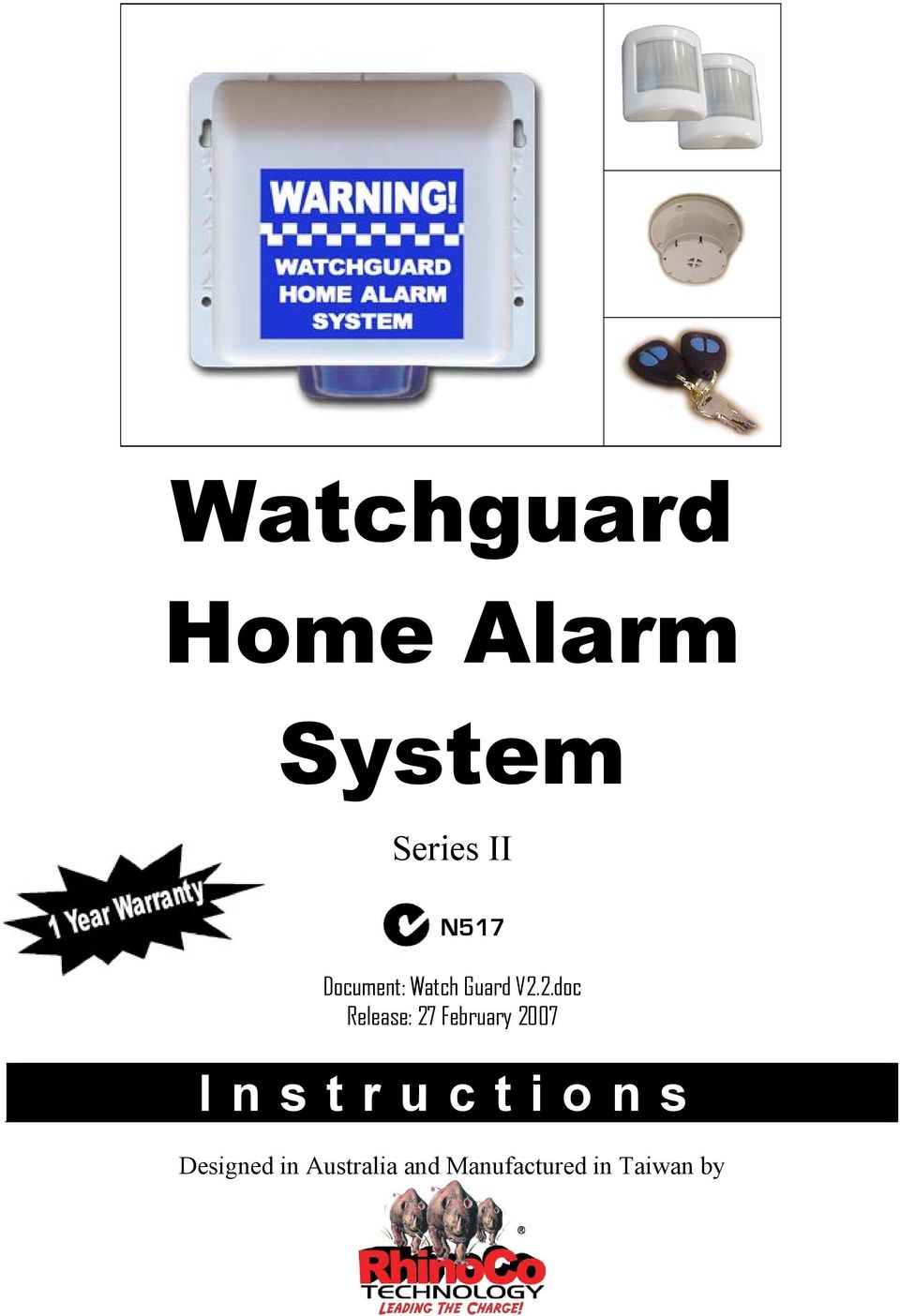
Watchguard Home Alarm System
|
|
|
- Felix Boone
- 10 years ago
- Views:
Transcription
1 Watchguard Home Alarm System Series II N517 Document: Watch Guard V2.2.doc Release: 27 February 2007 Instructions Designed in Australia and Manufactured in Taiwan by
2 2 Contents Contents Introduction The Passive Infrared Detector What You Get Installation Planning the Installation The Main Unit The Screamer The Power Supply The Detectors Tips for positioning Powering the detector Warm up period Operation Master Keyswitch Remote Control Functions AWAY Mode STAY Mode DISARMING PANIC Mode Low Battery Reporting Supervision Reporting The Passive Infrared Detectors Test Mode for the Passive Infrared detectors Intelligent Power Saving and Normal Operation Adjusting the sensitivity Dual Edge Sensing (DES) technology explained The Tamper Switch Low Battery Warning Supervision Programming Adding New Remotes Safety Lock Adding a Detector Deleting a Detector Walk Test Mode Alarm Memory Stay Mode Entry Guard Sound Arm / Disarm Beeps Resetting the System Maintainance The Backup Battery... 34

3 5.2. The Remote Control The Detector Replacing the batteries Cleaning the pyro detector Cleaning the case and lense Warranty Warning Limitations & Warranty

4 4 1. Introduction Your Watchguard Home Alarm System is a state-of-the-art wireless security system, specifically designed for simple DIY installation (Do It Yourself). It is suitable for use in homes or offices where the owner wishes an external & internal siren to trigger if there is unauthorized entry into the premises. Main Features include: Simple Installation Code Hopping Remote Control Technology (remotes can not be copied by scanning or code grabbing). Remote Functions include arm, disarm, stay mode and panic. Ability to add or erase detectors from your system. 8 Wireless detector zones available Low Battery Warning & Supervision Detector 24 hour Tamper Alarm Protects your family and property Suitable for home and office Powerful external siren with flashing blue strobe Back up battery and main power adaptor High frequency internal siren to repel intruders Latest technology Wireless detectors available include Passive Infrared detectors, Reed Switches, Shock detectors & Smoke detectors
5 1.1. The Passive Infrared Detector 5 The detector is a high quality infrared body movement detector, which is battery operated and communicates with the Watchguard Home Alarm System via radio frequency (RF) transmission. This detector is easy to install, provides excellent detection sensitivity and has a long battery life (approximately 3 years). This detector transmits four different codes to the main unit: Alarm sent when a valid movement is detected Tamper sent when the detector case is opened Supervision sent every 2.5 hours to the main unit Low Battery sent when the batteries need replacing IMPORTANT NOTES NEVER touch the pyro detector with your fingers During the warm up period, (first 3 minutes after installing the batteries) the detector will not respond to the tamper switch or to movement in front of the detector. You must wait 3 minutes before it will respond properly. This detector has Intelligent Power Saving (IPS). This means that in normal operation the lights will not flash every time you move in front of the detector. When the red light flashes on for 1 second, this means that the detector has picked up and validated body movement (or an intruder) and an alarm code is transmitted. The detector will now go into IPS mode for approximately 3 minutes. During this time the detector will not trigger and no lights will turn on (see section for more information). The wire, which runs around the edge of the detector, is the antenna. Do not touch, remove or cut this wire

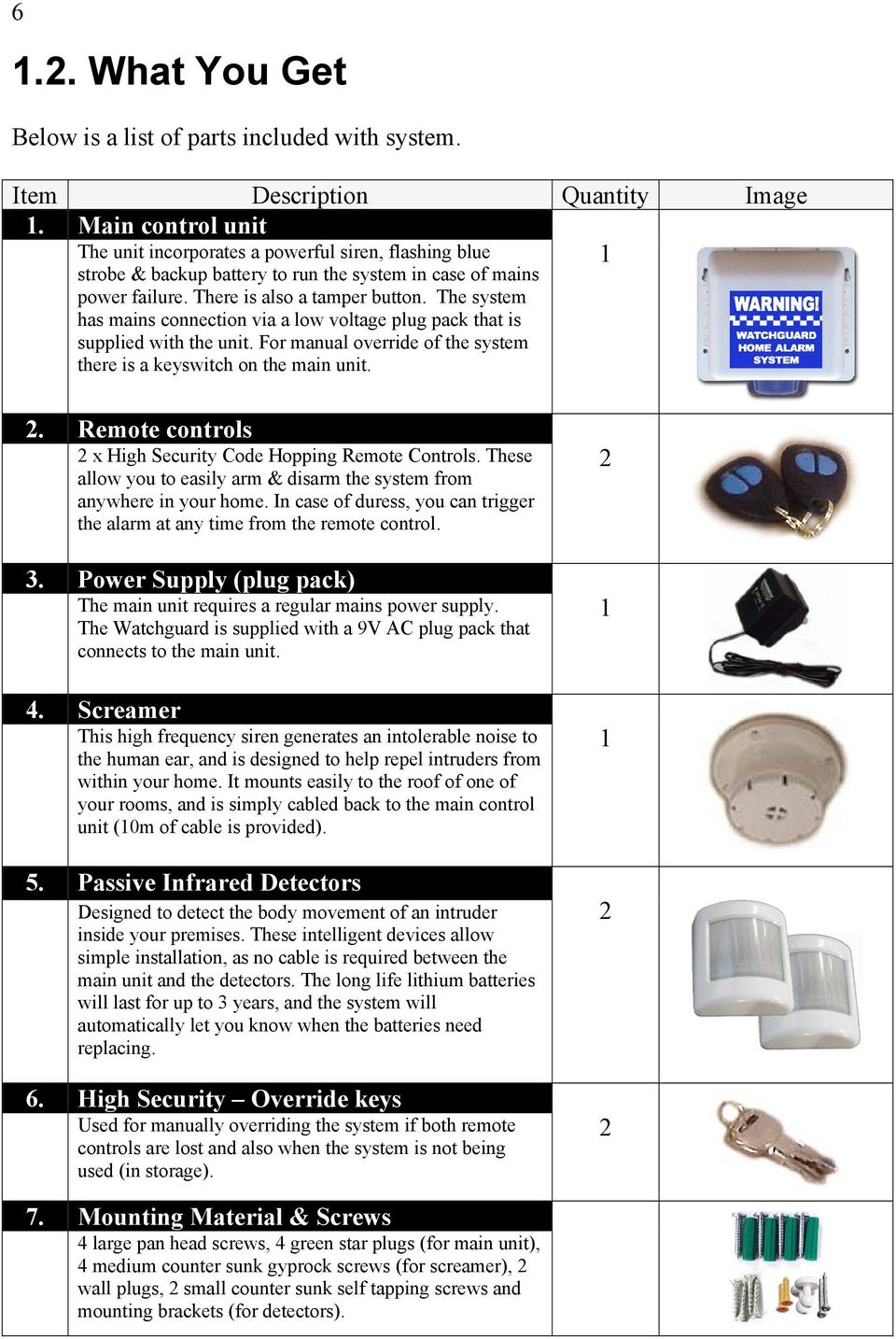
6 What You Get Below is a list of parts included with system. Item Description Quantity Image 1. Main control unit 1 The unit incorporates a powerful siren, flashing blue strobe & backup battery to run the system in case of mains power failure. There is also a tamper button. The system has mains connection via a low voltage plug pack that is supplied with the unit. For manual override of the system there is a keyswitch on the main unit. 2. Remote controls 2 x High Security Code Hopping Remote Controls. These allow you to easily arm & disarm the system from anywhere in your home. In case of duress, you can trigger the alarm at any time from the remote control. 3. Power Supply (plug pack) The main unit requires a regular mains power supply. The Watchguard is supplied with a 9V AC plug pack that connects to the main unit. 4. Screamer This high frequency siren generates an intolerable noise to the human ear, and is designed to help repel intruders from within your home. It mounts easily to the roof of one of your rooms, and is simply cabled back to the main control unit (10m of cable is provided). 5. Passive Infrared Detectors Designed to detect the body movement of an intruder inside your premises. These intelligent devices allow simple installation, as no cable is required between the main unit and the detectors. The long life lithium batteries will last for up to 3 years, and the system will automatically let you know when the batteries need replacing. 6. High Security Override keys Used for manually overriding the system if both remote controls are lost and also when the system is not being used (in storage) Mounting Material & Screws 4 large pan head screws, 4 green star plugs (for main unit), 4 medium counter sunk gyprock screws (for screamer), 2 wall plugs, 2 small counter sunk self tapping screws and mounting brackets (for detectors).
7 7 2. Installation 2.1. Planning the Installation Each separate component of the Watchguard Home Alarm System should be placed in strategic locations. Below is a guide to where you should place the main unit, the detectors and the screamer. It is important that you take into account that the maximum range without any obstructions between the main unit and each detector is no further than 50 metres. Typically the range inside your house will be around metres depending on the construction of the house. Planning and Wire Routing Figure 1 1- The Watchguard main unit should be located high on the front or front side of the building under an eave of covering. (See Section 2.2) 2- Route the white-white/black wire (2 core-figure 8 cable) from the main unit through the ceiling to connect with the plug pack connector. Another suitable location for the power supply is on an available power point at the rear of the fridge in the kitchen. (See Section 2.4) 3- Route the red-red/black wire (2 core-figure 8 cable) from the main unit through the ceiling to connect with the screamer connector. (See Section 2.3) P1- Location of passive infrared detector zone 1. (Example only) P2- Location of passive infrared detector zone 2. (Example only)

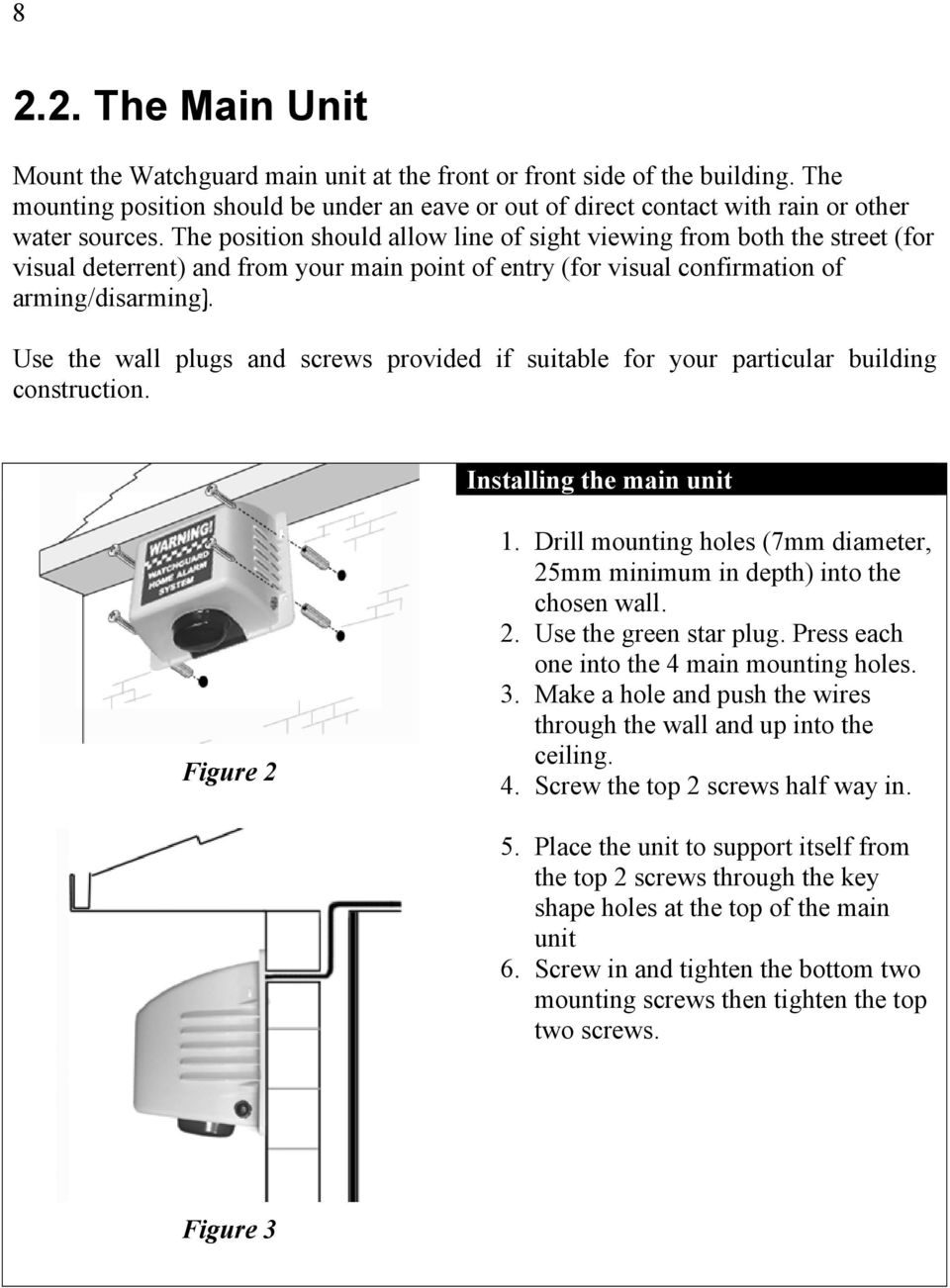
8 The Main Unit Mount the Watchguard main unit at the front or front side of the building. The mounting position should be under an eave or out of direct contact with rain or other water sources. The position should allow line of sight viewing from both the street (for visual deterrent) and from your main point of entry (for visual confirmation of arming/disarming). Use the wall plugs and screws provided if suitable for your particular building construction. Installing the main unit Figure 2 1. Drill mounting holes (7mm diameter, 25mm minimum in depth) into the chosen wall. 2. Use the green star plug. Press each one into the 4 main mounting holes. 3. Make a hole and push the wires through the wall and up into the ceiling. 4. Screw the top 2 screws half way in. 5. Place the unit to support itself from the top 2 screws through the key shape holes at the top of the main unit 6. Screw in and tighten the bottom two mounting screws then tighten the top two screws. Figure 3
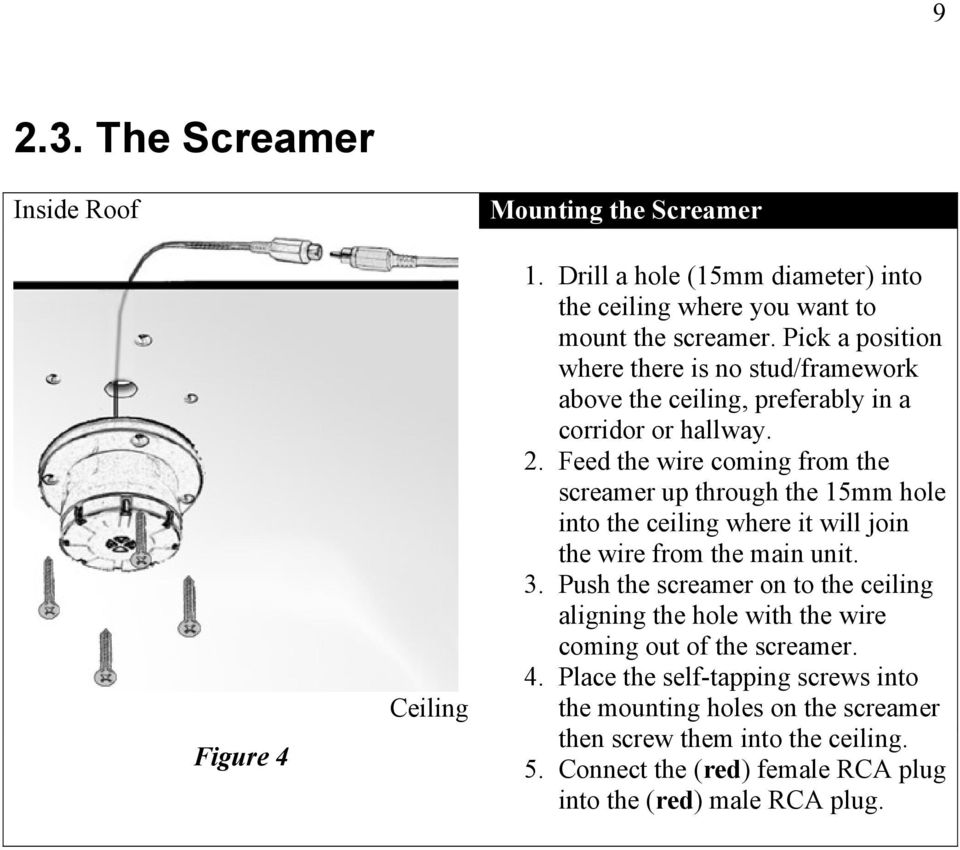
9 The Screamer Inside Roof Mounting the Screamer Figure 4 Ceiling 1. Drill a hole (15mm diameter) into the ceiling where you want to mount the screamer. Pick a position where there is no stud/framework above the ceiling, preferably in a corridor or hallway. 2. Feed the wire coming from the screamer up through the 15mm hole into the ceiling where it will join the wire from the main unit. 3. Push the screamer on to the ceiling aligning the hole with the wire coming out of the screamer. 4. Place the self-tapping screws into the mounting holes on the screamer then screw them into the ceiling. 5. Connect the (red) female RCA plug into the (red) male RCA plug.
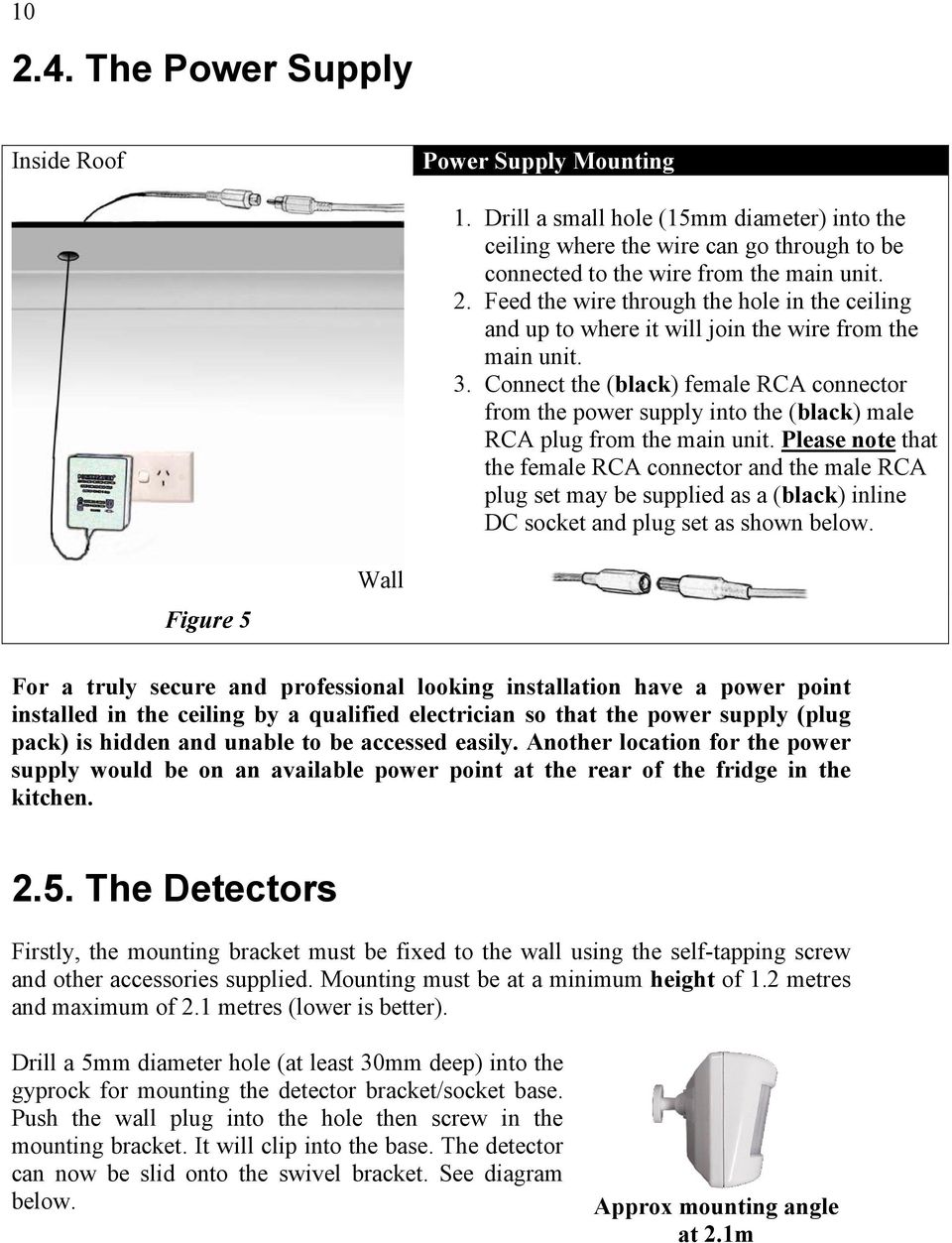
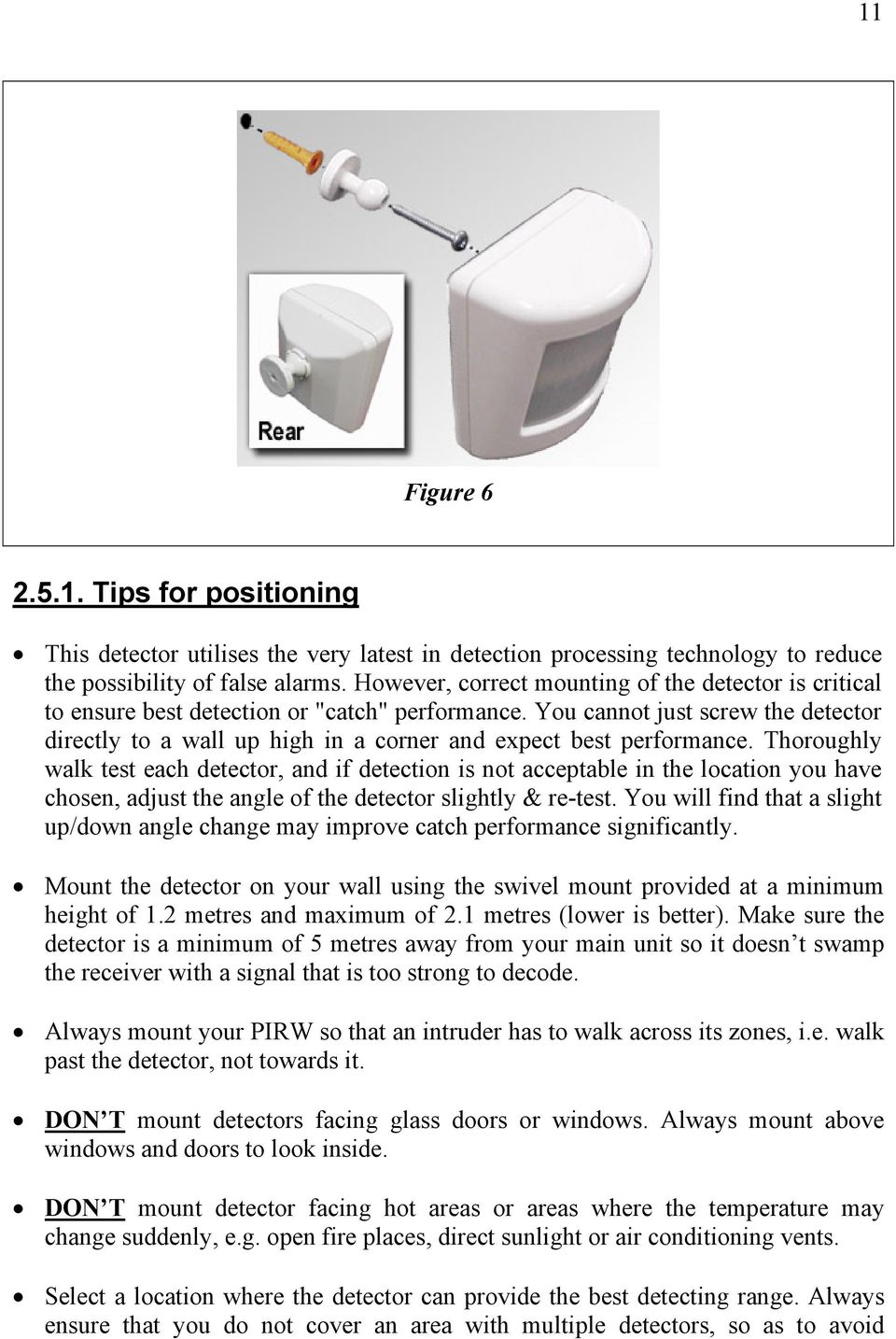
10 The Power Supply Inside Roof Power Supply Mounting 1. Drill a small hole (15mm diameter) into the ceiling where the wire can go through to be connected to the wire from the main unit. 2. Feed the wire through the hole in the ceiling and up to where it will join the wire from the main unit. 3. Connect the (black) female RCA connector from the power supply into the (black) male RCA plug from the main unit. Please note that the female RCA connector and the male RCA plug set may be supplied as a (black) inline DC socket and plug set as shown below. Figure 5 Wall For a truly secure and professional looking installation have a power point installed in the ceiling by a qualified electrician so that the power supply (plug pack) is hidden and unable to be accessed easily. Another location for the power supply would be on an available power point at the rear of the fridge in the kitchen The Detectors Firstly, the mounting bracket must be fixed to the wall using the self-tapping screw and other accessories supplied. Mounting must be at a minimum height of 1.2 metres and maximum of 2.1 metres (lower is better). Drill a 5mm diameter hole (at least 30mm deep) into the gyprock for mounting the detector bracket/socket base. Push the wall plug into the hole then screw in the mounting bracket. It will clip into the base. The detector can now be slid onto the swivel bracket. See diagram below. Approx mounting angle at 2.1m
11 11 Figure Tips for positioning This detector utilises the very latest in detection processing technology to reduce the possibility of false alarms. However, correct mounting of the detector is critical to ensure best detection or "catch" performance. You cannot just screw the detector directly to a wall up high in a corner and expect best performance. Thoroughly walk test each detector, and if detection is not acceptable in the location you have chosen, adjust the angle of the detector slightly & re-test. You will find that a slight up/down angle change may improve catch performance significantly. Mount the detector on your wall using the swivel mount provided at a minimum height of 1.2 metres and maximum of 2.1 metres (lower is better). Make sure the detector is a minimum of 5 metres away from your main unit so it doesn t swamp the receiver with a signal that is too strong to decode. Always mount your PIRW so that an intruder has to walk across its zones, i.e. walk past the detector, not towards it. DON T mount detectors facing glass doors or windows. Always mount above windows and doors to look inside. DON T mount detector facing hot areas or areas where the temperature may change suddenly, e.g. open fire places, direct sunlight or air conditioning vents. Select a location where the detector can provide the best detecting range. Always ensure that you do not cover an area with multiple detectors, so as to avoid
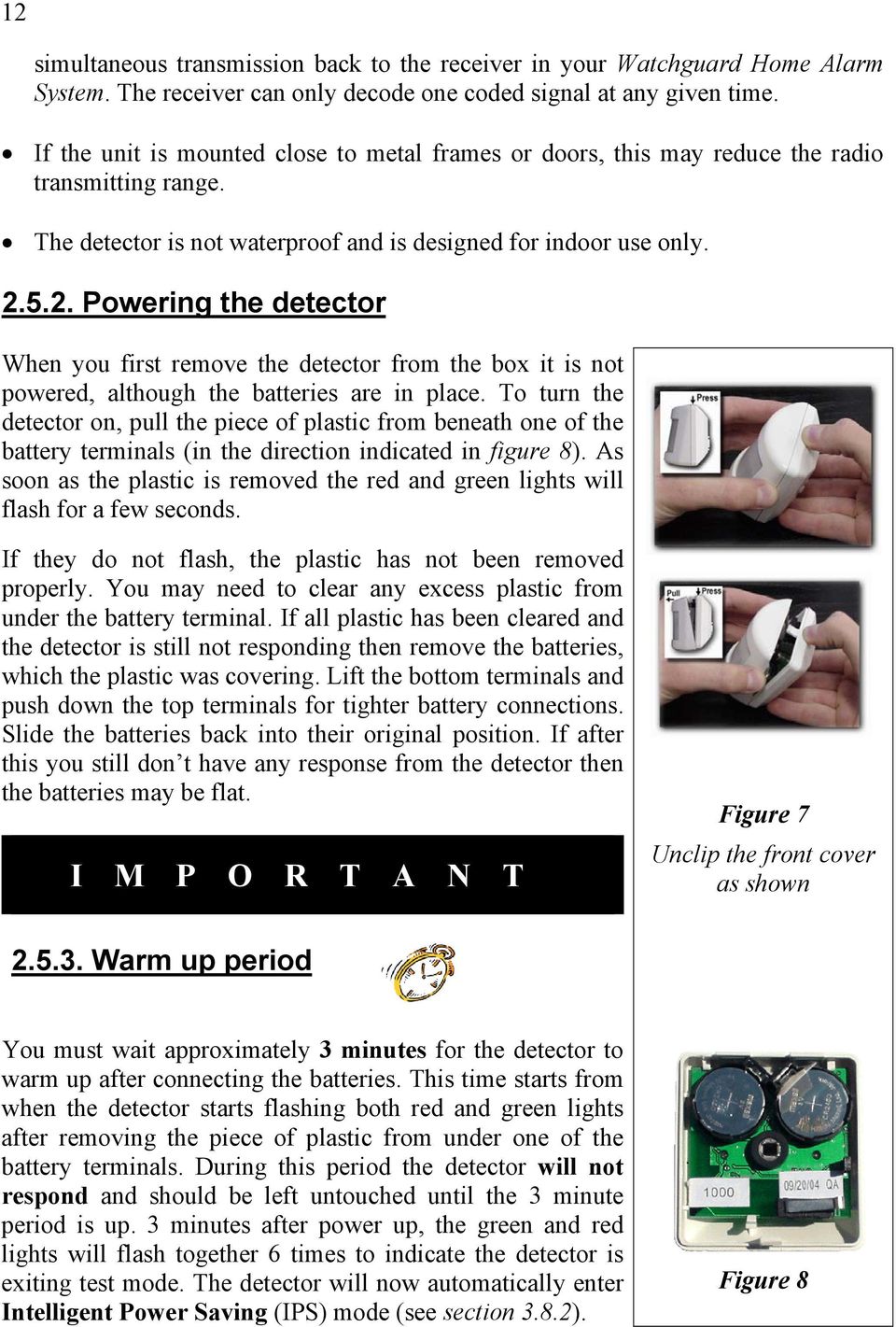
12 12 simultaneous transmission back to the receiver in your Watchguard Home Alarm System. The receiver can only decode one coded signal at any given time. If the unit is mounted close to metal frames or doors, this may reduce the radio transmitting range. The detector is not waterproof and is designed for indoor use only Powering the detector When you first remove the detector from the box it is not powered, although the batteries are in place. To turn the detector on, pull the piece of plastic from beneath one of the battery terminals (in the direction indicated in figure 8). As soon as the plastic is removed the red and green lights will flash for a few seconds. If they do not flash, the plastic has not been removed properly. You may need to clear any excess plastic from under the battery terminal. If all plastic has been cleared and the detector is still not responding then remove the batteries, which the plastic was covering. Lift the bottom terminals and push down the top terminals for tighter battery connections. Slide the batteries back into their original position. If after this you still don t have any response from the detector then the batteries may be flat. I M P O R T A N T Figure 7 Unclip the front cover as shown Warm up period You must wait approximately 3 minutes for the detector to warm up after connecting the batteries. This time starts from when the detector starts flashing both red and green lights after removing the piece of plastic from under one of the battery terminals. During this period the detector will not respond and should be left untouched until the 3 minute period is up. 3 minutes after power up, the green and red lights will flash together 6 times to indicate the detector is exiting test mode. The detector will now automatically enter Intelligent Power Saving (IPS) mode (see section 3.8.2). Figure 8
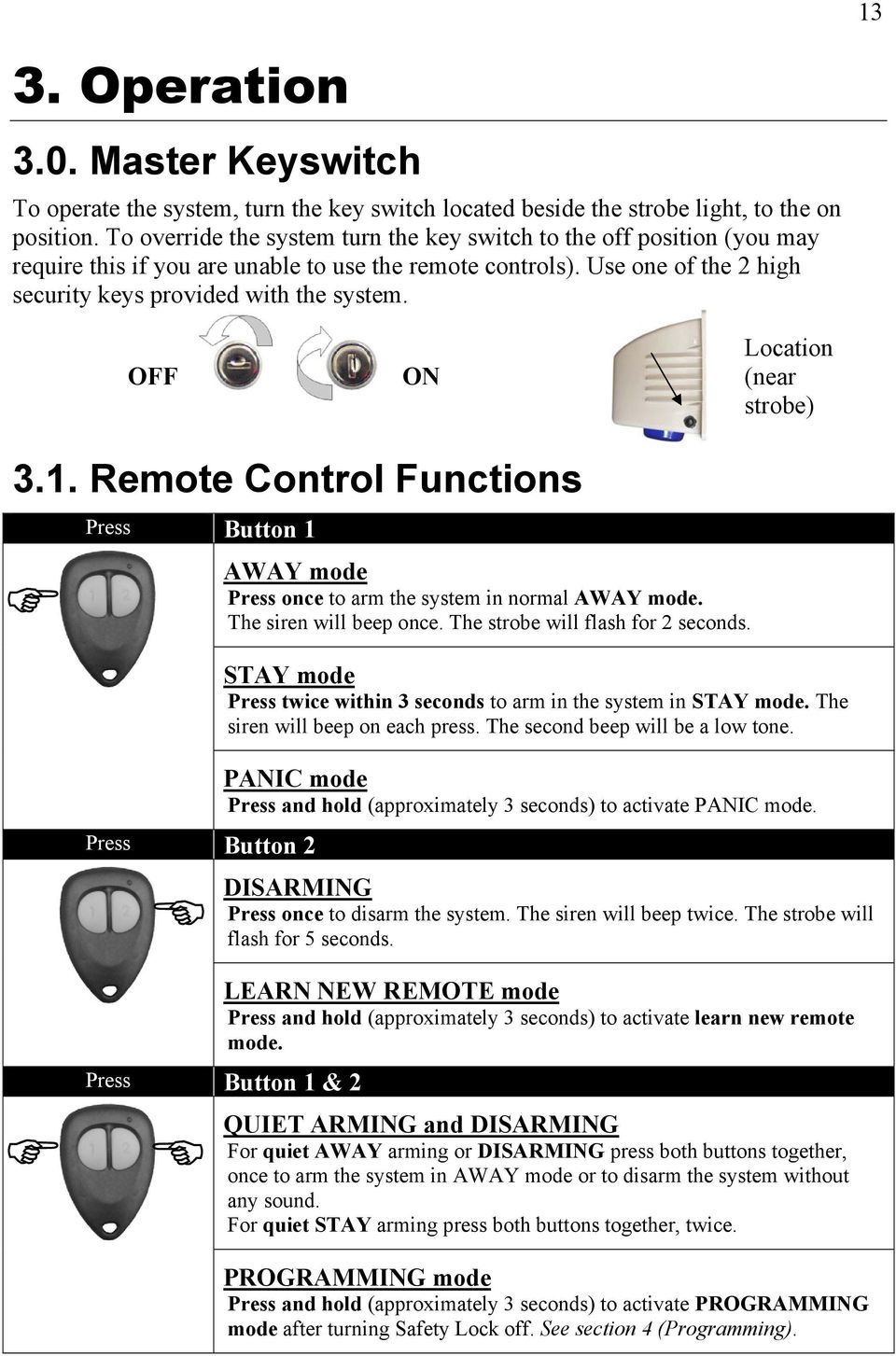
13 13 3. Operation 3.0. Master Keyswitch To operate the system, turn the key switch located beside the strobe light, to the on position. To override the system turn the key switch to the off position (you may require this if you are unable to use the remote controls). Use one of the 2 high security keys provided with the system. OFF ON Location (near strobe) 3.1. Remote Control Functions Press Button 1 AWAY mode Press once to arm the system in normal AWAY mode. The siren will beep once. The strobe will flash for 2 seconds. Press Button 2 STAY mode Press twice within 3 seconds to arm in the system in STAY mode. The siren will beep on each press. The second beep will be a low tone. PANIC mode Press and hold (approximately 3 seconds) to activate PANIC mode. DISARMING Press once to disarm the system. The siren will beep twice. The strobe will flash for 5 seconds. LEARN NEW REMOTE mode Press and hold (approximately 3 seconds) to activate learn new remote mode. Press Button 1 & 2 QUIET ARMING and DISARMING For quiet AWAY arming or DISARMING press both buttons together, once to arm the system in AWAY mode or to disarm the system without any sound. For quiet STAY arming press both buttons together, twice. PROGRAMMING mode Press and hold (approximately 3 seconds) to activate PROGRAMMING mode after turning Safety Lock off. See section 4 (Programming).
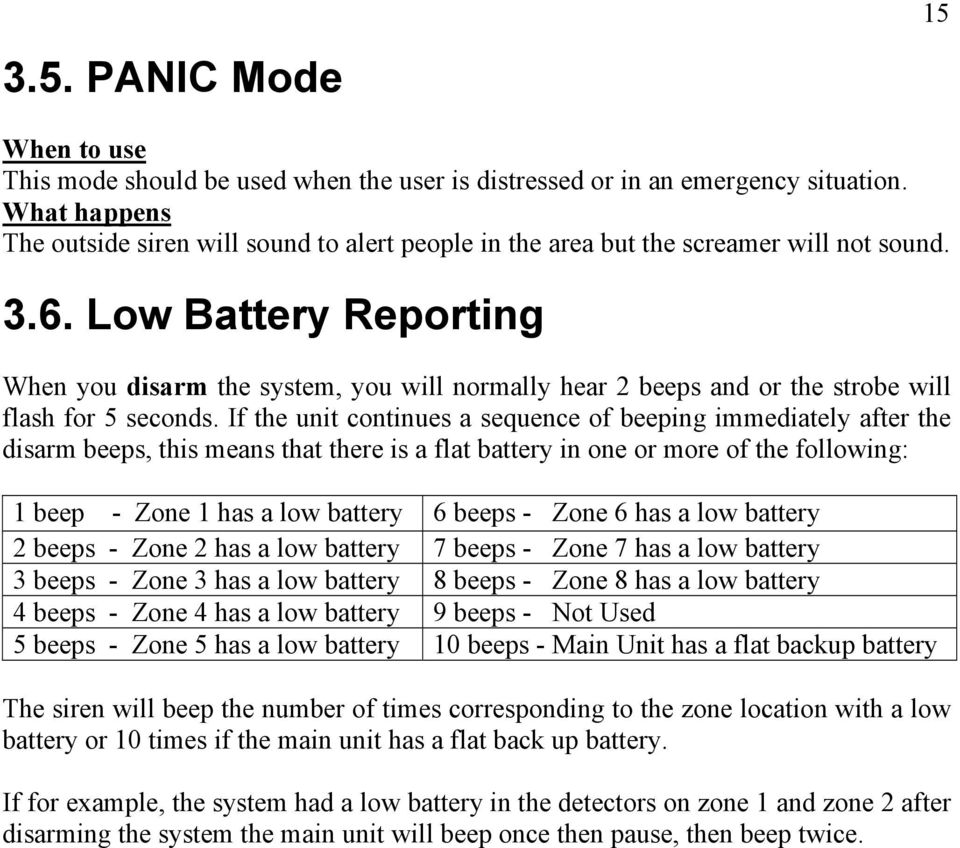
14 AWAY Mode When to use This mode is used when leaving the building or premise, i.e. AWAY from premises. Arming the system in this mode will activate all detectors. Indications The siren will beep once and the strobe will flash for 2 seconds. There will be a 20 second delay before the system is fully armed. During this delay only the 24 hour detectors (e.g. smoke detectors) and tamper signals will trigger the alarm. If any extra beeps are heard, see section 3.7 (Supervision Reporting). Triggering If a detector is triggered, when the system is fully armed, the alarm will sound for 5 minutes or until the system is disarmed (which ever occurs first). Each detector zone can only trigger the siren once, in one arming period STAY Mode When to use This mode is used for protecting only a selected area(s) of the building while you (and others) are on the premises or someone is STAYING home. Commonly used at night while sleeping. Indications The siren will beep once on the first press and will then make a low tone beep the on the second press. There will be a 20 second delay before the system is armed in STAY mode. If any extra beeps are heard, see section 3.7 (Supervision Reporting). Triggering Arming the system in this mode will enable zone 1 (default), and other extra detectors that have been set to trigger the alarm in STAY mode. When any stay mode detector is triggered in this mode after the 20 second exit delay the siren will beep 5 times DISARMING When to use The system should be disarmed before entering the building or premise. Indications The siren will beep twice and the strobe will flash for 5 seconds. The siren will beep 4 times instead of twice, if the alarm has been triggered while the system was armed. If any extra beeps are heard, see section 3.6 (Low Battery Reporting).
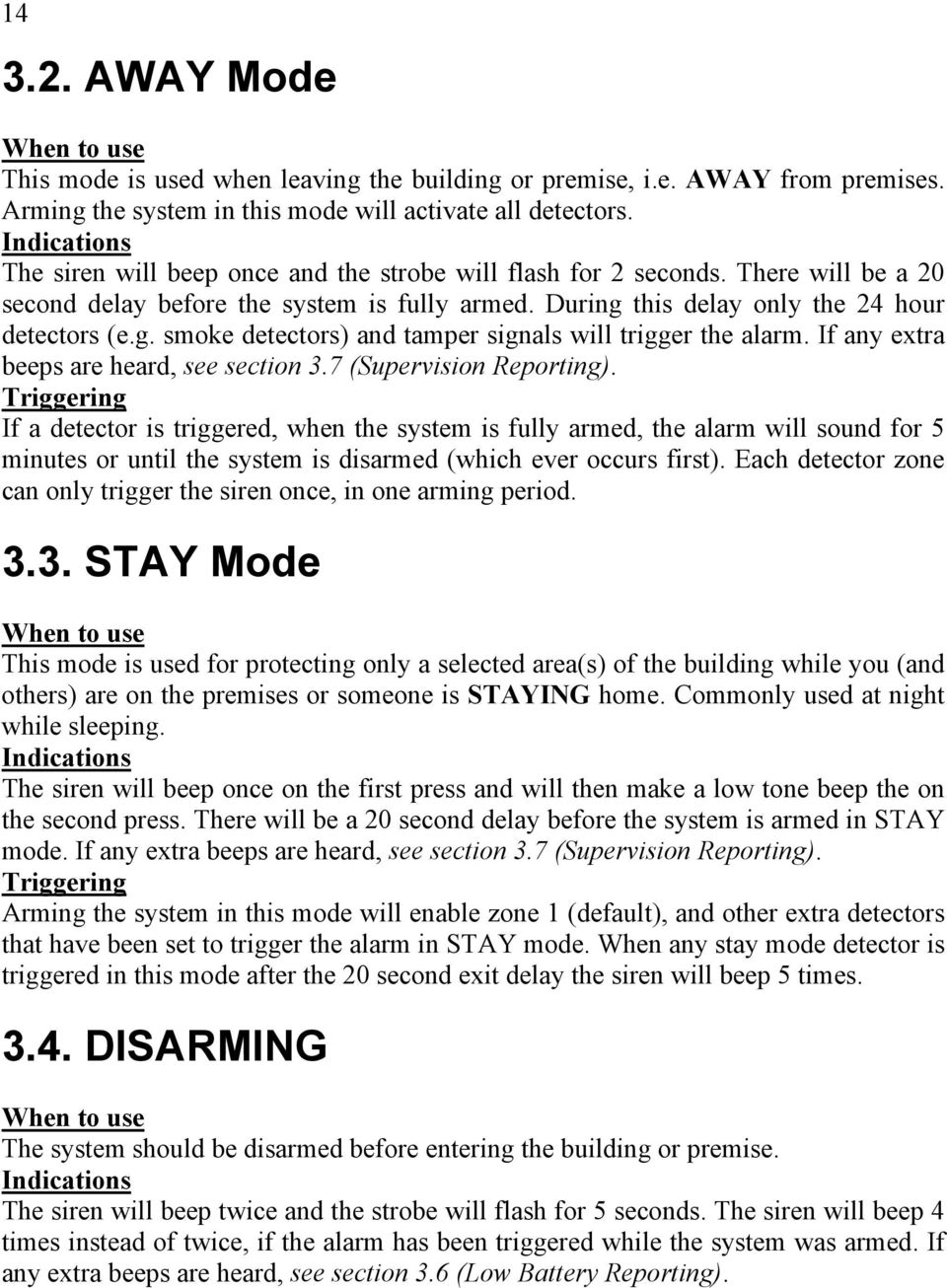
15 3.5. PANIC Mode 15 When to use This mode should be used when the user is distressed or in an emergency situation. What happens The outside siren will sound to alert people in the area but the screamer will not sound Low Battery Reporting When you disarm the system, you will normally hear 2 beeps and or the strobe will flash for 5 seconds. If the unit continues a sequence of beeping immediately after the disarm beeps, this means that there is a flat battery in one or more of the following: 1 beep - Zone 1 has a low battery 6 beeps - Zone 6 has a low battery 2 beeps - Zone 2 has a low battery 7 beeps - Zone 7 has a low battery 3 beeps - Zone 3 has a low battery 8 beeps - Zone 8 has a low battery 4 beeps - Zone 4 has a low battery 9 beeps - Not Used 5 beeps - Zone 5 has a low battery 10 beeps - Main Unit has a flat backup battery The siren will beep the number of times corresponding to the zone location with a low battery or 10 times if the main unit has a flat back up battery. If for example, the system had a low battery in the detectors on zone 1 and zone 2 after disarming the system the main unit will beep once then pause, then beep twice.
16 Supervision Reporting When you arm the system, you will normally hear 1 beep. If the unit continues a sequence of beeping immediately after the arming beep, this means that a supervised detector has failed to report in the last 24 hours. The supervision feature ensures that a user can be confident of the systems operational status that is, all detectors are present & working correctly. 1 beep - Zone 1 has failed to report 5 beeps - Zone 5 has failed to report 2 beeps - Zone 2 has failed to report 6 beeps - Zone 6 has failed to report 3 beeps - Zone 3 has failed to report 7 beeps - Zone 7 has failed to report 4 beeps - Zone 4 has failed to report 8 beeps - Zone 8 has failed to report If for example, if the system had Zone 3 and Zone 5 detectors missing, after arming (1 beep), the main unit will beep another 3 times then pause, then beep 5 times The Passive Infrared Detectors It is vital that the detector is tested carefully for each installation. Placing the unit into test mode (see below) is the best way of checking the detector. At 25 Celsius, the detector should have a detection range of approximately 10 metres and a scope angle of 90, i.e. 45 either side of the center position straight ahead of the lens Test Mode for the Passive Infrared detectors Test mode, as its name implies, is used for testing the detection range and testing the radio transmission back to the main unit. At this time you should place the main unit in walk test mode (see section 4.5). To place the detector in test mode do the following: Remove the front cover off the detector via the clip at the top. The green and red lights will flash together, 6 times, to indicate that the detector has entered test mode. Replace the front cover. The detector will stay in test mode for 3 minutes. The green and red lights will flash together, 6 times, to indicate that the detector is exiting test mode. The Green Light During test mode the detector will flash the green light when you move into an infrared beam zone or move out of the other side of that infrared beam zone (see section for more information on how the detector detects movement). Each time the green light flashes this is called a pulse.

17 The Red Light If the detector is set to 2 pulse counts (most sensitive) then the red light will flash if there are 2 green flashes within 10 seconds. If the detector is set to 3 pulse counts (least sensitive) then the red light will flash if there are 3 green flashes within 10 seconds. The red light turning on indicates that the detector has sensed valid movement and that the alarm code signal has been sent to the main unit Intelligent Power Saving and Normal Operation This detector has Intelligent Power Saving (IPS). This means that in normal operation or normal mode the red light will indicate valid movement detection but the green light will not turn on at all. Lights will not flash every time you move in front of the detector. When the red light flashes on for 1 second, this means that the detector has picked up and validated body movement (or an intruder). The detector will now go into IPS mode for approximately 3 minutes. During this time the detector will not trigger and no lights will turn on. After this 3 minutes of IPS the detector will again be ready to sense for any movement in the room. If the detector detects another valid body movement anytime after the 3 minutes of IPS then it will go back into IPS mode again for 3 minutes and so on. There is no need for the detector to trigger more than once every 3 minutes as your alarm system should be set to sound your siren for 5 minutes after being triggered. In summary, the detector will only trigger and flash the red light once every 3 minutes in its normal operation to save battery life. The green light will stay off and only operate when the detector is put into test mode Adjusting the sensitivity PULSE COUNT SELECT Jumper ON Least sensitive 3 pulse counts OFF Most sensitive 2 pulse counts 17 The sensitivity of the detector can be changed by either removing the Pulse Count Select jumper or by placing it across both pins. When the jumper is placed across both pins (default), then the detector is set to 3 pulse counts (least sensitive). When the jumper is removed or only attached to 1 of the pins, then the detector is set to 2 pulse counts (most sensitive). Pulse count jumper Once you have set the jumper, you must press the tamper switch in for 1 second then release it for the setting to become active. Now you can place the front cover back on the detector.

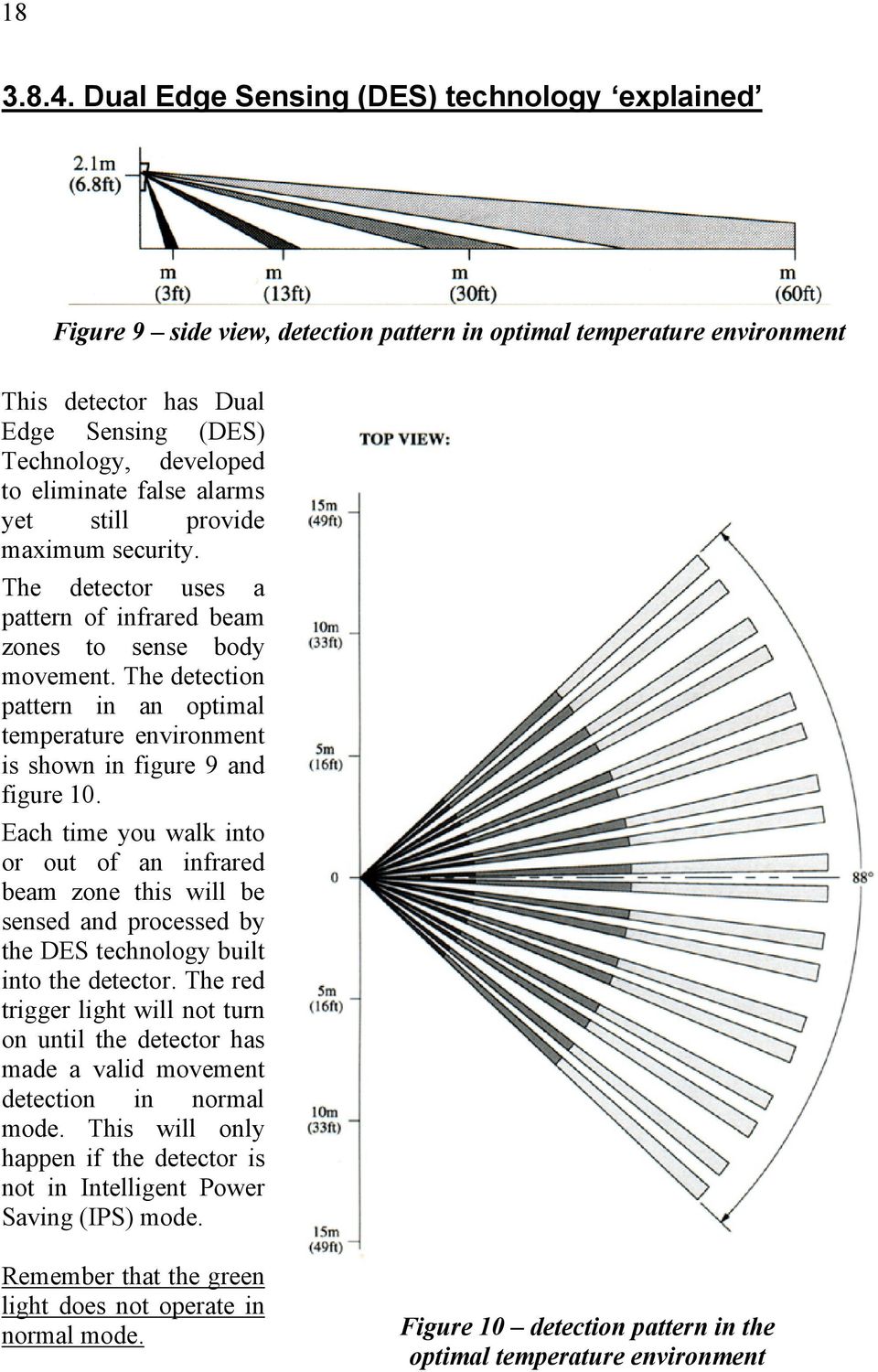
18 Dual Edge Sensing (DES) technology explained Figure 9 side view, detection pattern in optimal temperature environment This detector has Dual Edge Sensing (DES) Technology, developed to eliminate false alarms yet still provide maximum security. The detector uses a pattern of infrared beam zones to sense body movement. The detection pattern in an optimal temperature environment is shown in figure 9 and figure 10. Each time you walk into or out of an infrared beam zone this will be sensed and processed by the DES technology built into the detector. The red trigger light will not turn on until the detector has made a valid movement detection in normal mode. This will only happen if the detector is not in Intelligent Power Saving (IPS) mode. Remember that the green light does not operate in normal mode. Figure 10 detection pattern in the optimal temperature environment
19 19 TOP VIEW = infrared beam zone Triggering the detector when set to least sensitive (Default setting) Figure 11 least sensitive trigger In figure 11, a body moving from position 1 to position 2, into the infrared beam zone, will create a pulse. Moving from position 2 to 3, out of the other side of the same infrared beam zone, will create a second pulse. Additional movement from position 3 to 4 will create a third pulse. If the detector is set to least sensitive (default) and the body moves from position 1 to position 4 within 10 seconds then the detector will have received 3 pulses in 10 seconds. This means the detector will have made a valid movement detection and will trigger, indicated by the red light (only if in test mode or normal mode but not in IPS mode). This also applies if moving in the opposite direction to the figures 11 and 12. Figure 12 shows another way in which the detector may be triggered when the detector is set to least sensitive. Figure 12 least sensitive trigger
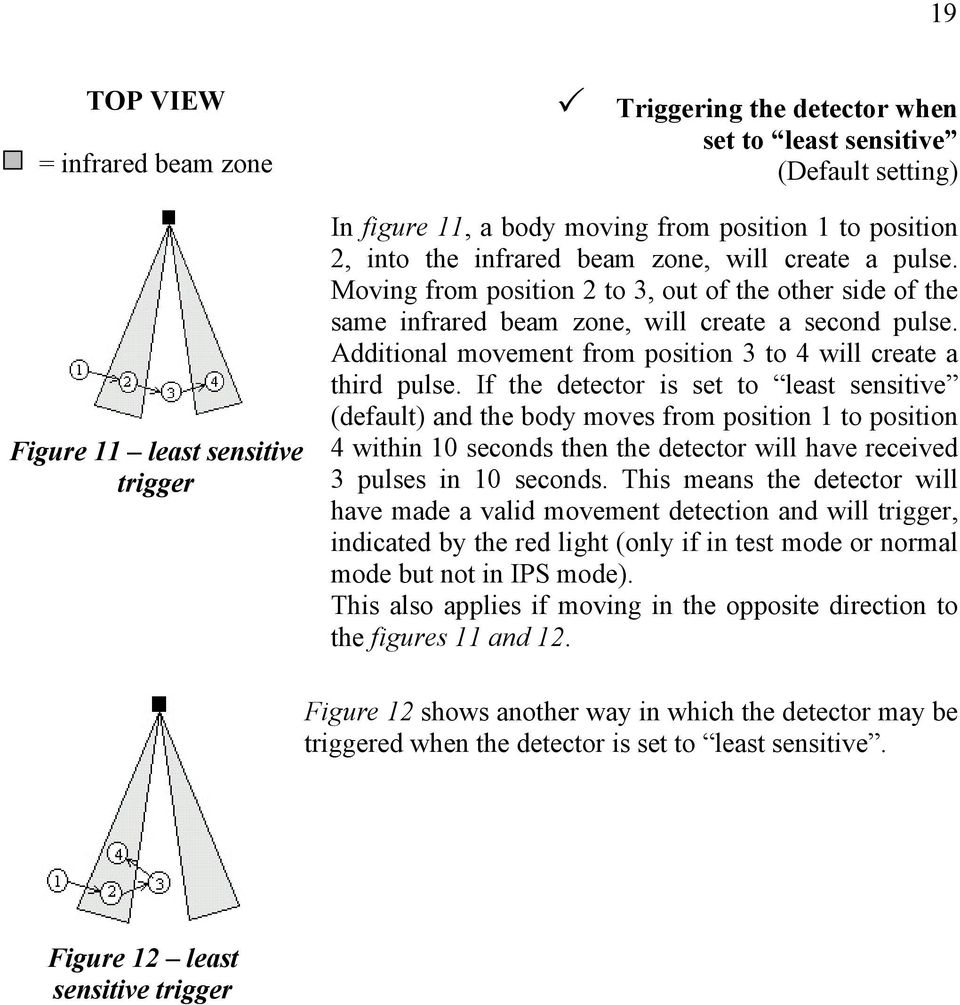
20 20 Triggering the detector when set to most sensitive Figure 13 most sensitive trigger In figure 13, a body moving from position 1 to position 2, into the infrared beam zone, will create a pulse. Moving from position 2 to 3, out of the other side of the same infrared beam zone, will create another pulse. If the detector is set to most sensitive and the body moves from position 1 to position 3 within 10 seconds then the detector will have received 2 pulses in 10 seconds. This means the detector will have made a valid movement detection and will trigger, indicated by the red light (only if in test mode or normal mode but not in IPS mode). This also applies if the body moves in the opposite direction. No trigger body movements No trigger body movements are body movements which are too small to be recognized as valid body movements to trigger the detector. Figure 14 no trigger In the example, shown by figure 14, a body walking into one side of the infrared beam zone, then back out the same side of the infrared beam zone will not trigger the detector. A body moving from position 1 to 2, into the infrared beam zone, will only create pulsing. A body moving from position 2 back to position 1 or from position 2 to position 3 (out of the same side of the infrared beam zone) may create further pulses but will not trigger the detector. This also applies if the body is moving in and out of the infrared beam zone from the other side The Tamper Switch The tamper switch will open whenever the front cover of the detector is removed. A tamper signal is automatically transmitted as well as a normal trigger signal. Each time this occurs the detector will also automatically enter test mode. Tamper switch

21 Low Battery Warning If the detector has near flat batteries, then on a valid movement detection the red light will flash 6 times in a row instead of once. The detector will also send a low battery radio transmission at this time. The batteries should be replaced immediately. Another way of testing for low battery is by removing the front cover to release the tamper switch. When the cover is opened and the tamper switch is released, the detector will enter test mode. Both red & green lights flash 6 times. If the detector has low battery voltage then the red light will flash an additional 6 times in a row. The detector will send a low battery radio transmission to your Watchguard main unit. The batteries should be replaced immediately. The detector constantly monitors for low battery and will send a low battery transmission within 2.5 hours of identifying a low battery Supervision Every 2.5 hours (approximately) the detector will send a supervision transmission. This is used as a security measure to alert the user(s) of the system if a detector is no longer functioning or if the detector has been taken out of receiving range of the wireless system.
22 22 4. Programming Ensure that before any programming, each step should be well rehearsed. This will eliminate becoming confused and making mistakes. If at any stage you become lost or forget where you are up to stop and wait for the 3 low toned beeps that tell you that the alarm timed out of programming mode and no changes will be saved. For ease of programming ensure that there is no movement in front of any of the detectors unless otherwise required.
23 Adding New Remotes + TO ADD A NEW REMOTE Press 1 time Disarm the system (if it is not already disarmed) with an original remote control by pressing Button 2. You do not need to enter programming mode. Press and hold Button 2 (for approximately 3 seconds) on the original working remote control until the siren starts to beep continuously, then release the button. 3. The main unit will beep 9 times to confirm you are adding a new remote control. Siren beeps 9 times 4. As soon as the beeps finish, press and hold down button 2 on the new remote control for 3 seconds. 5. Press new remote control for 3 secs. Press new remote control to test The new remote control is now programmed into the alarm. To confirm this press Button 1 on the new remote to ensure it arms the system. If this new remote doesn t work restart this procedure from the start. Your Watchguard Home Alarm System can only store a maximum of SEVEN (7) remotes in its memory. If you learn in an 8th remote, the 1st remote control will be erased. If you loose a remote control, or have one stolen, simply repeat the procedure above with your remaining remotes at least 10 times. This will ensure that you have erased the lost remote from the memory of your Watchguard Home Alarm System.
24 Safety Lock Safety lock is a feature, which prevents accidental changes to the programming of the system. Safety Lock must be turned off to allow programming. You will only be able to enter programming mode within 5 minutes of following the procedure, HOW TO TURN OFF SAFETY LOCK. HOW TO TURN OFF SAFETY LOCK 1. Ensure the alarm is disarmed by pressing Button 2 once. Press 1 time 2. Press 2 times (within 3 secs.) Arm the system in STAY mode. Do this by pressing Button 1, twice. On the first press you will hear a beep. On the second press you will hear a low tone beep. 3. Within 3 seconds of STAY arming, press Button 1, another 7 times within 8 seconds. 4. Press 7 times (within 8 secs.) Siren beeps 5 times (low tones) For confirmation that safety lock is off, you will hear 5 beeps from the main unit after you have completed the steps above. If you don t hear these beeps, then try this procedure again from step SAFETY LOCK IS NOW OFF for 5 minutes. You can now enter programming mode within this time. NOTE: If you cannot enter programming mode, this is because safety lock is on. If you cannot turn off safety lock, this would mean safety lock is already off.
25 Adding a Detector + TO ADD A DETECTOR 1. Safety Lock must be off Ensure Safety Lock has been turned off within the last 5 minutes. See Section Press both buttons for 3 seconds Enter Programming mode by pressing buttons 1 & 2 together for 3 seconds. The siren will beep 3 times to confirm you have entered programming mode. 3. Press 1 time Within 3 seconds, press Button 1 to select detector programming. You will hear 1 beep as confirmation. 4. Press 1 time Within 30 seconds, press Button 1 to ADD a detector. You will hear 1 beep as confirmation. 5. Open the detector you wish to add Trigger the detector to be added. If you are learning a Passive Infrared detector remove the front cover or press the tamper switch then release. Learning mode will timeout in 60 seconds. When the system has successfully received the code from the detector, the siren will beep the number of times of the zone that the detector has to learn into and will do so whenever any unlearnt detector transmits. Continued on next page
26 26 TO ADD A DETECTOR continued 6. Within 60 seconds Within 60 seconds Within 60 seconds Press to add in STAY & AWAY modes Press to add in AWAY mode only Press to add in 24 hour mode OR OR This option will enable the detector in both STAY and AWAY modes. This option will disable the detector in STAY mode Use this option if you are adding a smoke detector. The siren will beep 1 time as confirmation of learning the last triggered detector. The siren will beep 2 times as confirmation of learning the last triggered detector. The siren will beep 3 times as confirmation of learning the last triggered detector Walk Test mode Press to exit The system will automatically enter Walk Test mode. During this time, the siren will beep the number of times of the zone which has been triggered. Label the detector with its zone number for future reference. Detectors which have been set to 24 hour mode will still trigger the alarm. If a tamper switch is pressed on the main unit or a wireless detector the siren will sound a low tone beep. When you press Button 2, the system will exit programming and walk test mode. You have now completed adding a new detector. NOTE: Refer to (5) If you trigger a detector that is already learnt in you will hear one low tone beep, simply trigger the correct detector until you hear the siren give the normal zone confirmation beeps. You need to do step (6) after the correct detector has been acknowledged, as it will keep accepting any unlearnt detector until step (6) is done or it times out (60 seconds).
27 Deleting a Detector TO DELETE A DETECTOR 1. Safety Lock must be off 2. Press both buttons for 3 seconds Ensure Safety Lock has been turned off within the last 5 minutes. See Section 4.2. Enter Programming mode by pressing buttons 1 & 2 together for 3 seconds. The siren will beep 3 times to confirm you have entered programming mode. 3. Within 3 seconds, press Button 1 to select detector programming. You will hear 1 beep as confirmation. Press 1 time 4. Within 30 seconds, press Button 2 to DELETE a detector. You will hear 2 beeps as confirmation. Press 1 time 5. Press the number of times of the zone you want to delete Within 5 seconds, press Button 1. The first beep you hear indicates zone 1. Each additional press of Button 1 will increment the zone you wish to delete and you will hear 1 beep each time. For example, if you push Button 1, five times then this would select zone 5 to be deleted. 6. Press to delete & exit Within 5 seconds press Button 2. The selected zone will be deleted. The system will beep the number of times of the zone that has been deleted (if you hear 3 low tone beeps, you have passed zone 8, or no valid zone was selected). You have now completed deleting a detector. The system will exit programming mode.
28 Walk Test Mode - Walk test mode should be used when testing the system or after a new detector has been learnt into the system. TO ENTER WALK TEST MODE 1. Safety Lock must be off Ensure Safety Lock has been turned off within the last 5 minutes. See Section Press both buttons for 3 seconds Enter Programming mode by pressing buttons 1 & 2 together for 3 seconds. The siren will beep 3 times to confirm you have entered programming mode. 3. Press 1 time Within 3 seconds, press Button 2 to select special features. You will hear 2 beeps as confirmation. 4. Press 1 time Within 30 seconds, press Button 2 to enter Walk Test mode. You will hear 2 beeps as confirmation. 5. Walk Test mode The system will enter Walk Test mode. During this time, the siren will beep the number of times of the zone which has been triggered. Detectors which have been set to 24 hour mode will still trigger the alarm. If the tamper switch is pressed the siren will beep once. 6. Press 1 time to exit Press Button 2 to exit Walk Test mode.
29 4.6. Alarm Memory 29 This feature is used after the alarm has been triggered. It recalls the last 10 zones which have triggered the alarm. TO HEAR THE ALARM MEMORY 1. Safety Lock must be off Ensure Safety Lock has been turned off within the last 5 minutes. See Section Press both buttons for 3 seconds Enter Programming mode by pressing buttons 1 & 2 together for 3 seconds. The siren will beep 3 times to confirm you have entered programming mode. 3. Press 1 time Within 3 seconds, press Button 2 to select special features. You will hear 2 beeps as confirmation. 4. Within 30 seconds, press Button 1 to hear the Alarm Memory. Press 1 time 5. Alarm Memory The system will begin to beep the Alarm Memory. During this time, the siren will beep the number of times of the last 10 zones which have been triggered. The last memory heard is the most recent zone triggered. If two previous alarms were recorded i.e. from zone 1 and zone 3 the siren will beep once for Zone 1, there will be a 1 second pause then 3 beeps for Zone 3. The system will automatically exit programming mode.
30 Stay Mode Entry Guard Sound This selects the type of sound you would like for the stay mode alarm. There are 2 options. Normally, if the alarm is triggered in stay mode the alarm will sound 6 tones when set to Entry Guard Tones. This is used to alert you if someone enters within the stay mode protected area while you are at home. After hearing the entry guard tones you may, if you choose, activate panic via the remote control. You can also choose to have it sound Full Siren when an active stay zone is triggered. This only applies to STAY mode. Default Entry Guard Tones Option 1 Full Siren TO CHANGE THE STAY MODE ENTRY GUARD SOUND 1. Safety Lock must be off 2. Press both buttons for 3 seconds Ensure Safety Lock has been turned off within the last 5 minutes. See Section 4.2. Enter Programming mode by pressing buttons 1 & 2 together for 3 seconds. The siren will beep 3 times to confirm you have entered programming mode. 3. Within 3 seconds, press Button 1 to select detector programming. You will hear 1 beep as confirmation. Press 1 time 4. Press 1 time Within 30 seconds, press both Button 1 & 2 together to select the STAY mode entry guard sound. You will hear 3 beeps as confirmation. Continued on next page
31 31 TO CHANGE THE STAY MODE ENTRY GUARD SOUND continued 5. Within 30 seconds Press to choose Entry Guard Tones Within 30 seconds Press to choose Full Siren OR Thes option will enable Entry Guard tones when the system is triggered in STAY mode. This option will sound the steady siren when the system is triggered in STAY mode. The system will automatically exit programming mode.
32 Arm / Disarm Beeps Arming and disarming beeps can be programmed in one of the following configurations. Default BOTH ON Option 1 Arming Beep Only Option 2 Disarming Beeps Only HOW TO CHANGE ARMING / DISARMING BEEPS 1. Safety Lock must be off Ensure Safety Lock has been turned off within the last 5 minutes. See Section Press both buttons for 3 seconds Enter Programming mode by pressing buttons 1 & 2 together for 3 seconds. The siren will beep 3 times to confirm you have entered programming mode. 3. Press 1 time Within 3 seconds, press Button 2 to select special features. You will hear 2 beeps as confirmation. 4. Press 1 time Within 30 seconds, press Button 1 & 2 together to enter Beep Selection. You will hear 3 beeps as confirmation. 5. Within 30 seconds Within 30 seconds Within 30 seconds Press to enable arming beeps only OR Press to enable disarming beeps only OR Press to enable both arming and disarming beeps The system will automatically exit programming mode.
33 Resetting the System This will restore all settings to default. It will delete all remotes and detectors from the system. This should be done if both remotes are lost. a) Remove the Watchguard Home Alarm System from the wall or eve, so the tamper switch is not depressed. b) Turn the key switch to off then back on again. c) Within 15 seconds of turning the keyswitch to on, press in the tamper switch, 20 times. NOTE: On system power up the tamper will not respond for the first 15 seconds. d) When the system begins to beep hold down the button 1 on the remote control you wish to use with the system. Keep it pressed until the beeping stops. This remote is now learnt in and everything is set back to default and all detectors need to be re learnt in. You will need to learn in any additional remote controls.
34 34 5. Maintenance The complete system should be tested at regular intervals. We suggest testing it once every fortnight or at least once per month The Backup Battery The back up battery charges automatically (when necessary) while the power supply (plug pack) is connected. The system has a self-test function and will report a low back up battery on disarming. See Section 2.6. To test manually: Disconnect the Power Supply and ensure the system will arm and disarm from back up battery power only. WARNING: DO NOT OPEN THE SIREN COVER. HIGH VOLTAGE INSIDE. DO NOT ATTEMPT TO REPLACE THE BACKUP BATTERY. Backup Battery Specifications Battery Type Capacity Voltage Sealed Lead Acid Battery 1.2Ah 12 Volts
35 5.2. The Remote Control 35 The batteries in the remote control will need to be replaced every 1 to 3 years, depending on usage. You are able to recognise when the batteries are low from when the range on the remote control reduces. Below describes how to replace the batteries in the remote control. Battery Specifications Battery Type 2 x Lithium button cells Model CR1616 Voltage 3 Volts 5.3. The Detector Replacing the batteries The batteries can be removed by sliding them out from the plastic battery holders. The new batteries must be handled only by the edges as the chemicals in your skin may cause a poor battery connection. Fingerprints can be cleaned off the batteries with a soft cloth and some alcohol solution. The new batteries can now be slid into the battery holders making sure that the top terminal is pressing down firmly on top of each battery. Just after each battery is replaced the lights will begin flashing 6 times to confirm the detector is now powered. The warm up period now applies (see section 2.5.3). Detector Battery Specifications Battery Type Model Voltage 2 x Lithium button cells CR Volts When replacing the batteries you must take the following into consideration: You must replace both batteries at the same time. Don t just replace one of them. Be sure not to touch the pyro detector on the removal or replacement of the batteries. Carry out a walk test to ensure the detector is operating correctly.
36 Cleaning the pyro detector The pyro detector must be clean at all times for optimum performance. If the pyro detector appears to have any dust, dirt or fingerprints on it, then it should be cleaned. To clean the pyro, use a soft cotton cloth (not a tissue), which has been dampened with Metholated Spirits (Alcohol). Gently wipe across the window of the pyro detector with the dampened cloth. Be sure not to touch the pyro detector with you fingers Cleaning the case and lense Detectors are often left in position for long periods and spiders or other pests might stay around the detector. It is important that the lens, especially, is kept clean of any spider webs or pests from being in front of it. It is recommended to keep the whole case clean by wiping over it with a soft cloth to remove dust, pests or other obstructions as required. This will also reduce the risk of a false alarm due to pests. Do not spray on or near the lens with insect/repellent spray. Remember not to move the position or angle of the detector as it may affect the performance of the detector. If in doubt, carry out a walk test to ensure the detector is operating correctly.
37 37 6. Warranty 6.1. Warning Limitations & Warranty While this system is an advanced design security system, it does not offer guaranteed protection against burglary, fire or any other emergency. Any alarm system, whether commercial or residential, is subject to compromise or failure to warn for a variety of reasons. For example: Intruders may gain access through unprotected openings, or have the technical sophistication to bypass an alarm detector or disconnect an alarm warning device. Intrusion detectors (e.g., passive infrared detectors), smoke detectors, and many other sensing devices will not work without power. Battery operated devices will not work without batteries, with dead batteries or if the batteries are not put in properly. Devices powered solely by AC will not work if their AC power supply is cut off for any reason, however briefly. Signals sent by wireless transmitters may be blocked or reflected by metal before they reach the alarm receiver. Even if the signal path has been recently checked during a weekly test, blockage can occur if a metal object is moved into the path. A user may not be able to reach a panic or emergency button quickly enough. While smoke detectors have played a key role in reducing residential fire deaths, they may not activate or provide early warning in as many as 35% of all fires, for a variety of reasons, according to data published by the US Federal Emergency Management Agency (Figures from USA Statistics only). Some of the reasons smoke detectors used in conjunction with this system may not work are as follows: Smoke detectors may have been improperly installed and positioned. Smoke detectors may not sense fires that start where smoke cannot reach the detectors, such as in chimneys, in walls, or roofs, or on the other side of closed doors. Smoke detectors may not sense a fire on another level of a residence or building. A second floor detector, for example, may not sense a first floor or garage fire. Moreover, smoke detectors have sensing limitations. No smoke detector can sense every kind of fire. In general, detectors may not always warn about fires caused by carelessness and safety hazards like smoking in bed, violent explosions, escaping gas, improper storage of flammable materials, overloaded electrical circuits, children playing with matches, or arson. Depending on the nature of the fire and/or the location of the smoke detectors, the detector, even if it operates as anticipated, may not provide sufficient warning to allow all occupants to escape in time to prevent injury or death. Passive Infrared Motion Detectors can only detect intrusion within the designed ranges as diagrammed in their installation manual. Passive Infrared Detectors do not provide volumetric area protection. They do create multiple beams of protection, and intrusion can only be detected in unobstructed areas covered by the beams. They cannot detect motion or intrusion that takes place behind walls, ceilings, floors, closed doors, glass partitions, glass doors, or window. Mechanical tampering, masking, painting, or spraying of any material on the mirrors, windows or any part of the optical system can reduce their detection ability. Passive Infrared Detectors sense changes in temperature; however, as the ambient temperature of the protected area approaches the temperature range of 32 c to 65 c, the detection performance can decrease. Alarm warning devices such as sirens, bells or horns may not alert people or wake up sleepers who are located on the other side of closed or partly open doors. If warning devices sound on a different level of the residence from the bedrooms, then they are less likely to waken or alert people inside the bedrooms. Even persons who are awake may not hear the warning if the alarm
38 38 is muffled by noise from a stereo, radio, air conditioner or other appliances, or by passing traffic. Finally, alarm warning devices, however loud, may not warn hearing-impaired people or waken deep sleepers. Telephone lines needed to transmit alarm signals from a premise to a central monitoring station may be out of service or temporarily out of service. Telephone lines are also subject to compromise by sophisticated intruders. Even if the system responds to the emergency as intended, however, occupants may have insufficient time to protect themselves from the emergency situation. In the case of a monitored alarm system, authorities may not respond appropriately. This equipment, like other electrical devices, is subject to component failure. Even though this equipment is designed to last as long as 10 years, the electronic components could fail at any time. The most common cause of an alarm system not functioning when an intrusion or fire occurs is inadequate maintenance. This alarm system should be tested weekly to make sure all detectors are working properly. Installing an alarm system may make one eligible for lower insurance rates, but an alarm system is not a substitute for insurance. Homeowners, property owners and renters should continue to act prudently in protecting themselves and continue to insure their lives and property. We continue to develop new and improved protection devices. Users of alarm systems owe it to themselves and their loved ones to learn about these developments. LIMITED WARRANTY Cornick Pty Ltd (ABN ) (Seller), warrants its products to be in conformance with its own plans and specifications and to be free from defects in materials and workmanship under normal use and service for twelve months from the date of original purchase. Sellers obligation shall be limited to repairing or replacing, at its option, free of charge for materials or labor, any part which is proved not in compliance with Sellers specifications or proves defective in materials or workmanship under normal use and service. Seller shall have no obligation under this Limited Warranty or otherwise if the product is altered or improperly repaired or serviced by anyone other than Seller. For warranty service, return transportation prepaid, to 9 Hannabus Place Mulgrave NSW Seller has no obligation to attend the buyer s location to retrieve the goods or make repairs onsite. There are no warranties, expressed or implied, of merchant ability, or fitness for a particular purpose or otherwise, which extend beyond the description on the face hereof. In no case shall seller be liable to anyone for any consequential or incidental damages for breach of this or any other warranty, express or implied, or upon any other basis of liability whatsoever, even the loss or damage is caused by its own negligence or fault. Seller does not represent that the products it sells may not be compromised or circumvented; that the products will prevent any personal injury or property loss by burglary, robbery, fire or otherwise; or that the products will in all cases provide adequate warning or protection. Customer understands that a properly installed and maintained alarm system may only reduce the risk of a burglary, robbery, or fire without warning, but it is not insurance or a guarantee that such will not occur or that there will be no personal injury or property loss as a result. Consequently, seller shall have no liability for any personal injury; property damage or other loss based on a claim the product failed to give any warning. However, if seller is held liable, whether directly or indirectly, for any loss or damage arising under this limited warranty or otherwise, regard less of cause or origin, seller's maximum liability shall not in any case exceed the purchase price of the product, which shall be the complete and exclusive remedy against seller. This warranty replaces any previous warranties and is the only warranty made by Seller on this product. No increase or alteration, written or verbal, of the obligations of this Limited Warranty is authorised.
39 NOTE: In addition to the warranty conditions, warranty will not be given where a product has been immersed in water under any circumstances, or where damage has been caused by hosing the main unit, without all due care taken by the owner to protect the main unit by covering with some sort of plastic sheeting. 39
40 40 PLEASE CUT OUT & RETURN THIS INFORMATION WITHIN 14 DAYS OF PURCHASE TO: RhinoCo Pty. Ltd. 9 Hannabus Place McGraths Hill NSW 2756 Watchguard Home Alarm System Warranty Card Name Address Suburb State Postcode Date of Purchase Invoice Number Daytime Phone Where did you purchase your Watchguard System? Store Location Who installed your Watchguard System? Dear Customer, This information will only be used by the manufacturer and will not be not be sold to any third parties. We appreciate your confidence in our product, and you can be certain that we will do everything possible to ensure that you are happy with your decision and that you have years of satisfaction from your Watchguard System. We take extreme care in the research, design and development of our products to ensure they meet your needs. Additionally, we keep in close contact with our dealers Australia wide, and should any problem occur, we will work closely with your local dealer to see that it is resolved quickly. As a leading designer and manufacturer, we are continually endeavouring to exceed the expectations of our customers. Furthermore, we appreciate your input regarding potential design improvements, issues regarding our service and support, and any other ideas you may have which could help us to serve you better. Please make any comments you have here:
Watchguard Sentinel Wireless Alarm System
 Watchguard Sentinel Wireless Alarm System Model: WGLCA Document: Watchguard Sentinel User Manual.doc Release: 23 January 2009 U s e r M a n u a l Designed in Australia & Made in Taiwan By: www.rhino.com.au
USER INSTRUCTIONS CONTENTS
 CONTENTS Full Set [1]...2 Part Set [2]...2 Night Set [3]...3 Unsetting...3 Unsetting after or during an alarm...3 Testing the system [5]...3 Isolating zones [6]...4 Reprogramming codes [8]...4 Chime facility
www.ealarm.com.my P/N 5-051-371-00 Rev D
 System 236 System 236i P/N 5-051-371-00 Rev D Thank you for purchasing this C&K alarm system Your system is one of the most powerful and advanced alarm systems on the market today, designed to provide
616, 626, 636 & 646 Keypads
 616, 626, 636 & 646 Keypads User s Manual TABLE OF CONTENTS 1.0 BASIC OPERATION...2 2.0 ACCESS CODES...4 3.0 ARMING & DISARMING...6 4.0 PANIC ZONES...13 5.0 KEY ACCESS PROGRAMMING.14 6.0 ADDITIONAL FEATURES...15
How To Set Up A Watchguard Digital V2 V2 Alarm System
 Watchguard Digital V2 Back-To-Base Monitored Alarm System with Wireless Detectors, Remote Controls & Wireless External Siren N517 Designed in Australia. Made in Taiwan I N S T R U C T I O N M A N U A L
User s Guide. Security Systems D220
 User s Guide Security Systems D220 Table of Contents About This User s Guide... 3 Introduction... 3 Security System Basics... 4 Controlled Points... 5 24-Hour Points... 6 Keypad Keys... 6 Keypad Lights...
Wireless Home Security System Product Manual (Model #80355)
 Wireless Home Security System Product Manual (Model #80355) Installation Instructions During set-up, if no key is pressed for 15 seconds it will come out of the setup mode and you will have to start over.
PRODUCT WARRANTY. Page 20
 PRODUCT WARRANTY Manufactured equipment is warranted to be free from defects in material and workmanship for a period of twelve (12) months from date of manufacture as indicated by the date stamp and/or
Wireless Home Security Alarm System AM 500
 Wireless Home Security Alarm System AM 500 12 MONTH GUARANTEE Installation & Operating Instructions INTRODUCTION The AM500 is a simple self-contained alarm system. It protects the home by sounding a siren
HILLS Series LED Code Pad User Manual
 HILLS Series LED Code Pad User Manual Not all features may be available on your system Check with your installer to find out which features are programmed Page 2 TABLE OF CONTENTS Code Pad Diagrams...2
WIRELESS HOME ALARM SYSTEM (WHA1)
 WIRELESS HOME ALARM SYSTEM (WHA1) IMPORTANT : PLEASE READ THIS MANUAL CAREFULLY BEFORE ATTEMPTING TO INSTALL AND OPERATE THIS ALARM SYSTEM. SAFETY Please note: Before you start to install this alarm, we
INSTRUCTION MANUAL PC5OO WITH PC5OORK KEYPAD
 INSTRUCTION MANUAL PC5OO WITH PC5OORK KEYPAD TABLE OF CONTENTS SYSTEM INFORMATION 2 INTRODUCTION 3 Test Your System Regularly...3 Important Notice...3 Glossary...3 BASIC OPERATION 4 Arming Your System...4
User s Guide. Security Systems
 User s Guide Security Systems National Security Systems Inc (800)457-1999 2 Table of Contents About This Users Guide... 4 Introduction... 4 Security System Basics... 5 Controlled Points... 6 24-Hour Points...
User s Guide. Security Systems
 User s Guide Security Systems 2 Table of Contents About This Users Guide... 4 Introduction... 4 Security System Basics... 5 Controlled Points... 6 24-Hour Points... 7 Keypad Keys... 7 Keypad Tones... 8
ADEMCO 4500 Thermostat
 ADEMCO 4500 Thermostat User Guide N7972V1 5/05 Rev. A TABLE OF CONTENTS About the 4500 Thermostat...1 Saving Money on Energy Bills...1 The 4500 Thermostat Provides Comfort and Convenience...1 How the 4500
HILLS Series LED Code Pad User Manual
 HILLS Series LED Code Pad User Manual Not all features may be available on your system Check with your installer to find out which features are programmed Page 2 TABLE OF CONTENTS Code Pad Diagrams...2
PC Tab Security System INSTRUCTION MANUAL
 PC Tab Security System INSTRUCTION MANUAL This manual is intended as a Quick Start manual covering the basic functions that have been enabled on the alarm panel. The alarm panel is capable of extensive
Automatic Phone-Out Home Monitoring Systems
 Automatic Phone-Out Home Monitoring Systems Power Outage and Freeze Alarm Model Number: THP202 Power Outage, Freeze and Flood Alarm Product Description Model Number: THP201 These monitoring systems are
NetworX Series. NX- 4/8 Code Pad. User Manual (Australian Version)
 NetworX Series NX- 4/8 Code Pad User Manual (Australian Version) Table Of Contents Code Pad Diagram... Inside Front Glossary of Terms...2 Understanding the Code Pad lights...3 Code Pad Tones...4 Fully
Using your LED Plus keypad
 Using your LED Plus keypad System 238 System 2316 System 238i System 2316i Part Number 5-051-372-00 Rev B Thank you for purchasing this C&K alarm system Your system is one of the most powerful and advanced
Users Guide to Keypad Functions
 Users Guide to Keypad Functions MANUAL NO. 700-175-01J ISSUED JAN 2002 VERSION 1.41 Summary of Operation A rm/ disarm [#] + [USER CODE] Quick Quick Quick Panic Fire Medical Away Arm Stay Arm Stay Arm &
VR8. User Guide Intruder Alarm System
 VR8 EN User Guide Intruder Alarm System VR8 User Guide Notices EN 2 Copyright Notice Unless otherwise indicated, this publication is the copyright of Bosch Security Systems Pty Ltd ( Bosch ). All rights
FIRST ALERT INSTRUCTION MANUAL FOR FA 270 KEYPADS SECURITY SYSTEM
 FIRST ALERT INSTRUCTION MANUAL FOR FA 270 KEYPADS SECURITY SYSTEM Page 0 Table of Contents Introduction 1 System Basics.. 1 Burglary Protection.. 1 Fire Protection.. 1 Security Codes. 1 Zones and Partitions
PROFESSIONAL HOME ALARM SYSTEM. Important! Please read these instructions carefully.
 WIRELESS AUTODIAL HOME ALARM SYSTEM AM2000 Instructions for use Important! Please read these instructions carefully. IMPORTANT 1 IDENTIFICATION PLEASE CONTACT BEFORE RETURNING THIS PRODUCT TO THE RETAILER
NESS D16. 16 Zone Control Panel and Dialler OWNER S MANUAL
 NESS D16 16 Zone Control Panel and Dialler OWNER S MANUAL REVISION 2, JULY 2001 Ness Security Products Pty Ltd Quality Endorsed Company ISO9001 LIC.No. QEC2074 NSW Head Office only WWW.NESS.COM.AU Australia
2-Way Wireless Indoor Siren Installation Guide
 2-Way Wireless Indoor Siren Installation Guide For more detailed information please refer to the iconnect Installer Manual provided on our website: www.electronics-line.com Table of Contents 1. Introduction...
Wireless Alarm System. Window/Door Sensor. User s Manual. Choice ALERT. Control all Sensors & accessories from one location
 45131 Wireless Alarm System Window/Door Sensor User s Manual Choice ALERT Control all Sensors & accessories from one location Table of Contents Important Safeguards 4 Introduction 5 Installation 6 Assigning
Contents 1. Terms you may neeed to know 2. Keypad Lights 3, 4. Keypad Buttons 5
 Security Alarm System Owner's Guide 8 sector CDS Dialler Version 2.0 lcopm.pm6 Contents Contents 1 Terms you may neeed to know 2 Keypad Lights 3, 4 Keypad Buttons 5 User Functions Fully Arming the System
90 Degree PIR Wireless Security Sensor. Installation Instructions 5420/90F
 90 Degree PIR Wireless Security Sensor Installation Instructions 5420/90F Copyright Clipsal Australia P/L 2007. All rights reserved. Clipsal is a registered trademark of Clipsal Australia Pty Ltd. The
CONTENTS QUICK SETUP & INSTALLATION USER MANUAL. SUPA8 Quick Setup & User Manual
 SUPA8 Quick Setup & User Manual QUICK SETUP & INSTALLATION CONTENTS FACTORY DEFAULTS... 1 INSTALLATION OF THE SECURITY SYSTEM... 2 COMMISSIONING THE DIALLER PANEL... 5 ZONE INPUT CONNECTIONS... 7 PANEL
User Guide for the DS7060 Control/Communicator
 DS7060 User Guide Copyright 1996-97 Detection Systems, Inc. User Guide for the DS7060 Control/Communicator Copyright 1996-97 Detection Systems, Inc. Detection Systems, Inc., 130 Perinton Parkway, Fairport,
INSTRUCTION MANUAL PC255O
 INSTRUCTION MANUAL PC255O Canadian Department of Communications Notice NOTICE: The Canadian Department of Communications label identifies certified equipment. This certification means that the equipment
Solution 862 Operators Manual. Issue 1.00
 Solution 862 Operators Manual Issue 1.00 Solution 862 Operators Manual Copyright 1998 by Electronics Design and Manufacturing Pty Limited, SYDNEY, AUSTRALIA Document Part Number MA406O Document Issue
PowerWave-8. Users Operating and Programming Guide Version 8.64. 8 zone Control panel Communicator
 ELECTRONIC ENGINEERING LTD. PowerWave-8 8 zone Control panel Communicator Users Operating and Programming Guide Version 8.64 P/N 7101261 Rev. C N.A July 2002 2 Contents Introduction...5 Meet the Crow Alarm
HARDWIRED CONTROL PANELS
 USER GUIDE 9651 HARDWIRED CONTROL PANELS Contents 1. Introduction...3 The Alarm System...3 The Keypad...3 About This Guide...5 2. Everyday Operation...6 How Do I Know if the System is Working?...6 Setting
for DNE-K07 Reference and Installation Manual
 for DNE-K07 Reference and Installation Manual TABLE OF CONTENTS INTRODUCTION...2 Specifications... 3 Navigation... 3 INSTALLATION...4 Viewing Angle... 4 Keypad Cover Clearance... 4 Mounting the Metal
Destiny 4100. Destiny 4100. Owners Manual
 Destiny 4100 Destiny 4100 Owners Manual TABLE OF CONTENTS INTRODUCTION Control Panel...3 Detection Devices...3 Telephone Keypads...3 GLOSSARY... 4-5 LOCAL PHONE ACCESS Using Your Telephones As Keypads...6
D24 ALARM CONTROL PANEL USER S MANUAL REVISION 1.1 A$12.00 INC GST
 D24 ALARM CONTROL PANEL USER S MANUAL REVISION 1.1 A$12.00 INC GST Ness Security Products Pty Ltd Quality Endorsed Company ISO9001 LIC.No. QEC2074 NSW Head Office only WWW.NESS.COM.AU Australia s largest
Solution-16 Operators Manual ISSUE 1.60
 Solution-16 Operators Manual ISSUE 1.60 !"#$%&"'()*+ Operators Manual Copyright 2002 by, SYDNEY, AUSTRALIA Document Part Number MA880O DOCUMENT ISSUE 1.60 Printed 22 March 2002 This documentation is provided
Control / Communicator. User Guide. N8028V2 3/10 Rev A
 5110XM Control / Communicator User Guide N8028V2 3/10 Rev A Your Honeywell security system is designed for use with devices manufactured or approved by Honeywell for use with your security system. This
Solution 880 Operators Manual ISSUE 1.10
 Solution 880 Operators Manual ISSUE 1.10 Solution 880 Operators Manual Copyright 2001 by, SYDNEY, AUSTRALIA Document Part Number MA408O DOCUMENT ISSUE 1.10 Printed 25 May 2001 This documentation is provided
IDS X-Series User Manual 700-398-01D Issued July 2012
 1 2 Contents 1. Introduction to the IDS X-Series Panels... 7 2. Before Operating Your Alarm System... 7 3. Understanding the Keypad LEDs... 8 3.1 Viewing Data on an LED Keypad... 12 3.1.1 LED Status Indicators...
WTSL-SN-1 Alarm Control Unit with Wi-Safe 2 Installation and User Guide
 WTSL-SN-1 Alarm Control Unit with Wi-Safe 2 Installation and User Guide "sona control unit install" For use with Wi-Safe 2 Smoke, Heat and Carbon Monoxide Alarms 1 PLEASE READ THIS GUIDE IN FULL BEFORE
WIRELESS ALARM KIT INSTRUCTION MANUAL COMPLETE ALARM SYSTEM FOR HOME OR BUSINESS. Model Number: IT214054
 WIRELESS ALARM KIT COMPLETE ALARM SYSTEM FOR HOME OR BUSINESS Model Number: IT214054 INSTRUCTION MANUAL Warranty Details/Support This product is warranted against defects for a period of One year if the
Security System. User Guide FIRE BURGLARY INSTRUMENTS, INC. N9819V3 2/00
 XL-2T Security System User Guide FIRE BURGLARY INSTRUMENTS, INC. N9819V3 2/00 Table Of Contents QUICK REFERENCE... 3 INTRODUCTION... 5 SYSTEM REFERENCE... 6 TURNING THE SYSTEM ON... 9 TURNING THE SYSTEM
Understanding the Code Pad lights...4. Code Pad tones...5. Fully arming the system On MODE...6. Fully arming the system - Quick Arm MODE...
 TABLE OF CONTENTS...Glossary of terms...2...code Pad Diagram...3 Understanding the Code Pad lights...4 Code Pad tones...5 Fully arming the system On MODE...6 Fully arming the system - Quick Arm MODE...6
642 LCD Keypad User Manual
 642 LCD Keypad User Manual TABLE OF CONTENTS Introduction...3 Legend... 3 Basic Operation...5 Keypad Indicator Lights... 5 Visual Feedback... 5 Auditory Feedback... 6 Info List... 7 Access Codes...8 User
Solution Ultima ICP-CC488 Home security you can rely on
 Solution Ultima ICP-CC488 Home security you can rely on Keeping your home and family safe doesn t need to be complicated. That s why we ve made the Ultima security system so easy to use all it takes is
Using Your GEM-P400 Security System
 Using Your GEM-P400 Security System ARMED GEMINI STATUS 1 2 3 4 &20387(5,=(' 6(&85,7< 6
MODELS 8007 Gorilla Cycle Alarm 8017 Gorilla Cycle Alarm with 2-way pager system 1018 2-way pager system
 MODELS 8007 Gorilla Cycle Alarm 8017 Gorilla Cycle Alarm with 2-way pager system 1018 2-way pager system Remote Control Motorcycle Alarm System Installation & Operation Instructions Sistema de Alarma de
MODELS 7007 Gorilla Cycle Alarm 7017 Gorilla Cycle Alarm with 2-way pager system 1017 2-way pager system
 MODELS 7007 Gorilla Cycle Alarm 7017 Gorilla Cycle Alarm with 2-way pager system 1017 2-way pager system Remote Control Motorcycle Alarm System Installation & Operation Instructions Sistema de Alarma de
Home Security Alarm System
 Home Security Alarm System User Manual (ALM-S02) Read manual carefully before use. PiSector Inc., USA www.pisector.com Thank you for purchasing this home security alarm system. For your safety and better
1R / 4-BUTTON SERIES
 Button 1 1R / 4-BUTTON SERIES VEHICLE SECURITY SYSTEM Standard Features: Two 4-Button Remote Transmitters Status indicator (LED) Valet / override switch Multi-tone siren Dual stage impact detector Remote
IDS. Users Guide to Keypad Functions S E C U R I T Y MANUAL NO. 700-171-01B ISSUED AUG 2002 VERSION 1.18
 INHEP DIGITAL IDS S E C U R I T Y Users Guide to Keypad Functions MANUAL NO. 700-171-01B ISSUED AUG 2002 VERSION 1.18 Summary of Operation A rm/ disarm [#] + [USER CODE] Quick Quick Quick Away Arm Stay
Solution-8 Control Panel
 Solution-8 Control Panel Issue 3c September 1994 Copyright 1994-1995 All rights reserv (MA 800 O) Important Note As there are many different types of consoles available for use with this control panel,
INSTRUCTION MANUAL LCD-6OO SECURITY STATION
 INSTRUCTION MANUAL 1993 Digital Security Controls Ltd. 1645 Flint Road, Downsview, Ontario, Canada M3J 2J6 Printed in Canada 29000144 R1 LCD-6OO SECURITY STATION Table of Contents Introduction 1 About
ADA COMPLIANT BOX STYLE TELEPHONE INSTALLATION, PROGRAMMING AND OPERATING INSTRUCTIONS FOR MODEL PBX
 ADA COMPLIANT BOX STYLE TELEPHONE INSTALLATION, PROGRAMMING AND OPERATING INSTRUCTIONS FOR MODEL PBX INSTALLATION INSTRUCTIONS Step 1. Determine the position for the Hands-free phone in the elevator phone
NESS D8 ALARM CONTROL PANEL AND DIALLER USER S MANUAL. NESS D8 CONTROL PANEL V4 USER MANUAL Revision 5 A$12.00 INC GST
 NESS D8 ALARM CONTROL PANEL AND DIALLER USER S MANUAL NESS D8 CONTROL PANEL V4 USER MANUAL Revision 5 A$12.00 INC GST Ness Security Products Pty Ltd Quality Endorsed Company ISO9001 LIC.No. QEC2074 NSW
About Your Security System. General System Operation
 About Your Security System Your DSC Power832 Security System has been designed to provide you with the greatest possible flexibility and convenience. Read this manual carefully and have your installer
LCD and 16-Zone LED Keypads. User s Manual
 LCD and 16-Zone LED Keypads 1689 1641 16-Zone LED Keypad LCD Keypad User s Manual TABLE OF CONTENTS 1.0 INTRODUCTION...3 2.0 BASIC OPERATION...4 2.1 Keypad Indicator Lights... 4 2.2 Visual Feedback...
SECURITY ALARM CONTROL PANEL QUICK SETUP & USER MANUAL
 SECURITY ALARM CONTROL PANEL QUICK SETUP & USER MANUAL PINKERTON Quick Setup & User Manual QUICK SETUP & INSTALLATION CONTENTS FACTORY DEFAULTS...1 INSTALLATION OF THE SECURITY SYSTEM...2 COMMISSIONING
Advantium 2 Plus Alarm
 ADI 9510-B Advantium 2 Plus Alarm INSTALLATION AND OPERATING INSTRUCTIONS Carefully Read These Instructions Before Operating Carefully Read These Controls Corporation of America 1501 Harpers Road Virginia
Solution-16 Operators Manual ISSUE 1.40
 Solution-16 Operators Manual ISSUE 1.40 Solution-16 Operators Manual Copyright 1995-97 by, SYDNEY, AUSTRALIA Document Part Number MA880O Document Issue 1.40 Printed 29 July 1997 This documentation is
Passive Infrared Motion Detector 5420/90. Installation Instructions
 Passive Infrared Motion Detector Installation Instructions 5420/90 The 5420/90 Passive Infrared Motion Detector provides reliable, high performance detection at an affordable price. The Detector features
Crow Limited Warranty. Print Version 017
 Crow Limited Warranty (Crow) warrants this product to be free from defects in materials and workmanship under normal use and service for a period of one year from the last day of the week and year whose
UB1 AIR CONDITIONING UNIT INSTALLATION INSTRUCTIONS
 UB1 AIR CONDITIONING UNIT INSTALLATION INSTRUCTIONS INSTALLATION INSTRUCTIONS: Carefully read these instructions before installing your new air-conditioner. AUSTRALIAN AUTOMOTIVE AIR AL00500054E 1 Table
Wireless Alarm System. Alarm Siren. User s Manual. Choice ALERT. Control all Sensors & accessories from one location
 45136 Wireless Alarm System Alarm Siren User s Manual Low Batt On Armed ON/OFF LEARN Choice ALERT Control all Sensors & accessories from one location Table of Contents Important Safeguards 4 Introduction
CAPTAIN 6. USER GUIDE System ver. 6.0. 6 Zones Intruder Alarm System. PIMA Electronic Systems Ltd. www.pima-alarms.com
 CAPTAIN 6 6 Zones Intruder Alarm System USER GUIDE System ver. 6.0 PIMA Electronic Systems Ltd. www.pima-alarms.com P/N 4410049, G2 XX en, Jan. 2010 2 CAPTAIN 6 User Guide SAFETY INSTRUCTIONS Your CAPTAIN-i
GSM Home Alarm System User Manual. http://www.usmartbuy.com
 GSM Home Alarm System User Manual http://www.usmartbuy.com 1 1. Factory default Normally, all sensors in the big box have been coded (learnt) to the control host Operation Password: 0000 Long-Distance
PC4020 v3.5 Instruction Manual
 PC4020 v3.5 Instruction Manual WARNING: This manual contains information on limitations regarding product use and function and information on the limitations as to liability of the manufacturer. The entire
Changes or modifications not expressly approved by Interactive Technologies, Inc. can void the user s authority to operate the equipment.
 0 FCC Notices FCC Part 15 Information to the User Changes or modifications not expressly approved by Interactive Technologies, Inc. can void the user s authority to operate the equipment. FCC Part 15 Class
6H XULW\6\VWHP 8VHU*XLGH FIRE BURGLARY INSTRUMENTS, INC. N9819V3 6/00 ARM STAY INSTANT AC/LB READY
 ARM STAY INSTANT AC/LB READY 1 2 3 4 5 6 ;/7 6H XULW\6\VWHP 8VHU*XLGH FIRE BURGLARY INSTRUMENTS, INC. N9819V3 6/00 Table Of Contents QUICK REFERENCE...3 INTRODUCTION...4 SYSTEM REFERENCE...5 TURNING THE
Stove Guard Kit User Manual
 Stove Guard Kit User Manual Innohome improves the Safety of your Home. inno home www.innohome.com Stove Guard Kit User Manual Stove Guard Kit User Manual Congratulations! You now own one of the most intelligent
Wireless Alarm System. Panic Button. User s Manual. Choice ALERT. Control all sensors, accessories and remote transmitters from one location
 Wireless Alarm System Panic Button User s Manual Choice ALERT Control all sensors, accessories and remote transmitters from one location Table of Contents Important Safeguards 4 Introduction 5 Activating
CONTENTS 4. HOW TO UNSET THE PANEL...7
 Pi-8 USER MANUAL CONTENTS 1. THE KEYPAD AND ITS OPERATION...3 1.1 DESCRIPTION OF THE KEYPAD LEDS... 3 1.1.1 READY LED (RED)...3 1.1.2 TAMPER LED (RED)...3 1.1.3 POWER LED (GREEN)...3 1.1.4 CIRCUIT LEDs
Wireless Alarm system s manual
 MOUNTVIEW TECH AUSTRALIA PTY LTD Wireless Alarm system s manual ADS A180 Series ADS Security 1/11/2011 1. Before You Begin For your safety and the safety of others, and to ensure that you get the most
Wireless Alarm System. Silent Alert. User s Manual. Choice ALERT. Control all Sensors & accessories from one location
 45137 Wireless Alarm System Silent Alert User s Manual Choice ALERT Control all Sensors & accessories from one location Table of Contents Important Safeguards 4 Introduction 4 Adding a Silent Alert to
SPECIAL CODES AUXILIARY CODES SYSTEM NOTES
 Installing/Service Company Monitoring Center SPECIAL CODES Master Code Duress Code AUXILIARY CODES "Quick Arm" " Chime" 08 02 09 03 10 04 11 05 12 06 13 07 14 SYSTEM NOTES Exit Delay Time Entry Delay Time
User s Information Guide R1A
 HSC505-R Home Security Controller - User Manual Release R1a Pi HSC505 and Pi HSC505R Home Security Controller User s Information Guide R1A Page 1 QD Dynamics (Pty) Ltd reserves the right to make changes
VEHICLE SECURITY SYSTEM G25/G20
 VEHICLE SECURITY SYSTEM G25/G20 Limited Lifetime Warranty This vehicle security system is warranted to the original purchaser, to be free from defects in material and workmanship. The manufacturer will
PK5500 v1.1 Installation Instructions
 PK5500 v1.1 Installation Instructions 1 2 3 4 5 6 7 8 9 * 0 # WARNING: Please refer to the System Installation Manual for information on limitations regarding product use and function and information on
HWS100 Wireless Home Security System
 4902000 HWS100 Wireless Home Security System Owner s Manual WARNING: Security system devices cannot compensate for loss of life or property. Company is not responsible for any loss or intrusion. CONTENTS
ALARM SYSTEM INSTALLATION GUIDE
 ALARM SYSTEM INSTALLATION GUIDE Congratulations on the purchase of your Egardia alarm system. Egardia's website www.egardia.com Customer services Please visit www.egardia.com if you would like further
ICP-CC488. Installation Guide ICP-CC488 Control Panel
 ICP-CC488 EN Installation Guide ICP-CC488 Control Panel ICP-CC488 Installation Guide Notices EN 2 Copyright Notice Unless otherwise indicated, this publication is the copyright of Bosch Security Systems,
HUNTER-PRO 32 Ver. 3.8 Intruder Alarm System RXN-9/416 User Guide
 HUNTER-PRO 32 Ver. 3.8 Intruder Alarm System RXN-9/416 User Guide PIMA Electronic Systems Ltd. 5 Hatzoref Street, Holon 58856, Israel +972-3-5587722 +972-3-5500442 [email protected] http://www.pima-alarms.com
Emergency Dialer DIAL-ALERT MODEL: AD-105. www.skylinkhome.com
 www.skylinkhome.com Emergency Dialer TM DIAL-ALERT MODEL: AD-105 If you would like to order Skylink s products or have difficulty getting them to work or download information and user manual, please :
Alarm Security Kit - NVR
 Alarm Security Kit - NVR EN The alarm configuration menu (see above right screenshot) allows you to configure and change settings for the PIR movement sensors, window/door sensors, remote controls (key
SECURITY SYSTEM NOTES. Security System Configuration
 Installing / Service Company: For Service Call: SECURITY SYSTEM NOTES Security System Configuration Master Code: Auxiliary Code(s) 2 3 4 5 6 "Quick Arm" Digit: Exit Delay Time Auxiliary Exit Delay Time
Total Protection Alarm System
 www.skylinkhome.com Total Protection Alarm System MODEL: SC-10 101A073-001 AUG, 2005. CUSTOMER SERVICE 17 Sheard Avenue, Brampton, Ontario, Canada L6Y 1J3 Tel : (800) 304-1187 Fax : (800) 286-1320 Email
WIRELESS ALARM SYSTEM WITH TELEPHONE AUTO DIALER
 BAT.LOW AC WIRELESS ALARM SYSTEM WITH TELEPHONE AUTO DIALER THE SYSTEM THAT CALLS YOU! Our WIRELESS ALARM SYSTEM WITH TELEPHONE AUTO DIALER is designed to allow you to create your own security system.
Car Alarm Series 2 B 2 Buttons
 Car Alarm Series 2 B 2 Buttons G22 SE (External - Shock Sensor) Version 3 Software 67 Plus www.geniuscaralarm.com 21 CAR ALARM GENIUS Series 2B 2 Buttons - G22 Se (External Shock Sensor) Module controlled
Solution Ultima ICP-CC488 Home security you can rely on
 Solution Ultima ICP-CC488 Home security you can rely on Keeping your home and family safe doesn t need to be complicated. That s why we ve made the Ultima security system so easy to use all it takes is
Using your Alpha Plus keypad With your
 Using your Alpha Plus keypad With your q q q System 236 System 238 System 2316 q q q System 236i System 238i System 2316i Part Number 5-051-373-00 Rev B Thank you for purchasing this C&K alarm system Your
ICP-CC488 ICP-CC488 EN. Control Panel. User s Guide
 ICP-CC488 EN User s Guide ICP-CC488 Control Panel ICP-CC488 User's Guide Notices EN 2 Copyright Notice Unless otherwise indicated, this publication is the copyright of Bosch Security Systems, Inc. ( Bosch
Wireless Alarm System. Wireless Keypad. User s Manual. Choice ALERT. Control all sensors, accessories and remote transmitters from one location
 Wireless Alarm System Wireless Keypad User s Manual 1 2 3 4 Choice ALERT Control all sensors, accessories and remote transmitters from one location Table of Contents Important Safeguards 4 Introduction
Elite 8D/Lite Version 8 Zone Controller. Arrowhead Alarm Products Ltd. Operating Guide. Proudly Designed and Manufactured in New Zealand
 Elite 8D/Lite Version 8 Zone Controller 8 Arrowhead Alarm Products Ltd Operating Guide 1 Proudly Designed and Manufactured in New Zealand 2 CONTENTS Page No. INTRODUCTION 4 About your Alarm 4 OPERATING
QMT-5300A, QMT-5302 and QZT-5302
 Advanced Life Safety Solutions QMT5300A, QMT5302 and QZT5302 Firefighters Telephone System COMMON TEL. TROUBLE MASTER TEL. TROUBLE INCOMING CALL CONNECT/ CLEAR ALL LAMP TEST Installation & Operation Instructions