
Needle roller bearings
|
|
|
- Matilda Kelly
- 9 years ago
- Views:
Transcription
1 Needle roller bearings

2 Copyright SKF 2001 The contents of this catalogue are the copyright of the publisher and may not be reproduced (even extracts) unless permis-sion is granted. Every care has been taken to ensure the accuracy of the information contained in this catalogue but no liability can be accepted for any loss or damage whether direct, indirect or consequential arising out of the use of the information contained here in. Catalogue 4703/I E Printed in Sweden on environmentally friendly paper by Elanders Graphic Systems AB.

3 General 3 Foreword 5 The SKF Group a worldwide corporation 6 1 Bearing data 9 Bearing types 10 Bearing data general 14 Speeds 14 Tolerances 14 Internal clearance 21 Materials 22 Supplementary designations 24 Design of associated components 26 Product data 31 Needle roller and cage assemblies 33 Drawn cup needle roller bearings 49 Needle roller bearings 67 Alignment needle roller bearings 107 Needle roller thrust bearings 117 Combined needle roller bearings 129 Support rollers 159 Cam followers 181 Components and accessories 203 Product index

4

5 General 1 Foreword page 5 The SKF Group a worldwide corporation page 6 3

6 Made by SKF stands for excellence. It symbolises our consistent endeavour to achieve total quality in everything we do. For those who use our products, Made by SKF implies three main benefits. Reliability thanks to modern, efficient products, based on our worldwide application know-how, optimised materials, forward-looking designs and the most advanced production techniques. Cost effectiveness resulting from the favourable ratio between our product quality plus service facilities, and the purchase price of the product. Market lead which you can achieve by taking advantage of our products and services. Increased operating time and reduced down-time, as well as improved output and product quality are the key to a successful partnership. 4

7 Foreword 1 This catalogue gives a representative overview of the range of needle roller bearings and truck runner bearings available from SKF. Compared with the SKF catalogues 4001 and 4703, which it replaces, this catalogue contains considerable alterations and additions and the assortment has been brought up to date. This catalogue contains all the data relevant to the needle roller and track runner bearings shown. The product tables contain all the data required to select a bearing and for the arrangement of the bearing. A description of the bearing type including design features and other information precedes each product table section. General data regarding speeds, bearing tolerances, internal clearance, materials, supplementary designations and also the design of associated components are included in the catalogue. The catalogue is designed to enable the information regarding a particular product to be quickly and easily accessed. The contents are divided into four sections which are clearly identified. The data shown in this catalogue is based on the state of the art in the end of Thus, compared with the previous catalogue data have been changed or added as a result of product redesign, or more recent computer calculations. The basic dynamic and static load ratings have been calculated according to the latest standards. The right is reserved make any changes necessitated by the continuous improvement of the product with respect to materials, design and manufacture. The units used in this catalogue are those specified in ISO 1000:1992, SI units (Système Internationale d Unités). 5

8 The SKF Group a worldwide corporation SKF is an international industrial Group operating in some 130 countries and is world leader in bearings. The company was founded in 1907 following the invention of the self-aligning ball bearing by Sven Wingquist and, after only a few years, SKF began to expand all over the world. Today, SKF has some employees and around 80 manufacturing facilities spread throughout the world. An international sales network includes a large number of sales companies and some distributors and retailers. Worldwide availability of SKF products is supported by a comprehensive technical advisory service. The key to success has been a consistent emphasis on maintaining the highest quality of its products and services. Continuous investment in research and development has also played a vital role, resulting in many examples of epoch-making innovations. The business of the Group consists of bearings, seals, special steel and a comprehensive range of other high-tech industrial components. The experience gained in these various fields provides SKF with the essential know-ledge and expertise required in order to provide the customers with the most advanced engineering products and efficient service. 6

9 The SKF Group is the first major bearing manufacturer to have been granted approval according to ISO 14001, the international standard for environmental management systems. The certificate is the most comprehensive of its kind and covers more than 60 SKF production units in 17 countries. 1 The SKF Engineering & Research Centre is situated just outside Utrecht in The Netherlands. In an area of square metres ( sq.ft) some 150 scientists, engineers and support staff are engaged in the further improvement of bearing peformance. They are developing technologies aimed at achieving better materials, better designs, better lubricants and better seals together leading to an even better understanding of the operation of a bearing in its application. This is also where the SKF Life Theory was evolved, enabling the design of bearings which are even more compact and offer even longer operational life. SKF has developed the Channel concept in factories all over the world. This drastically reduces the lead time from raw material to end product as well as work in progress and finished goods in stock. The concept enables faster and smoother information flow, eliminates bottlenecks and bypasses unnecessary steps in production. The Channel team members have the know-ledge and commitment needed to share the responsibility for fulfilling objectives in areas such as quality, delivery time, production flow etc. SKF manufactures ball bearings, roller bearings and plain bearings. The smallest are just a few millimetres (a fraction of an inch) in diameter, the largest several metres. SKF also manufactures bearing and oil seals which prevent dirt from entering and lubricant from leaking out. SKF s subsidiaries CR and RFT S.p.A. are among the world s largest producers of seals. 7

10
11 Bearing data Bearing types page 10 Bearing data general page 14 Speeds page 14 Tolerances page 14 Internal clearance page 21 Materials page 22 Supplementary designations page 24 Design of associated components page

12 Bearing types Needle roller and cage assemblies single row (1) double row (2) split 1 2 Drawn cup needle roller bearings with open ends single row (3) double row single row, sealed at one side or both sides (4) 3 4 Drawn cup needle roller bearings with closed end single row (5) double row single row, sealed (6) 5 6 universal joint bearings (7) 7 10

13 Needle roller bearings with flanges without inner ring single row (8) double row with seals with inner ring single row (9) double row with seals (10) 2 Needle roller bearings without flanges without inner ring single row (11) double row (12) with inner ring single row (13) double row 13 Alignment needle roller bearings without inner ring (14) with inner ring (15) Needle roller thrust bearings single direction with (16) and without washers 16 11

14 Bearing types Combined needle roller bearings Needle roller/angular contact ball bearings single direction (17) double direction (18) Needle roller/thrust ball bearings without cover (19) with cover with full complement thrust ball bearing (20) Needle roller/cylindrical roller thrust bearings single direction without cover (21) with cover (22) Support rollers without axial guidance with and without seals without inner ring with inner ring (23) 23 Support rollers with axial guidance by thrust washers with and without seals caged (24) full complement 24 Support rollers with axial guidance by cylindrical rollers with labyrinth seals (25) 12

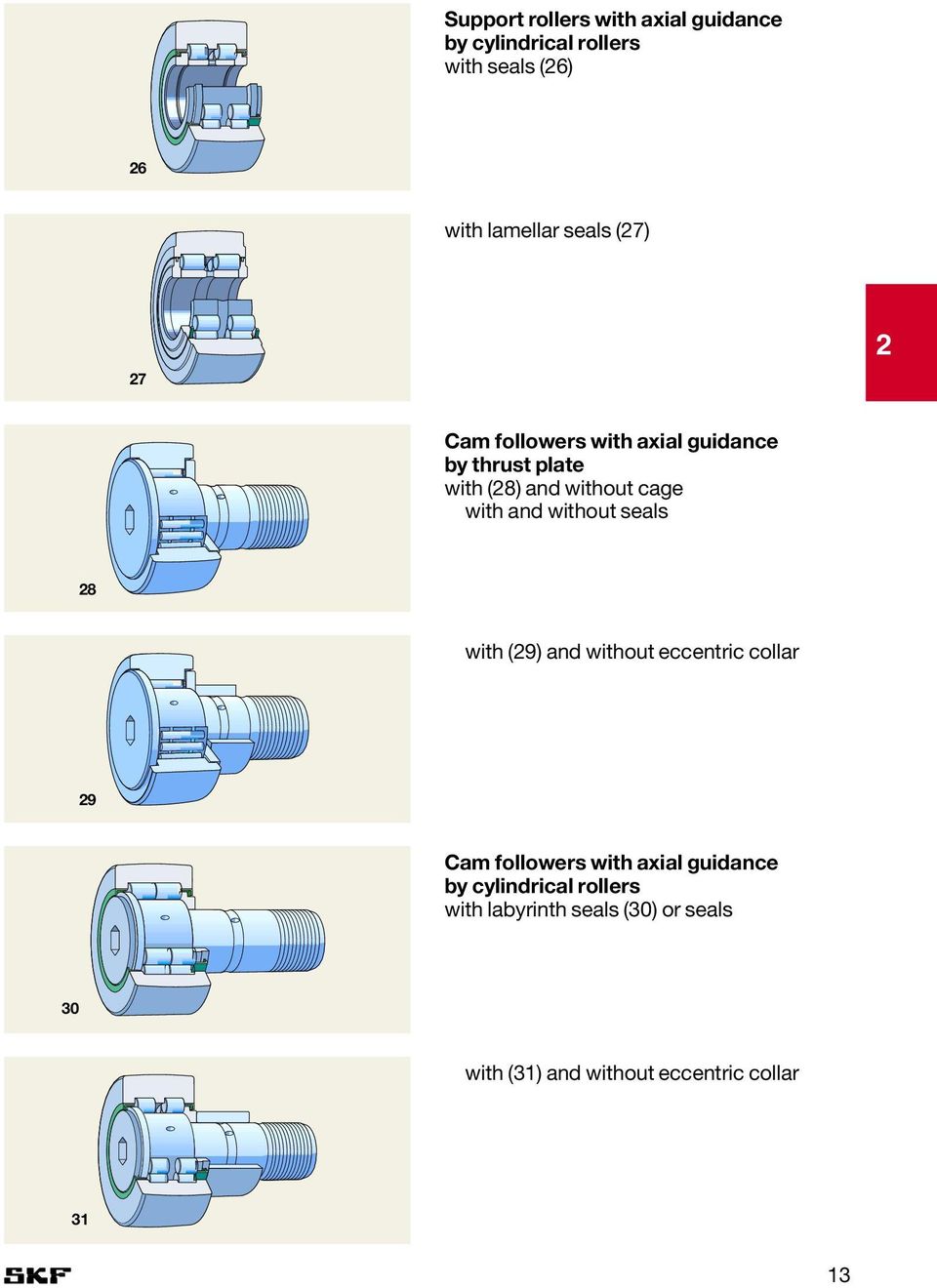
15 Support rollers with axial guidance by cylindrical rollers with seals (26) 26 with lamellar seals (27) 27 2 Cam followers with axial guidance by thrust plate with (28) and without cage with and without seals 28 with (29) and without eccentric collar 29 Cam followers with axial guidance by cylindrical rollers with labyrinth seals (30) or seals 30 with (31) and without eccentric collar 31 13
16 Bearing data general Speeds page 14 Tolerances page 14 Internal clearance page 21 Materials page 22 Supplementary designations page 24 Design of associated components page 26 Speeds The speed ratings given in the bearing tables may be exceeded up to 1,5 times the rating values for radial bearings and 2 times the rating values for thrust bearings provided loads are light, the friction minimised by using a minimum of lubricant and heat removal from the bearing position is good. Conversely, if loads are heavy, lubricant film formation inadequate, friction high because of excess or highly viscous lubricant, or when heat cannot be removed adequately from the bearing position, then it may not be possible to run at speeds as high as the values quoted for the speed ratings. Reference should also be made to the section Speeds in the SKF General Catalogue. Tolerances Unless otherwise stated, the needle roller bearings shown in this catalogue are produced to the tolerances for dimensional, form and running accuracy specified in ISO 492:1994 for radial bearings and ISO 199:1997 for thrust bearings. Tables 2 to 4 on pages 17 to 19 give the tolerances for radial bearings to tolerance classes Normal, P6 and P5, and Table 5 on page 20 gives the tolerances for thrust bearings to tolerance class Normal. The symbols used in the tables are explained opposite. The tolerance classes in which bearings are available (either as standard, or additionally) will be found in the text preceding the product table sections. Bearings with higher accuracy than to tolerance class Normal are identified by the suffix for the tolerance class in the bearing designation ( Supplementary designations, page 24). The suffix is preceded by an oblique stroke. 14

17 Tolerance symbols d nominal bore diameter d mp mean bore diameter; arithmetical mean of the largest and smallest single bore diameters in one plane dmp deviation of the mean bore diameter from the nominal ( dmp = d mp d) V dp bore diameter variation; difference between the largest and smallest single bore diameters in one plane V dmp mean bore diameter variation; difference between the largest and smallest single bore diameters in one plane D nominal outside diameter D mp mean outside diameter; arithmetical mean of the largest and smallest single outside diameters in one plane Dmp deviation of the mean outside diameter from the nominal ( Dmp = D mp D) V Dp outside diameter variation; difference between the largest and smallest single outside diameters in one plane V Dmp mean outside diameter variation; difference between the largest and smallest mean bore diameters of one ring or washer B s, C s single width of inner ring and outer ring, respectively Bs, Cs deviation of single inner ring width or single outer ring width from the nominal ( Bs = B s B; Cs = C s C) V Bs, V Cs ring width variation; difference between the largest and smallest single widths of inner ring and of outer ring, respectively T s single height (H) of single direction thrust bearing Ts deviation of single height of thrust bearing from the nominal ( Ts = T s T) K ia, K ea radial runout of assembled bearing inner ring and assembled bearing outer ring, respectively S d side face runout with reference to bore (of inner ring) S D S i, S e outside inclination variation; variation in inclination of outside cylindrical surface to outer ring side face thickness variation, measured from middle of raceway to back (seating) face of shaft washer and of housing washer, respectively (axial runout) 2 15

18 Bearing data general Limits for chamfer dimensions To prevent the improper dimensioning of associated components for needle roller bearings and to facilitate the calculation of retaining ring location arrangements, the maximum chamfer limits for the relevant minimum chamfer dimensions given in the product tables will be found in Table 1. These limits conform to ISO 582:1995. The symbols used in the tables are explained below. d nominal bore diameter r 1, r 3 chamfer dimensions in radial direction r 2, r 4 chamfer dimensions in axial direction r s min general symbol for minimum limit of r 1, r 2, r 3, and r 4 (single chamfer dimension) Chamfer dimension limits r2max r4max r2min r4min Minimum Nominal Maximum values value bearing bore Radial bearings Thrust diameter bearings r s min d r 1,3 r 2,4 r 1,2,3,4 over incl. max max max mm mm mm r r Table 1 1min 3min r 1max r 3max 0,1 0,2 0,4 0,2 0,15 0,3 0,6 0,3 0,2 0,5 0,8 0,5 0,3 40 0,6 1 0,8 40 0,8 1 0,8 0, ,5 40 1,3 2 1, ,5 3 2,2 50 1,9 3 2,2 1, ,5 2, ,5 4 2,7 1, ,3 4 3, , , , , , ,5 4, ,5 7 4,5 16

19 Normal tolerances for radial bearings Inner ring Table 2 d dmp V dp V dmp Bs V Bs K ia over incl. high low max max high low max max mm µm µm µm µm µm µm 2, Outer ring D Dmp V Dp V Dmp Cs, V Cs K ea over incl. high low max max max mm µm µm µm µm Values are identical to those for 20 inner ring of same bearing ( Bs, V Bs )

20 Bearing data general Class P6 tolerances for radial bearings Inner ring Table 3 d dmp V dp V dmp Bs V Bs K ia over incl. high low max max high low max max mm µm µm µm µm µm µm 2, Outer ring D Dmp V Dp V Dmp Cs, V Cs K ea over incl. high low max max max mm µm µm µm µm Values are identical to those for 10 inner ring of same bearing ( Bs, V Bs )

21 Class P5 tolerances for radial bearings Inner ring Table 4 d dmp V dp V dmp Bs V Bs K ia S d over incl. high low max max high low max max max mm µm µm µm µm µm µm µm 2, Outer ring D Dmp V Dp V Dmp Cs V Cs K ea S D over incl. high low max max max max max mm µm µm µm µm µm µm Values are identical to those for inner ring of same bearing ( Bs )
22 Bearing data general Normal tolerances for thrust bearings Shaft washer d dmp V dp S i 1) Ts over incl. high low max max high low mm µm µm µm µm Table ) Not valid where thrust washers of series AS are used Housing washer D Dmp V Dp S e over incl. high low max mm µm µm Values are identical to those for shaft washer of same bearing (S i )
23 Internal clearance Bearing internal clearance is defined as the total distance through which one bearing ring can be moved relative to the other in the radial direction (radial internal clearance) or in the axial direction (axial internal clearance). It is necessary to distinguish between the internal clearance of a bearing before mounting and the internal clearance in a mounted bearing which has reached its operating temperature (operational clearance). The initial internal clearance (before mounting) is greater than the operational clearance because different degrees of interference in the fits and differences in thermal expansion of the bearing rings and the associated components cause the rings to be expanded or compressed. The bearing internal clearance referred to as Normal has been selected so that a suitable operational clearance will be obtained when bearings are mounted with the fits usually recommended and operating conditions are normal. Where operating and mounting conditions differ from the normal, e.g. where interference fits are used for both bearing rings, unusual temperatures prevail etc., bearings with greater or smaller internal clearance than Normal are required. In such cases it is recommended that the residual clearance in the bearing after it has been mounted be checked. SKF needle roller bearings with inner ring are supplied as standard with Normal radial internal clearance, unless otherwise stated. Bearings having an internal clearance other than Normal are identified by the suffixes C2, C3 and C4. The limits for radial internal clearance correspond to ISO 5753:1991 and are given in Table 6. 2 Radial internal clearance for needle roller bearings Bore diameter Radial internal clearance d C2 Normal C3 C4 over incl. min max min max min max min max mm µm Table
24 Bearing data general Materials Bearing rings and rolling elements The rings and rolling elements of SKF needle roller bearings are made of a through-hardening carbon chromium steel to DIN :1980 containing approximately 1 % carbon and 1,5 % chromium. The thinwalled deep drawn outer rings of drawn cup and alignment needle roller bearings are exceptions to the above and are made of mild steel to DIN :1980. All components are hardened and can generally be used at operating temperatures up to +125 C. If the operating temperatures are higher, the bearings must be subjected to a special heat treatment (stabilisation) so that inadmissible changes in dimensions do not occur as a result of structural changes in the steel. However, the bearings should not be stabilised for a higher temperature than the expected operating temperature. As the load carrying capacity of bearings decreases with increasing temperature, the basic dynamic load rating C should be multiplied by an appropriate reduction factor, see following. Bearing temperature ( C) Reduction factor 1,00 0,90 0,75 0,60 22 Cages Various cage types and designs are used for the different types and sizes of SKF needle roller bearing types; the cages differ as to form, material, manufacturing methods, cost of production and operational limits. The standard cage for a particular bearing is not identified in the bearing designation unless it is of polyamide. With reference to the viability of production, the costs and the different application areas of the bearings, the standard cage for the larger bearings may be different from that for the smaller bearings in one and the same series. In the introductory text to each table section information is provided regarding the standard cages with which the bearings are fitted and also the possible alternatives. Polyamide cages Small and medium-sized bearings are fitted with moulded cages of heat-stabilised, glass fibre reinforced polyamide 6,6 as standard. This material is characterised by a favourable combination of strength and elasticity. The good sliding properties of the plastic on lubricated steel surfaces and the smoothness of the cage surfaces in contact with the rolling elements mean that little friction is produced by the cage so that heat generation and wear in the bearing are at a minimum. The low density of the material means that the inertia of the cage is small. The injection moulding process used to produce the cages allows functionally suitable designs to be realised. The excellent running properties of polyamide cages under lubricant starvation conditions permit continued operation of the bearing for a time without any risk of seizure and secondary damage. When using bearings with polyamide cages the permissible operating temperatures for the material and its resistance to the lubricant used must be observed. At operating temperatures up to the values given in Table 7 for the various oils and greases which are used as bearing lubricants, cage properties are unaffected. If the permissible temperature is exceeded, the cage material will age, this process being accelerated the longer the cage is exposed to the excessive
25 temperature. Brief periods at up to 20 C above the recommended maximum temperatures can be tolerated provided they are interspersed with longer periods at operating temperatures below the recommended values, and provided the maximum operating temperature for the lubricant is not exceeded. When operating temperatures are constantly above 120 C, bearings fitted with metallic cages must be used. Polyamide cages are also unsuitable for operating temperatures below 40 C as they lose their elasticity. The organic solvents normally used to clean rolling bearings such as white spirit or trichlorethane do not affect cage properties, nor do dilute alkaline cleaners (e.g. soda) if they are at room temperature and the period during which they are in contact is short. The chlorofluorocarbons or ammonia used in refrigeration do not attack polyamide. In vacuum, polyamide cages become brittle because they become dehydrated. Steel cages The majority of SKF needle roller bearings are fitted with pressed cages of steel or sheet steel. These cages have relatively high strength and weigh little. They take up little space in the bearing and therefore allow adequate lubricant supply to the roller/raceway contacts. The sheet steel cages are produced from deep drawing strip or tube. The joints are welded. To reduce friction and wear they may be hardened and surface treated. The steel cages are produced from mild steel tube and have profiled surfaces. Steel cages can be used at operating temperatures up to 300 C. They are not affected by the mineral or synthetic oil-based lubricants normally used for rolling bearings, nor by the organic solvents used to clean bearings. There is a risk of corrosion where water is present. Permissible operating temperatures for cages of glass fibre reinforced polyamide 6,6 with various bearing lubricants Lubricant Permissible operating temperature 1) C Mineral oils Oils without EP additives e.g. machine oils, hydraulic oils 120 EP oils e.g. industrial and automotive gearbox oils 110 EP oils e.g. rear axle and differential gear oils (automotive), hypoid gear oils 100 Synthetic oils Polyglycols, poly-α-olefins 120 Diesters, silicones 110 Greases Lithium base 2), polyurea, bentonite, calcium complex 120 Table 7 2 1) Measured on the outside surface of the outer ring 2) For sodium and calcium base greases and other bearing greases with a maximum operating temperature below 120 C, the maximum temperature for the polyamide cage is the same as the maximum operating temperature for the grease; otherwise the permissible maximum operating temperature is 120 C 23
26 Bearing data general Supplementary designations The complete designation for a needle roller bearing product consists of the basic designation, which identifies bearing type and size, as well as any supplementary designations in the form of suffixes. These suffixes identify design features which differ from the original standard design. The features are divided into groups and when more than one feature is to be identified, the appropriate suffixes appear in a given order. Those suffixes which are commonly used to identify certain features of SKF needle roller bearings are explained in the following. AS ASR BF BIR C2 C3 C4 D DS DSTN EGS FMA FPA GP Bearing with lubrication hole(s) in the outer ring; a figure following AS gives the number of holes Bearing with annular groove and lubrication hole(s) in the outer ring; a figure following ASR gives the number of holes Needle roller with flat ends Profiled inner ring raceway Radial internal clearance smaller than Normal Radial internal clearance greater than Normal Radial internal clearance greater than C3 Changed internal design of bearing of same type and size as original. Generally dropped after a certain changeover period, but may be retained where variants of the same type and size of bearing have to be distinguished Split needle roller and cage assembly DS + TN Inner ring with non-directionally ground raceway M-profile machined steel cage, outer ring centred Window-type steel cage (from single blank, with punched or reamed pockets), outer ring centred Noise tested bearing H HT.. IS ISR JPC JPCS M./M. MT.. N/M. PP P4 P5 P6 P62 P63 RS.2RS S Reduced tolerance for the inside diameter of the cage and roller assembly. The figures following the letter H indicate the tolerance limits in µm, e.g. H Special grease for high temperatures (up to +130 C); the two figures following HT identify the actual grease Bearing with lubrication hole(s) in the inner ring; a figure following IS indicates the number of holes Bearing with annular groove and lubrication hole(s) in the inner ring; a figure following ISR indicates the number of holes Profiled, roller guided pressed sheet steel cage. Different designs are identified by a figure, e.g. J1PC Welded JPC cage, example: K ZWJPCS Diameter tolerance of needle rollers (e.g. M2/M4 diameter tolerance 2 to 4 µm) Special grease for moderate temperatures (up to +110 C); the two figures following MT identify the actual grease Diameter tolerance of needle rollers (e.g. N/M4 diameter tolerance 0 to 4 µm) Seals at both sides of a support roller or cam follower Dimensional and running accuracy to ISO tolerance class 4 specifications (better than P5) Dimensional and running accuracy to ISO tolerance class 5 specifications (better than P6) Dimensional and running accuracy to ISO tolerance class 6 specifications (better than Normal) P6 + C2 P6 + C3 Rubbing seal at one side of bearing Rubbing seals at both sides of bearing Matched bearings for an equal distribution of radial load. A figure preceding the S indicates the number of bearings 24
27 SK Cam follower with internal hexagon at head side of stud SM.. Bearing filled with a special grease; the two figures following SM identify the actual grease /SORT Gauge of the needle rollers of an assembly. The figures following indicate the gauge limits in µm, e.g. KZK /SORT 1 3 S0 Bearing, the rings or washers of which have been stabilised for operating temperatures up to +150 C S1 Bearing, the rings or washers of which have been stabilised for operating temperatures up to +200 C S2 Bearing, the rings or washers of which have been stabilised for operating temperatures up to +250 C TN Injection moulded glass fibre reinforced polyamide 6,6 cage V Full complement of rollers (no cage) VGS X Z ZTN ZW ZWTN 2ZL Preground raceway on inner ring Support roller and cam follower with cylindrical runner surface on the outer ring instead of standard crowned runner surface Bearing with cover Z + TN Double row cage ZW + TN Support roller with two lamellar seals arranged between grooves in the outer ring shoulders and in the shoulders of the non-integral flange rings 2 25
28 Bearing data general Design of associated components Dimensional, form and running accuracy of bearing seatings and abutments The accuracy of cylindrical bearing seatings on shafts and in housing bores, of seatings for thrust bearing washers and of the support surfaces (abutments for bearings provided by shaft and housing shoulders etc.) should correspond to the accuracy of the bearings used. In the following, guideline values for the dimensional, form and running accuracy are given. These should be followed when machining the seatings and abutments. Dimensional tolerances For bearings made to Normal tolerances, the dimensional accuracy of cylindrical seatings on the shaft should be at least to grade 6 and in the housing at least to grade 7. For bearings with higher accuracy, correspondingly better grades should be used. The basic tolerances to ISO 286-1:1988 will be found in Table 8. Tolerances for cylindrical form The cylindricity tolerances as defined in ISO should be 1 to 2 IT grades better than the prescribed dimensional tolerance, depending on requirements. For example, if a bearing shaft seating has been machined to tolerance f6, then the accuracy of form should be to IT5 or IT4. Table 9 gives guideline values for the cylindrical form tolerance and the total runout tolerance for the different bearing tolerance classes. Tolerances for perpendicularity Abutments for bearing rings should have a rectangularity tolerance as defined in ISO which is better by at least one IT grade than the diameter tolerance of the associated cylindrical seating. For thrust bearing washer seatings, the perpendicularity tolerance should not exceed the values of IT5. Guideline values for the rectangularity tolerance and for the total axial runout will be found in the Table Limits for ISO tolerance grades Nominal Tolerance grades dimension IT2 IT3 IT4 IT5 IT6 IT7 over incl. mm µm Table , ,5 2, ,5 2, , ,
29 Accuracy of form and position for bearing seatings on shafts and in housings Table 9 A t1 t3 A-B B A t 2 A-B t 4 A-B B d A d B D A D B t 2 A-B t 4 A-B t 1 t 3 A-B 2 Surface Permissible deviation Characteristic Symbol for Bearings of tolerance class 1) charac- tolerance Normal P6 P5 teristic zone Cylindrical seating Cylindricity t 1 IT5 IT4 IT Total radial runout t 3 IT5 IT4 IT Flat abutment Rectangularity t 2 IT5 IT4 IT3 Total axial runout t 4 IT5 IT4 IT3 1) The basic tolerance grades stated are valid for normal demands on the bearing arrangement. For special demands in respect of running accuracy or even support the bearing seating should be machined to the basic tolerance grades recommended for the next higher bearing tolerance class 27
30 Bearing data general Surface roughness of bearing seatings The roughness of bearing seating surfaces does not have the same degree of influence on bearing performance as the dimensional, form and running accuracies. However, a desired interference fit is much more accurately obtained the smoother the mating surfaces. For less critical bearing arrangements relatively large surface roughnesses are permitted. For bearing arrangements where demands in respect of accuracy are high, guideline values for the mean surface roughness R a are given in Table 10 for the different dimensional accuracies of the bearing seatings. These recommendations apply to ground seatings, which are normally assumed for shaft seatings. Raceways on shafts and in housings Raceways machined in associated components for needle roller and cage assemblies, drawn cup needle roller bearings, needle roller bearings having only one ring, combined needle roller bearings without inner ring, needle roller and cage thrust assemblies and support rollers without inner ring must have a hardness of between 58 and 64 HRC if the load carrying capacity of the bearing or assembly is to be fully exploited. Influence of raceway hardness Raceways having a hardness under 58 HRC reduce the load carrying capacity of the bearing arrangement. This is taken into account by multiplying the basic dynamic load rating by a reduction factor f c from Table 11. Raceway surface finish and accuracy The surface roughness should be R a 0,2 µm or R z 1 µm. For less demanding applications, lower hardness and rougher surfaces may be used. For radial bearing arrangements, the out-of-round should not exceed 25 %, and the deviation from cylindrical form should not exceed 50 %, of the actual diameter tolerance of the raceway. The permissible axial runouts of raceways for the needle roller and cage thrust assemblies are the same as for the shaft and housing washers of thrust bearings ( Table 5, page 20). Raceway materials Suitable materials for the seatings include through-hardening steels to DIN : 1980, e.g. steel 100 Cr 6, case-hardening steels to DIN :1986 and :1980, e.g. 15 CrNi 6 or 16 MnCr 5, as well as steels for flame or induction hardening to DIN :1972 or DIN :1980, which can be partially hardened. Guideline values for surface roughness of bearing seatings Diameter Recommended R a value of seating for ground seatings d (D) Diameter tolerance to over incl. IT7 IT6 IT5 mm µm Table ,6 (N7) 0,8 (N6) 0,4 (N5) ,6 (N7) 1,6 (N7) 0,8 (N6) 28
31 The case depth which is recommended for raceways machined in associated components depends on various factors including the dynamic and static load ratios (P/C and P 0 /C 0 respectively) as well as the core hardness, and it is difficult to generalise. For example, under conditions of purely static load up to the magnitude of the basic static load rating and with a core hardness of 350 HV, the recommended case depth is of the order of 0,1 times the rolling element diameter. Smaller case depths are permitted for dynamic loads. Please contact SKF for advice. 2 Table 11 Reduction factor f c Raceway hardness (HRC) Reduction factor f c for dynamic load conditions 55 0,7 50 0,5 45 0,4 40 0,3 35 0, ,2 29
32
33 Product data Needle roller and cage assemblies page 33 Drawn cup needle roller bearings page 49 Needle roller bearings page 67 Alignment needle roller bearings page 107 Needle roller thrust bearings page 117 Combined needle roller bearings page 129 Support rollers page 159 Cam followers page 181 Components and accessories page
34
35 Needle roller and cage assemblies Product tables page 40 SKF needle roller and cage assemblies are ready-to-mount, self-contained, bearing arrangement components. They enable bearing arrangements to be produced which have high load carrying capacity and stiffness and require a minimum of radial space if the shaft and housing bore can serve as raceways and have the same hardness and surface finish as bearing rings. If the raceways are made with increased accuracy, bearing arrangements with high running accuracy can be achieved. SKF needle roller and cage assemblies are available in single row ( fig 1 ) and double row ( fig 2 ) designs. They are characterised by simple and rugged design, accurate guidance of the rollers in the cage pockets, and good running properties. The needle rollers are slightly relieved towards their ends. The modified line contact thus achieved between rollers and raceways means that damaging edge stresses are avoided. 3 Fig 1 Fig 2 33
36 Needle roller and cage assemblies Fig 3 Fig 4 Fig 5 34
37 Other needle roller and cage assemblies The needle roller and cage assemblies listed in the product tables form only a part of the comprehensive range available from SKF. This not only includes other sizes but also assemblies with cages which differ from the standard cage design, for example split needle roller and cage assemblies, which can be used where raceways are recessed in the shaft ( fig 3 ). For the connecting rod bearing arrangements of combustion engines and compressors, SKF has special needle roller and cage assemblies for gudgeon pin bearing arrangements ( fig 4 ) and crankpin bearing arrangements ( fig 5 ). The assemblies for these applications, where high accelerations occur, have given excellent service in spite of the difficult operating conditions, including high temperatures or unfavourable load, movement or lubrication conditions. To special order, SKF also produces special sizes of needle roller and cage assemblies, when the quantities required are economical. Details of these other needle roller and cage assemblies will be sent on request. Dimensions The dimensions of needle roller and cage assemblies with inside diameter up to and including 100 mm, where standardised, conform to ISO 3030:1996. Tolerances SKF needle roller and cage assemblies each contain rollers of one gauge of grade G2 (ISO 3096:1996 Grade 2). The tolerance of each gauge is 2 µm maximum. The relevant gauge is indicated by a coloured slip enclosed in the package ( Table 1 ). The deviations from the nominal dimensions of the needle rollers are also printed on the package. Supplies of needle roller and cage assemblies may comprise assemblies of any gauge (red, blue, white or grey) unless specific requirements are stated when ordering. Assemblies with rollers of special gauge (green and yellow) are only available to special order. The tolerances for the width U are 0,20/ 0,80 mm for all assemblies. Paired mounting If needle roller and cage assemblies are to be mounted immediately adjacent to each other, they must incorporate rollers of the same gauge, so that both assemblies carry the load equally. 3 Needle roller gauges Gauge type Colour Gauge in µm Table 1 Standard gauges red 0/ 2 1/ 3 blue 2/ 4 3/ 5 white (grey) 4/ 6 5/ 7 Special gauges green 6/ 8 7/ 9 (to order) yellow 8/ 10 9/ 11 35
38 Needle roller and cage assemblies Internal clearance The radial internal clearance of bearing arrangements incorporating needle roller and cage assemblies is determined by the gauge of the needle rollers in combination with the shaft and housing raceway tolerances and the operating temperature. Suitable raceway tolerances which have been well proven in practice are given in Table 2. If applied when using assemblies incorporating rollers of standard gauge ( Table 1 ), the radial internal clearance will lie in the range of C2 and Normal ( Table 6 on page 21). If a specific radial internal clearance is required in a given bearing arrangement, it is recommended that the various components of the arrangement are matched, e.g. following a matching plan as shown in Table 3.It should be observed that the mean value of the needle roller gauge should be used to calculate the internal clearance, i.e. 6 µm for the gauge 5/ 7 µm. The example shown in Table 3 will produce a small operational clearance, i.e. less than normal. Table Raceway tolerances for needle roller and cage assemblies Shaft Tolerances housing/shaft Nominal for operational clearance diameter (mm) less than normal greater than over incl. normal normal 80 G6/j5 G6/h5 G6/g6 H6/h5 H6/g5 H6/f G6/h5 G6/g5 G6/f6 140 G6/h5 G6/g5 G6/f6 H6/f5 H6/e6 2 Misalignment The modified line contact between the raceways and the needle rollers not only prevents damaging edge stresses, but also enables single row needle roller and cage assemblies to accept minimum misalignments up to approximately 1 minute of arc between shaft and housing. Table 3 Matching plan Needle roller and cage assembly: K Housing bore diameter: 22H6 (mm); deviation 0/+13 µm Shaft diameter: 16h5 (mm); deviation 0/ 8 µm Shaft diameter Housing bore diameter Deviation group Deviation groups 0 to to to to +13 Needle Radial Needle Radial Needle Radial Needle Radial roller internal roller internal roller internal roller internal gauge clearance gauge clearance gauge clearance gauge clearance limits limits limits limits 0 to 3 5/ / to 6 5/ / / / 6 6 to 8 5/ / / / / 8 4/ 6 3/ 5 1/ 3 36
39 Cages SKF needle roller and cage assemblies have a steel ( fig 6 ) or sheet steel cage ( fig 7 ) as standard except for those identified by the designation suffix TN. These have an injection moulded glass fibre reinforced polyamide 6,6 cage ( fig 8 ). Fig 6 NB. Needle roller and cage assemblies with polyamide 6,6 cages can be used at temperatures up to +120 C. With the exception of a few synthetic oils and greases with a synthetic base oil, and lubricants containing a high proportion of EP additives when used at high temperatures, the lubricants generally used for rolling bearings do not have a detrimental effect on cage properties. For further information regarding the temperature resistance and use of cages, please refer to the section Cages ( page 22). For bearing arrangements which are to be operated at continuously high temperatures or under arduous conditions, it is recommended that assemblies incorporating steel or sheet steel cages be used. Raceways on the shaft and in the housing If the full load carrying capacity of the needle roller and cage assembly is to be exploited the raceways on the shaft and in the housing must have the hardness and surface finish normally found on bearing raceways. Recommendations for suitable materials, surface roughness and hardness will be found in the section Raceways on shafts and in housings ( page 28). Fig 7 Fig
40 Needle roller and cage assemblies Abutment dimensions Needle roller and cage assemblies must be axially guided. The lateral abutment surfaces should be fine turned and possibly polished; for high speed operation they should be hardened and ground. Interruptions in the surface should be avoided. Appropriate values for the abutment diameters on the shaft ( fig 9 ) and in the housing ( fig 10 ) are given in Table 4. Snap rings may be used in less demanding applications, otherwise an intermediate ring, e.g. a pressed spring steel washer should be placed between the snap ring and the assembly. Table Abutment dimensions for needle roller and cage assemblies Needle roller and Shaft Housing cage assembly abutment abutment Inside diameter F w d a D a over incl. mm mm mm 25 E w 0,3 F w + 0, E w 0,5 F w + 0,5 65 E w 1 F w Fig 9 Fig 10 U+0,2 U U+0,2 U d a E w D a F w 38
41 Minimum load In order to guarantee satisfactory operation, needle roller and cage assemblies, like all ball and roller bearings, must always be subjected to a given minimum load, particularly if they are to operate at high speeds or are subjected to high accelerations or rapid changes in the direction of load. Under such conditions the inertia forces of the needle rollers and cage of the assembly, and the friction in the lubricant, can have a detrimental influence on the rolling conditions in the bearing arrangement and may cause damaging sliding movements to occur between the rollers and raceways. The requisite minimum radial load to be applied to needle roller and cage assemblies can be estimated using F rm = 0,02 C Supplementary designations The designation suffixes used to identify certain features of SKF needle roller and cage assemblies are explained in the following. DS Split needle roller and cage assembly DSTN DS + TN SORT Gauge of the needle rollers of an assembly. The figures following indicate the gauge limits in µm, e.g. SORT 1 3 TN Injection moulded cage of glass fibre reinforced polyamide 6,6 VG052 Split cage of polyether ether ketone (PEEK) ZW Double row cage ZWDSTN ZW + DS + TN where F rm = minimum radial load, N C = basic dynamic load rating, N When starting up at low temperatures or when the lubricant is highly viscous, even greater loads may be required. The weights of the components supported by the bearing, together with the external forces, generally exceed the requisite minimum load. If this is not the case, the needle roller and cage assembly must be subjected to an additional radial load. 3 Equivalent dynamic bearing load Needle roller and cage assemblies can only take radial loads, therefore P = Fr Equivalent static bearing load Needle roller and cage assemblies can only take radial loads, therefore P 0 = Fr 39
42 Needle roller and cage assemblies F w 3 19 mm U E w F w Dimensions Basic load ratings Fatigue Speed ratings Mass Designation Appropriate dynamic static load Lubrication seal 1) limit grease oil Designation F w E w U C C 0 P u mm N N r/min g ,3 K TN ,4 K TN ,4 K TN ,5 K TN ,7 K TN ,7 K TN ,9 K TN ,8 K TN ,1 K TN ,9 K TN G S ,6 K TN ,9 K TN ,0 K TN ,0 K TN ,2 K TN ,7 K TN ,0 K TN G ,5 K TN ,1 K TN ,6 K TN ,3 K TN ,9 K TN ,5 K TN G ,6 K TN G ,5 K TN ,9 K TN ,3 K TN G ,6 K TN G ,9 K TN ,0 K TN G/SD ) Details of appropriate seals will be found in the section Seals ( page 214) 40
43 Dimensions Basic load ratings Fatigue Speed ratings Mass Designation Appropriate dynamic static load Lubrication seal 1) limit grease oil Designation F w E w U C C 0 P u mm N N r/min g ,0 K ,5 K ,0 K ,1 K G/SD ,6 K TN ,0 K ,0 K ,5 K ,0 K K G/SD K G/SD ,5 K ,5 K K K G/SD K G/SD K G/SD K G/SD ,5 K ,5 K ,5 K ,0 K ,0 K K K G/SD K G/SD K G/SD K K ,0 K K ) Details of appropriate seals will be found in the section Seals ( page 214) 41
44 Needle roller and cage assemblies F w mm U E w F w Serie K Serie K.. ZW Dimensions Basic load ratings Fatigue Speed ratings Mass Designation Appropriate dynamic static load Lubrication seal 1) limit grease oil Designation F w E w U C C 0 P u mm N N r/min g ,5 K ,0 K K K G/SD K G/SD K G/SD K G/SD K G/SD K G/SD K ,0 K ,5 K ,5 K K K G/SD K K TN G/SD K TN ,5 K K K K K ZW ,5 K K K K K K ZW K K K G K G K G K G/SD ) Details of appropriate seals will be found in the section Seals ( page 214) 42
45 Dimensions Basic load ratings Fatigue Speed ratings Mass Designation Appropriate dynamic static load Lubrication seal 1) limit grease oil Designation F w E w U C C 0 P u mm N N r/min g K K K ZW K K K K G/SD K G/SD K K K K K G/SD K G/SD K G/SD K G/SD K K K K K K K K K K K TN K G/SD K G/SD K G/SD K G/SD K G/SD K K ) Details of appropriate seals will be found in the section Seals ( page 214) 43
46 Needle roller and cage assemblies F w mm U E w F w Series K Series K.. ZW Dimensions Basic load ratings Fatigue Speed ratings Mass Designation Appropriate dynamic static load Lubrication seal 1) limit grease oil Designation F w E w U C C 0 P u mm N N r/min g K K K K K ZW K K K K G/SD K K K K ZW K K K K K K G/SD K TN G/SD K K K K TN K K K ) Details of appropriate seals will be found in the section Seals ( page 214) 44
47 Dimensions Basic load ratings Fatigue Speed ratings Mass Designation Appropriate dynamic static load Lubrication seal 1) limit grease oil Designation F w E w U C C 0 P u mm N N r/min g , K K K K K K G/SD K G/SD K K K K K K K K K K K ZW K K K ZW K ZW K K K K ZW K K ZW K K K K K ) Details of appropriate seals will be found in the section Seals ( page 214) 45
48 Needle roller and cage assemblies F w mm U E w F w Dimensions Basic load ratings Fatigue Speed ratings Mass Designation Appropriate dynamic static load Lubrication seal 1) limit grease oil Designation F w E w U C C 0 P u mm N N r/min g K K K K K G K G K K K K K K K K K K K K K K K K K K K K K ) Details of appropriate seals will be found in the section Seals ( page 214) 46
49 Dimensions Basic load ratings Fatigue Speed ratings Mass Designation dynamic static load Lubrication limit grease oil F w E w U C C 0 P u mm N N r/min g K K K K K K K K K K K K K K K K K K
50
51 Drawn cup needle roller bearings Product tables page 56 SKF drawn cup needle roller bearings, as the name suggests, are needle roller bearings with a deep drawn thin-walled outer ring with open or closed end. They are characterised by very low sectional height and high load carrying capacity. They are used when the housing bore cannot be used as a raceway for a needle roller and cage assembly but where a very compact and economic bearing arrangement is required. They are pressed into the housing bore and, if shoulders or retaining rings are not required for axial location, the design of the housing bore is simple and can be economically produced. Drawn cup needle roller bearings are available with open ends ( fig 1 ) or with closed end ( fig 2 ). The latter are suitable for bearing arrangements at the ends of shafts. The profiled design of the closed end also permits small axial guidance forces to be accommodated. 3 Fig 1 Fig 2 49
52 Drawn cup needle roller bearings Drawn cup needle roller bearings are generally used directly on the shaft. However, in cases where the shaft cannot be hardened and ground, they can be combined with an inner ring ( fig 3 ). The drawn cup of hardened sheet steel and the needle roller and cage assembly of these bearings form a non-separable unit. The outside surface of the rollers is slightly relieved towards the roller ends; this gives a favourable load distribution in the bearing. The space available for lubricant is large enough to allow long relubrication intervals to be applied. Normally, drawn cup needle roller bearings have a single row of rollers. However, the relatively wide sizes incorporate two needle roller and cage assemblies immediately adjacent to each other and have a lubrication hole in the outer ring ( fig 4 ). On request, any single row drawn cup needle roller bearing for shaft diameters of 7 mm and above can be supplied with a lubrication hole in the outer ring ( fig 5 ). Fig 3 Fig 4 Fig 5 50
53 Sealed drawn cup needle roller bearings For applications where a sufficiently efficient seal is not available, or cannot be used for space reasons, drawn cup needle roller bearings can also be supplied with integral seals as follows: Fig 6 drawn cup needle roller bearing with open ends, sealed at one side ( fig 6 ); drawn cup needle roller bearing with open ends, sealed at both sides ( fig 7 ); sealed drawn cup needle roller bearing with closed end ( fig 8 ). The integral seals are rubbing seals of polyurethane or nitrile rubber (NBR) which, under normal conditions, effectively exclude solid contaminants and moisture and retain the lubricant in the bearing. Sealed drawn cup needle roller bearings are supplied as standard filled with a high quality lithium base grease of consistency 2 to the NLGI Scale. The grease has good rust inhibiting properties and can be used at temperatures between 30 and +100 C. The relatively large quantity of grease in the bearings means that they can be operated for long periods before relubrication is required. Fig 7 3 Fig 8 51
54 Drawn cup needle roller bearings Universal joint bearings For the universal joints of commercial vehicle propeller shafts, SKF has developed a drawn cup needle roller bearing with closed end ( fig 9 ). The bearing has high dynamic load carrying capacity and other design refinements. Several sizes are available in the inside diameter range 20 to 48 mm. The thin-walled, case hardened drawn cup allows the use of relatively large diameter rollers giving high load carrying capacity while still permitting compact bearing arrangements. Other advantages include high axial load carrying capacity without risk of rupture of the base of the drawn cup and good damping of axial shocks by the integral thrust washer of glass fibre reinforced plastic. The cup spring between the roller ends and seal reduces the risk of false brinelling as it aligns the rollers in the unloaded zone and causes the roller complement to continue rotating. The integral seals of nitrile rubber (NBR) efficiently prevent dirt and water from penetrating the bearing and retain the lubricating grease in the bearing, thus rendering the bearing maintenance-free. Further information will be supplied on request. Dimensions The boundary dimensions of the drawn cup needle roller bearings are in accordance with ISO 3245:1997. Tolerances The dimensional accuracy of drawn cup needle roller bearings cannot be checked until they have been mounted as the thinwalled outer ring may be slightly out-ofround. Only after the bearing has been pressed into a housing bore having the recommended tolerance will the outer ring obtain its correct form, which is decisive for bearing performance. If it is desired to check the inside diameter F w of the roller set, the bearing must first be pressed into a thickwalled ring having a bore diameter as shown in Table 1. A measuring mandrel can then be used to check the inside diameter deviation. The permissible deviations are also given in Table Tolerances for drawn cup needle roller bearings Bearing Gauge ring Deviations from Inside Outside Bore nominal inside diameter diameter diameter diameter F w D (measured) high low mm mm µm 3 6,5 6, , , , , , , , , , , , , , , , , , , , , , , , , , , Fig 9 Table 1
55 The width tolerance is a uniform 0/ 0,3 mm for all sizes of drawn cup needle roller bearings. Paired mounting If drawn cup needle roller bearings are to be mounted immediately adjacent to each other, the deviations from the nominal internal diameter must be the same for both bearings if they are to carry the load equally. Misalignment The modified line contact between the raceways and the needle rollers not only prevents damaging edge stresses but also enables single row drawn cup needle roller bearings to accept minimum misalignments between shaft and housing. high proportion of EP additives when used at high temperatures, the lubricants generally used for rolling bearings do not have a detrimental effect on cage properties. For further information regarding the temperature resistance and use of cages, please refer to the section Cages ( page 22). For bearing arrangements which are to be operated at continuously high temperatures or under arduous conditions, it is recommended that bearings incorporating sheet steel cages be used. Cages SKF drawn cup needle roller bearings incorporate a sheet steel cage ( fig 10 ) as standard except for those identified by the designation suffix TN. These have an injection moulded glass fibre reinforced polyamide 6,6 cage ( fig 11 ). 3 NB. Drawn cup needle roller bearings with polyamide 6,6 cages can be used at temperatures up to +120 C. With the exception of a few synthetic oils and greases with a synthetic base oil, and lubricants containing a Fig 10 Fig 11 53
56 Drawn cup needle roller bearings Shaft and housing tolerances It is particularly important for drawn cup needle roller bearings that the housing bore has good accuracy of dimensions and form. If the values given in Table 2 are adhered to then the bearings will obtain the necessary interference fit in the housing. The inside diameter (diameter under the rollers) will then be approximately within tolerance F8. This, together with the recommended shaft tolerance which is also given in Table 2, will result in a normal radial internal clearance in the bearing arrangement. The cylindricity of the housing bore should be within IT5/2. Raceways on the shaft If the full load carrying capacity of drawn cup needle roller bearings is to be exploited, the raceways on the shaft must have the hardness and surface finish normally found on bearing raceways. Recommendations will be found in the section Raceways on shafts and in housings ( page 28). Mounting instructions The best way to mount drawn cup needle roller bearings is to use a mounting dolly ( fig 12 ). The bearing can be held in position by an O-ring. The stamped side face of drawn cup needle roller bearings should preferably abut the flange of the mounting dolly. Special care should be taken to see that the bearings do not skew or tilt when they are being pressed into the housing. Shaft and housing tolerances Housing Tolerances material 1) Housing Raceway Shaft seating bore on the for inner seating 2) shaft ring Steel, cast iron N6 h5 k5 N7 h6 j6 Light alloy R6 h5 k5 R7 h6 j6 1) For housings which are not rigid, the shaft tolerance giving the desired operational clearance must be determined by trial and error 2) The accuracy of cylindrical form to ISO for the housing bore must correspond to tolerance IT5/2 15 Table 2 Fig 12 D 0,2 0,3 F w 0,025 54
57 Minimum load In order to guarantee satisfactory operation, drawn cup needle roller bearings, like all ball and roller bearings, must always be subjected to a given minimum load, particularly if they are to operate at high speeds or are subjected to high accelerations or rapid changes in the direction of load. Under such conditions the inertia forces of the needle rollers and cage of drawn cup needle roller bearings, and the friction in the lubricant, can have a detrimental influence on the rolling conditions in the bearing arrangement and may cause damaging sliding movements to occur between the rollers and raceways. The requisite minimum radial load to be applied to drawn cup needle roller bearings can be estimated using Supplementary designations The designation suffixes used to identify certain features of SKF drawn cup needle roller bearings are explained in the following. AS1 RS 2RS SM03 TN One lubrication hole in the outer ring Seal at one side of the bearing Seal at both sides of drawn cup needle roller bearing with open ends Lithium base grease of consistency 2 for operating temperatures of 25 to +150 C Injection moulded cage of glass fibre reinforced polyamide 6,6 F rm = 0,02 C where F rm = minimum radial load, N C = basic dynamic load rating, N When starting up at low temperatures or when the lubricant is highly viscous, even greater loads may be required. The weights of the components supported by the bearing, together with the external forces, generally exceed the requisite minimum load. If this is not the case, the drawn cup needle roller bearing must be subjected to an additional radial load. 3 Equivalent dynamic bearing load Drawn cup needle roller bearings can only take radial loads, therefore P = F r Equivalent static bearing load Drawn cup needle roller bearings can only take radial loads, therefore P 0 = F r Static load carrying capacity It should be observed that a static safety factor of 3 or larger should be applied, i.e. s 0 = C 0 /P
58 Drawn cup needle roller bearings F w 3 10 mm C r2 r 1 C 1 D Fw ; ; ; With open ends Series HK With closed end Series BK With open ends and one seal Series HK.. RS With open ends and two seals Series HK.. 2RS Principal Basic load ratings Fatigue Speed ratings Mass Designation dimensions dynamic static load Lubrication limit grease oil F w D C C C 0 P u mm N N r/min g 3 6, ,0 HK 0306 TN 6, ,0 BK 0306 TN ,0 HK ,1 BK ,0 HK ,1 BK ,1 HK ,5 HK ,6 BK ,6 HK ,9 BK ,7 HK ,0 BK ,0 HK ,0 HK 0810 RS ,4 BK ,3 HK RS ,0 HK ,0 HK ,3 BK ,6 HK ,9 BK ,1 HK ,3 BK ,8 HK ,2 HK 1012 RS ,0 BK ,6 HK RS ,0 HK ,2 BK
59 r a Da Dimensions Abutment and Appropriate fillet dimensions inner ring 1) seal 1) Designation Designation F w C 1 r 1, 2 D a r a min max max mm mm 3 0,3 3,5 0,3 5,2 0,3 3,5 0,3 4 0,3 5 0,3 G S 6,4 0,3 5 0,3 G S 5 0,4 5,3 0,4 G S 7,2 0,4 5,3 0,4 G S 6 0,4 6,3 0,4 G S 0,4 6,3 0,4 G S 7,4 0,4 6,3 0,4 G S 7 0,4 7,3 0,4 G S 7,4 0,4 7,3 0,4 G S 8 0,4 8,3 0,4 G ,4 0,4 8,3 0,4 G ,4 8,3 0,4 IR G ,4 8,3 0,4 IR ,4 0,4 8,3 0,4 IR G ,4 8,3 0,4 IR ,4 9,3 0,4 G ,4 9,3 0,4 IR G ,2 0,4 9,3 0,4 IR G ,4 9,3 0,4 IR G ,4 0,4 9,3 0,4 IR G ,4 10,3 0,4 IR G ,4 0,4 10,3 0,4 IR G ,4 10,3 0,4 IR G ,4 10,3 0,4 10,4 0,4 10,3 0,4 IR G ,4 10,3 0,4 IR ,4 10,3 0,4 IR G ,4 0,4 10,3 0,4 IR G ) Details of appropriate inner rings and seals will be found in the sections Inner rings ( page 204) and Seals ( page 214) 57
60 Drawn cup needle roller bearings F w mm C r2 r 1 C 1 D Fw ; ; ; With open ends Series HK With closed end Series BK With open ends and one seal Series HK.. RS With open ends and two seals Series HK.. 2RS With closed end and one seal Series BK.. RS Principal Basic load ratings Fatigue Speed ratings Mass Designation dimensions dynamic static load Lubrication limit grease oil F w D C C C 0 P u mm N N r/min g ,6 HK ,2 BK ,0 HK BK HK 1214 RS HK RS HK BK HK BK HK 1414 RS BK 1414 RS HK RS HK BK HK 1514 RS HK HK RS BK HK 1518 RS HK RS HK ) HK BK HK 1614 RS BK 1614 RS HK HK RS BK HK RS HK ) BK ) HK ) Double row 58
61 r a Da Dimensions Abutment and Appropriate fillet dimensions inner ring 1) seal 1) Designation Designation F w C 1 r 1, 2 D a r a min max max mm mm 12 0,4 12,3 0,4 IR G ,4 0,4 12,3 0,4 IR G ,8 13 0,8 IR G/SD ,3 0,8 13 0,8 IR G/SD ,8 13 0,8 LR/IR ,8 13 0, ,8 14 0,8 IR G/SD ,3 0,8 14 0,8 IR G/SD ,8 15 0,8 IR G/SD ,3 0,8 15 0,8 IR G/SD ,8 15 0,8 IR ,3 0,8 15 0,8 IR ,8 15 0,8 IR ,8 16 0,8 IR G/SD ,3 0,8 16 0,8 IR G/SD ,8 16 0,8 LR ,8 16 0,8 IR G/SD ,8 16 0,8 LR/IR ,3 0,8 16 0,8 IR G/SD ,8 16 0,8 0,8 16 0,8 LR/IR ,8 16 0,8 IR G/SD ,8 17 0,8 IR G/SD ,3 0,8 17 0,8 IR G/SD ,8 17 0,8 IR ,3 0,8 17 0,8 IR ,8 17 0,8 IR G/SD ,8 17 0,8 IR ,3 0,8 17 0,8 IR G/SD ,8 17 0,8 IR ,8 17 0,8 IR G/SD ,3 0,8 17 0,8 IR G/SD ,8 18 0,8 G/SD ) Details of appropriate inner rings and seals will be found in the sections Inner rings ( page 204) and Seals ( page 214) 59
62 Drawn cup needle roller bearings F w mm C r2 r 1 C 1 D Fw ; ; ; With open ends Series HK With closed end Series BK With open ends and one seal Series HK.. RS With open ends and two seals Series HK.. 2RS With closed end and one seal Series BK.. RS Principal Basic load ratings Fatigue Speed ratings Mass Designation dimensions dynamic static load Lubrication limit grease oil F w D C C C 0 P u mm N N r/min g HK BK HK 1814 RS HK HK RS BK HK HK HK HK RS BK HK 2018 RS BK 2018 RS HK HK RS BK ) HK ) HK HK BK HK 2214 RS HK HK RS BK HK 2218 RS HK HK RS HK HK HK RS HK 2518 RS BK 2518 RS HK HK RS BK HK RS HK ) Double row 60
63 r a Da Dimensions Abutment and Appropriate fillet dimensions inner ring 1) seal 1) Designation Designation F w C 1 r 1, 2 D a r a min max max mm mm 18 0,8 19 0,8 IR G/SD ,3 0,8 19 0,8 IR G/SD ,8 19 0,8 LR/IR ,8 19 0,8 IR G/SD ,8 19 0,8 LR/IR ,3 0,8 19 0,8 IR G/SD ,8 20,8 0,8 IR IS1 G/SD ,8 20,8 0,8 IR G/SD ,8 20,8 0,8 IR G/SD ,8 21 0,8 LR/IR ,3 0,8 20,8 0,8 IR G/SD ,8 21 0,8 LR/IR ,3 0,8 21 0,8 LR ,8 20,8 0,8 IR G/SD ,8 21 0,8 LR/IR ,3 0,8 20,8 0,8 LR G/SD ,8 20,8 0,8 IR G/SD ,8 23 0,8 IR G/SD ,8 23 0,8 IR G/SD ,3 0,8 23 0,8 IR G/SD ,8 23 0,8 IR ,8 23 0,8 IR G/SD ,8 23 0,8 IR ,3 0,8 23 0,8 IR G/SD ,8 23 0,8 IR ,8 23 0,8 IR G/SD ,8 23 0,8 IR ,8 27 0,8 G ,8 27 0,8 IR G ,8 27 0,8 LR ,8 27 0,8 LR/IR ,3 0,8 27 0,8 LR ,8 27 0,8 IR G ,8 27 0,8 LR/IR ,3 0,8 27 0,8 IR G ,8 27 0,8 LR ,8 27 0,8 IR G ) Details of appropriate inner rings and seals will be found in the sections Inner rings ( page 204) and Seals ( page 214) 61
64 Drawn cup needle roller bearings F w mm C r2 r 1 C 1 D Fw ; ; ; With open ends Series HK With closed end Series BK With open ends and one seal Series HK.. RS With open ends and two seals Series HK.. 2RS With closed end and one seal Series BK.. RS Principal Basic load ratings Fatigue Speed ratings Mass Designation dimensions dynamic static load Lubrication limit grease oil F w D C C C 0 P u mm N N r/min g BK 2526 (cont.) HK RS HK ) BK ) HK HK HK RS HK BK HK HK RS BK HK 3018 RS HK HK RS BK HK RS HK BK HK ) BK ) HK HK HK RS HK 3518 RS HK HK RS BK HK HK HK RS HK 4018 RS HK HK RS BK ) Double row 62
65 r a Da Dimensions Abutment and Appropriate fillet dimensions inner ring 1) seal 1) Designation Designation F w C 1 r 1, 2 D a r a min max max mm mm 25 23,3 0,8 27 0,8 IR G (cont.) 0,8 27 0,8 IR ,8 27 0,8 IR G ,3 0,8 27 0,8 IR G ,8 30 0,8 IR G/SD ,8 30 0,8 IR G/SD ,8 30 0,8 LR/IR ,8 32 0,8 G/SD ,3 0,8 32 0,8 G/SD ,8 32 0,8 IR G/SD ,8 32 0,8 LR ,3 0,8 32 0,8 IR G/SD ,8 32 0,8 LR/IR ,8 32 0,8 IR G/SD ,8 32 0,8 LR/IR ,3 0,8 32 0,8 IR G/SD ,8 32 0,8 LR/IR ,8 32 0,8 IR G/SD ,3 0,8 32 0,8 IR G/SD ,8 32 0,8 IR G/SD ,3 0,8 32 0,8 IR G/SD ,8 37 0,8 G/SD ,8 37 0,8 IR G/SD ,8 37 0,8 LR ,8 37 0,8 LR/IR ,8 37 0,8 IR G/SD ,8 37 0,8 LR/IR ,3 0,8 37 0,8 IR G/SD ,8 42 0,8 0,8 42 0,8 IR G/SD ,8 42 0,8 LR ,8 42 0,8 LR/IR ,8 42 0,8 IR G/SD ,8 42 0,8 LR/IR ,3 0,8 42 0,8 IR G/SD ) Details of appropriate inner rings and seals will be found in the sections Inner rings ( page 204) and Seals ( page 214) 63
66 Drawn cup needle roller bearings F w mm C r2 r 1 C 1 D Fw ; ; ; With open ends Series HK With closed end Series BK With open ends and one seal Series HK.. RS With open ends and two seals Series HK.. 2RS Principal Basic load ratings Fatigue Speed ratings Mass Designation dimensions dynamic static load Lubrication limit grease oil F w D C C C 0 P u mm N N r/min g HK HK HK 4518 RS HK HK RS BK HK HK 5022 RS HK RS HK HK HK HK HK HK
67 r a Da Dimensions Abutment and Appropriate fillet dimensions inner ring 1) seal 1) Designation Designation F w C 1 r 1, 2 D a r a min max max mm mm 45 0,8 47 0,8 G/SD ,8 47 0,8 IR G/SD ,8 47 0,8 LR/IR ,8 47 0,8 IR G/SD ,8 47 0,8 LR/IR ,3 0,8 47 0,8 IR G/SD ,8 53 0,8 LR G/SD ,8 53 0,8 LR/IR ,8 53 0,8 LR/IR ,8 53 0,8 LR G/SD ,8 58 0,8 LR ,8 58 0,8 60 0,8 63 0,8 0,8 63 0,8 0,8 63 0,8 1) Details of appropriate inner rings and seals will be found in the sections Inner rings ( page 204) and Seals ( page 214) 65
68
69 Needle roller bearings Product tables Needle roller bearings with flanges, without inner ring page 74 Needle roller bearings with flanges, with inner ring page 88 Needle roller bearings without flanges, without inner ring page 100 Needle roller bearings without flanges, with inner ring page 104 SKF needle roller bearings with rings of carbon chromium (bearing) steel have low sectional height and very high load carrying capacity for their size. They may be used with or without inner ring, depending on the application. Needle roller bearings without inner ring ( fig 1 ) are an excellent choice for bearing arrangements where the shaft can be hardened and ground. As no inner ring is needed, the shaft used will be relatively stronger and stiffer. The axial displacement of the shaft relative to the housing is only limited by the width of the raceway on the shaft. By machining the shaft raceways to appropriate dimensional and form accuracies it is possible to produce bearing arrangements with heightened running accuracy. Needle roller bearings with inner ring ( fig 2 ) are used for arrangements where it is not possible, or not economic, to harden and grind the shaft. Bearings with inner ring only permit axial displacement of the shaft relative to the housing within certain limits. If this is insufficient it is possible to use an extended inner ring instead of the standard inner ring. Details will be found in the section Inner rings ( page 204). 3 Fig 1 Fig 2 67
70 Needle roller bearings SKF needle roller bearings are produced in several designs and many sizes. The majority of these are bearings with inserted or integral internal outer ring flanges ( fig 3 ), some of which are also available in sealed versions ( fig 5 ). Also included in the range are bearings without outer ring flanges ( fig 4 ). Fig 3 Fig 4 Fig 5 68
71 Needle roller bearings with flanges SKF needle roller bearings with flanges in the outer ring and outside diameters up to and including 17 mm are produced with inserted closure rings, are without lubrication hole and do not have an annular groove ( fig 6 ). The larger bearings have integral flanges, an annular groove and, depending on size, one or more lubrication holes in the outer ring ( fig 7 ). The needle roller bearings with flanges are generally designed as single row bearings. The exceptions are bearings of series RNA 69 and NA 69 with an outside diameter of 52 mm and above. These have two needle roller and cage assemblies which are guided between integral flanges in the outer ring ( fig 8 ). The outer ring with needle roller and cage assembly (assemblies) of all bearings forms a non-separable unit. Sealed bearings Fig Fig 6 7 Single row bearings of series RNA 49 and NA 49 are also available with a rubbing seal at one side ( fig 9 ) or at both sides ( fig 10 ). The seals are made of nitrile rubber (NBR) and protect the bearings efficiently against the entry of contaminants. All sealed bearings are supplied as standard filled with a high-quality lithium base grease of consistency 2 to the NLGI Scale which has good rust inhibiting properties. The operating temperature range for the grease is from 30 to +120 C. The inner rings of the sealed bearings are 1 mm wider than the outer rings. This is to ensure that the efficiency of the seals is maintained even when small axial displacements of the shaft relative to the housing occur. The inner rings are also provided with Fig 8 a lubrication hole so that the bearings may be relubricated either via the outer ring or via the inner ring, depending on the application. 3 Fig 9 Fig 10 69
72 Needle roller bearings Needle roller bearings without flanges The needle roller bearings without flanges are separable, i.e. the outer ring, the needle roller and cage assembly and the inner ring can all be mounted separately. In many applications, this considerably facilitates mounting. The needle roller and cage assembly can either be mounted together with the outer ring or with the shaft or inner ring, or it may be inserted between the outer ring and shaft or inner ring as the final step. However, the needle roller and cage assembly of any one bearing must be kept together as supplied; they are not interchangeable with those of other bearings. SKF bearings without flanges are available as single row ( fig 11 ) or double row bearings ( fig 12 ). The double row bearings have two needle roller and cage assemblies arranged adjacent to each other. They have an annular groove and lubrication hole in the outer ring to ensure efficient lubrication. The cage of needle roller bearings without flanges must be axially guided by fine turned and burr-free surfaces on adjacent machine components. Recommended dimensions for these surface are given in the product tables. Dimensions The boundary dimensions of needle roller bearings of series RNA 48, RNA 49, NA 48 and NA 49 conform to ISO and those of series NA 69 to ISO 15:1998. The dimensions of the other needle roller bearings listed in the product tables are not standardised but have found general acceptance in industry. Fig 11 Fig 12 70
73 Tolerances SKF needle roller bearings are produced to Normal tolerances in accordance with ISO 492:1994 as standard. On request, bearings with higher accuracy to tolerance P6 or P5 specifications can be supplied. For bearing arrangements with heightened accuracy, it is also possible to order inner rings with a preground raceway which is then finish ground after mounting. The inside diameter F w of the needle roller and cage assembly when the rollers are in contact with the outer ring raceway lies within the limits of tolerance F6 before the bearings are mounted. To order, bearings without inner ring can be supplied with reduced inside diameter tolerances. Such bearings are identified by the designation suffix H followed by a figure combination which gives the actual minimum and maximum values in µm for the deviation from the nominal inside diameter F w, e.g Values of the actual tolerances specified for the classes Normal, P6 and P5 will be found in Tables 2 to 4 on pages 17 to Internal clearance SKF needle roller bearings with inner ring are supplied with Normal radial internal clearance as standard ( Table 6, page 21). The clearance values correspond to ISO 5753:1991. For needle roller bearings without inner ring, a suitable internal clearance is achieved by selecting the appropriate tolerance for the raceway diameter. Recommended values will be found in Table 1. The recommendations apply providing the housing bore is machined to a tolerance not tighter than K7. Misalignment The modified line contact between the raceways and the rollers serves to prevent damaging edge stresses from occurring and also allows the single row needle roller bearings to accommodate very minor angular misalignments of the shaft relative to the Shaft tolerances for needle roller bearings without inner ring Nominal inside Shaft tolerances for shaft raceways diameter to give operational clearance F w less than normal greater than over incl. normal normal mm 65 k5 h5 g k5 h5 f k5 g5 f k5 g5 e j5 g5 e j5 f6 e h5 f6 e g5 f6 d6 Table 1 71
74 Needle roller bearings housing. Fig 13 Cages SKF needle roller bearings are fitted with a steel ( fig 13 ) or sheet steel cage ( fig 14 ) as standard except for bearings identified by the designation suffix TN. These have an injection moulded glass fibre reinforced polyamide 6,6 cage ( fig 15 ). NB. Needle roller bearings with polyamide 6,6 cages can be used at temperatures up to +120 C. With the exception of a few synthetic oils and greases with a synthetic base oil, and lubricants containing a high proportion of EP additives when used at high temperatures, the lubricants generally used for rolling bearings do not have a detrimental effect on cage properties. For further information regarding the temperature resistance and use of cages, please refer to the section Cages ( page 22). For bearing arrangements which are to be operated at continuously high temperatures or under arduous conditions, it is recommended that bearings incorporating steel or sheet steel cages be used. Raceways on the shaft If the load carrying capacity of bearings without inner ring is to be fully utilised, the raceways on the shaft should be produced to the same quality as that normally used for bearing inner ring raceways. Details of suitable materials, surface finish and hardness will be found in the section Raceways on shafts Fig 14 Fig 15 72
75 and in housings ( page 28). Minimum load In order to guarantee satisfactory operation, needle roller bearings, like all ball and roller bearings, must always be subjected to a given minimum load, particularly if they are to operate at high speeds or are subjected to high accelerations or rapid changes in the direction of load. Under such conditions the inertia forces of the needle rollers and cage, and the friction in the lubricant, can have a detrimental influence on the rolling conditions in the bearing arrangement and may cause damaging sliding movements to occur between the rollers and raceways. The requisite minimum load to be applied to needle roller bearings can be estimated using F rm = 0,02 C where F rm = minimum radial load, N C = basic dynamic load rating, N When starting up at low temperatures or when the lubricant is highly viscous, even greater loads may be required. The weights of the components supported by the bearing, together with the external forces, generally exceed the requisite minimum load. If this is not the case, the needle roller bearing must be subjected to an additional radial load. Equivalent dynamic bearing load Needle roller bearings can only take radial loads, therefore P 0 = F r Supplementary designations The designation suffixes used to identify certain features of SKF needle roller bearings are explained in the following. C3 C4 H IS1 P5 P6 RS 2RS TN VGS Radial internal clearance greater than Normal Radial internal clearance greater than C3 Reduced tolerance for the inside diameter of the roller and cage assembly. The figures following the letter H indicate the tolerance limits in µm One lubrication hole in the inner ring Dimensional and running accuracy to ISO tolerance class 5 specifications (better than P6) Dimensional and running accuracy to ISO tolerance class 6 specifications (better than Normal) Rubbing seal at one side of bearing Rubbing seals at both sides of bearing Injection moulded glass fibre reinforced polyamide 6,6 cage Preground raceway on inner ring 3 P = F r Equivalent static bearing load Needle roller bearings can only take radial loads, therefore 73
76 Needle roller bearings with flanges, without inner ring F w 5 17 mm C r 2 r 1 D Fw Series NK (F w 10 mm) Series NK (F w 12 mm) Series RNA Series RNA 49 RS Series RNA 49.2RS Principal Basic load ratings Fatigue Speed ratings Mass Designation dimensions dynamic static load Lubrication limit grease oil F w D C C C 0 P u mm N N r/min kg ,0031 NK 5/10 TN ,0037 NK 5/12 TN ,0047 NK 6/10 TN ,0057 NK 6/12 TN ,0069 NK 7/10 TN ,0082 NK 7/12 TN ,0087 NK 8/12 TN ,012 NK 8/16 TN ,010 NK 9/12 TN ,013 NK 9/16 TN ,010 NK 10/12 TN ,013 NK 10/16 TN ,012 NK 12/ ,016 NK 12/ ,017 RNA ,016 RNA 4900 RS ,016 RNA RS ,021 NK 14/ ,026 NK 14/ ,022 NK 15/ ,027 NK 15/ ,017 RNA ,018 RNA 4901 RS ,018 RNA RS ,022 NK 16/ ,028 NK 16/ ,031 RNA ,024 NK 17/ ,030 NK 17/20 74
77 r a D a Dimensions Abutment and Appropriate seal 1) fillet dimensions Designation F w r 1,2 D a r a min max max mm mm 5 0,15 8,8 0,1 G ,15 8,8 0,1 G ,15 10,8 0,1 G ,15 10,8 0,1 G ,3 12 0,3 G ,3 12 0,3 G ,3 13 0,3 G/SD ,3 13 0,3 G/SD ,3 14 0,3 G ,3 14 0,3 G ,3 15 0,3 G/SD ,3 15 0,3 G/SD ,3 17 0,3 G/SD ,3 17 0,3 G/SD ,3 20 0,3 G/SD ,3 20 0,3 _ 0,3 20 0,3 _ 0,3 20 0,3 G/SD ,3 20 0,3 G/SD ,3 21 0,3 G/SD ,3 21 0,3 G/SD ,3 22 0,3 G/SD ,3 22 0,3 0,3 22 0,3 0,3 22 0,3 G/SD ,3 22 0,3 G/SD ,3 22 0,3 G/SD ,3 23 0,3 G/SD ,3 23 0,3 G/SD ) Details of the G and SD seals will be found in the section Seals ( page 214) 75
78 Needle roller bearings with flanges, without inner ring F w mm C r2 r 1 D Fw Series NK Series RNA 49 Series RNA 69 Series RNA 49 RS Series RNA 49.2RS Principal Basic load ratings Fatigue Speed ratings Mass Designation dimensions dynamic static load Lubrication limit grease oil F w D C C C 0 P u mm N N r/min kg ,025 NK 18/ ,031 NK 18/ ,026 NK 19/ ,032 NK 19/ ,022 RNA ,022 RNA 4902 RS ,022 RNA RS ,027 NK 20/ ,034 NK 20/ ,040 RNA ,028 NK 21/ ,035 NK 21/ ,022 RNA ,023 RNA 4903 RS ,023 RNA RS ,030 NK 22/ ,037 NK 22/ ,042 RNA ,032 NK 24/ ,040 NK 24/ ,066 NKS ,033 NK 25/ ,042 NK 25/ ,052 RNA ,056 RNA 4904 RS ,056 RNA RS ,10 RNA ,068 NKS ,034 NK 26/ ,042 NK 26/20 76
79 r a D a Dimensions Abutment and Appropriate seal 1) fillet dimensions Designation F w r 1,2 D a r a min max max mm mm 18 0,3 24 0,3 G/SD ,3 24 0,3 G/SD ,3 25 0,3 G/SD ,3 25 0,3 G/SD ,3 26 0,3 G/SD ,3 26 0,3 0,3 26 0,3 0,3 26 0,3 G/SD ,3 26 0,3 G/SD ,3 26 0,3 G/SD ,3 27 0,3 G ,3 27 0,3 G ,3 28 0,3 G/SD ,3 28 0,3 0,3 28 0,3 0,3 28 0,3 G/SD ,3 28 0,3 G/SD ,3 28 0,3 G/SD ,3 30 0,3 G/SD ,3 30 0,3 G/SD ,6 33 0,6 25 0,3 31 0,3 G/SD ,3 31 0,3 G/SD ,3 35 0,3 CR CRW1R 0,3 35 0,3 0,3 35 0,3 0,3 35 0,3 CR CRW1R 0,6 34 0,6 CR CRW1R 26 0,3 32 0,3 G/SD ,3 32 0,3 G/SD ) Details of the G and SD seals will be found in the section Seals ( page 214). The CR seals are described in catalogue 4006 CR seals 77
80 Needle roller bearings with flanges, without inner ring F w mm C r2 r 1 D Fw Series NK(S) Series RNA 49 Series RNA 69 Series RNA 49 RS Series RNA 49.2RS Principal Basic load ratings Fatigue Speed ratings Mass Designation dimensions dynamic static load Lubrication limit grease oil F w D C C C 0 P u mm N N r/min kg ,052 NK 28/ ,082 NK 28/ ,050 RNA 49/ ,098 RNA 69/ ,084 NKS ,054 NK 29/ ,084 NK 29/ ,065 NK 30/ ,098 NK 30/ ,061 RNA ,060 RNA 4905 RS ,060 RNA RS ,11 RNA ,10 NKS ,068 NK 32/ ,10 NK 32/ ,073 RNA 49/ ,14 RNA 69/ ,11 NKS ,074 NK 35/ ,11 NK 35/ ,069 RNA ,069 RNA 4906 RS ,069 RNA RS ,13 RNA ,12 NKS ,077 NK 37/ ,11 NK 37/ ,12 NKS ,079 NK 38/ ,12 NK 38/30 78
81 r a D a Dimensions Abutment and Appropriate seal 1) fillet dimensions Designation F w r 1,2 D a r a min max max mm mm 28 0,3 35 0,3 G/SD ,3 35 0,3 G/SD ,3 37 0,3 0,3 37 0,3 0,3 38 0,6 CR CRW1R ,3 36 0,3 G/SD ,3 36 0,3 G/SD ,3 38 0,3 G/SD ,3 38 0,3 G/SD ,3 40 0,3 CR CRW1R 0,3 40 0,3 0,3 40 0,3 0,3 40 0,3 CR CRW1R 0,6 41 0,6 CR CRW1R 32 0,3 40 0,3 G/SD ,3 40 0,3 G/SD ,3 43 0,3 G ,3 43 0,3 G ,6 43 0,6 CR CRW1R 35 0,3 43 0,3 G/SD ,3 43 0,3 G/SD ,3 45 0,3 CR CRW1R 0,3 45 0,3 0,3 45 0,3 0,3 45 0,3 CR CRW1R 0,6 46 0,6 CR CRW1R 37 0,3 45 0,3 G/SD ,3 45 0,3 G/SD ,6 48 0,6 38 0,3 46 0,3 G/SD ,3 46 0,3 G/SD ) Details of the G and SD seals will be found in the section Seals ( page 214). The CR seals are described in catalogue 4006 CR seals 79
82 Needle roller bearings with flanges, without inner ring F w mm C r2 r 1 D Fw Series NK(S) Series RNA 49 Series RNA 69 Series RNA 49 RS Series RNA 49.2RS Principal Basic load ratings Fatigue Speed ratings Mass Designation dimensions dynamic static load Lubrication limit grease oil F w D C C C 0 P u mm N N r/min kg ,083 NK 40/ ,13 NK 40/ ,089 RNA 49/ ,16 RNA 69/ ,13 NKS ,086 NK 42/ ,13 NK 42/ ,11 RNA ,11 RNA 4907 RS ,11 RNA RS ,19 RNA ,086 NK 43/ ,13 NK 43/ ,14 NKS ,092 NK 45/ ,14 NK 45/ ,15 NKS ,095 NK 47/ ,14 NK 47/ ,14 RNA ,15 RNA 4908 RS ,15 RNA RS ,26 RNA ,16 NK 50/ ,22 NK 50/ ,16 NKS ,18 RNA ,16 RNA 4909 RS ,16 RNA RS ,34 RNA
83 r a D a Dimensions Abutment and Appropriate seal 1) fillet dimensions Designation F w r 1,2 D a r a min max max mm mm 40 0,3 48 0,3 G/SD ,3 48 0,3 G/SD ,6 48 0,6 G/SD ,6 48 0,6 G/SD ,6 51 0,6 CR CRW1R ,3 50 0,3 G/SD ,3 50 0,3 G/SD ,6 51 0,6 CR CRW1R 0,6 51 0,6 0,6 51 0,6 0,6 51 0,6 CR CRW1R 43 0,3 51 0,3 G ,3 51 0,3 G ,6 53 0,6 45 0,3 53 0,3 G/SD ,3 53 0,3 G/SD ,6 56 0,6 CR CRW1R 47 0,3 55 0,3 0,3 55 0,3 48 0,6 58 0,6 CR CRW1R 0,6 58 0,6 0,6 58 0,6 0,6 58 0,6 CR CRW1R 50 0,6 58 0,6 G/SD ,6 58 0,6 G/SD CR CRW1R 52 0,6 64 0,6 CR CRW1R 0,6 64 0,6 0,6 64 0,6 0,6 64 0,6 CR CRW1R 1) Details of the G and SD seals will be found in the section Seals ( page 214). The CR seals are described in catalogue 4006 CR seals 81
84 Needle roller bearings with flanges, without inner ring F w mm C r2 r 1 D Fw Series NK(S) Series RNA 49 Series RNA 69 Series RNA 49 RS Series RNA 49.2RS Principal Basic load ratings Fatigue Speed ratings Mass Designation dimensions dynamic static load Lubrication limit grease oil F w D C C C 0 P u mm N N r/min kg ,18 NK 55/ ,25 NK 55/ ,22 NKS ,16 RNA ,16 RNA 4910 RS ,16 RNA RS ,31 RNA ,19 NK 60/ ,26 NK 60/ ,34 NKS ,26 RNA ,47 RNA ,22 NK 65/ ,31 NK 65/ ,36 NKS ,24 NK 68/ ,34 NK 68/ ,28 RNA ,49 RNA ,26 NK 70/ ,37 NK 70/ ,38 NKS ,31 RNA ,58 RNA ,30 NK 73/ ,43 NK 73/ ,32 NK 75/ ,45 NK 75/ ,40 NKS 75 82
85 r a D a Dimensions Abutment and Appropriate seal 1) fillet dimensions Designation F w r 1,2 D a r a min max max mm mm 55 0,6 64 0,6 0,6 64 0, CR CRW1R 58 0,6 68 0,6 CR CRW1R 0,6 68 0,6 0,6 68 0,6 0,6 68 0,6 CR CRW1R 60 0,6 68 0,6 0,6 68 0,6 1,1 73, CR CRW1R CR CRW1R 65 0,6 74 0,6 0,6 74 0,6 1,1 78,5 1 CR CRW1R 68 0,6 78 0,6 0,6 78 0, CR CRW1R CR CRW1R 70 0,6 81 0,6 CR CRW1R 0,6 81 0,6 CR CRW1R 1,1 83,5 1 CR CRW1R CR CRSH1R CR CRSH1R ,1 88,5 1 CR CRW1R 3 1) The CR seals are described in catalogue 4006 CR seals 83
86 Needle roller bearings with flanges, without inner ring F w mm C r2 r 1 D Fw Series NK Series RNA 48 Series RNA 49 Series RNA 69 Principal Basic load ratings Fatigue Speed ratings Mass Designation dimensions dynamic static load Lubrication limit grease oil F w D C C C 0 P u mm N N r/min kg ,30 NK 80/ ,43 NK 80/ ,46 RNA ,86 RNA ,43 NK 85/ ,49 RNA ,60 NK 85/ ,94 RNA ,45 NK 90/ ,52 RNA ,63 NK 90/ ,99 RNA ,49 NK 95/ ,68 NK 95/ ,52 NK 100/ ,66 RNA ,72 NK 100/ ,20 RNA ,54 NK 105/ ,75 RNA ,71 NK 105/ ,35 RNA ,65 NK 110/ ,72 RNA ,83 NK 110/ ,45 RNA ,15 RNA ,67 RNA ,25 RNA ,73 RNA
87 r a D a Dimensions Abutment and Appropriate seal 1) fillet dimensions Designation F w r 1,2 D a r a min max max mm mm CR CRW1R CR CRW1R CR CRW1R CR CRW1R CR CRW1R CR CRW1R CR CRW1R CR CRW1R CR CRW1R CR CRW1R CR CRW1R CR CRW1R CR CRW1R 1,1 113,5 1 CR CRW1R CR CRW1R 1,1 113,5 1 CR CRW1R ,1 118, ,1 118, ,1 123,5 1 CR CRW1R 1,1 123,5 1 CR CRW1R 1,1 123,5 1 CR CRW1R 1,1 123,5 1 CR CRW1R 115 1,1 133,5 1 CR CRW1R CR HMS4R 125 1,1 143,5 1 CR CRW1R ) The CR seals are described in catalogue 4006 CR seals 85
88 Needle roller bearings with flanges, without inner ring F w mm C r2 r 1 D Fw Principal Basic load ratings Fatigue Speed ratings Mass Designation dimensions dynamic static load Lubrication limit grease oil F w D C C C 0 P u mm N N r/min kg ,85 RNA ,99 RNA ,20 RNA ,05 RNA ,35 RNA ,60 RNA ,70 RNA ,55 RNA ,70 RNA ,20 RNA ,35 RNA ,60 RNA ,40 RNA ,80 RNA ,30 RNA ,5 RNA ,5 RNA ,0 RNA ,0 RNA ,0 RNA
89 r a D a Dimensions Abutment and Appropriate seal 1) fillet dimensions Designation F w r 1,2 D a r a min max max mm mm 135 1,1 158, ,1 158,5 1 CR CRSH1R 150 1, ,5 CR HMS4R 155 1,1 168, , ,5 CR CRW1V 165 1,1 183, ,1 193, ,1 208, ,1 218, , , , ,5 CR HMS4R 240 1, ,5 CR HDS1R , , CR HDS1R 370 2, CR HDS1R 390 2, , ) The CR seals are described in catalogue 4006 CR seals 87
90 Needle roller bearings with flanges, with inner ring d 5 17 mm C B r 2 r 1 D r1 r 2 d F B Series NKI (d 7 mm) Series NKI(S) (d 9 mm) Series NA 49 Series NA 69 Series NA 49 RS Series NA 49.2RS Principal Basic load ratings Fatigue Speed ratings Mass Designation dimensions dynamic static load Lubrication limit grease oil d D B C C C 0 P u mm N N r/min kg ,012 NKI 5/12 TN ,015 NKI 5/16 TN ,014 NKI 6/12 TN ,017 NKI 6/16 TN ,014 NKI 7/12 TN ,018 NKI 7/16 TN ,017 NKI 9/ ,022 NKI 9/ ,023 NA ,025 NA 4900 RS ,025 NA RS ,029 NKI 10/ ,037 NKI 10/ ,026 NA ,028 NA 4901 RS ,028 NA RS ,033 NKI 12/ ,042 NKI 12/ ,046 NA ,039 NKI 15/ ,049 NKI 15/ ,034 NA ,037 NA 4902 RS ,037 NA RS ,064 NA ,042 NKI 17/ ,053 NKI 17/ ,037 NA ,040 NA 4903 RS ,040 NA RS ,072 NA ,098 NKIS 17 88
91 r a r a Da da Dimensions Abutment and fillet dimensions d F r 1,2 s 1) d a D a r a min min max max mm mm 5 8 0,3 1, ,3 8 0, , ,3 1, ,3 9 0, , ,3 1, ,3 10 0, , ,3 1, ,3 12 0, , ,3 0, ,3 14 0,3 0, ,3 14 0,3 0, ,3 14 0,3 0, ,3 14 0,3 0, , ,3 0, ,3 16 0,3 0, ,3 16 0,3 0, ,3 16 0,3 0, ,3 16 0,3 0, ,3 16 0, , ,3 0, ,3 19 0,3 0, ,3 20 0,3 0, ,3 20 0,3 0, ,3 20 0,3 0, ,3 20 0, , ,3 0, ,3 21 0,3 0, ,3 22 0,3 0, ,3 22 0,3 0, ,3 22 0,3 0, ,3 22 0, ,3 24 0,6 0, ,6 1) Permissible axial displacement from normal position of one bearing ring in relation to the other 3 89
92 Needle roller bearings with flanges, with inner ring d mm r1 r 2 B r 2 r 1 C B D d F Series NKI(S) Series NA 49 Series NA 69 (d 30 mm) Series NA 69 (d 32 mm) Series NA 49 RS Series NA 49.2RS Principal Basic load ratings Fatigue Speed ratings Mass Designation dimensions dynamic static load Lubrication limit grease oil d D B C C C 0 P u mm N N r/min kg ,049 NKI 20/ ,061 NKI 20/ ,075 NA ,080 NA 4904 RS ,080 NA RS ,14 NA ,13 NKIS ,052 NKI 22/ ,065 NKI 22/ ,080 NA 49/ ,15 NA 69/ ,079 NKI 25/ ,12 NKI 25/ ,088 NA ,090 NA 4905 RS ,090 NA RS ,16 NA ,16 NKIS ,097 NKI 28/ ,15 NKI 28/ ,098 NA 49/ ,18 NA 69/ ,11 NKI 30/ ,17 NKI 30/ ,10 NA ,10 NA 4906 RS ,10 NA RS ,19 NA ,18 NKIS ,12 NKI 32/ ,18 NKI 32/ ,16 NA 49/ ,29 NA 69/32 90
93 r a r a Da da Dimensions Abutment and fillet dimensions d F r 1,2 s 1) d a D a r a min min max max mm mm ,3 0, ,3 24 0,3 0, ,3 25 0,3 0, ,3 25 0,3 0, ,3 25 0,3 0, ,3 25 0, ,3 28 0,6 0, , ,3 0, ,3 26 0,3 0, ,3 28 0,3 0, ,3 28 0,3 0, , , ,3 29 0,3 1, ,3 30 0,3 0, ,3 30 0,3 0, ,3 30 0,3 0, ,3 30 0, ,3 32 0, , , ,3 32 0,3 1, ,3 32 0,3 0, ,3 32 0, , ,3 0, ,3 35 0, ,3 35 0,3 0, ,3 35 0,3 0, ,3 35 0,3 0, ,3 35 0, ,3 37 0, , ,3 0, ,3 37 0, ,3 40 0,6 0, ,6 40 0,6 0, ,6 1) Permissible axial displacement from normal position of one bearing ring in relation to the other 91
94 Needle roller bearings with flanges, with inner ring d mm r1 r 2 B r 2 r 1 C B D d F Series NKI(S) Series NA 49 Series NA 69 Series NA 49 RS Series NA 49.2RS Principal Basic load ratings Fatigue Speed ratings Mass Designation dimensions dynamic static load Lubrication limit grease oil d D B C C 0 P u mm N N r/min kg ,13 NKI 35/ ,19 NKI 35/ ,17 NA ,18 NA 4907 RS ,18 NA RS ,31 NA ,22 NKIS ,14 NKI 38/ ,21 NKI 38/ ,14 NKI 40/ ,22 NKI 40/ ,23 NA ,25 NA 4908 RS ,25 NA RS ,43 NA ,28 NKIS ,15 NKI 42/ ,22 NKI 42/ ,23 NKI 45/ ,32 NKI 45/ ,27 NA ,29 NA 4909 RS ,29 NA RS ,50 NA ,34 NKIS ,27 NKI 50/ ,38 NKI 50/ ,27 NA ,30 NA 4910 RS ,30 NA RS ,52 NA ,52 NKIS 50 92
95 r a r a Da da Dimensions Abutment and fillet dimensions d F r 1,2 s 1) d a D a r a min min max max mm mm ,3 0, ,3 40 0, ,3 42 0,6 0, ,6 42 0,6 0, ,6 42 0,6 0, ,6 42 0,6 0, ,6 43 0,6 0, , ,3 0, ,3 43 0, , ,3 0, ,3 45 0, ,3 48 0, ,6 48 0,6 0, ,6 48 0,6 0, ,6 48 0,6 0, , , ,3 0, ,3 47 0, , ,6 1, ,6 50 0, ,6 52 0, ,6 52 0,6 0, ,6 52 0,6 0, ,6 52 0,6 0, , , ,6 1, ,6 55 0, ,6 58 0, ,6 58 0,6 0, ,6 58 0,6 0, ,6 58 0,6 0, ,6 60 1,1 2 56,5 73,5 1 1) Permissible axial displacement from normal position of one bearing ring in relation to the other 93
96 Needle roller bearings with flanges, with inner ring d mm r1 r 2 B r 2 r 1 D d F Series NKI(S) Series NA 49 Series NA 69 Principal Basic load ratings Fatigue Speed ratings Mass Designation dimensions dynamic static load Lubrication limit grease oil d D B C C 0 P u mm N N r/min kg ,27 NKI 55/ ,38 NKI 55/ ,39 NA ,78 NA ,56 NKIS ,39 NKI 60/ ,55 NKI 60/ ,43 NA ,81 NA ,56 NKIS ,46 NA ,83 NA ,47 NKI 65/ ,66 NKI 65/ ,64 NKIS ,52 NKI 70/ ,74 NKI 70/ ,73 NA ,35 NA ,64 NKI 75/ ,78 NA ,91 NKI 75/ ,45 NA ,68 NKI 80/ ,88 NA ,96 NKI 80/ ,50 NA ,74 NKI 85/ ,05 NKI 85/ ,25 NA ,20 NA
97 r a r a Da da Dimensions Abutment and fillet dimensions d F r 1,2 s 1) d a D a r a min min max max mm mm ,6 1, ,6 60 0, , , , ,1 2 61,5 78, , ,6 68 0, , , , ,1 2 66,5 83, , , ,1 2 71,5 88, , , , , , , , ,1 1 91,5 113, ,1 1 91,5 113,5 1 1) Permissible axial displacement from normal position of one bearing ring in relation to the other 95
98 Needle roller bearings with flanges, with inner ring d mm r1 r 2 B r 2 r 1 D d F Series NKI Series NA 49 Series NA 69 Principal Basic load ratings Fatigue Speed ratings Mass Designation dimensions dynamic static load Lubrication limit grease oil d D B C C 0 P u mm N N r/min kg ,78 NKI 90/ ,10 NKI 90/ ,30 NA ,30 NA ,82 NKI 95/ ,15 NKI 95/ ,35 NA ,50 NA ,99 NKI 100/ ,35 NKI 100/ ,90 NA ,10 NA ,05 NA ,15 NA ,85 NA ,80 NA ,90 NA ,90 NA ,15 NA ,70 NA ,90 NA ,95 NA ,20 NA ,60 NA ,85 NA ,40 NA
99 r a r a Da da Dimensions Abutment and fillet dimensions d F r 1,2 s 1) d a D a r a min min max max mm mm , , ,1 1 96,5 118, ,1 1 96,5 118, , , , ,5 123, , ,5 123, ,1 1,5 106,5 123, , ,5 123, , ,5 133, , , ,5 143, , , ,5 158, , ,5 158, ,5 1, , , ,5 168, ,5 1, , ,1 1,5 156,5 183, ,1 1,5 166,5 193, ,1 1,5 176,5 208, ,1 1,5 186,5 218, ,5 1, , ,5 1, , ,5 1, ,5 1) Permissible axial displacement from normal position of one bearing ring in relation to the other 97
100 Needle roller bearings with flanges, with inner ring d mm r1 r 2 B r 2 r 1 D d F Principal Basic load ratings Fatigue Speed ratings Mass Designation dimensions dynamic static load Lubrication limit grease oil d D B C C 0 P u mm N N r/min kg ,0 NA ,5 NA ,5 NA ,0 NA ,0 NA ,0 NA ,5 NA ,5 NA
101 r a r a Da da Dimensions Abutment and fillet dimensions d F r 1,2 s 1) d a D a r a min min max max mm mm , , , , , , ) Permissible axial displacement from normal position of one bearing ring in relation to the other 99
102 Needle roller bearings without flanges, without inner ring F w 5 30 mm C r 2 r 1 C D E Fw Principal Basic load ratings Fatigue Speed ratings Mass Designation dimensions dynamic static load Lubrication limit grease oil F w D C C C 0 P u mm N N r/min kg ,003 RNAO TN ,006 RNAO TN ,006 RNAO TN ,008 RNAO TN ,010 RNAO TN ,019 RNAO TN ,020 RNAO ,021 RNAO ,032 RNAO ,022 RNAO ,069 RNAO ) ,025 RNAO ,050 RNAO ) ,038 RNAO ,027 RNAO ,059 RNAO ,053 RNAO ,076 RNAO ) ,060 RNAO ,060 RNAO ,059 RNAO ,14 RNAO ) 1) Double row 100
103 r a r a Da da D b Dimensions Abutment and fillet dimensions F w E r 1,2 d a D a D b r a min max mm mm 5 8 0,15 7,7 8,3 5,3 0, ,3 8,7 9,3 6,3 0, ,3 9,7 10,3 7,3 0, ,3 10,7 11,3 8,3 0, ,3 12,7 13,3 10,3 0, ,3 17,6 18,3 12,3 0, ,3 18,6 19,3 15,4 0, ,3 19,6 20,3 16,4 0,3 22 0,3 21,6 22,3 16,4 0, ,3 20,6 21,3 17,4 0, ,3 23,6 24,5 18,4 0, ,3 23,6 24,3 20,4 0,3 24 0,3 23,6 24,3 20,4 0,3 26 0,3 25,6 26,5 20,4 0, ,3 25,6 26,3 22,4 0,3 29 0,3 28,4 29,5 22,4 0, ,3 29,4 30,5 25,6 0,3 30 0,3 29,4 30,5 25,6 0,3 32 0,3 31,4 32,5 25,6 0, ,3 34,4 35,5 30,6 0,3 37 0,3 36,4 37,5 30,6 0,3 37 0,3 36,4 37,5 30,6 0,
104 Needle roller bearings without flanges, without inner ring F w mm C r 2 r 1 C D E Fw Principal Basic load ratings Fatigue Speed ratings Mass Designation dimensions dynamic static load Lubrication limit grease oil F w D C C C 0 P u mm N N r/min kg ,053 RNAO ,069 RNAO ,091 RNAO ) ,078 RNAO ,089 RNAO ,16 RNAO ) ,074 RNAO ,15 RNAO ) ,15 RNAO ,28 RNAO ) ,083 RNAO ,38 RNAO ) ,14 RNAO ,17 RNAO ,36 RNAO ,17 RNAO ,26 RNAO ,44 RNAO ,46 RNAO ,50 RNAO ,58 RNAO ,37 RNAO ,61 RNAO ,69 RNAO ) Double row 102
105 r a r a Da da D b Dimensions Abutment and fillet dimensions F w E r 1,2 d a D a D b r a min max mm mm ,3 39,4 40,5 35,6 0,3 40 0,3 39,4 40,5 35,6 0,3 40 0,3 39,4 40,5 35,6 0,3 42 0,3 41,4 42,5 35,8 0,3 42 0,3 41,4 42,5 35,6 0,3 42 0,3 41,4 42,5 35,6 0, ,3 44,4 45,5 40,6 0,3 45 0,3 44,4 45,5 40,6 0,3 47 0,3 46,2 47,5 40,6 0,3 48 0,3 47,2 47,5 40,6 0, ,3 49,4 50,5 45,6 0,3 53 0,3 52,2 53,5 46 0, ,3 54,4 55,8 50,6 0,3 58 0,3 57,2 58,5 51 0,3 58 0,3 57,2 58,5 51 0, ,3 59,4 60,8 55,6 0, ,2 68, ,2 68, ,2 73, ,2 78, , , , ,
106 Needle roller bearings without flanges, with inner ring d 6 90 mm B r 2 r 1 B r1 r 2 D E d F Principal Basic load ratings Fatigue Speed ratings Mass Designation dimensions dynamic static load Lubrication limit grease oil d D B C C 0 P u mm N N r/min kg ,014 NAO TN 1) ,024 NAO TN ,030 NAO ,040 NAO ,029 NAO ,050 NAO ) ,042 NAO ,078 NAO ,076 NAO ,082 NAO ,088 NAO ,086 NAO ) ,19 NAO ) ,10 NAO ,16 NAO ) ,11 NAO ,12 NAO ,11 NAO ,19 NAO ,13 NAO ,23 NAO ) ,85 NAO ,92 NAO ,05 NAO ) With one lubrication hole in the inner ring 2) Double row 104
107 r a r a Da da Db db Dimensions Abutment and fillet dimensions d E F r 1,2 s 1) d a d b D a D b r a min max mm mm ,3 0,5 12,7 9,7 13,3 10,3 0, ,3 0,5 17,6 11,7 18,3 12,3 0, ,3 0,5 19,6 15,7 20,3 16,4 0, ,3 0,5 21,6 15,7 22,3 16,6 0, ,3 0,5 23,6 19,5 24,3 20,4 0, ,3 0,5 25,6 19,5 26,5 20,6 0, ,3 0,5 25,6 21,5 26,3 22,4 0, ,3 0,5 28,4 21,5 29,5 22,6 0, ,3 0,5 29,4 24,5 30,5 25,6 0, ,3 0,5 31,4 24,5 32,5 25,6 0, ,3 0,8 34,4 29,5 35,5 30,6 0, ,3 0,8 36,4 29,5 37,5 30,6 0, ,3 0,8 36,4 29,5 37,5 30,6 0, ,3 0,8 39,4 34,5 40,5 35,6 0, ,3 0,8 39,4 34,5 40,5 35,6 0, ,3 0,8 41,4 34,5 42,5 35,6 0, ,3 0,8 41,4 34,5 42,5 35,6 0, ,3 0,8 44,4 39,5 45,5 40,6 0, ,3 0,8 46,2 39,5 47,5 40,6 0, ,3 0,8 49,2 44,5 50,5 45,6 0, ,6 1 59,2 54,5 60,8 55,8 0, ,2 79, ,2 89, ,2 99, ) Permissible axial displacement from normal position of one bearing ring in relation to the other 105
108
109 Alignment needle roller bearings Product tables Alignment needle roller bearings without inner ring page 112 Alignment needle roller bearings with inner ring page 114 SKF alignment needle roller bearings have an outer ring with a convex sphered outside surface. A plastic seating ring having a concave sphered inside surface and encased in a drawn sheet steel sleeve is fitted over the outer ring, thus enabling the bearing to align itself. Alignment needle roller bearings are therefore insensitive to errors of alignment of the shaft relative to the housing. They are mounted with an interference fit in the housing bore. No shoulders or retaining rings etc. are required to locate the bearings axially so that the housing bore can be simply and economically machined. Alignment needle roller bearings can be supplied without inner ring ( fig 1 ) or with inner ring ( fig 2 ). Bearings without inner ring provide the optimum solution for arrangements where the shaft can be hardened and ground. Where this is not possible or not economic bearings with inner ring should be used. Bearings with inner ring only permit axial displacement of the shaft relative to the housing within certain limits. If greater axial displacements can occur extended inner rings, which are wider than the standard inner rings can be used; details will be found in the section Inner rings ( page 204). The extended inner rings should also be used if the inner ring raceway is to serve as a counterface for a seal adjacent to the bearing. All alignment needle roller bearings have a form-stable steel cage with adequate free space for lubricant. The needle rollers are 3 Fig 1 Fig 2 107
110 Alignment needle roller bearings slightly relieved at their ends. The resulting modified line contact between rollers and raceways mean that the stress distribution in the bearing is improved. Dimensions The dimensions of alignment needle roller bearings have not been standardised. However, the bore and outside diameters of the smaller sizes follow Diameter Series 0 and those of the larger sizes follow Diameter Series 9 according to ISO 15:1998. Tolerances The inner ring and outer ring with sphered outside surface are made to Normal tolerances in accordance with ISO 492:1994 ( Table 2, page 17). The tolerance for the width of the external drawn steel sleeve is ±0,5 mm. Internal clearance Alignment needle roller bearings with inner ring are supplied with Normal radial internal clearance as standard as specified in ISO 5753:1991 ( Table 6, page 21). For the bearings without inner ring, series RPNA, the inside diameter F w of the roller complement when the rollers are in contact with the outer ring raceway lies within tolerance F6 when the bearings are in the unmounted condition. If the recommended raceway tolerances are applied ( Shaft and housing tolerances ) the clearance in the bearing arrangement will be normal. Misalignment Alignment needle roller bearings can compensate for initial errors of alignment between shaft and housing of up to approximately 3. They are not suitable for the accommodation of tilting or wobbling movement, however. Permissible operating temperature The plastic seating ring material limits the operating temperature range for alignment needle roller bearings to between 30 and +100 C. Cages SKF alignment needle roller bearings are fitted with a steel ( fig 3 ) or sheet steel cage ( fig 4 ). Shaft and housing tolerances Alignment needle roller bearings should have an interference fit in the housing bore. If the recommended housing bore tolerances ( Table 1 ) are applied alignment movements between the outer ring and the outer sleeve will be possible. These tolerances, together with the tolerances recommended for the inner ring shaft seatings or for raceways on the shaft will give the bearings a normal operational radial internal clearance. Fig 3 Fig 4 108
111 Raceways on the shaft If the full load carrying capacity of the alignment needle roller bearings without inner ring is to be exploited, the raceways on the shaft must have the hardness and surface finish normally found on bearing raceways. Recommendations for suitable materials, surface roughness and hardness will be found in the section Raceways on shafts and in housings ( page 28). 15 Fig 5 Mounting instructions When mounting alignment needle roller bearings, any inner rings are separable and should be mounted separately. The outer ring with sleeve and needle roller and cage assembly should be mounted with the aid of a mandrel as shown in ( fig 5 ). An O-ring provides a simple means of retaining the bearing on the mandrel. The stamped (hardened) side face of the sleeve should preferably abut the flange of the mandrel. Care should be taken to see that the sleeve does not tilt as it is pressed into the housing bore. D 0,2 0,3 F w 0,025 3 Shaft and housing tolerances Housing material Tolerances Seating in Shaft seating Raceway housing bore for inner ring on shaft Table 1 Steel, cast iron N6 k5 h5 N7 j6 h6 Light alloy R6 k5 h5 R7 j6 h6 109
112 Alignment needle roller bearings Minimum load In order to guarantee satisfactory operation, alignment needle roller bearings, like all ball and roller bearings, must always be subjected to a given minimum load, particularly if they are to operate at high speeds or are subjected to high accelerations or rapid changes in the direction of load. Under such conditions the inertia forces of the needle rollers and cage, and the friction in the lubricant, can have a detrimental influence on the rolling conditions in the bearing arrangement and may cause damaging sliding movements to occur between the rollers and raceways. The requisite minimum radial load to be applied to alignment needle roller bearings can be estimated using F rm = 0,02 C where F rm = minimum radial load, N C = basic dynamic load rating, N When starting up at low temperatures or when the lubricant is highly viscous, even greater loads may be required. The weights of the components supported by the bearing, together with the external forces, generally exceed the requisite minimum load. If this is not the case, the alignment needle roller bearing must be subjected to an additional radial load. Equivalent dynamic bearing load Alignment needle roller bearings can only take radial loads, therefore P = F r Equivalent static bearing load Alignment needle roller bearings can only take radial loads, therefore P 0 = F r 110
113 111 3
114 Alignment needle roller bearings without inner ring F w mm B r D D 1 F w Principal Basic load ratings Fatigue Speed ratings Mass Designation dimensions dynamic static load Lubrication limit grease oil F w D B C C 0 P u mm N N r/min kg ,032 RPNA 15/ ,052 RPNA 18/ ,062 RPNA 20/ ,11 RPNA 25/ ,11 RPNA 28/ ,13 RPNA 30/ ,13 RPNA 35/ ,14 RPNA 40/ ,18 RPNA 45/62 112
115 r a D a Dimensions Abutment and fillet dimensions F w D 1 r D a D a r a min min max max mm mm 15 24,5 1 23,5 24, ,5 1 29,5 30, , ,5 1 37, ,5 1 46,5 47, ,5 1 49,5 50,
116 Alignment needle roller bearings with inner ring d mm B r s r1r 2 D D 1 d F Principal Basic load ratings Fatigue Speed ratings Mass Designation dimensions dynamic static load Lubrication limit grease oil d D B C C 0 P u mm N N r/min kg ,037 PNA 12/ ,062 PNA 15/ ,073 PNA 17/ ,14 PNA 20/ ,15 PNA 22/ ,16 PNA 25/ ,18 PNA 30/ ,18 PNA 35/ ,23 PNA 40/62 114
117 r a r b Da da Dimensions Abutment and fillet dimensions d F D 1 r r 1,2 s 1) d a D a D a r a r b min min min min max max max mm mm ,5 1 0,3 0, ,5 24,5 1 0, ,3 0, , ,5 1 0,3 0, ,5 30,5 1 0, ,5 1 0,3 0, , ,5 1 0,3 0, , , ,3 0, , ,5 1 0,3 0, ,5 47,5 1 0, ,5 1 0,3 0, ,5 50,5 1 0, ,3 0, ,3 3 1) Permissible axial displacement from normal position of one bearing ring in relation to the other 115
118
119 Needle roller thrust bearings Product tables page 124 SKF needle roller thrust bearings can support heavy axial loads, are insensitive to shock loads and provide stiff bearing arrangements which require a minimum of axial space. They are single direction bearings and can only accommodate axial loads acting in one direction. Particularly compact bearing arrangements can be made, taking up no more space than a conventional thrust washer, if the faces of adjacent machine components can serve as raceways for a needle roller and cage thrust assembly. For applications where adjacent components cannot serve as raceways, the assemblies can also be combined with washers of various designs. Because of all the possible combinations, all bearing components must be ordered separately. Needle roller and cage thrust assemblies Needle roller and cage thrust assemblies ( fig 1 ) consist of a form-stable cage which reliably guides and retains a large number of needle rollers. The needle rollers of one assembly have only very slight diameter deviations; the cylindrical surface of the rollers is slightly relieved towards the ends, thus ensuring an even load distribution and preventing damaging edge loads from occurring. Fig
120 Needle roller thrust bearings Bearing washers Fig 2 Raceway washers, series LS Raceway washers of the LS series ( fig 2 ) are made of carbon chromium (rolling bearing) steel and are hardened. The raceways are ground and the bore and outside diameter are turned. They may be used both as shaft and as housing washers for bearing arrangements where accurate centring of the washers is not needed or where low speeds are involved. Thrust washers, series AS Thrust washers of the AS series ( fig 3 ) are only 1 mm thick and are made of spring steel. The washers are hardened and polished. They enable very economic bearing arrangements to be produced in cases, where the adjacent machine components are not suitable as raceways, but do have adequate stiffness, and running accuracy requirements are only moderate. The thrust washers can be used both as shaft and as housing washers. Bearing washers, series WS 811 and GS 811 Fig 3 In addition to the above mentioned LS raceway washers and AS thrust washers, needle roller and cage thrust assemblies can also be combined with the WS shaft washers and GS housing washers ( fig 4 ) of cylindrical roller thrust bearings of series 811. The use of these shaft and housing washers is recommended, for example, for operation 1at high speeds when accurate centring of the bearing washers is required. The dimensions and designations of these washers are included in the product tables. Fig 4 118
121 Double direction bearings By combining intermediate washers, needle roller and cage assemblies of series AXK and the bearing washers (already described) it is possible to assemble double direction needle roller thrust bearings with internal centring ( fig 5 ) or with external centring ( fig 6 ). The intermediate washers must have the same surface finish and hardness as the bearing washers ( Design of associated components, page 122). Recommendations regarding suitable dimensions for the intermediate washers will be supplied on request. Fig 5 Dimensions The dimensions of the needle roller and cage thrust assemblies correspond to ISO The dimensions of the AS thrust washers follow the same standard. The bore and outside diameters of the other bearing washers are in accordance with ISO 104:1994, for thrust bearings of Diameter Series 1. Fig
122 Needle roller thrust bearings Tolerances The needle roller and cage thrust assemblies and all the bearings washers are produced to the tolerances listed in Table 1. The values for the Normal tolerances to ISO 199:1997 are given in Table 5, page 20, and the grades of the needle rollers in Table 1, page 211. The values for the dimension deviations of the various ISO tolerance grades are given in Table 2. Misalignment Needle roller thrust bearings cannot tolerate any angular misalignment between shaft and housing, nor any errors of alignment between the support surfaces in the housing and on the shaft. Tolerances for needle roller thrust bearings Bearing component Tolerance Dimensions Table Needle roller and cage thrust assemblies, AXK Bore diameter d E12 Outside diameter D c13 Roller diameter D w G2, ISO Raceway washers, LS Bore diameter d E12 Outside diameter D a12 Thickness B h11 Axial runout s i Normal, ISO 199 Thrust washers, AS Bore diameter d E13 Outside diameter D e13 Thickness B 1 ±0,05 mm Shaft washers, WS 811 Bore diameter d Normal, ISO 199 Outside diameter d 1 Thickness B h11 Axial runout s i Normal, ISO 199 Housing washer, GS 811 Outside diameter D Normal, ISO 199 Bore diameter D 1 Thickness B h11 Axial runout s e Normal, ISO ISO tolerances Nominal a12 c13 e13 h11 E12 E13 dimension Deviations Deviations Deviations Deviations Deviations Deviations over incl. high low high low high low high low high low high low mm µm µm µm µm µm µm Table
123 Cages SKF needle roller and cage thrust assemblies incorporate a form-stable cage of steel ( fig 7 ) or sheet steel ( fig 8 ) as standard, with the exception of those assemblies identified by the designation suffix TN which have an injection moulded cage of glass fibre reinforced polyamide 6,6 ( fig 9 ). Fig 7 NB. Needle roller and cage thrust assemblies with polyamide 6,6 cages can be used at temperatures up to +120 C. With the exception of a few synthetic oils and greases with a synthetic base oil, and lubricants containing a high proportion of EP additives when used at high temperatures, the lubricants generally used for rolling bearings do not have a detrimental effect on cage properties. For further information regarding the temperature resistance and use of cages, please refer to the section Cages ( page 22). For bearing arrangements which are to be operated at continuously high temperatures or under arduous conditions, it is recommended that assemblies incorporating steel or sheet steel cages be used. Fig 8 Fig
124 Needle roller thrust bearings Design of associated components The support surfaces in the housing and on the shaft must be at right angles to the shaft axis and should provide uninterrupted support for the bearing washers across the whole extent and width of the raceways. When thrust washers of series AS are used, the dimensions E a and E b (given in the product tables) should be applied. Suitable tolerances for shafts and housings which are known to provide satisfactory radial guidance for the individual thrust bearing components will be found in Table 3. Needle roller and cage thrust assemblies are generally guided radially on the shaft in order to obtain the lowest possible sliding speed against the guiding surfaces. At high speeds radial guidance must be provided on the shaft and the guiding surface must be ground. Raceways on the shaft and in the housing Raceways on the shaft and in the housing should have the same hardness and surface finish as normally used for bearing raceways, if the load carrying capacity of the needle roller and cage thrust assemblies is to be fully exploited. Details regarding suitable materials as well as surface hardness and surface finish will be found in the section Raceways on shafts and in housings ( page 28). The raceways machined on the shaft and in the housing should have the same axial runout as are normal for shaft and housing washers. The values for the permissible axial runout for shaft and housing washers of thrust bearings are given in ( Table 5 on page 20). Shaft med housing tolerances Bearing Shaft tolerance Housing tolerance component Internal guidance/ External guidance/ centring centring Table 3 Needle roller and cage thrust assemblies AXK h8 Raceway washers LS h8 H9 Thrust washers AS h8 H9 Shaft washers WS 811 h8 Housing washers GS 811 H9 122
125 Minimum load In order to guarantee satisfactory performance, needle roller thrust bearings, like all ball and roller bearings, must always be subjected to a given minimum load, particularly if they are to operate at high speeds or are subjected to high accelerations or rapid changes in the direction of load. Under such conditions the inertia forces of the needle rollers and cage, and the friction in the lubricant, can have a detrimental effect on the rolling conditions in the bearing arrangement and may cause damaging sliding movements to occur between the rollers and raceways. The requisite minimum axial load to be applied to needle roller thrust bearings can be estimated using F am = 0,0005 C 0 where F am = minimum axial load, N C 0 = basic static load rating, N When starting up at low temperatures or when the lubricant is highly viscous, even greater loads may be required. The weights of the components supported by the bearings, together with the external forces, generally exceed the requisite minimum load. If this is not the case, the needle roller thrust bearing must be preloaded (e.g. by springs). 3 Equivalent dynamic bearing load For needle roller thrust bearings P = F a Equivalent static bearing load For needle roller thrust bearings P 0 = F a 123
126 Needle roller thrust bearings d 4 80 mm Dw B 1 B B r 1 45 r r 1 2 r 1 r 2 D Eb d Ea D d D d d 1 d D D1 Needle roller and cage thrust assembly Series AXK Raceway washer Series LS Thrust washer Series AS Shaft washer Series WS 811 Housing washer Series GS 811 Principal dimensions Basic load ratings Fatigue Speed ratings Mass Designation Needle roller and cage dynamic static load Lubrication Needle Needle roller thrust assembly limit grease oil roller and and cage thrust d D D w E a E b C C 0 P u cage thrust assembly assembly mm N N r/min g ,7 AXK 0414 TN ,8 AXK 0515 TN AXK 0619 TN AXK 0821 TN AXK AXK AXK AXK AXK AXK AXK AXK AXK AXK AXK AXK AXK AXK AXK AXK AXK
127 Dimensions Masses Designations Washers Washers Raceway Thrust Shaft Housing LS, AS washer washer washer washer d d 1 D D 1 B r 1,2 WS, min GS mm g AS AS ,75 0,3 4 2 LS 0619 AS ,75 0,3 4 2 LS 0821 AS ,75 0,3 7 3 LS 1024 AS ,75 0,3 8 3 LS 1226 AS ,75 0,3 9 3 LS 1528 AS 1528 WS GS ,75 0,3 9 4 LS 1730 AS 1730 WS GS ,75 0, LS 2035 AS 2035 WS GS , LS 2542 AS 2542 WS GS , LS 3047 AS 3047 WS GS ,5 0, LS 3552 AS 3552 WS GS ,5 0, LS 4060 AS 4060 WS GS , LS 4565 AS 4565 WS GS , LS 5070 AS 5070 WS GS , LS 5578 AS 5578 WS GS , LS 6085 AS 6085 WS GS , LS 6590 AS 6590 WS GS , LS 7095 AS 7095 WS GS , LS AS WS GS , LS AS WS GS
128 Needle roller thrust bearings d mm Dw B 1 B B r 1 45 r r 1 2 r 1 r 2 D Eb d Ea D d D d d 1 d D D1 Needle roller and cage thrust assembly Series AXK Raceway washer Series LS Thrust washer Series AS Shaft washer Series WS 811 Housing washer Series GS 811 Principal dimensions Basic load ratings Fatigue Speed ratings Mass Designation Needle roller and cage dynamic static load Lubrication Needle Needle roller thrust assembly limit grease oil roller and and cage thrust d D D w E a E b C C 0 P u cage thrust assembly assembly mm N N r/min g AXK AXK AXK AXK AXK AXK AXK AXK AXK
129 Dimensions Masses Designations Washers Washers Raceway Thrust Shaft Housing LS, AS washer washer washer washer d d 1 D D 1 B r 1,2 WS, min GS mm g , LS AS WS GS , LS AS WS GS LS AS WS GS LS AS WS GS LS AS WS GS LS AS WS GS , LS AS WS GS , LS AS WS GS , LS AS WS GS
130
131 Combined needle roller bearings Needle roller/angular contact ball bearings page 130 Needle roller/thrust ball bearings page 138 Needle roller/cylindrical roller thrust bearings page 150 Combined needle roller bearings consist of a radial needle roller bearing combined with a thrust bearing and are consequently able to take up both radial and axial loads. Combined needle roller bearings provide the means to produce locating bearing arrangements in a minimum of radial space. They are particularly useful where the axial loads are too heavy, speeds too high, or lubrication inadequate for simple thrust washers to be suitable, and other types of locating bearing take up too much room. SKF combined needle roller bearings are available in the following designs: 3 needle roller/angular contact ball bearings needle roller/thrust ball bearings needle roller/cylindrical roller thrust bearings 129
132 Needle roller/angular contact ball bearings Product tables page 134 Needle roller/angular contact ball bearings combine a radial needle roller bearing with a radial angular contact ball bearing to produce a very low-section bearing which can operate at high speeds and which can carry heavy radial and light axial loads. The radial loads are accommodated exclusively by the needle roller bearings. The axial loads acting on the angular contact ball bearing should not exceed 25 % of the simultaneously acting radial load. To ensure efficient lubrication, the needle roller bearing has an annular groove and lubrication hole in the outer ring. Design SKF needle roller/angular contact ball bearings of series NKIA 59 ( fig 1 ) can accommodate axial loads acting in one direction and can thus provide location for a shaft in one direction. They are of separable design, i.e. the inner ring can be mounted separately from the outer ring with rolling element and cage assemblies. Bearings of series NKIB 59 ( fig 2 )are able to locate a shaft in both directions with an axial play of 0,08 to 0,25 mm. For easy mounting, the inner ring is in two parts. When mounting the inner ring it is important to ensure that the two parts are mounted immediately adjacent to each other with zero axial clearance. The two parts are not interchangeable with the inner rings of other bearings. For the support of short shafts, where alterations in length caused by thermal changes do not occur in operation, two bearings of series NKIA 59 can be used in a face-to-face or back-to-back arrangement ( fig 3 ). Fig 1 Fig 2 130
133 Dimensions The boundary dimensions of bearings of series NKIA 59 are in accordance with Dimension Series 59 of ISO 15:1998. With the exception of the inner ring width, which is extended at one side, this also applies to bearings of series NKIB 59. Tolerances SKF needle roller/angular contact ball bearings are produced as standard with Normal tolerances to ISO 492:1994 ( Table 2, page 17). The only exceptions to this are the tolerances for the bore of the narrow part of the inner ring of series NKIB 59, which is larger, and for the width of the complete inner ring of series of series NKIB 59 bearings which is a uniform 0/ 0,3 mm for all sizes. Misalignment The modified line contact between the needle rollers and raceways of needle roller/angular contact ball bearings enables minimum misalignments of the shaft relative to the housing to be accommodated without imposing heavy additional forces on the angular contact ball bearing. Internal clearance Needle roller/angular contact ball bearings are produced as standard with Normal internal clearance ( Table 6, page 21). The clearance values conform to ISO 5753:1991. The bearings must be kept together as supplied, i.e. the outer rings with rolling element and cage assemblies, inner rings and inner ring parts are not interchangeable with those of other bearings. 3 Fig 3 131
134 Combined needle roller bearings Cages The needle rollers of needle roller/angular contact ball bearings are guided in a steel ( fig 4 ) or sheet steel cage ( fig 5 ). The balls are retained in an injection moulded snap-type cage of glass fibre reinforced polyamide 6,6 ( fig 6 ). NB. Needle roller/angular contact ball bearings with polyamide 6,6 cages can be used at temperatures up to +120 C. With the exception of a few synthetic oils and greases with a synthetic base oil, and lubricants containing a high proportion of EP additives when used at high temperatures, the lubricants generally used for rolling bearings do not have a detrimental effect on cage properties. For further information regarding the temperature resistance and use of cages, please refer to the section Cages ( page 22). Shaft and housing tolerances For needle roller/angular contact ball bearings it is recommended that the shaft seating be machined to tolerance k5 and the housing bore seating to tolerance M6. Tighter fits than those achieved with these tolerances should be avoided as they would have a negative influence on bearing performance. Fig Fig 4 5 ; Fig 6 ; 132
135 Minimum load In order to guarantee satisfactory performance, needle roller/angular contact ball bearings, like all ball and roller bearings, must always be subjected to a given minimum load acting in both the radial and axial directions, particularly if they are to operate at high speeds or are subjected to high accelerations or rapid changes in the direction of load. Under such conditions the inertia forces of the rolling elements and cages, and the friction in the lubricant, can have a detrimental influence on the rolling conditions in the bearing arrangement and may cause damaging sliding movements to occur between the rolling elements and raceways. The requisite minimum radial load to be applied to the radial needle roller bearing can be estimated using F rm = 0,02 C The requisite minimum axial load for the angular contact ball bearing can be obtained from C 0 ( n d m ) 2 F am = 0, Equivalent dynamic bearing load For the radial needle roller bearing P = F r and for the angular contact ball bearing P = F a where F a must not exceed 0,25 F r. Equivalent static bearing load For the radial needle roller bearing P 0 = F r and for the angular contact ball bearing P 0 = F a where F a must not exceed 0,25 F r. Load carrying capacity and life It is necessary to calculate the lives of the radial needle roller bearing and the angular contact ball bearing separately for combined needle roller/angular contact ball bearings. 3 where F rm = minimum radial load, N F am = minimum axial load, N C = basic dynamic load rating, N C 0 = basic static load rating, N d m = mean bearing diameter = 0,5 (d + D), mm n = rotational speed, r/min When starting up at low temperatures or when the lubricant is highly viscous, even greater loads may be required. The weights of the components supported by the bearing, together with the external forces, generally exceed the requisite minimum loads. If this is not the case, the needle roller/angular contact ball bearing must be subjected to an additional radial and/or axial load. 133
136 Needle roller/angular contact ball bearings d mm B r 2 r1 C D F r1 r 2 d B Single direction Series NKIA Double direction Series NKIB Principal Basic load ratings Fatigue Speed ratings Mass Designation dimensions radial axial load limits Lubrication dynamic static dynamic static radial axial grease oil d D B C C C 0 C C 0 P u P u mm N N r/min kg ,040 NKIA , ,043 NKIB ,050 NKIA ,052 NKIB ,056 NKIA ,058 NKIB ,10 NKIA ,11 NKIB ,12 NKIA 59/ ,12 NKIB 59/ ,13 NKIA ,13 NKIB ,15 NKIA ,15 NKIB ,24 NKIA ,25 NKIB ,32 NKIA ,32 NKIB ,38 NKIA ,38 NKIB ,38 NKIA ,39 NKIB ,55 NKIA ,56 NKIB ,59 NKIA ,60 NKIB
137 r a r a da Da Dimensions Abutment and fillet dimensions d F r 1,2 d a D a r a min min max max mm mm , ,3 16 0, , , ,3 20 0, , , ,3 22 0, , , ,3 25 0, , , ,3 28 0, , , ,3 30 0, , , ,3 35 0, , , ,6 42 0, , , ,6 48 0, , , ,6 52 0, , , ,6 58 0, ,
138 Needle roller/angular contact ball bearings d mm B r 2 r1 C D F r1 r 2 d B Single direction Series NKIA Double direction Series NKIB Principal Basic load ratings Fatigue Speed ratings Mass Designation dimensions radial axial load limits Lubrication dynamic static dynamic static radial axial grease oil d D B C C C 0 C C 0 P u P u mm N N r/min kg ,64 NKIA ,64 NKIB ,98 NKIA ,99 NKIB
139 r a r a da Da Dimensions Abutment and fillet dimensions d F r 1,2 d a D a r a min min max max mm mm
140 Needle roller/thrust ball bearings Product tables Needle roller/thrust ball bearings, full complement page 146 Needle roller/thrust ball bearings page 148 Needle roller/thrust ball bearings are a combination of a radial needle roller bearing and a thrust ball bearing. In series NX the thrust ball bearing is a full complement bearing, i.e. without cage ( fig 1 ). In series NKX, the thrust ball bearing is of the normal caged design ( fig 2 ). All SKF needle roller/thrust ball bearings are supplied without inner ring. For applications where it is not possible to harden and grind the shaft, the bearings can be com- 3 ). Appropri- bined with an inner ring ( fig ate inner rings are shown in the product tables. Fig 3 Fig 1 Fig 2 138
141 Needle roller/full complement thrust ball bearings, series NX SKF needle roller/full complement thrust ball bearings of series NX are suitable for the accommodation of moderate radial loads and lighter, single direction axial loads. Their special characteristic is their extremely low sectional height which allows shaft centrelines to be positioned close together, as for example, in multi-spindle drillling machines. For axial support, the bearings may be mounted against a shoulder in the housing bore, or against a retaining ring mounted in the housing bore. The use of a snap ring inserted in the snap ring groove in the outer ring provides a particularly economic and axially space-saving arrangement ( fig 4 ). The appropriate snap rings are shown in the product table but are not supplied by SKF. NX needle roller/full complement thrust ball bearings have a pressed steel cover which extends over the shaft washer of the thrust bearing and is firmly attached to the radial needle roller bearing and are therefore non-separable. Bearings of series NX have lubrication holes in the cover ( fig 5 ) and are intended for oil lubrication. For grease lubrication, bearings of series NX.. Z ( fig 6 ) should be used. These have no lubrication holes in the cover. The cover forms a gaptype seal with the shaft washer. ; ; Fig Fig Fig 6 ; ; 139
142 Needle roller/thrust ball bearings Needle roller/thrust ball bearings, series NKX SKF needle roller/thrust ball bearings of series NKX combine a radial needle roller bearing and a thrust ball bearing of series 511. They are able to support heavy singledirection axial loads in addition to radial loads. They also permit relatively high speed operation. NKX needle roller/thrust ball bearings ( fig 7 ) are of separable design. The needle roller and cage assembly with outer ring and integral housing washer, the ball and cage thrust assembly and the shaft washer can all be mounted individually. The non-separable bearings of series NKX.. Z have a cover attached to the housing washer (integral with the needle roller bearing outer ring) which extends over the shaft washer and holds the bearing together ( fig 8 ). The cover forms a gap-type seal with the shaft washer. Bearings of this series are particularly suitable for grease lubrication as the cover retains the grease in the bearing and prevents it from being expelled by the ball and cage assembly. The separable bearings of series NKX should be lubricated with oil where possible as oil makes it easier to ensure an adequate supply of lubricant to the bearing. Fig 7 Fig 8 140
143 Dimensions The boundary dimensions of needle roller/ thrust ball bearings of series NKX conform to DIN 5429, Part 1, The dimensions of series NX bearings are not standardised but have been generally accepted by industry. Tolerances SKF needle roller/thrust ball bearings are supplied having the tolerances shown in Table 1. The radial runout corresponds to the values given in ISO 492:1994 and the axial runout to ISO 199:1997 for normal tolerances ( Tables 2 and 5, pages 17 and 20). The values for the deviations from the nominal dimensions of the ISO tolerance grades quoted in Table 1 are given in Table 2. Internal clearance It is recommended that the shaft seating be machined to tolerance k5 and the housing bore seating to tolerance K6. For stiff bearing arrangements, housing bore tolerance M6 has been found appropriate. If separate inner rings are used, a shaft seating tolerance of k5 is again suitable. These tolerances will give a suitable internal clearance for the bearing which is somewhat smaller than the Normal radial internal clearance specified in ISO 5753:1991. Misalignment Needle roller/thrust ball bearings cannot accept any angular misalignment of the shaft with respect to the housing, nor any errors of angle between the support surfaces on the shaft or in the housing. Needle roller/thrust ball bearing tolerances Dimension Tolerance Outside diameter D Normal, ISO 492:1994 Inside diameter of needle roller complement F w F6 Bore diameter d E8 Width C 0/ 0,25 mm Width C 1 0/ 0,20 mm ISO tolerances Nominal E8 F6 dimension Deviations Deviations over incl. high low high low mm µm µm Table 1 Table
144 Needle roller/thrust ball bearings Fig 9 Cages The needle rollers of SKF needle roller/thrust ball bearings are guided in a cage of steel ( fig 9 ), or sheet steel ( fig 10 ), except in bearings identified by the designation suffix TN where a glass fibre reinforced polyamide 6,6 cage is used ( fig 11 ). The cage which retains the balls of the thrust ball bearing is made of pressed steel ( fig 12 ). Fig 10 NB. Needle roller/thrust ball bearings with polyamide 6,6 cages can be used at temperatures up to +120 C. With the exception of a few synthetic oils and greases with a synthetic base oil, and lubricants containing a high proportion of EP additives when used at high temperatures, the lubricants generally used for rolling bearings do not have a detrimental effect on cage properties. For further information regarding the temperature resistance and use of cages, please refer to the section Cages ( page 22). Fig 11 Fig
145 Design of associated components The diameter of the support surface for the integral housing washer of needle roller/ thrust ball bearings must always be at least 0,5 mm larger than the dimension D 1 or D 2 ( fig 13 ) in order to ensure a clearance fit. Fig 13 Raceways on the shaft If the load carrying capacity of the radial needle roller bearing is to be fully exploited then the hardness and surface finish of the raceway machined on the shaft should be the same as those of inner ring raceways. Details of suitable materials, hardness and surface finish will be found in the section Raceways on shafts and in housings ( page 28). +0,5 D 1 +0,5 D 2 Application recommendations SKF needle roller/thrust ball bearings can axially locate a shaft in one direction. Short shafts, where there is no risk of changes in length occurring in practice as a result of thermal changes, may be supported in two bearings arranged either face-to-face or back-to-back ( fig 14 ). In such cases it is recommended that the thrust ball bearings be elastically preloaded, e.g. by cup springs. This elastic preload serves to ensure proper and quiet performance of the thrust ball bearing without any slip when it is unloaded. 3 Fig
146 Needle roller/thrust ball bearings Minimum load In order to guarantee satisfactory operation, needle roller/thrust ball bearings, like all ball and roller bearings, must always be subjected to a given minimum load acting in both the radial and axial directions, particularly if they are to operate at high speeds or are subjected to high accelerations or rapid changes in the direction of load. Under such conditions the inertia forces of the rolling elements and cages, and the friction in the lubricant, can have a detrimental influence on the rolling conditions in the bearing arrangement and may cause damaging sliding movements to occur between the rolling elements and raceways. The requisite minimum radial load to be applied to the radial needle roller bearing can be estimated using F rm = 0,02 C The requisite minimum axial load for the thrust ball bearing can be obtained from Equivalent dynamic bearing load For the radial needle roller bearing P = F r and for the thrust ball bearing P = F a Equivalent static bearing load For the radial needle roller bearing P 0 = F r and for the thrust ball bearing P 0 = F a Load carrying capacity and life It is necessary to calculate the life of the radial needle roller bearing and of the thrust ball bearing separately for needle roller/thrust ball bearings. n F ( ) 2 am = A where F rm = minimum radial load, N F am = minimum axial load, N A = minimum load factor, see product tables C = basic dynamic load rating, N n = rotational speed, r/min When starting up at low temperatures or when the lubricant is highly viscous, even greater loads may be required. The weights of the components supported by the bearing, together with the external forces, generally exceed the requisite minimum loads. If this is not the case, the needle roller/thrust ball bearing must be subjected to an additional radial and/or axial load. 144
147 145 3
148 Needle roller/thrust ball bearings, full complement F w 7 35 mm ; ; r1 r 2 C C1 r 2 r 1 ; ; d Fw D For oil lubrication Series NX For grease lubrication Series NX.. Z Principal Basic load ratings Fatigue Min. Speed ratings Mass Designation dimensions radial axial load limits load Lubrication dynamic static dynamic static radial axial factor grease oil F w D C C C 0 C C 0 P u P u A mm N N r/min kg , ,014 NX 7 TN 1) , ,014 NX 7 ZTN 1) , ,025 NX , ,025 NX 10 Z , ,028 NX , ,028 NX 12 Z , ,048 NX , ,048 NX 15 Z , ,053 NX , ,053 NX 17 Z , ,068 NX , ,068 NX 20 Z , ,12 NX , ,12 NX 25 Z , ,13 NX , ,13 NX 30 Z , ,16 NX , ,16 NX 35 Z 1) Bearing with closure ring insert 146
149 Ca r a r a da Da B i di F r a Dimensions Abutment and fillet Appropriate inner ring 1) Appropriate dimensions Dimensions Designation retaining ring 2) Designation F w C 1 d r 1,2 d a D a C a r a d i F B i min max max mm mm mm 7 4,7 7 0,3 9, ,3 SW 14 4,7 7 0,3 9, ,3 SW ,7 10 0,3 14, , IR SW 19 4,7 10 0,3 14, , IR SW ,7 12 0,3 16, , IR SW 21 4,7 12 0,3 16, , IR SW , ,2 0, IR SW , ,2 0, IR SW , ,2 0, IR SW , ,2 0, IR SW , ,2 0, IR SW , ,2 0, IR SW ,3 31, ,2 0, IR SW ,3 31, ,2 0, IR SW ,3 36, ,2 0, IR SW ,3 36, ,2 0, IR SW ,3 40, ,2 0, IR SW ,3 40, ,2 0, IR SW ) Details of appropriate inner rings will be found in the section Inner rings ( page 204) 2) To DIN 471; not supplied by SKF 147
150 Needle roller/thrust ball bearings F w mm C1 r1 r 2 C C2 r 2 r 1 D 1 d 1 d Fw D D 2 Without cover Series NKX With cover Series NKX.. Z Principal Basic load ratings Fatigue Min. Speed ratings Mass Designation dimensions radial axial load limits load Lubrication dynamic static dynamic static radial axial factor grease oil F w D C C C 0 C C 0 P u P u A mm N N r/min kg , ,034 NKX 10 TN 1) , ,036 NKX 10 ZTN 1) , ,038 NKX , ,040 NKX 12 Z , ,044 NKX , ,047 NKX 15 Z , ,053 NKX , ,055 NKX 17 Z , ,083 NKX , ,090 NKX 20 Z , ,13 NKX , ,13 NKX 25 Z ,14 NKX ,15 NKX 30 Z ,16 NKX ,17 NKX 35 Z ,20 NKX ,21 NKX 40 Z ,25 NKX ,27 NKX 45 Z ,28 NKX ,30 NKX 50 Z ,36 NKX ,38 NKX 60 Z ,50 NKX ,52 NKX 70 Z 1) Bearing with closure ring insert 148
151 r a d a B i d i F d b r b Dimensions Abutment and fillet Appropriate dimensions inner ring 1) Designation F w C 1 C 2 d d 1 D 1 D 2 r 1,2 d a d b r a r b d i F B i min min max max max mm mm , ,3 19 0,3 0, IR , ,7 25,2 0, ,7 0,3 0, IR , ,3 21 0,3 0, IR , ,7 27,2 0, ,7 0,3 0, IR , ,3 23 0,3 0, IR , ,7 29,2 0, ,7 0,3 0, IR ,3 25 0,3 0, IR ,7 31,1 0, ,7 0,3 0, IR , ,3 29 0,3 0, IR , ,7 36,2 0, ,7 0,3 0, IR , ,6 35 0,6 0, IR , ,7 43,2 0, ,7 0,6 0, IR , ,6 40 0,6 0, IR , ,7 48,2 0, ,7 0,6 0, IR ,6 45 0,6 0, IR ,7 53,2 0, ,7 0,6 0, IR ,6 52 0,6 0, IR ,7 61,2 0, ,7 0,6 0, IR ,6 57 0,6 0, IR ,5 66,5 0, ,5 0,6 0, IR ,6 62 0,6 0, IR ,5 71,5 0, ,5 0,6 0, IR IR ,5 86, , IR IR ,5 96, , IR ) Details of appropriate inner rings will be found in the section Inner rings ( page 204) 149
152 Needle roller/cylindrical roller thrust bearings Product tables page 156 Needle roller/cylindrical roller thrust bearings are combinations of a radial needle roller bearing and a cylindrical roller thrust bearing of series 811. In addition to radial loads they are able to accommodate very heavy axial loads acting in one direction and can therefore locate a shaft in one direction. Designs SKF needle roller/cylindrical roller thrust bearings of series NKXR ( fig 1 ) are separable. The outer ring with integral housing washer and with the radial needle roller and cage assembly, the cylindrical roller and cage thrust assembly, and the shaft washer can all be mounted individually. The series NKXR.. Z bearings are nonseparable ( fig 2 ). A cover is attached to the housing washer (integral with the needle roller bearing outer ring) and extends over the shaft washer, thus holding the bearing together. The cover forms a gap type seal with the shaft washer. Bearings with cover are particularly suitable for grease lubrication as the cover retains the grease in the bearing, preventing it from being ejected by the cylindrical roller and cage thrust assembly. The separable bearings of series NKXR, on the other hand, should preferably be lubricated with oil as an adequate oil supply is relatively easy to arrange. The needle roller/cylindrical roller thrust bearings are supplied without inner ring. For applications where the shaft cannot be hardened and ground, inner rings should be used ( fig 3 ). Appropriate inner rings are shown in the product table. Fig 1 Fig 2 ; 150
153 Dimensions The boundary dimensions of the single direction needle roller/cylindrical roller thrust bearings conform to DIN 5429, Part 1, Tolerances The tolerances to which needle roller/ cylindrical roller thrust bearings are produced as standard are given in Table 1. The radial runout corresponds to the values given in ISO 492:1994 and the axial runout to ISO 199:1997, for normal tolerances ( Tables 2 and 5, pages 17 and 20). The values for the deviations from the nominal dimension of the ISO tolerance grades given in Table 1 will be found in Table 2. Fig 3 3 Needle roller/cylindrical roller thrust bearing tolerances Dimension Tolerance Table Outside diameter D Normal, ISO 492:1994 Inside diameter of needle roller complement F w F6 Bore diameter d E8 Width C 0/ 0,25 mm Width C 1 0/ 0,20 mm 1 ISO tolerances Nominal E8 F6 dimension Deviations Deviations over incl. high low high low mm µm µm Table 2 151
154 Needle roller/cylindrical roller thrust bearings Internal clearance It is recommended that the shaft seating for needle roller/cylindrical roller thrust bearings be machined to tolerance k5 and the housing bore seating to tolerance K6. A housing bore tolerance of M6 has been found appropriate for stiff bearing arrangements. The shaft seating tolerance k5 is also appropriate when inner rings are used. These recommended tolerances will provide a radial internal clearance for the bearing which is somewhat smaller than Normal according to ISO 5753:1991. Fig 4 Misalignment Needle roller/cylindrical roller thrust bearings cannot accept any angular misalignment of the shaft with respect to the housing, nor any errors of angle between the support surfaces on the shaft or in the housing. Cages The needle rollers of SKF needle roller/ cylindrical roller thrust bearings are guided in a cage of steel ( fig 4 ), or sheet steel ( fig 5 ). The cage which retains the cylindrical rollers of the cylindrical roller thrust bearing is an injection moulded glass fibre reinforced polyamide 6,6 cage ( fig 6 ). Fig 5 NB. Needle roller/cylindrical roller thrust bearings with polyamide 6,6 cages can be used at temperatures up to +120 C. With the exception of a few synthetic oils and greases with a synthetic base oil, and lubricants containing a high proportion of EP additives when used at high temperatures, the lubricants generally used for rolling bearings do not have a detrimental effect on cage properties. For further information regarding the temperature resistance and use of cages, please refer to the section Cages ( page 22). Fig 6 152
155 Design of associated components The diameter of the support surface for the integral housing washer of needle roller/ cylindrical roller thrust bearings must always be at least 0,5 mm larger than the dimension D 1 or D 2 ( fig 7 ) in order to ensure a clearance fit. Raceways on the shaft If the load carrying capacity of the radial needle roller bearing is to be fully exploited then the hardness and surface finish of the raceway machined on the shaft should be the same as those of inner ring raceways. Details of suitable materials, hardness and surface finish will be found in the section Raceways on shafts and in housings ( page 28). +0,5 D 1 +0,5 D 2 Fig 7 Application recommendations SKF needle roller/cylindrical roller thrust bearings can axially locate a shaft in one direction. Short shafts, where there is no risk of changes in length occurring in practice as a result of thermal changes, may be supported in two bearings arranged either faceto-face or back-to-back ( fig 8 ). In such cases it is recommended that the cylindrical roller thrust bearings be elastically preloaded, e.g. by cup springs. This elastic preload serves to ensure proper and quiet performance of the thrust bearing without any slip when it is unloaded. 3 Fig 8 ; ; 153
156 Needle roller/cylindrical roller thrust bearings Minimum load In order to guarantee satisfactory operation, needle roller/cylindrical roller thrust bearings, like all ball and roller bearings, must always be subjected to a given minimum load acting in both the radial and axial directions, particularly if they are to operate at high speeds or are subjected to high accelerations or rapid changes in the direction of load. Under such conditions the inertia forces of the rollers and cages, and the friction in the lubricant, can have a detrimental influence on the rolling conditions in the bearing arrangement and may cause damaging sliding movements to occur between the rollers and raceways. The requisite minimum radial load to be applied to the radial needle roller bearing can be estimated using F rm = 0,02 C The requisite minimum axial load for the cylindrical roller thrust bearing can be obtained from Equivalent dynamic bearing load For the radial needle roller bearing P = F r and for the cylindrical roller thrust bearing P = F a Equivalent static bearing load For the radial needle roller bearing P 0 = F r and for the cylindrical roller thrust bearing P 0 = F a Load carrying capacity and life It is necessary to calculate the life of the radial needle roller bearing and of the cylindrical roller thrust bearing separately for needle roller/cylindrical roller thrust bearings. n F ( ) 2 am = A where F rm = minimum radial load, N F am = minimum axial load, N A = minimum load factor, see product tables C = basic dynamic load rating, N n = rotational speed, r/min When starting up at low temperatures or when the lubricant is highly viscous, even greater loads may be required. The weights of the components supported by the bearing, together with the external forces generally exceed the requisite minimum loads. If this is not the case, the needle roller/cylindrical roller thrust bearing must be subjected to an additional radial and/or axial load. 154
157 155 3
158 Needle roller/cylindrical roller thrust bearings F w mm r1 r 2 C1 C C2 d ; r 2 r 1 ; D 1 Fw D D 2 Without cover Series NKXR With cover Series NKXR.. Z Principal Basic load ratings Fatigue Min. Speed ratings Mass Designation dimensions radial axial load limits load Lubrication dynamic static dynamic static radial axial factor grease oil F w D C C C 0 C C 0 P u P u A mm N N r/min kg , ,042 NKXR , ,045 NKXR 15 Z , ,050 NKXR , ,053 NKXR 17 Z , ,080 NKXR , ,084 NKXR 20 Z , ,12 NKXR , ,13 NKXR 25 Z , ,14 NKXR , ,14 NKXR 30 Z , ,16 NKXR , ,17 NKXR 35 Z , ,20 NKXR , ,21 NKXR 40 Z , ,24 NKXR , ,26 NKXR 45 Z , ,27 NKXR , ,29 NKXR 50 Z 156
159 r a d a B i d i F r b Dimensions Abutment and fillet Appropriate dimensions inner ring 1) Designation F w C 1 C 2 d D 1 D 2 r 1,2 d a r a r b d i F B i min max max mm mm , ,3 23,7 0,3 0, IR , ,2 0,3 23,7 0,3 0, IR ,3 25,7 0,3 0, IR ,2 0,3 25,7 0,3 0, IR , ,3 30,7 0,3 0, IR , ,2 0,3 30,7 0,3 0, IR , ,6 37,7 0,6 0, IR , ,2 0,6 37,7 0,6 0, IR , ,6 42,7 0,6 0, IR , ,2 0,6 42,7 0,6 0, IR ,6 47,7 0,6 0, IR ,2 0,6 47,7 0,6 0, IR ,6 55,7 0,6 0, IR ,2 0,6 55,7 0,6 0, IR ,6 60,6 0,6 0, IR ,5 0,6 60,6 0,6 0, IR ,6 65,6 0,6 0, IR ,5 0,6 65,6 0,6 0, IR ) Details of appropriate inner rings will be found in the section Inner rings ( page 204) 157
160
161 Support rollers Product tables Support rollers without axial guidance, without inner ring page 168 Support rollers without axial guidance, with inner ring page 170 Support rollers with axial guidance page 172 SKF support rollers are basically needle or cylindrical roller bearings with a thick-walled outer ring. The outside surface of the outer ring is crowned which serves to prevent edge stresses if the roller runs in a tilted or inclined position. They are ready-to-mount units which are filled with grease and are suitable for all types of cam drives, tracks and conveyor systems etc. SKF support rollers are available without axial guidance ( fig 1 ) and with axial guidance ( fig 2 ). The support rollers without axial guidance are supplied in a non-sealed (open) design and a sealed version. Five series of support roller with axial guidance are available. Four of the series have the same dimensions, differing only in their internal design. 3 Fig 1 Fig 2 159
162 Support rollers Support rollers without axial guidance SKF support rollers without axial guidance are designed for applications where the associated components can be designed to provide axial guidance. The support rollers without inner ring are intended for arrangements where the pin or shaft can be hardened and ground. The inner rings of support rollers with inner ring are slightly extended to ensure the necessary axial play. Support rollers of the (R)STO design Support rollers of the (R)STO design are particularly simple in design. The support rollers with inner ring ( fig 3 ) have the series designation STO, while those without inner ring ( fig 4 ) are identified by the prefix R; the series designation being RSTO. All components of these support rollers can be mounted separately. Support rollers of the STO design can be used for applications where grease lubrication is employed as well as for oil-lubricated applications. Where oil is to be used, it is recommended that the grease contained in the roller on delivery is washed out first. Support rollers of the (R)NA 22.2RS design Fig Fig Fig Support rollers of the (R)NA 22.2RS design are fitted with rubbing seals of oil and wearresistant nitrile rubber (NBR) which are suitable for operating temperatures between 30 and +120 C. They are designed for applications where particulate contamination is light to moderate and there is a possibility of moisture penetrating. The needle roller and cage assembly of the rollers is axially guided between two integral flanges in the outer ring and forms a nonseparable unit with the outer ring. The inner ring of the NA 22.2RS bearings ( fig 5 ) can be mounted separately. When the outer ring assembly and inner ring are joined, care must be taken not to damage the lips of the seals. Support rollers of series RNA 22.2RS ( fig 6 ) are without inner ring. Fig 6 160
163 Support rollers with axial guidance SKF support rollers with axial guidance are non-separable units and are especially suitable for applications where lateral (thrust) surfaces are not available. Thrust forces resulting from alignment errors or inclined running are taken up by side washers or flange rings; the side washers are either loose or pressed on to the inner ring. When designing the associated components and mounting the support rollers it is important to ensure that the flange rings and inner rings with pressed-on washers are located without axial play. If larger thrust forces are expected, it is recommended that axial support is also provided for the washers which are pressed on to the inner ring ( Design of associated components, page167). Support rollers of the NATR design Fig 7 Fig 8 Support rollers of the NATR design ( fig 7 ) incorporate cage-guided needle rollers and permit relatively high speed operation. The outer ring is guided by the side washers which are pressed on to the inner ring; the washers form gap-type seals with the outer ring. The outer ring is particularly thick-walled and intended for heavy loads and also shock loads. 3 Support rollers of the NATV design Support rollers of the NATV design ( fig 8 ) are similar to those of the NATR design except that they have a full complement of rollers. The absence of a cage enables the maximum number of needle rollers to be incorporated so that these support rollers can carry even heavier loads than those of the NATR design. However, because of the kinematic conditions they are not able to operate at such high speeds. They also require more frequent relubrication. 161
164 Support rollers Sealed NATR and NATV support rollers PP and PPA designs Support rollers of the NATR and NATV series can also be supplied with rubbing seals. Sealed support rollers are intended for universal application, but particularly for use where difficult conditions pertain which call for efficient sealing of the bearing position. Support rollers of the PP design ( fig 9 ) have seals of nitrile rubber (NBR) or polyurethane at both sides and are suitable for operating temperatures from 30 to +100 C. They are being gradually replaced by the more robust PPA design. The seals of support rollers of the PPA design are replaced by sliding thrust washers of polyamide 6,6 ( fig 10 ). These reduce the sliding friction between the outer ring and side washer and allow a reduction in the running temperature of the roller; this is favourable with regard to the service life of the grease. The sliding washer has the form of a cup spring with a sealing lip and acts as an axial seal which reliably retains grease in the roller. In the radial direction a narrow labyrinth is formed with the outer ring which excludes coarse contaminants. The permissible operating temperature range for the sealed support rollers is 30 to +100 C. All support rollers of the PPA design have an enhanced runner profile (outside diameter of outer ring). The new design allows a more favourable distribution of stress than the crowned profile of the earlier design, even when running in a tilted position. This leads to higher stiffness and less wear between the runner surface and its counterface. Fig 9 Fig
165 Support rollers of the NUTR design Support rollers of the NUTR design ( fig 11 ) are based on double row full complement cylindrical roller bearings. The outer ring has two integral flanges, which axially guide the roller complement. Two loose flange rings provide axial guidance for the outer ring via the roller complement. Sheet metal angle rings pressed into the outer ring and extending over the flange rings serve to hold the components together and form efficient labyrinth seals. NUTR support rollers can accommodate heavy radial loads. As the outer ring is guided via the rollers large axial forces can also be taken up. The support rollers can also be operated at relatively high speeds. Being of the full complement type, these support rollers require more frequent relubrication. If heavy shock loads can be expected, the rollers with reinforced outer ring should be used. These are identified by four or fivefigure numbers in the designation. NUTR support rollers also have an enhanced runner profile (outside diameter of outer ring) identified by suffix A in the designation. The new design allows a more favourable distribution of stress than the crowned profile of the earlier design, even when running in a tilted position. This leads to higher stiffness and less wear between the runner surface and its counterface. Support rollers of the PWTR.2RS design Support rollers of series PWTR.2RS ( fig 12 ) are sealed and therefore particularly suitable for operation under arduous conditions. The outer ring has three integral flanges, which axially guide the two rows of rollers (full complement) separately. Two loose flange rings provide axial guidance for the outer ring via the roller complements. Sheet metal angle rings pressed into the outer ring and extending over the flange rings serve to hold the components together. Rubbing seals, of oil and wear-resistant nitrile rubber (NBR), are integral with the angle rings and seal against the flange rings. The special features of these support rollers include the rubbing seals, the three in-tegral outer ring flanges and the large Fig 11 Fig 12 space between the two rows of rollers. The separate guidance of the two rows of rollers means that friction in the support roller is low and thus also heat generation. The PWTR support rollers are very suitable for the accommodation of axial forces, which can occur if the roller runs in an inclined position. The large space between the two rows of rollers allows a large quantity of grease to be incorporated and the rubbing seals provide efficient protection against contamination. It is therefore possible to operate support rollers of series PWTR.2RS for much longer periods between maintenance intervals than was previously possible, even under contaminated conditions. The permissible operating temperature range is 30 to +120 C
166 Support rollers Support rollers of the NNTR.2ZL design Fig 13 Support rollers of series NNTR.2ZL ( fig 13 ) are large and can carry very heavy loads. The outer ring has three integral flanges which axially guide the two rows of rollers (full complement) separately. Two loose flange rings provide axial guidance for the outer ring via the roller complements. The NNTR support rollers incorporate lamellar seals at both sides. These are inserted in grooves in the shoulders of the flange rings and in the outer ring shoulders and hold all the bearing components together. The separate guidance of the two roller rows reduces friction and thus heat generation. The NNTR support rollers are thus suitable for the accommodation of heavy axial loads, even when they act constantly, which can occur, for example, if the roller runs in an inclined position. The double row full complement of rollers imparts high radial load carrying capacity. The large free space between the two rows of rollers means that a large quantity of grease can be filled into the rollers. The lamellar seals provide efficient protection. Extended maintenance intervals are therefore possible, even under difficult conditions. 164
167 Dimensions The dimensions of the support rollers of series (R)NA 22.2RS conform to ISO 15:1998. The dimensions of the support rollers of series NATR, NATV, NUTR and PWTR, where standardised, conform to ISO and ANSI/AFBMA Standard as well as ANSI/AFBMA Standard Tolerances SKF support rollers are produced to Normal tolerances in accordance with ISO 492:1994 ( Table 2, page 17) with the following exceptions: ISO tolerances Nominal h12 F6 dimension Deviations Deviations over incl. high low high low mm µm µm Table the tolerance for the outside diameter surface of the roller with its modified profile is 0/ 0,050 mm; the width B of support rollers of series NATR, NATV and NUTR corresponds to h12; the circularity of the inner rings of support rollers of series NATR and NATV. The diameter under the roller sets, F w, of support rollers without inner ring, series RSTO and RNA 22.2RS lies within the limits of F6. The limits for tolerances h12 and F6 will be found in Table 1. Internal clearance SKF support rollers of series STO and NA 22.2RS are produced as standard with Normal radial internal clearance as specified in ISO 5753:1991. The other support rollers have a clearance in the C2 range corresponding to class 2 according to ISO 5753:1991 ( Table 6, page 21). Load carrying capacity In contrast to normal roller bearings, where the outer ring is supported over its entire outside diameter surface in the bore of a housing, the outer ring of a support roller only has a small area of contact with the surface against which is runs, e.g. a rail or cam. The deformation of the outer ring caused by this limited contact alters the force distribution in the bearing and thus has an influence on life and load carrying capacity. The basic load ratings given in the table section take this into account. The ability to carry dynamic loads depends on the requisite life, but it is important with reference to the strength and deformation of the outer ring that the value of the maximum dynamic radial load F r quoted in the table section is not exceeded. The permissible static load for a support roller is determined by the smaller of the values of F 0r and C 0. If requirements regarding smooth running are below normal, the static load may exceed C 0 but should never exceed the maximum permissible static radial load F 0r
168 Support rollers Cages The cages of support rollers of series STO, NA 22.2RS and NATR are made of steel ( fig 14 ), except for those rollers of the STO design which are identified by the designation suffix TN. These rollers have a cage of glass fibre reinforced polyamide 6,6 ( fig 15 ). Fig 14 NB. The support rollers with polyamide cages can be operated at temperatures up to +120 C and cage properties are not affected by the lubricant used. For further information regarding the temperature resistance and use of cages, please refer to the section Cages ( page 22). Lubrication All support rollers are supplied as standard filled with a high-quality lithium complex base grease is based on mineral oil and of consistency 2 to the NLGI Scale. The grease is based on mineral oil and has good rust inhibiting properties. It has an operating temperature range of 25 to +150 C. SKF support rollers require little maintenance. To exploit their full service life, they must, however, be relubricated, preferably while the first grease fill still has its full lubricating properties. A lubrication hole is provided in the inner ring so that if suitable ducts are provided in the pin, the support rollers are easy to relubricate. Generally, where loads are light, speeds relatively low and the surroundings clean, support rollers can operate for long periods without relubrication. If, however, the environment is contaminated and damp, frequent relubrication is required as it is also if speeds are high or the operating temperature above +70 C. For relubrication it is recommended that SKF grease be used grease LGMT 2 or preferably LGWA 2. This is a lithium complex grease with a mineral oil base and has good rust inhibiting properties. Fig
169 Design of associated components The support surfaces for the outer rings of the support rollers without axial guidance should be at least fine turned and be free of burrs and clean. Unhardened surfaces should extend to at least half the outer ring side face ( fig 16 ) whilst hardened surfaces may be smaller. Support rollers without inner ring, series RSTO and RNA 22.2RS, must have a clearance of 0,2 mm to the support surfaces. Details regarding the design of raceways on pins will be found in the section Raceways on shafts and in housings ( page 28). For support rollers with axial guidance which are to be heavily loaded, it is recommended that complete support is provided for the side washers and that the support surface is dimensioned according to the diameter d 1 ( fig 17 ). Fig 16 Fig 17 Tolerances for pins With very few exceptions, support rollers operate under conditions of stationary inner ring load. For this type of load, and if easy displacement of the inner ring is required, the pins should be machined to tolerance g6. The appropriate tolerance for pins for support rollers without inner ring is k5. Mounting instructions Care should be taken to see that the lubrication hole in the inner ring is in the unloaded zone of the support roller after mounting. It should be noted that the inner ring and the two loose flange rings of support rollers of series NUTR, PWTR.2RS and NNTR.2ZL should be firmly clamped together when mounted. d
170 Support rollers without axial guidance, without inner ring D mm C r D E F w D 1 Series RSTO Series RNA 22.2RS Dimensions Speed Mass Designation rating D C D 1 F w E r min mm r/min kg 16 7, , ,0085 RSTO 5 TN 19 9, , ,013 RSTO 6 TN 11, , ,018 RNA 22/6.2RS 24 9, , ,021 RSTO 8 TN 11, , ,029 RNA 22/8.2RS 30 11, , ,042 RSTO 10 13, , ,052 RNA RS 32 11, , ,049 RSTO 12 13, , ,057 RNA RS 35 11, , ,050 RSTO 15 13, , ,060 RNA RS 40 15, , ,088 RSTO 17 15, ,094 RNA RS 47 15, , ,13 RSTO 20 17, ,15 RNA RS 52 15, , ,15 RSTO 25 17, ,18 RNA RS 62 19, , ,26 RSTO 30 19, ,28 RNA RS 72 19, , ,38 RSTO 35 22, , ,43 RNA RS 80 19, ,42 RSTO 40 22, , ,53 RNA RS 85 19, ,45 RSTO 45 22, , ,55 RNA RS 90 19, ,48 RSTO 50 22, , ,56 RNA RS 168
171 Designation Basic load ratings Fatigue Maximum dynamic static load radial forces limit dynamic static C C 0 P u P u F r F 0r N N N RSTO 5 TN RSTO 6 TN RNA 22/6.2RS RSTO 8 TN RNA 22/8.2RS RSTO RNA RS RSTO RNA RS RSTO RNA RS RSTO RNA RS RSTO RNA RS RSTO RNA RS RSTO RNA RS RSTO RNA RS RSTO RNA RS RSTO RNA RS RSTO RNA RS
172 Support rollers without axial guidance, with inner ring D mm C r r1 r2 B D E d F D 1 Series STO Series NA 22.2RS Dimensions Speed Mass Designation rating D C B d D 1 F E r r 1,2 min min mm r/min kg 19 9, ,3 0, ,017 STO 6 TN 11, ,3 0, ,022 NA 22/6.2RS 24 9, ,3 0, ,026 STO 8 TN 11, ,3 0, ,034 NA 22/8.2RS 30 11, ,3 0, ,049 STO 10 13, ,6 0, ,060 NA RS 32 11, ,3 0, ,057 STO 12 13, ,6 0, ,067 NA RS 35 11, ,3 0, ,063 STO 15 13, ,6 0, ,075 NA RS 40 15, ,3 0, ,11 STO 17 15, , ,11 NA RS 47 15, ,3 0, ,15 STO 20 17, , ,18 NA RS 52 15, ,3 0, ,18 STO 25 17, , ,21 NA RS 62 19, ,6 0, ,31 STO 30 19, , ,32 NA RS 72 19, ,6 0, ,44 STO 35 22, ,1 0, ,51 NA RS 80 19, ,53 STO 40 22, ,1 0, ,63 NA RS 85 19, ,58 STO 45 22, ,1 0, ,66 NA RS 90 19, ,62 STO 50 22, ,1 0, ,69 NA RS 170
173 Designation Basic load ratings Fatigue Maximum dynamic static load radial forces limit dynamic static C C 0 P u F r F 0r N N N STO 6 TN NA 22/6.2RS STO 8 TN NA 22/8.2RS STO NA RS STO NA RS STO NA RS STO NA RS STO NA RS STO NA RS STO NA RS STO NA RS STO NA RS STO NA RS STO NA RS
174 Support rollers with axial guidance D mm C r D B d d 1 Series NATR Series NATR.. PP Series NATR.. PPA Dimensions Speed Mass Designation 1) rating D C B d d 1 r min mm r/min kg ,5 0, ,014 NATR ,5 0, ,014 NATR 5 PP ,5 0, ,014 NATR 5 PPA ,5 0, ,015 NATV ,5 0, ,015 NATV 5 PP ,5 0, ,015 NATV 5 PPA , ,020 NATR , ,020 NATR 6 PP , ,019 NATR 6 PPA , ,021 NATV , ,021 NATV 6 PP , ,021 NATV 6 PPA , ,041 NATR , ,041 NATR 8 PP , ,038 NATR 8 PPA , ,042 NATV , ,042 NATV 8 PP , ,041 NATV 8 PPA , ,064 NATR , ,064 NATR 10 PP , ,061 NATR 10 PPA , ,065 NATV , ,065 NATV 10 PP , ,064 NATV 10 PPA , ,071 NATR , ,071 NATR 12 PP , ,066 NATR 12 PPA , ,072 NATV , ,072 NATV 12 PP , ,069 NATV 12 PPA 1) All support rollers of the PP design (designation printed in grey) will be gradually replaced by the PPA design 172
175 Series NATV Series NATV.. PP Series NATV.. PPA Designation 1) Basic load ratings Fatigue Maximum dynamic static load radial forces limits dynamic static C C 0 P u F r F 0r N N N NATR NATR 5 PP NATR 5 PPA NATV NATV 5 PP NATV 5 PPA NATR NATR 6 PP NATR 6 PPA NATV NATV 6 PP NATV 6 PPA NATR NATR 8 PP NATR 8 PPA NATV NATV 8 PP NATV 8 PPA NATR NATR 10 PP NATR 10 PPA NATV NATV 10 PP NATV 10 PPA NATR NATR 12 PP NATR 12 PPA NATV NATV 12 PP NATV 12 PPA ) All support rollers of the PP design (designation printed in grey) will be gradually replaced by the PPA design 173
176 Support rollers with axial guidance D mm C r B D d d 1 Series NATR Series NATR.. PP Series NATR.. PPA Series NATV Series NATV.. PP Series NATV.. PPA Dimensions Speed Mass Designation 1) rating D C B d d 1 r r 1 min min mm r/min kg ,6 0, ,10 NATR ,6 0, ,10 NATR 15 PP ,6 0, ,095 NATR 15 PPA ,6 0, ,11 NATV ,6 0, ,11 NATV 15 PP ,6 0, ,10 NATV 15 PPA , ,10 NUTR 15 A ,6 0, ,10 PWTR 15.2RS , ,14 NATR , ,14 NATR 17 PP , ,14 NATR 17 PPA , ,15 NATV , ,15 NATV 17 PP , ,15 NATV 17 PPA , ,15 NUTR 17 A , ,15 PWTR 17.2RS ,6 0, ,16 NUTR 1542 A ,6 0, ,16 PWTR RS , ,22 NUTR 1747 A , ,22 PWTR RS , ,25 NATR , ,25 NATR 20 PP , ,24 NATR 20 PPA , ,25 NATV , ,25 NATV 20 PP , ,25 NATV 20 PPA , ,25 NUTR 20 A , ,25 PWTR 20.2RS 1) All support rollers of the PP design (designation printed in grey) will be gradually replaced by the PPA design 174
177 r 1 d 1 Series NUTR.. A Series PWTR.2RS Designation 1) Basic load ratings Fatigue Maximum dynamic static load radial forces limits dynamic static C C 0 P u F r F 0r N N N NATR NATR 15 PP NATR 15 PPA NATV NATV 15 PP NATV 15 PPA NUTR 15 A PWTR 15.2RS NATR NATR 17 PP NATR 17 PPA NATV NATV 17 PP NATV 17 PPA NUTR 17 A PWTR 17.2RS NUTR 1542 A PWTR RS NUTR 1747 A PWTR RS NATR NATR 20 PP NATR 20 PPA NATV NATV 20 PP NATV 20 PPA NUTR 20 A PWTR 20.2RS ) All support rollers of the PP design (designation printed in grey) will be gradually replaced by the PPA design 175
178 Support rollers with axial guidance D mm C r B D d d 1 Series NATR Series NATR.. PP Series NATR.. PPA Series NATV Series NATV.. PP Series NATV.. PPA Dimensions Speed Mass Designation 1) rating D C B d d 1 r r 1 min min mm r/min kg , ,32 NUTR 2052 A , ,32 PWTR RS , ,28 NATR , ,28 NATR 25 PP , ,27 NATR 25 PPA , ,29 NATV , ,29 NATV 25 PP , ,28 NATV 25 PPA , ,28 NUTR 25 A , ,28 PWTR 25.2RS , ,45 NUTR 2562 A , ,45 PWTR RS ,47 NATR ,47 NATR 30 PP ,44 NATR 30 PPA ,48 NATV ,48 NATV 30 PP ,47 NATV 30 PPA , ,47 NUTR 30 A , ,47 PWTR 30.2RS , ,70 NUTR 3072 A , ,70 PWTR RS , ,64 NATR 35 PP , ,55 NATR 35 PPA , ,65 NATV 35 PP , ,63 NATV 35 PPA ,1 0, ,63 NUTR 35 A ,1 0, ,63 PWTR 35.2RS ,1 0, ,84 NUTR 3580 A ,1 0, ,84 PWTR RS , ,81 NATR 40 PP , ,80 NATR 40 PPA , ,89 NATV 40 PP , ,83 NATV 40 PPA ,1 0, ,82 NUTR 40 A ,1 0, ,82 PWTR 40.2RS 1) All support rollers of the PP design (designation printed in grey) will be gradually replaced by the PPA design 176
179 r 1 d 1 Series NUTR.. A Series PWTR.2RS Designation 1) Basic load ratings Fatigue Maximum dynamic static load radial forces limits dynamic static C C 0 P u F r F 0r N N N NUTR 2052 A PWTR RS NATR NATR 25 PP NATR 25 PPA NATV NATV 25 PP NATV 25 PPA NUTR 25 A PWTR 25.2RS NUTR 2562 A PWTR RS NATR NATR 30 PP NATR 30 PPA NATV NATV 30 PP NATV 30 PPA NUTR 30 A PWTR 30.2RS NUTR 3072 A PWTR RS NATR 35 PP NATR 35 PPA NATV 35 PP NATV 35 PPA NUTR 35 A PWTR 35.2RS NUTR 3580 A PWTR RS NATR 40 PP NATR 40 PPA NATV 40 PP NATV 40 PPA NUTR 40 A PWTR 40.2RS ) All support rollers of the PP design (designation printed in grey) will be gradually replaced by the PPA design 177
180 Support rollers with axial guidance D mm C r B D d d 1 Series NATR Series NATR.. PP Series NATR.. PPA Series NATV Series NATV.. PP Series NATV.. PPA Dimensions Speed Mass Designation 1) rating D C B d d 1 r r 1 min min mm r/min kg ,1 0, ,88 NUTR 45 A ,1 0, ,88 PWTR 45.2RS ,1 0, ,13 NUTR 4090 A ,1 0, ,13 PWTR RS , ,96 NATR 50 PP , ,87 NATR 50 PPA , ,99 NATV 50 PP , ,97 NATV 50 PPA ,1 0, ,95 NUTR 50 A ,1 0, ,95 PWTR 50.2RS ,1 0, ,40 NUTR A ,1 0, ,40 PWTR RS ,1 0, ,70 NUTR A ,1 0, ,70 PWTR RS ,20 NNTR ZL ,40 NNTR ZL ,80 NNTR ZL ,80 NNTR ZL ,0 NNTR ZL ,0 NNTR ZL , ,5 NNTR ZL , ,0 NNTR ZL , ,5 NNTR ZL ,0 NNTR ZL ,0 NNTR ZL 1) All support rollers of the PP design (designation printed in grey) will be gradually replaced by the PPA design 178
181 r 1 45 d 1 d 1 Series NUTR.. A Series PWTR.2RS Series NNTR.2ZL Designation 1) Basic load ratings Fatigue Maximum dynamic static load radial forces limits dynamic static C C 0 P u F r F 0r N N N NUTR 45 A PWTR 45.2RS NUTR 4090 A PWTR RS NATR 50 PP NATR 50 PPA NATV 50 PP NATV 50 PPA NUTR 50 A PWTR 50.2RS NUTR A PWTR RS NUTR A PWTR RS NNTR ZL NNTR ZL NNTR ZL NNTR ZL NNTR ZL NNTR ZL NNTR ZL NNTR ZL NNTR ZL NNTR ZL NNTR ZL ) All support rollers of the PP design (designation printed in grey) will be gradually replaced by the PPA design 179
182
183 Cam followers Product tables page192 Cam followers are essentially needle or cylindrical roller bearings with a thick-walled outer ring. The outside surface of the outer ring is crowned which serves to prevent edge stresses if the cam follower runs in a tilted or inclined position. Cam followers are ready-to-mount units which are filled with grease. They are suitable for all types of cam drives, tracks and conveyor systems etc. Instead of an inner ring cam followers have a solid stud (pin) which is threaded so that the cam follower can be quickly and easily attached to appropriate machine components by means of a hexagonal nut. Axial guidance for the outer ring is provided by an integral flange at the head of the stud and a side washer or flange ring pressed on to the stud, or by the roller complement. SKF cam followers are available in three different designs which have the same dimensions and differ only in their internal design. Generally, the cam followers have a concentric seating on the stud ( fig 1 ), but some are also available with an eccentric collar which is shrunk on to the stud ( fig 2 ). Cam followers with eccentric collar enable an optimum interaction with the cam to be obtained and also allow less stringent manufacturing tolerances to be used for the associated components. 3 Fig 1 Fig 2 181
184 Cam followers Cam followers of the KR design KR cam followers ( fig 1, page 181) are fitted with needle rollers. This allows for a very thick-walled outer ring so that heavy and also shock loads can be supported. Axial guidance is achieved via the integral flange on the stud and a pressed on side washer. With the exception of a few sizes of the basic design, which are available with or without seals, the cam followers are produced as standard fitted with rubbing seals. Sealed KR cam followers of the PP design ( fig 3 ) and PPB design ( fig 4 ) have seals of nitrile rubber (NBR) or polyurethane at both sides and are suitable for operating temperatures from 30 to +100 C. PPA design ( fig 5 ) have sliding thrust washers of polyamide 6,6. These reduce the sliding friction between the outer ring and side washer or flange and allow a reduction in the running temperature of the cam follower; this is favourable with regard to the service life of the grease. The sliding washer has the form of a cup spring with a sealing lip and acts as an axial seal which reliably retains the grease. In the radial direction a narrow labyrinth is formed with the outer ring which excludes coarse contaminants. The permissible operating temperature range for the sealed cam followers is 30 to +100 C. Fig Fig 3 4 KR cam followers of the PPA design are being gradually introduced to replace the PP and PPB designs which will no longer be produced. All cam followers of the PPA design have an enhanced runner profile (outside diameter of outer ring). The new design allows a more favourable distribution of stress than the crowned profile of the earlier design, even when running in a tilted position. This leads to higher stiffness and less wear between the runner surface and its counterface. Fig 5 182
185 Basic design, series KR Fig 6 Cam followers of series KR ( fig 1, page 181) have a cage-guided roller complement. The cage is of steel and guides the rollers along their whole length, making relatively high speed operation possible. The head of the stud of sizes 16 and 19 ( fig 6 ) has a slot and a lubrication hole to take a grease nipple. They may also be supplied with an internal hexagon in the head instead. Such cam followers are identified by the suffix SK and cannot be relubricated. Cam followers of size 22 and larger of the B, PPA and PPB designs have an internal hexagon at the head and threaded ends of the stud for use when mounting ( figs 4 and 5 ). The other designs have a slot ( fig 3 ). All sizes from size 22 have lubrication holes at both ends to take grease nipples. Appropriate grease nipples are supplied with the cam followers. Other grease nipples should not be used. From size 35, the lubrication holes are also suitable to take adapters for connection to centralised lubrication systems. More details will be found under the heading Accessories on page 186. Fig 7 3 Cam followers with eccentric collar, series KRE The design of these cam followers is the same as the basic design except that they have a shrunk-on eccentric collar ( fig 7 ). They can only be relubricated through the ends of the stud. Fig 8 Full complement cam followers, series KRV These cam followers incorporate the maximum number of needle rollers ( fig 8 ) and can therefore support very heavy loads. Because of the special kinematic conditions, however, they cannot operate at such high speeds as the KR cam followers. More frequent relubrication is also required. 183
186 Cam followers Cam followers of the NUKR design Cam followers of the NUKR design ( fig 9 ) are based on double row full complement cylindrical roller bearings. The outer ring has two integral flanges which axially guide the roller complement. The stud head and a flange ring which is pressed on to the stud shank guide the outer ring axially via the rollers. Sheet metal angle rings which are pressed into the outer ring and extend over the stud head and the flange ring provide efficient labyrinth seals. The NUKR cam followers are suitable for heavy radial loads and, as the outer ring is axially guided by the rollers, they can also support heavy axial loads. They also permit relatively high speed operation. However, because of the full complement of rollers they require frequent relubrication. Grease can be supplied through the ends of the stud or through the lubrication hole in the stud shank. The cam followers of the NUKRE design have an eccentric collar which is shrunk on to the stud ( fig 10 ). As the collar covers the lubrication hole in the shank, these cam followers can only be relubricated via the ends of the stud. Cam followers of the NUKR(E) design have an internal hexagon at the head and threaded ends which can be used for holding the cam follower during mounting. The lubrication holes at both ends are designed to take a grease nipple or an adapter for connection to a centralised lubrication system ( Accessories, page 186). To differentiate from an earlier design which had a groove instead of the internal hexagon in the head and which could only take a grease nipple and not an adapter, these newer cam followers are identified by suffix A in the designation during a transition period, e.g. NUKR(E) 47 A. The cam followers identified by suffix A have an enhanced runner profile (outside diameter of outer ring). The new design allows a more favourable distribution of stress than the crowned profile of the earlier design, even when running in a tilted position. This leads to higher stiffness and less wear between the runner surface and its counterface. Fig 9 Fig
187 Cam followers of the PWKR design These cam followers ( fig 11 ) are fitted with rubbing seals (designation suffix.2rs) and are therefore particularly suitable for operation under arduous conditions. The outer ring has three integral flanges which provide axial guidance separately for the two rows of rollers (full complement). The stud head and a flange ring which is pressed on to the stud shank guide the outer ring axially via the rollers. The separate guidance of the two rows of rollers reduces the friction and thus heat generation. These cam followers are therefore suitable for the accommodation of heavy and even constantly acting axial loads such as are produced when the cam followers operate in an inclined position. The particular characteristics of these cam followers are their seals and the large space between the roller rows. Sheet metal angle rings which are pressed into the outer ring serve as secondary seals. The primary seals consist of sealing lips of oil and wearresistant nitrile rubber (NBR). The lips are vulcanised to the inside of the angle rings and exert a light pressure on the head and flange ring. These sealing lips greatly enhance the sealing efficiency both outwards and inwards. The large space between the two roller rows means that a large quantity of grease can be incorporated. The seals and grease limit the permissible operating temperature range to 25 to +120 C. Cam followers of the PWKR.2RS design can be operated for long periods without relubrication even where conditions are difficult. Relubrication is simple and can be accomplished via the holes at the head and threaded ends of the stud. These will take grease nipples or adapters for connection to centralised lubrication systems ( Accessories, page 186) Cam followers of the PWKRE.2RS design have a shrunk on eccentric collar ( fig 12 ). As this covers the lubrication hole in the shank, it is only possible to relubricate through the stud ends. Fig 11 Fig
188 Cam followers Accessories These accessories are intended to ensure reliable lubrication and location of the cam followers. Some of the accessories are supplied with the cam followers ( Table 1 ) whilst others must be ordered separately. Grease nipples Grease nipples with cylindrical shank are supplied loose with the cam followers and must be inserted as required. Dimensions are given in Table 2. Plugs The end of the relubrication duct in the shank of KR cam followers not required for relubrication should be plugged. The plug should be pressed into place using a mandrel ( Table 3 ). Accessories for cam followers Table 1 Grease nipple Plug Hexagonal nut Adapter Cam follower Supplied with cam follower To be ordered separately Design Size Grease Plug Hexagonal Adapter without with nipple nut seals seals KR PP/A NIP A1 VD1 M 6 1 KRE 16 PPSK/A M 6 1 KRV PP/A NIP A1 VD1 M 8 1,25 19 PPSK/A M 8 1, PP 1 NIP A1 VD1 M B 22 PPA 2 NIP A1 4,5 M PP 1 NIP A1 VD1 M B 26 PPA 2 NIP A1 4,5 M PP 1 NIP A2 VD2 M 12 1,5 30 B 30 PPA 2 NIP A1 4,5 M 12 1, PP 1 NIP A2 VD2 M 12 1,5 32 B 32 PPA 2 NIP A1 4,5 M 12 1, PP 1 NIP A2 VD2 M 16 1,5 35 B 35 PPA 2 NIP A2 7,5 M 16 1,5 AP PP 1 NIP A2 VD2 M 18 1,5 40 B 40 PPA 2 NIP A2 7,5 M 18 1,5 AP 8 47 PP 1 NIP A3 VD3 M 20 1,5 47 PPA 2 NIP A2 7,5 M 20 1,5 AP PP 1 NIP A3 VD3 M 20 1,5 52 PPA 2 NIP A2 7,5 M 20 1,5 AP PPA/B 2 NIP A3 9,5 M 24 1,5 AP PPA/B 2 NIP A3 9,5 M 24 1,5 AP PPA/B 2 NIP A3 9,5 M 30 1,5 AP PPA/B 2 NIP A3 9,5 M 30 1,5 AP 14 NUKR 35 2 NIP A2 7,5 M 16 1,5 AP 8 NUKRE 40 2 NIP A2 7,5 M 18 1,5 AP 8 PWKR 47 2 NIP A2 7,5 M 20 1,5 AP 10 PWKRE 52 2 NIP A2 7,5 M 20 1,5 AP NIP A3 9,5 M 24 1,5 AP NIP A3 9,5 M 24 1,5 AP NIP A3 9,5 M 30 1,5 AP NIP A3 9,5 M 30 1,5 AP
189 Hexagonal nuts Hexagonal nuts to ISO 4032:1986 or ISO 8673:1988, for the attachment of cam followers to the appropriate components, are also supplied loose with each cam follower. The nuts are of strength class 8.8 and are zinc galvanised to ISO 4042:1989. The dimensions and recommended tightening torques are given in Table 4. Plugs Ma La Mb Table 3 Plug Mandrel Desig- Nominal Dimensions nation diameter M a M b L a mm VD ,7 5,2 VD ,7 7,3 VD ,7 10 Table 2 Table 4 Grease nipples L Hexagonal nuts m s 3 L 1 D M 1 e Designation Dimensions M 1 D L L 1 Size Dimensions Tightening Standard 1) m e s torque mm NIP A ,5 NIP A1 4,5 4 4,7 4,5 1 NIP A NIP A2 7,5 6 7,5 7,5 2 NIP A NIP A3 9, ,5 3 mm Nm M 6 1 5, M 8 1,25 6,8 14, M ,4 17, M 12 1,5 10, M 16 1,5 14,8 26, M 18 1,5 15,8 29, M 20 1, M 24 1,5 21,5 39, M 30 1,5 25,6 50, ) ISO 4032:1986 ISO 8673:
190 Cam followers Adapters for connection to centralised lubrication system Adapters Table 5 Adapters of type AP are intended to enable cam followers to be relubricated via a centralised lubrication system. They consist of a connection and a quick closure which will take, for example, polyamide tubing 4 0,75 to DIN 73378:1996 ( fig 13 ). The designs and dimensions are given in Table 5. Design 1 L2 SW L 1 L L a Design 2 Designation Dimensions L L 1 L 2 L a SW mm AP AP AP Fig Quick closure 2. O-ring 3. Adapter connection 4. Female thread M Polyamide tubing 188
191 Dimensions The dimensions of the cam followers conform to ISO and, where standardised to ANSI/AFBMA Standard Tolerances SKF cam rollers are produced to Normal tolerances to ISO 492:1994 ( Table 2, page 17) except for the tolerance of the profiled outside diameter which is 0/ 0,050 mm, the shank diameter tolerance which is h7, and the eccentric diameter tolerance which is h9. ISO tolerances Nominal h7 h9 dimension Deviations Deviations over incl. high low high low mm µm µm Table 6 The limits for tolerances h7 and h9 will be found in Table 6. Internal clearance SKF cam followers have a radial internal clearance in the C2 range for cylindrical and needle roller bearings corresponding to class 2 according to ISO 5793:1991. The values are given in Table 6, page 21. Load carrying capacity In contrast to normal roller bearings, where the outer ring is supported over its entire surface in the bore of a housing, the outer ring of a cam follower only has a small area of contact with the surface against which it runs The deformation of the outer ring caused by this limited contact alters the force distribution in the bearing and thus has an influence on life and load carrying capacity. The basic load ratings given in the product tables take this influence into account. The ability to carry dynamic loads depends on the requisite life, but it is important with reference to the strength of the outer ring that the value of the maximum dynamic radial load F r is not exceeded. The permissible static load for a cam follower is determined by the smaller of the values of F 0r and C 0. If requirements regarding smooth running are small, the static load may exceed C 0 but should never exceed the maximum permissible static radial load F 0r. Fig 14 Cages The cages of cam followers of the KR design are made of steel ( fig 14 )
192 Cam followers Lubrication All cam followers are supplied as standard filled with a high-quality lithium base grease of NLGI class 2 consistency. The grease is based on mineral oil and has good rust inhibiting properties. It has an operating temperature range of 25 to +150 C. SKF cam followers require little maintenance. To exploit their full service life, they must, however, be relubricated. This can be done through ducts in the stud ( fig 15 ) Fig from the head (1) side (bearing end), from the threaded end (2), and through the shank (3) except for the following: cam followers KR 16 and KR 19, which can only be relubricated via the head; cam followers KR 16 and KR 19 in the PPSK and PPSKA designs which cannot be relubricated; cam followers with eccentric collar; the collar covers the relubrication hole in the stud shank so that they can only be relubricated via the stud ends. Relubrication should preferably be undertaken while the first grease fill still has its full lubricating properties. Generally, where loads are light, speeds relatively low and the surroundings clean, cam followers can operate for long periods without relubrication. If, however, the environment is contaminated and damp, or if they operate for long periods at high speeds or temperatures higher than +70 C, they must be relubricated frequently. For relubrication it is recommended that SKF grease be used grease LGMT 2 or preferably LGWA 2. This is a lithium complex grease with a mineral oil base and has good rust inhibiting properties. 190
193 Design of associated components The side washers and flange rings which are pressed on to the stud shank should, where possible, be supported over their entire face. It is therefore recommended that the support surface should have a diameter corresponding to the dimension d 1 ( fig 16 ). The bore to take the stud should be machined to tolerance H7. For cam followers which are subjected to shock loads, the stud should preferably be mounted without clearance in its bore. It is also recommended that recommended torques given in Table 4 on page 187 for tightening the nuts be respected. If the requisite tightening torque cannot be achieved, the stud should be mounted with an interference fit. d 1 Fig 16 Mounting instructions Cam followers can be attached to associated components using conventional hexagonal nuts ( fig 16 ). Appropriate nuts as shown in Table 1 on page 186 are supplied with each cam follower. To lock them, spring washers, for example to DIN 128:1994 are adequate. It is recommended that the nuts be tightened to the torques quoted in Table on page 187. Only then will the full load carrying potential of the cam followers be available. A suitable tool can be inserted in the groove or internal hexagon at the head or threaded end of the stud to hold it while the nut is being tightened. Depending on the mounting conditions, cam followers with eccentric collar can be adjusted to the required eccentricity via the groove or internal hexagon. Blows to the head of the stud should be avoided. Care should also be taken to see that the lubrication hole lies in the unloaded zone. The position of this hole corresponds to the trademark on the stud head. The lubrication hole in the stud shank lies in the same direction and can be used for cam followers without eccentric collar either for relubrication purposes or for a locking device to prevent the stud from turning
194 Cam followers D mm B r B 1 G 1 D M d d 1 G SW SW C 1 C Series KR 16, KR 19 Series KR 16 PPA, KR 19 PPA Series KR 22 Series KR 22 B Dimensions Mass Designation 1) Cam follower Eccentric collar D C d B B 1 C 1 d 1 G G 1 M r SW c B 3 min mm kg ,6 12,5 M ,15 0,019 KR ,6 12 M ,15 0,018 KR 16 PP ,6 12,5 M ,15 0,018 KR 16 PPA ,6 12,5 M 6 8 0,15 4 0,019 KR 16 PPSK 2) ,6 12,5 M 6 8 0,15 4 0,019 KR 16 PPSKA 2) ,6 12 M ,15 0,020 KRV 16 PP ,6 12,5 M ,15 0,019 KRV 16 PPA ,6 12 M ,15 0,5 7 0,020 KRE 16 PP ,6 12,5 M ,15 0,5 7 0,020 KRE 16 PPA ,6 15 M ,15 0,029 KR ,6 14 M ,15 0,028 KR 19 PP ,6 15 M ,15 0,029 KR 19 PPA ,6 15 M ,15 4 0,029 KR 19 PPSK 2) ,6 15 M ,15 4 0,029 KR 19 PPSKA 2) ,6 14 M ,15 0,032 KRV 19 PP ,6 15 M ,15 0,031 KRV 19 PPA ,6 14 M ,15 0,5 9 0,031 KRE 19 PP ,6 15 M ,15 0,5 9 0,032 KRE 19 PPA ,6 17 M ,3 0,044 KR ,6 17,5 M ,3 5 0,045 KR 22 B ,6 17 M ,3 0,044 KR 22 PP ,6 17,5 M ,3 5 0,043 KR 22 PPA ,6 17 M ,3 0,045 KRV 22 PP ,6 17,5 M ,3 5 0,045 KRV 22 PPA ,6 17 M ,3 0,5 10 0,048 KRE 22 PP ,6 17,5 M ,3 5 0,5 10 0,047 KRE 22 PPA 1) All cam followers of the KR design where the designation is printed in grey are gradually being replaced by more robust designs 2) Internal hexagon in the stud head only; cannot be relubricated 192
195 B 3 c d Series KRV 22 PP Series KRV 22 PPA Series KRE 22 PP Series KRE 22 PPA Designation 1) Basic load ratings Fatigue Maximum radial Speed dynamic static load forces rating limit dynamic static C C 0 P u F r F 0r N N N r/min KR KR 16 PP KR 16 PPA KR 16 PPSK KR 16 PPSKA KRV 16 PP KRV 16 PPA KRE 16 PP KRE 16 PPA KR KR 19 PP KR 19 PPA KR 19 PPSK KR 19 PPSKA KRV 19 PP KRV 19 PPA KRE 19 PP KRE 19 PPA KR KR 22 B KR 22 PP KR 22 PPA KRV 22 PP KRV 22 PPA KRE 22 PP KRE 22 PPA ) All cam followers of the KR design where the designation is printed in grey are gradually being replaced by more robust designs 193
196 Cam followers D mm B r B 2 B 1 G1 M 1 D M d d 1 G SW SW C Series KR Series KR.. B C 1 Series KR.. PP Series KR.. PPA Dimensions Mass Designation 1) Cam follower Eccentric collar D C d B B 1 B 2 C 1 d 1 G G 1 M M 1 r SW c B 3 min mm kg ,6 17 M ,3 0,058 KR ,6 17,5 M ,3 5 0,059 KR 26 B ,6 17 M ,3 0,058 KR 26 PP ,6 17,5 M ,3 5 0,057 KR 26 PPA ,6 17 M ,3 0,061 KRV 26 PP ,6 17,5 M ,3 5 0,059 KRV 26 PPA ,6 17 M ,3 0,5 10 0,062 KRE 26 PP ,6 17,5 M ,3 5 0,5 10 0,062 KRE 26 PPA ,6 23 M 12 1, ,6 0,087 KR ,6 23 M 12 1, ,6 6 0,092 KR 30 B ,6 23 M 12 1, ,6 0,087 KR 30 PP ,6 23 M 12 1, ,6 6 0,088 KR 30 PPA ,6 23 M 12 1, ,6 0,089 KRV 30 PP ,6 23 M 12 1, ,6 6 0,091 KRV 30 PPA ,6 23 M 12 1, ,6 0,5 11 0,093 KRE 30 PP ,6 23 M 12 1,5 13 0,6 6 0,5 11 0,093 KRE 30 PPA ,6 23 M 12 1, ,6 0,098 KR ,6 23 M 12 1, ,6 6 0,10 KR 32 B ,6 23 M 12 1, ,6 0,098 KR 32 PP ,6 23 M 12 1, ,6 6 0,098 KR 32 PPA ,6 23 M 12 1, ,6 0,10 KRV 32 PP ,6 23 M 12 1, ,6 6 0,10 KRV 32 PPA ,6 23 M 12 1, ,6 0,5 11 0,10 KRE 32 PP ,6 23 M 12 1,5 13 0,6 6 0,5 11 0,10 KRE 32 PPA 1) All cam followers of the KR design where the designation is printed in grey are gradually being replaced by more robust designs 194
197 B 3 c d Series KRV.. PP Series KRV.. PPA Series KRE.. PP Series KRE.. PPA Designation 1) Basic load ratings Fatigue Maximum radial Speed dynamic static load forces rating limit dynamic static C C 0 P u F r F 0r N N N r/min KR KR 26 B KR 26 PP KR 26 PPA KRV 26 PP KRV 26 PPA KRE 26 PP KRE 26 PPA KR KR 30 B KR 30 PP KR 30 PPA KRV 30 PP KRV 30 PPA KRE 30 PP KRE 30 PPA KR KR 32 B KR 32 PP KR 32 PPA KRV 32 PP KRV 32 PPA KRE 32 PP KRE 32 PPA ) All cam followers of the KR design where the designation is printed in grey are gradually being replaced by more robust designs 195
198 Cam followers D mm B r B 2 B 1 G1 M 1 D M d d 1 G SW SW C Series KR Series KR.. B C 1 Series KR.. PP Series KR.. PPA Dimensions Mass Designation 1) Cam follower Eccentric collar D C d B B 1 B 2 C 1 d 1 G G 1 M M 1 r SW c B 3 min mm kg ,5 8 0,8 27 M 16 1, ,6 0,17 KR ,5 8 0,8 27,6 M 16 1, ,6 8 0,17 KR 35 B ,5 8 0,8 27 M 16 1, ,6 0,17 KR 35 PP ,5 8 0,8 27,6 M 16 1, ,6 8 0,16 KR 35 PPA ,5 8 0,8 27 M 16 1, ,6 0,17 KRV 35 PP ,5 8 0,8 27,6 M 16 1, ,6 8 0,17 KRV 35 PPA ,5 7,8 0,8 20 M 16 1, ,6 8 0,16 NUKR 35 A ,5 7,8 0,8 20 M 16 1, ,6 8 0,16 PWKR 35.2RS ,5 0,8 27 M 16 1, , ,18 KRE 35 PP ,5 0,8 27,6 M 16 1,5 17 0, ,18 KRE 35 PPA ,5 3,8 27 M 16 1,5 17 0, ,18 NUKRE 35 A ,5 3,8 27 M 16 1,5 17 0, ,18 PWKRE 35.2RS ,5 8 0,8 32 M 18 1, ,25 KR ,5 8 0,8 31,5 M 18 1, ,25 KR 40 B ,5 8 0,8 32 M 18 1, ,25 KR 40 PP ,5 8 0,8 31,5 M 18 1, ,25 KR 40 PPA ,5 8 0,8 32 M 18 1, ,25 KRV 40 PP ,5 8 0,8 31,5 M 18 1, ,25 KRV 40 PPA ,5 8 0,8 22 M 18 1, ,24 NUKR 40 A ,5 8 0,8 22 M 18 1, ,24 PWKR 40.2RS ,5 0,8 32 M 18 1, ,26 KRE 40 PP ,5 0,8 31,5 M 18 1, ,26 KRE 40 PPA ,5 3,8 30 M 18 1, ,26 NUKRE 40 A ,5 3,8 30 M 18 1, ,26 PWKRE 40.2RS 1) All cam followers of the KR design where the designation is printed in grey are gradually being replaced by more robust designs 196
199 d 1 M c d d1 B 3 SW Series NUKR Series PWKRE.2RS Designation 1) Basic load ratings Fatigue Maximum radial Speed dynamic static load forces rating limit dynamic static C C 0 P u F r F 0r N N N r/min KR KR 35 B KR 35 PP KR 35 PPA KRV 35 PP KRV 35 PPA NUKR 35 A PWKR 35.2RS KRE 35 PP KRE 35 PPA NUKRE 35 A PWKRE 35.2RS KR KR 40 B KR 40 PP KR 40 PPA KRV 40 PP KRV 40 PPA NUKR 40 A PWKR 40.2RS KRE 40 PP KRE 40 PPA NUKRE 40 A PWKRE 40.2RS ) All cam followers of the KR design where the designation is printed in grey are gradually being replaced by more robust designs 197
200 Cam followers D mm B r B 2 B 1 G1 M 1 D M d d 1 G SW SW C 1 C Series KR.. PP Series KR.. PPA Series KRV.. PPB Series KRV.. PPA Dimensions Mass Designation 1) Cam follower Eccentric collar D C d B B 1 B 2 C 1 d 1 G G 1 M M 1 r SW c B 3 min mm kg ,5 9 0,8 37 M 20 1, ,39 KR 47 PP ,5 9 0,8 36,5 M 20 1, ,38 KR 47 PPA ,5 9 0,8 36,5 M 20 1, ,39 KRV 47 PP ,5 9 0,8 36,5 M 20 1, ,39 KRV 47 PPA ,5 9 0,8 27 M 20 1, ,38 NUKR 47 A ,5 9 0,8 27 M 20 1, ,38 PWKR 47.2RS ,5 0,8 37 M 20 1, ,41 KRE 47 PP ,5 0,8 36,5 M 20 1, ,41 KRE 47 PPA ,5 0,8 27 M 20 1, ,40 NUKRE 47 A ,5 0,8 27 M 20 1, ,40 PWKRE 47.2RS ,5 9 0,8 37 M 20 1, ,46 KR 52 PP ,5 9 0,8 36,5 M 20 1, ,45 KR 52 PPA ,5 9 0,8 36,5 M 20 1, ,46 KRV 52 PP ,5 9 0,8 36,5 M 20 1, ,46 KRV 52 PPA ,5 9 0,8 31 M 20 1, ,45 NUKR 52 A ,5 9 0,8 31 M 20 1, ,45 PWKR 52.2RS ,5 0,8 37 M 20 1, ,48 KRE 52 PP ,5 0,8 36,5 M 20 1, ,47 KRE 52 PPA ,5 0,8 31 M 20 1, ,47 NUKRE 52 A ,5 0,8 31 M 20 1, ,47 PWKRE 52.2RS ,5 11 0,8 44 M 24 1, ,79 KR 62 PPB ,5 11 0,8 44 M 24 1, ,77 KR 62 PPA ,5 11 0,8 44 M 24 1, ,80 KRV 62 PPB ,5 11 0,8 44 M 24 1, ,79 KRV 62 PPA ,5 11 1,3 38 M 24 1, ,80 NUKR 62 A ,5 11 1,3 38 M 24 1, ,80 PWKR 62.2RS ,5 0,8 44 M 24 1, ,82 KRE 62 PPB ,5 0,8 44 M 24 1, ,80 KRE 62 PPA ,5 1,3 38 M 24 1, ,82 NUKRE 62 A ,5 1,3 38 M 24 1, ,82 PWKRE 62.2RS 1) All cam followers of the KR design where the designation is printed in grey are gradually being replaced by more robust designs 198
201 d 1 M c d d1 B 3 SW Series NUKR Series PWKRE.2RS Designation 1) Basic load ratings Fatigue Maximum radial Speed dynamic static load forces rating limit dynamic static C C 0 P u F r F 0r N N N r/min KR 47 PP KR 47 PPA KRV 47 PP KRV 47 PPA NUKR 47 A PWKR 47.2RS KRE 47 PP KRE 47 PPA NUKRE 47 A PWKRE 47.2RS KR 52 PP KR 52 PPA KRV 52 PP KRV 52 PPA NUKR 52 A PWKR 52.2RS KRE 52 PP KRE 52 PPA NUKRE 52 A PWKRE 52.2RS KR 62 PPB KR 62 PPA KRV 62 PPB KRV 62 PPA NUKR 62 A PWKR 62.2RS KRE 62 PPB KRE 62 PPA NUKRE 62 A PWKRE 62.2RS ) All cam followers of the KR design where the designation is printed in grey are gradually being replaced by more robust designs 199
202 Cam followers D mm B r B 1 G 1 SW D SW d d 1 G C 1 C Series KR.. PPB Series KR.. PPA Series KRV.. PPB Series KRV.. PPA Dimensions Mass Designation 1) Cam follower Eccentric collar D C d B B 1 B 2 C 1 d 1 G G 1 M 1 r SW c B 3 min mm kg ,5 11 0,8 44 M 24 1, ,1 14 1,01 KR 72 PPB ,5 11 0,8 44 M 24 1, ,1 14 1,05 KR 72 PPA ,5 11 0,8 44 M 24 1, ,1 14 1,05 KRV 72 PPB ,5 11 0,8 44 M 24 1, ,1 14 1,03 KRV 72 PPA ,5 11 1,3 44 M 24 1, ,1 14 1,02 NUKR 72 A ,5 11 1,3 44 M 24 1, ,1 14 1,02 PWKR 72.2RS ,5 0,8 44 M 24 1,5 25 1, ,04 KRE 72 PPB ,5 0,8 44 M 24 1,5 25 1, ,04 KRE 72 PPA ,5 1,3 44 M 24 1,5 25 1, ,05 NUKRE 72 A ,5 1,3 44 M 24 1,5 25 1, ,05 PWKRE 72.2RS M 30 1, ,1 14 1,55 KR 80 PPB M 30 1, ,1 14 1,61 KR 80 PPA M 30 1, ,1 14 1,55 KRV 80 PPB M 30 1, ,1 14 1,64 KRV 80 PPA M 30 1, ,1 14 1,60 NUKR 80 A M 30 1, ,1 14 1,60 PWKR 80.2RS M 30 1,5 32 1,1 14 1,5 29 1,67 KRE 80 PPB M 30 1,5 32 1,1 14 1,5 29 1,67 KRE 80 PPA M 30 1,5 32 1,1 14 1,5 29 1,67 NUKRE 80 A M 30 1,5 32 1,1 14 1,5 29 1,67 PWKRE 80.2RS M 30 1, ,1 14 1,95 KR 90 PPB M 30 1, ,1 14 1,98 KR 90 PPA M 30 1, ,1 14 1,95 KRV 90 PPB M 30 1, ,1 14 2,00 KRV 90 PPA M 30 1, ,1 14 1,96 NUKR 90 A M 30 1, ,1 14 1,96 PWKR 90.2RS M 30 1,5 32 1,1 14 1,5 29 2,03 KRE 90 PPB M 30 1,5 32 1,1 14 1,5 29 2,03 KRE 90 PPA M 30 1,5 32 1,1 14 1,5 29 2,02 NUKRE 90 A M 30 1,5 32 1,5 14 1,5 29 2,02 PWKRE 90.2RS 1) All cam followers of the KR design where the designation is printed in grey are gradually being replaced by more robust designs 200
203 d 1 M c d d1 B 3 SW Series NUKR Series PWKRE.2RS Designation 1) Basic load ratings Fatigue Maximum radial Speed dynamic static load forces rating limit dynamic static C C 0 P u F r F 0r N N N r/min KR 72 PPB KR 72 PPA KRV 72 PPB KRV 72 PPA NUKR 72 A PWKR 72.2RS KRE 72 PPB KRE 72 PPA NUKRE 72 A PWKRE 72.2RS KR 80 PPB KR 80 PPA KRV 80 PPB KRV 80 PPA NUKR 80 A PWKR 80.2RS KRE 80 PPB KRE 80 PPA NUKRE 80 A PWKRE 80.2RS KR 90 PPB KR 90 PPA KRV 90 PPB KRV 90 PPA NUKR 90 A PWKR 90.2RS KRE 90 PPB KRE 90 PPA NUKRE 90 A PWKRE 90.2RS ) All cam followers of the KR design where the designation is printed in grey are gradually being replaced by more robust designs 201
204
205 Components and accessories Inner rings page 204 Needle rollers page 211 Seals page
206 Inner rings Product tables page 207 SKF also supplies loose inner rings for needle roller bearings. Their use is particularly advantageous where needle roller and cage assemblies and drawn cup needle roller bearings are used, but where the shaft cannot be hardened and ground, i.e. raceways cannot be machined in the shaft. It has often been found beneficial to combine needle roller bearings with extended inner rings in order to permit larger axial displacements of the shaft relative to the housing than is possible with the standard-width rings, or to provide an ideal counterface for the lips of rubbing seals. Three designs of needle roller bearing inner rings can be supplied by SKF: inner rings, series IR inner rings, series IRZ inner rings, series LR Inner rings, series IR Inner rings of series IR ( fig 1 ) are the standard SKF inner rings for needle roller bearings. They are made of carbon chromium steel and are hardened and ground. To facilitate their combination with needle roller and cage assemblies or the outer ring assembly of needle roller bearings, they have a lead-in at each side of the raceway. Some sizes of IR inner rings have a lubrication hole ( fig 2 ). Such inner rings are identified by the designation suffix IS1. Tolerances The bore diameter and width of the IR inner rings are made to Normal tolerances in accordance with ISO 492:1994 ( Table 2, page17). The raceway diameter F tolerances have been chosen to give a normal radial internal clearance if the recommended shaft and housing tolerances are applied. Fig 1 Fig 2 204
207 Inner ring seatings The seatings for needle roller bearings on the shaft should be according to the following recommendations. Shaft diameter tolerances When inner rings are used under conditions of point load they may be mounted with a loose fit. In such cases the seatings should be machined to tolerance h6 or g6. When the load rotates, the inner rings should have an interference fit. Sufficient interference will be obtained if the shaft tolerances given in Table 1 are used. Cylindricity The cylindricity to ISO should be as follows: inner rings under point load IT5/2 inner rings under rotating load IT4/2 Runout The abutments for the inner rings on the shaft should have a runout corresponding to IT4. Inner rings, series IRZ The inner rings of series IRZ ( fig 3 ) are made of carbon chromium steel, and are hardened and ground. The raceway of these inner rings covers the whole ring width. For this reason, the use of IRZ inner rings is preferred where axial space is limited at the same time as relatively large axial displacements of the shaft have to be accommodated, or where counterfaces are required for seals. All inner rings of series IRZ have one lubrication hole and carry the designation suffix IS1 to indicate this. Tolerances The bore diameter and width tolerances for IRZ inner rings are in accordance with the Normal tolerances specified in ISO 492:1994 ( Table 2, page 17). The tolerances for the raceway diameter F have been chosen to give a normal radial internal clearance in the bearing, if the recommended shaft and housing seating tolerances are applied ( Inner ring seatings ). 3 Table 1 Recommended shaft diameter tolerances Shaft diameter ISO tolerance d over incl. mm Fig 3 50 k m n6 205
208 Inner rings Inner rings, series LR LR inner rings ( fig 4 ) are made of carbon chromium steel and hardened. The bore and outside diameters are ground. The side faces are not ground and the edges are only smoothed. For applications where the larger width and runout tolerances are unimportant, LR inner rings offer an economic solution. They are, therefore, often used in combination with drawn cup needle roller bearings or needle roller and cage assemblies. Tolerances The bore diameter of LR inner rings is made to tolerance K6, the raceway diameter to h6 and the width to h12. The values for the deviation from the nominal dimension for the tolerances mentioned above are given in Table 2. Fig 4 Table 2 ISO tolerances Nominal h6 h12 K6 dimension Deviations Deviations Deviations over incl. high low high low high low mm µm µm µm
209 Inner rings d 5 17 mm B r 1 r 2 30 r F d Series IR Series IR.. IS1 Series IRZ.. IS1 Series LR Dimensions Mass Designation Dimensions Mass Designation d F B r, r 1,2 min mm kg d F B r, r 1,2 min mm kg ,3 0,0028 IR ,3 0,0038 IR ,3 0,0032 IR ,3 0,0043 IR ,3 0,0037 IR IS ,3 0,0046 IRZ IS ,5 0,3 0,0031 IR ,5 0,3 0,0031 LR ,3 0,0036 IR ,3 0,0049 IR ,3 0,0048 IR IS ,5 0,3 0,0050 IR ,5 0,3 0,0050 LR ,3 0,0057 IRZ IS ,5 0,3 0,0059 IR ,5 0,3 0,0059 LR ,3 0,0045 IR ,3 0,0061 IR ,5 0,3 0,0052 IR ,5 0,3 0,0052 LR ,3 0,0073 IR IS ,3 0,0074 IR ,3 0,0080 IRZ IS ,3 0,0092 IR ,3 0,012 IR ,3 0,0058 IR ,5 0,3 0,0061 IR ,5 0,3 0,0061 LR ,3 0,0080 IR ,5 0,3 0,0081 IR ,5 0,3 0,0081 LR ,5 0,3 0,011 IR ,5 0,3 0,011 LR ,3 0,0079 IR IS ,3 0,0087 IR ,3 0,0095 IRZ IS ,3 0,011 IR ,3 0,014 IR ,3 0,015 IR ,3 0,010 IR ,5 0,3 0,0072 LR ,3 0,0096 IR ,5 0,3 0,0099 IR ,5 0,3 0,0099 LR ,3 0,013 IR ,3 0,016 IR ,3 0,012 IR IS ,3 0,014 IR ,3 0,015 IRZ IS ,3 0,024 IR ,3 0,011 IR ,5 0,3 0,011 IR ,5 0,3 0,011 LR ,3 0,014 IR ,5 0,3 0,014 IR ,5 0,3 0,014 LR ,5 0,3 0,021 IR ,5 0,3 0,021 LR ,3 0,014 IR ,3 0,018 IR ,3 0,015 IR ,3 0,016 IRZ IS ,3 0,019 IR ,3 0,027 IR ,3 0,034 IR
210 Inner rings d mm B r 1 r 2 30 r F d Series IR Series IR.. IS1 Series IRZ.. IS1 Series LR Dimensions Mass Designation Dimensions Mass Designation d F B r, r 1,2 min mm kg ,3 0,017 IR ,3 0,021 IR ,5 0,3 0,016 LR ,3 0,021 IR IS ,5 0,3 0,022 LR ,3 0,022 IR ,3 0,024 IRZ IS ,3 0,028 IR ,5 0,3 0,028 IR ,5 0,3 0,028 LR ,5 0,3 0,036 IR ,5 0,3 0,036 LR ,3 0,041 IR ,5 0,3 0,053 IR ,5 0,3 0,053 LR ,6 0,045 IR ,3 0,018 IR ,3 0,023 IR ,3 0,030 IR ,3 0,035 IR ,5 0,3 0,036 IR ,5 0,3 0,036 LR ,3 0,054 IR ,3 0,026 IR ,3 0,039 IR ,5 0,3 0,020 LR ,3 0,026 IR IS ,5 0,3 0,027 LR ,3 0,028 IR ,3 0,030 IRZ IS ,3 0,033 IR ,5 0,3 0,034 IR ,5 0,3 0,034 LR ,5 0,3 0,043 IR ,5 0,3 0,043 LR ,3 0,050 IR ,3 0,053 IR ,5 0,3 0,064 IR ,5 0,3 0,064 LR ,6 0,052 IR d F B r, r 1,2 min mm kg ,3 0,025 IR ,3 0,028 IR ,3 0,044 IR ,5 0,3 0,023 LR ,3 0,025 IR ,3 0,031 IR ,5 0,3 0,031 LR ,3 0,032 IR ,3 0,035 IRZ IS ,3 0,040 IR ,5 0,3 0,041 IR ,5 0,3 0,041 LR ,3 0,050 IR ,3 0,059 IR ,6 0,050 IR ,6 0,061 IR ,6 0,065 IR IS ,3 0,042 IR ,3 0,063 IR ,6 0,068 IR ,6 0,12 IR ,3 0,022 IR ,5 0,3 0,027 LR ,5 0,3 0,037 LR ,3 0,038 IR ,3 0,044 IR ,5 0,3 0,046 IR ,5 0,3 0,046 LR ,3 0,068 IR ,6 0,064 IR IS ,6 0,068 IRZ IS ,6 0,074 IRZ IS ,6 0,12 IR ,6 0,082 IR
211 Dimensions Mass Designation Dimensions Mass Designation d F B r, r 1,2 min mm kg d F B r, r 1,2 min mm kg ,3 0,048 IR ,3 0,074 IR ,5 0,3 0,041 LR ,3 0,043 IR ,3 0,051 IR ,5 0,3 0,053 IR ,5 0,3 0,053 LR ,3 0,077 IR ,6 0,092 IR ,6 0,097 IRZ IS ,6 0,17 IR ,11 IR IS ,12 IR ,3 0,054 IR ,3 0,081 IR ,5 0,3 0,058 LR ,6 0,071 IR ,5 0,3 0,074 IR ,5 0,3 0,074 LR ,6 0,10 IR ,6 0,089 IR ,6 0,093 IRZ IS ,6 0,16 IR ,12 IR IS ,13 IR ,6 0,063 IR IS ,5 0,6 0,064 LR ,6 0,078 IR ,6 0,11 IR ,6 0,12 IR ,6 0,12 IRZ IS ,6 0,21 IR ,13 IR IS ,16 IR ,18 IR ,6 0,086 IR ,6 0,12 IR ,14 IR ,26 IR ,1 0,20 IR ,15 IR ,6 0,21 IR ,28 IR ,20 IR ,1 0,22 IR ,14 IR ,26 IR ,16 IR ,23 IR ,1 0,23 IR ,22 IR ,27 IR ,31 IR ,49 IR ,24 IR ,29 IR ,34 IR ,52 IR ,25 IR ,30 IR ,36 IR ,55 IR ,28 IR ,39 IR ,1 0,58 IR ,1 1,05 IR
212 Inner rings d mm B r 1 r 2 F d Dimensions Mass Designation Dimensions Mass Designation d F B r 1,2 min mm kg ,29 IR ,34 IR ,41 IR ,1 0,61 IR ,1 1,10 IR ,31 IR ,43 IR ,1 0,64 IR ,1 1,15 IR ,1 0,37 IR ,1 0,51 IR ,1 0,78 IR ,41 IR ,1 0,84 IR ,44 IR ,1 1,00 IR ,1 0,86 IR ,5 1,70 IR ,1 0,92 IR ,5 1,80 IR ,1 1,10 IR ,1 1,20 IR ,1 1,45 IR ,1 1,50 IR ,5 2,40 IR ,5 2,50 IR ,5 2,75 IR ,60 IR d F B r 1,2 min mm kg ,00 IR ,10 IR ,1 9,20 IR ,1 9,80 IR ,1 10,0 IR ,1 11,0 IR ,1 17,0 IR
213 Needle rollers Product tables page 212 SKF also supplies loose needle rollers. They can be used to produce full complement bearing arrangements for slow speed or oscillating operation which can carry heavy loads and are economic provided shaft and housing bore can serve as raceways. These should have the same quality and hardness as the rings of needle roller bearings. SKF needle rollers conform to ISO 3096:1996 for rollers with flat ends (B design). They are made from carbon chromium (bearing steel) and have a hardness of 58 to 65 HRC. The cylindrical surface of the rollers is slightly relieved towards the roller ends in order to avoid damaging edge stresses. SKF supplies grade G2 needle rollers (ISO ) with the dimensional and form tolerances shown in Table 1. The rollers are gauged according to their deviations from the nominal diameter. Needle rollers of each gauge are packed separately and the package is marked with the smallest and largest diameter deviations, e.g. N/M2 or M2/M4. M signifies minus and N zero. For a 2 mm nominal diameter needle roller with the deviations M2/M4, the actual diameter will lie between 1,996 and 1,998 mm. For bearing arrangements it is recommended to use needle rollers of the same gauge. A consignment of needle rollers of the same nominal diameter may contain packages of one or more gauges depending on availability at the time. 3 Dimensional and form accuracy of needle rollers of grade G2 Table 1 Diameter D w Length L w Deviation Gauge Gauge Circularity Tolerance tolerance limits tolerance to high low ISO 1101 µm / 2 1 h13 1/ 3 2/ 4 3/ 5 4/ 6 5/ 7 6/ 8 7/ 9 8/
214 Needle rollers D w 1 6 mm L w D w r 1,min r 1,max r 2,min r 2,max Dimensions Mass Designation per 100 D w L w r 1,2 r 1 r 2 min max max mm kg 1 7,8 0,1 0,4 0,6 0,048 RN BF 1,5 5,8 0,1 0,4 0,6 0,081 RN BF 6,8 0,1 0,4 0,6 0,094 RN BF 7,8 0,1 0,4 0,6 0,108 RN BF 9,8 0,1 0,4 0,6 0,136 RN BF 11,8 0,1 0,4 0,6 0,164 RN BF 13,8 0,1 0,4 0,6 0,191 RN BF 2 6,3 0,2 0,6 0,8 0,16 RN BF 7,8 0,2 0,6 0,8 0,19 RN BF 9,8 0,2 0,6 0,8 0,24 RN BF 11,8 0,2 0,6 0,8 0,29 RN BF 13,8 0,2 0,6 0,8 0,34 RN BF 15,8 0,2 0,6 0,8 0,39 RN BF 17,8 0,2 0,6 0,8 0,44 RN BF 19,8 0,2 0,6 0,8 0,49 RN BF 21,8 0,2 0,6 0,8 0,54 RN BF 2,5 7,8 0,2 0,6 0,8 0,30 RN BF 9,8 0,2 0,6 0,8 0,38 RN BF 11,8 0,2 0,6 0,8 0,45 RN BF 13,8 0,2 0,6 0,8 0,53 RN BF 15,8 0,2 0,6 0,8 0,61 RN BF 17,8 0,2 0,6 0,8 0,69 RN BF 19,8 0,2 0,6 0,8 0,76 RN BF 21,8 0,2 0,6 0,8 0,84 RN BF 23,8 0,2 0,6 0,8 0,92 RN BF 3 9,8 0,2 0,6 0,8 0,54 RN BF 11,8 0,2 0,6 0,8 0,65 RN BF 13,8 0,2 0,6 0,8 0,77 RN BF 15,8 0,2 0,6 0,8 0,88 RN BF 17,8 0,2 0,6 0,8 0,99 RN BF 19,8 0,2 0,6 0,8 1,10 RN BF 21,8 0,2 0,6 0,8 1,21 RN BF 23,8 0,2 0,6 0,8 1,32 RN BF 212
215 Dimensions Mass Designation per 100 D w L w r 1,2 r 1 r 2 min max max mm kg 3,5 11,8 0,3 0,8 1,0 0,89 RN BF 13,8 0,3 0,8 1,0 1,04 RN BF 15,8 0,3 0,8 1,0 1,19 RN BF 17,8 0,3 0,8 1,0 1,34 RN BF 19,8 0,3 0,8 1,0 1,50 RN BF 21,8 0,3 0,8 1,0 1,65 RN BF 29,8 0,3 0,8 1,0 2,25 RN BF 34,8 0,3 0,8 1,0 2,63 RN BF ,8 0,3 0,8 1,0 1,16 RN BF 13,8 0,3 0,8 1,0 1,36 RN BF 15,8 0,3 0,8 1,0 1,56 RN BF 17,8 0,3 0,8 1,0 1,76 RN BF 19,8 0,3 0,8 1,0 1,95 RN BF 21,8 0,3 0,8 1,0 2,15 RN BF 23,8 0,3 0,8 1,0 2,35 RN BF 25,8 0,3 0,8 1,0 2,55 RN BF 27,8 0,3 0,8 1,0 2,74 RN BF 29,8 0,3 0,8 1,0 2,94 RN BF 34,8 0,3 0,8 1,0 3,43 RN BF 39,8 0,3 0,8 1,0 3,93 RN BF 5 15,8 0,3 0,8 1,0 2,44 RN BF 19,8 0,3 0,8 1,0 3,05 RN BF 21,8 0,3 0,8 1,0 3,36 RN BF 23,8 0,3 0,8 1,0 3,67 RN BF 25,8 0,3 0,8 1,0 3,98 RN BF 27,8 0,3 0,8 1,0 4,28 RN BF 29,8 0,3 0,8 1,0 4,59 RN BF 34,8 0,3 0,8 1,0 5,36 RN BF 39,8 0,3 0,8 1,0 6,13 RN BF 6 17,8 0,3 0,8 1,0 3,95 RN BF 213
216 Seals Product tables page 216 It is not always easy to find commercially available radial shaft seals for bearing arrangements incorporating needle roller bearings because of the very low cross section of these bearings. SKF supplies a range of special low cross section radial shaft seals for such bearing arrangements; the sealing lip is not spring loaded. Two designs are available: the G design and the SD design. The latter has a secondary dust lip in addition to the primary sealing lip, and is used to retain lubricant in the bearing arrangement while excluding dust and other contaminants. Radial shaft seals of G design The G-design radial shaft seals are made of nitrile rubber (NBR) and are reinforced with sheet steel. Except for the smallest seals for shaft diameters up to and including 7 mm ( fig 1 ) the steel reinforcement is completely embedded in the rubber ( fig 2 ). The rubber outside diameter provides reliable sealing between the seal and the housing bore. If the seal is to be used primarily for lubricant retention it should be mounted with the lip pointing inwards; if the primary purpose is to exclude contaminants, the lip should point outwards, away from the bearing. Radial shaft seals of SD design The SD-design radial shaft seals ( fig 3 ) have a primary sealing lip without garter spring and an additional rubbing lip. The seals are made of polyurethane elastomer reinforced with a ring of polyamide. The primary sealing lip, i.e. the larger of the two lips, should always point towards the medium which is to be sealed. Thus if protection is required against contaminants, the lip should face outwards; the secondary (smaller) lip will retain lubricant in the bearing arrangement. The space between the Fig 1 Fig 2 214
217 two lips should be filled with grease which will provide additional protection. The SD seals are resistant to lubricating oils, even those containing small quantities of EP additives, and also to mineral oil based greases. Design of associated components The housing bore tolerances normally recommended for needle roller bearings, for example, will give a sufficient interference fit to the seals, and no additional axial location will be needed. To simplify mounting, the bore should have a 5 to 10 lead-in (DIN 3760:1966). The riding surface of the sealing lips on the shaft should be hardened and ground. The surface roughness R a should lie between 0,2 and 0,8 µm (R z between 1 and 4 µm) if the maximum permissible peripheral speeds are to be used. The shaft ends should also have a lead-in to DIN 3760:1966, to prevent dishing of the sealing lips during mounting. provided that the recommendations given under Design of associated components are adhered to. Operating temperature range The permissible operating temperature range for G-design seals is 40 to +120 C, and for SD-design seals it is 20 to +100 C. Mounting The seals should be mounted so that they are concentric with the shaft and perpendicular to it. The use of a suitable mounting tool ( fig 4 ) should be used to prevent the seal from skewing. The outside diameter of G-design seals should be lightly oiled to ease installation. If the shaft ends are not chamfered or rounded, a mounting sleeve ( fig 4 ) should be used to prevent damage to the seal. Speeds The permissible rotational speeds depend on the diameter of the counterface and the permissible maximum circumferential speeds. These are 3 10 m/s for G seals, and 7 m/s for SD seals, Fig 3 Fig 4 215
218 Radial shaft seals with low cross sectional height d 4 70 mm b d1 d 2 Series G d 1 7 mm Series G d 1 8 mm Series SD Dimensions Mass Designation per 100 d 1 d 2 b mm kg ,018 G ,019 G ,022 G ,021 G ,038 G ,025 G ,052 G ,041 G ,065 G ,040 SD ,044 G ,069 G ,050 G ,090 G ,044 SD ,060 G ,090 G ,050 SD ,10 G ,060 SD ,090 G ,10 G ,050 SD ,11 G ,13 G ,070 SD ,10 G ,050 SD ,13 G ,070 SD Dimensions Mass Designation per 100 d 1 d 2 b mm kg ,13 G ,060 SD ,13 G ,080 SD ,16 G ,13 G ,060 SD ,15 G ,080 SD ,12 G ,060 SD ,18 G ,11 SD ,20 G ,11 SD ,18 G ,080 SD ,21 G ,11 SD ,22 G ,18 G ,090 SD ,22 G ,13 SD ,25 G ,14 SD ,23 G ,25 G ,13 SD ,26 G ,19 SD
219 Dimensions Mass Designation per 100 d 1 d 2 b Dimensions Mass Designation per 100 d 1 d 2 b mm kg mm kg ,26 G ,14 SD ,24 G ,13 SD ,31 G ,32 G ,27 G ,13 SD ,36 G ,21 SD ,37 G ,24 SD ,51 G ,30 G ,15 SD ,41 G ,25 SD ,40 G ,27 SD ,44 G ,28 SD ,33 G ,17 SD ,46 G ,29 SD ,48 G ,45 SD ,47 G ,30 SD ,48 G ,38 G ,19 SD ,52 G ,32 SD ,45 G ,24 SD ,05 G ,55 SD ,71 G ,90 G
220
221 Product index The product range shown in this catalogue comprises more than bearings, support rollers and cam followers, inner rings and accessories. In order to enable the user to quickly find the technical data for a product known only by its designation, the products are listed by designation in alphanumerical order in this index. The page on which the product will be found is given as well as a code number to identify the product type. The codes are explained in the following. 1 Needle roller and cage assembly 2 Drawn cup needle roller bearing, with open ends 3 Drawn cup needle roller bearing, with closed end 4 Needle roller bearing with flanges, without inner ring 5 Needle roller bearing with flanges, with inner ring 6 Needle roller bearing without flanges, without inner ring 7 Needle roller bearing without flanges, with inner ring 8 Alignment needle roller bearing, without inner ring 9 Alignment needle roller bearing, with inner ring 10 Needle roller and cage thrust assembly 11 Raceway washer for thrust bearing 12 Thrust washer for thrust bearing 13 Shaft washer for thrust bearing 14 Housing washer for thrust bearing 15 Combined needle roller/angular contact ball bearing 16 Combined needle roller/thrust ball bearing 17 Combined needle roller/cylindrical roller thrust bearing 18 Support roller 19 Cam follower 20 Inner ring 21 Needle roller 22 Seal 4 219
222 Product index Designation Code Page Designation Code Page AS AS AS AS AS AS AS AS AS AS AS AS AS AS AS AS AS AS AS AS AS AS AS AS AS AS AS AS AS AS AXK 0414 TN AXK 0515 TN AXK 0619 TN AXK 0821 TN AXK AXK AXK AXK AXK AXK AXK AXK AXK AXK AXK AXK AXK AXK AXK AXK AXK AXK AXK AXK AXK AXK AXK AXK AXK AXK BK 0306 TN 3 56 BK BK BK BK BK BK BK BK BK BK BK BK BK BK BK BK 1414 RS 3 58 BK BK BK BK 1614 RS 3 58 BK BK BK BK BK BK 2018 RS 3 60 BK BK BK BK 2518 RS 3 60 BK BK BK BK BK BK BK BK BK BK BK G G G G G G G G G G G G G G G G G G G G G G G G G G G G G G G G G G G G G G G G G G G G G G G G
223 Designation Code Page Designation Code Page G G G G G G G G G G G G G G GS GS GS GS GS GS GS GS GS GS GS GS GS GS GS GS GS GS GS GS GS GS GS GS HK 0306 TN 2 56 HK HK HK HK HK HK HK HK 0810 RS 2 56 HK RS 2 56 HK HK HK HK HK HK 1012 RS 2 56 HK RS 2 56 HK HK HK HK 1214 RS 2 58 HK RS 2 58 HK HK HK 1414 RS 2 58 HK RS 2 58 HK HK 1514 RS 2 58 HK HK RS 2 58 HK 1518 RS 2 58 HK RS 2 58 HK HK HK 1614 RS 2 58 HK HK RS 2 58 HK RS 2 58 HK HK HK HK 1814 RS 2 60 HK HK RS 2 60 HK HK HK HK RS 2 60 HK 2018 RS 2 60 HK HK RS 2 60 HK HK HK HK 2214 RS 2 60 HK HK RS 2 60 HK 2218 RS 2 60 HK HK RS 2 60 HK HK HK RS 2 60 HK 2518 RS 2 60 HK HK RS 2 60 HK RS 2 60 HK HK RS 2 62 HK HK HK HK RS 2 62 HK HK HK RS 2 62 HK 3018 RS 2 62 HK HK RS 2 62 HK RS 2 62 HK HK HK HK HK RS 2 62 HK 3518 RS 2 62 HK HK RS 2 62 HK HK HK RS 2 62 HK 4018 RS 2 62 HK HK RS 2 62 HK HK HK 4518 RS 2 64 HK HK RS 2 64 HK HK 5022 RS 2 64 HK RS 2 64 HK HK HK HK HK HK IR IR IR IR
224 Product index Designation Code Page Designation Code Page IR IS IR IR IR IR IR IR IS IR IR IR IR IS IR IR IR IR IR IR IR IR IR IS IR IR IR IR IR IR IR IR IR IR IS IR IR IR IR IR IR IR IR IR IR IR IR IR IR IR IR IS IR IR IR IR IR IR IR IR IR IR IR IR IR IR IR IR IS IR IR IR IR IR IR IR IR IR IR IR IR IR IR IR IR IR IR IR IR IR IS IR IR IR IR IR IR IR IR IR IR IS IR IR IR IR IR IR IR IR IR IR IS IR IR IR IR IR IR IR IR IR IS IR IR IS IR IR IR IR IR IS IR IR IR IR IR IR IR IR IR IR IR IR IR IR IR IR IR IR IR IR IR IR IR IR IR IR IR IR IR IR IR
225 Designation Code Page Designation Code Page IR IR IR IR IR IR IR IR IR IR IR IR IR IR IR IR IR IR IR IR IR IR IR IR IR IR IR IR IR IR IR IR IR IR IR IR IR IRZ IS IRZ IS IRZ IS IRZ IS IRZ IS IRZ IS IRZ IS IRZ IS IRZ IS IRZ IS IRZ IS IRZ IS IRZ IS IRZ IS K TN 1 40 K TN 1 40 K TN 1 40 K TN 1 40 K TN 1 40 K TN 1 40 K TN 1 40 K TN 1 40 K TN 1 40 K TN 1 40 K TN 1 40 K TN 1 40 K TN 1 40 K TN 1 40 K TN 1 40 K TN 1 40 K TN 1 40 K TN 1 40 K TN 1 40 K TN 1 40 K TN 1 40 K TN 1 40 K TN 1 40 K TN 1 40 K TN 1 40 K TN 1 40 K TN 1 40 K TN 1 40 K TN 1 40 K TN 1 40 K K K K K TN 1 41 K K K K K K K K K K K K K K K K K K K K K K K K K K K K K K K K K K K K K K K K K K K TN 1 42 K TN 1 42 K K K K K ZW 1 42 K K K K K K ZW 1 42 K K K K K K K K K ZW
226 Product index Designation Code Page Designation Code Page K K K K K K K K K K K K K K K K K K K K K K K K TN 1 43 K K K K K K K K K K K K ZW 1 44 K K K K K K K K ZW 1 44 K K K K K K K TN 1 44 K K K K TN 1 44 K K K K K K K K K K K K K K K K K K K K K ZW 1 45 K K K ZW 1 45 K ZW 1 45 K K K K ZW 1 45 K K ZW 1 45 K K K K K K K K K K K K K K K K K K K K K K K K K K K K K K K K K K K K K K K K K K K K K K K K K K KR KR 16 PP KR 16 PPA KR 16 PPSK KR 16 PPSKA KR KR 19 PP KR 19 PPA KR 19 PPSK KR 19 PPSKA KR KR 22 B KR 22 PP KR 22 PPA
227 Designation Code Page Designation Code Page KR KR 26 B KR 26 PP KR 26 PPA KR KR 30 B KR 30 PP KR 30 PPA KR KR 32 B KR 32 PP KR 32 PPA KR KR 35 B KR 35 PP KR 35 PPA KR KR 40 B KR 40 PP KR 40 PPA KR 47 PP KR 47 PPA KR 52 PP KR 52 PPA KR 62 PPB KR 62 PPA KR 72 PPB KR 72 PPA KR 80 PPB KR 80 PPA KR 90 PPB KR 90 PPA KRE 16 PP KRE 16 PPA KRE 19 PP KRE 19 PPA KRE 22 PP KRE 22 PPA KRE 26 PP KRE 26 PPA KRE 30 PP KRE 30 PPA KRE 32 PP KRE 32 PPA KRE 35 PP KRE 35 PPA KRE 40 PP KRE 40 PPA KRE 47 PP KRE 47 PPA KRE 52 PP KRE 52 PPA KRE 62 PPB KRE 62 PPA KRE 72 PPB KRE 80 PPA KRE 80 PPB KRE 90 PPA KRE 90 PPB KRE 72 PPA KRV 16 PP KRV 16 PPA KRV 19 PP KRV 19 PPA KRV 22 PP KRV 22 PPA KRV 26 PP KRV 26 PPA KRV 30 PP KRV 30 PPA KRV 32 PP KRV 32 PPA KRV 35 PP KRV 35 PPA KRV 40 PP KRV 40 PPA KRV 47 PP KRV 47 PPA KRV 52 PP KRV 52 PPA KRV 62 PPB KRV 62 PPA KRV 72 PPB KRV 72 PPA KRV 80 PPB KRV 80 PPA KRV 90 PPB KRV 90 PPA LR LR LR LR LR LR LR LR LR LR LR LR LR LR LR LR LR LR LR LR LR LR LR LR LR LR LR LR LR LR LR LR LR LR LS LS LS LS LS LS LS LS LS LS LS LS LS LS LS LS LS LS LS LS LS LS LS LS LS LS LS LS
228 Product index Designation Code Page Designation Code Page NA 22/6.2RS NA 22/8.2RS NA RS NA RS NA RS NA RS NA RS NA RS NA RS NA RS NA RS NA RS NA RS NA NA NA NA NA NA NA NA NA NA NA NA NA NA NA NA NA NA NA NA 49/ NA 49/ NA 49/ NA NA 4900 RS 5 88 NA RS 5 88 NA NA 4901 RS 5 88 NA RS 5 88 NA NA 4902 RS 5 88 NA RS 5 88 NA NA 4903 RS 5 88 NA RS 5 88 NA NA 4904 RS 5 90 NA RS 5 90 NA NA 4905 RS 5 90 NA RS 5 90 NA NA 4906 RS 5 90 NA RS 5 90 NA NA 4907 RS 5 92 NA RS 5 92 NA NA 4908 RS 5 92 NA RS 5 92 NA NA 4909 RS 5 92 NA RS 5 92 NA NA 4910 RS 5 92 NA RS 5 92 NA NA NA NA NA NA NA NA NA NA NA NA NA NA NA 69/ NA 69/ NA 69/ NA NA NA NA NA NA NA NA NA NA NA NA NA NA NA NA NA NA NA NAO TN NAO TN NAO NAO NAO NAO NAO NAO NAO NAO NAO NAO NAO NAO NAO NAO NAO NAO NAO NAO NAO NAO NAO NAO NATR NATR 5 PP NATR 5 PPA NATR NATR 6 PP NATR 6 PPA NATR NATR 8 PP NATR 8 PPA NATR NATR 10 PP NATR 10 PPA NATR NATR 12 PP NATR 12 PPA NATR NATR 15 PP NATR 15 PPA NATR NATR 17 PP NATR 17 PPA NATR
229 Designation Code Page Designation Code Page NATR 20 PP NATR 20 PPA NATR NATR 25 PP NATR 25 PPA NATR NATR 30 PP NATR 30 PPA NATR 35 PP NATR 35 PPA NATR 40 PP NATR 40 PPA NATR 50 PP NATR 50 PPA NATV NATV 5 PP NATV 5 PPA NATV NATV 6 PP NATV 6 PPA NATV NATV 8 PP NATV 8 PPA NATV NATV 10 PP NATV 10 PPA NATV NATV 12 PP NATV 12 PPA NATV NATV 15 PP NATV 15 PPA NATV NATV 17 PP NATV 17 PPA NATV NATV 20 PP NATV 20 PPA NATV NATV 25 PP NATV 25 PPA NATV NATV 30 PP NATV 30 PPA NATV 35 PP NATV 35 PPA NATV 40 PP NATV 40 PPA NATV 50 PP NATV 50 PPA NK 5/10 TN 4 74 NK 5/12 TN 4 74 NK 6/10 TN 4 74 NK 6/12 TN 4 74 NK 7/10 TN 4 74 NK 7/12 TN 4 74 NK 8/12 TN 4 74 NK 8/16 TN 4 74 NK 9/12 TN 4 74 NK 9/16 TN 4 74 NK 10/12 TN 4 74 NK 10/16 TN 4 74 NK 12/ NK 12/ NK 14/ NK 14/ NK 15/ NK 15/ NK 16/ NK 16/ NK 17/ NK 17/ NK 18/ NK 18/ NK 19/ NK 19/ NK 20/ NK 20/ NK 21/ NK 21/ NK 22/ NK 22/ NK 24/ NK 24/ NK 25/ NK 25/ NK 26/ NK 26/ NK 28/ NK 28/ NK 29/ NK 29/ NK 30/ NK 30/ NK 32/ NK 32/ NK 35/ NK 35/ NK 37/ NK 37/ NK 38/ NK 38/ NK 40/ NK 40/ NK 42/ NK 42/ NK 43/ NK 43/ NK 45/ NK 45/ NK 47/ NK 47/ NK 50/ NK 50/ NK 55/ NK 55/ NK 60/ NK 60/ NK 65/ NK 65/ NK 68/ NK 68/ NK 70/ NK 70/ NK 73/ NK 73/ NK 75/ NK 75/ NK 80/ NK 80/ NK 85/ NK 85/ NK 90/ NK 90/ NK 95/ NK 95/ NK 100/ NK 100/ NK 105/ NK 105/ NK 110/ NK 110/ NKI 5/12 TN 5 88 NKI 5/16 TN 5 88 NKI 6/12 TN 5 88 NKI 6/16 TN 5 88 NKI 7/12 TN 5 88 NKI 7/16 TN 5 88 NKI 9/ NKI 9/
230 Product index Designation Code Page Designation Code Page NKI 10/ NKI 10/ NKI 12/ NKI 12/ NKI 15/ NKI 15/ NKI 17/ NKI 17/ NKI 20/ NKI 20/ NKI 22/ NKI 22/ NKI 25/ NKI 25/ NKI 28/ NKI 28/ NKI 30/ NKI 30/ NKI 32/ NKI 32/ NKI 35/ NKI 35/ NKI 38/ NKI 38/ NKI 40/ NKI 40/ NKI 42/ NKI 42/ NKI 45/ NKI 45/ NKI 50/ NKI 50/ NKI 55/ NKI 55/ NKI 60/ NKI 60/ NKI 65/ NKI 65/ NKI 70/ NKI 70/ NKI 75/ NKI 75/ NKI 80/ NKI 80/ NKI 85/ NKI 85/ NKI 90/ NKI 90/ NKI 95/ NKI 95/ NKI 100/ NKI 100/ NKIA 59/ NKIA NKIA NKIA NKIA NKIA NKIA NKIA NKIA NKIA NKIA NKIA NKIA NKIA NKIA NKIB 59/ NKIB NKIB NKIB NKIB NKIB NKIB NKIB NKIB NKIB NKIB NKIB NKIB NKIB NKIB NKIS NKIS NKIS NKIS NKIS NKIS NKIS NKIS NKIS NKIS NKIS NKS NKS NKS NKS NKS NKS NKS NKS NKS NKS NKS NKS NKS NKS NKS NKS NKX 10 TN NKX 10 ZTN NKX NKX 12 Z NKX NKX 15 Z NKX NKX 17 Z NKX NKX 20 Z NKX NKX 25 Z NKX NKX 30 Z NKX NKX 35 Z NKX NKX 40 Z NKX NKX 45 Z NKX NKX 50 Z NKX NKX 60 Z NKX NKX 70 Z NKXR NKXR 15 Z NKXR NKXR 17 Z NKXR NKXR 20 Z NKXR NKXR 25 Z NKXR NKXR 30 Z NKXR NKXR 35 Z NKXR NKXR 40 Z NKXR
231 Designation Code Page Designation Code Page NKXR 45 Z NKXR NKXR 50 Z NNTR ZL NNTR ZL NNTR ZL NNTR ZL NNTR ZL NNTR ZL NNTR ZL NNTR ZL NNTR ZL NNTR ZL NNTR ZL NUKR 35 A NUKR 40 A NUKR 47 A NUKR 52 A NUKR 62 A NUKR 72 A NUKR 80 A NUKR 90 A NUKRE 35 A NUKRE 40 A NUKRE 47 A NUKRE 52 A NUKRE 62 A NUKRE 72 A NUKRE 80 A NUKRE 90 A NUTR 15 A NUTR 17 A NUTR 20 A NUTR 25 A NUTR 30 A NUTR 35 A NUTR 40 A NUTR 45 A NUTR 50 A NUTR 1542 A NUTR 1747 A NUTR 2052 A NUTR 2562 A NUTR 3072 A NUTR 3580 A NUTR 4090 A NUTR A NUTR A NX 7 TN NX 7 ZTN NX NX 10 Z NX NX 12 Z NX NX 15 Z NX NX 17 Z NX NX 20 Z NX NX 25 Z NX NX 30 Z NX NX 35 Z PNA 12/ PNA 15/ PNA 17/ PNA 20/ PNA 22/ PNA 25/ PNA 30/ PNA 35/ PNA 40/ PWKR 35.2RS PWKR 40.2RS PWKR 47.2RS PWKR 52.2RS PWKR 62.2RS PWKR 72.2RS PWKR 80.2RS PWKR 90.2RS PWKRE 35.2RS PWKRE 40.2RS PWKRE 47.2RS PWKRE 52.2RS PWKRE 62.2RS PWKRE 72.2RS PWKRE 80.2RS PWKRE 90.2RS PWTR 15.2RS PWTR 17.2RS PWTR 20.2RS PWTR 25.2RS PWTR 30.2RS PWTR 35.2RS PWTR 40.2RS PWTR 45.2RS PWTR 50.2RS PWTR RS PWTR RS PWTR RS PWTR RS PWTR RS PWTR RS PWTR RS PWTR RS PWTR RS RN BF RN BF RN BF RN BF RN BF RN BF RN BF RN BF RN BF RN BF RN BF RN BF RN BF RN BF RN BF RN BF RN BF RN BF RN BF RN BF RN BF RN BF RN BF RN BF RN BF RN BF RN BF RN BF RN BF RN BF RN BF RN BF RN BF RN BF RN BF RN BF RN BF RN BF RN BF RN BF RN BF
232 Product index Designation Code Page Designation Code Page RN BF RN BF RN BF RN BF RN BF RN BF RN BF RN BF RN BF RN BF RN BF RN BF RN BF RN BF RN BF RN BF RN BF RN BF RN BF RN BF RN BF RN BF RNA 22/6.2RS RNA 22/8.2RS RNA RS RNA RS RNA RS RNA RS RNA RS RNA RS RNA RS RNA RS RNA RS RNA RS RNA RS RNA RNA RNA RNA RNA RNA RNA RNA RNA RNA RNA RNA RNA RNA RNA RNA RNA RNA RNA RNA 49/ RNA 49/ RNA 49/ RNA RNA 4900 RS 4 74 RNA RS 4 74 RNA RNA 4901 RS 4 74 RNA RS 4 74 RNA RNA 4902 RS 4 76 RNA RS 4 76 RNA RNA 4903 RS 4 76 RNA RS 4 76 RNA RNA 4904 RS 4 76 RNA RS 4 76 RNA RNA 4905 RS 4 78 RNA RS 4 78 RNA RNA 4906 RS 4 78 RNA RS 4 78 RNA RNA 4907 RS 4 80 RNA RS 4 80 RNA RNA 4908 RS 4 80 RNA RS 4 80 RNA RNA 4909 RS 4 80 RNA RS 4 80 RNA RNA 4910 RS 4 82 RNA RS 4 82 RNA RNA RNA RNA RNA RNA RNA RNA RNA RNA RNA RNA RNA RNA RNA 69/ RNA 69/ RNA 69/ RNA RNA RNA RNA RNA RNA RNA RNA RNA RNA RNA RNA RNA RNA RNA RNA RNA RNA RNA RNAO TN RNAO TN RNAO TN RNAO TN RNAO TN RNAO TN RNAO RNAO RNAO RNAO RNAO RNAO RNAO RNAO RNAO RNAO RNAO RNAO RNAO RNAO RNAO RNAO RNAO RNAO
233 Designation Code Page Designation Code Page RNAO RNAO RNAO RNAO RNAO RNAO RNAO RNAO RNAO RNAO RNAO RNAO RNAO RNAO RNAO RNAO RNAO RNAO RNAO RNAO RNAO RNAO RPNA 15/ RPNA 18/ RPNA 20/ RPNA 25/ RPNA 28/ RPNA 30/ RPNA 35/ RPNA 40/ RPNA 45/ RSTO 5 TN RSTO 6 TN RSTO 8 TN RSTO RSTO RSTO RSTO RSTO RSTO RSTO RSTO RSTO RSTO RSTO SD SD SD SD SD SD SD SD SD SD SD SD SD SD SD SD SD SD SD SD SD SD SD SD SD SD SD SD SD SD SD SD SD SD SD SD SD SD SD STO 5 TN STO 6 TN STO 8 TN STO STO STO STO STO STO STO STO STO STO STO WS WS WS WS WS WS WS WS WS WS WS WS WS WS WS WS WS WS WS WS WS WS WS WS
234 R
Self-aligning ball bearings
 Self-aligning ball bearings Designs... 470 Basic design... 470 Sealed bearings... 470 Bearings with an extended inner ring... 472 Bearings on sleeves... 473 Self-aligning ball bearing kits... 474 Appropriate
Special Rolling Bearings
 Special Rolling Bearings Special Rolling Bearings KINEX produces, except a large number of types and sizes of standardized rolling bearings of both basic and modified designs presented in the preceding
SKF precision bearings
 SKF precision bearings Contents Made by SKF stands for excellence. It symbolises our consistent endeavour to achieve total quality in everything we do. For those who use our products, Made by SKF implies
Technical Data. 7. Bearing Fits. 7.1 Interference. 7.2 Calculation of interference F B LLLLLLLLL( A-54
 Technical Data 7. Bearing Fits 7.1 Interference For rolling s the rings are fixed on the or in the housing so that slip or movement does not occur between the mated surface during operation or under. This
ZKL- ZRL Praha, a.s. MANUFACTURER OF BALL BEARINGS
 ZKL- ZRL Praha, a.s. MANUFACTURER OF BALL BEARINGS CATALOG OF BEARINGS Contents Introduction... 3 Technical Section... 4 Single Row Ball Bearings... 4 Self-Aligning Ball Bearings... 4 Special Ball Bearings...
Drawn Cup Needle Roller Bearings
 Drawn up Needle Roller Bearings NSK has introduced the most advanced bearing technology, offering unprecedented precision and reliability. Available in two types caged and full complement. High-quality
SKF composite plain bearings. Compact and maintenance-free
 SKF composite plain bearings Compact and maintenance-free Contents The SKF brand now stands for more than ever before, and means more to you as a valued customer. While SKF maintains its leadership as
SKF angular contact ball bearings your key to longer service life
 SKF angular contact ball bearings your key to longer service life Contents Made by SKF stands for excellence. It symbolises our consistent endeavour to achieve total quality in everything we do. For those
THRUST NEEDLE ROLLER AND CAGE ASSEMBLIES Assembly Dimensions, Load Ratings, Thrust Washer and Piloting Dimensions... 480-487
 Thrust Bearings Page Nomenclature............................................ 474 Introduction............................................. 476 Identification.............................................
SKF deep groove ball bearings for extreme temperatures cut machine life cycle costs
 SKF deep groove ball bearings for extreme temperatures cut machine life cycle costs Contents Made by SKF stands for excellence. It symbolises our consistent endeavour to achieve total quality in everything
High Precision Bearings for Combined Loads
 High Precision Bearings for Combined Loads Axial/radial bearings Axial angular contact ball bearings Axial/radial bearings with angular measuring system added competence for your success With their forward-looking
7.3 Fit selection. Inner ring: Rotating. Outer ring: Stationary. Inner ring: Stationary. Outer ring: Rotating. Inner ring: Stationary
 7. Bearing Fits 7. Fitting For rolling s, inner and outer rings are fixed on the or in the housing so that relative movement does not occur between fitting surfaces during operation or under. This relative
Cerobear Spindle Bearings for Machine Tool Applications
 Cerobear Spindle Bearings for Machine Tool Applications Cerobear Spindle Bearings About CEROBEAR Committed to the abbreviation CEramic in ROlling BEARings, CEROBEAR GmbH is the renowned world leader in
Bearing Failure: Causes and Cures
 Bearing Failure: Causes and Cures bearing.ppt Page 1 Excessive loads usually cause premature fatigue. Tight fits, brinelling and improper preloading can also bring about early fatigue failure. The solution
Profile rail guides LLR
 Profile rail guides LLR Content The SKF brand now stands for more than ever before, and means more to you as a valued customer. While SKF maintains its leadership as the hallmark of quality bearings throughout
FAG Hydraulic nuts. Technical Product Information
 FAG Hydraulic nuts Technical Product Information Contents Application 2 Design 2 Design variants 3 Pressure generators, connectors 4 Dimension tables for FAG hydraulic nuts (metric) 6 Dimension tables
SKF Sensor-Bearing Units concentrate intelligence in your motion control
 SKF Sensor-Bearing Units concentrate intelligence in your motion control Contents Made by SKF stands for excellence. It symbolises our consistent endeavour to achieve total quality in everything we do.
ZKL Bearings for Railway Rolling Stock
 2 ZKL Bearings for Railway Rolling Stock ZKL Bearings for Railway Rolling Stock Railway industry is a very prospective sector worldwide and therefore ZKL pays particular attention to bearings for railway
For New Technology Network. Steel Manufacturing Machinery Product Guide Book
 For New Technology Network R Steel Manufacturing Machinery Product Guide Book Ecological / Economical proposals from NTN NTN products exhibit benefits at various locations. Steel manufacturing equipment
High precision ball bearings
 GMN Paul Müller Industrie GmbH & Co. KG Äussere Bayreuther Str. 230 D-90411 Nuremberg Phone: +49 911-5691-0 Fax: +49 911-5691-221 www.gmn.de High precision ball bearings Ball bearings: Phone: +49 911-56
Hochpräzisions-Wälzlager High Precision Bearings
 Tel: +49/64 41/95 53-02 Fax: +49/64 41/5 30 15 POSTFACH 1825 35528 WETZLAR (GERMANY) e-mail: [email protected] Industriegebiet Oberbiel D-35606 Solms-Oberbiel http://www.ibc-waelzlager.com IBC INDUSTRIAL
Bearing designation is created by numerical and letter symbols indicating the type, size and design of the bearing, see the scheme.
 2.2 Designation Bearing designation is created by numerical and letter symbols indicating the type, size and design of the bearing, see the scheme. In the basic design the bearings are designated by a
Metric roller bearing units SYNT and FYNT series (SKF ConCentra)
 Metric roller bearing units SYNT and FYNT series (SKF ConCentra) Bearing types Spherical roller bearings Bearing dimension series 222 Shaft diameter range 35 to 100 mm SKF ConCentra roller bearing units
STAR Linear Bushings and Shafts Supplement RE 83 117/2001-08. Linear Motion and Assembly Technologies
 STAR Linear Bushings and Shafts Supplement RE 83 117/2001-08 Linear Motion and Assembly Technologies STAR Linear Motion Technology Ball Rail Systems Standard Ball Rail Systems Ball Rail Systems with Aluminum
Valve Steel. Valve Steel
 Valve Steel Valve Steel BÖHLER-UDDEHOLM Precision Strip AB is one of the world s leading manufacturers of high quality strip steel. More than a century s experience of cold rolling has given us a unique
Simmerring BA.../SL to DIN 3760 A/AS
 Simmerring BA.../SL to DIN 3760 A/AS Simmerring BA.../SL to DIN 3760 A/AS Simmerring BAUX2, BAUSLX2, BAFUDX7, BAFUDSLX7, BA, BASL, BAU, BAUSL Product advantages Broad range of applications in every sector
SNL 30 and SNL 31 plummer block housings solve the housing problems. (Replace SD housing range)
 SNL 30 and SNL 31 plummer block housings solve the housing problems (Replace SD housing range) Contents Made by SKF stands for excellence. It symbolises our consistent endeavour to achieve total quality
Cylindrical Roller Bearings
 Cylindrical Roller Bearings TI-I-4010.0 / E Historical Location Headquarters of IBC Wälzlager GmbH in the industrial area of Solms-Oberbiel The headquarters, with the plants Solms-Oberbiel and Asslar are
SITEMA PowerStroke. Technical Information TI-P11. 1 Function. 2 Applications. Mould Closing Devices series FSK. Contents
 English translation of German original Technical Information TI-P11 SITEMA PowerStroke Mould Closing Devices series FS drive system for powerful forces on a short stroke hydraulic actuation closing force
Drive shaft, servicing
 Volkswagen Passat B6 - Drive shaft, servicing Стр. 1 из 41 40-7 Drive shaft, servicing Drive shafts, overview I - Assembly overview: Drive axle with CV joint VL100 40-7, Drive axle with CV joint VL100,
Linear modules Lifting units Rotary modules Grip modules Inductive proximity switches Plug connectors
 20000 Linear modules Lifting units Rotary modules Grip modules Inductive proximity switches Plug connectors 23000 22000 21000 20000 09000 08000 07000 06000 05000 04000 03000 02000 01000 823 Notes 824 Technical
Geometry and dimensional tolerances of engine bearings
 Geometry and dimensional tolerances of engine bearings Dr. Dmitri Kopeliovich (Research & Development Manager.) 1. Hydrodynamic lubrication Engine bearings operate mostly in the hydrodynamic regime of
Roller bearing life. The Reaction of AISI 52100 Bearing Steel to Heat
 Roller bearing life in high temperatures A common question maintenance personnel ask bearing companies when their equipment temperature is high or rises is, What is the maximum temperature that your rolling
GEAROLOGY 4-1 WORMS AND WORM GEARS WORMS AND WORM GEARS
 GEAROLOGY 4-1 4 4-2 GEAROLOGY COMMON APPLICATIONS: Worm and worm gear sets are used in many, everyday products including: electrical mixers, hubometers, right Now that you have an understanding of two
Recommended Product Range. Bearings for printing presses and print finishing machines
 Recommended Product Range Bearings for printing presses and print finishing machines Contents For preferential treatment - the SKF recommended product range 3 Benefits of using SKF recommended product
Working Drawing and Assemblies. Chapter 10
 Working Drawing and Assemblies Chapter 10 Objectives 1.Define working drawings. 2. Describe how working drawings are used in industry. 3. List the major components of a complete set of working drawings.
SKF Seals Knowledge Engineering. Designed to optimize machinery performance
 SKF Seals Knowledge Engineering Designed to optimize machinery performance From moulding high quantities to mach Sealing for power transmission The performance and service life of a power transmission
PLQE. The base of the economy gearboxes with square output flange. Economy Line. Formerly PLE
 20 ormerly PL The base of the economy gearboxes with square output flange The PL series with square output flange. A powerful alternative for additional higher radial and axial loads. Low backlash High
Screw Thread Design. Rev. 3-4-09
 Screw Thread Design Screw Thread Fundamentals A screw thread is defined as a ridge of uniform section in the form of a helix on either the external or internal surface of a cylinder. Internal threads refer
DODGE USAF 200/300 Direct Mount Pillow Block Bearings
 DODGE USAF 200/300 Direct Mount Pillow Block Bearings These instructions must be read thoroughly before installation or operation. WARNING: To ensure that drive is not unexpectedly started, turn off and
TECHNICAL DATA SHEET GRILON BG-15 S
 TECHNICAL DATA SHEET GRILON BG-1 S Grilon BG-1 S is a heat stabilised PA6 injection moulding grade with 1% glass fibres. Grilon BG-1 S has the following important properties: Excellent surface finish Easy
Removing chips is a method for producing plastic threads of small diameters and high batches, which cause frequent failures of thread punches.
 Plastic Threads Technical University of Gabrovo Yordanka Atanasova Threads in plastic products can be produced in three ways: a) by direct moulding with thread punch or die; b) by placing a threaded metal
Ball bearing cages. Standard range
 Ball bearing cages Standard range Publication WLK 100 E 09/2004 Index Page Ball bearing cages 2 Description of product 3 Advantages Shapes, assembly, operation, technology 4 Material Properties 5 Additions
NEW SIX-SEALS CUTTING RING. INTERNATIONAL INDUSTRIAL PATENT Nr. 864061 of the 10/03/99 FLANKS AND DOES NOT REPLACE THE STANDARD RING CURRENTLY IN USE
 B4 NEW SIX-SEALS CUTTING RING. INTERNATIONAL INDUSTRIAL PATENT Nr. 864061 of the 10/03/99 FLANKS AND DOES NOT REPLACE THE STANDARD RING CURRENTLY IN USE AVAILABLE IN CARBON AND STAINLESS STEEL 23 THEORY
Highly flexible couplings
 Construction and operation 8.03.00 Instructions for installation 8.03.00 Types of stress 8.04.00 Diagrams for static deformation of the coupling ring 8.05.00 Coupling size 8.07.00 Examples of combinations
Precision rail guides
 Precision rail guides Content General information 3 Introduction 4 Produkt overview 4 Modular Range rail guides 8 Other products The SKF brand now stands for more than ever before, and means more to you
Engine Bearing Materials
 Engine Bearing Materials Dr. Dmitri Kopeliovich (Research & Development Manager) The durable operation of an engine bearing is achieved if its materials combine high strength (load capacity, wear resistance,
Mounting and Dismounting of
 Mounting and Dismounting of Rolling Bearings Rolling Bearings FAG Industrial Bearings AG WL 80 100/3 EA Mounting and Dismounting of Rolling Bearings Publ. No. WL 80 100/3 EA FAG Industrial Bearings AG
DryLin ZLW Belt Drive
 Belt Drive +50º 0º DryLin toothed belt drives have been developed for the fast positioning of small loads. The linear units with toothed belt drive are corrosion resistant, light and compact, besides having
Lecture slides on rolling By: Dr H N Dhakal Lecturer in Mechanical and Marine Engineering, School of Engineering, University of Plymouth
 Lecture slides on rolling By: Dr H N Dhakal Lecturer in Mechanical and Marine Engineering, School of Engineering, University of Plymouth Bulk deformation forming (rolling) Rolling is the process of reducing
UC-SERIES TIMKEN BALL BEARING HOUSED UNITS
 UC-SERIES TIMKEN BALL BEARING HOUSED UNITS 3 TIMKEN BALL BEARING HOUSED UNITS DESIGNED FOR OPTIMIZED PERFORMANCE For more than 110 years, Timken innovations continue to keep the world in motion, including
Bearings for Machine Tools. Bearings for Machine Tools. Bearings for Machine Tools. Bearings for Machine Tools. MRC Bearing Services
 Bearings for Machine Tools Bearings for Machine Tools Bearings for Machine Tools Bearings for Machine Tools MRC Bearing Services Table of Contents Page Section I Introduction.........................................................3
Sheet Metal Stamping Dies & Processes
 Training Objectives After watching the program and reviewing this printed material, the viewer will gain knowledge and understanding of the stamping process and the die systems used to form sheet metal.
Machine devices, jig devices
 Machine devices, jig devices 853 K0697 Rolled thread studs DIN 6379 Material: Tempered steel. KIPP Rolled thread studs DIN 6379 Order No. D L B1 B2 Approx. weight g Surface finish: Thread rolled. Class
High precision hybrid bearings for increased spindle performance
 High precision hybrid bearings for increased spindle performance Contents Made by SKF stands for excellence. It symbolises our consistent endeavour to achieve total quality in everything we do. For those
7 Bearings. Bearing Surface. Shaft Hardness and Finish
 7 Bearings Bearings and bushings of ZYTEL nylon resin and DELRIN acetal resin are used in numerous commercial applications. ZYTEL is uniquely suited to abrasive atmospheres such as in cement plants and
Journal bearings/sliding bearings
 Journal bearings/sliding bearings Operating conditions: Advantages: - Vibration damping, impact damping, noise damping - not sensitive for vibrations, low operating noise level - dust tight (if lubricated
AISI CHEMICAL COMPOSITION LIMITS: Nonresulphurized Carbon Steels
 AISI CHEMICAL COMPOSITION LIMITS: Nonresulphurized Carbon Steels AISI No. 1008 1010 1012 1015 1016 1017 1018 1019 1020 1021 1022 1023 1024 10 1026 1027 1029 10 1035 1036 1037 1038 1039 10 1041 1042 1043
North American Stainless
 North American Stainless Flat Products Stainless Steel Grade Sheet 310S (S31008)/ EN 1.4845 Introduction: SS310 is a highly alloyed austenitic stainless steel designed for elevated-temperature service.
Lenntech. 1000 psi End port pressure vessels 2.5. User s Guide to: Phoenix Vessel Technology Limited. Model number: 1503
 1 User s Guide to: Phoenix Vessel Technology Limited 1000 psi End port pressure vessels 2.5. Model number: 1503 Lenntech [email protected] Tel. +31-152-610-900 www.lenntech.com Fax. +31-152-616-289 Phoenix
Rexroth Linear Motion Technology
 2 Bosch Rexroth Corp. Linear Motion and Assembly Technologies Ball Rail Systems R310A 2202 (2007.05) Rexroth Linear Motion Technology Ball Rail Systems Roller Rail Systems Linear Bushings and Shafts Standard
Bearing designs. Bearing testing. Extract from the Railway technical handbook, volume 1, chapter 4, page 99 to 105
 Bearing designs Bearing testing Extract from the Railway technical handbook, volume 1, chapter 4, page 99 to 105 Railway technical handbook Volume 1 xleboxes, wheelset bearings, sensors, condition monitoring,
Radial Insert Ball Bearings Housing Units. Our Expertise is Your Benefit. Schaeffler Group Industrial
 Radial Insert Ball Bearings Housing Units Our Expertise is Your Benefit Schaeffler Group Industrial A p p l i c a t i o n s Quality for every eventuality: Radial insert ball bearings in industry Radial
Unit 24: Applications of Pneumatics and Hydraulics
 Unit 24: Applications of Pneumatics and Hydraulics Unit code: J/601/1496 QCF level: 4 Credit value: 15 OUTCOME 2 TUTORIAL 2 HYDRAULIC AND PNEUMATIC CYLINDERS The material needed for outcome 2 is very extensive
So You Want to Think Lean? Jürgen Hilbinger and Martin Schreiber
 So You Want to Think Lean? Jürgen Hilbinger and Martin Schreiber INA reprint November 2000 So You Want to Think Lean? New High-Precision Bearing Unit for Cost-Effective Ball Screw Supports in the Small
ANGLgear. right angle drives Inch and Metric Series. The Original Right Angle Gear Drive Made in the U.S.A.
 ANGLgear right angle drives Inch and Metric Series The Original Right Angle Gear Drive Made in the U.S.A. INDEX INTRODUCTION Intro to ANGLgear Inch & Metric Series pg. 2-3 2 Flange Units, Inch Series pg.
3097 en - 2013.06 / e. This manual is to be given to the end user POULIBLOC 2000-3000. Shaft mount reducer. Installation
 097 en - 0.06 / e 8 en This manual is to be given to the end user POULIBLOC 000-000 Installation LEOY-SOME ISTALLATIO POULIBLOC 000-000 097 en - 0.06 / e This document complements the general instructions
JIS G3472 Electric Resistance Welded Carbon Steel Tubes for Automobile Structural Purposes
 JIS G3472 Electric Resistance Welded Carbon Steel Tubes for Automobile Structural Purposes 1. Scope This Japanese Industrial Standard specifies the electric resistance welded carbon steel tubes, hereinafter
PRELIMINARY BROCHURE. Uddeholm Ramax HH
 PRELIMINARY BROCHURE Uddeholm Ramax HH Uddeholm Ramax HH Uddeholm Ramax HH provides several benefits: The product offers uniform hardness in all dimensions combined with excellent indentation resistance.
KIRÁLY TRADING KFT H-1151 Budapest Mogyoród útja 12-14 tel: 061307-3801 [email protected]. Clamps Clamping devices
 04000 Clamps Clamping devices 23000 22000 21000 20000 09000 08000 07000 06000 05000 04000 03000 02000 01000 297 04010 Adjustable straps Tempered steel 1.1191 Black oxide finish nlm 04010-101 Suitable thrust
Contents BUSHING S ELECTION P RODUCT S PECIFIC I NFORMATION TECHNICAL DATA A SSORTMENT. World s Widest Bushing Stock Assortment 2
 Contents BUSHING S ELECTION World s Widest Bushing Stock Assortment 2 SKF Bushings Product Selection Guide 4 SKF Bushings Technical Data 6 Bushing Selection Overview of Technical Data Temperature range
Pipe Cutting and Beveling Clamshells
 Pipe Cutting and Beveling Clamshells Who We Are One Company, Total Support, Complete Solutions For more than a century, Hydratight has provided world-class bolted joint solutions and continues to set international
SITEMA PowerStroke. Technical Information TI-P12. 1 Function. 2 Applications. Mould Closing Devices series FSKP. Contents
 SITEMA PowerStroke FSP ocking, actuating and releasing by pneumatic pressure English translation of German original Technical Information TI-P1 SITEMA PowerStroke Mould Closing Devices series FSP drive
Contents. Split HMS lock nuts... 3 Design features... 3 Advantages... 3 Assortment... 3 Applications... 4
 HMS lock nuts Contents The SKF brand now stands for more than ever before, and means more to you as a valued customer. While SKF maintains its leadership as the hallmark of quality bearings throughout
James M. Pleasants Company
 James M. Pleasants Company SUBMITTAL DATA GAINESVILLE MECHANICAL DECEMBER 20, 2013 PROJECT: GSU: J-183 HUMANITIES LAW BLDG. QUOTE NO:12116 ENGINEER: STEVENS & WILKINSON GASKETED PLATE HEAT EXCHANGER Tag:
North American Stainless
 North American Stainless Flat Products Stainless Steel Grade Sheet 430 (S43000)/ EN 1.4016 Introduction: SS430 is a low-carbon plain chromium, ferritic stainless steel without any stabilization of carbon
Free piston Stirling engine for rural development
 Free piston Stirling engine for rural development R. Krasensky, Intern, Stirling development, [email protected] W. Rijssenbeek, Managing director, [email protected] Abstract: This paper presents
Advantages and application of PCD and CBn tools
 PCD and CBN tools Advantages and application of PCD and CBn tools Powerful and economical Tools with PCD and CBN cutting edges are the ideal solution for difficult-to machine, highly abrasive materials.
Two most common lock nut groups: 1-Prevailing Torque Type Lock Nuts:
 Two most common lock nut groups: 1. PREVAILING TORQUE a design feature of the lock nut produces friction between threads of mated components thereby increasing the force needed to tighten as well as loosen
Contents BUSHING S ELECTION P RODUCT S PECIFIC I NFORMATION TECHNICAL DATA A SSORTMENT. World s Widest Bushing Stock Assortment 2
 SKF bushings Contents BUSHING S ELECTION World s Widest Bushing Stock Assortment 2 SKF Bushings Product Guide 4 SKF Bushings Technical Data 6 Bushing Selection Overview of Technical Data Temperature range
Why Lead Screws are the Best Fit for Many Linear Motion Applications - and How to Rightly Apply Them
 Why Lead Screws are the Best Fit for Many Linear Motion Applications - and How to Rightly Apply Them Robert Lipsett, Engineering Manager, Thomson BSA Thomson Industries, Inc. San Jose, CA 800.882.8857
DEUTSCHE NORM June 1998. Forms and dimensions of undercuts
 DEUTSCHE NORM June 1998 Forms dimensions of s { 509 ICS 01.100.20; 25.020 Descriptors: Undercuts, types, dimensions, technical drawings. Supersedes August 1966 edition. Freistiche Formen, Maße In keeping
Cylindrical Roller Bearings. High axial load carrying capacity due to optimized rib contact
 Cylindrical Roller Bearings High axial load carrying capacity due to optimized rib contact Our Product Range Full complement INA cylindrical roller bearings + FAG cylindrical roller bearings with cages
be carried out to determine whether the housing connecting bolts and the mounting bolts are still suitable. Torque
 SD Plummer Block Housings SD Series 31.. + 30.. housings are split plummer blocks for spherical roller bearings with adapter sleeves. They are fitted with labyrinth seals. Housings for shaft ends are supplied
FIXED DISPLACEMENT HYDRAULIC VANE PUMPS BQ SERIES
 BQ FIXED DISPLACEMENT HYDRAULIC VANE PUMPS BQ SERIES Versatility, power, compactness and low running costs are the main characteristics of B&C vane pumps. All the components subject to wear are contained
FIXED DISPLACEMENT HYDRAULIC VANE PUMPS BQ SERIES
 BQ FIXED DISPLACEMENT HYDRAULIC VANE PUMPS BQ SERIES Versatility, power, compactness and low running costs are the main characteristics of B&C vane pumps. All the components subject to wear are contained
Stainless Linear Motion Rolling Guide series
 products are avaiable from: MARYLAND METRICS phones: (410)358-3130 (800)638-1830 faxes: (410)358-3142 (800)872-9329 P.O.Box 261 Owings Mills, MD 21117 USA URL: http://mdmetric.com E-mail: [email protected]
Flash Butt Welding Machines
 Flash Butt Welding Machines Types AS 15 - AS 320 Flash butt welding current brake current (ka) current time flattening reversal preheating welding time flash butting forging A reliable and economic process
Solid shape molding is not desired in injection molding due to following reasons.
 PLASTICS PART DESIGN and MOULDABILITY Injection molding is popular manufacturing method because of its high-speed production capability. Performance of plastics part is limited by its properties which
AISI O1 Cold work tool steel
 T OOL STEEL FACTS AISI O1 Cold work tool steel Great Tooling Starts Here! This information is based on our present state of knowledge and is intended to provide general notes on our products and their
Section 6 Brake Drum Failure Analysis. Brake Drum Wear Conditions. What is Normal Wear? What is Deep or Excessive Wear? WARNING. Deep, Uniform Wear
 Section Brake Drum 6 Failure Analysis WARNING To prevent serious eye injury, always wear safe eye protection when you perform vehicle maintenance or service. Figure 6.1 ASBESTOS AND NON-ASBESTOS FIBERS
Common Mechanical Engineering Terms
 Common Mechanical Engineering Terms Ball and Detent (n) A simple mechanical arrangement used to hold a moving part in a temporarily fixed position relative to another part. The ball slides within a bored
DiscPlus DX195 and DX225 Air Disc Brakes
 Revised 11-04 Technical Bulletin Revised 1 Technical 11-04 Bulletin DiscPlus DX195 and DX225 Air Disc Brakes Inspection, Installation and Diagnostics Air Disc Brake Inspection Intervals and Procedures
Sprinkler Identification Number. Page 1 of 6 MARCH 2014 TFP288. Worldwide Contacts. www.tyco-fire.com
 Worldwide Contacts www.tyco-fire.com Model EC-HS 80 K-factor, Quick Response Extended Coverage Horizontal Sidewall Sprinklers Installations per VdS CEA 400, Annex E, LH/OH General Description The Model
FIXED DISPLACEMENT HYDRAULIC VANE PUMPS BQ SERIES
 BQ FIXED DISPLACEMENT HYDRAULIC VANE PUMPS BQ SERIES Versatility, power, compactness and low running costs are the main characteristics of B&C vane pumps. All the components subject to wear are contained
Rebuild Instructions for 70001 and 70010 Transmission
 Rebuild Instructions for 70001 and 70010 Transmission Brinn, Incorporated 1615 Tech Drive Bay City, MI 48706 Telephone 989.686.8920 Fax 989.686.6520 www.brinninc.com Notice Read all instructions before
RAMAX S Prehardened stainless holder steel
 T O O L S T E E L F A C T S RAMAX S Prehardened stainless holder steel Wherever tools are made Wherever tools are used This information is based on our present state of knowledge and is intended to provide
VdS 2100-09en. VdS Guidelines for water extinguishing systems. Non-return valves. Requirements and test methods. VdS 2100-09en : 2011-05 (01)
 VdS Guidelines for water extinguishing systems VdS 2100-09en Requirements and test methods VdS 2100-09en : 2011-05 (01) Publishing house: VdS Schadenverhütung GmbH Amsterdamer Str. 172-174 50735 Köln,
DRAFTING MANUAL. Gears (Bevel and Hypoid) Drafting Practice
 Page 1 1.0 General This section provides the basis for uniformity in engineering gears drawings and their technical data for gears with intersecting axes (bevel gears), and nonparallel, nonintersecting
Machine tool optimization
 Machine tool optimization SKF solutions for super-precision, productivity and sustainability The Power of Knowledge Engineering Run faster, longer, Machine tools: whether you are designing them or using