
The InterContinental Life
|
|
|
- Kathleen Powers
- 9 years ago
- Views:
Transcription
1 Annual Report and Form 20-F

2 Contents The Strategic Report on pages 2 to 51 was approved by the Board on 22 February George Turner, Company Secretary Strategic Report 2 IHG at a glance 4 Our preferred brands 6 Chairman s statement 8 Chief Executive Officer s review 10 Industry overview 12 Our business model 14 Our strategy for high-quality growth 15 Winning Model 16 Targeted Portfolio 17 Disciplined Execution 19 Our Winning Model in action: executing our strategy 24 Doing business responsibly 25 Risk management 27 Viability statement 28 Key performance indicators (KPIs) 32 Performance 32 Group 35 The Americas 38 Europe 41 Asia, Middle East and Africa (AMEA) 44 Greater China See to view both the Annual Report and Responsible Business Report online. Quick-read summaries of key information relating to the Group. The InterContinental Life

3 Governance 52 Chairman s overview 53 Corporate Governance 53 Our Board and Committee governance structure 55 Our Board of Directors 58 Our Executive Committee 62 Audit Committee Report 64 Corporate Responsibility Committee Report 65 Nomination Committee Report 66 Statement of compliance with the UK Corporate Governance Code 68 Directors Remuneration Report Group Financial Statements 80 Statement of Directors Responsibilities 81 Independent Auditor s UK Report 86 Independent Auditor s US Report 87 Group Financial Statements 94 Accounting policies 100 Notes to the Group Financial Statements Parent Company Financial Statements 144 Parent Company statement of financial position 144 Parent Company statement of changes in equity 145 Notes to the Parent Company Financial Statements Additional Information 152 Directors Report 156 Group information 165 Shareholder information 173 Exhibits 174 Form 20-F cross-reference guide 176 Glossary 178 Useful information 180 Forward-looking statements A different way to stay IHG Annual Report and Form 20-F 1

4 Quick read IHG at a glance Our strategy for high-quality growth We have more than 5,000 hotels and over 744,000 guest rooms in our System in nearly 100 countries, and have over 1,300 hotels in our development pipeline. We are focused on strengthening our portfolio of preferred brands, building and leveraging scale, and delivering revenue to our hotels through the lowest-cost, direct channels. Our proposition to third-party hotel owners is highly competitive and drives superior returns. We execute an asset-light strategy with a focus on the most attractive, high-growth markets and industry segments. We take a disciplined approach to capital allocation, investing for the future growth of our brands. This enables us to drive sustainable growth in our profitability and deliver superior shareholder returns over the long term. The Americas see pages 35 to 37 Europe see pages 38 to 40 Group highlights Total gross revenue in IHG s System ($) a 24bn (+5.3%) : 23bn Total operating profit before exceptional items and tax ($) a 680m (+4.5%) : 651m Total underlying operating profit growth ($) a, b 67m (+11.5%) : 57m Revenue per available room (RevPAR) growth a +4.4% : +6.1% Group revenue ($) 1,803m (-3%) : 1,858m Full-year dividend ( /p) 85/58 (+10%) : 77/48.6 Fee revenue a, b +8% : +7% Driven by: 4.4% (: 6.1%) RevPAR growth; and 4.8% (3.2% excluding the Kimpton acquisition, : 3.4%) net System size growth Our business model We predominantly franchise our brands to, and manage hotels on behalf of, third-party hotel owners; our focus is therefore on building preferred brands and strong revenue delivery systems. Franchised hotels (rooms) 4,219 (530,748) : 4,096 (514,984) Managed hotels (rooms) 806 (211,403) : 735 (192,121) Owned and leased hotels (rooms) 7 (2,217) : 9 (3,190) a Details of how non-gaap measures are calculated are set out on page 155. b Underlying excludes the impact of owned-asset disposals, managed leases, significant liquidated damages, Kimpton, and exceptional items translated at constant currency by applying prior-year exchange rates. 2 IHG Annual Report and Form 20-F

5 Asia, Middle East and Africa (AMEA) see pages 41 to 43 Where we operate We operate in nearly 100 countries globally. Group revenue ($1,803m) Operating profit before exceptional Number of rooms (744,368) items and tax ($680m) a Central c Greater China Greater China AMEA Europe 13% 11% 15% 8% 53% Americas 597 Europe 78 AMEA 86 Greater China 70 Americas -151 Central c a Details of how non-gaap measures are calculated are set out on page 155. c For details of central revenue and net central costs, see page 46. Greater China see pages 44 to 46 AMEA Europe Americas 10% 14% 64% 12% Quick read STRATEGIC REPORT GOVERNANCE GROUP FINANCIAL STATEMENTS PARENT COMPANY FINANCIAL STATEMENTS ADDITIONAL INFORMATION IHG Annual Report and Form 20-F 3

6 Quick read Our preferred brands Our diverse portfolio of differentiated brands meets the wide-ranging and ever-evolving needs of our guests, and means we have a compelling and preferred offer for our third-party hotel owners. Underpinned by the IHG parent brand and strengthened by IHG Rewards Club, our powerful loyalty brand, our portfolio of 12 distinct hotel brands has been designed to inspire guests all over the world. 184 Hotels open 61 Hotels open InterContinental Hotels & Resorts: The InterContinental Life International travel should always be alluring. Pioneers of new international destinations, we have expanded into over 60 countries. We are dedicated to those who appreciate and enjoy the glamour and exhilaration of fascinating places, of important conversations started and new stories written. Kimpton Hotels & Restaurants: A different way to stay Heartfelt human connections make people s lives better, and this drives everything we do. We layer our sophisticated yet playful design in our hotels, restaurants and bars with thoughtful amenities and perks to deliver our sincerely personal style of service. Kimpton is where inspired travel begins. 65 Hotels open 3 Hotels open Hotel Indigo Hotels: Inspired by something new Discovering something new on every trip is inspiring. With over 60 properties in culturally diverse locations across the globe, we are part of the pulse and the rhythm of a place, woven into the fabric, at the heart of it all. EVEN Hotels: Where wellness is built in Being on the road shouldn t disrupt a wellness routine. We know that many travellers wish there were more options to stay healthier and happier away from home. That s why we re here with wellness-savvy staff, a best-in-class fitness experience, healthier food choices and natural, relaxing spaces. 4 IHG Annual Report and Form 20-F

7 3 Hotels open HUALUXE TM Hotels and Resorts: Capturing the spirit of Chinese hospitality HUALUXE Hotels and Resorts is the first upscale international hotel brand designed specifically for Chinese guests. We have woven into every detail of the brand s service and design an acknowledgement of Chinese culture and heritage. 406 Hotels open Crowne Plaza Hotels & Resorts: Making business travel work We believe business travel should work better. In every market in the world, business has changed. It s more digital, more mobile, more connected. But one thing hasn t changed: business people need their hotel to work. We re ready for business 24/7, because when a business hotel works better, business works better. Hotel brands Hotels open Rooms open Hotels in pipeline Rooms in pipeline InterContinental Hotels & Resorts , ,676 Kimpton Hotels & Restaurants 61 10, ,366 Hotel Indigo Hotels 65 7, ,208 EVEN Hotels ,262 HUALUXE Hotels and Resorts ,632 Crowne Plaza Hotels & Resorts , ,181 Holiday Inn Hotels & Resorts 1, , ,656 Holiday Inn Express Hotels 2, , ,605 Holiday Inn Resort 47 11, ,548 Holiday Inn Club Vacations 16 5,231 Staybridge Suites Hotels , ,641 Candlewood Suites Hotels , ,720 Other (unbranded) 98 28, ,421 Total 5, ,368 1, ,916 1,163 Hotels open Holiday Inn Hotels & Resorts: The joy of travel The joy of travel is for everyone. We threw open the doors of our first hotel in Since then, we ve been making travel a more enjoyable experience for all sorts of people, all over the world. Delivering that experience is what we do every day. 16 Hotels open Holiday Inn Club Vacations : The joy of lifetime vacations From the moment we welcome our Holiday Inn Club Vacations owners, we want them to feel proud to be part of a community of people who understand the importance of family. Holiday Inn Club Vacations is an investment in a lifetime of invaluable family memories. 2,425 Hotels open Holiday Inn Express Hotels: Simple, smart travel At Holiday Inn Express, we keep it simple and we keep it smart. We ve made travel simple so that the basics are done brilliantly. Our mantra is everything you need, nothing you don t. That s what we do. We make travel smarter. 47 Hotels open Holiday Inn Resort : The joy of family holidays We want families to experience the joy of holidays because spending quality time together is one of life s great pleasures. We pride ourselves on having something for everyone in the family, from kids clubs and signature swimming pools to informal restaurants and quiet, fireside lounges. 220 Hotels open Staybridge Suites Hotels: Feels like home We love our guests to feel comfortable in a home-like environment. Staybridge Suites is ideal for upscale business and leisure travellers who want to move in for longer stays and enjoy the best of home and hotel. 341 Hotels open Candlewood Suites Hotels: Your home base We believe in the freedom to live, work and relax on your own schedule. All of our 300-plus locations across the US are easily accessible, and we re always opening new hotels so guests can book a spacious suite whenever and wherever it works for them. Quick read STRATEGIC REPORT GOVERNANCE GROUP FINANCIAL STATEMENTS PARENT COMPANY FINANCIAL STATEMENTS ADDITIONAL INFORMATION IHG Annual Report and Form 20-F 5

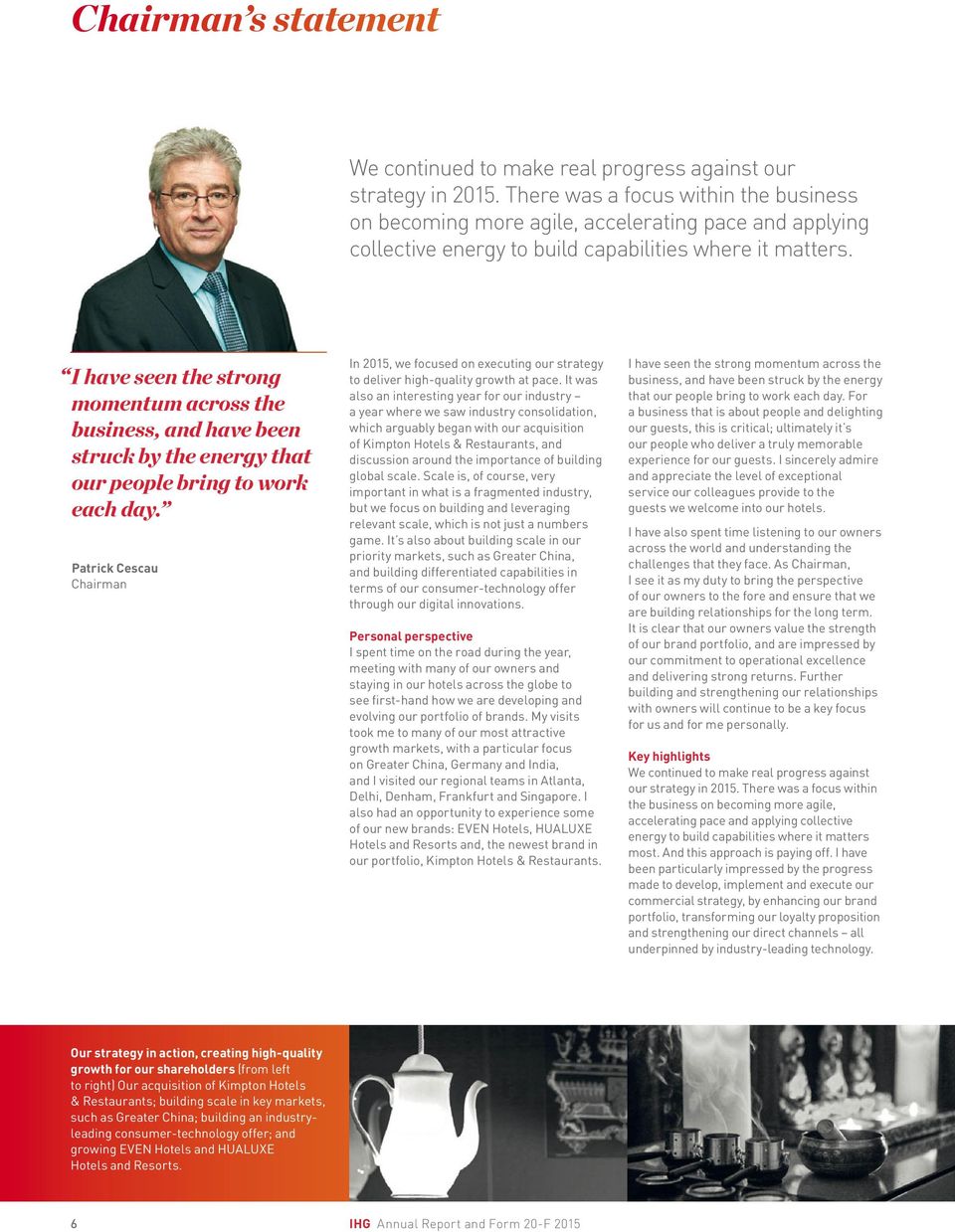
8 Chairman s statement We continued to make real progress against our strategy in. There was a focus within the business on becoming more agile, accelerating pace and applying collective energy to build capabilities where it matters. I have seen the strong momentum across the business, and have been struck by the energy that our people bring to work each day. Patrick Cescau Chairman In, we focused on executing our strategy to deliver high-quality growth at pace. It was also an interesting year for our industry a year where we saw industry consolidation, which arguably began with our acquisition of Kimpton Hotels & Restaurants, and discussion around the importance of building global scale. Scale is, of course, very important in what is a fragmented industry, but we focus on building and leveraging relevant scale, which is not just a numbers game. It s also about building scale in our priority markets, such as Greater China, and building differentiated capabilities in terms of our consumer-technology offer through our digital innovations. Personal perspective I spent time on the road during the year, meeting with many of our owners and staying in our hotels across the globe to see first-hand how we are developing and evolving our portfolio of brands. My visits took me to many of our most attractive growth markets, with a particular focus on Greater China, Germany and India, and I visited our regional teams in Atlanta, Delhi, Denham, Frankfurt and Singapore. I also had an opportunity to experience some of our new brands: EVEN Hotels, HUALUXE Hotels and Resorts and, the newest brand in our portfolio, Kimpton Hotels & Restaurants. I have seen the strong momentum across the business, and have been struck by the energy that our people bring to work each day. For a business that is about people and delighting our guests, this is critical; ultimately it s our people who deliver a truly memorable experience for our guests. I sincerely admire and appreciate the level of exceptional service our colleagues provide to the guests we welcome into our hotels. I have also spent time listening to our owners across the world and understanding the challenges that they face. As Chairman, I see it as my duty to bring the perspective of our owners to the fore and ensure that we are building relationships for the long term. It is clear that our owners value the strength of our brand portfolio, and are impressed by our commitment to operational excellence and delivering strong returns. Further building and strengthening our relationships with owners will continue to be a key focus for us and for me personally. Key highlights We continued to make real progress against our strategy in. There was a focus within the business on becoming more agile, accelerating pace and applying collective energy to build capabilities where it matters most. And this approach is paying off. I have been particularly impressed by the progress made to develop, implement and execute our commercial strategy, by enhancing our brand portfolio, transforming our loyalty proposition and strengthening our direct channels all underpinned by industry-leading technology. Our strategy in action, creating high-quality growth for our shareholders (from left to right) Our acquisition of Kimpton Hotels & Restaurants; building scale in key markets, such as Greater China; building an industryleading consumer-technology offer; and growing EVEN Hotels and HUALUXE Hotels and Resorts. 6 IHG Annual Report and Form 20-F
9 There have been three particular highlights for me this year. First, the sale of InterContinental Hong Kong and InterContinental Paris Le Grand, which signalled the completion of our asset-light strategy. Second, the completion of our acquisition of Kimpton Hotels & Restaurants, which made IHG the clear market leader in the boutique segment (source: Smith Travel Research). Finally, the work we are doing with Amadeus, the world s leading provider of advanced technology solutions, to develop a next-generation Guest Reservation System that will help us accelerate our efforts to revolutionise and personalise the guest experience. This is a very important piece of work for IHG and will help set us apart from our competitors into the future. Leading shareholder returns We are focused on delivering outstanding shareholder value. I am therefore pleased to announce that the Board is recommending a final dividend of 57.5 cents (40.3 pence) per ordinary share, an increase of 11 per cent on the final dividend for, resulting in a full-year dividend of 85 cents (58 pence) per share, up 10 per cent on. The Board has also proposed a $1.5 billion special dividend, which will take the total funds returned to shareholders since 2003 to more than $12 billion. Corporate governance As a Board, we are committed to maintaining our high standards of corporate governance and I take this commitment very seriously. The Board continues to focus not only on what we deliver as a business, but also how we deliver. Ensuring that there is a high level of cultural integrity ingrained within the way IHG operates is a key part of this, as is our ability to drive sustainable performance and meaningful shareholder value. The Board also spends a great deal of time focusing on the macro perspective and ensuring that we are being as competitive as possible. We engage in matters where we can add real value and we spend time and attention shaping, agreeing to and monitoring the implementation of IHG s strategy. In order to do this, we keep the composition of the Board under constant review to ensure that we have the right breadth of skills and expertise to be truly effective and to deliver real and tangible value. Anne Busquet and Jo Harlow have brought their consumerfacing technology experience to the Board, which has significantly improved the quality of discussion on our technology strategy, at a time when new advances are playing a transformative role in our industry. Board changes We formally welcomed Anne Busquet to the Board as a Non-Executive Director in March. Anne has brought her impressive breadth of experience in digital commerce, hospitality, finance and marketing to the Board. She sits on the Audit, Nomination and Corporate Responsibility Committees. In January 2016, we said goodbye to Tracy Robbins, who stepped down from the Board and from her position as Executive Vice President, Human Resources for health reasons. On behalf of IHG, I want to thank Tracy for her long-standing contribution to the business. Her passion for people and strong commitment to developing talent has played an important role in IHG s success. We wish her all the best for the future. In February 2016, we announced that Jennifer Laing and Ying Yeh will be retiring from the Board following the AGM on 6 May As long-standing members of the Board, Jennifer and Ying have shown real commitment and dedication to IHG. I would like to thank them for the important role they have played in IHG s development over the last decade. Jill McDonald, a Non-Executive Director, will succeed Jennifer as Chairman of the Corporate Responsibility Committee. A winning team I would like to close by thanking Richard Solomons for his stewardship and leadership of the business this year, which resulted in HOTELS Magazine naming him Corporate Hotelier of the World. This is a testament to Richard, to the talented and passionate people who bring IHG s brands to life for our guests each and every day, and to our owners, for their continued confidence in our business. Patrick Cescau Chairman STRATEGIC REPORT GOVERNANCE GROUP FINANCIAL STATEMENTS PARENT COMPANY FINANCIAL STATEMENTS ADDITIONAL INFORMATION IHG Annual Report and Form 20-F 7
10 Chief Executive Officer s review We drove strong momentum in and delivered excellent financial and operational performance. Our focus on driving growth in markets where we see the greatest opportunity has paid off, and will continue to be a key part of our strategy in the coming years. One of our key highlights of the year was welcoming Kimpton Hotels & Restaurants into the IHG family and seeing the business enjoy the best year in its history. Richard Solomons Chief Executive Officer Our Winning Model remains at the heart of our success and it continues to help deliver high-quality growth. We made significant progress against each element of the model in, particularly in terms of building and strengthening our portfolio of preferred brands, enhancing our leading loyalty programme, and ensuring that the way we manage our channels is as effective as possible. Financial and operational highlights We continued to drive strong momentum in the year. We delivered double-digit underlying profit growth, opened more hotels into the System than we have since 2009, signed more hotels than we have since 2008, and closed the year with more than 5,000 open hotels in our System a significant milestone for the business. Our focus on driving growth in priority markets where we see the greatest opportunity has paid off, with 87 per cent of our open rooms and approximately 90 per cent of our pipeline rooms in these markets. This will continue to be a key part of our strategy in the coming years. also marked the successful completion of our major asset-disposal programme, with the sale of InterContinental Hong Kong, over which IHG retained a 37-year management contract with three 10-year extension rights. It was fitting that this iconic building should be the last major owned asset in our portfolio. Our asset-light approach is highly cash-generative and delivers a high return on capital employed. It also means that we benefit from the reduced volatility of fee-based income streams so we can focus on growing our fee revenues and fee margins with limited requirements for our capital. We continued to make excellent progress delivering against our technology strategy, building on our strong track record of innovation and leadership in this space. This includes successfully driving digital revenue growth. In, we leveraged our highly rated mobile app, with over 40 per cent of digital visits on mobile, and we recorded annual mobile revenue of more than $1 billion, up from less than $50 million in This is a remarkable achievement. Strengthening our brand portfolio We strengthened our portfolio of preferred brands during the year, and focused on innovating and evolving our brand offer. We opened the first three HUALUXE Hotels and Resorts in Greater China, and a flagship property for EVEN Hotels in New York, with a further six hotels for the EVEN brand signed into the pipeline. A key highlight of the year was welcoming Kimpton Hotels & Restaurants into the IHG family. Boutique is the industry s fastestgrowing segment and, with Kimpton and Hotel Indigo, we are uniquely positioned to benefit from this increase in demand. was Kimpton s best ever year in terms of openings and signings and, in January 2016, we were delighted to announce the brand s first signing outside of The Americas, in Amsterdam, the Netherlands. This year will see us celebrating the 70 th anniversary of InterContinental Hotels & Resorts, the largest luxury hotel brand in the world. Holiday Inn Express, which is part of the Holiday Inn brand family, the world s largest hotel brand, will also be celebrating its 25 th birthday in Building loyalty and meaningful membership Building loyalty and lifetime relationships with our guests is an important part of our business and a key growth driver for us. We know that guests are looking for a rewarding relationship built on trust, and respond best to efforts that are focused on building genuine brand loyalty over a sustained period of time. We are constantly looking at ways in which we can enhance our ability to deliver a personalised experience for members, before, during and after their stay. Our insight shows us that frequent travellers want to be given an extra level of reward in return for their continued loyalty, too. As a result, we introduced a new top-tier membership level, Spire Elite, and restructured IHG Rewards Club so that it is easier for our loyal members to reach gold and platinum status. 8 IHG Annual Report and Form 20-F

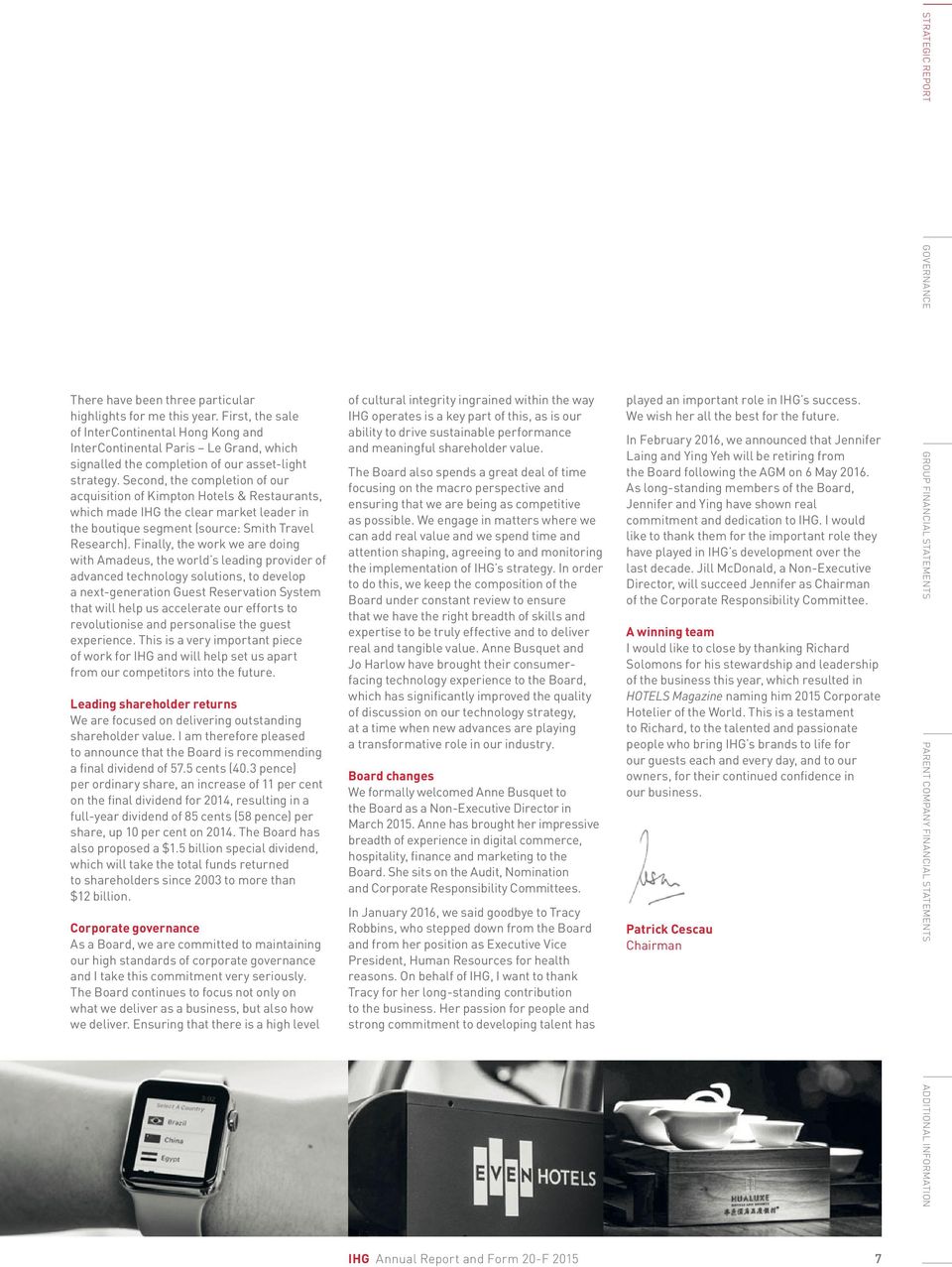
11 IHG s 5,000 Club In 2016, we unveiled Hotel Indigo Lower East Side New York as our 5,000 th hotel globally (top). InterContinental London The O2 (centre) and Hotel Van Zandt, a Kimpton Hotel in Austin (TX) (bottom) formed part of our 5,000 Club, a series of landmark hotel openings that contributed to IHG surpassing the 5,000-hotel milestone. Loyalty was a key theme in the latest IHG Trends Report, which we published in January The report challenges brands to engage in a way that builds membership communities in The Age of I that is, to encourage consumers to share opinions and insights as they connect around their experience of a brand, while at the same time allowing them to maintain their individuality (see page 22). Responsible business agenda Doing business responsibly is integral to life at IHG and is a principle that guides how all of our colleagues around the world behave from day to day. It helps us build trust and preference for our brands, operate more effectively and create long-term value for our shareholders and stakeholders. Our global scale also means that our influence extends across thousands of communities around the world and sees us interact with millions of people on a daily basis. Our view is that growth is not just about short-term financial and operational performance; it is about nurturing the health of the organisation into the future and staying true to our values. I am very proud of our achievements in, all of which are a result of the efforts of each and every one of the 350,000 colleagues who work in IHG-branded hotels and corporate offices worldwide. We completed the global roll-out of our successful group-wide sustainability programme, the IHG Green Engage system; we celebrated the 10 th year of the pioneering IHG Academy programme, a global collaboration between IHG hotels, local education providers and community organisations, which now has more than 1,200 programmes in 68 countries; and, finally, IHG Shelter in a Storm responded to 27 disasters in 17 countries in, including supporting the relief work in Nepal following the devastating earthquakes. In addition, we developed and launched a human rights e-learning module, which is available to all colleagues worldwide, and we led the roll-out of IHG Marketplace, a hotel procurement platform, which incorporates our Vendor Code of Conduct as well as responsible business criteria. In February 2016, we launched the IHG Foundation, which will build on the hugely positive impact we have driven through our corporate responsibility initiatives over a number of years. IHG Academy and the IHG Green Engage system will continue to be delivered in IHG s hotels. Disaster-relief activity, previously activated through IHG Shelter in a Storm, will be incorporated into the IHG Foundation. Our awards Independent recognition is an important endorsement of our success, and we are proud of the many awards we won in. Fortune Magazine ranked IHG as a world s Most Admired Company ; Forbes named us one of the world s most reputable companies for ; and we were accredited as a Top Employer in for both the UK and Greater China by the Top Employers Institute. Our brands have been in the spotlight too. InterContinental Hotels & Resorts won an impressive 28 awards at the World Travel Awards Asia & Australasia, including the coveted Asia s Leading Luxury Business Hotel Brand Award; Holiday Inn won Best Mid- Market Hotel Brand in the World at the Business Traveller Asia-Pacific Awards; and IHG was named World s Leading Hotel Brand at the World Travel Awards. Looking ahead to 2016 We go into 2016 with confidence and in a position of strength. We have a compelling and proven strategy that is delivering. We will continue to focus on building scale where it matters, and on executing our strategy at pace. As ever, I would like to close by thanking the talented and passionate people who bring IHG s brands to life for our guests each and every day. Richard Solomons Chief Executive Officer STRATEGIC REPORT GOVERNANCE GROUP FINANCIAL STATEMENTS PARENT COMPANY FINANCIAL STATEMENTS ADDITIONAL INFORMATION IHG Annual Report and Form 20-F 9
12 Industry overview Where the industry is now The global hotel industry The global hotel industry comprises approximately 15.9 million rooms, broadly segmented into branded (multiple hotels under the same brand) and independent (non-branded) hotels. Growth in demand is primarily driven by economic growth and an increasing trend for domestic and global travel. Over the long term, the lodging industry has grown broadly in line with gross domestic product (GDP). However, in the US, the largest market in terms of room numbers, growth in consumer spend on lodging has exceeded GDP growth by 2.6 percentage points per annum over the last 50 years. There are several industry metrics that are widely recognised and used to track performance, including revenue per available room (RevPAR) and rooms supply growth. Globally, both of these indicators have seen robust growth in the last five years. In the US, our largest market, supply growth in the last five years has been significantly below the long-term average of 2 to 2.1 per cent. This, coupled with strong hotel demand in this market (3.3 per cent year-on-year growth over the past five years), has led to RevPAR growth. The branded hotel market Within the global hotel market, branded hotels account for 53 per cent of total rooms supply. However, in spite of ongoing consolidation, the market remains fragmented, with five of the leading branded hotel companies (Hilton, Marriott, IHG, Accor and Starwood) accounting for 36 per cent of total open branded rooms, and 61 per cent of the branded development pipeline (hotels in planning and under construction but not yet opened). According to Smith Travel Research, branded hotel companies have consistently increased their share of the global hotel market over the past 10 years, in addition to showing an increased resilience through the economic cycles. Larger players are also driving clear revenue outperformance, as well as benefiting from advantages in terms of economies of scale across a broad portfolio of hotels. The different business models within the hotel industry Depending on whether a hotel is branded or independent, there are different business models it can adopt. The four models typically seen in the industry are franchised, managed, owned and leased: owned hotels are owned and operated by an owner who bears all the costs associated with the hotel but benefits from all of the income; a leased model is similar, except the owner-operator of a hotel does not have outright ownership of the hotel but leases it from the owner of the property; under a managed model, the owner of a hotel will use a third-party manager to operate the hotel on its behalf and will pay the manager management fees and, if the hotel is operated under a third-party brand name, brand licensing fees; and a franchised hotel is owned and operated by an owner under a third-party brand name and the owner will pay a brand licensing fee to the brand owner. Whilst an owner-operated hotel enables the owner to have full control over hotel operations, it requires high capital investment. In contrast, for hotel-brand owners, a franchised or managed model enables quicker rooms growth due to lower capital investment, but this requires strong relationships with third-party hotel owners. Global industry RevPAR ($) Global rooms supply (millions of rooms) Key trends shaping the industry In addition to growth drivers, we also see a number of key trends shaping the hotel industry. Developments in digital technology, combined with evolving and ever-changing consumer needs, are transforming guest behaviours and creating a more dynamic competitive environment. Technology-based transformation Technology continues to have a multifaceted and substantial impact on our industry: The prevalence of mobile devices and the accessibility of the internet continue to change how guests engage with, and what they expect from, lodging providers across the entire Guest Journey (which we describe as Dream, Plan, Book, Stay and Share ). Technology is enabling guests to book their travel with greater control and immediacy, and share their travel experiences in more practical and engaging ways. Mobile, for example, is expected to deliver more than half of all online travel bookings in the US in 2016, and a growing number of guests now book their rooms within 24 hours of their arrival. Enabled by technology, travel companies, hotels, review sites and online travel agents have been able to grow their presence online, providing travellers globally with access to compelling content, price transparency and the ability to compare a wealth of travel options. Technology is fuelling the growth of alternative lodging providers, who have also been effective at opening up a large supply of private urban accommodation by developing and marketing online distribution platforms. Advances in big data and data analytics are allowing travel companies to develop richer insights into guest needs, enabling more personalised services and tailored offers. Owners are increasingly benefiting from new tools and technology applications offered by hotel companies. For example, sophisticated online training platforms and revenue management tools, accessible via cloud computing, are helping hotel companies to drive a more consistent service for guests and more profitable revenue for owners. Advancements within hotel technology are also improving the guest experience. For example, mobile check-in and apps for room service and housekeeping are providing guests with greater flexibility and choice around their stay experience. Connected devices per person in : 1.7 and in 2020 (predicted): 4.3 (Source: Strategy Analytics) 10 IHG Annual Report and Form 20-F

13 Where the industry is heading Major underlying drivers supporting growth in our industry At a local-market level, industry performance is impacted by short-term economic and political factors. However, in the long term, growth in the global hotel industry is driven by the following three major underlying drivers. Economic Long-term macroeconomic trends substantially benefit the hotel industry. Global GDP growth of circa 2.6 per cent per annum in the last 10 years has contributed to an increase in disposable income and a rise in middle-class households, making travel affordable for more people. This trend can be observed in China, where the number of households earning above $35,000 per annum (a key income level, at which international travel becomes accessible), rose by 21 million from 2003 to 2013, with an additional 61 million households expected to pass this threshold by Demographic The growth of an ageing population, which has the desire and means to travel, is another favourable driver shaping the industry. The global population over the age of 60 is expected to increase from approximately 800 million in 2013 to 2 billion by 2050, increasing overall demand for travel services. Trips per year by millennials by 2020 (predicted): 320m a 47% increase from 2013 (Source: Forbes) Continually evolving consumer needs The demographic profile of our guests continues to evolve and, in conjunction with the developments in digital technology, these trends are driving different accommodation needs and stay expectations. This is evident across all age groups, and in particular amongst millennials, who are becoming an increasingly important guest group. This group is also challenging some of the well-established norms of travel by having more flexible working patterns, seeking more personalised and unique guest experiences, and being more open to using Social Increased competition and capacity amongst airlines, lower fares, and the relaxation of travel and immigration restrictions in many regions are making international travel more viable for more people. International tourist travel is expected to increase by 3.3 per cent a year from 2010 to 2030, reaching 1.8 billion arrivals by The Future of Chinese Travel In, we partnered with global research company Oxford Economics to produce a comprehensive report evaluating the Chinese outbound travel opportunity. In this report, we examine historical and current trends in Chinese outbound travel and how economic and demographic developments will shape demand for Chinese travel over the next decade. Our industry-leading research provides a unique insight into which countries, and, for the first time, which cities, will benefit most from significant growth in Chinese outbound travel globally. Visit to download the full report. the sharing economy to meet their accommodation needs. In addition, there has been a diversification of family travel needs as a result of an ageing population and changes to the traditional family unit. Multi-generational families, for example, are a growing guest segment, with over a third of respondents in a US AAA survey planning to make at least one multi-generational holiday in the upcoming year. Another trend we are seeing is the blurring of business and leisure travel, with a growing number of professionals adding leisure days onto business trips. Furthermore, as a result of these trends, accommodation providers increasingly need to cater for a more diverse set of guest needs and expectations. A more dynamic competitive environment These key trends are changing the competitive landscape within the travel Multi-generational families are a growing guest segment industry. Hotels compete with each other and with travel intermediaries and companies offering alternative lodging solutions, such as peer-to-peer home rental companies. While the long-term growth of branded hotels has outpaced that of the home rental market, some peer-to-peer home rental companies have capitalised on the small but fast-growing segment of urban short- to medium-term rentals, offering personalised, home-like stay experiences. At IHG, we cater for these guest demands through our extended-stay hotel brands, boutique brand portfolio and branded residences offer. We are also investing heavily in our people to ensure they deliver unique and personalised stay experiences. Meanwhile, our proactive approach to building preferred brands, targeted at guest occasion segments, is enabling us to enhance our competitive position. STRATEGIC REPORT GOVERNANCE GROUP FINANCIAL STATEMENTS PARENT COMPANY FINANCIAL STATEMENTS ADDITIONAL INFORMATION IHG Annual Report and Form 20-F 11

14 Our business model We predominantly franchise our brands to, and manage hotels on behalf of, third-party hotel owners. Our asset-light strategy enables us to grow our business while generating high returns on invested capital. For definitions in this section, please refer to the Glossary on pages 176 and 177. We franchise and manage hotels depending largely on market maturity, owner preference and, in certain cases, the particular brand. For example, in the US, a mature market, we operate a largely franchised business. By contrast, in Greater China, an emerging market, we operate a predominantly managed business where we are responsible for operating hotels on behalf of our third-party hotel owners. The business model is adapted by market as necessary. In a few instances, we also own hotels through recyclable investments in order to drive the growth of our brands and to expand our Hotel IHG capital Business model ownership intensity Employees a Franchised Third party Low Third party Managed Third party Low IHG and third party Owned and leased IHG High IHG a For information on who are our employees, see page 153. presence in priority markets. The key differences between our three main models are summarised below. Brand ownership, marketing and distribution IHG IHG revenue and the System Fund Third-party hotel owners pay: (i) fees to IHG in relation to the licensing of our brands and, if applicable, hotel management services; and (ii) assessments and contributions (other than for Kimpton and InterContinental) which are collected by IHG for specific use within the System Fund. Total Gross Revenue This comprises: Franchised hotels = total rooms revenue Managed hotels = total hotels revenue Owned and leased hotels = total hotels revenue (Only owned and leased hotel revenue is directly attributed to IHG) System Fund : $1.6bn Assessments and contributions paid by hotels Proceeds from the sale of IHG Rewards Club points No profit or loss for IHG managed by IHG for the benefit of hotels within the IHG System See page 47 for more information Marketing and sales activity IHG Rewards Club loyalty programme Global distribution systems For examples of how we have deployed the System Fund in to support our strategic priorities, please see Our Winning Model in action: executing our strategy on page 19. IHG revenue This comprises: Fee revenue: in, 67% of our revenue came from franchise and management fees: Franchise fees = RevPAR x rooms x royalty rate Management fees = fee % of total hotels revenue plus % of profit All revenue from owned and leased hotels Central revenue (principally technology fee income see page 46) Fee-based margins: : 46.3% Profit from fee revenues After operating costs of sale, our fee margin by business model is as follows: Franchised 85.2% Managed 58.2% Owned and leased 19.5% Not all of our costs can be allocated directly to revenue streams and these are shown as regional or central infrastructure costs 12 IHG Annual Report and Form 20-F

15 Number of hotels % of our operating profit In, over 6% 90% 806 of our operating profit was generated from our 7 asset-light franchise and management contracts. 25% 4,219 In, approximately 69% 85% of our fee revenue was derived from hotel revenues. Franchised Managed Owned and leased Disciplined approach to allocation of capital Our focus on an asset-light business model is supported by a disciplined, long-term approach to allocating capital and reducing the asset intensity of the business. During, we completed the disposal of InterContinental Paris Le Grand for 330 million, and sold InterContinental Hong Kong for $928 million (after final working capital adjustments and cash tax). We seek to maintain an efficient balance sheet with an investment-grade credit rating. IHG s outlook on capital expenditure Capital expenditure incurred by IHG can be summarised as follows. Capital expenditure Maintenance capital expenditure and key money to access strategic growth Recyclable investments to drive the growth of our brands and our expansion in priority markets System-Funded capital investments for strategic investment to drive growth at hotel level IHG s fee revenues are derived from payments made by our third-party hotel owners under the terms of their franchise and, where applicable, management agreements with us. Our business is highly cash-generative (see page 49), and we have three primary uses for this cash: Invest in the business to drive growth: this includes acquisitions of businesses and our day-to-day capital expenditures. In, we completed the acquisition of Kimpton Hotels & Restaurants for $430 million (before working capital). Maintain sustainable growth in the ordinary dividend: our full-year Our asset-light, principally franchised and managed business model: is highly cash-generative, with a high return on capital employed; and means IHG benefits from the reduced volatility of fee-based income streams and allows us to focus on growing our fee revenues and fee margins with limited requirements for IHG s capital. dividend will be 85.0 cents (58.0 pence) per share (subject to shareholder approval of the final dividend) up 10.4 per cent on (see page 48). Return surplus funds to shareholders (see page 48): in February 2016, the Board proposed a further $1.5 billion return of funds to shareholders via a special dividend with share consolidation. Examples Maintenance of our owned and leased hotels, which is now reducing as we have become increasingly asset-light. Corporate infrastructure maintenance for example, in respect of our offices and systems. Deployment of key money, which is used to access strategic opportunities, particularly in high-quality and sought-after locations when returns are financially and/or strategically attractive. Through the acquisition of real estate, investment through joint ventures or via equity capital. We aim to recycle this capital by selling these investments when the time is right and to reinvest elsewhere in the business and across our portfolio, as we are currently doing for our EVEN and Hotel Indigo brands. The development of tools and systems, such as our revenue management offer, that hotels use to drive performance. STRATEGIC REPORT GOVERNANCE GROUP FINANCIAL STATEMENTS PARENT COMPANY FINANCIAL STATEMENTS ADDITIONAL INFORMATION IHG Annual Report and Form 20-F 13

16 Our strategy for high-quality growth We are focused on delivering high-quality growth, which for us means delivering consistent, sustained growth in cash flows and profits over the long term. Our purpose is to create Great Hotels Guests Love Through our Winning Model, we focus on value-creation through building preferred brands, leveraging scale and delivering revenue through the lowest-cost, direct channels. Our Targeted Portfolio, together with Disciplined Execution and a commitment to doing business responsibly, will drive superior returns for our shareholders. We measure our performance with a set of carefully selected key performance indicators (KPIs), which monitor our success in achieving our strategy and delivering high-quality growth. Superior owner proposition Effective channel management Value creation Winning Model Preferred brands delivered through our people 1 Strong brand portfolio and loyalty programme 2 Build and leverage scale Superior shareholder returns Targeted Portfolio Attractive markets Highest opportunity segments Managed and franchised model How we measure our performance (KPIs) Further details on key performance indicators are set out on pages 28 to 31. Net rooms supply Growth in fee revenues Total gross revenue from hotels in IHG s System System contribution to revenue Global RevPAR growth Guest HeartBeat See page 15 Disciplined Execution See page 16 Fee margins Employee Engagement survey scores Scale and efficiency of operations Investment in developing strong technology platforms Investment in developing great talent See pages 17 and 18 Whilst doing business responsibly See page 24 IHG Shelter in a Storm donations IHG Academy participation Carbon footprint per occupied room Water use per occupied room in water-stressed areas See pages 19 to 23 for details of how we have executed key commercial initiatives across our Winning Model in Management of our principal risks: see pages 25 to 27 for how we manage our risks and uncertainties 14 IHG Annual Report and Form 20-F

17 Winning Model IHG s Winning Model is our framework for delivering superior value-creation through our brands, our people and our systems. Preferred brands delivered through our people Having a strong portfolio of preferred brands is fundamental to our success. In a highly competitive industry, powerful, well-defined, consistent and well-known brands are influential in ensuring both guests and owners choose an IHG brand over a competitor s. Our talented people play a critical role in providing consistently high standards of guest service and delivering each brand promise, and our winning culture encourages and empowers them to bring each of our preferred brands to life. Strong brands result in increased RevPAR, through higher occupancy rates and guests greater willingness to pay a premium to stay at their preferred brand. In turn, higher RevPAR results in better returns for our owners and fees for IHG. Informed by guest and owner insights, we are focused on driving brand preference for each of our brands. See pages 20 and 21 for examples of our actions to build preferred brands in. Build and leverage scale Scale provides significant advantages in the hotel industry at the global, national and city level. The size of the IHG System, and our concentration in attractive markets and key gateway cities, allows us to benefit from economies of scale, which lead to higher margins and operating leverage. Scale also enables us to invest in our brands, including the technology required to support their continued growth, and to implement efficient sales and marketing and procurement practices, thereby increasing the advantages an IHG brand brings to owners. IHG already benefits from substantial scale advantages, having over 744,000 rooms open at the end of, a top-five market share position by rooms in eight out of our 10 priority markets, and System Funds contributed in totalling $1.6 billion. To achieve further targeted-scale benefits, we focus on delivering high-quality growth in the most attractive geographic markets, along with building distribution in global cities that benefit from very large international travel flows, focusing on the luxury segment. See page 17 for examples of how we maximise the scale and efficiency of our operations and page 38 for details of our key openings in the luxury segment in. Strong brand portfolio and loyalty programme A portfolio of strong, complementary brands allows us to offer solutions for every guest need, which promotes cross-selling across different hotel brands. This, combined with a strong loyalty programme, increases awareness and recognition of the IHG brand, as well as each of the individual hotel brands, helping us to drive business. Whilst we continue to grow our brands to meet the differentiated needs of our guests, we are also focused on driving long-lasting and deep relationships with guests by recognising and rewarding them for their loyalty. In turn, this is helping to ensure that IHG Rewards Club, which has more than 92 million members worldwide, is one of the largest and most preferred loyalty programmes in the market. See page 22 for examples of our actions to build a strong brand portfolio and loyalty programme in. Effective channel management We drive demand to our hotel brands through strong brand awareness and effective revenue management practices, reducing distribution costs and delivering better returns for our owners. Our direct channels (digital and voice) are less costly to owners than third-party intermediaries and we therefore drive demand for our hotels through these channels and also manage revenue per booking, delivering the highest-quality revenues to IHG hotels at the lowest possible cost. See page 23 for examples of our actions to build strong channels in. Superior owner proposition A strong owner proposition, preferred brands, effective operational support and long-standing owner relationships play a vital role in making us the brand of choice for owners. We are committed to delivering a compelling and preferred owner offer, and we continually review and enhance our owner proposition in many ways. Specific examples include the following: Evolving our hotel support model in The Americas and Europe to deliver a more owner-centric, customised offer. In The Americas, for example, we have introduced dedicated franchise performance support leads who act as a single point of contact for owners, helping to establish strategies and activities that drive superior hotel performance. These leads will also help to navigate owners to IHG specialists in the fields of Revenue Management, Sales and Marketing, Operations and Guest Experience. Continuing to invest heavily in our training platforms, including IHG Frontline, which will provide critical training to the circa 90,000 employees who will be recruited by IHG in the managed estates, in addition to a large number of staff in our franchised properties. In addition, we also continue to invest in developing our range of proprietary revenue-driving tools and services, such as Revenue Management for Hire, Price Optimisation and IHG Way of Sales. Running our annual, global Owner HeartBeat satisfaction survey, which yields valuable insight from our owners on the relative strengths and weaknesses of our proposition and enables us to deliver targeted enhancements to our offer. Maintaining strong owner relationship management and working with the IHG Owners Association (which represents the interests of our hotel owners globally) to deliver joint initiatives. See for more information. STRATEGIC REPORT GOVERNANCE GROUP FINANCIAL STATEMENTS PARENT COMPANY FINANCIAL STATEMENTS ADDITIONAL INFORMATION IHG Annual Report and Form 20-F 15
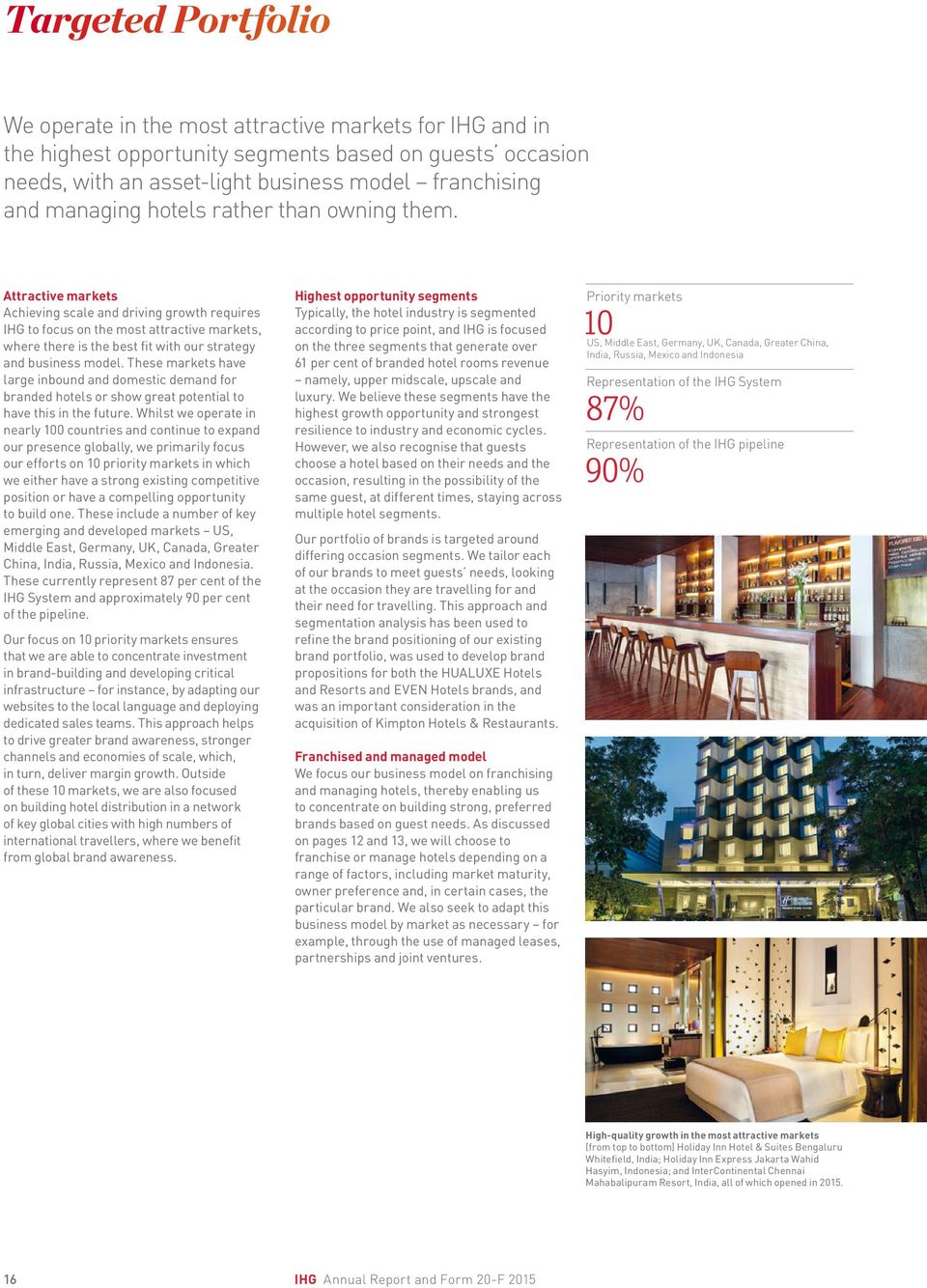
18 Targeted Portfolio We operate in the most attractive markets for IHG and in the highest opportunity segments based on guests occasion needs, with an asset-light business model franchising and managing hotels rather than owning them. Attractive markets Achieving scale and driving growth requires IHG to focus on the most attractive markets, where there is the best fit with our strategy and business model. These markets have large inbound and domestic demand for branded hotels or show great potential to have this in the future. Whilst we operate in nearly 100 countries and continue to expand our presence globally, we primarily focus our efforts on 10 priority markets in which we either have a strong existing competitive position or have a compelling opportunity to build one. These include a number of key emerging and developed markets US, Middle East, Germany, UK, Canada, Greater China, India, Russia, Mexico and Indonesia. These currently represent 87 per cent of the IHG System and approximately 90 per cent of the pipeline. Our focus on 10 priority markets ensures that we are able to concentrate investment in brand-building and developing critical infrastructure for instance, by adapting our websites to the local language and deploying dedicated sales teams. This approach helps to drive greater brand awareness, stronger channels and economies of scale, which, in turn, deliver margin growth. Outside of these 10 markets, we are also focused on building hotel distribution in a network of key global cities with high numbers of international travellers, where we benefit from global brand awareness. Highest opportunity segments Typically, the hotel industry is segmented according to price point, and IHG is focused on the three segments that generate over 61 per cent of branded hotel rooms revenue namely, upper midscale, upscale and luxury. We believe these segments have the highest growth opportunity and strongest resilience to industry and economic cycles. However, we also recognise that guests choose a hotel based on their needs and the occasion, resulting in the possibility of the same guest, at different times, staying across multiple hotel segments. Our portfolio of brands is targeted around differing occasion segments. We tailor each of our brands to meet guests needs, looking at the occasion they are travelling for and their need for travelling. This approach and segmentation analysis has been used to refine the brand positioning of our existing brand portfolio, was used to develop brand propositions for both the HUALUXE Hotels and Resorts and EVEN Hotels brands, and was an important consideration in the acquisition of Kimpton Hotels & Restaurants. Franchised and managed model We focus our business model on franchising and managing hotels, thereby enabling us to concentrate on building strong, preferred brands based on guest needs. As discussed on pages 12 and 13, we will choose to franchise or manage hotels depending on a range of factors, including market maturity, owner preference and, in certain cases, the particular brand. We also seek to adapt this business model by market as necessary for example, through the use of managed leases, partnerships and joint ventures. Priority markets 10 US, Middle East, Germany, UK, Canada, Greater China, India, Russia, Mexico and Indonesia Representation of the IHG System 87% Representation of the IHG pipeline 90% High-quality growth in the most attractive markets (from top to bottom) Holiday Inn Hotel & Suites Bengaluru Whitefield, India; Holiday Inn Express Jakarta Wahid Hasyim, Indonesia; and InterContinental Chennai Mahabalipuram Resort, India, all of which opened in. 16 IHG Annual Report and Form 20-F
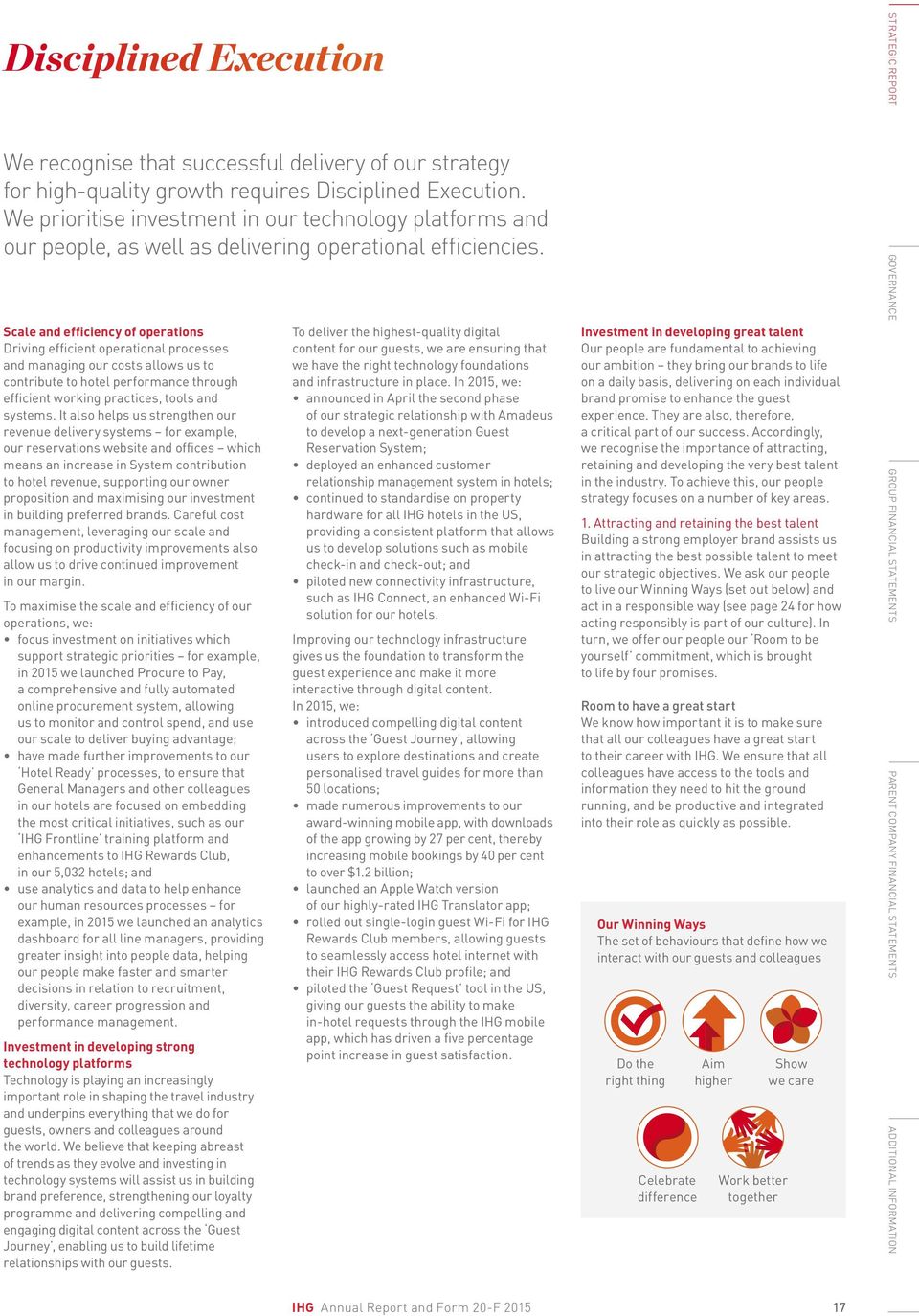
19 Disciplined Execution We recognise that successful delivery of our strategy for high-quality growth requires Disciplined Execution. We prioritise investment in our technology platforms and our people, as well as delivering operational efficiencies. Scale and efficiency of operations Driving efficient operational processes and managing our costs allows us to contribute to hotel performance through efficient working practices, tools and systems. It also helps us strengthen our revenue delivery systems for example, our reservations website and offices which means an increase in System contribution to hotel revenue, supporting our owner proposition and maximising our investment in building preferred brands. Careful cost management, leveraging our scale and focusing on productivity improvements also allow us to drive continued improvement in our margin. To maximise the scale and efficiency of our operations, we: focus investment on initiatives which support strategic priorities for example, in we launched Procure to Pay, a comprehensive and fully automated online procurement system, allowing us to monitor and control spend, and use our scale to deliver buying advantage; have made further improvements to our Hotel Ready processes, to ensure that General Managers and other colleagues in our hotels are focused on embedding the most critical initiatives, such as our IHG Frontline training platform and enhancements to IHG Rewards Club, in our 5,032 hotels; and use analytics and data to help enhance our human resources processes for example, in we launched an analytics dashboard for all line managers, providing greater insight into people data, helping our people make faster and smarter decisions in relation to recruitment, diversity, career progression and performance management. Investment in developing strong technology platforms Technology is playing an increasingly important role in shaping the travel industry and underpins everything that we do for guests, owners and colleagues around the world. We believe that keeping abreast of trends as they evolve and investing in technology systems will assist us in building brand preference, strengthening our loyalty programme and delivering compelling and engaging digital content across the Guest Journey, enabling us to build lifetime relationships with our guests. To deliver the highest-quality digital content for our guests, we are ensuring that we have the right technology foundations and infrastructure in place. In, we: announced in April the second phase of our strategic relationship with Amadeus to develop a next-generation Guest Reservation System; deployed an enhanced customer relationship management system in hotels; continued to standardise on property hardware for all IHG hotels in the US, providing a consistent platform that allows us to develop solutions such as mobile check-in and check-out; and piloted new connectivity infrastructure, such as IHG Connect, an enhanced Wi-Fi solution for our hotels. Improving our technology infrastructure gives us the foundation to transform the guest experience and make it more interactive through digital content. In, we: introduced compelling digital content across the Guest Journey, allowing users to explore destinations and create personalised travel guides for more than 50 locations; made numerous improvements to our award-winning mobile app, with downloads of the app growing by 27 per cent, thereby increasing mobile bookings by 40 per cent to over $1.2 billion; launched an Apple Watch version of our highly-rated IHG Translator app; rolled out single-login guest Wi-Fi for IHG Rewards Club members, allowing guests to seamlessly access hotel internet with their IHG Rewards Club profile; and piloted the Guest Request tool in the US, giving our guests the ability to make in-hotel requests through the IHG mobile app, which has driven a five percentage point increase in guest satisfaction. Investment in developing great talent Our people are fundamental to achieving our ambition they bring our brands to life on a daily basis, delivering on each individual brand promise to enhance the guest experience. They are also, therefore, a critical part of our success. Accordingly, we recognise the importance of attracting, retaining and developing the very best talent in the industry. To achieve this, our people strategy focuses on a number of key areas. 1. Attracting and retaining the best talent Building a strong employer brand assists us in attracting the best possible talent to meet our strategic objectives. We ask our people to live our Winning Ways (set out below) and act in a responsible way (see page 24 for how acting responsibly is part of our culture). In turn, we offer our people our Room to be yourself commitment, which is brought to life by four promises. Room to have a great start We know how important it is to make sure that all our colleagues have a great start to their career with IHG. We ensure that all colleagues have access to the tools and information they need to hit the ground running, and be productive and integrated into their role as quickly as possible. Our Winning Ways The set of behaviours that define how we interact with our guests and colleagues Do the right thing Celebrate difference Aim higher Work better together Show we care STRATEGIC REPORT GOVERNANCE GROUP FINANCIAL STATEMENTS PARENT COMPANY FINANCIAL STATEMENTS ADDITIONAL INFORMATION IHG Annual Report and Form 20-F 17
20 Disciplined Execution continued Employee engagement 87.3% of survey respondents in were engaged, an improvement of 30ppt since Corporate hires 53% of all positions filled below Executive Committee level in have been internal moves. Awards 15+ received in for our people practices. Frontline powered by Lobster Ink Room to be involved We communicate with employees on matters relating to the Group s business and performance, and we share information on people, policies and news across IHG through various channels, including conferences, team meetings and our intranet site. We encourage employees to give regular feedback to ensure IHG meets expectations and delivers on its commitments this is formally done through the Employee Engagement survey, the results of which are a KPI. Room to grow Our people are given access to the required support, experience and training, and are provided with development opportunities. Room for you We reward and recognise colleagues for their contributions, and value the significance of their lives beyond work. When our people perform at their best, our business performs at its best. 2. Developing leaders to maximise individual and team performance We are committed to developing our leaders and launched a number of programmes and tools in that will ensure that building people capability around leadership becomes an everyday part of working at IHG. One example is the IHG General Manager Development Programme, developed in conjunction with the IHG Owners Association, which develops high-performing General Managers who consistently keep our brand promises, inspire their teams, and deliver great results. 3. Building the right skills in frontline colleagues As a service business, building the skills of our people to deliver a consistent branded guest experience is crucial. We continue to invest heavily in this area, such as by launching IHG Frontline in, our online platform that enables hotel colleagues to build knowledge and skills around brands, service and operations. 4. Building a strong performance culture We have established a winning culture and a framework to drive high performance, where regions and functions are aligned to the internal performance measures that most effectively drive business performance across our global organisation. This ensures that our hotels offer great guest experiences through consistent brands, which enable our brands to win and deliver returns to owners, and that our corporate colleagues focus on what matters most to deliver against our priorities. This framework, together with our hotel and corporate talent and leadership programmes, is designed to enable our colleagues to respond with speed, agility and a strong focus on driving higher performance, which comprises our winning culture. Diversity and inclusion As a global organisation operating in nearly 100 countries around the world, we recognise the importance and benefit of ensuring our workforce fully represents the communities in which we operate and the guests who stay in our hotels. As at 31 December : six of the 12 Directors on the Board were female (50 per cent); however, due to recent changes to the Board, at 22 February 2016, 5 of the 11 Directors on the Board were female (43 per cent) and, after the AGM on 6 May 2016, it is anticipated that 3 of the 9 Directors on the Board will be female (33 per cent); 33 out of the 130 senior managers employed by the Group (including directors of subsidiaries) were female (25 per cent); and 7,158 out of the 12,727 people employed by the Group and whose costs were borne by the Group or the System Fund were female (56 per cent). Please see pages 52 and 65 for more information on Board diversity and succession planning. More information on our employees can be found on page 153 and the Our people section of the Responsible Business Report (see 18 IHG Annual Report and Form 20-F

21 Our Winning Model in action: executing our strategy In, we have focused on executing key commercial initiatives across our Winning Model, in particular building preferred brands, lifetime relationships with guests and strong direct channels, helping IHG to deliver a leading guest experience. Preferred brands delivered through our people Strong brand portfolio and loyalty programme Effective channel management 1. Building preferred brands 2. Transforming our loyalty proposition 3. Making our direct channels the preferred way to book Focus areas Throughout the year, we have executed multiple initiatives to drive preference for our established and new brands by: extending the scale of our brands; embedding innovative tools and concepts to enhance the guest experience; and driving quality and consistency in our hotels. For more details, see pages 20 and 21. Focus areas In conjunction with building a strong brand portfolio, we have also made important changes to our guest loyalty proposition by: refining our engagement strategy; introducing new membership levels; and offering more relevant rewards. For more details, see page 22. Focus areas We are focused on strengthening our low-cost direct channels, which deliver better owner returns, by: launching innovative campaigns; embedding revenue management practices; improving our digital channels; and continuing our strategic relationship with Amadeus. For more details, see page 23. STRATEGIC REPORT GOVERNANCE GROUP FINANCIAL STATEMENTS PARENT COMPANY FINANCIAL STATEMENTS ADDITIONAL INFORMATION IHG Annual Report and Form 20-F 19
22 Our Winning Model in action: executing our strategy continued 1. Building preferred brands Holiday Inn hotels refurbished since ,300+ Hotels signed up to adopt next-generation Holiday Inn Express hotel design 475+ Crowne Plaza rooms in the pipeline 23,181 Positioned against a differentiated set of guest needs and occasions, EVEN and HUALUXE are clear examples of IHG s strong commitment to innovation. Strengthening our established brands Holiday Inn brand family enhancements With over 460,000 rooms, the Holiday Inn brand family is the largest midscale brand internationally. Since 2007, we have completed the industry s largest ever brand refresh, together with our owners refurbishing over 3,300 hotels, opening 1,500 new hotels and removing 1,100 existing hotels. We continue to innovate on the guest experience for the Holiday Inn brand family, and, in : We announced the launch of our Holiday Inn H4 Hotel Design Solution (a room design allowing guests to work and relax with greater flexibility) and completed a pilot of a flexible new food and beverage service platform (providing training, innovative menu options, merchandising, financial tools and dedicated IHG support), which will be rolled out across the Holiday Inn estate in the US and Canada during In the US and Europe, we launched our next-generation Holiday Inn Express hotel design and procurement solution, aligned closely to the needs of the Holiday Inn Express target guest. Our focus has been to put sleep quality, simplicity and ease of maintenance at the centre of all design decisions, and this solution will become a brand standard for all new build properties. Since launching in, we have seen strong levels of adoption, with 59 US and 10 Europe hotels adopting the full design (or incorporating key design elements). In the US, guests have shown great enthusiasm for this initiative, with 90 per cent of feedback on our brand.com websites being positive. Similarly, our Europe hotels with the new design have seen increases in guest satisfaction by up to 10 percentage points. Over 475 additional hotels have already committed to rolling out the next-generation hotel design in the next three years, and we expect further hotels to sign up in We continued to extend our scale in Holiday Inn Club Vacations (HICV) through our strategic relationship with Orange Lake Resorts. In May, it acquired the US timeshare company Silverleaf Resorts, adding 13 properties to its resort portfolio. Three of these properties re-opened under the HICV brand in and plans are in place to convert further properties in Together with Orange Lake Resorts, we also opened the 213-unit HICV Scottsdale Resort in Arizona, a key US leisure destination. Crowne Plaza growth With 406 open hotels, Crowne Plaza is one of the largest upscale brands globally (source: Smith Travel Research) and our ambition to make it the preferred choice for the modern-day business traveller remains unchanged. In, we made good progress in fulfilling that ambition. For example, we rolled out complimentary Wi-Fi to all our hotels in The Americas and Europe and have begun offering Energy Essentials, our new food and beverage concept for guests to stay focused during the day. We piloted our new WorkLife room prototype, a flexible room designed to maximise productivity whilst also catering for all the travel needs of a business professional. In addition, we also made important enhancements to our business-to-business meetings proposition, reinforcing Crowne Plaza s position as a leading businessmeetings brand. We continue to focus on driving consistency and greater quality across our portfolio, with over 55 per cent of our US estate built or renovated since These efforts are now delivering better outcomes for Crowne Plaza, such as a 6.1 per cent increase year on year in global RevPAR and a third consecutive year of improvements in guest satisfaction. Developing our newer brands Positioned against a differentiated set of guest needs and occasions, EVEN Hotels (targeting wellness-minded travellers) and HUALUXE Hotels and Resorts (targeting the accomplished Chinese business elite) are clear examples of IHG s strong commitment to innovation. For both of these brands, our focus in has been on securing distribution in prime locations in order to build equity with guests and owners and to demonstrate the distinct nature of these brands. EVEN Hotels Following the opening of our first two EVEN Hotels in Rockville (MD) and Norwalk (CT) in The Americas in, we opened a further property in New York Times Square South in, and completed additional signings in attractive locations, such as Miami and Seattle. These properties, alongside additional pipeline properties in, for example, New York and Omaha, take the total hotel pipeline to eight. Our investment in developing our first two EVEN hotels has allowed us to refine the brand s proposition and commercial proof of concept, which, in turn, is helping to build momentum in signings. HUALUXE Hotels and Resorts In, we opened our first three HUALUXE Hotels and Resorts properties in Haikou, Yangjiang and Nanchang (Greater China), which have been well-received by guests. With a further 21 hotels in the pipeline in prime cities, including Shanghai and Beijing, we are focused on building distribution in attractive locations in key cities across Greater China. 20 IHG Annual Report and Form 20-F
23 Building preferred brands We opened our first three HUALUXE Hotels and Resorts properties in, in Haikou, Yangjiang and Nanchang (all in Greater China). China-Ready programme Whilst we continue to deploy brands, such as HUALUXE Hotels and Resorts, to capture growth opportunities in Greater China, we also recognise the importance of the Chinese outbound opportunity. To capture this growing group of potential guests, we have continued in the roll-out of our China-Ready programme to 84 hotels in key Chinese outbound destinations across The Americas, Europe and AMEA. Our accredited hotels now have Mandarin-speaking staff and frontline teams who have received cultural training in order to better serve our Chinese guests. China-Ready hotels have already seen a 1.5 per cent increase in guest satisfaction, and we expect more hotels to adopt this programme in Growing our industry-leading boutique presence Together with Hotel Indigo, our recent acquisition of Kimpton Hotels & Restaurants (Kimpton) has given IHG a market-leading position in the boutique segment, with 126 hotels open and 81 hotels in the pipeline (source: Smith Travel Research). Hotel Indigo We continue to strengthen the positioning of Hotel Indigo through innovative marketing campaigns such as Flavours of the Neighbourhood and Sounds of the Neighbourhood locally inspired food and music programmes for guests and the wider community. These campaigns allow guests to have unique, local experiences and also drive greater awareness of the Hotel Indigo brand. IHG hotels in the boutique segment 126 Boutique hotels in the IHG pipeline 81 Kimpton Hotels & Restaurants This year, we have also been carefully managing the integration of the Kimpton business with IHG to ensure we preserve the uniqueness and ethos of the brand and its people. By maintaining Kimpton s San Francisco headquarters, we have been able to retain highly talented individuals from across the organisation. In addition, we have also focused on establishing IHG protocols and procedures in relation to our HR, Legal and Finance functions, and putting in place an effective approach to ensure successful integration of commercial platforms (such as mobile and websites). Powered by IHG s global scale, digital and mobile platforms and complementary brand portfolio, we see significant growth opportunities for Kimpton in the US and globally in Whilst we saw the exit of seven Kimpton hotels in San Francisco due to specific issues, these exits have not impacted our broader growth plans for the brand. In, we achieved record levels of hotel openings (1,157 rooms) and signings growth (1,532 rooms) for the brand. In January 2016, we also signed our first Kimpton property outside the US, in Amsterdam (the Netherlands). STRATEGIC REPORT GOVERNANCE GROUP FINANCIAL STATEMENTS PARENT COMPANY FINANCIAL STATEMENTS ADDITIONAL INFORMATION IHG Annual Report and Form 20-F 21
24 Our Winning Model in action: executing our strategy continued 2. Transforming our loyalty proposition Enhancements to our loyalty programme in have enabled us to offer more personal, relevant and rewarding connections across our sizeable membership. Meaningful Membership: Transforming Membership in The Age of I The fourth in our series of Trend Reports. Making loyalty more customised, tailored and rewarding By building a strong, complementary brand portfolio, we are able to offer solutions for multiple guest needs, increasing our ability to cross-sell across brands and to establish lifetime relationships with our guests. Guests with increased loyalty to IHG have a higher spend per stay, driving higher RevPAR premiums, lowering distribution costs and consequently strengthening our owner offer. In addition, a strong loyalty programme is also critical to increasing awareness and recognition of the IHG brand portfolio. Supported by deep consumer insights, including our latest 2016 Trends Report (see box below right), we are enriching our loyalty proposition by taking a more relationship-focused approach. In, we have made important enhancements to IHG Rewards Club, our loyalty programme, enabling us to offer more personal, relevant and rewarding connections across our sizeable membership base. Introducing a new membership level Launched in July, our new IHG Rewards Club membership tier, Spire Elite, has been designed to recognise and reward our most loyal guests, building an even deeper relationship with those members who stay with us most frequently. Through Spire Elite, we are better able to reward members who reach this status, by offering new benefits and choices. For example, these members receive 100 per cent more bonus points on every qualifying stay an industry first and, upon reaching Spire Elite status, the choice between receiving 25,000 points or gifting Platinum Elite level status to a friend or family member for a year. We have also restructured qualification requirements for all membership levels in to make it easier for our members to be rewarded for their loyalty and achieve Gold Elite or Platinum Elite level status. We also announced that, from May 2016, we will expire all points for IHG Rewards Club members if they have not earned or redeemed any points at all in the previous 12 months, so that we can reward the members who stay with us most often. More meaningful guest engagement In, we have enhanced our customer relationship management system, allowing us to offer a more personal experience. Across our hotels, new tools have been introduced to provide hotel staff with more information on arriving guests, including details of previous stay experiences and specific stay preferences. With this information, our hotels are able to provide a more tailored guest experience during the stay. Through a series of trials with new programme members, we have also refined our communication strategy, to ensure we offer guests the most relevant and timely information across multiple channels, such as mobile, and web. Also launched in, Accelerate, our multi-brand promotion, is enabling us to engage with IHG Rewards Club members in more appealing ways, by offering a wide range of relevant rewards that appeal across member levels. This promotion has already seen strong uptake among our members. Relevant rewards Strategic promotional partnerships play an important role in enhancing, and improving the visibility of, our loyalty proposition, as well as allowing us to provide unique experiences for our members. Our relationship with Uber (US only), announced in, enables IHG Rewards Club members to request cab rides and set ride reminders through the awardwinning IHG App. Likewise, new Uber users in the US now receive 2,000 IHG Rewards Club points and $20 off their first ride with Uber. Through the launch of IHG Business Rewards in April, an extension of IHG Rewards Club, we have improved our corporate loyalty offer, enabling travel managers to earn IHG Rewards Club points for their companies business in a single global programme. IHG Business Rewards is providing opportunities for us to improve relationships with our corporate accounts. Finally, we have relaunched our Rewarding Experiences online catalogue, which showcases a wide range of points-redemption options, ranging from electronic products through to air miles, available through IHG Rewards Club for members of all levels. Digital Rewards, for example, appeals to guests who only wish to redeem a few points by giving them the ability to instantly download music, books and movies. Meanwhile, IHG Rewards Club Auctions lets members use their points to bid on exclusive once-in-alifetime experiences and prize packages. The enhancements to our loyalty proposition in are already exciting guests and leading to stronger commercial outcomes. For example, we have experienced a year-on-year increase of 1.2 per cent in the proportion of revenue contributed by loyalty members, alongside a significant acceleration in enrolments to IHG Rewards Club across all regions. Meaningful Membership: Transforming Membership in The Age of I We have published the fourth in our series of Trends Reports, which focus on consumer insights impacting the hospitality industry and business more broadly. Our 2016 report challenges brands to engage with consumers in a way that builds loyal membership communities. It unveils a new set of principles for doing this, as consumers increasingly demand inclusivity and individuality at the same time. See for further details on our series of Trends Reports. 22 IHG Annual Report and Form 20-F
25 3. Making our direct channels the preferred way to book Lowest Price Promise Our innovative campaign to increase direct bookings. Driving direct, high-quality revenues for our owners Our global scale and the strength of our digital capabilities enable us to offer strong levels of system delivery, with direct and indirect channels delivering 73 per cent of total rooms revenue for our hotels in. We are focused on driving value to our owners through our low-cost direct channels, which, in turn, deliver better owner returns. Enhancements to IHG Rewards Club in are an important way in which we are driving more profitable, direct bookings to our hotels. In close collaboration with our owner community, we have also introduced a number of additional initiatives in (detailed below) which are helping to make our direct channels the preferred way for guests to book their stays with us. Launching innovative campaigns In, we piloted our Lowest Price Promise campaign for Holiday Inn Express in the UK and Ireland, where we guarantee the lowest rates on our brand.com website for IHG Rewards Club members, providing a clear incentive for guests to become part of IHG Rewards Club and book through IHG s direct channels. This pilot has driven a material increase in direct bookings, driving a 19 per cent shift to our web channel, and we will be extending this initiative to other markets in Embedding revenue management practices We have delivered revenue management training across each of our regions in, providing hotel staff with insight and guidance on how to optimise the mix of bookings from different sales channels, in order to deliver the most profitable revenues to hotels. In addition, we continue to grow usage of our revenue management service, Revenue Management for Hire, which provides hotels with dedicated revenue management experts, supported by our proprietary strategic pricing tools, such as Perform with Price Optimisation. Improving digital channels and driving digital innovation Our direct digital channels (which include our brand.com websites and mobile app) deliver over 20 per cent of our rooms revenue and have now collectively become IHG s largest channel. During the year, we have continued to invest in developing compelling content and innovative functionality for these channels, in order to drive more profitable direct bookings and to enhance the guest experience. For example, in we launched content-rich websites for five brands which provide a more engaging booking experience. We also made multiple enhancements to our award-winning mobile app, such as piloting Mobile Folio (allowing guests to view hotel bills in real time) and IHG Guest Request (allowing guests to make in-stay service requests). A better digital experience The IHG Translator app, which is now available on the Apple Watch, provides travellers with access to real-time translations across the world. Users can speak directly into the watch or select from a range of pre-loaded phrases to translate from English into 13 different languages instantaneously. Our pilot Lowest Price Promise campaign for Holiday Inn Express in the UK means the lowest rates on our brand.com website for IHG Rewards Club members. Strategic relationship with Amadeus In April, we announced the second phase of our strategic relationship with Amadeus to develop a next-generation, cloud-based Guest Reservation System (GRS) to replace HOLIDEX, IHG s proprietary reservation system. The new state-of-the-art guest reservation solution will be a first for the hotel industry, and will enable us to deliver an enhanced and more personalised guest experience across every stage of the Guest Journey, along with enriched commercial outcomes for owners. The system is currently in development, and a phased roll-out will start in It will provide our hotels with a robust global platform to manage guest interaction and the personalisation of their experience, and will deliver a standardised, scalable and flexible global technology ecosystem. STRATEGIC REPORT GOVERNANCE GROUP FINANCIAL STATEMENTS PARENT COMPANY FINANCIAL STATEMENTS ADDITIONAL INFORMATION IHG Annual Report and Form 20-F 23
26 Doing business responsibly A commitment to operating our business responsibly underpins our entire strategy. It is brought to life through our culture and is embedded in all aspects of the way we work. See responsiblebusiness for further information about our commitment to responsible business practices. Doing the right thing in the right way allows us to have a positive impact on the lives of all those who interact with IHG. Corporate responsibility We are committed to making our communities a better place for all. Our colleagues around the world genuinely care about the well-being of our guests and the impact we have on local communities and businesses. We work to develop new and better ways to assist owners to build and operate IHG-branded hotels, creating sustainable shared value for our brands and our stakeholders, as well as addressing social and environmental challenges. Our five-year corporate responsibility targets, released in September 2013, focus on measuring the positive impact we have, which is part of our commitment to responsible business practices (see box to the right). Social and community Each one of our hotels is a central part of its community, from creating jobs and stimulating local economic opportunities, to providing shelter in times of need. Our social and communities agenda focuses on two core programmes: IHG Academy: a collaboration between our hotels and education providers that helps people develop the skills they need to improve their employability and secure a job in the hotel industry; and disaster relief and preparedness (IHG Shelter in a Storm): we empower our hotels to support guests, colleagues and local communities in times of need with financial support, vital supplies and accommodation. Environment We take steps to manage our environmental impact in a responsible way. By delivering more environmentally sustainable hotels, we can drive cost efficiencies for owners as well as meet the expectations of all our stakeholders. We achieve this objective through our core environmental initiative: the IHG Green Engage TM system: our group-wide online sustainability programme helps hotels manage the use of energy, carbon, water and waste, and minimise their overall environmental impact. Human rights We focus on those areas of human rights most relevant to our activities, and we work to ensure our values are reflected consistently across our business. Building on our launch of the human rights standard in, in we launched an e-learning module to raise further awareness of our human rights approach. We are a signatory to the UN Global Compact, aligning our operations and strategies with the 10 universal principles, which include commitments to human rights and labour standards. We are part of the Business in the Community cross-industry working group on human rights, as well as the International Tourism Partnership s Human Trafficking Working Group. We report on diversity in our supply chain and set targets to ensure that corporate responsibility criteria, including human rights standards, are integrated into the selection and evaluation process for preferred suppliers. Our Vendor Code of Conduct sets out those standards to which we require our supply-chain operators to adhere. Our culture of responsible business In a climate where employees, guests and other stakeholders are seeking confirmation that companies share their values, the things we do to embed a culture of responsible business across the Group contribute to the credibility and value of IHG s brands. These include: strong governance and leadership, which promote responsible business attitudes and behaviours throughout IHG; ensuring our colleagues understand key legal and reputational issues and our Winning Ways (see page 17); engaging in responsible procurement; ensuring the safety and security of employees, guests and other visitors to our hotels and offices; and operating effective risk management and internal controls. More details on how we manage these areas in order to enhance and protect IHG s reputation are provided on pages 25 to 27 and in the Responsible Business Report (see URL above). The IHG Foundation Launched in 2016, the IHG Foundation sets the foundations for stronger, healthier, and more prosperous communities around the world. It is an independent charitable trust founded to help individuals in need develop skills in the hospitality industry, ensure support for those impacted by disasters, facilitate local community investment and protect the environment. The IHG Foundation will also be the focus of the Group s employee and community fundraising efforts. 24 IHG Annual Report and Form 20-F
27 Risk management Our robust and effective risk management system continues to evolve, enabling our business to achieve its strategic objectives, and deliver sustainable, long-term growth and a commitment to responsible business practices. Our Winning Model and risk The combination of our strategy (see pages 14 and 15) and business model (see pages 12 and 13) creates both opportunities and inherent risks and uncertainties. The Board is ultimately accountable for the effectiveness of the risk management and internal control systems, and is supported by the Audit Committee, the Executive Committee and other delegated committees, which oversee our risk management system and ensure that risks are appropriately identified and managed within IHG s risk appetite. Risk appetite IHG s risk appetite is reflective of the nature and extent of risk that the Board and IHG are willing to take and manage in pursuit of our strategic and other objectives. This is then cascaded through the goals we set, the strategy we choose, the decisions we make and how we allocate resources. Specific limits and guidelines for risk-taking are reflected in our governance committees and structures, our policies (eg our delegation of authority policy), and the targets we select. Our risk management system Our system for managing risk is fully integrated with the way we run the business through our culture, our management controls and our reporting. Our Global Risk Management function is responsible for the support, enhancement and monitoring of the effectiveness of this system, which encompasses the key areas below. Risk and culture Tone, attitudes, ethical values and policies IHG s culture is supportive of considered and conscious risk-taking in pursuit of business objectives, and is embedded through, for example, our Winning Ways (see page 17) and our Code of Conduct, which consolidates and clarifies our ethical values and expected standards of behaviour. The Code of Conduct, available at under corporate governance, is applicable to all Directors, officers and employees. It is supported by an e-learning programme and key policies in areas such as bribery, gifts and entertainment, and handling personal data. We also have a confidential disclosure channel to provide employees with a means to report any ethical concerns they may have. Risk and control management Three lines of defence As well as continued reinforcement of first line accountability for risk management, we have continued to enhance our capability in second line subject matter expertise. In, this has included enhancements to procurement and HR processes, and continuing focus on regulatory compliance. Third line independent assurance is primarily provided by Global Internal Audit, whose audit plan is aligned with the Group s principal risks. Risk monitoring and reporting Risk and performance monitoring Risk and performance information is crucial to effective management of known risks. Through regular review of key risk indicators and progress against our KPIs (see pages 28 to 31), and our internal performance measures monitored in connection with delivering our winning culture (see page 18), we are able to monitor risk trends and emerging risks effectively. Governance and committee structures IHG has an operational committee structure in place, which includes regional operating and expenditure committees, franchise and management deal approval committees, and compliance committees, to ensure effective oversight and review of the Group s activities. These committees oversee, manage and mitigate risk in relation to their activities. We continue to review and adjust management committees in light of changing business needs and to ensure they support effective and efficient decision-making, including appropriate consideration of risk. In, we have confirmed and reinforced committee accountabilities in relation to our brand and marketing activities, our programme portfolio management, and our owner strategy. Risk and strategy In developing our strategy, we seek to mitigate or exploit a number of strategic risks to our business. Our strategic planning process involves the Executive Committee and relevant regions and functions, who develop plans that consider and address strategic risks, business-as-usual operational risks and financial control and compliance considerations within the framework of our broader risk appetite. Principal risk reporting IHG s principal risk review process engages management to identify, assess, manage and monitor the principal risks and uncertainties affecting the Group, considering risks related to our strategy, operations and to our financial reporting and compliance responsibilities, reporting to the Board and Audit Committee on a biannual basis. Our principal risk review is described overleaf. STRATEGIC REPORT GOVERNANCE GROUP FINANCIAL STATEMENTS PARENT COMPANY FINANCIAL STATEMENTS ADDITIONAL INFORMATION IHG Annual Report and Form 20-F 25
28 Risk management continued IHG s principal risks, uncertainties and review process The external risk environment remains dynamic, with changes in political, economic, social, technological, legal and environmental risks. However, the Group s asset-light business model, diverse brand portfolio and wide geographical spread contribute to IHG s resilience to events that could affect specific segmental or geographical areas. Our Risk Working Group, chaired by the General Counsel and Company Secretary and comprised of the heads of Global Risk Management, Global Strategy, and Global Internal Audit, provides input on, and oversight of, the principal risk review process, which identifies and assesses risks for ongoing monitoring and review by senior management. The Directors have carried out an assessment of the principal risks facing the Company, including those that would threaten its business model, future performance, solvency or liquidity. These risks are reviewed formally by the Directors on a biannual basis and are considered in more detail through the activities of the Board and Committees (see pages 61 and 62). The table below describes our principal risks and uncertainties, which align with our strategic priorities (see page 14). These principal risks are supplemented by a broader description of risk factors set out on pages 156 to 159. How the external environment for each principal risk has changed over the past year (risk trends) Increased risk No change in risk How each principal risk links to our strategic priorities Winning Model Targeted Portfolio Disciplined Execution Responsible Business Risk description Trend Impact How do we manage these risks? Preferred brands and loyalty A portfolio of clearly defined and consistently delivered brands which meet increasingly personalised guest needs and occasions is crucial for creating brand preference, loyalty and advocacy, and failure to deliver this could impact our competitive positioning, our ability to drive growth and our reputation with guests, owners and investors. Leadership and talent Failure to recruit and retain the right leadership talent and to give them the tools, guidance and support to be successful could impact IHG s delivery and ability to drive our strategic ambition. Channel management and technology platforms Failure to maintain and enhance our booking and distribution channels and technology infrastructure could impact on our ability to deliver revenue, meet evolving guest expectations and generate returns for our owners and investors. Owner proposition Failure to maintain strong relationships with owners, and to demonstrate attractive returns on investment, could impact the retention and growth of IHG s System size and development pipeline. Each of the brands in our portfolio is designed to meet specific guest needs and occasions through distinct and complementary brand propositions informed by guest research and insights (see pages 4 and 5). We continually review ways to increase awareness of, and loyalty to, our brands through our loyalty programme, IHG Rewards Club, as well as global and local marketing promotions, sponsorships and specific brand initiatives (see page 20). We manage brand consistency through the entire hotel life cycle, supported by clear contractual terms, new hotel opening processes, brand standard requirements and compliance processes. Tools, training and guidance assist owners and those working at our hotels to deliver brand consistency. We continue to evaluate our brand portfolio and extend the portfolio where necessary, through developing new brands (HUALUXE, EVEN) or acquisitions (Kimpton). Additionally, significant analysis is given to brand presence in priority markets and the business ability to grow in these markets. We have in place a comprehensive global people strategy (see pages 17 and 18) to ensure we are able to recruit, retain and develop talent at our hotels, corporate offices and central reservations offices. Supplementing the global strategy, we have developed localised people strategies for some of our priority markets. Our leadership framework, support tools, and training and development programmes help our people grow their careers, thereby managing internal talent. We proactively manage succession planning at all levels and consider the diversity (more broadly than gender) of our people and leadership. IHG Academy assists us to fill our talent pipeline whilst supporting local communities (see page 24). We recognise that technological advances, the growth of intermediaries and the sharing economy, and changing guest expectations (see pages 10 and 11) mean that we must continually invest in, and improve, our technological systems to deliver across the Guest Journey and to build lifetime relationships with our guests. Our focus is on encouraging guests to use direct booking channels. However, recognising that some travellers use intermediaries, we seek to secure better terms with those intermediaries for our hotels. Our Global Technology function works collaboratively with specialist third-party technology providers continuously to monitor, manage and optimise our systems and channels to enhance all aspects of the Guest Journey, and this includes testing the resilience of our systems through business continuity practices. We build relationships with owners through a variety of methods, including formal and informal communications and the IHG Owners Association. IHG works closely with the IHG Owners Association to ensure we have insight into owners perspectives, particularly with respect to new programmes, initiatives and the use of the System Fund (described on page 47). Long-term franchise and management contracts, new hotel opening teams and processes, Hotel Solutions (our internal online portal which provides tools and guidance to hotels across a number of operational areas) and the wider corporate infrastructure are put in place to leverage scale, support our hotels and maintain relationships with owners throughout the life cycle of the hotel. We closely monitor the performance of our revenue delivery systems and are focused on delivering a strong return on investment for our hotel owners. 26 IHG Annual Report and Form 20-F
29 In, we have assessed in further detail the principal risks relating to IHG s reputation and how we will enable future performance. Risk description Trend Impact How do we manage these risks? Safety and security Safety and security risks are inherent to all hotel operations, complicated by continuing geopolitical instability threats in markets where IHG operates. Failure to operate an appropriate risk management system which safeguards our guests and employees could impact IHG s reputation. Cybersecurity and information governance Threats to the security of guest and other sensitive information held and used by IHG are increasing and failure to manage these could impact our operations, result in fines and undermine stakeholder trust in our business. Programme and project delivery IHG is currently delivering a number of large and complex business change programmes and failure to manage these effectively could impact the value realised from our investments. Legal, regulatory and ethical compliance While the hotel sector is not subject to stringent industry-specific regulations, the global business environment is evolving, with regulators enhancing their enforcement activity. Financial management and control Increased public scrutiny, litigation and regulatory investigation have once again highlighted the need for companies to ensure that their financial reporting, controls and management systems are robust. Viability statement In assessing the viability of the Group, the Directors have reviewed a number of scenarios, weighting downside risks that would threaten the business model, future performance, solvency and liquidity of the Group more heavily than opportunities. The scenarios included a severe but plausible downturn similar to the financial crisis that occurred from 2008 to 2009 and a reverse stress test of the business starting from the presumption of the Group having insufficient liquidity to continue trading. In the severe scenarios, the Directors also considered actions that would be taken if such events became a reality. Safety and security is of paramount importance to IHG and an extensive safety and security risk management system is in place. The safety and security risk management system includes risk and threat assessment, policies and standards, training programmes, performance and risk monitoring, and reporting and analysis. Our operational safety and security teams comprise team members with extensive subject matter expertise and experience, who provide support to line management to equip them to plan for, and respond to, incidents when they occur. We take cybersecurity and information governance very seriously and have applied risk-based methods to build capability and resilience into our systems and processes. We manage information security to contain the risk and reduce the Group s exposure, tightly controlling sensitive information through limited and monitored access. We continue to aim to be fully compliant with Payment Card Industry Data Security Standards (PCI DSS), using tools and services with respect to payment-card processing from leading specialist third-party providers. Our programme management capability is overseen by our Strategic Portfolio Management team who ensure strategic alignment and prioritisation of key programmes, develop organisational capability through training and implementation of the Group s project delivery approaches and tools, and independently monitor the progress of key organisational change programmes. This team is supported by regional and functional project management teams, who manage and monitor specific programmes and projects. Our regulatory compliance programme works to identify and respond to relevant regulatory requirements. These include, but are not limited to, anti-bribery and corruption, data privacy and antitrust. These programmes consist of policies, communications and training, and are supported by confidential disclosure channels and ongoing monitoring procedures. Additionally, we continue to monitor key legal and ethical developments relevant to our business model, intellectual property and operations. The maintenance of a sound financial reporting and control environment is achieved through an effective policy framework, training programmes, and layered performance and review processes. IHG has a mature, experienced and stable global finance function, encompassing specialist groups including, but not limited to, the following teams: Group Tax, Group Treasury, Procurement and Cost Efficiency; Global BSC Operations; Global and Regional Financial Planning and Analysis; Global Financial Reporting; and Governance and Compliance (including compliance with the Sarbanes-Oxley Act 2002). The Directors have determined that the three-year period to 31 December 2018 is an appropriate period to be covered by the viability statement as each year the Group s planning process builds into a robust three-year plan. The detailed three-year plan takes into consideration the principal risks outlined on pages 26 to 27, the Group s strategy, and current market conditions. The plan then forms the basis for strategic actions taken across the business. The plan is reviewed annually by the Directors and approved towards the end of the calendar year. Once approved, the plan is then cascaded to the business and used to set performance metrics and objectives. Performance against those metrics and objectives is then regularly reviewed by the Directors. The Directors have assessed the viability of the Group over a three-year period to 31 December 2018, taking account of the Group s current position, the Group s strategy and the principal risks documented in the Strategic Report. Based on this assessment, the Directors have a reasonable expectation that the Group will be able to continue in operation and meet its liabilities as they fall due over the period to 31 December STRATEGIC REPORT GOVERNANCE GROUP FINANCIAL STATEMENTS PARENT COMPANY FINANCIAL STATEMENTS ADDITIONAL INFORMATION IHG Annual Report and Form 20-F 27
30 Key performance indicators (KPIs) We measure our performance through a set of carefully selected KPIs, which monitor our success in achieving our strategy and the progress of our Group to deliver high-quality growth. The KPIs are organised around the framework of our strategy our Winning Model and Targeted Portfolio underpinned by Disciplined Execution and doing business responsibly. KPIs Winning Model and Targeted Portfolio status 744,368 Net rooms 710,295 supply 87% a ,873 Net total number of rooms in the IHG System. Growth in fee revenues Group revenue excluding revenue from owned and leased hotels, managed leases and significant liquidated damages. Total gross revenue from hotels in IHG s System Total rooms revenue from franchised hotels and total hotel revenue from managed, owned and leased hotels. Other than for owned and leased hotels, it is not revenue wholly attributable to IHG, as it is mainly derived from hotels owned by third parties System contribution to revenue % 6.7% 4.3% $24.0bn $22.8bn $21.6bn 73% 71% 69% The percentage of room revenue delivered through IHG s direct and indirect systems and channels. of open rooms are in priority markets 90% of pipeline rooms are in priority markets 78.4k rooms signings, the highest in seven years $4.2bn digital revenues delivered in, up by 12% on 58% of hotels in The Americas adopting IHG s revenue management service 2016 specific priorities Continue to accelerate growth in our 10 priority markets and key city locations in order to achieve further scale benefits. Support growth of EVEN and HUALUXE brands in The Americas and Greater China respectively, and Kimpton in The Americas and internationally. Continue to drive adoption and impact of our revenue management tools, systems and processes amongst our owners. Work collaboratively with Amadeus on the development of our nextgeneration Guest Reservation System, whilst continuing to build cutting-edge digital technology. Following our successful pilot in Europe, roll out our Lowest Price Promise initiative in other markets to make our direct channels the preferred way to book. Focus on driving greater revenue contribution from IHG Rewards Club members. a Excluding the acquisition of Kimpton (11,325 rooms), net rooms growth was 3.2%. 28 IHG Annual Report and Form 20-F
31 Link between KPIs and Directors remuneration KPIs which could have an impact on the performance measures for remuneration plans: KPIs Annual Performance Plan Long Term Incentive Plan status 4.4% Global RevPAR 6.1% growth % Revenue per available room: rooms revenue divided by the number of room nights that are available. Guest HeartBeat 2013 IHG s guest satisfaction measurement indicator % 83.83% 82.91% Holiday Inn Express hotels with the next-generation room design opened in 200+ external recognitions for our brands and hotels in 2016 specific priorities Accelerate the roll-out and adoption of our IHG Frontline training platform across all IHG hotels, enabling our people to deliver consistently great guest experiences that build brand preference. Focus on driving consistency and quality across our Crowne Plaza portfolio in the US. Continue to invest in brand innovation, such as the Holiday Inn Open Lobby, the Holiday Inn Express next-generation room design, and the Crowne Plaza WorkLife room. Embed further improvements to measuring guest satisfaction in our hotels. STRATEGIC REPORT GOVERNANCE GROUP FINANCIAL STATEMENTS PARENT COMPANY FINANCIAL STATEMENTS ADDITIONAL INFORMATION IHG Annual Report and Form 20-F 29
32 Key performance indicators (KPIs) continued KPIs Disciplined Execution Fee margins % 44.7% 43.2% Operating profit as a percentage of revenue, excluding revenue and operating profit from owned and leased hotels, managed leases and significant liquidated damages. status 1.6ppt growth in fee margin in 2016 specific priorities Accelerate the roll-out of our online procurement system (Procure to Pay), allowing us to monitor and control spend and use our scale to deliver buying advantage. Continue to enhance our Hotel Ready processes and communications with hotels, to ensure effective delivery of the most critical hotel initiatives. Employee Engagement survey scores % 84.7% 81.7% Average of our biannual Employee Engagement survey, completed by employees and those who work in our managed hotels (excluding our joint ventures). 2.6ppt increase in Employee Engagement scores in Continue to focus on developing our winning culture, in particular encouraging more regular and open performance conversations, and on embedding performance management processes. Drive adoption of improvements to our human resources systems to further our ability to develop and retain talent. Doing business responsibly Number of people participating in IHG Academy programmes ,666 6,391 9,287 1,215 IHG Academy programmes across 68 countries Continue to provide skills and improved employability to people via IHG Academy, ensuring a positive impact for local people, our owners and IHG. Roll out the enhanced IHG Academy online tool to enable quality growth in the programme, including increased engagement with our franchise hotels. 30 IHG Annual Report and Form 20-F
33 Link between KPIs and Directors remuneration KPIs which could have an impact on the performance measures for remuneration plans: KPIs Annual Performance Plan Long Term Incentive Plan Doing business responsibly continued Value of monetary donations and in-kind support to communities, including through IHG Shelter in a Storm Carbon footprint per occupied room Water use per occupied room in water-stressed areas $4.17m $6.18m 2013 $1.92m 32.04KgCO 2 e a KgCO 2 e a KgCO 2 e a a Restated See page 154 for further information on scope and methodology KgCO 2 e a 0.66m 3a 0.67m 3a 0.67m 3a m 3a a Restated b We calculate water performance to 15 decimal places. Using a full decimal place calculation results in a 4.8% reduction status 27 disasters in 17 countries responded to by IHG Shelter in a Storm 3.9% reduction in carbon footprint per occupied room (to kgco 2 e) on a 2012 baseline across our entire estate 4.8% b reduction in water use per occupied room (by 0.03m 3 ) on a 2012 baseline in water-stressed areas 2016 specific priorities Continue to enable our hotels to respond quickly and effectively in times of disaster. Continue to reduce our carbon footprint across our entire estate. Continue to drive adoption and quality use of the IHG Green Engage system across our entire estate. Continue to reduce water use across our entire estate, with a particular focus on hotels in water-stressed areas. Work with the Water Footprint Network to identify actions that hotels can adopt to improve their water stewardship, enabling further reductions in water use. STRATEGIC REPORT GOVERNANCE GROUP FINANCIAL STATEMENTS PARENT COMPANY FINANCIAL STATEMENTS ADDITIONAL INFORMATION IHG Annual Report and Form 20-F 31
34 Performance Group Group results 12 months ended 31 December vs % change 2013 vs 2013 % change Revenue Americas (4.9) Europe (29.1) 400 (6.5) AMEA (0.4) Greater China (14.5) Central Total 1,803 1,858 (3.0) 1,903 (2.4) Operating profit Americas (1.1) Europe (12.4) 105 (15.2) AMEA (2.3) Greater China (21.3) Central (151) (155) 2.6 (155) Operating profit before (2.5) exceptional items Exceptional operating items 1, Net financial expenses (87) (80) (8.8) (73) (9.6) Profit before tax 1, Earnings per ordinary share Basic Adjusted Average US dollar to sterling exchange rate $1: 0.65 $1: $1: 0.64 Accounting principles The Group results are prepared under International Financial Reporting Standards (IFRS). The application of IFRS requires management to make judgements, estimates and assumptions, and those considered critical to the preparation of the Group results are set out on pages 98 and 99 of the Group Financial Statements. (4.7) Highlights for the year ended 31 December During the year ended 31 December, revenue decreased by $55m (3.0%) to $1,803m primarily as a result of the disposal of owned hotels in line with the Group s asset-light strategy. Operating profit before exceptional items increased by $29m (4.5%) to $680m. On 16 January, the Group completed the acquisition of Kimpton Holding Group LLC (Kimpton) for cash consideration of $430m before working capital adjustments and cash acquired, resulting in the addition of 62 hotels (11,325 rooms) into the IHG System. On 20 May, the Group completed the sale of InterContinental Paris Le Grand for gross proceeds of 330m and, on 30 September, the Group completed the sale of InterContinental Hong Kong for proceeds of $928m after final working capital adjustments and cash tax. On an underlying a basis, revenue and operating profit increased by $113m (8.0%) and $67m (11.5%) respectively. The underlying results exclude the impact of owned hotel disposals in and the prior year, the results of managed-lease hotels, Kimpton, and significant liquidated damages receipts (: $3m; : $7m). Comparable Group RevPAR increased by 4.4% (including an increase in average daily rate of 3.1%), with growth across all regions. IHG System size increased by 4.8% (3.2% excluding the Kimpton acquisition) to 744,368 rooms, whilst Group fee revenue b increased by 7.5% (3.0% excluding Kimpton). At constant currency, net central overheads increased by $5m (3.2%) to $160m compared to (but at actual currency decreased by $4m (2.6%) to $151m). Group fee margin was 46.3%, up 1.6 percentage points (up 1.3 percentage points at constant currency) on, after adjusting for owned and leased hotels, managed leases, Kimpton, and significant liquidated damages. Group fee margin benefited from strong growth in IHG s scale markets, reflecting scale benefits and tight overhead control. Profit before tax increased by $812m to $1,412m, primarily due to the gain on the sale of InterContinental Paris Le Grand and InterContinental Hong Kong. Basic earnings per ordinary share increased by 228.5% to 520.0, whilst adjusted earnings per ordinary share increased by 10.5% to The Group discloses certain financial information both including and excluding exceptional items. For comparability of the periods presented, some of the performance indicators in this Performance review are calculated after eliminating these exceptional items. Such indicators are prefixed with adjusted. An analysis of exceptional items is included in note 5 on page 107 of the Group Financial Statements. For definitions in this section, please refer to the Glossary on pages 176 and IHG Annual Report and Form 20-F
35 Highlights for the year ended 31 December Revenue decreased by $45m (2.4%) to $1,858m and operating profit before exceptional items decreased by $17m (2.5%) to $651m during the year ended 31 December, due in part to the disposal of owned hotels in line with the Group s asset-light strategy. On 27 March, IHG completed the disposal of its freehold interest in InterContinental Mark Hopkins San Francisco for gross proceeds of $120m and a long-term contract to manage the hotel. On 31 March, IHG completed the disposal of 80% of its interest in InterContinental New York Barclay for gross proceeds of $274m and a 30-year management contract with two 10-year extension rights, retaining the remaining 20% in a joint venture set up to own and refurbish the hotel. On 7 August, the Group received a binding offer to acquire InterContinental Paris Le Grand for gross proceeds of 330m and a 30-year management contract with three 10-year extension rights. The offer was subsequently accepted on 8 December, with the transaction expected to complete by the end of the first half of, subject to the satisfaction of certain standard conditions. On an underlying a basis, revenue and operating profit increased by $94m (6.0%) and $57m (9.6%) respectively. The underlying results exclude InterContinental Mark Hopkins San Francisco and InterContinental New York Barclay whilst under IHG ownership, the results of managed-lease hotels, and the benefit of $7m liquidated damages receipts in and $46m liquidated damages receipts in Comparable Group RevPAR increased by 6.1% (including an increase in average daily rate of 2.7%), led by particularly strong growth of 7.4% in The Americas. Group System size increased by 3.4% to 710,295 rooms, whilst Group fee revenue b increased by 6.7%. At constant currency, net central overheads decreased by $3m (1.9%) to $152m compared to 2013 (but at actual currency remained flat at $155m), helped by continued cost control, as well as additional technology fee income. Group fee margin was 44.7%, up 1.5 percentage points on 2013, after adjusting for owned and leased hotels, managed leases, and significant liquidated damages. Group fee margin benefited from strong growth in IHG s scale markets. Profit before tax of $600m was unchanged on Basic earnings per ordinary share increased by 12.3% to 158.3, whilst adjusted earnings per ordinary share remained flat at Global total gross revenue 12 months ended 31 December $bn $bn % change InterContinental (4.3) Kimpton 1.1 Crowne Plaza Hotel Indigo Holiday Inn (3.1) Holiday Inn Express Staybridge Suites Candlewood Suites Other (50.0) Total One measure of IHG System performance is the growth in total gross revenue, defined as total rooms revenue from franchised hotels, and total hotel revenue from managed, owned and leased hotels. Other than owned and leased hotels, total gross revenue is not revenue attributable to IHG, as it is derived mainly from hotels owned by third parties. Total gross revenue increased by 5.3% (11.4% increase at constant currency) to $24.0bn, driven by IHG System size and comparable RevPAR growth, partially offset by the negative impact of foreign exchange movements. a Underlying excludes the impact of owned-asset disposals, significant liquidated damages, Kimpton, and the results from managed-lease hotels, translated at constant currency by applying prior-year exchange rates. b Fee revenue is defined as Group revenue excluding revenue from owned and leased hotels, managed leases and significant liquidated damages. STRATEGIC REPORT GOVERNANCE GROUP FINANCIAL STATEMENTS PARENT COMPANY FINANCIAL STATEMENTS ADDITIONAL INFORMATION IHG Annual Report and Form 20-F 33
36 Performance continued Group continued Global hotel and room count Hotels Rooms At 31 December Change over Change over Analysed by brand InterContinental , Kimpton ,976 10,976 HUALUXE Crowne Plaza ,284 (278) Hotel Indigo , EVEN Hotels Holiday Inn a 1, ,100 2,941 Holiday Inn Express 2, ,406 7,296 Staybridge Suites ,964 1,555 Candlewood Suites ,328 1,620 Other ,362 7,277 Total 5, ,368 34,073 Global pipeline Hotels Rooms At 31 December Change over Change over Analysed by brand InterContinental , Kimpton ,366 3,366 HUALUXE 21 (3) 6,632 (919) Crowne Plaza 84 (8) 23,181 (2,155) Hotel Indigo 63 9, EVEN Hotels 8 5 1, Holiday Inn b 256 (13) 52,204 (509) Holiday Inn Express ,605 12,651 Staybridge Suites ,641 1,733 Candlewood Suites ,720 1,003 Other ,421 4,172 Total 1, ,916 20,144 Analysed by ownership type Franchised 4, ,748 15,764 Managed ,403 19,282 Owned and leased 7 (2) 2,217 (973) Total 5, ,368 34,073 a Includes 47 Holiday Inn Resort properties (11,518 rooms) and 16 Holiday Inn Club Vacations properties (5,231 rooms) (: 42 Holiday Inn Resort properties (9,904 rooms) and 12 Holiday Inn Club Vacations properties (4,027 rooms)). During, the global IHG System (the number of hotels and rooms which are franchised, managed, owned or leased by the Group) increased by 192 hotels (34,073 rooms) to 5,032 hotels (744,368 rooms). Openings of 273 hotels (44,427 rooms) were 8.2% higher than in and the highest level since Openings in The Americas included 130 hotels (14,963 rooms) in the Holiday Inn brand family and seven Kimpton hotels (1,157 rooms). 32 hotels (9,380 rooms) were opened in Greater China in, with the Europe and AMEA regions contributing openings of 36 hotels (5,493 rooms) and 22 hotels (6,612 rooms) respectively. 143 hotels (21,679 rooms) were removed in, an increase from the previous year (123 hotels, 17,630 rooms), demonstrating our continued commitment to quality. Analysed by ownership type Franchised ,169 7,439 Managed ,545 12,707 Owned and leased (2) Total 1, ,916 20,144 b Includes 14 Holiday Inn Resort properties (3,548 rooms) (: 18 Holiday Inn Resort properties (4,412rooms)). At the end of, the global pipeline totalled 1,330 hotels (213,916 rooms) including 18 Kimpton hotels (3,366 rooms), an increase of 109 hotels (20,144 rooms) on 31 December. The IHG pipeline represents hotels where a contract has been signed and the appropriate fees paid. Approximately 90% of the closing pipeline at 31 December is in our 10 priority markets. Group signings increased from 463 hotels (69,696 rooms) in to 474 hotels (78,438 rooms) in, the strongest level since This included 306 hotels (47,676 rooms) signed for the Holiday Inn brand family, up by 4.7% compared to, 27.0% of which were contributed by Greater China (48 hotels, 12,878 rooms). Active management of the pipeline to remove deals that have become dormant or no longer viable reduced the pipeline by 108 hotels (17,004 rooms), compared to 96 hotels (15,333 rooms) in. 34 IHG Annual Report and Form 20-F
37 The Americas Maximise the performance and growth of our portfolio of preferred brands, focusing on our core upper midscale and upscale segments, mostly through franchise agreements, over the next three years. Industry performance in In, industry RevPAR in The Americas increased by 6.7%, driven by a 2.3% increase in demand and a 5.5% increase in average daily rate. On the supply side, the number of available rooms increased by 1.3%, the first time in five years that supply growth has exceeded 1%. All industry segments experienced robust RevPAR growth driven by growth in average daily rate. RevPAR in the upper midscale segment, where the Holiday Inn and Holiday Inn Express brands operate, increased by 5.5%, driven by a 4.0% increase in average daily rate. IHG s regional performance in IHG s comparable RevPAR in The Americas increased 4.6%, driven by 3.8% average daily rate growth. The region is predominantly represented by the US, where comparable RevPAR increased 4.7%. RevPAR in our upper midscale brands in the US increased slightly behind the segment, with RevPAR for the Holiday Inn brand increasing 5.0% whilst that for the Holiday Inn Express brand increased by 4.3%, however our absolute occupancy was higher than the industry. Our US upscale brands (Crowne Plaza and Hotel Indigo) performed ahead of the upscale segment, increasing RevPAR by 6.6% and 7.5% respectively. Our US upper upscale brand, Kimpton, saw RevPAR increase by 4.1%. In Canada, our RevPAR increased by 0.9%, and Mexico increased by 10.1%, both behind industry growth. Strong demand for IHG-branded hotels continued, with 37,655 rooms signed, and the pipeline increasing by 10,189 rooms during. We continued to demonstrate our commitment to quality, with 14,709 rooms leaving the IHG System. Progress against regional priorities Increased System size by opening 183 new hotels (including 93 Holiday Inn Express and 33 Holiday Inn hotels) and signing 325 additional hotels. Expanded distribution in New York City by opening three key hotels (under the EVEN, Hotel Indigo and Holiday Inn brands) and also commenced renovation of InterContinental New York Barclay. IHG now has 34 hotels open and 15 hotels in its pipeline in New York City. Progressed the multi-year Crowne Plaza transformation by adding five pipeline hotels, achieving a record level of guest satisfaction for the brand and driving improved revenue performance through new marketing campaigns and focused hotel action-planning. Built strong momentum with Holiday Inn Express through implementation of the brand s new hotel design (see page 20). 59 open hotels have adopted the full design or incorporated key design elements in and an additional 318 hotels signed up during the year. In the US, the lodging industry demand continued to outpace GDP, which increased 2.4% the same level as. Industry room demand set records in all months this year apart from August, while supply growth continued to move upwards, reaching 1.1%, (still below the 1.9% per annum historic average). Average daily rate growth of 4.4% drove a 6.3% increase in US RevPAR. US upper midscale RevPAR increased 6.3%, while US upscale RevPAR increased 5.6%. In Canada, industry RevPAR increased by 3.4%, driven by a 4.2% increase in average daily rate, and in Mexico, RevPAR increased by 19.1%, due to an 18.6% increase in average daily rate. Americas comparable RevPAR movement on previous year 12 months ended 31 December Franchised Managed Crowne Plaza 6.7% InterContinental 2.4% Kimpton 4.1% Holiday Inn 4.6% Crowne Plaza 9.6% Holiday Inn 4.1% Holiday Inn 5.7% Express All brands 4.6% Staybridge Suites 4.2% Candlewood Suites 6.7% All brands 4.7% Owned and leased All brands 6.7% IHG s 2016 regional priorities 1. Grow quality System size through driving signings, working with owners to accelerate openings, assisting hotels to improve their performance, and continuing to support hotel performance. 2. Increase brand quality and differentiation with a focus on installing new room designs across Holiday Inn and Crowne Plaza (see page 20), implementing a full hotel design for Holiday Inn Express and continuing to increase the quality and delivery of food and beverage offerings. 3. Deliver superior revenue contribution through an improved owner-centric hotel support model and sales and revenue management capabilities. Source: Smith Travel Research for all of the above industry facts. STRATEGIC REPORT GOVERNANCE GROUP FINANCIAL STATEMENTS PARENT COMPANY FINANCIAL STATEMENTS ADDITIONAL INFORMATION IHG Annual Report and Form 20-F 35
38 Performance continued The Americas continued Americas results 12 months ended 31 December vs % change 2013 vs 2013 % change Revenue Franchised Managed (19.5) Owned and leased (7.2) 212 (34.9) Total (4.9) Percentage of (1.2) Group revenue Operating profit before exceptional items Franchised Managed (36.5) Owned and leased (40.0) Regional overheads (66) (65) (1.5) (53) (22.6) Total (1.1) Percentage of Group operating profit before central overheads and exceptional items Highlights for the year ended 31 December With 3,840 hotels (479,575 rooms), The Americas represented 64% of the Group s room count and 72% of the Group s operating profit before central overheads and exceptional operating items for the year ended 31 December. The key profit-producing region is the US, although the Group is also represented in Latin America, Canada, Mexico and the Caribbean. 88% of rooms in the region are operated under the franchise business model, primarily in the upper midscale segment (the Holiday Inn brand family). In the upscale segment, Crowne Plaza is predominantly franchised whereas, in the luxury segment, InterContinental-branded hotels are operated under both franchise and management agreements. Kimpton operates under the managed model within the upper upscale segment. 11 of the Group s 12 hotel brands are represented in The Americas. Revenue and operating profit before exceptional items increased by $84m (9.6%) to $955m and by $53m (9.7%) to $597m respectively. On an underlying a basis, revenue increased by $71m (8.8%), while operating profit increased by $53m (9.9%), driven predominantly by strong RevPAR growth in the fee business and an increase in net rooms. The underlying results exclude both InterContinental Mark Hopkins San Francisco and InterContinental New York Barclay whilst under IHG ownership, managed leases, Kimpton, and the benefit of significant liquidated damages receipts (: $3m; : $7m). Franchised revenue increased by $31m (4.9%) to $661m, including the impact of the $7m liquidated damages receipts in (7.9% excluding these liquidated damages and on a constant currency basis). Royalties b growth of 5.1% was driven by comparable RevPAR growth of 4.6%, including 4.6% for Holiday Inn and 4.1% for Holiday Inn Express, together with 1.2% rooms growth. Operating profit increased by $31m (5.7%) to $575m, including an $8m increase in fees associated with the initial franchising and relicensing of hotels. Excluding the benefit of significant liquidated damages (: $nil; : $7m), and on a constant currency basis, operating profit increased by $47m (8.8%) to $584m. Managed revenue increased by $63m (61.2%) to $166m, and operating profit increased by $17m (36.2%) to $64m. Revenue and operating profit included $38m (: $38m) and $nil (: $nil) respectively from one managed-lease property. Kimpton contributed $59m to managed estate revenue and $18m to operating profit, including $3m of significant liquidated damages. Managed operating profit was impacted by costs relating to our 20% interest in InterContinental New York Barclay during its refurbishment (: $4m; : $5m). Excluding results for both Kimpton and managed-lease hotels and on a constant currency basis, revenue increased by $9m (13.8%) and operating profit increased by $2m (4.3%). Owned and leased revenue decreased by $10m (7.2%) to $128m, and operating profit increased by $6m (33.3%) to $24m, following the disposal of two owned hotels (InterContinental Mark Hopkins San Francisco and an 80% interest in InterContinental New York Barclay) during. Excluding these two hotels and on a constant currency basis, owned and leased revenue and operating profit increased by $13m and $5m, respectively, reflecting improved trading at InterContinental Boston and at Holiday Inn Aruba. Highlights for the year ended 31 December Revenue and operating profit before exceptional items decreased by $45m (4.9%) to $871m and by $6m (1.1%) to $544m respectively. On an underlying a basis, revenue increased by $71m (9.7%), while operating profit increased by $39m (7.8%), driven predominantly by strong RevPAR growth in the fee business and an increase in net rooms. Regional overheads increased by 22.6% to $65m following investment in IHG s development and quality teams and unusually high healthcare costs. Revenue and operating profit were negatively impacted by the disposal of an 80% interest in InterContinental New York Barclay and the disposal of InterContinental Mark Hopkins San Francisco during the year, by a combined $95m and $21m respectively compared to Conversely, revenue and operating profit were positively impacted by the benefit of $7m liquidated damages receipts in in the franchised business relating to two exited hotels, compared to $31m in the managed business in Franchised revenue increased by $54m (9.4%) to $630m including the benefit of the $7m liquidated damages receipts (8.2% excluding these liquidated damages). Royalties growth of 7.6% was driven by comparable RevPAR growth of 7.2%, including 7.9% for Holiday Inn and 7.0% for Holiday Inn Express, together with 2.0% rooms growth. Operating profit increased by $45m (9.0%) to $544m. Managed revenue decreased by $25m (19.5%) to $103m and operating profit decreased by $27m (36.5%) to $47m. Revenue and operating profit included $38m (2013: $34m) and $nil (2013: $nil) respectively from one managed-lease property. Excluding results from this hotel, as well as the $31m liquidated damages in 2013 (: $nil), revenue increased by $3m (4.8%) and operating profit increased by $4m (9.3%) on a constant currency basis. Owned and leased revenue decreased by $74m (34.9%) to $138m and operating profit decreased by $12m (40.0%) to $18m. The decrease in revenue and operating profit were driven by the disposal of an 80% interest in InterContinental New York Barclay, and the disposal of InterContinental Mark Hopkins San Francisco (combined negative impact of $95m and $21m respectively). Excluding these two hotels, owned and leased revenue and operating profit increased by $21m and $9m respectively reflecting strong trading at InterContinental Boston and post refurbishment performance at Holiday Inn Aruba. 36 IHG Annual Report and Form 20-F
39 Americas hotel and room count Hotels Rooms At 31 December Change over Change over Analysed by brand InterContinental 50 17, Kimpton ,976 10,976 Crowne Plaza 172 (9) 46,316 (2,050) Hotel Indigo , EVEN Hotels Holiday Inn c ,995 (285) Holiday Inn Express 2, ,972 4,371 Staybridge Suites ,662 1,462 Candlewood Suites ,328 1,620 Other ,700 2,582 Total 3, ,575 19,558 Analysed by ownership type Franchised 3, ,230 5,015 Managed ,715 14,543 Owned and leased 5 1,630 Total 3, ,575 19,558 Percentage of Group hotel and room count 76.3 (0.1) 64.4 (0.4) c Includes 23 Holiday Inn Resort properties (5,902 rooms) and 16 Holiday Inn Club Vacations properties (5,231 rooms) (: 20 Holiday Inn Resort properties (4,864 rooms) and 12 Holiday Inn Club Vacations properties (4,027 rooms)). The Americas System size increased by 141 hotels (19,558 rooms), including the acquisition of 62 Kimpton hotels (11,325 rooms), to 3,840 hotels (479,575 rooms) during. 183 hotels (22,942 rooms) opened in the year, compared to 178 hotels (20,823 rooms) in. Openings included 130 hotels (14,963 rooms) in the Holiday Inn brand family, representing 65.2% of the region s openings, and seven Kimpton hotels (1,157 rooms). 104 hotels (14,709 rooms) were removed from The Americas System in, demonstrating our continued commitment to quality, compared to 95 hotels (12,230 rooms) in. 44.0% of room removals were Holiday Inn rooms in the US (31 hotels, 6,466 rooms) compared to 45.0% in (34 hotels, 5,499 rooms). Eight Kimpton hotels (1,506 rooms) exited The Americas System in. Americas pipeline Hotels Rooms At 31 December Change over Change over Analysed by brand InterContinental 4 (3) 1,545 (792) Kimpton ,366 3,366 Crowne Plaza 15 (3) 2,490 (716) Hotel Indigo 30 (1) 4,024 (235) EVEN Hotels 8 5 1, Holiday Inn d 125 (14) 18,203 (1,952) Holiday Inn Express ,945 6,820 Staybridge Suites ,230 1,636 Candlewood Suites ,720 1,003 Other , Total ,384 10,189 Analysed by ownership type Franchised ,863 6,883 Managed ,319 3,308 Owned and leased (2) Total ,384 10,189 d Includes seven Holiday Inn Resort properties (1,657 rooms) (: nine Holiday Inn Resort properties (1,916 rooms)). At 31 December, The Americas pipeline totalled 865 hotels (96,384 rooms), including 18 Kimpton hotels (3,366 rooms), representing an increase of 89 hotels (10,189 rooms) over the prior year. Strong signings of 325 hotels (37,655 rooms) were ahead of last year by six hotels, but lower by 453 rooms. The majority of signings were within the Holiday Inn brand family (208 hotels, 22,826 rooms) but also included 10 Kimpton hotels (1,532 rooms) and 78 hotels (7,607 rooms) for our extended-stay brands, Staybridge Suites and Candlewood Suites. 69 hotels (7,661 rooms) were removed from the pipeline in, up slightly in terms of both hotels and rooms from (64 hotels, 7,108 rooms). a Underlying excludes the impact of owned-asset disposals, significant liquidated damages, Kimpton, and the results from managed-lease hotels, translated at constant currency by applying prior-year exchange rates. b Royalties are fees, based on rooms revenue, that a franchisee pays to the brand owner for use of the brand name. STRATEGIC REPORT GOVERNANCE GROUP FINANCIAL STATEMENTS PARENT COMPANY FINANCIAL STATEMENTS ADDITIONAL INFORMATION IHG Annual Report and Form 20-F 37
40 Performance continued Europe Continue to grow in priority markets and key cities, whilst driving brand preference, focusing on quality and innovation in guest experience, over the next three years. Industry performance in The hotel industry in Europe is influenced by the larger markets in the region, in particular the UK and Germany. In, RevPAR increased 7.5% across the region, driven by a 2.8% increase in demand and a 5.4% growth in average daily rate. RevPAR growth in the UK was 4.5%, driven by a 3.9% increase in average daily rate and a 2.3% increase in demand. In Germany, RevPAR saw strong growth of 6.5%, driven by a 4.3% growth in average daily rate and a 2.8% increase in demand. Russia saw growth of 11.9% driven by a 6.0% increase in average daily rate. IHG s regional performance in IHG s regional comparable RevPAR increased by 5.4%, driven by average daily rate growth of 3.9%. The UK achieved strong growth of 5.1%, ahead of the industry, led by average daily rate driven growth in both London and the provinces. In Germany, RevPAR increased by 4.4%, and in Russia, RevPAR declined slightly by 1.6% both behind the market. Across the rest of Europe, our RevPAR increased by mid-single digits, despite challenging trading conditions in Paris in the last quarter of the year. Europe comparable RevPAR movement on previous year 12 months ended 31 December Franchised All brands 5.3% Managed All brands 6.2% Progress against regional priorities Signed 48 hotels, of which 11 are in the UK, 14 are in Germany, and 8 are in Russia and the Commonwealth of Independent States (CIS). It was our largest number of signings in Germany for the second year running. Achieved an excellent year for InterContinental in Europe, with five hotel signings and three openings, including the landmark InterContinental London The O2 and InterContinental Bordeaux Le Grand. Improved guest experience through the implementation of the new Holiday Inn Express hotel design (see page 20). Launched the Lowest Price Promise campaign, providing a clear incentive for guests to become part of IHG Rewards Club and book through our direct channels. 10 properties completed the roll-out of the next-generation design in and an additional 83 hotels signed up during the year. Enhanced operations support with a dedicated Luxury and Boutique Operations division, restructured the franchise support teams and introduced a central operations support team. IHG s 2016 regional priorities 1. Continue to build IHG System size through driving growth in our priority markets of the UK, Germany, and Russia and the CIS, and across key cities, localising our brands as necessary. 2. Continue to improve guest experience and increase satisfaction by focusing on quality and driving innovation to ensure our brands are preferred. 3. Roll out our Lowest Price Promise initiative into additional markets in Europe post the successful pilot in the UK (see page 23). Source: Smith Travel Research for all of the above industry facts. 38 IHG Annual Report and Form 20-F
41 Europe results 12 months ended 31 December vs % change 2013 vs 2013 % change Revenue Franchised Managed (17.6) Owned and leased (73.0) 140 (20.7) Total (29.1) 400 (6.5) Percentage of Group (5.4) 21.0 (0.9) revenue Operating profit before exceptional items Franchised (1.3) 79 (1.3) Managed (6.7) 30 Owned and leased 1 14 (92.9) 30 (53.3) (13.1) 139 (12.2) Regional overheads (28) (33) 15.2 (34) 2.9 Total (12.4) 105 (15.2) Percentage of Group operating profit before central overheads and exceptional items (1.6) 12.8 (1.8) Highlights for the year ended 31 December Comprising 660 hotels (106,711 rooms) at the end of, Europe represented 14% of the Group s room count and 9% of the Group s operating profit before central overheads and exceptional operating items for the year ended 31 December. Revenues are primarily generated from hotels in the UK and continental European gateway cities. The largest proportion of rooms in Europe are operated under the franchise business model primarily in the upper midscale segment (Holiday Inn and Holiday Inn Express). Similarly, in the upscale segment, Crowne Plaza is predominantly franchised, whereas, in the luxury segment, the majority of InterContinental-branded hotels are operated under management agreements. Revenue and operating profit before exceptional items decreased by $109m (29.1%) to $265m and by $11m (12.4%) to $78m respectively. This was primarily due to InterContinental Paris Le Grand becoming a managed property and the negative impact of significant foreign exchange translation movement. On an underlying a basis, revenue and operating profit increased by $13m (7.5%) and $17m (23.3%) respectively, with the transition of 61 UK managed hotels to franchise contracts driving an increase in underlying franchise fees, and cost efficiencies reducing regional overheads. Overall, comparable RevPAR in Europe increased by 5.4%, with the UK increasing by 5.1%, led by rate growth in both London and the provinces, and Germany growing by 4.4%. Franchised revenue remained flat at $104m, whilst operating profit decreased by $1m (1.3%) to $77m. On a constant currency basis, revenue and operating profit increased by $15m (14.4%) and $11m (14.1%) respectively, following the transition of UK managed hotels to franchise contracts. Managed revenue decreased by $28m (17.6%) and operating profit decreased by $2m (6.7%). Revenue and operating profit included $75m (: $90m) and $1m (: $2m) respectively from managed leases. Excluding properties operated under this arrangement, and on a constant currency basis, revenue decreased by $2m (2.9%) and operating profit increased by $3m (10.7%), impacted by the transition of UK managed hotels to franchise contracts. The one remaining hotel in the owned and leased estate, InterContinental Paris Le Grand, was sold on 20 May for gross proceeds of 330m. Owned and leased revenue decreased by $81m (73.0%) to $30m and operating profit decreased by $13m (92.9%) to $1m. Highlights for the year ended 31 December Revenue and operating profit before exceptional items decreased by $26m (6.5%) to $374m and by $16m (15.2%) to $89m respectively. On an underlying a basis, revenue and operating profit increased by $4m (1.4%) and $3m (3.5%) respectively. Overall, comparable RevPAR in Europe increased by 5.1%. The UK achieved a particularly strong comparable RevPAR growth of 8.9%, with double-digit growth in the first and third quarters. Comparable RevPAR in Germany was also strong, increasing by 4.1%, driven by continued growth in domestic output and a rise in employment, whilst IHG hotels in the Commonwealth of Independent States (CIS) collectively experienced a comparable RevPAR decline of 4.0%, reflecting a challenging economic climate in the region during. Franchised revenue remained flat at $104m, whilst operating profit decreased by $1m (1.3%) to $78m. Excluding the benefit of a $9m liquidated damages receipt in 2013, revenue and operating profit increased by $8m (8.4%) and $8m (11.4%) respectively at constant currency. This underlying growth was mainly driven by an increase in royalties of 8.0%, reflecting comparable RevPAR growth of 5.3%, together with 5.7% rooms growth. Managed revenue increased by $3m (1.9%) to $159m, whilst operating profit was flat with 2013 at $30m. Revenue and operating profit included $90m (2013: $89m) and $2m (2013: $2m) respectively from managed leases. Excluding properties operated under this arrangement and on a constant currency basis, revenue increased by $3m (4.5%), whilst operating profit was flat. At the end of, IHG commenced a process to restructure the majority of its UK managed hotels to new franchised contracts. In the owned and leased estate, revenue decreased by $29m (20.7%) to $111m and operating profit decreased by $16m (53.3%) to $14m. At constant currency and excluding the impact of the disposal of InterContinental London Park Lane (which contributed revenue and operating profit of $22m and $8m respectively in 2013), owned and leased revenue and operating profit both decreased by $7m. These declines were driven by InterContinental Paris Le Grand due to the refurbishment of the Salon Opera ballroom in the first half of. The hotel delivered revenue and operating profit of $111m and $15m respectively, a decrease of 5.9% and 34.8% compared to 2013, whilst RevPAR decreased by 4.7%. a Underlying excludes the impact of owned-asset disposals, significant liquidated damages, Kimpton, and the results from managed-lease hotels, translated at constant currency by applying prior-year exchange rates. STRATEGIC REPORT GOVERNANCE GROUP FINANCIAL STATEMENTS PARENT COMPANY FINANCIAL STATEMENTS ADDITIONAL INFORMATION IHG Annual Report and Form 20-F 39
42 Performance continued Europe continued Europe hotel and room count Hotels Rooms At 31 December Change over Change over Analysed by brand InterContinental , Crowne Plaza , Hotel Indigo , Holiday Inn a , Holiday Inn Express , Staybridge Suites Other (15) Total ,711 2,503 Europe pipeline Hotels Rooms At 31 December Change over Change over Analysed by brand InterContinental Crowne Plaza 11 (3) 2,673 (244) Hotel Indigo 11 (1) 1, Holiday Inn 37 7, Holiday Inn Express , Staybridge Suites Other 31 Total 113 (1) 20,532 1,639 Analysed by ownership type Franchised ,410 10,394 Managed 45 (36) 12,301 (7,421) Owned and leased (1) (470) Total ,711 2,503 Percentage of Group hotel and room count 13.1 (0.3) 14.3 (0.4) a and include two Holiday Inn Resort properties (212 rooms). During, Europe System size increased by 13 hotels (2,503 rooms) to 660 hotels (106,711 rooms). The Group opened 36 hotels (5,493 rooms) in Europe in, compared to 35 hotels (5,353 rooms) in. Openings included the landmark 453-room InterContinental London The O2 and the 130-room InterContinental Bordeaux Le Grand. 23 hotels (2,990 rooms) left the Europe System in the period, compared to 17 hotels (3,211 rooms) in the previous year. Analysed by ownership type Franchised 88 (7) 14, Managed ,405 1,508 Total 113 (1) 20,532 1,639 The Europe pipeline totalled 113 hotels (20,532 rooms) at 31 December, representing a decrease of one hotel (although an increase of 1,639 rooms) over 31 December. New room signings reached their highest level since 2007 with 8,826 rooms, an increase of 1,022 rooms from the prior year (although number of hotels remained flat at 48). Signings included 11 hotels (2,444 rooms) in the UK and 14 hotels (2,371 rooms) in Germany, a record number in the latter country for the second year running. 13 hotels (1,694 rooms) were removed from the pipeline in, compared to nine hotels (1,337 rooms) in. 40 IHG Annual Report and Form 20-F
43 Asia, Middle East and Africa (AMEA) Execute our strategic plans to strengthen our brands and increase our revenue share through enhanced guest satisfaction and greater loyalty contribution, over the next three years. Industry performance in RevPAR growth in AMEA was 3.6%, driven primarily by a 3.2% gain in average daily rate. In line with improving GDP growth, Japan saw strong RevPAR growth of 14.8% due to both average daily rate, which increased by 13.1%, and demand, which increased by 2.8%. In contrast, Australia saw RevPAR increase 3.2%, composed of a 1.9% growth in average daily rate and a 3.0% increase in demand. Thailand saw RevPAR increase by a strong 13.1%, driven by 15.1% demand growth. IHG s regional performance in Across this large region, IHG is widely represented both geographically and by brand, and comparisons across the industry are hard to make. Overall, IHG regional comparable RevPAR increased 4.5%, driven through both occupancy and average daily rate growth. Performance was led by strong positive trading in the mature market of Japan, where RevPAR increased by 14.6%, marginally below the market. Australia increased ahead of the industry at 4.5%; however the Middle East increased by 0.2%, impacted by declining oil prices. Our RevPAR growth in India and Indonesia was significantly ahead of the industry at 6.4% and 1.3%, respectively. Progress against regional priorities Strengthened our position in the region s priority markets and gateway cities with the opening of 22 hotels, including new InterContinental hotels in the UAE, Indonesia and India. Increased our hotel pipeline by over 3,800 rooms with 35 new signings, eight of which were converted and rebranded within the year. Continued to expand our brand portfolio in AMEA with the successful launch of Hotel Indigo Bangkok Wireless Road which opened in the first quarter of, with additional Hotel Indigo properties in Dubai, Bali and Phuket entering the pipeline. Delivered RevPAR growth of 4.5%, supported by targeted marketing investments in the Middle East and South East Asia, despite challenging economic and security conditions in parts of the region. Growth was more modest in India and Saudi Arabia, where RevPAR increased by 5.0% and 0.9% respectively. RevPAR in the United Arab Emirates (UAE) declined by 6.7%, driven by a 6.2% decrease in average daily rate. In Indonesia, RevPAR declined by 6.1% due to a 5.3ppt decrease in occupancy. AMEA comparable RevPAR movement on previous year 12 months ended 31 December Franchised All brands (0.5)% Managed All brands 5.4% IHG s 2016 regional priorities 1. Further accelerate System size growth across our brand portfolio in established, and emerging, key gateway cities and resort destinations through new constructions and hotel conversions. 2. Deliver above-market RevPAR growth through enhanced levels of guest satisfaction and loyalty contribution, particularly for the InterContinental and Holiday Inn brands. 3. Continue to invest in our people across the region to enable their ability to deliver excellent guest service, innovative marketing and promotional partnerships and superior financial performance for our owners. 4. Build upon the momentum of our winning culture (see page 18), which is focused on driving performance and empowering the business to respond with speed and agility in a diverse and dynamic region. Source: Smith Travel Research for all of the above industry facts. STRATEGIC REPORT GOVERNANCE GROUP FINANCIAL STATEMENTS PARENT COMPANY FINANCIAL STATEMENTS ADDITIONAL INFORMATION IHG Annual Report and Form 20-F 41
44 Performance continued Asia, Middle East and Africa (AMEA) continued AMEA results 12 months ended 31 December vs % change 2013 vs 2013 % change Revenue Franchised Managed Owned and leased (7.7) 44 (11.4) Total (0.4) Percentage of Group revenue Operating profit before exceptional items Franchised Managed (4.3) Owned and leased (25.0) (4.6) Regional overheads (19) (19) (22) 13.6 Total (2.3) Percentage of Group operating profit before central overheads and exceptional items (0.1) Highlights for the year ended 31 December Comprising 267 hotels (72,573 rooms) at 31 December, AMEA represented 10% of the Group s room count and contributed 10% of the Group s operating profit before central overheads and exceptional operating items during the year. 83% of rooms in AMEA are operated under the managed business model. Highlights for the year ended 31 December Revenue increased by $12m (5.2%) to $242m whilst operating profit before exceptional items decreased by $2m (2.3%) to $84m. On an underlying a basis, revenue increased by $5m (2.5%) and operating profit increased by $4m (5.1%). The results included a $6m benefit from liquidated damages received in 2013 (: $nil). AMEA is a geographically diverse region and performance was impacted by political and economic factors, affecting different countries. Comparable RevPAR increased 3.8% driven by 2.4% rate growth. Performance was led by the Middle East, up 5.6%, driven by a solid performance in Saudi Arabia and a recovery in Egypt. This was supported by positive trading in the mature markets of Japan, which grew by 6.7%, and Australia, which grew by 3.9%. Elsewhere, both India and South East Asia exhibited steady growth, with the exception of Thailand, which suffered from political instability in the first half of the year. Franchised revenue and operating profit remained flat at $16m and $12m respectively. Managed revenue increased by $17m (10.0%) to $187m, whilst operating profit decreased by $4m (4.3%) to $88m. Revenue and operating profit included $41m (2013: $21m) and $4m (2013: $1m) respectively from one managed-lease property. Excluding results from this hotel, as well as the benefit of $6m liquidated damages in 2013 (: $nil), revenue increased by $7m (4.9%) whilst operating profit increased by $2m (2.4%) on a constant currency basis. Comparable RevPAR increased by 4.4%, with room count increasing by 5.9%. In the owned and leased estate, revenue and operating profit decreased by $5m (11.4%) to $39m and by $1m (25.0%) to $3m respectively, due to a 6.3% decrease in RevPAR. Revenue decreased by $1m (0.4%) to $241m, whilst operating profit before exceptional items increased by $2m (2.4%) to $86m, both adversely impacted by foreign exchange translation. On an underlying a basis, revenue and operating profit increased by $13m (6.5%) and $7m (8.7%) respectively. Comparable RevPAR increased 4.5%, driven by growth in both rate and occupancy. Performance was led by strong positive trading in the mature markets of Japan, which grew by 14.6%, and Australia, which increased by 4.5%. South East Asia exhibited growth of 5.7%, however the Middle East increased by 0.2%, impacted by declining oil prices. Franchised revenue and operating profit remained flat at $16m and $12m respectively. On a constant currency basis, revenue and operating profit increased by $1m (6.3%) and $1m (8.3%) respectively. Managed revenue increased by $2m (1.1%) to $189m and operating profit increased by $2m (2.3%) to $90m. Comparable RevPAR increased by 5.4%, with the majority of rooms opening in the last quarter of. Revenue and operating profit included $46m (: $41m) and $5m (: $4m) respectively from one managedlease property. Excluding results from this hotel and on a constant currency basis, revenue increased by $9m (6.2%), whilst operating profit increased by $6m (7.1%). In the owned and leased estate, revenue decreased by $3m (7.7%) to $36m and operating profit remained flat at $3m. On a constant currency basis, revenue increased by $3m (7.7%) and operating profit increased by $1m (33.3%). 42 IHG Annual Report and Form 20-F
45 AMEA hotel and room count Hotels Rooms At 31 December Change over Change over Analysed by brand InterContinental ,238 (186) Crowne Plaza , Hotel Indigo Holiday Inn b ,984 1,234 Holiday Inn Express , Staybridge Suites Other 6 1 3,837 2,543 Total ,573 4,697 Analysed by ownership type Franchised , Managed ,062 4,342 Owned and leased Total ,573 4,697 Percentage of Group hotel and room count b Includes 15 Holiday Inn Resort properties (3,169 rooms) (: 14 Holiday Inn Resort properties (3,003 rooms)). The AMEA System size increased by 14 hotels (4,697 rooms) to 267 hotels (72,573 rooms) as at 31 December. Openings increased by three hotels (2,384 rooms) to 22 hotels (6,612 rooms) in, the highest level of room openings in AMEA since Openings in included Hotel Indigo Bangkok Wireless Road, the first Hotel Indigo in the region. Eight hotels (1,915 rooms) were removed from the AMEA System in, compared to 10 hotels (1,190 rooms) in. AMEA pipeline Hotels Rooms At 31 December Change over Change over Analysed by brand InterContinental 22 5,349 (455) Crowne Plaza , Hotel Indigo , Holiday Inn c 45 (5) 11,529 (1,701) Holiday Inn Express ,344 1,167 Staybridge Suites Other 3,512 3,512 Total ,216 3,870 Analysed by ownership type Franchised 8 2, Managed ,037 3,445 Total ,216 3,870 c Includes four Holiday Inn Resort properties (1,071 rooms) (: seven Holiday Inn Resort properties (1,729 rooms)). At 31 December, the AMEA pipeline totalled 147 hotels (38,216 rooms) compared to 142 hotels (34,346 rooms) as at 31 December. Room signings in AMEA were at their highest since 2008 with 35 hotels (12,441 rooms), an increase of three hotels (4,411 rooms) from the level seen in. Signings in included 17 hotels (5,650 rooms) in the Holiday Inn brand family and five InterContinental hotels (833 rooms). Eight hotels (1,959 rooms) were removed from the pipeline in, compared to eight hotels (1,530 rooms) in. a Underlying excludes the impact of owned-asset disposals, significant liquidated damages, Kimpton, and the results from managed-lease hotels, translated at constant currency by applying prior-year exchange rates. STRATEGIC REPORT GOVERNANCE GROUP FINANCIAL STATEMENTS PARENT COMPANY FINANCIAL STATEMENTS ADDITIONAL INFORMATION IHG Annual Report and Form 20-F 43
46 Performance continued Greater China Further grow System size, particularly in tier 2 and 3 cities and in the growing midscale segment, whilst developing a strong local talent pipeline for our hotels, over the next three years. Industry performance in GDP in mainland China increased by 6.9% in, continuing to slow from the average of 8.6%. The decline can be attributed to decreased exports caused by slowing global demand and a strong Renminbi; however, private consumption remains solid, which helped to mitigate this trend. Hotel industry RevPAR in Greater China declined 3.4% in the year, predominately driven by average daily rate, which declined by 3.3%. Industry rooms supply growth of 4.0% slightly exceeded rooms demand growth of 3.9% in the year, resulting in an occupancy decline. RevPAR in the People s Republic of China (excluding Taiwan) decreased by 3.5% in, driven by average daily rate declining by 3.4%. The country s two largest cities in terms of hotel rooms, Beijing and Shanghai, both increased RevPAR. The former increased on robust demand growth and the latter on growth in both demand and average daily rate. The two other largest markets in the country, the wider East China and South Central China, both saw a decline in RevPAR in the year. RevPAR in Hong Kong and Macau declined by 11.5% and 13.7% respectively, both driven by declines in average daily rate and demand. In Hong Kong, average daily rate and demand decreased by 8.8% and 2.4% respectively, whilst Macau average daily rate and demand decreased by 8.6% and 0.3% respectively. IHG s regional performance in IHG s regional comparable RevPAR increased 0.3% in, significantly ahead of the industry. Our RevPAR growth was driven by occupancy, which increased by 3.4%, whilst average daily rate decreased by 3.0% both better than the industry, reflecting our scale and management strength in the region. Trading in mainland tier 1 cities was strongest, up 6.0% whilst trading in the rest of mainland China showed only marginal increases. Hong Kong and Macau experienced significant trading declines of 9.4% and 12.8% respectively. Total RevPAR was down 2.3% impacted by our strategy of using mainstream brands in less-developed cities. Greater China comparable RevPAR movement on previous year 12 months ended 31 December Managed All brands 1.1% Progress against regional priorities Opened 32 hotels in, with more than 90% of rooms in tier 2 and 3 cities we also signed 28 Holiday Inn Express and 20 Holiday Inn hotels, driving further growth in the Chinese midscale segment. Expanded our new HUALUXE brand with three openings, all of which received strong guest feedback both in terms of overall guest satisfaction scores and ratings from external review sites there are now 21 properties in the pipeline (including Beijing and Shanghai). Implemented a talent secondment programme for our hotel General Managers and hotel leadership teams, so that our high-potential talent can learn best practices from high-performing hotels. 39 IHG Academy programmes were completed in, helping to enhance our local talent pipeline. IHG s 2016 regional priorities 1. Further increase IHG System size, with deeper penetration in tier 2 and 3 cities and strengthen the distribution of the Holiday Inn and Holiday Inn Express brands to capture the growing midscale segment opportunity. 2. Continue to build awareness and a strong pipeline for the HUALUXE brand (see page 20) and drive operational performance of opened hotels. 3. Further grow our talent and build a strong local talent pipeline, particularly in tier 2 and 3 cities. Source: Smith Travel Research for all of the above industry facts. 44 IHG Annual Report and Form 20-F
47 Greater China results 12 months ended 31 December vs % change 2013 vs 2013 % change Revenue Franchised Managed Owned and leased (29.5) 141 (1.4) Total (14.5) Percentage of Group (1.5) revenue Operating profit before exceptional items Franchised Managed (6.3) Owned and leased (31.0) 47 (10.6) (15.5) Regional overheads (23) (21) (9.5) (21) Total (21.3) Percentage of Group operating profit before central overheads and exceptional items (2.6) Highlights for the year ended 31 December Comprising 265 hotels (85,509 rooms) at 31 December, Greater China represented approximately 12% of the Group s room count and contributed approximately 9% of the Group s operating profit before central overheads and exceptional operating items for the year ended 31 December. 97% of rooms in Greater China are operated under the managed business model. Revenue and operating profit before exceptional items decreased by $35m (14.5%) to $207m and by $19m (21.3%) to $70m respectively. On an underlying a basis, revenue increased by $8m (7.8%) due to the addition of over 20,000 rooms into the managed estate over the last two years. Underlying operating profit decreased by $5m (10.6%), impacted by $5m of ongoing investment into building long-term people capability, as well as the year-on-year impact from $5m of previously disclosed one-off upsides in. Overall, the region achieved comparable RevPAR growth of 0.3%, significantly ahead of the industry, reflecting our scale and management strength in the region. Trading in mainland tier 1 cities was particularly strong, whilst the rest of mainland China showed marginal increases. Trading in Hong Kong and Macau significantly declined. Total RevPAR in Greater China decreased by 2.3% as more hotels opened into developing markets. Franchised revenue and operating profit remained flat at $4m and $5m respectively. Managed revenue increased by $6m (6.1%) to $105m, whilst operating profit decreased by $4m (6.3%) to $59m, impacted by the abovementioned investment in people capability and previously disclosed one-off upsides in. Comparable RevPAR increased by 1.1%, whilst the Greater China System size grew by 10.4%, driving a 4.8% increase in total gross revenue derived from rooms business. Total gross revenue derived from non-rooms business increased by 7.9%, due primarily to increased food and beverage revenue. On a constant currency basis, revenue increased by $8m (8.1%) to $107m, whilst operating profit decreased by $3m (4.8%) to $60m. The one remaining hotel in the owned and leased estate, InterContinental Hong Kong, was sold on 30 September for proceeds of $928m after final working capital adjustments and cash tax. Owned and leased revenue decreased by $41m (29.5%) to $98m and operating profit decreased by $13m (31.0%) to $29m. Highlights for the year ended 31 December Revenue and operating profit before exceptional items increased by $6m (2.5%) to $242m and by $7m (8.5%) to $89m respectively. Overall, the region achieved comparable RevPAR growth of 1.6%, slightly stronger than the 1.0% growth achieved in This performance was significantly ahead of the industry, reflecting IHG s scale and management strength in the region, and was achieved in a challenging environment with slower macroeconomic conditions, government austerity measures and protests in Hong Kong. Trading was strongest in tier 1 cities, especially Shanghai and Guangzhou, with good levels of transient and corporate business. Performance in tier 2 and 3 cities continues to be impacted by new supply as these markets develop. Total RevPAR in the region decreased by 3.4% as hotels opened in these lower RevPAR markets. Franchised revenue increased by $1m (33.3%) to $4m whilst operating profit was flat at $5m. Operating profit was higher than revenue in both and 2013 due to joint-venture dividend income received from a hotel in Hong Kong. Managed revenue increased by $7m (7.6%) to $99m, whilst operating profit increased by $12m (23.5%) to $63m, reflecting improvements in operating margin, net rooms growth, and a small number of one-off items that contributed approximately $5m to the result. Comparable RevPAR increased by 1.3%, whilst the Greater China System size grew by 14.7%, driving a 8.5% increase in total gross revenue derived from rooms business. Total gross revenue derived from non-rooms business increased by 7.8%. Owned and leased revenue decreased by $2m (1.4%) to $139m, driven by a RevPAR decrease of 1.0% at InterContinental Hong Kong. Operating profit decreased by $5m (10.6%) to $42m. The decrease in revenue and operating profit at the hotel was driven primarily by the ongoing development of the area adjacent to the hotel and protests in central Hong Kong. a Underlying excludes the impact of owned-asset disposals, significant liquidated damages, Kimpton, and the results from managed-lease hotels, translated at constant currency by applying prior-year exchange rates. STRATEGIC REPORT GOVERNANCE GROUP FINANCIAL STATEMENTS PARENT COMPANY FINANCIAL STATEMENTS ADDITIONAL INFORMATION IHG Annual Report and Form 20-F 45
48 Performance continued Greater China continued Greater China hotel and room count Hotels Rooms At 31 December Change over Change over Analysed by brand InterContinental , HUALUXE Crowne Plaza , Hotel Indigo (1) Holiday Inn a ,971 1,564 Holiday Inn Express ,023 1,947 Other 6 4 2,611 2,167 Total ,509 7,315 Greater China pipeline Hotels Rooms At 31 December Change over Change over Analysed by brand InterContinental ,900 1,222 HUALUXE 21 (3) 6,632 (919) Crowne Plaza 39 (5) 12,717 (2,084) Hotel Indigo 9 (1) 1,500 (146) Holiday Inn b ,638 2,254 Holiday Inn Express ,118 3,840 Other Total ,784 4,446 Analysed by ownership type Franchised 4 2,184 Managed ,325 7,818 Owned and leased (1) (503) Total ,509 7,315 Percentage of Group hotel and room count a Includes seven Holiday Inn Resort properties (2,235 rooms) (: six Holiday Inn Resort properties (1,825 rooms)). The Greater China System size increased by 24 hotels (7,315 rooms) in the year to 265 hotels (85,509 rooms). 32 hotels (9,380 rooms) opened during, two hotels and 1,268 rooms lower than. Recent growth in the region has focused on tier 2 and 3 cities, which now represent approximately 68% of our open rooms. The first three HUALUXE Hotels and Resorts properties (798 rooms) opened in the year. 19 Holiday Inn brand family hotels (4,567 rooms) were also added in the year, compared to 19 hotels (4,445 rooms) in. Eight hotels (2,065 rooms) were removed in, compared to one hotel (999 rooms) in. Analysed by ownership type Managed ,784 4,446 Total ,784 4,446 b Includes three Holiday Inn Resort properties (820 rooms) (: two Holiday Inn Resort properties (767 rooms)). At 31 December, the Greater China pipeline totalled 205 hotels (58,784 rooms) compared to 189 hotels (54,338 rooms) at 31 December. Signings (66 hotels, 19,516 rooms) were the highest since 2007, and increased from 64 hotels (15,754 rooms) in. 48 hotels (12,878 rooms) were signed for the Holiday Inn brand family, with the Holiday Inn Express pipeline increasing to 65 hotels. 18 hotels (5,690 rooms) were removed from the pipeline in, compared to 15 hotels (5,358 rooms) in. Central Central results 12 months ended 31 December vs % change 2013 vs 2013 % change Revenue Gross central costs (286) (284) (0.7) (276) (2.9) Net central costs (151) (155) 2.6 (155) Highlights for the year ended 31 December Net central costs decreased by $4m (2.6%) compared to (a $5m or 3.2% increase to $160m at constant currency). Central revenue, which mainly comprises technology fee income, increased by $6m (4.7%) to $135m, driven by increases in both comparable RevPAR (4.4%) and IHG System size (4.8%, 3.2% excluding Kimpton). At constant currency, gross central costs increased by $13m (4.6%) compared to (a $2m or 0.7% increase at actual currency). Highlights for the year ended 31 December Central revenue, which mainly comprises technology fee income, increased by $8m (6.6%) to $129m, driven by increases in both comparable RevPAR (6.1%) and IHG System size (3.4%) in compared to At constant currency, gross central costs increased by $4m (1.4%) compared to 2013 (an $8m or 2.9% increase at actual currency). 46 IHG Annual Report and Form 20-F
49 System Fund System Fund assessments Assessment fees and contributions received from hotels Proceeds from sale of IHG Rewards Club points 12 months ended 31 December vs % change 2013 vs 2013 % change 1,351 1, , Total 1,573 1, , In addition to franchise or management fees, hotels within the IHG System pay assessments and contributions (other than for Kimpton and InterContinental) which are collected by IHG for specific use within the System Fund. The System Fund also receives proceeds from the sale of IHG Rewards Club points. The System Fund is managed for the benefit of hotels in the IHG System with the objective of driving revenues for the hotels. The System Fund is used to pay for marketing, the IHG Rewards Club loyalty programme and the Guest Reservation System. The operation of the System Fund does not result in a profit or loss for the Group and consequently the revenues and expenses of the System Fund are not included in the Group Income Statement. Highlights for the year ended 31 December In the year to 31 December, System Fund income increased by 7.2% to $1,573m primarily as a result of a 6.3% increase in assessment fees and contributions from hotels resulting from increased hotel room revenues, reflecting increases in RevPAR and IHG System size. Continued strong performance in co-branded credit card schemes drove the 13.3% increase in proceeds from the sale of IHG Rewards Club points. Highlights for the year ended 31 December In the year to 31 December, System Fund income increased by 12.2% to $1,467m, primarily as a result of a 10.1% increase in assessment fees and contributions from hotels resulting from increased hotel room revenues, reflecting increases in RevPAR and IHG System size. Continued strong performance in co-branded credit card schemes drove the 28.1% increase in proceeds from the sale of IHG Rewards Club points. Other financial information Exceptional operating items Exceptional operating items totalled a net gain of $819m. The gain included $871m related primarily to the profit on sale of InterContinental Paris Le Grand and InterContinental Hong Kong, and $9m related to the sale of an associate investment. Exceptional charges included $6m reorganisation costs relating to the completion of a project to implement more efficient processes and procedures in the Global Technology function; $5m corporate development costs; $10m Kimpton integration costs; and $36m impairment charges relating to two hotels in The Americas and an associate investment in the AMEA region. See note 5 to the Group Financial Statements which provides further detail. Exceptional operating items are treated as exceptional by reason of their size or nature and are excluded from the calculation of adjusted earnings per ordinary share in order to provide a more meaningful comparison of performance. Net financial expenses Net financial expenses increased by $7m to $87m, reflecting the issue of 300m 3.75% public bonds in August, that were used to refinance the bridging loan used to acquire Kimpton. Financing costs included $2m (: $2m) of interest costs associated with IHG Rewards Club where interest is charged on the accumulated balance of cash received in advance of the redemption of points awarded. Financing costs in also included $20m (: $19m) in respect of the InterContinental Boston finance lease. Taxation The effective rate of tax on operating profit excluding the impact of exceptional items was 30% (: 31%). Excluding the impact of prior-year items, the equivalent tax rate would be 36% (: 35%). This rate is higher than the average UK statutory rate of 20.25% (: 21.5%), due mainly to certain overseas profits (particularly in the US) being subject to statutory rates higher than the UK statutory rate, unrelieved foreign taxes and disallowable expenses. Taxation within exceptional items totalled a charge of $8m (: $29m). In, the charge comprised $56m relating to the disposal of InterContinental Hong Kong and InterContinental Paris Le Grand, a credit of $21m in respect of the disposal of an 80% interest in InterContinental New York Barclay reflecting the judgement that state tax law changes would now apply to the deferred gain and credits of $27m for current and deferred tax relief on other operating exceptional items of current and prior years. In, the charge comprised $56m relating to the disposal of an 80% interest in InterContinental New York Barclay, offset by a credit of $27m relating to a restructuring of the UK hotel portfolio and other reorganisation costs. Net tax paid in totalled $110m (: $136m) including $1m (: $nil) in respect of disposals. Tax paid represents an effective rate of 8% (: 23%) on total profits and is lower than the effective income statement tax rate of 30% (: 31%), primarily due to exceptional accounting gains taxable on a deferred basis, without which the equivalent effective rate would be 20%. The remaining difference is primarily due to the impact of deferred taxes (including the realisation of assets such as tax losses), the receipt of refunds in respect of prior years, and provisions for tax for which no payment of tax has currently been made. STRATEGIC REPORT GOVERNANCE GROUP FINANCIAL STATEMENTS PARENT COMPANY FINANCIAL STATEMENTS ADDITIONAL INFORMATION IHG Annual Report and Form 20-F 47
50 Performance continued Liquidity and capital resources IHG pursues a tax strategy that is consistent with its business strategy and its overall business conduct principles. This strategy seeks to ensure full compliance with all tax filing, payment and reporting obligations on the basis of communicative and transparent relationships with tax authorities. Policies and procedures related to tax risk management are subject to regular review and update and are approved by the Board. Tax liabilities or refunds may differ from those anticipated, in particular as a result of changes in tax law, changes in the interpretation of tax law, or clarification of uncertainties in the application of tax law. Procedures to minimise risk include the preparation of thorough tax risk assessments for all transactions carrying tax risk and, where appropriate, material tax uncertainties are discussed and resolved with tax authorities in advance. IHG s contribution to the jurisdictions in which it operates includes a significant contribution in the form of taxes borne and collected, including taxes on its revenues and profits and in respect of the employment its business generates. IHG earns approximately 75% of its revenues in the form of franchise, management or similar fees, with almost 85% of IHG-branded hotels being franchised. In jurisdictions in which IHG does franchise business, the prevailing tax law will generally provide for IHG to be taxed in the form of local withholding taxes based on a percentage of fees rather than based on profits. Costs to support the franchise business are normally incurred regionally or globally, and therefore profits for an individual franchise jurisdiction cannot be separately determined. Dividends The Board has proposed a final dividend per ordinary share of 57.5 (40.3p). With the interim dividend per ordinary share of 27.5 (17.7p), the full-year dividend per ordinary share for will total 85.0 (58.0p), an increase of 10.4% over. In February 2016, the Board proposed a $1.5bn return of funds to shareholders by way of a special dividend and share consolidation. Earnings per ordinary share Basic earnings per ordinary share increased by 228.5% to from in. Adjusted earnings per ordinary share increased by 10.5% to from in. Share price and market capitalisation The IHG share price closed at on 31 December, up from on 31 December. The market capitalisation of the Group at the year end was 6.3bn. Sources of liquidity The Group successfully refinanced its bank debt in March, putting in place a $1.275bn revolving syndicated bank facility which matures in March 2020 (the Syndicated Facility), with two one-year extension options exercisable in 2016 and The Group also put in place a $75m revolving bilateral facility (the Bilateral facility) in October which also matures in March 2020 and has two one-year extension options exercisable in 2016 and The facilities were undrawn at 31 December. The Syndicated and Bilateral facilities contain the same terms and two financial covenants; interest cover; and net debt divided by earnings before interest, tax, depreciation and amortisation (EBITDA). The Group is in compliance with all of the financial covenants in its loan documents, none of which is expected to present a material restriction on funding in the near future. In August, the Group issued 300m of public bonds at a 3.750% coupon rate, the lowest funding rate the Group has achieved in the sterling bond market. The bonds are repayable in 2025, extending the maturity profile of the Group s debt. This is in addition to 250m of public bonds which are repayable on 9 December 2016 and 400m of public bonds which are repayable on 28 November Additional funding is provided by the 99-year finance lease (of which 90 years remain) on InterContinental Boston and other uncommitted bank facilities (see note 21 to the Group Financial Statements). In the Group s opinion, the available facilities are sufficient for the Group s present liquidity requirements. Net debt of $529m (: $1,533m) is analysed by currency as follows. Borrowings Sterling 1,405 1,028 US dollar Euros Other 4 7 Cash and cash equivalents Sterling (619) (21) US dollar (460) (54) Euros (15) (25) Canadian dollar (8) (14) Chinese renminbi (4) (8) Other (31) (40) Net debt 529 1,533 Average debt level 1,420 1, IHG Annual Report and Form 20-F
51 Borrowings included bank overdrafts of $39m (: $107m), which were matched by an equivalent amount of cash and cash equivalents under the Group s cash pooling arrangements. Under these arrangements, each pool contains a number of bank accounts with the same financial institution, and the Group pays interest on net overdraft balances within each pool. The cash pools are used for day-to-day cash management purposes and are managed daily as closely as possible to a zero balance on a net basis for each pool. Overseas subsidiaries are typically in a cash-positive position, with the most significant balances in the US, Canada, and Singapore, and the matching overdrafts are held by the Group s central treasury company in the UK. Cash and cash equivalents include $1m (: $4m) that is not available for use by the Group due to local exchange controls. Information on the maturity profile and interest structure of borrowings is included in notes 20 and 21 to the Group Financial Statements. The Group had net assets of $319m at 31 December, (net liabilities of $717m at 31 December ), with the increase primarily as a result of the profit on disposal of InterContinental Hong Kong. At the end of, the Group was trading significantly within its banking covenants and facilities. Cash from operating activities Net cash from operating activities totalled $628m for the year ended 31 December, up $85m on the previous year (largely due to reduced cash flows relating to exceptional operating items). Cash flow from operating activities is the principal source of cash used to fund the ongoing operating expenses, interest payments, maintenance capital expenditure and normal dividend payments of the Group. The Group believes that the requirements of its existing business and future investment can be met from cash generated internally, disposition of assets, and external finance expected to be available to it. Cash from investing activities Net cash inflows from investing activities totalled $589m, an increase of $466m over. $1,314m of disposal proceeds primarily related to the disposal of InterContinental Paris Le Grand and InterContinental Hong Kong. Investing expenditure includes $438m, net of working capital adjustments and cash acquired, on the acquisition of Kimpton Hotels & Restaurants. Capital expenditure on property, plant and equipment decreased from $84m in to $42m, as the prior year included capital expenditure on InterContinental Paris Le Grand and on the first two hotels under conversion to the Group s EVEN Hotels brand. The Group had committed contractual capital expenditure of $76m at 31 December (: $117m). Cash used in financing activities Net cash used in financing activities totalled $110m, which was $626m lower than, mainly due to $763m special dividends paid and $110m shares repurchased in. Net inflows from borrowings were $279m lower than in. Overall net debt reduced during the year by $1,004m to $529m as at 31 December. Off-balance sheet arrangements At 31 December, the Group had no off-balance sheet arrangements that have or are reasonably likely to have a current or future material effect on the Group s financial condition, revenues or expenses, results of operations, liquidity, capital expenditures or capital resources. Contractual obligations The Group had the following contractual obligations outstanding as of 31 December. Total amounts committed Less than 1 year 1-3 years 3-5 years After 5 years Long-term debt 1, ,037 obligations a, b Interest payable b Derivatives 3 3 Finance lease 3, ,268 obligations c Operating lease obligations Agreed pension scheme contributions d 9 9 Capital contracts placed Total 5, ,830 a Repayment period classified according to the related facility maturity date. b Excluding bank overdrafts. c Mainly represents the minimum lease payments related to the 99-year lease (of which 90 years remain) on InterContinental Boston. Payments under the lease step up at regular intervals over the lease term. d Largely relates to US pension obligations. Contingent liabilities Contingent liabilities include performance guarantees with possible cash outflows totalling $13m, guarantees over the debt of equity investments of $30m, outstanding letters of credit of $37m, and an indemnity over a $43m bank loan made to an associate. See note 30 to the Group Financial Statements for further details. STRATEGIC REPORT GOVERNANCE GROUP FINANCIAL STATEMENTS PARENT COMPANY FINANCIAL STATEMENTS ADDITIONAL INFORMATION IHG Annual Report and Form 20-F 49
52 Governance 52 Chairman s overview 53 Corporate Governance 53 Our Board and Committee governance structure 55 Our Board of Directors 58 Our Executive Committee 59 Director induction, training and development 60 Board effectiveness evaluation 60 Board meetings 61 Board engagement with shareholders 62 Audit Committee Report 64 Corporate Responsibility Committee Report 65 Nomination Committee Report 66 Statement of compliance with the UK Corporate Governance Code 68 Directors Remuneration Report 68 Remuneration Committee Chairman s statement 70 At a glance 72 Annual Report on Directors Remuneration Quick-read summaries of key information relating to the Group. Inspired by something new 50 IHG Annual Report and Form 20-F
53 Where wellness is built in STRATEGIC REPORT GOVERNANCE GROUP FINANCIAL STATEMENTS PARENT COMPANY FINANCIAL STATEMENTS ADDITIONAL INFORMATION IHG Annual Report and Form 20-F 51
54 Chairman s overview Our governance framework supports IHG s values, culture and commitment to doing business responsibly. Dear Shareholder We pride ourselves on our commitment to maintaining the highest standards of corporate governance. We firmly believe that good corporate governance is about fostering the right behaviours, and that it underpins our long-term success. Our governance framework, which is led by the Board, supports IHG s values, culture and commitment to conducting business responsibly. We have in place strong and effective practices and policies, and a robust system of governance, to maintain sound and effective controls and internal reporting. This facilitates a strong flow of information and enhanced communication at all levels across the Group. The Board is responsible and accountable for the long-term success of the Group. It leads the Group s strategic direction and long-term objectives and monitors Group performance, risk and internal management controls through effective oversight and review. In doing so, the Board considers both what we aim to deliver as a company and how we deliver it, recognising the importance of instilling a culture of strong values, ethics and integrity. The Board s annual agenda is carefully planned, allowing time to consider and review strategic, operational, financial and performancerelated agenda items. See pages 60, 61 and 67 for details of the items discussed by the Board during the year, and the information and support provided to the Board to ensure meetings are run effectively. Compliance and our dual listing As a dual-listed company with a premium listing on the London Stock Exchange and a secondary listing on the New York Stock Exchange, we are required to file both an Annual Report in the UK and an Annual Report on Form 20-F in the US. Our statement of compliance with the UK Corporate Governance Code (the Code) is located on pages 66 and 67. I am pleased to report that, during, we complied fully with all principles and provisions of the Code, with the exception of the provision relating to audit tendering (see page 66), as we believe that it would not be in the best interests of the Group to undertake an audit tender at this time (see pages 62 to 63). To ensure continued consistency of information provided to both UK and US investors for, we have again produced a combined Annual Report and Form 20-F this year. As required by the SEC, a statement outlining the differences between the Group s UK corporate governance practices and those followed by US companies is located on pages 167 and 168. Governance structure and Board composition As of 31 December, the Board comprised eight Non-Executive Directors, myself as Chairman, and three Executive Directors, reflecting 50 per cent female representation. During, we said goodbye to Kirk Kinsell as he departed IHG in February, and, in March, we were delighted to welcome Anne Busquet as a new Non-Executive Director. Anne s impressive experience, predominantly in the financial, branded and digital-commerce sectors, is a real asset to the Board. We were also very sorry to lose Tracy Robbins from the Board, as she stepped down from her role as Executive Vice President, Human Resources, on 15 January 2016 for health reasons. Tracy has made a tremendous contribution to the Board over the years, and we wish her all the best for the future. Jennifer Laing and Ying Yeh will also retire from the Board following the AGM on 6 May On behalf of IHG I would like to thank both Jennifer and Ying for their invaluable contributions to IHG over the years, having served on the Board for 10 and eight years respectively. Jill McDonald, a Non-Executive Director, will succeed Jennifer as Chairman of the Corporate Responsibility Committee. We wish Jennifer and Ying all the very best for the future. Further details of our Board structure and composition can be found on pages 53 to 57, and details of our approach to succession planning are located in the Nomination Committee Report on page 65. Diversity We are proud to be a diverse company and value the benefits that diversity brings. We approach diversity in its widest sense because we believe that, by ensuring that different genders, backgrounds, ages and nationalities are appropriately represented, both in the composition of the Board and throughout the organisation as a whole, we ensure that corporate decision-making is informed by the widest possible range of knowledge, skills and experience. While recent changes to the Board have reduced the level of female representation, our commitment to diversity is undiminished. Please refer to page 65 for more details. Training, development and Board performance review The Board s training needs are reviewed regularly as part of our agenda-setting and the annual Board performance review process. In, the Directors received training on a variety of topics, including updates on technology, accounting and anti-bribery, in addition to regular briefings on legal and corporate governance developments. Directors who are newly appointed to the Board undergo a full induction programme that is tailored to their personal requirements. Further information about inductions for new Directors, including details of Anne Busquet s induction programme, and our ongoing training arrangements for all Directors can be found on page 59. In we conducted an internal assessment of the Board s performance, supported by an external facilitator. More information on the Board s annual effectiveness evaluation, including the process, our performance against our action plan, and the recommendations made for 2016, is on page 60. Priorities for 2016 This year, we will continue to drive the execution of our strategy, and increase our speed and agility in anticipating and responding to the challenges and opportunities facing us. The Board s agenda over the coming year will allow continued focus on shaping how we deploy our strategy, including the evolution of our brand portfolio and our emphasis on meaningful and sustainable growth. Patrick Cescau Non-Executive Chairman 22 February IHG Annual Report and Form 20-F
55 Corporate Governance Our Board and Committee governance structure Audit Committee Disclosure Committee Corporate Responsibility Committee Nomination Committee The Board and its Committees The Board is responsible for ensuring leadership through effective oversight and review of the Group s activities. Supported by its principal Committees (the Audit, Corporate Responsibility, Nomination and Remuneration Committees), the Board sets the strategic direction of the Group and aims to deliver sustainable shareholder value for the long term. See pages 60 and 61 for details on the Board and how it spent its time during. The Audit Committee: monitors the effectiveness of the Group s system of internal controls and risk management framework, the Group s risk appetite, and the integrity of the Group s financial reporting, whistleblowing and regulatory compliance. The Audit Committee Report is on pages 62 and 63. The Corporate Responsibility Committee: provides direction, oversight and advice to the Board on the Group s corporate responsibility objectives and strategy, including its environmental impact, social and community impact, human rights considerations and stakeholder engagement. The Corporate Responsibility Committee Report is on page 64. The Nomination Committee: reviews and considers the size, structure and composition of the Board and its Committees, giving due regard to ongoing succession planning, and makes recommendations to the Board. The Nomination Committee Report is on page 65. The Remuneration Committee: reviews all aspects of Executive remuneration, reviewing trends across the industry and setting Executive remuneration policies, which are designed to incentivise and retain talent to support the delivery of our long-term strategy. The Remuneration Committee Chairman s statement is on pages 68 and 69. Please see the corporate governance section on the Company s website at for the schedule of matters reserved for the Board, which sets out those matters that are not delegated by the Board to its Committees, and the terms of reference for each Board Committee, which set out their respective roles and responsibilities in more detail. Board Remuneration Committee Executive Committee Committee key Board Committees Management Committees General Purposes Committee Our management Committees The Executive Committee: has responsibility for implementing operational decisions. Day-to-day management of the business is delegated to the Chief Executive Officer and the Executive Committee. There is clear delegation and oversight from the Board to the Executive Committee, which strengthens decision-making across key areas of the business. The General Purposes Committee: attends to business of a routine nature with parameters set by the Board or an appropriate Committee. The Disclosure Committee: ensures proper procedures are in place for information disclosures required pursuant to UK and US accounting, statutory or listing requirements. Quick read STRATEGIC REPORT GOVERNANCE GROUP FINANCIAL STATEMENTS PARENT COMPANY FINANCIAL STATEMENTS ADDITIONAL INFORMATION IHG Annual Report and Form 20-F 53
56 Corporate Governance continued Board Committee membership key A Audit Committee member C Corporate Responsibility Committee member N Nomination Committee member R Remuneration Committee member Chairman of a Board Committee Board and Committee membership and attendance in Meetings Appointment date Committee appointments Board Audit Committee a Corporate Responsibility Committee b Nomination Committee c Remuneration Committee d Total meetings held Chairman Patrick Cescau 01/01/ Chief Executive Officer Richard Solomons 10/02/03 C 8 3 Executive Directors Paul Edgecliffe-Johnson 01/01/14 8 Tracy Robbins e 09/08/11 2 Kirk Kinsell f 01/08/10 1 Senior Independent Non-Executive Director Dale Morrison g 01/06/11 A N R Non-Executive Directors Anne Busquet h 01/03/15 A C N Ian Dyson 01/09/13 N R Jo Harlow 01/09/14 A N R Jennifer Laing 25/08/05 A N Luke Mayhew 01/07/11 C N Jill McDonald i 01/06/13 A C N Ying Yeh j 01/12/07 C N R a At the invitation of the Committee, the Chairman of the Board, Chief Executive Officer, Chief Financial Officer, Head of Global Internal Audit (GIA), Group Financial Controller and external Auditor, EY, attended all meetings in. EY provided a report on the progress of, and insights from, the annual audit in. Other attendees are invited to meetings as appropriate, to provide a deeper insight into, and understanding of, key decisions. At each meeting, GIA and EY have had the opportunity to meet with the Non-Executive Directors without the presence of management. b The Heads of Corporate Responsibility and the Chairman of the Board also attended all meetings in. c The Chief Executive Officer also attended all meetings in. d The Chairman of the Board and the Chief Executive Officer also attended all meetings in. The Executive Vice President, Human Resources is invited to attend all meetings, but attended one meeting in due to health reasons. The Senior Vice President, Global Reward & HR Capability provided advice to the Committee on remuneration issues as required. e Tracy Robbins was present at two Board meetings in prior to her resignation in 2016 due to health reasons. f Kirk Kinsell was present at one Board meeting prior to his resignation from the Board in. g Dale Morrison was present at one Corporate Responsibility Committee meeting prior to, and four Remuneration Committee meetings following, changes to his Board Committee duties in. h Anne Busquet was present at seven Board meetings, four Audit Committee meetings, two Corporate Responsibility meetings, and two Nomination Committee meetings during, as she was appointed to the Board during the year. i Jill McDonald was present at two Corporate Responsibility Committee meetings following her appointment to that Committee in. j Ying Yeh was absent from one Board meeting in due to conflicting commitments. Details of changes to the Board and Executive Committee during and to 22 February 2016 are set out on page IHG Annual Report and Form 20-F
57 Our Board of Directors Patrick Cescau Non-Executive Chairman Appointed to the Board: 1 January 2013 Skills and experience: From 2005 to 2008, Patrick was Group Chief Executive of Unilever Group, having previously been Chairman of Unilever PLC, Vice-Chairman of Unilever NV and Foods Director, following a progressive career with the company, which began in France in Prior to being appointed to the board of Unilever PLC and Unilever NV in 1999, as Finance Director, he was Chairman of a number of the company s major operating companies and divisions, including in the US, Indonesia and Portugal. He was formerly a Senior Independent Director and Non-Executive Director of Pearson plc and Tesco PLC, and a Director at INSEAD. Board contribution: Patrick has held board positions for nearly 15 years in leading global businesses and brings extensive international experience in strategy, brands, consumer products, and finance. As Chairman, Patrick is responsible for leading the Board and ensuring it operates in an effective manner, and promoting constructive relations with shareholders. As Chairman of the Nomination Committee, he is responsible for reviewing and making recommendations on the Group s leadership needs. Other appointments: Currently a Non-Executive Director of International Airlines Group, Patrick is also a trustee of The Leverhulme Trust, Patron of the St Jude India Children s Charity and Member of the TEMASEK European Advisory Panel. Paul Edgecliffe-Johnson Chief Financial Officer Appointed to the Board: 1 January Skills and experience: Paul is a chartered accountant and a fellow of the Institute of Chartered Accountants. He was previously Chief Financial Officer of IHG s Europe and Asia, Middle East and Africa regions, a position he held since September He joined IHG in August 2004 and has held a number of senior-level finance positions, including Head of Investor Relations, Head of Global Corporate Finance and Financial Planning & Tax, and Head of Hotel Development, Europe. Paul also acted as Interim Chief Executive Officer of the Europe, Middle East and Africa region (prior to the reconfiguration of our operating regions). Board contribution: Paul is responsible, together with the Board, for overseeing the financial operations of the Group and setting its financial strategy. Richard Solomons Chief Executive Officer C Appointed to the Board: 10 February 2003 Skills and experience: Richard has led the continued growth of IHG, including the launch of our two newest brands, HUALUXE Hotels and Resorts and EVEN Hotels, and IHG s acquisition of Kimpton Hotels & Restaurants. Before being appointed Chief Executive Officer, Richard served as Chief Financial Officer and Head of Commercial Development. Richard was integral in shaping and implementing IHG s asset-light strategy, which has helped the business grow significantly since it was formed in 2003, as well as supporting the return of $10.4 billion to shareholders. In 2008, he served as Interim President of our Americas region. Richard is a member of the Industry Real Estate Financing Advisory Council and a Governor of the Aviation and Travel Industry Group of the World Economic Forum. Board contribution: Richard is responsible for the executive management of the Group and ensuring the implementation of Board strategy and policy. Other appointments: Currently a Non-Executive Director of Marks and Spencer Group plc. Changes to the Board and Executive Committee Kirk Kinsell Kirk resigned as President, The Americas effective as of 13 February. Anne Busquet Anne was appointed as a Non-Executive Director of IHG effective as of 1 March. Anne joined the Audit Committee, Corporate Responsibility Committee and Nomination Committee on her appointment. Dale Morrison Dale was appointed to the Remuneration Committee, and resigned from the Corporate Responsibility Committee, on 19 March. Jill McDonald Jill was appointed to the Corporate Responsibility Committee on 19 March. Tracy Robbins Tracy resigned from the Board and her role as Executive Vice President, Human Resources on 15 January 2016 due to health reasons. Lori Gaytan Due to Tracy s resignation, Lori was appointed as interim Executive Vice President, Human Resources on 15 January Jennifer Laing Jennifer will retire from the Board following the AGM on 6 May Ying Yeh Ying will retire from the Board following the AGM on 6 May STRATEGIC REPORT GOVERNANCE GROUP FINANCIAL STATEMENTS PARENT COMPANY FINANCIAL STATEMENTS ADDITIONAL INFORMATION IHG Annual Report and Form 20-F 55
58 Corporate Governance continued Our Board of Directors continued Dale Morrison Senior Independent Non-Executive Director A N R Appointed to the Board: 1 June 2011 Anne Busquet Independent Non-Executive Director A C N Appointed to the Board: 1 March Skills and experience: Dale is a founding partner of TriPointe Capital Partners, a private equity firm. Dale was previously President and Chief Executive Officer of McCain Foods Limited and President and Chief Executive Officer of Campbell Soup Company. Board contribution: Dale has over 10 years experience in sales and marketing positions, and over 25 years experience in general management, having held senior positions in the branded foods sector. Dale s role as Senior Independent Non-Executive Director is fundamental to the successful operation of the Board; more details are provided on page 66. Other appointments: Currently a Non-Executive Director of International Flavors & Fragrances Inc., and Non-Executive Chairman of Young s Seafood International Holdings Ltd. Skills and experience: Anne began her career at Hilton International in Paris, before joining American Express Company in New York, where she held several executive positions and served for 23 years. Anne was also the Chief Executive Officer of Local and Media Services at InterActiveCorp, an internet commerce conglomerate. Board contribution: Anne brings more than 20 years experience in senior positions in multinational companies, predominantly in the financial, branded and digital-commerce sectors. Other appointments: Anne is currently the President of AMB Advisors, an independent consulting firm, and Managing Director at Golden Seeds LLC, an angel investment company. She also serves on the boards of Pitney Bowes, MTBC and Provista Diagnostics, Inc. and on the advisory boards of JEGI and SheSpeaks. Ian Dyson Independent Non-Executive Director N R Appointed to the Board: 1 September 2013 Jo Harlow Independent Non-Executive Director A N R Appointed to the Board: 1 September Skills and experience: Ian has held a number of senior executive and finance roles, including Group Finance & Operations Director for Marks and Spencer Group plc for five years from 2005 to 2010, where he oversaw significant changes in the business. In addition, Ian was Chief Executive Officer of Punch Taverns plc, Finance Director for the Rank Group Plc, a leading European gaming business, and Group Financial Controller and Finance Director for the hotels division of Hilton Group plc. Board contribution: Ian has gained significant experience from working in various senior finance roles, predominantly in the hospitality sector. Ian became Chairman of the Audit Committee on 1 April, and, as such, is responsible for leading the Committee to ensure effective internal controls and risk management systems are in place. Other appointments: Currently a Non-Executive Director of Punch Taverns plc, a Non-Executive Director and Chairman of the Audit Committee of SSP Group plc and Senior Independent Non-Executive Director and Chairman of the Audit Committee of ASOS plc and Betfair Group plc. Skills and experience: Jo most recently held the position of Corporate Vice President of the Phones Business Unit at Microsoft Corporation. She was previously Executive Vice President of Smart Devices at Nokia Corporation, following a number of senior management roles at Nokia from Prior to that, she held marketing, sales and management roles at Reebok International Limited from 1992 to 2003 and at Procter & Gamble Company from 1984 to Board contribution: Jo has over 25 years experience working in various senior roles, predominantly in the branded and technology sectors. 56 IHG Annual Report and Form 20-F
59 Jennifer Laing Independent Non-Executive Director A N Appointed to the Board: 25 August 2005 Skills and experience: Jennifer was Associate Dean, External Relations at London Business School until 2007, and is a fellow of the Marketing Society and of the Institute of Practitioners in Advertising. She spent 16 years with Saatchi & Saatchi, where she rose to Chairman of the London office and subsequently Chief Executive Officer and Chairman of Saatchi & Saatchi North America. Until May, she was also a Non-Executive Director of Hudson Global. Board contribution: Jennifer has over 30 years experience in marketing and advertising and is Chairman of the Corporate Responsibility Committee, responsible for corporate responsibility objectives and strategy and approach to sustainable development. Other appointments: Currently a Non-Executive Director and Chairman of the Remuneration Committee of Premier Foods plc. Jill McDonald Independent Non-Executive Director A C N Appointed to the Board: 1 June 2013 Skills and experience: Jill started her career at Colgate-Palmolive Company, spent 16 years with British Airways Plc and held a number of senior marketing positions in the UK and overseas. Jill was previously Chief Executive Officer UK and President for the North West Europe division for McDonald s, and held a number of other senior roles in the company from Board contribution: Jill has nearly 30 years experience working with high-profile international consumer-facing brands at both marketing and operational level. Other appointments: Currently Chief Executive Officer of Halfords Group plc. The Board is supported by the Company Secretary: George Turner Executive Vice President, General Counsel and Company Secretary Appointed to the Executive Committee: January 2009 (Joined the Group: 2008) Luke Mayhew Independent Non-Executive Director C N Appointed to the Board: 1 July 2011 Skills and experience: Luke served for 12 years on the board of John Lewis Partnership plc, including as Managing Director of the Department Store division. Luke also spent five years at British Airways Plc and seven years at Thomas Cook Group plc in senior positions. He was also a Non-Executive Director of WHSmith PLC and Chairman of Pets at Home Group Plc. Board contribution: Luke has over 30 years experience in senior roles in the branded sector and was Remuneration Committee Chairman at Brambles Limited from 2006 to. As Chairman of the IHG Remuneration Committee, he is responsible for setting the remuneration policy. Other appointments: Currently a Non-Executive Director of DFS Furniture Holdings plc, a Director of Tate Enterprises Ltd, and a trustee of BBC Children in Need. Ying Yeh Independent Non-Executive Director C N R Appointed to the Board: 1 December 2007 Skills and experience: Until, Ying was a member of the board of AB Volvo, Sweden. She also occupied senior positions at Nalco Company, including Chairman, Greater China Region, and Vice President. Previously, she acted as Chairman and Vice President, North Asia Region at Eastman Kodak, as well as Vice President at the same company. Ying acted as a foreign diplomat with the US Foreign Service in Hong Kong and Beijing for 15 years, until Board contribution: Ying has over 20 years experience gained from working in senior positions in global organisations across a broad range of sectors. Other appointments: Currently a Non-Executive Director of ABB Ltd and Samsonite International S.A. Skills and experience: George is a solicitor and qualified to private practice in Prior to joining the Group, George spent over 10 years with Imperial Chemical Industries PLC, where he held a number of key positions including Deputy Company Secretary and Senior Legal Counsel. Key responsibilities: These include corporate governance, risk management, insurance, regulatory, internal audit, legal, corporate responsibility, public affairs and hotel standards. STRATEGIC REPORT GOVERNANCE GROUP FINANCIAL STATEMENTS PARENT COMPANY FINANCIAL STATEMENTS ADDITIONAL INFORMATION IHG Annual Report and Form 20-F 57
60 Corporate Governance continued Our Executive Committee Keith Barr Chief Commercial Officer Appointed to the Executive Committee: April 2011 (Joined the Group: 2000) Angela Brav Chief Executive Officer, Europe Appointed to the Executive Committee: August 2011 (Joined the Group: 1988) Skills and experience: Keith has over 20 years experience in the hospitality industry. He has held senior appointments at IHG, including Vice President of Sales and Revenue Management; Vice President of Operations; Chief Operating Officer, Australia, New Zealand and South Pacific; and Managing Director, Greater China. He became an Executive Committee member in April 2011 and, prior to becoming Chief Commercial Officer, was Chief Executive Officer, Greater China until May Keith is currently a member of The Leland C. and Mary M. Pillsbury Institute for Hospitality Entrepreneurship Advisory Board. Skills and experience: Angela has over 25 years experience in the hospitality industry, including hotel operations, franchise relations and technology solutions. She held various senior roles in IHG s North American and European regions prior to becoming Chief Operating Officer, North America. She was appointed Chief Executive Officer, Europe in August Key responsibilities: These include business development and performance of all the hotel brands and properties in Europe. Key responsibilities: These include global sales, marketing and brand functions, to drive consistent brand strategies across all regions and leverage IHG s scale and systems to deliver continued industry outperformance. Elie Maalouf Chief Executive Officer, The Americas Appointed to the Executive Committee: February (Joined the Group: ) Kenneth Macpherson Chief Executive Officer, Greater China Appointed to the Executive Committee: April 2013 (Joined the Group: 2013) Skills and experience: Elie was appointed Chief Executive Officer, The Americas at IHG in February, with over 14 years experience working in a major global franchise business. He joined the Group having spent six years as President and Chief Executive Officer of HMSHost Corporation, a global travel and leisure company, where he was also a member of the board of directors. Elie brings broad experience to IHG spanning development, branding, finance, real estate and operations management, as well as highly relevant food and beverage expertise. He was most recently a Senior Advisor with McKinsey & Company. Key responsibilities: These include business development and performance of all the hotel brands and properties in The Americas region. Skills and experience: Kenneth joined IHG as Chief Executive Officer, Greater China in April Prior to joining the Group, he worked for Diageo plc for nearly 20 years and held senior management positions, including serving as Executive Managing Director of Diageo Greater China. Kenneth has extensive management experience, with a background in sales, marketing strategy, business development and operations. Kenneth also brings substantial knowledge and expertise in Chinese and international business operations. Key responsibilities: These include business development and performance of all the hotel brands and properties in the Greater China region. Eric Pearson Executive Vice President and Chief Information Officer Appointed to the Executive Committee: February 2012 (Joined the Group: 1997) Jan Smits Chief Executive Officer, Asia, Middle East and Africa Appointed to the Executive Committee: April 2011 (Joined the Group: 2002) Skills and experience: Eric has a background in engineering and technology and started his career at IHG nearly 20 years ago. Since then he has held various senior positions in the field of emerging technologies and global e-commerce. Prior to being appointed Chief Information Officer, Eric most recently held the position of Chief Marketing Officer for The Americas region. Key responsibilities: These include global technology, including IT systems and information management, throughout the Group. Skills and experience: Jan has more than 30 years experience in the hospitality industry. He held various senior positions in the Asia and Australasia region. He became Managing Director, Asia Australasia in June Following the amalgamation of our Middle East and Africa region with our Asia Australasia region, he became Chief Executive Officer, Asia, Middle East and Africa in April Key responsibilities: These include business development and performance of all the hotel brands and properties in Asia, Middle East and Africa. 58 IHG Annual Report and Form 20-F
61 Director induction, training and development New Director inductions All new Directors undergo a comprehensive and formal induction programme which is tailored to meet their individual needs. We believe this is crucial in ensuring our Directors have an in-depth understanding of the Group s business and our business model, our principal activities, and our strategy, which is key in enabling all Directors to contribute to the Board effectively with their knowledge, skills, experience and expertise. The Company Secretary develops an induction programme in consultation with each new Director, the Chairman and the Chief Executive Officer, and the induction is led by the Chairman in accordance with best-practice principles. Our inductions provide new Directors with the information necessary to familiarise them with the Group s governance framework, their duties as Directors, and the Group s business, including our operations and KPIs, as well as our approach to internal controls and risk management. New Directors are also equipped with a full understanding of our history, brands, regional structures and the IHG Owners Association. Meetings take place with members of the Board and the Executive Committee, senior executives and regional and central management from various functions across the Group, including but not limited to Business Reputation and Responsibility; Human Resources; Corporate Affairs; Global Strategy; Global Internal Audit and Group Finance, and the external Auditor. In addition, Directors have the opportunity to visit our global corporate offices and hotels to provide further insight into our business. Anne Busquet s induction Anne s induction provided her with an understanding of IHG and our business to enable her to contribute her knowledge, skills and experience effectively to the Board, and a recap of her responsibilities as a director of a public limited company. The key areas included: information on the Group, its business and the markets in which we operate, including the Group s strategy, business model and KPIs, key regions and operations, a financial overview and financial segmental information, details of the Group s principal assets, liabilities and significant contracts, and an overview of our brands; our approach to internal controls and our risk management strategy; information on the Board, its Committees and IHG s governance processes, with a particular focus on the Audit, Nomination and Corporate Responsibility Committees in light of her appointment to these Committees; Ongoing Director training and development We believe that updating skills and knowledge via ongoing training and development to understand the Group s business and its operations is of great importance. At IHG, this is a progressive exercise. The Chairman regularly reviews and agrees any training and development needs with each Director and the Board is made aware of training opportunities. Additional information is provided as necessary to enable the Board to keep up to date with, and enhance their knowledge of, the business, and to keep abreast of any regulatory and corporate governance developments. Board and Committee meetings are regularly used to keep Directors formally up to date on developments in the environment in which the business operates, with in-depth discussion and presentations provided by senior management on key topical areas as required. Board meetings are intentionally held at IHG hotels in different locations to provide first-hand experience of the different brands across our portfolio, to broaden the Board s exposure to the geographical markets in which we operate and to provide opportunities to meet frontline staff and other colleagues. In, Board members attended meetings held at various IHG hotels in London, including InterContinental London Park Lane and Crowne Plaza Kensington, in addition to meetings held at the Group s head offices in Denham, UK and Atlanta, US. As part of our annual two-day strategy meeting, Board members attended meetings at InterContinental Shenzhen and Crowne Plaza Guangzhou City Centre, China, and received a presentation from the General Manager of HUALUXE Yangjiang City Centre, Vincent Liang. The Company Secretary regularly updates the Board on regulatory and legal matters, or relevant changes, as part of meetings, and Directors are encouraged to visit hotels across our brands, both formally as part of meetings and informally. a reminder of the rules relating to maintaining the confidentiality of inside information and restrictions in dealing in IHG shares, together with a briefing of the policies and procedures IHG has in place to ensure compliance with such rules; meetings with members of the Board and the Executive Committee, senior management from functions across the Group, the external Auditor, our broker and capital advisers; and visits to IHG hotels across our brands, touring the hotels and spending time with our General Managers. As Anne s corporate governance exposure at the time of her appointment focused on US rules and requirements, her induction also included a face-to-face session with the Company Secretary on the key differences in corporate governance standards followed by US companies and companies operating in the UK regulatory environment. STRATEGIC REPORT GOVERNANCE GROUP FINANCIAL STATEMENTS PARENT COMPANY FINANCIAL STATEMENTS ADDITIONAL INFORMATION IHG Annual Report and Form 20-F 59
62 Corporate Governance continued Board effectiveness evaluation IHG has always recognised the importance of evaluating the performance of the Board as a whole, its main Committees and its Directors, in line with the Code recommendations. The objective of these evaluations is to create a truly effective Board that is not only fit for purpose but that adds real value to the Group. Progress against our evaluation In, we conducted an internal evaluation as detailed in our Annual Report. Our progress in against the actions identified is set out below. Our evaluation process Our evaluation was also conducted internally, with support from an independent external facilitator with no connection to IHG. Each member of the Board was invited to complete an effectiveness questionnaire, which centred both on the progress against actions identified in our Board effectiveness evaluation, and questions on other topics to draw out additional suggestions and comments. Key areas included Board working processes, the Board s areas of focus and engagement, and Board dynamics. It also invited Directors to make other general or specific observations. The results were analysed and the report was presented for discussion at the Board s February 2016 meeting. Internal performance evaluations of Directors were also undertaken, as follows. Director being appraised Chairman Chief Executive Officer Executive Directors Non-Executive Directors Appraiser Non-Executive Directors excluding the Chairman and facilitated by the Senior Independent Non-Executive Director Chairman and all Non-Executive Directors Chief Executive Officer Chairman Outcome The evaluation confirmed that the Board and its Committees were operating effectively and that each Director continues to bring relevant knowledge, diversity of perspective, an ability and willingness to challenge, and a strong commitment to the role. and Board effectiveness evaluations observations Action taken during observations Recommendations for 2016 Increase the Board s focus on brands. Deep dives into the strategy for the Holiday Inn, Holiday Inn Express, InterContinental and Crowne Plaza brands provided. Enhance the Board s understanding of competitors strategy and performance. Increase the Board s exposure to the Group s US business. Presentations on competitors strategies and offerings provided. Competitive analysis included in both financial results and strategic reviews. Meetings with the Chief Executive Officer for The Americas, with a focus on our franchise operations and our strategy for the progress of the EVEN Hotels brand. Much improved. The Board would still benefit from a regular review of the progress of each brand against its strategy. Very clear mapping and assessment. Enhanced analysis in has achieved greater understanding of relative financial and operational performance. n/a n/a Increase the Board s understanding of consumer trends and behaviour. Provide regular updates on each brand, setting out plans and key initiatives for the year across the globe and by region, and the progress made. As a result of the progress made in, no further enhancements to our current practice are suggested. Although the presentations provided Provide regular updates on The Americas have been helpful, more frequent focus on in relation to operational delivery, our US business and strategy is requested. performance by brand, and the Kimpton There is a concern that there has been integration, as well as a full review at the a lack of progress in relation to the June Board meeting. Kimpton integration. Provide the Board with industry reports and consumer trends on a global and a regional basis. Board meetings The role of the Board The Board leads the Group s strategic direction and long-term objectives and monitors Group performance, and risk and internal management controls, through effective oversight and review. There are a number of key decisions and matters that are reserved for the Board s approval and these include matters relating to Group business and commercial strategy; significant investment proposals; maintenance of oversight and control of the Group s operating and financial performance; monitoring the Group s overall systems of internal controls; risk management and appetite; and governance and compliance. As part of general monitoring and oversight of Group performance and compliance within the governance framework, certain matters are routinely considered and addressed at Board meetings. Meetings begin with an update from the Chairman and Chief Executive Officer and include finance updates from the Chief Financial Officer (which include a financial review of the Group). Executive Committee members and other senior management present deep dives on each region and function throughout the year. In addition to the routine financial and operating reports and updates that the Board considers, substantial time is also spent considering Group strategy, performance and oversight, including a dedicated annual strategy meeting, which is a minimum two-day event each year. The Board held eight scheduled meetings during the year, and individual attendance is set out on page 54. Sufficient time is provided at the start and end of each meeting for the Chairman to meet privately with the Senior Independent Non-Executive Director and Non-Executive Directors to discuss any matters arising. So that the Board makes the best possible use of its time at meetings, all Directors are provided with detailed briefing papers (available electronically) generally at least one week in advance of every meeting to ensure that discussions are focused and relevant. 60 IHG Annual Report and Form 20-F
63 Regular Board meetings in The matters of strategic and operational importance considered by the Board in included: progress against the development of our next-generation Guest Reservation System; the delivery of our asset-light strategy with the sale of InterContinental Hong Kong and InterContinental Paris Le Grand this year; the trends that are shaping the industry, including how technology is giving guests greater control over their stays as well as offering them a broader range of lodging providers (further information can be found in the Strategic Report on pages 10 and 11); in-depth brand reviews for Holiday Inn, Holiday Inn Express, InterContinental and Crowne Plaza; an update on the work being conducted on how The Americas region is transforming the way in which we support franchised hotels; and the progress made on the careful integration of the Kimpton Hotels & Restaurants business with IHG to ensure we preserve the uniqueness and ethos of the brand and its people. In addition, the Board reviewed the following routine business matters. Governance Quarterly corporate governance and regulatory updates, including a review of regulatory developments and any upcoming legislative Annual strategy meeting This year, we held our strategy meeting in China, one of our priority markets, giving the Board the opportunity to see first-hand the growing Chinese market and the progress we are making in building brand awareness. While China has experienced some short-term macroeconomic challenges, there is still a growing appetite for domestic and international travel observed in this region. This is mainly being driven by an increase in disposable income, a trend that is set to continue in the future. More details of this and more key trends affecting our industry can be found on pages 10 and 11. The Board members each received a full briefing in advance of the visit to familiarise them with the cities and hotels that they were Board engagement with shareholders The Board takes its responsibility to represent and promote the interests of its shareholders seriously and believes in the importance of shareholder engagement. A formal external review of investor perceptions is presented to the Board on an annual basis and both the Executive Committee and the Board receive regular updates on shareholder relations. Engagement during the year The Board s engagement with shareholders in included: meeting shareholders at the AGM; half-year and full-year formal reporting and telephone conferences after the release of the first- and third-quarter interim management statements; presentations by Richard Solomons and Paul Edgecliffe-Johnson to institutional investors, analysts and the media following results announcements; a development strategy presentation and hotel tours with major institutional shareholders in New York; seeking feedback via an annual investor perception survey, facilitated by our capital market advisers; an investor and media breakfast hosted by the Corporate Responsibility Committee; changes affecting our business, our Board and/or, its Committees across all relevant areas, including corporate reporting, governance guidelines and institutional investor reports; internal controls and risk management processes including the principal risk review, a risk management effectiveness review and updates on our global insurance programme; the composition and succession planning of the Board and its Committees, including the appointment of Anne Busquet, our new Non-Executive Director; the Board performance evaluation, and the action plan for 2016; and updates on the deliberations of each of the Board Committees (see the individual Committee Reports on key activities and priorities during ). Investor relations and communications The review and approval of shareholder returns strategies for ; a discussion of reports on investor perceptions and shareholder relations, and considering analysts reports and media updates; and our share register movements during, share price performance, relative share price performance and the investor road show (including investor feedback). visiting and the specifics of, and recent developments in, the Chinese market, including an overview of the key macroeconomic figures, trends (including technology), and our key international competitors business in Greater China. The Board spent time in both Guangzhou and Shenzhen to learn about Chinese consumers, hospitality players and industry trends. Together with senior executives in the region, the Board met with market experts and advisors and visited IHG and competitor hotels. Following these meetings, the Board spent time discussing their observations and the opportunities and challenges that we face in the current market, as well as considering the broader strategic agenda. attendance at key institutional investor conferences; and a programme of one-to-one meetings with major institutional shareholders. To enable as many shareholders as possible to access conferences and presentations, telephone dial-in facilities are made available in advance and live audio webcasts are made available after presentations, together with associated data and documentation. These can be found at under financial library. Around 25 sell-side research analysts publish research on the Group; their details are available at under analysts details. AGM The AGM is an opportunity for shareholders to vote on certain aspects of Group business. The Board values this as it provides a useful forum for one-to-one communication with private shareholders. At the AGM, shareholders receive presentations on the Company s performance and may ask questions of the Board. The 2016 AGM will be held at 11:00am on Friday 6 May The notice convening this meeting will be sent to shareholders and will be available at under financial library. STRATEGIC REPORT GOVERNANCE GROUP FINANCIAL STATEMENTS PARENT COMPANY FINANCIAL STATEMENTS ADDITIONAL INFORMATION IHG Annual Report and Form 20-F 61
64 Corporate Governance continued Audit Committee Report Code of Conduct and related policies (including a report on the progress of training and awareness efforts). The Head of Information Security provided an update on our approach to, and the activities planned to mitigate against, information security risks. In addition, the Committee considered the requirements for, and approach to the preparation of, the viability statement, together with the other requirements of the UK Corporate Governance Code and other relevant regulatory changes. See pages 25 to 27 for further details. By ensuring that high standards of governance are embedded throughout the business, we support the long-term success of the Group. The Board has overall responsibility for the management of business risk. The Audit Committee plays a crucial role in assisting the Board to discharge that duty by monitoring, reviewing and challenging the effectiveness of the Group s systems of control and processes concerning financial reporting; fraud, bribery and corruption detection; whistleblowing; business continuity; and risk management, thereby ensuring that robust systems and procedures are in place to aid the long-term success of the Group as a whole. The Committee also monitors and reviews the appointment of the Group s external Auditor (including the nature and scope of the audit), the Auditor s independence and effectiveness, audit fees and the provision of non-audit services. Governance Details of our role and responsibilities are set out in our terms of reference (ToR), which are reviewed annually and updated accordingly. The ToR are available on the Company s website at investors under corporate governance/committees. Anne Busquet was appointed to the Committee on 1 March, and all members are Independent Non-Executive Directors, as required under the ToR. System of risk management and internal controls Internal controls and risk management The Committee supports the Board in reviewing the effectiveness of the Group s internal control and risk management systems, having oversight of the risk and control activities in operation across the Group. In support of this, the Audit Committee regularly reviews the principal risks and the operation of the risk management systems, seeking assurance that the principal risks faced by the Group are being identified, assessed, prioritised, evaluated and appropriately managed and mitigated, having regard to the Group s risk appetite. The Committee s review is supported by the Global Internal Audit (GIA) plan, which is discussed in December each year. The Committee approves the nature and scope of the plan, and is responsible for reviewing and monitoring the activities of the GIA department in line with the agreed plan. In, the agreed schedule of audits included reviews of System Fund controls, the IHG Rewards Club points redemption processes, the Kimpton integration, and project and programme management. The Committee also considered in the Group s biannual reports on significant incidents of fraud and matters raised through the Group s confidential disclosure channel and any related investigations, and the Financial reporting and controls During the year the Committee reviewed the interim and annual financial statements (considering the relevant accounting and reporting matters) and the Group s treasury policies and financing strategy. The Committee also received a presentation from the head of the Group s offshore, centralised accounting service, the Business Service Centre, given the significant role the Centre plays in the Group s financial controls and reporting. The key financial controls across the business continue to be monitored and tested to ensure that an appropriate framework exists and to ensure compliance with our US obligations arising from the Sarbanes-Oxley Act 2002 (SOX). The Committee assesses the approach to SOX compliance each year and the Committee regularly reviews reports on the progress of the SOX programme, which has enabled representations regarding the effectiveness of internal financial controls to be made, noting that there are no material weaknesses in the control environment. An external review of current SOX control processes was conducted in and the findings were presented to the Audit Committee in July. The review concluded that the Group has a clear framework for reviewing SOX compliance and is committed to effective internal controls. Opportunities were identified to further enhance the Group s framework and the Group is addressing these on an ongoing basis. The Committee continues to conclude that the Group has in place an effective system of risk management and internal controls, and, through its review, has not identified any significant failings or weaknesses. Global Internal Audit (GIA) effectiveness An effectiveness review of GIA is undertaken annually and reported to the Committee. In, GIA undertook a self-assessment against the categories identified in the last external review: GIA s positioning within the business, the appropriateness of staffing and the adequacy of GIA s processes. The Committee concluded that GIA continues to operate effectively. External Auditor Ernst & Young LLP (EY) The Committee considers the appointment of its Auditor annually after assessing EY s performance (including its independence, effectiveness and objectivity) and considering the requirements for putting an audit out to tender as set out in the Code and EU and Competition and Markets Authority legislation. EY has been our Auditor since IHG s listing in April Having reviewed the effectiveness of the audit, we concluded that it would not be in the best interests of the Group to undertake an audit tender at this time, but we will continue to monitor the performance of the Auditors and an audit tender will be undertaken when appropriate and, in any event, when required by the current legislation. As part of its annual review, the Committee reviews the effectiveness of the relationship between EY and the Group s management (including the responses to questionnaires on EY s audit process completed by more than 30 senior IHG employees who work with EY), and receives reports from EY on its independence. As well as Group policies and procedures, which aim to safeguard EY s independence and effectiveness, EY has its own protective policies and systems in 62 IHG Annual Report and Form 20-F
65 Significant matters in the Financial Statements The Committee discussed with management the key judgements applied in the Financial Statements, the exceptional items arising in the year and the impact of any accounting developments or legislative changes. The main items discussed were: Issue Accounting for the System Fund IHG Rewards Club points liability Impairment testing Litigation Exceptional items Acquisition of Kimpton Hotels & Restaurants Capitalisation of software projects What we did The Committee reviewed a paper from management outlining the accounting approach adopted for the System Fund and also the Company response to comment letters from the SEC on this topic. The Committee concluded that the judgement in respect of the accounting treatment for the System Fund and related disclosures were appropriate. The Committee reviewed the approach to the valuation of the liability and, in particular, the impact of the introduction of the new points expiry policy in the year. Management was questioned on the consistency of the valuation approach adopted, the results of the actuarial review and the increased judgement due to the expiration policy. The results of EY s audit procedures were also taken into account in reaching the conclusion that the liability is appropriately stated. The Committee reviewed a management report outlining the approach taken on impairment testing and, in particular, the key assumptions and sensitivities supporting the conclusions on the various asset categories. The impairments recorded in the year on two hotels in The Americas region and against an associate investment in AMEA (see notes 12 and 14) were discussed in detail. The Committee agreed with the conclusions reached on impairment. At each meeting, the Committee considered a report detailing all material litigation matters and discussed and agreed any provisioning requirements for these matters based on the factors set out on page 99. The Committee considered the consistency of the treatment and nature of items classified as exceptional over the last five years and discussed the items disclosed as exceptional and reviewed the calculations of the profits on disposal of the two significant assets sold in the year (see note 11) considering, in particular, the valuation of the associated management contracts. The Committee also discussed the disclosures in note 5 and concluded that the disclosures and the treatment of the items shown as exceptional were appropriate. The Committee considered the work done to establish the fair value of the assets acquired. The Committee questioned the assumptions underlying the significant assets recognised and noted in this regard the report from a third-party valuation expert on the intangible assets. EY s views on the fair values reported were also noted and the Committee concluded that the fair values recognised were appropriate. In forming a conclusion on the appropriateness of software capitalisation, the Committee considered the following: GIA reporting on the project and programme management on GRS; a review of software assets from an impairment perspective; the conclusion from the SOX control testing in this area; and conclusions from EY s audit procedures. The Committee concluded that capitalisation is adequately controlled and that the controls on impairment are appropriate. place, which are explained in a Transparency Report issued by EY on an annual basis. To ensure EY s independence is safeguarded, lead audit partners rotate every five years. This is the fifth year that the current audit partner has been in place and a new audit partner is being appointed for 2016 onwards. The Committee continually reviews, and is satisfied with, the independence, objectivity and effectiveness of the relationship with EY as the external Auditor, and with the external audit process as a whole. Non-audit services EY provides non-audit services to the Group, which are governed, so as to safeguard their objectivity and independence, by IHG s Audit and Non-Audit Services Pre-Approval Policy. The policy is re-approved by the Audit Committee annually, and, for the financial year, the policy was updated and approved at the December Audit Committee meeting. The policy requires that pre-approval is obtained from the Audit Committee for all services before any work can be commenced, in line with US SEC requirements. The Committee is prohibited from delegating non-audit services approval to management. Compliance with the policy is actively managed and an analysis of audit and non-audit services is reviewed by the Committee at each meeting. The Committee is aware of, and sensitive to, investor body guidelines on non-audit fees. During, 29 per cent of services provided to the Group were non-audit services; these included areas such as advisory work and corporate tax compliance. For fees paid to EY for non-audit work during, see page 106. Annual Report fair, balanced and understandable A separate sub-committee meeting was held in February 2016 to consider whether the Annual Report and Form 20-F provided a fair, balanced and understandable view of the Group with the necessary information for shareholders to assess the Group s position and performance, business model and strategy. Audit Committee members provided comments on the content and considered: (i) the process for preparing and verifying the Annual Report, which included review by members of the Executive Committee and input from senior colleagues in Operations, Strategy, HR, Finance, Risk and Legal; and (ii) a report from the Chair of the Disclosure Committee, which also reviews the processes for preparing and verifying the Annual Report. The Committee also considered management s analysis of how the content benchmarked against the fair, balanced and understandable communication principles. Effectiveness of the Committee The effectiveness of the Committee is monitored and assessed annually through evaluation questionnaires and interviews and, in, we continued to conclude that it is operating effectively. Our priorities for 2016 During 2016, the Committee will continue to focus on the integrity of the internal financial controls and risk management systems, IHG s information security arrangements and, in particular, the implementation of technology projects. Ian Dyson Audit Committee Chairman 22 February 2016 STRATEGIC REPORT GOVERNANCE GROUP FINANCIAL STATEMENTS PARENT COMPANY FINANCIAL STATEMENTS ADDITIONAL INFORMATION IHG Annual Report and Form 20-F 63
66 Corporate Governance continued Corporate Responsibility Committee Report Targets and core programmes The Committee continually monitors its progress against IHG s five-year targets ( ) see pages 30 and 31 and for details. Its activities included receiving progress updates on the key achievements in across the core corporate responsibility programmes: the IHG Green Engage system, IHG Academy and the Group s disaster relief and preparedness programme. The Committee also considered a detailed review of the progress and implementation of the core programmes in the Greater China and AMEA regions. The Corporate Responsibility Committee is focused on delivering positive change in the communities in which we operate. The Committee advises the Board on the Group s corporate responsibility objectives and strategy and its approach to sustainable development, and ensures that IHG s corporate responsibility priorities deliver against our core purpose: Great Hotels Guests Love. Governance Details of our role and responsibilities are set out in our terms of reference (ToR) which are reviewed annually and updated accordingly. In, they were updated to include accountability to review and advise the Board on the Group s approach to social and human rights issues and the annual Slavery and Human Trafficking Statement. The ToR are available on the Company s website at investors under corporate governance/committees. On 1 March, Anne Busquet was appointed to the Committee and, on 19 March, we welcomed Jill McDonald to the Committee, as Dale Morrison stood down to take up a new role on the Remuneration Committee. I will be stepping down as Chairman of the Committee on 6 May 2016, and Jill McDonald will take over as Chair with effect from that date. Our corporate responsibility strategy in action The Committee, along with our Corporate Responsibility team and the rest of the Board, took part in a walk to raise awareness of our disaster relief programme. Other key issues reviewed by the Committee The Committee also undertook a review of IHG s approach to responsible procurement and human rights, and reviewed the requirements of the Modern Slavery Act. Finally, the Committee considered the establishment of the IHG Foundation, an independent charitable trust founded to help local communities address the key social, economic and environmental challenges affecting them. The IHG Foundation was launched on 3 February 2016, and it is anticipated that it will be the focus of the Group s employee and community fundraising efforts going forward. Communication and awareness In, the Committee evaluated the Corporate Responsibility Communication Plan and the results of the Employee Engagement survey. Responsible business activities continue to drive very high levels of pride in our employees: over 93 per cent of respondents said they felt more positive about IHG as a result of our corporate responsibility programmes. More information on our responsible business programmes is on page 24. We continue to receive good feedback from our investor and media breakfast, which we held again in. It s an opportunity for us to discuss our approach to corporate responsibility as part of our wider responsible business agenda in detail, and to answer questions. The Committee also spent time providing feedback on the Responsible Business Report, visit responsiblebusiness to view the report. Our priorities for 2016 During 2016, our priorities will be to: (i) continue to drive meaningful progress on our five-year corporate responsibility targets, and consider and determine targets for the period beyond 2017; (ii) further enhance our efforts to reduce water use in our operations through developing our water stewardship strategy; (iii) accelerate the roll-out of IHG Academy across our global hotel estate and to deliver a positive impact on participants and our hotels; (iv) continue to enhance disaster preparedness efforts in IHG hotels and local communities to deliver greater community resilience; (v) continue to increase awareness of human rights, embed the human rights standard and leverage e-learning courses and other training; and (vi) continue to deliver the stakeholder engagement plan, with a focus on guest engagement. I am incredibly proud of the progress we have already made, and I know the Committee will remain focused on delivering positive change in the communities in which we operate, and will continue to seek opportunities to make these communities better places to be for all. Jennifer Laing Corporate Responsibility Committee Chairman 22 February IHG Annual Report and Form 20-F
67 Nomination Committee Report We acknowledge that a Board that is diverse in its skills, experience, knowledge, gender and background is a stronger Board. The Nomination Committee regularly considers the structure, size and composition of the Board, advising on succession planning and making appropriate recommendations to ensure the Board retains an appropriate mix of skills, experience, knowledge and diversity in line with our strategy. It is also responsible for reviewing the Group s senior leadership needs. Governance Our role and responsibilities are set out in our terms of reference (ToR), which are reviewed and updated annually as appropriate. The ToR are available on the Company s website at investors under corporate governance/committees. All members have the experience and expertise necessary to meet the Committee s responsibilities and are Independent Non-Executive Directors (excluding myself), as required under the ToR. On 1 March, Anne Busquet was appointed to the Committee. When the Committee considers matters relating to my position, Dale Morrison, the Senior Independent Non-Executive Director, acts as Chairman of the Committee. Board and Committee composition and appointments The Committee continually keeps under review the tenure and qualifications of the Non-Executive Directors to ensure the Board has an appropriate and diverse mix of skills, experience, knowledge and diversity. The Committee also concentrates on strengthening the Board s existing capabilities. In, the Committee recommended to the Board that Anne Busquet be appointed as a Non-Executive Director due to her impressive experience in finance, brands and digital commerce. Neither an external search consultancy nor open advertising was used for Anne s appointment, as she was recommended to the Board as a potential candidate during the search that led to Jo Harlow s appointment. Anne was subject to a rigorous selection process that included interviews with members of the Board and Executive Committee, including the Chairman and the Chief Executive Officer. On the Committee s recommendation, the Board considered Anne s experience and knowledge, and approved Anne s appointment with effect from 1 March. Following Anne s appointment, the Committee considered the membership of other Board Committees, which resulted in the appointment of Dale Morrison to the Remuneration Committee and the appointment, in Dale s place, of Jill McDonald to the Corporate Responsibility Committee. Succession planning The Committee has reviewed Executive Committee succession plans, to ensure we have a strong leadership pipeline. Over the last 12 months, the majority of appointments to regional and functional leadership roles have been internal, and we have also attracted high performers from global, blue-chip organisations to improve the strength of our talent pipeline. We have also taken steps to improve the rigour of our talent management framework processes, including the introduction of a globally consistent framework for differentiating how we invest in high performers and those with great potential, a consistent model for identifying potential and a more regular and robust talent governance process. In January 2016, Tracy Robbins stepped down from the Board and her role as Executive Vice President, Human Resources at IHG due to health reasons. Lori Gaytan, Senior Vice President of Human Resources for The Americas, is covering the role on an interim basis. Independence and tenure Jennifer Laing has served on the Board for 10 years, and Ying Yeh has served on the Board for eight years, and both will be stepping down following the Company s AGM to be held on Friday 6 May Jill McDonald will take up the role of Chairman of the Corporate Responsibility Committee with effect from that date. All other Directors have served for less than six years, see pages 55 to 57. Diversity We recognise the value of diversity in its broadest sense and, while all appointments to the Board are made on the basis of merit, experience and performance, we strongly believe that our leadership should reflect the diversity of our employees, our guests and the local communities in which we operate. We seek to ensure the Board maintains an effective balance through having the broad range of skills, experience, and knowledge that comes with a diverse mix of people. With regard to gender diversity, we are committed to maintaining a level of at least 25 per cent female Directors on the Board over the short to medium term, a record which we have sustained since While recent changes to the Board have meant that the 50 per cent female representation we had at 31 December dropped to 45 per cent as at 22 February 2016 and will be 33 per cent following the AGM on 6 May 2016, we continue to explore opportunities to redress this. The Board has made great progress in recent years to broaden the diversity of its members and senior management, and we review our policies regularly to ensure that they continue to drive the benefits of having a diverse Board and a diverse workforce across the Group (see page 18). Our priorities for 2016 During 2016, the Committee will continue to: (i) keep in review the structure, size and composition of the Board, in line with our priorities; and (ii) ensure that the Board and its Committees has, and continues to have, the right balance of skills, knowledge, experience and diversity to meet the needs of the business. Patrick Cescau Nomination Committee Chairman 22 February 2016 STRATEGIC REPORT GOVERNANCE GROUP FINANCIAL STATEMENTS PARENT COMPANY FINANCIAL STATEMENTS ADDITIONAL INFORMATION IHG Annual Report and Form 20-F 65
68 Corporate Governance continued Statement of compliance with the UK Corporate Governance Code Our statement of compliance summarises how the Group has implemented the principles and provisions of the UK Corporate Governance Code as published in (the Code). This should be read in conjunction with the corporate governance statement on pages 52 to 65 and the Directors Remuneration Report as a whole. The Code is available to view in full on the Financial Reporting Council (FRC) website ( The Board considers that the Group has complied in all material respects with the Code for the year ended 31 December with the exception of Code provision C.3.7, which requires external audit contracts to be put to tender at least every 10 years. The Group has not re-tendered within that period, but the Audit Committee monitors this in line with legislation and the current Auditor s performance (further details are provided on pages 62 and 63). A. Leadership A.1 The role of the Board The Board leads IHG s strategic direction and the long-term objectives and success of the Group. It approves strategic plans and capital and revenue budgets, and reviews significant investment proposals, maintaining an overview and control of IHG s operating and financial performance. It monitors the Group s overall system of internal controls and risk management, governance and compliance, considering regulatory changes and developments (where appropriate), while ensuring that the necessary financial and human resources are in place for the Group to meet its objectives. The Board is responsible for the overall leadership and long-term strategic aims of the Group. Details of those matters reserved for the Board and not delegated to management are available on our website at under corporate governance. Directors biographies and the Board and Committee composition are set out on pages 53 to 58. The Board meets formally eight times each year, with additional meetings scheduled as necessary. One of the meetings includes a strategy meeting. Details of Board meetings are set out on pages 60 and 61. The attendance by Committee members at Committee meetings can be found on page 54. All Directors are covered by the Group s directors and officers liability insurance policy (see page 152). A.2 Division of responsibilities The separate roles of the Chairman and Chief Executive Officer are clearly established. Chief Executive Officer As Chief Executive Officer, Richard Solomons leads the development of the Company s strategic direction and implementation of the agreed strategy. As well as building and leading an effective Executive Committee, he oversees IHG s business operations and manages its risks. A.3 The Chairman As well as building and maintaining an effective Board, Patrick Cescau, as Chairman of the Board, leads the operation and governance of the Board and its Committees. This includes setting the Board s agenda and ensuring that Directors receive timely, accurate and clear information on the Group s business and that all Directors are fully informed of relevant matters. The Chairman oversees corporate governance matters, ensuring they are addressed, and leads the performance and effectiveness evaluations of the Board, its Committees and the Directors. The Chairman was independent on appointment. A.4 Non-Executive Directors As a strong source of advice and judgement for IHG, our Non-Executive Directors constructively challenge and help develop proposals on strategy. They provide significant external commercial experience and a broad range of skills for the Board to draw on. Senior Independent Non-Executive Director As Senior Independent Non-Executive Director, Dale Morrison is available to liaise with shareholders who have concerns that they feel have not been addressed through the normal channels of the Chairman, Chief Executive Officer and other Executive Directors. He also leads the annual performance review of the Chairman with the other Non-Executive Directors, and as necessary provides advice and judgement to the Chairman, and serves as an intermediary for other Directors when necessary. After each Board meeting, our Non-Executive Directors and the Chairman meet without Executive Directors being present. During the year, if any Director has unresolved concerns about the running of IHG or a proposed action, these would be recorded in the minutes of the meeting. Further information on each of these roles can be found on our website at under corporate governance. B. Effectiveness B.1 The composition of the Board The size and composition of the Board and its Committees is regularly reviewed for the appropriate balance of skills, experience, independence and knowledge to ensure they can carry out their duties and responsibilities effectively. Potential conflicts of interest are reviewed annually and the Board s current composition meets the requirement under the Code for at least half of the Board, excluding the Chairman, to be Independent Non-Executive Directors (see page 54). Further details of the composition of the Board and its Committees are available on pages 53 to 58. Jennifer Laing has served on the Board for over nine years and will be stepping down following the Company s AGM to be held on Friday 6 May The Nomination Committee has reviewed her independence and is satisfied that she continues to demonstrate independence in character and judgement and is independent as required under the Code. The Board has also considered this and reached the same conclusion. B.2 Appointments The Board has delegated a number of responsibilities to the Nomination Committee. The Nomination Committee leads the appointment of new Directors to the Board and senior executives in accordance with its terms of reference (available on our website at under corporate governance/committees or from the Company Secretary s office on request) and supports the Board in succession planning. Further details of the role of the Nomination Committee and what it did in, including details of the appointment process of Directors, are set out in the Nomination Committee Report on page 65. The overall process of appointment and removal of Directors is overseen by the Board as a whole. Both Jennifer Laing and Ying Yeh have served on the Board for over six years and will be stepping down following the Company s AGM. In the interim, their appointments will continue to be subject to review and scrutiny by the Nomination Committee and the Board. B.3 Commitment The terms of appointment of our Non-Executive Directors outline the time commitment expected to fulfil their role. On appointment, Directors are advised of, and requested to make, the necessary time commitment required to discharge their responsibilities effectively. IHG s Executive Directors are not permitted to take on more than one external non-executive directorship or chairmanship in addition to their role. Biographical details of all current Directors, including their external commitments, can be found on pages 55 to 57. Richard Solomons has one non-executive directorship (see page 55). Details of Directors service contracts and appointment terms are set out on pages 73, 77 and 159. The Chairman annually reviews the time each Non-Executive Director has dedicated to IHG as part of the internal performance evaluations of each Director (see page 60), and is satisfied that their other duties and time commitments do not conflict with those as Directors. B.4 Development A full, formal and tailored induction is developed for new Directors (see page 59). The Chairman and Company Secretary ensure that Directors continually update their skills and have the requisite knowledge and familiarity with the Group to fulfil their roles on the Board and its Committees (see page 59). All Directors are encouraged to request further information as they consider necessary to fulfil their role. 66 IHG Annual Report and Form 20-F
69 B.5 Information and support The Chairman and the Company Secretary together ensure a good flow of information to the Board and its Committees and between the Executive Committee and the Non-Executive Directors. The Directors receive the administrative and logistical support of a full-time board executive assistant to ensure that each meeting is well organised. The Company Secretary also ensures that all Directors and Board Committees have access to independent advice and sufficient resources, at the expense of the Group when requested, and where it is necessary to discharge their responsibilities and statutory duties as Directors. The role of the Company Secretary George Turner, as Company Secretary, ensures a good flow of timely information to the Board and its Committees and between the Executive Committee and the Non-Executive Directors. He facilitates all new Director inductions. He advises the Board on corporate governance matters and keeps all Directors up to date on all relevant legal, regulatory and other developments. The appointment and removal of the Company Secretary is a matter for the Board as a whole. B.6 Evaluation The Board undertakes either an internal or external annual Board effectiveness evaluation to inform further enhancements to our Board processes. It was last carried out externally in 2013 and, in, it was carried out internally with external support. Performance evaluations of all Directors, including the Chairman, are also carried out and the Board considers the effectiveness of each of its Committees. See page 60 for further details. B.7 Re-election The Company s amended Articles of Association, approved by our shareholders on 28 May 2010 (see page 152), provide that each Director is subject to election at the first AGM following their appointment and re-election at least every three years if they wish to continue serving in office. However, in accordance with the recommendations of the Code, the Directors retire and seek election or re-election at each AGM. All of the Directors (biographies set out on pages 55 to 57) will retire and seek election or (other than Jennifer Laing and Ying Yeh) re-election at the 2016 AGM. C. Accountability C.1 Financial and business reporting Our Statement of Directors Responsibilities (including the Board s statement confirming that it considers that the Annual Report and Form 20-F, taken as a whole, is fair, balanced and understandable and provides the information necessary for shareholders to assess the Group s position and performance, business model and strategy) is set out on page 80. The status of IHG as a going concern is set out in the Directors Report on page 155. An explanation of the Group s performance, business model, strategy and the risks and uncertainties relating to IHG s prospects, including the viability of the Group, is set out in the Strategic Report on pages 2 to 49. The statement from our Auditor, Ernst & Young LLP, about its reporting responsibilities is set out on pages 81 to 86. C.2 Risk management and internal control The Board has ultimate responsibility for determining the nature and extent of the risk the organisation is willing to take in achieving its strategic objectives. The Directors have carried out a robust assessment of the principal risks facing the Group, including those that would threaten its business model, future performance, solvency or liquidity (see pages 26 and 27 for further details of the principal risks). The Board and Audit Committee monitor the Group s risk management and internal controls systems and conduct an annual review of the effectiveness of the Group s system of internal controls and risk management. Throughout the year, the Board has directly, and through delegated authority to the Executive Committee and the Audit Committee, overseen and reviewed all material controls, including financial, operational and compliance controls. The Board confirms that, in respect of the Group s risk management and internal control systems: (i) there is an ongoing process for identifying, evaluating and managing the principal risks faced by the Group; (ii) the systems have been in place for and up to 22 February 2016; (iii) they are regularly reviewed by the Board and Audit Committee; and (iv) the systems accord with the FRC guidance on risk management, internal control and related financial and business reporting. Further details are set out in the Strategic Report on pages 25 to 27, and also in the Audit Committee Report on pages 62 and 63. Details of the Directors assessment of the prospects of the Group are set out on pages 27. C.3 Audit Committee and Auditor The Board has delegated a number of responsibilities to the Audit Committee. The Committee comprises entirely Independent Non-Executive Directors, with at least one member having recent and relevant financial experience. The Committee reviews the effectiveness and independence of the relationship between Ernst & Young LLP and the Group annually and monitors and reviews the effectiveness of the Global Internal Audit function. Further details of its role, responsibilities and activities in are set out in the Audit Committee Report on pages 62 and 63. The Audit Committee s terms of reference are available on our website at under corporate governance/committees. Ernst & Young LLP has expressed its willingness to continue in office as Auditor of the Company and its reappointment will be put to shareholders at the AGM. Further details can be found in the Audit Committee Report on pages 62 and 63. D. Remuneration D.1 The level and components of remuneration The activities of the Remuneration Committee during, and the Annual Report on Directors Remuneration and Implementation of the Directors Remuneration Policy, are set out in the Directors Remuneration Report on pages 68 to 77. The Directors Remuneration Policy approved at our AGM is available at under corporate governance. D.2 Procedure The Board has delegated a number of responsibilities to the Remuneration Committee including developing policy on executive remuneration and fixing the remuneration packages of individual Directors. Further information can be found in the Directors Remuneration Report (see pages 68 to 77) and the corporate governance statement (see page 53). The terms of reference of the Remuneration Committee can be found on our website at under corporate governance/ committees. During, no individual Director was present when his or her own remuneration was discussed. E. Relations with shareholders E.1 Dialogue with shareholders The Board as a whole is responsible for ensuring a satisfactory dialogue takes place with all shareholders of the Company to promote mutual understanding of objectives. Further details of the Board s approach to relations with our shareholders are set out on page 61. E.2 Constructive use of the AGM The next AGM will take place on Friday 6 May 2016 and will provide an opportunity for shareholders to vote on certain aspects of Group business. The Notice of Meeting will be sent to shareholders and will be available at under financial library. The Chairman ensures where possible that all Board members, particularly the chairmen of each of the Board Committees, attend the AGM and are available to answer questions from shareholders. STRATEGIC REPORT GOVERNANCE GROUP FINANCIAL STATEMENTS PARENT COMPANY FINANCIAL STATEMENTS ADDITIONAL INFORMATION IHG Annual Report and Form 20-F 67
70 Directors Remuneration Report Remuneration Committee Chairman s statement We are continuing our Directors Remuneration Policy review in light of the completion of our major assetdisposal programme and the changing, global, competitive landscape, bringing it to a vote of all shareholders in Table of Contents 68 Directors Remuneration Report 68 Remuneration Committee Chairman s statement 70 At a glance 72 Annual Report on Directors Remuneration Quick-read summaries of key information relating to the Group. Dear Shareholder Remuneration and business strategy We have consistently looked to remunerate our executives in a way which is fair to them, competitive in the market, and encourages and rewards the behaviours and outcomes which will deliver shareholder returns. To achieve this, we pay a fixed salary and link the bulk of their potential remuneration to delivery of our annual targets and long-term business strategy. We set challenging targets and monitor performance against them closely. The measures in the IHG Annual Performance Plan (APP) and 2013/15 Long Term Incentive Plan (LTIP) reflect our business strategy and shareholder interests: Earnings before interest and tax (EBIT) and Total Shareholder Return (TSR) are measures of our financial health and the returns for shareholders investing in our business. We have shareholding guidelines for the senior executive team to reinforce alignment with shareholder interests. Guest HeartBeat and Employee Engagement are principal measures of the delivery of our brand and people strategies. We set targets requiring year-on-year improvement on already strong performance in these areas. Relative growth in net rooms supply and RevPAR are recognised industry measures of the scale and strength of our portfolio. We set stretching targets requiring outperformance globally. saw a good EBIT outcome, very strong relative TSR performance and excellent results in Guest HeartBeat and Employee Engagement, both already at industry-leading levels. The business just missed out on its three-year relative net rooms supply and global RevPAR growth targets. Directors Remuneration Policy In my introduction to the Directors Remuneration Report, I said that the Remuneration Committee would revisit all aspects of the APP and LTIP during. I also said that we would bring forward the Directors Remuneration Policy (DR Policy) to a shareholder vote in In, we commenced a thorough review of the APP and LTIP measures and their relationship to our business strategy. We concluded that there is no urgent business need for any material change to the structure of the APP and LTIP awards to be made in However, we are continuing our review in light of the effective completion of our major asset-disposal programme and the changing, global, competitive landscape. We will complete our next DR Policy review in good time to consult formally with major shareholders again, and bring it to a vote of all shareholders in IHG Annual Report and Form 20-F
71 Changes to Directors remuneration Whilst there are no changes to the DR Policy itself for 2016, we are making a few small adjustments in Policy implementation. The APP targets for 2013 to related to EBIT (70%), Guest HeartBeat (20%) and Employee Engagement (10%). For 2016, Employee Engagement will be replaced with IHG s personal performance measure Overall Performance Rating (OPR) which measures an individual s contribution to the business and the results. Employee Engagement will remain an important measure within personal performance and operational teams targets. Going forward, we have also decided to limit the grant of LTIP awards to the most senior IHG executives currently 49 employees in total. Changes to the Board Tracy Robbins As announced on 14 January 2016, Tracy Robbins stepped down from the role of Executive Vice President, Human Resources, and from the Board, on 15 January 2016 due to health reasons. Tracy has made a substantial contribution to IHG over the years, playing an important role in IHG s development and successes. Tracy s remuneration will be in line with her contract and within the approved DR Policy. Tracy will be treated as a good leaver and the arrangements reflect her circumstances. We have included an overview of these arrangements on pages 76 and 77. Details of payments made to Tracy in 2016 and following years, and the related financial effect of applying the agreed discretion, will be disclosed in full in the relevant future reports. Kirk Kinsell left the Board and IHG on 13 February. Full details were disclosed in last year s report. About this report To simplify and shorten this report, we have included an introductory At a glance section to give a snapshot of key aspects of Directors remuneration for and its link to business performance and strategy. The Annual Report on Directors Remuneration contains the detailed disclosures which are prescribed by legislation or regulation. The full DR Policy is available at under corporate governance and was approved at the AGM on 2 May. Conclusion The Annual Report on Directors Remuneration and the Remuneration Committee Chairman s statement are subject to an advisory vote at the 2016 AGM. This Directors Remuneration Report was approved by the Board on 22 February The Board recommends this Directors Remuneration Report to shareholders. Luke Mayhew Chairman of the Remuneration Committee 22 February 2016 How to use this report As in prior years, within the Directors Remuneration Report we have used colour coding to denote different elements of remuneration. The colours used and the corresponding remuneration elements are: Audited Salary Benefits Pension benefit APP cash APP deferred shares LTIP Audited information Content contained within a tinted panel highlighted with an Audited tab, indicates that all the information within the panel is audited. STRATEGIC REPORT GOVERNANCE GROUP FINANCIAL STATEMENTS PARENT COMPANY FINANCIAL STATEMENTS ADDITIONAL INFORMATION IHG Annual Report and Form 20-F 69
72 Quick read Directors Remuneration Report continued At a glance How we performed in Annual Performance Plan (APP) The performance measures for the APP were determined in accordance with the DR Policy. The table below shows threshold, target and maximum opportunity, as well as weighting and actual achievement for each performance measure: % of target award Threshold Target Actual Maximum EBIT Guest HeartBeat Threshold Actual Maximum TSR 50 Net rooms supply growth Employee Engagement RevPAR APP Performance Achievement Weighting Weighted achievement EBIT: performance relative to target Threshold $621.0m 50% Target $690.0m 100% Actual $701.9m 117% 70% 81.9% Maximum $759.0m 200% Guest HeartBeat: improvement in guest survey score from prior year s baseline score of 83.60% Threshold +0.25pt 50% Target +0.50pt 100% Actual +0.92pt 142% 20% 28.4% Maximum +1.50pt 200% Employee Engagement: improvement in employee survey score from prior year of 84.7% Threshold -0.7pt 50% Target +0.3pt 100% Maximum +2.0pt 200% 10% 20.0% Actual +2.6pt 200% Total achievement (% of target award payable) 130.3% Target award (% of salary) 115% Total award payable (% of salary) 149.9% In determining EBIT for APP purposes, certain adjustments to reported Group EBIT were agreed in order to ensure comparability with the APP EBIT target. These include: use of constant currency rates, the impact of certain accounting adjustments, changes to reflect the sale of InterContinental Paris Le Grand and InterContinental Hong Kong during, amounts that are ring-fenced to spend on projects that drive future growth (which are taken out of account for the purposes of the APP target so as not to disincentivise management from spending on such projects), and the impact of certain hotels exiting the IHG portfolio and generating one-off liquidated damages or compensation receipts (which the Remuneration Committee exclude from EBIT for APP purposes to reflect the resulting loss of future income to the Group). 2013/15 Long Term Incentive Plan (LTIP) The performance measures for the 2013/15 three-year LTIP cycle were in line with the DR Policy. The table below shows threshold and maximum opportunity, as well as weighting and actual achievement, for each performance measure. LTIP % of maximum opportunity 100 Performance Achievement Weighting Weighted achievement 100 Total Shareholder Return: three-year growth relative to average of competitors 25 Threshold 20% Actual 100% 75 50% 50% Maximum 100% Net rooms supply: three-year growth relative to average of competitors 50 Actual 0% Threshold 20% 25% 0% Pay at risk APP cash Performance period Period subject to clawback Maximum 100% RevPAR: three-year growth relative to average of competitors Actual 0% Threshold 20% 25% 0% Maximum 100% Total achievement (% of maximum opportunity vested) 50% LTIP Performance period Period subject to clawback Audited Audited APP deferred shares Performance period Cash award paid Deferred award granted Period subject to malus Deferred award vests Year -1 Award date Year 1 Year 2 Year 3 Award granted Award vests Award date Year 1 Year 2 Year 3 Year 4 Year 5 Year 6 Malus allows for awards to be reduced prior to vesting; clawback allows for awards to be reduced and applies for three years after payment of cash or vesting of shares. See last year s report for full details. 70 IHG Annual Report and Form 20-F
73 Executive Director remuneration The table below shows the potential opportunity and the actual achievement when compared to actual achievement. The relevant figures for each of the elements that make up the single total figure of remuneration, as shown below for the current Executive Directors, can be found in the table on page 72. For Richard Solomons, the actual figure includes a one-off payment received in lieu of certain pension rights, which does not form part of usual annual remuneration and which was fully disclosed in last year s report. Further details can be found in the notes to the single total figure of remuneration on pages 72 to 74. Value ( 000) Richard Solomons, Chief Executive Officer 4,555 potential 3,199 actual 6,611 actual Value ( 000) Paul Edgecliffe-Johnson, Chief Financial Officer 2,227 potential Tracy Robbins, Executive Vice President, Human Resources ,607 1,647 1, , actual Current Directors shareholdings Directors Remuneration Policy actual Value ( 000) potential actual 2,090 actual Salary Benefits Pension benefit APP cash APP deferred shares LTIP Maximum = Fixed pay and maximum award under APP and LTIP Target = Fixed pay and on-target award for APP (115%) and 50% of maximum LTIP vesting Minimum = Fixed pay and pension benefits Director Number of shares held outright Number of shares held (as % of salary) Guideline shareholding Richard Solomons 365,625 1,227% 300% Paul Edgecliffe-Johnson 22, % 200% Tracy Robbins 37, % 200% For further details of shares and awards held and guideline shareholdings see page 75. Our strategy for delivering high-quality growth (detailed on pages 14 to 24) and the key performance indicators (KPIs) (set out on pages 28 to 31) through which we monitor and measure our success, are the key drivers for the performance-related elements of our reward structure (see below): Summary of DR Policy and remuneration architecture Executive Directors Implementation in 2016 Link to strategy Framework Fixed Salary Recognises the market value of the role and the individual s skills, performance and experience. Benefits Market-competitive and consistent with role/location; helps recruit and retain. Generally in line with the range applying to the corporate population. Reviewed annually and fixed for 12 months from 1 April. Relevant benefits are restricted to the typical level in the market location. Pension benefit Provides funding for retirement; helps recruit and retain. Defined Contribution. Employee contributions with matching Company contributions. A maximum cash allowance of 30% is offered in lieu of pension contributions. Salary is the only part of remuneration that is pensionable. Variable Annual incentive cash (APP) The KPIs that directly link remuneration to our business strategy include: guest satisfaction a key measure of the Annual incentive delivery of our brand strategy; OPR measures individual deferred shares (APP) delivery of annual objectives aligned to our Winning Model; relative growth in net rooms supply and RevPAR industry measures of the scale and strength of our portfolio and the execution of our strategy to deliver high-quality growth; EBIT and TSR fundamental measures of our financial Long Term Incentive health and the returns for shareholders and represent Plan (LTIP) the financial outcomes of the KPI goals. Shareholdings Shareholding APP: maximum annual opportunity is 200% of salary with 70% EBIT and 30% non-financial measures; 50% of award is deferred into shares for three years. Awards are subject to global EBIT affordability gate. Malus and clawback apply. No post-vesting holding periods. LTIP: maximum annual opportunity is 205% of salary; vesting subject to achievement of TSR (50%), net rooms supply growth (25%) and RevPAR (25%) when measured against an appropriate comparator group of companies over a three-year period. Malus and clawback apply. No post-vesting holding periods. The following guideline shareholding requirements for our Executive Directors, together with the inclusion of a TSR measure in our LTIP, align the interests of Directors with those of shareholders: 300% of salary for the Chief Executive Officer; and 200% of salary for other Executive Directors. Quick read STRATEGIC REPORT GOVERNANCE GROUP FINANCIAL STATEMENTS PARENT COMPANY FINANCIAL STATEMENTS ADDITIONAL INFORMATION IHG Annual Report and Form 20-F 71
74 Directors Remuneration Report continued Annual Report on Directors Remuneration This Annual Report on Directors Remuneration explains how the Directors Remuneration Policy (DR Policy) was implemented in and the resulting payments each of the Directors received. This report is subject to an advisory vote by shareholders at the 2016 AGM. The notes to the single-figure table provide further detail, where relevant, for each of the elements that make up the total single figure of remuneration in respect of each of the Executive Directors. Audited Single total figure of remuneration Executive Directors Executive Directors 000 Fixed pay Variable pay Salary Benefits Pension benefit APP LTIP Total /15 cycle (value of shares) /14 cycle (value of shares) 000 Richard Solomons ,186 1,187 1, ,508 3,199 6,611 Paul Edgecliffe-Johnson ,647 1,619 Kirk Kinsell ,978 Tracy Robbins ,832 2,090 Notes to single total figure of remuneration Executive Directors Fixed pay Salary: salary paid for the year. Kirk Kinsell was paid in US dollars. The figure shown is the actual amount earned for the portion of the year Mr Kinsell remained employed until he left IHG on 13 February. Sterling equivalents were calculated using an exchange rate of $1= Benefits: for Executive Directors, this includes, but is not limited to, taxable benefits such as company car, healthcare and life cover. Provision during was in line with previous years and the approved DR Policy. No extraordinary payments were made. Pensions Pension benefit: for current Executive Directors, in line with DR Policy, the value of IHG contributions to pension plans and any cash allowances, equalling 30% of salary, paid in lieu of pension contributions. The figure for Richard Solomons included an amount of 2.958m in respect of a one-off cash payment relating to pension entitlements and was fully explained in the report. Richard Solomons did not participate in any IHG pension plan in and instead received a cash allowance of 30% of salary equal to 235,575. Mr Solomons also received life assurance cover of six times salary. Neither Paul Edgecliffe-Johnson nor Tracy Robbins participated in any IHG pension plan in and instead they both received a cash allowance of 30% of salary equal to 135,000 and 133,575 respectively. They both also received life assurance cover of four times pensionable salary. Kirk Kinsell participated in the US 401(k) Plan and the US Deferred Compensation Plan. The US 401(k) Plan is a tax qualified plan providing benefits on a defined contribution basis, with the member and relevant company both contributing. The US Deferred Compensation Plan is a non-tax qualified plan, providing benefits on a defined contribution basis, with the member and the relevant company both contributing. Contributions made by, and in respect of, Kirk Kinsell in these plans, up to his date of leaving on 13 February, were: Director s contributions to US Deferred Compensation Plan 1,389 Director s contributions to US 401(k) Plan 6,943 Company s contributions to US Deferred Compensation Plan 27,177 Company s contributions to US 401(k) Plan 2,777 Age at 31 December 60 a Sterling values have been calculated using an exchange rate of $1= Variable Pay APP (cash and deferred shares) Operation Award levels were determined based on salary as at 31 December on a straight-line basis between threshold and target, and target and maximum, and are based on achievement vs target under each measure: Threshold is the minimum level that must be achieved for there to be an award in relation to that measure; for achievement below this, no award is made (57.5% of salary). Target is the target level of achievement and results in a target award for that measure (115% of salary). Maximum is the level of achievement at which a maximum award for that measure is received (200% of salary). a 72 IHG Annual Report and Form 20-F
75 The threshold award was subject to a global EBIT affordability gate such that: if global EBIT was below 85% of target, no award would be made; and if global EBIT was between 85% and 90% of target, half of any award relating to the Guest HeartBeat and/or Employee Engagement survey scores would be made. These measures and outcomes are set out in the At a glance section on page 70. Outcome for Awards for will be paid 50% in cash and 50% in deferred IHG shares, vesting three years after the date of grant, in February The deferred share awards are made in the form of forfeitable shares that receive dividends during the three-year vesting period and include the right to vote at shareholder meetings. They are not subject to any further performance conditions. Kirk Kinsell left IHG on 13 February and under the APP Plan rules is not entitled to an award under the APP. Executive Director Salary as at 31 December Award as % of salary Total value of award 000 Richard Solomons 792, ,187 Paul Edgecliffe-Johnson 460, Tracy Robbins 448, /15 LTIP (shares) Operation Awards are made annually and eligible executives will receive shares at the end of that cycle, subject to achievement of the performance measures. Growth in net rooms supply and RevPAR is measured on a relative basis against the comparator group. This group comprises the following major, globally branded competitors: Accor Hotels, Choice Hotels International Inc., Hilton Worldwide, Hyatt Hotels Corporation, Marriott International Inc., Starwood Hotels and Resorts and Wyndham Hotels and Resorts. TSR measures the return to shareholders by investing in IHG relative to our competitors in the appropriate comparator group of global hotels, as per the data sourced from Thomson Datastream. The share price of 2,515p used to calculate the 2013/15 LTIP cycle value shown in the single figure table is the average over the final quarter of. The share price in respect of the 2012/14 LTIP cycle has been restated using the VWAP (Volume Weighted Average Price) of 2,592p on the date of actual vesting on 18 February. Other information relating to Directors remuneration Non-executive directorships of other companies The Company recognises that its Executive Directors may be invited to become Non-Executive Directors of other companies and that such duties can broaden their experience and knowledge, and benefit the Company. IHG therefore permits its Executive Directors to accept one non-executive appointment (in addition to any positions where the Director is appointed as the Group s representative), subject to Board approval, as long as this is not, in the reasonable opinion of the Board, likely to lead to a conflict of interest. Any fees from such appointments may be retained by the individual Executive Director. From 13 April, Richard Solomons, Chief Executive Officer, served as a Non-Executive Director of Marks and Spencer PLC and received fees of 70,000 accordingly. No other current Executive Director holds any non-executive director appointments at any other company. The corresponding values shown in the report (prior to the actual vesting) were an estimate and calculated using a share price as at 31 December 2013 of 2,013p. The Remuneration Committee determined that Kirk Kinsell would be treated as a good leaver for the purposes of the LTIP awards, in line with the DR Policy on termination of employment. Mr Kinsell therefore retained all outstanding LTIP awards which will vest on the normal vesting dates, subject to the satisfaction of performance conditions, with the awards pro-rated to his leaving date. The Remuneration Committee has reserved the right to determine that, prior to the vesting of shares under each outstanding LTIP cycle, Mr Kinsell s entitlement to shares under the LTIP will be forfeited in full if Mr Kinsell commits a breach of his continuing posttermination contractual obligations. Outcome for 2013/15 cycle This cycle will vest on 24 February Performance was below the average of the comparator group on the relative growth in net rooms supply and RevPAR measures and therefore these elements will not vest. The figure for Paul Edgecliffe-Johnson includes 18,322 shares, which were granted prior to his appointment to the Board, and an additional 9,454 shares in respect of his increased award, pro-rated from the date of his appointment to the Board. This is in line with the DR Policy. The outcome figure for Kirk Kinsell is his maximum award pro-rated to his leaving date of 13 February. The outcome for this cycle is shown below: Executive Director Richard Solomons Paul Edgecliffe- Johnson Maximum opportunity at grant (number of shares) % of maximum opportunity vested Outcome (number of shares awarded at vest) Total value of award , , , , Kirk Kinsell 53, , Tracy Robbins 43, , Net rooms supply and RevPAR growth were measured by reference to the three years ending 30 September ; TSR was measured by reference to the three years ending 31 December. The measures and outcomes are set out on page 70. Tracy Robbins Tracy Robbins was absent for health reasons for a portion of the year, during which time any payments and awards made to her were in line with the DR Policy and her contract of employment. Service contracts and notice periods for Executive Directors All Executive Directors have rolling service contracts with a notice period of 12 months. All new appointments will have 12-month notice periods, unless, on an exceptional basis to complete an external recruitment successfully, a longer initial period reducing to 12 months is used. This is in accordance with the UK Corporate Governance Code. All Directors are subject to election and annual re-election by shareholders at the AGM. Dividends paid to Executive Directors An interim dividend of 17.7p per ordinary share (27.5 per ADR) was paid on 2 October to shareholders on the Register of members at the close of business on 28 August. Audited STRATEGIC REPORT GOVERNANCE GROUP FINANCIAL STATEMENTS PARENT COMPANY FINANCIAL STATEMENTS ADDITIONAL INFORMATION IHG Annual Report and Form 20-F 73
76 Directors Remuneration Report continued Audited Pensions entitlements Richard Solomons built up Defined Benefit pension entitlements in the InterContinental Hotels UK Pension Plan (IC Plan) and IC Executive Top-Up Scheme (ICETUS) as a member of both plans, during his service as an Executive Director prior to the closure of both plans to future accrual of pension on 30 June As disclosed in the Annual Report, his ICETUS pension was cashed out and his IC Plan pension was transferred to an insurance company as part of the buy-out of that plan. Following the buy-out, the insurance company is responsible for the payment of pensions and any annual indexation. The value of his IC Plan pension at the time of the completion of the buy-out was approximately 72,500 per annum and was payable at a Normal Retirement Age of 60. According to the rules of the IC Plan in place immediately prior to the completion of the buy-out, his accrued pension is to be increased each year by the insurance company prior to payment broadly in line with Retail Prices Index inflation, up to a limit of 5% a year. On this basis, the approximate value of his pension accrued in the IC Plan as at 31 December would be 74,980 per annum. As disclosed in the Annual Report, the Company s Enhanced Early Retirement Facility (EERF), under which Mr Solomons was previously eligible to retire with no reduction to his IC Plan pension from age 55, is in the process of being phased out. As a result, Mr Solomons could retire, with no reduction to his Defined Benefit pension, from approximately age 58 and no earlier. The terms of the EERF require an executive to obtain Company consent and would also require the payment by the Group of an additional insurance premium to secure the benefit entitlement for that executive. Audited Scheme interests awarded during During, awards were granted under the /17 LTIP cycle. Awards were made to each Executive Director over shares with a maximum value of 205% of salary using the closing mid-market share price of 2,670p at the date of grant on 30 March. These are in the form of conditional awards over IHG shares and do not carry the right to dividends or dividend equivalents during the vesting period. Executive Director /17 cycle Richard Solomons Paul Edgecliffe- Johnson Tracy Robbins Award date 31 March 31 March 31 March Maximum shares awarded Market price per share at grant Number of shares Face value received of award if minimum at grant performance 000 achieved 60, ,624 12,162 35, ,064 34, ,879 The vesting date for these awards is the day after the announcement of our Annual 2017 Preliminary Results in February These awards will vest and shares will be transferred to the award-holder in February 2018, to the extent performance targets are met. The performance measures are the same for the 2013/15 cycle as shown on page 70. Relative growth in net rooms supply and RevPAR will be measured by reference to the three years ending 30 September 2017; TSR will be measured by reference to the three years ending 31 December Minimum performance is equal to 20% of the maximum award. Other outstanding awards During, awards were granted under the /16 LTIP cycle (shown below) on the same basis as the /17 LTIP cycle. Share price was the closing mid-market share price of 1,908p at the date of grant on 7 April. These awards will vest in February 2017 to the extent performance targets are met. Executive Director /16 cycle Richard Solomons Paul Edgecliffe- Johnson Award date Maximum shares awarded Market price per share at grant Face value of award at grant 000 Number of shares received if minimum performance achieved 8 April 82, ,568 16,439 8 April 45, ,025 Kirk Kinsell 8 April 18, ,714 Tracy Robbins 8 April 46, ,390 The vesting date for these awards is the day after the announcement of our Annual 2016 Preliminary Results in February The performance measures are the same for the 2013/15 cycle as shown on page 70. Relative growth in net rooms supply and RevPAR will be measured by reference to the three years ending 30 September 2016; TSR will be measured by reference to the three years ending 31 December Following Kirk Kinsell s resignation with effect from 13 February, his award will vest in line with the LTIP rules. Mr Kinsell s initial maximum award of 51,426 has been reduced accordingly on a pro-rated basis for the proportion of the performance period in which he remained employed, as determined by the Committee. The pro-rated award is shown in the table above. Vesting will not be accelerated. Current position on outstanding awards Details of the performance measures and potential vesting outcomes for outstanding awards as at 31 December are as follows: Performance measure Net rooms supply growth RevPAR growth Relative TSR Threshold performance Average of the comparator group Average of the comparator group Growth equal to the global hotels index Maximum performance First in the comparator group First in the comparator group Growth exceeds the index by 8% per year or more Threshold/ maximum vesting Weighting Maximum award (% of salary) Potential vesting outcome /17 cycle /16 cycle 20% /100% 25% 51.25% Between threshold and maximum based on current performance Improved performance needed to achieve threshold 20% /100% 25% 51.25% Improved performance Threshold achievement if needed to achieve threshold current performance maintained 20% /100% 50% 102.5% Between threshold and maximum based on current performance Maximum vesting if current performance maintained 74 IHG Annual Report and Form 20-F
77 Audited Statement of Directors shareholdings and share interests The Committee believes that share ownership by Executive Directors and senior executives strengthens the link between the individual s personal interests and those of shareholders. Guideline Executive Director shareholding requirement Executive Directors are required to hold shares equal to 300% of salary for the Chief Executive Officer and 200% for others, and are expected to hold all shares (net of share sales required to meet tax) until this is achieved. The number of shares held outright includes all Directors beneficial interests and those held by their spouses and other connected persons. The APP deferred share awards are not subject to performance conditions. Details on the performance conditions to which the unvested LTIP awards are still subject can be found on page 70. We do not consider it necessary at this time to require a further holding period. Percentages are calculated using the number of shares held outright and the 31 December share price of 2,658p. Shares and awards held by Executive Directors as at 31 December : % of salary Richard Solomons Paul Edgecliffe-Johnson Kirk Kinsell 1,227 2, ,824 Tracy Robbins 224 1, ,000 1,500 2,000 2,500 % of salary Shares held outright Total shares and awards Guideline shareholding Shares and awards held by Executive Directors as at 31 December : number of shares Executive Director Richard Solomons Number of shares held outright APP deferred share awards LTIP share awards (unvested) Total number of shares and awards held 365, ,533 71,552 81, , , , ,007 Paul 22,014 10,583 19,821 12, , , , ,666 Edgecliffe- Johnson Kirk 117,640 a 117,640 b 49,580 49, , , , ,158 Kinsell Tracy Robbins 37,726 51,418 41,808 48, , , , ,391 a For, the shareholdings shown for Mr Kinsell are as at his date of departure from IHG on 13 February. b Comprised 117,092 ordinary shares and 548 American Depositary Receipts. Chief Executive Officer s remuneration The table below shows the Chief Executive Officer s single figure of total remuneration for the seven years to 31 December. For Richard Solomons, the figure includes a one-off cash payment in respect of pension entitlements which was fully explained in last year s report. Single figure 000 Annual incentive received (% of maximum) Shares received under the LTIP (% of maximum) Richard Solomons 3, Richard Solomons 6, Richard Solomons 3, Richard Solomons 4, Richard Solomons Andrew Cosslett 4,724 3, Andrew Cosslett 5, Andrew Cosslett 1, Percentage change in remuneration of Chief Executive Officer The table below shows the percentage change in the remuneration of the Chief Executive Officer compared with UK employees between and. We believe that a group comprised of UK-based employees is an appropriate comparator for salary and taxable benefits because the structure and composition of remuneration for that group most closely reflects that of the UK-based Chief Executive Officer. Therefore, the same UK market dynamics will apply to salary movements providing for a better like-for-like comparison. The salary figure for the UK employee population has been calculated using the budget for the annual pay review taking into account any promotions/marked adjustments made during the year. The taxable benefits figure is based on P11D taxable benefits for tax year ending 5 April in the relevant year. For the UK employee population, this increase was due to a significant increase in the cost of healthcare cover during the year. For the annual incentive, a group of global executives, who sit directly below Executive Committee level, is used as a comparator group as they are subject to the same performance measures as the Chief Executive Officer. Chief Executive Officer UK employees Salary +3.5% +3.0% Taxable benefits +3.3% +60.6% Annual incentive +5.2% +4.8% Relative performance graph For LTIP purposes, a TSR comparator group of a global hotels index was used. IHG was a member of the FTSE 100 share index and the graph below shows the Company s TSR performance from 31 December 2008 to 31 December, assuming dividends are reinvested, compared with the TSR performance achieved by the FTSE 100 and global hotels indices. All indices are shown in sterling. This data is sourced directly from Thomson Datastream for IHG. TSR: the Company vs FTSE 100 and global hotels index IHG PLC Global hotels index FTSE 100 index Relative importance of spend on pay The table below sets out the actual expenditure of the Group in and on corporate employee remuneration and distributions to shareholders and shows the difference in spend between those years. For, total distributions included a special dividend and share buyback, neither of which were applicable in. () 1,200 1, , % 82.1% 4.4% Total operating profit before exceptionals Total distributions to shareholders Remuneration paid to all corporate employees STRATEGIC REPORT GOVERNANCE GROUP FINANCIAL STATEMENTS PARENT COMPANY FINANCIAL STATEMENTS ADDITIONAL INFORMATION IHG Annual Report and Form 20-F 75
78 Directors Remuneration Report continued Audited Payments to past Directors benefits Sir Ian Prosser, who retired as a Director on 31 December 2003, had an ongoing healthcare benefit of 1,832 during the year. Payments for loss of office No payments were made to any Executive Directors during for loss of office. Single total figure of remuneration: Non-Executive Directors Non- Executive Director Patrick Cescau Anne Busquet Committee appointments a A C N Fees ( 000) Taxable benefits ( 000) Total ( 000) Date of original appointment 1 January March Ian Dyson N R 1 September 2013 Jo Harlow Jennifer Laing Luke Mayhew Jill McDonald Dale Morrison Ying Yeh David Kappler Jonathan Linen A N R A C N N A C N A N R C N R n/a n/a 1 September 25 August July June June December June December n/a 5 n/a 66 n/a n/a 47 n/a 1 n/a 48 n/a 71 n/a 81 n/a 152 a See page 54 for Board and Committee membership key and attendance. Fees: for Non-Executive Directors, these may be pro-rated according to their start date or date of role change where appropriate. Benefits: for Non-Executive Directors, benefits include taxable travel and accommodation expenses to attend Board meetings away from the designated home location; under concessionary HM Revenue & Customs rules, non-uk-based Non-Executive Directors are not subject to tax on travel expenses for the first five years. This is reflected in the taxable benefits figures for Jonathan Linen, Dale Morrison and Ying Yeh. Incentive awards: Non-Executive Directors are not eligible for any incentive awards. Pension benefit: Non-Executive Directors are not eligible for any pension contributions or benefit. Further details on changes to the Board can be found on page 54. Shares held by Non-Executive Directors as at 31 December : number of shares The only Non-Executive Directors who held shares are listed in the table below. Shares held outright Non-Executive Director Jennifer Laing 2,905 2,905 Luke Mayhew 1,722 1,722 Dale Morrison 3,907 3,907 Implementation of Directors Remuneration Policy in 2016 This section explains how the DR Policy will be applied in It is subject to an advisory vote by shareholders at the 2016 AGM. Salary: Executive Directors Directors salaries are agreed annually in line with the DR Policy. The following salaries will apply from 1 April 2016: Executive Director % increase 2016 Richard Solomons 3 815, ,000 Paul Edgecliffe-Johnson , ,000 Tracy Robbins 2 456, ,000 Paul Edgecliffe-Johnson was appointed on 1 January on a salary significantly below benchmark policy level. The DR Policy provides that salary increases for newly appointed or promoted Executive Directors may be higher than that of the corporate UK and US employee population until the target positioning is achieved. Following strong performance again this year, an increase of 11.5% has been agreed by the Remuneration Committee for 2016 in order to bring the salary level closer to the target policy level. The overall targeted average salary increase for 2016 for UK and US corporate employees is 3%. LTIP and APP performance measures and targets From 2016, we will be limiting LTIP awards to the top levels of executives, currently 49 employees in total. Other less senior executives who currently receive LTIP awards will move to smaller, restricted stock units with a three-year time vesting. The executives and awards impacted are not covered by the DR Policy. This move will bring us more in line with the market and help recruitment and retention in key markets such as the US. It will also allow our further review of the LTIP during 2016 to focus on what is appropriate for our most senior employees. The APP targets for related to EBIT (70%), Guest HeartBeat (20%) and Employee Engagement (10%). For 2016, Employee Engagement will be replaced with OPR the measure of an individual s performance for the year. Employee Engagement will remain a key measure within the personal performance measure and operational teams targets. The business is refining the way it measures overall guest satisfaction from 2016, and this will be reflected in the way it is measured for the purposes of the APP. The measures will, therefore, be: 70% EBIT retained as the financial measure; 20% guest satisfaction measure retained; and 10% OPR (replaces Employee Engagement survey scores). Both incentive plans remain in line with the current DR Policy and details of the 2016 measures for each plan are included in the At a glance section on page 70. Targets are determined by the Board to be commercially sensitive and will be disclosed at the end of the performance period. Tracy Robbins Ms Robbins stepped down as Executive Vice President, Human Resources and from the Board on 15 January 2016 due to health reasons. In line with her contract, Ms Robbins will remain an employee of the Group until 31 March 2016, at which point she will continue employment on notice for 12 months to 31 March 2017, when she will cease employment with the Group. The remuneration arrangements will be as follows: Ms Robbins will receive contractual sick pay (100% of annual salary to 31 March 2016 and then 50% of salary to 31 March 2017). Benefits entitlements will continue in full until 31 March 2017 and, given the circumstances, healthcare cover will be extended for a further year following that. The Remuneration Committee has agreed that, on leaving the Group, Ms Robbins will be treated as a good leaver for the purposes of the APP and LTIP under the ill-health provisions as set out in the DR Policy. 76 IHG Annual Report and Form 20-F
79 Audited Ms Robbins will remain eligible for APP while still an employee of the Group. In light of the circumstances, the Committee will exercise its discretion permitted under the rules of the APP and the DR Policy to pay any, 2016 and pro-rated 2017 APP awards in cash, and to allow any outstanding APP deferred shares to vest in full on 31 March The grant of the 2016 LTIP award will be based on actual salary paid in that year. No LTIP award will be made in Any LTIP awards outstanding on the date Ms Robbins ceases employment will vest in line with the terms of the plan rules on the usual vesting date, only to the extent performance conditions are fulfilled, and will be pro-rated for the time she remained employed. Malus and clawback provisions will apply to all APP and LTIP awards. Full details of remuneration payments made to Ms Robbins in 2016 and following years will be disclosed in full in the relevant Annual Report on Directors Remuneration. Fees: Non-Executive Directors The fees for Non-Executive Directors are reviewed and agreed annually in line with the DR Policy. All of the Non-Executive Directors waived any fee increase for The fee levels for 2016 will therefore remain unchanged from as follows: Non-Executive Director Role 2016 Patrick Cescau Chairman of the Board 412, ,000 Anne Busquet Non-Executive Director 72,600 60,500 a Ian Dyson Chairman of Audit Committee 96,550 96,550 Jo Harlow Non-Executive Director 72,600 72,600 Jennifer Laing Chairman of Corporate 85,000 85,000 Responsibility Committee Luke Mayhew Chairman of Remuneration Committee 96,550 96,550 Jill McDonald Non-Executive Director 72,600 72,600 Dale Morrison Senior Independent Non-Executive 96,550 96,550 Director Ying Yeh Non-Executive Director 72,600 72,600 a Anne Busquet s annual fee for was pro-rated to her start date. Remuneration Committee details and governance Roles and responsibilities The Remuneration Committee agrees, on behalf of the Board, all aspects of the remuneration of the Executive Directors and the Executive Committee, and agrees the strategy, direction and policy for the remuneration of other senior executives who have a significant influence over the Company s ability to meet its strategic objectives. The Committee s role and responsibilities are set out in its Terms of Reference (ToR). These are reviewed annually and available on the Company s website at under corporate governance/committees. Governance All members are Independent Non-Executive Directors, as required under the ToR. All members have the necessary experience and expertise to meet the Committee s responsibilities. On 19 March, we welcomed Dale Morrison to the Committee. Details of Committee attendance can be found on page 54. Non-Executive Directors letters of appointment and notice periods Non-Executive Directors have letters of appointment, which are available upon request from the Company Secretary s office. Patrick Cescau, Non-Executive Chairman, is subject to 12 months notice. No other Non-Executive Directors are subject to notice periods. All Non-Executive Directors are subject to election and annual re-election by shareholders at the AGM. Committee considerations in The Committee s main consideration in was to undertake a full incentives plan review. This review was undertaken in consultation with major shareholders and shareholder organisations, relevant IHG management and external advisers. The review covered all aspects of short- and long-term incentives and their suitability for different levels of senior executives. This also included consideration of: which performance measures would be most aligned with business strategy and shareholder returns over the next five years; executive shareholding requirements and post-vesting holding periods; and communication to senior executives and to shareholders, including the level of disclosure of targets and outcomes. Some key initial outcomes of this review are detailed in the Implementation of Directors Remuneration Policy in 2016 on page 76 and we will continue the review into The following key matters were also discussed: gender diversity and pay; Executive Committee annual performance and remuneration review; incentive plans results and incentive plans targets; review of the external market; APP Policy on Exceptionals, Liquidated Damages and other adjustments; and evaluation of achievement against target for the APP and the 2013/15 LTIP. Remuneration advisers The Committee continued to retain PricewaterhouseCoopers LLP (PwC) throughout as independent advisers. Fees of 165,785 were paid to PwC in respect of advice provided to the Committee on executive remuneration matters during the year. This was in the form of an agreed fee for support in preparation of papers and attendance at meetings, with work on additional items charged at hourly rates. PwC also provided tax and other consulting services to the Group during. The terms of engagement for PwC are available from the Company Secretary s office on request. PwC was appointed following a competitive tender process. The Committee is satisfied that the advice received from PwC was objective and independent, as PwC is a member of the Remuneration Consultants Group. Members of this group adhere to a voluntary code of conduct that sets out the role of executive remuneration consultants in the UK and the professional standards to which they have committed to adhere when advising remuneration committees. Voting at the Company s AGMs There was no binding vote in respect of the DR Policy at the AGM as it remained unchanged from. There will be a binding vote in respect of the new DR Policy in The outcome of the binding vote in respect of the DR Policy voted on at the AGM is shown below: AGM Votes for Votes against Abstentions 155,440,907 (90.94%) 15,483,775 (9.06%) At the Company s most recent AGMs, the annual advisory vote in respect of the Directors Remuneration Report was as follows: 906,025 AGM Votes for Votes against Abstentions 149,415,662 (96.99%) 158,131,479 (94.01%) Luke Mayhew Chairman of the Remuneration Committee 22 February ,633,208 (3.01%) 10,076,027 (5.99%) 3,642,496 3,623,200 STRATEGIC REPORT GOVERNANCE GROUP FINANCIAL STATEMENTS PARENT COMPANY FINANCIAL STATEMENTS ADDITIONAL INFORMATION IHG Annual Report and Form 20-F 77
80 Group Financial Statements 80 Statement of Directors Responsibilities 81 Independent Auditor s UK Report 86 Independent Auditor s US Report 87 Group Financial Statements 87 Group income statement 88 Group statement of comprehensive income 89 Group statement of changes in equity 92 Group statement of financial position 93 Group statement of cash flows 94 Accounting policies 100 Notes to the Group Financial Statements Capturing the spirit of Chinese hospitality 78 IHG Annual Report and Form 20-F
81 Making business travel work STRATEGIC REPORT GOVERNANCE GROUP FINANCIAL STATEMENTS PARENT COMPANY FINANCIAL STATEMENTS ADDITIONAL INFORMATION IHG Annual Report and Form 20-F 79
82 Statement of Directors Responsibilities Financial Statements and accounting records The Directors are required to prepare financial statements for the Company and the Group at the end of each financial year in accordance with all applicable laws and regulations. Under company law the Directors must not approve the Financial Statements unless they are satisfied that they give a true and fair view of the state of affairs of the Group and the profit or loss of the Group for that period. In preparing these Financial Statements, the Directors are required to: select suitable accounting policies and apply them consistently; make judgements and accounting estimates that are reasonable; state whether the Consolidated Financial Statements have been prepared in accordance with International Financial Reporting Standards (IFRS) as issued by the International Accounting Standards Board (IASB), for use in the EU and Article 4 of the EU IAS Regulation; state for the Company Financial Statements whether applicable UK accounting standards have been followed; and prepare the Financial Statements on the going concern basis unless it is inappropriate to presume that the Company and the Group will continue in business. The Directors have responsibility for ensuring that the Group keeps proper accounting records which disclose with reasonable accuracy the financial position of the Group and the Company to enable them to ensure that the Financial Statements comply with the Companies Act 2006 and, as regards the Consolidated Financial Statements, Article 4 of the EU IAS Regulation. The Directors are also responsible for the system of internal control, for safeguarding the assets of the Company and the Group, and taking reasonable steps to prevent and detect fraud and other irregularities. Disclosure and Transparency Rules The Board confirms that to the best of its knowledge: the Financial Statements have been prepared in accordance with IFRS as issued by the IASB and IFRS as adopted by the EU, give a true and fair view of the assets, liabilities, financial position and profit and loss of the Group taken as a whole; and the Annual Report, including the Strategic Report, includes a fair review of the development and performance of the business and the position of the Group taken as a whole, together with a description of the principal risks and uncertainties that it faces. UK Corporate Governance Code Having taken advice from the Audit Committee, the Board considers that this Annual Report and Form 20-F, taken as a whole is fair, balanced and understandable and that it provides the information necessary for shareholders to assess the Company s performance, business model and strategy. Disclosure of information to Auditor The Directors who held office as at the date of approval of this report confirm that they have taken steps to make themselves aware of relevant audit information (as defined by Section 418(3) of the Companies Act 2006). None of the Directors are aware of any relevant audit information which has not been disclosed to the Company s Auditor. Management s report on internal control over financial reporting Management is responsible for establishing and maintaining adequate internal control over financial reporting for the Group, as defined in Rule 13a-15(f) and 15d-15(f) under the Securities Exchange Act of 1934 as a process designed to provide reasonable assurance regarding the reliability of financial reporting and the preparation of financial statements for external purposes in accordance with IFRS. The Group s internal control over financial reporting includes policies and procedures that: pertain to the maintenance of records that, in reasonable detail, accurately and fairly reflect the Group s transactions and dispositions of assets; are designed to provide reasonable assurance that transactions are recorded as necessary to permit the preparation of the Financial Statements in accordance with IFRS as issued by the IASB and IFRS as adopted by the EU, and that receipts and expenditure are being made only in accordance with authorisation of management and the Directors of the Company; and provide reasonable assurance regarding prevention or timely detection of unauthorised acquisition, use or disposition of the Group s assets that could have a material effect on the Financial Statements. Any internal control framework has inherent limitations and internal control over financial reporting may not prevent or detect misstatements. Also, projections of any evaluation of effectiveness to future periods are subject to the risk that controls may become inadequate because of changes in conditions or the degree of compliance with the policies or procedures may deteriorate. Management has undertaken an assessment of the effectiveness of the Group s internal control over financial reporting at 31 December based on criteria established in the Internal Control-Integrated Framework issued by the Committee of Sponsoring Organizations of the Treadway Commission (2013 Framework) (the COSO criteria). Based on this assessment, management has concluded that as at 31 December the Group s internal control over financial reporting was effective. During the period covered by this document there were no changes in the Group s internal control over financial reporting that have materially affected or are reasonably likely to materially affect the effectiveness of the internal controls over financial reporting. The Group s internal control over financial reporting at 31 December, together with the Group s Consolidated Financial Statements, were audited by Ernst & Young LLP, an independent registered public accounting firm. Their report on internal control over financial reporting can be found on page 86. For and on behalf of the Board Richard Solomons Paul Edgecliffe-Johnson Chief Executive Officer Chief Financial Officer 22 February February IHG Annual Report and Form 20-F
83 Independent Auditor s UK Report Independent Auditor s Report to the members of InterContinental Hotels Group PLC Our opinion on the Financial Statements In our opinion: InterContinental Hotels Group PLC s Group Financial Statements and Parent Company Financial Statements (the Financial Statements) give a true and fair view of the state of the Group s and of the Parent Company s affairs as at 31 December and of the Group s profit for the year then ended; the Group Financial Statements have been properly prepared in accordance with International Financial Reporting Standards (IFRSs) as adopted by the European Union; the Parent Company Financial Statements have been properly prepared in accordance with United Kingdom Accounting Standards (United Kingdom Generally Accepted Accounting Practice), including Financial Reporting Standard 101 Reduced Disclosure Framework ; and the Financial Statements have been prepared in accordance with the requirements of the Companies Act 2006, and, as regards the Group Financial Statements, Article 4 of the IAS Regulation. Risk Accounting for the hotel assessments collected as part of the revenue cycle and the allocation of expenditures related to the marketing, advertising and loyalty programmes (the System Fund) Refer to the Strategic Report (page 47), the Audit Committee Report (page 63); Critical accounting policies and the use of judgements, estimates and assumptions (page 98); and note 32 of the Group Financial Statements. As outlined in the Strategic Report on page 47, the System Fund (the Fund) is a key part of the Group s business model. For the year ended 31 December, and as detailed in note 32, the Fund has assessment fees and contributions of $1,351m and expenses of $1,455m. These amounts are not included in IHG s income statement. We focus on this area because there is a risk that the hotel assessments could be included in IHG s reported revenue, which would overstate IHG s revenues; or that Group costs are incorrectly charged to the Fund, improperly reducing IHG s expenses and leading to a misstatement of IHG s income statement. The magnitude of the risk (ie, the likelihood of occurrence and the size of an error should it occur) is consistent with the prior year. What we have audited InterContinental Hotels Group PLC s (IHG s, the Group s) Financial Statements for the year ended 31 December comprise: Group Group income statement Group statement of comprehensive income Group statement of changes in equity Group statement of financial position Group statement of cash flows Related notes 1 to 33 to the Financial Statements Company Parent company statement of financial position Parent company statement of changes in equity Related notes 1 to 10 to the Financial Statements The financial reporting framework that has been applied in the preparation of the Group Financial Statements is applicable law and IFRSs as adopted by the European Union. The financial reporting framework that has been applied in the preparation of the Parent Company Financial Statements is applicable law and United Kingdom Accounting Standards (United Kingdom Generally Accepted Accounting Practice), including Financial Reporting Standard 101 Reduced Disclosure Framework. Overview of our audit approach Risks of material misstatement Audit scope Materiality Our response to the risk Accounting for the hotel assessments collected as part of the revenue cycle and the allocation of expenditures related to the marketing, advertising and loyalty programmes (the System Fund) The valuation of the future redemption of IHG Rewards Club points liability. Capitalisation of software assets and carrying value of legacy systems. Kimpton acquisition purchase price accounting. We performed an audit of the complete financial information of 19 components and audit procedures on specific balances for a further 20 components. The components where we performed full or specific audit procedures accounted for 88% of profit before tax adjusted for pre-tax exceptional items and 79% of revenue. Overall Group materiality of $30m which represents 5% of profit before tax adjusted for pre-tax exceptional items. Our assessment of risk of material misstatement We identified the risks of material misstatement described below as those that had the greatest effect on our overall audit strategy, the allocation of resources in the audit and the direction of the efforts of the audit team. In addressing these risks, we have performed the procedures below which were designed in the context of the Financial Statements as a whole and, consequently, we do not express any opinion on these individual areas. We have tested the controls over the calculation of hotel assessments, allocation of expenses, related IT systems and eliminations from IHG s ledgers. For a sample of hotel assessments and expenses recorded in the Fund, we agreed that they are in accordance with the principles as agreed with the IHG Owners Association; supported by appropriate documentation and, based on our inspection of that supporting documentation, have made an independent assessment of whether the hotel assessments and contributions and expenses relate to the Fund. Given the accounting treatment adopted for the Fund is a key judgement; we considered the appropriateness of the classification of the System Fund surplus between short-term and long-term, and the related disclosures provided in critical accounting policies and the use of judgements, estimates and assumptions (page 98) and note 32 of the Group Financial Statements. What we concluded to the Audit Committee In accordance with the principles agreed with the IHG Owners Association we are satisfied that System Fund hotel related assessment fees, contributions and expenses, have been appropriately identified and have been excluded from IHG s Group income statement. STRATEGIC REPORT GOVERNANCE GROUP FINANCIAL STATEMENTS PARENT COMPANY FINANCIAL STATEMENTS ADDITIONAL INFORMATION IHG Annual Report and Form 20-F 81
84 Independent Auditor s UK Report continued Risk The valuation of the future redemption of IHG Rewards Club (IRC) points liability Refer to the Audit Committee Report (page 63); Critical accounting policies and the use of judgements, estimates and assumptions (page 98); and note 32 of the Group Financial Statements. We focused on this area due to the size of the liability ($649m at 31 December ), and its sensitivity, in particular, to the breakage estimate (as defined on page 98). Changes in the valuation of the liability are charged to the System Fund surplus/deficit and not to IHG s income statement. There is an additional input assumption in the calculation of the breakage estimate in the current year, reflecting the announcement of the modification to the point expiration policy in April. The magnitude of the risk (ie, the likelihood of occurrence and the size of an error should it occur) has increased from the prior year, reflecting the additional input assumption in the calculation of the breakage estimate. Capitalisation of software assets and carrying value of legacy systems Refer to the Strategic Report (page 17); the Audit Committee Report (page 63); Critical accounting policies and the use of judgements, estimates and assumptions (page 99); and note 13 of the Group Financial Statements. Given the Group s continued development of its technology environment and the size of the capitalised software balance ($296m as at 31 December ), of which $94m has been capitalised in the year, we continue to focus on this area. Software projects can have complex developments cycles, often over many phases, spanning two to three years, or more. New technology also brings a risk of impairment of legacy systems. The magnitude of the risk (ie, the likelihood of occurrence and the size of an error should it occur) is consistent with the prior year. (New in ) Kimpton acquisition purchase price accounting Refer to the Audit Committee Report (page 63); Critical accounting policies and the use of judgements, estimates and assumptions (page 99); and note 10 of the Group Financial Statements. We focused on this area given the significant judgements involved in assessing the fair values of assets and liabilities acquired as this directly impacts the amount of goodwill recognised on acquisition. The fair values of intangible assets such as brands and management contracts are based on valuation techniques built, in part, on assumptions around the future performance of the business. Our response to the risk We tested internal financial controls, including IT controls, over the liability valuation process, including controls over validation of the completeness and accuracy of data provided to IHG s external actuarial adviser and management s internal review process of the inputs and the overall estimate of the rewards point liability. For the three key inputs into the liability valuation we undertook the following audit procedures: 1. Outstanding loyalty points at 31 December We tested controls over the complete and accurate recording of point data and tested the roll forward of the points balance to 31 December, and verified to underlying records. 2. The outstanding points redemption ratio (breakage) We engaged our own actuarial specialists to assist us in challenging and evaluating the appropriateness of the methodology, data and assumptions applied by management in determining the redemption ratio/breakage for member s outstanding loyalty points at the balance sheet date. In addition to testing the integrity of the company s model, we developed our own model to form an independent view on an acceptable range for the redemption ratios to assess the reasonableness of key assumptions applied by management in valuing the liability. 3. Redeemed point cost (RPC) We performed substantive and analytical procedures to validate the RPC to be applied to the liability calculation. We tested internal financial controls, including IT controls, over the approval, acquisition, development of new software and management s assessment of impairment. We obtained a listing of new projects initiated in the year, and agreed a sample to underlying documentation to test they had been reviewed and approved in line with the Group s delegation of authority. For both existing and new projects, we assessed the costs capitalised as compared to the requirements of IAS 38 Intangible Assets. We performed tests of details by vouching specific expenditures to supporting documentation to validate a sample of software additions in the year. We inspected management s impairment review and considered the appropriateness of the conclusions reached through inspection of the underlying supporting workpapers, inquiries of management, independent validation that no carrying value was attributed to legacy systems no longer in use, and the inspection of a full asset listing. We tested internal financial controls over the identification of intangible assets, the determination and review of assumptions used in the purchase price allocation and classification of intangible assets as definite lived or indefinite lived. We corroborated the assumptions underpinning the valuations, assessed the fair value of the identified assets and liabilities, and evaluated the adequacy of the acquisition disclosures in note 10 of the Group Financial Statements. Assisted by our business valuation specialists, we corroborated management s assumptions by comparing to relevant market discount and royalty rates and our experience of useful lives of similar intangible assets. We corroborated that management had been consistent in its approach to valuation, in particular in respect of management contracts. What we concluded to the Audit Committee The valuation of the future redemption of the IRC points liability at 31 December is within an acceptable range. The range of probable outcomes is wider than in prior years reflecting the lack of historical observable trends of the behavioural impact on breakage following the introduction of the expiration policy. We concluded that the carrying value of software assets at 31 December is appropriate. The fair values of the assets and liabilities recognised on the acquisition of Kimpton have been measured on a reasonable basis. 82 IHG Annual Report and Form 20-F
85 In addition to the risks identified as part of our audit planning, the Group undertook the following material non-routine transactions in the year which affected the allocation of resources and the direction of our audit efforts and for which our audit response was as follows: Risk Disposal of owned hotels Refer to the Audit Committee Report (page 63); and note 11 of the Group Financial Statements. We focus on this area due to the disposal of both InterContinental Paris Le Grand and InterContinental Hong Kong in the year resulting in the recognition of a combined $873m gain on disposal. Included within the calculation of this gain is the recognition of the fair value of the management contract agreements entered in to as part of the disposal transactions, the valuation of which incorporates a number of judgements. Our response to the risk In the prior year, our auditor s report included a risk of material misstatement as follows: the recognition of deferred tax assets relating to losses. In the current year, the stability of profits in overseas jurisdictions and the related UK tax legislation means that the level of judgement required in determining the amount of deferred tax assets to be recognised is no longer a risk of material misstatement that had the greatest effect on our overall audit strategy, the allocation of resources in the audit and the direction of efforts in the audit team. The scope of our audit Tailoring the scope Our assessment of audit risk, our evaluation of materiality and our allocation of performance materiality determine our audit scope for each entity within the Group. Taken together, this enables us to form an opinion on the Financial Statements. We take into account size, risk profile, the organisation of the Group, including IHG s global accounting centre in India, and effectiveness of group-wide controls, changes in the business environment and other factors such as Global Internal Audit review findings when assessing the level of work to be performed at each entity. In assessing the risk of material misstatement to the Financial Statements, and to ensure we had adequate quantitative coverage of significant accounts in the Financial Statements, we selected 39 components covering components within IHG s global accounting centre in India, the United States, the United Kingdom, and China, which represent the principal business units within the Group. The Primary Audit Engagement Team (the Primary Team) performs the audit on those areas of accounting performed centrally such as litigation and consolidation adjustments. Of the 39 components selected, we performed an audit of the complete financial information of 19 components ( full scope components ) which were selected based on their size or risk characteristics. For the remaining 20 components ( specific scope components ), we performed audit procedures on specific accounts within that component that we considered had the potential for the greatest For each hotel disposal: We tested internal financial controls over the disposal transaction and accounting; We inspected all key contracts in relation to the sale, including the sale and purchase agreement and the related hotel management agreements, to corroborate that the risks and rewards of ownership of the asset had passed and hence de-recognition of the hotel was appropriate. We agreed the calculation of the accounting gain recognised on disposal, including the fair value attributed to the hotel management agreement. We tested the appropriateness of the assumptions applied to the discounted cash flow models used in determining the valuation of the management contract. Given the size and nature of the disposal gain, we considered the appropriateness of its classification as an exceptional item in line with the Group s accounting policy for such items as set out on page 98. What we concluded to the Audit Committee We concluded that the fair value attributed to the hotel management agreements entered in to as part of both transactions to be reasonable and that the gains recognised on disposal of the owned hotels have been correctly calculated. The disclosure of these gains as exceptional items are in accordance with the Group s disclosed accounting policy for exceptional items and is in accordance with the requirements of IAS 1, Presentation of Financial Statements. impact on the significant accounts in the Financial Statements either because of the size of these accounts or their risk profile. The risks of material misstatement included in the table above were subject to full audit procedures. The reporting components where we performed audit procedures accounted for 88% (: 86%) of the Group s profit before tax adjusted for pre-tax exceptional items and 79% (: 77%) of the Group s revenue. For the current year, the full scope components contributed 59% (: 63%) of the Group s profit before tax adjusted for pre-tax exceptional items, and 60% (: 70%) of the Group s revenue. The specific scope component contributed 29% (: 23%) of the Group s profit before tax adjusted for pre-tax exceptional items, and 19% (: 7%) of the Group s revenue. The audit scope of these components may not have included testing of all significant accounts of the component but will have contributed to the coverage of significant accounts tested for the Group. This included specific procedures on the income statement of the InterContinental Hong Kong hotel for the period prior to its disposal. Of the remaining components that together represent 12% of the Group s profit before tax adjusted for pre-tax exceptional items; none are individually greater than 4% of the Group s profit before tax adjusted for pre-tax exceptional items. For three components, we performed review scope procedures. For the remaining components; none of which are individually greater than 2% of the Group s profit before tax adjusted for pre-tax exceptional items, we performed other procedures, including analytical review at both regional levels and at owned hotels, and testing of journals across the Group to respond to any potential risks of material misstatement to the Group Financial Statements. STRATEGIC REPORT GOVERNANCE GROUP FINANCIAL STATEMENTS PARENT COMPANY FINANCIAL STATEMENTS ADDITIONAL INFORMATION IHG Annual Report and Form 20-F 83
86 Independent Auditor s UK Report continued The charts below illustrate the coverage obtained from the work performed by our audit teams. Profit before tax adjusted for pre-tax exceptional items 29% 12% Full scope components Specific scope components Other procedures 59% Revenue Changes from the prior year We have made the following changes to our scope: Following its disposal in May, the income statement of InterContinental Paris Le Grand, for the period to the date of disposal, was subject to review procedures performed by the Primary Team (: full scope). Following its disposal in September, InterContinental Hong Kong was designated specific scope (: full scope). IHG acquired Kimpton Hotels & Restaurants Group, LLC in January. The purchase price allocation was subject to full scope audit procedures performed by the Primary Team. In addition, the Kimpton component was designated a review scope with procedures performed by the Primary Team. Involvement with component teams In establishing our overall approach to the Group audit, we determined the type of work that needed to be undertaken at each of the components by us, as the Primary Team, or by component auditors from other EY global network firms operating under our instruction. Of the 19 full scope components, audit procedures were performed on three of these directly by the Primary Team and 16 by component audit teams. Of the 20 specific scope components, audit procedures were performed on these by component audit teams. We determined the appropriate level of involvement with the component teams to enable us to determine that sufficient audit evidence had been obtained as a basis for our opinion on the Group as a whole. The Primary Team continued to follow a programme of planned visits that has been designed to ensure that the Senior Statutory Auditor, or her delegate, visits each of the key locations at both the interim and year-end stages of the audit process. During the current year s audit cycle, visits were undertaken, at least twice, by the Primary Team to the component teams at key locations in the United States and IHG s global accounting centre in India. These visits involved discussing the audit approach with the component team and any issues arising from their work, meeting with local management, and reviewing key audit working papers on the Group risk areas. The Primary Team interacted regularly with the component teams, where appropriate, during various stages of the audit, reviewed key working papers and were responsible for the scope and direction of the audit process. This, together with the additional procedures performed at Group level, gave us appropriate evidence for our opinion on the Group Financial Statements. 19% 21% 60% Our application of materiality We apply the concept of materiality in planning and performing the audit, in evaluating the effect of identified misstatements on the audit and in forming our audit opinion. Materiality The magnitude of an omission or misstatement that, individually or in the aggregate, could reasonably be expected to influence the economic decisions of the users of the Financial Statements. Materiality provides a basis for determining the nature and extent of our audit procedures. We determined materiality for the Group to be $30 million (: $28 million), which is 5% (: 5%) of profit before tax adjusted for pre-tax exceptional items. We believe that profit before tax adjusted for pre-tax exceptional items provides us with a consistent year-on-year basis for determining materiality and is the most relevant performance measure to the stakeholders of the entity. Detailed audit procedures are performed on material exceptional items. Starting basis Adjustment Materiality Profit before tax $1,412m Adjust for pre-tax exceptional items of $819m to determine adjusted profit before tax Totals $593m (materiality basis) Materiality of $30m (5% of materiality basis) During the course of our audit, we reassessed initial materiality and the only change in final materiality was to reflect the actual reported performance of the Group in the year. Performance materiality The application of materiality at the individual account or balance level. It is set at an amount to reduce to an appropriately low level the probability that the aggregate of uncorrected and undetected misstatements exceeds materiality. On the basis of our risk assessments, together with our assessment of the Group s overall control environment, our judgement was that performance materiality was 75% (: 75%) of our planning materiality, namely $23m (: $21m). We have set performance materiality at this percentage to ensure that the total uncorrected and undetected audit differences in all accounts did not exceed our materiality. Audit work at component locations for the purpose of obtaining audit coverage over significant financial statement accounts is undertaken based on a percentage of total performance materiality. The performance materiality set for each component is based on the relative scale and risk of the component to the Group as a whole and our assessment of the risk of misstatement at that component. In the current year, the range of performance materiality allocated to components was $1m to $23m (: $1m to $21m). Reporting threshold An amount below which identified misstatements are considered as being clearly trivial. We agreed with the Audit Committee that we would report to them all uncorrected audit differences in excess of $1.5m (: $1.4m), which is set at 5% of planning materiality, as well as differences below that threshold that, in our view, warranted reporting on qualitative grounds. We evaluate any uncorrected misstatements against both the quantitative measures of materiality discussed above and in light of other relevant qualitative considerations in forming our opinion. 84 IHG Annual Report and Form 20-F
87 Scope of the audit of the Financial Statements An audit involves obtaining evidence about the amounts and disclosures in the Financial Statements sufficient to give reasonable assurance that the Financial Statements are free from material misstatement, whether caused by fraud or error. This includes an assessment of: whether the accounting policies are appropriate to the Group s and the Parent Company s circumstances and have been consistently applied and adequately disclosed; the reasonableness of significant accounting estimates made by the Directors; and the overall presentation of the Financial Statements. In addition, we read all the financial and non-financial information in the Annual Report to identify material inconsistencies with the audited Financial Statements and to identify any information that is apparently materially incorrect based on, or materially inconsistent with, the knowledge acquired by us in the course of performing the audit. If we become aware of any apparent material misstatements or inconsistencies we consider the implications for our report. Respective responsibilities of Directors and Auditor As explained more fully in the Directors Responsibilities Statement set out on page 80, the Directors are responsible for the preparation of the Financial Statements and for being satisfied that they give a true Matters on which we are required to report by exception ISAs (UK and Ireland) reporting Companies Act 2006 reporting Listing Rules review requirements We are required to report to you if, in our opinion, financial and non-financial information in the Annual Report is: We have no materially inconsistent with the information in the audited Financial Statements; or exceptions apparently materially incorrect based on, or materially inconsistent with, our knowledge to report. of the Group acquired in the course of performing our audit; or otherwise misleading. In particular, we are required to report whether we have identified any inconsistencies between our knowledge acquired in the course of performing the audit and the Directors statement that they consider the Annual Report and accounts taken as a whole is fair, balanced and understandable and provides the information necessary for shareholders to assess the entity s performance, business model and strategy; and whether the Annual Report appropriately addresses those matters that we communicated to the Audit Committee that we consider should have been disclosed. We are required to report to you if, in our opinion: adequate accounting records have not been kept by the Parent Company, or returns adequate for our audit have not been received from branches not visited by us; or the Parent Company Financial Statements and the part of the Directors Remuneration Report to be audited are not in agreement with the accounting records and returns; or certain disclosures of Directors remuneration specified by law are not made; or we have not received all the information and explanations we require for our audit. We are required to review: the Directors statement in relation to going concern, set out on page 155, and longer-term viability, set out on page 27; and the part of the Corporate Governance Statement relating to the Company s compliance with the provisions of the UK Corporate Governance Code specified for our review. Statement on the Directors Assessment of the Principal Risks that Would Threaten the Solvency or Liquidity of the Entity ISAs (UK and Ireland) reporting We are required to give a statement as to whether we have anything material to add or to draw attention to in relation to: the Directors confirmation in the Annual Report that they have carried out a robust assessment of the principal risks facing the entity, including those that would threaten its business model, future performance, solvency or liquidity; the disclosures in the Annual Report that describe those risks and explain how they are being managed or mitigated; the Directors statement in the Financial Statements about whether they considered it appropriate to adopt the going concern basis of accounting in preparing them, and their identification of any material uncertainties to the entity s ability to continue to do so over a period of at least 12 months from the date of approval of the Financial Statements; and the Directors explanation in the Annual Report as to how they have assessed the prospects of the entity, over what period they have done so and why they consider that period to be appropriate, and their statement as to whether they have a reasonable expectation that the entity will be able to continue in operation and meet its liabilities as they fall due over the period of their assessment, including any related disclosures drawing attention to any necessary qualifications or assumptions. Alison Duncan (Senior Statutory Auditor) for and on behalf of Ernst & Young LLP, Statutory Auditor, London 22 February 2016 and fair view. Our responsibility is to audit and express an opinion on the Financial Statements in accordance with applicable law and International Standards on Auditing (UK and Ireland). Those standards require us to comply with the Auditing Practices Board s Ethical Standards for Auditors. This report is made solely to the Company s members, as a body, in accordance with Chapter 3 of Part 16 of the Companies Act Our audit work has been undertaken so that we might state to the Company s members those matters we are required to state to them in an auditor s report and for no other purpose. To the fullest extent permitted by law, we do not accept or assume responsibility to anyone other than the Company and the Company s members as a body, for our audit work, for this report, or for the opinions we have formed. Opinion on other matters prescribed by the Companies Act 2006 In our opinion: the part of the Directors Remuneration Report to be audited has been properly prepared in accordance with the Companies Act 2006; and the information given in the Strategic Report and the Directors Report for the financial year for which the Financial Statements are prepared is consistent with the Financial Statements. We have no exceptions to report. We have no exceptions to report. We have nothing material to add or to draw attention to. STRATEGIC REPORT GOVERNANCE GROUP FINANCIAL STATEMENTS PARENT COMPANY FINANCIAL STATEMENTS ADDITIONAL INFORMATION IHG Annual Report and Form 20-F 85
88 Independent Auditor s US Report Report of independent registered public accounting firm on internal control over financial reporting To the Board of Directors and Shareholders of InterContinental Hotels Group PLC. We have audited InterContinental Hotels Group PLC s internal control over financial reporting as of 31 December, based on criteria established in Internal Control Integrated Framework issued by the Committee of Sponsoring Organizations of the Treadway Commission (2013 framework) (the COSO criteria). InterContinental Hotels Group PLC s management is responsible for maintaining effective internal control over financial reporting, and for its assessment of the effectiveness of internal control over financial reporting included in the accompanying Management s report on internal control over financial reporting. Our responsibility is to express an opinion on the Group s internal control over financial reporting based on our audit. We conducted our audit in accordance with the standards of the Public Company Accounting Oversight Board (United States). Those standards require that we plan and perform the audit to obtain reasonable assurance about whether effective internal control over financial reporting was maintained in all material respects. Our audit included obtaining an understanding of internal control over financial reporting, assessing the risk that a material weakness exists, testing and evaluating the design and operating effectiveness of internal control based on the assessed risk, and performing such other procedures as we considered necessary in the circumstances. We believe that our audit provides a reasonable basis for our opinion. A company s internal control over financial reporting is a process designed to provide reasonable assurance regarding the reliability of financial reporting and the preparation of financial statements for external purposes in accordance with generally accepted accounting principles. A company s internal control over financial reporting includes those policies and procedures that (1) pertain to the maintenance of records that, in reasonable detail, accurately and fairly reflect the transactions and dispositions of the assets of the company; (2) provide reasonable assurance that transactions are recorded as necessary to permit preparation of financial statements in accordance with generally accepted accounting principles, and that receipts and expenditures of the company are being made only in accordance with authorisations of management and directors of the company; and (3) provide reasonable assurance regarding prevention or timely detection of unauthorised acquisition, use, or disposition of the company s assets that could have a material effect on the financial statements. Because of its inherent limitations, internal control over financial reporting may not prevent or detect misstatements. Also, projections of any evaluation of effectiveness to future periods are subject to the risk that controls may become inadequate because of changes in conditions, or that the degree of compliance with the policies or procedures may deteriorate. In our opinion, InterContinental Hotels Group PLC maintained, in all material respects, effective internal control over financial reporting as of 31 December, based on the COSO criteria. We also have audited, in accordance with the standards of the Public Company Accounting Oversight Board (United States), the accompanying Consolidated Financial Statements of InterContinental Hotels Group PLC, and our report dated 22 February 2016 expressed an unqualified opinion thereon. Report of independent registered public accounting firm To the Board of Directors and Shareholders of InterContinental Hotels Group PLC. We have audited the accompanying Group statement of financial position of InterContinental Hotels Group PLC as of 31 December and, and the related Group statements of income, comprehensive income, changes in equity and cash flows for each of the three years in the period ended 31 December. These Financial Statements are the responsibility of the Group s management. Our responsibility is to express an opinion on these Financial Statements based on our audits. We conducted our audits in accordance with the standards of the Public Company Accounting Oversight Board (United States). Those standards require that we plan and perform the audit to obtain reasonable assurance about whether the Financial Statements are free of material misstatement. An audit includes examining, on a test basis, evidence supporting the amounts and disclosures in the Financial Statements. An audit also includes assessing the accounting principles used and significant estimates made by management, as well as evaluating the overall financial statement presentation. We believe that our audits provide a reasonable basis for our opinion. In our opinion, the Financial Statements referred to above present fairly, in all material respects, the consolidated financial position of InterContinental Hotels Group PLC at 31 December and, and the consolidated results of its operations and its cash flows for each of the three years in the period ended 31 December, in conformity with International Financial Reporting Standards as issued by the International Accounting Standards Board. We also have audited, in accordance with the standards of the Public Company Accounting Oversight Board (United States), InterContinental Hotels Group PLC s internal control over financial reporting as of 31 December, based on criteria established in Internal Control- Integrated Framework issued by the Committee of Sponsoring Organizations of the Treadway Commission (2013 framework), and our report dated 22 February 2016 expressed an unqualified opinion thereon. ERNST & YOUNG LLP London, England 22 February 2016 Notes: a The maintenance and integrity of the InterContinental Hotels Group PLC website is the responsibility of the Directors; the work carried out by the auditors does not involve consideration of these matters and, accordingly, the auditors accept no responsibility for any changes that may have occurred to the Financial Statements since they were initially presented on the website. b Legislation in the United Kingdom governing the preparation and dissemination of Financial Statements may differ from legislation in other jurisdictions. ERNST & YOUNG LLP London, England 22 February IHG Annual Report and Form 20-F
89 Group Financial Statements Group income statement 2013 Before Exceptional Before Exceptional Before Exceptional For the year ended 31 December Note exceptional items items (note 5) Total exceptional items items (note 5) Total exceptional items items (note 5) Total Revenue 2 1,803 1,803 1,858 1,858 1,903 1,903 Cost of sales (640) (640) (741) (741) (784) (784) Administrative expenses (395) (25) (420) (382) (101) (483) (374) (167) (541) Share of (losses)/profits of associates and joint ventures 2 (3) (3) (4) (4) Other operating income and expenses , Depreciation and amortisation 2 (96) (96) (96) (96) (85) (85) Impairment charges 2 (36) (36) Operating profit , Financial income Financial expenses 6 (92) (92) (83) (83) (78) (78) Profit before tax , Tax 7 (180) (8) (188) (179) (29) (208) (175) (51) (226) Profit for the year from continuing operations , (46) 374 Attributable to: Equity holders of the parent , (46) 372 Non-controlling interest , (46) 374 Earnings per ordinary share 9 Continuing and total operations: Basic Diluted Notes on pages 94 to 141 form an integral part of these Financial Statements. STRATEGIC REPORT GOVERNANCE GROUP FINANCIAL STATEMENTS PARENT COMPANY FINANCIAL STATEMENTS ADDITIONAL INFORMATION IHG Annual Report and Form 20-F 87
90 Group Financial Statements continued Group statement of comprehensive income For the year ended 31 December 2013 Profit for the year 1, Other comprehensive income Items that may be subsequently reclassified to profit or loss: Gains on valuation of available-for-sale financial assets, net of related tax charge of $nil (: $1m, 2013: $nil) Exchange (losses)/gains on retranslation of foreign operations, including related tax charge of $1m (: credit of $1m, 2013: credit of $2m) (2) 42 (35) Exchange losses reclassified to profit on hotel disposal Items that will not be reclassified to profit or loss: Re-measurement gains/(losses) on defined benefit plans, net of related tax charge of $4m (: credit of $7m, 2013: charge of $20m) 9 (18) 20 Tax related to pension contributions (16) 20 Total other comprehensive income for the year Total comprehensive income for the year 1, Attributable to: Equity holders of the parent 1, Non-controlling interest 2 1 1, Notes on pages 94 to 141 form an integral part of these Financial Statements. 88 IHG Annual Report and Form 20-F
91 Group statement of changes in equity Equity Capital share redemption capital reserve Shares held by employee share trusts Other reserves Unrealised gains and losses reserve Currency translation reserve Retained earnings IHG share- Noncontrolling holders equity interest At 1 January (35) (2,896) ,636 (725) 8 (717) Profit for the year 1,222 1, ,224 Other comprehensive income: Items that may be subsequently reclassified to profit or loss: Gains on valuation of available-for-sale financial assets Exchange differences on retranslation of foreign operations (2) (2) (2) Exchange losses reclassified to profit on hotel disposal Items that will not be reclassified to profit or loss: Re-measurement gains on defined benefit plans Tax related to pension contributions Total other comprehensive income Total comprehensive income for the year 2 1,238 1, ,242 Purchase of own shares by employee share trusts (47) (47) (47) Release of own shares by employee share trusts 62 (62) Equity-settled share-based cost Tax related to share schemes Equity dividends paid (188) (188) (188) Exchange adjustments (9) (1) 2 8 At 31 December (18) (2,888) , All items above are shown net of tax. Notes on pages 94 to 141 form an integral part of these Financial Statements. Total equity STRATEGIC REPORT GOVERNANCE GROUP FINANCIAL STATEMENTS PARENT COMPANY FINANCIAL STATEMENTS ADDITIONAL INFORMATION IHG Annual Report and Form 20-F 89
92 Group Financial Statements continued Group statement of changes in equity continued Equity Capital share redemption capital reserve Shares held by employee share trusts Other reserves Unrealised gains and losses reserve Currency translation reserve Retained earnings IHG share- Noncontrolling holders equity interest At 1 January (38) (2,906) ,334 (82) 8 (74) Profit for the year Other comprehensive income: Items that may be subsequently reclassified to profit or loss: Gains on valuation of available-for-sale financial assets Exchange differences on retranslation of foreign operations Items that will not be reclassified to profit or loss: Re-measurement losses on defined benefit plans (18) (18) (18) Tax related to pension contributions (16) (16) (16) Total other comprehensive income (16) Total comprehensive income for the year Repurchase of shares (110) (110) (110) Transaction costs relating to shareholder returns (1) (1) (1) Purchase of own shares by employee share trusts (58) (58) (58) Release of own shares by employee share trusts 60 (60) Equity-settled share-based cost Tax related to share schemes Equity dividends paid (942) (942) (1) (943) Exchange adjustments (11) 1 10 At 31 December (35) (2,896) ,636 (725) 8 (717) Total equity All items above are shown net of tax. Notes on pages 94 to 141 form an integral part of these Financial Statements. 90 IHG Annual Report and Form 20-F
93 Group statement of changes in equity continued Equity Capital share redemption capital reserve Shares held by employee share trusts Other reserves Unrealised gains and losses reserve Currency translation reserve Retained earnings IHG share- Noncontrolling holders equity interest At 1 January (48) (2,901) , Profit for the year Other comprehensive income: Items that may be subsequently reclassified to profit or loss: Gains on valuation of available-for-sale financial assets Exchange differences on retranslation of foreign operations (33) (33) (2) (35) Exchange losses reclassified to profit on hotel disposal (2) 39 Items that will not be reclassified to profit or loss: Re-measurement gains on defined benefit plans Total other comprehensive income (2) 59 Total comprehensive income for the year Issue of ordinary shares Repurchase of shares (283) (283) (283) Purchase of own shares by employee share trusts (53) (53) (53) Release of own shares by employee share trusts 64 (61) 3 3 Equity-settled share-based cost Tax related to share schemes Equity dividends paid (533) (533) (1) (534) Exchange adjustments 5 1 (1) (5) At 31 December (38) (2,906) ,334 (82) 8 (74) All items above are shown net of tax. Notes on pages 94 to 141 form an integral part of these Financial Statements. Total equity STRATEGIC REPORT GOVERNANCE GROUP FINANCIAL STATEMENTS PARENT COMPANY FINANCIAL STATEMENTS ADDITIONAL INFORMATION IHG Annual Report and Form 20-F 91
94 Group Financial Statements continued Group statement of financial position 31 December Note ASSETS Property, plant and equipment Goodwill and other intangible assets 13 1, Investment in associates and joint ventures Trade and other receivables Retirement benefit assets 25 8 Other financial assets Non-current tax receivable Deferred tax assets Total non-current assets 2,163 1,884 Inventories 3 3 Trade and other receivables Current tax receivable 4 4 Derivative financial instruments 2 Other financial assets 15 5 Cash and cash equivalents 17 1, Total current assets 1, Assets classified as held for sale Total assets 2 3,769 2,818 LIABILITIES Loans and other borrowings 21 (427) (126) Derivative financial instruments (3) Trade and other payables 18 (839) (769) Provisions 19 (15) (1) Current tax payable (85) (47) Total current liabilities (1,369) (943) Loans and other borrowings 21 (1,239) (1,569) Retirement benefit obligations 25 (129) (146) Trade and other payables 18 (578) (627) Provisions 19 (9) Deferred tax liabilities 7 (135) (147) Total non-current liabilities (2,081) (2,498) Liabilities classified as held for sale 11 (94) Total liabilities 2 (3,450) (3,535) Net assets/(liabilities) 319 (717) EQUITY Equity share capital Capital redemption reserve Shares held by employee share trusts 27 (18) (35) Other reserves 27 (2,888) (2,896) Unrealised gains and losses reserve Currency translation reserve Retained earnings 2,653 1,636 IHG shareholders equity 309 (725) Non-controlling interest Total equity 319 (717) Signed on behalf of the Board Paul Edgecliffe-Johnson 22 February 2016 Notes on pages 94 to 141 form an integral part of these Financial Statements. 92 IHG Annual Report and Form 20-F
95 Group statement of cash flows For the year ended 31 December Note 2013 Profit for the year 1, Adjustments reconciling profit for the year to cash flow from operations 22 (414) Cash flow from operations Interest paid (75) (76) (74) Interest received Tax paid on operating activities 7 (109) (136) (92) Net cash from operating activities Cash flow from investing activities Purchase of property, plant and equipment (42) (84) (159) Purchase of intangible assets (157) (162) (86) Investment in other financial assets (28) (5) (154) Investment in associates and joint ventures (30) (15) (10) Loan advances to associates and joint ventures (25) (3) Acquisition of business, net of cash acquired 10 (438) Capitalised interest paid (4) (2) Disposal of hotel assets, net of costs and cash disposed 11 1, Proceeds from other financial assets Loan repayments by associates and joint ventures 22 Distribution from associate on sale of hotel 17 Proceeds from disposal of associates and joint ventures 9 3 Tax paid on disposals 7 (1) (5) Net cash from investing activities Cash flow from financing activities Proceeds from the issue of share capital 5 Purchase of own shares (110) (283) Purchase of own shares by employee share trusts (47) (68) (44) Dividends paid to shareholders 8 (188) (942) (533) Dividend paid to non-controlling interest (1) (1) Transaction costs relating to shareholder returns (1) Issue of long-term bonds 458 Other new borrowings 400 New borrowings repaid (400) (Decrease)/increase in other borrowings (355) 382 (1) Proceeds from foreign exchange swaps 22 Close-out of currency swaps 4 Net cash from financing activities (110) (736) (857) Net movement in cash and cash equivalents in the year 1,107 (70) (58) Cash and cash equivalents at beginning of the year Exchange rate effects (64) (9) (3) Cash and cash equivalents at end of the year 17 1, Notes on pages 94 to 141 form an integral part of these Financial Statements. STRATEGIC REPORT GOVERNANCE GROUP FINANCIAL STATEMENTS PARENT COMPANY FINANCIAL STATEMENTS ADDITIONAL INFORMATION IHG Annual Report and Form 20-F 93
96 Accounting policies General information This document constitutes the Annual Report and Financial Statements in accordance with UK Listing Rules requirements and the Annual Report on Form 20-F in accordance with the US Securities Exchange Act of The Consolidated Financial Statements of InterContinental Hotels Group PLC (the Group or IHG) for the year ended 31 December were authorised for issue in accordance with a resolution of the Directors on 22 February InterContinental Hotels Group PLC (the Company) is incorporated and domiciled in Great Britain and registered in England and Wales. Summary of significant accounting policies Basis of preparation The Consolidated Financial Statements of IHG have been prepared on a going concern basis and under the historical cost convention, except for available-for-sale equity securities and derivatives which are measured at fair value. The Consolidated Financial Statements have been prepared in accordance with International Financial Reporting Standards (IFRSs) as issued by the IASB and in accordance with IFRS as adopted by the European Union (EU) and as applied in accordance with the provisions of the Companies Act IFRS as adopted by the EU differs in certain respects from IFRS as issued by the IASB. However, the differences have no impact on the Consolidated Financial Statements for the years presented. With effect from 1 January, the Group has adopted Amendments to IAS 19 Defined Benefit Plans: Employee Contributions, and Annual Improvements to IFRSs Cycle and Cycle. The adoption of these amendments has had no material impact on the Consolidated Financial Statements. The Group adopted Offsetting Financial Assets and Liabilities (Amendments to IAS 32) in, resulting in restatements of 2013 cash and cash equivalents and current loans and other borrowings, which both increased by $114m with no impact to the net financial position of the Group. Presentational currency The Consolidated Financial Statements are presented in millions of US dollars reflecting the profile of the Group s revenue and operating profit which are primarily generated in US dollars or US dollar-linked currencies. In the Consolidated Financial Statements, equity share capital, the capital redemption reserve and shares held by employee share trusts are translated into US dollars at the rates of exchange on the last day of the period; the resultant exchange differences are recorded in other reserves. The functional currency of the parent company is sterling since this is a non-trading holding company located in the United Kingdom that has sterling denominated share capital and whose primary activity is the payment and receipt of sterling dividends and of interest on sterling denominated external borrowings and inter-company balances. Basis of consolidation The Consolidated Financial Statements comprise the Financial Statements of the parent company and entities controlled by the Group. Control exists when the Group has: power over an investee (ie existing rights that give it the current ability to direct the relevant activities of the investee); exposure, or rights, to variable returns from its involvement with the investee; and the ability to use its power over the investee to affect its returns. All intra-group balances and transactions are eliminated on consolidation. The assets, liabilities and results of those businesses acquired or disposed of are consolidated for the period during which they were under the Group s control. The Group operates a deferred compensation plan in the US which allows certain employees to make additional provision for retirement, through the deferral of salary with matching company contributions. Employees can draw down on the plan in certain limited circumstances during employment. The assets of the plan are held in a companyowned trust which is not consolidated as the relevant activity of the trust, being the investment of the funds in the trust, is directed by the participating employees of the plan and the company has no exposure to the gains and losses resulting from those investment decisions. The assets of the trust are held solely for the benefit of the participating employees and to pay plan expenses, other than in the case of a company insolvency in which case they can be claimed by the general creditors of the company. At 31 December, the trust had assets with a fair value of $148m ( $148m). Foreign currencies Transactions in foreign currencies are translated to functional currency at the exchange rates ruling on the dates of the transactions. Monetary assets and liabilities denominated in foreign currencies are retranslated to the functional currency at the relevant rates of exchange ruling on the last day of the period. Foreign exchange differences arising on translation are recognised in the income statement except on foreign currency borrowings that provide a hedge against a net investment in a foreign operation. These are taken directly to the currency translation reserve until the disposal of the net investment, at which time they are recycled against the gain or loss on disposal. The assets and liabilities of foreign operations, including goodwill, are translated into US dollars at the relevant rates of exchange ruling on the last day of the period. The revenues and expenses of foreign operations are translated into US dollars at average rates of exchange for the period. The exchange differences arising on retranslation are taken directly to the currency translation reserve. On disposal of a foreign operation, the cumulative amount recognised in the currency translation reserve relating to that particular foreign operation is recycled against the gain or loss on disposal. Property, plant and equipment Property, plant and equipment are stated at cost less depreciation and any impairment. Repairs and maintenance costs are expensed as incurred. Land is not depreciated. All other property, plant and equipment are depreciated to a residual value over their estimated useful lives, namely: buildings lesser of 50 years and unexpired term of lease; and fixtures, fittings and equipment three to 25 years. All depreciation is charged on a straight-line basis. Residual value is re-assessed annually. Property, plant and equipment are tested for impairment when events or changes in circumstances indicate that the carrying value may not be recoverable. Assets that do not generate independent cash flows are combined into cash-generating units. If carrying values exceed their estimated recoverable amount, the assets or cash-generating units are written down to the recoverable amount. Recoverable amount is the greater of fair value less costs of disposal and value in use. Value in use is assessed based on estimated future cash flows discounted to their present value using a pre-tax discount rate that reflects current market assessments of the time value of money and the risks specific to the asset. Impairment losses, and any subsequent reversals, are recognised in the income statement. 94 IHG Annual Report and Form 20-F
97 On adoption of IFRS, the Group retained previous revaluations of property, plant and equipment which are included at deemed cost as permitted by IFRS 1 First-time Adoption of International Financial Reporting Standards. Business combinations and goodwill On the acquisition of a business, identifiable assets and liabilities acquired are measured at their fair value. Contingent liabilities assumed are measured at fair value unless this cannot be measured reliably, in which case they are not recognised but are disclosed in the same manner as other contingent liabilities. The measurement of deferred tax assets and liabilities arising on acquisition is as described in the general principles detailed within the Taxes accounting policy note on page 96 with the exception that no deferred tax is provided on taxable temporary differences in connection with the initial recognition of goodwill. Goodwill is recorded at cost, being the difference between the fair value of the consideration and the fair value of net assets acquired. Following initial recognition, goodwill is measured at cost less any accumulated impairment losses and is not amortised. Goodwill is tested for impairment at least annually by comparing carrying values of cash-generating units with their recoverable amounts. Impairment losses cannot be subsequently reversed. Transaction costs are expensed and are not included in the cost of acquisition. Intangible assets Brands Externally acquired brands are initially recorded at cost if separately acquired or fair value if acquired as part of a business combination, provided the brands are controlled through contractual or other legal rights, or are separable from the rest of the business, and the fair value can be reliably measured. Brands are amortised over their estimated useful lives (and tested for impairment if there are indicators of impairment) or tested for impairment at least annually if determined to have indefinite lives. The costs of developing internally generated brands are expensed as incurred. Management contracts Management contracts acquired as part of a business combination are initially recorded at the fair value attributed to those contracts on acquisition. When hotel assets are sold and a purchaser enters into a franchise or management contract with the Group, the Group capitalises as part of the gain or loss on disposal an estimate of the fair value of the contract entered into. The value of management contracts is amortised on a straight-line basis over the life of the contract including any extension periods at IHG s option up to a maximum of 50 years. Software Acquired and internally developed software are capitalised on the basis of the costs incurred to acquire and bring to use the specific software. Costs are amortised over estimated useful lives of three to five years on a straight-line basis. Internally generated development costs are expensed unless forecast revenues exceed attributable forecast development costs, in which case they are capitalised and amortised over the estimated useful life of the asset. Other intangible assets Amounts paid to hotel owners to secure management contracts and franchise agreements are capitalised and amortised on a straight-line basis over their estimated useful lives, being the full contractual term, up to a maximum of 50 years. Intangible assets are reviewed for impairment when events or changes in circumstances indicate that the carrying value may not be recoverable. Borrowing costs Borrowing costs attributable to the acquisition or construction of property, plant and equipment or in respect of software projects that necessarily take a substantial period of time to prepare for their intended use, or sale, are capitalised as part of the asset cost. Borrowing costs consist of interest and other costs that an entity incurs in connection with the borrowing of funds. All borrowing costs relating to projects commencing before 1 January 2009 were expensed. Associates and joint ventures An associate is an entity over which the Group has significant influence. Significant influence is the power to participate in the financial and operating policy decisions of the entity, but is not control or joint control over those policies. A joint venture exists when two or more parties have joint control over, and rights to the net assets of, the venture. Joint control is the contractually agreed sharing of control which only exists when decisions about the relevant activities require the unanimous consent of the parties sharing control. Associates and joint ventures are accounted for using the equity method unless the associate or joint venture is classified as held for sale. Under the equity method, the Group s investment is recorded at cost adjusted by the Group s share of post-acquisition profits and losses and other movements in the investee s reserves. When the Group s share of losses exceeds its interest in an associate or joint venture, the Group s carrying amount is reduced to $nil and recognition of further losses is discontinued except to the extent that the Group has incurred legal or constructive obligations or made payments on behalf of an associate or joint venture. Financial assets The Group classifies its financial assets into one of the two following categories: loans and receivables or available-for-sale financial assets. Management determines the classification of financial assets on initial recognition and they are subsequently held at amortised cost (loans and receivables) or fair value (available-for-sale financial assets). Interest on loans and receivables is calculated using the effective interest rate method and is recognised in the income statement as interest income. Changes in fair values of available-for-sale financial assets are recorded directly in equity within the unrealised gains and losses reserve. On disposal, the accumulated fair value adjustments recognised in equity are recycled to the income statement. Dividends from available-for-sale financial assets are recognised in the income statement as other operating income and expenses. Financial assets are assessed for impairment at each period-end date. In the case of an equity investment classified as available-for-sale, a significant or prolonged decline in fair value below cost is evidence that the asset is impaired. If an available-for-sale financial asset is impaired, the difference between original cost and fair value is transferred from equity to the income statement to the extent of any cumulative loss recorded in equity, with any excess charged directly to the income statement. Subsequent impairment reversals relating to previously impaired equity instruments are recorded in equity. STRATEGIC REPORT GOVERNANCE GROUP FINANCIAL STATEMENTS PARENT COMPANY FINANCIAL STATEMENTS ADDITIONAL INFORMATION IHG Annual Report and Form 20-F 95
98 Accounting policies continued Trade receivables Trade receivables are recorded at their original amount less provision for impairment. It is the Group s policy to provide for 100% of the previous month s aged receivables balances which are more than 180 days past due. Adjustments to the policy may be made due to specific or exceptional circumstances. The carrying amount of the receivable is reduced through the use of a provision account and movements in the provision are recognised in the income statement within cost of sales. When a previously provided trade receivable is uncollectable, it is written off against the provision. Cash and cash equivalents Cash comprises cash in hand and demand deposits. Cash equivalents are short-term highly liquid investments with an original maturity of three months or less that are readily convertible to known amounts of cash and subject to insignificant risk of changes in value. In the statement of cash flows, cash and cash equivalents are shown net of short-term overdrafts which are repayable on demand and form an integral part of the Group s cash management. Assets held for sale Assets and liabilities are classified as held for sale when their carrying amount will be recovered principally through a sale transaction rather than continuing use and a sale is highly probable and expected to complete within one year. For a sale to be highly probable, management need to be committed to a plan to sell the asset and the asset must be actively marketed for sale at a price that is reasonable in relation to its current fair value. Assets designated as held for sale are held at the lower of carrying amount at designation and fair value less costs to sell. Depreciation is not charged against property, plant and equipment classified as held for sale. Financial liabilities Financial liabilities are measured at amortised cost using the effective interest rate method. A financial liability is derecognised when the obligation under the liability expires, is discharged or is cancelled. Offsetting of financial assets and financial liabilities Financial assets and financial liabilities are offset and the net amount is reported in the Group statement of financial position if there is a currently enforceable legal right to offset the recognised amounts and there is an intention to settle on a net basis or to realise the assets and settle the liabilities simultaneously. To meet these criteria, the right of set-off must not be contingent on a future event and must be legally enforceable in all of the following circumstances: the normal course of business, the event of default and the event of insolvency or bankruptcy of the Group and all of the counterparties. Trade payables Trade payables are non-interest-bearing and are stated at their nominal value. Bank and other borrowings Bank and other borrowings are initially recognised at the fair value of the consideration received less directly attributable transaction costs. They are subsequently measured at amortised cost. Finance charges, including the transaction costs and any discount or premium on issue, are recognised in the income statement using the effective interest rate method. Borrowings are classified as non-current when the repayment date is more than 12 months from the period-end date or where they are drawn on a facility with more than 12 months to expiry. Derivative financial instruments and hedging Derivatives are initially recognised and subsequently re-measured at fair value. The method of recognising the re-measurement depends on whether the derivative is designated as a hedging instrument, and if so, the nature of the item being hedged. Changes in the fair value of derivatives designated as cash flow hedges are recorded in other comprehensive income and the unrealised gains and losses reserve to the extent that the hedges are effective. When the hedged item is recognised, the cumulative gains and losses on the related hedging instrument are reclassified to the income statement. Changes in the fair value of derivatives designated as net investment hedges are recorded in other comprehensive income and the currency translation reserve to the extent that the hedges are effective. The cumulative gains and losses remain in equity until a foreign operation is sold, at which point they are reclassified to the income statement. Changes in the fair value of derivatives which have either not been designated as hedging instruments or relate to the ineffective portion of hedges are recognised immediately in the income statement. Documentation outlining the measurement and effectiveness of any hedging arrangements is maintained throughout the life of the hedge relationship. Interest arising from currency derivatives and interest rate swaps is recorded in either financial income or expenses over the term of the agreement, unless the accounting treatment for the hedging relationship requires the interest to be taken to reserves. Self insurance Liabilities in respect of self insured risks include projected settlements for known and incurred but not reported claims. Projected settlements are estimated based on historical trends and actuarial data. Provisions Provisions are recognised when the Group has a present obligation as a result of a past event, it is probable that a payment will be made and a reliable estimate of the amount payable can be made. If the effect of the time value of money is material, the provision is discounted using a current pre-tax discount rate that reflects the risks specific to the liability. An onerous contract provision is recognised when the unavoidable costs of meeting the obligations under a contract exceed the economic benefits expected to be received under it. In respect of litigation, provision is made when management consider it probable that payment may occur even though the defence of the related claim may still be ongoing through the court process. Taxes Current tax Current income tax assets and liabilities for the current and prior periods are measured at the amount expected to be recovered from or paid to the tax authorities including interest. The tax rates and tax laws used to compute the amount are those that are enacted or substantively enacted at the end of the reporting period. Deferred tax Deferred tax assets and liabilities are recognised in respect of temporary differences between the tax base and carrying value of assets and liabilities including accelerated capital allowances, unrelieved tax losses, unremitted profits from subsidiaries, gains rolled over into replacement assets, gains on previously revalued properties and other short-term temporary differences. 96 IHG Annual Report and Form 20-F
99 Deferred tax assets are recognised to the extent that it is regarded as probable that the deductible temporary differences can be realised. The recoverability of all deferred tax assets is re-assessed at the end of each reporting period. Deferred tax is calculated at the tax rates that are expected to apply in the periods in which the asset or liability will be settled, based on rates enacted or substantively enacted at the end of the reporting period. Retirement benefits Defined contribution plans Payments to defined contribution schemes are charged to the income statement as they fall due. Defined benefit plans Plan assets, including qualifying insurance policies, are measured at fair value and plan liabilities are measured on an actuarial basis, using the projected unit credit method and discounting at an interest rate equivalent to the current rate of return on a high-quality corporate bond of equivalent currency and term to the plan liabilities. The difference between the value of plan assets and liabilities at the period-end date is the amount of surplus or deficit recorded in the statement of financial position as an asset or liability. An asset is recognised when the employer has an unconditional right to use the surplus at some point during the life of the plan or on its wind-up. If a refund would be subject to a tax other than income tax, as is the case in the UK, the asset is recorded at the amount net of the tax. A liability is also recorded for any such tax that would be payable in respect of funding commitments based on the accounting assumption that the related payments increase the asset. The service cost of providing pension benefits to employees, together with the net interest expense or income for the year, is charged to the income statement within administrative expenses. Net interest is calculated by applying the discount rate to the net defined benefit asset or liability, after any asset restriction. Past service costs and gains, which are the change in the present value of the defined benefit obligation for employee service in prior periods resulting from plan amendments, are recognised immediately the plan amendment occurs. Settlement gains and losses, being the difference between the settlement cost and the present value of the defined benefit obligations being settled, are recognised when the settlement occurs. Re-measurements comprise actuarial gains and losses, the return on plan assets (excluding amounts included in net interest) and changes in the amount of any asset restrictions. Actuarial gains and losses may result from: differences between the actuarial assumptions underlying the plan liabilities and actual experience during the year or changes in the actuarial assumptions used in the valuation of the plan liabilities. Re-measurement gains and losses, and taxation thereon, are recognised in other comprehensive income and are not reclassified to profit or loss in subsequent periods. Actuarial valuations are carried out on a regular basis and are updated for material transactions and other material changes in circumstances (including changes in market prices and interest rates) up to the end of the reporting period. Revenue recognition Revenue arises from the sale of goods and provision of services where these activities give rise to economic benefits received and receivable by the Group on its own account and result in increases in equity. Revenue is derived from the following sources: franchise fees; management fees; owned and leased properties and other revenues which are ancillary to the Group s operations, including technology fee income. Revenue is recorded (excluding VAT and similar taxes) net of discounts. The following is a description of the composition of revenues of the Group: Franchise fees received in connection with the licence of the Group s brand names, usually under long-term contracts with the hotel owner. The Group charges franchise royalty fees as a percentage of rooms revenue. Revenue is recognised when the fee is earned in accordance with the terms of the contract. Management fees earned from hotels managed by the Group, usually under long-term contracts with the hotel owner. Management fees include a base fee, generally a percentage of hotel revenue, which is recognised when earned in accordance with the terms of the contract and an incentive fee, generally based on the hotel s profitability or cash flows and recognised when the related performance criteria are met under the terms of the contract. Owned and leased primarily derived from hotel operations, including the rental of rooms and food and beverage sales from owned and leased hotels operated under the Group s brand names. Revenue is recognised when rooms are occupied and food and beverages are sold. Franchise fees and management fees include liquidated damages received from the early termination of contracts. Other revenues are recognised when earned in accordance with the terms of the contract. Government grants Government grants are recognised in the period to which they relate when there is reasonable assurance that the grant will be received and that the Group will comply with the attached conditions. Government grants are recognised within other operating income and expenses in the Group income statement. Share-based payments The cost of equity-settled transactions with employees is measured by reference to fair value at the date at which the right to the shares is granted. Fair value is determined by an external valuer using option pricing models. The cost of equity-settled transactions is recognised, together with a corresponding increase in equity, over the period in which any performance or service conditions are fulfilled, ending on the date on which the relevant employees become fully entitled to the award (vesting date). The income statement charge for a period represents the movement in cumulative expense recognised at the beginning and end of that period. No expense is recognised for awards that do not ultimately vest, except for awards where vesting is conditional upon a market or non-vesting condition, which are treated as vesting irrespective of whether or not the market or non-vesting condition is satisfied, provided that all other performance and/or service conditions are satisfied. Leases Operating lease rentals are charged to the income statement on a straight-line basis over the term of the lease. Assets held under finance leases, which transfer to the Group substantially all the risks and benefits incidental to ownership of the leased item, are capitalised at the inception of the lease, with a corresponding liability being recognised for the fair value of the leased asset or, if lower, the present value of the minimum lease payments. Lease payments are apportioned between the reduction of the lease liability and finance charges in the income statement so as to achieve a constant rate of interest on the remaining balance of the liability. Assets held under finance leases are depreciated over the shorter of the estimated useful life of the asset and the lease term. STRATEGIC REPORT GOVERNANCE GROUP FINANCIAL STATEMENTS PARENT COMPANY FINANCIAL STATEMENTS ADDITIONAL INFORMATION IHG Annual Report and Form 20-F 97
100 Accounting policies continued Disposal of non-current assets The Group recognises sales proceeds and any related gain or loss on disposal on completion of the sales process. In determining whether the gain or loss should be recorded, the Group considers whether it: has a continuing managerial involvement to the degree associated with asset ownership; has transferred the significant risks and rewards associated with asset ownership; and can reliably measure and will actually receive the proceeds. Fair value measurement The Group measures available-for-sale equity securities and derivatives at fair value on a recurring basis and other assets when impaired by reference to fair value less costs of disposal. Additionally, the fair value of other financial assets and liabilities require disclosure. Fair value is the price that would be received to sell an asset or paid to transfer a liability in an orderly transaction between market participants. Fair value is measured by reference to the principal market for the asset or liability assuming that market participants act in their economic best interests. The fair value of a non-financial asset assumes the asset is used in its highest and best use, either through continuing ownership or by selling it. The Group uses valuation techniques that maximise the use of relevant observable inputs using the following valuation hierarchy: Level 1: quoted (unadjusted) prices in active markets for identical assets or liabilities. Level 2: other techniques for which all inputs which have a significant effect on the recorded fair value are observable, either directly or indirectly. Level 3: techniques which use inputs which have a significant effect on the recorded fair value that are not based on observable market data. Further disclosures on the particular valuation techniques used by the Group are provided in note 23. For impairment testing purposes and where significant assets (such as property) are valued by reference to fair value less costs of disposal, an external valuation will normally be obtained using professional valuers who have appropriate market knowledge, reputation and independence. Exceptional items The Group discloses certain financial information both including and excluding exceptional items. The presentation of information excluding exceptional items allows a better understanding of the underlying trading performance of the Group and provides consistency with the Group s internal management reporting. Exceptional items are identified by virtue of either their size or nature so as to facilitate comparison with prior periods and to assess underlying trends in financial performance. Exceptional items can include, but are not restricted to, gains and losses on the disposal of assets, impairment charges and reversals and restructuring costs. Treasury shares Own shares repurchased by the Company and not cancelled (treasury shares) are recognised at cost and deducted from retained earnings. If reissued, any excess of consideration over purchase price is recognised in the share premium reserve. Critical accounting policies and the use of judgements, estimates and assumptions In determining and applying the Group s accounting policies, management are required to make judgements, estimates and assumptions. An accounting policy is considered to be critical if its selection or application could materially affect the reported amounts of assets and liabilities, disclosure of contingent assets and liabilities at the date of the Financial Statements and the reported amounts of revenues and expenses during the reporting period. Management consider accounting for the System Fund to be a critical judgement and that critical estimates and assumptions are used in impairment testing and for measuring the value of intangible assets acquired in business combinations, the loyalty programme liability and litigation provisions, as discussed in further detail below. Estimates and assumptions are evaluated by management using historical experience and other factors believed to be reasonable based on current circumstances. Actual results could differ under different policies, judgements, estimates and assumptions or due to unforeseen circumstances. System Fund in addition to management or franchise fees, hotels within the IHG System (other than for Kimpton and InterContinental hotels) pay cash assessments and contributions which are collected by IHG for specific use within the System Fund (the Fund). The Fund also receives proceeds from the sale of IHG Rewards Club points. IHG exerts significant influence over the operation of the Fund, however the Fund is managed for the benefit of hotels in the System with the objective of driving revenues for the hotels. The Fund is used to pay for marketing, the IHG Rewards Club loyalty programme and the Guest Reservation System. The Fund is planned to operate at breakeven with any short-term timing surplus or deficit carried in the Group statement of financial position within working capital. As all Fund income is designated for specific purposes and does not result in a profit or loss for the Group, the revenue recognition criteria as outlined in the accounting policy above are not met and therefore the income and expenses of the Fund are not included in the Group income statement. The assets and liabilities relating to the Fund are included in the appropriate headings in the Group statement of financial position as the related legal, but not beneficial, rights and obligations rest with the Group. These assets and liabilities include the IHG Rewards Club liability, short-term timing surpluses and deficits and any receivables and payables related to the Fund. The cash flows relating to the Fund are reported within cash flow from operations in the Group statement of cash flows due to the close interrelationship between the Fund and the trading operations of the Group. Further information on the Fund is included in note 32. Loyalty programme the hotel loyalty programme, IHG Rewards Club, enables members to earn points, funded through hotel assessments, during each qualifying stay at an IHG branded hotel and redeem points at a later date for free accommodation or other benefits. The future redemption liability is calculated by multiplying the number of points expected to be redeemed before they expire by the redemption cost per point. On an annual basis the Group engages an external actuary who uses statistical formulae to assist in the estimate of the number of points that will never be redeemed ( breakage ). Following the introduction of a points expiration policy, breakage has become more judgemental due to there being limited historical data on the impact of such a change. Actuarial gains and losses on the future redemption liability are borne by the System Fund and any resulting changes in the liability would correspondingly adjust the amount of short-term timing surpluses and deficits held in the Group statement of financial position. 98 IHG Annual Report and Form 20-F
101 The future redemption liability, which is included in trade and other payables, was $649m at 31 December. Based on the conditions existing at the balance sheet date, a one percentage point decrease in the breakage estimate would increase this liability by approximately $10m. Kimpton acquisition The Group acquired Kimpton Hotel and Restaurant Group, LLC (Kimpton) on 16 January and has recognised the identifiable assets and liabilities acquired at fair value, with the difference between the fair value of net assets acquired and the fair value of consideration paid as goodwill. The most significant assets acquired were intangible assets and the Group engaged an independent valuation specialist to assist with their identification and valuation. The Group assessed the competence, capabilities and objectivity of the specialist, as well as the reasonableness of their conclusions having regard to the key assumptions including forecast cash flows, discount rates, royalty rates and long-term growth rates. As a result of the valuation exercise, management contract assets of $71m, brand assets of $193m and goodwill of $167m were recognised. The management contracts were valued using an excess earnings approach and the brands using the relief-from-royalty method. A 10% reduction in the EBITDA margin applied to forecast management contract fees would have reduced the management contract valuation by $17m and a 0.5 percentage point increase in the assumed royalty rate would have increased the brand valuation by $97m, with corresponding adjustments to the amount of goodwill recognised. For the reasons set out in note 13 to the accounts, the brands have been deemed to have an indefinite life. Impairment testing intangible assets with definite useful lives, and property, plant and equipment are tested for impairment when events or circumstances indicate that their carrying value may not be recoverable. Goodwill and intangible assets with indefinite useful lives are subject to an impairment test on an annual basis or more frequently if there are indicators of impairment. Assets that do not generate independent cash flows are combined into cash-generating units. The impairment testing of individual assets or cash-generating units requires an assessment of the recoverable amount of the asset or cash-generating unit. If the carrying value of the asset or cashgenerating unit exceeds its estimated recoverable amount, the asset or cash-generating unit is written down to its recoverable amount. Recoverable amount is the greater of fair value less costs of disposal and value in use. Value in use is assessed based on estimated future cash flows discounted to their present value using a pre-tax discount rate that is based on the Group s weighted average cost of capital adjusted to reflect the risks specific to the business model and territory of the cash-generating unit or asset being tested. The outcome of such an assessment is subjective, and the result sensitive to the assumed future cash flows to be generated by the cashgenerating units or assets and discount rates applied in calculating the value in use. At 31 December, the Group had goodwill of $233m and brands of $193m, both of which are subject to annual impairment testing. Information on the impairment tests performed is included in note 13. The Group also had property, plant and equipment and other intangible assets with a net book value of $428m and $800m respectively at 31 December. An impairment charge of $27m was recognised during the year in relation to two hotel properties in North America. In respect of those assets requiring an impairment test and depending on how recoverable amount was assessed, a 10% reduction in fair value or estimated future cash flows would have resulted in a further impairment charge of $6m. Litigation from time to time, the Group is subject to legal proceedings the ultimate outcome of each being always subject to many uncertainties inherent in litigation. A provision for litigation is made when it is considered probable that a payment will be made and the amount of the loss can be reasonably estimated. Significant judgement is made when evaluating, amongst other factors, the probability of unfavourable outcome and the ability to make a reasonable estimate of the amount of potential loss. Litigation provisions are reviewed at each accounting period and revisions made for changes in facts and circumstances. New standards issued but not effective The new and amended accounting standards discussed below are those which are expected to be relevant to the Group s Financial Statements. From 1 January 2016, the Group will apply the amendments to existing standards arising from the Annual Improvements to IFRSs 2012 cycle. From 1 January 2016, the Group will apply Amendments to IAS 16 and IAS 38 Clarification of Acceptable Methods of Depreciation and Amortisation, Amendments to IFRS 11 Accounting for Acquisition of Interests in Joint Operations, and Amendments to IAS 1 Disclosure Initiative. The Group will also apply Amendments to IFRS 10 and IAS 28 Sale or Contribution of Assets between an Investor and its Associate or Joint Venture on the effective date of these amendments, which have been deferred indefinitely. The above amendments are not expected to have a material impact on the Group s reported performance or financial position. IFRS 15 Revenue from Contracts with Customers introduces a new five-step approach to measuring and recognising revenue and is effective from 1 January IFRS 9 Financial Instruments was issued as a final standard in July and is effective from 1 January The standard introduces new requirements for classification and measurement of financial assets and financial liabilities, impairment and hedge accounting. IFRS 16 Leases was issued in January 2016 and is effective from 1 January The standard eliminates the classification of leases as either operating or finance leases and introduces a single accounting model. Lessees will be required to recognise assets and liabilities in respect of the minimum lease payment for all leases with a term of more than 12 months, and show depreciation of leased assets and interest on lease liabilities separately in the income statement. The Group is currently assessing the impacts of IFRS 15, IFRS 9 and IFRS 16 and plans to adopt these standards on the required effective dates. STRATEGIC REPORT GOVERNANCE GROUP FINANCIAL STATEMENTS PARENT COMPANY FINANCIAL STATEMENTS ADDITIONAL INFORMATION IHG Annual Report and Form 20-F 99
102 Notes to the Group Financial Statements 1. Exchange rates The results of operations have been translated into US dollars at the average rates of exchange for the year. In the case of sterling, the translation rate is $1= 0.65 (: $1= 0.61, 2013: $1= 0.64). In the case of the euro, the translation rate is $1= 0.90 (: $1= 0.75, 2013: $1= 0.75). Assets and liabilities have been translated into US dollars at the rates of exchange on the last day of the year. In the case of sterling, the translation rate is $1= 0.68 (: $1= 0.64, 2013: $1= 0.60). In the case of the euro, the translation rate is $1= 0.92 (: $1= 0.82, 2013: $1= 0.73). 2. Segmental information The management of the Group s operations, excluding Central functions, is organised within four geographical regions: Americas; Europe; Asia, Middle East and Africa (AMEA); and Greater China These, together with Central functions, comprise the Group s five reportable segments. No operating segments have been aggregated to form these reportable segments. Central functions include costs of global functions including technology, sales and marketing, finance, human resources and corporate services; central revenue arises principally from technology fee income. Central liabilities include the loyalty programme liability and the cumulative short-term System Fund surplus. Each of the geographical regions is led by its own Chief Executive Officer and derives its revenues from either franchising, managing or owning hotels and additional segmental disclosures are provided accordingly. Management monitors the operating results of the geographical regions and Central functions separately for the purpose of making decisions about resource allocation and performance assessment. Segmental performance is evaluated based on operating profit or loss and is measured consistently with operating profit or loss in the Consolidated Financial Statements, excluding exceptional items. Group financing activities and income taxes are managed on a group basis and are not allocated to reportable segments. Year ended 31 December Americas Europe AMEA Greater China Central Group Revenue Franchised Managed Owned and leased Central ,803 Americas Segmental result Franchised Managed Owned and leased Regional and central (66) (28) (19) (23) (151) (287) Reportable segments operating profit (151) 680 Exceptional operating items (note 5) (41) 175 (2) 698 (11) 819 Operating profit (162) 1,499 Europe AMEA Greater China Central Group Group Reportable segments operating profit 680 Exceptional operating items (note 5) 819 Operating profit 1,499 Net finance costs (87) Profit before tax 1,412 Tax (188) Profit for the year 1,224 All items above relate to continuing operations. 100 IHG Annual Report and Form 20-F
103 2. Segmental information continued 31 December Americas Europe AMEA Greater China Central Group Assets and liabilities Segment assets 1, ,542 Unallocated assets: Non-current tax receivable 37 Deferred tax assets 49 Current tax receivable 4 Cash and cash equivalents 1,137 Total assets 3,769 Segment liabilities (449) (156) (76) (46) (834) (1,561) Unallocated liabilities: Current tax payable (85) Deferred tax liabilities (135) Derivative financial instruments (3) Loans and other borrowings (1,666) Total liabilities (3,450) Year ended 31 December Americas Europe AMEA Greater China Central Group Other segmental information Capital expenditure (see below) Non-cash items: Depreciation and amortisation a Share-based payments cost Share of losses/(profits) of associates and joint ventures 5 (2) 3 Impairment charges a Included in the $96m of depreciation and amortisation is $50m relating to administrative expenses and $46m relating to cost of sales. Americas Reconciliation of capital expenditure Capital expenditure per management reporting Management contracts acquired on disposal of hotels Timing differences and other adjustments (5) (5) Additions per the Financial Statements Europe AMEA Greater China Comprising additions to: Property, plant and equipment Assets classified as held for sale 2 2 Intangible assets Investment in associates and joint ventures Other financial assets Central Group STRATEGIC REPORT GOVERNANCE GROUP FINANCIAL STATEMENTS PARENT COMPANY FINANCIAL STATEMENTS ADDITIONAL INFORMATION IHG Annual Report and Form 20-F 101
104 Notes to the Group Financial Statements continued 2. Segmental information continued Year ended 31 December Americas Europe AMEA Greater China Central Group Revenue Franchised Managed Owned and leased Central ,858 Americas Segmental result Franchised Managed Owned and leased Regional and central (65) (33) (19) (21) (155) (293) Reportable segments operating profit (155) 651 Exceptional operating items (note 5) 110 (56) (25) 29 Operating profit (180) 680 Europe AMEA Greater China Central Group Group Reportable segments operating profit 651 Exceptional operating items (note 5) 29 Operating profit 680 Net finance costs (80) Profit before tax 600 Tax (208) Profit for the year 392 All items above relate to continuing operations. 102 IHG Annual Report and Form 20-F
105 2. Segmental information continued 31 December Americas Europe AMEA Greater China Central Group Assets and liabilities Segment assets ,219 Assets classified as held for sale ,529 Unallocated assets: Non-current tax receivable 34 Deferred tax assets 87 Current tax receivable 4 Derivative financial instruments 2 Cash and cash equivalents 162 Total assets 2,818 Segment liabilities (430) (199) (61) (66) (796) (1,552) Liabilities classified as held for sale (94) (94) (430) (293) (61) (66) (796) (1,646) Unallocated liabilities: Current tax payable (47) Deferred tax liabilities (147) Loans and other borrowings (1,695) Total liabilities (3,535) Year ended 31 December Americas Europe AMEA Greater China Central Group Other segmental information Capital expenditure (see below) Non-cash items: Depreciation and amortisation a Share-based payments cost Share of losses/(profits) of associates and joint ventures 6 (2) 4 a Included in the $96m of depreciation and amortisation is $41m relating to administrative expenses and $55m relating to cost of sales. Americas Reconciliation of capital expenditure Capital expenditure per management reporting Management contracts acquired on disposal of hotels Capital contributions to associates Other financial assets relating to deferred consideration on disposals Timing differences and other adjustments (1) (1) Additions per the Financial Statements Europe AMEA Greater China Comprising additions to: Property, plant and equipment Assets classified as held for sale Intangible assets Investment in associates and joint ventures Other financial assets Central Group STRATEGIC REPORT GOVERNANCE GROUP FINANCIAL STATEMENTS PARENT COMPANY FINANCIAL STATEMENTS ADDITIONAL INFORMATION IHG Annual Report and Form 20-F 103
106 Notes to the Group Financial Statements continued 2. Segmental information continued Year ended 31 December 2013 Americas Europe AMEA Greater China Central Group Revenue Franchised Managed Owned and leased Central ,903 Americas Segmental result Franchised Managed Owned and leased Regional and central (53) (34) (22) (21) (155) (285) Reportable segments operating profit (155) 668 Exceptional operating items (note 5) 6 19 (10) (10) 5 Operating profit (165) 673 Europe AMEA Greater China Central Group Group Reportable segments operating profit 668 Exceptional operating items (note 5) 5 Operating profit 673 Net finance costs (73) Profit before tax 600 Tax (226) Profit for the year 374 All items above relate to continuing operations. Year ended 31 December 2013 Americas Europe AMEA Greater China Central Group Other segmental information Capital expenditure Non-cash items: Depreciation and amortisation a Share-based payments cost Share of profits of associates and joint ventures a Included in the $85m of depreciation and amortisation is $34m relating to administrative expenses and $51m relating to cost of sales. 104 IHG Annual Report and Form 20-F
107 2. Segmental information continued Geographical information Year ended 31 December Year ended 31 December Year ended 31 December 2013 Revenue United Kingdom United States People s Republic of China (including Hong Kong) Rest of World ,803 1,858 1,903 For the purposes of the above table, hotel revenue is determined according to the location of the hotel and other revenue is attributed to the country of origin. In addition to the United Kingdom, revenue relating to an individual country is separately disclosed when it represents 10% or more of total revenue. 31 December 31 December Non-current assets United Kingdom United States 1, People s Republic of China (including Hong Kong) Rest of World ,793 1,503 For the purposes of the above table, non-current assets comprise property, plant and equipment, goodwill, intangible assets, investments in associates and joint ventures and trade and other receivables. In addition to the United Kingdom, non-current assets relating to an individual country are separately disclosed when they represent 10% or more of total non-current assets, as defined above. STRATEGIC REPORT GOVERNANCE GROUP FINANCIAL STATEMENTS PARENT COMPANY FINANCIAL STATEMENTS ADDITIONAL INFORMATION IHG Annual Report and Form 20-F 105
108 Notes to the Group Financial Statements continued 3. Staff costs and Directors emoluments Staff Costs: Wages and salaries Social security costs Pension and other post-retirement benefits: Defined benefit plans (note 25) Defined contribution plans Average number of employees, including part-time employees: Americas 2,082 2,191 2,548 Europe 1,041 1,557 1,602 Asia, Middle East and Africa 1,658 1,451 1,545 Greater China 865 1,092 1,083 Central 1,665 1,506 1,401 7,311 7,797 8,179 The costs of the above employees are borne by IHG. Of these, 90% were employed on a full-time basis and 10% were employed on a part-time basis. In addition to the above, the Group has employees who work directly on behalf of the System Fund and whose costs are borne by the Fund as disclosed in note 32. In line with IHG s business model, IHG also employs 706 (: 602, 2013: 578) General Managers who work in the managed hotels and whose total costs of $154m (: $142m, 2013: $135m) are borne by those hotels and, in the US predominantly, there are 19,746 (: 11,848, 2013: 10,834) other hotel workers in the managed hotels who have contracts or letters of service with IHG whose total costs of $782m (: $449m, 2013: $383m) are borne by those hotels. Directors emoluments Base salaries, fees, performance payments and benefits a Pension benefits under defined contribution plans a In, excludes ICETUS cash-out payment of 9.4m More detailed information on the emoluments, pensions, share awards and shareholdings for each Director is shown in the Directors Remuneration Report on pages 68 to Auditor s remuneration paid to Ernst & Young LLP Audit of the Financial Statements Audit of subsidiaries Audit-related assurance services Other assurance services Tax compliance Tax advisory Other non-audit services not covered by the above Audit fees in respect of the pension scheme were not material. 106 IHG Annual Report and Form 20-F
109 5. Exceptional items Note Exceptional operating items Administrative expenses: Venezuelan currency losses a (4) (14) Reorganisation costs b (6) (29) Corporate development costs c (5) Kimpton acquisition costs d (7) Kimpton integration costs e (10) Pension settlement cost f (6) (147) UK portfolio restructuring g (45) Litigation h (10) Loyalty programme rebranding costs i (10) (25) (101) (167) Share of profits of associates and joint ventures: Share of gain on disposal of a hotel (note 14) 6 Other operating income and expenses: Gain on disposal of hotels (note 11) Gain on disposal of investment in associate (note 14) Impairment charges: Property, plant and equipment (note 12) (27) Associates (note 14) (9) (36) Tax Tax on exceptional operating items j (8) (29) (6) Exceptional tax k (45) (8) (29) (51) All items above relate to continuing operations. The above items are treated as exceptional by reason of their size or nature, as further described on page 98. a Arises from changes to the Venezuelan exchange rate mechanisms and the adoption of the SIMADI exchange rate in and the SICAD II exchange rate in, these being the most accessible exchange rates open to the Group for converting its bolivar earnings into US dollars. The exceptional losses arise from the re-measurement of the Group s bolivar assets and liabilities to the relevant exchange rates, being approximately $1=190VEF on adoption of SIMADI and approximately $1=50VEF on adoption of SICAD II. The Group has used the SIMADI exchange rate for translating the results of its Venezuelan operations since 1 April. b Relates to the implementation of more efficient processes and procedures in the Group s Global Technology infrastructure to help mitigate future cost increases, together with, in, costs incurred in introducing a new HR operating model across the business to provide enhanced management information and more efficient processes. These restructuring programmes have now been completed. c Primarily legal costs related to development opportunities. d Related to acquisition transaction costs incurred in the period to 31 December on the acquisition of Kimpton, which completed on 16 January (see note 10). e Relates to the initial costs of integrating Kimpton into the operations of the Group. The integration programme remains in progress and further costs will be incurred in f In, resulted from a partial cash-out of the UK unfunded pension arrangements and, in 2013, resulted from a buy-in (and subsequent buy-out in ) of the Group s UK funded defined benefit obligations with the insurer, Rothesay Life. See note 25 for further details. g Related to the costs of securing a restructuring of the UK hotel portfolio which resulted in the transfer of 61 managed hotels to franchise contracts. h Related to an agreed settlement in respect of a lawsuit filed against the Group in the Greater China region. i Related to costs incurred in support of the worldwide rebranding of IHG Rewards Club that was announced 1 July j In, comprises a charge of $56m relating to disposal of hotels, a credit of $21m in respect of the disposal of an 80.1% interest in InterContinental New York Barclay reflecting the judgement that state tax law changes would now apply to the deferred gain, and credits of $27m for current and deferred tax relief on other operating exceptional items of current and prior periods. In, the charge comprised $56m relating to the disposal of an 80.1% interest in InterContinental New York Barclay offset by a credit of $27m relating to a restructuring of the UK hotel portfolio and other reorganisation costs. k In 2013, comprised a deferred tax charge of $63m consequent on the disposal of InterContinental London Park Lane, together with charges and credits of $38m and $19m respectively from associated restructurings (including intra-group dividends) and refinancings, offset by the recognition of $37m of previously unrecognised tax credits STRATEGIC REPORT GOVERNANCE GROUP FINANCIAL STATEMENTS PARENT COMPANY FINANCIAL STATEMENTS ADDITIONAL INFORMATION IHG Annual Report and Form 20-F 107
110 Notes to the Group Financial Statements continued 6. Finance costs Financial income Interest income on deposits Interest income on loans and receivables Financial expenses Interest expense on borrowings Finance charge payable under finance leases Capitalised interest (2) (2) Interest income and expense relate to financial assets and liabilities held at amortised cost, calculated using the effective interest rate method. Included within interest expense is $2m (: $2m, 2013: $2m) payable to the IHG Rewards Club loyalty programme relating to interest on the accumulated balance of cash received in advance of the redemption of points awarded. The rate used for capitalisation of interest was 3.4% (: 4.4%). 7. Tax Tax on profit Note Income tax UK corporation tax at 20.25% (: 21.50%, 2013: 23.25%): Current period Benefit of tax reliefs on which no deferred tax previously recognised a (49) Adjustments in respect of prior periods (17) 2 (10) 7 13 Foreign tax: b Current period Benefit of tax reliefs on which no deferred tax previously recognised (1) (2) (42) Adjustments in respect of prior periods (27) (26) (17) Total current tax Deferred tax: Origination and reversal of temporary differences Changes in tax rates and tax laws c (21) 2 (1) Adjustments to estimated recoverable deferred tax assets (13) 1 (39) Adjustments in respect of prior periods Total deferred tax Total income tax charge for the year Further analysed as tax relating to: Profit before exceptional items Exceptional items: Exceptional operating items (note 5) Exceptional tax (note 5) All items above relate to continuing operations. a In 2013, included $45m in respect of the utilisation of unrecognised capital losses against the gain on disposal of InterContinental London Park Lane. b Represents corporate income taxes on profit taxable in foreign jurisdictions, a significant proportion of which relates to the Group s US subsidiaries. c In, predominantly reflecting the judgement that state tax law changes would now apply to the deferred gain from the disposal of InterContinental New York Barclay. 108 IHG Annual Report and Form 20-F
111 7. Tax continued % % Total a 2013 % % Before exceptional items b Reconciliation of tax charge, including gain on disposal of assets UK corporation tax at standard rate Non-deductible expenditure and non-taxable income c (8.9) Non-recoverable withholding taxes Net effect of different rates of tax in overseas businesses Effect of changes in tax rates and tax laws d (1.5) 0.3 (0.1) (0.1) Benefit of tax reliefs on which no deferred tax previously recognised (0.1) (0.4) (15.0) (0.1) (0.3) (1.1) Effect of adjustments to estimated recoverable deferred tax assets (0.9) 0.2 (6.4) (1.7) (0.2) (4.9) Adjustment to tax charge in respect of prior periods (2.8) (3.7) (2.2) (5.4) (3.9) (2.1) Deferred tax provision on unremitted earnings 10.5 Other 0.1 (1.8) (0.6) a Calculated in relation to total profits including exceptional items. b Calculated in relation to profits excluding exceptional items. c In, total of (8.9)% represents (9.8)% in respect of accounting gains in excess of gains subject to taxation, offset by 0.9% of other items. d In, total of (1.5)% predominantly reflects the judgement that state tax law changes would now apply to the deferred gain from the disposal of InterContinental New York Barclay. The UK statutory tax rate will reduce to 18% on 1 April The Group does not anticipate this change having a material effect. Tax paid Total net tax paid during the year of $110m (: $136m, 2013: $97m) comprises $109m (: $136m, 2013: $92m) paid in respect of operating activities and $1m (: $nil, 2013: $5m) paid in respect of investing activities. Tax paid represents an effective rate of 8% (: 23%, 2013: 16%) on total profits and is lower than the effective income statement tax rate of 30% (: 31%, 2013: 29%) primarily due to the impact of exceptional accounting gains taxable on a deferred basis, without which the equivalent effective rate would be 20%. The remaining difference is primarily due to deferred taxes (including the realisation of assets such as tax losses), the receipt of refunds in respect of prior years and provisions for tax for which no payment of tax has currently been made. Corporation tax liabilities did not arise in in the UK and are not expected to arise for a number of years thereafter due to expenses and associated tax losses attributable principally to employment matters, in particular additional shortfall contributions made to the UK pension plan in the years 2007 to Deferred tax Other Property, plant and Deferred gains on Deferred gains on Employee Intangible Undistributed earnings of short-term temporary equipment loan notes investments Losses benefits assets subsidiaries differences a Total At 1 January (186) (37) (157) 67 Income statement (55) (19) (3) 73 Statement of comprehensive income (8) 1 (7) Statement of changes in equity (3) (3) Exchange and other adjustments (11) (2) 15 1 (4) (3) (4) At 31 December (154) (41) (162) 126 Income statement 18 (50) (21) (36) 30 Statement of comprehensive income (2) (2) Statement of changes in equity 3 3 Assets of business sold (88) 21 1 (66) Exchange and other adjustments (5) 4 4 (4) (3) (1) (5) At 31 December (67) (32) (196) 86 a Primarily relates to provisions, accruals, amortisation and share-based payments. Includes an asset of approximately $70m which is expected to be reclassified to current taxes subject to a requested change of tax treatment being approved by the relevant tax authority. Analysed as: Deferred tax assets (49) (87) Deferred tax liabilities Liabilities held for sale % 2013 % STRATEGIC REPORT GOVERNANCE GROUP FINANCIAL STATEMENTS PARENT COMPANY FINANCIAL STATEMENTS ADDITIONAL INFORMATION IHG Annual Report and Form 20-F 109
112 Notes to the Group Financial Statements continued 7. Tax continued Deferred gains on loan notes includes $55m (: $55m) which is expected to fall due for payment in 2025 (: 2016). The deferred tax asset recognised in respect of losses of $67m (: $154m) includes $nil (: $50m) in respect of capital losses available to be utilised against the realisation of capital gains which are recognised as a deferred tax liability and $67m (: $104m) in respect of revenue tax losses. Deferred tax assets of $nil (: $20m) are recognised in relation to legal entities which suffered a tax loss in the current or preceding period. Deferred gains on investments represent taxable gains which would crystallise upon a sale of a related joint venture, associate or other equity investment. The Group has unrecognised deferred tax assets as follows: Revenue losses Capital losses Total losses a Employee benefits 5 5 Other b Total a These may be carried forward indefinitely other than $9m which expires after one year, $1m which expires after five years, $7m which expires after six years, $3m which expires after seven years and $1m which expires after eight years (: $11m which expires after two years, $1m which expires after six years, $8m which expires after seven years, $1m which expires after eight years and $2m which expires after nine years). b Primarily relates to provisions, accruals, amortisation and share-based payments. These assets have not been recognised as the Group does not currently anticipate being able to offset these against future profits or gains in order to realise any economic benefit in the foreseeable future. However, future benefits may arise as a result of resolving tax uncertainties, or as a consequence of case law and legislative developments which make the value of the assets more certain. The Group has provided deferred tax in relation to temporary differences associated with post-acquisition undistributed earnings of subsidiaries only to the extent that it is either probable that it will reverse in the foreseeable future or where the Group cannot control the timing of the reversal. The remaining unprovided liability that would arise on the reversal of these temporary differences is not expected to exceed $10m (: $10m). Tax risks, policies and governance Information concerning the Group s tax governance can be found in the Taxation section of the Strategic Report on pages 47 to Dividends cents per share cents per share 2013 cents per share Paid during the year: Final (declared for previous year) Interim Special (note 27) Proposed (not recognised as a liability at 31 December): Final The final dividend of 40.3p (57.5 converted at the closing exchange rate on 19 February 2016) is proposed for approval at the Annual General Meeting (AGM) on 6 May 2016 and is payable on the shares in issue at 1 April In February 2016, the Board proposed a $1.5bn return of funds to shareholders by way of a special dividend of per ordinary share, together with a share consolidation. 110 IHG Annual Report and Form 20-F
113 9. Earnings per ordinary share Basic earnings per ordinary share is calculated by dividing the profit for the year available for IHG equity holders by the weighted average number of ordinary shares, excluding investment in own shares, in issue during the year. Diluted earnings per ordinary share is calculated by adjusting basic earnings per ordinary share to reflect the notional exercise of the weighted average number of dilutive ordinary share awards outstanding during the year. Adjusted earnings per ordinary share is disclosed in order to show performance undistorted by exceptional items, to give a more meaningful comparison of the Group s performance. Continuing and total operations 2013 Basic earnings per ordinary share Profit available for equity holders () 1, Basic weighted average number of ordinary shares (millions) Basic earnings per ordinary share (cents) Diluted earnings per ordinary share Profit available for equity holders () 1, Diluted weighted average number of ordinary shares (millions) Diluted earnings per ordinary share (cents) Adjusted earnings per ordinary share Profit available for equity holders () 1, Adjusting items (note 5): Exceptional operating items () (819) (29) (5) Tax on exceptional operating items () Exceptional tax () 45 Adjusted earnings () Basic weighted average number of ordinary shares (millions) Adjusted earnings per ordinary share (cents) Adjusted diluted earnings per ordinary share Adjusted earnings () Diluted weighted average number of ordinary shares (millions) Adjusted diluted earnings per ordinary share (cents) millions millions 2013 millions Diluted weighted average number of ordinary shares is calculated as: Basic weighted average number of ordinary shares Dilutive potential ordinary shares STRATEGIC REPORT GOVERNANCE GROUP FINANCIAL STATEMENTS PARENT COMPANY FINANCIAL STATEMENTS ADDITIONAL INFORMATION IHG Annual Report and Form 20-F 111
114 Notes to the Group Financial Statements continued 10. Acquisition of business On 16 January, the Group acquired a 100% ownership interest in Kimpton Hotel & Restaurant Group, LLC (Kimpton), an unlisted company based in the US. Kimpton is the world s largest independent boutique hotel operator and the acquisition makes IHG the market leader in the boutique segment. The fair values of the identifiable assets and liabilities of Kimpton at the date of acquisition were as follows: Identifiable intangible assets: Brands 193 Management contracts 71 Software 2 Property, plant and equipment 3 Other financial assets 10 Trade and other receivables 29 Cash and cash equivalents 3 Trade and other payables (27) Non-current liabilities (10) Net identifiable assets acquired 274 Goodwill 167 Total purchase consideration 441 Net cash outflow arising on acquisition: Cash consideration, including working capital payment of $11m 441 Less: cash and cash equivalents acquired (3) 438 The goodwill is mainly attributable to the growth opportunities identified for the acquired business, both in the US and globally, plus cost synergies expected to arise. The amount of goodwill that is expected to be deductible for income tax purposes is $164m. Included in trade and other receivables are trade receivables with a gross contractual value of $26m, which are expected to be collectable in full. The fair value of trade receivables approximates the book value of $26m. No contingent liabilities were recognised as a result of the acquisition. Kimpton contributed revenue of $59m and operating profit of $18m for the period between the date of acquisition and the balance sheet date. The results of Kimpton are included in the Americas managed business segment. If the acquisition had taken place at 1 January, there would have been no material difference to reported Group revenue and operating profit for the year ended 31 December. Integration costs of $10m were charged to exceptional administrative expenses in the year ended 31 December. Acquisition transaction costs of $7m were charged to exceptional administrative expenses in the year ended 31 December. 112 IHG Annual Report and Form 20-F
115 11. Assets sold and held for sale Assets sold During the year ended 31 December, the Group sold one hotel in the Europe region, InterContinental Paris Le Grand on 20 May, and one hotel in the Greater China region, InterContinental Hong Kong on 30 September. On 30 November, the Group disposed of its share of assets and liabilities in a joint operation in the AMEA region. Principal disposals during the year ended 31 December were the sale of InterContinental Mark Hopkins San Francisco on 27 March and the disposal of an 80.1% interest in InterContinental New York Barclay on 31 March. The Group s 19.9% retained interest is accounted for as an associate as described in note 14. Both transactions took place in The Americas region. During the year ended 31 December 2013, the Group sold one hotel in the Europe region, InterContinental London Park Lane. Consideration Current year disposals: Cash consideration, net of costs paid 1, Other financial assets a 52 Intangible assets management contracts Investment in associate 22 Accrued disposal costs (3) 1, Net assets disposed: Property, plant and equipment (6) (110) Non-current assets held for sale (577) (228) (294) Other financial asset (5) Other assets held for sale, including cash and cash equivalents (43) Net current liabilities 4 6 Borrowings 2 Deferred tax liability held for sale 66 Other liabilities held for sale 48 (510) (339) (288) Exchange losses reclassified from currency translation reserve (2) (46) Gain on disposal of hotels from continuing operations Net cash inflow arising on disposals b Disposal of hotel assets, net of costs and cash disposed Cash consideration, net of costs paid 1, Less: cash and cash equivalents disposed (11) Costs paid prior year disposals (1) 1, Distribution from associate on sale of hotel 17 Tax paid on disposals (1) (5) 1, a Includes $27m deferred consideration subsequently received and included within proceeds from other financial assets in the Group statement of cash flows. b Unless otherwise stated relates to current year disposals. Assets held for sale There were no assets held for sale at 31 December. InterContinental Paris Le Grand was held for sale at 31 December. Assets and liabilities held for sale Assets classified as held for sale: Property, plant and equipment Other assets Liabilities classified as held for sale: Deferred tax (note 7) Other liabilities (66) (28) (94) STRATEGIC REPORT GOVERNANCE GROUP FINANCIAL STATEMENTS PARENT COMPANY FINANCIAL STATEMENTS ADDITIONAL INFORMATION IHG Annual Report and Form 20-F 113
116 Notes to the Group Financial Statements continued 12. Property, plant and equipment Land and buildings Fixtures, fittings and equipment Cost At 1 January 1, ,972 Additions Transfers to non-current assets classified as held for sale (276) (171) (447) Disposals (144) (61) (205) Exchange and other adjustments (8) (20) (28) At 31 December ,371 Additions Capitalised interest 2 2 Acquisition of business (note 10) 3 3 Transfers to non-current assets classified as held for sale (329) (120) (449) Reclassification from intangible assets 7 7 Disposals (9) (3) (12) Exchange and other adjustments (11) (11) At 31 December Depreciation and impairment At 1 January (156) (647) (803) Provided (11) (32) (43) System Fund expense (4) (4) Transfers to non-current assets classified as held for sale Disposals Exchange and other adjustments At 31 December (122) (508) (630) Provided (8) (27) (35) System Fund expense (3) (3) Transfers to non-current assets classified as held for sale Impairment charges (27) (27) Disposals Exchange and other adjustments At 31 December (74) (451) (525) Net book value At 31 December At 31 December At 1 January ,169 The Group s property, plant and equipment mainly comprises hotels, but also offices and computer hardware, throughout the world. In addition to the hotels included above, there was one hotel classified as held for sale at 31 December (see note 11). Following the hotel disposals during the year, 43% (: 75%) of the net book value relates to the largest (: three largest) owned and leased hotel(s) of a total of eight hotels (: 10 hotels), seven of which are open (: nine open). At 31 December, there was one hotel (: one hotel) with a net book value of $53m (: $36m) which is under construction, not yet in use and therefore not being depreciated. The carrying value of property, plant and equipment held under finance leases at 31 December was $184m (: $186m). Including assets classified as held for sale, 22% (: 40%) of hotel properties by net book value were directly owned, with 59% (: 22%) held under leases having a term of 50 years or longer. Due to localised adverse market conditions, an impairment charge of $27m has been recognised during the year relating to two hotels in North America following a re-assessment of their recoverable amounts to $37m, based on value in use calculations. Estimated future cash flows were discounted at a pre-tax rate of 11.75%. All impairment charges are included within impairment charges on the face of the Group income statement. There are no charges over the Group s property, plant and equipment. Total 114 IHG Annual Report and Form 20-F
117 12. Property, plant and equipment continued The table below analyses the net book value of the Group s property, plant and equipment by operating segment at 31 December : Americas Europe AMEA Greater China Land and buildings Fixtures, fittings and equipment Goodwill and other intangible assets Goodwill Brands Software Management contracts Central Other intangibles Cost At 1 January ,052 Additions Disposals (31) (5) (36) Exchange and other adjustments (6) (1) (17) (2) (26) At 31 December ,203 Additions Capitalised interest 2 2 Acquisition of business (note 10) Reclassification to property, plant and equipment (7) (7) Disposals (62) (4) (66) Exchange and other adjustments (11) (2) (13) (4) (30) At 31 December ,790 Amortisation and impairment At 1 January (141) (189) (131) (73) (534) Provided (33) (9) (11) (53) System Fund expense (15) (15) Disposals Exchange and other adjustments (1) At 31 December (141) (207) (134) (78) (560) Provided (40) (10) (11) (61) System Fund expense (18) (18) Disposals Exchange and other adjustments At 31 December (138) (202) (139) (85) (564) Net book value At 31 December ,226 At 31 December At 1 January Total Total STRATEGIC REPORT GOVERNANCE GROUP FINANCIAL STATEMENTS PARENT COMPANY FINANCIAL STATEMENTS ADDITIONAL INFORMATION IHG Annual Report and Form 20-F 115
118 Notes to the Group Financial Statements continued 13. Goodwill and other intangible assets continued Goodwill and brands During the year, the Group acquired Kimpton (see note 10) resulting in the recognition of goodwill of $167m and brands of $193m, together with management contracts of $71m. The Kimpton brands are considered to have an indefinite life given their strong brand awareness and reputation in the upscale boutique hotel sector, and management s commitment to continued investment in their growth. The brands are protected by trademarks and there are not believed to be any legal, regulatory or contractual provisions that limit the useful lives of the brands. In the hotel industry there are a number of brands that have existed for many years and IHG has brands that are over 60 years old. The Group tests goodwill and indefinite life intangible assets for impairment annually, or more frequently if there are any indicators that an impairment may have arisen. The year-end carrying value of goodwill and indefinite life brands have been allocated to cash-generating units (CGUs) for impairment testing purposes as follows: Goodwill Brands Goodwill CGU Americas Managed Americas Franchised 37 Europe Managed 21 Europe Franchised 10 AMEA Managed and Franchised The recoverable amounts of the CGUs are determined from value in use calculations. These calculations cover a five-year period using pre-tax cash flow forecasts derived from the most recent financial budgets and strategic plans approved by management incorporating growth rates based on management s past experience and industry growth forecasts. A terminal value is added using growth rates that do not exceed the average long-term growth rates for the relevant markets. The cash flows are discounted using pre-tax rates that are based on the Group s weighted average cost of capital adjusted to reflect the risks specific to the business model and territory of the CGU being tested. The terminal growth rates and discount rates used in the impairment tests are as follows: Terminal growth rate % % % Discount rate Americas Managed 2.5 n/a 10.2 n/a Americas Franchised 2.5 n/a 9.2 n/a Europe Managed 2.5 n/a 9.9 n/a Europe Franchised 2.5 n/a 8.9 n/a AMEA Managed and Franchised % Impairment was not required at either 31 December or 31 December. In each case the valuations indicate sufficient headroom such that a reasonably possible change to key assumptions is unlikely to result in an impairment of the related goodwill. Software Software includes $85m relating to the development of the next-generation Guest Reservation System with Amadeus. This asset is not yet in use and therefore not being amortised. Substantially all software additions are internally developed. Management contracts In addition to the management contracts acquired with the Kimpton acquisition, additions to management contracts relate to contract values recognised as part of the proceeds for hotels sold (see note 11). At 31 December, the net book value and remaining amortisation period of the principal management contracts was as follows: Remaining Net book amortisation value period Years Hotel InterContinental Hong Kong InterContinental New York Barclay InterContinental London Park Lane InterContinental Paris Le Grand The weighted average remaining amortisation period for all management contracts is 32 years (: 30 years). 116 IHG Annual Report and Form 20-F
119 14. Investment in associates and joint ventures Associates Joint ventures Cost At 1 January Initial retained interest in Barclay associate (note 11) Additions Share of (losses)/profits (4) (4) Dividends (2) (2) At 31 December Additions Share of (losses)/profits (2) (1) (3) Capitalisation of a receivable Dividends (5) (5) Exchange and other adjustments (3) (3) At 31 December Impairment At 1 January 2013 and 31 December (3) (3) Charge for the year (9) (9) At 31 December (12) (12) Net book value At 31 December At 31 December At 1 January All associates and joint ventures are accounted for using the equity method. On 20 November, the Group disposed of an associate investment in the AMEA region realising a gain on disposal of $9m. At the time of disposal, the investment had a $nil net book value. Due to localised adverse market conditions, an impairment charge of $9m has been recognised during the year relating to an associate investment in the AMEA region following a re-assessment of its recoverable amount to $nil, based on value in use calculations. Estimated future cash flows were discounted at a pre-tax rate of 13.2%. Barclay associate The Group held one material associate investment at 31 December, a 19.9% interest in 111 East 48 th Street Holdings, LLC (the Barclay associate) which owns InterContinental New York Barclay, a hotel managed by the Group. The investment is classified as an associate and equity accounted as the Group has the ability to exercise significant influence through its involvement in the redevelopment of the hotel and certain decision rights. Summarised financial information in respect of the Barclay associate is set out below: 31 December Total 31 December Non-current assets Net current (liabilities)/assets (7) 2 Non-current liabilities (226) (182) Net assets Group share of reported net assets at 19.9% Adjustments to reflect additional rights and obligations under the shareholder agreement 10 Carrying amount months to 9 months to 31 December 31 December Revenue 24 Loss for the period (21) (26) Group s share of loss for the period (4) (5) STRATEGIC REPORT GOVERNANCE GROUP FINANCIAL STATEMENTS PARENT COMPANY FINANCIAL STATEMENTS ADDITIONAL INFORMATION IHG Annual Report and Form 20-F 117
120 Notes to the Group Financial Statements continued 14. Investment in associates and joint ventures continued Other associates and joint ventures The summarised aggregated financial information for individually immaterial associates and joint ventures is set out below. These are mainly investments in entities that own hotels which the Group manages. Associates Joint ventures Total 2013 Share of profits/(losses) Operating profits/(losses) before exceptional items (1) Exceptional items (1) The exceptional profit in 2013 arose on the sale of a hotel owned by an associate investment that was classified as held for sale at 31 December Following completion of the sale, the Group received a $17m cash distribution from the associate, being the Group s share of the net disposal proceeds. 15. Other financial assets Equity securities available-for-sale: Quoted equity shares Unquoted equity shares Loans and receivables: Trade deposits and loans Restricted funds Bank accounts pledged as security Total other financial assets Analysed as: Current 5 Non-current Equity securities available-for-sale are measured at fair value (see note 23) and loans and receivables are held at amortised cost. Equity securities available-for-sale were denominated in the following currencies: US dollars $102m (: $94m), Hong Kong dollars $28m (: $34m) and other currencies $20m (: $16m). Unlisted equity shares are mainly investments in entities that own hotels which the Group manages. Dividend income from available-for-sale equity securities of $9m (: $10m) is reported as other operating income and expenses in the Group income statement. Trade deposits and loans include a deposit of $37m made in 2011 to a hotel owner in connection with the renegotiation of a management contract. The deposit is non-interest-bearing and repayable at the end of the management contract, and is therefore held at its discounted value of $14m (: $13m); the discount unwinds to the income statement within financial income over the period to repayment. Restricted funds comprise cash held in bank accounts which is pledged as collateral to insurance companies for risks retained by the Group and other amounts held in escrow. The bank accounts pledged as security ( 31m) are subject to a charge in favour of the members of the UK unfunded pension arrangement (see note 25). The movement in the provision for impairment of other financial assets during the year is as follows: At 1 January (28) (25) Exchange and other adjustments (3) At 31 December (28) (28) The provision is used to record impairment losses unless the Group is satisfied that no recovery of the amount is possible; at that point the amount considered irrecoverable is either written off directly to the income statement or, if previously provided, against the financial asset with no impact on the income statement. 118 IHG Annual Report and Form 20-F
121 16. Trade and other receivables Current Trade receivables Other receivables Prepayments Loans to and receivables from associates Non-current Loans to associates 3 3 Trade and other receivables are designated as loans and receivables and are held at amortised cost. Trade receivables are non-interest-bearing and are generally on payment terms of up to 30 days. The fair value of trade and other receivables approximates their carrying value. The maximum exposure to credit risk for trade and other receivables, excluding prepayments, at the end of the reporting period by geographic region is: Americas Europe Asia, Middle East and Africa Greater China The ageing of trade and other receivables, excluding prepayments, at the end of the reporting period is: Gross Provision Net Gross Provision Not past due 280 (1) Past due 1 to 30 days 64 (3) (3) 54 Past due 31 to 180 days 52 (5) (3) 54 Past due more than 180 days 51 (47) 4 46 (41) (56) (47) 388 The credit risk relating to balances not past due is not deemed to be significant. The movement in the provision for impairment of trade and other receivables during the year is as follows: At 1 January (47) (43) (47) Provided (28) (22) (18) Amounts written back Amounts written off At 31 December (56) (47) (43) Net 2013 STRATEGIC REPORT GOVERNANCE GROUP FINANCIAL STATEMENTS PARENT COMPANY FINANCIAL STATEMENTS ADDITIONAL INFORMATION IHG Annual Report and Form 20-F 119
122 Notes to the Group Financial Statements continued 17. Cash and cash equivalents Cash at bank and in hand Short-term deposits Repurchase agreements 289 1, a 2013 balances were restated in for the adoption of Offsetting Financial Assets and Financial Liabilities (Amendments to IAS 32), see page a Cash at bank and in hand includes bank balances of $41m (: $108m, 2013: $114m) which are matched by bank overdrafts of $39m (: $107m, 2013: $114m) under the Group s cash pooling arrangements. Under these arrangements, each pool contains a number of bank accounts with the same financial institution and the Group pays interest on net overdraft balances within each pool. The cash pools are used for day-to-day cash management purposes and are managed as closely as possible to a zero balance on a net basis for each pool. Overseas subsidiaries are typically in a cash positive position with the matching overdrafts held by the Group s central treasury company in the UK. For the purposes of the Group statement of cash flows, cash and cash equivalents comprise the following: Cash at bank and in hand Short-term deposits Repurchase agreements 289 1, Bank overdrafts (note 21) (39) (107) (114) 1, a 2013 balances were restated in for the adoption of Offsetting Financial Assets and Financial Liabilities (Amendments to IAS 32), see page a Short-term deposits and repurchase agreements are highly liquid investments with an original maturity of three months or less (see note 20). Cash and cash equivalents includes $1m (: $4m, 2013: $12m) that is not available for general use by the Group due to local exchange controls in Venezuela and Argentina. 120 IHG Annual Report and Form 20-F
123 18. Trade and other payables Current Trade payables Other tax and social security payable Other payables Accruals Non-current Other payables Trade payables are non-interest-bearing and are normally settled within an average of 45 days. Other payables include $649m (: $725m) relating to the future redemption liability of the Group s loyalty programme, of which $223m (: $132m) is classified as current and $426m (: $593m) as non-current. 19. Provisions Onerous management contracts Litigation At 1 January Provided 9 9 Utilised (1) (1) (2) At 31 December Provided 5 5 At 31 December Analysed as: Current 15 1 Non-current The onerous management contracts provision related to the unavoidable net cash outflows that were expected to be incurred under performance guarantees associated with certain management contracts. Litigation largely relates to actions brought against the Group in The Americas region, including $12m relating to System Fund activity. Insurance recoveries of $8m are disclosed as a contingent asset and are expected to be received by the System Fund following settlement of the litigation claim. Total STRATEGIC REPORT GOVERNANCE GROUP FINANCIAL STATEMENTS PARENT COMPANY FINANCIAL STATEMENTS ADDITIONAL INFORMATION IHG Annual Report and Form 20-F 121
124 Notes to the Group Financial Statements continued 20. Financial risk management Overview The Group s treasury policy is to manage financial risks that arise in relation to underlying business needs. The activities of the treasury function are carried out in accordance with Board approved policies and are subject to regular audit. The treasury function does not operate as a profit centre. The treasury function seeks to reduce the financial risks faced by the Group and manages liquidity to meet all foreseeable cash needs. Treasury activities may include money market investments, repurchase agreements, spot and forward foreign exchange instruments, currency swaps, interest rate swaps and forward rate agreements. One of the primary objectives of the Group s treasury risk management policy is to mitigate the adverse impact of movements in interest rates and foreign exchange rates. Market risk exposure The US dollar is the predominant currency of the Group s revenue and cash flows. Movements in foreign exchange rates can affect the Group s reported profit, net assets and interest cover. To hedge foreign exchange exposure, wherever possible, the Group matches the currency of its debt (either directly or via derivatives) to the currency of its net assets, whilst maximising the amount of US dollars borrowed to reflect the predominant trading currency. From time to time, foreign exchange transaction exposure is managed by the forward purchase or sale of foreign currencies. Most significant exposures of the Group are in currencies that are freely convertible. Interest rate exposure is managed, using interest rate swaps if appropriate, within set parameters depending on the term of the debt, with a minimum fixed proportion of 25% of borrowings for each major currency. 100% of borrowings in major currencies were fixed rate debt at 31 December, with the exception of overdrafts. No interest rate swaps were used during, or Market risk sensitivities The following table shows the impact of a general strengthening in the US dollar against sterling and euro on the Group s profit before tax and net assets, and the impact of a rise in US dollar, euro and sterling interest rates on the Group s profit before tax. Increase/(decrease) in profit before tax Sterling: US dollar exchange rate 5 fall Euro: US dollar exchange rate 5 fall (1.9) (2.2) (2.6) US dollar interest rates 1% increase (0.9) (6.7) Euro interest rates 1% increase (0.9) Sterling interest rates 1% increase Increase/(decrease) in net assets Sterling: US dollar exchange rate 5 fall Euro: US dollar exchange rate 5 fall (7.6) (10.9) (14.8) The impact of a weakening in the US dollar or a fall in interest rates would be the reverse of the above values. Interest rate sensitivities are calculated based on the year-end net debt position plus, in, the $400m bilateral term loan drawn in to finance the Kimpton acquisition (see note 21) IHG Annual Report and Form 20-F
125 20. Financial risk management continued Liquidity risk The treasury function ensures that the Group has access to sufficient funds to allow the implementation of the strategy set by the Board. Short-term borrowing requirements are met from drawings under uncommitted overdrafts and facilities. Medium- and long-term borrowing requirements are met through the following facilities and instruments: Bank facilities $1,275m Revolving Syndicated Facility Expiry 30 March 2020 a $75m Revolving Bilateral Facility 30 March 2020 a Bonds issued under the Group s 1,500m Medium Term Note programme Repayment date 250m 6% bonds 9 December m 3.875% bonds 28 November m 3.75% bonds 14 August 2025 a The Syndicated and Bilateral facilities also contain two one-year extension options, exercisable in 2016 and The Syndicated and Bilateral facilities contain two financial covenants: interest cover and net debt divided by earnings before interest, tax, depreciation and amortisation (EBITDA). The Group has been in compliance with all of the financial covenants in its loan documents throughout the year, none of which is expected to present a material restriction on funding in the near future. At the year end, the Group had cash of $1,137m which is predominantly held in short-term deposits, repurchase agreements, and cash funds which allow daily withdrawals of cash. The Group also had overdrafts of $39m as part of cash pooling arrangements (see note 17). Most of the Group s funds are held in the UK or US, although $1m (: $4m) is held in countries where repatriation is restricted as a result of foreign exchange regulations. The following are the undiscounted contractual cash flows of financial liabilities, including interest payments: Less than 1 year Between 1 and 2 years Between 2 and 5 years More than 5 years 31 December Non-derivative financial liabilities: Bank overdrafts m 6% bonds m 3.875% bonds m 3.75% bonds Finance lease obligations ,268 3,350 Trade and other payables ,472 Provisions Derivative financial liabilities: Forward foreign exchange contracts December Non-derivative financial liabilities: Bank overdrafts Unsecured bank loans Secured bank loans m 6% bonds m 3.875% bonds Finance lease obligations ,284 3,364 Trade and other payables ,482 Provisions Derivative financial liabilities: Forward foreign exchange contracts (2) (2) Trade and other payables includes the cash flows relating to the future redemption liability of the Group s loyalty programme. The repayment profile has been determined by actuaries based on expected redemption profiles and could in reality be different from expectations. Total STRATEGIC REPORT GOVERNANCE GROUP FINANCIAL STATEMENTS PARENT COMPANY FINANCIAL STATEMENTS ADDITIONAL INFORMATION IHG Annual Report and Form 20-F 123
126 Notes to the Group Financial Statements continued 20. Financial risk management continued Credit risk Credit risk on treasury transactions is minimised by operating a policy on the investment of surplus cash that generally restricts counterparties to those with a BBB credit rating or better or those providing adequate security. The Group uses long-term credit ratings from Standard and Poor s, Moody s and Fitch Ratings as a basis for setting its counterparty limits. During the year, the policy was amended from a minimum A credit rating to reflect current market conditions. Short-term deposits The table below analyses the Group s short-term deposits at 31 December by counterparty credit rating. AAA AA- A+ A BBB+ Total Short-term deposits Repurchase agreements The Group invests in repurchase agreements, which are fully collateralised investments, with a maturity of three months or less. The Group accepts only government or supranational bonds where the lowest credit rating is AA- or better as collateral. In the event of default, ownership of these securities would revert to the Group. The securities held as collateral are valued at a discount of 2% to market value to protect against market volatility in the event of a default by the counterparty. The table below contains information about the collateral held as security at 31 December. Collateral by type Government bonds 36 Supranational bonds Collateral by credit rating AAA 243 AA+ 42 AA In order to manage the Group s credit risk exposure, the treasury function sets counterparty exposure limits using metrics including credit ratings, the relative placing of credit default swap pricings, Tier 1 capital and share price volatility of the relevant counterparty. The Group trades only with recognised, creditworthy third parties. It is the Group s policy that all customers who wish to trade on credit terms are subject to credit verification procedures. In respect of credit risk arising from financial assets, the Group s exposure to credit risk arises from default of the counterparty, with a maximum exposure equal to the carrying amount of these instruments. The carrying amount of financial assets represents the maximum exposure to credit risk. Cash and cash equivalents 1, Equity securities available-for-sale Derivative financial instruments 2 Loans and receivables: Other financial assets Trade and other receivables, excluding prepayments , IHG Annual Report and Form 20-F
127 20. Financial risk management continued Capital risk management The Group manages its capital to ensure that it will be able to continue as a going concern. The capital structure consists of net debt, issued share capital and reserves totalling $838m at 31 December (: $808m). The structure is managed to maintain an investment grade credit rating, to provide ongoing returns to shareholders and to service debt obligations, whilst maintaining maximum operational flexibility. A key characteristic of IHG s managed and franchised business model is that it is highly cash generative, with a high return on capital employed. Surplus cash is either reinvested in the business, used to repay debt or returned to shareholders. The Group s debt is monitored on the basis of a cash flow leverage ratio, being net debt divided by EBITDA, with the objective of maintaining an investment grade credit rating. Derivative financial instruments At 31 December, the Group held short dated foreign exchange swaps with principals of nil (: 220m) and $481m (: $31m). The swaps are used to manage sterling surplus cash and reduce euro and US dollar borrowings whilst maintaining operational flexibility. The fair value of these derivative financial instruments at 31 December was a $3m liability (: $2m asset). Hedging Interest rate risk The Group hedges its interest rate risk by ensuring that interest flows are fixed on at least 25% of its borrowings in major currencies. If required, the Group uses interest rate swaps to manage the exposure although none were held during or. The Group designates interest rate swaps as cash flow hedges. Foreign currency risk The Group is exposed to foreign currency risk on income streams denominated in foreign currencies. From time to time, the Group hedges a portion of forecast foreign currency income by taking out forward exchange contracts. The designated risk is the spot foreign exchange risk. There were no such contracts in place at either 31 December or 31 December. Hedge of net investment in foreign operations Where hedge accounting is applied, the Group designates certain foreign currency bank borrowings and currency derivatives as net investment hedges of foreign operations. The designated risk is the spot foreign exchange risk for loans and short dated derivatives. The interest on these financial instruments is taken through financial income or expense. The maximum amount of foreign exchange derivatives held during the year as net investment hedges and measured at calendar quarter ends were currency swaps with a principal of $nil (: $415m) and short dated foreign exchange swaps with principals of 285m (: 220m) and $315m (: $165m). Hedge effectiveness is measured at calendar quarter ends. No ineffectiveness arose in respect of the Group s net investment hedges during the current or prior year. STRATEGIC REPORT GOVERNANCE GROUP FINANCIAL STATEMENTS PARENT COMPANY FINANCIAL STATEMENTS ADDITIONAL INFORMATION IHG Annual Report and Form 20-F 125
128 Notes to the Group Financial Statements continued 21. Loans and other borrowings Current Non-current Total Current Non-current Bank overdrafts Unsecured bank loans Secured bank loan 3 3 Finance lease obligations m 6% bonds m 3.875% bonds m 3.75% bonds Total borrowings 427 1,239 1, ,569 1,695 Total Denominated in the following currencies: Sterling 373 1,032 1, ,008 1,028 US dollars Euros Other ,239 1, ,569 1,695 Bank overdrafts Bank overdrafts are matched by equivalent amounts of cash and cash equivalents under the Group s cash pooling arrangements (see note 17 for further details). Unsecured bank loans Unsecured bank loans are borrowings under the Group s Syndicated and Bilateral facilities. Amounts are classified as non-current when the facilities have more than 12 months to expiry. The Syndicated Facility comprises a $1,275m five-year revolving credit facility maturing in March 2020, with two one-year extension options exercisable in 2016 and This replaced the $1.07bn five-year revolving facility (maturing in November 2016) following a successful refinancing of the facility in March, which resulted in a reduction in the interest margin payable. The Bilateral Facility comprises a $75m revolving credit facility maturing in March 2020, with two one-year extension options exercisable in 2016 and The Bilateral Facility contains the same terms and covenants as the Syndicated Facility. A variable rate of interest is payable on amounts drawn under both facilities, which were undrawn at 31 December. Secured bank loan The secured bank loan related to a New Zealand dollar mortgage which was secured on the related hotel property and was repayable by instalments. The interest in the hotel was disposed of in. Finance lease obligations Finance lease obligations, which relate primarily to the 99-year lease (of which 90 years remain) on the InterContinental Boston hotel, are payable as follows: Minimum lease payments Present value of payments Minimum lease payments Present value of payments Less than one year Between one and five years More than five years 3, , , , Less: amount representing finance charges (3,126) (3,146) The Group has the option to extend the term of the InterContinental Boston lease for two additional 20-year terms. Payments under the lease step up at regular intervals over the lease term. Interest is payable on the obligation at a fixed rate of 9.7%. 126 IHG Annual Report and Form 20-F
129 21. Loans and other borrowings continued 250m 6% bonds 2016 The 6% fixed interest sterling bonds were issued on 9 December 2009 and are repayable in full on 9 December Interest is payable annually on 9 December each year. The bonds were initially priced at % of face value and are unsecured. Currency swaps were transacted at the same time the bonds were issued in order to swap the proceeds and interest flows into US dollars and were subsequently closed out during. 400m 3.875% bonds 2022 The 3.875% fixed interest sterling bonds were issued on 28 November 2012 and are repayable in full on 28 November Interest is payable annually on 28 November each year. The bonds were initially priced at % of face value and are unsecured. 300m 3.75% bonds 2025 The 3.75% fixed interest sterling bonds were issued on 14 August and are repayable in full on 14 August Interest is payable annually on 14 August each year. The bonds were initially priced at % of face value and are unsecured. Facilities provided by banks Utilised Unutilised Total Utilised Unutilised Committed 1,350 1, ,073 Uncommitted ,414 1, ,139 Unutilised facilities expire: Within one year After two but before five years 1, , Utilised facilities are calculated based on actual drawings and may not agree to the carrying value of loans held at amortised cost. Kimpton acquisition In January, a $400m bilateral term loan was drawn down to finance the acquisition of Kimpton (see note 10). The loan had a term of six months plus two six-month extension periods, one of which was exercised in June. A variable rate of interest was payable on the loan which had identical covenants to the Syndicated Facility. The loan was repaid in full and the facility cancelled in August. 22. Reconciliation of profit for the year to cash flow from operations For the year ended 31 December Profit for the year 1, Adjustments for: Net financial expenses Income tax charge Depreciation and amortisation Impairment 36 Other exceptional operating items (855) (29) (5) Equity-settled share-based cost Dividends from associates and joint ventures Other items Decrease/(increase) in trade and other receivables 3 (18) (9) Net change in loyalty programme liability and System Fund surplus Increase in other trade and other payables Utilisation of provisions 19 (2) (3) Retirement benefit contributions, net of costs (4) (6) (18) Cash flows relating to exceptional operating items (45) (114) (33) Total adjustments (414) Cash flow from operations Note Total 2013 STRATEGIC REPORT GOVERNANCE GROUP FINANCIAL STATEMENTS PARENT COMPANY FINANCIAL STATEMENTS ADDITIONAL INFORMATION IHG Annual Report and Form 20-F 127
130 Notes to the Group Financial Statements continued 23. Fair value measurement Fair values The following table compares carrying amounts and fair values of the Group s financial assets and liabilities: Carrying value Fair value Carrying value Note Financial assets Cash and cash equivalents 17 1,137 1, Equity securities available-for-sale a Loans and receivables: Other financial assets Trade and other financial receivables, excluding prepayments Derivatives a 2 2 1,812 1, Financial liabilities 250m 6% bonds (371) (386) (390) (423) 400m 3.875% bonds (588) (608) (618) (659) 300m 3.75% bonds (444) (443) Finance lease obligations 21 (224) (305) (218) (277) Unsecured bank loans 21 (359) (359) Secured bank loan 21 (3) (3) Bank overdrafts 21 (39) (39) (107) (107) Trade and other payables 18 (1,417) (1,417) (1,396) (1,396) Derivatives a (3) (3) Provisions 19 (15) (15) (10) (10) (3,101) (3,216) (3,101) (3,234) a Financial assets and liabilities which are measured at fair value. Fair value There are no other assets or liabilities measured at fair value on a recurring or non-recurring basis, or for which fair value is disclosed. The fair value of cash and cash equivalents and bank overdrafts approximates book value due to the short maturity of the investments and deposits, and the fair value of other financial assets approximates book value based on prevailing market rates. The fair value of the secured and unsecured bank loans approximates book value as interest rates reset to market rates on a frequent basis. The fair value of trade and other receivables, trade and other payables and current provisions approximates to their carrying value, including the future redemption liability of the Group s loyalty programme. Fair value hierarchy The following table provides the fair value measurement hierarchy of the above assets and liabilities, other than those with carrying amounts which are reasonable approximations of their fair values: Level 1: quoted (unadjusted) prices in active markets for identical assets or liabilities. Level 2: other techniques for which all inputs which have a significant effect on fair value are observable, either directly or indirectly. Level 3: techniques which use inputs which have a significant effect on the recorded fair value that are not based on observable market data. Level 1 Level 2 Level 3 Assets Equity securities available-for-sale: Quoted equity shares Unquoted equity shares Derivatives 2 2 Liabilities 250m 6% bonds 2016 (386) (386) (423) (423) 400m 3.875% bonds 2022 (608) (608) (659) (659) 300m 3.75% bonds 2025 (443) (443) Finance lease obligations (305) (305) (277) (277) Derivatives (3) (3) Total Level 1 Level 2 Level 3 Total 128 IHG Annual Report and Form 20-F
131 23. Fair value measurement continued There were no transfers between Level 1 and Level 2 fair value measurements during the year and no transfers into and out of Level 3. The fair value of quoted equity shares and the bonds is based on their quoted market price. Derivatives are fair valued using discounted future cash flows, taking into consideration exchange rates prevailing on the last day of the reporting period and interest rates from observable swap curves. Finance lease obligations relate primarily to the lease of InterContinental Boston, which is fair valued by discounting the future cash flows payable under the loan, which are fixed, at a risk adjusted long-term interest rate. The interest rate used to discount the cash flows at 31 December was 7.0% (: 7.4%). Unquoted equity shares are fair valued using the International Private Equity and Venture Capital Valuation Guidelines either by applying an average price-earnings (P/E) ratio for a competitor group to the earnings generated by the investment or by reference to share of net assets if the investment is currently loss-making or a recent property valuation is available. The average P/E ratio for the year was 21.9 (: 24.0) and a non-marketability factor of 30% (: 30%) is applied. A 10% increase in the average P/E ratio would result in a $3m increase (: $3m) in the fair value of the investments and a 10% decrease in the average P/E ratio would result in a $3m decrease (: $3m) in the fair value of the investments. A 10% increase in net assets would result in a $8m increase (: $7m) in the fair value of the investments and a 10% decrease in net assets would result in a $8m decrease (: $7m) in the fair value of the investments. The following table reconciles the movements in the fair values of investments classified as Level 3 during the year: At 1 January Additions 5 5 Repaid (8) Valuation gains recognised in other comprehensive income 4 7 Exchange and other adjustments (1) (3) At 31 December Net debt Cash and cash equivalents 1, Loans and other borrowings current (427) (126) non-current (1,239) (1,569) Net debt (529) (1,533) Movement in net debt Net increase/(decrease) in cash and cash equivalents, net of overdrafts 1,107 (70) Add back cash flows in respect of other components of net debt: Issue of long-term bonds (458) Other new borrowings (400) New borrowings repaid 400 Decrease/(increase) in other borrowings 355 (382) Close-out of currency swaps (4) Decrease/(increase) in net debt arising from cash flows 1,004 (456) Non-cash movements: Finance lease obligations (6) (3) Increase in accrued interest (7) Exchange and other adjustments Decrease/(increase) in net debt 1,004 (380) Net debt at beginning of the year (1,533) (1,153) Net debt at end of the year (529) (1,533) STRATEGIC REPORT GOVERNANCE GROUP FINANCIAL STATEMENTS PARENT COMPANY FINANCIAL STATEMENTS ADDITIONAL INFORMATION IHG Annual Report and Form 20-F 129
132 Notes to the Group Financial Statements continued 25. Retirement benefits UK Since 6 August, UK retirement and death in service benefits are provided for eligible employees by the IHG UK Defined Contribution Pension Plan. Members, including those who have been auto-enrolled since 1 September 2013, are provided with defined contribution arrangements under this plan; benefits are based on each individual member s personal account. The plan is HM Revenue & Customs registered and governed by an independent trustee, assisted by professional advisers as and when required. The overall operation of the plan is subject to the oversight of The Pensions Regulator. The former defined benefit plan, the InterContinental Hotels UK Pension Plan, was wound up on 21 July following the completion of the buy-out and transfer of the defined benefit obligations to Rothesay Life on 31 October. Residual defined benefit obligations remain in respect of additional benefits provided to members of an unfunded pension arrangement who were affected by lifetime or annual allowances under the former defined benefit arrangements. Accrual under this arrangement ceased with effect from 1 July 2013 and a cash-out offer in resulted in the extinguishment of approximately 70% of the unfunded pension obligations. The Company meets the benefit payment obligations of the remaining members as they fall due. A charge over certain ring-fenced bank accounts totalling 31m at 31 December (see note 15) is currently held as security on behalf of the remaining members. US and other The Group also maintains the following US-based defined benefit plans: the funded Inter-Continental Hotels Pension Plan, unfunded Inter- Continental Hotels Non-qualified Pension Plans and unfunded Inter-Continental Hotels Corporation Postretirement Medical, Dental, Vision and Death Benefit Plan. All plans are closed to new members. In respect of the funded plan, an Investment Committee has responsibility for the oversight and management of the plan s assets, which are held in a separate trust. The Committee comprises senior company employees and is assisted by professional advisers as and when required. The company currently makes contributions that equal or exceed the minimum funding amounts required by the Employee Retirement Income and Security Act of 1974 (ERISA). The investment objective is to achieve full funding over time by following a specified glide path approach which results in a progressive switching from return seeking assets to liability-matching assets as the funded status of the plan increases. At 31 December, over 80% of the plan assets were held in liability-matching assets. During the year, the Group made a lump sum cash-out offer to the terminated vested members of the Inter-Continental Hotels Pension Plan. Members accepting the offer received lump sum cash payments totalling $11m on 1 November. The Group also operates a number of smaller pension schemes outside the UK, the most significant of which is a defined contribution scheme in the US; there is no material difference between the pension costs of, and contributions to, these schemes. In respect of the defined benefit plans, the amounts recognised in the Group income statement, in administrative expenses, are: UK 2013 Pension plans US and other 2013 Post-employment benefits Current service cost Past service cost 1 1 Net interest expense Administration costs Settlement gain (2) (2) Operating profit before exceptional items Exceptional items: Settlement cost Total 2013 The settlement gain in results from the partial cash-out of the US Inter-Continental Hotels Pension Plan and comprises the difference between the accounting value of the liabilities extinguished and the amount of the lump sum payments. The settlement cost in resulted from the partial cash-out of the UK unfunded pension arrangements and comprised transaction and related social security costs of $9m, offset by the $3m difference between the accounting value of the liabilities extinguished and the amount of the committed cash-out payments. In, related cash payments of $53m are included in cash flows relating to exceptional operating items in the Group statement of cash flows. The settlement cost in 2013 resulted from the buy-in transaction that preceded the full buy-out of the defined benefit arrangements and comprised a past service cost of $5m relating to additional benefits secured by the transaction, the $137m difference between the cost of the insurance policy and the accounting value of the liabilities secured and transaction costs of $5m. As the policy was structured to enable the plan to move to a buy-out and the intention was to proceed on that basis, the buy-in transaction was accounted for as a settlement with the loss arising recorded in the income statement. 130 IHG Annual Report and Form 20-F
133 25. Retirement benefits continued Re-measurement gains and losses recognised in the Group statement of comprehensive income are: Plan assets Plan obligations 2013 Total Plan Plan assets obligations Total Plan Plan assets obligations Return on plan assets (excluding amounts included in interest) (7) (7) Actuarial gains and losses arising from changes in: Demographic assumptions 5 5 (3) (3) Financial assumptions (113) (113) (57) (57) Experience adjustments (6) (6) Change in asset restriction (excluding amounts included in interest) 3 3 (1) (1) Other comprehensive income (4) (112) (25) 91 (51) 40 The assets and liabilities of the schemes and the amounts recognised in the Group statement of financial position are: UK Pension plans US and other Post-employment benefits Retirement benefit assets Fair value of plan assets Present value of benefit obligations (13) (13) Surplus in schemes Asset restriction (3) (3) Total retirement benefit assets Retirement benefit obligations Fair value of plan assets Present value of benefit obligations (27) (31) (202) (242) (21) (24) (250) (297) Total retirement benefit obligations (27) (31) (81) (91) (21) (24) (129) (146) Total fair value of plan assets Total present value of benefit obligations (27) (31) (202) (255) (21) (24) (250) (310) At 1 January, US and other included a surplus of $3m in respect of a defined benefit pension plan in Hong Kong and a deficit of $1m in respect of a defined benefit pension plan in the Netherlands. During the year, the Hong Kong plan was transferred to the new owner of InterContinental Hong Kong (see note 11) and the Dutch pension obligations became fully insured resulting in the cessation of defined benefit accounting. Total Total STRATEGIC REPORT GOVERNANCE GROUP FINANCIAL STATEMENTS PARENT COMPANY FINANCIAL STATEMENTS ADDITIONAL INFORMATION IHG Annual Report and Form 20-F 131
134 Notes to the Group Financial Statements continued 25. Retirement benefits continued Assumptions The principal financial assumptions used by the actuaries to determine the benefit obligations are: % % UK 2013 % % Pension plans % US 2013 % % Post-employment benefits Pensions increases Discount rate Inflation rate Healthcare cost trend rate assumed for next year: Pre 65 (ultimate rate reached in 2022) Post 65 (ultimate rate reached in 2024) Ultimate rate that the cost trend rate trends to % 2013 % Mortality is the most significant demographic assumption. The current assumptions for the UK are based on the S1NA tables with long cohort projections and a 1.25% per annum underpin to future mortality improvements with age rated down by three years for pensioners and nonpensioners. In the US, the current assumptions are based on the RP- Employee/Healthy Annuitant Generationally Projected with Scale MP- mortality tables. In the US, the assumption has been revised during the year to reflect reduced life expectancy at retirement age as follows: Years Years UK 2013 Years Years Pension plans US Current pensioners at 65 a male female Future pensioners at 65 b male female a Relates to assumptions based on longevity (in years) following retirement at the end of the reporting period. b Relates to assumptions based on longevity (in years) relating to an employee retiring in Years 2013 Years The assumptions allow for expected increases in longevity. Sensitivities Changes in assumptions used for determining retirement benefit costs and obligations may have a material impact on the income statement and the statement of financial position. The key assumptions are the pension increases, discount rate, the rate of inflation and the assumed mortality rate. The sensitivity analysis below is based on extrapolating reasonable changes in these assumptions, using year-end conditions and assuming no interdependency between the assumptions. Higher/ (lower) pension cost UK Increase/ (decrease) in liabilities Higher/ (lower) pension cost US Increase/ (decrease) in liabilities Pensions increases 0.25% decrease (1.2) 0.25% increase 1.2 Discount rate 0.25% decrease % increase (1.2) (5.7) Inflation rate 0.25% increase % decrease (1.2) Mortality rate one year increase A one percentage point increase in assumed healthcare costs trend rate would increase the accumulated post-employment benefit obligations as at 31 December by $2.0m (: $2.4m, 2013: $2.8m) and a one percentage point decrease would decrease the obligations by $1.8m (: $2.2m, 2013: $2.3m). 132 IHG Annual Report and Form 20-F
135 25. Retirement benefits continued Movement in benefit obligation UK Pension plans US and other Post-employment benefits Benefit obligation at 1 January Current service cost 1 1 Interest expense Settlement gain before costs (3) (2) (2) (3) Benefits paid (18) (14) (14) (1) (1) (15) (33) Committed cash-out payments (57) (11) (11) (57) Re-measurement (gains)/losses (4) 86 (10) 26 (3) (17) 112 Derecognised on buy-out (640) (11) (11) (640) Transfers to non-current assets classified as held for sale (12) (12) Exchange adjustments (1) (20) (1) (1) (2) (21) Benefit obligation at 31 December Comprising: Funded plans Unfunded plans Movement in plan assets UK Pension plans US and other Post-employment benefits Fair value of plan assets at 1 January Company contributions Benefits paid (18) (14) (14) (1) (1) (15) (33) Interest income Re-measurement gains/(losses) 83 (7) 5 (7) 88 Administration costs (1) (3) (1) (2) (3) Derecognised on buy-out (640) (22) (22) (640) Transfer to defined contribution plan (7) (7) Transfers to non-current assets classified as held for sale (15) (15) Exchange adjustments (21) (1) (22) Fair value of plan assets at 31 December Company contributions are expected to be $9m in The plan assets are measured at fair value and comprise the following: UK Total Total US and other Investments quoted in active markets Investment funds: Global equities Corporate bonds Property 2 2 Unquoted investments Qualifying insurance policy 11 Cash and other In accordance with accounting standards, the fair value of a qualifying insurance policy is deemed to be the present value of the pension obligations secured by that policy. STRATEGIC REPORT GOVERNANCE GROUP FINANCIAL STATEMENTS PARENT COMPANY FINANCIAL STATEMENTS ADDITIONAL INFORMATION IHG Annual Report and Form 20-F 133
136 Notes to the Group Financial Statements continued 25. Retirement benefits continued UK Pension plans US and other Post-employment benefits Movement in asset restriction Balance at 1 January Re-measurement (gains)/losses (3) 1 (3) 1 Balance at 31 December 3 3 Total Estimated future benefit payments UK Pension plans US and other Post-employment benefits Within one year Between one and five years After five years Average duration of obligation (years) Total 26. Share-based payments Annual Performance Plan Under the IHG Annual Performance Plan (APP), eligible employees (including Executive Directors) can receive all or part of their bonus in the form of deferred shares. The deferred shares are released on the third anniversary of the award date. Under the terms of awards that are referred to in this note, a fixed percentage of the award is made in the form of shares with no voluntary deferral and no matching shares. Awards under the APP are conditional on the participants remaining in the employment of a participating company or leaving for a qualifying reason as per the plan rules. The award of deferred shares under the APP is at the discretion of the Remuneration Committee. The number of shares is calculated by dividing a specific percentage of the participant s annual performance-related award by the middle market quoted prices on the three consecutive dealing days immediately preceding the date of grant. A number of executives participated in the APP during the year and conditional rights over 265,285 (: 305,345, 2013: 318,911) shares were awarded to participants. New plan rules for the APP were approved by shareholders at the Annual General Meeting on 2 May, and apply to awards made in respect of the and subsequent financial years. The new plan rules contain substantially the same terms as the superseded plan rules. Long Term Incentive Plan The Long Term Incentive Plan (LTIP) allows Executive Directors and eligible employees to receive share awards, subject to the achievement of performance conditions, set by the Remuneration Committee, which are normally measured over a three-year period. More detailed information on performance measures is shown in the Directors Remuneration Report on pages 68 to 77. Awards are normally made annually and, except in exceptional circumstances, will not exceed three times salary for eligible employees. During the year, conditional rights over 1,803,308 (: 2,171,390, 2013: 2,227,293) shares were awarded to employees under the plan. The plan provides for the grant of nil cost options to participants as an alternative to conditional share awards. New plan rules for the LTIP were approved by shareholders at the Annual General Meeting on 2 May, and apply to awards made in respect of the -17 and subsequent LTIP cycles. The new plan rules contain substantially the same terms as the superseded plan rules. Executive Share Option Plan The plan was not operated during and no options were granted in the year under the plan, neither will any further options be granted under the plan. All options were exercised or lapsed before 31 December. 134 IHG Annual Report and Form 20-F
137 26. Share-based payments continued The Group recognised a cost of $19m (: $21m, 2013: $22m) in operating profit related to equity-settled share-based payment transactions during the year, net of amounts borne by the System Fund. The aggregate consideration in respect of ordinary shares issued under option schemes during the year was $nil (: $nil, 2013: $5m). The following table sets forth awards granted during : APP LTIP Number of shares awarded in 265,285 1,803,308 The Group uses separate option pricing models and assumptions depending on the plan. The following table sets out information about awards granted in, and 2013: APP LTIP Monte Carlo Simulation and Binomial valuation model Binomial valuation model Weighted average share price 2,565.0p 1,925.0p 1,928.0p 2,634.0p 1,916.0p 1,913.0p Expected dividend yield n/a n/a 2.63% 2.34% 2.55% 2.59% Risk-free interest rate 0.59% 1.29% 0.27% Volatility a 22% 28% 28% Term (years) a The expected volatility was determined by calculating the historical volatility of the Company s share price corresponding to the expected life of the share award. Movements in the awards outstanding under the schemes are as follows: APP Number of shares thousands LTIP Number of shares thousands Outstanding at 1 January ,160 Granted 319 2,227 Vested (72) (2,206) Lapsed or cancelled (29) (406) Outstanding at 31 December ,775 Granted 305 2,171 Vested (310) (1,447) Share capital consolidation (38) Lapsed or cancelled (29) (1,379) Outstanding at 31 December 768 6,120 Granted 265 1,803 Vested (307) (1,278) Lapsed or cancelled (37) (1,370) Outstanding at 31 December 689 5,275 Fair value of awards granted during the year (cents) APP LTIP 3, , , , , ,127.9 Weighted average remaining contract life (years) APP LTIP At 31 December At 31 December At 31 December The above awards do not vest until the performance and service conditions have been met. STRATEGIC REPORT GOVERNANCE GROUP FINANCIAL STATEMENTS PARENT COMPANY FINANCIAL STATEMENTS ADDITIONAL INFORMATION IHG Annual Report and Form 20-F 135
138 Notes to the Group Financial Statements continued 26. Share-based payments continued Number of shares thousands Range of option prices pence Weighted average option price pence Executive Share Option Plan Outstanding at 1 January Exercised (638) Outstanding at 31 December Exercised (60) Outstanding at 31 December and 31 December n/a Options exercisable At 31 December and 31 December n/a n/a At 31 December The weighted average share price at the date of exercise for share awards vested during the year was 2,592.1p (: 1,966.5p). The closing share price on 31 December was 2,658.0p and the range during the year was 2,209.0p to 2,880.0p per share. 27. Equity Equity share capital Number of shares millions Nominal value Share premium Allotted, called up and fully paid At 1 January 2013 (ordinary shares of p each) Issued on exercise of share options Exchange adjustments At 31 December 2013 (ordinary shares of p each) Share capital consolidation (20) Repurchased and cancelled under repurchase programme (1) Exchange adjustments (4) (7) (11) At 31 December (ordinary shares of p each) Exchange adjustments (3) (6) (9) At 31 December (ordinary shares of p each) Equity share capital On 7 August 2012, the Company announced a $1bn return of funds to shareholders comprising a $500m special dividend with share consolidation and a $500m share repurchase programme. The share consolidation was approved on 8 October 2012 at a General Meeting (GM) of the Company and became effective on 9 October 2012 on the basis of 14 new ordinary shares of p each for every 15 existing ordinary shares of p each. The special dividend of per share was paid to shareholders on 22 October 2012 at a total cost of $505m. Under the authority granted by shareholders at the GM on 8 October 2012, the share repurchase programme commenced. In the year to 31 December, 3.4m (2013: 9.8m) shares were repurchased for a consideration of $110m (2013: $283m), increasing the total amount repurchased to $500m and completing the programme. Of the 3.4m (2013: 9.8m) shares repurchased in, 2.7m (2013: 9.8m) are held as treasury shares and 0.7m (2013: nil) were cancelled. The cost of treasury shares was deducted from retained earnings. The authority given to the Company at the Annual General Meeting held on 8 May to purchase its own shares was still valid at 31 December. A resolution to renew the authority will be put to shareholders at the Annual General Meeting on 6 May On 6 August 2013, the Company announced a special dividend of per share amounting to $355m which was paid to shareholders on 4 October On 2 May, the Company announced a $750m return to shareholders by way of a special dividend and share consolidation. On 30 June, shareholders approved the share consolidation at a GM of the Company on the basis of 12 new ordinary shares of / 329p per share for every 13 existing ordinary shares of / 329p each, which became effective on 1 July. The special dividend of per share was paid to shareholders on 14 July, at a total cost of $763m. As a result of the share consolidation, the number of shares held in treasury reduced from 12.5m to 11.5m. The balance classified as equity share capital includes the total net proceeds (both nominal value and share premium) on issue of the Company s equity share capital, comprising / 329p shares. The share premium reserve represents the amount of proceeds received for shares in excess of their nominal value. The Company no longer has an authorised share capital. 136 IHG Annual Report and Form 20-F
139 27. Equity continued The nature and purpose of the other reserves shown in the Group statement of changes in equity on pages 89 to 91 of the Financial Statements is as follows: Capital redemption reserve This reserve maintains the nominal value of the equity share capital of the Company when shares are repurchased or cancelled. Shares held by employee share trusts Comprises $18.3m (: $34.5m, 2013: $37.6m) in respect of 0.5m (: 0.9m, 2013: 1.2m) InterContinental Hotels Group PLC ordinary shares held by employee share trusts, with a market value at 31 December of $19.8m (: $38.2m, 2013: $39.8m). Other reserves Comprises the merger and revaluation reserves previously recognised under UK GAAP, together with the reserve arising as a consequence of the Group s capital reorganisation in June Following the change in presentational currency to the US dollar in 2008, this reserve also includes exchange differences arising on retranslation to period-end exchange rates of equity share capital, the capital redemption reserve and shares held by employee share trusts. Unrealised gains and losses reserve This reserve records movements in the fair value of available-for-sale financial assets and the effective portion of the cumulative net change in the fair value of the cash flow hedging instruments related to hedged transactions that have not yet occurred. Currency translation reserve This reserve records the movement in exchange differences arising from the translation of foreign operations and exchange differences on foreign currency borrowings and derivative instruments that provide a hedge against net investments in foreign operations. On adoption of IFRS, cumulative exchange differences were deemed to be $nil as permitted by IFRS 1. The fair value of derivative instruments designated as hedges of net investments in foreign operations outstanding at 31 December was a $3m net liability (: $2m net asset, 2013: $10m net liability). Treasury shares At 31 December, 11.5m shares (: 11.5m, 2013: 9.8m) with a nominal value of $2.7m (: $2.8m, 2013: $2.4m) were held as treasury shares at cost and deducted from retained earnings. Non-controlling interest A non-controlling interest is equity in a subsidiary of the Group not attributable, directly or indirectly, to the Group. Non-controlling interests are not material to the Group. 28. Operating leases During the year ended 31 December, $77m (: $72m, 2013: $67m) was recognised as an expense in the Group income statement in respect of operating leases, net of amounts borne directly by the System Fund. The expense includes contingent rents of $29m (: $27m, 2013: $24m). $3m (: $4m, 2013: $4m) was recognised as income from sub-leases. Future minimum lease payments under non-cancellable operating leases are as follows: Due within one year One to two years Two to three years Three to four years Four to five years More than five years In addition, in certain circumstances the Group is committed to making additional lease payments that are contingent on the performance of the hotels that are being leased. The average remaining term of these leases, which generally contain renewal options, is approximately 17 years (: 17 years). No material restrictions or guarantees exist in the Group s lease obligations. Total future minimum rentals expected to be received under non-cancellable sub-leases are $5m (: $8m). STRATEGIC REPORT GOVERNANCE GROUP FINANCIAL STATEMENTS PARENT COMPANY FINANCIAL STATEMENTS ADDITIONAL INFORMATION IHG Annual Report and Form 20-F 137
140 Notes to the Group Financial Statements continued 29. Capital and other commitments Contracts placed for expenditure not provided for in the Group Financial Statements: Property, plant and equipment Intangible assets The Group has also committed to invest in a number of its associates, with an estimated outstanding commitment of $45m at 31 December (: $89m) based on current forecasts. 30. Contingencies and guarantees At 31 December, the Group had no contingent liabilities (: $nil). In limited cases, the Group may provide performance guarantees to third-party hotel owners to secure management contracts. At 31 December, the amount provided in the Financial Statements was $1m (: $2m) and the maximum unprovided exposure under such guarantees was $13m (: $29m). At 31 December, the Group had outstanding letters of credit of $37m (: $40m) mainly relating to self insurance programmes. The Group may guarantee loans made to facilitate third-party ownership of hotels in which the Group has an equity interest. At 31 December, there were guarantees of $30m in place (: $20m). In connection with the Barclay associate (see note 14), the Group has provided an indemnity to its joint venture partner for 100% of the obligations related to a $43m supplemental bank loan made to the Barclay associate on 31 December. From time to time, the Group is subject to legal proceedings the ultimate outcome of each being always subject to many uncertainties inherent in litigation. In particular, the Group is currently subject to a claim by Pan American Life Insurance Company and a class action lawsuit in the US (see Legal proceedings on page 164). The Group has also given warranties in respect of the disposal of certain of its former subsidiaries. It is the view of the Directors that, other than to the extent that liabilities have been provided for in these Financial Statements, it is not possible to quantify any loss to which these proceedings or claims under these warranties may give rise, however, as at the date of reporting, the Group does not believe that the outcome of these matters will have a material effect on the Group s financial position. 31. Related party disclosures Total compensation of key management personnel a Short-term employment benefits Contributions to defined contribution pension plans Equity compensation benefits a In, excludes ICETUS cash-out payment of 9.4m There were no other transactions with key management personnel during the years ended 31 December, or Key management personnel comprises the Board and Executive Committee. Related party disclosures for associates and joint ventures are as follows: Associates Joint ventures Total Revenue from associates and joint ventures Loans to associates Other amounts owed by associates and joint ventures During the year, short-term advances of $22m were made to the Barclay associate which were repaid on 31 December. In addition, loans both to and from the Barclay associate of $237m (: $237m) are offset in accordance with the provisions of IAS 32 and presented net in the Group statement of financial position. Interest payable and receivable under the loans is equivalent (average interest rate of 1.7% in (: 1.8%)) and presented net in the Group income statement. 138 IHG Annual Report and Form 20-F
141 32. System Fund The Group operates a System Fund (the Fund) to collect and administer assessments and contributions from hotel owners (other than for Kimpton and InterContinental hotels) for specific use in marketing, the IHG Rewards Club loyalty programme and the Guest Reservation System. The Fund and loyalty programme are accounted for in accordance with the accounting policies set out on page 98 of the Financial Statements. Following the announcement on 14 April of the introduction of an expiration policy for points earned under the loyalty programme, the Group released $156m from the programme s future redemption liability. The amount released was based on the advice of an external actuary who used statistical models to estimate the impact of the programme change on members behaviour. The liability release resulted in a corresponding increase in the System Fund surplus which is also recorded in the Group statement of financial position. The following information is relevant to the operation of the Fund: Income a : Assessment fees and contributions received from hotels 1,351 1,271 1,154 Proceeds from sale of IHG Rewards Club points Key elements of expenditure a : Marketing IHG Rewards Club Payroll costs Net surplus/(deficit) for the year a 118 (18) 35 Interest payable to the Fund a Not included in the Group income statement in accordance with the Group s accounting policies. The payroll costs above relate to 5,416 (: 4,975, 2013: 4,615) employees whose costs are borne by the Fund. The following liabilities relating to the Fund are included in the Group statement of financial position: System Fund surplus Loyalty programme future redemption liability The net change in the loyalty programme liability and Fund surplus contributed an inflow of $42m (: $58m, 2013: $61m) to the Group s cash flow from operations STRATEGIC REPORT GOVERNANCE GROUP FINANCIAL STATEMENTS PARENT COMPANY FINANCIAL STATEMENTS ADDITIONAL INFORMATION IHG Annual Report and Form 20-F 139
142 Notes to the Group Financial Statements continued 33. Group companies In accordance with Section 409 of the Companies Act 2006 a full list of entities in which the Group has an interest of greater than or equal to 20%, the country of incorporation and effective percentage of equity owned as at 31 December are disclosed below. Unless otherwise stated the share capital disclosed comprises ordinary shares which are indirectly held by InterContinental Hotels Group PLC. Fully owned subsidiaries IHG Management d.o.o. Beograd (Serbia) 36 th Street IHG Sub, LLC (US) (vii) 426 Main Ave LLC (US) (vii) 46 Nevins Street Associates, LLC (US) (vii) th Avenue Associates, LLC (US) (vii) Allegro Management LLC (US) (vii) American Commonwealth Assurance Co. Ltd. (Bermuda) Asia Pacific Holdings Limited (England) Barclay Operating Corp. (US) BHMC Canada Inc. (Canada) BHR Holdings B.V. (The Netherlands) BHR Luxembourg SARL (Luxembourg) BHR Pacific Holdings, Inc. (US) BHTC Canada Inc. (Canada) BOC Barclay Sub LLC (US) (vii) Bristol Oakbrook Tenant Company (US) Café Biarritz (US) Cambridge Lodging LLC (US) (vii) Capital Lodging LLC (US) (vii) Compañia Inter-Continental De Hoteles El Salvador SA (El Salvador) Crowne Plaza Amsterdam (Management) B.V. (The Netherlands) Crowne Plaza LLC (US) (vii) Dunwoody Operations, Inc. (US) Edinburgh IC Limited (Scotland) EVEN Real Estate Holding LLC (US) (vii) First NY Hospitality LLC (US) (vii) General Innkeeping Acceptance Corporation (US) (ii) Guangzhou SC Hotels Services Ltd. (China) H.I. (Ireland) Limited (Ireland) HI Sugarloaf, LLC (US) (vii) Hale International Ltd. (British Virgin Islands) HC International Holdings, Inc. (US) HH France Holdings SAS (France) HH Hotels (EMEA) B.V. (The Netherlands) HH Hotels (Romania) SRL (Romania) HIM (Aruba) NV (Aruba) Hoft Properties LLC (US) (vii) Holiday Hospitality Franchising, LLC (US) (vii) Holiday Inn Cairns Pty. Ltd (Australia) Holiday Inn Mexicana S.A. de C.V. (Mexico) Holiday Inns (China) Ltd (Hong Kong) Holiday Inns (Chongqing), Inc. (US) Holiday Inns (Courtalin) Holdings SAS (France) Holiday Inns (Courtalin) SAS (France) (ii) Holiday Inns (England) Ltd. (England) Holiday Inns (Germany), LLC (US) (vii) Holiday Inns (Guangzhou), Inc. (US) Holiday Inns (Jamaica) Inc. (US) Holiday Inns (Macau) Ltd. (Hong Kong) Holiday Inns (Malaysia) Ltd. (Hong Kong) Holiday Inns (Middle East) Ltd. (Hong Kong) Holiday Inns (Philippines), Inc. (US) Holiday Inns (Saudi Arabia), Inc. (US) Holiday Inns (South East Asia) Inc. (US) Holiday Inns (Thailand) Ltd. (Hong Kong) Holiday Inns (UK), Inc. (US) Holiday Inns Crowne Plaza (Hong Kong), Inc. (US) Holiday Inns Holdings (Australia) Pty Ltd. (Australia) Holiday Inns Inc. (US) Holiday Inns Investment (Nepal) Ltd. (Hong Kong) Holiday Inns of America (UK) Ltd. (England) Holiday Inns of Belgium N.V. (Belgium) Holiday Pacific Equity Corporation (US) Holiday Pacific LLC (US) (vii) Holiday Pacific Partners, LP (US) Hotel InterContinental London (Holdings) Limited (England) Hotel Inter-Continental London Limited (England) Hoteles Y Turismo HIH SRL (Venezuela) IC Hotelbetriebsfuhrungs GmbH (Austria) IC Hotels Management (Portugal) Unipessoal, Lda (Portugal) IC International Hotels Limited Liability Company (Russia) IHC (Thailand) Limited (Thailand) IHC Buckhead, LLC (US) (vii) IHC Edinburgh (Holdings) (England) IHC Hopkins (Holdings) Corp. (US) IHC Hotel Limited (England) IHC Inter-Continental (Holdings) Corp. (US) IHC London (Holdings) (England) IHC May Fair (Holdings) Limited (England) IHC May Fair Hotel Limited (England) IHC M-H (Holdings) Corp. (US) IHC Overseas (U.K.) Limited (England) IHC UK (Holdings) Limited (England) IHC United States (Holdings) Corp. (US) (ii) IHC Willard (Holdings) Corp. (US) IHG (Australasia) Limited (Singapore) (iv) IHG (Marseille) SAS (France) IHG (Thailand) Limited (Thailand) IHG Bangkok Ltd (British Virgin Islands) IHG Brasil Administracao de Hoteis e Servicos Ltda (Brazil) IHG Community Development, LLC (US) (vii) IHG Cyprus Limited (Cyprus) IHG de Argentina SA (Argentina) IHG ECS (Barbados) SRL (Barbados) IHG Franchising Brasil Ltda (Brazil) IHG Franchising DR Corporation (US) IHG Franchising, LLC (US) (vii) IHG Hotels (New Zealand) Limited (New Zealand) IHG Hotels Limited (England) IHG Hotels Management (Australia) Pty Limited (Australia) (iv) IHG Hotels Nigeria Limited (Nigeria) IHG Hotels South Africa (Pty) Ltd (South Africa) IHG International Partnership (England) IHG Istanbul Otel Yönetim Limited Sirketi (Turkey) IHG IT Services (India) Private Limited (India) IHG Japan (Management) LLC (Japan) IHG Japan (Osaka) LLC (Japan) IHG Management (Maryland) LLC (US) (vii) IHG Management (Netherlands) B.V. (The Netherlands) IHG Management MD Barclay Sub LLC (US) (vii) IHG Orchard Street Member, LLC (US) (vii) IHG PS Nominees Limited (England) IHG Systems Pty Ltd (Australia) (iv) IHG Szalloda Budapest Szolgaltato Kft. (Hungary) IND East Village SD Holdings, LLC (US) (vii) InterContinental (Branston) 1 Limited (England) (iii) InterContinental (PB) 1 (England) InterContinental (PB) 2 Limited (England) InterContinental (PB) 3 Limited (England) InterContinental Brasil Administracao de Hoteis Ltda (Brazil) Inter-Continental D.C. Operating Corp. (US) Inter-Continental Florida Investment Corp. (US) Inter-Continental Florida Partner Corp. (US) InterContinental Gestion Hotelera S.L. (Spain) Inter-Continental Hospitality Corporation (US) InterContinental Hotel Berlin GmbH (Germany) InterContinental Hotel Düsseldorf GmbH (Germany) Inter-Continental Hoteleira Limitada (Brazil) Inter-Continental Hotels (Montreal) Operating Corp. (Canada) Inter-Continental Hotels (Montreal) Owning Corp. (Canada) Inter-Continental Hotels (Overseas) Limited (England) InterContinental Hotels (Puerto Rico) Inc. (Puerto Rico) Inter-Continental Hotels (Singapore) Pte. Ltd. (Singapore) Inter-Continental Hotels Corporation (US) Inter-Continental Hotels Corporation de Venezuela C.A. (Venezuela) Intercontinental Hotels Corporation Limited (Bermuda) (iv) InterContinental Hotels Group (Asia Pacific) Pte Ltd (Singapore) InterContinental Hotels Group (Australia) Pty Limited (Australia) InterContinental Hotels Group (Canada) Inc. (Canada) InterContinental Hotels Group (España) SA (Spain) InterContinental Hotels Group (Greater China) Limited (Hong Kong) InterContinental Hotels Group (India) Pvt. Ltd (India) InterContinental Hotels Group (Japan) Inc. (US) InterContinental Hotels Group (New Zealand) Limited (New Zealand) InterContinental Hotels Group (Shanghai) Ltd. (China) InterContinental Hotels Group Customer Services Ltd. (England) InterContinental Hotels Group do Brasil Limitada (Brazil) InterContinental Hotels Group Healthcare Trustee Limited (England) InterContinental Hotels Group Operating Corp. (US) (v) InterContinental Hotels Group Resources Inc. (US) (ii) InterContinental Hotels Group Services Company (England) InterContinental Hotels Italia, S.r.L. (Italy) InterContinental Hotels Limited (England) (i) InterContinental Hotels Management GmbH (Germany) InterContinental Hotels Nevada Corporation (US) Inter-Continental Hotels of San Francisco Inc. (US) Inter-Continental IOHC (Mauritius) Limited (Mauritius) Inter-Continental Management (Australia) Pty Limited (Australia) InterContinental Management France SAS (France) InterContinental Overseas Holding Corporation (US) KG Benefits LLC (US) (vii) KG Gift Card Inc. (US) KG Liability LLC (US) (vii) KG Technology, LLC (US) (vii) KHP Washington Operator LLC (US) (vii) KHRG 11 th Avenue Hotel LLC (US) (vii) KHRG 851 LLC (US) (vii) KHRG Alexandria LLC (US) (vii) KHRG Alexis, LLC (US) (vii) 140 IHG Annual Report and Form 20-F
143 33. Group companies continued Fully owned subsidiaries (continued) KHRG Allegro, LLC (US) (vii) KHRG Austin Beverage Company, LLC (US) (vii) KHRG Baltimore, LLC (US) (vii) KHRG Boston Hotel, LLC (US) (vii) KHRG Canary LLC (US) (vii) KHRG Cayman LLC (US) (vii) KHRG Cayman Employer Ltd. (Cayman Islands) KHRG Cypress, LLC (US) (vii) KHRG DC 1731 LLC (US) (vii) KHRG DC 2505 LLC (US) (vii) KHRG Donovan LLC (US) (vii) KHRG Employer, LLC (US) (vii) KHRG Fourth Street LLC (US) (vii) KHRG Goleta LLC (US) (vii) KHRG Grant Street LLC (US) (vii) KHRG Gray LLC (US) (vii) KHRG Gray U2 LLC (US) (vii) KHRG Hillcrest, LLC (US) (vii) KHRG Huntington Beach LLC (US) (vii) KHRG King Street, LLC (US) (vii) KHRG La Peer LLC (US) (vii) KHRG Miami Beach LLC (US) (vii) KHRG Monaco SF, LLC (US) (vii) KHRG Muse LLC (US) (vii) KHRG NYC Broadway LLC (US) (vii) KHRG NYC Broadway U2 LLC (US) (vii) KHRG Onyx LLC (US) (vii) KHRG Palladian LLC (US) (vii) KHRG Palomar Phoenix LLC (US) (vii) KHRG Philly Monaco LLC (US) (vii) KHRG Pittsburgh LLC (US) (vii) KHRG Post Street LLC (US) (vii) KHRG Reynolds LLC (US) (vii) KHRG Riverplace LLC (US) (vii) KHRG SA Riverwalk LLC (US) (vii) KHRG Savannah LLC (US) (vii) KHRG Schofield LLC (US) (vii) KHRG Sedona LLC (US) (vii) KHRG SFD LLC (US) (vii) KHRG State Street LLC (US) (vii) KHRG Steuart Street LLC (US) (vii) KHRG Sutter LLC (US) (vii) KHRG Sutter Union LLC (US) (vii) KHRG Taconic LLC (US) (vii) KHRG Texas Hospitality, LLC (US) (vii) KHRG Texas Operations, LLC (US) (vii) KHRG Vero Beach, LLC (US) (vii) KHRG Vintage Park LLC (US) (vii) KHRG VZ Austin LLC (US) (vii) KHRG Westwood, LLC (US) (vii) KHRG Wilshire LLC (US) (vii) KHRG WPB LLC (US) (vii) KHRG Zamora LLC (US) (vii) Kimpton Arizona Licenses Holdings LLC (US) (vii) Kimpton Hollywood Licenses LLC (US) (vii) Kimpton Hotel & Restaurant Group, LLC (US) (vii) Kimpton Phoenix Licenses Holdings LLC (US) (vii) Kimpton Sedona Licenses LLC (US) (vii) Louisiana Acquisitions Corp. (US) Mercer Fairview Holdings LLC (US) (vii) MH Lodging LLC (US) (vii) PML Services LLC (US) (vii) Pollstrong Limited (England) Powell Pine, Inc. (US) Priscilla Holiday of Texas, Inc. (US) PT SC Hotels & Resorts Indonesia (Indonesia) Resort Services International (Cayo Largo) L.P. (US) RM Lodging LLC (US) (vii) SBS Maryland Beverage Company LLC (US) (vii) SC Cellars Limited (England) SC Hotels International Services, Inc. (US) SC Leisure Group Limited (England) SC Luxembourg Investments SARL (Luxembourg) SC NAS 2 Limited (England) SC NAS 3 (England) SC Quest Limited (England) SC Reservations (Philippines) Inc. (US) SCH Insurance Company (US) SCIH Branston 2 (England) SCIH Branston 3 (England) SF MH Acquisition LLC (US) (vii) Six Continents Corporate Services (England) Six Continents Holdings Limited (England) Six Continents Hotels de Colombia SA (Colombia) Six Continents Hotels International Limited (England) Six Continents Hotels, Inc. (US) Six Continents International Holdings B.V. (The Netherlands) Six Continents Investments Limited (England) (vi) Six Continents Limited (England) Six Continents Overseas Holdings Limited (England) Six Continents Restaurants Limited (England) SixCo North America, Inc. (US) Solamar Lodging LLC (US) (vii) Southern Pacific Hotel Corporation (BVI) Ltd. (British Virgin Islands) Southern Pacific Hotels Properties Limited (British Virgin Islands) SPHC Group Pty Ltd. (Australia) SPHC Management Ltd. (Papua New Guinea) Universal de Hoteles SA (Colombia) White Shield Insurance Company Limited (Gibraltar) Subsidiaries where the effective interest is less than 100% H.I. Soaltee Management Company Ltd (Hong Kong, 76.5%) IHG ANA Hotels Group Japan LLC (Japan, 74.66%) IHG ANA Hotels Holdings Co., Ltd. (Japan, 66%) World Trade Centre Montreal Hotel Corporation (Canada, 74.11%) Associates and joint ventures 111 East 48 th Street Holdings LLC (US, 19.9%) (vii) (viii) Alkoer, S. de R.L. de C.V. (Mexico, 50%) (viii) Arabian Hotel Management Co. LLC (Oman, 49%) BCRE IHG 180 Orchard Holdings LLC (US, 49%) (vii) Beijing Orient Express Hotel Co., Ltd. (China, 16.24%) Blue Blood (Tianjin) Equity Investment Management Co., Limited (China, 30.05%) Carr Clark SWW Subventure, LLC (US, 26.67%) (vii) Carr Waterfront Hotel, LLC (US, 11.46%) (vii) (viii) China Hotel Investment Limited (Barbados, 30.05%) D.I.H. (Cyprus) SPV (No.2) Limited (Cyprus, 24%) D.I.H. (Cyprus) SPV (No.4) Limited (Cyprus, 24%) D.I.H. (Cyprus) SPV (No.6) Limited (Cyprus, 24%) D.I.H. (Cyprus) SPV (No.7) Limited (Cyprus, 24%) D.I.H. (Cyprus) SPV (No.12) Limited (Cyprus, 24%) Duet India Hotels (Ahmedabad) Private Ltd (India, 24%) Duet India Hotels (Bangalore) Private Ltd (India, 24%) Duet India Hotels (Chennai OMR) Private Ltd (India, 24%) Duet India Hotels (Chennai) Private Ltd (India, 24%) Duet India Hotels (Hyderabad) Private Ltd (India, 24%) Duet India Hotels (Mumbai) Private Ltd (India, 24%) Duet India Hotels (Nagpur) Private Ltd (India, 24%) Duet India Hotels (Navi Mumbai) Private Ltd (India, 24%) Duet Smart Hotels (India) Limited (Cyprus, 24%) Duet Smart Hotels (India) SPV (No. 1) Limited (India, 24%) Duet Smart Hotels (India) SPV (No. 3) Limited (India, 24%) Gestion Hotelera Gestel, C.A. (Venezuela, 50%) (iii) (viii) H.I. Soaltee Hotel Company Private Ltd (Nepal, 33.4%) Hotel JV Services LLC (US, 16.67%) (iii) (vii) Inter-Continental Hotels Saudi Arabia Limited (Saudi Arabia, 40%) Maya Baiduri Sdn Bhd (Malaysia, 49%) NF III Seattle, LLC (US, 25%) (vii) Nuevas Fronteras S.A. (Argentina, 23.66%) Panacon (US, 33.33%) President Hotel & Tower Co Ltd. (Thailand, 30%) Tianjin ICBCI IHG Equity Investment Fund Management Co., Limited (China, 21.04%) (i) Directly owned by InterContinental Hotels Group PLC (ii) Ordinary shares and preference shares (iii) Ordinary A and Ordinary B shares (iv) Ordinary shares and redeemable preference shares (v) 1/4 vote Ordinary shares and Ordinary shares (vi) Ordinary shares, 5% cumulative preference shares and 7% cumulative preference shares (vii) The entities do not have share capital and are governed by an operating agreement (viii) Accounted for as associates and joint ventures due to IHG s decision-making rights contained in the partnership agreement STRATEGIC REPORT GOVERNANCE GROUP FINANCIAL STATEMENTS PARENT COMPANY FINANCIAL STATEMENTS ADDITIONAL INFORMATION IHG Annual Report and Form 20-F 141
144 Parent Company Financial Statements 144 Parent Company statement of financial position 144 Parent Company statement of changes in equity 145 Notes to the Parent Company Financial Statements Simple, smart travel The joy of travel 142 IHG Annual Report and Form 20-F
145 The joy of family holidays The joy of lifetime vacations STRATEGIC REPORT GOVERNANCE GROUP FINANCIAL STATEMENTS PARENT COMPANY FINANCIAL STATEMENTS ADDITIONAL INFORMATION IHG Annual Report and Form 20-F 143
146 Parent Company Financial Statements Parent Company statement of financial position 31 December Note m m Fixed assets Investments 3 3,001 2,985 Current assets Debtors Creditors: amounts falling due within one year 5 (551) (1,133) Net current liabilities (521) (1,110) Total assets less current liabilities 2,480 1,875 Creditors: amounts falling due after one year 6 (697) (646) Net assets 1,783 1,229 Capital and reserves Called up share capital Share premium account Capital redemption reserve 7 7 Share-based payment reserve Profit and loss account 1, Total equity 1,783 1,229 Signed on behalf of the Board Paul Edgecliffe-Johnson 22 February 2016 Parent Company statement of changes in equity Called up share capital m Share premium account m Capital redemption reserve m Share-based payment reserve m Profit and loss account m At 1 January ,545 1,867 Loss for the year (34) (34) Total comprehensive loss for the year (34) (34) Repurchase of shares (67) (67) Transaction costs relating to shareholder returns (1) (1) Share-based payments capital contribution Equity dividends paid (553) (553) At 31 December ,229 Profit for the year Total comprehensive income for the year Share-based payments capital contribution Equity dividends paid (121) (121) At 31 December ,428 1,783 Notes on pages 145 to 149 form an integral part of these Financial Statements. Total equity m 144 IHG Annual Report and Form 20-F
147 Notes to the Parent Company Financial Statements 1. Accounting policies Authorisation of Financial Statements and statement of compliance with FRS 101 The Parent Company Financial Statements of InterContinental Hotels Group PLC (the Company) for the year ended 31 December were authorised for issue by the Board of Directors on 22 February 2016 and the statement of financial position was signed on the Board s behalf by Paul Edgecliffe-Johnson. The Company is a public limited company incorporated and domiciled in the UK. The Company s ordinary shares are publicly traded on the London Stock Exchange and it is not under the control of any single shareholder. The Directors have assessed, in the light of current and anticipated economic conditions, the Company s ability to continue as a going concern. The Directors confirm they have a reasonable expectation that the Company has adequate resources to continue in operational existence for the foreseeable future, and accordingly, they continue to adopt the going concern basis in preparing the Parent Company Financial Statements. For further consideration of the going concern position of the Group see page 155 of the Directors Report. The Parent Company Financial Statements are presented in sterling and all values are rounded to the nearest million pound ( m) except when otherwise indicated. These Financial Statements have been prepared in accordance with Financial Reporting Standard 101 Reduced Disclosure Framework (FRS 101). No income statement is presented for the Company as permitted by Section 408 of the Companies Act There were no gains or losses either in the current or preceding years recognised in other comprehensive income. The profit on ordinary activities after taxation amounts to 659m (: loss of 34m). The audit fee of 0.02m (: 0.02m) was borne by a subsidiary undertaking in both years. Basis of preparation In the transition to FRS 101 from extant UK GAAP, the Company has applied IFRS 1 First-time Adoption of International Financial Reporting Standards whilst ensuring that its assets and liabilities are measured in compliance with FRS 101. The transition to FRS 101 from extant UK GAAP has not required any measurement and recognition adjustments to previously reported equity, net assets or loss after taxation. In the transition to FRS 101, the following transition exemptions within IFRS 1 First-time Adoption of International Financial Reporting Standards have been applied: the exemption from IAS 27 Separate Financial Statements such that the opening cost of investments in subsidiary undertakings has been taken as deemed cost being the extant UK GAAP carrying amount at the transition date. The following disclosures have not been provided as permitted by FRS 101: a Cash Flow Statement and related notes as required by IAS 7 Statement of Cash Flows ; a comparative period reconciliation for share capital as required by IAS 1 Presentation of Financial Statements ; disclosures in respect of transactions with wholly owned subsidiaries as required by IAS 24 Related Party Disclosures ; disclosures in respect of capital management as required by paragraphs 134 to 136 of IAS 1 Presentation of Financial Statements ; the effects of new but not yet effective IFRSs as required by paragraphs 30 and 31 of IAS 8 Accounting Policies, Changes in Accounting Estimates and Errors ; an additional statement of financial position for the beginning of the earliest comparative period as required by paragraphs 6 and 21 of IFRS 1 First-time Adoption of International Financial Reporting Standards ; and disclosures in respect of the compensation of Key Management Personnel as required by paragraph 17 of IAS 24 Related Party Disclosures. As the Consolidated Financial Statements of the Company include the equivalent disclosures, the Company has also taken the exemptions under FRS 101 available in respect of the following disclosures: the requirements of paragraphs 45(b) and 46 to 52 of IFRS 2 Share-based Payment in respect of group settled share based payments; and the requirements of paragraphs 91 to 99 of IFRS 13 Fair Value Measurement and the disclosures required by IFRS 7 Financial Instruments: Disclosures. The accounting policies set out below have, unless otherwise stated, been applied consistently to all periods presented in these Financial Statements. STRATEGIC REPORT GOVERNANCE GROUP FINANCIAL STATEMENTS PARENT COMPANY FINANCIAL STATEMENTS ADDITIONAL INFORMATION IHG Annual Report and Form 20-F 145
148 Notes to the Parent Company Financial Statements continued 1. Accounting policies continued Foreign currency Transactions in foreign currencies are translated to the Company s functional currency at the foreign exchange rate ruling on the date of the transaction. Monetary assets and liabilities denominated in foreign currencies are retranslated to the functional currency at the relevant rates of exchange ruling on the last day of the period. Foreign exchange differences arising on translation are recognised in the income statement. Non-derivative financial instruments Non-derivative financial instruments comprise investments in equity securities, amounts due from and amounts due to Group undertakings and loans and borrowings. Investments in equity securities Investments in subsidiaries are carried at cost plus deemed capital contributions arising from share-based payment transactions less any provision for impairment. The carrying amount is reviewed at each reporting date to determine whether there is any indication of impairment. If any such indication exists, then the asset s recoverable amount is estimated. An impairment loss is recognised if the carrying amount of an asset exceeds its estimated recoverable amount. Impairment losses are recognised in the income statement. Amounts due from and amounts due to Group undertakings Amounts due from and amounts due to Group undertakings are initially recognised at fair value. Subsequent to initial recognition they are measured at amortised cost using the effective interest method, less any impairment losses. The carrying value is assessed at each reporting date to determine whether there is objective evidence that it is impaired. An impairment loss is calculated as the difference between its carrying amount and the present value of the estimated future cash flows discounted at the asset s original effective interest rate. Interest-bearing borrowings Interest-bearing borrowings are initially recognised at the fair value of the consideration received less directly attributable transaction costs. They are subsequently measured at amortised cost. Finance charges, including the transaction costs and any discount or premium on issue, are recognised in the income statement using the effective interest rate method. Borrowings are classified as due after more than one year when the repayment date is more than 12 months from the period-end date or where they are drawn on a facility with more than 12 months to expiry. Share-based payments The cost of equity-settled transactions with employees is measured by reference to fair value at the date at which the right to the shares is granted. Fair value is determined by an external valuer using option pricing models. The cost of equity-settled transactions is recognised, together with a corresponding increase in equity, over the period in which any performance or service conditions are fulfilled, ending on the date on which the relevant employees become fully entitled to the award (vesting date). The income statement charge for a period represents the movement in cumulative expense recognised at the beginning and end of that period. No expense is recognised for awards that do not ultimately vest, except for awards where vesting is conditional upon a market or non-vesting condition, which are treated as vesting irrespective of whether or not the market or non-vesting condition is satisfied, provided that all other performance and/or service conditions are satisfied. Where the Company grants options over its own shares to the employees of its subsidiaries, it recognises, in the Parent Company Financial Statements, an increase in the cost of investment in its subsidiaries equivalent to the equity-settled share-based payment charge recognised in its Consolidated Financial Statements with the corresponding credit being recognised directly in equity. Treasury shares Own shares repurchased by the Company and not cancelled (treasury shares) are recognised at cost and deducted from retained earnings. If reissued, any excess of consideration over purchase price is recognised in the share premium reserve. 146 IHG Annual Report and Form 20-F
149 2. Directors remuneration The average number of Directors employed by the Company during the year, analysed by category, was as follows: Non-Executive Directors 9 9 Executive Directors Directors emoluments Base salaries, fees, performance payments and benefits a Pension benefits under defined contribution plans a In, excludes ICETUS cash-out payment of 9.4m. More detailed information on the emoluments, pensions, share awards and shareholdings for each Director is shown in the Directors Remuneration Report on pages 68 to 77. m m Number of Directors Pension benefits are accruing to the following number of Directors under defined contribution plans 1 2 The number of Directors in respect of whose qualifying services shares were received or receivable under long-term incentive schemes was Investments Cost and net book value At 1 January 2,985 Share-based payments capital contribution 16 At 31 December 3,001 The Company is the beneficial owner of all the equity share capital of InterContinental Hotels Limited, a company registered in England and Wales. A full list of subsidiary and other related undertakings is given in note 33 of the Group Financial Statements on pages 140 to 141. On transition to FRS 101, the Company s opening cost of investments in subsidiary undertakings has been taken as deemed cost, being the carrying amount under extant UK GAAP. This has no impact on the carrying amounts previously reported. 4. Debtors Amounts owed by Group undertakings 18 8 Corporate taxation m m m STRATEGIC REPORT GOVERNANCE GROUP FINANCIAL STATEMENTS PARENT COMPANY FINANCIAL STATEMENTS ADDITIONAL INFORMATION IHG Annual Report and Form 20-F 147
150 Notes to the Parent Company Financial Statements continued 5. Creditors: amounts falling due within one year Bank overdraft 1 250m 6% bonds 2016 (note 6) 251 Amounts due to Group undertakings 300 1, ,133 m m 6. Creditors: amounts falling due after more than one year 250m 6% bonds m 3.875% bonds m 3.75% bonds m m The 6% fixed interest sterling bonds were issued on 9 December 2009 and are repayable in full on 9 December Interest is payable annually on 9 December each year. The bonds were initially priced at % of face value and are unsecured. The 3.875% fixed interest sterling bonds were issued on 28 November 2012 and are repayable in full on 28 November Interest is payable annually on 28 November each year. The bonds were initially priced at % of face value and are unsecured. The 3.75% fixed interest sterling bonds were issued on 14 August and are repayable in full on 14 August Interest is payable annually on 14 August each year. The bonds were initially priced at % of face value and are unsecured. 7. Employee benefits Share-based payments The Company operates the Annual Performance Plan (APP) and Long Term Incentive Plan (LTIP), details of which can be found in the Group Financial Statements, on pages 134 to 136. The Executive Share Option Plan was not operated during and no options were granted in the year under the plan, neither will any further options be granted under the plan. All options were exercised or lapsed before 31 December. The weighted average share price at the date of exercise for share awards vested during the year was 2,592.1p (: 1,966.5p). The share awards outstanding at the year end have a weighted average contractual life of 1.2 years (: 1.1 years) for the APP scheme and 1.1 years (: 1.1 years) for the LTIP scheme. 8. Capital and reserves Equity share capital Millions of shares m Allotted, called up and fully paid At 1 January and 31 December (ordinary shares of / 329p each) The authority given to the Company at the Annual General Meeting (AGM) held on 8 May to purchase its own shares was still valid at 31 December. A resolution to renew the authority will be put to shareholders at the AGM on 6 May The Company no longer has an authorised share capital. At 31 December, 11,538,456 (: 11,538,456) shares with a nominal value of 1,823,707 (: 1,823,707) were held as treasury shares at cost. 148 IHG Annual Report and Form 20-F
151 9. Dividends pence per share pence per share Paid during the year: Final (declared for previous year) Interim Special Proposed (not recognised as a liability at 31 December): Final The final dividend of 40.3p per qualifying ordinary share is proposed for approval at the AGM on 6 May 2016 and is payable on shares in issue at 1 April In February 2016, the Board proposed a $1.5bn return of funds to shareholders by way of a special dividend of per ordinary share, together with a share consolidation. 10. Contingencies Contingent liabilities of 1m (: 231m) in respect of the guarantees of the liabilities of subsidiaries have not been provided for in these Financial Statements. m m STRATEGIC REPORT GOVERNANCE GROUP FINANCIAL STATEMENTS PARENT COMPANY FINANCIAL STATEMENTS ADDITIONAL INFORMATION IHG Annual Report and Form 20-F 149
152 Additional Information 152 Directors Report 156 Group information 156 History and developments 156 Risk factors 159 Executive Committee members shareholdings 159 Executive Directors benefits upon termination of office 160 Description of securities other than equity securities 161 Articles of Association 162 Working Time Regulations Material contracts 164 Legal proceedings 165 Shareholder information 165 Exchange controls and restrictions on payment of dividends 165 Taxation 167 Disclosure controls and procedures 167 Summary of significant corporate governance differences from NYSE listing standards 169 Selected five-year consolidated financial information 170 Return of funds 170 Purchases of equity securities by the Company and affiliated purchasers 171 Share price information 171 Dividend history 172 Shareholder profiles 173 Exhibits 174 Form 20-F cross-reference guide 176 Glossary 178 Useful information 178 Investor information 179 Financial calendars 179 Contacts 180 Forward-looking statements Feels like home 150 IHG Annual Report and Form 20-F
153 Your home base STRATEGIC REPORT GOVERNANCE GROUP FINANCIAL STATEMENTS PARENT COMPANY FINANCIAL STATEMENTS ADDITIONAL INFORMATION IHG Annual Report and Form 20-F 151
154 Directors Report Much of the information previously provided as part of the Directors Report is now required, under company law, to be presented as part of the Strategic Report. This Directors Report includes the information required to be given in line with the Companies Act or, where provided elsewhere, an appropriate cross reference is given. The corporate governance statement approved by the Board is provided on pages 52 to 67 and incorporated by reference herein. Subsidiaries, joint ventures and associated undertakings The Group has over 300 subsidiaries, joint ventures and associated undertakings. A complete list of these entities is provided at note 33 of the Group Financial Statements on pages 140 to 141. Directors For biographies of the current Directors see pages 55 to 57. Directors and officers (D&O) liability insurance and existence of qualifying indemnity provisions The Company maintains the Group s D&O liability insurance policy, which covers Directors and officers of the Company defending civil proceedings brought against them in their capacity as Directors or officers of the Company (including those who served as Directors or officers during the year). There were no indemnity provisions relating to the UK pension plan for the benefit of the Directors during. Articles of Association The Company s Articles of Association may only be amended by special resolution and are available on the Company s website at under corporate governance. A summary is provided on pages 161 to 162. Shares Share capital The Company s issued share capital at 31 December consisted of 247,655,712 ordinary shares of / 329 pence each, including 11,538,456 shares held in treasury, which constitute 4.66 per cent of the total issued share capital (including treasury shares). There are no special control rights or restrictions on share transfers or limitations on the holding of any class of shares. As far as is known to management, IHG is not directly or indirectly owned or controlled by another company or by any government. The Board focuses on shareholder value-creation. When it decides to return capital to shareholders, it considers all of its options, including share buybacks and special dividends. Share issues and buybacks In, the Company did not issue any new shares, nor did it buy back any existing shares. Dividends Dividend Ordinary shares ADRs Interim dividend 17.7p 27.5 Paid 2 October Final dividend Subject to shareholder approval, payable on 13 May 2016 to shareholders on the Register of Members at the close of business on 1 April p 57.5 Major institutional shareholders As at 22 February 2016, the Company had been notified of the following significant holdings in its ordinary shares under the UK Disclosure and Transparency Rules (DTRs). Shareholder BlackRock, Inc. Cedar Rock Capital Limited Boron Investments BV The Capital Group Companies, Inc. Ordinary shares /ADSs a As at 22 February 2016 % a As at 16 February Ordinary shares /ADSs a % a As at 17 February Ordinary shares /ADSs a 12,916,001 b 5.47 n/a n/a 13,061, ,923, ,923, ,923, ,850, ,500, n/a n/a n/a n/a 8,557, ,557, a The number of shares and percentage of voting rights was determined at the time of the relevant disclosures made in accordance with Rule 5 of the DTRs and doesn t reflect the impact of any share consolidation or any changes in shareholding subsequent to the date of notification that are not required to be notified to us under the DTRs. b Total shown includes 475,102 contracts for difference and 440,015 qualifying financial instruments to which voting rights are attached. The Company s major shareholders have the same voting rights as other shareholders. The Company does not know of any arrangements the operation of which may result in a change in its control. For further details on shareholder profiles, see page 172. share awards and grants to employees No awards or grants over shares were made during that would be dilutive of the Company s ordinary share capital. Our current policy is to settle the majority of awards or grants under the Company s share plans with shares purchased in the market; however, the Board continues to review its policy. Those options, which were previously granted up to 2005, have now all been exercised or have lapsed and, therefore, as at 31 December, no options were outstanding. The Company has not utilised the authority given by shareholders at any of its AGMs to allot shares for cash without first offering such shares to existing shareholders. Employee share ownership trust (ESOT) IHG operates an ESOT for the benefit of employees and former employees. The ESOT purchases ordinary shares in the market and releases them to current and former employees in satisfaction of share awards. During the year, the ESOT released 1,580,314 shares and at 31 December it held 976,122 ordinary shares in the Company. The ESOT adopts a prudent approach to purchasing shares, using funds provided by the Group, based on expectations of future requirements. % a 152 IHG Annual Report and Form 20-F
155 Director and Executive Committee shareholdings As at 22 February 2016, Directors and Executive Committee members had the same number of beneficial interests in shares as at 31 December, as set out in the table below. These shareholdings include all Directors beneficial interests and those held by their spouses and other connected persons. As at 22 February 2016, no Director or Executive Committee member held more than 0.2 per cent of the total issued share capital. None of the Directors has a beneficial interest in the shares of any subsidiary. The shareholdings set out below do not include Executive Directors or Executive Committee members share awards under IHG s share plans. These are set out separately in the Directors Remuneration Report on page 75 for the Executive Directors and on page 159 for Executive Committee members. Directors As at 31 December ordinary shares As at 31 December ordinary shares Patrick Cescau (Chairman) Richard Solomons (Chief Executive Officer) 365, ,533 Senior Independent Non-Executive Director Dale Morrison 3,907 a 3,907 a Executive Directors Paul Edgecliffe-Johnson 22,014 10,583 Kirk Kinsell b n/a 117,640 c Tracy Robbins d 37,726 51,418 Non-Executive Directors Anne Busquet e n/a Ian Dyson Jo Harlow Jennifer Laing 2,905 2,905 Luke Mayhew 1,722 1,722 Jill McDonald Ying Yeh Executive Committee Keith Barr 22,522 22,522 Angela Brav 32,724 32,724 Elie Maalouf f n/a Kenneth Macpherson 7,472 7,472 Eric Pearson 1,998 Jan Smits 30,476 30,476 George Turner 17,975 a Shares held in the form of American Depositary Receipts. b Kirk Kinsell resigned as Executive Director effective as of 13 February. c 117,092 ordinary shares and 548 American Deposit Receipts. d Tracy Robbins resigned as Executive Director effective as of 15 January e Anne Busquet was appointed as Non-Executive Director effective as of 1 March. f Elie Maalouf was appointed to the Executive Committee effective as of 13 February. Future business developments of the Group Further details on these are set out in the Strategic Report on pages 2 to 49. Employees and Code of Conduct Having a predominantly franchised and managed business model means that not all of those people who work at hotels operated under our brands are our employees. When the Group s entire estate is taken into account (including those working in our franchised and managed hotels), over 350,000 people worked globally across IHG s brands as at 31 December. IHG employed the following as at 31 December : 7,311 people worldwide (including those in our corporate offices, central reservations offices and owned hotels (excluding those in a category below)), whose costs were borne by the Group; 5,416 people who worked directly on behalf of the System Fund and whose costs were borne by the System Fund; 706 General Managers who worked in our managed hotels and whose costs were borne by those hotels; and 19,746 other hotel workers who worked in our managed hotels, who had contracts or letters of service with IHG and whose costs were borne by those hotels. See notes 3 and 32 of the Group Financial Statements on pages 106 and 139 for more information. We continue to focus on providing an inclusive environment, in which employees are valued for who they are and what they bring to the Group, and in which talented individuals are retained through all levels of the organisation see pages 17 and 18. We also look to appoint the most appropriate person for the job and are committed to providing equality of opportunity to all employees without discrimination. Every effort is made to ensure that applications for employment from disabled employees are fully and fairly considered and that disabled employees have equal opportunities to training, career development and promotion. The Code of Conduct applies to all Directors, officers and employees and complies with the NYSE rules as set out in Section 406 of the US Sarbanes-Oxley Act Further details can be found on page 168. For more information on the Group s employment policies, including equal opportunities, employee communications and development, see page 24. STRATEGIC REPORT GOVERNANCE GROUP FINANCIAL STATEMENTS PARENT COMPANY FINANCIAL STATEMENTS ADDITIONAL INFORMATION IHG Annual Report and Form 20-F 153
156 Directors Report continued Greenhouse gas (GHG) emissions By delivering more environmentally sustainable hotels, we can drive cost efficiencies for owners, as well as meet the expectations of all our stakeholders. We recognise the importance of reducing our global GHG emissions for corporate offices and hotels our target is to reduce our carbon footprint per occupied room by 12 per cent across our entire estate by 2017 (against a 2012 baseline). See page 31 for progress. Reporting boundary Measure a a Global corporate offices and franchised, managed, owned and leased hotels b (a KPI and part of our five-year targets) Global corporate offices and managed, owned and leased hotels b (as required under the Companies Act 2006) Scope 1 Direct emissions (tco 2e) Scope 2 Indirect emissions (tco 2e) Total GHG emissions (tco 2e) IHG s chosen intensity measurement GHG emissions per occupied room (kgco 2e per occupied room) Scope 1 Direct emissions (tco 2e) Scope 2 Indirect emissions (tco 2e) Total GHG emissions (tco 2e) IHG s chosen intensity measurement GHG emissions per occupied room (kgco 2e per occupied room) 1,548, ,407, ,816, ,706, ,365, ,113, , , ,816, ,812, ,350, ,304, a Reporting period commencing on 1 October and ending on 30 September due to the delay in hotels receiving their energy bills it is not possible to report accurately GHG emissions from 1 January to 31 December. b Includes all of our branded hotels but does not include emissions from 82 hotels. We do not have sufficient data to estimate their emissions and believe them to be immaterial. Scope We report Scope 1 and Scope 2 emissions as defined by the GHG protocol as follows: Scope 1 (Direct emissions): combustion of fuel and operation of facilities; and Scope 2 (Indirect emissions): electricity, heat, steam and cooling purchased for own use. Methodology We have worked with external consultants to give us an up-to-date picture of IHG s carbon footprint and to assess our performance over the past few years. The external consultants use a sampling and extrapolation methodology to estimate our GHG emissions. For, in line with the methodology set out in the GHG Protocol Corporate Standard, the sample covered 2,939 (69%) of our 4,848 hotels. As IHG s System size is continually changing and the number of hotels reporting data to the IHG Green Engage system increases annually, we are restating the impacts for all years from the baseline year (2012) annually to enable comparisons to be made. Finance Political donations The Group made no political donations under the Companies Act during the year and proposes to maintain this policy. Significant agreements and change of control provisions The Group is a party to the following arrangements which could be terminated upon a change of control of the Company and which are considered significant in terms of their potential impact on the business of the Group as a whole: the seven-year 250m bond issued by the Company on 9 December 2009, under which, if the bond s credit rating was downgraded in connection with a change of control, the bond holders would have the option to require the Company to redeem or, at the Company s option, repurchase the outstanding notes together with interest accrued; the 10-year 400m bond issued by the Company on 26 November 2012, under which, if the bond s credit rating was downgraded in connection with a change of control, the bond holders would have the option to require the Company to redeem or, at the Company s option, repurchase the outstanding notes together with interest accrued; the five-year $1.275bn syndicated loan facility agreement dated 30 March, under which a change of control of the Company would entitle each lender to cancel its commitment and declare all amounts due to it payable; and the 10-year 300m bond issued by the Company on 14 August, under which, if the bond s credit rating was downgraded in connection with a change of control, the bond holders would have the option to require the Company to redeem or, at the Company s option, repurchase the outstanding notes together with interest accrued. Further details on these are set out on pages 163 and 164. Business relationships During 2012, the Group entered into a five-year technology outsourcing agreement with International Business Machines Corporation (IBM), pursuant to which IBM operates and maintains the infrastructure of the Group s Guest Reservation System. Otherwise, there are no specific individual contracts or arrangements considered to be essential to the business of the Group as a whole. Disclosure of information to Auditor For details, see page 80. Events after the reporting period In February 2016, the Board proposed a $1.5 billion return of funds to shareholders via a special dividend with share consolidation. Listing Rules compliance with LR 9.8.4C Section Applicable sub-paragraph within LR 9.8.4C Location 1 Interest capitalised Group Financial Statements, note 6, page Details of long-term incentive schemes 6 Waiver of future emoluments by a Director Directors Remuneration Report, pages 70 to 74 Directors Remuneration Report, page 77 The above table sets out only those sections of LR 9.8.4C which are relevant. The remaining sections of LR are not applicable. Financial risk management The Group s financial risk management objectives and policies, including its use of financial instruments, are set out in note 20 to the Group Financial Statements on pages 122 to IHG Annual Report and Form 20-F
157 Going concern An overview of the business activities of IHG, including a review of the key business risks that the Group faces, is given in the Strategic Report on pages 2 to 49 and in the Group information on pages 156 to 164. Information on the Group s treasury management policies can be found in note 20 to the Group Financial Statements on pages 122 to 125. The Group refinanced its bank debt in March and put in place a new five-year $1.275bn facility with an optional two-year extension and in August the Group issued a 10-year 300m sterling bond. At the end of, the Group was trading significantly within its banking covenants and debt facilities. The Group s fee-based model and wide geographic spread mean that it is well placed to manage through uncertain times, and our forecasts and sensitivity projections, based on a range of reasonably possible changes in trading performance, show that the Group should be able to operate within the level of its current facilities. Non-GAAP calculations After making enquiries, the Directors have a reasonable expectation that the Company and the Group have adequate resources to continue in operational existence for the foreseeable future and, accordingly, they continue to adopt the going concern basis in preparing the Consolidated Financial Statements. Please see page 27 for the Directors assessment of the viability of the Group. By order of the Board See pages 2 and 3. The non-gaap measures listed below have been adjusted from their underlying GAAP measures in the following ways. Total gross revenue The figure of $24.0bn and the figure of $22.8bn comprises total rooms revenue from franchised hotels (: $14.1bn; : $13.4bn) and total hotel revenue from managed, owned and leased hotels (: $9.9bn; : $9.4bn). Other than owned and leased hotels, it is not revenue attributable to IHG, as it is derived mainly from hotels owned by third parties. Total operating profit before exceptional items and tax Includes one liquidated damages receipt in : $3m in The Americas with respect to a Kimpton property (: two liquidated damages receipts: $7m, both in The Americas). Total underlying operating profit growth The figure of $67m excludes the impact of owned asset disposals (: $30m; : $55m), managed leases (: $7m; : $6m), significant liquidated damages (: $3m; : $7m), Kimpton (: $15m; : $nil) and exceptional items, all translated at constant currency using prior-year exchange rates. The figure of $57m excludes the impact of owned and leased disposals (: -$1m; 2013: $28m), managed leases (: $6m; 2013 $3m), significant liquidated damages (: $7m; 2013: $46m) and exceptional items, all translated at constant currency using prior-year exchange rates. George Turner Company Secretary InterContinental Hotels Group PLC Registered in England and Wales, Company number February 2016 Revenue per available room (RevPAR) This comprises total IHG System rooms revenue divided by the number of room nights available (and can be mathematically derived from occupancy rate multiplied by average daily rate). Fee revenue This comprises Group revenue (: $1,803m; : $1,858m) excluding owned and leased hotels (: $292m; : $427m), managed leases (: $159m; : $169m) and significant liquidated damages (: $3m; : $7m). Growth is stated at constant exchange rate. STRATEGIC REPORT GOVERNANCE GROUP FINANCIAL STATEMENTS PARENT COMPANY FINANCIAL STATEMENTS ADDITIONAL INFORMATION IHG Annual Report and Form 20-F 155
158 Group information History and developments The Company was incorporated and registered in England and Wales with registered number on 21 May 2004 as a limited company under the Companies Act 1985 with the name Hackremco (No. 2154) Limited. In 2004/05, as part of a scheme of arrangement to facilitate the return of capital to shareholders, the following structural changes were made to the Group: (i) on 24 March 2005, Hackremco (No. 2154) Limited changed its name to New InterContinental Hotels Group Limited; (ii) on 27 April 2005, New InterContinental Hotels Group Limited re-registered as a public limited company and changed its name to New InterContinental Hotels Group PLC; and (iii) on 27 June 2005, New InterContinental Hotels Group PLC changed its name to InterContinental Hotels Group PLC and became the holding company of the Group. The Group, formerly known as Bass and, more recently, Six Continents, was historically a conglomerate operating as, among other things, a brewer, soft drinks manufacturer, hotelier, leisure operator, and restaurant, pub and bar owner. In the last several years, the Group has undergone a major transformation in its operations and organisation, as a result of the separation (as discussed below) and a number of significant disposals during this period, which has narrowed the scope of its business. On 15 April 2003, following shareholder and regulatory approval, Six Continents PLC (as it then was) separated into two new listed groups, InterContinental Hotels Group PLC (as it then was), comprising the hotels and soft drinks businesses, and Mitchells & Butlers plc, comprising the retail and standard commercial property developments business. The Group disposed of its interests in the soft drinks business by way of an initial public offering of Britvic (Britannia Soft Drinks Limited for the period up to 18 November 2005, and thereafter, Britannia SD Holdings Limited (renamed Britvic plc on 21 November 2005), which became the holding company of the Britvic Group on 18 November 2005), a manufacturer and distributor of soft drinks in the UK, in December Following separation, the Group has undertaken an asset-disposal programme, realising, by the end of, proceeds of $7.9 billion. This programme has significantly reduced the capital requirements of the Group whilst largely retaining the hotels in the IHG System. A small number of hotels have been sold since the end of, the most significant of which are set out below. Recent acquisitions and divestitures The Group agreed to sell InterContinental Paris Le Grand on 7 December for 330 million, and the transaction was completed on 20 May. The Group agreed to acquire Kimpton Hotels & Restaurants on 15 December, and the transaction was completed on 16 January for $430 million (before working capital adjustments and cash acquired). The Group agreed to sell InterContinental Hong Kong on 10 July for $938 million, and the transaction was completed on 30 September. The Group also divested a number of investments for total proceeds of $17 million in. Capital expenditure Capital expenditure in totalled $264 million (excluding the $438m acquisition of Kimpton and a $22m loan to an associate which was repaid in the year) compared with $271 million in and $269 million in At 31 December, capital committed (being contracts placed for expenditure on property, plant and equipment, and intangible assets not provided for in the Group Financial Statements) totalled $76 million. The Group has also committed to invest in a number of its associates, with an estimated outstanding commitment of $45 million, based on current forecasts. Risk factors The Group is subject to a variety of inherent risks that may have an adverse impact on its business operations, financial condition, turnover, profits, brands and reputation. This section describes the main risks that could materially affect the Group s business. The risks below are not the only ones that the Group faces. Some risks are not yet known to the Group and some that the Group does not currently believe to be material could later turn out to be material. The risk factors should also be considered in connection with any financial and forward-looking information in this Annual Report and Form 20-F and the cautionary statements regarding forward-looking statements on page 180. The Group is exposed to the risks of political and economic developments The Group is exposed to political, economic and financial market developments such as recession, inflation and availability of credit and currency fluctuations that could lower revenues and reduce income. The outlook for 2016 may worsen due to uncertainty in Greater China and the Eurozone, the impact of declining commodity prices on economies dependent on such exports, and continued unrest in parts of the Middle East and Africa. The interconnected nature of economies suggests any of these or other events could trigger a recession that reduces leisure and business travel to and from affected countries and adversely affects room rates and/or occupancy levels and other income-generating activities. The owners or potential owners of hotels franchised or managed by the Group face similar risks that could adversely impact their solvency and the Group s ability to secure and retain franchise or management agreements. Specifically, the Group is most exposed to the US market and, increasingly, to Greater China. Accordingly, the Group is particularly susceptible to adverse changes in these economies as well as changes in their currencies. In addition to trading conditions, the economic outlook also affects the availability of capital to current and potential owners, which could impact existing operations and the health of the pipeline. 156 IHG Annual Report and Form 20-F
159 The Group is exposed to the risk of events that adversely impact domestic or international travel The room rates and occupancy levels of the Group could be adversely impacted by events that reduce domestic or international travel, such as actual or threatened acts of terrorism or war, political or civil unrest, epidemics or threats thereof, travel-related accidents or industrial action, natural disasters, or other local factors impacting specific countries, cities or individual hotels, as well as increased transportation and fuel costs. A decrease in the demand for hotel rooms as a result of such events may have an adverse impact on the Group s operations and financial results. In addition, inadequate planning, preparation, response or recovery in relation to a major incident or crisis may cause loss of life, prevent operational continuity, or result in financial loss, and consequently impact the value of our brands and/or the reputation of the Group. The Group is exposed to the risks of the hotel industry supply-and-demand cycle The future operating results of the Group could be adversely affected by industry overcapacity (by number of rooms) and weak demand due, in part, to the cyclical nature of the hotel industry, or other differences between planning assumptions and actual operating conditions. These conditions could result in reductions in room rates and occupancy levels, which would adversely impact the financial performance of the Group. The Group is subject to a competitive and changing industry The Group operates in a competitive industry and must compete effectively against traditional competitors such as other global hotel chains, local hotel companies and independent hotels to win the loyalty of guests, employees and owners. The competitive landscape also includes other types of businesses, such as web-based booking channels (which include online travel agents and intermediaries), and alternative sources of accommodation such as short-term lets of private property. Failure to compete effectively in traditional and emerging areas of the business could impact the Group s market share, System size, profitability and relationships with owners and guests. The Group is exposed to risks related to executing and realising benefits from strategic transactions, including acquisitions The Group completed the acquisition of Kimpton Hotels & Restaurants in January and may seek to make other strategic transactions, including acquisitions, in the future. The Group may not be able to identify opportunities or complete transactions on commercially reasonable terms, or at all, and may not realise the anticipated benefits from such transactions. Strategic transactions come with inherent valuation, financial and commercial risks, and regulatory and insider information risks during the execution of the transactions. In addition, the Group may face unforeseen costs and liabilities, diversion of management attention, as well as longer-term integration and operational risks, which could result in a failure to realise benefits, financial losses, lower employee morale and loss of talent. The Group is dependent upon a wide range of external stakeholders and business partners The Group relies on the performance, behaviours and reputation of a wide range of business partners and external stakeholders, including, but not limited to, owners, contractors, lenders, suppliers, vendors, joint-venture partners, online travel agents, third-party intermediaries and other business partners which may have different ethical values, interests and priorities. Further, the number and complexity of interdependencies with stakeholders is evolving. Breakdowns in relationships, contractual disputes, poor vendor performance, insolvency, stakeholder behaviours or adverse reputations, which may be outside of the Group s control, could adversely impact on the Group s performance and competitiveness, delivery of projects, guest experiences or the reputation of the Group or its brands. The Group is exposed to increasing competition from online travel agents and intermediaries A proportion of the Group s bookings originate from large multinational, regional and local online travel agents and intermediaries with which the Group has contractual arrangements and to which it pays commissions. These websites offer a wide breadth of products, often across multiple brands, have growing booking and review capabilities, and may create the perception that they offer the lowest prices. Some of these online travel agents and intermediaries have strong marketing budgets and aim to create brand awareness and brand loyalty among consumers and may seek to commoditise hotel brands through price and attribute comparison. Further, if these companies continue to gain market share, they may impact the Group s profitability, undermine the Group s own booking channels and value to its hotel owners, and may be able to increase commission rates and negotiate other favourable contract terms. The Group is exposed to a variety of risks related to identifying, securing and retaining franchise and management agreements The Group s growth strategy depends on its success in identifying, securing and retaining franchise and management agreements. This is an inherent risk for the hotel industry and the franchise business model. Competition with other hotel companies may generally reduce the number of suitable franchise, management and investment opportunities offered to the Group and increase the bargaining position of property owners seeking to become a franchisee or engage a manager. The terms of new franchise or management agreements may not be as favourable as current arrangements; the Group may not be able to renew existing arrangements on similarly favourable terms, or at all. There can also be no assurance that the Group will be able to identify, retain or add franchisees to the IHG System or to secure management contracts. For example, the availability of suitable sites, market saturation, planning and other local regulations or the availability and affordability of finance may all restrict the supply of suitable hotel development opportunities under franchise or management agreements. In connection with entering into franchise or management agreements, the Group may be required to make investments in, or guarantee the obligations of, third parties or guarantee minimum income to third parties. There are also risks that significant franchisees or groups of franchisees may have interests that conflict, or are not aligned, with those of the Group, including, for example, the unwillingness of franchisees to support brand improvement initiatives. This could result in franchisees prematurely terminating contracts which would adversely impact the overall IHG System size and the Group s financial performance. The Group is exposed to inherent risks in relation to changing technology and systems As the use of the internet and mobile technology grows and customer needs evolve at pace, the Group may find that its evolving technology capability is not sufficient and may have to make substantial additional investments in new technologies or systems to remain competitive. Failure to keep pace with developments in technologies or systems may put the Group at a competitive disadvantage. In addition, the technologies or systems that the Group chooses to deploy may not be commercially successful or the technology or system strategy may not be sufficiently aligned with the needs of the business. As a result, this could adversely affect guest experiences, and the Group may lose customers, fail to attract new customers, incur substantial costs or face other losses. This could further impact the Group s reputation in regards to innovation. STRATEGIC REPORT GOVERNANCE GROUP FINANCIAL STATEMENTS PARENT COMPANY FINANCIAL STATEMENTS ADDITIONAL INFORMATION IHG Annual Report and Form 20-F 157
160 Group information continued The Group is reliant on the reputation of its brands and is exposed to inherent reputation risks Any event that materially damages the reputation of one or more of the Group s existing or new brands and/or fails to sustain the appeal of the Group s existing or new brands to its customers and owners may have an adverse impact on the value of that brand and subsequent revenues from that brand or business. In particular, if the Group is unable to create consistent, valued, and quality products and guest experiences across the owned, managed and franchised estates, or if the Group, its franchisees or business partners fail to act responsibly, this could result in an adverse impact on its brand reputation. In addition, the value of the Group s brands could be influenced by a number of external factors outside the Group s control, such as, but not limited to, changes in sentiments against global brands, changes in applicable regulations related to the hotel industry or to franchising, successful commoditisation of hotel brands by online travel agents and intermediaries, or changes in owners perceptions of the value of the Group. The Group is exposed to risks associated with its intellectual property Given the importance of brand recognition to the Group s business, the protection of its intellectual property poses a risk due to the variability and changes in controls, laws and effectiveness of enforcement globally. Any widespread infringement, misappropriation or weakening of the control environment could materially harm the value of the Group s brands and its ability to develop the business. The Group is reliant upon the resilience of its reservation system and other key technology platforms and is exposed to risks that could cause the failure of these systems The value of the Group is partly derived from the ability to drive reservations through its reservation system and technology platforms which are highly integrated with internal processes and linked to multiple sales channels, including the Group s own websites, call centres, hotels, third-party intermediaries and travel agents. Lack of resilience and operational availability of these systems provided by the Group or third-party technology providers could lead to prolonged service disruption and might result in significant business interruption, impact the guest booking experience and subsequently adversely impact Group revenues, reputation and relationships with hotel owners. The Group is exposed to a variety of risks associated with safety, security and crisis management There is a constant need to protect the safety and security of our guests, employees and assets against natural and man-made threats. These include, but are not limited to, exceptional events such as extreme weather, civil or political unrest, violence and terrorism, serious and organised crime, fraud, employee dishonesty, cyber crime, pandemics, fire, and day-to-day accidents, incidents and petty crime which impact the guest or employee experience, could cause loss of life, sickness or injury and result in compensation claims, fines from regulatory bodies, litigation and impact reputation. Serious incidents or a combination of events could escalate into a crisis which, if managed poorly, could further expose the Group and its brands to significant reputational damage. The Group requires the right people, skills and capability to manage growth and change In order to remain competitive, the Group must employ the right people. This includes hiring and retaining highly skilled employees with particular expertise or leadership capability. The implementation of the Group s strategic business plans could be undermined by failure to build a resilient corporate culture, failure to recruit or retain key personnel, unexpected loss of key senior employees, failures in the Group s succession planning and incentive plans, or failure to invest in the development of key skills. Some of the markets in which the Group operates are experiencing economic growth, and the Group must compete against other companies inside and outside the hospitality industry for suitably qualified or experienced employees. Some emerging markets may not have the required local expertise to operate a hotel and may not be able to attract the right talent. Failure to attract and retain employees may threaten the success of the Group s operations in these markets. Additionally, unless skills are supported by a sufficient infrastructure to enable knowledge and skills to be passed on, the Group risks losing accumulated knowledge if key employees leave the Group. The Group is exposed to a variety of risks associated with its financial stability and ability to borrow and satisfy debt covenants While the strategy of the Group is to extend the IHG System through activities that do not involve significant amounts of its own capital, the Group does require capital to fund some development opportunities, technological innovations and strategic acquisitions; and to maintain and improve owned hotels. The Group is reliant upon having financial strength and access to borrowing facilities to meet these expected capital requirements. The majority of the Group s borrowing facilities are only available if the financial covenants in the facilities are complied with. Non-compliance with covenants could result in the Group s lenders demanding repayment of the funds advanced. If the Group s financial performance does not meet market expectations, it may not be able to refinance existing facilities on terms considered favourable. The Group is exposed to the risk of litigation Certain companies in the Group are the subject of various claims and proceedings. The ultimate outcome of these matters is subject to many uncertainties, including future events and uncertainties inherent in litigation. In addition, the Group could be at risk of litigation claims made by many parties, including but not limited to: guests, customers, joint-venture partners, suppliers, employees, regulatory authorities, franchisees and/or the owners of the hotels it manages. Claims filed in the US may include requests for punitive damages as well as compensatory damages. Unfavourable outcomes of claims or proceedings could have a material adverse impact on the Group s results of operations, cash flow and/or financial position. Exposure to significant litigation or fines may also affect the reputation of the Group and its brands. The Group is exposed to the risks related to information security and data privacy The Group is increasingly dependent upon the availability, integrity and confidentiality of information, including, but not limited to: guest and employee credit card, financial and personal data; and business performance, financial reporting and commercial development. The information is sometimes held in different formats such as digital, paper, voice recordings and video and could be stored in many places, including facilities managed by third-party service providers. The threats towards the Group s information are dynamic, and include cyber attacks, fraudulent use, loss or misuse by employees and breaches of our vendors security arrangements amongst others. The legal and regulatory environment around data privacy and requirements set out by the payment-card industry surrounding information security across the many jurisdictions in which the Group operates are constantly evolving. If the Group fails to appropriately protect information and ensure relevant controls are in place to enable the appropriate use and release of information through the appropriate channels in a timely and accurate manner, IHG System performance, guest experience and the reputation of the Group may be adversely affected. This can lead to revenue losses, fines, penalties, litigation and other additional costs. 158 IHG Annual Report and Form 20-F
161 The Group is required to comply with existing and changing regulations and societal expectations across numerous countries, territories and jurisdictions Government regulations affect countless aspects of the Group s business ranging from corporate governance, health and safety, the environment, bribery and corruption, employment law and diversity, disability access, data privacy and information protection, financial, accounting and tax. Regulatory changes may require significant changes in the way the business operates and may inhibit the Group s strategy, including the markets the Group operates in, brand protection, and use or transmittal of personal data. If the Group fails to comply with existing or changing regulations, the Group may be subject to fines, prosecution, loss of licence to operate or reputational damage. The reputation of the Group and the value of its brands are influenced by a wide variety of factors, including the perception of stakeholder groups such as guests, owners, suppliers and communities in which the Group operates. The social and environmental impacts of its business are under increasing scrutiny, and the Group is exposed to the risk of damage to its reputation if it fails to (or fails to influence its business partners to) undertake responsible practices and engage in ethical behaviour, or fails to comply with relevant regulatory requirements. Executive Committee members shareholdings Shares held by Executive Committee members (excluding the Executive Directors) as at 31 December Number of shares held outright APP deferred share awards LTIP share awards (unvested) Total number of shares held Executive Committee member Keith Barr 22,522 22,522 29,557 29,829 96, , , ,981 Angela Brav 32,724 32,724 25,569 24,473 86,969 97, , ,659 Elie Maalouf n/a n/a 73,662 n/a 73,622 n/a Kenneth Macpherson 7,472 7,472 31,279 8,330 73,861 64, ,612 80,515 Eric Pearson 1,998 28,748 25,021 90, , , ,959 Jan Smits 30,476 30,476 28,742 32,037 86, , , ,958 George Turner 17,975 26,047 30,896 80,914 95, , ,295 Details of the shares held by the Executive Directors can be found on page 75. These shareholdings include all beneficial interests and those held by Executive Committee members spouses and other connected persons. For further details on the APP deferred share award and for the LTIP share award, see pages 70, 72 and 73. Executive Directors benefits upon termination of office The Group may face difficulties insuring its business Historically, the Group has maintained insurance at levels determined to be appropriate in light of the cost of cover and the risk profile of the business. However, forces beyond the Group s control, including market forces, may limit the scope of coverage the Group can obtain and the Group s ability to obtain coverage at reasonable rates. Other forces beyond the Group s control, such as terrorist attacks or natural disasters, may be uninsurable or simply too expensive to insure. Inadequate or insufficient insurance could expose the Group to large claims or could result in the loss of capital invested in properties, as well as the anticipated future revenue from properties. All current Executive Directors have a rolling service contract with a notice period from the Group of 12 months. As an alternative, the Group may, at its discretion, pay in lieu of that notice. Neither notice nor a payment in lieu of notice will be given in the event of gross misconduct. Payment in lieu of notice could potentially include up to 12 months salary and the cash equivalent of 12 months pension contributions, and other contractual benefits. Where possible, the Group will seek to ensure that, where a leaver mitigates their losses by, for example, finding new employment, there will accordingly be a corresponding reduction in compensation payable for loss of office. Further details on the policy for determination of termination payments are included in the Directors Remuneration Policy, which is available on the Company s website at under corporate governance/directors remuneration policy. STRATEGIC REPORT GOVERNANCE GROUP FINANCIAL STATEMENTS PARENT COMPANY FINANCIAL STATEMENTS ADDITIONAL INFORMATION IHG Annual Report and Form 20-F 159
162 Group information continued Description of securities other than equity securities Fees and charges payable to a depositary Category (as defined by SEC) Depositary actions Associated fee Depositing or substituting the underlying shares Receiving or distributing dividends Selling or exercising rights Withdrawing an underlying security Transferring, splitting or grouping receipts General depositary services, particularly those charged on an annual basis Expenses of the depositary Each person to whom ADRs are issued against deposits of shares, including deposits and issuances in respect of: share distributions, stock splits, rights, mergers; and exchange of securities or any other transactions or event or other distribution affecting the ADSs or the deposited securities Distribution of stock dividends Distribution of cash a These fees are not currently being charged by the ADR Depositary. Distribution or sale of securities, the fee being in an amount equal to the fee for the execution and delivery of ADSs which would have been charged as a result of the deposit of such securities Acceptance of ADRs surrendered for withdrawal of deposited securities Transfers, combining or grouping of depositary receipts Other services performed by the depositary in administering the ADRs Expenses incurred on behalf of ADR holders in connection with: compliance with foreign exchange control regulations or any law or regulation relating to foreign investment; the ADR Depositary s or its custodian s compliance with applicable laws, rules or regulations; stock transfer or other taxes and other governmental charges; cable, telex, facsimile transmission/delivery; transfer or registration fees in connection with the deposit and withdrawal of deposited securities; expenses of the ADR Depositary in connection with the conversion of foreign currency into US dollars (which are paid out of such foreign currency); and any other charge payable by the ADR Depositary or its agents $5 for each 100 ADSs (or portion thereof) $5 for each 100 ADSs (or portion thereof) $0.02 or less per ADS (or portion thereof) $5 for each 100 ADSs (or portion thereof) $5 for each 100 ADSs (or portion thereof) $1.50 per ADS $0.02 per ADS (or portion thereof) a not more than once each calendar year and payable at the sole discretion of the ADR Depositary by billing ADR holders or by deducting such charge from one or more cash dividends or other cash distributions Expenses payable at the sole discretion of the ADR Depositary by billing ADR holders or by deducting charges from one or more cash dividends or other cash distributions are $20 per transaction Fees and charges payable by a depositary JPMorgan Chase Bank N.A. (JPMorgan or the ADR Depositary) is the depositary for IHG s ADR programme. The ADR Depositary s principal executive office is at: J.P. Morgan Depositary Receipts, 4 New York Plaza, 12 th Floor, New York, NY 10004, US. The ADR Depositary has agreed to reimburse certain reasonable Company expenses related to the Company s ADR programme and incurred by the Company in connection with the ADR programme. During the year ended 31 December, the Company received $300,000 from the ADR Depositary in respect of legal, accounting and other fees incurred in connection with the preparation of the Annual Report and Form 20-F, ongoing SEC compliance and listing requirements, investor relations programmes, and advertising and public relations expenditure. 160 IHG Annual Report and Form 20-F
163 Articles of Association The Company s Articles of Association (the Articles) were adopted at the AGM held on 28 May 2010 and are available on the Company s website at under corporate governance. The following summarises material rights of holders of the Company s ordinary shares under the material provisions of the Articles and English law. This summary is qualified in its entirety by reference to the Companies Act and the Articles. The Company s shares may be held in certificated or uncertificated form. No holder of the Company s shares will be required to make additional contributions of capital in respect of the Company s shares in the future. In the following description, a shareholder is the person registered in the Company s register of members as the holder of the relevant share. Principal objects The Company is incorporated under the name InterContinental Hotels Group PLC and is registered in England and Wales with registered number The Articles do not restrict its objects or purposes. Directors Under the Articles, a Director may have an interest in certain matters (Permitted Interest) without the prior approval of the Board provided he has declared the nature and extent of such Permitted Interest at a meeting of the Directors or in the manner set out in Section 184 or Section 185 of the Companies Act. Any matter which does not comprise a Permitted Interest must be authorised by the Board in accordance with the procedure and requirements contained in the Articles, including the requirement that a Director may not vote on a resolution to authorise a matter in which he is interested, nor may he count in the quorum of the meeting at which such business is transacted. Further, a Director may not vote in respect of any proposal in which he, or any person connected with him, has any material interest other than by virtue of his interests in securities of, or otherwise in or through, the Company, nor may he count in the quorum of the meeting at which such business is transacted. This is subject to certain exceptions, including in relation to proposals: (a) indemnifying him in respect of obligations incurred on behalf of the Company; (b) indemnifying a third party in respect of obligations of the Company for which the Director has assumed responsibility under an indemnity or guarantee; (c) relating to an offer of securities in which he will be interested as an underwriter; (d) concerning another body corporate in which the Director is beneficially interested in less than one per cent of the issued shares of any class of shares of such a body corporate; (e) relating to an employee benefit in which the Director will share equally with other employees; and (f) relating to liability insurance that the Company is empowered to purchase for the benefit of Directors of the Company in respect of actions undertaken as Directors (or officers) of the Company. The Directors have authority under the Articles to set their own remuneration (provided certain criteria are met). While an agreement to award remuneration to a Director is an arrangement with the Company that comprises a Permitted Interest (and therefore does not require authorisation by the Board in that respect), it is nevertheless a matter that would be expected to give rise to a conflict of interest between the Director concerned and the Company, and such conflict must be authorised by a resolution of the Board. The Director that is interested in such a matter may neither vote on the resolution to authorise such conflict, nor count in the quorum of the meeting at which it was passed. Furthermore, as noted above, the interested Director is not permitted to vote in respect of any proposal in which he has any material interest (except in respect of the limited exceptions outlined above) nor may he count in the quorum of the meeting at which such business is transacted. As such, a Director has no power, in the absence of an independent quorum, to vote on compensation to himself, but may vote on a resolution (and may count in the quorum of the meeting at which it was passed) to award compensation to Directors provided those arrangements do not confer a benefit on him. The Directors are empowered to exercise all the powers of the Company to borrow money, subject to the limitation that the aggregate amount of all monies borrowed by the Company and its subsidiaries shall not exceed an amount equal to three times the Company s share capital and consolidated reserves, unless sanctioned by an ordinary resolution of the Company. Under the Articles, there are no age-limit requirements relating to a person s qualification to hold office as a Director of the Company. Directors are not required to hold any shares of the Company by way of qualification. Rights attaching to shares Dividend rights and rights to share in the Company s profits Under English law, dividends are payable on the Company s ordinary shares only out of profits available for distribution, as determined in accordance with accounting principles generally accepted in the UK and by the Companies Act. No dividend will bear interest as against the Company. Holders of the Company s ordinary shares are entitled to receive such dividends as may be declared by the shareholders in general meeting, rateably according to the amounts paid up on such shares, provided that the dividend cannot exceed the amount recommended by the Directors. The Company s Board of Directors may declare and pay to shareholders such interim dividends as appear to them to be justified by the Company s financial position. If authorised by an ordinary resolution of the shareholders, the Board of Directors may also direct payment of a dividend in whole or in part by the distribution of specific assets (and in particular of paid-up shares or debentures of any other company). Any dividend unclaimed by a member (or by a person entitled by virtue of transmission on death or bankruptcy or otherwise by operation of law) after six years from the date the dividend was declared, or became due for payment, will be forfeited and will revert to the Company. STRATEGIC REPORT GOVERNANCE GROUP FINANCIAL STATEMENTS PARENT COMPANY FINANCIAL STATEMENTS ADDITIONAL INFORMATION IHG Annual Report and Form 20-F 161
164 Group information continued Voting rights The holders of ordinary shares are entitled, in respect of their holdings of such shares, to receive notice of general meetings and to attend, speak and vote at such meetings in accordance with the Articles. Voting at any general meeting of shareholders is by a show of hands unless a poll, which is a written vote, is duly demanded. On a show of hands, every shareholder who is present in person or by proxy at a general meeting has one vote regardless of the number of shares held. On a poll, every shareholder who is present in person or by proxy has one vote for every share held by that shareholder. A poll may be demanded by any of the following: the chairman of the meeting; at least five shareholders present in person or by proxy and entitled to vote at the meeting; any shareholder or shareholders present in person or by proxy representing in the aggregate not less than one-tenth of the total voting rights of all shareholders entitled to vote at the meeting; or any shareholder or shareholders present in person or by proxy holding shares conferring a right to vote at the meeting and on which there have been paid up sums in the aggregate at least equal to one-tenth of the total sum paid up on all the shares conferring that right. A proxy form will be treated as giving the proxy the authority to demand a poll, or to join others in demanding one. The necessary quorum for a general meeting is three persons carrying a right to vote upon the business to be transacted, whether present in person or by proxy. Matters are transacted at general meetings of the Company by the proposing and passing of resolutions, of which there are two kinds: an ordinary resolution, which includes resolutions for the election of Directors, the approval of financial statements, the cumulative annual payment of dividends, the appointment of the Auditor, the increase of share capital or the grant of authority to allot shares; and a special resolution, which includes resolutions amending the Articles, disapplying statutory pre-emption rights, modifying the rights of any class of the Company s shares at a meeting of the holders of such class or relating to certain matters concerning the Company s winding up or changing the Company s name. An ordinary resolution requires the affirmative vote of a majority of the votes of those persons present and entitled to vote at a meeting at which there is a quorum. Special resolutions require the affirmative vote of not less than three quarters of the persons present and entitled to vote at a meeting at which there is a quorum. AGMs must be convened upon advance written notice of 21 days. Subject to law, other meetings must be convened upon advance written notice of 14 days. The days of delivery or receipt of the notice are not included. The notice must specify the nature of the business to be transacted. The Board of Directors may, if they choose, make arrangements for shareholders who are unable to attend the place of the meeting to participate at other places. The Articles specify that each Director shall retire every three years at the AGM and, unless otherwise decided by the Directors, shall be eligible for re-election. However, the Code recommends that all directors of FTSE 350 companies submit themselves for election or re-election (as appropriate) by shareholders every year. Therefore, all Directors will retire and offer themselves for election or re-election at the 2016 AGM, other than Jennifer Laing and Ying Yeh who will not offer themselves for re-election and will retire immediately after the AGM. Variation of rights If, at any time, the Company s share capital is divided into different classes of shares, the rights attached to any class may be varied, subject to the provisions of the Companies Act, with the consent in writing of holders of three-quarters in nominal value of the issued shares of that class or upon the adoption of a special resolution passed at a separate meeting of the holders of the shares of that class. At every such separate meeting, all of the provisions of the Articles relating to proceedings at a general meeting apply, except that the quorum is to be the number of persons (which must be two or more) who hold or represent by proxy not less than one-third in nominal value of the issued shares of that class. Rights in a winding-up Except as the Company s shareholders have agreed or may otherwise agree, upon the Company s winding up, the balance of assets available for distribution: after the payment of all creditors including certain preferential creditors, whether statutorily preferred creditors or normal creditors; and subject to any special rights attaching to any class of shares, is to be distributed among the holders of ordinary shares according to the amounts paid up on the shares held by them. This distribution is generally to be made in cash. A liquidator may, however, upon the adoption of a special resolution of the shareholders, divide among the shareholders the whole or any part of the Company s assets in kind. Limitations on voting and shareholding There are no limitations imposed by English law or the Articles on the right of non-residents or foreign persons to hold or vote the Company s ordinary shares or ADSs, other than the limitations that would generally apply to all of the Company s shareholders. Working Time Regulations 1998 Under EU law, many employees of Group companies are now covered by the Working Time Regulations which came into force in the UK on 1 October These regulations implemented the European Working Time Directive and parts of the Young Workers Directive, and lay down rights and protections for employees in areas such as maximum working hours, minimum rest time, minimum days off and paid leave. In the UK, there is in place a national minimum wage under the National Minimum Wage Act 1998, as amended. At 31 December, the minimum wage for individuals between 18 and under the age of 21 was 5.30 per hour and 6.70 per hour for individuals age 21 and above (in each case, excluding apprentices aged under 19 years or, otherwise, in the first year of their apprenticeships). This particularly impacts businesses in the hospitality and retailing sectors. Compliance with the National Minimum Wage Act is being monitored by the Low Pay Commission, an independent statutory body established by the UK government. None of the Group s UK employees are covered by collective bargaining agreements with trade unions. Continual attention is paid to the external market in order to ensure that terms of employment are appropriate. The Group believes the Group companies will be able to conduct their relationships with trade unions and employees in a satisfactory manner. 162 IHG Annual Report and Form 20-F
165 Material contracts The following contracts have been entered into otherwise than in the course of ordinary business by members of the Group: (i) in the two years immediately preceding the date of this document in the case of contracts which are or may be material; or (ii) that contain provisions under which any Group member has any obligation or entitlement that is material to the Group as at the date of this document. To the extent that these agreements include representations, warranties and indemnities, such provisions are considered standard in an agreement of that nature, save to the extent identified below. Disposal of 80 per cent interest in InterContinental New York Barclay On 19 December 2013, Constellation Barclay Holding US, LLC, which is an affiliate of Constellation Hotels Holding Limited, agreed to acquire, pursuant to a contribution agreement, an 80 per cent interest in a joint venture with IHG s affiliates to own and refurbish the InterContinental New York Barclay hotel. The 80 per cent interest was acquired for gross cash proceeds of $274 million. IHG s affiliates hold the remaining 20 per cent interest. The disposal was completed on 31 March. IHG s management affiliate has also secured a 30-year management contract on the hotel, which commenced in, with two 10-year extension rights at IHG s discretion, giving an expected contract length of 50 years. Constellation Barclay Holding US, LLC and IHG s affiliates have agreed to invest through the joint venture in a significant refurbishment, repositioning and extension of the hotel. This commenced in and will take place over a period of approximately 18 months. Under the contribution agreement, IHG s affiliates gave certain customary warranties and indemnities to Constellation Barclay Holding US, LLC. Disposal of InterContinental Paris Le Grand On 7 December, a share sale and purchase agreement was entered into between BHR Holdings B.V. (part of IHG) and Constellation Hotels France Grand SA. Under the agreement, BHR Holdings B.V. agreed to sell Société Des Hotels InterContinental France, the owner of InterContinental Paris Le Grand, to Constellation Hotels France Grand SA. The gross sale proceeds agreed were 330 million in cash. The disposal was completed on 20 May. In connection with the sale, IHG secured a 30-year management contract on the hotel, with three 10-year extension rights at IHG s discretion, giving an expected contract length of 60 years. Under the agreement, BHR Holdings B.V. gave certain customary warranties and indemnities to Constellation Hotels France Grand SA. Acquisition of the Kimpton Hotels & Restaurants business On 15 December, a share sale and purchase agreement was entered into between Kimpton Group Holding LLC and Dunwoody Operations, Inc., an affiliate of IHG. Under the agreement, Dunwoody Operations, Inc. agreed to buy Kimpton Hotel & Restaurant Group, LLC, the principal trading company of the Kimpton group, from Kimpton Group Holding LLC. The purchase completed on 16 January. The purchase price payable by Dunwoody Operations, Inc. in respect of the acquisition was $430 million paid in cash. Under the agreement, Dunwoody Operations, Inc. gave certain customary warranties and indemnities to the seller. Disposal of InterContinental Hong Kong On 10 July, a share sale and purchase agreement was entered into between Hotel InterContinental London (Holdings) Limited (part of IHG) and Supreme Key Limited. Under the agreement, Hotel InterContinental London (Holdings) Limited agreed to sell Trifaith Investments Limited, the owner of InterContinental Hong Kong Limited, which in turn is the owner of InterContinental Hong Kong, to Supreme Key Limited. The gross sale proceeds agreed were $938 million in cash. The disposal completed on 30 September. In connection with the sale, IHG secured a 37-year management contract on the hotel, with three 10-year extension rights at IHG s discretion, giving an expected contract length of 67 years. Under the agreement, Hotel InterContinental London (Holdings) Limited gave certain customary warranties and indemnities to Supreme Key Limited. 1.5 billion Euro Medium Term Note programme In, the Group updated its Euro Medium Term Note programme (Programme) and issued a tranche of 300 million 3.750% notes due 14 August 2025 ( Issuance). On 16 June, an amended and restated trust deed (Trust Deed) was executed by InterContinental Hotels Group PLC as issuer (Issuer), Six Continents Limited and InterContinental Hotels Limited as guarantors (Guarantors) and HSBC Corporate Trustee Company (UK) Limited as trustee (Trustee), pursuant to which the trust deed dated 27 November 2009, as supplemented by two supplemental trust deeds dated 7 July 2011 and 9 November 2012 between the same parties relating to the Programme, were amended and restated. Under the Trust Deed, the Issuer may issue notes (Notes) unconditionally and irrevocably guaranteed by the Guarantors, up to a maximum nominal amount from time to time outstanding of 1.5 billion (or its equivalent in other currencies). Notes are to be issued in series (each a Series) in bearer form. Each Series may comprise one or more tranches (each a Tranche) issued on different issue dates. Each Tranche of Notes will be issued on the terms and conditions set out in the updated base prospectus dated 16 June (Base Prospectus) as amended and/or supplemented by a document setting out the final terms (Final Terms) of such Tranche or in a separate prospectus specific to such Tranche. Under the Trust Deed, each of the Issuer and the Guarantors has given certain customary covenants in favour of the Trustee. Final Terms were issued (pursuant to the previous base prospectus dated 27 November 2009) on 9 December 2009 in respect of the issue of a Tranche of 250 million 6% Notes due 9 December 2016 (2009 Issuance). Final Terms were issued (pursuant to the previous base prospectus dated 9 November 2009) on 26 November 2012 in respect of the issue of a Tranche of 400 million 3.875% Notes due 28 November 2022 (2012 Issuance). Final Terms were issued pursuant to the Base Prospectus on 12 August in respect of the Issuance. The Final Terms issued under each of the 2009 Issuance, 2012 Issuance and Issuance provide that the holders of the Notes have the right to repayment if the Notes (a) become non-investment grade within the period commencing on the date of announcement of a change of control and ending 90 days after the change of control (Change of Control Period) and are not subsequently, within the Change of Control Period, reinstated to investment grade; (b) are downgraded from a non-investment grade and are not reinstated to its earlier credit rating or better within the Change of Control Period; or (c) are not credit rated and do not become investment-grade credit rated by the end of the Change of Control Period. STRATEGIC REPORT GOVERNANCE GROUP FINANCIAL STATEMENTS PARENT COMPANY FINANCIAL STATEMENTS ADDITIONAL INFORMATION IHG Annual Report and Form 20-F 163
166 Group information continued Further details of the Programme and the Notes are set out in the Base Prospectus, a copy of which is available (as is a copy of each of the Final Terms dated 7 December 2009 relating to the 2009 Issuance, the Final Terms dated 26 November 2012 relating to the 2012 Issuance and the Final Terms dated 12 August relating to the Issuance) on the Company s website at The Notes issued pursuant to the 2009 Issuance, the Notes issued pursuant to the 2012 Issuance and the Notes issued pursuant to the Issuance are referred to as 250 million 6% bonds, 400 million 3.875% bonds and 300 million 3.750% bonds respectively in the Group Financial Statements. On 16 June, the Issuer and the Guarantors entered into an amended and restated agency agreement (Agency Agreement) with HSBC Bank plc as principal paying agent and the Trustee, pursuant to which the Issuer and the Guarantors appointed paying agents and calculation agents in connection with the Programme and the Notes. Under the Agency Agreement, each of the Issuer and the Guarantors has given a customary indemnity in favour of the paying agents and the calculation agents. On 16 June, the Issuer and the Guarantors entered into a dealer agreement (Dealer Agreement) with HSBC Bank plc as arranger and Barclays Bank PLC, HSBC Bank plc, SunTrust Robinson Humphrey, Inc., Merrill Lynch International, Mitsubishi UFJ Securities International plc and The Royal Bank of Scotland plc as dealers (Dealers), pursuant to which the Dealers were appointed in connection with the Programme and the Notes. Under the Dealer Agreement, each of the Issuer and the Guarantors has given customary warranties and indemnities in favour of the Dealers. Syndicated Facility On 30 March, the Company signed a five-year $1.275 billion bank facility agreement (Syndicated Facility) with Bank of America Merrill Lynch International Limited, Barclays Bank plc, HSBC Bank PLC, SunTrust Robinson Humphrey, The Bank of Tokyo-Mitsubishi UFJ, Ltd and The Royal Bank of Scotland plc, all acting as joint bookrunners and The Bank of Tokyo-Mitsubishi UFJ, Ltd as facility agent. The Company may request to extend the term of the Syndicated Facility by up to two further periods of 12 months. The interest margin payable on borrowings under the Syndicated Facility is linked to IHG s consolidated net debt to consolidated EBITDA ratio. The margin can vary between LIBOR % and LIBOR % depending on the level of the ratio. The Syndicated Facility was undrawn at 31 December. Legal proceedings Group companies have extensive operations in the UK, as well as internationally, and are involved in a number of legal claims and proceedings incidental to those operations. It is the Company s view that such proceedings, either individually or in the aggregate, have not in the recent past and are not likely to have a significant effect on the Group s financial position or profitability. Notwithstanding the above, the Company notes the matters set out below. Litigation is inherently unpredictable and, as of 22 February 2016, the outcome of these matters cannot be reasonably determined. A claim was filed on 9 July 2013 by Pan-American Life Insurance Company against Louisiana Acquisitions Corp. and InterContinental Hotels Corporation. The claimant identified eight causes of action: breach of contract; breach of partnership, fiduciary duties and good faith obligations; fraud; civil conspiracy; conversion; unfair trade practices; unjust enrichment; and alter ego. As of 22 February 2016, the likelihood of a favourable or unfavourable result cannot be reasonably determined and it is not possible to determine whether any loss is probable or to estimate the amount of any loss. On 31 July 2012, the UK s Office of Fair Trading (OFT) issued a Statement of Objections alleging that the Company (together with Booking.com B.V. and Expedia, Inc.) had infringed competition law in relation to the online supply of room-only hotel accommodation by online travel agents. The Group co-operated fully with the investigation. On 31 January, the OFT announced its decision to accept a series of commitments and to conclude its investigation without any finding of infringement or wrongdoing, or the imposition of any fine. On 26 September, the Competition Appeal Tribunal allowed an appeal brought by Skyscanner Limited and quashed the decision to accept the commitments. On 16 September the Competition and Markets Authority, as the successor organisation to the OFT, closed its investigation without any finding of infringement by the Company. A class-action claim was filed on 3 July 2012 by two claimants alleging that InterContinental Hotels of San Francisco, Inc. and InterContinental Hotels Group Resources, Inc. violated California Penal Code 632.7, based upon the alleged improper recording of cellular phone calls originating from California to IHG customer care and reservations centres. The claimants subsequently amended the claim to include Six Continents Hotels, Inc. The parties entered into a settlement agreement to resolve all class claims, and on 8 February 2016, the Court issued an order granting approval of the settlement. $400 million term loan facility On 13 January, the Company signed a six-month $400 million term loan facility agreement with Bank of America Merrill Lynch International Limited as arranger, facility agent and lender. The Company may elect to extend the repayment date by up to two further periods of six months. The interest margin payable on borrowings is LIBOR + 0.6%, increasing to LIBOR + 0.8% and LIBOR +1.0% for the first and second six-month extension periods respectively. The facility was terminated in August. 164 IHG Annual Report and Form 20-F
167 Shareholder information Exchange controls and restrictions on payment of dividends There are no restrictions on dividend payments to US citizens. Although there are currently no UK foreign exchange control restrictions on the export or import of capital or the payment of dividends on the ordinary shares or the ADSs, economic sanctions which may be in force in the UK from time to time impose restrictions on the payment of dividends to persons resident (or treated as so resident) in or governments of (or persons exercising public functions in) certain countries. Other than economic sanctions which may be in force in the UK from time to time, there are no restrictions under the Articles or under English law that limit the right of non-resident or foreign owners to hold or vote the ordinary shares or the ADSs. In addition, the Articles contain certain limitations on the voting and other rights of any holder of ordinary shares whose holding may, in the opinion of the Directors, result in the loss or failure to secure the reinstatement of any licence or franchise from any US governmental agency held by Six Continents Hotels, Inc. or any subsidiary thereof. Taxation This section provides a summary of material US federal income tax and UK tax consequences to the US holders, described below, of owning and disposing of ordinary shares or ADSs of the Company. This section addresses only the tax position of a US holder who holds ordinary shares or ADSs as capital assets. This section does not, however, discuss all of the tax considerations that may be relevant to any particular US holder, such as the provisions of the Internal Revenue Code of 1986, as amended (IR Code) known as the Medicare Contribution tax or tax consequences to US holders subject to special rules, such as: certain financial institutions; insurance companies; dealers and traders in securities who use a mark-to-market method of tax accounting; persons holding ordinary shares or ADSs as part of a straddle, conversion transaction, integrated transaction or wash sale, or persons entering into a constructive sale with respect to the ordinary shares or ADSs; persons whose functional currency for US federal income tax purposes is not the US dollar; partnerships or other entities classified as partnerships for US federal income tax purposes; persons liable for the alternative minimum tax; tax-exempt organisations; persons who acquired the Company s ADSs or ordinary shares pursuant to the exercise of any employee stock option or otherwise in connection with employment; or persons who, directly or indirectly, own 10 per cent or more of the Company s voting stock. This section does not generally deal with the position of a US holder who is resident in the UK for UK tax purposes or who is subject to UK taxation on capital gains or income by virtue of carrying on a trade, profession or vocation in the UK through a branch, agency or permanent establishment to which such ADSs or ordinary shares are attributable ( trading in the UK ). As used herein, a US holder is a person who, for US federal income tax purposes, is a beneficial owner of ordinary shares or ADSs and is: (i) a citizen or individual resident of the US; (ii) a corporation, or other entity taxable as a corporation, created or organised in or under the laws of the US, any state therein or the District of Columbia; (iii) an estate whose income is subject to US federal income tax regardless of its source; or (iv) a trust, if a US court can exercise primary supervision over the trust s administration and one or more US persons are authorised to control all substantial decisions of the trust. This section is based on the IR Code, its legislative history, existing and proposed regulations, published rulings and court decisions, and on UK tax laws and the published practice of HM Revenue and Customs (HMRC), all as of the date hereof. These laws, and that practice, are subject to change, possibly on a retroactive basis. This section is further based in part upon the representations of the ADR Depositary and assumes that each obligation in the deposit agreement and any related agreement will be performed in accordance with its terms. For US federal income tax purposes, an owner of ADRs evidencing ADSs will generally be treated as the owner of the underlying shares represented by those ADSs. For UK tax purposes, in practice, HMRC will also regard holders of ADSs as the beneficial owners of the ordinary shares represented by those ADSs (although case law has cast some doubt on this). The discussion below assumes that HMRC s position is followed. Generally, exchanges of ordinary shares for ADSs, and ADSs for ordinary shares, will not be subject to US federal income tax or UK taxation on capital gains, although UK stamp duty reserve tax (SDRT) may arise as described below. The US Treasury has expressed concerns that parties to whom ADSs are pre-released before shares are delivered to the depositary, or intermediaries in the chain of ownership between holders and the issuer of the securities underlying the ADSs, may be taking actions that are inconsistent with the claiming of foreign tax credits by US holders of ADSs. Such actions would also be inconsistent with the claiming of the preferential rates of tax, described below, for qualified dividend income. Accordingly, the availability of the preferential rates of tax for qualified dividend income described below could be affected by actions taken by parties to whom the ADSs are pre-released. Investors should consult their own tax advisors regarding the US federal, state and local, the UK and other tax consequences of owning and disposing of ordinary shares or ADSs in their particular circumstances. The following disclosures assumes that the Company is not, and will not become, a positive foreign investments company (PFIC), as described below. Taxation of dividends UK taxation Under current UK tax law, the Company will not be required to withhold tax at source from dividend payments it makes. A US holder who is not resident for UK tax purposes in the UK and who is not trading in the UK will generally not be liable for UK taxation on dividends received in respect of the ADSs or ordinary shares. STRATEGIC REPORT GOVERNANCE GROUP FINANCIAL STATEMENTS PARENT COMPANY FINANCIAL STATEMENTS ADDITIONAL INFORMATION IHG Annual Report and Form 20-F 165
168 Shareholder information continued US federal income taxation A US holder is subject to US federal income taxation on the gross amount of any dividend paid by the Company out of its current or accumulated earnings and profits (as determined for US federal income tax purposes). Distributions in excess of the Company s current and accumulated earnings and profits, as determined for US federal income tax purposes, will be treated as a return of capital to the extent of the US holder s basis in the shares or ADSs and thereafter as capital gain. Because the Company has not historically maintained, and does not currently maintain, books in accordance with US tax principles, the Company does not expect to be in a position to determine whether any distribution will be in excess of the Company s current and accumulated earnings and profits as computed for US federal income tax purposes. As a result, it is expected that amounts distributed will be reported to the Internal Revenue Service (IRS) as dividends. Subject to applicable limitations and the discussion above regarding concerns expressed by the US Treasury, dividends paid to certain non-corporate US holders will be taxable at the preferential rates applicable to long-term capital gain if the dividends constitute qualified dividend income. The Company expects that dividends paid by the Company with respect to the ADSs will constitute qualified dividend income. US holders should consult their own tax advisors to determine whether they are subject to any special rules that limit their ability to be taxed at these preferential rates. Dividends must be included in income when the US holder, in the case of shares, or the ADR Depositary, in the case of ADSs, actually or constructively receives the dividend, and will not be eligible for the dividends-received deduction generally allowed to US corporations in respect of dividends received from other US corporations. For foreign tax credit limitation purposes, dividends will generally be income from sources outside the US. The amount of any dividend paid in pounds sterling will be the US dollar value of the sterling payments made, determined at the spot sterling/us dollar rate on the date the dividend distribution is includible in income, regardless of whether the payment is in fact converted into US dollars. If the dividend is converted into US dollars on that date, a US holder should not be required to recognise foreign currency gain or loss in respect of the dividend income. Generally, any gain or loss resulting from currency exchange fluctuations during the period from the date the dividend payment is includible in income to the date the payment is converted into US dollars will be treated as ordinary income or loss from sources within the US. Taxation of capital gains UK taxation A US holder who is not resident for UK tax purposes in the UK and who is not trading in the UK will not generally be liable for UK taxation on capital gains, or eligible for relief for allowable losses, realised or accrued on the sale or other disposal of ADSs or ordinary shares. A US holder of ADSs or ordinary shares who is an individual and who, broadly, has temporarily ceased to be resident in the UK or has become temporarily treated as non-resident for UK tax purposes for a period of not more than five years (or, for departures before 6 April 2013, ceases to be resident or ordinarily resident or becomes treated as non-resident for less than five years of assessment) and who disposes of ordinary shares or ADSs during that period may, for the year of assessment when that individual becomes resident again in the UK, be liable to UK tax on capital gains (subject to any available exemption or relief), notwithstanding the fact that such US holder was not treated as resident in the UK at the time of the sale or other disposal. US federal income taxation A US holder who sells or otherwise disposes of ordinary shares or ADSs will recognise a capital gain or loss for US federal income tax purposes equal to the difference between the amount realised and its tax basis in the ordinary shares or ADSs, each determined in US dollars. Such capital gain or loss will be long-term capital gain or loss where the US holder has a holding period greater than one year. Losses may also be treated as long-term capital losses to the extent of certain extraordinary dividends that qualified for the preferential tax rates on qualified dividend income described above. The capital gain or loss will generally be income or loss from sources within the US for foreign tax credit limitation purposes. The deductibility of capital losses is subject to limitations. PFIC rules Based on the manner in which the Group operates its business and on estimates of the value of its assets (which estimates are based, in part, on the market value of the Company s ADSs) the Company believes that it was not a PFIC for US federal income tax purposes for its taxable year. However, this conclusion is an annual factual determination and thus may be subject to change. If the Company were a PFIC for any taxable year during which a US holder owned ordinary shares or ADSs, gain realised on the sale or other disposition of ordinary shares or ADSs would, in general, not be treated as capital gain. Instead, gain would be treated as if the US holder had realised such gain rateably over the holding period for the ordinary shares or ADSs and, to the extent allocated to the taxable year of the sale or other disposition and to any year before the Company became a PFIC, would be taxed as ordinary income. The amount allocated to each other taxable year would be taxed at the highest tax rate in effect for each such year to which the gain was allocated, together with an interest charge in respect of the tax attributable to each such year. In addition, similar rules would apply to any excess distribution received on the ordinary shares or ADSs (generally, the excess of any distribution received on the ordinary shares or ADSs during the taxable year over 125 per cent of the average amount of distributions received during a specified prior period), and the preferential rates for qualified dividend income received by certain non-corporate US holders would not apply. Certain elections may be available (including a market-to-market election) to US holders that would result in alternative treatments of the ordinary shares or ADSs. If the Company were a PFIC for any taxable year in which a US holder held ordinary shares or ADSs, a US holder would generally be required to file IRS Form 8621 with their annual US federal income tax returns, subject to certain exceptions. Additional tax considerations UK inheritance tax An individual who is neither domiciled nor deemed domiciled in the UK (under certain UK rules relating to previous domicile or long residence) is only chargeable to UK inheritance tax to the extent the individual owns assets situated in the UK. As a matter of UK law, it is not clear whether the situs of an ADS for UK inheritance tax purposes is determined by the place where the depositary is established and records the entitlements of the deposit holders, or by the situs of the underlying share which the ADS represents, but the UK tax authorities may take the view that the ADSs, as well as the ordinary shares, are or represent UK-situs assets. However, an individual who is domiciled in the US (for the purposes of the Estate and Gift Tax Convention (the Convention), and is not a UK national as defined in the Convention, will not be subject to UK inheritance tax (to the extent UK inheritance tax applies) in respect of the ordinary shares or ADSs on the individual s death or on a transfer of the ordinary shares or ADSs during their lifetime, provided that any applicable US federal gift or estate tax is paid, unless the ordinary 166 IHG Annual Report and Form 20-F
169 shares or ADSs are part of the business property of a UK permanent establishment or pertain to a UK fixed base of an individual used for the performance of independent personal services. Where the ordinary shares or ADSs have been placed in trust by a settlor, they may be subject to UK inheritance tax unless, when the trust was created, the settlor was domiciled in the US and was not a UK national. If no relief is given under the Convention, inheritance tax may be charged on death and also on the amount by which the value of an individual s estate is reduced as a result of any transfer made by way of gift or other undervalue transfer, broadly within seven years of death, and in certain other circumstances. Where the ordinary shares or ADSs are subject to both UK inheritance tax and to US federal gift or estate tax, the Convention generally provides for either a credit against US federal tax liabilities for UK inheritance tax paid or for a credit against UK inheritance tax liabilities for US federal tax paid, as the case may be. UK stamp duty and SDRT Neither stamp duty nor SDRT will generally be payable in the UK on the purchase or transfer of an ADS, provided that the ADS and any separate instrument or written agreement of transfer are executed and remain at all times outside the UK. UK legislation does however provide for stamp duty (in the case of transfers) or SDRT to be payable at the rate of 1.5 per cent on the amount or value of the consideration (or, in some cases, the value of the ordinary shares) where ordinary shares are issued or transferred to a person (or a nominee or agent of a person) whose business is or includes issuing depositary receipts or the provision of clearance services. In accordance with the terms of the deposit agreement, any tax or duty payable on deposits of ordinary shares by the depositary or by the custodian of the depositary will typically be charged to the party to whom ADSs are delivered against such deposits. Following litigation on the subject, HMRC has accepted that it will no longer seek to apply the 1.5 per cent SDRT charge when new shares are issued to a clearance service or depositary receipt system on the basis that the charge is not compatible with EU law. In HMRC s view, the 1.5 per cent SDRT or stamp duty charge will continue to apply to transfers of shares into a clearance service or depositary receipt system unless they are an integral part of an issue of share capital. This view is currently being challenged in further litigation. Accordingly, specific professional advice should be sought before paying the 1.5 per cent SDRT or stamp duty charge in any circumstances. A transfer of the underlying ordinary shares will generally be subject to stamp duty or SDRT, normally at the rate of 0.5 per cent of the amount of value of the consideration (rounded up to the next multiple of 5 in the case of stamp duty). A transfer of ordinary shares from a nominee to its beneficial owner, including the transfer of underlying ordinary shares from the depositary to an ADS holder, under which no beneficial interest passes, will not be subject to stamp duty or SDRT. US backup withholding and information reporting Payments of dividends and sales proceeds with respect to ADSs and ordinary shares may be reported to the Inland Revenue Service (IRS) and to the US holder. Backup withholding may apply to these reportable payments if the US holder fails to provide an accurate taxpayer identification number or certification of exempt status or fails to report all interest and dividends required to be shown on its US federal income tax returns. Certain US holders (including, among others, corporations) are not subject to information reporting and backup withholding. The amount of any backup withholding from a payment to a US holder will be allowed as a credit against the holder s US federal income tax liability and may entitle the holder to a refund, provided that the required information is timely furnished to the IRS. US holders should consult their tax advisors as to their qualification for exemption from backup withholding and the procedure for obtaining an exemption. Certain US holders who are individuals (and under proposed US Treasury regulations, certain entities controlled by individuals) may be required to report information relating to their ownership of non-us securities unless the securities are held in accounts at financial institutions (in which case the accounts may be reportable if maintained by non-us financial institutions). US holders should consult their tax advisers regarding any reporting obligations they may have with respect to the Company s ordinary shares or ADSs. Disclosure controls and procedures As of the end of the period covered by this report, the Group carried out an evaluation under the supervision and with the participation of the Group s management, including the Chief Executive Officer and Chief Financial Officer, of the effectiveness of the design and operation of the Group s disclosure controls and procedures (as defined in Rules 13a-15(e) and 15d-15(e) of the Securities Exchange Act 1934). These are defined as those controls and procedures designed to ensure that information required to be disclosed in reports filed under the Securities Exchange Act 1934 is recorded, processed, summarised and reported within the specified periods. Based on that evaluation, the Chief Executive Officer and Chief Financial Officer concluded that the Group s disclosure controls and procedures were effective. Summary of significant corporate governance differences from NYSE listing standards The Group s statement of compliance with the principles and provisions specified in the UK Corporate Governance Code issued by the Financial Reporting Council in the UK in (the Code) is set out on pages 66 and 67. IHG has also adopted the corporate governance requirements of the US Sarbanes-Oxley Act and related rules and of the NYSE, to the extent that they are applicable to it as a foreign private issuer. As a foreign private issuer, IHG is required to disclose any significant ways in which its corporate governance practices differ from those followed by US companies. These are as follows. Basis of regulation The Code contains a series of principles and provisions. It is not, however, mandatory for companies to follow these principles. Instead, companies must disclose how they have applied them and disclose, if applicable, any areas of non-compliance along with an explanation for the non-compliance. In contrast, US companies listed on the NYSE are required to adopt and disclose corporate governance guidelines adopted by the NYSE. Independent Directors The Code s principles recommend that at least half the board, excluding the chairman, should consist of independent non-executive directors. As at 22 February 2016, the Board consisted of the Chairman, independent at the time of his appointment, two Executive Directors and eight Independent Non-Executive Directors. NYSE listing rules applicable to US companies state that companies must have a majority of independent directors. The NYSE set out five bright line tests for director independence. The Board s judgement is that all of its Non-Executive Directors are independent. However, it did not explicitly take into consideration the NYSE s tests in reaching this determination. STRATEGIC REPORT GOVERNANCE GROUP FINANCIAL STATEMENTS PARENT COMPANY FINANCIAL STATEMENTS ADDITIONAL INFORMATION IHG Annual Report and Form 20-F 167
170 Shareholder information continued Chairman and Chief Executive Officer The Code recommends that the chairman and chief executive officer should not be the same individual to ensure that there is a clear division of responsibility for the running of the Company s business. There is no corresponding requirement for US companies. The roles of Chairman and Chief Executive Officer were, as at 22 February 2016 and throughout, fulfilled by separate individuals. Committees The Company has a number of Board Committees which are similar in purpose and constitution to those required for domestic companies under NYSE rules. The NYSE requires US companies to have both remuneration and nominating/corporate governance committees composed entirely of independent directors, as defined under the NYSE rules. The Company s Nomination Committee consists only of Non-Executive Directors and the Company s Audit and Remuneration Committees consists entirely of Non-Executive Directors who are independent under the standards of the Code, which may not necessarily be the same as the NYSE independence standards. The nominating/governance committee is responsible for identifying individuals qualified to become Board members and to recommend to the Board a set of corporate governance principles. As the Company is subject to the Code, the Company s Nomination Committee is only responsible for nominating, for approval of the Board, candidates for appointment to the Board, though it also assists in developing the role of the Senior Independent Non-Executive Director. The Company s Nomination Committee consists of the Chairman and all the Independent Non-Executive Directors. The Chairman of the Company is not a member of either the Remuneration or the Audit Committee. As set out on page 62, the Audit Committee is chaired by an Independent Non-Executive Director who, in the Board s view, has the experience and qualifications to satisfy the criterion under US rules for an audit committee financial expert. Non-Executive Director meetings Non-management directors of US companies must meet on a regular basis without management present, and independent directors must meet separately at least once per year. The Code requires: (i) the Board Chairman to hold meetings with the Non-Executive Directors without the Executive Directors present; and (ii) the Non-Executive Directors to meet at least annually without the Chairman present to appraise the Chairman s performance. The Company s Non-Executive Directors have met without Executive Directors being present, and intend to continue this practice, after every Board meeting if possible. Shareholder approval of equity compensation plans The NYSE rules require that shareholders must be given the opportunity to vote on all equity compensation plans and material revisions to those plans. The Company complies with UK requirements which are similar to the NYSE rules. The Board does not, however, explicitly take into consideration the NYSE s detailed definition of material revisions. Code of Conduct The NYSE requires companies to adopt a code of business conduct and ethics, applicable to directors, officers and employees. Any waivers granted to directors or officers under such a code must be promptly disclosed. As set out on page 153, IHG s Code of Conduct is applicable to all Directors, officers and employees, and further information on the Code of Conduct is available on the Company s website at under corporate governance. No waivers have been granted under the Code of Conduct. Compliance certification Each chief executive of a US company must certify to the NYSE each year that he or she is not aware of any violation by the Company of any NYSE corporate governance listing standard. As the Company is a foreign private issuer, the Company s Chief Executive Officer is not required to make this certification. However, he is required to notify the NYSE promptly in writing after any of the Company s executive officers become aware of any non-compliance with those NYSE corporate governance rules applicable to the Company. 168 IHG Annual Report and Form 20-F
171 Selected five-year consolidated financial information The selected consolidated financial data set forth in the table below for the years ended 31 December 2011, 2012, 2013, and have been prepared in accordance with IFRS as issued by the IASB and in accordance with IFRS as adopted by the EU, and is derived from the Group Financial Statements, which have been audited by its independent registered public accounting firm, Ernst & Young LLP. IFRS as adopted by the EU differs in certain respects from IFRS as issued by the IASB. However, the differences have no impact on the Group Financial Statements for the years presented. The selected consolidated financial data set forth below should be read in conjunction with, and is qualified in its entirety by reference to, the Group Financial Statements and notes thereto included elsewhere in this Annual Report and Form 20-F. Group income statement data, except earnings per ordinary share For the year ended 31 December Revenue 1,803 1,858 1,903 1,835 1,768 Total operating profit before exceptional operating items Exceptional operating items (4) 57 Total operating profit 1, Financial income Financial expenses (92) (83) (78) (57) (64) Profit before tax 1, Tax: On profit before exceptional items (180) (179) (175) (151) (117) On exceptional operating items (8) (29) (6) 1 (4) Exceptional tax (45) (188) (208) (226) (9) (78) Profit for the year from continuing operations: 1, Attributable to: Equity holders of the parent 1, Non-controlling interest Earnings per ordinary share (continuing and total operations): Basic Diluted Group statement of financial position data, except number of shares 31 December Goodwill and other intangible assets 1, Property, plant and equipment ,169 1,056 1,362 Investments and other financial assets Non-current trade and other receivables 3 3 Retirement benefit assets Non-current tax receivable Deferred tax assets Current assets 1, Assets classified as held for sale Total assets 3,769 2,818 3,067 3,455 3,174 Current liabilities 1, ,066 Long-term debt 1,239 1,569 1,269 1, Net assets/(liabilities) 319 (717) (74) Equity share capital IHG shareholders equity 309 (725) (82) Number of shares in issue at end of the year (millions) STRATEGIC REPORT GOVERNANCE GROUP FINANCIAL STATEMENTS PARENT COMPANY FINANCIAL STATEMENTS ADDITIONAL INFORMATION IHG Annual Report and Form 20-F 169
172 Shareholder information continued Return of funds Since March 2004, the Group has returned over 4.8bn of funds to shareholders by way of special dividends, capital returns and share repurchase programmes. Return of funds programme Timing Total return Returned to date 501m special dividend a Paid in December m 501m 250m share buyback Completed in m 250m 996m capital return a Paid in July m 996m 250m share buyback Completed in m 250m 497m special dividend a Paid in June m 497m 250m share buyback Completed in m 250m 709m special dividend a Paid in June m 709m 150m share buyback n/a b 150m 120m $500m special dividend a, c Paid in October m d ($500m) 315m e ($505m) $500m share buyback Completed in 315m d ($500m) 315m ($500m) f $350m special dividend Paid in October m g ($350m) 228m h ($355m) $750m special dividend a Paid in July 447m i ($750m) 446m j ($763m) Total 4,909m 4,877m a Accompanied by a share consolidation. b This programme was superseded by the share buyback programme announced on 7 August c IHG changed the reporting currency of its Consolidated Financial Statements from sterling to US dollars effective from the Half-Year Results as at 30 June d The dividend was first determined in US dollars and converted to sterling immediately before announcement at the rate of $1= 0.63, as set out in the circular detailing the special dividend and share buyback programme published on 14 September e Sterling dividend translated at $1= f Translated into US dollars at the average rates of exchange for the relevant years ( $1= 0.61; 2013 $1= 0.64; 2012 $1 = 0.63). g The dividend was first determined in US dollars and converted to sterling immediately before announcement at the rate of $1= 0.65, as announced in the Half-Year Results to 30 June h Sterling dividend translated at $1= i The dividend was first determined in US dollars and converted to sterling immediately before announcement at the rate translated at $1= j Sterling dividend translated at $1= Purchases of equity securities by the Company and affiliated purchasers During the financial year ended 31 December, 1,209,985 ordinary shares were purchased by the Company s employee share ownership trust, at prices ranging from 2,545 pence to 2,594 pence per share, for the purpose of satisfying future share awards to employees. Total number of shares (or units) purchased Average price paid per share (or unit) Total number of shares (or units) purchased as part of publicly announced plans or programmes Maximum number (or approximate dollar value) of shares (or units) that may yet be purchased under the plans or programmes Month 1 438,185 2, nil 23,611,725 a Month 2 771,800 2, nil 23,611,725 a Month 3 (no purchases this month) nil nil nil 23,611,725 a Month 4 (no purchases this month) nil nil nil 23,611,725 a Month 5 (no purchases this month) nil nil nil 23,611,725 b Month 6 (no purchases this month) nil nil nil 23,611,725 b Month 7 (no purchases this month) nil nil nil 23,611,725 b Month 8 (no purchases this month) nil nil nil 23,611,725 b Month 9 (no purchases this month) nil nil nil 23,611,725 b Month 10 (no purchases this month) nil nil nil 23,611,725 b Month 11 (no purchases this month) nil nil nil 23,611,725 b Month 12 (no purchases this month) nil nil nil 23,611,725 b a Reflects the resolution passed at the Company s General Meeting held on 30 June. b Reflects the resolution passed at the Company s AGM held on 8 May. 170 IHG Annual Report and Form 20-F
173 Share price information The principal trading market for the Company s ordinary shares is the London Stock Exchange (LSE). The ordinary shares are also listed on the NYSE, trading in the form of ADSs evidenced by ADRs. Each ADS represents one ordinary share. The Company has a sponsored ADR facility with JPMorgan as ADR Depositary. The following table shows, for the financial periods indicated, the reported high and low middle market quotations (which represent an average of closing bid and ask prices) for the ordinary shares on the LSE, as derived from the Official List of the UK Listing Authority, and the highest and lowest sales prices of the ADSs as reported on the NYSE composite tape. per ordinary share $ per ADS a Year ended 31 December high low high low Quarters in the year ended 31 December First quarter Second quarter Third quarter Fourth quarter First quarter Second quarter Third quarter Fourth quarter First quarter (to 22 February) Month ended August September October November December January February 2016 (to 22 February) a Fluctuations in the exchange rates between sterling and the US dollar will affect the dollar equivalent of the sterling price of the ordinary shares on the LSE and, as a result, are likely to affect the market price of ADSs. Dividend history The table below sets forth the amounts of ordinary dividends on each ordinary share and special dividends, in respect of each financial year indicated. Interim dividend Final dividend Total dividend Special dividend pence cents pence cents pence cents pence cents a a a a b a a a a Accompanied by a share consolidation. b IHG changed the reporting currency of its Consolidated Financial Statements from sterling to US dollars effective from the Half-Year Results as at 30 June Starting with the interim dividend for 2008, all dividends have first been determined in US dollars and converted into sterling immediately before announcement. STRATEGIC REPORT GOVERNANCE GROUP FINANCIAL STATEMENTS PARENT COMPANY FINANCIAL STATEMENTS ADDITIONAL INFORMATION IHG Annual Report and Form 20-F 171
174 Shareholder information continued Shareholder profiles Shareholder profile by type as at 31 December Percentage of total shareholders Number of ordinary shares Percentage of issued share capital Number of Category of shareholder shareholders Private individuals 39, ,195, Nominee companies 1, ,574, Limited and public limited companies 1, ,801, Other corporate bodies ,055, Pension funds, insurance companies and banks ,489, Total 42, ,117, Shareholder profile by size as at 31 December Percentage of total shareholders Percentage of issued share capital Range of shareholdings Number of shareholders Number of ordinary shares , ,705, , ,686, , ,711, ,000 4,999 2, ,170, ,000 9, ,710, ,000 49, ,100, , , ,330, , , ,233, , , ,531, ,000,000 and above ,938, Total 42, ,117, Shareholder profile by geographical location as at 31 December Percentage of issued Country/Jurisdiction share capital a UK 48.6 Rest of Europe 18.4 US (including ADRs) 29.7 Rest of world 3.3 Total 100 a The geographical profile presented is based on an analysis of shareholders (by manager) of 40,000 shares or above where geographical ownership is known. This analysis only captures 90.3% of total issued share capital. Therefore, the known percentage distributions have been multiplied by (1.107) to achieve the figures shown in the table above. As of 22 February 2016, 15,495,192 ADSs equivalent to 15,495,192 ordinary shares, or approximately 6.3 per cent of the total issued share capital, were outstanding and were held by 676 holders. Since certain ordinary shares are registered in the names of nominees, the number of shareholders on record may not be representative of the number of beneficial owners. As of 22 February 2016, there were a total of 42,642 recorded holders of ordinary shares, of whom 253 had registered addresses in the US and held a total of 557,405 ordinary shares (0.23 per cent of the total issued share capital). 172 IHG Annual Report and Form 20-F
175 Exhibits The following exhibits are filed as part of this Annual Report on Form 20-F with the SEC. Exhibit 1 a Exhibit 4(a)(i) Exhibit 4(a)(ii) Exhibit 4(a)(iii) Exhibit 4(a)(iv) a Exhibit 4(a)(v) a Exhibit 4(a)(vi) a Exhibit 4(a)(vii) a Exhibit 4(c)(i) a Exhibit 4(c)(ii) a Exhibit 4(c)(iii) a Exhibit 4(c)(iv) a Exhibit 4(c)(v) a Exhibit 4(c)(vi) a Articles of Association of the Company (incorporated by reference to Exhibit 1 of the InterContinental Hotels Group PLC Annual Report on Form 20-F (File No ) dated 11 April 2011) Share sale and purchase agreement relating to InterContinental Hong Kong, between Hotel InterContinental London (Holdings) Limited and Supreme Key Limited dated 10 July Amended and restated trust deed dated 16 June relating to a 1.5 billion Euro Medium Term Note programme, among InterContinental Hotels Group PLC, Six Continents Limited, InterContinental Hotels Limited and HSBC Corporate Trustee Company (UK) Limited Five-year $1.275 billion bank facility agreement dated 30 March, among InterContinental Hotels Group PLC and certain of its subsidiaries, and Bank of America Merrill Lynch International Limited, Barclays Bank PLC, Citibank, N.A. London Branch, Commerzbank Aktiengesellschaft, London Branch, DBS Bank Ltd., London Branch, HSBC Bank plc, SunTrust Bank, The Bank of Tokyo-Mitsubishi UFJ, Ltd., The Royal Bank Of Scotland plc, U.S. Bank National Association and Wells Fargo Bank N.A., London Branch $400 million bank facility agreement dated 13 January, among InterContinental Hotels Group PLC and certain of its subsidiaries, and Bank of America Merrill Lynch International Limited (incorporated by reference to Exhibit 4(a)(i) of the InterContinental Hotels Group PLC Annual Report on Form 20-F (File No ) dated 26 February ) Share sale and purchase agreement between Kimpton Group Holding LLC and Dunwoody Operations, Inc. dated 15 December (incorporated by reference to Exhibit 4(a)(ii) of the InterContinental Hotels Group PLC Annual Report on Form 20-F (File No ) dated 26 February ) Share sale and purchase agreement relating to InterContinental Paris Le Grand, between BHR Holdings BV and Constellation Hotels France Grand SA dated 7 December (incorporated by reference to Exhibit 4(a)(iii) of the InterContinental Hotels Group PLC Annual Report on Form 20-F (File No ) dated 26 February ) Contribution agreement relating to InterContinental New York Barclay, between Barclay Operating Corp., InterContinental Hotels Group Resources, Inc., Constellation Barclay Holding US, LLC, and 111 East 48 th Street Holdings, LLC dated 19 December 2013 (incorporated by reference to Exhibit 4(a)(i) of the InterContinental Hotels Group PLC Annual Report on Form 20-F (File No ) dated 26 February ) Paul Edgecliffe-Johnson s service contract dated 6 December 2013, commencing on 1 January (incorporated by reference to Exhibit 4(c)(i) of the InterContinental Hotels Group PLC Annual Report on Form 20-F (File No ) dated 26 February ) Tracy Robbins service contract dated 9 August 2011 (incorporated by reference to Exhibit 4(c)(i) of the InterContinental Hotels Group PLC Annual Report on Form 20-F (File No ) dated 29 March 2012) Kirk Kinsell s service contract commencing on 1 August 2010, as amended by a letter dated 5 July 2010 (incorporated by reference to Exhibit 4(c)(ii) of the InterContinental Hotels Group PLC Annual Report on Form 20-F (File No ) dated 11 April 2011) Richard Solomons service contract dated 16 March 2011, commencing on 1 July 2011 (incorporated by reference to Exhibit 4(c)(iii) of the InterContinental Hotels Group PLC Annual Report on Form 20-F (File No ) dated 11 April 2011) Rules of the InterContinental Hotels Group Long Term Incentive Plan as amended on 2 May (incorporated by reference to Exhibit 4(c)(ix) of the InterContinental Hotels Group PLC Annual Report on Form 20-F (File No ) dated 26 February ) Rules of the InterContinental Hotels Group Annual Performance Plan as amended on 2 May (incorporated by reference to Exhibit 4(c)(x) of the InterContinental Hotels Group PLC Annual Report on Form 20-F (File No ) dated 26 February ) Exhibit 8 List of subsidiaries as at 31 December (can be found on pages 140 and 141) Exhibit 12(a) Exhibit 12(b) Exhibit 13(a) Exhibit 15(a) a Incorporated by reference. Certification of Richard Solomons filed pursuant to 17 CFR a-14(a) Certification of Paul Edgecliffe-Johnson filed pursuant to 17 CFR a-14(a) Certification of Richard Solomons and Paul Edgecliffe-Johnson furnished pursuant to 17 CFR a-14(b) and 18 U.S.C.1350 Consent of independent registered public accounting firm, Ernst & Young LLP STRATEGIC REPORT GOVERNANCE GROUP FINANCIAL STATEMENTS PARENT COMPANY FINANCIAL STATEMENTS ADDITIONAL INFORMATION IHG Annual Report and Form 20-F 173
176 Form 20-F cross-reference guide Item Form 20-F caption Location in this document Page 1 Identity of directors, senior management and advisers Not applicable 2 Offer statistics and expected timetable Not applicable 3 Key information 3A Selected financial data Shareholder information: Selected five-year consolidated financial information 169 Shareholder information: Dividend history 171 3B Capitalisation and indebtedness Not applicable 3C Reason for the offer and use of proceeds Not applicable 3D Risk factors Group information: Risk factors Information on the Company 4A History and development of the Company Group information: History and developments 156 Shareholder information: Return of funds 170 Useful information: Contacts 179 4B Business overview Strategic Report 2-49 Group information: Working Time Regulations C Organisational structure Directors Report: Employees and Code of Conduct 153 Group Financial Statements: Note 33 Group companies D Property, plants and equipment Strategic Report: Key performance indicators 31 Directors Report: Greenhouse gas (GHG) emissions 154 Group Financial Statements: Note 12 Property, plant and equipment A Unresolved staff comments None 5 Operating and financial review and prospects 5A Operating results Strategic Report: Performance Group Financial Statements: Accounting policies B Liquidity and capital resources Strategic Report: Performance Liquidity and capital resources Group Financial Statements: Note 17 Cash and cash equivalents 120 Group Financial Statements: Note 20 Financial risk management Group Financial Statements: Note 21 Loans and other borrowings Group Financial Statements: Note 22 Reconciliation of profit for the year to cash flow from operations 127 Group Financial Statements: Note 23 Fair value measurement C Research and development; intellectual property Not applicable 5D Trend information Strategic Report: Performance E Off-balance sheet arrangements Strategic Report: Performance Liquidity and capital resources 49 5F Tabular disclosure of contractual obligations Strategic Report: Performance Liquidity and capital resources 49 5G Safe harbour Additional Information: Forward-looking statements Directors, senior management and employees 6A Directors and senior management Corporate Governance: Our Board of Directors and Our Executive Committee B Compensation Directors Remuneration Report Executive Directors benefits upon termination of office 159 Group Financial Statements: Note 25 Retirement benefits Group Financial Statements: Note 26 Share-based payments C Board practices Corporate Governance D Employees Strategic Report: Disciplined Execution Investment in developing great talent Group Financial Statements: Note 3 Staff costs and Directors emoluments 106 Group information: Working Time Regulations E Share ownership Directors Report: Director and Executive Committee shareholdings 153 Directors Remuneration Report: Annual Report on Directors Remuneration Scheme interests awarded during Directors Remuneration Report: Annual Report on Directors Remuneration Statement of Directors shareholdings and share interests Group Financial Statements: Note 26 Share-based payments Group information: Executive Committee members shareholdings Major shareholders and related party transactions 7A Major shareholders Directors Report: Major institutional shareholders 152 Shareholder information: Shareholder profiles 172 7B Related party transactions Group Financial Statements: Note 14 Investment in associates and joint ventures Group Financial Statements: Note 31 Related party disclosures 138 7C Interests of experts and counsel Not applicable 174 IHG Annual Report and Form 20-F
177 Item Form 20-F caption Location in this document Page 8 Financial Information 8A Consolidated statements and Directors Report: Dividends 152 other financial information Group Financial Statements Group information: Rights attaching to shares B Significant changes None 9 The offer and listing 9A Offer and listing details Shareholder information: Share price information 171 9B Plan of distribution Not applicable 9C Markets Shareholder information: Share price information 171 9D Selling shareholders Not applicable 9E Dilution Not applicable 9F Expenses of the issue Not applicable 10 Additional information 10A Share capital Not applicable 10B Memorandum and articles of association Group information: Articles of Association C Material contracts Group information: Material contracts D Exchange controls Shareholder information: Exchange controls and restrictions on payment of dividends E Taxation Shareholder information: Taxation F Dividends and paying agents Not applicable 10G Statement by experts Not applicable 10H Documents on display Useful information: Investor information Documents on display I Subsidiary information Not applicable 11 Quantitative and qualitative disclosures about market risk Group Financial Statements: Note 20 Financial risk management Description of securities other than equity securities 12A Debt securities Not applicable 12B Warrants and rights Not applicable 12C Other securities Not applicable 12D American depositary shares Group information: Description of securities other than equity securities Defaults, dividend arrearages and delinquencies Not applicable 14 Material modifications to the rights of security holders and use of proceeds Not applicable 15 Controls and Procedures 15A Controls and Procedures Shareholder information: Disclosure controls and procedures B Management s annual report on internal control over financial reporting Group Financial Statements: Statement of Directors Responsibilities Management s report on internal control over financial reporting 15C Attestation report Group Financial Statements: Independent Auditor s US Report 86 15D Changes in internal controls over financial reporting Group Financial Statements: Statement of Directors Responsibilities: Management s report on internal control over financial reporting 16 16A Audit committee financial expert Corporate Governance: Audit Committee Report 62 Shareholder information: Summary of significant corporate governance differences from NYSE listing 168 standards Committees 16B Code of ethics Strategic Report: Doing business responsibly 24 Shareholder information: Summary of significant corporate governance differences from NYSE 168 listing standards 16C Principal accountant fees and services Corporate Governance: Audit Committee Report External Auditor Corporate Governance: Audit Committee Report Non-audit services 63 Group Financial Statements: Note 4 Auditor s remuneration paid to Ernst & Young LLP D Exemptions from the listing standards for audit committees Not applicable 16E Purchase of equity securities by the issuer and affiliated purchasers Shareholder information: Purchases of equity securities by the Company and affiliated purchasers F Change in registrant s certifying accountant Not applicable 16G Corporate governance Shareholder information: Summary of significant corporate governance differences from NYSE listing standards 16H Mine safety disclosure Not applicable 17 Financial statements Not applicable 18 Financial statements Group Financial Statements Exhibits Additional information: Exhibits STRATEGIC REPORT GOVERNANCE GROUP FINANCIAL STATEMENTS PARENT COMPANY FINANCIAL STATEMENTS ADDITIONAL INFORMATION IHG Annual Report and Form 20-F 175
178 Glossary adjusted excluding the effect of exceptional items and any relevant tax. ADR an American Depositary Receipt, being a receipt evidencing title to an ADS. ADR Depositary (JPMorgan) JPMorgan Chase Bank N.A. ADS an American Depositary Share as evidenced by an ADR, being a registered negotiable security, listed on the New York Stock Exchange, representing one ordinary share of / 329 pence each of the Company. AGM Annual General Meeting of InterContinental Hotels Group PLC. AMEA Asia, Middle East and Africa. Annual Report The Annual Report and Form 20 F in relation to the years ending 31 December or, as relevant. APP Annual Performance Plan. Articles the Articles of Association of the Company for the time being in force. average daily rate rooms revenue divided by the number of room nights sold. basic earnings per ordinary share profit available for IHG equity holders divided by the weighted average number of ordinary shares in issue during the year. capital expenditure purchases of property, plant and equipment, intangible assets, associate and joint venture investments, and other financial assets. cash-generating units (CGUs) the smallest identifiable groups of assets that generate cash inflows that are largely independent of the cash inflows from other assets or groups of assets. Code UK Corporate Governance Code issued in September by the Financial Reporting Council in the UK. Companies Act the Companies Act 2006, as amended from time to time. Company InterContinental Hotels Group PLC. comparable RevPAR a comparison for a grouping of hotels that have traded in all months in both financial years being compared. Principally excludes new hotels, hotels closed for major refurbishment and hotels sold in either of the two years. constant currency a current-year value translated using the previous year s exchange rates. contingencies liabilities that are contingent upon the occurrence of one or more uncertain future events. continuing operations operations not classified as discontinued. currency swap an exchange of a deposit and a borrowing, each denominated in a different currency, for an agreed period of time. derivatives financial instruments used to reduce risk, the price of which is derived from an underlying asset, index or rate. direct channels methods of booking hotel rooms (both digital and voice) not involving third party intermediaries. Director a director of InterContinental Hotels Group PLC. EBIT earnings before interest and tax. EBITDA earning before interest, tax, depreciation and amortisation. Employee Engagement survey we ask our employees and those who work in our managed hotels (excluding our joint venture hotels) to participate in a survey to measure employee engagement. EU the European Union. euro or the currency of the European Economic and Monetary Union. exceptional items items that are disclosed separately because of their size or nature. extended-stay hotels designed for guests staying for periods of time longer than a few nights and tending to have a higher proportion of suites than normal hotels (Staybridge Suites and Candlewood Suites). fee margin or fee-based margin operating profit as a percentage of revenue, excluding revenue and operating profit from owned and leased hotels, managed leases, Kimpton, and significant liquidated damages. fee revenue Group revenue excluding revenue from owned and leased hotels, managed leases, and significant liquidated damages. franchisee an operator who uses a brand under licence from the brand owner, IHG. goodwill the difference between the consideration given for a business and the total of the fair values of the separable assets and liabilities comprising that business. Group or IHG the Company and its subsidiaries. Guest Heartbeat IHG s guest satisfaction measurement tool used to measure brand preference and guest satisfaction. Guest Reservation System or GRS our global electronic guest reservation system, currently HOLIDEX, IHG s proprietary system. hedging the reduction of risk, normally in relation to foreign currency or interest rate movements, by making offsetting commitments. hotel revenue revenue from all revenue-generating activity undertaken by managed and owned and leased hotels, including room nights, food and beverage sales. IASB International Accounting Standards Board. ICETUS InterContinental Executive Top-Up Scheme. IC Plan InterContinental Hotels UK Pension Plan. IFRS International Financial Reporting Standards as adopted by the EU and issued by the IASB. indirect channels online travel intermediaries and business and leisure travel agents. interest rate swap an agreement to exchange fixed for floating interest rate streams (or vice versa) on a notional principal. liquidated damages payments received in respect of the early termination of franchise and management contracts, where applicable. 176 IHG Annual Report and Form 20-F
179 LTIP Long Term Incentive Plan. managed leases properties structured for legal reasons as operating leases but with the same characteristics as management contracts. management contract a contract to operate a hotel on behalf of the hotel owner. market capitalisation the value attributed to a listed company by multiplying its share price by the number of shares in issue. net debt borrowings less cash and cash equivalents, including the exchange element of the fair value of currency swaps hedging the borrowings. net rooms supply net total number of IHG hotel rooms. NYSE New York Stock Exchange. occupancy rate rooms occupied by hotel guests, expressed as a percentage of rooms that are available. ordinary share from 9 October 2012 until 30 June, the ordinary shares of / 329 pence each in the Company; and from 1 July, the ordinary shares of / 329 pence each in the Company. owner the ultimate owner of a hotel property. pipeline hotels/rooms that will enter the IHG System at a future date. A new hotel only enters the pipeline once a contract has been signed and the appropriate fees paid. In rare circumstances, a hotel will not open for reasons such as the financing being withdrawn. ppt a percentage point is the unit for the arithmetic difference of two percentages. revenue management the employment of pricing and segment strategies to optimise the revenue generated from the sale of room nights. revenue per available room or RevPAR rooms revenue divided by the number of room nights that are available (can be mathematically derived from occupancy rate multiplied by average daily rate). room count number of rooms franchised, managed, owned or leased by IHG. rooms revenue revenue generated from the sale of room nights. royalties fees, based on rooms revenue, that a franchisee pays to the brand owner for use of the brand name. SEC US Securities and Exchange Commission. Six Continents Six Continents Limited; previously Six Continents PLC and re-registered as a private limited company on 6 June sterling or pounds sterling,, pence or p the pound sterling, the currency of the United Kingdom. subsidiary undertaking a company over which the Group exercises control. System hotels/rooms operating under franchise and management agreements together with IHG owned and leased hotels/rooms, globally (the IHG System) or on a regional basis, as the context requires. System contribution to revenue per cent of rooms revenue delivered through IHG s direct and indirect systems and channels. System Fund or Fund assessment fees and contributions collected from hotels within the IHG System for the specific use of marketing, the IHG Rewards Club loyalty programme and the global reservation system. technology fee income income received from hotels under franchise and management agreements for the use of IHG s Guest Reservation System. total gross revenue total rooms revenue from franchised hotels and total hotel revenue from managed, owned and leased hotels. Other than owned and leased hotels, it is not revenue wholly attributable to IHG, as it is mainly derived from hotels owned by third parties. Total Shareholder Return or TSR the theoretical growth in value of a shareholding over a period, by reference to the beginning and ending share price, and assuming that dividends, including special dividends, are reinvested to purchase additional units of the equity. UK the United Kingdom. UK GAAP United Kingdom Generally Accepted Accounting Practice. US the United States of America. US 401(k) Plan the Defined Contribution 401(k) plan. US Deferred Compensation Plan the Defined Contribution Deferred Compensation Plan. US dollars, US$, $ or the currency of the United States of America. working capital the sum of inventories, receivables and payables of a trading nature, excluding financing and taxation items. STRATEGIC REPORT GOVERNANCE GROUP FINANCIAL STATEMENTS PARENT COMPANY FINANCIAL STATEMENTS ADDITIONAL INFORMATION IHG Annual Report and Form 20-F 177
180 Useful information Investor information Website and electronic communication As part of IHG s commitment to reduce the cost and environmental impact of producing and distributing printed documents in large quantities, this Annual Report and Form 20-F has been made available to shareholders through our website at under financial library. Shareholders may electronically appoint a proxy to vote on their behalf at the 2016 AGM. Shareholders who hold their shares through CREST may appoint proxies through the CREST electronic proxy appointment service, by using the procedures described in the CREST Manual. Shareholder hotel discount IHG offers discounted hotel stays (subject to availability) for registered shareholders only, through a controlled-access website. This is not available to shareholders who hold shares through nominee companies, ISAs or ADRs. For further details please contact the Company Secretary s office (see page 179). Responsible Business Report In line with our commitment to responsible business practices, this year we have produced a Responsible Business Report showcasing our approach to responsible business and progress against our corporate responsibility targets. Visit responsiblebusiness for details. The IHG Foundation Launched in 2016, the IHG Foundation is an independent charitable trust that sets the foundations for stronger, healthier and more prosperous communities around the world. Visit to learn more. Registrar For information on a range of shareholder services, including enquiries concerning individual shareholdings, notification of a shareholder s change of address and amalgamation of shareholder accounts (in order to avoid duplicate mailing of shareholder communications), shareholders should contact the Company s Registrar, Equiniti, on a (calls from within the UK) or +44 (0) (calls from outside the UK). Dividend services Dividend Reinvestment Plan (DRIP) The Company offers a DRIP for shareholders to purchase additional IHG shares with their cash dividends. For further information about the DRIP, please contact our Registrar helpline on a. See for a DRIP application form and information booklet. Bank mandate We encourage shareholders to have their dividends paid directly into their UK bank or building society accounts, to ensure efficient payment and clearance of funds on the payment date. For further information, please contact our Registrar (see page 179). Overseas payment service It is also possible for shareholders to have their dividends paid directly to their bank accounts in a local currency. Charges are payable for this service. Go to for further information. Out-of-date/unclaimed dividends If you think that you have out-of-date dividend cheques or unclaimed dividend payments, please contact our Registrar (see page 179). Individual Savings Account (ISA) Equiniti offers a Stocks and Shares ISA that can invest in IHG shares. For further information, please contact Equiniti on a. Share dealing services Equiniti offers the following share-dealing facilities. Postal dealing For more information, call a. Telephone dealing For more information, call b. Internet dealing Visit for more information. Changes to the base cost of IHG shares Details of all the changes to the base cost of IHG shares held from April 2003 to December, for UK Capital Gains Tax purposes, may be found on our website at under shareholder centre/tax information. Gone away shareholders Working with ProSearch (an asset reunification company), we continue to look for shareholders who have not kept their contact details up to date. We have funds waiting to be claimed and are committed to doing what we can to pay these to their rightful owners. Please contact ProSearch on or [email protected] for further details. Shareholder security Many companies have become aware that their shareholders have received unsolicited telephone calls or correspondence concerning investment matters. These are typically from brokers who target UK shareholders, offering to sell them what often turn out to be worthless or high-risk shares in US or UK investments. These operations are commonly known as boiler rooms. More detailed information on this or similar activity can be found at on the Financial Conduct Authority website. Details of any share dealing facilities that the Company endorses will be included in Company mailings. American Depositary Receipts (ADRs) The Company s shares are listed on the NYSE in the form of American Depositary Shares, evidenced by ADRs and traded under the symbol IHG. Each ADR represents one ordinary share. All enquiries regarding ADR holder accounts and payment of dividends should be directed to JPMorgan Chase Bank, N.A., our ADR Depositary bank (contact details shown on page 179). Documents on display Documents referred to in this Annual Report and Form 20-F that are filed with the SEC can be found at the SEC s public reference room located at 100 F Street, NE Washington, D.C For further information and copy charges please call the SEC at SEC The Company s SEC filings since 22 May 2002 are also publicly available through the SEC s website at Copies of the Company s Articles can be obtained via the website at under corporate governance or from the Company s registered office on request. a Lines are open from 8.30am to 5.30pm Monday to Friday, excluding UK public holidays. b Lines are open from 8.00am to 4.30pm Monday to Friday, excluding UK public holidays. 178 IHG Annual Report and Form 20-F
181 Financial calendars Dividends Interim dividend of 17.7p per share (27.5 per ADR) Payment date Final dividend of 40.3p per share (57.5 per ADR) Ex-dividend date Record date Payment date Contacts 2 October March 1 April 13 May Registered office Broadwater Park, Denham, Buckinghamshire, UB9 5HR, United Kingdom Telephone: +44 (0) Fax: +44 (0) For general information about the Group s business, please contact the Corporate Affairs department at the above address. For all other enquiries, please contact the Company Secretary s office at the above address. Registrar Equiniti, Aspect House, Spencer Road, Lancing, West Sussex, BN99 6DA, United Kingdom Telephone: (UK calls) +44 (0) (non-uk calls) For those with hearing difficulties a text phone is available on for UK callers with compatible equipment. ADR Depositary JPMorgan Chase Bank N.A., PO Box 64504, St. Paul, MN , United States of America Telephone: (US calls) (toll-free) (non-us calls) [email protected] Other dates Financial year end Announcement of Preliminary Results for Announcement of 2016 First Quarter Interim Management Statement Annual General Meeting Announcement of Half-Year Results for 2016 Announcement of 2016 Third Quarter Interim Management Statement Financial year end Announcement of Preliminary Results for December February 6 May 6 May 2 August 21 October 31 December 2017 February Auditor Ernst & Young LLP Investment bankers Bank of America Merrill Lynch Goldman Sachs Solicitors Freshfields Bruckhaus Deringer LLP Stockbrokers Bank of America Merrill Lynch Goldman Sachs IHG Rewards Club If you wish to enquire about, or join, IHG Rewards Club, visit or telephone: a (UK) b (Europe and Africa) c (US and Canada) c (Mexico) d (English) (Central and South America) d (Spanish) (Central and South America) d (Middle East) d (Australia) d (Mandarin and Cantonese) (China and Hong Kong) d (Japan) d (Korea) d (all other countries in Asia Pacific) a Telephone calls to this number are charged at 13p per minute. Standard network rates apply. Calls from mobiles will be higher. b International calling rates apply. c Toll-free. d Toll charges apply. STRATEGIC REPORT GOVERNANCE GROUP FINANCIAL STATEMENTS PARENT COMPANY FINANCIAL STATEMENTS ADDITIONAL INFORMATION IHG Annual Report and Form 20-F 179
182 Forward-looking statements The Annual Report and Form 20-F contains certain forward-looking statements as defined under US legislation (Section 21E of the Securities Exchange Act of 1934) with respect to the financial condition, results of operations and business of InterContinental Hotels Group and certain plans and objectives of the Board of Directors of InterContinental Hotels Group PLC with respect thereto. Such statements include, but are not limited to, statements made in the Chairman s Statement and in the Chief Executive Officer s Review. These forward-looking statements can be identified by the fact that they do not relate only to historical or current facts. Forward-looking statements often use words such as anticipate, target, expect, estimate, intend, plan, goal, believe, or other words of similar meaning. These statements are based on assumptions and assessments made by InterContinental Hotels Group s management in light of their experience and their perception of historical trends, current conditions, expected future developments and other factors they believe to be appropriate. By their nature, forward-looking statements are inherently predictive, speculative and involve risk and uncertainty. There are a number of factors that could cause actual results and developments to differ materially from those expressed in, or implied by, such forward-looking statements, including, but not limited to: the risks of political and economic developments; the risk of events that adversely impact domestic or international travel; the risks of the hotel industry supply-and-demand cycle; the Group being subject to a competitive and changing industry; the Group s exposure to risks related to executing and realising benefits from strategic transactions, including acquisitions; the Group s dependence upon a wide range of external stakeholders and business partners; the Group s exposure to increasing competition from online travel agents and intermediaries; the risks related to identifying, securing and retaining franchise and management agreements; the risks in relation to changing technology and systems; the Group s reliance on the reputation of its brands and is exposed to inherent reputation risks; the Group s exposure to risks associated with its intellectual property; the risks involved in the Group s reliance upon its reservation system and other key technology platforms, and the risks that could cause the failure of these systems; the risks associated with safety, security and crisis management; the ability to acquire and retain the right people, skills and capability to manage growth and change; the risks associated with the Group s financial stability and its ability to borrow and satisfy debt covenants; the risk of litigation; the risks related to information security and data privacy; compliance with existing and changing regulations and societal expectations across numerous countries, territories and jurisdictions; and the risks associated with insuring its business. The main factors that could affect the business and financial results are described in the Strategic Report of the Annual Report and Form 20-F. Designed and produced by Addison Group Managed by RR Donnelley This Report is printed on Satimatt Green which is manufactured using 75% post-consumer recycled fibre and 25% FSC certified virgin fibre. Both the manufacturing mills and printer are ISO and FSC certified. 180 IHG Annual Report and Form 20-F
183
184 InterContinental Hotels Group PLC Broadwater Park, Denham, Buckinghamshire UB9 5HR United Kingdom Tel +44 (0) Fax +44 (0) Web Make a booking at A different way to stay (above) The lobby and front desk of The Kimpton Goodland, in Goleta, near Santa Barbara (CA). Kimpton Hotels & Restaurants In January, InterContinental Hotels Group acquired Kimpton Hotels & Restaurants, the world s leading boutique hotel business. San Francisco-based Kimpton Hotels & Restaurants is a leading collection of boutique hotels and restaurants and the acknowledged industry pioneer that first introduced the boutique hotel concept to the United States. The award-winning restaurants and bars are led by talented chefs and bartenders that offer guests a chance to dine like a local.
Dream. The Strategic Report on pages 2 to 51 was approved by the Board on 16 February 2015 George Turner, Company Secretary
 Annual Report and Form 20-F Contents Strategic Report 2 IHG at a glance 4 Our preferred brands 6 Chairman s statement 8 Chief Executive Officer s review 10 Industry overview 12 Our business model 14 Our
Andrew Cosslett Chief Executive
 Andrew Cosslett Chief Executive IHG's journey Goal Target Faster growth by making IHG s brands the first-choice for guests and hotel owners By end 2008: Net, organic growth of 50,000-60,000 rooms Strategy
SO WHERE IS THE CONSUMER IN CONSUMER BANKING?
 SO WHERE IS THE CONSUMER IN CONSUMER BANKING? Consumer Banking 3 SO WHERE IS THE CONSUMER IN CONSUMER BANKING? BANK CUSTOMERS CONSUMERS NEED TO BE AT THE HEART OF A LOYALTY-BUILDING ECOSYSTEM. ONE THAT
Kevin Kowalski Vice President, Crowne Plaza Brand
 Kevin Kowalski Vice President, Crowne Plaza Brand -0- Crowne Plaza is a 21 year old brand with two distinct eras Began as a line extension Holiday Inn Crowne Plaza Brand changes to Crowne Plaza by Holiday
InterContinental Hotels. Focusing on the managed and franchised business
 InterContinental Hotels Focusing on the managed and franchised business 1 Objectives Explain why IHG s franchised and managed business is attractive to shareholders and why focusing on it plays to our
Worldwide, World-Class Hospitality and Travel. 2016 Company Overview
 Worldwide, World-Class Hospitality and Travel 2016 Company Overview Welcome to the World of Carlson A classic American free-enterprise success story, Carlson started in 1938 when an intrepid entrepreneur,
Our strategy and objectives
 British Airways 2009/10 Annual Report and Accounts 27 Our strategy and objectives our business FOCUSED ON OUTSTANDING CUSTOMER SERVICE Meeting the rising expectations of our customers remains central to
Management Report Corporate Profile Annual Report 2014 Continental AG 42
 Management Report Corporate Profile Annual Report 2014 Continental AG 42 Corporate Strategy A balanced product portfolio, technological and market leadership in the market segments relevant to us, as well
The place that consumers turn to first and engage with most when searching and researching property
 STRATEGIC REPORT - Chief Executive s review 15 SUCCESSIVE YEARS OF GROWTH Rightmove celebrated its 15 th birthday in 2015 delivering both another record year of results and our 15 th successive year of
HE learning and teaching: vision
 HE learning and teaching: vision Student progression Students have a wider range of options for customising their course: the content; how, when and where they study; how they are assessed and which activities
MANDARIN ORIENTAL HOTEL GROUP REPORT SUMMARY
 MANDARIN ORIENTAL HOTEL GROUP REPORT SUMMARY THE COMPANY Established in Hong Kong in 1963. Mandarin Oriental Hotel Group is an international hotel investment and management group operating ten hotels in
Operational Excellence Wolfgang M. Neumann, Executive Vice President & COO INVESTORS DAY - 2 DECEMBER 2011 RADISSON BLU PORTMAN HOTEL, LONDON
 Operational Excellence Wolfgang M. Neumann, Executive Vice President & COO INVESTORS DAY - 2 DECEMBER 2011 RADISSON BLU PORTMAN HOTEL, LONDON Executive Summary Focus on RevPAR Index (RGI) improvement Fully
Recruitment Pack Next Step!
 Recruitment Pack Next Step! Role: Digital Marketing Specialist Location: Birchwood, Warrington Salary: 33,600-42,000 per annum Contract term: Permanent Closing date for applications: Friday 3 July 2015
THE INCREASING IMPORTANCE OF BRANDED RESIDENCES
 MAY 2014 THE INCREASING IMPORTANCE OF BRANDED RESIDENCES Lucy Payne Consultant & Valuation Analyst Arlett Oehmichen, MRICS Director www.hvs.com HVS London 7 10 Chandos Street, London W1G 9DQ Following
Sage 300 Finance. Sage 300 Finance. Industry Solution. Generic to all Industries and Organisations. Target. Business Processes. Business Challenges
 Sage 300 Finance Ensure you stay competitive in today s global economy with Sage 300 Finance! We offer you far more than simple financial accountability and compliance. Allow your business to evolve with
Annual General Meeting of Beiersdorf AG, Hamburg March 31, 2015
 Annual General Meeting of Beiersdorf AG, Hamburg March 31, 2015 Speech by Stefan F. Heidenreich Chairman of the Executive Board Check against delivery Page 1 / 9 Dear shareholders, ladies and gentlemen,
Business Travel. Made To Measure
 Business Travel Made To Measure Global Scale With A Personal Touch Portman is a travel management company that offers you the best of both worlds: global scale and buying power, combined with a genuinely
Financial applications for brand valuation
 Financial applications for brand valuation Delivering value beyond the number Creating and managing brand value TM $ $ $ $$ $ $ $ $ $ Interbrand Pg. 2 Financial applications for brand valuation Delivering
STRATEGY UPDATE 2 MARCH 2016
 STRATEGY UPDATE 2 MARCH 2016 Portfolio Focus on Attractive Growth and Margin Opportunities André Lacroix, CEO Intertek Group plc, is today announcing a strategic update outlining the Group s plan to deliver
AIB Group (UK) p.l.c. Highlights of 2015 Business and Financial Performance. For the year ended 31 December 2015. Company number: NI018800
 AIB Group (UK) p.l.c. Highlights of 2015 Business and Financial Performance For the year ended 31 December 2015 Company number: NI018800 Contents Page Financial and Business review 1. 2015 Performance
FRANCHISE INFORMATION
 FRANCHISE INFORMATION LETTER FROM OUR CEO 51 PRODUCTS 15 COUNTRIES 10,000 MERCHANT PARTNERS Welcome to the s products are available in two formats a printed franchise guide and thank you for book or an
GENDER DIVERSITY STRATEGY
 GENDER DIVERSITY STRATEGY Purpose TMB s Gender Diversity Strategy acknowledges the value of a gender diverse workforce and details our commitment to ensuring that all workplace policies support and enable
Investors in People Assessment Report. Presented by Alli Gibbons Investors in People Specialist On behalf of Inspiring Business Performance Limited
 Investors in People Assessment Report for Bradstow School Presented by Alli Gibbons Investors in People Specialist On behalf of Inspiring Business Performance Limited 30 August 2013 Project Reference Number
30 January 1998 FOR IMMEDIATE RELEASE
 Proposed acquisition of LGT Asset Management Division and Preliminary Results for the year ended ember 1997 30 January 1998 FOR IMMEDIATE RELEASE The Board of AMVESCAP PLC has entered into an agreement
Caring, one person at a time.
 JOHNSON & JOHNSON STRATEGIC FRAMEWORK Caring, one person at a time. STRATEG IC FRAM EWOR K 1 Nothing is more important than the health and well-being of those we love. That s why the Johnson & Johnson
Company Brochure. You are in Safe Hands
 Company Brochure You are in Safe Hands Mission Statement To become the market leader in providing extensive, bespoke, and specialized Oil & Gas recruitment services whilst retaining the personalised level
ANNUAL GENERAL MEETING CHAIRMAN AND CEO ADDRESS
 SLIDE CHAIRMAN S ADDRESS Chairman s Address Allan English ANNUAL GENERAL MEETING CHAIRMAN AND CEO ADDRESS MEDIA/ASX ANNOUNCEMENT October 24, 2013 I am pleased to report that Silver Chef has achieved another
Marriott International
 The Power of Marriott International The Power of Marriott International Throughout its more than 80-year history, Marriott International has built a reputation for immeasurable quality, service excellence,
The changing role of the IT department in a cloud-based world. Vodafone Power to you
 The changing role of the IT department in a cloud-based world Vodafone Power to you 02 Introduction With competitive pressures intensifying and the pace of innovation accelerating, recognising key trends,
METLIFECARE ANNUAL MEETING 22 OCTOBER 2014 CHAIR & CEO ADDRESS
 22 October 2014 Media Release METLIFECARE ANNUAL MEETING 22 OCTOBER 2014 CHAIR & CEO ADDRESS CHAIR S ADDRESS: Over the past five years, Metlifecare has been transformed. Our asset base has grown to more
Building lasting guest relationships June 2010. Hotel Indigo Scottsdale, USA
 1 Building lasting guest relationships June 2010 Hotel Indigo Scottsdale, USA 2 IHG s growth strategy to create sustainable value Making best use of our scale to build and grow preferred hotel brands for
1. Dream, Mission, Vision and Values
 1. Dream, Mission, Vision and Values This document constitutes Chapter 1 of the Fundamental Texts of CGI Group Inc. It begins with the mission statement of the company and is followed by the vision, the
Managing a Global Business
 Managing a Global Business Whitepaper from Global Drivers of Change: There are several driving forces in the global business landscape that will continue to shape the future of these organisations: Technological
IHG OWNERS ASSOCIATION ALLIED MEMBERSHIP. Your connection to decision makers around the world
 IHG OWNERS ASSOCIATION ALLIED MEMBERSHIP Your connection to decision makers around the world MORE THAN A MEMBERSHIP. A RELATIONSHIP. The IHG Owners Association originally established by Holiday Inn founder
Interim Results 2015 12 March 2015
 Interim Results 2015 12 March 2015 2015 Interim Highlights Adjusted diluted EPS of 5.80c underlying increase of 7.1% Group Revenue Agri-Services Operating Profit Share of Profit of Associates and JV Adjusted
2015 Russian Nanotechnology Investment Enabling Technology Leadership Award
 2015 Russian Nanotechnology Investment Enabling Technology Leadership Award 2015 Contents Background and Company Performance... 3 Technology Leverage and Customer Impact of OJSC RUSNANO... 3-5 Conclusion...
the role of the head of internal audit in public service organisations 2010
 the role of the head of internal audit in public service organisations 2010 CIPFA Statement on the role of the Head of Internal Audit in public service organisations The Head of Internal Audit in a public
Liberty s earnings surge 38% as key businesses grow market share. Liberty performance demonstrates strong platform for growth
 Press Release Liberty s earnings surge 38% as key businesses grow market share Financial highlights 2012 BEE normalised headline earnings per share up 39% to 1328.3cps BEE normalised group equity value
Sage 300 Distribution
 Sage 300 Distribution Win new markets, satisfy your customers, deliver high-quality products and services and steer your business in the right direction with Sage 300 Distribution! In this ever increasing
Investor Day Presentations 26 February 2013
 The Premium Cigar Growth Opportunity - Fernando Dominguez, Premium Cigar Director Good morning everyone and welcome to the Premium Cigar Experience! I m Fernando Dominguez, Premium Cigar Director and I
To find out more, please contact your Capita consultant or visit www.capita.co.uk/employeebenefits
 assure Delivering DC health excellence benefits excellence self- sustaining Good broking alone is not enough to deliver lasting value. There is substantial evidence to confirm that employees value highly
CHAPTER 3 - CUSTOMER RELATIONSHIP MANAGEMENT (CRM)
 CHAPTER 3 - CUSTOMER RELATIONSHIP MANAGEMENT (CRM) 3.1 INTRODUCTION The most important purpose of any service orientated organisation is to retain customers. It is critical for any organization to keep
INDEX SERIES FTSE PUBLICATIONS. FTSE ETF Issuer Services.
 INDEX SERIES FTSE PUBLICATIONS FTSE ETF Issuer Services. BEIJING BOSTON DUBAI HONG KONG LONDON MILAN MUMBAI NEW YORK PARIS SAN FRANCISCO SHANGHAI SYDNEY TOKYO FTSE FTSE Group ( FTSE ) is a world-leader
Destination Development
 Destination Development CREATING SUCCESSFUL AND SUSTAINABLE YOUTH TRAVEL DESTINATIONS On behalf of the World Tourism Organization (UNWTO), I congratulate the WYSE Travel Confederation for its continued
Over 60,000 people helping customers manage risk in more than 170 countries.
 Zurich at a Glance Over 60,000 people helping customers manage risk in more than 170 countries. Zurich at a Glance 1 Since 1872 We ve been in the business of insurance. Reaching out from our home market
ATB Financial 2012 16 Business Plan. Brilliant and simple. Grounded and innovative Expert and caring. Uniquely Albertan
 ATB Financial 2012 16 Business Plan Brilliant and simple Grounded and innovative Expert and caring Uniquely Albertan ATB 2.0 The Next Step Contents Message from the President & CEO 5 Guided by ATB 2.0
Orbitz Worldwide, Inc.
 Orbitz Worldwide, Inc. Q4 2013 Investor Presentation All information provided within is as of February 13 th, 2014 Disclaimers Related to forward-looking statements This presentation may contain forward-looking
advantedge Services advantedge Microsoft Dynamics AX Services for ISVs, VARs and existing AX users Africa Asia-Pac Europe North America South America
 advantedge Services SAGlobal advantedge Microsoft Dynamics AX Services for ISVs, VARs and existing AX users Africa Asia-Pac Europe North America South America About SAGlobal SAGlobal is the largest specialist
STRATEGIC PLAN 2015-2018
 STRATEGIC PLAN 2015-2018 JUNE 2015 ALPINE CANADA ALPIN - STRATEGIC PLAN 2015-2018 PG 1 AT A GLANCE OUR VISION CANADA IS A WORLD LEADER IN ALPINE, PARA-ALPINE AND SKI CROSS RACING AMBITIONS SHORT TERM To
Digital Segmentation. Basic principles of effective customer segmentation
 Digital Segmentation Basic principles of effective customer segmentation October 2012 Introduction This paper is an introduction to customer segmentation. It goes through the basics of segmentation, explaining
INTERIM REPORT SIX MONTHS ENDED 31 DECEMBER 2015
 INTERIM REPORT SIX MONTHS ENDED 31 DECEMBER 2015 (Released 16 February 2016) There are forward-looking statements included in this document. As forward-looking statements are predictive in nature, they
Dizz mobile phone case
 2010 CASE STUDY Dizz mobile phone case Market overview Since mobile telephony was introduced in Europe in 1985, the market has grown at a far higher pace than was originally expected. Furthermore, mobile
Optimizing Rewards and Employee Engagement
 Optimizing Rewards and Employee Engagement Improving employee motivation and engagement, and identifying the right total rewards strategy to influence workforce effectiveness. Kevin Aselstine, Towers Perrin
Hello, We do MORE. we re MotivAction. And what business doesn t need MORE
 Hello, we re MotivAction We do MORE. And what business doesn t need MORE MORE MORE Engaged employees MORE Productive internal and outside sales reps MORE Committed distribution channels MORE Inspiring
About Standard Chartered
 About Standard Chartered Standard Chartered PLC, listed on both London and Hong Kong stock exchanges, ranks among the top 25 companies in the FTSE-100 by market capitalisation. The London-headquartered
Department for Work and Pensions Communication Capability Review. February 2013
 Department for Work and Pensions Communication Capability Review February 2013 Management summary 2.1 The Communication Capability Review of the Department for Work and Pensions (DWP) is one of a series
Define Your Independence: Building Your Future
 Define Your Independence: Building Your Future Define Your Independence: Building Your Future It used to be that going independent meant going out on your own. Alone. That s not the case anymore. There
INSERT COMPANY LOGO HERE
 INSERT COMPANY LOGO HERE Frost & Sullivan 1 We Accelerate Growth Industry Challenges As cloud solutions and technologies evolve, enterprises continue to show interest in how the cloud can help them achieve
IHG Supplier Handbook
 IHG Supplier Handbook Version: 1.0 Date: 24 September 2015 Owner: Annie Brown, Chief Procurement Officer 1 Document Control Version Updates Author Date 0.1 Initial draft Donna Hogan 2 September 2015 0.2
Financial Services Industry Solutions. Winning in the financial services marketplace for banks and credit unions
 Financial Services Industry Solutions Winning in the financial services marketplace for banks and credit unions Financial services industry is now at a major changing point Banks and credit unions are
Choosing HOW you fund your business is just as IMPORTANT as the business you choose.
 Choosing HOW you fund your business is just as IMPORTANT as the business you choose. About Benetrends Benetrends has been helping visionary entrepreneurs successfully launch their dreams for nearly 30
WHITE PAPER EMERGING CHALLENGES FOR THE MODERN CMO. Create and deploy IT solutions for business
 WHITE PAPER EMERGING CHALLENGES FOR THE MODERN CMO White Paper - Emerging Challenges for the Modern CMO - Prodware 1 Create and deploy IT solutions for business EMERGING CHALLENGES FOR THE MODERN CMO The
CBRE GROUP INC. Headquartered in Los Angeles, CBRE Group, Inc. is the world s largest commercial real estate services firm. We are a Fortune 500 and
 Singapore SERVICES 2012 CBRE, Inc. Information herein is based on third party sources we believe reliable and we do not assure its accuracy or completeness. Offerings are subject to price changes, rental,
International Management Trainee Program. Global company, Local focus
 International Management Trainee Program Global company, Local focus Meltwater News is a company born of entrepreneurial attitude, strong work ethic and genuine team spirit which has catapulted a small
GLOBAL BANKING AND MARKETS
 GLOBAL BANKING AND MARKETS SUMMER INTERNSHIP OPPORTUNITIES ASIA PACIFIC Are you looking for a challenging but rewarding summer opportunity? There s no better place to be than HSBC! A summer internship
Acquisition of AlliedBarton Security Services. June 30, 2015
 Acquisition of AlliedBarton Security Services June 30, 2015 1 Introduction On June 29, Wendel agreed to acquire AlliedBarton Security Services, the second largest security officer services provider in
TIME:EIS. Targeting asset backed investments
 Targeting asset backed investments Contents Welcome to TIME 3 The Enterprise Investment Scheme 4 Introducing TIME:EIS 5 Our EIS Team 6 Risks 7 About TIME Investments 8 Fees 9 Time for action 10 Important
THE REGION S PREMIER PARTNER FOR HOTELS RESIDENTIAL SERVICED OFFICES & RETAIL VENTURES.
 THE REGION S PREMIER PARTNER FOR HOTELS RESIDENTIAL SERVICED OFFICES & RETAIL VENTURES. www.tfgassetmanagement.com +971 4 455 0100 APPRECIATING PROPERTIES TFG ASSET MANAGEMENT MANAGES OVER 3,000 UNITS
How We Sell Franchise and Management Contracts. Kirk Kinsell Senior Vice President, Franchising and Business Development
 How We Sell Franchise and Management Contracts Kirk Kinsell Senior Vice President, Franchising and Business Development Successful franchising requires meeting 3 simultaneous needs Price / value Meet needs
Driving greater loyalty in Europe. What consumers want and where brands are failing to deliver
 Driving greater loyalty in Europe What consumers want and where brands are failing to deliver Research commissioned with consumers in France, Germany and Switzerland Executive summary Fast-changing technology,
Solution Overview Channel Management in Utilities
 Utilities Sector Solution Overview Channel Management in Utilities Better Results Market Influences and Challenges The utilties industry has faced dramatic change and numerous challenges in recent years
PROFESSIONAL SERVICES MARKETING. www.marketingcollege.com CIM PROFESSIONAL CERTIFICATE CIM PROFESSIONAL DIPLOMA CIM CHARTERED DIPLOMA
 PROFESSIONAL SERVICES MARKETING DISTANCE LEARNING COURSES AT CAMBRIDGE MARKETING COLLEGE CIM PROFESSIONAL CERTIFICATE CIM PROFESSIONAL DIPLOMA CIM CHARTERED DIPLOMA www.marketingcollege.com CIM CERTIFICATE
Differentiation and profitable growth in a changing environment
 KONE CMD 2015 Differentiation and profitable growth in a changing environment Henrik Ehrnrooth, President & CEO We want to make the coming five years as exciting as the previous five... KONE in 2009 in
PRESS RELEASE. Ana Botín: Santander is well positioned to face the challenges. We will lead change GENERAL SHAREHOLDERS MEETING
 PRESS RELEASE GENERAL SHAREHOLDERS MEETING Ana Botín: Santander is well positioned to face the challenges. We will lead change Banco Santander has room for growth within our customer base and in our ten
Barco Marketing Case Analysis
 Barco Marketing Case Analysis I. Position Statement: Over the past few months, many events have led Barco Projection Systems to be confronted with an important decision: Barco needs to continue its development
How To Choose A Hotel Chain
 Preferred Hotel Group Facts at a Glance EXECUTIVE OFFICES: 26 Corporate Plaza, Suite 150 Newport Beach, CA 92660 Phone: + 1 (949) 719 3300 Fax: +1 (949) 719 3301 HEADQUARTERS: 311 South Wacker Drive, Suite
Freedom The Studio Pilates International franchise network
 Freedom The Studio Pilates International franchise network Freedom Create the lifestyle you ve always wanted and do it in style with a Studio Pilates International franchised studio. I lost 18kg in 8
HRG Loyalty Rewarding you for your loyalty
 HRG Loyalty Rewarding you for your loyalty We have a proven track record in delivering tangible benefits How do you reward your customers for their loyalty? Owners of loyalty programmes worldwide continue
Check against delivery. Hans Dieter Pötsch Speech at the Annual Media Conference and Investor Conference on March 13, 2014.
 Check against delivery Hans Dieter Pötsch Speech at the Annual Media Conference and Investor Conference on March 13, 2014 Part II Good morning, Ladies and Gentlemen, I, too, would like to wish you a very
The ReThink Group plc ( ReThink Group or the Group ) Unaudited Interim Results. Profits double as strategy delivers continued improved performance
 The ReThink Group plc ( ReThink Group or the Group ) Unaudited Interim Results Profits double as strategy delivers continued improved performance The Group (AIM: RTG), one of the UK s leading recruitment
COMMUNICATION AND ENGAGEMENT STRATEGY 2013-2015
 COMMUNICATION AND ENGAGEMENT STRATEGY 2013-2015 NWAS Communication and Engagement Strategy 2013-2015 Page: 1 Of 16 Recommended by Executive Management Team Communities Committee Approved by Board of Directors
The ReMark Proposition....at a glance. Maximum Value Creation
 The ReMark Proposition...at a glance Our proposition at a glance Vision For Our Relationship ReMark seeks opportunities to partner with financial institutions to build discrete Alternative Distribution
Wealth Management. www.krdwealth.com
 Wealth Management There s nothing like a walk in the park, when you know life s worries are taken care of. 2 Who we are, and how can we help you? KRD celebrated its 10th Birthday in October 2015. We are
Asset quality remained strong and in line with expectations with a continued low level of impairments in the quarter.
 VIRGIN MONEY: Q3 2015 TRADING UPDATE Virgin Money Holdings (UK) plc (the Group ) has delivered a strong trading performance in the third quarter of 2015 as it continues to create Britain s leading challenger
Europe, Middle East & Africa. The Americas. Asia Pacific FRANKFURT HEAD OFFICE
 Europe, Middle East & Africa FRANKFURT HEAD OFFICE Main Airport Center Unterschweinstiege 2-14 60549 Frankfurt am Main Germany Geoff Andrew Chief Operating Officer Tel: +49 (172) 563 824 Email: [email protected]
Zurich Insurance Group. Our people 2014
 Zurich Insurance Group Our people 2014 Zurich Insurance Group 1 Our people 2014 We aim to create sustainable value for all our stakeholders, in line with our values as set out in Zurich Basics, our code
CHALLENGES FACING HR IN 2015
 CHALLENGES FACING HR IN 2015 Contents Executive Summary... 1 Challenges of HR... 2 A war on two sides... 2 Failure to embrace technology... 3 Not following the latest trends... 3 Barriers to candidate