
More Operant Conditioning and Theoretical Interpretations of Learning
|
|
|
- Annabelle Cooper
- 9 years ago
- Views:
Transcription
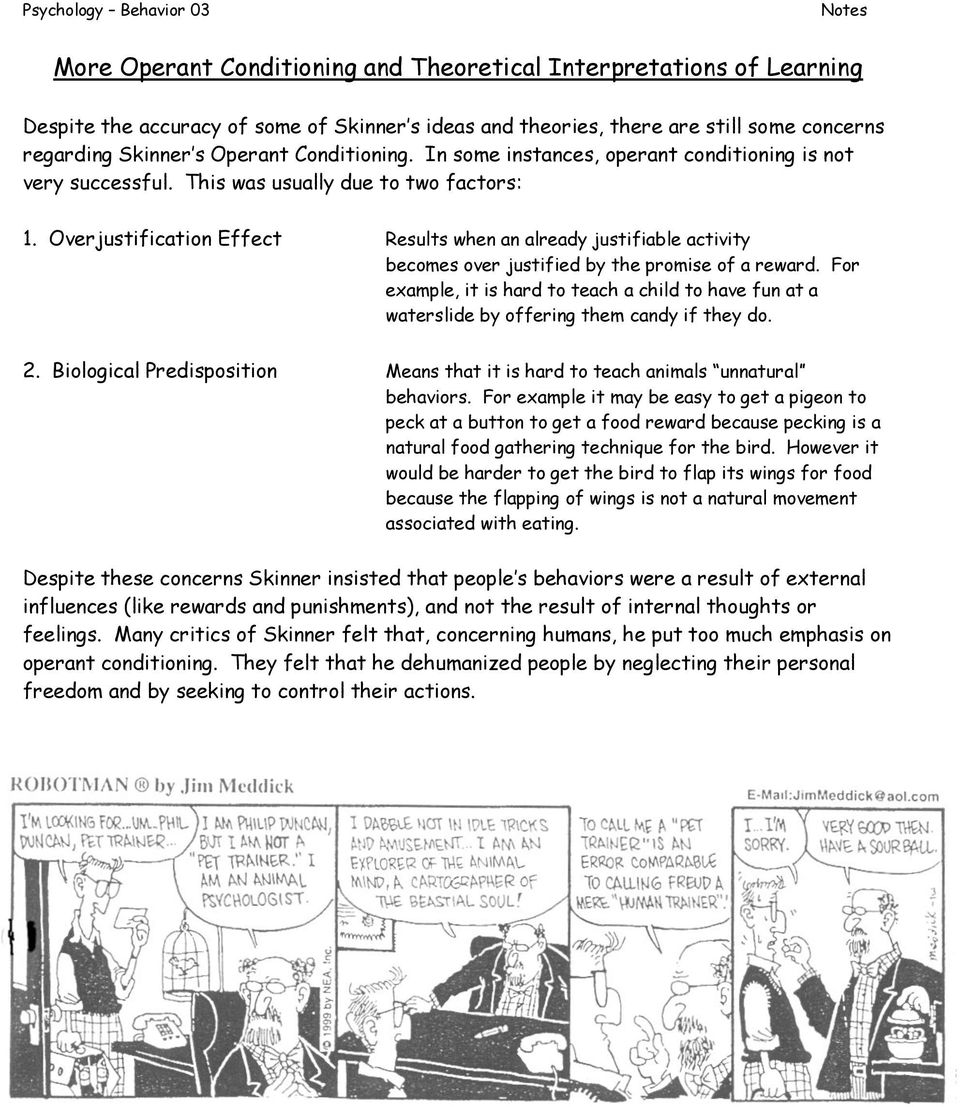
1 Psychology Behavior 03 Notes More Operant Conditioning and Theoretical Interpretations of Learning Despite the accuracy of some of Skinner s ideas and theories, there are still some concerns regarding Skinner s Operant Conditioning. In some instances, operant conditioning is not very successful. This was usually due to two factors: 1. Overjustification Effect Results when an already justifiable activity becomes over justified by the promise of a reward. For example, it is hard to teach a child to have fun at a waterslide by offering them candy if they do. 2. Biological Predisposition Means that it is hard to teach animals unnatural behaviors. For example it may be easy to get a pigeon to peck at a button to get a food reward because pecking is a natural food gathering technique for the bird. However it would be harder to get the bird to flap its wings for food because the flapping of wings is not a natural movement associated with eating. Despite these concerns Skinner insisted that people s behaviors were a result of external influences (like rewards and punishments), and not the result of internal thoughts or feelings. Many critics of Skinner felt that, concerning humans, he put too much emphasis on operant conditioning. They felt that he dehumanized people by neglecting their personal freedom and by seeking to control their actions.
2 Comparison of Classical and Operant Conditioning; Behavior Acquisition Extinction Biological Predisposition Cognitive Process Classical Conditioning Involuntary (reflexive), including emotions Associations of events; conditioned stimulus announces unconditioned stimulus CR decreases when CS is repeatedly presented alone Natural Predispositions constrain what stimuli and responses can easily associated Subjects develop an expectation that the CS signals the arrival of the UCS Operant Conditioning Voluntary (nonreflexive), goal seeking Association of response with a subsequent consequence (reinforcer or punisher). Responding decreases, especially when consistent reinforcement stops. Organisms best learn behaviors similar to their natural behaviors; unnatural behaviors instinctively drift toward natural ones. Subjects develop an expectation that a response will be reinforced or punished; they also exhibit latent learning. Theoretical Interpretations of Learning Learning is somewhat different from conditioning in that learning involves the studying of how we make those connections in our heads that lead to the behavior in question. For example, how do we learn to tie our shoes as a child? (It is usually not as a result of a punishment such as an electric shock every time we fail). Basically, the study of learning is examining how we know. There are a variety of types of learning that both people and animals use to know ; 1. Place Learning Is the ability to locate objects, or is our sense of directions. 2. Modeling Is learning based on the observation of another. For example you watch how Mr. Trickey hits a volleyball, and then you try to copy the motion.

3 Psychology Behavior 03 Assignment More Operant Conditioning and Theoretical Interpretations of Learning Directions: READ the following excerpt from Psychology An Introduction by Ben B. Lahey, and answer the following questions. 1. Define the following terms: cognition insight modeling 2. Answer the following questions using COMPLETE SENTENCES. a. In your own words describe the difference between Pavlov s idea that learning is linked to an association between the brain and muscle movements and Tolman s idea that learning is a matter of cognition. (5 marks for quality of response and description) b. In your own words, describe how insight learning works. Provide your own light bulb appearing over your head moment. (4 marks for quality of response and inclusion of an example. c. Describe either a situation where you have learned a behavior through modeling, or have noticed someone else learning a behavior through modeling. (4 marks for quality of description) d. Offer your own opinion (complete with an explanation to back it up) about the influence the mass media has over teens. Do you think violent video games result in inappropriate behaviours in teens? Do teens feel that violence and sexist stereotypes are acceptable because they see it modeled in rap and hip-hop music videos? Do movies like Jackass encourage teens to take risks? (8 marks for a thoughtful response) 3. How do you learn best? In a short paragraph describe one or two ways in which you learn best. Where possible, use some of the terminology you have learned so far in the course. You will be marked out of 8 for the quality of your paragraph and use of proper terminology. Total Marks: / 32

4 Psychology Behavior 03 Reading Excerpt from: Psychology An Introduction by Ben B. Lahey Theoretical Interpretations of Learning What is learned? When an individual s behaviour changes as the result of classical or operant conditioning, what has exactly happened to the individual? One view dating back at least to the time of Pavlov is that neural connections between brain regions associated with specific stimuli and specific responses are acquired during the learning process. For example, when a rat is reinforced for pressing a lever in the presence of a light, a connection is believed to be automatically created between brain regions associated with the light and the specific pattern of muscle movements of the lever press. The next time the light is turned on, the neural connections will cause the lever press to occur. Another popular interpretation of learning suggests that learning is best thought of as a change in cognitions rather than in specific neural connections. The term cognition refers to the intellectual processes of thinking, expecting, believing, perceiving and so on. Adherents to this view consider that the individual changes his or her cognitions about a given situation during the learning process. You flinch when a light comes on that has previously been paired with an electric shock, because you expect it to be followed by an electric shock. A rat turns left in a maze because he knows that the food was down that way the last ten times he ran through the maze. Cognition or Connection? A considerable amount of research has been conducted through the years to evaluate the connection and cognition theories of learning. Although most of it has been carried out using animals as subjects, what has been learned about the nature of learning is relevant to us human animals as well. Place Learning An ingenious experiment to test the cognitive view of learning was designed by the late Edward C. Tolman of the University of California at Berkley. Rats were initially trained to run through a path to some food. They started at point A, made a series of turns (left, right, right) and ran to point B where some food was provided. In the connections view of learning, the rats learned to do this by learning connections between the stimuli of the path and the particular movements of running and turning. However, Tolman took a cognitive view. He believed that the rats had learned a cognitive map of where the food was located relative to the starting place. They did not acquire a fixed pattern of muscle movements; they acquired knowledge of the location of the food. How can we distinguish between the cognitive and connectionist interpretations? Tolman s experimental test was ingenious. Suppose we give the rats a chance to take a shortcut
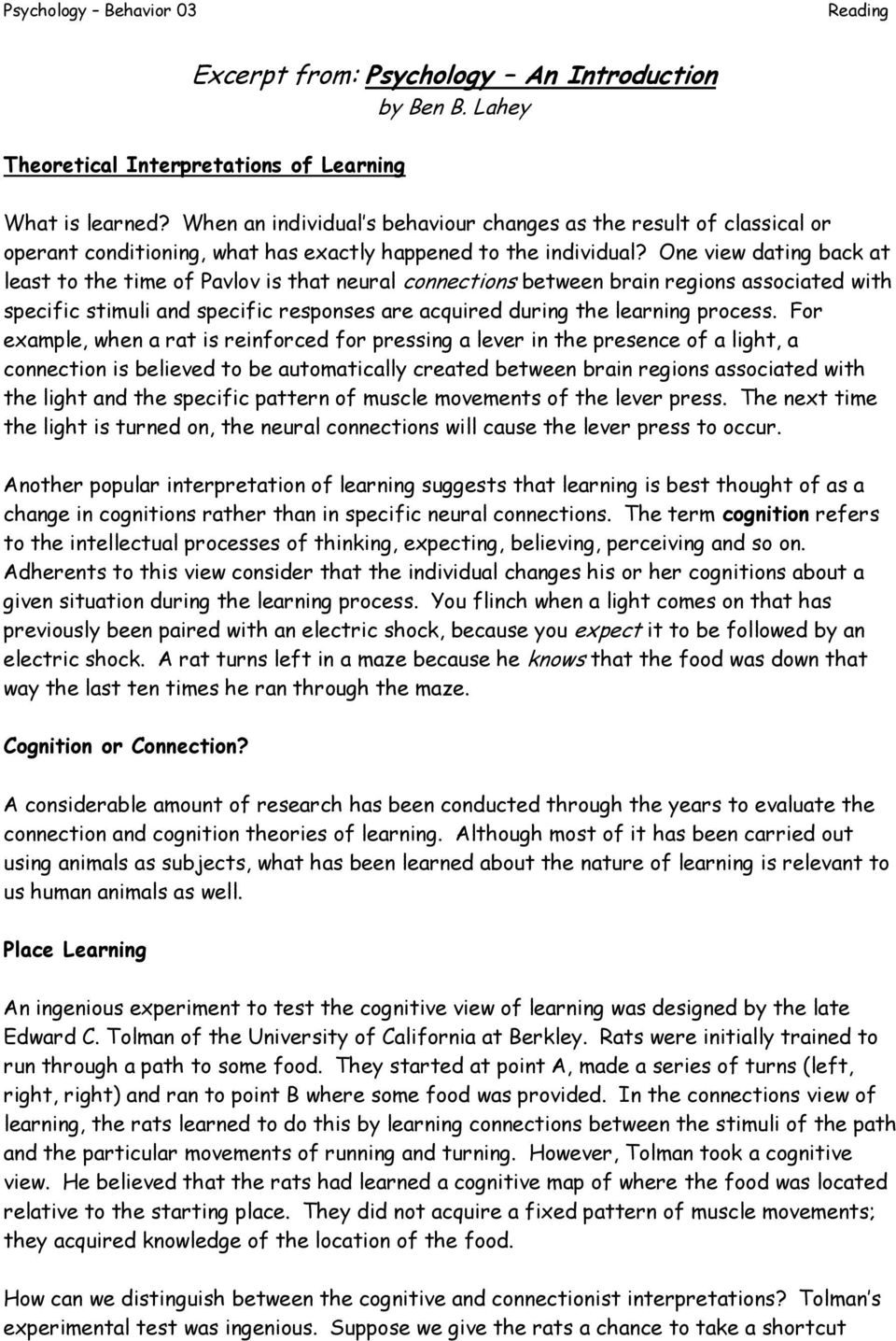
5 directly to the food, will they take it? Or will they be unable to recognize it as a better path, since all they had learned was connections between maze stimuli and patterns of muscle movements? Tolman and his colleagues answered this question by blocking the old path and providing a variety of new choices. Interestingly, the greatest number of rats chose the path that led directly to the food. Tolman interpreted this as meaning that they had learned a new cognition, knowledge of the location of the food. Latent Learning Tolman conducted another informative experiment that evaluated the cognitive interpretation of learning in a rather different way. Suppose we allow a rat to run around in a complex maze of alleys. Would the rat learn anything? The connectionist view would say no: Learning would only occur if reinforcements were delivered at the end of the maze to stamp in a connection between the stimuli of the maze and a specific series of movements leading from the starting box to the food box. Tolman, on the other hand, felt that the rat would learn a cognitive map of the maze, but we would not be able to see that he had learned it until the rat was given a good reason (like food) to run to the food box In Tolman s experiments, three groups of hungry rats were placed in the maze and timed to see how long it took them to reach the food box. One group was reinforced each time they reached the food box, so they learned to run to it quickly. A second group was never reinforced, so they wandered aimlessly in the maze (never decreasing the time it took to reach the food box). The third group of rats was the interesting one though. This group was not reinforced for going to the food box for the first 10 days, but was reinforced from then on. The third group showed a sudden decrease in the amount of time it took them to reach the goal, catching up almost immediately to the first group that had been reinforced every time. Tolman interpreted these results as showing that the third group of rats had learned as much about the layout of the maze and the food box as the first group, but they only showed their learning when given a reason to do so (in this case food). Insight Learning Perhaps the most striking evidence for the cognitive view of learning comes from a series of experiments conducted by a German Gestalt psychologist during World War I. Wolfgang Kohler was visiting the island of Tenerife (in the Canary Islands) when the war broke out and as a German citizen, he was interned there for the duration of the war. He took good advantage of a poor situation, however, by conducting learning experiments with apes that were native to the island. His best-known study was carried out using an ape named Sultan. Kohler put Sultan in a cage where a bunch of bananas and two bamboo sticks (which could be fitted together) were hanging Wolfgang Kohler from the ceiling. Sultan originally spent a great deal of time trying to knock down the bananas with one of the sticks, but eventually gave up. Then as he was fiddling idly with the two sticks, he joined the sticks together into one long pole.
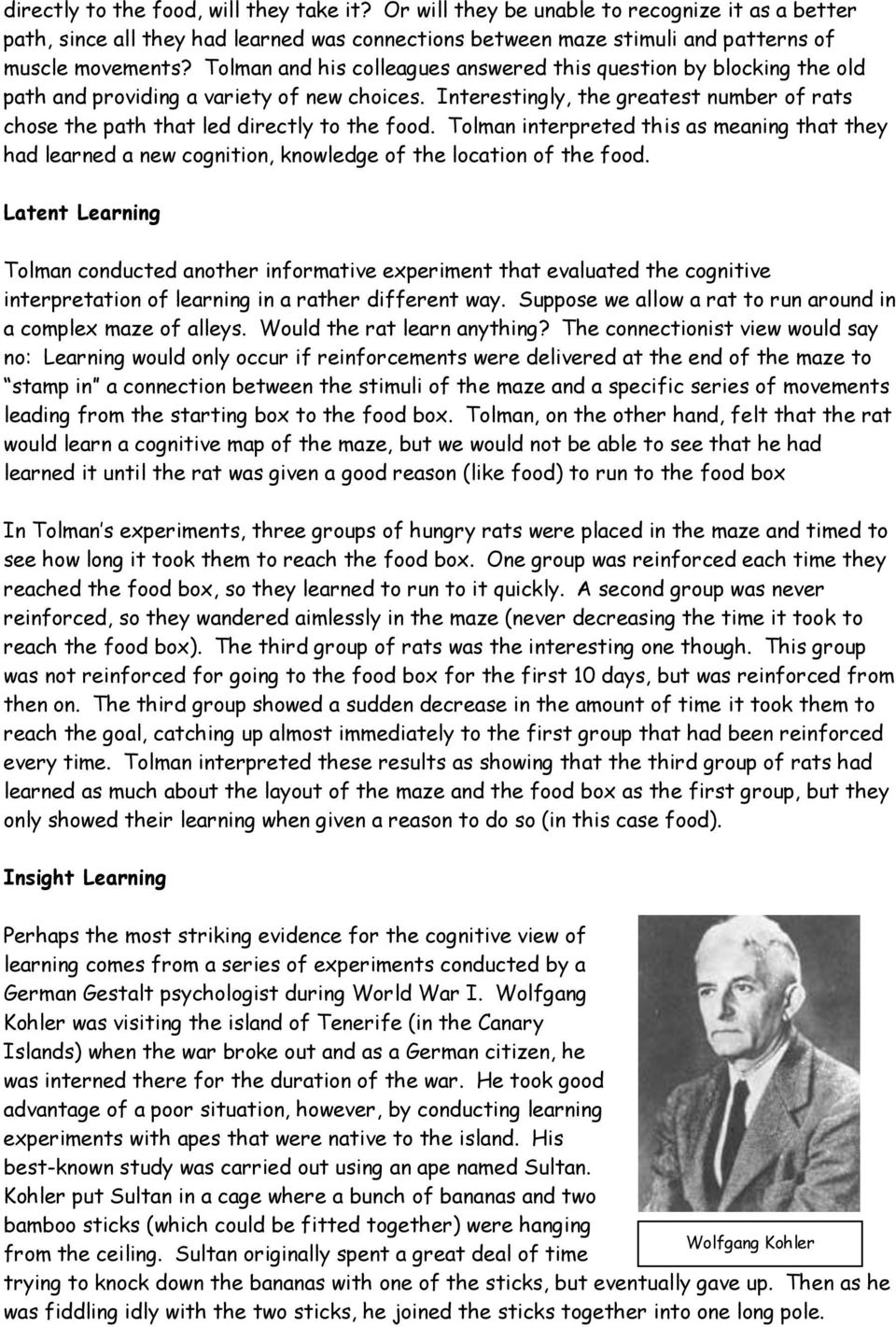
6 Sultan immediately got up and knocked the bananas down with the long pole. And every subsequent time he was presented with the same problem, he immediately solved it in the same way. Kohler repeated this basic experiment many times with other problems, such as providing several boxes that had to be stacked to reach the bananas. Each time, the ape would fail to make any progress and then suddenly learned how to reach the bananas. Kohler said that Sultan learned because of a cognitive change a new insight that he had developed about the problem. As soon as he figured out the solution, the learning process was over. Modelling: Learning by Watching Others Stanford University psychologist Albert Bandura is one of the most influential contemporary proponents of the cognitive view of learning. Perhaps his most important contribution has been to emphasize that people not only learn through classical and operant conditions, but by observing the behaviour of others as well. Bandura calls this modeling. In Egypt, for example, where grasshoppers are considered to be a delicacy, people learn to eat them partly by watching other people enjoy themselves while eating grasshoppers. In North America, in contrast, we learn to think of grasshoppers as disgusting creatures largely by seeing other people s negative Albert Bandura reactions to them. There is nothing inherently good or bad about eating grasshoppers, but we learn that they are either a delicacy or disgusting by seeing how others feel about them. Similarly, pattern of speech, style of dress, patterns of energy consumption, methods of rearing children, and a myriad of other patterns of behaviour are taught through modeling. Bandura considers modeling to be an important demonstration of the role of cognition in learning. A child who watches his older sister play baseball for several years will be able to come pretty close to playing the game properly the very first time he is allowed to play. In Bandura s view, a great deal of cognitive learning takes place through watching, before there is any chance for the behaviour to occur and be reinforced. But, we can learn more through modeling than skills. Bandura has suggested that modeling can also remind us of appropriate behaviours in given situations, reduce our inhibitions concerning certain behaviours that we see others engaging in, or suggest to us what behaviours will lead to reinforcement. This latter point has been particularly well demonstrated through research. In Bandura s ground-breaking laboratory studies of modeling, children learned to be more aggressive or less fearful as a result of simply observing the behaviour of other children or adults in films. In one study, one group of children saw an adult kick, hit and sit on a blowup doll. When these children were placed in a playroom, they were significantly more aggressive towards the blow up doll than a group of children who had not seen the film they had learned to act more aggressively through modeling. In a similar study with a more uplifting conclusion, research participants who were initially strongly afraid of snakes
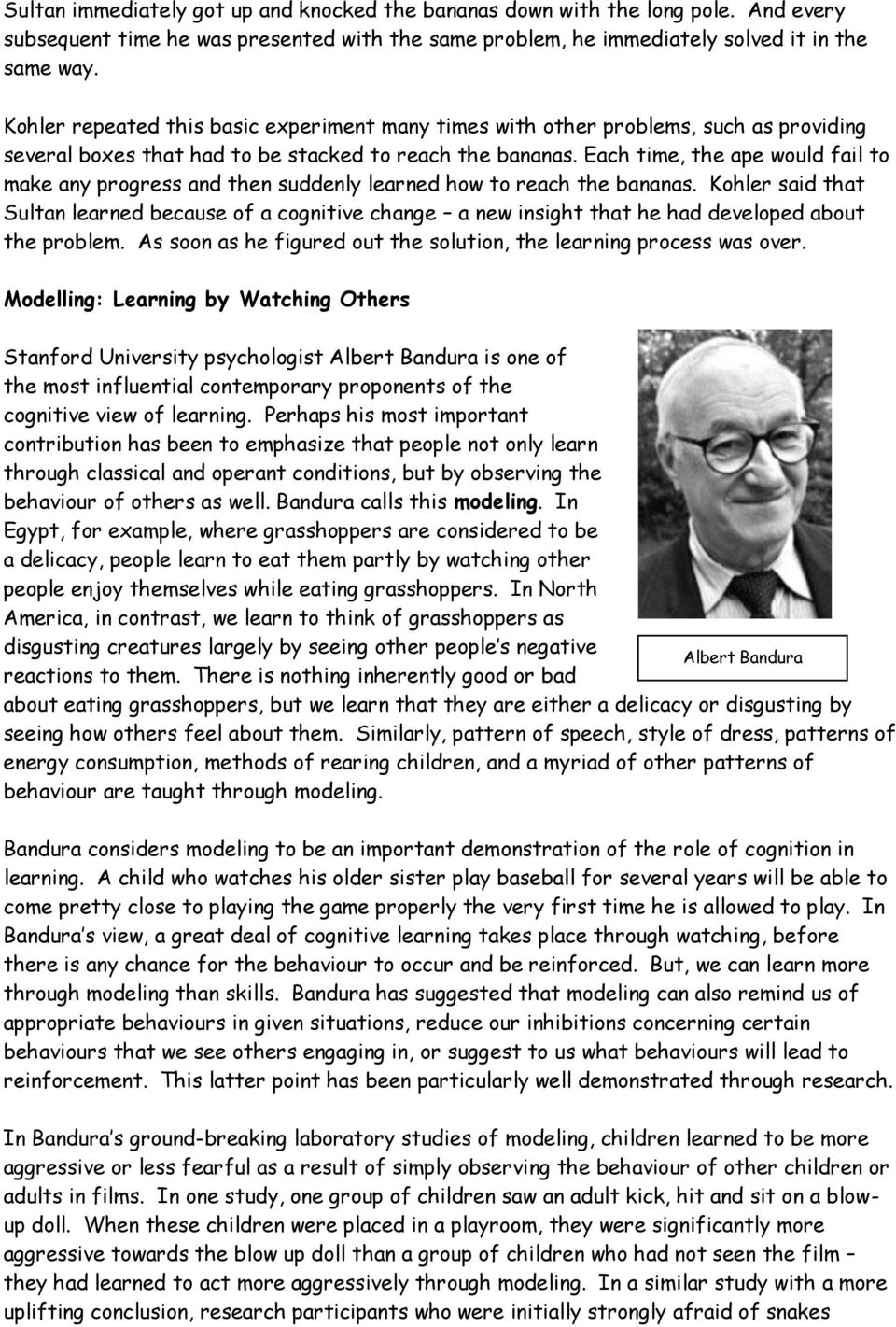
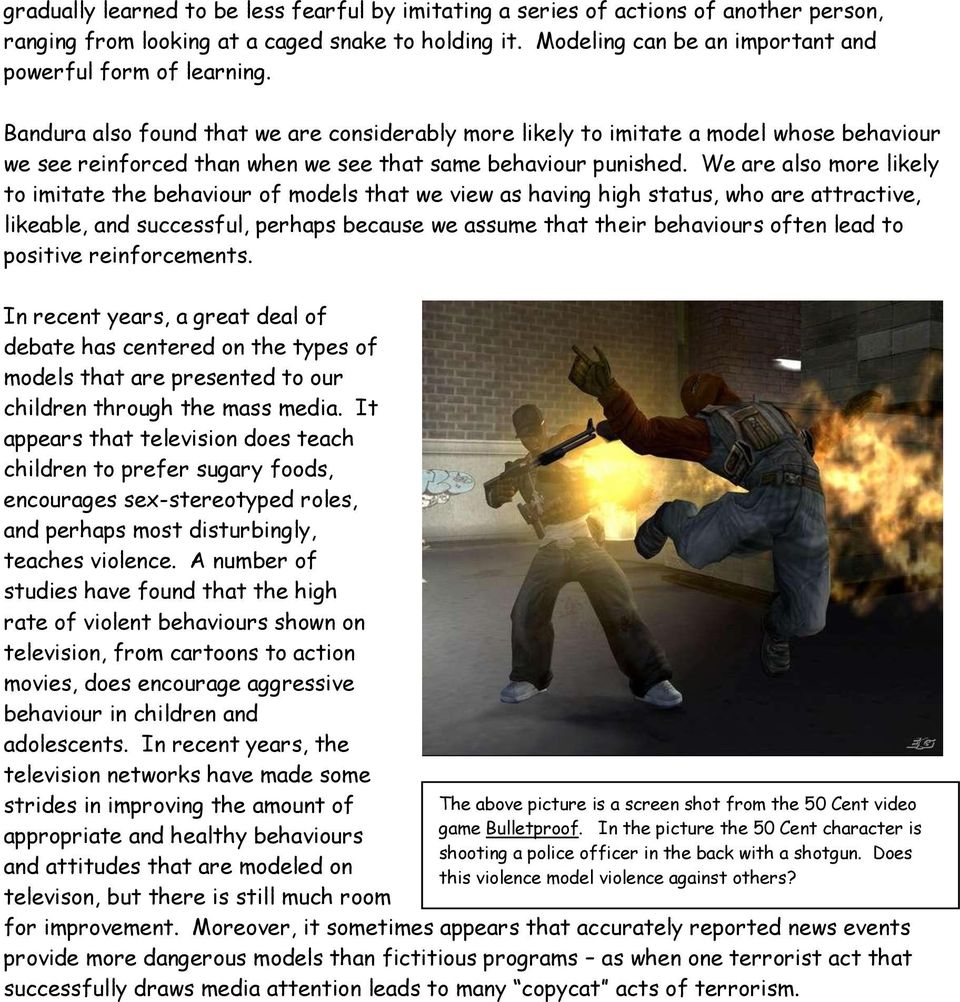
7 gradually learned to be less fearful by imitating a series of actions of another person, ranging from looking at a caged snake to holding it. Modeling can be an important and powerful form of learning. Bandura also found that we are considerably more likely to imitate a model whose behaviour we see reinforced than when we see that same behaviour punished. We are also more likely to imitate the behaviour of models that we view as having high status, who are attractive, likeable, and successful, perhaps because we assume that their behaviours often lead to positive reinforcements. In recent years, a great deal of debate has centered on the types of models that are presented to our children through the mass media. It appears that television does teach children to prefer sugary foods, encourages sex-stereotyped roles, and perhaps most disturbingly, teaches violence. A number of studies have found that the high rate of violent behaviours shown on television, from cartoons to action movies, does encourage aggressive behaviour in children and adolescents. In recent years, the television networks have made some strides in improving the amount of appropriate and healthy behaviours and attitudes that are modeled on televison, but there is still much room The above picture is a screen shot from the 50 Cent video game Bulletproof. In the picture the 50 Cent character is shooting a police officer in the back with a shotgun. Does this violence model violence against others? for improvement. Moreover, it sometimes appears that accurately reported news events provide more dangerous models than fictitious programs as when one terrorist act that successfully draws media attention leads to many copycat acts of terrorism.
Chapter 7 Conditioning and Learning
 Chapter 7 Conditioning and Learning Chapter Summary Definitions Learning is defined as a relatively permanent change in behavior due to experience. A stimulus is anything that comes in through your senses.
Okami Study Guide: Chapter 7
 1 Chapter in Review 1. Learning is difficult to define, but most psychologists would agree that: In learning the organism acquires some new knowledge or behavior as a result of experience; learning can
Programmed Learning Review
 Programmed Learning Review L-HO1-121907 Take another sheet of paper and cover the answers located in the right hand column. Then read through the unit filling in the blanks as you go. After filling in
Outline. General Psychology PSYC 200. Definition. Habituation. Habituation. Classical Conditioning 3/17/2015. Learning
 /17/015 General Psychology PSYC 00 Outline 0) Definition of Learning 1) Habituation ) Classical Conditioning ) Operant Conditioning Learning Definition Learning = change in behavior or thought as a result
UNIT 6: LEARNING. 6. When the US is presented prior to a neutral stimulus, conditioning DOES NOT (does/does not) occur.
 UNIT 6: LEARNING HOW DO WE LEARN? OBJECTIVE 1: Define learning, and identify two forms of learning. 1. A relatively permanent change in an organism s behavior due to experience is called LEARNING. 2. More
Learning Theories Taught in EDFL 2240: Educational Psychology. Behavioral Learning Theories (Learning is defined as a change in behavior)
 Learning Theories Taught in EDFL 2240: Educational Psychology Behavioral Learning Theories (Learning is defined as a change in behavior) Pavlov & Watson s Classical (Reflexive) Conditioning Definition:
Learning Theories 4- Behaviorism
 LEARNING THEORIES - BEHAVIORISM CHAPTER 4 CHAPTER Learning Theories 4- Behaviorism LEARNING OUTCOMES After studying this chapter, you should be able to: 1. Explain the principles of classical conditioning,
GCSE PSYCHOLOGY UNIT 2 LEARNING REVISION
 GCSE PSYCHOLOGY UNIT 2 LEARNING REVISION GCSE PSYCHOLOGY UNIT 2 CLASSICAL CONDITIONING LEARNING LEARNING= Is a relatively permanent change in behaviour due to experience Some behaviours are learnt, but
A. Learning Process through which experience causes permanent change in knowledge or behavior.
 Woolfolk, A. (2010). Chapter 6: Behavioral Views of Learning. In A. Woolfook (Ed.), Educational psychology (11th ed.). Columbus, OH: Pearson/Allyn & Bacon. This chapter begins by defining learning and
Learning UNIT 6 UNIT PREVIEW UNIT GUIDE
 UNIT 6 Learning UNIT PREVIEW Learning helps us adapt to our environment. Pavlov explored classical conditioning, in which we learn to anticipate events, such as being fed or experiencing pain. In his famous
101 IELTS Speaking Part Two Topic cards about sports, hobbies and free time A- Z
 101 IELTS Speaking Part Two Topic cards about sports, hobbies and free time A- Z As the topics of sports, hobbies and free time are easy ones that tie in with IELTS Speaking Part One and students like
Classical (Pavlovian) Conditioning
 Psychology Behavior 01 Notes Classical (Pavlovian) Conditioning Behaviorism is essentially the study of how we learn. Humans are different from many animals in that we possess very little instinct, or
Chapter 5: Learning I. Introduction: What Is Learning? learning Conditioning II. Classical Conditioning: Associating Stimuli Ivan Pavlov
 Chapter 5: Learning I. Introduction: What Is Learning? A. Psychologists define learning as a process that produces a relatively enduring change in behavior or knowledge as a result of an individual s experience.
GCSE Psychology Learning
 GCSE Psychology Learning Student: Tutor: Unit 2: Understanding other people 1 Learning What is classical conditioning? What do we mean when we say we have learnt something? Read the statements below and
Learning. Relatively permanent behavior change that is acquired through experience
 Learning Relatively permanent behavior change that is acquired through experience Learning vs Maturation Not all behavior change is best described as learning Maturation (neuromuscular development) usually
HONORS PSYCHOLOGY REVIEW QUESTIONS
 HONORS PSYCHOLOGY REVIEW QUESTIONS The purpose of these review questions is to help you assess your grasp of the facts and definitions covered in your textbook. Knowing facts and definitions is necessary
A BEHAVIORAL VIEW OF LEARNING
 Chapter 10 Classical Conditioning Classical Conditioning: The Story of Dogs and Little Albert A BEHAVIORAL VIEW OF LEARNING As you read below you may come to think that behavioral learning theories seem
9/14/2015. Innate behavior. Innate behavior. Stimuli that trigger innate behaviors are called releasers.
 & & has a fixed, genetic component. Despite differing environments, the behavior develops in all individuals. Learned behavior is acquired and modified over development. s can be triggered or enhanced
Operant Conditioning. PSYCHOLOGY (8th Edition, in Modules) David Myers. Module 22
 PSYCHOLOGY (8th Edition, in Modules) David Myers PowerPoint Slides Aneeq Ahmad Henderson State University Worth Publishers, 2007 1 Operant Conditioning Module 22 2 Operant Conditioning Operant Conditioning
Chapter 12: Observational Learning. Lecture Outline
 Chapter 12: Observational Learning Lecture Outline Observational learning Observational learning in Classical conditioning Observational learning in operant conditioning Observational learning in animals
Operant Conditioning. Skinner and Thorndike
 Operant Conditioning Skinner and Thorndike Operant Conditioning Organisms learn to do things, or not to do things, because of the consequences of their behavior Example: Avoid M&M s because they made you
Mental Health Role Plays
 Mental Health Role Plays Goals: To discuss various mental health issues and mental illnesses. To discuss stigma, support and treatment options surrounding mental health issues and mental illnesses. Requirements:
Grade 8 Lesson Peer Influence
 Grade 8 Lesson Peer Influence Summary This lesson is one in a series of Grade 8 lessons. If you aren t able to teach all the lessons, try pairing this lesson with the Substance and Gambling Information,
IMPORTANT BEHAVIOURISTIC THEORIES
 IMPORTANT BEHAVIOURISTIC THEORIES BEHAVIOURISTIC THEORIES PAVLOV THORNDIKE SKINNER PAVLOV S CLASSICAL CONDITIONING I. Introduction: Ivan Pavlov (1849-1936) was a Russian Physiologist who won Nobel Prize
Psychology with Mr. Duez UNIT 3 "Learning" LEARNING TARGETS
 Psychology with Mr. Duez UNIT 3 "Learning" LEARNING TARGETS If you learn only 6 things from this chapter... 1. Learning refers to a relatively permanent change in behavior based on experience. 2. Classical
Empirical Background for Skinner s Basic Arguments Regarding Selection by Consequences
 Empirical Background for Skinner s Basic Arguments Regarding Selection by Consequences Iver Iversen University of North Florida, Jacksonville Presentation at NAFO, April 2016 Gol, Norway Skinner was Controvercial
Chapter 1 Introduction to Correlation
 Chapter 1 Introduction to Correlation Suppose that you woke up one morning and discovered that you had been given the gift of being able to predict the future. Suddenly, you found yourself able to predict,
INTRODUCTION TO COACHING TEACHING SKILLS TEACHING/LEARNING. September 2007 Page 1
 TEACHING SKILLS September 2007 Page 1 TEACHING SKILLS Being a teacher is one of the main roles a coach fulfils for their players. The ability to teach effectively, especially the technical skills of ice
Introduction to Learning. Chapter 1
 Introduction to Learning Chapter 1 A Definition of Learning Learning is: An experiential process Resulting in a relatively permanent change Not explained by temporary states, maturation, or innate response
A View on Behaviorist Learning Theory. view of behaviorism assumes that all behavior is determined via the environment or how one has
 A View on Behaviorist Learning Theory Introduction Behaviorism is a learning theory that emphasizes observable behavior. The most radical view of behaviorism assumes that all behavior is determined via
Arkansas State PIRC/ Center for Effective Parenting
 Increasing Your Child s Motivation to Learn In order to be successful in school and to learn, students must stay involved in the learning process. This requires students to do many different activities
Okami Study Guide: Chapter 7
 1 Chapter Test 1. Knowing how to do something, like drive a car or play a sport, is referred to as a. explicit knowledge b. behavioral knowledge c. procedural knowledge d. implicit knowledge 2. All of
Chapter 5. Learning. Outline
 Chapter 5 Learning Outline I. What Is Learning? A. Learning is demonstrated by a relatively permanent change in behavior that occurs as the result of practice or experience. 1. Learning cannot be observed
Psychology Ciccarelli and White
 1 Psychology Ciccarelli and White What is Learning? -Any relatively permanent change in behavior based on experience or practice Chapter Five: Learning -Learning is not maturation. Maturation is change
Tom s Reflective Log. My Work Placement at ACME Community School. Week 1
 Tom s Reflective Log My Work Placement at ACME Community School Week 1 The school I chose to work at was ACME Community School. The school is open 7 days a week and is very popular in the local area and
Behavioral Principles. S-R Learning. Pavlov & Classical Conditioning 12/2/2009
 Behavioral Principles S-R Learning Classical conditioning The most basic form of learning; one stimulus comes to serve as a signal for the occurrence of a second stimulus (the response) Stimulus a physical
Icebreaker: Fantastic Four
 Icebreaker: Fantastic Four 1. Break the group into groups of 4. 2. Each team must come up with four things that they all have in common. They may be as simple or as complex as they want (example: we all
FILMS AND BOOKS ADAPTATIONS
 FILMS AND BOOKS Reading a book is very different to watching a film. The way that we understand both is also different. We firstly need to think of the ways in which films and books tell their stories.
Classical Conditioning. Classical and Operant Conditioning. Basic effect. Classical Conditioning
 Classical Conditioning Classical and Operant Conditioning January 16, 2001 Reminder of Basic Effect What makes for effective conditioning? How does classical conditioning work? Classical Conditioning Reflex-basic
Behaviorism: Laws of the Observable
 Behaviorism: Laws of the Observable The Backdrop to Watson: Functionalism at the Univ. of Chicago John Dewey, like James, was influenced by both Peirce and Darwin Moved to the University of Chicago in
Learning from Experience. Definition of Learning. Psychological definition. Pavlov: Classical Conditioning
 Learning from Experience Overview Understanding Learning Classical Conditioning Operant Conditioning Observational Learning Definition of Learning Permanent change Change in behavior or knowledge Learning
GCSE PSYCHOLOGY UNIT 2 SEX AND GENDER REVISION
 GCSE PSYCHOLOGY UNIT 2 SEX AND GENDER REVISION GCSE PSYCHOLOGY UNIT 2 SEX AND GENDER IDENTITY SEX IDENTITY AND GENDER IDENTITY SEX IDENTITY = a biological term. A child s sex can be identified by their
The Life Story Interview
 The Life Story Interview Dan P. McAdams, Northwestern University Revised 1995 Introductory Comments This is an interview about the story of your life. We are asking you to play the role of storyteller
100 Ways To Improve Your Sales Success. Some Great Tips To Boost Your Sales
 100 Ways To Improve Your Sales Success Some Great Tips To Boost Your Sales 100 Ways To Improve Your Sales Success By Sean Mcpheat, Managing Director Of The Sales Training Consultancy What makes a successful
Learning: Classical Conditioning
 How Do We Learn? Learning Learning: Classical Conditioning Chapter 7 One way is through Classical Conditioning Pavlov s Experiments Extending Pavlov s Understanding Pavlov s Legacy Psy 12000.003 1 2 Definition
Classical Conditioning
 Chapter 5 Learning Classical Conditioning Learning relatively permanent change in behavior due to experience Behaviorism emphasizes the study of observable behavior and the role of the environment as determinant
MOTIVATION. Upon completion of this module you should be able to:
 MOTIVATION Motivating is the management process influencing people s behaviour based on this knowledge of what makes people tick. Motivating and motivation both deal with the range of conscious human behaviour
Chapter 15. Historical Perspective. How the world creates who you are: behaviorism and social learning theory
 Chapter 15 How the world creates who you are: behaviorism and social learning theory Learning 2 stimuli events, things, or people repeatedly experienced together will eventually come to elicit the same
Learning. Any relatively permanent change in behavior brought about by experience or practice. Permanent Experience Practice
 Learning Any relatively permanent change in behavior brought about by experience or practice Permanent Experience Practice Ivan Pavlov (1849-1936) Russian Physiologist Father= Village Priest Father-in-law=
Behaviorism & Education
 Behaviorism & Education Early Psychology (the use of nonobjective methods such as Introspection) Learning = behavior change movement toward objective methods Behaviorism Pavlov, Skinner (Focus on Sà R)
Schizophrenia National Institute of Mental Health
 Schizophrenia National Institute of Mental Health U.S. DEPARTMENT OF HEALTH AND HUMAN SERVICES National Institutes of Health Schizophrenia Do you know someone who seems like he or she has lost touch with
AP Psychology 2008-2009 Academic Year
 AP Psychology 2008-2009 Academic Year Course Description: The College Board Advanced Placement Program describes Advanced Placement Psychology as a course that is designed to introduce students to the
Acknowledging Children s Positive Behaviors What Works Brief Series Matt Timm and Sharon Doubet
 Center on the Social and Emotional Foundations for Early Learning Project funded by the Child Care and Head Start Bureaus in the U.S. Department of Health and Human Services Acknowledging Children s Positive
LESSON 7: LEARNING MODELS
 LESSON 7: LEARNING MODELS INTRODUCTION mobility motivation persistence sociological Think about your favorite class. Does the teacher lecture? Do you do experiments or go on field trips? Does the teacher
BBC LEARNING ENGLISH 6 Minute English The teenage brain
 BBC LEARNING ENGLISH 6 Minute English The teenage brain NB: This is not a word-for-word transcript Hello and welcome to 6 Minute English. I m and I m. Hello. Hello,. I like your new hoody. Oh, right! Thanks
Student Essays on NASA Project
 Student Essays on NASA Project The trip to Washington D.C. for the Quarterbacks of Life program was enlightening for various reasons; it goes without saying that being able to visit the nation's capital,
Freud and Personality
 Psychology Psychoanalysis 01 Notes Freud and Personality The psychoanalytical perspective in psychology examines personality traits and disorders in terms of sexual and/or aggressive drives or unfilled
Chapter Five Socialization. Human Development: Biology and Society. Social Isolation
 Chapter Five Socialization Socialization is the lifelong process of social interaction through which individuals acquire a self-identify and the physical, mental, and social skills needed for survival
HOW TO CHANGE NEGATIVE THINKING
 HOW TO CHANGE NEGATIVE THINKING For there is nothing either good or bad, but thinking makes it so. William Shakespeare, Hamlet, Act 2, Scene 2, 239 251. Although you may not be fully aware of it, our minds
STEP 5: Giving Feedback
 STEP 5: Giving Feedback Introduction You are now aware of the responsibilities of workplace mentoring, the six step approach to teaching skills, the importance of identifying the point of the lesson, and
Today. Learning. Learning. What is Learning? The Biological Basis. Hebbian Learning in Neurons
 Today Learning What is Learning? Classical conditioning Operant conditioning Intro Psychology Georgia Tech Instructor: Dr. Bruce Walker What is Learning? Depends on your purpose and perspective Could be
A Writer s Workshop: Working in the Middle from Jennifer Alex, NNWP Consultant
 Structure of a Workshop: A Writer s Workshop: Working in the Middle from Jennifer Alex, NNWP Consultant For the last four years, writing and reading workshops have been the foundation of my classroom practice.
Self-directed learning: managing yourself and your working relationships
 ASSERTIVENESS AND CONFLICT In this chapter we shall look at two topics in which the ability to be aware of and to manage what is going on within yourself is deeply connected to your ability to interact
A Behavioral Perspective of Childhood Trauma and Attachment Issues: Toward Alternative Treatment Approaches for Children with a History of Abuse
 A Behavioral Perspective of Childhood Trauma and Attachment Issues: Toward Alternative Treatment Approaches for Children with a History of Abuse By: Walter Prather and Jeannie A. Golden ABSTRACT This article
ICF CORE COMPETENCIES RATING LEVELS
 coachfederation.org ICF CORE COMPETENCIES RATING LEVELS Adapted from the Minimum Skills Requirements documents for each credential level Includes will-not-receive-passing-score criteria. COMPETENCY 1.
Sociology Test- Chapters 1, 2 & 3 TEST A
 Sociology Test- Chapters 1, 2 & 3 TEST A A. Culture B. Norms C. Folkways D. Mores E. Symbolic Interactionist F. Functionalist G. Theoretical Perspectives H. Conflict Theory I. Sociological Imagination
For Parents and Kids
 Dear Parents, Our class is beginning Too Good For Violence, a violence prevention/character education program developed by the Mendez Foundation for kindergarten through eighth grade. This program teaches
The Negative Impact of Rewards and Ineffective Praise on Student Motivation
 ESSAI Volume 8 Article 24 4-1-2011 The Negative Impact of Rewards and Ineffective Praise on Student Motivation Julie Kelsey College of DuPage Follow this and additional works at: http://dc.cod.edu/essai
LEARNING. Chapter 6 (Bernstein), pages 194-229
 LEARNING Chapter 6 (Bernstein), pages 194-229 What is LEARNING? LEARNING is the adaptive process through which experience modifies preexisting behavior and understanding; relatively permanent change in
Early Signs of Autism
 Early Signs of Autism Gerald T. Guild, PhD Licensed Psychologist Preschool Learning Center Springville, New York Long Term Outcomes Crucial Variables known to maximize student outcomes Early Identification
COMPETENCY ACC LEVEL PCC LEVEL MCC LEVEL 1. Ethics and Standards
 ICF CORE COMPETENCIES RATING LEVELS Adapted from the Minimum Skills Requirements documents for each credential level (Includes will-not-receive-passing-score criteria- gray background) COMPETENCY ACC LEVEL
Design Analysis of Everyday Thing: Nintendo Wii Remote
 1 Philip Stubbs Design Analysis of Everyday Thing: Nintendo Wii Remote I. Introduction: Ever since being released in November 2006, the Nintendo Wii gaming system has revolutionized the gaming experience
Theories for Child Development: What are they and why should you care? Lifespan Developmental Theory
 Theories for Child Development: What are they and why should you care? Wednesday, August 24 th, 2005 Covering: Lifespan Developmental Theory, Psychoanalytic Theory, Erikson, Behavioral and Social Learning,
Restorative Parenting: A Group Facilitation Curriculum Activities Dave Mathews, Psy.D., LICSW
 Restorative Parenting: A Group Facilitation Curriculum Activities Dave Mathews, Psy.D., LICSW RP Activities 1. Framework of Resourcefulness 2. Identifying the Broken Contract Articles 3. The Process of
How do we Learn? How do you know you ve learned something? CLASS OBJECTIVES: What is learning? What is Classical Conditioning? Chapter 6 Learning
 How do we Learn? Chapter 6 Learning CLASS OBJECTIVES: What is learning? What is Classical Conditioning? How do you know you ve learned something? 1 Can our beliefs and attitudes be a result of learning??
WHY DO WE GET ANGRY? EVERYONE FEELS ANGRY SOMETIMES
 FEELING ANGRY? WHY DO WE GET ANGRY? There are lots of things that can make us angry. Here are a few examples... EVERYONE FEELS ANGRY SOMETIMES It s normal and healthy to get angry when there is a good
Sexual Behavior and Children: When Is It a Problem and What To Do About It
 Sexual Behavior and Children: When Is It a Problem and What To Do About It The Harborview Center for Sexual Assault and Traumatic Stress has services to help families of children with sexual behavior problems.
Point of View, Perspective, Audience, and Voice
 Lesson Da 2 Day 1 Point of View, Perspective, Audience, and Voice A story can be told from more than one point of view. If a story is written by someone who is a character in the story, then it is said
psychology the science of psychology CHAPTER third edition Psychology, Third Edition Saundra K. Ciccarelli J. Noland White
 psychology third edition CHAPTER 1 the science of psychology Learning Objectives LO 1.1 Definition and Goals of Psychology LO 1.2 Structuralism and Functionalism LO 1.3 Early Gestalt, Psychoanalysis, and
GOD S BIG STORY Week 1: Creation God Saw That It Was Good 1. LEADER PREPARATION
 This includes: 1. Leader Preparation 2. Lesson Guide GOD S BIG STORY Week 1: Creation God Saw That It Was Good 1. LEADER PREPARATION LESSON OVERVIEW Exploring the first two chapters of Genesis provides
Operant Conditioning: An Overview
 Operant Conditioning: An Overview Classical, or Pavlovian, conditioning is a process by which new emotional and glandular reactions develop in response to previously neutral stimuli in the environment.
FOR MORE, go to www.brookespublishing.com/classroom-management. Problem Behavior in My Classroom?
 3 So How Do I Prevent Problem Behavior in My Classroom? Your perspective, whether limited to your classroom or more broadly in life, directly affects how you interpret the events in your daily life. Developing
Connectedness and the Emotional Bank Account
 Connectedness and the Emotional Bank Account Directions This is a self-guided activity that can be completed by parents, teens or both. It contains five parts and should take about 45 minutes to complete.
Animals that move slowly, animals that move quickly
 Unit Three Time 74 Animals that move slowly, animals that move quickly Unit 3: Time Image courtesy of: Microsoft clipart Focus: Animals that move slowly and quickly linked with time Whole class activity
Encyclopedia of School Psychology Conditioning: Classical And Operant
 Encyclopedia of School Psychology Conditioning: Classical And Operant Contributors: Merilee McCurdy & Michelle Swanger Edited by: Steven W. Lee Book Title: Encyclopedia of School Psychology Chapter Title:
 Marty's Big Mistake A short story about character by Wes Fessler Marty mouse was walking home from school one sunny day. A rock was on the sidewalk, which he kicked along the way. The rock would bounce
Socialization From Infancy to Old Age A. Socialization and the Self self a. Self-identity Socialization
 I. Socialization From Infancy to Old Age A. Socialization and the Self 1. Over our lives, we develop a sense of self: a perception of being a distinct personality with a distinct identity. a. Self-identity:
PLAY STIMULATION CASE STUDY
 PLAY STIMULATION CASE STUDY AIMS Play stimulation work contributes towards the following 2003-2006 PSA targets: Improving social and emotional development, and Improving learning. With regard to PSA targets
PSYCHOLOGY OF CHILDHOOD REVIEW QUESTIONS
 PSYCHOLOGY OF CHILDHOOD REVIEW QUESTIONS These review questions are designed to help you assess your grasp of the facts and definitions covered in your textbook. Knowing facts and definitions is necessary
Classical vs. Operant Conditioning
 Classical vs. Operant Conditioning Operant conditioning (R S RF ) A voluntary response (R) is followed by a reinforcing stimulus (S RF ) The voluntary response is more likely to be emitted by the organism.
Content / Topic Teaching / Learning Activity Duration Assessment Resources
 Name of Unit Psychology Unit 4 Area of Study Learning Sample out line Learning Outcomes Area of Study 1: Learning Outcome 1 On completion of this unit, the student should be able to explain the neural
activities at home Planning the day for a person with moderate or severe dementia
 activities at home Planning the day for a person with moderate or severe dementia Activities and a person with dementia Activities are the things we do, like getting dressed, doing chores, playing cards
Companion Animals Amphibians & Reptiles Cats Dogs Horses Veterinary Science
 Making the Character Connection with Companion Animals Amphibians & Reptiles Cats Dogs Horses Veterinary Science Being a person of good character means you follow the Six Pillars of Character SM everyday.
Psychological Models of Abnormality
 Several Different Models Psychological Models of Abnormality Psychoanalytic Models Learning Models Cognitive Models Psychology 311 Abnormal Psychology Listen to the audio lecture while viewing these slides
Starting a Booktalk Club: Success in Just 12 Weeks!
 Starting a Booktalk Club: Success in Just 12 Weeks! It s wonderful that you re interested in starting a booktalk club at your school! Before you even begin, you may want to familiarize yourself with some
IELTS Speaking Part Two Tasks with unusual or difficult topics
 IELTS Speaking Part Two Tasks with unusual or difficult topics The tasks below should be useful for practising talking about every kind of topic, and for connecting IELTS Speaking tasks to every kind of
Chapter 5. Chapter 5 Lectures Outline
 Chapter 5 Finishing up Classical Conditioning Underlying Processes & Practical Applications Chapter 5 Lectures Outline Underlying processes in Pavlovian conditioning S-R vs. S-S learning Stimulus-substitution
11 Psychology MI-SG-FLD011-02
 11 Psychology MI-SG-FLD011-02 TABLE OF CONTENTS PART 1: General Information About the MTTC Program and Test Preparation OVERVIEW OF THE TESTING PROGRAM... 1-1 Contact Information Test Development Process
Movie Night: You Be the Critic!
 FAMILY ACTIVITY Recommended for kids 6 and up Movie Night: You Be the Critic! Inspired by the popular TED Talk by Colin Stokes, How Movies Teach Manhood, this activity helps turn any family movie night